H2574 CREC 2015 04 29 Pt1 Pg 3
User Manual: H2574
Open the PDF directly: View PDF  .
.
Page Count: 50

CONGRESSIONAL RECORD — HOUSEH2574 April 29, 2015
TABLE 16.—ALLOCATION OF SPENDING AUTHORITY
SENATE COMMITTEES OTHER THAN APPROPRIATIONS—Continued
[Fiscal year 2016, $ billions]
2016 2016–2020 2016–2025
Outlays ................................................................................................................................................................................................................................................................................. 1,891.005 9,512.616 20,901.395
Includes entitlements funded in annual appropriations acts.
T
OM
P
RICE
,
T
ODD
R
OKITA
,
M
ARIO
D
IAZ
-B
ALART
,
D
IANE
B
LACK
,
J
OHN
R. M
OOLENAAR
,
Managers on the Part of the House.
M
ICHAEL
B. E
NZI
,
C
HUCK
G
RASSLEY
,
J
EFF
S
ESSIONS
,
M
IKE
C
RAPO
,
L
INDSEY
G
RAHAM
,
R
OB
P
ORTMAN
,
P
ATRICK
J. T
OOMEY
,
R
ON
J
OHNSON
,
K
ELLY
A
YOTTE
,
R
OGER
F. W
ICKER
,
B
OB
C
ORKER
,
D
AVID
P
ERDUE
,
Managers on the Part of the Senate.
f
RESIGNATION AS MEMBER OF
COMMITTEE ON FINANCIAL
SERVICES
The SPEAKER pro tempore laid be-
fore the House the following resigna-
tion as a member of the Committee on
Financial Services:
C
ONGRESS OF THE
U
NITED
S
TATES
,
H
OUSE OF
R
EPRESENTATIVES
,
Washington, DC, April 27, 2015.
Attn: Trevor Kolego,
Hon. J
OHN
B
OEHNER
,
Speaker, House of Representatives,
The Capitol, Washington, DC.
D
EAR
M
R
. S
PEAKER
: It is a tremendous
privilege to represent the people of the
Tenth District of Illinois in the U.S. House
of Representatives.
I have greatly appreciated the opportunity
to serve on the Financial Services Com-
mittee. However, due to my appointment to
the Committee on Ways and Means, I hereby
resign my seat on the Financial Services
Committee.
I believe that this new position will better
allow me to represent the interests of my
constituents, and I look forward to getting
to work with my colleagues on the Ways and
Means Committee.
Very truly yours,
R
OBERT
J. D
OLD
,
Member of Congress.
The SPEAKER pro tempore. Without
objection, the resignation is accepted.
There was no objection.
f
ELECTING MEMBERS TO CERTAIN
STANDING COMMITTEES OF THE
HOUSE OF REPRESENTATIVES
Ms. FOXX. Mr. Speaker, by direction
of the House Republican Conference, I
send to the desk a privileged resolution
and ask for its immediate consider-
ation.
The Clerk read the resolution, as fol-
lows:
H. R
ES
. 229
Resolved, That the following named Mem-
bers be, and are hereby, elected to the fol-
lowing standing committees of the House of
Representatives:
C
OMMITTEE ON
H
OUSE
A
DMINISTRATION
: Mr.
Walker.
C
OMMITTEE ON
W
AYS AND
M
EANS
: Mr. Dold.
The resolution was agreed to.
A motion to reconsider was laid on
the table.
f
MILITARY CONSTRUCTION AND
VETERANS AFFAIRS AND RE-
LATED AGENCIES APPROPRIA-
TIONS ACT, 2016
GENERAL LEAVE
Mr. DENT. Mr. Speaker, I ask unani-
mous consent that all Members may
have 5 legislative days in which to re-
vise and extend their remarks and to
include extraneous material on H.R.
2029 and that I may include tabular
material on the same.
The SPEAKER pro tempore (Mr.
G
RAVES
of Louisiana). Is there objec-
tion to the request of the gentleman
from Pennsylvania?
There was no objection.
The SPEAKER pro tempore. Pursu-
ant to House Resolution 223 and rule
XVIII, the Chair declares the House in
the Committee of the Whole House on
the state of the Union for the consider-
ation of the bill, H.R. 2029.
The Chair appoints the gentlewoman
from Florida (Ms. R
OS
-L
EHTINEN
) to
preside over the Committee of the
Whole.
b1430
IN THE COMMITTEE OF THE WHOLE
Accordingly, the House resolved
itself into the Committee of the Whole
House on the state of the Union for the
consideration of the bill (H.R. 2029)
making appropriations for military
construction, the Department of Vet-
erans Affairs, and related agencies for
the fiscal year ending September 30,
2016, and for other purposes, with Ms.
R
OS
-L
EHTINEN
in the chair.
The Clerk read the title of the bill.
The CHAIR. Pursuant to the rule, the
bill is considered read the first time.
The gentleman from Pennsylvania
(Mr. D
ENT
) and the gentleman from
Georgia (Mr. B
ISHOP
) each will control
30 minutes.
The Chair recognizes the gentleman
from Pennsylvania.
Mr. DENT. Madam Chair, I yield my-
self such time as I may consume.
Today, it is my honor and privilege
to bring H.R. 2029, the fiscal year 2016
Military Construction and Veterans Af-
fairs and Related Agencies Appropria-
tions bill, to the House of Representa-
tives.
I present this bill alongside my good
friend and ranking member on the sub-
committee, S
ANFORD
B
ISHOP
from
Georgia, who has been an essential
partner all along the way. I greatly ap-
preciate the participation and support
of our committee members, both sides
of the aisle, as we considered priorities
and funding levels for the important
programs in our bill.
We analyzed the budget request, de-
veloped questions, held oversight hear-
ings to hear directly from members of
all the services, the Department of De-
fense leadership, the Secretary of the
VA, the VA inspector general, and the
directors of four related agencies. We
received over 700 requests from Mem-
bers—again, from both sides of the
aisle—and gave full consideration to
each one. It has been a busy spring, and
we did our best to accommodate those
Member requests.
As we consider this bill, I can’t pro-
ceed further without noticing that this
subcommittee has a formidable level of
support from the chair and ranking
member of the full committee. Thank
you, Chairman R
OGERS
and Mrs.
L
OWEY
. Your attention to oversight
and genuine care for the military and
veterans has been inspiring.
To round out our team, we have some
great support from our professional
staff: Sue Quantius, Sarah Young, Tra-
cey Russell, Maureen Holohan, and
Matt Washington on the committee
staff and Heather Smith, Drew Kent,
and Sean Snyder on my personal staff.
We couldn’t do it without all of them.
H.R. 2029 demonstrates our firm com-
mitment to fully supporting the Na-
tion’s veterans and servicemembers.
Our investment of nearly $77 billion for
military construction and Veterans Af-
fairs that is 6 percent—6 percent—over
last year’s level is unprecedented. This
bill provides comprehensive support for
servicemembers, military families, and
veterans. It supports our troops with
facilities and services necessary to
maintain readiness and morale at bases
here in the States and around the
world.
It provides for Defense Department
schools and health clinics that take
care of our military families, and the
bill funds our veterans health care sys-
tems to ensure that our promise to
care for those who have sacrificed in
defense of this great Nation continues
as those men and women return home.
We owe this to our veterans and are
committed to sustained oversight so
that programs deliver what they prom-
ise and taxpayers are well served by
the investments we make.
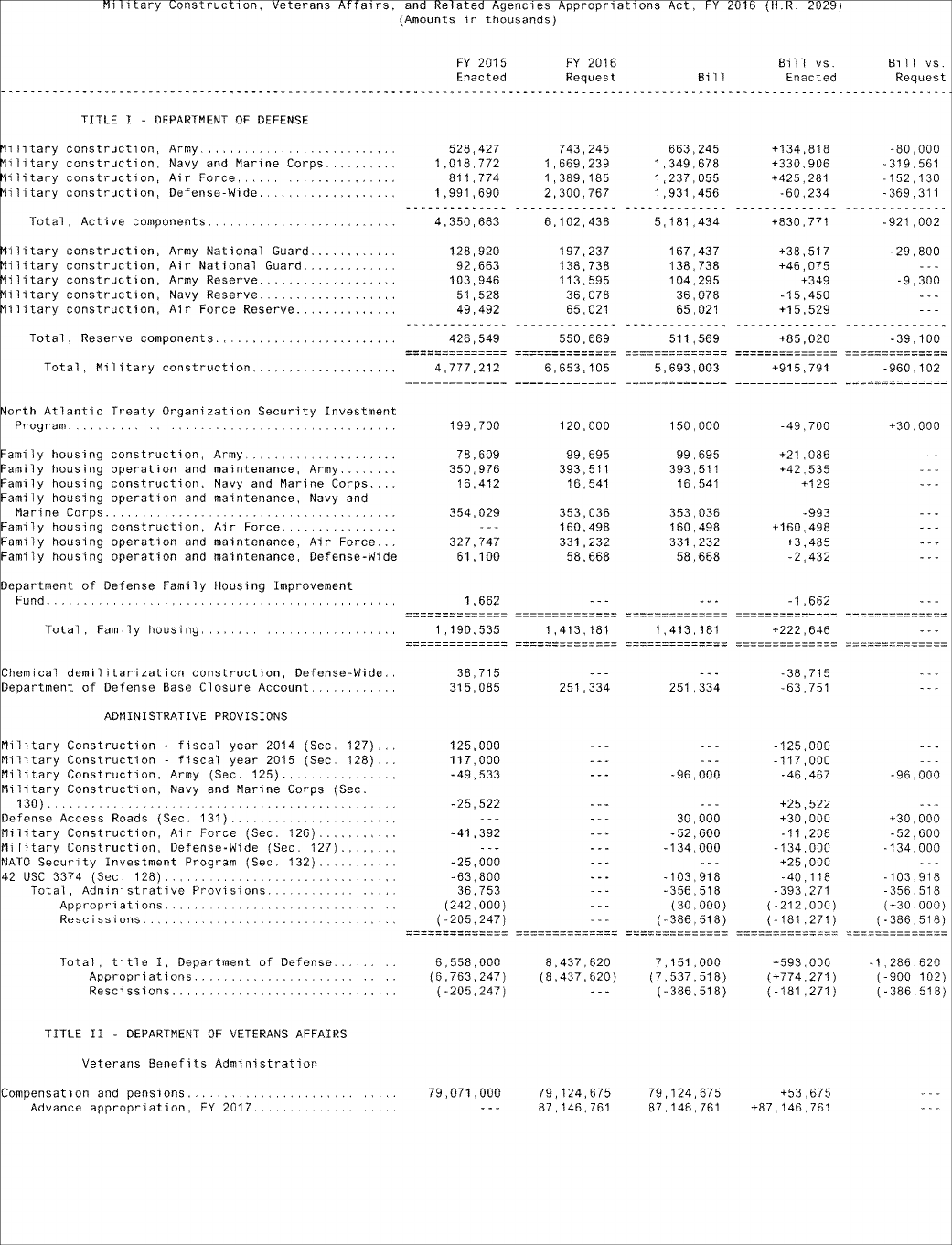
On the military construction side,
this bill provides a total of $7.7 billion
for military construction projects and
family housing, including base and
overseas contingency operations fund-
ing, an increase of $904 million. That is
nearly 12 percent above the enacted fis-
cal year 2015 level and $755 million
VerDate Sep 11 2014 10:13 Apr 30, 2015 Jkt 049060 PO 00000 Frm 00072 Fmt 7634 Sfmt 0634 E:\CR\FM\A29AP7.045 H29APPT1
SSpencer on DSK4SPTVN1PROD with HOUSE
CONGRESSIONAL RECORD — HOUSE H2575 April 29, 2015
below the President’s request. This
funding meets DOD’s most critical
needs, including priorities for the com-
batant commanders in EUCOM,
CENTCOM, AFRICOM, and PACOM.
It provides $607 million for military
medical facilities, including the one at
Landstuhl, Germany. It provides $334
million for the Department of Defense
education facilities, for construction or
renovation of 10 schools. It supports
our Guard and Reserve through $512
million for facilities in 28 States. It
fully funds military family housing at
$1.4 billion. And it provides $150 million
for the NATO security investment pro-
gram, which is $30 million over the
budget request.
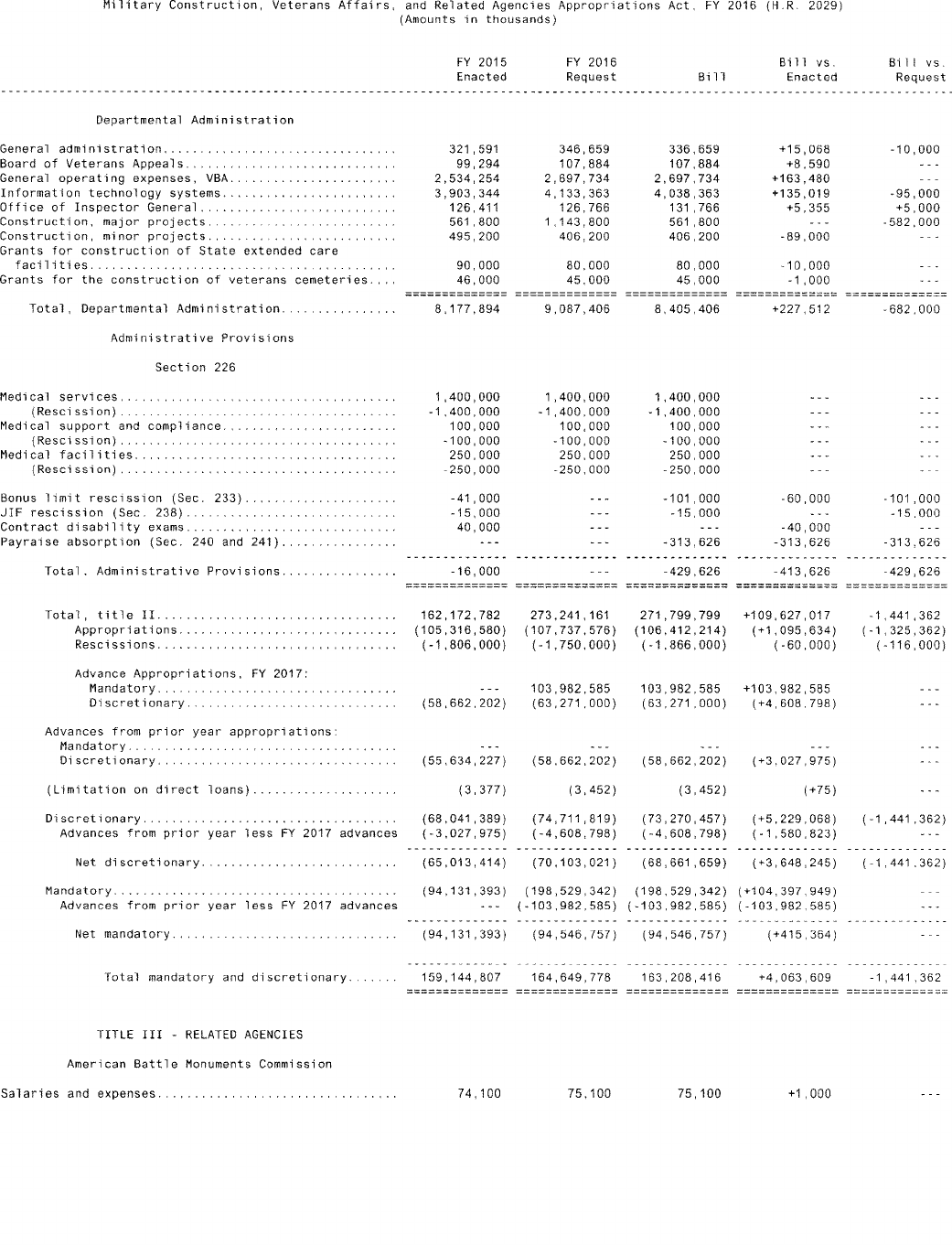
On the Veterans Affairs side, the leg-
islation includes a total of $163.2 billion
in combined discretionary and manda-
tory funding for the Department of
Veterans Affairs. Discretionary fund-
ing alone for veterans programs in the
bill is $68.7 billion. Total fiscal year
2016 discretionary funding is $3.6 billion
above 2015. It is a 5.6 percent increase
and $1.4 billion below the request.
Three billion dollars of this increase
was advance funded.
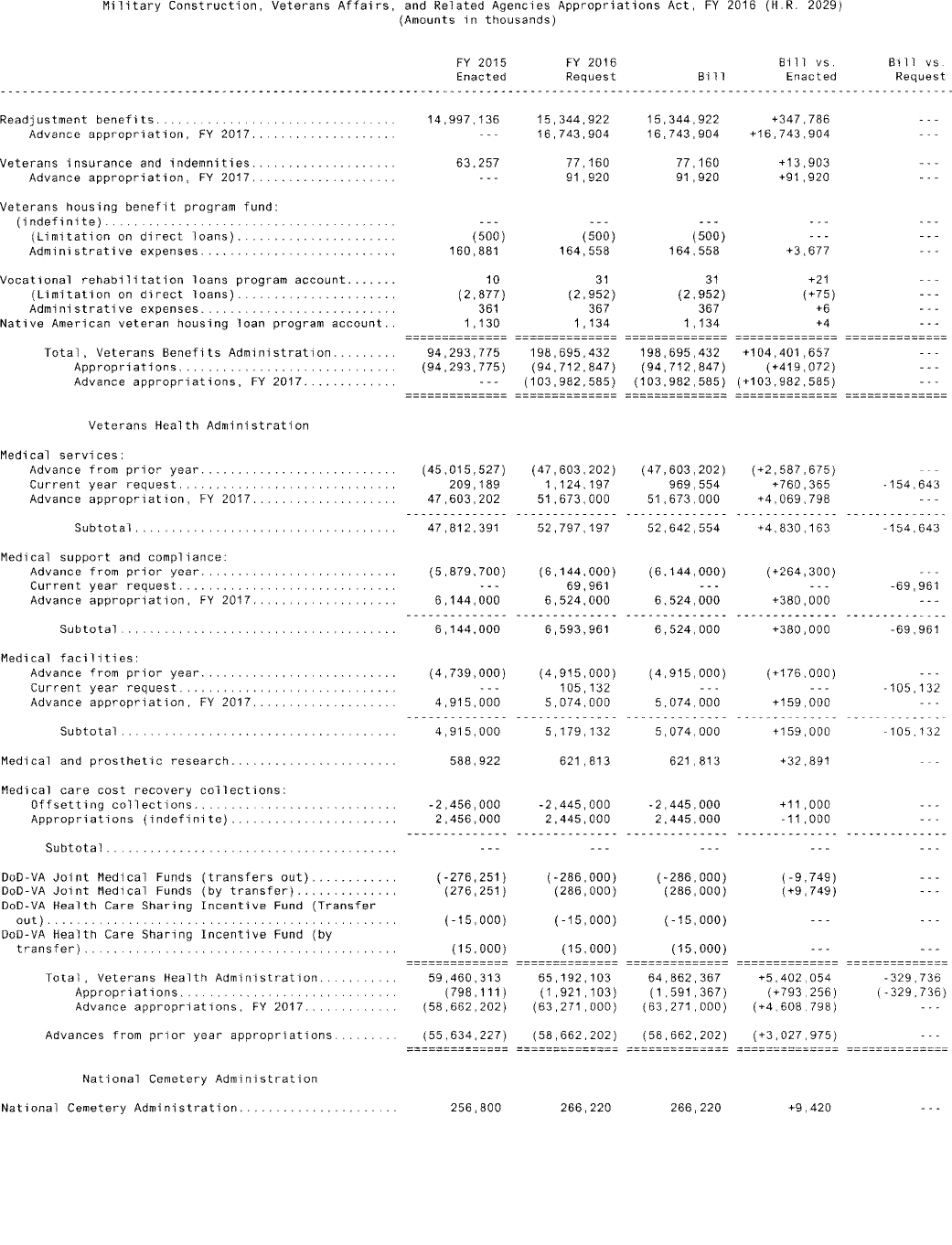
On the VA medical services side, the
bill funds VA medical services at $48.6
billion. That includes $970 million that
the VA came back and asked for on top
of the advanced funding from last year.
We stretched pretty far to do this, and
we haven’t funded this second bite in
the House before. It is tough to find
$970 million in any budget environ-
ment, but this committee did, showing
again the level of bipartisan commit-
ment we have to our veterans.
For disability claims, we provide the
full request for the Veterans Benefits
Administration, which is a $163 million
increase over fiscal year 2015, and the
full request for the Board of Veterans
Appeals.
The bill will enhance transparency
and accountability at the VA through
further oversight and an increase for
the VA Office of Inspector General’s
independent audits and investigations.
I can assure you the inspector general’s
office has been very, very busy.
This legislation also contains $233
million for the modernization of the
VA electronic health record and in-
cludes language restricting funding
until the VA demonstrates progress on
the system’s functionality and inter-
operability. This is a major concern to
all of us on both sides of the aisle, and
I know the chairman, in particular, has
been outspoken about this matter, but
it is something that all of us, Repub-
lican and Democrat, want to see fixed.
On construction issues, major con-
struction within the VA is funded at
$562 million, which is the same level as
fiscal year 2015. The bill provides fund-
ing for hospital replacement and allows
the VA to continue to correct seismic
safety issues and deficiencies. We did
not fund the more-than-double budget
request for construction, as we face the
impact of gross mismanagement of the
Colorado VA Hospital construction,
which resulted in a $930 million cost
overrun. That is not a typo: a $930 mil-
lion cost overrun, which is nearly twice
the entire VA major construction line
item. We have also cracked down on
oversight with multiple restrictions.
We fund the American Battle Monu-
ments Commission, the Armed Forces
Retirement Home, Arlington National
Cemetery, and the U.S. Court of Ap-
peals for Veterans Claims at the re-
quested funding levels.
In closing, this is a very solid bipar-
tisan bill that is focused on the needs
of servicemembers, veterans, and all
their families. We are $4.6 billion over
the fiscal year 2015 level; again, a near-
ly 6 percent increase. Not a cut. We
have provided for our military and vet-
erans to the very best level we can.
Did we fund every last dime re-
quested? No. Not every idea has merit,
and not every project is mission crit-
ical. We did not fund some projects. We
cut some requested increases, and we
rescinded funds. These were fair deci-
sions and part of our responsibility as
appropriators.
We have received a lot of criticism
for the actions we have taken very re-
cently. It started with an email cam-
paign from the VA legislative affairs
office; then a Statement of Adminis-
tration Policy; and last, some of the
VSOs have joined in. Let me tell you,
in my time, before I was chairman of
the subcommittee, and certainly in my
time since I took over this position, I
can say with absolute certainty, the
VA’s problems stem from poor manage-
ment, not too little money. Poor man-
agement, not too little money. I will
say that again. The problems we en-
counter at the VA time after time—
whether it is the Phoenix patient wait
list scandal, the claims and benefits
mess in Philadelphia, or the Denver
hospital construction debacle—show
that the VA’s problem is management,
not money, and for the VA to complain
about a 6 percent increase rather than
an 8 percent increase and to call a 6
percent increase a cut—they call that a
cut.
Only in Washington, D.C., can some-
one call a 6 percent increase over last
year a cut. Everywhere else in America
it is a 6 percent increase, but not in
this town. Amazing to me, and particu-
larly from a Department that has so
many severe managerial problems at
this time. We need to be diligent with
oversight and at the same time be a
helping hand to the Department. There
is a way out of the morass, but more
money without the necessary manage-
ment reforms is not the answer.
I have talked to many Members
about the VA, and just last night in the
Committee on Rules, I got quite an
earful there. Truly, Members are in
agreement that we must help the VA
transform because that transformation
is crucial to serve veterans properly
and to respect the taxpayers footing
the bill. By the way, that frustration I
have heard from Members is from both
sides of the aisle, as was the case I
heard last night in the Committee on
Rules.
We will do a lot of good with this bill.
It is fair, it is balanced, and, at a 6 per-
cent increase over last year, it is gen-
erous. On behalf of our servicemem-
bers, military families, and veterans, I
urge your support of this legislation.
Let’s take care of those who sacrifice
for our country. It is time to do the
right thing and support the bill.
I reserve the balance of my time.
VerDate Sep 11 2014 10:13 Apr 30, 2015 Jkt 049060 PO 00000 Frm 00073 Fmt 7634 Sfmt 0634 E:\CR\FM\K29AP7.026 H29APPT1
SSpencer on DSK4SPTVN1PROD with HOUSE
CONGRESSIONAL RECORD — HOUSEH2576 April 29, 2015
VerDate Sep 11 2014 10:13 Apr 30, 2015 Jkt 049060 PO 00000 Frm 00074 Fmt 7634 Sfmt 0634 E:\CR\FM\A29AP7.011 H29APPT1
Insert offset folio 408/1 here EH29AP15.001
SSpencer on DSK4SPTVN1PROD with HOUSE
onstruc
1on,
TITLE
I
DEPARTMENT
OF
DEFENSE
construction,
Army.
i
litary
ilitary
i l
itary
i l
itary
construction,
Navy
and Marine
Corps.
construction,
Air
Force.,.
construction,
Defense-Wide.
Total,
Active
components.
ilitary
construction,
Army
National
Guard
....
,
..
ilitary
construction,
Air
National
Guard
......
.
ilitary
construction,
Army
Reserve
.........
.
ilitary
construction,
Navy
Reserve
...........
.
ilitary
construction,
Air
Force
Reserve
........
,,.
Total,
Reserve
components. ,
...
, . ,
................
.
Total,
Military
construction
....
North
Atlantic
Treaty
Organization
Security
Investment
Program.
Family
housing
construction,
Family
housing
operation
and
Family
housing
construction,
Family
housing
operation
and
Marl ne Corps
..
Family
housing
construction,
Family
housing
operation
and
Family
housing
operation
and
Army.
maintenance,
Army
...
Navy
and Marine Corps
..
maintenance,
Navy
and
Air
Force.
maintenance,
Air
Force
..
maintenance,
Defense-Wide
Department
of
Defense
Family Housing Improvement
Fund
Total,
Family
housing.
Chemical
demilitarization
construction,
Defense-Wide
..
Department
of
Defense
Base
Closure
Account
Military
Military
Military
Military
130)''
ADMINISTRATIVE
PROVISIONS
Construction
-
fiscal
year
2014
(Sec.
127).
Construction
-
fiscal
year
2015
(Sec.
128).
Construction.
Army
(Sec.
125)
...
Construction,
Navy
and Marine Corps
(Sec.
Defense
Access
Roads
(Sec.
131).
Military
Construction,
Air
Force
(Sec.
126)
..
,,
..
,,,,.
Military
Construction,
Defense-Wide
(Sec.
127).
NATO
Security
Investment
Program
(Sec.
132)
..
42
USC
3374
(Sec.
128)
..
Total,
Administrative
Provisions.
Appropr·i
at
ions.
Rescissions
Total.
title
I,
Department
of
Defense.
Appropriations.
Rescissions.
TITLE
II
-
DEPARTMENT
OF
VETERANS
AFFAIRS
Veterans
Benefits
Administration
Compensation and
pensions
..
Advance
appropriation,
FY
2017
...
gencies
Appropriat1ons
Act,
thousands)
FY
2015
Enacted
528,427
1,018,772
811,774
1,991,690
4,350,663
128,920
92,663
103,946
51
,528
49,492
~-¥-~~-·~~~~--
426,549
=======.:======::::
4,777,212
:::::::::::::=::=::::::=:::::::::;;:;:::::::::::::::
199,700
78,609
350,976
16,412
354,029
327,747
61
'100
1
,662
==============
1,190,535
::::::::::::::===========
38,715
315,085
125,000
117'
000
-49,533
-25,522
-41,392
-25,000
-63,800
36,753
(242,000)
(-205,247)
======:::::::::::::::::::::::.::::::::::::
6,558,000
(6,763,247)
(-205,247)
79,071,000
FY
2016
Request
743,245
1
'669 '239
1
'389'
185
2'
300
,767
6,102,436
197,237
138,738
113,595
36,078
65,021
--
----
--
-
--
--
~
550,669
::::;::::::;::::::::;;:=::=:::;:::;;::;;::;;:::;::;;:
6'
653'
105
==============
120,000
99,695
393,511
16,541
353,036
160,498
331,232
58,668
===::::::::::;;:=:::;::::::::::::::::::::::::::::::
1,413,181
==============
251
'334
8,437,620
(8,437,620)
79,124,675
87'
146.761
Bi
11
663,245
1
'349'
678
1,237,055
1,931,456
5,181,434
167,437
138,738
104'
295
36,078
65,021
511,569
=======:::::::::::::::::::::::;;:::;:
5,693,003
====::::=========
150,000
99,695
393,511
16,541
353,036
160
'498
331,232
58,668
:::::::::::::::::::::::::::::::::::=::=====
1
'413,
181
::;::;:::::;:::::::::::=:::::::=::::::=::::::::::::::::
251,334
-96,000
30,000
-52,600
134,000
-103,918
356,518
(30,000)
386,518)
::::!:::============
7'
151
'000
(7,537,518)
(-386,518)
79,124,675
87,146,'761
H.R. 2029)
Bill
vs.
Enacted
+134,818
+330,906
+425,281
-60,234
-- - --- - --
~
----
+830 771
+38,517
+46,075
+349
-15,450
+15,529
--------------
+85,020
==============
+915,791
==============
-49,700
+21
'086
+42,535
+129
-993
+160,498
+3,485
-2,432
-1
'662
;:;:=:::::::::::::::::::::::::::::::::::::::::::::::=::=::
+222,646
==============
38,715
-63,751
-125,000
-117,000
-46,467
+25,522
+30,000
-11
'208
-134,000
+25,000
-40'
118
-393,271
(-212,000)
( -181
'271)
==============
+593,000
(+774,271)
( -181
'271)
+53'
675
+87'
146,761
Bi
11
vs.
Request
-80,000
-319.561
-152'
130
-369,311
-921
'002
-29,800
-9,300
-39,100
==============
-960'
102
:::::;:;::;:::::;:;;:;:::::.:;:::::;::::=::::::::;::::=::
+30. 000
========:::::::::;:;:::::::::::::
====::::::::::::;::;;;:;::;::::;::::::::::::::::::
-96,000
+30,000
-52,600
134,000
103.91-8
-356,51,S
(+30,000)
(-386,518)
::::.::::::.:::;;;;::::::::::;:::::::::::::::::::::::::==
1,286,62-J
(-900,
102)
(-386,518)
CONGRESSIONAL RECORD — HOUSE H2577 April 29, 2015
VerDate Sep 11 2014 10:13 Apr 30, 2015 Jkt 049060 PO 00000 Frm 00075 Fmt 7634 Sfmt 0634 E:\CR\FM\A29AP7.011 H29APPT1
Insert offset folio 408/2 here EH29AP15.002
SSpencer on DSK4SPTVN1PROD with HOUSE
Military
Construction,
Veterans
Affairs,
and
Related
Agencies
Appropriations
Act,
FY
2016 (H.R. 2029)
(Amounts
in
thousands)
Readjustment
benefits.
Advance
appropriation,
FY
2017.
Veterans
insurance
and
indemnities.
Advance
appropriation,
FY
2017.
Veterans
housing
benefit
program
fund:
(indefinite).
(Limitation
on
direct
loans)
..
Administrative
expenses
Vocational
rehabilitation
loans
program
account
......
.
(Limitation
on
direct
loans).
Administrative
expenses.
Native
American
veteran
housing
loan
program
account.
Total,
Veterans
Benefits
Administration.
Appropriations,
...
,
..
Advance
appropriations,
FY
2017.
Veterans
Health
Administration
Medical
services:
Advance from
prior
year.
Current
year
request.
Advance
appropriation,
FY
2017.
Subtotal.
Medical
support
and
compliance:
Advance from
prior
year
.........................
.
Current
year
request.
.
.........
.
Advance
appropriation,
FY
2017
Subtotal
..
Medical
facilities:
Advance from
prior
year.
.
........
.
Current
year
request
..
Advance
appropriation,
FY
2017
..
Subtota
1 .
Medical and
prosthetic
research.
Medical
care
cost
recovery
collections:
Offsetting
collections
..
Appropriations
(indefinite)
...
Subtotal
..............
.
DoD-VA
Joint
Medical
Funds
(transfers
out)
..........
.
DoD-VA
Joint
Medical
Funds
(by
transfer)
............
..
DoD-VA
Health
Care
Sharing
Incentive
Fund
(Transfer
out).
DoD-VA
Health
Care
Sharing
Incentive
Fund (by
transfer).
Total,
Veterans
Health
Administration
..
Appropriations
..
Advance
appropriations,
FY
2017.
Advances
from
prior
year
appropriations.
National
Cemetery
Administration
National
Cemetery
Administration
..
FY
2015
Enacted
14,997,136
63.257
(500)
160,881
10
(2,877)
361
1
'130
==============
94,293,775
(94,293,775)
:::::::::;:::::::::::::::::::;:::::::;:::::::::::;
(45,015,527)
209'
189
47,603,202
--------------
47,812.391
(5,879,700)
6'
144'
000
--------------
6'
144'
000
(4,739,000)
4,915,000
-------------
4,915,000
588.922
-2,456,000
2,456,000
--------------
(-276,251)
(276,251)
(-15,000)
(15,000)
:::::::;:::::::::::;::::::;:::::;::::::::::::::::::::::::
59,460,313
(798,111)
(58,662,202)
(55,634,227)
=======::::::::::;:;::::::::::::::
256,800
FY
2016
Request
15,344,922
16,743,904
77'
160
91
'920
(500)
164,558
31
(2,952)
367
1
'134
==============
198,695,432
(94,712,847)
(103,982,585)
::::::::::::::::::;::::::::::::::::::::::::
(47,603,202)
1
'124.
197
51,673,000
--------------
52'
797'
197
(
6'
144
'000)
69,961
6,524,000
--------------
6,593,961
(4,915,000)
105'
132
5,074,000
-----
----
5,
179,132
621
'813
-2,445,000
2,445,000
--------------
(-286,000)
(286,000)
(-15,000)
(15,000)
::::::::::::::::::::::;:::::::;:::::::;::::;::::::::::::::
65'
192'
103
(1
'921
'103)
(63,271
,000)
(58,662,202)
:::::::::::::::::::::;::;:::;:::::::;::::::;:::::;:;
266,220
Bi1l
15,344,922
16,743,904
77'
160
91
'920
(500)
164'
558
31
(2,952)
367
1
'134
==============
198,695,432
(94,712'
847)
(103,982,585)
:::::::::::::::::::::::;::::::::::::::::::::::;:::
(47,603,202)
969,554
51
'673'
000
--------------
52,642,554
( 6 . 1 44 '
000)
6.524,000
--------------
6,524,000
(4,915,000)
5,074,000
--------
-----
5,074,000
621
'813
-2.445,000
2,445,000
--------------
("286,000)
(286,000)
(
-15,
000)
(15,000)
========:=:::::::::::::::::::::
64,862,367
( 1 .
591
'367)
(63,271
,000)
(58,662,202)
;:::::==========::::=
266,220
Bill
vs.
Enacted
+347,786
+16,743,904
+13,903
+91,920
+3'
677
+21
(+75)
+6
+4
==============
+104,401,657
(+419,072)
(+103,982,585)
:::::::::::::::::::::::::::::::::::::::::::::;
(+2,587,675)
+760,365
+4,069,798
--------------
+4.830,
163
(+264,300)
+380,000
--------------
+380,000
(+176, 000)
+159, 000
-----
"--
+159,000
+32,891
+11
'000
11
'000
--------------
(-9,749)
(+9
,749)
=====::::========
+5,402
,054
(+793
'256)
(+4,608,
798)
(+3,027,975)
:::;::::::::;::::::=:::::::::::::::;::::::;:::;;
+9,420
8111
vs
Request
==============
==============
-154.
643
-------------
-154.643
-69,961
--------------
-69,961
-105.132
---------
-105.
132
--------------
==============
-329,736
(-329.736)
:::::::::::::::::::::::::::::::::::::::;::::::::::;;;;;;
CONGRESSIONAL RECORD — HOUSEH2578 April 29, 2015
VerDate Sep 11 2014 10:13 Apr 30, 2015 Jkt 049060 PO 00000 Frm 00076 Fmt 7634 Sfmt 0634 E:\CR\FM\A29AP7.011 H29APPT1
Insert offset folio 408/3 here EH29AP15.003
SSpencer on DSK4SPTVN1PROD with HOUSE
Military
Construction,
Veterans
Affairs,
and
Related
Agencies
Appropriations
Act,
FY
2016 (H.R 2029)
(Amounts
in
thousands)
Departmental
Administration
General
administration
....
...........
Board
of
Veterans
Appeals
..
''
.. '
.......
General
operating
expenses,
VBA.
.................
'.
Information
technology
systems
..
. '. '
....
''
Office
of
Inspector
General
..
Construction,
major
projects.
Construction,
minor
projects.
Grants
for
construction
of
State
extended
care
facilities.
Grants
for
the
construction
of
veterans
cemeteries.
Total,
Departmental
Administration.
Administrative
Provisions
Medical
services
..
(Rescission).
Medical
support
and
(Rescission).
Medical
facilities.
(Rescission)
..
Section
226
compliance.
Bonus
limit
rescission
(Sec.
233).
JIF
rescission
(Sec.
238).
Contract
disability
exams.
Payraise
absorption
(Sec.
240 and
241)
..
Total.
Administrative
Provisions
..
Total,
title
II.
Appropriations.
Rescissions.
Advance
Appropriations.
FY
2017:
Mandatory.
Discret·ionary
..
Advances
from
prior
year
appropriations:
Mandatory.
.
................
.
Discretionary.
(limitation
on
direct
loans).
Discretionary
............
.
Advances
from
prior
year
less
FY
2017
advances
Net
discretionary.
Mandatory
....
Advances from
prior
year
less
FY
2017
advances
Net
mandatory
..
Total
mandatory
and
discretionary.
TITLE
III
-
RELATED
AGENCIES
American
Battle
Monuments Commission
Salaries
and
expenses.
FY
2015
Enacted
321
'591
99,294
2,534,254
3,903,344
126,411
561
'800
495,200
90,000
46,000
8'
177'
894
1
'400'
000
-1
'400'
000
100,000
-100,000
250,000
-250,000
-41
'000
15,000
40,000
--.
~-
w
~ ~
-16,000
162' 172'
782
(105,316,580)
(
-1
.
806'
000)
(58,662,202)
(55,634,227)
(3'
377)
(
68'
041
'389)
(-3,027,975)
--------------
(65,013,414)
(94,
131
,393)
--------------
(
94'
1
31
' 393)
--------------
159'
144'
807
::.:============
74'
100
FY
2016
Request
346,659
107,884
2,697,734
4,133,363
126,766
'143'
800
406,200
80,000
45,000
9,087,406
1
'400 '000
-1
'400'
000
100,000
-100,000
250,000
-250,000
:::::::::::::;:;:;::;:::::::::::-:::::::::::::::::::-:::::::::;:
273,241
'161
(107,737,576)
(
-1
,750.
000)
103,982,585
(63,271
,000)
(58,662,202)
(3,452)
(74,711,819)
(-4,608,798)
--------------
(70,103,021)
(198,529,342)
(
103,982,585)
--------------
(94,546,757)
164,649,778
==============
75,100
Bill
336,659
107,884
2,697,734
4,038,363
131
,766
561
'800
406,200
80,000
45,000
8,405,406
1,400,000
-1,400,000
100,000
-100,000
250,000
250,000
-101
'000
-15,000
-313,626
- - - - - * - -
~
- -
~
-
-429,626
:::::::;:::;::::::::::-:::::::::=::=::::::::::::
271,799,799
(106,
412'
214)
(-1.866,000)
103,982,585
(63,271
,000)
(58,662,202)
(3,452)
(73,270,457)
(
-4'
608
,798)
--------------
(
68'
661
'659)
(198,529,342)
(-103,982,585)
--------------
(94,546,757)
--------------
163,208,416
==============
75'
100
Bill
vs.
Enacted
+15,068
+8,590
+163,480
+135,019
+5,355
89,000
-10,000
-1
'000
+227,512
-60,000
-40,000
-313,626
-413,626
==========:::::::::::.:::;;;
+1
09.
627'
017
(+1
,095,634)
(-60,000)
+103.982,585
(+4,608,798)
(+3
.027,975)
(+75)
(+5,229,068)
(-1
,580,823)
--------------
(+3,648,245)
(+104,397,949)
(-103,982,585)
----------
(+415,364)
--------------
+4,063,609
==============
+1. 000
(
Bi
I I vs
Request
-10,000
-95,000
+5,000
-582,000
-682,000
-101
'000
15,000
-313,
626
------
---
-429,626
-1,441,362
1
'325'
362)
(-116,000)
(-1,441,362)
--------------
(-1,441.362)
--------------
-1,441.362
====::::::::=========
CONGRESSIONAL RECORD — HOUSE H2579 April 29, 2015
VerDate Sep 11 2014 10:13 Apr 30, 2015 Jkt 049060 PO 00000 Frm 00077 Fmt 7634 Sfmt 0634 E:\CR\FM\A29AP7.011 H29APPT1
Insert offset folio 408/4 here EH29AP15.004
SSpencer on DSK4SPTVN1PROD with HOUSE
Military
Construction,
Veterans
Affairs,
and
Related
Agencies
Appropriations
Act.
FY
2016 (H.R. 2029)
(Amounts
in
thousands)
Foreign
currency
fluctuations
account.
Total,
American
Battle
Monuments Commission
....
U.S.
Court
of
Appeals
for
Veterans
Claims
Salaries
and
expenses
..
Department
of
Defense
-
Civil
Cemeterial
Expenses,
Army
Salaries
and
expenses.
Armed
Forces
Retirement
Home
-
Trust
Fund
Operation
and
maintenance.
Capital
program.
Total,
Armed
Forces
Retirement
Home
..
Total,
title
III
..
TITLE
IV
-
OVERSEAS
CONTINGENCY
OPERATIONS
Military
Construction.
Navy
and Marine
Corps.
, , , .
Military
Construction,
Air
Force.
Military
Construction,
Defense-Wide
..
. ' . ' ' ' . ' ' . . ' .
European
Reassurance
Initiative
Military
Construction.
Total,
title
IV.
Grand
total
...
,
..
Appropriations
....
Rescissions
...
Advance
appropriations,
FY
2017
..
Overseas
contingency
operations.
Advances from
prior
year
appropriations
....
(By
transfer).
(Transfer
out).
.
.........
.
(Limitation
on
direct
loans).
FY
2015
Enacted
1
'900
-
-----
~-
--- ---
76,000
31
'386
65,800
62.400
1
'000
63,400
236,586
46,000
175,000
221
'000
===::==========
169,188,368
(112,316,413)
(-2,011
,247)
(58.662,202)
(221,000)
(55,634,227)
(291
'251)
( -291
'251)
(3'
377)
FY
2016
Request
2,000
--------------
77,100
32'
141
70,800
63,300
1
'000
64,300
244,341
::::::::::::::::::.::;::::::::::::::::::::::::::::::
281
'923'
122
(116,419,537)
(
1,750,000)
(167,253,585)
(58,662,202)
(301
,000)
( -301
'000)
(3,452)
Bill
2,000
-
---
-
---
--
-
~-
~
77'
100
32'
141
70,800
63,300
1
,000
64,300
244,341
244,004
75,000
212,996
532,000
:::::::::::::::::::;:;:::.::::=:;:;::::;::;:;:;::;:;:::::
279
'727'
140
(114,
194,073)
(-2,252,518)
(167,253,585)
(532,000)
(58,662,202)
(301,000)
( -301
'000)
(3,452)
Bill
vs
Enacted
+100
--------------
+1
'100
+755
+5,000
+900
+900
+7,755
+244,004
+75,000
+166,996
-175,000
+311,000
:::::;:::::::::::::::::::::::::::;;:::;::::::::;::::::::
+110,538,772
(+1
'877'
660)
( -241
'271)
(
+1
08'
591
'383)
(+311
,000)
(+3,027,975)
(+9,749)
(
-9,749)
(+75)
Bill
VS
Request
--------------
+244,004
+75.000
+212
,996
+532, 000
======:::::======:::::
-2,195,982
(-2,225,464)
(-502.518)
(+532,000)
CONGRESSIONAL RECORD — HOUSEH2580 April 29, 2015
Mr. BISHOP of Georgia. I yield my-
self such time as I may consume.
Madam Chair, let me say that I am
delighted to have the opportunity to
work with Chairman D
ENT
of the sub-
committee as well as the chairman and
ranking member of the full committee.
Madam Chair, as you know, this bill
has a strong reputation for common
ground and bipartisanship. We are
pleased with several aspects of the bill.
For example, the bill maintains tough
but fair reporting requirements for
VistA modernization, which closely
tracks the VA’s development of its
electronic health record.
The bill continues to prioritize the
elimination of the veterans claims
backlog by fully funding the fiscal year
2016 requests: $18.3 million for a cen-
tralized mail initiative which consoli-
dates inbound paper mail from regional
offices to a centralized intake site, as
well as $140.8 million for the Veterans
Claims Intake Program to scan and
convert paper claims into a digital for-
mat. I believe that these are all posi-
tive steps to making the VA function
better.
Furthermore, Chairman D
ENT
has
avoided including contentious legisla-
tive riders, which is very much appre-
ciated. Unfortunately, however, the
chairman was forced to write a bill
under the majority’s fiscal year 2016
budget resolution, which chose to lock
in the Budget Control Act levels and to
use gimmicks to boost defense funding.
Because of the budget resolution’s fail-
ure to provide relief from these budget
caps—which were established in 2011
and later adjusted in 2013—the chair-
man was forced to make some tough
choices due to the allocation that he
was given.
While military construction is pro-
vided $7.2 billion, an increase of $593
million above 2015, it is still $1.2 billion
below the budget request. In an effort
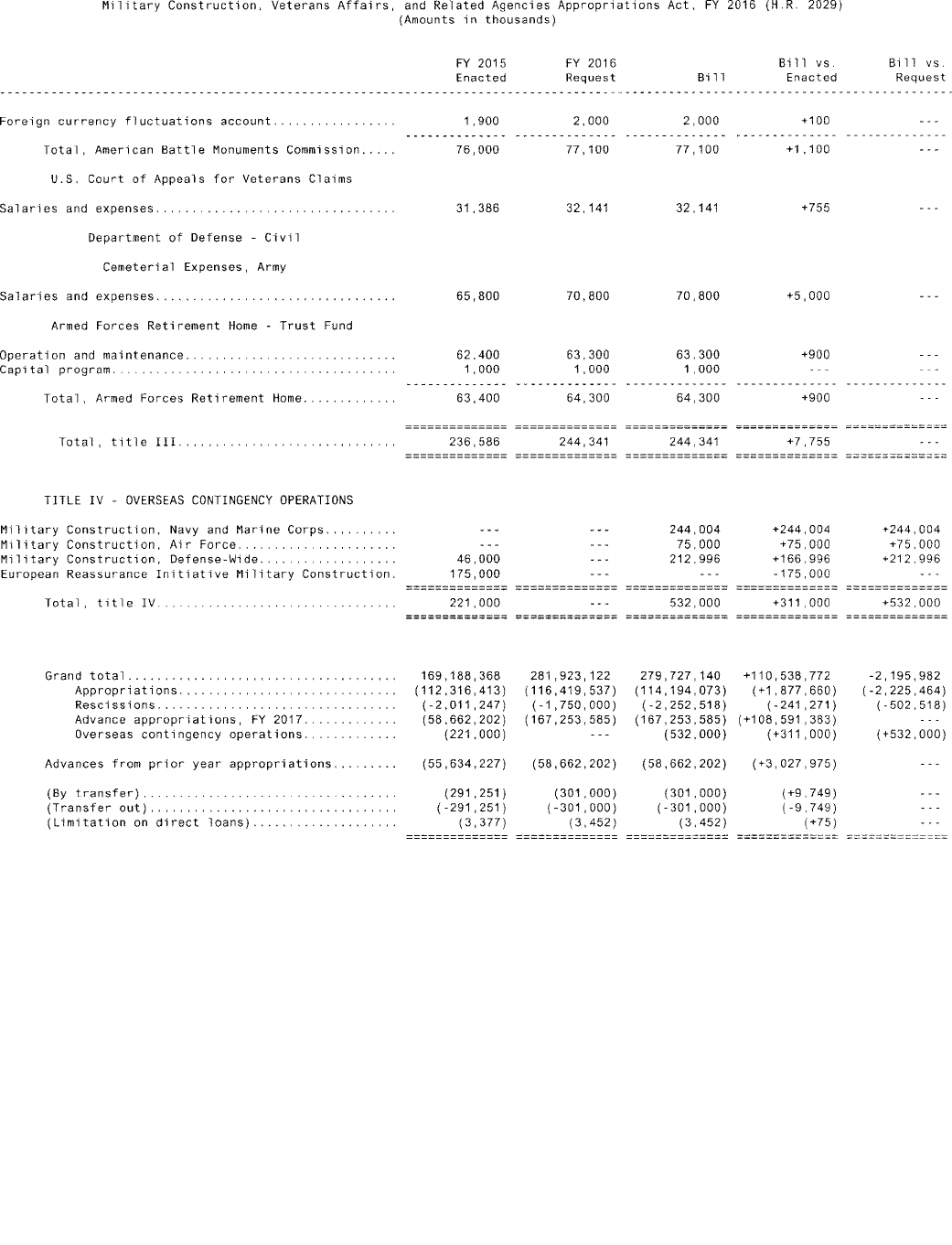
to avoid the defense budget cap, the
bill shifts $532 million to the overseas
contingency operations funding
stream, even though the fiscal year
2016 budget request did not include an
OCO request. This is a gimmick, purely
a gimmick to boost defense spending
by pumping up the OCO budget, which
is not limited by the budget law.
The Department of Veterans Affairs
is funded at $68.7 billion, and while it is
$3.6 billion above fiscal year 2015, the
enacted level, it is also $1.4 billion
below the fiscal year 2016 budget re-
quest. The inadequate fiscal year 2016
allocation again forced the chairman
to slice the request for military con-
struction by $582 billion. That is hos-
pital construction.
Furthermore, the bill includes lan-
guage that directs that only replace-
ment, safety, and security projects can
receive budgeted funding. This is trou-
bling language, and it eliminates all
national cemetery projects for fiscal
year 2016 and puts several other
projects in jeopardy.
b1445
The majority claims they reduced
the construction account because the
half-built Veterans Affairs Denver hos-
pital project is drastically over budget
and riddled with mistakes.
I certainly agree that the VA needs
to be held accountable for the poor job
in managing the Denver hospital
project; however, no funds for the Den-
ver hospital were allocated within the
MILCON-VA bill.
Additionally, I am not aware of any
similar issues with any of the other re-
quested projects in the bill for FY12,
including replacement, clinic construc-
tion, seismic improvements, or ceme-
tery construction.
I believe the majority’s budget caps
and resulting inadequate allocation—
not the problems in Denver—led to cut-
ting construction in half. I am con-
cerned that, if the reduction stands, it
will further contribute to the gaps in
access, utilization, and safety that
were already identified in the VA’s an-
nual Strategic Capital Investment pro-
gram process.
Madam Chair, this committee can no
longer afford to function under the
Budget Control Act caps. The reduc-
tions to VA will cause gaps in access,
utilization, and safety and could lower
the standard of care due our veterans.
Madam Chairman, as I pointed out
during the MILCON-VA markup, the
FY 2017 advance funding will consume
$4.6 billion of the nondefense discre-
tionary cap next year, so this problem
will only get worse. Certainly, the De-
partment of Defense cannot be the only
winner.
Using the FY 2016 budget levels will
produce a long summer and an early
fall, with no real progress on the FY
2016 bills. If so, it is inevitable that a
continuing resolution or a series of
continuing resolutions will be needed
to keep the government open and run-
ning in place long past the new fiscal
year starts on October 1.
We cannot continue to govern in this
fashion. I believe that it is well past
time to be strategic about how we han-
dle our Federal budget, and now, we
need to take the next step toward a
more responsible budget process so we
can eventually stop lurching from one
crisis to the next.
I believe that Chairman D
ENT
crafted
the best bill he could with the alloca-
tion he was given. I also believe that
this is the first step in a long process,
and I am concerned about the impact
these reductions to the VA construc-
tion account could have, and we believe
they will have to be addressed before
the process.
To that end, I am prepared to offer
an amendment to the bill restoring the
full funding of the request so that we
can, in fact, do justice by our veterans
and do what is necessary for our mili-
tary construction without using budget
gimmicks. At the appropriate time, I
will offer an amendment to do that.
Madam Chairman, at this time, I re-
serve the balance of my time.
Mr. DENT. Madam Chairman, I yield
such time as he may consume to the
gentleman from Kentucky (Mr. R
OG
-
ERS
), the full committee chairman, and
I want to thank him for all his support
and leadership in putting this bill to-
gether.
Mr. ROGERS of Kentucky. Mr. Chair-
man, thank you for yielding time.
Madam Chairman, I rise in support of
this bill, the Military Construction and
Veterans Affairs bill for 2016. In doing
that, I want to congratulate Chairman
D
ENT
, the new chairman of this sub-
committee. This is his maiden voyage
as chairman of this subcommittee. He
is a cardinal now. He has done a great
job putting together this bill.
I also want to thank Mr. B
ISHOP
, the
ranking member on the other side, for
his cooperation in making this bill
what it is today.
This is the first bill of the process,
and I am pleased that we are off to a
very early start—I am told the earliest
start since 1974—continuing our good
work from last year. I am optimistic
that we are going to have a successful
appropriations year, finishing on time
and under regular order.
We are beginning the year on the
right foot with a bipartisan bill,
Madam Chairman, that I believe we
can all get behind. The FY 2016 Mili-
tary Construction and Veterans Affairs
Appropriations bill includes, as has
been said, $76.6 billion in discretionary
funding for important veterans benefits
and services and for the infrastructure
that supports the brave men and
women serving in our Armed Forces
and their families.
This is a total of $4.6 billion over last
year. No one can call this a cut and be
realistic about it. We have increased
the funding by $4.6 billion year-to-year.
We can’t say that for all the other
bills. Yes, we went overboard with
what we had to work with in providing
funds for the veterans and for military
construction. That is a demonstration
of our commitment to our warfighters
and to our veterans and their loved
ones, who sacrifice so much to protect
this great Nation.
Within the total, the bill includes
$7.7 billion for the DOD’s construction
projects in the U.S. and around the
world, which provide our servicemem-
bers with the infrastructure they need
to remain at the ready.
The legislation also provides a total
of $68.7 billion in discretionary funding
for the Department of Veterans Affairs.
That is a 5.6 percent increase over last
year to guarantee the VA has the re-
sources they need to care for every sin-
gle qualified veteran, including meet-
ing growing healthcare needs.
To that end, VA medical services are
funded at $3.8 billion above the current
level. That will treat 6.9 million eligi-
ble patients, providing mental health
care, helping prevent suicide, and sup-
porting research into prosthetics and
traumatic brain injuries, among nu-
merous other health initiatives. How-
ever, it is critical that we make sure
the VA is being responsible with these
taxpayer dollars.
It is clear that the VA is facing some
considerable management challenges,
VerDate Sep 11 2014 10:13 Apr 30, 2015 Jkt 049060 PO 00000 Frm 00078 Fmt 7634 Sfmt 0634 E:\CR\FM\K29AP7.028 H29APPT1
SSpencer on DSK4SPTVN1PROD with HOUSE
CONGRESSIONAL RECORD — HOUSE H2581 April 29, 2015
and so this bill provides the oversight
that will hold the Department account-
able for its mistakes and takes the nec-
essary steps to address and correct
these problems.
For instance, the bill keeps a close
eye on how the VA is spending its con-
struction dollars by requiring reports
on construction costs, savings, and
changes in scope.
This is a good bill, Madam Chairman.
I urge its adoption.
Mr. BISHOP of Georgia. Madam
Chair, at this time, I yield 4 minutes to
the gentlewoman from New York (Mrs.
L
OWEY
), the full committee ranking
member.
Mrs. LOWEY. Madam Chair, before I
begin, I would like to thank Sub-
committee Chairman D
ENT
and Rank-
ing Member B
ISHOP
, who worked so
well together, and full Committee
Chairman R
OGERS
.
The House Republican ‘‘work harder
for less’’ budget resolution was opposed
by every Member on my side of the
aisle, in part because it makes it im-
possible to provide the funding nec-
essary in the 12 appropriations bills to
grow our economy and give hard-work-
ing Americans the opportunity to suc-
ceed.
Democrats preferred the approach
taken by the President, calling for an
end to sequestration and more reason-
able and realistic budgeting that can
help families afford college, a home,
and a secure retirement.
Refusing to adopt a sufficient overall
allocation for discretionary invest-
ments has a significant impact on the
initiatives in all the appropriation bills
that grow the economy and create jobs.
The bill we consider today presents a
false choice. The VA needs more re-
sources in 2016 than 2015 to sustain its
level of services for the brave men and
women it serves. The majority invests
a disproportionate share of the alloca-
tion’s nondefense funds in the Military
Construction and Veterans Affairs bill;
yet it still falls far short of meeting
VA’s actual needs.
The equivalent of 70,000 fewer vet-
erans would receive medical care under
this bill, compared to the President’s
request. In addition, it further reduces
funds available for priorities in the
other spending bills for transportation
infrastructure, job training, higher
education, biomedical research, and
clean energy, just as an example. All
these initiatives are key to economic
growth and creating opportunity for
hard-working Americans, especially
veterans.
Additionally, $532 million in today’s
bill would be shifted to overseas con-
tingency operations in a gimmick to
boost defense spending.
Even with these tricks, the Military
Construction and Veterans Affairs bill
would have a profound impact on mili-
tary families and veterans, forcing a
$2.7 billion cut below what the Presi-
dent says is necessary, including $754
million less for military construction,
$155 million less for medical services,
$70 million less for medical support and
compliance, $105 million less for med-
ical facilities, and $582 million less for
VA construction projects.
These cuts, which hurt those who
have sacrificed for our country, are un-
acceptable. Not everything requested
by the President is sacrosanct, and
Congress has a duty—it is an important
part of our responsibility—to evaluate
each and every line item in a budget
proposal. Such an assessment of this
bill makes clear that many accounts
are clearly underfunded.
Despite the abundant shortcomings,
there are some positive aspects, includ-
ing reporting requirements for elec-
tronic health records and prioritizing
the elimination of the veterans claims
backlog.
It is imperative that, as the bill pro-
gresses toward enactment, improve-
ments are made and that, as the entire
appropriations process continues, we
reach an agreement that will ensure
these bills invest in our hard-working
families’ economic security.
Mr. DENT. Madam Chair, at this
time, I yield 3 minutes to the gentle-
woman from Alabama (Mrs. R
OBY
), who
has been a tireless advocate for the
needs of the veterans in her commu-
nity in Alabama.
Mrs. ROBY. First, I thank the chair-
man and the ranking member for their
hard work on this bill, and I thank the
chairman for yielding.
Madam Chairman, I am so grateful
for this opportunity to stand here
today in support of H.R. 2029, the Mili-
tary Construction and Veterans Affairs
and Related Agencies Appropriations
Act.
This bill undeniably provides much-
needed funding for both our veterans
programs and military projects, while
staying within the strict limits of our
House-passed budget resolution.
I am especially proud because there
is funding that we were able to secure
in this bill for the folks in Alabama,
right at home, including new school
construction both at Fort Rucker, the
home of Army aviation excellence, and
$33 million for new school construction
at Maxwell Air Force Base, much-need-
ed dollars for our military families at
this post and this base, and also fund-
ing for a new squadron operations facil-
ity at Dannelly Field.
These are all extremely important to
our critical military functions in Ala-
bama. Anybody who has been on post
at Rucker or at the base at Maxwell
knows that these schools are in dis-
repair and are in need of replacing.
Our military families deserve quality
on-base facilities, and these projects
are going to go a long way to help im-
prove their quality of life right there in
Alabama.
I want to address, though, what I was
struck with—and everyone else in this
institution—when I woke up this morn-
ing, Madam Chair. I was extremely dis-
appointed, alongside my colleagues, to
see that the President, yet again, has
threatened to veto this bill.
This bill provides critical, much-
needed funding for our military fami-
lies and our veterans, and the Presi-
dent should not play around with that.
b1500
Under this administration we have
failed our veterans miserably. And only
in Washington, D.C., when you see an
increase of $3.6 billion for our VA to
provide these critical needs for our
men and women who have worn the
uniform and put their lives on the line
for the freedom and liberty that allow
us to stand in this room today, only in
Washington, D.C., will a $3.6 billion in-
crease on behalf of our veterans be
called a cut.
You know why, Madam Chair?
It is being called a cut because it is
the only way to shift the blame away
from this administration’s failure to
our veterans back to the Republican-
led House. It is clearly politics that is
driving us, and I am asking, Madam
Chair, that the President seriously
rethink his position.
The administration needs to take re-
sponsibility, and they are trying, once
again, to point fingers at leadership in
this House that is doing all that we can
to ensure that our veterans get timely
care and the best care that we can pro-
vide them. This is cynical, and it is
shameful, and I believe—I believe—that
the American people can see straight
through it.
So I hope, again, Madam Chair, that
the President will reconsider this posi-
tion because there is no place—no
place—here in this bill for political
gamesmanship when it comes to our
military families and our veterans.
Mr. BISHOP of Georgia. Madam
Chair, at this time I yield 3 minutes to
the gentlewoman from California (Ms.
L
EE
), a member of the Subcommittee
on Military Construction and Veterans
Affairs.
Ms. LEE. Madam Chairman, let me
thank the ranking member for yield-
ing, for his unwavering leadership for
our veterans on this committee, and
for your friendship. Thank you very
much, Mr. B
ISHOP
.
Let me also thank Chairman D
ENT
,
in addition to Ranking Member B
ISHOP
,
really for working very hard in a bipar-
tisan way on a variety of issues facing
our veterans, including empowering
our vets in their transition back to ci-
vilian life and ensuring adequate and
accessible access to care.
As the daughter of a veteran, I under-
stand the enormous sacrifices that our
servicemembers and their families
make to serve our Nation, so this sub-
committee is extremely important.
I want to thank the ranking member
and chair for working with me and my
colleagues on the subcommittee to in-
clude important report language on the
backlog at the Oakland VA regional of-
fice, which is, of course, one of the
worst in the Nation.
I want to thank our ranking member,
Congresswoman B
ROWN
, who is here
today, for her leadership on the com-
mittee in shedding some light also on
VerDate Sep 11 2014 10:13 Apr 30, 2015 Jkt 049060 PO 00000 Frm 00079 Fmt 7634 Sfmt 0634 E:\CR\FM\K29AP7.029 H29APPT1
SSpencer on DSK4SPTVN1PROD with HOUSE
CONGRESSIONAL RECORD — HOUSEH2582 April 29, 2015
what is taking place at the Oakland
VA regional office.
This language will ensure that the
Oakland office not only has to provide
Congress with accurate information on
what has happened with these back-
logged claims, but it will require the
Veterans Benefits Administration to
outline the lessons learned and what
the new protocols are to ensure that no
veteran faces delays in accessing care.
Yet, of course, insufficient alloca-
tions in this bill leave much work to be
done. The 2016 MILCON-VA approps bill
includes a $582 million cut from the
major construction account. Now, that
is half of the President’s request of $1.1
billion.
Simply put, the level of funds allo-
cated in this bill is totally insufficient
and, yes, it undermines the responsi-
bility we have to provide our veterans
with the best and most innovative
care. As a result, the construction of
vital medical facilities that will serve
our veterans will be delayed. This in-
cludes the initial phase of construction
for the state-of-the-art Alameda Point
outpatient clinic in my own congres-
sional district, which serves thousands
of veterans in the northern California
area.
The CHAIR. The time of the gentle-
woman has expired.
Mr. BISHOP of Georgia. I yield the
gentlewoman an additional 1 minute.
Ms. LEE. Thank you very much.
I just want to thank the ranking
member and the chair for continuing to
work with me to ensure that the limi-
tation language in the report with re-
gard to major construction funds for
the VA does not preclude clinics like,
for example, the Alameda Point out-
patient clinic.
Addressing the limitation language
and restoring funding to the Presi-
dent’s request level for major construc-
tion is really vital to ensuring that our
Nation keeps the promise that we have
made to our brave veterans to give
them access to the best care.
Madam Chair, we really can’t afford
what these cuts will do with our vet-
erans. We can’t afford to allow this
dangerous and harmful impact of se-
questration now to be locked in by
these allocations before us today.
These dismal numbers, they directly
affect our veterans’ access to care that
they need and that they have earned.
So I hope that, as this process moves
forward, these insufficient allocations
are resolved.
Mr. DENT. I yield such time as he
may consume to the gentleman from
California (Mr. D
ENHAM
) for a colloquy.
Mr. DENHAM. Madam Chair, every
Member of this body recognizes the
special obligation this House has to
take care of our veterans. We also have
an obligation to ensure that the funds
we entrust to the Department of Vet-
erans Affairs are actually properly
spent.
The shocking waste of funds at the
Aurora Hospital in Denver has rightly
earned the outrage of both this body
and the American public. The $930 mil-
lion in cost overruns in Denver will
have to be paid for by taking funds
that could otherwise have accelerated
critical access projects across the
country or assisted the Department as
it attempts to tackle the backlog in
claims at the Veterans Benefits Admin-
istration.
I am particularly concerned that the
complete failure of project manage-
ment of the Denver hospital is nega-
tively impacting veterans in my dis-
trict. They have already suffered from
a lack of access to care.
Specifically, I am seeking clarity on
what the committee intends with the
major construction funding appro-
priated under this bill. The Committee
report includes language requiring the
funding provided for major construc-
tion to be used for new hospital con-
struction and seismic corrections.
One of the projects included in this
request is the Livermore Realignment
and Closure project. This project would
utilize FY 2016 funding to provide for
the complete construction of a new
medical facility at French Camp in the
Central Valley. The facility would pro-
vide direct medical care to more than
87,000 veterans in its service area and
dramatically reduce the nearly 6-hour
commute faced by veterans in my dis-
trict for even routine health care.
Madam Chairman, does the Liver-
more Realignment and Closure project,
a project that was authorized more
than a decade ago by this Congress,
meet the criteria for funding set by the
committee in the report accompanying
this appropriations bill?
Mr. DENT. Will the gentleman yield?
Mr. DENHAM. I yield to the gen-
tleman from Pennsylvania.
Mr. DENT. Madam Chair, I thank the
gentleman from California for offering
this opportunity to clarify the meaning
of our report language. I do share your
concern about the mismanagement of
construction projects by the VA. It is
delaying vital projects such as Liver-
more.
In this report, we simply made clear
the priority for funding hospital con-
struction and seismic corrections.
Within the funds provided in the bill,
unallocated major construction fund-
ing remains available, and the VA has
the ability to allocate those funds to-
wards French Camp as well as other
projects in the budget request. The re-
port instructs the VA to make that de-
termination and provide a list of
projects to this committee.
I have heard similar concerns from
other Members, including the gentle-
lady, Ms. L
EE
, who just spoke a few
moments ago, who have projects in-
cluded in this request, such as Alameda
Clinic and a rehabilitative therapy
clinic in St. Louis, which the adminis-
tration could also choose to fund.
I appreciate these concerns and the
opportunity to provide some clarity. I
hope that is helpful. But nothing pre-
cludes funding.
Madam Chair, I reserve the balance
of my time.
Mr. BISHOP of Georgia. Madam
Chair, I yield 2 minutes to the gentle-
woman from Florida (Ms. B
ROWN
), who
is the ranking member of the House
Veterans’ Affairs Committee and a
strong supporter of our veterans.
Ms. BROWN of Florida. Madam Chair
and Members of the House, I rise in
strong opposition to the Military Con-
struction and Veterans Affairs Appro-
priations bill.
After taking steps forward with the
new Choice Act program, this Repub-
lican budget takes two steps back with
its cuts to veterans health care, just
another example of Republicans talk-
ing the talk but not walking the walk.
But don’t take my word for it. If you
ask the veterans service organizations
who represent the interests of vet-
erans, every one of them is opposing
this bill.
The national commanders of the Vet-
erans of Foreign Wars said the fol-
lowing about the Republican Veterans
bill:
The VA cannot fulfill its mission without
proper funding, but the House, for whatever
reason, now wants to ration care, eliminate
infrastructure projects, and stop improving
upon the programs and services that the VA
was created to provide. This is a bad bill for
veterans, and anyone that votes for it should
really take a second look.
And let me just say one other thing.
I often say, if you are not in the room,
you are on the menu, and I am sure
that veterans never thought that Re-
publicans would put them on the menu.
Mr. DENT. Madam Chair, I yield my-
self such time as I may consume, and I
just want to respond to the gentle-
woman from Florida’s comments.
You know, a lot of people have been
saying that we cut spending in this
bill. The President requested an 8 per-
cent increase. We provided for a 6 per-
cent increase.
You know, because the President
makes a request does not mean that
Congress has to behave like potted
plants and simply accede to every item
that the President has asked for. That
is not our role as Members of Congress.
Our job is to provide some real seri-
ous oversight over a department that
has failed in many respects. And Mem-
bers on both sides of the aisle agree
with that, given the problems of Den-
ver, Phoenix, Philadelphia, Oakland,
and elsewhere. I can go through a long
list.
But some of the oversight mecha-
nisms in this bill, I should mention, in-
clude things like requiring a spending
plan before construction dollars can be
spent. We did that because of what has
happened all across the country.
We prohibit increases in the scope of
construction projects. We prohibit
transfer of funds between construction
projects. We fence 75 percent of funding
until conditions are met, cut funding
for poorly performing offices, require
detailed quarterly reports regarding
disability compensation claims. We
have tightened restrictions on re-
programming. We have also rescinded
VerDate Sep 11 2014 10:13 Apr 30, 2015 Jkt 049060 PO 00000 Frm 00080 Fmt 7634 Sfmt 0634 E:\CR\FM\K29AP7.031 H29APPT1
SSpencer on DSK4SPTVN1PROD with HOUSE
CONGRESSIONAL RECORD — HOUSE H2583 April 29, 2015
$415 million from VA pay accounts,
that is pay and bonuses, limiting the
amount of money available for pay in-
creases and bonuses.
Should we reward failure at the VA?
I mean, there are management prob-
lems at the VA. It is not simply about
money. We all know this. And given
you can open up a newspaper every
day, just 2 weeks ago in the city of
Philadelphia, at the regional office
there, a scathing inspector general’s
report about the failures, and to simply
reward that would be unconscionable
on our part.
Ms. BROWN of Florida. Will the gen-
tleman yield?
Mr. DENT. I yield to the gentle-
woman.
Ms. BROWN of Florida. My question
is: Will you admit that this budget will
deny 70,000 veterans from receiving
health care?
Mr. DENT. Reclaiming my time, I
will tell you that this budget ade-
quately meets—more than adequately
meets—the needs of our servicemem-
bers and our veterans and their fami-
lies.
Madam Chair, I reserve the balance
of my time.
Mr. BISHOP of Georgia. Madam
Chair, I have no further speakers.
I yield back the balance of my time.
Mr. DENT. Madam Chair, again, just
urging all Members to support this im-
portant legislation. It is the right
thing to do. We have no further speak-
ers at this time.
I yield back the balance of my time.
The CHAIR. All time for general de-
bate has expired.
Pursuant to the rule, the bill shall be
considered for amendment under the 5-
minute rule.
During consideration of the bill for
amendment each amendment shall be
debatable for 10 minutes equally di-
vided and controlled by the proponent
and an opponent and shall not be sub-
ject to amendment. No pro forma
amendment shall be in order except
that the chair and ranking minority
member of the Committee on Appro-
priations or their respective designees
may offer up to 10 pro forma amend-
ments each at any point for the pur-
pose of debate. The Chair of the Com-
mittee of the Whole may accord pri-
ority in recognition on the basis of
whether the Member offering an
amendment has caused it to be printed
in the portion of the C
ONGRESSIONAL
R
ECORD
designated for that purpose.
Amendments so printed shall be con-
sidered read.
The Clerk will read.
The Clerk read as follows:
H.R. 2029
Be it enacted by the Senate and House of Rep-
resentatives of the United States of America in
Congress assembled, That the following sums
are appropriated, out of any money in the
Treasury not otherwise appropriated, for
military construction, the Department of
Veterans Affairs, and related agencies for
the fiscal year ending September 30, 2016, and
for other purposes, namely:
TITLE I
DEPARTMENT OF DEFENSE
M
ILITARY
C
ONSTRUCTION
, A
RMY
For acquisition, construction, installation,
and equipment of temporary or permanent
public works, military installations, facili-
ties, and real property for the Army as cur-
rently authorized by law, including per-
sonnel in the Army Corps of Engineers and
other personal services necessary for the
purposes of this appropriation, and for con-
struction and operation of facilities in sup-
port of the functions of the Commander in
Chief, $663,245,000, to remain available until
September 30, 2020: Provided, That of this
amount, not to exceed $109,245,000 shall be
available for study, planning, design, archi-
tect and engineer services, and host nation
support, as authorized by law, unless the
Secretary of the Army determines that addi-
tional obligations are necessary for such pur-
poses and notifies the Committees on Appro-
priations of both Houses of Congress of the
determination and the reasons therefor.
b1515
AMENDMENT OFFERED BY MR
.
BISHOP OF
GEORGIA
Mr. BISHOP of Georgia. Madam
Chairman, I rise to offer an amend-
ment.
The CHAIR. The Clerk will report the
amendment.
The Clerk read as follows:
Page 2, line 18, after the dollar amount, in-
sert ‘‘(reduced by $1) (increased by $1)’’.
Page 27, line 9, after the dollar amount, in-
sert ‘‘(increased by $154,643,000)’’.
Page 28, line 15, after the dollar amount,
insert ‘‘(increased by $69,691,000)’’.
Page 29, line 9, after the dollar amount, in-
sert ‘‘(increased by $105,132,000)’’.
Page 30, line 15, after the first dollar
amount, insert ‘‘(increased by $10,000,000)’’.
Page 32, line 5, after the dollar amount, in-
sert ‘‘(increased by $95,000,000)’’.
Page 36, line 5, after the first dollar
amount, insert ‘‘(increased by $582,000,000)’’.
Strike section 233.
Strike section 238.
Strike section 240.
Strike section 241.
Mr. BISHOP of Georgia (during the
reading). Madam Chair, I ask unani-
mous consent to dispense with the
reading.
The CHAIR. Is there objection to the
request of the gentleman from Geor-
gia?
There was no objection.
Mr. DENT. Madam Chairman, I re-
serve a point of order on the gentle-
man’s amendment.
The CHAIR. A point of order is re-
served.
Pursuant to House Resolution 223,
the gentleman from Georgia and a
Member opposed each will control 5
minutes.
The Chair recognizes the gentleman
from Georgia.
Mr. BISHOP of Georgia. Madam
Chair, the amendment that I am offer-
ing should be supported by every Mem-
ber of this House. Very simply, it
would restore the Military Construc-
tion and Veterans Affairs funding bill
to the full amount requested by the ad-
ministration and to the full amount
deemed necessary by the affected agen-
cies.
Last night, the Veterans of Foreign
Wars, one of the largest veterans serv-
ice organizations in the United States,
put out a letter calling this year’s
MILCON-VA bill ‘‘bad for veterans.’’
They oppose the bill.
The Independent Budget group,
which consists of the AMVETS, the
Disabled American Veterans, the Para-
lyzed Veterans of America, and Vet-
erans of Foreign Wars, expressed seri-
ous concerns with this bill. The Iraq
and Afghanistan Veterans of America
also expressed their serious concerns
with this bill. In their letter, they
called on Congress to provide the en-
tire $1.5 billion that was cut from the
budget request for the VA, which this
House should do immediately.
Without this necessary funding,
much-needed investments in veterans
health care will be shortchanged, and
important services will be com-
promised.
I understand that House rules make
it difficult to add money to a spending
bill’s allocation, but I sincerely hope
that we don’t hide behind that as an
excuse.
We should be doing the right thing on
behalf of our Nation’s veterans. We
have the power to do it. We need to
pass a law to change the law which
limits us and puts this cap on what we
can do to take care of our veterans and
our military construction. This amend-
ment addresses that, and I urge all of
my colleagues to vote ‘‘yes’’ and to
demonstrate to the veteran community
that the message has been received.
Madam Chair, I reserve the balance
of my time.
Ms. BROWN of Florida. Madam Chair, I rise
in strong support of this amendment, which in-
creases funding for all the VA programs that
the Republicans cut in this year’s Mil Con-VA
Appropriations bill.
Our troops continue the fight to keep our
country safe and to ensure the blessings of
liberty that we enjoy. And after their service in
the military ends, many are in desperate need
of quality health care to make a healthy transi-
tion to civilian life.
As Members of Congress, it is our job to
make sure that the men and women who
fought for our freedom have access to high
quality, comprehensive health care services.
One of our first obligations to meeting this de-
mand is ensuring that the Department of Vet-
eran’s Affairs (VA) has the resources it needs
to provide top-notch care to our veterans. Just
a few months ago, President Barack Obama
proposed a budget for 2016 which will help to
meet the needs of the VA by providing $70.2
billion in discretionary funding for VA, a 7.5
percent increase from 2015. This proposed
budget would also provide $3.2 billion in esti-
mated medical care collections and $95.3 bil-
lion for VA’s mandatory benefit programs.
However, I am deeply disappointed in that
H.R. 2029, the House MilCon, VA and Related
Agencies Appropriations Subcommittee’s pro-
posal cuts $1.4 billion from the President’s
budget request. This is simply a desperate at-
tempt to balance our nation’s budget on the
backs of our veterans, and it is not accept-
able.
The Veterans have fought for our nation,
and now is the time we need to fight for them.
I ask my colleagues on both sides of the
aisle to stand with me and the millions of our
VerDate Sep 11 2014 10:13 Apr 30, 2015 Jkt 049060 PO 00000 Frm 00081 Fmt 7634 Sfmt 9920 E:\CR\FM\K29AP7.032 H29APPT1
SSpencer on DSK4SPTVN1PROD with HOUSE

CONGRESSIONAL RECORD — HOUSEH2584 April 29, 2015
nations’ veterans and support this amendment
to appropriately fund the VA and provide serv-
ices to our veterans that they earned from
their years of service.
[April 28, 2015]
VFW C
ALLS
N
EW
VA A
PPROPRIATIONS
B
ILL
‘B
AD FOR
V
ETERANS
’
W
ASHINGTON
.—The national commander of
the Veterans of Foreign Wars of the United
States said the U.S. House of Representa-
tives is set to penalize disabled veterans this
week if it votes to reduce the Department of
Veterans Affairs budget request by more
than $1.5 billion.
‘‘The nationwide crisis in care and con-
fidence that erupted in the VA last year was
caused in many ways by a lack of adequate
resourcing that only Congress is authorized
to provide,’’ said John W. Stroud, who leads
the 1.9 million-member VFW and its Auxil-
iaries. ‘‘That’s why the VFW is demanding
that the House amend this bill to appro-
priate a funding level that fully funds VA.’’
In its current form, the fiscal year 2016
Military Construction and Veterans Affairs
Appropriations Bill makes across-the-board
cuts to all VA discretionary accounts, and
drastically underfunds medical care, major
construction and Information Technology
accounts. Stroud said across-the-board cuts
to discretionary spending is what Congress
created back in 2011, but by another name,
sequestration. Now the House wants to im-
pose its own sequester on a federal depart-
ment whose sole mission is to care for
wounded, ill and injured veterans.
‘‘The VA cannot fulfill its mission without
proper funding, but the House for whatever
reason now wants to ration care, eliminate
infrastructure projects, and stop improving
upon the programs and services that the VA
was created to provide,’’ said the VFW na-
tional commander. ‘‘This bill is bad for vet-
erans and any vote for it is unconscionable,
which is why we want veterans and advo-
cates everywhere to get involved by urging
their elected officials to fully fund the VA.’’
I
RAQ AND
A
FGHANISTAN
V
ETERANS OF
A
MERICA
,
April 28, 2015.
Hon. J
OHN
B
OEHNER
,
Speaker, House of Representatives,
Washington, DC.
Hon. N
ANCY
P
ELOSI
,
Minority Leader, House of Representatives,
Washington, DC.
D
EAR
M
R
. S
PEAKER AND
M
ADAM
M
INORITY
L
EADER
: On behalf of the 400,000 members of
Iraq and Afghanistan Veterans of America
(IAVA), we write to express concern over the
House Committee on Appropriations’ April
22, 2015 markup and vote on the Department
of Veterans Affairs (VA) appropriations bill
for Fiscal Year (FY) 2016.
Over the expressed objections of the ad-
ministration, the committee reduced the
president’s FY 2016 VA budget request by
more than $1.4 billion. If allowed, this cut
could hamper the services ten of thousands
of veterans receive, and impact VA’s ability
to activate new and replacement facilities
with sufficient staff and equipment and to
adequately maintain facility infrastructure.
Secretary McDonald has been upfront and,
above all, realistic in asking for full funding
of the president’s FY 2016 VA request. Re-
form of the VA, its facilities and its infra-
structure are monumental tasks. Unfortu-
nately these challenges become almost
unobtainable with a reduction in funding
outlined in the House’s mark.
During Congress’ first 100 days, great
strides have been made to address the needs
of our nation’s veterans. Passage of the Clay
Hunt Suicide Prevention for American Vet-
erans (SAV) Act was a huge bipartisan vic-
tory in the House and Senate. It showed the
American people what is possible if we work
together.
In that same vein, we ask that you again
work in a bipartisan manner and request the
House, in making its final adjustments or as
a part of a conference on this legislation, to
find the means to fund the VA’s realistic re-
quest so that the institution can meet its
congressional mandate next year. To that
end, we ask the leadership of the House to
restore VA’s overall funding at least to the
level recommended by the administration in
its FY 2016 budget.
Sincerely,
M
ATTHEW
M. M
ILLER
,
Chief Policy Officer, Iraq and
Afghanistan Veterans of America (IAVA).
T
HE
I
NDEPENDENT
B
UDGET
,
April 27, 2015.
Hon. J
OHN
B
OEHNER
,
Speaker, House of Representatives, Washington,
DC.
Hon. N
ANCY
P
ELOSI
,
Minority Leader, House of Representatives,
Washington, DC.
D
EAR
M
R
. S
PEAKER AND
M
ADAM
M
INORITY
L
EADER
: As partner organizations in the
Independent Budget for Fiscal Year 2016, we
write to express our concerns about the re-
sults of the Committee on Appropriations’
April 22, 2015 markup and vote on the De-
partment of Veterans Affairs (VA) appropria-
tions bill for Fiscal Year (FY) 2016.
Over the expressed objections of the Ad-
ministration, the Committee made a rushed
determination to reduce the President’s FY
2016 VA Medical Care request by over $600
million. This reduction is equivalent to the
cost of providing care for tens of thousands
of veterans next year. If enacted, the bill
would harm these services and others, in-
cluding reducing VA’s ability to activate
new and replacement facilities with suffi-
cient staff and equipment and to adequately
maintain facility infrastructure.
In the separate capital infrastructure ac-
counts (for major and minor projects as well
as for state veterans home construction
grants), the Committee reduced the Admin-
istration’s request by $582 million. We are
deeply concerned that VA will not receive
enough resources to enable the system to
properly maintain its existing health care
facilities, nor to build any new ones. Despite
the VA’s well publicized deficits in address-
ing the overdue and over-budget medical
center construction project in Denver, doz-
ens of other VA centers are much older and
in poorer condition than the Colorado facil-
ity that is being replaced, but no funds
would be made available in the FY 2016 ap-
propriation to begin these priority projects.
Also, lack of maintenance, repairs, and im-
provements in existing VA facilities now
carrying backlogged projects costing billions
of dollars would be much more expensive in
future years due to funding inadequacies
brought about by this bill. The Congress
should note that over the past decade, Con-
gress has funded VA infrastructure needs at
a level that was $7.9 billion less than what
we collectively recommended in Independent
Budgets over that period.
In the long run, Congress will be forced to
appropriate much larger sums to enable VA
to catch up to the deficits being created by
this bill. In a related vein, please see VA’s
letter to the Speaker and President of the
Senate, dated April 14, 2015, requesting sev-
eral high priority construction authoriza-
tions and supportive appropriations, and the
expenditure of unobligated balances from
section 801 of Public Law 113–146, to be used
to complete the construction of the Denver
facility, and for other purposes that we
strongly support.
Strangling the VA’s appropriated accounts
for infrastructure, but refusing to allow any
flexibility in the use of funds already pro-
vided by Congress in prior acts, places VA in
double jeopardy. It means VA simply cannot
build, and cannot expand—even when funds
are available and could be used. This barrier
penalizes and denies care in some way to
every veteran who relies on VA. As VA Sec-
retary McDonald said last week, this situa-
tion will ‘‘harm veterans.’’ We agree.
On the topic of VA’s Medical and Pros-
thetic Research program, we appreciate the
Committee’s approval of an amendment to
match the Administration’s request of $622
million for FY 2016. Without these new
funds, VA clinician-scientists would have
needed to significantly reduce recruitment
and analysis in the Million Veteran Pro-
gram, delaying the benefits of precision med-
icine to veterans. Also, these funds will be
used for completion of genetic studies on
functional disability in schizophrenia and bi-
polar disorder; to initiate studies aimed at
finding the root cause of a known genetic
susceptibility to post-traumatic stress dis-
order; and, to conduct new studies aimed at
predicting susceptibility to opioid abuse. De-
spite this good news, as advocates we are
concerned that these funds were shifted in an
unprecedented manner from the VA informa-
tion technology (IT) account—an appropria-
tion that was already reduced $80 million
from the President’s requested level during
the Committee’s consideration. Also, holding
VA accountable for making significant
progress in developing the next generation of
electronic health records in coordination
with the Department of Defense, while sup-
pressing the IT funding to make that very
progress possible, is deeply troubling.
In addition to these concerns, we note that
in the bill’s administrative provisions, the
Appropriations Committee would further re-
duce VA funding, even when it appears that
the bill would be providing higher levels at
the top line. For example, if this administra-
tive language is adopted by Congress, VA
will find itself in the odd position come Jan-
uary 2016 of needing to decide (in the Com-
mittee’s words, ‘‘if it chooses to do so’’)
whether over 300,000 VA employees will be
due a comparability increase, without any
funding appropriated for it. We know of no
statute that makes federal employee com-
parability increases discretionary once the
President announces the comparability rate.
In the research program, for example, the ap-
propriation would be reduced by a rescission
of over $3 million even while the Committee
voted to approve an amendment to restore
the account to the Administration’s full re-
quested level. Other administrative provi-
sions have similar effects, all deleterious to
any VA flexibility in funding its many re-
quirements in FY 2016. In fact the total re-
scissions from these administrative provi-
sions would be more than $400 million, with
nearly $200 million directed at the Medical
Services account atop the $600 million dis-
cussed above.
This is a particularly important moment
in VA history, given the events of the past
year. Suffocating the system now with a
dearth of funding (well over $1 billion less
than requested by the Administration), and
restricting or rescinding the use of available
funds—even those to be appropriated in this
bill—while demanding reforms, only proves
to make VA’s intended and ongoing efforts
more challenging.
As indicated, we respectfully request the
House, in making its final adjustments, or as
a part of a conference on this legislation, to
find the means to sufficiently fund these cru-
cial VA accounts so that the institution can
meet its Congressional mandate next year.
To that end, we ask the Leadership of the
VerDate Sep 11 2014 10:13 Apr 30, 2015 Jkt 049060 PO 00000 Frm 00082 Fmt 7634 Sfmt 0634 E:\CR\FM\A29AP7.059 H29APPT1
SSpencer on DSK4SPTVN1PROD with HOUSE
CONGRESSIONAL RECORD — HOUSE H2585 April 29, 2015
House to restore VA’s overall funding at
least to the level recommended by the Ad-
ministration in its FY 2016 budget, although
even that level is almost $1.4 billion below
our joint recommendations in the Inde-
pendent Budget for next year.
When the nation sends our soldiers and
Marines into live combat in hostile terri-
tory, we do not skimp on their training,
weapons, or ammunition for the fight. Now
that these veterans are home, we should do
no less.
On behalf of the millions of veterans who
make up our memberships, we will appre-
ciate the House Leadership and Members
taking into account our concerns about
funding levels needed by the VA in FY 2016,
and acting to fully fund the VA system.
Sincerely,
S
TEWART
M. H
ICKEY
,
National Executive Di-
rector, AMVETS.
H
OMER
S. T
OWNSEND
, J
R
.,
Executive Director,
Paralyzed Veterans
of America.
G
ARRY
J. A
UGUSTINE
,
Executive Director,
Washington Head-
quarters, DAV (Dis-
abled American Vet-
erans).
R
OBERT
E. W
ALLACE
,
Executive Director,
Veterans of Foreign
Wars of the United
States.
POINT OF ORDER
Mr. DENT. Madam Chairman, I make
a point of order against the amend-
ment because it proposes to amend por-
tions of the bill not yet read.
Section 17 of chapter 2 of the House
Practice book states in part:
‘‘It is not in order to strike out or
otherwise amend portions of a bill not
yet read for amendment.’’
I ask for a ruling from the Chair.
The CHAIR. Does any other Member
wish to be heard on the point of order?
Mrs. LOWEY. I wish to be heard on
the point of order.
The CHAIR. The gentlewoman from
New York is recognized to be heard on
the point of order.
Mrs. LOWEY. Madam Chair, I rise in
strong support of the amendment.
The bill falls far short of providing
the resources that the President re-
quested and veterans earned. The Na-
tional Commander of the Veterans of
Foreign Wars has demanded that ‘‘the
House amend the bill to appropriate a
funding level that fully funds the VA.’’
The gentleman from Georgia’s (Mr.
B
ISHOP
) amendment does just that.
The VFW went on to say the bill
‘‘drastically underfunds medical care,
major construction, and information
technology accounts. . . . The VA can-
not fulfill its mission without proper
funding; but the House, for whatever
reason, now wants to’’———
The CHAIR. The gentlewoman will
suspend.
The gentlewoman must confine her
remarks to the point of order.
Does the gentlewoman wish to be
heard on the point of order?
Mrs. LOWEY. Yes.
I just want to emphasize that the
VFW strongly supports the amendment
for the reasons that I suggested.
The CHAIR. Does any other Member
wish to be heard on the point of order?
If not, the Chair is prepared to rule.
To be considered en bloc pursuant to
clause 2(f) of rule XXI, an amendment
must propose only to transfer appro-
priations among objects in the bill. Be-
cause the amendment offered by the
gentleman from Georgia proposes also
another kind of change in the bill,
namely: striking sections from the bill,
it may not avail itself of clause 2(f) to
address portions of the bill not yet
read.
The point of order is sustained.
Mr. BISHOP of Georgia. Madam
Chair, I move to appeal the ruling of
the Chair.
The CHAIR. The question is, Shall
the decision of the Chair stand as the
judgment of the Committee?
The question was taken; and the
Chair announced that the ayes ap-
peared to have it.
RECORDED VOTE
Mr. BISHOP of Georgia. Madam
Chair, I demand a recorded vote.
A recorded vote was ordered.
The vote was taken by electronic de-
vice, and there were—ayes 237, noes 180,
not voting 14, as follows:
[Roll No. 178]
AYES—237
Abraham
Aderholt
Allen
Amash
Amodei
Babin
Barletta
Barr
Barton
Benishek
Bilirakis
Bishop (MI)
Bishop (UT)
Black
Blackburn
Blum
Bost
Boustany
Brady (TX)
Brat
Bridenstine
Brooks (AL)
Brooks (IN)
Buchanan
Buck
Bucshon
Burgess
Byrne
Calvert
Carter (GA)
Carter (TX)
Chabot
Chaffetz
Clawson (FL)
Coffman
Cole
Collins (GA)
Collins (NY)
Comstock
Conaway
Cook
Costello (PA)
Cramer
Crawford
Crenshaw
Culberson
Curbelo (FL)
Davis, Rodney
Denham
Dent
DeSantis
DesJarlais
Diaz-Balart
Dold
Duffy
Duncan (SC)
Duncan (TN)
Ellmers (NC)
Emmer (MN)
Farenthold
Fincher
Fitzpatrick
Fleischmann
Fleming
Flores
Forbes
Fortenberry
Foxx
Franks (AZ)
Frelinghuysen
Garrett
Gibbs
Gibson
Gohmert
Goodlatte
Gosar
Gowdy
Granger
Graves (GA)
Graves (LA)
Graves (MO)
Griffith
Grothman
Guthrie
Hanna
Hardy
Harper
Harris
Hartzler
Heck (NV)
Hensarling
Herrera Beutler
Hice, Jody B.
Hill
Holding
Hudson
Huelskamp
Huizenga (MI)
Hultgren
Hunter
Hurd (TX)
Hurt (VA)
Issa
Jenkins (KS)
Jenkins (WV)
Johnson (OH)
Johnson, Sam
Jolly
Jones
Jordan
Joyce
Katko
Kelly (PA)
King (IA)
King (NY)
Kinzinger (IL)
Kline
Knight
Labrador
LaMalfa
Lamborn
Lance
Latta
LoBiondo
Long
Loudermilk
Lucas
Luetkemeyer
Lummis
MacArthur
Marchant
Marino
Massie
McCarthy
McCaul
McClintock
McHenry
McKinley
McMorris
Rodgers
McSally
Meadows
Meehan
Messer
Mica
Miller (FL)
Miller (MI)
Moolenaar
Mooney (WV)
Mullin
Mulvaney
Murphy (PA)
Neugebauer
Newhouse
Noem
Nugent
Nunes
Olson
Palmer
Paulsen
Pearce
Perry
Pittenger
Pitts
Poliquin
Pompeo
Posey
Price, Tom
Ratcliffe
Reed
Reichert
Renacci
Ribble
Rice (SC)
Rigell
Roby
Roe (TN)
Rogers (AL)
Rogers (KY)
Rohrabacher
Rokita
Rooney (FL)
Ros-Lehtinen
Ross
Rothfus
Rouzer
Russell
Ryan (WI)
Salmon
Sanford
Scalise
Schweikert
Scott, Austin
Sensenbrenner
Sessions
Shimkus
Shuster
Simpson
Smith (MO)
Smith (NE)
Smith (NJ)
Smith (TX)
Stefanik
Stewart
Stivers
Stutzman
Thompson (PA)
Thornberry
Tiberi
Tipton
Trott
Turner
Upton
Valadao
Wagner
Walberg
Walden
Walker
Walorski
Walters, Mimi
Weber (TX)
Webster (FL)
Wenstrup
Westerman
Westmoreland
Whitfield
Williams
Wilson (SC)
Wittman
Womack
Woodall
Yoder
Yoho
Young (AK)
Young (IA)
Young (IN)
Zeldin
Zinke
NOES—180
Adams
Aguilar
Ashford
Bass
Beatty
Becerra
Bera
Bishop (GA)
Blumenauer
Bonamici
Boyle, Brendan
F.
Brady (PA)
Brown (FL)
Brownley (CA)
Bustos
Butterfield
Capps
Capuano
Ca
´rdenas
Carney
Carson (IN)
Cartwright
Castor (FL)
Castro (TX)
Chu, Judy
Cicilline
Clark (MA)
Clarke (NY)
Clay
Clyburn
Cohen
Connolly
Conyers
Cooper
Costa
Courtney
Crowley
Cuellar
Cummings
Davis (CA)
Davis, Danny
DeFazio
DeGette
Delaney
DeLauro
DelBene
DeSaulnier
Deutch
Dingell
Doggett
Doyle, Michael
F.
Duckworth
Edwards
Ellison
Engel
Eshoo
Esty
Farr
Fattah
Foster
Frankel (FL)
Fudge
Gabbard
Gallego
Garamendi
Graham
Grayson
Green, Al
Green, Gene
Grijalva
Gutie
´rrez
Hahn
Heck (WA)
Higgins
Himes
Hinojosa
Honda
Hoyer
Huffman
Israel
Jackson Lee
Jeffries
Johnson (GA)
Johnson, E. B.
Kaptur
Keating
Kelly (IL)
Kennedy
Kildee
Kilmer
Kind
Kirkpatrick
Kuster
Langevin
Larsen (WA)
Larson (CT)
Lawrence
Lee
Levin
Lewis
Lieu, Ted
Lipinski
Loebsack
Lofgren
Love
Lowenthal
Lowey
Lujan Grisham
(NM)
Luja
´n, Ben Ray
(NM)
Lynch
Maloney,
Carolyn
Maloney, Sean
Matsui
McCollum
McDermott
McGovern
McNerney
Meng
Moore
Moulton
Murphy (FL)
Nadler
Napolitano
Neal
Nolan
Norcross
O’Rourke
Pallone
Pascrell
Pelosi
Perlmutter
Peters
Pingree
Pocan
Polis
Price (NC)
Quigley
Rice (NY)
Richmond
Roybal-Allard
Ruiz
Ruppersberger
Ryan (OH)
Sa
´nchez, Linda
T.
Sanchez, Loretta
Sarbanes
Schakowsky
Schiff
Schrader
Scott (VA)
Scott, David
Serrano
Sewell (AL)
Sherman
Sinema
Sires
Slaughter
Speier
Swalwell (CA)
Takai
Takano
Thompson (CA)
Thompson (MS)
Titus
Tonko
Torres
Tsongas
Van Hollen
Vargas
Veasey
Vela
Vela
´zquez
Visclosky
Walz
Wasserman
Schultz
Waters, Maxine
Watson Coleman
Welch
Wilson (FL)
Yarmuth
NOT VOTING—14
Beyer
Cleaver
Guinta
Hastings
Meeks
Palazzo
Payne
Peterson
Poe (TX)
Rangel
Roskam
Royce
Rush
Smith (WA)
VerDate Sep 11 2014 10:13 Apr 30, 2015 Jkt 049060 PO 00000 Frm 00083 Fmt 7634 Sfmt 0634 E:\CR\FM\A29AP7.062 H29APPT1
SSpencer on DSK4SPTVN1PROD with HOUSE
CONGRESSIONAL RECORD — HOUSEH2586 April 29, 2015
b1545
Mr. QUIGLEY changed his vote from
‘‘aye’’ to ‘‘no.’’
Messrs. HURT of Virginia, MEAD-
OWS, and LABRADOR changed their
vote from ‘‘no’’ to ‘‘aye.’’
So the decision of the Chair stands as
the judgment of the Committee.
The result of the vote was announced
as above recorded.
The CHAIR. The Clerk will read.
The Clerk read as follows:
M
ILITARY
C
ONSTRUCTION
, N
AVY AND
M
ARINE
C
ORPS
For acquisition, construction, installation,
and equipment of temporary or permanent
public works, naval installations, facilities,
and real property for the Navy and Marine
Corps as currently authorized by law, includ-
ing personnel in the Naval Facilities Engi-
neering Command and other personal serv-
ices necessary for the purposes of this appro-
priation, $1,349,678,000, to remain available
until September 30, 2020: Provided, That of
this amount, not to exceed $91,649,000 shall
be available for study, planning, design, and
architect and engineer services, as author-
ized by law, unless the Secretary of the Navy
determines that additional obligations are
necessary for such purposes and notifies the
Committees on Appropriations of both
Houses of Congress of the determination and
the reasons therefor.
M
ILITARY
C
ONSTRUCTION
, A
IR
F
ORCE
For acquisition, construction, installation,
and equipment of temporary or permanent
public works, military installations, facili-
ties, and real property for the Air Force as
currently authorized by law, $1,237,055,000, to
remain available until September 30, 2020:
Provided, That of this amount, not to exceed
$89,164,000 shall be available for study, plan-
ning, design, and architect and engineer
services, as authorized by law, unless the
Secretary of the Air Force determines that
additional obligations are necessary for such
purposes and notifies the Committees on Ap-
propriations of both Houses of Congress of
the determination and the reasons therefor.
M
ILITARY
C
ONSTRUCTION
, D
EFENSE
-W
IDE
(INCLUDING TRANSFER OF FUNDS)
For acquisition, construction, installation,
and equipment of temporary or permanent
public works, installations, facilities, and
real property for activities and agencies of
the Department of Defense (other than the
military departments), as currently author-
ized by law, $1,931,456,000, to remain avail-
able until September 30, 2020: Provided, That
such amounts of this appropriation as may
be determined by the Secretary of Defense
may be transferred to such appropriations of
the Department of Defense available for
military construction or family housing as
the Secretary may designate, to be merged
with and to be available for the same pur-
poses, and for the same time period, as the
appropriation or fund to which transferred:
Provided further, That of the amount appro-
priated, not to exceed $160,404,000 shall be
available for study, planning, design, and ar-
chitect and engineer services, as authorized
by law, unless the Secretary of Defense de-
termines that additional obligations are nec-
essary for such purposes and notifies the
Committees on Appropriations of both
Houses of Congress of the determination and
the reasons therefor: Provided further, That
none of the funds made available by this
title may be used to construct any fiscal
year 2016 special operations command mili-
tary construction projects until the Com-
mander of the Special Operations Command
has certified in writing and submits to the
Committees on Appropriations of both
Houses of Congress a report that includes the
following:
(1) A definition of ‘‘Special Operations
Forces-peculiar’’ as it applies to the use of
United States Special Operations Command
(USSOCOM) funding to meet military con-
struction requirements for facilities that
provide healthcare services or support fit-
ness activities.
(2) A description of the decision-making
process used to determine whether a mili-
tary construction project that provides
healthcare facilities or supports fitness ac-
tivities should be funded by the USSOCOM
or the military departments.
(3) Provides a schematic of the human per-
formance centers by installation, a listing of
the planned equipment related to training
and resiliency and a description of the mis-
sion-critical benefit of each item, an expla-
nation of why the unique physical and psy-
chological health services incorporated could
not be provided by the Defense Health Agen-
cy or military services, and a planned staff-
ing breakdown.
AMENDMENT OFFERED BY MS
.
STEFANIK
Ms. STEFANIK. Madam Chair, I have
an amendment at the desk.
The CHAIR. The Clerk will report the
amendment.
The Clerk read as follows:
page 4, line 14, insert after the dollar
amount ‘‘(reduced by $30,000,000)(increased
by $30,000,000)’’ and insert on line 23, after
the dollar amount ‘‘(increased by
$30,000,000)’’.
The CHAIR. Pursuant to House Reso-
lution 223, the gentlewoman from New
York and a Member opposed each will
control 5 minutes.
The Chair recognizes the gentle-
woman from New York.
Ms. STEFANIK. Madam Chair, I
would like to thank the gentleman
from Pennsylvania (Mr. D
ENT
) and his
staff for allowing this important dis-
cussion of an east coast missile defense
site, as well as the gentleman from
Ohio (Mr. T
URNER
) for his continued ef-
forts and support.
Madam Chair, my amendment would
provide for the planning, design, and
construction of an additional missile
defense site. Simply put, missile de-
fense shields our Nation from hostile
incoming warheads. And with the esca-
lation of threats of rogue nations like
North Korea and Iran, the United
States must be ready not just to retali-
ate, but to actually stop an attack. We
must be able to defend our Nation and
shoot it down. North Korea does, in-
deed, have a nuclear weapons capa-
bility and is a real concern, given their
unstable and erratic behavior. Iran has
clearly demonstrated key technologies
required for ICBM development.
This is about maintaining our Na-
tion’s readiness, and an east coast mis-
sile defense site provides increased bat-
tle space, more decision time, in-
creased reliability, more inventory,
and a different angle of intercept.
General Jacoby stated that a third
site would give him an increased battle
space and increased opportunity for
him to engage threats from either Iran
or North Korea. An east coast missile
defense site would increase our Na-
tion’s defense capability against those
very real threats.
Madam Chair, this amendment pro-
vides for the security and protection
that our Nation needs.
I yield such time as he may consume
to the gentleman from Ohio (Mr. T
UR
-
NER
).
Mr. TURNER. Madam Chair, I want
to thank Congresswoman S
TEFANIK
and
also Chairman D
ENT
for their support
for this amendment providing funding
for the planning, design, and construc-
tion of an additional missile defense
site capable of protecting the home-
land from a long-range ballistic missile
attack.
As Congresswoman S
TEFANIK
is very
well aware, we currently possess only
two sites, both located on the west
coast, limiting our ability to target
and intercept incoming ICBMs either
that are targeting the east coast or
that are originating from the east.
Dating back to 2007, the United
States Northern Command in charge of
defending the homeland recommended
the construction of the east coast site.
One thing that we know: under Presi-
dent Obama’s plan for missile defense,
he canceled President Bush’s third site
that was to be located in Poland and
provide ICBM coverage for the east
coast of the United States continental.
He then canceled phase 4 of his own
phase adaptive approach that would
have similarly provided that coverage.
The only opportunity that we have
left with those two options gone is to
look to the east coast site. Two Presi-
dents and three Secretaries of Defense
have all recognized the advantages of
an additional missile coast defense site
in order to provide further protection
against long-range ballistic missile
threats from regions such as the Mid-
dle East.
As China, Russia, Iran, and North
Korea push for more advanced launch
vehicles, the construction of an east
coast site will dramatically improve
the ability of our military to intercept
incoming threats by increasing the op-
portunity to engage and defeat those
threats.
I urge support for this amendment.
Mr. DENT. Will the gentlewoman
yield?
Ms. STEFANIK. I yield to the gen-
tleman from Pennsylvania.
Mr. DENT. Madam Chair, I rise in
support of the gentlewoman’s amend-
ment.
With advantages in launch capabili-
ties, we should explore protecting the
east coast from our adversaries, as Mr.
T
URNER
and Ms. S
TEFANIK
have stated.
She has been very articulate and a
great advocate for her district in Fort
Drum.
Ms. STEFANIK. Madam Chair, I
yield back the balance of my time.
The CHAIR. The question is on the
amendment offered by the gentle-
woman from New York (Ms. S
TEFANIK
).
The amendment was agreed to.
Ms. LEE. Madam Chair, as the des-
ignee of the ranking member, I move to
strike the last word.
The CHAIR. The gentlewoman from
California is recognized for 5 minutes.
VerDate Sep 11 2014 10:13 Apr 30, 2015 Jkt 049060 PO 00000 Frm 00084 Fmt 7634 Sfmt 0634 E:\CR\FM\K29AP7.037 H29APPT1
SSpencer on DSK4SPTVN1PROD with HOUSE
CONGRESSIONAL RECORD — HOUSE H2587 April 29, 2015
Ms. LEE. Madam Chair, I am first
seeking clarity from Chairman D
ENT
on what the committee intends with
the major construction account fund-
ing in this bill.
Included in the committee report is
language that the funding provided for
major construction be used for hospital
construction and seismic corrections.
One of the projects in the request is the
Alameda Clinic. This clinic would pro-
vide direct medical care to veterans in
my district.
Mr. Chairman, does the Alameda
Clinic project meet the criteria for
funding set by the committee in the re-
port accompanying this bill?
Mr. DENT. Will the gentlewoman
yield?
Ms. LEE. I yield to the gentleman
from Pennsylvania.
Mr. DENT. It does, yes.
Ms. LEE. I want to thank the gen-
tleman for this clarification, and I
yield back the balance of my time.
The CHAIR. The Clerk will read.
The Clerk read as follows:
M
ILITARY
C
ONSTRUCTION
, A
RMY
N
ATIONAL
G
UARD
For construction, acquisition, expansion,
rehabilitation, and conversion of facilities
for the training and administration of the
Army National Guard, and contributions
therefor, as authorized by chapter 1803 of
title 10, United States Code, and Military
Construction Authorization Acts,
$167,437,000, to remain available until Sep-
tember 30, 2020: Provided, That of the amount
appropriated, not to exceed $20,337,000 shall
be available for study, planning, design, and
architect and engineer services, as author-
ized by law, unless the Director of the Army
National Guard determines that additional
obligations are necessary for such purposes
and notifies the Committees on Appropria-
tions of both Houses of Congress of the deter-
mination and the reasons therefor.
M
ILITARY
C
ONSTRUCTION
, A
IR
N
ATIONAL
G
UARD
For construction, acquisition, expansion,
rehabilitation, and conversion of facilities
for the training and administration of the
Air National Guard, and contributions there-
for, as authorized by chapter 1803 of title 10,
United States Code, and Military Construc-
tion Authorization Acts, $138,738,000, to re-
main available until September 30, 2020: Pro-
vided, That of the amount appropriated, not
to exceed $5,104,000 shall be available for
study, planning, design, and architect and
engineer services, as authorized by law, un-
less the Director of the Air National Guard
determines that additional obligations are
necessary for such purposes and notifies the
Committees on Appropriations of both
Houses of Congress of the determination and
the reasons therefor.
M
ILITARY
C
ONSTRUCTION
, A
RMY
R
ESERVE
For construction, acquisition, expansion,
rehabilitation, and conversion of facilities
for the training and administration of the
Army Reserve as authorized by chapter 1803
of title 10, United States Code, and Military
Construction Authorization Acts,
$104,295,000, to remain available until Sep-
tember 30, 2020: Provided, That of the amount
appropriated, not to exceed $9,318,000 shall be
available for study, planning, design, and ar-
chitect and engineer services, as authorized
by law, unless the Chief of the Army Reserve
determines that additional obligations are
necessary for such purposes and notifies the
Committees on Appropriations of both
Houses of Congress of the determination and
the reasons therefor.
M
ILITARY
C
ONSTRUCTION
, N
AVY
R
ESERVE
For construction, acquisition, expansion,
rehabilitation, and conversion of facilities
for the training and administration of the re-
serve components of the Navy and Marine
Corps as authorized by chapter 1803 of title
10, United States Code, and Military Con-
struction Authorization Acts, $36,078,000, to
remain available until September 30, 2020:
Provided, That of the amount appropriated,
not to exceed $2,208,000 shall be available for
study, planning, design, and architect and
engineer services, as authorized by law, un-
less the Secretary of the Navy determines
that additional obligations are necessary for
such purposes and notifies the Committees
on Appropriations of both Houses of Con-
gress of the determination and the reasons
therefor.
M
ILITARY
C
ONSTRUCTION
, A
IR
F
ORCE
R
ESERVE
For construction, acquisition, expansion,
rehabilitation, and conversion of facilities
for the training and administration of the
Air Force Reserve as authorized by chapter
1803 of title 10, United States Code, and Mili-
tary Construction Authorization Acts,
$65,021,000, to remain available until Sep-
tember 30, 2020: Provided, That of the amount
appropriated, not to exceed $13,400,000 shall
be available for study, planning, design, and
architect and engineer services, as author-
ized by law, unless the Chief of the Air Force
Reserve determines that additional obliga-
tions are necessary for such purposes and no-
tifies the Committees on Appropriations of
both Houses of Congress of the determina-
tion and the reasons therefor.
N
ORTH
A
TLANTIC
T
REATY
O
RGANIZATION
S
ECURITY
I
NVESTMENT
P
ROGRAM
For the United States share of the cost of
the North Atlantic Treaty Organization Se-
curity Investment Program for the acquisi-
tion and construction of military facilities
and installations (including international
military headquarters) and for related ex-
penses for the collective defense of the North
Atlantic Treaty Area as authorized by sec-
tion 2806 of title 10, United States Code, and
Military Construction Authorization Acts,
$150,000,000, to remain available until ex-
pended.
F
AMILY
H
OUSING
C
ONSTRUCTION
, A
RMY
For expenses of family housing for the
Army for construction, including acquisi-
tion, replacement, addition, expansion, ex-
tension, and alteration, as authorized by
law, $99,695,000, to remain available until
September 30, 2020.
F
AMILY
H
OUSING
O
PERATION AND
M
AINTENANCE
, A
RMY
For expenses of family housing for the
Army for operation and maintenance, includ-
ing debt payment, leasing, minor construc-
tion, principal and interest charges, and in-
surance premiums, as authorized by law,
$393,511,000.
F
AMILY
H
OUSING
C
ONSTRUCTION
, N
AVY AND
M
ARINE
C
ORPS
For expenses of family housing for the
Navy and Marine Corps for construction, in-
cluding acquisition, replacement, addition,
expansion, extension, and alteration, as au-
thorized by law, $16,541,000, to remain avail-
able until September 30, 2020.
F
AMILY
H
OUSING
O
PERATION AND
M
AINTENANCE
, N
AVY AND
M
ARINE
C
ORPS
For expenses of family housing for the
Navy and Marine Corps for operation and
maintenance, including debt payment, leas-
ing, minor construction, principal and inter-
est charges, and insurance premiums, as au-
thorized by law, $353,036,000.
F
AMILY
H
OUSING
C
ONSTRUCTION
, A
IR
F
ORCE
For expenses of family housing for the Air
Force for construction, including acquisi-
tion, replacement, addition, expansion, ex-
tension, and alteration, as authorized by
law, $160,498,000, to remain available until
September 30, 2020.
F
AMILY
H
OUSING
O
PERATION AND
M
AINTENANCE
, A
IR
F
ORCE
For expenses of family housing for the Air
Force for operation and maintenance, in-
cluding debt payment, leasing, minor con-
struction, principal and interest charges, and
insurance premiums, as authorized by law,
$331,232,000.
F
AMILY
H
OUSING
O
PERATION AND
M
AINTENANCE
, D
EFENSE
-W
IDE
For expenses of family housing for the ac-
tivities and agencies of the Department of
Defense (other than the military depart-
ments) for operation and maintenance, leas-
ing, and minor construction, as authorized
by law, $58,668,000.
D
EPARTMENT OF
D
EFENSE
B
ASE
C
LOSURE
A
CCOUNT
For deposit into the Department of De-
fense Base Closure Account, established by
section 2906(a) of the Defense Base Closure
and Realignment Act of 1990 (10 U.S.C. 2687
note), $251,334,000, to remain available until
expended.
A
DMINISTRATIVE
P
ROVISIONS
S
EC
. 101. None of the funds made available
in this title shall be expended for payments
under a cost-plus-a-fixed-fee contract for
construction, where cost estimates exceed
$25,000, to be performed within the United
States, except Alaska, without the specific
approval in writing of the Secretary of De-
fense setting forth the reasons therefor.
S
EC
. 102. Funds made available in this title
for construction shall be available for hire of
passenger motor vehicles.
S
EC
. 103. Funds made available in this title
for construction may be used for advances to
the Federal Highway Administration, De-
partment of Transportation, for the con-
struction of access roads as authorized by
section 210 of title 23, United States Code,
when projects authorized therein are cer-
tified as important to the national defense
by the Secretary of Defense.
S
EC
. 104. None of the funds made available
in this title may be used to begin construc-
tion of new bases in the United States for
which specific appropriations have not been
made.
S
EC
. 105. None of the funds made available
in this title shall be used for purchase of
land or land easements in excess of 100 per-
cent of the value as determined by the Army
Corps of Engineers or the Naval Facilities
Engineering Command, except: (1) where
there is a determination of value by a Fed-
eral court; (2) purchases negotiated by the
Attorney General or the designee of the At-
torney General; (3) where the estimated
value is less than $25,000; or (4) as otherwise
determined by the Secretary of Defense to be
in the public interest.
S
EC
. 106. None of the funds made available
in this title shall be used to: (1) acquire land;
(2) provide for site preparation; or (3) install
utilities for any family housing, except hous-
ing for which funds have been made available
in annual Acts making appropriations for
military construction.
S
EC
. 107. None of the funds made available
in this title for minor construction may be
used to transfer or relocate any activity
from one base or installation to another,
without prior notification to the Committees
on Appropriations of both Houses of Con-
gress.
S
EC
. 108. None of the funds made available
in this title may be used for the procurement
VerDate Sep 11 2014 10:13 Apr 30, 2015 Jkt 049060 PO 00000 Frm 00085 Fmt 7634 Sfmt 0634 E:\CR\FM\K29AP7.041 H29APPT1
SSpencer on DSK4SPTVN1PROD with HOUSE
CONGRESSIONAL RECORD — HOUSEH2588 April 29, 2015
of steel for any construction project or activ-
ity for which American steel producers, fab-
ricators, and manufacturers have been de-
nied the opportunity to compete for such
steel procurement.
S
EC
. 109. None of the funds available to the
Department of Defense for military con-
struction or family housing during the cur-
rent fiscal year may be used to pay real
property taxes in any foreign nation.
S
EC
. 110. None of the funds made available
in this title may be used to initiate a new in-
stallation overseas without prior notifica-
tion to the Committees on Appropriations of
both Houses of Congress.
S
EC
. 111. None of the funds made available
in this title may be obligated for architect
and engineer contracts estimated by the
Government to exceed $500,000 for projects to
be accomplished in Japan, in any North At-
lantic Treaty Organization member country,
or in countries bordering the Arabian Gulf,
unless such contracts are awarded to United
States firms or United States firms in joint
venture with host nation firms.
S
EC
. 112. None of the funds made available
in this title for military construction in the
United States territories and possessions in
the Pacific and on Kwajalein Atoll, or in
countries bordering the Arabian Gulf, may
be used to award any contract estimated by
the Government to exceed $1,000,000 to a for-
eign contractor: Provided, That this section
shall not be applicable to contract awards
for which the lowest responsive and respon-
sible bid of a United States contractor ex-
ceeds the lowest responsive and responsible
bid of a foreign contractor by greater than 20
percent: Provided further, That this section
shall not apply to contract awards for mili-
tary construction on Kwajalein Atoll for
which the lowest responsive and responsible
bid is submitted by a Marshallese con-
tractor.
S
EC
. 113. The Secretary of Defense shall in-
form the appropriate committees of both
Houses of Congress, including the Commit-
tees on Appropriations, of plans and scope of
any proposed military exercise involving
United States personnel 30 days prior to its
occurring, if amounts expended for construc-
tion, either temporary or permanent, are an-
ticipated to exceed $100,000.
S
EC
. 114. Funds appropriated to the Depart-
ment of Defense for construction in prior
years shall be available for construction au-
thorized for each such military department
by the authorizations enacted into law dur-
ing the current session of Congress.
S
EC
. 115. For military construction or fam-
ily housing projects that are being com-
pleted with funds otherwise expired or lapsed
for obligation, expired or lapsed funds may
be used to pay the cost of associated super-
vision, inspection, overhead, engineering and
design on those projects and on subsequent
claims, if any.
S
EC
. 116. Notwithstanding any other provi-
sion of law, any funds made available to a
military department or defense agency for
the construction of military projects may be
obligated for a military construction project
or contract, or for any portion of such a
project or contract, at any time before the
end of the fourth fiscal year after the fiscal
year for which funds for such project were
made available, if the funds obligated for
such project: (1) are obligated from funds
available for military construction projects;
and (2) do not exceed the amount appro-
priated for such project, plus any amount by
which the cost of such project is increased
pursuant to law.
(INCLUDING TRANSFER OF FUNDS)
S
EC
. 117. Subject to 30 days prior notifica-
tion, or 14 days for a notification provided in
an electronic medium pursuant to sections
480 and 2883 of title 10, United States Code, to
the Committees on Appropriations of both
Houses of Congress, such additional amounts
as may be determined by the Secretary of
Defense may be transferred to: (1) the De-
partment of Defense Family Housing Im-
provement Fund from amounts appropriated
for construction in ‘‘Family Housing’’ ac-
counts, to be merged with and to be avail-
able for the same purposes and for the same
period of time as amounts appropriated di-
rectly to the Fund; or (2) the Department of
Defense Military Unaccompanied Housing
Improvement Fund from amounts appro-
priated for construction of military unac-
companied housing in ‘‘Military Construc-
tion’’ accounts, to be merged with and to be
available for the same purposes and for the
same period of time as amounts appropriated
directly to the Fund: Provided, That appro-
priations made available to the Funds shall
be available to cover the costs, as defined in
section 502(5) of the Congressional Budget
Act of 1974, of direct loans or loan guaran-
tees issued by the Department of Defense
pursuant to the provisions of subchapter IV
of chapter 169 of title 10, United States Code,
pertaining to alternative means of acquiring
and improving military family housing, mili-
tary unaccompanied housing, and supporting
facilities: Provided further, That the transfer
authority in this provision shall also be ap-
plicable to amounts appropriated for con-
struction in ‘‘Family Housing’’ accounts in
section 2002 of Public Law 112–10.
(INCLUDING TRANSFER OF FUNDS)
S
EC
. 118. In addition to any other transfer
authority available to the Department of De-
fense, amounts may be transferred from the
Department of Defense Base Closure Account
to the fund established by section 1013(d) of
the Demonstration Cities and Metropolitan
Development Act of 1966 (42 U.S.C. 3374) to
pay for expenses associated with the Home-
owners Assistance Program incurred under
42 U.S.C. 3374(a)(1)(A). Any amounts trans-
ferred shall be merged with and be available
for the same purposes and for the same time
period as the fund to which transferred.
S
EC
. 119. Notwithstanding any other provi-
sion of law, funds made available in this title
for operation and maintenance of family
housing shall be the exclusive source of
funds for repair and maintenance of all fam-
ily housing units, including general or flag
officer quarters: Provided, That not more
than $15,000 per unit may be spent annually
for the maintenance and repair of any gen-
eral or flag officer quarters without 30 days
prior notification, or 14 days for a notifica-
tion provided in an electronic medium pursu-
ant to sections 480 and 2883 of title 10, United
States Code, to the Committees on Appro-
priations of both Houses of Congress, except
that an after-the-fact notification shall be
submitted if the limitation is exceeded sole-
ly due to costs associated with environ-
mental remediation that could not be rea-
sonably anticipated at the time of the budg-
et submission.
S
EC
. 120. Amounts contained in the Ford
Island Improvement Account established by
subsection (h) of section 2814 of title 10,
United States Code, are appropriated and
shall be available until expended for the pur-
poses specified in subsection (i)(1) of such
section or until transferred pursuant to sub-
section (i)(3) of such section.
(INCLUDING TRANSFER OF FUNDS)
S
EC
. 121. During the 5-year period after ap-
propriations available in this Act to the De-
partment of Defense for military construc-
tion and family housing operation and main-
tenance and construction have expired for
obligation, upon a determination that such
appropriations will not be necessary for the
liquidation of obligations or for making au-
thorized adjustments to such appropriations
for obligations incurred during the period of
availability of such appropriations, unobli-
gated balances of such appropriations may
be transferred into the appropriation ‘‘For-
eign Currency Fluctuations, Construction,
Defense’’, to be merged with and to be avail-
able for the same time period and for the
same purposes as the appropriation to which
transferred.
S
EC
. 122. (a) Except as provided in sub-
section (b), none of the funds made available
in this Act may be used by the Secretary of
the Army to relocate a unit in the Army
that—
(1) performs a testing mission or function
that is not performed by any other unit in
the Army and is specifically stipulated in
title 10, United States Code; and
(2) is located at a military installation at
which the total number of civilian employ-
ees of the Department of the Army and
Army contractor personnel employed ex-
ceeds 10 percent of the total number of mem-
bers of the regular and reserve components
of the Army assigned to the installation.
(b) E
XCEPTION
.—Subsection (a) shall not
apply if the Secretary of the Army certifies
to the congressional defense committees
that in proposing the relocation of the unit
of the Army, the Secretary complied with
Army Regulation 5–10 relating to the policy,
procedures, and responsibilities for Army
stationing actions.
S
EC
. 123. Amounts appropriated or other-
wise made available in an account funded
under the headings in this title may be
transferred among projects and activities
within the account in accordance with the
reprogramming guidelines for military con-
struction and family housing construction
contained in Department of Defense Finan-
cial Management Regulation 7000.14–R, Vol-
ume 3, Chapter 7, of February 2009, as in ef-
fect on the date of enactment of this Act.
S
EC
. 124. None of the funds made available
in this title may be obligated or expended for
planning and design and construction of
projects at Arlington National Cemetery.
(RESCISSION OF FUNDS)
S
EC
. 125. Of the unobligated balances avail-
able for ‘‘Military Construction, Army’’,
from prior appropriation Acts (other than
appropriations designated by law as being for
contingency operations directly related to
the global war on terrorism or as an emer-
gency requirement), $96,000,000 are hereby re-
scinded.
(RESCISSION OF FUNDS)
S
EC
. 126. Of the unobligated balances avail-
able for ‘‘Military Construction, Air Force’’,
from prior appropriation Acts (other than
appropriations designated by law as being for
contingency operations directly related to
the global war on terrorism or as an emer-
gency requirement), $52,600,000 are hereby re-
scinded.
(RESCISSION OF FUNDS)
S
EC
. 127. Of the unobligated balances avail-
able for ‘‘Military Construction, Defense-
Wide’’, from prior appropriation Acts (other
than appropriations designated by law as
being for contingency operations directly re-
lated to the global war on terrorism or as an
emergency requirement), $134,000,000 are
hereby rescinded.
(RESCISSION OF FUNDS)
S
EC
. 128. Of the unobligated balances made
available in prior appropriation Acts for the
fund established in section 1013(d) of the
Demonstration Cities and Metropolitan De-
velopment Act of 1966 (42 U.S.C. 3374) (other
than appropriations designated by law as
being for contingency operations directly re-
lated to the global war on terrorism or as an
emergency requirement), $103,918,000 are
hereby rescinded.
VerDate Sep 11 2014 10:13 Apr 30, 2015 Jkt 049060 PO 00000 Frm 00086 Fmt 7634 Sfmt 0634 E:\CR\FM\A29AP7.047 H29APPT1
SSpencer on DSK4SPTVN1PROD with HOUSE
CONGRESSIONAL RECORD — HOUSE H2589 April 29, 2015
S
EC
. 129. For the purposes of this Act, the
term ‘‘congressional defense committees’’
means the Committees on Armed Services of
the House of Representatives and the Senate,
the Subcommittee on Military Construction
and Veterans Affairs of the Committee on
Appropriations of the Senate, and the Sub-
committee on Military Construction and
Veterans Affairs of the Committee on Appro-
priations of the House of Representatives.
S
EC
. 130. None of the funds made available
by this title may be used to carry out the
closure or realignment of Lajes Air Force
Base, Azores, and, unless and until the Sec-
retary of Defense certifies in writing to the
congressional defense committees that,
based on operational requirements, Lajes Air
Force Base is not an optimal location for the
Joint Intelligence Analysis Complex, none of
the funds made available by this title may be
used to construct phase two of the Joint In-
telligence Analysis Complex Consolidation
at Royal Air Force Croughton, United King-
dom.
S
EC
. 131. Notwithstanding section 124, for
an additional amount for ‘‘Military Con-
struction, Army’’ in this title, $30,000,000 is
provided for advances to the Federal High-
way Administration, Department of Trans-
portation, for construction of access roads as
authorized by section 210 of title 23, United
States Code.
TITLE II
DEPARTMENT OF VETERANS AFFAIRS
V
ETERANS
B
ENEFITS
A
DMINISTRATION
COMPENSATION AND PENSIONS
(INCLUDING TRANSFER OF FUNDS)
For the payment of compensation benefits
to or on behalf of veterans and a pilot pro-
gram for disability examinations as author-
ized by section 107 and chapters 11, 13, 18, 51,
53, 55, and 61 of title 38, United States Code;
pension benefits to or on behalf of veterans
as authorized by chapters 15, 51, 53, 55, and 61
of title 38, United States Code; and burial
benefits, the Reinstated Entitlement Pro-
gram for Survivors, emergency and other of-
ficers’ retirement pay, adjusted-service cred-
its and certificates, payment of premiums
due on commercial life insurance policies
guaranteed under the provisions of title IV
of the Servicemembers Civil Relief Act (50
U.S.C. App. 541 et seq.) and for other benefits
as authorized by sections 107, 1312, 1977, and
2106, and chapters 23, 51, 53, 55, and 61 of title
38, United States Code, $166,271,436,000, to re-
main available until expended, of which
$87,146,761,000 shall become available on Oc-
tober 1, 2016: Provided, That not to exceed
$15,562,000 of the amount made available for
fiscal year 2016 and $16,021,000 of the amount
made available for fiscal year 2017 under this
heading shall be reimbursed to ‘‘General Op-
erating Expenses, Veterans Benefits Admin-
istration’’, and ‘‘Information Technology
Systems’’ for necessary expenses in imple-
menting the provisions of chapters 51, 53, and
55 of title 38, United States Code, the funding
source for which is specifically provided as
the ‘‘Compensation and Pensions’’ appropria-
tion: Provided further, That such sums as
may be earned on an actual qualifying pa-
tient basis, shall be reimbursed to ‘‘Medical
Care Collections Fund’’ to augment the fund-
ing of individual medical facilities for nurs-
ing home care provided to pensioners as au-
thorized.
READJUSTMENT BENEFITS
For the payment of readjustment and reha-
bilitation benefits to or on behalf of veterans
as authorized by chapters 21, 30, 31, 33, 34, 35,
36, 39, 41, 51, 53, 55, and 61 of title 38, United
States Code, $32,088,826,000, to remain avail-
able until expended, of which $16,743,904,000
shall become available on October 1, 2016:
Provided, That expenses for rehabilitation
program services and assistance which the
Secretary is authorized to provide under sub-
section (a) of section 3104 of title 38, United
States Code, other than under paragraphs
(1), (2), (5), and (11) of that subsection, shall
be charged to this account.
VETERANS INSURANCE AND INDEMNITIES
For military and naval insurance, national
service life insurance, servicemen’s indem-
nities, service-disabled veterans insurance,
and veterans mortgage life insurance as au-
thorized by chapters 19 and 21, title 38,
United States Code, $169,080,000, to remain
available until expended, of which $91,920,000
shall become available on October 1, 2016.
VETERANS HOUSING BENEFIT PROGRAM FUND
For the cost of direct and guaranteed
loans, such sums as may be necessary to
carry out the program, as authorized by sub-
chapters I through III of chapter 37 of title
38, United States Code: Provided, That such
costs, including the cost of modifying such
loans, shall be as defined in section 502 of the
Congressional Budget Act of 1974: Provided
further, That during fiscal year 2016, within
the resources available, not to exceed
$500,000 in gross obligations for direct loans
are authorized for specially adapted housing
loans.
In addition, for administrative expenses to
carry out the direct and guaranteed loan
programs, $164,558,000.
VOCATIONAL REHABILITATION LOANS PROGRAM
ACCOUNT
For the cost of direct loans, $31,000, as au-
thorized by chapter 31 of title 38, United
States Code: Provided, That such costs, in-
cluding the cost of modifying such loans,
shall be as defined in section 502 of the Con-
gressional Budget Act of 1974: Provided fur-
ther, That funds made available under this
heading are available to subsidize gross obli-
gations for the principal amount of direct
loans not to exceed $2,952,000.
In addition, for administrative expenses
necessary to carry out the direct loan pro-
gram, $367,000, which may be paid to the ap-
propriation for ‘‘General Operating Ex-
penses, Veterans Benefits Administration’’.
NATIVE AMERICAN VETERAN HOUSING LOAN
PROGRAM ACCOUNT
For administrative expenses to carry out
the direct loan program authorized by sub-
chapter V of chapter 37 of title 38, United
States Code, $1,134,000.
V
ETERANS
H
EALTH
A
DMINISTRATION
MEDICAL SERVICES
For necessary expenses for furnishing, as
authorized by law, inpatient and outpatient
care and treatment to beneficiaries of the
Department of Veterans Affairs and veterans
described in section 1705(a) of title 38, United
States Code, including care and treatment in
facilities not under the jurisdiction of the
Department, and including medical supplies
and equipment, bioengineering services, food
services, and salaries and expenses of
healthcare employees hired under title 38,
United States Code, aid to State homes as
authorized by section 1741 of title 38, United
States Code, assistance and support services
for caregivers as authorized by section 1720G
of title 38, United States Code, loan repay-
ments authorized by section 604 of the Care-
givers and Veterans Omnibus Health Serv-
ices Act of 2010 (Public Law 111–163; 124 Stat.
1174; 38 U.S.C. 7681 note), and hospital care
and medical services authorized by section
1787 of title 38, United States Code;
$969,554,000, which shall be in addition to
funds previously appropriated under this
heading that became available on October 1,
2015; and, in addition, $51,673,000,000, plus re-
imbursements, shall become available on Oc-
tober 1, 2016, and shall remain available until
September 30, 2017: Provided, That notwith-
standing any other provision of law, the Sec-
retary of Veterans Affairs shall establish a
priority for the provision of medical treat-
ment for veterans who have service-con-
nected disabilities, lower income, or have
special needs: Provided further, That notwith-
standing any other provision of law, the Sec-
retary of Veterans Affairs shall give priority
funding for the provision of basic medical
benefits to veterans in enrollment priority
groups 1 through 6: Provided further, That
notwithstanding any other provision of law,
the Secretary of Veterans Affairs may au-
thorize the dispensing of prescription drugs
from Veterans Health Administration facili-
ties to enrolled veterans with privately writ-
ten prescriptions based on requirements es-
tablished by the Secretary: Provided further,
That the implementation of the program de-
scribed in the previous proviso shall incur no
additional cost to the Department of Vet-
erans Affairs.
b1600
AMENDMENT OFFERED BY MR
.
GOSAR
Mr. GOSAR. Mr. Chairman, I have an
amendment at the desk.
The Acting CHAIR (Mr. H
ULTGREN
).
The Clerk will report the amendment.
The Clerk read as follows:
Page 27, line 9, after the dollar amount, in-
sert ‘‘(increased by $2,031,000)’’.
Page 30, line 15, after the first dollar
amount, insert ‘‘(reduced by $2,031,000)’’.
Mr. DENT. Mr. Chairman, I reserve a
point of order on the gentleman’s
amendment.
The Acting CHAIR. A point of order
is reserved.
Pursuant to House Resolution 223,
the gentleman from Arizona and a
Member opposed each will control 5
minutes.
The Chair recognizes the gentleman
from Arizona.
Mr. GOSAR. Mr. Chairman, I rise to
offer an amendment which seeks to
provide additional resources for the
mental health services for our Nation’s
veterans.
By way of background, the VA’s
budget justification for FY16 requests
an increase of $3,231,000 over the en-
acted fiscal year ’15 levels for its Office
of Congressional and Legislative Af-
fairs, but on the very next page of that
document, the VA only mentions that
it needs ‘‘$1.2 million to address in-
creased congressional and legislative
workload.’’
My amendment simply transfers the
remaining $2,031,000 unaccounted for
from this request and prioritizes it to
address the ongoing problems our vet-
erans face from returning from combat.
Traumatic brain injuries and post-
traumatic stress disorder have been
consistently contributing to behavioral
issues with our veterans, and, all too
often, these ongoing mental health
issues result in suicide. With an aver-
age of 18 to 20 veteran suicides per day,
more resources are desperately needed.
The Congressional Budget Office says
the amendment would have no impact
on the budget authority or outlays.
The VA does not need more money to
hire more paper pushers to send letters
to Capitol Hill to attempt to explain
its inappropriate actions. Instead, let’s
VerDate Sep 11 2014 10:13 Apr 30, 2015 Jkt 049060 PO 00000 Frm 00087 Fmt 7634 Sfmt 0634 E:\CR\FM\A29AP7.047 H29APPT1
SSpencer on DSK4SPTVN1PROD with HOUSE
CONGRESSIONAL RECORD — HOUSEH2590 April 29, 2015
appropriate the money to those whom
the VA was created to serve, and let’s
help improve the mental health of our
Nation’s heroes.
I ask my colleagues to support this
commonsense amendment. I thank
Chairman D
ENT
and Ranking Member
B
ISHOP
for their time.
Mr. Chairman, I yield back the bal-
ance of my time.
POINT OF ORDER
Mr. DENT. Mr. Chairman, I wish to
speak on the point of order.
The amendment proposes to amend
portions of the bill not yet read.
The amendment may not be consid-
ered en bloc under clause 2(f) of rule
XXI because the amendment proposes
to increase the level of outlays in the
bill.
I ask for a ruling from the Chair.
The Acting CHAIR. Does any other
Member wish to be heard on the point
of order?
To be considered en bloc pursuant to
clause 2(f) of rule XXI, an amendment
must not propose to increase the levels
of budget authority or outlays in the
bill. Because the amendment offered by
the gentleman from Arizona proposes a
net increase in the level of outlays in
the bill, as argued by the chairman of
the Subcommittee on Appropriations,
it may not avail itself of clause 2(f) to
address portions of the bill not yet
read.
The point of order is sustained. The
amendment is not in order.
The Clerk will read.
The Clerk read as follows:
MEDICAL SUPPORT AND COMPLIANCE
For necessary expenses in the administra-
tion of the medical, hospital, nursing home,
domiciliary, construction, supply, and re-
search activities, as authorized by law; ad-
ministrative expenses in support of capital
policy activities; and administrative and
legal expenses of the Department for col-
lecting and recovering amounts owed the De-
partment as authorized under chapter 17 of
title 38, United States Code, and the Federal
Medical Care Recovery Act (42 U.S.C. 2651 et
seq.), $6,524,000,000, plus reimbursements,
shall become available on October 1, 2016,
and shall remain available until September
30, 2017.
MEDICAL FACILITIES
For necessary expenses for the mainte-
nance and operation of hospitals, nursing
homes, domiciliary facilities, and other nec-
essary facilities of the Veterans Health Ad-
ministration; for administrative expenses in
support of planning, design, project manage-
ment, real property acquisition and disposi-
tion, construction, and renovation of any fa-
cility under the jurisdiction or for the use of
the Department; for oversight, engineering,
and architectural activities not charged to
project costs; for repairing, altering, improv-
ing, or providing facilities in the several hos-
pitals and homes under the jurisdiction of
the Department, not otherwise provided for,
either by contract or by the hire of tem-
porary employees and purchase of materials;
for leases of facilities; and for laundry serv-
ices, $5,074,000,000, plus reimbursements,
shall become available on October 1, 2016,
and shall remain available until September
30, 2017.
MEDICAL AND PROSTHETIC RESEARCH
For necessary expenses in carrying out
programs of medical and prosthetic research
and development as authorized by chapter 73
of title 38, United States Code, $621,813,000,
plus reimbursements, shall remain available
until September 30, 2017.
Mr. DENT. Mr. Chairman, I move to
strike the last word.
The Acting CHAIR. The gentleman
from Pennsylvania is recognized for 5
minutes.
Mr. DENT. Mr. Chairman, exactly 2
weeks ago, the VA Office of the Inspec-
tor General released its report on the
gross mismanagement and claims ma-
nipulation that has long corroded the
Philadelphia VA Regional Office. The
issues revealed through that report re-
flect some of the worst instances of ne-
glect and lack of accountability I have
seen. These issues are unacceptable for
our Nation’s veterans. I have person-
ally seen the consequences firsthand
through my constituency served by the
Philadelphia VA.
This bill takes a number of steps to
address the issues raised by the inspec-
tor general and help to ensure that
they will not be repeated at any VA fa-
cility. I remain steadfast in my work
to bring accountability and reform to
the VA.
Mr. Chairman, I yield to the gen-
tleman from Pennsylvania (Mr. M
EE
-
HAN
).
Mr. MEEHAN. I want to thank the
gentleman, and I want to thank him
for his hard work on this bill.
Mr. Chairman, the gentleman from
Pennsylvania has put together a fis-
cally responsible piece of legislation
that will support the U.S. military, the
military families, and the veterans who
have served our country.
As you have heard in the discussions
that have taken place with other col-
leagues, particularly with those from
Pennsylvania, when red tape and mis-
management stand between a veteran
and his or her care, we all have a re-
sponsibility to blow the whistle and to
call for appropriate reforms.
The inspector general for Veterans
Affairs released a report 2 weeks ago on
the Philadelphia Veterans Affairs Re-
gional Office, as my colleague identi-
fied, and the report was even more
scathing than we were led to believe it
would be. It confirmed our worst
fears—that the Philadelphia VA Re-
gional Office is rife with systematic
mismanagement, poor morale, the de-
liberate manipulation of data, and in-
dividuals who are more focused on mis-
leading the Nation than on serving our
veterans.
I would like to thank Chairman M
IL
-
LER
on the Veterans’ Affairs Com-
mittee for convening a hearing on
these reports just last week in order to
explore these matters in greater detail.
Out of those hearings, we learned that
the VA isn’t planning on holding any-
one responsible until after the comple-
tion of yet another report. This may be
the nature of the process, but it is
deeply troubling.
What the VA needs is not an endless
loop of bureaucratic reviews and in-
quires—it is competent management
that is needed, management that will
hold the employees and the other man-
agement accountable. While we wait
for the next report, with this bill, Con-
gress has an opportunity to take re-
form action with VA H.R. 2029, which
will give the VA employees the tools
they need to expedite the veterans ben-
efits and care process.
One of the findings from the IG re-
port that stuck out at me was that, in
Philadelphia, the average response
time for some 31,000 inquiries was 312
days. According to policy, that re-
sponse should have happened within 5
days. I asked the Director of the VA:
What do you tell the veterans? He had
no answer. That response time is com-
pletely unacceptable. The funding in
this bill will provide additional staff to
expedite the processing of these claims
and get those veterans the benefits
they deserve.
Again, I want to thank the gen-
tleman from Pennsylvania (Mr. D
ENT
)
for his hard work on this bill. I look
forward to continuing to work with
him, as well as with other colleagues,
to bring about the important reforms
that are needed at the Philadelphia
benefits office.
Mr. DENT. I thank the gentleman
from Pennsylvania for his dedication
and determination to right the situa-
tion.
Mr. Chairman, I yield to the gen-
tleman from Chester County, Pennsyl-
vania (Mr. C
OSTELLO
).
Mr. COSTELLO of Pennsylvania. Mr.
Chairman, I rise today regarding Con-
gressman D
ENT
’s fiscally responsible
appropriations legislation and the posi-
tive impact it will have on the Phila-
delphia VA Regional Office.
The Acting CHAIR. The time of the
gentleman has expired.
Mr. DENT. Mr. Chairman, I move to
strike the last word.
The Acting CHAIR. The gentleman
from Pennsylvania is recognized for 5
minutes.
Mr. DENT. Mr. Chairman, I yield to
the gentleman from Chester County,
Pennsylvania (Mr. C
OSTELLO
), who has
been deeply concerned about this issue
of the Philadelphia Veterans Affairs
Regional Office.
Mr. COSTELLO of Pennsylvania. Mr.
Chairman, I rise today regarding Con-
gressman D
ENT
’s fiscally responsible
appropriations legislation and the posi-
tive impact it will have on the Phila-
delphia VA Regional Office.
As you know, the Philadelphia VA
has been plagued with a dysfunctional
and toxic work environment, with
management purposefully and bla-
tantly displaying managerial wrong-
doing. Mr. Chairman, it is our duty to
right these wrongdoings and to ensure
that the best care is provided to our
veterans. This appropriations bill is a
great start, and it gives Congress the
opportunity to act on behalf of our vet-
erans. Let’s talk about this appropria-
tions bill and the specifics of it.
It fully funds the Veterans Benefits
Management System, which will result
VerDate Sep 11 2014 10:13 Apr 30, 2015 Jkt 049060 PO 00000 Frm 00088 Fmt 7634 Sfmt 0634 E:\CR\FM\K29AP7.043 H29APPT1
SSpencer on DSK4SPTVN1PROD with HOUSE
CONGRESSIONAL RECORD — HOUSE H2591 April 29, 2015
in cutting the average processing time
of a veteran’s filed claim. It fully funds
the Veterans Benefits Administration
with an additional $163 million to allow
for more staffing for the processing of
appeals claims. We have already heard
about the backlog of the claims. This
seeks to address that. It allocates fund-
ing for IT to permit the electronic
modernization of appeals claims, and it
allocates full funding for digital scan-
ning and centralized mail. Lastly, this
bill establishes strike force response
teams to bring in experienced man-
agers to implement corrective actions
at struggling and low-performing VA
facilities, like the Philadelphia VA.
Mr. Chairman, it is time for change
at the Philadelphia VA RO, and I am
fully committed to ensuring that there
is a course correction of the
wrongdoings there and that we effec-
tively and expeditiously resolve the
problems. I encourage my colleagues to
do the same and support this bill.
I will also want to particularly thank
Congressman D
ENT
for his hard work
on this bill. I look forward to con-
tinuing to work with you and with
your respective committees to provide
the best for the veterans in our Com-
monwealth and across the Nation.
Mr. DENT. Mr. Chairman, I yield
back the balance of my time.
The Acting CHAIR. The Clerk will
read.
The Clerk read as follows:
N
ATIONAL
C
EMETERY
A
DMINISTRATION
For necessary expenses of the National
Cemetery Administration for operations and
maintenance, not otherwise provided for, in-
cluding uniforms or allowances therefor;
cemeterial expenses as authorized by law;
purchase of one passenger motor vehicle for
use in cemeterial operations; hire of pas-
senger motor vehicles; and repair, alteration
or improvement of facilities under the juris-
diction of the National Cemetery Adminis-
tration, $266,220,000, of which not to exceed
$26,600,000 shall remain available until Sep-
tember 30, 2017.
D
EPARTMENTAL
A
DMINISTRATION
GENERAL ADMINISTRATION
(INCLUDING TRANSFER OF FUNDS)
For necessary operating expenses of the
Department of Veterans Affairs, not other-
wise provided for, including administrative
expenses in support of Department-wide cap-
ital planning, management and policy activi-
ties, uniforms, or allowances therefor; not to
exceed $25,000 for official reception and rep-
resentation expenses; hire of passenger
motor vehicles; and reimbursement of the
General Services Administration for security
guard services, $336,659,000, of which not to
exceed $10,100,000 shall remain available
until September 30, 2017: Provided, That
funds provided under this heading may be
transferred to ‘‘General Operating Expenses,
Veterans Benefits Administration’’.
AMENDMENT OFFERED BY MR
.
MCNERNEY
Mr. M
C
NERNEY. Mr. Chairman, I
have an amendment at the desk.
The Acting CHAIR. The Clerk will re-
port the amendment.
The Clerk read as follows:
Page 30, line 15, after the first dollar
amount, insert ‘‘(reduced by $15,068,000)’’.
Page 31, line 9, after the dollar amount, in-
sert ‘‘(reduced by $27,213,000)’’.
Page 32, lines 5 and 9, after each dollar
amount, insert ‘‘(reduced by $135,019,000)’’.
Page 36, line 5, after the first dollar
amount, insert ‘‘(increased by $177,300,000)’’.
The Acting CHAIR. Pursuant to
House Resolution 223, the gentleman
from California and a Member opposed
each will control 5 minutes.
The Chair recognizes the gentleman
from California.
b1615
Mr. M
C
NERNEY. Mr. Chairman, I
want to thank Chairman D
ENT
and
Ranking Member B
ISHOP
for all their
hard work on this year’s military con-
struction and Veterans Affairs funding
bill. I know that both of you had to
make difficult decisions to get under
the current financial constraints.
The President’s budget included $1.4
billion in funding for VA major con-
struction projects. Unfortunately, this
bill only includes $561 million, which is
$582 million less than the request. This
severely impacts access to care for vet-
erans.
My amendment increases the VA
major construction by $177 million, al-
though I would still prefer to restore
full funding for major construction
with the President’s fiscal year 2016
budget request. The amendment is off-
set by reductions to the VA adminis-
tration IT accounts, bringing them in
line with the fiscal year 2015 enacted
levels. In addition, the general oper-
ating expenses account would be re-
duced by $27 million.
However, my amendment will ensure
that more VA construction projects are
funded, including the outpatient clinic
and national cemetery in Alameda,
California, and a 187,000-square-foot
community-based outpatient clinic in
French Camp, California.
Without this funding, more than
87,000 veterans in and around my dis-
trict will have to continue to wait for
the quality medical care that they
have earned. For example, I recently
drove with a veteran to the nearest VA
medical center. His appointment was
only 30 minutes, but including travel,
it took us 8 hours. It took all day. This
cannot continue.
The VA buildings are an average of 60
years old. Since 2004, use of Depart-
ment facilities has risen 80 percent to
120 percent, while the condition of
these facilities deteriorated over the
same period of time. There are more
than 3,900 infrastructure gaps that will
cost between $54 billion and $66 billion
to close, including $10 billion in activa-
tion costs.
Moreover, the Veterans Health Ad-
ministration has over 21 major con-
struction projects dating to 2007 that
have been only partially funded. To
complete existing projects and to close
future gaps, the VA will need to invest
at least $23 billion over the next 10
years. At current requested funding
levels, it will take more than 67 years
to complete the 10-year capital invest-
ment plan of the Department.
Our brave men and women deserve
access to the best healthcare system
our Nation has to offer, and that is the
VA healthcare system. Not adequately
funding our future construction
projects is a disservice to our Nation’s
heroes.
Now I share my colleagues’ outrage
at the VA boondoggle in Aurora, Colo-
rado. This is unacceptable to tax-
payers, to veterans and their families,
and an embarrassment to the VA.
While we are all frustrated with how
this process has gone, further funding
reductions to major construction does
not help build additional facilities on
schedule, fails to provide additional
oversight of construction projects, and
does nothing to reform VA construc-
tion processes. I am pleased that both
the chairman and ranking member rec-
ognize the need to address this issue
and have included important language
to that effect, but there is still more
work to be done, and that is something
we plan to address in the Committee on
Veterans’ Affairs.
In addition, the VA announced last
week that it is working with the Army
Corps of Engineers to identify projects
in which the Corps will serve as the
construction agent. The VA and the
Corps are still working on the exact
projects and criteria, but this is a step
in the right direction.
Mr. Chairman, I understand the frus-
tration, really, but cutting funding
right now to these projects doesn’t
solve the problem. It is hurting our
veterans. We need to think outside of
that box. Let’s focus on improving our
construction process and not punishing
the veterans across the country be-
cause of what occurred in Denver. I
urge my colleagues to support this
amendment.
I yield back the balance of my time.
Mr. DENT. Mr. Chairman, I must rise
reluctantly in opposition to the amend-
ment.
The Acting CHAIR. The gentleman
from Pennsylvania is recognized for 5
minutes.
Mr. DENT. I know the gentleman and
others are disappointed that we did not
provide the full administration request
for major construction, but we felt
that it was more important to provide
necessary health services for veterans
than to add to the poorly managed
major construction account. This
amendment, I believe, proves the wis-
dom of our choice.
To provide enough money for the
French Camp project Mr. M
C
N
ERNEY
is
interested in, we would have to gut the
VA IT program, which is already $195
million below the request. I don’t think
many Members would be willing to ac-
cept the cuts that would need to be
made to the electronic medical records
system or the paperless disability
claims processing system. We can’t af-
ford to sacrifice the good of the many
veterans to accommodate a local or pa-
rochial project construction request.
I understand the gentleman’s concern
and frustration, but I do believe that
this request would do a lot of damage
to the IT program and affect a lot of
VerDate Sep 11 2014 10:13 Apr 30, 2015 Jkt 049060 PO 00000 Frm 00089 Fmt 7634 Sfmt 0634 E:\CR\FM\K29AP7.045 H29APPT1
SSpencer on DSK4SPTVN1PROD with HOUSE
CONGRESSIONAL RECORD — HOUSEH2592 April 29, 2015
things that all of us are deeply con-
cerned about in terms of an A-rated
health record, EMR, and other impor-
tant disability issues.
I yield back the balance of my time.
The Acting CHAIR. The question is
on the amendment offered by the gen-
tleman from California (Mr. M
C
N
ER
-
NEY
).
The amendment was rejected.
AMENDMENT OFFERED BY MR
.
GOSAR
Mr. GOSAR. Mr. Chairman, I have an
amendment at the desk.
The Acting CHAIR. The Clerk will re-
port the amendment.
The Clerk read as follows:
Page 30, line 15, after the first dollar
amount, insert ‘‘(reduced by $8,000,000) (in-
creased by $8,000,000)’’.
The Acting CHAIR. Pursuant to
House Resolution 223, the gentleman
from Arizona and a Member opposed
each will control 5 minutes.
The Chair recognizes the gentleman
from Arizona.
Mr. GOSAR. Mr. Chairman, I rise to
offer an amendment that would trans-
fer $8 million within this bill to hire
and train personnel for the purposes of
reducing the veterans’ disability
claims backlog.
By way of background, the VA’s
budget justification for the fiscal year
2016 requests an increase of $12 million
for its Office of General Counsel, but on
the very next page of that document, it
says it needs $4 million to ‘‘address in-
creases in the legal workload.’’
The VA budget justification also says
that the VA’s goal is to have an addi-
tional 45 full-time equivalent lawyers
for its Office of General Counsel, which
would take the total number of attor-
neys up to 757. According to the com-
mittee report for the last 5 years, the
committee has fully funded the Presi-
dent’s budget request for additional
full-time equivalents, and yet the
claim backlogs remain.
My amendment seeks to reprogram
money within the Veterans Benefits
Administration from the Office of Gen-
eral Counsel and put it towards the hir-
ing and training of personnel who will
work to reduce the VA claims backlog.
The Congressional Budget Office says
this amendment has no score.
I think most of us can agree that the
appropriations would be better spent
on the VA claims backlog reduction
rather than hiring more lawyers. I urge
my colleagues to support this amend-
ment.
Mr. DENT. Will the gentleman yield?
Mr. GOSAR. I yield to the gentleman
from Pennsylvania.
Mr. DENT. I agree with Mr. G
OSAR
that eliminating the backlog should be
the VA’s highest priority. The bill pro-
vides the entire administration request
for claims processing activities, and I
would support your amendment.
Mr. GOSAR. I thank the gentleman.
Mr. Chair, I yield back the balance of
my time.
The Acting CHAIR. The question is
on the amendment offered by the gen-
tleman from Arizona (Mr. G
OSAR
).
The amendment was agreed to.
AMENDMENT OFFERED BY MS
.
TITUS
Ms. TITUS. I rise to offer an amend-
ment. It is at the desk.
The Acting CHAIR. The Clerk will re-
port the amendment.
The Clerk read as follows:
Page 30, line 15, after the first dollar
amount, insert ‘‘(reduced by $500,000) (in-
creased by $500,000)’’.
The Acting CHAIR. Pursuant to
House Resolution 223, the gentlewoman
from Nevada and a Member opposed
each will control 5 minutes.
The Chair recognizes the gentle-
woman from Nevada.
Ms. TITUS. I yield myself such time
as I may consume.
Mr. Chair, I rise today in support of
my amendment, which is designed to
focus the VA’s attention on a critical
issue, the treatment of our female vet-
erans.
The population of women veterans is
rapidly growing. Today women con-
stitute approximately 20 percent of
new recruits, 14.5 percent of the Active
Duty component, and 18 percent of the
Reserve component. Almost 280,000
women have served post-9/11 in Afghan-
istan and Iraq. While the number of
male veterans is expected to decline by
2020, the number of women veterans is
expected to grow dramatically to 11
percent of the veteran population.
From health care to child care, the
needs of women veterans are different
from those of their male counterparts.
Unfortunately, the VA has faced chal-
lenges in meeting these needs. There
are far too few OB/GYNs and a dearth
of women’s healthcare clinics. Where
clinics do exist, many lack sufficient
privacy protections for the patient.
The VA has also struggled to address
shortages in mental health, child care,
and housing services for female vet-
erans.
Too many women who served either
do not identify themselves as veterans
or they lack sufficient information
about the benefits and services that
the VA provides. Fortunately, the VA
has started to put an increased focus
on this population. The VA Center for
Women Veterans is charged with moni-
toring and coordinating VA’s adminis-
tration of health care, benefits serv-
ices, and programs for women veterans,
as well as with raising awareness with-
in the Department for their special
needs.
In 2012 the Women Veterans Task
Force published a report outlining
strategies to meet the needs of our fe-
male veterans. The report highlighted
barriers to providing services to women
veterans, including a lack of data col-
lection and analysis. Without knowing
how to best serve and meet expecta-
tions of female veterans, the VA will
never be able to give these heroes the
care and support that they earned and
deserve.
My amendment is designed simply to
encourage the VA to fill the two un-
funded data collection and analysis po-
sitions in the Center for Women Vet-
erans to ensure that the VA is able to
identify and fulfill the needs of our Na-
tion’s female heroes.
I thank the chairman and the rank-
ing member for working with me on
this amendment.
I reserve the balance of my time.
Mr. BISHOP of Georgia. Mr. Chair, I
move to strike the last word.
The Acting CHAIR. The gentleman is
recognized for 5 minutes.
Mr. BISHOP of Georgia. Mr. Chair,
thank you for allowing me to respond.
I support the gentlewoman’s efforts to
highlight the importance of women’s
health. The VA women’s center has
been underfunded for the last few
years. As the gentlewoman correctly
pointed out, their most recent working
group recommends that they fill two
statistician positions that have not yet
been filled due to lack of budget.
Without these positions, it is chal-
lenging for the VA to get good data
about female veterans, so many pro-
grams are shaped using faulty assump-
tions. I believe that these positions are
very important for the VA when it
comes to providing care for our female
veterans. I support these efforts, and I
urge all Members to support it.
I yield back the balance of my time.
Mr. DENT. Mr. Chair, I claim the
time in opposition to the amendment,
but I am not opposed to the amend-
ment.
The Acting CHAIR. Without objec-
tion, the gentleman from Pennsylvania
is recognized for 5 minutes.
There was no objection.
Mr. DENT. Mr. Chair, I commend the
gentlelady for her work to improve the
services VA provides to our women vet-
erans. You really ought to be com-
mended. I know your work on the au-
thorizing committee is very important
to you. Since women comprise nearly
15 percent of the Active-Duty military
forces, VA must improve its services
and infrastructure to accommodate
gender-specific needs. I certainly
strongly support the gentlelady’s
amendment.
I yield back the balance of my time.
Ms. TITUS. Mr. Chairman, I just
want to close by asking my other col-
leagues to support this amendment so
we can send a strong message to our fe-
male veterans that the U.S. Congress is
committed to ensuring that the VA is
meeting their unique needs. It is crit-
ical that the VA is able to accurately
look forward to the future and shape
their programs so it is welcoming and
supporting of all our veterans. I thank
you for your support.
I yield back the balance of my time.
The Acting CHAIR. The question is
on the amendment offered by the gen-
tlewoman from Nevada (Ms. T
ITUS
).
The amendment was agreed to.
AMENDMENT OFFERED BY MR
.
GOSAR
Mr. GOSAR. Mr. Chairman, I have an
amendment at the desk.
The Acting CHAIR. The Clerk will re-
port the amendment.
The Clerk read as follows:
Page 30, line 15, after the first dollar
amount, insert ‘‘(reduced by $2,000,000)’’.
VerDate Sep 11 2014 10:13 Apr 30, 2015 Jkt 049060 PO 00000 Frm 00090 Fmt 7634 Sfmt 0634 E:\CR\FM\K29AP7.048 H29APPT1
SSpencer on DSK4SPTVN1PROD with HOUSE
CONGRESSIONAL RECORD — HOUSE H2593 April 29, 2015
Page 30, line 22, after the dollar amount,
insert ‘‘(increased by $2,000,000)’’.
The Acting CHAIR. Pursuant to
House Resolution 223, the gentleman
from Arizona and a Member opposed
each will control 5 minutes.
The Chair recognizes the gentleman
from Arizona.
b1630
Mr. GOSAR. Mr. Chairman, I rise to
offer a straightforward amendment
that would strengthen the ability of
the Board of Veterans Appeals to re-
duce its backlog.
I applaud the committee for taking
on the difficult task of prioritizing lim-
ited resources for our veterans. The
committee rightfully recommends the
budget request level for the Board of
Veterans Appeals, but I will note that
one of the primary concerns I hear
from my casework staff and directly
from the veterans is the need for in-
creased resources to the Board of Vet-
erans Appeals.
According to the committee report
accompanying this bill, ‘‘appeals re-
ceived by BVA are projected to in-
crease from 49,611 in 2012 to 81,640 cases
in 2016.’’ That is a 65 percent increase
in just 4 short years.
With our troops returning from Iraq
and Afghanistan, it is no wonder why
there is such a significant spike in the
claims and appeals. I simply want to
heed the call of the veterans in my dis-
trict and across this country and en-
sure that the Board of Veterans Ap-
peals has the resources necessary to
address the seemingly endless backlog.
CBO says this amendment would
have no impact on budget authority or
outlays.
I encourage my colleagues to support
this amendment. I thank the chairman
and the ranking member for their dili-
gent efforts.
Mr. DENT. Will the gentleman yield?
Mr. GOSAR. I yield to the gentleman
from Pennsylvania.
Mr. DENT. I agree with the gen-
tleman from Arizona’s emphasis on
maximizing funding for the Board of
Veterans Appeals. The board will be
facing an enormous increase in case-
load as the backlog of initial disability
claims is cleared and veterans appeals
those decisions.
We have provided a $9 million, or 8.6
percent, increase in the board’s fund-
ing, as well as additional information
technology funds to help modernize the
board’s paperbound processing system.
I support the gentleman’s amend-
ment.
Mr. GOSAR. I thank the gentleman
and the ranking member, and I yield
back the balance of my time.
The Acting CHAIR. The question is
on the amendment offered by the gen-
tleman from Arizona (Mr. G
OSAR
).
The amendment was agreed to.
AMENDMENT OFFERED BY MS
.
SINEMA
Ms. SINEMA. Mr. Chairman, I have
an amendment at the desk, which I will
offer at this time.
The Acting CHAIR. The Clerk will re-
port the amendment.
The Clerk read as follows:
Page 30, line 15, after the first dollar
amount, insert ‘‘(reduced by $50,000) (in-
creased by $50,000)’’.
The Acting CHAIR. Pursuant to
House Resolution 223, the gentlewoman
from Arizona and a Member opposed
each will control 5 minutes.
The Chair recognizes the gentle-
woman from Arizona.
Ms. SINEMA. Mr. Chairman, the
Sinema amendment is a commonsense
fix that helps improve the trans-
parency of the VA and the quality of
services provided to veterans.
I appreciate Chairman D
ENT
and
Ranking Member B
ISHOP
for all of the
work that they are doing to pass this
bill and for being so kind about this
amendment.
The underlying bill requires quar-
terly reports on the financial status of
the Veterans Health Administration.
My amendment requires the VA to in-
clude, as part of these quarterly pay-
ments, any outstanding payments owed
to contracted entities older than 60
days and a justification for the delay in
payments.
Over the last year, we have seen that
the VA is unable to provide the timely,
high-quality care our veterans deserve
on their own. By leveraging commu-
nity providers and creating a seamless
relationship between internal VA care
providers and external non-VA care
providers, we can ensure that veterans
receive the timely access to quality
care they deserve.
That is what the Choice Act is trying
to create. That is what the Secretary
hopes to build through the MyVA ini-
tiative.
Unfortunately, the VA continues to
struggle with paying its bills in a time-
ly way. In my district, I have heard
from large hospitals and small busi-
nesses alike who don’t receive prompt
payments from the VA.
A small business in my district, In-
terim HealthCare, provides home care,
skilled medical care, and staffing serv-
ices for the VA. Despite efforts by the
Phoenix VA hospital, the larger VA
system has failed to pay Interim
HealthCare and others in a timely way.
This threatens small businesses and
the care that they provide to Arizona
veterans. Ultimately, this undermines
the seamless care we are attempting to
provide to veterans.
Understanding why the VA struggles
to provide timely payments to con-
tracted service providers will help the
VA address this issue and improve the
quality of services for our veterans.
Additionally, we have learned that in
2014, over 55 percent of all veterans
calling a national hotline for care
never got through to a representative.
Thus far, in 2015, that number has risen
to 59 percent. This amendment would
also allow the VA to provide a report
on how many individuals who reached
the call center are dropped and how
many get the care they receive.
The Sinema amendment, Mr. Chair
and others, which will improve over-
sight and accountability at the VA, is
a step towards restoring the trust that
we so dearly owe to our veterans.
I thank the chairman and ranking
member for their support and their
dedication to our Nation’s veterans.
Mr. Chairman, I yield back the bal-
ance of my time.
Mr. DENT. Mr. Chairman, I ask
unanimous consent to claim the time
in opposition to the amendment, but I
am not opposed the amendment.
The Acting CHAIR. Is there objection
to the request of the gentleman from
Pennsylvania?
There was no objection.
The Acting CHAIR. The gentleman
from Pennsylvania is recognized for 5
minutes.
Mr. DENT. Mr. Chairman, I support
the amendment, and I yield back the
balance of my time.
The Acting CHAIR. The question is
on the amendment offered by the gen-
tlewoman from Arizona (Ms. S
INEMA
).
The amendment was agreed to.
AMENDMENT OFFERED BY MR
.
GOSAR
Mr. GOSAR. Mr. Chairman, I have an
amendment at the desk.
The Acting CHAIR. The Clerk will re-
port the amendment.
The Clerk read as follows:
Page 30, line 15, after the first dollar
amount, insert ‘‘(reduced by $3,200,000)’’.
Page 32, line 5, after the dollar amount, in-
sert ‘‘(increased by $3,200,000)’’.
The Acting CHAIR. Pursuant to
House Resolution 223, the gentleman
from Arizona and a Member opposed
each will control 5 minutes.
The Chair recognizes the gentleman
from Arizona.
Mr. GOSAR. Mr. Chairman, I rise to
offer an amendment to provide addi-
tional resources for the information
technology systems at the Department
of Veterans Affairs.
Updates and upgrades to IT systems
at the VA are paramount to meeting
the goals of veterans claims backlog
reduction.
I applaud the committee for recom-
mending resources above and beyond
last year’s enacted levels, but the rec-
ommended levels are significantly be-
neath the President’s budget request
levels.
Last year, I offered an amendment to
this same appropriation bill, House
amendment 635, which transferred just
over $3.2 million from the general ad-
ministration account at the VA to the
IT systems account. That amendment
was agreed to by a voice vote. Today, I
offer essentially the same amendment.
I just want to note, as I have before,
that many of our veterans are simply
giving up. They are either giving up on
trying to obtain the benefits they de-
serve or, worse, some of them are giv-
ing up on life altogether. It is a trav-
esty, and this is an appalling trend
that must be reversed.
I appreciate the committee’s hard
work and its acknowledgment of the
importance of reducing the backlog in
this bill. Having said that, I think we
can do more and should focus on
VerDate Sep 11 2014 10:13 Apr 30, 2015 Jkt 049060 PO 00000 Frm 00091 Fmt 7634 Sfmt 0634 E:\CR\FM\A29AP7.055 H29APPT1
SSpencer on DSK4SPTVN1PROD with HOUSE
CONGRESSIONAL RECORD — HOUSEH2594 April 29, 2015
prioritizing funding for efforts that
will lead to timelier care for our Na-
tion’s heroes, as opposed to administra-
tive expenses.
My commonsense amendment pro-
poses redirecting a fraction of the
funds in the general administration ac-
count away from things like funding
for conference expenses and bureau-
crats and shifting those funds toward
reducing the VA claims backlog.
I urge my colleagues to support this
simple amendment to improve IT sys-
tems at the VA.
Mr. DENT. Will the gentleman yield?
Mr. GOSAR. I yield to the gentleman
from Pennsylvania.
Mr. DENT. I understand the gentle-
man’s focus on providing information
technology resources for the VA in
order to meet the goals of eliminating
the backlog. I have no objection to the
amendment.
Mr. GOSAR. I certainly thank the
distinguished chair and the ranking
member, and I yield back the balance
of my time.
The Acting CHAIR. The question is
on the amendment offered by the gen-
tleman from Arizona (Mr. G
OSAR
).
The amendment was agreed to.
The Acting CHAIR. The Clerk will
read.
The Clerk read as follows:
BOARD OF VETERANS APPEALS
For necessary operating expenses of the
Board of Veterans Appeals, $107,884,000, of
which not to exceed $10,788,000 shall remain
available until September 30, 2017.
GENERAL OPERATING EXPENSES
,
VETERANS
BENEFITS ADMINISTRATION
For necessary operating expenses of the
Veterans Benefits Administration, not other-
wise provided for, including hire of passenger
motor vehicles, reimbursement of the Gen-
eral Services Administration for security
guard services, and reimbursement of the De-
partment of Defense for the cost of overseas
employee mail, $2,697,734,000: Provided, That
expenses for services and assistance author-
ized under paragraphs (1), (2), (5), and (11) of
section 3104(a) of title 38, United States
Code, that the Secretary of Veterans Affairs
determines are necessary to enable entitled
veterans: (1) to the maximum extent fea-
sible, to become employable and to obtain
and maintain suitable employment; or (2) to
achieve maximum independence in daily liv-
ing, shall be charged to this account: Pro-
vided further, That of the funds made avail-
able under this heading, not to exceed
$134,800,000 shall remain available until Sep-
tember 30, 2017.
AMENDMENT OFFERED BY MR
.
RUIZ
Mr. RUIZ. Mr. Chairman, I have an
amendment at the desk.
The Acting CHAIR. The Clerk will re-
port the amendment.
The Clerk read as follows:
Page 31, line 9, after the dollar amount, in-
sert ‘‘(reduced by $5,000,000) (increased by
$5,000,000)’’.
The Acting CHAIR. Pursuant to
House Resolution 223, the gentleman
from California and a Member opposed
each will control 5 minutes.
The Chair recognizes the gentleman
from California.
Mr. RUIZ. Mr. Chairman, I will start
off by saying thank you to Chairman
D
ENT
and Ranking Member B
ISHOP
for
their hard work on this appropriations
bill.
I rise today to offer an amendment to
H.R. 2029, the Military Construction
and Veterans Affairs and Related Agen-
cies Appropriations Act for 2016. This
amendment is for the brave men and
women who have served and sacrificed
for our country, our veterans.
California is home to almost 2 mil-
lion veterans, and I am proud to rep-
resent more than 54,000 veterans in my
district alone. There are 40,000 veterans
expected to return to California every
year for the next several years, includ-
ing the fastest growing group of re-
turning veterans, women.
As our troops come home and assimi-
late back into civilian life, it is critical
that we do not abandon our veterans
when they put down their weapons; in-
stead, we must ensure they have time-
ly access to the critical benefits they
have earned and deserve.
Unconscionably, thousands of vet-
erans who have sacrificed for our coun-
try are struggling to access benefits
they have already earned. Due to the
lingering claims backlog at the Vet-
erans Health Administration, veterans
across our Nation are waiting for pen-
sions, prescription drugs, and even life-
saving medical care.
Veterans are still waiting for the VA
to process 448,000 benefit claims, and
176,000 of those veterans have been
waiting longer than 125 days for a deci-
sion. Our work to clear this harmful
backlog is not finished, and we owe it
to these courageous men and women to
do so as soon as possible.
These figures are staggering, but the
people this is affecting are not mere
statistics. They are men and women
like retired Air Force Master Sergeant
Andrew Walker and his family from
Beaumont, California.
Mr. Walker and his family waited
years on end without receiving the
critical health care he was promised,
earned, and desperately needed. While I
am heartened that I was able to help
resolve Mr. Walker’s claim, the back-
log remains an enduring nightmare for
too many veterans across the country.
Reduced to a claim number and a
seemingly endless line, veterans expe-
rience pain, frustration, hopelessness,
and despair. Although the backlog has
shrunk since Congress last passed a
similar appropriations bill, we must
not lose sight of the importance of get-
ting veterans like Andrew Walker their
hard-earned benefits as soon as pos-
sible.
As a member of the VA Committee, I
am fighting to change the culture at
the VA from the inside out. By focus-
ing on veteran-centered care and ensur-
ing that the VA continues working to
eliminate this backlog, we can take
much-needed steps in keeping faith
with our veterans and getting them the
benefits they have earned.
That is why I am offering this
amendment to advocate for an addi-
tional $5 million to fund the digital
scanning of health and benefits files to
reduce the backlog by redirecting fund-
ing within the general operating ex-
penses account of the Veterans Bene-
fits Administration.
This amendment simply directs funds
toward the digital scanning of health
and benefit files that will reduce the
claims backlog without any new spend-
ing.
As an emergency medicine physician,
I understand the importance of effi-
ciency in health care, and I know how
dangerous such tribulations can be for
a person with PTSD or depression.
By committing resources to
digitizing health and benefits files, we
will further increase VA’s capacity to
tackle the claims backlog, ensuring
veterans receive the benefits they have
earned in a timely manner.
Let us continue to bear in mind that
these men and women have served this
country and they have put their lives
on the line. We must service them by
making certain that Congress focuses
on eliminating the claims backlog for
good.
I encourage my colleagues to stand
up for veterans and support my prag-
matic amendment to reduce veterans
claims processing times.
Mr. Chairman, I yield back the bal-
ance of my time.
The Acting CHAIR. The question is
on the amendment offered by the gen-
tleman from California (Mr. R
UIZ
).
The amendment was agreed to.
AMENDMENT OFFERED BY MR
.
WALBERG
Mr. WALBERG. Mr. Chair, I have an
amendment at the desk.
The Acting CHAIR. The Clerk will re-
port the amendment.
The Clerk read as follows:
Page 31, line 9, after the dollar amount, in-
sert ‘‘(reduced by $5,000,000) (increased by
$5,000,000)’’.
The Acting CHAIR. Pursuant to
House Resolution 223, the gentleman
from Michigan and a Member opposed
each will control 5 minutes.
The Chair recognizes the gentleman
from Michigan.
Mr. WALBERG. Mr. Chairman, I
would like to start by thanking sub-
committee Chairman D
ENT
and Chair-
man R
OGERS
for their work in devel-
oping this legislation to address the
current and future needs of our Na-
tion’s veterans.
I rise today to offer an amendment
that highlights the need for veterans
job training as part of this appropria-
tions bill. Simply, my amendment
would designate $5 million within the
general operating expenses of the Vet-
erans Benefits Administration account
to support programs that help our vet-
erans transition to the workforce.
Michigan is home to more than
660,000 veterans who contribute every
day to the vitality of our communities.
b1645
These men and women have devel-
oped marketable skills, from technical
training in mechanics, IT, and health
care, to leadership qualities, ethics,
VerDate Sep 11 2014 10:13 Apr 30, 2015 Jkt 049060 PO 00000 Frm 00092 Fmt 7634 Sfmt 0634 E:\CR\FM\K29AP7.059 H29APPT1
SSpencer on DSK4SPTVN1PROD with HOUSE
CONGRESSIONAL RECORD — HOUSE H2595 April 29, 2015
and problem-solving abilities, yet too
many of them struggle to find employ-
ment after they have completed their
service.
Those veterans recently returned
from Iraq and Afghanistan face unique
challenges to finding employment, as
those who served in Active Duty since
September 20, 2001, face a jobless rate
that is 1.7 percentage points higher—7.2
percent veterans versus 5.5 percent na-
tional—than the general population.
The House has taken a number of
good steps toward helping veterans
transition to the civilian sector, from
passing the Hire More Heroes Act to re-
move costly ObamaCare mandates that
discourage the hiring of veterans, to
working with employers to help them
understand the benefits of hiring vet-
erans. We can certainly do more to en-
sure these brave men and women have
the opportunity for gainful employ-
ment when they return to our commu-
nities.
The VA should use these designated
funds to focus on difficulties veterans
face translating their valuable skills to
suitable employment in the civilian
sector. For example, as the committee
rightly highlights in their report, the
VA should refine and upgrade its Mili-
tary Skills Translator tool to more ac-
curately reflect the transferable skills
of transitioning military veterans. The
VA should also increase public aware-
ness and access to this tool for our Na-
tion’s employers.
If we are to develop the 21st century
workforce, our Nation cannot afford to
leave our veterans behind; and if we are
to meet our obligation to those who
have put their lives on the line in serv-
ice to our country, we must work to
improve the transition from military
service to the career field.
I hope my colleagues will support
this commonsense amendment to help
our veterans get back to work.
Mr. DENT. Will the gentleman yield?
Mr. WALBERG. I yield to the gen-
tleman from Pennsylvania.
Mr. DENT. I know the gentleman
from Michigan has a deep commitment
to providing job training and employ-
ment assistance for our returning vet-
erans, and I support the amendment,
which highlights the importance of VA
programs that provide this assistance.
Mr. WALBERG. I thank the chair-
man.
I yield back the balance of my time.
The Acting CHAIR. The question is
on the amendment offered by the gen-
tleman from Michigan (Mr. W
ALBERG
).
The amendment was agreed to.
The Acting CHAIR. The Clerk will
read.
The Clerk read as follows:
INFORMATION TECHNOLOGY SYSTEMS
(INCLUDING TRANSFER OF FUNDS)
For necessary expenses for information
technology systems and telecommunications
support, including developmental informa-
tion systems and operational information
systems; for pay and associated costs; and
for the capital asset acquisition of informa-
tion technology systems, including manage-
ment and related contractual costs of said
acquisitions, including contractual costs as-
sociated with operations authorized by sec-
tion 3109 of title 5, United States Code,
$4,038,363,000, plus reimbursements: Provided,
That $1,115,757,000 shall be for pay and associ-
ated costs, of which not to exceed $34,800,000
shall remain available until September 30,
2017: Provided further, That $2,417,863,000 shall
be for operations and maintenance, of which
not to exceed $167,900,000 shall remain avail-
able until September 30, 2017: Provided fur-
ther, That $504,743,000 shall be for informa-
tion technology systems development, mod-
ernization, and enhancement, and shall re-
main available until September 30, 2017: Pro-
vided further, That amounts made available
for information technology systems develop-
ment, modernization, and enhancement may
not be obligated or expended until the Sec-
retary of Veterans Affairs or the Chief Infor-
mation Officer of the Department of Vet-
erans Affairs submits to the Committees on
Appropriations of both Houses of Congress a
certification of the amounts, in parts or in
full, to be obligated and expended for each
development project: Provided further, That
amounts made available for salaries and ex-
penses, operations and maintenance, and in-
formation technology systems development,
modernization, and enhancement may be
transferred among the three subaccounts
after the Secretary of Veterans Affairs re-
quests from the Committees on Appropria-
tions of both Houses of Congress the author-
ity to make the transfer and an approval is
issued: Provided further, That amounts made
available for the ‘‘Information Technology
Systems’’ account for development, mod-
ernization, and enhancement may be trans-
ferred among projects or to newly defined
projects: Provided further, That no project
may be increased or decreased by more than
$1,000,000 of cost prior to submitting a re-
quest to the Committees on Appropriations
of both Houses of Congress to make the
transfer and an approval is issued, or absent
a response, a period of 30 days has elapsed:
Provided further, That funds under this head-
ing may be used by the Interagency Program
Office through the Department of Veterans
Affairs to define data standards, code sets,
and value sets used to enable interoper-
ability: Provided further, That of the funds
made available for information technology
systems development, modernization, and
enhancement for VistA Evolution, not more
than 25 percent may be obligated or ex-
pended until the Secretary of Veterans Af-
fairs submits to the Committees on Appro-
priations of both Houses of Congress, and
such Committees approve, a report that de-
scribes: (1) the status of and changes to the
VistA Evolution program plan dated March
24, 2014 (hereinafter referred to as the
‘‘Plan’’), the VistA 4 product roadmap dated
February 26, 2015 (‘‘Roadmap’’), and the
VistA 4 Incremental Life Cycle Cost Esti-
mate, dated October 26, 2014; (2) any changes
to the scope or functionality of projects
within the VistA Evolution program as es-
tablished in the Plan; (3) actual program
costs incurred to date; (4) progress in meet-
ing the schedule milestones that have been
established in the Plan; (5) a Project Man-
agement Accountability System (PMAS)
Dashboard Progress report that identifies
each VistA Evolution project being tracked
through PMAS, what functionality it is in-
tended to provide, and what evaluation
scores it has received throughout develop-
ment; (6) the definition being used for inter-
operability between the electronic health
record systems of the Department of Defense
and the Department of Veterans Affairs, the
metrics to measure the extent of interoper-
ability, the milestones and timeline associ-
ated with achieving interoperability, and the
baseline measurements associated with
interoperability; (7) progress toward devel-
oping and implementing all components and
levels of interoperability, including semantic
interoperability; (8) the change management
tools in place to facilitate the implementa-
tion of VistA Evolution and interoperability;
and (9) any changes to the governance struc-
ture for the VistA Evolution program and its
chain of decisionmaking authority: Provided
further, That the funds made available under
this heading for information technology sys-
tems development, modernization, and en-
hancement, shall be for the projects, and in
the amounts, specified under this heading in
the report accompanying this Act.
OFFICE OF INSPECTOR GENERAL
For necessary expenses of the Office of In-
spector General, to include information
technology, in carrying out the provisions of
the Inspector General Act of 1978 (5 U.S.C.
App.), $131,766,000, of which not to exceed
$12,600,000 shall remain available until Sep-
tember 30, 2017.
CONSTRUCTION
,
MAJOR PROJECTS
For constructing, altering, extending, and
improving any of the facilities, including
parking projects, under the jurisdiction or
for the use of the Department of Veterans
Affairs, or for any of the purposes set forth
in sections 316, 2404, 2406 and chapter 81 of
title 38, United States Code, not otherwise
provided for, including planning, architec-
tural and engineering services, construction
management services, maintenance or guar-
antee period services costs associated with
equipment guarantees provided under the
project, services of claims analysts, offsite
utility and storm drainage system construc-
tion costs, and site acquisition, where the es-
timated cost of a project is more than the
amount set forth in section 8104(a)(3)(A) of
title 38, United States Code, or where funds
for a project were made available in a pre-
vious major project appropriation,
$561,800,000, of which $527,800,000 shall remain
available until September 30, 2020, and of
which $34,000,000 shall remain available until
expended: Provided, That except for advance
planning activities, including needs assess-
ments which may or may not lead to capital
investments, and other capital asset man-
agement related activities, including port-
folio development and management activi-
ties, and investment strategy studies funded
through the advance planning fund and the
planning and design activities funded
through the design fund, including needs as-
sessments which may or may not lead to
capital investments, and salaries and associ-
ated costs of the resident engineers who
oversee those capital investments funded
through this account, and funds provided for
the purchase of land for the National Ceme-
tery Administration through the land acqui-
sition line item, none of the funds made
available under this heading shall be used for
any project which has not been approved by
the Congress in the budgetary process: Pro-
vided further, That funds made available
under this heading for fiscal year 2016, for
each approved project shall be obligated: (1)
by the awarding of a construction documents
contract by September 30, 2016; and (2) by the
awarding of a construction contract by Sep-
tember 30, 2017: Provided further, That the
Secretary of Veterans Affairs shall promptly
submit to the Committees on Appropriations
of both Houses of Congress a written report
on any approved major construction project
for which obligations are not incurred within
the time limitations established above.
AMENDMENT OFFERED BY MS
.
BROWNLEY OF
CALIFORNIA
Ms. BROWNLEY of California. Mr.
Chairman, I have an amendment at the
desk.
VerDate Sep 11 2014 10:13 Apr 30, 2015 Jkt 049060 PO 00000 Frm 00093 Fmt 7634 Sfmt 0634 E:\CR\FM\K29AP7.065 H29APPT1
SSpencer on DSK4SPTVN1PROD with HOUSE
CONGRESSIONAL RECORD — HOUSEH2596 April 29, 2015
The Acting CHAIR. The Clerk will re-
port the amendment.
The Clerk read as follows:
In the ‘‘Department of Veterans Affairs—
Departmental Administration—Construc-
tion, Major Projects’’ account, strike the ag-
gregate dollar amount and insert
‘‘$1,143,800,000’’.
Mr. DENT. Mr. Chairman, I reserve a
point of order on the gentlewoman’s
amendment.
The Acting CHAIR. A point of order
is reserved.
Pursuant to House Resolution 223,
the gentlewoman from California and a
Member opposed each will control 5
minutes.
The Chair recognizes the gentle-
woman from California.
Ms. BROWNLEY of California. Mr.
Chairman, I rise this afternoon to offer
an amendment to H.R. 2029. My amend-
ment would restore the funding for
major construction projects in the De-
partment of Veterans Affairs to $1.14
billion to meet the level that the VA
has requested.
As ranking member of the House Vet-
erans’ Affairs Subcommittee on
Health, I share the outrage of many of
my colleagues over the unacceptable
mismanagement of the VA’s major con-
struction program.
I agree that VA management must be
held accountable for their failure to
manage construction costs for the Den-
ver hospital. Congress must reform the
VA construction program so that it
uses taxpayer dollars wisely and effi-
ciently. However, we cannot continue
to ignore the sad state of disrepair in
VA hospitals and clinics across our
country which are in desperate need of
funding for modernization and health
and safety improvements.
Most of the VA’s medical infrastruc-
ture is old and outdated. The average
building age is approaching 60 years.
Many VA health facilities urgently
need seismic retrofitting or emergency
repairs. Others are too small to accom-
modate the growing population of vet-
erans returning home from Iraq and Af-
ghanistan, and the aging population of
veterans who served in Vietnam con-
tinues to put great stress on the VA.
Many veterans in underserved com-
munities like Ventura County are
counting on us, on Congress, to ensure
that new construction projects are de-
livered and that their health care needs
will be met. The funding levels in the
bill would delay VA plans to expand
health care facilities in many loca-
tions, harming VA’s ability to provide
care to veterans.
If the current funding level in this
bill is made law, the VA would have to
scuttle plans for a rehabilitative ther-
apy building in St. Louis, Missouri,
two outpatient clinics in Alameda and
French Camp in California, and a com-
munity living center in Perry Point,
Maryland. Delaying these projects is
not the right way to honor our com-
mitment to our Nation’s veterans.
Mr. Chair, draconian funding cuts to
the VA’s major construction program
are not the only way that veterans are
being shortchanged in this bill before
us today. The majority’s bill also fails
to meet the administration’s budget re-
quests in other areas, including med-
ical services, medical facilities, and in-
formation technology.
For example, the VA estimates that
at the bill’s current funding level, over
70,000 fewer veterans will receive med-
ical care compared to the administra-
tion’s request. In addition, the VA will
not be able to pay for cemetery expan-
sions in St. Louis, Portland, Riverside,
Puerto Rico, and Pensacola, which
would have enabled the Department to
serve 18,000 veterans and their family
members annually.
Veteran advocates, including
AMVETS, Disabled American Vet-
erans, Paralyzed Veterans of America,
and the Veterans of Foreign Wars,
agree that, in the long run, Congress
will be forced to appropriate much
larger sums to enable the VA to catch
up on the deficits being created by this
bill, not only in capital infrastructure,
but in critical investments in other VA
services in health care.
If we really want to change the cul-
ture of the VA and ensure that vet-
erans everywhere can get the services
and benefits they have earned, Con-
gress must do its part by investing in
our veterans.
When Congress cuts corners, we put
the health and well-being of the men
and women who have served this coun-
try at risk.
I realize, Mr. Chairman, that my
amendment is subject to a point of
order, so I intend to withdraw my
amendment, but we must fix this bill
before it moves forward.
Mr. Chairman, I ask unanimous con-
sent to withdraw my amendment.
The Acting CHAIR. Is there objection
to the request of the gentlewoman
from California?
There was no objection.
The Acting CHAIR. The Clerk will
read.
The Clerk read as follows:
CONSTRUCTION
,
MINOR PROJECTS
For constructing, altering, extending, and
improving any of the facilities, including
parking projects, under the jurisdiction or
for the use of the Department of Veterans
Affairs, including planning and assessments
of needs which may lead to capital invest-
ments, architectural and engineering serv-
ices, maintenance or guarantee period serv-
ices costs associated with equipment guaran-
tees provided under the project, services of
claims analysts, offsite utility and storm
drainage system construction costs, and site
acquisition, or for any of the purposes set
forth in sections 316, 2404, 2406, and chapter
81 of title 38, United States Code, not other-
wise provided for, where the estimated cost
of a project is equal to or less than the
amount set forth in section 8104(a)(3)(A) of
title 38, United States Code, $406,200,000, to
remain available until September 30, 2020,
along with unobligated balances of previous
‘‘Construction, Minor Projects’’ appropria-
tions which are hereby made available for
any project where the estimated cost is
equal to or less than the amount set forth in
such section: Provided, That funds made
available under this heading shall be for: (1)
repairs to any of the nonmedical facilities
under the jurisdiction or for the use of the
Department which are necessary because of
loss or damage caused by any natural dis-
aster or catastrophe; and (2) temporary
measures necessary to prevent or to mini-
mize further loss by such causes.
GRANTS FOR CONSTRUCTION OF STATE
EXTENDED CARE FACILITIES
For grants to assist States to acquire or
construct State nursing home and domi-
ciliary facilities and to remodel, modify, or
alter existing hospital, nursing home, and
domiciliary facilities in State homes, for fur-
nishing care to veterans as authorized by
sections 8131 through 8137 of title 38, United
States Code, $80,000,000, to remain available
until expended.
GRANTS FOR CONSTRUCTION OF VETERANS
CEMETERIES
For grants to assist States and tribal orga-
nizations in establishing, expanding, or im-
proving veterans cemeteries as authorized by
section 2408 of title 38, United States Code,
$45,000,000, to remain available until ex-
pended.
A
DMINISTRATIVE
P
ROVISIONS
(INCLUDING TRANSFER OF FUNDS)
S
EC
. 201. Any appropriation for fiscal year
2016 for ‘‘Compensation and Pensions’’, ‘‘Re-
adjustment Benefits’’, and ‘‘Veterans Insur-
ance and Indemnities’’ may be transferred as
necessary to any other of the mentioned ap-
propriations: Provided, That before a transfer
may take place, the Secretary of Veterans
Affairs shall request from the Committees on
Appropriations of both Houses of Congress
the authority to make the transfer and such
Committees issue an approval, or absent a
response, a period of 30 days has elapsed.
(INCLUDING TRANSFER OF FUNDS)
S
EC
. 202. Amounts made available for the
Department of Veterans Affairs for fiscal
year 2016, in this or any other Act, under the
‘‘Medical Services’’, ‘‘Medical Support and
Compliance’’, and ‘‘Medical Facilities’’ ac-
counts may be transferred among the ac-
counts: Provided, That any transfers between
the ‘‘Medical Services’’ and ‘‘Medical Sup-
port and Compliance’’ accounts of 1 percent
or less of the total amount appropriated to
the account in this or any other Act may
take place subject to notification from the
Secretary of Veterans Affairs to the Com-
mittees on Appropriations of both Houses of
Congress of the amount and purpose of the
transfer: Provided further, That any transfers
between the ‘‘Medical Services’’ and ‘‘Med-
ical Support and Compliance’’ accounts in
excess of 1 percent, or exceeding the cumu-
lative 1 percent for the fiscal year, may take
place only after the Secretary requests from
the Committees on Appropriations of both
Houses of Congress the authority to make
the transfer and an approval is issued: Pro-
vided further, That any transfers to or from
the ‘‘Medical Facilities’’ account may take
place only after the Secretary requests from
the Committees on Appropriations of both
Houses of Congress the authority to make
the transfer and an approval is issued.
S
EC
. 203. Appropriations available in this
title for salaries and expenses shall be avail-
able for services authorized by section 3109 of
title 5, United States Code; hire of passenger
motor vehicles; lease of a facility or land or
both; and uniforms or allowances therefore,
as authorized by sections 5901 through 5902 of
title 5, United States Code.
S
EC
. 204. No appropriations in this title
(except the appropriations for ‘‘Construc-
tion, Major Projects’’, and ‘‘Construction,
Minor Projects’’) shall be available for the
purchase of any site for or toward the con-
struction of any new hospital or home.
VerDate Sep 11 2014 10:13 Apr 30, 2015 Jkt 049060 PO 00000 Frm 00094 Fmt 7634 Sfmt 0634 E:\CR\FM\K29AP7.067 H29APPT1
SSpencer on DSK4SPTVN1PROD with HOUSE
CONGRESSIONAL RECORD — HOUSE H2597 April 29, 2015
S
EC
. 205. No appropriations in this title
shall be available for hospitalization or ex-
amination of any persons (except bene-
ficiaries entitled to such hospitalization or
examination under the laws providing such
benefits to veterans, and persons receiving
such treatment under sections 7901 through
7904 of title 5, United States Code, or the
Robert T. Stafford Disaster Relief and Emer-
gency Assistance Act (42 U.S.C. 5121 et seq.)),
unless reimbursement of the cost of such
hospitalization or examination is made to
the ‘‘Medical Services’’ account at such rates
as may be fixed by the Secretary of Veterans
Affairs.
S
EC
. 206. Appropriations available in this
title for ‘‘Compensation and Pensions’’, ‘‘Re-
adjustment Benefits’’, and ‘‘Veterans Insur-
ance and Indemnities’’ shall be available for
payment of prior year accrued obligations
required to be recorded by law against the
corresponding prior year accounts within the
last quarter of fiscal year 2015.
S
EC
. 207. Appropriations available in this
title shall be available to pay prior year obli-
gations of corresponding prior year appro-
priations accounts resulting from sections
3328(a), 3334, and 3712(a) of title 31, United
States Code, except that if such obligations
are from trust fund accounts they shall be
payable only from ‘‘Compensation and Pen-
sions’’.
(INCLUDING TRANSFER OF FUNDS)
S
EC
. 208. Notwithstanding any other provi-
sion of law, during fiscal year 2016, the Sec-
retary of Veterans Affairs shall, from the
National Service Life Insurance Fund under
section 1920 of title 38, United States Code,
the Veterans’ Special Life Insurance Fund
under section 1923 of title 38, United States
Code, and the United States Government
Life Insurance Fund under section 1955 of
title 38, United States Code, reimburse the
‘‘General Operating Expenses, Veterans Ben-
efits Administration’’ and ‘‘Information
Technology Systems’’ accounts for the cost
of administration of the insurance programs
financed through those accounts: Provided,
That reimbursement shall be made only from
the surplus earnings accumulated in such an
insurance program during fiscal year 2016
that are available for dividends in that pro-
gram after claims have been paid and actu-
arially determined reserves have been set
aside: Provided further, That if the cost of ad-
ministration of such an insurance program
exceeds the amount of surplus earnings accu-
mulated in that program, reimbursement
shall be made only to the extent of such sur-
plus earnings: Provided further, That the Sec-
retary shall determine the cost of adminis-
tration for fiscal year 2016 which is properly
allocable to the provision of each such insur-
ance program and to the provision of any
total disability income insurance included in
that insurance program.
S
EC
. 209. Amounts deducted from en-
hanced-use lease proceeds to reimburse an
account for expenses incurred by that ac-
count during a prior fiscal year for providing
enhanced-use lease services, may be obli-
gated during the fiscal year in which the pro-
ceeds are received.
(INCLUDING TRANSFER OF FUNDS)
S
EC
. 210. Funds available in this title or
funds for salaries and other administrative
expenses shall also be available to reimburse
the Office of Resolution Management of the
Department of Veterans Affairs and the Of-
fice of Employment Discrimination Com-
plaint Adjudication under section 319 of title
38, United States Code, for all services pro-
vided at rates which will recover actual costs
but not to exceed $43,700,000 for the Office of
Resolution Management and $3,400,000 for
the Office of Employment Discrimination
Complaint Adjudication: Provided, That pay-
ments may be made in advance for services
to be furnished based on estimated costs:
Provided further, That amounts received shall
be credited to the ‘‘General Administration’’
and ‘‘Information Technology Systems’’ ac-
counts for use by the office that provided the
service.
S
EC
. 211. No appropriations in this title
shall be available to enter into any new lease
of real property if the estimated annual rent-
al cost is more than $1,000,000, unless the
Secretary of Veterans Affairs submits a re-
quest to enter into such lease to the Com-
mittees on Appropriations of both Houses of
Congress and (1) the Committees approve the
request; or (2) the Committees have not re-
jected the request before the date that is 15
days after the date on which the request is
received.
S
EC
. 212. No funds of the Department of
Veterans Affairs shall be available for hos-
pital care, nursing home care, or medical
services provided to any person under chap-
ter 17 of title 38, United States Code, for a
non-service-connected disability described in
section 1729(a)(2) of such title, unless that
person has disclosed to the Secretary of Vet-
erans Affairs, in such form as the Secretary
may require, current, accurate third-party
reimbursement information for purposes of
section 1729 of such title: Provided, That the
Secretary may recover, in the same manner
as any other debt due the United States, the
reasonable charges for such care or services
from any person who does not make such dis-
closure as required: Provided further, That
any amounts so recovered for care or serv-
ices provided in a prior fiscal year may be
obligated by the Secretary during the fiscal
year in which amounts are received.
(INCLUDING TRANSFER OF FUNDS)
S
EC
. 213. Notwithstanding any other provi-
sion of law, proceeds or revenues derived
from enhanced-use leasing activities (includ-
ing disposal) may be deposited into the
‘‘Construction, Major Projects’’ and ‘‘Con-
struction, Minor Projects’’ accounts and be
used for construction (including site acquisi-
tion and disposition), alterations, and im-
provements of any medical facility under the
jurisdiction or for the use of the Department
of Veterans Affairs. Such sums as realized
are in addition to the amount provided for in
‘‘Construction, Major Projects’’ and ‘‘Con-
struction, Minor Projects’’.
S
EC
. 214. Amounts made available under
‘‘Medical Services’’ are available—
(1) for furnishing recreational facilities,
supplies, and equipment; and
(2) for funeral expenses, burial expenses,
and other expenses incidental to funerals and
burials for beneficiaries receiving care in the
Department.
(INCLUDING TRANSFER OF FUNDS)
S
EC
. 215. Such sums as may be deposited to
the Medical Care Collections Fund pursuant
to section 1729A of title 38, United States
Code, may be transferred to ‘‘Medical Serv-
ices’’, to remain available until expended for
the purposes of that account.
S
EC
. 216. The Secretary of Veterans Affairs
may enter into agreements with Indian
tribes and tribal organizations which are
party to the Alaska Native Health Compact
with the Indian Health Service, and Indian
tribes and tribal organizations serving rural
Alaska which have entered into contracts
with the Indian Health Service under the In-
dian Self Determination and Educational As-
sistance Act, to provide healthcare, includ-
ing behavioral health and dental care. The
Secretary shall require participating vet-
erans and facilities to comply with all appro-
priate rules and regulations, as established
by the Secretary. The term ‘‘rural Alaska’’
shall mean those lands sited within the ex-
ternal boundaries of the Alaska Native re-
gions specified in sections 7(a)(1)–(4) and (7)–
(12) of the Alaska Native Claims Settlement
Act, as amended (43 U.S.C. 1606), and those
lands within the Alaska Native regions spec-
ified in sections 7(a)(5) and 7(a)(6) of the
Alaska Native Claims Settlement Act, as
amended (43 U.S.C. 1606), which are not with-
in the boundaries of the municipality of An-
chorage, the Fairbanks North Star Borough,
the Kenai Peninsula Borough or the
Matanuska Susitna Borough.
(INCLUDING TRANSFER OF FUNDS)
S
EC
. 217. Such sums as may be deposited to
the Department of Veterans Affairs Capital
Asset Fund pursuant to section 8118 of title
38, United States Code, may be transferred to
the ‘‘Construction, Major Projects’’ and
‘‘Construction, Minor Projects’’ accounts, to
remain available until expended for the pur-
poses of these accounts.
S
EC
. 218. None of the funds made available
in this title may be used to implement any
policy prohibiting the Directors of the Vet-
erans Integrated Service Networks from con-
ducting outreach or marketing to enroll new
veterans within their respective Networks.
S
EC
. 219. The Secretary of Veterans Affairs
shall submit to the Committees on Appro-
priations of both Houses of Congress a quar-
terly report on the financial status of the
Veterans Health Administration.
(INCLUDING TRANSFER OF FUNDS)
S
EC
. 220. Amounts made available under
the ‘‘Medical Services’’, ‘‘Medical Support
and Compliance’’, ‘‘Medical Facilities’’,
‘‘General Operating Expenses, Veterans Ben-
efits Administration’’, ‘‘General Administra-
tion’’, and ‘‘National Cemetery Administra-
tion’’ accounts for fiscal year 2016 may be
transferred to or from the ‘‘Information
Technology Systems’’ account: Provided,
That such transfers may not result in a more
than 10 percent aggregate increase in the
total amount made available by this Act for
the ‘‘Information Technology Systems’’ ac-
count: Provided further, That before a trans-
fer may take place, the Secretary of Vet-
erans Affairs shall request from the Commit-
tees on Appropriations of both Houses of
Congress the authority to make the transfer
and an approval is issued.
S
EC
. 221. Of the amounts made available to
the Department of Veterans Affairs for fiscal
year 2016, in this or any other Act, under the
‘‘Medical Facilities’’ account for non-
recurring maintenance, not more than 20
percent of the funds made available shall be
obligated during the last 2 months of that
fiscal year: Provided, That the Secretary may
waive this requirement after providing writ-
ten notice to the Committees on Appropria-
tions of both Houses of Congress.
(INCLUDING TRANSFER OF FUNDS)
S
EC
. 222. Of the amounts appropriated to
the Department of Veterans Affairs for fiscal
year 2016 for ‘‘Medical Services’’, ‘‘Medical
Support and Compliance’’, ‘‘Medical Facili-
ties’’, ‘‘Construction, Minor Projects’’, and
‘‘Information Technology Systems’’, up to
$266,303,000, plus reimbursements, may be
transferred to the Joint Department of De-
fense-Department of Veterans Affairs Med-
ical Facility Demonstration Fund, estab-
lished by section 1704 of the National Defense
Authorization Act for Fiscal Year 2010 (Pub-
lic Law 111–84; 123 Stat. 3571) and may be
used for operation of the facilities des-
ignated as combined Federal medical facili-
ties as described by section 706 of the Duncan
Hunter National Defense Authorization Act
for Fiscal Year 2009 (Public Law 110–417; 122
Stat. 4500): Provided, That additional funds
may be transferred from accounts designated
in this section to the Joint Department of
Defense-Department of Veterans Affairs
Medical Facility Demonstration Fund upon
VerDate Sep 11 2014 10:13 Apr 30, 2015 Jkt 049060 PO 00000 Frm 00095 Fmt 7634 Sfmt 0634 E:\CR\FM\A29AP7.063 H29APPT1
SSpencer on DSK4SPTVN1PROD with HOUSE
CONGRESSIONAL RECORD — HOUSEH2598 April 29, 2015
written notification by the Secretary of Vet-
erans Affairs to the Committees on Appro-
priations of both Houses of Congress: Pro-
vided further, That section 223 of Title II of
Division I of Public Law 113-235 is repealed.
(INCLUDING TRANSFER OF FUNDS)
S
EC
. 223. Of the amounts appropriated to
the Department of Veterans Affairs which
become available on October 1, 2016, for
‘‘Medical Services’’, ‘‘Medical Support and
Compliance’’, and ‘‘Medical Facilities’’, up
to $265,675,000, plus reimbursements, may be
transferred to the Joint Department of De-
fense-Department of Veterans Affairs Med-
ical Facility Demonstration Fund, estab-
lished by section 1704 of the National Defense
Authorization Act for Fiscal Year 2010 (Pub-
lic Law 111–84; 123 Stat. 3571) and may be
used for operation of the facilities des-
ignated as combined Federal medical facili-
ties as described by section 706 of the Duncan
Hunter National Defense Authorization Act
for Fiscal Year 2009 (Public Law 110–417; 122
Stat. 4500): Provided, That additional funds
may be transferred from accounts designated
in this section to the Joint Department of
Defense-Department of Veterans Affairs
Medical Facility Demonstration Fund upon
written notification by the Secretary of Vet-
erans Affairs to the Committees on Appro-
priations of both Houses of Congress.
(INCLUDING TRANSFER OF FUNDS)
S
EC
. 224. Such sums as may be deposited to
the Medical Care Collections Fund pursuant
to section 1729A of title 38, United States
Code, for healthcare provided at facilities
designated as combined Federal medical fa-
cilities as described by section 706 of the
Duncan Hunter National Defense Authoriza-
tion Act for Fiscal Year 2009 (Public Law
110–417; 122 Stat. 4500) shall also be available:
(1) for transfer to the Joint Department of
Defense-Department of Veterans Affairs
Medical Facility Demonstration Fund, es-
tablished by section 1704 of the National De-
fense Authorization Act for Fiscal Year 2010
(Public Law 111–84; 123 Stat. 3571); and (2) for
operations of the facilities designated as
combined Federal medical facilities as de-
scribed by section 706 of the Duncan Hunter
National Defense Authorization Act for Fis-
cal Year 2009 (Public Law 110–417; 122 Stat.
4500).
(INCLUDING TRANSFER OF FUNDS)
S
EC
. 225. Of the amounts available in this
title for ‘‘Medical Services’’, ‘‘Medical Sup-
port and Compliance’’, and ‘‘Medical Facili-
ties’’, a minimum of $15,000,000 shall be
transferred to the DOD–VA Health Care
Sharing Incentive Fund, as authorized by
section 8111(d) of title 38, United States
Code, to remain available until expended, for
any purpose authorized by section 8111 of
title 38, United States Code.
(INCLUDING RESCISSIONS OF FUNDS)
S
EC
. 226. (a) Of the funds appropriated in
title II of division I of Public Law 113–235,
the following amounts which became avail-
able on October 1, 2015, are hereby rescinded
from the following accounts in the amounts
specified:
(1) ‘‘Department of Veterans Affairs, Med-
ical Services’’, $1,400,000,000.
(2) ‘‘Department of Veterans Affairs, Med-
ical Support and Compliance’’, $100,000,000.
(3) ‘‘Department of Veterans Affairs, Med-
ical Facilities’’, $250,000,000.
(b) In addition to amounts provided else-
where in this Act, an additional amount is
appropriated to the following accounts in the
amounts specified to remain available until
September 30, 2017:
(1) ‘‘Department of Veterans Affairs, Med-
ical Services’’, $1,400,000,000.
(2) ‘‘Department of Veterans Affairs, Med-
ical Support and Compliance’’, $100,000,000.
(3) ‘‘Department of Veterans Affairs, Med-
ical Facilities’’, $250,000,000.
S
EC
. 227. The Secretary of Veterans Affairs
shall notify the Committees on Appropria-
tions of both Houses of Congress of all bid
savings for a major construction project
within 15 days of being identified that total
at least $5,000,000, or 5 percent of the pro-
grammed amount of the project, whichever
is less.
S
EC
. 228. None of the funds made available
for ‘‘Construction, Major Projects’’ may be
used for a project in excess of the scope spec-
ified for that project in the original jus-
tification data provided to the Congress as
part of the request for appropriations unless
the Secretary of Veterans Affairs receives
approval from the Committees on Appropria-
tions of both Houses of Congress.
S
EC
. 229. The Secretary of Veterans Affairs
shall submit to the Committees on Appro-
priations of both Houses of Congress a quar-
terly report that contains the following in-
formation from each Veterans Benefits Ad-
ministration Regional Office: (1) the average
time to complete a disability compensation
claim; (2) the number of claims pending more
than 125 days; (3) error rates; (4) the number
of claims personnel; (5) any corrective action
taken within the quarter to address poor per-
formance; (6) training programs undertaken;
and (7) the number and results of Quality Re-
view Team audits: Provided, That each quar-
terly report shall be submitted no later than
30 days after the end of the respective quar-
ter.
b1700
AMENDMENT OFFERED BY MR
.
LAMALFA
Mr. L
A
MALFA. Mr. Chairman, I have
an amendment at the desk.
The Acting CHAIR. The Clerk will re-
port the amendment.
The Clerk read as follows:
Page 53, line 2, strike ‘‘and’’ after the semi-
colon.
Page 53, line 3, insert the following before
the colon: ‘‘; and (8) the number of informal
claims that are unprocessed’’.
The Acting CHAIR. Pursuant to
House Resolution 223, the gentleman
from California and a Member opposed
each will control 5 minutes.
The Chair recognizes the gentleman
from California.
Mr. L
A
MALFA. Mr. Chair, each quar-
ter the Secretary of Veterans Affairs
must submit a report that includes sev-
eral metrics from every VA regional of-
fice to the House and Senate Appro-
priations Committees. The report in-
cludes the average time to complete a
disability claim, the backlog, error
rates, and other important details.
With this amendment, the Secretary
of VA must also include the number of
informal claims that are unprocessed.
This amendment allows Congress to re-
ceive a more complete picture of the
regional office’s workload.
We have seen troubling instances in
Oakland and other VA regional offices
of informal claims not being handled
properly and even waiting decades for
some of those claims to be processed.
Informal claims should be included in
this quarterly report from the Sec-
retary, and this amendment simply re-
quires that that be done; therefore, giv-
ing Congress and veterans a better pic-
ture of what that load would be and
then we can address that appro-
priately. So that is the amendment.
Mr. DENT. Will the gentleman yield?
Mr. L
A
MALFA. I yield to the gen-
tleman from Pennsylvania.
Mr. DENT. I support the amendment.
Mr. L
A
MALFA. Again, Mr. Chair, it
is a very simple amendment, and it will
make a clear picture of what the real
backlog is of informal claims, which
has not gotten enough attention in the
work of the VA in recent years. Again,
we keep finding that it is an issue of
importance and one of great concern as
we have discovered what some of the
regional offices have to deal with.
I yield back the balance of my time.
The Acting CHAIR. The question is
on the amendment offered by the gen-
tleman from California (Mr. L
A
M
ALFA
).
The amendment was agreed to.
The Acting CHAIR. The Clerk will
read.
The Clerk read as follows:
S
EC
. 230. The Secretary of Veterans Affairs
shall submit to the Committees on Appro-
priations of both Houses of Congress a re-
programming request if at any point during
fiscal year 2016 the funding allocated for a
medical care program that is not estimated
through the Enrollee Health Care Projection
Model is adjusted by more than $25,000,000
from the allocation shown in the cor-
responding congressional budget justifica-
tion. Amounts may only be reprogrammed as
requested under this section if (1) the Com-
mittees on Appropriations of both Houses of
Congress approve the request; or (2) the Com-
mittees have not rejected the request before
the date that is 15 days after the date on
which the request is received.
S
EC
. 231. Of the funds provided to the De-
partment of Veterans Affairs for fiscal year
2016 for ‘‘Medical Services’’ and ‘‘Medical
Support and Compliance’’, a maximum of
$5,000,000 may be obligated from the ‘‘Med-
ical Services’’ account and a maximum of
$154,596,000 may be obligated from the ‘‘Med-
ical Support and Compliance’’ account for
the VistA Evolution and electronic health
record interoperability projects: Provided,
That funds in addition to these amounts may
be obligated for the VistA Evolution and
electronic health record interoperability
projects upon written notification by the
Secretary of Veterans Affairs to the Com-
mittees on Appropriations of both Houses of
Congress.
S
EC
. 232. The Secretary of Veterans Affairs
shall provide written notification to the
Committees on Appropriations of both
Houses of Congress 15 days prior to organiza-
tional changes which result in the transfer of
25 or more full-time equivalents from one or-
ganizational unit of the Department of Vet-
erans Affairs to another.
(RESCISSION OF FUNDS)
S
EC
. 233. (a) There is hereby rescinded an
aggregate amount of $101,000,000 from the
total budget authority provided for fiscal
year 2016 for discretionary accounts of the
Department of Veterans Affairs in—
(1) this Act; or
(2) any advance appropriation for fiscal
year 2016 in prior appropriation Acts.
(b) The Secretary shall submit to the Com-
mittees on Appropriations of both Houses of
Congress a report specifying the account and
amount of each rescission not later than 20
days following enactment of this Act.
S
EC
. 234. The Secretary of Veterans Affairs
shall provide on a quarterly basis to the
Committees on Appropriations of both
Houses of Congress notification of any single
national outreach and awareness marketing
campaign in which obligations exceed
$2,000,000.
VerDate Sep 11 2014 10:13 Apr 30, 2015 Jkt 049060 PO 00000 Frm 00096 Fmt 7634 Sfmt 0634 E:\CR\FM\A29AP7.063 H29APPT1
SSpencer on DSK4SPTVN1PROD with HOUSE
CONGRESSIONAL RECORD — HOUSE H2599 April 29, 2015
S
EC
. 235. None of the funds available to the
Department of Veterans Affairs, in this or
any other Act, may be used to replace the
current system by which the Veterans Inte-
grated Service Networks select and contract
for diabetes monitoring supplies and equip-
ment.
(INCLUDING TRANSFER OF FUNDS)
S
EC
. 236. The Secretary of Veterans Affairs,
upon determination that such action is nec-
essary to address needs of the Veterans
Health Administration, may transfer to the
‘‘Medical Services’’ account any discre-
tionary appropriations made available for
fiscal year 2016 in this title (except appro-
priations made to the ‘‘General Operating
Expenses, Veterans Benefits Administra-
tion’’ account) or any discretionary unobli-
gated balances within the Department of
Veterans Affairs, including those appro-
priated for fiscal year 2016, that were pro-
vided in advance by appropriations Acts: Pro-
vided, That transfers shall be made only with
the approval of the Office of Management
and Budget: Provided further, That the trans-
fer authority provided in this section is in
addition to any other transfer authority pro-
vided by law: Provided further, That no
amounts may be transferred from amounts
that were designated by Congress as an
emergency requirement pursuant to a con-
current resolution on the budget or the Bal-
anced Budget and Emergency Deficit Control
Act of 1985: Provided further, That such au-
thority to transfer may not be used unless
for higher priority items, based on emergent
healthcare requirements, than those for
which originally appropriated and in no case
where the item for which funds are requested
has been denied by Congress: Provided fur-
ther, That, upon determination that all or
part of the funds transferred from an appro-
priation are not necessary, such amounts
may be transferred back to that appropria-
tion and shall be available for the same pur-
poses as originally appropriated: Provided
further, That before a transfer may take
place, the Secretary of Veterans Affairs shall
request from the Committees on Appropria-
tions of both Houses of Congress the author-
ity to make the transfer and receive ap-
proval of that request.
Mr. BISHOP of Georgia. Mr. Chair, I
move to strike the last word.
The Acting CHAIR. The gentleman is
recognized for 5 minutes.
Mr. BISHOP of Georgia. I yield to the
gentleman from California (Mr.
L
OWENTHAL
).
Mr. LOWENTHAL. Mr. Chair, I thank
the ranking member and also the
chairman for providing me this time to
speak on the floor.
I am going to go back. My congres-
sional district is home to the Long
Beach Veterans Affairs hospital; the
American Gold Star Manor, which is a
manor that provides affordable housing
for mothers who have lost their sons to
war and for veterans; and my district is
also the home of Los Alamitos Joint
Forces Training Base.
Providing outstanding service to our
veterans has been a top priority
throughout my career. That is why I
am cosponsoring this amendment to
address the disability claims and ap-
peals backlogs and hopefully provide
funding for more full-time employees
to address these issues.
I want to share with you just quickly
my concerns.
There are long delays in Aid and At-
tendance claims, particularly with re-
gard to elderly, frail veterans with rap-
idly declining health issues. And ap-
proval is slow and sometimes comes,
actually, too late, allowing the vet-
erans to suffer for no reason.
This year, I had a 100 percent service-
connected Purple Heart veteran with
Parkinson’s disease who filed for Aid
and Attendance in July 2013. At that
time, he needed caretaking assistance
at his home but was initially denied.
In March of 2014, I received a call
from his son who informed me that his
father had fallen and broken his shoul-
der. During this time, my constituent
had to produce multiple pieces of paper
and doctor’s confirmation of disability,
even though he is an amputee. His son
called my office and informed my case-
worker in the district that he needed
immediate assistance for his father.
My caseworker called my staffer in
D.C., who ran to the VA Congressional
Liaison’s office here at the Capitol to
see what could be done during this
emergency. I spoke to the VA about
the situation, and my constituent re-
ceived immediate assistance because I
called. My constituent was finally
awarded Aid and Attendance in May of
2014.
Mr. Chair, our veterans should not
have to wait for medical care and suf-
fer while they are waiting for months
and years. Our veterans deserve better
service than we are giving them. It is
unnecessary for these types of emer-
gencies to occur.
Last year, I encouraged the Depart-
ment to use its funding to hire addi-
tional staff and stated that I do not be-
lieve that providing overtime pay for
workers who are already stretched thin
was enough. I am pleased to see there
is funding to hire more full-time em-
ployees, but we still need more workers
in order for the VA to respond faster. I
am still concerned that the Veterans
Benefits Administration is not request-
ing adequate resources to expeditiously
handle the current backlog or new
claims, which are expected to increase.
The VA is still contracting out
claims to other regional offices rather
than the home office. It is making
progress. However, claims are still tak-
ing as long as 2 years for resolution.
The VA is encouraging veterans to use
electronic benefits, eBenefits, though
many Vietnam-era veterans need as-
sistance with this technology.
Mr. Chair, in closing, when we ask
America’s veterans to serve their coun-
try and sacrifice their lives on our be-
half, our Nation needs to make a prom-
ise to take care of them throughout
their lives. Ensuring that our veterans
receive the best care after their years
of service to our Nation is a moral re-
sponsibility which must happen. I
pledge my continued support to work
with Secretary McDonald and the De-
partment of Veterans Affairs, my col-
leagues, stakeholder groups, and my
constituents to address these issues.
Mr. Chair, I ask that you support this
amendment.
Mr. BISHOP of Georgia. I yield back
the balance of my time.
The Acting CHAIR. The Clerk will
read.
The Clerk read as follows:
(INCLUDING TRANSFER OF FUNDS)
S
EC
. 237. Amounts made available for the
Department of Veterans Affairs for fiscal
year 2016, under the ‘‘Board of Veterans Ap-
peals’’ and the ‘‘General Operating Expenses,
Veterans Benefits Administration’’ accounts
may be transferred between such accounts:
Provided, That before a transfer may take
place, the Secretary of Veterans Affairs shall
request from the Committees on Appropria-
tions of both Houses of Congress the author-
ity to make the transfer and receive ap-
proval from such Committees for such re-
quest.
(RESCISSION OF FUNDS)
S
EC
. 238. Of the unobligated balances avail-
able within the ‘‘DOD–VA Health Care Shar-
ing Incentive Fund’’, $15,000,000 are hereby
rescinded.
S
EC
. 239. The Secretary of Veterans Affairs
may not reprogram funds among major con-
struction projects or programs if such in-
stance of reprogramming will exceed
$5,000,000, unless such reprogramming is ap-
proved by the Committees on Appropriations
of both Houses of Congress.
(RESCISSIONS OF FUNDS)
S
EC
. 240. Of the discretionary funds made
available in Public Law 113-235 for the De-
partment of Veterans Affairs for fiscal year
2016, $197,923,000 are rescinded from ‘‘Medical
Services’’, $42,272,000 are rescinded from
‘‘Medical Support and Compliance’’, and
$15,353,000 are rescinded from ‘‘Medical Fa-
cilities’’.
S
EC
. 241. The amounts otherwise made
available by this Act for the following ac-
counts of the Department of Veterans Affairs
are hereby reduced by the following
amounts:
(1) ‘‘Veterans Benefits Administration—
Veterans Housing Benefit Program Fund’’,
$3,098,000.
(2) ‘‘Veterans Benefits Administration—
Vocational Rehabilitation Loans Program
Account’’, $10,000.
(3) ‘‘Veterans Benefits Administration—
Native American Veteran Housing Loan Pro-
gram Account’’, $25,000.
(4) ‘‘Veterans Health Administration—
Medical and Prosthetic Research’’, $3,109,000.
(5) ‘‘National Cemetery Administration’’,
$1,654,000.
(6) ‘‘Departmental Administration—Gen-
eral Administration’’, $3,877,000.
(7) ‘‘Departmental Administration—Board
of Veterans Appeals’’, $786,000.
(8) ‘‘Departmental Administration—Gen-
eral Operating Expenses, Veterans Benefits
Administration’’, $36,568,000.
(9) ‘‘Departmental Administration—Infor-
mation Technology Systems’’, $7,958,000.
(10) ‘‘Departmental Administration—Office
of Inspector General’’, $993,000.
AMENDMENT OFFERED BY MR
.
BENISHEK
Mr. BENISHEK. Mr. Chairman, I
have an amendment at the desk.
The CHAIR. The Clerk will report the
amendment.
The Clerk read as follows:
Page 58, after line 25, insert the following:
S
EC
. 242. Not later than 90 days after the
date of enactment of this Act, the Secretary
of Veterans Affairs shall submit to Congress
a report that describes the status, including
the timeline for completion, of each Commu-
nity-Based Outpatient Clinic to be estab-
lished by the Department of Veterans Af-
fairs, through construction or lease, that is
not yet completed.
Mr. DENT. Mr. Chair, I reserve a
point of order on the gentleman’s
amendment.
VerDate Sep 11 2014 10:13 Apr 30, 2015 Jkt 049060 PO 00000 Frm 00097 Fmt 7634 Sfmt 0634 E:\CR\FM\A29AP7.069 H29APPT1
SSpencer on DSK4SPTVN1PROD with HOUSE
CONGRESSIONAL RECORD — HOUSEH2600 April 29, 2015
The Acting CHAIR. A point of order
is reserved.
Pursuant to House Resolution 223,
the gentleman from Michigan and a
Member opposed each will control 5
minutes.
The Chair recognizes the gentleman
from Michigan.
Mr. BENISHEK. Mr. Chairman, I rise
in support of my amendment to have
the Secretary of the VA report to Con-
gress on the status of VA clinics cur-
rently in the leasing or construction
process.
Our rural veterans deserve access to
quality care without having to drive
hundreds of miles. In many areas, like
in northern Michigan, VA clinics can
serve an important role in providing
care to veterans in their communities.
However, no one is served when the VA
takes many years to approve and com-
plete these projects.
In Traverse City, Michigan, an ex-
pansion for the VA clinic was approved
and funded by Congress in 2013. After I
sent letters to the Secretary asking for
an explanation, the program was fi-
nally approved by the VA in August of
2014. To this day, the VA has yet to
make measurable progress on this fa-
cility, and they have told me that it
could be as many as 6 more years be-
fore this facility is completed.
Our veterans deserve to know how
many facilities are facing similar
delays. As we work to enforce some ac-
countability at the VA, we can’t ignore
our rural veterans that rely on VA
clinics. The VA must be held account-
able for these delays, and I want to
know who in the agency is responsible.
My goal is for all veterans to have a
choice in where they receive care. We
have taken an important step towards
that with the Choice Act, and I look
forward to continuing to work to ex-
pand that program. However, it is crit-
ical that we do not allow the VA to
hold veterans and taxpayers in limbo
as critical, funded projects sit unfin-
ished.
The money we provided in this bill is
not for plush executive salaries and full
retirement benefits for those that ma-
nipulate data. It is for our veterans.
The VA must return to its focus, to its
central mission and remove bureau-
cratic hurdles that keep veterans from
the care they have earned.
I yield back the balance of my time.
POINT OF ORDER
Mr. DENT. Mr. Chairman, I make a
point of order against the amendment
because it proposes to change existing
law and constitutes legislation in an
appropriation bill and, therefore, vio-
lates clause 2 of rule XXI.
The rule states in pertinent part:
‘‘An amendment to a general appro-
priation bill shall not be in order if
changing existing law.’’
The amendment gives affirmative di-
rection in effect.
I ask for a ruling from the Chair.
The Acting CHAIR. Does any other
Member wish to be heard on the point
of order?
If not, the Chair is prepared to rule.
The Chair finds that this amendment
imposes new duties on the Secretary of
Veterans Affairs.
The amendment, therefore, con-
stitutes legislation in violation of
clause 2 of rule XXI.
The point of order is sustained, and
the amendment is not in order.
The Acting CHAIR. The Clerk will
read.
The Clerk read as follows:
TITLE III
RELATED AGENCIES
A
MERICAN
B
ATTLE
M
ONUMENTS
C
OMMISSION
SALARIES AND EXPENSES
For necessary expenses, not otherwise pro-
vided for, of the American Battle Monu-
ments Commission, including the acquisition
of land or interest in land in foreign coun-
tries; purchases and repair of uniforms for
caretakers of national cemeteries and monu-
ments outside of the United States and its
territories and possessions; rent of office and
garage space in foreign countries; purchase
(one-for-one replacement basis only) and hire
of passenger motor vehicles; not to exceed
$7,500 for official reception and representa-
tion expenses; and insurance of official
motor vehicles in foreign countries, when re-
quired by law of such countries, $75,100,000,
to remain available until expended.
FOREIGN CURRENCY FLUCTUATIONS ACCOUNT
For necessary expenses, not otherwise pro-
vided for, of the American Battle Monu-
ments Commission, such sums as may be
necessary, to remain available until ex-
pended, for purposes authorized by section
2109 of title 36, United States Code.
U
NITED
S
TATES
C
OURT OF
A
PPEALS FOR
V
ETERANS
C
LAIMS
SALARIES AND EXPENSES
For necessary expenses for the operation of
the United States Court of Appeals for Vet-
erans Claims as authorized by sections 7251
through 7299 of title 38, United States Code,
$32,141,000: Provided, That $2,500,000 shall be
available for the purpose of providing finan-
cial assistance as described, and in accord-
ance with the process and reporting proce-
dures set forth, under this heading in Public
Law 102–229.
D
EPARTMENT OF
D
EFENSE
—C
IVIL
C
EMETERIAL
E
XPENSES
, A
RMY
SALARIES AND EXPENSES
For necessary expenses for maintenance,
operation, and improvement of Arlington
National Cemetery and Soldiers’ and Air-
men’s Home National Cemetery, including
the purchase or lease of passenger motor ve-
hicles for replacement on a one-for-one basis
only, and not to exceed $1,000 for official re-
ception and representation expenses,
$70,800,000, of which not to exceed $5,000,000
shall remain available until September 30,
2017. In addition, such sums as may be nec-
essary for parking maintenance, repairs and
replacement, to be derived from the ‘‘Lease
of Department of Defense Real Property for
Defense Agencies’’ account.
A
RMED
F
ORCES
R
ETIREMENT
H
OME
TRUST FUND
For expenses necessary for the Armed
Forces Retirement Home to operate and
maintain the Armed Forces Retirement
Home—Washington, District of Columbia,
and the Armed Forces Retirement Home—
Gulfport, Mississippi, to be paid from funds
available in the Armed Forces Retirement
Home Trust Fund, $64,300,000, of which
$1,000,000 shall remain available until ex-
pended for construction and renovation of
the physical plants at the Armed Forces Re-
tirement Home—Washington, District of Co-
lumbia, and the Armed Forces Retirement
Home—Gulfport, Mississippi.
A
DMINISTRATIVE
P
ROVISIONS
S
EC
. 301. Funds appropriated in this Act
under the heading ‘‘Department of Defense—
Civil, Cemeterial Expenses, Army’’, may be
provided to Arlington County, Virginia, for
the relocation of the federally owned water
main at Arlington National Cemetery, mak-
ing additional land available for ground bur-
ials.
S
EC
. 302. Amounts deposited during the
current fiscal year into the special account
established under 10 U.S.C. 4727 are appro-
priated and shall be available until expended
to support activities at the Army National
Military Cemeteries.
TITLE IV
OVERSEAS CONTINGENCY OPERATIONS
DEPARTMENT OF DEFENSE
M
ILITARY
C
ONSTRUCTION
, N
AVY AND
M
ARINE
C
ORPS
For an additional amount for ‘‘Military
Construction, Navy and Marine Corps’’,
$244,004,000 to remain available until Sep-
tember 30, 2020, for projects outside of the
United States: Provided, That such amount is
designated by the Congress for Overseas Con-
tingency Operations/Global War on Ter-
rorism pursuant to section 251(b)(2)(A)(ii) of
the Balanced Budget and Emergency Deficit
Control Act of 1985.
b1715
AMENDMENT OFFERED BY MR
.
MULVANEY
Mr. MULVANEY. Mr. Chairman, I
have an amendment at the desk.
The Acting CHAIR. The Clerk will re-
port the amendment.
The Clerk read as follows:
Strike title IV.
Mr. DENT. Mr. Chair, I reserve a
point of order on the gentleman’s
amendment.
The Acting CHAIR. A point of order
is reserved.
Pursuant to House Resolution 223,
the gentleman from South Carolina
and a Member opposed each will con-
trol 5 minutes.
The Chair recognizes the gentleman
from South Carolina.
Mr. MULVANEY. Mr. Chairman, I
want to read something at the begin-
ning of this:
‘‘Abuse of the overseas contingency
operation global war on terror cap ad-
justment is a backdoor loophole that
undermines the integrity of the budget
process.’’
It goes on to say that the Budget
Committee will oppose increases above
the levels the administration and our
military commanders say are needed to
carry out operations unless it can be
clearly demonstrated that such
amounts are war related.
That is from last year’s House-passed
budget report. Last year, this body
took a position that we were not going
to use the OCO budget, the global war
on terror budget, in order to get around
the BCA caps.
The appropriations bill, as currently
offered, does exactly that. It spends
about $532 million in the OCO budget
for matters that the Department of De-
fense admits are not war related. These
VerDate Sep 11 2014 10:13 Apr 30, 2015 Jkt 049060 PO 00000 Frm 00098 Fmt 7634 Sfmt 0634 E:\CR\FM\K29AP7.075 H29APPT1
SSpencer on DSK4SPTVN1PROD with HOUSE
CONGRESSIONAL RECORD — HOUSE H2601 April 29, 2015
are matters that the Department of
Defense included in its original base
defense budget request, but for which
there wasn’t enough money under the
BCA caps.
So what the appropriators have done
is taken those requests which are ad-
mittedly not war related and buried it
in this appropriations bill, using the
OCO money in order to violate the
caps.
By the way, the money goes to over-
seas bases, bases in Italy, Poland, Bah-
rain, Niger, Djibouti, and Oman, admit-
ted by the Defense Department not to
be war related, yet is in the war budget
today.
All I ask, Mr. Chairman, is this: If we
agree as a body that we cannot live
within the BCA caps and we agree that
the defense of the Nation takes more
money than is permitted under the
BCA caps, then let’s break the caps.
But let’s do it honestly, let’s do it
openly, and let’s tell the people here
why we have to do it and where the
money is going.
The OCO budget has been described
by members of both the Democrat
Party and the Republican Party alike
as a slush fund, as a bad way to do
business. The Defense Department
doesn’t even like using this type of
money because it does not allow them
to budget properly. It is a desperate
act, and it is a dishonest act when it
comes to following the law.
The Budget Control Act is the law of
the land. It passed in the House, it
passed in the Senate, and it was signed
by the President. And this appropria-
tions bill seeks to break the law and
seeks to do it in such a way that isn’t
even honest about how it is going for-
ward.
So with that, Mr. Chairman, I re-
spectfully request that folks would
support the Mulvaney-Van Hollen
amendment and strike the OCO-GWOT
money from this particular appropria-
tions bill.
With that, Mr. Chairman, I reserve
the balance of my time.
POINT OF ORDER
Mr. DENT. Mr. Chairman, I make a
point of order against the amendment
because it proposes to amend portions
of the bill not yet read.
Section 17 of chapter 2 of the House
Practice book states in part:
‘‘It is not in order to strike or other-
wise amend portions of a bill not yet
read for amendment.’’
I ask for a ruling from the Chair.
The Acting CHAIR. Does any other
Member wish to be heard on the point
of order?
Mr. MULVANEY. Mr. Chairman, my
understanding is that this amendment
seeks to strike title IV on page 62,
which is exactly where we are when I
was called to the podium.
The Acting CHAIR. Does any other
Member wish to be heard?
Mr. VAN HOLLEN. Mr. Chair, I wish
to be heard.
The Acting CHAIR. The gentleman
from Maryland is recognized.
Mr. VAN HOLLEN. My under-
standing of this is it strikes the provi-
sion and, therefore, meets the require-
ments. After all, this is the first bill we
are debating since the budget was
passed. The budget opens the door wide
to this accounting scam that Repub-
licans on the Budget Committee just
last year said was a gross runaround of
the budget rules.
I want to read, Mr. Chairman, from
the report from the Budget Committee
last year that said that abuse of the
OCO cap adjustment is a backdoor
loophole that undermines the integrity
of the budget process.
The Acting CHAIR. The gentleman
must confine his remarks to the point
of order.
Mr. VAN HOLLEN. Well, Mr. Chair-
man, I want to point out that the
Budget Committee itself has indicated
that this violates the budget process.
The Acting CHAIR. The gentleman
from Maryland must confine his re-
marks to the point of order.
Mr. VAN HOLLEN. So it is hard to
understand how this could be a viola-
tion of the point of order if the Budget
Committee says that what we are
doing violates the budget process or
undermines the budget process.
The Acting CHAIR. Does any other
Member wish to be heard on the point
of order?
PARLIAMENTARY INQUIRY
Mr. MULVANEY. Mr. Chairman, I
have a parliamentary inquiry as to the
point of order.
The Acting CHAIR. The gentleman
may state his parliamentary inquiry.
Mr. MULVANEY. Is the point of
order that we have not yet reached the
appropriate time for making this par-
ticular amendment?
The Acting CHAIR. The point of
order has been stated. The Chair has
not yet ruled.
Mr. MULVANEY. Would the gen-
tleman from Pennsylvania restate the
point?
Mr. DENT. The point of order is that
we are not at the appropriate point in
the bill for this amendment to be con-
sidered.
Mr. MULVANEY. Mr. Chairman, my
understanding is that we are on page
62. That is the page I think on which
title IV is printed. My amendment does
nothing more than strikes all of title
IV. So it seems like this is wholly the
appropriate time to deal with that par-
ticular amendment and, in fact, may be
out of order if I don’t offer it right
now.
The Acting CHAIR. The Chair is pre-
pared to rule.
The amendment strikes title IV.
Only the first paragraph of title IV is
pending.
It is not in order to amend portions
of the bill not yet read for amendment.
The point of order is sustained.
PARLIAMENTARY INQUIRIES
Mr. VAN HOLLEN. Mr. Chairman,
parliamentary inquiry, just so I under-
stand the ruling.
The Acting CHAIR. The gentleman
from Maryland may state his par-
liamentary inquiry.
Mr. VAN HOLLEN. Mr. Chairman, as
I understood the ruling, because the
amendment strikes all of this section,
as opposed to the portion of the section
we are currently on, it is being ruled
out of order. Is that correct?
The Acting CHAIR. Only one para-
graph is currently pending, and the
amendment sought to strike the entire
title.
Mr. VAN HOLLEN. Parliamentary
inquiry: Is there going to be a point in
time when that entire section is pend-
ing?
The Acting CHAIR. Only the first
paragraph of title IV is pending.
Mr. VAN HOLLEN. Mr. Chairman, I
understand that the meaning of ‘‘is’’ is
‘‘is.’’ I understand that we are on the
first paragraph.
Parliamentary inquiry: Is there
going to be a point in time when the
entire section is pending, such that
this amendment would then be consid-
ered in order since the amendment is
to strike the entire section?
The Acting CHAIR. The bill is being
read paragraph by paragraph.
Mr. MULVANEY. Parliamentary in-
quiry, Mr. Chairman.
The Acting CHAIR. The gentleman
may state his parliamentary inquiry.
Mr. MULVANEY. Is the ruling with-
out prejudice as to my ability to offer
the amendment at a later time?
The Acting CHAIR. The paragraph
that has been read is open for amend-
ment at this time.
Mr. MULVANEY. I respect that, Mr.
Chairman. I don’t believe that responds
to my parliamentary inquiry.
Is the Chair’s ruling with or without
prejudice as to my ability to bring the
same amendment at a later time?
The Acting CHAIR. The Chair cannot
give an advisory opinion on a future
amendment.
Mr. MULVANEY. I respect that, Mr.
Chairman. I am not asking the Chair
for an advisory opinion. I am asking
the Chair to clarify the ruling the
Chair has already made. Is it with or
without prejudice?
The Acting CHAIR. The Chair has
ruled and is ready for other business.
Mr. VAN HOLLEN. Mr. Chairman, I
move to strike the pending paragraph.
The Acting CHAIR. Does the gen-
tleman seek to offer an amendment?
Mr. VAN HOLLEN. I ask unanimous
consent to offer an amendment at this
point in time to strike the pending
paragraph.
Mr. DENT. I object.
The Acting CHAIR. If the gentleman
would send his amendment to the desk.
PARLIAMENTARY INQUIRY
Mr. MULVANEY. Parliamentary in-
quiry, Mr. Chairman.
The Acting CHAIR. The gentleman
may state his parliamentary inquiry.
Mr. MULVANEY. Again, I am new at
this. I understand that we are sort of
working our way through this.
Here is my question: If this was the
inappropriate time for me to bring this
amendment, why was I summoned to
the podium?
VerDate Sep 11 2014 10:13 Apr 30, 2015 Jkt 049060 PO 00000 Frm 00099 Fmt 7634 Sfmt 0634 E:\CR\FM\K29AP7.125 H29APPT1
SSpencer on DSK4SPTVN1PROD with HOUSE
CONGRESSIONAL RECORD — HOUSEH2602 April 29, 2015
The Acting CHAIR. The Chair was in-
quiring as to the purpose the gen-
tleman was seeking recognition.
Mr. MULVANEY. Further parliamen-
tary inquiry, Mr. Chairman.
The Acting CHAIR. The gentleman
may state his parliamentary inquiry.
Mr. MULVANEY. My amendment
was read.
AMENDMENT OFFERED BY MR
.
VAN HOLLEN
Mr. VAN HOLLEN. Mr. Chairman, I
have an amendment at the desk.
The Acting CHAIR. The Clerk will re-
port the amendment.
The Clerk read as follows:
Strike the pending paragraph.
The Acting CHAIR. Pursuant to
House Resolution 223, the gentleman
from Maryland and a Member opposed
each will control 5 minutes.
The Chair recognizes the gentleman
from Maryland.
Mr. VAN HOLLEN. Mr. Chairman, I
am pleased to offer this amendment
with my colleague, Mr. M
ULVANEY
. And
now that we have gotten beyond the
sort of procedural objections, let’s go
to the substance of this.
This is the first appropriations bill
that we have on the floor that raises
the question about the budgets that
were passed in both the House and the
Senate. As I think our colleagues know
well by this point, both those budgets
engage in an incredible accounting
scam with respect to how we fund the
Department of Defense and how we
fund our military operations.
For years, we have distinguished be-
tween the moneys that we spend on our
ongoing defense programs, called the
base budget, and the moneys set aside
in the war account, the so-called over-
seas contingency account funds.
What has happened here is that the
President, on the advice of the Joint
Chiefs of Staff and our military leader-
ship, has requested the amount that is
necessary to address our overseas con-
tingency operations. But instead of
abiding by that request and what was
necessary, the Republican budget does
this end-run and ends up using our
overseas contingency account as a
slush fund for funds that have been in
the base defense budget.
As I was indicating earlier, Mr.
Chairman, this accounting scam, the
sleight of hand, was something that
the Republican Budget Committee just
last year strongly objected to and indi-
cated that it violated the budget proc-
ess.
I am going to read another portion of
the Republican Budget Committee re-
port from last year on this issue where
it says the Budget Committee will ex-
ercise its oversight responsibilities
with respect to the use of the OCO, the
overseas contingency account, designa-
tion in the budget process, and it will
oppose increases above the level the
administration and our military com-
manders say are necessary to carry out
operations. And then it goes on, be-
cause those are not war related.
So what this House is doing now is
engaging in this incredible sleight of
hand, and it is only one big problem in
the budget before us, along with many
other problems.
But on this point, I would like to now
yield to the gentleman from South
Carolina (Mr. M
ULVANEY
) if he would
like to say a word on this amendment.
Mr. MULVANEY. I thank the gen-
tleman.
Mr. Chair, I will repeat what I said
earlier on the amendment that was
ruled out of order. The BCA is the law.
We agreed that it is. I didn’t vote for
it. By the way, I didn’t like it very
much and was one of the few of my
party who did not vote for it. But it is
the law passed in the House, passed by
the Senate, and signed by the Presi-
dent.
We can change it. We absolutely can
change it if we want to. And if that is
the will of this body, then let’s do it.
But let’s do it by changing the Budget
Control Act. Let’s not go around the
BCA. Let’s not use a back door. Let’s
not use a slush fund, something that is
off-budget.
I hope my friends in the private sec-
tor understand the severity of it at this
point. We have spending here that is
off-budget that doesn’t count towards
the budget. And if we can use it for
this, what else can we use it for? We
are using it now for bases in Poland,
Bahrain, Niger, Djibouti, and Oman,
specifically not war related; yet it is in
the war budget.
If we can use it for this, what is to
stop us from using it for anything? If
the law is going to have any meaning,
let’s respect it. And if we want to
change it, let’s change it. But let’s be
forthright about it.
Bring a bill to the floor to change the
Budget Control Act and make the argu-
ments for why we should do that. Let’s
not be disingenuous. Let’s not be de-
ceptive. Let’s not be mischievous with
the budget.
If we really think it is necessary for
the defense of this Nation to spend $532
million on base improvements in these
overseas countries, then have folks
come to the floor and tell us why. Let’s
not slip a line into the MILCON-VA
budget and just say, Well, everybody
always votes for VA anyway. Who can
vote against the vets? Who can vote
against MILCON? Let’s put it in there.
Nobody will notice it.
That is how we get $18 trillion in
debt.
Mr. Chairman, I support the amend-
ment. In fact, I ask unanimous consent
to be added as a cosponsor of Mr. V
AN
H
OLLEN
’s amendment.
The Acting CHAIR. The amendment
may not have cosponsors.
Mr. VAN HOLLEN. Mr. Chairman, I
ask unanimous consent, since the
original amendment was offered by Mr.
M
ULVANEY
, to make this the Mulvaney
amendment.
The Acting CHAIR. The amendment
may not have a cosponsor.
Mr. VAN HOLLEN. I am asking
unanimous consent to make the main
sponsor Mr. M
ULVANEY
.
The Acting CHAIR. The gentleman’s
request cannot be entertained.
Mr. VAN HOLLEN. Mr. Chairman, I
am asking unanimous consent.
The Acting CHAIR. Is the gentleman
seeking to withdraw the amendment?
Mr. VAN HOLLEN. I am willing to
withdraw the amendment but only on
the understanding—parliamentary in-
quiry—if I withdraw it and substitute
the same amendment in the name of
Mr. M
ULVANEY
, can I do that?
The Acting CHAIR. Any Member may
offer an amendment.
Mr. VAN HOLLEN. Mr. Speaker, let’s
just keep it. This will be known as the
Van Hollen-Mulvaney amendment.
I thank the Chair.
The Acting CHAIR. The gentleman’s
time has expired.
b1730
Mr. DENT. Mr. Chairman, I rise in
opposition to the Van Hollen-Mulvaney
amendment.
The Acting CHAIR. The gentleman
from Pennsylvania is recognized for 5
minutes.
Mr. DENT. Mr. Chairman, I just want
to say that there has been precedent to
use OCO money on similar projects for
similar purposes in previous years.
Specifically, the Bahrain portion that
is going to the U.S. Navy, there is a
pier replacement, ship maintenance
support facility. We used OCO funds in
fiscal years ’11, ’12, and ’13 for similar
purposes then.
I should also note, too, that if we
were to strike the OCO funding from
this bill, the missile defense in Poland,
the Aegis missile defense complex,
would also be affected. Again, we had
used OCO money for similar purposes
in fiscal year ’15.
I would argue that there is precedent
for using OCO funds for the purposes
contained in this bill. It is appropriate.
I do not agree with the characteriza-
tion that it is a scam, but it is used as
precedent.
I would urge rejection of this amend-
ment, and I yield back the balance of
my time.
The Acting CHAIR. The question is
on the amendment offered by the gen-
tleman from Maryland (Mr. V
AN
H
OL
-
LEN
).
The question was taken; and the Act-
ing Chair announced that the noes ap-
peared to have it.
Mr. VAN HOLLEN. Mr. Chairman, I
demand a recorded vote.
The Acting CHAIR. Pursuant to
clause 6 of rule XVIII, further pro-
ceedings on the amendment offered by
the gentleman from Maryland will be
postponed.
Mr. MULVANEY. I have an amend-
ment at the desk to strike the second
paragraph of title IV.
The Acting CHAIR. The reading will
first progress to that next paragraph.
The Clerk will read the next para-
graph.
The Clerk read as follows:
M
ILITARY
C
ONSTRUCTION
, A
IR
F
ORCE
For an additional amount for ‘‘Military
Construction, Air Force’’ $75,000,000 to re-
main available until September 30, 2020, for
VerDate Sep 11 2014 10:13 Apr 30, 2015 Jkt 049060 PO 00000 Frm 00100 Fmt 7634 Sfmt 0634 E:\CR\FM\K29AP7.126 H29APPT1
SSpencer on DSK4SPTVN1PROD with HOUSE
CONGRESSIONAL RECORD — HOUSE H2603 April 29, 2015
projects outside of the United States: Pro-
vided, That such amount is designated by the
Congress for Overseas Contingency Oper-
ations/Global War on Terrorism pursuant to
section 215(b)(2)(A)(ii) of the Balanced Budg-
et and Emergency Deficit Control Act of
1985.
AMENDMENT OFFERED BY MR
.
MULVANEY
Mr. MULVANEY. Mr. Chairman, I
have an amendment at the desk. I am
moving to strike the second paragraph
of title IV.
The Acting CHAIR. The Clerk will re-
port the amendment.
The Clerk read as follows:
Strike pg. 62, line 15–22.
The Acting CHAIR. Pursuant to
House Resolution 223, the gentleman
from South Carolina and a Member op-
posed each will control 5 minutes.
The Chair recognizes the gentleman
from South Carolina.
Mr. MULVANEY. Mr. Chairman, un-
less Mr. V
AN
H
OLLEN
has anything to
add, I believe the same arguments that
we just made on his previous amend-
ment stand for this one, and I reserve
the balance of my time.
The Acting CHAIR. Does any Member
seek time in opposition?
Mr. DENT. Mr. Chairman, I rise in
opposition to the amendment, and I re-
serve the balance of my time.
Mr. MULVANEY. Mr. Chairman, I
yield to the gentleman from Maryland
(Mr. V
AN
H
OLLEN
).
Mr. VAN HOLLEN. Mr. Chairman, I
would just observe, in response to the
distinguished gentleman from Pennsyl-
vania on the Appropriations Com-
mittee, that our military leadership
has said that the funds that are re-
quested for this purpose under OCO are
not OCO funds, that they are not war-
related funds. That is coming from the
Department of Defense. That is coming
from the folks who put together the
budgets for the Department of Defense.
So to just claim that somehow these
expenditures, which have been de-
scribed by Mr. M
ULVANEY
, are now
somehow part of the war effort as op-
posed to the ongoing defense budget is
to say to the military leadership that
they don’t understand how their budg-
ets work. I think they do understand
how their budgets work. We are trying
to make sure that we protect the integ-
rity of the process so that people can’t
be using the war account as a slush
fund, which is exactly what this meas-
ure does.
Mr. MULVANEY. Mr. Chair, I reserve
the balance of my time.
Mr. DENT. Mr. Chairman, I oppose
this amendment. This amendment es-
sentially would strike the OCO funds
that would be provided to the Air
Force, specifically in Oman for the air-
lift apron. I want to point out that the
President of the United States re-
quested funding for this same project
under OCO in fiscal year 2011 for the
airlift ramp. I am looking at the map
actually of the work. It is on the same
site.
What I am saying is OCO has been
used for this at the request of the
President in fiscal year ’11. We are
talking about using it on the same site
for the same purpose. So, again, I
would argue that the airlift apron in
Oman is part of a facility that is very
much part of our counterterrorism op-
erations in that part of the world.
So again, I would urge rejection of
this amendment.
I reserve the balance of my time.
Mr. MULVANEY. Mr. Chairman, I
yield back the balance of my time.
Mr. DENT. Mr. Chairman, I yield
back the balance of my time.
The Acting CHAIR. The question is
on the amendment offered by the gen-
tleman from South Carolina (Mr.
M
ULVANEY
).
The question was taken; and the Act-
ing Chair announced that the noes ap-
peared to have it.
Mr. MULVANEY. Mr. Chairman, I de-
mand a recorded vote.
The Acting CHAIR. Pursuant to
clause 6 of rule XVIII, further pro-
ceedings on the amendment offered by
the gentleman from South Carolina
will be postponed.
The Clerk will read.
The Clerk read as follows:
M
ILITARY
C
ONSTRUCTION
, D
EFENSE
-W
IDE
For an additional amount for ‘‘Military
Construction, Defense-Wide’’, $212,996,000 to
remain available until September 30, 2020, for
projects outside of the United States: Pro-
vided, That such amount is designated by the
Congress for Overseas Contingency Oper-
ations/Global War on Terrorism pursuant to
section 251(b)(2)(A)(ii) of the Balanced Budg-
et and Emergency Deficit Control Act of
1985.
AMENDMENT OFFERED BY MR
.
MULVANEY
Mr. MULVANEY. Mr. Chairman, I
have an amendment at the desk.
The Acting CHAIR. The Clerk will re-
port the amendment.
The Clerk read as follows:
Strike p. 62 line 23 thru page 63 line 6.
The Acting CHAIR. Pursuant to
House Resolution 223, the gentleman
from South Carolina and a Member op-
posed each will control 5 minutes.
The Chair recognizes the gentleman
from South Carolina.
Mr. MULVANEY. Mr. Chairman, I re-
serve the balance of my time.
Mr. DENT. Mr. Chairman, I rise in
opposition to the amendment.
The Acting CHAIR. The gentleman
from Pennsylvania is recognized for 5
minutes.
Mr. DENT. Mr. Chairman, as I under-
stand this amendment, this would es-
sentially eliminate OCO funding for
our operation in Djibouti where we
have infrastructure for fuel storage and
distribution facilities.
Again, OCO funds were used for simi-
lar purposes in Djibouti in fiscal years
’12 and ’13 through OCO, I believe at
the request of the President at the
time. Again, Djibouti is a key facility
for us strategically and one that is
being used in our fight in the global
war on terror. It is obviously very close
to Somalia, a hotbed of Islamist extre-
mism, as well as close to Yemen, where
there is so much hostile action.
So, again, I would urge we reject this
amendment because it will negatively
impact our ability to conduct the glob-
al war on terror at a facility right in
that part of the world. And again,
where precedent has been set, like in
these other situations, precedent has
been set for using OCO funds. We are
doing it again this year, and I think it
is appropriate.
I urge rejection of the amendment,
and I reserve the balance of my time.
Mr. MULVANEY. Mr. Chairman, I
would like to read a portion of the lan-
guage we are seeking to strike. It says:
‘‘For an additional amount for ‘Mili-
tary Construction Defense-Wide’,
$212,996,000 to remain available until
September 30, 2020.’’
So not only are we looking to spend
the money today, we are looking to
have the right to spend this money
whenever we want over the next 5
years. I don’t know of any other part of
the budget where we do that.
If this is not a slush fund, Mr. Chair-
man, I don’t know what it is. It was set
up by a previous administration—an
administration, by the way, of my
party—and has been decried by Mem-
bers of my party as being a slush fund.
In fact, I think J
OHN
M
C
C
AIN
called it
a slush fund, for goodness’ sake. I be-
lieve Senator C
ORKER
called it the
same thing. This is one of the reasons.
We have no idea why we are spending
this money. It is available until 2020.
This is a great opportunity, Mr.
Chairman, to say no. The money in the
overseas contingency operation is
there to support the troops who are
overseas fighting a war. It is there to
fight the global war on terror. It is not
there for a slush fund for whatever
bases we happen to think are conven-
ient at the time and for which we can’t
find enough money under the base
budget for that.
I hope we support not only Mr. V
AN
H
OLLEN
’s first amendment, but my two
subsequent amendments.
I yield back the balance of my time.
Mr. DENT. Mr. Chairman, I would
just like to respond to my friend from
South Carolina. I do understand how
construction is done.
I do want to point out that many of
these projects are not all funded in one
single fiscal year, but over a period of
years, both domestically and inter-
nationally, as is the case here.
So, again, I would rise in opposition
to the amendment and urge its rejec-
tion.
I yield back the balance of my time.
The Acting CHAIR. The question is
on the amendment offered by the gen-
tleman from South Carolina (Mr.
M
ULVANEY
).
The question was taken; and the Act-
ing Chair announced that the noes ap-
peared to have it.
Mr. MULVANEY. Mr. Chairman, I de-
mand a recorded vote.
The Acting CHAIR. Pursuant to
clause 6 of rule XVIII, further pro-
ceedings on the amendment offered by
the gentleman from South Carolina
will be postponed.
VerDate Sep 11 2014 10:13 Apr 30, 2015 Jkt 049060 PO 00000 Frm 00101 Fmt 7634 Sfmt 0634 E:\CR\FM\A29AP7.074 H29APPT1
SSpencer on DSK4SPTVN1PROD with HOUSE
CONGRESSIONAL RECORD — HOUSEH2604 April 29, 2015
The Acting CHAIR. The Clerk will
read.
The Clerk read the following:
TITLE V
GENERAL PROVISIONS
S
EC
. 501. No part of any appropriation con-
tained in this Act shall remain available for
obligation beyond the current fiscal year un-
less expressly so provided herein.
S
EC
. 502. None of the funds made available
in this Act may be used for any program,
project, or activity, when it is made known
to the Federal entity or official to which the
funds are made available that the program,
project, or activity is not in compliance with
any Federal law relating to risk assessment,
the protection of private property rights, or
unfunded mandates.
S
EC
. 503. All departments and agencies
funded under this Act are encouraged, within
the limits of the existing statutory authori-
ties and funding, to expand their use of ‘‘E-
Commerce’’ technologies and procedures in
the conduct of their business practices and
public service activities.
S
EC
. 504. Unless stated otherwise, all re-
ports and notifications required by this Act
shall be submitted to the Subcommittee on
Military Construction and Veterans Affairs,
and Related Agencies of the Committee on
Appropriations of the House of Representa-
tives and the Subcommittee on Military
Construction and Veterans Affairs, and Re-
lated Agencies of the Committee on Appro-
priations of the Senate.
S
EC
. 505. None of the funds made available
in this Act may be transferred to any depart-
ment, agency, or instrumentality of the
United States Government except pursuant
to a transfer made by, or transfer authority
provided in, this or any other appropriations
Act.
S
EC
. 506. None of the funds made available
in this Act may be used for a project or pro-
gram named for an individual serving as a
Member, Delegate, or Resident Commis-
sioner of the United States House of Rep-
resentatives.
S
EC
. 507. (a) Any agency receiving funds
made available in this Act, shall, subject to
subsections (b) and (c), post on the public
Web site of that agency any report required
to be submitted by the Congress in this or
any other Act, upon the determination by
the head of the agency that it shall serve the
national interest.
(b) Subsection (a) shall not apply to a re-
port if—
(1) the public posting of the report com-
promises national security; or
(2) the report contains confidential or pro-
prietary information.
(c) The head of the agency posting such re-
port shall do so only after such report has
been made available to the requesting Com-
mittee or Committees of Congress for no less
than 45 days.
S
EC
. 508. (a) None of the funds made avail-
able in this Act may be used to maintain or
establish a computer network unless such
network blocks the viewing, downloading,
and exchanging of pornography.
(b) Nothing in subsection (a) shall limit
the use of funds necessary for any Federal,
State, tribal, or local law enforcement agen-
cy or any other entity carrying out criminal
investigations, prosecution, or adjudication
activities.
S
EC
. 509. None of the funds made available
in this Act may be used by an agency of the
executive branch to pay for first-class travel
by an employee of the agency in contraven-
tion of sections 301–10.122 through 301–10.124
of title 41, Code of Federal Regulations.
S
EC
. 510. None of the funds made available
in this Act may be used to execute a con-
tract for goods or services, including con-
struction services, where the contractor has
not complied with Executive Order No. 12989.
S
EC
. 511. None of the funds made available
by this Act may be used by the Department
of Defense or the Department of Veterans Af-
fairs to lease or purchase new light duty ve-
hicles for any executive fleet, or for an agen-
cy’s fleet inventory, except in accordance
with Presidential Memorandum—Federal
Fleet Performance, dated May 24, 2011.
S
EC
. 512. (a) I
N
G
ENERAL
.—None of the
funds appropriated or otherwise made avail-
able to the Department of Defense in this
Act may be used to construct, renovate, or
expand any facility in the United States, its
territories, or possessions to house any indi-
vidual detained at United States Naval Sta-
tion, Guanta
´namo Bay, Cuba, for the pur-
poses of detention or imprisonment in the
custody or under the control of the Depart-
ment of Defense.
(b) The prohibition in subsection (a) shall
not apply to any modification of facilities at
United States Naval Station, Guanta
´namo
Bay, Cuba.
(c) An individual described in this sub-
section is any individual who, as of June 24,
2009, is located at United States Naval Sta-
tion, Guanta
´namo Bay, Cuba, and who—
(1) is not a citizen of the United States or
a member of the Armed Forces of the United
States; and
(2) is—
(A) in the custody or under the effective
control of the Department of Defense; or
(B) otherwise under detention at United
States Naval Station, Guanta
´namo Bay,
Cuba.
AMENDMENT OFFERED BY MR
.
NADLER
Mr. NADLER. Mr. Chairman, I have
an amendment at the desk.
The Acting CHAIR. The Clerk will re-
port the amendment.
The Clerk read as follows:
Strike section 512.
The Acting CHAIR. Pursuant to
House Resolution 223, the gentleman
from New York and a Member opposed
each will control 5 minutes.
The Chair recognizes the gentleman
from New York.
Mr. NADLER. Mr. Chairman, I yield
myself such time as I may consume.
Mr. Chairman, this amendment
would strike section 512 of the bill,
which prohibits the use of funds to con-
struct or expand any facility in the
United States to house any individual
detained at the detention facility at
Guantanamo Bay, Cuba.
b1745
Simply put, this section is designed
to prevent the closure of Guantanamo.
Mr. Chairman, we are still holding
122 people at Guantanamo, 57 of whom
have been cleared for release. These
people have been found guilty of noth-
ing, are believed to be guilty of noth-
ing, and have been judged not to pose
any danger. Nonetheless, they are not
released. By what claim of right do we
continue to imprison them?
As for the detainees who have not
been cleared for release, this bill is de-
signed to ensure that we will continue
to hold them at Guantanamo indefi-
nitely. We don’t know whether these
people are enemy soldiers or not or are
guilty of anything or not. Some of
them may be, and some of them prob-
ably are not. Those facts must be de-
termined in a fair proceeding of some
sort, but, at Guantanamo, there are no
proceedings. The military tribunal
process at Guantanamo has been at a
complete standstill for years, and we
cannot hold civilian trials at Guanta-
namo, so we are holding people for no
purpose with no proceedings, no hear-
ings, no opportunity to determine their
guilt or innocence, and we are holding
them, essentially, forever.
I recall a briefing last year at which
Representative and now-Senator C
OT
-
TON
said that these people had been de-
termined to be guilty by Congress.
Aside from the fact that Congress has
not determined anybody to be guilty
and aside from the fact, if Congress
tried to determine someone to be
guilty of a crime or of anything, that it
would be a violation of the bill of at-
tainder section of the Congress, it is
simply not true. These people have
been determined to be guilty of noth-
ing, and they deserve, like anybody
else, to have a day in court. How long
will we let this shameful episode in
American history continue?
To overcome this challenge to one of
the founding principles of the United
States, which is that no person may be
deprived of liberty without due process
of law and, certainly, may not be de-
prived of liberty indefinitely without
due process of law, we must close the
detention facility at Guantanamo now
so that they can be properly charged
and tried in a Federal court. This will
afford the detainees no additional con-
stitutional rights. The Supreme Court
has already ruled that detainees at
Guantanamo have the same constitu-
tional rights as they would if they were
to be brought to the United States.
The government should transfer to
Federal court any detainee against
whom it has evidence. The Federal
courts, in contrast to the military tri-
bunals, have an excellent record in
prosecuting and convicting terrorists.
Anyone not charged should either be
classified as a ‘‘prisoner of war’’ and
treated as such or should be released
back to his home country or elsewhere
if that prevents a problem to his life or
safety. This is not a radical suggestion.
It has been our tradition for the entire
history of our country and has been our
unbroken legal practice until now.
The President can and should with-
out delay authorize the Secretary of
Defense to use existing certification
and waiver procedures to repatriate
and resettle abroad all prisoners who
have been cleared for release, and he
should arrange trial in the United
States for all prisoners who are not
cleared for release.
We must close this facility. We must
try and convict and sentence the peo-
ple who are guilty of acts of terrorism
or aggression against the United States
or, in accord with our moral and con-
stitutional principles, release those
who are not guilty of offenses against
the United States. Only so can we re-
store our national honor. This amend-
ment is necessary to start this process
VerDate Sep 11 2014 10:13 Apr 30, 2015 Jkt 049060 PO 00000 Frm 00102 Fmt 7634 Sfmt 0634 E:\CR\FM\K29AP7.084 H29APPT1
SSpencer on DSK4SPTVN1PROD with HOUSE
CONGRESSIONAL RECORD — HOUSE H2605 April 29, 2015
because without our bringing some of
these prisoners to the United States for
trial, we cannot try them. I urge all of
my colleagues to support this amend-
ment.
I reserve the balance of my time.
Mr. DENT. Mr. Chairman, I rise in
opposition to the amendment.
The Acting CHAIR. The gentleman
from Pennsylvania is recognized for 5
minutes.
Mr. DENT. Mr. Chairman, section 512
has been included in the MILCON-VA
bill for several years, and it is part of
the overall policy discussion involving
Guantanamo Bay. Identical language is
also carried in the 2015 appropriations
bill. Again, I respectfully request that
the we reject this amendment.
I would also add that, at Guanta-
namo Bay, we have about 120 prisoners
there. Among those who are at that fa-
cility are Khalid Sheikh Mohammed,
the mastermind of the 9/11 attacks. I
believe he is the man who also con-
fessed that he decapitated Dan Pearl,
the Wall Street Journal reporter. He
was gruesomely executed by Khalid
Sheikh Mohammed. He is a high-value
detainee, and there are other high-
value detainees there. Many of the
prisoners down in Guantanamo are
Yemeni, but we certainly can’t send
them back to Yemen. It is also clear to
me that many of these prisoners are
very difficult to try and too dangerous
to release, so I urge opposition to this
amendment.
I reserve the balance of my time.
Mr. NADLER. Mr. Chairman, I note
in his opposing this amendment that
the gentleman simply said it is part of
a larger policy discussion about Guan-
tanamo. He is correct. He said that
there is identical language in other
bills. He is correct. He said that we
should remove that language from the
other bills, and he points out that
Khalid Sheikh Mohammed and other
high-value prisoners are at Guanta-
namo. He is correct.
We are to bring them to the United
States. We are to try them and convict
them and either sentence them to
death or to life in prison without pa-
role or whatever. That is our tradition.
We don’t simply declare someone is a
bad guy and hold him forever without a
trial. Our Federal courts in the United
States have an excellent record of try-
ing and convicting people accused of
terrorism. In the military tribunals at
Guantanamo, they can’t even run a
trial. It has come to a complete stand-
still.
It is really missing the point to say
that there are some very bad people at
Guantanamo. Yes, there are. There are
also some perfectly innocent people at
Guantanamo. Those people ought to be
released. The people who we think are
guilty of something should be charged
and tried. To simply say that someone
is not going to be charged and tried but
be held for life imprisonment without a
trial is not what this country is about.
I yield back the balance of my time.
Mr. BISHOP of Georgia. Mr. Chair-
man, I move to strike the last word.
The Acting CHAIR. The gentleman is
recognized for 5 minutes.
Mr. BISHOP of Georgia. Mr. Chair-
man, I rise in support of the amend-
ment.
I believe we need to set the condi-
tions for the closure of the detention
facility at Guantanamo. It is in the
United States national security inter-
ests to do so. Guantanamo has become
a rallying cry. It serves as a recruit-
ment tool for terrorists, and it in-
creases the will of our enemies to fight
while decreasing the will of others to
work with America.
Part of the rationale for establishing
Guantanamo in the first place was the
misplaced idea that the facility would
be beyond the law—a proposition re-
jected by the United States Supreme
Court. As a result, the continued oper-
ation of this facility creates the im-
pression in the eyes of our allies and
our enemies alike that the United
States selectively observes the rule of
law.
There is no reason that we should im-
pose upon ourselves the legal and
moral problems arising from the pros-
pect of indefinite detentions at Guan-
tanamo. Working through civil courts
since 9/11, hundreds of individuals have
been convicted of terrorism or of ter-
rorism-related offenses and are now
serving long sentences in Federal pris-
on. Not one has ever escaped custody.
For these reasons, I believe that the
time is past due to take the actions
needed to initiate the closure of the de-
tention facility at Guantanamo.
I yield back the balance of my time.
Mr. DENT. Mr. Chairman, I would
also like to remind the Members that
Bowe Bergdahl was exchanged for five
detainees at GTMO who have been sent
elsewhere outside the United States
and outside of Guantanamo. It is hard
to keep eyes on these folks who have
been released in exchange for Bowe
Bergdahl, who has actually been
charged with desertion.
I also want to remind Members that,
a few years ago, former Mayor
Bloomberg of New York City agreed to
allow certain detainees to be brought
back to New York City for trial. Then,
apparently, the mayor must have spo-
ken to his police commissioner, who
thought that that was a really bad idea
because it would have choked off much
of southern Manhattan, and it would
have been extraordinarily expensive. It
would have been a mistake.
Again, I urge that we reject this
amendment and maintain the facility
at Guantanamo Bay.
I yield back the balance of my time.
The Acting CHAIR. The question is
on the amendment offered by the gen-
tleman from New York (Mr. N
ADLER
).
The question was taken; and the Act-
ing Chair announced that the noes ap-
peared to have it.
Mr. NADLER. Mr. Chairman, I de-
mand a recorded vote.
The Acting CHAIR. Pursuant to
clause 6 of rule XVIII, further pro-
ceedings on the amendment offered by
the gentleman from New York will be
postponed.
The Clerk will read.
The Clerk read as follows:
SPENDING REDUCTION ACCOUNT
S
EC
. 513. The amount by which the applica-
ble allocation of new budget authority made
by the Committee on Appropriations of the
House of Representatives under section
302(b) of the Congressional Budget Act of 1974
exceeds the amount of proposed new budget
authority is $0.
AMENDMENT OFFERED BY MR
.
BOUSTANY
Mr. BOUSTANY. Mr. Chairman, I
have an amendment at the desk.
The Acting CHAIR. The Clerk will re-
port the amendment.
The Clerk read as follows:
At the end of the bill (before the short
title), insert the following:
S
EC
. ll. (1) None of the funds made avail-
able by this Act may be used to pay any
bonus or monetary award under chapter 45 or
53 of title 5, United States Code, to an em-
ployee of the Chief Business Office of the De-
partment of Veterans Affairs who is respon-
sible for processing emergency medical care
claims until the percentage of emergency
medical care claims processed within 30 days
reaches 90 percent.
(2) The Secretary of Veterans Affairs shall
submit quarterly data to Congress on the fol-
lowing:
(A) The total number of emergency med-
ical claims and the total number of billed
charges for such claims.
(B) The total number of emergency med-
ical claims and billed charges for such
claims pending for more than 30 days.
(C) The number of veterans with unpaid
claims under consideration in each Veterans
Integrated Service Network.
(D) The percent of clean claims processed
within 30 days.
Mr. DENT (during the reading). Mr.
Chairman, I ask unanimous consent to
dispense with the reading of the
amendment.
The Acting CHAIR. Is there objection
to the request of the gentleman from
Pennsylvania?
There was no objection.
Mr. DENT. Mr. Chairman, I reserve a
point of order on the gentleman’s
amendment.
The Acting CHAIR. A point of order
is reserved.
Pursuant to House Resolution 223,
the gentleman from Louisiana and a
Member opposed each will control 5
minutes.
The Chair recognizes the gentleman
from Louisiana.
Mr. BOUSTANY. Mr. Chairman, our
veterans deserve better than long,
drawn-out claims processes that in-
hibit access to high-quality care. This
is just unacceptable.
Since the passage of last year’s land-
mark VA reform legislation, the VA
has demonstrated disturbingly little
progress on addressing the emergency
medical care claims processing backlog
that is hurting our veterans.
I requested data earlier this year on
the VA’s progress in fiscal year 2015. I
was shocked to find that, as of late
March of this year, only 14 percent of
the claims originating from VISN 16,
including my home State of Louisiana,
have been processed within 30 days.
VerDate Sep 11 2014 10:13 Apr 30, 2015 Jkt 049060 PO 00000 Frm 00103 Fmt 7634 Sfmt 0634 E:\CR\FM\K29AP7.087 H29APPT1
SSpencer on DSK4SPTVN1PROD with HOUSE
CONGRESSIONAL RECORD — HOUSEH2606 April 29, 2015
That is abysmal. No employee at any
business in Louisiana or anywhere
around this country would be given a
bonus with such a poor success rate.
Mr. Chairman, it is high time the VA
starts demanding a higher standard
from its employees. My amendment is
fairly simple. It prevents this agency
from granting bonuses to its emer-
gency medical care claims processing
staff until the percentage of emergency
medical care claims processed within
30 days reaches 90 percent.
This is just unacceptable behavior.
Time and time again, we have asked
the VA and have worked and legislated
to get them to clean up their act. Our
veterans are suffering, and this is no
way to treat them. That is why I have
offered this amendment.
Mr. Chairman, I understand the gen-
tleman has a point of order raised
against the amendment because it vio-
lates the House rules of legislating on
an appropriations bill. I just feel com-
pelled to speak out because of the
plight of our veterans, who are at the
mercy of an incompetent agency, and
it has got to change.
I hope that all Members of this House
on both sides of the aisle will work so
that we clean up this mess and treat
our veterans the way they should be
treated because they have gone out and
fought for us.
Mr. Chairman, with respect to my
friend, the chairman of the sub-
committee, I ask unanimous consent to
withdraw my amendment.
The Acting CHAIR. Is there objection
to the request of the gentleman from
Louisiana?
There was no objection.
AMENDMENT OFFERED BY MS
.
JACKSON LEE
Ms. JACKSON LEE. Mr. Chairman, I
have an amendment at the desk.
The Acting CHAIR. The Clerk will re-
port the amendment.
The Clerk read as follows:
At the end of the bill (before the short
title), insert the following:
S
EC
. ll. The amounts otherwise provided
by this Act are revised by reducing the
amount made available for ‘‘Department of
Veterans Affairs—Departmental Administra-
tion—Information Technology Services’’
(and the amount specified under such head-
ing for operations and maintenance), and by
increasing the amount made available for
‘‘Veterans Health Administration—Medical
Services’’, by $2,000,000.
Ms. JACKSON LEE (during the read-
ing). Mr. Chairman, I ask unanimous
consent that the amendment be consid-
ered as read.
The Acting CHAIR. Is there objection
to the request of the gentlewoman
from Texas?
There was no objection.
The Acting CHAIR. Pursuant to
House Resolution 223, the gentlewoman
from Texas and a Member opposed each
will control 5 minutes.
The Chair recognizes the gentle-
woman from Texas.
Ms. JACKSON LEE. Mr. Chairman,
my first task is to thank the ranking
member, Mr. B
ISHOP
, and the chairman
of the subcommittee, Mr. D
ENT
, both of
whom I have worked with, and I con-
sider them champions of veterans and
champions of the legislation that we
have before us in terms of the needs
that are there.
b1800
However, there are many needs that
should be addressed, Mr. Chairman. I
hold in my hand a list of veterans who
have fallen upon hard times, one in
particular who has three grown daugh-
ters who are serving in the military.
She, herself, served in the Navy for 5
years, had a divorce, and really needed
to have housing assistance and medical
care, but her options were insufficient.
My amendment is a simple amend-
ment to, again, remind us of the impor-
tance of these individuals who still suf-
fer. The Jackson Lee amendment
makes a modest but important im-
provement to the bill by increasing the
amount of funding for Supportive Serv-
ices for Veteran Families account by $2
million, offset by a reduction in the
same amount to the $4 billion allocated
to the VA’s information technology
systems.
Today in our country, there are ap-
proximately 107,000 veterans, male and
female, who are homeless on any given
night, and perhaps twice as many—
200,000—experience homelessness at
some point during the course of the
year.
All you need do, Mr. Chairman, is go
home to your district and be able to
engage with your veterans associations
and your own constituents, and you
will find that they will come up to you
because they are homeless.
The VA Supportive Services for Vet-
eran Families Program helps veterans
and their families who may have fallen
on hard times or hit a rough patch in
life and need help from the country
they selflessly risked their life to de-
fend.
The veterans don’t have to remind us
that we owe them an obligation of sup-
port. They don’t have to say it. We
know that. When they put on the uni-
form, they ask no questions; they are
selfless.
The SSVF program ensures that eli-
gible veteran families receive the out-
reach, case management, and assist-
ance in obtaining veterans and other
benefits. Many are suffering from
PTSD or traumatic brain injury. They
have lived, and we are grateful for it.
Many Vietnam vets are just being diag-
nosed. This program is crucial to help-
ing them get an extra step in life.
I would ask my colleagues to be re-
minded of the kinds of veterans whom
we see every day who are willing to put
on that uniform and sacrifice without
asking one single question. I ask my
colleagues to support the Jackson Lee
amendment.
Mr. Chair, the Jackson Lee amend-
ment will enable this vital program to
serve more veteran families in need of
help by providing a bit more funding
for grants to provide nonprofit private
organizations and consumer coopera-
tives the ability to provide supportive
services.
The main point is that there is a
need, and I would only say that we
need to follow the words of a veteran
who said, after getting services, ‘‘I
have a home, and I enjoy being inside.’’
Let’s give more of our veterans and
veteran families that very important
quote, ‘‘I have a home, and I enjoy
being inside.’’
I ask my colleagues to support the
Jackson Lee amendment.
I yield back the balance of my time.
Ms. JACKSON LEE. Mr. Chair, before I
begin, let me express my appreciation and
thanks to my good friends, Chairman D
ENT
and Ranking Member B
ISHOP
, for their hard
and constructive work in shepherding this leg-
islation to the floor.
Chairman D
ENT
and I worked together con-
structively for many years on the Homeland
Security Committee and has always distin-
guished himself as one of the most bipartisan
members of the House.
And Ranking Member B
ISHOP
has for years
been one of the ablest Members of this body;
I thank them both for commitment to the im-
portant work of ensuring that our veterans re-
ceive the care and support they have earned
from a grateful nation.
The Jackson Lee Amendment makes a
modest but important improvement to the bill
by increasing the amount of funding for the
‘‘Supportive Services for Veterans’ Families’’
account by $2 million, offset by a reduction of
the same amount to the $4 billion allocated to
the VA’s ‘‘Information Technology Systems’’
account.
Today, in our country, there are approxi-
mately 107,000 veterans (male and female)
who are homeless on any given night.
And perhaps twice as many (200,000) expe-
rience homelessness at some point during the
course of a year.
The VA’s ‘‘Supportive Services for Veterans’
Families’’ Program helps veterans, and their
families, who may have fallen on hard times or
hit a rough patch in life and need a little help
from the country they selflessly risked their life
to defend.
The Jackson Lee Amendment will enable
this vital program to serve more veterans’ fam-
ilies in need of help by providing a bit more
funding for grants to private non-profit organi-
zations and consumer cooperatives that pro-
vide supportive services to very low-income
veteran families living in or transitioning to per-
manent housing.
The SSVF Program ensures that eligible
veteran families receive the outreach, case
management, and assistance in obtaining VA
and other benefits.
These services may include health care,
daily living, legal services, fiduciary and payee
services, personal financial planning, child
care, transportation, housing counseling.
The SSVF Program enables VA staff and
local homeless service providers to work to-
gether to effectively address the unique chal-
lenges that make it difficult for some veterans
and their families to remain stably housed.
Many homeless veterans, including in my
own state of Texas, lack housing because
they lost their job or could no longer afford
rent; many suffer from an untreated mental ill-
ness that keeps them from working.
Every day the SSVF program makes a real
difference in the lives of real people.
VerDate Sep 11 2014 10:13 Apr 30, 2015 Jkt 049060 PO 00000 Frm 00104 Fmt 7634 Sfmt 9920 E:\CR\FM\K29AP7.091 H29APPT1
SSpencer on DSK4SPTVN1PROD with HOUSE
CONGRESSIONAL RECORD — HOUSE H2607 April 29, 2015
Veterans like the Air Force veteran who,
hoping to utilize the skills he learned in the
service, instead bounced from job to job after
being discharged and found himself sleeping
at night on the cold cement under a bridge in
Chicago.
Through the Thresholds Veterans Project,
funded through the SSVF, this hero received
steady community service support and eventu-
ally was placed in his own studio apartment.
He now says, in his own words: I have a
home. I enjoy bein’ inside.’’
Veterans like the one in Texas who because
he lost his job at a manufacturing plant and
was unable to pay the bills, was forced to
seek shelter for himself and his family at a
homeless shelter.
Fortunately, the homeless shelter was a
SSVF grantee and was able to assist the vet-
eran obtain employment and his family in se-
curing affordable low-cost housing.
There are thousands of similar success sto-
ries made possible by the SSVF Program that
I could share but all of them share a common
theme: they involve veterans who served their
country proudly, fell down on their luck, picked
themselves back up, and found affordable and
sustainable housing for their families because
of the assistance and support made possible
by the SSVF program.
Ensuring that veterans have a place of their
own to call home is the very least we can do.
I urge my colleagues to support the Jackson
Lee Amendment and commit ourselves to the
hard but necessary work of ending veteran
homelessness in America.
I urge my colleagues to support the Jackson
Lee Amendment.
The Acting CHAIR (Mr. R
ODNEY
D
AVIS
of Illinois). The question is on
the amendment offered by the gentle-
woman from Texas (Ms. J
ACKSON
L
EE
).
The amendment was agreed to.
AMENDMENT OFFERED BY MR
.
JOLLY
Mr. JOLLY. I have an amendment at
the desk.
The Acting CHAIR. The Clerk will re-
port the amendment.
The Clerk read as follows:
At the end of the bill (before the short
title), insert the following:
S
EC
. ll. None of the funds made available
by this Act may be used to carry out the clo-
sure or transfer of the United States Naval
Station, Guanta
´namo Bay, Cuba.
The Acting CHAIR. Pursuant to
House Resolution 223, the gentleman
from Florida and a Member opposed
each will control 5 minutes.
The Chair recognizes the gentleman
from Florida.
Mr. JOLLY. Mr. Chairman, I yield
myself such time as I may consume.
This is a very simple measure. It sim-
ply prohibits the relinquishment, the
closure, or the transfer of Naval Sta-
tion Guantanamo Bay out of the pos-
session of the United States.
In 1903, as a result of the Cuban-
American treaty, the United States
began to occupy Naval Station Guanta-
namo Bay for at least as long as nec-
essary or in perpetuity for naval oper-
ations. The treaty stated that the U.S.
shall exercise complete jurisdiction
and control of the base, while also rec-
ognizing the sovereignty of Cuba.
Today, Naval Station Guantanamo is
a front line for our regional security in
the Caribbean. It supports our Navy
logistical work; drug interdiction; DHS
migrant operations; and, importantly,
disaster and humanitarian relief, in-
cluding responding to the 1980s and
1990s mass migration, as well as the
2010 Haiti earthquake response.
Very importantly is what this meas-
ure does not do. This measure does not
touch the detention facility and the
politics of the detention facility. This
focuses solely on the national security
implications of maintaining the Navy
station 90 miles off the shores of Flor-
ida. Importantly, it is an issue that has
been brought right now as a result of
the President’s decision to begin to
normalize relations with Cuba.
Also, importantly, this doesn’t take
a position on normalizing relations
with Cuba. In fact, you could make the
argument that normalizing relations
with Cuba actually enhances and im-
proves and increases our national secu-
rity because it allows us additional
operational units and boots on the
ground at our Navy station there, en-
gaging with the locals, improving our
intelligence, improving our ability to
respond.
The moment the President began to
offer normalized relations, the Castro
regime demanded the return of Guanta-
namo. This is a matter of our national
security to maintain it. You need not
make this political.
Simply look at the advice and opin-
ions of the previous three commanders
of U.S. Southern Command. Current
General John Kelly has called GTMO
indispensable to the Departments of
Defense, Homeland Security, and
State.
The commander before him, Admiral
Stavridis, said it is of immense stra-
tegic value. Prior to him, General
Douglas Fraser, contemplating the
eventual closure of the detention facil-
ity said, even absent a detention facil-
ity, the strategic capability provided
by U.S. Naval Station Guantanamo
Bay remains essential for executing
the national priorities of the United
States.
Mr. Speaker, this is a matter of na-
tional security. We have a process for
realigning and closing naval facilities.
This legislation simply says, for pur-
poses of national security, this amend-
ment prohibits any transfer or closure
of Naval Station Guantanamo.
I reserve the balance of my time.
Mr. BISHOP of Georgia. I claim the
time in opposition, but I am not op-
posed to the gentleman’s amendment.
The Acting CHAIR. Without objec-
tion, the gentleman is recognized for 5
minutes.
There was no objection.
Mr. BISHOP of Georgia. Mr. Chair-
man, I think sometimes people get con-
fused about the role of Guantanamo
Bay naval facility’s mission. There is a
joint task force on detainee operations,
and there is the actual facility.
No one has ever floated the idea of
closing the base and giving it back to
Cuba, so when the detainee mission
ends, which it will, we will still need to
have this facility. It is the southern-
most military facility of the Depart-
ment.
I don’t support detainee operations,
but I do support the regular mission of
the Guantanamo Bay naval facility,
and therefore, I will not oppose the
gentleman’s amendment.
I reserve the balance of my time.
Mr. JOLLY. Mr. Chairman, I yield
the time I have remaining to the gen-
tleman from Pennsylvania (Mr. D
ENT
),
the chairman of the subcommittee.
Mr. DENT. Mr. Chairman, I just
wanted to state, too, that the under-
lying legislation does not include any
funds to close the naval station at
Guantanamo Bay, a facility I have vis-
ited.
I also should point out, as the distin-
guished ranking member just stated,
Mr. B
ISHOP
, that the naval station is a
key strategic location for SOUTHCOM,
and I would support the gentleman’s
amendment.
Mr. BISHOP of Georgia. Mr. Chair, I
yield back the balance of my time.
Mr. JOLLY. Mr. Chair, I yield back
the balance of my time.
The Acting CHAIR. The question is
on the amendment offered by the gen-
tleman from Florida (Mr. J
OLLY
).
The amendment was agreed to.
AMENDMENT OFFERED BY MR
.
BLUMENAUER
Mr. BLUMENAUER. Mr. Chair, I
have an amendment at the desk.
The Acting CHAIR. The Clerk will re-
port the amendment.
The Clerk read as follows:
At the end of the bill (before the short
title), insert the following:
S
EC
. ll. None of the funds made available
by this Act may be used to implement, ad-
minister, or enforce Veterans Health Admin-
istration directive 2011-004 (or directive of
the same substance) with respect to the pro-
hibition on ‘‘VA providers from completing
forms seeking recommendations or opinions
regarding a Veteran’s participation in a
State marijuana program’’.
Mr. DENT. Mr. Chair, I reserve a
point of order on the gentleman’s
amendment. I haven’t seen the amend-
ment yet.
The Acting CHAIR. A point of order
is reserved.
Pursuant to House Resolution 223,
the gentleman from Oregon and a
Member opposed each will control 5
minutes.
The Chair recognizes the gentleman
from Oregon.
Mr. BLUMENAUER. I yield myself
such time as I may consume.
Mr. Chair, 36 States and the District
of Columbia have passed laws that pro-
vide legal access to medical marijuana
in some form, and over 1 million pa-
tients now use medical marijuana to
treat conditions ranging from seizures,
anxiety, chronic pain, nausea associ-
ated with chemotherapy, and post-
traumatic stress at the recommenda-
tion of their physician.
Over 213 million people reside in
those jurisdictions; yet, according to
Directive 2011–004, the Department of
Veterans Affairs prohibits its medical
VerDate Sep 11 2014 10:13 Apr 30, 2015 Jkt 049060 PO 00000 Frm 00105 Fmt 7634 Sfmt 0634 E:\CR\FM\A29AP7.099 H29APPT1
SSpencer on DSK4SPTVN1PROD with HOUSE
CONGRESSIONAL RECORD — HOUSEH2608 April 29, 2015
providers from completing forms
brought by their patients seeking rec-
ommendations or opinions regarding a
veteran’s participation in a State med-
ical marijuana program.
The amendment I am offering en-
sures that no funds made available to
the VA can be used to implement this
prohibition. The amendment will not
encourage doctors or patients to rec-
ommend or use medical marijuana. It
would not authorize the possession or
use of marijuana at VA facilities.
It would simply free up VA providers
to have an honest conversation about
treatment options and recommend
medical marijuana in accordance with
State law if they think it is appro-
priate. It would not force veterans to
not work with their primary care pro-
vider.
I am joined in offering this bipartisan
amendment by Congressman H
ECK
from Nevada, Congressman R
OHR
-
ABACHER
, and a series of other Mem-
bers, some of whom you will hear from.
Over 20 percent of the 2.8 million
American veterans who served in Iraq
and Afghanistan suffer from PTSD and
depression. They should not be forced
outside the VA system to seek a simple
recommendation about a treatment
that might help them manage these
conditions.
I will say, while nobody has ever died
from a marijuana overdose, we are
watching veterans have prescriptions
for opiates who suffer from PTSD, for
example, more than others, and their
suicide rate is high. There is real dan-
ger in not being able to provide bal-
anced treatment.
Our VA physicians should not be de-
nied their First Amendment right to
have an honest conversation about op-
tions and offer a recommendation they
think could bring relief and well-being
to a patient. Our veterans should not
be treated as second class citizens in
the States that permit medical mari-
juana.
I reserve the balance of my time.
Mr. DENT. Mr. Chairman, I withdraw
my reservation of a point of order.
The Acting CHAIR. The reservation
of a point of order is withdrawn.
Mr. DENT. Mr. Chair, I claim the
time in opposition to the amendment.
The Acting CHAIR. The gentleman
from Pennsylvania is recognized for 5
minutes.
Mr. DENT. Mr. Chairman, I do rise in
opposition to my friend’s amendment.
We had a similar debate in the full
committee just last week. The VA
must comply with all Federal laws, in-
cluding the Controlled Substances Act.
This act designates schedule I drugs,
such as marijuana, as having no cur-
rently accepted medical use. There are
criminal penalties associated with the
production, distribution, and posses-
sion of these drugs.
The standing VA policy does not
deny veterans who participate in State
marijuana programs from also partici-
pating in VA substance abuse or clin-
ical programs. It simply prohibits VA
clinicians from completing forms for
their participation in such State pro-
grams or for providing or paying for
marijuana authorized by a State pro-
gram.
Veterans are able to participate in
State programs. They just cannot pos-
sess marijuana at VA facilities. Chang-
ing the VA directive does not change
the DEA’s interpretation of Federal
law on marijuana.
DEA has advised VA that its doctors
cannot issue anything that could be
construed as a prescription or endorse-
ment of medical marijuana, so the
amendment won’t change the situation
for veterans unless the VA physicians
are willing to risk prosecution.
At this point, again, I would have to
urge opposition.
I reserve the balance of my time.
Mr. BISHOP of Georgia. I move to
strike the last word.
The Acting CHAIR. The gentleman is
recognized for 5 minutes.
Mr. BISHOP of Georgia. Mr. Chair-
man, I support the amendment offered
by Mr. B
LUMENAUER
.
Just recently, in Georgia, Governor
Deal signed legislation that imme-
diately legalized the use of medical
marijuana to treat serious medical
conditions. Georgia became the 36th
State, plus Washington, D.C., to legal-
ize marijuana extracts to treat dis-
eases.
I believe that we should not limit the
Veterans Health Administration in
providing optimal pain care for our
veterans. If medical marijuana is legal
in the State, then the VA should be
able to discuss that treatment option
and allow the veteran to make his or
her own choice.
I believe that the VA’s published pol-
icy guidance related to the use of med-
ical marijuana by veteran patients has
become outdated. I believe supporting
a veteran’s right to use alternative
methods to deal with pain is the right
thing to do.
I support the amendment. I urge its
adoption.
I yield to the gentleman from Cali-
fornia (Mr. F
ARR
).
b1815
Mr. FARR. I thank the gentleman for
yielding.
Mr. Chairman, I hope that you heard
the amendment because it said nothing
about the doctor’s ability to issue a
prescription for use of medical mari-
juana. This simply lifts a gag order.
Now, these doctors have taken an
oath of office to do no harm. Their
ability is to talk to patients. They can
tell patients that there is medical
marijuana available. They can also tell
patients that you shouldn’t try it, you
shouldn’t use it.
What you want is just an honest dia-
logue. You want to give doctors their
professional capability to have a dis-
cussion with the veteran. That is all
this bill does.
Our veterans are living in a civilian
community. In 33 States, this is legal.
When they walk in with admitted prob-
lems and they want medical attention,
the doctor cannot have a thorough dis-
cussion with them.
That is all this amendment adds. It
says, Let’s let these doctors be like the
civilian doctors in the same offices in
the same States, only maybe those ci-
vilian doctors can issue prescriptions
where the veteran doctor can’t.
Because of the reasons that the
chairman talked about of how this
drug is listed, this is very limiting, so
let’s lift the gag order. We owe it to
our veterans to give them complete in-
formation when they ask for it, even if
it means discussing medical marijuana.
I ask for an ‘‘aye’’ vote.
Mr. BISHOP of Georgia. Mr. Chair, I
yield to the gentlewoman from Cali-
fornia (Ms. L
EE
).
Ms. LEE. I thank the gentleman for
yielding.
Mr. Chairman, I rise in very strong
support of this bipartisan amendment,
which I am very proud to cosponsor
with my colleagues.
This would finally put an end to the
misguided VA policy that keeps our
veterans from receiving the medicine
that they need. To date, 23 States, the
District of Columbia, and Guam have
passed legislation allowing legal access
to medical marijuana.
What is more, similar amendments
saying that the Federal Government
should respect states’ rights and the
will of voters on this issue have passed
the House with bipartisan support.
This amendment represents the will
of more than 70 percent of voters who
support patient access to medical
marijuana and is supported across
party lines.
Veterans should have the benefit of
being able to know what the options
are. So many of our veterans are suf-
fering from PTSD and other medical
problems, and possibly, this would help
in terms of relieving their pain and
providing for the quality of life that
they so deserve.
This amendment would put an end to
the policy that keeps our veterans
from receiving the medicine, coun-
seling, and care they so deserve, and I
hope we have an ‘‘aye’’ vote on this.
Mr. BISHOP of Georgia. May I in-
quire of the chair how much time is re-
maining?
The Acting CHAIR. The gentleman
from Georgia has 1 minute remaining.
Mr. BISHOP of Georgia. I yield to the
gentlewoman from Nevada (Ms. T
ITUS
).
Ms. TITUS. I thank the gentleman
for yielding.
I want to say, very simply, that we
shortchange our veterans if we don’t
give them the opportunity to have
every possible medical treatment that
is out there.
We know that certain States have le-
galized medical marijuana. In those
States, our veterans deserve to have
that as on option. To shortchange them
would just be unconscionable, and I
urge a ‘‘yes’’ vote.
Mr. BISHOP of Georgia. Mr. Chair-
man, I yield back the balance of my
time.
VerDate Sep 11 2014 10:13 Apr 30, 2015 Jkt 049060 PO 00000 Frm 00106 Fmt 7634 Sfmt 0634 E:\CR\FM\K29AP7.098 H29APPT1
SSpencer on DSK4SPTVN1PROD with HOUSE
CONGRESSIONAL RECORD — HOUSE H2609 April 29, 2015
Mr. BLUMENAUER. May I inquire as
to how much time is remaining?
The Acting CHAIR. The gentleman
from Oregon (Mr. B
LUMENAUER
) has 2
1
⁄
2
minutes remaining, and the gentleman
from Pennsylvania (Mr. D
ENT
) has 3
1
⁄
2
minutes remaining.
Mr. BLUMENAUER. I yield 1
1
⁄
2
min-
utes to the gentleman from California
(Mr. R
OHRABACHER
).
Mr. ROHRABACHER. Mr. Chairman,
the question we are discussing is sim-
ply whether Veterans Affairs physi-
cians can recommend the use of mari-
juana or not recommend the use of
marijuana to their patients.
As Republicans, we supposedly be-
lieve in the doctor-patient relation-
ship, but apparently, some of my col-
leagues believe that that relationship
is not relevant when it comes to VA
doctors and their patients, the patients
who happen to be our Nation’s great
heroes who went off to defend us in
war.
It is criminal that we send our men
and women off to war, where their
minds and bodies are broken, and then
deny them the ability to obtain a med-
ical recommendation from a legitimate
VA doctor upon their return home.
Why is it we have faith in the med-
ical qualifications of Congress to deter-
mine the best medical practices rather
than those people who are doctors in
the Department of Veterans Affairs?
I would submit that perhaps mari-
juana is a better option for some pa-
tients—and maybe not—but we should
stop this heavy-handed, top-down ap-
proach and allow the Department of
Veterans Affairs physicians and their
patients to determine for themselves
the best use and the best treatment
that they would be able to have.
Let’s respect these people and their
rights. I thought we Republicans be-
lieved in the doctor-patient relation-
ship. Either you do or you don’t. If you
vote this down, you don’t believe in the
doctor-patient relationship for our vet-
erans, of all people.
Mr. DENT. Mr. Chairman, I under-
stand my colleagues are very sincere in
their attempt. I am sympathetic to at
least listening to the arguments for
medicinal marijuana, but this discus-
sion must be driven by the science.
I would love to hear from the Na-
tional Institutes of Health, Food and
Drug Administration, and the medical
community formally about their views
on this issue prior to us legislating on
this matter.
At this time, I yield 2 minutes to the
gentleman from Maryland, Dr. H
ARRIS
.
Mr. HARRIS. Mr. Chairman, as a vet-
eran and a physician and someone who
has treated veterans, I appreciate the
sacrifice our men and women in uni-
form have made and our duty to give
them the best possible care.
That means care based on real
science, not promise, not hope, not
conjecture, not politics, not as part of
an agenda, but real science.
The chairman says we should wait
for good science and we should wait to
hear from the experts. We don’t need to
wait. We have heard. Dr. Nora Volkow,
the head of the National Institute on
Drug Abuse at the NIH, says medical
marijuana, in the current state of med-
ical knowledge, is not a good idea.
There just isn’t very good science be-
hind what it works for and what it
doesn’t; so I agree, when good science
is in hand, let’s give doctors carte
blanche to discuss that. That science
isn’t available.
Worse than that, Mr. Chairman, this
bill does nothing to advance the knowl-
edge of science on this issue because it
doesn’t say we are going to sign vet-
erans up for research so they can help
other veterans answer the question of
whether or not it helps.
It doesn’t do anything like that. It
doesn’t make it easier for them to en-
list in research protocols to address the
scientific questions. Now, the chairman
of the subcommittee asked, Well, we
should hear from the FDA; we should
hear from DEA.
We hear from all of them. They say
medical marijuana is not scientifically
based at this time. I have offered this
to the Members, but the author of the
amendment and I have been to the
NIH. He knows my interest in getting
to the bottom of what works and what
doesn’t.
At this point in time, we are not
doing our veterans a service. We could.
If we asked to engage in more sci-
entific research, we could do them a
service. If this amendment, in fact, en-
couraged in any way, shape, or form
further research on what works and
what doesn’t, we could be doing them a
service.
Sadly enough, Mr. Chairman, it
doesn’t; and that is why I oppose this
effort—not helping our veterans, but
this specific effort.
Mr. DENT. Mr. Chairman, may I in-
quire as to how much time is remain-
ing?
The Acting CHAIR. The gentleman
from Pennsylvania (Mr. D
ENT
) has 1
minute remaining. The gentleman
from Oregon (Mr. B
LUMENAUER
) has 1
minute remaining.
Mr. DENT. At this time, I yield the
balance of my time to the distin-
guished gentleman from Louisiana, Dr.
F
LEMING
.
Mr. FLEMING. I thank my friend,
the chairman, for yielding.
As a practicing physician and a vet-
eran myself, the way we approach
health care is not to just allow any
healthcare provider to do whatever he
or she wants to do at the time. That is
simply not the way health care works.
Let’s look specifically at the problem
of PTSD, which is one of the worst
problems that we are dealing with
today among veterans.
What have we found just in the last
year? Smoking pot increases psychotic
episodes by a factor of two to four
times normal. The conversion to schiz-
ophrenia, a permanent mental disorder,
is enhanced by pot by a factor of two—
double.
Why in the world would we give a
drug that is addictive, that is prohib-
ited under schedule I, that is not ac-
cepted for any specific mental disease
or disorder and enhances psychosis and
schizophrenia, why are we going to
give that to our veterans, especially
those with PTSD? That is just abso-
lutely insane.
Mr. DENT. I yield back the balance
of my time.
Mr. BLUMENAUER. First, it isn’t
just PTSD that medical marijuana is
used for. There is a whole host of other
conditions that were available.
Second, the marijuana medical train
has left the station. A million Ameri-
cans have a legal right to use medical
marijuana, and they do so. You want to
treat veterans differently.
Third, medical marijuana is nowhere
near as addictive as what is happening
to our veterans right now. Veterans
seen by agency doctors are dying from
prescription drug overdoses nearly
twice the national average.
Nobody dies from an overdose of
marijuana; and the VA doctors pre-
scribe significantly more opiates,
which are highly addictive, to patients
with PTSD and depression than other
veterans, even though those people suf-
fering those conditions are more at
risk of overdose and suicide.
Get your facts straight. I am happy
to do more research; I have work com-
ing forward, but, in the meantime,
don’t treat these veterans as second
class citizens.
If you want to be concerned, be con-
cerned about the explosion of addictive
drugs that are being prescribed to peo-
ple who we should be giving more care.
I yield back the balance of my time.
The Acting CHAIR. The question is
on the amendment offered by the gen-
tleman from Oregon (Mr. B
LU
-
MENAUER
).
The question was taken; and the Act-
ing Chair announced that the noes ap-
peared to have it.
Mr. BLUMENAUER. Mr. Chairman, I
demand a recorded vote.
The Acting CHAIR. Pursuant to
clause 6 of rule XVIII, further pro-
ceedings on the amendment offered by
the gentleman from Oregon will be
postponed.
AMENDMENT NO
.
1 OFFERED BY MR
.
BABIN
Mr. BABIN. Mr. Chairman, I have an
amendment at the desk.
The Acting CHAIR. The Clerk will
designate the amendment.
The text of the amendment is as fol-
lows:
At the end of the bill (before the short
title), insert the following:
S
EC
. ll. None of the funds made available
by this Act may be used to carry out the Ap-
praised Value Offer program of the Depart-
ment of Veterans Affairs.
The Acting CHAIR. Pursuant to
House Resolution 223, the gentleman
from Texas and a Member opposed each
will control 5 minutes.
The Chair recognizes the gentleman
from Texas.
Mr. BABIN. Mr. Chairman, I rise to
offer an amendment to terminate the
VerDate Sep 11 2014 10:13 Apr 30, 2015 Jkt 049060 PO 00000 Frm 00107 Fmt 7634 Sfmt 0634 E:\CR\FM\K29AP7.099 H29APPT1
SSpencer on DSK4SPTVN1PROD with HOUSE
CONGRESSIONAL RECORD — HOUSEH2610 April 29, 2015
VA’s abused Appraised Value Offer Pro-
gram so that these funds can be used to
better serve the needs of our Nation’s
veterans, rather than VA bureaucrats.
The VA spent nearly $300,000 of tax-
payer money to move a VA employee
140 miles, specifically from Wash-
ington, D.C., to Philadelphia. That is
$300,000 that could have been used to
care for numerous deserving veterans
who have served this Nation in uni-
form, but instead was spent to move
someone 140 miles.
At the request of the House Veterans’
Affairs Committee, the Department of
Veterans Affairs Office of Inspector
General is investigating this abuse, and
here is what we have learned so far.
Under the VA’s Appraised Value
Offer Program, the VA paid more than
$80,000 to one of its government em-
ployees and $211,000 to a Federal con-
tractor that was tasked with selling
that employee’s home.
At a time when the VA is struggling
to meet the medical needs of our vet-
erans, it is unconscionable that the VA
would waste $300,000 in taxpayer money
to move someone 140 miles.
Unfortunately, this is just another
disturbing example of the lack of
transparency and accountability at the
VA. The folks at the VA are already
under scrutiny for their shocking fail-
ure to properly care for veterans, and
now, to spend $300,000 on this is abso-
lutely abusive. Clearly, the VA cannot
be trusted to exercise common sense
with this program, and it is time to
end it.
As a military veteran and a father of
a decorated Navy SEAL, I am deeply
frustrated with the abuse and mis-
management at the VA. Our veterans
must be the VA’s first priority, not its
bureaucrats.
I would like to thank House Vet-
erans’ Affairs Committee Chairman
J
EFF
M
ILLER
for shedding light on this
important issue and holding the VA ac-
countable for failing to put veterans
first.
I urge my colleagues to support this
amendment and to end this outrageous
abuse within the Department of Vet-
erans Affairs.
b1830
Mr. DENT. Will the gentleman yield?
Mr. BABIN. I yield to the gentleman
from Pennsylvania.
Mr. DENT. I just wanted to state I do
not object to the gentleman’s amend-
ment. He raised the Philadelphia issue.
I am very much aware of it and cer-
tainly concerned about it, and I under-
stand the purpose.
I also understand the purpose of the
Appraised Value Offer Program, when a
valued employee would otherwise stand
to lose thousands in the sale of a house
to move at the request of their employ-
ing agency. But sometimes the cost of
the program seems a little excessive, in
my view.
In conference, we may need to tweak
the language to make sure that we
aren’t jeopardizing VA’s efforts to
move talented staff to areas where
they are needed. But as I said, I do not
object to the amendment.
Mr. BABIN. Mr. Chairman, I yield
back the balance of my time.
The Acting CHAIR. The question is
on the amendment offered by the gen-
tleman from Texas (Mr. B
ABIN
).
The amendment was agreed to.
AMENDMENT OFFERED BY MS
.
ADAMS
Ms. ADAMS. Mr. Chair, I have an
amendment at the desk.
The Acting CHAIR. The Clerk will re-
port the amendment.
The Clerk read as follows:
At the end of the bill (before the short
title), insert the following:
S
EC
. ll. (1) Subject to paragraphs (2) and
(3), amounts made available under the ‘‘Gen-
eral Operating Expenses, Veterans Benefits
Administration’’ account for fiscal year 2016
may be used by the Secretary of Veterans
Affairs to provide discretionary competitive
grants for State and local governments to es-
tablish or expand technology systems that
develop a coordinated network of private,
public and nonprofit services and resources
to better serve veterans and their family
members. A State or local government
awarded a grant under this section shall
work with an entity that has experience
working with comprehensive coordinated
networks, protects privacy of veterans and
their families, ensures the quality of pro-
viders, and has a metrics system to effec-
tively measure success of the network.
(2) Amounts used as described in paragraph
(1) may not result in a more than 10 percent
aggregate decrease in the total amount made
available by this Act for the ‘‘General Oper-
ating Expenses, Veterans Benefits Adminis-
tration’’ account.
(3) Each grant made under paragraph (1)
shall be subject to the approval of the Com-
mittees on Appropriations of the House of
Representatives and the Senate.
Mr. DENT (during the reading). Mr.
Chair, I reserve a point of order on the
gentlewoman’s amendment.
The Acting CHAIR. A point of order
is reserved.
The Clerk will read.
The Clerk continued to read.
Ms. ADAMS (during the reading). Mr.
Chair, I ask unanimous consent that
we dispense with the reading.
The Acting CHAIR. Is there objection
to the request of the gentlewoman
from North Carolina?
There was no objection.
The Acting CHAIR. Pursuant to
House Resolution 223, the gentlewoman
from North Carolina and a Member op-
posed each will control 5 minutes.
The Chair recognizes the gentle-
woman from North Carolina.
Ms. ADAMS. Mr. Chairman, I want to
thank Chairman D
ENT
and Ranking
Member B
ISHOP
for allowing me to
present my amendment.
Mr. Chair, I rise today to highlight
the need for better access to resources
and services for our veterans and mili-
tary families.
The U.S. Department of Veteran Af-
fairs and other Federal agencies are
providing a vast array of services and
resources that our heroes deserve, but
the Federal Government alone is not
able to address every challenge our
servicemen and -women and their fami-
lies are facing and will face in years to
come. Many community providers and
local governments are starting their
own initiatives to assist veterans in ap-
plying for benefits with VA and other
organizations.
For those 37,000 veterans living in the
12th Congressional District of North
Carolina, it is important that commu-
nity-based groups work collaboratively
with local, State, and Federal Govern-
ment service providers so that recipi-
ents know where all of these different
benefits and resources are and how to
access them.
Additionally, we need to make sure
we are holding service providers ac-
countable and that performance meas-
ures are in place.
My amendment encourages the VA to
assist with establishing and expanding
technology systems at the local and
State level to create a more unified
network of veteran services. These net-
works would include private, public,
and nonprofit partners who are quali-
fied to serve veterans and their fami-
lies.
My amendment directs funding to a
grant program that has not yet been
authorized by law, and will be subject
to a point of order.
I look forward to working with the
House Veterans’ Affairs Committee and
with the Appropriations Committee to
make this funding a reality for our
community providers in the future.
The veterans in my district, in Meck-
lenburg, Cabarrus, Rowan, Davidson,
Forsyth, and Guilford Counties, have
noted that they have difficulties find-
ing and accessing the services that are
available to them and their families.
As more servicemen and -women
come home from serving overseas, Con-
gress must support innovation and
local solutions to providing services for
our Nation’s veterans.
I thank the chairman and the rank-
ing member for allowing me to present
my amendment.
Mr. Chairman, I ask unanimous con-
sent to withdraw the amendment.
The Acting CHAIR. Is there objection
to the request of the gentlewoman
from North Carolina?
There was no objection.
AMENDMENT NO
.
2 OFFERED BY MR
.
ROTHFUS
Mr. ROTHFUS. Mr. Chairman, I have
an amendment at the desk.
The Acting CHAIR. The Clerk will
designate the amendment.
The text of the amendment as fol-
lows:
At the end of the bill (before the short
title), insert the following:
S
EC
. ll. None of the funds made available
by this Act may be used by the Secretary of
Veterans Affairs to pay a performance award
under section 5384 of title 5, United States
Code.
The Acting CHAIR. Pursuant to
House Resolution 223, the gentleman
from Pennsylvania and a Member op-
posed each will control 5 minutes.
The Chair recognizes the gentleman
from Pennsylvania.
Mr. ROTHFUS. Mr. Chairman, I rise
today to stand with our Nation’s vet-
erans and their families. We owe these
VerDate Sep 11 2014 10:13 Apr 30, 2015 Jkt 049060 PO 00000 Frm 00108 Fmt 7634 Sfmt 0634 E:\CR\FM\K29AP7.102 H29APPT1
SSpencer on DSK4SPTVN1PROD with HOUSE
CONGRESSIONAL RECORD — HOUSE H2611 April 29, 2015
brave individuals and their loved ones
a debt that can never be repaid. When
our Nation called, they answered. Our
veterans served bravely in theaters
around the world, kept us safe, and
helped to spread American values and
the freedoms that we hold dear.
Our veterans made unimaginable sac-
rifices to their health, to their well-
being, and to their families. They ful-
filled their commitment to our great
Nation, and we must now uphold the
commitments we made to them. It is
for that reason that I rise in strong
support of the Military Construction
and Veterans Affairs Appropriations
Act under consideration today. It is
also why this amendment is so impor-
tant.
For the last 2 years, I have offered
this amendment with the same simple
message: VA senior executives need to
take responsibility, fix the problems,
and do their jobs. As public servants,
these senior executives have a solemn
obligation to ensure that veterans re-
ceive the respect, support, and care
that they have earned.
But one only needs to take a quick
survey of the tremendous investigative
work that Chairman M
ILLER
, Congress-
man M
IKE
C
OFFMAN
, and the rest of my
colleagues on the Veterans’ Affairs
Committee have been doing to see that,
despite our efforts to reform and im-
prove the agency culture at the VA,
little to nothing has changed.
The VA is still failing veterans in
Pennsylvania and across the country.
Veterans still have difficulty accessing
care, claims and appeals are still back-
logged, whistleblowers are still being
retaliated against, and reckless, waste-
ful spending has reached new levels.
For example, in my home State of
Pennsylvania, the inspector general re-
cently conducted an investigation at
the Philadelphia regional office after
receiving numerous complaints that
there was data manipulation and that
management was mistreating and re-
taliating against staff. The IG con-
firmed a number of these allegations
and found tens of thousands of unan-
swered veteran inquiries.
Many of us are also familiar with the
VA Hospital project in Aurora, Colo-
rado. Over a decade ago, veterans in
Denver were promised a new medical
facility; yet, due to gross mismanage-
ment, the project is well behind sched-
ule and is now going to cost taxpayers
more than $1 billion over budget.
To his credit, Secretary McDonald
has publicly recognized many of his De-
partment’s failings, has spoken of in-
creased transparency and account-
ability, and acknowledges that a
wholesale culture change will be nec-
essary. But this transformation has not
yet occurred, and accountability is cer-
tainly still lacking.
To date, only a few of the senior ex-
ecutives who have been found respon-
sible for the misconduct at the VA
have actually been terminated. Some
have been placed on extended paid
leave, some reassigned, while others
have been promoted.
In fiscal year 2013, the VA shelled out
some $2.8 million in bonuses solely to
its executives, an increase from the
previous year, when the agency paid
out $2.3 million.
I have always maintained that tax-
payer-funded bonuses to senior execu-
tives of an organization with this sort
of abysmal performance record are ri-
diculous. These dollars would be better
spent providing our veterans with the
first-rate service and care they rightly
deserve.
That is why I am offering this
amendment again this year, to direct
that none of the funds appropriated
may be used to pay for senior executive
bonuses. The amendment was adopted
the last 2 years and was included in
bills that passed out of this Chamber
with wide bipartisan support.
Congress certainly has an important
role to play in reforming the VA. We
need to continue our oversight activi-
ties and pass the sorts of reforms that
are included in bills brought to the
floor by Chairman M
ILLER
and the Vet-
erans’ Affairs Committee. However,
while we do that, we also need to en-
sure that not a single dime is spent on
paying bonuses to senior executives
until the problems at the VA are fixed.
I would like to thank Chairman M
IL
-
LER
and Congressmen F
ITZPATRICK
,
K
ELLY
, T
IPTON
, C
RAWFORD
, and
H
UELSKAMP
for their support.
I urge all of my other colleagues to
stand with our Nation’s veterans and
support increased transparency.
Mr. DENT. Will the gentleman yield?
Mr. ROTHFUS. I yield to the gen-
tleman from Pennsylvania.
Mr. DENT. I just want to say I rise in
support of the amendment.
A number of Members have offered
amendments relating to the VA per-
formance bonus awards. The gentle-
man’s amendment is the most com-
prehensive, and I would encourage
other Members to join with Mr.
R
OTHFUS
rather than offer their own
amendments.
We have all certainly been outraged
by the behavior of some VA employees
and the consequences for veterans’
health and well-being resulting from
incompetence, deceit, and deception. A
ban on all senior executive service per-
formance bonuses is a needed wake-up
call to the VA bureaucracy which, as
we have seen, needs to change its cul-
ture to ensure veterans’ needs are their
top priority.
I support the amendment.
Mr. ROTHFUS. I thank the chair-
man.
I yield my remaining time to the
gentleman from Arkansas (Mr.
C
RAWFORD
).
Mr. CRAWFORD. I will make it
quick, Mr. Chairman.
I rise in support of this amendment.
Just last year, the House voted unani-
mously to strip out funding for bonuses
to Senior Executive Service employees
at the VA because we were appalled by
the heinous treatment of our veterans.
And even though I opposed the legisla-
tion, later, both Chambers voted to re-
instate many of these bonuses. Some of
these executives are the very people
who contributed to the plight of our
VA hospitals.
We can’t allow this negligent behav-
ior to continue to impact the care of
those who sacrificed so much on behalf
of our Nation’s security. In fact, no
award should be reinstated until sig-
nificant improvements are made to-
ward transparency.
I want to make this point. In my
home State of Arkansas, $8 million of
Federal funds were used to build solar
panels in a VA parking lot. But those
panels have sat unplugged and inoper-
able for years, and now some of the
panels are being torn down in order to
make room for a parking garage that
they knew in advance was coming, and
yet they spent that money recklessly
on another project. This is exactly the
type of poor planning and behavior
that shouldn’t be rewarded, even
though it has been.
This amendment makes sure that no
Federal funds in the MILCON-VA Ap-
propriations Act are used to pay per-
formance awards to VA senior officials.
I encourage its passage.
The Acting CHAIR. The time of the
gentleman has expired.
Mr. BISHOP of Georgia. Mr. Chair-
man, I claim the time in opposition.
The Acting CHAIR. The gentleman is
recognized for 5 minutes.
Mr. BISHOP of Georgia. Mr. Chair-
man, we are all outraged with regard
to the claims backlog and the
incidences of poor quality health serv-
ices and safety. The current claims
backlog is unacceptable.
There is no question that the VA has
struggled to successfully deliver one of
its key missions: to provide timely rat-
ings of disabilities. However, the VA
has reduced the backlog by 44 percent.
Should we ignore that?
It is also clear that some VA health
facilities have had serious issues that
put the health, safety, and well-being
of our veterans at risk. This, too, is un-
acceptable. Where these failures have
occurred, it is hard to imagine how VA
leaders of these facilities could have
received high performance ratings and
substantial bonuses.
However, this amendment will not
provide any solution in the short-term
and, in fact, may have long-term con-
sequences and compound the very prob-
lems that it attempts to address. This
amendment would make the VA a less
attractive option than other agencies
when it comes to recruiting and retain-
ing quality executive leaders, and it
will not have the very talent that it
needs to solve the problems that it
faces today, like the claims backlog
and the healthcare deficiencies.
Furthermore, SES pay and bonuses
are governed by title 5 of the United
States Code and administered by the
Office of Personnel Management. Any
change to title 5 to address VA would
then also apply to all other Federal
agencies.
VerDate Sep 11 2014 10:13 Apr 30, 2015 Jkt 049060 PO 00000 Frm 00109 Fmt 7634 Sfmt 0634 E:\CR\FM\K29AP7.107 H29APPT1
SSpencer on DSK4SPTVN1PROD with HOUSE
CONGRESSIONAL RECORD — HOUSEH2612 April 29, 2015
Attempting to do an across-the-
board, one-size-fits-all fix will penalize
those dedicated VA executives who are
working hard and well to find solutions
to the VA’s problems. This is nonsense.
I urge all Members to vote ‘‘no.’’
Mr. Chairman, I yield back the bal-
ance of my time.
The Acting CHAIR. The question is
on the amendment offered by the gen-
tleman from Pennsylvania (Mr.
R
OTHFUS
).
The amendment was agreed to.
AMENDMENT OFFERED BY MS
.
JACKSON LEE
Ms. JACKSON LEE. Mr. Chairman, I
have an amendment at the desk.
The Acting CHAIR. The Clerk will re-
port the amendment.
The Clerk read as follows:
At the end of the bill (before the short
title), insert the following:
S
EC
. ll. None of the funds made available
by this Act for benefits for homeless vet-
erans and training and outreach programs
may be used by the Secretary of Veterans
Affairs in contravention of subchapter III of
chapter 20 of title 38, United States Code.
The Acting CHAIR. Pursuant to
House Resolution 223, the gentlewoman
from Texas and a Member opposed each
will control 5 minutes.
The Chair recognizes the gentle-
woman from Texas.
Ms. JACKSON LEE. Mr. Chairman, I
thank the chairman and ranking mem-
ber of the subcommittee again for the
work, and I raise again a picture of
three ladies who look attractive in this
picture.
Mr. Chairman, and colleagues, these
are homeless vets. These are vets who
bonded with each other in a homeless
shelter.
The good news is that we have made
progress on providing services for
homeless vets. But I want to empha-
size, through this amendment, that we
will continue to raise and focus on the
needs of homeless vets.
I offer the Jackson Lee amendment
because I believe reducing and elimi-
nating homelessness among veterans,
those who risked their lives to protect
our freedom, should also be one of the
Nation’s highest priorities. I would like
this bill to have it as its highest pri-
ority.
b1845
Homelessness among the American
veteran population is on the rise in the
United States. We must be proactive in
giving back to those who have given us
so much.
Even though the administration has
done an enormous job, has made great
strides in bringing down the numbers
of homeless vets, for those that they
bring down, then, for some reason—
whether it is the loss of a job or med-
ical issues—vets are becoming home-
less every day.
My amendment will help remind us
of our obligation to provide our vet-
erans the assistance needed to avoid
homelessness, which includes ade-
quately funding the program for Vet-
erans Affairs Supportive Housing and,
as well, to be able to ensure those cen-
ters are there for our veterans.
Today in our country, we have men-
tioned the numbers of veterans that
exist: 100,000 veterans, male and fe-
male, are homeless; 200,000 experience
homelessness. In my hometown of
Houston, for example, between the
years of 2010 and 2012, the number of
homeless vets increased from 771 to
1,162.
I want to acknowledge the city of
Houston that has worked on their
Homeless Veterans Project; the George
Hotel that has worked on the Homeless
Veterans Project; many other veteran
organizations; U.S.VETS, who has
worked on the Homeless Veterans
Project; and a grant that came some
years ago to the Houston Housing Au-
thority to work on the Homeless Vet-
erans Project.
But this amendment is to, again, es-
tablish in this important legislation
the idea that we must fight for our vet-
erans, and we must ensure that every
year, we take the temperature of the
Nation’s homeless vets, the tempera-
ture that says, if it is high, the num-
bers have been going up; if it is low, we
are doing our job because the numbers
of homeless vets are going down.
Let me thank the many shelters that
deal with our vets, and particularly in
my district, St. John’s United Meth-
odist Church for the work they have
done, along with many other entities
that believe that cutting the numbers
of homeless vets should be the end.
I yield to the gentleman from Penn-
sylvania.
Mr. DENT. I just wanted to let the
gentlelady know that we support the
amendment, which was accepted last
year. I know the gentlelady is offering
it to reaffirm the congressional obliga-
tion to provide veterans the assistance
they need to avoid homelessness.
I accept the amendment.
Ms. JACKSON LEE. Reclaiming my
time, let me thank the chairman. With
that, I thank my colleagues and ask
my colleagues to support the Jackson
Lee amendment to end homelessness
for our veterans here in America.
I yield back the balance of my time.
Ms. JACKSON LEE. Mr. Chair, none of the
funds made available by this Act for the De-
partment of Veteran Affairs—Benefits for
Homeless Veterans and Training and Out-
reach Programs may be used in contravention
of the title 38, Part II, Chapter 20, Subchapter
II and III of the U.S. Code
This amendment will help ensure that the
rate of homelessness among veterans in the
United States does not increase.
I thank Subcommittee Chairman D
ENT
and
Ranking Member B
ISHOP
for their hard work in
shepherding this important legislation to the
floor.
I offer the Jackson Lee Amendment be-
cause I believe reducing and eliminating
homelessness among veterans, those who
risked their lives to protect our freedom,
should also be one of the nation’s highest pri-
orities.
Homelessness among the American veteran
population is on the rise in the United States
and we must be proactive in giving back to
those who have given so much to us.
My amendment will help remind us of our
obligation to provide our veterans the assist-
ance needed to avoid homelessness, which
includes adequately funding for programs Vet-
erans Administration Supportive Housing
VASH) that provide case-management serv-
ices, adequate housing facilities, mental health
support, and address other areas that con-
tribute to veteran homelessness.
VASH is a jointly-administered permanent
supportive housing program for disabled Vet-
erans experiencing homelessness in which VA
medical Centers provide referrals and case
management while Public Housing Agencies
(PHAs) administer the Section 8 housing
vouchers.
Mr. Chair, our veterans deserve the best
services available, and I believe that we could
be doing much more for them.
Today, in our country, there are approxi-
mately 107,000 veterans (male and female)
who are homeless on any given night. And
perhaps twice as many (200,000) experience
homelessness at some point during the course
of a year.
Many other veterans are considered near
homeless or at risk because of their poverty,
lack of support from family and friends, and
dismal living conditions in cheap hotels or in
overcrowded or substandard housing.
While significant progress has been made,
ending homelessness among veterans re-
mains a big challenge.
In my hometown of Houston for example,
between the years 2010 and 2012, the num-
ber of homeless veterans increased from 771
to 1,162.
We must remain vigilant and continue to
fight for those who put on the uniform and
fought for us.
Providing a home for veterans to come
home to every night is the very least we can
do.
Mr. Chair, programs like VASH have suc-
ceeded in changing lives. In 2012 alone,
35,905 veterans lived in the public housing
provided by VASH.
I have seen the impact of such grants in my
home state of Texas, and within my congres-
sional district in Houston, and I am sure that
this funding has positively impacted many
communities across this country.
In Texas, there are committed groups in
Houston, working to eradicate the issue of
homelessness.
For example, the Michael E. DeBakey VA
Medical Center has been involved in changing
veterans’ lives in a mighty way by providing
Veterans and their families with access to af-
fordable housing and medical services that will
help them get back on their feet.
Mr. Chair, we cannot let this issue of home-
lessness continue.
I urge my colleagues to support the Jackson
Lee Amendment and commit ourselves to the
hard but necessary work of ending veteran
homelessness in America.
The Acting CHAIR. The question is
on the amendment offered by the gen-
tlewoman from Texas (Ms. J
ACKSON
L
EE
).
The amendment was agreed to.
AMENDMENT NO
.
6 OFFERED BY MR
.
ROE OF
TENNESSEE
Mr. ROE of Tennessee. Mr. Chairman,
I have an amendment at the desk.
VerDate Sep 11 2014 10:13 Apr 30, 2015 Jkt 049060 PO 00000 Frm 00110 Fmt 7634 Sfmt 0634 E:\CR\FM\K29AP7.108 H29APPT1
SSpencer on DSK4SPTVN1PROD with HOUSE
CONGRESSIONAL RECORD — HOUSE H2613 April 29, 2015
The Acting CHAIR. The Clerk will
designate the amendment.
The text of the amendment is as fol-
lows:
At the end of the bill (before the short
title), insert the following:
S
EC
. ll. Not more than $4,400,000 of the
funds provided by this Act under the heading
‘‘Department of Veterans Affairs—Depart-
mental Administration—General Adminis-
tration’’ may be used for the Office of Con-
gressional and Legislative Affairs, and the
amount otherwise provided under such head-
ing is hereby reduced by $1,500,000.
The Acting CHAIR. Pursuant to
House Resolution 223, the gentleman
from Tennessee and a Member opposed
each will control 5 minutes.
The Chair recognizes the gentleman
from Tennessee.
Mr. ROE of Tennessee. Mr. Chairman,
I am offering this amendment that
would cut $1.5 million from the budget
of the VA’s Office of Congressional and
Legislative Affairs, or OCLA. The
OCLA is tasked with being the liaison
between Congress and the VA. It is
their job to provide information to
Congress to help with casework and
basic information.
What is unfortunate is that, even
after the Committee on Veterans’ Af-
fairs’ investigation into the largest
scandal in VA history continues, it is
still the perception that the VA will do
everything in its power to withhold in-
formation to prevent negative news
from being made public. Unfortunately,
as many veterans can tell you, timeli-
ness is not a word the VA understands
or cares to learn.
In VA’s budget submission, they as-
sert: ‘‘The mission of OCLA is to im-
prove the lives of veterans and their
families by advancing pro-veteran leg-
islation and maintaining responsive
and effective communications with
Congress.’’
As of April 24, the Committee on Vet-
erans’ Affairs had 78 outstanding re-
quests for information with OCLA, and
over half of these have been pending for
over 60 days. On average, it is now tak-
ing the OCLA 69 days to respond to the
committee’s requests. There is one
that dates back all the way to 2012.
These numbers do not reflect respon-
sive or effective communications. What
is even more disappointing is that the
requests have gone unanswered despite
the fact that the OCLA’s budget has
gone up by 36 percent since fiscal year
2009.
I understand that other parts of the
Federal Government, such as the Office
of General Counsel, the Office of Man-
agement and Budget, and in some
cases, the President’s own staff may be
delaying Congress’ requests for
months. However, OCLA is chartered
with being Congress’ connection to the
rest of the VA, and, as such, they bear
the burden of these untimely re-
sponses.
The current delays in getting infor-
mation to Congress is not a new phe-
nomenon, as the VA Committee has
now held three separate hearings that
have exposed VA’s lack of transparency
to Congress and showed that even when
we do receive information we have re-
quested, it is so old or so heavily re-
dacted that it is basically useless.
These requests are critically impor-
tant to Congress’ role in providing
meaningful oversight over the second-
largest agency in the Federal Govern-
ment. It is our duty to be a strong
check on the executive branch. While
Secretary McDonald is trying every-
thing he can to change the culture at
the VA, Congress must send a message
that providing answers to our ques-
tions 69 days after we have requested it
is simply unacceptable to us, unaccept-
able to the taxpayers, and, most impor-
tantly, it is unacceptable to the vet-
erans. Passage of this amendment
would send that message.
I thank Chairman D
ENT
for his hard
work on this bill.
Mr. DENT. Will the gentleman yield?
Mr. ROE of Tennessee. I yield to the
gentleman from Pennsylvania.
Mr. DENT. Mr. Chair, I rise in sup-
port of the gentleman’s amendment.
I certainly share Dr. R
OE
’s frustra-
tion with the VA Congressional and
Legislative Affairs Office stalling the
delivery of important information Con-
gress has requested to fulfill its over-
sight responsibilities.
Frankly, the only time I have seen
that office act with lightning speed was
in its delivery to all Members of the
House last week in an inaccurate and
critical portrayal of this appropria-
tions bill.
So, again, I support your amend-
ment.
Mr. ROE of Tennessee. Mr. Chairman,
I yield 1 minute to the gentleman from
Pennsylvania (Mr. C
OSTELLO
) to speak
on the amendment.
Mr. COSTELLO of Pennsylvania. Mr.
Chairman, I rise today in support of
Dr. R
OE
’s amendment to address the
lack of accountability and trans-
parency at the Department of Veterans
Affairs Office of Congressional and
Legislative Affairs.
As the gentleman from Tennessee
mentioned, OCLA is meant to serve as
a bridge between Congress and the VA
to help facilitate access to information
that we, as a legislative body, request
in our oversight role.
Since I have been in Congress and a
member of the Veterans’ Affairs Com-
mittee all of 4 months, it is clear that
more transparency is needed.
Let me give you a clear example of a
pending request, an unusually long
unfulfilled request that is still out-
standing. Back in December, as part of
the committee’s continued investiga-
tion into malfeasance at the Philadel-
phia RO, the committee requested cop-
ies of all EEO complaints and MSBP
files that have been filed at this loca-
tion since 2008.
Late last year, we were told that the
files were in boxes and ready to be
shipped to Washington, D.C., for our re-
view. It is now 5 months later, and
after numerous requests, we have only
received a few of the files we requested.
The inability of the VA to provide
these documents is mind-boggling. I
don’t know how else to describe it.
The bottom line is: ignoring reason-
able, relevant requests is unacceptable.
There has to be accountability. This
amendment does that. It does not im-
pact or diminish in any way the treat-
ment and care of our veterans. I urge
adoption of Dr. R
OE
’s amendment to
demand accountability.
Mr. ROE of Tennessee. Mr. Chairman,
I urge my colleagues to adopt this
amendment.
I yield back the balance of my time.
Mr. BISHOP of Georgia. I claim the
time in opposition.
The Acting CHAIR. The gentleman is
recognized for 5 minutes.
Mr. BISHOP of Georgia. Mr. Chair, I
think that the concerns raised by the
gentleman in offering the amendment
are perhaps well taken from time to
time. But I think this amendment is
punitive. I think it is counter-
productive. And I think it is going to
make it much more difficult to get the
results that the gentleman is seeking.
Because of that, I think that the
amendment should be defeated. It is a
bad amendment. And I think it would
be bad for morale for the Department.
And I think it would be bad generally
for the public. I urge opposition and a
‘‘no’’ vote on this amendment.
I yield back the balance of my time.
The Acting CHAIR. The question is
on the amendment offered by the gen-
tleman from Tennessee (Mr. R
OE
).
The amendment was agreed to.
AMENDMENT OFFERED BY MR
.
POCAN
Mr. POCAN. Mr. Chair, I have an
amendment at the desk.
Mr. DENT. Mr. Chair, I reserve a
point of order on the gentleman’s
amendment.
The Acting CHAIR. A point of order
is reserved.
The Clerk will report the amend-
ment.
The Clerk read as follows:
At the end of the bill (before the short
title), insert the following:
S
EC
. ll. None of the funds made available
in this Act may be used to withhold any re-
port of an Inspector General from any mem-
ber of Congress in any case where the mem-
ber of Congress has requested that such re-
port be provided.
Mr. POCAN (during the reading). Mr.
Chair, I ask unanimous consent that
the amendment be considered as read.
The Acting CHAIR. Is there objection
to the request of the gentleman from
Wisconsin?
Mr. DENT. I object to the unanimous
consent. I don’t know which amend-
ment we are talking about here.
The Acting CHAIR. Objection is
heard.
The Clerk will report the amend-
ment.
The Clerk continued to read.
The Acting CHAIR. Pursuant to
House Resolution 223, the gentleman
from Wisconsin and a Member opposed
each will control 5 minutes.
The Chair recognizes the gentleman
from Wisconsin.
VerDate Sep 11 2014 10:13 Apr 30, 2015 Jkt 049060 PO 00000 Frm 00111 Fmt 7634 Sfmt 0634 E:\CR\FM\K29AP7.112 H29APPT1
SSpencer on DSK4SPTVN1PROD with HOUSE
CONGRESSIONAL RECORD — HOUSEH2614 April 29, 2015
Mr. POCAN. Mr. Chair, I thank Sub-
committee Chairman D
ENT
and Rank-
ing Member B
ISHOP
for all of their
work on this bill.
This amendment is a simple amend-
ment to make sure that Members of
Congress have access to inspector gen-
eral reports, should they request one.
We recently came across this issue
when there was a bipartisan field hear-
ing in Tomah, Wisconsin, regarding the
Tomah VA facility.
The Veterans Affairs Office of Inspec-
tor General had a report regarding the
overprescription of opiates resulting in
multiple deaths in the area. And in this
case, the VA Office of Inspector Gen-
eral completed a report that uncovered
these practices, and they gave the rec-
ommendations to the local and re-
gional manager. However, the report
and these recommendations were never
reported to the Department of Vet-
erans Affairs Secretary Bob McDonald,
any congressional committees of juris-
diction, or the public, as the report was
administratively closed. What is more,
the initial report was requested by a
Member of the House of Representa-
tives, and the VA Office of Inspector
General failed to even provide the com-
pleted report to the Member of Con-
gress.
Ultimately, that Member of Congress
had to do a Freedom of Information re-
quest, a very unusual request, in order
to get a copy of that report. Instead, it
was left largely to local facilities to
implement the recommended changes
without any oversight from the Sec-
retary of the Department of Veterans
Affairs or from the Members of Con-
gress who had specifically requested
that report. It is all about sunlight. I
think we function better if we could
have that information. And we should
make sure that those reports are avail-
able to every Member of Congress. This
amendment would simply make sure
that no funds can be expended in with-
holding a report, as this report was in
the State of Wisconsin.
I yield back the balance of my time.
POINT OF ORDER
Mr. DENT. Mr. Chairman, I make a
point of order against the amendment
because it proposes to change existing
law and constitutes legislation in an
appropriations bill and, therefore, vio-
lates clause 2 of rule XXI.
The rule states in pertinent part:
‘‘An amendment to a general appro-
priation bill shall not be in order if
changing existing law.’’
The amendment imposes additional
duties.
Therefore, I would request a ruling
from the Chair.
The Acting CHAIR. Does any other
Member wish to be heard on the point
of order?
If not, the Chair will rule.
As the Chair ruled on an analogous
amendment on June 13, 2011, this
amendment includes language requir-
ing a new determination by the rel-
evant executive branch official of the
current membership of a body in the
legislative branch. The amendment,
therefore, constitutes legislation in
violation of clause 2 of rule XXI.
The point of order is sustained, and
the amendment is not in order.
b1900
AMENDMENT OFFERED BY MRS
.
NOEM
Mrs. NOEM. Mr. Chairman, I have an
amendment at the desk.
The Acting CHAIR. The Clerk will re-
port the amendment.
The Clerk read as follows:
At the end of the bill (before the short
title), insert the following:
S
EC
. ll. None of the funds made available
by this Act may be used to end, suspend, or
relocate hospital-based services with respect
to a health care facility of the Department
of Veterans Affairs that is—
(1) the subject of an environmental impact
statement in accordance with the National
Environmental Policy Act of 1969 (42 U.S.C.
4321 et seq.);
(2) designated as a National Historic Land-
mark by the National Park Service; and
(3) located in a highly rural area.
The Acting CHAIR. Pursuant to
House Resolution 223, the gentlewoman
from South Dakota and a Member op-
posed each will control 5 minutes.
The Chair recognizes the gentle-
woman from South Dakota.
Mrs. NOEM. Mr. Chairman, the De-
partment of Veterans Affairs is en-
trusted with the protection of a mul-
titude of historic facilities. As I noted
last year during debate on the VA’s
budget, the National Trust for Historic
Preservation has found serious defi-
ciencies in the manner in which the VA
operates these facilities.
These VA facilities, especially the
medical facilities, are more important
than ever. We are seeing thousands of
veterans returning home after fighting
in conflicts abroad, many suffering
from chronic service-related injuries.
The last thing we want to do is to force
these veterans to travel hundreds of
miles to receive treatment, as is often
the case in rural States like South Da-
kota.
The health of these historic medical
facilities is directly connected to our
veterans’ health, and this amendment
would prohibit the VA from curtailing
healthcare services at the historic fa-
cilities located in rural areas.
I thank the chairman and his staff
for all of their assistance on this
amendment, and I urge everyone’s sup-
port for this amendment as well.
Mr. DENT. Will the gentlewoman
yield?
Mrs. NOEM. I yield to the gentleman
from Pennsylvania.
Mr. DENT. Mr. Chairman, I am aware
the South Dakota delegation has been
struggling with the VA’s determina-
tion to move services out of historic fa-
cilities into a new geographic area. We
had language in last year’s bill forcing
the VA to do a full analysis of the con-
sequences of the facility moving.
I have no objection to including the
amendment Representative N
OEM
is of-
fering this year.
Mrs. NOEM. I thank the gentleman. I
appreciate those words of support. It
certainly is important to the veterans
in our State and in many States across
the country that often find it very dif-
ficult to travel to local VA facilities,
but now, with the closure of some of
these facilities, they would have to
travel hundreds of miles.
Mr. Chairman, I yield back the bal-
ance of my time.
The Acting CHAIR. The question is
on the amendment offered by the gen-
tlewoman from South Dakota (Mrs.
N
OEM
).
The amendment was agreed to.
AMENDMENT OFFERED BY MR
.
POCAN
Mr. POCAN. Mr. Chairman, I have an
amendment at the desk.
The Acting CHAIR. The Clerk will re-
port the amendment.
The Clerk read as follows:
At the end of the bill (before the short
title), insert the following new section:
S
EC
. 5ll. None of the funds made avail-
able in this Act may be used to enter into a
contract with any person whose disclosures
of a proceeding with a disposition listed in
section 2313(c)(1) of title 41, United States
Code, in the Federal Awardee Performance
and Integrity Information System include
the term ‘‘Fair Labor Standards Act’’.
Mr. POCAN (during the reading). Mr.
Chair, I ask unanimous consent that
the amendment be considered read.
The Acting CHAIR. Is there objection
to the request of the gentleman from
Wisconsin?
There was no objection.
The Acting CHAIR. Pursuant to
House Resolution 223, the gentleman
from Wisconsin and a Member opposed
each will control 5 minutes.
The Chair recognizes the gentleman
from Wisconsin.
Mr. POCAN. Mr. Chairman, hope-
fully, the second time is the charm.
This is an amendment on behalf of my-
self, Representative E
LLISON
, and the
Congressional Progressive Caucus.
This amendment would bar taxpayer
dollars from going to companies that
have recent wage theft convictions or
civil penalties reported in the govern-
ment’s contracting database.
No hard-working American should
ever have to worry that their employer
will refuse to pay his or her work, over-
time, or take money out of their pay-
check, especially if they work for a
Federal contractor.
As a small-business owner who has
had previous contracts, it is not a
right, but an earned responsibility and
privilege to have these contracts, and
any employer that would do wage
theft—which is considered to pay less
than the minimum wage, to be short-
ing someone their hours, being forced
to work off the clock, not being paid
overtime, or not being paid at all—
should not be able to get these Federal
contracts.
A recent National Employment Law
Project survey found that 21 percent of
Federal contract workers were not paid
overtime, and 11 percent have been
forced to work off the clock. Eighteen
Federal contractors were recipients of
one of the largest 100 penalties issued
VerDate Sep 11 2014 10:13 Apr 30, 2015 Jkt 049060 PO 00000 Frm 00112 Fmt 7634 Sfmt 0634 E:\CR\FM\K29AP7.115 H29APPT1
SSpencer on DSK4SPTVN1PROD with HOUSE
CONGRESSIONAL RECORD — HOUSE H2615 April 29, 2015
by the Occupational Safety and Health
Administration of the Department of
Labor between 2007 and 2012, and al-
most half of the total initial penalty
dollars assessed for OSHA violations
were against companies holding Fed-
eral contracts in 2012.
Overall, 49 Federal contractors re-
sponsible for large violations of Fed-
eral labor laws were cited for 1,776 sep-
arate violations of these laws and paid
$196 million in penalties and assess-
ments; yet, just in fiscal year 2012,
these same companies were awarded $81
billion in taxpayer dollars.
The Federal Government cannot look
the other way when Federal contrac-
tors take advantage of their employ-
ees. Those who violate the Fair Labor
Standards Act deserve more than a
slap on the wrist; they don’t deserve to
do business with the government any-
more. Those contractors who engage in
wage theft should not be rewarded with
contracts to do business with the Fed-
eral Government.
This was included in last year’s ap-
propriation. We would appreciate con-
sideration again in this year’s appro-
priation, to make sure that we are pro-
tecting the workers for these Federal
contractors.
Mr. Chairman, I reserve the balance
of my time.
Mr. DENT. Mr. Chairman, I rise in
opposition to the amendment.
The Acting CHAIR. The gentleman
from Pennsylvania is recognized for 5
minutes.
Mr. DENT. Mr. Chairman, I do have
some concerns with this amendment.
As I read it, it appears to be a ‘‘one
strike and you are out’’ type amend-
ment.
Mr. WALBERG. Will the gentleman
yield?
Mr. DENT. I yield to the gentleman
from Michigan.
Mr. WALBERG. I thank the chair-
man. I appreciate the concern that my
colleague has on this issue. I know it is
sincere. I think there is every one in
this Chamber that has concerns that
our laborers, our employees, and indi-
vidual citizens be treated fairly and
treated with respect, safety, and all of
the rest by their employers.
Mr. Chairman, we all agree that bad
actors who deny workers basic protec-
tions, including wage and overtime
pay, shouldn’t be rewarded with gov-
ernment contracts funded by taxpayer
dollars. That is a given.
There is a suspension and disbarment
process already in place under current
law. If an employer has a history of bad
behavior, Federal agencies know about
it and have the authority to deny that
employer Federal contracts. My ques-
tion is: Has anyone suggested the cur-
rent process isn’t working? I don’t be-
lieve so, Mr. Chairman.
Earlier this year, we held a joint sub-
committee hearing, in fact, on this
issue in relation to the President’s ex-
ecutive order that functions to black-
list Federal contractors for alleged
Federal and State labor law violations,
including the FLSA.
The committee received a substan-
tial load of evidence regarding the in-
herent flaws of the President’s execu-
tive order, which, like this amendment,
supersedes agencies’ current authority
to exclude problematic contractors,
causing significant delays and disrup-
tion to the Federal procurement sys-
tem.
There is agreement on both sides of
the aisle that the FLSA is the corner-
stone of workers’ wage and hour pro-
tections, but in many ways, the regula-
tions implementing the law are flawed
and outdated.
For that reason, we have asked for
consideration with the President, with
the administration, the Department of
Labor, both sides of the aisle, to look
at reforming and fixing the Fair Labor
Standards Act that has been in place
an awful long time before present prac-
tices and doesn’t fit with the 21st cen-
tury workplace.
A report by the Government Ac-
countability Office found that litiga-
tion stemming from FLSA claims con-
tinues to be a significant problem.
These aren’t all from bad actors, but in
many cases, it comes—if not most
cases—from an employer trying to
keep up with present law, present func-
tions, and present regulations that
don’t even fit with FLSA.
Mr. Chairman, I would ask my col-
leagues to reject this amendment. We
have in place opportunities now that
can and should be used. We even have
instances where the Labor Department
has violated, and, under this amend-
ment that is being offered, they would
be held at risk as well.
It is not an amendment that is need-
ed; it is an amendment that will dis-
rupt the process, and it is an amend-
ment that will not move us forward
and really make changes with FLSA
that can and should be made.
I urge rejection.
Mr. DENT. Mr. Chairman, I reserve
the balance of my time.
Mr. POCAN. Mr. Chairman, I would
just like to say I agree with the gen-
tleman. I was at the hearing, and I
heard the conversation that was there.
The difference we had is that the hear-
ing—I understand there was a disagree-
ment with the executive order, but I
would hate for us to confuse the dis-
agreement with the executive order
with the action that we can do here in
Congress.
We had concluded this last year in
the appropriations bill, the exact same
language, to the best of my under-
standing; and I know that, since then,
there has been an executive order that
we are trying to have a conversation
with the executive branch about.
However, it is not fair to the contrac-
tors who abide by the law that, when
you bid against someone who doesn’t
abide by the law because they are
shortchanging their employees, that
makes it an unfair practice.
We think the bottom line is we
should be protecting those good con-
tractors; we should be protecting the
employees who don’t get their fair pay;
and, despite any disagreement we
might have with the executive branch,
I think we should, at minimum, as a
Congress, stand up for those workers
and for those good contractors.
Mr. Chairman, I have been in busi-
ness for 28 years as a small-business
owner. I know that, when I bid on
something, I want to know I am at a
fair and even playing field.
We are not making a fair playing
field when you have this number of
people who are getting violations who
already get Federal contracts and are
really getting a slap on the hand, $196
million in penalties versus 81 billion in
taxpayer dollars in contracts awarded.
Clearly, there is an imbalance, and
that becomes a cost to business for a
bad company, but you are punishing
the good companies and the good work-
ers by doing that.
I would certainly hope that we would
support this amendment, and I yield
back the balance of my time.
Mr. DENT. Mr. Chairman, I will try
to keep it brief.
I do have concerns about the amend-
ment. There is an agreement on both
sides of the aisle that the FLSA is the
cornerstone of workers’ wage and hour
protections, but in many ways, the reg-
ulations implementing the law are
flawed and outdated. A report by the
GAO found that litigation stemming
from the FLSA claims continue to be a
significant problem.
These aren’t all bad actors. Often,
they are employers trying to do the
right thing, but are simply tripped up
by an overly complex regulatory struc-
ture.
I would urge opposition, and I yield
back the balance of my time.
The Acting CHAIR. The question is
on the amendment offered by the gen-
tleman from Wisconsin (Mr. P
OCAN
).
The question was taken; and the Act-
ing Chair announced that the noes ap-
peared to have it.
Mr. POCAN. Mr. Chairman, I demand
a recorded vote.
The Acting CHAIR. Pursuant to
clause 6 of rule XVIII, further pro-
ceedings on the amendment offered by
the gentleman from Wisconsin will be
postponed.
AMENDMENT NO
.
5 OFFERED BY MR
.
RATCLIFFE
Mr. RATCLIFFE. Mr. Chairman, I
have an amendment at the desk.
The Acting CHAIR. The Clerk will
designate the amendment.
The text of the amendment is as fol-
lows:
At the end of the bill (before the short
title), add the following new section:
S
EC
. 5ll. None of the funds made avail-
able by this Act may be used to propose, plan
for, or execute a new or additional Base Re-
alignment and Closure (BRAC) round.
The Acting CHAIR. Pursuant to
House Resolution 223, the gentleman
from Texas (Mr. R
ATCLIFFE
) and a
Member opposed each will control 5
minutes.
The Chair recognizes the gentleman
from Texas.
VerDate Sep 11 2014 10:13 Apr 30, 2015 Jkt 049060 PO 00000 Frm 00113 Fmt 7634 Sfmt 0634 E:\CR\FM\K29AP7.120 H29APPT1
SSpencer on DSK4SPTVN1PROD with HOUSE
CONGRESSIONAL RECORD — HOUSEH2616 April 29, 2015
Mr. RATCLIFFE. Mr. Chairman, I
would like to thank Chairman D
ENT
and Ranking Member B
ISHOP
for their
hard work on behalf of the 57,000 vet-
erans in my district and on behalf of
veterans and servicemembers across
the country.
I am also grateful for the support of
Congressmen M
AC
A
RTHUR
, H
URD
, and
N
ORCROSS
in offering this bipartisan
amendment, one which would simply
prohibit any funds made available in
this act from being used to propose or
execute a new or additional round of
BRAC.
Mr. Chairman, I am honored to rep-
resent the Fourth Congressional Dis-
trict of Texas, home to the Red River
Army Depot. The depot has supported
the warfighters since 1941. Although
the depot community has weathered
many changes over the years, their
commitment to mission remains the
same. It is reflected on the placard
placed in each of the vehicles there
which reads, ‘‘We build it as if our lives
depend on it. Theirs do.’’
The Red River Army Depot is a vital
job creator in northeast Texas, and it
is a critical component of our national
defense.
Mr. Chairman, in this fiscal environ-
ment, we need to be careful stewards of
taxpayer dollars and focus our limited
resources on addressing critical na-
tional security objectives and military
readiness. Having another round of
BRAC won’t help us achieve this goal.
In fact, the Government Account-
ability Office reports that the last
round of BRAC in 2005 cost the Amer-
ican taxpayers $35.1 billion, which was
67 percent more than the original cost
estimate.
At the same time, the expected sav-
ings from the last round of BRAC were
73 percent less than was advertised.
Starting another round of BRAC would
weaken our capabilities and increase
our vulnerability in the face of the
critical threats facing our Nation.
I would like to thank my colleagues
who have supported this amendment.
Mr. DENT. Will the gentleman yield?
Mr. RATCLIFFE. I yield to the gen-
tleman from Pennsylvania.
Mr. DENT. I want to let the gen-
tleman know I support the amendment.
Mr. RATCLIFFE. I thank the gen-
tleman. I would like to yield the re-
mainder of my time to the gentleman
from New Jersey (Mr. M
AC
A
RTHUR
).
b1915
Mr. MacARTHUR. Mr. Chairman, I
thank the gentleman from Texas.
I have been fighting against BRAC
since January, when I led a bipartisan
letter urging then-Defense Secretary
Hagel to not call for another round of
base closures. But a BRAC was in-
cluded in the President’s budget, and
here we are today.
Along with the gentleman from
Texas, I am bringing this amendment
and fighting against BRAC for two rea-
sons:
First, BRAC is not cost effective. As
was mentioned, the 2005 BRAC was sup-
posed to cost $21 billion. Just a few
years later, it has now skyrocketed to
$35 billion. On top of that, the savings
were reduced by 73 percent. So it cost
the taxpayers more and saved them
less. Once more, the Department of De-
fense won’t even recoup its upfront
costs until 2018, 13 years after it start-
ed.
And second, I oppose BRAC because
it destroys local economies. I know
this all too well as Fort Monmouth in
my home State was shuttered in 2005.
That area is still recovering from the
loss.
My district is home to Joint Base
McGuire-Dix-Lakehurst, which is re-
sponsible for 105,000 local jobs in south-
ern New Jersey. It is a $7 billion im-
pact on just one local community. Like
so many other military bases around
the country, it is the backbone of our
community. If it is closed, the area
would be devastated.
Spending more, saving less, ruining
local economies, and reducing our mili-
tary capability should not be done
based on what we know today. In clos-
ing, I urge passage of this amendment.
Mr. RATCLIFFE. I yield such time as
he may consume to the gentleman
from Texas (Mr. H
URD
).
Mr. HURD of Texas. Mr. Chairman, I
am proud to cosponsor this amendment
alongside my colleague from Texas, the
honorable J
OHN
R
ATCLIFFE
, and my col-
league from New Jersey, the Honorable
T
OM
M
AC
A
RTHUR
.
Government action that both wastes
the taxpayer dollars and hurts local
economies just doesn’t make sense, es-
pecially when the same action nega-
tively impacts national security. But
that is precisely what another round of
base realignment and closures would
do.
Laughlin Air Force Base, located
near Del Rio, Texas, in the 23rd Con-
gressional District of Texas, is respon-
sible for training more Air Force pilots
than any other base in the world. It is
an integral component of our Nation’s
military readiness, and they are a vital
part of Del Rio’s economy and commu-
nity. Yet every year they wait to see if
the powers that be up here have de-
cided in their infinite wisdom to put
Laughlin Air Force Base back on the
chopping block, devastating Del Rio
and endangering our Nation’s air supe-
riority.
I encourage my colleagues to support
this amendment, which will prohibit
funds from being used to propose, plan,
or execute another round of BRAC clo-
sures. Protecting our military readi-
ness in communities such as Del Rio is
vital.
Mr. RATCLIFFE. I yield back the
balance of my time.
The Acting CHAIR. The question is
on the amendment offered by the gen-
tleman from Texas (Mr. R
ATCLIFFE
).
The amendment was agreed to.
AMENDMENT OFFERED BY MR
.
GRAYSON
Mr. GRAYSON. Mr. Chairman, I have
an amendment at the desk.
The Acting CHAIR. The Clerk will re-
port the amendment.
The Clerk read as follows:
At the end of the bill (before the short
title), insert the following:
S
EC
. ll. None of the funds made available
by this Act may be used to enter into a con-
tract with any offeror or any of its principals
if the offeror certifies, as required by Federal
Acquisition Regulation, that the offeror or
any of its principals:
(A) within a three-year period preceding
this offer has been convicted of or had a civil
judgment rendered against it for: commis-
sion of fraud or a criminal offense in connec-
tion with obtaining, attempting to obtain, or
performing a public (Federal, State, or local)
contract or subcontract; violation of Federal
or State antitrust statutes relating to the
submission of offers; or commission of em-
bezzlement, theft, forgery, bribery, falsifica-
tion or destruction of records, making false
statements, tax evasion, violating Federal
criminal tax laws, or receiving stolen prop-
erty; or
(B) are presently indicted for, or otherwise
criminally or civilly charged by a govern-
mental entity with, commission of any of
the offenses enumerated above in subsection
(A); or
(C) within a three-year period preceding
this offer, has been notified of any delin-
quent Federal taxes in an amount that ex-
ceeds $3,000 for which the liability remains
unsatisfied.
Mr. GRAYSON (during the reading).
Mr. Chairman, I ask unanimous con-
sent to waive the reading of the amend-
ment.
The Acting CHAIR. Is there objection
to the request of the gentleman from
Florida?
There was no objection.
The Acting CHAIR. Pursuant to
House Resolution 223, the gentleman
from Florida and a Member opposed
each will control 5 minutes.
The Chair recognizes the gentleman
from Florida.
Mr. GRAYSON. Mr. Chairman, this
amendment is identical to other
amendments that were inserted by
voice vote into every appropriations
bill that was considered under an open
rule during the 113th Congress. My
amendment expands the list of parties
with whom the Federal Government is
prohibited from contracting due to se-
rious misconduct on the part of the
contractors.
Mr. Chairman, I yield back the bal-
ance of my time.
The Acting CHAIR. The question is
on the amendment offered by the gen-
tleman from Florida (Mr. G
RAYSON
).
The amendment was agreed to.
AMENDMENT OFFERED BY MR
.
HURD OF TEXAS
Mr. HURD of Texas. Mr. Chairman, I
have an amendment at the desk.
The Acting CHAIR. The Clerk will re-
port the amendment.
The Clerk read as follows:
At the end of the bill (before the short
title), insert the following:
S
EC
. ll. None of the funds made available
by this Act may be used in contravention of
subtitle D of title VIII of the Carl Levin and
Howard P. ‘‘Buck’’ McKeon National Defense
Authorization Act for Fiscal Year 2015.
The Acting CHAIR. Pursuant to
House Resolution 223, the gentleman
from Texas and a Member opposed each
will control 5 minutes.
VerDate Sep 11 2014 10:13 Apr 30, 2015 Jkt 049060 PO 00000 Frm 00114 Fmt 7634 Sfmt 0634 E:\CR\FM\K29AP7.123 H29APPT1
SSpencer on DSK4SPTVN1PROD with HOUSE
CONGRESSIONAL RECORD — HOUSE H2617 April 29, 2015
The Chair recognizes the gentleman
from Texas.
Mr. HURD of Texas. Mr. Chairman,
one thing we can all agree on is our
veterans deserve better. For far too
long, our Nation’s veterans have failed
to receive the health care they have
earned and the health care they have
needed.
One of the reasons is due to the VA’s
inability to join the 21st century when
it comes to information technology.
Something as simple as allowing a vet-
eran’s medical records to be available
digitally to their health care providers
shouldn’t be something beyond the ca-
pabilities of the greatest Nation in the
world.
My amendment ensures the Depart-
ment of Veterans Affairs and their
chief information officer will take the
appropriate steps and get the VA mov-
ing in the right direction. It will create
accountability with their acquisition
and use of information technology.
Let’s do what is right and make sure
the VA is using the right technology to
ensure that our veterans are getting
timely, quality care.
I yield back the balance of my time.
The Acting CHAIR. The question is
on the amendment offered by the gen-
tleman from Texas (Mr. H
URD
).
The amendment was agreed to.
AMENDMENT OFFERED BY MR
.
ROE OF
TENNESSEE
Mr. ROE of Tennessee. Mr. Chairman,
I have an amendment at the desk.
The Acting CHAIR. The Clerk will re-
port the amendment.
The Clerk read as follows:
At the end of the bill (before the short
title), insert the following:
S
EC
. ll. None of the funds made available
by this Act may be used to pay an award or
bonus under chapter 45 or 53 of title 5, United
States Code, to any employee of the Office of
Construction and Facilities Management of
the Department of Veterans Affairs.
The Acting CHAIR. Pursuant to
House Resolution 223, the gentleman
from Tennessee and a Member opposed
each will control 5 minutes.
The Chair recognizes the gentleman
from Tennessee.
Mr. ROE of Tennessee. Mr. Chairman,
I am offering an amendment that
would prevent bonuses from being
awarded to the Office of Construction
& Facilities Management, the branch
of the Department of Veterans Affairs
in charge of all construction projects
costing more than $10 million and
which is perhaps the least deserving of
performance bonuses in the entire
agency.
In January, the House Veterans’ Af-
fairs Committee held a hearing to ex-
amine the enormous shortcomings of
this office. We found that construction
of a VA hospital in Denver—Aurora, to
be specific—is projected to outpace the
budget by $1 billion. This project that
started supposedly in 2010 was supposed
to be completed in 2013. The original
budget was $600 million, with a $10 mil-
lion change order. Now they estimate
the completion date is 2017.
Mr. Chairman, the Romans built the
Colosseum in 8 years, and I don’t think
they were $1 billion over budget. That
is $1,700 a square foot to build this hos-
pital. Can you imagine how many vet-
erans the VA could have treated with
$1 billion. That is 1,000 million dollars.
How many doctors and nurses could
have been hired with $1 billion that the
VA’s Office of Construction & Facili-
ties Management has set fire to? The
answer is: a lot.
The Denver project, if that was just
it, that would be fine, but it is not an
isolated incident.
In Orlando, a hospital project ini-
tially estimated to cost $254 million is
almost 5 years behind schedule and
projected to be $372 million over budg-
et. That is 143 percent overrun.
In New Orleans, a major hospital
being built to replace a VA facility lost
to Hurricane Katrina was initially esti-
mated to cost $625 million and is just
over halfway completed, running 66
percent over budget at a cost of a
whopping $1.035 billion.
And in Las Vegas, a hospital initially
projected to cost $325 million is almost
complete after being delayed for more
than 7 years, coming in $260 million
over budget.
These four projects alone have wast-
ed billions of dollars of taxpayer
money and delayed the delivery of
health care to veterans for almost 14
years.
If this is the performance we should
expect, the VA really has no business
being in the construction industry. My
friend, Congressman C
OFFMAN
, who
chairs the House Veterans’ Affairs
Committee Oversight and Investigation
Subcommittee and represents the Den-
ver area, has introduced legislation
that would allow construction to con-
tinue at Denver while placing the re-
sponsibility of any further future VA
construction projects over $10 million
in the hands of the Army Corps of En-
gineers, who have a great track record,
I might add.
I hope that we are able to consider an
approach like Mr. C
OFFMAN
’s and clean
up this mess once and for all. But in
the interim, it is critical that we send
a message to this office that business
as usual can’t be tolerated.
The VA branch responsible for these
cost overruns and delays should not
have jobs in the construction realm,
much less receive performance bo-
nuses. This amendment would see that
the taxpayer does not pay for perform-
ance bonuses to an office that has
caused more harm than good.
I urge adoption of this amendment,
Mr. Chairman, and I reserve the bal-
ance of my time.
Mr. BISHOP of Georgia. Mr. Chair-
man, I claim the time in opposition, al-
though I do not oppose the gentleman’s
amendment.
The Acting CHAIR. Without objec-
tion, the gentleman is recognized for 5
minutes.
There was no objection.
Mr. BISHOP of Georgia. Mr. Chair-
man, I think we are all very, very dis-
turbed by what has happened with Den-
ver, and we are also disturbed about
the practices of the construction office.
But I just wanted to take this oppor-
tunity to maybe kind of clarify what
has happened in response to try to
mitigate the situation.
In January, Deputy Secretary Sloan
Gibson announced the restructuring of
the Office of Construction & Facilities
Management, having them report di-
rectly to the Deputy Secretary through
the Office of Management.
The VA also initiated an administra-
tive investigative board in January to
find the truth and to document the
misconduct on the project. Secretary
Gibson has included the VA Office of
General Counsel in the review, and the
administrative investigative board is
expected to complete its review and
make recommendations to the Deputy
Secretary this month.
Additionally, the U.S. Corps of Engi-
neers is conducting a separate review
of the VA’s Construction office to
evaluate the structure and the proc-
esses so that changes can be made in
the future.
I just thought that the R
ECORD
ought
to be set straight that everyone is dis-
gusted with the way that these
projects have been handled and that we
are taking steps, and the Department
is taking steps, to make sure that this
bad situation is corrected.
I yield back the balance of my time.
Mr. ROE of Tennessee. Mr. Chairman,
I would say—and I agree with that; I
am on the Veterans’ Affairs Com-
mittee—I have been involved person-
ally in four hospitals being built in my
hometown. All came in on time, under
budget.
When you have a bank, a lender,
lending you money, they will stop you
from going this much over budget.
That is exactly what we didn’t have
here. I cannot imagine spending $1 bil-
lion more to build a facility and then
maybe offering someone a bonus.
There are some measures being put
in right now, but right now I think—
and I appreciate the gentleman not ob-
jecting to this amendment—we need to
make sure this never happens again to
waste the taxpayers’ money.
I yield back the balance of my time.
The Acting CHAIR. The question is
on the amendment offered by the gen-
tleman from Tennessee (Mr. R
OE
).
The amendment was agreed to.
AMENDMENT OFFERED BY MR
.
STIVERS
Mr. STIVERS. Mr. Chairman, I have
an amendment at the desk.
The Acting CHAIR. The Clerk will re-
port the amendment.
The Clerk read as follows:
At the end of the bill (before the short
title), insert the following:
S
EC
. ll. None of the funds made available
by this Act may be used to pay the salary of
any employee of the Department of Veterans
Affairs who is a member of an Amputee Clin-
ic Team (as described in VHA Handbook
1173.3, ‘‘Amputee Clinic Teams and Artificial
Limbs’’, dated June 4, 2004) and who is not
credentialed in accordance with VHA Direc-
tive 2012-030, ‘‘Credentialing of Health Care
Professionals’’, issued on October 11, 2012.
VerDate Sep 11 2014 10:13 Apr 30, 2015 Jkt 049060 PO 00000 Frm 00115 Fmt 7634 Sfmt 0634 E:\CR\FM\K29AP7.132 H29APPT1
SSpencer on DSK4SPTVN1PROD with HOUSE
CONGRESSIONAL RECORD — HOUSEH2618 April 29, 2015
The Acting CHAIR. Pursuant to
House Resolution 223, the gentleman
from Ohio and a Member opposed each
will control 5 minutes.
The Chair recognizes the gentleman
from Ohio.
b1930
Mr. STIVERS. Mr. Chairman, I rise
today in support of my amendment,
which would help ensure that VA
orthotists and prosthetists, who are re-
sponsible for caring for our veterans,
are fully qualified and are able to per-
form the duties entrusted to them.
This February, the CBS affiliate in
Columbus, Ohio, ran a story exposing
flaws at the Chalmers P. Wylie VA Am-
bulatory Care Center, which serves
constituents from my district. The
story revealed that dozens of vet-
erans—and possibly many more—who
have not come forward had received in-
effective care by uncertified
prosthetists. One veteran was even told
that his fitting was supposed to be
painful. After several unsuccessful vis-
its, he turned to a non-VA provider,
Willow Wood, which is near Columbus,
Ohio, where he was immediately pro-
vided with a successful, pain-free fit-
ting.
The VA does claim to be following a
credentialing directive, which is VA di-
rective 2012–030. Mr. Chairman, I will
soon be introducing comprehensive leg-
islation to address this issue, but in
the meantime, this amendment would
force the VA to honor its word by en-
suring that no salaries are paid to
uncertified prosthetists and orthotists.
Our veterans have made tremendous
sacrifices for our country, and they de-
serve the best.
Mr. DENT. Will the gentleman yield?
Mr. STIVERS. I yield to the gen-
tleman.
Mr. DENT. I support the amendment.
Mr. STIVERS. That was easy.
Mr. Chairman, I yield back the bal-
ance of my time.
The Acting CHAIR. The question is
on the amendment offered by the gen-
tleman from Ohio (Mr. S
TIVERS
).
The amendment was agreed to.
AMENDMENT OFFERED BY MR
.
BYRNE
Mr. BYRNE. Mr. Chairman, I have an
amendment at the desk.
The Acting CHAIR. The Clerk will re-
port the amendment.
The Clerk read as follows:
At the end of the bill (before the short
title), insert the following:
S
EC
. ll. None of the funds made available
by this Act may be used to transfer any
funds from the Veterans Choice Fund estab-
lished by section 802 of the Veterans Access,
Choice, and Accountability Act of 2014 (Pub-
lic Law 113–146; 128 Stat. 1802).
The Acting CHAIR. Pursuant to
House Resolution 223, the gentleman
from Alabama and a Member opposed
each will control 5 minutes.
The Chair recognizes the gentleman
from Alabama.
Mr. BYRNE. Mr. Chairman, I rise
today to offer an important clarifying
amendment that will help ensure our
Nation’s veterans have the choices
they deserve when seeking medical
care.
Last year, Congress passed the Vet-
erans Access, Choice, and Account-
ability Act. In addition to many impor-
tant reforms, this bill created a VA
Choice Card program. Under the law,
veterans who are experiencing wait
times of more than 30 days or who live
more than 40 miles from a VA facility
can seek private care. This was great
news for veterans all across the Nation
who had been stuck in a backlog or
who lived a significant distance from a
VA clinic. Like many of my colleagues,
I praised this legislation as a major
step forward. Unfortunately, due to a
self-serving interpretation, the VA has
put up barriers that restrict veterans’
access to private care.
First, the VA calculated the 40-mile
requirement in a straight line, or as
the crow flies, instead of calculating
based on driving distance. After much
pushback from veterans’ organizations
and from Members of Congress, the VA
recently changed the interpretation to
driving distance. I applaud the VA for
making that change. However, the VA
is still misinterpreting the law. The
VA says, if a veteran lives 40 miles
from a VA facility of any kind regard-
less of what services are offered, then
he is not eligible for private care. My
district paints a good picture of why
this is problematic.
We have a VA outpatient clinic in
Mobile that only provides minimal
services, but the VA claims that, since
that clinic is there, our veterans can-
not seek private care even if the serv-
ices they need are not provided by the
local clinic. That is especially frus-
trating because Mobile is home to a
number of large, first class hospitals
which could provide adequate care to
our veterans. For example, if a veteran
needed orthopedic surgery, he would be
forced to travel to Pensacola or to Bi-
loxi to seek that care even though he
could get that surgery done right in his
hometown. That is not how the legisla-
tion was intended to work.
Recently, VA Secretary Bob McDon-
ald asked Congress for the ability to
shift money away from the VA Choice
Card program into other accounts. I
am disappointed that the Secretary
would already be giving up on this pro-
gram while it is still in its infancy. It
is even more frustrating considering
that one of the biggest obstacles to the
program’s success is the VA’s own self-
serving interpretation. My simple
amendment would clarify that the VA
cannot move money out of the Choice
Program account. We need to give this
program time to work and allow vet-
erans access to private care instead of
forcing them to travel hundreds of
miles out of the way to receive care.
Additionally, I have introduced
stand-alone legislation, which is sup-
ported by Republicans and Democrats
from 15 different States, that would
correct the VA’s interpretation and
make clear that veterans are eligible
for private care when they live more
than 40 miles from a VA facility that
provides the care the veterans need.
I am optimistic that the House will
act on this commonsense bill. Today, I
urge my colleagues to support my
amendment. Let’s prevent the VA from
transferring funds away from the
Choice Card program, and let’s work
together to give our veterans the
choices they need and deserve when
seeking medical treatment.
I yield back the balance of my time.
The Acting CHAIR. The question is
on the amendment offered by the gen-
tleman from Alabama (Mr. B
YRNE
).
The amendment was agreed to.
AMENDMENT OFFERED BY MR
.
GOSAR
Mr. GOSAR. Mr. Chairman, I have an
amendment at the desk.
The Acting CHAIR. The Clerk will re-
port the amendment.
The Clerk read as follows:
At the end of the bill (before the short
title), insert the following:
S
EC
. ll. None of the funds made available
by this Act may be used to—
(1) carry out the memorandum from the
Veterans Benefit Administration known as
Fast Letter 13-10, issued on May 20, 2013; or
(2) create or maintain any patient record-
keeping system other than those currently
approved by the Department of Veterans Af-
fairs Central Office in Washington, D.C.
The Acting CHAIR. Pursuant to
House Resolution 223, the gentleman
from Arizona and a Member opposed
each will control 5 minutes.
The Chair recognizes the gentleman
from Arizona.
Mr. GOSAR. Mr. Chairman, last year,
in the midst of the explosive allega-
tions about the Phoenix VA’s keeping
secondary unofficial records of claims
and appointment requests, I offered a
similar amendment that passed this
body which prohibited funds from being
used to create or to maintain unofficial
recordkeeping systems at the Depart-
ment of Veterans Affairs. This year, I
am proud, once again, to offer this
commonsense policy with the support
of my friend and colleague from Geor-
gia.
As many of you know, several whis-
tleblowers came forward with allega-
tions that the Phoenix Veterans Af-
fairs Healthcare System had been using
secondary unofficial records of vet-
erans claims and appointment requests
to misrepresent the actual wait times
that veterans faced as they sought
health care. Some employees within
the VA even received bonuses as a re-
sult of these manipulations. It is unfor-
tunate that, over the past year, many
of these once unthinkable allegations
have become substantiated.
Recently, an inspector general’s in-
vestigation uncovered actual memos
from VA leadership that encouraged
this type of behavior. This is out-
rageous. The memo I speak of is known
as the ‘‘Fast Letter 13–10,’’ and it was
handed down directly from the Office
of the Director of Veterans Benefits
Administration to the Philadelphia VA
Regional Office.
I am appalled but not totally sur-
prised to learn of this memo. I have
VerDate Sep 11 2014 10:13 Apr 30, 2015 Jkt 049060 PO 00000 Frm 00116 Fmt 7634 Sfmt 0634 E:\CR\FM\K29AP7.136 H29APPT1
SSpencer on DSK4SPTVN1PROD with HOUSE
CONGRESSIONAL RECORD — HOUSE H2619 April 29, 2015
said this before, but it is sad that we
have to pass amendments to prevent
this type of behavior. When govern-
ment bureaucrats don’t use good judg-
ment or common sense, Congress must
address these issues. No matter what
the investigation shows and no matter
who was involved, this practice must
be prevented in the future.
This amendment would prohibit the
practice of altering or falsifying vet-
erans wait-time data pursuant to the
Fast Letter or any other purpose. We
should have only one, uniform patient
recordkeeping system within the VA in
order to provide accountability as well
as uniformity and to prevent employee
manipulation.
I urge my colleagues to support this
amendment, and I thank the distin-
guished Chair and ranking member.
Mr. DENT. Will the gentleman yield?
Mr. GOSAR. I yield to the gentleman
from Pennsylvania.
Mr. DENT. I do not think any of us
wants to allow the VA funds to be used
in any way that would falsify records
on the claims backlog. I have no objec-
tion to the amendment.
Mr. GOSAR. I thank the distin-
guished chairman.
Mr. Chairman, I yield the balance of
my time to the gentleman from Geor-
gia (Mr. C
ARTER
).
Mr. CARTER of Georgia. Mr. Chair-
man, veterans continue to be one of the
most neglected groups in our country.
These men and women have sacrificed
their lives to ensure that our values
and principles remain true; yet we still
have people within the VA system who
neglect these sacrifices and who dis-
regard these men and women.
As my colleague from Arizona men-
tioned, this flawed guidance from the
VA headquarters is wrong and com-
pletely disrespectful to our country’s
veterans. The memo that was issued by
the VA, commonly known as ‘‘Fast
Letter 13–10,’’ was a deliberate attempt
to make VA bureaucrats appear as if
they were delivering services and bene-
fits to veterans faster than they really
were. Through these internal actions,
some VA offices were ‘‘eliminating’’
the backlog of benefit claims with a
stroke of a pen.
Just because you lie about the de-
tails does not make the problem dis-
appear. With one memo, the VA man-
agers disregarded every performance
measure that had been put in place to
protect our veterans and their benefits.
Mr. Chairman, I believe this brings up
a large point—the problems within the
Federal civil service and, as an em-
ployee within the VA stated, the dys-
functional culture of management cor-
ruption.
For the time being, we must address
this issue. I join my friend from Ari-
zona in offering this amendment. We
must ensure that VA managers care for
our veterans in a timely and effective
manner. I urge my colleagues to sup-
port this amendment.
Mr. GOSAR. Mr. Chairman, I yield
back the balance of my time.
The Acting CHAIR. The question is
on the amendment offered by the gen-
tleman from Arizona (Mr. G
OSAR
).
The amendment was agreed to.
AMENDMENT OFFERED BY MR
.
HILL
Mr. HILL. Mr. Chairman, I have an
amendment at the desk.
The Acting CHAIR. The Clerk will re-
port the amendment.
The Clerk read as follows:
At the end of the bill (before the short
title) add the following new section:
S
EC
. 5ll. None of the funds made avail-
able by this Act may be used by the Depart-
ment of Veterans Affairs to carry out any
new Key Renewable VA Energy Project
under the Department’s Green Management
Programs.
The Acting CHAIR. Pursuant to
House Resolution 223, the gentleman
from Arkansas and a Member opposed
each will control 5 minutes.
The Chair recognizes the gentleman
from Arkansas.
Mr. HILL. Mr. Chairman, in 2012, an
award of $8 million was provided to de-
sign and build a 1.8-megawatt solar
system at the John L. McClellan VA
Medical Center in Little Rock, Arkan-
sas. It has been almost 2 years since
that planned activation was to begin
operating. However, reports in our
local media have indicated that there
is additional engineering and that it is
not functioning and not operational.
Further, sections of the solar panels
for this system are now being torn
down in order to be relocated to make
way for a parking deck that was
planned before the installation had
begun of the solar panels. Many ques-
tions remain unanswered about this
project and when the VA plans to fully
implement this supposed cost-saving
system to provide energy for the facil-
ity.
Further, I found from the VA’s own
Web site a list of 40 key energy projects
that are designated as ‘‘works in
progress’’ by the VA under its key re-
newable energy program. Some of these
date back to 2010; yet they have not
been completed and have not been
made operational. There are over 90
solar projects that have been funded
under this program and 198 projects
that have been funded under the VA’s
Green Management Program. Some of
these projects individually have cost
the taxpayers up to $20 million. The
Little Rock project is only projected to
save $150,000 annually in energy costs,
which would make the payback on that
$8 million investment some 50 years.
On April 8, I sent a letter to Sec-
retary McDonald, asking for answers
about these solar systems, in Little
Rock particularly, about the relocation
of the panels at the facility, and about
the activation date. Senator J
OHN
B
OOZMAN
and I have called for an IG in-
vestigation into this project and into
other aspects of the key renewable en-
ergy program to ensure that the tax-
payers’ hard-earned dollars are safe-
guarded.
This amendment would simply pre-
vent any new funding for these projects
this fiscal year, allowing Congress the
additional time to conduct oversight
and allowing the VA to ensure that
this program is effective.
b1945
It is essential that we demand ac-
countability and transparency when
utilizing taxpayer dollars for these
kinds of government projects. I urge
the passage of this amendment.
I reserve the balance of my time.
Mr. DENT. Mr. Chair, I claim the
time in opposition.
The Acting CHAIR. The gentleman
from Pennsylvania is recognized for 5
minutes.
Mr. DENT. Mr. Chair, I rise reluc-
tantly in opposition to the amendment.
I feel the gentleman’s amendment is a
bit too broad. It is overly broad, in my
view. I understand the gentleman’s
frustration with the VA’s delay in get-
ting the Little Rock solar panel project
up and running. I certainly support the
inspector general investigation into
the problems.
I am concerned that blocking all re-
newable energy projects, currently
budgeted at $86 million for fiscal year
2016, would have the unintended impact
of blocking some worthwhile projects
that would save money, reduce energy
consumption and greenhouse gas emis-
sions.
I would respectfully suggest maybe
the gentleman would consider with-
drawing the amendment, and we will
try to work with him to get this
amendment in a better form, one that
we might be able to support. I just
want to put that out there for his con-
sideration at this time.
I reserve the balance of my time.
Mr. HILL. I thank the chairman for
his comments. I appreciate his consid-
eration. I would be happy to work with
the gentleman to revise my amend-
ment.
Mr. Chair, I ask unanimous consent
to withdraw my amendment.
The Acting CHAIR. Is there objection
to the request of the gentleman from
Arkansas?
There was no objection.
Mr. BISHOP of Georgia. Mr. Chair, I
move to strike the last word.
The Acting CHAIR. The gentleman is
recognized for 5 minutes.
Mr. BISHOP of Georgia. Mr. Chair-
man, I just want to speak to this
amendment. The VA Green Manage-
ment Program is a sustainability pro-
gram that integrates energy and water
conservation, environmental compli-
ance, vehicle fleet management, sus-
tainable building design and operation,
greenhouse gas management, and cli-
mate change adaptation.
Since its inception in 2007, the VA
Green Management Program has re-
duced VA’s energy costs from $504 mil-
lion in 2010 to $459 million in 2014, de-
spite significant growth in mission. Ad-
ditionally, the Green Management Pro-
gram has put in place energy perform-
ance contracts requiring no appro-
priated funds that will save VA over $9
VerDate Sep 11 2014 10:13 Apr 30, 2015 Jkt 049060 PO 00000 Frm 00117 Fmt 7634 Sfmt 0634 E:\CR\FM\K29AP7.141 H29APPT1
SSpencer on DSK4SPTVN1PROD with HOUSE
CONGRESSIONAL RECORD — HOUSEH2620 April 29, 2015
million annually. Other significant
achievements include it reduced VA
energy use per square foot by 21 per-
cent since 2003, reduced VA water con-
sumption per square foot by 28 percent
since 2007, increased VA’s vehicle fleet
to 55 percent alternatively fueled vehi-
cles, and reduced VA-generated green-
house gases 12 percent since the 2008
baseline.
In the absence of the Green Manage-
ment Program funding, a number of
programs, processes, and projects will
not be carried out. These activities
save taxpayers significant amounts of
money; improve indoor and outdoor en-
vironments at VA facilities for the ben-
efit of veterans, for visitors, employ-
ees, and surrounding communities; and
help assure the VA compliance with
Federal laws, with regulations, with
executive orders, Presidential memo-
randa.
I would urge Members to oppose it. I
am happy that the gentleman has with-
drawn the amendment. I think his con-
cerns are well placed, and I join the
chairman in agreeing to work with him
to see if we can’t address those specific
concerns in his location.
I yield back the balance of my time.
AMENDMENT OFFERED BY MR
.
FARENTHOLD
Mr. FARENTHOLD. I have an amend-
ment at the desk.
The Acting CHAIR. The Clerk will re-
port the amendment.
The Clerk read as follows:
At the end of the bill (before the short
title), insert the following:
S
EC
. ll. None of the funds made available
by this Act may be used to pay the salary of
any employee of the Department of Veterans
Affairs who received an unsatisfactory work
performance review in fiscal year 2015.
The Acting CHAIR. Pursuant to
House Resolution 223, the gentleman
from Texas and a Member opposed each
will control 5 minutes.
The Chair recognizes the gentleman
from Texas.
Mr. FARENTHOLD. Mr. Chairman,
my amendment is very straight-
forward. If an employee of the Depart-
ment of Veterans Affairs has received a
work performance review rated as un-
satisfactory in the last fiscal year, he
will not be able to receive a salary for
this fiscal year 2016.
Mr. Chairman, there have been all
sorts of media reports about how Sec-
retary McDonald has been trying to re-
form the VA but has been having trou-
ble getting rid of the bad apples. This
is one way we could help him do that.
For instance, the VA employees in the
27th Congressional District of Texas
that I represent and across the Nation
continue to provide vital care to our
veterans. In the 27th District, our local
medical center is well below the na-
tional standards for both customer
service and phone standards.
Mr. Chairman, an official report from
the VA inspector general found that
about 1,700 veterans were in need of
care and were at risk of being lost or
forgotten after being kept off official
waiting lists. Schedulers for the Vet-
erans Affairs were instructed to change
the dates for which veterans had re-
quested an appointment in order to
hide delays. At the Phoenix VA, offi-
cial data showed that veterans waited
an average of 24 days for an appoint-
ment when in reality the average wait
was 115 days. That is absolutely unac-
ceptable.
The VA OIG reported in May of 2014
that 17 veterans deaths had occurred
while waiting for VA treatment in the
Phoenix VA, and on June 5 of that
same year, the VA reported they had
identified an additional 18 deaths. Peo-
ple are dying because of unsatisfactory
performance at the VA.
Earlier this month it was reported
that out of 280,000 employees working
for the VA, only eight had been ‘‘pun-
ished’’ for any of the offenses. In fact,
the only person who has actually been
fired is Sharon Helman. She wasn’t
fired immediately for unsatisfactory
work performance. Instead, she was on
paid administrative leave for over 7
months before they finally got around
to firing her. She was that former VA
person in Phoenix and was only fired
after it was discovered she was accept-
ing gifts from a lobbyist. We have no
way of dealing with the problems, and
we are looking for a solution to this.
Mr. Chairman, the VA OIG found
that, under Ms. Helman’s leadership, 35
veterans had died, and it took us 7
months to fire her for an unrelated of-
fense. The VA still is struggling with
this.
Clearly, Congress needs to find a bet-
ter approach to help root out the bad
apples in the VA. My amendment is
one way we can do this. If you are re-
ceiving the worst possible performance
review, you ought not to be getting
paid with taxpayer money for your un-
satisfactory work.
I reserve the balance of my time.
Mr. DENT. Mr. Chairman, I claim the
time in opposition to the amendment,
though I am not necessarily opposed.
The Acting CHAIR. Without objec-
tion, the gentleman from Pennsylvania
is recognized for 5 minutes.
There was no objection.
Mr. DENT. Mr. Chair, I appreciate
the gentleman for raising this impor-
tant issue. I certainly share his con-
cern about the service our veterans are
receiving from VA employees. How-
ever, I do have some concerns with the
breadth of this amendment. It seems,
again, a little bit overly broad.
If the gentleman would withdraw his
amendment, I will continue to work
with him to ensure greater account-
ability for poor-performing employees.
Again, I thank the gentleman for high-
lighting this important issue, but I just
think the amendment is a little overly
broad. The breadth is a bit more than I
think is necessary at this moment, but
we might be able to work this out.
Would the gentleman consider with-
drawing the amendment?
Mr. FARENTHOLD. Mr. Chair, I un-
derstand the concerns that the chair-
man of the subcommittee has. The
breadth was necessary in order to get
by the requirement to not be legis-
lating within an appropriations bill. If
the chairman is willing to work with
me on finding a scalpel rather than an
ax to prune these bad apples out of the
tree, I am willing to withdraw the
amendment.
Mr. DENT. I will do that.
Mr. FARENTHOLD. Mr. Chairman, I
ask unanimous consent to withdraw
the amendment.
The Acting CHAIR. Is there objection
to the request of the gentleman from
Texas?
There was no objection.
AMENDMENT OFFERED BY MR
.
LAMALFA
Mr. L
A
MALFA. I have an amendment
at the desk.
The Acting CHAIR. The Clerk will re-
port the amendment.
The Clerk read as follows:
At the end of the bill (before the short
title), insert the following:
Sec.ll. For an additional amount for
‘‘Department of Veterans Affairs—Depart-
mental Administration—General Operating
Expenses, Veterans Benefits Administra-
tion’’, there is hereby appropriated, and the
amount otherwise provided by this Act for
‘‘Department of Veterans Affairs—Depart-
mental Administration—General Adminis-
tration’’ is hereby reduced by, $5,000,000.
The Acting CHAIR. Pursuant to
House Resolution 223, the gentleman
from California and a Member opposed
each will control 5 minutes.
The Chair recognizes the gentleman
from California.
Mr. L
A
MALFA. Mr. Chairman, first
of all, let me thank those who have
helped with this legislation here, my
colleagues from California, Mr. C
OSTA
,
Mr. R
UIZ
, and my colleague from Mas-
sachusetts, Mr. M
OULTON
, on helping
bring this forward. I also thank the
chairman and the members of the com-
mittee as well as the desk staff here to-
night in helping to make this happen.
Again, this bill simply reduces the
amount budgeted for the general ad-
ministration of Veterans Affairs to in-
stead be posted toward the Veterans
Benefits Administration; therefore,
helping to take a bite out of the huge
backlog that we have of veterans wait-
ing to have their claims processed after
having served with us. This $5 million
shift, I think, will be helpful in that
backlog, as we already know that the
VA is at least 171,000 claims behind in
their process. These 171,000 claims are
behind by more than 125 days, which is
unacceptable.
Of course, the VA’s top priority
should be making sure that veterans
have their claims processed and are re-
ceiving the benefit they should be get-
ting. Our veterans should not have had
to return from fighting a war and have
to instead fight a bureaucracy at home.
Mr. DENT. Will the gentleman yield?
Mr. L
A
MALFA. I yield to the gen-
tleman from Pennsylvania.
Mr. DENT. I do not oppose this
amendment. I am prepared to accept it.
Mr. L
A
MALFA. I thank the chair-
man.
Mr. Chairman, again, this will be an
important step towards helping reduce
VerDate Sep 11 2014 10:13 Apr 30, 2015 Jkt 049060 PO 00000 Frm 00118 Fmt 7634 Sfmt 0634 E:\CR\FM\K29AP7.145 H29APPT1
SSpencer on DSK4SPTVN1PROD with HOUSE
CONGRESSIONAL RECORD — HOUSE H2621 April 29, 2015
that backlog and getting our veterans
claims processed and the service they
deserve. I ask for an ‘‘aye’’ vote.
I yield back the balance of my time.
The Acting CHAIR. The question is
on the amendment offered by the gen-
tleman from California (Mr. L
A
M
ALFA
).
The amendment was agreed to.
AMENDMENT OFFERED BY MR
.
JODY B
.
HICE OF
GEORGIA
Mr. JODY B. HICE of Georgia. Mr.
Chairman, I have an amendment at the
desk.
The Acting CHAIR. The Clerk will re-
port the amendment.
The Clerk read as follows:
At the end of the bill (before the short
title), insert the following:
S
EC
. ll. None of the funds made available
by this Act may be used to pay a Federal em-
ployee for any period of time during which
such employee is using official time under
section 7131 of title 5, United States Code.
The Acting CHAIR. Pursuant to
House Resolution 223, the gentleman
from Georgia and a Member opposed
each will control 5 minutes.
The Chair recognizes the gentleman
from Georgia.
Mr. JODY B. HICE of Georgia. Mr.
Chairman, I rise today to offer an
amendment that will help our Nation’s
veterans increase efficiency in the Fed-
eral workforce and uphold the integ-
rity of tax dollars. Title 5 of the U.S.
Code allows for a practice in which
Federal employees are permitted to en-
gage in union-related activities while
at work while not doing the job for
which they were hired. This practice is
known as official time, and it costs the
taxpayers literally millions of man-
hours every year and hundreds of mil-
lions of dollars every year.
The Department of Veterans Affairs
is one of the agencies with the most
egregious use of official time. This
agency is singlehandedly responsible
for almost one-third of all the reported
official time usage in the entire Fed-
eral Government.
Mr. Chairman, this one agency has
more than 250 individuals who do noth-
ing but operate on official time. That
is to say, 100 percent of their time at
work is used doing union activity rath-
er than what they were hired to do,
which is to help our veterans. That is
unacceptable. It costs the taxpayers
hundreds of millions of dollars.
On the other hand, Mr. Chairman, as
of April 1, there were some 431,000 vet-
erans who have been waiting for over 30
days to get an appointment at a VA
medical facility. In my home State
alone, more than 20,000 veterans have
waited more than 30 days for appoint-
ments, be it in Atlanta, Augusta, or
Dublin. We have veterans literally beg-
ging for access to health care, and yet
they are being told while waiting in
line that people appreciate their serv-
ice to our country, appreciate the fact
that they have been willing to lay their
lives down for our country, but when it
comes to their medical conditions,
they will have to wait because of lack
of resources.
b2000
Mr. Chairman, to allow hundreds of
VA employees to give 100 percent of
their work hours to union activity
while telling veterans that we do not
have the resources to provide for their
medical needs is inexcusable.
We need to stop this practice that al-
lows VA employees to prioritize their
union over our veterans. The day that
veterans are put in second place to
union activities is the day that Con-
gress must get involved, and that has
day come.
According to the most recent OPM
report, the VA spends over $45 million
taxpayer dollars every year on this
practice. That is $45 million that could
go to serve the medical needs of our
veterans.
Mr. Chairman, what we have before
us is a tremendous opportunity to help
our veterans while, at the same time,
saving taxpayer dollars and increasing
the overall efficiency of our Federal
workforce. This amendment cuts
through all the bureaucratic red tape
and the sweetheart deals for unions
and helps our Nation’s deserving vet-
erans.
Mr. Chairman, this amendment is an
opportunity to put our veterans first,
above special interests, and I ask my
colleagues to support this amendment.
I reserve the balance of my time.
Mr. BISHOP of Georgia. Mr. Chair-
man, I rise in opposition to the amend-
ment.
The Acting CHAIR (Mr. C
OLLINS
of
Georgia). The gentleman is recognized
for 5 minutes.
Mr. BISHOP of Georgia. I believe
that this amendment really serves no
purpose but to erode collective bar-
gaining rights for civil service Federal
employees, and it may violate collec-
tive bargaining agreements that have
been negotiated between workers and
these agencies.
The VA employs some 342,000 people,
and to complain because 200 of them
spend their time representing and mak-
ing sure that the conditions of employ-
ment within the scope of employment
of their coworkers under collective
bargaining agreements are maintained,
I believe, is just punitive.
Federal unions are legally required
to provide representation to all mem-
bers of a bargaining unit, whether or
not the workers elect to pay voluntary
unions dues. Representation for em-
ployees working their way through ad-
ministrative procedures is a cost-effec-
tive process for administering and ad-
judicating agency policies.
The alternative to official time is for
government agencies to pay for costly
third-party attorney and arbitrator
fees. Eliminating official time would
increase cost, time, and effort for the
agencies, the workers, and the tax-
payers.
Official time is essential to main-
taining workplace safety. Union rep-
resentatives use official time to set
procedures to protect employees from
on-the-job hazards. Official time is also
used to allow employees to participate
in work groups with the management
team to improve the processes.
Under current law, official time may
not be used to solicit membership, to
conduct internal union meetings, elect
union officers, or to engage in any par-
tisan political activities. The notion
that official time is used for these pur-
poses is just false.
I would urge a ‘‘no’’ vote on this
amendment. I think that it is punitive,
and it has no purpose but to erode col-
lective bargaining rights for civil serv-
ice Federal employees.
I think that is not consistent with
the laws of the United States of Amer-
ica.
I reserve the balance of my time.
Mr. JODY B. HICE of Georgia. Mr.
Chairman, how much time is remain-
ing?
The Acting CHAIR. The gentleman
has 1
1
⁄
2
minutes remaining.
Mr. JODY B. HICE of Georgia. Mr.
Chairman, I understand my colleague’s
concerns, but to say it is unnecessary
is a bit beyond my understanding.
Yes, there are some 259 individuals at
the VA that dedicate 100 percent of
their time to union activity when they
were hired to do veterans work, but
there are hundreds of others who don’t
give 100 percent of their time, but hun-
dreds of additional hours on a regular
basis.
We have reached out. After I intro-
duced H.R. 1658, the Federal Employee
Accountability Act, we literally heard
from veterans all across the country.
Many of these fine men and women,
being veterans now, also were and are
employees at the VA. With one unified
voice, they expressed that they had
deep frustration and disappointment
with how they have seen veterans
treated.
Mr. Chairman, I would like to quote
just one of those individuals who
served in our Air Force and is a current
employee at the VA. He said, ‘‘The
union is the number one obstacle to
providing care to vets.’’
I just see, ultimately, Mr. Chairman,
that the choice before us is clear. Mem-
bers of this body can stand with union
bosses, or they can stand with the peo-
ple who have stood on the front line to
defend our liberties and our freedom,
the Nation’s veterans.
I choose to stand with our brave vet-
erans, and I urge my colleagues to do
the same.
I yield back the balance of my time.
Mr. BISHOP of Georgia. Mr. Chair-
man, I would like to point out that
many of the employees—as a matter of
fact, I think the number is 34 percent—
at the Department of Veterans Affairs
are, indeed, veterans.
They are people who, in fact, put
their lives on the line and have given
and served and sacrificed for this coun-
try. Of course, they are now continuing
to work for their colleagues and their
coworkers on the job in their capacity
as bargaining representatives in the
VA.
VerDate Sep 11 2014 10:13 Apr 30, 2015 Jkt 049060 PO 00000 Frm 00119 Fmt 7634 Sfmt 0634 E:\CR\FM\K29AP7.148 H29APPT1
SSpencer on DSK4SPTVN1PROD with HOUSE
CONGRESSIONAL RECORD — HOUSEH2622 April 29, 2015
I would point out that, under the law,
they have the right to do this. The law
supports them in doing this. We should
not interfere with that because too
many of them—34 percent—are, in fact,
veterans.
I yield back the balance of my time.
The Acting CHAIR. The question is
on the amendment offered by the gen-
tleman from Georgia (Mr. J
ODY
B.
H
ICE
).
The question was taken; and the Act-
ing Chair announced that the ayes ap-
peared to have it.
Mr. BISHOP of Georgia. Mr. Chair-
man, I demand a recorded vote.
The Acting CHAIR. Pursuant to
clause 6 of rule XVIII, further pro-
ceedings on the amendment offered by
the gentleman from Georgia will be
postponed.
AMENDMENT NO
.
3 OFFERED BY MR
.
KING OF
IOWA
Mr. KING of Iowa. Mr. Chairman, I
have an amendment at the desk.
The Acting CHAIR. The Clerk will
designate the amendment.
The text of the amendment is as fol-
lows:
At the end of the bill, before the short
title, add the following new section:
S
EC
. 514. None of the funds made available
by this Act may be used to implement, ad-
minister, or enforce the prevailing wage re-
quirements in subchapter IV of chapter 31 of
title 40, United States Code (commonly re-
ferred to as the Davis-Bacon Act).
The Acting CHAIR. Pursuant to
House Resolution 223, the gentleman
from Iowa and a Member opposed each
will control 5 minutes.
The Chair recognizes the gentleman
from Iowa.
Mr. KING of Iowa. Mr. Chairman, my
amendment is an amendment that I
brought up in previous appropriation
cycles.
What it does is defunds and elimi-
nates the Davis-Bacon federally man-
dated wage scale components in the
construction of MILCON on this under-
lying bill. It recognizes a whole series
of history that has been built since the
early thirties on the Davis-Bacon Act.
I have spent my life in the construc-
tion business, Mr. Chairman. I started
a construction business in 1975. We are
celebrating our 40th year in business,
and, almost every one of those 40 years,
we have dealt with Davis-Bacon wage
scales. I have made out, personally,
that payroll over and over again.
I have also seen the inefficiencies
that are created. The net effect is a de
facto union scale. It is not a prevailing
wage, but a de facto union scale. The
net effect is it creates inefficiencies,
and it increases and inflates the cost of
our construction projects.
Our records, over the years that I
have been in business, show that Davis-
Bacon wage scales—the federally man-
dated wage scales—range between an
additional 8 percent up to 38 percent;
so I just bring that back to a bit of a
moderate, careful average, and we have
a 20 percent increase.
The bottom line on this is that, if
you want to build 5 miles of road, re-
peal Davis-Bacon. If you are willing to
accept 4 miles of road, accept a feder-
ally mandated union scale. That is true
with whatever else we might be doing
in all of our military construction and
everything else.
This is a substantial savings on this
bill, and I would point out that this is
the last Jim Crow law that I recall
that is still on the books. It was de-
signed to lock Black construction
workers out of the construction work
in New York back in the thirties dur-
ing the Great Depression.
When there was a Federal building
contract that was let and the con-
tractor went to Alabama and brought
in African Americans to do that work,
undercutting the essentially White
labor union forces within New York,
two New Yorkers—both of them Repub-
licans, Davis and Bacon—got together
and brought this Jim Crow law. Now,
we are dealing with union scale man-
dates.
I would point out I used to have this
debate with the gentleman from Massa-
chusetts, Mr. Frank. He would make
the argument that two consenting
adults should be able to agree to what-
ever it is those two can do.
I would say I agree, and there is no
reason for the Federal Government to
be involved in a relationship between
an employer and employee that agree
to a wage scale.
We pay prevailing wages. They are
not union scale wages, as a rule; but
they are prevailing wages. We do that
because we want to hire the best peo-
ple. We do the best work that we can
do under the plans and specifications
offered to us—government work and
private sector work altogether—for 40
years.
We are about to hear that the quality
of the work isn’t that, that the govern-
ment knows best, and government
should intervene between a relation-
ship between two consenting adults.
We are about to hear some kind of re-
sponse on why we shouldn’t get rid of
the last Jim Crow law on the books.
Mr. Chairman, I reserve the balance
of my time.
Mr. BISHOP of Georgia. Mr. Chair-
man, I rise in opposition to the amend-
ment.
The Acting CHAIR. The gentleman is
recognized for 5 minutes.
Mr. BISHOP of Georgia. Mr. Chair-
man, Davis-Bacon is a pretty simple
concept and a fair one. What the Davis-
Bacon Act does is protect the govern-
ment, as well as the workers, in car-
rying out the policy of paying decent
wages on government contracts.
The Davis-Bacon Act requires that
workers on federally funded construc-
tion projects be paid no less than the
wages paid in the community for simi-
lar work. It requires that every con-
tract for construction to which the
Federal Government is a party in ex-
cess of $2,000 contain a provision defin-
ing the ‘‘minimum wages’’ paid to var-
ious classes of laborers and mechanics.
Mr. Chairman, the House has taken
numerous votes on this issue, and on
every vote, this body has voted to
maintain Davis-Bacon requirements
because it makes good sense, it saves
the taxpayers money, and it is useful.
Last year, we avoided including divi-
sive language like this, and it is my
hope that we stop attacking the work-
ing class and defeat the amendment be-
fore us today and move on to more im-
portant matters.
I urge all Members to vote ‘‘no’’ on
this, as we have repeatedly year after
year.
At this point, I yield to the gen-
tleman from Michigan (Mr. K
ILDEE
).
Mr. KILDEE. I thank my friend for
yielding.
Mr. Chairman, we have been through
this fight before. Thankfully, we have
been able to prevail with help on both
sides of the aisle.
The gentleman referred to the 1930s.
Anybody who is a student of history
and a student of the U.S. economy
knows that it was the period following
the 1930s that we finally saw a steady
progress toward greater wage equality
in this country and we saw the middle
class emerge and the strongest period
of economic growth and income equal-
ity in our history, a period which is at
risk right now.
I would urge the gentleman to take a
look at the period that followed the en-
actment of Davis-Bacon, how the mid-
dle class was born, and I would also
urge us to consider that, if not the Fed-
eral Government, who can we expect to
set the example that a decent wage
should be paid for a decent day’s work.
That is all this law does, and I support
it wholeheartedly and urge my col-
leagues to reject this amendment.
Mr. KING of Iowa. I reserve the bal-
ance of my time.
Mr. BISHOP of Georgia. Again, let’s
avoid including divisive language like
this. This is a policy rider that is un-
necessary. We have defeated it over and
over again.
Davis-Bacon saves the government
money. It requires quality work and
quality labor be done on Federal con-
tracts, and it pays a fair day’s wages
for a fair day’s work.
I urge all Members to vote ‘‘no’’ and
reject this amendment, and I yield
back the balance of my time.
Mr. KING of Iowa. Mr. Chairman,
may I inquire as to how much time I
have remaining?
The Acting CHAIR. The gentleman
has 2 minutes remaining.
Mr. KING of Iowa. Mr. Chairman,
first, in response to the gentleman’s ar-
gument of a fair wage for a fair day’s
pay, that is determined by supply and
demand in the marketplace. This is the
United States of America, and on the
flashcard the USCIS puts out, they say:
What is the American system of Amer-
ica? It is free enterprise capitalism.
You have to pay the going rate to get
the people to do the job. That has been
the case for a long time. I have done
that for 40 years, and the quality of the
work is there, and we are proud of the
work that we do.
VerDate Sep 11 2014 10:13 Apr 30, 2015 Jkt 049060 PO 00000 Frm 00120 Fmt 7634 Sfmt 0634 E:\CR\FM\K29AP7.151 H29APPT1
SSpencer on DSK4SPTVN1PROD with HOUSE
CONGRESSIONAL RECORD — HOUSE H2623 April 29, 2015
I don’t know how anyone argues that
the Federal Government has got to in-
tervene in setting the marketplace for
wages on construction projects $2,000
or more, but not intervene in the price
of gas or the price of electricity or the
price of some of the commodities that
we are dealing with on a regular basis.
If we are going to have a robust econ-
omy, we have got to get a value re-
ceived for the work that is done, and
that value received is determined by
supply and demand in the marketplace,
not by a de facto mandated union
scale. I know how these scales are
reached. I know how these conferences
go.
Mr. Chairman, we want to save the
taxpayers money. We want to build 5
miles of road, not 4. We want to build
five bases, not four. We want to put
five different components out there, in-
stead of four, and get a return on the
taxpayers’ dollar so that we maximize
the utilization of the hard-earned tax
dollars that come from some of the
people that are working on these
projects.
b2015
They want a return on their invest-
ment, too. You can’t argue that there
is fiscal responsibility in this country
if we are going to impose an additional
20 percent on every dollar that is spent
to produce construction projects on
MILCON in America.
So, Mr. Chairman, I urge the adop-
tion of my amendment, and I yield
back the balance of my time.
The Acting CHAIR. The question is
on the amendment offered by the gen-
tleman from Iowa (Mr. K
ING
).
The question was taken; and the Act-
ing Chair announced that the noes ap-
peared to have it.
Mr. KING of Iowa. Mr. Chairman, I
demand a recorded vote.
The Acting CHAIR. Pursuant to
clause 6 of rule XVIII, further pro-
ceedings on the amendment offered by
the gentleman from Iowa will be post-
poned.
Mr. DENT. Mr. Chairman, I move to
strike the last word.
The Acting CHAIR. The gentleman
from Pennsylvania is recognized for 5
minutes.
Mr. DENT. Mr. Chairman I yield to
my colleague from New Jersey (Mr.
P
AYNE
) for a colloquy.
Mr. PAYNE. Mr. Chairman, I would
like to thank Chairman D
ENT
and
Ranking Member B
ISHOP
for your work
on this bill. And congratulations to
Congressman D
ENT
on the work he has
done on H.R. 2029, his first bill as chair-
man of the Military Construction and
Veterans Affairs Appropriations Sub-
committee.
I admire Chairman D
ENT
’s and Rank-
ing Member B
ISHOP
’s commitment to
our veterans of America. They have
demonstrated day-to-day that they are
here for our people in the armed serv-
ices.
I would like to especially acknowl-
edge this bill’s provisions relating to
the importance of early detection and
treatment of colorectal cancer. As the
bill notes, the VA has made screening
patients for colorectal cancer a pri-
ority, and I am encouraged by the steps
that this bill would take to ensure that
the VA continues to dedicate the re-
sources and attention to this impor-
tant issue which it deserves.
Almost every family in America, in-
cluding our veterans, including Mem-
bers of Congress, including people all
over this Nation, have been touched by
cancer. My father, former Congressman
Donald Payne, who served New Jer-
sey’s 10th Congressional District for 23
years, prior to me coming here and
taking his place, succumbed to this
preventable and treatable disease.
Chairman D
ENT
, thank you for your
partnership on this issue. I am looking
forward to continuing to work together
to advance the fight against colorectal
cancer and lessen the needless loss of
life.
The committee report encourages the
VA to support additional research and
development in the field, including in-
vestigating a less costly blood test for
colorectal cancer. I applaud this lan-
guage, and I also understand that both
the FDA and CMS have approved a new
DNA, noninvasive, stool-based
colorectal cancer screening test that is
pending review with the Federal supply
services for availability in the VA
health system.
For clarity, does this committee also
encourage the VA to consider and re-
view such stool-based test screening?
Mr. DENT. Thank you, Congressman
P
AYNE
, for your shared interest in this
very important topic.
Mr. Chairman, I commend my col-
league for his steadfast support of
colorectal cancer awareness research,
prevention, and treatment efforts. As
the second leading cause of death in
men and women in the United States,
we have both seen the personal toll
that colorectal cancer can have on
family members and loved ones. Con-
gressman P
AYNE
obviously lost his fa-
ther; I lost my brother-in-law. It was
very painful for all of us. We lost them
all too soon.
It has been a privilege to work to-
gether with you on an issue that has
raised awareness and increased preven-
tive screenings. This is an issue that
affects far too many of our veterans
and, as you mentioned, this bill takes
steps to support the VA’s prevention
and treatment efforts.
The report’s language should not be
misconstrued as only focusing on blood
tests, and I certainly encourage the VA
to expedite its review of alternative
colorectal cancer screening tests, in-
cluding DNA stool-based noninvasive
tests. We certainly want to encourage
the VA in that regard.
I look forward to continuing to work
with on you these important matters.
Again, I want to really commend Con-
gressman P
AYNE
for his determination
and steadfast interest in advancing
therapies and treatments for colorectal
cancer.
Mr. Chairman, I yield back the bal-
ance of my time.
Mr. DENT. Mr. Chairman, I move
that the Committee do now rise.
The motion was agreed to.
Accordingly, the Committee rose;
and the Speaker pro tempore (Mr.
N
EWHOUSE
) having assumed the chair,
Mr. C
OLLINS
of Georgia, Acting Chair of
the Committee of the Whole House on
the state of the Union, reported that
that Committee, having had under con-
sideration the bill (H.R. 2029) making
appropriations for military construc-
tion, the Department of Veterans Af-
fairs, and related agencies for the fiscal
year ending September 30, 2016, and for
other purposes, had come to no resolu-
tion thereon.
f
REPORT ON RESOLUTION PRO-
VIDING FOR CONSIDERATION OF
H.R. 1732, REGULATORY INTEG-
RITY PROTECTION ACT OF 2015;
PROVIDING FOR CONSIDERATION
OF CONFERENCE REPORT ON S.
CON. RES. 11, CONCURRENT RES-
OLUTION ON THE BUDGET, FIS-
CAL YEAR 2016; AND PROVIDING
FOR CONSIDERATION OF H.J.
RES. 43, DISAPPROVAL OF DIS-
TRICT OF COLUMBIA REPRODUC-
TIVE HEALTH NON-DISCRIMINA-
TION AMENDMENT ACT OF 2014
Mr. WOODALL, from the Committee
on Rules, submitted a privileged report
(Rept. No. 114–98) on the resolution (H.
Res. 231) providing for consideration of
the bill (H.R. 1732) to preserve existing
rights and responsibilities with respect
to waters of the United States, and for
other purposes; providing for consider-
ation of the conference report to ac-
company the concurrent resolution (S.
Con. Res. 11) setting forth the congres-
sional budget for the United States
Government for fiscal year 2016 and
setting forth the appropriate budgetary
levels for fiscal years 2017 through 2025;
and providing for consideration of the
joint resolution (H.J. Res. 43) dis-
approving the action of the District of
Columbia Council in approving the Re-
productive Health Non-Discrimination
Amendment Act of 2014, which was re-
ferred to the House Calendar and or-
dered to be printed.
f
ENERGY AND WATER DEVELOP-
MENT AND RELATED AGENCIES
APPROPRIATIONS ACT, 2016
GENERAL LEAVE
Mr. SIMPSON. Mr. Speaker, I ask
unanimous consent that all Members
may have 5 legislative days in which to
revise and extend their remarks and in-
clude extraneous material on H.R. 2028,
and that I may include tabular mate-
rial on the same.
The SPEAKER pro tempore. Is there
objection to the request of the gen-
tleman from Idaho?
There was no objection.
The SPEAKER pro tempore. Pursu-
ant to House Resolution 223 and rule
VerDate Sep 11 2014 10:13 Apr 30, 2015 Jkt 049060 PO 00000 Frm 00121 Fmt 7634 Sfmt 0634 E:\CR\FM\K29AP7.153 H29APPT1
SSpencer on DSK4SPTVN1PROD with HOUSE
