CUnit Manual
CUnit_Manual
CUnit_Manual
CUnit_Manual
CUnit_Manual
CUnit_Manual
User Manual:
Open the PDF directly: View PDF  .
.
Page Count: 32
CUnit
A
Unit Testing Framework for C
Overview
CUnit is a lightweight system for writing, administering, and running unit tests in C. It provides C
programmers a basic testing functionality with a flexible variety of user interfaces.
CUnit is built as a static library which is linked with the user's testing code. It uses a simple framework for
building test structures, and provides a rich set of assertions for testing common data types. In addition,
several different interfaces are provided for running tests and reporting results. These interfaces currently
include:
Automated Output to xml file Non-interactive
Basic Flexible programming interface Non-interactive
Console Console interface (ansi C) Interactive
Curses Graphical interface (Unix) Interactive
CUnit Users Guide
Table of Contents
1. Introduction
1.1. Description
1.2. Structure
1.3. General Usage
1.4. Changes to the CUnit API in Version 2
2. Writing CUnit Tests
2.1. Test Functions
2.2. CUnit Assertions
2.3. Deprecated v1 Assertions
3. The Test Registry
3.1. Synopsis
3.2. Internal Structure
3.3. Initialization
3.4. Cleanup
3.5. Other Registry Functions
3.6. Deprecated v1 Data Types & Functions
4. Managing Tests & Suites
4.1. Synopsis
4.2. Adding Suites to the Registry
4.3. Adding Tests to Suites
4.4. Shortcut Methods for Managing Tests
4.5. Deprecated v1 Data Types & Functions
5. Running Tests
5.1. Synopsis
5.2. Running Tests in CUnit
5.3. Automated Mode
5.4. Basic Mode
5.5. Interactive Console Mode
5.6. Interactive Curses Mode
5.7. Getting Test Results
5.8. Deprecated v1 Data Types & Functions
6. Error Handling
6.1. Synopsis
6.2. CUnit Error Handling
6.3. CUnit Behavior on Framework Errors
6.4. Deprecated v1 Variables & Functions
1. Introduction to Unit Testing with CUnit
1.1. Description
CUnit is a system for writing, administering, and running unit tests in C. It is built as a static library which is
linked with the user's testing code.
CUnit uses a simple framework for building test structures, and provides a rich set of assertions for testing
common data types. In addition, several different interfaces are provided for running tests and reporting
results. These include automated interf aces for code-controlled testing and reporting, as well as interactive
interfaces allowing the user to run tests and view results dynamically.
The data types and functions useful to the typical user are declared in the following header files:
Header File Description
#include <CUnit/CUnit.h> ASSERT macros for use in test cases, and includes other framework headers.
#include <CUnit/CUError.h> Error handing functions and data types. Included automatically by CUnit.h.
#include <CUnit/TestDB.h> Data type definitions and manipulation functions for the test registry, suites,
and tests. Included automatically by CUnit.h.
#include <CUnit/TestRun.h> Data type definitions and functions for running tests and retrieving results.
Included automatically by CUnit.h.
#include <CUnit/Automated.h> Automated interface with xml output.
#include <CUnit/Basic.h> Basic interface with non-interactive output to stdout.
#include <CUnit/Console.h> Interactive console interface.
#include <CUnit/CUCurses.h> Interactive console interface (*nix).
#include <CUnit/Win.h> Windows interface (not yet implemented).
1.2. Structure
CUnit is a combination of a platform-independent framework with various user interfaces. The core
framework provides basic support for managing a test registry, suites, and test cases. The user interfaces
facilitate interaction with the framework to run t ests and view results.
CUnit is organized like a conventional unit testing framework:
Test Registry
|
------------------------------
| |
Suite '1' . . . . Suite 'N'
| |
--------------- ---------------
| | | |
Test '11' ... Test '1M' Test 'N1' ... Test 'NM'
Individual test cases are packaged into suites, which are registered with the active test registry. Suites can have
setup and teardown functions which are automatically called before and after running the suite's tests. All
suites/tests in the registry may be run using a single function call, or selected suites or tests can be run.
1.3. General Usage
A
typical sequence of steps for using the CUnit framework is:
Write functions for tests (and suite init/cleanup if necessary).
Initialize the test registry - CU_initialize_registry()
Add suites to the test registry - CU_add_suite()
Add tests to the suites - CU_add_test()
Run tests using an appropriate interface, e.g. CU_console_run_tests
Cleanup the test registry - CU_cleanup_registry
1.4. Changes to the CUnit API in Version 2
All public names in CUnit are now prefixed with 'CU_'. This helps minimize clashes with names in user code.
Note that earlier versions of CUnit used different names without this prefix. The older API names are
deprecated but still supported.
To
use the ol der names, user code must now be compiled with
USE_DEPRECATED_CUNIT_NAMES defined.
The deprecated API functions are described in the appropriate sections of the documentation.
2. Writing CUnit Test Cases
2.1. Test Functions
A
CUnit "test" is a C function having the signature:
void test_func(void)
There are no restrictions on the content of a test function, except that it should not modify the CUnit
framework (e.g. add suites or tests, modify the test registry, or initiate a test run).
A
test function may call
other functions (which also may not mo dify the framework). Registering a test will cause it's function to be
run when the test is run.
An example test function for a routine that returns the maximum of 2 integers might look like:
int maxi(int i1, int i2)
{
return (i1 > i2) ? i1 : i2;
}
void test_maxi(void)
{
CU_ASSERT(maxi(0,2) == 2);
CU_ASSERT(maxi(0,-2) == 0);
CU_ASSERT(maxi(2,2) == 2);
}
2.2. CUnit Assertions
CUnit provides a set of assertions for testing logical conditions. The success or failure of these assertions is
tracked by the framework, and can be viewed when a test run is complete.
Each assertion tests a single logical condition, and fails if the condition evaluates to FALSE. Upon failure, the
test function continues unless the user chooses the 'xxx_FATAL' version of an assertion. In that case, the test
function is aborted and retur ns immediately.
FATAL
versions of assertions should be used with caution! There
is no opportunity for the test function to clean up after itself once a
FATAL
assertion fails. The normal suite
cleanup function is not affected, however.
There are also special "assertions" for registering a pass or fail with the framework without performing a
logical test. These are useful for testing flow of control or other conditions not requiring a logical test:
void test_longjmp(void)
{
jmp_buf buf;
int i;
i = setjmp(buf);
if (i == 0) {
run_other_func();
CU_PASS("run_other_func() succeeded.");
}
else
CU_FAIL("run_other_func() issued longjmp.");
}
Other functions called by a registered test function may use the CUnit assertions freely. These assertions will
be counted for the calling function. They may also use
FATAL
versions of assertions - failure will abort the
original test function and its ent ire call chain.
The assertions defined by CUnit are:
#include <CUnit/CUnit.h>
CU_ASSERT(int expression)
CU_ASSERT_FA TAL(int expression)
CU_TEST(int expression)
CU_TEST_FA TAL(int expression) Assert that expression is TRUE (non-zero)
CU_ASSERT_TRUE(value)
CU_ASSERT_TRUE_FA TAL(value) Assert that value is TRUE (non-zero)
CU_ASSERT_FALSE(value)
CU_ASSERT_FALSE_FATAL(value) Assert that value is FALSE (zero)
CU_ASSERT_EQUAL(actual, expected)
CU_ASSERT_EQUAL_FA TAL(actual, expected) Assert that actual = = expected
CU_ASSERT_NOT_EQUAL(actual, expected))
CU_ASSERT_NOT_EQUAL_FA TAL(actual, expected) Assert that actual != expected
CU_ASSERT_PTR_EQUAL(actual, expected)
CU_ASSERT_PTR_EQUAL_FATAL(actual, expected) Assert that pointers actual= = ex pected
CU_ASSERT_PTR_NOT_EQUAL(actual, expected)
CU_ASSERT_PTR_NOT_EQUAL_FATAL(actual, expected) Assert that pointers actual != expected
CU_ASSERT_PTR_NULL(value)
CU_ASSERT_PTR_NULL_FA TAL(value) Assert that pointer value == NULL
CU_ASSERT_PTR_NOT_NULL(value)
CU_ASSERT_PTR_NOT_NULL_FATAL(value) Assert that pointer value != NULL
CU_ASSERT_STRING_EQUAL(actual, expected)
CU_ASSERT_STRING_EQUAL_FATAL(actual, expected) Assert that strings actual and expected are
equivalent
CU_ASSERT_STRING_NOT_EQUAL(actual, expected)
CU_ASSERT_STRING_NOT_EQUAL_FATAL(actual, expected) Assert that strings actual and expected
differ
CU_ASSERT_NSTRING_EQUAL(actual, expected, count)
CU_ASSERT_NSTRING_EQUAL_FATAL(actual, expected, count) Assert that 1st count chars of
actual and expected are the same
CU_ASSERT_NSTRING_NOT_EQUAL(actual, expected, count)
CU_ASSERT_NSTRING_NOT_EQUAL_FATAL(actual, expected, count) Assert that 1st count chars of
actual and expected differ
CU_ASSERT_DOUBLE_EQUAL(actual, expected, granularity)
CU_ASSERT_DOUBLE_EQUAL_FATAL(actual, expected, granularity) Assert that |actual - expected| <=
|granularity| , Math library must be linked in for this assertion.
CU_ASSERT_DOUBLE_NOT_EQUAL(actual, expected, granularity)
CU_ASSERT_DOUBLE_NOT_EQUAL_FATAL(actual, expected, granularity) Assert that |actual -
expected| > |granularity| , Math library must be linked in for this assertion.
CU_PASS(message) Register a passing assertion with the specified message. No logical test is performed.
CU_FAIL(message)
CU_FAIL_FATAL(message) Register a failed assertion with the specified message. No logical test is
performed.
2.3. Depecated v1 Assertions
The following assertions are deprecated as of version 2.
To
use these assertions, user code must be compiled
with USE_DEPRECATED_CUNIT_NAMES defined. Note that they behave the same as in version 1 (issue a
'return' statement upon failure).
#include <CUnit/CUnit.h>
Deprecated Name Equivalent New Name
ASSERT CU_ASSERT_FA TAL
ASSERT_TRUE CU_ASSERT_TRUE_FA TAL
ASSERT_FALSE CU_ASSERT_FALSE_FA TAL
ASSERT_EQUAL CU_ASSERT_EQUAL_FA TAL
ASSERT_NOT_EQUAL CU_ASSERT_NOT_EQUAL_FA TAL
ASSERT_PTR_EQUAL CU_ASSERT_PTR_EQUAL_FATAL
ASSERT_PTR_NOT_EQUAL CU_ASSERT_PTR_NOT_EQUAL_FATAL
ASSERT_PTR_NULL CU_ASSERT_PTR_NULL_FATAL
ASSERT_PTR_NOT_NULL CU_ASSERT_PTR_NOT_NULL_FA TAL
ASSERT_STRING_EQUAL CU_ASSERT_STRING_EQUAL_FA TAL
ASSERT_STRING_NOT_EQUAL CU_ASSERT_STRING_NOT_EQUAL_FA TAL
ASSERT_NSTRING_EQUAL CU_ASSERT_NSTRING_EQUAL_FA TAL
ASSERT_NSTRING_NOT_EQUAL CU_ASSERT_NSTRING_NOT_EQUAL_FA TAL
ASSERT_DOUBLE_EQUAL CU_ASSERT_DOUBLE_EQUAL_FATAL
ASSERT_DOUBLE_NOT_EQUAL CU_ASSERT_DOUBLE_NOT_EQUAL_FA TAL
3. The Test Registry
3.1. Synopsis
#include <CUnit/TestDB.h> (included automatically by <CUnit/CUnit.h>)
typedef struct CU_TestRegistry
typedef CU_TestRegistry* CU_pTestRegistry
CU_ErrorCode CU_initialize_registry(void)
void CU_cleanup_registry(void)
CU_pTestRegistry CU_get_registry(void)
CU_pTestRegistry CU_set_registry(CU_pTestRegistry pTestRegistry)
CU_pTestRegistry CU_create_new_registry(void)
void CU_destroy_existing_registry(CU_pTestRegistry * ppRegistry)
3.2. Internal Structure
The test registry is the repository for suites and associated tests. CUnit maintains an active test registry which
is updated when the user adds a suite or test. The suites in this active registry are the ones run when the user
chooses to run
all
tests.
The CUnit test registry is a data structure CU_TestRegistry declared in <CUnit/TestDB.h>. It includes fields
for the total numbers of suites and tests stored in the registry, as well as a pointer to the head of the linked list
of registered suites.
typedef struct CU_TestRegistry
{
unsigned int uiNumberOfSuites;
unsigned int uiNumberOfTests;
CU_pSuite pSuite;
} CU_TestRegistry;
typedef CU_TestRegistry* CU_pTestRegistry;
The user normally only needs to initialize the registry before use and clean up afterwards. However, other
functions are provided to manipulate the registry when necessary.
3.3. Initialization
CU_ErrorCode CU_initialize_registry(void)
The active CUnit test registry must be initialized before use. The user should call CU_initialize_registry()
before calling any other CUnit functions. Failure to do so will likely result in a crash.
An error status code is returned:
CUE_SUCCESS initialization was successful.
CUE_NOMEMORY memory allocation failed.
3.4. Cleanup
void CU_cleanup_registry(void)
When testing is complete, the user should call this function to clean up and release memory used by the
framework. This should be the last CUnit function called (except for restoring the test registry using
CU_initialize_registry() or CU_set_registry() ).
Failure to call CU_cleanup_registry() will result in memory leaks. It may be called more than once without
creating an error condition. Note that this function will destroy
all
suites (and associated tests) in the registry.
Pointers to registered suites and tests should not be dereferenced a fter cleaning up the registry.
Calling CU_cleanup_registry() will only affect the internal CU_TestRegistry maintained by the CUnit
framework. Destruction of any other test registries owned by the user are the responsibility of the user. This
can be done explictly by calling CU_destroy_ existing_registry(), or implicitly by making the registry active
using CU_set_registry() and calling CU_cleanup_registry() again.
3.5. Other Registry Functions
Other registry functions are provided primarily for internal and testing purposes. However, general users may
find use for them and should be aware of them.
These include:
CU_pTestRegistry CU_get_registry(void)
Returns a pointer to the active test registry. The registry is a variable of data type CU_TestRegistry. Direct
manipulation of the internal test registry is not recommended - API functions should be used instead. The
framework maintains ownership of the r egistry, so the returned pointer will be invalidated by a call to
CU_cleanup_registry() or CU_initialize_registry().
CU_pTestRegistry CU_set_registry(CU_pTestRegistry pTestRegistry)
Replaces the active registry with the specified one.
A
pointer to the previous registry is returned. It is the
caller's responsibility to destroy the old registry. This can be done explictly by calling
CU_destroy_existing_registry() for the returned point
er.
Alternatively, the registry can be made active using
CU_set_registry() and destroyed implicitly when CU_cleanup_registry() is called. Care should be taken not to
explicitly destroy a registry that is set as the active one. This can result in multiple frees of the same memory
and a likely crash.
CU_pTestRegistry CU_create_new_registry(void)
Creates a new registry and returns a pointer to it. The new registry will not contain any suites or tests. It is the
caller's responsibility to destroy the new registry by one of the mechanisms described previously.
void CU_destroy_existing_registry(CU_pTestRegistry* ppRegistry)
Destroys and frees
all
memory for the specified test registry, including any registered suites and tests. This
function should not be called for a registry which is set as the active test registry (e.g. a CU_pTestRegistry
pointer retrieved using CU_get_re gistry()). This will result in a multiple free of the same memory when
CU_cleanup_registry() is called. Calling this function with NULL has no effect.
3.6. Deprecated v1 Data Types & Functions
The following data types and functions are deprecated as of version 2.
To
use these deprecated names, user
code must be compiled with USE_DEPRECA TED_CUNIT_NAMES defined.
#include <CUnit/TestDB.h> (included automatically by CUnit/CUnit.h>).
Deprecated Name Equivalent New Name
_TestRegistry CU_TestRegistry
_TestRegistry.uiNumberOfGroups CU_TestRegistry.uiNumberOfSuites
PTestRegistry->uiNumberOfGroups CU_pTestRegistry->uiNumberOfSuites
_TestRegistry.pGroup CU_TestRegistry.pSuite
PTestRegistry->pGroup CU_pTestRegistry->pSuite
PTestRegistry CU_pTestRegistry
initialize_registry() CU_initialize_registry()
cleanup_registry() CU_cleanup_registry()
get_registry() CU_get_registry()
set_registry() CU_set_registry()
4. Managing Tests & Suites
In order for a test to be run by CUnit, it must be added to a test collection (suite) which is registered with the
test registry.
4.1. Synopsis
#include <CUnit/TestDB.h> (included automatically by <CUnit/CUnit.h>)
typedef struct CU_Suite
Typedef CU_Suite* CU_pSuite
typedef struct CU_Test
typedef CU_Test* CU_pTest
typedef void (*CU_TestFunc)(void)
Typedef int (*CU_InitializeFunc)(void)
typedef int (*CU_CleanupFunc)(void)
CU_pSuite CU_add_suite(const char* strName,
CU_InitializeFunc pInit,
CU_CleanupFunc pClean);
CU_pTest CU_add_test(CU_pSuite pSuite,
const char* strName,
CU_TestFunc pTestFunc);
typedef struct CU_TestInfo
typedef struct CU_SuiteInfo
CU_ErrorCode CU_register_suites(CU_SuiteInfo suite_info[]);
CU_ErrorCode CU_register_nsuites(int suite_count, ...);
4.2. Adding Suites to the Registry
CU_pSuite CU_add_suite(const char* strName, CU_InitializeFunc pInit, CU_CleanupFunc pClean)
Creates a new test collection (suite) having the specified name, initialization function, and cleanup function.
The new suite is registered with (and owned by) the test registry, so the registry must be initialized before
adding any suites. The current im plementation does not support the creation of suites independent of the test
registry.
The suite's name must be unique among
all
suites in the registry. The initialization and cleanup functions are
optional, and are passed as pointers to functions to be called before and after running the tests contained in the
suite. This allows the suite to set up and tear down temporary fixtures to support running the tests. These
functions take no arguments and should return zero if they are completed successfully (non-zero otherwise). If
a suite does not require one or both of these functions, pass NULL to CU_add_suite().
A
pointer to the new suite is returned, which is needed for adding tests to the suite. If an error occurs, NULL is
returned and the framework error code is set to one of the following:
CUE_SUCCESS suite creation was successful.
CUE_NOREGISTRY the registry has not been initialized.
CUE_NO_SUITENAME strName was NULL.
CUE_DUP_SUITE the suite's name was not unique.
CUE_NOMEMORY memory allocation failed.
4.3. Adding Tests to Suites
CU_pTest CU_add_test(CU_pSuite pSuite, const char* strName, CU_TestFunc pTestFunc)
Creates a new test having the specified name and test function, and registers it with the specified suite. The
suite must already have been created using CU_add_suite(). The current implementation does not support the
creation of tests independent of a re gistered suite.
The test's name must be unique among
all
tests added to a single suite. The test function cannot be NULL, and
points to a function to be called when the test is run. Test functions have neither arguments nor return values.
A
pointer to the new test is returned. If an error occurs during creation of the test, NULL is returned and the
framework error code is set to one of the following:
CUE_SUCCESS suite creation was successful.
CUE_NOSUITE the specified suite was NULL or invalid.
CUE_NO_TESTNAME strName was NULL.
CUE_NO_TEST pTestFunc was NULL or invalid.
CUE_DUP_TEST the test's name was not unique.
CUE_NOMEMORY memory allocation failed.
4.4. Shortcut Methods for Managing Tests
#define CU_ADD_TEST(suite, test) (CU_add_test(suite, #test, (CU_TestFunc)test))
This macro automatically generates a unique test name based on the test function name, and adds it to the
specified suite. The return value should be checked by the user to verify success.
CU_ErrorCode CU_register_suites(CU_SuiteInfo suite_info[])
CU_ErrorCode CU_register_nsuites(int suite_count, ...)
For large test structures with many tests and suites, managing test/suite associations and registration is tedious
and error-prone. CUnit provides a special registration system to help manage suites and tests. It's primary
benefit is to centralize the registration of suites and associated tests, and to minimize the amount of error
checking code the user needs to write .
Test cases are first grouped into arrays of CU_TestInfo instances (defined in <CUnit/TestDB.h>):
CU_TestInfo test_array1[] = {
{ "testname1", test_func1 },
{ "testname2", test_func2 },
{ "testname3", test_func3 },
CU_TEST_INFO_NULL,
};
Each array element contains the (unique) name and test function for a single test case. The array must end
with an element holding NULL values, which the macro CU_TEST_INFO_NULL conveniently defines. The
test cases included in a single CU_TestInfo array f orm the set of tests that will be registered with a single test
suite.
Suite information is then defined in one or more arrays of CU_SuiteInfo instances (defined in
<CUnit/TestDB.h>):
CU_SuiteInfo suites[] = {
{ "suitename1", suite1_init-func, suite1_cleanup_func, test_array1 },
{ "suitename2", suite2_init-func, suite2_cleanup_func, test_array2 },
CU_SUITE_INFO_NULL,
};
Each of these array elements contain the (unique) name, suite initialization function, suite cleanup function,
and CU_TestInfo array for a single suite. As usual, NULL may be used for the initialization or cleanup
function if the given suite does not need it. The array must end with an all-NULL element, for which the
macro CU_SUITE_INFO_NULL may be used.
All suites defined in a CU_SuiteInfo array can then be registered in a single statement:
CU_ErrorCode error = CU_register_suites(suites);
If an error occurs during the registration of any suite or test, an error code is returned. The error codes are the
same as those returned by normal suite registration and test addition operations. The function
CU_register_nsuites() is provided for situat ions in which the user wishes to register multiple CU_SuiteInfo
arrays in a single statement:
CU_ErrorCode error = CU_register_nsuites(2, suites1, suites2);
This function accepts a variable number of CU_SuiteInfo arrays. The first argument indicates the actual
number ot arrays being passed.
4.5. Deprecated v1 Data Types & Functions
The following data types and functions are deprecated as of version 2.
To
use these deprecated names, user
code must be compiled with USE_DEPRECA TED_CUNIT_NAMES defined.
#include <CUnit/TestDB.h> (included automatically by CUnit/CUnit.h>).
Deprecated Name Equivalent New Name
TestFunc CU_TestFunc
InitializeFunc CU_InitializeFunc
CleanupFunc CU_CleanupFunc
_TestCase CU_Test
PTestCase CU_pTest
_TestGroup CU_Suite
PTestGroup CU_pSuite
add_test_group() CU_add_suite()
add_test_case() CU_add_test()
ADD_TEST_TO_GROUP() CU_ADD_TEST()
test_case_t CU_TestInfo
test_group_t CU_SuiteInfo
test_suite_t no equivalent - use CU_SuiteInfo
TEST_CASE_NULL CU_TEST_INFO_NULL
TEST_GROUP_NULL CU_SUITE_INFO_NULL
test_group_register CU_register_suites()
test_suite_register no equivalent - use CU_register_suites()
5. Running Tests
5.1. Synopsis
#include <CUnit/Automated.h>
void CU_automated_run_tests(void)
CU_ErrorCode CU_list_tests_to_file(void)
void CU_set_output_filename(const char* szFilenameRoot)
#include <CUnit/Basic.h>
typedef enum CU_BasicRunMode
CU_ErrorCode CU_basic_run_tests(void)
CU_ErrorCode CU_basic_run_suite(CU_pSuite pSuite)
CU_ErrorCode CU_basic_run_test(CU_pSuite pSuite, CU_pTest pTest)
void CU_basic_set_mode(CU_BasicRunMode mode)
CU_BasicRunMode CU_basic_get_mode(void)
void CU_basic_show_failures(CU_pFailureRecord pFailure)
#include <CUnit/Console.h>
void CU_console_run_tests(void)
#include <CUnit/CUCurses.h>
void CU_curses_run_tests(void)
#include <CUnit/TestRun.h> (included automatically by <CUnit/CUnit.h>)
unsigned int CU_get_number_of_suites_run(void)
unsigned int CU_get_number_of_suites_failed(void)
unsigned int CU_get_number_of_tests_run(void)
unsigned int CU_get_number_of_tests_failed(void)
unsigned int CU_get_number_of_asserts(void)
unsigned int CU_get_number_of_successes(void)
unsigned int CU_get_number_of_failures(void)
typedef struct CU_RunSummary
typedef CU_Runsummary* CU_pRunSummary
const CU_pRunSummary CU_get_run_summary(void)
typedef struct CU_FailureRecord
typedef CU_FailureRecord* CU_pFailureRecord
const CU_pFailureRecord CU_get_failure_list(void)
unsigned int CU_get_number_of_failure_records(void)
5.2. Running Tests in CUnit
CUnit supports running
all
tests in
all
registered suites, but individual tests or suites can also be run. During
each run, the framework keeps track of the number of suites, tests, and assertions run, passed, and failed. Note
that the results are cleared each time a test run is initiated (even if it fails).
While CUnit provides primitive functions for running suites and tests, most users will want to use one of the
simplified user interfaces. These interfaces handle the details of interaction with the framework and provide
output of test details and results for the user.
The following interfaces are included in the CUnit library:
Interface Platform Description
Automated all non-interactive with output to xml files
Basic all non-interactive with optional output to stdout
Console all interactive console mode under user control
Curses Linux/Unix interactive curses mode under user control
If these interfaces are not sufficient, clients can also use the primitive framework API defined in
<CUnit/TestRun.h>. See the source code for the various interfaces for examples of how to interact with the
primitive API directly.
5.3. Automated Mode
The automated interface is non-interactive. Clients initiate a test run, and the results are output to an XML file.
A
listing of the registered tests and suites can also be reported to an XML file.
The following functions comprise the automated interface API:
void CU_automated_run_tests(void)
Runs
all
tests in
all
registered suites. Test results are output to a file named ROOT-Results.xml. The filename
ROOT can be set using CU_set_output_filename(), or else the default CUnitAutomated-Results.xml is used.
Note that if a distict filename ROOT is not set before each run, the results file will be overwritten.
The results file is supported by both a document type definition file (CUnit-Run.dtd) and XSL stylesheet
(CUnit-Run.xsl). These are provided in the Share subdirectory of the source and installation trees.
CU_ErrorCode CU_list_tests_to_file(void)
Lists the registered suites and associated tests to file. The listing file is named ROOT-Listing.xml. The
filename ROOT can be set using CU_set_output_filename(), or else the default CUnitAutomated is used. Note
that if a distict filename ROOT is not set before each run, the listing file will be overwritten.
The listing file is supported by both a document type definition file (CUnit-List.dtd) and XSL stylesheet
(CUnit-List.xsl). These are provided in the Share subdirectory of the source and installation trees.
Note also that a listing file is not generated automatically by CU_automated_run_tests(). Client code must
explicitly request a listing when one is desired.
Void
CU_set_output_filename(const char* szFilenameRoot)
Sets the output filenames for the results and listing files. szFilenameRoot is used to construct the filenames by
appending -Results.xml and -Listing.xml, respectively.
5.4. Basic Mode
The basic interface is also non-interactive, with results output to stdout. This interface supports running
individual suites or tests, and allows client code to control the type of output displayed during each run. This
interface provides the most flexib ility to clients desiring simplified access to the CUnit API.
The following public functions are provided:
CU_ErrorCode CU_basic_run_tests(void)
Runs
all
tests in
all
registered suites. Returns the 1st error code occurring during the test run. The type of
output is controlled by the current run mode, which can be set using CU_basic_set_mode().
CU_ErrorCode CU_basic_run_suite(CU_pSuite pSuite)
Runs
all
tests in single specified suite. Returns the 1st error code occurring during the test run. The type of
output is controlled by the current run mode, which can be set using CU_basic_set_mode().
CU_ErrorCode CU_basic_run_test(CU_pSuite pSuite, CU_pTest pTest)
Runs a single test in a specified suite. Returns the 1st error code occurring during the test run. The type of
output is controlled by the current run mode, which can be set using CU_basic_set_mode().
Void
CU_basic_set_mode(CU_BasicRunMode mode)
Sets the basic run mode, which controls the output during test runs. Choices are:
CU_BRM_NORMAL Failures and run summary are printed.
CU_BRM_SILENT No output is printed except error messages.
CU_BRM_VERBOSE Maximum output of run details.
CU_BasicRunMode CU_basic_get_mode(void)
Retrieves the current basic run mode code.
void CU_basic_show_failures(CU_pFailureRecord pFailure)
Prints a summary of
all
failures to stdout. Does not depend on the run mode.
5.5. Interactive Console Mode
The console interface is interactive. All the client needs to do is initiate the console session, and the user
controls the test run interactively. This include selection & running of registered suites and tests, and viewing
test results.
To
start a conso le session, use
void CU_console_run_tests(void)
5.6. Interactive Curses Mode
The curses interface is interactive. All the client needs to do is initiate the curses session, and the user controls
the test run interactively. This include selection & running of registered suites and tests, and viewing test
results. Use of this interf ace requires linking the ncurses library into the application.
To
start a curses session,
use
void CU_curses_run_tests(void)
5.7. Getting Test Results
The interfaces present results of test runs, but client code may sometimes need to access the results directly.
These results include various run counts, as well as a linked list of failure records holding the failure details.
Note that test results are o verwritten each time a new test run is started, or when the registry is initialized or
cleaned up.
Functions for accessing the test results are:
unsigned int CU_get_number_of_suites_run(void)
unsigned int CU_get_number_of_suites_failed(void)
unsigned int CU_get_number_of_tests_run(void)
unsigned int CU_get_number_of_tests_failed(void)
unsigned int CU_get_number_of_asserts(void)
unsigned int CU_get_number_of_successes(void)
unsigned int CU_get_number_of_failures(void)
These functions report the number of suites, tests, and assertions that ran or failed during the last run.
A
suite is
considered failed if it's initialization or cleanup function returned non-NULL.
A
test fails if any of its
assertions fail. The last 3 fu nctions
all
refer to individual assertions.
To
retrieve the total number of registered suites and tests, use CU_get_registry() − >uiNumberOfSuites and
CU_get_registry() − >uiNumberOfTests, respectively.
const CU_pRunSummary CU_get_run_summary(void)
Retrieves
all
test result counts at once. The return value is a pointer to a saved structure containing the counts.
This data type is defined in <CUnit/TestRun.h> (included automatically by <CUnit/CUnit.h>):
typedef struct CU_RunSummary
{
unsigned int nSuitesRun;
unsigned int nSuitesFailed;
unsigned int nTestsRun;
unsigned int nTestsFailed;
unsigned int nAsserts;
unsigned int nAssertsFailed;
unsigned int nFailureRecords;
} CU_RunSummary;
Typedef CU_Runsummary* CU_pRunSummary;
The structure variable associated with the returned pointer is owned by the framework, so the user should not
free or otherwise change
it.
Note that the pointer may be invalidated once another test run is initiated.
const CU_pFailureRecord CU_get_failure_list(void)
Retrieves a linked list recording any failures occurring during the last test run (NULL for no failures). The
data type of the return value is declared in <CUnit/TestRun.h> (included automatically by <CUnit/CUnit.h>).
Each failure record contains informat ion about the location and nature of the failure:
typedef struct CU_FailureRecord
{
unsigned int uiLineNumber;
char* strFileName;
char* strCondition;
CU_pTest pTest;
CU_pSuite pSuite;
Struct CU_FailureRecord* pNext;
struct CU_FailureRecord* pPrev;
} CU_FailureRecord;
typedef CU_FailureRecord* CU_pFailureRecord;
The structure variable associated with the returned pointer is owned by the framework, so the user should not
free or otherwise change
it.
Note that the pointer may be invalidated once another test run is initiated.
unsigned int CU_get_number_of_failure_records(void)
Retrieves the number of CU_FailureRecords in the linked list of failures returned by CU_get_failure_list().
Note that this can be more than the number of failed assertions, since suite initialization and cleanup failures
are included.
5.8. Deprecated v1 Data Types & Functions
The following data types and functions are deprecated as of version
2. To
use these deprecated names, user
code must be compiled with USE_DEPRECA TED_CUNIT_NAMES defined.
Deprecated Name Equivalent New Name
automated_run_tests() CU_automated_run_tests() plus CU_list_tests_to_file()
set_output_filename() CU_set_output_filename()
console_run_tests() CU_console_run_tests()
curses_run_tests() CU_curses_run_tests()
6.
Error Handling
6.1. Synopsis
#include <CUnit/CUError.h> (included automatically by <CUnit/CUnit.h>)
typedef enum CU_ErrorCode
CU_ErrorCode CU_get_error(void);
const char* CU_get_error_msg(void);
Typedef enum CU_ErrorAction
void CU_set_error_action(CU_ErrorAction action);
CU_ErrorAction CU_get_error_action(void);
6.2. CUnit Error Handling
Most CUnit functions set an error code indicating the framework error status. Some functions return the code,
while others just set the code and return some other value. Two functions are provided for examining the
framework error status:
CU_ErrorCode CU_get_error(void)
const char* CU_get_error_msg(void)
The first returns the error code itself, while the second returns a message describing the error status. The error
code is an enum of type CU_ErrorCode defined in <CUnit/CUError.h>. The following error code values are
defined:
Error Value Description
CUE_SUCCESS No error condition.
CUE_NOMEMORY Memory allocation failed.
CUE_NOREGISTRY Test registry not initialized.
CUE_REGISTRY_EXISTS Attempt to CU_set_registry() without CU_cleanup_registry().
CUE_NOSUITE
A
required CU_pSuite pointer was NULL.
CUE_NO_SUITENAME Required CU_Suite name not provided.
CUE_SINIT_FAILED Suite initialization failed.
CUE_SCLEAN_FAILED Suite cleanup failed.
CUE_DUP_SUITE Duplicate suite name not allowed.
CUE_NOTEST
A
required CU_pTest pointer was NULL.
CUE_NO_TESTNAME Required CU_Test name not provided.
CUE_DUP_TEST Duplicate test case name not allowed.
CUE_TEST_NOT_IN_SUITE Test is not registered in the specified suite.
CUE_FOPEN_FAILED An error occurred opening a file.
CUE_FCLOSE_FAILED An error occurred closing a file.
CUE_BAD_FILENAME
A
bad filename was requested (NULL, empty, nonexistent, etc.).
CUE_WRITE_ERROR An error occurred during a write to a file.
6.3. Behavior Upon Framework Errors
The default behavior when an error condition is encountered is for the error code to be set and execution
continued. There may be times when clients prefer for a test run to stop on a framework error, or even for the
test application to exit. This behavio r can be set by the user, for which the following functions are provided:
void CU_set_error_action(CU_ErrorAction action)
CU_ErrorAction CU_get_error_action(void)
The error action code is an enum of type CU_ErrorAction defined in <CUnit/CUError.h>. The following error
action codes are defined:
Error Value Description
CUEA_IGNORE Runs should be continued when an error condition occurs (default)
CUEA_FAIL Runs should be stopped when an error condition occurs
CUEA_ABORT The application should exit() when an error conditions occurs
6.4. Deprecated v1 V ariables & Functions
The following variables and functions are deprecated as of version
2. To
use these deprecated names, user code
must be compiled with USE_DEPRECATED_CUNIT_NAMES defined.
Deprecated Name Equivalent New Name
get_error() CU_get_error_msg()
error_code None. Use CU_get_error()
CUnit Data Structures
Here are the data structures with brief descriptions:
APPPAD Window elements
APPWINDOWS Pointers to curses interface windows
CU_FailureRecord Data type for holding assertion failure information (linked list)
CU_RunSummary Data type for holding statistics and assertion failures for a test run
CU_Suite CUnit suite data type
CU_SuiteInfo Suite parameters
CU_Test CUnit test case data type
CU_TestInfo Test case parameters
CU_TestRegistry CUnit test registry data type
TE
test_suite Deprecated (version 1)
CUnit File List
Here is a list of
all
files with brief descriptions:Automated.c Automated test interface with xml result output
(implementation)
Automated.h [code] Automated testing interface with xml output (user interface)
Basic.c Basic interface with output to stdout
Basic.h [code] Basic interface with output to stdout
Console.c Console test interface with interactive output (implementation)
Console.h [code] Console interface with interactive output (user interface)
CUCurses.h [code] Curses testing interface with interactive output (user interface)
CUError.c Error handling functions (implementation)
CUError.h [code] Error handling functions (user interface)
CUnit.h [code] Basic CUnit include file for user and system code
Curses.c Curses test interface with interactive output (implementation)
MyMem.c Memory management & reporting functions (implementation)
MyMem.h [code] Memory management functions (user interface)
test_cunit.c CUnit internal testingfunctions (implementation)
test_cunit.h [code] Interface for CUnit internal testing functions
TestDB.c Management functions for tests, suites, and the test registry (implementation)
TestDB.h [code] Management functions for tests, suites, and the test registry (user interface)
TestRun.c Test run management functions (implementation)
TestRun.h [code] Test run management functions (user interface)
Util.c Utility functions (implementation)
Util.h [code] Utility functions (user interface)
Screenshots are available for the following CUnit interfaces:
Basic interface
Automated interface
Console interactive interface
Curses interactive interface (only on systems supporting curses)
Here is the unit test code used to generate the screenshots:
#include "CUnit/Basic.h"
#include "CUnit/Console.h"
#include "CUnit/Automated.h"
#include "CUnit/CUCurses.h" /* only on systems having curses */
int init_suite_success(void) { return 0; }
int init_suite_failure(void) { return -1; }
int clean_suite_success(void) { return 0; }
int clean_suite_failure(void) { return -1; }
void test_success1(void)
{
CU_ASSERT(TRUE);
}
void test_success2(void)
{
CU_ASSERT_NOT_EQUAL(2, -1);
}
void test_success3(void)
{
CU_ASSERT_STRING_EQUAL("string #1", "string #1");
}
void test_success4(void)
{
CU_ASSERT_STRING_NOT_EQUAL("string #1", "string #2");
}
void test_failure1(void)
{
CU_ASSERT(FALSE);
}
void test_failure2(void)
{
CU_ASSERT_EQUAL(2, 3);
}
void test_failure3(void)
{
CU_ASSERT_STRING_NOT_EQUAL("string #1", "string #1");
}
void test_failure4(void)
{
CU_ASSERT_STRING_EQUAL("string #1", "string #2");
}
int main()
{
CU_pSuite pSuite = NULL;
/* initialize the CUnit test registry */
if (CUE_SUCCESS != CU_initialize_registry())
return CU_get_error();
/* add a suite to the registry */
pSuite = CU_add_suite("Suite_success", init_suite_success, clean_suite_success);
if (NULL == pSuite) {
CU_cleanup_registry();
return CU_get_error();
}
/* add the tests to the suite */
if ((NULL == CU_add_test(pSuite, "successful_test_1", test_success1)) ||
(NULL == CU_add_test(pSuite, "successful_test_2", test_success2)) ||
(NULL == CU_add_test(pSuite, "successful_test_3", test_success3)))
{
CU_cleanup_registry();
return CU_get_error();
}
/* add a suite to the registry */
pSuite = CU_add_suite("Suite_init_failure", init_suite_failure, NULL);
if (NULL == pSuite) {
CU_cleanup_registry();
return CU_get_error();
}
/* add the tests to the suite */
if ((NULL == CU_add_test(pSuite, "successful_test_1", test_success1)) ||
(NULL == CU_add_test(pSuite, "successful_test_2", test_success2)) ||
(NULL == CU_add_test(pSuite, "successful_test_3", test_success3)))
{
CU_cleanup_registry();
return CU_get_error();
}
/* add a suite to the registry */
pSuite = CU_add_suite("Suite_clean_failure", NULL, clean_suite_failure);
if (NULL == pSuite) {
CU_cleanup_registry();
return CU_get_error();
}
/* add the tests to the suite */
if ((NULL == CU_add_test(pSuite, "successful_test_4", test_success1)) ||
(NULL == CU_add_test(pSuite, "failed_test_2", test_failure2)) ||
(NULL == CU_add_test(pSuite, "successful_test_1", test_success1)))
{
CU_cleanup_registry();
return CU_get_error();
}
/* add a suite to the registry */
pSuite = CU_add_suite("Suite_mixed", NULL, NULL);
if (NULL == pSuite) {
CU_cleanup_registry();
return CU_get_error();
}
/* add the tests to the suite */
if ((NULL == CU_add_test(pSuite, "successful_test_2", test_success2)) ||
(NULL == CU_add_test(pSuite, "failed_test_4", test_failure4)) ||
(NULL == CU_add_test(pSuite, "failed_test_2", test_failure2)) ||
(NULL == CU_add_test(pSuite, "successful_test_4", test_success4)))
{
CU_cleanup_registry();
return CU_get_error();
}
/* Run
all
tests using the basic interface */
CU_basic_set_mode(CU_BRM_VERBOSE);
CU_basic_run_tests();
printf("\n");
CU_basic_show_failures(CU_get_failure_list());
printf("\n\n");
/* Run
all
tests using the automated interface */
CU_automated_run_tests();
CU_list_tests_to_file();
/* Run
all
tests using the console interface */
CU_console_run_tests();
/* Run
all
tests using the curses interface */
/* (only on systems having curses) */
CU_curses_run_tests();
/* Clean up registry and return */
CU_cleanup_registry();
return CU_get_error();
}
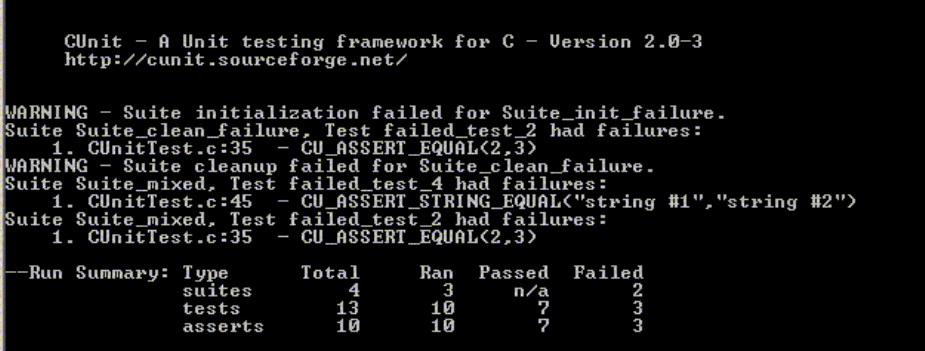
The screenshots below were generated by this code using the CUnit Basic interface.
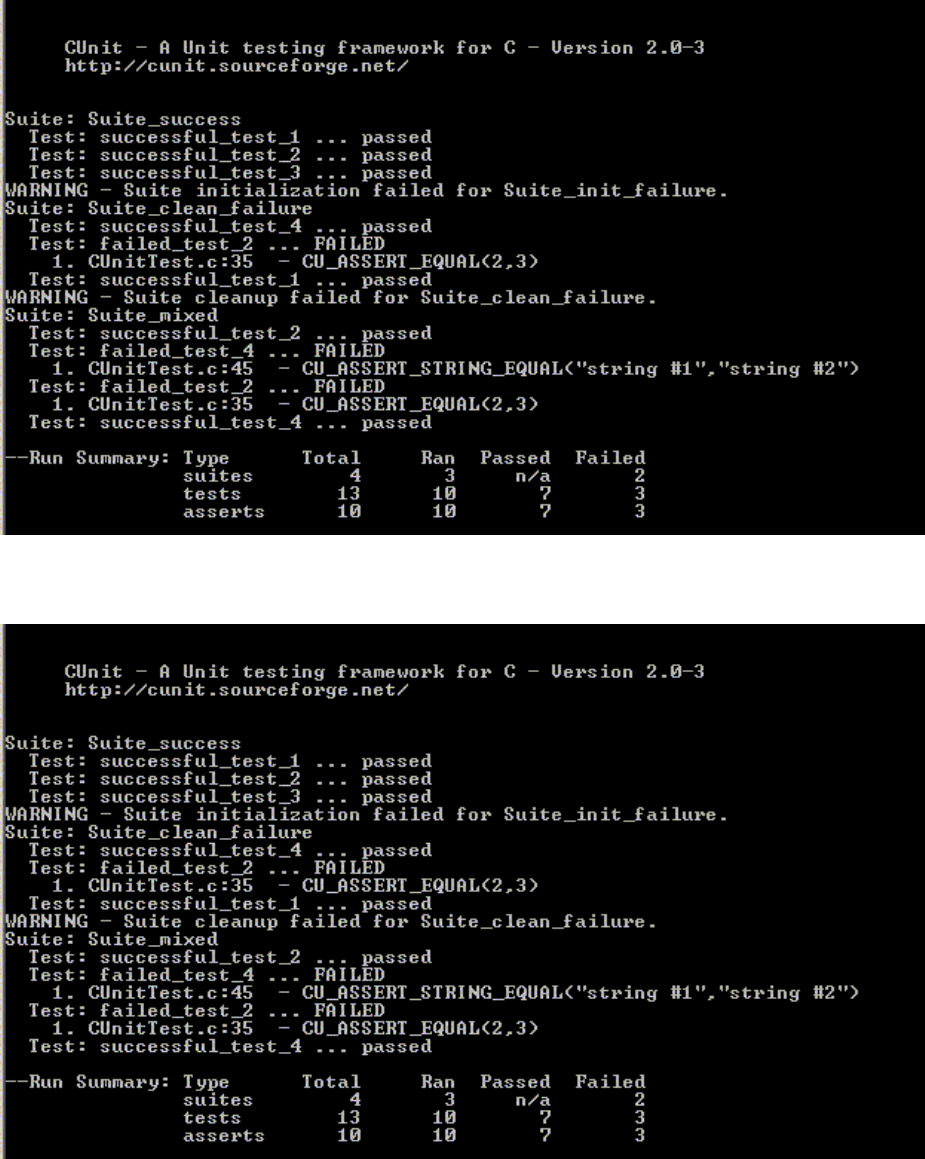
Console output at end of test run (normal mode)
Console output at end of test run (verbose mode)
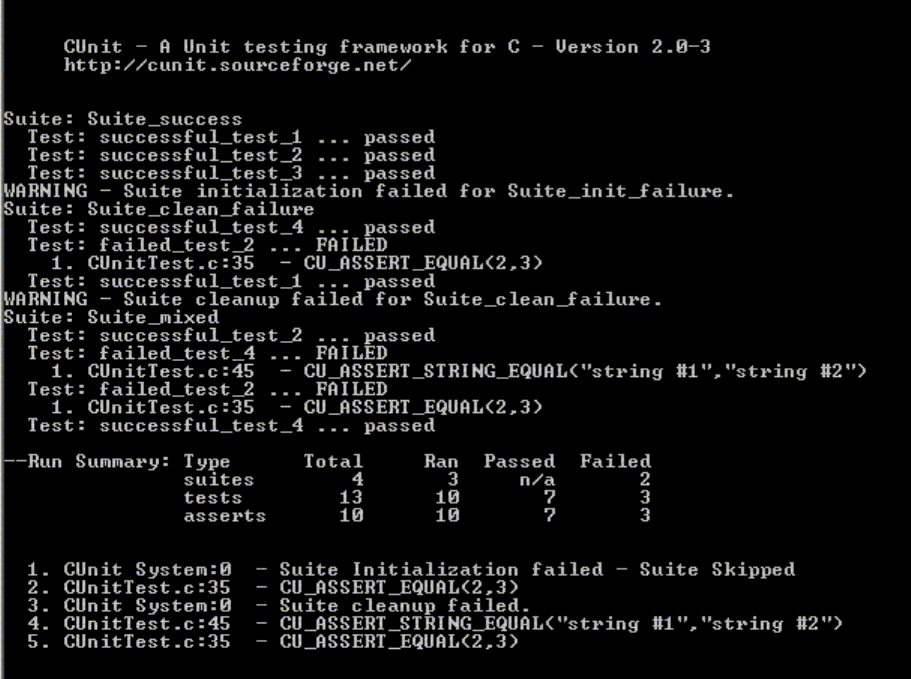
Console output at end of test run with failures displayed (verbose mode)
Example Code
/*
* Simple example of a CUnit unit test.
*
* This program (crudely) demonstrates a very simple "black box"
* test of the standard library functions fprintf() and fread().
* It uses suite initialization and cleanup functions to open
* and close a common temporary file used by the test functions.
* The test functions then write to and read from the temporary
* file in the course of testing the library functions.
*
* The 2 test functions are added to a single CUnit suite, and
* then run using the CUnit Basic interface. The output of the
* program (on CUnit version 2.0-2) is:
*
* CUnit
:
A
Unit testing framework for C.
* http://cunit.sourceforge.net/
*
* Suite: Suite_1
*
Test:
test of fprintf()
...
passed
*
Test:
test of fread()
...
passed
*
* --Run Summary: Type
Total
Ran Passed Failed
* suites 1 1 n/a 0
* tests 2 2 2 0
* asserts 5 5 5 0
*/
#include <stdio.h>
#include <string.h>
#include "CUnit/Basic.h"
/* Pointer to the file used by the tests. */
static FILE* temp_file = NULL;
/* The suite initialization function.
* Opens the temporary file used by the tests.
* Returns zero on success, non-zero otherwise.
*/
int init_suite1(void)
{
if (NULL == (temp_file = fopen("temp.txt", "w+"))) {
return -1;
}
else {
return 0;
}
}
/* The suite cleanup function.
* Closes the temporary file used by the tests.
* Returns zero on success, non-zero otherwise.
*/
int clean_suite1(void)
{
if (0 != fclose(temp_file)) {
return -1;
}
else {
temp_file = NULL;
return 0;
}
}
/* Simple test of fprintf().
* Writes test data to the temporary file and checks
* whether the expected number of bytes were written.
*/
void testFPRINTF(void)
{
int i1 = 10;
if (NULL != temp_file) {
CU_ASSERT(0 == fprintf(temp_file, ""));
CU_ASSERT(2 == fprintf(temp_file, "Q\n"));
CU_ASSERT(7 == fprintf(temp_file, "i1 = %d", i1));
}
}
/* Simple test of fread().
* Reads the data previously written by testFPRINTF()
* and checks whether the expected characters are present.
* Must be run after testFPRINTF().
*/
void testFREAD(void)
{
unsigned char buffer[20];
if (NULL != temp_file) {
rewind(temp_file);
CU_ASSERT(9 == fread(buffer, sizeof(unsigned char), 20, temp_file));
CU_ASSERT(0 == strncmp(buffer, "Q\ni1 = 10", 9));
}
}
/* The main() function for setting up and running the tests.
* Returns a CUE_SUCCESS on successful running, another
* CUnit error code on failure.
*/
int main()
{
CU_pSuite pSuite = NULL;
/* initialize the CUnit test registry */
if (CUE_SUCCESS != CU_initialize_registry())
return CU_get_error();
/* add a suite to the registry */
pSuite = CU_add_suite("Suite_1", init_suite1, clean_suite1);
if (NULL == pSuite) {
CU_cleanup_registry();
return CU_get_error();
}
/* add the tests to the suite */
/* NOTE - ORDER IS IMPORTANT - MUST TEST fread() AFTER fprintf() */
if ((NULL == CU_add_test(pSuite, "test of fprintf()", testFPRINTF)) ||
(NULL == CU_add_test(pSuite, "test of fread()", testFREAD)))
{
CU_cleanup_registry();
return CU_get_error();
}
/* Run
all
tests using the CUnit Basic interface */
CU_basic_set_mode(CU_BRM_VERBOSE);
CU_basic_run_tests();
CU_cleanup_registry();
return CU_get_error();
}
