!! Composting101booklet
Preview ! Composting101booklet Oxygen Lawn Mower Manuals - Lawn Mower Manuals – The Best Lawn Mower Manuals Collection
User Manual: !! Oxygen Lawn Mower Manuals - Lawn Mower Manuals – The Best Lawn Mower Manuals Collection
Open the PDF directly: View PDF  .
.
Page Count: 5
Composting 101
A beginner’s guide to composting.
Congratulations on your decision to start composting. Compost can
improve the health of your garden and potted plants, help you save money
by eliminating the need for expensive commercial fertilizers and benefit the
environment by reducing the amount of waste we send to landfills. Best
of all, composting is easy! Just follow our tips and tricks, and you’ll have a
mountain of nutrient-rich “black gold” in no time.
This booklet will cover several basic elements of composting:
What is Compost? 1
Setting up Your Composter 2
Composting Tools 2
What to Compost 3
Keys to Success 4-5
What is Compost?
Basically, compost is a mix of organic materials
that have had months to break down. It contains
nutrient-rich organic matter that can improve
soil structure, aid in necessary microbial activity,
attract beneficial insects and earthworms,
suppress soil-borne diseases and provide
nutrients throughout the growing season. While
there are many methods of composting, the
important thing to remember is that you can
never add too much compost to your soil.
Uses and Benefits of Compost 6
Composting Year-Round 7
Frequently Asked Questions 8
Risks & Cautions 9
1
What to Compost
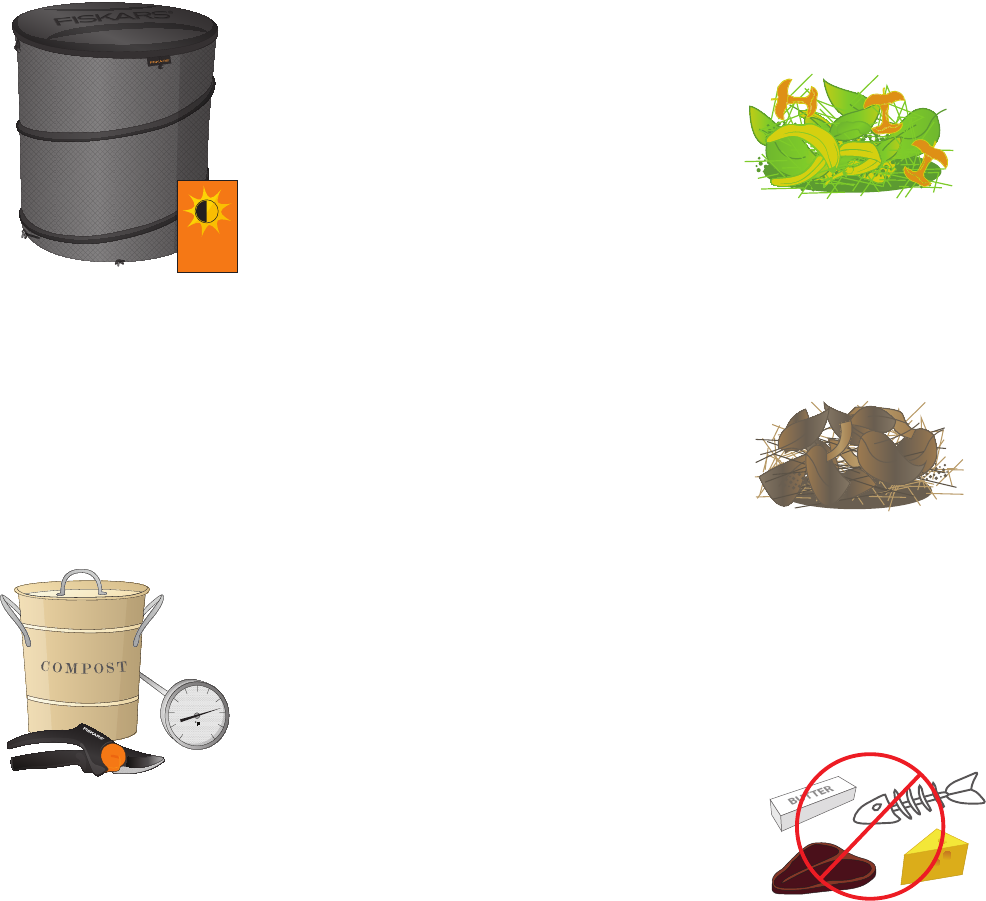
Once your composter is set up and you’ve collected the necessary tools,
you are ready to start adding nitrogen-rich “green” materials and carbon-
rich “brown” materials (see “Keys to Success” for material balance).
Do Compost:
Green Materials
• Fresh (green) grass clippings
• Kitchen scraps (fruit, vegetables, used
coffee grounds, tea bags, egg shells)
• Plant trimmings
• Green leaves
• Flowers, fruits and vegetables from the garden
Brown Materials
• Dry (brown) leaves, branches and twigs
• Dried grass
• Straw or hay
• Sawdust
• Coffee filters, paper napkins
or shredded newspaper
Do not Compost:
Do not compost the following materials to avoid attracting
rodents and flies. Some can be harmful to plants or pass
plant diseases, bacteria or germs onto humans.
• Meat or fish
• Dairy products
• Animal fats or oils
• Coated paper products
• Coal or ashes from the grill
• Pet waste
Setting up Your Composter
Follow these simple steps to choose an optimal location for your
composter and secure it before you begin adding materials.
• Place your composter in your yard, on
level natural earth, to let worms and
microbes access the compost through
the open bottom — never place your
composter on your driveway or an
artificial surface
• For best results, find a location that
receives partial sun throughout the day
• Secure your composter to the ground
to prevent it from tipping over in high
winds or storms
• Place a cover on top of your composter
and lock it in place to help keep animals out
Composting Tools
Make sure you have these basic tools on hand before you start adding
materials to your composter.
• Tools to aerate (see “Keys to Success” for details) so your
compost has plenty of oxygen to keep
the break down process going
• Designated container to bring food
scraps safely from indoors to
your composter
• Designated pruner or scissors for
shredding composting material
• Shovel or scoop to remove finished
compost
• Screen for sifting finished compost
• Standard compost thermometer to check
and control heat. Not essential but helpful.
(see “Keys to Success” for details)
F
200
180
160
140
120
100
80
60
40
20
0
32
moderate
light
Keys to Success
The speed at which compost is created is subject to how well you take
care of your compost pile. Adding proper materials and doing nothing else
will still allow for decomposition, but it may cause the composting process
to take longer. Follow the simple tips and tricks below to accelerate the
speed at which compost is created.
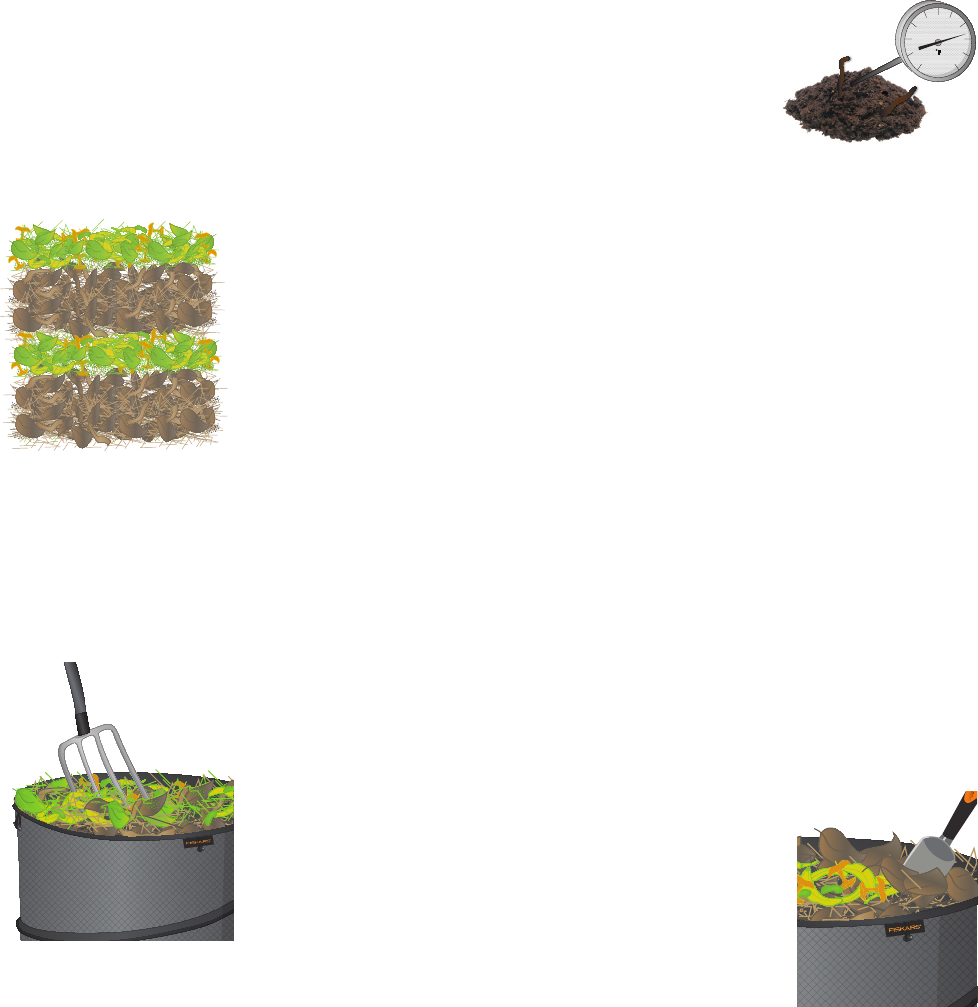
Material Balance
• Begin by layering nitrogen-rich “green”
materials and carbon-rich “brown”
materials
• Add more browns than greens
(near a 2:1 ratio)
• Once the pile is established, add
materials as needed without layering,
making sure to keep the balance of
materials
Aerate
• Aerating will expose your compost pile to oxygen, an important part
of the break down process
• Aerating is not essential but will help speed the composting process
• Turn the pile as little as once a month or
as often as once a week
• Avoid compacting the pile, as this will
squeeze out oxygen that is key to the
composting process
• Tools appropriate for aeration include:
- Pitchfork
- Digging shovel
- Transplanting spade
- Tiller
• When aerating with sharp-edged tools, be
careful to not puncture the sides of your composter
Control Heat
• Heat is necessary to the composting process,
and a warmer pile breaks down more quickly
• In addition to the sun, the microorganisms
responsible for composting will help keep the
compost warm
• A well-maintained compost pile can reach temperatures of
140º–160º F (use a standard compost thermometer to check)
• If your compost is not warm enough, add more
fresh, green materials to balance the dry, brown materials
• If you live in a region that has long periods of time below 41°F in one
stretch (i.e., Midwest during winter), the break down process will
slow significantly or stop during these periods
Balance Moisture
• Moisture is necessary to the composting process and must be
carefully controlled
• Compost should feel damp, like a well wrung-out sponge
• If the compost looks too wet, add a few more browns
• If the compost is too dry, add water from your garden hose or rain
barrel to maintain balance
Other Helpful Hints
• Make sure you have at least one cubic foot of compost to ensure
your pile can generate enough heat for the break down process to
begin, and keep in mind that it may take up to a week for it to reach
the necessary temperature (140º–160º F)
• Bury and mix in food scraps to keep the
potential smell from attracting animals
• Shred or chop up compost materials to
help them break down more quickly
• If there’s a bad smell, you may need to mix in
more browns (i.e., dry leaves) or make sure
you’re not adding anything with protein in it
(i.e., meat, fish, cheese)
• When ready, compost will look and smell like very dark soil
54
F
200
180
160
140
120
100
80
60
40
20
0
Uses and Benets of Compost
Good for Your Garden, Potted Plants and Lawn
• An easy, natural way to add nutrients to soil and improve the health
of the plants that grow there
• Improves soil structure, texture and aeration
• Increases the soil’s water-holding capacity (helps sandy soils
retain water)
• Loosens clay soils for planting
• Improves soil fertility and stimulates
healthy root development
• Provides food for microorganisms,
which keeps the soil in a healthy,
balanced condition
• Can be used to make “compost tea”
that can then be used to water your
plants, giving them extra nutrients
• Can be used as mulch to prevent
weeds from popping up or a lawn
top-dressing fertilizer
Good for the Environment
• Since yard waste and food scraps make up 20–30% of our garbage,
composting helps reduce the amount of garbage we send to landfills
• Clean break down process puts less greenhouse gasses into the
atmosphere than letting waste break down in a landfill
Good for Your Wallet
• Eliminates the need for expensive commercial fertilizers
• Completely free soil conditioner and natural pesticide
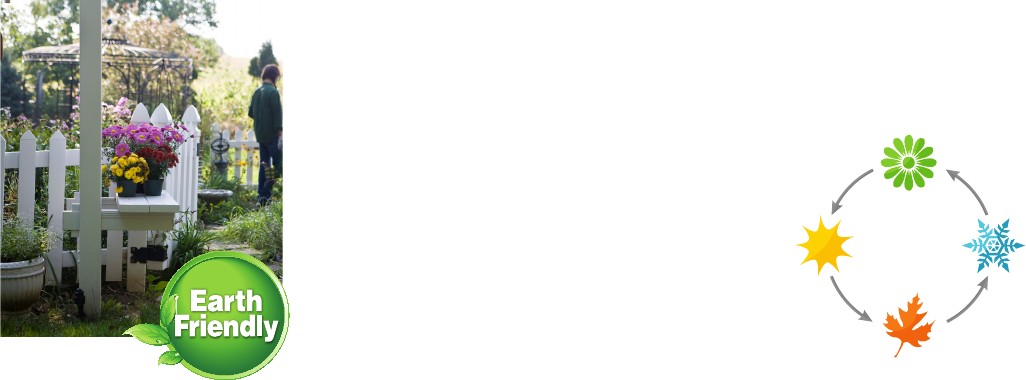
Composting Year-Round
Certain things should be done from one season to the next to keep the
break down process going. Follow these simple tips in each season to
create nutrient-rich compost for your garden.
Spring
• Dig out any finished compost from the bottom of your bin to use in
your lawn or garden
• Stir compost and add some soil to kick-start your pile
• Add materials from garden, yard prep and clean-up
Summer
• Keep the break down process going by
turning your compost frequently
• If your compost looks too dry, add some
water from your garden hose or rain
barrel to maintain balance
• Cover fresh material with leaves
Fall
• Remove your finished compost and add the material to your garden
• If possible, save some leaves from your yard to add to the
compost bin throughout the year
Winter
• With colder temperatures, the break down process of your compost
will slow or stop altogether
• Continue to fill your compost bin — once spring comes,
the break down process will speed up and all of the material
will decompose rapidly
76
Frequently Asked Questions
When should I stop adding materials to my compost?
• Stop adding materials when the composter is visually full
• This will give the materials a chance to break down for consistent compost quality
• For additional materials, start a second composter
What should I do if my compost smells bad?
• Try turning your pile to refresh it, as this may kill the odor
• The pile may be too wet, so add dry, brown material such as dry leaves or soil
• If the pile has an ammonia-like odor, it means that you have too much green material
and need to add brown material (leaves, wood, pine, dried-out plants)
• Prevent a bad smell by making sure that you have the proper 2:1 brown-to-green
material ratio
• Only add recommended materials — see “What to Compost” on page 3
Why isn’t my compost getting hot?
• This is most likely because there is too much old, dried, brown material and not
enough fresh green material
• Add green material, turn, and the heat should rise
• Shred brown material before adding to help increase the heat
What should I do if my compost gets too hot?
• Try to keep your compost between 140º–160ºF (use a standard compost
thermometer to check), as hotter temperatures can cause beneficial microbes
to die off
• If your compost gets too hot, turning or aerating will help distribute the heat to the
rest of the pile
Why is my compost not breaking down?
• It is possible that you’re not adding the right materials to your composter or have
an imbalance between greens and browns — see “What to Compost” for a list of
appropriate compost materials, and aim for a 2:1 brown-to-green material ratio
• It is possible that you need to balance materials, aerate, control heat and/or balance
moisture more carefully — see “Keys to Success” for more tips
How can I get rid of ies and gnats?
• Flies and gnats are likely being attracted because food scraps are exposed
• To help reduce the fly problem, make sure that you are turning food scraps into the
compost pile when adding
How can I keep animals out of my composter?
• Make sure that your lid is secured properly and the animals are not able to access
the compost
• Add only the recommended materials and not any meat, fish or animal fat that may
attract wildlife
• If you add materials you think may be attractive to animals (i.e., food scraps), turn
them into the pile to bury the smell
Is it okay if there are a lot of bugs in my compost?
• Most bugs are perfectly okay to have in your compost
• Insects are natural part of the environment — they thrive in compost and even help the
composting process
How can I get rid of the ants in my compost pile?
• When ants invade your compost, it is usually because the contents are very dry
• To rid your compost of ants, just water the pile and increase the moisture
• Turning the pile will also disrupt the ant colonies and help solve the problem
What should I do if my compost is too dry?
• If the compost is too dry, add water from your garden hose or rain barrel to maintain
balance — see “Keys to Success” for more tips on balancing moisture
What are some signs that I’m not composting properly?
• The composting process is taking too long
• The center of the pile is damp but the rest is dry
• The pile is damp and sweet-smelling but not heating up
• The compost smells like ammonia or sulfur
• The compost pile is attracting pests
Where did all my compost go?
• Your compost pile will reduce in size as time goes by
• This is because materials are breaking down and open spaces are filling in as the pile
settles
For more information visit skars.com/composting
Risks & Cautions
Flammability
• Composting materials (dry leaves, grass clippings, hay, etc.) can be flammable and
should be kept away from open flames and lit cigarettes
• Be sure to aerate and maintain proper moisture (see “Keys to Success” for tips on
aerating)
Reducing Bacteria and Fungi
• Avoid adding certain materials like raw poultry or meat wastes, pet feces and plate
scrapings from people who are ill to reduce the growth of bacteria and fungi
Avoiding Pathogens
• Manage your compost to ensure it stays hot long enough to reduce any food-borne
pathogens (see “Keys to Success” for tips on controlling heat)
• Wear gloves when handling compost and always wash your hands afterward
Reducing Compost Fumes
• If your compost is particularly dusty, water it to minimize dust
• If ongoing dust or fumes become an issue, wear a mask while managing your compost
• People with allergic reactions, weakened immune systems or other medical conditions
should use caution when handling compost
98
