Computer Organization Hamacher Instructor Manual Solution Chapter 8
User Manual:
Open the PDF directly: View PDF  .
.
Page Count: 8
Chapter 8 – Pipelining
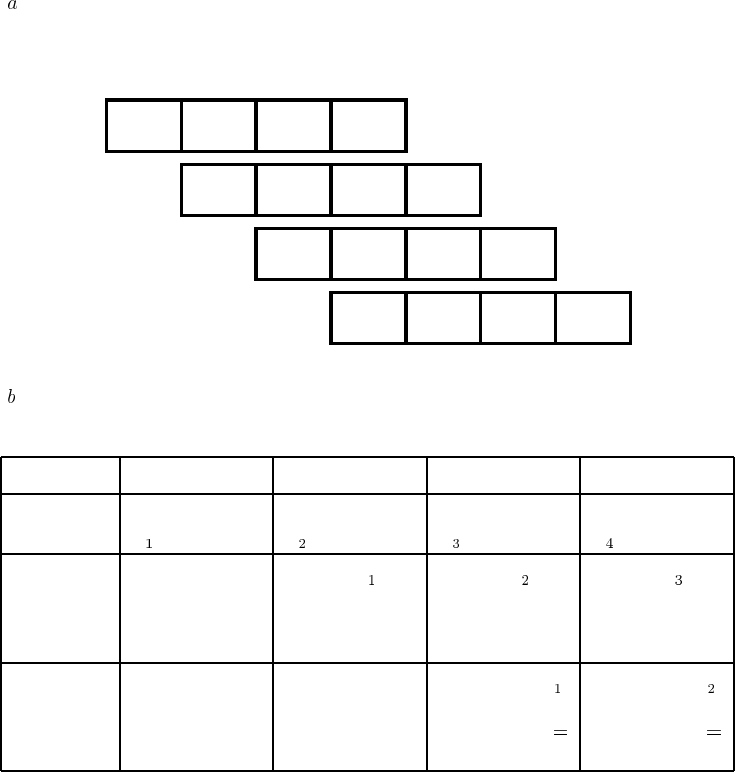
8.1. ( ) The operation performed in each step and the operands involved are as given
in the figure below.
Fetch Decode,
20, 2000 Add
Fetch Decode,
3, 50 Mul
Fetch Decode,
$3A, 50 And
Fetch Decode,
2000, 50 Add
R1←
2020
R3←
150
R4←
50
R5←
2050
Clock cycle 1 2 3 4 5 6 7
I2: Mul
I3: And
I4: Add
I1: Add
Instruction
( )
Clock cycle 2 3 4 5
Buffer B1 Add instruction
(I ) Mul instruction
(I ) And instruction
(I ) Add instruction
(I )
Buffer B2 Information
from a previous
instruction
Decoded I
Source
operands:
20, 2000
Decoded I
Source
operands:
3, 50
Decoded I
Source
operands:
$3A, 50
Buffer B3 Information
from a previous
instruction
Information
from a previous
instruction
Result of I :
2020
Destination
R1
Result of I :
150
Destination
R3
1
8.2. ( )
Fetch Decode,
20, 2000 Add
Fetch Decode,
3, 50 Mul
Fetch Decode, $3A, 2020 And
Fetch Decode,
2000, 50 Add
R1←
2020
R3←
150
R4←
32
R5←
2050
Clock cycle 1 2 3 4 5 6 7
Mul
And
Add
Add
Instruction
$3A, ?
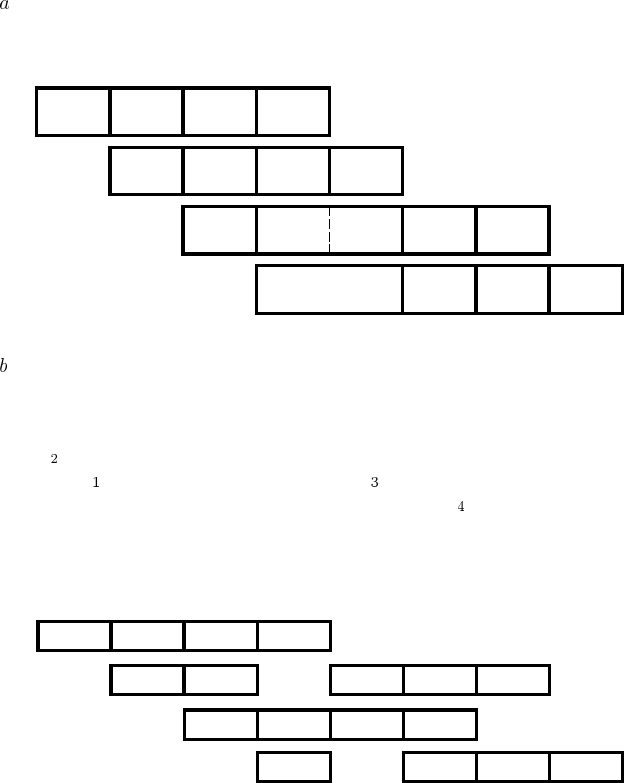
( ) Cycles 2 to 4 are the same as in P8.1, but contents of R1 are not available
until cycle 5. In cycle 5, B1 and B2 have the same contents as in cycle 4. B3
contains the result of the multiply instruction.
8.3. Step D may be abandoned, to be repeated in cycle 5, as shown below. But,
instruction I must remain in buffer B1. For I to proceed, buffer B1 must be
capable of holding two instructions. The decode step for I has to be delayed as
shown, assuming that only one instruction can be decoded at a time.
F1E1
Clock cycle 1 2 3 4 5 6 7
I2 (Add)
I3
I4
I1 (Mul)
Instruction
D1W1
F2E2
D2W2
F3E3
D3W3
F4E4
D4W4
D2
8
2
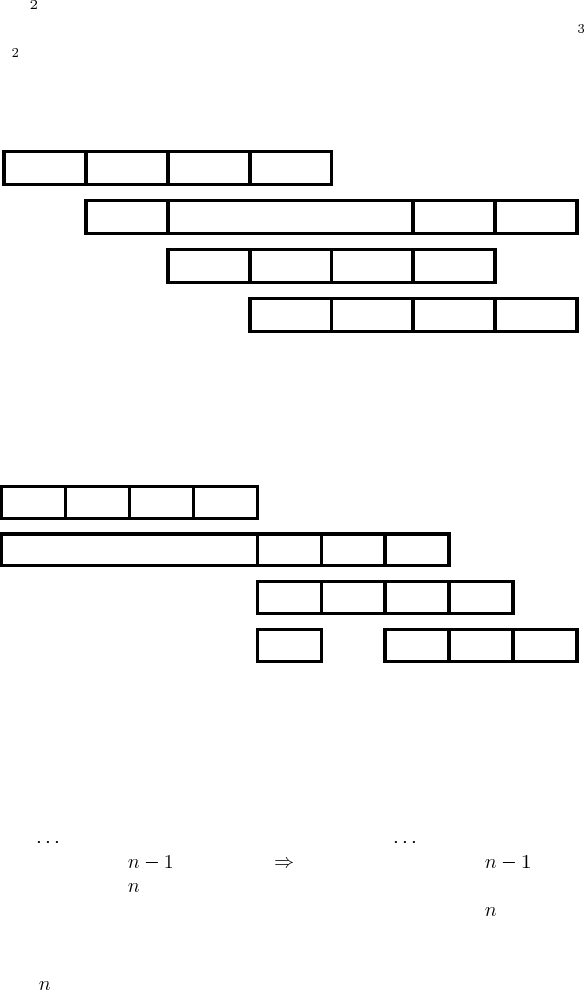
8.4. If all decode and execute stages can handle two instructions at a time, only in-
struction I is delayed, as shown below. In this case, all buffers must be capable
of holding information for two instructions. Note that completing instruction I
before I could cause problems. See Section 8.6.1.
F1E1
Clock cycle 1 2 3 4 5 6 7
I2 (Add)
I3
I4
I1 (Mul)
Instruction
D1W1
F2E2
D2W2
F3E3
D3W3
F4E4
D4W4
8.5. Execution proceeds as follows.
F1E1
Clock cycle 1 2 3 4 5 6 7
I2
I3
I4
I1
Instruction
D1W1
F2E2
D2W2
E3
D3W3
F4E4
D4W4
F3
98
8.6. The instruction immediately preceding the branch should be placed after the
branch.
LOOP Instruction 1 LOOP Instruction 1
Instruction Instruction
Instruction Conditional Branch LOOP
Conditional Branch LOOP Instruction
This reorganization is possible only if the branch instruction does not depend on
instruction .
3

8.7. The UltraSPARC arrangement is advantageous when the branch instruction is at
the end of the loop and it is possible to move one instruction from the body of
the loop into the delay slot. The alternative arrangement is advantageous when
the branch instruction is at the beginning of the loop.
8.8. The instruction executed on a speculative basis should be one that is likely to be
the correct choice most often. Thus, the conditional branch should be placed at
the end of the loop, with an instruction from the body of the loop moved to the
delay slot if possible. Alternatively, a copy of the first instruction in the loop
body can be placed in the delay slot and the branch address changed to that of
the second instruction in the loop.
8.9. The first branch (BLE) has to be followed by a NOP instruction in the delay slot,
because none of the instructions around it can be moved. The inner and outer
loop controls can be adjusted as shown below. The first instruction in the outer
loop is duplicated in the delay slot following BLE. It will be executed one more
time than in the original program, changing the value left in R3. However, this
should cause no difficulty provided the contents of R3 are not needed once the
sort is completed. The modified program is as follows:
ADD R0,LIST,R3
ADD R0,N,R1
SUB R1,1,R1
SUB R1,1,R2
OUTER LDUB [R3+R1],R5 Get LIST(j)
LDUB [R3+R2],R6 Get LIST(k)
INNER SUB R6,R5,R0
BLE,pt NEXT
SUB R2,1,R2 k k 1
STUB R5,[R3+R2]
STUB R6,[R3+R1]
OR R0,R6,R5
NEXT BGE,pt,a INNER
LDUB [R3+R2],R6 Get LIST(k)
SUB R1,1,R1
BGT,pt OUTER
SUB R1,1,R2
4
8.10. Without conditional instructions:
Compare A,B Check A B
Branch 0 Action1
Action2 . .. ... One or more instructions
Branch Next
Action1 . .. ... One or more instructions
Next ...
If conditional instructions are available, we can use:
Compare A,B Check A B
... ... Action1 instruction(s), conditional
... ... Action2 instruction(s), conditional
Next ...
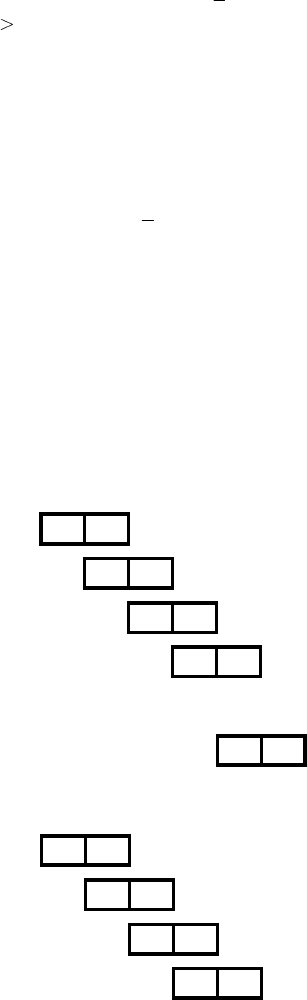
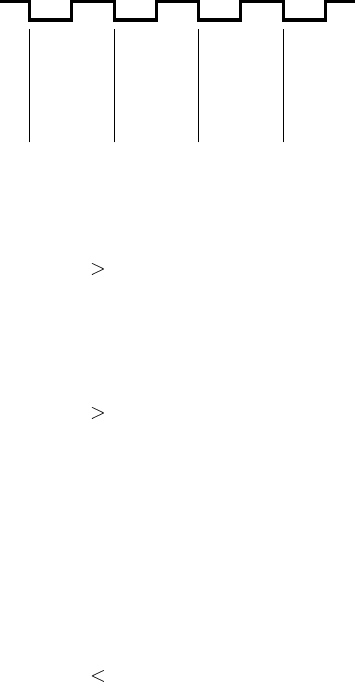
In the second case, all Action 1 and Action 2 instructions must be fetched and
decoded to determine whether they are to be executed. Hence, this approach is
beneficial only if each action consists of one or two instructions.
F1
Clock cycle 123456
Branch>0
…
Branch
Compare
Instruction
E1
…
Next
F2E2
F3E3
F4E4
F6E1
…
A,B
Action1
Next
Without conditional instructions
If >0 then action1
If ≤0 then action2
Compare A,B
NEXT …
F1E1
F2E2
F3E3
F4E4
With conditional instructions
Action2
Action1
5
8.11. Buffer contents will be as shown below.
RSLT
Cycle No.
Clock
198 130 260
345
ALU Operation + Shift O3
R3 45 130 260
8.12. Using Load and Store instructions, the program may be revised as follows:
INSERTION Test RHEAD
Branch 0 HEAD
Move RNEWREC,RHEAD
Return
HEAD Load RTEMP1,(RHEAD)
Load RTEMP2,(RNEWREC)
Compare RTEMP1,RTEMP2
Branch 0 SEARCH
Store RHEAD,4(RNEWREC)
Move RNEWREC,RHEAD
Return
SEARCH Move RHEAD,RCURRENT
LOOP Load RNEXT,4(RCURRENT)
Test RNEXT
Branch=0 TAIL
Load RTEMP1,(RNEXT)
Load RTEMP2,(RNEWREC)
Compare RTEMP1,RTEMP2
Branch 0 INSERT
Move RNEXT,RCURRENT
Branch LOOP
INSERT Store RNEXT,4(RNEWREC)
TAIL Store RNEWREC,4(RCURRENT)
Return
This program contains many dependencies and branch instructions. There very
few possibilities for instruction reordering. The critical part where optimization
should be attempted is the loop. Given that no information is available on branch
behavior or delay slots, the only optimization possible is to separate instructions
that depend on each. This would reduce the probability of stalling the pipeline.
The loop may be reorganized as follows.
6
LOOP Load RNEXT,4(RCURRENT)
Load RTEMP2,(RNEWREC)
Test RNEXT
Load RTEMP1,(RNEXT)
Branch=0 TAIL
Compare RTEMP1,RTEMP2
Branch 0 INSERT
Move RNEXT,RCURRENT
Branch LOOP
INSERT Store RNEXT,4(RNEWREC)
TAIL Store RNEWREC,4(RCURRENT)
Return
Note that we have assumed that the Load instruction does not affect the condition
code flags.
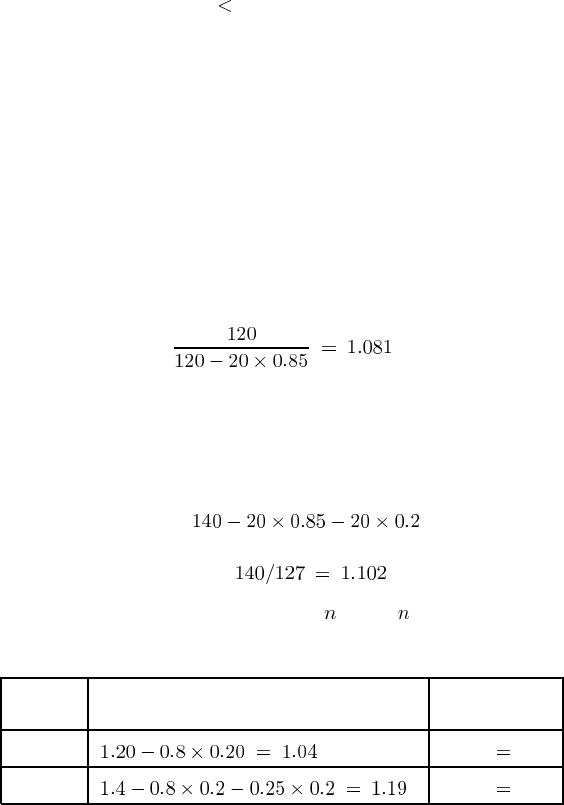
8.13. Because of branch instructions, 120 clock cycles are needed to execute 100 pro-
gram instructions when delay slots are not used. Using the delay slots will elim-
inate 0.85 of the idle cycles. Thus, the improvement is given by:
That is, instruction throughput will increase by 8.1%.
8.14. Number of cycles needed to execute 100 instructions:
Without optimization 140
With optimization ( ) 127
Thus, throughput improvement is , or 10.2%
8.15. Throughput improvement due to pipelining is , where is the number of pipeline
stages.
Number of cycles needed
to execute one instruction: Throughput
4-stage: 4/1.04 3.85
6-stage: 6/1.19 5.04
Thus, the 6-stage pipeline leads to higher performance.
7
8.16. For a “do while” loop, the termination condition is tested at the beginning of the
loop. A conditional branch at that location will be taken when exiting the loop.
Hence, it should be predicted not taken. That is, the state machine should be
started in the state LNT, unless the loop is not likely to be executed at all.
A “do until” loop is executed at least once, and the branch condition is tested
at the end of the loop. Assuming that the loop is likely to be executed several
times, the branch should be predicted taken. That is, the state machine should be
started in state LT.
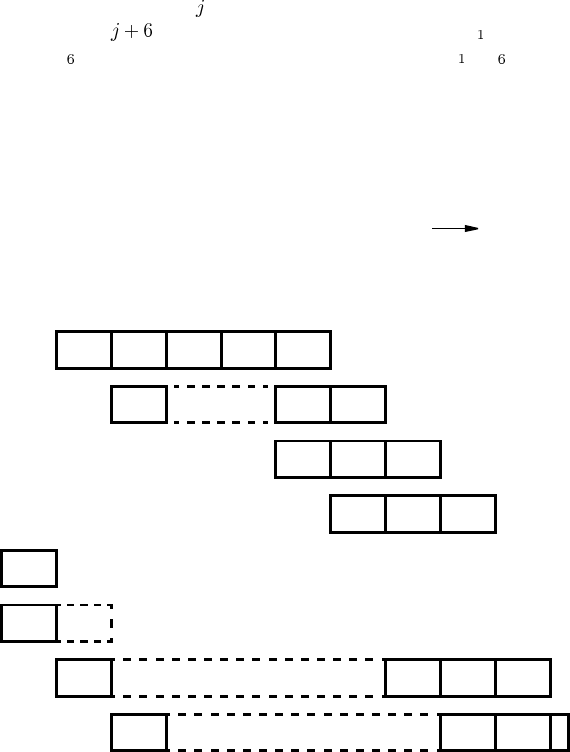
8.17. An instruction fetched in cycle reaches the head of the queue and enters the
decode stage in cycle . Assume that the instruction preceding I is decoded
and instruction I is fetched in cycle 1. This leads to instructions I to I being in
the queue at the beginning of cycle 2. Execution would then proceed as shown
below.
Note that the queue is always full, because at most one instruction is dispatched
and up to two instructions are fetched in any given cycle. Under these conditions,
the queue length would drop below 6 only in the case of a cache miss.
X
D1E1E1E1W1
W3
E3
I5 (Branch)
I1
D2
1 2 3 4 5 6 7 8 9Clock cycle
E2W2
D3
E4
D4W4
D5
F6
FkDkEk
Fk+1Dk+1
I2
I3
I4
I6
Ik
Ik+1
Wk
Ek+1
10
6 6 6 6 6 6 6 6 6Queue length 6
Time
…
…
8
