Crosby L 140 Standard Ratchet Type Load Binders Specs
User Manual: L-140
Open the PDF directly: View PDF  .
.
Page Count: 2
Copyright © 2011 The Crosby Group LLC
All Rights Reserved
234
Lebus® Load Binders
SEE APPLICATION AND
WARNING INFORMATION
Para Español: www.thecrosbygroup.com On Page 246
L-140
R-7QL
• Upgraded for use with Grades 70, 80 and 100 Chain.
• Utilizes standard Crosby A-323 Alloy Eye Grab Hooks.
• New design “one piece” forged handle.
• Continuous take-up feature provides nite adjustment to
tie down load.
• One piece assembly, no bolts or nuts to loosen.
• Ratchet spring is rust proofed.
• All load bearing or holding parts forged.
• Easy operating positive ratchet.
• For use with Grade 7 Transport Chain.
• Utilizes standard Crosby A-323 Alloy Eye Grab Hooks.
• New design “one piece” forged handle.
• Continuous take-up feature, innite adjustment, gets
the last half of chain.
• One piece assembly, no bolts or nuts to loosen.
• Ratchet spring is rust proofed.
• All load bearings or holding parts forged.
• Easy operating positive ratchet.
E1 OPEN
E CLOSED
F1 OPEN
F CLOSED
* Ultimate Load is 3 times the Working Load Limit.
** Matches the Working Load Limit of Grade 100 chain for both sizes.
*** Matches the Working Load Limit of Grade 100 chain for 1/2” size.
* Ultimate Load is 3 times the Working Load Limit.
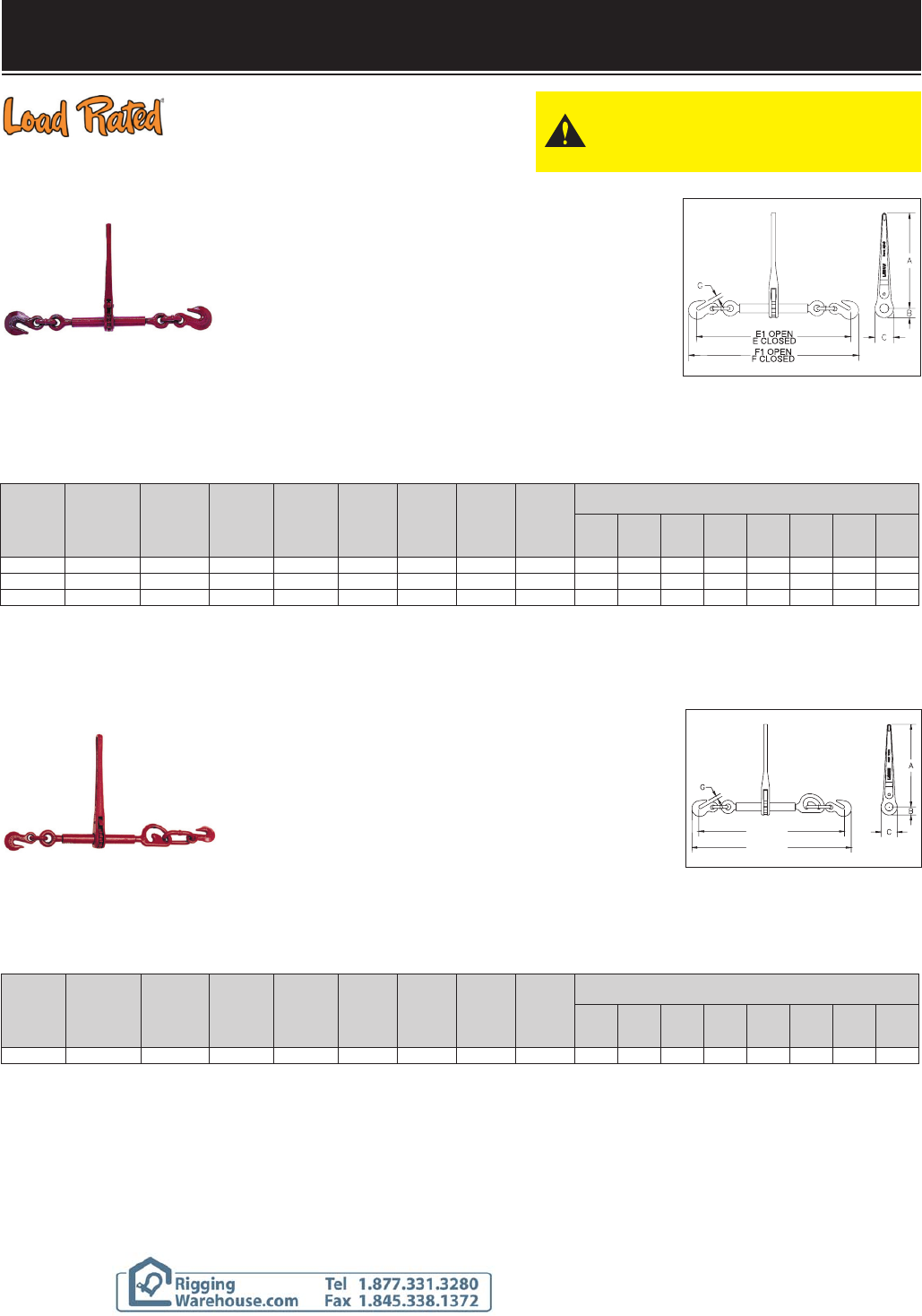
L-140 Standard Ratchet Type Load Binders
• Meets or exceeds requirements of US DOT FMCSA Part 393 Subpart I.
R-7QL QUIC-LINK Ratchet Load Binder
Model Stock No.
Min-Max
Chain
Size
(in.)
Working
Load
Limit
(lbs.)*
Proof
Load
(lbs.)
Weight
Each
(lbs.)
Handle
Length
(in.)
Barrel
Length
(in.)
Take
Up
(in.)
Dimensions
(in.)
A B C E E1 F F1 G
R-7 ** 1048404 5/16-3/8 8800 17600 12.11 14 10 8.0 14.00 1.38 2.75 22.94 30.94 25.13 33.13 .50
R-A ** 1048422 3/8-1/2 15000 30000 14.70 14 10 8.0 14.00 1.38 2.75 25.25 33.25 27.63 35.63 .63
R-C *** 1048440 1/2-5/8 16000 32000 14.55 14 10 8.0 14.00 1.38 2.75 26.38 24.38 29.44 37.44 .72
Model
R-7QL
Stock No.
Min-Max
Chain
Size
(in.)
Working
Load
Limit
(lbs.)*
Proof
Load
(lbs.)
Weight
Each
(lbs.)
Handle
Length
(in.)
Barrel
Length
(in.)
Take
Up
(in.)
Dimensions
(in.)
A B C E E1 F F1 G
R-7QL 1048413 5/16-3/8 6600 13200 12.25 14 10 8.0 14.00 1.38 2.75 24.81 32.81 27.00 35.00 .50
Copyright © 2011 The Crosby Group LLC
All Rights Reserved
246
LOAD BINDER
Warnings and Application Instructions
WARNING
• Failure to use this load binder properly may result in
serious injury or even death to you or others.
• Do not operate load binder while standing on the load.
• Move handle with caution. It may whip – Keep
body clear.
• Keep yourself out of the path of the moving handle
and any loose chain laying on the handle.
• You must be familiar with state and federal regulations
regarding size and number of chain systems required
for securing loads on trucks.
• Always consider the safety of nearby workers as well
as yourself when using load binder.
• While under tension, load binder must not bear
against an object, as this will cause side load.
• Do not throw these instructions away. Keep them
close at hand and share them with any others who use
this load binder.
• Do not use handle extender – see instructions.
• Do not attempt to close or open the binder with more
than one person.
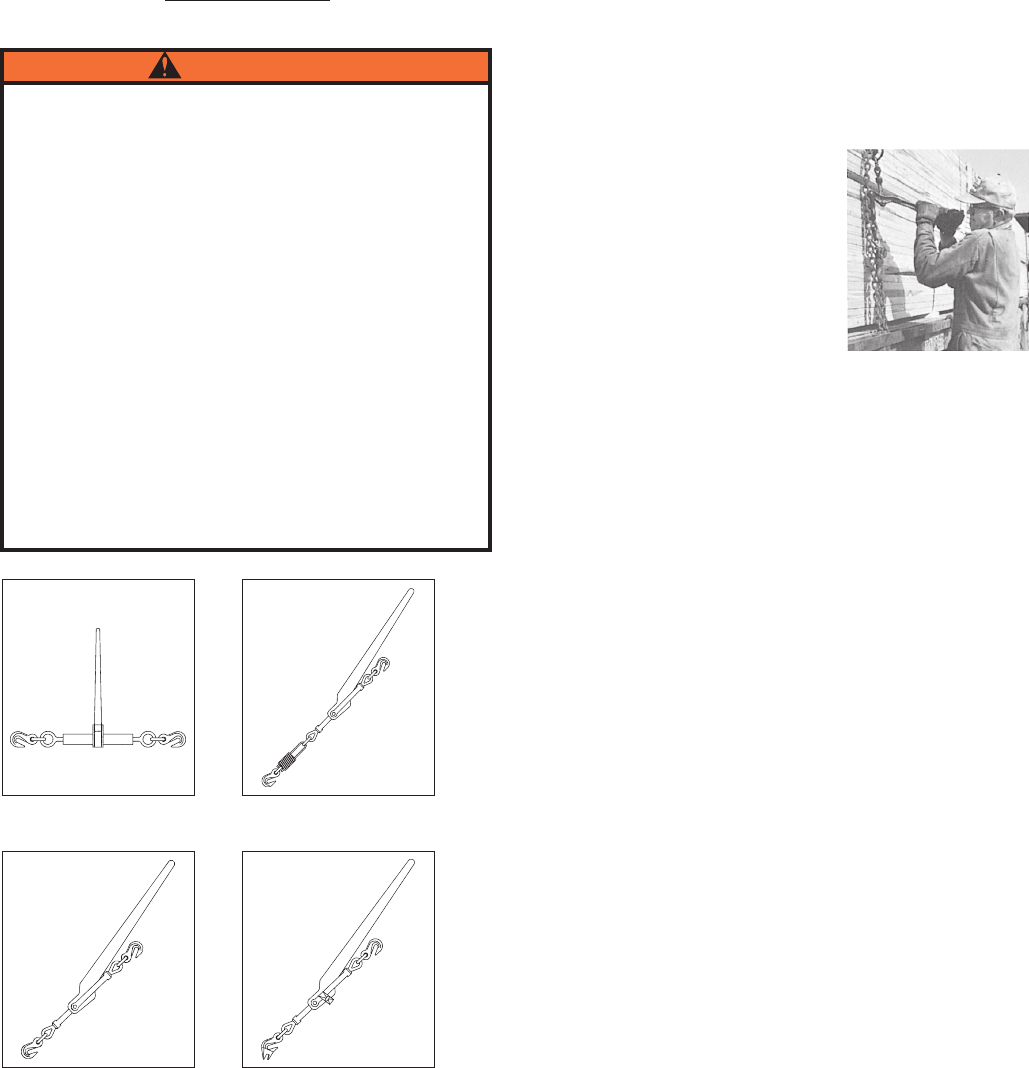
Ratchet Type Lever Snubbing Type
Lever Snubbing Type Lever Walking Type
Mechanical Advantage
Lever Type Binder = 25 : 1
Ratchet Type Binder = 50 : 1
Example: 100 pounds of effort
applied to the binder results in the
following force on the binder.
Lever Type:
2500 (100 lbs. x 25) lbs. of force
Ratchet Type:
5000 (100 lbs. x 50) lbs. of force
Instructions – Lever Type
Load Binders
• Hook load binder to chain so you can operate it while
standing on the ground. Position load binder so its handle
can be pulled downward to tighten chain (see photo). Be
aware of ice, snow, rain, oil, etc. that can affect your
footing. Make certain your footing is secure.
• The Crosby Group LLC specifically
recommends AGAINST the use of
a handle extender (cheater pipe).
If sufficient leverage cannot be
obtained using the lever type load
binder by itself, a ratchet type
binder should be used.
• If the above recommendation is
disregarded and a cheater pipe is
used, it must closely fit the handle
and must slide down the handle
until the handle projections are contacted. The pipe should
be secured to the handle, for example, by a pin, so that the
pipe cannot fly off the handle if you loose control and let
go.The increased leverage, by using a cheater pipe, can
cause deformation and failure of the chain and load binder.
• During and after tightening chain, check load binder handle
position. Be sure it is in the locked position and that its
bottom side touches the chain link.
• Chain tension may decrease due to load shifting during
transport. To be sure the load binder remains in proper
position: Secure handle to chain by wrapping the loose
end of chain around the handle and the tight chain, or tie
handle to chain with soft wire.
• When releasing load binder, remember there is a great
deal of energy in the stretched chain. This will cause the
load binder handle to move very quickly with great force
when it is unlatched. Move handle with caution. It may
whip – Keep body clear.
• Never use a cheater pipe or handle extender to release
handle. Use a steel bar and pry under the handle and stay
out of the path of handle as it moves upward.
• If you release the handle by hand, use an open hand
under the handle and push upward. Do not close your
hand around the handle. Always keep yourself out of
the path of the moving handle.
Instructions - Ratchet Load Binders
• Position ratchet binder so it can be operated from the ground.
• Make sure your footing is secure.
Maintenance of All Load Binders
• Routinely check load binders for wear, bending, cracks,
nicks, or gouges. If bending or cracks are present - Do
not use load binder.
• Routinely lubricate pivot and swivel points of Lever
Binders, and pawl part and screw threads of Ratchet
Binders to extend product life and reduce friction wear.
rev. 1
