USAWC Information Operations Primer Cyber Strategic Guide 2017 07 24
User Manual:
Open the PDF directly: View PDF  .
.
Page Count: 150 [warning: Documents this large are best viewed by clicking the View PDF Link!]
- Foreword
- Table of Contents
- Chapter 1: Introduction
- Chapter 2: Design
- Chapter 3: Planning
- Chapter 4: Execution
- Chapter 5: Operations in the Homeland
- Chapter 6: Cyberspace Operations – Case Study
- Appendix A: U.S. Strategies, Guidance, and Policy
- Appendix B: U.S. Cyberspace Organizations
- Glossary

United States Army War College
Strategic
Cyberspace Operations
Guide
1 July 2017
Middle States Accreditation
The U.S. Army War College is accredited by the Commission on Higher Education of the Middle
States Association of Colleges and Schools, 3624 Market Street, Philadelphia, PA 19104, (215)
662-5606. The Commission on Higher Education is an institutional accrediting agency recognized
by the U.S. Secretary of Education and the Council for Higher Education Accreditation.

Disclaimer: The systems, processes, and views described in this
guide reflect the judgment and interpretation of the editors, and
does not necessarily represent the official policies or positions of
the Headquarters, Department of the Army, the Department of
Defense, or the United States Government.
The text is a synthesis and interpretation of existing National,
Defense, Joint, and Service systems, processes, and procedures,
and will be updated in accordance with changes in policy and
doctrine.
ii
This Page Intentionally Blank

iii
Foreword
1. This publication provides a guide for U.S. Army War College students to understand design,
planning, and execution of cyberspace operations at combatant commands (CCMDs), joint task
forces (JTFs), and joint functional component commands. It combines existing U.S. Government
Unclassified and "Releasable to the Public" documents into a single guide.
2. This strategic guide follows the operational design methodology and the joint operation
planning process (JOPP) detailed in Joint Publication 5-0, Joint Operation Planning and applies
these principles to the cyberspace domain found in Joint Publication 3-12(R), Cyberspace
Operations. However, this publication is not to be cited, copied, or used in lieu of doctrine or
other official publications.
The U.S. Army War College Strategic Cyberspace Operations Guide contains six chapters:
Chapter 1 provides an overview of cyberspace operations, operational design
methodology, and joint planning, and execution.
Chapter 2 includes a review of operational design doctrine and applies these principles
to the cyberspace domain.
Chapter 3 reviews the joint operation planning process and identifies cyberspace
operations planning concerns.
Chapter 4 describes cyberspace operations during the execution of joint operations.
Chapter 5 provides an overview of cyberspace operations in the homeland.
Chapter 6 includes a case study on the Russian – Georgian conflict in 2008 with a focus
on cyberspace operations.
Appendix A provides an overview of cyberspace policies, strategies, and guidance.
Appendix B includes a description of U.S. Government, Department of Defense, Joint,
and Service cyberspace organizations.
3. This publication was compiled and edited by Mr. Benjamin Leitzel and Mr. Gregory
Hillebrand.
4. Changes from the first volume (1 June 2016) include 2017 testimony from the Commander of
U.S. Cyber Command and the Director of National Intelligence, new Presidential Executive
Order on Cybersecurity, changes to Army Doctrine, and updated cyberspace organization
information.
5. This document is based on U.S. policy and doctrine and will be updated on a routine basis to
reflect changes in guidance. We encourage comments to improve this guide – send
recommended changes to:
Center for Strategic Leadership
ATTN: Strategic Concepts and Doctrine Division
650 Wright Avenue
Carlisle, PA 17013
iv
This Page Intentionally Blank

v
Table of Contents
Foreword .............................................................................................................................................. iii
Table of Contents ................................................................................................................................ v
Chapter 1: Introduction ....................................................................................................................... 1
Chapter 2: Design ................................................................................................................................ 3
I. Operational Design ............................................................................................................................... 3
II. Strategic Direction and Cyberspace. ................................................................................................... 5
III. Understanding the Cyberspace Environment. .................................................................................... 6
IV. Defining the Problem: Threats and Challenges in Cyberspace. ........................................................ 9
V. Cyberspace Actions and the Operational Approach. ........................................................................ 16
Chapter 3: Planning ........................................................................................................................... 23
I. Joint Operation Planning Process (JOPP) .......................................................................................... 23
II. Cyberspace Operations Planning ...................................................................................................... 24
III. Cyberspace Operations Staffs .......................................................................................................... 27
IV. Cyberspace Appendix to Operation Plans and Orders .................................................................... 29
V. Cyber Effects Request Format (CERF) ............................................................................................. 33
Chapter 4: Execution ......................................................................................................................... 35
I. Execution ............................................................................................................................................ 35
II. Cyberspace Operations during Execution. ........................................................................................ 37
Chapter 5: Operations in the Homeland ......................................................................................... 47
I. Department of Defense Missions in the Homeland ............................................................................ 47
II. Critical Infrastructure .......................................................................................................................... 49
III. Defense Critical Infrastructure Program ........................................................................................... 49
IV. Cyberspace Operations in the Conduct of Homeland Defense ....................................................... 50
V. Department of Homeland Security Cyberspace Responsibilities ...................................................... 55
Chapter 6: Cyberspace Operations – Case Study ......................................................................... 57
I. Russian Operations against Georgia in 2008 ..................................................................................... 57
II. Russian Cyberspace Operations – Design, Planning, and Execution ............................................... 58
III. Georgian Defensive Cyberspace Operations ................................................................................... 61
Appendix A: U.S. Strategies, Guidance, and Policy ...................................................................... 63
I. U.S. Strategy and Guidance ............................................................................................................... 64
A. U.S. International Strategy for Cyberspace.................................................................................. 64
B. Department of State International Cyberspace Policy Strategy ................................................... 68
C. Presidential Executive Order on Strengthening Cybersecurity .................................................... 76
II. Department of Homeland Security Strategy and Guidance ............................................................... 79
A. The Cybersecurity Strategy for the Homeland Security Enterprise ............................................. 79
B. Framework for Improving Critical Infrastructure Cybersecurity .................................................... 80
vi
III. Department of Defense Strategy and Guidance ............................................................................... 82
A. DOD Strategy for Operating in Cyberspace ................................................................................. 82
IV. U.S. Cyber Law Guidance ................................................................................................................ 85
A. DOS Position on International Law in Cyberspace ...................................................................... 85
B. DOD Law of War Manual ............................................................................................................. 94
Appendix B: U.S. Cyberspace Organizations .............................................................................. 107
I. Department of State – Office of the Coordinator for Cyber Issues ................................................... 108
II. Department of Homeland Security – Office of Cybersecurity and Communications (CS&C) ......... 109
III. Department of Defense ................................................................................................................... 111
A. National Security Agency/Central Security Service (NSA/CSS) ................................................ 111
B. Department of Defense Chief Information Officer (DOD CIO) ................................................... 113
C. Defense Information Systems Agency (DISA) ........................................................................... 114
IV. Joint Organizations ......................................................................................................................... 116
A. Joint Spectrum Center (JSC) ..................................................................................................... 116
B. Joint Communications Support Element (JCSE) ....................................................................... 117
C. U.S. Cyber Command (USCYBERCOM)................................................................................... 118
V. Service Organizations ..................................................................................................................... 119
A. Army Cyber Command (ARCYBER) .......................................................................................... 119
B. Network Enterprise Technology Command (NETCOM) ............................................................ 120
C. 1st Information Operations Command (Land) ........................................................................... 121
D. Army 780th Military Intelligence Brigade ..................................................................................... 123
F. Marine Corps Forces Cyber (MARFORCYBER) ........................................................................ 124
G. Navy U.S. Fleet Cyber / U.S. TENTH Fleet (FCC-C10F) .......................................................... 126
H. Air Forces Cyber / 24th Air Force .............................................................................................. 127
Glossary ............................................................................................................................................ 129
1
Chapter 1: Introduction
"We . . . need to develop a framework within which to deter cyber threats, and
obviously attributing threats and managing escalation and hardening ourselves
against cyberattacks are all areas that require more work"
General Joseph Dunford,
Chairman of the Joint Chiefs of Staff1
1. This guide follows the operational design methodology and the joint operation planning
process (JOPP) and applies these principles to the cyberspace domain. Cyberspace is a global
domain within the information environment consisting of the interdependent networks of
information technology infrastructures and resident data, including the Internet,
telecommunications networks, computer systems, and embedded processors and controllers.
Cyberspace operations (CO) are the employment of cyberspace capabilities where the primary
purpose is to achieve objectives in or through cyberspace.2 Commanders must develop the
capability to direct operations in the cyber domain since strategic mission success increasingly
depends on freedom of maneuver in cyberspace (see Figure 1-1).3
2. The President and the Secretary of Defense (SecDef) provide strategic guidance to the joint
force. This guidance is the common thread that integrates and synchronizes planning activities
and operations. It provides purpose and focus to the planning for employment of military force.4
3. The commander and staff develop plans and orders through the application of the operational
design methodology and by using JOPP. Operational design results in the commander's
operational approach, which broadly describes the actions the joint force needs to take to reach
the desired end state. The commander and staff translate the broad operational approach into
detailed plans and orders using JOPP.5 Planning continues during execution, with an initial
emphasis on refining the existing plan and producing the operations order and refining the force
flow utilizing employed assigned and allocated forces.6
4. Commanders integrate cyberspace capabilities at all levels and in all military operations.
Plans should address how to effectively integrate cyberspace capabilities, counter an
adversary's use of cyberspace, secure mission critical networks, operate in a degraded
environment, efficiently use limited cyberspace assets, and consolidate operational
requirements for cyberspace capabilities. While it is possible that some military objectives can
be achieved by CO alone, CO capabilities should be integrated into the joint force commander's
plan and synchronized with other operations during execution.7
Figure 1-1: Strategic Cyber Warfare
2
This Page Intentionally Blank
3
Chapter 2: Design
I. Operational Design
1. Joint Publication 5-0, Joint Operation Planning, describes operational design methodology
and the joint operation planning process (JOPP). Operational design requires the commander to
encourage discourse and leverage dialogue and collaboration to identify and solve complex, ill-
defined problems. The operational approach is a commander's description of the broad actions
the force must take to achieve the desired military end state. The operational approach is based
largely on an understanding of the operational environment and the problem facing the
commander. Once the commander approves the approach, it provides the basis for beginning,
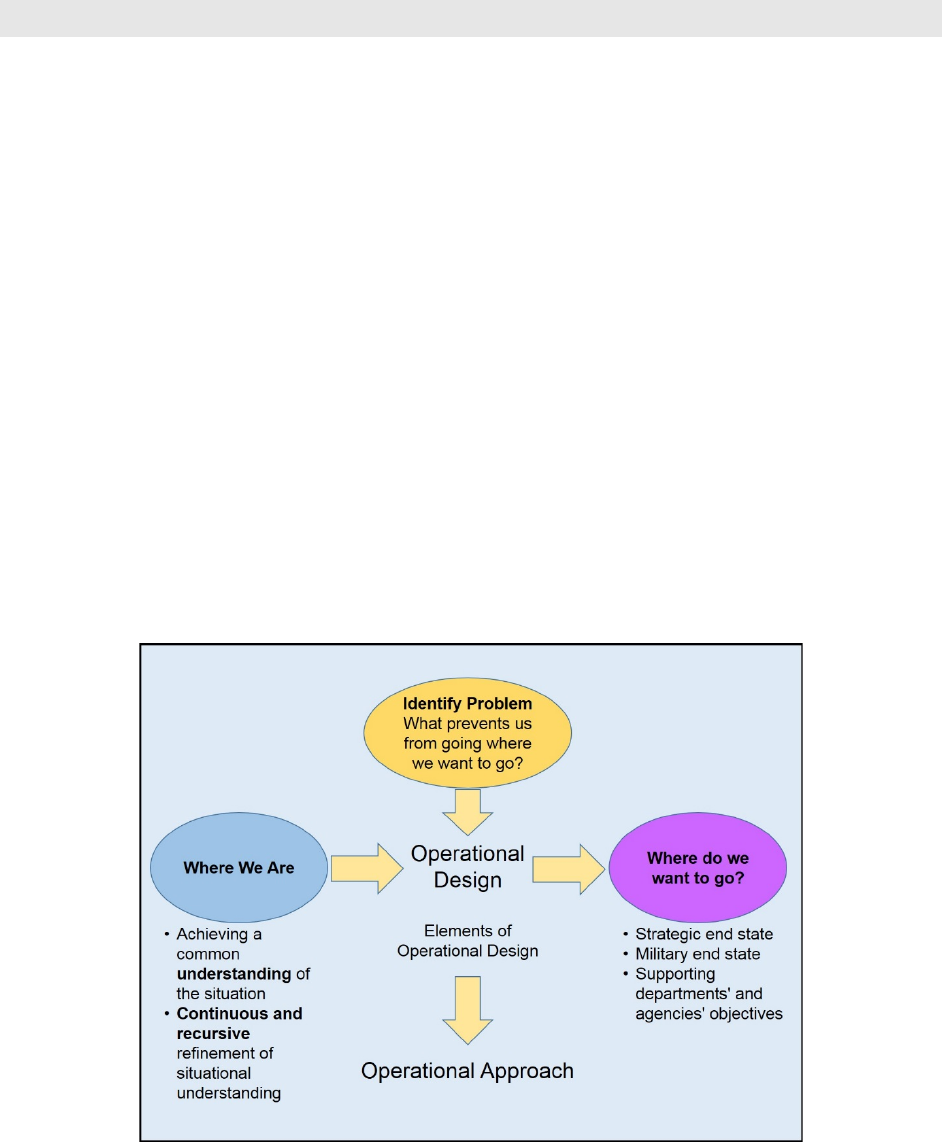
continuing, or completing detailed planning (see Figure 2-1).8
a. This methodology incorporates three distinct aspects to produce an operational
approach. Together, they constitute an organizational learning methodology that
corresponds to three basic questions that commanders answer to produce an actionable
operational approach to guide detailed planning:
(1) Understand the strategic direction. (What are the strategic goals to be achieved
and the military objectives that support their attainment?)
(2) Understand the operational environment. (What is the larger context that will help
me determine our problem?)
(3) Define the problem. (What problem is the design intended to solve?)
(4) The answers to these three questions support the development of an operational
approach. (How will the problem be solved?)9
Figure 2-1: Developing the Operational Approach10
2. Understand the Strategic Direction. The President, Secretary of Defense (SecDef),
Chairman of the Joint Chiefs of Staff (CJCS), and Combatant Commanders (CCDRs) all
promulgate strategic guidance. In general, this guidance provides long-term as well as
intermediate or ancillary objectives. It should define what constitutes "victory" or success (ends)
4
and allocate adequate forces and resources (means) to achieve strategic objectives. The
operational approach (ways) of employing military capabilities to achieve the ends is for the
supported commander to develop and propose. Connecting resources and tactical actions to
strategic ends is the responsibility of the operational commander.11
3. Understand the Operational Environment. The operational environment is the composite
of the conditions, circumstances, and influences that affect the employment of capabilities and
bear on the decisions of the commander. It encompasses physical areas and factors of the air,
land, maritime, and space domains, and the information environment (which includes
cyberspace). Understanding the operational environment helps the commander to better identify
the problem; anticipate potential outcomes; and understand the results of various friendly,
adversary, and neutral actions and how these actions affect achieving the military end state.12
4. Define the Problem. Once armed with an initial understanding of the operational
environment's current and desired systems, the design effort shifts to the challenge of
understanding and describing the problem (those factors that must be addressed to change the
current system to the desired system).13
a. Defining the problem is essential to solving the problem. It involves understanding and
isolating the root causes of the issue at hand - defining the essence of a complex, ill-
defined problem. Defining the problem begins with a review of the tendencies and
potentials of all the concerned actors and identifying tensions among the existing
conditions and the desired end state. The problem statement articulates how the
operational variables can be expected to resist or facilitate transformation and how
inertia in the operational environment can be leveraged to ensure the desired conditions
are achieved.14
b. As the commander and staff gain an understanding of the problem within the context
of the operational environment, potential solutions should become evident. The
configuration of tensions, competition, opportunities, and challenges may reveal ways to
interact with various aspects of the environment in order to transform it to the desired
system. Analyzing these options often requires coupling potential actions to a problem
by quickly wargaming their possible outcomes. This deepens understanding, informs the
commander's ability to visualize friendly actions, and enables the commander to
expedite detailed planning by developing intent and planning guidance.15
5. Develop an Operational Approach. The operational approach reflects understanding of the
operational environment and the problem while describing the commander's visualization of a
broad approach for achieving the desired end state. It is the commander's visualization of how
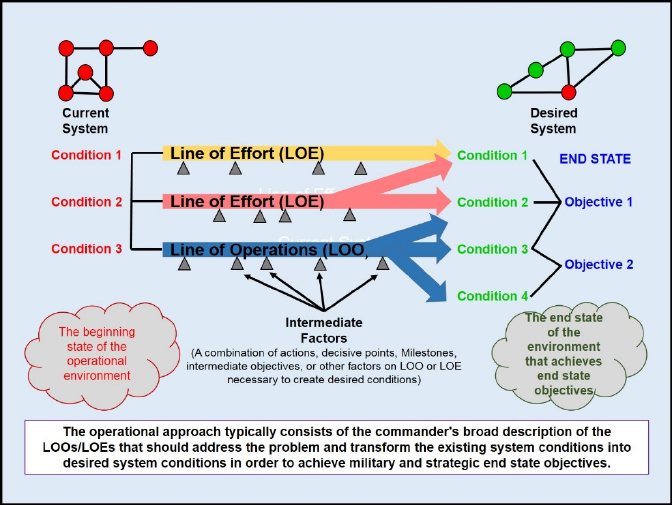
the operation should transform current conditions into the desired conditions at end state – the
way the commander wants the operational environment to look when operations conclude (see
Figure 2-2).
a. The operational approach is how the commander believes U.S. instruments of
national power and other interorganizational actions should address the various factors
that comprise the gap between the current and desired systems. The resulting product
provides the foundation for the commander's planning guidance to the staff and
collaboration with interorganizational partners. The commander and staff should
continually review, update, and modify the approach throughout planning and execution
as the operational environment, end state objectives, or the problem change.
5
Figure 2-2: The Operational Approach16
b. In developing an appropriate operational approach, the commander should
address the following questions:
(1) What are the strengths and weaknesses of the various actors?
(2) What are the opportunities and threats?
(3) How do we go from the existing conditions to the desired conditions?
(4) What will be the likely consequences as we seek to shape the operational
environment toward a desired set of conditions?
c. The operational approach should describe the operational objectives that will enable
achievement of the key conditions of the desired end state. The operational approach
may be described using lines of operation (LOOs)/lines of effort (LOEs) to link decisive
points to achievement of objectives. It should also include a description of how key
adversarial desired conditions will be precluded, and how other non-adversarial desired
conditions will be mitigated.
II. Strategic Direction and Cyberspace.
1. In 2012 President Obama directed the Department of Defense (DOD) to organize and plan to
defend the nation against cyberattacks of significant consequence, in concert with other U.S.
government agencies. In response, the DOD developed the Department of Defense Cyber
Strategy that focuses on three cyber missions (see Appendix A for cyberspace policies,
strategies, and guidance):
a. defend DOD networks, systems, and information;
b. defend the United States and its interests against cyberattacks of significant
consequence; and
c. provide integrated cyber capabilities to support military operations and contingency
plans.17
6
III. Understanding the Cyberspace Environment.
1. Introduction. The ability to operate in cyberspace has emerged as a vital national security
requirement. The growing impact of information warfare on military operations further increases
the importance of cyberspace. As technological capabilities and instantaneous access to
information continue to grow, the opportunities for real-time communication and information
sharing expand. These capabilities are vital to economic and national development. However,
reliance on these capabilities demands protection of the networks and information. Adversary
activity in cyberspace could threaten the United States' dominance in the air, land, maritime,
and space domains as they become increasingly interconnected and dependent on cyberspace
technology.
a. Cyberspace comprises the Internet, networks, systems, associated peripherals,
data, and users in the information environment. This interconnected environment is
important to global governance, commercial, military, and national security. A major
challenge for the United States and its allies is protecting and defending the environment
from adversaries. The host of cyberspace adversaries and threats include state actors,
non-state actors, criminal organizations, general users, rogue individual hackers, and, in
many cases, internal personnel. Conversely, many of these adversaries and threats may
also be vulnerable through cyberspace.18
b. The Department of Defense information networks (DODIN) are a globally
interconnected, end-to-end set of information capabilities for collecting, processing,
storing, disseminating, and managing information on demand to warfighters, policy
makers, and support personnel. The DODIN includes owned and leased
communications and computing systems and services, software (including applications),
data, security services, other associated services, and national security systems.19
2. Unique Cyberspace Capabilities and Characteristics. Cyberspace is a global enabler for
expedient, dynamic information exchange impacting all aspects of life. It allows instantaneous
information flow across the globe for financial transactions as well as the movement and
tracking of products and goods. However, it also allows adversaries to access this information
and disrupt vital operations from any location. Cyberspace is difficult to regulate due to ease of
accessibility. From a military perspective, cyberspace activities rarely require movement of
forces, allowing engagement from extended stand-off ranges. It also enables the influence of
populations that are inaccessible through the other domains.
a. Can be reverse engineered: Unlike munitions, which are normally destroyed upon
use, cyberspace activities include code that can be saved, analyzed, and recoded for
use against allies or friendly nations. Planners must account for the possibility of a
"cyber ricochet"20 in which cyber activities are turned against the originator or other
unintended targets through reverse engineering.
b. No Single National/International Ownership: While someone owns each physical
component of cyberspace, the whole of cyberspace is not under any single nations' or
entities' complete control. The infrastructure is a disparate combination of public and
private networks without standardized security or access controls. This arrangement
enables free information flow, but the lack of controls hinders global accountability,
standardization, and security. The traditional concept of territorial integrity can be
unclear due to the nature of cyberspace.
c. Lack of Cooperation/Collaboration: The lack of international laws and regulations
governing the environment complicates responses to actions in this domain. The
difficulty in tracing the source of a cyberattack makes them easily deniable, especially if
7
conducted by individual "hackers." Further hindering collaboration is the tendency to
deny that a cyberspace attack has occurred to prevent loss of trust in an organization's
cyber security measures.
d. Low Cost: Cyberspace is the most affordable domain through which to attack the
United States. Viruses, malicious code, and training are readily available over the
Internet at no cost. Adversaries can develop, edit, and reuse current tools for network
attacks. Inexpensive tools and training allow an adversary to compete without costly
ships, aircraft, or missiles. Furthermore, an adversary can impose significant financial
burdens on nations that rely heavily on cyberspace by forcing them to invest in
cyberspace defense. Currently, "military-grade" cyberspace capabilities remain too
expensive for most malign actors, but they can buy relatively inexpensive services of
professional hackers.
e. Volatile: Successful cyberspace attacks depend on vulnerabilities within the
adversary's network. Identifying these vulnerabilities and creating cyberspace
capabilities sometimes require great expense. If an adversary discovers their network's
vulnerability and closes it, the cyberspace attack technique is rendered immediately and
unexpectedly useless despite the development expense. For this reason, great care
must be taken to prevent alerting adversaries to vulnerabilities in their networks.
f. Speed: Cyberspace operations occur quickly. However, preparation for those
operations is often extensive. An intense study of the adversary's network may be
required to learn system specifications and understand patterns of life. Therefore, a
cyberspace unit operating on one adversary's networks may not be able to shift focus to
another target without substantial preparation.
g. Unintentional cascading effects: Another unique characteristic of cyberspace is the
potential for unintended cascading effects. Capabilities and munitions in the natural
domains lose momentum the greater distance from impact. However, physical distance
means very little in cyberspace. While cyberspace capabilities are developed and
evaluated in computer labs and cyberspace ranges, there can never be complete
assurances as to how a capability will behave or where it might spread when introduced
to the great expanse of cyberspace.21
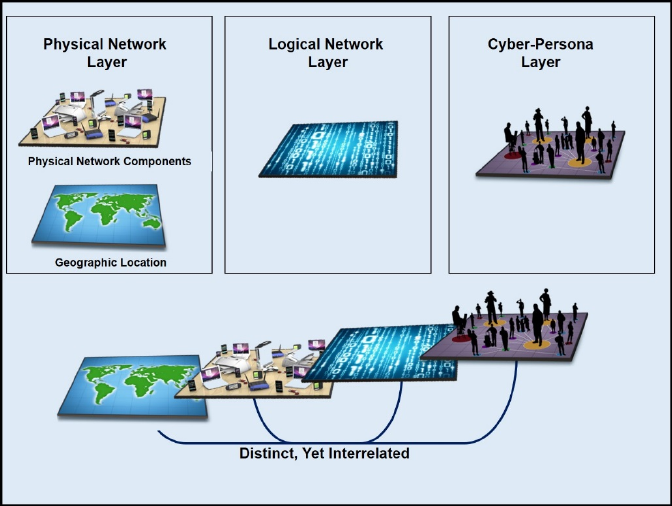
h. Layers: Cyberspace can be visualized as three layers: Physical Network, Logical
Network, and Cyber-persona (see Figure 2-3). Adversaries might attack any of these
layers to disrupt, degrade, or destroy cyberspace capability. Conversely, each of these
layers presents a means to attack adversaries' use of cyberspace.
(1) The physical network layer of cyberspace is comprised of the geographic
component and is part of the physical dimension. The geographic component is
the location in land, air, maritime, or space where elements of the network reside.
The physical network layer is comprised of the hardware, system software, and
infrastructure (wired, wireless, cable links, EMS links, satellite, and optical) that
supports the network and the physical connectors (wires, cables, radio
frequency, routers, switches, servers, and computers). The physical network
layer uses logical constructs as the primary method of security and integrity.
(2) The logical network layer consists of the components of the network related
to one another in a way abstracted from the physical network. For instance,
nodes in the physical layer may logically relate to one another to form entities in
cyberspace not tied to a specific node, path, or individual. Web sites hosted on
servers in multiple physical locations where content can be accessed through a
8
single uniform resource locator or web address provide an example. This may
also include the logical programming to look for the best communications route,
which is not the shortest physical route, to provide the information requested.
(3) The cyber-persona layer is a digital representation of an individual or entity
in cyberspace. This layer consists of the people who actually use the network
and therefore have one or more identities that can be identified, attributed, and
acted upon. These identities may include e-mail addresses, social networking
identities, other web forum identities, computer Internet protocol addresses, and
mobile device numbers. One individual may have multiple cyber-personas
through Internet services at work and personal e-mail addresses, web forum,
chat room, and social networking site identities; which may vary in the degree to
which they are factually accurate. The authenticity of a cyber-persona is a
concern especially with the ability of a threat force to hide their identity.
Conversely, a single cyber-persona can have multiple users — for example, a
username and password for an administrative account multiple people access.22
Figure 2-3. The Three Layers of Cyberspace23
3. Cyberspace Location and Ownership. Maneuver in cyberspace is complex and generally
not observable to anyone not directly involved. Therefore, staffs that plan, execute, and assess
CO benefit from language that describes cyberspace based on location in a way that aids rapid
understanding of planned operations.
a. Blue Cyberspace. Denotes U.S. cyberspace in general, and any other friendly
cyberspace that DOD may be ordered to protect. Although DOD has standing orders to
protect only the Department of Defense information network (DODIN), cyberspace
forces prepare, on order and when requested by Department of Homeland Security
(DHS), to defend other United States Government (USG) cyberspace, as well as
cyberspace related to critical infrastructure and key resources (CI/KR) of the U.S. and
Partner Nations (PNs).
9
b. Red Cyberspace. Those portions of cyberspace owned or controlled by an adversary
or enemy. In this case, "controlled" means more than simply "having a presence on,"
since adversaries may have clandestine access to elements of global cyberspace where
their presence is undetected and without apparent impact to the operation of the system.
Here, controlled means the ability to direct the operations of a link or node of
cyberspace, to the exclusion of others.
c. Gray Cyberspace. All cyberspace that does not meet the description of either "blue"
or "red" is referred to as "gray" cyberspace.
4. Intelligence Support. The intelligence team provides critical insights to help the commander
and staff understand the cyberspace environment. They draw on intelligence products focused
on vulnerabilities and threats in the cyberspace domain. The assessment of enemy cyberspace
capabilities, to include an examination of doctrinal principles and tactics, techniques, and
procedures (TTP), and observed patterns of enemy operations in the cyberspace domain lead
to a determination of possible enemy courses of action (COAs).24
IV. Defining the Problem: Threats and Challenges in Cyberspace.
1. The commander faces a unique set of cyberspace threats and challenges while conducting
operations in a complex global security environment.
2. Cyber Threats. Cyberspace presents the commander with many threats ranging from nation
states to individual actors.
a. Key Cyber Threats. From 2013-2015, the Director of National Intelligence named the
cyber threat as the number one strategic threat to the United States, placing it ahead
of terrorism for the first time since the attacks of 11 September 2001. Potential state
and non-state adversaries conduct malicious cyber activities against U.S. interests
globally and in a manner intended to test the limits of what the United States and the
international community will tolerate. Actors may penetrate U.S. networks and systems
for a variety of reasons, such as to steal intellectual property, disrupt an organization's
operations for activist purposes, or to conduct disruptive and destructive attacks to
achieve military objectives. These threats can be internal or external to cyberspace (see
Figure 2-4).
b. Potential adversaries have invested significantly in cyber as it provides them with
a viable, plausibly deniable capability to target the U.S. homeland and damage U.S.
interests. Russia and China have developed advanced cyber capabilities and
strategies. Russian actors are stealthy in their cyber tradecraft and their intentions are
sometimes difficult to discern. China steals intellectual property from global
businesses to benefit Chinese companies and undercut U.S. competitiveness. While
Iran and North Korea have less developed cyber capabilities, they have displayed an
overt level of hostile intent towards the United States and U.S. interests in
cyberspace.
c. In addition to state-based threats, non-state actors like the Islamic State in Iraq and
the Levant (ISIL) use cyberspace to recruit fighters and disseminate propaganda and
have declared their intent to acquire disruptive and destructive cyber capabilities.
Criminal actors pose a considerable threat in cyberspace, particularly to financial
institutions, and ideological groups often use hackers to further their political
objectives. State and non-state threats often blend together; patriotic entities often
act as cyber surrogates for states, and non-state entities can provide cover for state-
based operators. These behaviors can make attribution more difficult and increases
the chance of miscalculation.25
10
(1) Nation State Threat. This threat is potentially the most dangerous because
of access to resources, personnel, and time that may not be available to other
actors. Other nations may employ cyberspace to either attack or conduct
espionage against the U.S. Nation state threats involve traditional adversaries
and sometimes, in the case of espionage, even traditional allies. Nation states
may conduct operations directly or may outsource them to third parties to
achieve their goals.
(2) Transnational Actor Threat. Transnational actors are formal and informal
organizations that are not bound by national borders. These actors use
cyberspace to raise funds, communicate with target audiences and each other,
recruit, plan operations, destabilize confidence in governments, and conduct
direct terrorist actions within cyberspace.
(3) Criminal Organization Threat. Criminal organizations may be national or
transnational in nature. Criminal organizations steal information for their own use
or, in turn, sell to raise capital. They also may be used as surrogates by nation
states or transnational actors to conduct attacks or espionage through CO.
(4) Individual Actors or Small Group Threat. Individual actors or small groups
of people can illegally disrupt or gain access to networks or computer systems.
Their intentions are as varied as the number of groups and individuals. These
actors gain access into systems to discover vulnerabilities, sometimes sharing
the information with the owners; however, they also may have malicious intent.
Political motivations often drive their operations, and they use cyberspace to
spread their message. They may also create and then install malware on
commercial or government systems. These actors can be exploited by others,
such as criminal organizations or nation states, in order to execute concealed
operations against targets in order to preserve their identity or create plausible
deniability.26
(5) Insider Threat. The "insider" is an individual currently or at one time
authorized to access an organization's information system, data, or network.
Such authorization implies a degree of trust in the individual. The insider threat
refers to harmful acts that trusted insiders might carry out; for example,
something that causes harm to the organization, or an unauthorized act that
benefits the individual.
(6) Natural Threat. Natural threats that can damage and disrupt cyberspace
include events such as floods, hurricanes, solar flares, lightning, and tornados.
These types of events often produce highly destructive effects requiring the DOD
to maintain or restore key cyberspace systems. These events also provide
adversaries the opportunity to capitalize on infrastructure degradation and
diversion of attention and resources.
(7) Physical Threat. Threats are unpredictable and can take many forms. A
backhoe cutting a fiber optic cable of a key cyberspace node can disrupt the
operation of cyberspace. Physical threats to cyberspace and cyberspace
operations should be anticipated.27
d. Risk to DOD Networks and Infrastructure. The Defense Department's own networks
and systems are vulnerable to intrusions and attacks. In addition to DOD's own
networks, a cyberattack on the critical infrastructure and key resources on which DOD
relies for its operations could impact the U.S. military's ability to operate in a
11
contingency. DOD has made gains in identifying cyber vulnerabilities of its own critical
assets through its Mission Assurance Program – for many key assets, DOD has
identified its physical network infrastructure on which key physical assets depend –
but more must be done to secure DOD's cyber infrastructure.
e. In addition to destructive and disruptive attacks, cyber actors steal operational
information and intellectual property from a range of U.S. government and commercial
entities that impact the DOD. Victims include weapons developers as well as
commercial firms that support force movements through U.S. Transportation
Command (USTRANSCOM). State actors have stolen DOD's intellectual property to
undercut the United States' strategic and technological advantage and to benefit their
own military and economic development.28
3. Cyber Operations against the United States (2010 – 2017). In May 2017, the Director of
National Intelligence (DNI) stated that, "Our adversaries are becoming more adept at using
cyberspace to threaten our interests and advance their own, and despite improving cyber
defenses, nearly all information, communication networks, and systems will be at risk for years.
Cyber threats are already challenging public trust and confidence in global institutions,
governance, and norms, while imposing costs on the U.S. and global economies. Cyber threats
also pose an increasing risk to public health, safety, and prosperity as cyber technologies are
integrated with critical infrastructure in key sectors. These threats are amplified by our ongoing
delegation of decision making, sensing, and authentication roles to potentially vulnerable
automated systems. This delegation increases the likely physical, economic, and psychological
consequences of cyber attack and exploitation events when they do occur."29 In 2016, over
30,899 cyber incidents led to the compromise of U.S. government agencies' information or
system functionality. Sixteen of these incidents met the threshold for a major incident, a
designation that triggers a series of mandatory steps.30 The following list includes cyberspace
operations against the U.S. that have been acknowledged by the U.S. Government:
a. Russia. The DNI stated, "Russia is a full-scope cyber actor that will remain a major
threat to U.S. Government, military, diplomatic, commercial, and critical infrastructure.
Moscow has a highly advanced offensive cyber program, and in recent years, the
Kremlin has assumed a more aggressive cyber posture. . . . Outside the United States,
Russian actors have conducted damaging and disruptive cyber attacks, including on
critical infrastructure networks. In some cases, Russian intelligence actors have
masqueraded as third parties, hiding behind false online personas designed to cause the
victim to misattribute the source .of the attack. Russia has also leveraged cyberspace to
seek to influence public opinion across Europe and Eurasia. We assess that Russian
cyber operations will continue to target the United States and its allies to gather
intelligence, support Russian decision making, conduct influence operations to support
Russian military and political objectives, and prepare the cyber environment for future
contingencies."31
2015 – The DNI noted that Russian cyber actors were developing the means to
remotely access industrial control systems (ICS) used to manage critical
infrastructures. Unknown Russian actors successfully compromised the product
supply chains of at least three ICS vendors so that customers downloaded
malicious software ("malware") designed to facilitate exploitation directly from the
vendors' websites along with legitimate software updates.32
2016 – Russian aggressiveness was evident in its efforts to influence the 2016
U.S. election. And the Director of National Intelligence (DNI) assessed that only
Russia's senior-most officials could have authorized the 2016 U.S. election-
12
focused data thefts and disclosures, based on the scope and sensitivity of the
targets.33
b. China. The DNI assessed that China will continue to actively target the U.S.
Government, its allies, and U.S. companies for cyber espionage. Private-sector security
experts continue to identify ongoing cyber activity from China, although at volumes
significantly lower than before the bilateral Chinese-U.S. cyber commitments of
September 2015. Beijing has also selectively used offensive cyber operations against
foreign targets that it probably believes threaten Chinese domestic stability or regime
legitimacy.34
2012 – A Chinese national pleaded guilty to participating in a years-long
conspiracy to hack into the computer networks of major U.S. defense contractors
to steal military technical data (C-17 strategic transport aircraft and certain fighter
jets) and send the stolen data to China.35
2013 – Members of PRC's Third Department of the General Staff Department of
the People's Liberation Army (3PLA), Second Bureau, Third Office, Military Unit
Cover Designator (MUCD) 61398 were charged with conspiracy to penetrate the
computer networks of six American companies while those companies were
engaged in negotiations or joint ventures or were pursuing legal action with, or
against, state-owned enterprises in China. They then used their illegal access to
allegedly steal proprietary information including, for instance, e-mail exchanges
among company employees and trade secrets related to technical specifications
for nuclear plant designs.36
2014 – A U.S. company, Community Health Systems, informed the Securities
and Exchange Commission that it believed hackers "originating from China" had
stolen personally identifiable information on 4.5 million individuals.37
c. Iran. The DNI stated that, Iran continues to leverage cyber espionage, propaganda,
and attacks to support its security priorities, influence events and foreign perceptions,
and counter threats—including against U.S. allies in the region. Iran has also used its
cyber capabilities directly against the United States.38
2011 – 2013 – A group sponsored by Iran's Islamic Revolutionary Guard Corps
conducted a coordinated campaign of distributed denial of service (DDoS)
attacks against 46 major companies, primarily in the U.S. financial sector. These
attacks, which occurred on more than 176 days, disabled victim bank websites,
prevented customers from accessing their accounts online, and collectively cost
the banks tens of millions of dollars in remediation costs as they worked to
neutralize and mitigate the attacks on their servers.39
2013 – An Iranian hacker obtained unauthorized access into the Supervisory
Control and Data Acquisition (SCADA) systems of the Bowman Dam, located in
Rye, NY. This allowed him to repeatedly obtain information regarding the status
and operation of the dam, including information about the water levels and
temperature, and the status of the sluice gate, which is responsible for controlling
water levels and flow rates.40
2014 – Computer security experts reported that members of an Iranian
organization were responsible for computer operations targeting U.S. military,
transportation, public utility, and other critical infrastructure networks.41 Iranian
actors also conducted a data deletion attack against the network of a U.S.-based
casino.42
13
d. North Korea. The DNI assessed that North Korea has previously conducted cyber-
attacks against U.S. commercial entities and remains capable of launching disruptive or
destructive cyber attacks to support its political objectives. It also poses a cyber threat to
U.S. allies.
2014 – Conducted a cyber attack on Sony Pictures Entertainment, which stole
corporate information and introduced hard drive erasing malware into the
company's network infrastructure, according to the FBI.43
e. Syria.
2011 and 2013 – Two Syrian hackers were charged with targeting Internet
sites – in the U.S. and abroad – on behalf of the Syrian Electronic Army (SEA), a
group of hackers that supports the regime of Syrian President Bashar al-Assad.
The affected sites – which included computer systems in the Executive Office of
the President in 2011 and a U.S. Marine Corps recruitment website in 2013.
They collected usernames and passwords that gave them the ability to deface
websites, redirect domains to sites controlled by the conspirators, steal e-mail,
and hijack social media accounts. To obtain the login information they used a
technique called "spear-phishing."44
2014 – A member of the SEA is suspected of being responsible for a series of
cyber extortion schemes targeting a variety of American and international
companies.45
f. Terrorists. The DNI testified that terrorists – to include the Islamic State of Iraq and
ash-Sham (ISIS) – will also continue to use the Internet to organize, recruit, spread
propaganda, raise funds, collect intelligence, inspire action by followers, and coordinate
operations. Hizballah and HAMAS will continue to build on their cyber accomplishments
inside and outside the Middle East.46
2015 – ISIS released sensitive information about U.S. military personnel, in an
effort to inspire attacks.47
g. Criminals. The DNI stated that criminals are developing and using sophisticated
cyber tools for a variety of purposes including theft, extortion, and facilitation of other
criminal activities. "Ransomware," malware that employs deception and encryption to
block users from accessing their own data, has become a particularly popular tool of
extortion. 48
2014 – 2016 – Four individuals, including two Russian Federal Security Service
(FSB) officers, have been charged in connection with compromising at least 500
million Yahoo accounts.49
2016 – Criminals employing ransomware turned their focus to the medical sector,
disrupting patient care and undermining public confidence in some medical
institutions.50
h. Insider Threats.
2010 – Army PFC Manning was found not guilty of the most serious charge of
knowingly aiding the enemy, but was convicted on 20 other specifications related
to the misappropriation of hundreds of thousands of intelligence documents sent
to WikiLeaks. Prosecutors alleged that Manning downloaded some 470,000
SIGACTS (from Iraq and Afghanistan) from the SIPRNET.51
14
2013 – Edward J. Snowden, was charged with violations of: Unauthorized
Disclosure of National Defense Information; Unauthorized Disclosure of
Classified Communication; and Theft of Government Property.52
2015 – A former U.S. Nuclear Regulatory Commission employee pleaded guilty
to an attempted spear-phishing cyber-attack on Department of Energy computers
to compromise, exploit and damage U.S. government computer systems that
contained sensitive nuclear weapon-related information with the intent of allowing
foreign nations to gain access to that information or to damage essential
systems.53
i. Unattributed:
2013 – Hackers penetrated the U.S. Army Corps of Engineers' (USACE)
database about the nation's 85,000 dams. That data included their location,
condition and potential for fatalities if the dams were to be breached.54
2014 – JP Morgan Chase suffered a hacking intrusion.55
2015 – In June 2015, a Pentagon spokesman acknowledged that an element of
the army.mil service provider's content was compromised. After this came to their
attention, the Army took appropriate preventive measures to ensure there was no
breach of Army data by taking down the website temporarily. Later, the Syrian
Electronic Army (SEA) claimed responsibility for defacing the army.mil website.56
2015 – The Office of Personnel Management (OPM) discovered that a number of
its systems were compromised. These systems included those that contain
information related to the background investigations of current, former, and
prospective federal government employees, as well as other individuals for whom
a federal background investigation was conducted.57 OPM announced the
compromise resulted in 21.5 million personal records being stolen. The Chinese
government announced that it arrested a handful of hackers it says were
connected to the breach of Office of Personnel Management's database.58
2015 – A "group of hackers" was responsible for an intrusion into an unclassified
network maintained by the Joint Staff.59
2016 – A DDoS attack used Internet-connected devices to cripple servers that
connect the public to many popular websites.60
2017 – DHS announced reports of ransomware known as WannaCry affecting
multiple global entities.
4. Cyberspace Operation Techniques. Adversaries use a myriad of cyberspace techniques to
accomplish their objectives. Some of these are:
a. Backdoor. This is used to describe a back way, hidden method, or other type of
method of by passing normal security in order to obtain access to a secure area. It is
also referred to as a trapdoor. Sometimes backdoors are surreptitiously planted on a
network element. However, there are some cases where they are purposely installed to
facilitate system management, maintenance, and troubleshooting operations by
technicians.
(1) Security for these interfaces is normally via user IDs and passwords.
Unfortunately, passwords are often the weakest link in a computer security
scheme because password cracking tools continue to improve and the
15
computers used to crack passwords are more powerful than ever. Network
passwords that once took weeks to crack can now be cracked in hours.
(2) Although this intentional interface allows the service provider access to
conduct maintenance on the equipment, many vendors build back doors to have
access to these interfaces so they can also remotely troubleshoot equipment.
Unfortunately, this means a technician from outside the organization is able to
gain access to the system and could facilitate cyber terrorist activities.
b. Denial of Service Attacks (DOS). A DOS attack is designed to disrupt network
service, typically by overwhelming the system with millions of requests every second
causing the network to slow down or crash.
c. Distributed Denial of Service Attack (DDOS). An even more effective DOS is the
DDOS. This involves the use of numerous computers flooding the target simultaneously.
Not only does this overload the target with more requests, but having the DOS from
multiple paths makes backtracking the attack extremely difficult, if not impossible. Many
times worms are planted on computers to create zombies that allow the attacker to use
these machines as unknowing participants in the attack.
d. E-mail Spoofing (also called Phishing). E-mail spoofing is a method of sending e-
mail to a user that appears to have originated from one source when it actually was sent
from another source. This method is often an attempt to trick the user into making a
damaging statement or sent claiming to be from a person in authority requesting users to
send them a copy of a password file or other sensitive information.
e. IP Address Spoofing. A method that creates Transmission Control Protocol/Internet
Protocol (TCP/IP) packets using somebody else's IP address. Routers use the
"destination IP" address to forward packets through the Internet, but ignore the "source
IP" address. This method is often used in DDOS attacks in order to hide the true identity
of the attacker.
f. Keylogger. A software program or hardware device that is used to monitor and log
each of the keys a user types into a computer keyboard. The user who installed the
program or hardware device can then view all keys typed in by that user. Because these
programs and hardware devices monitor the actual keys being typed, a user can easily
obtain passwords and other information the computer operator may not wish others to
know.
g. Logic bomb. A program routine that destroys data by reformatting the hard disk or
randomly inserting garbage into data files. It may be brought into a computer by
downloading a public-domain program that has been tampered with. Once it is executed,
it does its damage immediately, whereas a virus keeps on destroying.
h. Physical Attack. This involves the actual physical destruction of a computer system
and/or network to include transport networks as well as the terminal equipment.61
i. Ransomware. A type of malicious software that infects and restricts access to a
computer until a ransom is paid. Although there are other methods of delivery,
ransomware is frequently delivered through phishing emails and exploits unpatched
vulnerabilities in software.62
j. Sniffer. A program and/or device that monitors data traveling over a network. Although
sniffers are used for legitimate network management functions, they are also used
during cyber attacks for stealing information, including passwords, off a network. Once
16
emplaced, they are very difficult to detect and can be inserted almost anywhere through
different means.
k. Trojan Horse. A program or utility that falsely appears to be a useful program or utility
such as a screen saver. However, once installed it performs a function in the
background such as allowing other users to have access to the target computer or
sending information from the target computer to other computers.
l. Virus. A software program, script, or macro that has been designed to infect, destroy,
modify, or cause other problems with a computer or software program.
m. Worm. A destructive software program containing code capable of gaining access to
computers or networks and once within the computer or network causing that computer
or network harm by deleting, modifying, distributing, or otherwise manipulating the
data.63
5. Challenges. In addition to the threats mentioned above, the commander must address
significant cyberspace challenges when defining the problem and producing an operational
approach.
a. Anonymity and Difficulties with Attribution. Perhaps the most challenging aspect
of attributing actions in cyberspace is connecting a cyberspace actor (cyber-persona) or
action to an actual individual, group, or state actor. This effort requires significant
analysis and collaboration with non-cyberspace agencies or organizations. The nature of
cyberspace presents challenges to determining the origin of cyberspace threats.
b. Private Industry. Many of DOD's critical functions and operations rely on commercial
assets, including Internet service providers and global supply chains, over which DOD
has no direct authority to mitigate risk effectively. Therefore, DOD will work with the
Department of Homeland Security (DHS), other interagency partners, and the private
sector to improve cybersecurity.64
V. Cyberspace Actions and the Operational Approach.
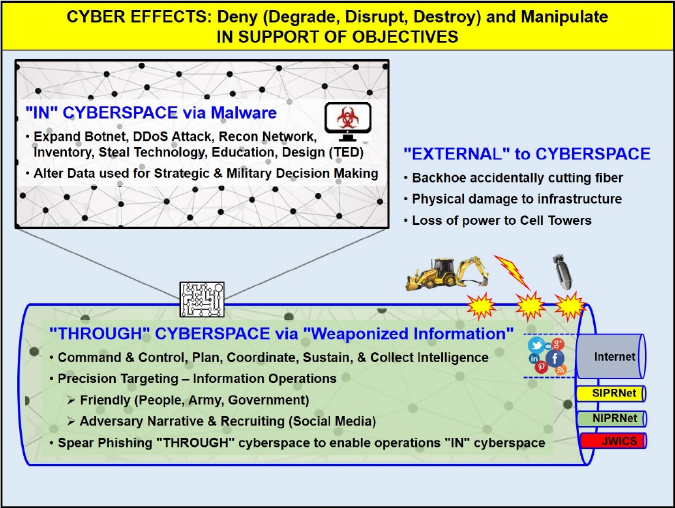
1. Operations 'In', 'Through', and 'External' to Cyberspace. When developing an operational
approach, commanders should synchronize actions 'in' and 'through' cyberspace with other
activities to achieve the desired objectives. Actions 'in' cyberspace are typically offensive and
defensive operations that deny an adversary's use of resources or manipulate an adversary's
information, information systems, or networks. On the other hand, the military operates 'through'
cyberspace on a routine basis as it conducts joint functions: command and control, intelligence,
fires, movement and maneuver, protection, sustainment, and information. These joint functions
comprise related capabilities and activities grouped together to help commanders integrate,
synchronize, and direct operations (see Figure 2-4).
2. U.S. Military Dependence on Cyberspace. Commanders must be aware that U.S. military
forces are critically dependent on networks and information systems to conduct operations.
Nearly every conceivable component within DOD is networked. These networked systems and
components are inextricably linked to the Department's ability to project military force and the
associated mission assurance. Over the past decades, DOD developed its Full Spectrum
Dominance doctrine that envisioned information superiority to great advantage as a force
multiplier. The power of this doctrine and its near total reliance on information superiority led to
networking almost every conceivable component within DOD, with frequent networking across
the rest of Government, commercial and private entities, and coalition partners in complex,
intertwined paths. While proving incredibly beneficial, these ubiquitous IT capabilities have also
made the U.S. increasingly dependent upon safe, secure access and the integrity of the data
17
contained in the networks. A weakness of the implementation of this doctrine is its focus on
functionality, connectivity and cost of information superiority over security—similar to the
development of the Internet.
Figure 2-4: Operations In, Through, and External to Cyberspace
3. Cyberspace Vulnerabilities. The performance of U.S. military forces has demonstrated the
superiority of networked systems coupled with kinetic capabilities and well-trained forces.
Adversaries have discovered that the same connectivity and automation that provides great
advantage to the U.S., is also a weakness that presents an opportunity to undermine U.S.
capabilities in a very asymmetric way. The network attack tools that are available on the
commercial market are available to our adversaries. In addition, adversaries with financial
means will invest to improve those tools and build more capable weapons to attack U.S. military
systems and national infrastructure.65
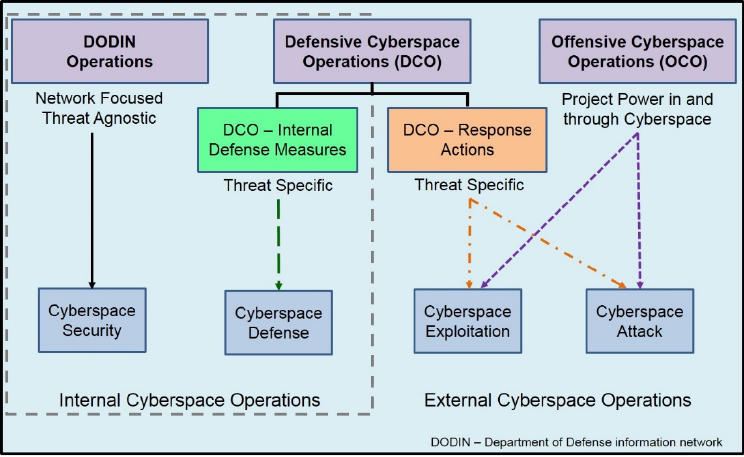
4. Cyberspace Missions. All actions in cyberspace that are not simply cyberspace-enabled
activities are taken as part of one of three cyberspace missions: Department of Defense
information networks (DODIN), defensive cyberspace operations (DCO), and offensive
cyberspace operations (OCO) (see Figure 2-5). Cyberspace Operations (CO) can contribute
directly to the commander's visualization of the operational approach and achievement of
desired effects, conditions, and end state objectives. The successful execution of (CO) requires
integrated and synchronized cyberspace missions.
a. DOD Information Network (DODIN) Operations. The DODIN operations mission
includes operational actions taken to secure, configure, operate, extend, maintain, and
sustain DOD cyberspace in order to create and preserve the security of the DODIN.
These include proactive cyberspace security actions which address vulnerabilities of the
DODIN. DODIN operations are network-focused and threat-agnostic: the cyberspace
forces and workforce undertaking this mission endeavor to keep all threats out of a
particular network or system they are assigned to protect. Although many DODIN
operations activities are regularly scheduled events, they should not be considered
18
routine or unimportant, since their aggregate effect establishes the security framework
on which all DOD missions ultimately depend.
b. Defensive Cyberspace Operations (DCO). DCO missions are intended to defend
DOD or other cyberspace that DOD cyberspace forces have been ordered to defend,
from active threats in cyberspace. Specifically, they are passive and active cyberspace
defense operations to preserve the ability to utilize friendly cyberspace capabilities and
protect data, networks, cyberspace-enabled devices, and other designated systems, by
defeating on-going or imminent malicious cyberspace activity. This distinguishes DCO
missions, which defeat specific threats that have bypassed, breached, or are threatening
to breach security measures, from DODIN operations, which endeavor to secure DOD
cyberspace from all threats in advance of any specific threat penetration. DCO are
mission assurance focused and threat specific. DCO missions are conducted in
response to threats of attack, exploitation, or other effects of malicious cyberspace
activity, and leverage information from maneuver, intelligence collection,
counterintelligence (CI), law enforcement (LE), and other sources as required. DCO
include outmaneuvering or interdicting adversaries taking or about to take actions
against defended cyberspace elements, or otherwise responding to imminent internal
and external cyberspace threats. The goal of DCO is to defeat the threat of a specific
adversary and/or to return a compromised network to a secure and fully functional state.
While DCO generally focus on the DODIN, which includes all of DOD cyberspace,
military cyberspace forces prepare to defend any U.S. or other blue cyberspace when
ordered. DOD operations rely on many non-DODIN elements of cyberspace, including
private sector networks and mission partner networks. The passive and active defensive
components of DCO are:
(1) DCO Internal Defensive Measures (DCO-IDM). Internal defensive measures
are those DCO that are conducted within the defended network. Most DCO
missions are DCO-IDM, which include pro-active and aggressive internal threat
hunting for advanced and/or persistent threats, as well as the active internal
countermeasures and responses used to eliminate these threats and mitigate
their effects. Since DCO-IDM does not take initiative to engage the threats
outside of the defended network, it represents the passive defense aspect of
DCO.
(2) DCO Response Actions (DCO-RA). DCO-RA are those deliberate,
authorized defensive actions which are taken external to the defended network.
DCO-RA represents the active defense aspect of DCO, with actions normally in
foreign cyberspace. DCO-RA missions require a military order that has been
coordinated with DOD and interagency mission partners and that has carefully
considered scope, rules of engagement (ROE), and measurable objectives.
c. Offensive Cyberspace Operations (OCO). OCO are missions intended to project
power in and through foreign cyberspace through actions taken in support of CCDR or
national objectives. OCO may exclusively target adversary cyberspace functions or
create first-order effects in cyberspace to initiate carefully controlled cascading effects
into the physical domains to affect weapon systems, C2 processes, logistics nodes,
high-value targets, etc. All CO missions conducted outside of blue cyberspace with a
commander's intent other than to defend friendly cyberspace from a cyberspace threat
are OCO missions. OCO missions require a properly coordinated military order and
careful consideration of scope, ROE, restraint of effects to areas with both logical and
geographic boundaries, and measurable objectives.66
19
Figure 2-5: Cyberspace Missions and Actions
5. Cyberspace Actions. While cyberspace missions (DODIN operations, DCO, and OCO) are
categorized by intent, as described above, these missions will require the employment of
various capabilities to create specific effects in cyberspace. To plan for, authorize, and assess
these actions, it is important the commander and staff understand how they are distinguished
from one another.
a. Cyberspace Security. Cyberspace security actions are those taken within a
protected network to prevent unauthorized access to, an exploitation of, or damage to
computers, electronic communications systems, and other information technology,
including platform information technology, as well as the information contained therein,
to ensure its availability, integrity, authentication, confidentiality, and nonrepudiation.
Cyberspace security is not specific to an enemy or adversary. Cyberspace security
actions protect the networks and systems through all phases of network planning and
implementation. Cyberspace security activities include vulnerability assessment and
analysis, vulnerability management, incident handling, continuous monitoring, and
detection and restoration capabilities to shield and preserve information and information
systems.
b. Cyberspace Defense. Cyberspace defense are actions normally taken within the
DOD cyberspace for securing, operating, and defending the DODIN against specific
threats. The purpose of cyberspace defense includes actions to protect, detect,
characterize, counter, and mitigate threats. Such defensive actions are usually created
by the Joint Force Commander (JFC) or Service that owns or operates the network,
except in cases where these defensive actions would affect the operations of networks
outside the responsibility of the respective JFC or Service.67
c. Cyberspace Exploitation. Cyberspace exploitation actions include maneuver,
information collection, and other enabling actions required to prepare for future military
operations. Cyberspace exploitation actions are taken as part of an OCO or DCO-RA
mission and include all actions in gray or red cyberspace that do not create cyberspace
attack effects. Cyberspace exploitation includes activities to gain intelligence and
supports current and future operations through actions such as gaining and maintaining
20
access to networks, systems, and nodes of military value, maneuvering to positions of
advantage, and positioning cyberspace capabilities to facilitate follow-on actions.
Cyberspace exploitation also supports current and future operations through collection of
militarily-relevant information including mapping red and gray cyberspace to support
situational awareness; discovering vulnerabilities; enabling target development; and
supporting the planning, execution, and assessment of military operations. Cyberspace
exploitation actions are deconflicted with other USG departments and agencies IAW
national policy.
d. Cyberspace Attack. Cyberspace actions that create noticeable denial effects (i.e.,
degradation, disruption, or destruction) in cyberspace, or manipulation that leads to
denial. Unlike cyberspace exploitation actions, which are often intended to remain
clandestine to be effective, cyberspace attack actions will be apparent to system
operators or users, either immediately or eventually, since they remove some system
functionality. Cyberspace attack actions are a form of fires, are taken as part of an OCO
or DCO-RA mission, are coordinated with other USG departments and agencies, and
are carefully synchronized with planned fires in the physical domains. They include
actions to:
(1) Deny. To prevent access to, operation of, or availability of a target function by
a specified level for a specified time, by:
• Degrade. To deny access to, or operation of, a target to a level
represented as a percentage of capacity. Level of degradation is
specified. If a specific time is required, it can be indicated.
• Disrupt. To completely but temporarily deny (a function of time)
access to, or operation of, a target for a period of time. A desired start
and stop time are normally specified. Disruption can be considered a
special case of degradation where the degradation level selected is
100 percent.
• Destroy. To completely and irreparably deny access to, or operation
of, a target. Destruction maximizes the time and amount of denial.
However, destruction is scoped according to the span of a conflict,
since many targets, given enough time and resources, can be
reconstituted.
(2) Manipulate. To control or change the adversary's information, information
systems, and/or networks in gray or red cyberspace to create physical denial
effects, using deception, decoying, conditioning, spoofing, falsification, and other
similar techniques. It uses an adversary's information resources for friendly
purposes, to create denial effects not immediately apparent in cyberspace. The
targeted network may appear to operate normally until secondary or tertiary
effects, including physical effects, reveal evidence of the logical first-order
effect.68
5. Multi-Domain Synergy. Multi-domain integration requires familiarity with all the domains: air,
sea, land, space, and cyberspace. Cyberspace Operations enhance operational effectiveness
and leverage various capabilities from physical domains to create effects, which may span
multiple areas of responsibility. They can also be integrated with other information-related
capabilities.
a. Information. It is important to address the relationship between the Information Joint
Function and Cyberspace Operations. CO are concerned with using cyberspace
21
capabilities to create effects which support operations across the physical domains and
cyberspace. The information function addresses the integrated employment of
information-related capabilities during military operations, in concert with other
LOOs/LOEs, to influence, disrupt, corrupt, or usurp the decision making of adversaries
and potential adversaries while protecting our own. Thus, cyberspace is a medium
through which some information-related capabilities, such as military information support
operations (MISO) or military deception (MILDEC), may be employed. However, the
information function also relies on operations in the physical domains to achieve effects
in order to accomplish the commander's objectives.
b. Electromagnetic Spectrum. Other capabilities the commander may employ in
conjunction with, or to enable CO, include significant portions of electronic warfare (EW);
electromagnetic spectrum (EMS) management, command and control; ISR; navigation
warfare (NAVWAR); and some space mission areas.69
22
This Page Intentionally Blank
23
Chapter 3: Planning
Planning translates strategic guidance and direction into campaign plans and operation orders
(OPORDs). Joint operation planning may be based on defined tasks identified in strategic
guidance. Alternatively, joint operation planning may be based on the need for a military
response to an unforeseen current event, emergency, or time-sensitive crisis. Although the four
planning functions of strategic guidance, concept development, plan development, and plan
assessment are generally sequential, they often run simultaneously in the effort to accelerate
the overall planning process.70
I. Joint Operation Planning Process (JOPP)
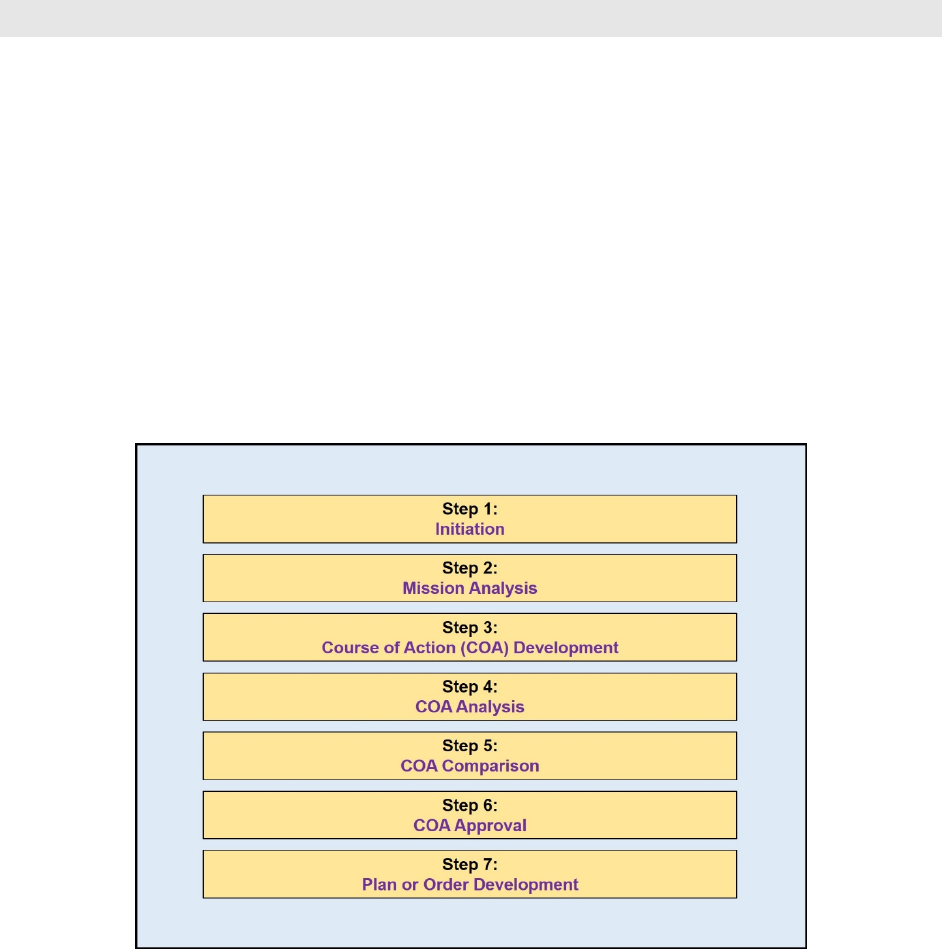
1. JOPP is an orderly, analytical process, which consists of a set of logical steps to examine a
mission; develop, analyze, and compare alternative courses of action (COAs); select the best
COA; and produce a plan or order. JOPP provides a proven process to organize the work of the
commander, staff, subordinate commanders, and other partners, to develop plans that will
appropriately address the problem to be solved. It focuses on defining the military mission and
development and synchronization of detailed plans to accomplish that mission (see Figure 3-1).
Figure 3-1: Joint Operational Planning Process71
a. Initiation. Planning begins when an appropriate authority recognizes potential for
military capability to be employed in response to a potential or actual crisis. Analyses of
developing or immediate crises may result in the President, Secretary of Defense
(SecDef), or Chairman of the Joint Chiefs of Staff (CJCS) initiating military planning
through a warning order or other planning directive. The commander typically will
provide initial planning guidance based upon current understanding of the operational
environment, the problem, and the initial operational approach for the campaign or
operation.
b. Mission Analysis. Mission analysis is used to study the assigned tasks and to
identify all other tasks necessary to accomplish the mission. Mission analysis is critical
because it provides direction to the commander and the staff, enabling them to focus
24
effectively on the problem at hand. The primary products of mission analysis are staff
estimates, the mission statement, a refined operational approach, the commander's
intent statement, updated planning guidance, and commander's critical information
requirements.
c. Course of Action (COA) Development. The staff develops COAs to provide unique
choices to the commander, all oriented on accomplishing the military end state. Since
the operational approach contains the commander's broad approach to solve the
problem at hand, each COA will expand this concept with the additional details that
describe who will take the action, what type of military action will occur, when the action
will begin, where the action will occur, why the action is required (purpose), and how the
action will occur (method of employment of forces).
d. COA Analysis, Comparison, and Approval. COA analysis is the process of closely
examining potential COAs to reveal details that will allow the commander and staff to
tentatively identify COAs that are valid, and then compare these COAs. COA analysis
identifies advantages and disadvantages of each proposed friendly COA. The
commander and staff analyze each tentative COA separately according to the
commander's guidance. Once COA analysis is complete, the staff compares each COA
using a subjective process whereby COAs are considered independently and
evaluated/compared against a set of criteria that are established by the staff and
commander. The goal is to identify and recommend the COA that has the highest
probability of success against the enemy COA that is of the most concern to the
commander.
e. Plan or Order Development. During plan or order development, the commander and
staff, in collaboration with subordinate and supporting components and organizations,
expand the approved COA into a detailed joint contingency plan or Operations Order
(OPORD) by first developing an executable Concept of Operations (CONOPS)—the
eventual centerpiece of the contingency plan or OPORD. The CONOPS clearly and
concisely expresses what the commander intends to accomplish and how it will be done
using available resources. It describes how the actions of the joint force components and
supporting organizations will be integrated, synchronized, and phased to accomplish the
mission, including potential branches and sequels.72
II. Cyberspace Operations Planning
1. Planning Integration. Commanders integrate Cyberspace Operations (CO) into their
operations at all levels. Their plans should address how to effectively integrate cyberspace
capabilities; counter adversaries' use of cyberspace; identify and secure mission critical
cyberspace, and access key terrain in cyberspace; operate in a degraded environment;
efficiently use limited cyberspace assets; and consolidate operational requirements for
cyberspace capabilities. The commander provides initial planning guidance which may specify
time constraints, outline initial coordination requirements, authorize movement of capabilities
within the commander's authority, and direct other actions as necessary. Supporting CO plans
and concepts describe the role and scope of CO in the commander's effort and address how
CO support the execution of the supported plan.
2. Planning Considerations. Although CO planners are presented the same operational
design considerations and challenges as planners for operations in the physical domains, there
are some unique considerations for planning CO. For instance, because of unforeseen linkages
in cyberspace, higher-order effects of some CO may be more difficult to predict. This may
require more branch and sequel planning. Further, while many elements of cyberspace can be
mapped geographically, a full understanding of an adversary's disposition and capabilities in
25
cyberspace involves understanding the target not only at the underlying physical network
infrastructure, but also at the logical network layer and cyber-persona layer, including profiles of
system users and administrators and their relationship to adversary critical factors. For planning
internal operations within DOD cyberspace, DODIN operations and DCO-IDM planners require
a clear understanding of which friendly forces or capabilities might be targeted by an adversary;
what DODIN vulnerabilities are most likely to be targeted and the potential effects of their
exploitation; the mission assurance risks involved; and an understanding of applicable domestic,
foreign, and international laws and policy governing self-defense actions. Adversaries in
cyberspace may be nation-states, non-state groups, or individuals, and the parts of cyberspace
they control are not necessarily within the geographic borders associated with the actor's
nationality, or proportional to the actor's geopolitical influence. A criminal element, a politically
motivated group, or even a well-resourced individual may have a greater presence and
capability in cyberspace than do many nations. Moreover, many adversaries operate
cyberspace capabilities from portions of cyberspace geographically associated with the U.S. or
owned by a U.S. entity. Each of these factors complicates the planning of CO.73
3. Cyberspace Planning and JOPP. Cyberspace operations capability considerations and
options are integrated into JOPP, just like all other joint capabilities and functions.
a. Initiation. During the receipt of mission, cyber planners participate in the
commander's initial assessment actions and gather the resources required for mission
analysis. Unique to cyberspace, planners conducting the initial assessment determine
whether resources can be brought to bear on the mission at hand within a reasonable
timeframe or through reachback and support processes.
b. Mission Analysis. Cyberspace planners contribute to mission analysis in order to
help commanders understand the operational environment and frame the problem. An
effective mission analysis considers the potential impact of cyberspace on an
operational environment. Cyberspace planners do this by participating in planning
actions that help form the problem statement, mission statement, commander's intent,
planning guidance, initial commander's critical information requirements, essential
elements of friendly information, and updated running estimates.
(1) Cyberspace planners further contribute to overall mission analysis by
participating in the intelligence preparation of the environment and closely
coordinating with the intelligence directorate (J-2) by providing information,
advice, and assistance. This ensures the intelligence staff understands what
cyberspace products are needed in order to tailor intelligence preparation of the
battlefield products. Threats and vulnerabilities are identified in accordance with
adversary offensive cyberspace capabilities. A friendly center of gravity analysis
is conducted to ensure thorough planning. A key portion of this analysis is to
assess the potential impact of cyberspace operations on friendly assets.
(2) Cyberspace planners then analyze the commander's intent and mission from
a cyberspace perspective and determine if cyberspace capabilities are available
to accomplish the identified tasks. If organic assets are insufficient, planners draft
cyberspace effects requests using the cyberspace effects request format
(CERF). A cyberspace support element may be required to support the organic
cyberspace planning team.
c. Course of Action (COA) Development. The cyberspace planning team contributes
to COA development by determining possible friendly and enemy operations and which
friendly cyberspace capabilities are available to support the operations. Cyberspace
planners focus their efforts on achieving an operational advantage at the decision point
26
of each COA. By the conclusion of the COA development, the Cyberspace planners
generate a list of cyberspace actions that will accomplish the commander's objectives
and desired effects. The team also generates a list of capabilities, information, and
intelligence required to perform the tasks for each COA.
d. COA Analysis, Comparison, and Approval. During COA analysis the cyberspace
planning team coordinates with each of the warfighting function staff members to
integrate and synchronize CO into each COA, thereby identifying which COA best
accomplishes the mission. The cyberspace planners address how CO capabilities
support each COA and apply them to timelines, critical events, and decision points.
During COA comparison all staff members evaluate the advantages and disadvantages
of each COA from their perspectives. The cyberspace planners present their findings for
the others' consideration. At the conclusion of the COA comparison, the cyberspace
planning team generates a list of pros and cons for each COA relative to cyberspace.
They also develop a prioritized list of the COAs from a cyberspace perspective. The
commander's final guidance provides the cyberspace planners with the commander's
intent, any new critical information requirements, risk acceptance, and guidance on the
priorities for the elements of combat power, orders preparation, rehearsal, and
preparation.
e. Plan or Order Development. Cyberspace planners provide the appropriate input for
several sections of the operation order or plan and associated annexes or appendixes
as required. This may include input to other functional area annexes such as
intelligence, fire support, signal, and civil affairs operations as required.74
4. Intelligence Support to Cyberspace Operations Planning. During mission analysis, the
joint force staff identifies significant information gaps about the adversary and other relevant
aspects of the operational environment (OE). After gap analysis, the staff formulates Intelligence
Requirements (IRs), which are general or specific subjects upon which there is a need for the
collection of information or the production of intelligence. Based upon identified IRs, the staff
develops more specific questions known as information requirements (those items of
information that must be collected and processed to develop the intelligence required by the
commander). Information requirements related to cyberspace include: network infrastructures
and status, readiness of adversary's equipment and personnel, unique cyberspace signature
identifiers such as hardware/software/firmware versions, and configuration files. Collection
against these IRs are through intelligence federation where joint forces garner support from the
Intelligence Community (IC).
5. Intelligence Gain/Loss (IGL). Another planning concern is that maneuver and fires in foreign
cyberspace could potentially compromise intelligence collection activities. To the maximum
extent practicable, an IGL assessment is required prior to executing such actions. The IGL
assessment can be complicated by the array of non-DOD USG and multinational partners
operating in cyberspace. The IGL analysis is used by the commander to weigh risks of
conducting the CO versus achieving the desired objective via other methods.
6. Planning Insights. Gaining insight and understanding of available cyberspace capabilities,
from the experts listed above, enables planners to merge these capabilities with the other
domains.
a. Avoid symmetric thinking. Merely because the adversary attacks through
cyberspace, does not restrict us to solely cyberspace response options. Commanders
and staffs should consider attacking the Cyberspace physical layer as well as
conducting operations 'in' cyberspace.
27
b. Identify potential cyberspace needs early. Cyberspace capabilities require long
approval chains and, sometimes, long development timelines. Identify needs early in the
planning process and set cyberspace planners working to secure the necessary
permissions.
c. Tailor requests for cyberspace operations. Given cyberspace operations' global
nature and potential for cascading effects, authorities rarely grant broad permissions.
Planners should craft requirements which are specific (used only in certain situations,
limited in duration, and limited networks affected). By requesting a discrete operation,
planners increase the likelihood of approval and, potentially, shorten approval time.
Planners should coordinate and socialize desired cyber activities with the interagency
(IA) as early as possible in planning.
d. Conducting cyberspace damage assessment is often difficult. A friendly
cyberspace operator may report mission accomplishment. However, unlike physical
munitions, there will not be a blast crater to verify results. Planners must use other ways
to the measure success of a cyberspace operation. One approach is to layer
assessments. For example, if a cyberspace operator reports disarming an adversary
through cyberspace, probe the adversary's system with a remotely piloted vehicle before
launching a risky major assault.
e. All cyberspace operations require branch plans to accomplish similar effects.
Because offensive cyberspace operations (OCO) are often disapproved and susceptible
to failure, planners must understand the intent of those cyberspace operations and
develop a branch plan to accomplish that intent through other domains. Similarly, joint
staff officers must understand that most of today's operating systems are vulnerable to
attack. The Joint Force should prepare to operate with degraded cyberspace
capabilities.
f. Many cyberspace capabilities are classified to avoid exposing vulnerabilities. Lack
of sufficient security clearances will hinder a planner's ability to integrate cyberspace
capabilities. To mitigate this challenge, lead planners should include cyberspace experts
in planning team meetings to inform them of the plan's objectives and intent. This
enables planners to discreetly integrate classified capabilities while informing only those
with the appropriate clearance and need-to-know.75
III. Cyberspace Operations Staffs
1. Cyberspace Planning Support. Planners integrating cyberspace operations into a joint
planning process should first seek the expertise of the cyberspace planners on their staff and
those organizations provided by USCYBERCOM and its Joint Force Headquarters and Service
Components (Appendix B provides an overview of U.S. cyberspace organizations).
a. Combatant Command (CCMD) Cyberspace Operations Support Staffs. CCDRs
should size and structure their CO Support Staff to best support mission and CCMD
requirements. CCMDs coordinate CO requirements and capabilities throughout their
planning, operations, intelligence, targeting, and readiness processes in order to
integrate and synchronize CO with all other military operations. Additionally, in
partnership with USCYBERCOM, CCMDs engage and coordinate regionally with
interagency and multinational partners (as necessary). CCMDs will:
(1) Secure, operate, and defend tactical and constructed DODIN segments within
their commands and AORs.
28
(2) Integrate CO into plans (e.g., theater and functional campaign plans,
CONPLANs, and OPLANs); integrate cyberspace capabilities into military
operations as required; and work closely with the joint force, USCYBERCOM,
SCCs, and DOD agencies to create fully integrated capabilities.
(3) In coordination with USCYBERCOM, CCDRs orchestrate planning efforts for
CO, designate the desired effects of CO, and determine the timing and tempo for
CO conducted in support of their missions. Functional CCDRs direct DODIN
operations and defense over DODIN segments under their control, consistent
with their functional responsibilities.
(4) GCCs lead, prioritize, and direct theater-specific DCO-IDM in response to
compromises of DODIN security through the unified command theater network
control center or equivalent organization.
(5) Serve as a focal point for in-theater DODIN operations that integrate
multinational partners.
b. USCYBERCOM Forward Support Elements. A Forward Support Element integrates
within a CCDR's CO support staff to provide CO expertise and a reachback capability to
USCYBERCOM. Forward support elements are organized from USCYBERCOM, Joint
Force Headquarters – Department of Defense Information Networks (JFHQ-DODIN),
and Joint Force Headquarters – Cyber (JFHQ-C) personnel and are forward deployed to
each CCMD for full integration into their staffs. Forward support elements provide a
CCDR with CO planners and other subject matter experts (SMEs) required to support
development of CCMD requirements for CO and to assist CCMD planners with
coordination, integration, and deconfliction of CO.76
2. Cyberspace Operations Planning Team Activities. Execution puts a plan into action by
applying combat power to accomplish the mission and using situational understanding to assess
progress and make execution and adjustment decisions. Cyberspace operations are integrated
and synchronized into the commander's concept of operations. Fires provided by CO are
employed in accordance with the targeting plan. These integrations are based on commander's
guidance, desired effects, friendly capabilities, and likely enemy or adversary course of action
(COA). During execution, the cyberspace planning team is responsible for monitoring the proper
employment of these capabilities in accordance with the commander's guidance and ensuring
the proper integration with other warfighting function capabilities based on the concept of
operations.
a. Each cyberspace operations capability has diverse operational functions and
requirements. These capabilities often require wide variances in time to achieve effects.
The cyberspace planning team accounts for these time variances and ensures
synchronization between the capabilities during execution. The effects from each
capability being utilized are then realized at the appropriate phase in the commander's
scheme of maneuver.
b. During execution the cyberspace planning team performs several actions to include:
(1) Serving as cyberspace experts for the commander.
(2) Maintaining a running estimate for cyberspace operations.
(3) Monitoring cyberspace actions in operations and recommend adjustments
during execution.
(4) Recommending adjustments to the commander's critical information
requirements based on the situation.
29
(5) Recommending adjustments to control measures and procedures related to
cyberspace operations.
(6) Maintaining direct liaison with the fires, signal, and intelligence cells to ensure
integration and deconfliction of cyberspace operations.
(7) Coordinating and managing cyberspace operations taskings to subordinate
units or assets.
(8) Coordinating requests for nonorganic cyberspace assets.
(9) Continuing to assist the targeting working group in target and access
development and to recommend targets to attack through cyberspace
operations.
(10) Receiving, processing, and coordinating subordinate requests for
cyberspace assets during operations.
(11) Providing input to the overall assessment regarding the effectiveness of
cyberspace operations missions.77
IV. Cyberspace Appendix to Operation Plans and Orders
1. Input to Operation Plans and Orders. Commanders and staffs will develop an appendix to
Annex C (Operations) to operation plans (OPLANs) and orders (OPORDs) to describe how
cyberspace operations support operations described in a base plan or order. This appendix
should describe cyberspace operations support and objectives. It should include a discussion of
the overall cyberspace operations concept of operations, required support, and specific details
in element subparagraphs and attachments. This appendix should also contain the information
needed to synchronize timing relationships of cyberspace and should include constraints, if
appropriate. The following is an example of an appendix. It is a guide, and it should not limit the
information contained in an actual appendix (see Figure 3-2):78
30
APPENDIX (CYBERSPACE ACTIVITIES) TO ANNEX C (OPERATIONS) TO OPLAN/ORDER
(U) References: Add any specific references to cyberspace activities, if needed.
1. (U) Situation. Include information affecting cyberspace operations (CO) that paragraph 1 of Annex C
(Operations) does not cover or that needs expansion.
a. (U) Area of Interest. Include information affecting cyberspace; cyberspace may expand the
area of local interest to a worldwide interest.
b. (U) Area of Operations. Include information affecting cyberspace; cyberspace may expand the
area of operations outside the physical maneuver space.
c. (U) Enemy Forces. List known and templated locations and cyberspace unit activities. Identify
the vulnerabilities of enemy information systems and cyberspace. List enemy CO that will impact
friendly operations. State probable enemy courses of action and employment of enemy
cyberspace assets. See Annex B (Intelligence) as required.
d. (U) Friendly Forces. Outline the higher headquarters' cyberspace activities plan. List plan
designation, location and outline of higher, adjacent, and other CO assets that support or impact
the issuing headquarters or require coordination and additional support. Identify friendly CO
assets and resources that affect the subordinate commander. Identify friendly forces cyberspace
vulnerabilities. Identify friendly foreign forces with which subordinate commanders may operate.
Identify potential conflicts within the EMS, especially for joint or multinational operations.
Deconflict and prioritize spectrum distribution.
e. (U) Interagency, Intergovernmental, and Nongovernmental Organizations. Identify and
describe other organizations in the area of operations that may impact CO or implementation of
CO specific equipment and tactics. See Annex V (Interagency) as required.
f. (U) Third Party. Identify and describe other organizations, both local and external to the area of
operations that have the ability to influence CO or the implementation of CO specific equipment
and tactics. This category includes criminal and nonstate sponsored rogue elements.
g. (U) Civil Considerations. Describe the aspects of the civil situation that impact CO. See Tab C
(Civil Considerations) to Appendix 1 (Intelligence Estimate) to Annex B (Intelligence) and Annex
K (Civil Affairs Operations) as required.
h. (U) Attachments and Detachments. List units attached or detached only as necessary to clarify
task organization. List any CO assets that are attached or detached, and resources available
from higher headquarters. See Annex A (Task Organization) as required.
i. (U) Assumptions. List any CO specific assumptions.
2. (U) Mission. State the commander's mission and describe CO in support of the base plan or order.
Figure 3-2: Notional Cyberspace Operations Appendix
Adapted from FM 3-12, Appendix 12 (Cyberspace Electromagnetic Activities)
to Annex C (Operations) to Operations Plans and Orders79

31
3. (U) Execution.
a. (U) Scheme of Cyberspace Electromagnetic Activities. Describe how cyberspace and
Electronic Warfare (EW) operations support the commander's intent and concept of operations.
Establish the priorities of support to units for each phase of the operation. State how cyberspace
and EW effects will degrade, disrupt, deny, and deceive the enemy. State the defensive and
offensive cyberspace and EW measures. Identify target sets and effects, by priority. Describe the
general concept for the integration of cyberspace and EW operations. List the staff sections,
elements, and working groups responsible for aspects of cyberspace and electromagnetic
activities. Include the cyberspace and EW collection methods for information developed in staff
section, elements, and working groups outside the cyberspace operations support staff. Describe
the plan for the integration of unified action and nongovernmental partners and organizations.
See Annex C (Operations) as required. This section is designed to provide insight and
understanding of the components of cyberspace and EW and how these activities are integrated
across the operational plan. It is recommended that this appendix include an understanding of
technical requirements.
This appendix concentrates on the integration requirements for cyberspace operations and
references appropriate annexes and appendixes as needed to reduce duplication.
(1) (U) Organization for Combat. Provide direction for the proper organization for combat,
including the unit designation, nomenclature, and tactical task.
(2) (U) Miscellaneous. Provide any other information necessary for planning not already
mentioned.
b. (U) Scheme of Cyberspace Operations. Describe how cyberspace operations support the
commander's intent and concept of operations. Describe the general concept for the
implementation of planned cyberspace operations measures. Describe the process to integrate
unified action partners and nongovernmental organizations into operations, including cyberspace
requirements and constraints. Identify risks associated with cyberspace operations. Include
collateral damage, discovery, attribution, fratricide (to U.S. or allied or multinational networks or
information), and possible conflicts. Describe actions that will prevent enemy and adversary
action(s) to critically degrade the unified command's ability to effectively conduct military
operations in its area of operations. Identify countermeasures and the responsible agency. List
the warnings, and how they will be monitored. State how the cyberspace operations tasks will
destroy, degrade, disrupt, and deny enemy computer networks. Identify and prioritize target sets
and effect(s) in cyberspace. If appropriate, state how cyberspace operations support the
accomplishment of the operation. Identify plans to detect or assign attribution of enemy and
adversary actions in the physical domains and cyberspace. Ensure subordinate units are
conducting defensive cyberspace operations (DCO). Synchronize the Cyber Electromagnetic
Activities (CEMA) section with the IO officer. Pass requests for offensive cyberspace operations
(OCO) to higher headquarters for approval and implementation. Describe how DOD information
network operations support the commander's intent and concept of operations. Synchronize
DODIN operations with the J-6. Prioritize the allocation of applications utilizing cyberspace.
Ensure the employment of cyberspace capabilities where the primary purpose is to achieve
objectives in or through cyberspace. Considerations should be made for degraded network
operations. (Reference appropriate annexes and appendixes as needed to reduce duplication).
(1) (U) DODIN Operations. Describe how information operations are coordinated,
synchronized, and support operations integrated with the J-6 to design, build, configure,
secure, operate, maintain, and sustain networks. See Annex H (Signal) as required.
(2) (U) Defensive Cyberspace Operations (DCO). Describe how DCO are conducted,
coordinated, integrated, synchronized, and support operations to defend the DODIN and
preserve the ability to utilize friendly cyberspace capabilities.
Figure 3-2 (Continued): Notional Cyberspace Operations Appendix

32
(3) (U) Offensive Cyberspace Operations (OCO). Describe how OCO are coordinated,
integrated, synchronized, and support operations to achieve real time awareness and
direct dynamic actions and response actions. Include target identification and operational
pattern information, exploit and attack functions, and maintain intelligence information.
Describe the authorities required to conduct OCO.
c. (U) Tasks to Subordinate Units. List CO tasks assigned to each subordinate unit not contained
in the base order.
d. (U) Coordinating Instructions. List CO instructions applicable to two or more subordinate units
not covered in the base order. Identify and highlight any CO specific rules of engagement, risk
reduction control measures, environmental considerations, coordination requirements between
units, and commander's critical information requirements and essential elements of friendly
information that pertain to CO.
4. (U) Sustainment. Identify priorities of sustainment for CO key tasks and specify additional instructions
as required. See Annex F (Sustainment) as required.
a. (U) Logistics. Use subparagraphs to identify priorities and specific instruction for logistics
pertaining to CO. See Appendix 1 (Logistics) to Annex F (Sustainment) and Annex P (Host-
Nation Support) as required.
b. (U) Personnel. Use subparagraphs to identify priorities and specific instruction for human
resources support pertaining to CO. See Appendix 2 (Personnel Services Support) to Annex F
(Sustainment) as required.
c. (U) Health System Support. See Appendix 3 (Health System Support) to Annex F
(Sustainment) as required.
5. (U) Command and Signal.
a. (U) Command.
(1) (U) Location of Commander. State the location of key CO leaders.
(2) (U) Liaison Requirements. State the CO liaison requirements not covered in the unit's
SOPs.
b. (U) Control.
(1) (U) Command Posts. Describe the employment of CO specific command posts (CPs),
including the location of each CP and its time of opening and closing.
(2) (U) Reports. List CO specific reports not covered in SOPs. See Annex R (Reports) as
required.
c. (U) Signal. Address any CO specific communications requirements. See Annex H (Signal) as
required.
Figure 3-2 (Continued): Notional Cyberspace Operations Appendix
33
V. Cyber Effects Request Format (CERF)
1. Cyber-Enabled Effects. An effect is a physical and/or behavioral state of a system that
results from an action, a set of actions, or another effect. A desired effect can also be thought of
as a condition that can support achieving an associated objective, while an undesired effect is a
condition that can inhibit progress toward an objective. The commander develops plans, which
can include objectives supported by measurable operational-level desired effects and
assessment indicators. This may increase operational- and tactical-level understanding of the
purpose reflected in the higher-level commander's mission and intent.
a. The use of effects in planning can help commanders and staff determine the tasks
required to achieve objectives. The commander and planners continue to develop and
refine desired effects throughout the joint operation planning process (JOPP). Monitoring
progress toward creating desired effects and avoiding undesired effects continues
throughout execution.80
b. Cyberspace operations capabilities, though they may be used in a stand-alone
context, are generally most effective when integrated with other capabilities to create the
commander's desired effects. Cyberspace capabilities can be used to manipulate
adversary cyberspace targets through military deception (MILDEC), redirection, systems
conditioning, etc., to assist with friendly mission objectives, or deny adversary functional
use of cyberspace assets.
c. These effects can be created at the strategic, operational, or tactical level.
Cyberspace planners should focus their efforts on conducting cyberspace actions that
achieve the commander's objectives. The operational level planner is concerned with the
accumulation of tactical effects into an overall operational effect. At the operational level,
objectives and desired effects are developed by the commander's staff and are used to
develop tasks to subordinates. Subordinate staffs use the assigned tasks to develop
tactical-level objectives, tasks, subordinate targeting objectives and effects, and plan
tactical actions and measures of performance (MOPs)/measures of effectiveness
(MOEs) for those actions. Tactical actions typically must combine with other tactical
actions to create operational level effects; however, they can have operational or
strategic implications. Usually the summation of tactical actions in an operational theater
will be used to conduct an operational level assessment which in turn supports the
strategic level assessment (as required).81
2. Cyber Effects Request. During the operations process, the commander and staff identify the
effects desired in and through cyberspace to support operations against specific targets. All
cyberspace effects support approved operations. The Cyber Effects Request Format (CERF) is
the format forces use to request effects in and through cyberspace (see Figure 3-3). Tactical
units and organizations forward their cyberspace effects requests through a joint force
headquarters. Requests typically flow from a joint functional component command (i.e., Joint
Force Land Component Command) through a Joint Task Force to a Combatant Command
(CCMD). Cyberspace operations support staffs and forward support elements provide guidance
and support at each level. The CCMD inputs the CERF into the USCYBERCOM portal for
processing. USCYBERCOM sends the approved cyberspace effect mission to the appropriate
Joint Forces Headquarters-Cyber (JFHQ-C) for execution. The JFHQ-C synchronizes execution
with cyberspace operations support staffs and forward support elements, as appropriate, to
support the JTF mission.

34
CYBER EFFECTS REQUEST FORMAT (CERF)
SECTION 1: REQUESTING UNIT INFORMATION
Supported Major Command:
Date / Time Sent:
Requesting Unit:
Supported OPLAN/CONPLAN/ORDER:
Supported Mission Statement:
Supported Commander's Intent:
Supported Commander's Endstate:
Supported Concept of Operation:
Supported Objective (Strategic/Operational/Tactical):
Supported Tactical Objective/Task:
SECTION 2: CYBERSPACE OPERATIONS SPECIFIC INFORMATION
Type of Target (Scheduled / On Call):
Target Priority (Emergency / Priority / Routine):
Target Name:
Target Locator:
Target Description:
Desired Effect:
Target Function:
Target Significance:
TARGET DETAILS: Include any relevant device information such as type, operating systems version and
patch level, software, number of users, activity, friendly actors in the area of operations, surrounding /
adjacent / parallel devices, etc.
CONCEPT OF CYBER OPERATION: Include Task, Purpose, Method, and Endstate. Also specify
intelligence collection plan for battle damage assessment, to include allocated resources, measures of
performance (MOPs), measures of effectiveness (MOEs), and MOE indicators.
TARGET EXPECTATION STATEMENT:
REMARKS: If any of the following information is available, provide
(1) Time on Target / Duration of Effect
(2) No Earlier Than / No Later Than Need time
(3) Trigger Event or Conditions of Execution
(4) Persistence Requirement (i.e., effect must persist through a restart of the target, trigger event)
(5) Command and Control Requirement (i.e., effect must be able to be turned on/off remotely))
(6) Self-Destruct / Auto Delete Requirement (i.e., effect must stop itself if C2 is lost after X amount of time)
(7) Level of Attribution Requirement (i.e., attributable to CONUS/USG, misattributed to USG, etc.)
(8) Level of Detectability Allowed (i.e., should not be detected by (a) administrator, (b) user, (c) forensic analyst, etc.)
(9) Level Co-optability Allowed (i.e., low, medium, high)
(10) Remote Monitoring Requirement (i.e., effect should be able to be monitored by (a) operator, (b) JOC, etc.)
(11) Infrastructure Requirement (i.e., effect should be launched from specific infrastructure / system / platform)
(12) Reversibility Requirement (i.e., effect should be reversible / not reversible)
Figure 3-3: Cyber Effects Request Format (CERF)82
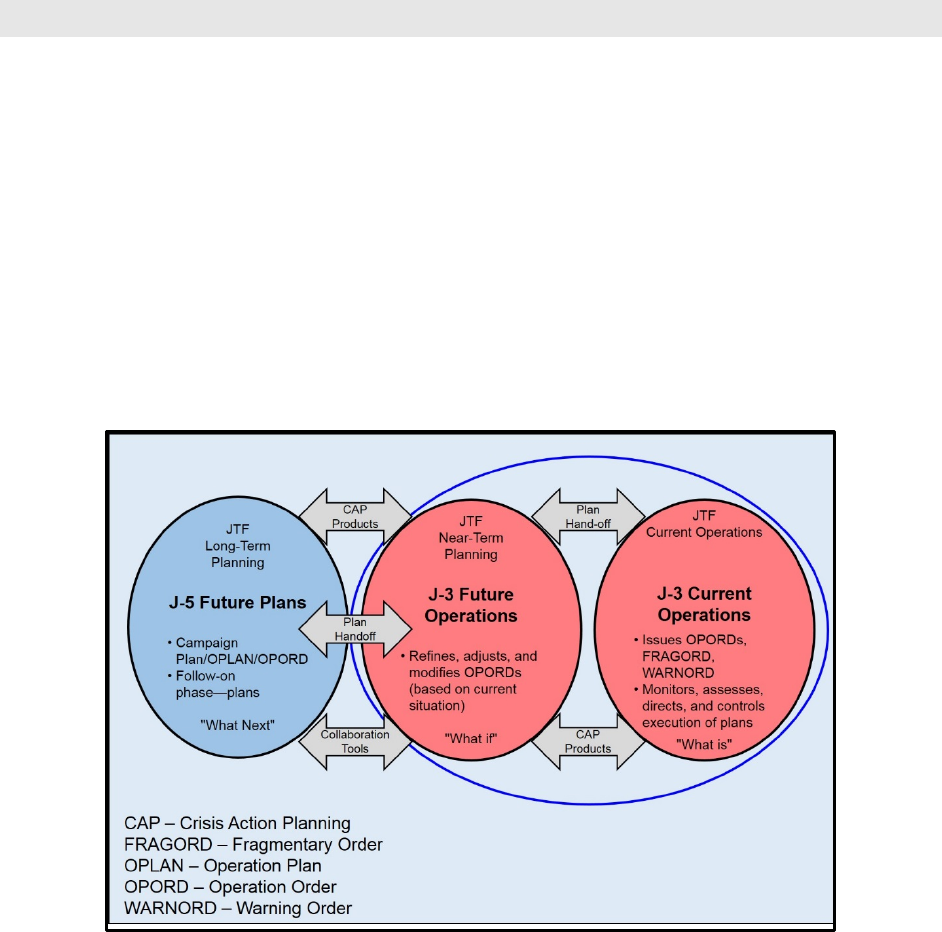
35
Chapter 4: Execution
I. Execution
1. Execute Order (EXORD). Execution begins when the President decides to use a military
option to resolve a crisis. Only the President or Secretary of Defense (SecDef) can authorize the
Chairman of the Joint Chiefs of Staff (CJCS) to issue an execute order (EXORD). Depending
upon time constraints, an EXORD may be the only order a commander receives. The EXORD
defines the time to initiate operations and conveys guidance not provided earlier. Execution
continues until the operation is terminated or the mission is accomplished.83
2. Planning During Execution. Planning continues during execution, with an initial emphasis
on refining the existing plan and producing the Operation Order (OPORD) and refining the force
flow utilizing employed assigned and allocated forces.
a. As the operation progresses, planning generally occurs in three distinct but
overlapping timeframes: future plans, future operations, and current operations (see
Figure 4-1).
Figure 4-1: Planning During Execution84
(1) The plans directorate of a joint staff (J-5) focuses on future plans. The
timeframe of focus for this effort varies according to the level of command, type
of operation, commander desires, and other factors. Typically, the emphasis of
the future plans effort is on planning the next phase of operations or sequels to
the current operation. In a campaign, this could be planning the next major
operation or the next phase of the campaign.
(2) Planning also occurs for branches to current operations (future operations
planning). The timeframe of focus for future operations planning varies according
to the factors listed for future plans, but the period typically is more near-term
than the future plans timeframe. Future planning normally occurs in the J-5 or
36
joint planning group (JPG), while future operations planning normally occurs in
the operations directorate (J-3).
(3) Finally, current operations planning addresses the immediate or very near-
term planning issues associated with ongoing operations. This occurs in the joint
operations center or J-3.
b. During execution, progress in meeting the commander's intent and successful
accomplishment of tasks will be monitored and measured, along with the input of new
data and information as it is obtained to facilitate decision making and allow for selection
of branches or sequels, if applicable, or the plan to be modified as necessary.
c. Future planners must also look for opportunities or unforeseen challenges that
suggest that the current mission may require revision and that a different operational
approach may be required to achieve the desired end state. They should also look for
indicators that the desired end state is not achievable or no longer desirable.
Subsequently, these circumstances may result in a reframing of the problem and the
development or execution of a branch plan or new course of action (COA).
d. Execution of a plan does not end the planning process. The planning cycle may be
reentered at any point to receive new guidance, provide an in-progress review (IPR),
modify the plan, decide if and when to execute branches or sequels, or terminate the
operation. Planning also continues for future operations.85
3. Command and Control. How commanders organize their assigned or attached forces
directly affects the responsiveness and versatility of operations. The first principle in joint force
organization is that commanders organize forces to accomplish the mission based on their
intent and concept of operations (CONOPS). Unity of command, centralized planning and
direction, and decentralized execution are key considerations. Joint forces can be established
on a geographic or functional basis. Commanders may elect to centralize selected functions
within the joint force, but should avoid reducing the versatility, responsiveness, and initiative of
subordinate forces. Commanders should allow Service and special operations forces (SOF)
tactical and operational forces, organizations, and capabilities to function generally as they were
designed. All Service components contribute their distinct capabilities to joint operations;
however, their interdependence is essential to overall joint effectiveness. Joint interdependence
is the purposeful reliance by one Service on another Service's capabilities to maximize the
complementary and reinforcing effects of both; the degree of interdependence varies with
specific circumstances. Simplicity and clarity of expression are essential.86
a. Mission Command is key to effective command and control. Mission Command is the
exercise of authority and direction by the commander using mission orders to enable
disciplined initiative within the commander's intent to empower agile and adaptive
leaders in the conduct of unified land operations. The mission command philosophy
effectively accounts for the nature of military operations. Throughout operations,
unexpected opportunities and threats rapidly present themselves. Operations require
responsibility and decision-making at the point of action. Through mission command,
commanders initiate and integrate all military functions and actions toward a common
goal – mission accomplishment.
b. The exercise of mission command is based on mutual trust, shared understanding,
and purpose. Commanders understand that some decisions must be made quickly at the
point of action. Therefore, they concentrate on the objectives of an operation, not how to
achieve them. Commanders provide subordinates with their intent, the purpose of the
operation, the key tasks, the desired end state, and resources. Subordinates then
37
exercise disciplined initiative to respond to unanticipated problems. Every Soldier must
be prepared to assume responsibility, maintain unity of effort, take prudent action, and
act resourcefully within the commander's intent.87
4. Fires. To employ fires is to use available weapons and other systems to create a specific
kinetic or non-kinetic effect on a target. Joint fires are those delivered during the employment of
forces from two or more components in coordinated action to produce desired results in support
of a common objective. Fires typically produce destructive effects, but various non-kinetic ways
and means can be employed with little or no associated physical destruction. This function
encompasses the fires associated with a number of tasks, missions, and processes, including:
a. Targeting. This is the process of selecting and prioritizing targets and matching the
appropriate response to them, taking account of command objectives, operational
requirements, and capabilities.88
b. Time-Sensitive Targeting. A time-sensitive target (TST) is a target of such high
priority to friendly forces that the commander designates it as requiring immediate
response because it poses (or will soon pose) a danger to friendly forces, or it is a highly
lucrative, fleeting target. TSTs are normally executed dynamically; however, to be
successful, they require considerable deliberate planning and preparation within the joint
targeting cycle.89
5. Assessment. Assessment is the continuous monitoring and evaluation of the current
situation and progress of a joint operation toward mission accomplishment. It involves
deliberately comparing forecasted outcomes to actual events to determine the overall
effectiveness of force employment. In general, assessments should answer two questions: Is
the commander doing things right? Is the commander doing the right things? More specifically,
assessment helps commanders determine progress toward achieving objectives and whether
the current tasks and objectives are relevant to reaching the end state. It helps identify
opportunities, counter threats, and any needs for course correction, thus resulting in
modifications to plans and orders. This process of continuous assessment occurs throughout
the joint planning process. It is an essential tool that allows planners to monitor performance of
tactical actions (measures of performance [MOPs]) and to determine whether the desired
effects are created (measures of effectiveness [MOEs]) to support achievement of the
objectives.90
a. During execution, the commander's staff identifies those key assessment indicators
that suggest progress or setbacks in accomplishing tasks, creating effects, and
achieving objectives. Assessment actions and measures help commanders adjust
operations and resources as required, determine when to execute branches and
sequels, and make other critical decisions to ensure current and future operations
remain aligned with the mission and military end state.
b. Normally, the operations directorate (J-3), assisted by the intelligence directorate
(J-2), is responsible for coordinating assessment activities. The chief of staff facilitates
the assessment process and the determination of commander's critical information
requirements (CCIRs) by incorporating them into the staff's battle rhythm. Various
elements of the commander's staff use assessment results to adjust both current
operations and future planning.91
II. Cyberspace Operations during Execution.
1. Execution. As the commander integrates cyberspace operations (CO) capabilities into joint
operations, careful consideration must be given to some of the unique aspects of cyberspace,
as well as its commonalities and synergies with operations in the physical domains: the
38
relationship with IO; legal, political, and technical drivers and constraints; and the role of non-
DOD actors.92
2. Legal Considerations. The legal framework applicable to CO depends on the nature of the
activities to be conducted, such as offensive or defensive military operations; defense support of
civil authorities; service provider actions; law enforcement and counterintelligence activities;
intelligence operations; and defense of the homeland. Before conducting CO, commanders,
planners, and operators must understand the relevant legal framework in order to comply with
laws and policies, the application of which may be challenging given the ubiquitous nature of
cyberspace and the often geographic orientation of domestic and international law (see
Appendix A: DOD Law of War Manual excerpt).
3. Command and Control of Cyberspace Operations. The cyberspace operations command
and control (C2) architecture defines global, regional, and functional cyberspace operational
lanes; enables unity of effort; and allows combatant commands (CCMDs) to use current
authorities to conduct timely operations. It stresses the need for partnership among all
Department of Defense (DOD) organizations conducting operations across the three
cyberspace lines of operation (LOOs) and lines of effort (LOEs) of: Department of Defense
information network (DODIN) operations, defensive cyberspace operations (DCO), and
offensive cyberspace operations (OCO) (see Figure 4-2).
a. CCMD Support Relationships. Cyberspace Operations require coordination
between theater and global operations, creating a dynamic command and control (C2)
environment. CO are integrated and synchronized by the supported commander into
their CONOPS, detailed plans and orders, and specific joint offensive and defensive
operations. The Geographic Combatant Commander (GCC) is generally the
supported commander for CO with first order effects within their area of
responsibility (AOR). Similarly, the Commander USCYBERCOM is generally the
supported commander at the global or transregional (across AOR boundaries)
level. C2 of Department of Defense information network (DODIN) operations and
Defensive Cyberspace Operations (DCO) may require pre-determined and
preauthorized actions based on meeting particular conditions and triggers, executed
either manually or automatically if the nature of the threat requires instantaneous
response. The commander and planners should understand these command
relationships, how they are derived and employed, and when necessary, how to
deconflict them without compromising other operations. Forces conducting CO may
simultaneously support multiple users. This requires extensive coordination, planning,
and early integration of requirements and capabilities. Supported and supporting
commanders coordinate, as appropriate, the deployment and employment of forces
conducting CO required to accomplish the assigned mission. Some CO forces may be
geographically separated from a particular supported theater of operations. Such cases
require all involved commanders to take extra measures to ensure the supported
commander is continuously aware of the remote supporting forces' operational status.
(1) Forces providing global CO capabilities may need to support multiple CCMDs
nearly simultaneously. Reachback to these capabilities allows faster adaptation
to rapidly changing needs. At the same time, GCCs must be able to effectively
conduct theater CO in order to operate and defend tactical and constructed
networks. They must also be able to synchronize cyberspace activities related to
accomplishing their operational objectives. In order to do that, some CO
capabilities supporting synchronization may need to be forward deployed.
However, CCMDs should retain knowledge and expertise required to support
39
effective reachback within the CCMD, typically through the CCMD's Cyberspace
Operations Support Staff.93
(2) Mission Command. CO planning teams assist the commander in the details of
planning, preparing, executing, and assessing by conducting the operations
process. They use the operations process to integrate and synchronize within the
headquarters and across the force. Although staffs perform many tasks, they use
knowledge and information management practices to provide commanders the
information they need to create and maintain their understanding and make
effective decisions. Staffs also assist the commander in informing and influencing
audiences. Additionally, staffs integrate and synchronize cyber electromagnetic
activities across all command echelons and warfighting functions.
b. Cyber Mission Force (CMF). The focus of USCYBERCOM's Cyber Mission Force
teams aligns with the DOD Cyber Strategy's three primary missions: Defend DOD
networks and ensure their data is held secure; support joint military commander
objectives; and, when directed, defend U.S. critical infrastructure. Specifically, Cyber
Mission Force teams support these mission sets though their respective assignments:
(1) Cyber Protection Force (CPF) teams defend the DODIN and assigned
cyberspace, protect priority missions, and prepare cyber forces for combat. The
CPF comprises:
• Cyberspace Protection Teams (CPTs).
(2) Cyber National Mission Force (CNMF) teams defend the nation by seeing
adversary activity, blocking attacks, and maneuvering to defeat them. The CNMF
comprises:
• National Mission Teams (NMTs)
• National Support Teams (NSTs)
(3) Cyber Combat Mission Force (CCMF) teams conduct military cyber
operations in support of combatant commands. The CCMF comprises:
• Combat Mission Teams (CMTs)
• Cyber Support Teams (CSTs).
c. Joint Force Headquarters – Cyberspace (JFHQ-C). As a part of the Cyberspace
Mission Force, USCYBERCOM designated each service's cyberspace component
(AFCYBER, ARCYBER, MARFORCYBER, U.S. Fleet Cyber Command) a Joint Force
Headquarters–Cyberspace and directed each one to support specific combatant
commands. These headquarters provide cyberspace domain expertise, enabling the
supported CCMD staff to integrate the necessary operational- and tactical-level
cyberspace planning activities into operational plans. Additionally, JFHQ-C executes
OPCON to the tactical firing units known as Combat Mission Teams, which are aligned
to specific target sets within their respective combatant commands. The CCMD
cyberspace operations support staff and JFHQ-C establish unity of command and unity
of effort for the combatant commander's (or joint force commander's, if established)
cyberspace operations through direction of the attached combat mission teams.
(1) JFHQ-C Marine Forces Cyber Command supports U.S. Special Operations
Command.
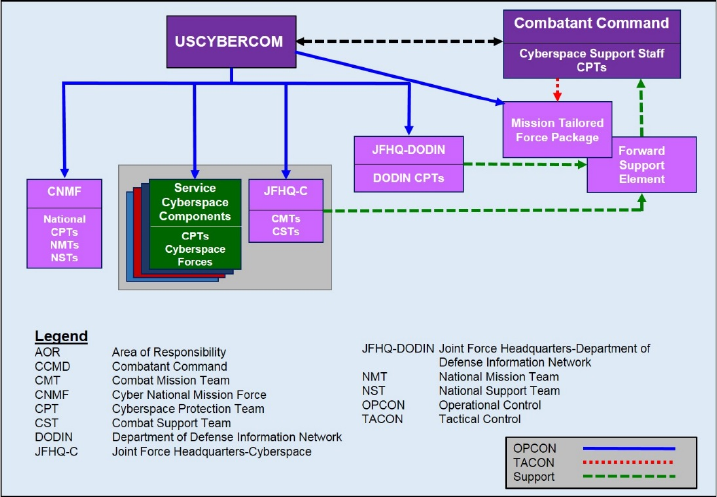
40
(2) JFHQ-C Army Cyber Command supports U.S. Central Command, U.S.
Africa Command, and U.S. Northern Command.
(3) JFHQ-C Fleet Cyber Command supports U.S. Pacific Command and U.S.
Southern Command.
(4) JFHQ-C Air Force Cyber Command supports U.S. European Command,
USSTRATCOM, and U.S. Transportation Command.94
d. Joint Force Headquarters-Department of Defense Information Networks (JFHQ-
DODIN). JFHQ-DODIN has operational control over each DODIN command for global
DODIN/Defensive Cyberspace Operations – Internal Defensive Measures (DCO-IDM)
activities supporting USCYBERCOM's global DODIN mission. The DODIN commands
are tactical level headquarters supporting both global and regional CCMD mission
needs. CCMD JCCs have tactical control of assigned DODIN commands for those
DODIN and DCO-IDM activities supporting their regional CCMD missions.95
Figure 4-2: Joint Cyberspace Operations Command and Control
4. Cyberspace Synchronization. The pace of CO requires significant pre-operational
collaboration, as well as constant vigilance upon initiation, to ensure that activities in cyberspace
and throughout the operational environment (OE) are coordinated and deconflicted in advance.
One key to this is maintaining cyberspace SA and assessing the potential impacts to the joint
force of any planned CO, including security posture, changes in configuration, or observed I&W
of adversary activity. Planners and operators must also understand how operations within the
OE may impact the commander's CO efforts, and vice versa. Fire support coordination
measures are a method that the joint force plans and uses in the air, land, and maritime
domains which facilitate the rapid engagement of targets and simultaneously provide
safeguards for friendly forces. Deconfliction and coordination efforts in or through cyberspace
should include similar measures:
a. Deconfliction of the commander's intended offensive cyberspace operations (OCO),
their activities, and the techniques planned to create these effects with other commands
and agencies that may have equities in the same area of cyberspace is required. From a
41
technical and operational perspective, deconfliction requires detailed analysis of each of
the capabilities whose interoperability is being considered, as well as that of the target
environment, to ensure the desired effects are achieved without unintended
consequences. Additionally, the timelines required for analysis and coordination should
be considered and included in the plan.
b. Planners should maintain awareness of the electromagnetic spectrum (EMS) and its
impact on mobile devices and wireless networks, including cellular, wireless local area
network, Global Positioning System, and other commercial and military uses of the EMS.
CO and electronic attack (EA), to include offensive space control, must be deconflicted.
Uncoordinated EA may significantly impact OCO utilizing the EMS. Depending upon
power levels, the terrain in which they are used, and the nature of the system being
targeted, unintended effects of EA can also occur outside of a local commander's AOR
just as second order effects of CO may occur outside the AOR.
c. Minimizing vulnerabilities to the joint force caused by cyberspace applications.
Coordinated joint force operations benefit from the use of various applications, including
Web sites used for public affairs and strategic communication. Forward deployed forces
also use the Internet, mobile phones, and instant messaging for logistics, morale
purposes, and to communicate with friends and families. These DOD classified and
unclassified networks are targeted by myriad actors, from foreign nations to malicious
insiders. The commander must work with the Defense Information Systems Agency
(DISA), the Services, and USCYBERCOM as well as assigned forces to limit the threat
to U.S. and partner nations' networks.96
5. Targeting in Cyberspace. The purpose of targeting is to integrate and synchronize fires (the
use of available weapon systems to create a specific lethal or nonlethal effect on a target) into
joint operations. Targeting is the process of selecting and prioritizing targets and matching the
appropriate response to them, considering operational requirements and capabilities. However,
three aspects of CO should be included in the commander's targeting processes: recognizing
that cyberspace capabilities are a viable option for engaging designated joint targets;
understanding that a CO option may be preferable in some cases; and first, second, and third
order effects on joint targets may involve or affect elements of the DODIN. Additionally, there
are some characteristics unique to cyberspace targets and cyberspace capabilities that are
described below.
a. Targets in Cyberspace. Every target has distinct intrinsic or acquired characteristics.
These characteristics form the basis for target detection, location, identification, target
value within the adversary target system, and classification for future surveillance,
analysis, strike, and assessment. As discussed earlier, cyberspace can be viewed as
consisting of three layers: physical network, logical network, and cyber-persona. The
challenge in targeting is to identify, coordinate, and deconflict multiple activities occurring
across multiple layers.
(1) The physical network layer is the medium where the data travels. It includes
wired (land and submarine cable) and wireless (radio, radio-relay, cellular,
satellite) transmission means. It is the first point of reference for determining
jurisdiction and application of authorities. It is also the primary layer for geospatial
intelligence, which can also contribute useful targeting data in cyberspace.
(2) The logical network layer constitutes an abstraction of the physical network
layer, depicting how nodes in the physical dimension of the information
environment logically relate to one another to form entities in cyberspace. The
42
logical network layer is the first point where the connection to the physical
dimension of the information environment is lost.
(3) The cyber-persona layer, an individual's or groups' online identity(ies), holds
important implications for joint forces in terms of positive target identification and
affiliation, and activity attribution. Because cyber-personas can be complex, with
elements in many virtual locations, but normally not linked to a single physical
location or form, significant intelligence collection and analysis capabilities are
required for the joint forces to gain sufficient insight and SA of a cyber-persona to
enable effective targeting and creation of the commander's desired effects.97
b. Target Development in Cyberspace. Target development should be requested
much earlier than that for traditional targets and should have a longer-term focus. More
often, full target development takes weeks, months, or years instead of days.98 This is
due to the additional lead time necessary to generate intelligence for the offensive
cyberspace effects. During deliberate planning, the capabilities analysis phase seeks to
match apportioned assets and ordnance with the target and effect desired. Once a target
is selected to be serviced by traditional means, it is periodically reviewed during the plan
review cycle. No further resources are expended on maintaining access to the target
until the plan is executed. By contrast, designating a target to be engaged with OCO
starts the immediate allocation and expenditure of additional resources. Maintaining and
developing a target requires a significant amount of time
(see Figure 4-3).99
(1) Mission. Due to the technical and sensitive nature of cyberspace operations,
the commander will normally approve planning based on an initial concept of
operations. Planners should consider cyber-enabled effects to accomplish the
commander's objectives. Cyberspace capabilities must operate and create
effects within the complex and ever-changing systems in cyberspace; however,
they are each developed with certain environmental assumptions and
expectations about the operating conditions that will be found in the target
environment.100
(2) Intelligence, Surveillance, and Reconnaissance. After receiving the
commander's approval, the cyberspace operations team attempts to gain access
and understand the targeted system.
• Access. The first step to engage a target with OCO is to gain access
to it. Without physical or electronic access to the target, it is
impossible to proceed with OCO. A system linked to the Internet is, in
general, more accessible, though getting into its targeted portions
may be challenging due to its own network security environment. A
closed system would require insider access to gain firsthand
knowledge of the computing environment in the target facility. Once
forces gain access to a target system, they need to maintain it as long
as they might wish to strike the target. Network upgrades or system
changes made in the regular maintenance of the target could make it
difficult to maintain or regain access. The risk from gaining access to
a system is that an adversary might detect the hacking well before the
attack. The adversary would discover which systems were being
targeted. Moreover, discovery would assuredly result in access being
lost – and the possibility of the adversary studying the attack to
43
understand U.S. cyberspace operations and develop better defenses
or even counterattacks.
• Understanding. Once access is gained, the next step is to learn the
unique internal attributes of the targeted system. Cyberspace
operations teams may need to acquire the software being targeted so
they can determine its nature and vulnerabilities. Depending on the
system to be attacked, the code might be commented in a language
other than English. If cyberspace teams are unable to gain technical
insight into the targeted software, then OCO cannot proceed;
coordinating the proper effect is impossible. The commander must
consider these attributes of OCO when setting target priorities during
deliberate planning.
(3) Capability Development. Once the cyberspace operations team has
developed a means for continuous access and learned the targeted system, they
must then coordinate acquisition or development of the weapon with which to
attack it. Some weapons designed to attack common operating systems such as
Windows are commercially available. However, systems produced and used only
in certain countries typically require forces to develop weapons from scratch.
Developing a cyber weapon is a complex challenge. Once a weapon has been
developed, the cyberspace operations teams must constantly maintain access to
and monitor the target. They must ensure routine system maintenance does not
nullify their labors. All of these actions require a significant amount of time,
perhaps months, before anything besides a rudimentary attack can be launched
with a presumption of success. Furthermore, depending on the target and its
accessibility, a weapon may need to navigate through several networks to its
intended target.
(4) Execution. After the cyberspace operations teams gain access and develop
a capability, the proposed operation is reviewed for collateral damage issues and
legal concerns. USCYBERCOM, in coordination with the applicable Service
Component/Joint Force Headquarters – Cyber (JFHQ-C), determines if
resources are available to service the commander's target request.101 If all these
criteria are met, the commander directs an Execution Order (EXORD) for the
specific cyberspace operation.
• Cascading and Collateral Effects. Overlaps between military, civil,
government, private, and corporate activities on shared networks in
cyberspace make the evaluation of probable cascading and collateral
effects particularly important when planning for CO. Due to policy
concerns, an EXORD or applicable rules of engagement (ROE) may
limit CO to only those operations that result in no or low levels of
collateral effects. A collateral effects analysis to meet policy limits is
separate and apart from the proportionality analysis required by the
law of war. Even if a proposed CO is permissible after a collateral
effects analysis, the proposed operation must also be permissible
under a law of war proportionality analysis.
• Target Nomination and Synchronization. Component commanders,
national agencies, supporting commands and/or the staff submit
target development nominations to the targeting staff for development
and inclusion on the joint target list (JTL). Once identified on the JTL,
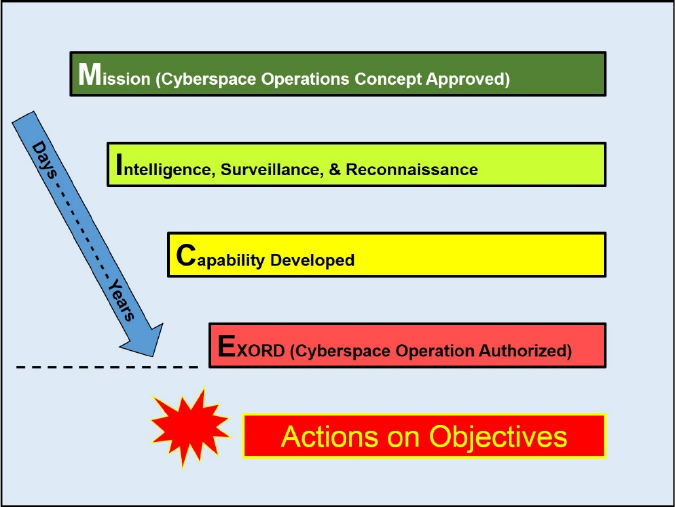
44
targets can be selected for engagement by organic assets (if within a
component commander's assigned area of operations) or nominated
for action by other joint force components and other organizations,
usually via a coordinating body (joint fires element [JFE] of the
operations directorate of joint staff) or working group (joint targeting
working group [JTWG]). The JFE normally holds a JTWG for
prioritization of the nominated targets through a draft joint integrated
prioritized target list (JIPTL) and establishment of the "cut line." The
"cut line" simply reflects an estimate of resources available to take
action against targets in priority order and does not guarantee that a
specific target will be attacked. The joint targeting coordination board
(JTCB) provides a senior level forum in which all components can
articulate strategies and priorities for future operations to ensure that
they are synchronized and integrated. Although most targeting issues
are worked out at the JTWG, the JTCB normally conducts final
coordination of the JIPTL and submits it for commander approval. The
JFE also maintains the restricted target list and no-strike list. The
no-strike list contains objects or entities that are not legal targets,
while, the restricted target list is constrained by the commander for
other reasons characterized as protected from the effects of military
operations under international law and/or the rules of engagement.102
Figure 4-3: Cyberspace Target Development and Approval
c. Time-Sensitive Targeting. Time-sensitive targets (TSTs) that are engaged through
CO require detailed joint, cross-CCMD, interagency, and likely multinational planning
and coordination of OPE, engagement, assessment, and intelligence efforts. The actual
prosecution of a TST through cyberspace requires that cyberspace planners and
operators coordinate with the supported commander early in the planning phase to
ensure access to the target is available when the fleeting opportunity arises. In addition,
commanders should establish procedures to quickly promulgate execution orders for
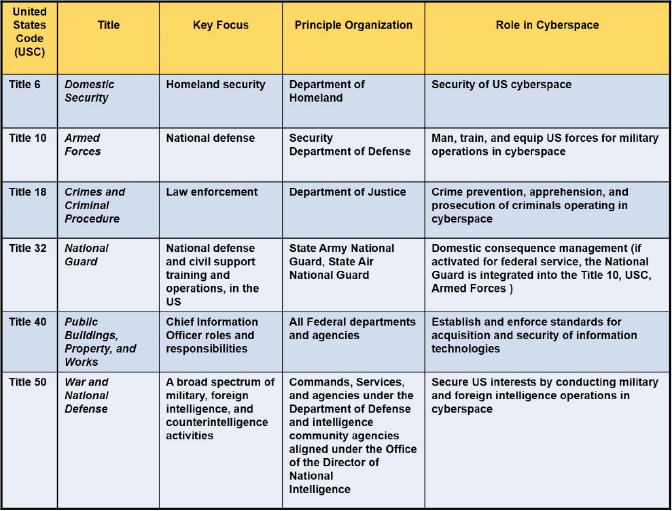
45
CO-engaged TSTs, which due to their unique cyberspace interagency
deconfliction/coordination requirements may involve coordinating pre-approval for
specific actions conducted under specific circumstances. Likewise, successful
prosecution of TSTs requires a well-organized and well-rehearsed process for sharing
sensor data and targeting information, identifying suitable strike assets, obtaining
mission approval, and rapidly deconflicting weapon employment. The key for success is
performing as much coordination and decision making as possible in advance.103
d. Multinational Considerations. Allies and coalition partners often require approval of
the CO portion of plans and orders from higher authority, which may significantly impede
CO implementation. Additionally, this national-level approval requirement increases
potential constraints and restraints upon the participating national forces, and further
lengthens the time required to gain national approval for their participation. Commanders
and planners should be particularly sensitive to national agendas and anticipate the
additional time required for approval through this parallel national command structure.104
6. Authorities. Authority for actions undertaken by the Armed Forces of the United States is
derived from the U.S. Constitution and Federal law. These authorities establish roles and
responsibilities that provide focus for organizations to develop capabilities and expertise,
including those for cyberspace. Key statutory authorities that apply to DOD include Title 10,
United States Code (USC), Armed Forces; Title 50, USC, War and National Defense; and Title
32, USC, National Guard. See Figure 4-4 for a summary of applicable titles of USC as they
apply to cyberspace operations.105
Figure 4-4: United States Code-Based Authorities106
7. Cyberspace Assessment. Cyberspace Operations should be considered in the development
of operational level MOPs/MOEs. In some cases, activities in cyberspace alone will have
operational level effects; for example, the use of a cyberspace attack to bring down or corrupt
the adversary headquarters network could very well reverberate through the entire Joint
Operations Area (JOA). A CO option may be preferable in some cases.
46
a. Assessments in cyberspace may be unique in that the normal assessment cell will not
typically have the capabilities or expertise to assess CO; CO will typically involve
multiple commands, such as the supported joint force commander (JFC),
CDRUSCYBERCOM, and possibly other functional supporting JFCs.
b. Additionally, with CO typically being conducted as part of a larger operation,
assessment of CO will need to be conducted in the context of supporting the overarching
commander's objectives. Therefore, CO assessments will require close coordination
within each staff and across multiple commands. Coordination and federation of the
assessment efforts will often require arrangements that need to be in place prior to
execution.107
8. Operational Challenges. CO may not require physical proximity; many CO can be executed
remotely. Moreover, the effects of CO may extend beyond a target, a joint operations area
(JOA), or even an AOR. Because of transregional considerations or the requirement for high-
demand, low-density resources, CO may be coordinated, integrated, and synchronized with
centralized execution from a location outside the AOR of the supported commander. Another
challenge facing the commander is that the use of a capability may reveal its functionality and
compromise future effectiveness. This has implications for OCO, but it also affects DCO as the
same capabilities may have a role in both OCO and DCO.108

47
Chapter 5: Operations in the Homeland
"Much of our critical infrastructure – our financial systems, our power grid, health
systems – run on networks connected to the Internet, which is hugely
empowering but also dangerous, and creates new points of vulnerability that we
didn't have before. Foreign governments and criminals are probing these
systems every single day."
President Barrack Obama109
I. Department of Defense Missions in the Homeland
1. The mission of the Department of Defense (DOD) is to provide the military forces needed to
deter war and to protect the security of the U.S. The U.S. employs all instruments of national
power to continuously defeat threats to the homeland. DOD executes the homeland defense
(HD) mission by detecting, deterring, preventing, and defeating threats from actors of concern
as far forward from the homeland as possible.
2. The U.S. homeland is the physical region that includes the continental United States
(CONUS), Alaska, Hawaii, U.S. territories, and surrounding territorial waters and airspace. The
homeland is a functioning theater of operations, and the DOD regularly performs a wide range
of defense operations within the theater. Homeland Defense is the protection of U.S.
sovereignty, territory, domestic population, and critical infrastructure against external
threats and aggression, or other threats as directed by the President. An external threat or
aggression is an action, incident, or circumstance that originates from outside the boundaries of
the homeland. Threats planned, prompted, promoted, caused, or executed by external actors
may develop or take place inside the boundaries of the homeland. The reference to external
threats does not limit where or how attacks may be planned and executed. DOD is responsible
for the HD mission, and leads the response with support from international partners and United
States Government (USG) departments and agencies. HD is executed across the active,
layered defense construct composed of the forward regions, the approaches, and the
homeland.
3. By law, DOD is responsible for two missions in the homeland: HD and defense support of civil
authorities (DSCA). Two geographic combatant commanders (GCCs) are the supported
commanders for HD in their AORs, with virtually all other combatant commanders (CCDRs)
supporting them. Commander, United States Northern Command (CDRUSNORTHCOM) and
Commander, United States Pacific Command (CDRUSPACOM) are charged with specific
responsibilities for HD and DSCA. HD, DSCA, and homeland security (HS) operations or events
may occur simultaneously.
4. Operations in the homeland environment (both HD and HS) require pre-event and ongoing
coordination with interagency, intergovernmental (i.e. federal, state, local, and tribal), and
multinational partners to integrate capabilities and facilitate unified action. In this complex
environment there are numerous threats across multiple jurisdictions that are addressed by a
diverse group of actively involved stakeholders to include intergovernmental organizations
(IGOs), multinational partnerships, nongovernmental organizations (NGOs), and the private
sector. DOD plans and prepares to operate in concert with other USG entities (see Figure 5-1).
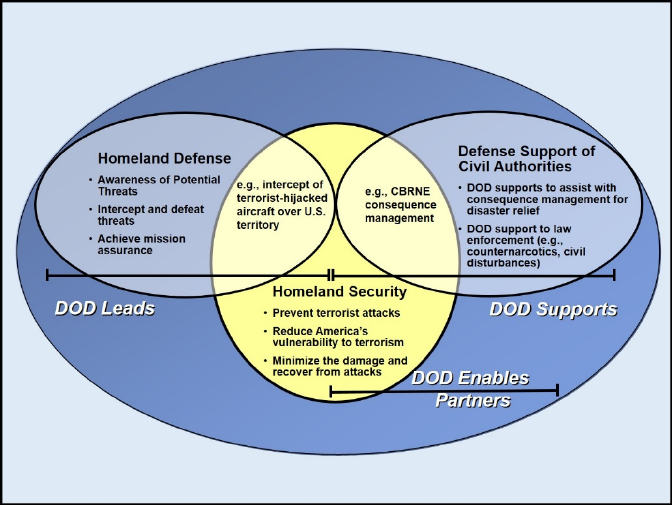
48
Figure 5-1: Active, Layered Defense of the United States
a. Homeland Security (HS). The Department of Homeland Security (DHS) is the lead
federal agency (LFA) for HS. HS is a concerted national effort to prevent terrorist attacks
within the U.S.; reduce domestic vulnerability to terrorism, major disasters, and other
emergencies; and minimize the damage and recover from attacks, major disasters, and
other emergencies that occur. HS is typically conducted by federal, state, tribal, and/or
local government organizations in conjunction with the private sector; and includes law
enforcement (LE) activities related to countering terrorism and other criminal activities.
For HS, DOD may conduct DSCA in response to requests for assistance from civil
authorities, supporting a lead interagency partner such as DHS or Department of Justice
(DOJ), or in some cases, a state governor. DOD support must be formally requested by
the applicable civil authority and then approved by the President or Secretary of Defense
(SecDef).
b. Homeland Defense (HD). HD is a DOD mission. DOD is the USG lead agency
responsible for defending against traditional external threats or aggression (e.g., nation-
state conventional force or weapons of mass destruction [WMD] attack) and against
external asymmetric threats. During HD operations, DOD coordinates with other
interagency partners that may be undertaking simultaneous operations to counter the
same or other threats.
c. Defense Support of Civil Authorities (DSCA). DSCA is support provided by U.S.
federal military forces, DOD civilians, DOD contract personnel, DOD component assets,
and National Guard (NG) forces (as applicable under Title 10, USC, Section 12304 or
Title 32, USC, Section 502) in response to requests for assistance from civil authorities
for domestic emergencies, LE support, and other domestic activities, or from qualifying
entities for special events. HD and DSCA missions may occur simultaneously and
require extensive coordination, integration, and synchronization.
d. Emergency Preparedness (EP). DOD may also be required to engage in emergency
preparedness. EP are measures taken in advance of an emergency to reduce the loss of
49
life and property and to protect a nation's institutions from all types of hazards through a
comprehensive emergency management program of preparedness, mitigation,
response, and recovery. EP is considered a part of DOD's overall preparedness
activities. It is not a stand-alone activity, but is an integral part of DOD training,
mitigation, and response for both HD and DSCA.110
II. Critical Infrastructure
1. The nation's critical infrastructure provides the essential services that underpin American
society and serve as the backbone of our nation's economy, security, and health. We know it as
the power we use in our homes, the water we drink, the transportation that moves us, the stores
we shop in, and the communication systems we rely on to stay in touch with friends and family.
2. There are 16 critical infrastructure sectors whose assets, systems, and networks, whether
physical or virtual, are considered so vital to the United States that their incapacitation or
destruction would have a debilitating effect on security, national economic security, national public
health or safety, or any combination thereof. Presidential Policy Directive 21 (PPD-21): Critical
Infrastructure Security and Resilience advances a national policy to strengthen and maintain
secure, functioning, and resilient critical infrastructure. PPD-21 identifies 16 critical infrastructure
sectors:
a. Chemical Sector – Department of Homeland Security
b. Commercial Facilities Sector – Department of Homeland Security
c. Communications Sector – Department of Homeland Security
d. Critical Manufacturing Sector – Department of Homeland Security
e. Dams Sector – Department of Homeland Security
f. Defense Industrial Base Sector – Department of Defense
g. Emergency Services Sector – Department of Homeland Security
h. Energy Sector – Department of Energy
i. Financial Services Sector – Department of the Treasury
j. Food and Agriculture Sector – Department of Agriculture and Department of Health
and Human Services
k. Government Facilities Sector – Department of Homeland Security and General
Services Administration
l. Healthcare and Public Health Sector – Department of Health and Human Services
m. Information Technology Sector – Department of Homeland Security
n. Nuclear Reactors, Materials, and Waste Sector – Department of Homeland Security
o. Transportation Systems Sector – Department of Homeland Security and Department
of Transportation
p. Water and Wastewater Systems Sector – Environmental Protection Agency111
III. Defense Critical Infrastructure Program
1. DOD Responsibilities. The DOD has two roles for critical infrastructure protection, first as a
Federal department and second as a Sector-Specific Agency for one of 16 national
infrastructure sectors – the Defense Industrial Base. Within DOD, the Assistant Secretary of
50
Defense for Homeland Defense and Americas' Security Affairs, ASD (HD&ASA), is assigned as
the lead official for providing policy, guidance, oversight, and resource advocacy for these roles.
The Director of Critical Infrastructure Protection under the ASD (HD&ASA) oversees the day-to-
day execution of these responsibilities. The responsibilities for each of these roles are
summarized below.
a. Federal Department. As a Federal department, DOD has both departmental and
national responsibilities. Departmental responsibilities include the identification,
prioritization, assessment, remediation, and protection of defense critical infrastructure.
Additionally, all Federal departments and agencies work together at a national level to
"prevent, deter, and mitigate the effects of deliberate efforts to destroy, incapacitate, or
exploit" critical infrastructure and key resources. DOD and the broader Federal
government will work with State and local governments and the private sector to
accomplish this objective.
b. Sector-Specific Agency. As the Sector-Specific Agency for the Defense Industrial
Base, DOD has the responsibilities to:
(1) Collaborate with all relevant federal departments and agencies, state and
local governments, and the private sector, including key persons and entities in
their infrastructure sector;
(2) Conduct or facilitate vulnerability assessments of the sector;
(3) Encourage risk-management strategies to protect against and mitigate the
effects of attacks against critical infrastructure and key resources; and
(4) Support sector-coordinating mechanisms:
• to identify, prioritize, and coordinate the protection of critical
infrastructure and key resources; and
• to facilitate sharing of information about physical and cyber threats,
vulnerabilities, incidents, potential protective measures, and best
practices.112
IV. Cyberspace Operations in the Conduct of Homeland Defense
1. DOD Cyber Strategy. The U.S. conducts operations, including HD, in a complex,
interconnected, and increasingly global operational environment to include the cyberspace
domain. The DOD Cyber Strategy sets five strategic goals for its cyberspace missions. One of
these goals it to be prepared to defend the U.S. homeland and U.S. vital interests from
disruptive or destructive cyberattacks of significant consequence. The Department of
Defense must work with its interagency partners, the private sector, and allied and partner
nations to deter and if necessary defeat a cyberattack of significant consequence on the U.S.
homeland and U.S. interests. The Defense Department must develop its intelligence, warning,
and operational capabilities to mitigate sophisticated, malicious cyberattacks before they can
impact U.S. interests. Consistent with all applicable laws and policies, DOD requires granular,
detailed, predictive, and actionable intelligence about global networks and systems, adversary
capabilities, and malware brokers and markets. To defend the nation, DOD must build
partnerships with other agencies of the government to prepare to conduct combined cyber
operations to deter and if necessary defeat aggression in cyberspace. The DOD is focused on
building the capabilities, processes, and plans necessary to succeed in this mission (see Figure
5-2).113
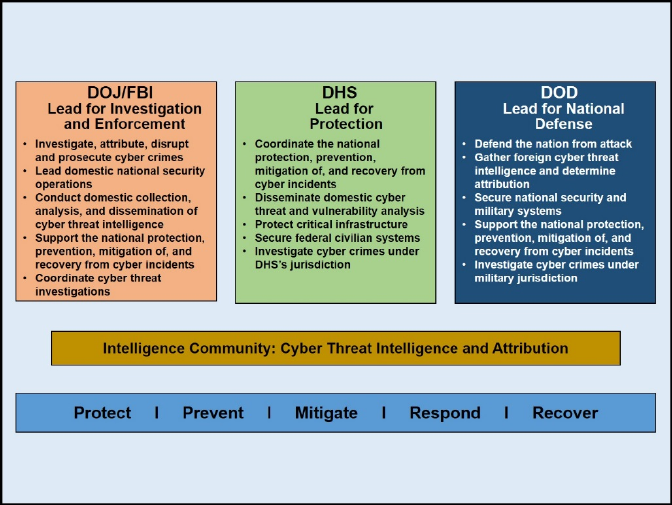
51
Figure 5-2: National Cybersecurity Roles and Responsibilities
2. Unified Action. For cyberspace, the open vulnerability and complex interrelationship of
national and international networks demands closely coordinated action among the military and
other government entities at all levels. The CCMDs, Services, and United States Cyber
Command (USCYBERCOM), are the military front line of defense. The Secretary of Homeland
Security has statutory primary agency responsibilities as the focal point for the security of
cyberspace, and established the National Cyber Security Division (NCSD) within DHS for
protecting USG, state and local governments, and public networks against cyberspace
intrusions and attacks. USPACOM and USNORTHCOM, because of their HD and HS
responsibilities, have coordination requirements for cyberspace operations through their
cyberspace operations support staff with USCYBERCOM and potentially with NCSD, if that is
not done through USCYBERCOM.114
a. USCYBERCOM synchronizes planning for cyberspace operations, to include direction
of DOD information network (DODIN) operations and defense to secure, operate, and
defend DOD networks, and to defend U.S. critical cyberspace assets, systems, and
functions. Directs DODIN operations and defense in coordination with Chairman of the
Joint Chiefs of Staff (CJCS) and CCMDs. Coordinate with other CCMDs and appropriate
USG departments and agencies prior to the generation of cyberspace effects that cross
AORs in response to cyberspace threats.
b. USCYBERCOM plans, coordinates, integrates, synchronizes, and conducts activities
for offensive and defensive cyberspace operations and defense of DODIN; and when
directed, conducts cyberspace operations to enable actions in the physical domains,
facilitates freedom of action in cyberspace, and denies the same to adversaries.
USCYBERCOM can support HD cyberspace operations in collaboration with
USNORTHCOM, USPACOM, and DHS, by coordinating activities within the required
AOR and assisting with expertise and capabilities directed and made available.115
52
3. Command and Control (C2) of Cyberspace Operations.
a. CDRUSNORTHCOM is responsible to defend against, mitigate, and defeat
cyberspace threats against specific USNORTHCOM and North American Aerospace
Defense Command (NORAD) systems, in coordination with USCYBERCOM and
USPACOM. Geographic and functional CCDRs, as well as the Services, are responsible
for protecting their networks located within the USNORTHCOM AOR which are not
specifically assigned or attached to USNORTHCOM.116
b. CDRUSPACOM is responsible for protection of USPACOM networks in the
USPACOM AOR. USPACOM will coordinate cyberspace operations with its component
commands, subordinate unified commands, JTFs, direct reporting units, and other
CCMDs through the USPACOM Joint Cyber Center (JCC). CDRUSCYBERCOM, is the
supporting commander for cyberspace operations within the USPACOM AOR.
USCYBERCOM normally provides a cyberspace operations teams to USPACOM for
major exercises and operations. For HD, USPACOM and USCYBERCOM have
coordination requirements with DHS through its NCSD as primary agency for protecting
USG and public networks against cyberspace intrusions and attacks. Functional CCDRs
and the Services are responsible for protection of their networks located within the
USPACOM AOR, but not assigned or attached to USPACOM.117
4. Cyberspace Operations Teams and Missions. Defending the nation in cyberspace
requires a military capability, operating according to traditional military principles of
organization for sustained expertise and accountability at a scale that lets us perform
multiple missions simultaneously.
a. The application of military capability at scale is what the Cyber Mission Force (CMF)
gives USCYBERCOM and DOD as a whole. Combat Mission Teams (CMTs) operate
with the combatant commands to support their missions, while National Mission Teams
(NMTs) help defend the nation's critical infrastructure from malicious cyber activity of
significant consequence. Cyber Protection Teams (CPTs) defend DOD Information
Networks alongside local Computer Network Defense Service Providers (CNDSPs).
Each of them complements the efforts of the others. Cyber Mission Force teams can and
do contribute to the nation's cyberspace efforts as they assist the combatant commands
and partner departments and agencies.
b. Cyber Mission Force teams give USCYBERCOM the capacity to operate on a full-
time, global basis on behalf of the combatant commands. The Combat Mission Teams
help combatant commanders accomplish their respective missions to guard U.S.
interests and project the nation's power when authorized to deter those who would
threaten our security—the teams help ensure that we have the ability to enable our
combatant commanders to defeat emerging threats. Additional Combat Mission Teams
under the functional commands (U.S. Strategic Command, U.S. Transportation
Command, and U.S. Special Operations Command) bring still more resources to
supplement those of the regional commands.
c. USCYBERCOM controls additional teams under the Cyber National Mission Force
(CNMF) that help defend the nation's critical infrastructure against malicious cyber
activity of significant consequence. The CNMF comprise National Mission Teams,
National Support Teams, and National Cyber Protection Teams to conduct full-spectrum
cyberspace operations to deter, disrupt, and defeat adversary cyber actors.
d. USCYBERCOM established the Joint Force Headquarters (JFHQ-DODIN) and dual-
hatted the Director of the Defense Information Systems Agency (DISA) to command it.
53
As a functional component command of USCYBERCOM located at DISA, JFHQ-DODIN
leads the day-to-day defense of DOD's data and networks. DOD is working to harden
and defend its networks and systems, with USCYBERCOM providing the operational
vision and directing the defense, and the DOD Chief Information Officer (CIO), working
with NSA, DISA and the military services, providing the technical standards and
implementation policy. DOD CIO measures the cyber security status of the whole
department. The goal is to minimize the adversary's ability to attack our systems and
networks, and to detect, diagnose, contain, and eject an adversary should an attack
occur.
e. Operations to defend DOD networks and the nation's critical infrastructure are
conducted in conjunction with a host of federal, industry, and international partners.
Defending the U.S. in cyberspace is a whole-of-government, indeed a whole-of-nation,
endeavor. No single agency or department has the authority, information, or wisdom to
accomplish this mission alone, which is why USCYBERCOM and NSA recently updated
their memorandums of understanding with DHS in a cyber action plan to chart
collaboration. The entire federal government, however, cannot do the job without the
active participation and cooperation of the private sector.118
5. Critical Infrastructure/Key Resources (CI/KR) Protection. The increased use of
cyberattacks as a political instrument reflects a dangerous trend in international relations.
Vulnerable data systems present state and non-state actors with an enticing opportunity to
strike the United States and its interests. During a conflict, the Defense Department assumes
that a potential adversary will seek to target U.S. or allied critical infrastructure and military
networks to gain a strategic advantage. A sophisticated actor could target an industrial control
system (ICS) on a public utility to affect public safety, or enter a network to manipulate health
records to affect an individual's well-being. A disruptive, manipulative, or destructive cyberattack
could present a significant risk to U.S. economic and national security if lives are lost, property
destroyed, policy objectives harmed, or economic interests affected.119 CI/KR consist of the
infrastructure and assets vital to the nation's security, governance, public health and safety,
economy, and public confidence. Concurrent with its national defense and incident response
missions, DOD will also support DHS and other USG departments and agencies to ensure all
sectors of cyberspace CI/KR are available to support national objectives. CI/KR protection relies
on analysis, warning, information sharing, vulnerability identification and reduction, mitigation,
and aiding of national recovery efforts.
a. Defense Critical Infrastructure (DCI). DCI refers to DOD and non-DOD assets
essential to project, support, and sustain military forces and operations worldwide that
are a subset of CI&KR. GCCs have the responsibility to prevent the loss or degradation
of the DCI within their AORs and must coordinate with the DOD asset owner, heads of
DOD components, and defense infrastructure sector lead agents to fulfill this
responsibility. The Director of DISA is responsible for matters pertaining to the
identification, prioritization, and remediation of critical DODIN infrastructure issues, as
the lead agent for the DODIN sector of the DCI. Likewise, DOD is responsible to support
the DHS coordination of efforts to protect the Defense Industrial Base (DIB) and the
DODIN portion of the DIB.120
b. DOD Reliance on Critical Infrastructure. The Defense Department must further
develop adequate warning intelligence of adversary intentions and capabilities for
conducting destructive and disruptive cyberattacks against DOD and the United States.
Beyond its own networks, DOD relies on civil critical infrastructure across the United
States and overseas for its operations, yet the cybersecurity of such critical infrastructure
is uncertain. A cyberattack on the critical infrastructure and key resources on which DOD
54
relies for its operations could impact the U.S. military's ability to operate in a
contingency.
c. Critical Infrastructure Owners' Responsibilities. The Defense Department cannot,
however, foster resilience in organizations that fall outside of its authority. In order for
resilience to succeed as a factor in effective deterrence, other agencies of the
government must work with critical infrastructure owners and operators and the private
sector more broadly to develop resilient and redundant systems that can withstand a
potential attack. Effective resilience measures can help convince potential adversaries of
the futility of commencing cyberattacks on U.S. networks and systems.121
d. DOD Exercise Program. DOD's annual exercise program, to include Cyber Guard,
includes exercising with DHS and the Federal Bureau of Investigation (FBI) for
contingencies that may require emergency allocation of forces to help protect critical
infrastructure, under partner agencies' lead. This framework describes how combatant
commands and combat support agencies can partner with DHS and FBI and other
agencies to improve integration, training and support.
e. National Guard. DOD works with the National Guard to define the coordinate, train,
advise, and assist (C/TAA) roles of the National Guard force and refine implementation
through Cyber Guard exercises. Under its existing and planned force structure, National
Guard forces will exercise to coordinate, train, advise, and assist state and local
agencies and domestic critical infrastructure and to provide support to law enforcement,
HD, and DSCA activities in support of national objectives.122
6. Defense Industrial Base (DIB). In accordance with the National Infrastructure Protection
Plan, DOD is designated as the sector-specific agency for the DIB. DOD provides cyberspace
analysis and forensics support via the DIB Cybersecurity and Information Assurance Program
and the DOD Cyber Crime Center.123 The Defense Department will improve accountability and
responsibility for the protection of data across DOD and the DIB. DOD will ensure that policies
and any associated federal rules or contract language requirements have been implemented to
require DIB companies to report data theft and loss to the DOD Cyber Crime Center.
a. DOD will continue to assess Defense Federal Acquisition Regulation Supplement
(DFARS) rules and associated guidance to ensure they mature over time in a manner
consistent with known standards for protecting data from cyber adversaries, to include
standards promulgated by the National Institute of Standards and Technology (NIST).
b. DOD will continue to expand companies' participation in threat information sharing
programs, such as the Cyber Security/Information Assurance program.
c. As the certification authority for DIB cleared defense contractor sites, the Defense
Security Service will expand education and training programs to include material for
DOD personnel and DIB contractors to enhance their cyber threat awareness.
d. In addition, the Office of the Under Secretary of Defense for Intelligence will review
the sufficiency of current classification guidance for critical acquisition and technology
programs to protect information on contractor networks.124
7. Private Industry. Many of DOD's critical functions and operations rely on commercial assets,
including Internet service providers and global supply chains, over which DOD has no direct
authority to mitigate risk effectively. Therefore, DOD will work with the DHS, other interagency
partners, and the private sector to improve cybersecurity. One example of such cooperation is
the 2010 memorandum of agreement signed by DOD and DHS to align and enhance
cybersecurity collaboration. The memorandum formalizes joint participation in program planning
55
and improves a shared understanding of cybersecurity. Under this memorandum
USCYBERCOM and DHS exchange liaison personnel. DOD supports DHS in leading
interagency efforts to identify and mitigate cyberspace vulnerabilities in the nation's critical
infrastructure. DOD will continue to support the development of whole-of-government
approaches for managing risks associated with the globalization of the information and
communications technology (ICT) sector. The global technology supply chain affects mission
critical aspects of the DOD enterprise and IT risks must be mitigated through strategic public-
private sector cooperation.125
V. Department of Homeland Security Cyberspace Responsibilities
1. DHS has the responsibility to secure cyberspace, at the national level, by protecting non-
DOD USG networks against cyberspace intrusions and attacks. The DOD ensures secure
operation of the DOD portion of cyberspace and depends on other USG departments and
agencies to secure the portions of cyberspace under their authority.
2. Within DHS, the National Cyber Security Division (NCSD) is tasked to protect the USG
network systems from cyberspace threats. NCSD partners with government, industry, and
academia, as well as the international community, to make cybersecurity a national priority and
to reinforce that cybersecurity is a shared responsibility.
3. The National Security Presidential Directive 54/Homeland Security Presidential Directive 23,
issued on 2 Jan 2008, established the Comprehensive National Cybersecurity Initiative (CNCI).
The CNCI formalizes a series of continuous efforts to further safeguard Federal systems from
cyberspace threats. Under the CNCI, DHS has the lead in a number of areas, to include:
a. Establish a frontline defense to reduce current vulnerabilities and prevent intrusions.
b. Defend against the full spectrum of threats by using intelligence and strengthening
supply chain security.126
56
This Page Intentionally Blank
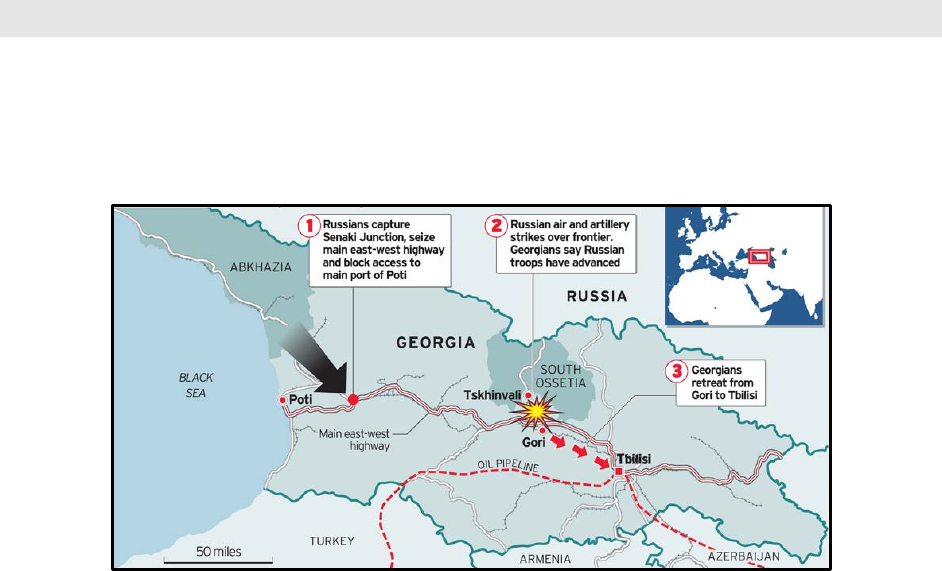
57
Chapter 6: Cyberspace Operations – Case Study
I. Russian Operations against Georgia in 2008
1. Scenario. Russia used cyberspace missions and actions in concert with other instruments of
national power to achieve success in their operation against Georgia in 2008. This case study
provides an opportunity to apply the principles outlined in this guide to a real-world event (see
Figure 6-1).
Figure 6-1: Russian – Georgian Conflict, August 2008127
a. Multi-Domain Synergy. The war between Georgia, Russia, and the Russian-backed
self-proclaimed republics of South Ossetia and Abkhazia saw some 35,000-40,000
Russian and allied forces, augmented by significant air and naval forces, confront some
12,000-15,000 Georgian forces with little air and minimal naval capability. Although a
short and limited conflict, it was historic and precedent setting. This appears to be the
first coordinated cyberspace attack synchronized with major combat actions in the other
warfighting domains, primarily land and air.
b. Cyberspace Intelligence Collection. Russian cyberspace operations began several
weeks before the outbreak of kinetic operations. Russian cyber intelligence units
conducted reconnaissance on important sites and infiltrated Georgian military and
government networks in search of data useful for the upcoming campaign. During this
period, the Russian government began organizing the work of Russian cyberspace
militias - irregular hackers outside the government - that would support the campaign
and provide cover for some of the government's operations. Russian government and
cyberspace militias conducted rehearsals of attacks against Georgian targets.
c. DCO Response Actions (DCO-RA). Russian forces also attacked Georgian hacker
forums in order to pre-empt a retaliatory response against Russian cyberspace targets.
d. Deny – Degrade. Russian cyberspace forces attacked civilian sites near the action of
kinetic operations with the goal of creating panic in the civilian population. For example,
in the town of Gori, Russians disabled government and news websites with distributed
denial-of-service (DDoS) attacks just prior to an air attack. Cyberspace interdiction
(attacks concentrated on tactical data links and data fusion centers) degraded and
disrupted the Georgians' decision cycle limiting their military response.
58
e. Deny – Disrupt. The Russian cyberspace operations forces disrupted Georgian
government, military, and diplomatic communications.
(1) Government and military communications. When the kinetic battle started
on 7 August, Russian government and irregular forces conducted DDoS attacks
on Georgian government and military websites. These attacks disrupted the
transmission of information between military units and between offices in the
Georgian government.
(2) International communications. Faced by overwhelming Russian air power,
armored attacks on several fronts, an amphibious assault on its Black Sea
coastline, and devastating cyber-attacks, Georgia had little capability of kinetic
resistance. Its best hope lay with strategic communications: transmitting to the
world a sympathetic message of rough treatment at the hands of Russian military
aggression. But Russia effectively used cyberspace operations to disrupt the
Georgian government's ability to assemble and transmit such a plea thus
removing Georgia's last hope for international support.
f. Deny – Destroy (potential). The Russians were very sophisticated in their target
selection. For example, Russians refrained from attacking Georgia's most important
asset, the Baku-Ceyhan oil pipeline and associated infrastructure. By holding this target
in reserve, the Russians gave Georgian policymakers an incentive to quickly end the
war.
g. Manipulate. Although there were no known attempts to manipulate data, the Russian
cyberspace operations forces dislocated Georgian data flows, shunting data that
normally would have traveled over the Internet into more traditional conduits such as
telephone and radio communications. Georgians were trying to transmit more data at a
higher rate than the useful capacity of their information network could accommodate
because a large proportion of that capacity was being consumed by cyber attacks
injecting extraneous data into the network. The cyber attacks effectively jammed
Georgia's overall information network during the early stages of the war when rapid and
organized action by Georgian defenses, cyber and kinetic, could have had the greatest
impact.128
h. In summary, Russian planners tightly integrated cyberspace operations with their
diplomatic, information, military, and economic elements of power (i.e. DIME). The
Russo-Georgian war provides a case study for joint planners preparing for a future
conflict, involving the new domain of cyberspace.129
II. Russian Cyberspace Operations – Design, Planning, and Execution
1. Cyberspace Operations Team. This section demonstrates notional cyberspace operations
team design, planning, and execution activities in support of the Russian operation in Georgia.
2. Cyberspace Design Activities. The design principles outlined in this handbook provide a
guide for a cyberspace operations team to assist the commander in developing an operational
approach for this scenario.
a. Understanding the Cyberspace Environment. After receiving direction to plan the
operation, the cyberspace operations (CO) team attempts to gain an understanding of
the operational environment. The CO team studies the Georgian, Russian, and
international environment with a focus on physical and logical networks as well as key
individuals and groups (see Figure 6-2).
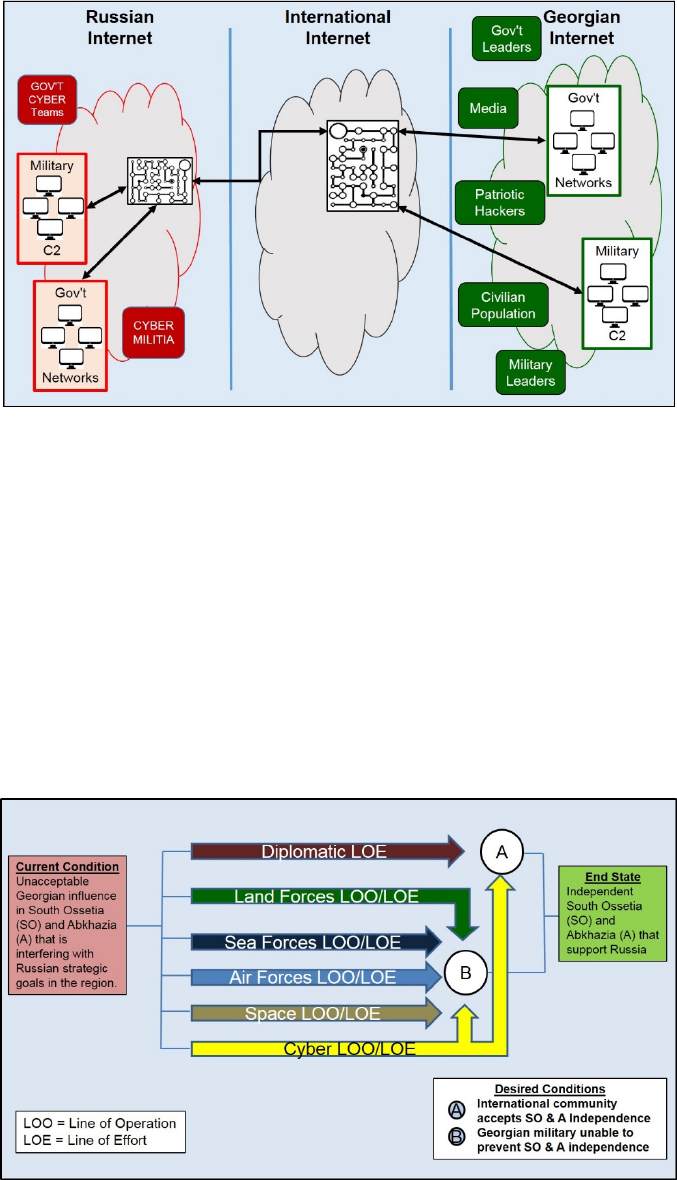
59
Figure 6-2: Georgian, Russian, and International Cyberspace Environment
(Original graphic derived from content of Cross Domain Synergy in Joint Operations)
b. Understanding the Problem(s) in Cyberspace. After identifying key individuals,
groups, and physical and logical networks, the CO team focuses on identifying and
understanding the problem(s) associated with the operation. The team identifies
cyberspace challenges, threats, and risks to operations. They attempt to understand the
adversary's resiliency and recovery capabilities. A recurrent cyberspace operations risk
is losing anonymity.
c. Developing the Operational Approach. The operational approach is the
commander's visualization of how the operation should transform current conditions into
the desired conditions at end state. When developing an operational approach, a
commander should synchronize actions 'in' and 'through' cyberspace with other activities
to achieve the desired objectives. The commander can use lines of operation (LOOs)
and lines of effort (LOEs) to show how the objectives will be achieved (see Figure 6-3).
Figure 6-3: Russian Operational Approach in Georgia
(Original graphic derived from content of Cross Domain Synergy in Joint Operations)
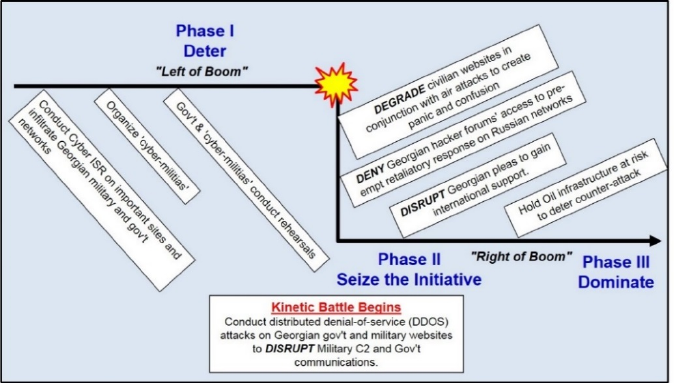
60
3. Cyberspace Planning Activities. Planning translates strategic guidance and direction into
campaign plans and operation orders. Based on the commander's operational approach and
guidance, the CO team will assist the staff in developing and analyzing courses of action and
developing the plan or order. The team should further develop and phase CO LOOs/LOEs for
inclusion in the Cyberspace Operations Concept (see Figure 6-4).
Figure 6-4: Russian Cyberspace Operations Concept in Georgia
(Original graphic derived from content of Cross Domain Synergy in Joint Operations)
4. Cyberspace Operations during Execution. Planning continues during execution, with an
initial emphasis on refining the existing plan and producing the Operation Order (OPORD).
During execution, the CO team supports future plans, future operations, and current operations.
a. Cyberspace Enabled Effects. Cyberspace planners should focus their efforts on
conducting cyberspace actions that achieve the commander's objectives. Cyberspace
Operations planners should be concerned with the accumulation of tactical effects into
an overall operational effect. At the operational level, objectives and desired effects are
developed by the commander's staff and are used to develop tasks to subordinates. In
this scenario, the Russian CO teams defended their networks and ensured anonymity
while employing DDOS and other techniques to deny the Georgian government and
military the ability to effectively respond. These cyberspace effects directly contributed to
the accomplishment of the commander's objectives and end state (see Figure 6-5).
b. Target Development – Lead Time. It's critically important to start cyberspace
operations planning early. The lead time necessary to generate intelligence for the
offensive cyberspace operations often takes longer than that required for kinetic
operations. Target development should be requested much earlier than that for a
traditional targets and should have a longer-term focus. In this scenario, Russian cyber
intelligence units conducted reconnaissance on important sites and infiltrated Georgian
military and government networks in search of data useful for the upcoming campaign.
The cyberspace teams also conducted rehearsals prior to execution.
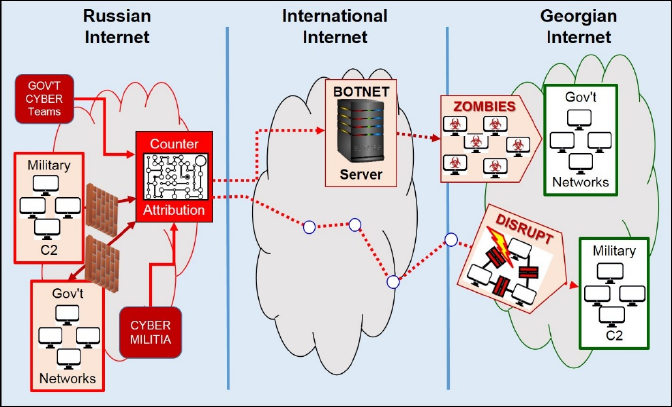
61
Figure 6-5: Russian Cyberspace Enabled Effects
(Original graphic derived from content of Cross Domain Synergy in Joint Operations)
c. Targeting Coordination and Authorization. Cyberspace targets require detailed
joint, cross-Combatant Command, interagency, and likely multinational planning and
coordination, engagement, assessment, and intelligence efforts. The actual prosecution
of a targets through cyberspace requires that cyberspace planners and operators
coordinate with the supported commander early in the planning phase to ensure access
to the target is available when the fleeting opportunity arises. In addition, commanders
should establish procedures to quickly promulgate execution orders (EXORDs) for
CO-engaged targets, which due to their unique cyberspace interagency
deconfliction/coordination requirements may involve coordinating pre-approval for
specific actions conducted under specific circumstances.
III. Georgian Defensive Cyberspace Operations
1. Russian cyberspace operations teams maintained cyber superiority throughout the conflict,
and as a result Georgia never mounted a successful cyber defense or cyber counterattack. This
was due in a large part to a critical cyber vulnerability—more than half of Georgia's 13
connections to the outside world via the Internet passed through Russia, and most of the
Internet traffic to Web sites within Georgia was routed through Turkish or Azerbaijani Internet
service providers, many of which were in turn routed through Russia. Overall, the cyber defense
efforts were too little too late.130 This section will demonstrate defensive cyberspace operations
planning and actions that Georgian cyberspace operations teams attempted to use to mitigate
the severity of Russian offensive cyberspace operations (see Figure 6-6).
a. Defense Network Operations. Despite their lack of success, the Georgian CO teams
attempted to conduct information network operations (similar to Department of Defense
Information Network Operations) to enhance the security of their military networks. They
monitored the flow of information over their information networks. The Georgian CO
team also attempted proactive actions which addressed their entire defense network,
including configuration control and patching, cybersecurity measures and user training,
physical security and secure architecture design, intrusion detection, bandwidth
management/spectrum management, operation of host-based security systems and
firewalls, and encryption of data.131
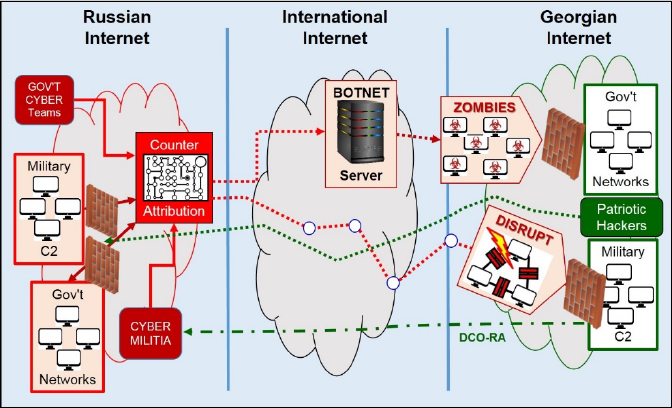
62
b. Defensive Cyberspace Operations (DCO). The Georgian CO teams conducted
passive and active defensive cyberspace operations to preserve the ability to utilize
friendly cyberspace capabilities and protect data, networks, net-centric capabilities, and
other designated systems.
(1) DCO Internal Defensive Measures (DCO-IDM). The CO teams used internal
defensive measures within their networks. These measures included actively
hunting for advanced internal threats as well as the internal responses to these
threats.132 For example, Georgia attempted to maneuver around the cyber
attacks by filtering them out based on their origin. However, the Russian cyber
attackers' intelligence preparation allowed them to easily defeat this tactic. The
Russian attackers routed their assault through foreign servers to mask their real
IP addresses and created false IP addresses to spoof Georgia's cyber defense
filters. Still, the Georgian CO teams preserved the use of some government web
sites by moving them to U.S.-based servers.133
(2) DCO Response Actions (DCO-RA). The Georgian CO teams also
conducted limited DCO-RA to counter the Russian government cyberspace
operations teams and 'cyber militias'. These actions were taken external to the
defense network to defeat ongoing or imminent threats in order to defend their
defense cyberspace capabilities. The CO teams attempted at least one major
counterattack, but it failed. They posted cyber attack tools and instructions in
Russian-language Internet forums to deceive pro-Russian cyber forces into
unwittingly attacking Russian Web sites. This Georgian counterattack appears to
have had a negligible effect on the Russian Web sites targeted.134
Figure 6-6: Georgian Defensive Cyberspace Operations (DCO)
(Original graphic derived from content of Cross Domain Synergy in Joint Operations)

63
Appendix A: U.S. Strategies, Guidance, and Policy
Appendix A includes:
I. U.S. Strategy and Policy
- U.S. International Strategy for Cyberspace
- Department of State International Cyberspace Policy Strategy
- Presidential Executive Order on Strengthening the Cybersecurity
II. Department of Homeland Security Strategy and Guidance
- The Cybersecurity Strategy for the Homeland Security Enterprise
- Framework for Improving Critical Infrastructure Cybersecurity
III. Department of Defense Strategy
- DOD Strategy for Operating in Cyberspace
IV. U.S. Cyber Law Guidance
- DOS Position on International Law in Cyberspace
- DOD Law of War Manual

64
I. U.S. Strategy and Guidance
A. U.S. International Strategy for Cyberspace
This factsheet provides an overview of the International Strategy for Cyberspace released by
The White House on 16 May 2011. The full strategy can be found at:
https://obamawhitehouse.archives.gov/sites/default/files/rss_viewer/International_Strategy_Cyb
erspace_Factsheet.pdf
INTERNATIONAL STRATEGY FOR CYBERSPACE
Prosperity, Security, and Openness in a Networked
Worl
d
We live in a rare historical moment with an opportunity to build on cyberspace's successes
and help secure its future—for the United States, and the global community.
Digital infrastructure is increasingly the backbone of prosperous economies, vigorous research
communities, strong militaries, transparent governments, and free societies. The reach of
networked technology is pervasive and global. To realize fully the benefits that networked
technology promises the world, these systems must function reliably and securely. Assuring the
free flow of information, the security and privacy of data, and the integrity of the interconnected
networks themselves are all essential to American and global economic prosperity, security, and
the promotion of universal rights.
Strategic Approach
The United States' approach to international cyberspace issues is founded on the belief that
networked technologies hold immense potential for our Nation, and for the world. The United
States will pursue an international cyberspace policy that stokes the innovation that drives our
economy and improves lives here and abroad.
Our strategic approach builds on successes, recognizes the challenges to our national and
economic security, and is always grounded by our unshakable commitments to fundamental
freedoms of expression and association, privacy, and the free flow of information.
The Future We Seek
The cyberspace environment that we seek rewards innovation and empowers entrepreneurs; it
connects individuals and strengthens communities; it builds better governments and expands
accountability; it safeguards fundamental freedoms and enhances personal privacy; it builds
understanding, clarifies norms of behavior, and enhances national and international security.
This cyberspace is defined by four key characteristics:
•
Open to innovation
•
Secure enough to earn people's trust
•
Interoperable the world over
•
Reliable enough to support their work
The U.S. International Strategy for Cyberspace outlines our vision for the future of
cyberspace, and sets an agenda for partnering with other nations and peoples to realize it.

65
To realize this vision, we will build and sustain an environment in which norms of
responsible behavior guide states' actions, sustain partnerships, and support the rule of
law. These norms include:
•
Upholding Fundamental Freedoms
•
Global Interoperability
•
Respect for Property
•
Network Stability
•
Valuing Privacy
•
Reliable Access
•
Protection from Crime
•
Multi-stakeholder Governance
•
Right of Self-Defense
•
Cybersecurity Due Diligence
Diplomacy: Strengthening Partnerships
The United States will work to create incentives for, and build consensus around, an
international environment in which states – recognizing the intrinsic value of an open,
interoperable, secure, and reliable cyberspace – work together and act as responsible
stakeholders. Through our international relationships and affiliations, we will seek to ensure that
as many stakeholders as possible are included in this vision of cyberspace precisely because of
its economic, social, political, and security benefits.
Distributed systems require unified action because no single institution, document, arrangement,
or instrument could suffice in addressing the needs of our networked world. From end-users,
private-sector hardware and software vendors, and Internet service providers, to regional,
multilateral, and multi-stakeholder organizations – all are important in helping cyberspace meet its
full potential.
Defense: Dissuading and Deterring
The United States will, along with other nations, encourage responsible behavior and oppose
those who would seek to disrupt networks and systems, thereby dissuading and deterring
malicious actors, while reserving the right to defend these vital national assets as necessary
and appropriate. The United States will continue to strengthen our network defenses and our
ability to withstand and recover from disruptions and other attacks. For those more sophisticated
attacks that do create damage, we will act on well-developed response plans to isolate and
mitigate disruption to our machines, limiting effects on our networks, and potential cascade effects
beyond them.
When warranted, the United States will respond to hostile acts in cyberspace as we would to any
other threat to our country. We reserve the right to use all necessary means – diplomatic,
informational, military, and economic – as appropriate and consistent with applicable
international law, in order to defend our Nation, our allies, our partners, and our interests. In so
doing, we will exhaust all options before military force whenever we can; will carefully weigh the
costs and risks of action against the costs of inaction; and will act in a way that reflects our values
and strengthens our legitimacy, seeking broad international support whenever possible.
Development: Building Prosperity and Security
We believe the benefits of a connected world are universal. The virtues of an open,
interoperable, secure, and reliable cyberspace should be more available than they are today,
and as the world's leading information economy, the United States is committed to ensuring
others benefit from our technical resources and expertise.
To realize this future, the United States will combine diplomacy, defense, and development to
enhance prosperity, security, and openness so all can benefit from networked
technology.

66
Our Nation can and will play an active role in providing the knowledge and capacity to build
and secure new and existing digital systems. The United States' capacity-building assistance is
envisioned as an investment, a commitment, and an important opportunity for dialogue and
partnership. As countries develop a stake in cyberspace issues, we intend our dialogues to
mature from capacity- building to active economic, technical, law enforcement, defense and
diplomatic collaboration on issues of mutual concern.
Policy Priorities
This strategy is an invitation to other states and peoples to join us in realizing this vision of
prosperity, security, and openness in our networked world. It is a call to the private sector, civil
society, and end- users to reinforce these efforts through partnership, awareness, and action. It
is also a roadmap allowing the United States Government's departments and agencies to better
define and coordinate their role in our international cyberspace policy, to execute a specific way
forward, and to plan for future implementation.
Economy: Promoting International Standards and Innovative, Open Markets. To ensure
that cyberspace continues to serve the needs of our economies and innovators, we will:
• Sustain a free-trade environment that encourages technological innovation on
accessible, globally linked networks.
• Protect intellectual property, including commercial trade secrets, from theft.
• Ensure the primacy of interoperable and secure technical standards, determined by
technical experts.
Protecting Our Networks: Enhancing Security, Reliability, and Resiliency. Because strong
cybersecurity is critical to national and economic security in the broadest sense, we will:
• Promote cyberspace cooperation, particularly on norms of behavior for states and
cybersecurity, bilaterally and in a range of multilateral organizations and multinational
partnerships.
• Reduce intrusions into and disruptions of U.S. networks.
• Ensure robust incident management, resiliency, and recovery capabilities for
information infrastructure.
• Improve the security of the high-tech supply chain, in consultation with industry.
Law Enforcement: Extending Collaboration and the Rule of Law. To enhance confidence in
cyberspace and pursue those who would exploit online systems, we will:
• Participate fully in international cybercrime policy development.
• Harmonize cybercrime laws internationally by expanding accession to the Budapest
• Convention.
• Focus cybercrime laws on combating illegal activities, not restricting access to the Internet.
• Deny terrorists and other criminals the ability to exploit the Internet for operational
planning, financing, or attacks.
Military: Preparing for 21st Century Security Challenges. Since our commitment to defend
our citizens, allies, and interests extends to wherever they might be threatened, we will:
• Recognize and adapt to the military's increasing need for reliable and secure networks.
• Build and enhance existing military alliances to confront potential threats in cyberspace.
The United States Government organizes its activities across seven interdependent areas of
activity
,
each demanding collaboration within our government, with international partners, and
with
the
private sector. Taken as a whole, they form the action lines of our strategic
framework.

67
• Expand cyberspace cooperation with allies and partners to increase collective security.
Internet Governance: Promoting Effective and Inclusive Structures. To promote Internet
governance structures that effectively serve the needs of all Internet users, we will:
• Prioritize openness and innovation on the Internet.
• Preserve global network security and stability, including the domain name system (DNS).
• Promote and enhance multi-stakeholder venues for the discussion of Internet
Governance issues.
International Development: Building Capacity, Security, and Prosperity. To promote the
benefits of networked technology globally, enhance the reliability of our shared networks, and
build the community of responsible stakeholders in cyberspace, we will:
• Provide the necessary knowledge, training, and other resources to countries seeking to
build technical and cybersecurity capacity.
• Continually develop and regularly share international cybersecurity best practices.
• Enhance states' ability to fight cybercrime – including training for law enforcement,
forensic specialists, jurists, and legislators.
• Develop relationships with policymakers to enhance technical capacity building,
providing regular and ongoing contact with experts and their United States Government
counterparts.
Internet Freedom: Supporting Fundamental Freedoms and Privacy. To help secure
fundamental freedoms as well as privacy in cyberspace, we will:
• Support civil society actors in achieving reliable, secure, and safe platforms for
freedoms of expression and association.
• Collaborate with civil society and nongovernment organizations to establish safeguards
protecting their Internet activity from unlawful digital intrusions.
• Encourage international cooperation for effective commercial data privacy protections.
• Ensure the end-to-end interoperability of an Internet accessible to all.
These ideals are central to preserving the cyberspace we know, and to creating, together,
the future we seek.
Source:
https://obamawhitehouse.archives.gov/sites/default/files/rss_viewer/International_Strategy_Cyb
erspace_Factsheet.pdf, accessed 26 May 2017.

68
B. Department of State International Cyberspace Policy Strategy
The following is an excerpt of testimony by Christopher Painter, Department of State (DOS)
Coordinator for Cyber Issues, before the Senate Foreign Relations Subcommittee on East Asia,
the Pacific, and International Cybersecurity Policy, on 25 May 2016: https://2009-
2017.state.gov/s/cyberissues/releasesandremarks/257719.htm.
In May 2016, as required by the Consolidated Appropriations Act for 2016, the Department
submitted to Congress the Department of State International Cyberspace Policy Strategy (the
Strategy) that included a report on the Department's work to implement the President's 2011
International Strategy for Cyberspace, as well as a discussion of our efforts to promote norms of
responsible state behavior in cyberspace, alternative concepts for norms promoted by certain
other countries, threats facing the United States, tools available to the President to deter
malicious actors, and resources required to build international norms.
In spite of the successes outlined in the Strategy, the U.S. vision for an open, interoperable,
secure, and reliable Internet faces a range of policy and technical challenges. Many of these
challenges were described in my testimony last year, and they largely remain. I would like to
focus my time today delving specifically into our efforts to promote a broad international
framework for cyber stability, as well some of the alternative views regarding the Internet that
some governments are promoting. I will also spend some time discussing the technical
challenges and threats posed by continuing malicious cyber activity directed at the United
States, as well as our allies, and the tools we have at our disposal to deter these actions.
Diplomatic Efforts to Shape the Policy Environment
Building a Framework for International Stability in Cyberspace
The Department of State, working with our interagency partners, is guided by the vision of the
President's International Strategy for Cyberspace, which is to promote a strategic framework of
international cyber stability designed to achieve and maintain a peaceful cyberspace
environment where all states are able to fully realize its benefits, where there are advantages to
cooperating against common threats and avoiding conflict, and where there is little incentive for
states to engage in disruptive behavior or to attack one another.
This framework has three key elements: (1) global affirmation that international law applies to
state behavior in cyberspace; (2) development of an international consensus on and promotion
of additional voluntary norms of responsible state behavior in cyberspace that apply during
peacetime; and (3) development and implementation of practical confidence building measures
(CBMs), which promote stability in cyberspace by reducing the risks of misperception and
escalation.
Since 2009, the United Nations Group of Governmental Experts on Developments in the Field of
Information and Telecommunications in the Context of International Security (UN GGE) has
served as a productive and groundbreaking expert-level venue for the United States to build
support for this framework. The consensus recommendations of the three UN GGE reports in
2010, 2013, and 2015 have set the standard for the international community on international
cyberspace norms and CBMs. The UN GGE process will continue to play a central role in our
efforts to fully promulgate this framework when it reconvenes in August 2016.
Applicability of international law. The first and most fundamental pillar of our framework for
international cyber stability is the applicability of existing international law to state behavior in
cyberspace. The 2013 UN GGE report was a landmark achievement that affirmed the
applicability of existing international law, including the UN Charter, to state conduct in
cyberspace. The 2013 report underscored that states must act in cyberspace under the

69
established international obligations and commitments that have guided their actions for
decades – in peacetime and during conflict – and states must meet their international
obligations regarding internationally wrongful acts attributable to them. The 2014-2015 UN GGE
also made progress on issues related to international law by affirming the applicability of the
inherent right to self-defense as recognized in Article 51 of the UN Charter, and noting the law
of armed conflict's fundamental principles of humanity, necessity, proportionality, and
distinction.
Norms of responsible state behavior. The United States is also building consensus on a set of
additional, voluntary norms of responsible state behavior in cyberspace that define key areas of
risk that would be of national and/or economic security concern to all states and which should
be off-limits during times of peace. If observed, these stability measures – which are measures
of self-restraint – can contribute substantially to conflict prevention and stability. The United
States was the first state to propose a set of specific peacetime cyber norms, including the
cybersecurity of critical infrastructure, the protection of computer security incident response
teams (CSIRTs), and cooperation between states in responding to appropriate requests in
mitigating malicious cyber activity emanating from their territory. In May 2015, Secretary of State
Kerry highlighted these norms in his speech in Seoul, South Korea, on an open and secure
Internet. The 2015 UN GGE report's most significant achievement was its recommendation for
voluntary norms of state behavior designed for peacetime, which included concepts
championed by the United States.
Confidence Building Measures. Together with our work on law and voluntary norms, cyber
CBMs have the potential to contribute substantially to international cyber stability. CBMs have
been used for decades to build confidence, reduce risk, and increase transparency in other
areas of international concern. Examples of cyber CBMs include: transparency measures, such
as sharing national strategies or doctrine; cooperative measures, such as an initiative to combat
a particular cyber incident or threat actor; and stability measures, such as committing to refrain
from a certain activity of concern. Cyber CBMs are being developed, and are in the first stages
of implementation, in two regional venues – the Organization for Security and Cooperation in
Europe (OSCE) and the ASEAN Regional Forum where agreement was reached in 2015 on a
detailed work plan with a proposed set of CBMs for future implementation.
Although many of the elements of the framework I have described above may seem self-evident
to an American audience, it is important to recognize that cyber issues are new to many states,
and as I describe later in my testimony, there are also many states that hold alternative views
on how we should promote cyber stability. Notwithstanding these headwinds, as well as the fact
that diplomatic negotiations on other issues can take many years, if not decades, the United
States and its allies have made substantial progress in recent years towards advancing our
strategic framework of international cyber stability. At this point, I would like to highlight
examples from last year that reflect our progress.
U.S.-China Cyber Commitments
The United States strongly opposes the use of cyber technology to steal intellectual property for
commercial advantage, and has raised this concern with Chinese interlocutors for several years.
In 2014, the U.S. indicted five members of the Chinese military for hacking, economic
espionage, and other offenses directed at six U.S. entities. This led China to suspend the U.S.-
China Cyber Working Group. The U.S. and China, however, reached agreement during
President Xi Jinping's state visit in September 2015 on several key commitments on cyber
issues. These commitments are:
70
(1) both governments agreed to cooperate and provide timely responses to requests for
information and assistance regarding malicious cyber activity emanating from their
territories;
(2) neither country's government will conduct or knowingly support cyber-enabled theft of
intellectual property for commercial advantage;
(3) both governments will work together to further identify and promote appropriate
norms of state behavior in cyberspace and hold a senior experts group on international
security issues in cyberspace; and
(4) both governments will establish a Ministerial-level joint dialogue mechanism on
fighting cybercrime and related issues.
On 11 May 2016, the United States hosted the first meeting of the senior experts group in
Washington on international security issues in cyberspace, which provided a forum to further
engage China on its views and seek common ground regarding norms of state behavior in
cyberspace and other topics. The Department of State led the U.S. delegation that included
participation from the Department of Defense and other U.S. government agencies. The senior
experts group helps us advance the growing international consensus on international law and
voluntary cyber norms of state behavior. We also have encouraged China to join us in pushing
for other states to affirm these principles in international forums like the Group of Twenty (G20),
and will continue to do so.
To implement other commitments reached during President Xi's visit, the United States and
China held the first ministerial level dialogue on cybercrime and other related issues in
Washington on December 1, 2015. Attorney General Loretta Lynch and Homeland Security
Secretary Jeh Johnson, together with Chinese State Councilor Guo Shengkun, co-chaired the
first U.S.-China High-Level Joint Dialogue on Cybercrime and Related Issues to foster mutual
understanding and enhance cooperation on law enforcement and network protection issues.
The second dialogue is scheduled to occur next month in Beijing, China.
Moreover, regarding the commitment that neither government will conduct or knowingly support
cyber-enabled theft for commercial gain, Deputy Secretary of State Blinken testified last month
before the full Committee on Foreign Relations that the United States is "watching very closely
to ensure this commitment is followed by action."
The outcomes of last year's Xi-Obama summit focus on concrete actions and arrangements that
will allow us to hold Beijing accountable to the commitments they have made. These
commitments do not resolve all our challenges with China on cyber issues. However, they do
represent a step forward in our efforts to address one of the sharpest areas of disagreement in
the U.S.-China bilateral relationship.
Group of Twenty (G20) Antalya Summit
In November 2015, the leaders of the G20 met in Antalya, Turkey, to discuss and make
progress on a wide range of critical issues facing the global economy. At the conclusion of the
Antalya Summit, the strong final communique issued by the G20 leaders affirmed the U.S.-
championed vision of international cyber stability and its pillars.
Among other things, the G20 leaders affirmed in their statement that "no country should conduct
or support the [Information and Communication Technologies] ICT-enabled theft of intellectual
property, including trade secrets or other confidential business information, with the intent of
providing competitive advantages to companies or commercial sectors." They also highlighted
the "key role played by the United Nations in developing norms" and the work of the UN GGE
and its 2015 report. Addressing our overall framework, the G20 leaders stated that they "affirm
71
that international law, and in particular the UN Charter, is applicable to state conduct in the use
of ICTs and commit ourselves to the view that all states should abide by norms of responsible
state behavior in the use of ICTs… ."
The G20 leaders' communique represents a remarkable endorsement of our approach to
promoting stability in cyberspace. But there is still more to do. The United States will continue to
work within the G20 and in other bilateral and multilateral engagements to promote and expand
these policy pronouncements regarding responsible state behavior in cyberspace.
Organization for Security and Cooperation in Europe (OSCE)
As a result of the leadership by the United States and like-minded countries, the 57 member
states of the OSCE, which includes not only Western allies but also Russia and other former
Soviet states, reached consensus in March 2016 on an expanded set of CBMs. This expanded
set, which includes five new CBMs, builds upon the 11 CBMs announced by the OSCE in 2013
that member states are already working to implement.
The initial 11 CBMs were primarily focused on building transparency and putting in place
mechanisms for de-escalating conflict. For example, there were CBMs calling upon participating
states to identify points of contact that foreign governments could reach out to in the event of a
cyber incident emanating from the state's territory and put in place consultation and mediation
mechanisms. The additional five CBMs focused more on cooperative measures focusing on
issues like cybersecurity of critical infrastructure and developing public-private partnerships.
Secure and resilient critical infrastructure, including in the communications sector, requires the
integration of cyber, physical, and human elements. Since most critical infrastructure is privately
owned, public-private partnerships are essential for strengthening critical infrastructure. Given
the distributed nature of critical infrastructure, these efforts also require international
collaboration. Work will continue this year to strengthen implementation of the previous CBMs
and to begin implementing the new ones as well. This will build on the cooperation we have
underway with many international partners in this and other similar fora. We also hope that this
further success within the OSCE context can serve to strengthen CBMs as a model that other
regional security organizations can adopt.
In addition to our work with governmental organizations, the Department of State engages
extensively with a range of stakeholders outside of government, who play critical roles in helping
to preserve and promote the same vision of cyberspace held by the United States. Non-
government stakeholders are often part of our delegations to key meetings, for which there is
intensive consultation, and we often engage with our stakeholders before and after key events
to hear their views and to inform them of our activities. We also engage extensively with the
stakeholder community ahead of and immediately following major cyber conferences, such as
the Global Conference on Cyberspace, most recently in The Hague, the Netherlands, and
previously in Seoul, South Korea.
Policy Challenge: Alternative Views of the Internet
A challenge to the implementation of our cyberspace strategy is a competing and alternative
view of the Internet. The United States and much of the broader international community
support the open flow and movement of data on the Internet that drives economic growth,
protects human rights, and promotes innovation. The United States believes in a
multistakeholder approach whereby governments, private sector, civil society, and the technical
and academic communities cooperate to address both technical and policy threats through
inclusive, transparent, consensus-driven processes.
China's approach to cyberspace in the international context is propelled by its desire to maintain
internal stability, maintain sovereignty over its domestic cyberspace, and combat what it argues
72
is an emerging cyber arms race and 'militarization' of cyberspace. China has been willing to
consider cyber confidence building measures, and has affirmed that international law applies in
cyberspace, but has not been willing to affirm more specifically the applicability of the law of
armed conflict or other laws of war, because it believes it would only serve to legitimize state
use of cyber tools as weapons of war.
This has led to a set of external policies that reinforces traditional Chinese foreign policy
priorities of non-interference in internal affairs, national sovereignty over cyberspace, and "no
first use" of weapons. China views its expansive online censorship regime – including
technologies such as the Great Firewall – as a necessary defense against destabilizing
domestic and foreign influences, and it has promoted this conception internationally. China also
urges creation of new "cyber governance" instruments, which would, inter alia, create new
binding rules designed to limit the development, deployment, and use of "information weapons,"
promote speech and content controls, seek to replace the framework of the Council of Europe
Convention on Cybercrime (Budapest Convention), elevate the role of governments vis-à-vis
other stakeholders, and likely give the United Nations authority for determining attribution and
responding to malicious cyber activity. While the United States and its partners seek to focus
our cyber policy efforts on combatting threats to networks, cyber infrastructure, and other
physical threats from cyber tools, China also emphasizes the threats posed by online content. In
addition, some of these policies stand in sharp contrast to the U.S. view that all stakeholders
should be able to contribute to the making of public policy regarding the Internet.
Russia's approach to cyberspace in the international context has focused on the maintenance of
internal stability, as well as sovereignty over its "information space." While Russia co-authored
the Code of Conduct, with China and other Shanghai Cooperation Organization members,
Russia's ultimate goal is also a new international cyber convention, which they pair with criticism
of the Budapest Convention.
Russia has nonetheless found common ground with the United States on our approach of
promoting the applicability of international law to state conduct in cyberspace as well as
voluntary, non-binding norms of state behavior in peacetime. Russia has also committed to the
first ever set of bilateral cyber confidence building measures with the United States, as well as
the first ever set of cyber CBMs within a multilateral institution, at the OSCE in 2013 and 2016
that I previously discussed.
We counter these alternative concepts of cyberspace policy through a range of diplomatic tools
that include not only engagement in multilateral venues, but also direct bilateral engagement
and awareness-raising with a variety of state and non-state actors. I now would like to discuss
some of the technical challenges and threats the U.S. faces and some of the tools we have to
respond to and prevent cyber incidents.
Responding to and Preventing Cyber Incidents
Continuing Cyber Threats
Cyber threats to U.S. national and economic security are increasing in frequency, scale,
sophistication, and severity. In 2015, high profile cyber incidents included the breach of health
insurance company Anthem, Inc.'s IT system that resulted in the theft of account information for
millions of customers; an unauthorized breach of the Office of Personnel Management's
systems that resulted in the theft of approximately 22 million personnel files; and hackers
launching an unprecedented attack on the Ukraine power grid that cut power to hundreds of
thousands of customers.
Overall, the unclassified information and communications technology networks that support U.S.
government, military, commercial, and social activities remain vulnerable to espionage and
73
disruption. As the Department noted in the Strategy we submitted last month, however, the
likelihood of a catastrophic attack against the United States from any particular actor is remote
at this time. The Intelligence Community instead foresees an ongoing series of low-to-moderate
level cyber operations from a variety of sources, which will impose cumulative costs on U.S.
economic competitiveness and national security, pose risks to Federal and private sector
infrastructure in the United States, infringe upon the rights of U.S. intellectual property holders,
and violate the privacy of U.S. citizens.
In February, Director of National Intelligence James Clapper testified before Congress on the
2016 Worldwide Threat Assessment of the U.S. Intelligence Community, and stated: "Many
actors remain undeterred from conducting reconnaissance, espionage, and even attacks in
cyberspace because of the relatively low costs of entry, the perceived payoff, and the lack of
significant consequences." He highlighted the malicious cyber activities of the leading state
actors, non-state actors such as Da'esh, and criminals who are developing and using
sophisticated cyber tools, including ransomware for extortion and malware to target government
networks.
The Intelligence Community continues to witness an increase in the scale and scope of
reporting on malicious cyber activity that can be measured by the amount of corporate data
stolen or deleted, personally identifiable information compromised, or remediation costs incurred
by U.S. victims. The motivation to conduct cyber attacks and cyber espionage will probably
remain strong because of the gains for the perpetrators.
Tools Available to Counter Cyber Threats
The United States works to counter technical challenges through a whole-of-government
approach that brings to bear its full range of instruments of national power and corresponding
policy tools – diplomatic, law enforcement, economic, military, and intelligence – as appropriate
and consistent with applicable law.
The United States believes that deterrence in cyberspace is best accomplished through a
combination of "deterrence by denial" – reducing the incentive of potential adversaries to use
cyber capabilities against the United States by persuading them that the United States can deny
their objectives – and "deterrence through cost imposition" – threatening or carrying out actions
to inflict penalties and costs against adversaries that conduct malicious cyber activity against
the United States. It is important to note that there is no one-size-fits-all approach to deterring or
responding to cyber threats. Rather, the individual characteristics of a particular threat
determine the tools that would most appropriately be used.
The President has at his disposal a number of tools to carry out deterrence by denial. These
include a range of policies, regulations, and voluntary standards aimed at increasing the
security and resiliency of U.S. government and private sector computer systems. They also
include incident response capabilities and certain law enforcement authorities.
With respect to cost imposition, the President is able to draw on a range of response options
from across the United States government.
Diplomatic tools provide a way to communicate to adversaries when their actions are
unacceptable and to build support and greater cooperation among, or seek assistance from,
allies and like-minded countries to address shared threats. Diplomatic démarches to both
friendly and potentially hostile states have become a regular component of the United States'
response to major international cyber incidents. In the longer term, U.S. efforts to promote
principles of responsible state behavior in cyberspace, including peacetime norms, are intended
to build increasing consensus among like-minded states that can form a basis for cooperative
responses to irresponsible state actions.
74
Law enforcement tools can be used to investigate crimes and prosecute malicious cyber actors
both within the United States and abroad. International cooperation is critical to cybercrime
investigations, which is why the United States has promoted international harmonization of
substantive and procedural cybercrime laws through the Budapest Convention, created an
informal channel for data preservation and information sharing through the G7 24/7 network,
and promoted donor partnerships to assist developing nations.
Economic tools, such as financial sanctions, may be used as a part of the broader U.S. strategy
to change, constrain, and stigmatize the behavior of malicious actors in cyberspace. Since
January 2015, the President has provided guidance to the Secretary of the Treasury to impose
sanctions to counter North Korea's malicious cyber-enabled activities. Executive Order 13687
was issued, in part, in response to the provocative and destructive attack on Sony Pictures
Entertainment, while Executive Order 13722 targets, among others, significant activities by
North Korea to undermine cybersecurity, in line with the recently-signed North Korea Sanctions
and Policy Enhancement Act of 2016. Aside from these North Korea-specific authorities, in April
2015, the President issued Executive Order 13694, Blocking the Property of Certain Persons
Engaging in Significant Malicious Cyber-Enabled Activities, which authorizes the imposition of
sanctions against persons whose malicious cyber-enabled activities could pose a significant
threat to the national security, foreign policy, or economic health or financial stability of the
United States.
Military capabilities provide an important set of options for deterring and responding to malicious
cyber activity. The Department of Defense continues to build its cyber capabilities and
strengthen its cyber defense and deterrence posture. As part of this effort, the Department of
Defense is building its Cyber Mission Force, which is already employing its capabilities to
defend Department of Defense networks, defend the Nation against cyberattacks of significant
consequence, and generate integrated cyberspace effects in support of operational plans and
contingency operations. In addition, Secretary of Defense Ashton Carter announced earlier this
year that U.S. forces are using cyber tools to disrupt Da'esh's command and control systems
and to negatively impact its networks.
Intelligence capabilities are also an important tool at the President's disposal in detecting,
responding to, and deterring malicious activities in cyberspace, particularly given the unique
challenges associated with attributing and understanding the motivation behind such malicious
activities.
Even with this broad range of tools, deterring cyber threats remains a challenge. Given the
unique characteristics of cyberspace, the United States continues to work to develop additional
and appropriate consequences that it can impose on malicious cyber actors.
Capacity Building
In addition to the tools that I have just outlined, the ability of the United States to respond to
foreign cyber threats and fight transnational cybercrime is greatly enhanced by the capabilities
and strength of our international partners in this area. Therefore, the Department of State is
working with departments and agencies, allies and multilateral partners to build the capacity of
foreign governments, particularly in developing countries, to secure their own networks as well
as investigate and prosecute cybercriminals within their borders. The Department also actively
promotes donor cooperation, including bilateral and multilateral participation in joint cyber
capacity building initiatives.
In 2015, for example, the United States joined the Netherlands in founding the Global Forum on
Cyber Expertise, a global platform for countries, international organizations, and the private
sector to exchange best practices and expertise on cyber capacity building. The United States

75
partnered with Japan, Australia, Canada, the African Union Commission, and Symantec on four
cybersecurity and cybercrime capacity building initiatives. The Department also provided
assistance to the Council of Europe, the Organization of American States, and the United
Nations Global Program on Cybercrime to enable delivery of capacity building assistance to
developing nations. Many traditional bilateral law enforcement training programs increasingly
include cyber elements, such as training investigators and prosecutors in the handling of
electronic evidence. Much of our foreign law enforcement training on combating intellectual
property crime focuses on digital theft.
In another example of capacity building, the Department of State, through its Bureau of
International Narcotics and Law Enforcement Affairs, manages five International Law
Enforcement Academies (ILEAs) worldwide, and one additional Regional Training Center.
These six facilities provide law enforcement training and instruction to law enforcement officials
from approximately 85 countries each year. The ILEA program includes a wide variety of cyber
investigation training courses, from basic to advanced levels, taught by subject matter experts
from the U.S. Secret Service and other agencies and policy-level discussions with senior
criminal justice officials. This serves as a force multiplier to enhance the capabilities of the
international law enforcement community to collaborate in the effort to fight cybercrime.
The Department of State is committed to continuing its capacity building initiatives as another
effective way to counter international cyber threats and promote international cyber stability.
Looking ahead
Cybersecurity will continue to be a challenge for the United States when we take into
consideration the rapidly expanding environment of global cyber threats, the increasing reliance
on information technology and number of "smart devices," the reality that many developing
nations are still in the early stages of their cyber maturity, and the ongoing and increasingly
sophisticated use of information technology by terrorists and other criminals. Thus, the
Department of State anticipates a continued increase and expansion of our cyber-focused
diplomatic and capacity building efforts for the foreseeable future.
The Department will continue to spearhead the effort to promote international consensus that
existing international law applies to state actions in cyberspace and build support for certain
peacetime norms through assisting states in developing technical capabilities and relevant laws
and policies, to ensure they are able to properly meet their commitments on norms of
international cyber behavior.
Source: https://2009-2017.state.gov/s/cyberissues/releasesandremarks/257719.htm, accessed 26
May 2017.

76
C. Presidential Executive Order on Strengthening Cybersecurity
On 11 May 2017, President Trump signed an executive order aimed at strengthening
cybersecurity. The following is an excerpt from a White House News Release providing an
overview of the order, the Executive Order can be found at: https://www.whitehouse.gov/the-
press-office/2017/05/11/presidential-executive-order-strengthening-cybersecurity-federal:
WHITE HOUSE NEWS RELEASE – 12 May 2017
Presidential Executive Order on Strengthening the Cybersecurity of Federal Networks
and Critical Infrastructure
AMERICA'S NETWORK LEFT VULNERABLE: The United States has been left vulnerable
to destructive attacks through cyber space.
The Federal Government, as a large and lucrative target for electronic criminals and foreign
agents, has been a victim of cyber intrusions for years.
The cybersecurity of critical American network infrastructure – public and private alike – is under
constant attack from both foreign and domestic sources.
On a daily basis we receive new reports of major corporations in the United States [that] have
been hacked by foreign-based threats.
TAKING ACTION TO SECURE OUR NATION'S CYBER DEFENSES: President Donald J.
Trump signed an Executive Order to take much needed action to address cybersecurity
vulnerabilities.
• In order to secure our Nation's defense, we are emphasizing Federal cybersecurity.
o It is now the policy of the United States to manage cybersecurity risk as a Federal
enterprise.
o The President has mandated the use of the National Institute of Standards and
Technology Cybersecurity Framework across government, ensuring the same high
standards recommended for private industry are applied everywhere.
o The Executive Order directs agency heads to begin planning for the deliberate
modernization of Federal Executive Branch information technology (IT)—a critical,
long overdue effort to better manage cyber risk. This work modernizing our IT will be
championed from the White House by the President's American Technology Council.
o Cabinet Secretaries and Agency Directors will be held accountable for managing
cyber risk in their respective portfolios, ensuring accountability across the board.
o The Government's information systems will be optimized, prioritizing modernity,
safety, usability, and economy, innovating while addressing security. In this effort,
the President has directed a preference towards shared services.
o Specific actions include:
Requiring all agencies to use the industry-standard NIST Cybersecurity
Framework (Framework) to manage their cybersecurity risks;
Requiring all agencies to prefer shared IT services in all future procurements, to
the maximum extent allowed under the law;
Requiring all agencies to explicitly document their cybersecurity risk mitigation
and acceptance choices, including any decisions to not mitigate known
vulnerabilities in a timely manner, and describe their action plan in a report to
77
implement the Framework, in a report to the Department of Homeland Security
(DHS) and Office of Management and Budget (OMB);
Requiring the Secretary of DHS and the Director of OMB to evaluate the totality
of these reports to comprehensively assess the adequacy of the Federal
Government's overall cybersecurity risk management posture and propose
changes in law, policy, and budgeting to protect adequately the executive branch
enterprise;
Requiring the Secretary of Defense and the Director of National Intelligence to
undertake comparable efforts for national security systems; and
Empowering the White House's American Technology Council to launch a
process of planning for the deliberate modernization of Federal IT, including the
technical feasibility and cost effectiveness of transitioning agencies to one or
more consolidated network architectures and shared services such as email.
• Government and industry will partner in protecting our Nation's critical infrastructure.
o As the private sector is heavily involved in our Nation's infrastructure, this Executive
Order will prioritize deeper, more collaborative public-private partnerships in threat
assessment, detection, protection, and mitigation.
Following the principle that "practice makes perfect," the President will work
together with infrastructure providers to boost our national resilience to cyber-
attacks through training exercises and other operations.
Voluntary compliance and collaborative efforts, such as efforts to address
denial of service attacks, will be encouraged.
o Specific actions include:
Establishing a clear policy that the Federal Government should bring to bear
all of its authorities and capabilities to support the cybersecurity risk
management efforts of the owners and operators of the Nation's critical
infrastructure.
Requiring civilian, military, and intelligence agencies to develop an integrated,
comprehensive inventory of the specific legal authorities and capabilities that
agencies could employ to support the cybersecurity risk management efforts
of those critical infrastructure entities at greatest risk of attacks that could
result in catastrophic impacts;
Requiring these agencies to offer such support to these entities on a
voluntary basis, and to work directly with these entities to solicit their
feedback and input on any gaps in the Federal Government's cybersecurity
toolkit, including gaps in law, policy, or budgeting;
Evaluating Federal Government efforts to promote transparency in
cybersecurity risk management practices within critical infrastructure to
support market-driven risk management decisions;
Convening the private sector to address complex Internet of Things (IoT)
cybersecurity challenges, starting with denial of service attacks perpetrated
by IoT devices;
Strengthening the Nation's ability to respond to and recover from a prolonged
power outage caused by a cyber-attack; and

78
Mitigating cybersecurity risks to Department of Defense weapons platforms
and the defense industrial base, including risks associated with foreign
manufacture of sensitive components.
• The Executive Order will strengthen our deterrence posture as a Nation and forge
international coalitions to fight back against cyberattacks across the globe.
o The White House, State Department, and all other applicable Federal agencies will
continue to work hand-in-hand with the nations of the world to promote an open,
interoperable, reliable, and secure global Internet. The Internet is a United States
invention, it should reflect American values as it continues to transform the future for
all nations and all generations.
The State Department shall be tasked with drafting an international
engagement strategy for cybersecurity, outlining America's path forward with
our allies.
o The global shortage of cybersecurity professionals must be addressed, the President
is committed to working programs that identify, develop, and retain first-class cyber
security talent.
o Other nations will not be allowed to hold us at risk through the use of cyber-attacks,
espionage, or other malicious action.
o Specific actions include:
Formulating strategic options for deterring adversaries and better protecting
the American people from cyber threats;
Crafting an international engagement strategy for cybersecurity that will
outline how the United States will take the initiative and work with partners to
defend against and deter malicious actors, promote an international
framework for cyber stability, and safeguard an open, interoperable and
secure Internet that drives economic and social growth and development in
the United States and around the world; and
Undertaking a comprehensive review of United States efforts in both the
public and private sectors to support the development and sustainment of
world-class civilian and military cybersecurity workforces, and benchmarking
these efforts against parallel efforts by foreign governments to support their
workforces.
Source: White House News Release, https://www.whitehouse.gov/the-press-
office/2017/05/12/president-trump-protects-americas-cyber-infrastructure, accessed 26 May
2017.

79
II. Department of Homeland Security Strategy and Guidance
A. The Cybersecurity Strategy for the Homeland Security Enterprise
Department of Homeland Security (DHS) released this strategy in November 2011. It was
developed pursuant to the Quadrennial Homeland Security Review and reflects the importance
of cyberspace to our economy, security, and way of life. The following is an excerpt of the
Executive Summary, The full document can be found at:
https://www.dhs.gov/xlibrary/assets/nppd/blueprint-for-a-secure-cyber-future.pdf.
Executive Summary
The Blueprint for a Secure Cyber Future builds on the Department of Homeland Security
Quadrennial Homeland Security Review Report's strategic framework by providing a clear path
to create a safe, secure, and resilient cyber environment for the homeland security enterprise.
With this guide, stakeholders at all levels of government, the private sector, and our
international partners can work together to develop the cybersecurity capabilities that are key to
our economy, national security, and public health and safety. The Blueprint describes two areas
of action: Protecting our Critical Information Infrastructure Today and Building a Stronger Cyber
Ecosystem for Tomorrow. The Blueprint is designed to protect our most vital systems and
assets and, over time, drive fundamental change in the way people and devices work together
to secure cyberspace. The integration of privacy and civil liberties protections into the
Department's cybersecurity activities is fundamental to safeguarding and securing cyberspace.
The Blueprint lists four goals for protecting critical information infrastructure:
• Reduce Exposure to Cyber Risk
• Ensure Priority Response and Recovery
• Maintain Shared Situational Awareness
• Increase Resilience
These goals are supported by nine objectives. Each objective is dependent on a variety of
capabilities that, when implemented, will work in tandem to effectively anticipate and respond to
a wide range of threats. Some of the cybersecurity capabilities described in the Blueprint are
robust and at work today, while others must be expanded. Still others require further research
and development. All necessitate a collaborative and responsive cybersecurity community.
Achieving a safe, secure, and resilient cyber environment includes measuring progress in
building capabilities and determining whether they are effective in an evolving threat
environment. Accordingly, each year's performance will be compared with that of the previous
year. This approach will highlight where progress is being made and will identify gaps and
resource requirements.
Cyberspace underpins almost every facet of American life, and provides critical support for the
U.S. economy, civil infrastructure, public safety, and national security. Protecting cyberspace
requires strong vision, leadership, and a broadly distributed effort in which all members of the
homeland security enterprise take responsibility. The Blueprint for a Secure Cyber Future was
developed to address this reality.
Source: https://www.dhs.gov/xlibrary/assets/nppd/blueprint-for-a-secure-cyber-future.pdf,
accessed 26 May 2017.

80
B. Framework for Improving Critical Infrastructure Cybersecurity
The National Institute of Standards and Technology released this framework on 12 February
2014. The following is an excerpt of the Executive Summary, The full document can be found at:
https://www.nist.gov/sites/default/files/documents/cyberframework/cybersecurity-framework-
021214.pdf.
Executive Summary
The national and economic security of the United States depends on the reliable functioning of
critical infrastructure. Cybersecurity threats exploit the increased complexity and connectivity of
critical infrastructure systems, placing the Nation's security, economy, and public safety and
health at risk. Similar to financial and reputational risk, cybersecurity risk affects a company's
bottom line. It can drive up costs and impact revenue. It can harm an organization's ability to
innovate and to gain and maintain customers.
To better address these risks, the President issued Executive Order 13636, "Improving Critical
Infrastructure Cybersecurity," on February 12, 2013, which established that "[i]t is the Policy of
the United States to enhance the security and resilience of the Nation's critical infrastructure
and to maintain a cyber environment that encourages efficiency, innovation, and economic
prosperity while promoting safety, security, business confidentiality, privacy, and civil liberties."
In enacting this policy, the Executive Order calls for the development of a voluntary risk-based
Cybersecurity Framework – a set of industry standards and best practices to help organizations
manage cybersecurity risks. The resulting Framework, created through collaboration between
government and the private sector, uses a common language to address and manage
cybersecurity risk in a cost-effective way based on business needs without placing additional
regulatory requirements on businesses.
The Framework focuses on using business drivers to guide cybersecurity activities and
considering cybersecurity risks as part of the organization's risk management processes. The
Framework consists of three parts: the Framework Core, the Framework Profile, and the
Framework Implementation Tiers. The Framework Core is a set of cybersecurity activities,
outcomes, and informative references that are common across critical infrastructure sectors,
providing the detailed guidance for developing individual organizational Profiles. Through use of
the Profiles, the Framework will help the organization align its cybersecurity activities with its
business requirements, risk tolerances, and resources. The Tiers provide a mechanism for
organizations to view and understand the characteristics of their approach to managing
cybersecurity risk.
The Executive Order also requires that the Framework include a methodology to protect
individual privacy and civil liberties when critical infrastructure organizations conduct
cybersecurity activities. While processes and existing needs will differ, the Framework can
assist organizations in incorporating privacy and civil liberties as part of a comprehensive
cybersecurity program.
The Framework enables organizations – regardless of size, degree of cybersecurity risk, or
cybersecurity sophistication – to apply the principles and best practices of risk management to
improving the security and resilience of critical infrastructure. The Framework provides
organization and structure to today's multiple approaches to cybersecurity by assembling
standards, guidelines, and practices that are working effectively in industry today. Moreover,
because it references globally recognized standards for cybersecurity, the Framework can also
be used by organizations located outside the United States and can serve as a model for
international cooperation on strengthening critical infrastructure cybersecurity.

81
The Framework is not a one-size-fits-all approach to managing cybersecurity risk for critical
infrastructure. Organizations will continue to have unique risks – different threats, different
vulnerabilities, different risk tolerances – and how they implement the practices in the
Framework will vary. Organizations can determine activities that are important to critical service
delivery and can prioritize investments to maximize the impact of each dollar spent. Ultimately,
the Framework is aimed at reducing and better managing cybersecurity risks.
The Framework is a living document and will continue to be updated and improved as industry
provides feedback on implementation. As the Framework is put into practice, lessons learned
will be integrated into future versions. This will ensure it is meeting the needs of critical
infrastructure owners and operators in a dynamic and challenging environment of new threats,
risks, and solutions.
Use of this voluntary Framework is the next step to improve the cybersecurity of our Nation's
critical infrastructure – providing guidance for individual organizations, while increasing the
cybersecurity posture of the Nation's critical infrastructure as a whole.
Source: https://www.nist.gov/sites/default/files/documents/cyberframework/cybersecurity-
framework-021214.pdf, accessed 26 May 2017.

82
III. Department of Defense Strategy and Guidance
A. DOD Strategy for Operating in Cyberspace
The following is a fact sheet for the DOD Cyber Strategy (April 2015). The full strategy can be
found at: http://www.defense.gov/Portals/1/features/2015/0415_cyber-
strategy/Final_2015_DOD_CYBER_STRATEGY_for_web.pdf.
FACT SHEET: THE DEPARTMENT OF DEFENSE (DOD) CYBER STRATEGY
APRIL 2015
An engine of innovation and communication, the Internet connects billions of people, helps
deliver goods and services globally, and brings ideas and knowledge to those who would
otherwise lack access. The United States relies on the Internet and the systems and data of
cyberspace for a wide range of critical services. This reliance leaves us vulnerable in the face of
a real and dangerous cyber threat, as state and non-state actors plan to conduct disruptive and
destructive cyberattacks on the networks of our critical infrastructure and steal U.S. intellectual
property to undercut our technological and military advantage.
The purpose of the new Department of Defense Cyber Strategy, the Department's second, is to
guide the development of DOD's cyber forces and strengthen its cyber defense and cyber
deterrence posture. It focuses on building cyber capabilities and organizations for DOD's three
cyber missions: defend DOD networks, systems, and information; defend the United
States and its interests against cyberattacks of significant consequence; and provide
integrated cyber capabilities to support military operations and contingency plans. The
strategy sets five strategic goals and establishes specific objectives for DOD to achieve over the
next five years and beyond.
What drove DOD to develop a new cyber strategy? Three major drivers required that DOD
develop a new cyber strategy. First is the increasing severity and sophistication of the cyber
threat to U.S. interests, to include DOD networks, information, and systems. The Department of
Defense has the largest network in the world and DOD must take aggressive steps to defend its
networks, secure its data, and mitigate risks to DOD missions. Second, in 2012 President
Obama directed DOD to organize and plan to defend the nation against cyberattacks of
significant consequence, in concert with other U.S. government agencies. This new mission
required new strategic thinking. Finally, in response to the threat, in 2012 DOD began to build a
Cyber Mission Force (CMF) to carry out DOD's cyber missions. The CMF will include nearly
6,200 military, civilian, and contractor support personnel from across the military departments
and defense components. The strategy provides clear guidance for the CMF's development.
Building bridges to the private sector and beyond. To build the force of the future, DOD must
attract the best talent, the best ideas, and the best technology to public service. To do so, DOD
must build strong bridges to the private sector as well as the research institutions that make the
United States such an innovative nation. The private sector and America's research institutions
design and build the networks of cyberspace, provide cybersecurity services, and research and
develop advanced capabilities. The Department of Defense has had a strong partnership with
the private sector and these research institutions historically, and DOD will strengthen those
historic ties to discover and validate new ideas for cybersecurity for DOD and for the country as
a whole.
Deterrence is a key part of DOD's new cyber strategy. This strategy describes the Department
of Defense contributions to a broader national set of capabilities to deter adversaries from
conducting cyberattacks. The Department of Defense assumes that the deterrence of

83
cyberattacks on U.S. interests will be achieved through the totality of U.S. actions, including
declaratory policy, substantial indications and warning capabilities, defensive posture, effective
response procedures, and the overall resiliency of U.S. networks and systems. DOD has a
number of specific roles to play in this equation; this strategy describes how DOD will fulfill its
deterrence responsibilities effectively.
STRATEGIC GOALS AND KEY IMPLEMENTATION OBJECTIVES:
I. BUILD AND MAINTAIN READY FORCES AND CAPABILITIES TO CONDUCT
CYBERSPACE OPERATIONS. In 2013, DOD initiated a major investment in its cyber
personnel and technologies for the Cyber Mission Force. The Department of Defense must train
its people, build effective organizations and command and control systems, and fully develop
the capabilities that DOD requires to operate in cyberspace. Key objectives of this goal include:
• Build technical capabilities for operations, to include a unified and integrated operational
platform.
• Accelerate research and development to provide DOD with a significant advantage in
developing leap-ahead technologies to defend U.S. interests in cyberspace.
• Assess CMF capacity to achieve mission objectives when confronted with multiple
contingencies.
II. DEFEND THE DOD INFORMATION NETWORK, SECURE DOD DATA, AND MITIGATE
RISKS TO DOD MISSIONS. DOD must identify, prioritize, and defend its most important
networks and data so that it can carry out its missions effectively. DOD must also plan and
exercise to operate within a degraded and disrupted cyber environment in the event that an
attack on DOD's networks and data succeeds, or if aspects of the critical infrastructure on which
DOD relies for its operational and contingency plans are disrupted. Key objectives of this goal
include:
• Build the Joint Information Environment single security architecture to shift the focus from
protecting service-specific networks and systems to securing the DOD enterprise.
• Implement a capability to mitigate all known vulnerabilities that present a high risk to DOD.
• Identify, plan, and defend the networks that support key DOD missions.
• Build a layered defense around the Defense Industrial Base through improved
accountability, cybersecurity standards, counterintelligence, and whole of government
efforts to counter IP theft.
III. BE PREPARED TO DEFEND THE U.S. HOMELAND AND U.S. VITAL INTERESTS FROM
DISRUPTIVE OR DESTRUCTIVE CYBERATTACKS OF SIGNIFICANT CONSEQUENCE. The
Department of Defense must work with its interagency partners, the private sector, and allied
and partner nations to deter and if necessary defeat cyberattacks of significant consequence on
the U.S. homeland and U.S. interests. The Department of Defense must develop its intelligence,
warning, and operational capabilities to mitigate sophisticated, malicious cyberattacks. Key
objectives of this goal include:
• Develop intelligence and warning capabilities to anticipate threats.
• Partner with key interagency organizations to prepare to defend the nation in cyberspace.
• Work with DHS to develop continuous and automated mechanisms for sharing
information.
• Assess DOD's cyber deterrence posture and provide recommendations for improving it.

84
IV. BUILD AND MAINTAIN VIABLE CYBER OPTIONS AND PLAN TO USE THOSE
OPTIONS TO CONTROL CONFLICT ESCALATION AND TO SHAPE THE CONFLICT
ENVIRONMENT AT ALL STAGES. During heightened tensions or outright hostilities, DOD
must be able to provide the President with a wide range of options for managing conflict
escalation. As a part of the range of tools available to the United States, DOD must develop
viable cyber options and integrate those options into Departmental plans. DOD will develop
cyber capabilities to achieve key security objectives with precision, and to minimize loss of life
and destruction of property.
V. BUILD AND MAINTAIN ROBUST INTERNATIONAL ALLIANCES AND PARTNERSHIPS
TO DETER SHARED THREATS AND INCREASE INTERNATIONAL SECURITY AND
STABILITY. All three of DOD's cyber missions require close collaboration with foreign allies and
partners. In its international cyber engagement, DOD seeks to build partnership capacity in
cybersecurity and cyber defense.
• Partner capacity building will focus on priority regions, to include the Middle East, Asia-
Pacific, and Europe. DOD will remain adaptive and flexible to build new alliances and
partnerships as required.
Source: http://www.defense.gov/Portals/1/features/2015/0415_cyber-
strategy/Department_of_Defense_Cyber_Strategy_Fact_Sheet.pdf, accessed 17 May 2016.

85
IV. U.S. Cyber Law Guidance
A. DOS Position on International Law in Cyberspace
Remarks on International Law and Stability in Cyberspace
The following excerpt is from a presentation by Brian J. Egan, Legal Advisor, U.S. Department
of State, made at Berkeley Law School, CA on 10 November 2016: https://2009-
2017.state.gov/s/l/releases/remarks/264303.htm.
This is a fitting place to discuss the topic I am here to speak about today – the importance of
international law and stability in cyberspace – just across the Bay from Silicon Valley, home to
many of the world's largest and most innovative information technology companies. The
remarkable reach of the Internet and the ever-growing number of connections between
computers and other networked devices are delivering significant economic, social, and political
benefits to individuals and societies around the world. In addition, an increasing number of
States and non-State actors are developing the operational capability and capacity to pursue
their objectives through cyberspace. Unfortunately, a number of those actors are employing
their capabilities to conduct malicious cyber activities that cause effects in other States'
territories. Significant cyber incidents – including many that are reportedly State-sponsored –
frequently make headline news.
In light of this, it is reasonable to ask: could we someday reach a tipping point where the risks of
connectivity outweigh the benefits we reap from cyberspace? And how can we prevent
cyberspace from becoming a source of instability that could lead to inter-State conflict?
I don't think we will reach such a tipping point, but how we maintain cyber stability in order to
preserve the continued benefits of connectivity remains a critical question. And international law,
I would submit, is an essential element of the answer.
Existing principles of international law form a cornerstone of the United States' strategic
framework of international cyber stability during peacetime and during armed conflict. The U.S.
strategic framework is designed to achieve and maintain a stable cyberspace environment
where all States and individuals are able to realize its benefits fully, where there are advantages
to cooperating against common threats and avoiding conflict, and where there is little incentive
for States to engage in disruptive behavior or to attack one another.
There are three pillars to the U.S. strategic framework, each of which can help to ensure
stability in cyberspace by reducing the risks of misperception and escalation. The first is global
affirmation of the applicability of existing international law to State activity in cyberspace in both
peacetime and during armed conflict. The second is the development of international consensus
on certain additional voluntary, non-binding norms of responsible State behavior in cyberspace
during peacetime, which is of course the predominant context in which States interact. And the
third is the development and implementation of practical confidence-building measures to
facilitate inter-State cooperation on cyber-related matters. I'll address two of these pillars—
international law and voluntary, non-binding norms—in greater detail today.
International Law
In September 2012, my predecessor, Harold Koh, delivered remarks on "International Law in
Cyberspace" at U.S. Cyber Command's Legal Conference. It says a lot about where we were
four years ago that the first two questions Koh addressed in his speech were as fundamental
as: "Do established principles of international law apply to cyberspace?" and "Is cyberspace a
law-free zone, where anything goes?" (So as not to leave you hanging, the answers to those
questions are an emphatic "yes" and "no" respectively!)
86
We have made significant progress since then. One prominent forum in which these issues are
discussed is the United Nations (UN) Group of Governmental Experts (GGE) that deals with
cyber issues in the context of international security. The GGE is a body established by the UN
Secretary-General with a mandate from the UN General Assembly to study, among other things,
how international law applies to States' cyber activities, with a view to promoting common
understandings. In 2013, the 15-State GGE recognized the applicability of existing international
law to States' cyber activities. Just last year, the subsequent UN GGE on the same topic,
expanded to include 20 States, built on the 2013 report and took an additional step by
recognizing the applicability in cyberspace of the inherent right of self-defense as recognized in
Article 51 of the UN Charter. The 2015 GGE report also recognized the applicability of the law of
armed conflict's fundamental principles of humanity, necessity, proportionality, and distinction to
the conduct of hostilities in and through cyberspace. With other recent bilateral and multilateral
statements, including that of the leaders of the Group of Twenty (G20) States in 2015, we have
seen an emerging consensus that existing international law applies to States' cyber activities.
Recognizing the applicability of existing international law as a general matter, however, is the
easy part, at least for most like-minded nations. Identifying how that law applies to specific cyber
activities is more challenging, and States rarely articulate their views on this subject publicly.
The United States already has made some efforts in this area, including by setting forth views
on the application of international law to cyber activities in Koh's 2012 speech and also in the
U.S. submission to the 2014–15 UN GGE, both of which are publicly available in the Digest of
U.S. Practice in International Law. The U.S. Department of Defense also has presented its
views on aspects of this topic in its publicly available Law of War Manual. But more work
remains to be done.
Increased transparency is important for a number of reasons. Customary international law, of
course, develops from a general and consistent practice of States followed by them out of a
sense of legal obligation, or opinio juris. Faced with a relative vacuum of public State practice
and opinio juris concerning cyber activities, others have sought to fill the void with their views on
how international law applies in this area. The most prominent and comprehensive of these
efforts is the Tallinn Manual project. Although this is an initiative of the NATO Cooperative
Cyber Defence Centre of Excellence, it is neither State-led nor an official NATO project. Instead,
the project is a non-governmental effort by international lawyers who first set out to identify the
international legal rules applicable to cyber warfare, which led to the publication of "Tallinn
Manual 1.0" in 2013. The group is now examining the international legal framework that applies
to cyber activities below the threshold of the use of force and outside of the context of armed
conflict, which will result in the publication of a "Tallinn Manual 2.0" by the end of this year.
I commend the Tallinn Manual project team on what has clearly been a tremendous and
thoughtful effort. The United States has unequivocally been in accord with the underlying
premise of this project, which is that existing international law applies to State behavior in
cyberspace. In this respect, the Tallinn Manuals will make a valuable contribution to
underscoring and demonstrating this point across a number of bodies of international law, even
if we do not necessarily agree with every aspect of the Manuals.
States must also address these challenging issues. Interpretations or applications of
international law proposed by non-governmental groups may not reflect the practice or legal
views of many or most States. States' relative silence could lead to unpredictability in the cyber
realm, where States may be left guessing about each other's views on the applicable legal
framework. In the context of a specific cyber incident, this uncertainty could give rise to
misperceptions and miscalculations by States, potentially leading to escalation and, in the worst
case, conflict.
87
To mitigate these risks, States should publicly state their views on how existing international law
applies to State conduct in cyberspace to the greatest extent possible in international and
domestic forums. Specific cyber incidents provide States with opportunities to do this, but it is
equally important – and often easier – for States to articulate public views outside of the context
of specific cyber operations or incidents. Stating such views publicly will help give rise to more
settled expectations of State behavior and thereby contribute to greater predictability and
stability in cyberspace. This is true for the question of what legal rules apply to cyber activity that
may constitute a use of force, or that may take place in a situation of armed conflict. It is equally
true regarding the question of what legal rules apply to cyber activities that fall below the
threshold of the use of force and take place outside of the context of armed conflict.
Although many States, including the United States, generally believe that the existing
international legal framework is sufficient to regulate State behavior in cyberspace, States likely
have divergent views on specific issues. Further discussion, clarification, and cooperation on
these issues remains necessary. The present task is for States to begin to make public their
views on how existing international law applies.
In this spirit, and building on Harold Koh's remarks in 2012 and the United States' 2014 and
2016 submissions to the UN GGE, I would like to offer some additional U.S. views on how
certain rules of international law apply to States' behavior in cyberspace, beginning first with
cyber operations during armed conflict, and then turning to the identification of voluntary, non-
binding norms applicable to State behavior during peacetime.
Cyber Operations in the Context of Armed Conflict
Turning to cyber operations in armed conflict, I would like to start with the U.S. military's cyber
operations in the context of the ongoing armed conflict with the Islamic State of Iraq and the
Levant (ISIL). As U.S. Defense Secretary Ashton Carter informed Congress in April 2016, U.S.
Cyber Command has been asked "to take on the war against ISIL as essentially [its] first major
combat operation […] The objectives there are to interrupt ISIL command-and-control, interrupt
its ability to move money around, interrupt its ability to tyrannize and control population[s], [and]
interrupt its ability to recruit externally."
The U.S. military must comply with the United States' obligations under the law of armed conflict
and other applicable international law when conducting cyber operations against ISIL, just as it
does when conducting other types of military operations during armed conflict. To the extent
that such cyber operations constitute "attacks" under the law of armed conflict, the rules on
conducting attacks must be applied to those cyber operations. For example, such operations
must only be directed against military objectives, such as computers, other networked devices,
or possibly specific data that, by their nature, location, purpose, or use, make an effective
contribution to military action and whose total or partial destruction, capture, or neutralization, in
the circumstances ruling at the time, offers a definite military advantage. Such operations also
must comport with the requirements of the principles of distinction and proportionality. Feasible
precautions must be taken to reduce the risk of incidental harm to civilian infrastructure and
users. In the cyber context, this requires parties to a conflict to assess the potential effects of
cyber activities on both military and civilian infrastructure and users.
Not all cyber operations, however, rise to the level of an "attack" as a legal matter under the law
of armed conflict. When determining whether a cyber activity constitutes an "attack" for
purposes of the law of armed conflict, States should consider, among other things, whether a
cyber activity results in kinetic or non-kinetic effects, and the nature and scope of those effects,
as well as the nature of the connection, if any, between the cyber activity and the particular
armed conflict in question.
88
Even if they do not rise to the level of an "attack" under the law of armed conflict, cyber
operations during armed conflict must nonetheless be consistent with the principle of military
necessity. For example, a cyber operation that would not constitute an "attack," but would
nonetheless seize or destroy enemy property, would have to be imperatively demanded by the
necessities of war. Additionally, even if a cyber operation does not rise to the level of an "attack"
or does not cause injury or damage that would need to be considered under the principle of
proportionality in conducting attacks, that cyber operation still should comport with the general
principles of the law of war.
Other international legal principles beyond the rules and principles of the law of armed conflict
that I just discussed are also relevant to U.S. cyber operations undertaken during armed
conflict. As then-Assistant to the President for Homeland Security and Counterterrorism John
Brennan said in his September 2011 remarks at Harvard Law School, "[i]nternational legal
principles, including respect for a State's sovereignty […], impose important constraints on our
ability to act unilaterally […] in foreign territories." It is to this topic—the role played by State
sovereignty in the legal analysis of cyber operations—that I'd like to turn now.
Sovereignty and Cyberspace
In his remarks in 2012, Harold Koh stated that "States conducting activities in cyberspace must
take into account the sovereignty of other States, including outside the context of armed
conflict." I would like to build on that statement and offer a few thoughts about the relevance of
sovereignty principles to States' cyber activities.
As an initial matter, remote cyber operations involving computers or other networked devices
located on another State's territory do not constitute a per se violation of international law. In
other words, there is no absolute prohibition on such operations as a matter of international law.
This is perhaps most clear where such activities in another State's territory have no effects or de
minimis effects.
Most States, including the United States, engage in intelligence collection abroad. As President
Obama said, the collection of intelligence overseas is "not unique to America." As the President
has also affirmed, the United States, like other nations, has gathered intelligence throughout its
history to ensure that national security and foreign policy decisionmakers have access to timely,
accurate, and insightful information. Indeed, the President issued a directive in 2014 to clarify
the principles that would be followed by the United States in undertaking the collection of signals
intelligence abroad.
Such widespread and perhaps nearly universal practice by States of intelligence collection
abroad indicates that there is no per se prohibition on such activities under customary
international law. I would caution, however, that because "intelligence collection" is not a
defined term, the absence of a per se prohibition on these activities does not settle the question
of whether a specific intelligence collection activity might nonetheless violate a provision of
international law.
Although certain activities—including cyber operations—may violate another State's domestic
law, that is a separate question from whether such activities violate international law. The United
States is deeply respectful of other States' sovereign authority to prescribe laws governing
activities in their territory. Disrespecting another State's domestic laws can have serious legal
and foreign policy consequences. As a legal matter, such an action could result in the criminal
prosecution and punishment of a State's agents in the United States or abroad, for example, for
offenses such as espionage or for violations of foreign analogs to provisions such as the U.S.
Computer Fraud and Abuse Act. From a foreign policy perspective, one can look to the
consequences that flow from disclosures related to such programs. But such domestic law and
89
foreign policy issues do not resolve the independent question of whether the activity violates
international law.
In certain circumstances, one State's non-consensual cyber operation in another State's territory
could violate international law, even if it falls below the threshold of a use of force. This is a
challenging area of the law that raises difficult questions. The very design of the Internet may
lead to some encroachment on other sovereign jurisdictions. Precisely when a non-consensual
cyber operation violates the sovereignty of another State is a question lawyers within the U.S.
government continue to study carefully, and it is one that ultimately will be resolved through the
practice and opinio juris of States.
Relatedly, consider the challenges we face in clarifying the international law prohibition on
unlawful intervention. As articulated by the International Court of Justice (ICJ) in its judgment on
the merits in the Nicaragua Case, this rule of customary international law forbids States from
engaging in coercive action that bears on a matter that each State is entitled, by the principle of
State sovereignty, to decide freely, such as the choice of a political, economic, social, and
cultural system. This is generally viewed as a relatively narrow rule of customary international
law, but States' cyber activities could run afoul of this prohibition. For example, a cyber
operation by a State that interferes with another country's ability to hold an election or that
manipulates another country's election results would be a clear violation of the rule of non-
intervention. For increased transparency, States need to do more work to clarify how the
international law on non-intervention applies to States' activities in cyberspace.
Some may ask why it matters where the international community draws these legal lines. Put
starkly, why does it matter whether an activity violates international law? It matters, of course,
because the community of nations has committed to abide by international law, including with
respect to activities in cyberspace. International law enables States to work together to meet
common goals, including the pursuit of stability in cyberspace. And international law sets
binding standards of State behavior that not only induce compliance by States but also provide
compliant States with a stronger basis for criticizing – and rallying others to respond to – States
that violate those standards. As Harold Koh stated in 2012, "[i]f we succeed in promoting a
culture of compliance, we will reap the benefits. And if we earn a reputation for compliance, the
actions we do take will earn enhanced legitimacy worldwide for their adherence to the rule of
law." Working to clarify how international law applies to States' activities in cyberspace serves
those ends, as it does in so many other critical areas of State activity.
Before leaving the topic of sovereignty, I'd like to address one additional related issue involving
a State's control over cyber infrastructure and activities within, rather than outside, its territory.
In his 2012 speech, Koh observed that "[t]he physical infrastructure that supports the Internet
and cyber activities is generally located in sovereign territory and is subject to the jurisdiction of
the territorial State." However, he went on to emphasize that "[t]he exercise of jurisdiction by the
territorial State, however, is not unlimited; it must be consistent with applicable international law,
including international human rights obligations."
I want to underscore this important point. Some States invoke the concept of State sovereignty
as a justification for excessive regulation of online content, including censorship and access
restrictions, often undertaken in the name of counterterrorism or "countering violent extremism."
And sometimes, States also deploy the concept of State sovereignty in an attempt to shield
themselves from outside criticism.
So let me repeat what Koh made clear: Any regulation by a State of matters within its territory,
including use of and access to the Internet, must comply with that State's applicable obligations
under international human rights law.
90
There is no doubt that terrorist groups have become dangerously adept at using the Internet
and other communications technologies to propagate their hateful messages, recruit adherents,
and urge followers to commit violent acts. This is why all governments must work together to
target online criminal activities – such as illicit money transfers, terrorist attack planning and
coordination, criminal solicitation, and the provision of material support to terrorist groups. U.S.
efforts to prevent the Internet from being used for terrorist purposes also focus on criminal
activities that facilitate terrorism, such as financing and recruitment, not on restricting expressive
content, even if that content is repugnant or inimical to our core values.
Such efforts must not be conflated with broader calls to restrict public access to or censor the
Internet, or even – as some have suggested – to effectively shut down entire portions of the
Web. Such measures would not advance our security, and they would be inconsistent with our
values. The Internet must remain open to the free flow of information and ideas. Restricting the
flow of ideas also inhibits spreading the values of understanding and mutual respect that offer
one of the most powerful antidotes to the hateful and violent narratives propagated by terrorist
groups.
That is why the United States holds the view that use of the Internet, including social media, in
furtherance of terrorism and other criminal activity must be addressed through lawful means that
respect each State's international obligations and commitments regarding human rights,
including the freedom of expression, and that serve the objectives of the free flow of information
and a free and open Internet. To be sure, the incitement of imminent terrorist violence may be
restricted. However, certain censorship and content control, including blocking websites simply
because they contain content that criticizes a leader, a government policy, or an ideology, or
because the content espouses particular religious beliefs, violates international human rights
law and must not be engaged in by States.
State Responsibility and the "Problem of Attribution" in Cyberspace
I have been talking thus far about States' activities and operations in cyberspace. But as many
of you know, it is often difficult to detect who or what is responsible for a given cyber incident.
This leads me to the frequently raised and much debated "problem of attribution" in cyberspace.
States and commentators often express concerns about the challenge of attribution in a
technical sense – that is, the challenge of obtaining facts, whether through technical indicators
or all-source intelligence, that would inform a State's determinations about a particular cyber
incident. Others have raised issues related to political decisions about attribution – that is,
considerations that might be relevant to a State's decision to go public and identify another
State as the actor responsible for a particular cyber incident and to condemn that act as
unacceptable. These technical and policy discussions about attribution, however, should be
distinguished from the legal questions about attribution. In my present remarks, I will focus on
the issue of attribution in the legal sense.
From a legal perspective, the customary international law of state responsibility supplies the
standards for attributing acts, including cyber acts, to States. For example, cyber operations
conducted by organs of a State or by persons or entities empowered by domestic law to
exercise governmental authority are attributable to that State, if such organs, persons, or
entities are acting in that capacity.
Additionally, cyber operations conducted by non-State actors are attributable to a State under
the law of state responsibility when such actors engage in operations pursuant to the State's
instructions or under the State's direction or control, or when the State later acknowledges and
adopts the operations as its own.
91
Thus, as a legal matter, States cannot escape responsibility for internationally wrongful cyber
acts by perpetrating them through proxies. When there is information – whether obtained
through technical means or all-source intelligence – that permits a cyber act engaged in by a
non-State actor to be attributed legally to a State under one of the standards set forth in the law
of state responsibility, the victim State has all of the rights and remedies against the responsible
State allowed under international law.
The law of state responsibility does not set forth explicit burdens or standards of proof for
making a determination about legal attribution. In this context, a State acts as its own judge of
the facts and may make a unilateral determination with respect to attribution of a cyber
operation to another State. Absolute certainty is not – and cannot be – required. Instead,
international law generally requires that States act reasonably under the circumstances when
they gather information and draw conclusions based on that information.
I also want to note that, despite the suggestion by some States to the contrary, there is no
international legal obligation to reveal evidence on which attribution is based prior to taking
appropriate action. There may, of course, be political pressure to do so, and States may choose
to reveal such evidence to convince other States to join them in condemnation, for example. But
that is a policy choice – it is not compelled by international law.
Countermeasures and Other "Defensive" Measures
I want to turn now to the question of what options a victim State might have to respond to
malicious cyber activity that falls below the threshold of an armed attack. As an initial matter, a
State can always undertake unfriendly acts that are not inconsistent with any of its international
obligations in order to influence the behavior of other States. Such acts – which are known as
acts of retorsion – may include, for example, the imposition of sanctions or the declaration that a
diplomat is persona non grata.
In certain circumstances, a State may take action that would otherwise violate international law
in response to malicious cyber activity. One example is the use of force in self-defense in
response to an actual or imminent armed attack. Another example is that, in exceptional
circumstances, a State may be able to avail itself of the plea of necessity, which, subject to
certain conditions, might preclude the wrongfulness of an act if the act is the only way for the
State to safeguard an essential interest against a grave and imminent peril.
In the time that remains, however, I would like to talk about a type of State response that has
received a lot of attention in discussions about cyberspace: countermeasures. The customary
international law doctrine of countermeasures permits a State that is the victim of an
internationally wrongful act of another State to take otherwise unlawful measures against the
responsible State in order to cause that State to comply with its international obligations, for
example, the obligation to cease its internationally wrongful act. Therefore, as a threshold
matter, the availability of countermeasures to address malicious cyber activity requires a prior
internationally wrongful act that is attributable to another State. As with all countermeasures,
this puts the responding State in the position of potentially being held responsible for violating
international law if it turns out that there wasn't actually an internationally wrongful act that
triggered the right to take countermeasures, or if the responding State made an inaccurate
attribution determination. That is one reason why countermeasures should not be engaged in
lightly.
Additionally, under the law of countermeasures, measures undertaken in response to an
internationally wrongful act performed in or through cyberspace that is attributable to a State
must be directed only at the State responsible for the wrongful act and must meet the principles
of necessity and proportionality, including the requirements that a countermeasure must be
92
designed to cause the State to comply with its international obligations – for example, the
obligation to cease its internationally wrongful act – and must cease as soon as the offending
State begins complying with the obligations in question.
The doctrine of countermeasures also generally requires the injured State to call upon the
responsible State to comply with its international obligations before a countermeasure may be
taken – in other words, the doctrine generally requires what I will call a "prior demand." The
sufficiency of a prior demand should be evaluated on a case-by-case basis in light of the
particular circumstances of the situation at hand and the purpose of the requirement, which is to
give the responsible State notice of the injured State's claim and an opportunity to respond.
I also should note that countermeasures taken in response to internationally wrongful cyber
activities attributable to a State generally may take the form of cyber-based countermeasures or
non-cyber-based countermeasures. That is a decision typically within the discretion of the
responding State and will depend on the circumstances.
Voluntary, Non-Binding Norms of Responsible State Behavior in Peacetime
In the remainder of my remarks, I'd like to discuss very briefly another element of the United
States' strategic framework for international cyber stability: the development of international
consensus on certain additional voluntary, non-binding norms of responsible State behavior in
cyberspace that apply during peacetime.
Internationally, the United States has identified and promoted four such norms:
• First, a State should not conduct or knowingly support cyber-enabled theft of intellectual
property, trade secrets, or other confidential business information with the intent of
providing competitive advantages to its companies or commercial sectors.
• Second, a State should not conduct or knowingly support online activity that intentionally
damages critical infrastructure or otherwise impairs the use of critical infrastructure to
provide service to the public.
• Third, a State should not conduct or knowingly support activity intended to prevent
national computer security incident response teams (CSIRTs) from responding to cyber
incidents. A State also should not use CSIRTs to enable online activity that is intended
to do harm.
• Fourth, a State should cooperate, in a manner consistent with its domestic and
international obligations, with requests for assistance from other States in investigating
cyber crimes, collecting electronic evidence, and mitigating malicious cyber activity
emanating from its territory.
These four U.S.-promoted norms seek to address specific areas of risk that are of national
and/or economic security concern to all States. Although voluntary and non-binding in nature,
these norms can serve to define an international standard of behavior to be observed by
responsible, like-minded States with the goal of preventing bad actors from engaging in
malicious cyber activity. If observed, these measures – which can include measures of self-
restraint – can contribute substantially to conflict prevention and stability. Over time, these
norms can potentially provide common standards for responsible States to use to identify and
respond to behavior that deviates from these norms. As more States commit to observing these
norms, they will be increasingly willing to condemn the malicious activities of bad actors and to
join together to ensure that there are consequences for those activities.
It is important, however, to distinguish clearly between international law, on the one hand, and
voluntary, non-binding norms on the other. These four norms identified by the United States, or

93
the other peacetime cyber norms recommended in the 2015 UN GGE report, fall squarely in the
voluntary, non-binding category. These voluntary, non-binding norms set out standards of
expected State behavior that may, in certain circumstances, overlap with standards of behavior
that are required as a matter of international law. Such norms are intended to supplement
existing international law. They are designed to address certain cyber activities by States that
occur outside of the context of armed conflict that are potentially destabilizing. That said, it is
possible that if States begin to accept the standards set out in such non-binding norms as
legally required and act in conformity with them, such norms could, over time, crystallize into
binding customary international law. As a result, States should approach the process of
identifying and committing to such non-binding norms with care.
In closing, I wanted to highlight a few points. First, cyberspace may be a relatively new frontier,
but State behavior in cyberspace, as in other areas, remains embedded in an existing
framework of law, including international law. Second, States have the primary responsibility for
identifying how existing legal frameworks apply in cyberspace. Third, States have a
responsibility to publicly articulate applicable standards. This is critical to enable an accurate
understanding of international law, in the area of cyberspace and beyond. I hope that these
remarks have furthered this goal of transparency, and highlighted the important role of
international law, and international lawyers, in this important and dynamic area.
Source. https://2009-2017.state.gov/s/l/releases/remarks/264303.htm, accessed 26 May 2017.

94
B. DOD Law of War Manual
The following is an excerpt from Chapter XVI – Cyber Operations in the DOD Law of War
Manual, dated June 2015. The full document can be found at:
https://www.defense.gov/Portals/1/Documents/pubs/DoD%20Law%20of%20War%20Manual%2
0-%20June%202015%20Updated%20Dec%202016.pdf?ver=2016-12-13-172036-190.
XVI – Cyber Operations
Chapter Contents
16.1 Introduction
16.2 Application of the Law of War to Cyber Operations
16.3 Cyber Operations and Jus ad Bellum
16.4 Cyber Operations and the Law of Neutrality
16.5 Cyber Operations and Jus in Bello
16.6 Legal Review of Weapons That Employ Cyber Capabilities
16.1 INTRODUCTION This Chapter addresses the law of war and cyber operations. It
addresses how law of war principles and rules apply to relatively novel cyber capabilities and
the cyber domain.
As a matter of U.S. policy, the United States has sought to work internationally to clarify how
existing international law and norms, including law of war principles, apply to cyber operations.1
Precisely how the law of war applies to cyber operations is not well-settled, and aspects of the
law in this area are likely to continue to develop, especially as new cyber capabilities are
developed and States determine their views in response to such developments.2
16.1.1 Cyberspace as a Domain. As a doctrinal matter, DOD has recognized cyberspace
as an operational domain in which the armed forces must be able to defend and operate, just
like the land, sea, air, and space domains.3
Cyberspace may be defined as "[a] global domain within the information environment
consisting of interdependent networks of information technology infrastructures and resident
data, including the Internet, telecommunications networks, computer systems, and embedded
processors and controllers."4
16.1.2 Description of Cyber Operations. Cyberspace operations may be understood to
be those operations that involve "[t]he employment of cyber space capabilities where the
primary purpose is to achieve objectives in or through cyberspace."5 Cyber operations: (1) use
cyber capabilities, such as computers, software tools, or networks; and (2) have a primary
purpose of achieving objectives or effects in or through cyberspace.
16.1.2.1 Examples of Cyber Operations. Cyber operations include those
operations that use computers to disrupt, deny, degrade, or destroy information resident in
computers and computer networks, or the computers and networks themselves. Cyber
operations can be a form of advance force operations, which precede the main effort in an
objective area in order to prepare the objective for the main assault. For example, cyber
operations may include reconnaissance (e.g., mapping a network), seizure of supporting
positions (e.g., securing access to key network systems or nodes), and pre-emplacement of
capabilities or weapons (e.g., implanting cyber access tools or malicious code). In addition,
cyber operations may be a method of acquiring foreign intelligence unrelated to specific military
objectives, such as understanding technological developments or gaining information about an
adversary's military capabilities and intent.

95
16.1.2.2 Examples of Operations That Would Not Be Regarded as Cyber
Operations. Cyber operations generally would not include activities that merely use computers
or cyberspace without a primary purpose of achieving objectives or effects in or through
cyberspace. For example, operations that use computer networks to facilitate command and
control, operations that use air traffic control systems, and operations to distribute information
broadly using computers would generally not be considered cyber operations. Operations that
target an adversary's cyberspace capabilities, but that are not achieved in or through
cyberspace, would not be considered cyber operations. For example, the bombardment of a
network hub, or the jamming of wireless communications, would not be considered cyber
operations, even though they may achieve military objectives in cyberspace.
16.1.3 Cyber Operations – Notes on Terminology. DOD doctrine and terminology for
cyber operations continue to develop.
16.1.3.1 "Cyber" Versus "Cyberspace" as an Adjective. The terms "cyber" and
"cyberspace" when used as an adjective (e.g., cyber-attack, cyber defense, cyber operation) are
generally used interchangeably.
16.1.3.2 Cyber Attacks or Computer Network Attacks. The term "attack" often
has been used in a colloquial sense in discussing cyber operations to refer to many different
types of hostile or malicious cyber activities, such as the defacement of websites, network
intrusions, the theft of private information, or the disruption of the provision of Internet services.
Operations described as "cyber attacks" or "computer network attacks,"
therefore, are not necessarily "attacks" for the purposes of applying rules on conducting attacks
during the conduct of hostilities.6 Similarly, operations described as "cyber attacks" or "computer
network attacks" are not necessarily "armed attacks" for the purposes of triggering a State's
inherent right of self-defense under jus ad bellum.7
16.2 APPLICATION OF THE LAW OF WAR TO CYBER OPERATIONS
Specific law of war rules may apply to cyber operations, even though those rules were
developed before cyber operations were possible. When no more specific law of war rule or
other applicable rule applies, law of war principles provide a general guide for conduct during
cyber operations in armed conflict.
16.2.1 Application of Specific Law of War Rules to Cyber Operations. Specific law of war
rules may be applicable to cyber operations, even though these rules were developed long
before cyber operations were possible.
The law of war affirmatively anticipates technological innovation and contemplates that
its existing rules will apply to such innovation, including cyber operations.8 Law of war rules may
apply to new technologies because the rules often are not framed in terms of specific
technological means. For example, the rules on conducting attacks do not depend on what type
of weapon is used to conduct the attack. Thus, cyber operations may be subject to a variety of
law of war rules depending on the rule and the nature of the cyber operation. For example, if the
physical consequences of a cyber attack constitute the kind of physical damage that would be
caused by dropping a bomb or firing a missile, that cyber attack would equally be subject to the
same rules that apply to attacks using bombs or missiles.9
Cyber operations may pose challenging legal questions because of the variety of effects
they can produce. For example, cyber operations could be a non-forcible means or method of
conducting hostilities (such as information gathering), and would be regulated as such under
rules applicable to non-forcible means and methods of warfare.10 Other cyber operations could
be used to create effects that amount to an attack and would be regulated under the rules on

96
conducting attacks.11 Moreover, another set of challenging issues may arise when considering
whether a particular cyber operation might be regarded as a seizure or destruction of enemy
property and should be assessed as such.12
16.2.2 Application of Law of War Principles as a General Guide to Cyber Operations.
When no specific rule applies, the principles of the law of war form the general guide for conduct
during war, including conduct during cyber operations.13 For example, under the principle of
humanity[;] suffering, injury, or destruction unnecessary to accomplish a legitimate military
purpose must be avoided in cyber operations.14
Certain cyber operations may not have a clear kinetic parallel in terms of their
capabilities and the effects they create.15 Such operations may have implications that are quite
different from those presented by attacks using traditional weapons, and those different
implications may well yield different conclusions.16
16.3 CYBER OPERATIONS AND JUS AD BELLUM
Cyber operations may present issues under the law of war governing the resort to force (i.e., jus
ad bellum).17
16.3.1 Prohibition on Cyber Operations That Constitute Illegal Uses of Force Under
Article 2(4) of the Charter of the United Nations. Article 2(4) of the Charter of the United Nations
states that "[a]ll Members shall refrain in their international relations from the threat or use of
force against the territorial integrity or political independence of any state, or in any other
manner inconsistent with the Purposes of the United Nations."18 Cyber operations may in certain
circumstances constitute uses of force within the meaning of Article 2(4) of the Charter of the
United Nations and customary international law.19 For example, if cyber operations cause
effects that, if caused by traditional physical means, would be regarded as a use of force under
jus ad bellum, then such cyber operations would likely also be regarded as a use of force. Such
operations may include cyber operations that: (1) trigger a nuclear plant meltdown; (2) open a
dam above a populated area, causing destruction; or (3) disable air traffic control services,
resulting in airplane crashes.20 Similarly, cyber operations that cripple a military's logistics
systems, and thus its ability to conduct and sustain military operations, might also be considered
a use of force under jus ad bellum.21 Other factors, besides the effects of the cyber operation,
may also be relevant to whether the cyber operation constitutes a use of force under jus ad
bellum.22
Cyber operations that constitute uses of force within the meaning of Article 2(4) of the
Charter of the United Nations and customary international law must have a proper legal basis in
order not to violate jus ad bellum prohibitions on the resort to force.23
16.3.2 Peacetime Intelligence and Counterintelligence Activities. International law and
long-standing international norms are applicable to State behavior in cyberspace,24 and the
question of the legality of peacetime intelligence and counterintelligence activities must be
considered on a case-by-case basis. Generally, to the extent that cyber operations resemble
traditional intelligence and counter-intelligence activities, such as unauthorized intrusions into
computer networks solely to acquire information, then such cyber operations would likely be
treated similarly under international law.25 The United States conducts such activities via
cyberspace, and such operations are governed by long-standing and well-established
considerations, including the possibility that those operations could be interpreted as a hostile
act.26
16.3.3 Responding to Hostile or Malicious Cyber Operations. A State's inherent right of
self-defense, recognized in Article 51 of the Charter of the United Nations, may be triggered by
cyber operations that amount to an armed attack or imminent threat thereof.27 As a matter of

97
national policy, the United States has expressed the view that when warranted, it will respond to
hostile acts in cyberspace as it would to any other threat to the country.28
Measures taken in the exercise of the right of national self-defense in response to an
armed attack must be reported immediately to the U.N. Security Council in accordance with
Article 51 of the Charter of the United Nations.29
16.3.3.1 Use of Force Versus Armed Attack. The United States has long taken
the position that the inherent right of self-defense potentially applies against any illegal use of
force.30 Thus, any cyber operation that constitutes an illegal use of force against a State
potentially gives rise to a right to take necessary and proportionate action in self-defense.31
16.3.3.2 No Legal Requirement for a Cyber Response to a Cyber Attack. There
is no legal requirement that the response in self-defense to a cyber armed attack take the form
of a cyber action, as long as the response meets the requirements of necessity and
proportionality.32
16.3.3.3 Responses to Hostile or Malicious Cyber Acts That Do Not Constitute
Uses of Force. Although cyber operations that do not constitute uses of force under jus ad
bellum would not permit injured States to use force in self-defense, those injured States may be
justified in taking necessary and appropriate actions in response that do not constitute a use of
force.33 Such actions might include, for example, a diplomatic protest, an economic embargo, or
other acts of retorsion.34
16.3.3.4 Attribution and Self-Defense Against Cyber Operations. Attribution may
pose a difficult factual question in responding to hostile or malicious cyber operations because
adversaries may be able to hide or disguise their activities or identities in cyberspace more
easily than in the case of other types of operations.35 A State's right to take necessary and
proportionate action in self-defense in response to an armed attack originating through
cyberspace applies whether the attack is attributed to another State or to a non-State actor.36
16.3.3.5 Authorities Under U.S. Law to Respond to Hostile Cyber Acts. Decisions
about whether to invoke a State's inherent right of self-defense would be made at the national
level because they involve the State's rights and responsibilities under international law. For
example, in the United States, such decisions would generally be made by the President.
The Standing Rules of Engagement for U.S. forces have addressed the authority
of the U.S. armed forces to take action in self-defense in response to hostile acts or hostile
intent, including such acts perpetrated in or through cyberspace.37
16.4 CYBER OPERATIONS AND THE LAW OF NEUTRALITY
The law of neutrality may be important in certain cyber operations. For example, under the law
of neutrality, belligerent States are bound to respect the sovereign rights of neutral States.38
Because of the interconnected nature of cyberspace, cyber operations targeting networked
information infrastructures in one State may create effects in another State that is not a party to
the armed conflict.39
16.4.1 Cyber Operations That Use Communications Infrastructure in Neutral States. The
law of neutrality has addressed the use of communications infrastructure in neutral States, and
in certain circumstances, these rules would apply to cyber operations.
The use of communications infrastructure in neutral States may be implicated under the
general rule that neutral territory may not serve as a base of operations for one belligerent
against another.40 In particular, belligerent States are prohibited from erecting on the territory of
a neutral State any apparatus for the purpose of communicating with belligerent forces on land
or sea, or from using any installation of this kind established by them before the armed conflict

98
on the territory of a neutral State for purely military purposes, and which has not been opened
for the service of public messages.41 However, merely relaying information through neutral
communications infrastructure (provided that the facilities are made available impartially)
generally would not constitute a violation of the law of neutrality that belligerent States would
have an obligation to refrain from and that a neutral State would have an obligation to prevent.42
This rule was developed because it was viewed as impractical for neutral States to censor or
screen their publicly available communications infrastructure for belligerent traffic.43 Thus, for
example, it would not be prohibited for a belligerent State to route information through cyber
infrastructure in a neutral State that is open for the service of public messages, and that neutral
State would have no obligation to forbid such traffic. This rule would appear to be applicable
even if the information that is being routed through neutral communications infrastructure may
be characterized as a cyber weapon or otherwise could cause destructive effects in a belligerent
State (but no destructive effects within the neutral State or States).44
16.5 CYBER OPERATIONS AND JUS IN BELLO
This section addresses jus in bello rules and cyber operations.
16.5.1 Cyber Operations That Constitute "Attacks" for the Purpose of Applying Rules on
Conducting Attacks. If a cyber operation constitutes an attack, then the law of war rules on
conducting attacks must be applied to those cyber operations.45 For example, such operations
must comport with the requirements of distinction and proportionality.46
For example, a cyber attack that would destroy enemy computer systems could not be
directed against ostensibly civilian infrastructure, such as computer systems belonging to stock
exchanges, banking systems, and universities, unless those computer systems met the test for
being a military objective under the circumstances.47 A cyber operation that would not constitute
an attack, but would nonetheless seize or destroy enemy property, would have to be
imperatively demanded by the necessities of war.48
16.5.1.1 Assessing Incidental Injury or Damage During Cyber Operations. The
principle of proportionality prohibits attacks in which the expected loss of life or injury to civilians,
and damage to civilian objects incidental to the attack, would be excessive in relation to the
concrete and direct military advantage expected to be gained.49
For example, in applying this prohibition to cyber operations, it might be
important to assess the potential effects of a cyber attack on computers that are not military
objectives, such as private, civilian computers that hold no military significance, but that may be
networked to computers that are valid military objectives.50
In assessing incidental injury or damage during cyber operations, it may be
important to consider that remote harms and lesser forms of harm, such as mere
inconveniences or temporary disruptions, need not be considered in assessing whether an
attack is prohibited by the principle of proportionality.51 For example, a minor, brief disruption of
Internet services to civilians that results incidentally from a cyber attack against a military
objective generally would not need to be considered in a proportionality analysis.52 In addition,
the economic harms in the belligerent State resulting from such disruptions, such as civilian
businesses in the belligerent State being unable to conduct e-commerce, generally would not
need to be considered in a proportionality analysis.53
Even if cyber operations that constitute attacks are not expected to result in
excessive incidental loss of life or injury or damage such that the operation would be prohibited
by the principle of proportionality, the party to the conflict nonetheless would be required to take
feasible precautions to limit such loss of life or injury and damage in conducting those cyber
operations.54

99
16.5.2 Cyber Operations That Do Not Amount to an "Attack" Under the Law of
War. A cyber operation that does not constitute an attack is not restricted by the rules that apply
to attacks.55 Factors that would suggest that a cyber operation is not an "attack" include whether
the operation causes only reversible effects or only temporary effects. Cyber operations that
generally would not constitute attacks include:
• defacing a government webpage;
• a minor, brief disruption of Internet services;
• briefly disrupting, disabling, or interfering with communications; and
• disseminating propaganda.
Since such operations generally would not be considered attacks under the law
of war, they generally would not need to be directed at military objectives, and may be directed
at civilians or civilian objects. Nonetheless, such operations must not be directed against enemy
civilians or civilian objects unless the operations are militarily necessary.56 Moreover, such
operations should comport with the general principles of the law of war.57
For example, even if a cyber operation is not an "attack" or does not cause any
injury or damage that would need to be considered under the principle of proportionality in
conducting attacks, that cyber operation still should not be conducted in a way that
unnecessarily causes inconvenience to civilians or neutral persons.
16.5.3 Duty to Take Feasible Precautions and Cyber Operations. Parties to a
conflict must take feasible precautions to reduce the risk of incidental harm to the civilian
population and other protected persons and objects.58 Parties to the conflict that employ cyber
operations should take precautions to minimize the harm of their cyber activities on civilian
infrastructure and users.59
The obligation to take feasible precautions may be of greater relevance in cyber
operations than other law of war rules because this obligation applies to a broader set of
activities than those to which other law of war rules apply. For example, the obligation to take
feasible precautions to reduce the risk of incidental harm would apply to a party conducting an
attack even if the attack would not be prohibited by the principle of proportionality.60 In addition,
the obligation to take feasible precautions applies even if a party is not conducting an attack
because the obligation also applies to a party that is subject to attack.61
16.5.3.1 Cyber Tools as Potential Measures to Reduce the Risk of Harm to
Civilians or Civilian Objects. In some cases, cyber operations that result in non-kinetic or
reversible effects can offer options that help minimize unnecessary harm to civilians.62 In this
regard, cyber capabilities may in some circumstances be preferable, as a matter of policy, to
kinetic weapons because their effects may be reversible, and they may hold the potential to
accomplish military goals without any destructive kinetic effect at all.63
As with other precautions, the decision of which weapon to use will be subject to
many practical considerations, including effectiveness, cost, and "fragility," i.e., the possibility
that once used an adversary may be able to devise defenses that will render a cyber tool
ineffective in the future.64 Thus, as with special kinetic weapons, such as precision-guided
munitions that have the potential to produce less incidental damage than other kinetic weapons,
cyber capabilities usually will not be the only type of weapon that is legally permitted.
16.5.4 Prohibition on Improper Use of Signs During Cyber Operations. Under the
law of war, certain signs may not be used improperly.65 These prohibitions may also be
applicable during cyber operations. For example, it would not be permissible to conduct a cyber
attack or to attempt to disable enemy internal communications by making use of
communications that initiate non-hostile relations, such as prisoner exchanges or ceasefires.66

100
Similarly, it would be prohibited to fabricate messages from an enemy's Head of State falsely
informing that State's forces that an armistice or cease-fire had been signed.67
On the other hand, the restriction on the use of enemy flags, insignia, and
uniforms only applies to concrete visual objects; it does not restrict the use of enemy codes,
passwords, and countersigns.68 Thus, for example, it would not be prohibited to disguise
network traffic as though it came from enemy computers or to use enemy codes during cyber
operations.
16.5.5 Use of Civilian Personnel to Support Cyber Operations. As with non-cyber
operations, the law of war does not prohibit States from using civilian personnel to support their
cyber operations, including support actions that may constitute taking a direct part in
hostilities.69
Under the GPW, persons who are not members of the armed forces, but who are
authorized to accompany them, are entitled to POW status.70 This category was intended to
include, inter alia, civilian personnel with special skills in operating military equipment who
support and participate in military operations, such as civilian members of military aircrews.71 It
would include civilian cyber specialists who have been authorized to accompany the armed
forces.
Civilians who take a direct part in hostilities forfeit protection from being made the
object of attack.72
16.6 LEGAL REVIEW OF WEAPONS THAT EMPLOY CYBER CAPABILITIES
DOD policy requires the legal review of the acquisition of weapons or weapon systems.73 This
policy would include the review of weapons that employ cyber capabilities to ensure that they
are not per se prohibited by the law of war.74 Not all cyber capabilities, however, constitute a
weapon or weapons system. Military Department regulations address what cyber capabilities
require legal review.75
The law of war does not prohibit the development of novel cyber weapons. The customary law
of war prohibitions on specific types of weapons result from State practice and opinio juris
demonstrating that a type of weapon is illegal; the mere fact that a weapon is novel or employs
new technology does not mean that the weapon is illegal.76
Although which issues may warrant legal analysis would depend on the characteristics of the
weapon being assessed, a legal review of the acquisition or procurement of a weapon that
employs cyber capabilities likely would assess whether the weapon is inherently
indiscriminate.77 For example, a destructive computer virus that was programmed to spread and
destroy uncontrollably within civilian Internet systems would be prohibited as an inherently
indiscriminate weapon.78
End Notes:
1 See, e.g. , United States Submission to the U. N. Group of Governmental Experts on Developments in the Field of Information and
Telecommunications in the Context of International Security (2014 – 15) , 1 ("But the challenge is not whether existing international
law applies to State behavior in cyberspace. As the 2012 – 13 GGE affirmed, international law does apply, and such law is essential
to regulating State conduct in this domain. The challenge is providing decision-makers with considerations that may be taken into
account when determining how existing international law applies to cyber activities. Despite this challenge, history has shown that
States, through consultation and cooperation, have repeatedly and successfully applied existing bodies of law to new technologies.
It continues to be the U.S. view that all States will benefit from a stable international ICT [information and communication
technologies] environment in which existing international law is the foundation for responsible State behavior in cyberspace.");
Barack Obama, International Strategy for Cyberspace: Prosperity, Security, and Openness in a Networked World , 9 (May 2011)
("The development of norms for state conduct in cyberspace does not require a reinvention of customary international law, nor does
it render existing international norms obsolete. Long-standing international norms guiding state behavior — in times of peace and
conflict — also apply in cyberspace. Nonetheless, unique attributes of networked technology require additional work to clarify how
101
these norms apply and what additional understandings might be necessary to supplement them. We will continue to work
internationally to forge consensus regarding how norms of behavior apply to cyberspace, with the understanding that an important
first step in such efforts is applying the broad expectations of peaceful and just interstate conduct to cyberspace."); DEPARTMENT
OF DEFENSE , Department of Defense Cyberspace Policy Report: A Report to Congress Pursuant to the National Defense
Authorization Act for Fiscal Year 2011, Section 934 , 7 - 8 (Nov. 2011) ("The United States is actively engaged in the continuing
development of norms of responsible state behavior in cyberspace, making clear that as a matter of U.S. policy, long-standing
international norms guiding state behavior also apply equally in cyberspace. Among these, applying the tenets of the law of armed
conflict are critical to this vision, although cyberspace's unique aspects may require clarifications in certain areas.").
2 Department of Defense, Office of the General Counsel, An Assessment of International Legal Issues in Information Operations
(2nd ed., Nov. 1999), reprinted in 76 U.S. NAVAL WAR COLLEGE INTERNATIONAL LAW STUDIES 459, 464 - 65 (2002) ("The
international community ordinarily does not negotiate treaties to deal with problems until their consequences have begun to be felt.
This is not all bad, since the solution can be tailored to the actual problems that have occurred, rather than to a range of hypothetical
possibilities. One consequence, however, is that the resulting law, whether domestic or international, may be sharply influenced by
the nature of the events that precipitate legal developments, together with all their attendant policy and political considerations. ...
Similarly, we can make some educated guesses as to how the international legal system will respond to information operations, but
the direction that response actually ends up taking may depend a great deal on the nature of the events that draw the nations'
attention to the issue. If information operations techniques are seen as just another new technology that does not greatly threaten
the nations' interests, no dramatic legal developments may occur. If they are seen as a revolutionary threat to the security of nations
and the welfare of their citizens, it will be much more likely that efforts will be made to restrict or prohibit information operations by
legal means. These are considerations that national leaders should understand in making decisions on using information operations
techniques in the current formative period, but it should also be understood that the course of future events is often beyond the
control of statesmen.").
3 William J. Lynn III, Deputy Secretary of Defense, Defending a New Domain: The Pentagon's Cyberstrategy, 89 FOREIGN
AFFAIRS 97, 101 (Sept./Oct. 2010) ("As a doctrinal matter, the Pentagon has formally recognized cyberspace as a new domain of
warfare. Although cyberspace is a man-made domain, it has become just as critical to military operations as land, sea, air, and
space. As such, the military must be able to defend and operate within it.").
4 JOINT PUBLICATION 3-12, Cyberspace Operations, GL-4 (Feb. 5, 2013) ("(U) Cyberspace. A global domain within the
information environment consisting of interdependent networks of information technology infrastructures and resident data, including
the Internet, telecommunications networks, computer systems, and embedded processors and controllers.").
5 JOINT PUBLICATION 3-0, Joint Operations (Aug. 11, 2011) ("cyberspace operations. The employment of cyberspace capabilities
where the primary purpose is to achieve objectives in or through cyberspace.").
6 Refer to § 16.5.1 (Cyber Operations That Constitute "Attacks" for the Purpose of Applying Rules on Conducting Attacks).
7 Refer to § 16.3.3 (Responding to Hostile or Malicious Cyber Operations).
8 Harold Hongju Koh, Legal Adviser, Department of State, International Law in Cyberspace: Remarks as Prepared for Delivery to
the USCYBERCOM Inter-Agency Legal Conference (Sept. 18, 2012) reprinted in 54 HARVARD INTERNATIONAL LAW JOURNAL
ONLINE, 3 (Dec. 2012) ("Cyberspace is not a 'law-free' zone where anyone can conduct hostile activities without rules or restraint.
Think of it this way. This is not the first time that technology has changed and that international law has been asked to deal with
those changes. In particular, because the tools of conflict are constantly evolving, one relevant body of law — international
humanitarian law, or the law of armed conflict — affirmatively anticipates technological innovation, and contemplates that its existing
rules will apply to such innovation.").
9 Harold Hongju Koh, Legal Adviser, Department of State, International Law in Cyberspace: Remarks as Prepared for Delivery to
the USCYBERCOM Inter-Agency Legal Conference (Sept. 18, 2012) , reprinted in 54 HARVARD INTERNATIONAL LAW JOURNAL
ONLINE , 3 - 4 (Dec. 2012) ("In analyzing whether a cyber operation would constitute a use of force, most commentators focus on
whether the direct physical injury and property damage resulting from the cyber event looks like that which would be considered a
use of force if produced by kinetic weapons. For example, cyber activities that proximately result in death, injury, or significant
destruction would likely be viewed as a use of force. ... Only a moment's reflection makes you realize that this is common sense: if
the physical consequences of a cyber attack work the kind of physical damage that dropping a bomb or firing a missile would, that
cyber attack should equally be considered a use of force.").
10 Refer to § 5.26 (Non-Forcible Means and Methods of Warfare). 11 Refer to § 5.5 (Rules on Conducting Assaults,
Bombardments, and Other Attacks).
12 Refer to § 5.17 (Seizure and Destruction of Enemy Property).
13 Refer to § 2.1.2.2 (Law of War Principles as a General Guide).
14 Refer to § 2.3 (Humanity).
15 Harold Hongju Koh, Legal Adviser, Department of State, International Law in Cyberspace: Remarks as Prepared for Delivery to
the USCYBERCOM Inter-Agency Legal Conference (Sept. 18, 2012) , reprinted in 54 HARVARD INTERNATIONAL LAW JOURNAL
ONLINE , 7 (Dec. 2012) ("I have also noted some clear-cut cases where the physical effects of a hostile cyber action would be
comparable to what a kinetic action could achieve: for example, a bomb might break a dam and flood a civilian population, but
insertion of a line of malicious code from a distant computer might just as easily achieve that same result. As you all know, however,
there are other types of cyber actions that do not have a clear kinetic parallel, which raise profound questions about exactly what we
mean by 'force.'").
102
16 Department of Defense, Office of the General Counsel, An Assessment of International Legal Issues in Information Operations
(2nd ed., Nov. 1999), reprinted in 76 U.S. NAVAL WAR COLLEGE INTERNATIONAL LAW STUDIES 459, 490 (2002) ("In the
process of reasoning by analogy to the law applicable to traditional weapons, it must always be kept in mind that computer network
attacks are likely to present implications that are quite different from the implications presented by attacks with traditional weapons.
These different implications may well yield different conclusions.").
17 Refer to § 1.11 (Jus ad Bellum).
18 U.N. C HARTER art. 2(4).
19 Harold Hongju Koh, Legal Adviser, Department of State, International Law in Cyberspace: Remarks as Prepared for Delivery to
the USCYBERCOM Inter-Agency Legal Conference (Sept. 18, 2012) reprinted in 54 H ARVARD I NTERNATIONAL LAW JOURNAL
ONLINE, 3 (Dec. 2012) ("Cyber activities may in certain circumstances constitute uses of force within the meaning of Article 2(4) of
the UN Charter and customary international law.").
20 Harold Hongju Koh, Legal Adviser, Department of State, International Law in Cyberspace: Remarks as Prepared for Delivery to
the USCYBERCOM Inter-Agency Legal Conference (Sept. 18, 2012) , reprinted in 54 HARVARD INTERNATIONAL LAW JOURNAL
ONLINE , 4 (Dec. 2012) ("Commonly cited examples of cyber activity that would constitute a use of force include, for example, (1)
operations that trigger a nuclear plant meltdown, (2) operations that open a dam above a populated area causing destruction, or (3)
operations that disable air traffic control resulting in airplane crashes.").
21 Department of Defense, Office of the General Counsel, An Assessment of International Legal Issues in Information Operations
(2nd ed., Nov. 1999), reprinted in 76 U.S. NAVAL WAR COLLEGE INTERNATIONAL LAW STUDIES 459, 483 (2002) ("Even if the
systems attacked were unclassified military logistics systems, an attack on such systems might seriously threaten a nation's
security. For example, corrupting the data in a nation's computerized systems for managing its military fuel, spare parts,
transportation, troop mobilization, or medical supplies may seriously interfere with its ability to conduct military operations. In short,
the consequences are likely to be more important than the means used.").
22 Harold Hongju Koh, Legal Adviser, Department of State, International Law in Cyberspace: Remarks as Prepared for Delivery to
the USCYBERCOM Inter-Agency Legal Conference (Sept. 18, 2012) , reprinted in 54 HARVARD INTERNATIONAL LAW JOURNAL
ONLINE , 4 (Dec. 2012) ("In assessing whether an event constituted a use of force in or through cyberspace, we must evaluate
factors including the context of the event, the actor perpetrating the action (recognizing challenging issues of attribution in
cyberspace), the target and location, effects and intent, among other possible issues.").
23 Refer to § 1.11.3 (Prohibition on Certain Uses of Force).
24 Refer to § 16.1 (Introduction).
25 Department of Defense, Office of the General Counsel, An Assessment of International Legal Issues in Information Operations
(2nd ed., Nov. 1999), reprinted in 76 U.S. NAVAL WAR COLLEGE INTERNATIONAL LAW STUDIES 459, 518 (2002).
26 DEPARTMENT OF DEFENSE, Department of Defense Cyberspace Policy Report: A Report to Congress Pursuant to the
National Defense Authorization Act for Fiscal Year 2011, Section 934, 6 - 7 (Nov. 2011).
27 Harold Hongju Koh, Legal Adviser, Department of State, International Law in Cyberspace: Remarks as Prepared for Delivery to
the USCYBERCOM Inter-Agency Legal Conference (Sept. 18, 2012), reprinted in 54 HARVARD INTERNATIONAL LAW JOURNAL
ONLINE, 4 (Dec. 2012) ("Question 4: May a state ever respond to a computer network attack by exercising a right of national self-
defense? Answer 4: Yes. A state's national right of self-defense, recognized in Article 51 of the UN Charter, may be triggered by
computer network activities that amount to an armed attack or imminent threat thereof."); Barack Obama, International Strategy for
Cyberspace: Prosperity, Security, and Openness in a Networked World, 1 0 (May 2011) ("Right of Self-Defense: Consistent with the
United Nations Charter, states have an inherent right to self-defense that may be triggered by certain aggressive acts in
cyberspace.").
28 Barack Obama, International Strategy for Cyberspace: Prosperity, Security, and Openness in a Networked World, 14 (May 2011)
("When warranted, the United States will respond to hostile acts in cyberspace as we would to any other threat to our country. All
states possess an inherent right to self-defense, and we recognize that certain hostile acts conducted through cyberspace could
compel actions under the commitments we have with our military treaty partners. We reserve the right to use all necessary means
— diplomatic, informational, military, and economic — as appropriate and consistent with applicable international law, in order to
defend our Nation, our allies, our partners, and our interests. In so doing, we will exhaust all options before military force whenever
we can; will carefully weigh the costs and risks of action against the costs of inaction; and will act in a way that reflects our values
and strengthens our legitimacy, seeking broad international support whenever possible.").
29 Refer to § 1.11.5.6 (Reporting to the U.N. Security Council).
30 Refer to § 1.11.5.2 (Use of Force Versus Armed Attack).
31 Harold Hongju Koh, Legal Adviser, Department of State, International Law in Cyberspace: Remarks as Prepared for Delivery to
the USCYBERCOM Inter-Agency Legal Conference (Sept. 18, 2012), reprinted in 54 H ARVARD I NTERNATIONAL L AW
JOURNAL ONLINE, 7 (Dec. 2012) ("To cite just one example of this, the United States has for a long time taken the position that the
inherent right of self-defense potentially applies against any illegal use of force. In our view, there is no threshold for a use of deadly
force to qualify as an "armed attack" that may warrant a forcible response. But that is not to say that any illegal use of force triggers
the right to use any and all force in response — such responses must still be necessary and of course proportionate.").
32 Harold Hongju Koh, Legal Adviser, Department of State, International Law in Cyberspace: Remarks as Prepared for Delivery to
the USCYBERCOM Inter-Agency Legal Conference (Sept. 18, 2012) reprinted in 54 H ARVARD I NTERNATIONAL LAW JOURNAL
103
ONLINE, 4 (Dec. 2012) ("There is no legal requirement that the response to a cyber armed attack take the form of a cyber action, as
long as the response meets the requirements of necessity and proportionality.").
33 Department of Defense, Office of the General Counsel, An Assessment of International Legal Issues in Information Operations
(2nd ed., Nov. 1999), reprinted in 76 U.S. NAVAL WAR COLLEGE INTERNATIONAL LAW STUDIES 459, 482 (2002) ("There is
also a general recognition of the right of a nation whose rights under international law have been violated to take countermeasures
against the offending state, in circumstances where neither the provocation nor the response involves the use of armed force. For
example, an arbitral tribunal in 1978 ruled that the United States was entitled to suspend French commercial air flights into Los
Angeles after the French had suspended U.S. commercial air flights into Paris. Discussions of the doctrine of countermeasures
generally distinguish between countermeasures that would otherwise be violations of treaty obligations or of general principles of
international law (in effect, reprisals not involving the use of armed force) and retorsions – actions that may be unfriendly or even
damaging, but which do not violate any international legal obligation. The use of countermeasures is subject to the same
requirements of necessity and proportionality as apply to self-defense.").
34 Refer to § 18.17 (Retorsion).
35 DEPARTMENT OF DEFENSE , Department of Defense Cyberspace Policy Report: A Report to Congress Pursuant to the
National Defense Authorization Act for Fiscal Year 2011, Section 934 , 4 (Nov. 2011) ("The same technical protocols of the Internet
that have facilitated the explosive growth of cyberspace also provide some measure of anonymity. Our potential adversaries, both
nations and non-state actors, clearly understand this dynamic and seek to use the challenge of attribution to their strategic
advantage. The Department recognizes that deterring malicious actors from conducting cyber attacks is complicated by the difficulty
of verifying the location from which an attack was launched and by the need to identify the attacker among a wide variety and high
number of potential actors.").
36 United States Submission to the U.N. Group of Governmental Experts on Developments in the Field of Information and
Telecommunications in the Context of International Security 2012-2013, 2 ("As the United States noted in its 2010 submission to the
GGE, the following established principles would apply in the context of an armed attack, whether it originated through cyberspace or
not: • The right of self-defense against an imminent or actual armed attack applies whether the attacker is a State actor or a non-
State actor"). Refer to § 1.11.5.4 (Right of Self-Defense Against Non-State Actors).
37 See, e.g., CHAIRMAN OF THE JOINT CHIEFS OF STAFF INSTRUCTION 3121.01B, Standing Rules of Engagement/Standing
Rules for the Use of Force for U.S. Forces, 6b(1) (June 13, 2005), reprinted in INTERNATIONAL AND OPERATIONAL LAW
DEPARTMENT, THE JUDGE ADVOCATE GENERAL'S LEGAL CENTER & SCHOOL, U.S. ARMY, OPERATIONAL LAW
HANDBOOK 95 (2007) ("Unit commanders always retain the inherent right and obligation to exercise unit self-defense in response
to a hostile act or demonstrated hostile intent. Unless otherwise directed by a unit commander as detailed below, military members
may exercise individual self-defense in response to a hostile act or demonstrated hostile intent.").
38 Refer to § 15.3.1 (Neutral Rights).
39 Harold Hongju Koh, Legal Adviser, Department of State, International Law in Cyberspace: Remarks as Prepared for Delivery to
the USCYBERCOM Inter-Agency Legal Conference (Sept. 18, 2012), reprinted in 54 HARVARD INTERNATIONAL LAW JOURNAL
ONLINE, 6 (Dec. 2012) ("States conducting activities in cyberspace must take into account the sovereignty of other states, including
outside the context of armed conflict. The physical infrastructure that supports the Internet and cyber activities is generally located in
sovereign territory and subject to the jurisdiction of the territorial state. Because of the interconnected, interoperable nature of
cyberspace, operations targeting networked information infrastructures in one country may create effects in another country.
Whenever a state contemplates conducting activities in cyberspace, the sovereignty of other states needs to be considered.").
40 Refer to § 15.5 (Prohibition on the Use of Neutral Territory as a Base of Operations).
41 Refer to § 15.5.3 (Prohibition Against Establishment or Use of Belligerent Communications Facilities in Neutral Territory).
42 Refer to § 15.5.3.1 (Use of Neutral Facilities by Belligerents Not Prohibited).
43 Colonel Borel, Report to the Conference from the Second Commission on Rights and Duties of Neutral States on Land, in
JAMES BROWN SCOTT, THE REPORTS TO THE HAGUE CONFERENCES OF 1899 AND 1907, 543 (1917) ("We are here
dealing with cables or apparatus belonging either to a neutral State or to a company or individuals, the operation of which, for the
transmission of news, has the character of a public service. There is no reason to compel the neutral State to restrict or prohibit the
use by the belligerents of these means of communication. Were it otherwise, objections of a practical kind would be encountered,
arising out of the considerable difficulties in exercising control, not to mention the confidential character of telegraphic
correspondence and the rapidity necessary to this service. Through his Excellency Lord Reay, the British delegation requested that
it be specified that 'the liberty of a neutral State to transmit messages, by means of its telegraph lines on land, its submarine cables
or its wireless apparatus, does not imply that it has any right to use them or permit their use in order to render manifest assistance to
one of the belligerents'. The justice of the idea thus stated was so great as to receive the unanimous approval of the Commission.").
44 See DEPARTMENT OF DEFENSE, Department of Defense Cyberspace Policy Report: A Report to Congress Pursuant to the
National Defense Authorization Act for Fiscal Year 2011, Section 934, 8 (Nov. 2011) ("The issue of the legality of transporting cyber
'weapons' across the Internet through the infrastructure owned and/or located in neutral third countries without obtaining the
equivalent of 'overflight rights.' There is currently no international consensus regarding the definition of a 'cyber weapon.' The often
low cost of developing malicious code and the high number and variety of actors in cyberspace make the discovery and tracking of
malicious cyber tools difficult. Most of the technology used in this context is inherently dual-use, and even software might be
minimally repurposed for malicious action."); Department of Defense, Office of the General Counsel, An Assessment of International
Legal Issues in Information Operations (2nd ed., Nov. 1999), reprinted in 76 U.S. NAVAL WAR COLLEGE INTERNATIONAL LAW
STUDIES 459, 489 (2002) ("There need be less concern for the reaction of nations through whose territory or communications
systems a destructive message may be routed. If only the nation's public communications systems are involved, the transited nation
104
will normally not be aware of the routing such a message has taken. Even if it becomes aware of the transit of such a message and
attributes it to the United States, there would be no established principle of international law that it could point to as being violated.
As discussed above, even during an international armed conflict international law does not require a neutral nation to restrict the use
of its public communications networks by belligerents. Nations generally consent to the free use of their communications networks
on a commercial or reciprocal basis. Accordingly, use of a nation's communications networks as a conduit for an electronic attack
would not be a violation of its sovereignty in the same way that would be a flight through its airspace by a military aircraft.").
45 Refer to § 5.5 (Rules on Conducting Assaults, Bombardments, and Other Attacks).
46 Refer to § 5.6 (Discrimination in Conducting Attacks); § 5.12 (Proportionality – Prohibition on Attacks Expected to Cause
Excessive Incidental Harm).
47 Refer to § 5.7 (Military Objectives).
48 Refer to § 5.17.2 (Enemy Property – Military Necessity Standard).
49 Refer to § 5.12 (Proportionality – Prohibition on Attacks Expected to Cause Excessive Incidental Harm).
50 Harold Hongju Koh, Legal Adviser, Department of State, International Law in Cyberspace: Remarks as Prepared for Delivery to
the USCYBERCOM Inter-Agency Legal Conference (Sept. 18, 2012), reprinted in 54 HARVARD INTERNATIONAL LAW JOURNAL
ONLINE, 8 (Dec. 2012) ("As you all know, information and communications infrastructure is often shared between state militaries
and private, civilian communities. The law of war requires that civilian infrastructure not be used to seek to immunize military
objectives from attack, including in the cyber realm. But how, exactly, are the jus in bello rules to be implemented in cyberspace?
Parties to an armed conflict will need to assess the potential effects of a cyber attack on computers that are not military objectives,
such as private, civilian computers that hold no military significance, but may be networked to computers that are valid military
objectives. Parties will also need to consider the harm to the civilian uses of such infrastructure in performing the necessary
proportionality review. Any number of factual scenarios could arise, however, which will require a careful, fact-intensive legal
analysis in each situation.").
51 Refer to § 5.12.2 (Types of Harm – Loss of Life, Injury, and Damage).
52 Cf. Program on Humanitarian Policy and Conflict Research at Harvard University, Commentary on the HPCR Manual on
International Law Applicable to Air and Missile Warfare, 28 (A.1.e.7) (2010) ("The definition of 'attacks' also covers 'non-kinetic'
attacks (i.e. attacks that do not involve the physical transfer of energy, such as certain CNAs [computer network attacks]; see Rule
1(m)) that result in death, injury, damage or destruction of persons or objects. Admittedly, whether 'non-kinetic' operations rise to the
level of an 'attack' in the context of the law of international armed conflict is a controversial issue. There was agreement among the
Group of Experts that the term 'attack' does not encompass CNAs that result in an inconvenience (such as temporary denial of
internet access).").
53 Refer to § 5.12.2 (Types of Harm – Loss of Life, Injury, and Damage).
54 Refer to § 16.5.3 (Duty to Take Feasible Precautions and Cyber Operations).
55 Refer to § 5.5 (Rules on Conducting Assaults, Bombardments, and Other Attacks).
56 Refer to § 5.3.2.1 (Non-Violent Measures That Are Militarily Necessary).
57 Refer to § 16.2.2 (Application of Law of War Principles as a General Guide to Cyber Operations).
58 Refer to § 5.3.3 (Affirmative Duties to Take Feasible Precautions for the Protection of Civilians and Other Protected Persons and
Objects).
59 United States Submission to the U.N. Group of Governmental Experts on Developments in the Field of Information and
Telecommunications in the Context of International Security 2012-2013, 4 ("The law of war also requires warring States to take all
practicable precautions, taking into account military and humanitarian considerations, to avoid and minimize incidental death, injury,
and damage to civilians and civilian objects. In the context of hostilities involving information technologies in armed conflict, parties
to the conflict should take precautions to minimize the harm of such cyber activities on civilian infrastructure and users.").
60 Refer to § 5.11 (Feasible Precautions in Conducting Attacks to Reduce the Risk of Harm to Protected Persons and Objects).
61 Refer to § 5.14 (Feasible Precautions to Reduce the Risk of Harm to Protected Persons and Objects by the Party Subject to
Attack).
62 Refer to § 5.11.3 (Selecting Weapons (Weaponeering)).
63 United States Submission to the U.N. Group of Governmental Experts on Developments in the Field of Information and
Telecommunications in the Context of International Security 2012-2013 , 4 ("Cyber operations that result in non-kinetic or reversible
effects can be an important tool in creating options that minimize unnecessary harm to civilians. In this regard, cyber capabilities
may in some circumstances be preferable, as a matter of policy, to kinetic weapons because their effects may be reversible, and
they may hold the potential to accomplish military goals without any destructive kinetic effect at all.").
64 Department of Defense, Office of the General Counsel, An Assessment of International Legal Issues in Information Operations
(2nd ed., Nov. 1999), reprinted in 76 U.S. NAVAL WAR COLLEGE INTERNATIONAL LAW STUDIES 459, 490 (2002) ("Another
possible implication of a defender's technological prowess may arise when a nation has the capacity for graduated self-defense
measures. Some may argue that a nation having such capabilities must select a response that will do minimal damage. This is a
variant of the argument that a nation possessing precision-guided munitions must always use them whenever there is a potential for
collateral damage. That position has garnered little support among nations and has been strongly rejected by the United States.

105
There is broad recognition that the risk of collateral damage is only one of many military considerations that must be balanced by
military authorities planning an attack. One obvious consideration is that a military force that goes into a protracted conflict with a
policy of always using precision-guided munitions whenever there is any potential for collateral damage will soon exhaust its supply
of such munitions. Similarly, military authorities must be able to weigh all relevant military considerations in choosing a response in
self-defense against computer network attacks. These considerations will include the probable effectiveness of the means at their
disposal, the ability to assess their effects, and the "fragility" of electronic means of attack (i.e., once they are used, an adversary
may be able to devise defenses that will render them ineffective in the future).").
65 Refer to § 5.24 (Improper Use of Certain Signs).
66 Refer to § 12.2 (Principle of Good Faith in Non-Hostile Relations).
67 Department of Defense, Office of the General Counsel, An Assessment of International Legal Issues in Information Operations
(2nd ed., Nov. 1999), reprinted in 76 U.S. NAVAL WAR COLLEGE INTERNATIONAL LAW STUDIES 459, 473 (2002) ("Perfidy: It
may seem attractive for a combatant vessel or aircraft to avoid being attacked by broadcasting the agreed identification signals for a
medical vessel or aircraft, but such actions would be a war crime. Similarly, it might be possible to use computer 'morphing'
techniques to create an image of the enemy's chief of state informing his troops that an armistice or cease-fire agreement had been
signed. If false, this would also be a war crime.").
68 Refer to § 5.23.1.5 (Use of Enemy Codes, Passwords, and Countersigns Not Restricted).
69 Refer to § 4.15.2 .2 (Employment in Hostilities).
70 Refer to § 4.15 (Persons Authorized to Accompany the Armed Forces).
71 Refer to § 4.15 (Persons Authorized to Accompany the Armed Forces).
72 Refer to § 5.9 (Civilians Taking a Direct Part in Hostilities).
73 Refer to § 6.2 (DOD Policy of Reviewing the Legality of Weapons).
74 Harold Hongju Koh, Legal Adviser, Department of State, International Law in Cyberspace: Remarks as Prepared for Delivery to
the USCYBERCOM Inter-Agency Legal Conference (Sept. 18, 2012) , reprinted in 54 HARVARD INTERNATIONAL LAW JOURNAL
ONLINE , 6 (Dec. 2012) ("States should undertake a legal review of weapons, including t hose that employ a cyber capability. Such
a review should entail an analysis, for example, of whether a particular capability would be inherently indiscriminate, i.e., that it could
not be used consistent with the principles of distinction and proportionality. The U.S. Government undertakes at least two stages of
legal review of the use of weapons in the context of armed conflict: first, an evaluation of new weapons to determine whether their
use would be per se prohibited by the law of war; and second, specific operations employing weapons are always reviewed to
ensure that each particular operation is also compliant with the law of war.").
75 See, e.g., DEPARTMENT OF THE ARMY REGULATION 27-53, Review of Legality of Weapons Under International Law (Jan. 1,
1979); SECRETARY OF THE N AVY INSTRUCTION 5000.2E, Department of the Navy Implementation and Operation of the
Defense Acquisition System and the Joint Capabilities Integration and Development System (Sept. 1, 2011); DEPARTMENT OF
THE AIR FORCE INSTRUCTION 51-402, Legal Reviews of Weapons and Cyber Capabilities (Jul. 27, 2011).
76 Refer to § 6.2.1 (Review of New Types of Weapons).
77 Refer to § 6.7 (Inherently Indiscriminate Weapons).
78 United States Submission to the U.N. Group of Governmental Experts on Developments in the Field of Information and
Telecommunications in the Context of International Security 2012-2013, 3 ("Weapons that cannot be directed at a specific military
objective or whose effects cannot be controlled would be inherently indiscriminate, and per se unlawful under the law of armed
conflict. In the traditional kinetic context, such inherently indiscriminate and unlawful weapons include, for example, biological
weapons. Certain cyber tools could, in light of the interconnected nature of the network, be inherently indiscriminate in the sense
that their effects cannot be predicted or controlled; a destructive virus that could spread uncontrollably within civilian internet
systems might fall into this category. Attacks using such tools would be prohibited by the law of war.").
Source:
https://www.defense.gov/Portals/1/Documents/pubs/DoD%20Law%20of%20War%20Manual%2
0-%20June%202015%20Updated%20Dec%202016.pdf?ver=2016-12-13-172036-190,
accessed 26 May 2017.
106
This Page Intentionally Blank

107
Appendix B: U.S. Cyberspace Organizations
Appendix B includes:
I. Department of State
Office of the Coordinator for Cyber Issues
II. Department of Homeland Security
Office of Cybersecurity and Communications
III. Depart of Defense
- National Security Agency (NSA)
- Department of Defense Chief Information Officer (DOD CIO)
- Defense Information Systems Agency (DISA)
IV. Joint Organizations
- Joint Spectrum Center (JSC)
- Joint Communications Support Element (JCSE)
- U.S. Cyber Command (USCYBERCOM)
V. Service Organizations
- Army Cyber Command (ARCYBER)
- Network Enterprise Technology Command (NETCOM)
- 1st Information Operations Command (Land)
- Army 780th MI Brigade
- Marine Corps Forces Cyber (MARFORCYBER)
- Navy U.S. Fleet Cyber / U.S. TENTH Fleet (FCC-C10F)
- Air Forces Cyber / 24th Air Force

108
I. Department of State – Office of the Coordinator for Cyber Issues
1. In partnership with other countries, the State Department is leading the U.S. Government's
efforts to promote an open, interoperable, secure, and reliable information and communications
infrastructure that supports international trade and commerce, strengthens international
security, and fosters free expression and innovation.
2. To more effectively advance the full range of U.S. interests in cyberspace, as outlined in the
U.S. International Strategy for Cyberspace, the Office of the Coordinator for Cyber Issues
(S/CCI) was established in February 2011.
3. The S/CCI brings together the many elements in the State Department working on cyber
issues. Its responsibilities include:
• Coordinating the Department's global diplomatic engagement on cyber issues
• Serving as the Department's liaison to the White House and federal departments and
agencies on these issues
• Advising the Secretary and Deputy Secretaries on cyber issues and engagements
• Acting as liaison to public and private sector entities on cyber issues
• Coordinating the work of regional and functional bureaus within the Department engaged
in these areas
4. S/CCI's coordination function spans the full spectrum of cyber-related issues to include
security, economic issues, freedom of expression, and free flow of information on the Internet.
Source: http://www.state.gov/s/cyberissues/, accessed 26 May 2017.
109
II. Department of Homeland Security – Office of Cybersecurity and
Communications (CS&C)
The Office of Cybersecurity and Communications (CS&C), within the National Protection and
Programs Directorate, is responsible for enhancing the security, resilience, and reliability of the
Nation's cyber and communications infrastructure. CS&C works to prevent or minimize
disruptions to critical information infrastructure in order to protect the public, the economy, and
government services. CS&C leads efforts to protect the federal ".gov" domain of civilian
government networks and to collaborate with the private sector – the ".com" domain – to
increase the security of critical networks. In addition, the National Cybersecurity and
Communications Integration Center (NCCIC) serves as a 24/7 cyber monitoring, incident
response, and management center and as a national point of cyber and communications
incident integration.
As the Sector-Specific Agency for the Communications and Information Technology (IT)
sectors, CS&C coordinates national-level reporting that is consistent with the National
Response Framework (NRF).
Structure: Congress created the Office of the Assistant Secretary for Cybersecurity and
Communications in 2006. CS&C carries out its mission through its five divisions:
The Office of Emergency Communications (OEC): The OEC supports and promotes
communications used by emergency responders and government officials to keep
America safe, secure, and resilient. The office leads the Nation's operable and
interoperable public safety and national security and emergency preparedness (NS/EP)
communications efforts. OEC provides training, coordination, tools, and guidance to help
its federal, state, local, tribal, territorial, and industry partners develop their emergency
communications capabilities. OEC's programs and services coordinate emergency
communications planning, preparation, and evaluation to ensure safer, better-prepared
communities nationwide.
The National Cybersecurity and Communications Integration Center (NCCIC):
Information sharing is a key part of the DHS mission to create shared situational
awareness of malicious cyber activity. Cyberspace has united once distinct information
structures, including our business and government operations, our emergency
preparedness communications, and our critical digital and process control systems and
infrastructures. Protection of these systems is essential to the resilience and reliability of
the nation's critical infrastructure and key resources; therefore, to our economic and
national security. DHS's National Cybersecurity and Communications Integration Center
(NCCIC) is a 24x7 cyber situational awareness, incident response, and management
center that is a national nexus of cyber and communications integration for the Federal
Government, intelligence community, and law enforcement.
Stakeholder Engagement and Cyber Infrastructure Resilience: The Stakeholder
Engagement and Cyber Infrastructure Resilience (SECIR) division is the DHS primary
point of engagement and coordination for national security/emergency preparedness
(NS/EP) communications and cybersecurity initiatives for both government and industry
partners, and is the Executive Secretariat for the Joint Program Office for the NS/EP
Communications Executive Committee. CS&C relies on SECIR to streamline
coordination and engagement with external partners, while leveraging capabilities and
significant subject matter expertise in order to meet stakeholder requirements.
Federal Network Resilience (FNR): is responsible for developing innovative
approaches to drive change in cybersecurity risk management by focusing on

110
establishing metrics that have measureable impact on improving cybersecurity for
Federal Civilian Executive Branch departments and agencies; gathering cybersecurity
requirements and developing operational policies for the federal government;
collaborating with, and providing outreach to, the Office of Management and Budget
(OMB), the Federal Chief Information Officer (CIO) Council, and individual agency Chief
Information (CIOs) and Chief Information Security Officers (CISOs); and leveraging best
practices across CS&C and lessons learned in support of Federal Civilian Executive
Branch departments' and agencies' cyber hygiene.
Network Security Deployment (NSD): The NSD division serves as the cybersecurity
engineering and acquisition "Center of Excellence" within CS&C. In support of that role,
NSD provides development, acquisition, deployment, operational, and customer support
to satisfy the Department's mission requirements under the Comprehensive National
Cybersecurity Initiative (CNCI).
In addition, CS&C operates the Enterprise Performance Management Office, which ensures that
the Assistant Secretary's strategic goals and priorities are reflected across all CS&C programs;
measures the effectiveness of initiatives, programs, and projects that support those goals and
priorities; and facilitates cross-functional mission coordination and implementation between
CS&C components, within DHS, and among the interagency.
Source: https://www.dhs.gov/office-cybersecurity-and-communications, accessed 26 May 2017.
111
III. Department of Defense
A. National Security Agency/Central Security Service (NSA/CSS)
Mission. The National Security Agency/Central Security Service (NSA/CSS) leads the U.S.
Government in cryptology that encompasses both Signals Intelligence (SIGINT) and Information
Assurance (IA) products and services, and enables Computer Network Operations (CNO) in
order to gain a decision advantage for the Nation and our allies under all circumstances.
The Central Security Service (CSS) provides timely and accurate cryptologic support,
knowledge, and assistance to the military cryptologic community. It promotes full partnership
between the NSA and the cryptologic elements of the Armed Forces, and teams with senior
military and civilian leaders to address and act on critical military-related issues in support of
national and tactical intelligence objectives. CSS coordinates and develops policy and guidance
on the Signals Intelligence and Information Assurance missions of NSA/CSS to ensure military
integration.
The Information Assurance (IA) mission at the National Security Agency (NSA) serves a role
unlike that of any other U.S. Government entity. National Security Directive (NSD) 42 authorizes
NSA to secure National Security Systems, which includes systems that handle classified
information or are otherwise critical to military or intelligence activities. IA has a pivotal
leadership role in performing this responsibility, and partners with government, industry, and
academia to execute the IA mission.
Signals Intelligence (SIGINT). The National Security Agency is responsible for providing
foreign SIGINT to our nation's policy-makers and military forces. SIGINT plays a vital role in our
national security by providing America's leaders with critical information they need to defend our
country, save lives, and advance U.S. goals and alliances globally.
• SIGINT is intelligence derived from electronic signals and systems used by foreign
targets, such as communications systems, radars, and weapons systems. SIGINT
provides a vital window for our nation into foreign adversaries' capabilities, actions, and
intentions.
• NSA's SIGINT mission is specifically limited to gathering information about international
terrorists and foreign powers, organizations, or persons. NSA produces intelligence in
response to formal requirements levied by those who have an official need for
intelligence, including all departments of the Executive Branch of the United States
Government.
Cyber. NSA's SIGINT and Information Assurance missions come together to detect and prevent
threats to official U.S. government networks. SIGINT and IA analysts work together around the
clock to assess foreign threats to networks. They also enable the U.S. military and our allies to
carry out integrated computer network operations.
Support to the Military. NSA is part of the U.S. Department of Defense, serving as a combat
support agency. Supporting our military service members around the world is one of the most
important things that we do.
• We provide intelligence support to military operations through our signals intelligence
activities, while our information assurance personnel, products and services ensure that

112
military communications and data remain secure, and out of the hands of our
adversaries.
• We provide wireless and wired secure communications to our warfighters and others in
uniform no matter where they are, whether traveling through Afghanistan in a Humvee,
diving beneath the sea, or flying into outer space. Our information assurance mission
also produces and packages the codes that secure our nation's weapons systems.
• Additionally, we set common protocols and standards so that our military can securely
share information with our allies, NATO and coalition forces around the world.
Interoperability is a key to successful joint operations and exercises.
• To support our military customers, NSA has deployed personnel to all of the major
military commands and to locations around the globe where there is a U.S. military
presence. NSA analysts, linguists, engineers and other personnel deploy to Afghanistan
and other hostile areas to provide actionable SIGINT and information assurance support
to warfighters on the front lines. Many of our deployed personnel serve in Cryptologic
Services Groups, providing dedicated support at the Combatant Command or
headquarters level. Since the mid-2000s, however, NSA personnel have also been
serving on Cryptologic Support Teams, which are assigned to support smaller units such
as Brigade Combat Teams to ensure they are receiving the intelligence and information
assurance products and services they need to accomplish their specific missions. These
teams have enabled NSA to push the full capabilities of our global cryptologic enterprise
as far forward as possible.
Customers & Partners. The U.S. government, the military, and many allies rely on NSA's
expertise in foreign signals intelligence and information assurance for mission success. NSA's
customers range from the highest levels of government, such as the Office of the President, the
State Department, and the Joint Chiefs of Staff, all the way down to small teams of warfighters
deployed in harm's way. NSA works 24 hours a day, 7 days a week, 365 days a year to ensure
that customers receive the critical intelligence and information assurance products and services
they need to accomplish their missions and to protect the nation. No single agency can do this
alone, which is why NSA partners both inside the United States and with foreign governments.
Source: https://www.nsa.gov/about/ and https://www.nsa.gov/what-we-do/support-the-military/,
accessed 27 May 2017.

113
B. Department of Defense Chief Information Officer (DOD CIO)
Mission: The DOD CIO is the Principal Staff Assistant and senior Information Technology
advisor to the Secretary of Defense. This role includes overseeing many national security and
defense business systems, managing information resources, and finding efficiencies. It is
responsible for all matters relating to the Department's information enterprise, including:
• Communications
• Spectrum management
• Network policy and standards
• Information systems
• Cybersecurity
• Positioning, navigation, and timing policy
• DOD information enterprise that supports DOD command and control
The organization includes four deputies and assigned staffs:
Deputy Chief Information Officer for Information Enterprise (DCIO IE). Responsible for
integrating DOD policy and guidance to create information advantages for Department
personnel, organizations, and DOD mission partners. DCIO IE focuses on providing the
leadership, strategy, and guidance to adopt a Joint Information Environment based on a single,
secure, reliable DOD-wide IT architecture, and key enabling enterprise capabilities.
Deputy Chief Information Officer for Command, Control, Communications and
Computers (C4) and Information Infrastructure Capabilities (IIC) (DCIO C4&IIC). Provides
expertise and broad guidance on policy, programmatic, and technical issues relating to C4&IIC
to integrate and synchronize DOD-wide communications and infrastructure programs and efforts
to achieve and maintain information dominance for the Department.
Deputy Chief Information Officer for Cyber Security (DCIO CS). Also acts as the Chief
Information Security Officer (CISO) for DOD and is responsible for ensuring that the Department
has a well-defined and well-executed cyber security program. This organization is also
responsible for coordinating cyber security standards, policies, and procedures with other
federal agencies, coalition partners, and industry.
Deputy Chief Information Officer for Resources and Analysis (DCIO R&AQ). Responsible
for enabling DOD CIO to manage the Department's information technology spending, ensuring
that DOD gets the most out of every dollar and that the Warfighter has the tools to do the
mission. The Department's IT & cyberspace budget request for fiscal year 2018 was nearly $42
billion, which includes warfighting, command, control, and communications systems; computing
services; enterprise services, like collaboration and e-mail; and business systems.
Source: http://dodcio.defense.gov/ and http://dodcio.defense.gov/About-DoD-CIO/, accessed 26
May 2017.
114
C. Defense Information Systems Agency (DISA)
Vision: Information superiority in defense of our Nation.
Mission: DISA, a Combat Support Agency, provides, operates, and assures command and
control, information sharing capabilities, and a globally accessible enterprise information
infrastructure in direct support to joint warfighters, national level leaders, and other mission and
coalition partners across the full spectrum of operations.
The Objective State: Provide assured, scalable, managed access to services and data at the
point of need and in all environments through cost-effective infrastructure and computing.
Overview: DISA is a combat support agency of the Department of Defense (DOD). The agency
is composed of nearly 6,000 civilian employees; more than 1,500 active duty military personnel
from the Army, Air Force, Navy, and Marine Corps; and approximately 7,500 defense
contractors. The agency provides, operates, and assures command and control and
information-sharing capabilities and a globally accessible enterprise information infrastructure in
direct support to joint warfighters, national level leaders, and other mission and coalition
partners across the full spectrum of military operations.
DISA's Mission Partner Support: As the information technology (IT) combat support agency,
DISA is committed to providing enterprise-level IT capabilities and services to the Nation's
warfighters, national-level leaders, and mission and coalition partners.
The DISA Director is also the Commander of the Joint Force Headquarters (JFHQ) DOD
Information Network (DODIN), which maintains command and control (C2) of defensive cyber
operations.
DISA delivers hundreds of IT support and service capabilities to our mission partners. These
capabilities are captured in our online service catalog, https://www.disa.mil (accessed through
each service category link on the top navigation bar). Regardless of the IT service or support
need, DISA has the capacity to host, support, engineer, test, or acquire IT services.
Additionally, in order to optimize DOD's world-class enterprise infrastructure, DISA is focused on
providing enterprise services, unified capabilities, and mobility options to support DOD
operations anywhere, anytime. Through enterprise security architectures, smart computing
options and other leading-edge IT opportunities, DISA remains committed to its role of the IT
provider to meet our defense needs.
DISA has organized its workforce to optimally support and work with leaders and partners in the
White House, Pentagon, military services, combatant commands, and defense and federal
agencies, as well as coalition partners across the globe.
Through the White House Communications Agency (WHCA), DISA provides direct
telecommunications and IT support to the president, vice president, their staff, and the U.S.
Secret Service.
DISA also has a significant presence in the Pentagon with a support cadre in the Joint Staff
Support Center (JSSC) providing direct support to the chairman of the Joint Chiefs of Staff, the
senior ranking member of the Armed Forces; the Joint Chiefs of Staff comprised of the senior
ranking officers from each military service; and the Joint Staff.
The Joint Staff J6 for command, control, communications, computers/cyber (C4) represents the
joint warfighter in support of C4 requirements validation and capability development processes
while ensuring joint interoperability. The J6 also partners with DISA as the department evolves
the Joint Information Environment (JIE) with the development and promulgation of enterprise
services and the enhancement of the enterprise information infrastructure.

115
DISA has a field office co-located with and directly supporting each of the nine unified
combatant commands. DISA also has a support element assigned to U.S. Cyber Command, a
sub-unified command under U.S. Strategic Command.
DISA provides DOD IT support through its DOD Enterprise Computing Centers (DECCs),
Defense Information Technology Contracting Organization (DITCO) field sites, and special
mission centers, such as the Joint Interoperability Test Command. In addition, DISA operates
the DISA Command Center (DCC), which maintains situational awareness of all network
operations and the DISA-provided infrastructure, computing, and enterprise services. This
center ensures continued quality customer service to all of DISA's mission partners.
The Mission Partner Engagement Office and Engagement Executives are DISA's principal
representatives to the mission partners - receiving their requests, reaching out to them,
advocating for their issues, and providing a conduit for their feedback to DISA.
Chain of Command: DISA reports to the DOD Chief Information Officer (CIO). The Office of
the DOD CIO is the department's primary authority for the policy and oversight of information
resources management, to include matters related to information technology (IT), network
defense, and network operations. The DOD CIO is responsible for achieving and maintaining
information superiority through the collection, processing, and dissemination of an uninterrupted
flow of information in support of DOD missions. The DOD CIO exercises authority, direction,
and control over the director of DISA and organizationally reports to the Secretary of Defense,
the principal advisor to the President of the United States on all defense matters and issues.
Joint Information Environment (JIE): As the department evolves the Joint Information
Environment, the lines between components will blur. The matrixed organization evolving the
JIE illustrates the department's technological way ahead. The current organization includes the
Joint Chiefs of Staff (JCS), Office of the Deputy Chief Management Officer (DCMO), DOD CIO,
Joint Staff J6, CYBERCOM, military services, intelligence community, and National Guard.
The management of JIE is conducted through the JIE Executive Committee, which is tri-chaired
by the DOD CIO, Joint Staff J6, and the CYBERCOM commander who also serves as the
initiative's operational sponsor.
In execution, there are three lines of operation: governance, operations, and technical
synchronization. DISA has been given responsibility for the technical aspects of JIE and leads
the JIE Technical Synchronization Office (JTSO), which includes agency staff, as well as
representation from the military services, intelligence community, and National Guard.
Source: http://www.disa.mil/About, accessed 26 May 2017.

116
IV. Joint Organizations
A. Joint Spectrum Center (JSC)
The Joint Spectrum Center (JSC), a Field Command within the Defense Spectrum Organization
(DSO), has leading experts in the areas of spectrum planning, electromagnetic environmental
effects (E3), information systems, cyber security, quality assurance, modeling and simulation,
and operations to provide complete, spectrum-related services to the Military Departments and
Combatant Commands (CCMDs). It applies electromagnetic environmental databases and
analysis tools to assist in both the acquisition and operation of communications-electronics
assets. JSC is a source of engineering expertise and services dedicated to ensuring effective
use of the electromagnetic spectrum.
JSC provides services such as spectrum-planning guidance, system integration, system
vulnerability analysis, environmental analysis, test and measurement support, operational
support and spectrum management software development.
JSC provides support for spectrum planning, spectrum certification of new weapon and sensor
system development, and training and operational support to the unified commands, military
departments, and defense agencies. These services are also available to federal and local
government activities. Additionally, foreign nations can obtain assistance through Foreign
Military Sales (FMS) channels. JSC can provide these services to U.S. industries when the
efforts are determined to be in the interest of national security.
JSC Branches/Services:
Cyber Security and Quality Assurance (J2) provides information assurance, technical and
non-technical cyber operations expertise and oversight for all DSO spectrum capabilities and
developmental efforts. J2 also provides acceptance support for application developments and
overall quality assurance processes for the DSO.
Operational Support (J3) provides communications-electronics and electromagnetic
battlespace support, and joint spectrum interference resolution support to the CCMDs.
Electromagnetic Environmental Effects (E3) Engineering (J5) provides E3 engineering and
spectrum supportability (SS) technical support to the Department of Defense Chief Information
Officer (DOD/CIO), the Joint Staff, the Services, and other DOD Components through: (1)
Management of the DOD E3 Program and Policy Development; (2) Joint Capabilities Acquisition
Support; (3) Joint E3 Ordnance Program; (4) DOD Electromagnetic Compatibility
Standardization; and (5) E3 and SS Training and Awareness.
Information Systems (J6) provides IT support to the DSO and JSC as the customer advocate
for enterprise systems and services to enable mission execution. J6 operates and maintains
advanced IT environments supporting deployment and sustainment of spectrum-related
software application.
Spectrum Enterprise Services (J7) provides Joint, dynamic, responsive and agile spectrum
management enterprise services and capabilities in support of the warfighters needs and
requirements. The Global Electromagnetic Spectrum Information System (GEMSIS) Program
Office develops and provides enterprise capabilities and services supporting the DOD.
Applied Engineering Division (J8) provides tailored engineering support and guidance that
enables the DOD and Military Services to proactively plan, design, acquire, and operate
spectrum-dependent systems compatibly in their intended electromagnetic environment.
Source: http://www.disa.mil/mission-support/spectrum/About-Us/Joint-Spectrum-Center,
accessed 26 May 2017.

117
B. Joint Communications Support Element (JCSE)
The Joint Communications Support Element is a subordinate command assigned to the Joint
Enabling Capabilities Command and USTRANSCOM. It provides enroute, initial entry, or early
entry communications support for up to 40-personnel Joint Task Force (JTF) in support of
permissive and non-permissive environments. Additionally, the Element has the requisite skill
sets to support larger JTF Headquarters and two Joint Special Operations Task Force (JSOTF)
Headquarters – anywhere from 40 to 1500 users.
Mission: On order, JCSE immediately deploys to provide enroute, early entry, scalable C4
support to the Regional Combatant Commands, Special Operations Command, and other
agencies as directed; on order, provides additional C4 services within 72 hours to support larger
CJTF/CJSOTF Headquarters across the full spectrum of operations.
Organization: JCSE is a Joint Command consisting of a Headquarters Support Squadron
(HSS) and Communications Support Detachment (CSD), three active squadrons, two Air
National Guard squadrons, and one Army Reserve Squadron.
• The three active squadrons (1st, 2nd, and 3rd Joint Communications Squadron [JCS])
as well as the HSS and CSD are all headquartered at MacDill AFB, FL.
• The Army Reserve Squadron (or 4th JCS) is also headquartered at MacDill AFB, FL.
• The Air National Guard Squadrons are part of the Florida and Georgia Air Guard:
- The 290th Joint Communications Support Squadron (JCSS) is from the Florida
Air Guard, and is headquartered at MacDill AFB, FL.
- The 224th JCSS is from the Georgia Air Guard and is headquartered at
Brunswick, GA.
Core Competencies: The Element's core competency – what makes us different – is our
communications support for contingency operations as directed by the Transportation
Command (USTRANSCOM). With us, you will see the latest technologies that meet today's
operational requirements. We are a tactical unit that has a rare ability to operate at the tactical,
operational, and strategic levels. As a part of our contingency mission, we provide enroute,
initial entry, or early entry communications support for up to 40-personnel Joint Task Force in
support of permissive and non-permissive environments.
Additionally, the Element has the requisite skill sets to support larger Joint Task Force (JTF)
Headquarters and two Joint Special Operations Task Force (JSOTF) Headquarters – anywhere
from 40 to 1,500 users.
To meet this expansive mission requirement, JCSE maintains a professional force of trained,
rapidly deployable communications experts who possess only the latest forms of network and
telecommunications skills. Our diverse and flexible organization comprises both active and
reserve component forces. We are the model of the total force and our units routinely exercise
and deploy together, making for an effective team capable of accommodating a wide range of
mission options and tasks.
Source: http://www.jcse.mil/index_n.htm, accessed 26 May 2017.

118
C. U.S. Cyber Command (USCYBERCOM)
On June 23, 2009, the Secretary of Defense directed the Commander of U.S. Strategic
Command to establish a sub-unified command, United States Cyber Command
(USCYBERCOM). Full Operational Capability (FOC) was achieved 31 October 2010. The
command is located at Fort Meade, MD.
Mission: USCYBERCOM plans, coordinates, integrates, synchronizes, and conducts activities
to: direct the operations and defense of specified Department of Defense information networks
and; prepare to, and when directed, conduct full spectrum military cyberspace operations in
order to enable actions in all domains, ensure U.S./Allied freedom of action in cyberspace, and
deny the same to our adversaries.
Focus: The Command has three main focus areas: Defending the DODIN, providing support to
combatant commanders for execution of their missions around the world, and strengthening our
nation's ability to withstand and respond to cyber attack.
The Command unifies the direction of cyberspace operations, strengthens DOD cyberspace
capabilities, and integrates and bolsters DOD's cyber expertise. USCYBERCOM improves
DOD's capabilities to operate resilient, reliable information and communication networks,
counter cyberspace threats, and assure access to cyberspace. USCYBERCOM is designing the
cyber force structure, training requirements, and certification standards that will enable the
Services to build the cyber force required to execute our assigned missions. The command also
works closely with interagency and international partners in executing these critical missions.
Organization: USCYBERCOM is a sub-unified combatant command subordinate to
USSTRATCOM. Its service elements include Army Cyber Command (ARCYBER), Fleet Cyber
Command (FLTCYBER), Air Force Cyber Command (AFCYBER) and Marine Forces Cyber
Command (MARFORCYBER). Coast Guard Cyber Command (CGCYBER), although
subordinate to the Department of Homeland Security, has a direct support relationship to
USCYBERCOM. The Command is also standing up dedicated Cyber Mission Teams to
accomplish the three elements of our mission.
Seal: The eagle, our national symbol, is revered for the keen eyesight that allows it to pierce the
darkness and remain vigilant. The two swords on the shield represent the dual nature of the
command to defend the nation and, if necessary, engage our enemies in the cyber domain. The
lightning bolt symbolizes the speed of operations in cyber, and the key illustrates the
command's role to secure our nation's cyber domain.
Source: http://www.stratcom.mil/Media/Factsheets/Factsheet-View/Article/960492/us-cyber-
command-uscybercom/, accessed 26 May 2017.

119
V. Service Organizations
A. Army Cyber Command (ARCYBER)
Army Cyber Command is an operational-level Army force reporting directly to Headquarters,
Department of the Army (HQDA). The Commander, ARCYBER, exercises operational control
over Army forces, as delegated by the Commander, U.S. Strategic Command or the
Commander, U.S. Cyber Command. ARCYBER is the primary headquarters responsible for
conducting cyberspace operations (offensive cyberspace operations, defensive cyberspace
operations, and Department of Defense Information Network operations), as directed and
authorized on behalf of the Commander, U.S. Strategic Command or the Commander, U.S.
Cyber Command. ARCYBER organizes, trains, educates, mans, equips, funds, administers,
deploys, and sustains Army cyber forces to conduct cyberspace operations.
U.S. Army Cyber Command's breadth of responsibility spans the entire Army and the entire
world, from the tactical edge to the strategic enterprise level or national levels. Traditional
boundaries no longer exist and anonymous attacks can occur literally at near-light speed over
fiber optic networks. Our enemies will attempt to deny freedom of movement on our networks
and use any resources they can, from anywhere on earth, to gain an advantage.
U.S. Army Cyber Command is composed of a professional team of elite warriors defending
Army networks and providing full-spectrum cyber capabilities, enabling mission command and
providing our forces with a global advantage. Cyber warfighting requires impact, integration,
risk, and knowing ourselves, our enemies, and the cyber terrain.
Mission. United States Army Cyber Command directs and conducts integrated electronic
warfare, information and cyberspace operations as authorized, or directed, to ensure freedom of
action in and through cyberspace and the information environment, and to deny the same to our
adversaries.
Vision.
• A force that can aggressively operate and defend our networks, data, and weapons
systems
• A force which delivers effects against our adversaries in and through cyberspace to
enable commanders' objectives
• A force that designs, builds, and delivers integrated capabilities for the future fight –
spanning cyberspace, electronic warfare, and information operations
Army Cyber Units.
• U.S. Army Network Enterprise Technology Command (NETCOM)
- Cyber Protection Brigade
• 1st Information Operations Command (Land)
• 780th MI Brigade
Source: http://www.arcyber.army.mil/, accessed 26 May 2017.

120
B. Network Enterprise Technology Command (NETCOM)
Organization: The U.S. Army Network Enterprise Technology Command, headquartered at
Fort Huachuca, AZ, is the Army's single information technology service provider for all network
communications. A major subordinate command to U.S. Army Cyber Command, it maintains
and defends the Global Network Enterprise to enable information superiority and freedom of
access to the network in all phases of Joint, Interagency, Intergovernmental, and Multinational
operations. With the expertise of nearly 16,000 Soldiers, Civilians, and Contract personnel
stationed around the globe, the command provides support to organizations across the entire
spectrum of strategic, expeditionary, joint, and combined environments.
NETCOM plans, engineers, installs, integrates, protects, and operates Army Cyberspace,
enabling Mission Command through all phases of Joint, Interagency, Intergovernmental, and
Multinational operations.
Mission: U.S. Army NETCOM leads global operations for the Army's portion of the Department
of Defense Information Networks (DODIN), ensuring freedom of action in cyberspace while
denying the same to our adversaries.
Vision: Our Army's varsity communicators, conducting decisive cyberspace operations in
support of Unified Action.
Subordinate Organizations:
5th Signal Command (Theater) builds, operates, and defends network capabilities to
enable mission command and create tactical, operational, and strategic flexibility for the
Army, joint and multinational forces in the U.S. European Command and U.S. Africa
Command areas of responsibility.
7th Signal Command (Theater) ensures cyber superiority for Army and Joint Forces to
lead, direct and maneuver during day to day operations, contingencies, crisis, or war.
311th Signal Command (Theater) plans, builds, operates, defends, and extends Army and
Joint networks throughout the Pacific Theater to enable mission command for full spectrum,
joint, interagency, intergovernmental, and multinational (JIIM) operations across all Joint
operational phases. As directed, supports cyberspace operations to ensure U.S./Allied
freedom of action in cyberspace and to deny the same to our adversaries.
335th Signal Command (Theater) provides signal and cyber units in direct support of Third
Army, Army Central Command (in Southwest Asia), and Homeland Defense missions. One
of four theater signal commands in the Army, the 335th SC(T) has the distinction of serving
in Iraq and Afghanistan longer than any other command in the Army Reserve.
Army Cyber Protection Brigade is headquartered at Fort Gordon, GA. Its mission is to
rapidly evaluate and act in response to unexpected and dynamic cyber situations; defend
the nation in response to hostile action and imminent cyber threats; conduct global
cyberspace operations to deter, disrupt, and defeat our adversary's cyberspace operations;
and defend the United States through specialized cyber support missions.
Source: https://www.army.mil/info/organization/unitsandcommands/commandstructure/netcom/,
accessed 26 May 2017.
121
C. 1st Information Operations Command (Land)
The 1st Information Operations Command (Land), is a major subordinate command to U.S.
Army Intelligence and Security Command and is under the operational control of U.S. Army
Cyber Command. It is the Army's only active component information Operations (IO)
organization.
The command has regionally focused IO and IO-related intelligence planning teams assigned to
provide reach-back planning and special studies support. Operations planners are involved prior
to, during, and after exercises and support contingencies such as the counter improvised
explosive device effort.
1st IO Command conducts specialized training for IO subject-matter experts, deploying IO
teams, and deploying units through fixed resident training facilities and by customized and
deployable mobile training teams.
Mission: 1st Information Operations Command (Land) provides IO and Cyberspace Operations
support to Army and other Military Forces through:
• Deployable Support Teams
• Opposing forces support
• Reachback planning and analysis
• Specialized training
In order to support freedom of action in the information environment and to deny the same to
our adversaries.
Organization: As a source of IO planning and integration expertise, the Command strives to
think across inherent boundaries and gain an advantage through the coordinated use of multiple
capabilities to affect the information environment. This Command does not operate exclusively
in any of the IO competencies; it utilizes the synergy of multiple, simultaneous solutions needed
throughout the U.S. Army and other Military Forces around the world.
Unique Capabilities to Support the Warfighters: 1st IO Command functional areas include IO
Intelligence, Reachback Teams, deployable IO Support Teams, and IO Training.
• Tailored IO Support Teams
• IO Vulnerability Assessments
• Cyber OPFOR
• Intelligence Support to IO
• Reachback Support
• Specialized IO Training (Mobile & Resident)
• OPSEC Support
• Cyberspace Operations Support
• IO Planning Support
• IO Best Practices
• IO Doctrine – Review
• Exercise Support
Key Functions:
• Cyberspace Opposing Force
• IO Planning Support
• Intelligence Support to IO
• OPSEC Support

122
• Specialized IO Training
• IO Field Support Team (FST) Mission Readiness Exercise (MRX)
• Vulnerability Assessments
Subordinate Organizations: 1st IO Command is comprised of two battalions. The 1st IO
Battalion primarily provides IO Field Support Teams (FSTs), IO Vulnerability Assessment
Teams (IOVATs), Army OPSEC support and training teams, and other missions. The 2d IO
Battalion primarily provides Cyber Opposing Forces. The Command is a multi-component unit
with an integrated U.S. Army Reserve Element.
• 1st IO Battalion deploys trained and ready IO teams to synchronize the employment of
information-related capabilities, conduct multi-disciplined IO vulnerability assessments,
and provide OPSEC assistance and training.
• 2nd IO Battalion executes cyberspace opposing force operations and provides
cyberspace operational support to Army and other Military Forces; on order, conducts
cyberspace operations to defend Army networks, enable freedom of action in the
Information Environment and deny the same to adversaries.
• The Reserve Component Integration Section (RCIS) provides trained and ready
Soldiers in support of 1st IO Command's global mission to operationally integrate
information operations, defend cyberspace, and provide reachback planning and
analysis for Army and Joint stakeholders.
Source: https://www.1stiocmd.army.mil/Home/Index, accessed 26 May 2017.

123
D. Army 780th Military Intelligence Brigade
The 780th Military Intelligence (MI) Brigade (Computer Network Operations [CNO]) is
headquartered at Fort Meade, MD. It activated 1 October 2011, as U.S. Army Intelligence and
Security Command's newest Major Subordinate Command, under the operational control of
U.S. Army Cyber Command. The Army's only computer network operations brigade, it provides
signals intelligence support and conducts cyber operations.
The 780th MI Brigade (CNO) is uniquely capable of supporting 21st century combat operations.
Its capabilities build upon institutional knowledge gained through years of experience analyzing
and exploiting adversary networks, and have become essential in enabling the dynamic defense
of Army and Defense Department networks.
The 780th MI Brigade consists of the Headquarters and Headquarters Company, 781st MI
Battalion, and the 782nd MI Battalion.
• 781st Battalion. The 781st MI Battalion, supports the U.S. Army and the Department of
Defense in providing tactical support to Army Brigade Combat Teams world-wide
through strategic support to other services, joint commanders, and interagency partners.
• 782nd Battalion. The 782nd MI Battalion is headquartered at Fort Gordon, GA and works
in collaboration with the 706th MI Group.
Mission. The mission of the 780th MI Brigade is to...
• Conduct Signals Intelligence
• Execute Computer Network Operations
• Enable Dynamic Computer Network Defense
• Achieve operational effects in support of Army, Combatant Command, and Department
of Defense operations
• Deny our adversaries freedom of action in cyberspace
Source https://www.inscom.army.mil/msc/780mib/policy.html, accessed 26 May 2017.
124
F. Marine Corps Forces Cyber (MARFORCYBER)
Overview. The Secretary of Defense recognized the significance of the cyberspace domain to
national security, and directed the establishment of U.S. Cyber Command (USCYBERCOM) as
a sub-unified command under U.S. Strategic Command (USSTRATCOM). USCYBERCOM's
primary objective is to plan, coordinate, integrate, synchronize, and conduct activities to: direct
the operations and defense of specified Department of Defense information networks and;
prepare to, and when directed, conduct full spectrum military cyberspace operations in order to
enable actions in all domains, ensure U.S./Allied freedom of action in cyberspace and deny the
same to the adversary. In response, the Marine Corps established Marine Forces Cyberspace
Command (MARFORCYBER) in October 2009 (this was complemented by the establishment of
the Navy's U.S. Fleet Cyber Command (FLTCYBER), Army Cyber Command (ARCYBER), and
Air Force Cyber Command (AFCYBER).
Mission.
(1) Commander, Marine Corps Forces Cyberspace Command (COMMARFORCYBERCOM), as
the Marine Corps service component commander for the Commander, U.S. Cyber Command
(CDRUSCYBERCOM), represents Marine Corps capabilities and interests; advises
CDRUSCYBERCOM on the proper employment and support of Marine Corps forces; and
coordinates deployment, employment, and redeployment planning and execution of attached
forces.
(2) COMMARFORCYBERCOM enables full spectrum cyberspace operations, to include the
planning and direction of Marine Corps Enterprise Network Operations (MCEN Ops), defensive
cyberspace operations (DCO) in support of Marine Corps, Joint and Coalition Forces, and the
planning and, when authorized, direction of offensive cyberspace operations (OCO) in support
of Joint and Coalition Forces, in order to enable freedom of action across all warfighting
domains and deny the same to adversarial forces.
(3) COMMARFORCYBERCOM has direct operational control of Marine Corps Cyberspace
Warfare Group (MCCYWG) and Marine Corps Cyberspace Operations Group (MCCOG) to
support mission requirements and tasks. Additionally, the Marine Corps Information Operations
Center (MCIOC) will be in direct support of MARFORCYBER for full spectrum cyber operations.
Subordinate Units.
Marine Corps Cyberspace Operations Group (MCCOG) executes Marine Corps
Department of Defense Information Network (DODIN) Operations and Marine Corps
Defensive Cyberspace Operations (DCO) in order to enhance freedom of action across
warfighting domains, while denying the efforts of adversaries to degrade or disrupt this
advantage through cyberspace.
Key MCCOG tasks include:
• Provide Cyberspace Operations (CO) Support to Marine Air Ground Task Forces
(MAGTFs)
• Plan and Direct Marine Corps Enterprise Network (MCEN) Operations
• Plan and Direct Defensive Cyberspace Operations (DCO)
Marine Corps Cyberspace Warfare Group (MCCYWG) organizes, trains, equips,
provides administrative support, manages readiness of assigned forces, and
recommends certification and presentation of Cyber Mission Force (CMF) Teams to U.S.
Cyber Command. The MCCYWG plans and conducts full spectrum cyberspace

125
operations as directed by COMMARFORCYBER in support of service, combatant
command, joint, and coalition requirements.
Key MCCYWG tasks include:
• Conduct personnel management to organize and assign individuals to work roles
and place them in work centers to ensure operational readiness of CMF Teams
• Ensure all personnel are trained in accordance with USCYBERCOM Joint
Cyberspace Training and Certification Standards and equipped to perform all duties
and tasks outlined in the MARFORCYBER Mission Essential Task List (METL)
• Plan for and, when authorized, conduct OCO including computer network
exploitation (CNE), cyberspace intelligence, surveillance, and reconnaissance (ISR)
and operational preparation of the environment (OPE)
• Plan and conduct designated DCO in response to threats against the MCEN,
supported combatant command (CCMD) designated networks, and the Department
of Defense Information Network (DODIN)
• Advise COMMARFORCYBER on force employment considerations
• Provide subject matter expertise for operational planning requirements
Source: https://marinecorpsconceptsandprograms.com/organizations/operating-forces/us-
marine-corps-forces-cyberspace-marforcyber, accessed 26 May 2017.

126
G. Navy U.S. Fleet Cyber / U.S. TENTH Fleet (FCC-C10F)
Operational – U.S. Fleet Cyber Command/U.S. TENTH Fleet (FCC/C10F) warfighters direct
cyberspace operations to deter and defeat aggression while ensuring freedom of action in
cyberspace. Operations are not limited to cyberspace alone, however, as FCC/C10F is the
Navy's central operational authority for cryptologic/signals intelligence, information operations,
electronic warfare, and space capabilities in addition to cyber and networks operations.
• U.S. Fleet Cyber Command (FCC) serves as the Navy component command to U.S.
Cyber Command and the Navy's Service Cryptologic Component commander under the
National Security Agency/Central Security Service. Fleet Cyber Command also reports
directly to the Chief of Naval Operations as an Echelon II command.
• U.S. 10th Fleet (C10F) is the operational arm of Fleet Cyber Command and executes its
mission through a task force structure similar to other warfare commanders. In this role,
C10F provides operational direction through its Maritime Operations Center located at
Fort George Meade, MD, executing command and control over assigned forces in
support of Navy or joint missions in cyber/networks, information operations, electronic
warfare, cryptologic/signals intelligence, and space.
Fleet Cyber Command
Mission: The mission of Fleet Cyber Command is to serve as central operational authority for
networks, cryptologic/signals intelligence, information operations, cyber, electronic warfare, and
space capabilities in support of forces afloat and ashore; to direct Navy cyberspace operations
globally to deter and defeat aggression and to ensure freedom of action to achieve military
objectives in and through cyberspace; to organize and direct Navy cryptologic operations
worldwide and support information operations and space planning and operations, as directed;
to execute cyber missions as directed; to direct, operate, maintain, secure, and defend the
Navy's portion of the Department of Defense Information Networks (DODIN); to deliver
integrated cyber, information operations, cryptologic, and space capabilities; to deliver a global
Navy cyber common operational picture; to develop, coordinate, assess, and prioritize Navy
cyber, cryptologic/signals intelligence, space, information operations, and electronic warfare
requirements; to assess Navy cyber readiness; and to exercise administrative and operational
control of assigned forces.
Vision: Fleet Cyber Command's vision is to conduct operations in and through cyberspace, the
electromagnetic spectrum, and space to ensure Navy and Joint/Coalition freedom of action and
decision superiority while denying the same to our adversaries. We will win in these domains
through our collective commitment to excellence and by strengthening our alliances with entities
across the U.S. government, Department of Defense, academia, industry, and our foreign
partners.
Tenth Fleet
Mission: The mission of Tenth fleet is to serve as the Numbered Fleet for Fleet Cyber
Command and exercise operational control of assigned Naval forces; to coordinate with other
naval, coalition and Joint Task Forces to execute the full spectrum of cyber, electronic warfare,
information operations, and signal intelligence capabilities and missions across the cyber,
electromagnetic, and space domains.
Source: http://www.public.navy.mil/fcc-c10f/Pages/home.aspx and
http://www.public.navy.mil/fcc-c10f/Fact%20Sheets/FCC-C10F%20Fact%20Sheet%202014.pdf,
accessed 26 May 2017.

127
H. Air Forces Cyber / 24th Air Force
The 24th Air Force is the operational warfighting organization that establishes, operates,
maintains and defends Air Force networks to ensure warfighters can maintain the information
advantage as U.S. forces prosecute military operations around the world.
On 6 October 2008, following its annual Corona conference, the U.S. Air Force announced that
a numbered air force, the 24th Air Force, would gain the cyber warfare mission as part of Air
Force Space Command. The 24th Air Force was activated on 18 August 2009, achieved Initial
Operating Capability on 17 January 2010, and Full Operational Capability on 1 October 2010.
On 7 December 2010, HQ 24th Air Force was re-designated Air Forces Cyber (AFCYBER) to
recognize its role as the service component to United States Cyber Command.
More than 5,600 men and women conduct or support 24-hour operations involving cyberspace
operations for 24th Air Force, including approximately 3,250 military, 900 civilian and 1,400
contractor personnel. Approximately 1,100 Air Reserve Component personnel came to AFSPC
from existing Air Force Reserve and Air National Guard units associated with the combat
communications mission of the 688th Cyberspace Wing and the Air Force Network Operations
mission of the 67th Cyberspace Wing.
Mission: The 24th Air Force Commander also serves as the Service Cyber Component
Provider to United States Cyber Command. As AFCYBER, its' mission is "American Airmen
delivering full-spectrum, global cyberspace capabilities and effects for our Service, the Joint
Force, and our Nation." Through daily cyber tasking orders, AFCYBER directs units around the
world to conduct cyberspace operations across six Lines of Effort; Build, Operate, Secure and
Defend the Air Force Information Network (AFIN) and directed mission critical cyber terrain,
Extend cyber capabilities to the tactical edge of the modern battlefield, and Engage the
adversary in support of combatant and air component commanders.
Organization: The 24th Air Force is comprised of an integrated operations center (OC)
(624OC) and two wings (688th and 67th Cyberspace Wings) located at Joint Base San Antonio
- Lackland, TX. The 5th Combat Communications Group is located at Robins AFB, GA.
624th Operations Center's mission is to establish, plan, direct, coordinate, assess,
command, and control full spectrum cyber operations and capabilities in support of Air
Force and Joint requirements.
67th Cyberspace Wing is charged as the Air Force execution element for Air Force
Network Operations and providing network warfare capabilities to Air Force, Joint Task
Force, and combatant commanders that operate, manage, and defend global Air Force
networks. Additionally, the 67th CW performs Defensive Cyber Analysis for the Air Force
and Joint community.
688th Cyberspace Wing is responsible for creating the information operations
advantage for combatant forces through exploring, developing, applying, and
transitioning counter information technology, strategy, tactics and data to control the
information battlespace and provide the world's best IO leaders.
The 689th Combat Communications Wing trains, deploys and delivers to the
President, Secretary of Defense, the Combatant Commanders, and the warfighter
expeditionary communications, information systems, air traffic control, and weather
services.
Source: http://www.24af.af.mil/About-Us/Fact-Sheets/Display/Article/458567/24th-air-force-fact-
sheet, accessed 26 May 2017.
128
This Page Intentionally Blank

129
Glossary
Most terms are taken from the Joint Publication 1-02, DOD Dictionary of Military and Associated
Terms (as of July 2017). Other cyberspace terms are taken from Cyber Operations and Cyber
Terrorism, DCSINT Handbook No. 1.02 (15 August 2005) and the U.S. Computer Emergency
Readiness Team (US-CERT) web site.
area of responsibility (AOR) — The geographical area associated with a combatant command
within which a geographic combatant commander has authority to plan and conduct operations.
battle damage assessment (BDA) — The estimate of damage composed of physical and
functional damage assessment, as well as target system assessment, resulting from the
application of lethal or nonlethal military force.
CERF — Cyber Effects Request Format.
CJCS — Chairman of the Joint Chiefs of Staff.
CMT — Combat Mission Team.
CCDR — Combatant Commander.
CCMD — Combatant Command.
command and control (C2) — The exercise of authority and direction by a properly designated
commander over assigned and attached forces in the accomplishment of the mission.
commander's critical information requirement (CCIR) An information requirement identified
by the commander as being critical to facilitating timely decision making.
concept of operations (CONOPS) — A verbal or graphic statement that clearly and concisely
expresses what the joint force commander intends to accomplish and how it will be done using
available resources
counterintelligence (CI) — Information gathered and activities conducted to identify, deceive,
exploit, disrupt, or protect against espionage, other intelligence activities, sabotage, or
assassinations conducted for or on behalf of foreign powers, organizations or persons or their
agents, or international terrorist organizations or activities.
course of action (COA) — 1. Any sequence of activities that an individual or unit may follow. 2.
A scheme developed to accomplish a mission. 3. A product of the course-of-action development
step of the joint operation planning process.
CPT — Cyberspace Protection Team.
cybersecurity — Prevention of damage to, protection of, and restoration of computers,
electronic communications systems, electronic communications services, wire communication,
and electronic communication, including information contained therein, to ensure its availability,
integrity, authentication, confidentiality, and nonrepudiation.
cyberspace — A global domain within the information environment consisting of the
interdependent network of information technology infrastructures and resident data, including
the Internet, telecommunications networks, computer systems, and embedded processors and
controllers.
cyberspace operations — The employment of cyberspace capabilities where the primary
purpose is to achieve objectives in or through cyberspace.
130
cyberspace superiority — The degree of dominance in cyberspace by one force that permits
the secure, reliable conduct of operations by that force, and its related land, air, maritime, and
space forces at a given time and place without prohibitive interference by an adversary.
data mining — A method of using computers to sift through personal data, backgrounds to
identify certain actions or requested items.
defensive cyberspace operations (DCO) — Passive and active cyberspace operations
intended to preserve the ability to utilize friendly cyberspace capabilities and protect data,
networks, net-centric capabilities, and other designated systems.
defensive cyberspace operations internal defensive measures (DCO-IDM) — Deliberate,
authorized defensive measures or activities conducted within the Department of Defense
information networks. They include actively hunting for advanced internal threats as well as the
internal responses to these threats.
defensive cyberspace operations response actions (DCO-RA) — Deliberate, authorized
defensive measures or activities taken outside of the defended network to protect and defend
Department of Defense cyberspace capabilities or other designated systems.
denial of service attack (DOS) — A cyber attack designed to disrupt network service, typically
by overwhelming the system with millions of requests every second causing the network to slow
down or crash.
Department of Defense information networks (DODIN) — The globally interconnected, end-
to-end set of information capabilities, and associated processes for collecting, processing,
storing, disseminating, and managing information on-demand to warfighters, policy makers, and
support personnel, including owned and leased communications and computing systems and
services, software (including applications), data, security services, other associated services,
and national security systems.
DISA — Defense Information Systems Agency.
distributed denial of service attack (DDOS) — A cyber attack involving the use of numerous
computers flooding the target simultaneously. Not only does this overload the target with more
requests, but having the denial of service attack from multiple paths makes backtracking the
attack extremely difficult, if not impossible. Many times worms are planted on computers to
create zombies that allow the attacker to use these machines as unknowing participants in the
attack.
DOD — Department of Defense.
DOD Information Network (DODIN) Operations — Operations to design, build, configure,
secure, operate, maintain, and sustain Department of Defense networks to create and preserve
information assurance on the Department of Defense information networks.
electromagnetic spectrum (EMS) — The range of frequencies of electromagnetic radiation
from zero to infinity. It is divided into 26 alphabetically designated bands.
electromagnetic spectrum management — Planning, coordinating, and managing use of the
electromagnetic spectrum through operational, engineering, and administrative procedures.
electronic attack (EA) — Division of electronic warfare involving the use of electromagnetic
energy, directed energy, or antiradiation weapons to attack personnel, facilities, or equipment
with the intent of degrading, neutralizing, or destroying enemy combat capability and is
considered a form of fires.
131
electronic warfare (EW) — Military action involving the use of electromagnetic and directed
energy to control the electromagnetic spectrum or to attack the enemy.
e-mail spoofing — A method of sending e-mail to a user that appears to have originated from
one source when it actually was sent from another source.
execute order (EXORD) — 1. An order issued by the Chairman of the Joint Chiefs of Staff, at
the direction of the Secretary of Defense, to implement a decision by the President to initiate
military operations. 2. An order to initiate military operations as directed.
firewall — A barrier to keep destructive forces away from your property.
GCC — Geographic Combatant Commander.
hacker — Advanced computer users who spend a lot of time on or with computers and work
hard to find vulnerabilities in IT systems.
hacktivist — These are combinations of hackers and activists. They usually have a political
motive for their activities, and identify that motivation by their actions, such as defacing
opponents' websites with counterinformation or disinformation.
information environment — The aggregate of individuals, organizations, and systems that
collect, process, disseminate, or act on information.
information operations (IO) — The integrated employment, during military operations, of
information-related capabilities in concert with other lines of operation to influence, disrupt,
corrupt, or usurp the decision-making of adversaries and potential adversaries while protecting
our own.
IPR — in-progress review.
intelligence — 1. The product resulting from the collection, processing, integration, evaluation,
analysis, and interpretation of available information concerning foreign nations, hostile or
potentially hostile forces or elements, or areas of actual or potential operations. 2. The activities
that result in the product. 3. The organizations engaged in such activities.
intelligence requirement (IR) — 1. Any subject, general or specific, upon which there is a need
for the collection of information, or the production of intelligence. 2. A requirement for
intelligence to fill a gap in the command's knowledge or understanding of the operational
environment or threat forces.
intelligence, surveillance, and reconnaissance (ISR) — An activity that synchronizes and
integrates the planning and operation of sensors, assets, and processing, exploitation, and
dissemination systems in direct support of current and future operations. This is an integrated
intelligence and operations function.
J-1 — manpower and personnel directorate of a joint staff; manpower and personnel staff
section.
J-2 — intelligence directorate of a joint staff; intelligence staff section.
J-3 — operations directorate of a joint staff; operations staff section.
J-4 — logistics directorate of a joint staff; logistics staff section.
J-5 — plans directorate of a joint staff; plans staff section.
J-6 — communications system directorate of a joint staff; command, control, communications,
and computer systems staff section.
JFHQ-C — Joint Force Headquarters-Cyberspace.
132
JFHQ-DODIN — Joint Force Headquarters-Department of Defense Information Networks.
joint fires element (JFE) — An optional staff element that provides recommendations to the
operations directorate to accomplish fires planning and synchronization.
joint force commander (JFC) — A general term applied to a combatant commander,
subunified commander, or joint task force commander authorized to exercise combatant
command (command authority) or operational control over a joint force.
joint integrated prioritized target list (JIPTL) — A prioritized list of targets approved and
maintained by the joint force commander.
joint intelligence preparation of the operational environment (JIPOE) — The analytical
process used by joint intelligence organizations to produce intelligence estimates and other
intelligence products in support of the joint force commander's decision-making process.
joint operation planning process (JOPP) — An orderly, analytical process that consists of a
logical set of steps to analyze a mission, select the best course of action, and produce a joint
operation plan or order.
joint operations area (JOA) — An area of land, sea, and airspace, defined by a geographic
combatant commander or subordinate unified commander, in which a joint force commander
(normally a joint task force commander) conducts military operations to accomplish a specific
mission.
joint target list (JTL) — A consolidated list of selected targets, upon which there are no
restrictions placed, considered to have military significance in the joint force commander's
operational area.
joint targeting coordination board (JTCB) — A group formed by the joint force commander to
accomplish broad targeting oversight functions that may include but are not limited to
coordinating targeting information, providing targeting guidance, synchronization, and priorities,
and refining the joint integrated prioritized target list.
joint task force (JTF) — A joint force that is constituted and so designated by the Secretary of
Defense, a combatant commander, a subunified commander, or an existing joint task force
commander.
keylogger — A software program or hardware device that is used to monitor and log each of
the keys a user types into a computer keyboard.
line of effort (LOE) — In the context of joint operation planning, using the purpose (cause and
effect) to focus efforts toward establishing operational and strategic conditions by linking
multiple tasks and missions.
line of operation (LOO) — A line that defines the interior or exterior orientation of the force in
relation to the enemy or that connects actions on nodes and/or decisive points related in time
and space to an objective(s).
logic bomb — A program routine that destroys data by reformatting the hard disk or randomly
inserting garbage into data files.
malware (short for malicious software) — software designed specifically to damage or
disrupt a system, such as a virus or a Trojan Horse.
measure of effectiveness (MOE) — A criterion used to assess changes in system behavior,
capability, or operational environment that is tied to measuring the attainment of an end state,
achievement of an objective, or creation of an effect.
133
measure of performance (MOP) — A criterion used to assess friendly actions that is tied to
measuring task accomplishment.
military deception (MILDEC) — Actions executed to deliberately mislead adversary military,
paramilitary, or violent extremist organization decision makers, thereby causing the adversary to
take specific actions (or inactions) that will contribute to the accomplishment of the friendly
mission.
military information support operations (MISO) — Planned operations to convey selected
information and indicators to foreign audiences to influence their emotions, motives, objective
reasoning, and ultimately the behavior of foreign governments, organizations, groups, and
individuals in a manner favorable to the originator's objectives.
navigation warfare (NAVWAR) — Deliberate defensive and offensive action to assure and
prevent positioning, navigation, and timing information through coordinated employment of
space, cyberspace, and electronic warfare operations.
Non-classified Internet Protocol Router Network (NIPRNET) — A global, multi-segment
network used by the Department of Defense.
offensive cyberspace operations (OCO) — Cyberspace operations intended to project power
by the application of force in or through cyberspace.
operation order (OPORD) — A directive issued by a commander to subordinate commanders
for the purpose of effecting the coordinated execution of an operation.
operation plan (OPLAN) — 1. Any plan for the conduct of military operations prepared in
response to actual and potential contingencies. 2. A complete and detailed joint plan containing
a full description of the concept of operations, all annexes applicable to the plan, and a time-
phased force and deployment data.
operational environment (OE) — A composite of the conditions, circumstances, and
influences that affect the employment of capabilities and bear on the decisions of the
commander.
operational preparation of the environment (OPE) — The conduct of activities in likely or
potential areas of operations to prepare and shape the operational environment.
ransomware — A type of malicious software that infects and restricts access to a computer
until a ransom is paid. Although there are other methods of delivery, ransomware is frequently
delivered through phishing emails and exploits unpatched vulnerabilities in software.
reachback — The process of obtaining products, services, and applications, or forces, or
equipment, or material from organizations that are not forward deployed.
rules of engagement (ROE) — Directives issued by competent military authority that delineate
the circumstances and limitations under which United States forces will initiate and/or continue
combat engagement with other forces encountered.
SECRET Internet Protocol Router Network (SIPRNET) — The worldwide SECRET-level
packet switch network that uses high-speed Internet protocol routers and high-capacity Defense
Information Systems Network circuitry.
signals intelligence (SIGNT) — 1. A category of intelligence comprising either individually or in
combination all communications intelligence, electronic intelligence, and foreign instrumentation
signals intelligence, however transmitted. 2. Intelligence derived from communications,
electronic, and foreign instrumentation signals.

134
sniffers — A program designed to assist hackers/and or administrators in obtaining information
from other computers or monitoring a network. The program looks for certain information and
can either store it for later retrieval or pass it to the user.
spam — The unsolicited advertisements for products and services over the Internet, which
experts estimate to comprise roughly 50 percent of the e-mail.
spyware — Any technology that gathers information about a person or organization without
their knowledge. Spyware can get into a computer as a software virus or as the result of
installing a new program. Software designed for advertising purposes, known as adware, can
usually be thought of as spyware as well because it invariably includes components for tracking
and reporting user information.
special operations forces (SOF) — Those Active and Reserve Component forces of the
Services designated by the Secretary of Defense and specifically organized, trained, and
equipped to conduct and support special operations.
TTP — tactics, techniques, and procedures.
time-sensitive target (TST) — A joint force commander validated target or set of targets
requiring immediate response because it is a highly lucrative, fleeting target of opportunity or it
poses (or will soon pose) a danger to friendly forces.
trojan horse — A program or utility that falsely appears to be a useful program or utility such as
a screen saver. However, once installed performs a function in the background such as allowing
other users to have access to your computer or sending information from your computer to other
computers.
virus — A software program, script, or macro that has been designed to infect, destroy, modify,
or cause other problems with a computer or software program.
worm — A destructive software program containing code capable of gaining access to
computers or networks and once within the computer or network causing that computer or
network harm by deleting, modifying, distributing, or otherwise manipulating the data.
zombie — A computer or server that has been basically hijacked using some form of malicious
software to help a hacker perform a distributed denial of service attack (DDOS).
The Dictionary of Military and Associated Terms is available on line at:
http://www.dtic.mil/doctrine/new_pubs/jp1_02.pdf

135
Endnotes
1 General Joseph F. Dunford, "Meeting Today's Global Security Challenges with General Joseph F. Dunford," 29
March 2016, linked from Center for Strategic and International Studies Home Page,
http://csis.org/files/attachments/160329_Meeting_Today%27s_Global_Security_Challenges_with_General_Joseph_F
_Dunford.pdf (accessed 1 April 2016).
2 U.S. Joint Chiefs of Staff, Department of Defense Dictionary of Military and Associated Terms, Joint Publication 1-
02 (Washington, DC: U.S. Joint Chiefs of Staff, 8 Nov 2010, as amended through 15 Feb 2016), 58.
3 Brett T. Willliams, "The Joint Force Commander's Guide to Cyberspace Operations," Joint Force Quarterly 73, (2nd
Quarter 2014): 12.
4 U.S. Joint Chiefs of Staff, Joint Operation Planning, Joint Publication 5-0 (Washington, DC: U.S. Joint Chiefs of
Staff, 11 August 2011), ix.
5 JP 5-0, III-1.
6 JP 5-0, xv.
7 U.S. Joint Chiefs of Staff, Cyberspace Operations, Joint Publication 3-12(R) (Washington, DC: U.S. Joint Chiefs of
Staff, 5 February 2013), vi and IV-1.
8 JP 5-0, xix-xx.
9 JP 5-0, III-7.
10 JP 5-0, III-3.
11 JP 5-0, xx.
12 JP 5-0, xx-xxi.
13 U.S. Joint Chiefs of Staff, Planner's Handbook for Operational Design, (Washington, DC: U.S. Joint Chiefs of Staff,
7 October 2011), V-9.
14 JP 5-0, III-11 – 12.
15 Planner's Handbook for Operational Design, V-13.
16 Planner's Handbook for Operational Design, VI-1 – 2.
17 "Fact Sheet: Department of Defense Cyber Strategy," linked from U.S. Department of Defense Home Page,
https://www.defense.gov/Portals/1/features/2015/0415_cyber-
strategy/Department_of_Defense_Cyber_Strategy_Fact_Sheet.pdf (accessed 26 May 2017).
18 U.S. Joint Chiefs of Staff, Cross Domain Synergy in Joint Operations, (Washington, DC: U.S. Joint Chiefs of Staff,
14 January 2016), 49-50.
19 JP 3-12(R), I-4.
20 Benjamin C. Leitzel, Cyber Ricochet: Risk Management and Cyberspace Operations, Issue Paper (Carlisle, PA:
Center for Strategic Leadership, U.S. Army War College, July 2012).
21 Cross Domain Synergy in Joint Operations, 50-51.
22 U.S. Army, Cyberspace and Electronic Warfare Operations, Field Manual 3-12 (Washington DC: Headquarters
Department of the Army, 11 April 2017), 1-14.
23 JP 3-12(R), I-3.
24 U.S. Army, Intelligence Preparation of the Battlefield/Battlespace, Army Techniques Publication 2-01.3 / Marine
Corps Reference Publication 2-3A (Washington DC: Headquarters Department of the Army, November 2014), 9-12.

136
25 "Department of Defense Cyber Strategy," linked from U.S. Department of Defense Home Page,
https://www.defense.gov/Portals/1/features/2015/0415_cyber-
strategy/Final_2015_DoD_CYBER_STRATEGY_for_web.pdf (accessed 26 May 2017), 9.
26 JP 3-12(R), I-6 – 7.
27 U.S. Air Force, Cyberspace Operations, Annex 3-12 (Maxwell AFB, AL: U.S. Air Force, 30 November 2011), 3-4.
28 DOD Cyber Strategy, 10.
29 Daniel R. Coats, Director of National Intelligence, Statement for the Record Worldwide Threat Assessment of the US
Intelligence Community, Senate Select Committee on Intelligence (Washington, DC, 11 May 2017), 1.
30 Executive Office of the President of the United States, Federal Information Security Modernization Act of 2014 Annual
Report to Congress, Fiscal Year 2016 (Washington, DC, 10 March 2017), 3.
31 Daniel R. Coats, Statement for the Record Worldwide Threat Assessment of the US Intelligence Community, 1.
32 James R. Clapper, Director of National Intelligence, Statement for the Record Worldwide Cyber Threats, House
Permanent Select Committee on Intelligence (Washington, DC, 10 September 2015), 4.
33 Daniel R. Coats, Statement for the Record Worldwide Threat Assessment of the US Intelligence Community, 1.
34 Daniel R. Coats, Statement for the Record Worldwide Threat Assessment of the US Intelligence Community, 1.
35 "Chinese National Pleads Guilty to Conspiring to Hack into U.S. Defense Contractors' Systems to Steal Sensitive
Military Information," linked from Department of Justice Home Page, https://www.justice.gov/opa/pr/chinese-national-
pleads-guilty-conspiring-hack-us-defense-contractors-systems-steal-sensitive (accessed 26 May 2017).
36 "Wanted by the FBI," linked from the FBI Home Page, https://www.fbi.gov/wanted/cyber/huang-zhenyu/view
(accessed 26 May 2017).
37 James R. Clapper, Statement for the Record Worldwide Cyber Threats, 2.
38 Daniel R. Coats, Statement for the Record Worldwide Threat Assessment of the US Intelligence Community, 1.
39 "Wanted by the FBI," linked from the FBI Home Page, https://www.fbi.gov/news/stories/2016/march/iranians-
charged-with-hacking-us-financial-sector (accessed 26 May 2017).
40 "Manhattan U.S. Attorney Announces Charges Against Seven Iranians For Conducting Coordinated Campaign Of
Cyber Attacks Against U.S. Financial Sector On Behalf Of Islamic Revolutionary Guard Corps-Sponsored Entities,"
linked from Department of Justice Home Page, https://www.justice.gov/usao-sdny/pr/manhattan-us-attorney-
announces-charges-against-seven-iranians-conducting-coordinated (accessed 26 May 2017).
41 James R. Clapper, Director of National Intelligence, Statement for the Record Worldwide Cyber Threats, House
Permanent Select Committee on Intelligence (Washington, DC, 10 September 2015), 3.
42 Daniel R. Coats, Statement for the Record Worldwide Threat Assessment of the US Intelligence Community, 1.
43 James R. Clapper, Statement for the Record Worldwide Cyber Threats, 4.
44 "Wanted by the FBI," linked from the FBI Home Page, https://www.fbi.gov/news/stories/2016/march/two-from-
syrian-electronic-army-added-to-cybers-most-wanted/two-from-syrian-electronic-army-added-to-cybers-most-wanted
(accessed 26 May 2017).
45 "Wanted by the FBI," linked from the FBI Home Page, https://www.fbi.gov/wanted/cyber/firas-dardar (accessed 1
April 2016).
46 Daniel R. Coats, Statement for the Record Worldwide Threat Assessment of the US Intelligence Community, 2.
47 Daniel R. Coats, Statement for the Record Worldwide Threat Assessment of the US Intelligence Community, 2.
48 Daniel R. Coats, Statement for the Record Worldwide Threat Assessment of the US Intelligence Community, 2.
49 "Wanted by the FBI," linked from the FBI Home Page, https://www.fbi.gov/wanted/cyber/igor-anatolyevich-sushchin
(accessed 26 May 2017).
50 Daniel R. Coats, Statement for the Record Worldwide Threat Assessment of the US Intelligence Community, 2.

137
51 "Manning guilty of 20 specifications, but not 'aiding enemy'," linked from U.S. Army Home Page,
http://www.army.mil/article/108143/Closing_arguments_heard_in_Pfc__Manning_trial/ (accessed 26 May 2017).
52 "Justice Department Statement on the Request to Hong Kong for Edward Snowden's Provisional Arrest," linked
from Department of Justice Home Page, https://www.justice.gov/opa/pr/justice-department-statement-request-hong-
kong-edward-snowden-s-provisional-arrest (accessed 26 May 2017).
53 Former U.S. Nuclear Regulatory Commission Employee Pleads Guilty to Attempted Spear-Phishing Cyber-Attack
on Department of Energy Computers, linked from Department of Justice Home Page,
https://www.justice.gov/opa/pr/former-us-nuclear-regulatory-commission-employee-pleads-guilty-attempted-spear-
phishing-cyber (accessed 26 May 2017).
54 Senator Tom Coburn, The Federal Government's Track Record on Cybersecurity and Critical Infrastructure, A
report prepared by the Minority Staff of the Homeland Security and Governmental Affairs Committee (Washington,
DC, 4 February 2014), 2.
55 James R. Clapper, Statement for the Record Worldwide Cyber Threats, 2.
56 Syrian Electronic Army Claims Hack of Army Website, 8 June 2016, linked from Nexgov Home Page,
http://www.nextgov.com/defense/2015/06/syrian-electronic-army-claims-hack-army-website/114784/ (accessed 26
May 2017).
57 James R. Clapper, Statement for the Record Worldwide Cyber Threats, 2.
58 Ellen Nakashima, Chinese government has arrested hackers it says breached OPM database, linked from The
Washington Post Home Page, 2 December 2015, https://www.washingtonpost.com/world/national-security/chinese-
government-has-arrested-hackers-suspected-of-breaching-opm-database/2015/12/02/0295b918-990c-11e5-8917-
653b65c809eb_story.html (accessed 26 May 2017).
59 Admiral Michael S. Rogers, Commander United States Cyber Command, Statement Before the Senate Armed
Services Committee (Washington, DC, 5 April 2016), 5.
60 Executive Office of the President of the United States, Federal Information Security Modernization Act of 2014 Annual
Report to Congress, Fiscal Year 2016, 3.
61 U.S. Army, Cyber Operations and Cyber Terrorism, DCSINT Handbook No. 1.02 (Fort Leavenworth, KS: US Army
Training and Doctrine Command, 15 Aug 2005), II-8 – 11.
62 U.S. Computer Emergency Readiness Team, Ransomware, linked from US-CERT Home Page, https://www.us-
cert.gov/security-publications/Ransomware (accessed 26 May 2017).
63 U.S. Army, Cyber Operations and Cyber Terrorism, II-8 – 11.
64 JP 3-12(R), I-7 – 8.
65 U.S. Department of Defense, DOD Defense Science Board, Task Force Report: Resilient Military Systems and the
Advanced Cyber Threat (Washington, DC: U.S. Department of Defense, January 2013) cover memo and 17-18.
66 JP 3-12(R), II-2 – 4.
67 FM 3-12, 1-9 – 10.
68 JP 3-12(R), II-4 – 5.
69 JP 3-12(R), I-5 and II-1.
70 JP 5-0, xv.
71 JP 5-0, IV-2.
72 JP 5-0, xxv – xxvii.
73 JP 3-12(R), IV-1.
74 FM 3-38, 6-2 – 8.
75 Cross Domain Synergy in Joint Operations, 55-56.

138
76 JP 3-12(R), IV-7.
77 FM 3-38, 6-10.
78 FM 3-12, B-2
79 FM 3-12, B-3 – B-6.
80 JP 5-0, III-20 – 22.
81 JP 3-12(R), II-10 – 11.
82 FM 2-12, C-4.
83 JP 5-0, xvi.
84 U.S. Joint Chiefs of Staff, Joint Task Force Headquarters, Joint Publication 3-33 (Washington, DC: U.S. Joint
Chiefs of Staff, 30 July 2012), IX-9
85 JP 5-0, 2-17 – 19.
86 U.S. Joint Chiefs of Staff, Joint Operations, Joint Publication 3-0 (Washington, DC: U.S. Joint Chiefs of Staff, 11
August 2011), IV-6.
87 U.S. Army, Mission Command, Army Doctrine Publication (ADP) 6-0, Change 2 (Washington, DC: Headquarters
Department of the Army, 12 March 2014), 1-2.
88 JP 3-0, III-22.
89 JP 3-12(R), IV-4 – 5.
90 JP 5-0, III-44.
91 JP 3-0, 2-9 – 10.
92 JP 3-12(R), I-8.
93 JP 3-12(R), IV-6 – 7.
94 U.S. Cyber Command, All Cyber Mission Force Teams Achieve Initial Operating Capability, (Ft. Meade, MD: U.S.
Cyber Command News Release, 24 Oct 2016), 1-3.
95 U.S. Joint Chiefs of Staff, Joint Communications System, Joint Publication 6-0 (Washington, DC: U.S. Joint Chiefs
of Staff, 10 June 2015), III-5.
96 JP 3-12(R), IV-9 – 10.
97 JP 3-12 (R), IV-3.
98 Jason M. Gargan, "The Joint Force Air Component Commander and the Integration of Offensive Cyberspace
Effects Power Projection through Cyberspace," Air and Space Power Journal 30, no. 1 (Spring 2016): 88.
99 Lieutenant Commander Kallie D. Fink, Major John D. Jordan, and Major James E. Wells, "Considerations for
Offensive Cyberspace Operations," Military Review (May-June 2014): 7-8.
100 JP 3-12 (R), IV-3.
101 Fink, Jordan, and Wells, "Considerations for Offensive Cyberspace Operations," 8 - 9.
102 JP 3-12(R), IV-1 – 4.
103 JP 3-12(R), IV-4 – 5.
104 JP 3-12(R), IV-14.
105 JP 3-12(R), III-2.
106 JP 3-12(R), III-3.
107 JP 3-12(R), IV-11 – 12.

139
108 JP 3-12(R), I-7.
109 Barrack Obama, President of the USA, Remarks by the President at the Cybersecurity and Consumer Protection
Summit, 13 February 2015, Stanford University, Stanford, CA.
110 U.S. Joint Chiefs of Staff, Homeland Defense, Joint Publication 3-27 (Washington, DC: U.S. Joint Chiefs of Staff,
29 July 2013), I-1 – 3.
111 Critical Infrastructure Sectors, linked from the Department of Homeland Security Home Page,
https://www.dhs.gov/critical-infrastructure-sectors (accessed 26 May 2017).
112 DOD Protected Critical Infrastructure Program, linked from Under Secretary of Defense for Policy Home Page,
http://policy.defense.gov/OUSDPOffices/ASDforHomelandDefenseGlobalSecurity/DefenseCriticalInfrastructureProgra
m.aspx (accessed 26 May 2017).
113 Department of Defense Cyber Strategy (Washington, DC: Department of Defense, April 2015), 14.
114 JP 3-27, II-2 – 3.
115 JP 3-27, II-13.
116 JP 3-27, II-8.
117 JP 3-27, II-10.
118 Admiral Michael S. Rogers, Statement Before the Senate Armed Services Committee (5 April 2016), 6-8.
119 DOD Cyber Strategy, 2.
120 JP 3-12(R), III-1 – 2.
121 DOD Cyber Strategy, 10-11.
122 DOD Cyber Strategy, 22-23.
123 JP 3-12(R), III-2.
124 DOD Cyber Strategy, 23.
125 JP 3-12(R), I-8.
126 JP 3-12(R), III-10.
127 Cross Domain Synergy in Joint Operations, 4.
128 E. Lincoln Bonner III, Cyber Power in 21st-Century Joint Warfare, Joint Force Quarterly 74 (3rd Quarter 2014):
105.
129 Cross Domain Synergy in Joint Operations, 4.
130 Cyber Power in 21st-Century Joint Warfare, JFQ 74, 104-105.
131 JP 6-0, ix.
132 JP 6-0, I-7.
133 Cyber Power in 21st-Century Joint Warfare, JFQ 74, 106.
134 Cyber Power in 21st-Century Joint Warfare, JFQ 74, 105.
140
This Page Intentionally Blank