DIGITAL 7 31 F Sym_Signed Mult Sym Signed
DIGITAL-7-31-F-Sym_SignedMult DIGITAL-7-31-F-Sym_SignedMult
User Manual: DIGITAL-7-31-F-Sym_SignedMult
Open the PDF directly: View PDF  .
.
Page Count: 6
1 • 1
1
.2
1
.3
IDENTIFICATION
Dig
ita 1-7 -31-
F-
S
ym
Signed Multiply Subroutine -Single Precision
February 15,
1965
Digital-7-31-F-Sym
Page 2
2.
ABSTRACT
This
subroutine
forms a
34-bit
signed
product
from
17-bit
signed
multiplier
and
multipl
icand.
3. REQUIREMENTS
3. 1
Storage
This
subroutine
uses
47
(decimal)
memory
locations.
4. USAGE
4.2
Call
ing
Sequence
The
subroutine
is
called
by
the
JMS
instruction.
When
the
JMS
is
executed
to
enter
the
subroutine
the
multiplier
must
be
in
the
accumulator
(AC). The
location
following
the
JMS must
contain
a
LAC
with
the
address
of
the
multipl
icand.
The
subroutine
will
return
the
instruction
immediately
following
the
latter
location
with
the
least
significant
part
of
the
product
in
the
AC.
The most
significant
part
of
the
product
will
be
stored
in
location
MP5.
6.
DESCRIPTION
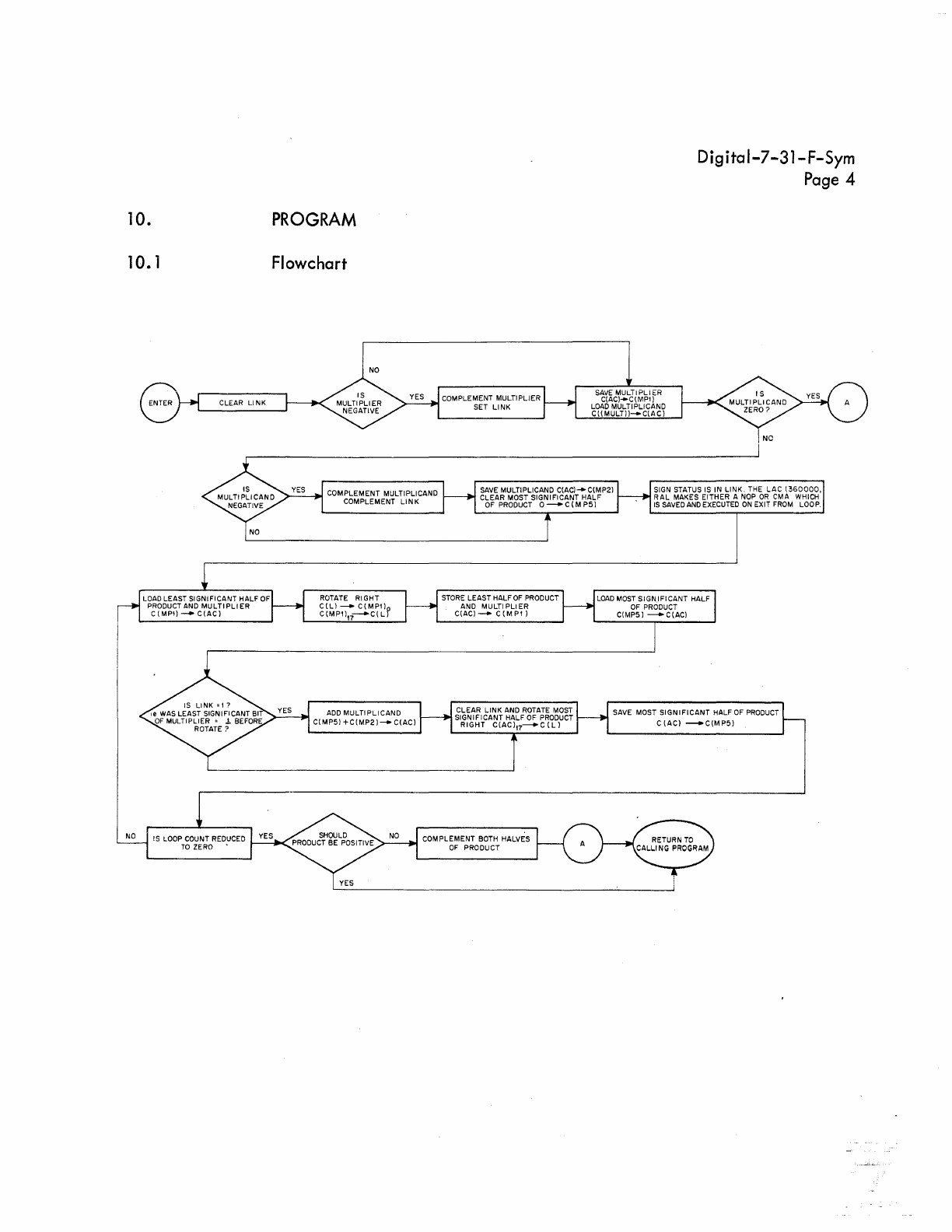
Reference to
the
flowchart
(10.
1) will
illustrate
the
following
discussion.
6.
1 • 1
On
entry,
the sign
of
the
multiplier
is
tested,
and
if
negative,
the
multiplier
is
made
positive.
6.
1
.2
The mul tipl
icand
is
obtained
and
tested
for
O.
If
it
is
found
equal
to
0,
a
;ump to
the
exit
is
executed.
Next
the
sign
of
the
multiplicand
is
tested;
and
if
it
is
found
negative,
the
multiplicand
is
made
positive.
.
6.
1
.3
At
this
point,
the
contents
of
the
I ink
are
as follows:
Sign
of
Multipl
ier
Sign
of
Multipl
icand
o 0
o 1
1 0
1 1
and
represent,
therefore,
the
sign
of
the
product.
Links
o
1
1
o
6.1.4
The
multiply
loop
proper
(tagged
MP4)
is
entered.
During this
loop,
the
least
significant
half
of
the
product
shifts into
the
most
significant
end
of
MP5
while
the
multiplier
shifts
out
the
least
significant
end
of
MP5
and
is
lost.
Note
that
the
sign
of
the
product
is
retained
in
MP5.
'7
Digital-7-31-F-Sym
Page 3
6.
1.5
The
sign
of
the
product
is
tested.
If
positive,
the
subroutine
exits.
If
negative,
complementation
of
the
product
is
performed
before
the
exit.
6.3
Scal
ing
Upon
entry
the
binary
point
is
assumed to be
located
between
bit
positions
o
and
1 in
both
multiplier
and
multiplicand.
Since
there
are
17
magnitude
bits in
each
of
the
two
factors,
the
product
will
contain
34
magnitude
bits.
The
product
is
double
signed,
i.e.,
bit
positions 0
and
1
of
the
most
sig-
nificant
word
of
the
product
both
contain
the
sign.
The
remaining
16 bits
of
the
most
sig-
nificant
word
of
the
product
~magnitude
bits.
The
least
significant
word
of
the
product
is
devoted
entirely
to
magnitude.
If
the
binary
point
of
the
factors
are
as
stated
above,
the
binary
point
of
the
product
will
be
located
between
bit
positions 1
and
2 in
the
most
significant
portion
of
the
product.
On
entry,
multiplier
and
multiplicand
must
be
21s
complement
binary.
After
return,
the
product
is
contained
in two words in 21s
complement
form.
For more information on
binary
scal
ing for
fixed-point
computers,
see
Appl
ication
Note
501 •
7.
METHOD
7.2 Algorithm
The
conventional
algorithm
is
used.
The
least
significant
bit
of
the
multipl
ier
is
tested.
If
it
is
equal
to
1,
the
multiplicand
is
added
to
the
developing
product
and
this
quantity
is
shifted
right.
If
the
least
significant
bit
of
the
multipLier
is
0,
no
addition
is
made
before
the
shift.
The process
is
repeated
until
all
the
bits
of
the
multipl
ier
in
order
from
least
significant
to most
significant
have
been
processed.
9. EXECUTION
TIME
9. 1 Minimum
When
the
subroutine
discovers
that
the
multipl
icand
is
0,
the
mu
Itipl
ication
loop
is
bypassed.
In
this
case,
execution
time will
be
14
microseconds.
9.2 Maximum
Maximum
execution
time
occurs
when
the
sign
of
the
product
is
negative
and
the multipl
ier
consists (in
binary)
of
all
ones.
The time
is
approximately
570
jJsec.
PDF
7
LIBRARY
10.
10.
1
CLEAR
LI
NK
PROGRAM
Flowchart
COMPLEMENT MULTIPLIER
SET
LINK
COMPLEMENT MULTIPLICAND
COMPLEMENT
LINK
ROTATE
RIGHT
g~~)p~~~7~r
ADD
MULTI PLICAND
C(MP5l
+C(MP2l-
C(ACl
STORE
LEAST HALF
OF
PRODUCT
AND
MULTIPLIER
C(ACl-
C(MPll
COMPLEMENT
BOTH
HALVES
OF
PRODUCT
Digital-7-31-F-Sym
Page
4
SIGN
STATUS
IS
IN LINK.
THE
LAC
(360000.
RAL
MAKES EITHER A
NOP
OR
CMA
WHICH
IS
SAVED
AND
EXECUTED
ON
EXIT
FROM
LOOP.
SAVE
MOST
SIGNIFICANT HALF
OF
PRODUCT
C
(ACl
-C(MP5l
Digital-7-31-F-Sym
Page 5
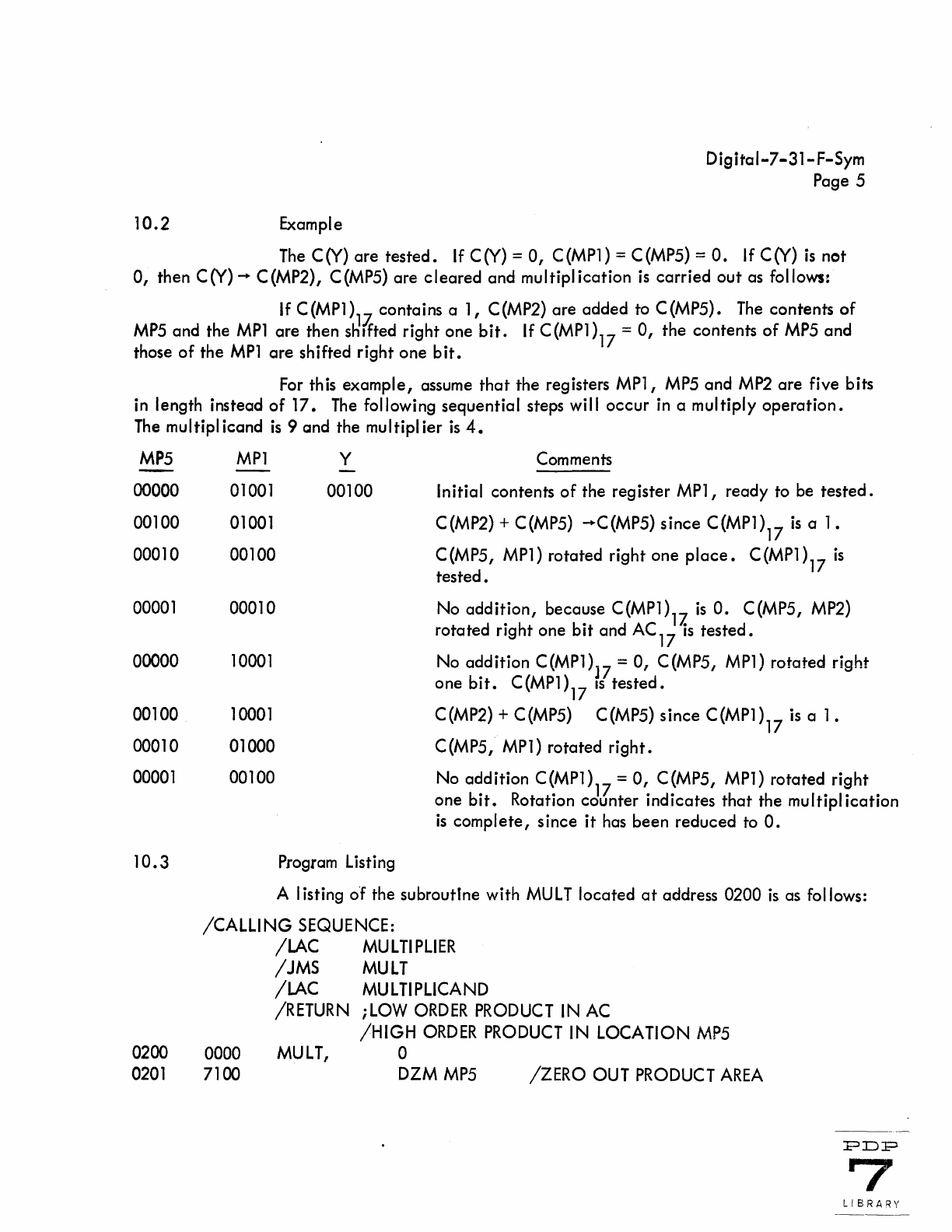
10.2
Example
The
C
(Y)
are tested.
If
C
(Y)
= 0, C
(MP1)
= C
(MP5)
=
O.
If
C
(Y)
is
not
0, then
C(Y)
-C(MP2),
C(MP5)
are cleared and multiplication
is
carried out
as
follows:
If
C
(MP1
)ll
contains a 1,
C(MP2)
are added
to
C (MP5).
The
contents of
MP5
and the
MPl
are then snlfted right one bit.
If
C(MPl)17 = 0, the contents of
MP5
and
those of the
MPl
are shifted right one bit.
For
this example,
assume
that the registers
MP1,
MP5
and
MP2
are five bits
in
length instead of 17.
The
following sequential steps will occur
in
a multiply operation.
The
multiplicand
is
9 and the multiplier
is
4.
MP5
MP1
Y
Comments
00000
01001
00100 Initial contents of the register
MP1,
ready
to
be
tested.
00100
01001
C(MP2)
+
C(MP5)
-C(MP5) since C(MPl)17
is
a 1.
00010 00100 C(MP5,
MP1)
rotated right one place. C(MPl)17
is
tested.
00001
00010
No
addition, because C(MP1)lZ
is
O.
C(MP5,
MP2)
rotated right one bit and
AC
17
is
tested.
00000
10001
No
addition C(MPl)]7 = 0, C(MP5, MPl) rotated right
one bit. C(MPl)17
IS
tested.
00100
10001
C
(MP2)
+ C
(MP5)
C(MP5)
since
C(MPl
)17
is
a 1 •
00010 01000 C
(MP5,
MPl) rotated right.
00001
00100
No
addition C(MP1)17 =
0,
C(MP5, MPl) rotated right
one bit. Rotation counter indicates that the
mul
tipl ication
is
complete, since
it
has
been reduced
to
o.
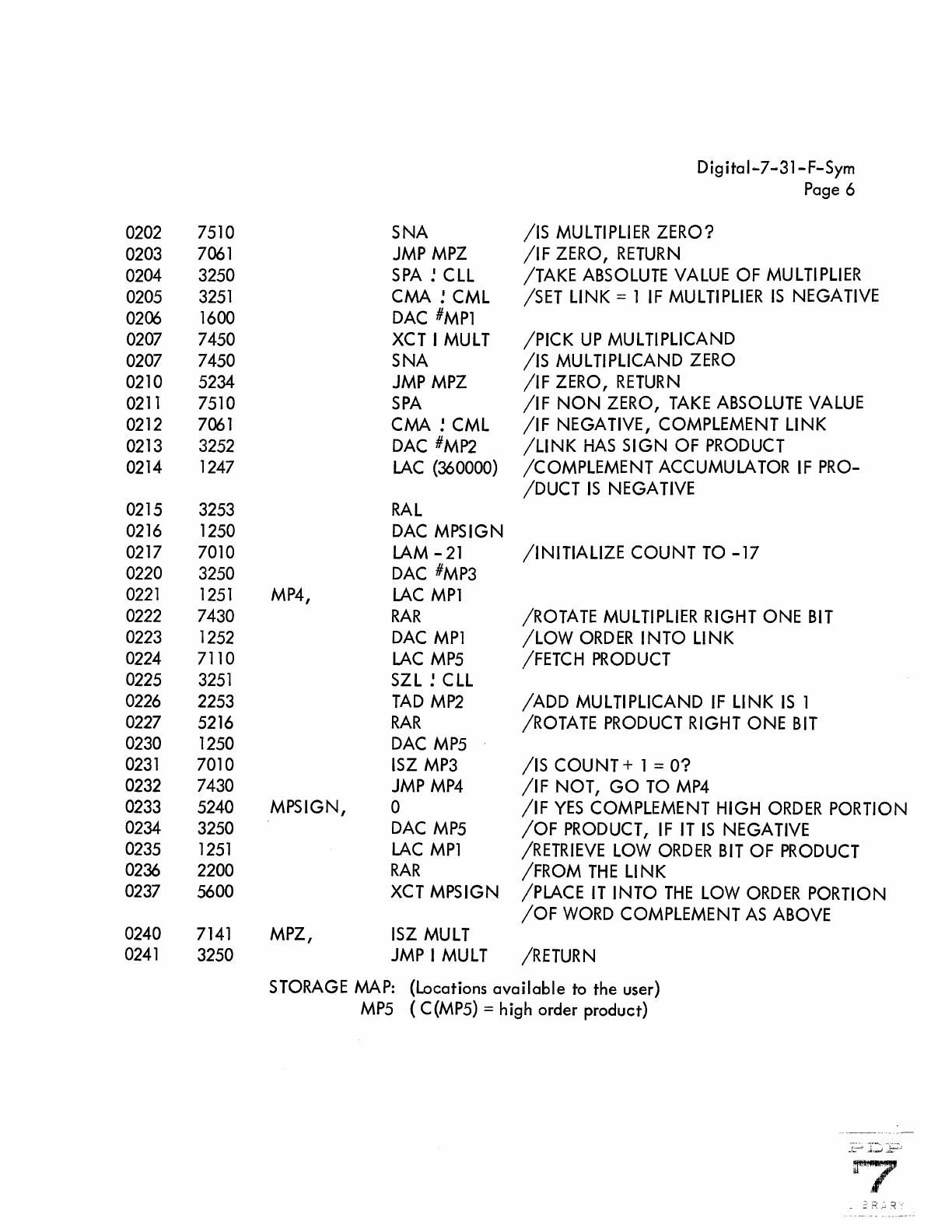
10.3
Program
Listing
A I isting of
the
subroutine with MULl located
at
address 0200
is
as
follows:
/CALLING
SEQUENCE:
/LAC
MULTIPLIER
/JMS
MULT
/LAC
MULTIPLICAND
/RETURN
iLOW
ORDER
PRODUCT
IN
AC
/HIGH
ORDER
PRODUCT
IN
LOCATION
MP5
0200
0000
MULT,
0
0201
7100
DZM
MP5
/ZERO
OUT
PRODUCT
AREA
PDP
7
LIBRARY
Digital-7-31-F-Sym
Page
6
0202 7510
SNA
/IS
MULTIPLIER ZERO?
0203
7061
JMP MPZ
/IF
ZERO,
RETURN
0204 3250
SPA!
CLL
/TAKE
ABSOLUTE VALUE OF MULTIPLIER
0205
3251
CMA
:
CML
/SET
LINK
= 1 IF MULTIPLIER
IS
NEGATIVE
0206 1600 DAC
#MP1
0207 7450 XCT I MULT
/PICK
UP
MULTIPLICAND
0207 7450
SNA
/IS
MULTIPLICAND ZERO
0210 5234 JMP MPZ
/IF
ZERO,
RETURN
0211
7510
SPA
/IF
NON
ZERO,
TAKE
ABSOLUTE VALUE
0212
7061
CMA
!
CML
/IF
NEGATIVE, COMPLEMENT
LINK
0213 3252 DAC
#MP2
/L1NK
HAS
SIGN
OF PRODUCT
0214 1247
LAC
(360000)
/COMPlEMENT
ACCUMULATOR IF PRO-
/DUCT
IS
NEGATIVE
0215 3253
RAL
0216 1250 DAC MPSIGN
0217 7010 LAM
-21
/INITIALIZE
COUNT
TO
-17
0220 3250 DAC
#MP3
0221
1251
MP4,
LAC
MPl
0222
7430
RAR
/ROTATE MULTIPLIER RIGHT
ONE
BIT
0223
1252
DAC
MPl
flOW
ORDER
INTO
LINK
0224 7110
LAC
MP5
/FETCH
PRODUCT
0225
3251
SZl
:
Cll
0226
2253
TAD
MP2
/ADD
MULTIPLICAND
IF
LINK
IS
1
0227 5216
RAR
/ROTATE PRODUCT RIGHT
ONE
BIT
0230 1250 DAC MP5
0231
7010 ISZ MP3
/IS
COUNT
+ 1 =
O?
0232 7430 JMP
MP4
/IF
NOT,
GO
TO MP4
0233 5240
MPSIGN,
0
/IF
YES
COMPLEMENT HIGH
ORDER
PORTION
0234 3250 DAC
MP5
/OF
PRODUCT,
IF
IT
IS
NEGATIVE
0235
1251
LAC
MPl /RETRIEVE
lOW
ORDER
BIT
OF PRODUCT
0236
2200
RAR
/FROM
THE
LINK
0237 5600 XCT MPSIGN /PLACE IT
INTO
THE
LOW
ORDER
PORTION
/OF
WORD
COMPLEMENT
AS
ABOVE
0240
7141
MPZ,
ISZ
MUlT
0241
3250 JMP I MULT /RETURN
STORAGE MAP: (Locations available to the user)
MP5
(C(MP5)
= high order product}
