EN VDH 412BS 412CS 412DS MANUAL V1.1
User Manual:
Open the PDF directly: View PDF  .
.
Page Count: 69
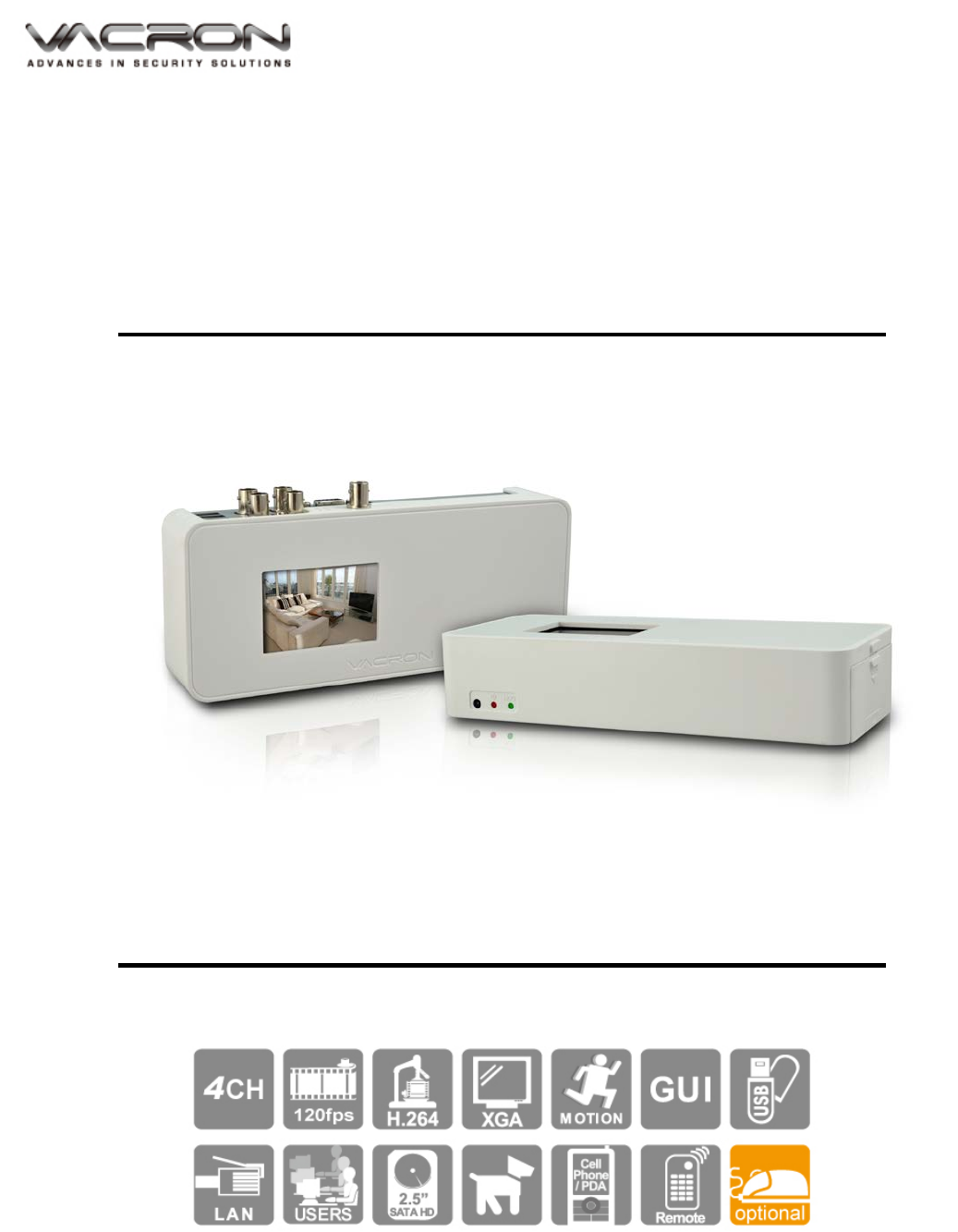
Ultra-light 4CH H.264
Digital Video Recorder
USER MANUAL
2013 MAR V1.1
* In the first phase of installation or default value, the image will be shown on VGA,
if users need another display, please switch by manual way. (TYPE2)
TYPE1: VGA Output
TYPE2: VGA / BNC Output
TYPE3: VGA / BNC / LCD Output

ii
WARNING
Do not expose the DVR under the sunlight, heat or
wet environment while installation. As it could
decrease the performance of DVR and damage the
machine.
Do not touch the power plug or case with wet hands
as this could result electric shock.
Do not forcedly bend or put heavy object on power
cable as this could result in injury to personal or
equipment.
Do not operate with damaged power cord or loose
electrical outlet as this could result in electric shock or
accident.
Please use individual power instead of share electrical
outlets with other electrical equipment as this could
result in damage or accident.
Do not attempt to service this DVR by yourself as it
may expose you to dangerous voltage or other
hazards. Please refer all service to the qualified
servicing distributor.
Please do not remove the machine housing during
operation.
It may cause electric shock or accidental injury.
CAUTION
Do not place the machine on an uneven surface or it would
decrease the DVR efficiency or malfunction.
Avoid any shock or bumping of the DVR while recording.
Improper handling could damage the system.
CAUTION
Make sure the voltage selector switch is set
to appropriate setting before plug in!

iii
CONTENTS
1. Specification ............................................................................................. 1
2. Structure of Product .................................................................................. 2
3. DVR Installation ........................................................................................ 3
4. System Operation ..................................................................................... 3
5. Display Setup ........................................................................................... 5
6. Search ...................................................................................................... 7
7. Main Menu ................................................................................................ 9
8.1 Camera Setup .................................................................................. 9
8.2 Record Setup ................................................................................. 10
8.3 Motion Detection ............................................................................ 12
8.4 Network Setup ................................................................................ 13
8.5 Log Search ..................................................................................... 16
8.6 Backup ........................................................................................... 17
8.7 System ........................................................................................... 18
8.7.1 Time Setting ......................................................................... 18
8.7.2 HDD Setup ........................................................................... 19
8.7.3 Display Setting ..................................................................... 20
8.7.4 System Information .............................................................. 22
8.7.5 User Password ..................................................................... 22
8.7.6 System Language ................................................................ 23
8.7.7 System Maintenance ............................................................ 23
8. H264 Player Operation ........................................................................... 25
9. H264 HDPlayer Operation ...................................................................... 27
10. Web Operation ....................................................................................... 29
11. Appendix ................................................................................................ 37
12.1 How to search and playback the footage step-by-step? ................. 37
12.2 How to backup the footage step-by-step? ....................................... 40
12.3 How to setup the Network step by step?......................................... 42
12.3.1 Static ..................................................................................... 43
12.3.2 DHCP ................................................................................... 48
12.3.3 PPPoE .................................................................................. 53
12.3.4 How to set up a 3G connection for your DVR? ..................... 55
12.4 Email Setup .................................................................................... 56
12.5 DDNS Setup ................................................................................... 57
12. Default Setting ........................................................................................ 63
13. HDD Support List .................................................................................... 64
14. 3G Data Rate .......................................................................................... 65
1
1. Specification
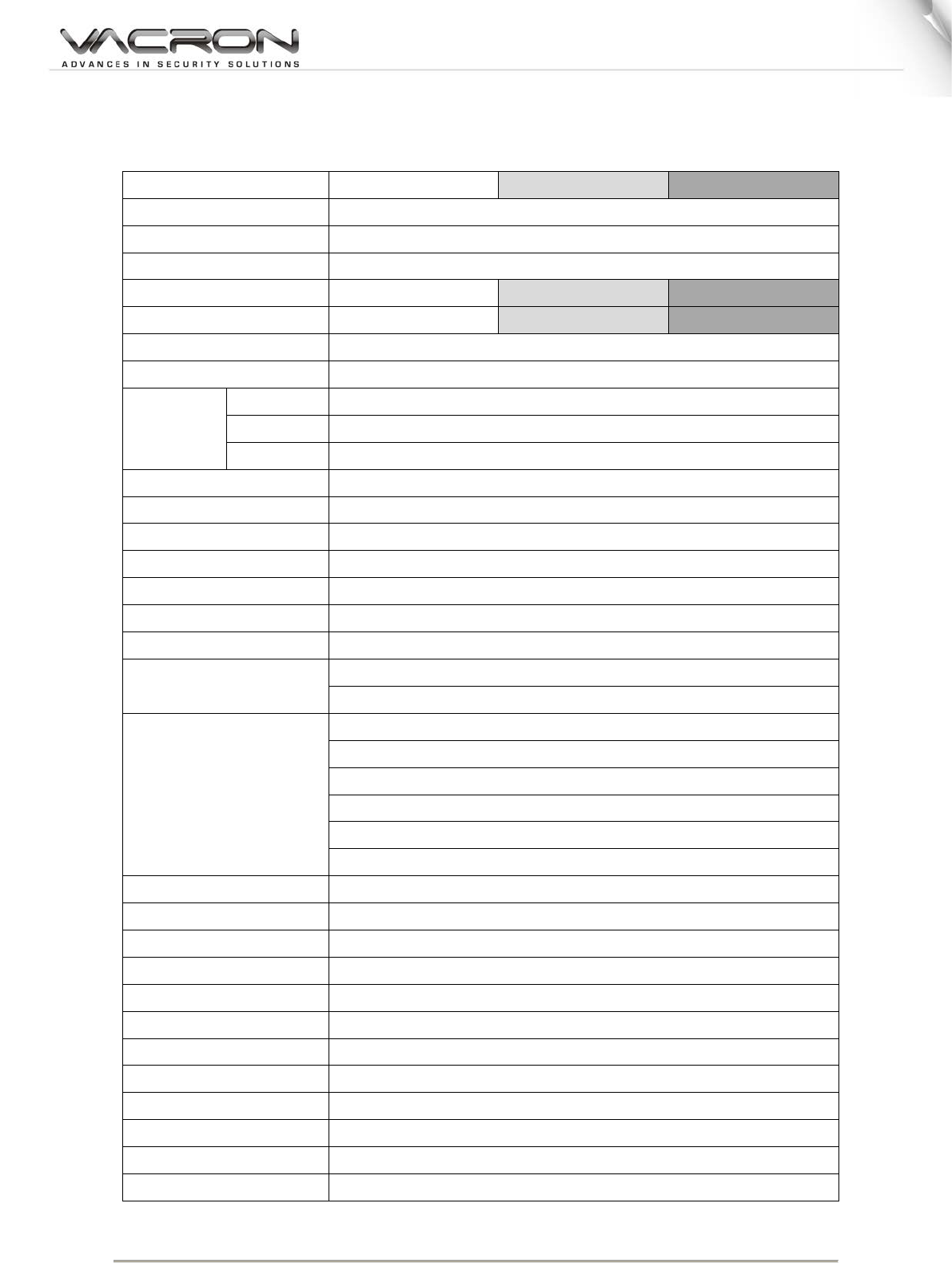
TYPE TYPE1 TYPE2 TYPE3
Video Format NTSC / PAL
Video Input 4 CH Input / BNC
XGA Output 800x600, 1024x768, 1280x1024, 1440x900
BNC Output - 1CH Output / BNC 1CH Output / BNC
Real Time Video Output - - LCD 3 inch 4:3 monitor
Display Mode Full Screen, 4CH Split Screen, Auto Switch, Picture in Picture
Display Resolution 720 x 480 / 720 x 576
Recording
Resolution
Highest 720 x 480 / 720 x 576
High 720 x 240 / 720 x 288
Normal 360 x 240 / 360 x 288
Recording Frame Max. 120 FPS / 100 FPS
Compression Algorithm H.264
Operating System Embedded Linux
Pentaplex Live / Record / Playback / Network / Mobile Phone
Recording Mode Manual, Schedule, Event
Schedule Recording Full Recording, Motion, Manual Recording
Status Indicator Power, HDD
Event Mode Motion Trigger, Video Loss
Recording Duration: 10~60 sec.
Playback Mode
Normal Speed: x1
Fast Forward: x2 / x4 / x8 / x16 /x32multiple speed
Slow Forward: 1/2, 1/4, 1/8 multiple speed
Fast Rewind: x2 / x4 / x8 / x16 /x32
Frame by Frame Playback: Forward
Search Function: Time / Event
Network Protocol TCP/IP / PPPoE / DHCP / SMTP / DDNS / 3G
HDD Type SATA 2.5”HDD x 1 (No HDD Included)
HDD Management Automatic Format System
Backup Device USB 2.0 Flash Memory Stick
Firmware Update Host USB
Multi-Language English / Chinese / Others
Control Mode Remote Control / USB Mouse(GUI) / Internet
Network Control IE Browser
Network Function Live Display / Playback / System Setup
Power Supply DC 5V / 2A(AC100V~240V 50/60HZ)
Unit Dimension 216mm x 97mm x 43mm
Weight 500g( HDD Included )
2
2. Structure of Product
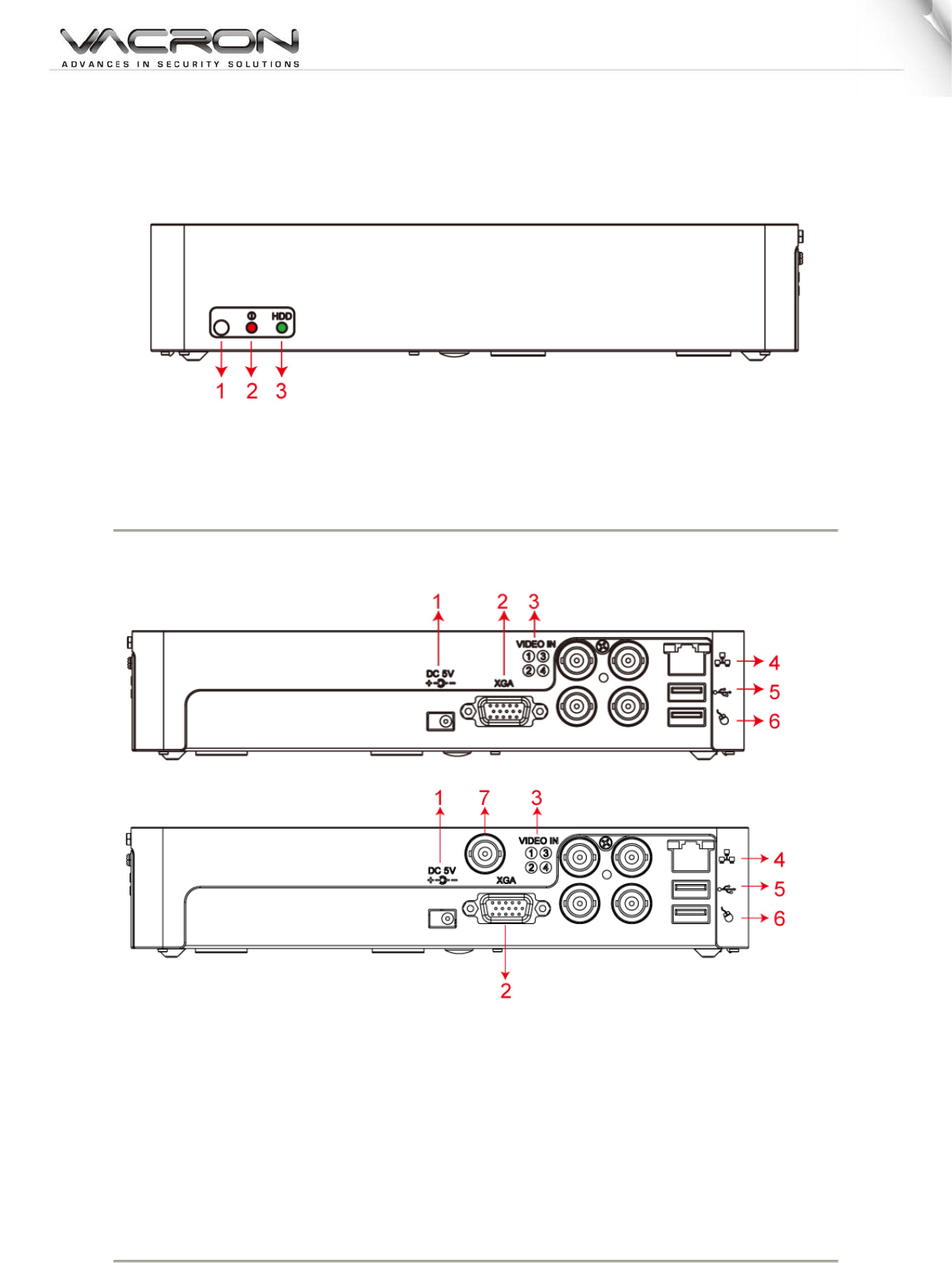
Front Panel
1. IR Remote Controller.
2. Power Indicator.
3. HDD Indicator.
Installation
1. Power Input: DC 5V
2. XGA: PC Monitor Output
3. VIDEO IN: 1~4CH Video Input
4. LAN: RJ-45 Network Connection
5. 2.0 USB Port
6. 2.0 USB Mouse Port
7. VIDEO OUT: 1CH Video Output
TYPE1
TYPE2 / TYPE3
3
3. DVR Installation
Connect the camera video output to the DVR video input port with BNC
connectors.
The camera install coaxial cable is suggested cat 6 or above.
DVR Network installation
Please connect DVR to HUB or router by using RJ-45 network cable and
make sure the DVR network indicator LED is on.
(Please refer to Network Setup for further network setting information of
using static IP, PPPoE or DHCP.
Power Installation
Please use the provided power cable and adaptor to connect the DVR DC
5V / 2A (AC100V~240V 50/60HZ). Please refer to Installation for connecting
position. The DVR system will enter into live viewing mode when power is
connected. Please refer to Display Setup - Live Viewing Mode for more
information.
4. System Operation
There are 2 kinds of DVR control method: remote control and USB mouse.
USB Mouse Operation
1. Quick Menu: Right click the mouse button under the live viewing mode to
go for enter into Quick Menu.
2. Left click the mouse button under the main menu to go to the sub-select
menu.
3. Left click the mouse button under the select menu to go to the sub-menu.
4. Use the mouse to change the setting.
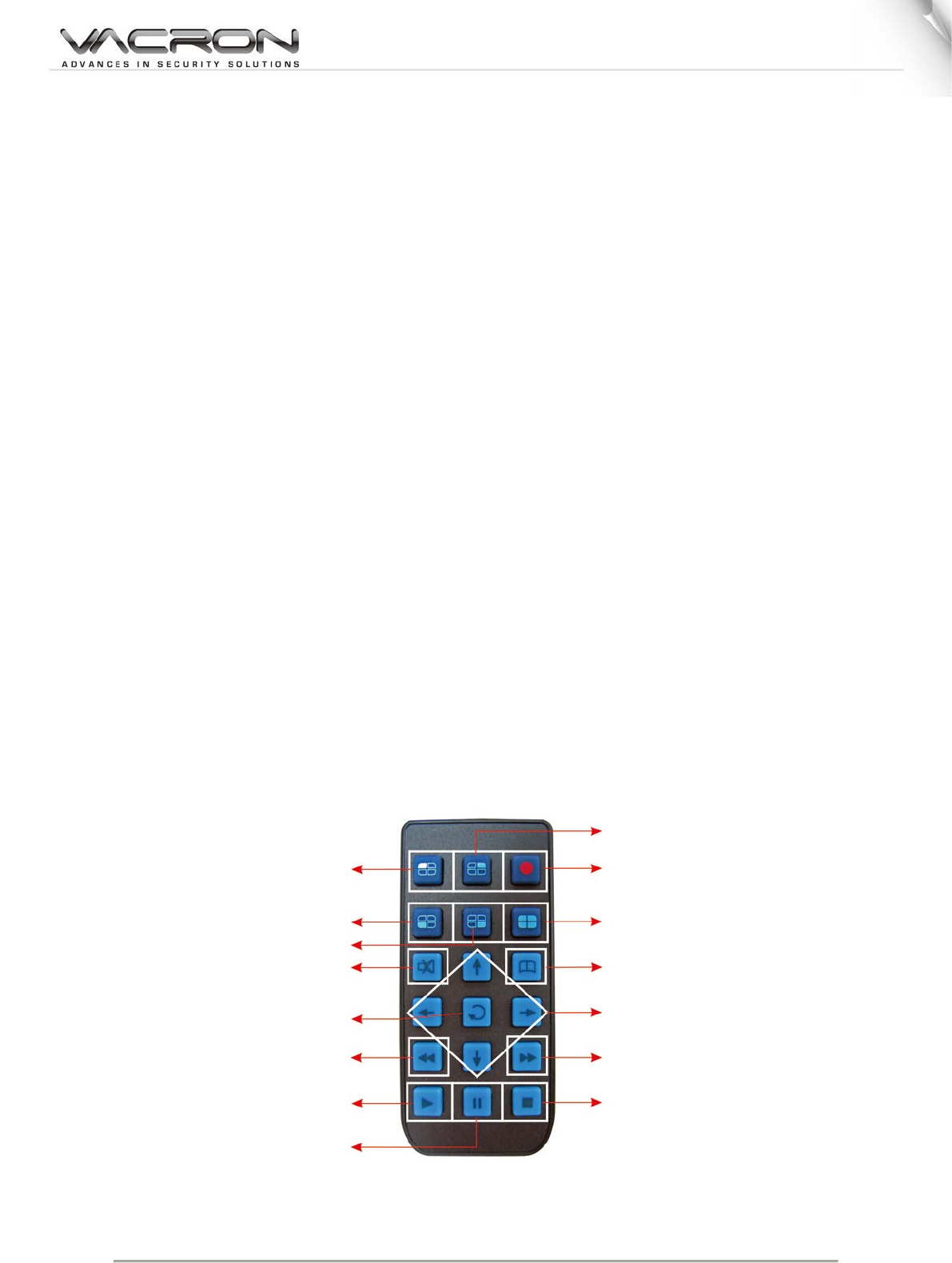
Remote Control Operation
Under the LIVE screen, press fast forward button twice within 1 second,
can switch GUI interface.
CH2 display
Record
Menu
Naviga
tor
Fast
Forward
Stop
/Remote ID Setup
Step/Pause
CH1 display
CH3
display
CH4 display
Mute
Enter
Fast
Rewind
Play
Quad
Windows
display
4
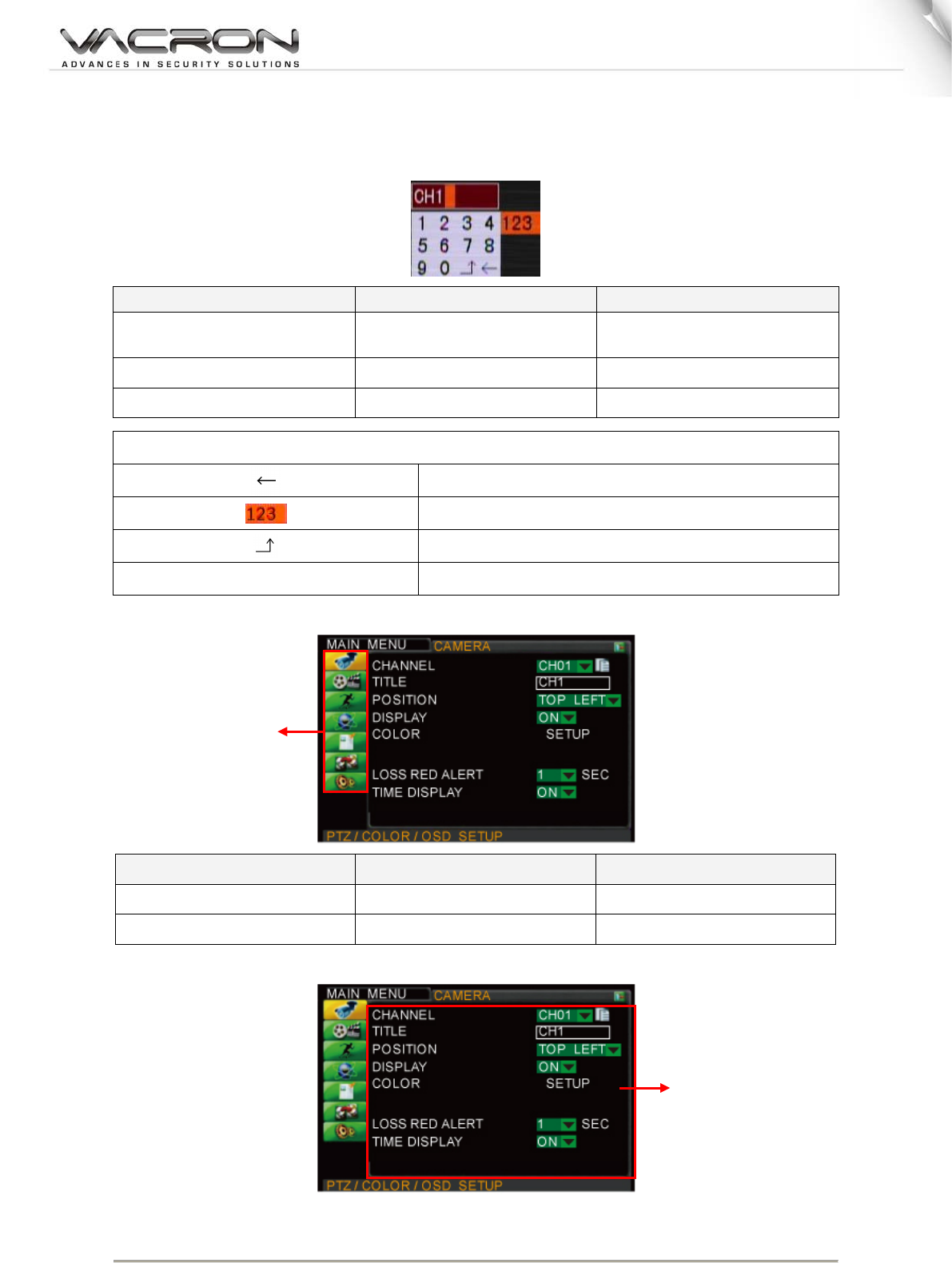
Virtual Keyboard Operation
The text input of the virtual keyboard is as below:
Menu Operation Remote Control Operation Mouse Operation
Select character from virtual
keyboard
[Up/Down/Left/Right] [Move Cursor]
Keyin the select character [Enter] [Left Click]
Exit the virtual keyboard [MENU] [Left Click]out of selection area
Key Description of Virtual Keyboard
Delete the previous character
Switch to text input
Enter key. Save and exit the virtual keyboard
Other Keys Character Key in
Main Menu Operation
Setup Operation Remote Control USB Mouse
Select [Up/Down/Left/Right] [Moving Cursor]
Enter Select Menu [Enter] [Left Click]
Setup Operation
Main menu
Setup
5
Setup Operation Remote Control USB Mouse
Select [Up/Down/Left/Right] [Moving Cursor]
Confirm Select Setting [Enter] [Left Click]
Change the Select Setting [Left/Right] [Left Click]
5. Display Setup
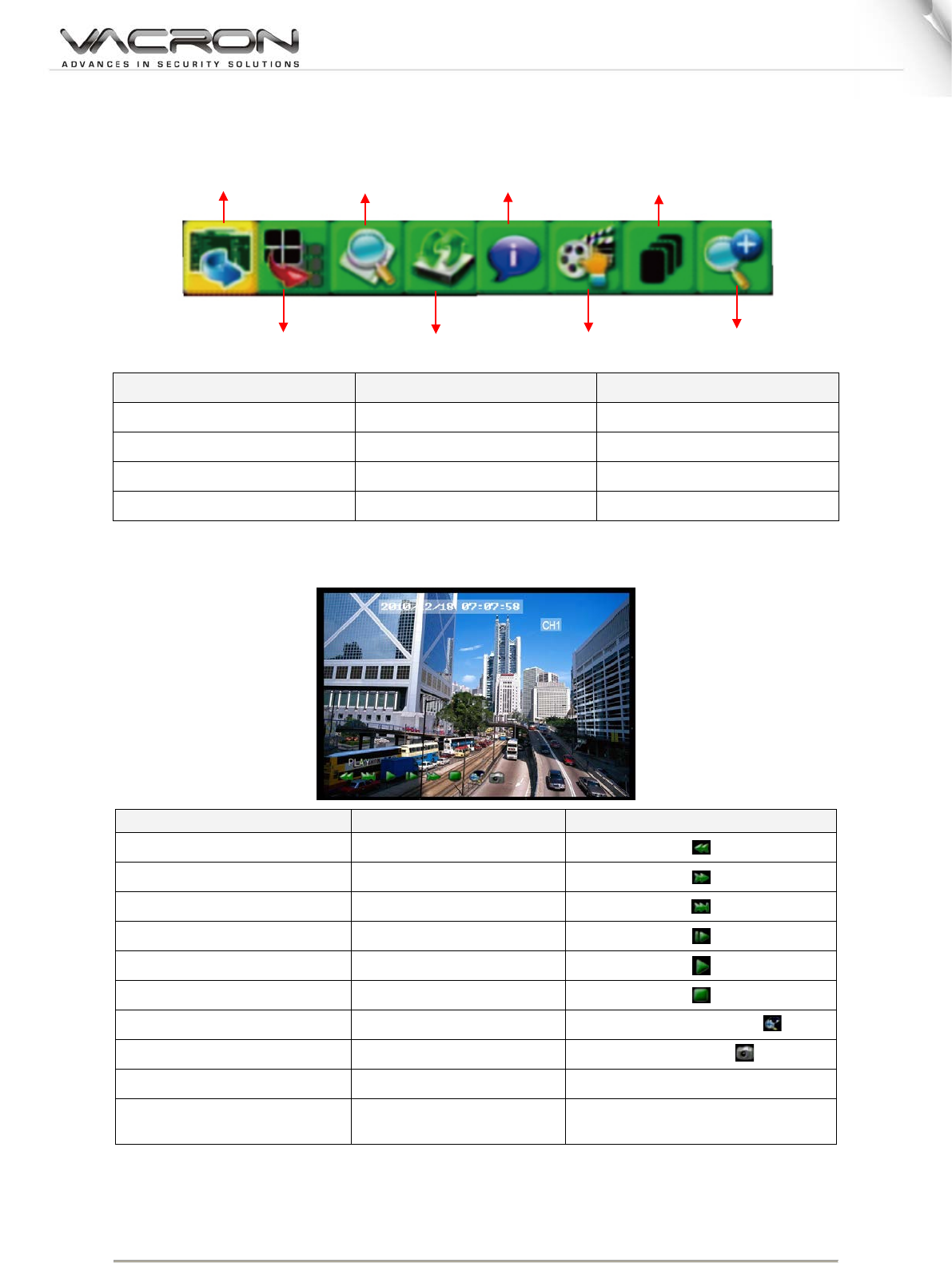
There are kinds of screen display mode: Live and Auto Switching.
Live Viewing Mode
The DVR will go to the live viewing mode after boot up. There are 4 different
status icon:
Setup Operation Remote Control USB Mouse
Channel 1~4 Single Channel
Display
[CH1~4]
Select one of channel
[Double click left button]
4 Channel Split Display [4 CH Split]
Under single channel
[Double click left button]
Quick Menu [MENU] [Right]
Playback Mode [Play] [Right] QuickMenu
Start/Stop the Manual Record [Record] [Right] QuickMenu
Start/Stop the Auto Switching [Auto Switch] [Right] QuickMenu
Start/Stop Mute [Mute] [Left] Left Click
●
: Record
M: Motion Triggered
L: Video Loss
: Sound on/off
6
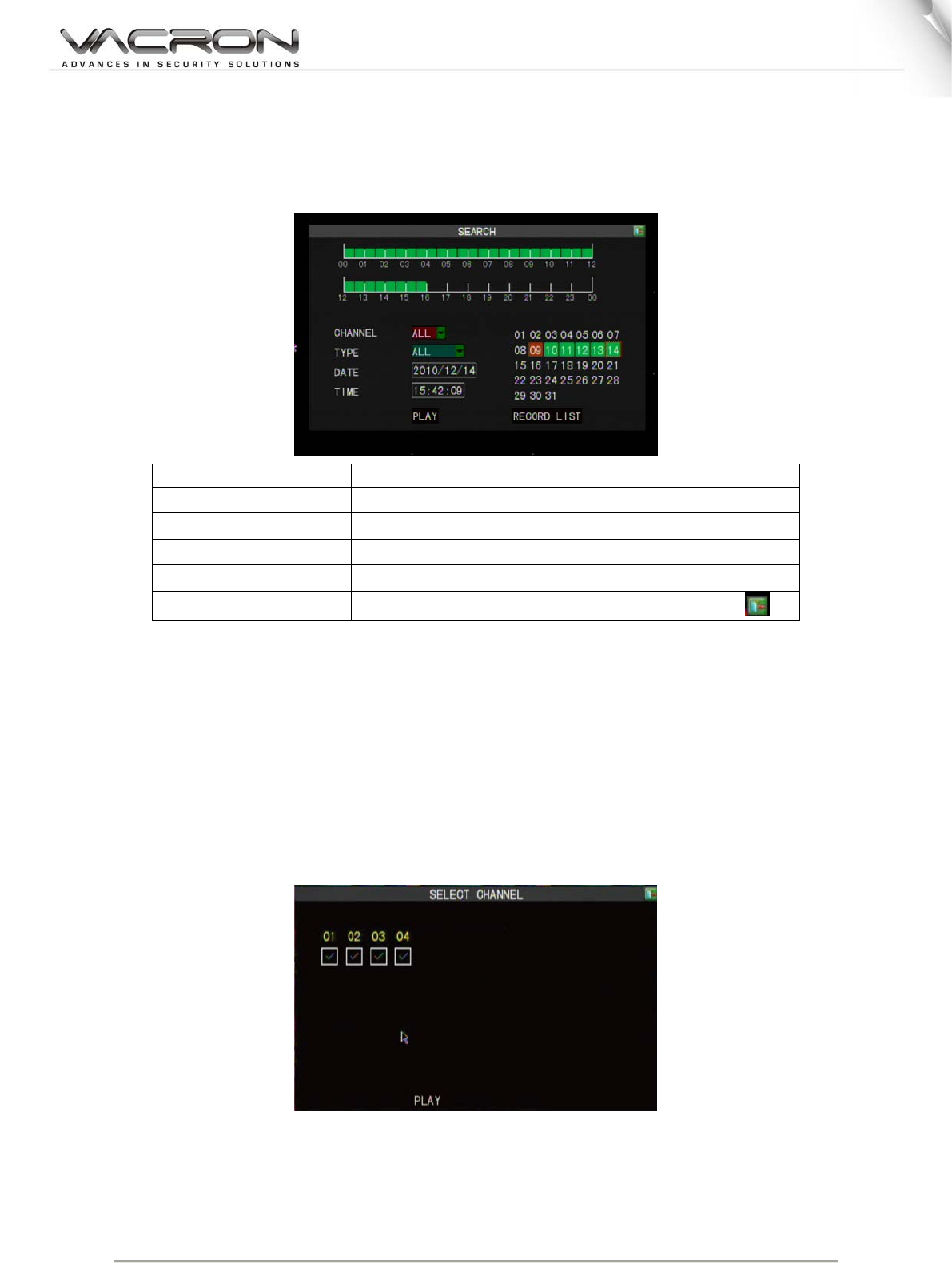
Quick Menu
Setup Operation Remote Control USB Mouse
Select Item [Left/Right] [Moving Cursor]
Enter the Select Item [Up/Down] [Moving Cursor]
Confirm the Select Item [Enter] [Left Click]
Exit [MENU] [Left Click] out of selection area
Playback Operation
Setup Operation
Remote Control
USB Mouse
Fast Rewind [Fast Rewind]
Fast Forward [Fast Forward]
Step Forward [Step Forward]
Step/Pause [Step/Pause]
Play 1x [Play]
Stop [Stop]
Digital Zoon None Drag by Left Click
Derived Image None [Left click]
1~4 Single Channel Display [1~4 Channel] Select Channel [Double left click]
4 split Display [4 split] Under single channel
[Double left click]
Auto Switching
1. Auto switch starts from order CH1~CH, 4 split channel.
2. Press the button again to stop the function.
Main Menu
Remote Lock
Search
Manual REC
Zoom Mode
PIP
Back Up
I
nfo
Auto Switching
7
6. Search
In Live mode, use Play button in the remote controller or right clicking the mouse
to switch to the Search function.
Setup Operation
Remote Controller
USB Mouse
Search
[Enter]
[Left Click]
Select Channel
[Up/Down]
[Moving Cursor]
Select Dates [Up/Down/Left/Right] [Moving Cursor]
Playback [Enter] [Left Click]
Return to Upper Menu [MENU]
[Right click] or [Left click
]
No data: no color, data of alarm trigger: red color, normal record data: green
color.
Select the first half of hour frame under the date, the playback will start from
00 mins: 00 sec. Select the second half of hour frame under the date, the
playback will start from 30mins:00sec. If there is no data on the date, please
try to search from record list.
Select any of 4channels to playback.
8
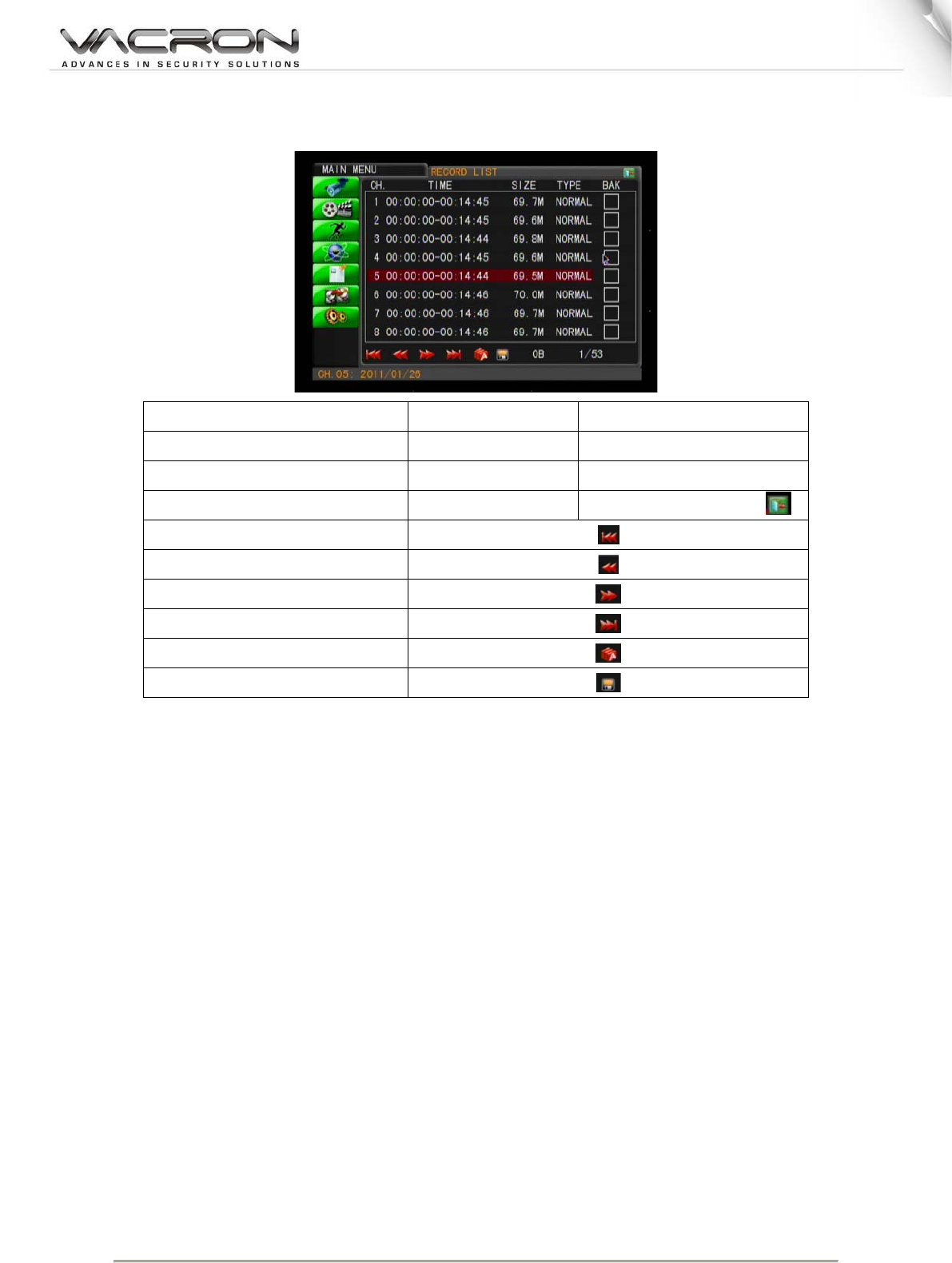
Record List
Setup Operation Remote Controller USB Mouse
Enter Select Item [Enter] [Left Click]
Select Item [Up/Down/Left/Right] [Moving Cursor]
Return to Upper Menu [MENU]
[Right click] or [Left click
]
First Page
Previous Page
Next Page
Last Page
Mark all the events in this page
BackUp
List all of recording data and click on one of record data to
playback.
Backup
Please click “BACKUP” to backup the selecting file to USB memory
stick.
9
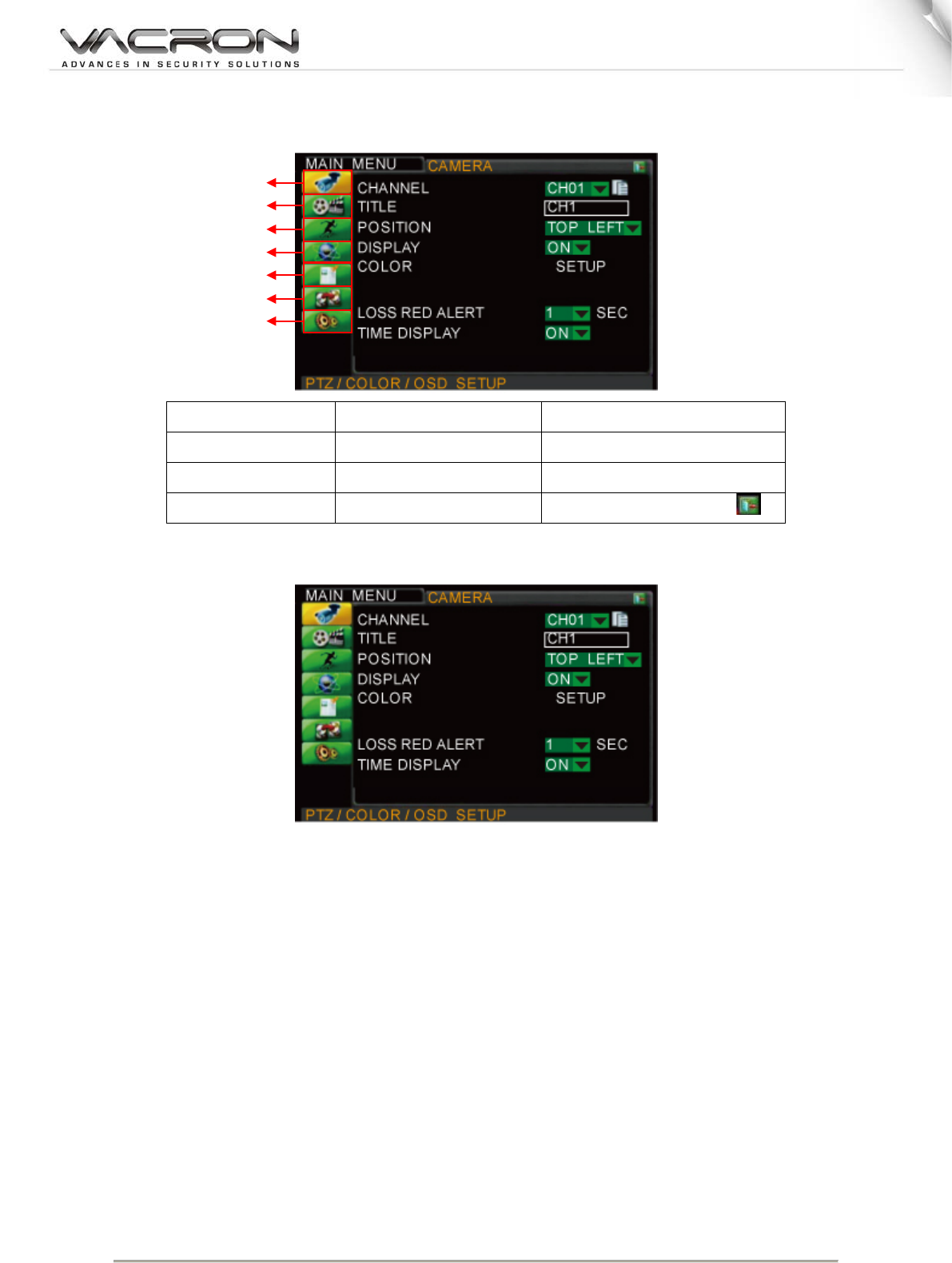
7. Main Menu
Setup Operation Remote Controller USB Mouse
Select Item [Up/Down/Left/Right] [Moving Cursor]
Enter Select Item [Enter] [Left Click]
Exit Main Menu [MENU] [Right click] or [Left click ]
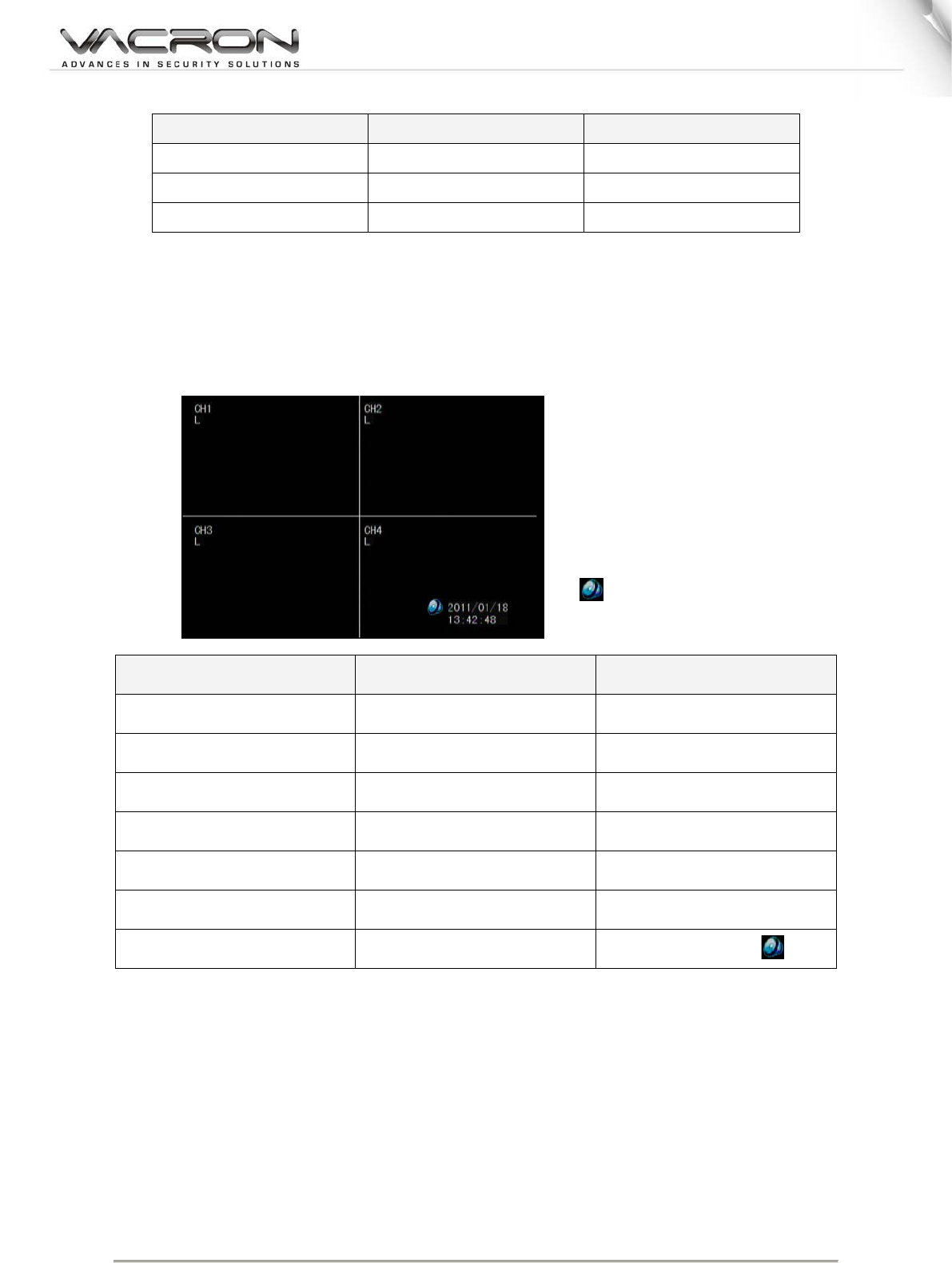
8.1 Camera Setup
Channel
Select one channel to set. Use Copy Button to copy present settings to other
channels.
Camera Title
Set the title of camera. Key in by using virtual keyboard.
Title Position
Set the title position. Set: Top Left, Top Right, Bottom Left, Bottom Right and
Off.
Display
Display the channel, set: On/Off
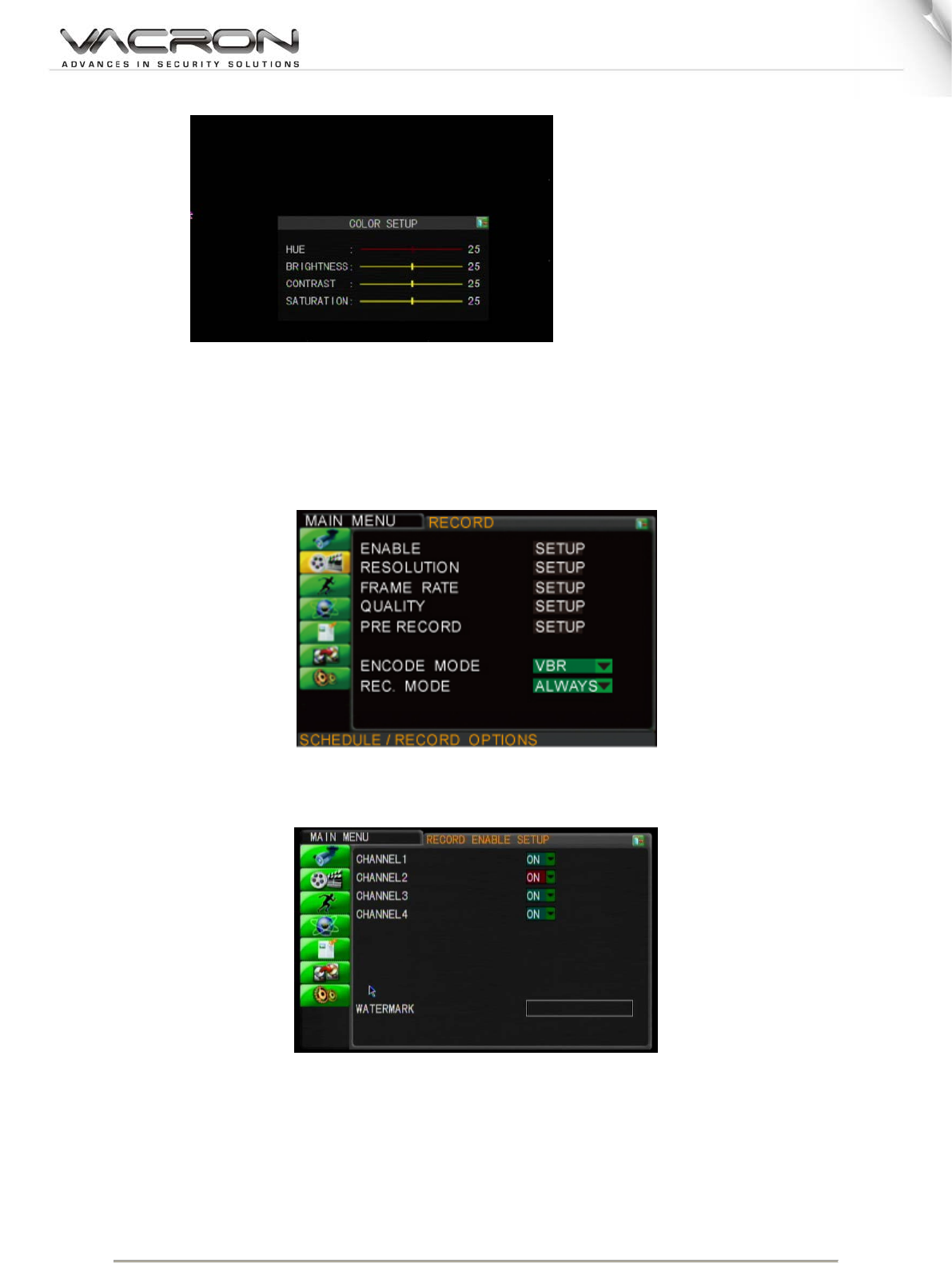
Camera Color Setup
Camera
Record
Motion
Network
Log
Search
Back
Up
System
10
Lose Red Alert
When there is video loss, a red warning light signal will appear in the screen.
Time Display
Display the time in LIVE mode. Values: ON/OFF.
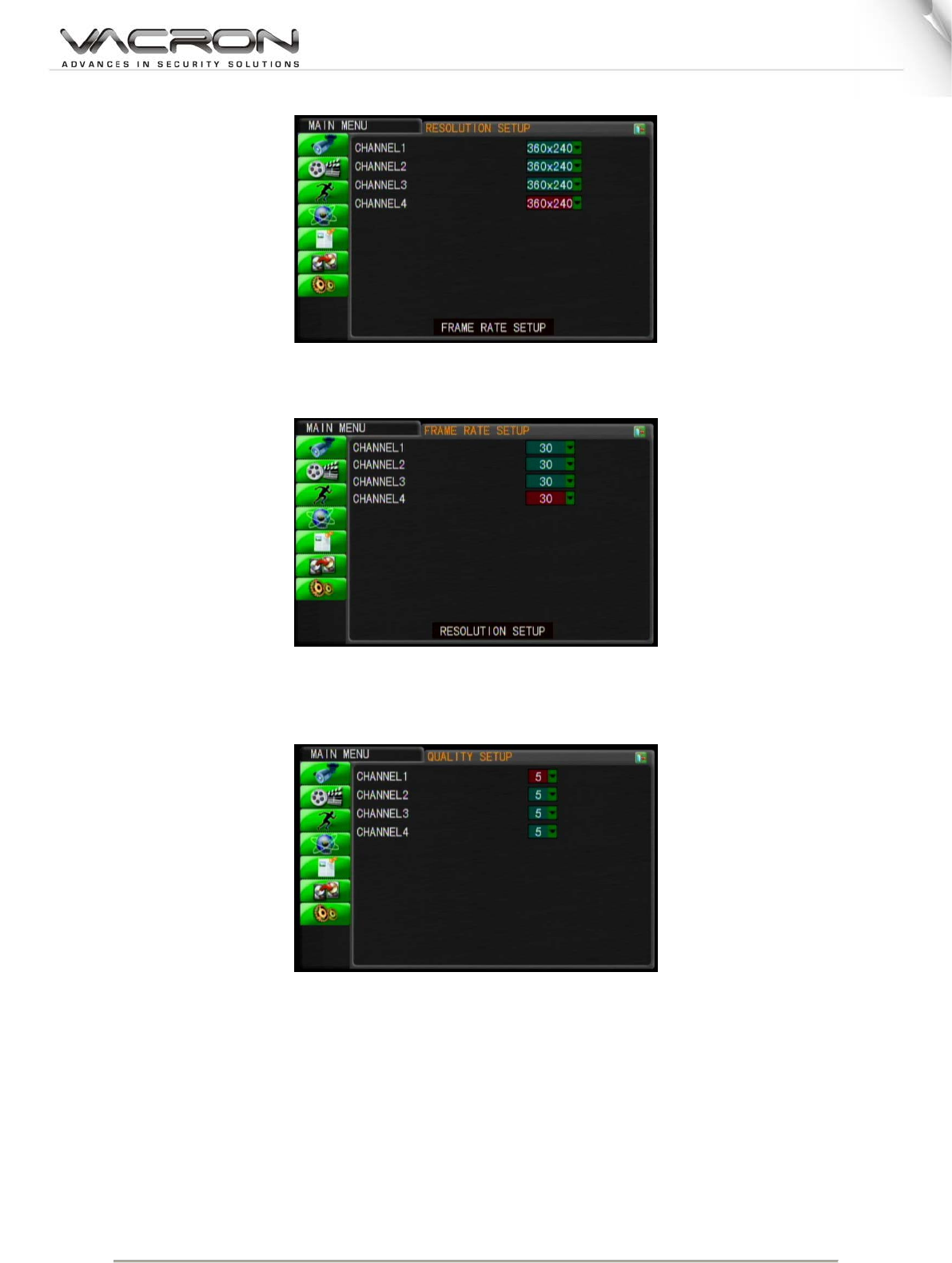
8.2 Record Setup
Record Enable Setup
On/Off the channel.
Watermark: Insert the words of watermark.
Resolution Setup
NTSC Recording Resolution: 720x480 / 720x240 / 360x240.
PAL Recording Resolution: 720x576 / 720x288 / 360x288.
Hue: 0~50
Brightness: 0~50
Contrast: 0~50
Saturation: 0~50
11
Frame Rate Setup
Setting of Frame Rate: NTSC: 0-30 frames/sec; PAL: 0-25 frames/sec.
Quality Setup
Setting of recording quality: Values 1-5. The bigger value, the better
quality.
Pre Record setting
Pre Recording time when motion. Values: 0-10 seconds.
Encode Mode
Encoding of channel. Values: VBR or CBR.
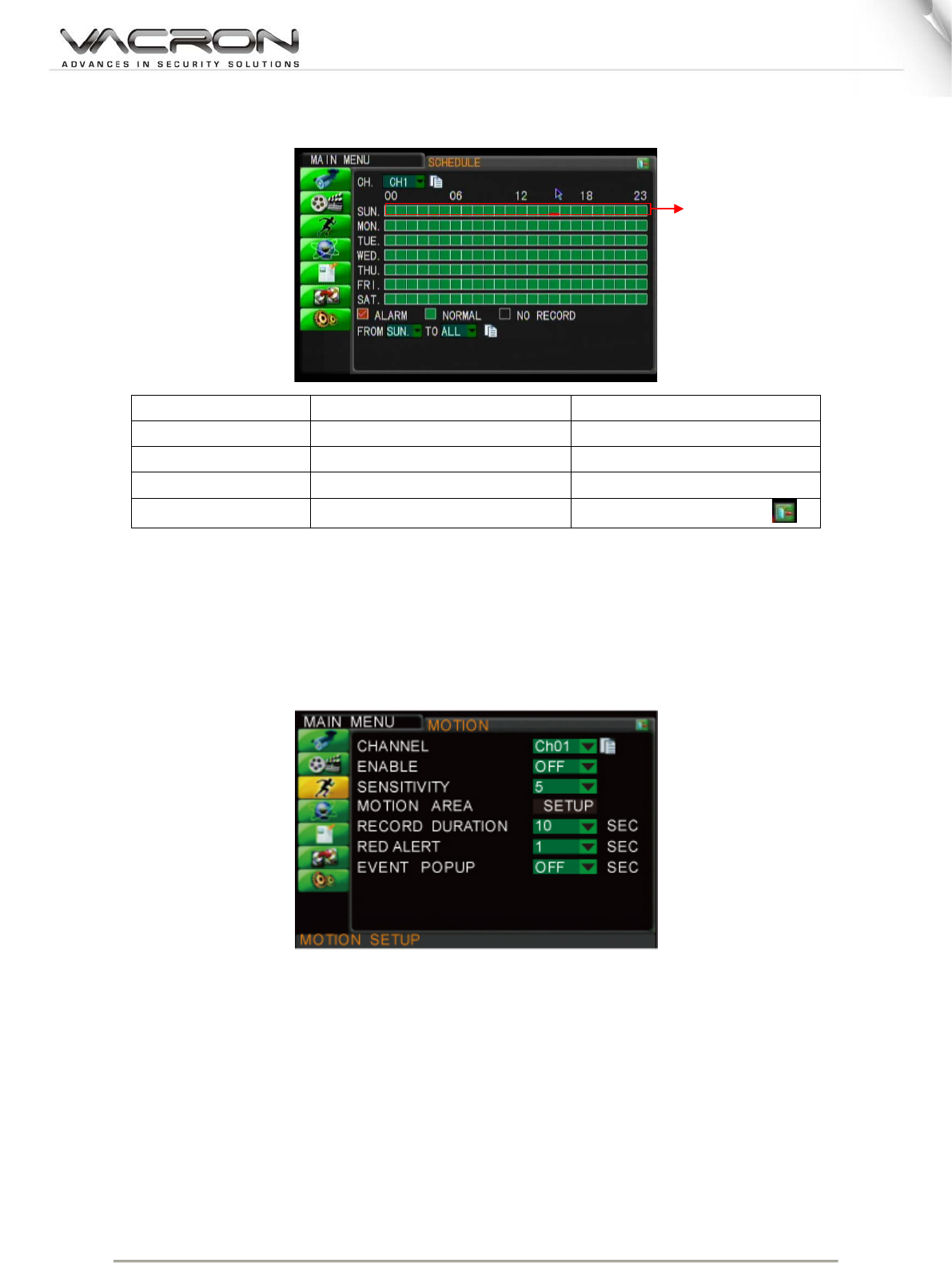
Record schedule setup
Always and Schedule Record.
12
Record Schedule
Setup Operation Remote Controller USB Mouse
Enter Select Item [Enter] [Left Click]
Select Channel [Up/Down] [Moving mouse wheel]
Select Time&Date [Up/Down/Left/Right] [Click/Drag-draw]
Return to Upper Menu [MENU]
[Right Click] or [Left Click
]
Copy
(1) Select source (2) Select target (3) Press COPY icon to
copy.
8.3 Motion Detection
Channel
Select the channel to set. COPY icon can copy the present setting to other
channels.
Enable
Enable/disable motion detection for each camera. Set: On/Off
Sensitivity
Sensitivity level of motion detection. Set: 1~10. Higher value equal more
sensitive.
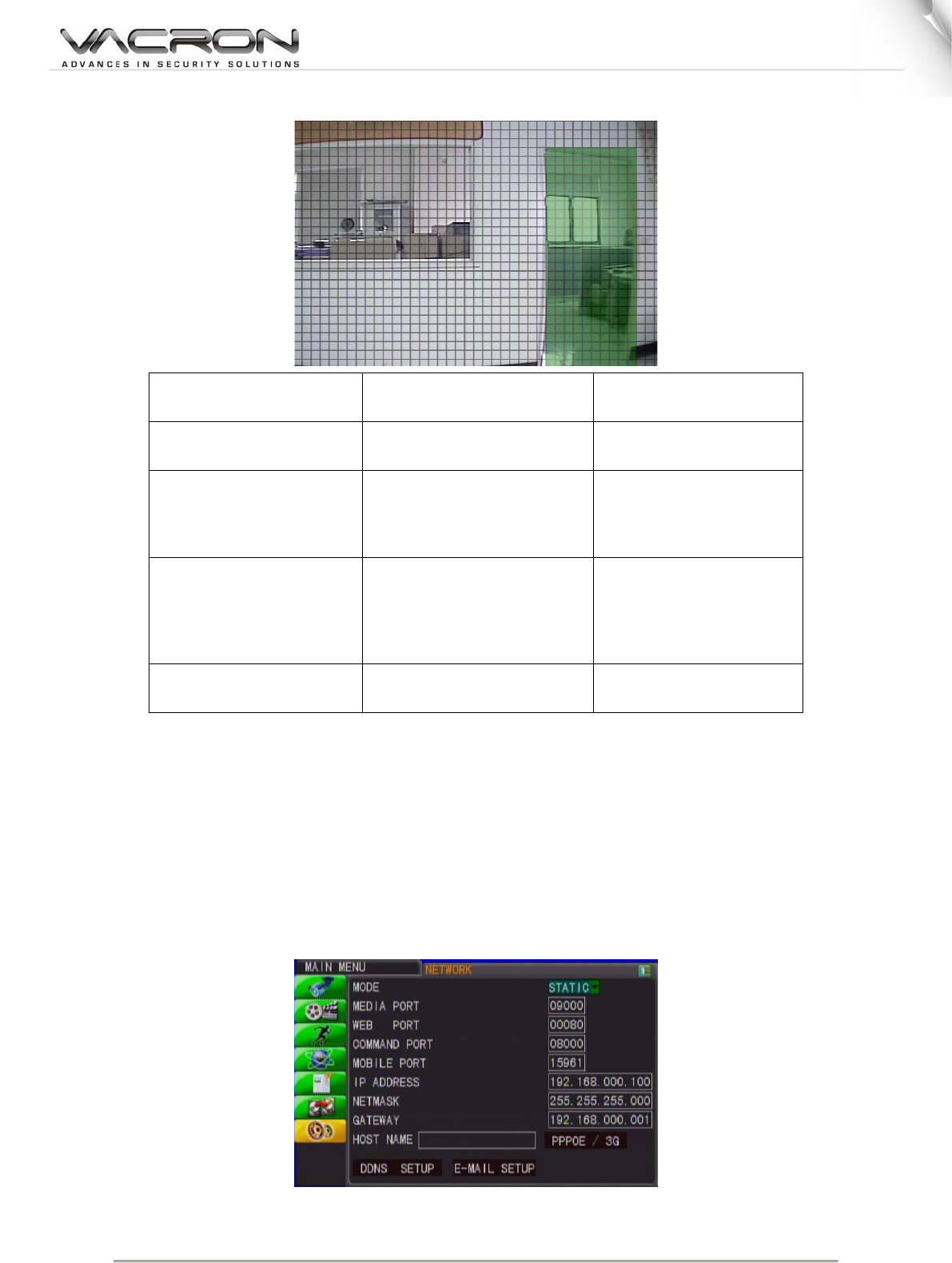
Motion Area Setup
Setup by each small square.
Schedule
13
Setup Operation Remote Controller USB Mouse
Area Selection [Up/Down/Left/Right] [Moving Cursor]
Set Detection Area: must
set on none detection
area(Transparent Area)
(1)Move to the area
(2)Press Enter to set the area [Drag by Left Click]
Clear Detection Area: clear
the set detection area: must
set on detection
area(Green Area)
(1)Move to the area
(2)Press Enter to set the area [Drag by Left Click]
Return to Upper Menu [MENU] [Right Click]
Record Duration
The duration of the recording after triggered: 10, 20… 60 sec. or off.
Red Alert
The time duration of red motion trigger warning light on the channel. 1, 5, 10,
15, 20, 30 sec.
Event Popup
The Duration of single channel display after being triggered: 1, 5, 10, 15, 20
sec or off.
8.4 Network Setup
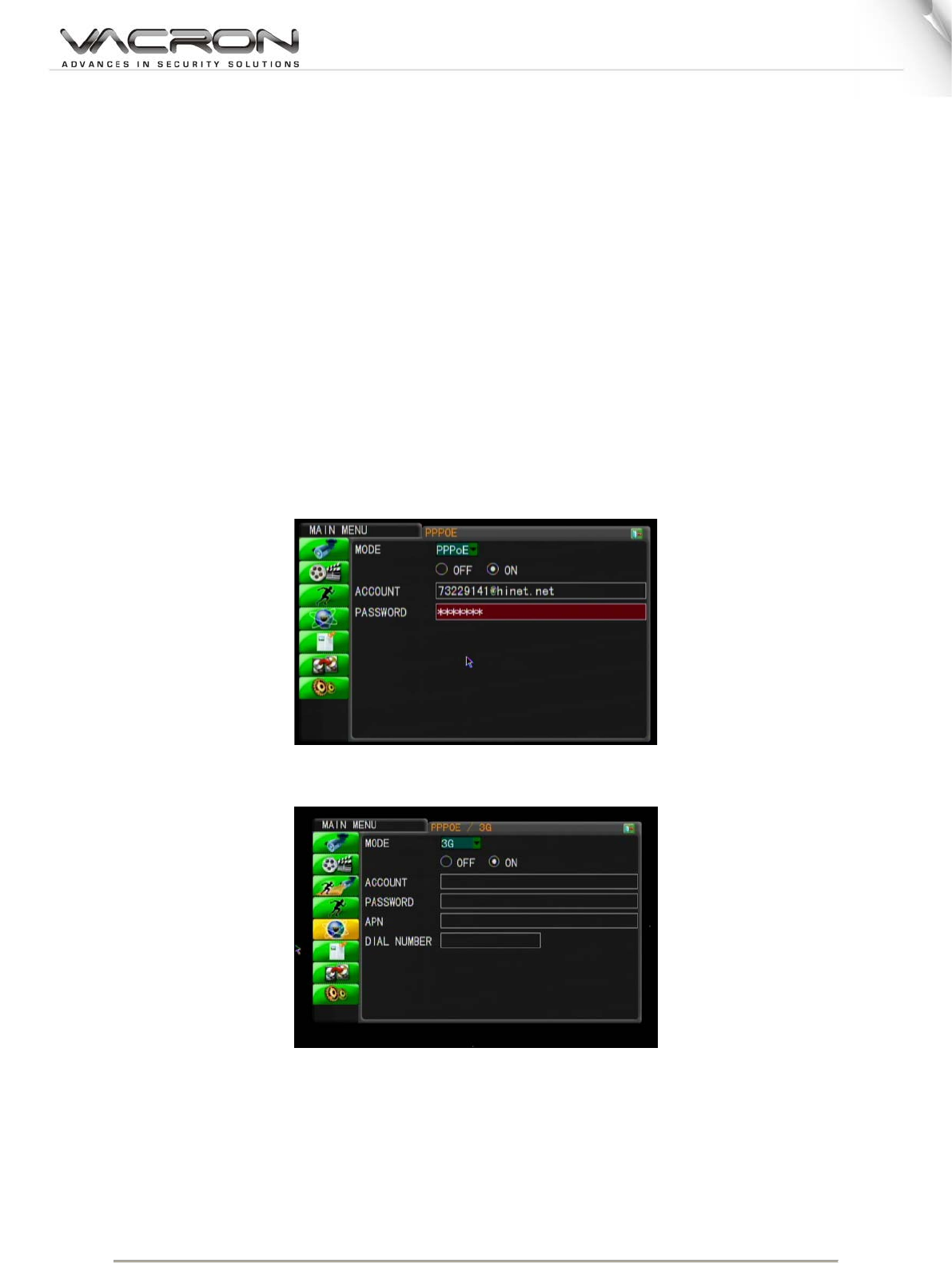
Mode
Set the connection method. Set: Static IP, DHCP, PPPoE.
14
Media Port
Port used for stream media. Default is port 9000.
WEB Port
Port used for web access. Default is port 80.
Command Port
Port used for settings. Default is port 8000.
Mobile Port
Mobile phone port (factory default): 15961.
IP Address
Assigned IP address.
Netmask
Assigned net mask
Gateway
Assigned gateway
HOST Name
Set the HOST Name of DVR.
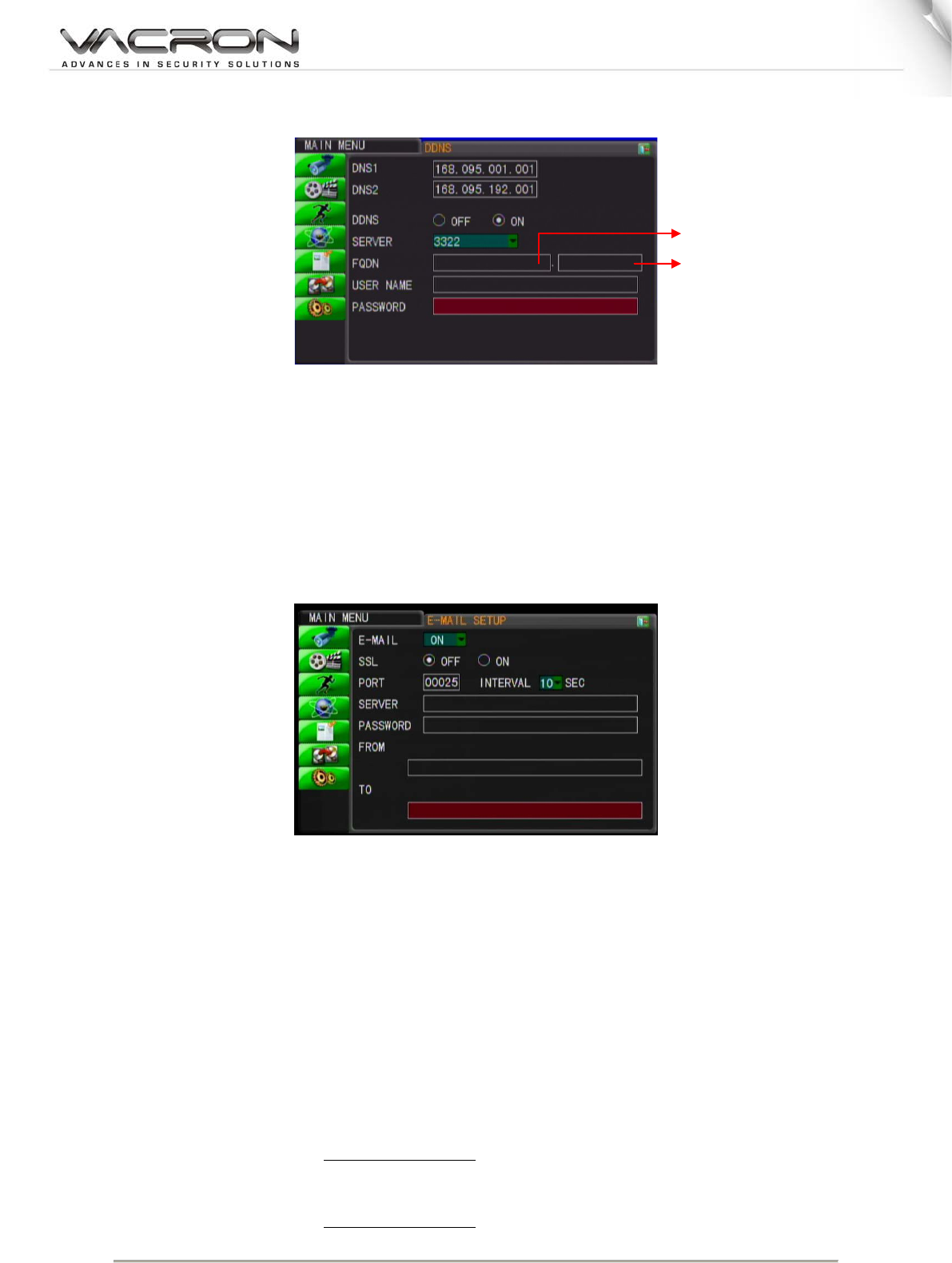
PPPOE/3G
PPPoE: Need account and password for PPPoE.
3G: Need account, password, APN and dial number for 3G.
15
DDNS setting
DNS1 First Domain Name Server, Default : 168.95.1.1
DNS2 Second Domain Name Server, Default :168.95.192.1
DDNS
Enable/disable Dynamic Domain Name server. Values: On, Off.
DDNS Server
DDNS Server, Values: 3322, dyndns, cctvdvr.
When using DDNS server, HOST name, server name and
account/password are required.
E-Mail Setting
E-MAIL
Forward E-mail after alarm triggered. Enable: On/Off
SSL
Enable the SSL encryption. Recommend to set on if it is using
gmail.
Port
SMTP port number key in. For example, gmail port 465.
Server
SMTP server key in. For example, gmail: smtp.gmail.com
Password
Sender E-mail account password
From
Sender E-mail address key in. For example,
gmail: mail1@gmail.com
To
Receiver E-mail address key in. For example,
gmail: mail2@gmail.com
HOST NAME
DVR NAME
16
Interval
When alarm keeps going, the time span to send E-mail. Values: 10,
30, 60 seconds.
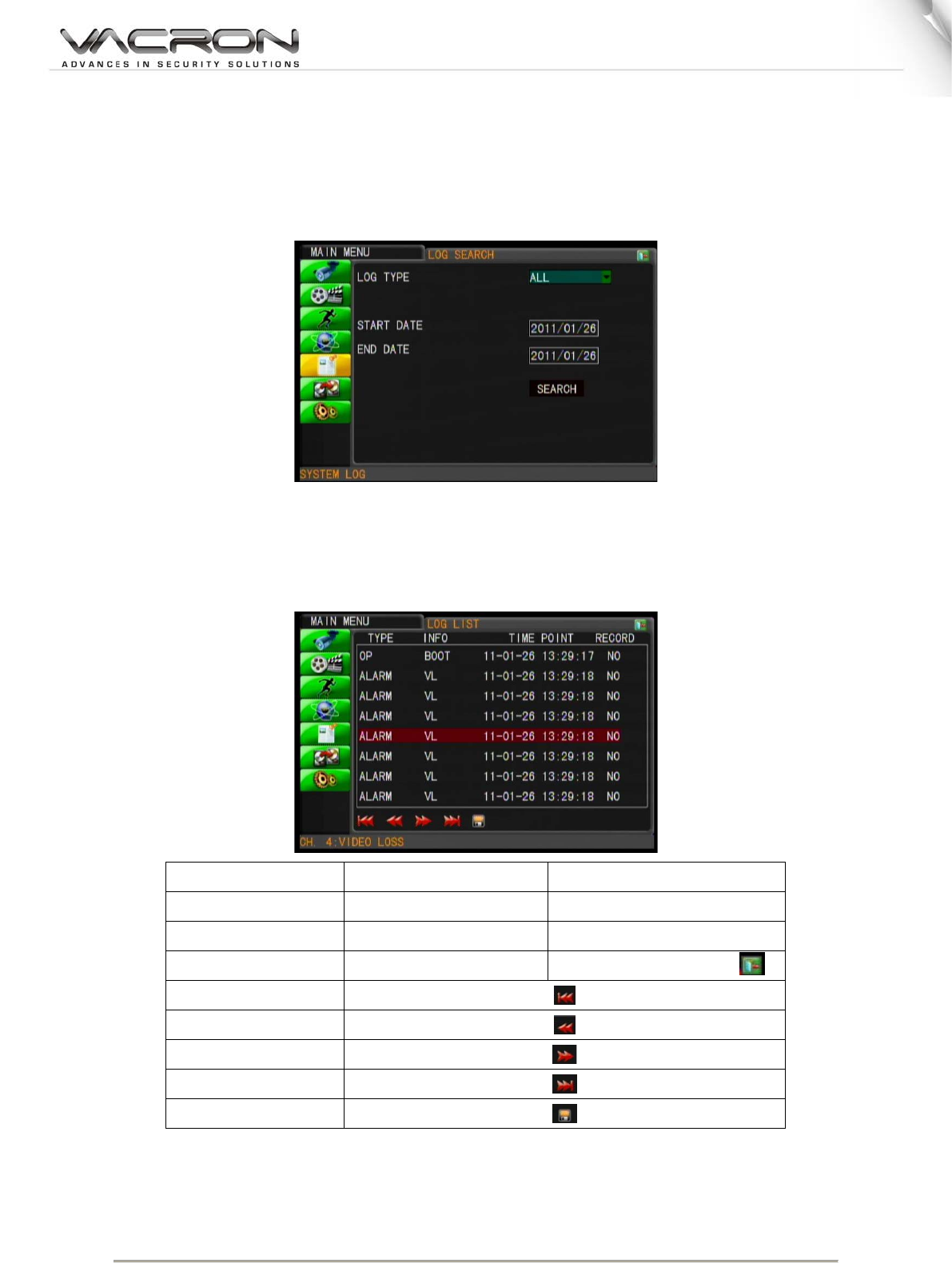
8.5 Log Search
Log type
Set conditions for searching: type and time range. Log type can be ALL,
Alarm, Operation, Motion Detection, and Video Loss.
Start/End time
Set the search range (Year/Month/Day). Press [SEARCH] to search.
Setup Operation Remote Controller USB Mouse
Enter Select Item [Enter] [Left Click]
Select Item [Up/Down/Left/Right] [Moving Cursor]
Return to Upper Menu [MENU]
[Right click] or [Left click
]
First Page
Previous Page
Next Page
Last Page
Backup to USB disk
★ When Trigger Recording is marked, click to playback.
17
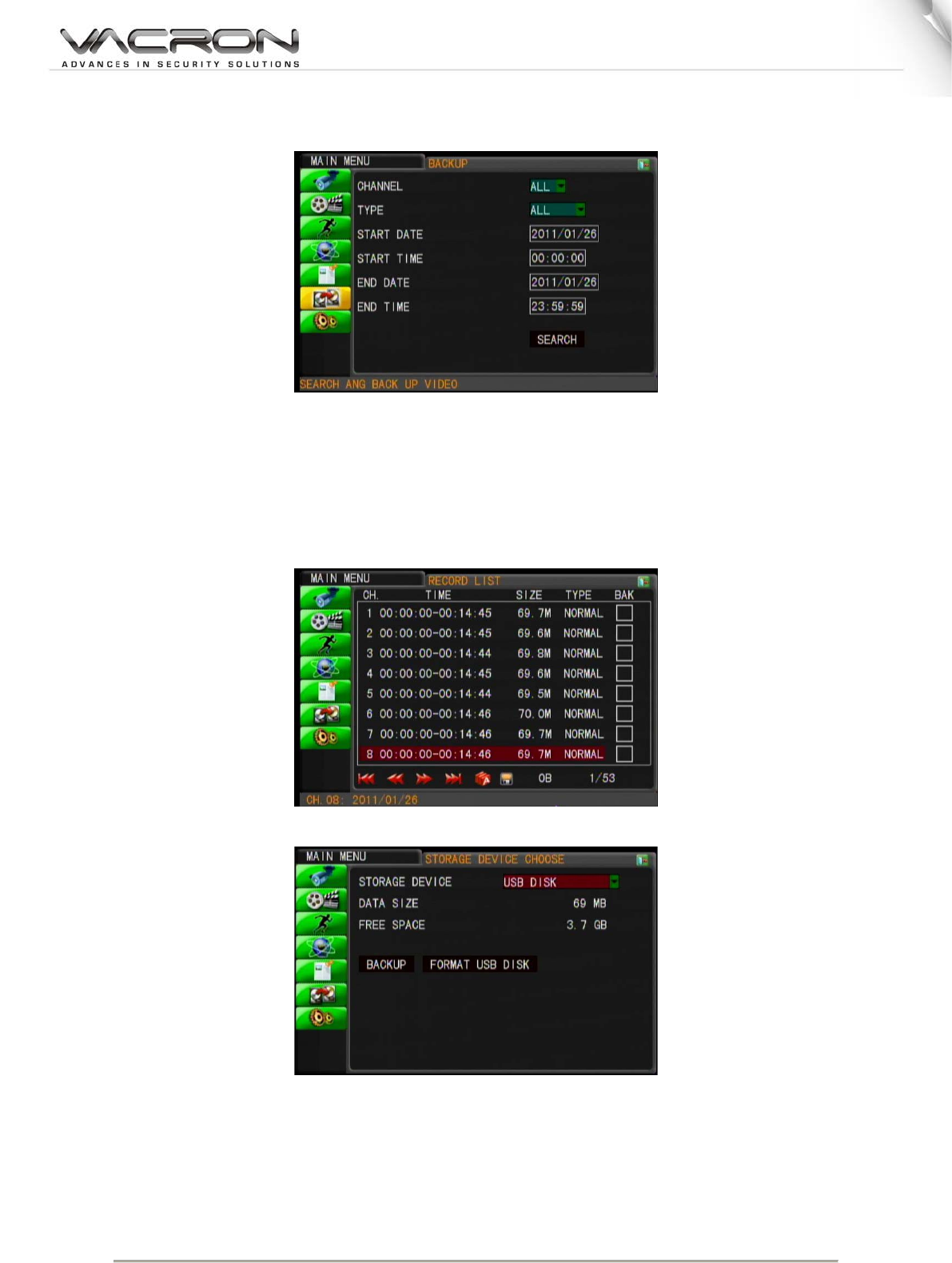
8.6 Backup
Channel
Backup all channels or single channel 1-4.
Record Type
Select all, normal or alarm.
Start/End time
Select the backup range of time. Press Search to start searching. The record
list will be shown if available and follow [Record list] to backup.
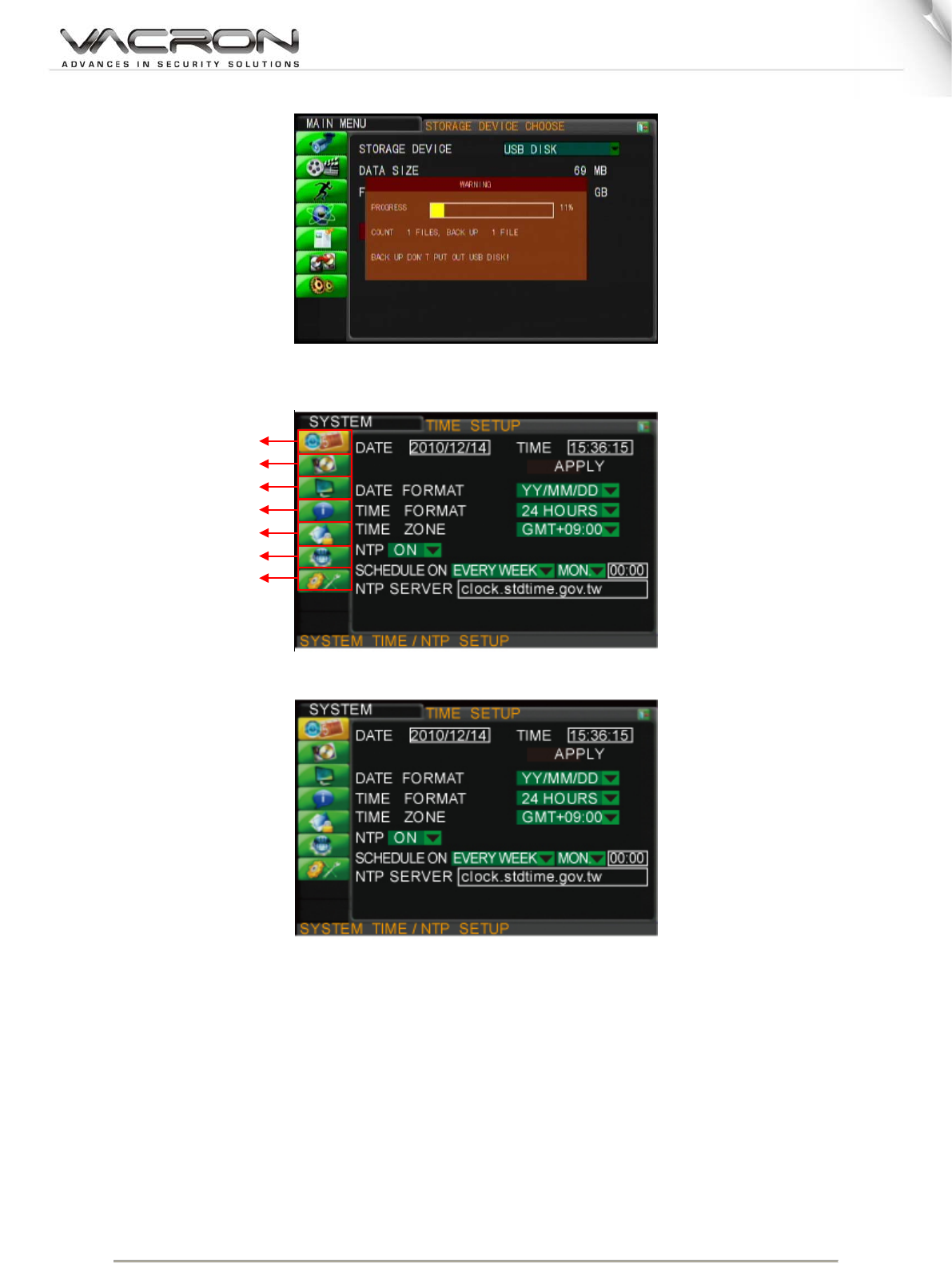
Storage Device Choose
18
8.7 System
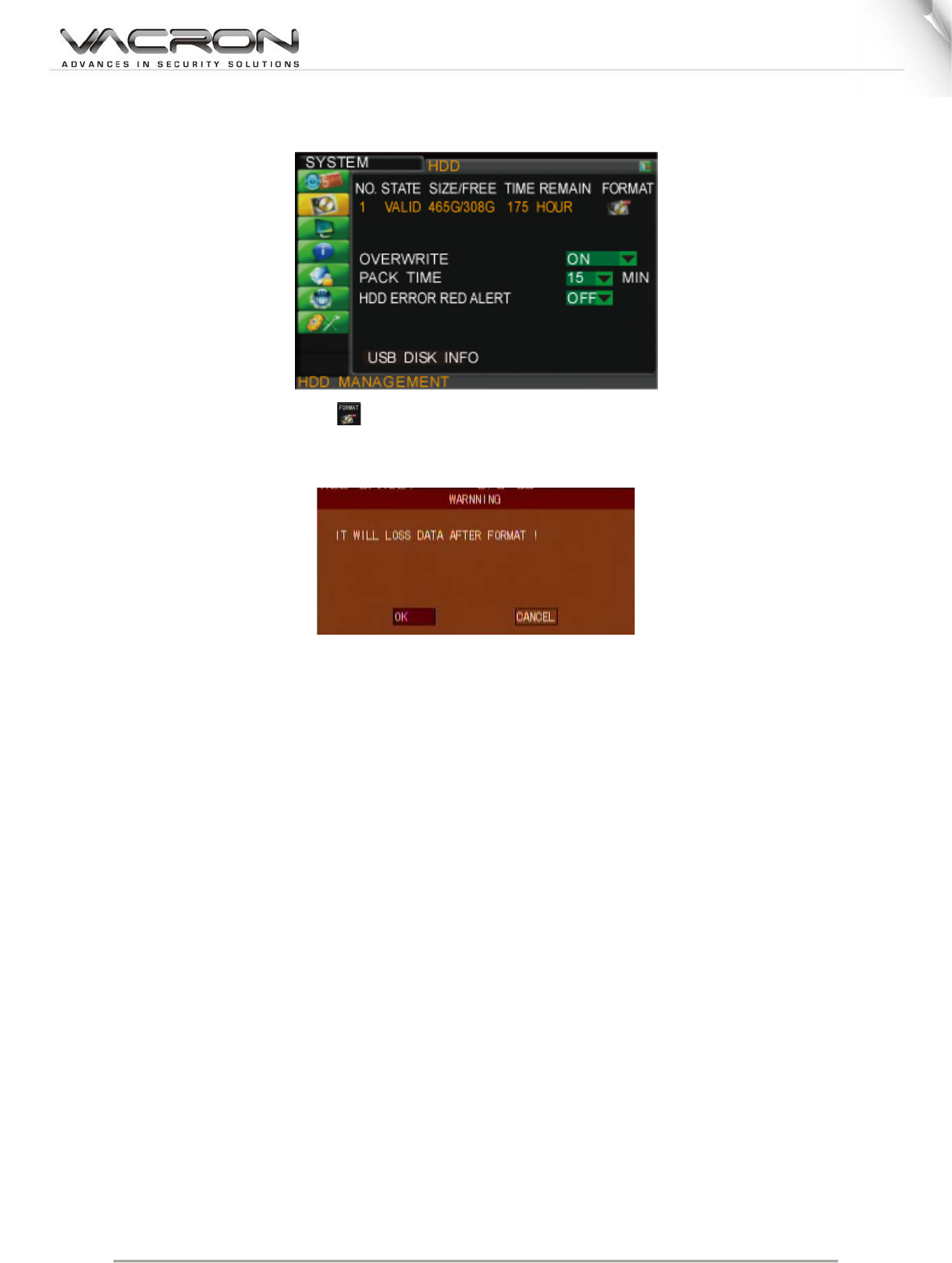
8.7.1 Time Setting
Date/Time
Select by using virtual keyboard.
Date Format Setup
Set: YY/MM/DD, MM/DD/YY.
Time Format Setup
Set: 24Hours, 12Hours.
Time Zone Setup
Time Zone setting of DVR.
NTP Setting(Network Time Protocol)
NTP: On or Off
Schedule Time: Using virtual keyboard
NTP server: Using virtual keyboard
Time Setup
HDD
Display
System Information
Password
Language
System
Maintenance
19
8.7.2 HDD Setup
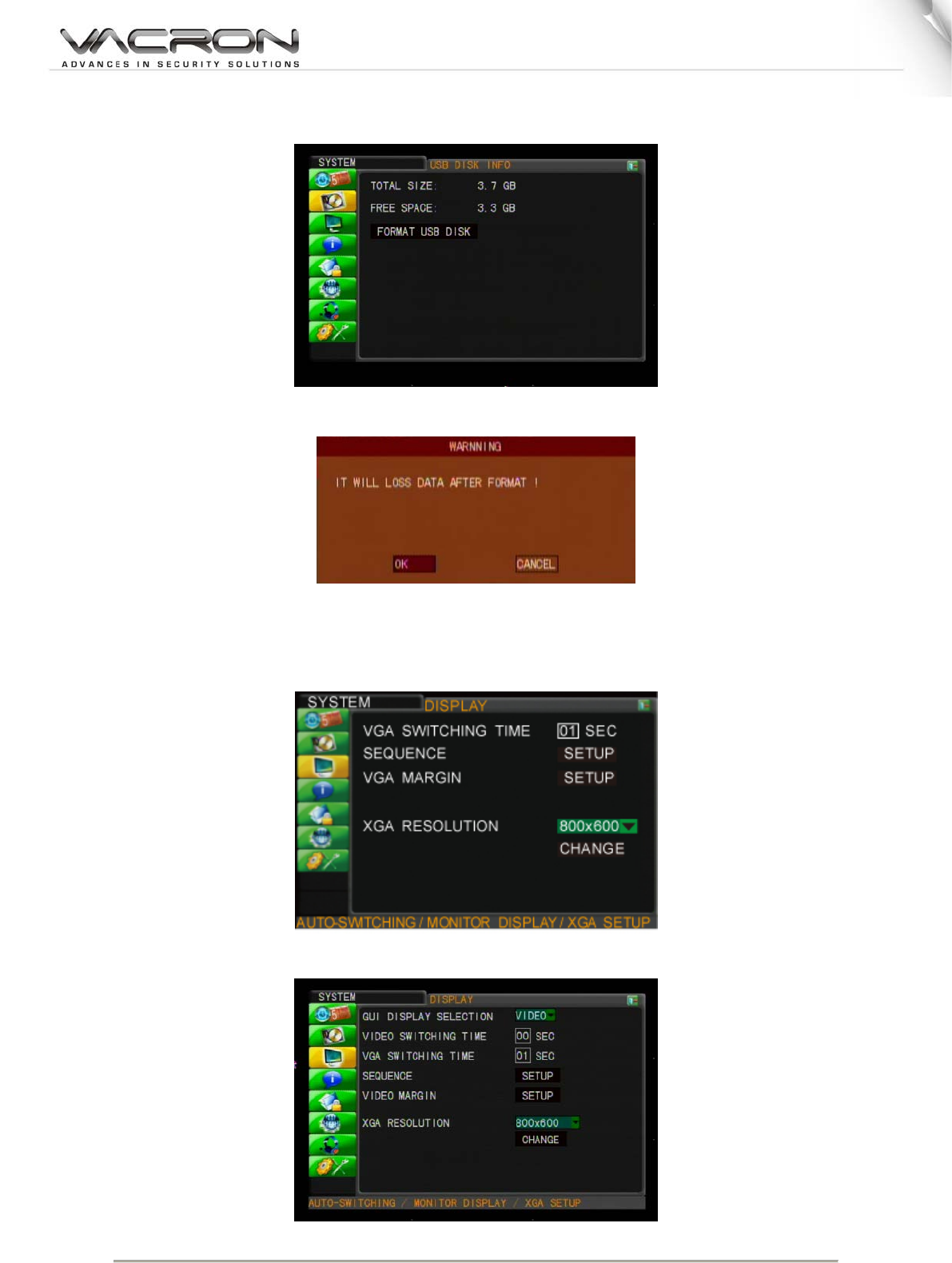
Format
Format the selected HDD
Format HDD
Overwrite
Enable/Disable Overwrite, Values: On/Off.
If Overwrite is enabled, the period can be set as 6, 12, 24, 36, 48,
72 hours and 7, 15, 30, 60 days.
Pack Time
Set the required packing time frame to allow the system to pack
each saving file under continue recording mode. Pack time setting:
5 min, 10min, 15min, 20min, 30min, and 60min.
HDD Error RED ALERF
ON/OFF switch for not enough hard drive space or error message
(Quad channel splitter blinks multiple times in red).
20
USB Disk Info
Format USB Memory Stick
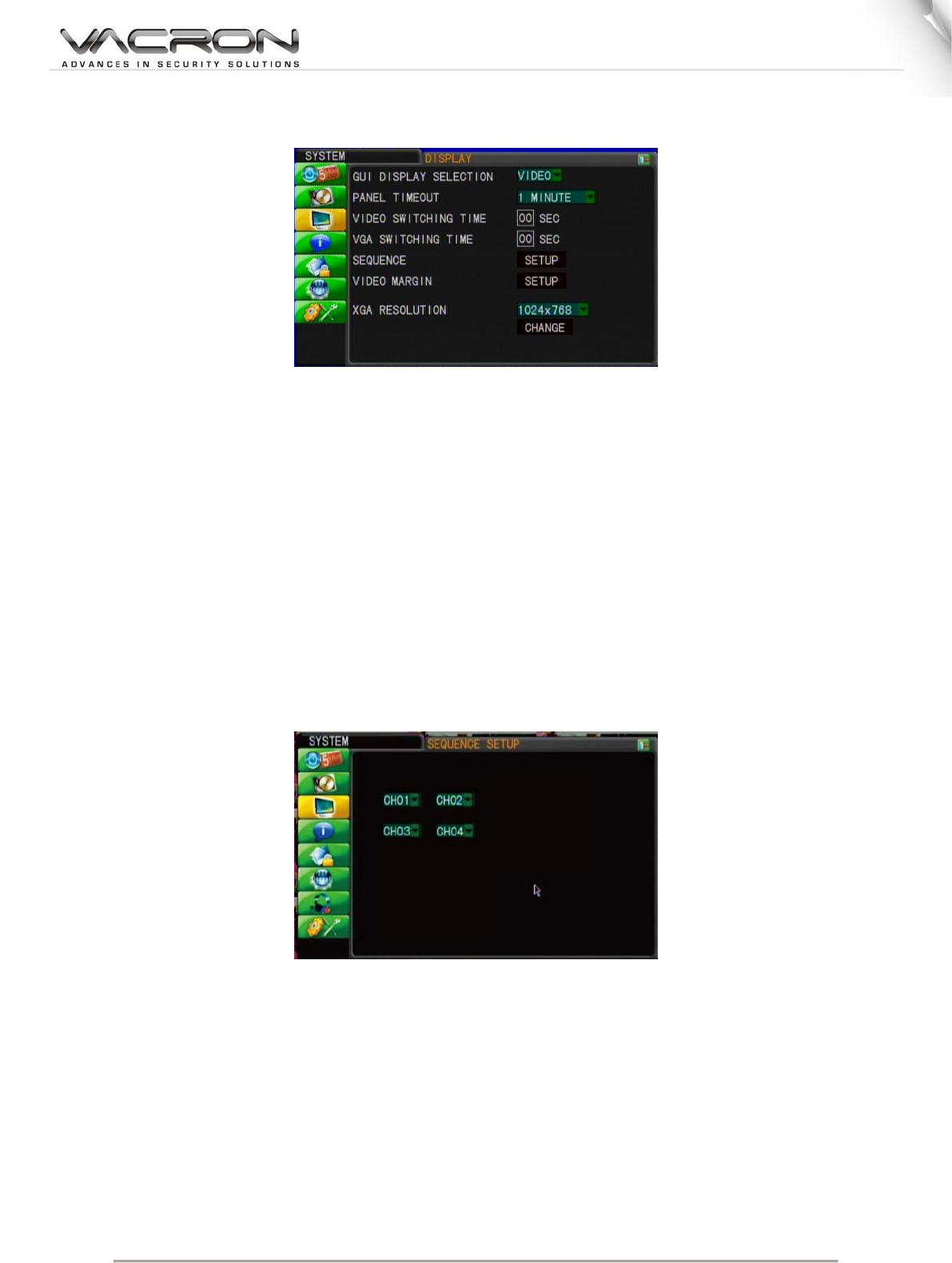
8.7.3 Display Setting
TYPE1
TYPE2
21
GUI Display
GUI display mode can be VIDEO or VGA.
Panel Timeout
Set the length of time that the device waits before turning off the
panel display.
Values: Off, 1 minute, 2 minutes, 5 minutes, 10 minutes,
30 minutes.
Video Switching Time
Set the switching time when switching channels in video mode.
Values: 1-99 seconds. (0 sec is Off)
VGA Switching Time
Set the switching time when switching channels in VGA mode.
Values: 1-99 seconds. (0 sec is Off)
Switching Sequence
Set the switching sequence of channels.
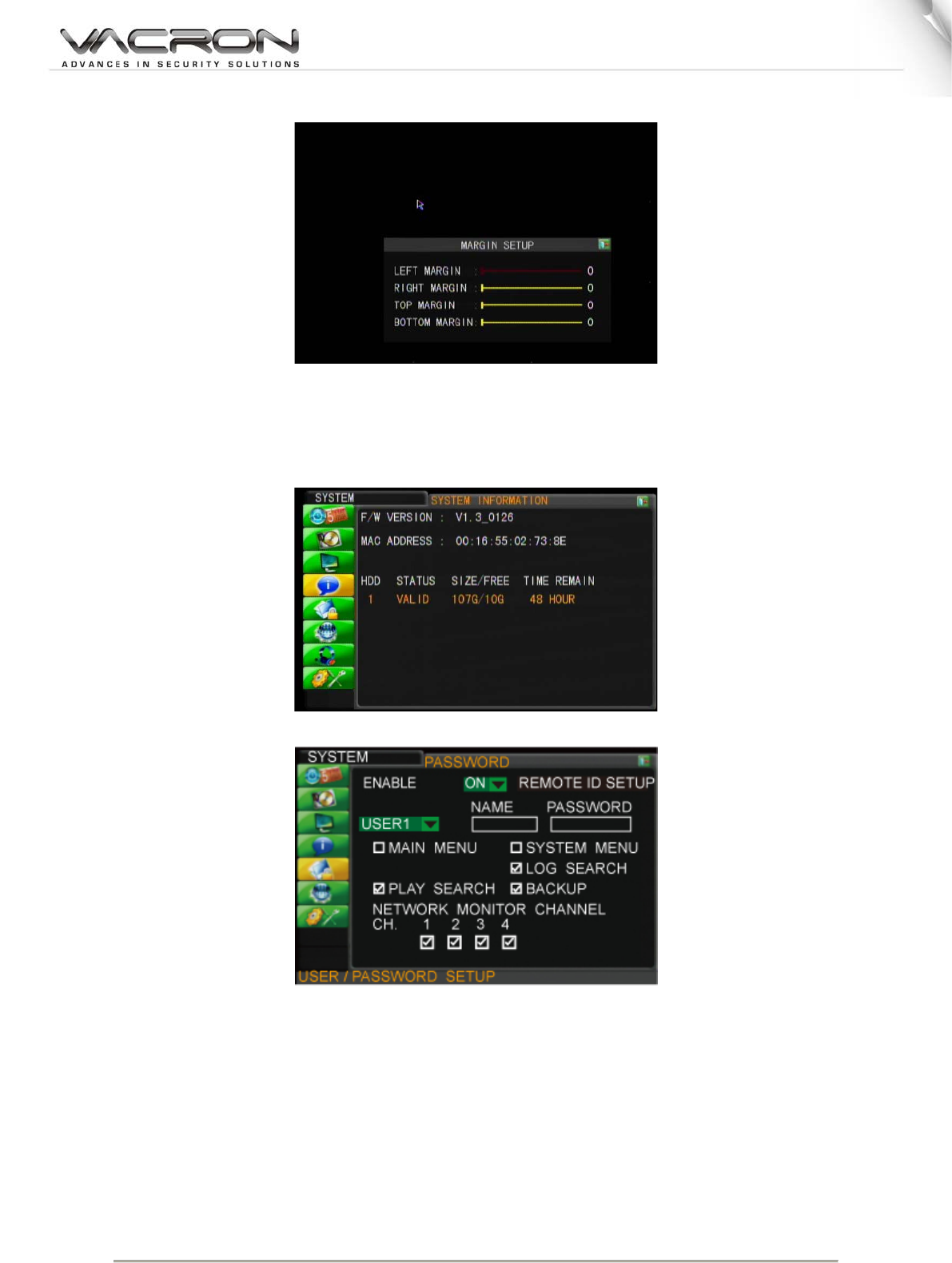
VGA Margin
Set the display margins of the screen. They are Left, Right, Top and
Bottom with range between 0 - 36.
TYPE3
22
XGA Resolution
XGA Resolution: 800x600, 1024x768, 1280x1024, 1440x900.
8.7.4 System Information
Provide the firmware version, MAC address, HDD status….
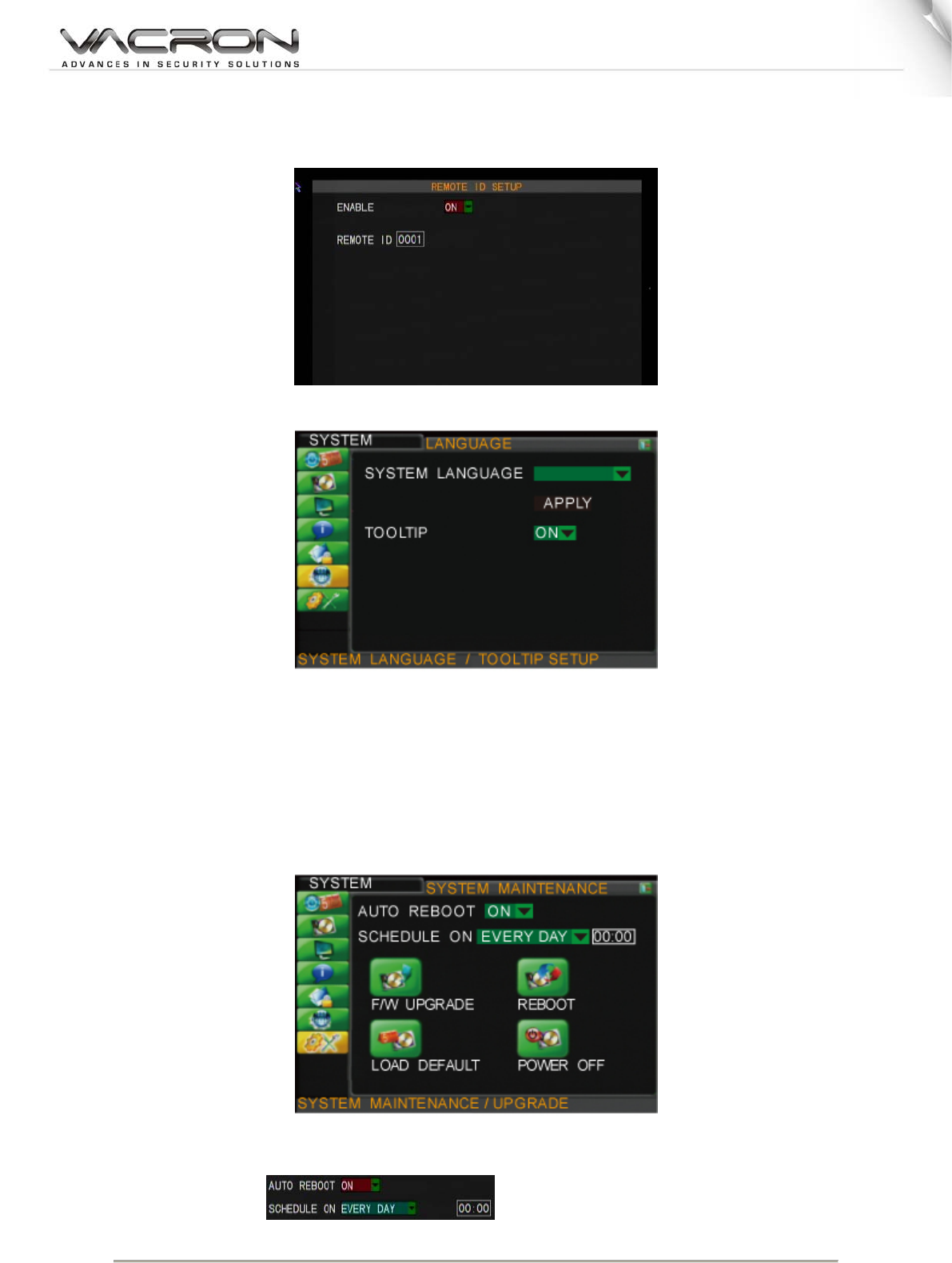
8.7.5 User Password
Password Setup
Enable/Disable password checking. Values: On/Off (Default)
Administrator account/password cannot be blank. And at least 4
characters for the password.
Administrator account/password
Administrator account allows user to access all of functions.
User account/password
Access rights can be assigned by setting.
23
Remote ID Setup
Can adjust remote control ID to control multiple DVR.
8.7.6 System Language
Language
Values: Traditional Chinese and English. Auto rebooting after
change.
Function Tip
Show function tips below the menu items.
Value: On/Off (Default).
8.7.7 System Maintenance
Auto maintenance: Set time for auto rebooting. Value: On/Off.
Auto rebooting setting
24
F/W update
Please plug the USB memory stick into the USB port on the DVR
rear panel after download the new firmware to the USB memory
stick.
Note: the firmware only can be upgraded by using the USB port. Please don’t
operate the system, remove the USB memory stick or remove the power while it
is in upgrade progressing in order to prevent any serious system error. The
system will automatic reboot after upgrade.
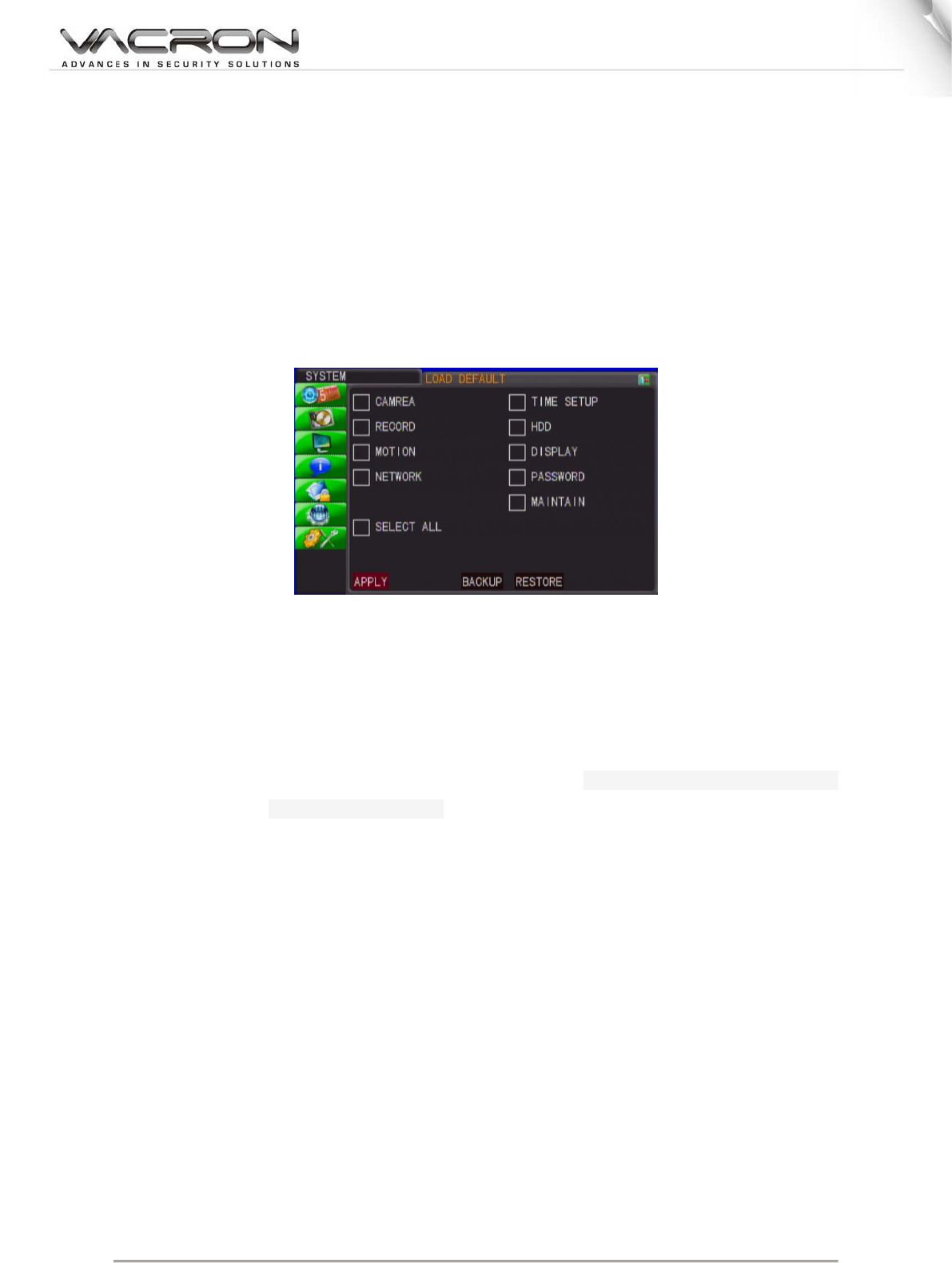
Load Setup Default
Load factor default. Refer to [Default Setting].
Backup: For copying the saved setting from one specific DVR to
other DVR use.
Restore: For restoring the saved setting in one specific DVR from
other DVR use.
Remark: For backup or restore, please plug the USB flash memory drive into the
USB socket of DVR.Please also do not change the saved setting file name to avoid
the serious system error. After Finishing backup and restore, please restart DVR.
Reboot the DVR
Reboot the DVR.
ShutDown
System will close the recording file. Please remove the power line
manually.
25
8. H264 Player Operation
Preface
H264 Player software allows to playback the backup saving file from the
DVR.
System Requirement
Operating System: Windows 2000, XP, Vista, Windows 7.
Program obtainment and installation
While user start to backup the file from DVR, the system will automatically
copy the H264Player.exe file and recorded data to the backup device for
example, an USB flash memory stick.
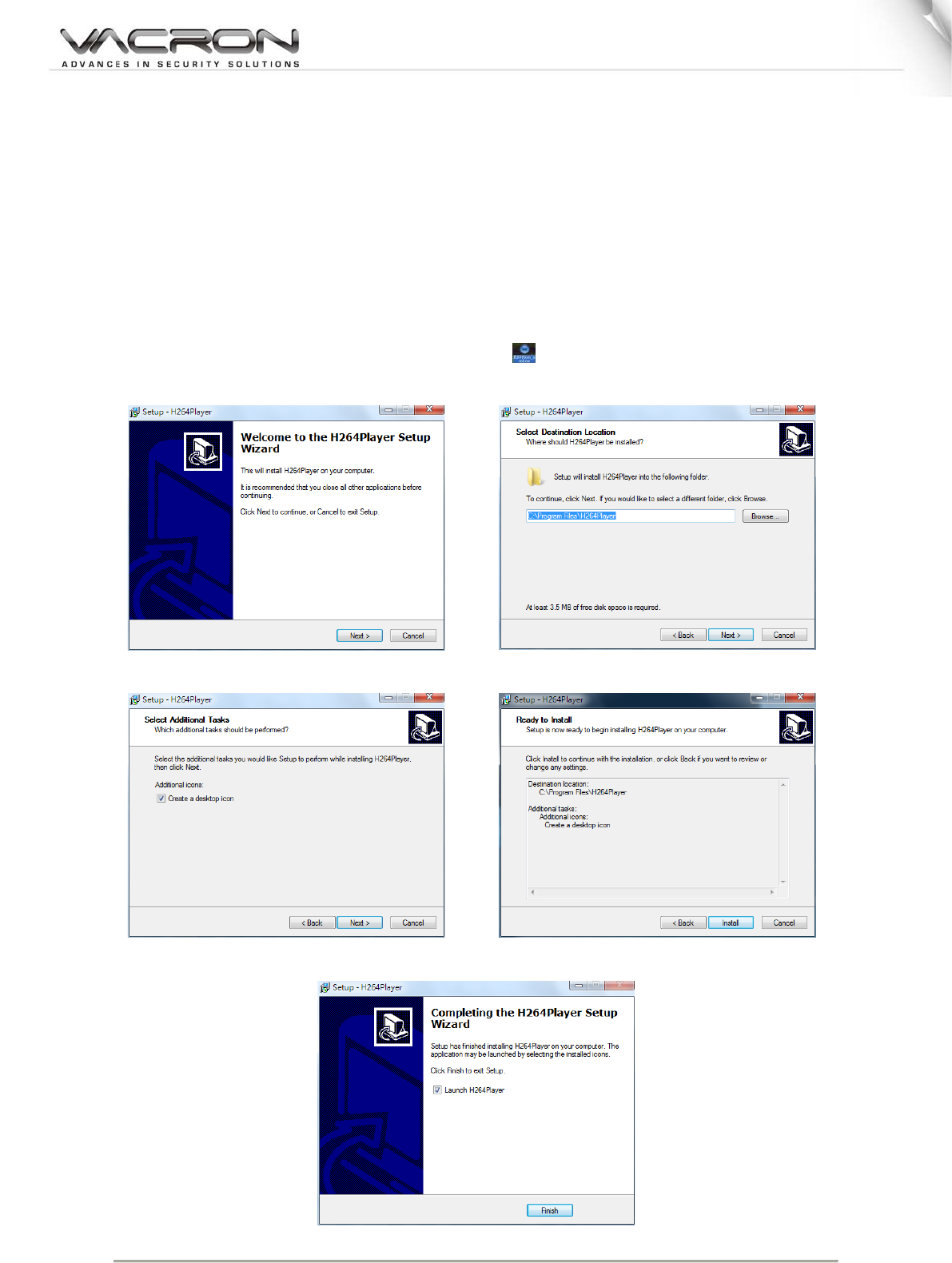
Execute the installation file
Step 1: Ask for the Installation
Step 2: Select the Install Location
Step 3: Select Additional Tasks
Step4: Install Confirmation
Step 5: Installation Complete
26
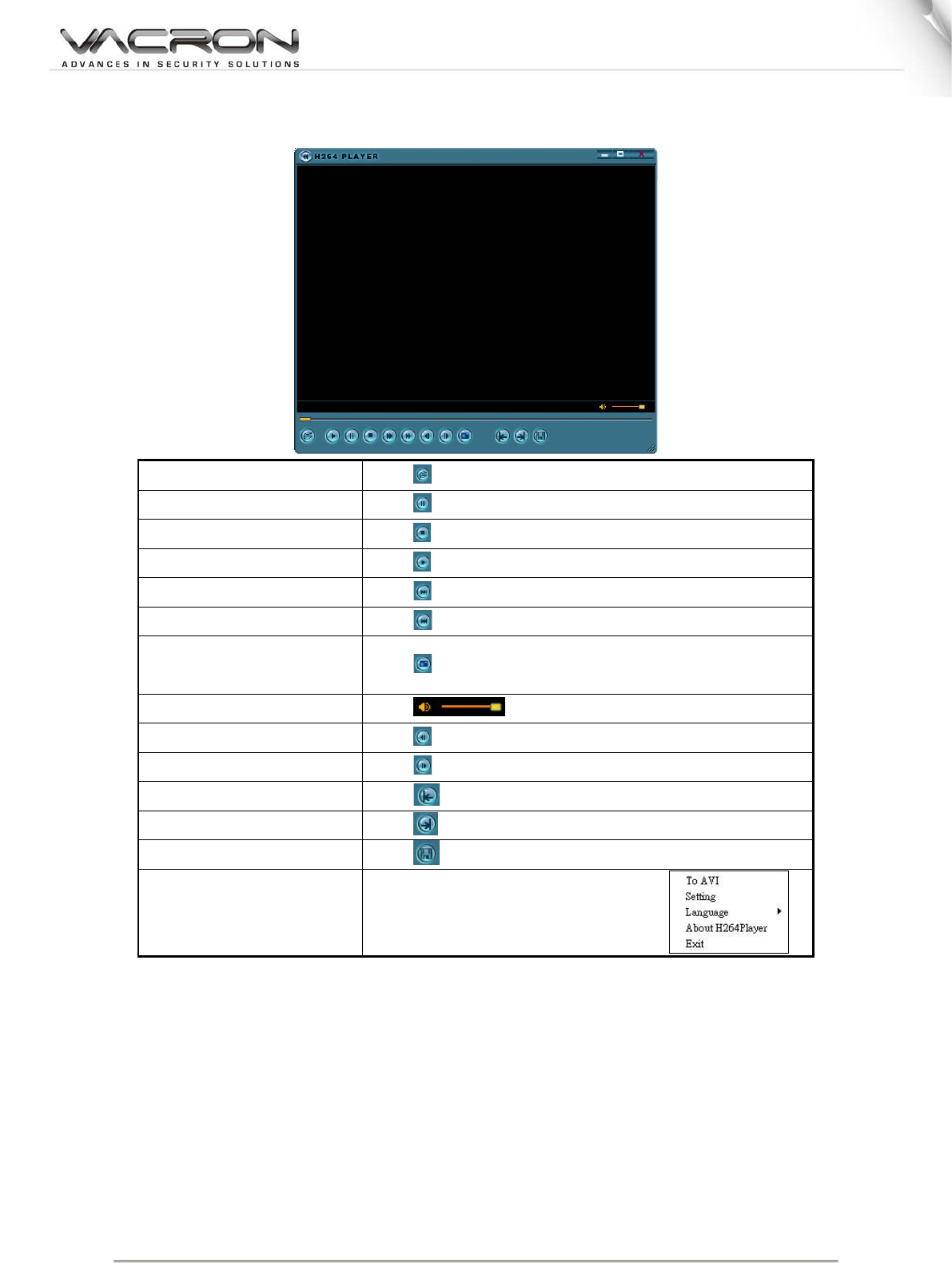
User Interface
Open File Click
Pause Click
Stop Click
Play 1x Click
Fast Forward Click
Slow Forward Click
Capture the image (snap
shot) to the host computer Click
Volume Control Drag
Rewind Click
Step Forward Click
Mark start time
Click
Mark end time
Click
Backup
Click
Pop-up Menu
Right click the mouse to open the
pop-up menu including Setting,
Language, About H264Player, Exit
27
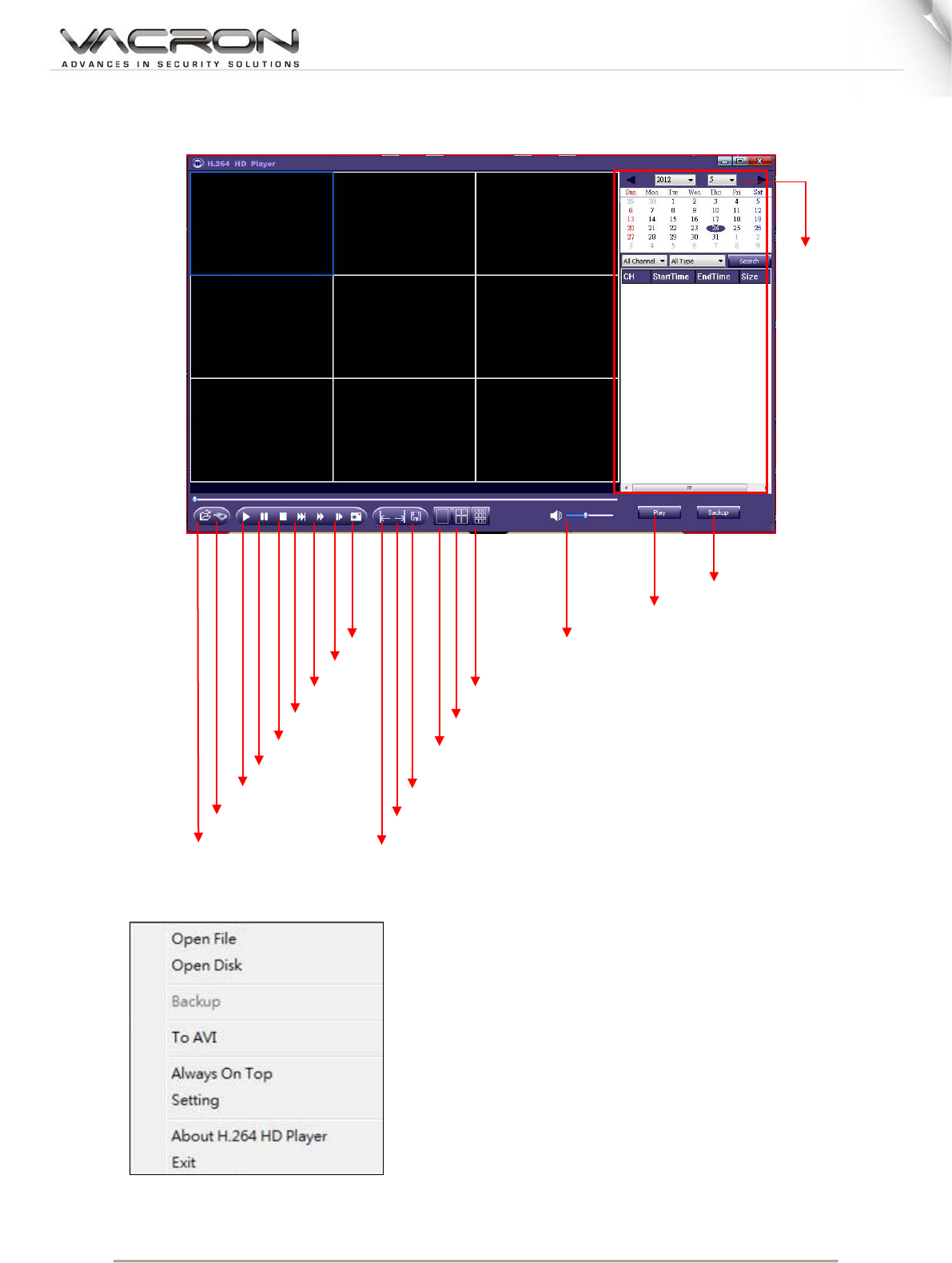
9. H264 HDPlayer Operation
Preface
H264 HD Player supports direct HDD playback through USB connection. It
also supports to playback the individual recorded video files.
System Requirement
Operating System: Windows 2000, XP, Vista, Windows 7.
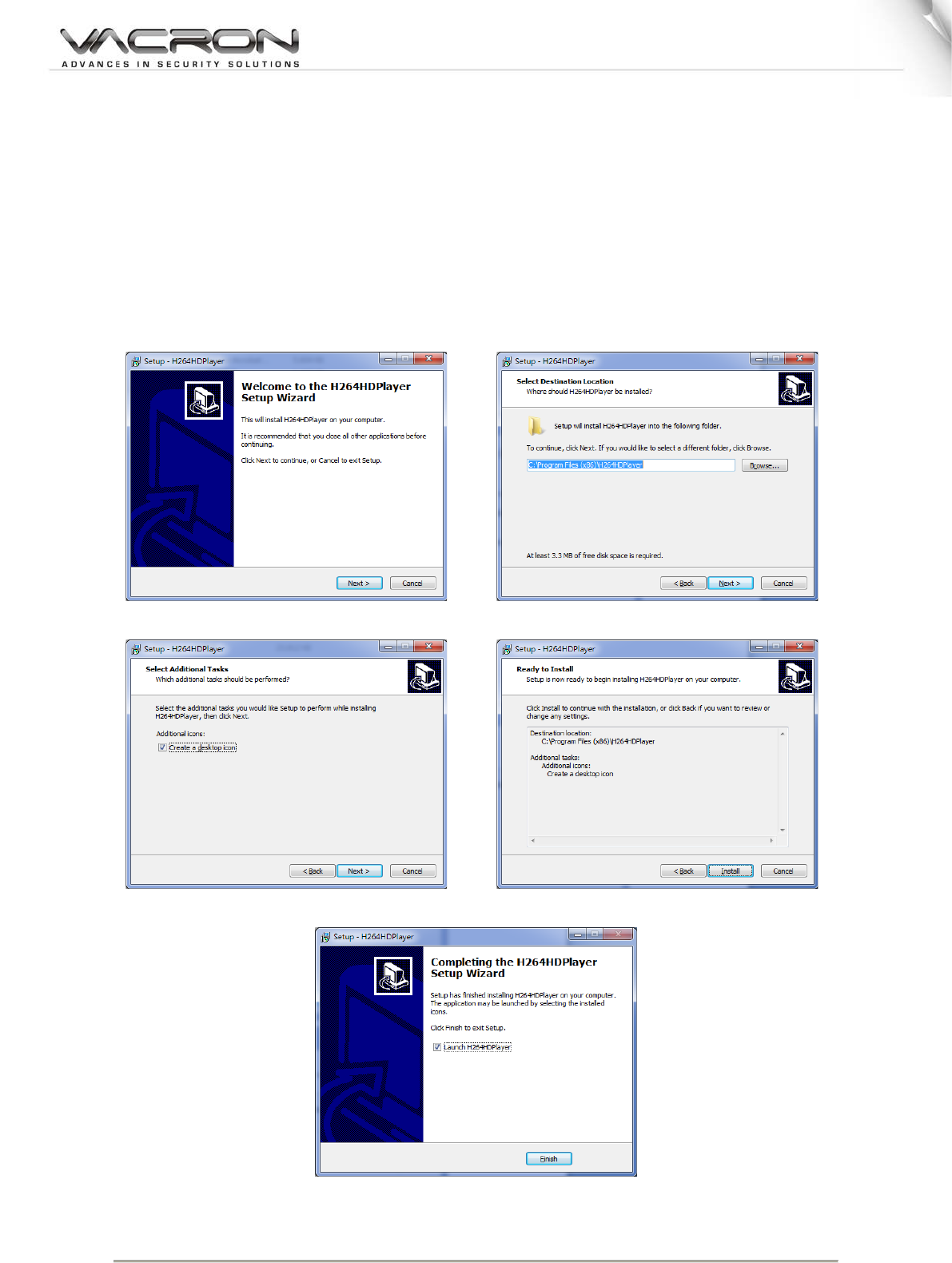
Execute the installation file
Step 1: Ask for the Installation
Step 2: Select the Install Location
Step 3: Select Additional Tasks
Step4: Install Confirmation
Step 5: Installation Complete
28
User Interface
Pop-up Menu
Right click the mouse to open the pop-up menu
including Setting
Event Search
Open File
Open Disk
Play
Pause
Stop
Slow Play
Fast Play
Step
Mark In
Mark Out
Backup
1 Win
4 Win
Volume Control
Player
Backup
9 Win
Snapshot
29
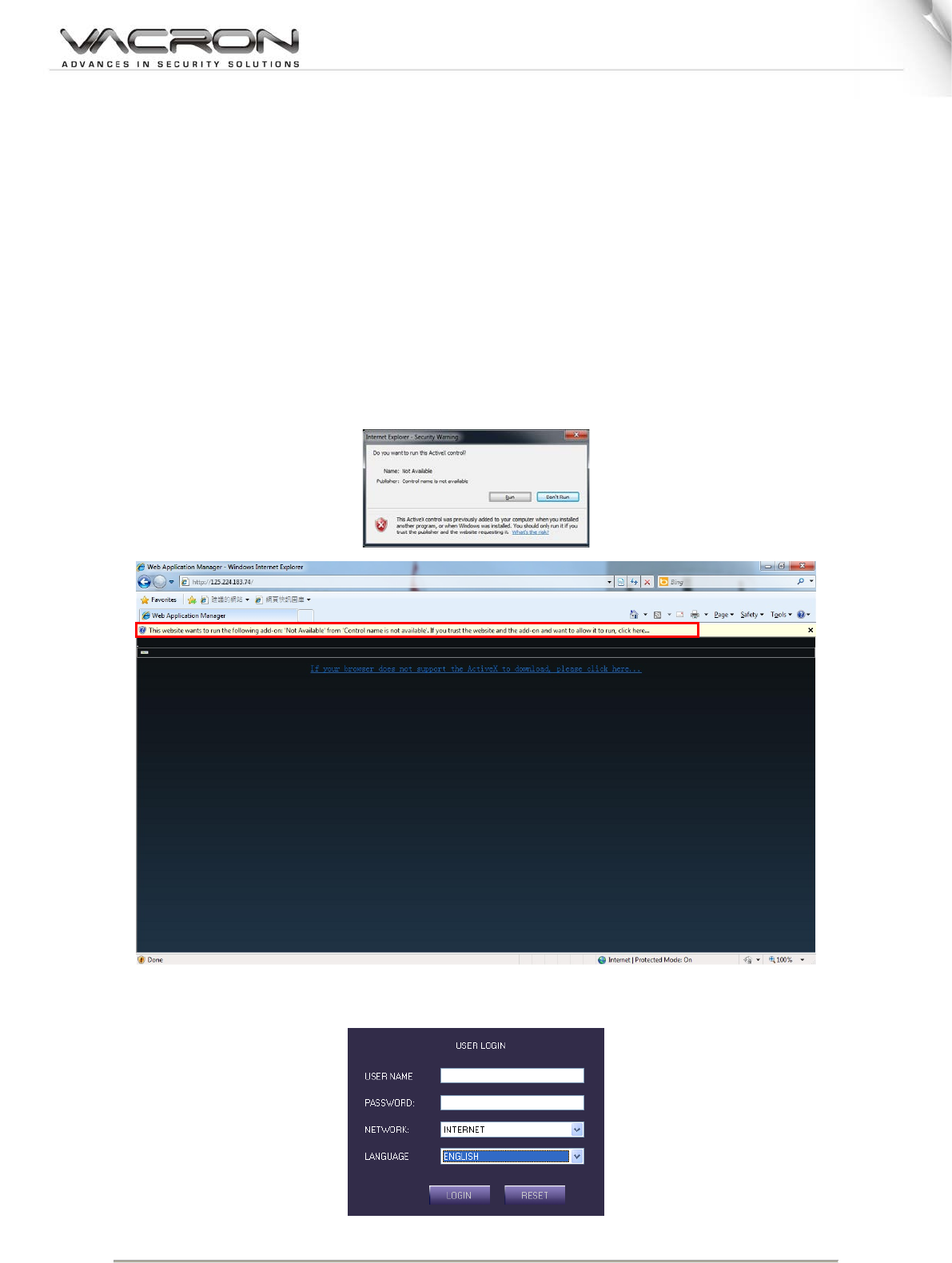
10. Web Operation
Preface
The Web Application Manager allows the user to remotely monitoring,
playback, and backup through the DVR.
System Requirement
Operating System: Windows 2000, XP, Vista, Windows 7
Web Browser: Internet Explorer
Add-on Installation
Please use the IE browser to login the IP address of DVR setting. If the user
is the first time to login the page, the system will ask the user to download
and install the add-on as you can see the page below. Please click the
request to install the ActiveX add-on.
User Interface
Login Page
30
Please login user name and password from the setting of DVR end.
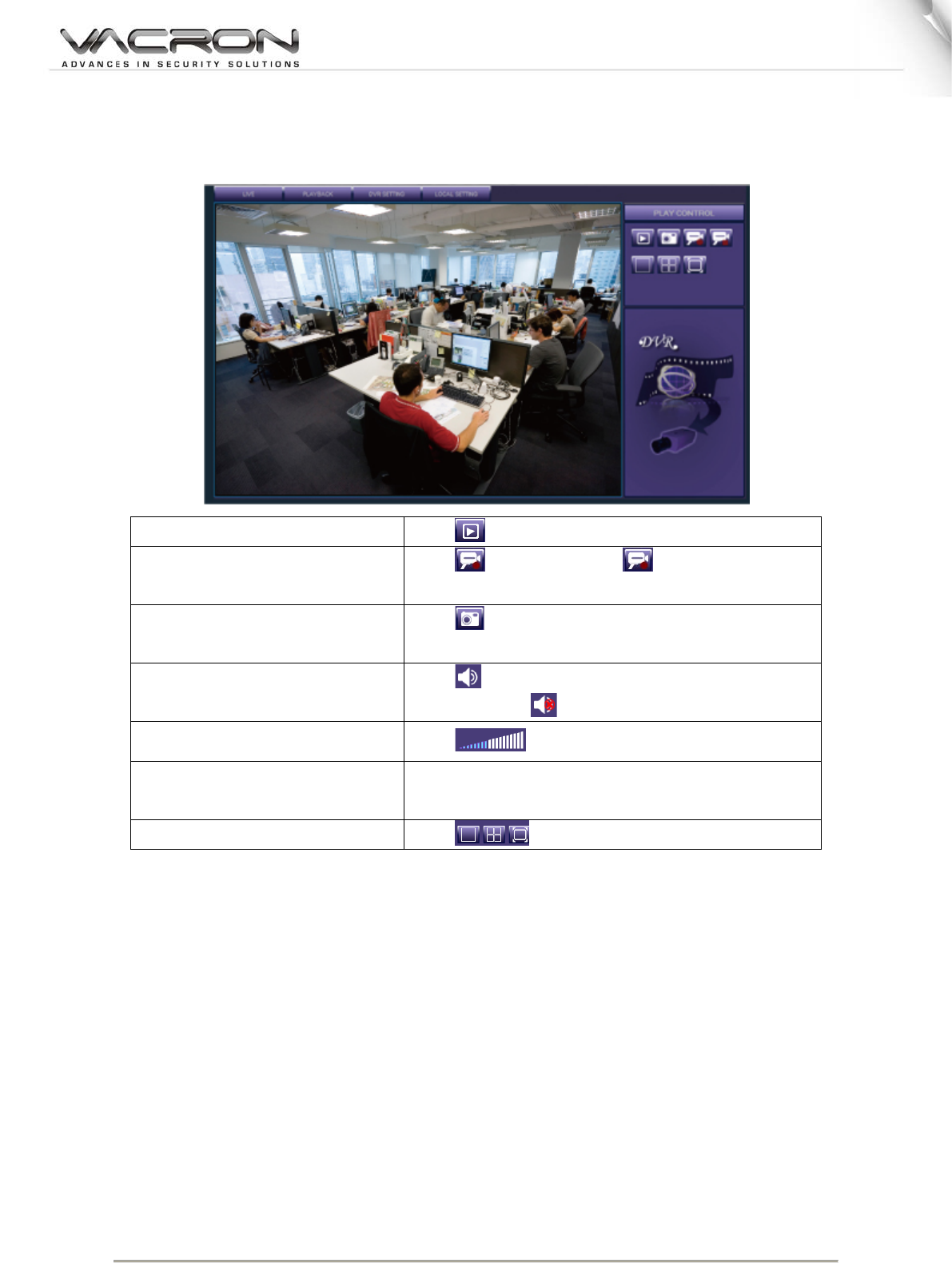
Live mode
Start/Stop the Live Monitoring
Click
Record the Footage to Computer Click Start recording or Stop recording
(saving path: Setup/Information)
Snapshot the Image Click to snap shot the image (saving path:
Setup/Information)
Enable/Disable Audio Click under the live viewing mode to enable the
audio, and click to disable
Volume Control Click
Switch Channel Display Double click the channel to enter single channel display,
double click again to return.
Single/4 Display
Click
31
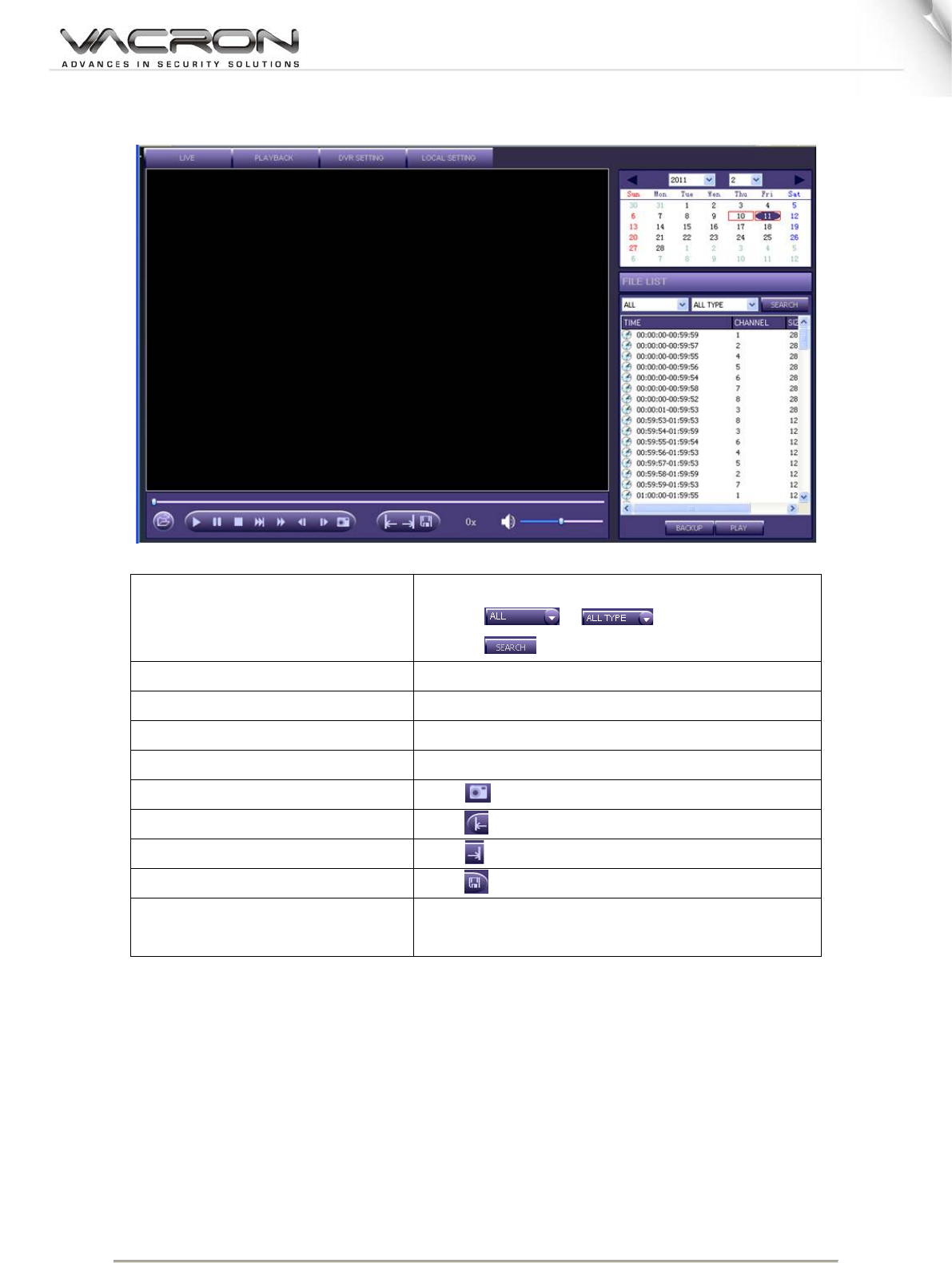
Playback
Event Search
(1) Select Date
(2)Click or
(3)Click
Playback Click on pop up file list
Fast Forward Click “Fast Forward” (Speed: 2X, 4X, 8X, 16X)
Rewind Click “ Rewind” (Speed: 1/2, 1/ 4X, 1/ 8X, 1/ 16X)
Step Forward Click “Previous”or “Step”
Snapshot Click to capture.
Mark start time
Click
Mark end time
Click
Backup
Click
Backup Click “Backup”, backup path: Setup System Setting
Backup Location
32
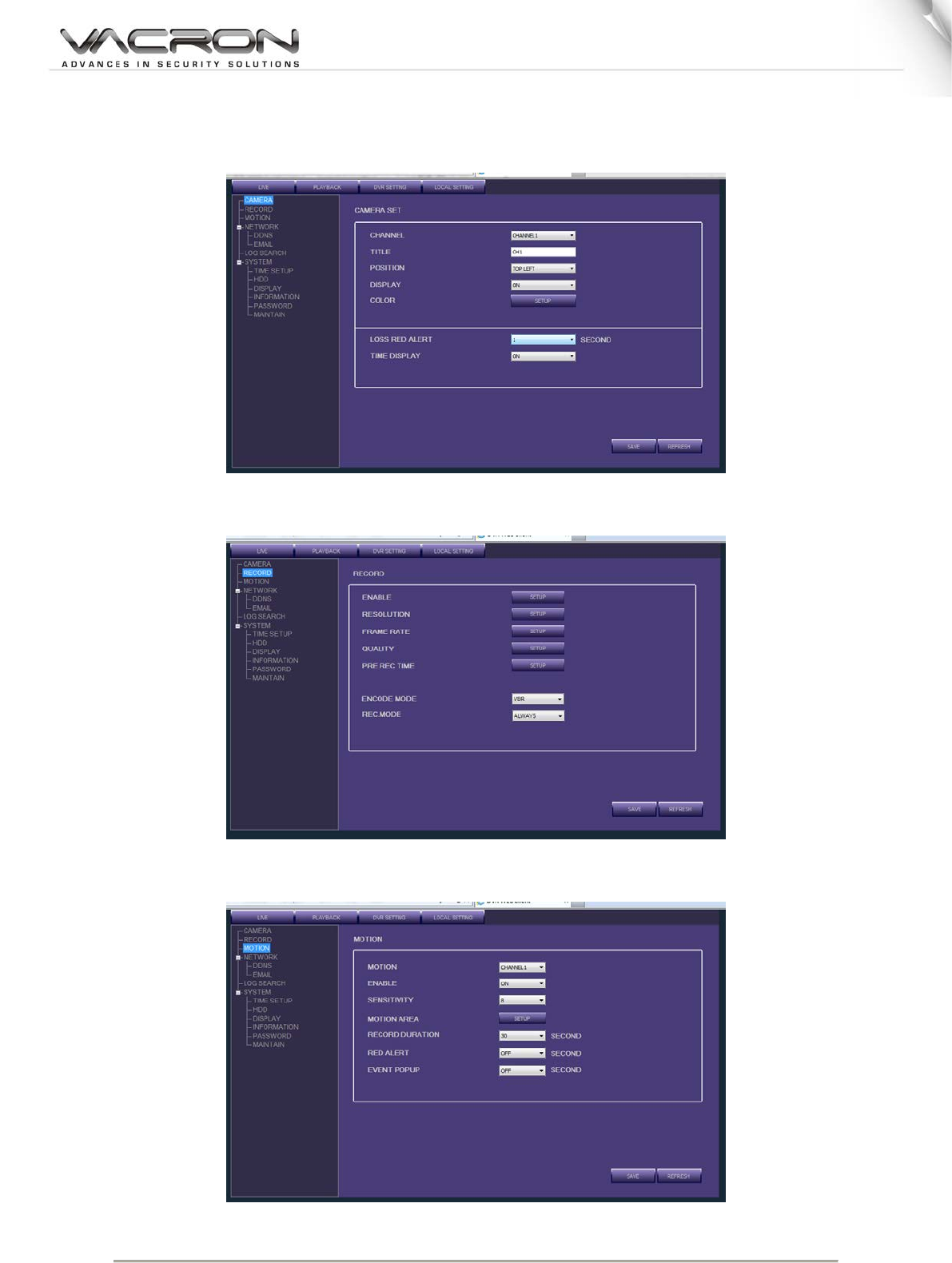
DVR Setting
Cameras
Please refer “Camera Setup” for more information
Record
Please refer “Record Setup” for more information.
Motion Detection
33
Please refer “Motion Detection” for more information.
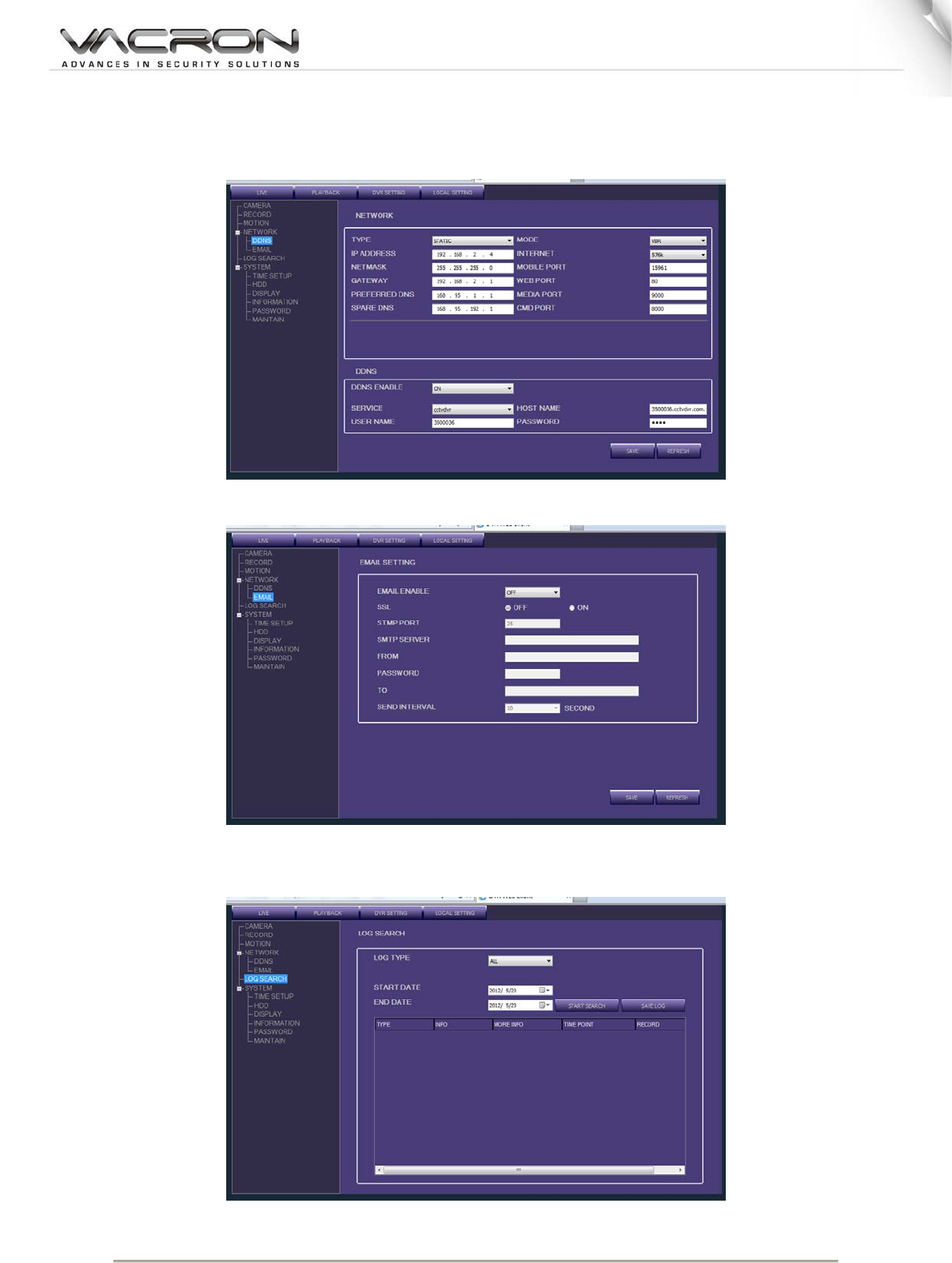
Network setting
E-MAIL
Log search
34
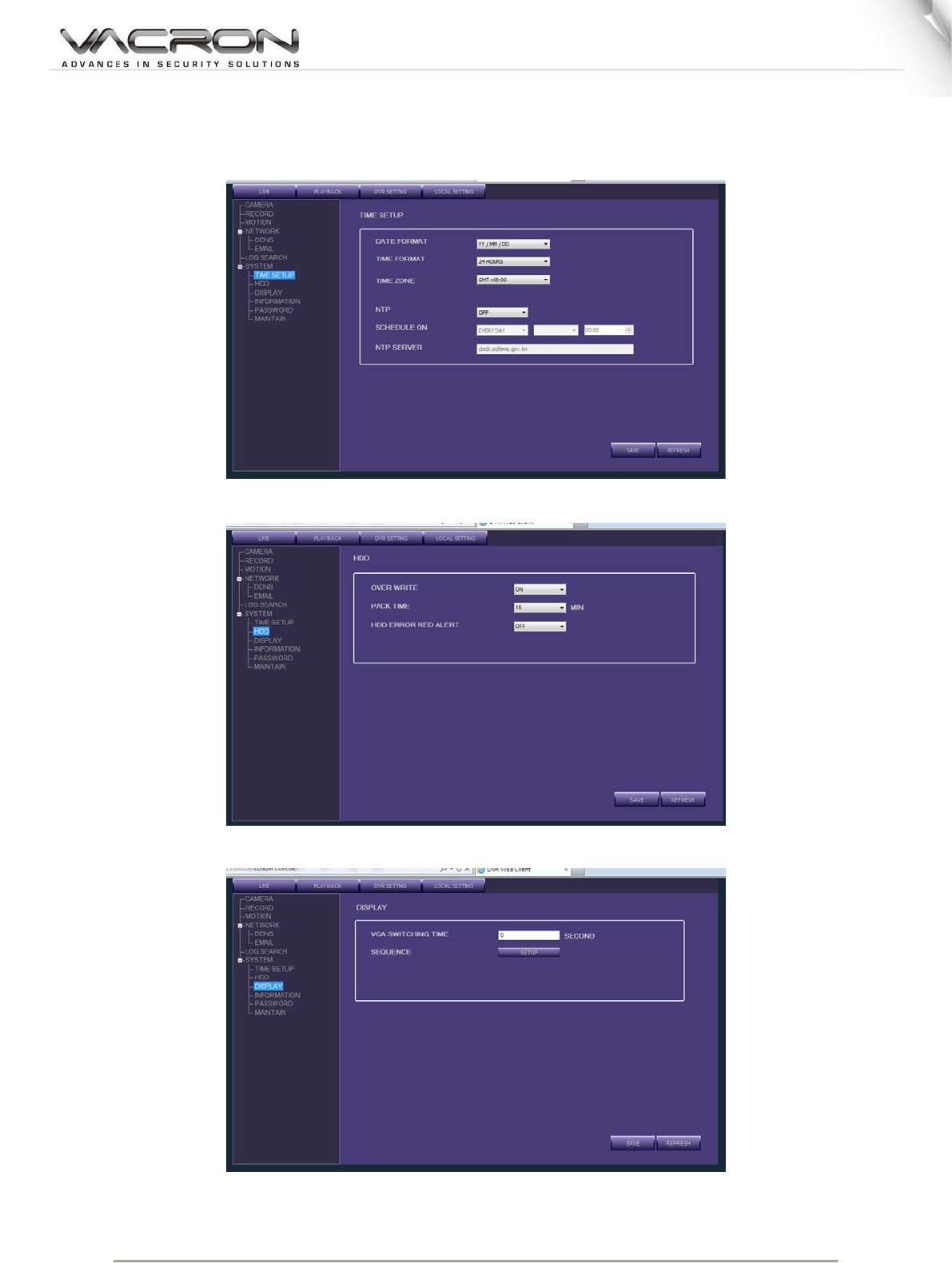
System Setting
Date/Time Setting
HDD Management
Display
35
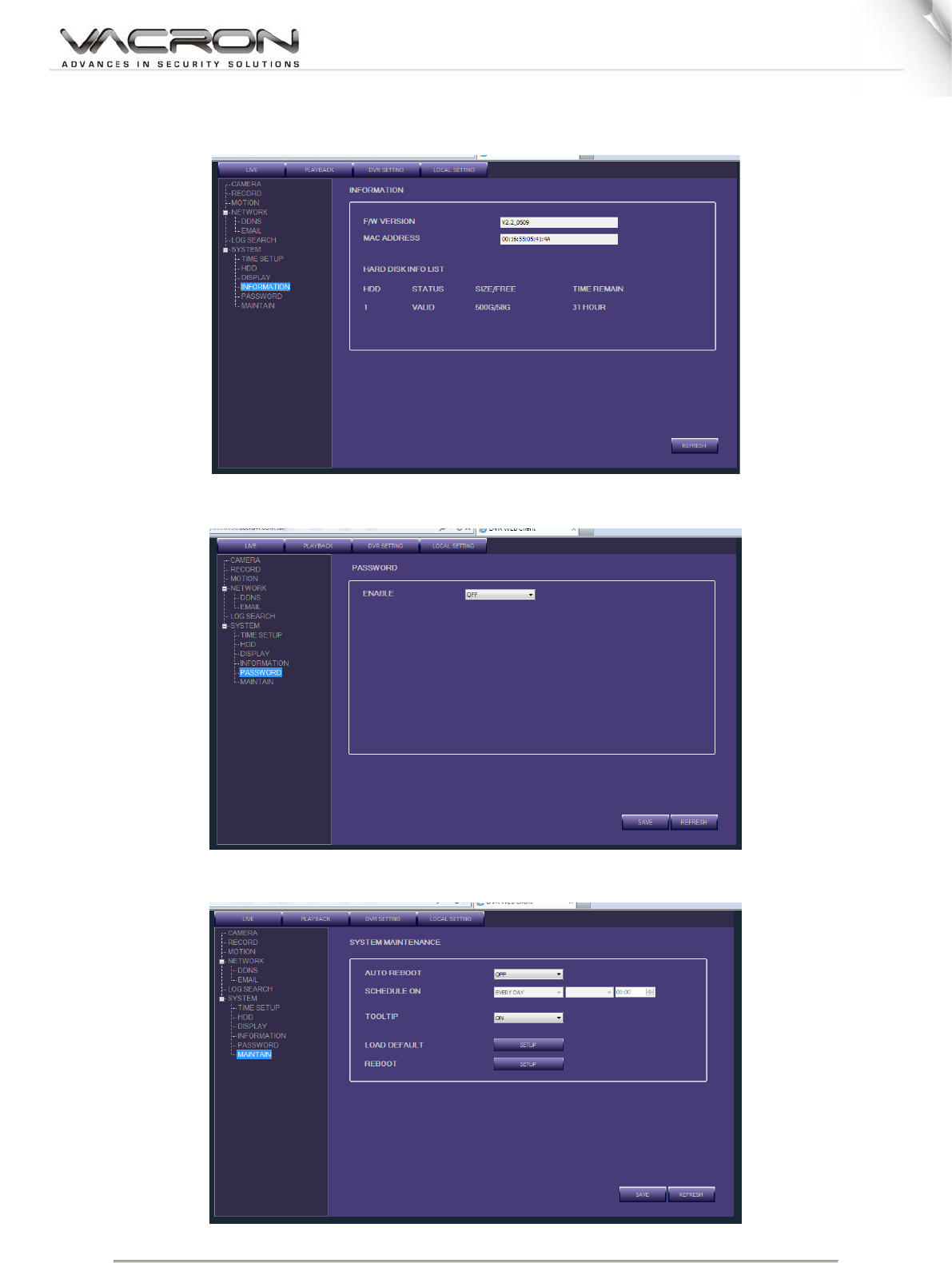
System Information
Account / password
System Maintenance
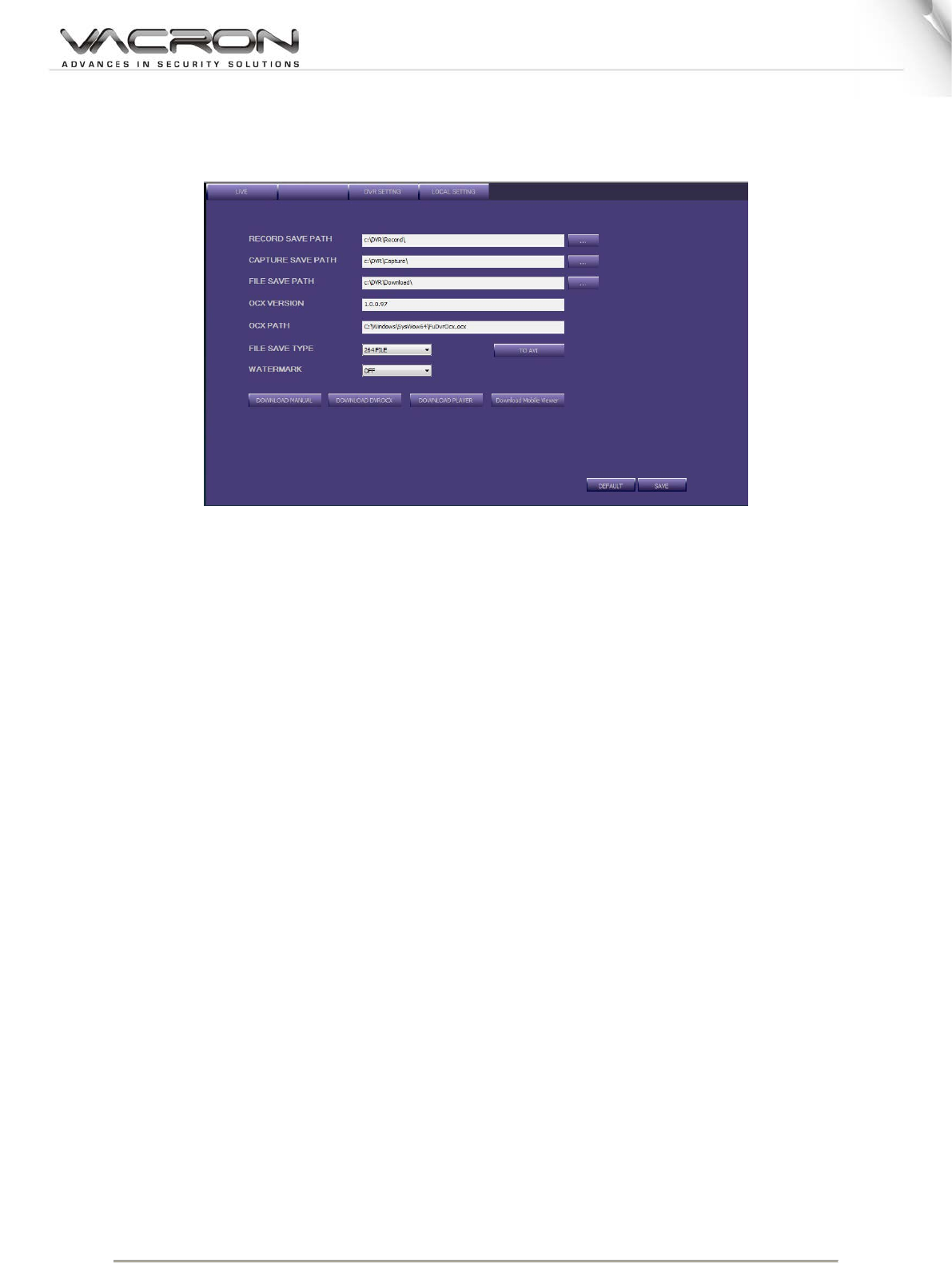
36
Host setting
37
11. Appendix
This appendix will show you how to do the basic operation step-by-step on search,
playback, backup, network setup, email setup, and DDNS setup.
12.1 How to search and playback the footage step-by-step?
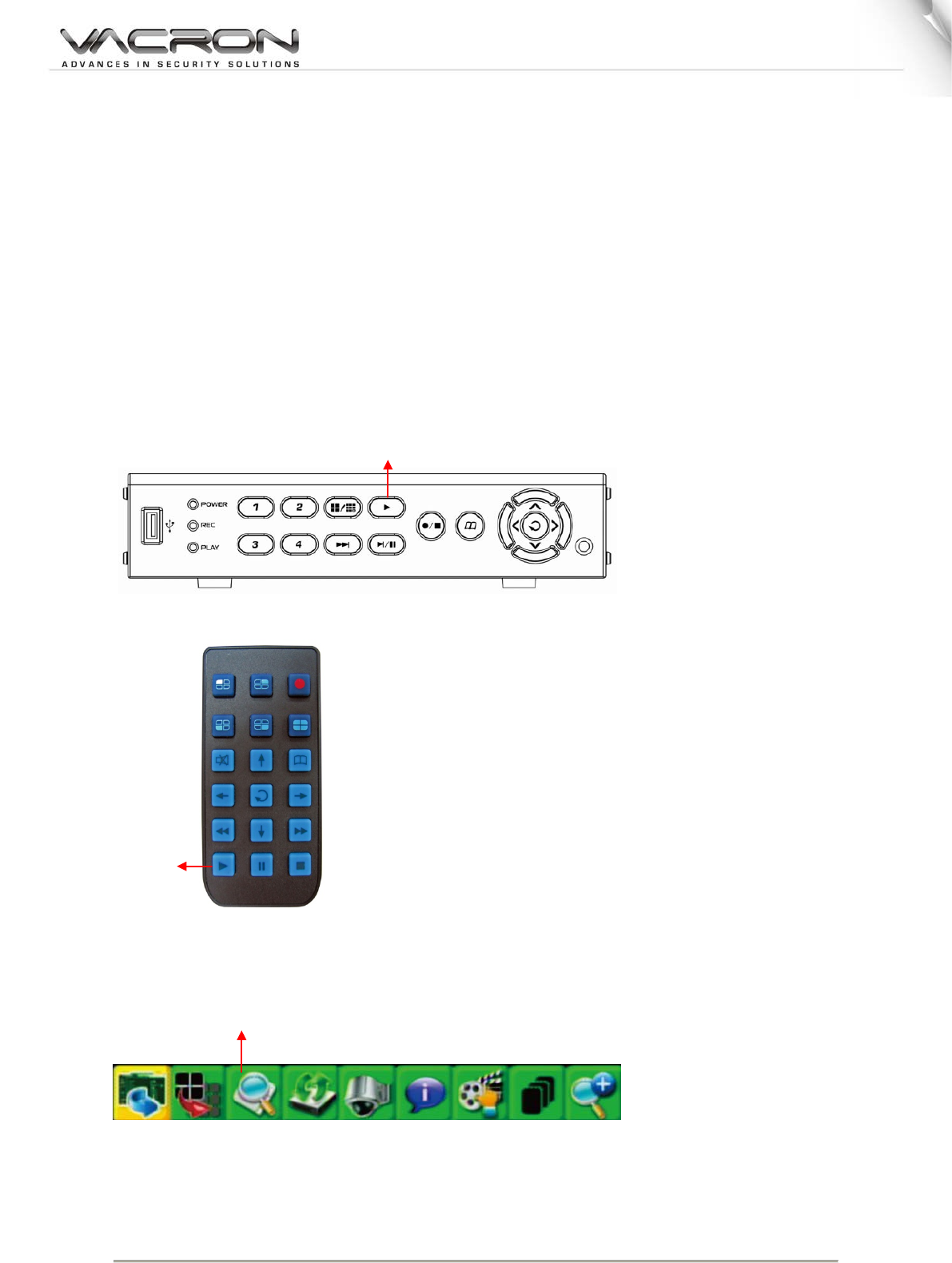
Step 1. Press the SEARCH button
There are two ways to enter the search menu.
Option 1: If you are using the front panel or remote control, please press the “Play”
button to enter the search menu.
Option 2: If you are using USB Mouse, please click right button of the mouse to open
the quick menu bar, and press the “Search” option from the quick menu bar to enter
the search menu.
Play
Play
Searc
38
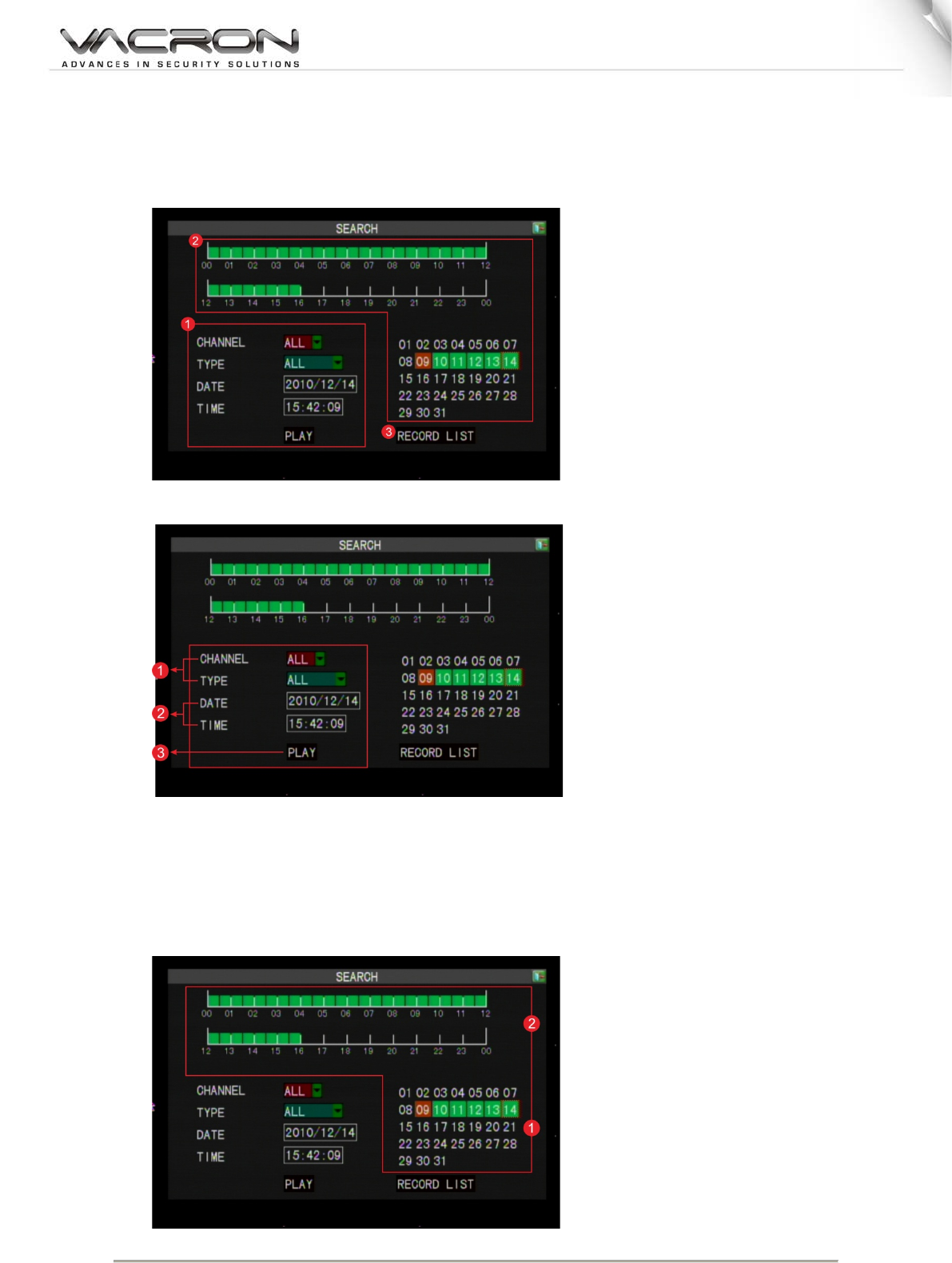
Step 2. Select the date & time to playback the footage.
Once you enter the search menu, you can have 3 optional selections to playback the
footage as the picture below.
1. Date and Time Search
1.1 Select the channel and type of event that you wish to playback.
1.2 Enter the date & time that you wish to search.
1.3 Click PLAY button to playback.
2. Calendar Search
39
2.1 Select the specified date from the calendar selection,
2.2 Select the specified time from the 24hours time bar selection.
Note:
No data: NO color; data of alarm trigger: Red color; normal record data: Green color
Each hour is divided into 2 time frames, 1st and 2nd half of the hour, 00min:00sec to 30min:00sec
and 30min:00sec to 60min:00sec respectively.
Select the first half of the time frame of the date, the playback will start from 00 mins: 00 sec.
Select the second half of hour frame under the date, the playback will start from 30mins:00sec.
if there is no data on the date, please try to search from the record list.
2.3 Once you select the specified date and time, click PLAY to playback
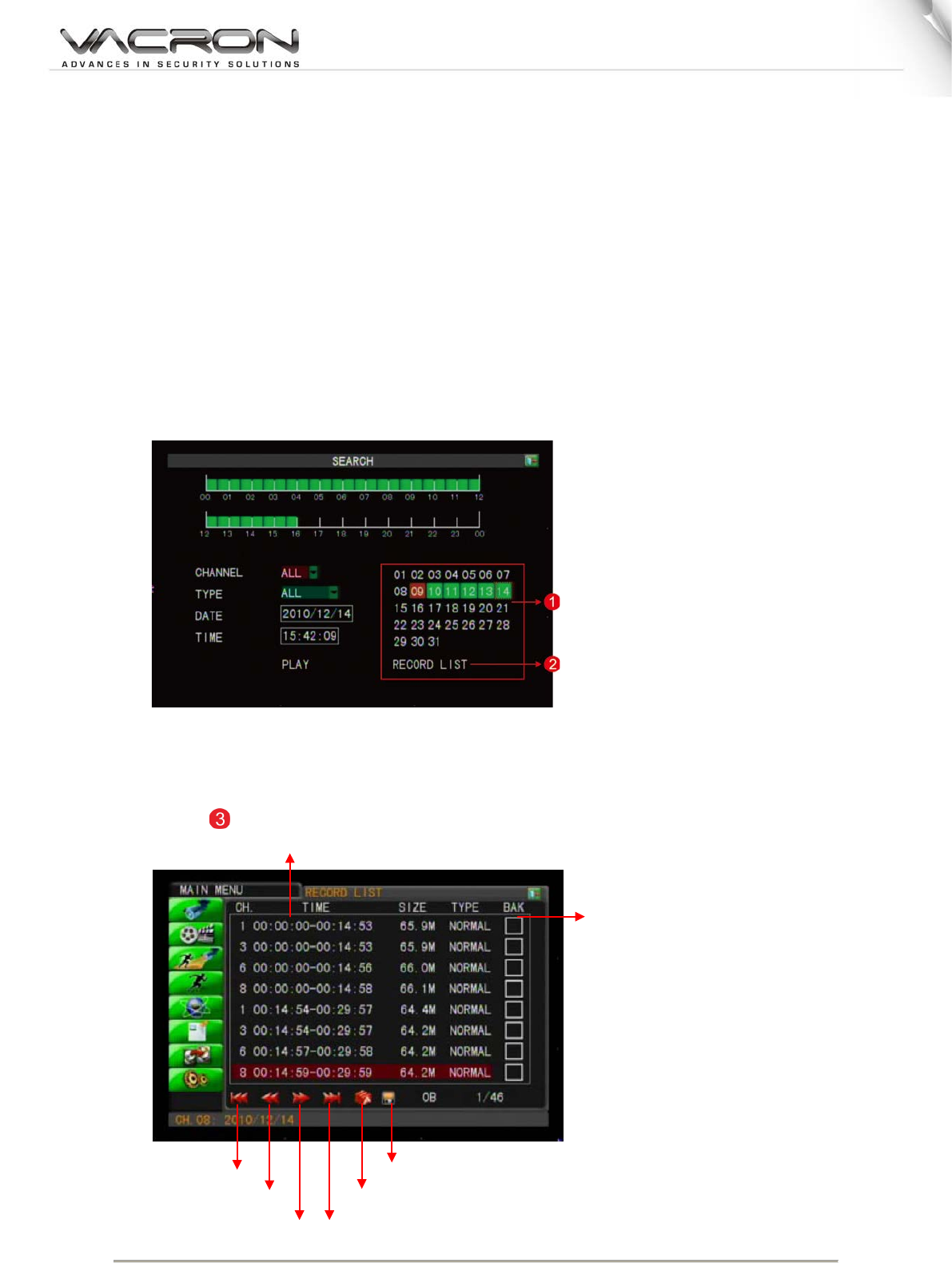
3. Record List Search
3.1 Select the date you wish to search.
3.2 Click RECORD LIST to enter record list selection menu.
3.3 Double click the event from the list to playback.
Previous Page
Record
Backup Select Check
First Page
Next Page Last Page
Select All
Back Up
40
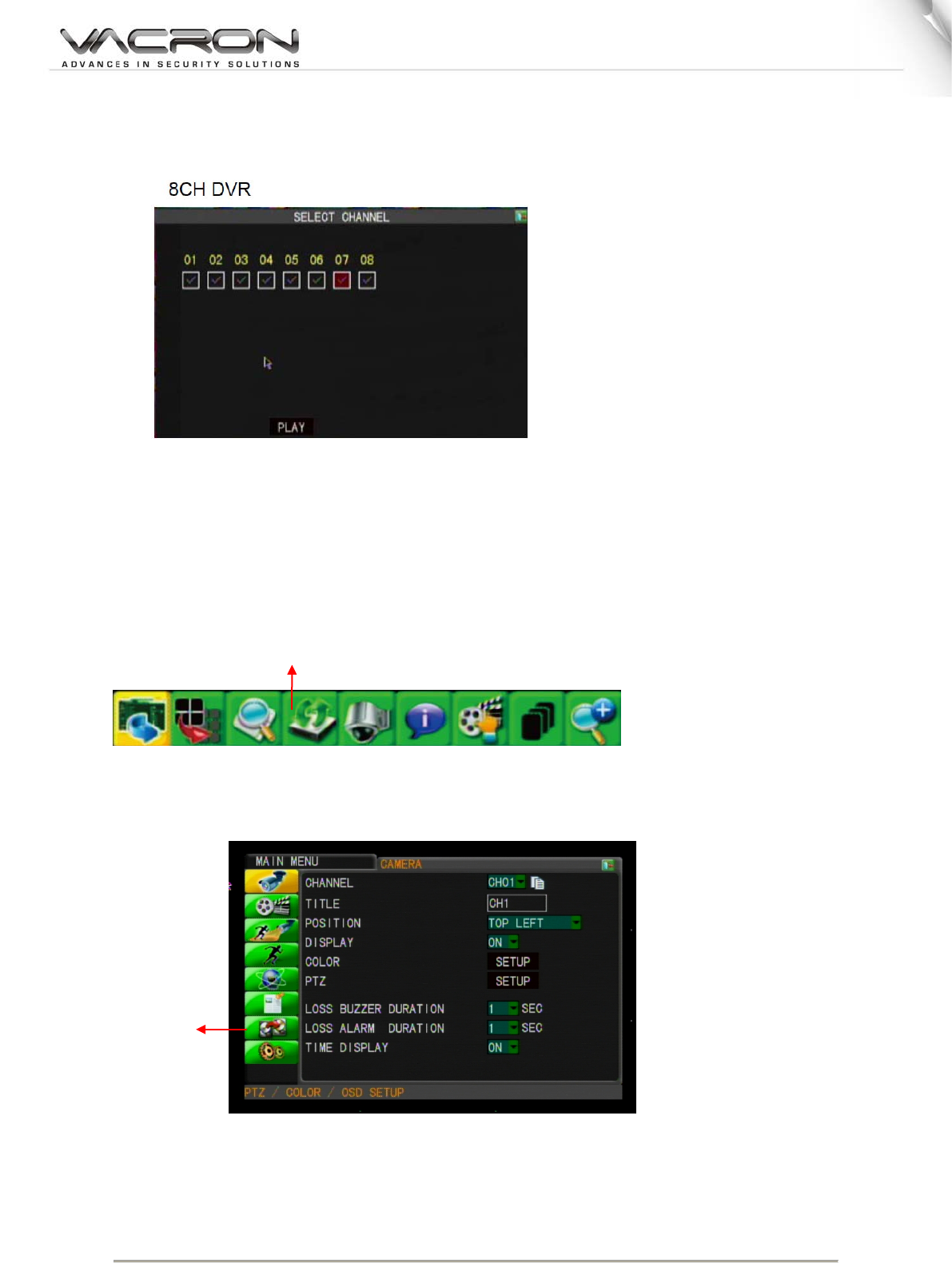
Step 3. Channel Selection.
Check on the channels you wish to playback, and then click PLAY.
12.2 How to backup the footage step-by-step?
Step 1. Click the BACKUP button
There are two ways to enter the BACKUP menu.
Option 1: Click the right button of the mouse to open the quick menu bar, and press
the “BACKUP” option to enter the search menu.
Option 2: Click the right button of the mouse to open the quick menu bar and select
MAIN MENU. Press the “Backup” option from the main menu.
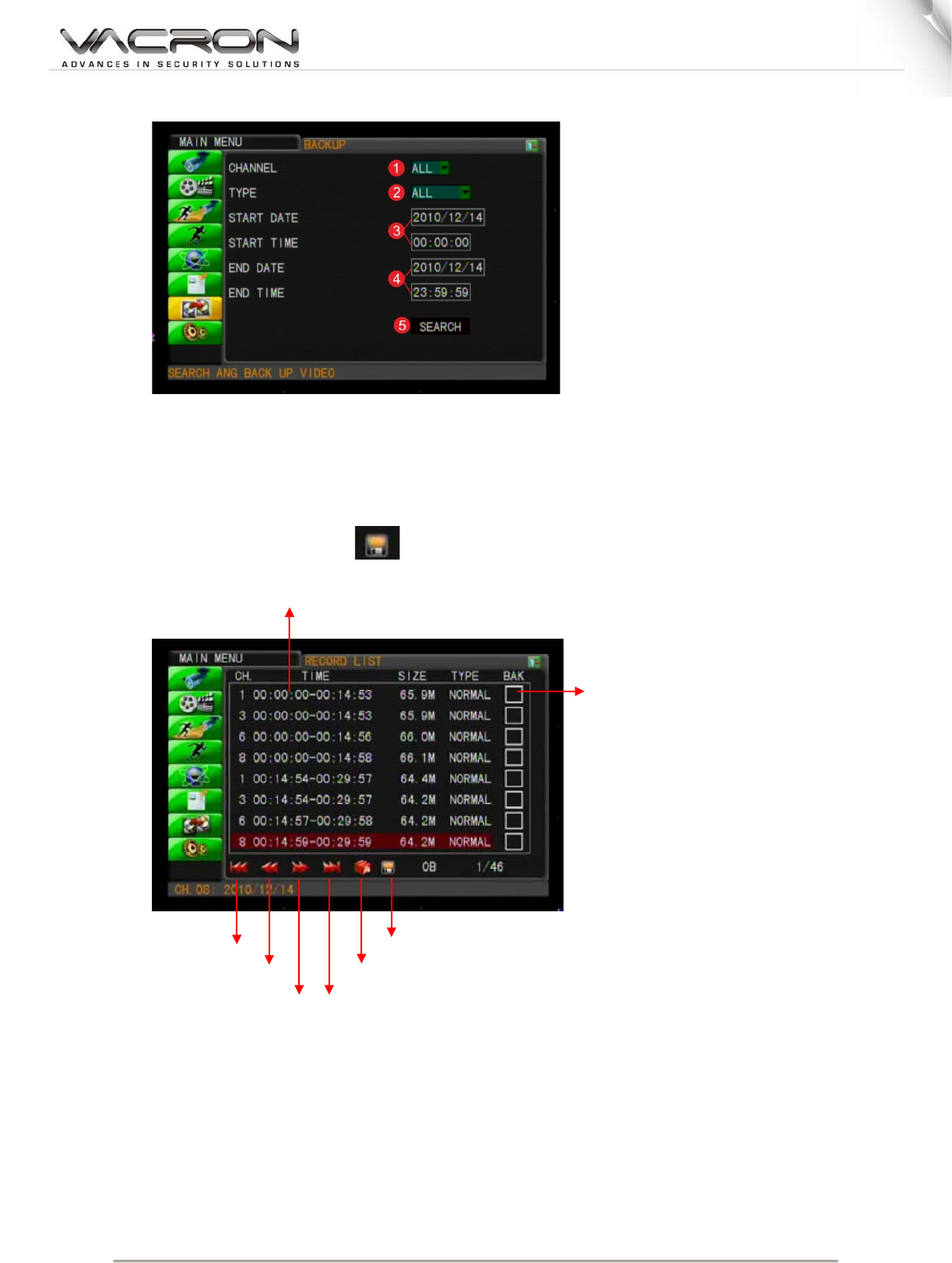
Step 2. Specify the desired channels, type, start date and time, and end date and
time, then press SEARCH.
Back Up
Back
41
Step 3. Select channels to backup.
3.1 Double click the event to preview the footage before backup.
3.2 Select the events you wish to backup by marking on “BAK” check box.
3.4 Click the backup button to storage device page.
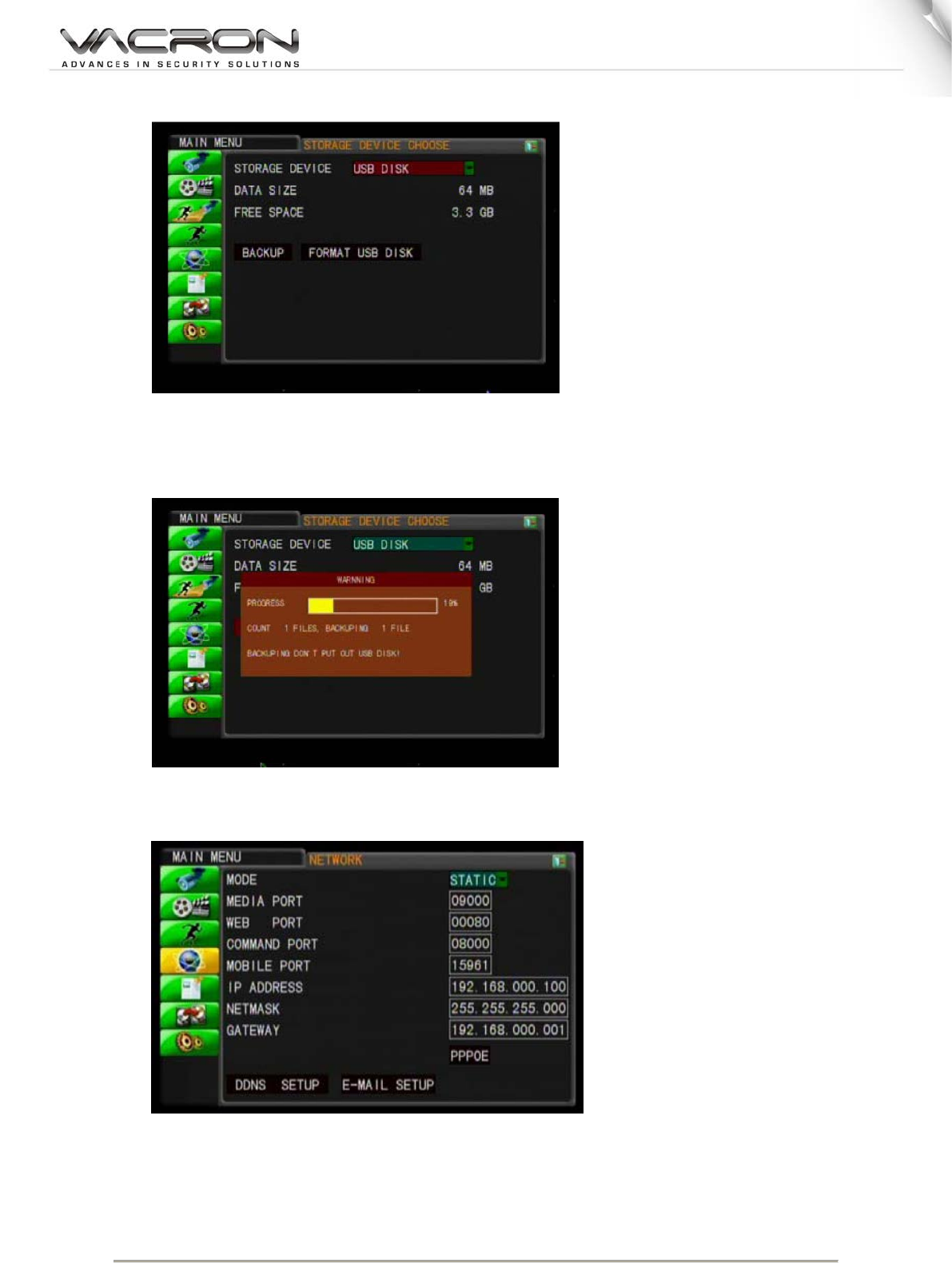
Step 4. Choose the storage device.
4.1 Plug in the USB flash memory stick into the USB port of DVR.
4.2 Once the DVR detects the USB flash memory stick, it will show the data size and
free space on the screen.
4.3 If there is lack of free space, you may try to format the USB flash memory stick first
by clicking on FORMAT USB DISK
4.4 Once everything is ready, click on BACKUP to proceed.
Previous Page
Record
Backup Select Check
First Page
Next Page Last Page
Select All
Back Up
42
Step 5. Start Backup the file.
Once you click the “BACKUP” button, the DVR will start to backup. When the
processing bar reaches to 100%, the backup process is completed.
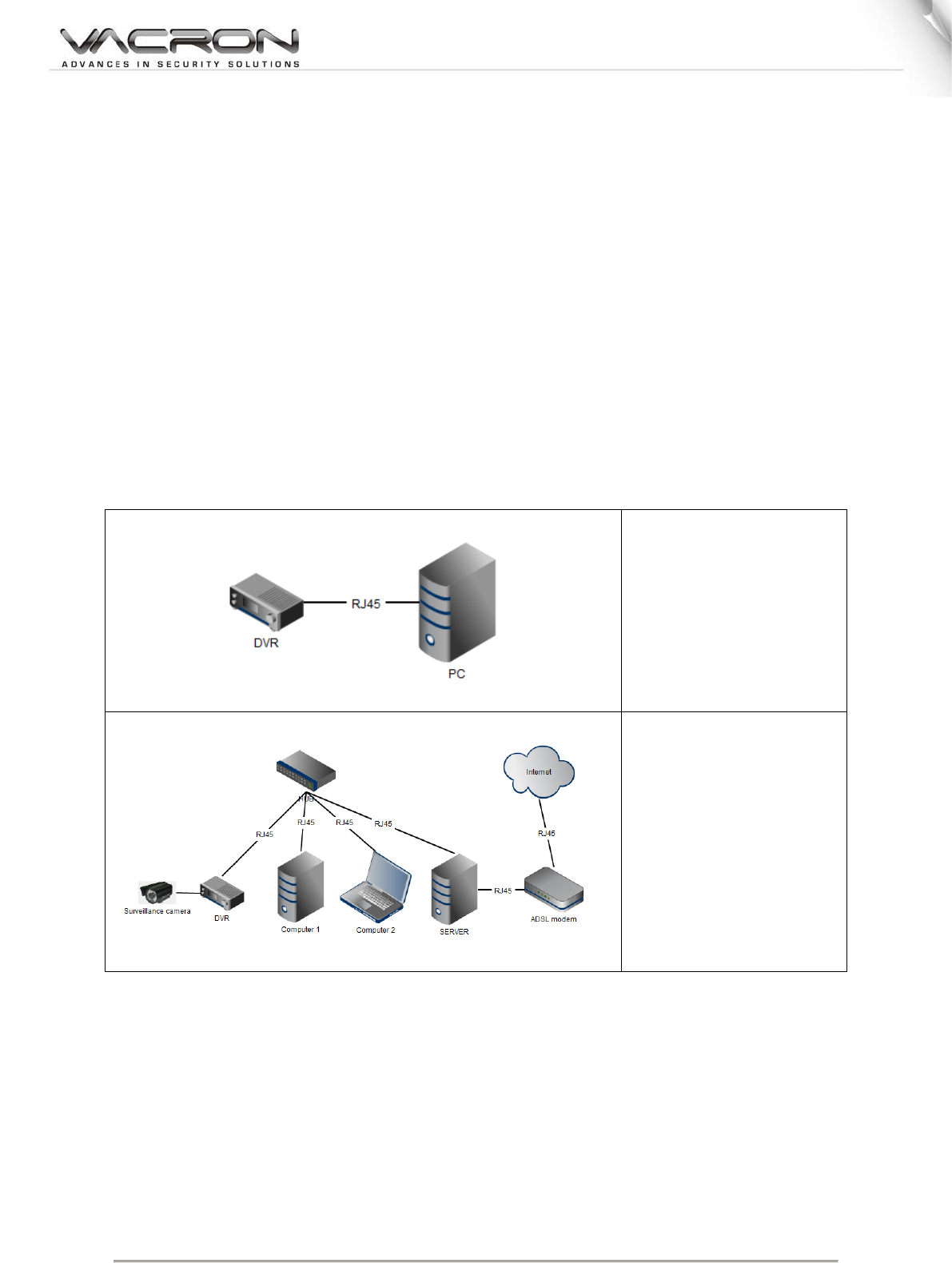
12.3 How to setup the Network step by step?
Decide your network environment
In Network setting, you can choose the connection type from Static, DHCP, or
PPPoE(which allow you to dial up by ADSL modem or 3G dongle). Below is an
explanation of how you can configure your DVR to fit your network environment.
43
12.3.1 Static
Each network device has its own IP address. An IP address is like a doorplate of the
device, helping data to be delivered to the correct destination. An IPv4 address
contains 32 bits, which are divided into four parts, each part separated by a dot, such
as 255.255.255.0.
The following three blocks of the IP address space are reserved for private Internets
(local networks):
• 10.0.0.0~10.255.255.255
• 172.16.0.0~172.31.255.255
• 192.168.0.0~192.168.255.255
In Static mode, you have to assign the IP address for each device (e.g. your DVR and
PC)
Reference Network environment for Static IP situation
Direct connection: DVR
to PC
(Home/Small office
users)
Multi-connection
through
HUB/SWITCH/Router
(Small Office users)
Here is an example of how to set up connection between the DVR and your PC.
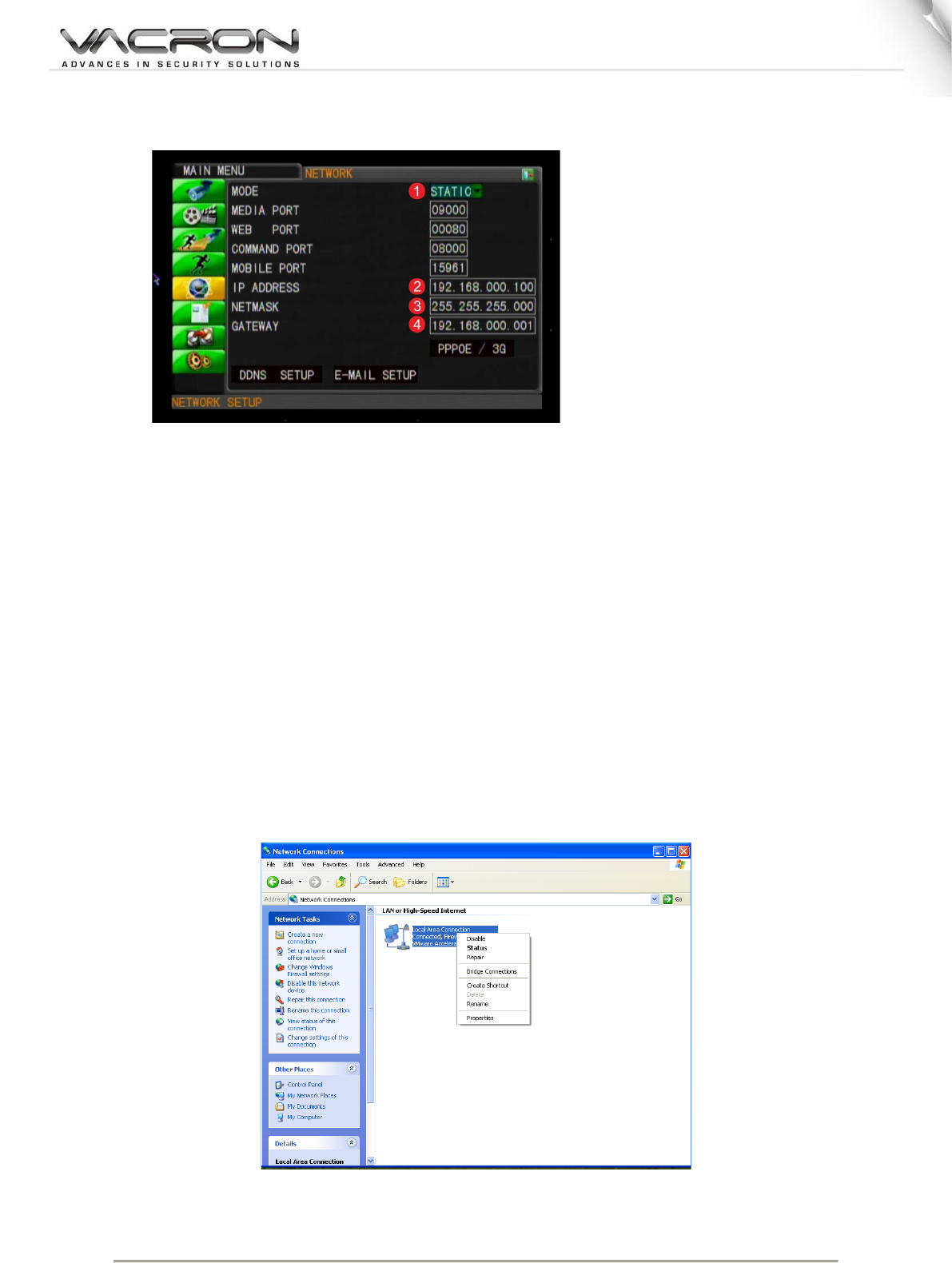
44
Step 1: Set your DVR network mode to static mode
1. Change the connection type to “STATIC” in DVR’s network setting
2. Assign the IP address to the DVR
Note: Be sure not to set up a duplicated IP address for the DVR. For example, if you
assign 192.168.0.100 to the PC, please change the IP address of the DVR to
192.168.0.101
3. Set the Netmask of the DVR: The address must be the same as the PC’s
setting.
4. Set the Gateway of the DVR: The address must be the same as the PC’s
setting.
Step 2: Modify your PC’s network setting to correspond to the DVR
For WINDOWS XP:
StartControl Panel Network and Internet ConnectionsNetwork Connections
Find your network adaptor and click the right button and choose “Properties”
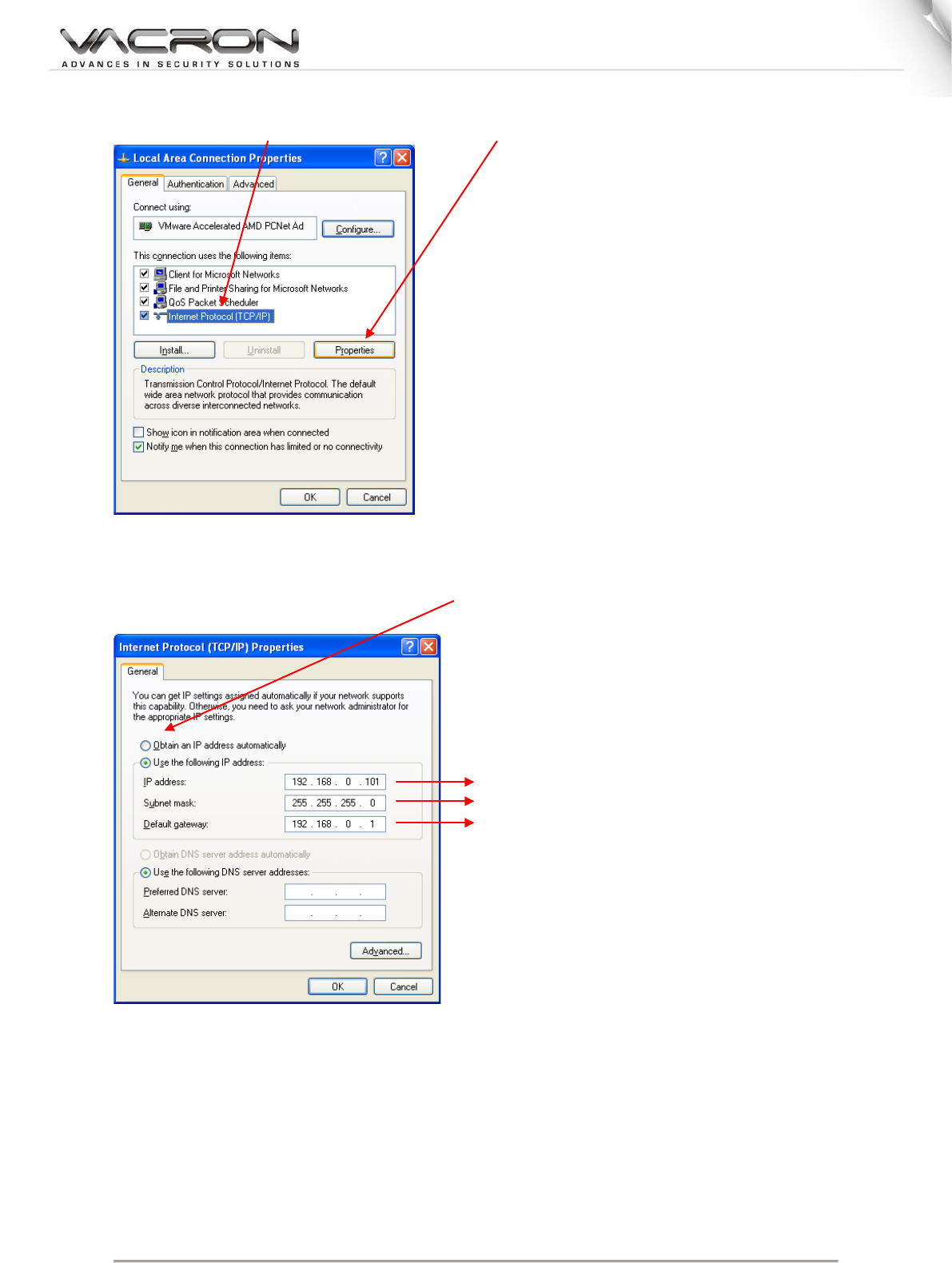
45
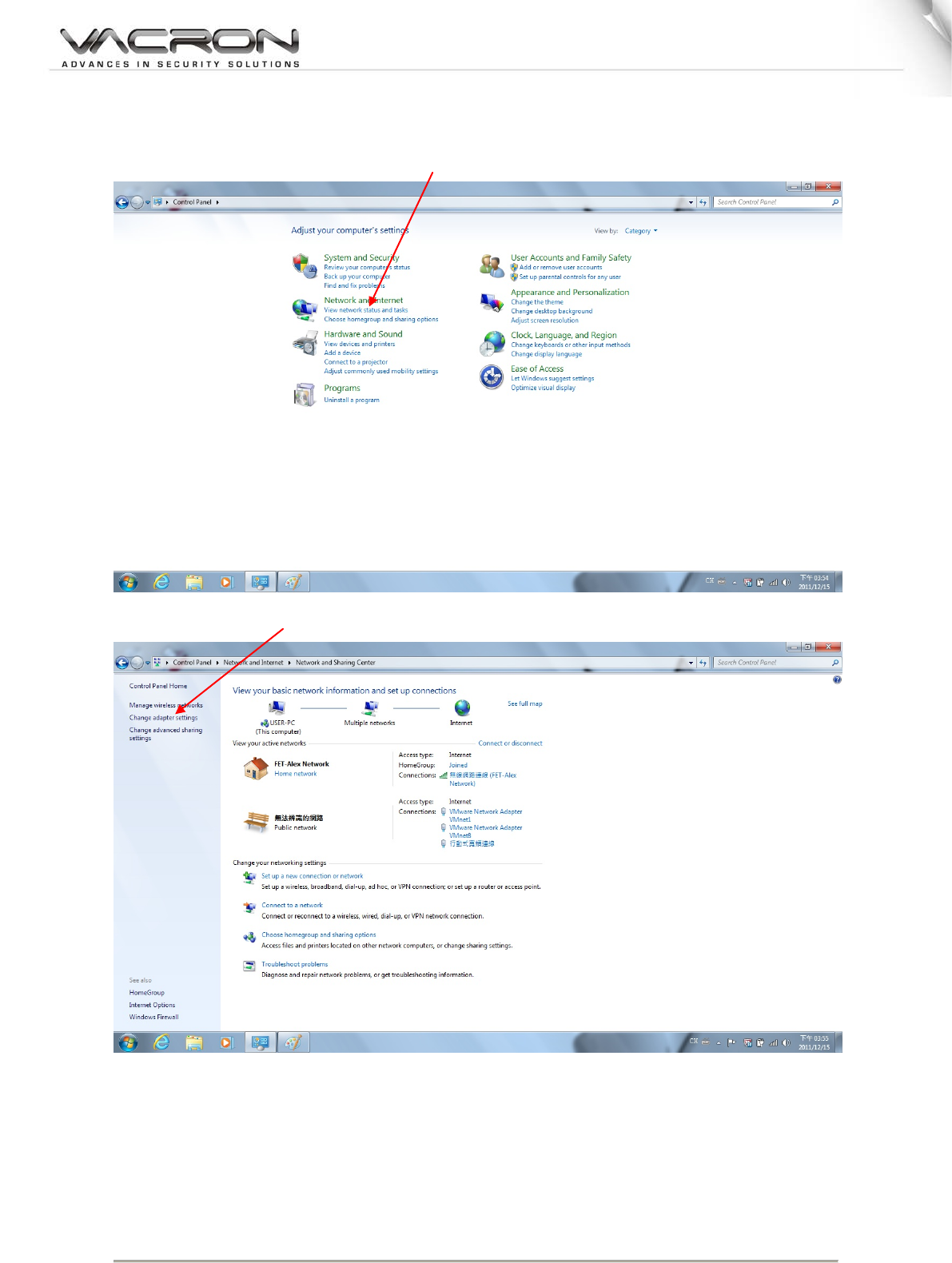
Find “Internet Protocol (TCP/IP)” and click the “Properties” to enter the setting menu
In the following menu, choose “Use the following IP address” to set up IP address
manually
1) Enter the IP address for your PC. Be sure not to set up a duplicated IP address
with any other network devices.
2) Enter Subnet mask address. This address should correspond to the Netmask
address of your DVR.
3) Enter Default gateway address. This address should correspond to the Gateway
address of your DVR.
1
2
3
46
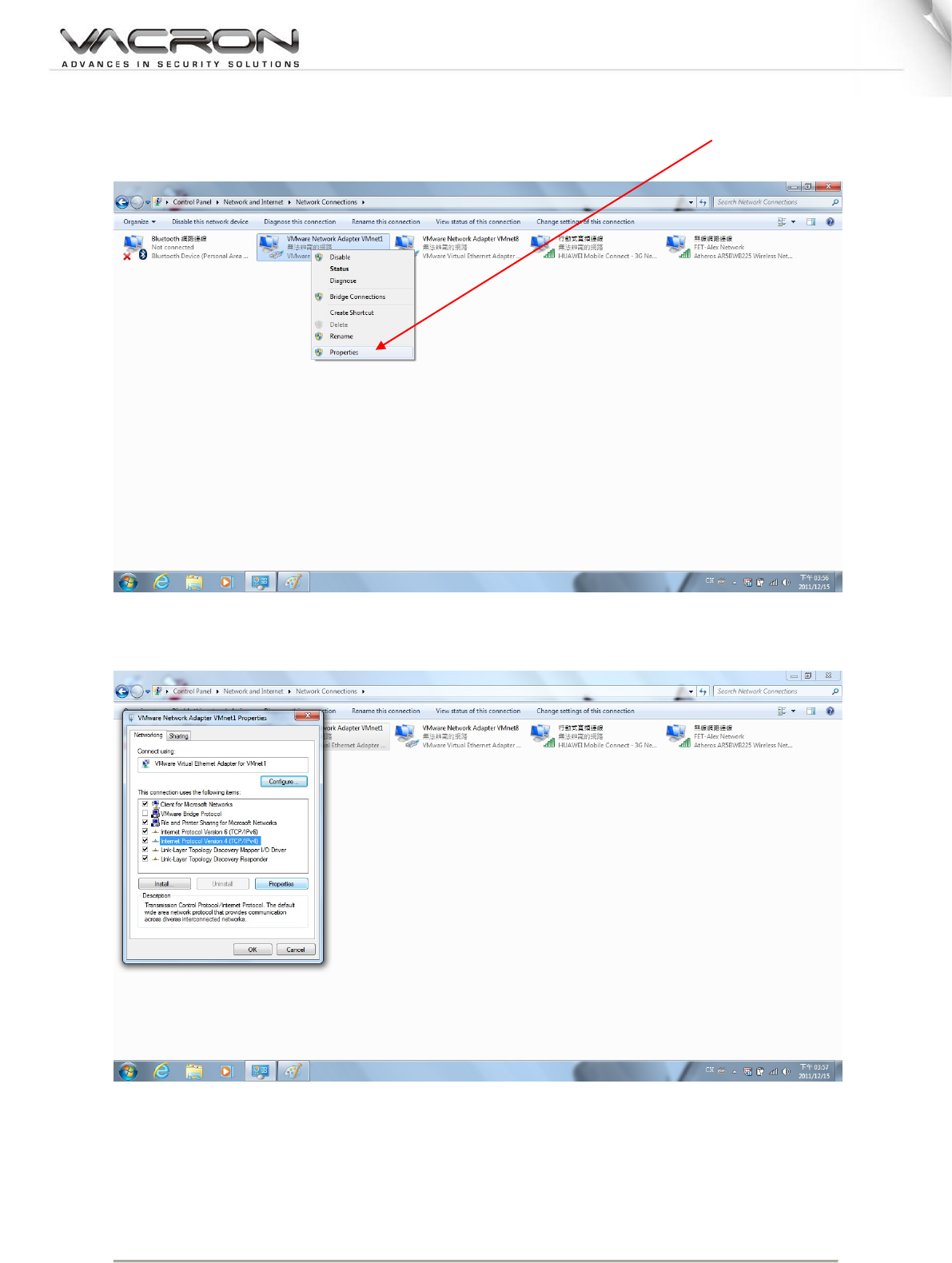
For WINDOW 7
StartControl PanelView network status and tasksclick and enter the next menu
Click “Change adapter settings” at the left column
47
Find the network adapter and right click the mouse button and click the “Properties” to
enter the setting menu
Find Internet Protocol Version 4(TCP/IPv4) and click “Properties”
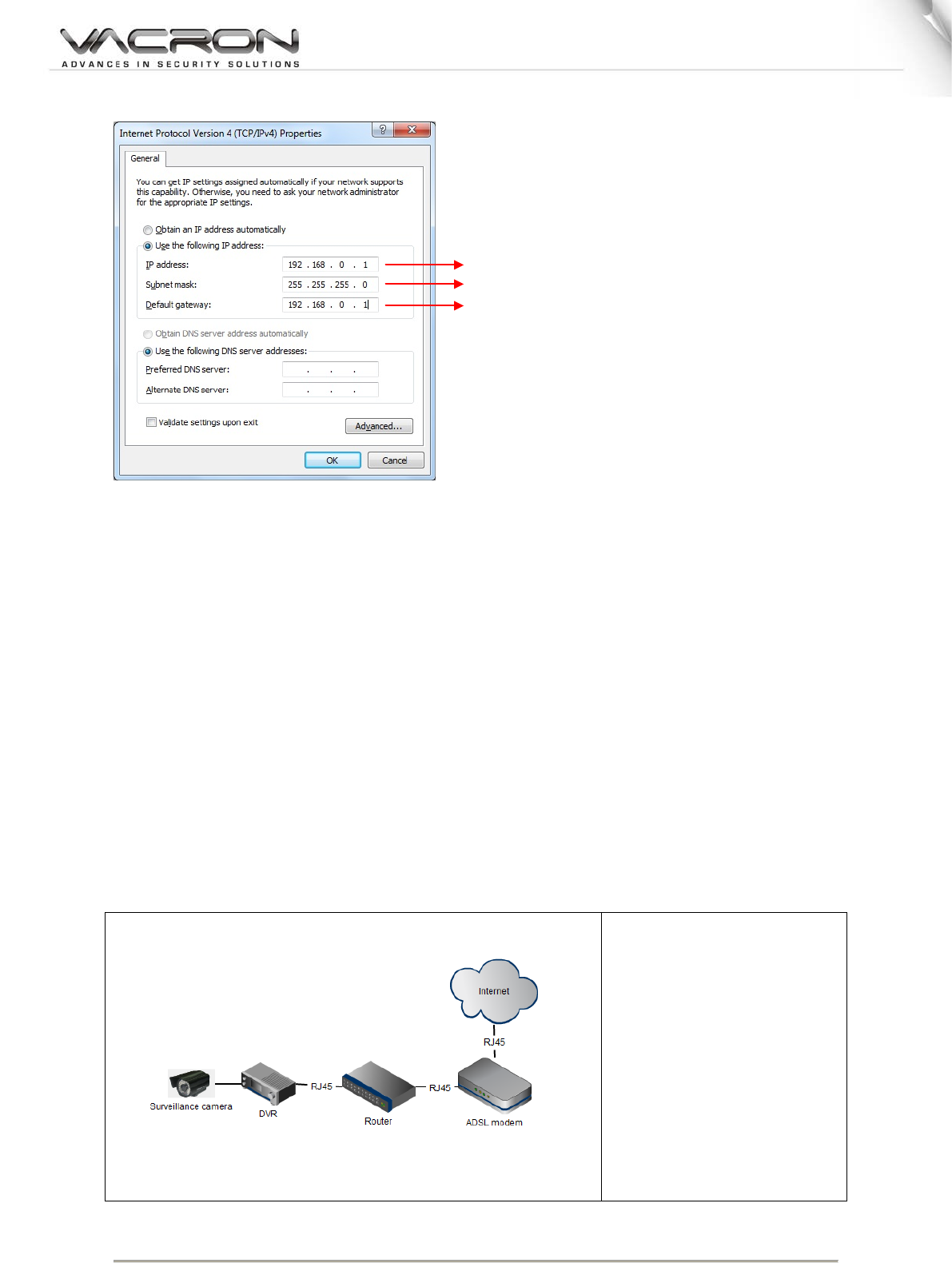
In the following menu, choose “Use the following IP address” to set up IP address
manually
48
1) Enter the IP address for your PC. Be sure not to set up a duplicated IP address
with any other network devices.
2) Enter Subnet mask address. This address should correspond to the Netmask
address of your DVR.
3) Enter Default gateway address. This address should correspond to the Gateway
address of your DVR.
12.3.2 DHCP
DHCP (Dynamic Host Configuration Protocol) automatically assigns a valid IP
address to a network device on the Internet. Allocating a fixed IP address for each
device will result in idle IP addresses when the devices are not in operation. Therefore,
DHCP can make more efficient use of the IP addresses. To use this feature, you have
to have a PC or router to be set as DHCP server to provide the service.
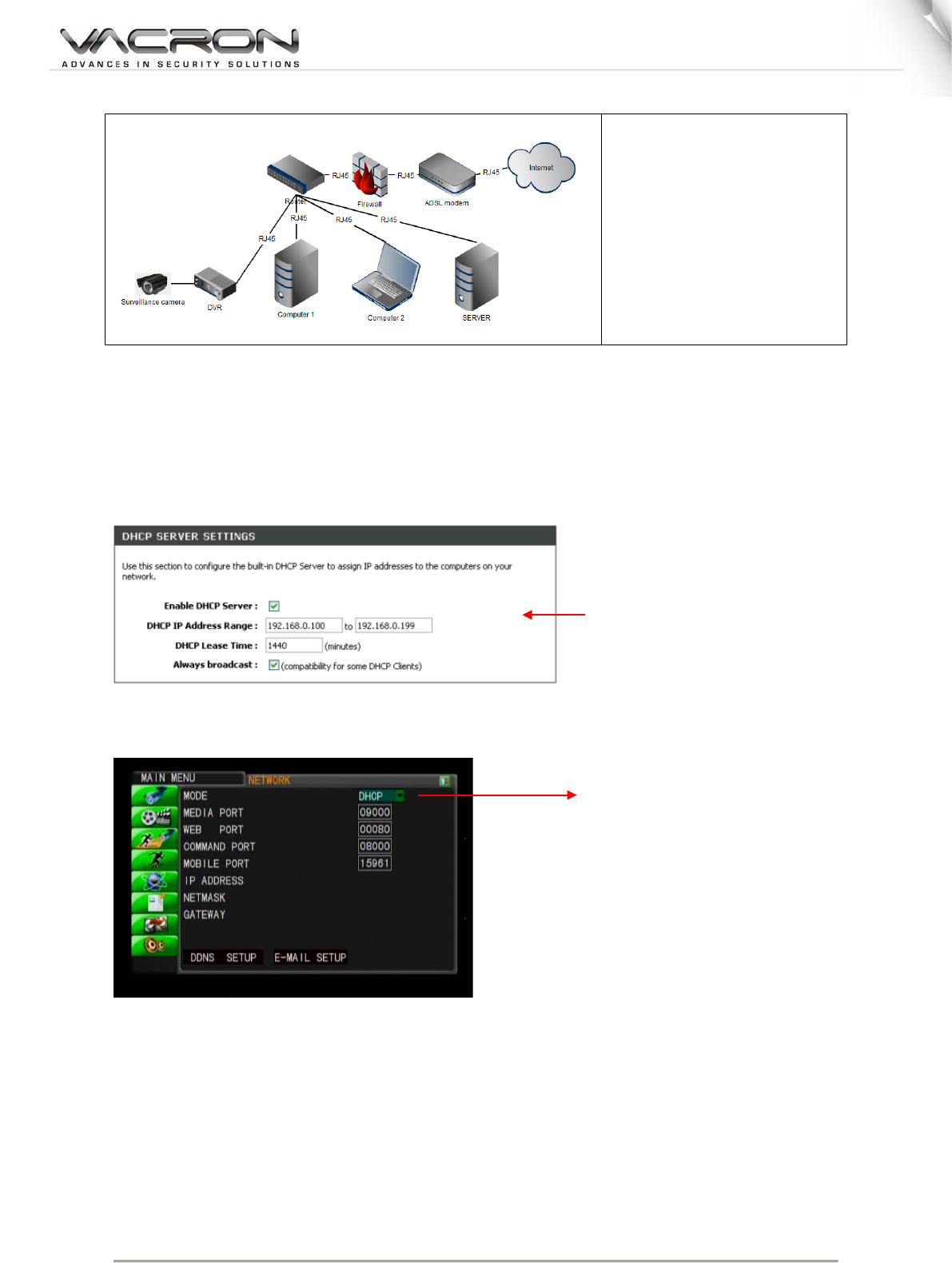
Reference Network environment for DHCP situation
DHCP connection through
Router (Home/small office)
1
2
3
49
DHCP connection through
Router/Server
(Corporation)
Here is an example of how to set up connection between the DVR and your PC in
DHCP mode
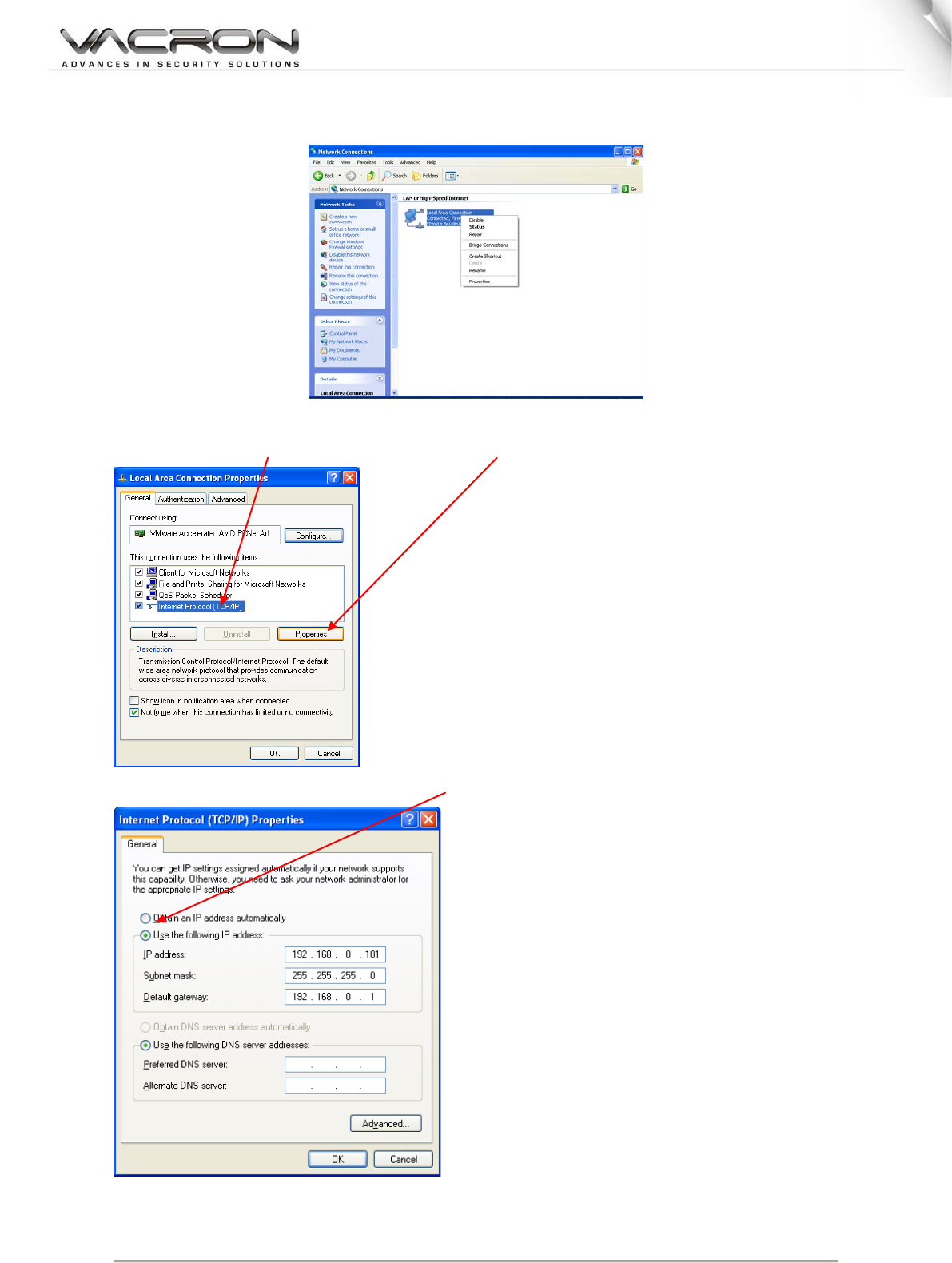
Step 1: Set up your router/DHCP server. For details, please consult your MIS staff
or check the manual of the router.
Step 2: Set your DVR network mode to DHCP mode
1. Change the connection type to “DHCP” in DVR’s network setting
2. If the router is correctly set, the DVR should be able to get the IP address from the
router automatically.
Step 3: Modifiy your PC’s network setting to DHCP mode
For WINDOWS XP:
StartControl Panel Network and Internet ConnectionsNetwork Connections
○
1
DHCP SERVER Setting in DIR-615 (D-Link)
50
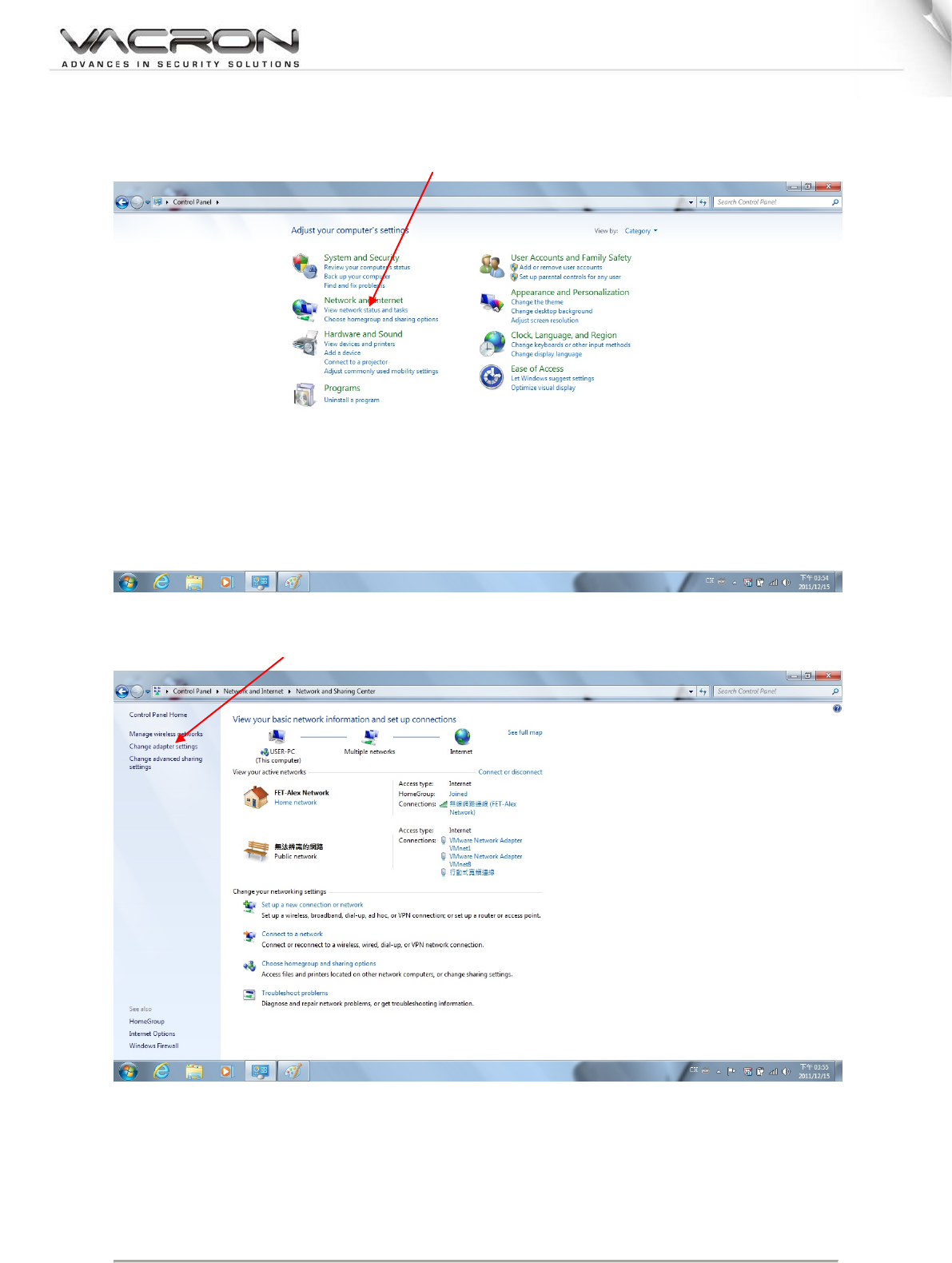
Find your network adaptor and click the right button and choose “Properties”
Find “Internet Protocol (TCP/IP)” and click the “Properties” to enter the setting menu
In the following menu, choose “Obtain an IP address automatically”
51
For WINDOW 7
StartControl PanelView network status and tasksclick and enter the next menu
Click “Change adapter settings” at the left column
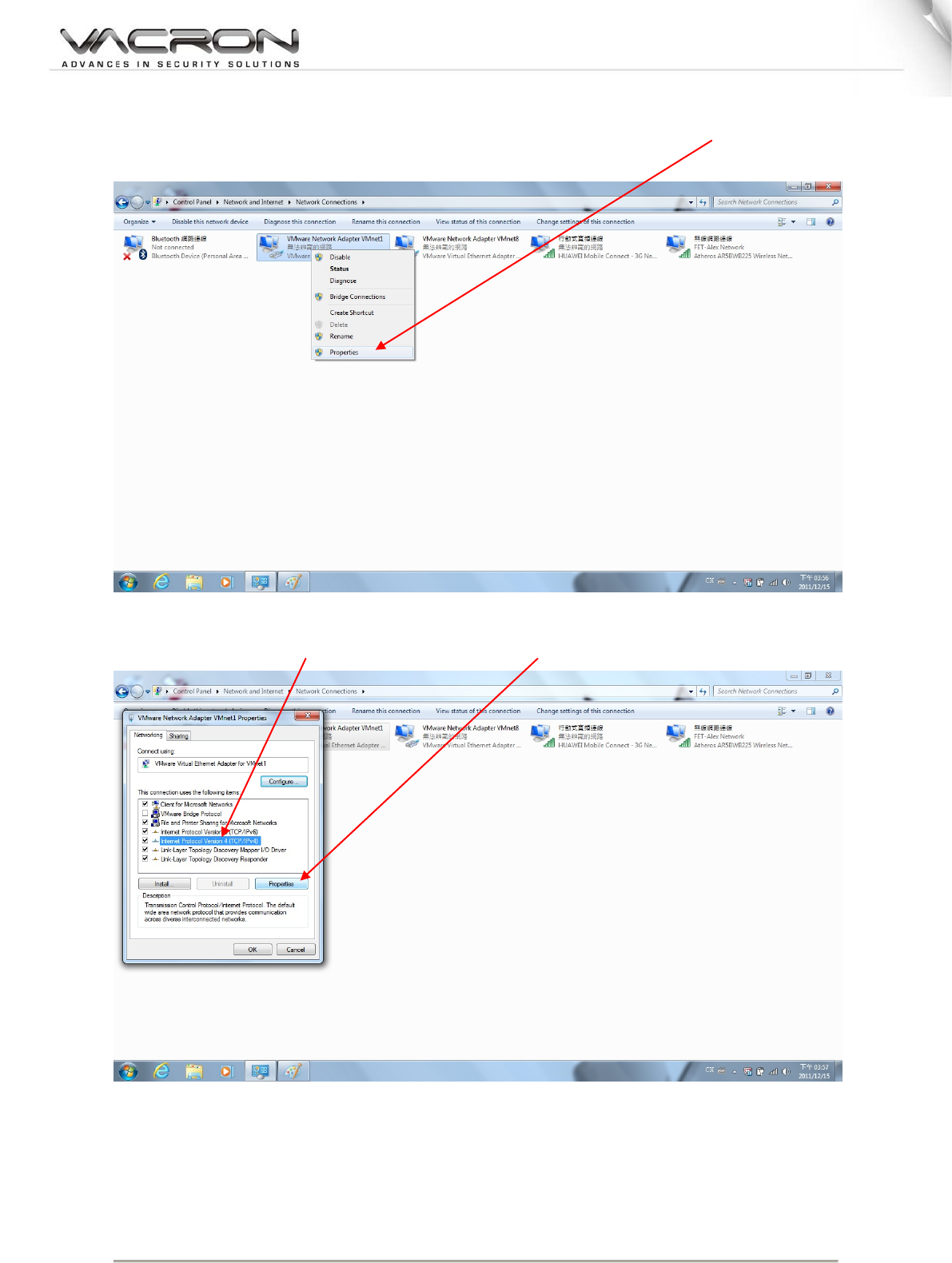
52
Find the network adapter and right click the mouse button and click the “Properties” to
enter the setting menu
Find “Internet Protocol Version 4(TCP/IPv4)” and click “Properties”
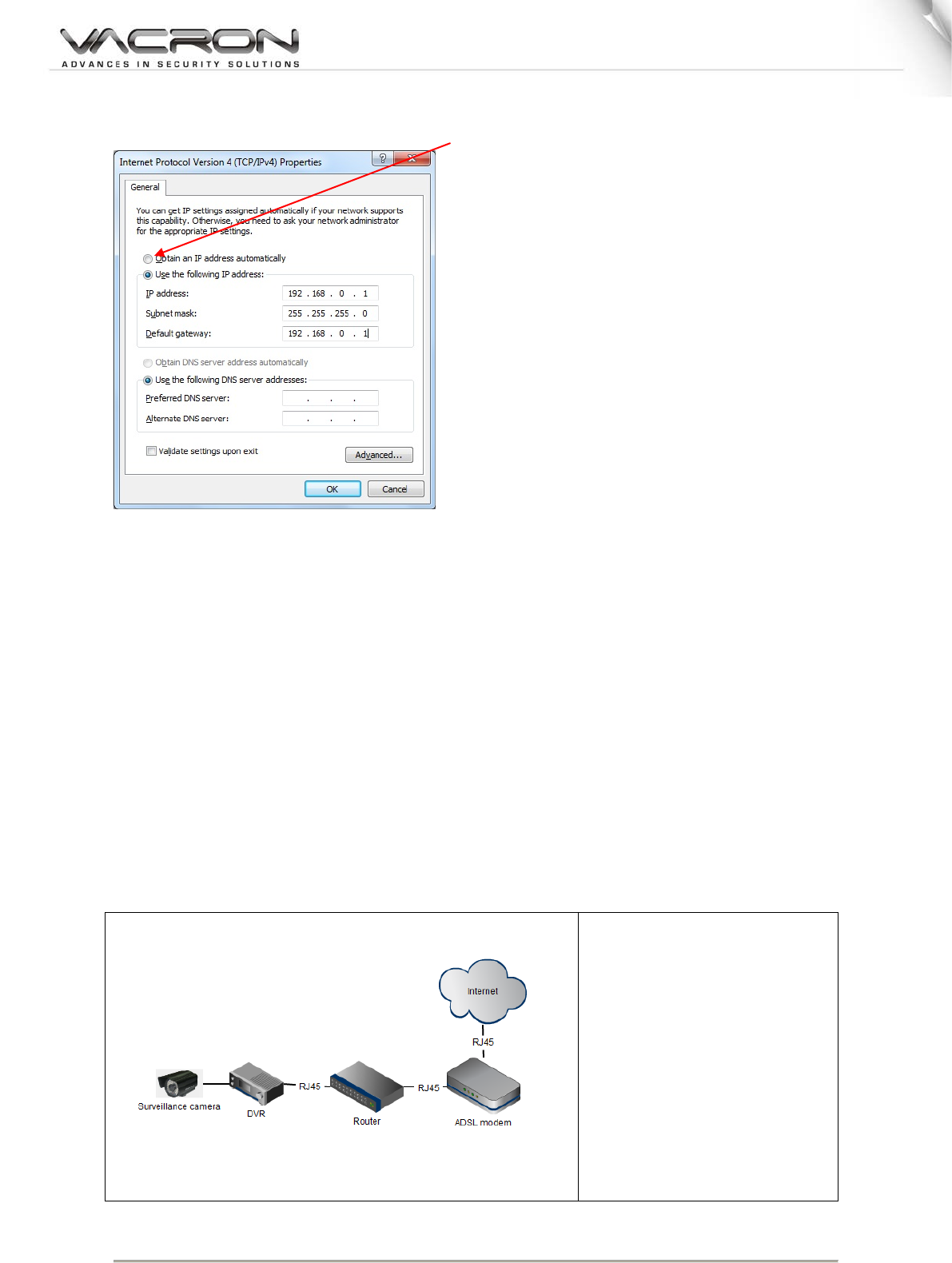
53
In the following menu, choose “Obtain an IP address automatically”
If the router/DHCP server is set correctly, you should be able to connect to DVR from
your PC successfully.
Note: The IP address assigned to DVR would be varied when the router restarts or
after a period of time. If you want to assign a fixed IP address to the DVR, please
check with your MIS staff or the manual of the router.
12.3.3 PPPoE
PPPoE (Point-to-Point Protocol over Ethernet) is a protocol that enables connections
between a DSL modem and the Internet. This service is provided by ISP (Internet
Service Provider).
Reference Network environment for PPPoE situation
PPPoE connection through
Hub/Switch/Router
How to set up a PPPoE connection for your DVR?
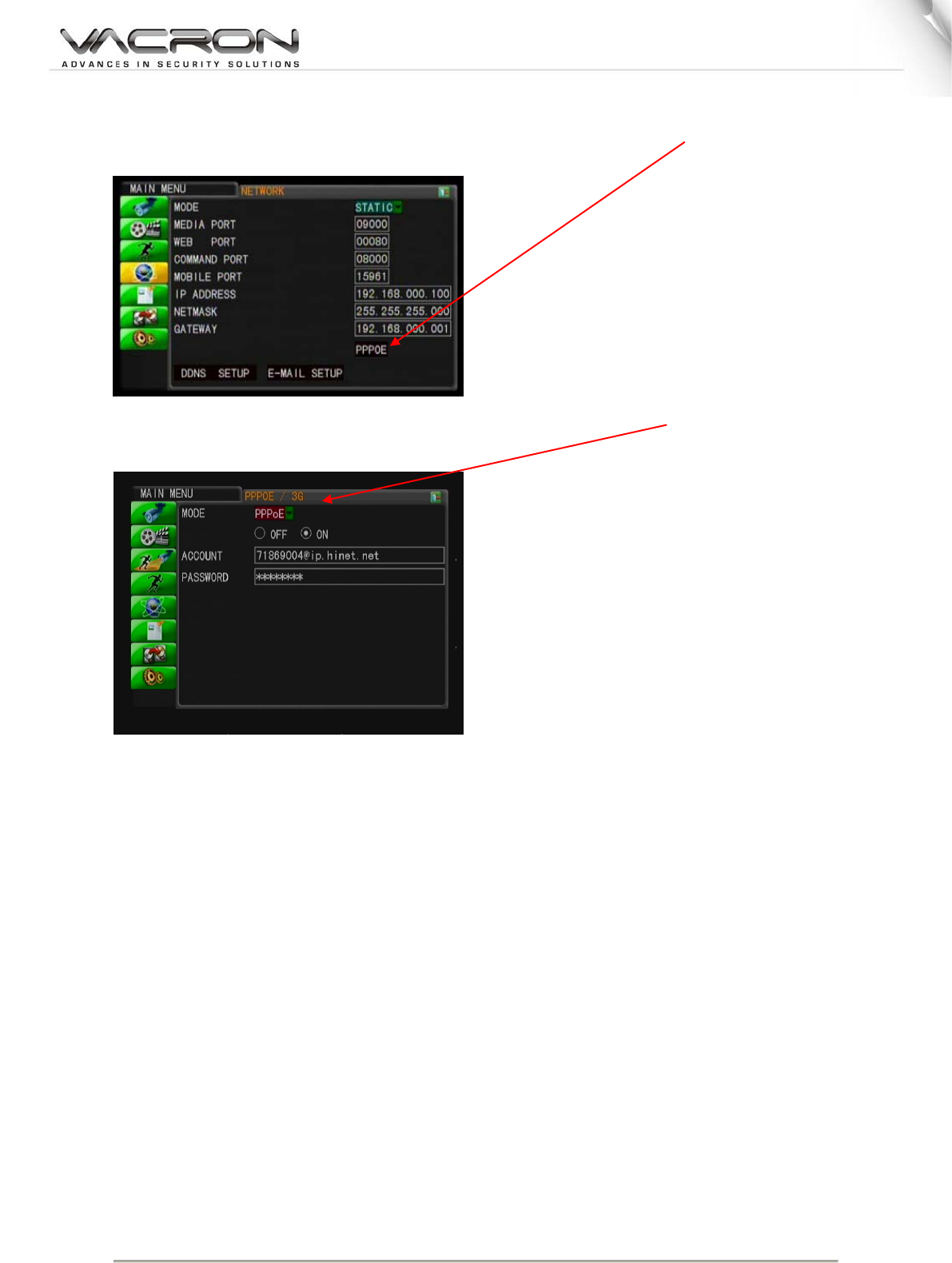
54
Step 1: In Network setting menu, set the mode to “STATIC” and click the “PPPOE” to
enter the setting menu.
Step 2: In PPPoE/3G setting menu, set the mode to “PPPoE” and choose “ON” to
enable it.
Note: for account and password information, please check with your internet service
provider.
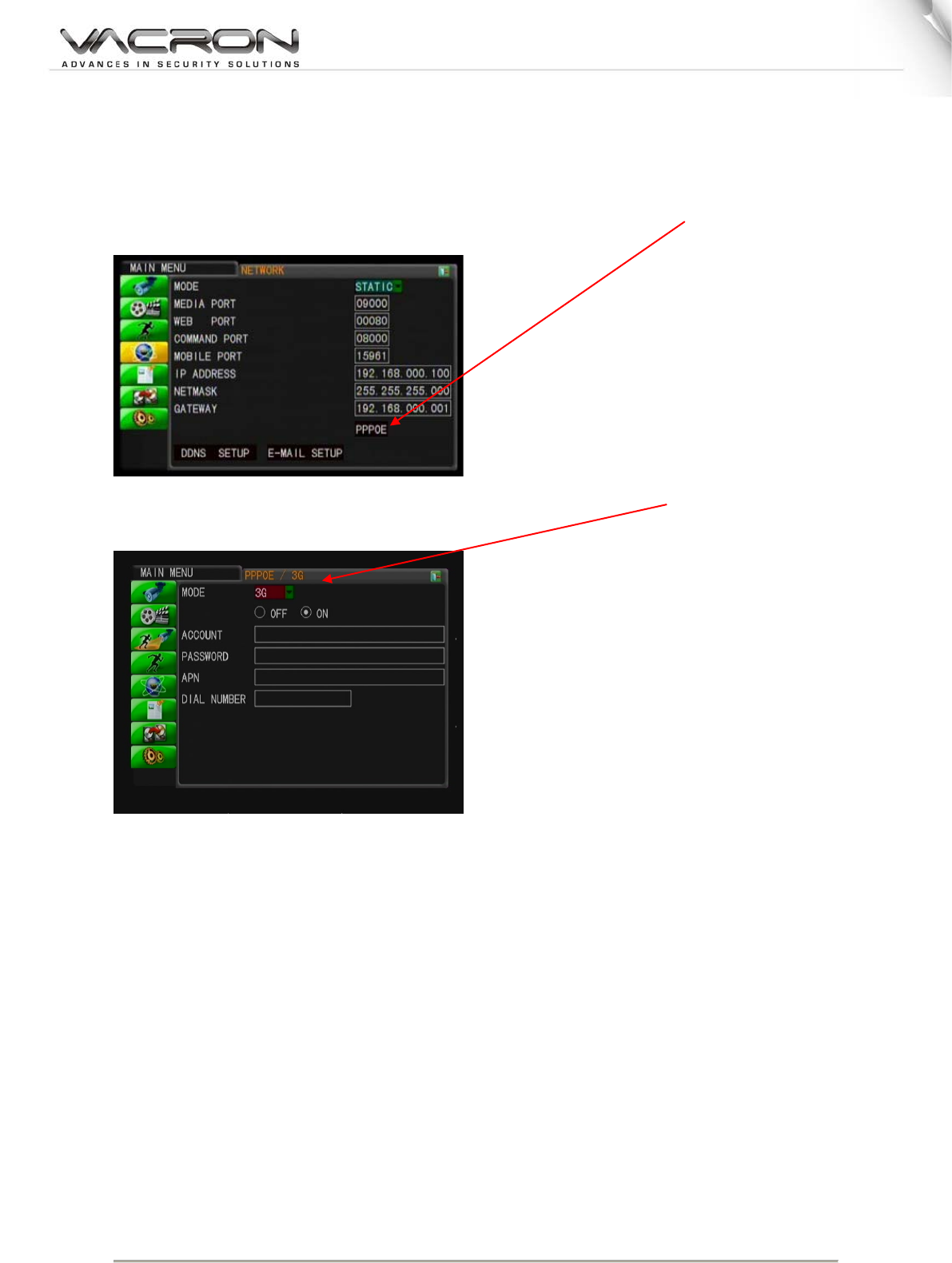
55
12.3.4 How to set up a 3G connection for your DVR?
(Note: for supported USB 3G dongle, please check with the manufacturer for latest information).
Step 1: In Network setting menu, set the mode to “STATIC” and click the “PPPOE” to
enter the setting menu.
Step 2: In PPPoE/3G setting menu, set the mode to “3G” and choose “ON” to enable
it.
Note: for dial up information, please check with your telecom company for details.
56
12.4 Email Setup
In DVR, you can set up an email reminder for situations like motion, alarm, etc. In the
following section, we will illustrate how to set it up by using Gmail.
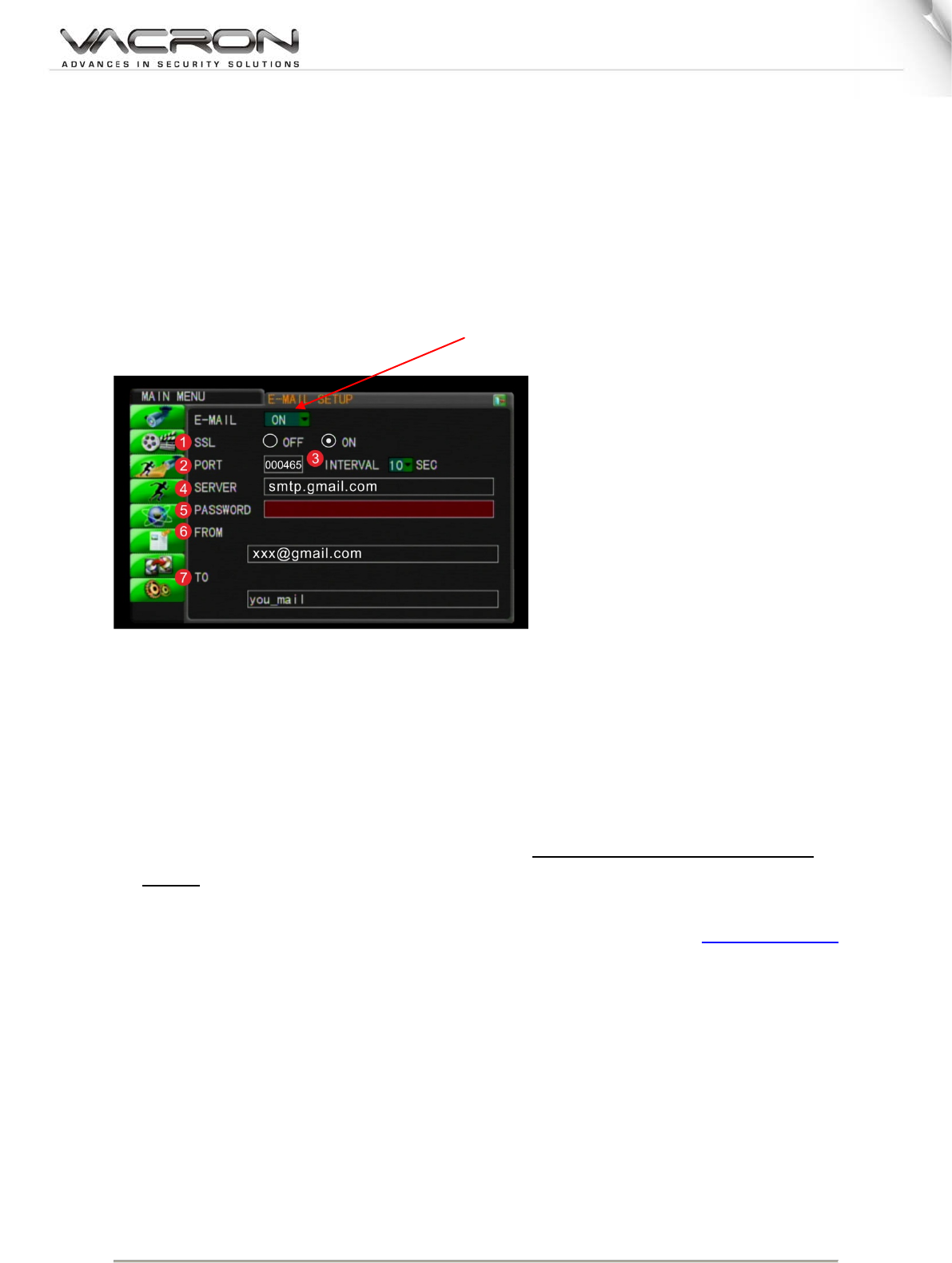
Step 1: In Network setting menu, click on “E-MAIL SETUP” and enter the following
menu
Step 2: Enable the email function by choosing “ON” in E-mail Tab
Step 3:
○
1SSL: (Secure Sockets Layer) This is used to secure the internet transmission.
For Gmail, you should turn this on. For other email settings, please consult your
email service provider.
○
2Port: Default value is 25 and is commonly used for most email server. For
Gmail, please set the value to 00465
○
3Interval: The time interval between each email being sent
○
4Server: your email server. Please noted that this must be your outgoing email
server. For Gmail, use smtp.gmail.com
○
5Password: your password for your email address
○
6From: Your email address as the mail sender. In Gmail, it’s like xxxx@gmail.com
○
7To: The email recipient
Note: Not every email server provide the service to relay the email to your email
recipient. Please consult your email service provider for more details.
57
12.5 DDNS Setup
DDNS: (Dynamic DNS). It is an service to provide the updating in real time of
Internet Domain Name System (DNS) name servers to keep up to date the active
DNS configuration of their configured hostnames, addresses and other information.
In DVR, you can apply a DDNS service for a dynamic IP address. This will help you to
use a fixed site address (such as name.idv) to find your DVR so you don’t have to
remember the floating IP address (such as 192.168.111.143)
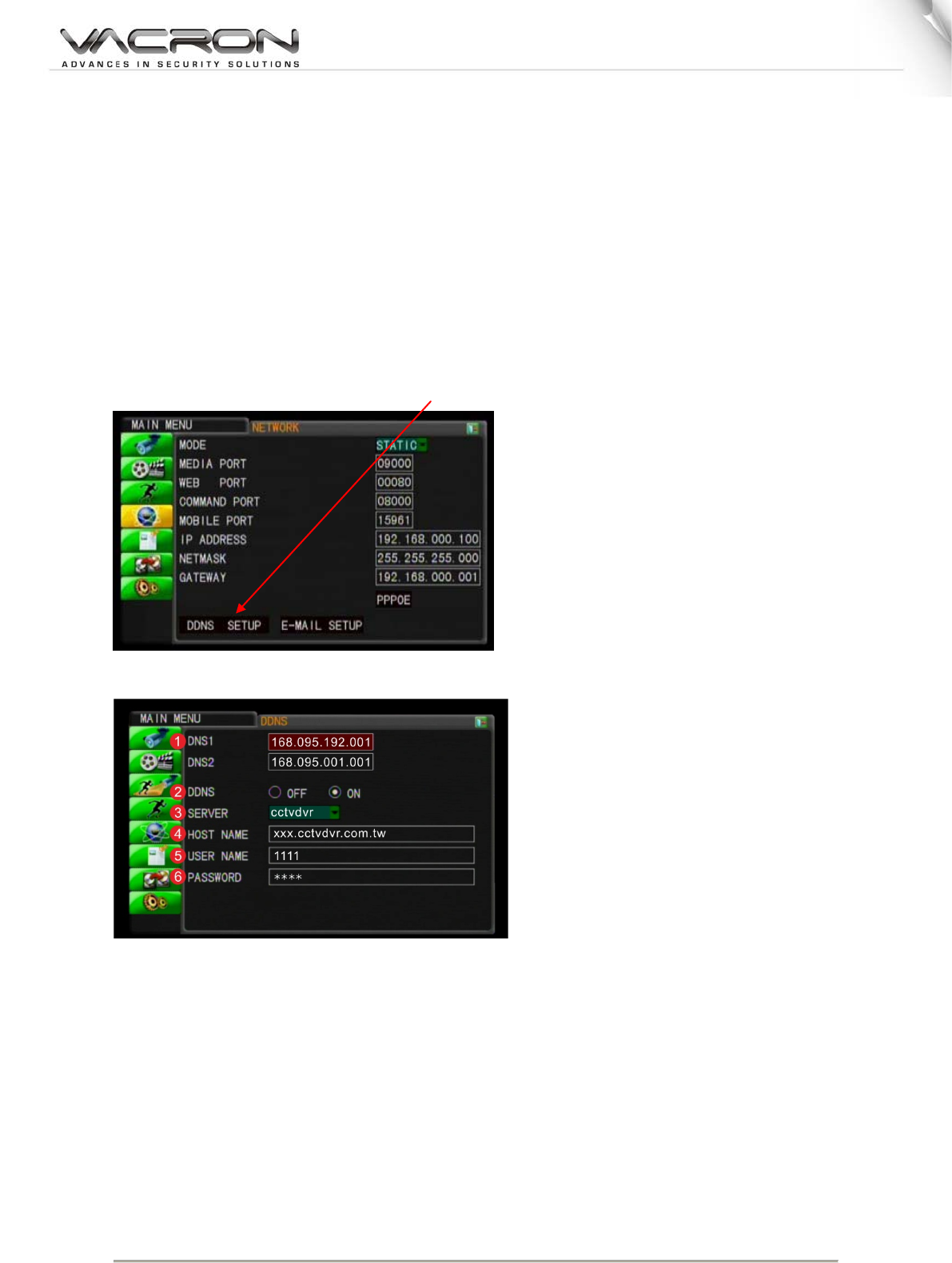
To set up the DDNS service, click on “DDNS Setup” in Network setting menu
DDNS Setting menu
○
1DNS1&2: This is used for your DNS server. The default value is 168.095.192.001
and 168.095.001.001. If you don’t your DNS server provider, just use the default
values for them.
○
2DDNS: To enable the DDNS service. Please select “ON” to enable it.
○
3DDNS SERVER: You can choose DDNS service provider from 3322, dyndns, or
cctvdvr
○
4The host name you applied in the DDNS service provider. For example,
xxxx.dyndns.org or xxxx.cctvdvr.com.tw
○
5Username: the username you used for DDNS service.
○
6Password: password you used for DDNS service
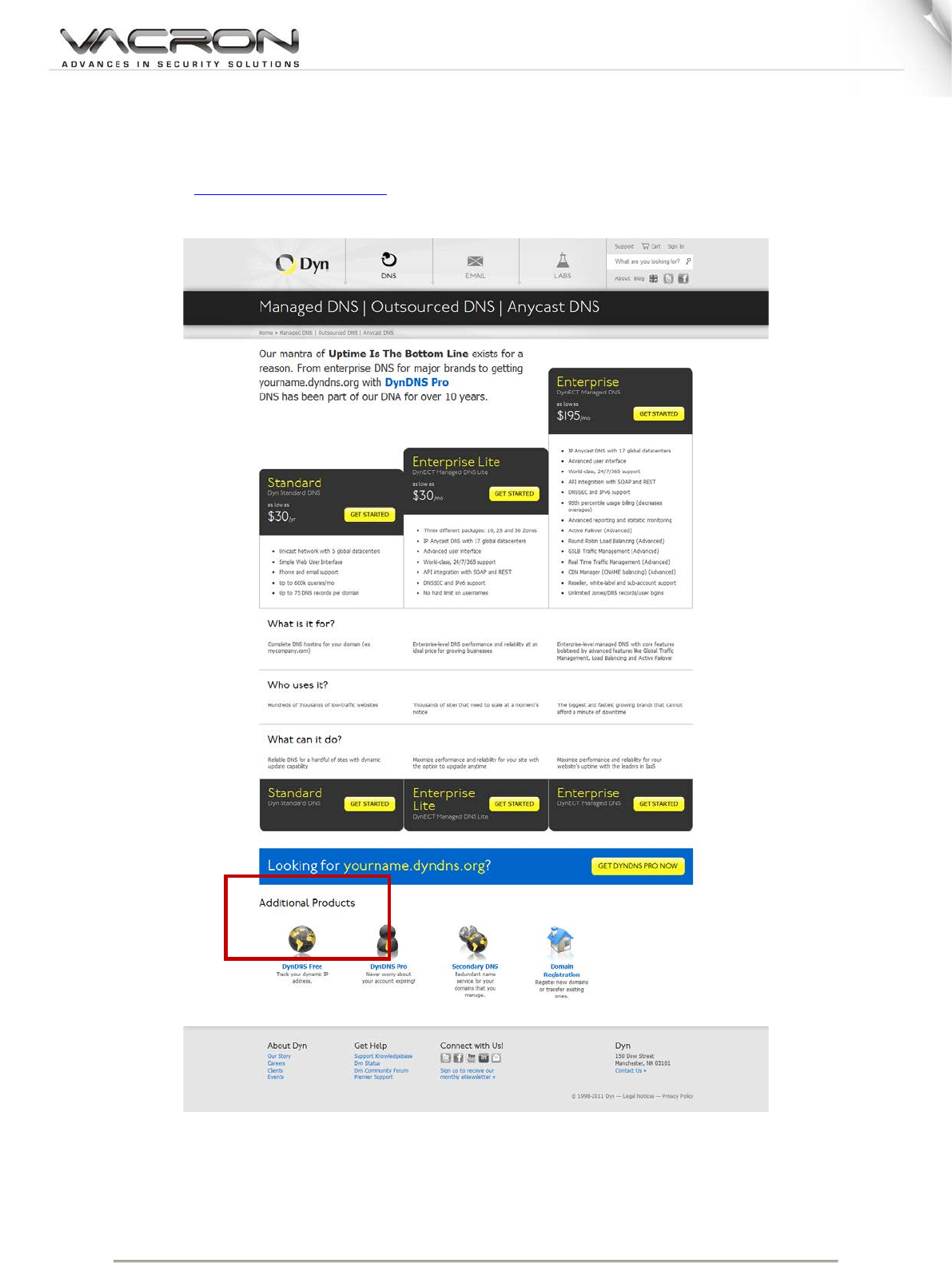
59
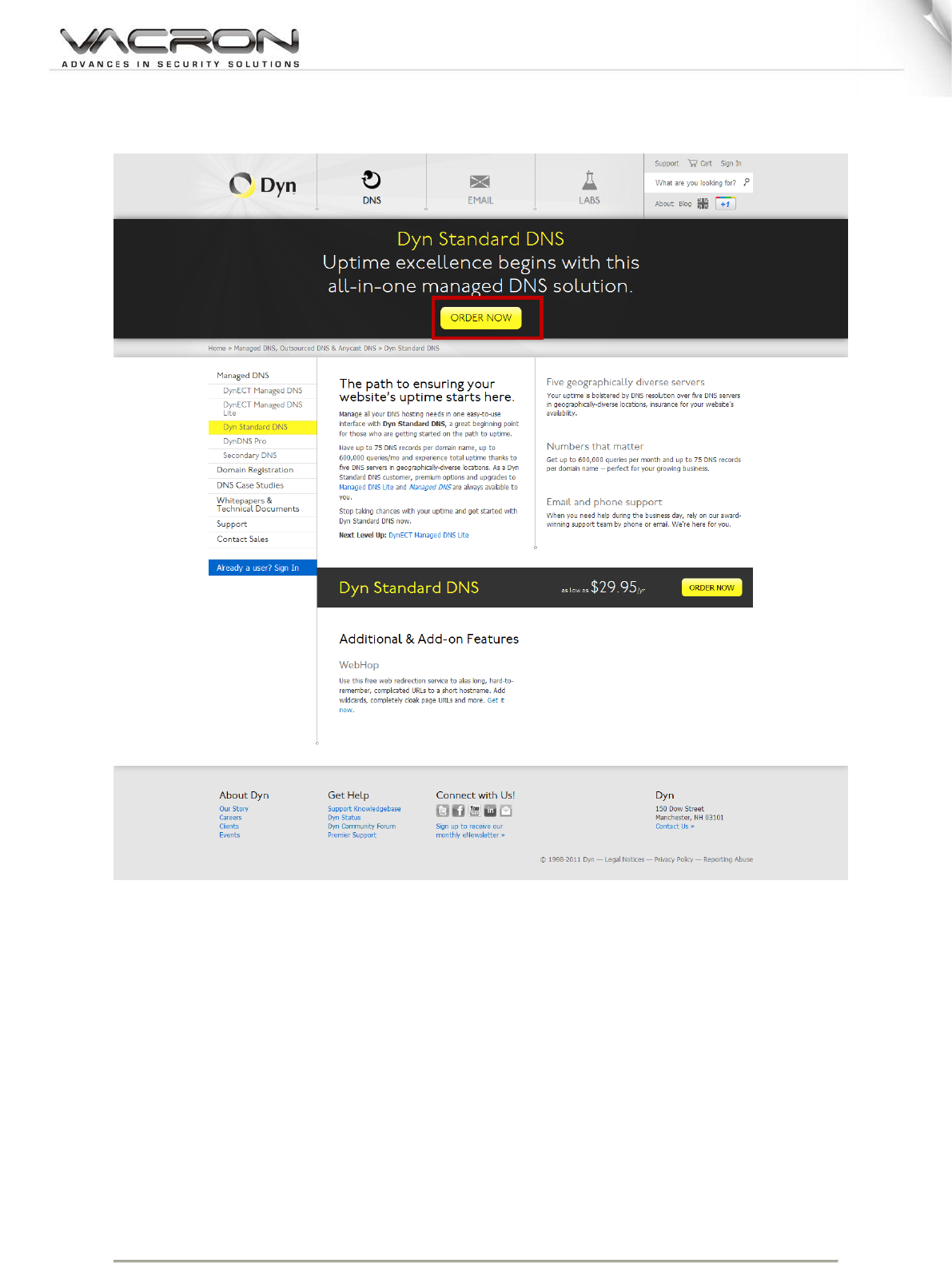
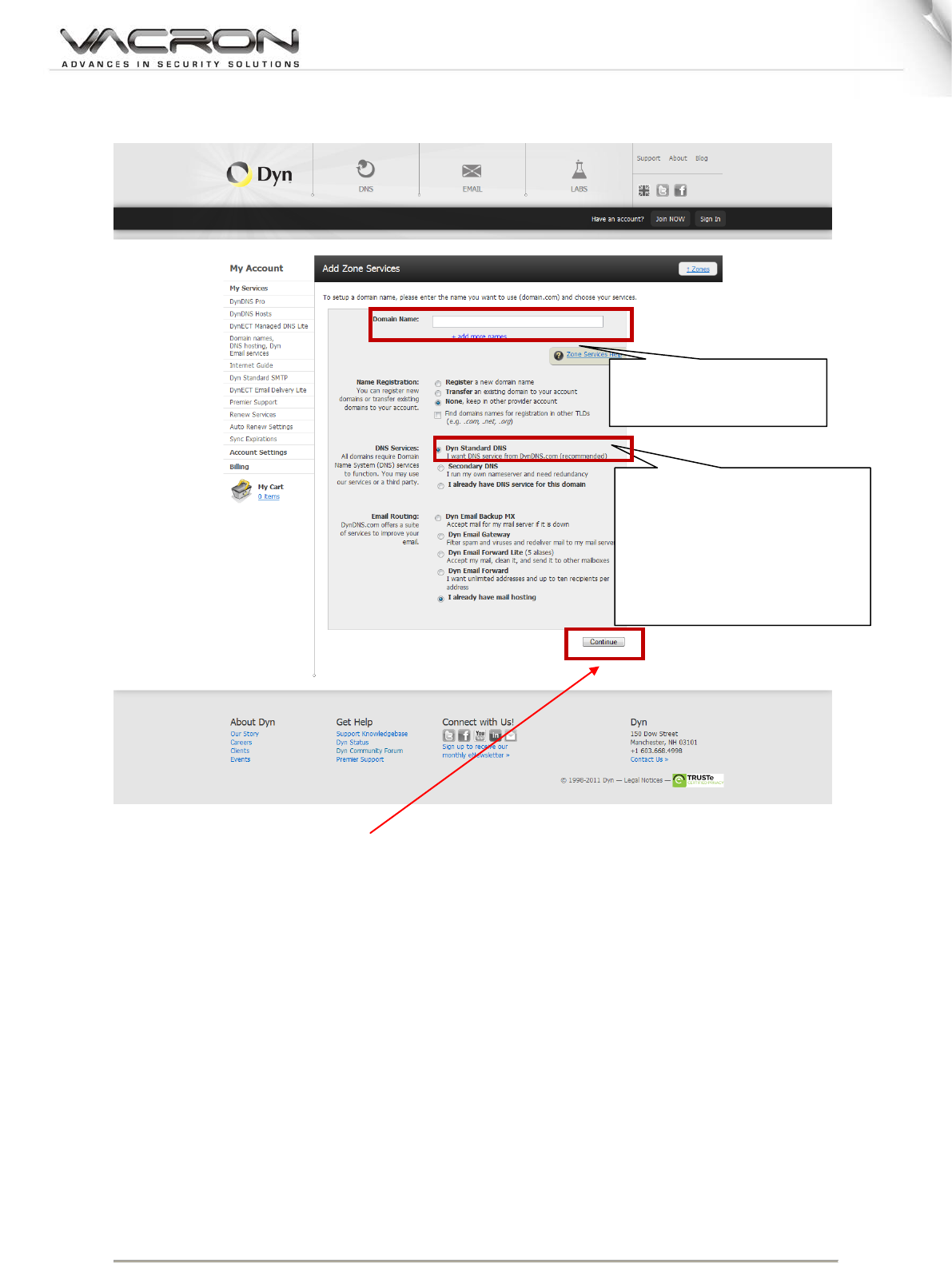
3. Press on “ORDER NOW” to start applying
60
4. Select your wanted Hostname for your DVR
5. When finished, press “Continue” to proceed.
Note: If you are using firewall or
router to connect DVR, please
set the DDNS setting in
FW/router, then use port
forwarding in order to connect
Input your wanted
hostname for your DVR
61
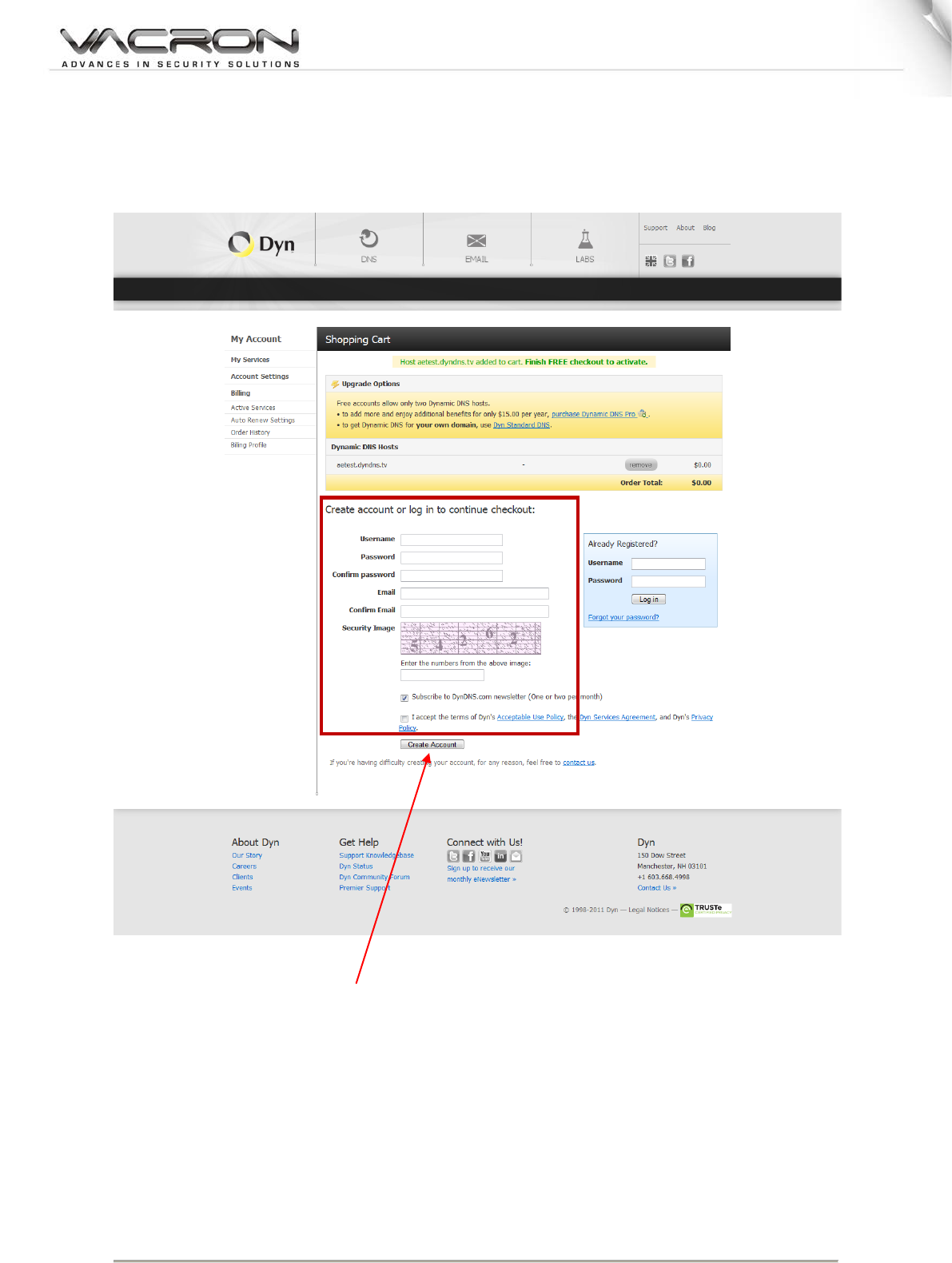
6. If you have never applied Dyndns service before, please create a new account
first.
7. When finished, press “create account” to proceed.
62
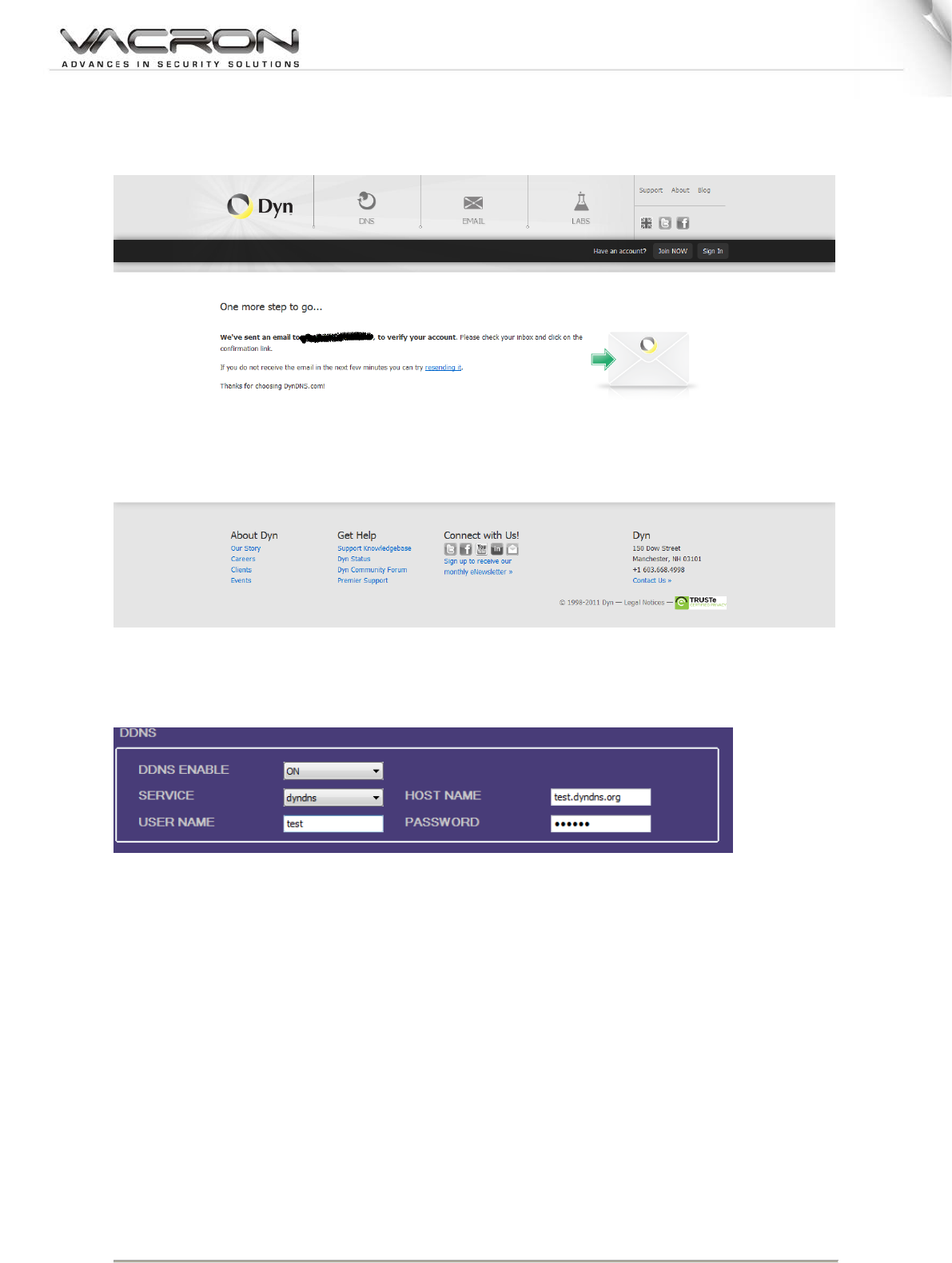
8. System will send you an email for confirmation. Please go to your email box and
see if you have received it. There will be a link for you to confirm the application.
9. Go to your DVR to set the DDNS setting. (I use IE for demonstration but in the
DVR OSD, you can find the same setting there).
1) Enable your DDNS service.
2) Choose the service to be “dyndns” (depending upon which DDNS provider you
use)
3) Input the hostname for the DDNS. (e.g: test.dyndns.org)
4) Input the username for the DDNS. (e.g:test@gmail.com)
NOTE: You might only need to input “test” instead of “test@gmail.com”
depending upon which service provider you use.
5) Input the password for the DDNS
Then you can start using the DDNS service for your DVR
63
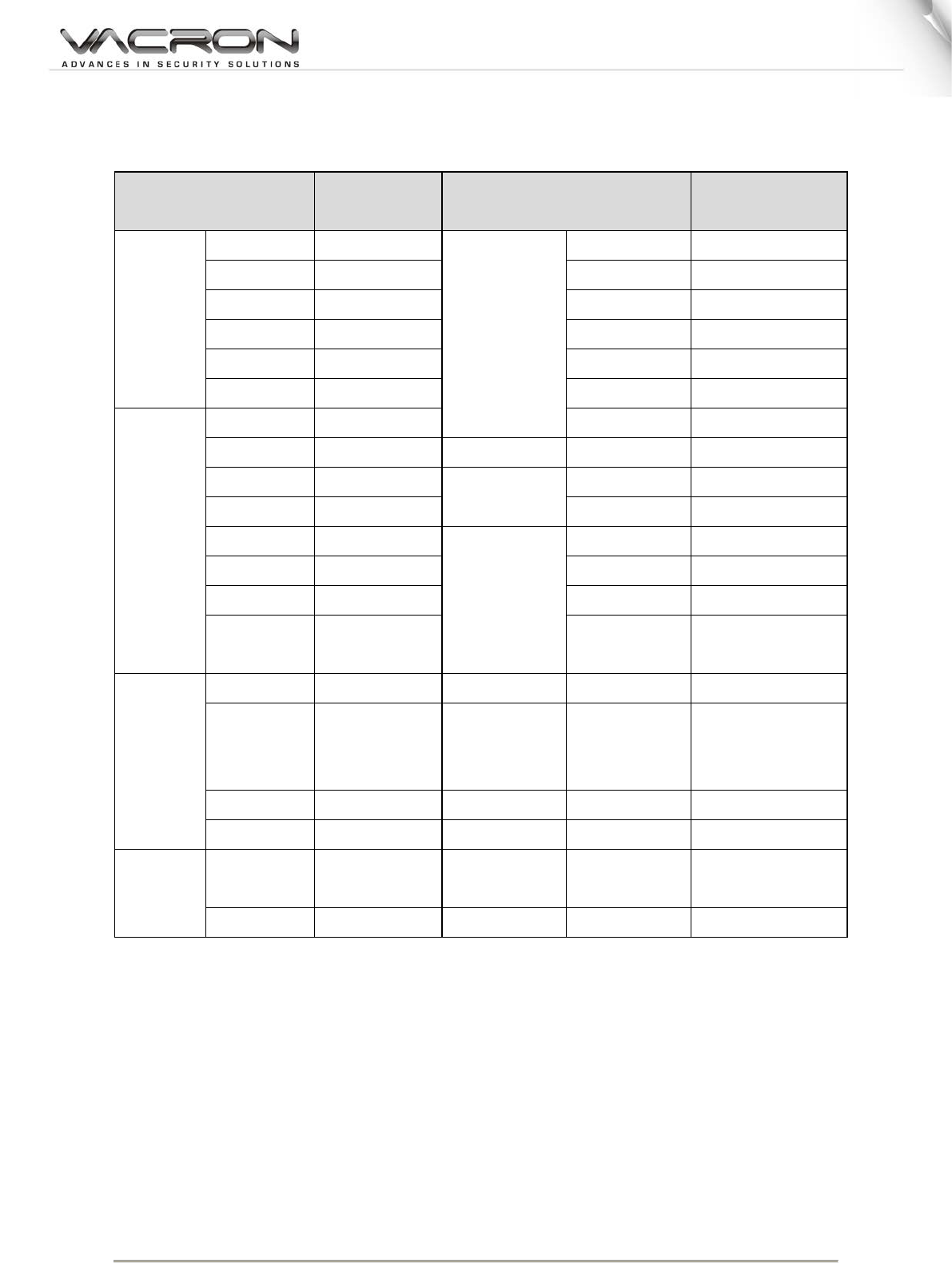
12. Default Setting
Item
Default
Setting
Item
Default Setting
Record
Setup
Channel On
Network
Setup
Mode Static IP
Resolution Normal Media Port 09000
Frame Rate Real-time Web Port 00080
Quality Highest IP Address 192.168.000.100
Schedule Always Net Mask 255.255.255.0
Gateway 192.168.000.001
Camera
Setup
Channel 1 CH1 DNS 168.095.001.001
Channel 2 CH2 DDNS Setup DDNS Off
Channel 3 CH3 HDD Setup Overwrite Yes
Channel 4 CH4 Pack Time 15 Mins
Title Position Top Left
Time Setup
Date Format YY/MM/DD
Display On Time Format 24 Hours
Display Time On Time Zone GMT+08:00
Switching
Time 1 sec. Daylight
Saving Off
Camera
Color
Setup
Hue 25 E-MAIL Setup E-MAIL Off
Brightness 25 System
Maintenance
Maintenance
Schedule
Setup
Off
Contrast 25
Saturation 25
Motion
Detection
Channel
Status Off
Sensitivity 5
64
13. HDD Support List
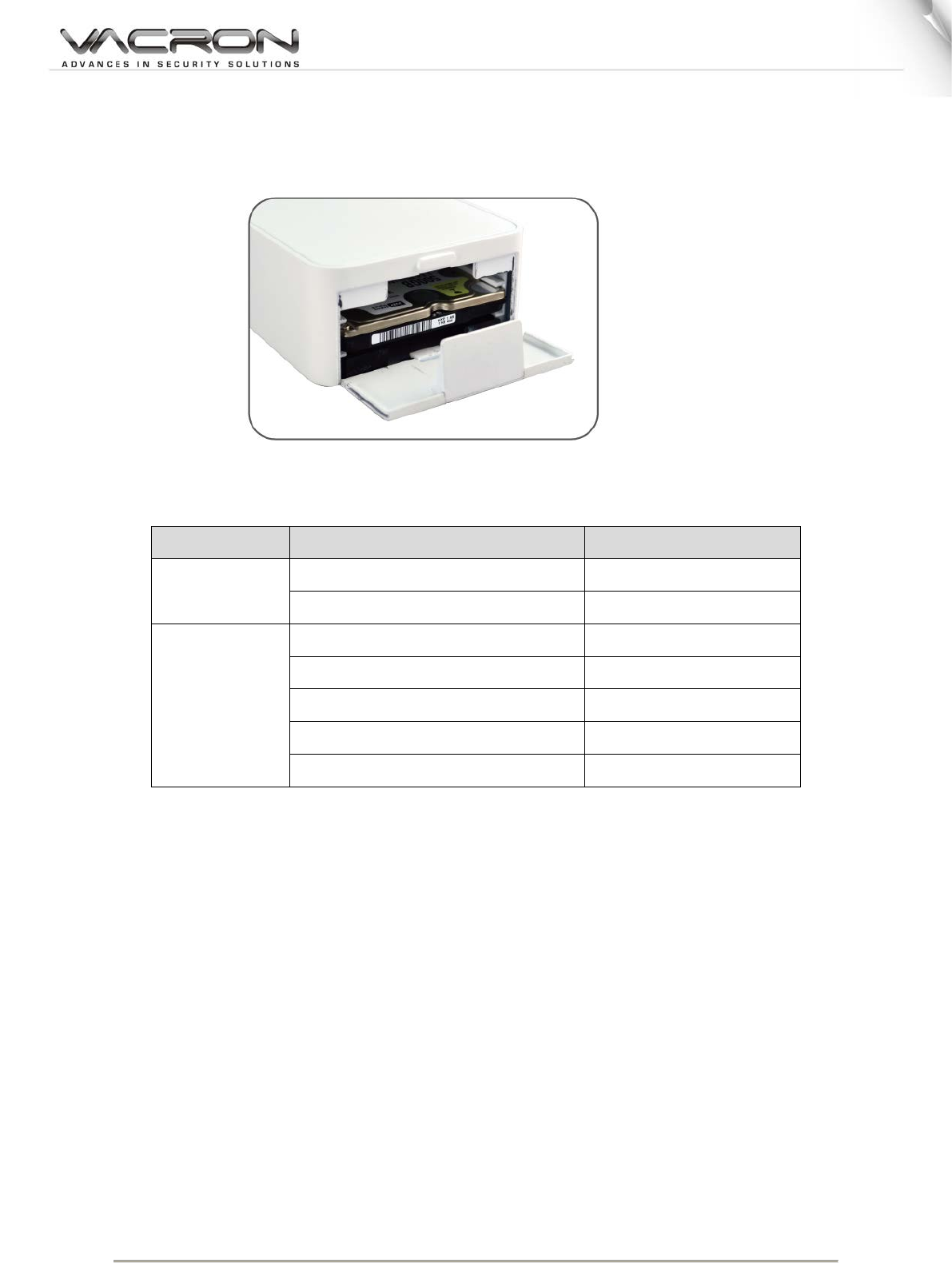
2.5”HDD Caddy
Recommend use 2.5” 500GB capacity for HDD or below.
Suggest installing the Hard Driver listed below to make sure the compatibility.
Brand Model Number Capacity
SEAGATE ST3250310CS 250G
ST9500423AS 500GB
WD
WD5000BUCT 500GB
WD5000LPVT 500GB
WD5000BPKT 500GB
WD5000LUCT 500GB
WD10JUCT 1TB
65
14. 3G Data Rate
Brand Model
Data Transfer Speed (bps)
Support
Verified
WCDMA (3G)
2Mbps ~ 386kbps
HSDPA
(WCDMA 3.5G)
HSUPA
(WCDMA 3.75G)
Huawei
E1550 - 3.6M 384k Yes Pass
E160G - 3.6M 384k Yes Pass
E1750 - 7.2M 5.76M Yes Pass
E220 - 3.6M 384k Yes Pass
E156G - 3.6M 384k Yes Pass
E173 - 7.2M 5.76M Yes Pass
E1820 - 21.6M 5.76M Yes Pass
ZTE
MF626 - 3.6M 384k Yes Pass
MF627 - 3.6M 384k Yes Pass
MF631 - 7.2M 5.76M Yes Pass
MF637 - 7.2M 5.76M Yes Pass
MF112 - 7.2M 2M Yes Pass
MF180 - 3.6M 384k Yes Pass

66
