ESR 1917 Hilti, Inc. ER 7250B
User Manual: ER 7250B
Open the PDF directly: View PDF  .
.
Page Count: 17
A Subsidiary of
0
000
Most Widely Accepted and Trusted
ICC-ES Evaluation Report
ESR-1917
Reissued 05/2017
This report is subject to renewal 05/2019.
ICC-ES | (800) 423-6587 | (562) 699-0543 | www.icc-es.org
ICC-ES Evaluation Reports are not to be construed as representing aesthetics or any other attributes not
specifically addressed, nor are they to be construed as an endorsement of the subject of the report or a
recommendation for its use. There is no warranty by ICC Evaluation Service, LLC, express or implied, as
to any finding or other matter in this report, or as to any product covered by the report.
Copyright © 2017 ICC Evaluation Service, LLC. All rights reserved.
“2014 Recipient of Prestigious Western States Seismic Policy Council
(WSSPC) Award in Excellence”
DIVISION: 03 00 00—CONCRETE
SECTION: 03 16 00—CONCRETE ANCHORS
DIVISION: 05 00 00—METALS
SECTION: 05 05 19—POST-INSTALLED CONCRETE ANCHORS
REPORT HOLDER:
HILTI, INC.
7250 DALLAS PARKWAY, SUITE 1000
PLANO, TEXAS 75024
EVALUATION SUBJECT:
HILTI KWIK BOLT TZ CARBON AND STAINLESS STEEL ANCHORS
IN CRACKED AND UNCRACKED CONCRETE
Look for the trusted marks of Conformity!
ICC-ES Evaluation Report ESR-1917
Reissued May 2017
Revised December 2017
This report is subject to renewal May 2019.
www.icc-es.org | (800) 423-6587 | (562) 699-0543 A Subsidiary of the International Code Council ®
DIVISION: 03 00 00—CONCRETE
Section: 03 16 00—Concrete Anchors
DIVISION: 05 00 00—METALS
Section: 05 05 19—Post-Installed Concrete Anchors
REPORT HOLDER:
HILTI, INC.
7250 DALLAS PARKWAY, SUITE 1000
PLANO, TEXAS 75024
(800) 879-8000
www.us.hilti.com
HiltiTechEng@us.hilti.com
EVALUATION SUBJECT:
HILTI KWIK BOLT TZ CARBON AND STAINLESS STEEL
ANCHORS IN CRACKED AND UNCRACKED CONCRETE
1.0 EVALUATION SCOPE
Compliance with the following codes:
2015, 2012, 2009 and 2006 International Building
Code® (IBC)
2015, 2012, 2009 and 2006 International Residential
Code® (IRC)
2013 Abu Dhabi International Building Code (ADIBC)†
†The ADIBC is based on the 2009 IBC. 2009 IBC code sections referenced
in this report are the same sections in the ADIBC.
For evaluation for compliance with the National Building
Code of Canada® (NBCC), see listing report ELC-1917 at
http://www.icc-es.org/reports/pdf_files/ELC-1917.pdf
Property evaluated:
Structural
2.0 USES
The Hilti Kwik Bolt TZ anchor (KB-TZ) is used to resist
static, wind, and seismic tension and shear loads in
cracked and uncracked normal-weight concrete and
lightweight concrete having a specified compressive
strength, f′c, of 2,500 psi to 8,500 psi (17.2 MPa to
58.6 MPa) [minimum of 24 MPa is required under ADIBC
Appendix L, Section 5.1.1].
The 3/8-inch- and 1/2-inch-diameter (9.5 mm and
12.7 mm) carbon steel KB-TZ anchors may be installed in
the topside of cracked and uncracked normal-weight or
sand-lightweight concrete-filled steel deck having a
minimum member thickness, hmin,deck, as noted in Table 6
of this report and a specified compressive strength, f′c,
of 3,000 psi to 8,500 psi (20.7 MPa to 58.6 MPa) [minimum
of 24 MPa is required under ADIBC Appendix L,
Section 5.1.1].
The 3/8-inch-, 1/2-inch-, 5/8-inch- and 3/4-inch diameter
(9.5 mm, 12.7 mm and 15.9 mm) carbon steel KB-TZ
anchors may be installed in the soffit of cracked and
uncracked normal-weight or sand-lightweight concrete over
metal deck having a minimum specified compressive
strength, f'c, of 3,000 psi (20.7 MPa) [minimum of 24 MPa
is required under ADIBC Appendix L, Section 5.1.1].
The anchoring system complies with anchors as
described in Section 1901.3 of the 2015 IBC, Section 1909
of the 2012 IBC, and Section 1912 of the 2009 and 2006
IBC. The anchoring system is an alternative to cast-in-
place anchors described in Section 1908 of the 2012 IBC,
and Section 1911 of the 2009 and 2006 IBC. The anchors
may also be used where an engineered design is
submitted in accordance with Section R301.1.3 of the IRC.
3.0 DESCRIPTION
3.1 KB-TZ:
KB-TZ anchors are torque-controlled, mechanical
expansion anchors. KB-TZ anchors consist of a stud
(anchor body), wedge (expansion elements), nut, and
washer. The anchor (carbon steel version) is illustrated in
Figure 1. The stud is manufactured from carbon steel or
AISI Type 304 or Type 316 stainless steel materials.
Carbon steel KB-TZ anchors have a minimum 5 μm
(0.0002 inch) zinc plating. The expansion elements for the
carbon and stainless steel KB-TZ anchors are fabricated
from Type 316 stainless steel. The hex nut for carbon steel
conforms to ASTM A563-04, Grade A, and the hex nut for
stainless steel conforms to ASTM F594.
The anchor body is comprised of a high-strength rod
threaded at one end and a tapered mandrel at the other
end. The tapered mandrel is enclosed by a three-section
expansion element which freely moves around the
mandrel. The expansion element movement is restrained
by the mandrel taper and by a collar. The anchor is
installed in a predrilled hole with a hammer. When torque
is applied to the nut of the installed anchor, the mandrel is
drawn into the expansion element, which is in turn
expanded against the wall of the drilled hole.
3.2 Concrete:
Normal-weight and lightweight concrete must conform to
Sections 1903 and 1905 of the IBC.
3.3 Steel Deck Panels:
Steel deck panels must be in accordance with the
configuration in Figures 5A, 5B, 5C and 5D and have a
ICC-ES Evaluation Reports are not to be construed as representing aesthetics or any other attributes not specifically addressed, nor are they to be construed
as an endorsement of the subject of the report or a recommendation for its use. There is no warranty by ICC Evaluation Service, LLC, express or implied, as
to any finding or other matter in this report, or as to any product covered by the report.
Copyright © 2017 ICC Evaluation Service, LLC. All rights reserved. Page 1 of 16

ESR-1917 | Most Widely Accepted and Trusted Page 2 of 16
minimum base steel thickness of 0.035 inch (0.899 mm).
Steel must comply with ASTM A653/A653M SS Grade
33 and have a minimum yield strength of 33,000 psi
(228 MPa).
4.0 DESIGN AND INSTALLATION
4.1 Strength Design:
4.1.1 General: Design strength of anchors complying with
the 2015 IBC, as well as Section R301.1.3 of the 2015 IRC
must be determined in accordance with ACI 318-14
Chapter 17 and this report.
Design strength of anchors complying with the 2012 IBC
as well as Section R301.1.3 of the 2012 IRC, must be
determined in accordance with ACI 318-11 Appendix D
and this report.
Design strength of anchors complying with the 2009 IBC
and Section R301.1.3 of the 2009 IRC must be determined
in accordance with ACI 318-08 Appendix D and this report.
Design strength of anchors complying with the 2006
IBC and Section R301.1.3 of the 2006 IRC must be in
accordance with ACI 318-05 Appendix D and this report.
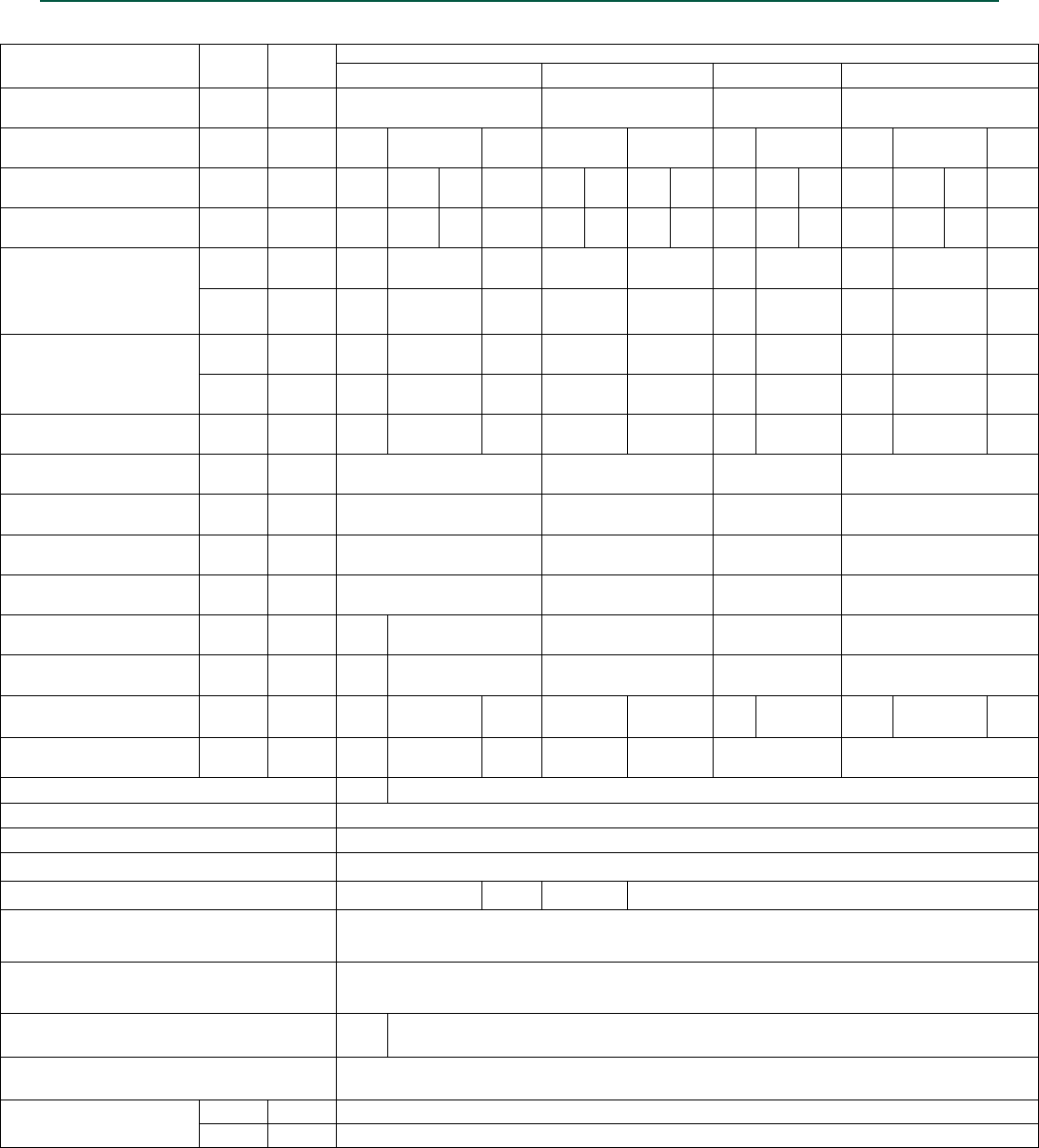
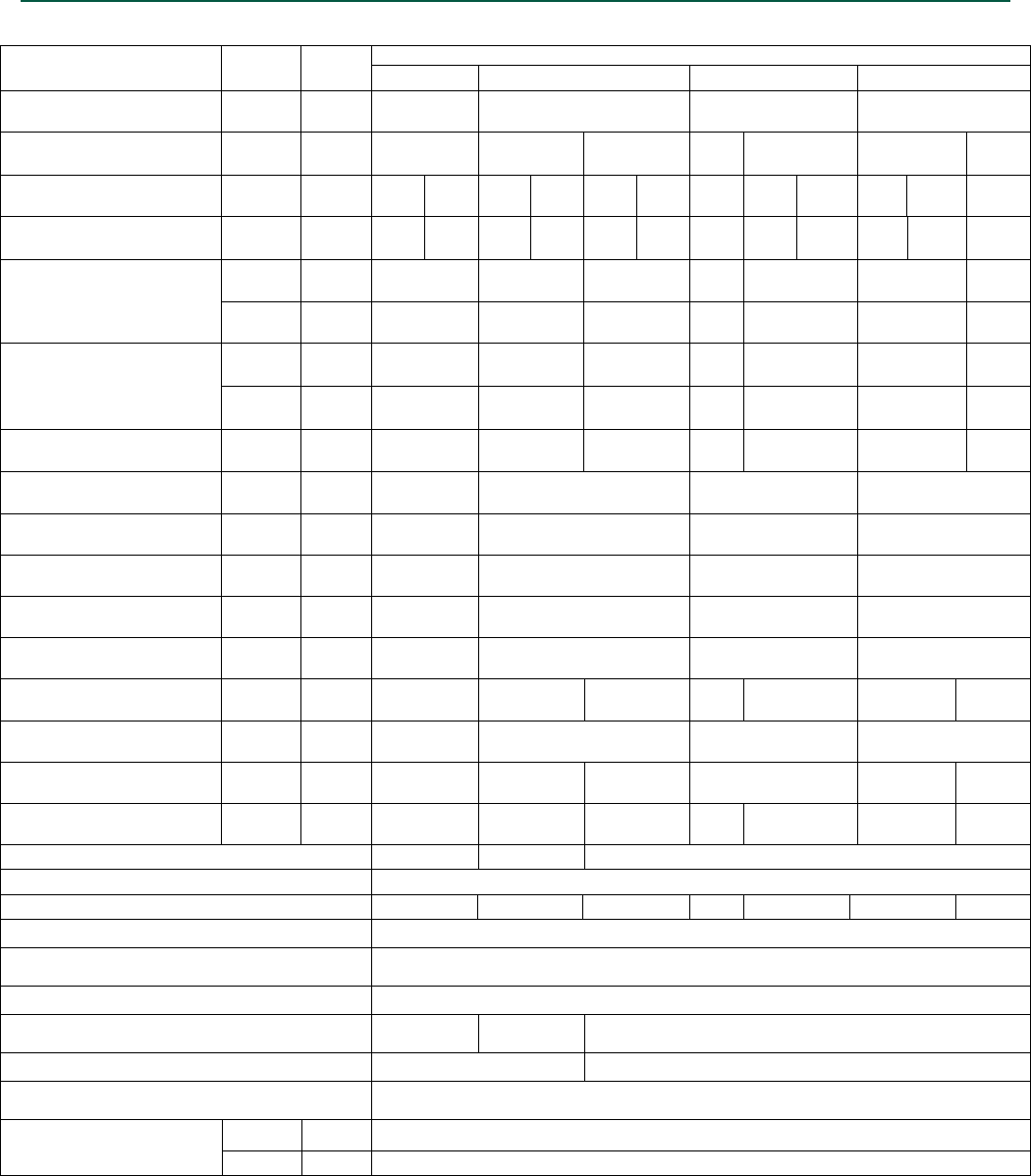
Design parameters provided in Tables 3, 4, 5 and 6 of
this report are based on the 2015 IBC (ACI 318-14) and
the 2012 IBC (ACI 318-11) unless noted otherwise in
Sections 4.1.1 through 4.1.12. The strength design of
anchors must comply with ACI 318-14 17.3.1 or ACI
318-11 D.4.1, as applicable, except as required in ACI
318-14 17.2.3 or ACI 318-11 D.3.3, as applicable.
Strength reduction factors,
φ
, as given in ACI 318-14
17.3.3 or ACI 318-11 D.4.3, as applicable, and noted in
Tables 3 and 4 of this report, must be used for load
combinations calculated in accordance with Section 1605.2
of the IBC and Section 5.3 of ACI 318-14 or Section 9.2 of
ACI 318-11, as applicable. Strength reduction factors,
φ
, as
given in ACI 318-11 D.4.4 must be used for load
combinations calculated in accordance with ACI 318-11
Appendix C. An example calculation in accordance with
the 2015 and 2012 IBC is provided in Figure 8. The value
of f′c used in the calculations must be limited to a maximum
of 8,000 psi (55.2 MPa), in accordance with ACI 318-14
17.2.7 or ACI 318-11 D.3.7, as applicable.
4.1.2 Requirements for Static Steel Strength in
Tension: The nominal static steel strength, Nsa, of a single
anchor in tension must be calculated in accordance with
ACI 318-14 17.4.1.2 or ACI 318-11 D.5.1.2, as applicable.
The resulting Nsa values are provided in Tables 3 and 4 of
this report. Strength reduction factors
φ
corresponding to
ductile steel elements may be used.
4.1.3 Requirements for Static Concrete Breakout
Strength in Tension: The nominal concrete breakout
strength of a single anchor or group of anchors in tension,
Ncb or Ncbg, respectively, must be calculated in accordance
with ACI 318-14 17.4.2 or ACI 318-11 D.5.2, as applicable,
with modifications as described in this section. The basic
concrete breakout strength in tension, Nb, must be
calculated in accordance with ACI 318-14 17.4.2.2 or ACI
318-11 D.5.2.2, as applicable, using the values of hef and
kcr as given in Tables 3, 4 and 6. The nominal concrete
breakout strength in tension in regions where analysis
indicates no cracking in accordance with ACI 318-14
17.4.2.6 or ACI 318-11 D.5.2.6, as applicable, must be
calculated with kuncr as given in Tables 3 and 4 and with
Ψc,N = 1.0.
For carbon steel KB-TZ anchors installed in the soffit of
sand-lightweight or normal-weight concrete on steel deck
floor and roof assemblies, as shown in Figures 5A, 5B and
5C, calculation of the concrete breakout strength is not
required.
4.1.4 Requirements for Static Pullout Strength in
Tension: The nominal pullout strength of a single anchor
in accordance with ACI 318-14 17.4.3.1 and 17.4.3.2 or
ACI 318-11 D.5.3.1 and D.5.3.2, respectively, as
applicable, in cracked and uncracked concrete, Np,cr and
Np,uncr, respectively, is given in Tables 3 and 4. For all
design cases Ψc,P = 1.0. In accordance with ACI 318-14
17.4.3 or ACI 318-11 D.5.3, as applicable, the nominal
pullout strength in cracked concrete may be calculated in
accordance with the following equation:
,=,
, (lb, psi) (Eq-1)
,=,
. (N, MPa)
In regions where analysis indicates no cracking in
accordance with ACI 318-14 17.4.3.6 or ACI 318-11
D.5.3.6, as applicable, the nominal pullout strength in
tension may be calculated in accordance with the following
equation:
,=,
, (lb, psi) (Eq-2)
,=,
. (N, MPa)
Where values for Np,cr or Np,uncr are not provided in Table
3 or Table 4, the pullout strength in tension need not be
evaluated.
The nominal pullout strength in cracked concrete of
the carbon steel KB-TZ installed in the soffit of
sand-lightweight or normal-weight concrete on steel deck
floor and roof assemblies, as shown in Figures 5A, 5B and
5C, is given in Table 5. In accordance with ACI 318-14
17.4.3.2 or ACI 318-11 D.5.3.2, as applicable, the nominal
pullout strength in cracked concrete must be calculated in
accordance with Eq-1, whereby the value of Np,deck,cr
must be substituted for Np,cr and the value of
3,000 psi (20.7 MPa) must be substituted for the value of
2,500 psi (17.2 MPa) in the denominator. In regions where
analysis indicates no cracking in accordance with ACI
318-14 17.4.3.6 or ACI 318-11 D.5.3.6, as applicable, the
nominal strength in uncracked concrete must be calculated
according to Eq-2, whereby the value of Np,deck,uncr must be
substituted for Np,uncr and the value of 3,000 psi (20.7 MPa)
must be substituted for the value of 2,500 psi (17.2 MPa) in
the denominator. The use of stainless steel KB-TZ anchors
installed in the soffit of concrete on steel deck assemblies
is beyond the scope of this report.
4.1.5 Requirements for Static Steel Strength in Shear:
The nominal steel strength in shear, Vsa, of a single anchor
in accordance with ACI 318-14 17.5.1.2 or ACI 318-11
D.6.1.2, as applicable, is given in Table 3 and Table 4 of
this report and must be used in lieu of the values derived
by calculation from ACI 318-14 Eq. 17.5.1.2b or ACI
318-11 Eq. D-29, as applicable. The shear strength Vsa,deck
of the carbon-steel KB-TZ as governed by steel failure of
the KB-TZ installed in the soffit of sand-lightweight or
normal-weight concrete on steel deck floor and roof
assemblies, as shown in Figures 5A, 5B and 5C, is given
in Table 5.
4.1.6 Requirements for Static Concrete Breakout
Strength in Shear: The nominal concrete breakout
strength of a single anchor or group of anchors in shear,
Vcb or Vcbg, respectively, must be calculated in accordance
with ACI 318-14 17.5.2 or ACI 318-11 D.6.2, as applicable,
with modifications as described in this section. The basic
concrete breakout strength, Vb, must be calculated in

ESR-1917 | Most Widely Accepted and Trusted Page 3 of 16
accordance with ACI 318-14 17.5.2.2 or ACI 318-11
D.6.2.2, as applicable, based on the values provided in
Tables 3 and 4. The value of ℓe used in ACI 318-14 Eq.
17.5.2.2a or ACI 318-11 Eq. D-33 must be taken as no
greater than the lesser of hef or 8da.
For carbon steel KB-TZ anchors installed in the soffit of
sand-lightweight or normal-weight concrete on steel deck
floor and roof assemblies, as shown in Figures 5A, 5B and
5C, calculation of the concrete breakout strength in shear
is not required.
4.1.7 Requirements for Static Concrete Pryout
Strength in Shear: The nominal concrete pryout strength
of a single anchor or group of anchors, Vcp or Vcpg,
respectively, must be calculated in accordance with ACI
318-14 17.5.3 or ACI 318-11 D.6.3, as applicable, modified
by using the value of kcp provided in Tables 3 and 4 of this
report and the value of Ncb or Ncbg as calculated in Section
4.1.3 of this report.
For carbon steel KB-TZ anchors installed in the soffit of
sand-lightweight or normal-weight concrete over profile
steel deck floor and roof assemblies, as shown in Figures
5A, 5B, and 5C, calculation of the concrete pry-out
strength in accordance with ACI 318-14 17.5.3 or ACI
318-11 D.6.3 is not required.
4.1.8 Requirements for Seismic Design:
4.1.8.1 General: For load combinations including seismic,
the design must be performed in accordance with ACI
318-14 17.2.3 or ACI 318-11 D.3.3, as applicable.
Modifications to ACI 318-14 17.2.3 shall be applied under
Section 1905.1.8 of the 2015 IBC. For the 2012 IBC,
Section 1905.1.9 shall be omitted. Modifications to ACI 318
(-08, -05) D.3.3 shall be applied under Section 1908.1.9 of
the 2009 IBC, or Section 1908.1.16 of the 2006 IBC, as
applicable.
The anchors comply with ACI 318-14 2.3 or ACI 318-11
D.1, as applicable, as ductile steel elements and must be
designed in accordance with ACI 318-14 17.2.3.4,
17.2.3.5, 17.2.3.6 or 17.2.3.7; or ACI 318-11 D.3.3.4,
D.3.3.5, D.3.3.6 or D.3.3.7; ACI 318-08 D.3.3.4, D.3.3.5 or
D.3.3.6; or ACI 318-05 D.3.3.4 or D.3.3.5, as applicable.
Strength reduction factors,
φ
, are given in Tables 3 and 4
of this report. The anchors may be installed in Seismic
Design Categories A through F of the IBC.
4.1.8.2 Seismic Tension: The nominal steel strength
and nominal concrete breakout strength for anchors in
tension must be calculated in accordance with ACI 318-14
17.4.1 and 17.4.2 or ACI 318-11 D.5.1 and D.5.2, as
applicable, as described in Sections 4.1.2 and 4.1.3 of this
report. In accordance with ACI 318-14 17.4.3.2 or ACI
318-11 D.5.3.2, as applicable, the appropriate pullout
strength in tension for seismic loads, Np,eq, described in
Table 4 or Np,deck,cr described in Table 5 must be used in
lieu of Np, as applicable. The value of Np,eq or Np,deck,cr may
be adjusted by calculation for concrete strength in
accordance with Eq-1 and Section 4.1.4 whereby the value
of Np,deck,cr must be substituted for Np,cr and the value of
3,000 psi (20.7 MPa) must be substituted for the value of
2,500 psi (17.2 MPa) in the denominator. If no values for
Np,eq are given in Table 3 or Table 4, the static design
strength values govern.
4.1.8.3 Seismic Shear: The nominal concrete breakout
strength and pryout strength in shear must be calculated in
accordance with ACI 318-14 17.5.2 and 17.5.3 or ACI
318-11 D.6.2 and D.6.3, respectively, as applicable, as
described in Sections 4.1.6 and 4.1.7 of this report. In
accordance with ACI 318-14 17.5.1.2 or ACI 318-11
D.6.1.2, as applicable, the appropriate value for nominal
steel strength for seismic loads, Vsa,eq described in Table 3
and Table 4 or Vsa,deck described in Table 5 must be used
in lieu of Vsa, as applicable.
4.1.9 Requirements for Interaction of Tensile and
Shear Forces: For anchors or groups of anchors that are
subject to the effects of combined tension and shear
forces, the design must be performed in accordance with
ACI 318-14 17.6 or ACI 318-11 D.7, as applicable.
4.1.10 Requirements for Minimum Member Thickness,
Minimum Anchor Spacing and Minimum Edge
Distance: In lieu of ACI 318-14 17.7.1 and 17.7.3 or ACI
318-11 D.8.1 and D.8.3, respectively, as applicable, values
of smin and cmin as given in Tables 3 and 4 of this report
must be used. In lieu of ACI 318-14 17.7.5 or ACI 318-11
D.8.5, as applicable, minimum member thicknesses hmin as
given in Tables 3 and 4 of this report must be used.
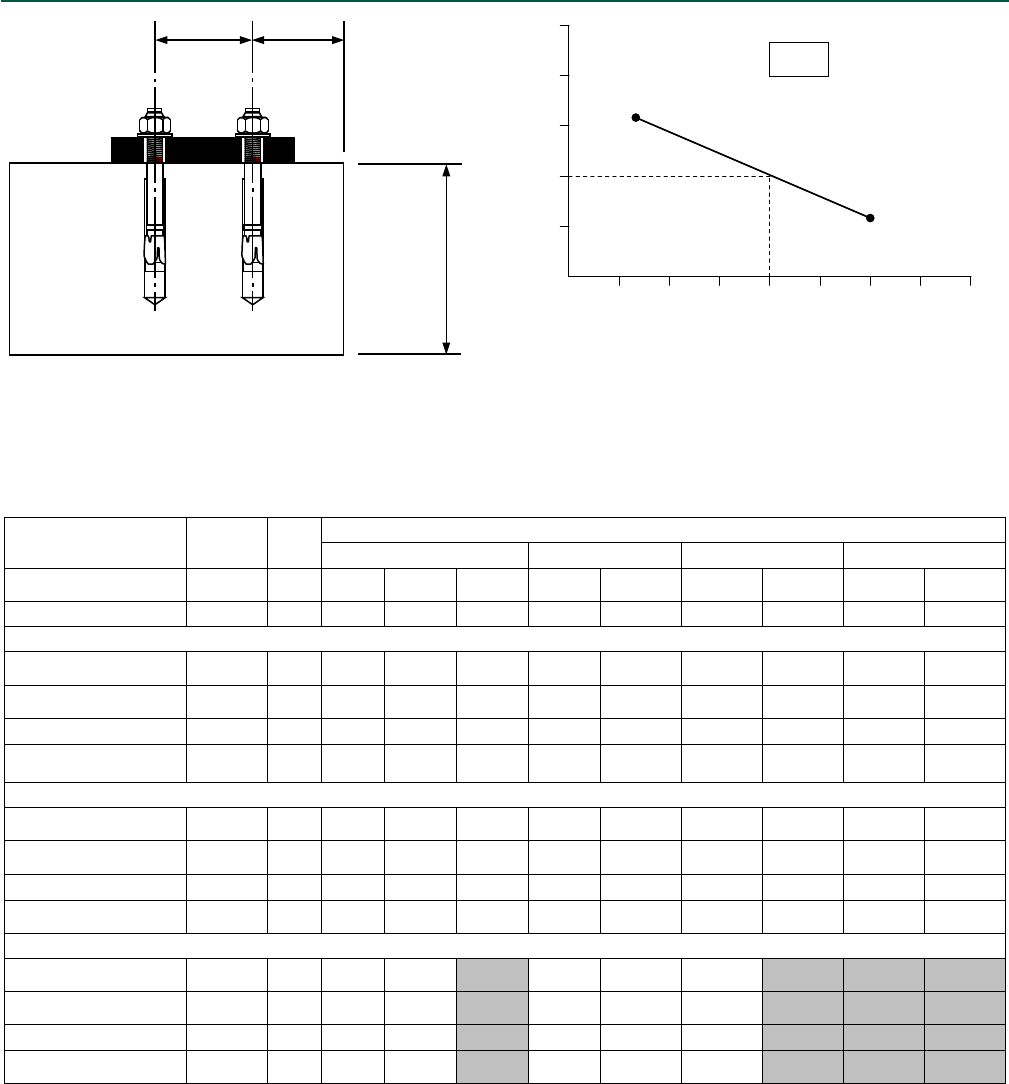
Additional combinations for minimum edge distance, cmin,
and spacing, smin, may be derived by linear interpolation
between the given boundary values as described in
Figure 4.
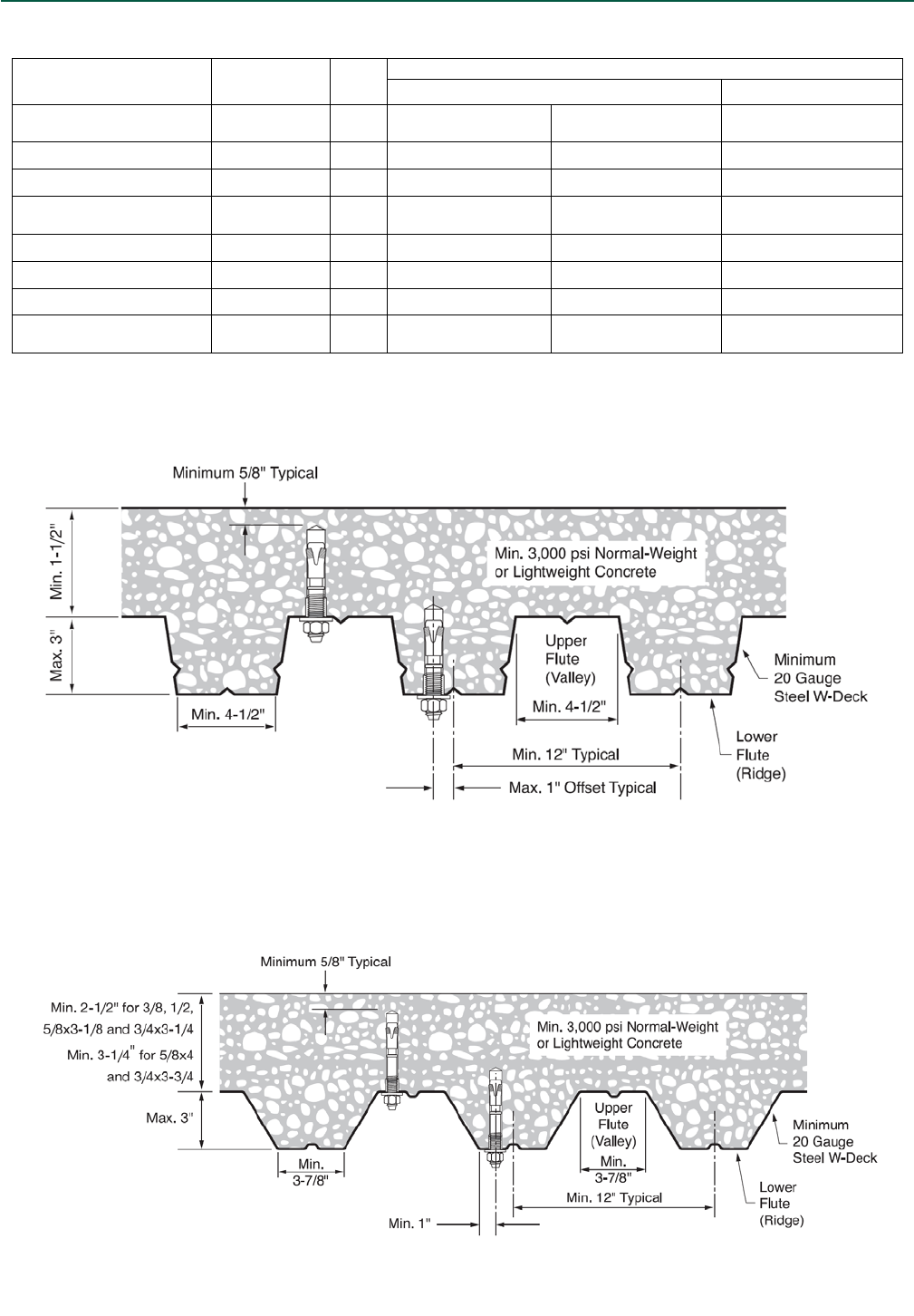
For carbon steel KB-TZ anchors installed on the top of
normal-weight or sand-lightweight concrete over profile
steel deck floor and roof assemblies, the anchor must be
installed in accordance with Table 6 and Figure 5D.
For carbon steel KB-TZ anchors installed in the soffit of
sand-lightweight or normal-weight concrete over profile
steel deck floor and roof assemblies, the anchors must be
installed in accordance with Figure 5A, 5B and 5C and
shall have an axial spacing along the flute equal to the
greater of 3hef or 1.5 times the flute width.
4.1.11 Requirements for Critical Edge Distance: In
applications where c < cac and supplemental reinforcement
to control splitting of the concrete is not present, the
concrete breakout strength in tension for uncracked
concrete, calculated in accordance with ACI 318-14 17.4.2
or ACI 318-11 D.5.2, as applicable, must be further
multiplied by the factor Ψcp,N as given by Eq-1:
,=
(Eq-3)
whereby the factor Ψcp,N need not be taken as less
than
ac
ef
c
h1.5
. For all other cases, Ψcp,N = 1.0. In lieu of
using ACI 318-14 17.7.6 or ACI 318-11 D.8.6, as
applicable, values of cac must comply with Table 3 or Table
4 and values of cac,deck must comply with Table 6.
4.1.12 Lightweight Concrete: For the use of anchors in
lightweight concrete, the modification factor λa equal to
0.8λ is applied to all values of
c
f′
affecting Nn and Vn.
For ACI 318-14 (2015 IBC), ACI 318-11 (2012 IBC) and
ACI 318-08 (2009 IBC), λ shall be determined in
accordance with the corresponding version of ACI 318.
For ACI 318-05 (2006 IBC), λ shall be taken as 0.75 for
all lightweight concrete and 0.85 for sand-lightweight
concrete. Linear interpolation shall be permitted if partial
sand replacement is used. In addition, the pullout strengths
Np,uncr, Np,cr and Np,eq shall be multiplied by the modification
factor, λa, as applicable.
For anchors installed in the soffit of sand-lightweight
concrete-filled steel deck and floor and roof assemblies,
further reduction of the pullout values provided in this
report is not required.
4.2 Allowable Stress Design (ASD):
4.2.1 General: Design values for use with allowable
stress design (working stress design) load combinations
calculated in accordance with Section 1605.3 of the IBC,
must be established as follows:

ESR-1917 | Most Widely Accepted and Trusted Page 4 of 16
Tallowable,ASD =
α
φ
n
N
Vallowable,ASD =
α
φ
n
V
where:
Tallowable,ASD = Allowable tension load (lbf or kN).
Vallowable,ASD = Allowable shear load (lbf or kN).
φ
Nn = Lowest design strength of an anchor
or anchor group in tension as
determined in accordance with ACI
318-14 Chapter 17 and 2015 IBC
Section 1905.1.8, ACI 318-11
Appendix D, ACI 318-08 Appendix D
and 2009 IBC Section 1908.1.9, ACI
318-05 Appendix D and 2006 IBC
Section 1908.1.16, and Section 4.1 of
this report, as applicable (lbf or N).
φ
Vn = Lowest design strength of an anchor
or anchor group in shear as
determined in accordance with ACI
318-14 Chapter 17 and 2015 IBC
Section 1905.1.8, ACI 318-11
Appendix D, ACI 318-08 Appendix D
and 2009 IBC Section 1908.1.9, ACI
318-05 Appendix D and 2006 IBC
Section 1908.1.16, and Section 4.1 of
this report, as applicable (lbf or N).
α = Conversion factor calculated as a
weighted average of the load factors
for the controlling load combination. In
addition, α must include all applicable
factors to account for nonductile
failure modes and required over-
strength.
The requirements for member thickness, edge distance
and spacing, described in this report, must apply. An
example of allowable stress design values for illustrative
purposes in shown in Table 7.
4.2.2 Interaction of Tensile and Shear Forces: The
interaction must be calculated and consistent with ACI
318-14 17.6 or ACI 318-11 D.7, as applicable, as follows:
For shear loads Vapplied ≤ 0.2Vallowable,ASD, the full allowable
load in tension must be permitted.
For tension loads Tapplied ≤ 0.2Tallowable,ASD, the full allowable
load in shear must be permitted.
For all other cases:
, +
, ≤ 1.2 (Eq-4)
4.3 Installation:
Installation parameters are provided in Tables 1A, 1B and
6 and Figures 2, 5A, 5B, 5C, and 5D. Anchor locations
must comply with this report and plans and specifications
approved by the code official. The Hilti KB-TZ must be
installed in accordance with manufacturer’s published
instructions and this report. In case of conflict, this report
governs. Anchors must be installed in holes drilled into the
concrete using carbide-tipped masonry drill bits complying
with ANSI B212.15-1994 or using the Hilti SafeSet
SystemTM with Hilti TE-YD or TE-CD Hollow Drill Bits
complying with ANSI B212.15-1994 with a Hilti vacuum
with a minimum value for the maximum volumetric flow
rate of 129 CFM (61 l/s). The Hollow Drill Bits are not
permitted for use with the 3/8” and 3/4” diameter KB-TZ
anchors. The minimum drilled hole depth, h0, is given in
Tables 1A and 1B. When drilling dust is not removed after
hole drilling, make sure to drill deep enough to achieve
hnom taking into account the depth of debris remaining in
the hole. If dust and debris is removed from the drilled hole
with the Hilti TE-YD or TE-CD Hollow Drill Bits or
compressed air or a manual pump, hnom is achieved at the
specified value of h0 noted in Tables 1A and 1B. The
anchor must be hammered into the predrilled hole until
hnom is achieved. The nut must be hand-tightened against
the washer until the torque values specified in Tables 1A
and 1B are achieved. For installation in the soffit of
concrete on steel deck assemblies, the hole diameter in
the steel deck not exceed the diameter of the hole in the
concrete by more than 1/8 inch (3.2 mm). For member
thickness and edge distance restrictions for installations
into the soffit of concrete on steel deck assemblies, see
Figures 5A, 5B and 5C. The 3/8”, 1/2”, and 5/8” anchors
may be installed using the Hilti Safe-Set™ System
consisting of the Hilti SIW-6AT-A22 Impact Wrench used
together with the Hilti SI-AT-A22 Adaptive Torque Module
in accordance with the manufacturer’s published
installation instructions as shown in Figure 7A.
4.4 Special Inspection:
Periodic special inspection is required in accordance with
Section 1705.1.1 and Table 1705.3 of the 2015 IBC and
2012 IBC; Section 1704.15 and Table 1704.4 of the 2009
IBC; or Section 1704.13 of the 2006 IBC, as applicable.
The special inspector must make periodic inspections
during anchor installation to verify anchor type, anchor
dimensions, concrete type, concrete compressive strength,
anchor spacing, edge distances, concrete member
thickness, tightening torque, hole dimensions, anchor
embedment and adherence to the manufacturer’s printed
installation instructions. The special inspector must be
present as often as required in accordance with the
“statement of special inspection.” Under the IBC, additional
requirements as set forth in Sections 1705, 1706 and 1707
must be observed, where applicable.
5.0 CONDITIONS OF USE
The Hilti KB-TZ anchors described in this report comply
with the codes listed in Section 1.0 of this report, subject to
the following conditions:
5.1 Anchor sizes, dimensions, minimum embedment
depths and other installation parameters are as set
forth in this report.
5.2 The anchors must be installed in accordance with the
manufacturer’s published instructions and this report.
In case of conflict, this report governs.
5.3 Anchors must be limited to use in cracked and
uncracked normal-weight concrete and lightweight
concrete having a specified compressive strength, f'c,
of 2,500 psi to 8,500 psi (17.2 MPa to 58.6 MPa)
[minimum of 24 MPa is required under ADIBC
Appendix L, Section 5.1.1], and cracked and
uncracked normal-weight or sand-lightweight concrete
over metal deck having a minimum specified
compressive strength, f 'c, of 3,000 psi (20.7 MPa)
[minimum of 24 MPa is required under ADIBC
Appendix L, Section 5.1.1].
5.4 The values of f'c used for calculation purposes must
not exceed 8,000 psi (55.1 MPa).
5.5 Strength design values must be established in
accordance with Section 4.1 of this report.

ESR-1917 | Most Widely Accepted and Trusted Page 5 of 16
5.6 Allowable design values are established in
accordance with Section 4.2.
5.7 Anchor spacing and edge distance as well as
minimum member thickness must comply with Tables
3, 4, and 6, and Figures 4, 5A, 5B, 5C and 5D.
5.8 Prior to installation, calculations and details
demonstrating compliance with this report must be
submitted to the code official. The calculations and
details must be prepared by a registered design
professional where required by the statutes of the
jurisdiction in which the project is to be constructed.
5.9 Since an ICC-ES acceptance criteria for evaluating
data to determine the performance of expansion
anchors subjected to fatigue or shock loading is
unavailable at this time, the use of these anchors
under such conditions is beyond the scope of this
report.
5.10 Anchors may be installed in regions of concrete
where cracking has occurred or where analysis
indicates cracking may occur (ft > fr), subject to the
conditions of this report.
5.11 Anchors may be used to resist short-term loading due
to wind or seismic forces in locations designated as
Seismic Design Categories A through F of the IBC,
subject to the conditions of this report.
5.12 Where not otherwise prohibited in the code, KB-TZ
anchors are permitted for use with fire-resistance-
rated construction provided that at least one of the
following conditions is fulfilled:
• Anchors are used to resist wind or seismic forces
only.
• Anchors that support a fire-resistance-rated
envelope or a fire-resistance-rated membrane
are protected by approved fire-resistance-rated
materials, or have been evaluated for resistance to
fire exposure in accordance with recognized
standards.
• Anchors are used to support nonstructural
elements.
5.13 Use of zinc-coated carbon steel anchors is limited to
dry, interior locations.
5.14 Use of anchors made of stainless steel as specified in
this report are permitted for exterior exposure and
damp environments.
5.15 Use of anchors made of stainless steel as specified in
this report are permitted for contact with preservative-
treated and fire-retardant-treated wood.
5.16 Anchors are manufactured by Hilti AG under an
approved quality-control program with inspections by
ICC-ES.
5.17 Special inspection must be provided in accordance
with Section 4.4.
6.0 EVIDENCE SUBMITTED
6.1 Data in accordance with the ICC-ES Acceptance
Criteria for Mechanical Anchors in Concrete Elements
(AC193), dated October 2015, which incorporates
requirements in ACI 355.2-07 / ACI 255.2-04 for use
in cracked and uncracked concrete.
6.2 Quality-control documentation.
7.0 IDENTIFICATION
The anchors are identified by packaging labeled with the
manufacturer’s name (Hilti, Inc.) and contact information,
anchor name, anchor size, and evaluation report number
(ESR-1917). The anchors have the letters KB-TZ
embossed on the anchor stud and four notches
embossed into the anchor head, and these are visible after
installation for verification.
ESR-1917 | Most Widely Accepted and Trusted Page 6 of 16
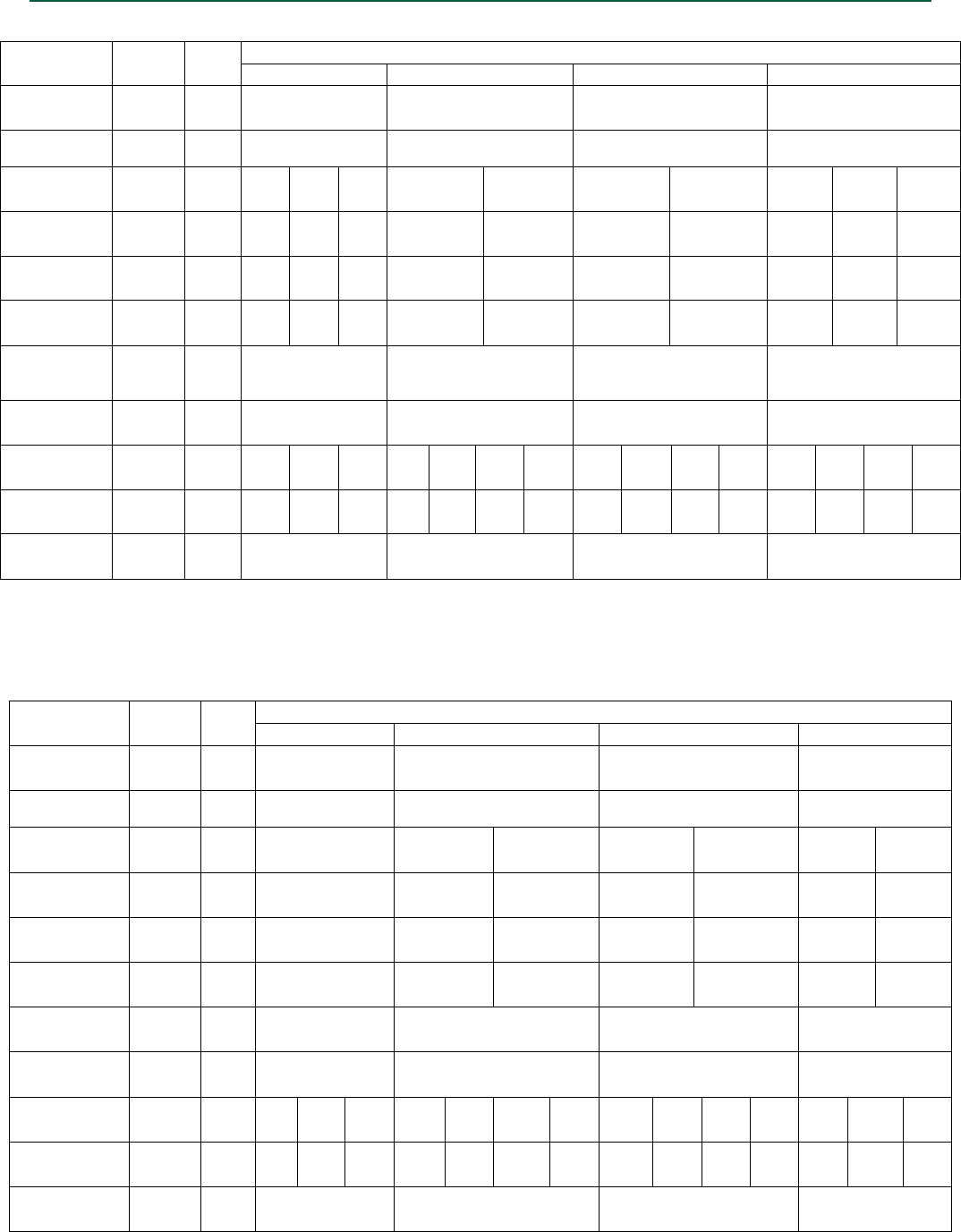
TABLE 1A—SETTING INFORMATION (CARBON STEEL ANCHORS)
SETTING
INFORMATION Symbol Units Nominal anchor diameter (in.)
3/8 1/2 5/8 3/4
Anchor O.D. da
(do)2
In. 0.375 0.5 0.625 0.75
(mm) (9.5) (12.7) (15.9) (19.1)
Nominal bit
diameter dbit In. 3/8 1/2 5/8 3/4
Effective min.
embedment hef In. 1
1
/2 2 2
3
/4 2 3
1
/4 3
1
/8 4 3
1
/4 3
3
/4 4
3
/4
(mm) (38) (51) (70) (51) (83) (79) (102) (83) (95) (121)
Nominal
embedment hnom in. 1
13
/16 2
5
/16 3
1
/16 2
3
/8 3
5
/8 3
9
/16 4
7
/16 3
13
/16 4
5
/16 5
5
/16
(mm) (46) (59) (78) (60) (91) (91) (113) (97) (110) (136)
Min. hole depth ho In. 2 2
5
/8 3
3
/8 2
5
/8 4 3
3
/4 4
3
/4 4 4
1
/2 5
3
/4
(mm) (51) (67) (86) (67) (102) (95) (121) (102) (114) (146)
Min. thickness
of fastened part1 tmin In. 0 0 0
3
/4
1
/4
3
/8
3
/4 0 0
7
/8
(mm) (0) (0) (0) (19) (6) (9) (19) (0) (0) (23)
Required
Installation
torque
Tinst
ft-lb 25 40 60 110
(Nm) (34) (54) (81) (149)
Min. dia. of hole
in fastened part dh In. 7/16 9/16 11/16 13/16
(mm) (11.1) (14.3) (17.5) (20.6)
Standard anchor
lengths ℓanch
In. 3 3
3
/4 5 3
3
/4 4
1
/2 5
1
/2 7 4
3
/4 6 8
1
/2 10 5
1
/2 7 8 10
(mm) (76) (95) (127) (95) (114) (140) (178) (121) (152) (216) (254) (140) (178) (203) (254)
Threaded length
(incl. dog point) ℓthread In. 1
1
/2 2
1
/4 3
1
/2 1
5
/8 2
3
/8 3
3
/8 4
7
/8 1
1
/2 2
3
/4 5
1
/4 6
3
/4 2
1
/2 4 5 7
(mm) (38) (57) (93) (41) (60) (86) (124) (38) (70) (133) (171) (63) (103) (128) (179)
Unthreaded
length ℓunthr In. 11/2 21/8 31/4 3
(mm) (39) (54) (83) (77)
1The minimum thickness of the fastened part is based on use of the anchor at minimum embedment and is controlled by the length of thread. If a thinner fastening
thickness is required, increase the anchor embedment to suit.
2The notation in parenthesis is for the 2006 IBC.
3See section 4.3 for alternate installation with Hilti Safe-Set™ System consisting of the Hilti SIW-6AT-A22 Impact Wrench used together with the Hilti SI-AT-A22
Adaptive Torque Module.
TABLE 1B—SETTING INFORMATION (STAINLESS STEEL ANCHORS)
SETTING
INFORMATION Symbol Units Nominal anchor diameter (in.)
3
/8
1
/2
5
/8
3
/4
Anchor O.D. da
(do)2
In. 0.375 0.5 0.625 0.75
(mm) (9.5) (12.7) (15.9) (19.1)
Nominal bit
diameter dbit In. 3/8 1/2 5/8 3/4
Effective min.
embedment hef In. 2 2 31/4 31/8 4 33/4 43/4
(mm) (51) (51) (83) (79) (102) (95) (121)
Nominal
embedment hnom in. 25/16 23/8 35/8 39/16 47/16 45/16 55/16
(mm) (59) (60) (91) (91) (113) (110) (136)
Min. hole depth ho In. 25/8 25/8 4 33/4 43/4 41/2 53/4
(mm) (67) (67) (102) (95) (121) (114) (146)
Min. thickness of
fastened part1 tmin In. 1/4 3/4 1/4 3/8 3/4 1/8 15/8
(mm) (6) (19) (6) (9) (19) (3) (41)
Required
Installation torque Tinst ft-lb 25 40 60 110
(Nm) (34) (54) (81) (149)
Min. dia. of hole
in fastened part dh In.
7
/16
9
/16
11
/16
13
/16
(mm) (11.1) (14.3) (17.5) (20.6)
Standard anchor
lengths ℓanch
In. 3 3
3
/4 5 3
3
/4 4
1
/2 5
1
/2 7 4
3
/4 6 8
1
/2 10 5
1
/2 8 10
(mm) (76) (95) (127) (95) (114) (140) (178) (121) (152) (216) (254) (140) (203) (254)
Threaded length
(incl. dog point) ℓthread In.
7
/8 1
5
/8 2
7
/8 1
5
/8 2
3
/8 3
3
/8 4
7
/8 1
1
/2 2
3
/4 5
1
/4 6
3
/4 1
1
/2 4 6
(mm) (22) (41) (73) (41) (60) (86) (124) (38) (70) (133) (171) (38) (102) (152)
Unthreaded
length ℓunthr In. 2
1
/8 2
1
/8 3
1
/4 4
(mm) (54) (54) (83) (102)
1The minimum thickness of the fastened part is based on use of the anchor at minimum embedment and is controlled by the length of thread. If a thinner fastening
thickness is required, increase the anchor embedment to suit.
2The notation in parenthesis is for the 2006 IBC.
3See section 4.3 for alternate installation with Hilti Safe-Set™ System consisting of the Hilti SIW-6AT-A22 Impact Wrench used together with the Hilti SI-AT-A22
Adaptive Torque Module.
ESR-1917 | Most Widely Accepted and Trusted Page 7 of 16
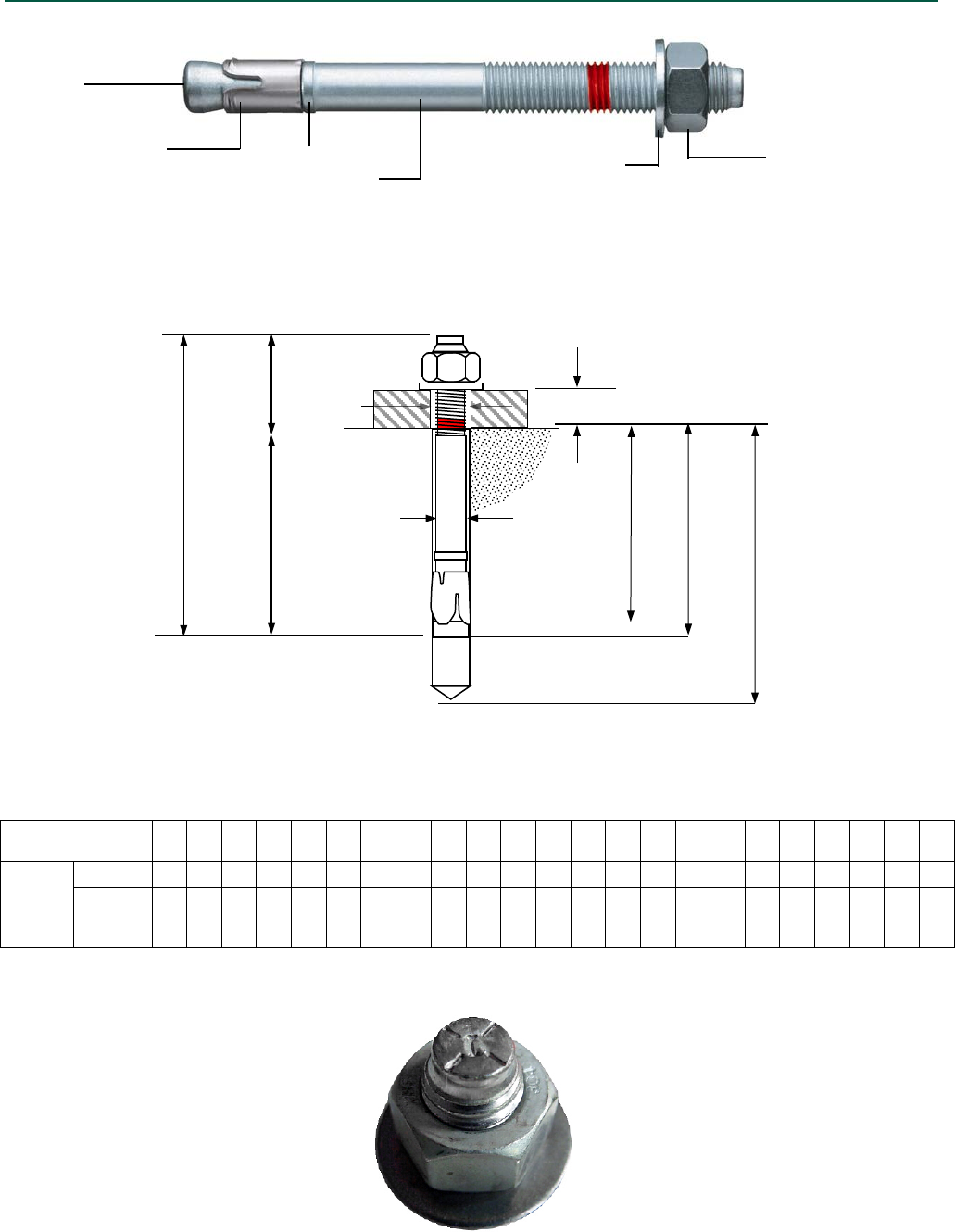
FIGURE 1—HILTI CARBON STEEL KWIK BOLT TZ (KB-TZ)
FIGURE 2—KB-TZ INSTALLED
TABLE 2—LENGTH IDENTIFICATION SYSTEM (CARBON STEEL AND STAINLESS STEEL ANCHORS)
Length ID marking
on bolt head A B C D E F G H I J K L M N O P Q R S T U V W
Length of
anchor,
ℓanch
(inches)
From 1 ½ 2
2 ½
3
3 ½
4 4 ½
5
5 ½
6
6 ½
7
7 ½
8
8 ½
9
9 ½
10 11 12 13 14 15
Up to but
not
including 2
2 ½
3
3 ½
4 4 ½
5
5 ½
6
6 ½
7 7 ½
8
8 ½
9
9 ½
10 11 12 13 14 15 16
FIGURE 3—BOLT HEAD WITH LENGTH IDENTIFICATION CODE AND KB-TZ HEAD NOTCH EMBOSSMENT
washer
expansion
element
bolt
hex nut
dog point
collar
mandrel
UNC thread
ℓ
anch
d
a
d
h
h
ef
h
o
t
ℓ
thread
ℓ
unthr
h
nom
ESR-1917 | Most Widely Accepted and Trusted Page 8 of 16
TABLE 3—DESIGN INFORMATION, CARBON STEEL KB-TZ
DESIGN INFORMATION Symbol Units
Nominal anchor diameter
3
/8
1
/2
5
/8
3
/4
Anchor O.D. da(do)
in.
0.375
0.5
0.625
0.75
(mm)
(9.5)
(12.7)
(15.9)
(19.1)
Effective min. embedment1 hef
in.
11/2
2
23/4
2
31/4
31/8
4
31/4
33/4
43/4
(mm)
(38)
(51)
(70)
(51)
(83)
(79)
(102)
(83)
(95)
(121)
Min. member thickness2 hmin
in.
31/4
4
5
5
4
6
6
8
5
6
8
51/2
6
8
8
(mm)
(83)
(102)
(127)
(127)
(102)
(152)
(152)
(203)
(127)
(152)
(203)
(140)
(152)
(203)
(203)
Critical edge distance cac
in.
6
43/8
4
41/8
51/2
41/2
71/2
6
61/2
83/4
63/4
12
10
8
9
(mm)
(152)
(111)
(102)
(105)
(140)
(114)
(191)
(152)
(165)
(222)
(171)
(305)
(254)
(203)
(229)
Min. edge distance
cmin
In.
8
21/2
21/2
23/4
23/8
35/8
31/4
912
43/4
41/8
(mm)
(203)
(64)
(64)
(70)
(60)
(92)
(83)
(241)
(121)
(105)
for s ≥ in.
8
5
5
5
3
/4
5
3
/4
6
1
/8
5
7
/8
5
10
1
/2
8
7
/8
(mm)
(203)
(127)
(127)
(146)
(146)
(156)
(149)
(127)
(267)
(225)
Min. anchor spacing
smin
in.
8
21/2
21/2
23/4
23/8
31/2
3
5
5
4
(mm)
(203)
(64)
(64)
(70)
(60)
(89)
(76)
(127)
(127)
(102)
for c ≥
In.
8
35/8
35/8
41/8
31/2
43/4
41/4
912
91/2
73/4
(mm)
(203)
(92)
(92)
(105)
(89)
(121)
(108)
(241)
(241)
(197)
Min. hole depth in concrete ho
in.
2
25/
8
33/
8
25/
8
4
33/
4
43/
4
4
41/
2
53/
4
(mm)
(51)
(67)
(86)
(67)
(102)
(98)
(121)
(102)
(117)
(146)
Min. specified yield strength fy
lb/in2
100,000
84,800
84,800
84,800
(N/mm2)
(690)
(585)
(585)
(585)
Min. specified ult. strength futa
lb/in2
125,000
106,000
106,000
106,000
(N/mm2)
(862)
(731)
(731)
(731)
Effective tensile stress area Ase,N
In2
0.052
0.101
0.162
0.237
(mm2)
(33.6)
(65.0)
(104.6)
(152.8)
Steel strength in tension Nsa
lb
6,500
10,705
17,170
25,120
(kN) (28.9) (47.6) (76.4) (111.8)
Steel strength in shear Vsa
lb
2,180
3,595
5,495
8,090
13,675
(kN)
(9.7)
(16.0)
(24.4)
(36.0)
(60.8)
Steel strength in shear,
seismic3 Vsa,eq
lb
2,180
2,255
5,495
7,600
11,745
(kN)
(9.7)
(10.0)
(24.4)
(33.8)
(52.2)
Pullout strength uncracked
concrete4 Np,uncr
lb
2,160
2,515
4,110
NA
5,515
NA
9,145
NA
8,280
10,680
(kN) (9.6) (11.2) (18.3) (24.5) (40.7) (36.8) (47.5)
Pullout strength cracked
concrete4 Np,cr
lb
NA
2,270
3,160
NA
4,915
NA NA
(kN)
(10.1)
(14.1)
(21.9)
Anchor category5 2 1
Effectiveness factor kuncr uncracked concrete 24
Effectiveness factor kcr cracked concrete6 17
Ψc,N= kuncr/kcr 7 1.0
Coefficient for pryout strength, kcp 1.0 2.0 1.0 2.0
Strength reduction factor
φ
for tension, steel failure
modes8 0.75
Strength reduction factor
φ
for shear, steel failure
modes8 0.65
Strength reduction
φ
factor for tension, concrete
failure modes or pullout, Condition B9 0.55 0.65
Strength reduction
φ
factor for shear, concrete failure
modes, Condition B9 0.70
Axial stiffness in service load
range10
β
uncr lb/in. 600,000
β
cr
lb/in. 135,000
For SI: 1 inch = 25.4 mm, 1 lbf = 4.45 N, 1 psi = 0.006895 MPa. For pound-inch units: 1 mm = 0.03937 inches.
1See Fig. 2.
2For sand-lightweight or normal-weight concrete over metal deck, see Figures 5A, 5B, 5C and 5D and Tables 5 and 6.
3See Section 4.1.8 of this report.
4For all design cases Ψc,P =1.0. NA (not applicable) denotes that this value does not control for design. See Section 4.1.4 of this report.
5See ACI 318-14 17.3.3 or ACI 318-11 D.4.3, as applicable.
6See ACI 318-14 17.4.2.2 or ACI 318-11 D.5.2.2, as applicable.
7For all design cases Ψc,N =1.0. The appropriate effectiveness factor for cracked concrete (kcr) or uncracked concrete (kuncr) must be used.
8The KB-TZ is a ductile steel element as defined by ACI 318-14 2.3 or ACI 318-11 D.1, as applicable.
9For use with the load combinations of ACI 318-14 Section 5.3 or ACI 318-11 Section 9.2, as applicable. Condition B applies where supplementary reinforcement in
conformance with ACI 318-14 17.3.3(c) or ACI 318-11 D.4.3(c), as applicable, is not provided, or where pullout or pryout strength governs. For cases where the presence of
supplementary reinforcement can be verified, the strength reduction factors associated with Condition A may be used.
10Mean values shown, actual stiffness may vary considerably depending on concrete strength, loading and geometry of application.
ESR-1917 | Most Widely Accepted and Trusted Page 9 of 16
TABLE 4—DESIGN INFORMATION, STAINLESS STEEL KB-TZ
DESIGN INFORMATION Symbol Units
Nominal anchor diameter
3
/8
1
/2
5
/8
3
/4
Anchor O.D. da(do)
in.
0.375
0.5
0.625
0.75
(mm)
(9.5)
(12.7)
(15.9)
(19.1)
Effective min. embedment1 hef in. 2 2 3
1
/
4
3
1
/
8
4 3
3
/
4
4
3
/
4
(mm)
(51)
(51)
(83)
(79)
(102)
(95)
(121)
Min. member thickness hmin
in.
4
5
4
6
6
8
5
6
8
6
8
8
(mm)
(102)
(127)
(102)
(152)
(152)
(203)
(127)
(152)
(203)
(152)
(203)
(203)
Critical edge distance cac in. 4
3
/
8
3
7
/
8
5
1
/
2
4
1
/
2
7
1
/
2
6 7 8
7
/
8
6 10 7 9
(mm)
(111)
(98)
(140)
(114)
(191)
(152)
(178)
(225)
(152)
(254)
(178)
(229)
Min. edge distance
cmin in. 2
1
/2 2
7
/8 2
1
/8 3
1
/4 2
3
/8 4
1
/4 4
(mm)
(64)
(73)
(54)
(83)
(60)
(108)
(102)
for s ≥
in.
5
53/
4
51/
4
51/
2
51/
2
10
81/
2
(mm)
(127)
(146)
(133)
(140)
(140)
(254)
(216)
Min. anchor spacing
smin
in.
21/4
27/8
2
23/4
23/8
5
4
(mm)
(57)
(73)
(51)
(70)
(60)
(127)
(102)
for c ≥
in.
31/2
41/2
31/4
41/8
41/4
91/2
7
(mm)
(89)
(114)
(83)
(105)
(108)
(241)
(178)
Min. hole depth in concrete ho in.
25/8
25/8
4
33/4
43/4
41/2
53/4
(mm)
(67)
(67)
(102)
(98)
(121)
(117)
(146)
Min. specified yield strength fy
lb/in2
92,000
92,000
92,000
76,125
(N/mm2)
(634)
(634)
(634)
(525)
Min. specified ult. Strength futa
lb/in2
115,000
115,000
115,000
101,500
(N/mm2)
(793)
(793)
(793)
(700)
Effective tensile stress area Ase,N in
2
0.052 0.101 0.162 0.237
(mm2)
(33.6)
(65.0)
(104.6)
(152.8)
Steel strength in tension Nsa
lb
5,968
11,554
17,880
24,055
(kN)
(26.6)
(51.7)
(82.9)
(107.0)
Steel strength in shear Vsa
lb
4,720
6,880
9,870
15,711
(kN)
(21.0)
(30.6)
(43.9)
(69.9)
Pullout strength in tension,
seismic2 Np,eq
lb
2,340
(10.4)
2,735
NA NA 5,840
(26.0)
8,110
(36.1) NA
(kN)
(12.2)
Steel strength in shear, seismic2 Vsa,eq
lb
2,825
6,880
9,350
12,890
(kN)
(12.6)
(30.6)
(41.6)
(57.3)
Pullout strength uncracked
concrete3 Np,uncr
lb
2,630
NA
5,760
NA NA
12,040
(kN)
(11.7)
(25.6)
(53.6)
Pullout strength cracked
concrete3 Np,cr
lb
2,340
3,180
NA NA
5,840
8,110
NA
(kN)
(10.4)
(14.1)
(26.0)
(36.1)
Anchor category4 1 2 1
Effectiveness factor kuncr uncracked concrete 24
Effectiveness factor kcr cracked concrete5 17 24 17 17 17 24 17
ΨC,N = kuncr/kcr 6 1.0
Strength reduction factor
φ
for tension, steel failure
modes
7
0.75
Strength reduction factor
φ
for shear, steel failure modes7 0.65
Strength reduction
φ
factor for tension, concrete failure
modes, Condition B
8
0.65 0.55 0.65
Coefficient for pryout strength, kcp 1.0 2.0
Strength reduction
φ
factor for shear, concrete failure
modes, Condition B
8
0.70
Axial stiffness in service load
range9
β
uncr lb/in. 120,000
β
cr lb/in. 90,000
For SI: 1 inch = 25.4 mm, 1 lbf = 4.45 N, 1 psi = 0.006895 MPa For pound-inch units: 1 mm = 0.03937 inches.
1See Fig. 2.
2See Section 4.1.8 of this report. NA (not applicable) denotes that this value does not control for design.
3For all design cases Ψc,P =1.0. NA (not applicable) denotes that this value does not control for design. See Section 4.1.4 of this report.
4See ACI 318-14 17.3.3 or ACI 318-11 D.4.3, as applicable.
5See ACI 318-14 17.4.2.2 or ACI 318-11 D.5.2.2, as applicable.
6For all design cases Ψc,N =1.0. The appropriate effectiveness factor for cracked concrete (kcr) or uncracked concrete (kuncr) must be used.
7The KB-TZ is a ductile steel element as defined by ACI 318 D.1.
8For use with the load combinations of ACI 318-14 Section 5.3 or ACI 318-11 Section 9.2, as applicable. Condition B applies where supplementary reinforcement in
conformance with ACI 318-14 17.3.3(c) or ACI 318-11 D.4.3(c), as applicable, is not provided, or where pullout or pryout strength governs. For cases where the
presence of supplementary reinforcement
can be verified, the strength reduction factors associated with Condition A may be used.
9Mean values shown, actual stiffness may vary considerably depending on concrete strength, loading and geometry of application.
ESR-1917 | Most Widely Accepted and Trusted Page 10 of 16
FIGURE 4—INTERPOLATION OF MINIMUM EDGE DISTANCE AND ANCHOR SPACING
TABLE 5—HILTI KWIK BOLT TZ (KB-TZ) CARBON STEEL ANCHORS TENSION AND SHEAR DESIGN DATA FOR INSTALLATION IN
THE SOFFIT OF CONCRETE-FILLED PROFILE STEEL DECK ASSEMBLIES1,6,7,8
DESIGN INFORMATION Symbol Units Anchor Diameter
3/8 1/2 5/8 3/4
Effective Embedment
Depth
hef in. 11/2 2 23/4 2 31/4 31/8 4 31/4 33/4
Minimum Hole Depth
ho in. 2 25/8 33/8 25/8 4 33/4 43/4 4 41/2
Loads According to Figure 5A
Pullout Resistance,
uncracked concrete
5
Np,deck,uncr lb 1,365 2,060 3,070 2,060 3,695 2,825 6,555 4,230 4,255
Pullout Resistance,
cracked concrete
6
Np,deck,cr lb 1,145 1,460 2,360 1,460 2,620 2,000 4,645 3,000 3,170
Steel Strength in Shear
7
Vsa,deck lb 1,745 2,130 2,715 3,000 4,945 4,600 6,040 4,840 6,190
Steel Strength in Shear,
Seismic
8
Vsa,deck,eq lb 1,340 1,340 1,710 3,000 4,945 4,320 5,675 3,870 5,315
Loads According to Figure 5B
Pullout Resistance,
uncracked concrete
5
Np,deck,uncr lb 1,365 2,010 3,070 2,010 3,695 2,825 5,210 4,230 4,255
Pullout Resistance,
cracked concrete
6
Np,deck,cr lb 1,145 1,425 2,360 1,425 2,620 2,000 3,875 3,000 3,170
Steel Strength in Shear
7
Vsa,deck lb 1,745 2,130 2,715 2,600 4,065 4,600 5,615 4,840 6,190
Steel Strength in Shear,
Seismic
8
Vsa,deck,eq lb 1,340 1,340 1,710 2,600 4,065 4,320 5,275 3,870 5,315
Loads According to Figure 5C
Pullout Resistance,
uncracked concrete
5
Np,deck,uncr lb 1,285 1,845 1,865 3,375 4,065
Pullout Resistance,
cracked concrete
6
Np,deck,cr lb 1,080 1,660 1,325 3,005 2,885
Steel Strength in Shear 7 Vsa,deck lb 1,845 2,845 2,585 3,945 4,705
Steel Strength in Shear,
Seismic
8
Vsa,deck,eq lb 1,790 1,790 2,585 3,945 4,420
1
Installations must comply with Sections 4.1.10 and 4.3 and Figures 5A, 5B and 5C of this report.
2The values for ɸp in tension and ɸsa in shear can be found in Table 3 of this report.
3Charactertistic pullout resistance for concrete compressive strengths greater than 3,000 psi may be increased by multiplying the value in the table by
(f ' c / 3000)
1/2
for psi or (f 'c / 20.7)
1/2
for MPa [minimum of 24 MPa is required under ADIBC Appendix L, Section 5.1.1].
4
Evaluation of concrete breakout capacity in accordance with ACI 318-14 17.4.2, 17.5.2 and 17.5.3 or ACI 318-11 D.5.2, D.6.2, and D.6.3, as applicable,
is not required for anchors installed in the deck soffit.
5The values listed must be used in accordance with Section 4.1.4 of this report.
6The values listed must be used in accordance with Sections 4.1.4 and 4.1.8.2 of this report.
7The values listed must be used in accordance with Section 4.1.5 of this report.
8The values listed must be used in accordance with Section 4.1.8.3 of this report. Values are applicable to both static and seismic load combinations.
sdesign
cdesign
h ≥ hmin
edge distance c
spacing s
c
design
s
design
c
min
at s ≥
s
min
at c ≥
h
min
edge distance c
spacing s
c
design
s
design
c
min
at s ≥
s
min
at c ≥
h
min
ESR-1917 | Most Widely Accepted and Trusted Page 11 of 16
TABLE 6—HILTI KWIK BOLT TZ (KB-TZ) CARBON STEEL ANCHORS SETTING INFORMATION FOR INSTALLATION ON
THE TOP OF CONCRETE-FILLED PROFILE STEEL DECK ASSEMBLIES ACCORDING TO FIGURE 5D1,2,3,4
DESIGN INFORMATION Symbol Units
Nominal anchor diameter
3
/8
1
/2
Effective Embedment
Depth hef in. 11/2 2 2
Nominal Embedment Depth hnom in. 113/16 25/16 23/8
Minimum Hole Depth h0 in. 2 25/8 25/8
Minimum concrete
thickness5 hmin,deck in. 21/4 31/4 31/4
Critical edge distance cac,deck,top in. 8 41/2 6
Minimum edge distance cmin,deck,top in. 16 3 41/2
Minimum spacing smin,deck,top in. 8 4 61/2
Required Installation
Torque
Tinst ft-lb 25 25 40
1Installation must comply with Sections 4.1.10 and 4.3 and Figure 5D of this report.
2For all other anchor diameters and embedment depths refer to Table 3 and 4 for applicable values of hmin, cmin, and smin.
3Design capacity shall be based on calculations according to values in Table 3 of this report.
4Applicable for 31/4-in ≤ hmin,deck < 4-in. For hmin,deck ≥ 4-inch use setting information in Table 3 of this report.
5Minimum concrete thickness refers to concrete thickness above upper flute. See Figure 5D.
FIGURE 5B—INSTALLATION IN THE SOFFIT OF CONCRETE OVER METAL DECK FLOOR AND ROOF ASSEMBLIES – W DECK1
1Anchors may be placed in the upper or lower flute of the steel deck profile provided the minimum hole clearance is satisfied.
FIGURE 5A—INSTALLATION IN THE SOFFIT OF CONCRETE OVER METAL DECK FLOOR AND ROOF ASSEMBLIES – W DECK1
1Anchors may be placed in the upper or lower flute of the steel deck profile provided the minimum hole clearance is satisfied.
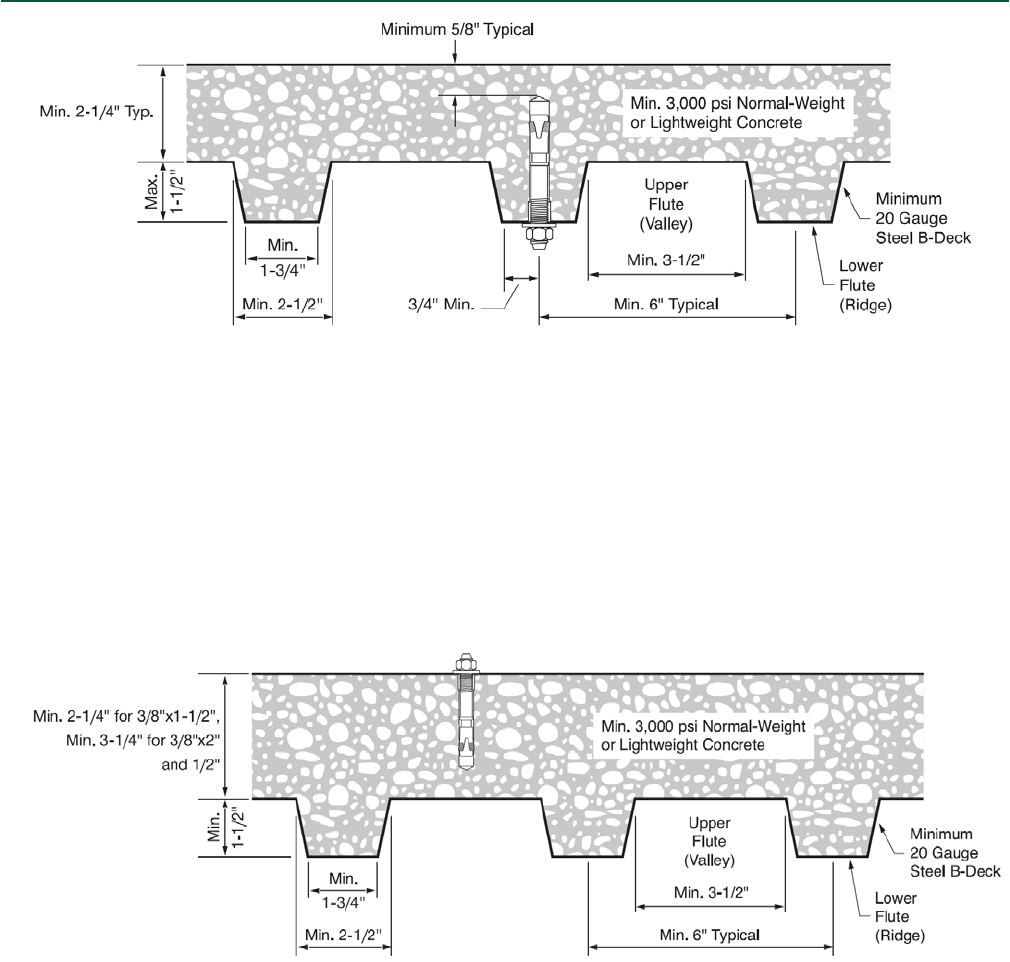
ESR-1917 | Most Widely Accepted and Trusted Page 12 of 16
FIGURE 5C—INSTALLATION IN THE SOFFIT OF CONCRETE OVER METAL DECK FLOOR AND ROOF ASSEMBLIES – B DECK1,2
1Anchors may be placed in the upper or lower flute of the steel deck profile provided the minimum hole clearance is satisfied. Anchors in the lower flute may be
installed with a maximum 1/8-inch offset in either direction from the center of the flute. The offset distance may be increased proportionally for profiles with lower
flute widths greater than those shown provided the minimum lower flute edge distance is also satisfied.
2Anchors may be placed in the upper flute of the steel deck profiles in accordance with Figure 5B provided the concrete thickness above the upper flute is
minimum 21/4-inch and the minimum hole clearance of 5/8-inch is satisfied.
FIGURE 5D—INSTALLATION ON THE TOP OF CONCRETE OVER METAL DECK FLOOR AND ROOF ASSEMBLIES – B DECK1,2
1Refer to Table 6 for setting information for anchors in to the top of concrete over metal deck.
2Applicable for 21/4-in ≤ hmin < 4-in for 3/8” x 11/2” anchors and 31/4-in ≤ hmin < 4-in for 3/8” x 2” and 1/2" anchors. For hmin ≥ 4-inch use setting information in Table 3
of this report.
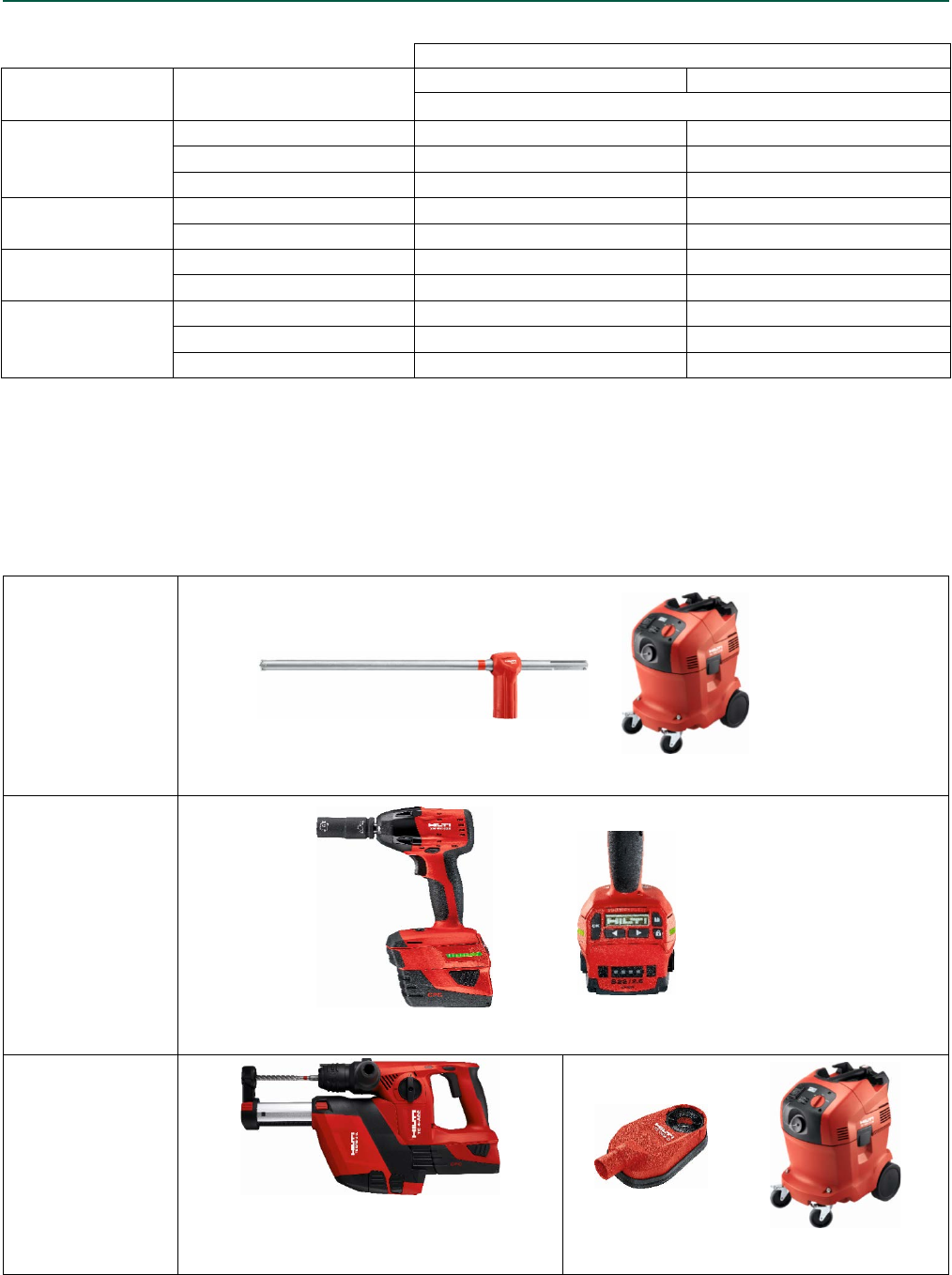
ESR-1917 | Most Widely Accepted and Trusted Page 13 of 16
TABLE 7—EXAMPLE ALLOWABLE LOAD VALUES FOR ILLUSTRATIVE PURPOSES
Allowable tension (lbf)
Nominal Anchor
diameter (in.) Embedment depth (in.) Carbon Steel Stainless Steel
f'c = 2,500 psi
3/8
1
1
/2 800 NA
2 1,105 1,155
23/4 1,805 NA
1/2 2 1,490 1,260
3
1
/4 2,420 2,530
5/8 31/8 2,910 2,910
4 4,015 4,215
3/4
3
1
/4 3,085 NA
3
3
/4 3,635 3,825
43/4 4,690 5,290
For SI: 1 lbf = 4.45 N, 1 psi = 0.00689 MPa 1 psi = 0.00689 MPa. 1 inch = 25.4 mm.
1Single anchors with static tension load only.
2Concrete determined to remain uncracked for the life of the anchorage.
3Load combinations from ACI 318-14 Section 5.3 or ACI 318-11 Section 9.2, as applicable (no seismic loading).
430% dead load and 70% live load, controlling load combination 1.2D + 1.6 L.
5Calculation of the weighted average for α = 0.3*1.2 + 0.7*1.6 = 1.48.
6f 'c = 2,500 psi (normal weight concrete).
7ca1 = ca2 ≥ cac
8h ≥ hmin
9Values are for Condition B where supplementary reinforcement in accordance with ACI 318-14 17.3.3(c) or ACI 318-11 D.4.3(c) is not provided, as applicable.
Hilti SafeSet™
System with Hollow
Drill Bit
Hilti TE-CD or TE-YD Hollow Carbide Drill Bit with a
Hilti Vacuum (per section 4.3)
Hilti SafeSet™
System with the
Adaptive Torque
Tool
Hilti SIW-6AT-A22 Impact Wrench with the
Hilti SI-AT-A22 Adaptive Torque Module
Hilti Dust Removal
Systems
Hilti Rotary Hammer Drill with DRS (Dust
Removal System) Module
Hilti TE DRS-D Dust Removal
System with Hilti Vacuum
FIGURE 6—HILTI SYSTEM COMPONENTS
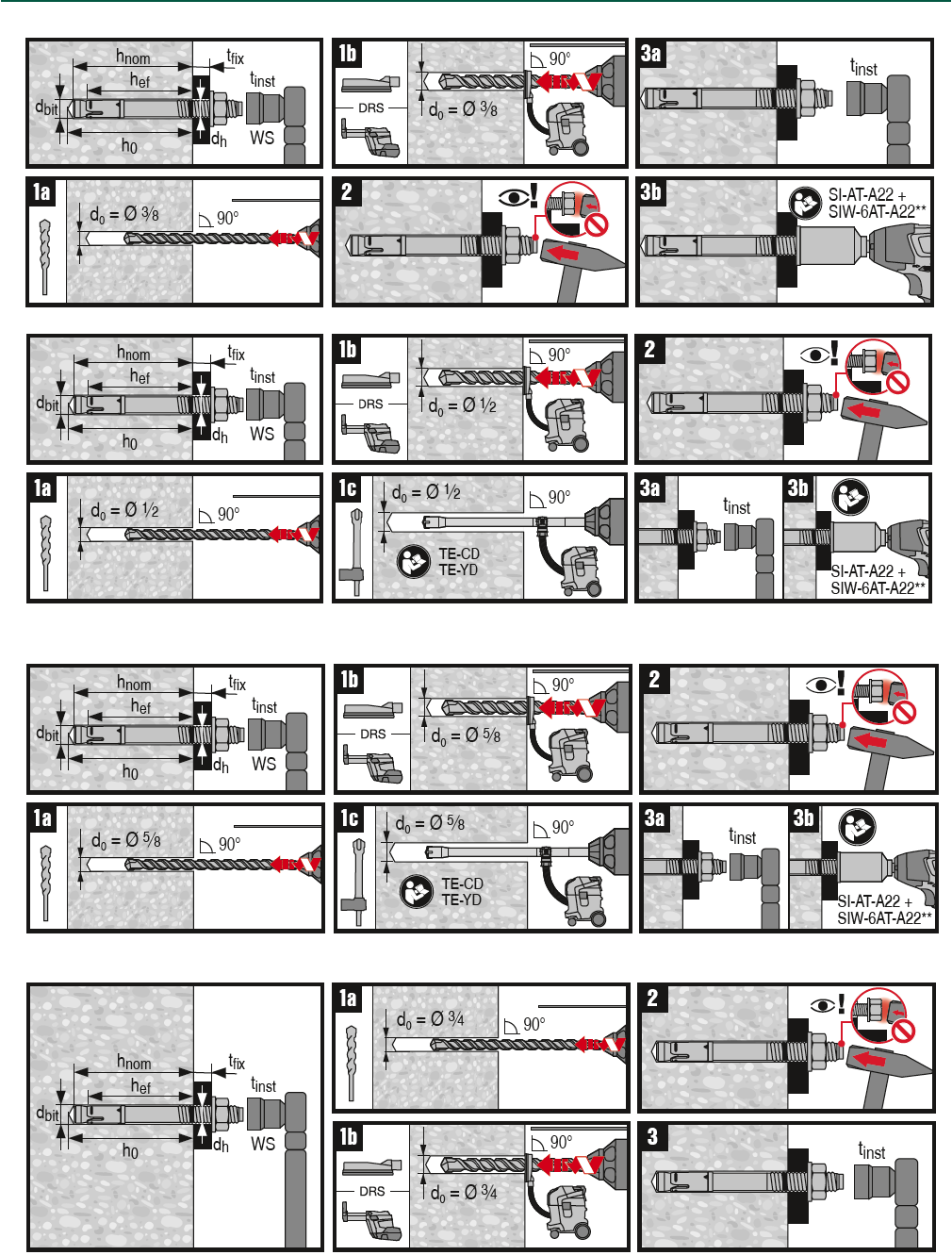
ESR-1917 | Most Widely Accepted and Trusted Page 14 of 16
3/8” Diameter
1/2” Diameter
5/8” Diameter
3/4” Diameter
FIGURE 7—INSTALLATION INSTRUCTIONS
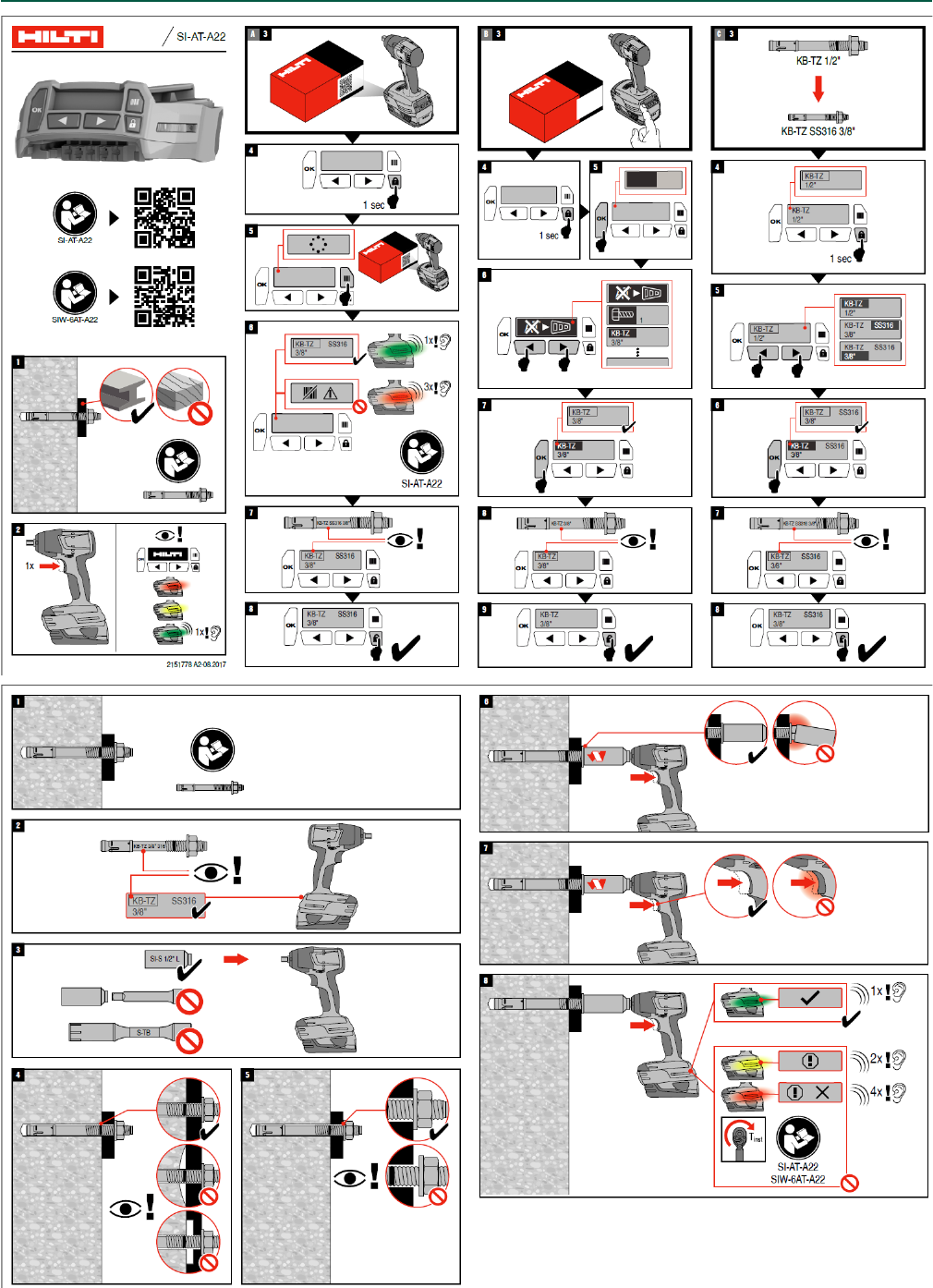
ESR-1917 | Most Widely Accepted and Trusted Page 15 of 16
FIGURE 7A—INSTALLATION INSTRUCTIONS USING SI-AT-A22 ADAPTIVE TORQUE SYSTEM
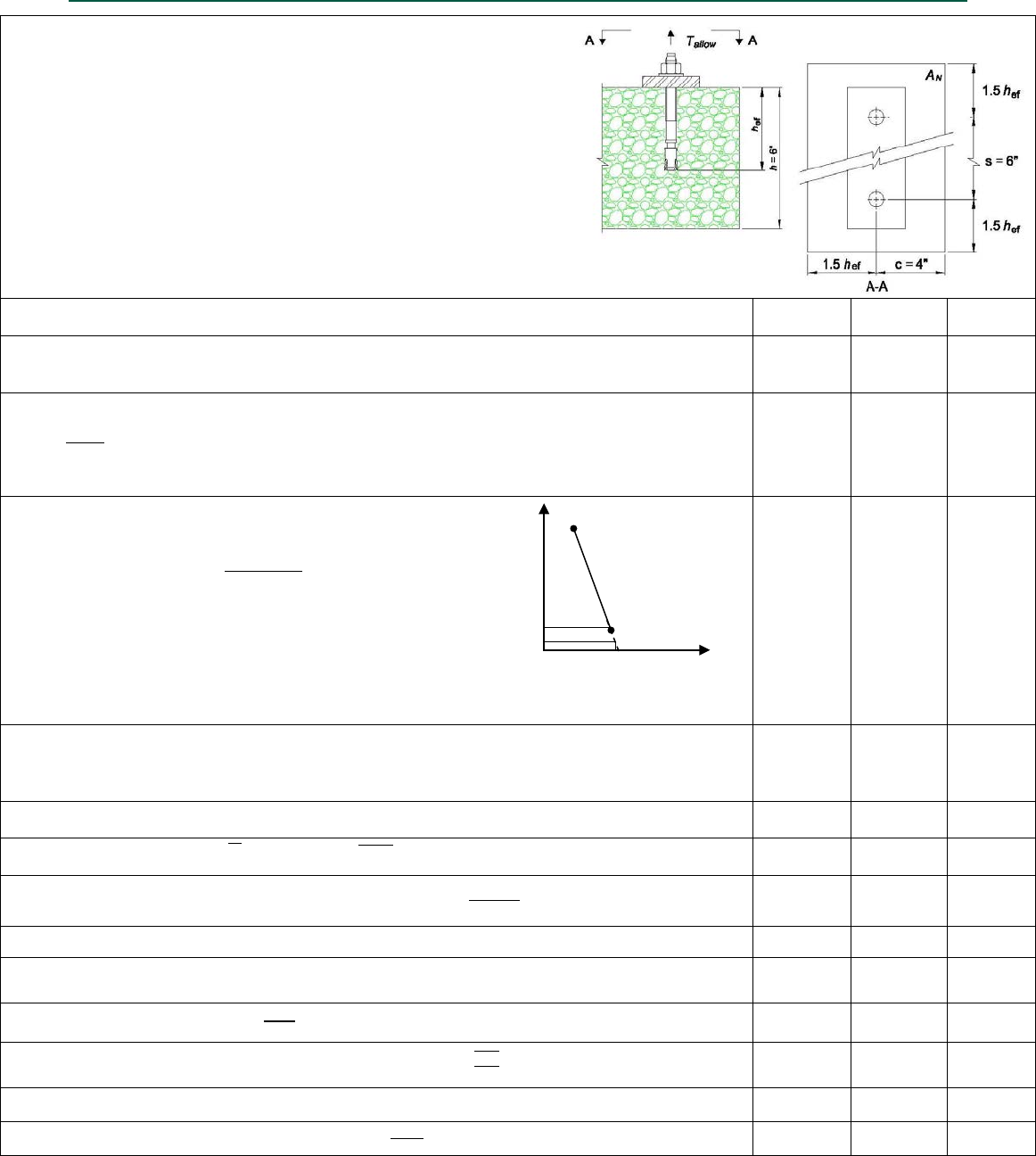
ESR-1917 | Most Widely Accepted and Trusted Page 16 of 16
Given:
Two 1/2-inch carbon steel KB-TZ anchors under static tension
load as shown.
hef = 3.25 in.
Normal weight concrete, f'c = 3,000 psi
No supplementary reinforcement (Condition B per ACI 318-14
17.3.3(c) or ACI 318-11 D.4.3(c), as applicable)
Assume cracked concrete since no other information is available.
Needed: Using Allowable Stress Design (ASD) calculate the
allowable tension load for this configuration.
Calculation per ACI 318-14 Chapter 17, ACI 318-11 Appendix D and this report.
ACI 318-14
Ref.
ACI 318-11
Ref.
Report
Ref.
Step 1. Calculate steel capacity:
= = 0.75 2 × 0.101×106,000 = 16,059lb
s se ut
N nA f
φφ
×
Check whether futa is not greater than 1.9fya and 125,000 psi.
17.4.1.2
17.3.3(a)
D.5.1.2
D.4.3(a)
§4.1.2
Table 3
Step 2. Calculate concrete breakout strength of anchor in tension:
bNcpNcNedNec N
,,,,
Nco
Nc
cbg A
A
N
ψψψψ
=
17.4.2.1 D.5.2.1 § 4.1.3
Step 2a. Verify minimum member thickness, spacing and edge distance:
hmin = 6 in. ≤ 6 in.
∴ok
2.375 - 5.75
slope = = -3.0
3.5 - 2.375
For = 4in
min
c
⇒
[ ]
∴= 5.75 - (2.375 - 4.0)(-3.0) = 0.875 < 2.375in < 6in ok
min
s
17.7
D.8
Table 3
Fig. 4
Step 2b. For AN check
ef ef
1.5h = 1.5(3.25) = 4.88 in > 3.0h = 3(3.25) = 9.75 in>
cs
17.4.2.1 D.5.2.1 Table 3
Step 2c. Calculate ANco and ANc for the anchorage:
= 9
= 9 × (3.25)
=95.1.
=1.5 +3 +=[1.5 × (3.25)+ 4][3 × (3.25)+ 6]=139.8.< 2
17.4.2.1 D.5.2.1 Table 3
Step 2d. Determine
Nec,
ψ
:
0.10 ,
'=∴= NecN
e
ψ
17.4.2.4 D.5.2.4 -
Step 2e. Calculate Nb:
=
.=17 × 1.0 × 3,000 × 3.25.= 5,456
17.4.2.2 D.5.2.2 Table 3
Step 2f. Calculate modification factor for edge distance:
95.0
)25.3(5.1
4
3.07.0
,=+=
Ned
ψ
17.4.2.5 D.5.2.5 Table 3
Step 2g. Calculate modification factor for cracked concrete:
Nc,
ψ
=1.00 (cracked concrete) 17.4.2.6 D.5.2.6 Table 3
Step 2h. Calculate modification factor for splitting:
Ncp,
ψ
=1.00 (cracked concrete) - -
§ 4.1.10
Table 3
Step 2i. Calculate
φ
Ncbg :
φ
Ncbg =0.65 ×
.
.
× 1.00 × 0.95 × 1.00 x 5,456 = 4,952 lb
17.4.2.1
17.3.3(c) D.5.2.1
D.4.3(c)
§ 4.1.3
Table 3
Step 3. Check pullout strength: Table 3,
φ
nNpn,f′c = 0.65 × 2 × 5,515 lb x
,
,
= 7,852 lb >4,952
∴
OK
17.4.3.2
17.3.3(c)
D.5.3.2
D.4.3(c)
§ 4.1.4
Table 3
Step 4. Controlling strength:
φ
Ncbg = 4,952 lb <
φ
nNpn <
φ
Ns ∴
φ
Ncbg controls 17.3.1.2 D.4.1.2 Table 3
Step 5. To convert to ASD, assume U = 1.2D + 1.6L: Tallow =
4,952
1.48
= 3,346 lb. - - § 4.2
FIGURE 8—EXAMPLE CALCULATION
2.375 controls
2.375, 5.75
s
min
3.5, 2.375
c
min
0.875
4
