Evaluating Content Marketing ROI Guide
User Manual:
Open the PDF directly: View PDF  .
.
Page Count: 36
Content Marketing ROI Guide
A guide to measuring, evaluating and reporting
your content marketing performance
Authors: Stephen Bateman and Dave Chaffey
1 Introduction
to ROI calculation
5 Using analytics for
analysis
4 Calculating
content ROI
3 Calculating
content cost
2 Setting goals
and metrics
© Smart Insights (Marketing Intelligence) Limited. Please go to www.smartinsights.com to feedback or access our other guides.
Content Marketing ROI Guide
!
2
Content Marketing ROI Guide
A Guide to measuring, evaluating and
reporting your content marketing performance
Contents
3 Introduction
5 ONE: Introduction to calculating the ROI of content marketing
9 TWO: Setting Content Goals & Metrics
21 THREE: Calculating the cost of content
25 FOUR: Calculating Content ROI
29 FIVE: Using analytics to evaluate content marketing
1 Introduction
to ROI calculation
5 Using analytics for
analysis
4 Calculating
content ROI
3 Calculating
content cost
2 Setting goals
and metrics
© Smart Insights (Marketing Intelligence) Limited. Please go to www.smartinsights.com to feedback or access our other guides.
Content Marketing ROI Guide
!
3
Introduction
The importance of content marketing ROI
Most marketers are now aware of the potential of content marketing to generate awareness
and new business for a brand. Indeed it has been voted the best potential new form of
marketing investment by Smart Insights readers for two years now1.
However, since this is a relatively new marketing approach, there seems to be a lack of
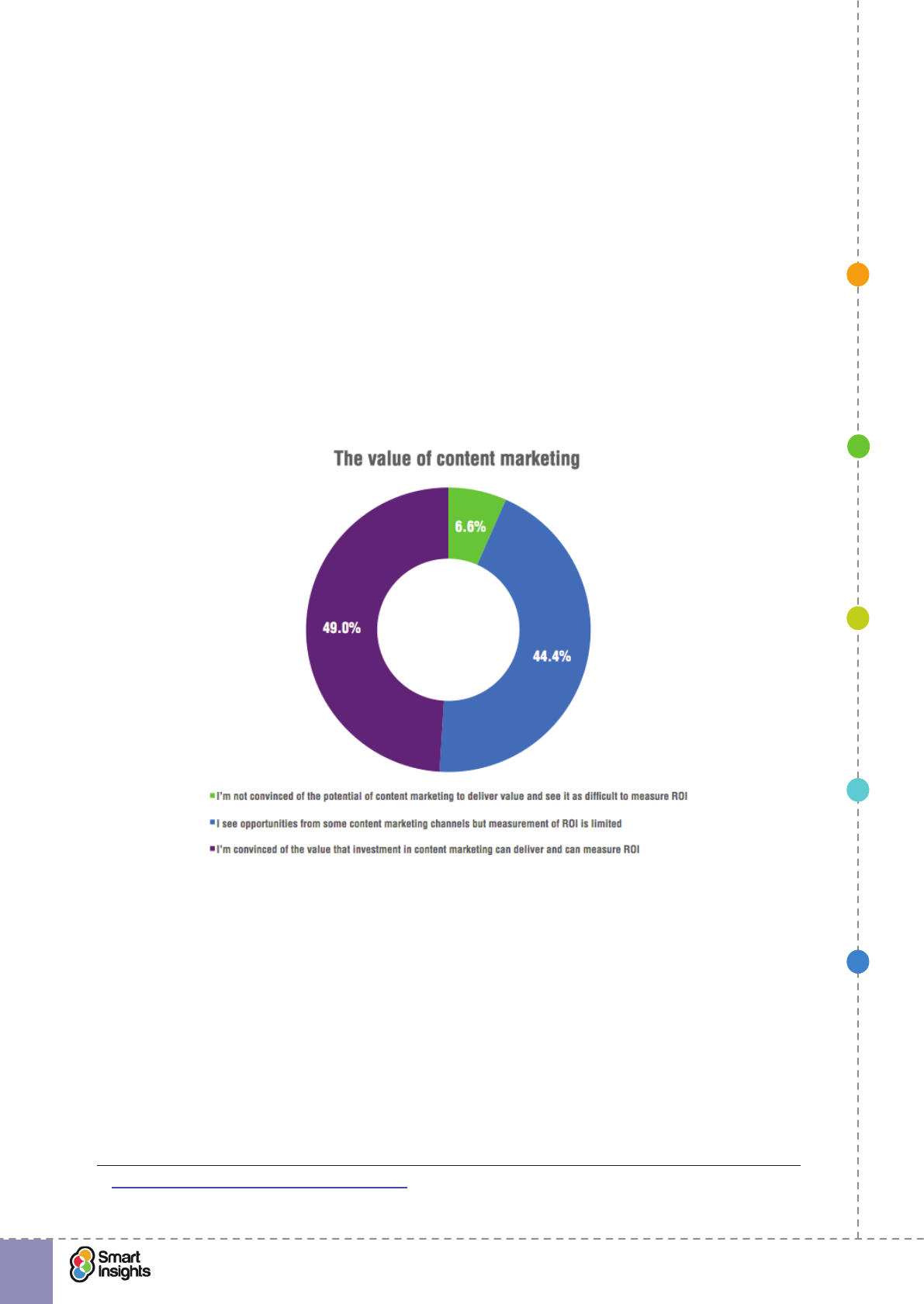
condence in how to calculate ROI. In our recent research with Hubspot2 we asked marketers
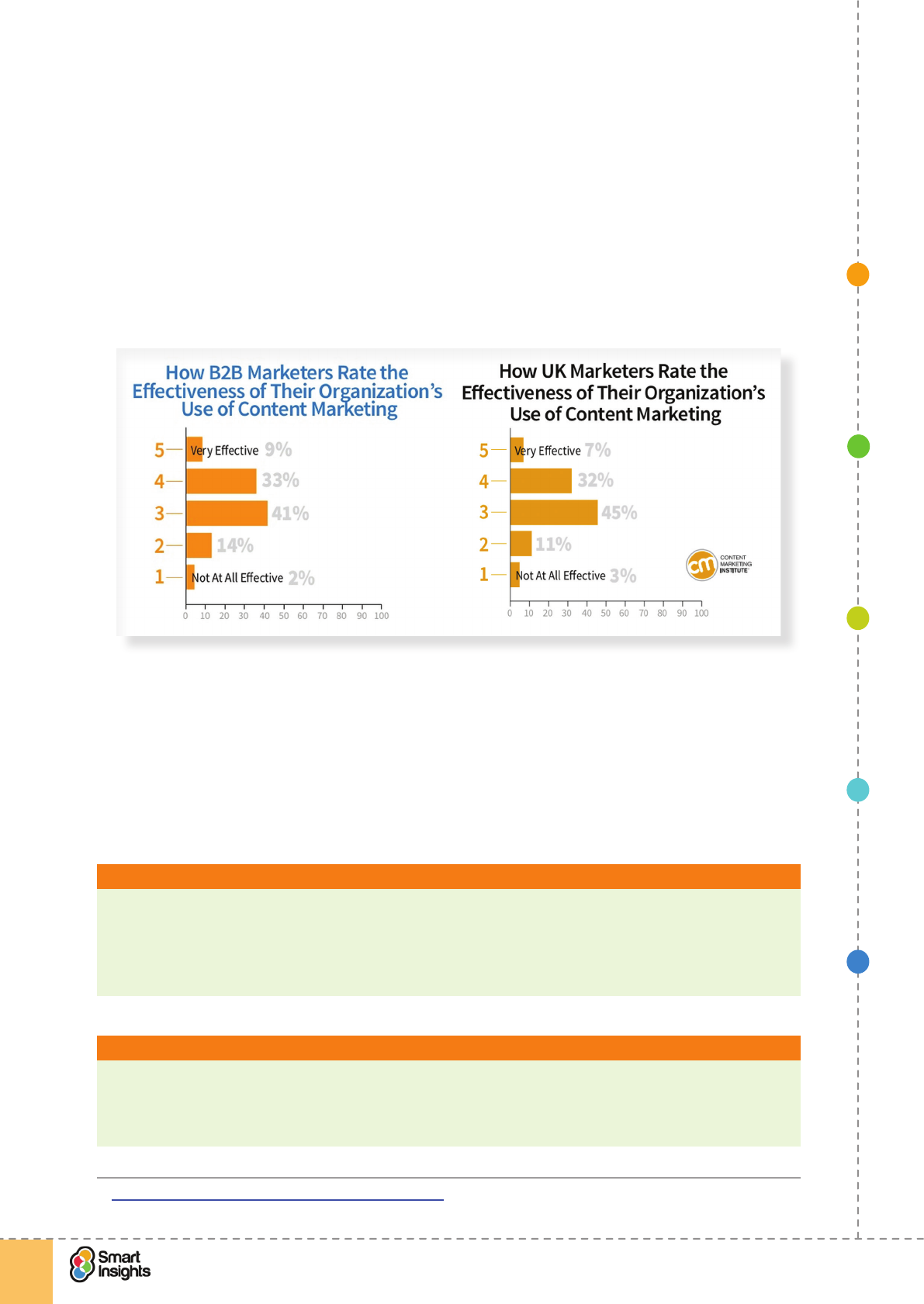
for their perceptions on how valuable content marketing is and the ease of measuring ROI.
The chart shows that nearly half of marketers saw the measurement of ROI as limited.
We have also received requests from members for more guidance on evaluating content
marketing ROI, so this guide is here to help.
The aim of this guide is not to present “XX metrics to measure your content marketing
performance”, because that is too simplistic. Instead our aim is to focus on sharing
techniques that help you PROVE the effectiveness of content marketing to your colleagues or
clients, a key issue as more marketing budget is invested into content marketing.
How is this guide structured?
The ve sections in this guide are:
þONE: an introduction to ROI calculation. An explanation of marketing ROI for readers
without a background in the concept.
1 Smart Insights: Marketing trends article
2 Hubspot / Smart Insights: Content Marketing Success report
1 Introduction
to ROI calculation
5 Using analytics for
analysis
4 Calculating
content ROI
3 Calculating
content cost
2 Setting goals
and metrics
© Smart Insights (Marketing Intelligence) Limited. Please go to www.smartinsights.com to feedback or access our other guides.
Content Marketing ROI Guide
!
4
þTWO: Setting content goals and metrics. In this section we show how you can set
goals for content marketing and measure them through KPIs. This section should be read
together with the nal section on using analytics which explains goal setup.
þTHREE: Calculating the cost of content. Content marketing is certainly not free, so to
calculate ROI for content we need to break out the component costs. This section has
worked examples of how to do this.
þFOUR: Calculating Content ROI. Building on section three, this section gives example
of ROI calculations.
þFIVE: Using analytics to review content marketing. Techniques to analyse and report
content marketing effectiveness using Google Analytics.
If you use Google Analytics and already have the basics right such as setting up goals
and goal value to evaluate content marketing, don’t miss the advanced sections on “First
content interaction analysis” on page 33 and Basic Channel Groupings that follows.
Recommended resources Content marketing guides
Our content marketing resources are collected in our Content Marketing Toolkit. We have a
summary guide and longer guides advising on content marketing which give more depth on
strategy and management for content marketing:
þ1. Strategy - 7 Steps content marketing strategy guide
þ2. Management – Managing content marketing guide
þ3. Scheduling - Editorial calendar spreadsheet template
þ4. Evaluation – Content marketing ROI evaluation guide
þ5. Summary – Content marketing Fast Start Checklist
About the author
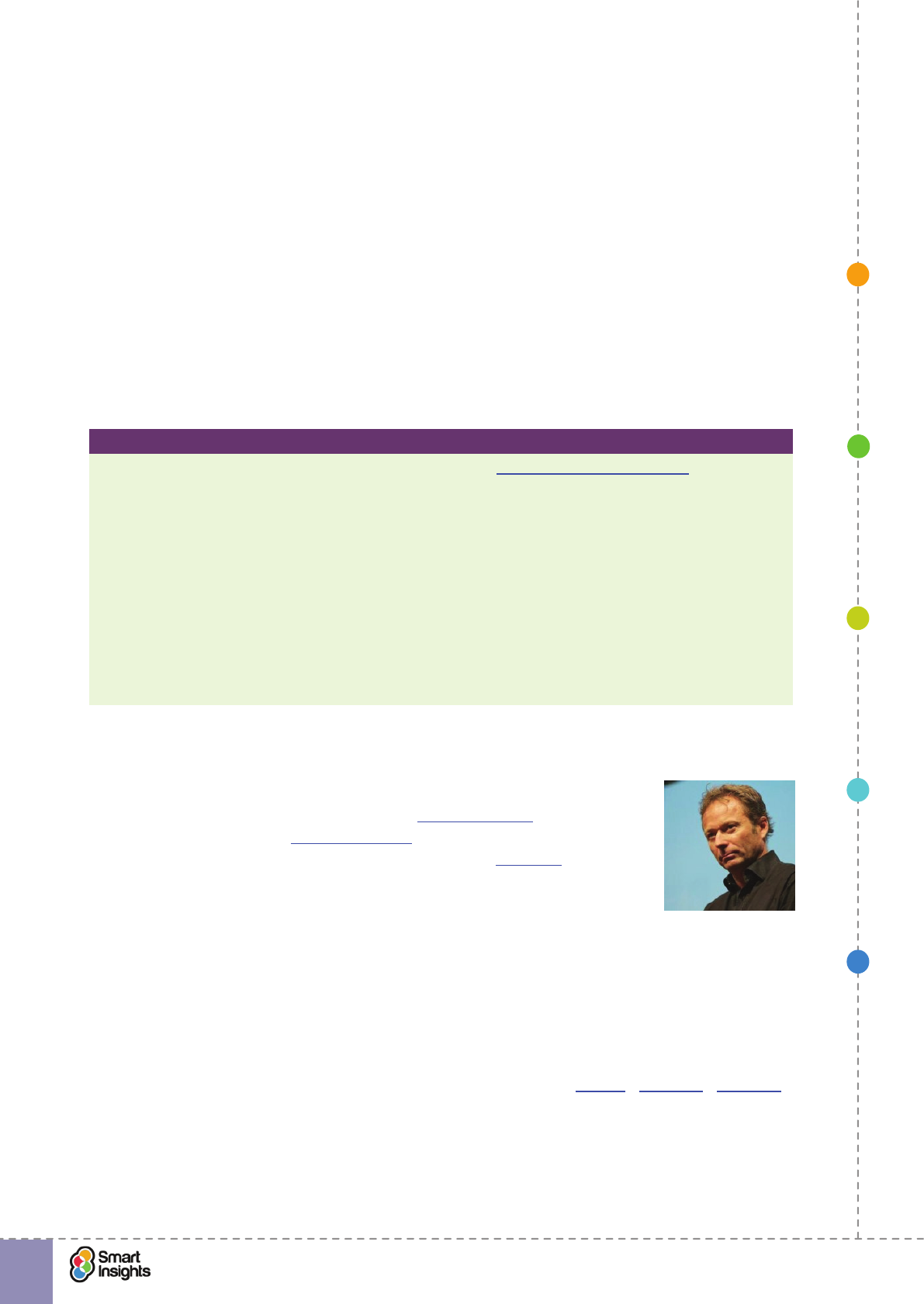
Stephen Bateman is the Smart Insights expert commentator on Content
Marketing. He is director and co-founder of Wise Up Media (part of
GreenWise Business) and Concentric Dots, both specialist content
marketing agencies, as well as co-founder and MD of iGlimpse, a leading
educational mobile apps publisher. His strengths are in content planning,
content creation and content ROI, with specialist knowledge of the
sustainable business sector.
He offers expert training and and content marketing consultancy, including social media
training, to ambitious businesses. Before going independent Stephen worked as Business
Director for a number of large corporates including Pearson (Dorling Kindersley), Hachette
Book Group, and F&Media International, where he learned a thing or two about reporting
business performance to the managing board. Stephen is co-author of Smart Insights’
Content Marketing Strategy Guide and a scholar of the Chartered Institute of Marketing. You
can connect with Stephen through any of these social networks: Twitter | LinkedIn | Google+.
1 Introduction
to ROI calculation
5 Using analytics for
analysis
4 Calculating
content ROI
3 Calculating
content cost
2 Setting goals
and metrics
© Smart Insights (Marketing Intelligence) Limited. Please go to www.smartinsights.com to feedback or access our other guides.
Content Marketing ROI Guide
!
5
1
ONE
An Introduction to calculating the ROI of content
marketing
According to the Content Marketing Institute (CMI), which publishes a yearly summary on
the state of content marketing, as many as 90% of marketers are experimenting with content
marketing in one form or other, yet fewer than 50 per cent of marketers feel condent in the
effectiveness of their content marketing1.
The aim of this guide – proving content marketing ROI
In this guide we aim to explain a range of techniques to help marketers evaluate and prove
their content effectiveness, through assessing the commercial value of content marketing
measured through its protability and Return on Investment (ROI). So, let’s get straight
into understanding these terms since these denitions are not always well understood by
marketers.
What is it? Prot
Simply put, prot accrues when the revenue obtained from a commercial transaction is
greater than its cost:
Revenue less cost = Prot
What is it? Return on investment (ROI)
Return on Investment shows prot compared to cost
ROI % = 100 * Return from investment (Net Prot) / cost of investment
1 Content Marketing Institute: Research listing

1 Introduction
to ROI calculation
5 Using analytics for
analysis
4 Calculating
content ROI
3 Calculating
content cost
2 Setting goals
and metrics
© Smart Insights (Marketing Intelligence) Limited. Please go to www.smartinsights.com to feedback or access our other guides.
Content Marketing ROI Guide
!
6
1
Let’s take a simplied example for a transactional Ecommerce site selling products with an
Average Selling Price of $100. Let’s assume that half (50%) of this $100 ASP is margin, i.e.
what’s left over after the cost of the retailer buying products from suppliers. It costs another
10% of the $100 for the retailer to process, pick and ship the order plus deal with returns. So,
subtracting the product and process costs from the sales revenue gives a prot on the sale of
$40.
Consider an investment of $1,000 into a content-based campaign to sell more of these
widgets. What we need to isolate is the incremental sales from the content investment. If you
sell 30 additional products at a prot of $40 each, that gives a total prot of $1,200 on the
campaign, but campaign costs need to be subtracted too, leaving $200. The ROI here is 20%
($200/$1000).
So far, so straightforward, but this example is for a retailer with clear visibility of sales
revenue. How can we calculate prot for a non-transactional website where the aim of
the site is to generate leads rather than sell products; a common situation in marketing,
particularly B2B marketing? In these cases we have to nd an equivalent value for leads
based on the conversion rate to sale.
Let’s take an example of a luxury travel company that doesn’t have online sales, instead
brochures are used to generate interest, with sales then occurring by phone or in store. If the
typical prot for a holiday is $4,000 and we know that the conversion rate from lead to sale is
10%, the value of a lead on average is also $40. In this case, a similar ROI calculation for the
retailer can then be calculated.
We will go into more detail of how to calculate the costs and ROI for content marketing in
sections 3 and 4 where we look at some worked examples.
Previously these types of marketing campaign ROI calculations have focused on comparing
costs against sales revenue for paid media marketing, but today’s marketers also need to
demonstrate how owned and earned media spend is directly accountable as a measurable
impact on sales.
This greater need for accountability has arisen since we are seeing a much larger investment
in content marketing that supports and impacts all the stages of the customer buying cycle. In
other words ownership of the “funnel” is shifting toward marketing. This is especially true for
B2B marketing where lead generation and sales cycles are more complex.
Fournaise2 reports that “just 20 percent of CEOs consider their top marketers to be ROI
marketers”. This means that “80% of CEOs do not really trust and are not very impressed
by the work done by marketers, while in comparison, 90% of the same CEOs do trust and
value the opinion and work of CFOs and CIOs.” 75% of CEOs think Marketers misunderstand
(and misuse) the “real business” denition of the words “Results”, “ROI” and “Performance”
and therefore do not adequately speak the language of their top management: these CEOs
fail to understand why Marketers cannot zoom in on a few critical key business performance
indicators to precisely measure, quantify and report on the level of customer demand they
are asked to deliver, instead of drowning everybody with data and analyses that are too
remote from the P&L.”
Strategy Recommendation 1 Dene the need to evaluate content marketing ROI
If you don’t evaluate content marketing, then you can’t make the business case for future
investment effectively and it’s likely you won’t have enough resource to manage your
content marketing output so your content marketing efforts will wither and die.
2 Fournaise: Marketing Performance survey
1 Introduction
to ROI calculation
5 Using analytics for
analysis
4 Calculating
content ROI
3 Calculating
content cost
2 Setting goals
and metrics
© Smart Insights (Marketing Intelligence) Limited. Please go to www.smartinsights.com to feedback or access our other guides.
Content Marketing ROI Guide
!
7
1
Agencies and consultants also want to prove the value of content marketing to their clients,
so the techniques we cover will help here too.
What do we want our content marketing to achieve?
The rst step towards presenting content marketing ROI is to review what you’re looking to
achieve with content marketing as an organization.
Strategy Recommendation 2 Start by reviewing the organization goals of content marketing
Before organisations can evaluate their content marketing effectiveness they should agree
what they are looking to achieve through content marketing, in other words, dening actions
they want their consumers of content to complete.
If you’re discussing the goals for content marketing within a company or with clients, this
Content Marketing Institute denition is a useful starting point for thinking about what you
want Content Marketing to achieve since they link the ‘what?’ to the ‘why?’.
What is it? Content Marketing
“Content marketing is the marketing and business process for creating and distributing
relevant and valuable content to attract, acquire, and engage a clearly dened and
understood target audience – with the objective of driving protable customer action.”
Content Marketing Institute
Here “creating and distributing content” requires spending on media creation and distribution
to generate new leads (attracting and acquiring new customers) and drive protable sales
(customer actions). “Engage” refers to engaging existing customers who are often the
best advocates for a brand who will share content. Developing prospect and customer
relationships is at the heart of developing a return on marketing investment (ROMI) from
content marketing.
A less formal denition of content marketing states: “Content Marketing is owning, as opposed
to renting media. It’s a marketing process to attract and retain customers by consistently
creating and curating content in order to change or enhance a consumer behavior.”
This denition implies content marketing is a trade off (one thing but not the other) and
that “owning media as opposed to renting media” provides a more permanent return on
investment. This implies a decision to pursue content marketing over other lead generation
activities such as Paid Search, Advertising and PR which needs to be justied via some
form of comparative benchmarking. The same would go for claims published by online lead
generation platform Eloqua and Kapost who claim that “the average cost per lead drops 80%
after 5 months of content marketing” and “content marketing is 31% cheaper than paid search
advertising”. Tall claims for which claimants need to provide clear metrics.
Recommended resource Delivering Results from Digital Marketing
For advice on setting broader goals and KPIs for digital marketing see our Delivering Results
from Digital Marketing Guide which focuses on goal setting.
In section 5 we show how to set goals using analytics - it’s in: “Step 1. Dene goals with a
specic value for conversion to different outcomes” on page 29.
1 Introduction
to ROI calculation
5 Using analytics for
analysis
4 Calculating
content ROI
3 Calculating
content cost
2 Setting goals
and metrics
© Smart Insights (Marketing Intelligence) Limited. Please go to www.smartinsights.com to feedback or access our other guides.
Content Marketing ROI Guide
!
8
1
Applying content marketing to B2B and B2C markets
Buying cycle complexity depends on product and service categories, but in general, B2B
buying cycles tend to more complex, requiring content to be created for each persona
and stage of the buying cycle. Measuring the impact of that content could, in some cases,
be difcult, or it could be easier if your marketing and sales teams are using a customer
relationship management system (CRM) to record tactics and their impact on lead nurturing,
thus allowing you to accurately record content downloaded by contacts and its impact at each
stage of their buying journey.
This guide won’t make a specic distinction between B2C and B2B marketing since content
marketing aims to achieve similar goals in both cases, and we won’t specically examine
the role of CRM systems, but we will focus on measuring content marketing performance in
complex buying cycles.
What is it? The difference between B2C and B2B content marketing?
Both B2C and B2B aim for the same outcome, but each uses a different content mix and
puts a different emphasis on channels and tactics. B2B often involves more complex buying
cycles, but this does not necessarily translate into more complex measurement.
See section 5 of our best practices guide on Marketing Automation for ideas on how to use
these systems to score lead quality - another technique for content marketing.
Benchmarking your content marketing capability
How well you measure your content marketing is just one aspect of your overall effectiveness
in using content marketing. To help argue for more focus on measurement it can help to
talk to colleagues about the bigger picture. We’re fans of using capability auditing tools to
assess your use of different digital marketing techniques like content marketing against
where you’d like or need to be. A useful tool to help with content marketing evaluation, which
we introduced in our guide to content marketing strategy, is Altimeter’s Content Marketing
Maturity Model.
Strategy Recommendation 3 Review and communicate your content marketing
measurement capability
Assess your content marketing capability, including evaluation, to communicate to
colleagues the improvements you need to make.
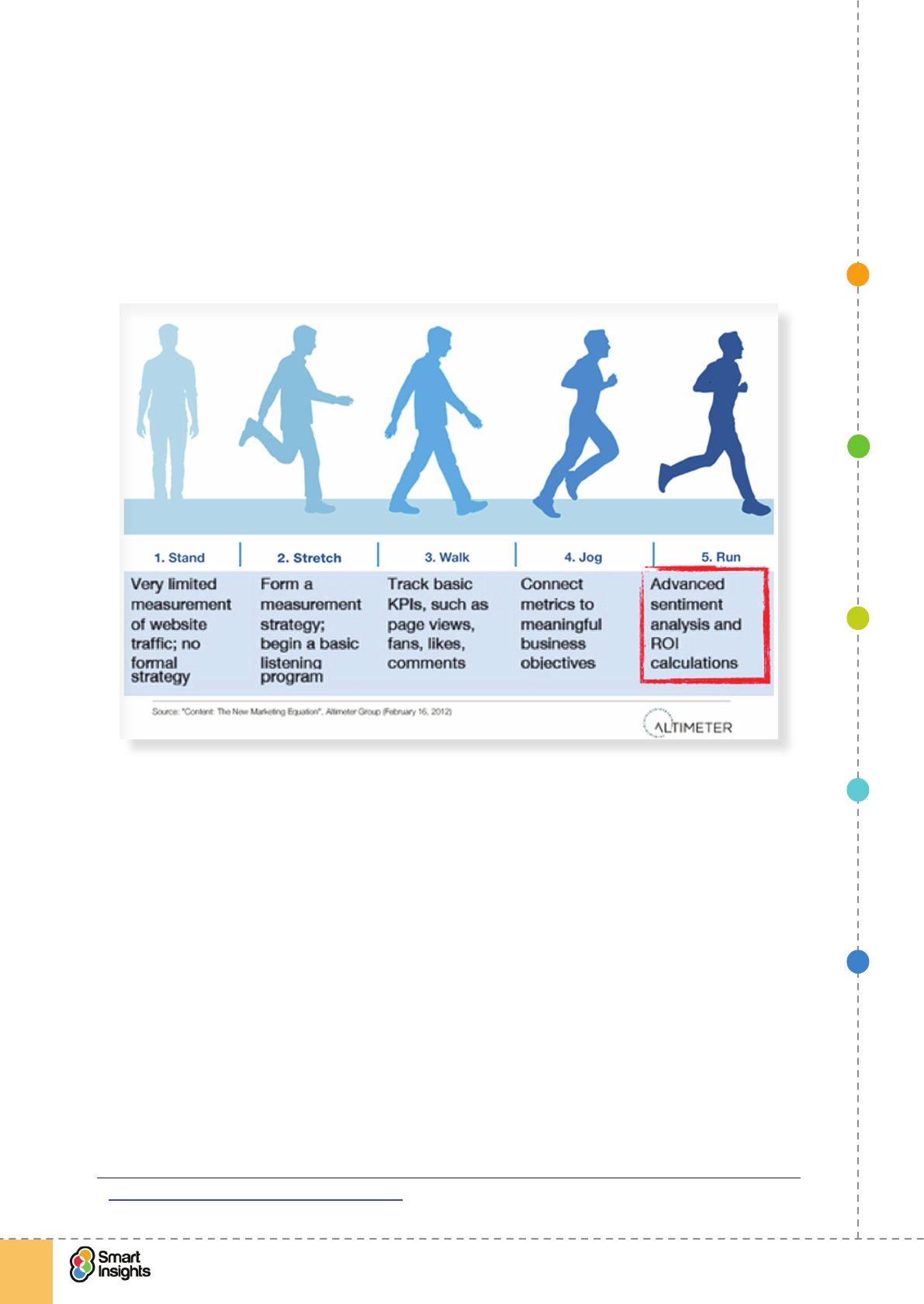
This guide is designed to assist content marketing professionals at stages 2 to 4 (“Stretch”
moving to “Walk” & “Jog”). At the more mature stages of content marketing, managers need
more accurate performance evaluation and ROI calculations to help them report the results
of their content marketing to senior management, and thereby get the buy-in and support
they need in order to maintain or increase their content marketing investment to grow their
business in cost effective ways.
The stages in the Altimeter capability model are:
þStand: You haven’t yet realised the value of content marketing as a key component of
your marketing strategy.
þStretch: You understand the benets of content marketing and have started to create
content.
1 Introduction
to ROI calculation
5 Using analytics for
analysis
4 Calculating
content ROI
3 Calculating
content cost
2 Setting goals
and metrics
© Smart Insights (Marketing Intelligence) Limited. Please go to www.smartinsights.com to feedback or access our other guides.
Content Marketing ROI Guide
!
9
1
þWalk: Now with a solid foundation organisationally that supports content creation, your
content strategy is more fully rened and tweaked. There is also a concerted effort to
connect content development with all parts of the organisation’s communication teams.
þJog: Your company is seriously committed to content marketing and has a clear strategy.
þRun: Companies at this stage have production and creative as full, standalone business
unit, and your company is creating content that is sold and licensed based on its
standalone merit.
What stage of content marketing maturity are you?
Source: “Content: The New Marketing Equation” - The Altimeter Group 20123
3 Altimeter: The New Marketing equation
1 Introduction
to ROI calculation
5 Using analytics for
analysis
4 Calculating
content ROI
3 Calculating
content cost
2 Setting goals
and metrics
© Smart Insights (Marketing Intelligence) Limited. Please go to www.smartinsights.com to feedback or access our other guides.
Content Marketing ROI Guide
!
10
2
TWO
Setting Content Goals & Metrics
If you read blog posts advising on content marketing evaluation, you will often see long lists
of measures which can be impressive, but to help make sense of them in the context of
business goals we suggest that choosing the best framework to structure them is essential.
We will also see this in this section, that considering a hierarchy of measures from more
strategic and commercial to more tactical is useful; CEOs and CFOs do not care very much
about content campaigns or everyday metrics, but they do want to know that their marketers
are striving to improve ROI.
Strategy Recommendation 4 Select Content Marketing KPIs within a framework
A measurement framework helps you review that you have the right measures for different
purposes and helps you communicate them to others. A hierarchy of top-level strategic
goals and more specic tactical objectives can help make sense of the multitude of
measures.
Goals: What do we want our content consumers to do?
Many marketers produce content and dub it “content marketing” without having mapped it
to business goals or to the customer buying cycle. This is evidenced in a lot of blog content,
where brands decide to have a blog and then churn out posts that are at best “cool and
trendy”, but which do nothing to impact on business goals. This is what content marketing
guru, Doug Kessler, famously calls “the deluge of crap”4 which, if unchecked, risks being
content marketers’ downfall.
So, the rst step toward creating ROI content is to turn your content creation process on its
head: by that I mean think less about producing content and think more about how you can
use content to turn your readers or viewers into leads, sales, and advocates all along the
buying cycle.
Strategy Recommendation 5 Select Content based on your goals
FIRST map your content to the customer buying cycle, THEN create content that moves
people toward your goals.
In section 5 we show how to set goals using analytics - it’s in: “Step 1. Dene goals with a
specic value for conversion to different outcomes” on page 29.
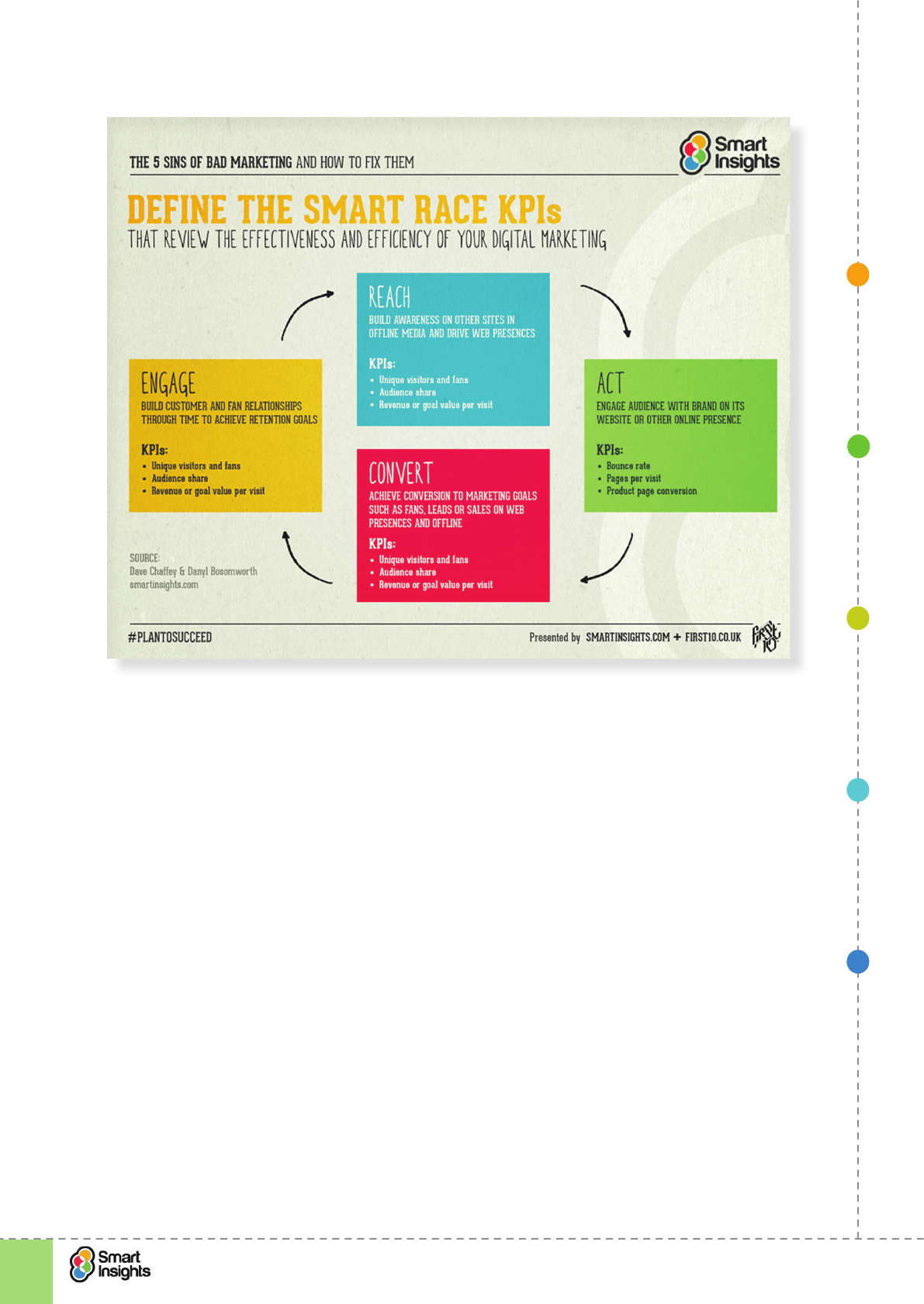
Applying the Smart Insights RACE framework to content marketing
Dening goals without context can be tricky, so the Smart Insights RACE framework can
help here. The Smart Insights RACE framework helps you dene goals and subsequent
measurement for your content across the customer buying cycle (similar to the AIDA buying
stages from Awareness to Interest, Desire and Action). Here is how it works:
4 Slideshare: Crap. The Content Marketing Deluge
1 Introduction
to ROI calculation
5 Using analytics for
analysis
4 Calculating
content ROI
3 Calculating
content cost
2 Setting goals
and metrics
© Smart Insights (Marketing Intelligence) Limited. Please go to www.smartinsights.com to feedback or access our other guides.
Content Marketing ROI Guide
!
11
2
þStep 1 Reach. Reach means building awareness of a brand, its products and services
on other websites and in ofine media in order to build trafc by driving visits to different
web presences like your main website, micro-sites or social media outposts such as
Facebook, LinkedIn or Google+ Business Pages.
For Content marketing evaluation we need to understand how content individually and
collectively supports reaching larger and different audiences.
þStep 2 Act. Act is about persuading site visitors or prospects to take the next step on
their journey when they initially reach your site or social network presence. It may mean
nding out more about a company or its products, searching to nd a product or reading
a blog post. It’s about engaging the audience through relevant, compelling content and
clear navigation pathways so that they don’t hit the back button.
For Content marketing evaluation, we need to understand how content encourages
interaction and leads as shown in the next table.
þStep 3 Convert. Conversion is where the visitor commits to form a relationship which will
generate commercial value for the business. It’s where marketing goals such as leads or
sales on web presences and ofine can be achieved.
For content marketing evaluation we need to link specic content against its impact on
sales volume and creating value for the business.
1 Introduction
to ROI calculation
5 Using analytics for
analysis
4 Calculating
content ROI
3 Calculating
content cost
2 Setting goals
and metrics
© Smart Insights (Marketing Intelligence) Limited. Please go to www.smartinsights.com to feedback or access our other guides.
Content Marketing ROI Guide
!
12
2
þStep 4 Engage. Build customer relationships through time to achieve retention goals
For content marketing we need to determine which content is shared and how the
amplication effect generates additional leads and sales.
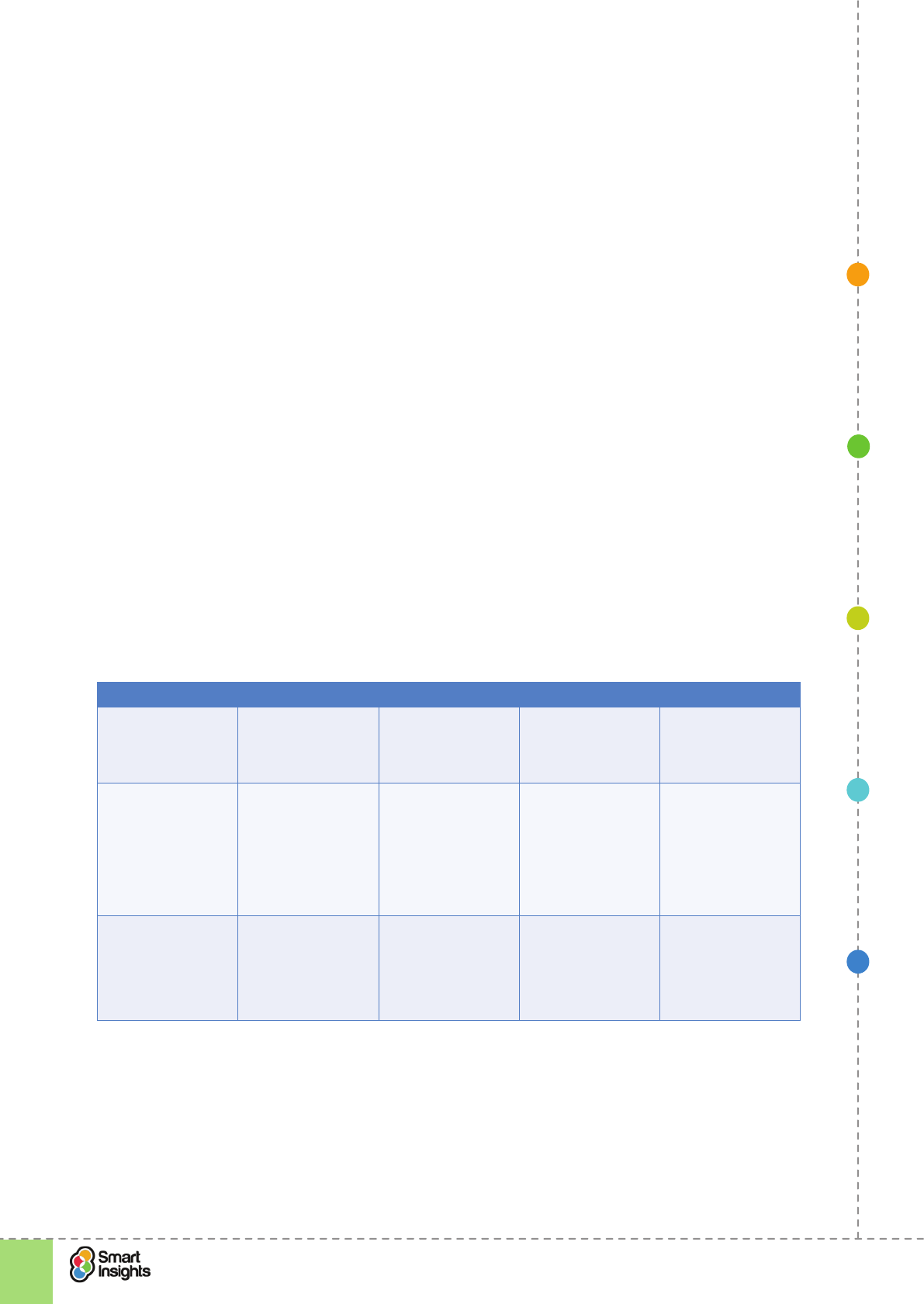
Examples of KPIs by RACE
To help you select the right KPIs within RACE, we’ve taken the full range of measures
covered, from hard sales measures to softer engagement metrics, and combined them into
the table below. We recommend grouping measures like this as you nd out the ones to
select:
1. Commercial measures: These are the harder business or commercial measures
that usually takes the longest to be demonstrable. These are the measures for
the senior managers although they may well also be keen to know about Likes!
Think audience share, sales, leads or at least clear indicators from people such as
satisfaction ratings or percentage that fed back. Remember that these need to be
incremental and ideally attributable to your content marketing.
2. Tactical measures: These include the views, clicks and interactions with your
content – so involves the social shares such as Likes and Tweets. You might also
use link shortening tools to help measure.
3. Brand measures: These are easier for bigger brands or where there’s less
competition, simply because the tools seem to work better in that space. Think brand
or keyphrase mentions, sentiment, share of market mentions over competitors and
certainly site trafc. These are the bigger needles to get moving and often require a
bit more momentum.
Measure Reach Act Convert Engage
Brand measures
Unique visitors
New visitors
Brand/direct visits
Audience share (vs
competitors)
Lead volume
% product/service
interactions
Pages per visit
Sales volume
Lead volumes
Follower or fan volumes
Email list qality
Repeat transactions
Repeat visits
Exit surveys - 4Q
Content
performance
measures
Shake of audience
Key sites with your
content visible in search
Follower or Fan volumes
Share or search /
search presence
(ndability)
Inbound links
Reffering domains
Page engagement rate
(Bounce, pages per
visit, duration)
Shares by users
(sharebility)
PostRank score
Comments and site
interactions
Lead sign-up and
conversion rate by
engagement tool
Subscription to email or
RSS
Activity customers %
(site and email active)
Conversion to Fan or
Follower
% social interactions
with content such as
Fan page comments
Repeat conversion rate
Email open and CTR
Commercial
measures
Cost per click and cost
per sale
Brand awareness
Goal value per visit
Online lead contribution
(£, % of total)
Cost per lead
Customer satisfaction
Goal value per visit
Online lead contribution
(£, % of total)
Cost per lead
Customer satisfaction
Retained sales growth
and volume
Revenue per visit
Revenue per channel
and category
Lifetime value of
customer / loyaltya
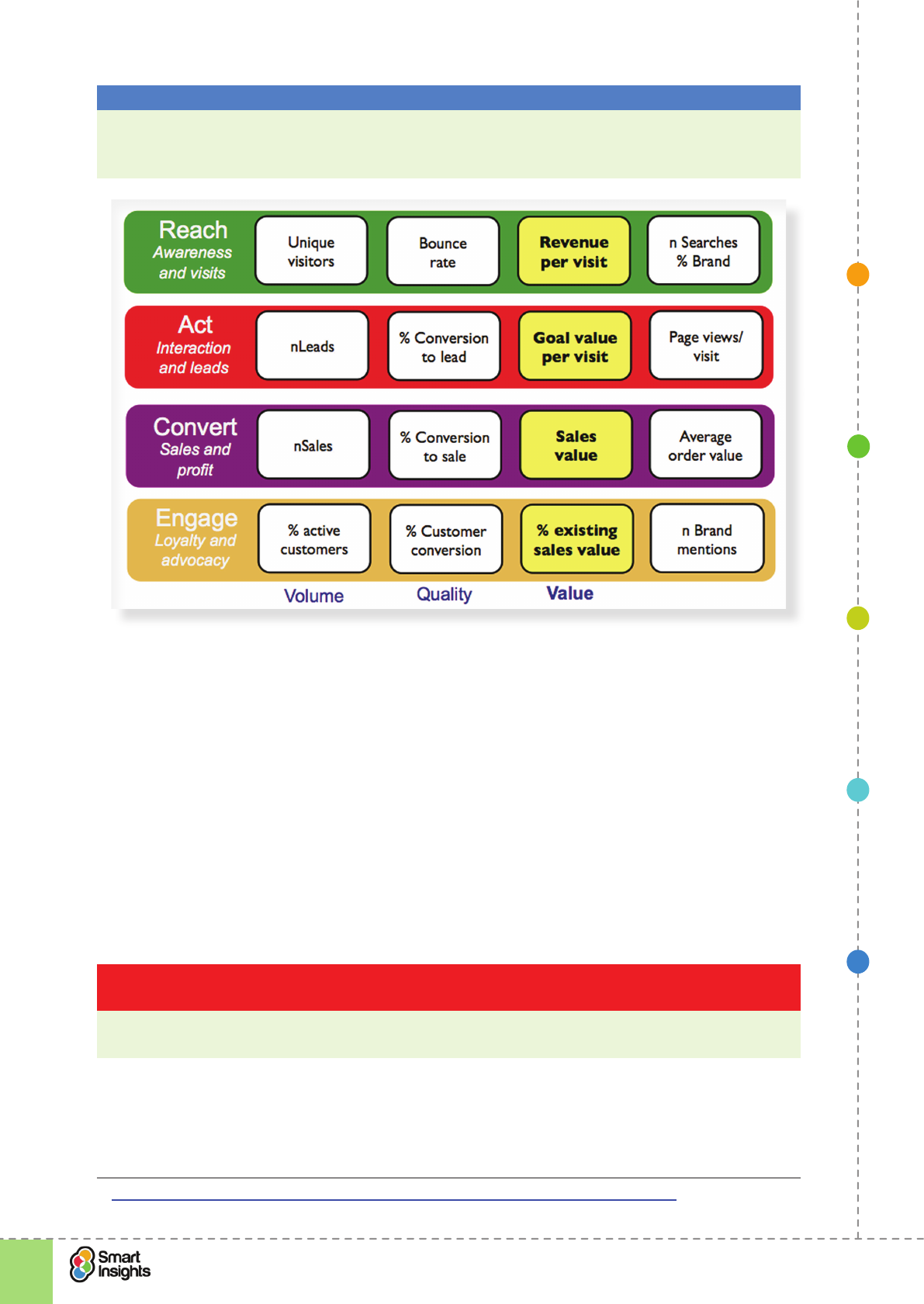
Use this table to select the most relevant KPIs which are relevant for you in a content
dashboard. For example, the next example shows a simplied dashboard taken from our
The next example shows our recommendation of a general digital dashboard taken from
our guide to Delivering Results from Digital Marketing. You could create versions of this
dashboard for specic content types as we will explain in the nal section.
1 Introduction
to ROI calculation
5 Using analytics for
analysis
4 Calculating
content ROI
3 Calculating
content cost
2 Setting goals
and metrics
© Smart Insights (Marketing Intelligence) Limited. Please go to www.smartinsights.com to feedback or access our other guides.
Content Marketing ROI Guide
!
13
2
Best Practice Tip 1 Isolate your dashboard for specic content assets
You should set up reports ltered using Advanced Segments for specic content types e.g.
blog, content page, so you can see which sections of a site and types of content create
value.
So use Advanced Segments in analytics to identify the proportion of each metric that can
be attributed to content marketing and channels related to inbound marketing by reviewing
specic channels or content on the site.
Content fuels social media sharing and content fuels SEO which together comprise inbound
marketing.
It’s that old adage that says the “whole is greater than the sum of its parts”. That’s why you
need to think about how social can help achieve your goals and how you can measure the
effectiveness of both your content (likely to be on your own turf) AND your social activity
(most likely in social channels). For an explanation of the how social media and content
marketing work hand in hand read this post5.
This approach also make sense as increasingly, we see combined responsibilities for SEO,
content marketing and social media marketing within a company.
Strategy Recommendation 6 Measure content marketing, social media and SEO
effectiveness together
Measure content marketing, social media and SEO effectiveness together. It’s difcult to
isolate the different components and they all support each other, so group their contribution.
With this established, you can review the contribution from these two perspectives, media
and content:
5 Smart Insights: How content marketing and social media can work together
1 Introduction
to ROI calculation
5 Using analytics for
analysis
4 Calculating
content ROI
3 Calculating
content cost
2 Setting goals
and metrics
© Smart Insights (Marketing Intelligence) Limited. Please go to www.smartinsights.com to feedback or access our other guides.
Content Marketing ROI Guide
!
14
2
1. Digital media channels that attracts visits to content created as part of content marketing
These channels will typically include:
þSEO
þSocial media
þAdWords of Display advertising (if used to promote content assets)
þDirect (Note that some Social media trafc will be from apps such as Facebook and
Twitter that don’t show the source). If you promote content through ofine trafc, then this
will be evident too.
2. Content groups or types on your site that attract visits through digital media.
Content groups that you can use to evaluate of your content marketing through analytics
include:
þA blog
þA specic section of site devoted to resources (for example the hub pages on Smart
Insights)
þContent related to products and services used to encourage visits through SEO or
conversion
Whether you use the rst or second approach, you can then use analytics to show the
Volume, Quality and Value measures related to content marketing!
Best Practice Tip 2 Tag campaigns and content to help track content effectiveness in a
more granular ways
To help you track the performance of specic content types better you can structure or tag
them to make them more measurable, so you can tag specic content or campaigns with a
specic content convention.
For example, you can show links obtained from a PDF to a site in this way to show the
volume of referrers:
http://www.domain.com/landing _page.php?utm_campaign=<campaign-name>&utm_
medium=pdf&utm_source=<site or partner name>&utm_content=<PDF name>
For more detail on how to tag your content see our 7 Steps Google Analytics guide or this
post6.
Alternative measurement frameworks content marketing
We have shown how we recommend using the RACE framework to dene the effectiveness
of content marketing, but thought readers would nd it useful to review other content
marketing metrics.
In the remainder of this section we will review alternative frameworks that you could use. Of
course, we recommend the RACE framework, but you may nd the other alternatives t the
way of working or way of thinking in your organization or your clients better.
6 Smart Insights: Tagging marketing campaigns
1 Introduction
to ROI calculation
5 Using analytics for
analysis
4 Calculating
content ROI
3 Calculating
content cost
2 Setting goals
and metrics
© Smart Insights (Marketing Intelligence) Limited. Please go to www.smartinsights.com to feedback or access our other guides.
Content Marketing ROI Guide
!
15
2
Jay Baer’s four data “buckets”
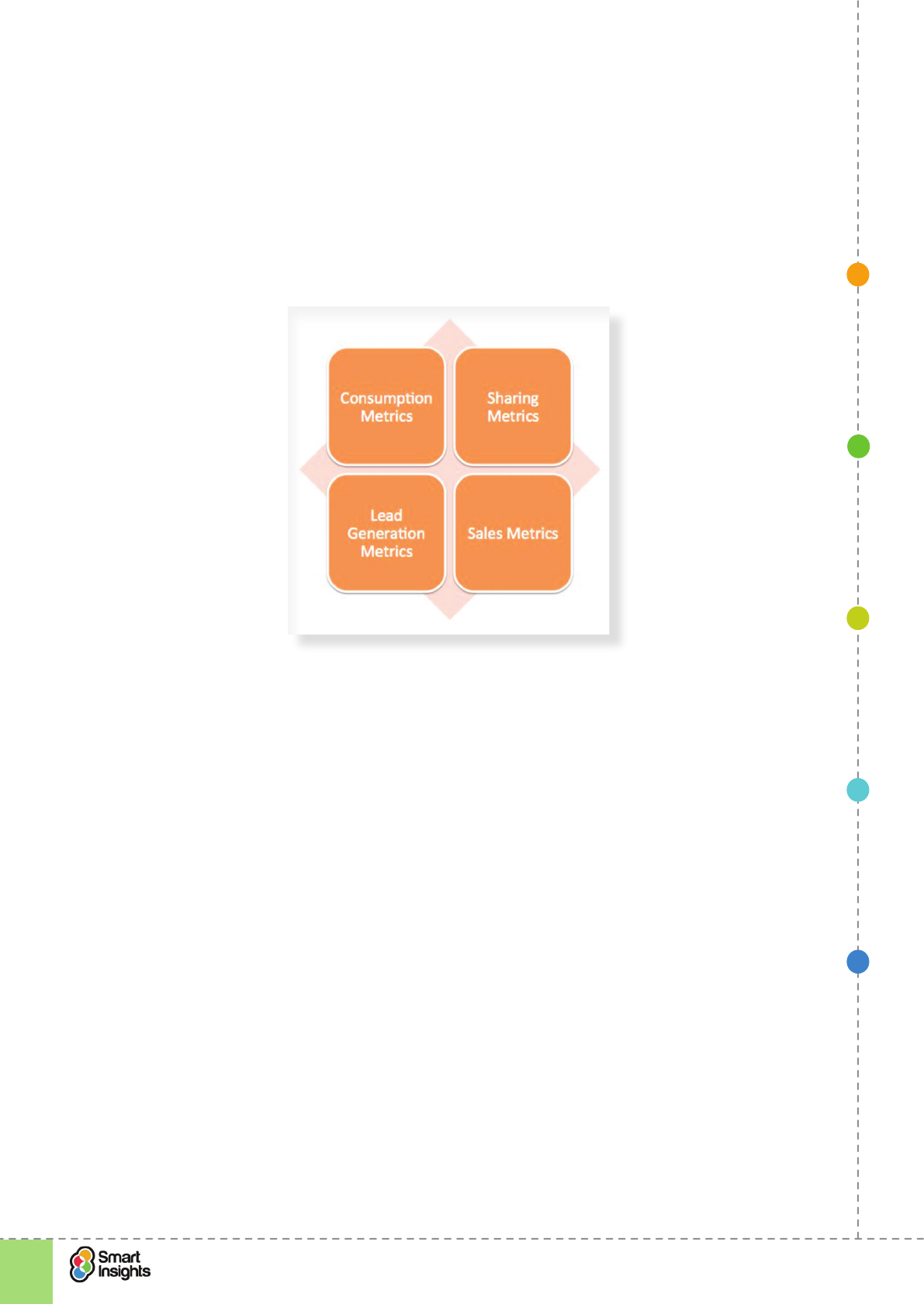
Jay Baer’s “four primary buckets” framework offers a holistic and pragmatic content
marketing measurement model. He recommends using four types of content marketing
metrics: consumption, sharing, leads, and sales. It doesn’t have a hierarchy related to the
buy cycle, although he suggests that most marketers overvalue the rst two (blog page views
and retweets, for example) and undervalue the last two (email subscriptions from people who
rst read the blog and, ultimately, sales from among that group). If you focus your metrics
on behavior, rather than on data aggregation, you’ll be measuring points of greater business
value.
Examples of measures within each of the four “buckets” include:
1. Consumption metrics. This fundamental data point is easy to derive through
Google Analytics, YouTube insights or similar. The metric tells you how many people
consumed your content, measured as page views, downloads or views.
2. Sharing metrics. This metric tells you how successful your content is at getting
consumers to share it with others through social sharing like tweets, Retweets,
‘Likes’, LinkedIn shares, Google+ shares, etc. Free social sharing monitors like www.
sharedcount.com will provide with an accurate real-time measure of how often your
content is shared with others across all social networks.
3. Lead generation metrics. Whether you require registration before allowing people
to read/watch/download your content, or whether you’re measuring leads generated
after content is consumed, this is the metric that determines whether or not your
content marketing effort is making nancial sense.
If you host a lead form on your site, you can measure this by determining how many
people went to the lead form immediately after consuming your content. You can also
set a browser cookie and track when someone lls out that lead form after viewing
your content, even if there is a 30- or 60-day interval between those events. If your
leads are handled via phone, you can install a simple script that shows a different
(trackable) phone number when people have rst watched a video, downloaded a
presentation, etc. This metric tells you many content consumers on your website turn
into leads.
4. Sales metrics. This metric will tell you how often your content consumers turn into
customers. If you’re using a customer and prospect database, such as Salesforce,
1 Introduction
to ROI calculation
5 Using analytics for
analysis
4 Calculating
content ROI
3 Calculating
content cost
2 Setting goals
and metrics
© Smart Insights (Marketing Intelligence) Limited. Please go to www.smartinsights.com to feedback or access our other guides.
Content Marketing ROI Guide
!
16
2
you’ll want to note in the prospect record that the potential customer consumed
content pieces X, Y and Z. Then, when your sales team turns that prospect into a
sale, determine the projected revenue and prot (lifetime value if you can) of that
customer, and assign it to the content pieces that drove the sale.
Avinash Kaushik’s Social media metrics
Although these measures from Google’s Digital Marketing evangelist Avinash Kaushik7 are
specic to social media we have included them here since they show the effectiveness of
content marketing in generating incremental awareness on social media and they also can be
used to review blog effectiveness. The four key measures are:
þ1. Conversation Rate. Measure by:
Conversation Rate = # of Audience Comments (or Replies) Per Post
þ2. Amplication Rate. Measure in this way
On Twitter: Amplication = # of Retweets Per Tweet
On Facebook, Google Plus: Amplication = # of Shares Per Post
On a blog, YouTube: Amplication = # of Share Clicks Per Post (or Video)
þ3. Applause Rate. Measure as follows:
One Twitter: Applause Rate = # of Favorite Clicks Per Post
On Facebook: Applause Rate = # of Likes Per Post
On Google Plus: Applause Rate = # of +1s Per Post
On a Blog, YouTube: Applause Rate = # of +1s and Likes Per Post (or video)
4. Economic Value.
Economic Value = Sum of Short and Long Term Revenue and Cost Savings - measured
through goals.
7 Avinash Kaushik: Best social media metrics
1 Introduction
to ROI calculation
5 Using analytics for
analysis
4 Calculating
content ROI
3 Calculating
content cost
2 Setting goals
and metrics
© Smart Insights (Marketing Intelligence) Limited. Please go to www.smartinsights.com to feedback or access our other guides.
Content Marketing ROI Guide
!
17
2
This is measured through the ROI calculations explained in sections 3 and 4 of this guide and
goal value from analytics in section 5.
It’s a great framework, but suffers in that manual calculations of comments per post or shares
may be needed, but tools such as Hootsuite can help in collecting this insight.
Three categories of data for reviewing content marketing effectiveness
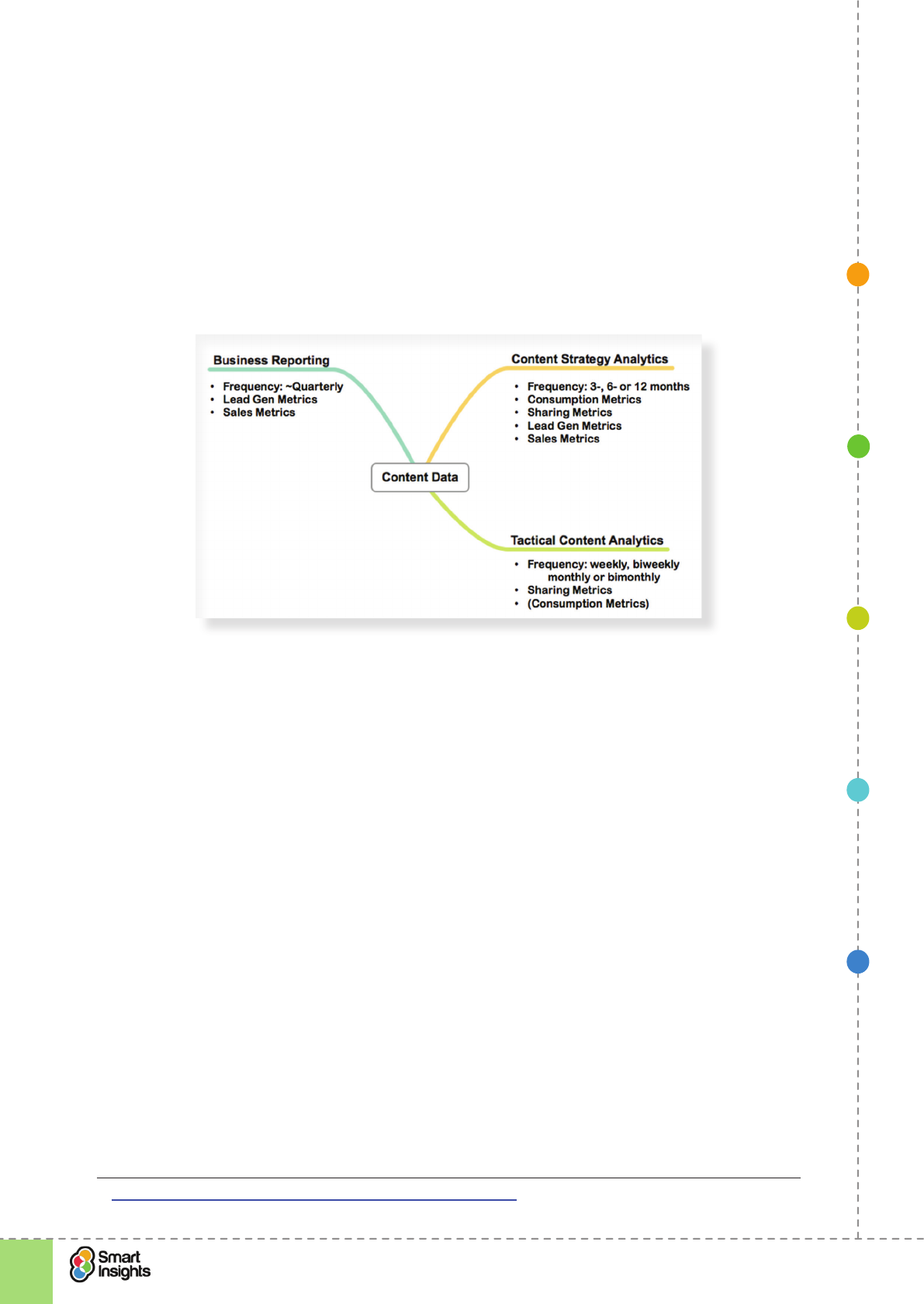
When working at Velocity Partners, Ryan Skinner, now senior analyst of Content Marketing
at Forrester advocated three broad categories of data that help us dene what we need to
measure, each with a corresponding period or duration:
The beauty of this framework is that it reminds us that we need to package data to suit the
needs of different target audiences (as we do in content marketing). In this case we need to
have in mind the a) the C-suite (Business), b) the Division (Strategy) and c) the operational
Team (Tactical), and for each group we customise reporting.
Altimeter Social media ROI pyramid
Altimeter iterate this process of packaging metrics for different audiences in a report8 related
to social media marketing, which recognises that “the seasoned professional provides
executives with business metrics rst. They know fans and followers aren’t a business goal,
but what you do with them is.”
8 Altimeter: Framework: The Social Media ROI Pyramid

1 Introduction
to ROI calculation
5 Using analytics for
analysis
4 Calculating
content ROI
3 Calculating
content cost
2 Setting goals
and metrics
© Smart Insights (Marketing Intelligence) Limited. Please go to www.smartinsights.com to feedback or access our other guides.
Content Marketing ROI Guide
!
18
2
Here’s how this model helps us:
þBusiness Metrics (top of pyramid) are for executives, and everyone else who supports
them, which is everyone. The pyramid is smaller at top as there are fewer metrics to
give to busy executives. There are really only three: increased top line, reputation, and
reduced costs.
þSocial Media Analytics (middle pyramid) is for the Corporate Social Strategist and
the internal stakeholders and internal clients. This a synthesised higher level view of
the Engagement Data (in the tier below), there are no industry standards, so pick one
and benchmark over time. Choose from the metrics in Jay Baer’s model to create your
formulas.
þEngagement Data (bottom of pyramid) is for the teams deploying social media:
community managers, social media managers, developers etc..Collecting this data is
done using social tools tracking tools (Appendix), not forgetting of course your traditional
web analytics. Don’t give this to the top level executives, they’re not interested.
Content performance across the buying cycle
Measuring content performance across all the stages of the customer buying cycle will help
you identify what is working and what is not and ultimately what content marketing tactics
warrant support. Start by mapping the buying cycle from the customer’s stand point (if you
need help with this, see our buyer persona toolkit). Give each stage a name then measure
and evaluate key metrics across the buying cycle. Focus on these critical metrics:
þa) Volume metrics, the number of people you have in each stage, how fast they are
growing over time, and how many are being added each period. iGlimpse, an educational
app developer, observed that more than half of the people who bought its nautical apps
consumed a demo video early in their journey to purchase. That led iGlimpse to multiply
the social touchpoints where consumers could link to the demo video (email blasts,
facebook pages, linked in forums, blog posts, afliate websites etc ...)
þb) Visitor quality or conversion metrics: how buyers move from one stage to the
next. Example: Hubspot, the inbound marketing solution provider, provides valuable
white papers and eBooks for download (I’m sure you know them) and analyses its
conversion rates from marketing lead to sales-accepted lead so it can rene the criteria
for “sales-ready”, which ensures the sales team then emails or calls the leads with the
highest likelihood of conversion.
þc) Visitor value: This is the value of sales generated that can be attributed to content
1 Introduction
to ROI calculation
5 Using analytics for
analysis
4 Calculating
content ROI
3 Calculating
content cost
2 Setting goals
and metrics
© Smart Insights (Marketing Intelligence) Limited. Please go to www.smartinsights.com to feedback or access our other guides.
Content Marketing ROI Guide
!
19
2
marketing. For Hubspot, they dened how content played its part in helping the company
grow its customer base to 8,440 and revenues to $52.5 M in 2012.
þd) Rapidity will tell you how long an average sale takes to close, how fast people are
moving through the stages, and how their time spent in the stages accelerates over
time. Tracking velocity through the stages helps identify the effectiveness of content
used: the content that accelerates the purchasing cycle and that which slows the
buyer’s purchasing down.
Throughout this process you’ll be tracking visits, page views, video views, email open
rates, tweets retweeted, wall posts shared as described in Avinash Kaushik’s framework,
but the key is to know where this data serves its purpose and for which audience it is
destined so that you do not drown your bosses in irrelevant metrics when you meet to
report performance at the quarterly reporting meetings!
Time
Remember to ensure you put your content analysis against sales trends that correspondent
with your typical sales cycle. This is especially true for complex sales cycles of 9-18 months
(not unusual in B2B). For example, if your sales cycle is typically 10 months, deploying a
content marketing pilot across one quarter will be difcult to track. Furthermore your rst
content marketing efforts will always be your worst. And your past and current efforts will be
eclipsed by your later efforts. So measure the rate of improvement.
Frequency of reporting Short term and long term return on content marketing investment
The above frameworks demonstrate that reporting on content marketing ROI needs to create
a reporting system that encompasses both short term fast-cycle returns on tactical execution,
midterm strategic returns and longer term trends that demonstrate content marketing’s return
on investment to all stakeholders.
Tactical Level
(fast-cycle)
Strategic Level
(mid-cycle)
Corporate Level
(longterm)
Report Frequency Punctually, weekly,
bi-weekly, monthly
Bi-weekly,
bi-monthly, quarterly
Quarterly, annually
Content Data Visits, views, clicks,
shares, RTs, fans,
followers, immediate
conversion events
Awareness, overall
trafc volume,
conversions, sales
cycle velocity, SEO
impact of keywords
on SERPs (oragnic),
WOM, social
media penetration,
inbound links
and syndications
achieved by
content, high
prole placements,
conversion events,
new customer
acquisitions, up-sells,
cross-sales
Revenue, Reputation,
PR impact & reach,
Thought leadership,
growth in branded
keyword volumes
from organic search,
invitations to speak
at conference,
invitations to
comment /
guest blog, new
connections with
key inuencers, new
partnerships,
1 Introduction
to ROI calculation
5 Using analytics for
analysis
4 Calculating
content ROI
3 Calculating
content cost
2 Setting goals
and metrics
© Smart Insights (Marketing Intelligence) Limited. Please go to www.smartinsights.com to feedback or access our other guides.
Content Marketing ROI Guide
!
20
2
Tactical Level
(fast-cycle)
Strategic Level
(mid-cycle)
Corporate Level
(longterm)
Example
increased lead
generation from
white paper
download by 20%
over previous
week
added 1500
names to
newsletter list
15% growth in
sales of basic
software package
talking head on
The Bottom Line
(BBC Radio)
The rst level of success is measured by initial fast cycle reach, trafc, leads and
conversions. Strategic level and long-term success is also measured by growth of
relationships with inuencers, publications and the ability for the brand to inuence messages
through those relationships. Growth and cyclical engagement with online networks and
communities expands the company’s ability to grow the reach of its distribution channels
creating a network effect for it’s online marketing.
If incremental and short term increases in new revenue are the only measure of content
marketing success, that will make it difcult to justify the cost of long term creative content
campaigns, social engagement and relationship building. A focus on simultaneous goals
of direct customer acquisition in the short term as well as growing the community at large,
can result in tremendous inuence and momentum in the long term. The investment in an
approach that doesn’t simply measure immediate ROI but aims for category dominance
is strategic. And increasingly, that’s what it takes to achieve the key success factors that
successful companies run their businesses on.
1 Introduction
to ROI calculation
5 Using analytics for
analysis
4 Calculating
content ROI
3 Calculating
content cost
2 Setting goals
and metrics
© Smart Insights (Marketing Intelligence) Limited. Please go to www.smartinsights.com to feedback or access our other guides.
Content Marketing ROI Guide
!
3
21
THREE
Calculating the cost of content
Before we can properly evaluate the returns of content marketing we need to know how much
content marketing costs. This chapter will walk you through a simple but effective costing
model, similar to the one used in publishing. Let’s start by reviewing different types of costs
relevant to content marketing.
Different cost types for content marketing
1 Variable costs
The cost of content marketing varies according to the sophistication of content, the time
spent on researching it, creating and distributing it, and the number of skilled people needed
to work on it.
2 Operational costs
Broadly speaking, the content marketing operation can be divided into 5 cost components:
Plan
Create strategic
structure
Ideate
Generate ow of
ideas
Produce Distribute and
Nurture
generate trafc,
leads, sales
Measure &
Optimise
Customer
Needs
Business
Goals
Personas
Buyer
cycles
Keywords
Content
Assets
Internal
External
Buyer
journeys
Themes
Editorial
plan
Editorial
Style
Format
Promotion
Moderation
Nurturing
Evaluation Optimisation
Purpose Audience Audit Map & Gap Manage Create Market Justify Improve
Some of the costs in content marketing are one-offs or irregular costs, whilst other costs are
recurrent costs incurred on every content project. The point here is that some costs need to
be grouped into overhead.
3 People costs
Working on content marketing activities is very manual, although a degree of automation can
be bought in (this also has a cost) which is easier for larger organisations that want to scale
the process and gain economies.
For the purpose of this guide we’ll consider the team of people needed to run the content
marketing operation to deliver and distribute content. In some instances, the team might also
be outsourced.
Senior Team Middle Management Workforce
Content Strategist
Managing editor
Creative Director
Editorial Manager
Project Manager
Community manager
Graphic designer
Social media manager
Editor (copy)
Proof reader
Social media exec
1 Introduction
to ROI calculation
5 Using analytics for
analysis
4 Calculating
content ROI
3 Calculating
content cost
2 Setting goals
and metrics
© Smart Insights (Marketing Intelligence) Limited. Please go to www.smartinsights.com to feedback or access our other guides.
Content Marketing ROI Guide
!
3
22
4 Production costs
Production costs depends on the type and frequency of content creation. To calculate
product or creation costs, content can be viewed as being either
a) lightweight, frequent and by denition less demanding to create, and
b) heavyweight, with greater, longer lasting impact.
The table shows some typical examples. In Step 4 of our 7 Steps Content marketing strategy
guide we explain that it’s helpful to review content strategy by looking at these two key types
of content.
In his book ‘Launch’ Michael Stelzner, founder of the Social Media Examiner website,
attributes his marketing success to two forms of content that he created and gave away to
attract customers: ‘Primary fuel’, content he created to keep his business moving forward
and ‘Nuclear fuel’, the special content he used to attract the hundreds of thousands of visitors
per month, many of whom later gladly purchased his services (to create a $3 million turnover
business).
What is it? Primary fuel / Lightweight content
Primary fuel is regularly published, free or low-cost content that meets the needs of your
audience. The goal of your primary fuel is to help solve your readers’ problems so they will
become fans and advocates.
What is it? Nuclear fuel / Heavyweight content
Nuclear fuel is carefully designed content with a higher production cost that is designed
to have a lasting impact on signicant numbers of your ideal reader base and possibly
experts.
The dilemma for content marketers is that lightweight content is likely to be cheaper to
produce it typically has less impact and cut-through. Meanwhile heavyweight content is more
costly to produce and will typically have a greater impact – it is more sharing and engaging
if you get right. However, that’s an unknown – depending on the type of content, its impact
maybe less predictable – you can design a viral video, but it won’t necessarily ‘go viral’.
Lightweight content
Largely primary fuel
Heavyweight content
Largely secondary fuel
Blog post
Simple article
Checklist
Article / Interview
Press Release (media announcements)
Podcast
Handheld video
Case Study
Basic Slideshare
Webcast
Infographic
White Paper
Research study
eBook
Professional Video
Mobile App
Event
Table. The two broad categories of content
Your content marketing goals and strategy will dictate whether you choose to put more effort
1 Introduction
to ROI calculation
5 Using analytics for
analysis
4 Calculating
content ROI
3 Calculating
content cost
2 Setting goals
and metrics
© Smart Insights (Marketing Intelligence) Limited. Please go to www.smartinsights.com to feedback or access our other guides.
Content Marketing ROI Guide
!
3
23
on lightweight or heavyweight content. That should be a big question for you! Let’s now
examine the cost of producing and distributing both lightweight and heavier content.
Costing lightweight content
Let’s assume your company decides to invest three solid, 600-900 word, blog posts per
week, sourced either from experts, or from members of the senior team.
rA solid blog post takes an average ve hours to research, write, and edit.
rLet’s assume that the average annual earnings of a solid blogger (external or on the
senior team) is £45,000 annum
rIf that person works 45 weeks in the year and 48 hours per week their hourly cost is
£45,000/2160 hours = £20.83 per hour
rHourly expense of solid blogger = £20.83 (NB this includes no charges or overhead)
rTherefore, the cost of one blog post is equal to £20.83 x 5 = £104.15
rThe annual cost of blogging at this frequency is £104.15 x 3 blogs week = £312.45 x 45
weeks = £14,060.45 per annum (not including overhead)
Best Practice Tip 3 Consider the role of content curation
It’s not the case that unique, original content always gives the best returns. Curating content
sharing infographics, data and visuals from others may be more cost effective and can still
present a brand well if it adds value.
Heavyweight content
Let’s now assume your company also decides to invest 4 heavyweight projects per year.
rA white paper or eBook takes an average 50 hours to research, write, design, edit,
publish, and market.
rLet’s assume that the average annual earnings of a heavyweight contributor (external
such as a well-known inuencer or internal) is £65,000 annum
rWe assume once again that person works 45 weeks in the year and 48 hours per week
so their hourly cost is £65,000/2160 hours = £30.09 per hour
rHourly expense of heavyweight contributor = £30.09 (NB this includes no charges or
overhead)
rTherefore, the cost of researching, writing and editing one heavyweight piece (sometimes
also called epic or nuclear content) equals £30.09 x 50 = £1505
rThe annual cost of heavyweight content at this frequency is £1505 x 4 pieces per year =
£6,019 per annum (not including overhead)
Best Practice Tip 4 Evaluate the value and savings from repurposing and spin-outs
Heavyweight content can have a hidden benet is in that it can repurposed and atomised to
provide a number of lightweight content items. Therefore, focusing resources on fewer big
projects that can “spin out” repurposed content is worth considering.
1 Introduction
to ROI calculation
5 Using analytics for
analysis
4 Calculating
content ROI
3 Calculating
content cost
2 Setting goals
and metrics
© Smart Insights (Marketing Intelligence) Limited. Please go to www.smartinsights.com to feedback or access our other guides.
Content Marketing ROI Guide
!
3
24
5 Content promotion and outreach costs
Promotion includes a wide range of activity from community building activities such as
moderating discussions and commenting on inuential blog posts to tweeting and building
relations with inuencers on Twitter and LinkedIn. There is also paid promotion of content
through Google AdWords and advertising on the social networks.
In essence promotion is executing a plan that uses content as social bait to build customer
relations, customer leads, sales and advocacy. As dened at the beginning of this guide.
For the sake of this costing exercise let’s assume two members of your team spend 90
minutes on content promotion per workday, each.
rLet’s assume that the average annual earnings of a social media / community manager
(internal or agency) is £40,000 per annum
rHourly cost of that person is £40,000/2160 hours = £18.52 per hour (without charges or
overhead)
rTherefore, the cost of promoting content is £18.52 x 1.5 x 2 (people) x 225 days =
£12,501 per annum (in this case there is no paid content promotion)
rTo this cost we’ll add an hour per week for measuring, evaluating and reporting on
metrics £18.52 x 45 weeks = £833
You may also add in some cost for graphic design and for more junior contributions. The
point is this method of cost calculation offers an effective and exible costing framework for
both content marketing and social media promotion. Smart Insights has developed some
hard-working actionable costing and charging spreadsheets that can help you further with the
practical aspects of putting together accurate costing models for your content marketing.
Lightweight content = £14,060.45
Heavyweight content = £6,019
Content Promotion = £12,501
Measurement = £833
Subtotal = £33,413.45
Overhead @ 25% = £8,353.56
Total Cost £41,766,81
Viewed from this perspective, your content marketing investment is equivalent to £42,000/
annum, which is an average annual salary for a mid-level manager. With this cost in mind you
need to decide what your content marketing investment needs to achieve to get a positive
return.
This will generally be the number of incremental leads and so sales achieved in any given
period and for which content marketing has played a role in driving those sales. Having in
place a system that measures throughput and attributes to original referring tactics is the key.
1 Introduction
to ROI calculation
5 Using analytics for
analysis
4 Calculating
content ROI
3 Calculating
content cost
2 Setting goals
and metrics
© Smart Insights (Marketing Intelligence) Limited. Please go to www.smartinsights.com to feedback or access our other guides.
Content Marketing ROI Guide
!
4
25
FOUR
Calculating Content ROI
In section 3, we looked at how you can calculate content marketing costs using the example
of assessing blogging.
In this chapter we’ll look at a calculation framework for evaluating the return on investment
(ROI) of different aspects of content marketing. We’ll stay focused on blogging for business
as a content marketing tactic, because it’s widely achievable for most businesses,
irrespective of size. Then we’ll look at two content marketing success stories to see how the
results were evaluated for Content Marketing ROI (CMROI).
Let’s begin by putting the cost of blogging above into context against the goals, metrics and
KPIs of business blogging:
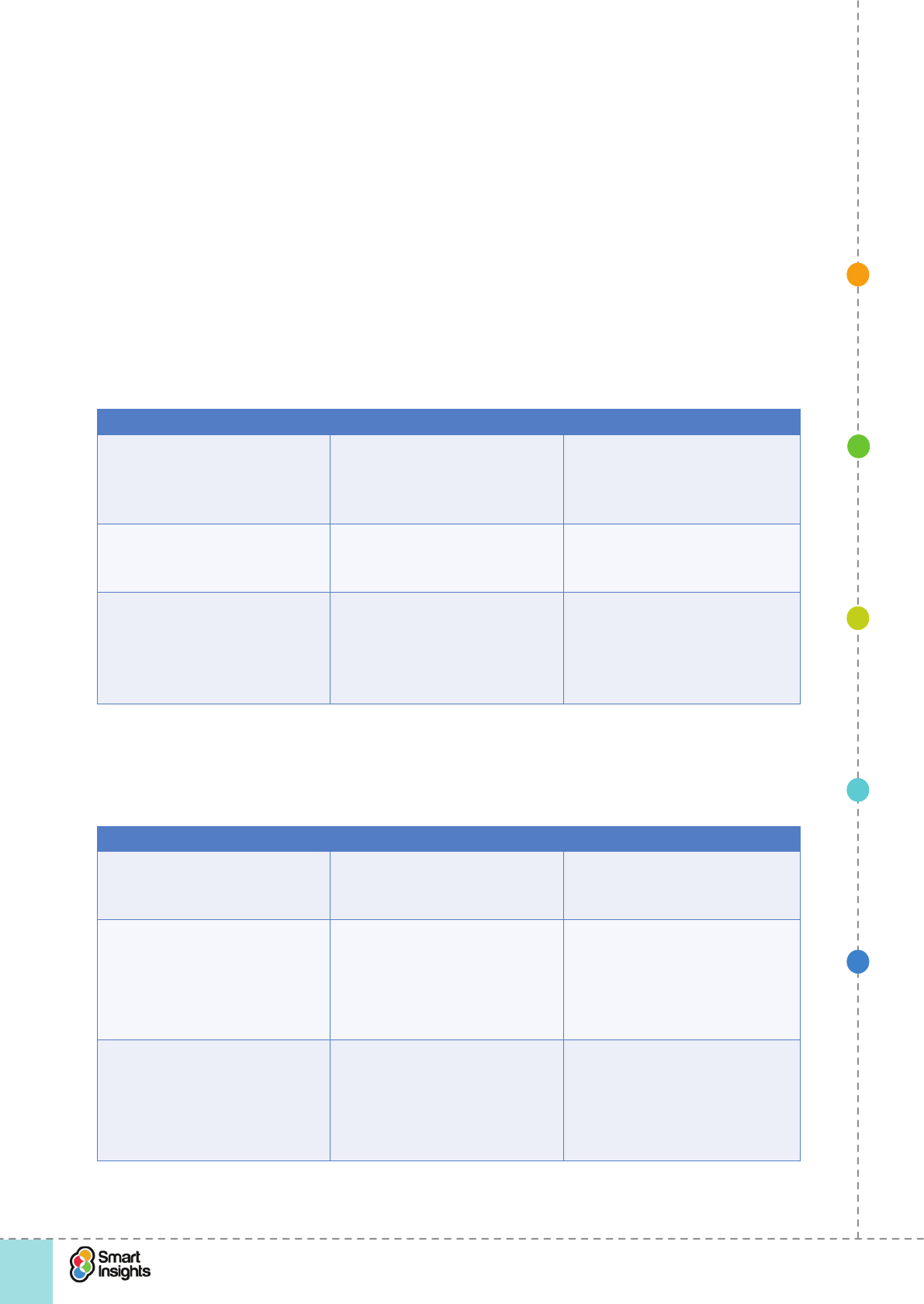
Example blogging goal Metrics Tools
Initiate / foster / maintain
customer engagement
and provide a platform for
interaction
Track reader comments
(engagement)
Communicate with
customers
Comment tracking tools
Improve search visibility and
SERPs ranking with deeper
more frequent content
Improve SERPs for key
words
Link analysis tools
Social media monitoring
Generate new leads online
Build thought leadership
Funnel trafc toward a
conversion page
Shorten buying cycle
by building early brand
credibility
Jay Baer examines business blogging ROI across 3 distinct categories of business blogging
outcome:
1. Blog for content 2. Blog for commerce 3. Blog for community
What: Increase trafc to
website
Improve SERPs
Emphasise lead generation,
rather than trafc generation
Build brand allegiance and
afnity
How: Write with emphasis
on search optimisation with
Keyword inclusion
Educate potential customers
to take action.
Funnel trafc from blog post
to another destination, such
as a lead form
Write to be a resource, not
to sell or convert. When it’s
time to purchase, readers will
think of you rst
Measure: lift in visits,
measure percentage of new
visits, measure lift in visits
from organic search
Measure lift in average
length of visit and lift in
pages viewed per visit
Measure lift in referral visits
from other sites
Measure lift in repeat visits
Lift in RSS subscribers
Lift in comments
Referrals from social media
outposts
We also saw how “Avinash Kaushik’s Social media metrics” on page 16 can be applied to
1 Introduction
to ROI calculation
5 Using analytics for
analysis
4 Calculating
content ROI
3 Calculating
content cost
2 Setting goals
and metrics
© Smart Insights (Marketing Intelligence) Limited. Please go to www.smartinsights.com to feedback or access our other guides.
Content Marketing ROI Guide
!
4
26
blogging.
We will now look at some examples showing how content marketing can be reported on.
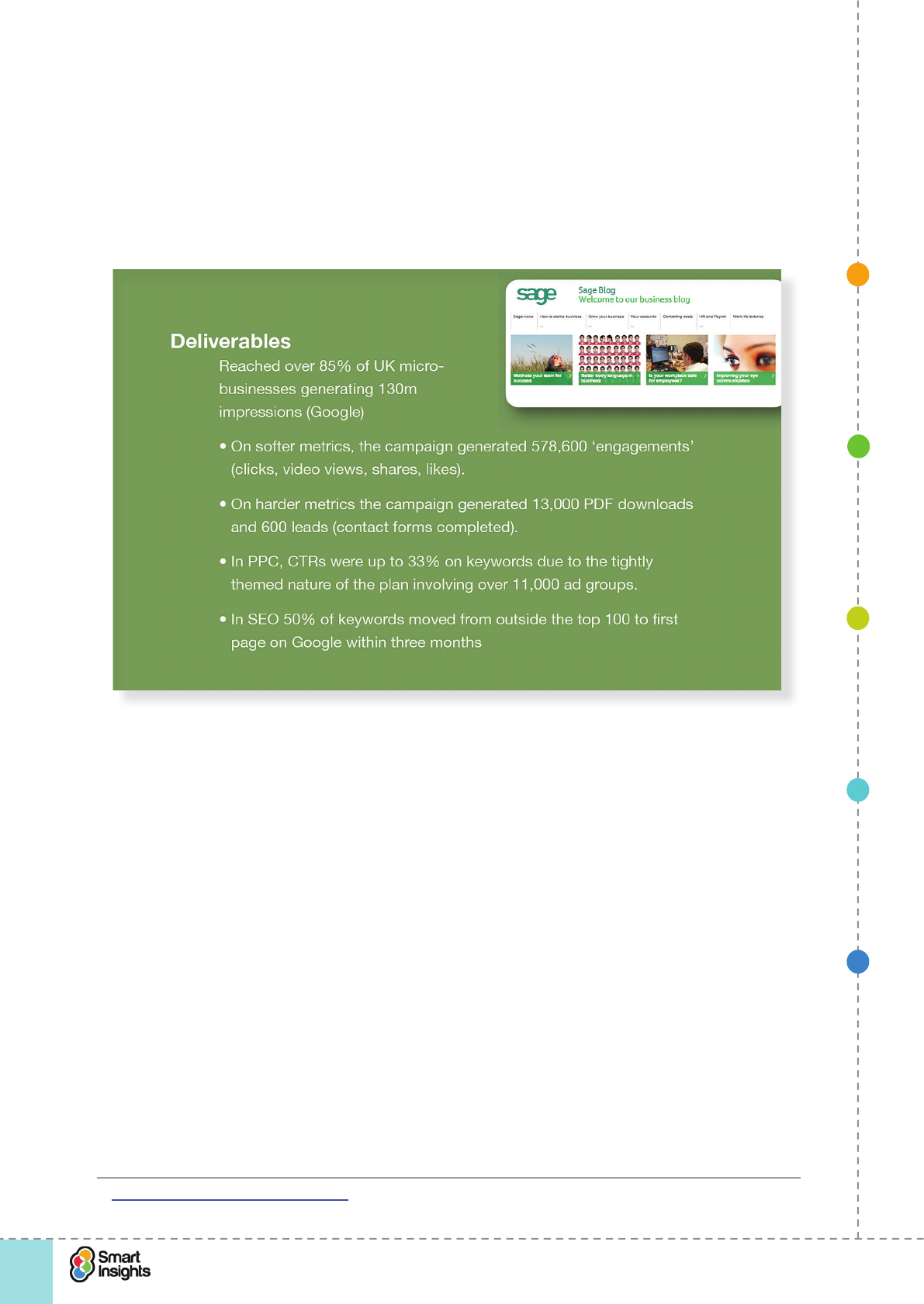
Content Marketing ROI Example #1: B2B - Sage
When Sage decided to engage UK micro-businesses with content in the form of blogs, the
results in these different categories were noteworthy. Here is how they reported them:
Content Marketing ROI Example #2: Not for prot - Rehabs.com
To showcase its “Your Face On Meth” campaign for Rehabs.com, Fractl produced an
Infographic summarising the measurement approach used entitled “The unmatched power of
big content”. This summarised the key success factors and KPIs resulting from the creation
and distribution of powerful content to drive public awareness and engagement of its client’s
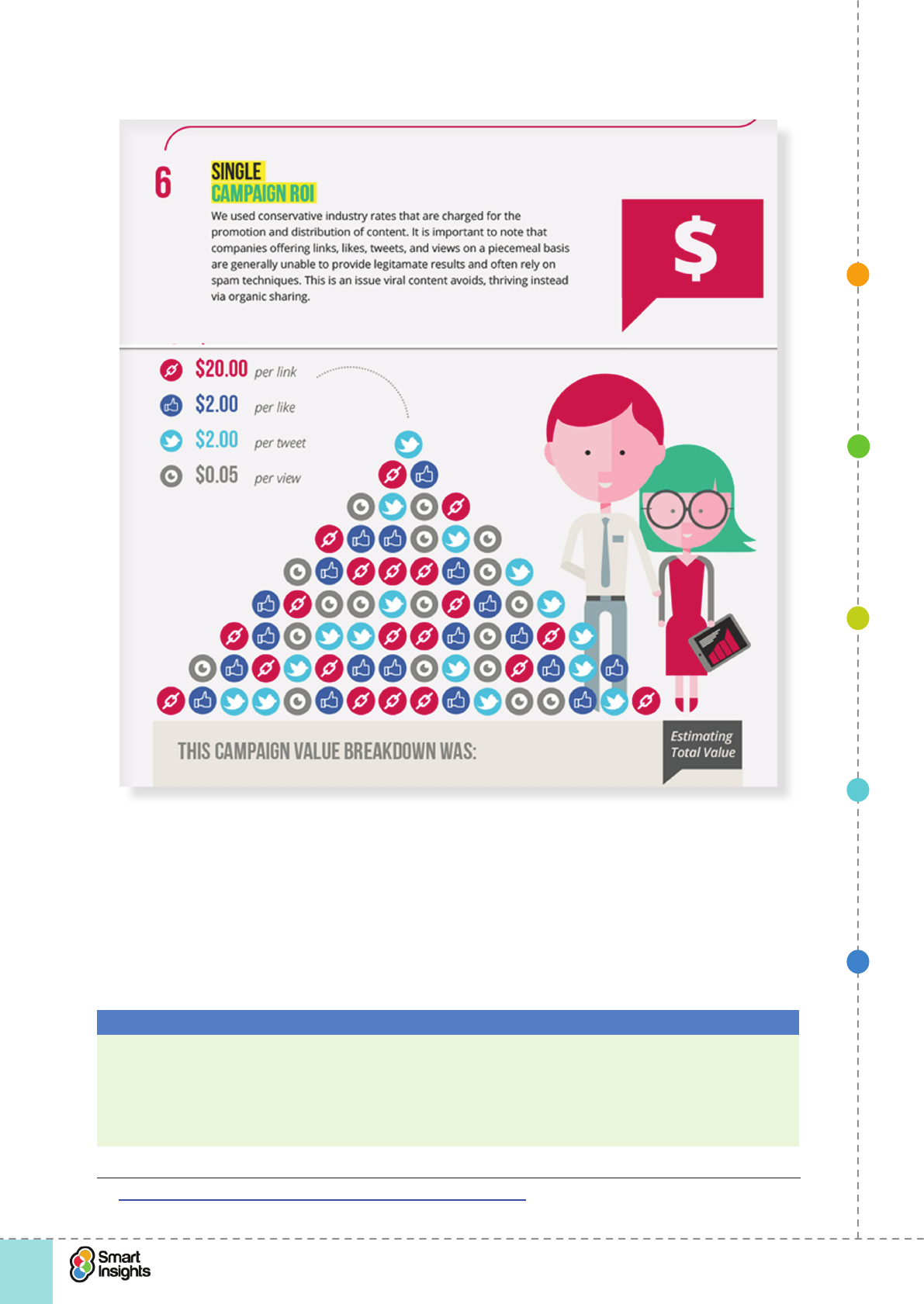
brand and organisation. All the stages of the project are visible here9 (LINK), but for our
purposes we’ll focus on the nal stage, stage 6, of the campaign where we can examine
the project KPIs (views, organic shares, links, tweets, RTs etc) and the commercial values
Fractl used to calculate the return on marketing investment (ROMI) achieved by the content
marketing project.
9 Frac.tl: Rehabs.com case study
1 Introduction
to ROI calculation
5 Using analytics for
analysis
4 Calculating
content ROI
3 Calculating
content cost
2 Setting goals
and metrics
© Smart Insights (Marketing Intelligence) Limited. Please go to www.smartinsights.com to feedback or access our other guides.
Content Marketing ROI Guide
!
4
27
Fractl used its own estimates of commercial rates for sharing to apportion value to the
content’s ability to generate a link, a like, a tweet and a view: $20 for a link, $2 for like, $2
for tweet, $0.05 for a view. We would caution that this approach is subjective as Augie Ray
of Forrester rightly shows in this post10. In his posts estimates from $3 to $300 are given
depending on how the lifetime value of a fan might be mentioned.
Best Practice Tip 5 Place a monetary value on social sharing? Warning!
This approach does allow companies to benchmark different content marketing activities,
but why not just report on the number of shares if the value is so subjective. We show in
section 5 that a better method is to work back from conversion to calculate revenue per
visit for content which is accurate although it doesn’t include the long-term or amplication
value.
10 Forrester: What’s the value of a Facebook Fan? Zero?
1 Introduction
to ROI calculation
5 Using analytics for
analysis
4 Calculating
content ROI
3 Calculating
content cost
2 Setting goals
and metrics
© Smart Insights (Marketing Intelligence) Limited. Please go to www.smartinsights.com to feedback or access our other guides.
Content Marketing ROI Guide
!
4
28
You can see that activities that increase Reach are rewarded most – so sharing is higher than
views. You may argue that these values are excessive, but the method does give a consistent
way to value content.
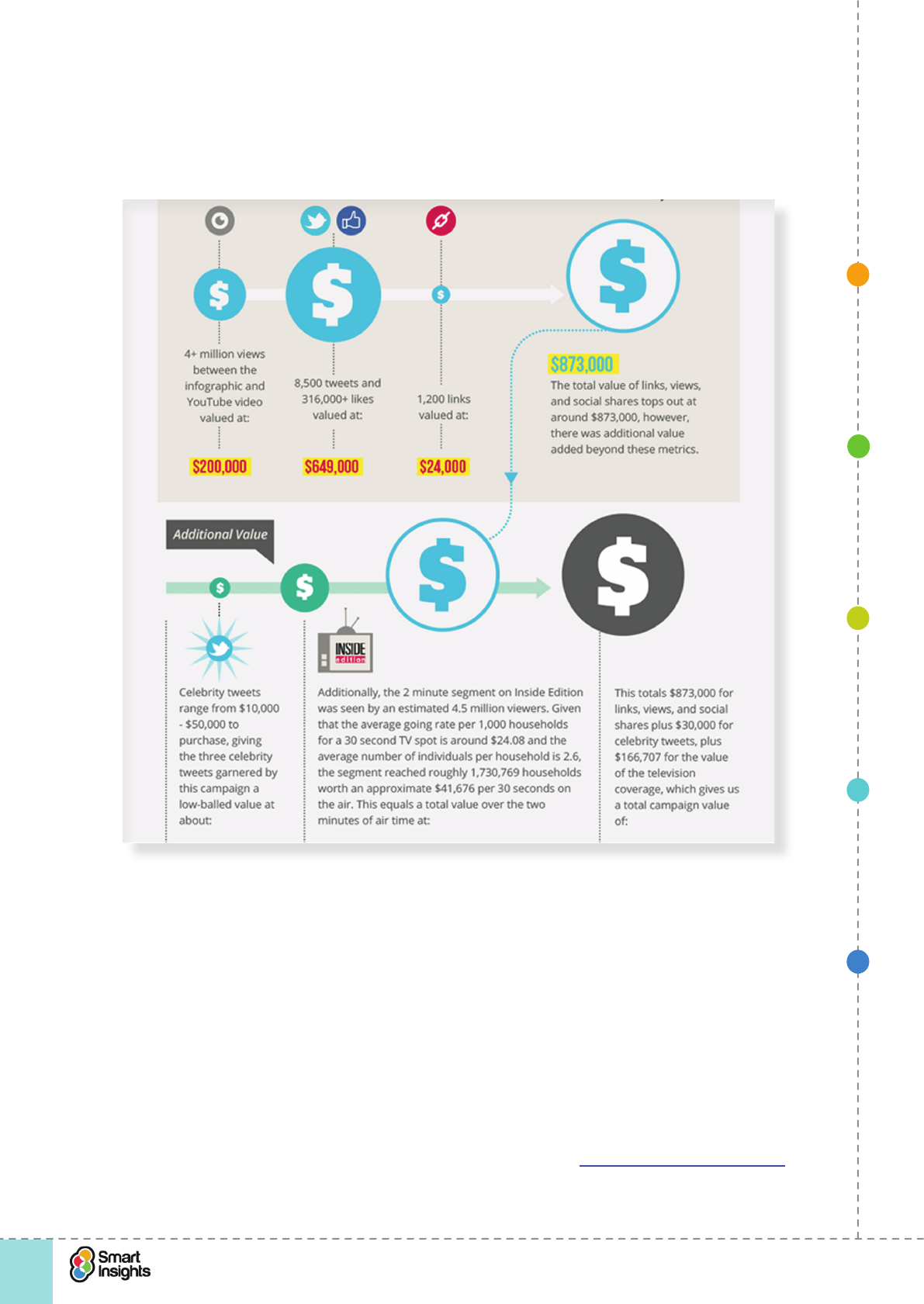
By giving each sharing result an estimated commercial value, Fractl was able to calculate
that the total value of links, tweets and social shares amounted to $873K, and that additional
value was garnered from celebrity tweets ($30,000), whilst two minutes of air time for the
video clip on TV generated $166,000 worth or media exposure for the Rehabs.com brand.
Altogether the content and social media value generated amounted to $1,069,707, which,
when measured against $35,000 marketing spend for the creation and distribution of the
content delivered a rate of 2956 % return on marketing investment - if you believe the
estimates of the values of shares! However, there was clearly a strong amplication effect
here which ultimately this resulted in an 850% increase in qualied trafc from people
searching for treatment and connecting with Rehabs.com treatment.
If you do believe in this approach, Fractl have made their content ROI calculator available
online, so that others can measure their content ROI in this way http://frac.tl/content-roi-calc.
1 Introduction
to ROI calculation
5 Using analytics for
analysis
4 Calculating
content ROI
3 Calculating
content cost
2 Setting goals
and metrics
© Smart Insights (Marketing Intelligence) Limited. Please go to www.smartinsights.com to feedback or access our other guides.
Content Marketing ROI Guide
!
5
29
FIVE
Analysis and reporting techniques using analytics
The methods we have reviewed so far require some large assumptions about the value of
sharing. There is an alternative approach using analytics which looks specically at the real
benets generated by content on the site in terms of conversion to marketing outcomes, i.e.
leads and sales.
This approach has the advantage that it reviews the role of content in generating more
shares leading to visits to a particular landing page or site section. It also looks at how that
content supports conversion across multiple visits. However, it has the disadvantage that it
doesn’t review the intangible impact of content shared in other locations which may generate
awareness resulting in direct visits to the home page which can’t be attributed back to
specic content.
The analysis approach we share in this section involves these steps:
þ1. Dene goals with a specic value for conversion to different outcomes.
þ2. Dene the scope of evaluation – lter results to specic content such as a section on
site, or an individual piece of content.
þ3. Use measures available in Google Analytics to assess value.
þ4. Attributing social media marketing and content sharing using assists in analytics.
We will work through these steps showing examples of how to set up reports in Google
Analytics. This consists of individual product pages like the one you used to download this
guide. Here we’re excluding all blog content which is more important in driving sales.
Step 1. Dene goals with a specic value for conversion to different outcomes
The rst section in our 7 Step guide to Google Analytics explains how to setup goals in detail.
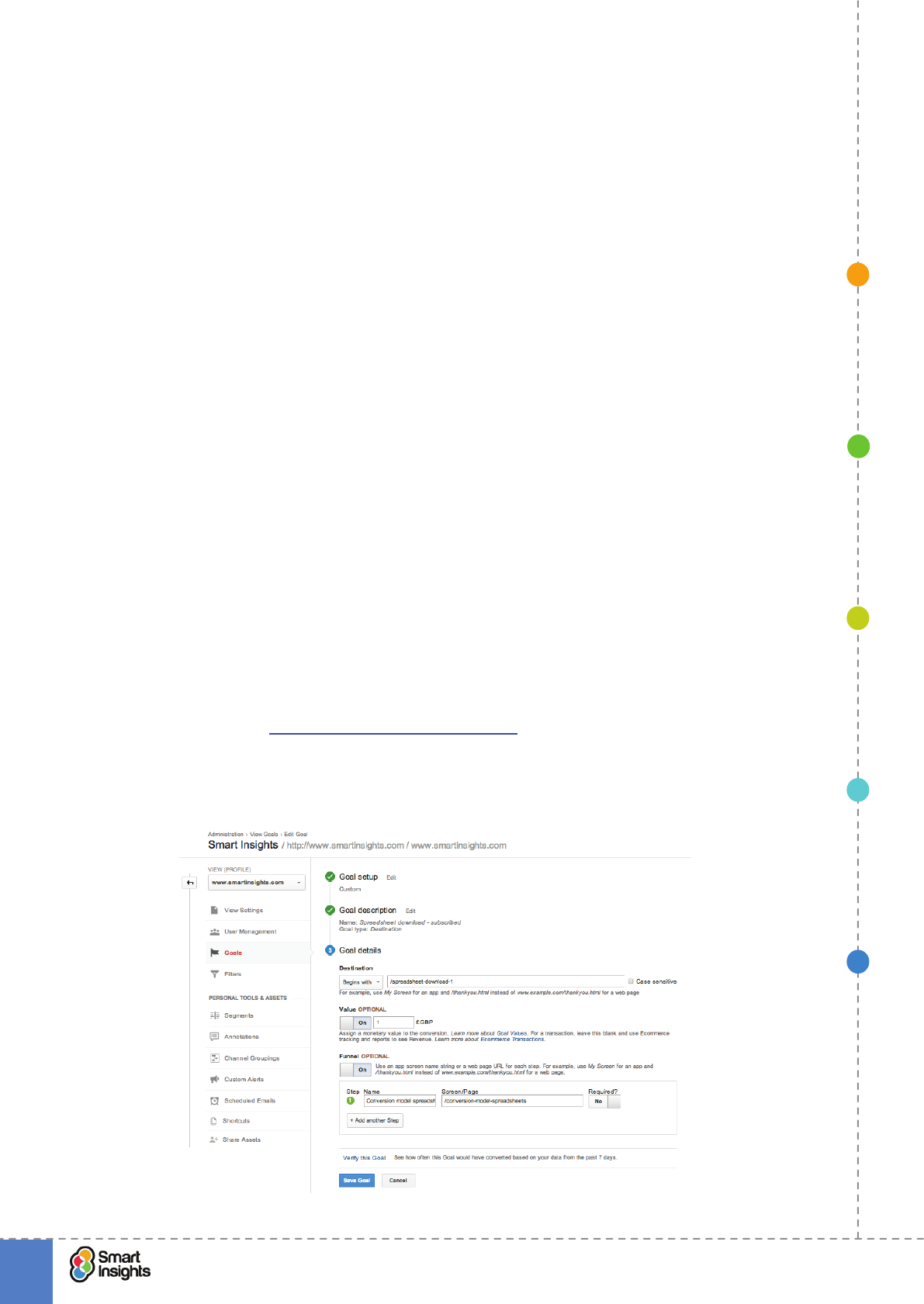
Since this is a short guide we can’t explain the full details here, but here is an example from
the Admin section on Google Analytics of setting up a goal for a thank you page with a value
associated.
1 Introduction
to ROI calculation
5 Using analytics for
analysis
4 Calculating
content ROI
3 Calculating
content cost
2 Setting goals
and metrics
© Smart Insights (Marketing Intelligence) Limited. Please go to www.smartinsights.com to feedback or access our other guides.
Content Marketing ROI Guide
!
5
30
Best Practice Tip 6 Assign a value to key goals on non-Ecommerce sites
To assign a value to goals, you need to determine the value of different lead types based
on rates of conversion from lead to sale and average selling price as explained in section
1. For example, after someone downloads a brochure the value could be $5 while a phone
callback could be $10 since there is a higher propensity to convert in this case. These
values need to be assigned in value box for the goals pages as shown above.
If you are running an Ecommerce site and have Ecommerce tracking enabled, you don’t
need to assign goal value since sales value will automatically be assigned to the visitor who
purchased and then attributed to content and referrers that inuenced that sale.
Step 2. Dening the scope of evaluation – a specic section of content on site, or an individu-
al piece of content
By default, Google Analytics shows visits, leads and sales for content regardless of whether
it is a content marketing investment. To prove the value of content we need to isolate each
content type. This works best if content is labelled or named consistently.
Best Practice Tip 7 Group and group content marketing resources to help users
and for trackability
Through grouping content marketing resources you can both isolate their value to users
by just reporting on these in analytics and measure it more effectively. For example, all
resources, could be in folder /resources, all blog content under /blog or specic advice type
labelled.
If you are labelling content URLs or titles systematically, you can then use Google Analytics
‘Segments’ (formerly ‘Advanced Segments’) to limit reporting of value to this content. This is
again explained in more detail in our 7 Step guide to Google Analytics - see Step 4.
What is it? Google Analytics Segments
Different types of site visitors can be isolated to compare in their volume and quality to
others. You can select from standard segments or dene custom segments
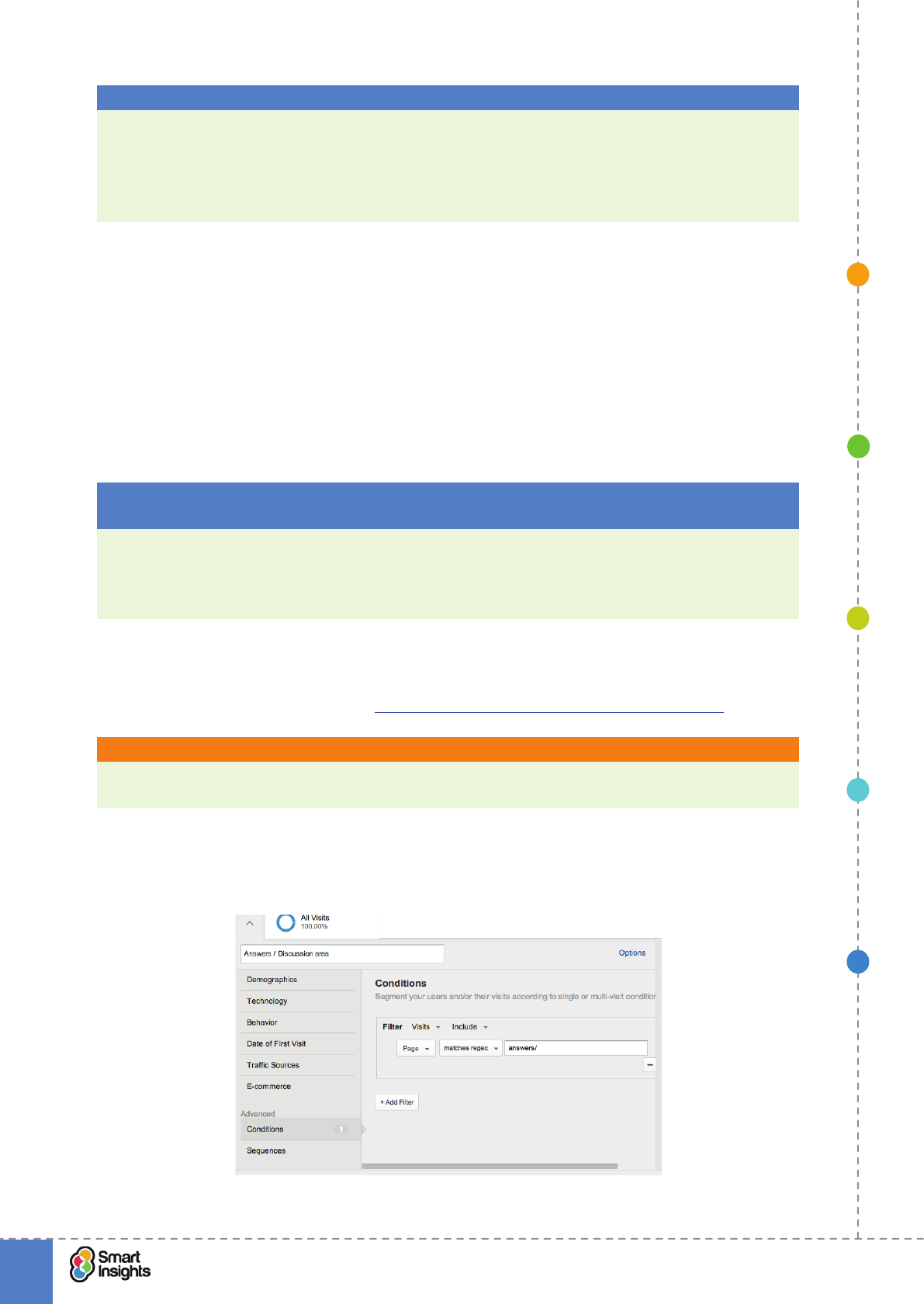
Advanced segments are set up for content using different conditions based on Page (the
URL) as shown in the example below which restricts reporting to all pages within the Smart
Insights Answers forum.
If multiple segments are setup, for example for blog content and guide (product) pages in
1 Introduction
to ROI calculation
5 Using analytics for
analysis
4 Calculating
content ROI
3 Calculating
content cost
2 Setting goals
and metrics
© Smart Insights (Marketing Intelligence) Limited. Please go to www.smartinsights.com to feedback or access our other guides.
Content Marketing ROI Guide
!
5
31
our case, we can then select multiple Advanced segments of different content types and
compare their relative contribution side-by side. You can review the contribution of specic
content types in this way using different reports in Google Analytics, for example:
þ1. Content - the landing pages or content drilldown reports under Behaviour in Google
Analytics
þ2. Referrers - different trafc reports shown below in the Acquisition reports in Google
Analytics
þ3. Keywords - show which content sections and pages attract visits, for example using
the new Webmaster Tools report - see below - which still work now Not Provided has
removed most Keywords data from analytics.
Best Practice Tip 8 Use Advanced segments or Advanced Filters to review the contribution
of different content through a common string
You can review behaviour across a page type such as all category pages, all pages within
a category or all product pages by specifying a range of pages which contain the relevant
string.
An example of applying this is ltering approach to see relevant content is available in more
depth in our SEO video tutorials (Tutorial 3. Using Google Analytics new Google Webmaster
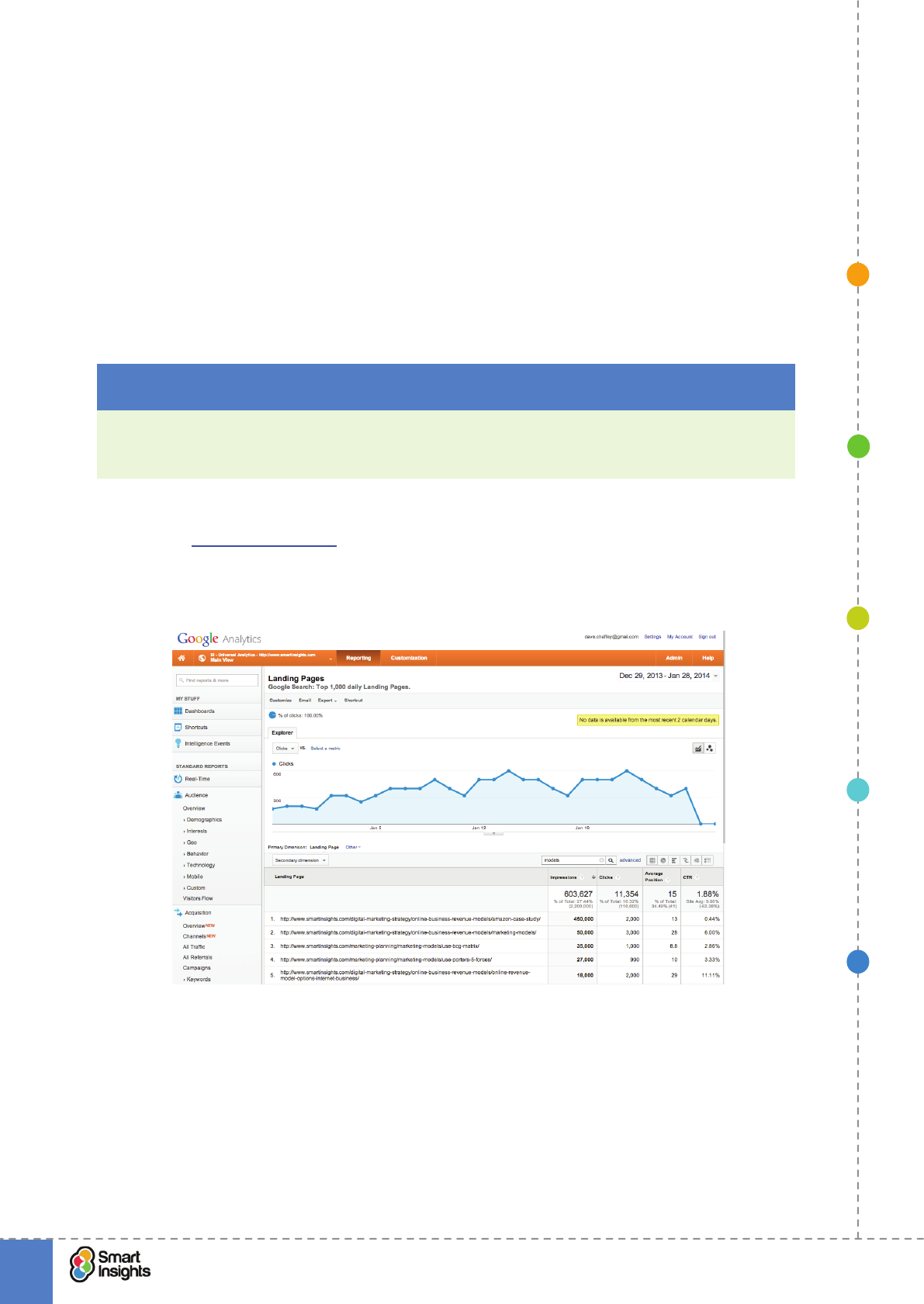
Tools). This example shows how we just report on landing pages with the string “models”
which we featured in a series of 10 or so posts on this topic.
The chart shows we have recorded over 10,000 clicks in this month period for URLs
containing ‘models’. To see leads or sales revenue generated we could setup an Advanced
segment for trafc entering the site as these URLs.
Step 3. Use measures available in Google Analytics to assess value
Once we have the goals and goal values assigned and segments set up, then we can use the
reports to prove to ourselves, colleagues and clients how well different types of content work.
Here’s the thing that many don’t know about Google Analytics, once a goal completion page
1 Introduction
to ROI calculation
5 Using analytics for
analysis
4 Calculating
content ROI
3 Calculating
content cost
2 Setting goals
and metrics
© Smart Insights (Marketing Intelligence) Limited. Please go to www.smartinsights.com to feedback or access our other guides.
Content Marketing ROI Guide
!
5
32
is visited OR an Ecommerce transaction is completed, Google automatically assigns the
value of goal or sale back across:
1. All previous pages a lead or purchaser visited previously in the session.
2. All previous visits from different media (recorded through a cookie).
This is powerful for reviewing content and promotion effectiveness! Once this assignment
from outcomes working back to previous touchpoints on or off the site has been completed
by Google Analytics11, then you can review effectiveness with Google’s 3 really useful
measures for assessing value.
Best Practice Tip 9 Use these 3 key measures to compare value for different content
þ1. Page Value. This shows the inuence of pages in generating value either through
e-commerce transactions or conversion goals with a value assigned.
Page value is available within the Top content reports.
þ2. Per Visit Goal Value. This is best for non-e-commerce sites which should have a
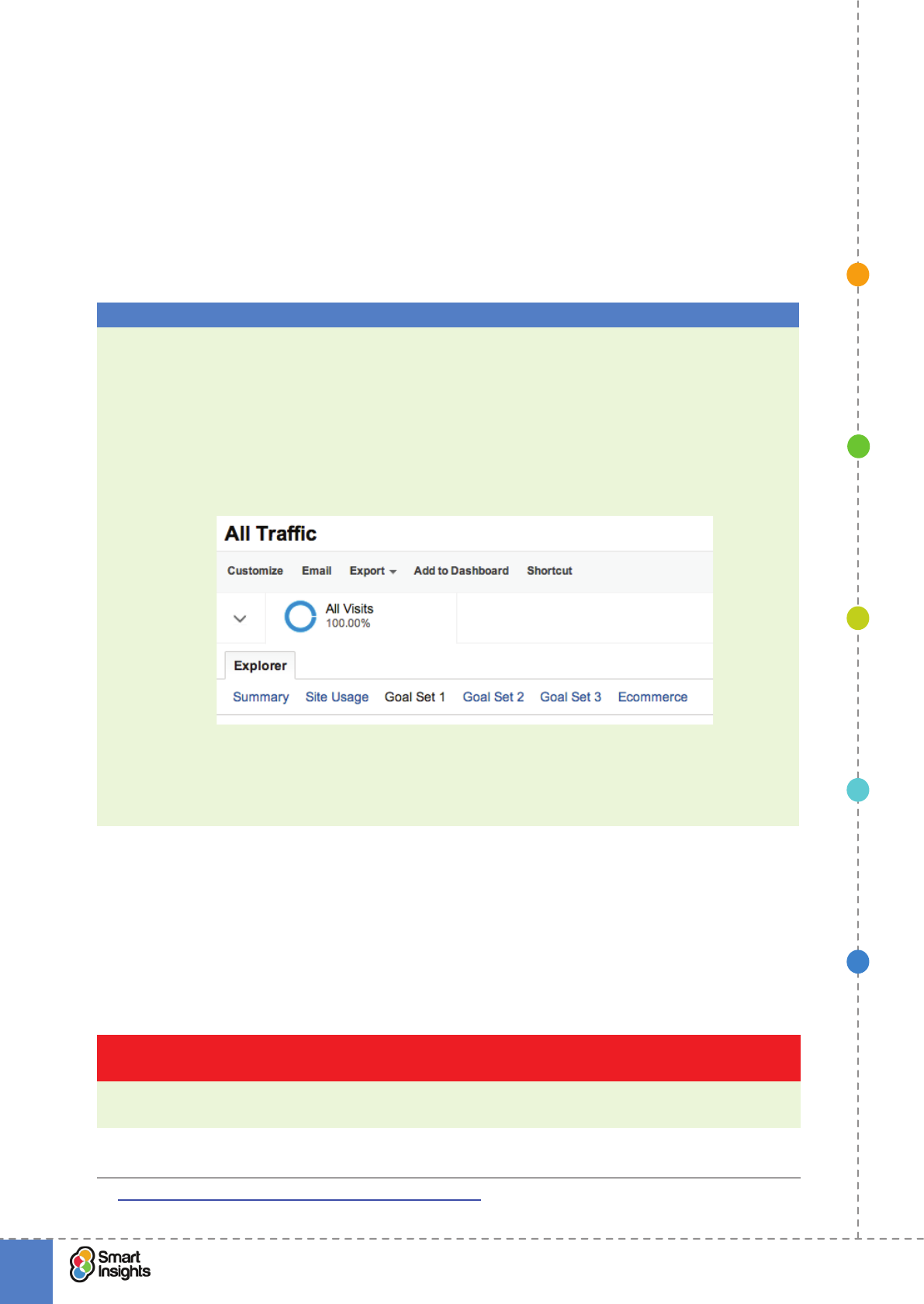
value assigned to conversion goals as have just explained. You can see per Visit Goal
Value in the Top Goal Set menu of the Explorer tab within the Trafc sources reports
like All Trafc, All Sources and Campaigns.
þPer Visit Value. This is best if you have a transactional e-commerce site. You can
see Per Visit Value measures within Trafc sources on the Ecommerce tab if you have
e-commerce tracking enabled.
Step 4. Attributing the impact of content distribution and different content types across differ-
ent sessions or visits to a site.
Until this point in our description and using these reports we have made a huge assumption
- that is that visitors to the site who convert, convert in their rst visitor session. Of course,
this may be true for some visits, but in many case it won’t be, particularly where high value or
high consideration products are involved.
Strategy Recommendation 7 Use multi-channel funnels to help prove the value of content
assets and content distribution throughout customer journeys
Use ‘multichannel funnels’ to show how social media marketing or display advertising
contributes ‘assists’ to sale earlier in the path to purchase.
11 Google Analytics: How Page Value is calculated

1 Introduction
to ROI calculation
5 Using analytics for
analysis
4 Calculating
content ROI
3 Calculating
content cost
2 Setting goals
and metrics
© Smart Insights (Marketing Intelligence) Limited. Please go to www.smartinsights.com to feedback or access our other guides.
Content Marketing ROI Guide
!
5
33
This example12 shows how a B2B company is able to show the value in Referrals from
partner sites and social networks in generating leads:
You can access this report from the Conversions menu in the left sidebar – it is labelled
Multichannel funnels, Assisted conversions. In this case it shows the importance of organic
search in creating assisted conversion. It also shows some assists from Social Networks
where a rst visit is from social media, but conversion occurs in a later session.
First content interaction analysis
Extending this approach, Himanshu Sharma has written up an in-depth approach explaining
how to do this which you may want to explore13. This involves these steps:
þ1: Head to ‘Assisted Conversions’ Report (under Conversions > Multi Channel Funnels)
þ2: Click on the link ‘First Interaction Analysis’.
þ3: Click on the ‘pivot table’ button:
þ4: Create a pivot table with following specications:
Primary Dimension: Source/Medium
Pivot By: Landing Page URL
Pivot Metrics: First Click Conversions, First Click Conversions Value
12 Smart Insights: An example of applying Multichannel funnels to content analysis
13 Smart Insights: Building a content marketing dashboard in Google Analytics
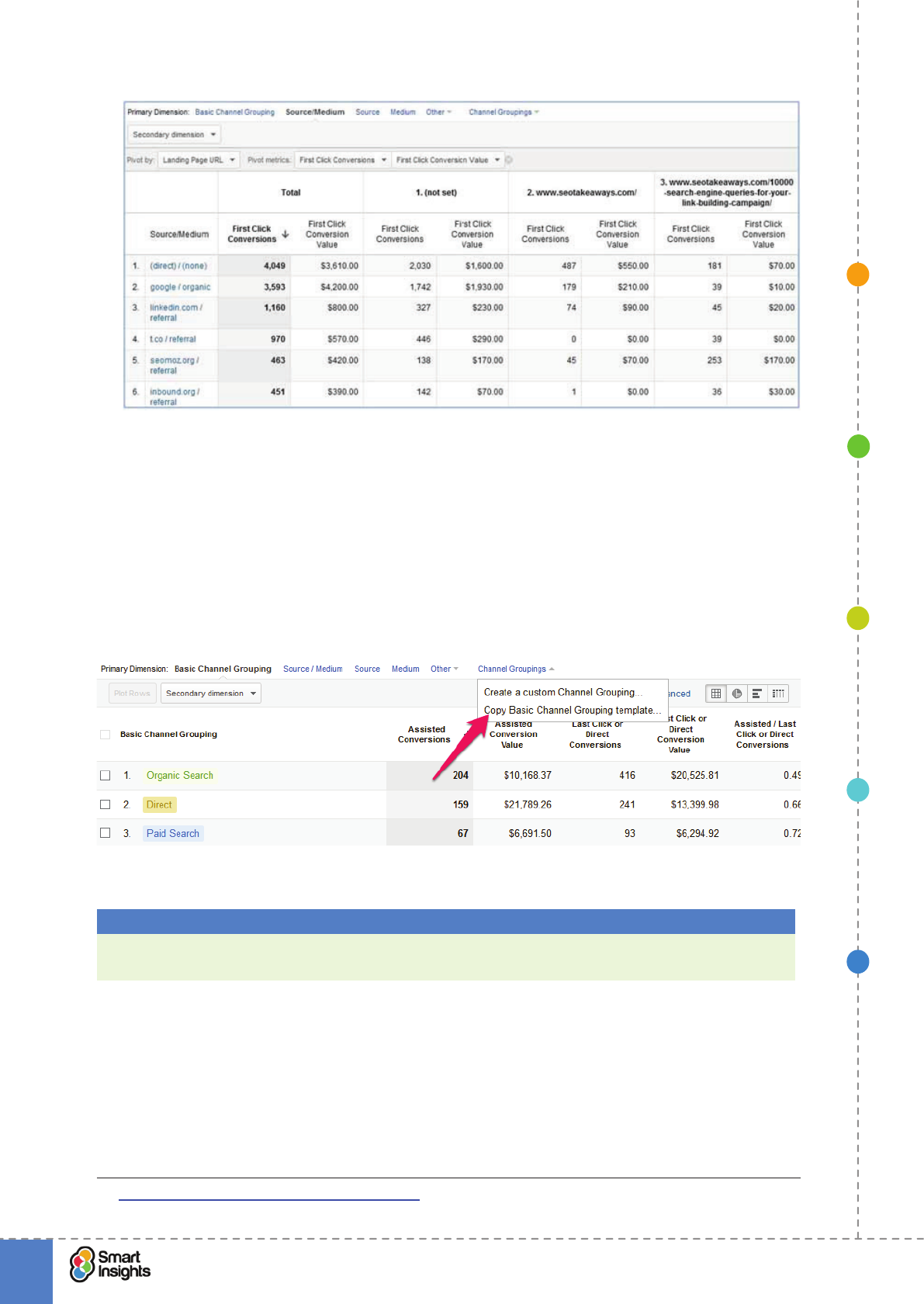
1 Introduction
to ROI calculation
5 Using analytics for
analysis
4 Calculating
content ROI
3 Calculating
content cost
2 Setting goals
and metrics
© Smart Insights (Marketing Intelligence) Limited. Please go to www.smartinsights.com to feedback or access our other guides.
Content Marketing ROI Guide
!
5
34
You can see that rst click conversions are shown for different types of content - the third
page is a content page. He has further steps that involve a lter to review an individual
content type, group or page, but this could also be an advanced segment.
Using basic channel grouping analysis
This approach can be extended further by using a customisation option, again within
Multichannel Funnels. This Moz post14 shows how you can go beyond the basic Assists
report and report on content groups as well as channels.
Best Practice Tip 10 Use Basic Channel Groupings to review content impact
Through selecting a landing page URL for a particular type of content you can determine
which content impacted conversion from a rst visits where it was an entry or landing page.
The next example shows how you could create a content group called “Resource Centre”
14 Moz: Basic Channel Groupings analysis
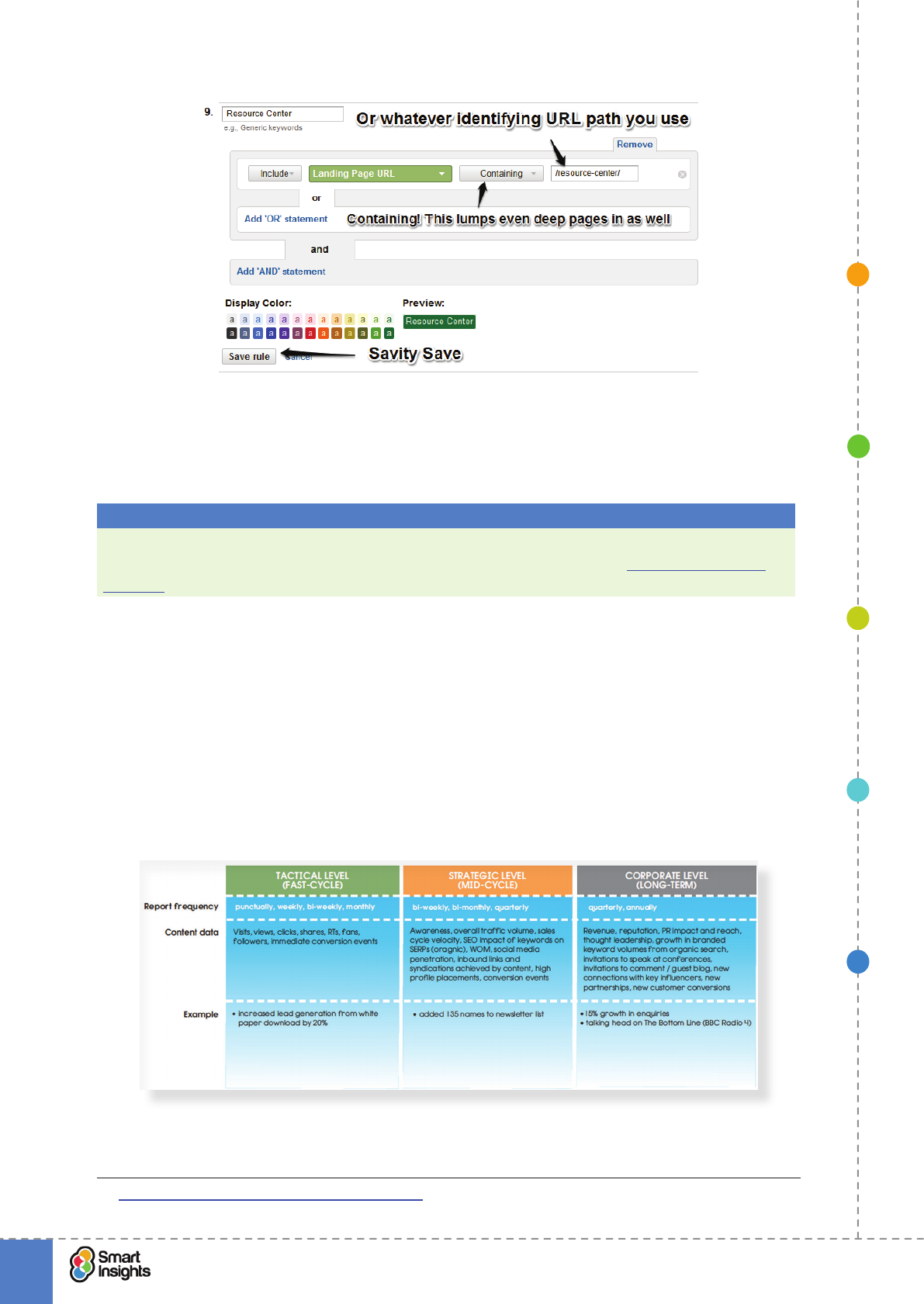
1 Introduction
to ROI calculation
5 Using analytics for
analysis
4 Calculating
content ROI
3 Calculating
content cost
2 Setting goals
and metrics
© Smart Insights (Marketing Intelligence) Limited. Please go to www.smartinsights.com to feedback or access our other guides.
Content Marketing ROI Guide
!
5
35
One you have dened one or more groups of content in this way, you can then see how they
generate assists. See the full post for details - it’s important to drag this custom grouping to
the top so that Google’s analysis picks up these entry pages rst.
Best Practice Tip 11 Setup dened content groups in Google Analytics
Since this Moz post was written Google has introduced another technique which should
make these techniques easier to apply - see this introductory post on Content Grouping
Settings.
Creating actionable dashboards
In his blog post The “Action Dashboard”15 (An Alternative To Crappy Dashboards), Avinash
Kaushik tells us not to squirrel multiple metrics, but instead, to select the “critical few” metrics
that inform C-level management, and allow decision making.
This advice resonates perfectly with our recommendations in section 2, to create three levels of
content marketing reporting based around audience needs and reporting frequency:
To avoid the colourful “data puke”, Avinash Kaushik recommends an action dashboard
15 Avinash Kaushik: The Action Dashboard
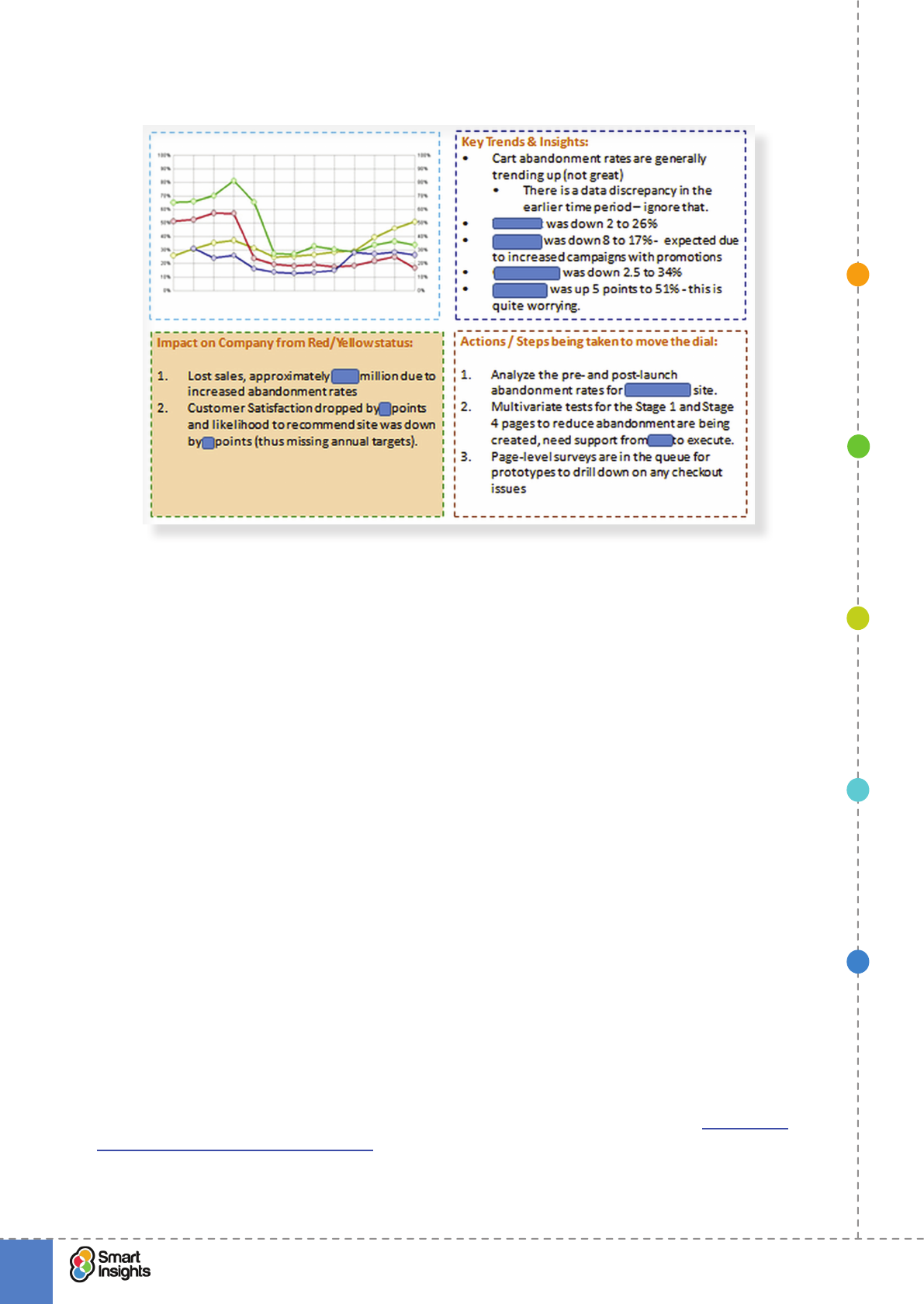
1 Introduction
to ROI calculation
5 Using analytics for
analysis
4 Calculating
content ROI
3 Calculating
content cost
2 Setting goals
and metrics
© Smart Insights (Marketing Intelligence) Limited. Please go to www.smartinsights.com to feedback or access our other guides.
Content Marketing ROI Guide
!
5
36
comprising the following elements, laid out in a quadrant:
(Source: Avinash Kaushik)
An action dashboard like the one above comprises the following information:
1. The rst box (top left) shows the visual trend (up/down) for a chosen metric. This
satises executives early curiosity.
2. The information in Key Trends & Insights (top right) demonstrates that you know
what you’re doing, and where to focus attention, and wins you the condence of
executives.
3. The information in Actions / Steps To Take (bottom right) identies the root cause for
the trends in the metric and recommends solid action to take.
4. The Impact on Company/Customer (bottom left) helps those executives helps chivvy
those executives who may still be unclear about why the business needs to take
action.
With this form of reporting Avinash promises “you’ll gain a lot more trust from your executives
and all the crappy dashboards (you create) can die and be replaced with this one.”
Where to from here?
With a solid content marketing plan and content marketing evaluation model that aligns your
content marketing activities to your core business goals, you can demonstrate via metrics
how your content marketing activities contribute to demand generation and business growth.
Through knowing what works and what doesn’t, you can then focus your content marketing
efforts and optimise the approach.
If you have any questions or comments about any of the approaches discussed, please ask
us via our members’ discussion area.
Stephen Bateman and Dave Chaffey
