Guidance WorkforcePlan Aug2013 Guide Workforce Plan
User Manual:
Open the PDF directly: View PDF  .
.
Page Count: 12

As endorsed by CPMB 2013/8 (29 August)
1
OPERATIONAL WORKFORCE PLANNING GUIDELINES
INTRODUCTION
This document outlines workforce planning principles and elaborates on HR-related processes which
need to take place alongside the preparation of Operational Work Plans for strategic objectives in
2014-15 (OWP), particularly those described in Step 4, High level Skills mix assessment, and Step 5,
Resource planning and risk assessment, of the OWP general guidance.
Workforce planning is undertaken in order to ensure that an organization has the right people, with
the right skills and competencies and at the right time. The process is based on priorities expressed
through the operational work plans and provides FAO managers and HR professionals with a tool for
making human resource decisions now and also into the future.
In summary, workforce planning aims to predict the future demand for different types of skills and
seeking to match it with supply of staff.
The results of the workforce planning exercise will be used throughout the 2014-15 implementation
cycle defining the human resources strategies in the areas of recruitment, mobility, learning and
development, in order to ultimately generate the capacities and skills required by SOC Teams.
The purpose of these operational workforce planning guidelines is to describe the steps required to
analyse the current workforce capacity and capability needed to deliver established outputs, products
and services:
Workforce capacity – How much?
Workforce capability – What?
Refers to the ‘availability’ of the workforce to do
work, for instance the absolute numbers of staff
and employees (including NSHR) available within a
given skill set. The dimension of workforce capacity
can be used to describe the present and future
requirements and any gap between the two.
Refers to the skills and knowledge base of the
workforce. Workforce capability can be used to
describe current skills, including latent capabilities
(that is, capability not currently being fully utilized),
vs what may be required in the future and any gap
between the two.
PRINCIPLES
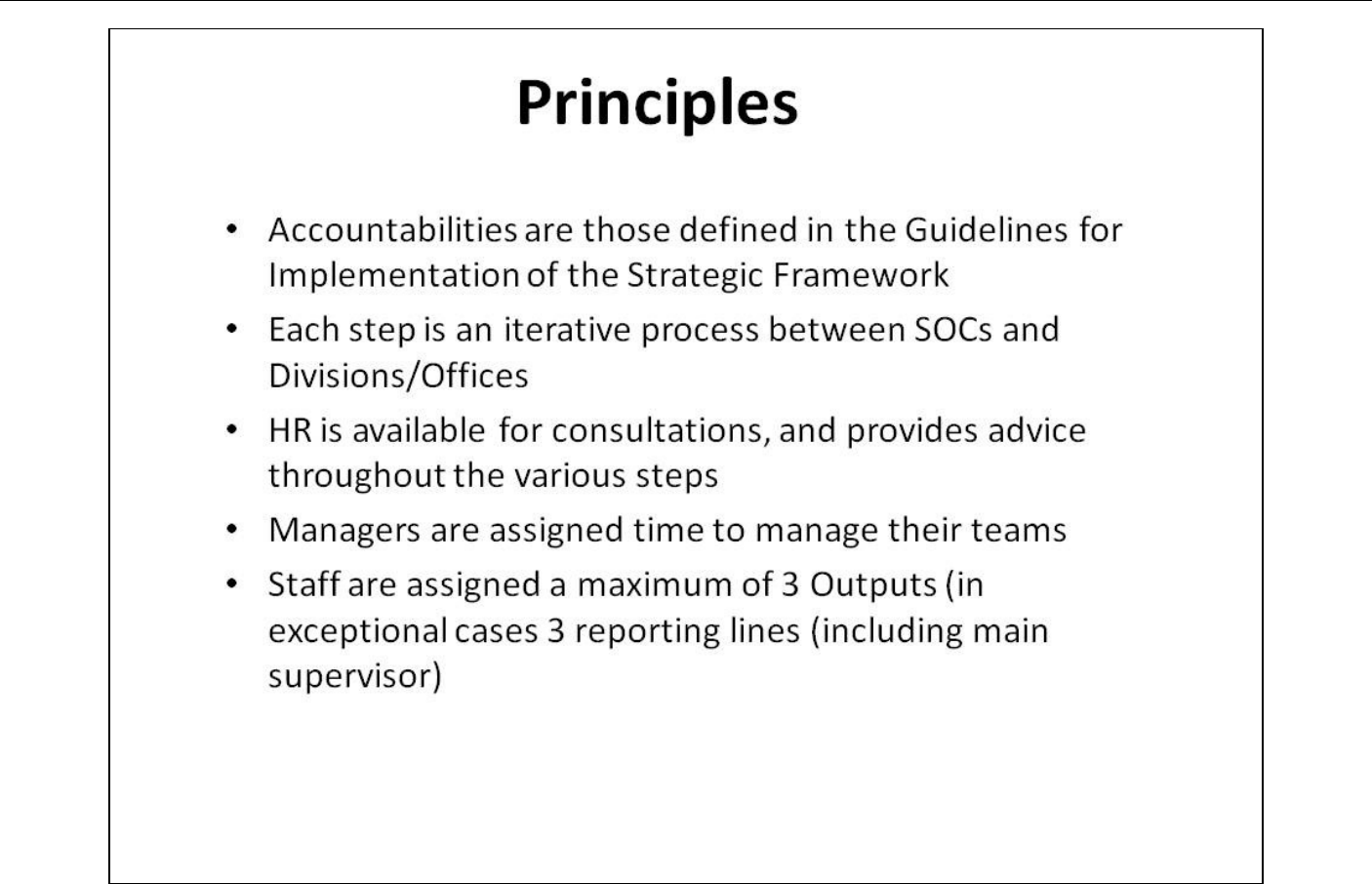
- Workforce planning is an integral part of operational work planning
- Staffing levels and profiles should be aligned with financial and programmatic requirements
- Accountabilities which have been established in the Guidelines on the Implementation of the
Strategic framework also apply to the workforce planning exercise.
Step A – Demand Analysis – SO Teams identify levels and profiles requirements for outputs in
general terms
To be undertaken in concurrence with Step 4 of OWP – high level analysis
Note: Step 4 of the OWP, High level Skills mix assessment (September), is performed in parallel to Step
3 of the OWP, Formulation of products and services (Output/Outcome Team leaders and SO
Coordinators, ADGs/ROs (September – Beginning October).

As endorsed by CPMB 2013/8 (29 August)
2
The Demand Analysis consists in identifying what SO Teams need in terms of capacity and capability to
deliver its outputs now and in the future. SO Teams are invited to capture, in general terms, the job
levels, functions and skills that are required to carry out outputs and products and services.
The purpose of this step is to summarize and capture the general requirements of SO Teams, and to
prepare an inventory of functions, skills and knowledge areas which SO Teams consider as priority.
This “inventory” will inform the next Step of the process to assist SO Teams and the Heads of technical
units and Regional Offices ADGs (ie Contributing Units) in quantifying the demand and then carry out a
gap analysis. The information and analysis will inform HR Division on the actions it needs to put in
place to assist with some of the identified gaps to include in recruitment, mobility and/or learning
strategies and plans.
Who to consult
This is an iterative process between SO teams and Contributing units (led by SO Teams). HR division
assists in the consultation process and provides guidance in establishing the inventory of capabilities
identified both in terms of functions, knowledge areas and skills.
Deliverable (by end September)
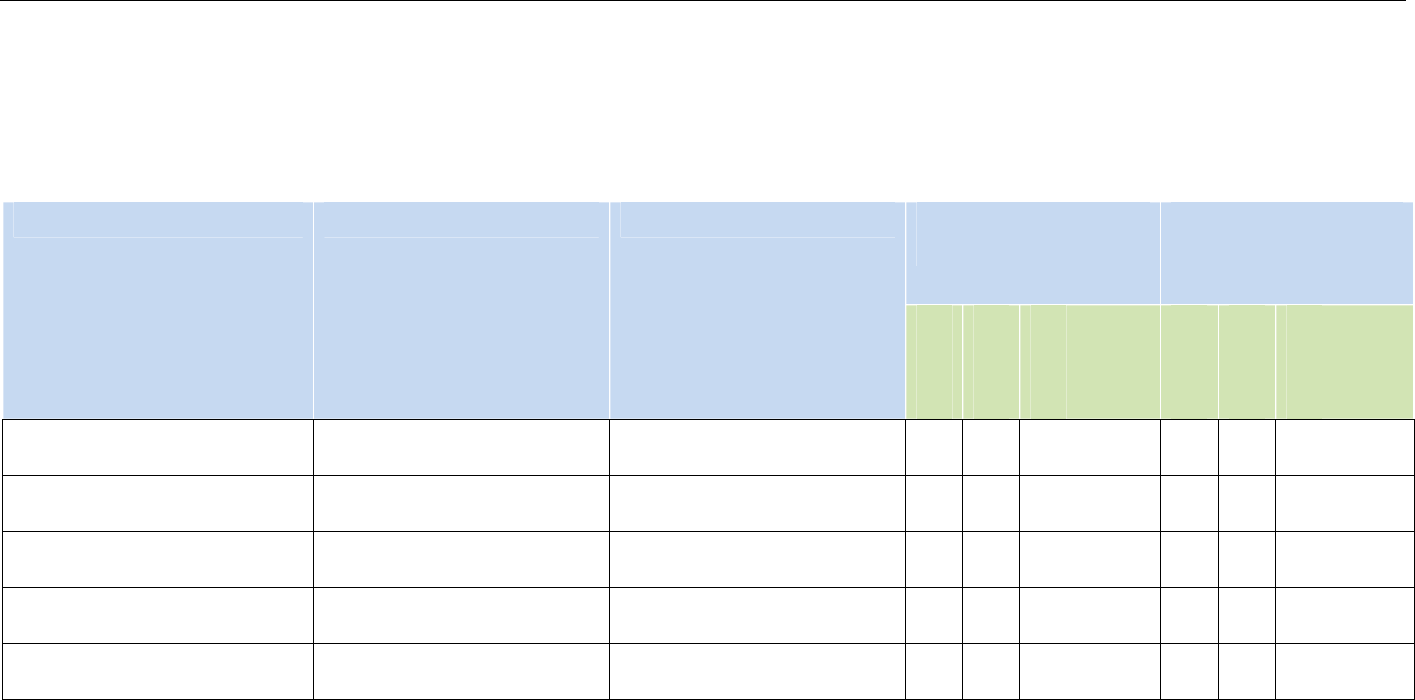
SO Teams prepare the questionnaire in Annex 1, sign off by SOC and sent onto contributing divisions
for review, with copy to HR.
Step B - Supply analysis – Contributing divisions in collaboration with HR and SOCs
Contributing divisions review the demand analysis submitted by SO teams together with the
requirements for corporate technical activities and initiate the supply analysis. As with demand,
workforce supply is analysed in terms of both its internal and external components. Internal supply
refers to the workforce you actually have both in terms of capacity and capability. External supply
refers to both the potential sources and availability of staff to join your team. Both components should
be analysed using a current and future focus.
• Identify the gap between current supply and future demand over the forecast period
• Identify the key time points that skills and capabilities are required and in what numbers
• Review vacant positions and determine whether abolitions or changes to profiles/levels are
required
Step C - Gap analysis – Contributing divisions in collaboration with SO Teams and consultation with
HR Division
The purpose of this step is for contributing divisions to identify gaps especially in terms of shortages
(insufficient amount of skills) and surpluses so HR division, in consultation with SO Teams could
recommend measures how to fill the gaps through internal capacity review and/or development,
external recruitment and partnerships. Contributing divisions should record any potential gaps in
Annex 2 “Gap Analysis.
The questions to ask during this stage are:
• What job function, level and role, skill and capability shortages and surpluses currently exist in
your unit?
• What vacant positions need to be revised (in terms of job functions and/or levels) or abolished?
• What is the gap between your current workforce demand and your future workforce demand?

As endorsed by CPMB 2013/8 (29 August)
3
• Which are the most critical gaps now and over your forecast period (in terms of staff and non staff)
• When are your most critical gaps?
• Which are likely to be the most critical gaps in the future?
• What are the risks?
HR division, through its focal points*, will consolidate these analyses (quantified both in terms of staff
/non staff) which will form the basis for decisions to be made for the next Step D.
* See attached table for list of HR focal points.
Who to consult
This is an iterative process led by contributing divisions with SO Teams and HR division.
Deliverable
Annex 2 to be prepared and communicated to HR who will compile and share it with all SO teams.
Step D - Allocation of time by Divisions/Offices in consultation with SO Teams (end-September)
This step refers to Step 5 of OWP: Resources planning and risks assessment (by all units in PIRES)
Contributing divisions plan posts in PIRES as described in Step 5 of OWP, guided by the results of
demand and supply analysis.
As a general rule, contributing divisions need to ensure that staff are not allocated to more than three
Outputs i.e. should not have more than 3 main appraisers of their work (supervisor in technical unit, as
well as output team leaders). This is required to ensure that a number of managerial functions can be
carried out in the areas of Performance planning and evaluation and day-to-day administrative
supervision.
Step E – Staffing proposals by contributing divisions
Contributing divisions enter the staffing proposals in PIRES.
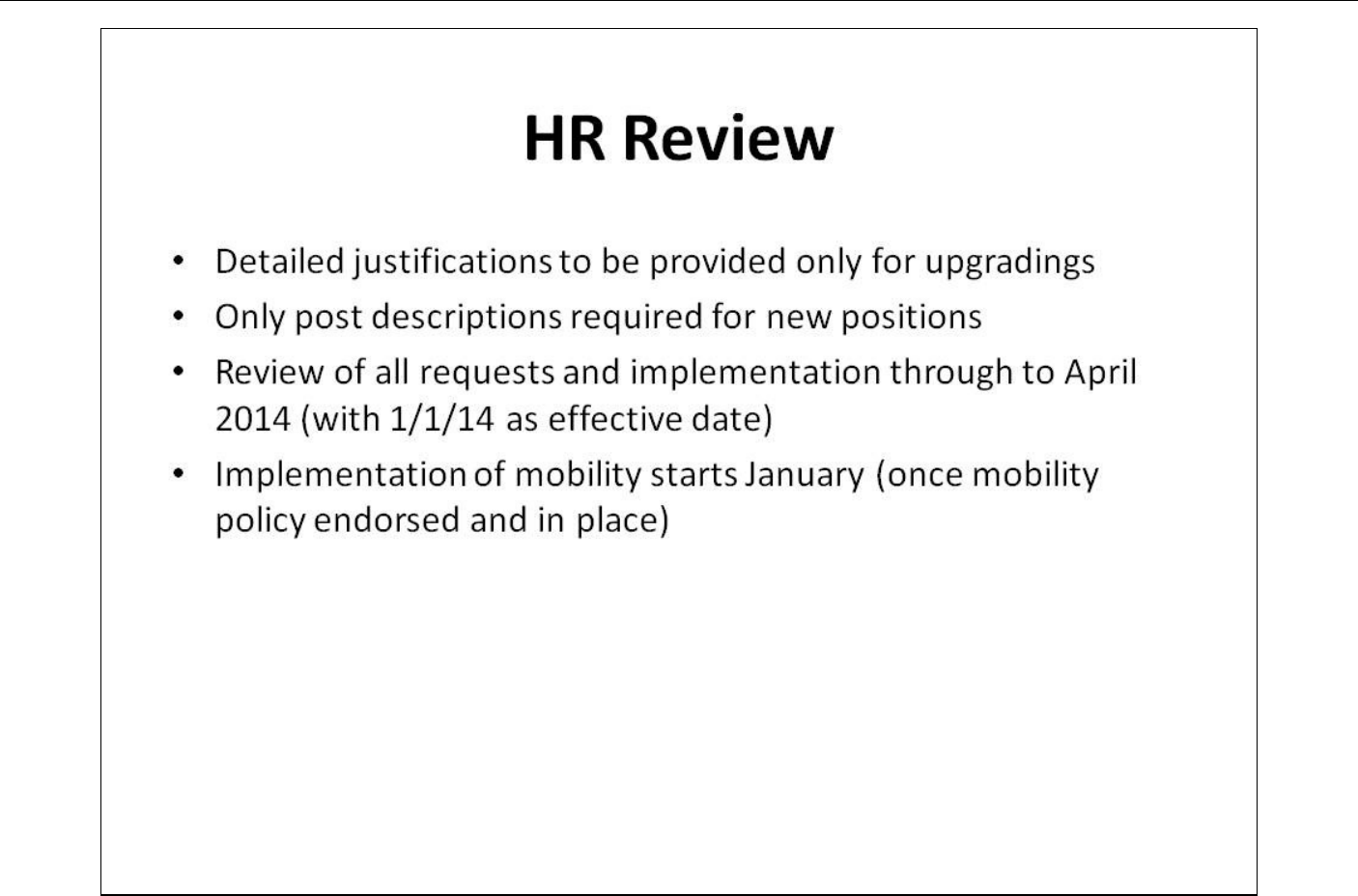
In keeping with the instructions issued by the Director-General, requests for upgrades to the P-5 level,
as a result of the gradual assumption of higher-level duties and responsibilities by the incumbent of
the post, will not be processed. Instead, all requests for reclassification of a post to the P-5 level will
be dealt with as a management action, and the filing of the post will be subject to a competitive
selection process.
Other upgrading can be requested (within budget allocations) and will be processed as per current
procedures until such time a promotion policy is in place. Upgradings should be handled as follows:
• Collect upgrading proposals from Divisional/Office Supervisors, with a summary justification
which should include confirmation that the staff members being considered for upgrading
have been on the post for at least two years and have been performing at the higher level
for at least one year;
• Set up a transparent mechanism (for example, management team with adequate
representation of both Professional and General Service staff) to review the proposals and
agree which cases should be submitted for review;

As endorsed by CPMB 2013/8 (29 August)
4
• A summary note on the process followed to identify the cases of upgrade on job growth
should also be prepared.
The justifications will be required at the end of the process (after Contributing units have signed off on
their staffing proposals so HR can review the proposed upgrading)
Review of grade levels
Departments/Offices are invited to critically review the grade levels of vacant professional positions
and examine means for creating entry level positions (P-1 and P-2) and reviewing the number of P-5
and D-1 positions, considered too many in some Departments, in comparison with lower-grade
professional positions.
Administrative support
Administrative support is provided by the department or office to which the Output Team leader
belongs.
In those cases where the support is insufficient or not at the right level in the unit where the Output
team leader works, the SO team identifies resource in another contributing division, or requests a
respective post action in the division/office (e.g. a change of grade or the creation of a new position or
conversion of an existing position), in full consultation with the division/office.
Transfer of positions between divisions and independent offices
Should be justified based on the requirements flagged at the time of the high level gap analysis.
New positions
Should be justified based on the requirements flagged at the time of the high level gap analysis.
Abolitions
Should be justified based on the requirements flagged at the time of the high level gap analysis.
Step F – Sign off on proposals
HR focal points will retrieve Departmental/Office reports on post actions from PIRES and review them,
in coordination with the contributing divisions. The reviewed reports will be provided to the SO Teams
concerned. These reports will be used by SO Teams and OSP during OWP Step 7 Final review and issues
resolution.
• Contributing units will be required thereafter to start preparing justifications for upgradings (a
full justification in ADM160, job growth Questionnaire and job description ADM213e).
• For new positions, a post description (Admin 213) will be required

As endorsed by CPMB 2013/8 (29 August)
5
Step G - HR review of staffing proposals following OWP closure - first quarter of 2014
In January 2014, CSP will undertake the review of the post actions submitted within the OWP exercise.
Upon completion of the review in April 2014, actions will be implemented with an effective date of
1/1/2014.
Separate reviews will be conducted to:
- establish required recruitment activities and strategies
- collect competency and skills development requirements
The implementation of the mobility policy will start in 2014.
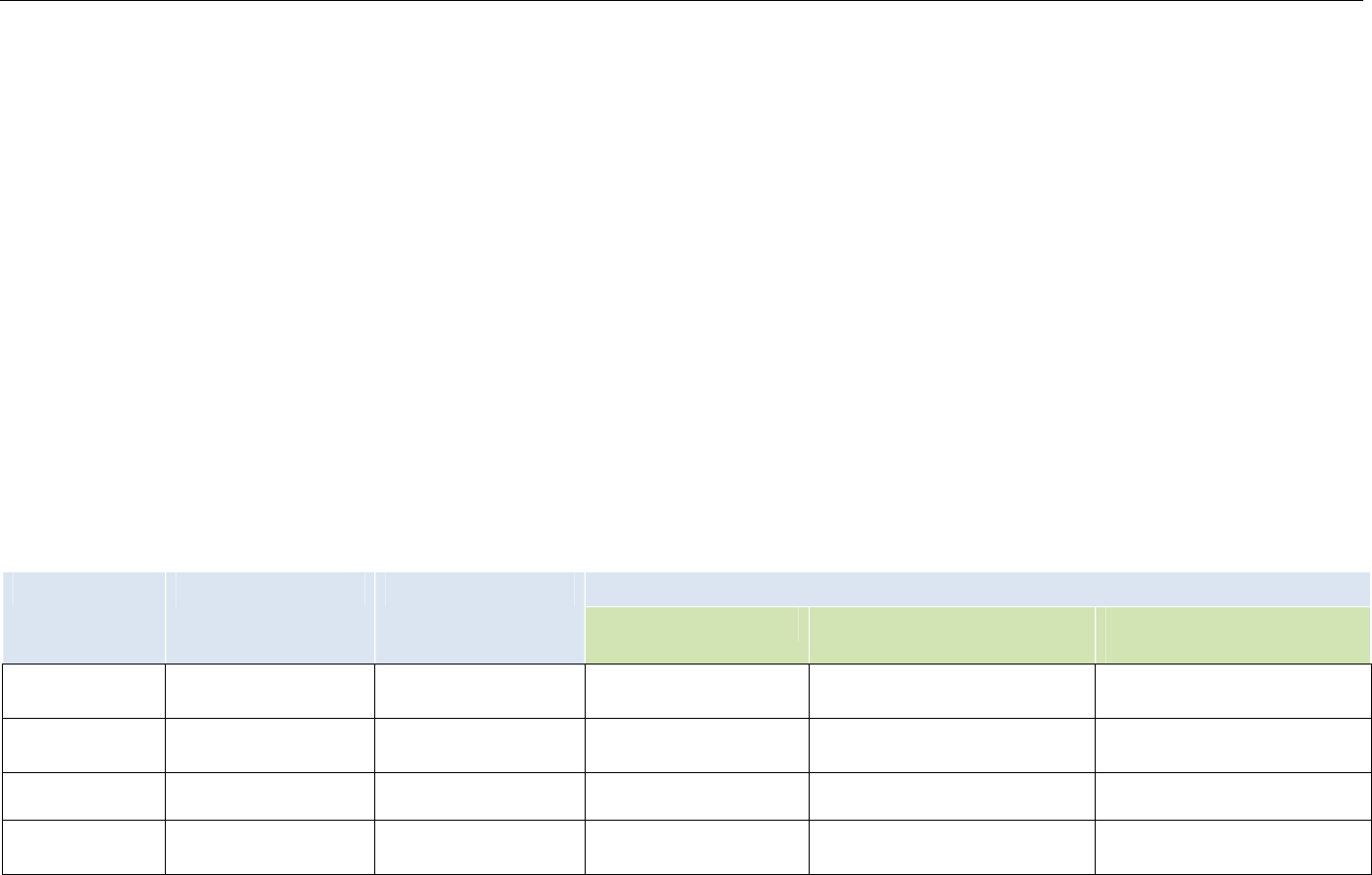
CPMB 2013/08 (29 August), Agenda Item 2
OHR 28 August 2013 6
Annex 1: Demand Analysis
The following questions aim at guiding you in the process.:
• What do you need from the workforce—capacity and capability—to deliver your outputs now and into the future?
• Where do you need the workforce to be located?
• At what time points do you need the workforce?
• Do you lack specific capabilities? What are these capabilities? What is the funded full-time equivalent? Is it sufficient?
Note: Any demand for additional resources should be well justified. Below are some questions you could ask to justify additional demand:
- Are there functions you consider should be discontinued and are there new functions you should be creating?
- Are your current jobs correctly designed? What new skill sets and/or job roles are important to achieve business success? What skills deficits are
evident today?
- What new skills or job roles will become important to achieve outputs?
- What job functions or skills will no longer be required?
- Will the way the work is currently done change?
CAPABILITY
Outline the job capability requirements you have identified. This template is to be used to communicate your high level requirements to Contributing units
and to HR.
Job capability requirements SO/output Job Title/function Job level/role
Outputs to be delivered Essential skills, competencies and
knowledge
Desirable skills, competencies
and knowledge
CPMB 2013/08 (29 August), Agenda Item 2
OHR 28 August 2013 7
CAPACITY
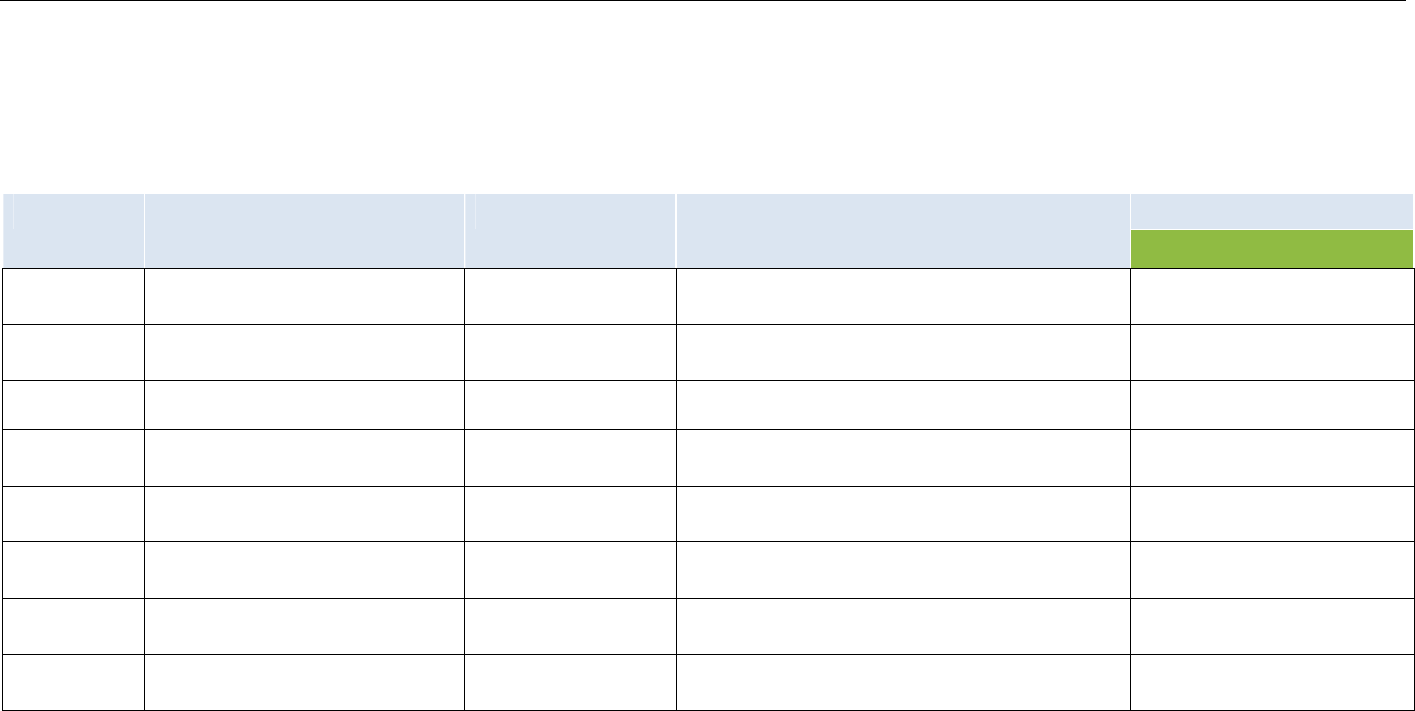
The table below allows you to summarise your current and future workforce demand and as such will also show the gap between these two. Bear in mind
that your demand will need to be reconciled to the supply and budget.
Future demand
(+ 1 year)
Future demand
(+ 2 years)
SO/OUTPUT Job title/function Job level/role
FTE
Lev
el
Location
FTE
Level
Location
CPMB 2013/08 (29 August), Agenda Item 2
OHR 28 August 2013 8
Annex 2: Gap Analysis
The purpose of the table below is to establish an inventory of those skills that are not required for specific SO teams/outcomes or Division, but which may
be considered by other units/SOCs.
In relation to SO/outcome SO Job Title/function Job level/role Skills no longer required
In relation to Division: ____

CPMB 2013/08 (29 August), Agenda Item 2
OHR 28 August 2013 9
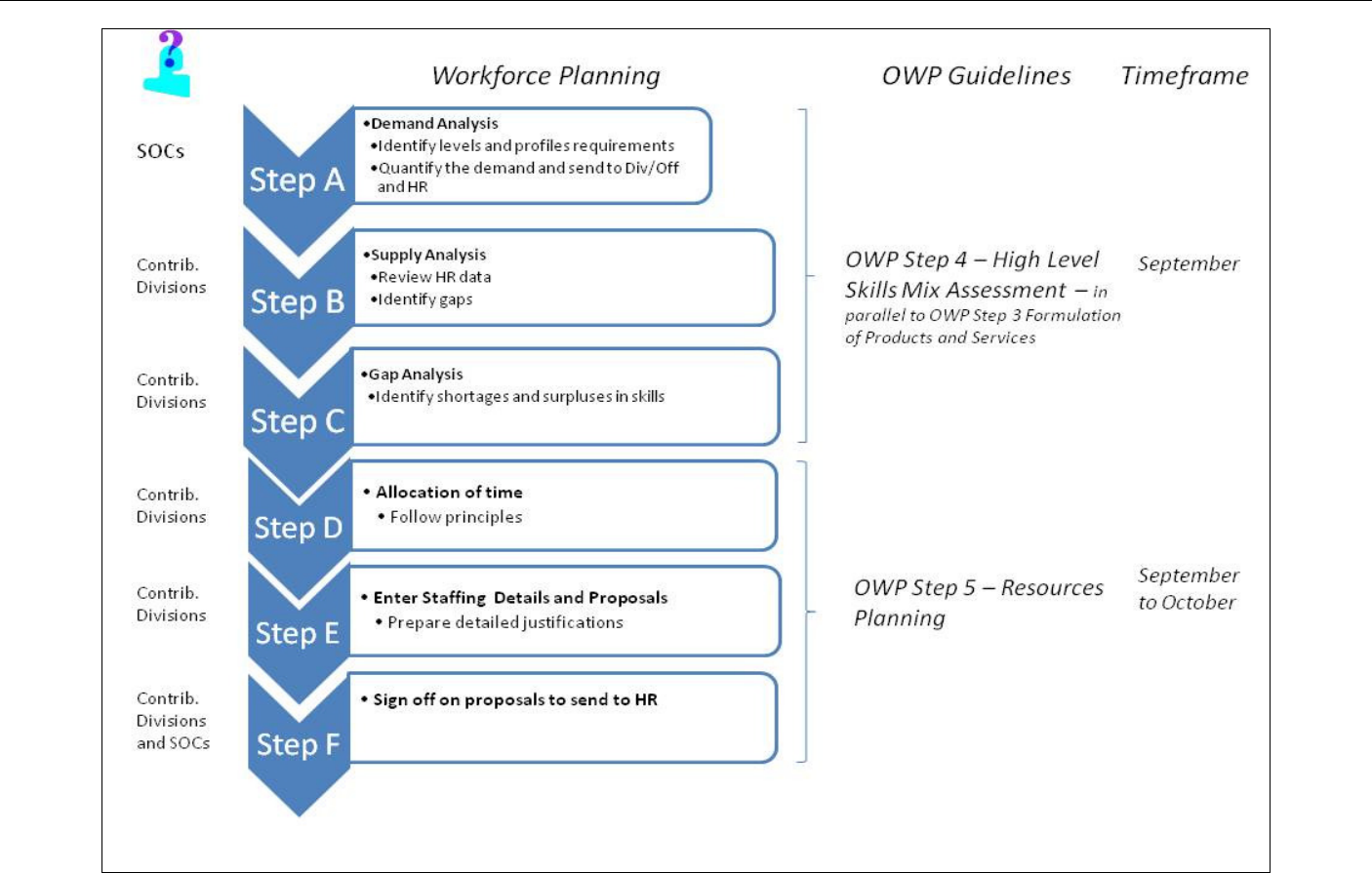
WORFORCE PLANNING – SUMMARY OF STEPS AND PRINCIPLES
CPMB 2013/08 (29 August), Agenda Item 2
OHR 28 August 2013 10
CPMB 2013/08 (29 August), Agenda Item 2
OHR 28 August 2013 11
CPMB 2013/08 (29 August), Agenda Item 2
OHR 28 August 2013 12
