Kawai CS11/CS8 Owner's Manual (English) CS11 1
KawaiCS8-1 KawaiCS8-1
KawaiCS11 KawaiCS11
KawaiCS8 KawaiCS8
User Manual: KawaiCS11-1
Open the PDF directly: View PDF  .
.
Page Count: 140 [warning: Documents this large are best viewed by clicking the View PDF Link!]
- Important Safety Instructions
- Table of Contents
- Introduction
- Playing the Piano
- Music Menu
- Recorder
- Settings
- Function menus
- Basic Settings
- Virtual Technician Settings
- 1. Touch Curve
- 2. Voicing
- 3. Damper Resonance
- 4. Damper Noise
- 5. String Resonance
- 6. Undamped String Resonance
- 7. Cabinet Resonance
- 8. Key-off Effect
- 9. Fall-back Noise
- 10. Hammer Delay
- 11. Topboard Simulation
- 12. Decay Time
- 13. Minimum Touch
- 14. Stretch Tuning
- 15. Temperament
- 16. Temperament Key
- 17. Key Volume
- 18. Half-Pedal Adjust
- 19. Soft Pedal Depth
- Phones Settings
- USB MIDI (USB to Host connector)
- USB Menu
- Appendix
CS11 / CS8
Owner’s Manual
Introduction
Playing the Piano
Music Menu
Recorder
Settings
Appendix

Thank you for purchasing this Kawai Classic Series CS11/CS8 digital piano.
This owner’s manual contains important information regarding the instrument’s usage and operation.
Please read all sections carefully, keeping this manual handy for future reference.
About this Owner’s Manual
Before attempting to play this instrument, please read the Introduction section from page 10 of this owner’s manual. This section
explains the name and function of each part, how to connect the power cable, and how to turn on the power.
The Playing the Piano section (page 16) provides an overview of the instrument’s commonly used functions, allowing the CS11/CS8
digital piano to be enjoyed almost immediately after being connected, while the Music Menu section (page 36) includes information
regarding the built-in demonstration songs, Piano Music pieces, Lesson and Finger Exercise features, and Concert Magic function.
The Recorder section (page 48) provides instructions on how to record and play back pieces stored both in the instrument’s internal
memory, and also MP3/WAV audio les saved to a USB memory device. The Settings section (page 63) details the various options
and settings that can be used to adjust the sound and operation of the instrument.
Finally, the Appendix section (page 124) includes lists for all internal sounds, songs, and drum rhythms, assembly instructions for the
CS8 model, MIDI reference information, and full specication details.
About Illustrations
All illustrations used within this owner’s manual depict the CS11 model unless stated otherwise.
Important Safety Instructions
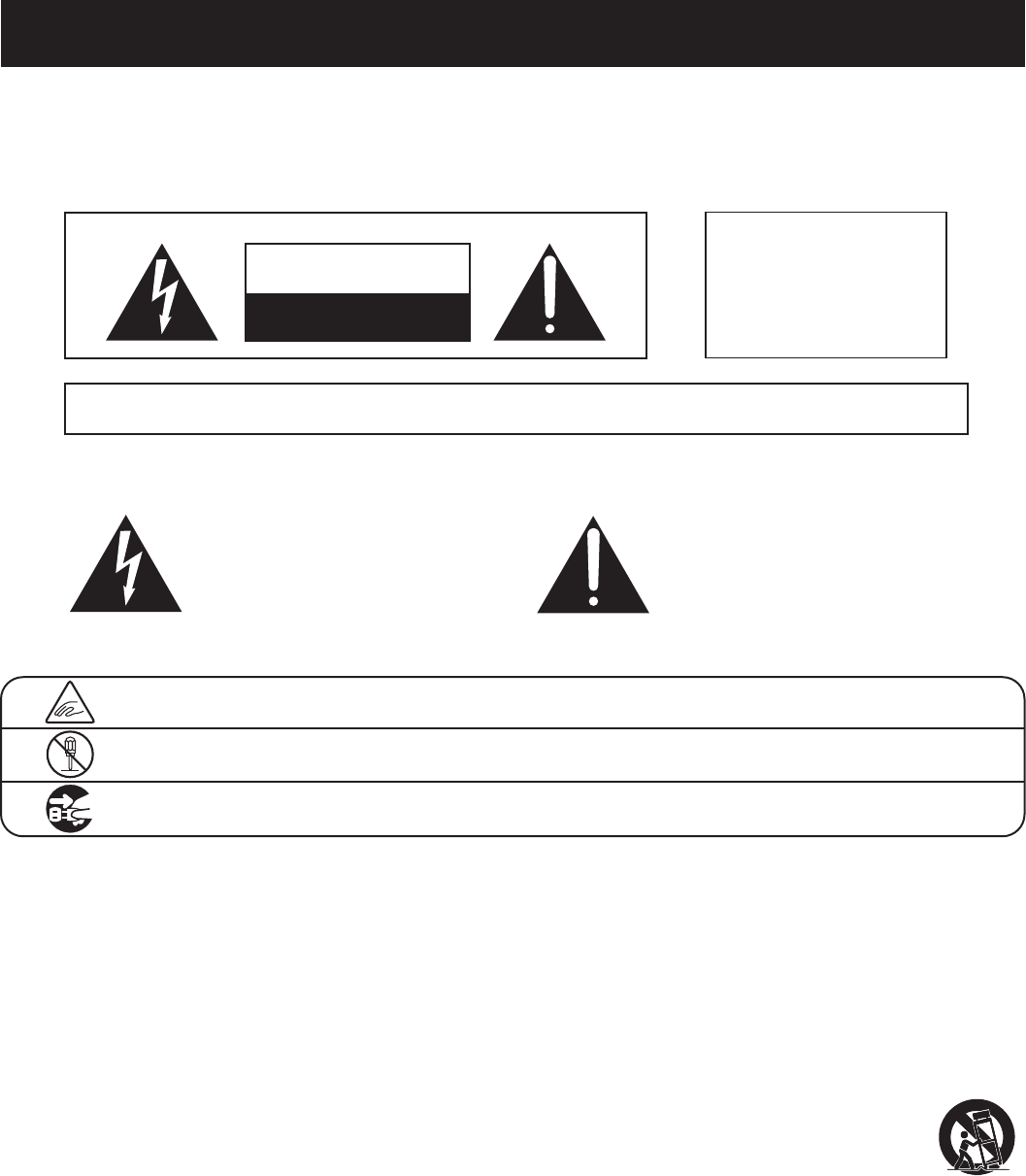
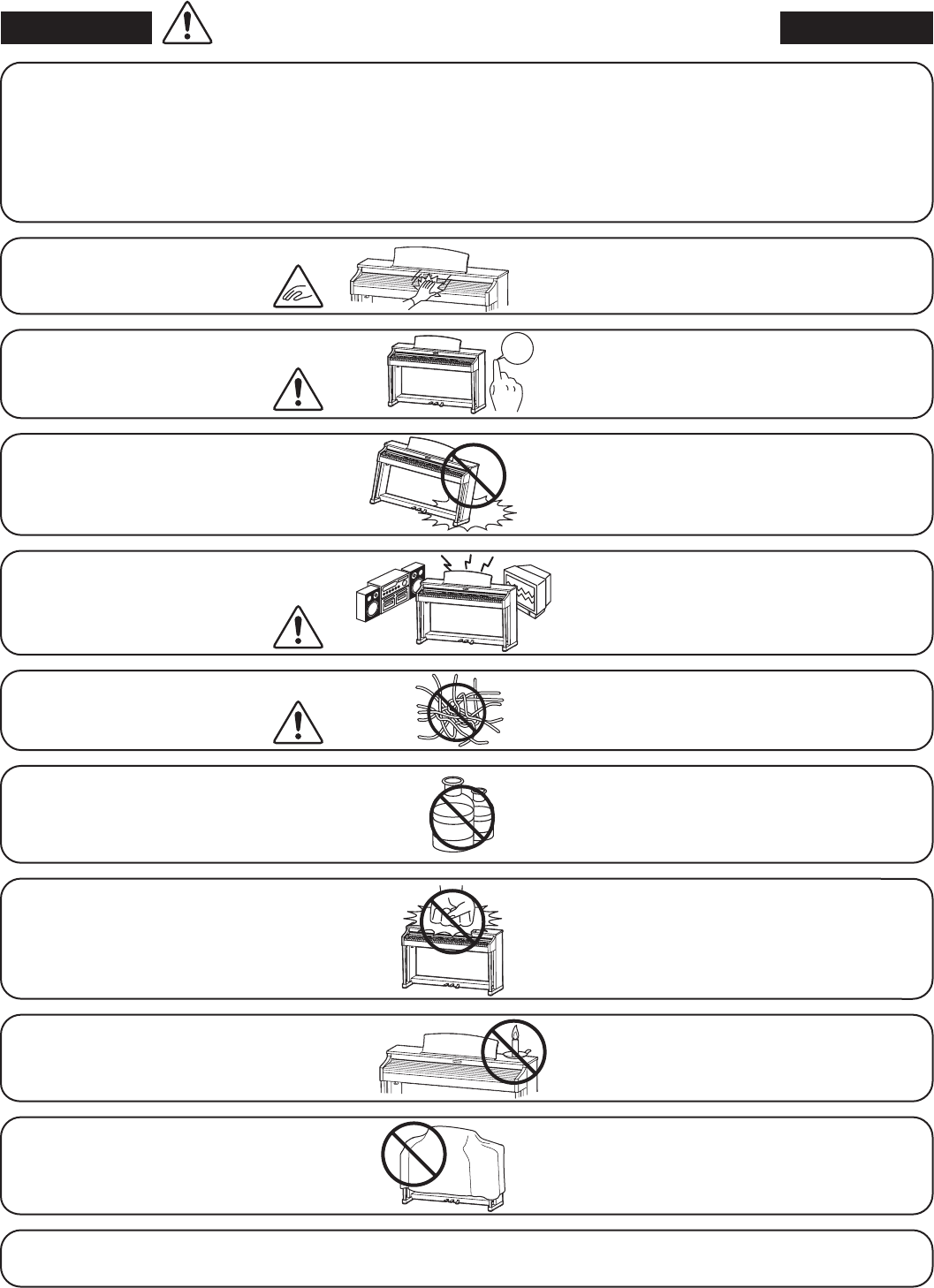
denotes that care should be taken.
The example instructs the user to take care not to allow ngers to be trapped.
denotes a prohibited operation.
The example instructs that disassembly of the product is prohibited.
denotes an operation that should be carried out.
The example instructs the user to remove the power cord plug from the AC outlet.
Examples of Picture Symbols
Read all the instructions before using the product.
CAUTION
RISK OF ELECTRIC SHOCK
DO NOT OPEN
AVIS : RISQUE DE CHOC ELECTRIQUE - NE PAS OUVRIR.
TO REDUCE THE RISK OF ELECTRIC SHOCK, DO NOT REMOVE COVER (OR BACK).
NO USER-SERVICEABLE PARTS INSIDE. REFER SERVICING TO QUALIFIED SERVICE PERSONNEL.
The lighting ash with arrowhead symbol, within
an equilateral triangle, is intended to alert the user
to the presence of uninsulated "dangerous
voltage" within the product's enclosure that may
be of sucient magnitude to constitute a risk of
electric shock to persons.
The exclamation point within an equilateral
triangle is intended to alert the user to the
presence of important operating and maintenance
(servicing) instructions in the leterature
accompanying the product.
WARNING
TO REDUCE THE RISK OF FIRE
OR ELECTRIC SHOCK, DO NOT
EXPOSE THIS PRODUCT TO
RAIN OR MOISTURE.
INSTRUCTIONS PERTAINING TO A RISK OF FIRE, ELECTRIC SHOCK, OR INJURY TO PERSONS
SAVE THESE INSTRUCTIONS
1) Read these instructions.
2) Keep these instructions.
3) Heed all warnings.
4) Follow all instructions.
5) Do not use this apparatus near water.
6) Clean only with dry cloth.
7) Do not block any ventilation openings. Install in
accordance with the manufacturer's instructions.
8) Do not install near any heat sources such as radiators,
heat registers, stoves, or other apparatus (including
ampliers) that produce heat.
9) Do not defeat the safety purpose of the polarized or
grounding-type plug. A polarized plug has two
blades with one wider than the other. A grounding
type plug has two blades and a third grounding
prong. The wide blade or the third prongs are
provided for your safety. If the provided plug does
not t into your outlet, consult an electrician for
replacement of the obsolete outlet.
1 0) Protect the power cord from being walked on or
pinched particularly at plugs, convenience
receptacles, and the point where they exit from the
apparatus.
11) Only use attachments/accessories specied by the
manufacturer.
1 2) Use only with the cart, stand, tripod, bracket, or table
specied by the manufacturer, or
sold with the apparatus. When a cart is used,
use caution when moving the cart/apparatus
combination to avoid injury from tip-over.
1 3) Unplug this apparatus during lightning storms or
when unused for long periods of time.
1 4) Refer all servicing to qualied service personnel.
Servicing is required when the apparatus has been
damaged in any way, such as power-supply cord or
plug is damaged, liquid has been spilled or object
have fallen into the apparatus, the apparatus has
been exposed to rain or moisture, does not operate
normally, or has been dropped.
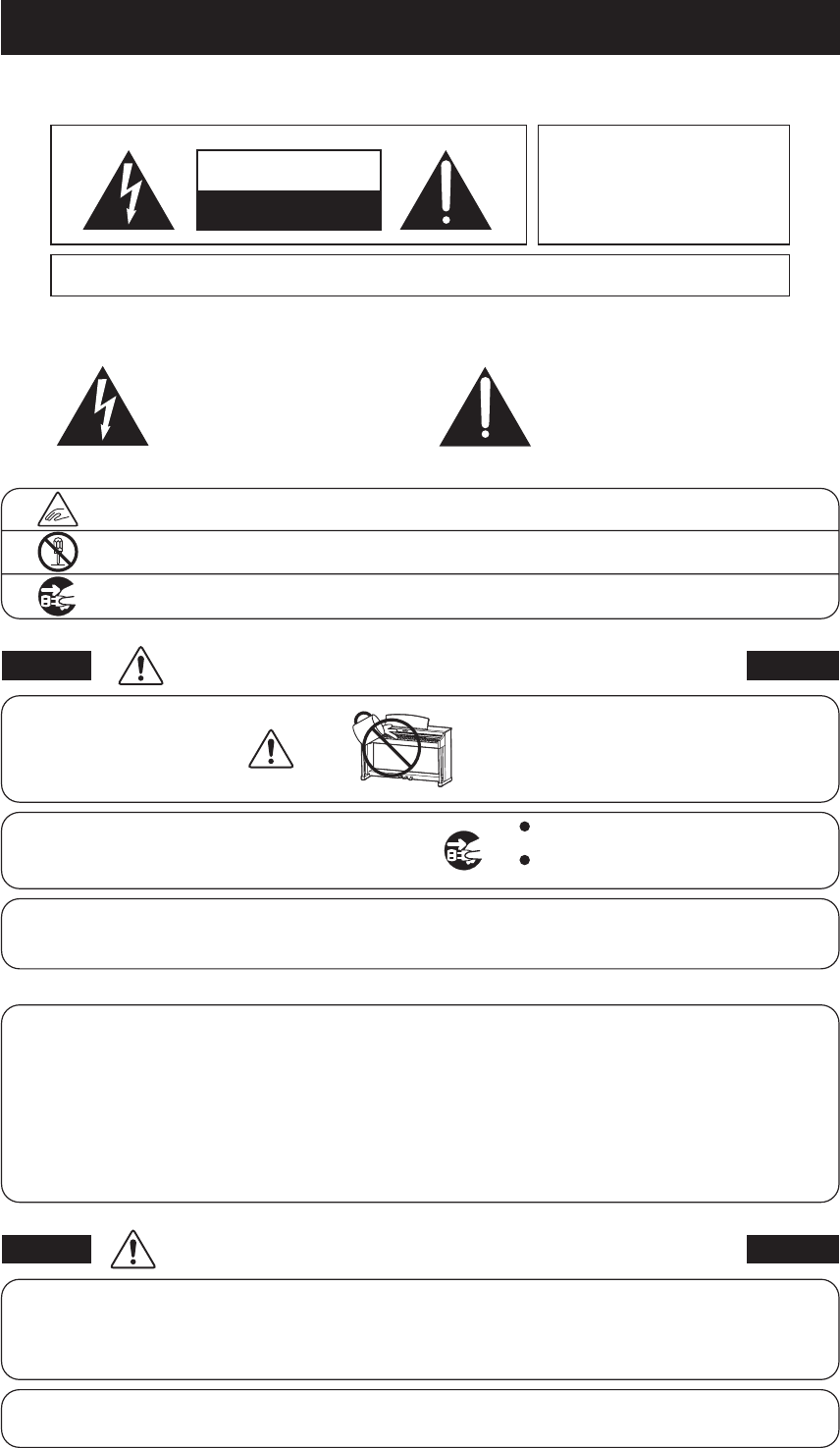
Indique que des précautions doivent être prises.
L’ exemple indique à l’utilisateur qu’il doit faire attention à ne pas se faire coincer les doigts.
Indique une manipulation interdite.
L’ exemple indique que le démontage de l’appareil est interdit.
Indique qu’une manipulation doit être effectuée.
L’ exemple indique à l’utilisateur qu’il doit débrancher le câble d’alimentation de la prise secteur.
Exemples de symboles graphiques
Le symbole de l’éclair avec une pointe de flèche à
l’intérieur d’un triangle équilatéral met en garde
l’utilisateur contre la présence de tension
dangereuse, non isolée, à l’intérieur de l’appareil,
dont l’amplitude peut être suffisante pour induire un
risque d’électrocution d’une personne.
Le point d’exclamation à l’intérieur d’un triangle
équilatéral alerte l’utilisateur de la présence de règles
d’utilisation et d’entretien importantes dans la notice
qui accompagne l’appareil.
CAUTION
RISK OF ELECTRIC SHOCK
DO NOTOPEN
AVIS :RISQUEDECHOCELECTRIQUE -NEPAS OUVRIR.
POURREDUIRE LESRISQUES D’INCENDIE OU D’ELECTROCUTION, NE DEMONTEZPAS LE COUVERCLE
(OUL’ARRIERE). A L’ INTERIEUR, AUCUNE PA RTIE N’EST REPARABLEPAR L’ UTILISAT EUR.
POURLAMAINTENANCE, ADRESSEZ-VOUS A DU PERSONNELQUALIFIE.
AVERTISSEMENT
POUR REDUIRELES RISQUES
D’INCENDIE OU D’ELECTROCUTION,
PROTEGEZ CET APPAREILDELA
PLUIEOUDEL’HUMIDITE.
CONSERVEZ CES INSTRUCTIONS
Règles de sécurité (Supplémentairespour le Canada)
AVERTISSEMENT Indique un risque potentiel qui peut entraîner
la mort, ou de graves lésions, si l’appareil
n’est pas manipulé correctement.
L’introduction d’eau, d’aiguilles ou d’épingles à
cheveux, peut provoquer une panne ou un
court-circuit. Ce produit doit être mis à l’abri des
écoulements ou projections d’eau. Ne jamais
placer sur le produit des objets contenant des
liquides, tels que des vases ou autres récipients.
Faite attention de ne pas introduire un
produit étranger à l’intérieur
de l’appareil.
Il est recommandé de placer l’instrument à proximité de la prise de courant et de positionner le câble d’alimentation
secteurdesorte qu’ilpuisseêtre débranché rapidement en casd’urgence,lecourant électrique étanttoujours
présenttant quela prise est branchée même si le bouton de mise en marche esten position Arrêt.
INSTRUCTIONS DE MISE À LA TERRE
Si vous ne le faisiez pas la foudre pourrait
provoquer un incendie.
Si vous ne le faisiez pas, la surchauffe de
l’appareil pourrait provoquer un incendie.
Ce produit n’est pas totalement déconnecté du circuit électrique
lorsqu’il est mis hors tension par le bouton d’arrêt. Si l’appareil
ne doit pas être utilisé pendant une longue période, débranchez
le câble d’alimentation de la prise secteur.
Ce produit doit être mis à la terre. En cas de défaillance matérielle ou de panne, la mise à la terre fournit un chemin de moindre
résistance au courant électrique afin de réduire le risque d’électrocution. Ce produit est équipé d’un câble avec un conducteur de
protection et une fiche de mise à la terre. La fiche doit être branchée dans une prise appropriée correctement installée et mise à la
terre conformément à tous les codes et règlements locaux.
DANGER - La connexion incorrecte du conducteur de protection peut présenter un risque d’électrocution.
Consultez un électricien ou un réparateur qualifié si vous avez des doutes en ce qui concerne la mise à la terre du produit. Ne
modifiez pas la fiche fournie avec le produit – si elle n’est pas adaptée à la prise, faites installer une prise correcte par un électricien
qualifié.
[Seuls les produits avec 3P fiche]
PRECAUTION Indique un risque potentiel qui peut entraîner la détérioration,
ou des dommages, pour l’appareil ou ses propriétés, si celui-ci
n’est pas manipulé correctement.
Votre piano doit être placé à un endroit tel que sa position n’altère pas sa propre ventilation. Gardez une
distance minimum de 5 cm autour de l’instrument pour une aération suffisante.
Description de la l'emplacement de la reference (Le cas échéant):
Anglais phrase: The nameplate label is located on the underside of the instruments, as indicated below.
Français phrase: La reference commerciale est inscrite sur une etiquette en dessous de votre instrument, conformement
a l’indication ci-dessous.
WARNING Indicates a potential hazard that could result in death or
serious injury if the product is handled incorrectly.
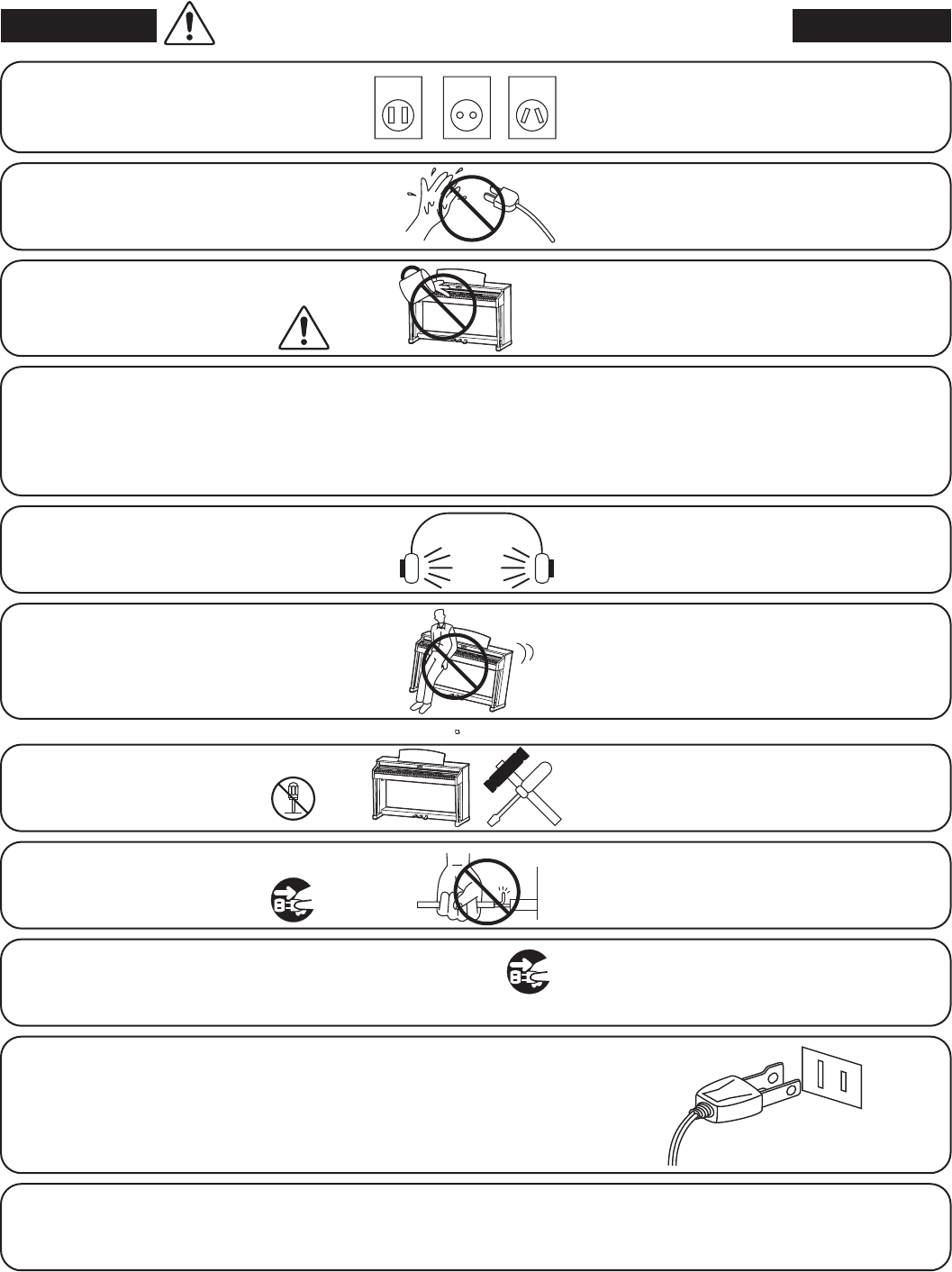
This product shall be near the AC outlet and the power cord plug in a position so that it can readily be
disconnected in an emergency because electricity is always charging while the plug is in the AC outlet
even in a power switch o condition.
This product may be equipped with a polarized line plug (one blade wider
than the other). This is a safety feature.
If you are unable to insert the plug into the outlet, contact an electrician to
replace your obsolete outlet.
Do not defeat the safety purpose of the plug.
● Failure to do so may cause re in case of
lightning.
● Failure to do so may over-heat the product,
resulting in re.
The product is not completely disconnected from the
power supply even when the power switch is turned
o. If the product will not be used for a long time,
unplug the AC power cord from the AC outlet.
When disconnecting the AC power cord's
plug, always hold the plug
and pull it to remove it.
● Pulling the AC power cord itself may damage
the cord, causing a re, electric shock or
short-circuit.
Do not disassemble, repair or modify
the product. Doing so may result in product breakdown, electric
shock or short-circuit.
When using the headphones, do not
listen for long periods of
time at high volume levels.
Doing so may result in hearing problems.
The chair must be used properly (it must be
used only when playing the product).
● Do not play with it or stand on it.
● Only one person is allowed to sit on it.
● Do not sit on it when opening the lid.
● Re-tighten the bolts occasionally.
Doing so may cause the chair to fall over or your
ngers to be trapped, resulting in injury.
Do not insert or disconnect the power
cord plug with wet hands.Doing so may cause electric shock.
The product should be connected to
an AC outlet of the specied voltage.
● If you are going to use an AC power cord,
make sure that its has the correct plug shape
and conforms to the specied power voltage.
● Failure to do so may result in re.
120V 240V230V
Doing so may cause the product to fall over,
resulting in injury.
Do not lean against the keyboard.
Entry of water, needles or hair pins may result
in breakdown or short-circuit.
The product shall not be exposed to dripping or
splashing. No objects lled with liquids, such as
vases, shall be placed on the product.
Take care not to allow any foreign
matter to enter the product.
WARNING - When using electric products, basic precautions should always be followed, including the following.
● Doing so may result in discoloration or deformation
of the product.
● When cleaning the product, put a soft cloth in
lukewarm water, squeeze it well, then wipe the
product.
Do not wipe the product with benzene
or thinner.
Failure to do so may damage them, resulting in
re, electric shock or short-circuit.
When connecting the AC power cord
and other cords, take care
not to get them tangled.
CAUTION Indicates a potential hazard that could result in injury or
damage to the product or other property if the product
is handled incorrectly.
The product should be located so that its location or position does not interfere with its proper ventilation. Ensure a
minimum distance of 5cm around the product for sucient ventilation.
Failure to do so may cause breakdown of this
product and other devices.
Before connecting cords, make sure
that the power to this product
and other devices is turned
OFF.
OFF
● Doing so may cause the product to generate
noise.
● If the product generates noise, move the
product suciently away from the electrical
appliance or connect it to another AC outlet.
Do not place the product near electrical
appliances such as TVs and radios.
Failure to do so may over-heat the product,
resulting in re.
Ensure that the ventilation is not
impeded by covering the ventilation
openings with items, such as newspaper,
table-cloths, curtains, etc.
● Doing so may cause the product to become
deformed or fall over, resulting in breakdown
or injury.
Do not stand on the product or exert
excessive force.
Please lift up the product when moving it.
Please note that the product is heavy and must
be carried by more than two persons.
Dropping the product may result in breakdown.
Do not drag the product on the oor.
Take care not to drop the product.
Closing it roughly may trap your ngers,
resulting in injury.
When you close the keyboard cover,
close it gently.
Using the product in such areas may result in
product breakdown.
Use the product only in moderate climates (not
in tropical climates).
Do not use the product in the following areas.
● Areas, such as those near windows, where the product is
exposed to direct sunlight
● Extremely hot areas, such as near a heater
● Extremely cold areas, such as outside
● Extremely humid areas
● Areas where a large amount of sand or dust is present
● Areas where the product is exposed to excessive
vibrations
Doing so may cause the illumination to fall over,
resulting in re.
Do not place naked ame, such as lighted
candles on the product.
The product should be serviced by qualied service personnel when:
• The power supply cord or the plug has been damaged.
• Objects have fallen, or liquid has been spilled into the product.
• The product has been exposed to rain.
• The product does not appear to operate normally or exhibits a marked change in performance.
• The product has been dropped, or the enclosure damaged.
Notes on Repair
Should an abnormality occur in the product, immediately turn the power OFF, disconnect the power cord plug, and then
contact the shop from which the product was purchased.
CAUTION:
To prevent electric shock, match wide blade of plug to wide slot, fully insert.
ATTENTION:
Pour éviter les chocs électriques, introduire la lame la plus large de la che dans la borne correspondante de la prise et
pousser jusqu'au fond.
An information on Disposal for users
If your product is marked with this recycling symbol it means that, at the end of its life, you must dispose of it
separately by taking it to an appropriate collection point.
You should not mix it with general household waste. Disposing of this product correctly will prevent potential negative
eects on the environment and human health which could otherwise arise due to inappropriate waste handling.
For further details, please contact your local authority.
(European Union only)
Instruction for AC power cord (U.K.)
IMPORTANT
THE WIRES IN THIS MAINS LEAD ARE COLOURED IN ACCORDANCE WITH THE FOLLOWING CODE.
BLUE : NEUTRAL
BROWN : LIVE
As the colours of the wires in the mains lead of this apparatus may not correspond with the coloured markings identifying
the terminals in your plug, proceed as follows:
The wire which is coloured BLUE must be connected to the terminal which is marked with the letter N or coloured BLACK.
The wire which is coloured BROWN must be connected to the terminal which is marked with the letter L or coloured RED.
Do not plug either terminal of the power cord to the the ground od AC outlet on the wall.
Canadian Radio Interference Regulations
This instrument complies with the limits for a class B digital apparatus, pursuant to the Radio Interference Regulations,
C.R.C., c. 1374.
FCC Information (U.S.A)
CAUTION : Changes or modications not expressly approved by the party responsible for compliance could void the user’s
authority to operate the equipment.
NOTE : This equipment has been tested and found to comply with the limits for a Class B digital device, pursuant to Part 15 of
the FCC Rules. These limits are designed to provide reasonable protection against harmful interference in a residential
installation. This equipment generates, uses and can radiate radio frequency energy and, if not installed and used in
accordance with the instructions, may cause harmful interference to radio communications. However, there is no guarantee
that interference will not occur in a particular installation. If this equipment does cause harmful interference to radio or
television reception, which can be determined by turning the equipment o and on, the user is encouraged to try to correct
the interference by one or more of the following measures:
• Reorient or relocate the receiving antenna.
• Increase the separation between the equipment and receiver.
• Connect the equipment into an outlet on a circuit dierent from that to which the receiver is connected.
• Consult the dealer or an experienced radio/TV technician for help.
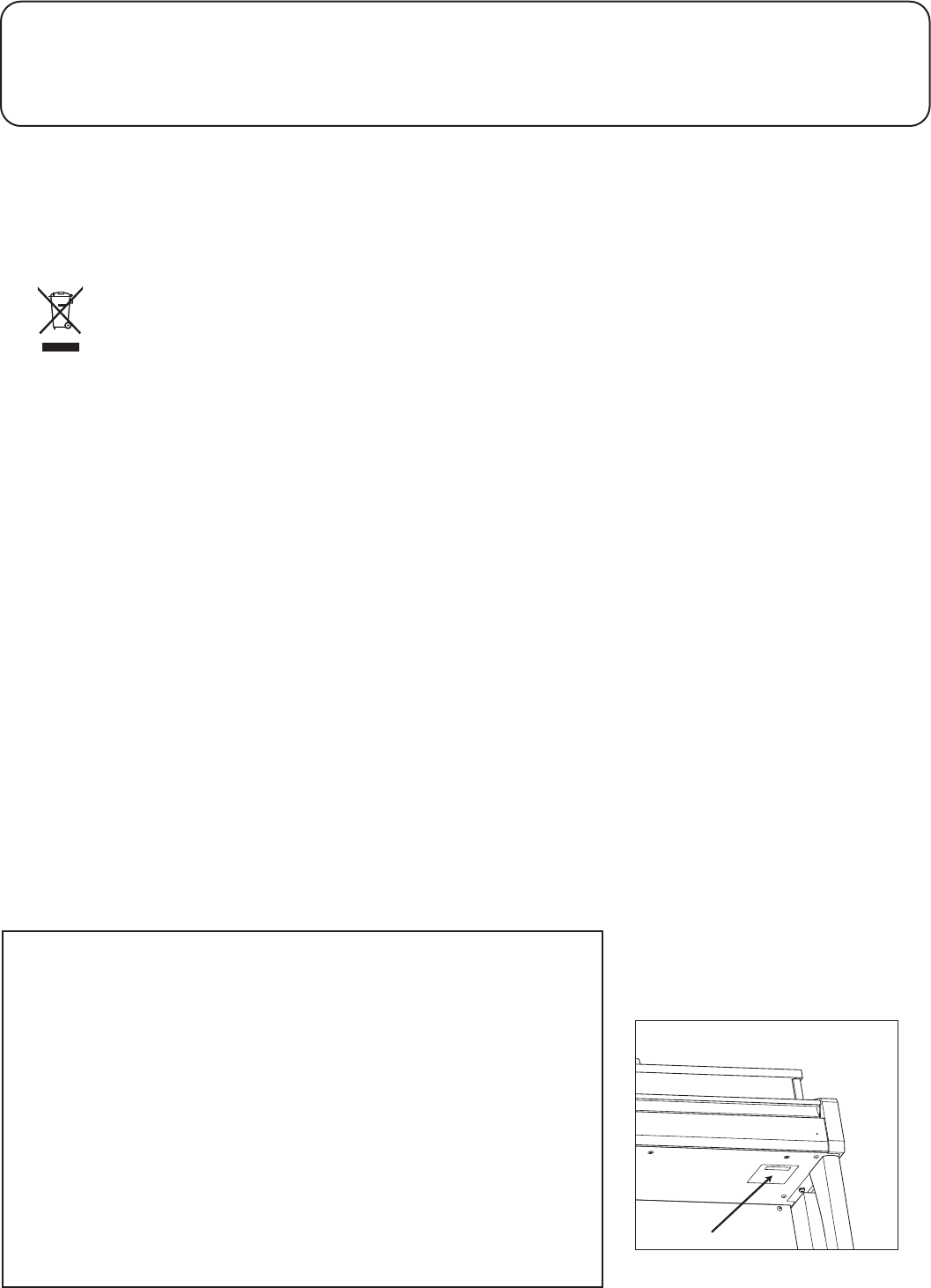
The nameplate label is located on
the
underside of the instrument, as
indicated below.
Declaration of Conformity
Products : Electronic Piano
Model Number : CS11/CS8
Responsible Party Name : Kawai America Corporation
Address : 2055 East University Drive Rancho
Dominguez, CA 90220
Telephone 310-631-1771
This device complies with Part 15 of the FCC Rules.
Operation is subject to the following two conditions:
(1) this device may not cause harmful interference, and
(2) this device must accept any interference received,
including interference that may cause undesired operation.
This applies only to products distributed by Kawai America Corporation.
Nameplate
8
Important Safety Instructions ....................... 3
Table of Contents .................................... 8
Introduction
Welcome to the Classic Series ...................... 10
1. Feature Highlights ....................................10
2. Owner’s Manual Conventions. . . . . . . . . . . . . . . . . . . . . . . . . 11
Part Names and Functions .......................... 12
Setting Up the Piano ................................14
Adjusting the Volume / Using Headphones ........ 15
Playing the Piano
Using the Pedals .................................... 16
Selecting Sounds ....................................17
Dual Mode ...........................................18
Split Mode ........................................... 20
Four Hands Mode ...................................22
Reverb ...............................................24
Eects ...............................................26
Virtual Technician ...................................28
1. Smart Mode ......................................28
2. Advanced Mode ..................................29
Metronome / Drum Rhythms .......................30
Registration Memories ..............................32
1. Selecting a Registration memory .....................32
2. Storing a Registration memory .......................33
3. Registration Edit menu ...............................34
Panel Lock ...........................................35
Music Menu
Demo Songs .........................................36
Piano Music .........................................37
Lesson Function .....................................38
1. Selecting a lesson book/song .........................38
2. Listening to the selected song ........................39
3. Lesson Function settings .............................40
4. Repeating sections of a lesson song ..................41
5. Recording a lesson song practise .....................42
6. Finger Exercises .......................................43
Concert Magic .......................................44
1. Performing a Concert Magic song ....................44
2. Concert Magic demo mode ...........................45
3. Concert Magic settings ...............................46
4. Concert Magic song arrangement types .............47
Recorder
Song Recorder (Internal memory) ....................48
1. Recording a song .....................................48
2. Playing a song ........................................50
3. Internal Recorder Edit menu ..........................51
4. Erasing a part/song ...................................52
5. Converting a song to an audio le ....................53
Audio Record/Playback (USB memory) ..............54
1. Recording an MP3/WAV audio le ....................54
2. Playing an MP3/WAV audio le .......................56
3. Playing a MIDI song le ..............................58
4. USB Recorder Edit menu ..............................60
5. Converting a MIDI song to an audio le ..............61
6. Overdubbing a MP3/WAV audio le ..................62
Settings
Function menus .....................................63
Basic Settings .......................................64
1. Key Transpose .........................................65
2. Song Transpose .......................................66
3. Tone Control ..........................................67
User Tone Control .....................................68
4. Speaker Volume ......................................69
5. Line In Level ...........................................70
6. Wall EQ (CS11 only) .....................................71
7. Tuning .................................................72
8. Damper Hold .........................................73
9. Split ...................................................74
10. Four Hands ............................................75
11. LCD Contrast ..........................................76
12. Startup Setting ........................................77
13. Factory Reset .........................................78
14. Auto Power O. . . . . . . . . . . . . . . . . . . . . . . . . . . . . . . . . . . . . . . .79
Table of Contents

9
Table of Contents
Settings (cont.)
Virtual Technician Settings .........................80
1. Touch Curve ...........................................82
User Touch Curve .....................................83
2. Voicing ................................................84
User Voicing ..........................................85
3. Damper Resonance ...................................86
4. Damper Noise .........................................87
5. String Resonance .....................................88
6. Undamped String Resonance .........................89
7. Cabinet Resonance ...................................90
8. Key-o Eect .........................................91
9. Fall-back Noise ........................................92
10. Hammer Delay ........................................93
11. Topboard Simulation ..................................94
12. Decay Time ...........................................95
13. Minimum Touch ......................................96
14. Stretch Tuning ........................................97
User Tuning ...........................................98
15. Temperament .........................................99
User Temperament .................................100
16. Temperament Key ...................................101
17. Key Volume ..........................................102
User Key Volume .....................................103
18. Half-Pedal Adjust ................................... 104
19. Soft Pedal Depth .................................... 105
Phones Settings ....................................106
1. SHS Mode ............................................107
2. Phones Type ........................................ 108
3. Phones Volume ..................................... 109
USB MIDI (USB to Host connector) ...................110
USB Menu ...........................................111
1. Load Song ...........................................112
2. Load Registration All .................................113
3. Load Registration Single .............................114
4. Load Startup Setting .................................115
5. Save Internal Song ...................................116
6. Save SMF Song .......................................117
7. Save Registration All .................................118
8 Save Registration Single ..............................119
Settings (cont.)
9. Save Startup Setting .................................120
10. Rename File ..........................................121
11. Delete File ............................................122
12. Format USB ..........................................123
Appendix
Assembly Instructions (CS8 only) ....................124
Connecting to Other Devices ......................128
Jack Panel ..............................................129
Headphone Panel ......................................129
Troubleshooting ...................................130
Demo Song List ....................................132
Sound List ..........................................133
Program Change Number List .....................134
Drum Rhythm List ..................................136
Specications ......................................137
User Notes ..........................................138

10
Introduction
1
Feature Highlights
Grand Feel II wooden-key action with Ebony & Ivory Touch key surfaces, counterweights, and ‘Let-O’ mechanism
The CS11 and CS8 digital pianos utilise Kawai’s latest Grand Feel II wooden-key keyboard action, which draws upon over 85
years of acoustic piano craftsmanship to provide an exceptionally realistic playing experience.
As with a grand piano, all eighty-eight black and white keys are crafted entirely from long pieces of wood, pivoting on a
central balance pin in a smooth, seesaw-like motion. The Grand Feel II keys are longer than any other digital piano keyboard
action, with the pivot point distance matching that of a Kawai grand piano. When the front of a key is pressed down, the
rear rises, throwing a hammer which plays the note. These metal hammers have been micro-engineered to optmise their
centre of gravity, and are graded in size and weight to replicate the heavier bass and lighter treble notes of an acoustic grand
piano. The forward and backward movements of each hammer are precisely measured using triple-sensor technology,
providing faster key repetition, improved responsiveness, and enhanced playing realism.
In addition to grade-weighted hammers, the Grand Feel II action also features counterweights placed within each key. As
with an acoustic piano, these nely balanced weights help to lighten the touch of the keyboard during pianissimo passages,
while adding a feel of greater substance when playing with force. The Grand Feel II keyboard action even reproduces the
subtle let-o sensation felt when playing the keys of a grand piano very softly, satisfying the expectations of even the most
discerning pianists.
Finally, the Grand Feel II keyboard action features Kawai’s Ebony & Ivory Touch key surfaces. These nely textured materials
gently absorb moisture to assist playing control, and possess a natural, matte nish that is smooth, but not slippery.
Shigeru Kawai SK-EX, SK-5, and Kawai EX instruments reproduced with Harmonic Imaging sound technology
The CS11 & CS8 digital pianos capture the magnicent tone of Kawai’s agship Shigeru Kawai SK-EX full concert, and Shigeru
Kawai SK-5 medium-sized grand pianos. Widely regarded as the ‘premier pianos of Japan’, Shigeru Kawai instruments grace
the stages of concert halls and musical institutions throughout the world, and are prized for their exceptional tonal clarity.
In addition, the CS11 & CS8 also feature the distinctive sound of Kawai’s highly acclaimed EX concert grand piano, which
has frequently been selected by professional pianists in such prestigious events as the Chopin, Tchaikovsky, and Rubinstein
international piano competitions, among others.
All three instruments have been carefully recorded, meticulously analysed, and faithfully reproduced with full 88-key
sampling using Harmonic Imaging™ sound technology. This unique process accurately recreates the broad dynamic range
of the original grand pianos, aording pianists an extraordinary level of expressiveness ranging from the softest pianissimo
to the strongest, boldest fortissimo.
Strong selection of additional instrument sounds
Supplementing the realistic acoustic piano voices, the CS11 & CS8 digital pianos also feature an excellent selection of
additional instrument sounds, ranging from electric pianos and drawbar and church organs, to strings, human choirs, and
even atmospheric synth-style pads, inviting musicians to add greater variety to their performances.
Furthermore, the Dual playing mode also allows two dierent sounds, such as grand piano and strings, to be layered
together, while the Split and Four Hands modes divide the keyboard into two independent sections. The volume balances
for each playing mode can also be adjusted quickly and easily using the real-time panel controls.
Virtual Technician adjustments to personalise the instrument’s character
The CS11 & CS8 digital pianos’ Virtual Technician feature allows various characteristics of the selected acoustic piano, electric
piano, or harpsichord sound to be shaped at the touch of a button, with settings to adjust voicing and regulation, string,
damper, and cabinet resonances, and subtle hammer, damper, and key release noises. It is even possible to adjust the
precise tuning and volume of individual notes, before storing one’s personalised instrument conguration to memory.
USB to Device functionality, with MP3/WAV le recording and playback
The CS11 & CS8 digital pianos are equipped with USB connectors that not only allow these instruments to be connected to
a computer for MIDI use, but also to load and save data to USB memory devices directly. This ‘USB to Device’ feature allows
instrument settings or recorded songs stored in internal memory to be saved to USB for posterity, or standard MIDI les
(SMF) downloaded from the internet to be conveniently played back without additional hardware.
USB memory devices can also be used to play back MP3 or WAV audio les, allowing musicians to learn the chords or
melody for a new piece, or to simply play along with their favourite songs. It is even possible to save performances as MP3
or WAV les for emailing to friends and family, listening to on the move, or for further editing using an audio workstation.
Welcome to the Classic Series
11
Introduction
Welcome to the Classic Series
2
Owner’s Manual Conventions
This owner’s manual utilises a number of illustrative conventions in order to explain the CS11/CS8 digital piano’s
various functions. The examples below provide an overview of the button LED indicator states and press types, and
the appearance of dierence kinds of text.
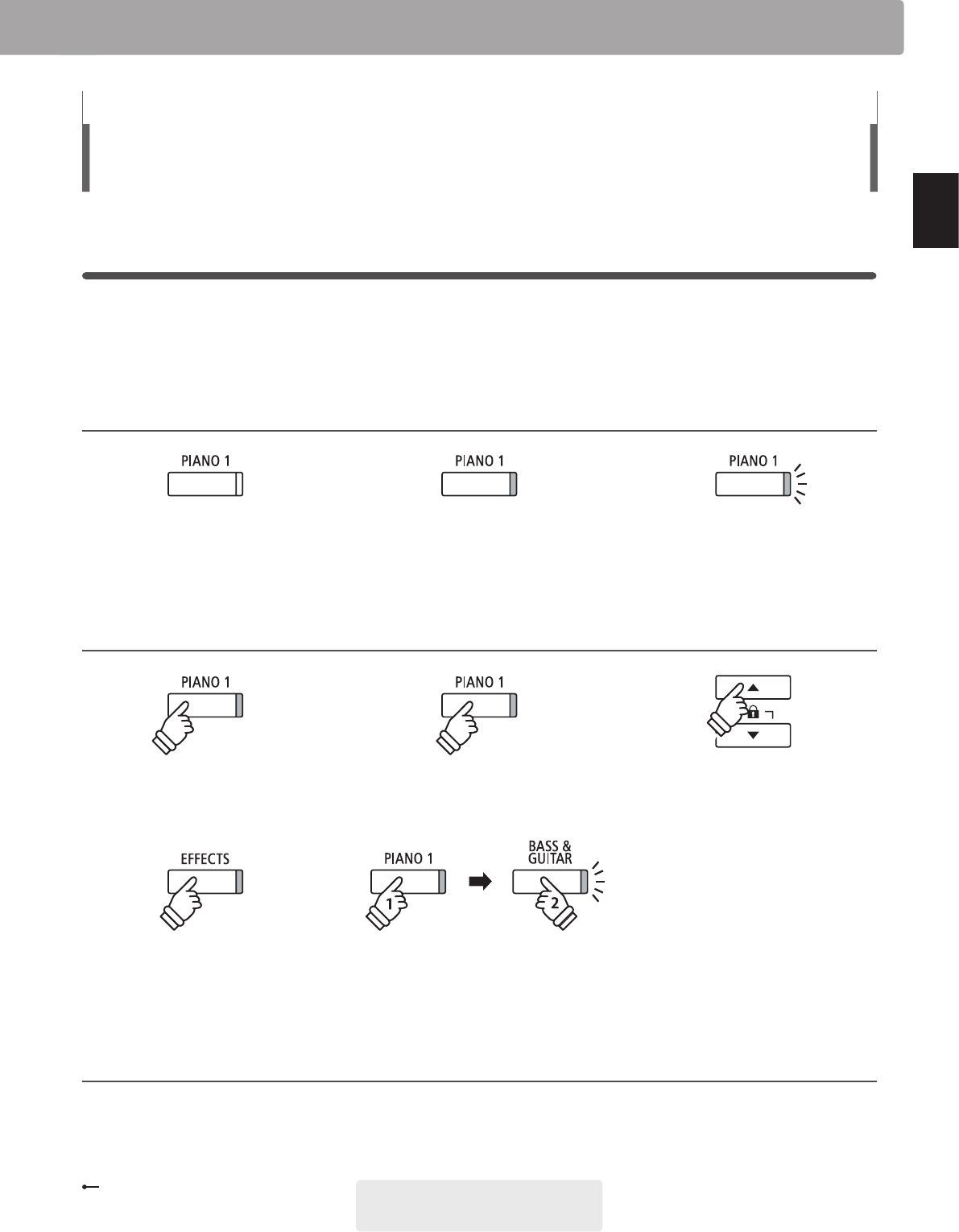
Button LED indicator states
LED indicator o:
Sound/Function is not selected.
LED indicator on:
Sound/Function is selected.
LED indicator ashing:
Sound/Function is selected in a
temporary state.
Button press types
Normal press:
Select a sound or function.
Press twice:
Select a sound or function.
Press multiple times:
Cycle through sounds or settings.
× 2
× 4
Press and hold:
Select a function’s settings, or
store registration memories etc.
Press and hold, then press X:
Combine two sounds.
hold
hold
Text appearance
Normal instruction and explanation text
is written in regular type at 9 pt. size.
* Notes about functions are marked with an
asterisk and written in 8 pt. size.
Reminders about previous operations are
written in italic type at 9 pt. size.
Captions explaining the LCD display
or button functions, are written in
bold type at 8.5 pt. size.
Example operations are written in italic type
at 8 pt. size, and enclosed within a grey box.
Wide range of connectivity options
The CS11 & CS8 digital pianos features a variety of connectivity options, with Line-level output jacks that allow the
instrument to be enjoyed in larger settings such as churches and schools. Standard MIDI and ‘USB to Host’ connectors
ensure exibility when using computers and other electronic instruments, while the stereo Line-in connector provides a
convenient method of mixing in audio from a laptop, tablet, or other digital device.
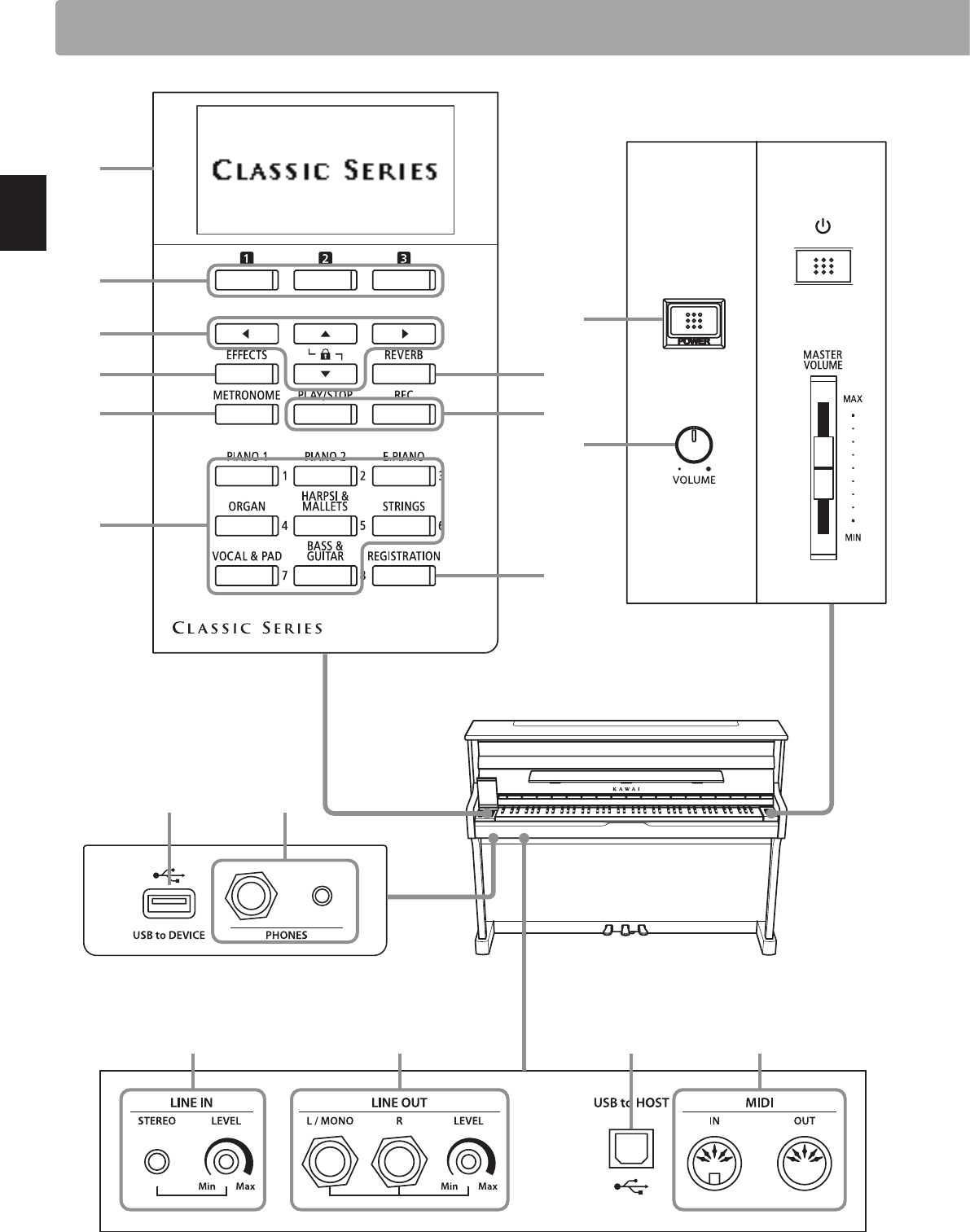
12
Introduction
Part Names and Functions
CS11 CS8
l m
n o qp
a
c
d
e
f
h
j
g
i
k
b
13
Introduction
Part Names and Functions
a POWER button
This switch is used to turn the instrument on/o. Be sure to turn
o the instrument after playing.
* The CS11/CS8 digital piano features a power saving mode that can
turn o the instrument automatically after a specied period of
inactivity. For more information, please refer to the ‘Auto Power O’
setting on page 79.
b MASTER VOLUME knob (CS11) / slider (CS8)
This knob/slider controls the master volume level of the
instrument’s built-in speakers or headphones, if connected.
* The MASTER VOLUME knob/slider will not aect the volume level of
the LINE OUT connectors.
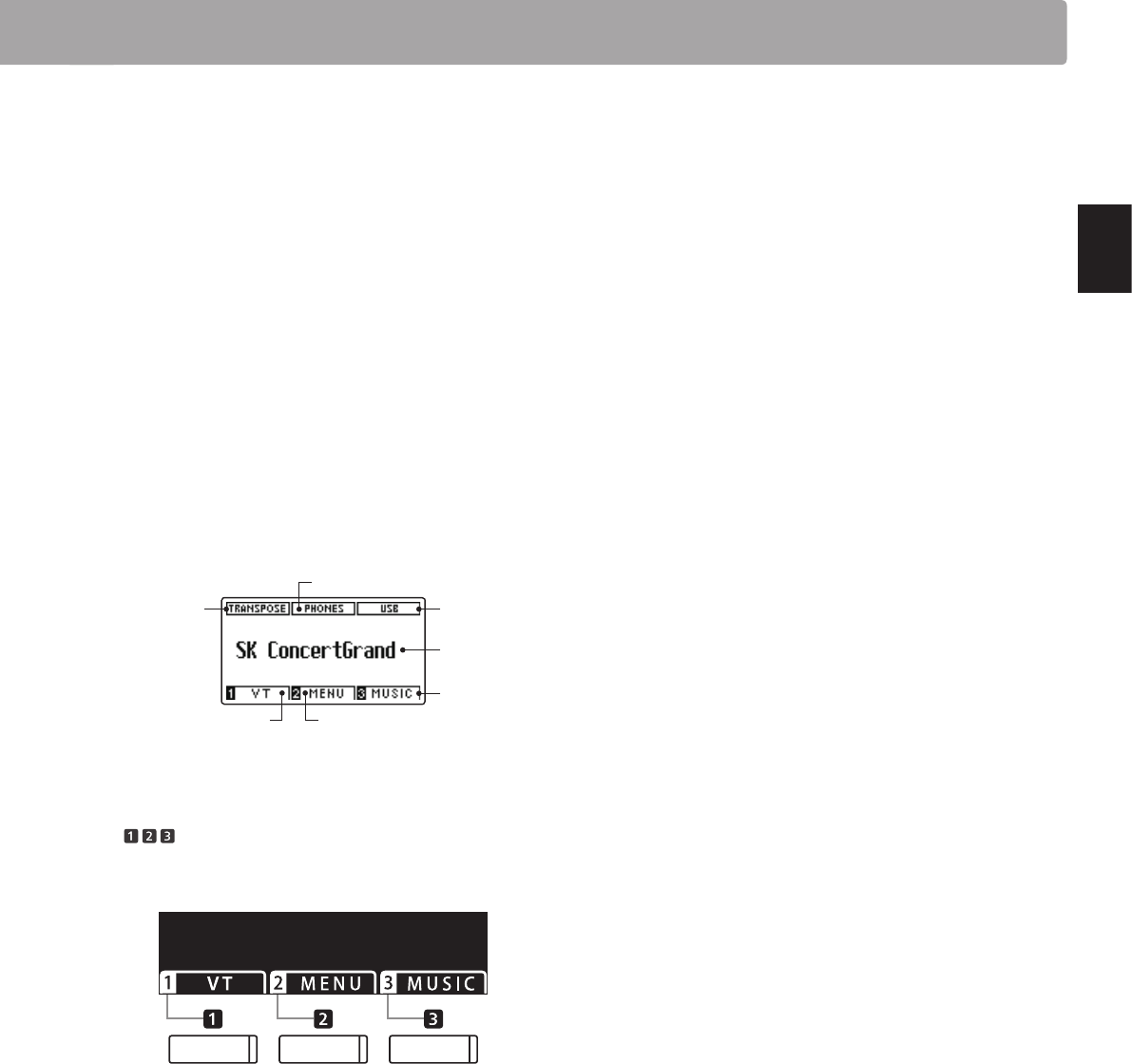
c LCD display
The LCD display provides useful information such as the
currently selected sound name, settings values, and the status
of other functions when active. An example of the main play
screen is shown below.
USB device
status
Transpose
status
Headphones status
Selected
sound
Music menu
Function/Settings menuVirtual Technician
* A protective plastic lm is attached to the display during production.
Please remove this lm before attempting to play the instrument.
d FUNCTION button
These buttons are used to select one of three functions/options
shown at the bottom of the LCD display.
e ARROW buttons
These buttons are used to navigate around the various menus
and screens, adjust values, and answer on-screen prompts.
f EFFECTS button
This button is used to turn eects for the selected sound on/o,
to select the dierent eect types, and to adjust their settings.
g REVERB button
This button is used to turn reverb for the selected sound on/o,
to select the dierent reverb types, and to adjust their settings.
h METRONOME button
This button is used to turn the metronome function on/o, and
also to adjust the tempo, time signature (or beat), and volume
settings.
i PLAY/STOP button
This button is used to start/stop the playback of demonstration
songs, Piano Music pieces, and Lesson and Finger Exercises, and
to start/stop the recording and playback of recorder songs, and
MP3/WAV audio les.
i REC button
This button is used to record performances to internal memory
or a USB memory device as MP3/WAV audio les.
j SOUND buttons
These buttons are used to select the sound(s) that will be heard
when playing the keyboard of the CS11/CS8 digital piano.
Multiple sounds are assigned to each category button, and can
be selected by pressing the same button repeatedly.
These buttons are also used to select Registration memories.
k REGISTRATION button
This button is used to store and recall one of the sixteen dierent
registration memories. Each registration can store sound, reverb
and eects settings, as well as various other panel options.
l USB to DEVICE port
This port is used to connect a FAT or FAT32 formatted USB
memory device to the instrument in order to load/save recorded
song data, registration memories, and MP3/WAV/SMF les etc.
m PHONES jacks
These jacks are used to connect stereo headphones to the CS11/
CS8 digital piano. 1/4” and 1/8” connectors are provided for
convenience, and both can be used simultaneously, allowing
two pairs of headphones to be connected at the same time.
n LINE IN STEREO jack
This jack is used to connect the 1/8” stereo output from smart
phones, tablets, computers, or other electronic audio eqipment
to the CS11/CS8 digital piano’s amplier and speakers.
The input level can be adjusted by using the LEVEL knob.
o LINE OUT jacks
These jacks are used to connect the stereo output (Left/Right
1/4” phone plug) of the CS11/CS8 digital piano to external
ampliers, mixers, recording devices, and similar equipment.
The output level can be adjusted by using the LEVEL knob.
p USB to HOST port
This port is use to connect the CS11/CS8 digital piano to a
computer using a USB ‘B to A’ type cable in order to send and
receive MIDI data.
q MIDI IN / OUT jacks
These jacks are used to connect the CS11/CS8 digital piano to
external MIDI devices such as other musical instruments or a
computer in order to send and receive MIDI data.
* For more information about the instrument’s connectors and jacks,
please refer to ‘Connecting to Other Devices’ on page 128.
14
Introduction
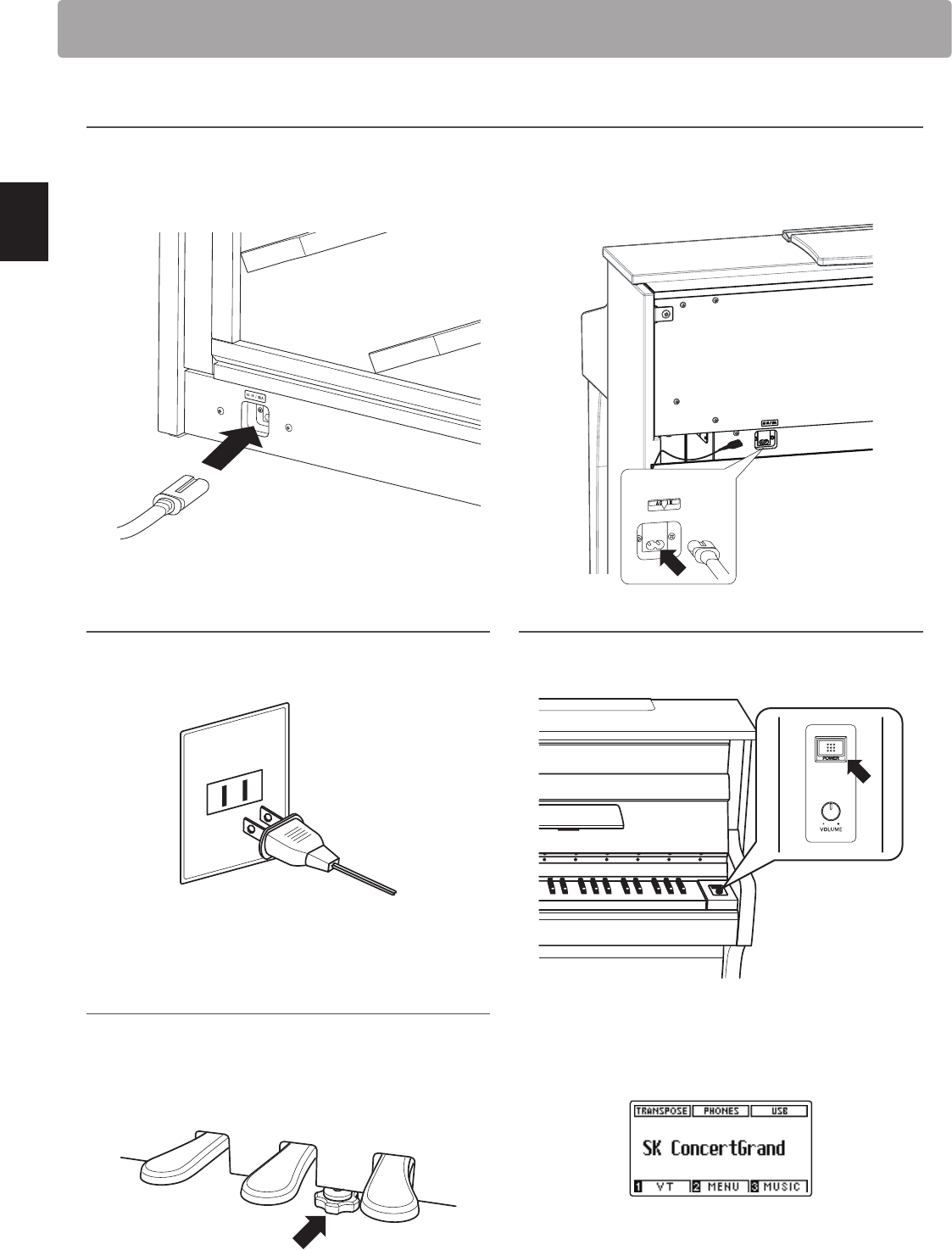
1. Connecting the power cable to the instrument
CS11
Connect the included power cable to the ‘AC IN’ inlet located on
the back side of instrument in the bottom left corner.
Setting Up the Piano
CS8
Connect the included power cable to the ‘AC IN’ inlet located on
the right hand side, towards the back of the instrument.
2. Connecting the power cable to an outlet
Connect the instrument’s power cable to an AC outlet.
Adjusting the pedal support bolt
A pedal support bolt is attached at the base of the pedal board
to aid stability when the pedals are pushed. Turn the bolt anti-
clockwise until it makes contact with the oor and supports the
pedals rmly.
3. Turning on the power
Press the POWER SWITCH located on the right hand side of the
front panel.
The instrument will turn on, and the words ‘SK ConcertGrand’ will
be shown in the LCD display, indicating that the SK Concert Grand
sound is selected, and the instrument is ready to be played.
* The CS11/CS8 digital piano features a power saving mode that can
turn o the instrument automatically after a specied period of
inactivity. For more information, please refer to the ‘Auto Power O’
setting on page 79.
15
Introduction
Adjusting the Volume / Using Headphones
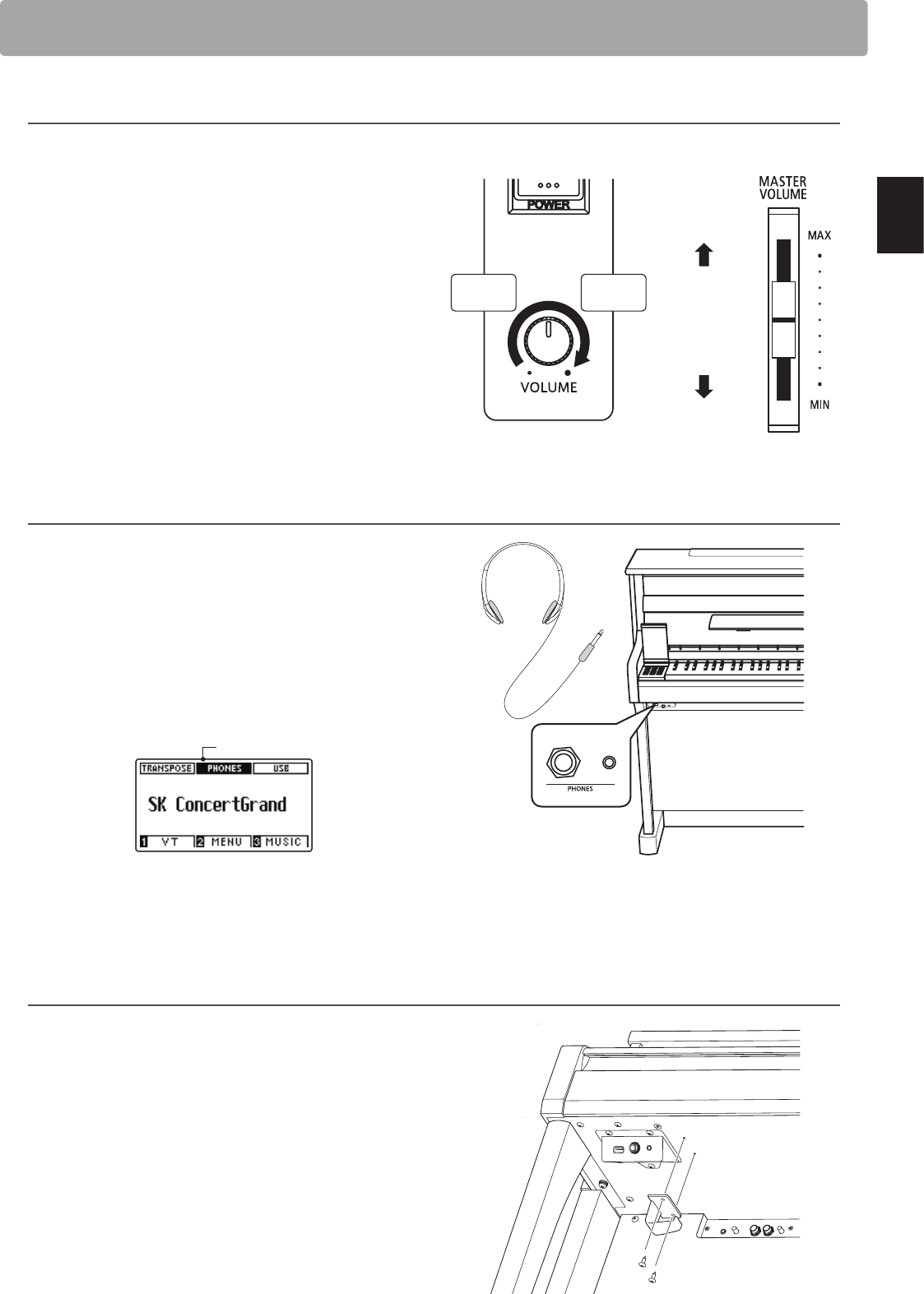
Adjusting the volume
The MASTER VOLUME knob/slider controls the volume level of
the instrument’s speakers, or headphones if connected.
Turn the knob clockwise/move the slider up to increase the
volume, and anti-clockwise/down to decrease the volume.
Use this knob/slider to set the volume to a comfortable listening
level – the middle is often a good starting point.
* The MASTER VOLUME knob/slider will not aect the volume level of
the LINE OUT connectors.
* The LINE OUT level can be adjusted by using the LEVEL knob. Please
refer to page 129 for more information.
* The maximum volume level of the speakers can be reduced by
using the ‘Speaker Volume’ setting. Please refer to page 69 for more
information.
Using headphones
Use the jacks located beneath the keyboard on the left hand
side, to connect stereo headphones to the CS11/CS8 digital
piano. 1/4” and 1/8” connectors are provided for convenience.
Two pairs of headphones can be connected and used
simultaneously.
When a pair of headphones is connected, sound will not be
produced by the speakers. In addition, the PHONES indicator in
the LCD display will be highlighted.
Headphones connected
* The maximum volume level of the headphones output and other
headphone characteristics can be adjusted by using the settings in the
‘Phones Settings’ menu. Please refer to page 106 for more information.
Attaching the headphone hook (optional)
A headphone hook is included with the CS11/CS8 digital piano
and can be used to hang headphones when not in use.
If desired, attach the headphone hook to the underside of the
keyboard as shown in the illustration opposite..
* For more information, please refer to the ‘Assembly Instructions’ on
page 124.
Increase
volume
Decrease
volume
Decrease
volume
Increase
volume
CS11 CS8
section
16
Playing the Piano
Using the Pedals
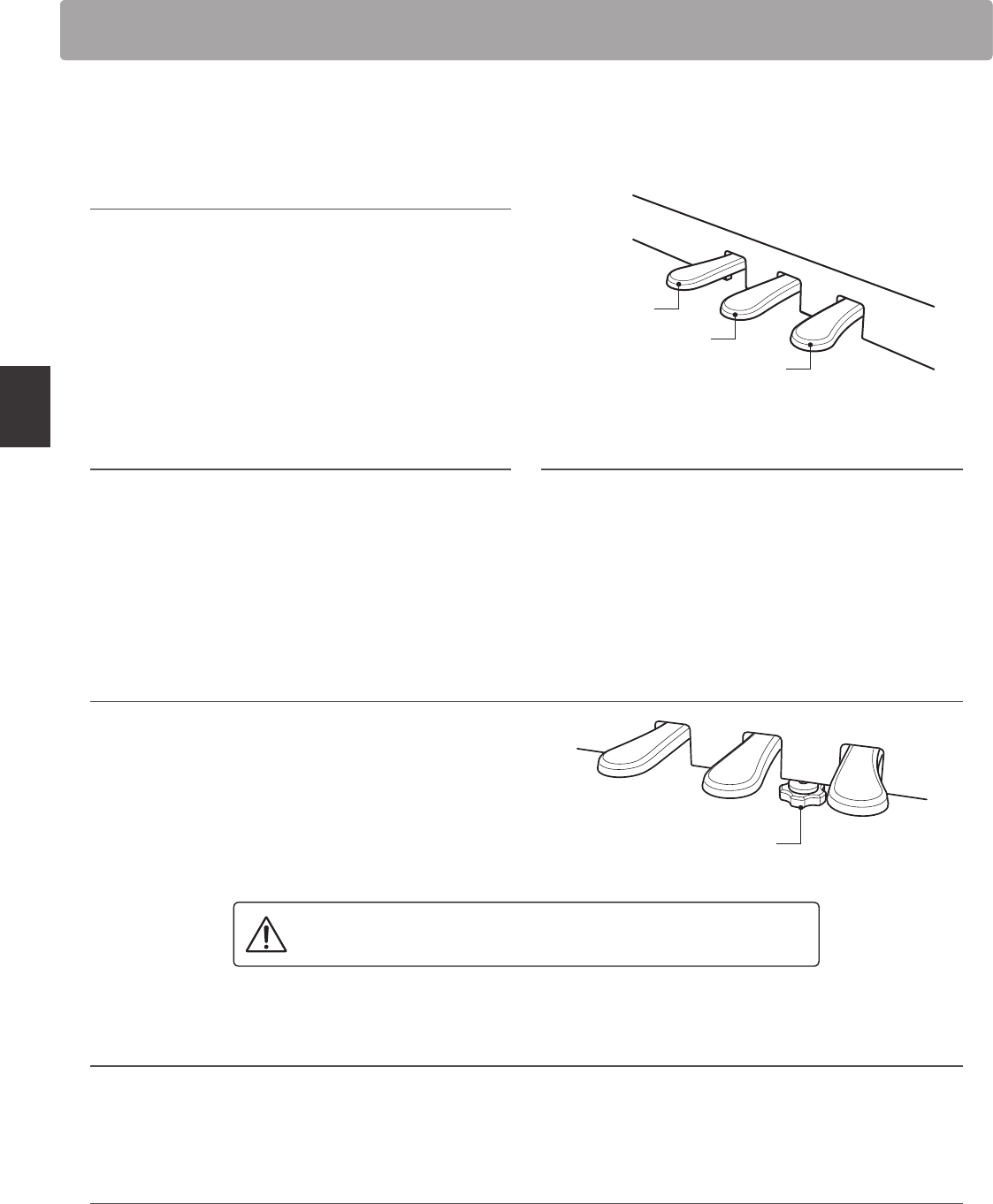
As with a grand piano, the CS11/CS8 digital piano features three pedals: sustain, sostenuto, and soft.
Sustain pedal (right pedal)
Depressing this pedal sustains the sound after one’s hands have
been lifted from the keyboard – greatly enriching the piano
sound, while also assisting smooth ‘legato’ passages.
The sustain pedal is capable of responding to half pedaling. Soft pedal
Sostenuto pedal
Sustain pedal
Soft pedal (left pedal)
Depressing this pedal softens the sound, reducing its volume.
When the rotary speaker eect is selected, the soft pedal is also
used to alternate the speed of the rotary simulation between
‘Slow’ and ‘Fast’ eect modes.
Sostenuto pedal (centre pedal)
Depressing this pedal after playing the keyboard and before
releasing the keys, sustains the sound of only those notes that
have been played. Any keys that are subsequently played after
the sostenuto pedal is depressed will not be sustained.
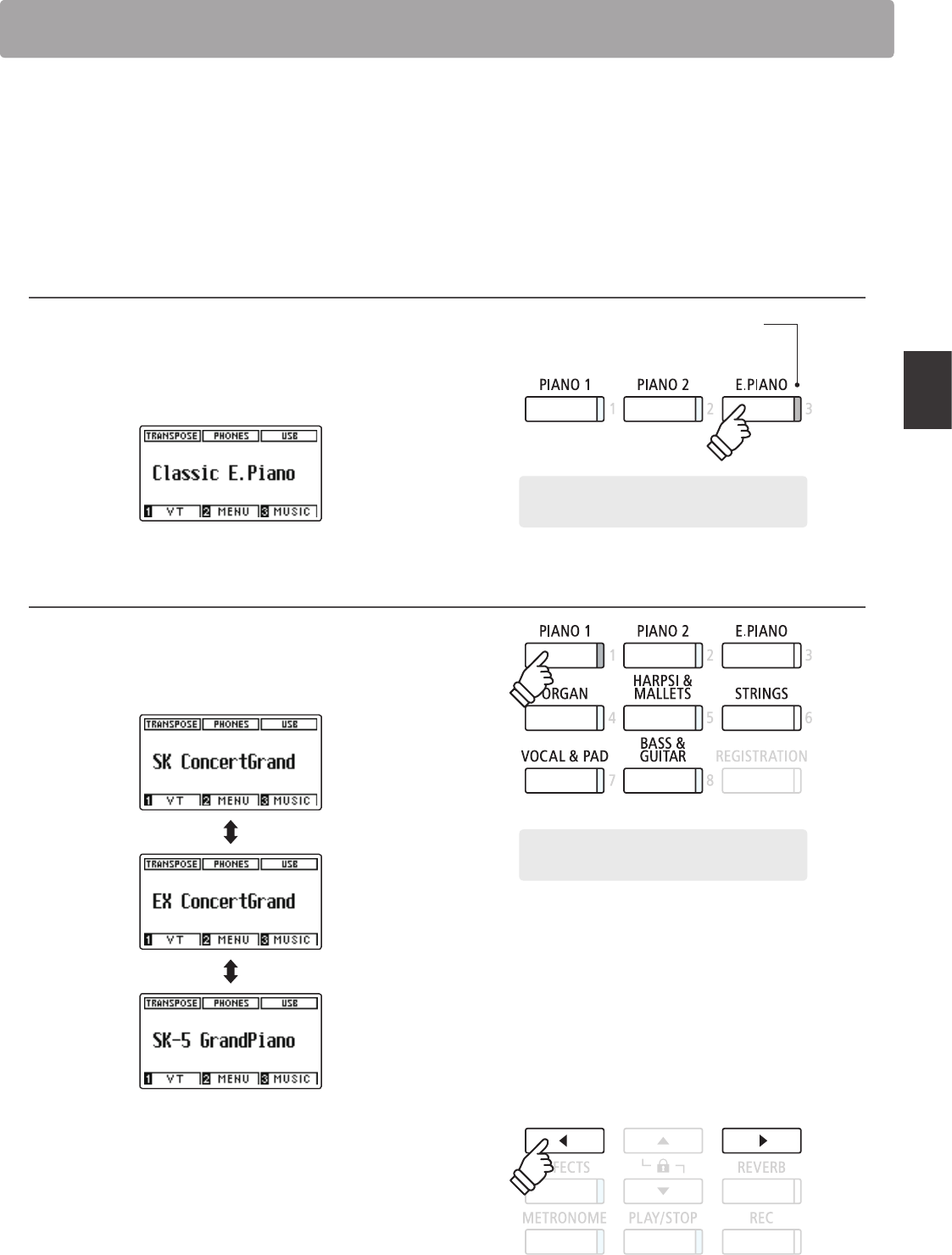
Pedal support bolt
A pedal support bolt is attached at the base of the pedal board
to aid stability when the pedals are pushed.
Turn the bolt anti-clockwise until it makes contact with the oor
and supports the pedals rmly. If the pedal support bolt does
not make contact with the oor, the pedal board may become
damaged.
When moving the instrument, always adjust or remove the pedal
support bolt, then readjust when the instrument is in its new position.
Caring for the pedals
If the surface of the pedals becomes dirty, clean the pedals using a dry dish-washing sponge.
Do not attempt to clean the pedals using rust-removing solvents, abrasives or les.
Grand Feel Pedal System
The CS11/CS8 digital piano features the Grand Feel Pedal System, which replicates the sustain, soft, and sostenuto pedal weighting
of Kawai’s EX Concert Grand piano. It is also possible to adjust the sensitivity of the sustain/damper pedal, and the eectiveness of
the soft pedal using the ‘Half-Pedal Adjust’ and ‘Soft Pedal Depth’ settings.
* For more information, please refer to page 104.
Pedal support bolt
section
17
Playing the Piano
The CS11/CS8 digital piano features a wide selection of realistic instrument sounds suitable for various musical
styles. Sounds are arranged into eight categories, with several sounds assigned to each category button. For a
complete listing of available instrument sounds, please refer to page 133 of this owner’s manual.
By default, the ‘SK Concert Grand’ sound will be selected automatically when the instrument is turned on.
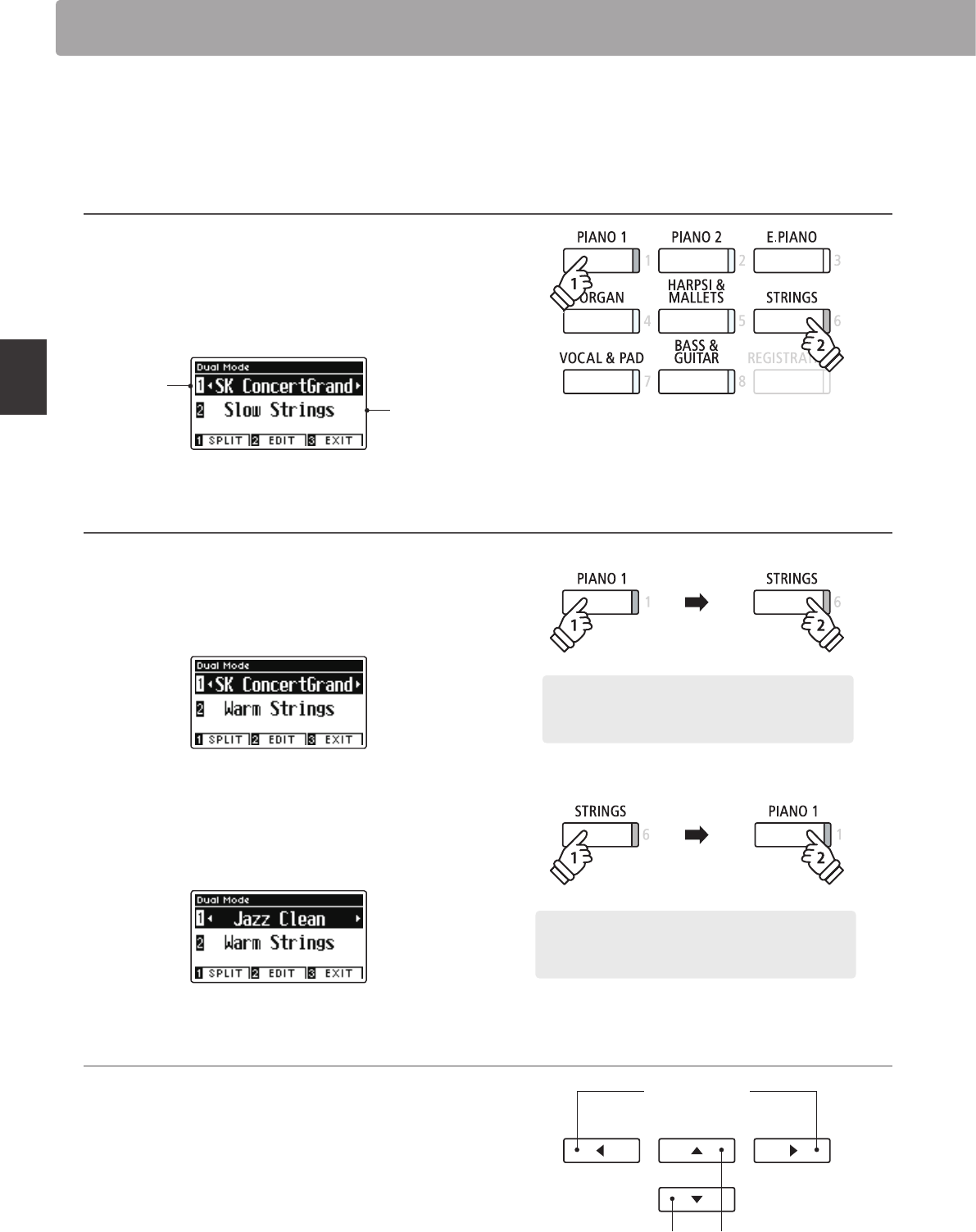
Selecting a sound
Press the desired SOUND button.
The LED indicator for the button will turn on to indicate that this
category has been selected, and the name of the sound will be
shown in the LCD display.
Changing the sound
Several sounds are assigned to each category button.
Press the selected category button repeatedly to cycle through
the dierent sound variations.
The or buttons can also be used to select sounds and cycle
through the dierent sound variations.
Selecting Sounds
Example: To select the E.PIANO category, press
the E.PIANO button.
LED indicator on:
Sound category is selected.
Example: To select the ‘SK-5 Grand Piano’ sound,
press the PIANO 1 button three times.
× 3
18
Playing the Piano
The Dual Mode function allows two sounds to be layered together, creating a more complex sound.
For example, a piano sound layered with strings, or a church organ combined with a choir, etc.
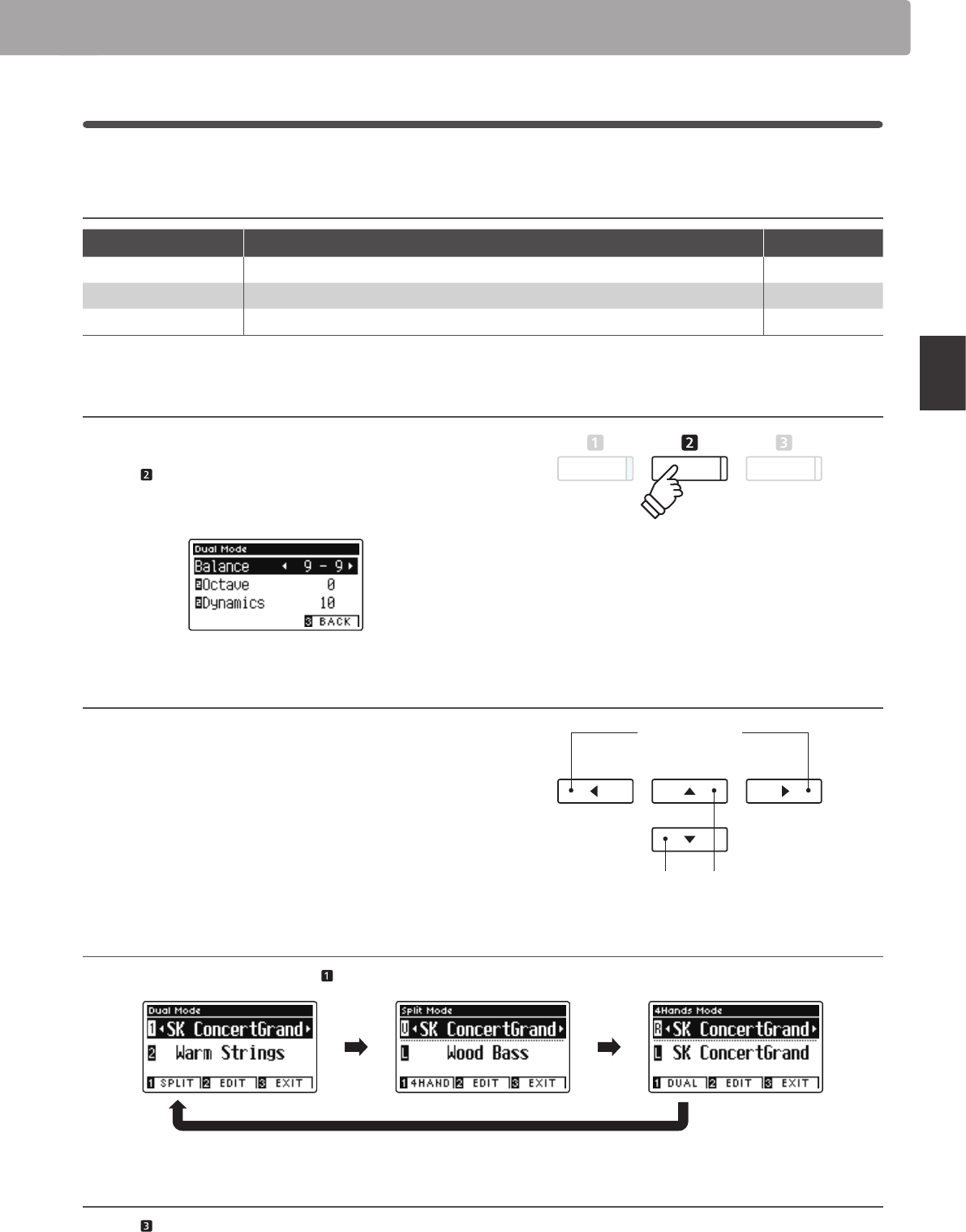
1. Entering Dual mode
Press and hold a SOUND button to select the main sound, then
press another SOUND button to select the layered sound.
The LED indicators for both SOUND buttons will turn on to
indicate that Dual Mode is in use, and the respective sound
names will be shown in the LCD display.
Layered
sound
Main
sound
2a. Changing the main/layered sounds: Method 1
To select a dierent variation for the layered sound:
Press and hold the main SOUND button, then press the layered
SOUND button repeatedly to cycle through the dierent sound
variations.
To select a dierent variation for the main sound:
Press and hold the layered SOUND button, then press the main
SOUND button repeatedly to cycle through the dierent sound
variations.
2b. Changing the main/layered sounds: Method 2
It is also possible to change the main/layered sound without
pressing and holding buttons.
Press the or buttons to move the selection cursor over the
main sound or layered sound.
Press the or buttons to cycle through the dierent sound
variations.
Dual Mode
Example: To change the main ‘SK Concert Grand’ sound
to the ‘Jazz Clean’ sound, press and hold the STRINGS
button, then press the PIANO 1 button three times.
hold
hold
× 2
Example: To change the layered ‘Slow Strings’ sound to
the ‘Warm Strings’ sound, press and hold the PIANO 1
button, then press the STRINGS button twice.
hold
× 3
buttons:
Move selection cursor.
buttons:
Change sound variation.
19
Playing the Piano
Dual Mode
Dual Mode settings
The Dual Mode settings menu allows characteristics of the combined sound to be adjusted.
Dual Mode settings
Dual Mode setting Description Default setting
Balance Adjust the volume balance between the main and layered sounds. 9 - 9
Layer Octave Shift Raise/lower the pitch of the layered sound in octave steps. 0
Dynamics Adjust the dynamic sensitivity of the layered sound relative to the main sound. 10
Entering the Dual Mode settings menu
While the Dual Mode screen is shown in the LCD display:
Press the FUNCTION button (EDIT).
The Dual Mode settings menu will be shown in the LCD display.
Adjusting Dual Mode settings
After entering the Dual Mode settings menu:
Press the or buttons to move the selection cursor over the
desired setting.
Press the or buttons to adjust the selected setting.
* To reset the current setting to the default value, press the and
buttons simultaneously.
Cycling between Dual, Split, and Four Hands modes
When Dual Mode is selected, press the FUNCTION button to cycle between Split, Four Hands, and Dual modes.
Exiting Dual, Split, and Four Hands modes
Press the FUNCTION button (EXIT) to exit Dual, Split, and Four Hands modes.
buttons:
Move selection cursor.
buttons:
Adjust selected setting.
* Preferred Dual Mode settings can be stored to a Registration memory
for convenient recall. Please refer to page 32 for more information.
20
Playing the Piano
Split Mode
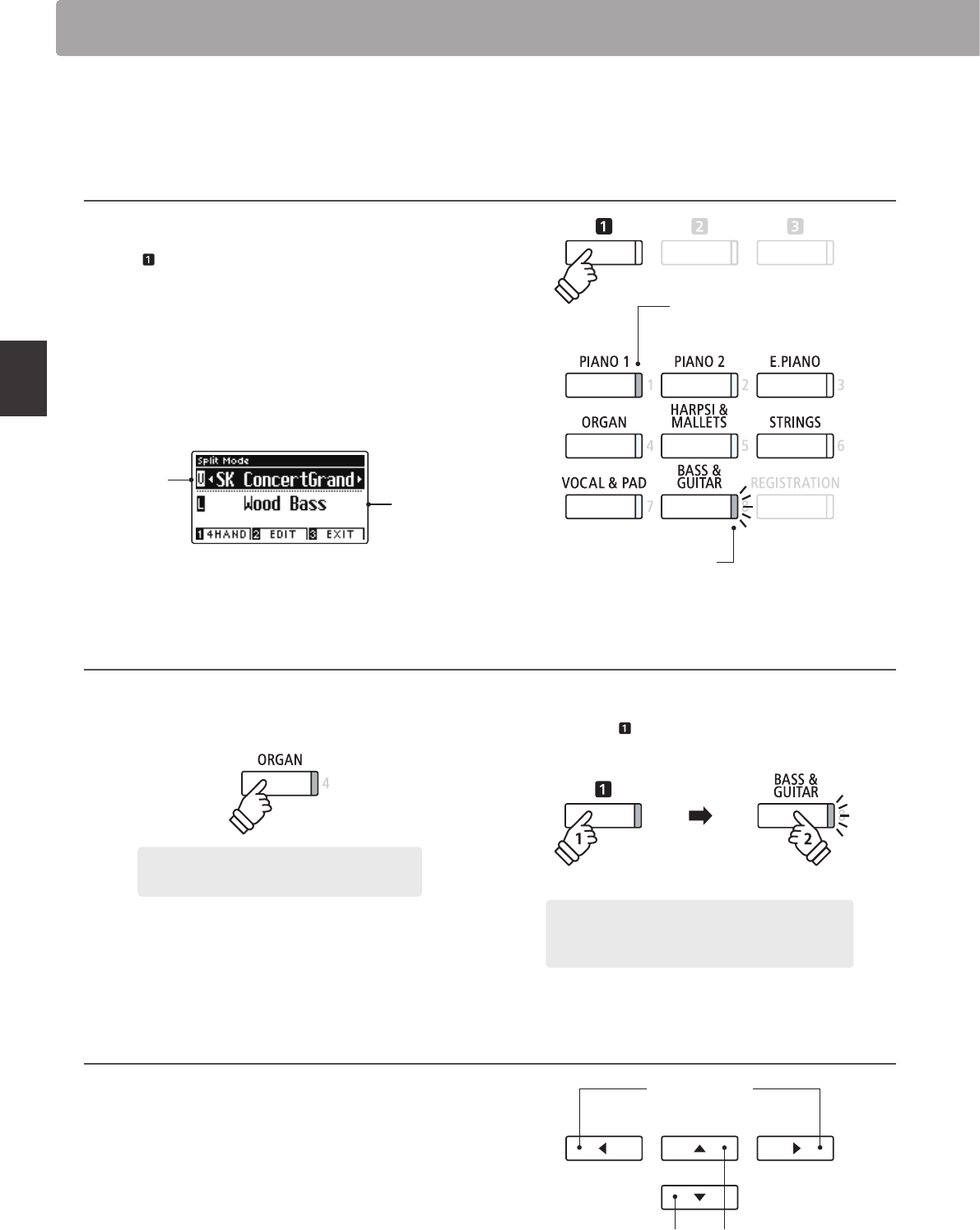
The Split Mode function divides the keyboard into two sections, allowing each section to be played with a dierent
sound. For example, a bass sound in the lower section, and a piano sound in the upper section.
1. Entering Split mode
After entering Dual Mode (page 18):
Press the FUNCTION button (SPLIT).
The Split Mode screen will be shown in the LCD display.
* The default split point is set between keys B3 and C4.
The upper section and lower section sound names will be
shown in the LCD display. The LED indicator for the upper
section sound button will turn on, and the LED indicator for the
lower section sound button will start to ash.
Lower
section
sound
Upper
section
sound
* By default, the lower section will be set to the ‘Wood Bass’ sound.
2a. Changing the upper/lower section sounds: Method 1
To select a dierent sound for the upper section:
Press the desired SOUND button.
* Preferred Split Mode upper/lower section sound combinations can be
stored to a Registration memory for convenient recall. Please refer to
page 32 for more information.
2b. Changing the upper/lower section sounds: Method 2
It is also possible to change the upper/lower section sound without
pressing and holding buttons.
Press the or buttons to move the selection cursor over the
upper section or lower section sound.
Press the or buttons to cycle through the dierent sound
variations.
LED indicator on:
Upper section sound.
LED indicator ashing:
Lower section sound.
Example: To select the ‘Blues Organ' sound for
the upper section, press the ORGAN button twice.
× 2
To select a dierent sound for the lower section:
Press and hold the FUNCTION button (4HAND), then press the
desired SOUND button.
Example: To select the 'W. Bass & Ride' sound for the
lower section, press and hold the 1 FUNCTION button,
then press the BASS & GUITAR button three times.
buttons:
Move selection cursor.
buttons:
Change sound variation.
hold
× 3
21
Playing the Piano
Split Mode
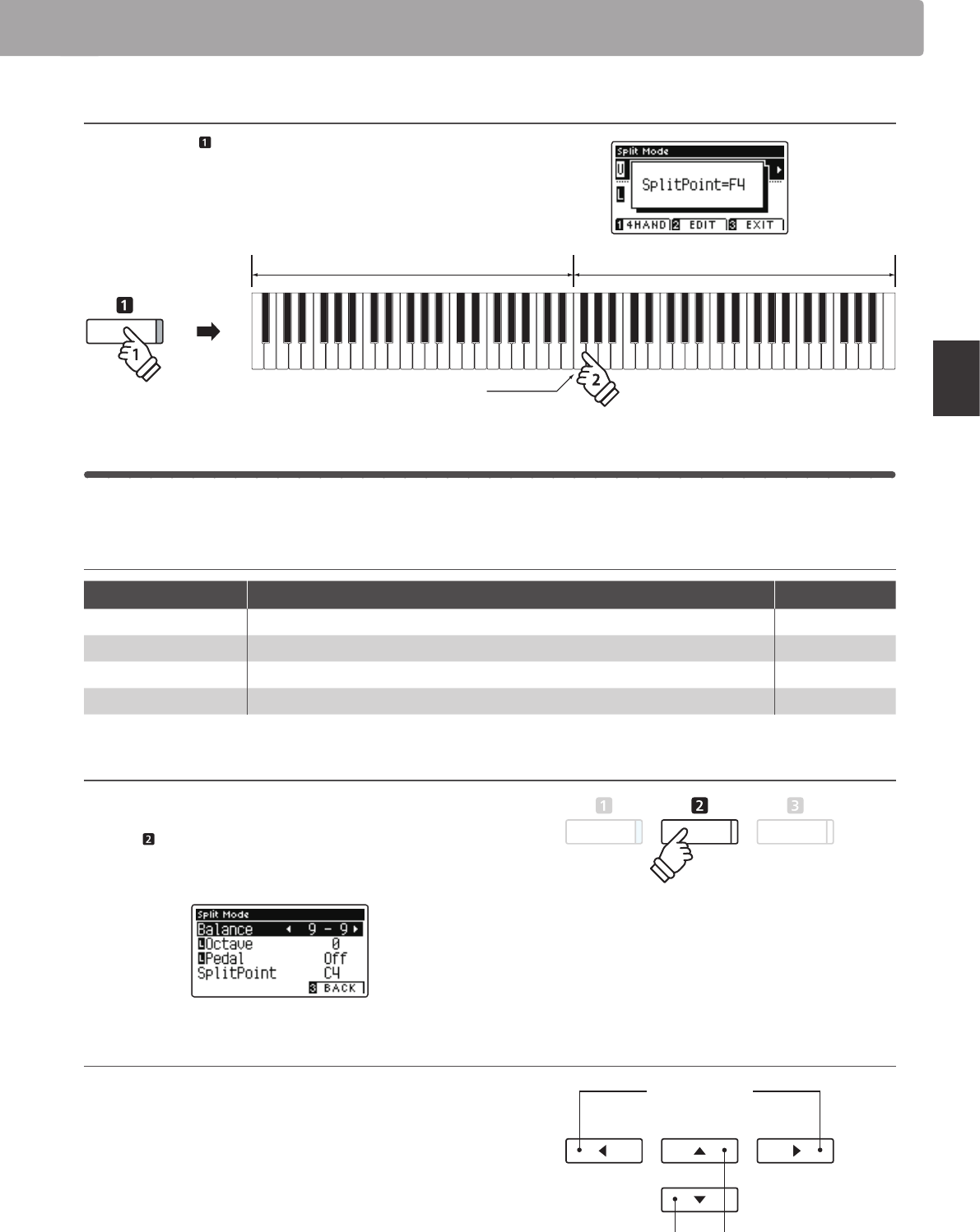
3. Changing the split point
Press and hold the FUNCTION button (4HAND), then press the
desired split key on the keyboard.
The name of the pressed key will briey be shown in the LCD
display, and will become the new split point.
hold
Upper sectionLower section
New split point
Split Mode settings
The Split Mode settings menu allows characteristics of the Split Mode sound and operation to be adjusted.
Split Mode settings
Split Mode setting Description Default setting
Balance Adjust the volume balance between the upper and lower sections. 9 - 9
Lower Octave Shift Raise/lower the pitch of the lower section sound in octave steps. 0
Lower Pedal Enable/disable the sustain pedal for the lower section sound. O
Split Point Specify the point along the keyboard that divides the upper and lower sections. C4
Entering the Split Mode settings menu
While the Split Mode screen is shown in the LCD display:
Press the FUNCTION button (EDIT).
The Split Mode settings menu will be shown in the LCD display.
Adjusting Split Mode settings
After entering the Split Mode settings menu:
Press the or buttons to move the selection cursor over the
desired setting.
Press the or buttons to adjust the selected setting.
* To reset the current setting to the default value, press the and
buttons simultaneously. buttons:
Move selection cursor.
buttons:
Adjust selected setting.
* Preferred Split Mode settings can be stored to a Registration memory
for convenient recall. Please refer to page 32 for more information.
22
Playing the Piano
Four Hands Mode
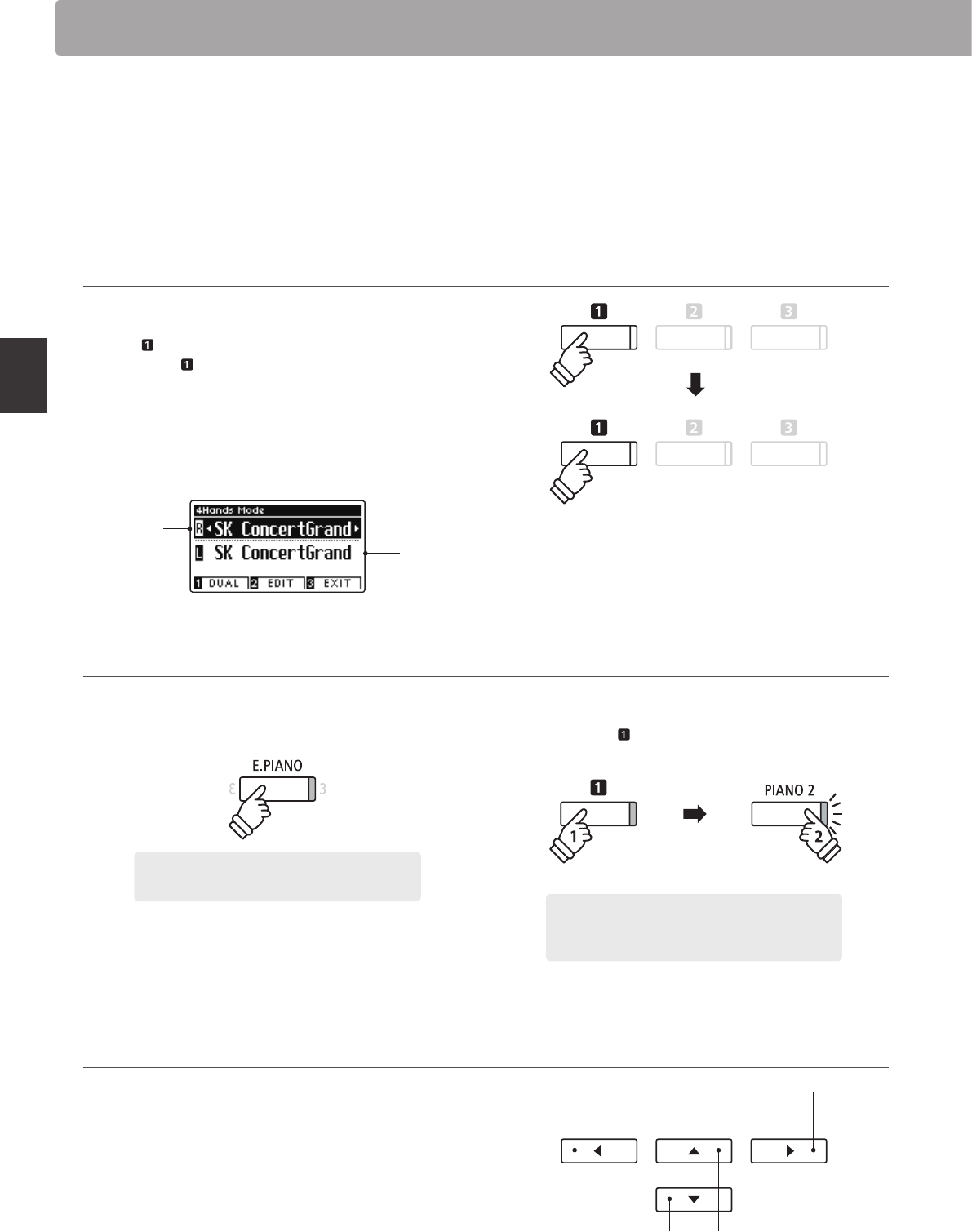
The Four Hands Mode function divides the keyboard into two sections in a similar way to that of the Split Mode
function. However, with Four Hands Mode enabled, the octave/pitch of each section is automatically adjusted to
create two separate 44-key instruments with the same playing range. Furthermore, the sustain (right) pedal and
soft (left) pedal act as separate sustain pedals for the respective upper and lower sections, allowing two people to
perform piano duets using a single instrument.
1. Entering Four Hands mode
After entering Dual Mode (page 18):
Press the FUNCTION button (SPLIT) once to enter Split Mode,
then press the FUNCTION button (4HAND) again to select
Four Hands Mode.
* The default four hands mode split point is set between keys E4 and F4.
The Four Hands Mode screen and right/left section sound
names will be shown in the LCD display.
Left
section
sound
Right
section
sound
2a. Changing the right/left section sounds: Method 1
To select a dierent sound for the right section:
Press the desired SOUND button.
* Preferred Four Hands Mode right/left section sound combinations
can be stored to a Registration memory for convenient recall. Please
refer to page 32 for more information.
2b. Changing the right/left section sounds: Method 2
It is also possible to change the right/left section sound without
pressing and holding buttons.
Press the or buttons to move the selection cursor over the
right section or left section sound.
Press the or buttons to cycle through the dierent sound
variations.
Example: To select the 'Classic E.P.' sound for the
right section, press the E.PIANO button.
To select a dierent sound for the left section:
Press and hold the FUNCTION button (DUAL), then press the
desired SOUND button.
hold
Example: To select the 'Pop Grand' sound for the
left section, press and hold the 1 FUNCTION button,
then press the PIANO2 button.
buttons:
Move selection cursor.
buttons:
Change sound variation.
* By default, the right and left sections will both be set to the ‘SK
Concert Grand’ sound.
23
Playing the Piano
Four Hands Mode
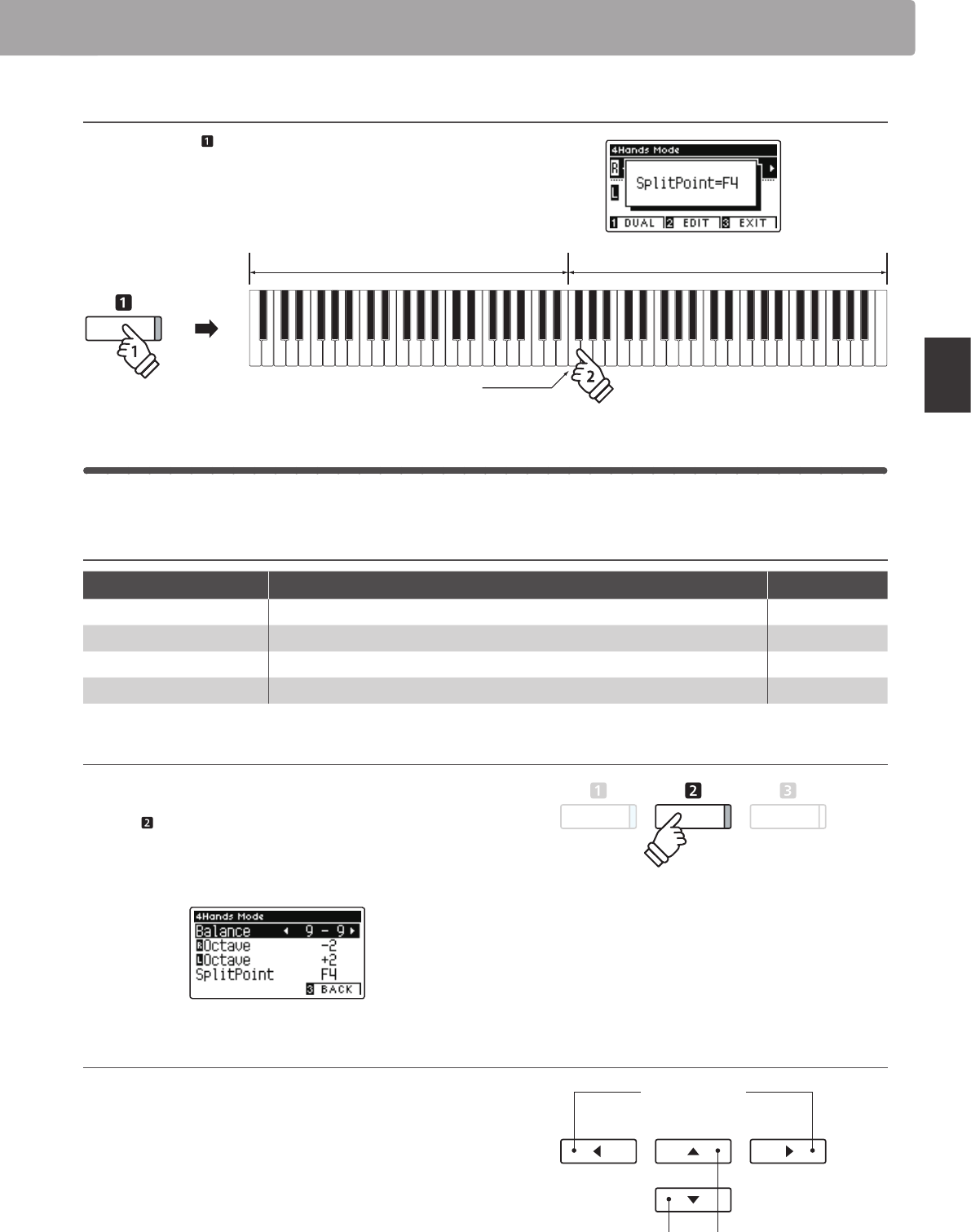
3. Changing the Four Hands mode split point
Press and hold the FUNCTION button (DUAL), then press the
desired split key on the keyboard.
The name of the pressed key will briey be shown in the LCD
display, and will become the new split point.
hold
Right sectionLeft section
New split point
Four Hands Mode settings
The Four Hands Mode settings menu allows characteristics of the Four Hands Mode sound to be adjusted.
Four Hands Mode settings
Four Hands Mode setting Description Default setting
Balance Adjust the volume balance between the right and left sections. 9 - 9
Right Octave Shift Raise/lower the pitch of the right section sound in octave steps. – 2
Left Octave Shift Raise/lower the pitch of the left section sound in octave steps. + 2
Split Point Specify the point along the keyboard that divides the right and left sections. F4
Entering the Four Hands Mode settings menu
While the Four Hands Mode screen is shown in the LCD display:
Press the FUNCTION button (EDIT).
The Four Hands Mode settings menu will be shown in the LCD
display.
Adjusting Four Hands Mode settings
After entering the Four Hands Mode settings menu:
Press the or buttons to move the selection cursor over the
desired setting.
Press the or buttons to adjust the selected setting.
* To reset the current setting to the default value, press the and
buttons simultaneously. buttons:
Move selection cursor.
buttons:
Adjust selected setting.
* Changes made to the Four Hands Mode settings will not aect the
Split Mode settings, and vice versa.
* Preferred Four Hands Mode settings can be stored to a Registration
memory for convenient recall. Please refer to page 32 for more
information.
24
Playing the Piano
Reverb adds reverberation to the sound, simulating the acoustic environment of a recital room, stage, or concert
hall. Some sound types, such as acoustic piano, enable reverb automatically in order to improve acoustic realism.
The CS11/CS8 digital piano features six dierent reverb types.
Reverb types
Reverb type Description
Room Simulates the ambiance of a small rehearsal room.
Lounge Simulates the ambience of piano lounge.
Small Hall Simulates the ambiance of a small hall.
Concert Hall Simulates the ambiance of a concert hall or theater.
Live Hall Simulates the ambiance of a live hall or stage.
Cathedral Simulates the ambiance of a large cathedral.
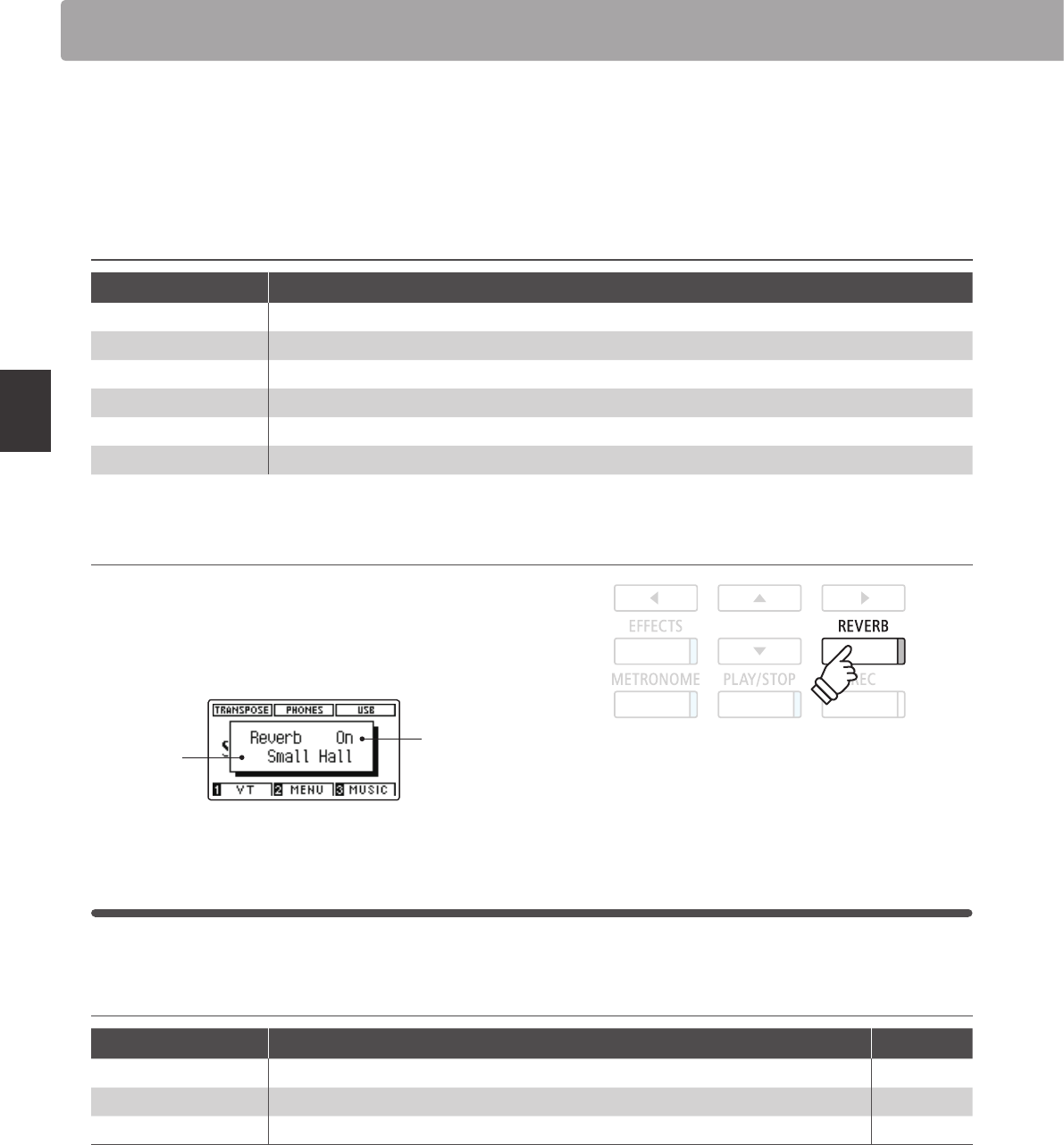
1. Turning Reverb on/o
Press the REVERB button to turn reverb on/o.
The LED indicator for the REVERB button will turn on to indicate
when reverb is in use, and the current status will briey be
shown in the LCD display.
Reverb
status
Reverb
type
Reverb settings
The Reverb settings menu allows the type and characteristics of the reverb to be adjusted.
Reverb settings
Reverb setting Description Range
Type Changes the type of environment. –
Depth Adjusts the depth of the environment (i.e. amount of reverberation to apply). 1~10
Time Adjusts the decay length/speed of the reverberation. 1~10
Reverb
25
Playing the Piano
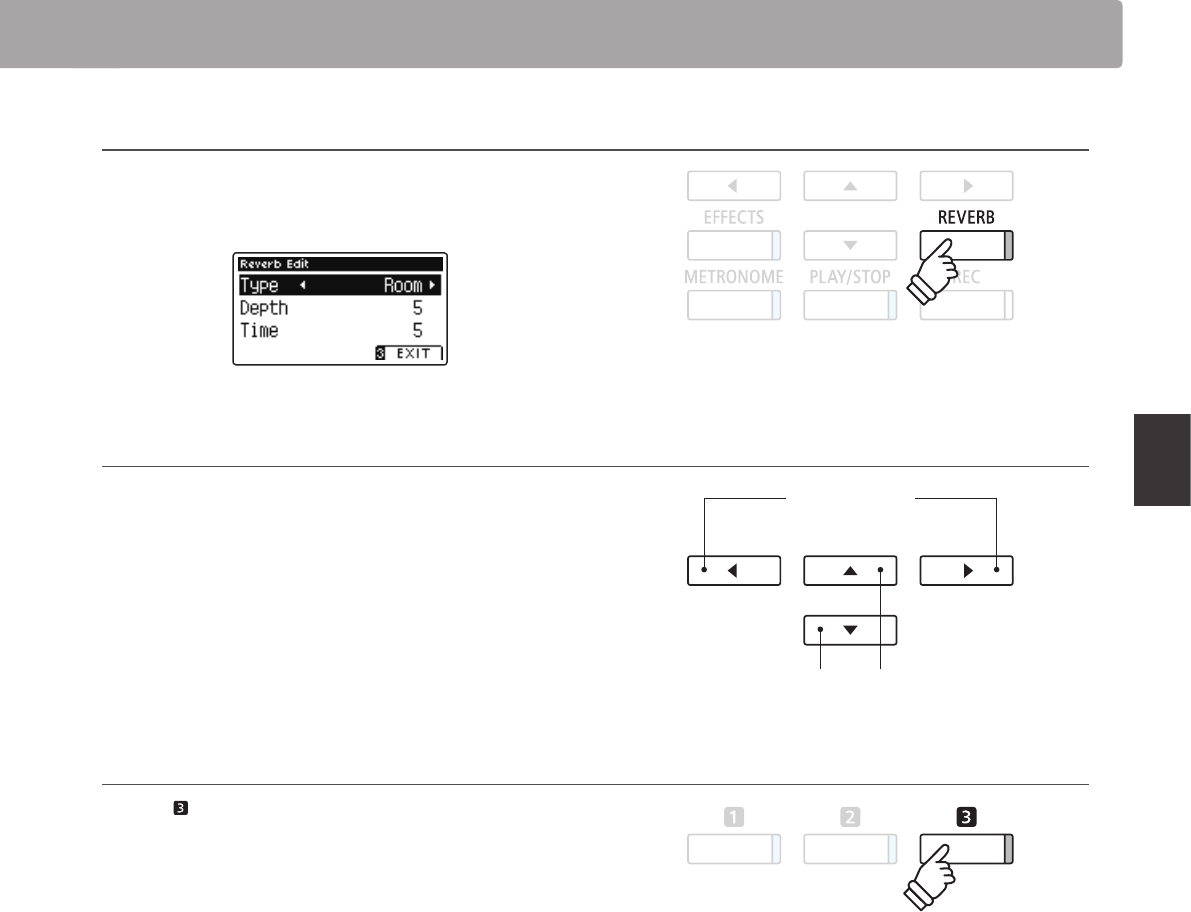
Entering the Reverb settings menu
Press and hold the REVERB button.
The Reverb settings menu will be shown in the LCD display.
Adjusting Reverb settings
After entering the Reverb settings menu:
Press the or buttons to move the selection cursor over the
desired setting.
Press the or buttons to adjust the selected setting.
* To reset the current setting to the default value, press the and
buttons simultaneously.
Exiting the Reverb settings menu
Press the FUNCTION button (EXIT) to exit the Reverb settings
menu.
* Reverb settings are independent for each sound variation.
* Any changes made to the reverb type, settings, or on/o status will
remain until the power is turned o.
* Preferred reverb settings can be stored to a Registration memory for
convenient recall. Please refer to page 32 for more information.
Reverb
buttons:
Move selection cursor.
buttons:
Adjust selected setting.
26
Playing the Piano
In addition to reverb, various other eects can be applied to the selected sound, altering the tonal character
and feeling of the instrument. As with reverb, some sound types enable certain eects automatically in order to
enhance tonal quality. The CS11/CS8 digital piano features 19 dierent eect types, with 2 combination eects, and
3 additional amplied eects.
Eect types
Eect type Description
Mono Delay Applies an echo eect to the sound, playing through both speakers simultaneously.
Ping Delay Applies a ‘ping pong’ echo eect to the sound, giving the impression that it is ‘bouncing’ from left to right.
Triple Delay Similar in principle to Ping Delay, but with an additional centre echo.
Chorus Layers a slightly detuned version of the sound over the original, thus enriching its tonal character.
Classic Chorus Similar in principle to Chorus, but intended for vintage electric piano sounds.
Ensemble Applies a three-phase chorus to the sound, providing additional richness.
Tremolo Continuously varies the volume at a constant speed, adding a vibrato type eect to the sound.
Classic Tremolo Similar in principle to Tremolo, but intended for vintage electric piano sounds.
Vibrato Tremolo Similar in principle to Tremolo, but with an additional Vibrato eect applied.
Auto Pan Alternates the sound output from left to right across the stereo eld using a sine wave.
Classic Auto Pan Similar in principle to Auto Pan, but intended for vintage electric piano sounds.
Phaser Applies a cyclic phase change to the sound, giving the impression that the sound is moving.
Classic Phaser Similar in principle to Phaser, but intended for vintage electric piano sounds.
Rotary (1~6)
Simulates the sound of a rotary speaker commonly used with vintage electronic organs.
There are three dierent levels of overdrive, with and without a Chorus eect.
* The soft pedal can be used to alternate the speed of the rotary simulation between ‘Slow’ and ‘Fast’ eect modes.
Combination Eects Dierent combinations of the above eects, applied simultaneously.
* Combination eect types: Phaser+Chorus, Phaser+AutoPan
Amplied Eects A selection of the above eects, with a vintage electric piano speaker eect applied.
* Amplied eect types: Tremolo+Amp, Auto Pan+Amp, Phaser+Amp
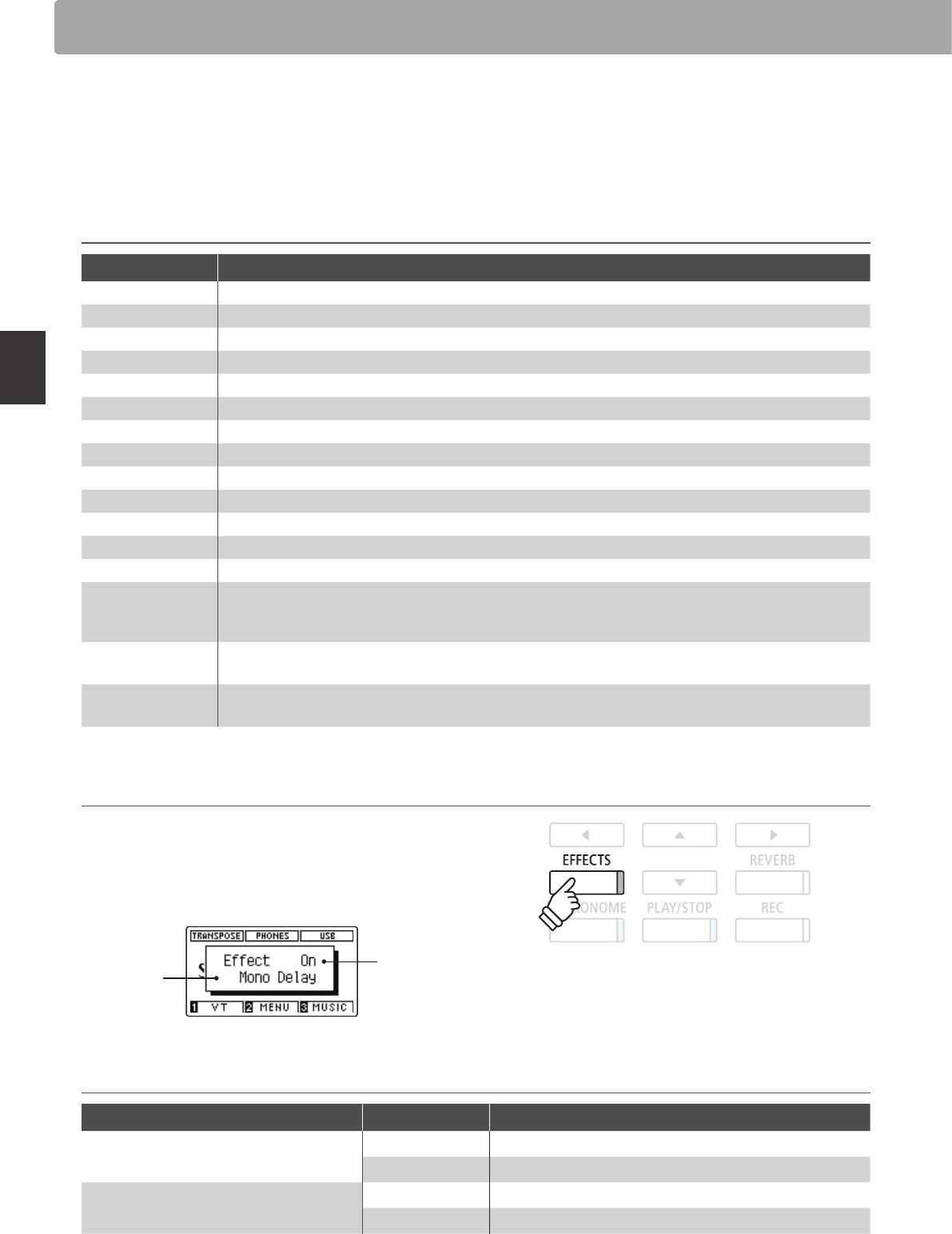
1. Turning Eects on/o
Press the EFFECTS button to turn eects on/o.
The LED indicator for the EFFECTS button will turn on to indicate
when eects are in use, and the current status will briey be
shown in the LCD display.
Eect
status
Eect
type
Eects settings
Eect type Eect setting Description
Mono Delay / Ping Delay / Triple Delay Dry / Wet Adjust the intensity of the delay.
Time Adjust the interval of time between each delay.
Chorus / Ensemble Dry / Wet Adjust the intensity of the chorus.
Speed Adjust the speed of the chorus.
Eects
27
Playing the Piano
Eects
Eects settings (cont.)
Eect type Eect setting Description
Classic Chorus Mono / Stereo Toggle between a Mono or Stereo effect.
Speed Adjust the speed of the chorus.
Tremolo / Classic Tremolo / Vibrato Tremolo Dry / Wet Adjust the intensity of the tremolo.
Speed Adjust the speed of the tremolo.
Auto Pan / Classic Auto Pan Dry / Wet Adjust the intensity of the pan.
Speed Adjust the speed of the pan.
Phaser / Classic Phaser Dry / Wet Adjust the intensity of the phaser.
Speed Adjust the speed of the phaser.
Rotary Accel. Speed Adjust the acceleration speed between slow and fast modes.
Rotary Speed Adjust the speed of the rotary speaker.
Combination Eects / Amplied Eects Dry / Wet Adjust the intensity of the eects.
Speed Adjust the speed of the eects.
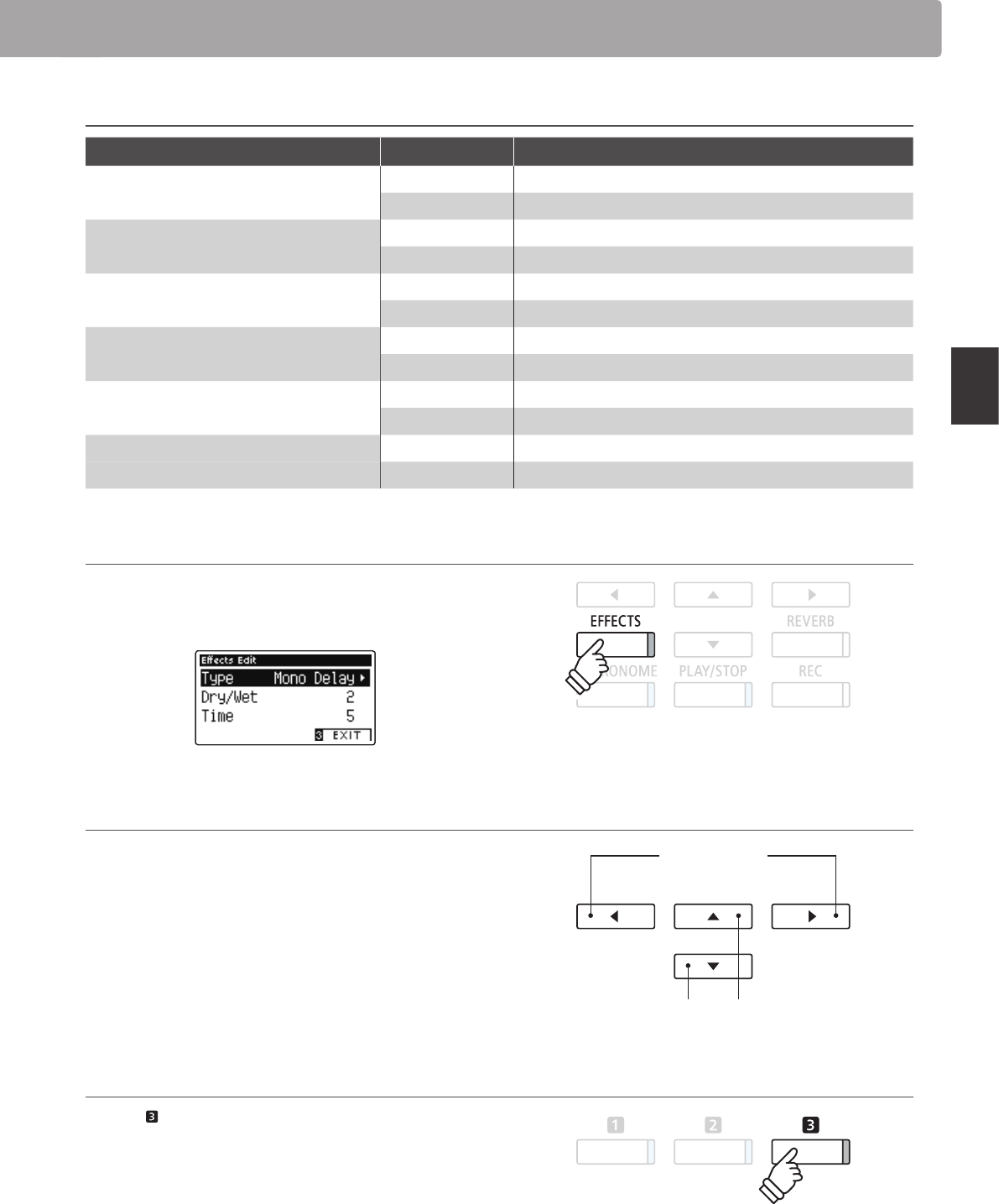
Entering the Eects settings menu
Press and hold the EFFECTS button.
The Eects settings menu will be shown in the LCD display.
Adjusting Eects settings
After entering the Eects settings menu:
Press the or buttons to move the selection cursor over the
desired setting.
Press the or buttons to adjust the selected setting.
* To reset the current setting to the default value, press the and
buttons simultaneously.
Exiting the Eects settings menu
Press the FUNCTION button (EXIT) to exit the Eects settings
menu.
* Eects settings are independent for each sound variation.
* Any changes made to the eects type, settings, or on/o status will
remain until the power is turned o.
* Preferred eects settings can be stored to a Registration memory for
convenient recall. Please refer to page 32 for more information.
buttons:
Move selection cursor.
buttons:
Adjust selected setting.
hold
28
Playing the Piano
Virtual Technician
In addition to the reverb and eects functions, the overall character of the CS11/CS8 acoustic piano sounds can also
be dramatically adjusted using the instrument’s Virtual Technician feature. There are two methods of using the
Virtual Technician: Smart Mode and Advanced Mode.
1
Smart Mode
In Smart Mode, the Virtual Technician intelligently performs a collection of adjustments for the player, based on
ten preset attributes such as ‘Soft’ or ‘Strong’, ‘Brilliant’ or ‘Gloomy’. This mode is recommended for musicians that
wish to enjoy dierent piano characteristics, without delving into the individual parameters of Advanced Mode.
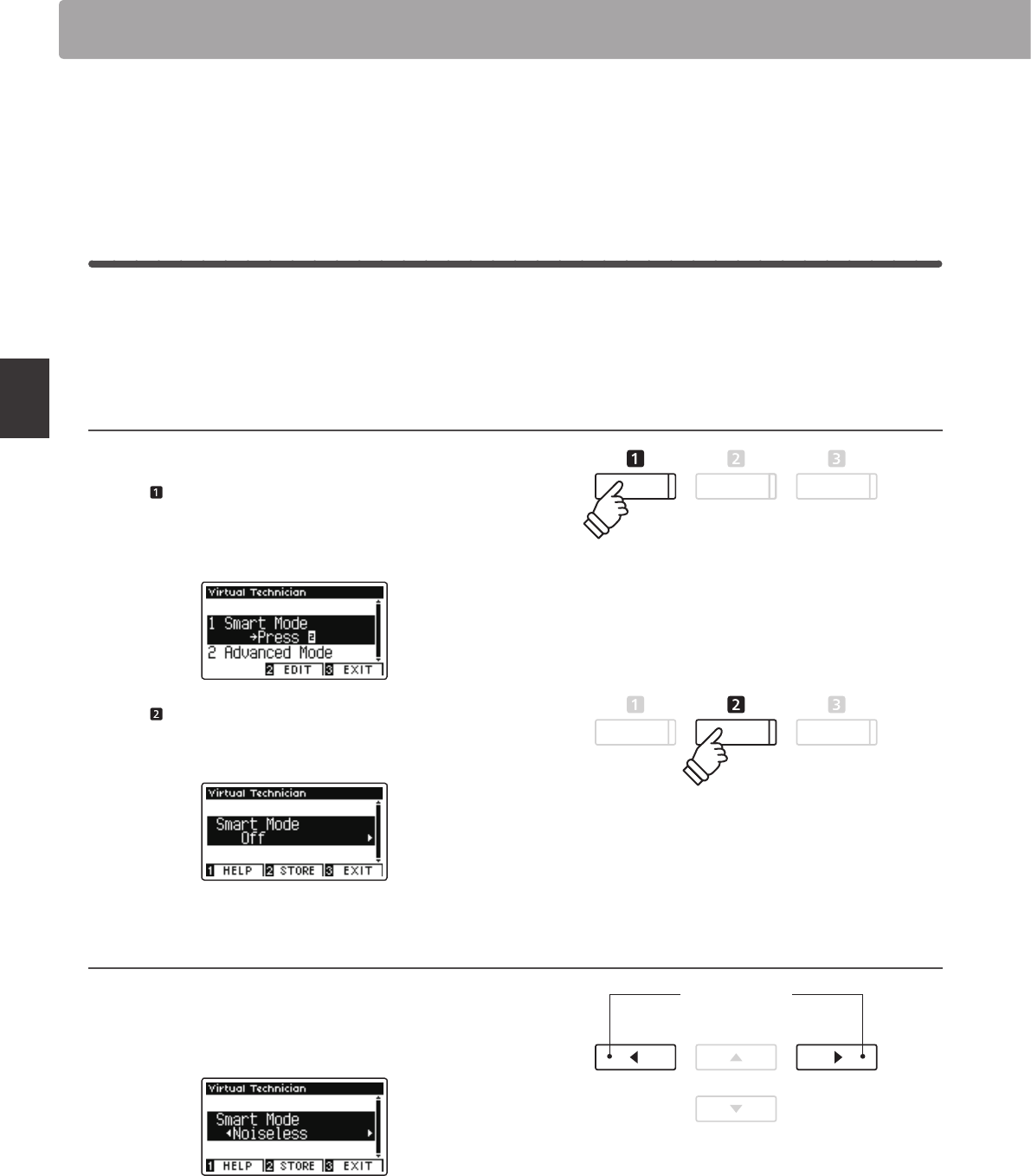
1. Entering Virtual Technician Smart Mode
While the normal playing mode screen is shown in the LCD display:
Press the FUNCTION button (VT).
The Virtual Technician menu will be shown in the LCD display,
and Smart Mode will be selected automatically.
Press the FUNCTION button (EDIT).
The list of Smart Mode presets will be shown in the LCD display.
2. Selecting the Virtual Technician preset
While the Smart Mode presets screen is shown in the LCD display:
Press the or buttons to select the desired Virtual Technician
Smart Mode preset.
The Virtual Technician adjustments will be applied to the
selected sound immediately.
buttons:
Select Virtual Technician preset
* Smart Mode presets are independent for each sound variation.
* The selected Smart Mode preset will be used for the current sound
variation until the power is turned o. However, it is possible to store
a Smart Mode preset to a sound. For more information, please refer
to the instructions on the following page.
* Smart Mode will be disabled by default (‘O’ preset). When disabled,
the Advanced Mode Virtual Technician parameter settings will used.
29
Playing the Piano
Virtual Technician
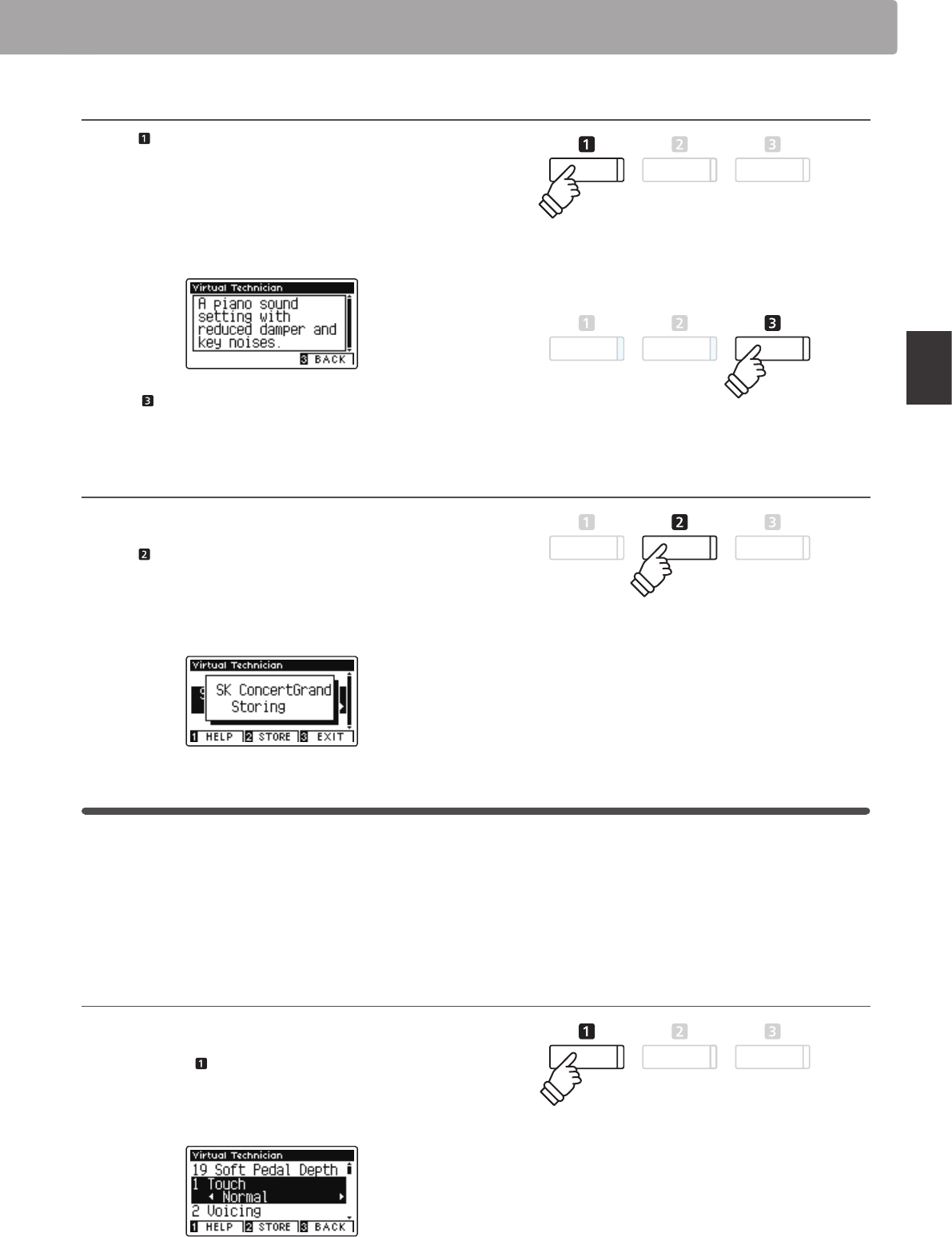
Showing the Virtual Technician Help screen
Press the FUNCTION button (HELP).
A brief explanation about the currently selected Virtual
Technician preset will be shown in the LCD display.
Press the or buttons to scroll through the explanation if
necessary.
Press the FUNCTION button (BACK) to return to the Virtual
Technician preset selection screen.
Storing the Virtual Technician preset to the selected sound
After selecting the Smart Mode preset:
Press the FUNCTION button (STORE).
The selected Smart Mode preset will be saved to the current
sound variation, and a conrmation message will briey be
shown in the LCD display.
2
Advanced Mode
In Advanced Mode, the player is given full control over every aspect of the piano’s conguration, allowing precise
adjustments over hammer hardness, action regulation, cabinet size, and a variety of other acoustic characteristics.
This mode is recommended for musicians that enjoy ne-tuning individual details of the piano sound in order to
suit their personal preferences.
* For more information about the individual Virtual Technician parameters, please refer to page 80.
Entering Virtual Technician Advanced Mode
While the normal playing mode screen is shown in the LCD display:
Press and hold the FUNCTION button (VT).
The Virtual Technician Settings menu will be shown in the LCD
display, allowing parameters to be adjusted in Advanced Mode.
* The stored Smart Mode preset will be retained after the power is
turned o, and will be used automatically whenever the sound
variation is selected.
hold
* It is also possible to access Advanced Mode via the Virtual Technician
menu, or by selecting Virtual Tech. in the Function menus.
* It is also possible to make adjustments to a Smart Mode preset by
selecting it, and then entering Advanced Mode. However, any
adjustments cannot be re-stored back to the Smart Mode preset list.
30
Playing the Piano
Metronome / Drum Rhythms
The Metronome function provides a steady beat to aid practicing the piano at a consistent tempo. In addition to
regular metronome beats, the CS11/CS8 digital piano also features a variety of drum rhythms to accompany most
playing styles and musical genres.
For a complete listing of available drum rhythms, please refer to page 136 of this owner’s manual.
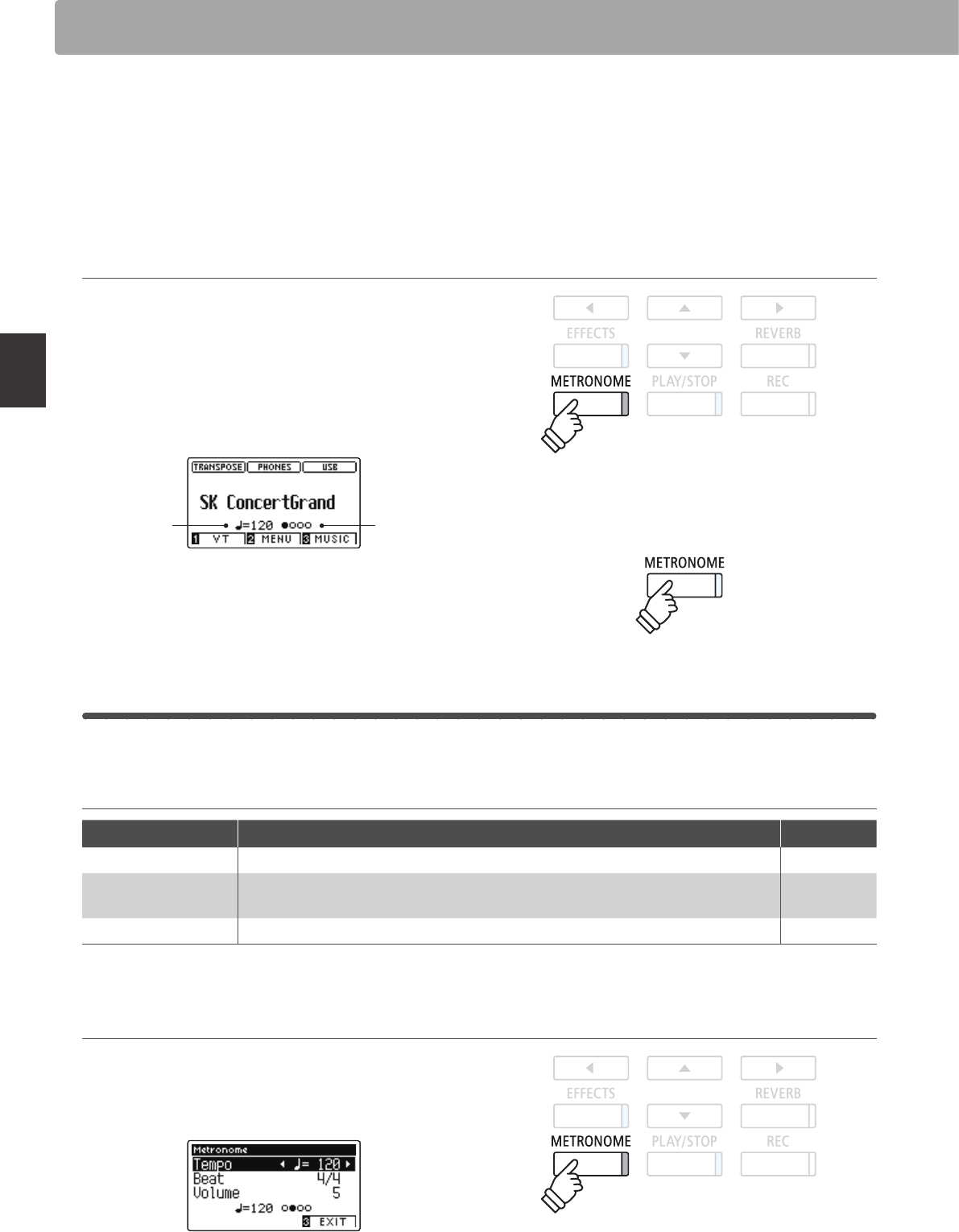
Turning the Metronome on/o
Press the METRONOME button.
The LED indicator for the METRONOME button will turn on to
indicate that the metronome function is in use, and a 1/4 beat
will start to count.
The current metronome tempo in beats per minute (BPM) and
beat of the bar will also be shown in the LCD display.
BeatTempo
Press the METRONOME button again to stop the metronome.
The LED indicator for the METRONOME button will turn o.
Metronome settings
The Metronome settings menu allows the tempo, beat, and volume of the metronome to be adjusted.
Metronome settings
Metronome setting Description Range
Tempo Adjust the tempo of the metronome beat / drum rhythm in beats per minute (BPM). 10~400 bpm
Beat Change the metronome beat (time signature) / drum rhythm.
* There are ten dierent time signature available: 1/4, 2/4, 3/4, 4/4, 5/4, 3/8, 6/8, 7/8, 9/8, and 12/8. –
Volume Adjusts the volume of the metronome beat / drum rhythm. 1~10
Entering the Metronome settings menu
Press and hold the METRONOME button.
The Metronome settings menu will be shown in the LCD
display.
hold
31
Playing the Piano
Metronome / Drum Rhythms
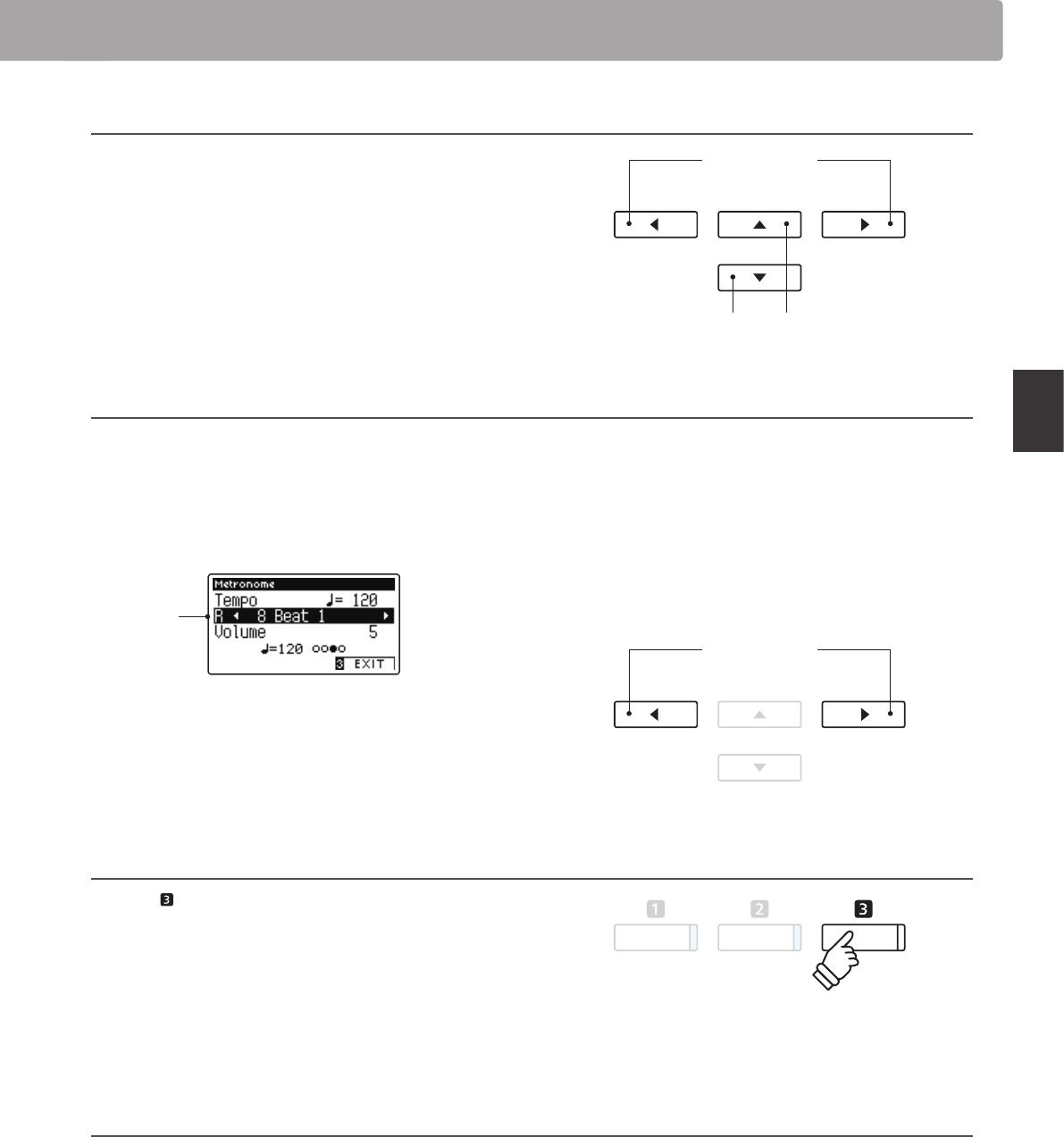
Adjusting Metronome settings
After entering the Metronome settings menu:
Press the or buttons to move the selection cursor over the
desired setting.
Press the or buttons to adjust the selected setting.
* To reset the current setting to the default value, press the and
buttons simultaneously.
Drum rhythms
As an alternative to the simple metronome count, it is also possible
to select a drum pattern from one of 100 dierent rhythm styles.
Enter the Metronome settings menu and select the Beat setting.
Press the or buttons to cycle through the available beats
until reaching the ‘8 Beat 1’ drum rhythm.
Drum
rhythm
Continue to press the or buttons to select the desired
drum rhythm.
* For a complete listing of available drum rhythms, please refer to page
136 of this owner’s manual.
Exiting the Metronome settings menu
Press the FUNCTION button (EXIT) to exit the Metronome
settings menu.
* Any changes made to the metronome tempo, beat, or volume
settings will remain until the power is turned o.
* Preferred metronome settings can be stored to a Registration
memory for convenient recall. Please refer to page 32 for more
information.
Recording with the metronome
It is also possible to record songs with the metronome activated. This is useful when recording parts separately, or wishing to
maintain correct timing throughout complex passages. Note that the standard metronome ‘click’ will not be heard when the song
is played back.
* For more information about the instrument’s Recorder function, please refer to page 48.
buttons:
Move selection cursor.
buttons:
Adjust selected setting.
buttons:
Select drum rhythm.
32
Playing the Piano
Registration Memories
The Registration function allows the current instrument setup (sound selections, split point, reverb and eect
settings, and various other panel options) to be stored to a memory and conveniently recalled at the touch of
a button. There are two banks (‘A’ and ‘B’) for each registration button, allowing up to 16 dierent registration
memories to be stored.
Registrations can also be loaded/saved to a USB memory device. Please refer to pages 114/119 for more information.
Functions and Settings stored in Registration memories
Functions
Selected sound (including primary sound for each category)
Dual Mode / Split Mode / Four Hands Mode (including settings)
Reverb, Eects (Type, Settings)
Metronome (Beat, Tempo, Volume)
Settings
Basic Settings (Tone Control, Tuning, Damper Hold)
Virtual Technician Settings
MIDI Settings
* Changes made to the Auto Power O setting will be stored to User
Memory automatically.
1
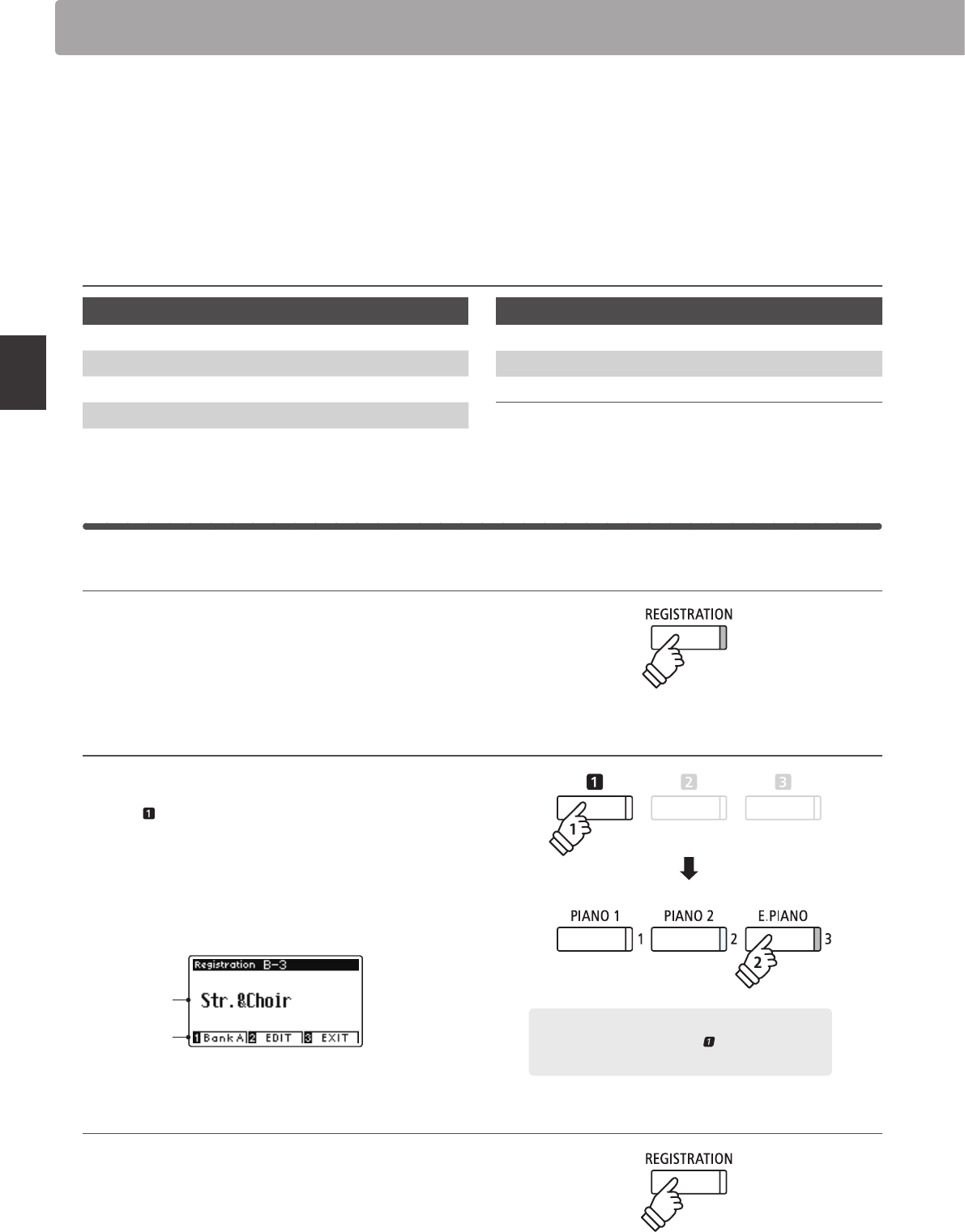
Selecting a Registration memory
Entering Registration mode
Press the REGISTRATION button.
The LED indicator for the REGISTRATION button will turn on to
indicate that the registration function is in use.
Selecting a Registration memory
When the registration function is in use:
Press the FUNCTION button to toggle between registration
memory bank ‘A’ and ‘B’.
Press a SOUND button to select the desired registration memory.
The name of the selected registration memory will be shown in
the LCD display.
Registration
name
Select
Bank A/B
Exiting Registration mode
Press the REGISTRATION button.
The LED indicator for the REGISTRATION button will turn o,
and the button panel will return to normal operation.
Example: To select registration memory B-3 (when
bank ‘A’ is selected), press the FUNCTION button,
then press the E.PIANO (memory 3) button.
33
Playing the Piano
Registration Memories
2
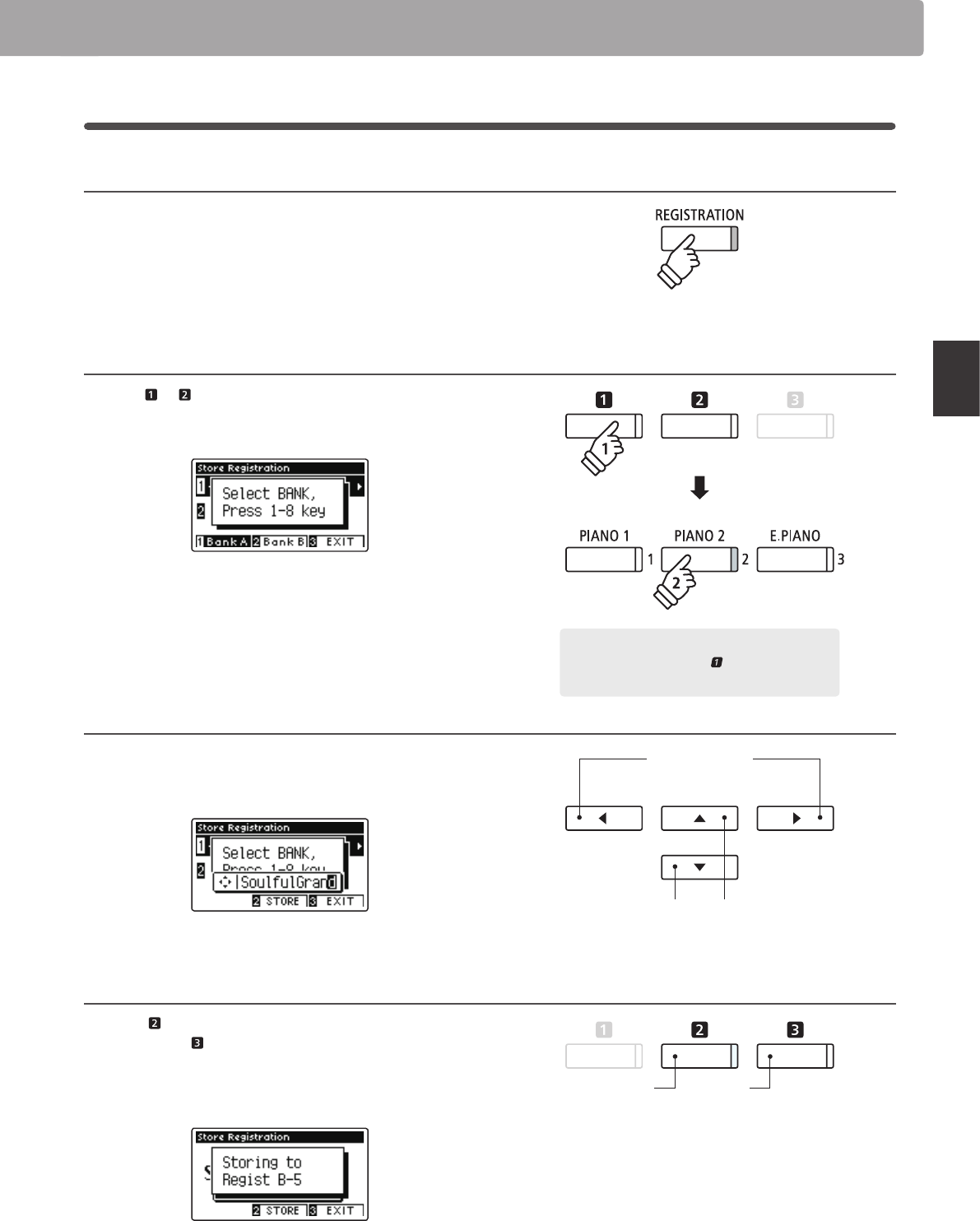
Storing a Registration memory
1. Entering Registration Store mode
While the normal playing mode screen is shown in the LCD display:
Press and hold the REGISTRATION button.
The registration memory (SOUND) buttons will start to ash.
2. Selecting the Registration memory
Press the or FUNCTION buttons to select the registration
memory bank ‘A’ and ‘B’, then press a registration memory
(SOUND) button.
The Registration name screen will be shown in the LCD display.
3. Naming the Registration memory
Enter a name for the registration memory by pressing the
or buttons to cycle through the alphanumeric characters,
and the or buttons to move the cursor.
4. Storing the Registration to memory
Press the FUNCTION button (STORE) to conrm the store
operation, or the FUNCTION button (EXIT) to cancel.
Upon storing, a beep will sound and a conrmation message
will briey be shown in the LCD display.
The current instrument setup will be stored to the selected
registration memory with the specied name.
Example: To store the current instrument setup
to memory A-2, press the FUNCTION button,
then press the PIANO 2 (memory 2) button.
hold
buttons:
Select character.
buttons:
Move selection cursor.
STORE EXIT
* The stored registration will remain in memory after the instrument
is turned o, or if the instrument’s power cable is disconnected from
the wall outlet.
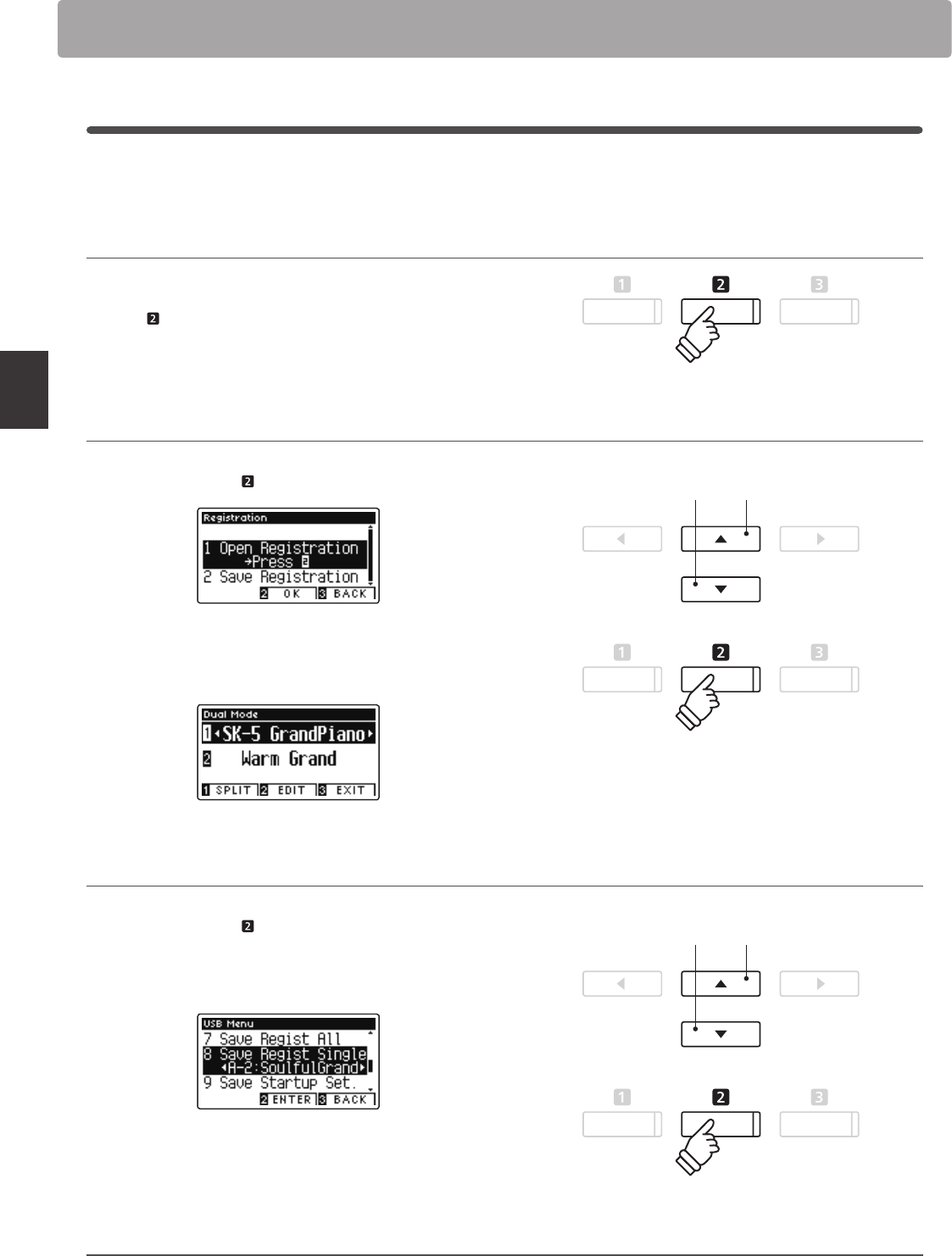
34
Playing the Piano
Registration Memories
3
Registration Edit menu
The Registration Edit menu allows the currently selected registration memory to be opened in normal playing
mode (for further adjustment, or simply to check which sounds are used etc.), or to be saved to USB memory.
Entering the Registration Edit menu
When the registration function is in use:
Press the FUNCTION button (EDIT).
The Registration Edit menu will be shown in the LCD display.
Opening the Registration
Press the or buttons to select the Open Registration
function, then press the FUNCTION button (OK).
The currently selected registration memory will be opened
in normal playing mode, allowing additional changes and
adjustments to be made.
Saving the current Registration memory to USB
Press the or buttons to select the Save Registration
function, then press the FUNCTION button (OK).
The Save Regist Single function of the USB Menu will be shown
in the LCD display, with the current registration selected.
* Please refer to the Save Registration Single instructions on page
119.
Resetting all Registration memories
Press and hold the REGISTRATION and REC buttons, then turn the instrument’s power o/on.
All registrations will be reset to the factory default settings.
buttons:
Move selection cursor.
buttons:
Move selection cursor.
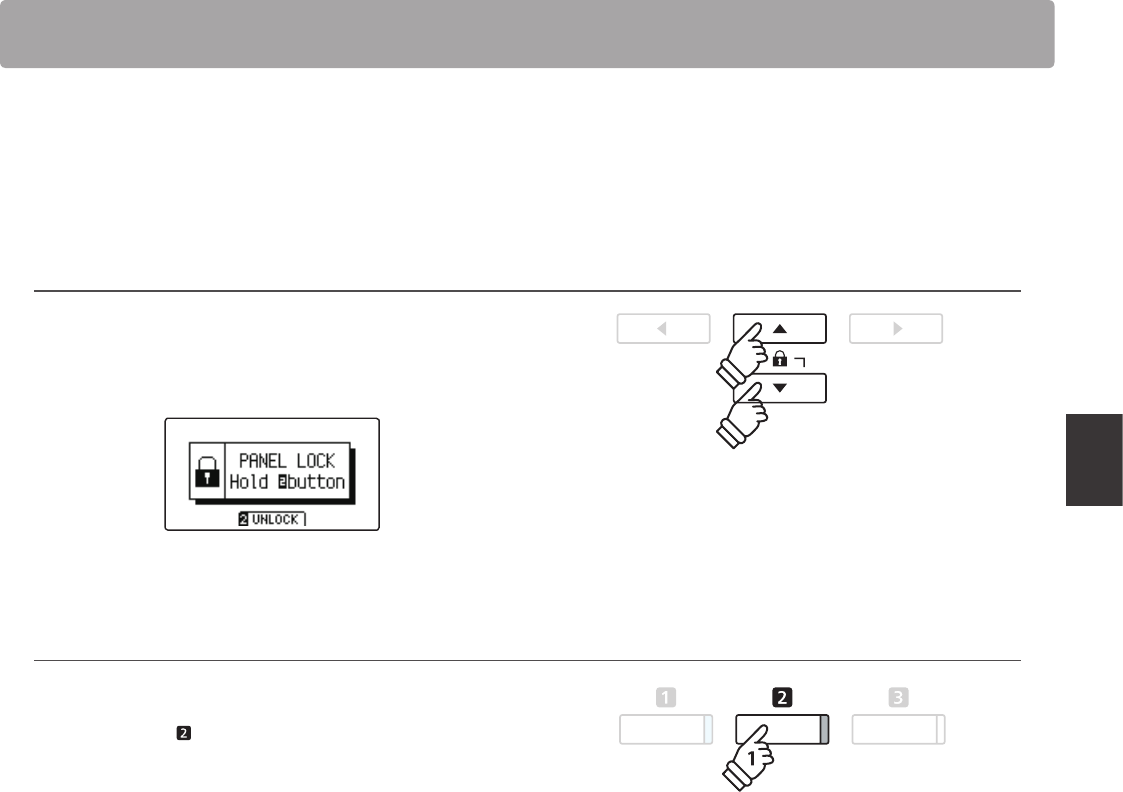
35
Playing the Piano
The Panel Lock function allows the state of all panel buttons to be temporarily locked, preventing sounds and other
settings from being changed. This function may prove useful in teaching environments, ensuring that students are
not distracted by changing sounds etc.
1. Activating the Panel Lock
Press the and buttons simultaneously.
The Panel Lock screen will be shown in the LCD display, and the
instrument will stop responding to panel button presses.
2. Deactivating the Panel Lock
While the Panel Lock is activated:
Press and hold the FUNCTION button (UNLOCK).
A message will be shown in the LCD display to indicate that
the Panel Lock has been deactivated, and the instrument will
resume responding to panel button presses as normal.
* When activated, the Panel Lock will remain until the power is turned
o.
* While Panel Lock is activated, the LED indicators for all buttons will
turn o.
Panel Lock
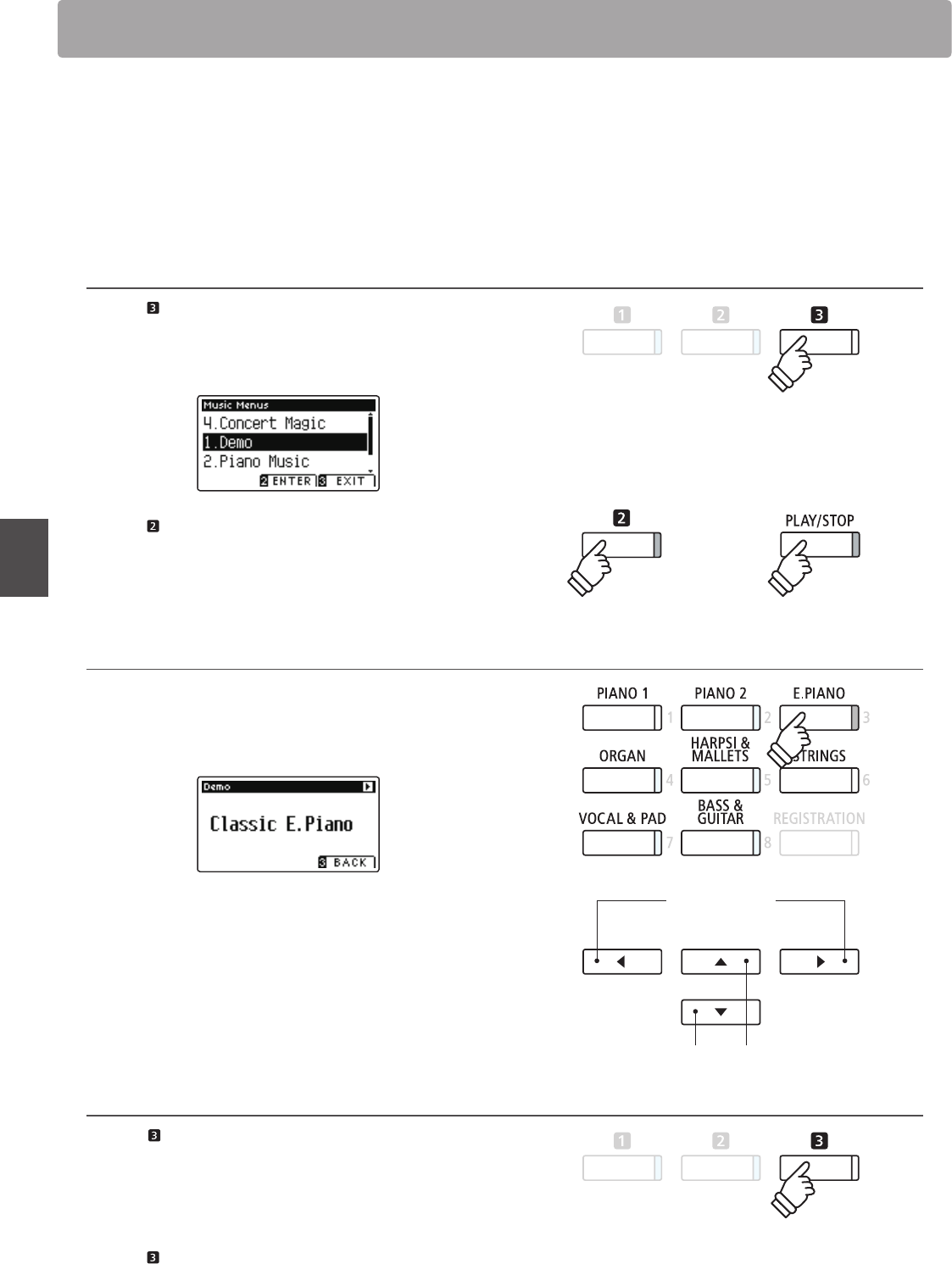
36
Music Menu
Demo Songs
The Demo function provides an excellent introduction to the varied capabilities of CS11/CS8 digital piano. There
are over 30 dierent demonstration songs available, highlighting the instruments’ rich selection of high quality
sounds and its power speaker system.
For a complete listing of demonstration songs, please refer to page 132 of this owner’s manual.
Entering Demo mode
Press the FUNCTION button (MUSIC).
The Music Menu will be shown in the LCD display. Demo mode
will be selected automatically.
Press the FUNCTION (ENTER) or PLAY/STOP buttons.
The LED indicator for the PIANO 1 button will start to ash, and
the ‘SK Concert Grand’ demo song will start to play.
Selecting a demo song
While Demo mode is selected:
Press a SOUND button to select a sound category.
The rst demo song of the sound category will start to play.
Press the or buttons to cycle through the demo songs in
the selected sound category, and the or buttons to cycle
through the dierent sound categories.
* When the selected song has nished, the next demo song in the
category will begin to play automatically.
Stopping the demo song and exiting Demo mode
Press the FUNCTION (BACK) or PLAY/STOP buttons while the
song demo is playing.
The LED indicator for the selected SOUND button will stop
ashing, and the song demo will stop playing.
Press the FUNCTION (EXIT) button to exit the Music Menu.
or
buttons:
Select sound category
buttons:
Select demo song
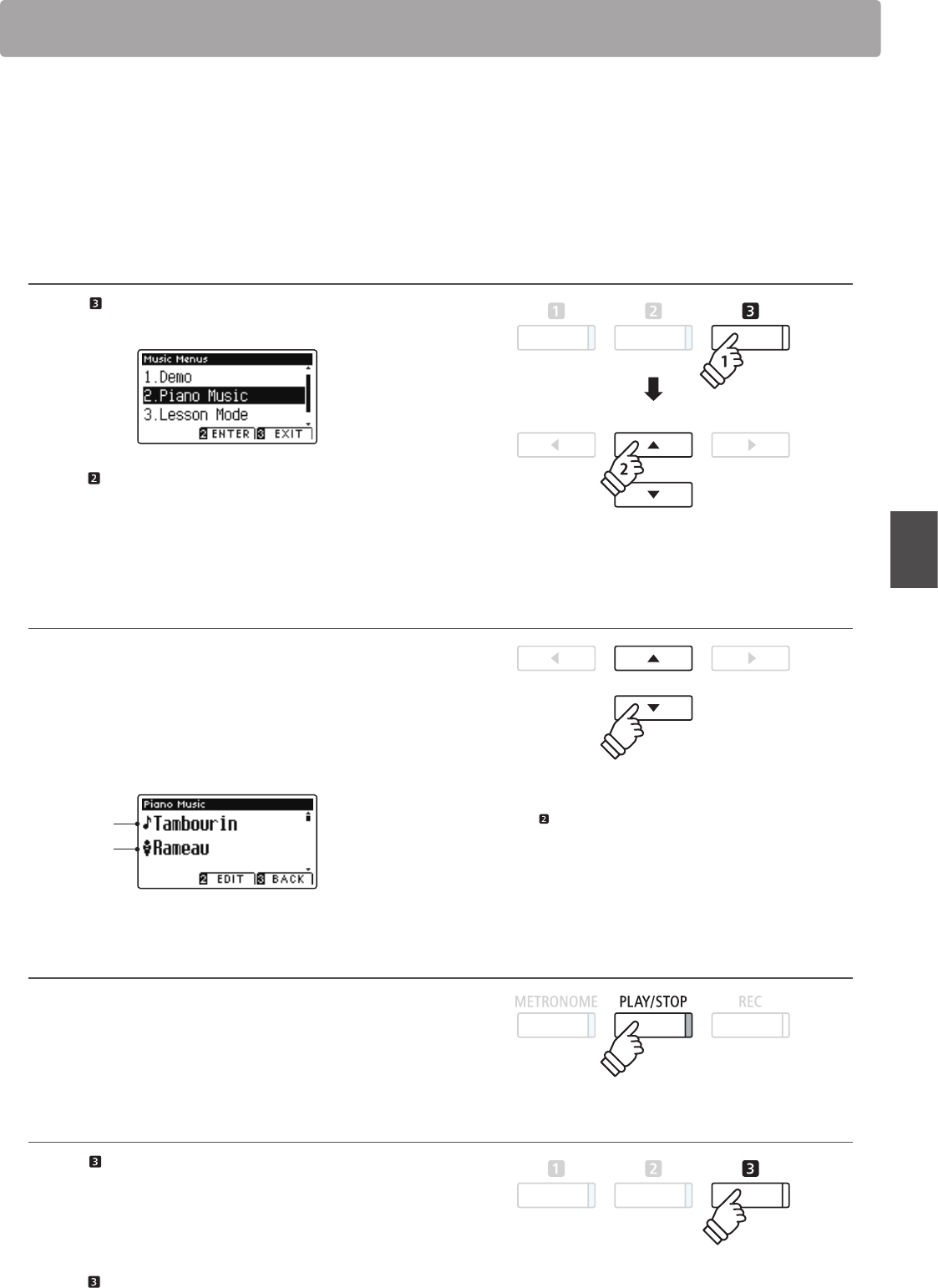
37
Music Menu
In addition to the sound demonstration songs, the CS11/CS8 digital piano also features a selection of popular classical
piano works from the Baroque and Romantic periods. Notated scores are provided in the separate ‘Classical Piano
Collection’ book*, assisting the musical appreciation and study of each piece.
For a complete listing of Piano Music pieces, please refer to the separate ‘Internal Song Lists’ booklet.
Entering Piano Music mode
Press the FUNCTION button (MUSIC), then press the or
buttons to select Piano Music mode.
Press the FUNCTION (ENTER) or PLAY/STOP buttons.
The LED indicator for the PIANO 1 button will start to ash, and
the piece ‘Tambourin’ by Rameau will start to play.
Selecting a piano music piece
While Piano Music mode is selected:
Press the or buttons to cycle through the dierent piano
music pieces.
The title and composer of the selected piece will be shown in
the LCD display.
Title
Composer
Replaying the selected piano music piece
When the selected piano music piece has nished:
Press the PLAY/STOP button to replay the piano music piece.
Stopping the piano music piece and exiting Piano Music mode
Press the FUNCTION (BACK) or PLAY/STOP buttons while the
piano music piece is playing.
The LED indicator for the PLAY/STOP button will turn o, and
the piano music piece will stop playing.
Press the FUNCTION (EXIT) button to exit the Music Menu.
Piano Music
* Depending on market area.
* The balance of the left hand and right hand parts can be adjusted by
pressing the FUNCTION (EDIT) button, and adjusting the Balance
setting.
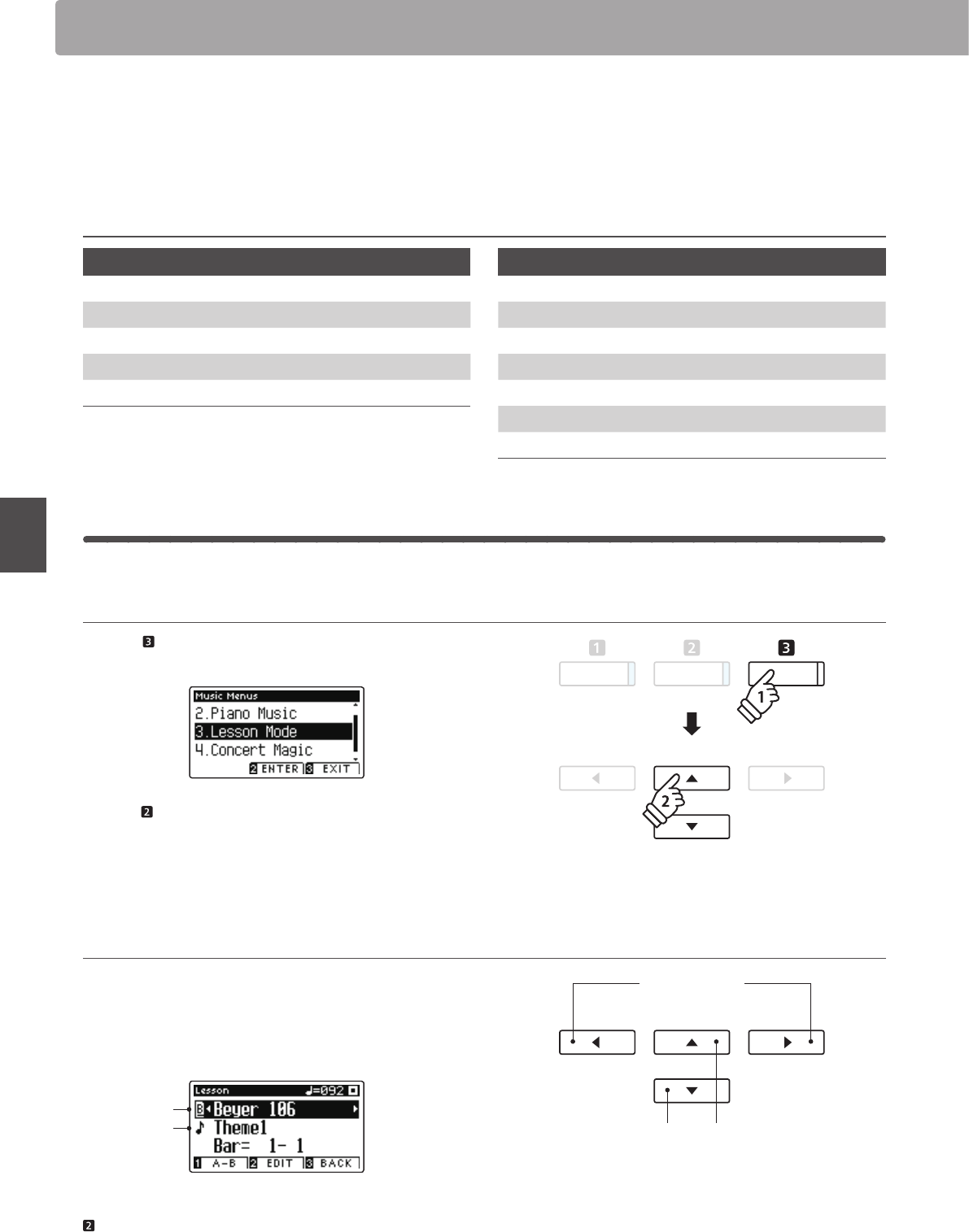
38
Music Menu
Lesson Function
The Lesson function allows budding pianists to practice the piano using a selection of built-in song books and
nger exercises. The left and right hand parts of each piece can be practiced separately, adjusting the tempo to
perfect dicult passages, before being recorded for self-evaluation.
Built-in lesson mode song books
Alfred Lesson Books
Alfred’s Premier Piano Course Lesson 1A
Alfred’s Premier Piano Course Lesson 1B
Alfred’s Basic Piano Library Lesson Book Level 1A
Alfred’s Basic Piano Library Lesson Book Level 1B
Alfred’s Basic Adult Piano Course Lesson Book Level 1
Classical Lesson Books
Burgmüller 25 (25 Etudes Faciles, Opus 100)
Czerny 30 (Etudes de Mécanisme, Opus 849)
Czerny 100 (Hundert Übungsstücke, Opus 139)
Beyer 106 (Vorschule im Klavierspiel, Opus 101)
J.S. Bach: Inventionen
Sonatinen Album 1
Chopin Walzer (Chopin waltzes series 1-19)
* Lesson books sold separately – please refer to the separate ‘Internal
Song Lists’ booklet for more information.
1
Selecting a lesson book/song
1. Entering lesson mode
Press the FUNCTION button (MUSIC), then press the or
buttons to select Lesson Mode.
Press the FUNCTION button (ENTER) to enter lesson mode.
The name of the selected lesson book, song, and current bar
will be shown in the LCD display.
2. Selecting a lesson book/song
Press the or buttons to move the selection cursor over the
lesson book name or song title.
Press the or buttons to cycle through the dierent lesson
books and song titles.
Book name
Song title
It is also possible to select songs by pressing and holding the
FUNCTION button (EDIT), then pressing the relevant key on
the keyboard.
buttons:
Move selection cursor.
buttons:
Select lesson book/song.
* Please refer to the separate ‘Internal Song Lists’ booklet for a
complete listing of available lesson books/songs and corresponding
key numbers.
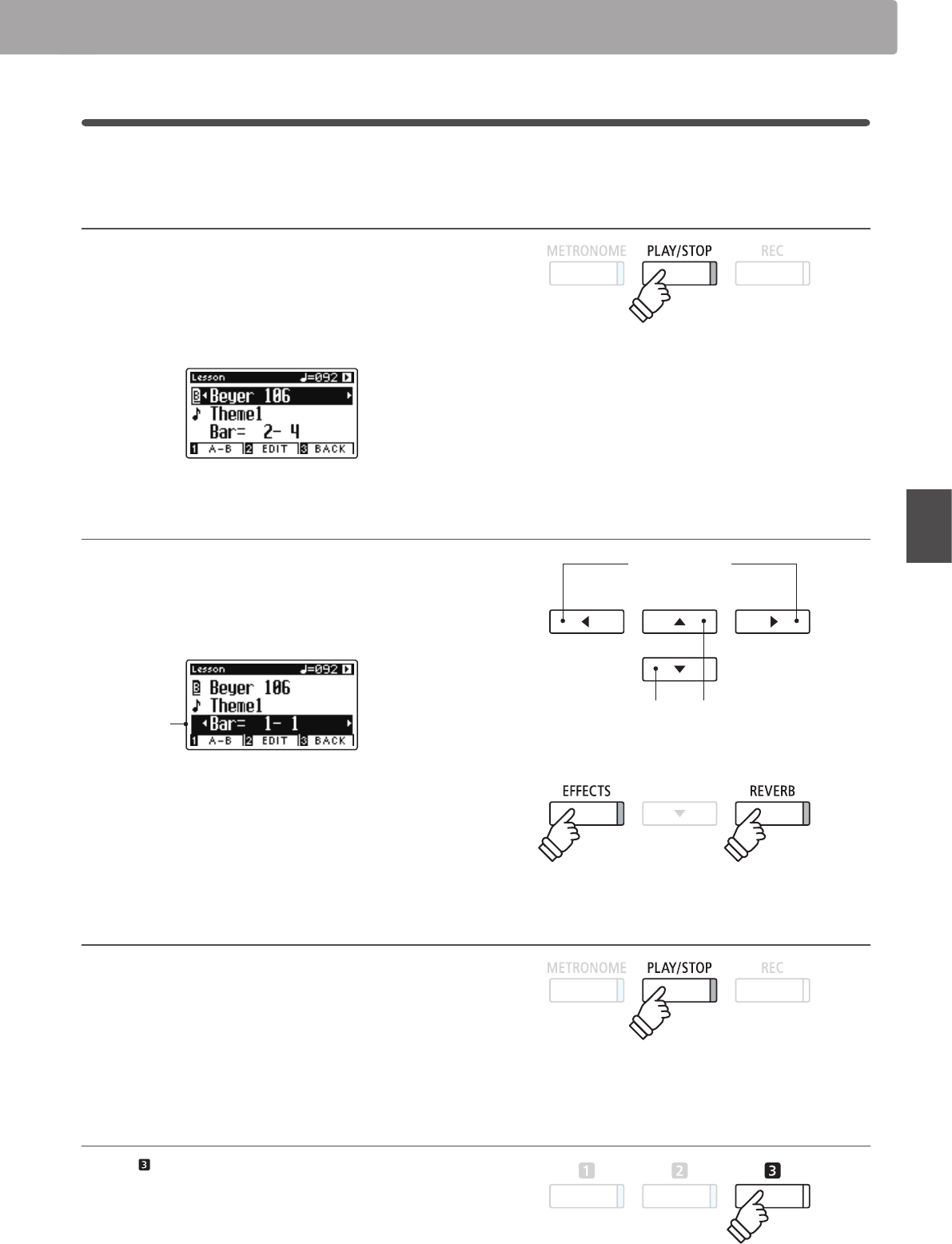
39
Music Menu
Lesson Function
2
Listening to the selected lesson song
This page will explain how to play and stop the selected lesson song, and change the playback position.
1. Playing the lesson song
After selecting a lesson book and song:
Press the PLAY/STOP button.
The LED indicator for the PLAY/STOP button will turn on, and a
one bar count-in will be heard before the song starts to play.
2. Changing the playback position (Bar)
Press the or buttons to move the selection cursor over the
third line of the LCD display (Bar).
Press the or buttons to rewind or cue the playback position
(Bar) of the current song.
Current bar
It is also possible to rewind or cue the playback position without
selecting ‘Bar’, by pressing the REVERB or EFFECTS buttons.
To reset the playback position to the rst bar of the song, press
the REVERB and EFFECTS buttons simultaneously.
Stopping and resuming the lesson song
While the lesson song is playing:
Press the PLAY/STOP button to stop the lesson song playback.
Press the PLAY/STOP button once again to resume playback
from the stopped position.
3. Exiting lesson mode
Press the FUNCTION (EXIT) button to exit the Music Menu.
* If the rst bar of the song begins on an ‘up’ beat (i.e. pickup notes),
the rst bar number will be shown as zero in the LCD display.
* The metronome will not continue after the count-in bar, but can be
turned on manually by pressing the METRONOME button.
buttons:
Move selection cursor.
buttons:
Change playback position.
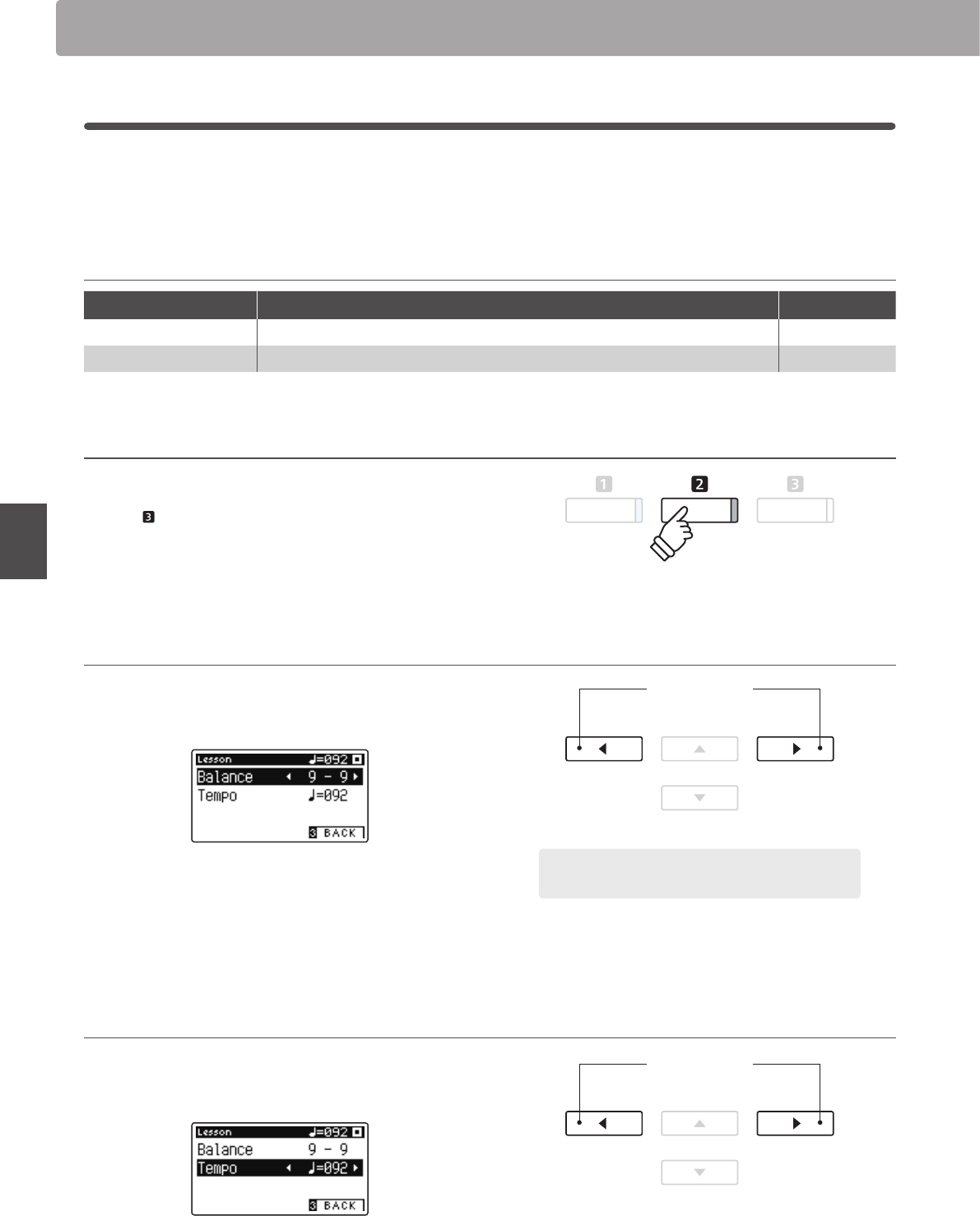
40
Music Menu
3
Lesson Function settings
The Lesson Function settings menu allows the left and right-hand part volumes of the current lesson song to be
adjusted, allowing each part to be practiced separately. It is also possible to adjust the playback tempo of the
current lesson song, allowing dicult passages to be practised more conveniently.
Lesson Function settings
Lesson Function setting Description Default setting
Balance Adjust the volume balance between the left and right-hand parts. 9 - 9
Tempo Adjust the playback tempo of the current lesson song in beats per minute (BPM). Song specific
Entering the Lesson Function settings menu
After selecting a lesson book and song:
Press the FUNCTION button (EDIT).
The Lesson Function settings menu will be shown in the LCD
display.
Adjusting the left/right-hand part volume
Press the or buttons to move the selection cursor over the
Balance setting, then press the or buttons to adjust the
volume of the left/right-hand part volume.
Increasing the volume of the left-hand part will reduce the
volume of the right-hand part, and vice versa.
* If the Beyer lesson book is selected, increasing the left-hand value will
decrease the volume of the student’s part, while increasing the right-
hand value will decrease the volume of the teacher’s part.
Adjusting the playback tempo of the lesson song
Press the or buttons to move the selection cursor over the
Tempo setting, then press the or buttons to adjust the
playback tempo of the lesson song.
* To reset the playback tempo of the selected lesson song to the default
value, press the and buttons simultaneously.
Lesson Function
buttons:
Adjust left/right-hand volume.
Example: To practice the right-hand part while listening
to the left-hand part, set the volume balance to 9 - 1.
buttons:
Adjust playback tempo.
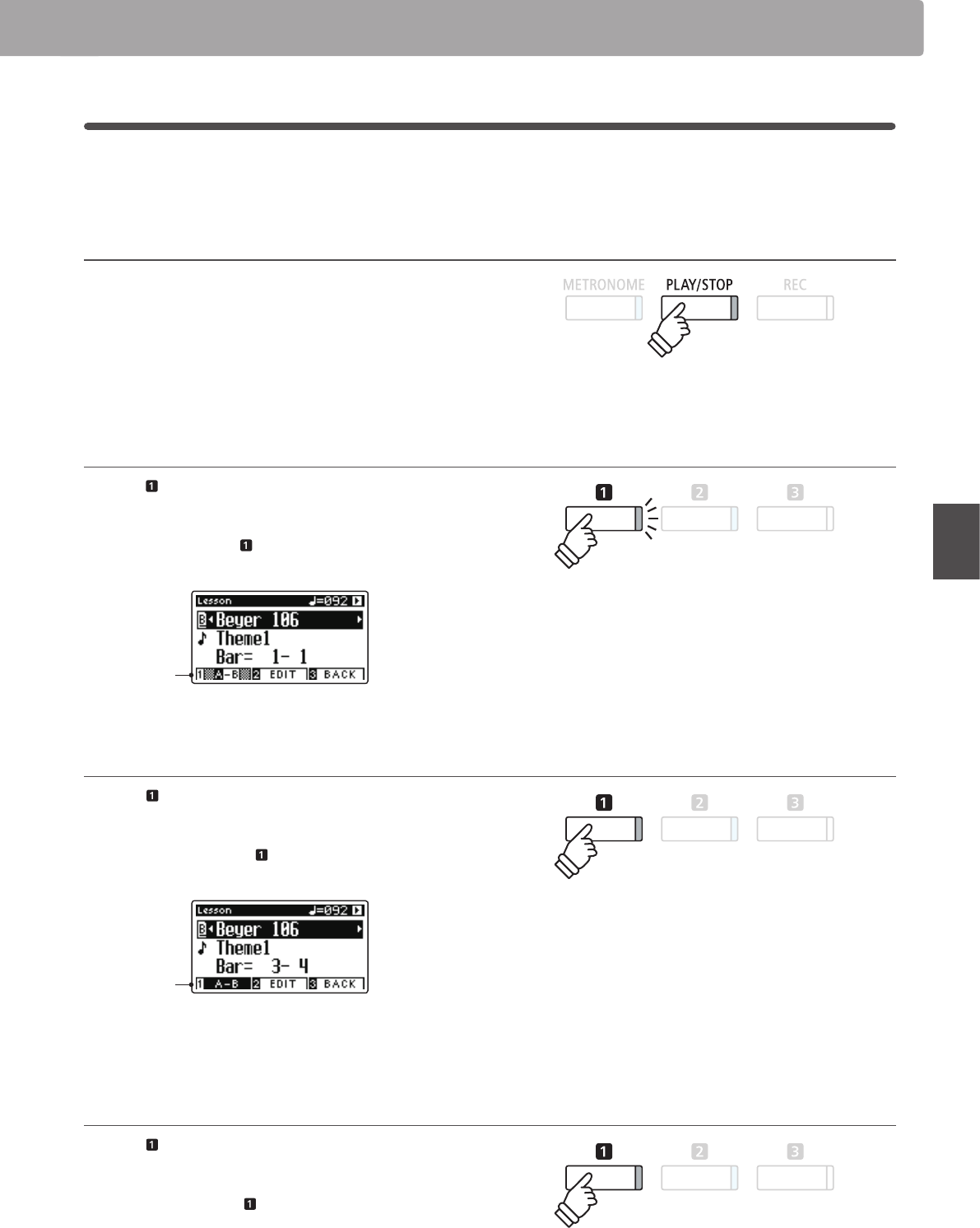
41
Music Menu
Lesson Function
4
Repeating sections of a lesson song
The ‘A-B Loop’ feature of the Lesson Function allows sections of the selected lesson song to be ‘looped’ between
two points in order to practise dicult passages continuously.
1. Playing the lesson song
After selecting a lesson book and song:
Press the PLAY/STOP button.
The LED indicator for the PLAY/STOP button will turn on, and a
one bar count-in will be heard before the song starts to play.
2. Specifying the start point (A) of the loop
Press the FUNCTION button (A-B) to specify the start point
of the loop.
The LED indicator for the FUNCTION button will start to ash,
indicating that the start point (A) of the loop has been set.
Point ‘A’ set
3. Specifying the end point (B) of the loop
Press the FUNCTION button (A-B) again to specify the end
point of the loop.
The LED indicator for the FUNCTION button will turn on,
indicating that the end point of the (B) of the loop has been set.
Point ‘B’ set:
loop active
The dened ‘A-B’ section of the lesson song will repeat (loop),
allowing the passage to be practiced continuously.
4. Cancelling the ‘A-B’ loop
Press the FUNCTION button (A-B) once again to cancel the
loop.
The LED indicator for the FUNCTION button will turn o, and
the lesson song will resume normal playback.
* The Balance and Tempo lesson function settings can continue to be
adjusted while the A-B loop is in operation.
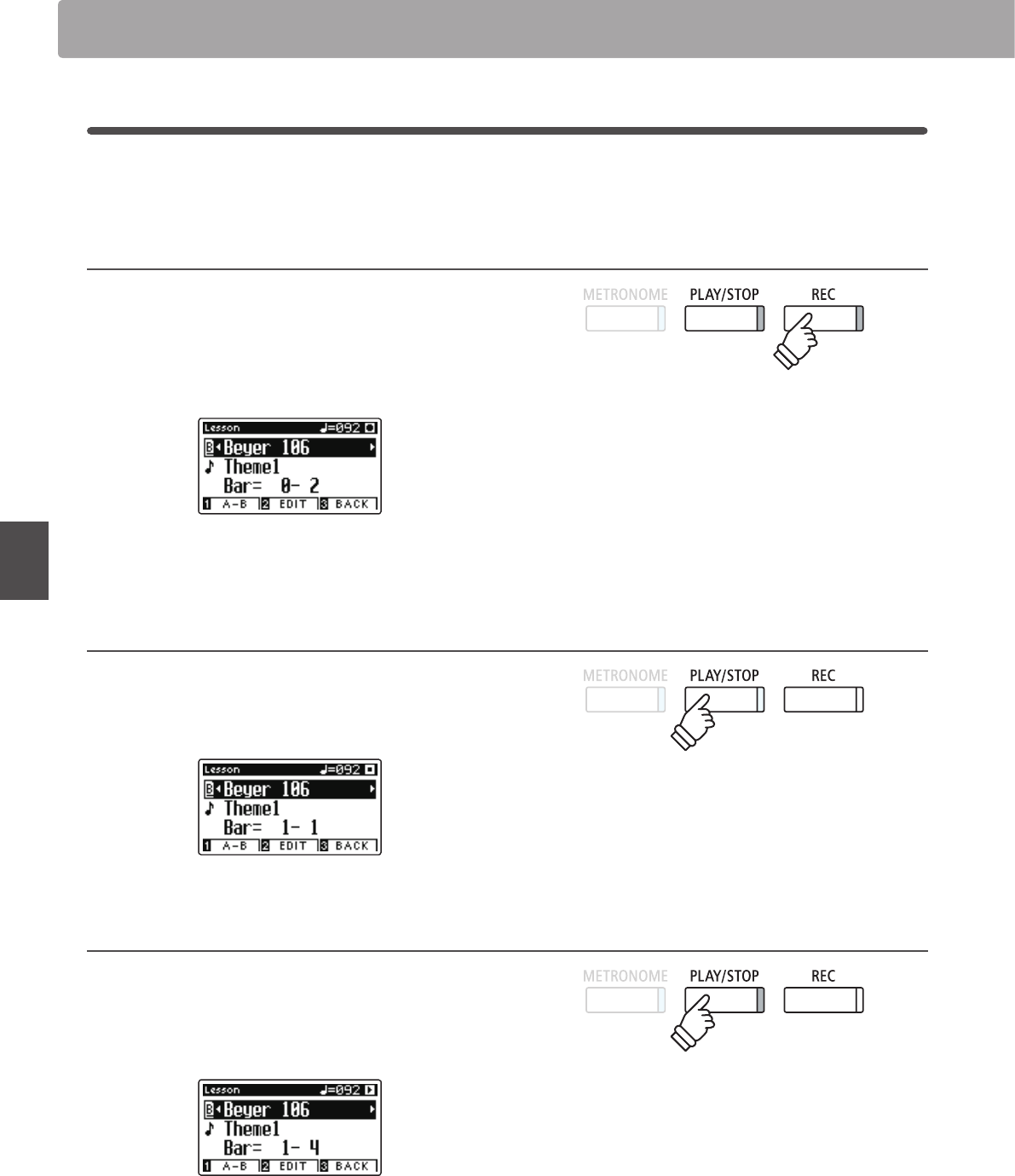
42
Music Menu
5
Recording a lesson song practice
The Lesson Function’s Record feature allows the left or right-hand parts of the selected lesson song to be recorded
to internal memory, and then played back for self-evaluation.
1. Starting the lesson song recording
After selecting a lesson book and song:
Press the REC button.
The LED indicators for the REC and PLAY/STOP buttons will turn
on to indicate that recording mode is in use.
A one bar count-in will be heard before the lesson song starts
to play and record.
2. Stopping the lesson song recording
Press the PLAY/STOP button.
The LED indicators for the REC and PLAY/STOP buttons will turn
o, and the lesson song recording and playback will stop.
3. Playing back the recorded lesson song
Press the PLAY/STOP button again.
The LED indicator for the PLAY/STOP button will turn on, and a
one bar count-in will be heard before the recorded lesson song
starts to play.
Press the PLAY/STOP button.
The LED indicator for the PLAY/STOP button will turn o, and the
recorded lesson song will stop playing.
Lesson Function
* It may be desirable to adjust the Balance and Tempo lesson function
settings before starting the recording.
* The Balance and Tempo lesson function settings can continue to be
adjusted while the recorded lesson song practise is playing.
* The ‘A-B’ loop function cannot be used when recording a lesson song
practice.
* Press the REC and PLAY/STOP buttons simultaneously to erase the
recorded lesson song practice. The recorded practice will be erased
automatically when a dierent lesson song is selected.
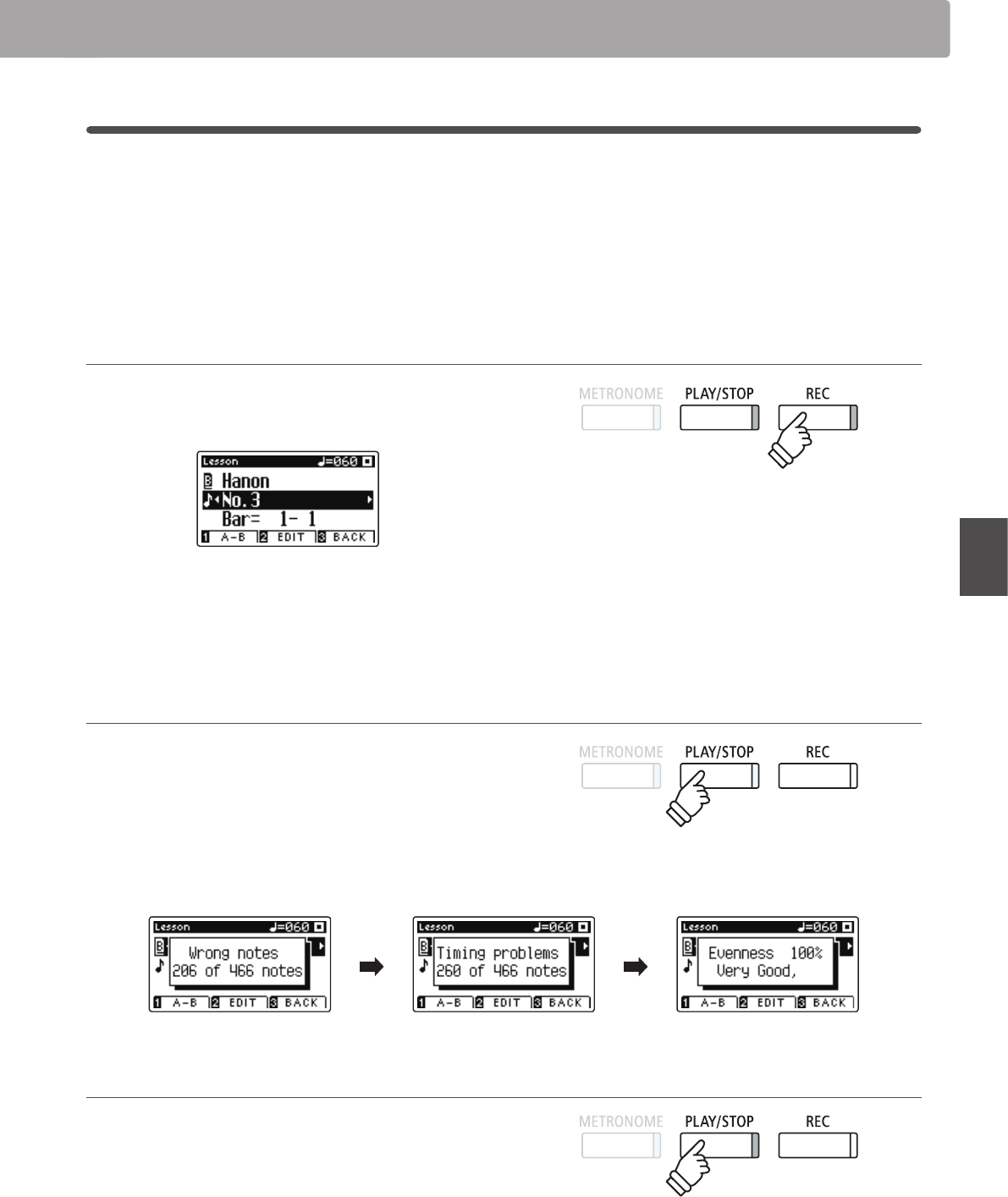
43
Music Menu
Lesson Function
6
Finger Exercises
The lesson function also includes a selection of nger exercises for practicing major and minor scales, arpeggios,
chords, cadences, and Hanon exercises, with notated scores provided in the separate ‘Finger Exercises’ book.
The CS11/CS8 digital piano can also evaluate one’s practice, analysing note accuracy, timing evenness, and note
volume consistency, before displaying results for each category. Using this function, players can objectively review
their performances, and concentrate on improving a particular area of their technique.
1. Selecting and recording a Hanon nger exercise
While Lesson mode is in use:
Select the Hanon lesson book, then select a song number.
Press the REC button.
The LED indicators for the REC and PLAY/STOP buttons will turn on to indicate that recording mode is in use.
A one bar count-in will be heard before the nger exercise starts to play and record.
2. Evaluating the recorded nger exercise
Press the PLAY/STOP button
The LED indicators for the REC and PLAY/STOP buttons will turn
o, and the nger exercise recording and playback will stop.
The recorded practice will be evaluated for note accuracy,
timing evenness, and volume consistency, with the results
shown alternately in the LCD display.
3. Playing back the recorded nger exercise
Press the PLAY/STOP button again.
The LED indicator for the PLAY/STOP button will turn on, and
a one bar count-in will be heard before the recorded nger
exercise starts to play.
Press the PLAY/STOP button once again.
The LED indicator for the PLAY/STOP button will turn o, and the
recorded nger exercise song will stop playing.
* It may be desirable to adjust the Balance and Tempo lesson function
settings before starting the recording.
* Press the REC and PLAY/STOP buttons simultaneously to erase the
recorded lesson song practice. The recorded practice will be erased
automatically when a dierent lesson song is selected.
* Press or buttons to cycle through the evaluation results. The
recorded nger exercise can be replayed even after cancelling the
evaluation result screen.
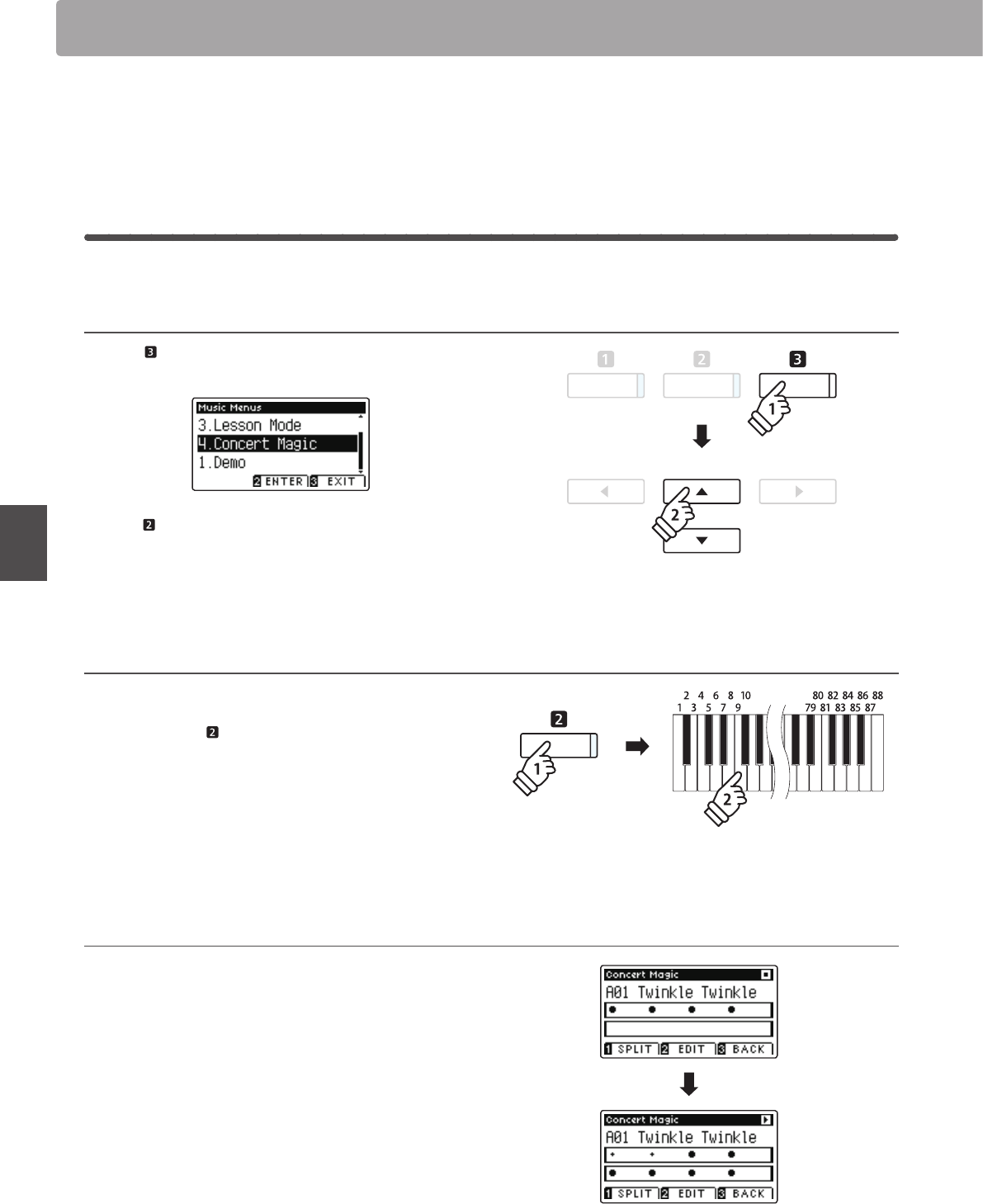
44
Music Menu
Concert Magic
The Concert Magic function allows complete beginners to enjoy playing the piano by simply selecting one of the
176 pre-programmed songs, then tapping the keyboard with a steady rhythm and tempo.
For a complete listing of available Concert Magic songs, please refer to the separate ‘Internal Song Lists’ booklet.
1
Performing a Concert Magic song
The 176 Concert Magic songs are divided into banks ‘A’ and ‘B’, with each bank containing 88 songs.
1. Entering Concert Magic mode
Press the FUNCTION button (MUSIC), then press the or
buttons to select Concert Magic.
Press the FUNCTION button (ENTER) to enter Concert Magic.
The bank, number, and name of the selected Concert Magic
song will be shown in the LCD display.
2. Selecting a Concert Magic song
While Concert Magic mode is in use:
Press and hold the FUNCTION button (EDIT), then press the
key to which the Concert Magic song (bank ‘A’) is assigned.
A Concert Magic song from bank ‘A’ will be selected, with the
song number and name shown in the LCD display.
* To select a song from bank ‘B’, press the same key again. Repeatedly
pressing the same key will alternate between banks ‘A’ and ‘B’.
3. Performing the selected Concert Magic song
Press a key on the keyboard.
The song will advance with every key that is pressed. Pressing
the keys gently will produce a soft sound, while pressing heavily
will produce a loud sound.
As the song advances, the symbols shown in the LCD will be
replaced by symbols. This is called the Note Navigator.
hold
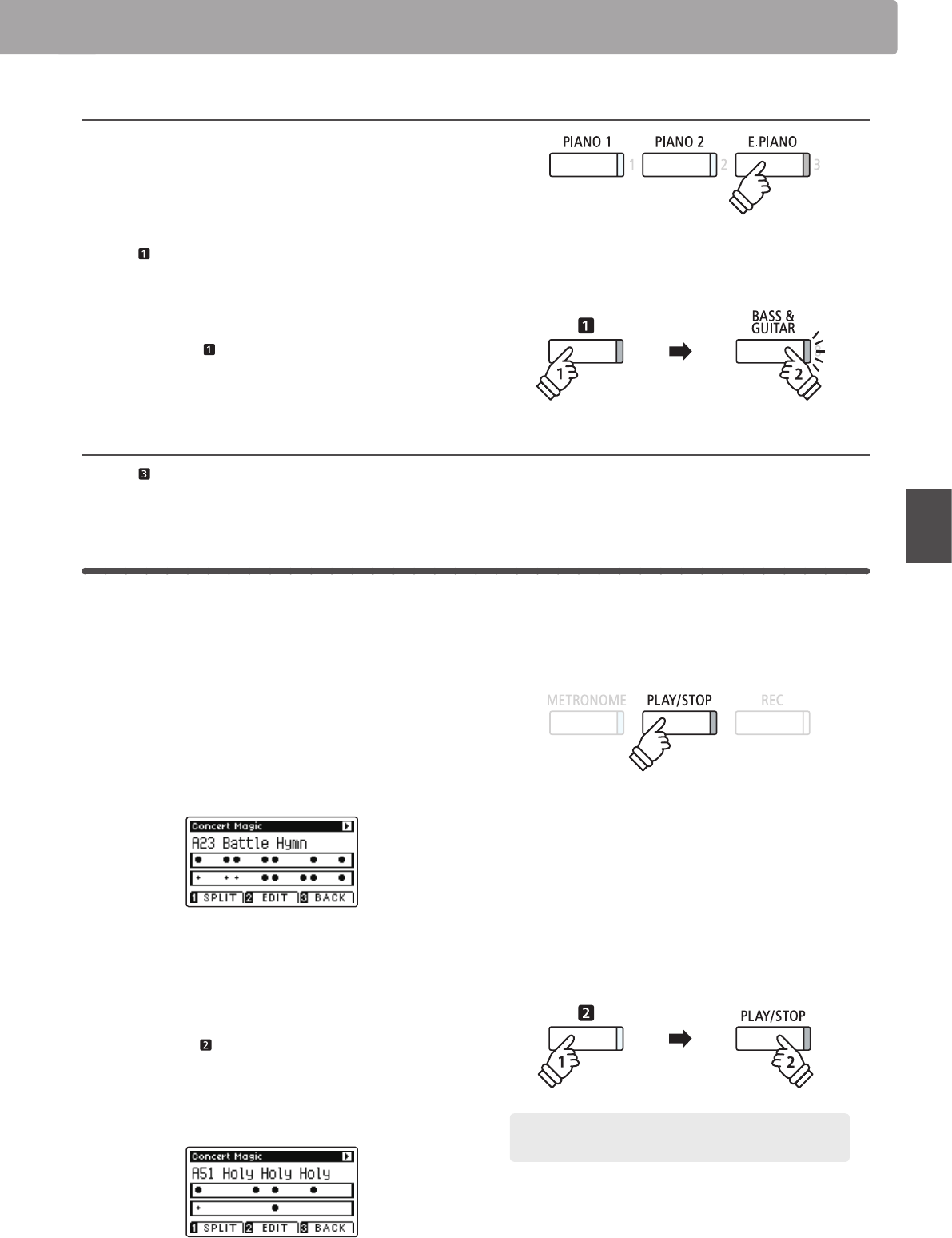
45
Music Menu
Concert Magic
4. Changing the Concert Magic playback sound
Press a SOUND button to change the sound used for the Concert
Magic song (melody and accompaniment parts).
It is also possible to select independent sounds for the melody and
accompaniment parts:
Press the FUNCTION button (SPLIT), to enable Concert Magic
split mode.
Press a SOUND button to change the melody sound.
Press and hold the FUNCTION button (SPLIT), then press a
SOUND button to change the accompaniment sound.
5. Exiting Concert Magic mode
Press the FUNCTION button (BACK), to exit Concert Magic mode.
2
Concert Magic demo mode
This function allows all of the Concert Magic songs to be played back randomly or in designated categories.
Random playback
Enter Concert Magic mode and select the desired song.
Press the PLAY/STOP button.
All 176 Concert Magic songs will be played in a random order
until the PLAY/STOP button is pressed again.
Category playback
Enter Concert Magic mode and select the desired song.
Press and hold the FUNCTION button (EDIT), then press the
PLAY/STOP button.
Songs in the same category as the selected song, will be played
in sequential order until the PLAY/STOP button is pressed again. Example: If the song ‘Row, Row, Row Your Boat’ is selected, all
other songs in the ‘Children’s Songs’ category will be played.
hold
hold
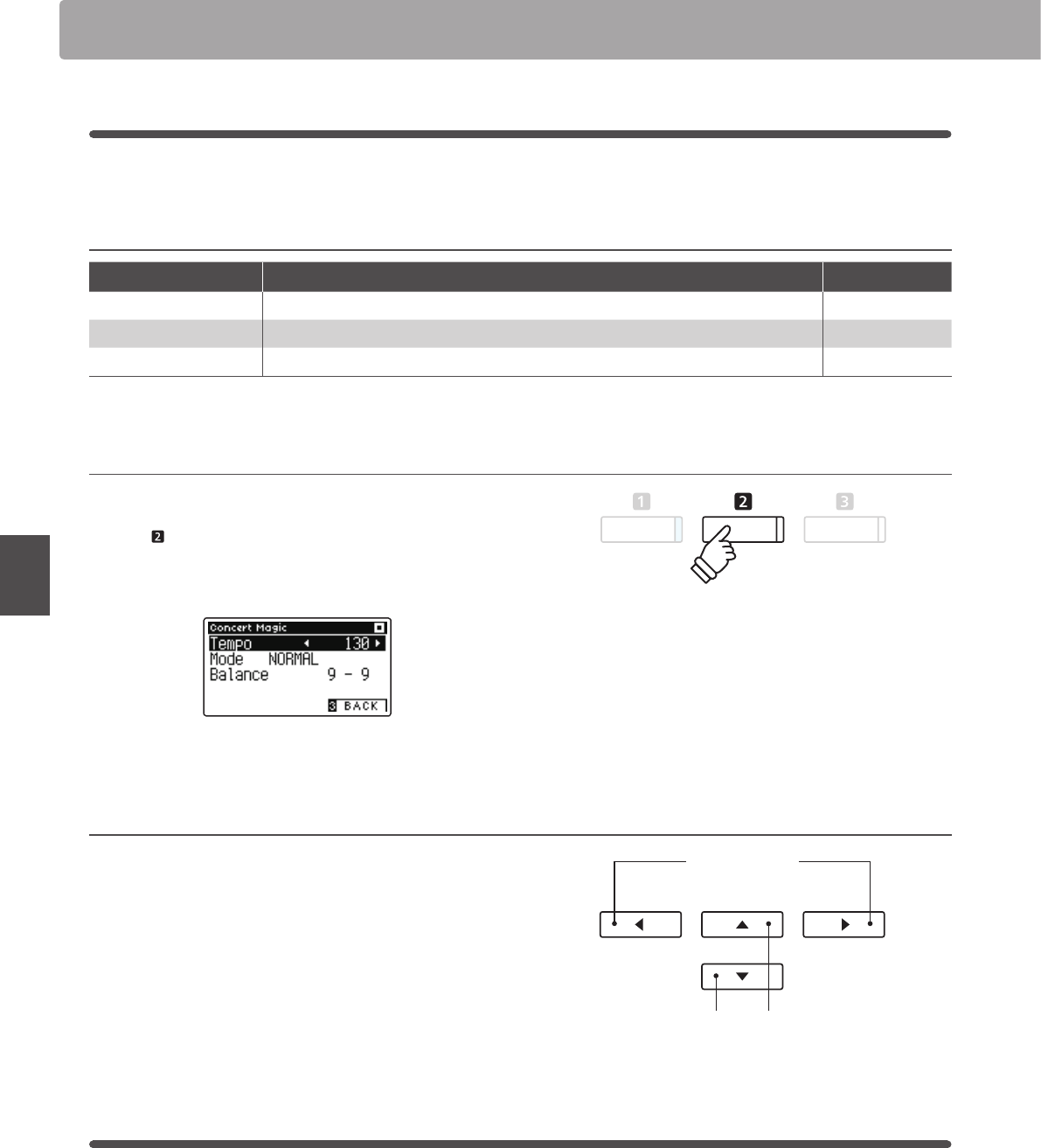
46
Music Menu
Concert Magic
3
Concert Magic settings
The Concert Magic settings menu allows the playback tempo, playing mode, and volume balance to be adjusted.
Concert Magic settings
Concert Magic setting Description Default setting
Tempo Adjust the playback tempo of the Concert Magic song in beats per minute (BPM). Song specific
Mode Change the Concert Magic playing mode (see below). Normal
Balance Adjust the volume balance between the melody and accompaniment parts. 9 - 9
Entering the Concert Magic settings menu
While Concert Magic mode is in use:
Press the FUNCTION button (EDIT).
The Concert Magic settings menu will be shown in the LCD
display.
Adjusting Concert Magic settings
After entering the Concert Magic settings menu:
Press the or buttons to move the selection cursor over the
desired setting.
Press the or buttons to adjust the selected setting.
* To reset the current setting to the default value, press the and
buttons simultaneously.
Steady Beat mode
Steady Beat mode allows all Concert Magic songs to be played by simply tapping any key with a constant steady
beat, regardless of the song arrangement type.
buttons:
Move selection cursor.
buttons:
Adjust selected setting.
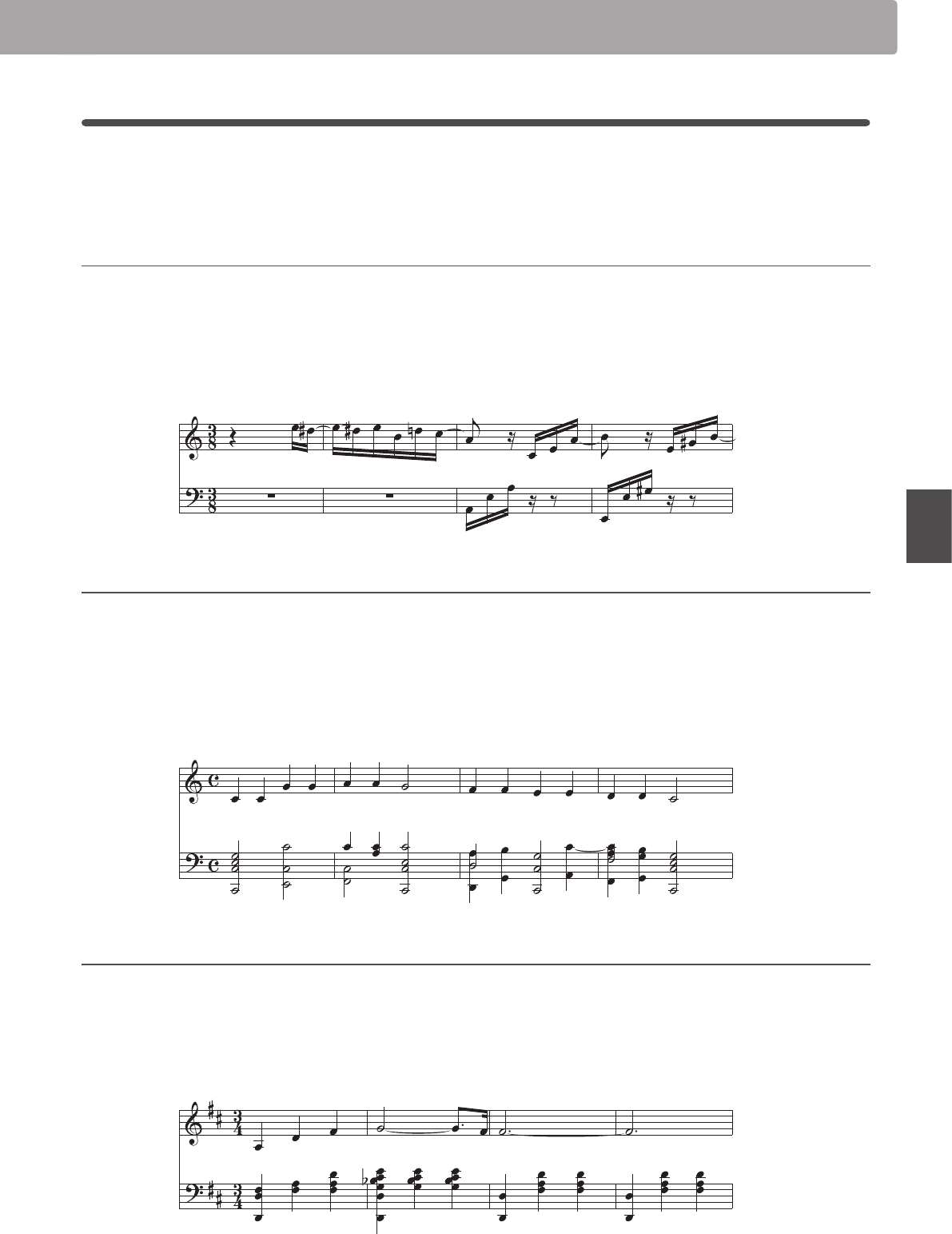
47
Music Menu
Concert Magic
4
Concert Magic song arrangement types
Concert Magic songs are divided into three dierent arrangement types, each requiring a dierent level of skill to
be performed correctly.
* The Concert Magic arrangement type is for each song is indicated in the ‘Internal Song Lists’ booklet as ‘EB’, ‘MP’, or ‘SK’.
Easy Beat
These are the easiest songs to play. To perform them, simply tap out a constant steady beat on any key on the keyboard.
The following example shows the notated score for ‘Für Elise’, indicating that a constant, steady rhythm should be maintained
throughout the song. This is the distinguishing characteristic of an Easy Beat song.
Key on: X X X X X X X X X XX X X X X X X X X X
Melody Play
These songs are also relatively easy to play, especially if they are familiar to the player. To perform them, tap out the rhythm of the
melody on any key of the keyboard. Singing along as the rhythm is tapped can be helpful.
The following example shows the notated score for ‘Twinkle, Twinkle, Little Star’.
* When performing fast Concert Magic songs, it may be easier to tap dierent keys with two alternating ngers in order to play at a greater speed.
Key on: X X X X X X X X X X X X X X
Skillful
These songs range in diculty from moderately dicult to dicult. To perform them, tap out the rhythm of both the melody and the
accompaniment notes on any key of the keyboard. The Note Navigator will be very helpful when playing the Skillful type songs.
The following example shows the notated score for ‘Waltz of the Flowers’.
Key on X X X X X X X X X X X X X
EB
MP
SK
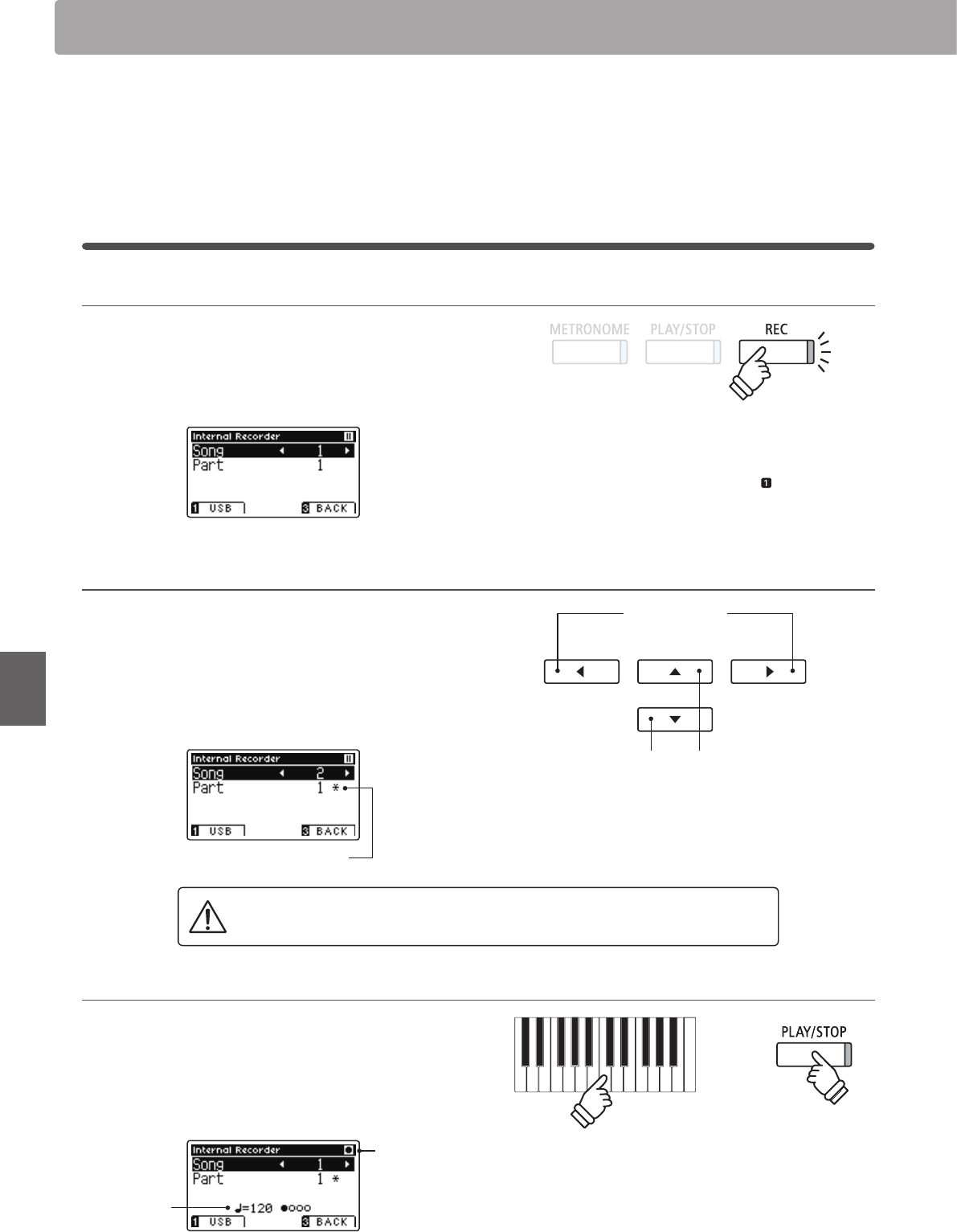
48
Recorder
Song Recorder (Internal Memory)
The CS11/CS8 digital piano allows up to 10 dierent songs to be recorded, stored in internal memory, and played
back at the touch of a button. Each song consists of two separate tracks – referred to as ‘parts’ – that can be recorded
and played back independently. This allows the left-hand part of a song to be recorded rst on one track, and the
right-hand part to be recorded later on the other track.
1
Recording a song
1. Entering song recorder mode
Press the REC button.
The LED indicator for the REC button will start to ash, and the
Internal Recorder record screen will appear with the currently
selected song and part number shown in the LCD display.
2. Selecting the song/part to be recorded
Press the or buttons to move the selection cursor over the
song memory or part.
Press the or buttons to change the selected song memory
or part to be recorded.
If a part has already been recorded, a * symbol will be shown.
Part has been recorded
When recording part 1 and part 2 separately, select the song and part number
carefully in order to prevent accidentally overwriting a previously recorded part.
3. Starting the song recorder
Press a key on the keyboard, or the PLAY/STOP button.
The LED indicators for the REC and PLAY/STOP buttons will turn
on, and recording will start.
The current bar and beat will also be shown in the LCD display.
Metronome
tempo/beat
(if enabled)
Recording
buttons:
Move selection cursor.
buttons:
Select song memory/part.
* If a USB memory device is connected, press the FUNCTION button
(INT) to select the internal song recorder.
or
* Pressing the PLAY/STOP button allows a rest period or empty bar to be
inserted at the beginning of the song.
* Press the METRONOME button before or during the recording to
turn on the metronome. The metronome ‘click’ sound will not be
recorded.
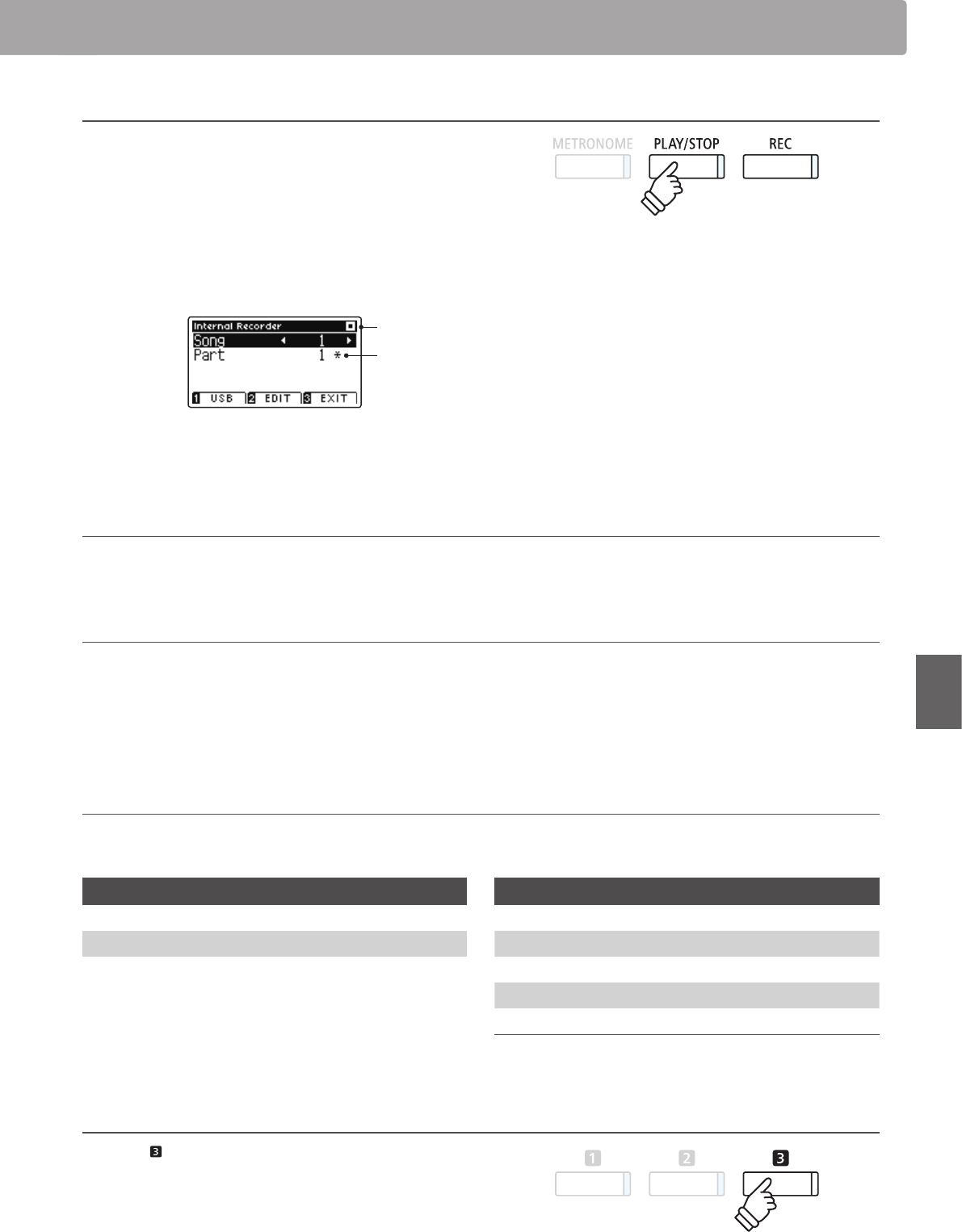
49
Recorder
Song Recorder (Internal Memory)
4. Stopping the song recorder
Press the PLAY/STOP button.
The LED indicators for the PLAY/STOP and REC buttons will turn
o, the recorder will stop, and the part/song will be stored in
internal memory.
After a few seconds, the Internal Recorder play screen will be
shown in the LCD display, indicating that the song is ready for
playback.
Stopped
Part
Recorded
To play back the recorded song, please refer to the ‘Playing a Song’
instructions on page 50.
Recording a second part
To record a second part, repeat the above instructions, selecting the part that has not been recorded to.
Recording with the metronome
It is also possible to record songs with the metronome activated. This is useful when recording parts separately, or wishing to
maintain correct timing throughout complex passages. Note that the standard metronome click will not be heard when the song
is played back.
* For more information about the instrument’s Metronome function, please refer to page 30.
Changing panel settings while recording
In some cases, it may be desirable to make changes to the selected sound or style while recording a song. The tables below list the
various functions which will and will not be remembered during recording.
Panel operations remembered during recording
Changes made to the sound type. (SOUND buttons etc.)
Switching between dual/split modes.
Panel operations NOT remembered during recording*
Changes made to the reverb settings.
Changes made to the eects settings.
Changes made to the tempo.
Changes made to the volume balance in dual/split mode.
Changes made to transpose, tuning, touch, etc.
* Desired eects, reverb, and tempo settings etc. should be prepared
before recording a new song.
5. Exiting song recorder mode
Press the FUNCTION button (EXIT), to exit the Internal
Recorder and return to normal operation.
* The maximum recording capacity is approximately 90,000 notes, with
button and pedal presses also counted as one note.
* If the maximum recording capacity is reached during recording, the
recorder will stop automatically.
* Recorder songs will remain in memory after the power is turned o.
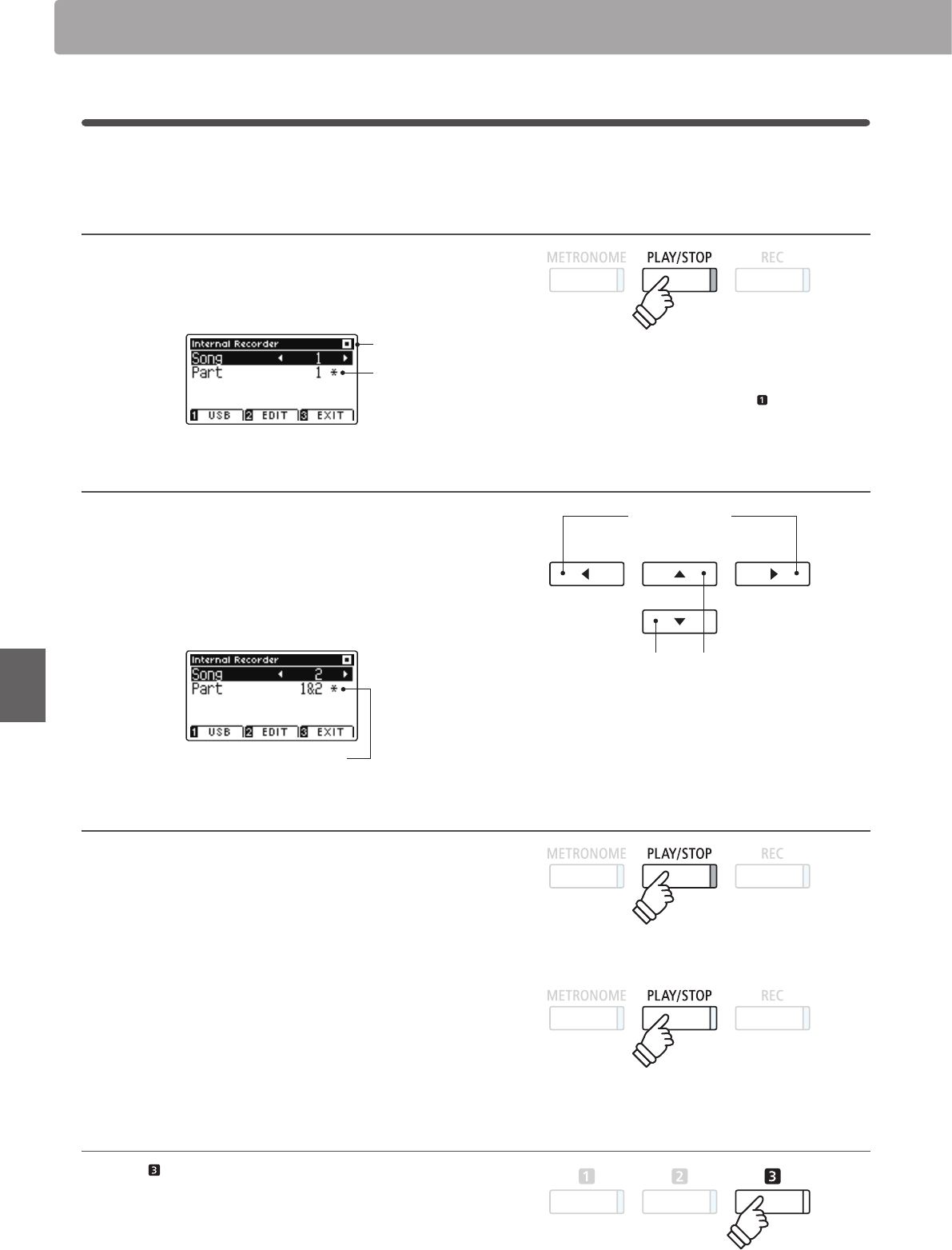
50
Recorder
2
Playing a song
This function is used to playback recorder songs stored in internal memory. To playback a song/part immediately
after recording, start this process from step 2.
1. Entering song play mode
Press the PLAY/STOP button.
The LED indicator for the PLAY/STOP button will turn on, and the
Internal Recorder play screen will be shown in the LCD display.
Stopped
Part
Recorded
2. Selecting the song/part(s) to be played back
Press the or buttons to move the selection cursor over the
song memory or part.
Press the or buttons to change the selected song memory
(1-10) or part (1, 2, or 1&2) to be played back.
If a part has already been recorded, a * symbol will be shown.
Part has been recorded
3. Starting/stopping song playback
Press the PLAY/STOP button.
The LED indicator for the PLAY/STOP buttons will turn on, and
the selected song/parts will start to play.
* The selected part can be changed during song playback.
* To adjust the playback tempo of the recorded song, press and hold
the METRONOME button, then press the or buttons.
Press the PLAY/STOP button again.
The LED indicator for the PLAY/STOP button will turn o and the
song will stop playing.
5. Exiting song play mode
Press the FUNCTION button (EXIT), to exit the Internal
Recorder and return to normal operation.
Song Recorder (Internal Memory)
* If a USB memory device is connected, press the FUNCTION button
(INT) to select the internal song recorder.
buttons:
Move selection cursor.
buttons:
Select song memory/part.
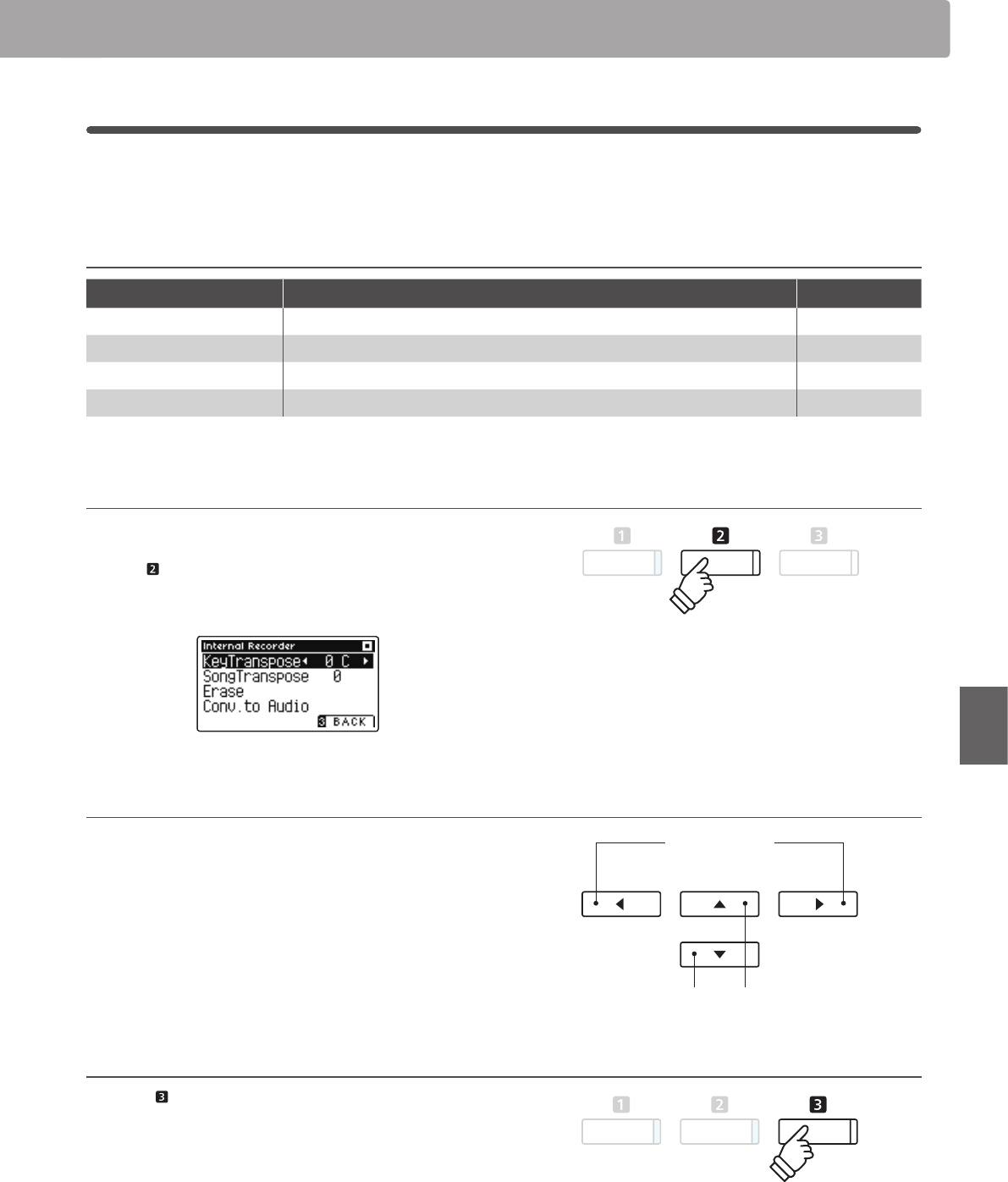
51
Recorder
Song Recorder (Internal Memory)
3
Internal Recorder Edit menu
The Internal Recorder Edit menu features settings that allow the pitch of the keyboard or song to be adjusted in
semi-tone steps. This menu also includes functions to delete the song, or convert the song to an audio le.
Internal Recorder menu
Internal Recorder function Description Default setting
Key Transpose Raise or lower the pitch of the keyboard in semi-tone steps. 0 (C)
Song Transpose Raise or lower the pitch of the recorder song in semi-tone steps. 0
Erase Erase a part of a recorder song from memory (see page 52). –
Audio Convert Convert a recorder song to an MP3/WAV audio le (see page 53). –
Entering the Internal Recorder menu
While the Internal Recorder play screen is shown in the LCD display:
Press the FUNCTION button (EDIT).
The Internal Recorder menu will be shown in the LCD display.
Adjusting the Internal Recorder settings/functions
After entering the Internal Recorder edit menu:
Press the or buttons to move the selection cursor over the
desired setting.
Press the or buttons to adjust the selected setting.
* To reset the current setting to the default value, press the and
buttons simultaneously.
Exiting the Internal Recorder menu
Press the FUNCTION button (BACK), to exit the Internal
Recorder menu and return to normal operation.
buttons:
Move selection cursor.
buttons:
Adjust selected setting.
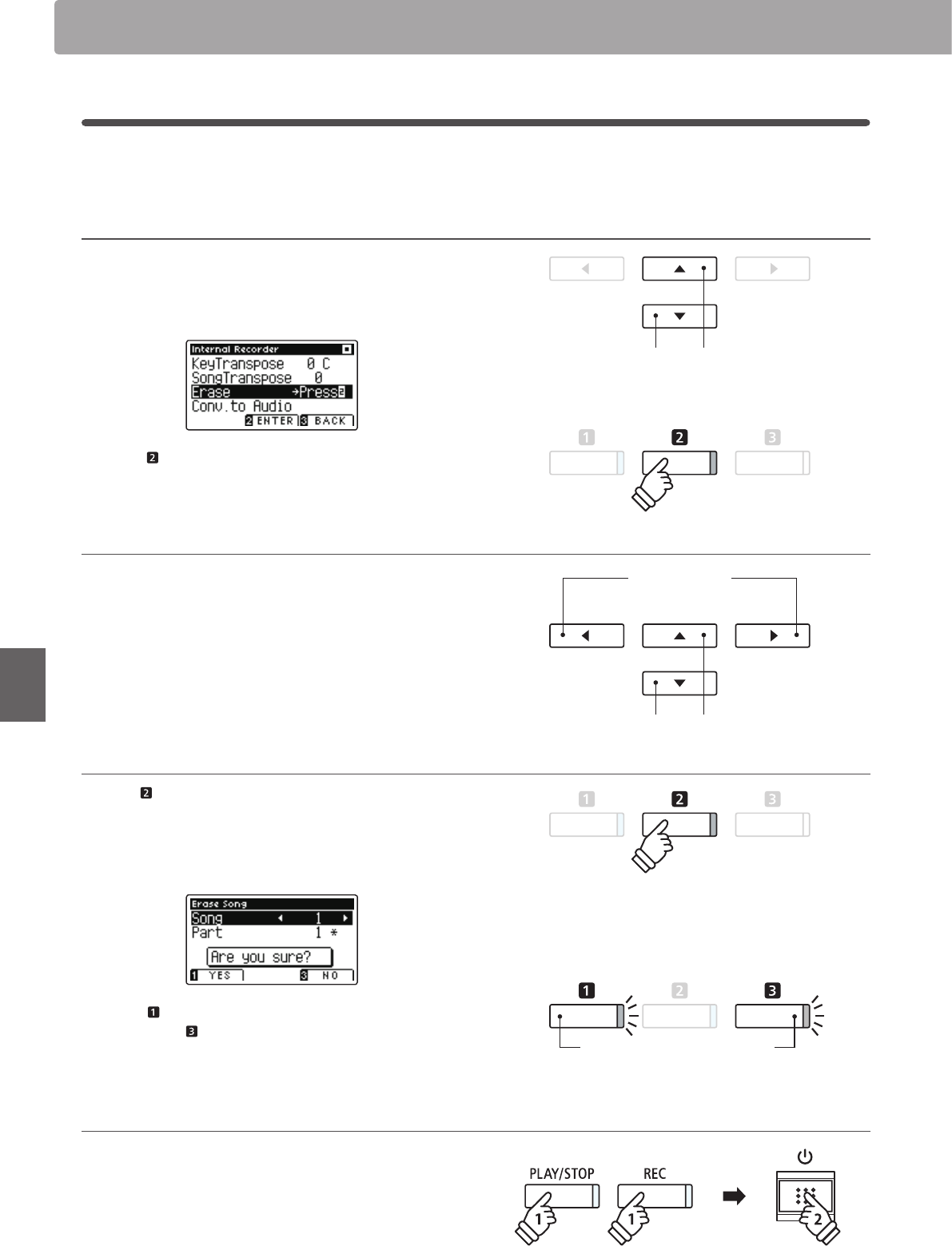
52
Recorder
Song Recorder (Internal Memory)
4
Erasing a part/song
This function is used to erase recorder parts that may have been recorded incorrectly or songs that are no longer
listened to. Once a part/song has been erased from memory it cannot be recovered.
1. Selecting the Erase function
After entering the Internal Recorder edit menu (see page 51):
Press the or buttons to move the selection cursor over the
Erase function.
Press the FUNCTION button (ENTER) to select the Erase
function.
2. Selecting the song/part to be erased
Press the or buttons to move the selection cursor over the
song memory or part.
Press the or buttons to change the selected song memory
(1-10) or part (1, 2, or 1&2) to be erased.
If a part has already been recorded, a * symbol will be shown.
3. Erasing the selected song/part
Press the FUNCTION button (OK) to Erase the selected song
and part.
A conrmation message will be shown in the LCD display,
prompting to conrm or cancel the erase operation.
Press the FUNCTION button (YES) to conrm the erase
operation, or the FUNCTION button (NO) to cancel.
Erasing all recorder songs from memory
Press and hold the PLAY/STOP and REC buttons, then turn the
instrument’s power o/on.
All recorder songs stored in memory will be erased.
buttons:
Move selection cursor.
buttons:
Move selection cursor.
buttons:
Select song memory/part.
hold
hold
YES: Erase NO: Cancel
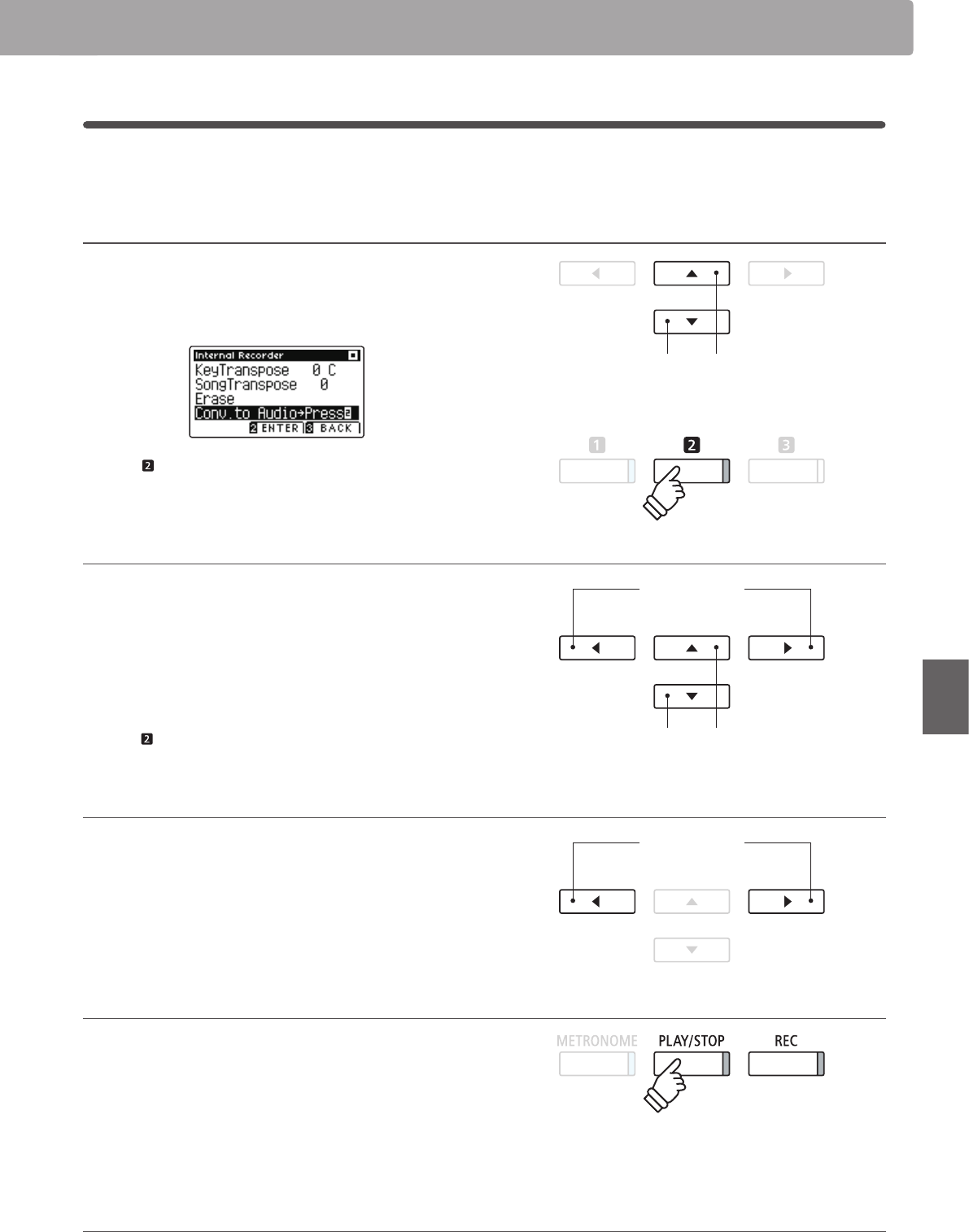
53
Recorder
Song Recorder (Internal Memory)
5
Converting a song to an audio le
This function allows recorder songs stored in internal memory to be played back and saved (converted) as an audio
le to a USB device in either MP3 or WAV format.
1. Selecting the Convert to Audio function
After entering the Internal Recorder edit menu (see page 51):
Press the or buttons to move the selection cursor over the
Convert to Audio function.
Press the FUNCTION button (ENTER) to select the Convert to
Audio function.
2. Selecting the song/part to be converted
Press the or buttons to move the selection cursor over the
song memory or part.
Press the or buttons to change the selected song memory
(1-10) or part (1, 2, or 1&2) to be converted.
If a part has already been recorded, a * symbol will be shown.
Press the FUNCTION button (OK) to continue.
3. Selecting the audio le format
Press the or buttons to select the desired le format for the
converted song.
It is also possible to adjust the recording gain at this stage.
* For more information about the instrument’s audio recorder gain
setting, please refer to page 54.
4. Starting the conversion
Press the PLAY/STOP button, or a key on the keyboard.
The LED indicator for the PLAY/STOP and REC buttons will turn
on, the selected song will play, and the convert to audio process
will start.
* Notes played on the keyboard will also be recorded to the audio le.
Naming and saving the converted audio le
Please follow the ‘Recording a MP3/WAV audio le’ instructions on page 55 from step 4.
buttons:
Move selection cursor.
buttons:
Move selection cursor.
buttons:
Select song memory/part.
buttons:
Select audio recorder format.
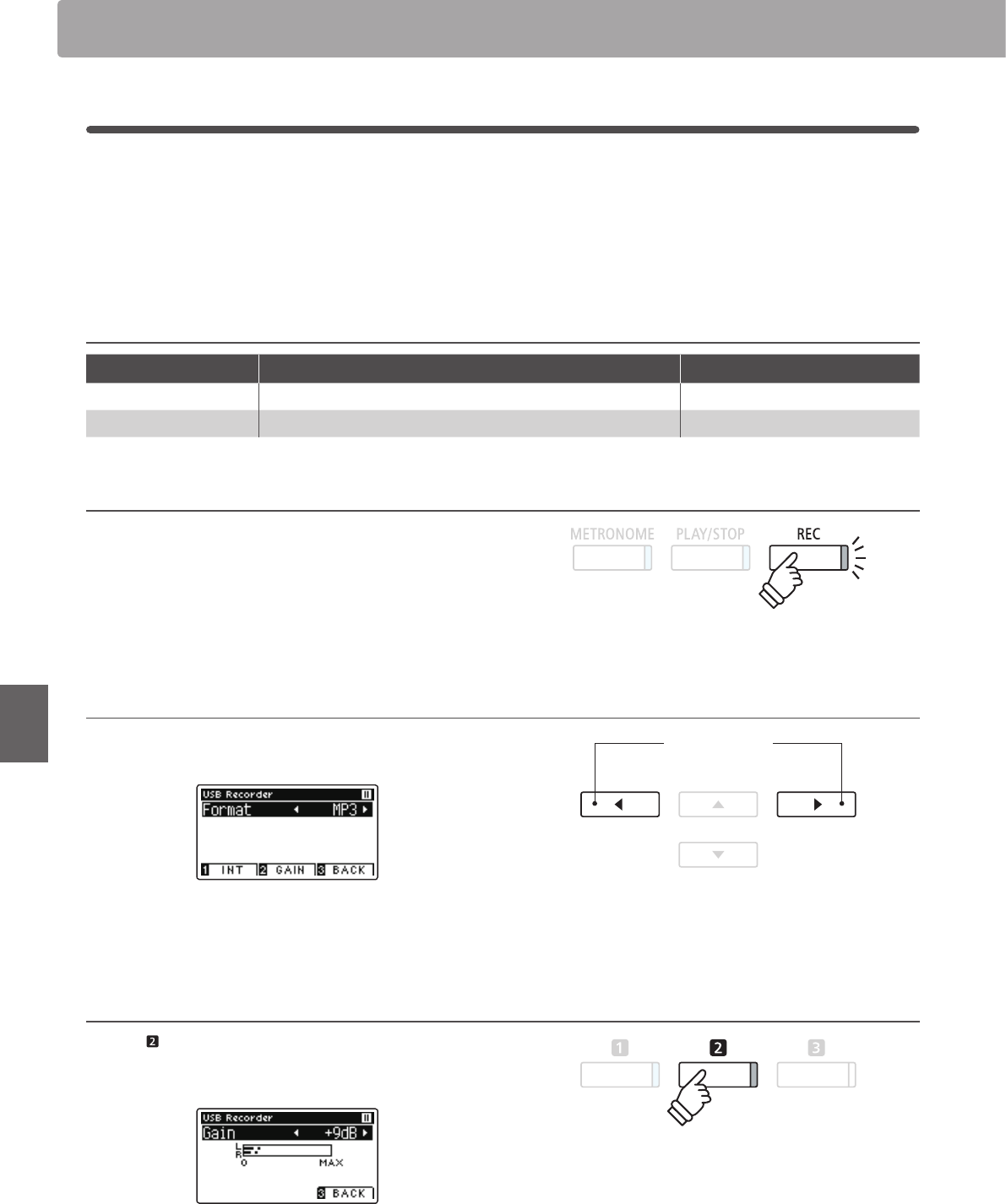
54
Recorder
Audio Record/Playback (USB Memory)
1
Recording a MP3/WAV audio le
The CS11/CS8 digital piano is also capable of recording performances as digital audio – saving the data to a USB
memory device in either MP3 or WAV format. This useful function allows professional quality recordings to be
produced directly on the instrument – without the need for additional sound equipment – then emailed to friends
and family, listened to away from the instrument, or edited and remixed further using an audio workstation.
In addition, the LINE IN audio will also be mixed and recorded to the MP3/WAV audio le.
Audio Recorder format specications
Audio format Specications Bitrate
MP3 44.1 kHz, 16 bit, Stereo 256 kbit/s (fixed)
WAV 44.1 kHz, 16 bit, Stereo 1,411 kbit/s (uncompressed)
MPEG Layer-3 audio coding technology licensed from Fraunhofer IIS and Thomson.
1. Entering USB recorder mode
Connect a USB memory device to the USB port.
Press the REC button.
The LED indicator for the REC button will start to ash, and the
USB Recorder format screen will be shown in the LCD display.
2. Selecting the USB recorder le format
Press the or buttons to select the desired USB recorder
audio le format (WAV or MP3).
* MP3 audio les require less storage space than WAV audio les.
* A 1 GB USB memory device can store over 12 hours of MP3 audio data.
Adjusting the recording volume (Gain)
Press the FUNCTION button (GAIN).
The gain adjustment screen and recording level meter will be
shown in the LCD display.
Press the or buttons to adjust the recorder gain setting.
* To reset the gain setting to the default level, press the and
buttons simultaneously.
buttons:
Select audio recorder format.
* The gain setting can be adjusted within the range of 0 dB~+15 dB.
* Express caution when increasing the gain setting, as higher levels may
result in distorted recordings.
* The gain meter will also display the sound level of the LINE IN audio.
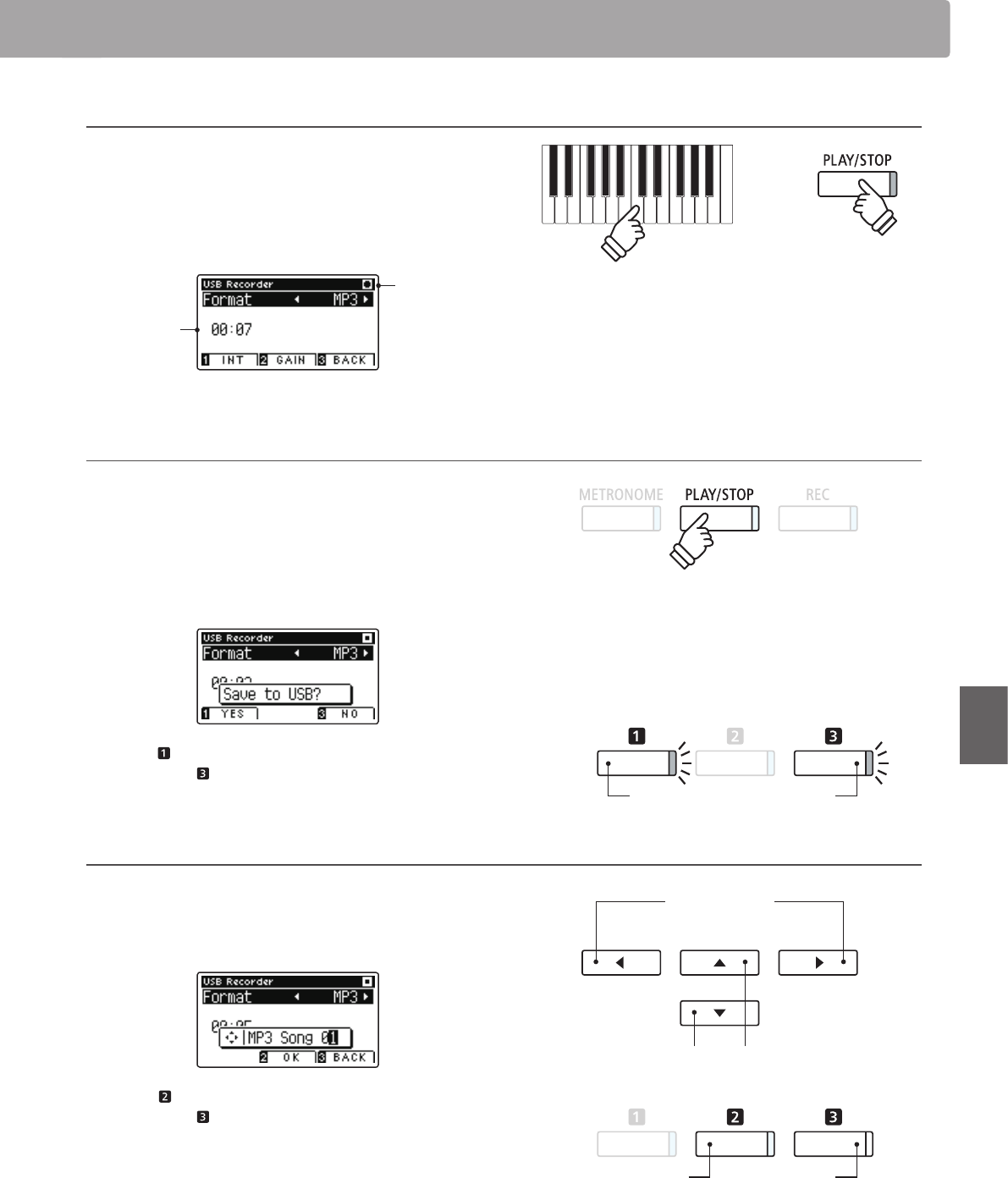
55
Recorder
Audio Record/Playback (USB Memory)
3. Starting the USB recorder
Press a key on the keyboard, or the PLAY/STOP button.
The LED indicators for the REC and PLAY/STOP buttons will turn
on, and recording will start.
The current recording time will also be shown in the LCD display.
Time
Recording
4. Stopping the USB recorder, saving the le
Press the PLAY/STOP button.
The LED indicators for the PLAY/STOP and REC buttons will turn
o, and recording will stop
A conrmation message will be shown in the LCD display,
prompting to conrm or cancel the save operation.
Press the FUNCTION button (YES) to conrm the save
operation, or the FUNCTION button (NO) to cancel.
5. Naming the recorded audio le, conrming save
After conrming the save operation:
Press the or buttons to cycle through the alphanumeric
characters, and the or buttons to move the cursor.
Press the FUNCTION button (OK) to conrm the save
operation, or the FUNCTION button (BACK) to cancel.
The recorded audio le will be saved with the specied name.
After a few seconds, the USB Recorder play screen will be
shown in the LCD display, indicating that the audio is ready for
playback.
To play back the recorded audio le, please refer to the ‘Playing an
MP3/WAV audio File’ instructions on page 56.
YES: Save NO: Cancel
buttons:
Select character.
buttons:
Move selection cursor.
OK: Save BACK: Cancel
* ‘MP3 Song 01’ or ‘WAV Song 01’ will be used as the default name for the
recorded audio les, with the number increasing automatically.
* The recorded audio le will be saved in the root folder of the USB
memory device. It is not possible to save the le in a dierent folder.
* Pressing the PLAY/STOP button allows a rest period or empty bar to be
inserted at the beginning of the song.
* Press the METRONOME button before or during the recording to
turn on the metronome. The metronome ‘click’ sound will not be
recorded, however drum patterns will be recorded.
or
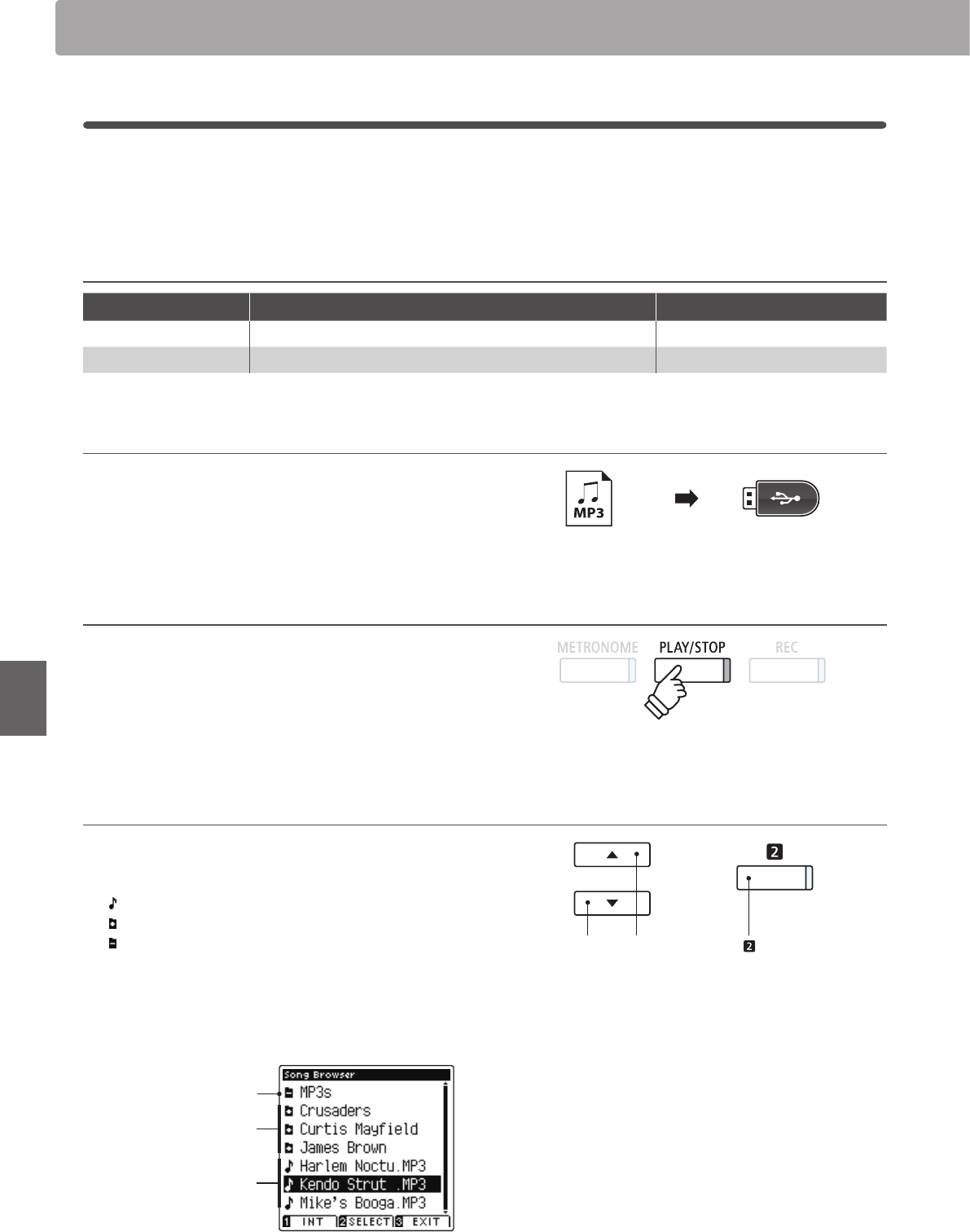
56
Recorder
Audio Record/Playback (USB Memory)
2
Playing an MP3/WAV audio le
The CS11/CS8 digital piano is also capable of playing MP3 and WAV audio les stored on a USB memory device
directly through the instrument’s speaker system. This function is particularly useful when attempting to learn the
chords or melody to a new piece, or to simply play along with one’s favorite song.
Audio Player supported format specications
Audio format Specications Bitrate
MP3 32 kHz/44.1 kHz/48 kHz, Mono/Stereo 8-320 kbit/s (fixed & variable)
WAV 32 kHz/44.1 kHz/48 kHz, Mono/Stereo, 16 bit -
MPEG Layer-3 audio coding technology licensed from Fraunhofer IIS and Thomson.
Preparing the USB memory device
First, prepare a selection of MP3 or WAV audio les, copying the
data to a USB memory device.
* USB devices should be formatted to use the ‘FAT’ or ‘FAT32’ lesystems.
Please refer to page 129 for more information.
1. Entering USB playback mode
Connect a USB memory device to the USB port.
Press the PLAY/STOP button.
The LED indicator for the the PLAY/STOP button will turn on,
and the Song Browser screen will be shown in the LCD display.
Song Browser screen
The Song Browser screen provides a listing of relevant les and
folders stored on the connected USB device.
The icon is used to represent an audio/song le.
The icon is used to represent a folder.
The icon is used to represent the current/previous folder.
An example of a typical le/folder listing screen is shown below.
Please note that the visible screen height has been extended for
the purpose of this illustration.
Current/previous folder
Folders
Files
* Files and folders will be listed in alphabetical order, with folders shown
at the top of the screen.
* When the USB Recorder play function is selected, only MP3, WAV, and
MID les will be shown.
* The LCD display is capable of showing lenames with a maximum
length of 12 characters (+3 character sux). Filenames longer than 12
characters will be truncated automatically.
buttons:
Move selection cursor.
FUNCTION button:
Select le/enter folder.
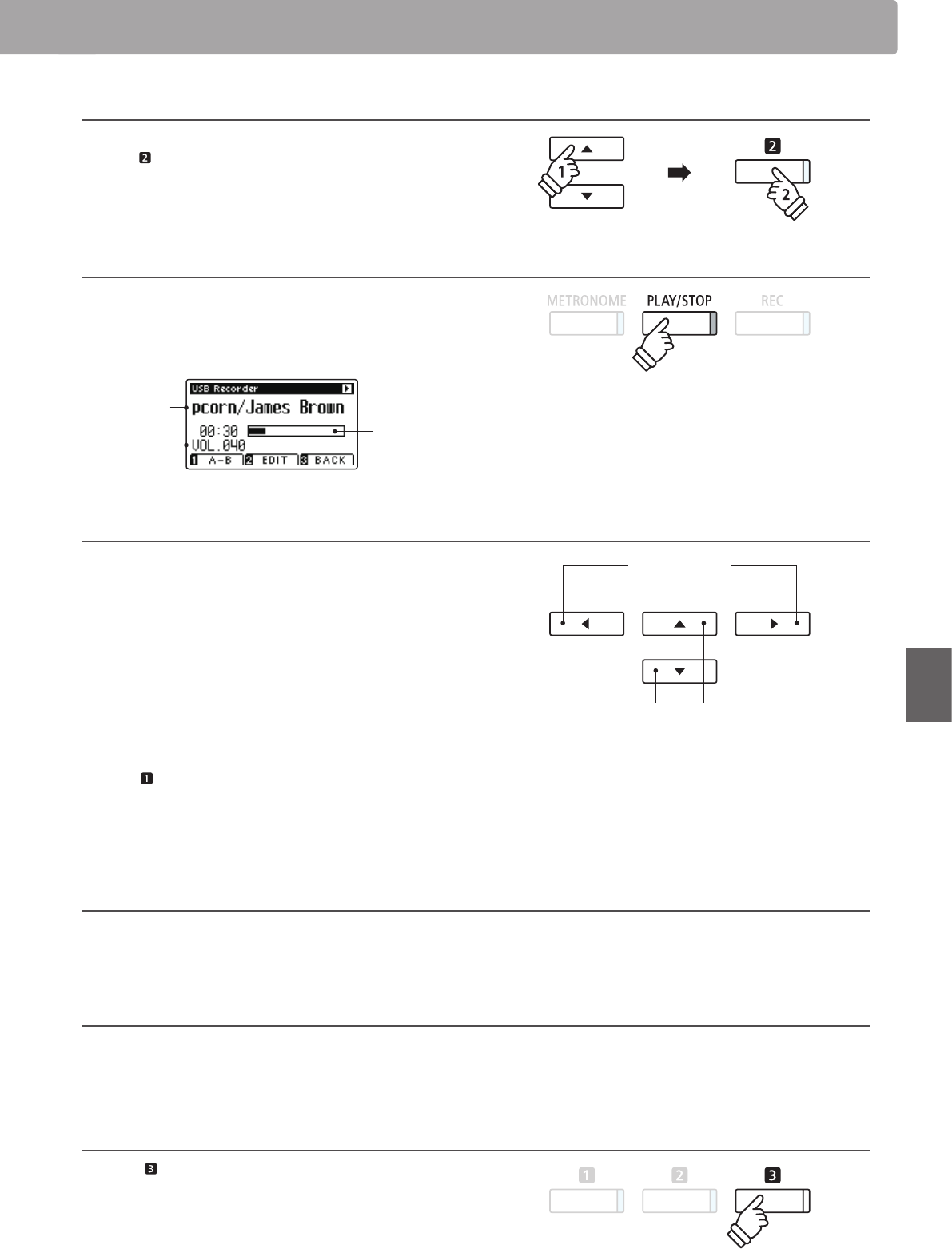
57
Recorder
Audio Record/Playback (USB Memory)
2. Selecting an audio le
Press the or buttons to move the selection cursor, then
press the FUNCTION button (SELECT) to select the audio le.
The USB Recorder play screen will be shown in the LCD display.
3. Playing the selected audio le
Press the PLAY/STOP button.
The selected audio le will start to play, and information about
the le will be shown in the LCD display.
Audio le,
artist/song
Playback
volume
Playing
position
Controlling audio le playback
While the audio le is playing:
Press the PLAY/STOP button to pause and resume playback.
Press the or buttons to rewind or advance the playing
position of the audio le.
Press the or buttons to adjust the playback volume of the
audio le.
* The playback volume can be adjusted within the range of 1~128.
Press the FUNCTION button (A-B) twice to set the start and
end points of the A-B loop.
* Pressing the A-B button for a third time will turn o the loop.
USB Recorder Edit menu
The USB Recorder Edit menu allows the playback mode (Single, 1-Repeat, All-Repeat, Random) to be changed, and the pitch of the keyboard
to be transposed in semi-tone steps. Please refer to page 60 for more information.
Overdub function
The Overdub function allows the sound of the CS11/CS8 to be recorded (overdubbed) to an existing MP3 or WAV audio le.
Please refer to page 62 for more information.
4. Exiting USB playback mode
Press the FUNCTION button (BACK) to exit USB playback
mode and return to normal operation.
* If the selected audio le contains embedded metadata (e.g. ID3 tags)
such as artist name and song title, this information will be also be
shown beside the lename.
buttons:
Adjust playback volume.
buttons:
Rewind/advance playing position.
* There may be a noticeable dierence in volume between audio le
playback and the CS11/CS8 keyboard sound. When playing back
audio data, please adjust the volume of the audio le as desired.
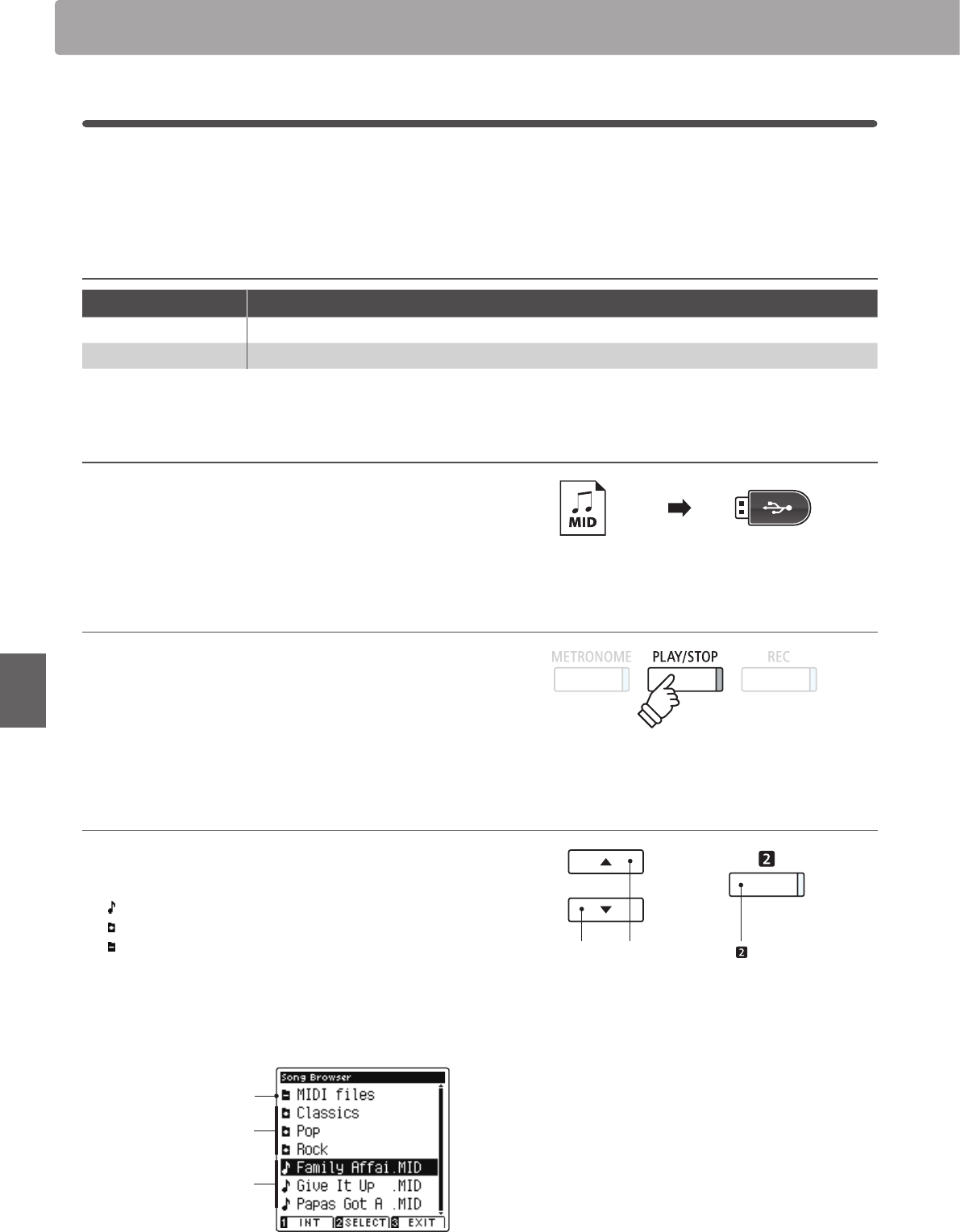
58
Recorder
3
Playing a MIDI song le
The CS11/CS8 digital piano also supports the playback of Standard MIDI File (SMF) les and CS11/CS8 recorder
songs stored on a USB memory device, allowing a vast selection of widely accessible music to be heard through the
instrument’s exquisite Harmonic Imaging XL sound engine.
Song Player supported format specications
Song format Specications
MID Format 0, Format 1
KS0 Kawai Song le
Preparing the USB memory device
First, prepare a selection of MID (SMF) song les, copying the
data to a USB memory device.
* USB devices should be formatted to use the ‘FAT’ or ‘FAT32’ lesystems.
Please refer to page 129 for more information.
1. Entering USB playback mode
Connect a USB memory device to the USB port.
Press the PLAY/STOP button.
The LED indicator for the the PLAY/STOP button will turn on,
and the Song Browser screen will be shown in the LCD display.
Song Browser screen
The Song Browser screen provides a listing of relevant les and
folders stored on the connected USB device.
The icon is used to represent an audio/song le.
The icon is used to represent a folder.
The icon is used to represent the current/previous folder.
An example of a typical le/folder listing screen is shown below.
Please note that the visible screen height has been extended for
the purpose of this illustration.
Current/previous folder
Folders
Files
Audio Record/Playback (USB Memory)
buttons:
Move selection cursor.
FUNCTION button:
Select le/enter folder.
* Files and folders will be listed in alphabetical order, with folders shown
at the top of the screen.
* When the USB Recorder play function is selected, only MP3, WAV, and
MID les will be shown.
* The LCD display is capable of showing lenames with a maximum
length of 12 characters (+3 character sux). Filenames longer than 12
characters will be truncated automatically.
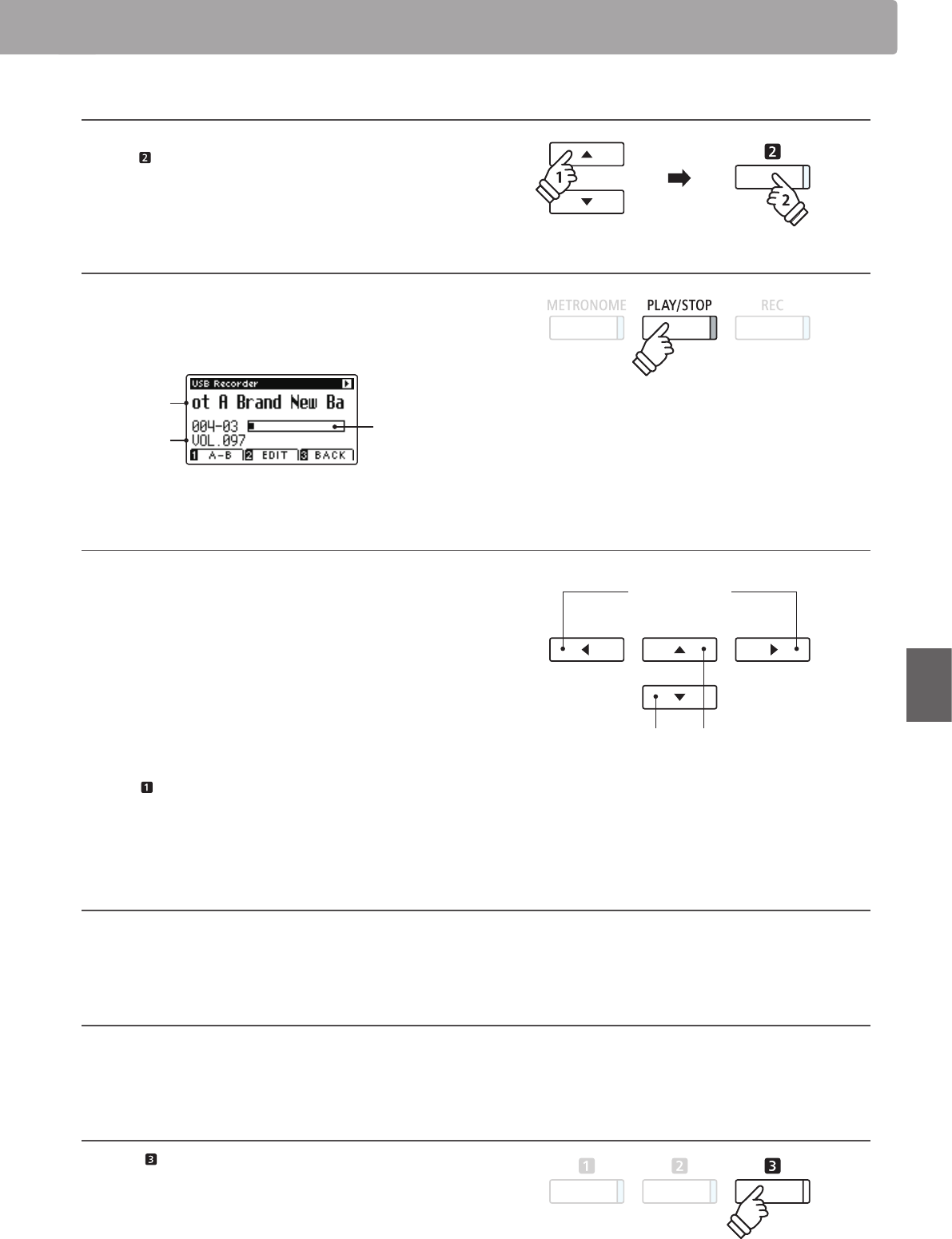
59
Recorder
Audio Record/Playback (USB Memory)
2. Selecting a MIDI le
Press the or buttons to move the selection cursor, then
press the FUNCTION button (SELECT) to select the MIDI le.
The USB Recorder play screen will be shown in the LCD display.
3. Playing the selected MIDI le
Press the PLAY/STOP button.
The selected MIDI le will start to play, and information about
the le will be shown in the LCD display.
MIDI le,
artist/song
Playback
volume
Playing
position
Controlling MIDI le playback
While the MIDI le is playing:
Press the PLAY/STOP button to pause and resume playback.
Press the or buttons to rewind or advance the playing
position of the MIDI le.
Press the or buttons to adjust the playback volume of the
MIDI le.
* The playback volume can be adjusted within the range of 1~128.
Press the FUNCTION button (A-B) twice to set the start and
end points of the A-B loop.
* Pressing the A-B button for a third time will turn o the loop.
USB Recorder Edit menu
The USB Recorder Edit menu allows the playback mode (Single, 1-Repeat, All-Repeat, Random) to be changed, the tempo of the MIDI song
to be adjusted, and the pitch of the keyboard or song to be transposed in semi-tone steps. Please refer to page 60 for more information.
Convert MIDI to Audio function
The Convert MIDI to Audio function allows MIDI les or CS11/CS8 recorder songs stored on a USB memory device to be converted to MP3/
WAV audio les. Please refer to page 61 for more information.
Exiting USB playback mode
Press the FUNCTION button (BACK) to exit USB playback
mode and return to normal operation.
* The CS11/CS8 digital piano does not contain the full General MIDI/
GM2 sound bank selection. Consequently, some SMF song les may
not be reproduced entirely accurately when played through the
instrument.
buttons:
Adjust playback volume.
buttons:
Rewind/advance playing position.
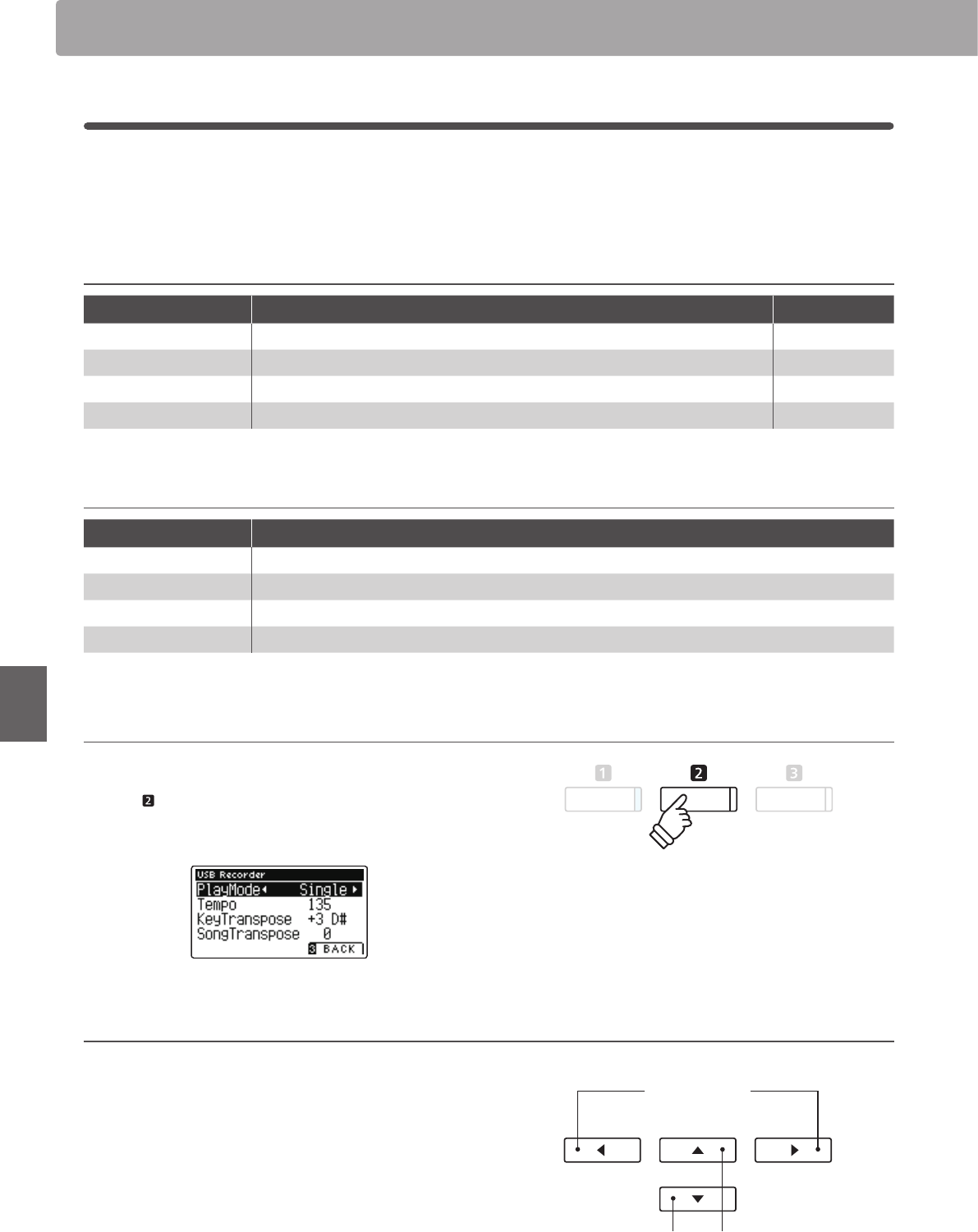
60
Recorder
4
USB Recorder Edit menu
The USB Recorder Edit menu allows the playback mode of the audio/MIDI le to be changed to one of four types.
This menu also features settings to adjust the MIDI song playback tempo, and to transpose the pitch of the keyboard
or MIDI song in semi-tone steps.
USB Recorder menu
USB Recorder function Description Default setting
Play Mode Change the audio/MIDI le playback mode (see below). Single
Tempo Adjust the playback tempo of the MIDI song in beats per minute (BPM). –
Key Transpose Raise or lower the pitch of the keyboard in semi-tone steps. 0 (C)
Song Transpose Raise or lower the pitch of the recorder/MIDI song in semi-tone steps. 0
* Tempo and Song Transpose settings will not be shown when an audio le is selected.
Play Mode settings
Play Mode setting Description
Single The selected audio/MIDI le will be played once.
1-Repeat The selected audio/MIDI le will be repeated.
All-Repeat All audio/MIDI les in the current folder will be played repeatedly.
Random All audio/MIDI les in the current folder will be played in random order.
Entering the USB Recorder menu
While the USB Recorder screen is shown in the LCD display:
Press the FUNCTION button (EDIT).
The USB Recorder menu will be shown in the LCD display.
Adjusting the USB Recorder settings
After entering the USB Recorder menu:
Press the or buttons to move the selection cursor over the
desired setting.
Press the or buttons to adjust the selected setting.
* To reset the current setting to the default value, press the and
buttons simultaneously.
Audio Record/Playback (USB Memory)
buttons:
Move selection cursor.
buttons:
Adjust selected setting.
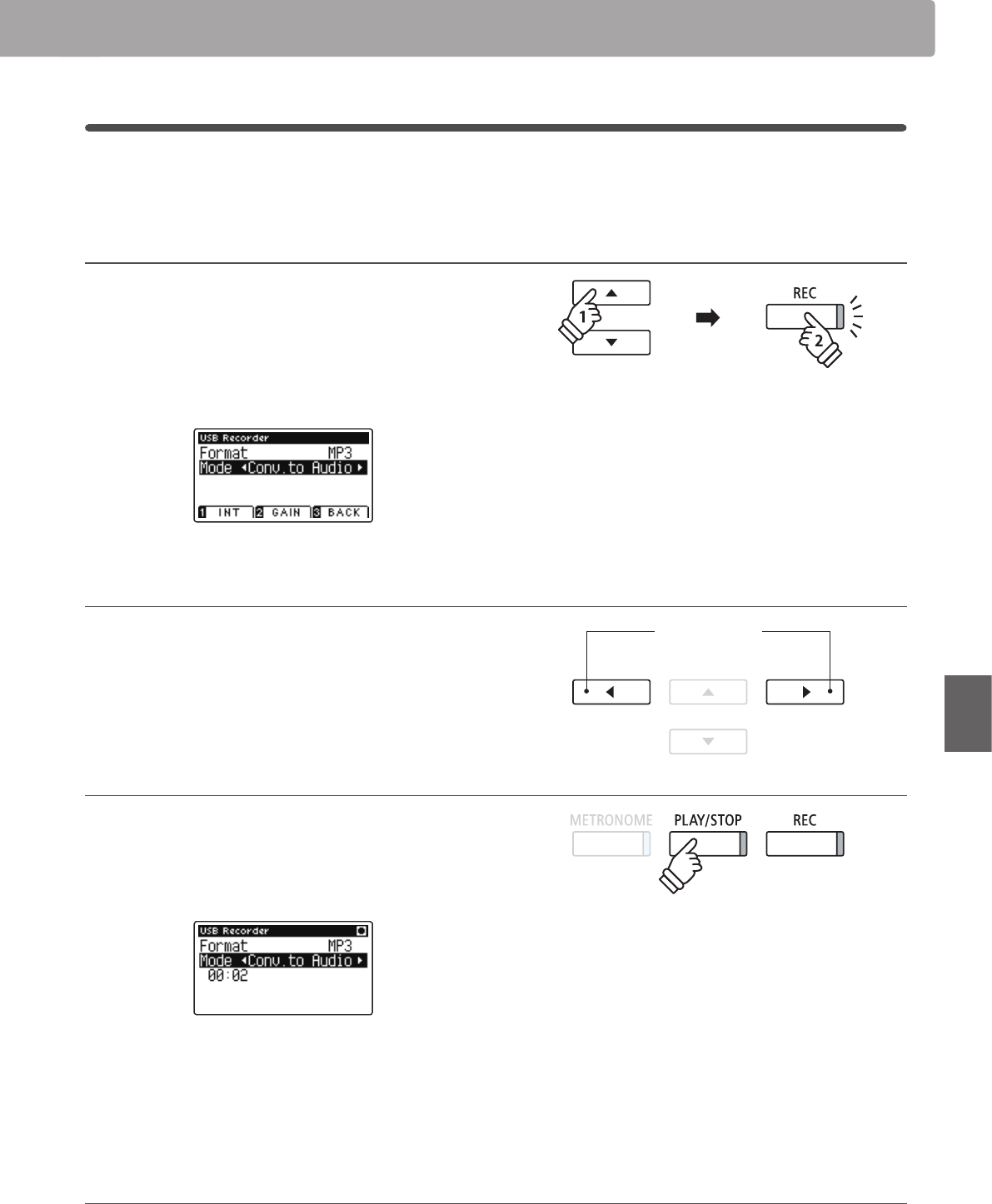
61
Recorder
Audio Record/Playback (USB Memory)
5
Converting a MIDI song le to an MP3/WAV audio le
This function allows MIDI les or CS11/CS8 recorder songs stored on a USB memory device to be played back and
saved (converted) as an audio le (to the USB device) in either MP3 or WAV format.
1. Selecting the MIDI song to be converted
While the Song Browser Player screen is shown in the LCD display:
Press the or buttons to move the selection cursor over the
desired MIDI le, then press the REC button.
The LED indicator for the REC button will start to ash, and the
Convert MIDI to Audio screen will be shown in the LCD display.
2. Selecting the audio le format
With the Format setting selected, press the or buttons to
select the desired USB recorder audio le format (WAV or MP3).
* It is also possible to record a new song directly to the USB device (i.e.
not convert the previously selected song to an audio le) by changing
the Mode setting to ‘New Song’.
3. Starting the conversion
Press the PLAY/STOP button, or a key on the keyboard.
The LED indicator for the PLAY/STOP and REC buttons will turn
on, the selected song will play, and the convert to audio process
will start.
* Notes played on the keyboard will also be recorded to the audio le.
When the end of the song is reached, the save conrmation
screen will be shown in the LCD display.
Naming and saving the converted audio le
Please follow the ‘Recording a MP3/WAV audio le’ instructions on page 55 from step 3.
buttons:
Select audio recorder format.
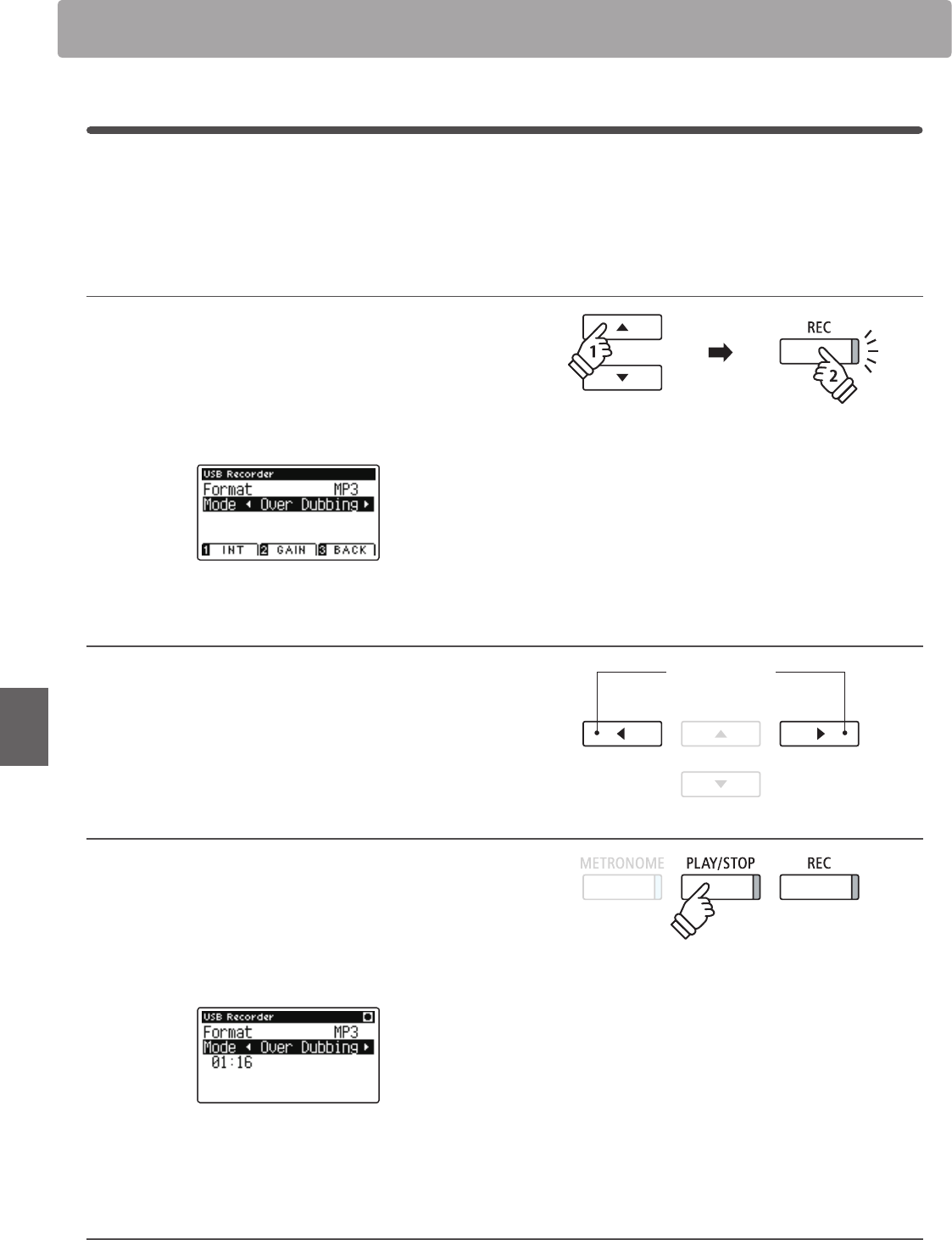
62
Recorder
6
Overdubbing a MP3/WAV audio le
This function allows the sound of the CS11/CS8 to be recorded (overdubbed) to an existing MP3 or WAV audio le.
In addition, the CS11/CS8 digital pianos also supports mixing the LINE IN audio with the overdubbed MP3/WAV le.
* This function records/overdubs to a copy of the selected le – the original audio le will not be modied.
1. Selecting the audio le to be overdubbed
While the Song Browser Player screen is shown in the LCD display:
Press the or buttons to move the selection cursor over the
desired MP3/WAV le, then press the REC button.
The LED indicator for the REC button will start to ash, and the
Overdubbing screen will be shown in the LCD display.
2. Selecting the audio le format
With the Format setting selected, press the or buttons to
select the desired USB recorder audio le format (WAV or MP3).
* It is also possible to record a new audio le directly to the USB device
(i.e. not overdub the previously selected audio le) by changing the
Mode setting to ‘New Song’.
3. Starting the recording/overdubbing
Press the PLAY/STOP button, or a key on the keyboard.
The LED indicator for the PLAY/STOP and REC buttons will
turn on, the selected audio le will play, and the recording/
overdubbing process will start.
Notes played on the keyboard will be recorded to the audio le.
When the end of the MP3/WAV is reached, the save conrmation
screen will be shown in the LCD display.
Naming and saving the overdubbed audio le
Please follow the ‘Recording a MP3/WAV audio le’ instructions on page 55 from step 3.
buttons:
Select audio recorder format.
Audio Record/Playback (USB Memory)
* The playback volume of the selected audio le will automatically be
set to 100, in order to prevent a distorted recording.
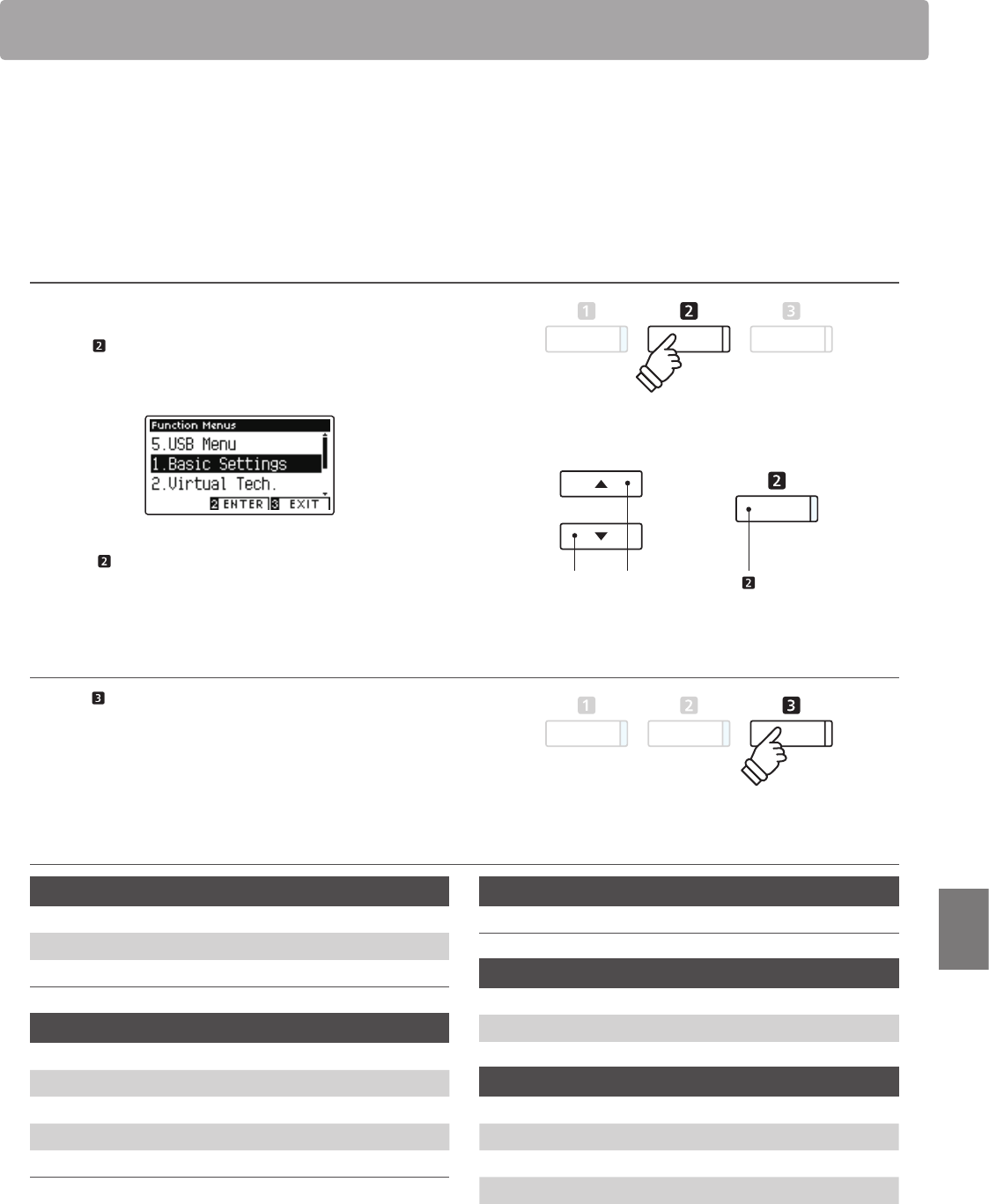
63
Settings
Function menus
The Function menus contain a variety of options to adjust the CS11/CS8 digital piano’s operation and sound.
Settings are grouped by category, providing convenient access to relevant controls. Once adjusted, settings can be
stored to one of the instrument’s 16 registration memories, or selected as the default power-on settings with the
Startup Setting function (page 77).
Entering the Function menus
While the normal playing mode screen is shown in the LCD display:
Press the FUNCTION button (EDIT).
The Function menus will be shown in the LCD display.
Press the or buttons to cycle through the dierent menus.
Press the FUNCTION button (ENTER) to enter the selected
Function menu.
Exiting the Function menus
Press the FUNCTION button (EXIT) to exit the Function menus
and return to normal operation.
Overview of Function menus
1. Basic Settings
Key Transpose, Song Transpose, Tone Control, Speaker Volume,
Line In Level, Wall EQ*, Tuning, Damper Hold, Split, Four Hands,
LCD Contrast, Startup Setting, Factory Reset, Auto Power O
5. USB Functions
Load Song, Load Registration All, Load Registration Single,
Load Startup Setting, Save Internal Song, Save SMF Song,
Save Registration All, Save Registration Single, Save Startup Setting,
Rename File, Delete File, Format USB
4. MIDI Settings
MIDI Channel, Send Program Change No., Local Control,
Transmit Program Change No., Multi-timbral Mode, Channel Mute
3. Phones Settings
SHS Mode, Phones Type, Phones Volume
2. Virtual Technician Settings
Touch Curve, Voicing, Damper Resonance, Damper Noise,
String Resonance, Undamped String Resonance, Cabinet Resonance,
Key-o Eect, Fallback Noise, Hammer Delay, Topboard Simulation,
Decay Time, Minimum Touch, Stretch Tuning, Temperament,
Temperament Key, Key Volume, Half-Pedal Adjust, Soft Pedal Depth
* CS11 only.
buttons:
Move selection cursor.
FUNCTION button:
Select function.
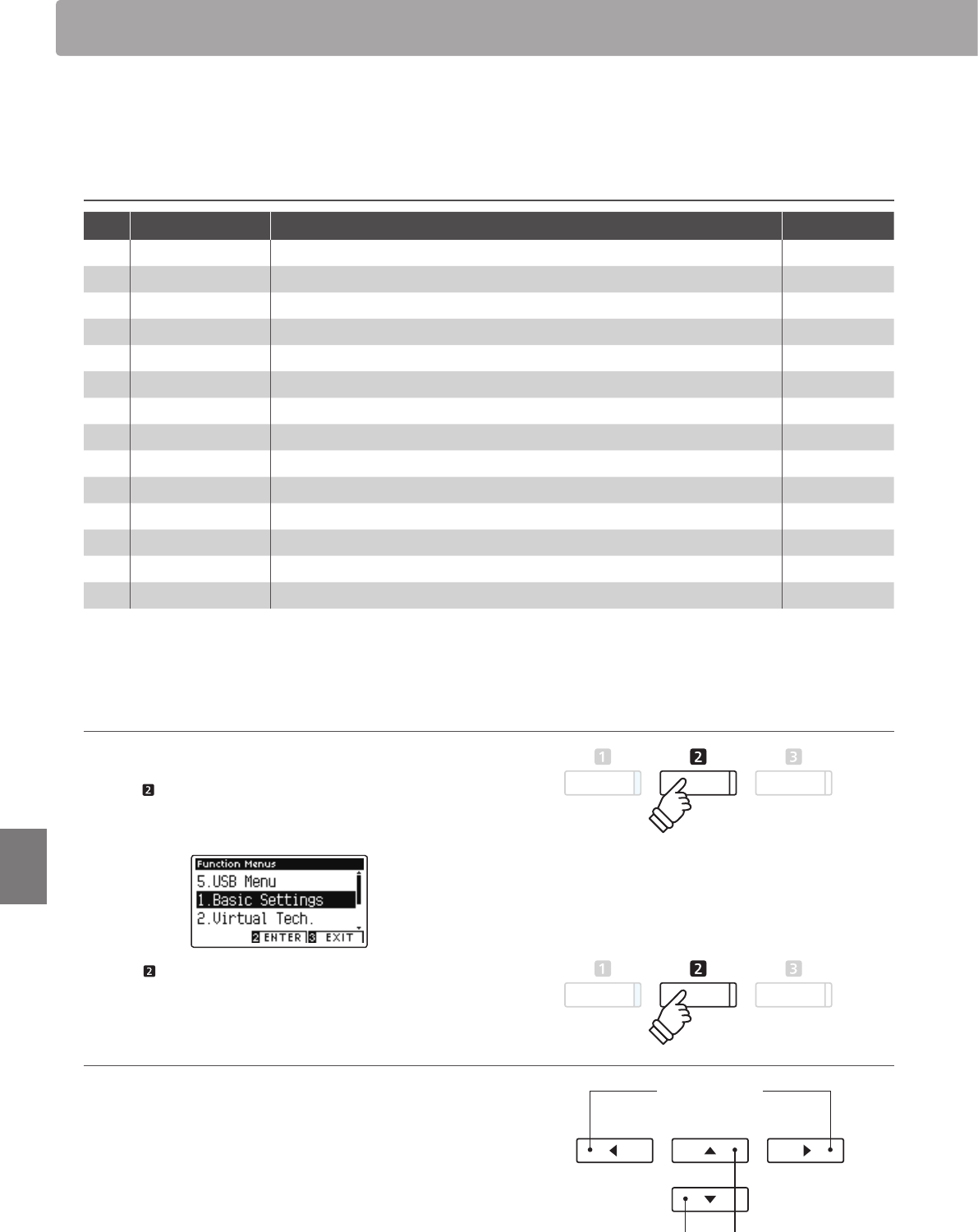
64
Settings
Basic Settings
The Basic Settings menu contains settings to adjust the pitch, tuning, and general sound of the instrument.
This menu also allows favourite panel settings to be stored, or reset back to the original factory conguration.
Basic Settings
No. Setting Description Default setting
1 Key Transpose Raise or lower the pitch of the keyboard in semi-tone steps. 0 (C)
2 Song Transpose Raise or lower the pitch of the recorder/MIDI song in semi-tone steps. 0
3Tone Control Change the EQ settings of the instrument’s sound. O
4 Speaker Volume Change the maximum volume level of the speaker output. Normal
5 Line In Level Adjust the input volume of the Line In connectors. 0 dB.
6 Wall EQ* Optimise the instrument’s speaker system based on instrument placement. O
7Tuning Raise or lower the pitch of the instrument in 0.5 Hz steps. 440.0 Hz
8Damper Hold Change the eect of pressing the sustain pedal on organ, string, etc. sounds. O
9Split Enable the ‘Split Mode’ function. O
10 Four Hands Enable the ‘Four Hands Mode’ function. O
11 LCD Contrast Adjust the contrast of the instrument’s LCD display. 5
12 Startup Setting Store current panel settings as the default (power-on) conguration. -
13 Factory Reset Restore all panel settings to the original factory conguration. -
14 Auto Power O Enable/disable the instrument’s Auto Power O energy saving function. -
* The Wall EQ setting is available on the CS11 model only. Settings page numbers shown will dier on the CS8 model.
* Default settings will be shown in the rst LCD display illustration (i.e. Step 1) for each setting explanation below.
Entering the Basic Settings menu
While the normal playing mode screen is shown in the LCD display:
Press the FUNCTION button (ENTER).
The Function menus will be shown in the LCD display.
Press the FUNCTION button (ENTER) again to enter the Basic
Settings menu.
Selecting and adjusting the desired setting
After entering the Basic Settings menu:
Press the or buttons to move the selection cursor over the
desired setting.
Press the or buttons to adjust the selected setting.
* To reset the current setting to the default value, press the and
buttons simultaneously. buttons:
Move selection cursor.
buttons:
Adjust selected setting.
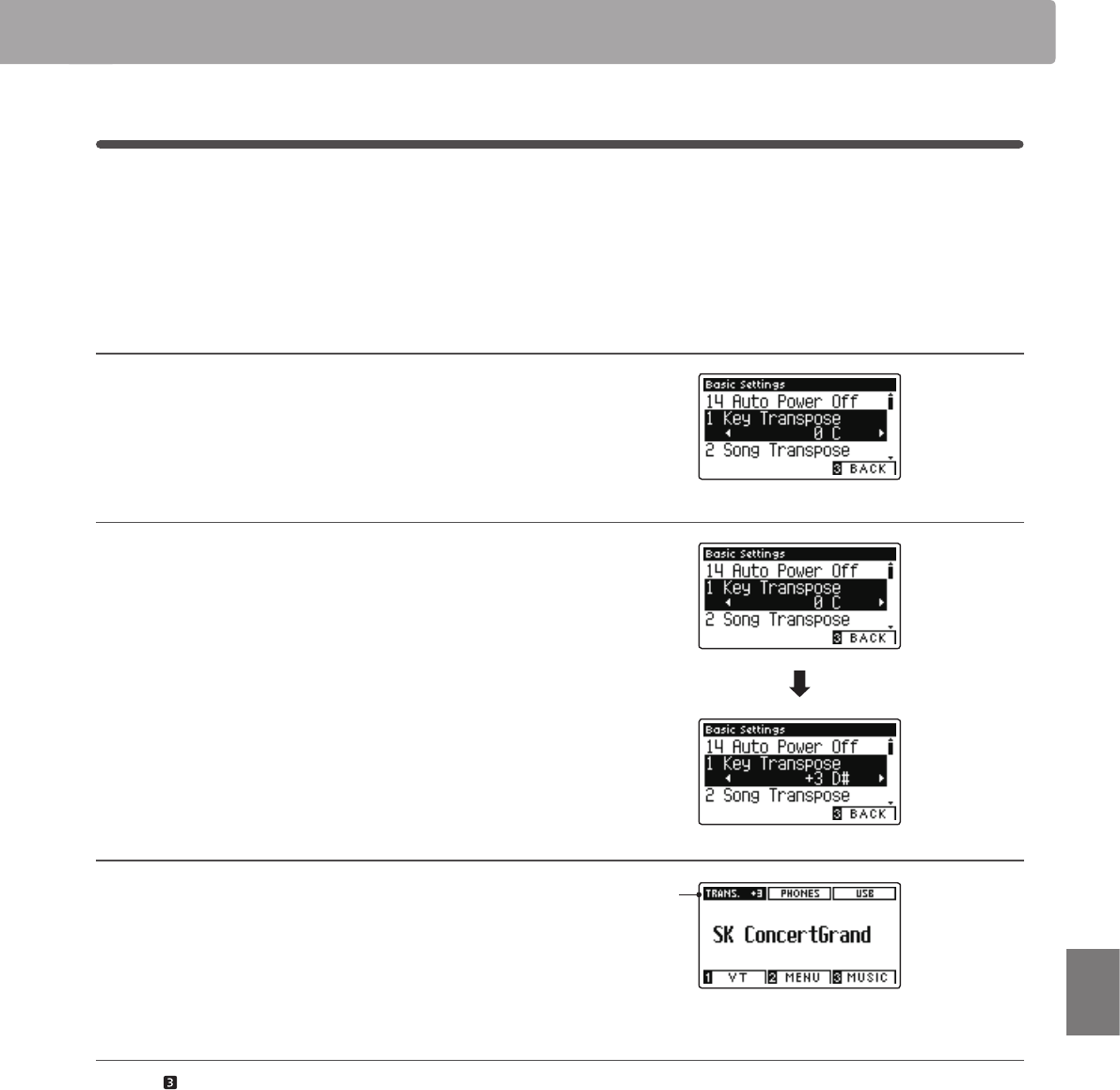
65
Settings
Basic Settings
1
Key Transpose
The Key Transpose setting allows the pitch of the CS11/CS8 digital piano keyboard to be raised or lowered in semi-
tone steps. This is particularly useful when accompanying instruments tuned for dierent keys, or when a song
learned in one key must be played in another key. When transposed, the song can be played in the original key, yet
heard in a dierent key.
1. Selecting the Key Transpose setting
After entering the Basic Settings menu (page 64):
Press the or buttons to select the Key Transpose setting.
2. Adjusting the Key Transpose value
Press the or buttons to increase or decrease the value of
the Key Transpose setting.
* The keyboard pitch can be raised or lowered by up to 12 semi-tones.
* To reset the Key Transpose setting to the default value, press the
and buttons simultaneously.
* Any changes made to the Key Transpose setting will remain until the
power is turned o.
* Preferred Key Transpose settings can be stored to the Startup Setting
memory for convenient recall. Please refer to page 77 for more
information.
Current Transpose state
If the Key Transpose setting is set to a value other than 0 (C),
the TRANSPOSE indicator shown in the normal playing mode
screen will be highlighted.
3. Exiting the Key Transpose setting
Press the FUNCTION button (BACK) to exit the Key Transpose
setting and return to the Function Menus screen.
Transpose
enabled
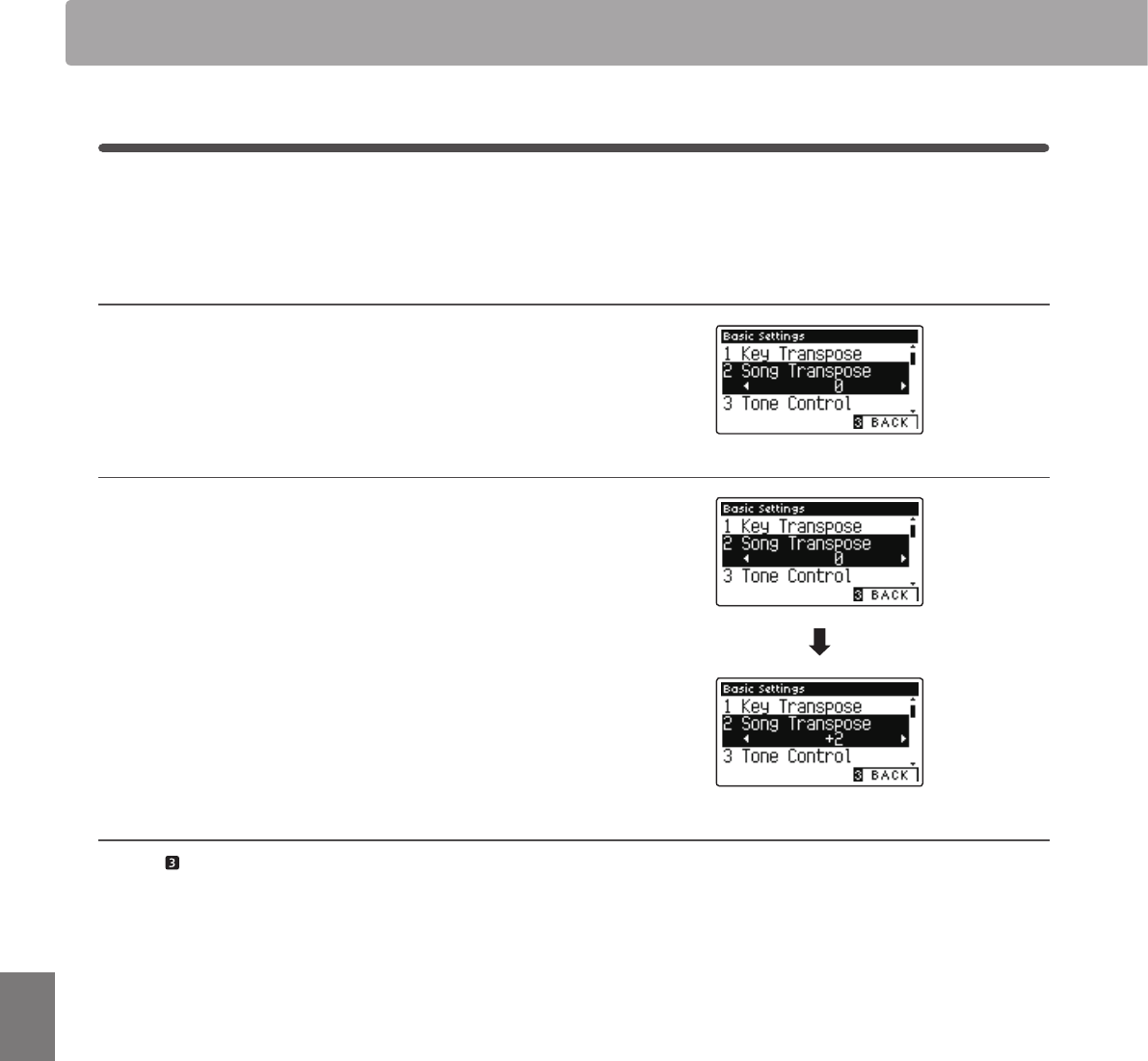
66
Settings
2
Song Transpose
The Song Transpose setting allows the pitch of MIDI les or CS11/CS8 recorder songs stored on a USB memory
device to be raised or lowered in semi-tone steps when played back.
1. Selecting the Song Transpose setting
After entering the Basic Settings menu (page 64):
Press the or buttons to select the Song Transpose setting.
2. Adjusting the Song Transpose value
Press the or buttons to increase or decrease the value of
the Song Transpose setting.
* The song pitch can be raised or lowered by up to 12 semi-tones.
* To reset the Song Transpose setting to the default value, press the
and buttons simultaneously.
* Any changes made to the Song Transpose setting will remain until the
power is turned o.
* Preferred Song Transpose settings can be stored to the Startup
Setting memory for convenient recall. Please refer to page 77 for
more information.
3. Exiting the Song Transpose setting
Press the FUNCTION button (BACK) to exit the Song Transpose
setting and return to the Function Menus screen.
Basic Settings
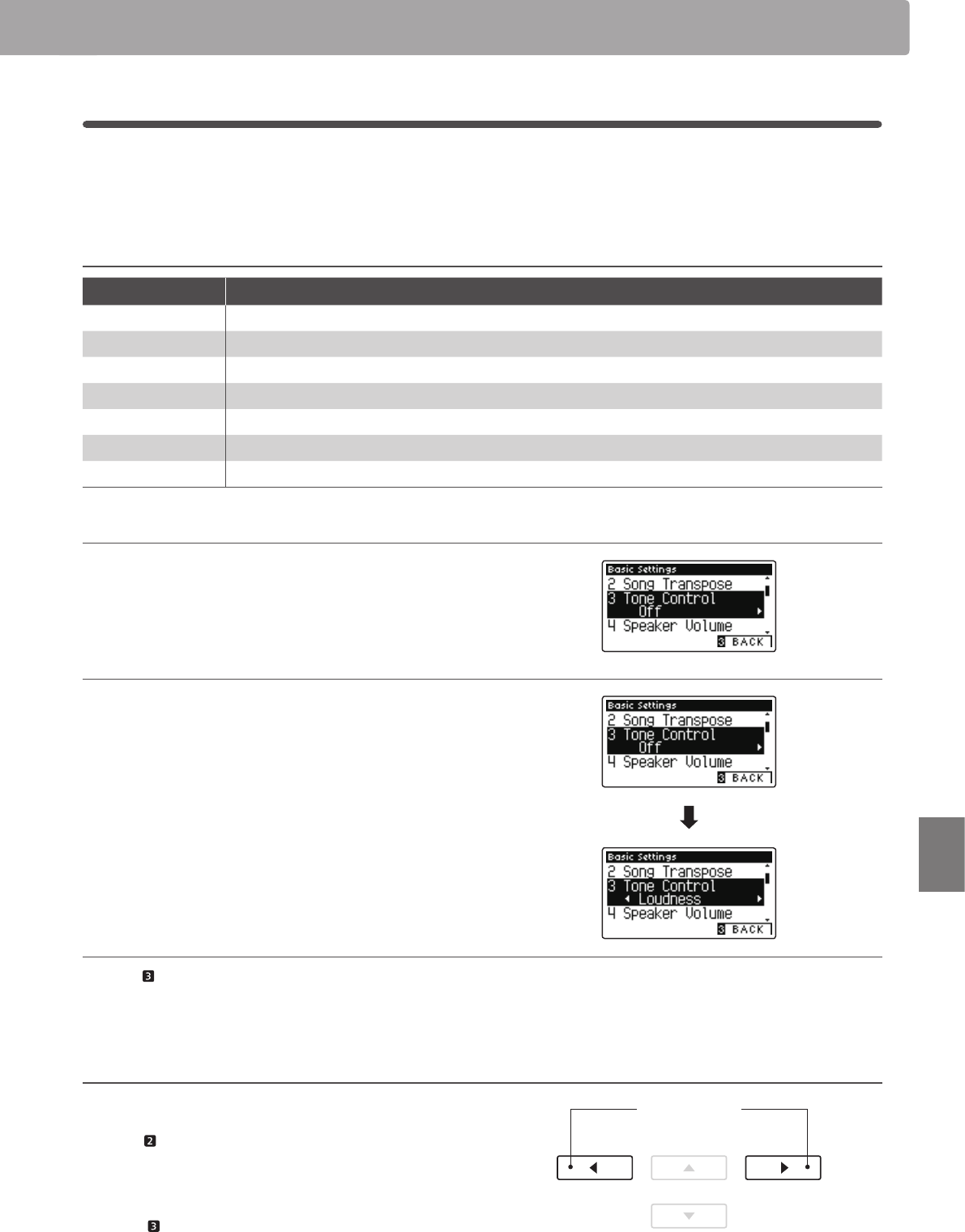
67
Settings
Basic Settings
3
Tone Control
The Tone Control setting allows the overall sound character of the CS11/CS8 digital piano to be adjusted to provide
the best sound quality within the area that the instrument is located. There are ve dierent preset EQ settings
available, with an additional ‘User’ setting allowing ner control over the dierent frequency bands.
Tone Control setting
Tone Control type Description
O (default) Tone control adjustment is not applied.
Brilliance Adjusts the overall brightness of the sound, independently of the Virtual Technician ‘Voicing’ parameter.
Loudness Emphasises frequencies to retain the instrument’s sound character when playing at low volume levels.
Bass Boost Emphasises low-range frequencies, creating a deeper sound.
Treble Boost Emphasises high-range frequencies, creating a brighter sound.
Mid Cut Reduces mid-range frequencies, creating a clearer sound.
User Allows the low, mid, and high-range frequency bands to be adjusted separately.
1. Selecting the Tone Control setting
After entering the Basic Settings menu (page 64):
Press the or buttons to select the Tone Control setting.
2. Changing the Tone Control type
Press the or buttons to cycle through the dierent Tone
Control types.
* To reset the Tone Control setting to the default type, press the
and buttons simultaneously.
* Any changes made to the Tone Control setting will remain until the
power is turned o.
* Preferred Tone Control settings can be stored to the Startup Setting
memory for convenient recall. Please refer to page 77 for more
information.
3. Exiting the Tone Control setting
Press the FUNCTION button (BACK) to exit the Tone Control
setting and return to the Function Menus screen.
Adjusting the Brilliance level
When the Brilliance tone control type is selected:
Press the FUNCTION button (EDIT), then press the or
buttons to increase/decrease the value of the Brilliance setting.
* The Brilliance value can be adjusted within the range of –10~+10.
Press the FUNCTION button (BACK) to exit the Brilliance
setting and return to the Tone Control setting.
buttons:
Adjust Brilliance setting.
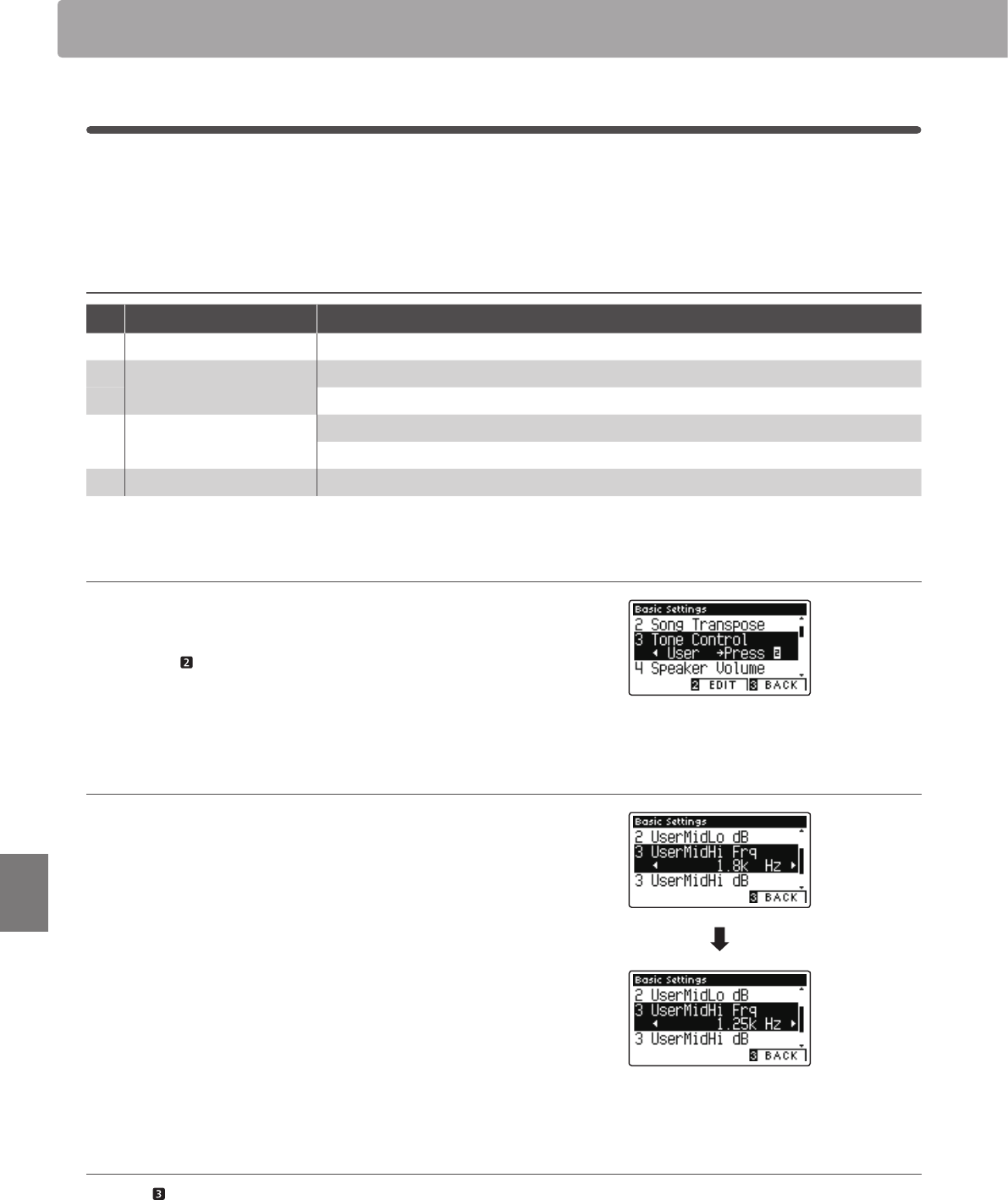
68
Settings
User Tone Control
The User Tone Control option allows ner control over the instrument’s sound character, allowing the volume of
four frequency bands to be adjusted individually. It is also possible to adjust the frequency range of the mid-low
and mid-high frequency bands.
User Tone Control setting
No. User Tone Control Description
1Low Adjusts the volume of the low range frequency band (20~100 Hz).
2Mid-low Frequency Adjusts the frequency of the mid-low band (355~3150 Hz).
Mid-low dB Adjusts the volume of the mid-low range frequency band.
3Mid-high Frequency Adjusts the frequency of the mid-high band (355~3150 Hz).
Mid-high db Adjusts the volume of the mid-high range frequency band.
4High Adjusts the volume of the high range frequency band (5000~20000 Hz).
1. Selecting the User Tone Control setting
After selecting the Tone Control setting (page 67):
Press the or buttons to select the User Tone Control type,
then press the FUNCTION button (EDIT).
The User Tone Control screen will be shown in the LCD display.
2. Selecting and adjusting the User Tone Control settings
Press the or buttons to select the User Tone Control
setting.
Press the or buttons to increase or decrease the value of
the selected User Tone Control setting.
* Each User Tone Control band can be adjusted within the range of
–6 dB~+6 dB.
* To reset the User Tone Control setting to the default type, press the
and buttons simultaneously.
* Any changes made to the User Tone Control setting will remain until
the power is turned o.
* Preferred User Tone Control settings can be stored to the Startup
Setting memory for convenient recall. Please refer to page 77 for
more information.
3. Exiting the User Tone Control setting
Press the FUNCTION button (BACK) to exit the User Tone
Control setting and return to the Tone Control setting.
Basic Settings
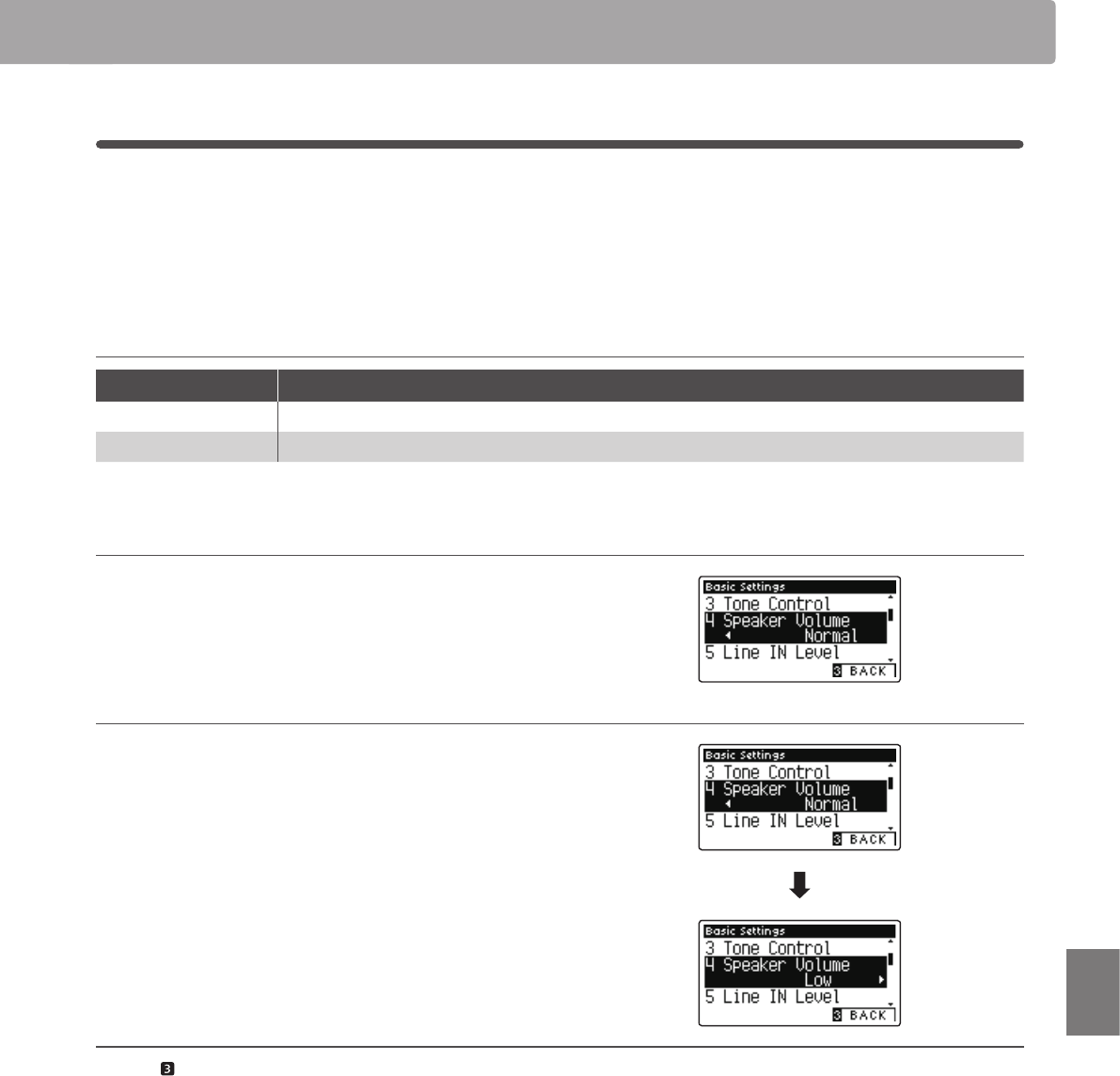
69
Settings
Basic Settings
4
Speaker Volume
The Speaker Volume setting allows the maximum volume level of the CS11/CS8 digital piano’s speaker output to
be reduced, providing ner adjustment control over the master volume. This setting can also function as a volume
limiter, preventing the instrument from being played too loudly in the home or classroom etc.
* This setting does not aect the headphones or Line Out volume.
Speaker Volume setting
Speaker Volume Description
Normal (default) The instrument’s speakers will output sound at the normal volume level.
Low The instrument’s speakers will output sound at a reduced volume level.
1. Selecting the Speaker Volume setting
After entering the Basic Settings menu (page 64):
Press the or buttons to select the Speaker Volume setting.
2. Changing the Speaker Volume type
Press the or buttons to alternate between ‘Normal’ and
‘Low’ Speaker Volume settings.
* To reset the Speaker Volume setting to the default setting, press the
and buttons simultaneously.
* Any changes made to the Speaker Volume setting will remain until the
power is turned o.
* Preferred Speaker Volume settings can be stored to the Startup
Setting memory for convenient recall. Please refer to page 77 for
more information.
3. Exiting the Speaker Volume setting
Press the FUNCTION button (BACK) to exit the Speaker Volume
setting and return to the Function Menus screen.
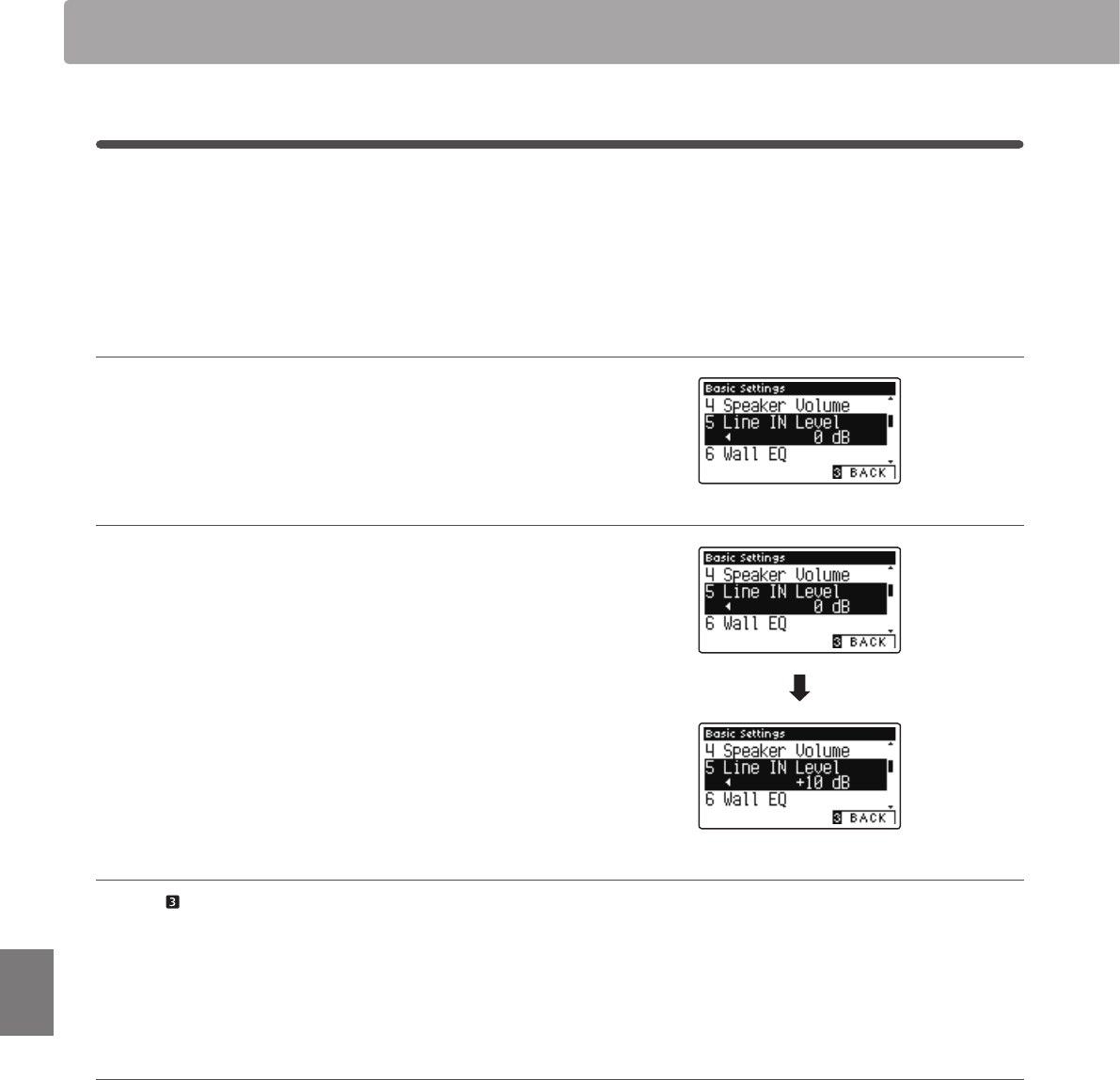
70
Settings
5
Line In Level
The Line In Level setting allows the volume level of the instrument’s Line In input jacks to be adjusted digitally. This
setting may be useful when using the USB Recorder function and attempting to balance an external audio source
with the instrument’s sound.
* The Line In Level can also be adjusted by using the LEVEL knob, located on the jack panel. Please refer to page 129 for more information.
1. Selecting the Line In Level setting
After entering the Basic Settings menu (page 64):
Press the or buttons to select the Line In Level setting.
2. Adjusting the Line In Level value
Press the or buttons to increase or decrease the value of
the Line In Level setting.
* The Line In Level can be adjusted within the range of –10 dB~+10 dB.
* To reset the Line In Level setting to the default value, press the
and buttons simultaneously.
* Any changes made to the Line In Level setting will remain until the
power is turned o.
* Preferred Line In Level settings can be stored to the Startup Setting
memory for convenient recall. Please refer to page 77 for more
information.
3. Exiting the Line In Level setting
Press the FUNCTION button (BACK) to exit the Line In Level
setting and return to the Function Menus screen.
Line In Level setting vs Line In LEVEL knob
The CS11/CS8 digital piano provides two methods of adjusting the level of the Line In audio: the Line In LEVEL knob (located beside
the Line In jacks on the jack panel), and the Line In Level setting. The LEVEL knob is used to adjust the analogue volume of the sound
entering the instrument, while the Line In Level setting adjusts the digital volume of the sound once it is ‘inside’ the instrument.
To ensure the Line In audio is of a high quality, it is recommended to set the volume of the external audio device (for example a
tablet) to a high level, then adjust the instrument’s Line In LEVEL knob to a comfortable level, without distortion. If it is necessary to
further increase or decrease the volume of the external audio, the Line In Level setting can then be used as desired.
Basic Settings
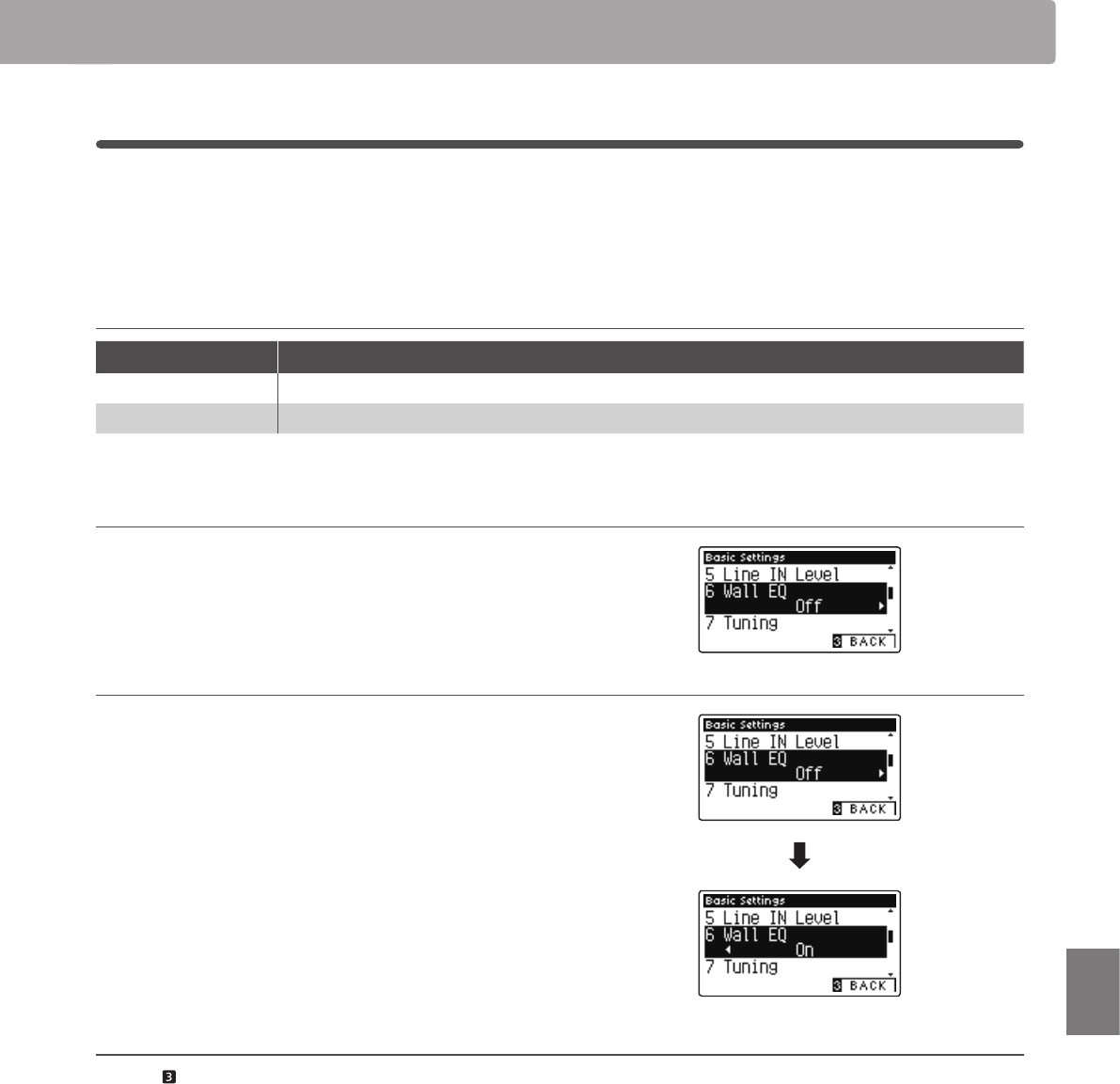
71
Settings
Basic Settings
6
Wall EQ (C S11 only)
The Wall EQ setting optimises the sound character of the soundboard speaker depending on whether the CS11
digital piano (back) is placed beside a wall, or in an area away from a wall.
* This setting does not aect the headphones or Line Out output.
Wall EQ setting
Wall EQ Description
O (default) Optimise the speaker system for placing the CS11 digital piano in an area away from a wall.
On Optimise the speaker for placing the CS11 digital piano beside a wall.
1. Selecting the Wall EQ setting
After entering the Basic Settings menu (page 64):
Press the or buttons to select the Wall EQ setting.
2. Changing the Wall EQ setting
Press the or buttons to turn the Wall EQ setting on or o.
* To reset the Wall EQ setting to the default setting, press the and
buttons simultaneously.
* Any changes made to the Wall EQ setting will remain until the power
is turned o.
* Preferred Wall EQ settings can be stored to the Startup Setting memory
for convenient recall. Please refer to page 77 for more information.
3. Exiting the Wall EQ setting
Press the FUNCTION button (BACK) to exit the Wall EQ setting
and return to the Function Menus screen.
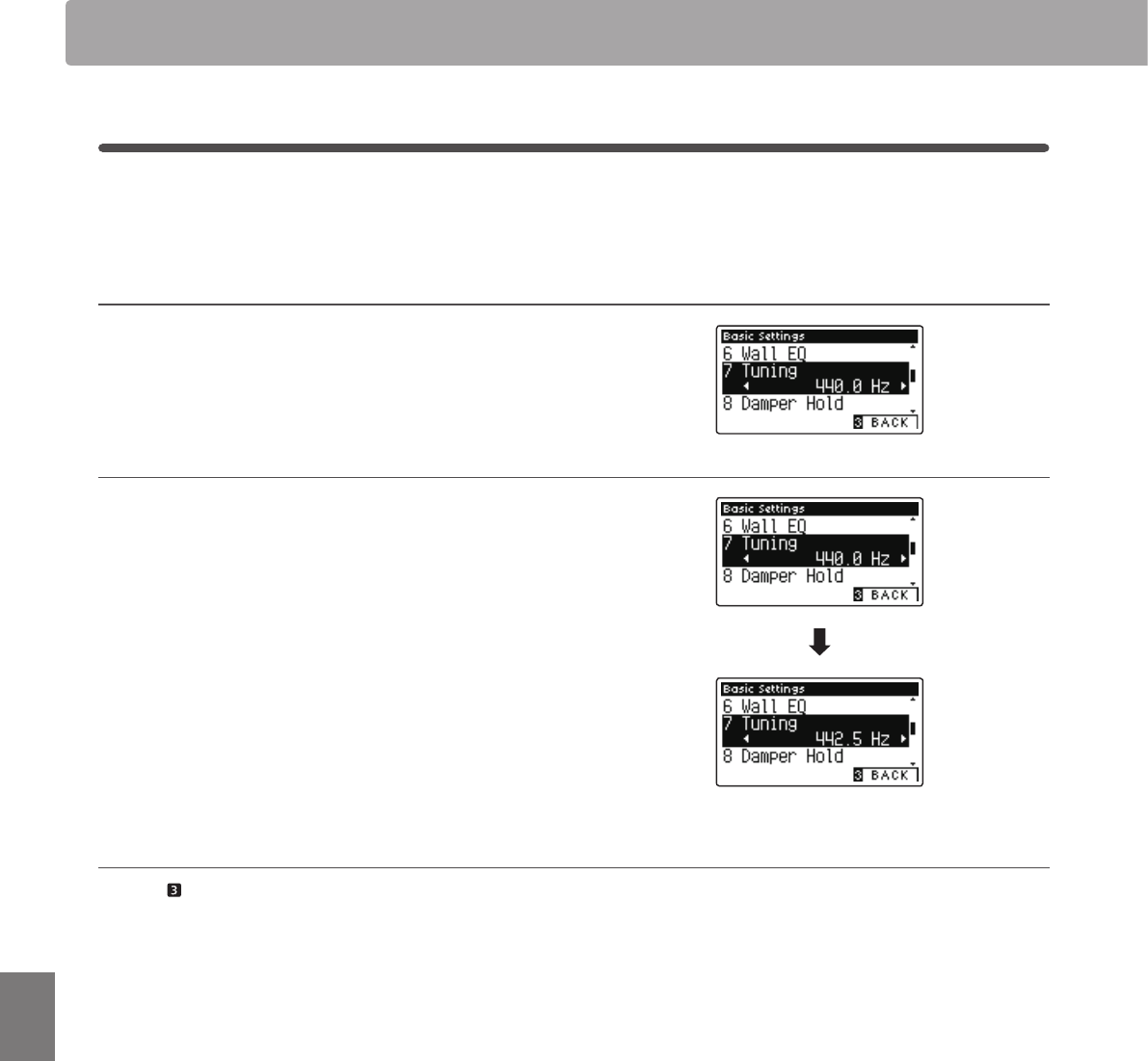
72
Settings
Basic Settings
7
Tuning
The Tuning setting allows the overall pitch of the CS11/CS8 digital piano to be raised and lowered in 0.5 Hz steps,
and may therefore prove useful when playing with other instruments.
1. Selecting the Tuning setting
After entering the Basic Settings menu (page 64):
Press the or buttons to select the Tuning setting.
2. Adjusting the Tuning value
Press the or buttons to increase or decrease the value of
the Tuning setting.
* The Tuning value can be adjusted within the range of 427.0~453.0 Hz.
* To reset the Tuning setting to the default value, press the and
buttons simultaneously.
* Any changes made to the Tuning setting will remain until the power
is turned o.
* Preferred Tuning settings can be stored to the Startup Setting
memory for convenient recall. Please refer to page 77 for more
information.
3. Exiting the Tuning setting
Press the FUNCTION button (BACK) to exit the Tuning setting
and return to the Function Menus screen.
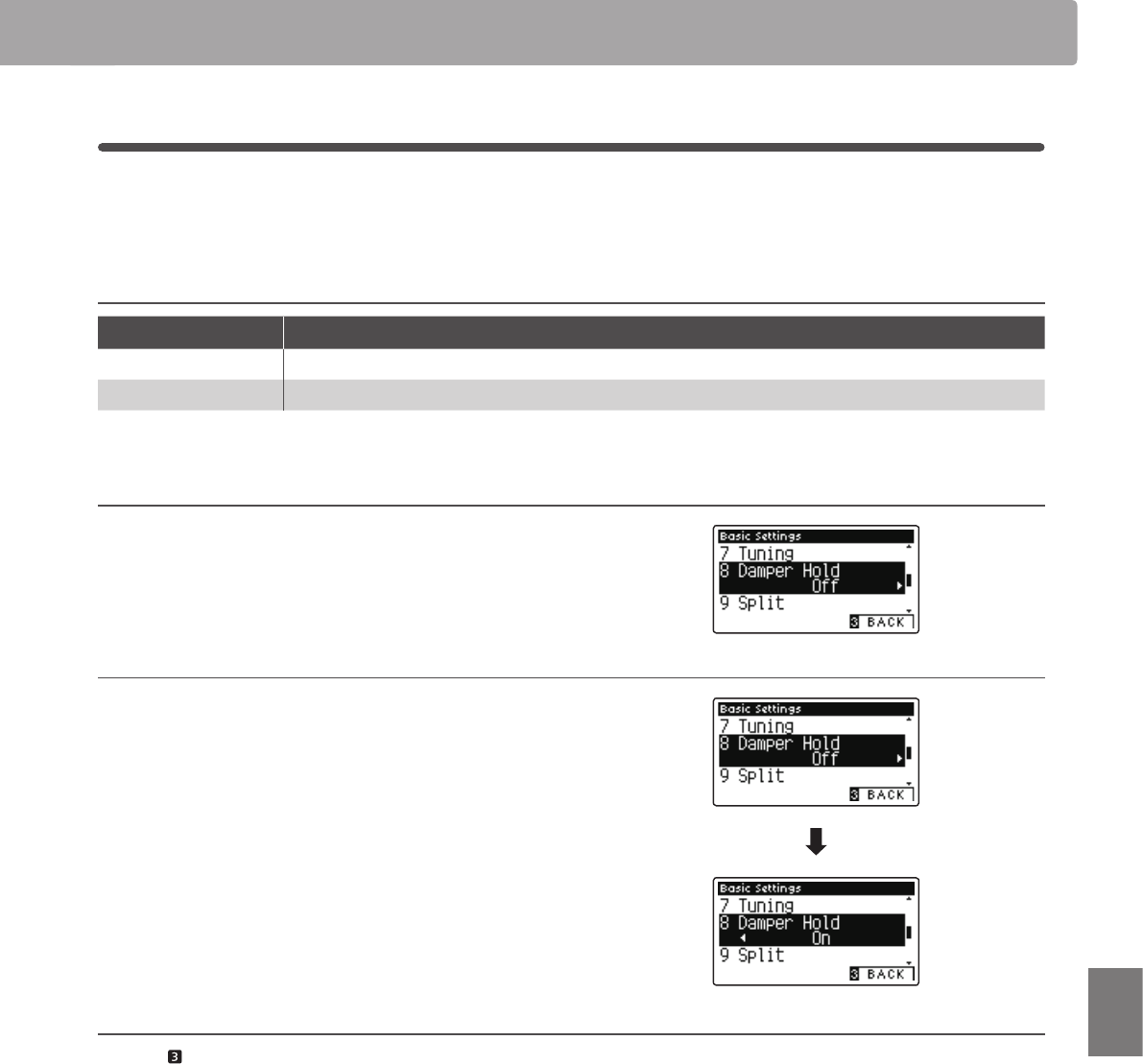
73
Settings
Basic Settings
8
Damper Hold
The Damper Hold setting is used to determine whether sounds such as organ or strings should be sustained
continuously when the sustain (damper) pedal is pressed, or whether these sounds should decay, naturally.
Damper Hold setting
Damper Hold Description
O (default) Organ, strings, etc. sounds will gradually decay, even while the sustain pedal is pressed.
On Organ, strings, etc. sounds will be sustained continuously while the sustain pedal is pressed.
1. Selecting the Damper Hold setting
After entering the Basic Settings menu (page 64):
Press the or buttons to select the Damper Hold setting.
2. Changing the Damper Hold setting
Press the or buttons to turn the Damper Hold setting on
or o.
* To reset the Damper Hold setting to the default setting, press the
and buttons simultaneously.
* Any changes made to the Damper Hold setting will remain until the
power is turned o.
* Preferred Damper Hold settings can be stored to the Startup Setting
memory for convenient recall. Please refer to page 77 for more
information.
3. Exiting the Damper Hold setting
Press the FUNCTION button (BACK) to exit the Damper Hold
setting and return to the Function Menus screen.
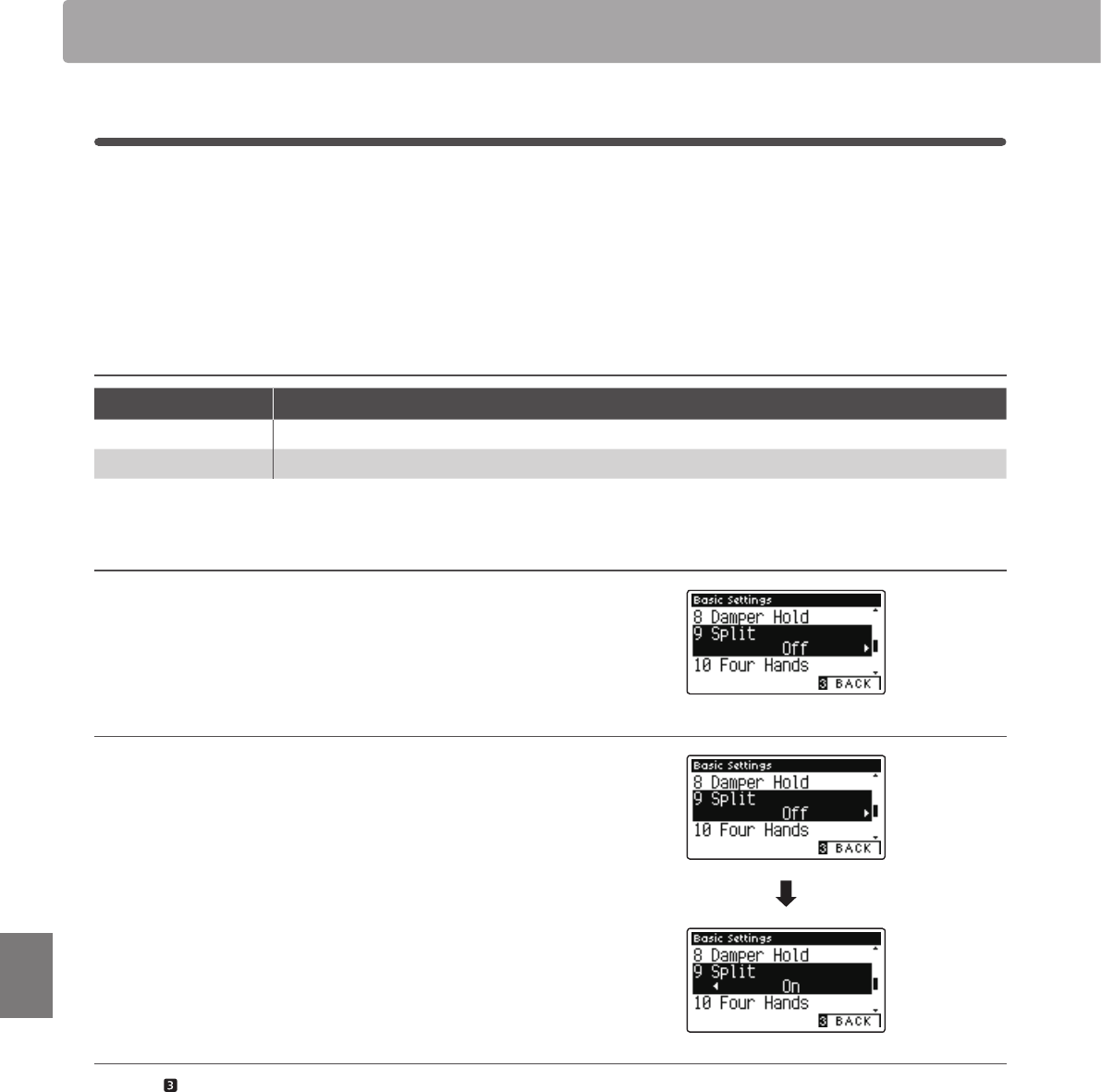
74
Settings
Basic Settings
9
Split
The Split setting provides an alternative method to enabling the Split Mode function, and may prove useful in
teaching environments or situations where the function should be enabled automatically every time the CS11/CS8
digital piano is turned on.
When enabled, all Split Mode control operations are identical to those explained on page 20.
Split setting
Split Description
O (default) Split Mode will be turned o by default.
On Split Mode will be turned on by default.
1. Selecting the Split setting
After entering the Basic Settings menu (page 64):
Press the or buttons to select the Split setting.
2. Changing the Split setting
Press the or buttons to turn the Split setting on or o.
* To reset the Split setting to the default setting, press the and
buttons simultaneously.
* Any changes made to the Split setting will remain until the power is
turned o.
* Preferred Split settings can be stored to the Startup Setting memory
for convenient recall. Please refer to page 77 for more information.
3. Exiting the Split setting
Press the FUNCTION button (BACK) to exit the Split setting
and return to the Function Menus screen.
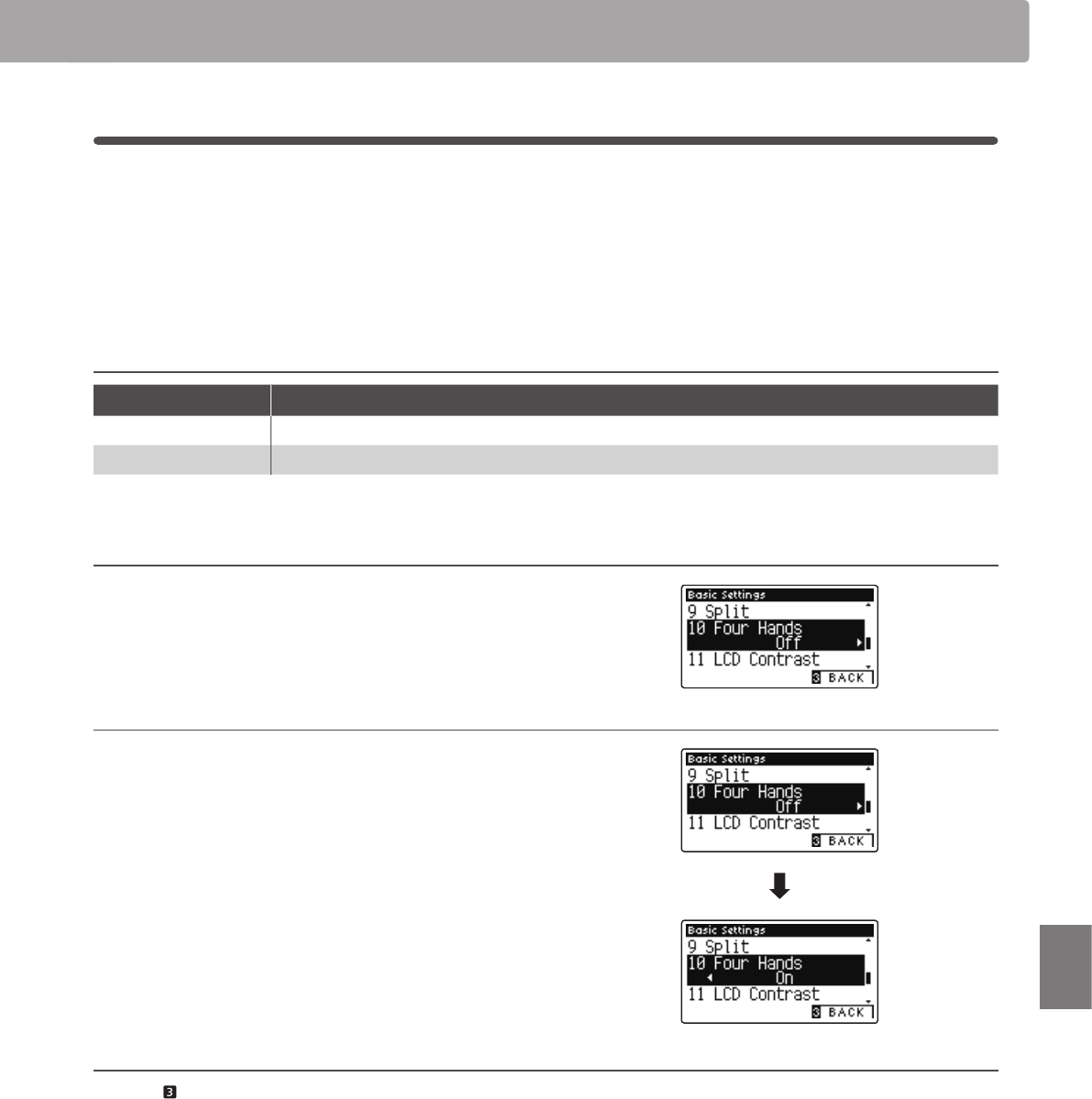
75
Settings
Basic Settings
10
Four Hands
The Four Hands setting provides an alternative method to enabling the Four Hands Mode function, and may prove
useful in teaching environments or situations where the function should be enabled automatically every time the
CS11/CS8 digital piano is turned on.
When enabled, all Four Hands Mode control operations are identical to those explained on page 22.
Four Hands setting
Four Hands Description
O (default) Four Hands Mode will be turned o by default.
On Four Hands Mode will be turned on by default.
1. Selecting the Four Hands setting
After entering the Basic Settings menu (page 64):
Press the or buttons to select the Four Hands setting.
2. Changing the Four Hands setting
Press the or buttons to turn the Four Hands setting on or
o.
* To reset the Four Hands setting to the default setting, press the
and buttons simultaneously.
* Any changes made to the Four Hands setting will remain until the
power is turned o.
* Preferred Four Hands settings can be stored to the Startup Setting
memory for convenient recall. Please refer to page 77 for more
information.
3. Exiting the Four Hands setting
Press the FUNCTION button (BACK) to exit the Four Hands
setting and return to the Function Menus screen.
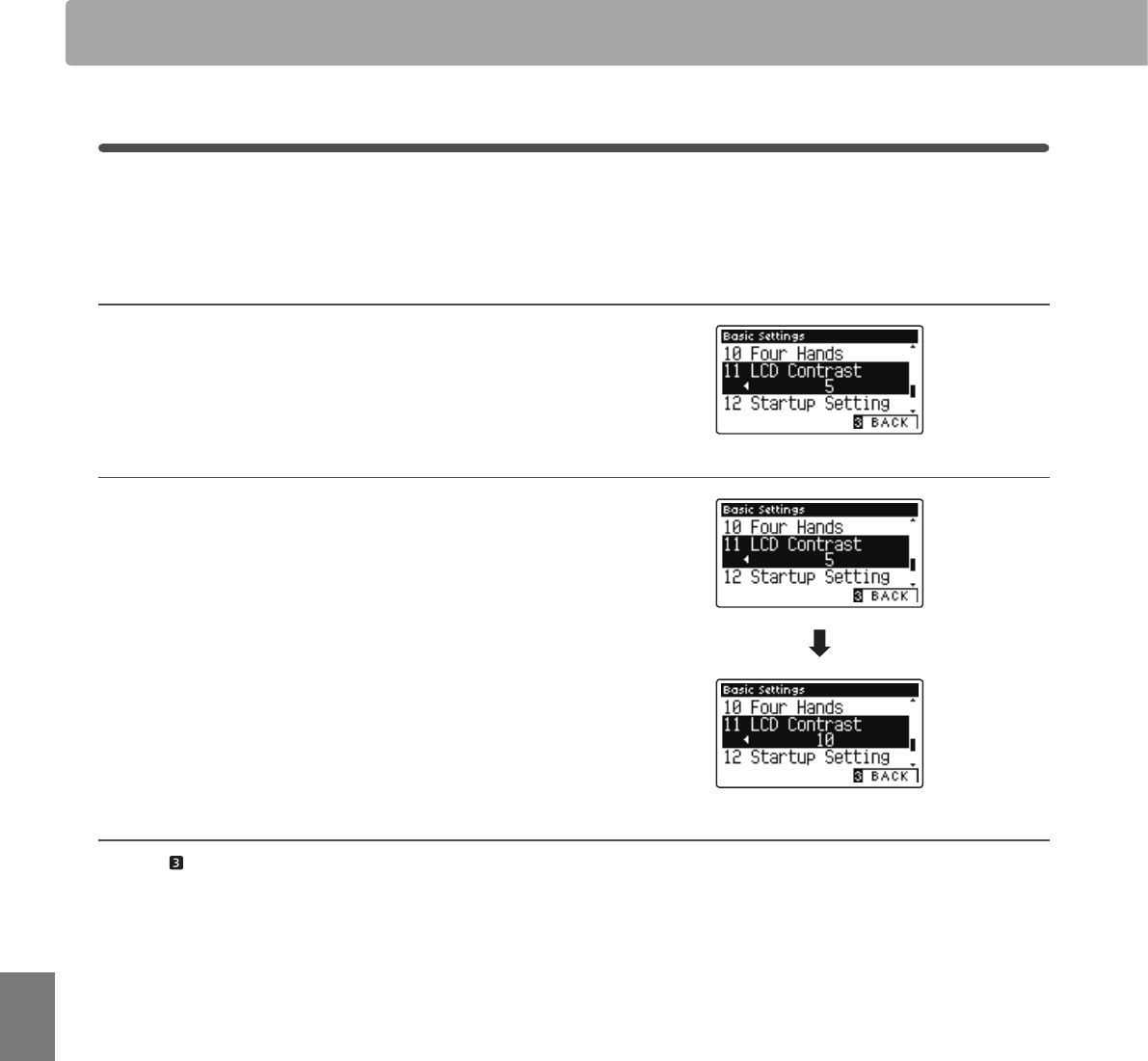
76
Settings
11
LCD Contrast
The LCD Contrast setting is used to adjust the contrast of the LCD display. The contrast of the display becomes
sharper as the value increases.
1. Selecting the LCD Contrast setting
After entering the Basic Settings menu (page 64):
Press the or buttons to select the LCD Contrast setting.
2. Adjusting the LCD Contrast value
Press the or buttons to increase or decrease the value of
the LCD Contrast setting.
* The LCD Contrast value can be adjusted within the range of 0~10.
* To reset the LCD Contrast setting to the default value, press the
and buttons simultaneously.
* Any changes made to the LCD Contrast setting will remain until the
power is turned o.
* Preferred LCD Contrast settings can be stored to the Startup Setting
memory for convenient recall. Please refer to page 77 for more
information.
3. Exiting the LCD Contrast setting
Press the FUNCTION button (BACK) to exit the LCD Contrast
setting and return to the Function Menus screen.
Basic Settings
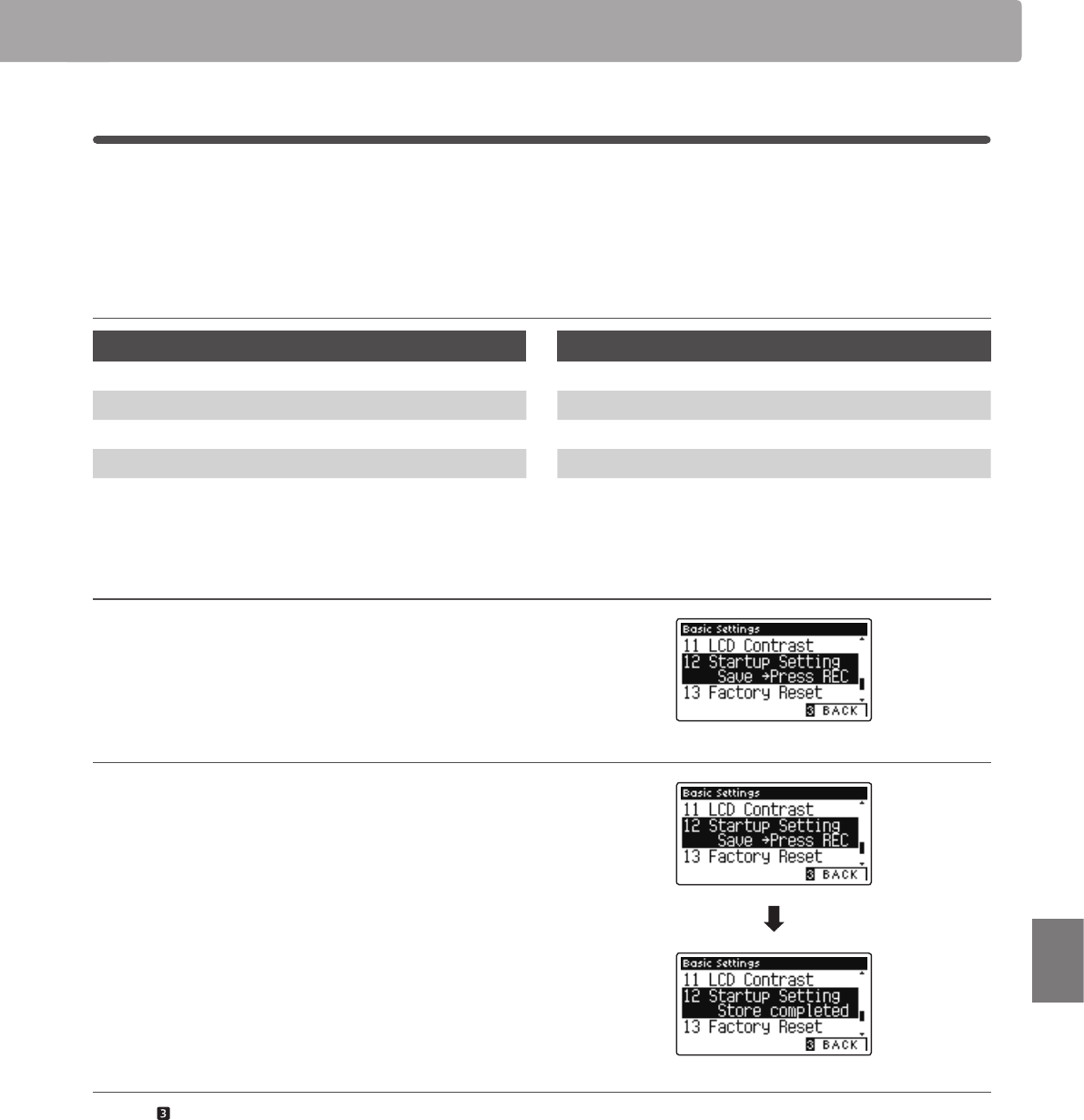
77
Settings
Basic Settings
12
Startup Setting
The Startup Setting function allows preferred panel functions/settings to be stored in the instrument’s memory,
and automatically recalled as the default settings every time the CS11/CS8 digital piano is turned on.
* Startup Settings can also be saved to and loaded from USB memory devices. Please refer to pages 120/115 for more information.
Functions/Settings stored in the Startup Setting memory
Functions
Selected sound (including primary sound for each category)
Dual Mode / Split Mode / Four Hands Mode (including settings)
Reverb, Eects (Type, Settings)
Metronome (Beat, Tempo, Volume)
Settings
Basic Settings
Virtual Technician Settings
MIDI Settings
Headphone Settings
* Changes made to the Auto Power O setting will be stored to the Startup Setting memory automatically.
1. Selecting the Startup Setting function
After entering the Basic Settings menu (page 64):
Press the or buttons to select the Startup Setting function.
2. Storing current settings to the Startup Setting memory
Press the REC button.
A conrmation message will be shown in the LCD display, and
the current panel settings will be stored to the Startup Setting
memory.
* The Factory Reset function can be used to restore all settings to their
default values. Please refer to page 78 for more information.
3. Exiting the User Memory function
Press the FUNCTION button (BACK) to exit the Startup Setting
function and return to the Function Menus screen.
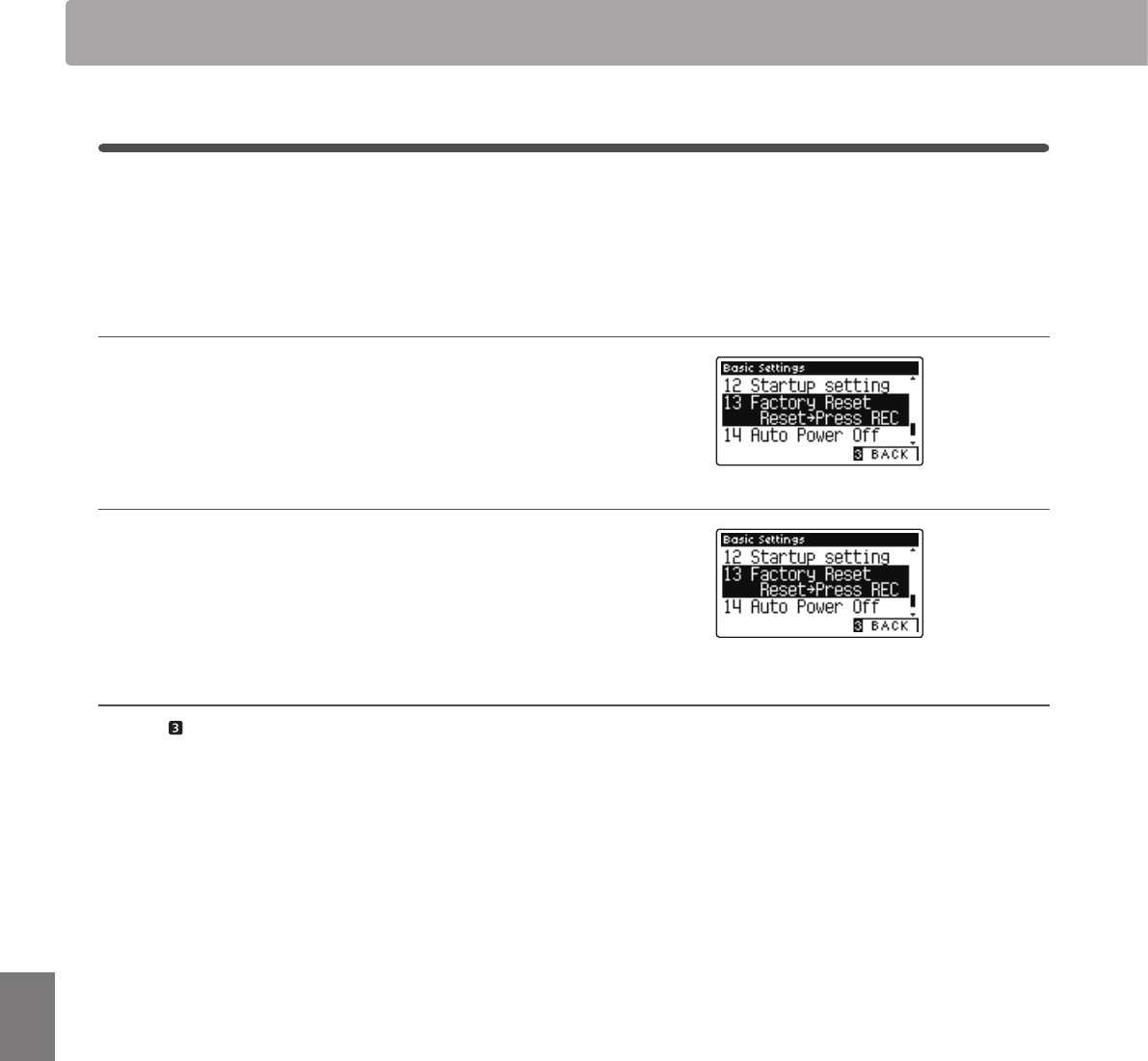
78
Settings
13
Factory Reset
The Factory Reset function clears any settings stored using the User Memory function, restoring the CS11/CS8
digital piano to its factory default settings.
* This function will not clear registration memories or recorder songs stored in internal memory.
1. Selecting the Factory Reset function
After entering the Basic Settings menu (page 64):
Press the or buttons to select the Factory Reset setting.
2. Restoring factory settings
Press the REC button.
A conrmation message will be shown in the LCD display, and
the all settings will be restored to their default values.
3. Exiting the Factory Reset function
Press the FUNCTION button (BACK) to exit the Factory Reset
function and return to the Function Menus screen.
Basic Settings
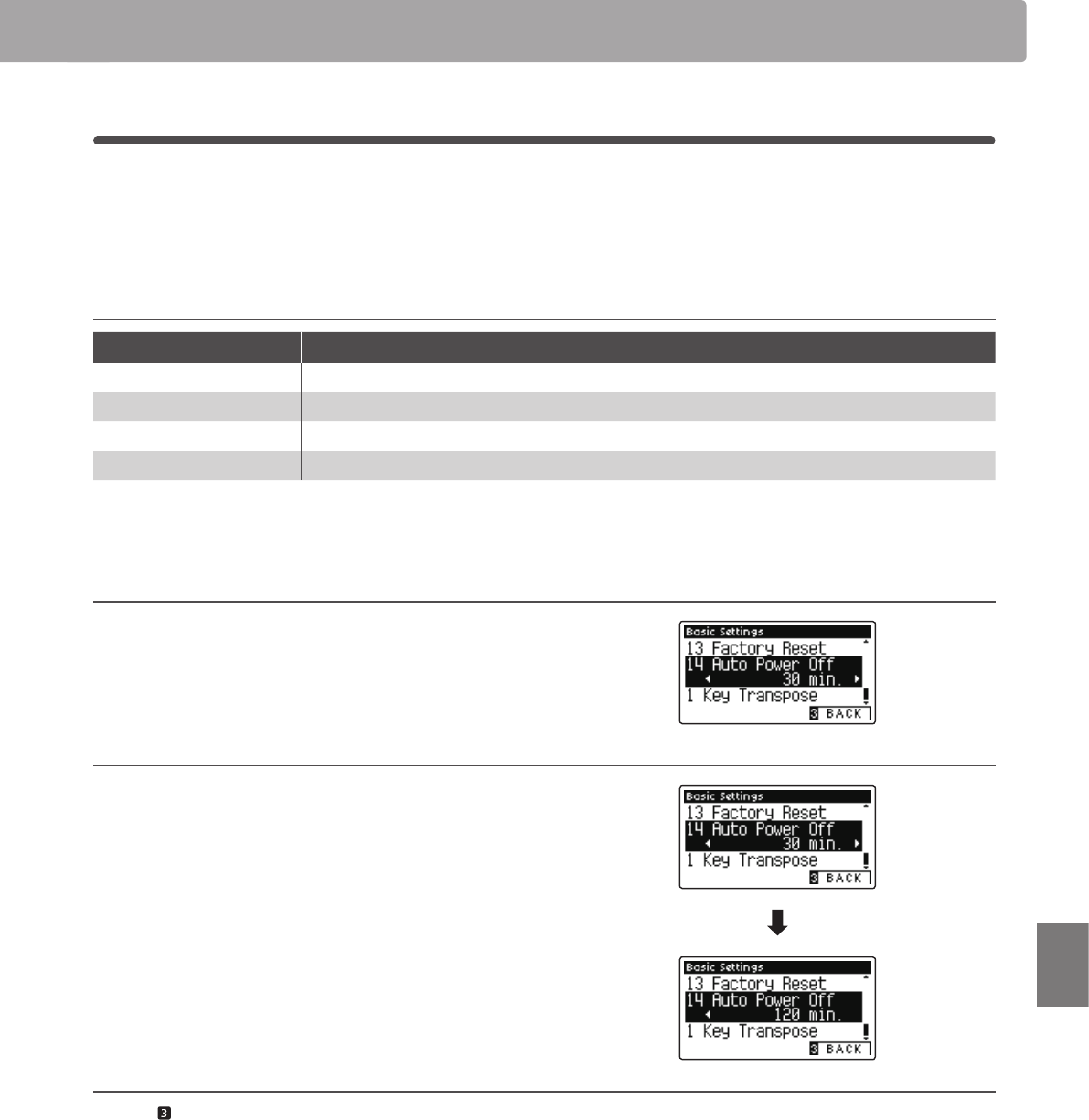
79
Settings
Basic Settings
14
Auto Power O
The Auto Power O setting can be used to automatically turn o the instrument after a specied period of inactivity.
This function may be enabled by default, depending on the market location.
* This setting will be stored automatically, and recalled every time the instrument is turned on.
Auto Power O settings
Auto Power O Description
O The Auto Power O function is disabled.
30 min. The instrument will turn o automatically after 30 minutes of inactivity.
60 min. The instrument will turn o automatically after 60 minutes of inactivity.
120 min. The instrument will turn o automatically after 120 minutes of inactivity.
* The default Auto Power O setting varies depending on market area.
1. Selecting the Auto Power O setting
After entering the Basic Settings menu (page 64):
Press the or buttons to select the Auto Power O setting.
2. Changing the Auto Power O setting
Press the or buttons to change the Auto Power O setting.
* The Auto Power O setting will be stored automatically, and recalled
every time the instrument is turned on.
3. Exiting the Auto Power O setting
Press the FUNCTION button (BACK) to exit the Auto Power O
setting and return to the Function Menus screen.
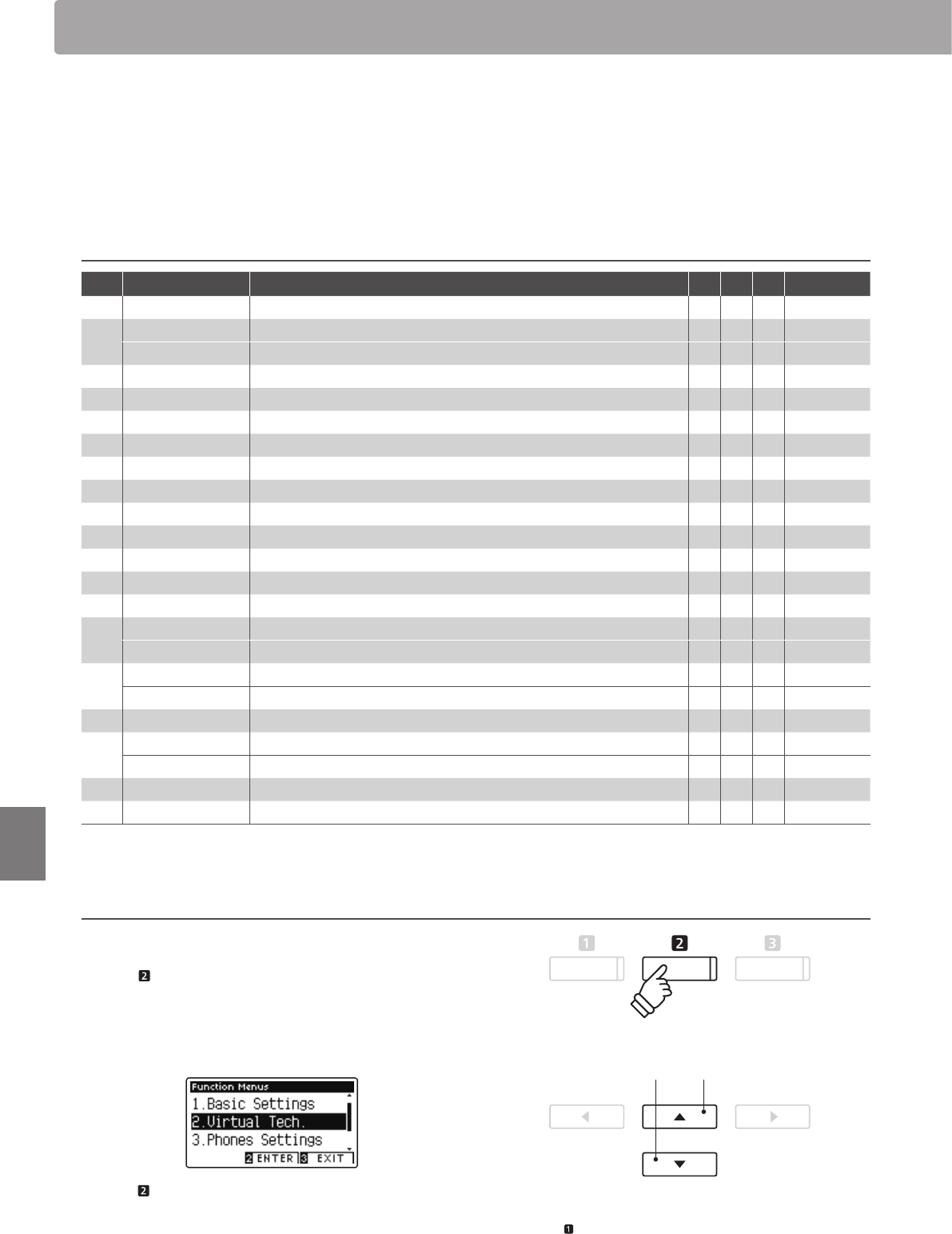
80
Settings
Virtual Technician Settings
The Virtual Technician settings of the CS11/CS8 digital piano allow the player to adjust advanced parameters such
as hammer hardness, action regulation, cabinet size, and a variety of other acoustic characteristics, in order to
suit their personal preferences. Virtual Technician settings are adjusted and stored independently for each sound,
variation, allowing exible control over the characteristics of each piano voice.
* The table below indicates which Virtual Technician settings aect to all sounds, or acoustic piano and electric piano sounds only.
Virtual Technician Settings
No. Setting Description All AP EP Default
1Touch Curve Adjust the touch sensitivity of the keyboard. Normal
2Voicing Adjust the tonal character of the instrument. Normal
User Voicing Adjust the individual voicing of each of the 88 keys. –
3Damper Resonance Adjust the resonance that is heard when pressing the damper pedal. 5
4Damper Noise Adjust the sound that is heard when pressing the damper pedal. 5
5String Resonance Adjust the resonance that is heard when notes are held. 5
6Undamped Str. Res. Adjust the resonance produced by the topmost undamped strings. 5
7Cabinet Resonance Adjust the resonance produced by the piano cabinet itself. 1
8Key-o Eect Adjust the sound that is heard when keys are released. 5
9Fall-back Noise Adjust the sound that is heard when the key action falls back. 5
10 Hammer Delay Adjust the delay of the hammer striking strings when playing pianissimo. O
11 Topboard Simulation Adjust the position of the grand piano topboard. Open 3
12 Decay Time Adjust the decay time of the piano sound while the keys are pressed. 5
13 Minimum Touch Adjust the minimum key velocity required to produce a sound. 1
14 Stretch Tuning Adjust the level of stretch tuning for equal temperaments. Normal
User Tuning Adjust the individual tuning of each of the 88 keys. –
15 Temperament Adjust the tuning system to suit Renaissance and Baroque periods etc. Equal Temp.
User Temperament Adjust the tuning of each note in the scale to a custom temperament. –
16 Temperament Key Adjust the key of the selected tuning system. C
17 Key Volume Adjust the volume balance of the keyboard. Normal
User Key Volume Adjust the individual volume of each of the 88 keys. –
18 Half-Pedal Adjust Adjust the point at which the damper pedal begins to sustain the sounds. 5
19 Soft Pedal Depth Adjust the depth/eectiveness of the soft pedal. 3
* Default settings will be shown in the rst LCD display illustration (i.e. Step 1) for each setting explanation below.
Entering the Virtual Technician menu
While the normal playing mode screen is shown in the LCD display:
Press the FUNCTION button (EDIT).
The Function menus will be shown in the LCD display.
Press the or buttons to select the Virtual Technician menu.
Press the FUNCTION button (ENTER) again to enter the Virtual
Technician menu.
buttons:
Move selection cursor.
* It is also possible to enter the Virtual Technician menu by pressing and
holding the FUNCTION button (VT) on the normal playing screen.
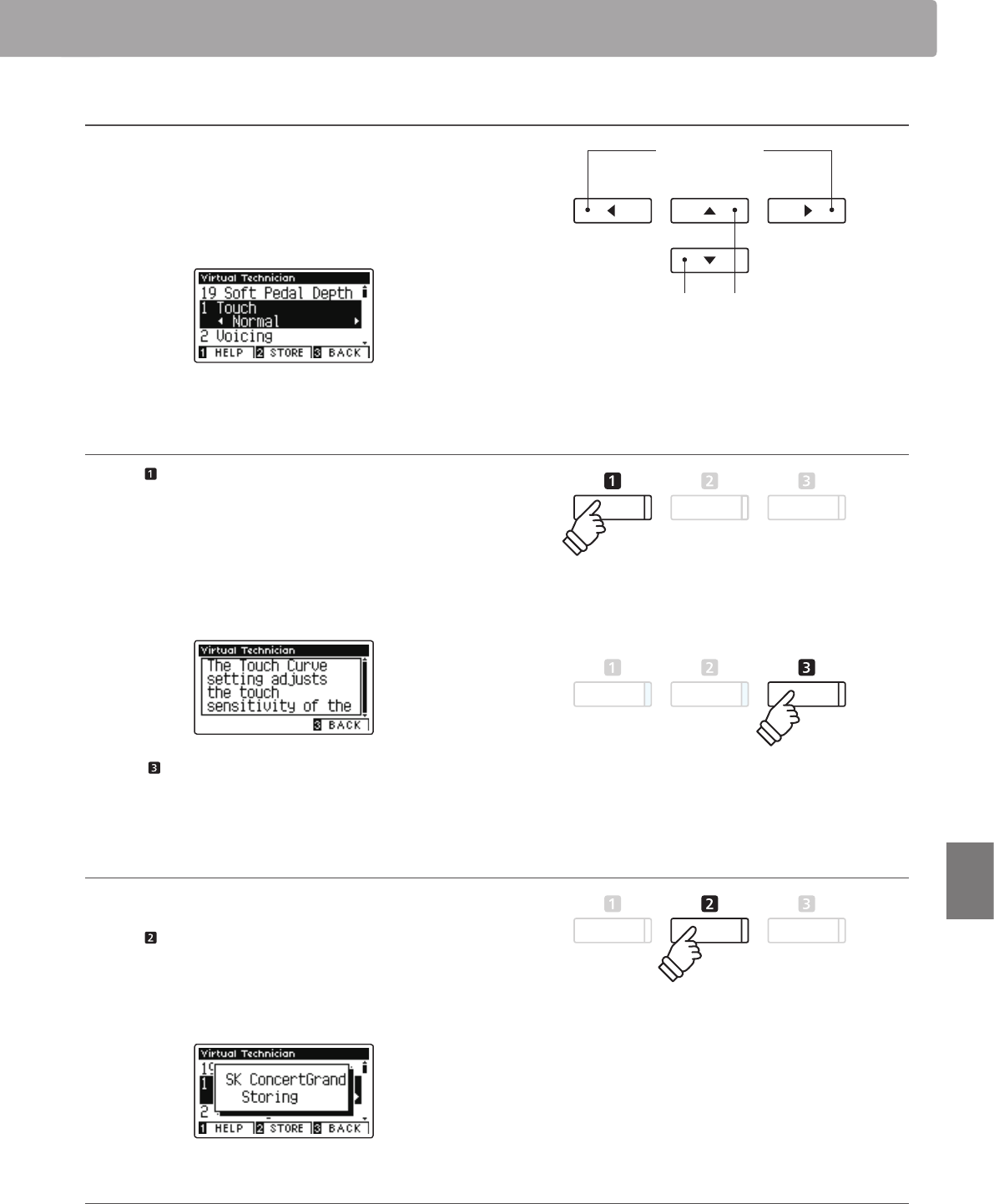
81
Settings
Virtual Technician Settings
Selecting and adjusting the desired setting
After entering the Virtual Technician menu:
Press the or buttons to move the selection cursor over the
desired setting.
Press the or buttons to adjust the selected setting.
Showing the Virtual Technician Help screen
Press the FUNCTION button (HELP).
A brief explanation about the currently selected Virtual
Technician parameter will be shown in the LCD display.
Press the or buttons to scroll through the explanation if
necessary.
Press the FUNCTION button (BACK) to return to the Virtual
Technician menu.
Storing the Virtual Technician setting to the selected sound
After adjusting a Virtual Technician parameter:
Press the FUNCTION button (STORE).
The adjusted Virtual Technician parameter setting will be used
as the default setting for the currently selected sound, and a
conrmation message will briey be shown in the LCD display.
About Stored Virtual Technician settings
As mentioned above, the Virtual Technician settings are adjusted and stored independently for each sound. This allows dierent
Virtual Technician adjustments to be made for each piano voice. For example, it may be desirable to voice the SK Concert Grand
piano a little brighter than the EX Concert Grand piano, or increase the Damper, String, and Cabinet Resonances of the SK-5 Grand
while leaving the Pop Piano unchanged.
* Virtual Technician settings are adjusted and stored independently for
each sound variation.
* Only values for the currently selected Virtual Technician setting will
be stored. In order to store all of the Virtual Technician settings
simultaneously, it is recommended to use a Registration memory
(page 32) or the Startup Setting memory (page 77).
buttons:
Move selection cursor.
buttons:
Adjust selected setting.
* To reset the current Virtual Technician setting to the default value,
press the and buttons simultaneously.
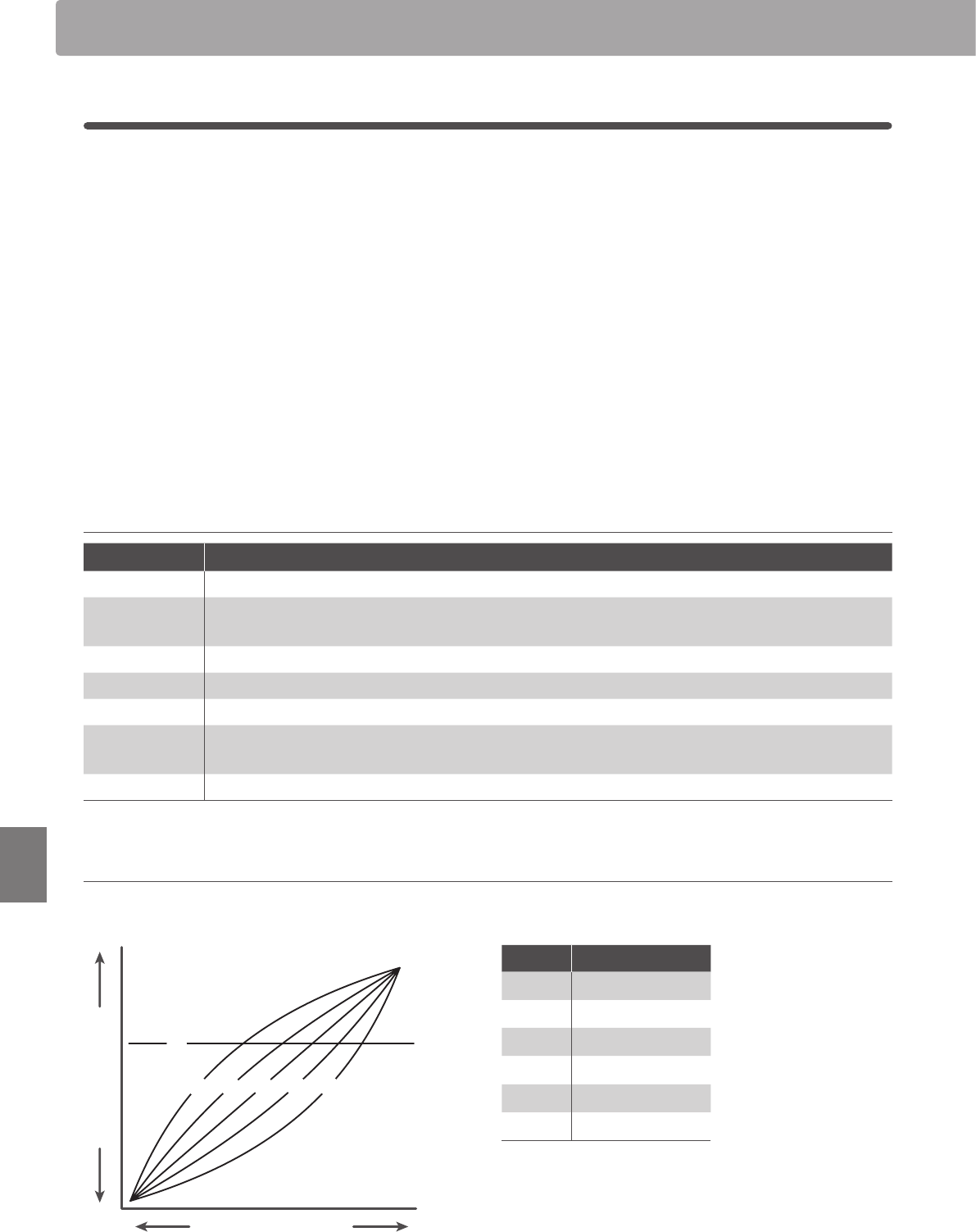
82
Settings
1
Touch Curve
As with an acoustic piano, the CS11/CS8 digital piano produces a louder sound when the keys are struck with force,
and a softer sound when the keys are played gently. The volume and tonal character change in relation to the
strength and velocity of playing – on a digital piano this system is referred to as ‘touch sensitivity’.
The Touch Curve setting allows the touch sensitivity of the keyboard to be conveniently adjusted. There are six
dierent preset touch curve settings available, with an additional ‘User’ setting allowing performers to customise
the instrument’s keyboard responsiveness to suit their individual playing style.
The default ‘Normal’ setting is designed to accurately recreate the touch of a Kawai concert grand piano. However,
if the keyboard feels too light, or fortissimo playing is achieved too easily, it may be desirable to select a heavier
touch curve. Alternatively, if the keyboard feels too heavy, or fortissimo playing is too dicult to achieve, it may be
desirable to select a lighter touch curve.
* This Virtual Technician setting will aect all sounds.
Touch Curve types
Touch Curve Description
Light + Requires less striking force to achieve a forte note. For players with a very delicate touch.
Light A louder volume is produced even when playing with a soft touch. For those still developing nger strength.
* This touch curve is recommended for children and organ players.
Normal (default) Reproduces the standard touch sensitivity of an acoustic piano.
Heavy Requires a heavier touch to produce a loud volume. Ideally suited to those with stronger ngers.
Heavy + Requires considerably more striking force to achieve a loud volume.
O (constant) A constant volume is produced regardless of how hard the keys are struck.
* This touch curve intended for playing sounds of instruments that have a xed dynamic range (e.g. organ and harpsichord).
User A custom touch curve, created to suit an individual’s personal playing style.
Touch Curve graph
The illustration below provides a visual representation of the dierent Touch Curve settings.
LoudSoft
Gentle Strong
Keyboard Pressure
b d e
f
ca
Sound Volume
No. Touch Curve
aLight +
bLight
cNormal (default)
dHeavy
eHeavy +
fO (constant)
Virtual Technician Settings
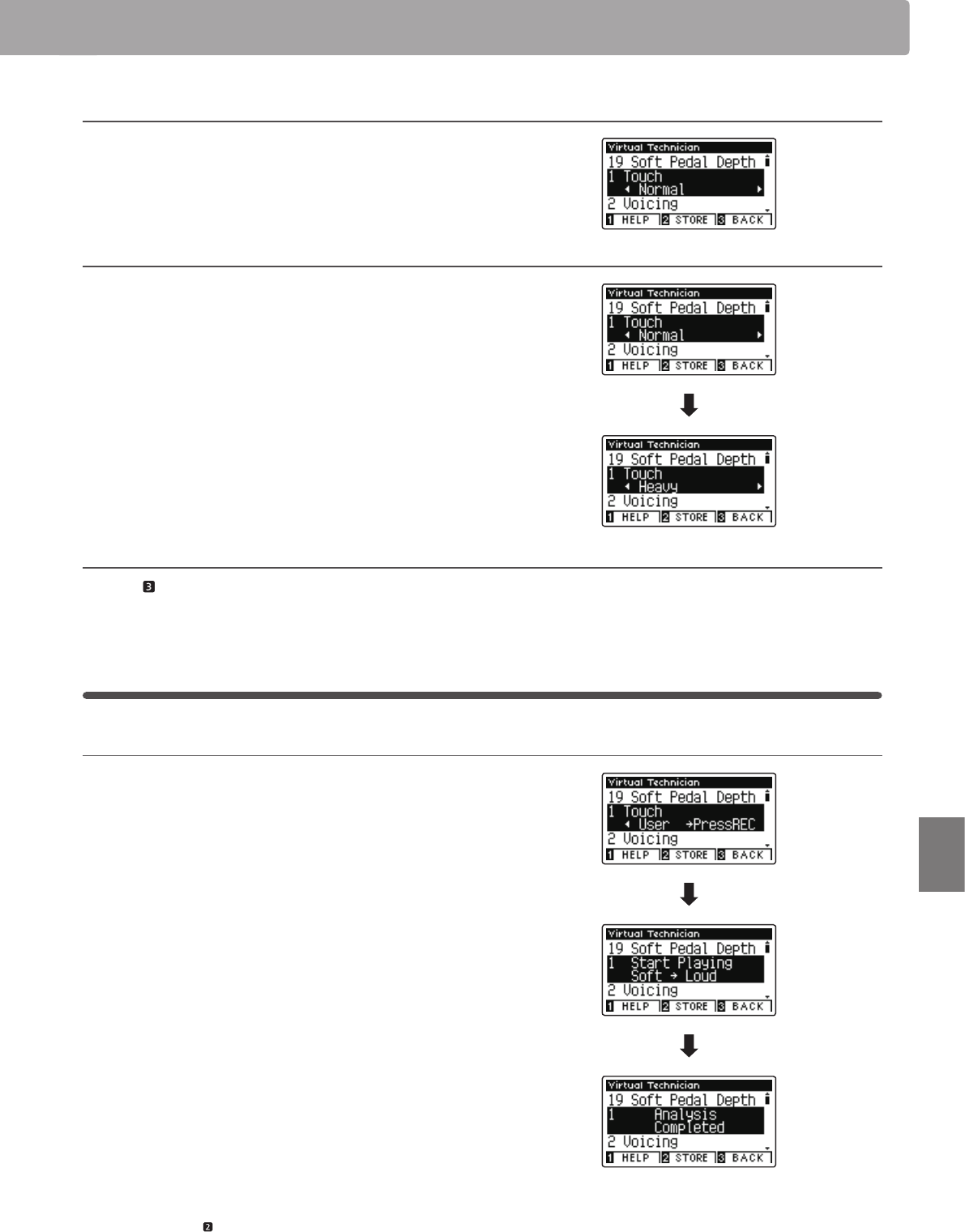
83
Settings
Virtual Technician Settings
1. Selecting the Touch Curve setting
After entering the Virtual Technician menu (page 80):
Press the or buttons to select the Touch Curve setting.
2. Changing the Touch Curve type
Press the or buttons to cycle through the dierent Touch
Curve types.
* To reset the Touch Curve setting to the default type, press the and
buttons simultaneously.
* Any changes made to the Touch Curve type or User Touch setting will
remain until the power is turned o.
* Preferred Touch Curve settings can be stored to the sound’s memory,
or a Registration memory for convenient recall. Please refer to pages
81 and 32 for more information.
3. Exiting the Touch Curve setting
Press the FUNCTION button (BACK) to exit the Touch Curve
setting and return to the Function Menus screen.
User Touch Curve
Creating a User Touch Curve
After selecting the Touch Curve setting:
Press the or buttons to select the User touch curve, then
press the REC button.
* User touch curves are created and stored independently for each
sound variation.
A message will be shown, prompting for the keyboard to be
played.
Play the piano dynamically from very soft to very loud, allowing
the instrument to examine the personal playing technique.
* More than one attempt may be required in order to create an accurate
User Touch Curve.
* Reducing the master volume fader to the lowest position before
creating the User Touch Curve may help to reduce user distractions,
thus improving accuracy.
Press the PLAY/STOP button.
The new User Touch Curve will be stored to the User touch type,
and selected automatically.
* If desired, press the FUNCTION button (STORE) to ensure the User
touch type is retained after the instrument’s power is turned o.
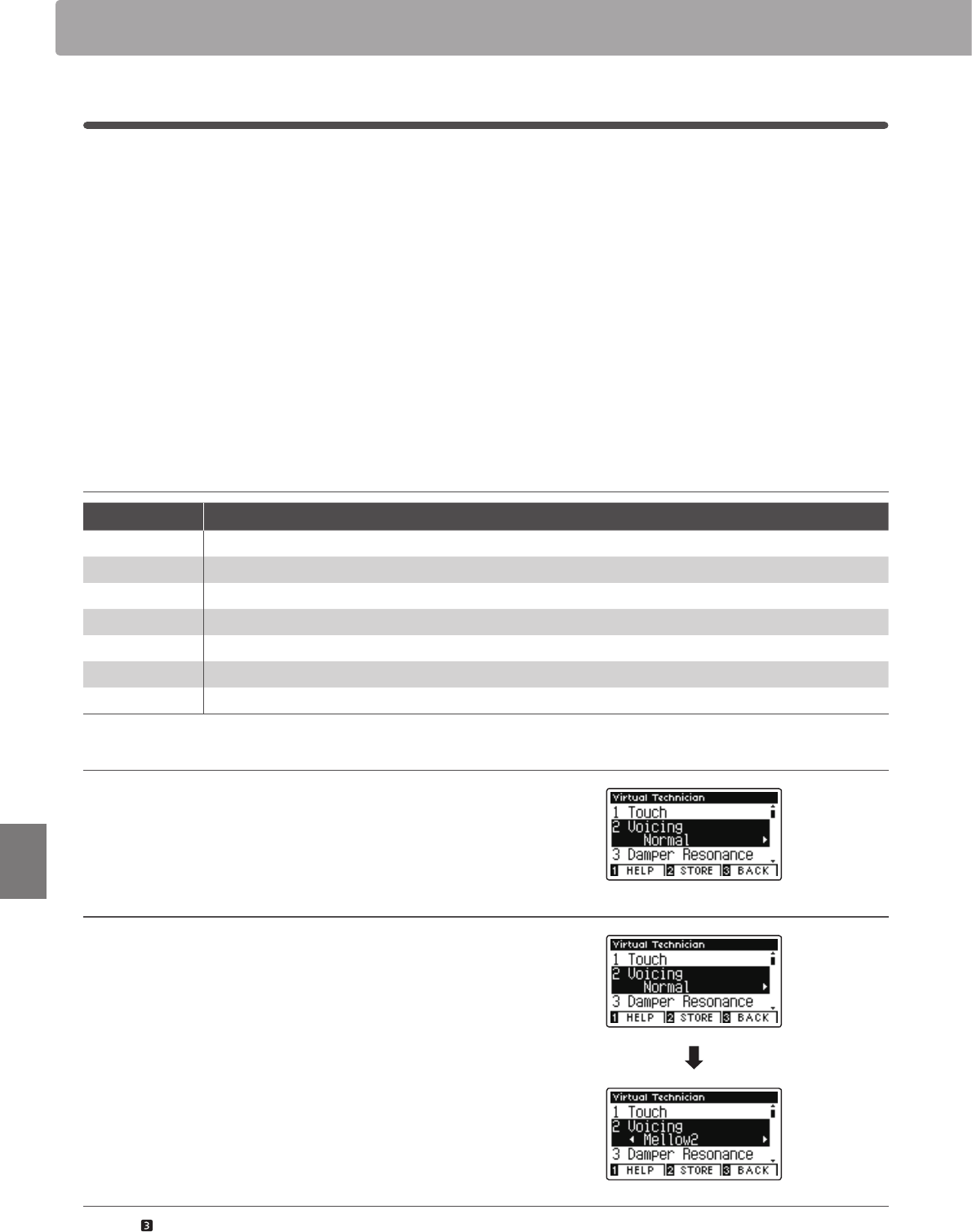
84
Settings
2
Voicing
On an acoustic piano, the shape, density, and texture of the hammers all inuence on the tonal character of the
instrument’s sound. Technicians utilise a variety of tools such as needles, les, and brushes to manipulate these
hammer felts, with the ultimate goal of achieving a balanced tonal character across the keyboard.
The Voicing setting recreates various hammer properties, allowing the overall tonal character of the CS11/CS8
digital piano to be adjusted. There are six dierent preset voicing settings available (applied uniformly to all keys),
with an additional ‘User’ setting allowing players to perform custom adjustments on each individual key.
While the default ‘Normal’ voicing setting should be appropriate for a broad range of musical genres, it may be
desirable to select a softer, more mellow tonal character for romantic pieces, or a brighter, more aggressive tone
for modern styles.
* This Virtual Technician setting will aect all sounds.
Voicing types
Voicing type Description
Normal (default) The normal tonal character of an acoustic piano throughout the entire dynamic range.
Mellow 1 A softer, more mellow tonal character throughout the entire dynamic range.
Mellow 2 An even soften tonal character than Mellow 1.
Dynamic A tonal character that changes dramatically from mellow to bright, depending on the strength of key strike.
Bright 1 A bright tonal character throughout the entire dynamic range.
Bright 2 An even brighter tonal character than Bright 1.
User A custom tonal character, allowing each key to be individually voiced.
1. Selecting the Voicing setting
After entering the Virtual Technician menu (page 80):
Press the or buttons to select the Voicing setting.
2. Changing the Voicing type
Press the or buttons to cycle through the dierent Voicing
types.
* To reset the Voicing setting to the default type, press the and
buttons simultaneously.
* Any changes made to the Voicing setting will remain until the power
is turned o.
* Preferred Voicing settings can be stored to the sound’s memory, or a
Registration memory for convenient recall. Please refer to pages 81
and 33 for more information.
3. Exiting the Voicing setting
Press the FUNCTION button (BACK) to exit the Voicing setting
and return to the Function Menus screen.
Virtual Technician Settings
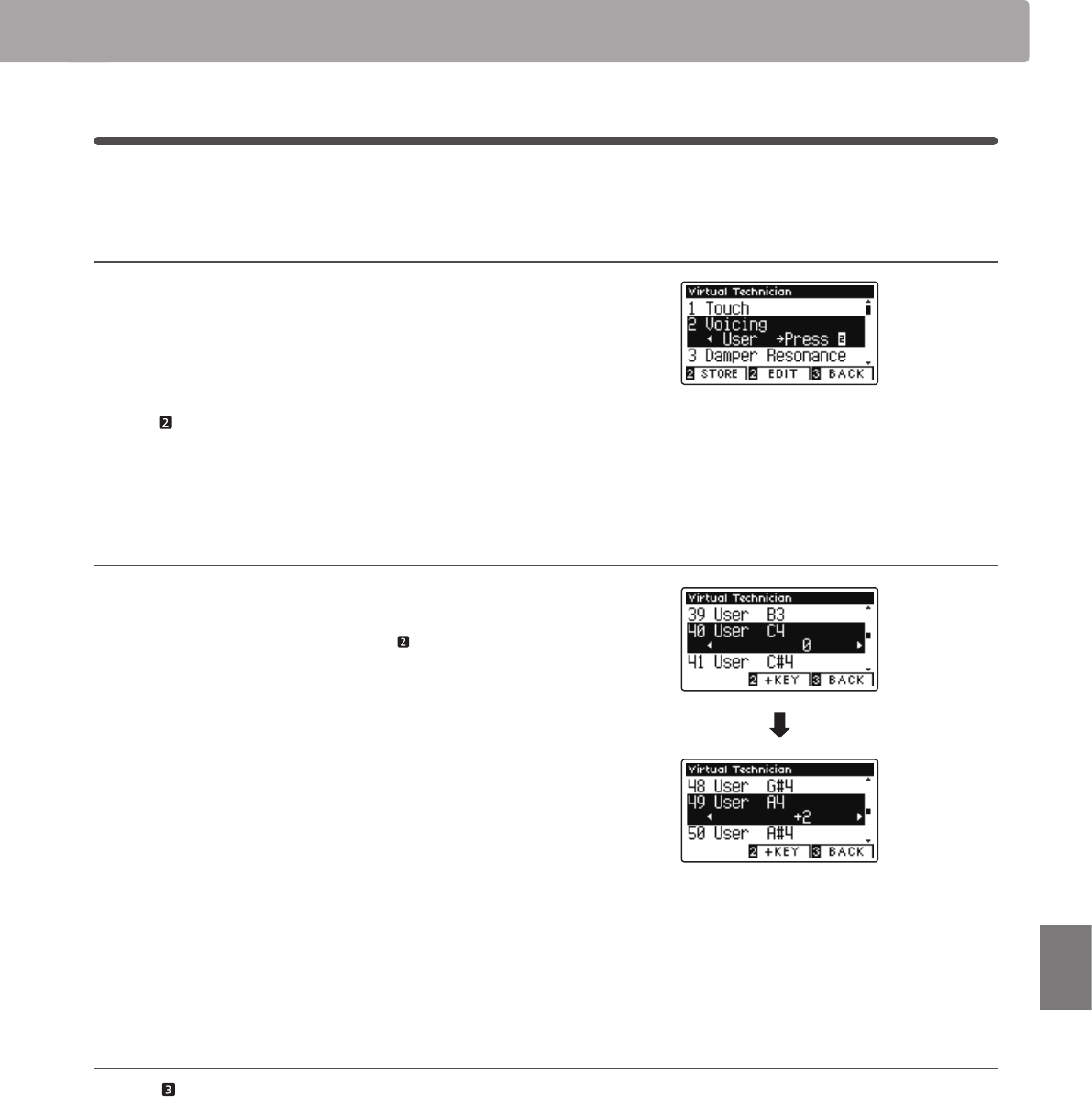
85
Settings
Virtual Technician Settings
User Voicing
The User Voicing function allows each of the 88 keys to be voiced individually.
1. Selecting the User Voicing type
After selecting the Voicing setting:
Press the or buttons to select the User Voicing type.
* User Voicing is performed and stored independently for each sound
variation.
Press the FUNCTION button (EDIT).
The User Voicing screen will be shown in the LCD display.
2. Selecting the note, adjusting the User Voicing value
Press the or buttons to select the desired note to be
adjusted.
* To select a note directly, press and hold the FUNCTION button
(+ KEY) then press the desired key.
Press the or buttons to adjust the User Voicing value for the
selected note.
* The User Voicing value can be adjusted within the range of –5~+5, with
lower values creating a mellower sound and higher values creating a
brighter sound.
* To reset the User Voicing setting to the default value, press the
and buttons simultaneously.
* Any changes made to the User Voicing setting will remain until the
power is turned o.
* Preferred User Voicing settings can be stored to the sound’s memory,
or a Registration memory for convenient recall. Please refer to pages
81 and 33 for more information.
3. Exiting the User Voicing function
Press the FUNCTION button (BACK) to exit the User Voicing
screen and return to the Voicing setting.
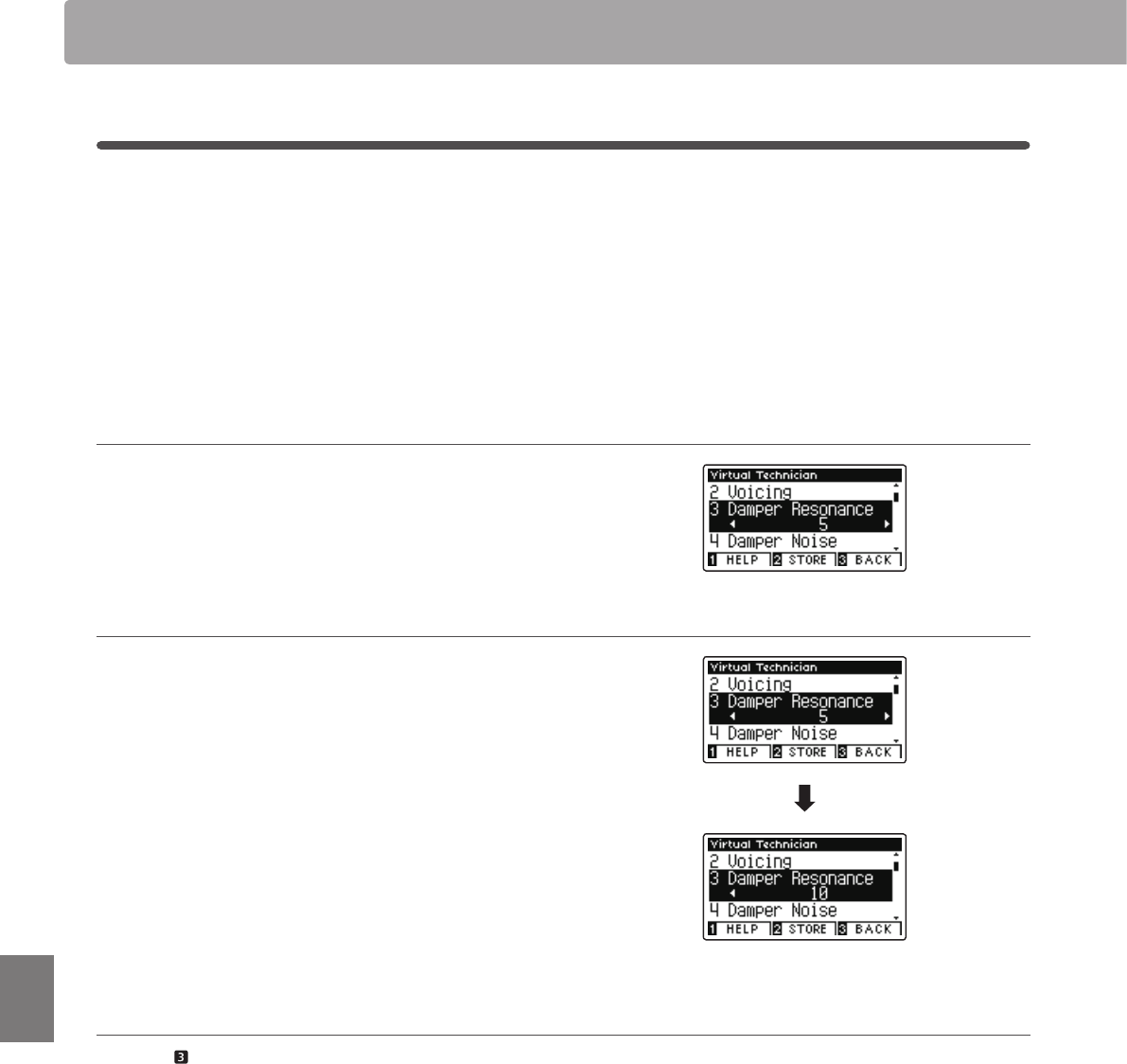
86
Settings
Virtual Technician Settings
3
Damper Resonance
Pressing the damper pedal of an acoustic piano raises all dampers, allowing the strings to vibrate freely. When a
note or chord is played on the piano with the sustain pedal pressed, not only will the strings of the notes played
vibrate, but also the strings of other notes, vibrating in sympathetic resonance.
The CS11/CS8 digital piano recreates this phenomenon, with the Damper Resonance setting allowing the volume of
this resonance sound to be adjusted.
* This Virtual Technician setting will aect acoustic piano sounds only.
1. Selecting the Damper Resonance setting
After entering the Virtual Technician menu (page 80):
Press the or buttons to select the Damper Resonance
setting.
2. Adjusting the Damper Resonance volume
Press the or buttons to increase or decrease the volume of
the Damper Resonance setting.
* The Damper Resonance volume can be adjusted within the range
of O, 1~10, with higher values resulting in a more pronounced
resonance.
* To reset the Damper Resonance setting to the default value, press the
and buttons simultaneously..
* Any changes made to the Damper Resonance setting will remain until
the power is turned o.
* Preferred Damper Resonance settings can be stored to the sound’s
memory, or a Registration memory for convenient recall. Please refer
to pages 81 and 33 for more information.
3. Exiting the Damper Resonance setting
Press the FUNCTION button (BACK) to exit the Damper
Resonance setting and return to the Function Menus screen.

87
Settings
Virtual Technician Settings
4
Damper Noise
When the damper pedal of an acoustic piano is pressed and released, it is often possible to hear the sound of the
damper head touching and releasing the strings.
The CS11/CS8 digital piano reproduces this sound, with the Damper Noise setting allowing the volume of this sound
to be adjusted. The speed at which the damper pedal is pressed will also inuence the prominence of the damper
noise, with fast pedalling creating a very pronounced sound.
* This Virtual Technician setting will aect acoustic piano sounds only.
1. Selecting the Damper Noise setting
After entering the Virtual Technician menu (page 80):
Press the or buttons to select the Damper Noise setting.
2. Adjusting the Damper Noise volume
Press the or buttons to increase or decrease the volume of
the Damper Noise setting.
* The Damper Noise volume can be adjusted within the range of
O, 1~10, with higher values resulting in a more pronounced noise.
* To reset the Damper Noise setting to the default value, press the
and buttons simultaneously.
* Any changes made to the Damper Noise setting will remain until the
power is turned o.
* Preferred Damper Noise settings can be stored to the sound’s memory,
or a Registration memory for convenient recall. Please refer to pages
81 and 33 for more information.
3. Exiting the Damper Noise setting
Press the FUNCTION button (BACK) to exit the Damper Noise
setting and return to the Function Menus screen.
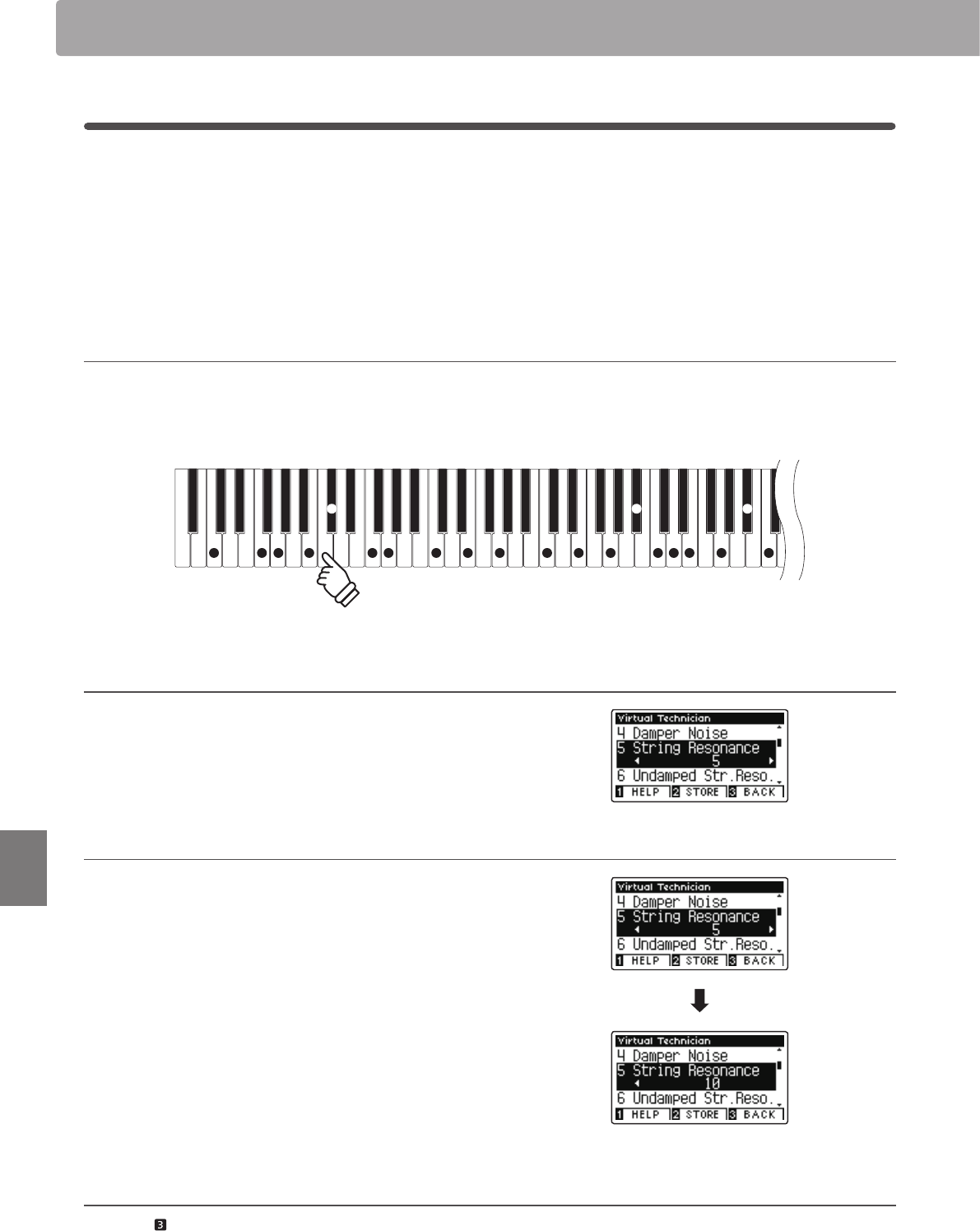
88
Settings
Virtual Technician Settings
5
String Resonance
String Resonance refers to a phenomenon that exists in acoustic pianos whereby the strings of held notes resonate
‘sympathetically’ with other notes of the same harmonic overtone series.
The CS11/CS8 digital piano recreates this phenomenon, with the String Resonance setting allowing the volume of
this resonance to be adjusted.
* This Virtual Technician setting will aect acoustic piano sounds only.
Demonstrating String Resonance
To experience the string resonance phenomenon, gently hold down the ‘C’ key as shown in the illustration below, then play (strike
and release quickly) any of the keys marked with a symbol. In addition to the sound of each note played, it should also be possible
to hear the strings of the rst ‘C’ key resonating ‘sympathetically’, thus demonstrating String Resonance.
F GC B F G C G C E G C D E G C
CAA
E
hold
1. Selecting the String Resonance setting
After entering the Virtual Technician menu (page 80):
Press the or buttons to select the String Resonance
setting.
2. Adjusting the String Resonance volume
Press the or buttons to increase or decrease the volume of
the String Resonance setting.
* The String Resonance volume can be adjusted within the range
of O, 1~10, with higher values resulting in a more pronounced
resonance.
* To reset the String Resonance setting to the default value, press the
and buttons simultaneously.
* Any changes made to the String Resonance setting will remain until
the power is turned o.
* Preferred String Resonance settings can be stored to the sound’s
memory, or a Registration memory for convenient recall. Please refer
to pages 81 and 33 for more information.
3. Exiting the String Resonance setting
Press the FUNCTION button (BACK) to exit the String
Resonance setting and return to the Function Menus screen.
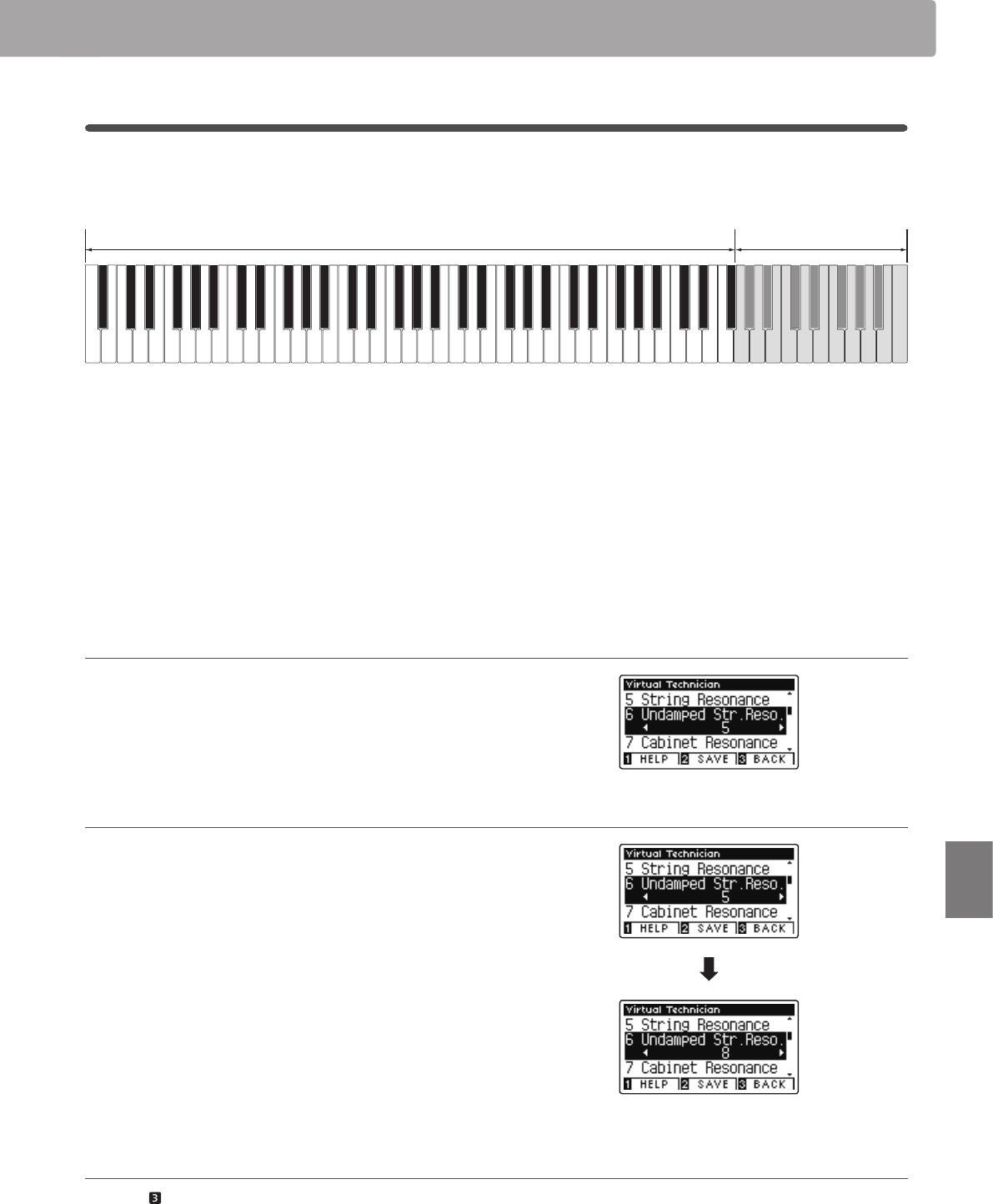
89
Settings
Virtual Technician Settings
6
Undamped String Resonance
The dampers of an acoustic piano span almost the full width of the keyboard. However, the topmost 18 keys
(approximately 1.5 octaves) do not incorporate dampers, as the shorter strings for these treble notes decay quickly
and therefore do not need to be dampened.
Undamped StringsDamped Strings
A0 C8G6
As a result, the strings of these ‘undamped’ treble notes are free to vibrate in sympathetic resonance with those of
lower keys – independently of the damper pedal position – helping to enrich the sound with additional harmonics
and tonal colour.
The CS11/CS8 digital piano recreates this phenomenon, with the Undamped String Resonance setting allowing the
volume of this resonance sound to be adjusted.
* This Virtual Technician setting will aect acoustic piano sounds only.
1. Selecting the Undamped String Resonance setting
After entering the Virtual Technician menu (page 80):
Press the or buttons to select the Undamped String
Resonance setting.
2. Adjusting the Undamped String Resonance volume
Press the or buttons to increase or decrease the volume of
the Undamped String Resonance setting.
* The Undamped String Resonance volume can be adjusted within the
range of O, 1~10, with higher values resulting in a more pronounced
resonance.
* To reset the Undamped String Resonance setting to the default value,
press the and buttons simultaneously.
* Any changes made to the Undamped String Resonance setting will
remain until the power is turned o.
* Preferred Undamped String Resonance settings can be stored to the
sound’s memory, or a Registration memory for convenient recall.
Please refer to pages 81 and 33 for more information.
3. Exiting the Undamped String Resonance setting
Press the FUNCTION button (BACK) to exit the Undamped
String Resonance setting and return to the Function Menus
screen.
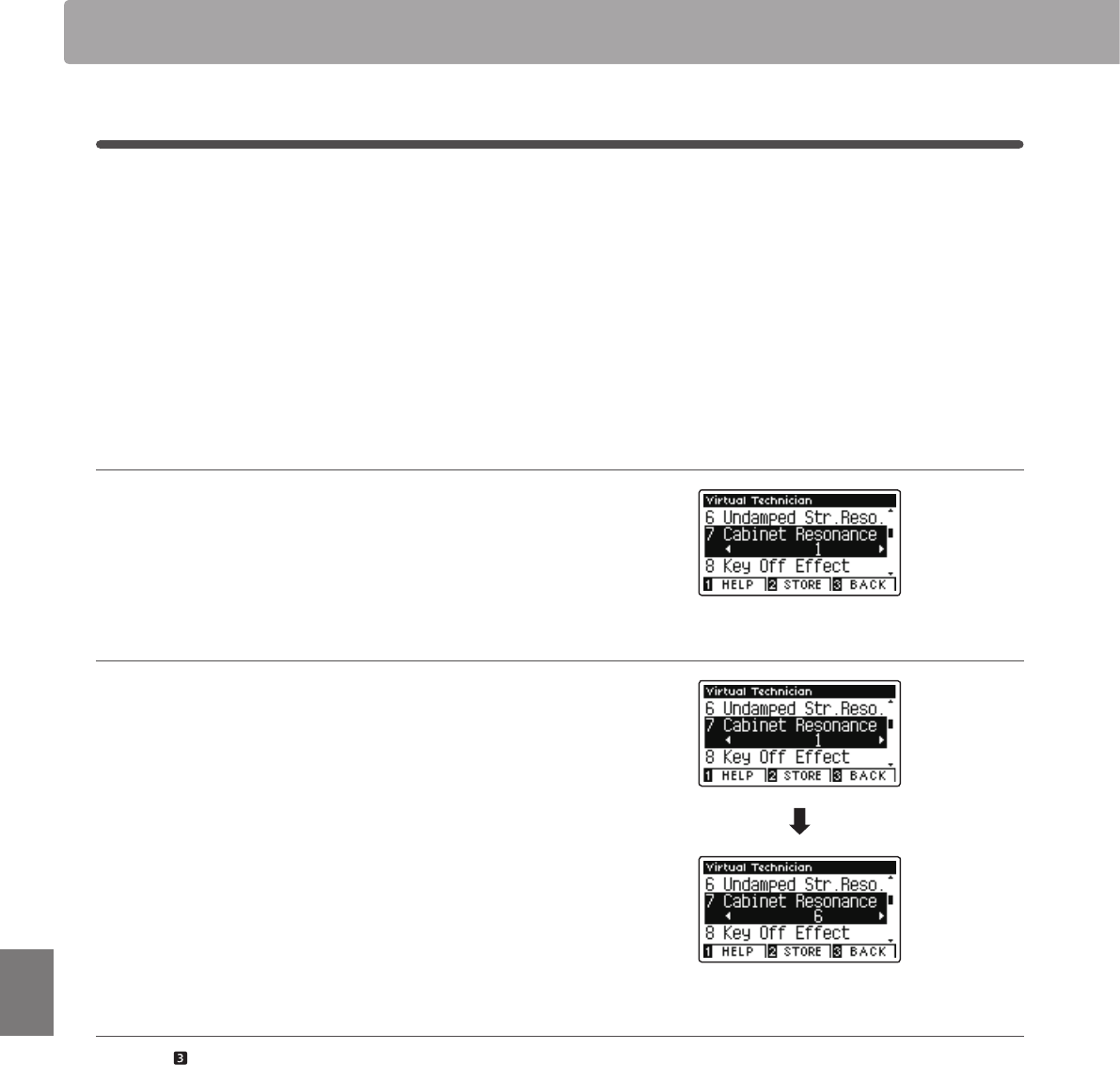
90
Settings
7
Cabinet Resonance
While the fundamental sound of an acoustic piano is produced by vibrating strings, transmitting energy through
a spruce soundboard, the cabinet of the instrument itself also contributes a variety of subtle tonal characteristics
that enrich the playing and listening experience. The keybed, inner and outer rim, iron plate, and beams all play a
role in disseminating sound energy, which in turn gives the piano a living, breathing quality.
The CS11/CS8 digital piano recreates these natural acoustic characteristics, with the Cabinet Resonance setting
allowing the volume of this resonance sound to be adjusted.
* This Virtual Technician setting will aect acoustic piano sounds only.
1. Selecting the Cabinet Resonance setting
After entering the Virtual Technician menu (page 80):
Press the or buttons to select the Cabinet Resonance
setting.
2. Adjusting the Cabinet Resonance volume
Press the or buttons to increase or decrease the volume of
the Cabinet Resonance setting.
* The Cabinet Resonance volume can be adjusted within the range of
1~10, with higher values resulting in a more pronounced resonance.
* To reset the Cabinet Resonance setting to the default value, press the
and buttons simultaneously.
* Any changes made to the Cabinet Resonance setting will remain until
the power is turned o.
* Preferred Cabinet Resonance settings can be stored to the sound’s
memory, or a Registration memory for convenient recall. Please refer
to pages 81 and 33 for more information.
3. Exiting the Cabinet Resonance setting
Press the FUNCTION button (BACK) to exit the Cabinet
Resonance setting and return to the Function Menus screen.
Virtual Technician Settings
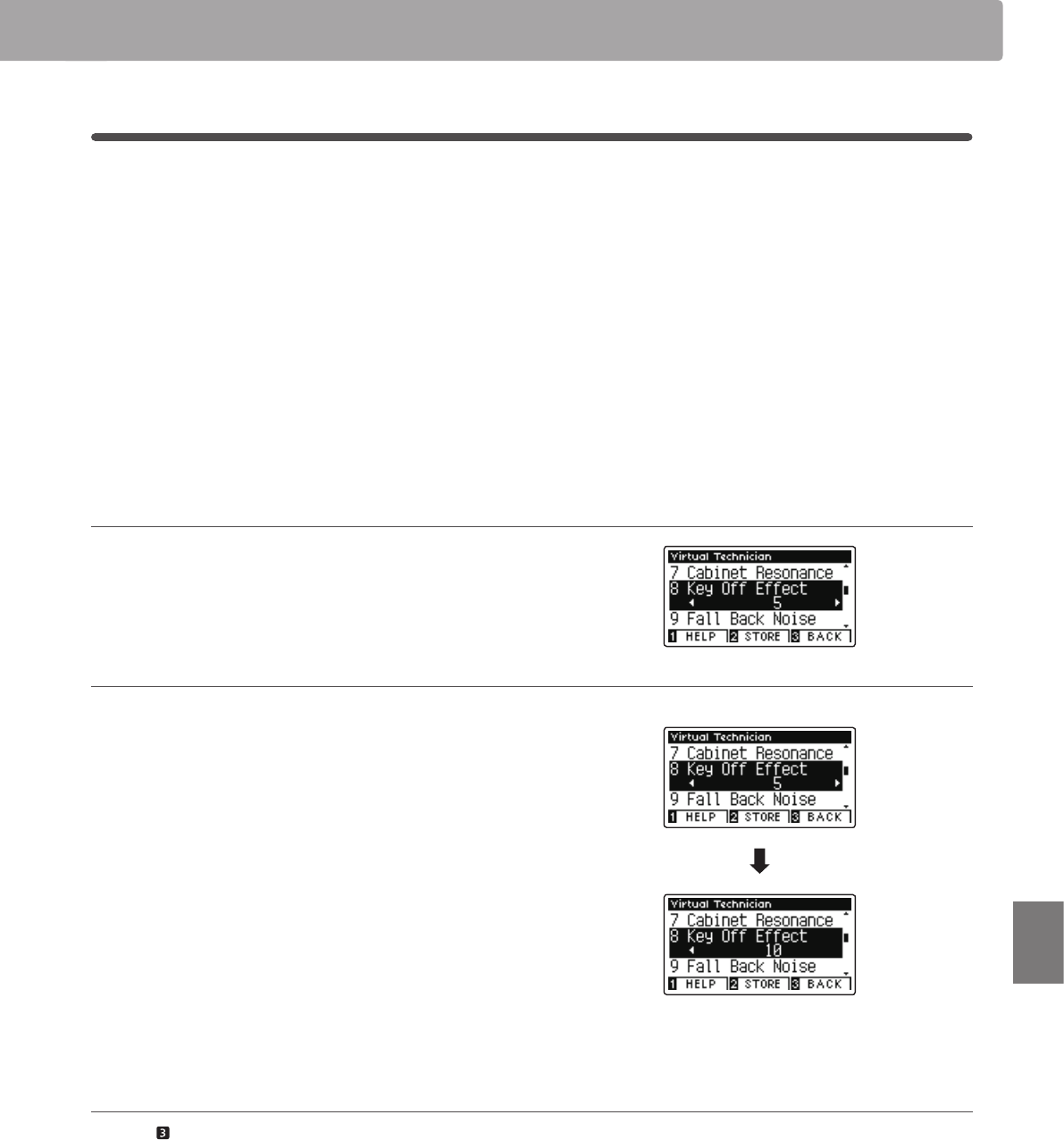
91
Settings
Virtual Technician Settings
8
Key-o Eect
When playing an acoustic piano – particularly in the bass region of the keyboard – if a key is played with force and
released quickly, it is often possible to hear the faint sound of the damper touching the strings immediately before
the vibrations are stopped.
In addition, the speed at which keys are lifted will also aect the character of the sound. For example, when lifting
the keys quickly (e.g. staccato playing) the ‘release’ portion of the sound will be noticeably shorter than when
lifting the keys slowly (e.g. legato playing).
The CS11/CS8 digital piano reproduces both characteristics, with the Key-o Eect setting allowing the volume of
the key-o sound to be adjusted, and the key-o release speed detection to be turned on or o.
* This Virtual Technician setting will aect acoustic piano and electric piano sounds.
1. Selecting the Key-o Eect setting
After entering the Virtual Technician menu (page 80):
Press the or buttons to select the Key-o Eect setting.
2. Adjusting the Key-o Eect volume
Press the or buttons to increase or decrease the volume of
the Key-o Eect setting.
* The Key-o Eect volume can be adjusted within the range of
O, 1~10, with higher values resulting in a more pronounced eect.
* When the Key-O Eect setting is set to O, the key-o release speed
detection will also be disabled, and the speed at which keys are lifted
will not aect the character of the sound.
* To reset the Key-o Eect setting to the default value, press the
and buttons simultaneously.
* Any changes made to the Key-o Eect setting will remain until the
power is turned o.
* Preferred Key-o Eect settings can be stored to the sound’s memory,
or a Registration memory for convenient recall. Please refer to pages
81 and 33 for more information.
3. Exiting the Key-o Eect setting
Press the FUNCTION button (BACK) to exit the Key-o Eect
setting and return to the Function Menus screen.
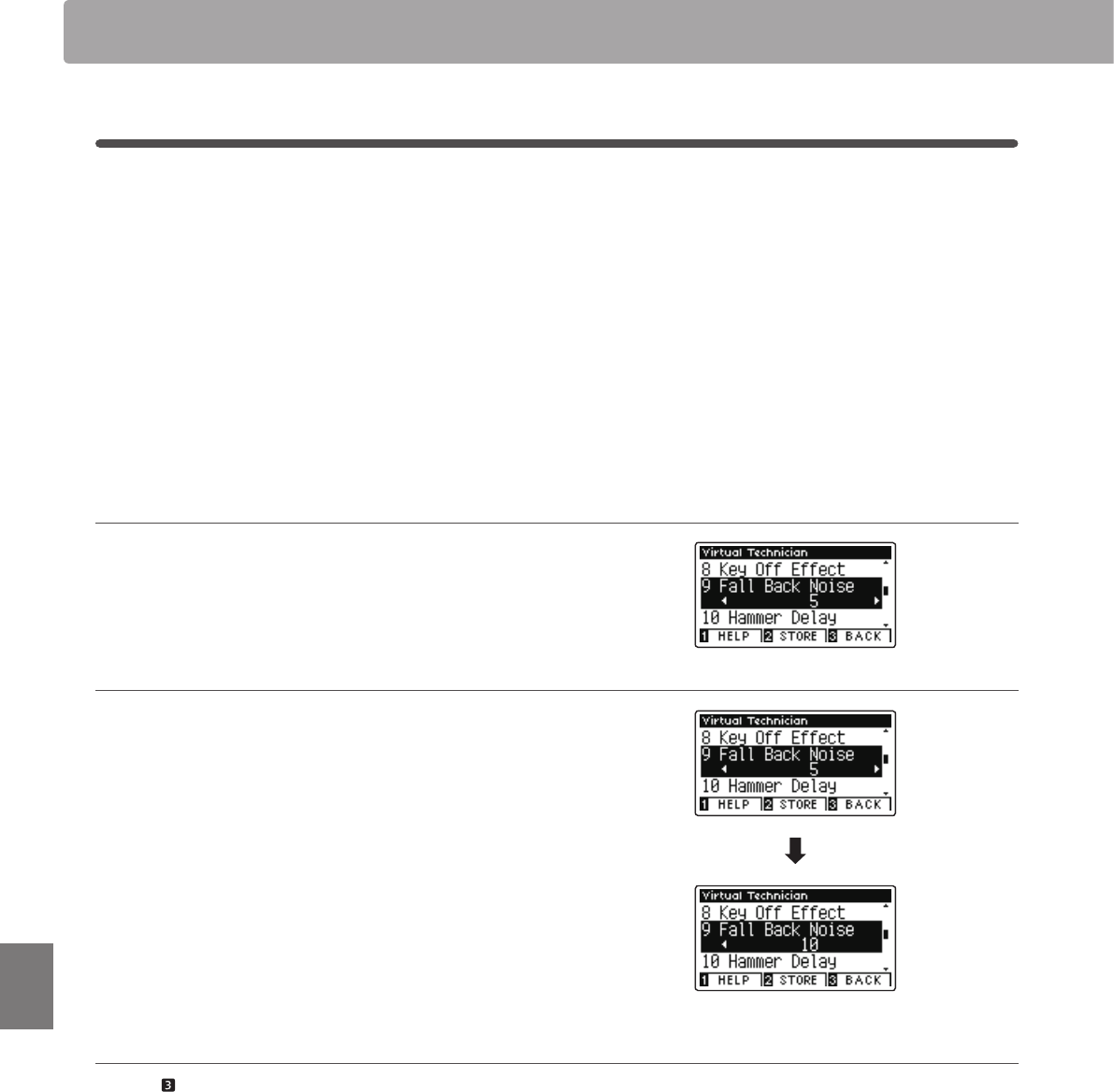
92
Settings
Virtual Technician Settings
9
Fall-back Noise
When playing an acoustic piano, it is often possible to hear the faint sound of the keyboard action returning (i.e.
‘falling back’) to the neutral position after a key is released.
The CS11/CS8 digital piano reproduces this sound, with the Fall-back Noise setting allowing the volume of this
sound to be adjusted.
While the default value is intended to simulate the natural volume level of the keys as they return to their neutral
position, it may occasionally be desirable to adjust the volume of this sound. For example, reducing the volume
when playing very soft pieces, where the fall-back noise may become too prominent.
* This Virtual Technician setting will aect acoustic piano and harpsichord sounds.
1. Selecting the Fall-back Noise setting
After entering the Virtual Technician menu (page 80):
Press the or buttons to select the Fall-back Noise setting.
2. Adjusting the Fall-back Noise volume
Press the or buttons to increase or decrease the volume of
the Fall-back Noise setting.
* The Fall-back Noise volume can be adjusted within the range of
O, 1~10, with higher values resulting in a more pronounced noise.
* To reset the Fall-back Noise setting to the default value, press the
and buttons simultaneously.
* Any changes made to the Fall-back Noise setting will remain until the
power is turned o.
* Preferred Fall-back Noise settings can be stored to the sound’s
memory, or a Registration memory for convenient recall. Please refer
to pages 81 and 33 for more information.
3. Exiting the Fall-back Noise setting
Press the FUNCTION button (BACK) to exit the Fall-back Noise
setting and return to the Function Menus screen.
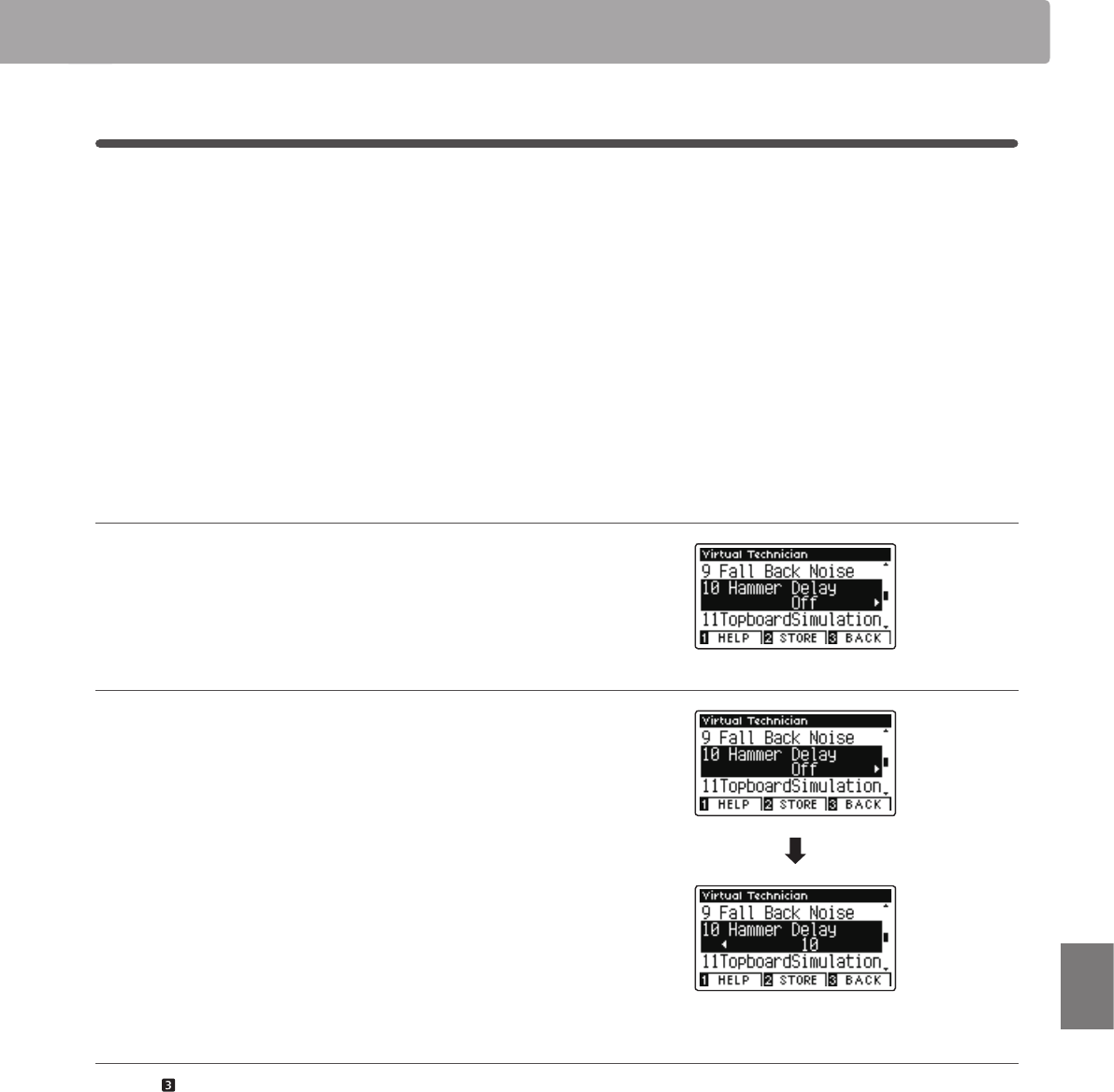
93
Settings
Virtual Technician Settings
10
Hammer Delay
When playing pianissimo passages using an acoustic piano, there may be a perceived delay between a key being
pressed and the hammer striking the strings.
If desired, the CS11/CS8 digital piano can recreate this delay, with the Hammer Delay setting allowing the delay
length to be adjusted.
While the default value of ‘O’ is intended to replicate a well-regulated concert grand piano, with an immediate
connection between the keyboard and hammers, some players may nd it desirable to introduce a minor delay, in
order to mimic dierent types of piano or instruments with a slightly worn keyboard action.
* This Virtual Technician setting will aect acoustic piano sounds only.
1. Selecting the Hammer Delay setting
After entering the Virtual Technician menu (page 80):
Press the or buttons to select the Hammer Delay setting.
2. Adjusting the Hammer Delay value
Press the or buttons to increase or decrease the value of
the Hammer Delay setting.
* The Hammer Delay value can be adjusted within the range of
O, 1~10, with higher values resulting in an increased delay.
* To reset the Hammer Delay setting to the default value, press the
and buttons simultaneously.
* Any changes made to the Hammer Delay setting will remain until the
power is turned o.
* Preferred Hammer Delay settings can be stored to the sound’s
memory, or a Registration memory for convenient recall. Please refer
to pages 81 and 33 for more information.
3. Exiting the Hammer Delay setting
Press the FUNCTION button (BACK) to exit the Hammer Delay
setting and return to the Function Menus screen.
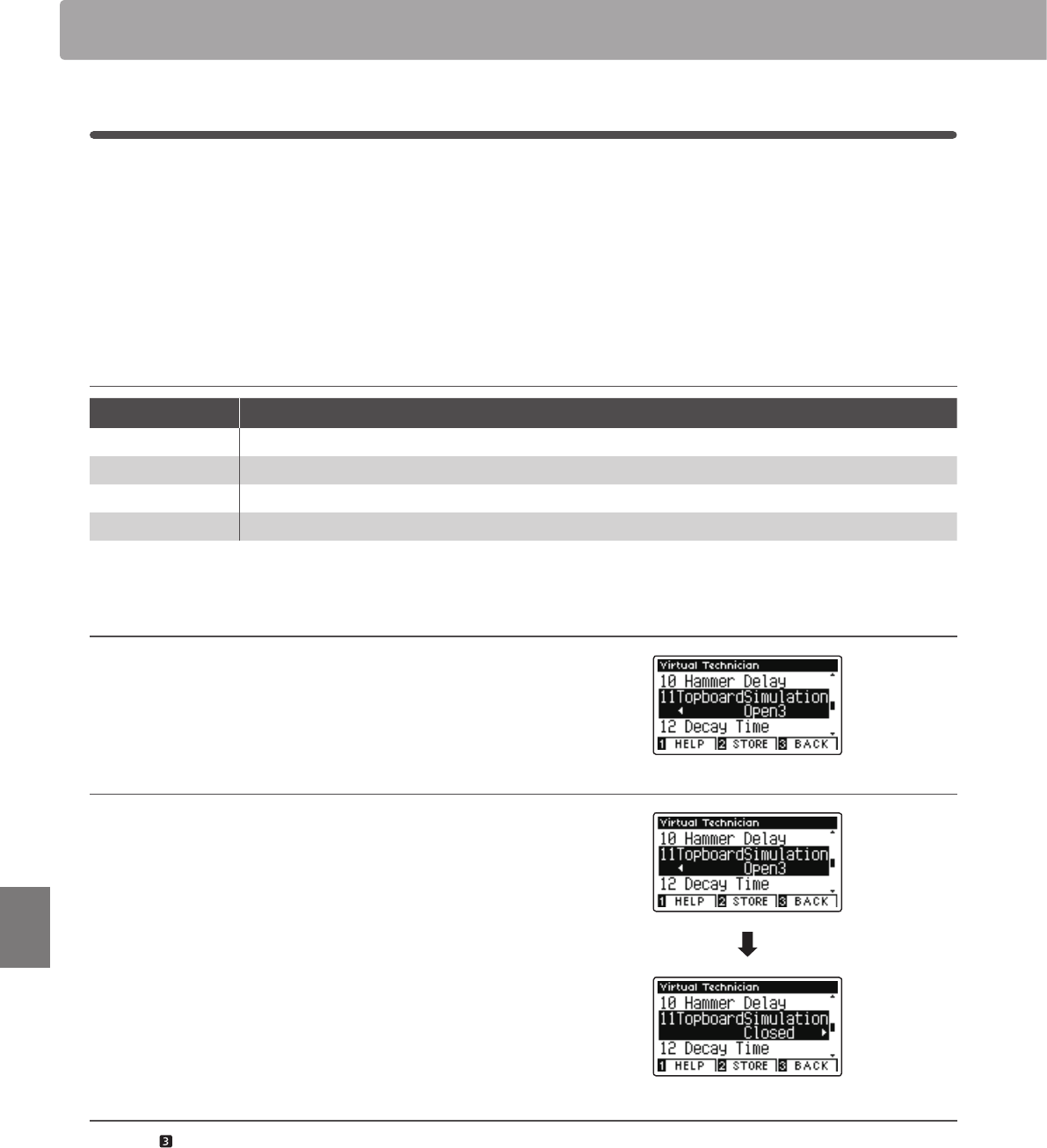
94
Settings
11
Topboard Simulation
When playing an acoustic grand piano, the position of the instrument’s topboard (lid) aects both the volume and
‘openness’ of the tone produced. A fully open topboard allows sound waves to reect o the polished lid surface
and project into the room, while a closed lid has the opposite eect, resulting in a darker, more opaque tone.
The CS11/CS8 digital piano simulates these characteristics, with four dierent topboard positions.
* This Virtual Technician setting will aect acoustic piano sounds only.
Topboard positions
Topboard position Description
Open 3 (default) Simulates the character of a fully open topboard, with maximum sound projection.
Open 2 Simulates the character of a half open topboard, with reduced sound projection.
Open 1 Simulates the character of a partially open topboard, with limited sound projection.
Closed Simulates the character of a closed topboard, with minimum sound projection.
1. Selecting the Topboard setting
After entering the Virtual Technician menu (page 80):
Press the or buttons to select the Topboard setting.
2. Changing the Topboard position
Press the or buttons to cycle through the dierent
Topboard types.
* To reset the Topboard setting to the default position, press the
and buttons simultaneously.
* Any changes made to the Topboard setting will remain until the
power is turned o.
* Preferred Topboard settings can be stored to the sound’s memory, or
a Registration memory for convenient recall. Please refer to pages 81
and 33 for more information.
3. Exiting the Topboard setting
Press the FUNCTION button (BACK) to exit the Topboard
setting and return to the Function Menus screen.
Virtual Technician Settings
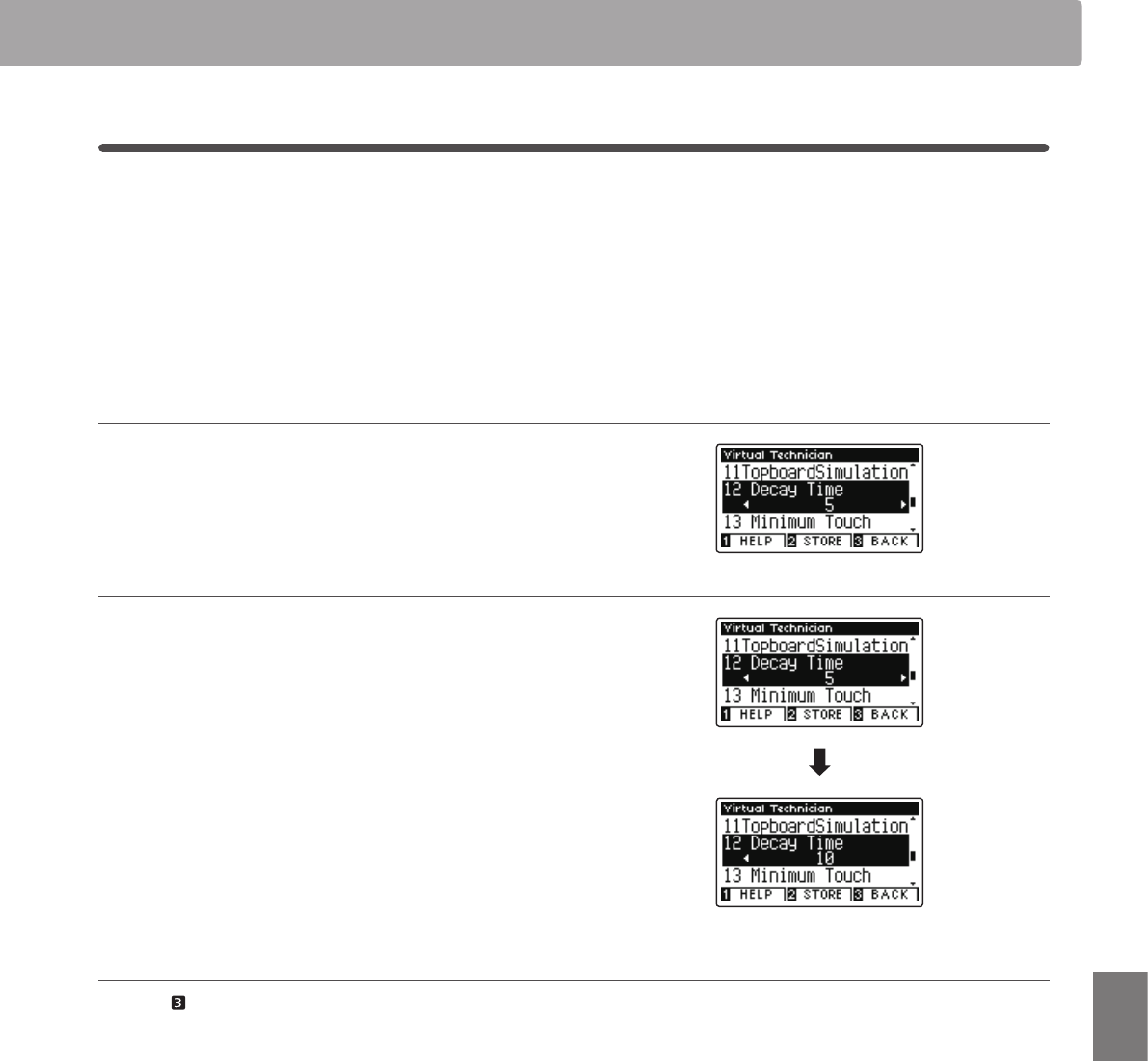
95
Settings
Virtual Technician Settings
12
Decay Time
When playing an acoustic grand piano, the length of the instrument inuences the speed at which held notes decay,
with longer grand pianos (i.e. longer strings) characterised by longer decay times.
The CS11/CS8 digital piano simulates this characteristic, with the Decay Time setting allowing the length of decay
while keys are pressed to be adjusted.
* This Virtual Technician setting will aect all sounds.
1. Selecting the Decay Time setting
After entering the Virtual Technician menu (page 80):
Press the or buttons to select the Decay Time setting.
2. Adjusting the Decay Time volume
Press the or buttons to increase or decrease the value of
the Decay Time setting.
* The Decay Time value can be adjusted within the range of
1~10, with larger values resulting in increased decay times.
* To reset the Decay Time setting to the default value, press the and
buttons simultaneously.
* Any changes made to the Decay Time setting will remain until the
power is turned o.
* Preferred Decay Time settings can be stored to the sound’s memory,
or a Registration memory for convenient recall. Please refer to pages
81 and 33 for more information.
3. Exiting the Decay Time setting
Press the FUNCTION button (BACK) to exit the Decay Time
setting and return to the Function Menus screen.
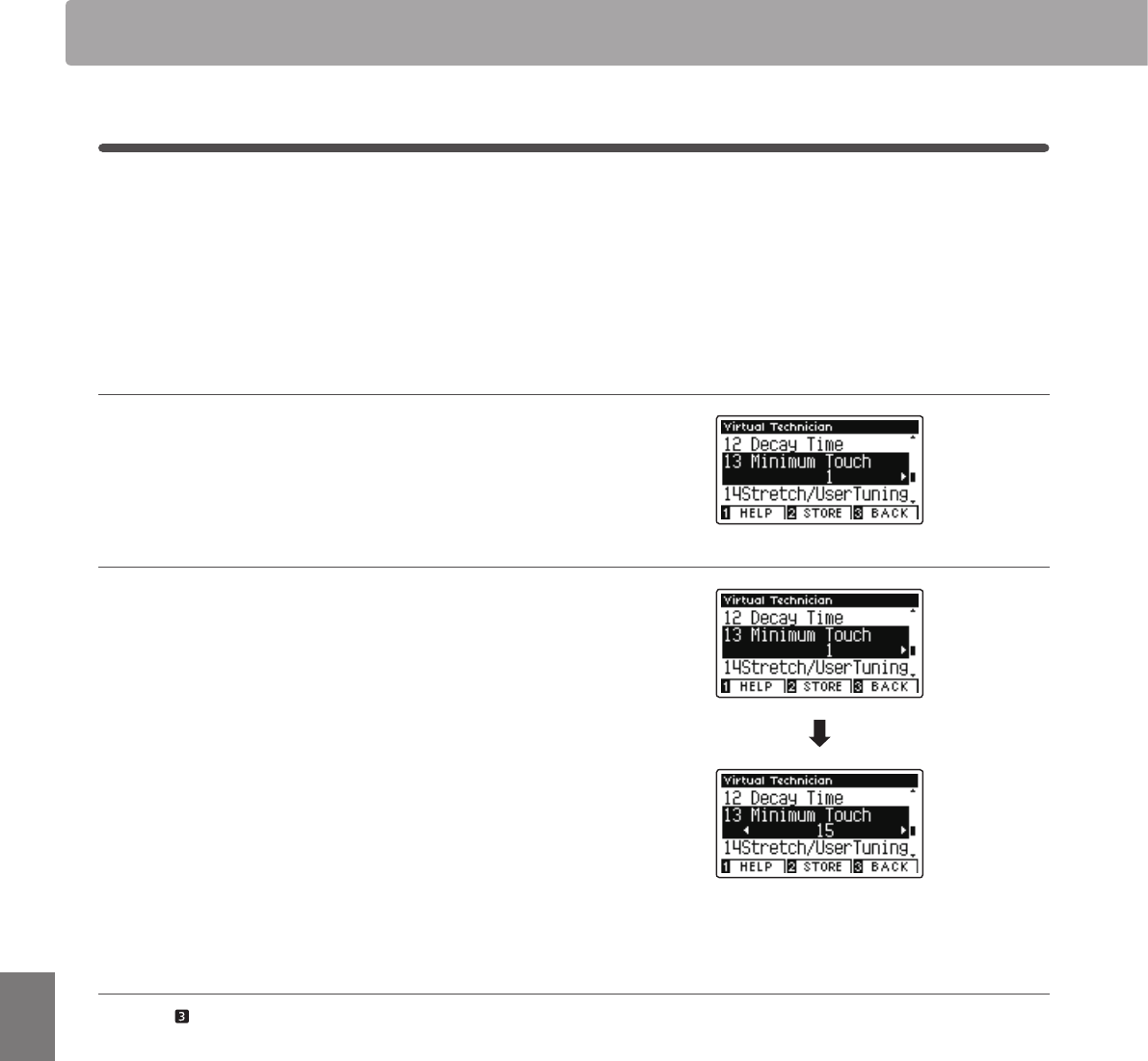
96
Settings
Virtual Technician Settings
13
Minimum Touch
The Minimum Touch setting allows the minimum key velocity required to produce a sound to be adjusted. By
default, this setting recreates the extremely ne touch sensitivity of a concert grand piano, allowing a very soft
sound to be produced with the slightest of key touches. However, it may be desirable to reduce this sensitivity,
when wishing to recreate the sensitivity of a small grand piano or an upright piano.
* This Virtual Technician setting will aect acoustic piano and electric piano sounds.
1. Selecting the Minimum Touch setting
After entering the Virtual Technician menu (page 80):
Press the or buttons to select the Minimum Touch setting.
2. Adjusting the Minimum Touch value
Press the or buttons to increase or decrease the value of
the Minimum Touch setting.
* The Minimum Touch value can be adjusted within the range of 1~20,
with larger values requiring greater key force in order to produce a
sound. For example, a value of 10 will require the keyboard to be
played with a velocity of 10 or above in order to produce a sound.
* To reset the Minimum Touch setting to the default value, press the
and buttons simultaneously.
* Any changes made to the Minimum Touch setting will remain until
the power is turned o.
* Preferred Minimum Touch settings can be stored to the sound’s
memory, or a Registration memory for convenient recall. Please refer
to pages 81 and 33 for more information.
3. Exiting the Minimum Touch setting
Press the FUNCTION button (BACK) to exit the Minimum
Touch setting and return to the Function Menus screen.
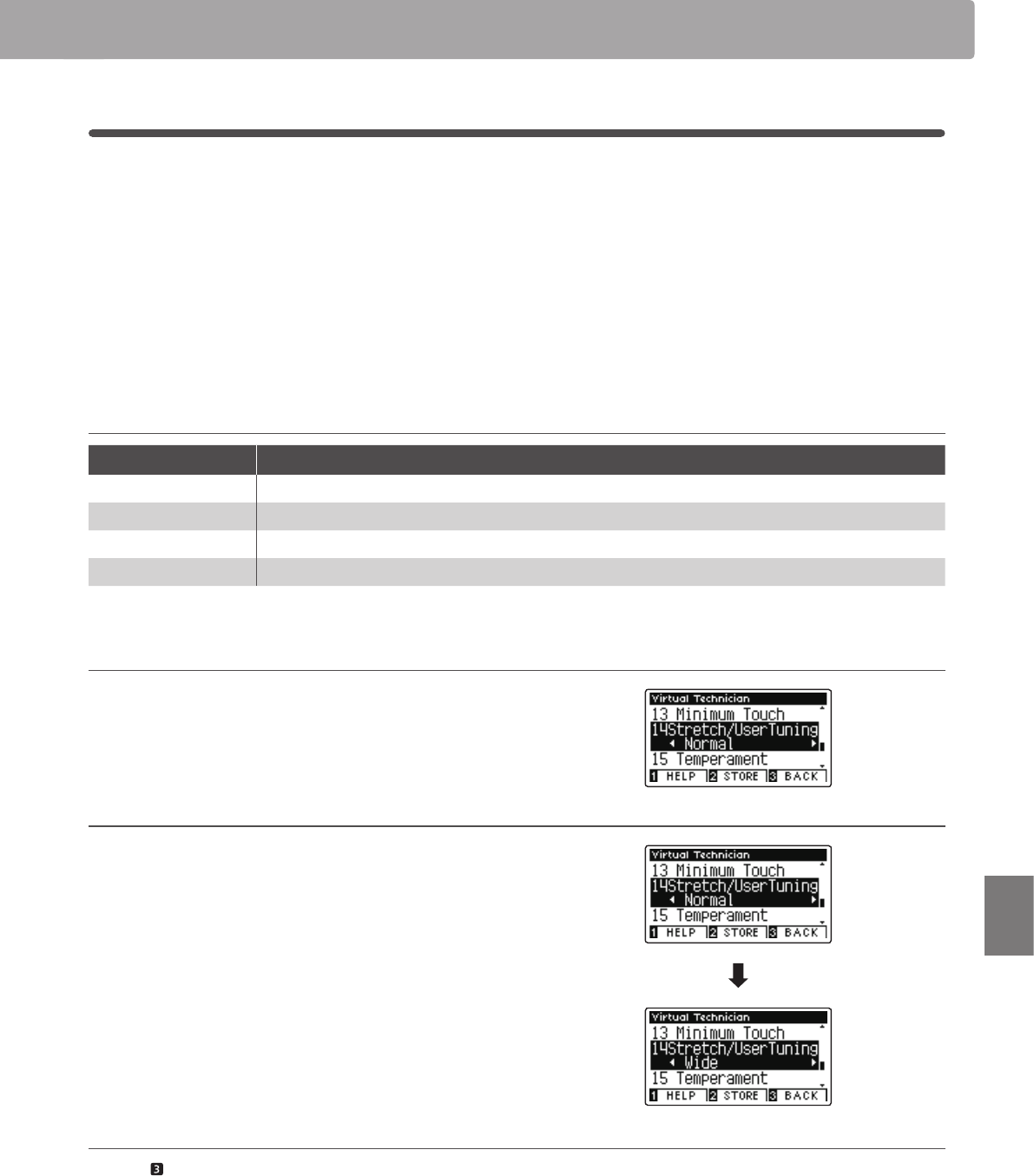
97
Settings
Virtual Technician Settings
14
Stretch Tuning
Stretch tuning is a piano-specic tuning method used by acoustic piano technicians in which the lower octaves
are tuned slightly atter and the upper octaves are tuned slightly sharper to match the natural harmonics of an
acoustic piano.
The Stretch Tuning setting allows the degree of stretch tuning to be adjusted when Equal temperament is selected,
or for stretch tuning to be completely disabled. It is also possible to create custom tuning methods by adjusting the
pitch of each individual key.
* This Virtual Technician setting will aect all sounds.
Stretch Tuning setting
Stretch Tuning Description
O Stretch tuning is disabled.
Normal (default) Normal stretch tuning is applied.
Wide Wide stretch tuning is applied.
User A custom tuning method, allowing the pitch of each key to be individual tuned.
1. Selecting the Stretch Tuning setting
After entering the Virtual Technician menu (page 80):
Press the or buttons to select the Stretch Tuning setting.
2. Changing the Stretch Tuning type
Press the or buttons to alternate between ‘Normal’ and
‘Wide’ Stretch Tuning settings.
* To reset the Stretch Tuning setting to the default type, press the
and buttons simultaneously.
* Any changes made to the Stretch Tuning setting will remain until the
power is turned o.
* Preferred Stretch Tuning settings can be stored to the sound’s
memory, or a Registration memory for convenient recall. Please refer
to pages 81 and 33 for more information.
3. Exiting the Stretch Tuning setting
Press the FUNCTION button (BACK) to exit the Stretch Tuning
setting and return to the Function Menus screen.
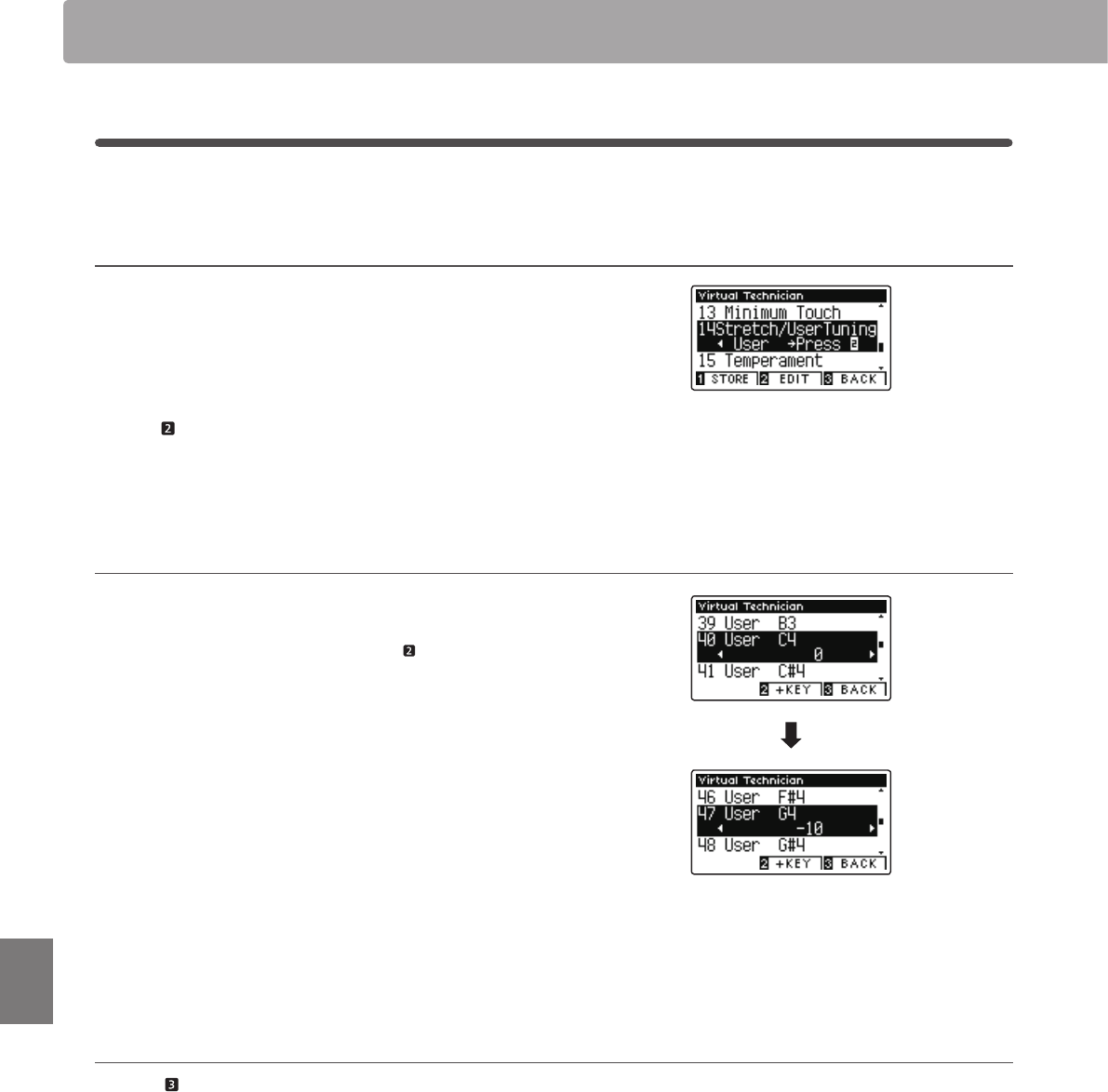
98
Settings
User Tuning
The User Tuning function allows each of the 88 keys to be tuned individually.
1. Selecting the User Tuning type
After selecting the Stretch Tuning setting (page 97):
Press the or buttons to select the User Tuning type.
* User Tuning is performed and stored independently for each sound
variation.
Press the FUNCTION button (EDIT).
The User Tuning screen will be shown in the LCD display.
2. Selecting the note, adjusting the User Tuning value
Press the or buttons to select the desired note to be
adjusted.
* To select a note directly, press and hold the FUNCTION button
(+ KEY) then press the desired key.
Press the or buttons to adjust the User Tuning value for the
selected note.
* The User Tuning value can be adjusted within the range of –50~+50.
A value of +20 indicates a pitch increase of 20 cents.
* To reset the User Tuning setting to the default value, press the and
buttons simultaneously.
* Any changes made to the User Tuning setting will remain until the
power is turned o.
* Preferred User Tuning settings can be stored to the sound’s memory,
or a Registration memory for convenient recall. Please refer to pages
81 and 33 for more information.
3. Exiting the User Tuning function
Press the FUNCTION button (BACK) to exit the User Tuning
tuning screen and return to the Stretch Tuning setting.
Virtual Technician Settings
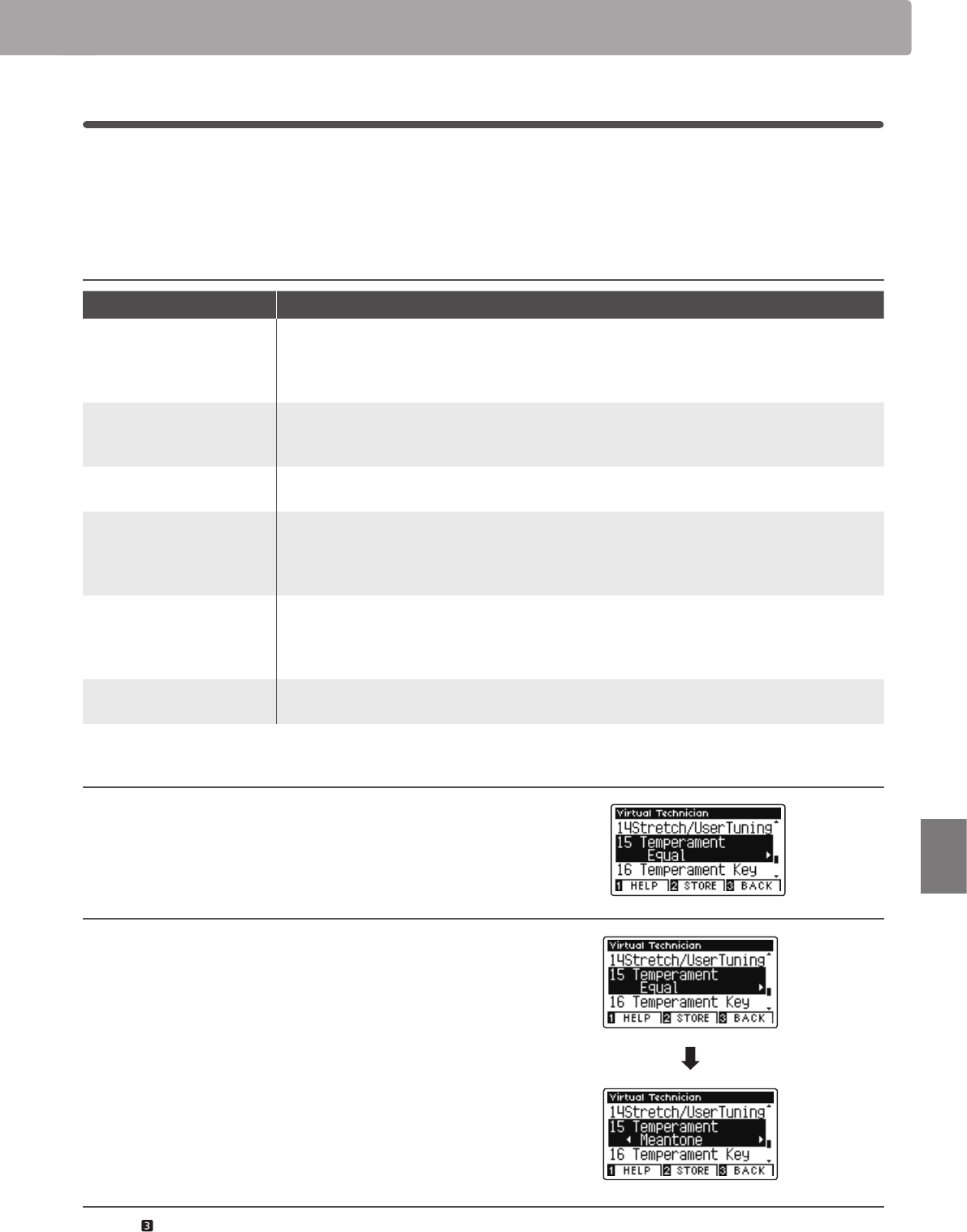
99
Settings
Virtual Technician Settings
15
Temperament
The Temperament setting allows the tuning system used by the CS11/CS8 digital piano to be changed from the
modern ‘Equal Temperament’ standard to one of the various temperaments popularised during the Renaissance
and Baroque periods. It is also possible to create customised temperaments using the User Temperament function.
* This Virtual Technician setting will aect all sounds.
Temperament types
Temperament type Description
Equal Temperament (default)
(Equal)
This temperament is the most popular tuning method, and divides the scale into twelve equal semi-
tones. This produces the same chordal intervals in all twelve keys, and has the advantage of limitless
modulation of the key. However, the tonality of each key becomes less characteristic and no chord is
in pure consonance.
Pure Temperament
(Pure Major/Pure Minor)
This temperament, which eliminates dissonances for thirds and fths, is still popular in choral music
because of its perfect harmony. Any key modulation will result in dissonances.
* The key of the temperament, and major/minor setting must be correctly matched.
Pythagorean Temperament
(Pythagorean)
This temperament, which uses mathematical ratios to eliminate dissonance for fths, is very limited
for use with chords, but produces very characteristic melodic lines.
Meantone Temperament
(Meantone)
This temperament, which uses a mean between a major and minor whole tone to eliminate
dissonance for thirds, was devised to eliminate the lack of consonances experienced with certain fths
for the Mersenne pure temperament.
It produces chords that are more beautiful than those played with equal temperament.
Werckmeister Temperament
(Werckmeister)
Kirnberger Temperament
(Kirnberger)
These two temperaments are placed in between Meantone and Pythagorean. For music with few
accidentals, this temperament produces the beautiful chords of the mean tone, but as accidentals
increase, the temperament produces the characteristic melodies of the Pythagorean temperament.
It is used primarily for classical music written in the Baroque era to revive the original characteristics.
User Temperament
(User) A custom temperament, created by raising or lowering the pitch of each note in the scale.
1. Selecting the Temperament setting
After entering the Virtual Technician menu (page 80):
Press the or buttons to select the Temperament setting.
2. Changing the Temperament type
Press the or buttons to cycle through the dierent
Temperament types.
* To reset the Temperament setting to the default type, press the
and buttons simultaneously.
* Any changes made to the Temperament setting will remain until the
power is turned o.
* Preferred Temperament settings can be stored to the sound’s memory,
or a Registration memory for convenient recall. Please refer to pages
81 and 33 for more information.
3. Exiting the Temperament setting
Press the FUNCTION button (BACK) to exit the Temperament
setting and return to the Function Menus screen.
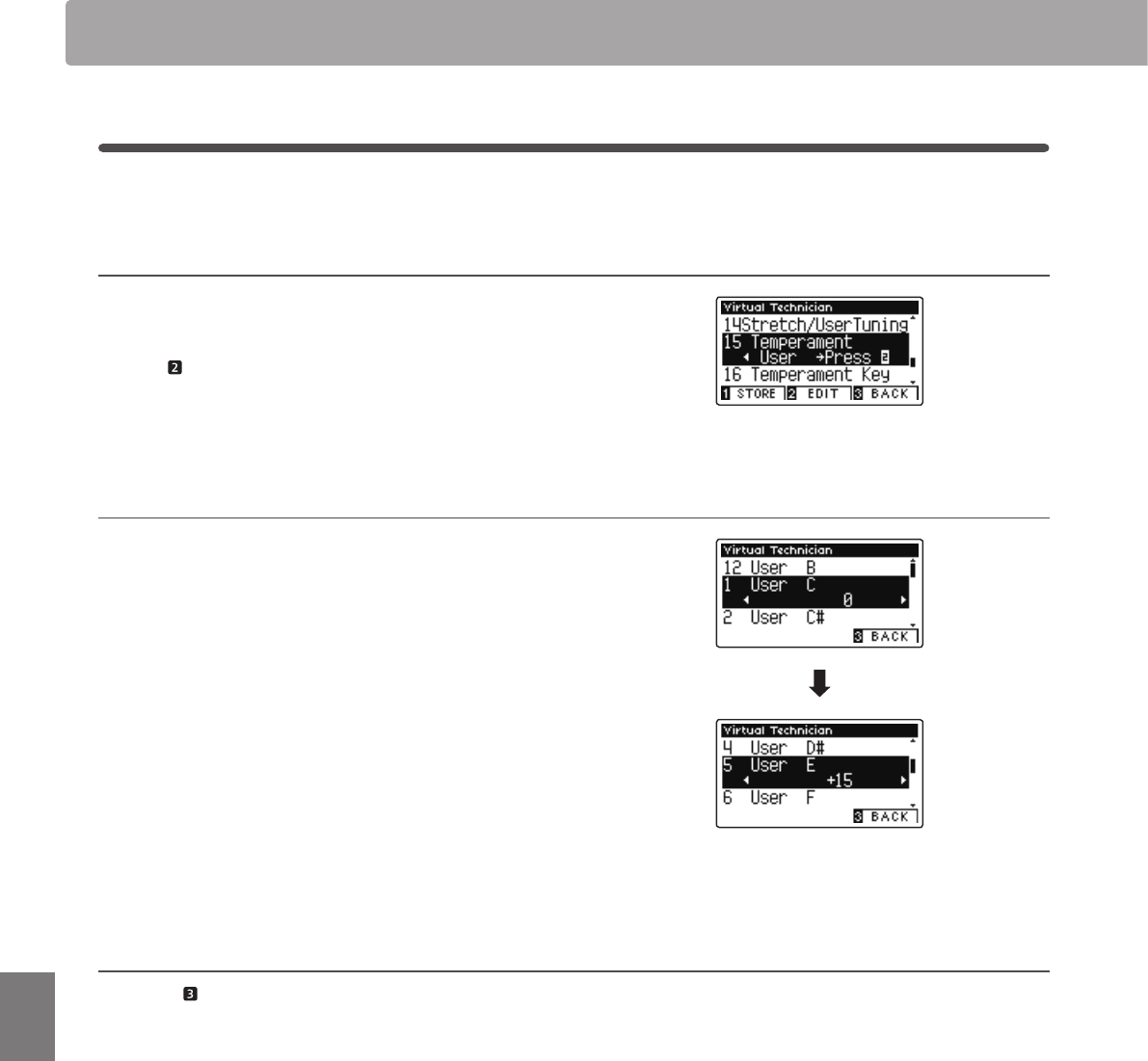
100
Settings
Virtual Technician Settings
User Temperament
The User Temperament function allows custom temperaments to be created.
1. Selecting the User Temperament
After selecting the Temperament setting (page 99):
Press the or buttons to select the User temperament, then
press the FUNCTION button (EDIT).
The User Temperament screen will be shown in the LCD display.
2. Selecting the note, adjusting the user temperament value
Press the or buttons to select the desired note to be
adjusted.
Press the or buttons to adjust the User Temperament value
for the selected note.
* The User Temperament value can be adjusted within the range of
–50~+50. A value of +20 indicates a pitch increase of 20 cents.
* To reset the User Temperament setting to the default value, press the
and buttons simultaneously.
* Any changes made to the User Temperament setting will remain until
the power is turned o.
* Preferred User Temperament settings can be stored to the sound’s
memory, or a Registration memory for convenient recall. Please refer
to pages 81 and 33 for more information.
3. Exiting the User Temperament function
Press the FUNCTION button (BACK) to exit the User
Temperament screen and return to the Temperament setting.
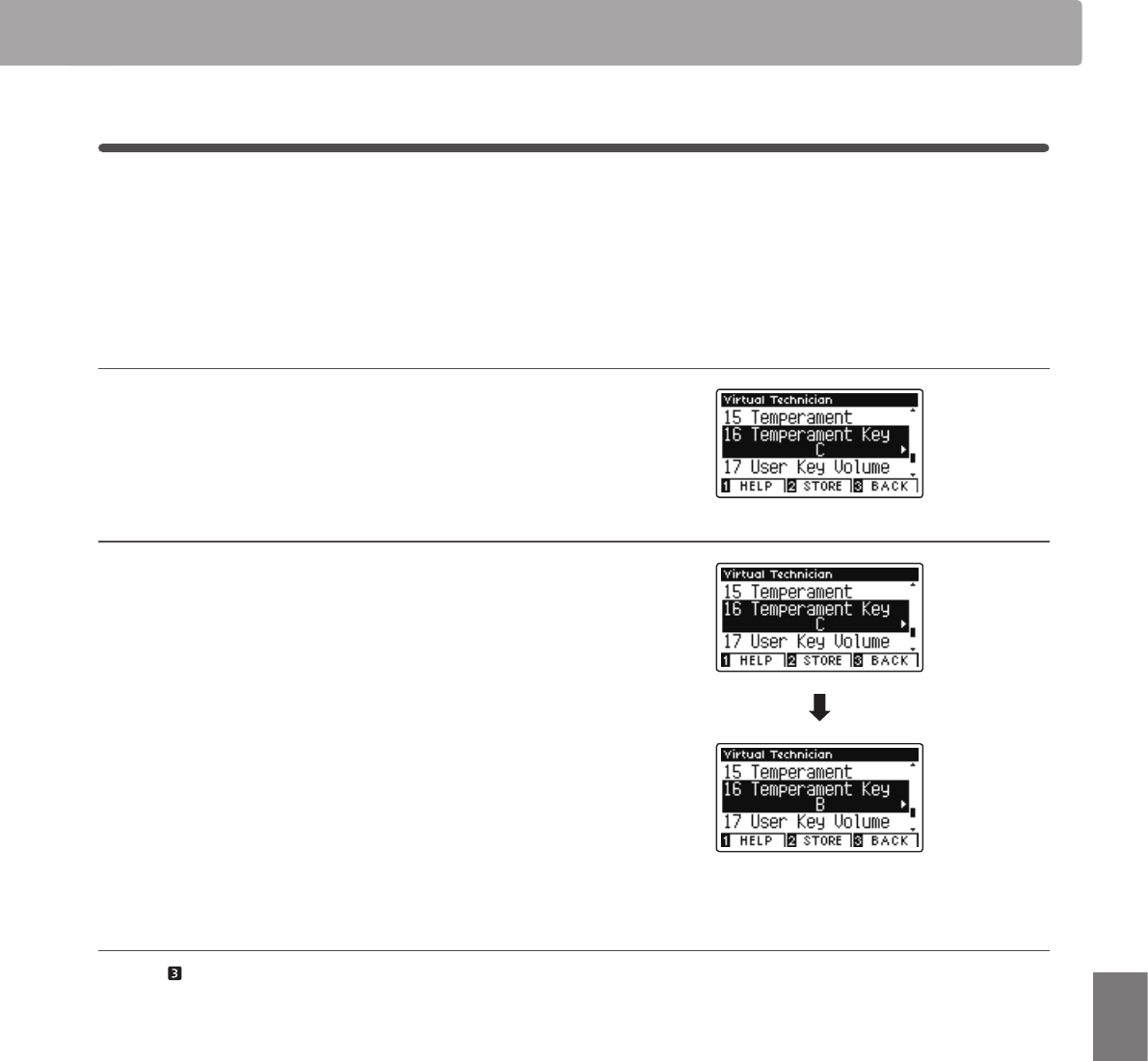
101
Settings
Virtual Technician Settings
16
Temperament Key
The Temperament Key setting allows the key of the selected temperament to be specied. When using a
temperament other than Equal temperament, use this setting to specify the key signature of the piece.
* This Virtual Technician setting will aect all sounds.
* This setting will only aect the ‘balance’ of the tuning system, the pitch of the keyboard will remain unchanged.
1. Selecting the Temperament Key setting
After entering the Virtual Technician menu (page 80):
Press the or buttons to select the Temperament Key setting.
2. Adjusting the Temperament Key
After selecting a temperament other than Equal temperament
types (page 99):
Press the or buttons to change the Temperament Key.
* The Temperament Key can be set within the range of C to B.
* To reset the Temperament Key setting to the default key, press the
and buttons simultaneously.
* Any changes made to the Temperament Key setting will remain until
the power is turned o.
* Preferred Temperament Key settings can be stored to the sound’s
memory, or a Registration memory for convenient recall. Please refer
to pages 81 and 33 for more information.
3. Exiting the Temperament Key setting
Press the FUNCTION button (BACK) to exit the Temperament
Key setting and return to the Function Menus screen.
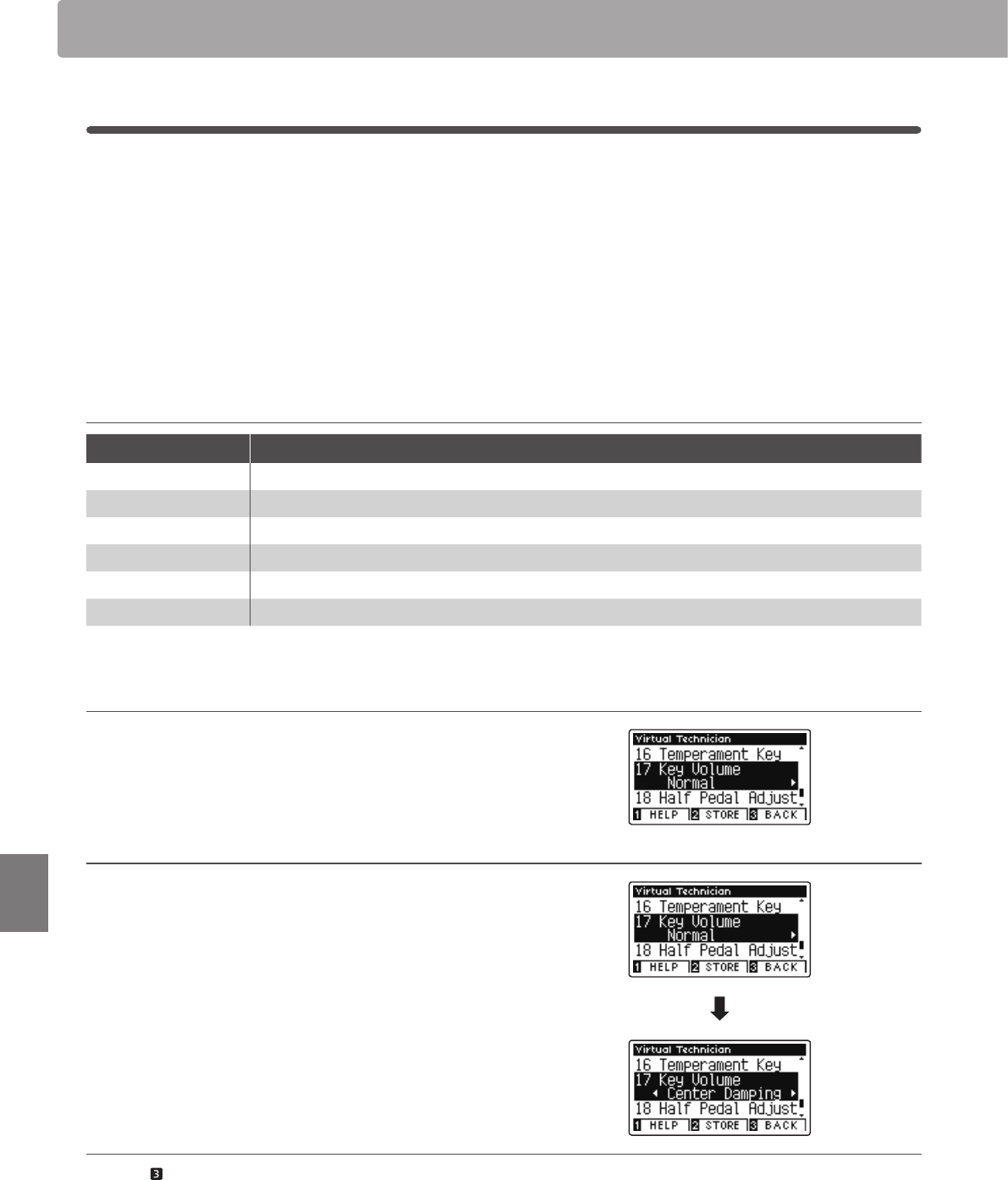
102
Settings
Virtual Technician Settings
17
Key Volume
The Key Volume setting allows the volume of dierent regions of the keyboard to be subtly reduced. There are four
dierent damping presets available, with an additional ‘User’ setting allowing players to perform subtle volume
adjustments on each individual key.
While the default ‘Normal’ key volume setting should be appropriate for a broad range of musical genres, it may
be desirable to experiment with dierent damping presets, or the User setting to attenuate or amplify the volume
of individual keys.
* This Virtual Technician setting will aect all sounds.
Key Volume types
Key Volume Description
Normal (default) An evenly balanced volume throughout the keyboard.
High Damping Gradually reduces the volume of the keyboard towards the treble region.
Low Damping Gradually reduces the volume of the keyboard towards the bass region.
High & Low Damping Gradually reduces the volume of the keyboard in both the treble and bass regions.
Center Damping Gradually reduces the volume of the keyboard in the central region.
User A custom keyboard volume, allowing the volume of each key to be individually adjusted.
1. Selecting the Key Volume setting
After entering the Virtual Technician menu (page 80):
Press the or buttons to select the Key Volume setting.
2. Changing the Key Volume type
Press the or buttons to cycle through the dierent Key
Volume types.
* To reset the Key Volume setting to the default type, press the and
buttons simultaneously.
* Any changes made to the Key Volume setting will remain until the
power is turned o.
* Preferred Key Volume settings can be stored to the sound’s memory,
or a Registration memory for convenient recall. Please refer to pages
81 and 33 for more information.
3. Exiting the Key Volume function
Press the FUNCTION button (BACK) to exit the Key Volume
adjustment screen and return to the Functions Menus screen.
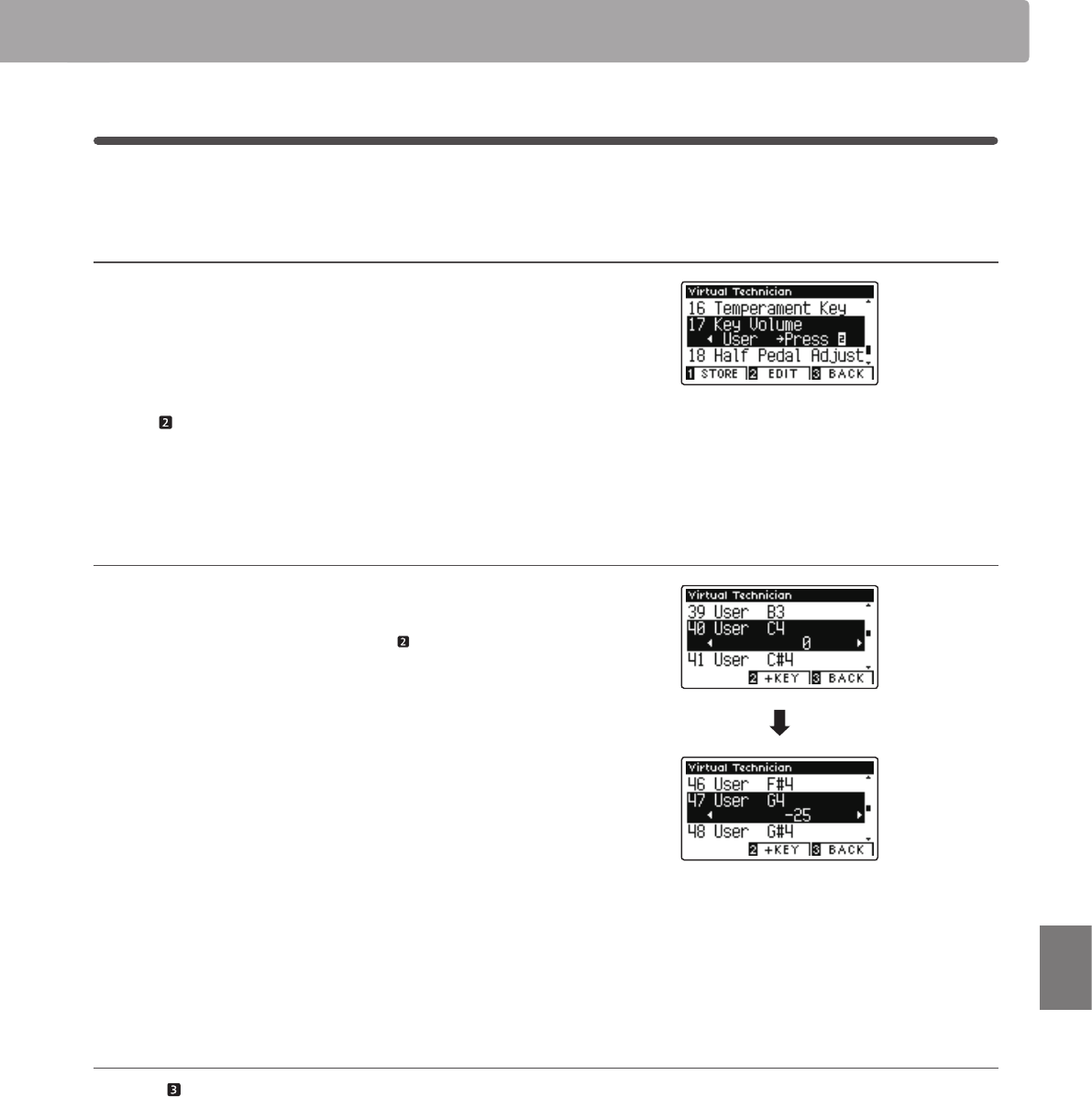
103
Settings
Virtual Technician Settings
User Key Volume
The User Key Volume settings allows the volume of each of the 88 keys to be adjusted individually.
1. Selecting the User Key Volume type
After entering the Key Voicing setting:
Press the or buttons to select the User Key Volume type.
* User Key Volume is performed and stored independently for each
sound variation.
Press the FUNCTION button (EDIT).
The User Key Volume screen will be shown in the LCD display.
2. Selecting the note, adjusting the User Key Volume value
Press the or buttons to select the desired note to be
adjusted.
* To select a note directly, press and hold the FUNCTION button
(+ KEY) then press the desired key.
Press the or buttons to adjust the User Key Volume value for
the selected note.
* The User Key Volume value can be adjusted within the range of
–50~+50, with lower values attenuating the sound and higher values
amplifying the sound.
* To reset the User Key Volume setting to the default value, press the
and buttons simultaneously.
* Any changes made to the User Key Volume setting will remain until
the power is turned o.
* Preferred User Key Volume settings can be stored to the sound’s
memory, or a Registration memory for convenient recall. Please refer
to pages 81 and 33 for more information.
3. Exiting the User Key Volume function
Press the FUNCTION button (BACK) to exit the User Key
Volume screen and return to the Key Volume setting.
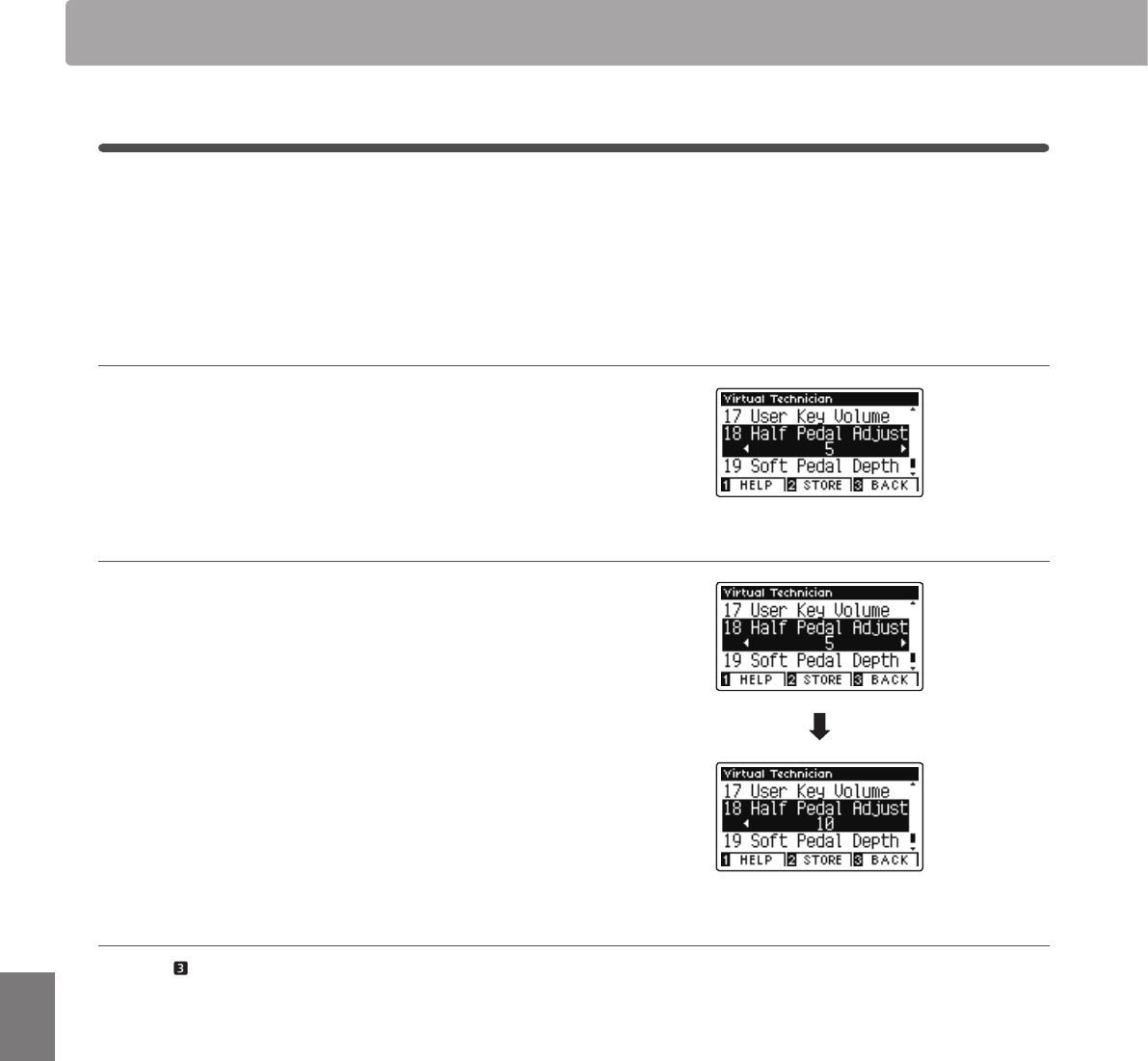
104
Settings
18
Half-Pedal Adjust
The Half-Pedal Adjust setting allows the point at which the damper/sustain pedal becomes eective (i.e. when
the dampers of the piano begin to lift from the strings) to be adjusted. This setting may be useful for pianists that
habitually rest their right foot on the damper/sustain pedal, but do not necessarily wish to sustain the sound.
* This Virtual Technician setting will aect all sounds.
1. Selecting the Half-Pedal Adjust setting
After entering the Virtual Technician menu (page 80):
Press the or buttons to select the Half-Pedal Adjust
setting.
2. Adjusting the Half-Pedal Adjust value
Press the or buttons to increase or decrease the value of
the Half-Pedal Adjust setting.
* The Half-Pedal Adjust value can be adjusted within the range of
1~10, with higher values resulting in a later damper pedal point.
* To reset the Half-Pedal Adjust setting to the default value, press the
and buttons simultaneously.
* Any changes made to the Half-Pedal Adjust setting will remain until
the power is turned o.
* Preferred Half-Pedal Adjust settings can be stored to the sound’s
memory, or a Registration memory for convenient recall. Please refer
to pages 81 and 33 for more information.
3. Exiting the Half-Pedal Adjust setting
Press the FUNCTION button (BACK) to exit the Half-pedal
Point setting and return to the Function Menus screen.
Virtual Technician Settings
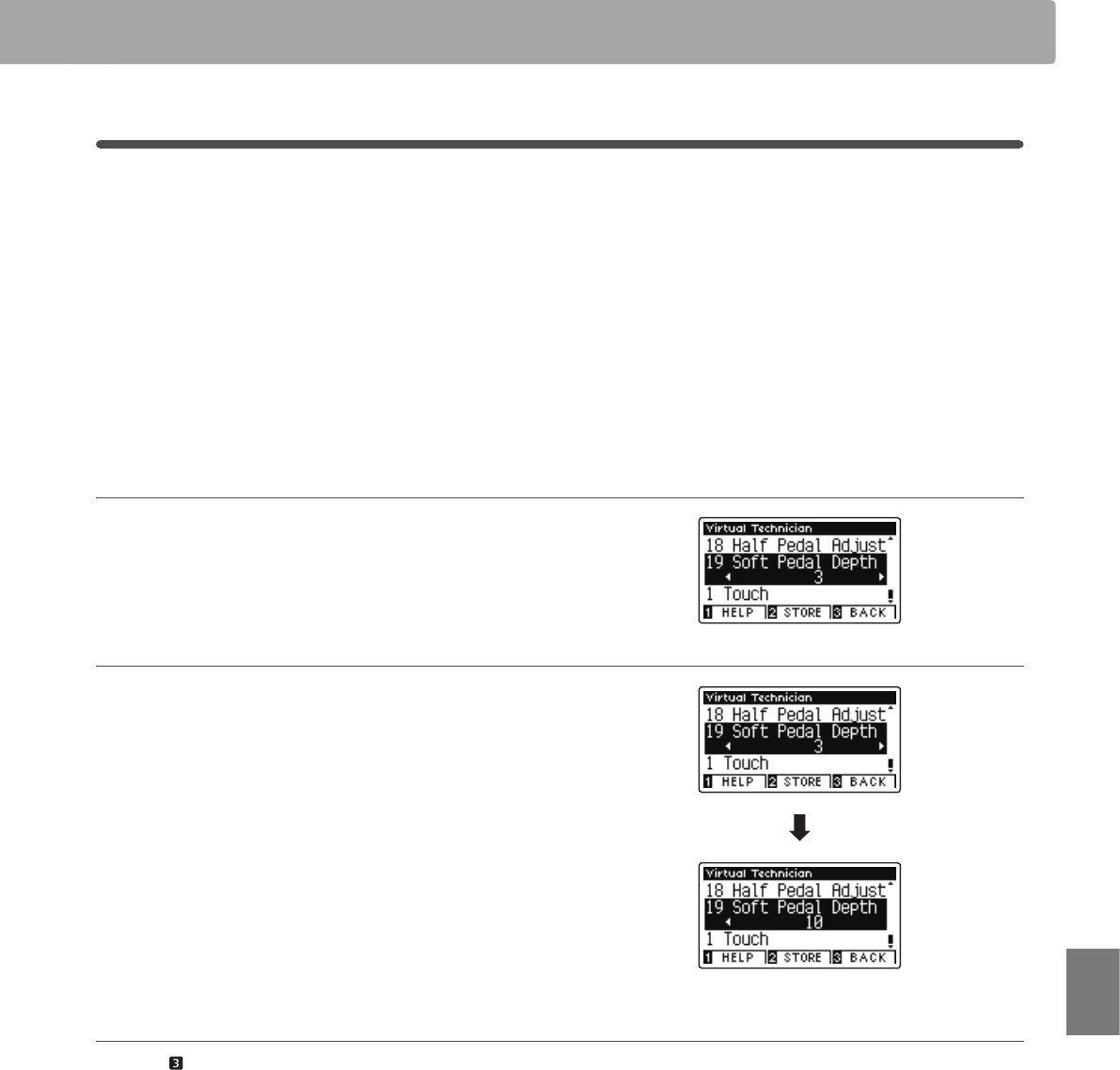
105
Settings
Virtual Technician Settings
19
Soft Pedal Depth
The Soft Pedal Depth setting adjusts the extent to which the soft (left) pedal of the CS11/CS8 digital piano softens
the sound of played notes.
While the default value is intended to replicate the eectiveness of a concert grand Una Corda pedal, it may be
desirable for players to increase or decrease the value of this setting to suit their playing style.
On an acoustic piano, pressing this Una Corda pedal shifts the keyboard action slightly to the right, causing the
hammers to strike two strings instead of the usual three, thus reducing the volume of each note.
* This Virtual Technician setting will aect all sounds.
1. Selecting the Soft Pedal Depth setting
After entering the Virtual Technician menu (page 80):
Press the or buttons to select the Soft Pedal Depth setting.
2. Adjusting the Soft Pedal Depth value
Press the or buttons to increase or decrease the value of
the Soft Pedal Depth setting.
* The Soft Pedal Depth value can be adjusted within the range of
1~10, with higher values resulting in a softer sound.
* To reset the Soft Pedal Depth setting to the default value, press the
and buttons simultaneously.
* Any changes made to the Soft Pedal Depth setting will remain until
the power is turned o.
* Preferred Soft Pedal Depth settings can be stored to the sound’s
memory, or a Registration memory for convenient recall. Please refer
to pages 81 and 33 for more information.
3. Exiting the Soft Pedal Depth setting
Press the FUNCTION button (BACK) to exit the Soft Pedal
Depth setting and return to the Function Menus screen.
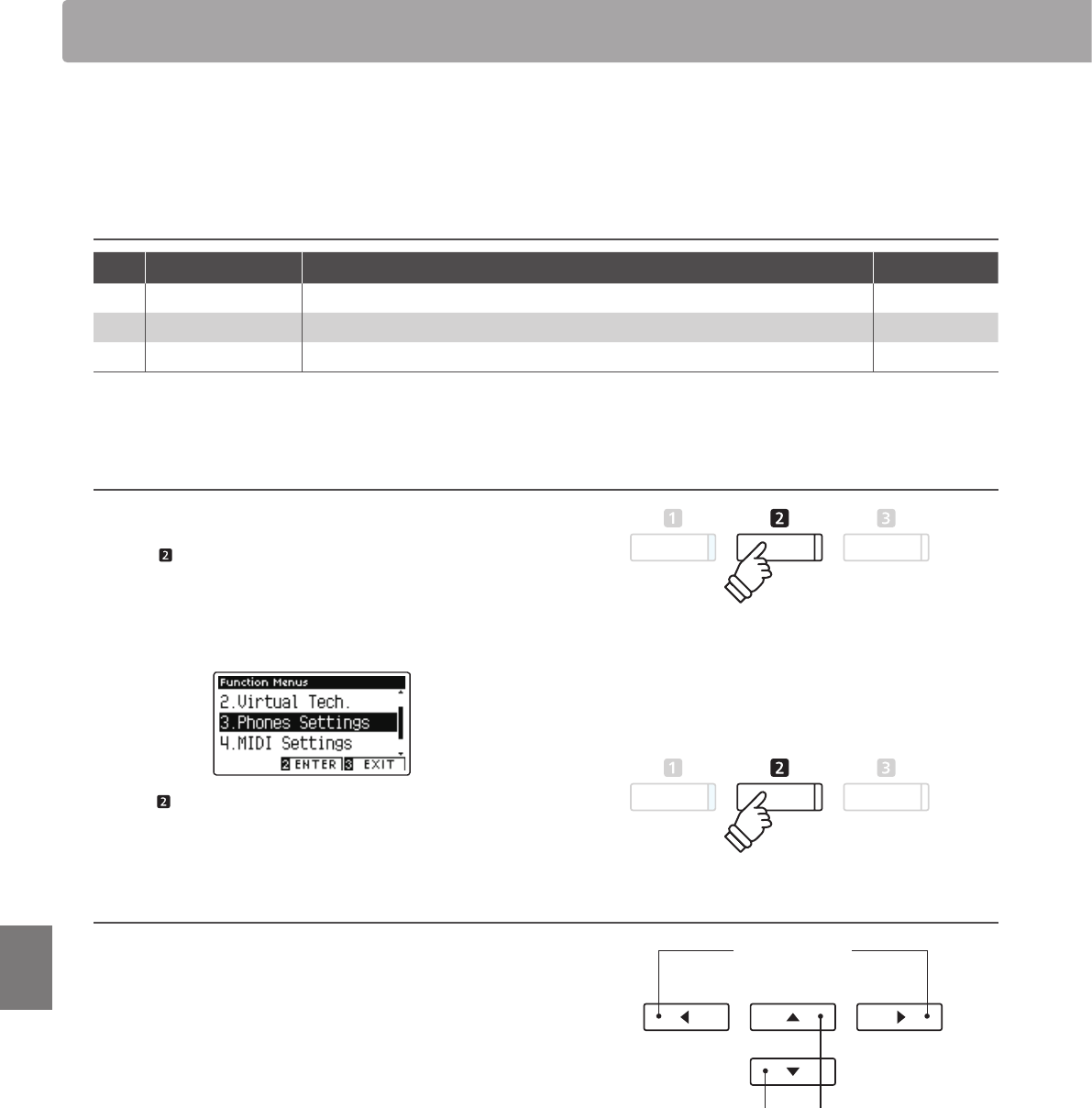
106
Settings
The Phones Settings menu contains settings to select the SHS (Spatial Headphone Sound) mode, the type of
headphones to be used, and the output volume of the connected headphones.
Phones Settings
No. Setting Description Default setting
1SHS Mode Select the desired SHS (Spatial Headphone Sound) mode. Normal
2Phones Type Select the type of headphones to be used with the instrument. Normal
3 Phones Volume Change the maximum volume level of the headphones output. Normal
* Default settings will be shown in the rst LCD display illustration (i.e. Step 1) for each setting explanation below.
Entering the Phones Settings menu
While the normal playing mode screen is shown in the LCD display:
Press the FUNCTION button (ENTER).
The Function menus will be shown in the LCD display.
Press the or buttons to select the Phone Settings menu.
Press the FUNCTION button (ENTER) again to enter the Phones
Settings menu.
Selecting and adjusting the desired setting
After entering the Basic Settings menu:
Press the or buttons to move the selection cursor over the
desired setting.
Press the or buttons to adjust the selected setting.
* To reset the current setting to the default value, press the and
buttons simultaneously. buttons:
Move selection cursor.
buttons:
Adjust selected setting.
Phones Settings
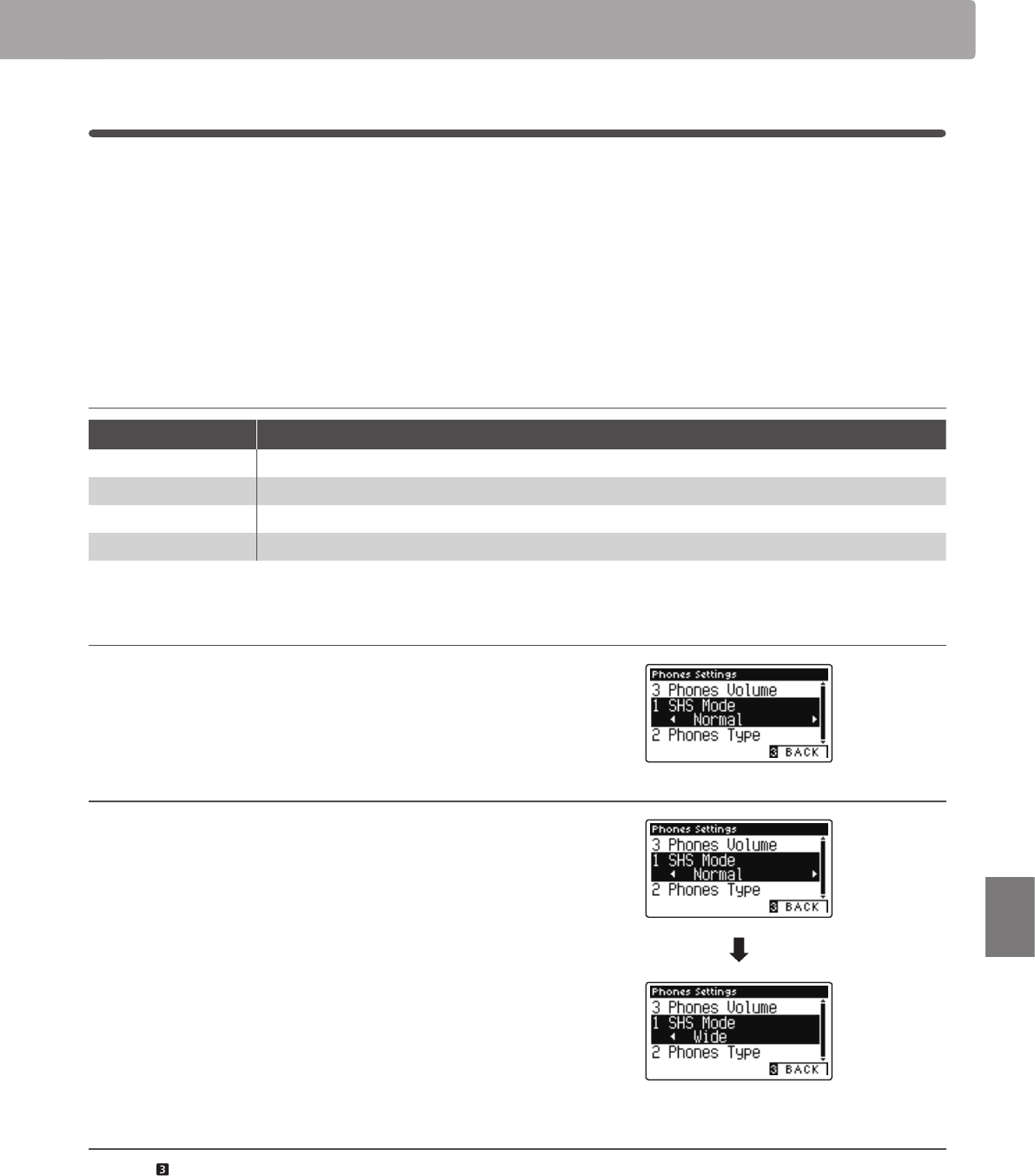
107
Settings
Phones Settings
1
SHS Mode
Spatial Headphone Sound (SHS) is a special feature of the CS11/CS8 digital piano that enhances the depth and
realism of the acoustic piano sound when listening through headphones or earphones.
The SHS Mode setting allows the player to select from one of three dierent acoustic presets that adjust the spatial
positioning of the sound, while also helping to reduce auditory fatigue when using earphones or headphones for
extended periods of time.
* This setting does not aect the speaker or Line Out sound.
SHS Mode setting
SHS Mode Description
O Disable the Spatial Headphone Sound feature.
Forward Front focused, somewhat narrow spatial positioning.
Normal (default) Naturally balanced spatial positioning that is neither forward nor wide.
Wide Wide, very open spatial positioning.
1. Selecting the SHS Mode setting
After entering the Phones Settings menu (page 106):
Press the or buttons to select the SHS Mode setting.
2. Changing the SHS Mode setting
Press the or buttons to cycle through the dierent SHS
Mode types types.
* To reset the SHS Mode setting to the default setting, press the and
buttons simultaneously.
* Any changes made to the SHS Mode setting will remain until the
power is turned o.
* Preferred SHS Mode settings can be stored to the Startup Setting
memory for convenient recall. Please refer to page 77 for more
information.
3. Exiting the SHS Mode setting
Press the FUNCTION button (BACK) to exit the SHS Mode
setting and return to the Function Menus screen.
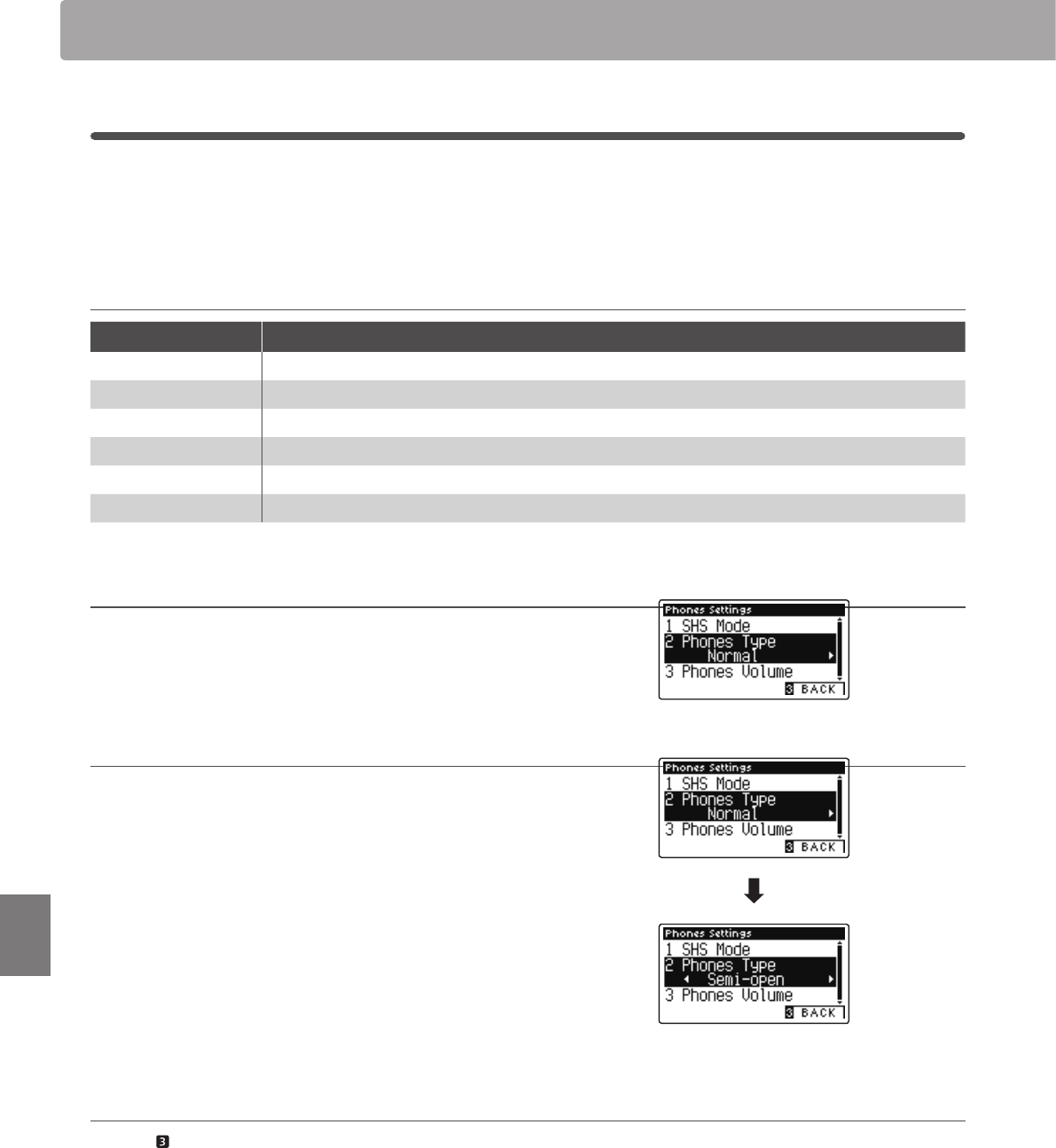
108
Settings
2
Phones Type
The Phones Type setting optimises the sound of the CS11/CS8 digital piano when listening through dierent types
of headphones or earphones.
* This setting does not aect the speaker or Line Out sound.
Phones Type setting
Phones Type Description
Normal (default) Disables headphone optimisation.
Open Optimises the sound for open type headphones.
Semi-open Optimises the sound for semi-open type headphones.
Closed Optimises the sound for closed type headphones.
Inner-ear Optimises the sound for inner-ear type headphones.
Canal Optimises the sound for canal-type headphones.
1. Selecting the Phones Type setting
After entering the Phones Settings menu (page 106):
Press the or buttons to select the Phones Type setting.
2. Changing the Phones Type setting
Press the or buttons to cycle through the dierent
earphone/headphone types.
* To reset the Phones Type setting to the default setting, press the
and buttons simultaneously.
* Any changes made to the Phones Type setting will remain until the
power is turned o.
* Preferred Phones Type settings can be stored to the Startup Setting
memory for convenient recall. Please refer to page 77 for more
information.
3. Exiting the Phones Type setting
Press the FUNCTION button (BACK) to exit the Phones Type
setting and return to the Function Menus screen.
Phones Settings
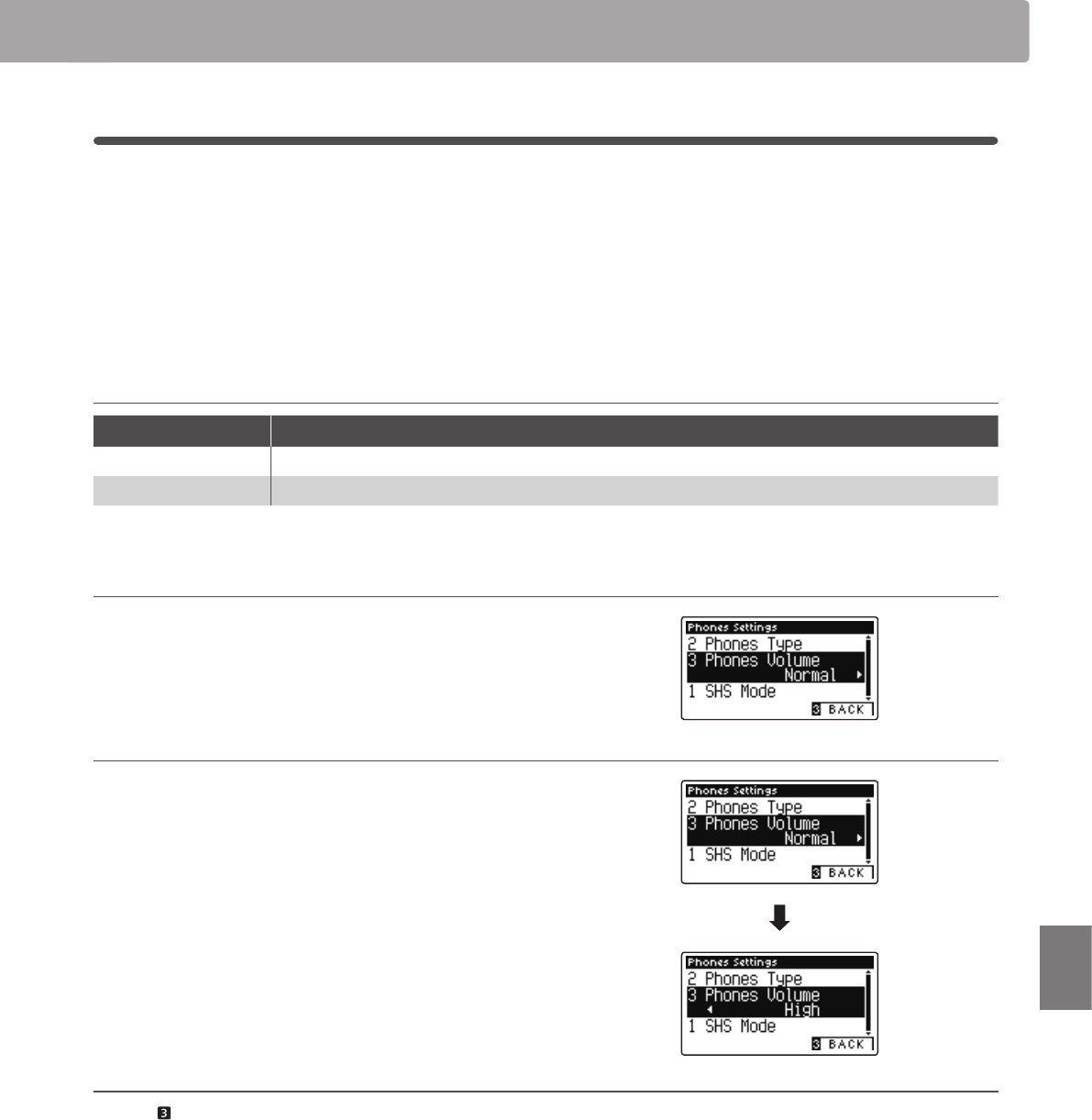
109
Settings
Phones Settings
3
Phones Volume
The Phones Volume setting allows the maximum volume level of the headphones output to be increased.
The default setting for Phones Volume is ‘Normal’ in order to protect an individual’s ears from excessive volume
levels. The ‘High’ setting may be selected when using headphones with a high impedance, or in situations where it
is desirable to increase the maximum volume level of the headphones output.
* This setting does not aect the speaker or Line Out sound.
Phones Volume setting
Phones Volume Description
Normal (default) The instrument’s headphone connectors will output sound at the normal volume level.
High The instrument’s headphone connectors will output sound at an increased volume level.
1. Selecting the Phones Volume setting
After entering the Phones Settings menu (page 106):
Press the or buttons to select the Phones Volume setting.
2. Changing the Phones Volume type
Press the or buttons to alternate between ‘Normal’ and
‘High’ Phones Volume settings.
* To reset the Phones Volume setting to the default setting, press the
and buttons simultaneously.
* Any changes made to the Phones Volume setting will remain until the
power is turned o.
* Preferred Phones Volume settings can be stored to the Startup
Setting memory for convenient recall. Please refer to page 77 for
more information.
3. Exiting the Phones Volume setting
Press the FUNCTION button (BACK) to exit the Phones Volume
setting and return to the Function Menus screen.
110
Settings
The CS11/CS8 digital piano features a ‘USB to Host’ type connector, allowing the instrument to be connected to a
computer using an inexpensive USB cable and utilised as a MIDI device. Depending on the type of computer and
operating system installed, additional driver software may be required for USB MIDI communication to function
correctly.
USB MIDI driver
Operating System USB MIDI Driver Support
Windows ME
Windows XP (no SP, SP1, SP2, SP3)
Windows XP 64-bit
Windows Vista (SP1, SP2)
Windows Vista 64-bit (SP1, SP2)
Windows 7 (no SP, SP1)
Windows 7 64-bit
Windows 8 / 8.1
Windows 8 / 8.1 64-bit
Windows 10
Windows 10 64-bit
Additional USB MIDI driver software NOT required.
The standard (built-in) Windows USB MIDI driver will be installed automatically when the
instrument is connected to the computer.
* After driver installation, ensure that the ‘USB Audio Device’ (Windows ME/Windows XP) or ‘USB-MIDI’
(Windows Vista/Windows 7/Windows 8) device is correctly selected in the application software.
Windows 98 se
Windows 2000
Windows Vista (no SP)
Additional USB MIDI driver software required.
Please download the USB MIDI driver from the Kawai Japan website:
http://www.kawai.co.jp/english
* After driver installation, ensure that the ‘KAWAI USB MIDI’ device is correctly selected in the application software.
Windows Vista 64-bit (no SP) USB MIDI is not supported.
Please upgrade to service pack 1 or service pack 2.
Mac OS X
Additional USB MIDI driver software NOT required.
The standard (built-in) Mac OS X USB MIDI driver will be installed automatically when the
instrument is connected to the computer.
Mac OS 9 USB MIDI is not supported.
Please use the standard MIDI IN/OUT connectors.
USB MIDI information
Disconnecting the USB MIDI cable suddenly, or turning the
instrument on/o while using USB MIDI may cause computer
instability in the following situations:
– while installing the USB MIDI driver
– while starting up the computer
– while MIDI applications are performing tasks
– while the computer is in energy saver mode
If there are any further problems experienced with USB MIDI
communication while the instrument is connected, please
double-check all connections and relevant MIDI settings in
the computer’s operating system.
If the instrument’s MIDI IN/OUT jacks and USB MIDI port are
both connected simultaneously, the USB MIDI port will be
given priority.
Ensure that the instrument is turned OFF before attempting
to connect the USB MIDI cable.
When connecting the instrument to a computer using
the USB MIDI port, there may be a short delay before
communications begin.
If the instrument is connected to a computer via a USB hub
and USB MIDI communication becomes unreliable/unstable,
please connect the USB MIDI cable directly to the one of the
computer’s USB ports.
* ‘MIDI’ is a registered trademark of the Association of Manufacturers of Electronic Instruments (AMEI).
* ‘Windows’ is registered trademark of Microsoft Corporation.
* ‘Macintosh’ is registered trademark of Apple Computer, Inc.
* Other company names and product names mentioned referenced herein may be registered trademarks or trademarks of respective owners.
USB MIDI (USB to Host connector)
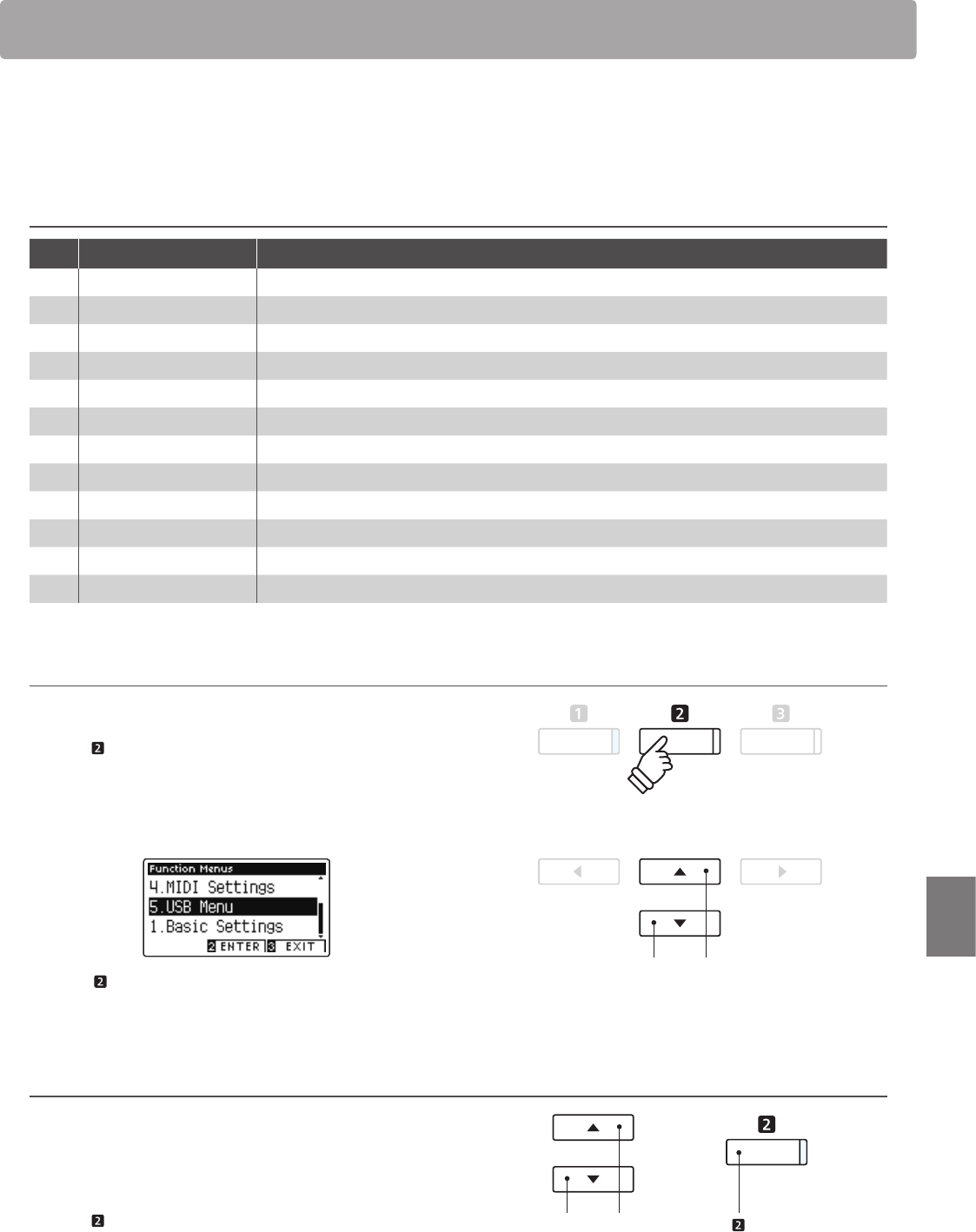
111
Settings
The USB Menu contains functions to load/save registration memories and recorder songs from/to a USB memory
device. This menu also allows les to be renamed and deleted, and for the USB memory device to be formatted.
USB Menu functions
No. Function Description
1 Load Song Load a recorder song from a USB memory device into the instrument’s internal memory.
2 Load Registration All Load a le containing all registration memories from a USB memory device into the instrument.
3Load Registration Single Load a single registration memory from a USB memory device into the instrument.
4 Load Startup Setting Load a Startup Settings le from a USB memory device into the instrument.
5 Save Internal Song Save a recorder song stored in internal memory to a USB memory device as a Kawai song le.
6 Save SMF Song Save a recorder song stored in internal memory to a USB memory device as an SMF (MIDI) le.
7 Save Registration All Save a le containing all registration memories from the instrument to a USB memory device.
8Save Registration Single Save a single registration memory from the instrument to a USB memory device.
9Save Startup Setting Save the instrument’s current Startup Settings to a USB memory device.
10 Rename File Rename a le stored on a USB memory device.
11 Delete File Delete a le stored on a USB memory device.
12 Format USB Format a USB memory device, erasing all stored data.
Entering the USB Menu menu
While the normal playing mode screen is shown in the LCD display:
Press the FUNCTION button (EDIT).
The Function menus will be shown in the LCD display.
Press the or buttons to select the USB Menu.
Press the FUNCTION button (ENTER) again to enter the USB
Menu.
Selecting the desired USB Menu function
After entering the USB Menu:
Press the or buttons to move the selection cursor over the
desired function.
Press the FUNCTION button (ENTER) to select the function. buttons:
Move selection cursor.
FUNCTION button:
Select function.
buttons:
Move selection cursor.
USB Menu
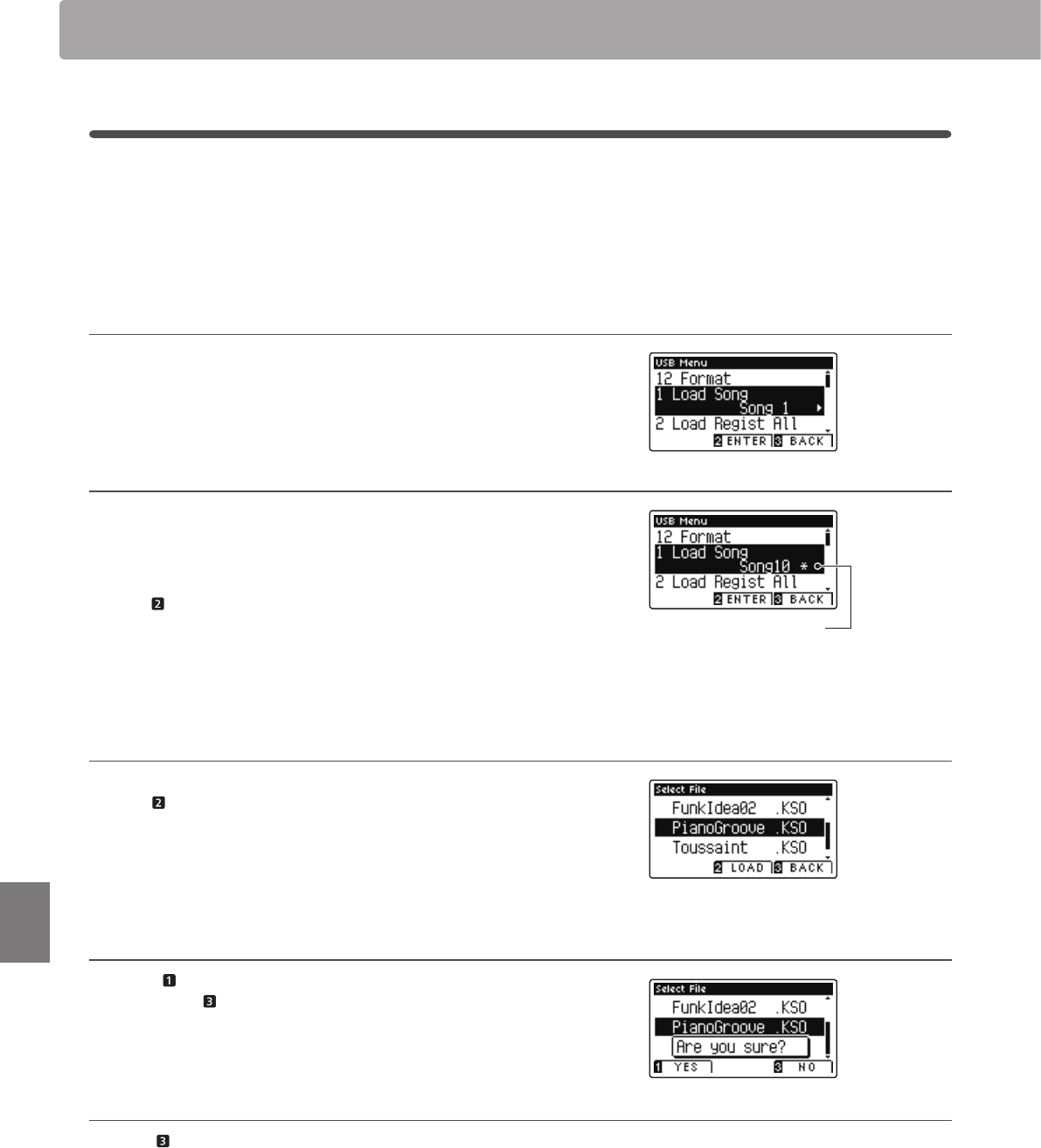
112
Settings
1
Load Song
The Load Song function is used to load CS11/CS8 recorder songs stored on a USB memory device into the instrument’s
internal memory.
* This function will overwrite any song data stored in the selected song memory.
* For more information about the instrument’s ‘Internal Song Recorder’ feature, please refer to page 48.
1. Selecting the Load Song function
After entering the USB Menu (page 111):
Press the or buttons to select the Load Song function.
2. Selecting the song memory
Press the or buttons to select the internal song memory for
the song to be loaded into.
* If a song memory contains song data, a * symbol will be shown.
Press the FUNCTION button (ENTER).
The le selection screen will be shown in the LCD display, listing
CS11/CS8 song les stored on the USB memory device.
3. Selecting the song to be loaded
Press the or buttons to move the selection cursor, then
press the FUNCTION button (LOAD) to select the song le.
A conrmation message will be shown in the LCD display,
prompting to conrm or cancel the load operation.
4. Conrming the load operation
Press the FUNCTION button (YES) to conrm the load
operation, or the FUNCTION button (NO) to cancel.
5. Exiting the Load Song function
Press the FUNCTION button (BACK) to exit the Load Song
function and return to the Function Menus screen.
To play back the loaded song le, please refer to the ‘Playing a
Song’ instructions on page 50.
Song has been recorded
USB Menu
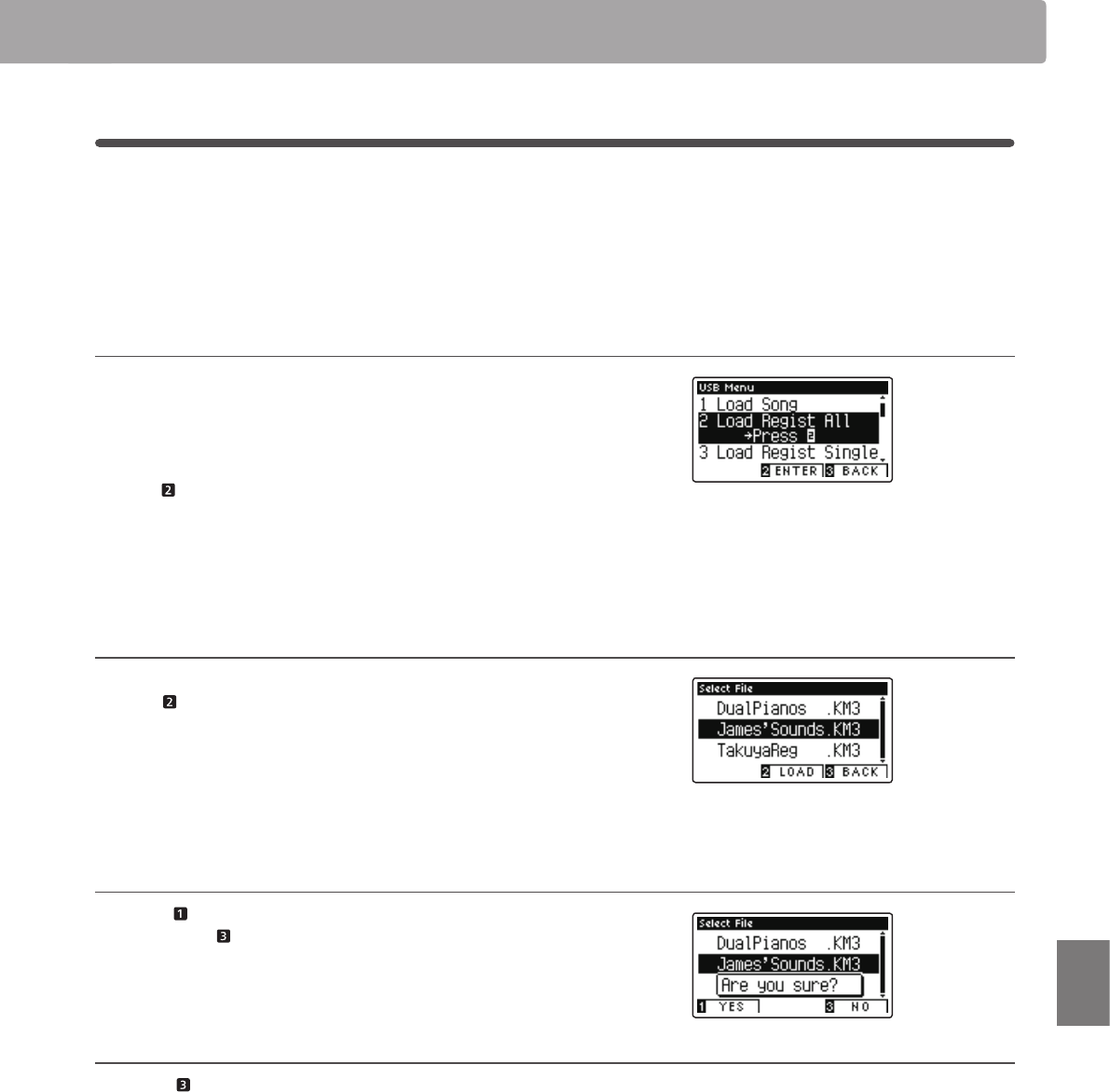
113
Settings
USB Menu
2
Load Registration All
The Load Registration All function is used to load a le containing all 16 CS11/CS8 registrations, stored on a USB
memory device into the instrument’s registration memories.
* This function will overwrite all existing Registration memories.
* For more information about the instrument’s Registration feature, please refer to page 32.
1. Selecting the Load Registration All function
After entering the USB Menu (page 111):
Press the or buttons to select the Load Registration All
function.
Press the FUNCTION button (ENTER).
The le selection screen will be shown in the LCD display, listing
CS11/CS8 registration les stored on the USB memory device.
2. Selecting the registration le to be loaded
Press the or buttons to move the selection cursor, then
press the FUNCTION button (LOAD) to select the registration
le.
A conrmation message will be shown in the LCD display,
prompting to conrm or cancel the load operation.
3. Conrming the load operation
Press the FUNCTION button (YES) to conrm the load
operation, or the FUNCTION button (NO) to cancel.
4. Exiting the Load Registration All function
Press the FUNCTION button (BACK) to exit the Load
Registration All function and return to the Function Menus
screen.
To use the loaded registrations, please refer to the Registration
instructions on page 32.
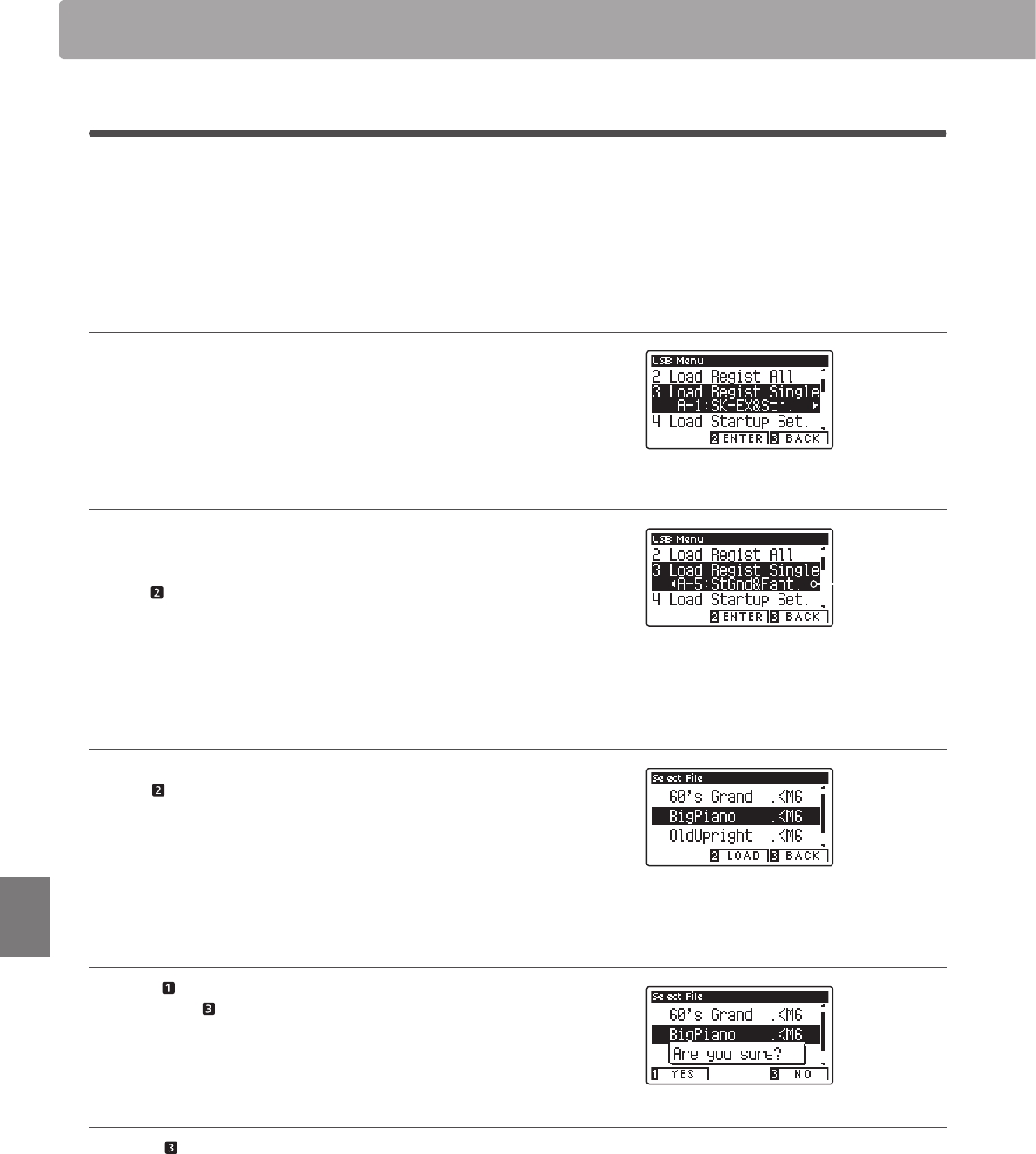
114
Settings
3
Load Registration Single
The Load Registration Single function is used to load a single CS11/CS8 registration le stored on a USB memory
device into one of the instrument’s registration memories.
* This function will overwrite the selected Registration memory.
* For more information about the instrument’s Registration feature, please refer to page 32.
1. Selecting the Load Registration Single function
After entering the USB Menu (page 111):
Press the or buttons to select the Load Registration Single
function.
2. Selecting the registration memory
Press the or buttons to select the registration memory for
the new registration to be loaded into.
Press the FUNCTION button (ENTER).
The le selection screen will be shown in the LCD display, listing
CS11/CS8 song les stored on the USB memory device.
3. Selecting the registration le to be loaded
Press the or buttons to move the selection cursor, then
press the FUNCTION button (LOAD) to select the registration
le.
A conrmation message will be shown in the LCD display,
prompting to conrm or cancel the load operation.
4. Conrming the load operation
Press the FUNCTION button (YES) to conrm the load
operation, or the FUNCTION button (NO) to cancel.
5. Exiting the Load Registration Single function
Press the FUNCTION button (BACK) to exit the Load
Registration Single function and return to the Function Menus
screen.
To play back the loaded song le, please refer to the ‘Playing a
Song’ instructions on page 50.
USB Menu
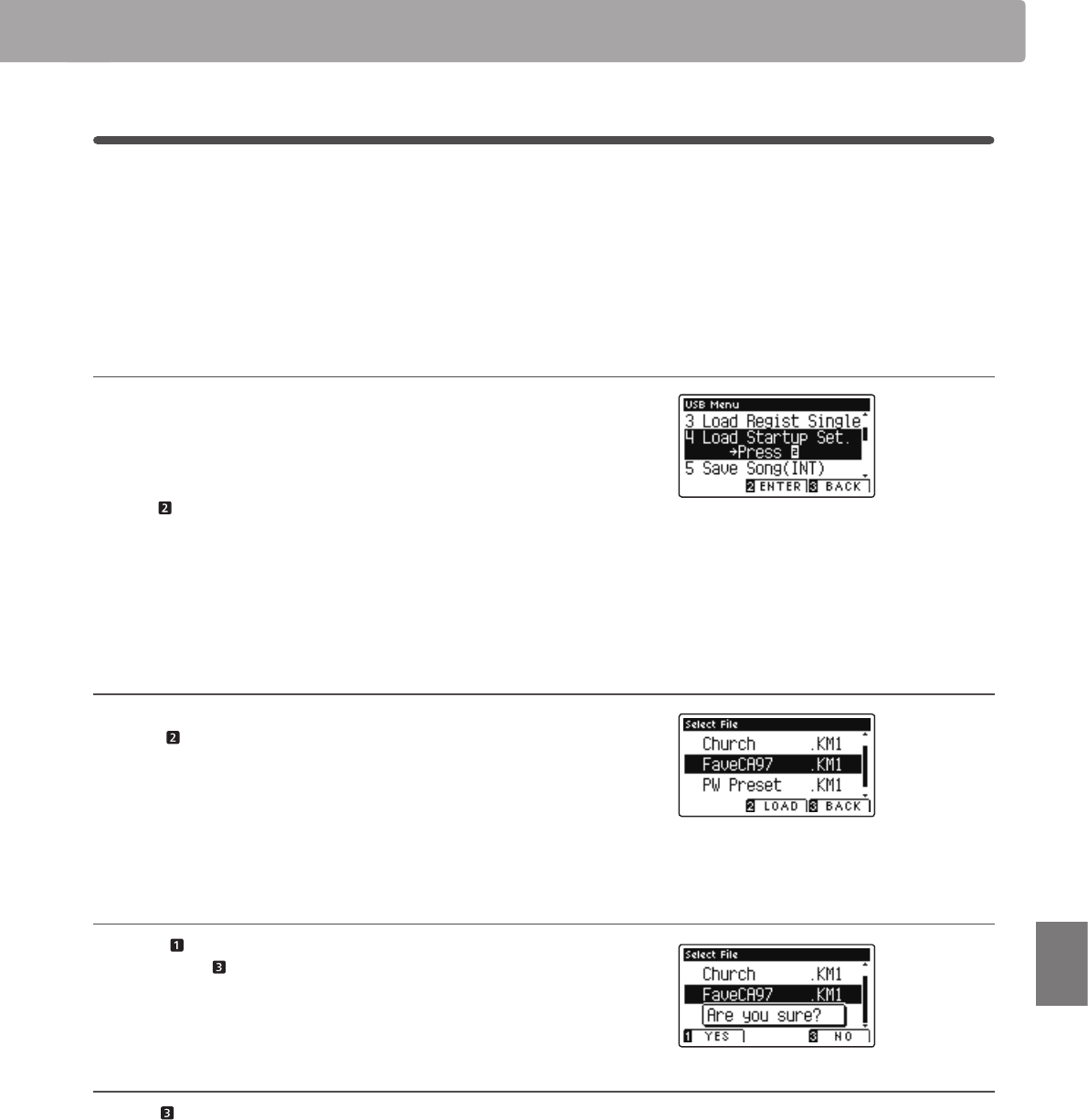
115
Settings
USB Menu
4
Load Startup Setting
The Load Startup Setting function is used to load a CS11/CS8 startup setting le stored on a USB memory device into
the instrument’s startup memory. The loaded settings will be used as the default settings every time the CS11/CS8
digital piano is turned on.
* This function will overwrite the previously stored Startup Settings memory.
* For more information about the instrument’s Startup Setting feature, please refer to page 77.
1. Selecting the Load Startup Setting function
After entering the USB Menu (page 111):
Press the or buttons to select the Load Startup Setting
function.
Press the FUNCTION button (ENTER).
The le selection screen will be shown in the LCD display, listing
CS11/CS8 startup settings les stored on the USB memory
device.
2. Selecting the startup settings le to be loaded
Press the or buttons to move the selection cursor, then
press the FUNCTION button (LOAD) to select the startup
settings le.
A conrmation message will be shown in the LCD display,
prompting to conrm or cancel the load operation.
3. Conrming the load operation
Press the FUNCTION button (YES) to conrm the load
operation, or the FUNCTION button (NO) to cancel.
4. Exiting the Load Startup Setting function
Press the FUNCTION button (BACK) to exit the Load Startup
Setting function and return to the Function Menus screen.
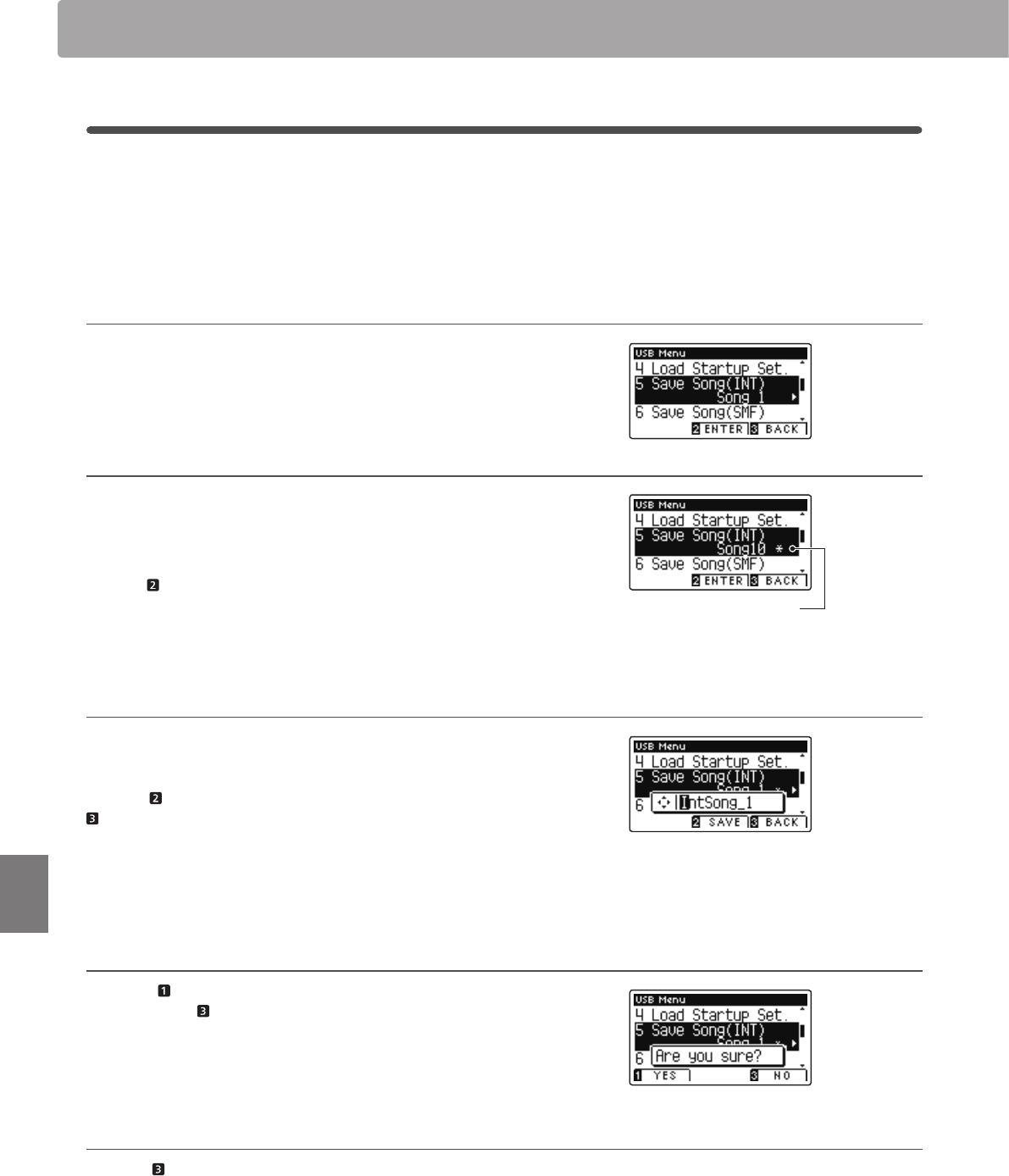
116
Settings
5
Save Internal Song
The Save Internal Song function is used to save CS11/CS8 recorder songs stored in the instrument’s internal memory
to a USB memory device in Kawai’s native song format.
* Songs saved in the native Kawai song format can be later reloaded into the instrument’s internal recorder memory.
* For more information about the instrument’s ‘Internal Song Recorder’ feature, please refer to page 48.
1. Selecting the Save Song function
After entering the USB Menu (page 111):
Press the or buttons to select the Save Song function.
2. Selecting the song memory to be saved
Press the or buttons to select the internal song memory
to be saved.
* If a song memory contains song data, a * symbol will be shown.
Press the FUNCTION button (ENTER).
The lename input screen will be shown in the LCD display.
3. Naming the song
Press the or buttons to cycle through the alphanumeric
characters, and the or buttons to move the cursor.
Press the FUNCTION button (SAVE) to save the song, or the
FUNCTION button (BACK) to cancel.
A conrmation message will be shown in the LCD display,
prompting to conrm or cancel the save operation.
4. Conrming the save operation
Press the FUNCTION button (YES) to conrm the save
operation, or the FUNCTION button (NO) to cancel.
* The song le will be saved in the root folder of the USB memory
device. It is not possible to save the le in a dierent folder.
5. Exiting the Save Song function
Press the FUNCTION button (BACK) to exit the Save Song
function and return to the Function Menus screen.
Song has been recorded
USB Menu
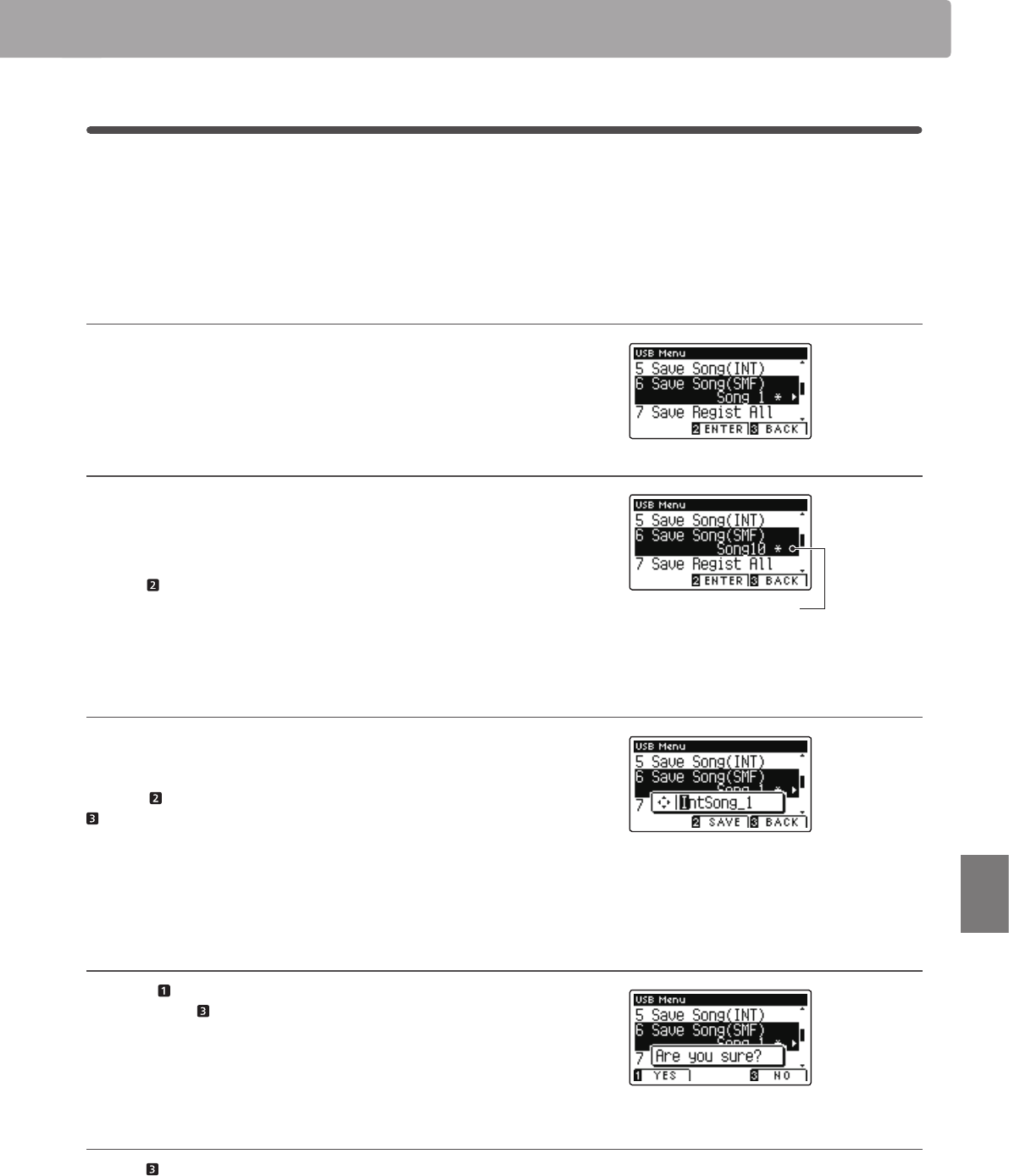
117
Settings
USB Menu
6
Save SMF Song
The Save SMF Song function is used to save CS11/CS8 recorder songs stored in the instrument’s internal memory to
a USB memory device as a Standard MIDI File (SMF).
* Songs saved in SMF format cannot be later reloaded into the instrument’s internal recorder memory.
* For more information about the instrument’s ‘Internal Song Recorder’ feature, please refer to page 48.
1. Selecting the Save SMF Song function
After entering the USB Menu (page 111):
Press the or buttons to select the Save SMF Song function.
2. Selecting the song memory to be saved
Press the or buttons to select the internal song memory
to be saved.
* If a song memory contains song data, a * symbol will be shown.
Press the FUNCTION button (ENTER).
The lename input screen will be shown in the LCD display.
3. Naming the SMF song
Press the or buttons to cycle through the alphanumeric
characters, and the or buttons to move the cursor.
Press the FUNCTION button (SAVE) to save the song, or the
FUNCTION button (BACK) to cancel.
A conrmation message will be shown in the LCD display,
prompting to conrm or cancel the save operation.
4. Conrming the save operation
Press the FUNCTION button (YES) to conrm the save
operation, or the FUNCTION button (NO) to cancel.
* The SMF song le will be saved in the root folder of the USB memory
device. It is not possible to save the le in a dierent folder.
5. Exiting the Save SMF Song function
Press the FUNCTION button (BACK) to exit the Save SMF Song
function and return to the Function Menus screen.
Song has been recorded
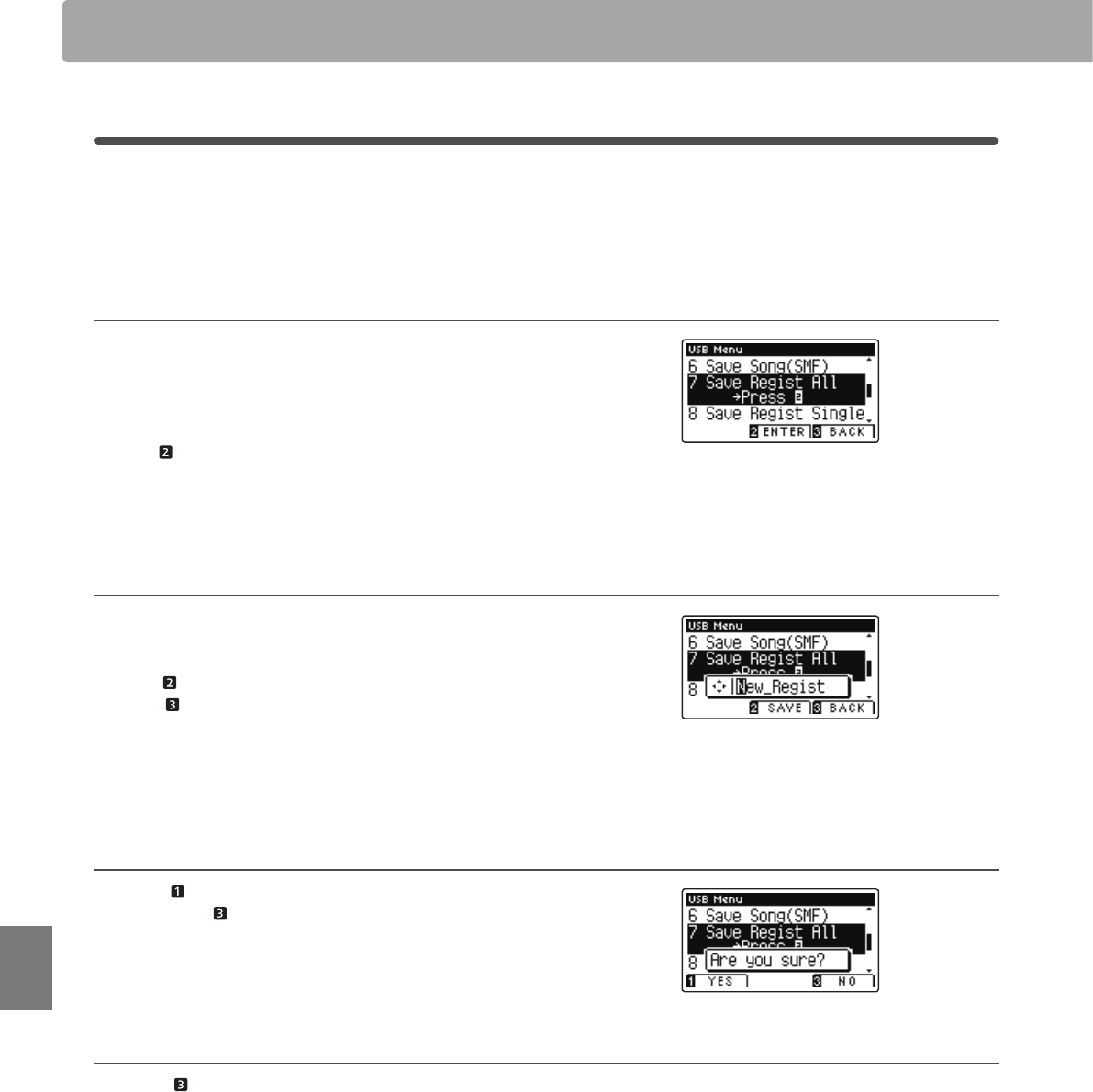
118
Settings
USB Menu
7
Save Registration All
The Save Registration All function is used to save a le containing all CS11/CS8 registration memories stored in the
instrument to a USB memory device.
* For more information about the instrument’s ‘Registration’ feature, please refer to page 32.
1. Selecting the Save Registration All function
After entering the USB Menu (page 111):
Press the or buttons to select the Save Registration All
function.
Press the FUNCTION button (ENTER).
The lename input screen will be shown in the LCD display.
2. Naming the Registrations le
Press the or buttons to cycle through the alphanumeric
characters, and the or buttons to move the cursor.
Press the FUNCTION button (SAVE) to save the registration
le, or the FUNCTION button (BACK) to cancel.
A conrmation message will be shown in the LCD display,
prompting to conrm or cancel the save operation.
3. Conrming the save operation
Press the FUNCTION button (YES) to conrm the save
operation, or the FUNCTION button (NO) to cancel.
* The registration le will be saved in the root folder of the USB memory
device. It is not possible to save the le in a dierent folder.
4. Exiting the Save Registration All function
Press the FUNCTION button (BACK) to exit the Save
Registration All function and return to the Function Menus
screen.
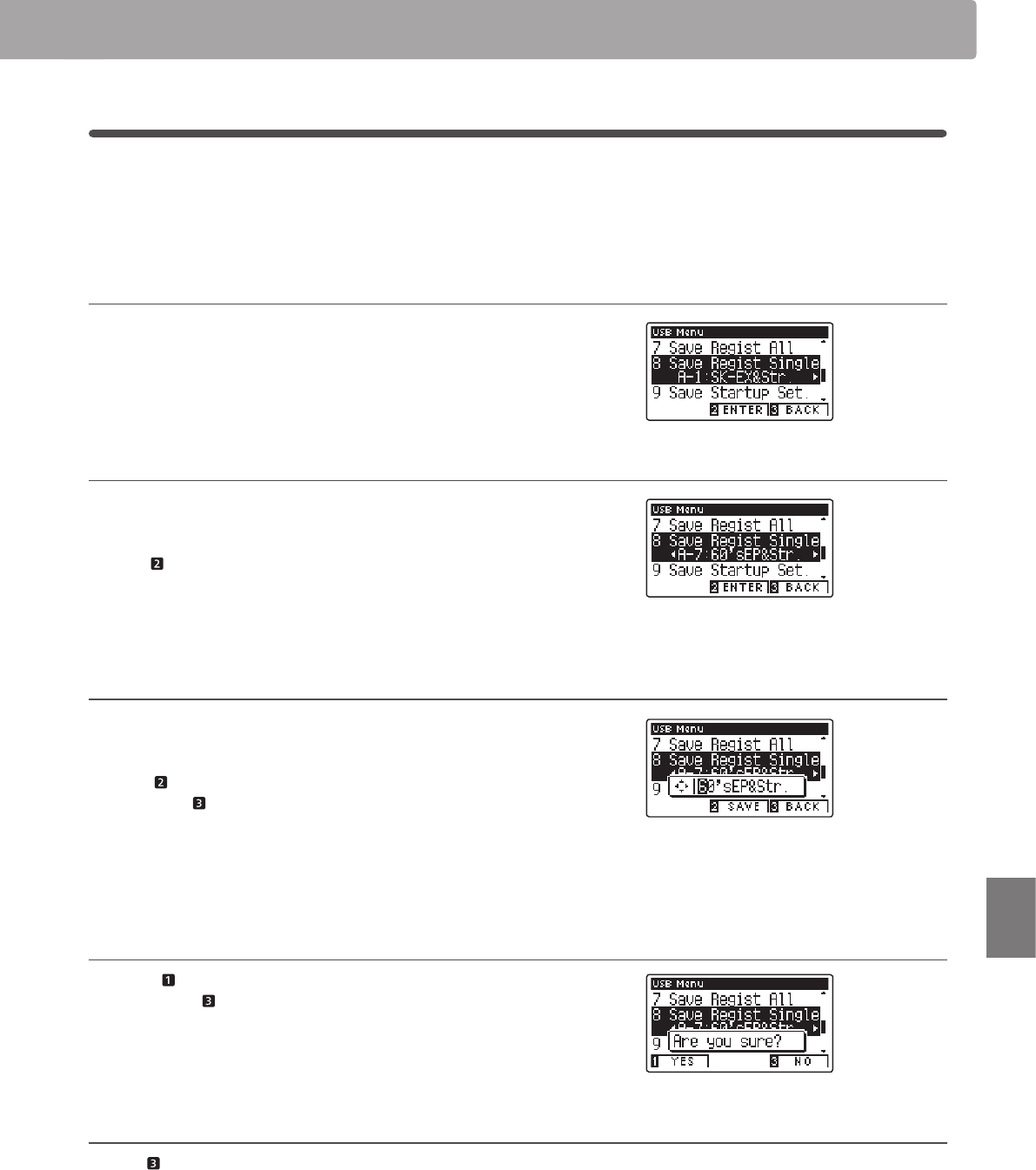
119
Settings
USB Menu
8
Save Registration Single
The Save Registration Single function is used to save a single CS11/CS8 registration memory stored in the instrument
to a USB memory device.
* For more information about the instrument’s Registration feature, please refer to page 32.
1. Selecting the Save Registration Single function
After entering the USB Menu (page 111):
Press the or buttons to select the Save Registration Single
function.
2. Selecting the registration memory to be saved
Press the or buttons to select the registration memory to
be saved.
Press the FUNCTION button (ENTER).
The lename input screen will be shown in the LCD display.
3. Naming the registration le
Press the or buttons to cycle through the alphanumeric
characters, and the or buttons to move the cursor.
Press the FUNCTION button (SAVE) to save the registration
memory, or the FUNCTION button (BACK) to cancel.
A conrmation message will be shown in the LCD display,
prompting to conrm or cancel the save operation.
4. Conrming the save operation
Press the FUNCTION button (YES) to conrm the save
operation, or the FUNCTION button (NO) to cancel.
* The registration le will be saved in the root folder of the USB memory
device. It is not possible to save the le in a dierent folder.
5. Exiting the Save Registration Single function
Press the FUNCTION button (BACK) to exit the Save Registration
Single function and return to the Function Menus screen.
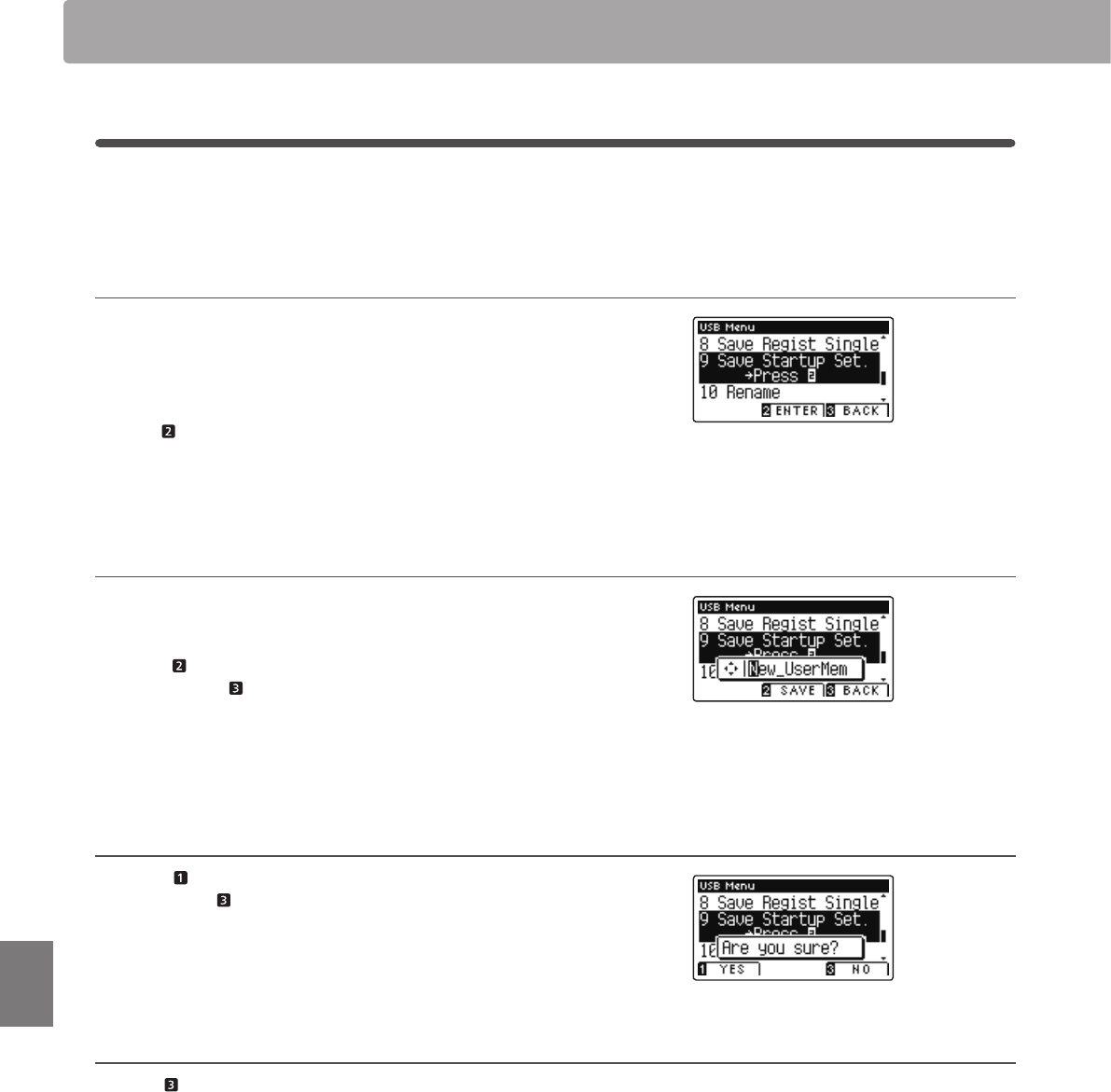
120
Settings
9
Save Startup Setting
The Save Startup Setting function is used to save the current CS11/CS8 Startup Settings to a USB memory device.
* For more information about the instrument’s ‘Startup Setting’ feature, please refer to page 77.
1. Selecting the Save Startup Setting function
After entering the USB Menu (page 111):
Press the or buttons to select the Save Startup Setting
function.
Press the FUNCTION button (ENTER).
The lename input screen will be shown in the LCD display.
2. Naming the Startup Setting le
Press the or buttons to cycle through the alphanumeric
characters, and the or buttons to move the cursor.
Press the FUNCTION button (SAVE) to save the startup
settings le, or the FUNCTION button (BACK) to cancel.
A conrmation message will be shown in the LCD display,
prompting to conrm or cancel the save operation.
3. Conrming the save operation
Press the FUNCTION button (YES) to conrm the save
operation, or the FUNCTION button (NO) to cancel.
* The startup settings le will be saved in the root folder of the USB
memory device. It is not possible to save the le in a dierent folder.
4. Exiting the Save Startup Setting function
Press the FUNCTION button (BACK) to exit the Save Startup
Setting function and return to the Function Menus screen.
USB Menu
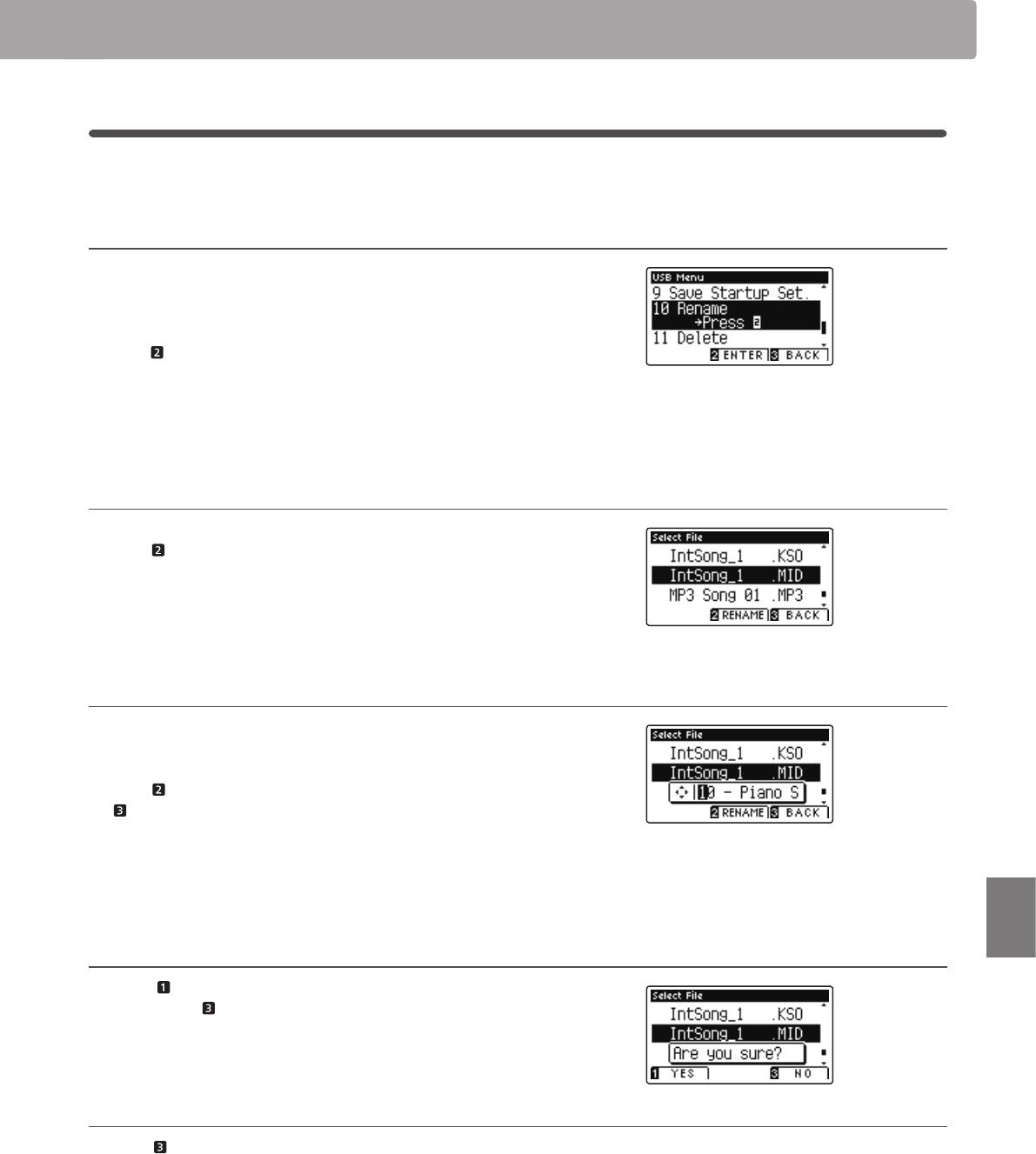
121
Settings
USB Menu
10
Rename File
The Rename File function is used to rename song, audio, and registration les stored on a USB memory device.
1. Selecting the Rename File function
After entering the USB Menu (page 111):
Press the or buttons to select the Rename File function.
Press the FUNCTION button (ENTER).
The le selection screen will be shown in the LCD display, listing
les stored on the USB memory device.
2. Selecting the le to be renamed
Press the or buttons to move the selection cursor, then
press the FUNCTION button (RENAME) to select the le to be
renamed.
The lename input screen will be shown in the LCD display.
3. Renaming the selected le
Press the or buttons to cycle through the alphanumeric
characters, and the or buttons to move the cursor.
Press the FUNCTION button (RENAME) to rename the le, or
the FUNCTION button (BACK) to cancel.
A conrmation message will be shown in the LCD display,
prompting to conrm or cancel the rename operation.
4. Conrming the rename operation
Press the FUNCTION button (YES) to conrm the rename
operation, or the FUNCTION button (NO) to cancel.
5. Exiting the Rename File function
Press the FUNCTION button (BACK) to exit the Rename File
function and return to the Function Menus screen.
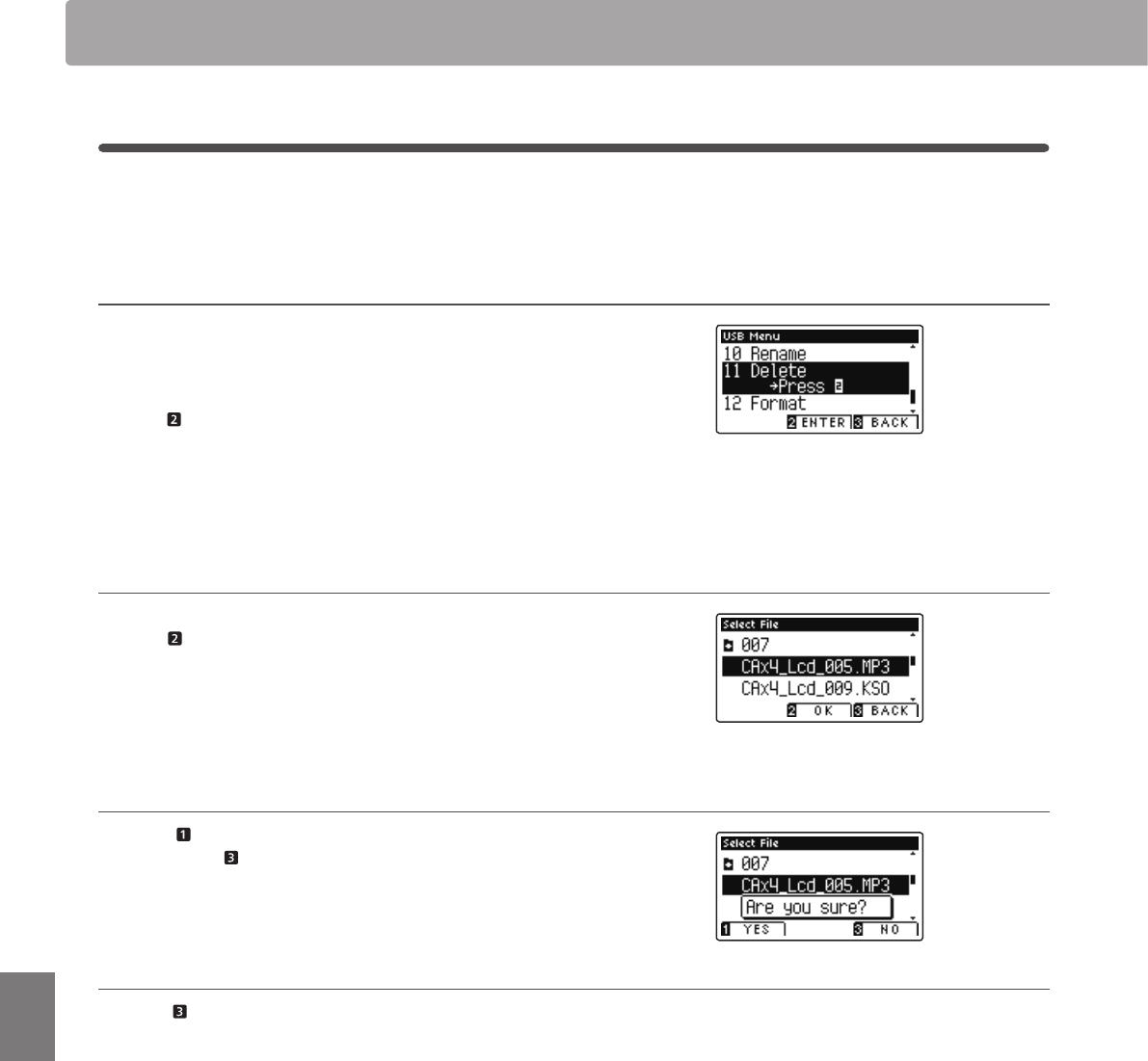
122
Settings
11
Delete File
The Delete File function is used to delete song, audio, and registration les stored on a USB memory device.
Once a le has been deleted from the USB device it cannot be recovered.
1. Selecting the Delete File function
After entering the USB Menu (page 111):
Press the or buttons to select the Delete File function.
Press the FUNCTION button (ENTER).
The le selection screen will be shown in the LCD display, listing
les stored on the USB memory device.
2. Selecting the le to be deleted
Press the or buttons to move the selection cursor, then
press the FUNCTION button (OK) to delete the le.
A conrmation message will be shown in the LCD display,
prompting to conrm or cancel the delete operation.
3. Conrming the delete operation
Press the FUNCTION button (YES) to conrm the delete
operation, or the FUNCTION button (NO) to cancel.
4. Exiting the Delete File function
Press the FUNCTION button (BACK) to exit the Delete File
function and return to the Function Menus screen.
USB Menu
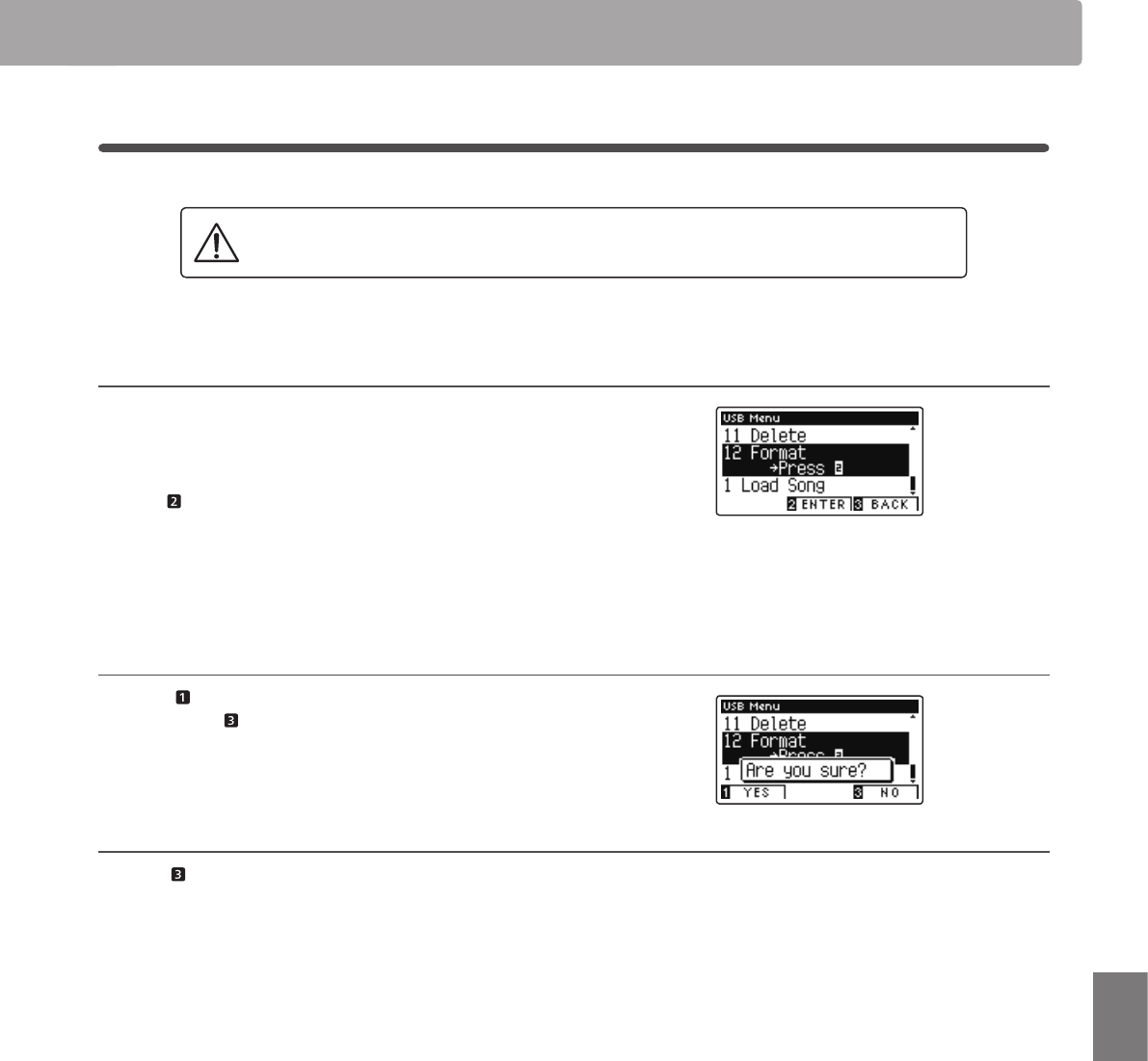
123
Settings
USB Menu
12
Format USB
The Format USB function is used to format the connected USB memory device, erasing all stored data.
The USB Format function will erase all data stored on the connected USB memory device.
Exercise caution when using this function in order to prevent accidental data loss.
1. Selecting the Format USB function
After entering the USB Menu (page 111):
Press the or buttons to select the Format USB function.
Press the FUNCTION button (ENTER).
A conrmation message will be shown in the LCD display,
prompting to conrm or cancel the format operation.
2. Conrming the format operation
Press the FUNCTION button (YES) to conrm the format
operation, or the FUNCTION button (NO) to cancel.
3. Exiting the Format USB function
Press the FUNCTION button (BACK) to exit the Format USB
function and return to the Function Menus screen.
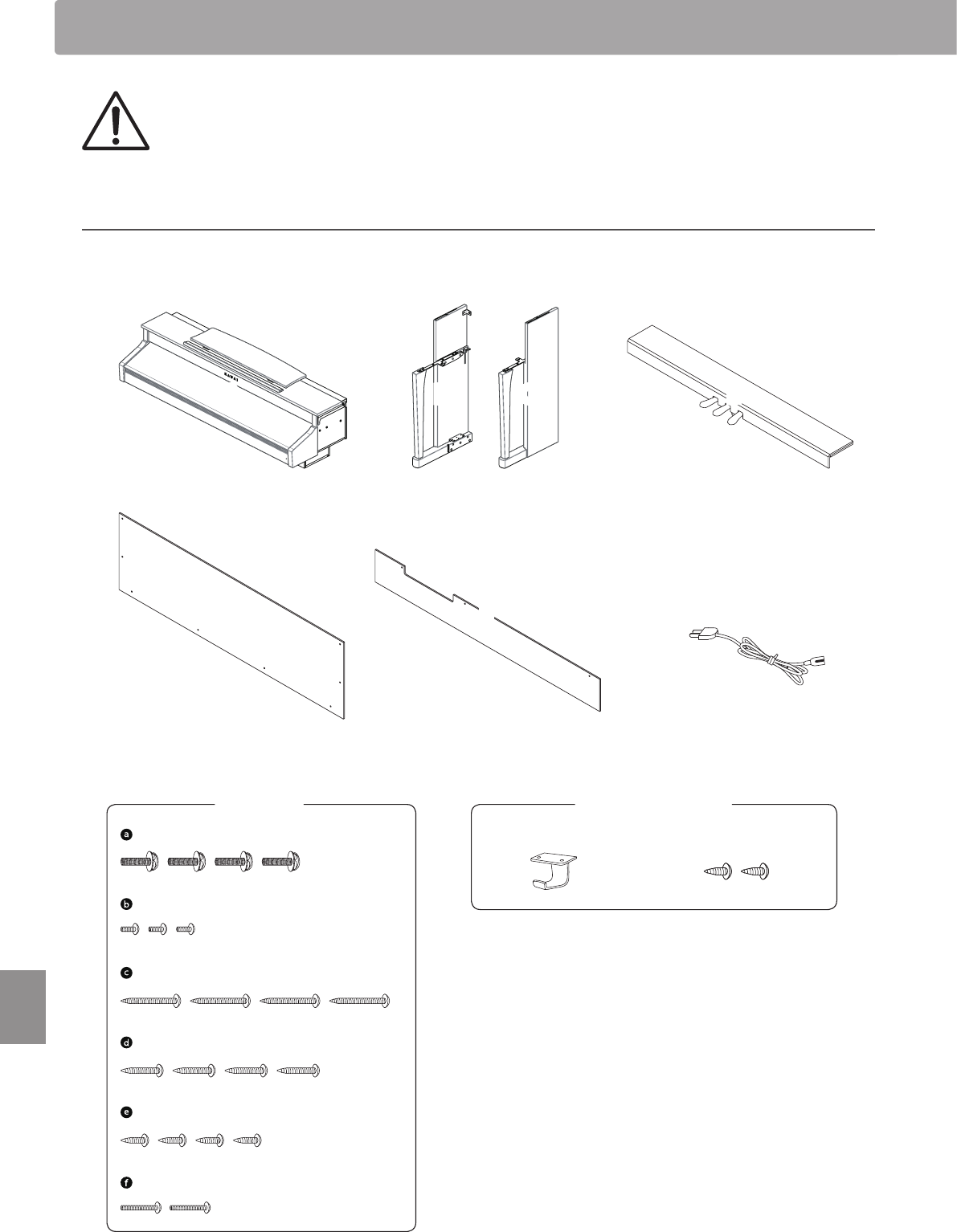
section
124
Appendix
Assembly Instructions (CS8 only)
Please read these assembly instructions thoroughly before attempting to assemble the CS8 digital piano.
Please ensure that two or more people work on assembling the CS8 digital piano, especially when lifting the
main body of the instrument onto the stand.
Included parts
Before attempting to assemble the CS8 digital piano, ensure that all parts below are included.
A Phillips-head screwdriver (not included) will also be required in order to assemble the instrument.
Main body Side panels
(left & right)
Back board Power cableFront under board
Pedal board
(including support bolt)
FE
Screw set Headphone hook set
Headphone hook Mounting screws (14 mm) x 2
DCBA
Screw (with washer) x 4
Screw (black, 12 mm) x 3
Tapping screw (black, 30 mm) x 4
Tapping screw (black, 20 mm) x 4
Tapping screw (silver, 16 mm) x 4
Screw (black, 20 mm) x 2
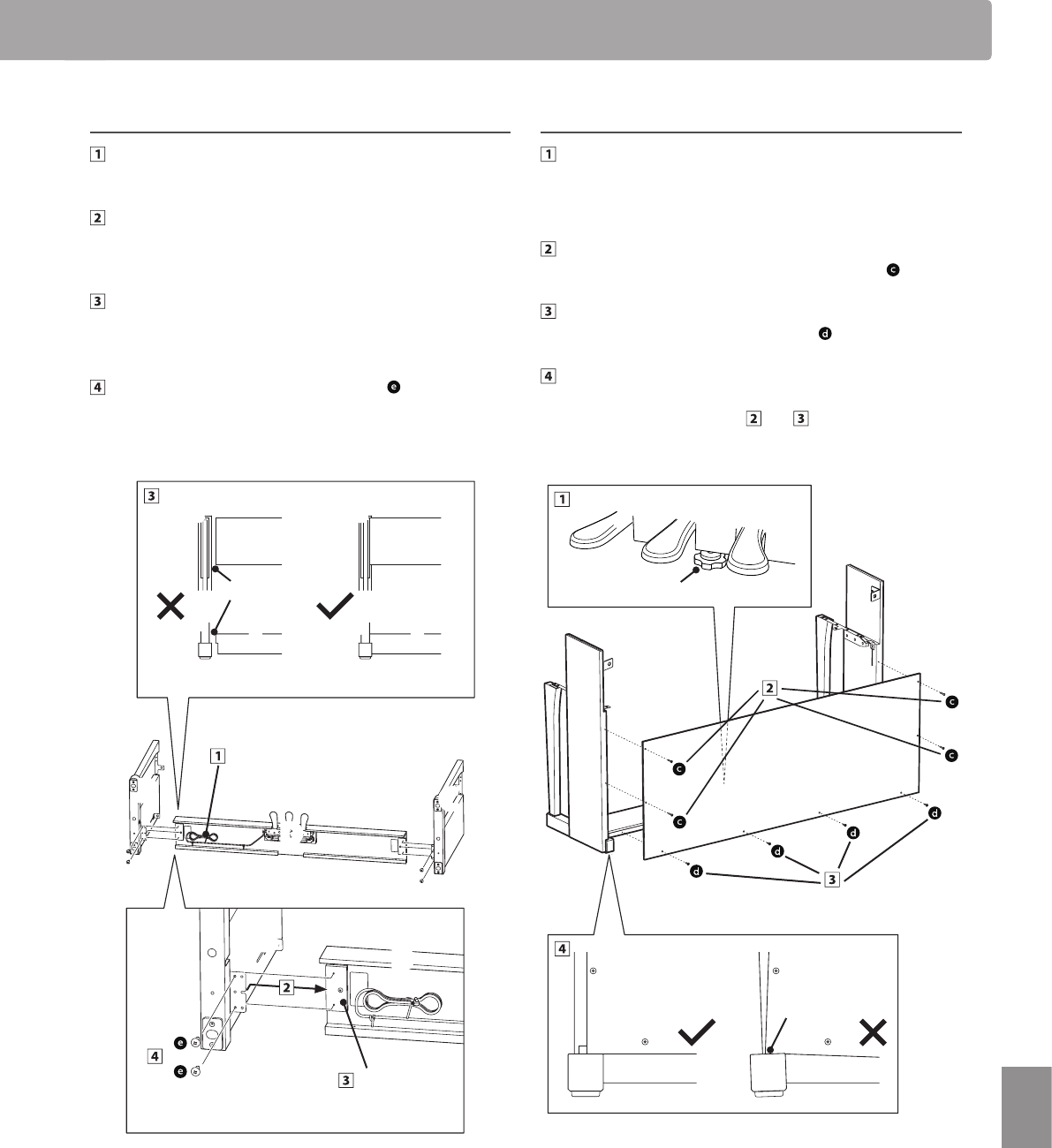
section
125
Appendix
Assembly Instructions (CS8 only)
1. Attaching the side panels to the pedal board
Unfasten and extend the pedal connection cable attached to
the bottom of the pedal board (D).
Attach the pedal board (D) to the left (B) and right (C) side
panels using the temporary mounting screws located on
either end of the pedal board.
Ensure that the pedal board and side panels make close
contact, and that there are no large gaps between the
assembled parts.
Insert the four short silver tapping screws into the holes as
shown, and securely fasten the pedal board to the left and
right side panels.
C
B
B
B
B
B
B
D
D
D
D
D
D
temporary
mounting
screw
pedal cable
gap
2. Attaching the back board
Allow the assembled pedal board and side panels to stand
upright (vertically) on the oor.
* Ensure that the support bolt is attached to the pedal board.
Loosely attach the back board (E) to the left and right side
panels using the four long black tapping screws .
Loosely attach the back board to the pedal board using the
four mid-length black tapping screws .
Adjust the positioning of the pedal board, side panels, and
backboard to ensure that all parts are in alignment, then
tighten the screws in steps and .
pedal support bolt
C
B
E
not aligned
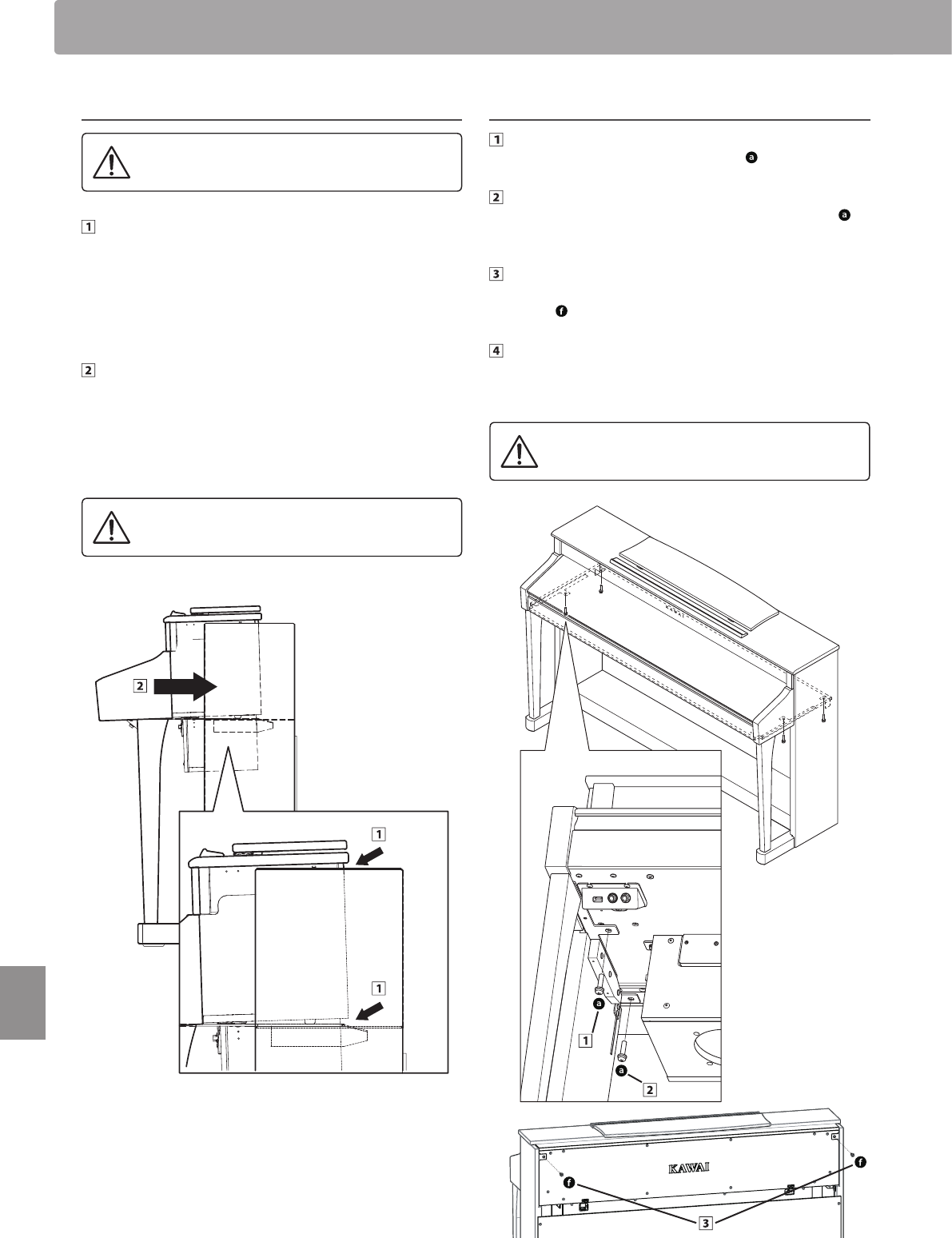
section
126
Appendix
Assembly Instructions (CS8 only)
3. Mounting the main body onto the stand
Ensure that two or more people undertake the
following step of the assembly process.
Lift the main body and carefully place it onto the front of the
assembled stand.
Position the main body so that it sits on top of the
guides running inside the left and right side panels. The
instrument’s top lid should overlap the tops of the side
panels.
Gently slide the main body backwards until the base
engages with the stand xings and locks into place. When
positioned correctly, the attachment screw holes should be
visible from the underside of the main unit.
* If the screw holes are not visible, re-adjust (loosen) the screws
attached in step 4-2.
When lifting the main body onto the stand, be
careful not to catch/trap hands and fingers.
C
A
4. Fastening the main body to the stand
Loosely fasten the front of the main body to the stand from
below, using two screws (with washer) on either side.
Loosely fasten the rear of the main body to the stand from
below, using the remaining two screws (with washer) on
either side.
Loosely fasten the back side of the main body to the metal
brackets attached towards the top of stand, using two
screws on either side.
When all six screws are attached and the main body is
correctly positioned on top of the stand, securely tighten all
screws.
Tighten all screws securely to ensure that the
main body is firmly attached to the stand.
A
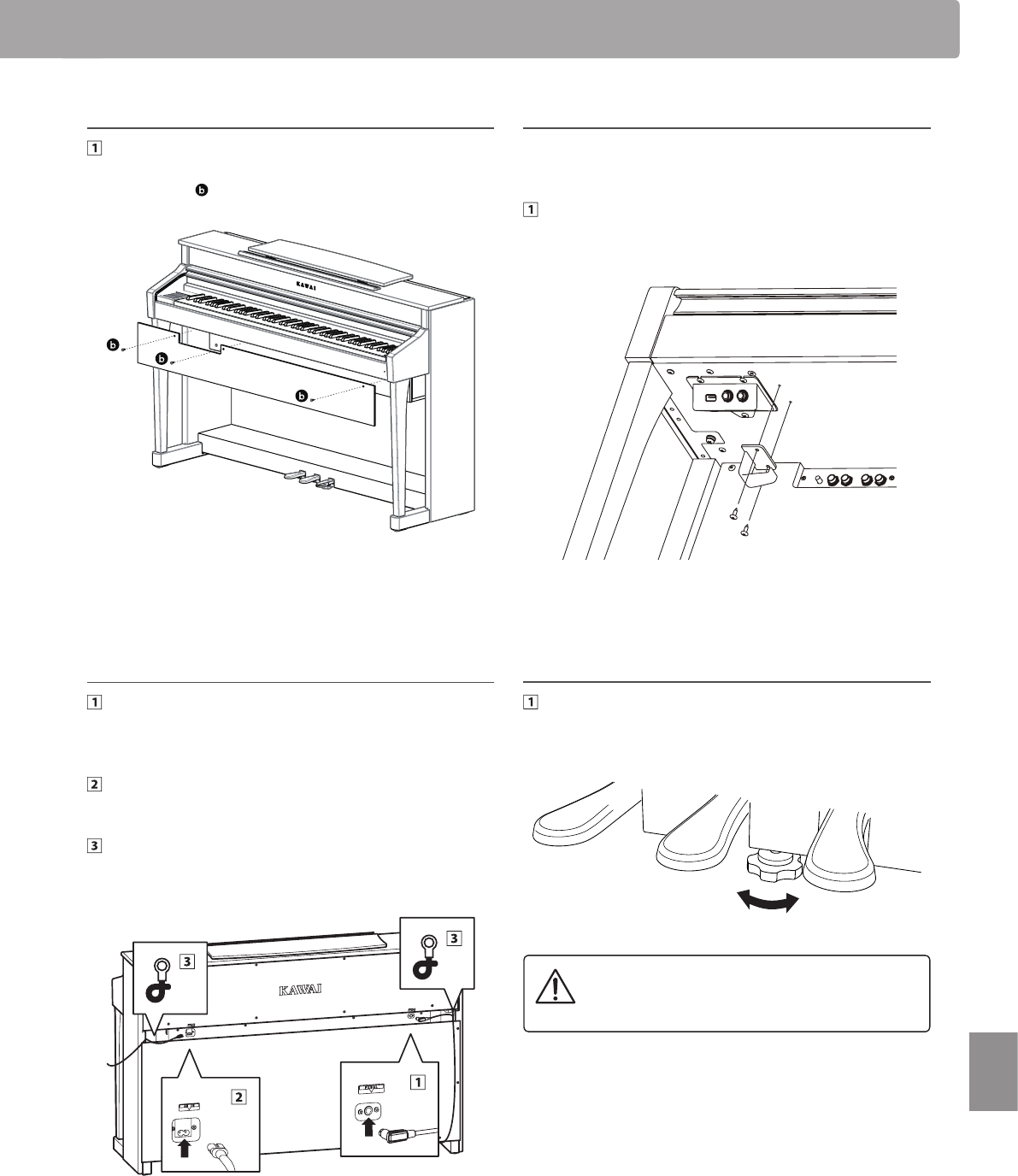
section
127
Appendix
5. Attaching the front under board
Attach the front under board (F) to the metal brackets
located underneath the main body using the three short
black screws .
F
6. Connecting the pedal and power cables
Connect the pedal cable originating from the pedal board
to the PEDAL terminal located on the rear of the main body,
below the speaker box..
Connect the power cable to the AC IN terminal, also located
on the rear of the main body.
With the power and pedal cables connected, use the binders
to x the cables in place and tidy their appearance.
7. Attaching the headphone hook (optional)
A headphone hook is included with the CS8 digital piano and can
be used to hang headphones when not in use.
If desired, attach the headphone hook to the underside of
the main body using the two tapping screws provided.
8. Adjusting the pedal support bolt
Turn the pedal support bolt anti-clockwise, extending the
bolt until it makes contact with the oor and supports the
pedals rmly.
When moving the instrument, always adjust or
remove the pedal support bolt, then readjust
when the instrument is in its new position.
Assembly Instructions (CS8 only)
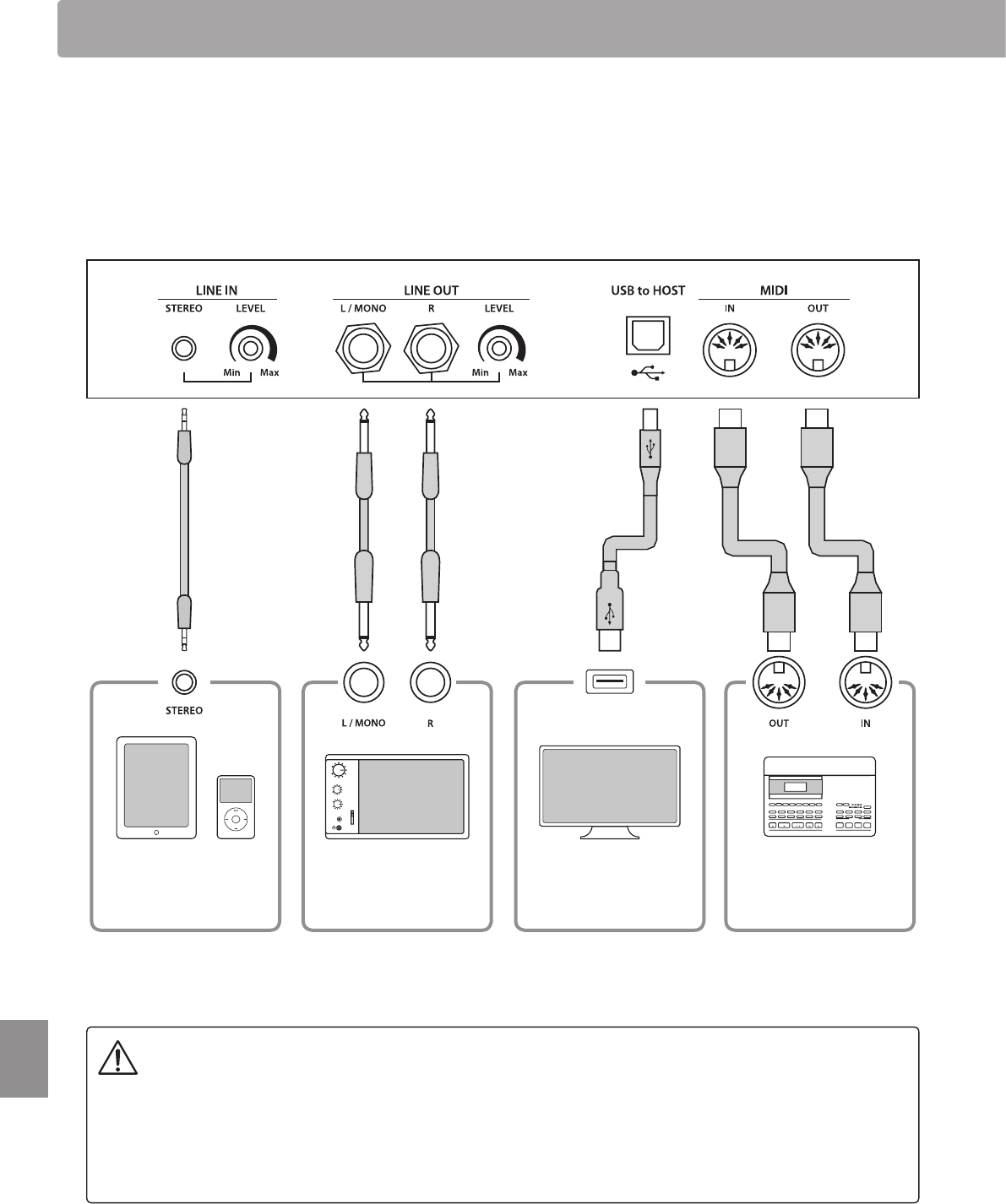
128
Appendix
Connecting to Other Devices
The CS11/CS8 digital piano features a variety of jacks that allow the instrument to be connected to MIDI devices,
computers, speakers, and mixers. It is also possible to connect external audio sources, such as an MP3 player, tablet,
or a secondary keyboard, to the instrument’s amplier and speaker system. The illustration below provides a visual
overview of the connectors and their typical applications.
Connect the instrument
to external speakers,
ampliers, mixers, etc.
Connect the instrument
to MIDI modules, other
instruments/devices, etc.
Connect the instrument
to a computer or tablet to
send or receive MIDI data.
Connect the audio from
other devices to the
instrument’s speakers.
USB type ‘B’
USB type ‘A’
Before connecting the CS11/CS8 digital piano to other devices, ensure that the power to both the instrument and
the other device is turned off. If connections are established while the power is turned on, extraneous noise that
can damage the CS11/CS8 digital piano may activate the instrument’s amplifier protection circuit, preventing any
sound from being produced. If this occurs, turn the power off and then on again to reset the amplifier protection
circuit.
Do not connect the LINE IN and LINE OUT jacks of the CS11/CS8 digital piano together with the same cable. An
audio loop (oscillation sound) will occur, resulting in damage to the unit.

129
Appendix
Connecting to Other Devices
Jack Panel
LINE IN STEREO jack (1/8” phone jack)
This jack is used to connect the 1/8” stereo outputs from
smart phones, tablets, computers, or other electronic audio
equipment to the CS11/CS8 digital piano’s amplier and
speakers. The input level can be adjusted using the LEVEL knob,
or by adjusting the volume of the connected device.
When using the USB audio recorder function, this LINE in audio
will also be mixed with the instrument’s internal sound and
recorded to the MP3/WAV le.
* The ‘Line In Level’ setting can also be used to adjust the level of the
LINE IN signal. Please refer to page 70 for more information.
USB to Host port (‘B’ type)
This USB port is used to connect the CS11/CS8 digital piano to a
computer using an inexpensive USB cable. When connected, the
instrument can be used as a standard MIDI device, allowing it to
send a receive MIDI data. Connect a ‘B’ type USB connector to
the instrument, and an ‘A’ type USB connector to the computer.
* Please refer to page 110 for more information about USB MIDI.
With additional conversion adaptors, this port may also be used
to connect the CS11/CS8 digital piano to tablets such as the
Apple iPad and other mobile devices.
LINE OUT jacks (1/4” phone jack)
These jacks are used to connect the stereo output of the CS11/
CS8 digital piano’s sound to external speakers, ampliers,
mixers, recording devices, and similar equipment.
To output a mono signal, connect a single cable to the L/MONO
jack.
The output level can be adjusted using the LEVEL knob. The
MASTER VOLUME slider does not aect the LINE OUT level.
MIDI IN/OUT jacks
These jacks are used to connect the CS11/CS8 digital piano
to external MIDI devices, or to a computer (using a USB-MIDI
interface) as an alternative to the ‘USB to Host’ port.
* Please refer to page 1 of “CS11/CS8 MIDI Settings Manual“ for more
information about MIDI.
Headphone Panel
PHONES jacks (1/4” & 1/8” phone jacks)
These jacks are used to connect stereo headphones to the CS11/
CS8 digital piano. Two pairs of headphones can be connected
and used simultaneously. When a pair of headphones is
connected, sound will not be produced by the speakers.
USB to Device port (‘A’ type)
This USB port is used to connect a USB memory device to the
CS11/CS8 digital piano. This allows MP3/WAV audio les, and
SMF song les to be played directly. It is also possible to record
performances to MP3/WAV audio les, and save recorder songs
stored in internal memory for posterity.
USB device information
It may be necessary to format the USB memory device before
it can be used with the CS11/CS8 digital piano. If so, please
refer to the USB Format function instructions on page 123.
Formatting the device will erase all data.
Avoid removing the USB memory device while data is being
loaded or saved, les are being renamed or deleted, or the
device is being formatted.
Other USB devices, such as computer mice, keyboards, or
battery chargers etc. cannot be used with this instrument.
The ‘USB to Device’ functionality of the CS11/CS8 digital piano
conforms to USB2.0 Hi-Speed standards. Older USB devices
can still be used, however data transfer speed will be limited
to the maximum transfer speed of the device.
The ‘USB to Device’ port is intended for connecting USB
memory devices, however USB oppy drive devices can also
be used to save recorder songs stored in internal memory, or
play SMF song les.
130
Appendix
Troubleshooting
The tables below summarise issues that may be experienced with the CS11/CS8 digital piano, explaining the typical
cause(s), and recommended solution(s).
Power
Issue Possible Cause and Solution Page no.
The instrument does not turn on. Check that the power cable is rmly attached to the instrument,
and connected to an AC outlet.
p. 14
The instrument turns itself o after a period
of inactivity.
Check that the ‘Auto Power O’ function is not enabled. p. 79
Sound
Issue Possible Cause and Solution Page no.
The instrument is turned on, however no sound
is produced when the keys are pressed.
Check that the MASTER VOLUME slider is not set to the lowest position. p. 15
Check that a pair of headphones (or headphone adaptor plug) are not
connected to the PHONES jacks.
p. 15
Check that the ‘Local Control’ setting in the MIDI Settings menu is set
to On.
“CS11/CS8 MIDI
Settings Manual“
p. 5
The sound distorts when playing at very loud
volume levels.
Check that the MASTER VOLUME slider is set to an appropriate level,
reducing the volume if excessive distortion is heard.
If connecting the instrument to an amplier/mixer using the Line Out
jacks, reduce the value of the ‘Line Out Volume’ setting in the Basic
Settings menu
p. 15
Strange sounds or noises are heard when
playing with piano sounds.
The CS11/CS8 digital piano attempts to reproduce the rich variety of
tones created by an acoustic grand piano as accurately as possible. This
includes various resonances, noises, and other subtle characteristics
that contribute to the overall piano playing experience.
While these additional tones are intended to enhance the realism of
the instrument, it is possible to reduce their prominence, or disable the
eects altogether using the settings in the Virtual Technician menu.
p. 80
The top 18 notes of the keyboard sustain for
longer than neighbouring notes, even when the
damper pedal is not pressed.
This is the correct behaviour, and intended to reproduce the
undamped notes (typically the top two octaves) of an acoustic grand
piano.
–
The volume of the device connected to the Line
In jacks is too low/too high (distorted).
Check the position of the Line In LEVEL knob (located on the jack
panel), and adjust as necessary.
p. 129
Pedals
Issue Possible Cause and Solution Page no.
The pedals are unreliable or do not function
at all.
Check that the pedal cable is rmly connected to the instrument
(CS8 only).
p. 127
When depressing a pedal, the pedal board
exes and is not rm.
Check that the pedal support bolt is fully extended. p. 127
131
Appendix
Troubleshooting
Headphones
Issue Possible Cause and Solution Page no.
The headphone volume is too low. If the ‘Nominal Impedance’ specication of the headphones is less
than 100 (ohms), set the ‘Phones Volume’ setting in the Phones
Settings menu to High.
p. 109
The headphone output sounds strange. Check that the ‘SHS Mode’ and ‘Phones Type’ settings are set to
‘Normal’.
p. 107
p. 108
USB (memory device)
Issue Possible Cause and Solution Page no.
A USB memory device is not detected, cannot be
saved to, or does not appear to function when
connected to the ‘USB to Device’ port.
Check that the USB memory device is formatted to use the FAT/FAT32
lesystem, and not set to ‘Write Protect’ mode.
p. 129
Disconnect the USB memory device, turn the instrument o then on, then
reconnect the USB device. If the USB device still does not function, it may
be damaged or incompatible. Please try using a dierent USB device.
–
The instrument pauses briey when connecting
a USB memory device.
This is recognised behaviour when using large capacity (e.g. 8GB+) USB
memory devices.
–
USB (MIDI)
Issue Possible Cause and Solution Page no.
The instrument is connected to the computer
using a USB cable, however the software does
not respond to key presses.
Check that a USB MIDI driver is installed on the computer. p. 110
Check that ‘USB Audio Device’ or ‘KAWAI USB MIDI’ is selected in the
software’s input/output device settings.
p. 110
MP3/WAV/SMF les
Issue Possible Cause and Solution Page no.
No sound can be heard when playing an MP3
or WAV audio le stored on a USB memory
device.
Check that the audio player volume is not set to 0. p. 57
Check that the format of the audio le is supported and listed in the
‘Audio Player supported format specications’ table.
p. 56
An MP3/WAV audio le stored on a USB
memory device sounds strange, or does not
play back correctly.
Check that the format of the audio le is supported and listed in the
‘Audio Player supported format specications’ table.
p. 56
The le transfer speed of the USB memory device may be too slow to
play the audio le. Please try using a dierent USB memory device,
ensuring that it conforms to USB2.0 Hi-Speed standards.
p. 129
When recording MP3/WAV audio les, the
volume is too low/too high (distorted).
Check the gain setting before recording the audio, and if necessary
adjust to increase/decrease the recording level.
p. 54
An SMF MIDI le stored on a USB memory
device sounds strange when played back.
The CS11/CS8 digital piano does not contain the full General MIDI
sound bank selection. Consequently, some SMF song les may not be
reproduced entirely accurately when played through the instrument.
p. 59
section
132
Appendix
Demo Song List
Sound Name Song Title Composer
PIANO 1
SK Concert Grand Grande Polonaise Brillante Op.22 Chopin
EX Concert Grand Polonaise-Fantaisie Chopin
SK-5 Grand Lieder Ohne Worte No.18 “Duetto” Mendelssohn
Jazz Clean Original Kawai
Warm Grand Sonata No.30 Op.109 Beethoven
Warm Grand 2 La Fille aux Cheveux de lin Debussy
Standard Grand Petit chien Chopin
PIANO 2
Pop Grand Original Kawai
Pop Piano Original Kawai
New Age Grand * Original Kawai
Upright Piano Alpenglühen Op.193 Oesten
Modern Piano Original Kawai
E. PIANO
Classic E.Piano Original Kawai
Mo d ern E . P. Original Kawai
Modern E.P. 2 * Original Kawai
ORGAN
Jazz Organ Original Kawai
Blues Organ Original Kawai
Drawbar Organ Original Kawai
Church Organ Chorale Prelude “Wachet auf, ruft uns die Stimme.” Bach
Diapason Wohl mir, daβ ich Jesum have Bach
Full Ensemble Original Kawai
HARPSI & MALLETS
Harpsichord French Suite No.6 Bach
Harpsichord Oct. Prelude in Ab Bach
Vibraphone Original Kawai
Clavi Original Kawai
STRINGS
Slow Strings Original Kawai
String Pad Original Kawai
String Ensemble Le quattro stagioni: La primavera Vivaldi
VOCAL & PAD
Choir Londonderry Air Irish folk song
Choir 2 Original Kawai
Jazz Ensemble Original Kawai
New Age Pad Original Kawai
Atmosphere Original Kawai
BASS & GUITAR
Wood Bass Original Kawai
Finger Bass Original Kawai
Fretless Bass Original Kawai
W. Bass & Ride Original Kawai
Ballad Guitar Original Kawai
Pick Nylon Gt. Original Kawai
* CS11 only.
section
133
Appendix
Sound List
PIANO 1
SK ConcertGrand
EX ConcertGrand
SK-5 GrandPiano
Jazz Clean
Jazz Old School *
Warm Grand
Warm Grand 2
Standard Grand
PIANO 2
Pop Grand
Pop Grand 2
Pop Piano
New Age Grand *
Upright Piano
Modern Piano
Boogie Piano *
Honky Tonk *
E. PIANO
Classic E. Piano
60 ’s E .P.
Mo d ern E . P.
Classic E.P. 2
New Age E.P.
Cr ystal E.P.
Modern E.P. 2 *
Modern E.P. 3 *
ORGAN
Jazz Organ
Blues Organ
Ballad Organ
Gospel Organ
Drawbar Organ
Drawbar Organ 2
Drawbar Organ 3 *
Drawbar Organ 4 *
Church Organ
Diapason
Full Ensemble
Diapason Oct.
Chiy Tibia
Principal Oct.
Principal Choir *
Baroque *
HARPSI & MALLETS
Harpsichord
Harpsichord Oct
Vibraphone
Clavi
Marimba
Celesta
Harpsichord 2 *
Bell Split *
STRINGS
Slow Strings
String Pad
Warm Strings
String Ensemble
Soft Orchestra
Chamber Strings *
Harp
Pizzicato Str. *
VOCAL & PAD
Choir
Pop Ooh
Pop Aah
Choir 2
Jazz Ensemble
Pop Ensemble
Slow Choir *
Breathy Choir *
New Age Pad
Atmosphere
Itopia
Brightness
New Age Pad 2 *
Brass Pad
Bowed Pad
Bright Warm Pad *
BASS & GUITAR
Wood Bass
Finger Bass
Fretless Bass
W. Bass & Ride
E. Bass & Ride *
Ballad Guitar
Pick Nylon Gt.
Finger Nylon Gt *
* CS11 only.

134
Appendix
Sound Name
Multi-timbral mode = o/on1 Multi-timbral mode = on2
Program Number Program Number Bank
CS11 CS8 MSB LSB
PIANO 1
SK ConcertGrand 111121 0
EX ConcertGrand 22195 27
SK-5 GrandPiano 33195 30
Jazz Clean 441121 1
Jazz Old School 5 - 1 95 32
Warm Grand 651121 2
Warm Grand 2 7 6 1 95 29
Standard Grand 87195 16
PIANO 2
Pop Grand 98195 28
Pop Grand 2 10 9 1 95 31
Pop Piano 11 10 295 10
New Age Grand 12 - 1 95 17
Upright Piano 13 11 195 25
Modern Piano 14 12 2121 0
Boogie Piano 15 - 1 95 33
Honky Tonk 16 - 4 121 0
E. PIANO
Classic E. Piano 17 13 5121 0
60 ’s E .P. 18 14 5121 3
Mo d ern E . P. 19 15 6121 0
Classic E.P. 2 20 16 5121 1
New Age E.P. 21 17 695 2
Cr ystal E.P. 22 18 695 1
Modern E.P. 2 23 - 6 121 1
Modern E.P. 3 24 - 6 121 2
ORGAN
Jazz Organ 25 19 18 121 0
Blues Organ 26 20 17 121 0
Ballad Organ 27 21 17 95 5
Gospel Organ 28 22 17 95 3
Drawbar Organ 29 23 17 95 1
Drawbar Organ 2 30 24 17 95 2
Drawbar Organ 3 31 -18 121 2
Drawbar Organ 4 32 -17 121 3
Church Organ 33 25 20 121 0
Diapason 34 26 20 95 7
Full Ensemble 35 27 21 95 1
Diapason Oct. 36 28 20 95 6
Chiy Tibia 37 29 20 95 17
Principal Oct. 38 30 20 95 24
Principal Choir 39 -20 95 23
Baroque 40 -20 95 19
Program Change Number List

135
Appendix
Program Change Number List
Sound Name
Multi-timbral mode = o/on1 Multi-timbral mode = on2
Program Number Program Number Bank
CS11 CS8 MSB LSB
HARPSI & MALLETS
Harpsichord 41 31 7121 0
Harpsichord Oct 42 32 7121 1
Vibraphone 43 33 12 121 0
Clavi 44 34 8121 0
Marimba 45 35 13 121 0
Celesta 46 36 9 95 1
Harpsichord 2 47 - 7 121 3
Bell Split 48 -15 95 5
STRINGS
Slow Strings 49 37 45 95 1
String Pad 50 38 49 95 8
Warm Strings 51 39 49 95 1
String Ensemble 52 40 49 121 0
Soft Orchestra 53 41 50 95 1
Chamber Strings 54 -49 95 14
Harp 55 42 47 121 0
Pizzicato Str. 56 - 46 121 0
CHOIR & PAD
Choir 57 43 53 121 0
Pop Ooh 58 44 54 95 39
Pop Aah 59 45 54 95 40
Choir 2 60 46 54 95 53
Jazz Ensemble 61 47 54 95 2
Pop Ensemble 62 48 54 95 7
Slow Choir 63 -53 95 2
Breathy Choir 64 -53 95 1
New Age Pad 65 49 89 121 0
Atmosphere 66 50 100 121 0
Itopia 67 51 92 121 1
Brightness 68 52 101 95 1
New Age Pad 2 69 -89 95 2
Brass Pad 70 53 62 95 2
Bowed Pad 71 54 93 121 0
Bright Warm Pad 72 -90 95 1
BASS & GUITAR
Wood Bass 73 55 33 121 0
Finger Bass 74 56 34 121 0
Fretless Bass 75 57 36 121 0
W. Bass & Ride 76 58 33 95 1
E. Bass & Ride 77 -34 95 2
Ballad Guitar 78 59 26 95 6
Pick Nylon Gt. 79 60 25 95 3
Finger Nylon Gt 80 -25 95 4

136
Appendix
Drum Rhythm List
No. Rhythm Name
8 Beat
1 8 Beat 1
2 8 Beat 2
3 8 Beat 3
4Pop 1
5Pop 2
6Pop 3
7Pop 4
8Pop 5
9Pop 6
10 Ride Beat 1
11 Ride Beat 2
12 Dance Pop 1
13 Country Pop
14 Smooth Beat
15 Rim Beat
8 Beat Rock
16 Modern Rock 1
17 Modern Rock 2
18 Modern Rock 3
19 Modern Rock 4
20 Pop Rock
21 Ride Rock
22 Jazz Rock
23 Surf Rock
16 Beat
24 16 Beat
25 Indie Pop 1
26 Acid Jazz 1
27 Ride Beat 3
28 Dance Pop 2
29 Dance Pop 3
30 Dance Pop 4
31 Dance Pop 5
32 Dance Pop 6
33 Dance Pop 7
34 Dance Pop 8
35 Indie Pop 2
36 Cajun Rock
8 Beat Ballad
37 Pop Ballad 1
38 Pop Ballad 2
39 Pop Ballad 3
40 Rock Ballad 1
41 Rock Ballad 2
42 Slow Jam
43 6/8 R&B Ballad
44 Triplet Ballad 1
45 Triplet Ballad 2
16 Beat Ballad
46 16 Ballad 1
47 Dance Ballad 1
48 Dance Ballad 2
49 Dance Ballad 3
50 Electro Pop
51 16 Ballad 2
52 Mod Pop Ballad
No. Rhythm Name
16 Beat Dance
53 Dance 1
54 Dance 2
55 Dance 3
56 Disco
57 Techno 1
58 Techno 2
16 Beat Swing
59 16 Shue 1
60 16 Shue 2
61 16 Shue 3
62 Acid Jazz 2
63 Acid Jazz 3
64 New Jack Swing
65 Modern Dance
66 Indie Pop 3
8 Beat Swing
67 Swing Beat
68 Motown
69 Country 2 Beat
70 Boogie
Triplet
71 8 Shue 1
72 8 Shue 2
73 8 Shue 3
74 Dance Shue
75 Triplet 1
76 Triplet 2
77 Triplet Rock
78 Reggae
Jazz
79 H.H. Swing
80 Ride Swing
81 Fast 4 Beat
82 Afro Cuban
83 Jazz Bossa
84 Jazz Waltz
85 5/4 Swing
Latin / Traditional
86 H.H. Bossa Nova
87 Ride Bossa Nova
88 Beguine
89 Rhumba
90 Cha Cha
91 Mambo
92 Samba
93 Sala
94 Merenge
95 Tango
96 Habanera
97 Waltz
98 Ragtime
99 March
100 6/8 March
section
137
Appendix
Specications
CS11 CS8
Keyboard 88 wooden keys with Ivory and Ebony Touch key surfaces
Grand Feel II (GFII) action with Let-O, Triple Sensor, and Counterweights
Sound Source Harmonic Imaging™ XL (HI-XL), 88-key piano sampling
Internal Sounds 80 voices 60 voices
Polyphony max. 256 notes
Keyboard Modes Dual Mode, Split Mode, Four Hands Mode (Volume/Balance adjustable)
Reverb Type: Room, Lounge, Small Hall, Concert Hall, Live Hall, Cathedral
Parameters: Reverb Depth, Reverb Time
Eects Type: Mono Delay, Ping Delay, Triple Delay, Chorus, Classic Chorus, Ensemble, Tremolo, Classic Tremolo,
Vibrato Tremolo, Tremolo+Amp, Auto Pan, Classic Auto Pan, Auto Pan+Amp, Phaser+Auto Pan,
Phaser, Classic Phaser, Phaser+Amp, Phaser+Chorus, Rotary (1~6)
Parameters: Dry/Wet, Time, Speed, Mono/Stereo, Accel./Rotary Speed – Parameters dependent on eect.
Virtual Technician Touch Curve: Light+, Light, Normal, Heavy, Heavy+, O (Constant), User Touch Curve
Voicing: Normal, Mellow 1, Mellow 2 , Dynamic, Bright 1, Bright 2, User Voicing
Resonance,
Noise & Eects:
Damper Resonance, Damper Noise, String Resonance, Undamped String Resonance,
Cabinet Resonance, Key-o Eect, Fall-back Noise, Topboard Simulation, Decay Time
Temperament
& Tuning:
Equal, Pure Major, Pure Minor, Pythagorean, Meantone, Werckmeister, Kirnberger,
User Temperament, Temperament Key, Stretch Tuning, User Tuning
Others: Hammer Delay, Minimum Touch, User Key Volume, Half-Pedal Adjust, Soft Pedal Depth
Internal Recorder 10 song, 2 track recorder – approximately 90,000 note memory capacity
USB Functions Playback: MP3, WAV, SMF
Record: MP3, WAV, SMF
Others: Load Song, Load Registration All, Load Registration Single, Load Startup Setting, Save Internal
Song, Save SMF Song, Save Registration All, Save Registration Single, Save Startup Setting,
Rename File, Delete File, Format USB, Convert Song to Audio, Overdub Audio
Metronome Beat: 1/4, 2/4, 3/4, 4/4, 5/4, 3/8, 6/8, 7/8, 9/8, 12/8 + 100 drum rhythms
Tempo: 10~400 bpm (20~800 bpm for eighth note rhythms)
Music Menu Demo Songs: 39 songs 37 songs
Piano Music: 29 or 42 songs ¹
Lesson Function: Songs from Alfred, Burgmüller, Czerny, Beyer, Bach, and Chopin lesson books ². Finger Exercises
Concert Magic: 176 songs (88 x 2 banks)
Registrations 16 memories (8 x 2)
Other Settings
& Functions
Key Transpose, Song Transpose, Tone Control (incl. User EQ), Speaker Volume, Line In Level, Wall EQ*, Tuning, Damper
Hold, Split, Four Hands, LCD Contrast, Startup Setting, Factory Reset, SHS Mode, Phones Type, Phones Volume, Lower
Octave Shift, Lower Pedal On/O, Split Balance, Layer Octave Shift, Layer Dynamics, Dual Balance, MIDI Channel,
Send PGM#, Local Control, Transmit PGM#, Multi-timbral Mode, Channel Mute, Auto Power O, Audio Recorder Gain
Display 128 x 64 pixel LCD with backlight
Pedals Sustain (with half-pedal support), Soft, Sostenuto. Grand Feel Pedal System
Jacks LINE IN (1/8” STEREO), LINE IN Level, LINE OUT (1/4” L/MONO, R), LINE OUT Level, Headphones x 2 (1/4”, 1/8”)
MIDI (IN/OUT), USB to Host, USB to Device
Speaker System Speakers: 7 cm x 4 (top speakers)
1.4 cm x 2 (dome tweeters)
Soundboard Speaker System
13 cm x 2 (woofers)
(8 x 12) cm x 2 (top speakers)
5 cm x 2 (tweeters)
Output Power: 45 W x 2 + 45 W transducer 50 W x 2
Power Consumption 55 W 45 W
Dimensions
(Not including music rack)
1510 (W) x 542 (D) x 1049 (H) mm
60” (W) x 21 ⁄” (D) x 41 ⁄” (H)
1447 (W) x 476 (D) x 956 (H) mm
57” (W) x 18 ¾” (D) x 37 ¾” (H)
Weight 99.0 Kg / 218 ½ lbs. 85.0 Kg / 187 ½ lbs.
Specications are subject to change without notice.* CS11 only. / ¹ depending on market area.
² Lesson books sold separately.

138
Appendix
User Notes
Copyright © 2015 Kawai Musical Instruments Mfg. Co.,Ltd. All Rights Reserved.
CS11/CS8 Owner’s Manual
818379
KPSZ-0810 R100
OW1095E-J1510
Printed in Indonesia
