3030 CANOBD2 Car Reader (E) 1994 Manual 0303 E
User Manual: 1994
Open the PDF directly: View PDF  .
.
Page Count: 32
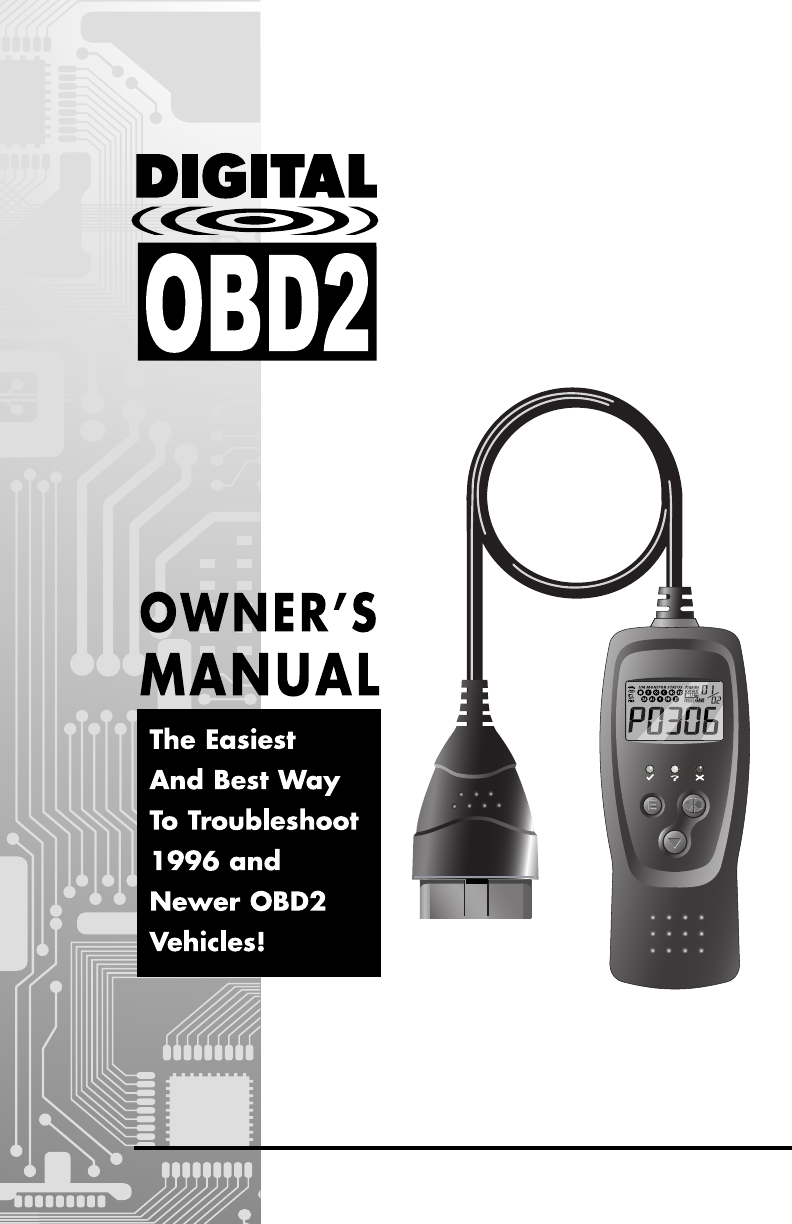
E1
CAR READER

Table of Contents
i OBD2
Title Page No.
YOU CAN DO IT! . . . . . . . . . . . . . . . . . . . . . . . . . . . . . . . . . . . . . . . . . . . . . 1
SAFETY PRECAUTIONS
Safety First . . . . . . . . . . . . . . . . . . . . . . . . . . . . . . . . . . . . . . . . . . . . . 2
ABOUT THE CAR READER
Vehicles Covered . . . . . . . . . . . . . . . . . . . . . . . . . . . . . . . . . . . . . . . . 3
Controls and Indicators . . . . . . . . . . . . . . . . . . . . . . . . . . . . . . . . . . . . 4
Display Functions . . . . . . . . . . . . . . . . . . . . . . . . . . . . . . . . . . . . . . . . 5
PREPARATION FOR TESTING
Before You Begin . . . . . . . . . . . . . . . . . . . . . . . . . . . . . . . . . . . . . . . . . 7
Vehicle Service Manuals . . . . . . . . . . . . . . . . . . . . . . . . . . . . . . . . . . . 7
USING THE CODE READER
Code Retrieval Procedure . . . . . . . . . . . . . . . . . . . . . . . . . . . . . . . . . . 8
Erasing Diagnostic Trouble Codes (DTCs) . . . . . . . . . . . . . . . . . . . . . . 10
DTC DEFINITIONS
Diagnostic Trouble Code Definitions . . . . . . . . . . . . . . . . . . . . . . . . . . . 12
E2
LIMITED WARRANTY AND SERVICE PROCEDURES
The Manufacturer warrants to the original purchaser that this unit is free of defects in materials and
workmanship under normal use and maintenance for a period of one (1) year from the date of original
purchase. If the unit fails within the one (1) year period, it will be repaired or replaced, at the Manufacturer's
option, at no charge, when returned prepaid to the Technical Service Center with Proof of Purchase. The
sales receipt may be used for this purpose. Installation labor is not covered under this warranty.
All replacement parts, whether new or re-manufactured, assume as their warranty period for only the
remaining time of this warranty. This warranty does not apply to damage caused by improper use, accident,
abuse, improper voltage, service, fire, flood, lightning, or other acts of God, or if the product was altered or
repaired by anyone other than the Manufacturer's Technical Service Center. Consequential and incidental
damages are not recoverable under this warranty. Some states do not allow the exclusion or limitation of
incidental or consequential damages, so the above limitation or exclusion may not apply to you.
This warranty gives you specific legal rights, and you may also have other rights, which vary from state
to state. No portion of this warranty may be copied or duplicated without the expressed written permission
from the Manufacturer.
Obtaining Warranty Service:
Products requiring service should be returned as follows:
1. Call the Technical Service Center to obtain a Return Reference Number:
USA & Canada = 1-800-544-4124 (6am-6pm, 7 days a week, PST)
Other = 714-241-6805 (6am-6pm, 7 days a week, PST)
2. Package the product carefully to prevent shipping damage
3. Include your name, return address, and a day contact phone
4. Enclose a copy of the dated sales receipt
5. Describe the problem
6. Ship prepaid to: Technical Service Center, 17352 Von Karman Ave., Irvine, CA 92614 U.S.A.
Phone: 1-800-544-4124 or 714-241-6805 Fax: 714-432-3979
Web: www.innova.com Email: service@innova.com
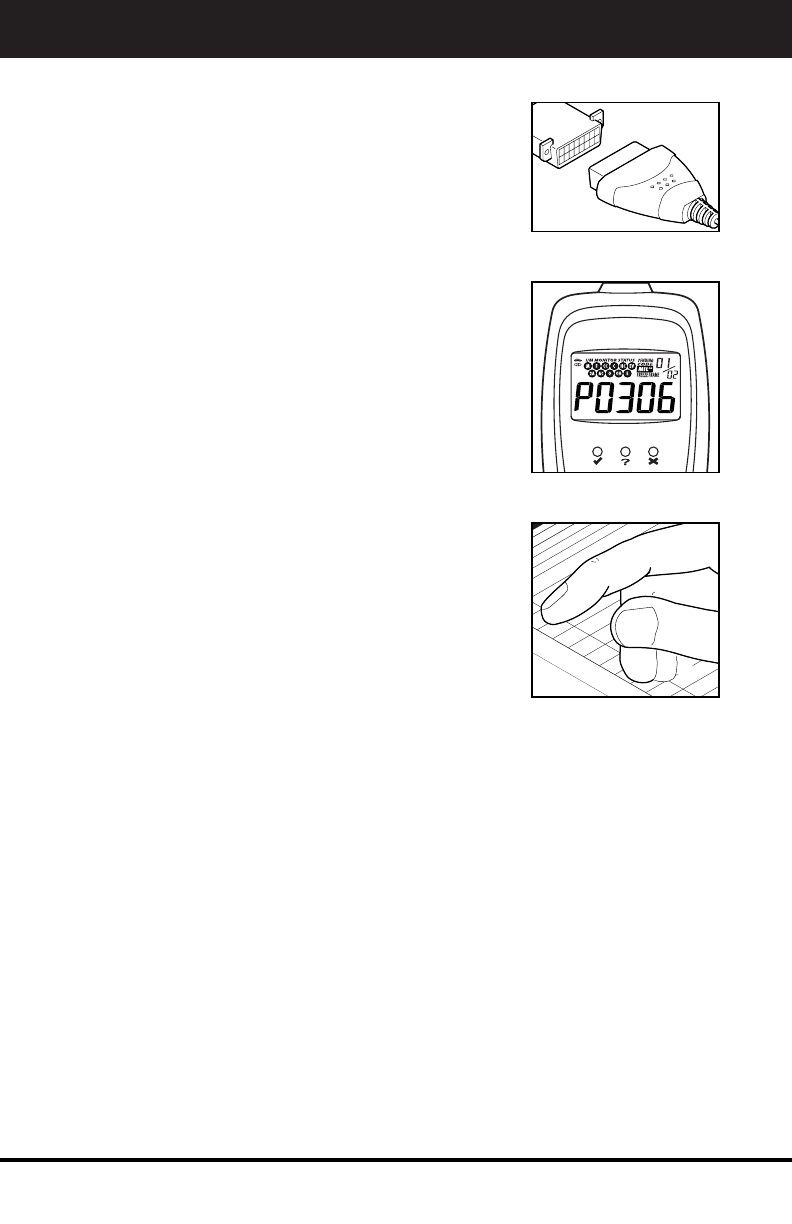
You Can Do It!
EASY TO USE - EASY TO VIEW - EASY TO DEFINE
OBD2 1
Easy To Use . . . .
■Connect the Car Reader to the vehicle’s test
connector.
■Turn the ignition key "On.” DO NOT start the
engine.
■The Car Reader will automatically link to the
vehicle’s computer.
Easy To View . . . .
■The Car Reader retrieves stored codes and
displays I/M Readiness status.
■Codes are displayed on the Car Reader’s LCD
display screen; I/M Readiness status is displayed
by LED indicators.
Easy To Define . . . .
■Locate fault code(s) in the Fault Code Definition
list.
E3
tr
Definition
yst
Temperature Belo
w
e
E
mission Control System
M
ati
ve Emission Control System Inco
rr
po
rative Emission Control System Leak
Det
sm
all leak)
Evaporative Emission Control System Purge Contro
l
Valve Circuit Malfunction
P0
444 Evaporative Emission Control System Purge Control
Valve Circuit Open
P0445 Evaporative Emission Control System Purge Control
Valve Circuit Shorted
P0446 Evaporative Emission Control System Vent Control
Circuit Malfunction
P0447 Evaporative Emission Control System Vent Co
nt
Circuit Open
P0448 Evaporative Emission Control System V
en
Circuit Shorted
P0449 Evaporative Emission Control Sys
te
Solenoid Circuit Malfunction
P0450 Evaporative Emission Contr
ol
Malfunction
P0451 Evaporative Emission
C
Range/Performance
P0452 Evaporative Em
is
Low Input
45
3 Evaporati
ve
High I
np
Ev
a
p
2 OBD2
Safety Precautions
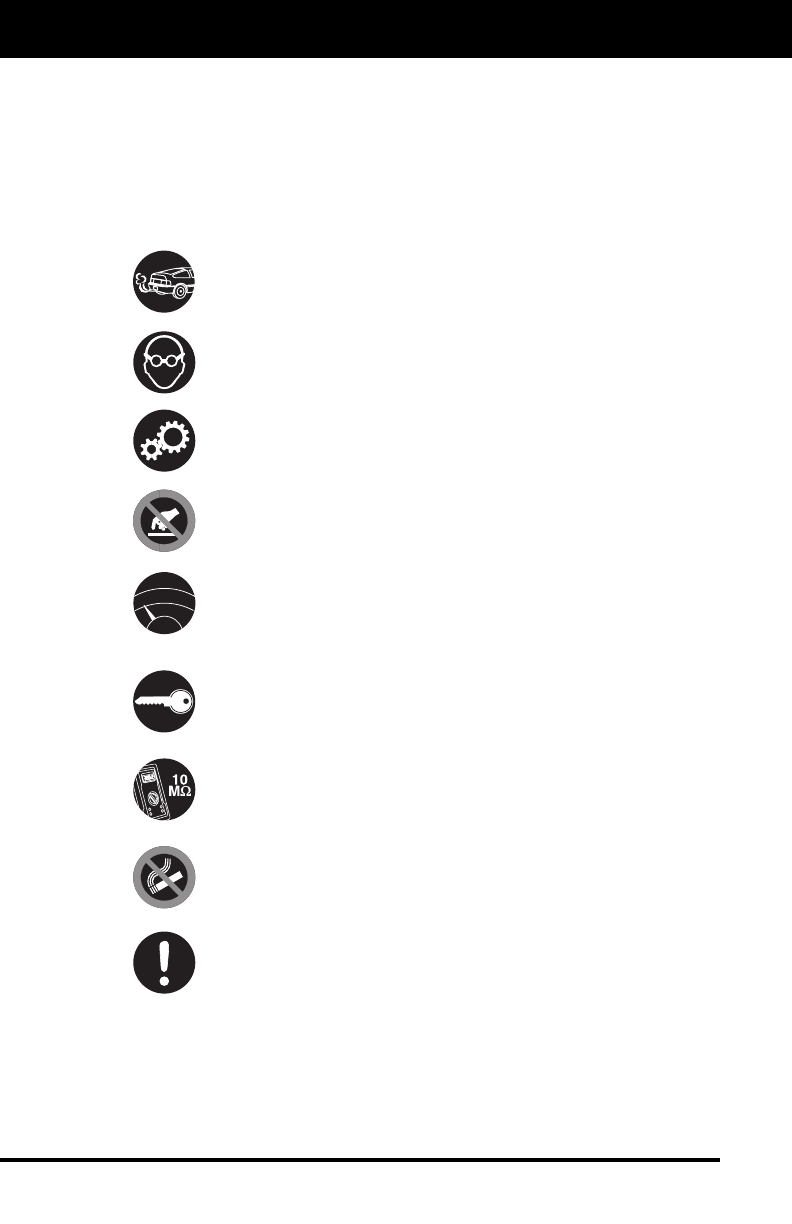
SAFETY FIRST
SAFETY FIRST!
This manual describes common test procedures used by experienced service
technicians. Many test procedures require precautions to avoid accidents that
can result in personal injury, and/or damage to your vehicle or test equipment.
Always read your vehicle's service manual and follow its safety precautions
before and during any test or service procedure. ALWAYS observe the following
general safety precautions:
When an engine is running, it produces carbon monoxide, a toxic
and poisonous gas. To prevent serious injury or death from carbon
monoxide poisoning, operate the vehicle ONLY in a well-ventilated
area.
To protect your eyes from propelled objects as well as hot or caustic
liquids, always wear approved safety eye protection.
When an engine is running, many parts (such as the coolant fan,
pulleys, fan belt etc.) turn at high speed. To avoid serious injury,
always be aware of moving parts. Keep a safe distance from these
parts as well as other potentially moving objects.
Engine parts become very hot when the engine is running. To
prevent severe burns, avoid contact with hot engine parts.
Before starting an engine for testing or trouble-shooting, make sure
the parking brake is engaged. Put the transmission in park (for
automatic transmission) or neutral (for manual transmission). Block
the drive wheels with suitable blocks.
Connecting or disconnecting test equipment when the ignition is ON
can damage test equipment and the vehicle's electronic com-
ponents. Turn the ignition OFF before connecting the Code Reader
to or disconnecting the Code Reader from the vehicle’s Data Link
Connector (DLC).
To prevent damage to the on-board computer when taking vehicle
electrical measurements, always use a digital multimeter with at
least 10 megOhms of impedance.
The vehicle's battery produces highly flammable hydrogen gas. To
prevent an explosion, keep all sparks, heated items and open flames
away from the battery.
Don't wear loose clothing or jewelry when working on an engine.
Loose clothing can become caught in the fan, pulleys, belts, etc.
Jewelry is highly conductive, and can cause a severe burn if it
makes contact between a power source and ground.
E4
N
L
D
R
P
OBD2 3
About the Car Reader
VEHICLES COVERED
VEHICLES COVERED
The Car Reader is designed to work on all OBD 2 compliant vehicles. All 1996
and newer vehicles (cars and light trucks) sold in the United States are OBD 2
compliant. This includes all Domestic, Asian and European vehicles.
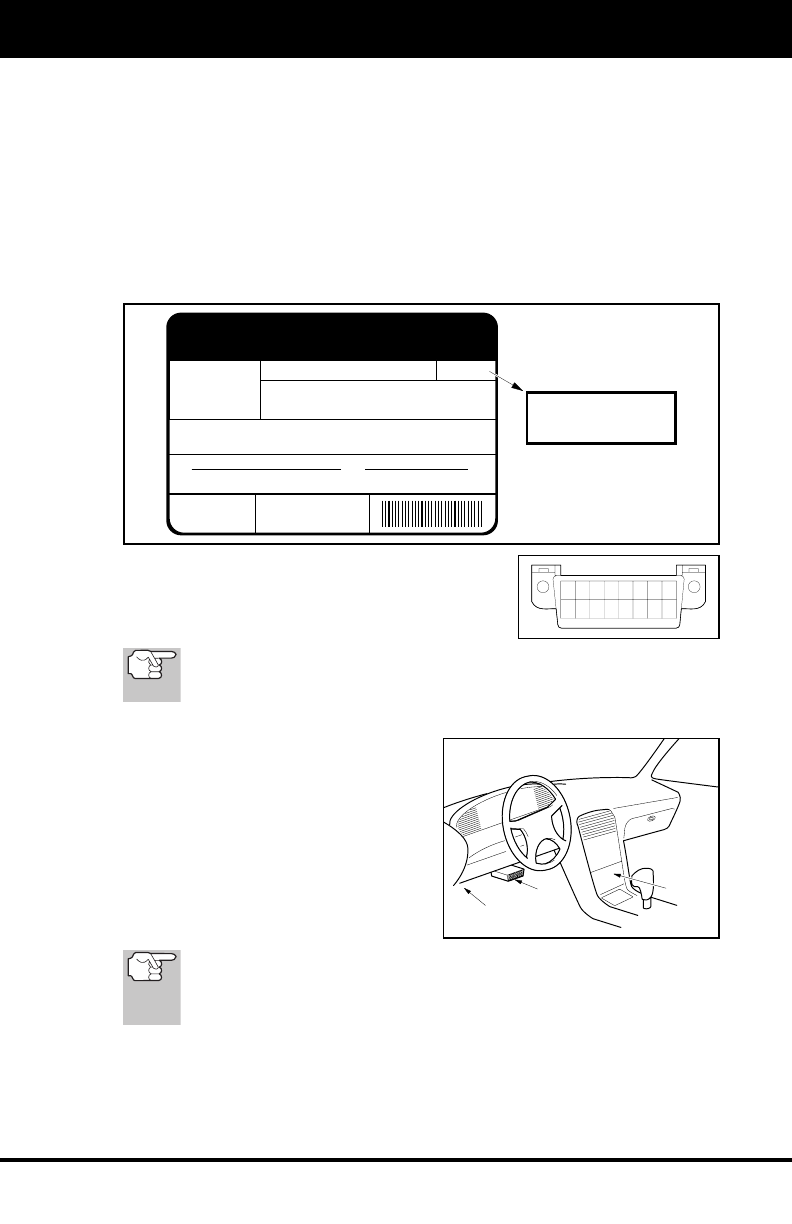
Some 1994 and 1995 vehicles are OBD 2 compliant. To find out if a 1994 or
1995 vehicle is OBD 2 compliant, check the following:
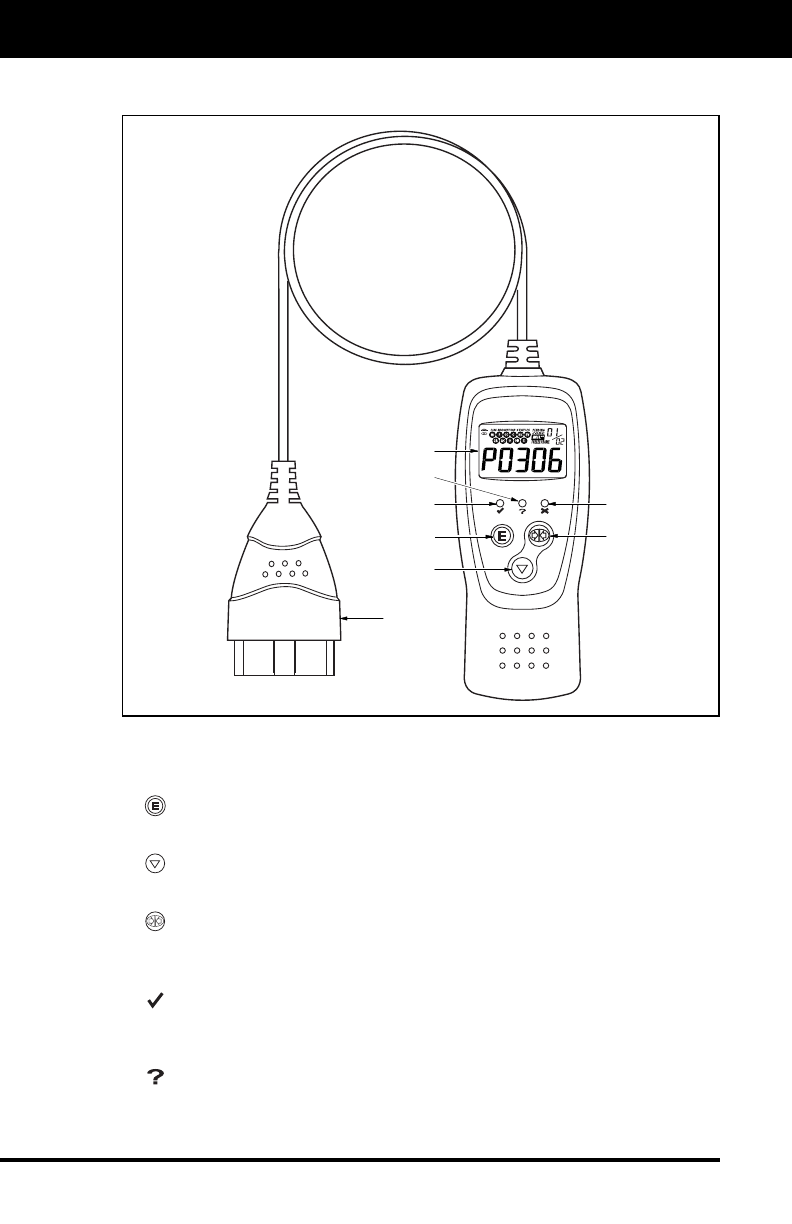
1. The Vehicle Emissions Control Information (VECI) Label. This label is
located under the hood or by the radiator of most vehicles. If the vehicle is OBD 2
compliant, the label will state “OBD II Certified.”
2. Government Regulations require that all OBD 2
compliant vehicles must have a “common”
sixteen-pin Data Link Connector (DLC).
Some 1994 and 1995 vehicles have 16-pin connectors but are not
OBD 2 compliant. Only those vehicles with a Vehicle Emissions Control
Label stating “OBD II Certified” are OBD 2 compliant.
Data Link Connector (DLC) Location
The 16-pin DLC is usually located under
the instrument panel (dash), within 12
inches (300 mm) of center of the panel,
on the driver’s side of most vehicles. It
should be easily accessible and visible
from a kneeling position outside the
vehicle with the door open.
On some Asian and European vehicles the DLC is located behind the
“ashtray” (the ashtray must be removed to access it) or on the far left
corner of the dash. If the DLC cannot be located, consult the vehicle’s
service manual for the location.
E5
VEHICLE EMISSION CONTROL INFORMATION
VEHICLE
MANUFACTURER
OBD II
CERTIFIED
ENGINE FAMILY EFN2.6YBT2BA
DISPLACEMENT 2.6L
THIS VEHICLE CONFORMS TO U.S. EPA AND STATE
OF CALIFORNIA REGULATIONS APPLICABLE TO
1999 MODEL YEAR NEW TLEV PASSENGER CARS.
REFER TO SERVICE MANUAL FOR ADDITIONAL INFORMATION
TUNE-UP CONDITIONS: NORMAL OPERATING ENGINE TEMPERATURE,
ACCESSORIES OFF, COOLING FAN OFF, TRANSMISSION IN NEUTRAL
SPARK PLUG
TYPE NGK BPRE-11
GAP: 1.1MM
CATALYST
EXHAUST EMISSIONS STANDARDS STANDARD CATEGORY
CERTIFICATION
IN-USE
TLEV
TLEV INTERMEDIATE
OBD II
CERTIFIED
12345678
9 10111213141516
NEAR
CENTER
OF DASH
BEHIND
ASHTRAY
LEFT CORNER
OF DASH
4 OBD2
About the Car Reader
CONTROLS AND INDICATORS
CONTROLS AND INDICATORS
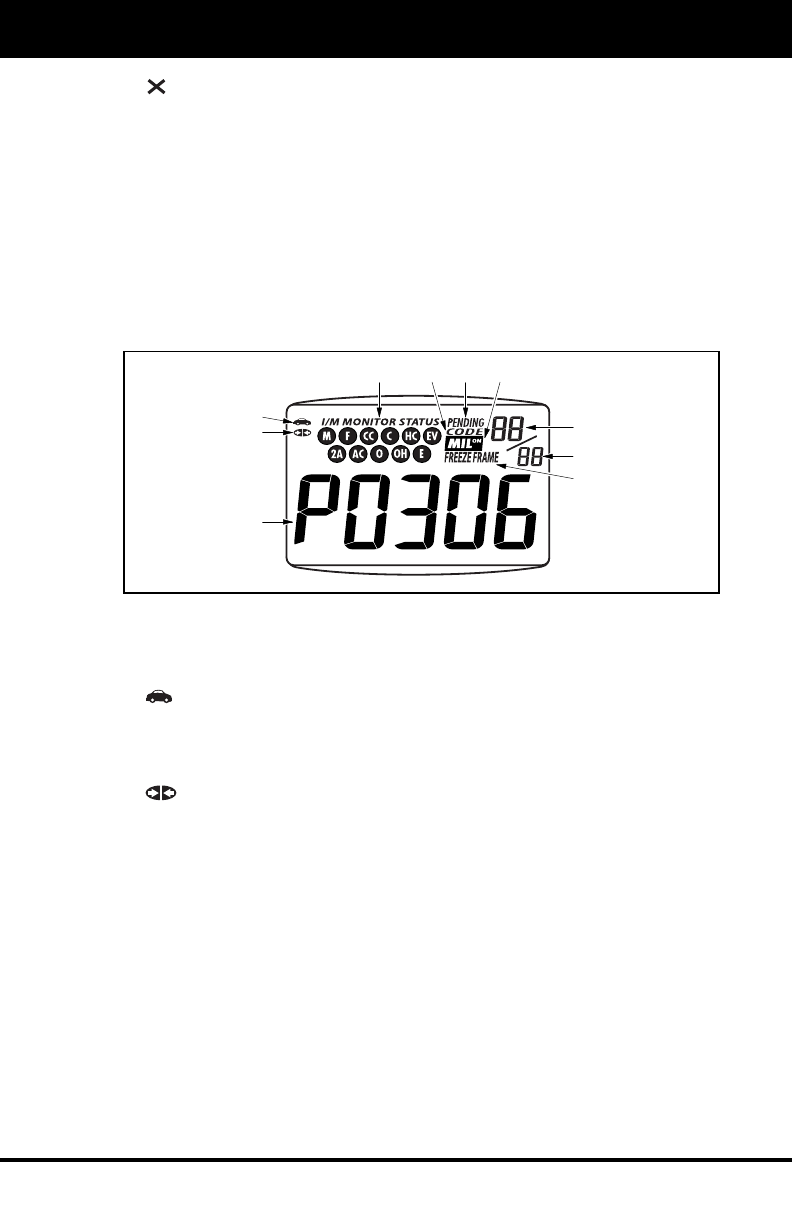
See Figure 1 for the locations of items 1 through 9, below.
1. ERASE button - Erases Diagnostic Trouble Codes (DTCs) and "Freeze
Frame" data from your vehicle's computer, and resets Monitor status.
2. SCROLL button - Scrolls the LCD display to view DTCs when more than
one DTC is present.
3. LINK button - Links the Car Reader with the vehicle's PCM to retrieve
DTCs from the computer's memory, and to view I/M Readiness Monitor
status.
4. GREEN LED - Indicates that all engine systems are running normally (all
Monitors on the vehicle are active and performing their diagnostic testing, and
no DTCs are present).
5. YELLOW LED - Indicates there is a possible problem. A “Pending” DTC
is present and/or some of the vehicle's emission monitors have not run their
diagnostic testing.
E6
7
4
1
5
2
3
6
8
Figure 1. Controls and Indicators
OBD2 5
About the Car Reader
DISPLAY FUNCTIONS
6. RED LED - Indicates there is a problem in one or more of the vehicle's
systems. The red LED is also used to show that DTC(s) are present. DTCs
are shown on the Car Reader’s LCD display. In this case, the Multifunction
Indicator (“Check Engine”) lamp on the vehicle's instrument panel will light
steady on.
7. LCD Display - Displays test results, Car Reader functions and Monitor status
information. See DISPLAY FUNCTIONS, below, for details.
8. CABLE - Connects the Car Reader to the vehicle's Data Link Connector
(DLC).
DISPLAY FUNCTIONS
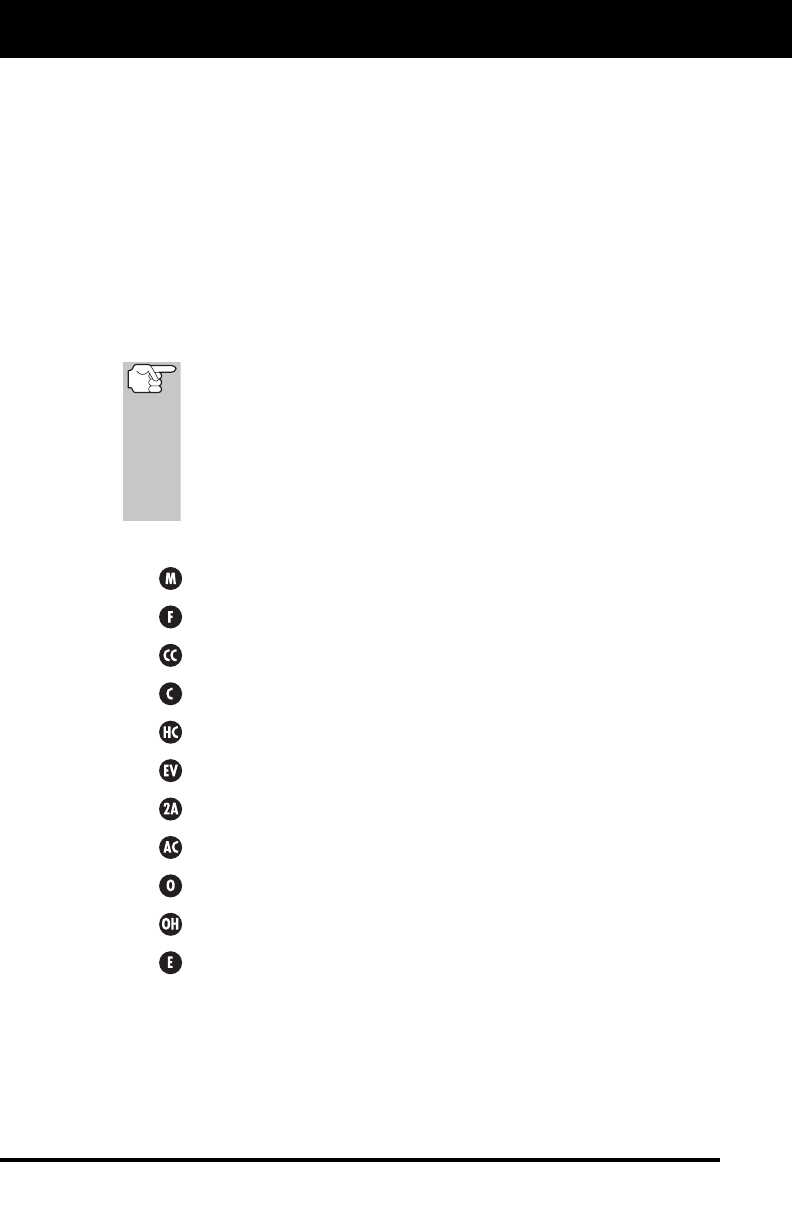
See Figure 2 for the locations of items 1 through 13, below.
1. Vehicle icon - Indicates whether or not the Car Reader is being properly
powered through the vehicle's Data Link Connector (DLC). A visible icon
indicates that the Car Reader is being powered through the vehicle's DLC
connector.
2. Link icon - Indicates whether or not the Car Reader is communicating
(linked) with the vehicle's on-board computer. When visible, the Car Reader
is communicating with the computer. If the Link icon is not visible, the Car
Reader is not communicating with the computer.
3. DTC Display Area - Displays the Diagnostic Trouble Code (DTC) number.
Each fault is assigned a code number that is specific to that fault.
4. Pending icon - Indicates the currently displayed DTC is a "Pending" code.
5. CODE icon - Identifies the Code Number Sequence display area.
6. MIL icon - Indicates the status of the Malfunction Indicator Lamp (MIL). The
MIL icon is visible only when a DTC has commanded the MIL on the vehicle's
dashboard to light.
7. FREEZE FRAME icon - Indicates that “Freeze Frame” data has been stored
in the vehicle’s computer for the currently displayed DTC.
E7
2
3
7
9
8
10 465
1
Figure 2. Display Functions
6 OBD2
About the Car Reader
DISPLAY FUNCTIONS
8. Code Number Sequence - The Car Reader assigns a sequence number to
each DTC that is present in the computer's memory, starting with "01.” This
helps keep track of the number of DTCs present in the computer's memory.
Code number "01" is always the highest priority code, and the one for which
"Freeze Frame" data has been stored.
9. Code Enumerator - Indicates the total number of codes retrieved from the
vehicle’s computer.
10. Monitor icons - Indicates which Monitors are supported by the vehicle
under test, and whether or not the associated Monitor has run its diagnostic
testing (Monitor status). When a Monitor icon is solid, it indicates that the
associated Monitor has completed its diagnostic testing. When a Monitor
icon is flashing, it indicates that the vehicle supports the associated Monitor,
but the Monitor has not yet run its diagnostic testing.
The I/M Monitor Status icons are associated with INSPECTION and
MAINTENANCE (I/M) READINESS STATUS. Some states require that
all vehicle Monitors have run and completed their diagnostic testing
before a vehicle can be tested for Emissions (Smog Check). A
maximum of eleven Monitors are used on OBD 2 systems. Not all
vehicles support all eleven Monitors. When the Car Reader is linked to
a vehicle, only the icons for Monitors that are supported by the vehicle
under test are visible on the display.
Following is a list of Monitor icons and their associated Monitors.
= Misfire Monitor
= Fuel System Monitor
= Comprehensive Component Monitor
= Catalyst Monitor
= Heated Catalyst Monitor
= Evaporative System Monitor
= Secondary Air System Monitor
= Air Conditioning System Refrigerant (R-12) Monitor
= Oxygen Sensor Monitor
= Oxygen Sensor Heater Monitor
= Exhaust Gas Recirculation (EGR) Monitor
E8

OBD2 7
Preparation for Testing
BEFORE YOU BEGIN / VEHICLE SERVICE MANUALS
BEFORE YOU BEGIN
Fix any known mechanical problems before performing any test. See your
vehicle's service manual or a mechanic for more information. Check the
following areas before starting any test:
■Check the engine oil, power steering fluid, transmission fluid (if
applicable), engine coolant and other fluids for proper levels. Top off low
fluid levels if needed.
■Make sure the air filter is clean and in good condition. Make sure all air filter
ducts are properly connected. Check the air filter ducts for holes, rips or cracks.
■Make sure all engine belts are in good condition. Check for cracked, torn,
brittle, loose or missing belts.
■Make sure mechanical linkages to engine sensors (throttle, gearshift position,
transmission, etc.) are secure and properly connected. See your vehicle's
service manual for locations.
■Check all rubber hoses (radiator) and steel hoses (vacuum/fuel) for leaks,
cracks, blockage or other damage. Make sure all hoses are routed and
connected properly.
■Make sure all spark plugs are clean and in good condition. Check for
damaged, loose, disconnected or missing spark plug wires.
■Make sure the battery terminals are clean and tight. Check for corrosion or
broken connections. Check for proper battery and charging system voltages.
■Check all electrical wiring and harnesses for proper connection. Make sure
wire insulation is in good condition, and there are no bare wires.
■Make sure the engine is mechanically sound. If needed, perform a
compression check, engine vacuum check, timing check (if applicable), etc.
VEHICLE SERVICE MANUALS
Always refer to the manufacturer's service manual for your vehicle before
performing any test or repair procedures. Contact your local car dealership, auto
parts store or bookstore for availability of these manuals. The following
companies publish valuable repair manuals:
■Haynes Publications - 861 Lawrence Drive, Newbury Park, California
91320 Phone: 800-442-9637
■Mitchell International - 14145 Danielson Street, Poway, California 92064
Phone: 888-724-6742
■Motor Publications - 5600 Crooks Road, Suite 200 ,Troy, Michigan 48098
Phone: 800-426-6867
FACTORY SOURCES
Ford, GM, Chrysler, Honda, Isuzu, Hyundai and Subaru Service Manuals
■Helm Inc.- -14310 Hamilton Avenue, Highland Park, Michigan 48203
Phone: 800-782-4356
E9
8 OBD2
Using the Car Reader
CODE RETRIEVAL PROCEDURE
CODE RETRIEVAL PROCEDURE
Never replace a part based only on the DTC definition. Each DTC has a set of
testing procedures, instructions and flow charts that must be followed to confirm the
location of the problem. This information is found in the vehicle's service manual.
Always refer to the vehicle's service manual for detailed testing instructions.
Check your vehicle thoroughly before performing any test. See
Preparation for Testing on page 7 for details.
ALWAYS observe safety precautions whenever working on a vehicle.
See Safety Precautions on page 2 for more information.
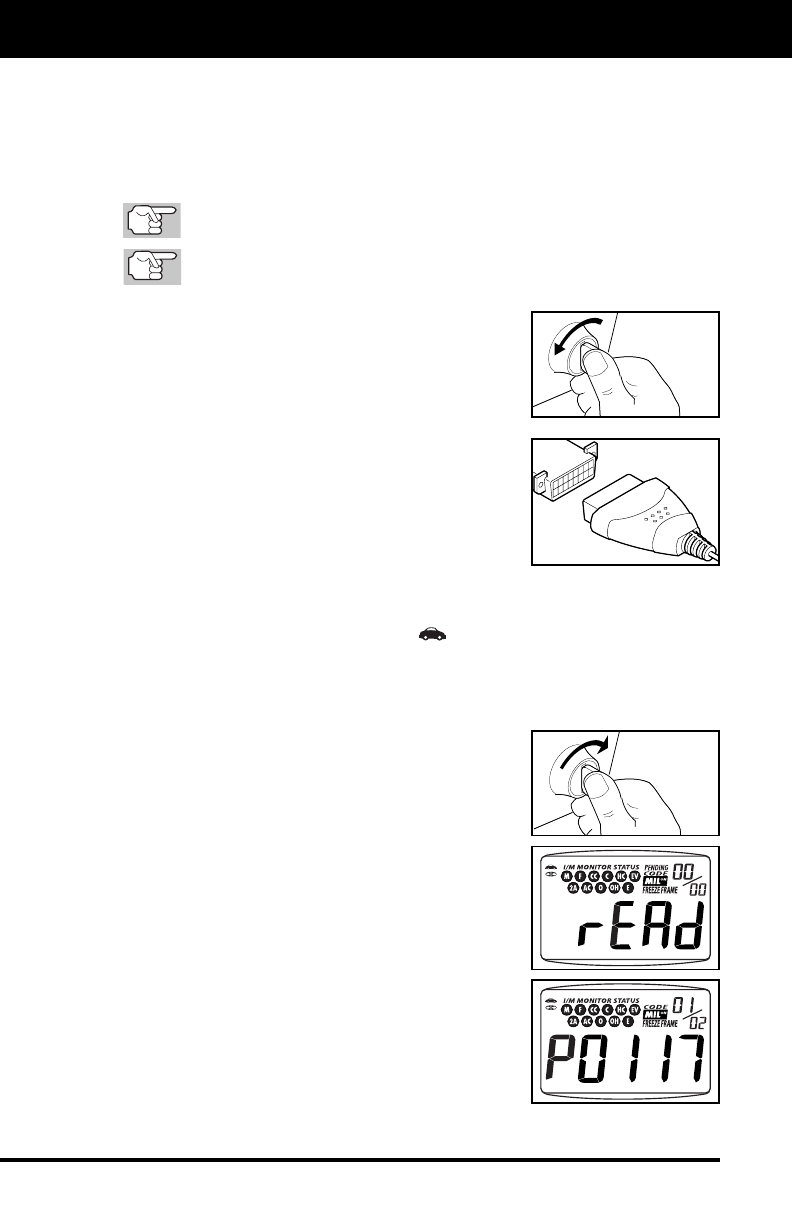
1. Turn the ignition off.
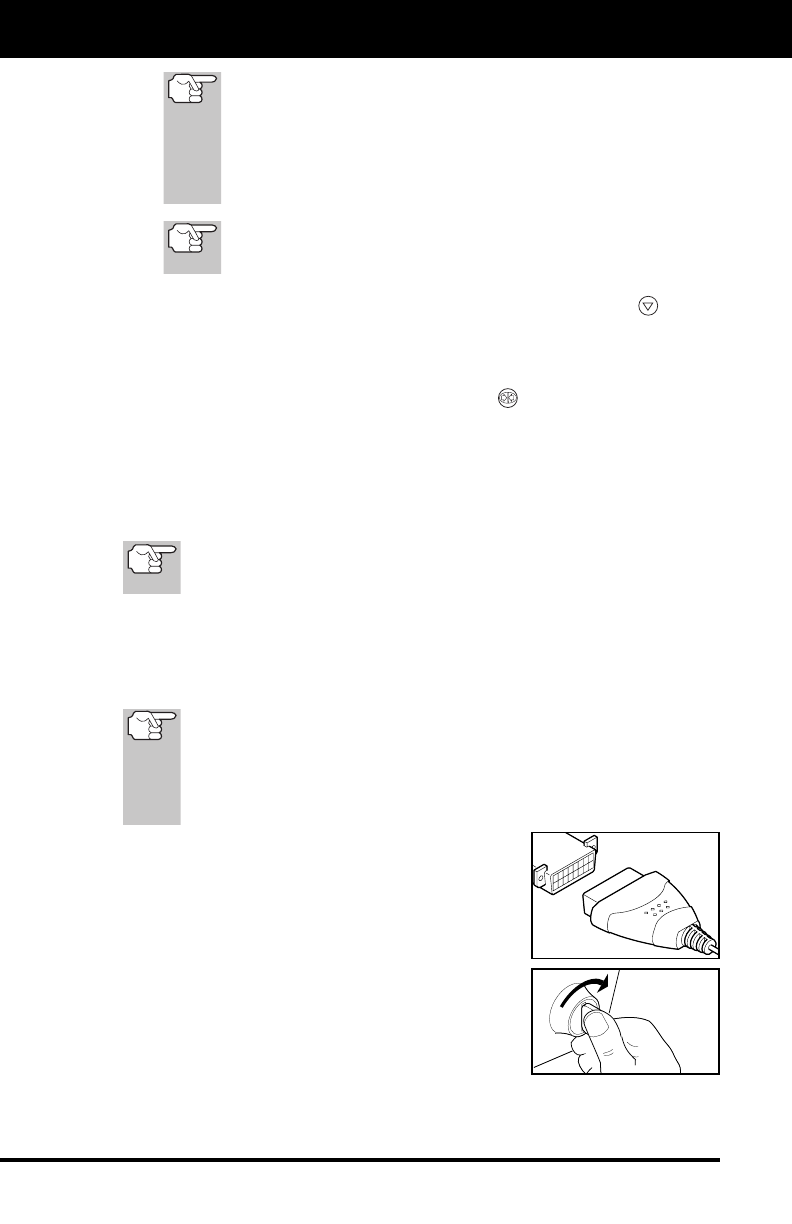
2. Locate the vehicle's 16-pin Data Link Connector
(DLC). See page 3 for connector location.
3. Connect the Car Reader’s cable connector to the
vehicle's DLC. The cable connector is keyed and
will only fit one way.
■If you have problems connecting the cable
connector to the DLC, rotate the connector
180° and try again.
If you still have problems, check the DLC on
the vehicle and on the Car Reader. Refer to
your vehicle's service manual to properly check
the vehicle's DLC.
■After the Car Reader’s test connector is properly connected to the
vehicle's DLC, the Vehicle icon should display to confirm a good
power connection.
4. Turn the ignition on. DO NOT start the engine.
5. The Car Reader will automatically link to the vehicle’s computer.
■The LCD display will show "rEAd.” If the LCD
display is blank, it indicates there is no power
at the vehicle's DLC. Check your fuse panel
and replace any burned-out fuses.
If replacing the fuse(s) does not correct the
problem, see your vehicle's repair manual to
locate the proper computer (PCM) fuse/circuit.
Perform any necessary repairs before
continuing.
■After 4-5 seconds, the Car Reader will retrieve
and display any Diagnostic Trouble Codes that
are in the vehicle's computer memory.
■If an error message (Err, Err1 or Err2) is
shown on the Car Reader’s LCD display, it
indicates there is a communication problem.
This means that the Car Reader is unable to
communicate with the vehicle's computer. Do
the following:
E10
OBD2 9
Using the Car Reader
CODE RETRIEVAL PROCEDURE
-Turn the ignition key off, wait 5 seconds and turn the key back on to
reset the computer.
-Make sure your vehicle is OBD 2 compliant. See VEHICLES COVERED
on page 2 for vehicle compliance verification information.
6. Read and interpret the Diagnostic Trouble Codes using the LCD display and
the green, yellow and red LEDs.
The green, yellow and red LEDs are used (with the LCD display) as
visual aids to make it easier for the user to determine engine system
conditions.
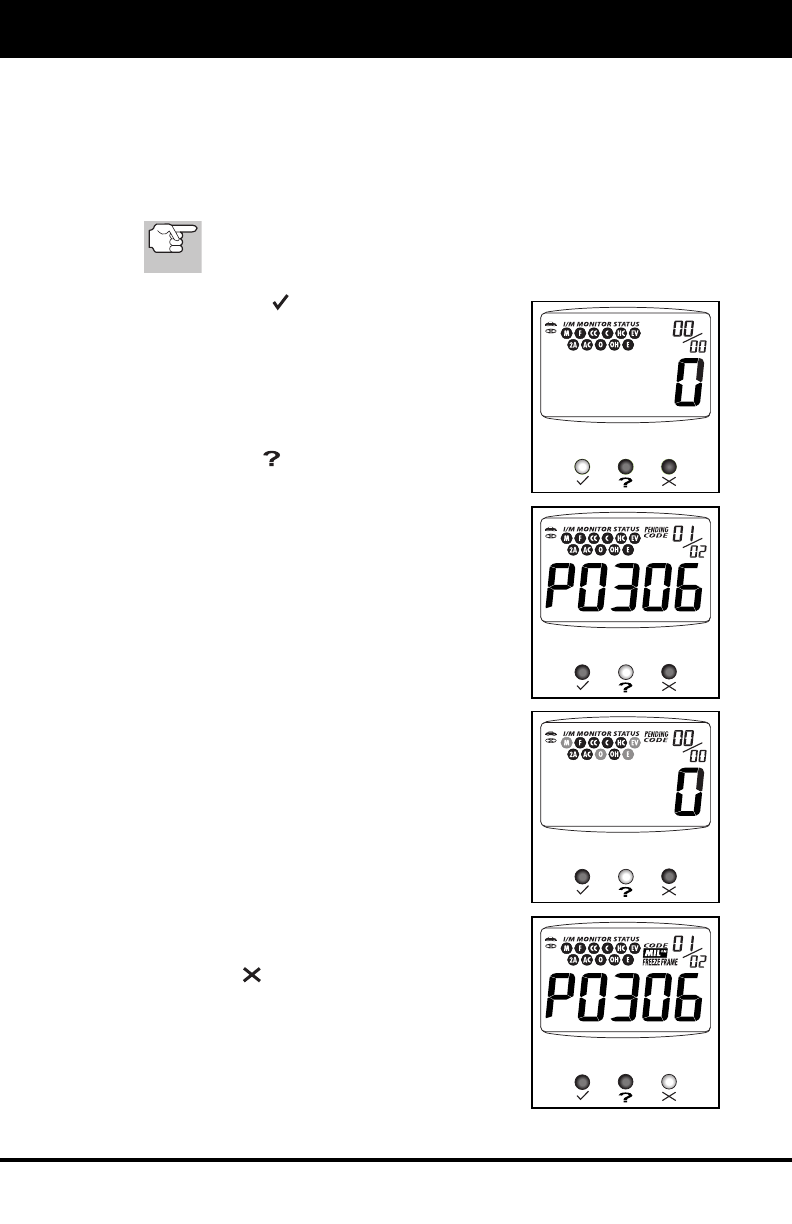
■Green LED - Indicates that all engine
systems are "OK" and running normally. All
monitors on the vehicle are active and are
performing their diagnostic testing, and no
trouble codes are present. A zero will show on
the Car Reader’s LCD display for further
confirmation.
■Yellow LED - Indicates one of the following
conditions:
PENDING CODE PRESENT - If the yellow
LED is lit, it may indicate the existence of a
pending code. Check the Car Reader’s LCD
display for confirmation. A pending code is
confirmed by the presence of a numeric code
and the word PENDING on the Car Reader’s
LCD display. If no pending code is shown, the
yellow LED indicates Monitor Status (see the
following).
MONITOR STATUS - If the Car Reader’s LCD
display shows a zero (indicating there are no
DTCs present in the vehicle's computer), but
the yellow LED is lit, it indicates a "Monitor Has
Not Run" status. This means that some of the
Monitors on the vehicle have not yet finished
their diagnostic self-testing. This condition is
confirmed by one or more blinking Monitor
icons on the LCD display. A blinking Monitor
icon means the Monitor has not yet run and
finished its diagnostic self-testing. All Monitor
icons that are solid have completed their
diagnostic self-testing.
■Red LED - Indicates there is a problem with
one or more of the vehicle's systems. The red
LED is also used to show that DTC(s) are
present (displayed on the Car Reader’s LCD
display). In this case, the Multifunction Indicator
(Check Engine) lamp on the vehicle's instrument
panel will light steady on.
E11
10 OBD2
Using the Car Reader
ERASING DIAGNOSTIC TROUBLE CODES (DTCs)
The Car Reader will automatically re-link to the vehicle's
computer every 15 seconds to refresh the data being retrieved.
When data is being refreshed, a single beep will sound, and
"rEAd" will be shown on the LCD display for 5
-
6 seconds. The
Car Reader will then beep twice and return to displaying codes.
This action repeats as long as the Car Reader is in com-
munication with the vehicle's computer.
The Car Reader will display a code only if codes are present in
the vehicle's computer memory. If no codes are present, a "0" will
be displayed.
7. If more than one code is present, press and release the SCROLL button,
as necessary, to display additional codes.
■Whenever the SCROLL function is used to view additional codes, the Car
Reader’s communication link with the vehicle's computer disconnects. To
re-establish communication, press the LINK button again.
Refer to page 14 for Diagnostic Trouble Code definitions. Match the retrieved
DTC(s) with those listed. Read the associated definition(s), and see the vehicle's
service manual for further evaluation.
ERASING DIAGNOSTIC TROUBLE CODES (DTCs)
When the Car Reader’s ERASE function is used to erase the DTCs
from the vehicle's on-board computer, "Freeze Frame" data and
manufacturer-specific enhanced data are also erased.
If you plan to take the vehicle to a Service Center for repair, DO NOT erase the
codes from the vehicle's computer. If the codes are erased, valuable information
that might help the technician troubleshoot the problem will also be erased.
Erase DTCs from the computer's memory as follows:
When DTCs are erased from the vehicle's computer memory, the I/M
Readiness Monitor Status program resets status of all the Monitors to
a not run "flashing" condition. To set all of the Monitors to a DONE
status, an OBD 2 Drive Cycle must be performed. Refer to your
vehicle's service manual for information on how to perform an OBD 2
Drive Cycle for the vehicle under test.
1. If not connected already, connect the Car Reader
to the vehicle's DLC. (If the Car Reader is already
connected and linked to the vehicle's computer,
proceed directly to step 4. If not, continue to step
2.)
2. Turn the ignition on. DO NOT start the engine. The
Car Reader will automatically link to the vehicle’s
computer.
E12
OBD2 11
Using the Car Reader
ERASING DIAGNOSTIC TROUBLE CODES (DTCs)
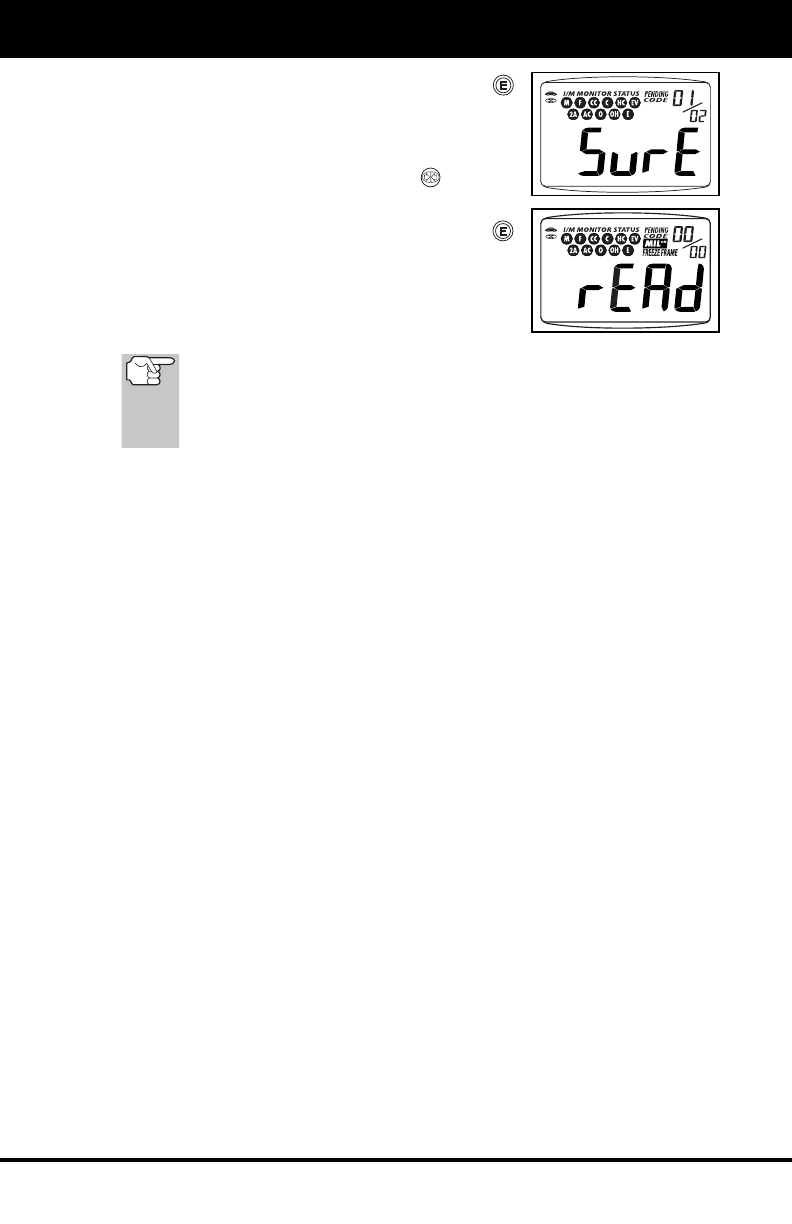
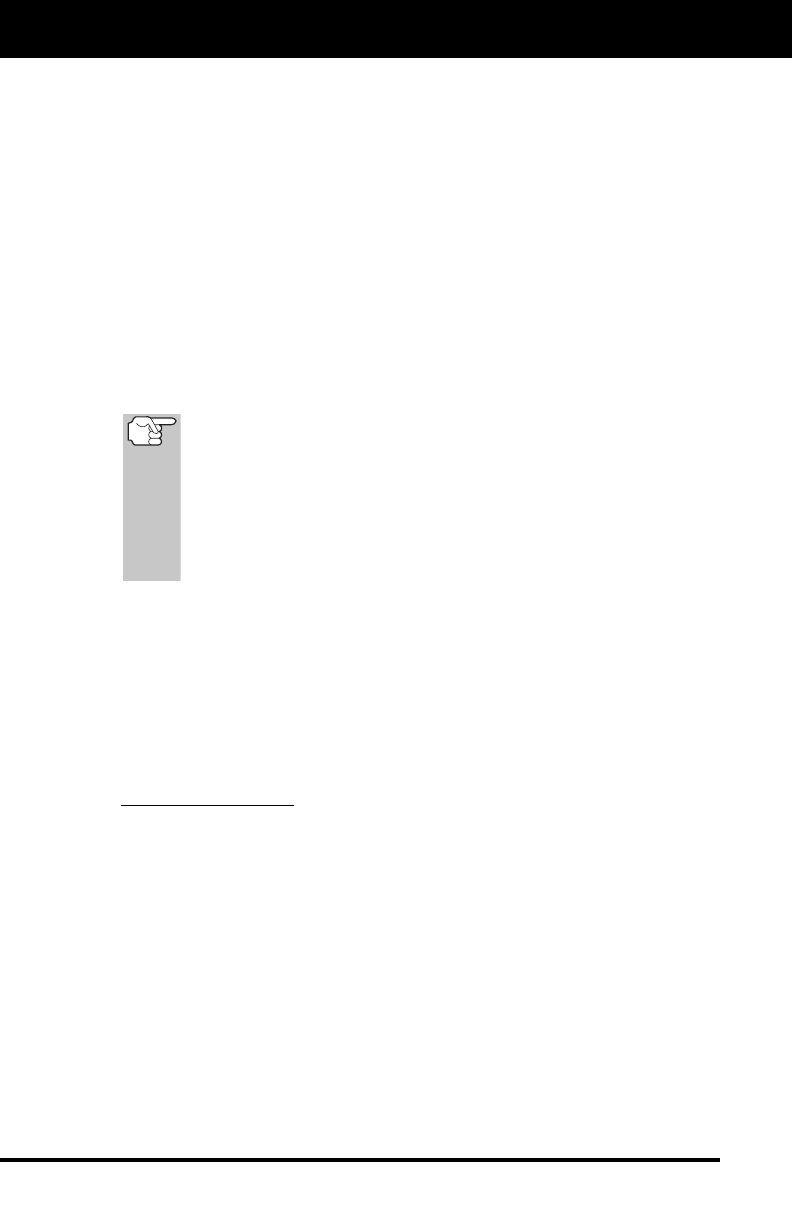
3. Press and release the Car Reader’s ERASE
button. The LCD display will indicate "SurE" for
your confirmation.
■If you change your mind and do not wish to
erase the codes, press the LINK button to
return to the code retrieval function.
■If you wish to continue, press the ERASE
button again. When all retrievable information,
including DTCs, has been cleared from the
computer’s memory, the Car Reader will re-link
to the vehicle’s computer, and the LCD display
will show "rEAd.”
Erasing DTCs does not fix the problem(s) that caused the code(s) to
be set. If proper repairs to correct the problem that caused the code(s)
to be set are not made, the code(s) will appear again (and the check
engine light will illuminate) as soon as the vehicle is driven long enough
for its Monitors to complete their testing.
E13
12 OBD2
DTC Definitions
DIAGNOSTIC TROUBLE CODE DEFINITIONS
DIAGNOSTIC TROUBLE CODE DEFINITIONS
Diagnostic Trouble Codes (DTCs) are meant to guide you to the proper service
procedure in the vehicle's service manual. DO NOT replace parts based only on
DTCs without first consulting the vehicle's service manual for proper testing
procedures for that particular system, circuit or component.
DTCs are alphanumeric codes that are used to identify a problem that is present
in any of the systems that are monitored by the on-board computer (PCM). Each
trouble code has an assigned message that identifies the circuit, component or
system area where the problem was found.
OBD 2 diagnostic trouble codes are made up of five characters:
■The 1st character is a letter. It identifies the "main system" where the fault
occurred (Body, Chassis, Powertrain, or Network).
■The 2nd character is a numeric digit. It identifies the "type" of code (Generic
or Manufacturer-Specific).
Generic DTCs are codes that are used by all vehicle manufacturers.
The standards for generic DTCs, as well as their definitions, are set by
the Society of Automotive Engineers (SAE).
Manufacturer-Specific DTCs are codes that are controlled by the
vehicle manufacturer. The Federal Government does not require
manufacturer-specific codes in order to comply with the new OBD 2
emissions standards. However, manufacturers are free to expand
beyond the required codes to make their systems easier to diagnose.
■The 3rd character is a numeric digit. It identifies the specific system or sub-
system where the problem is located.
■The 4th and 5th characters are numeric digits. They identify the section of
the system that is malfunctioning.
This section provides the most complete list of “Generic” DTC definitions
available at the time of publication. OBD 2 is an evolving system; new codes and
definitions are added as the system grows. ALWAYS check your vehicle's
service manual for code definitions that are not listed here, or for “Manufacturer-
Specific” DTC definitions. For more information, visit our web site at
www.CodeReader.com.
E14
OBD2 13
E15
DTC Definitions
DIAGNOSTIC TROUBLE CODE DEFINITIONS
P 0 2 0 1
B
C
P
U
-
-
-
-
Body
Chassis
Powertrain
Network
-
-
-
-
Generic
Manufacturer Specific
Generic
Includes both Generic and Manufacturer
Specific Codes
0
1
2
3
Identifies what section of the system
is malfunctioning
Identifies the system where the
problem is located:
1
2
3
4
5
6
7
8
-
-
-
-
-
-
-
-
Fuel and Air Metering
Fuel and Air Metering (injector circuit
malfunction only)
Ignition System or Misfire
Auxiliary Emission Control System
Vehicle Speed Control and Idle Control
System
Computer Output Circuits
Transmission
Transmission
OBD 2 DTC EXAMPLE
P0201 - Injector Circuit Malfunction, Cylinder 1
14 OBD2
E16
DTC Definitions
P0010 - P0075
Code Definition
P0010 "A" Camshaft Position - Actuator Circuit (Bank 1)
P0011 "A" Camshaft Position - Timing Over-Advanced or System Performance (Bank 1)
P0012 "A" Camshaft Position - Timing Over-Retarded (Bank 1)
P0013 "B" Camshaft Position - Actuator Circuit (Bank 1)
P0014 "B" Camshaft Position - Timing Over-Advanced or System Performance (Bank 1)
P0015 "B" Camshaft Position - Timing Over-Retarded (Bank 1)
P0020 "A" Camshaft Position - Actuator Circuit (Bank 2)
P0021 "A" Camshaft Position - Timing Over-Advanced or System Performance (Bank 2)
P0022 "A" Camshaft Position - Timing Over-Retarded (Bank 2)
P0023 "B" Camshaft Position - Actuator Circuit (Bank 2)
P0024 "B" Camshaft Position - Timing Over-Advanced or System Performance (Bank 2)
P0025 "B" Camshaft Position - Timing Over-Retarded (Bank 2)
P0030 HO2S Heater Control Circuit (Bank 1 Sensor 1)
P0031 HO2S Heater Control Circuit Low (Bank 1 Sensor 1)
P0032 HO2S Heater Control Circuit High (Bank 1 Sensor 1)
P0033 Turbo Charger Bypass Valve Control Circuit
P0034 Turbo Charger Bypass Valve Control Circuit Low
P0035 Turbo Charger Bypass Valve Control Circuit High
P0036 HO2S Heater Control Circuit (Bank 1 Sensor 2)
P0037 HO2S Heater Control Circuit Low (Bank 1 Sensor 2)
P0038 HO2S Heater Control Circuit High (Bank 1 Sensor 2)
P0042 HO2S Heater Control Circuit (Bank 1 Sensor 3)
P0043 HO2S Heater Control Circuit Low (Bank 1 Sensor 3)
P0044 HO2S Heater Control Circuit High (Bank 1 Sensor 3)
P0050 HO2S Heater Control Circuit (Bank 2 Sensor 1)
P0051 HO2S Heater Control Circuit Low (Bank 2 Sensor 1)
P0052 HO2S Heater Control Circuit High (Bank 2 Sensor 1)
P0056 HO2S Heater Control Circuit (Bank 2 Sensor 2)
P0057 HO2S Heater Control Circuit Low (Bank 2 Sensor 2)
P0058 HO2S Heater Control Circuit High (Bank 2 Sensor 2)
P0062 HO2S Heater Control Circuit (Bank 2 Sensor 3)
P0063 HO2S Heater Control Circuit Low (Bank 2 Sensor 3)
P0064 HO2S Heater Control Circuit High (Bank 2 Sensor 3)
P0065 Air Assisted Injector Control Range/Performance
P0066 Air Assisted Injector Control Circuit or Circuit Low
P0067 Air Assisted Injector Control Circuit High
P0070 Ambient Air Temperature Sensor Circuit
P0071 Ambient Air Temperature Sensor Range/Performance
P0072 Ambient Air Temperature Sensor Circuit Low Input
P0073 Ambient Air Temperature Sensor Circuit High Input
P0074 Ambient Air Temperature Sensor Circuit Intermittent
P0075 Intake Valve Control Solenoid Circuit (Bank 1)
OBD2 15
E17
DTC Definitions
P0076 - P0128
Code Definition
P0076 Intake Valve Control Solenoid Circuit Low (Bank 1)
P0077Intake Valve Control Solenoid Circuit High (Bank 1)
P0078Exhaust Valve Control Solenoid Circuit (Bank 1)
P0079Exhaust Valve Control Solenoid Circuit Low (Bank 1)
P0080Exhaust Valve Control Solenoid Circuit High (Bank 1)
P0081Intake Valve Control Solenoid Circuit (Bank 2)
P0082Intake Valve Control Solenoid Circuit Low (Bank 2)
P0083Intake Valve Control Solenoid Circuit High (Bank 2)
P0084Exhaust Valve Control Solenoid Circuit (Bank 2)
P0085Exhaust Valve Control Solenoid Circuit Low (Bank 2)
P0086Exhaust Valve Control Solenoid Circuit High (Bank 2)
P0100Mass or Volume Air Flow Circuit Malfunction
P0101Mass or Volume Circuit Range Performance Problem
P0102Mass or Volume Circuit Low Input
P0103Mass or Volume Circuit High Input
P0104Mass or Volume Circuit Intermittent
P0105Manifold Absolute Pressure/Barometric Pressure Circuit Malfunction
P0106Manifold Absolute Pressure/Barometric Pressure CircuitRange/Performance
Probl
P0107Manifold Absolute Pressure/Barometric Pressure Circuit Low Input
P0108Manifold Absolute Pressure/Barometric Pressure Circuit High Input
P0109Manifold Absolute Pressure/Barometric Pressure Circuit Intermittent
P0110Intake Air Temperature Circuit Malfunction
P0111Intake Air Temperature Circuit Range/Performance Problem
P0112Intake Air Temperature Circuit Low Input
P0113Intake Air Temperature Circuit High Input
P0114Intake Air Temperature Circuit Intermittent
P0115Engine Coolant Temperature Circuit Malfunction
P0116Engine Coolant Temperature Circuit Range/Performance Problem
P0117Engine Coolant Temperature Circuit Low Input
P0118Engine Coolant Temperature Circuit High Input
P0119Engine Coolant Temperature Circuit Intermittent
P0120Throttle/Pedal Position Sensor/Switch A Circuit Malfunction
P0121Throttle/Pedal Position Sensor/Switch A Circuit Range/Performance Problem
P0122Throttle/Pedal Position Sensor/Switch A Circuit Low Input
P0123Throttle/Pedal Position Sensor/Switch A Circuit High Input
P0124Throttle/Pedal Position Sensor/Switch A Circuit Intermittent
P0125Insufficient Coolant Temperature for Closed Loop Fuel
Cont
P0126Insufficient Coolant Temperature for Stable Operation
P0127Intake Air Temperature Too High
P0128Coolant Thermostat (Coolant Temperature Below Thermostat Regulating
Temperat
16 OBD2
E18
DTC Definitions
P0130 - P0171
Code Definition
P0130 O2 Sensor Circuit Malfunction (Bank 1 Sensor 1)
P0131 O2 Sensor Circuit Low Voltage (Bank 1 Sensor 1)
P0132 O2 Sensor Circuit High Voltage (Bank 1 Sensor 1)
P0133 O2 Sensor Circuit Slow Response (Bank 1 Sensor 1)
P0134O2 Sensor Circuit No Activity Detected (Bank 1 Sensor 1)
P0135O2 Sensor Heater Circuit Malfunction (Bank 1 Sensor 1)
P0136O2 Sensor Circuit Malfunction (Bank 1 Sensor 2)
P0137O2 Sensor Circuit Low Voltage (Bank 1 Sensor 2)
P0138O2 Sensor Circuit High Voltage (Bank 1 Sensor 2)
P0139O2 Sensor Circuit Slow Response (Bank 1 Sensor 2)
P0140O2 Sensor Circuit No Activity Detected (Bank 1 Sensor 2)
P0141O2 Sensor Heater Circuit Malfunction (Bank 1 Sensor 2)
P0142O2 Sensor Circuit Malfunction (Bank 1 Sensor 3)
P0143O2 Sensor Circuit Low Voltage (Bank 1 Sensor 3)
P0144O2 Sensor Circuit High Voltage (Bank 1 Sensor 3)
P0145O2 Sensor Circuit Slow Response (Bank 1 Sensor 3)
P0146O2 Sensor Circuit No Activity Detected (Bank 1 Sensor 3)
P0147O2 Sensor Heater Circuit Malfunction (Bank 1 Sensor 3)
P0148 Fuel Delivery Erro
P0149 Fuel Timing Err
P0150O2 Sensor Circuit Malfunction (Bank 2 Sensor 1)
P0151O2 Sensor Circuit Low Voltage (Bank 2 Sensor 1)
P0152O2 Sensor Circuit High Voltage (Bank 2 Sensor 1)
P0153O2 Sensor Circuit Slow Response (Bank 2 Sensor 1)
P0154O2 Sensor Circuit No Activity Detected (Bank 2 Sensor 1)
P0155O2 Sensor Heater Circuit Malfunction (Bank 2 Sensor 1)
P0156O2 Sensor Circuit Malfunction (Bank 2 Sensor 2)
P0157O2 Sensor Circuit Low Voltage (Bank 2 Sensor 2)
P0158O2 Sensor Circuit High Voltage (Bank 2 Sensor 2)
P0159O2 Sensor Circuit Slow Response (Bank 2 Sensor 2)
P0160O2 Sensor Circuit No Activity Detected (Bank 2 Sensor 2)
P0161O2 Sensor Heater Circuit Malfunction (Bank 2 Sensor 2)
P0162O2 Sensor Circuit Malfunction (Bank 2 Sensor 3)
P0163O2 Sensor Circuit Low Voltage (Bank 2 Sensor 3)
P0164O2 Sensor Circuit High Voltage (Bank 2 Sensor 3)
P0165O2 Sensor Circuit Slow Response (Bank 2 Sensor 3)
P0166O2 Sensor Circuit No Activity Detected (Bank 2 Sensor 3)
P0167O2 Sensor Heater Circuit Malfunction (Bank 2 Sensor 3)
P0168Fuel Temperature Too High
P0169Incorrect Fuel Composition
P0170Fuel Trim Malfunction (Bank 1)
P0171System too Lean (Bank 1)
OBD2 17
E19
DTC Definitions
P0172 - P0213
Code Definition
P0172 System too Rich (Bank 1)
P0173 Fuel Trim Malfunction (Bank 2)
P0174 System too Lean (Bank 2)
P0175 System too Rich (Bank 2)
P0176 Fuel Composition Sensor Circuit Malfunction
P0177 Fuel Composition Sensor Circuit Range/Performance
P0178 Fuel Composition Sensor Circuit Low Input
P0179 Fuel Composition Sensor Circuit High Input
P0180 Fuel Temperature Sensor A Circuit Malfunction
P0181 Fuel Temperature Sensor A Circuit Range/Performance
P0182 Fuel Temperature Sensor A Circuit Low Input
P0183 Fuel Temperature Sensor A Circuit High Input
P0184 Fuel Temperature Sensor A Circuit Intermittent
P0185 Fuel Temperature Sensor B Circuit Malfunction
P0186 Fuel Temperature Sensor B Circuit Range/Performance
P0187 Fuel Temperature Sensor B Circuit Low Input
P0188 Fuel Temperature Sensor B Circuit High Input
P0189 Fuel Temperature Sensor B Circuit Intermittent
P0190 Fuel Rail Pressure Sensor Circuit Malfunction
P0191 Fuel Rail Pressure Sensor Circuit Range/Performance
P0192 Fuel Rail Pressure Sensor Circuit Low Input
P0193 Fuel Rail Pressure Sensor Circuit High Input
P0194 Fuel Rail Pressure Sensor Circuit Intermittent
P0195 Engine Oil Temperature Sensor Malfunction
P0196 Engine Oil Temperature Sensor Range/Performance
P0197 Engine Oil Temperature Sensor Low
P0198 Engine Oil Temperature Sensor High
P0199 Engine Oil Temperature Sensor Intermittent
P0200 Injector Circuit Malfunction
P0201 Injector Circuit Malfunction - Cylinder 1
P0202 Injector Circuit Malfunction - Cylinder 2
P0203 Injector Circuit Malfunction - Cylinder 3
P0204 Injector Circuit Malfunction - Cylinder 4
P0205 Injector Circuit Malfunction - Cylinder 5
P0206 Injector Circuit Malfunction - Cylinder 6
P0207 Injector Circuit Malfunction - Cylinder 7
P0208 Injector Circuit Malfunction - Cylinder 8
P0209 Injector Circuit Malfunction - Cylinder 9
P0210 Injector Circuit Malfunction - Cylinder 10
P0211 Injector Circuit Malfunction - Cylinder 11
P0212 Injector Circuit Malfunction - Cylinder 12
P0213 Cold Start Injector 1 Malfunction
18 OBD2
E20
DTC Definitions
P0214 - P0255
Code Definition
P0214 Cold Start Injector 2 Malfunction
P0215 Engine Shutoff Solenoid Malfunction
P0216 Injection Timing Control Circuit Malfunction
P0217 Engine Overtemp Condition
P0218 Transmission Over Temperature Condition
P0219 Engine Overspeed Condition
P0220 Throttle/Pedal Position Sensor/Switch B Circuit Malfunction
P0221 Throttle/Pedal Position Sensor/Switch B Circuit Range/Performance Problem
P0222 Throttle/Pedal Position Sensor/Switch B Circuit Low Input
P0223 Throttle/Pedal Position Sensor/Switch B Circuit High Input
P0224 Throttle/Pedal Position Sensor/Switch B Circuit Intermittent
P0225 Throttle/Pedal Position Sensor/Switch C Circuit Malfunction
P0226 Throttle/Pedal Position Sensor/Switch C Circuit Range/Performance Problem
P0227 Throttle/Pedal Position Sensor/Switch C Circuit Low Input
P0228 Throttle/Pedal Position Sensor/Switch C Circuit High Input
P0229 Throttle/Pedal Position Sensor/Switch C Circuit Intermittent
P0230 Fuel Pump Primary Circuit Malfunction
P0231 Fuel Pump Secondary Circuit Low
P0232 Fuel Pump Secondary Circuit High
P0233 Fuel Pump Secondary Circuit Intermittent
P0234 Engine Overboost Condition
P0235 Turbocharger Boost Sensor A Circuit Malfunction
P0236 Turbocharger Boost Sensor A Circuit Range/Performance
P0237 Turbocharger Boost Sensor A Circuit Low
P0238 Turbocharger Boost Sensor A Circuit High
P0239 Turbocharger Boost Sensor B Circuit Malfunction
P0240 Turbocharger Boost Sensor B Circuit Range/Performance
P0241 Turbocharger Boost Sensor B Circuit Low
P0242 Turbocharger Boost Sensor B Circuit High
P0243 Turbocharger Wastegate Solenoid A Malfunction
P0244 Turbocharger Wastegate Solenoid A Range/Performance
P0245 Turbocharger Wastegate Solenoid A Low
P0246 Turbocharger Wastegate Solenoid A High
P0247 Turbocharger Wastegate Solenoid B Malfunction
P0248 Turbocharger Wastegate Solenoid B Range/Performance
P0249 Turbocharger Wastegate Solenoid B Low
P0250 Turbocharger Wastegate Solenoid B High
P0251 Injection Pump A Rotor/Cam Malfunction
P0252 Injection Pump A Rotor/Cam Range/Performance
P0253 Injection Pump A Rotor/Cam Low
P0254 Injection Pump A Rotor/Cam High
P0255 Injection Pump A Rotor/Cam Intermitted
OBD2 19
E21
DTC Definitions
P0256 - P0298
Code Definition
P0256 Injection Pump B Rotor/Cam Malfunction
P0257 Injection Pump B Rotor/Cam Range/Performance
P0258 Injection Pump B Rotor/Cam Low
P0259 Injection Pump B Rotor/Cam High
P0260 Injection Pump B Rotor/Cam Intermitted
P0261 Cylinder 1 Injector Circuit Low
P0262 Cylinder 1 Injector Circuit High
P0263 Cylinder 1 Contribution/Balance Fault
P0264 Cylinder 2 Injector Circuit Low
P0265 Cylinder 2 Injector Circuit High
P0266 Cylinder 2 Contribution/Balance Fault
P0267 Cylinder 3 Injector Circuit Low
P0268 Cylinder 3 Injector Circuit High
P0269 Cylinder 3 Contribution/Balance Fault
P0270 Cylinder 4 Injector Circuit Low
P0271 Cylinder 4 Injector Circuit High
P0272 Cylinder 4 Contribution/Balance Fault
P0273 Cylinder 5 Injector Circuit Low
P0274 Cylinder 5 Injector Circuit High
P0275 Cylinder 5 Contribution/Balance Fault
P0276 Cylinder 6 Injector Circuit Low
P0277 Cylinder 6 Injector Circuit High
P0278 Cylinder 6 Contribution/Balance Fault
P0279 Cylinder 7 Injector Circuit Low
P0280 Cylinder 7 Injector Circuit High
P0281 Cylinder 7 Contribution/Balance Fault
P0282 Cylinder 8 Injector Circuit Low
P0283 Cylinder 8 Injector Circuit High
P0284 Cylinder 8 Contribution/Balance Fault
P0285 Cylinder 9 Injector Circuit Low
P0286 Cylinder 9 Injector Circuit High
P0287 Cylinder 9 Contribution/Balance Fault
P0288 Cylinder 10 Injector Circuit Low
P0289 Cylinder 10 Injector Circuit High
P0290 Cylinder 10 Contribution/Balance Fault
P0291 Cylinder 11 Injector Circuit Low
P0292 Cylinder 11 Injector Circuit High
P0293 Cylinder 11 Contribution/Balance Fault
P0294 Cylinder 12 Injector Circuit Low
P0295 Cylinder 12 Injector Circuit High
P0296 Cylinder 12 Contribution/Balance Fault
P0298 Engine Oil Over Temperature
20 OBD2
E22
DTC Definitions
P0300 - P0346
Code Definition
P0300 Random/Multiple Cylinder Misfire Detected
P0301 Cylinder 1 Misfire Detected
P0302 Cylinder 2 Misfire Detected
P0303 Cylinder 3 Misfire Detected
P0304 Cylinder 4 Misfire Detected
P0305 Cylinder 5 Misfire Detected
P0306 Cylinder 6 Misfire Detected
P0307 Cylinder 7 Misfire Detected
P0308 Cylinder 8 Misfire Detected
P0309 Cylinder 9 Misfire Detected
P0310 Cylinder 10 Misfire Detected
P0311 Cylinder 11 Misfire Detected
P0312 Cylinder 12 Misfire Detected
P0313 Misfire Detected with Low Fuel
P0314 Single Cylinder Misfire (Cylinder not specified)
P0320 Ignition/Distributor Engine Speed Input Circuit Malfunction
P0321 Ignition/Distributor Engine Speed Input Circuit Range/Performance
P0322 Ignition/Distributor Engine Speed Input Circuit No Signal
P0323 Ignition/Distributor Engine Speed Input Circuit Intermittent
P0324 Knock Control System Error
P0325 Knock Sensor 1 Circuit Malfunction (Bank 1 or Single Sensor)
P0326 Knock Sensor 1 Circuit Range/Performance (Bank 1 or Single Sensor)
P0327 Knock Sensor 1 Circuit Low Input (Bank 1 or Single Sensor)
P0328 Knock Sensor 1 Circuit High Input (Bank 1 or Single Sensor)
P0329 Knock Sensor 1 Circuit Intermittent (Bank 1 or Single Sensor)
P0330 Knock Sensor 2 Circuit Malfunction (Bank 2)
P0331 Knock Sensor 2 Circuit Range/Performance (Bank 2)
P0332 Knock Sensor 2 Circuit Low Input (Bank 2)
P0333 Knock Sensor 2 Circuit High Input (Bank 2)
P0334 Knock Sensor 2 Circuit Intermittent (Bank 2)
P0335 Crankshaft Position Sensor A Circuit Malfunction
P0336 Crankshaft Position Sensor A Circuit Range/Performance
P0337 Crankshaft Position Sensor A Circuit Low Input
P0338 Crankshaft Position Sensor A Circuit High Input
P0339 Crankshaft Position Sensor A Circuit Intermittent
P0340 Camshaft Position Sensor Circuit Malfunction
P0341 Camshaft Position Sensor Circuit Range/Performance
P0342 Camshaft Position Sensor Circuit Low Input
P0343 Camshaft Position Sensor Circuit High Input
P0344 Camshaft Position Sensor Circuit Intermittent
P0345 Camshaft Position Sensor "A" Circuit (Bank 2)
P0346 Camshaft Position Sensor "A" Circuit Range/Performance (Bank 2)
OBD2 21
E23
DTC Definitions
P0347 - P0392
Code Definition
P0347 Camshaft Position Sensor "A" Circuit Low Input (Bank 2)
P0348 Camshaft Position Sensor "A" Circuit High Input (Bank 2)
P0349 Camshaft Position Sensor "A" Circuit Intermittent (Bank 2)
P0350 Ignition Coil Primary/Secondary Circuit Malfunction
P0351 Ignition Coil A Primary/Secondary Circuit Malfunction
P0352 Ignition Coil B Primary/Secondary Circuit Malfunction
P0353 Ignition Coil C Primary/Secondary Circuit Malfunction
P0354 Ignition Coil D Primary/Secondary Circuit Malfunction
P0355 Ignition Coil E Primary/Secondary Circuit Malfunction
P0356 Ignition Coil F Primary/Secondary Circuit Malfunction
P0357 Ignition Coil G Primary/Secondary Circuit Malfunction
P0358 Ignition Coil H Primary/Secondary Circuit Malfunction
P0359 Ignition Coil I Primary/Secondary Circuit Malfunction
P0360 Ignition Coil J Primary/Secondary Circuit Malfunction
P0361 Ignition Coil K Primary/Secondary Circuit Malfunction
P0362 Ignition Coil L Primary/Secondary Circuit Malfunction
P0365 Camshaft Position Sensor "B" Circuit (Bank 1)
P0366 Camshaft Position Sensor "B" Circuit Range/Performance (Bank 1)
P0367 Camshaft Position Sensor "B" Circuit Low Input (Bank 1)
P0368 Camshaft Position Sensor "B" Circuit High Input (Bank 1)
P0369 Camshaft Position Sensor "B" Circuit Intermittent (Bank 1)
P0370 Timing Reference High Resolution Signal A Malfunction
P0371 Timing Reference High Resolution Signal A Too Many Pulses
P0372 Timing Reference High Resolution Signal A Too Few Pulses
P0373 Timing Reference High Resolution Signal A Intermittent/Erratic Pulses
P0374 Timing Reference High Resolution Signal A No Pulses
P0375 Timing Reference High Resolution Signal B Malfunction
P0376 Timing Reference High Resolution Signal B Too Many Pulses
P0377 Timing Reference High Resolution Signal B Too Few Pulses
P0378 Timing Reference High Resolution Signal B Intermittent/Erratic Pulses
P0379 Timing Reference High Resolution Signal B No Pulses
P0380 Glow Plug/Heater Circuit Malfunction
P0381 Glow Plug/Heater Indicator Circuit Malfunction
P0382 Glow Plug/Heater Circuit "B" Malfunction
P0385 Crankshaft Position Sensor B Circuit Malfunction
P0386 Crankshaft Position Sensor B Circuit Range/Performance
P0387 Crankshaft Position Sensor B Circuit Low Input
P0388 Crankshaft Position Sensor B Circuit High Input
P0389 Crankshaft Position Sensor B Circuit Intermittent
P0390 Camshaft Position Sensor "B" Circuit (Bank 2)
P0391 Camshaft Position Sensor "B" Circuit Range/Performance (Bank 2)
P0392 Camshaft Position Sensor "B" Circuit Low Input (Bank 2)
22 OBD2
E24
DTC Definitions
P0393 - P0439
Code Definition
P0393 Camshaft Position Sensor "B" Circuit High Input (Bank 2)
P0394 Camshaft Position Sensor "B" Circuit Intermittent (Bank 2)
P0400 Exhaust Gas Recirculation Flow Malfunction
P0401 Exhaust Gas Recirculation Flow Insufficient Detected
P0402 Exhaust Gas Recirculation Flow Excessive Detected
P0403 Exhaust Gas Recirculation Circuit Malfunction
P0404 Exhaust Gas Recirculation Circuit Range/Performance
P0405 Exhaust Gas Recirculation Sensor A Circuit Low
P0406 Exhaust Gas Recirculation Sensor A Circuit High
P0407 Exhaust Gas Recirculation Sensor B Circuit Low
P0408 Exhaust Gas Recirculation Sensor B Circuit High
P0409 Exhaust Gas Recirculation Sensor "A" Circuit
P0410 Secondary Air Injection System Malfunction
P0411 Secondary Air Injection System Incorrect Flow Detected
P0412 Secondary Air Injection System Switching Valve A Circuit Malfunction
P0413 Secondary Air Injection System Switching Valve A Circuit Open
P0414 Secondary Air Injection System Switching Valve A Circuit Shorted
P0415 Secondary Air Injection System Switching Valve B Circuit Malfunction
P0416 Secondary Air Injection System Switching Valve B Circuit Open
P0417 Secondary Air Injection System Switching Valve B Circuit Shorted
P0418 Secondary Air Injection System Relay "A" Circuit Malfunction
P0419 Secondary Air Injection System Relay "B" Circuit Malfunction
P0420 Catalyst System Efficiency Below Threshold (Bank 1)
P0421 Warm Up Catalyst Efficiency Below Threshold (Bank 1)
P0422 Main Catalyst Efficiency Below Threshold (Bank 1)
P0423 Heated Catalyst Efficiency Below Threshold (Bank 1)
P0424 Heated Catalyst Temperature Below Threshold (Bank 1)
P0425 Catalyst Temperature Sensor (Bank 1)
P0426 Catalyst Temperature Sensor Range/Performance (Bank 1)
P0427 Catalyst Temperature Sensor Low Input (Bank 1)
P0428 Catalyst Temperature Sensor High Input (Bank 1)
P0429 Catalyst Heater Control Circuit (Bank 1)
P0430 Catalyst System Efficiency Below Threshold (Bank 2)
P0431 Warm Up Catalyst Efficiency Below Threshold (Bank 2)
P0432 Main Catalyst Efficiency Below Threshold (Bank 2)
P0433 Heated Catalyst Efficiency Below Threshold (Bank 2)
P0434 Heated Catalyst Temperature Below Threshold (Bank 2)
P0435 Catalyst Temperature Sensor (Bank 2)
P0436 Catalyst Temperature Sensor Range/Performance (Bank 2)
P0437 Catalyst Temperature Sensor Low Input (Bank 2)
P0438 Catalyst Temperature Sensor High Input (Bank 2)
P0439 Catalyst Heater Control Circuit (Bank 2)
OBD2 23
E25
DTC Definitions
P0440 - P0483
Code Definition
P0440 Evaporative Emission Control System Malfunction
P0441 Evaporative Emission Control System Incorrect Purge Flow
P0442 Evaporative Emission Control System Leak Detected (small leak)
P0443 Evaporative Emission Control System Purge Control Valve Circuit Malfunction
P0444 Evaporative Emission Control System Purge Control Valve Circuit Open
P0445 Evaporative Emission Control System Purge Control Valve Circuit Shorted
P0446 Evaporative Emission Control System Vent Control Circuit Malfunction
P0447 Evaporative Emission Control System Vent Control Open
P0448 Evaporative Emission Control System Vent Control Circuit Shorted
P0449 Evaporative Emission Control System Vent Valve/Solenoid Circuit Malfunction
P0450 Evaporative Emission Control System Pressure Sensor Malfunction
P0451 Evaporative Emission Control System Pressure Sensor Range/Performance
P0452 Evaporative Emission Control System Pressure Sensor Low Input
P0453 Evaporative Emission Control System Pressure Sensor High Input
P0454 Evaporative Emission Control System Pressure Sensor Intermittent
P0455 Evaporative Emission Control System Leak Detected (gross leak)
P0456 Evaporative Emission Control System Leak Detected (very small leak)
P0457 Evaporative Emission Control System Leak Detected (fuel cap loose/off)
P0460 Fuel Level Sensor Circuit Malfunction
P0461 Fuel Level Sensor Circuit Range/Performance
P0462 Fuel Level Sensor Circuit Low Input
P0463 Fuel Level Sensor Circuit High Input
P0464 Fuel Level Sensor Circuit Intermittent
P0465 Purge Flow Sensor Circuit Malfunction
P0466 Purge Flow Sensor Circuit Range/Performance
P0467 Purge Flow Sensor Circuit Low Input
P0468 Purge Flow Sensor Circuit High Input
P0469 Purge Flow Sensor Circuit Intermittent
P0470 Exhaust Pressure Sensor Malfunction
P0471 Exhaust Pressure Sensor Range/Performance
P0472 Exhaust Pressure Sensor Low
P0473 Exhaust Pressure Sensor High
P0474 Exhaust Pressure Sensor Intermittent
P0475 Exhaust Pressure Control Valve Malfunction
P0476 Exhaust Pressure Control Valve Range/Performance
P0477 Exhaust Pressure Control Valve Low
P0478 Exhaust Pressure Control Valve High
P0479 Exhaust Pressure Control Valve Intermittent
P0480 Cooling Fan 1 Control Circuit Malfunction
P0481 Cooling Fan 2 Control Circuit Malfunction
P0482 Cooling Fan 3 Control Circuit Malfunction
P0483 Cooling Fan Rationality Check Malfunction
24 OBD2
E26
DTC Definitions
P0484 - P0550
Code Definition
P0484 Cooling Fan Circuit Over Current
P0485 Cooling Fan Power/Ground Circuit Malfunction
P0486 Exhaust Gas Recirculation Sensor "B" Circuit
P0487 Exhaust Gas Recirculation Throttle Position Control Circuit
P0488 Exhaust Gas Recirculation Throttle Position Control Range/Performance
P0491 Secondary Air Injection System (Bank 1)
P0492 Secondary Air Injection System (Bank 2)
P0500 Vehicle Speed Sensor Malfunction
P0501 Vehicle Speed Sensor Range/Performance
P0502 Vehicle Speed Sensor Circuit Low Input
P0503 Vehicle Speed Sensor Intermittent/Erratic/High
P0505 Idle Control System Malfunction
P0506 Idle Control System RPM Lower Than Expected
P0507 Idle Control System RPM Higher Than Expected
P0508 Idle Control System Circuit Low
P0509 Idle Control System Circuit High
P0510 Closed Throttle Position Switch Malfunction
P0512 Starter Request Circuit
P0513 Incorrect Immobilizer Key ("Immobilizer" pending SAE J1930 approval)
P0515 Battery Temperature Sensor Circuit
P0516 Battery Temperature Sensor Circuit Low
P0517 Battery Temperature Sensor Circuit High
P0520 Engine Oil Pressure/Switch Circuit Malfunction
P0521 Engine Oil Pressure/Switch Range/Performance
P0522 Engine Oil Pressure/Switch Low Voltage
P0523 Engine Oil Pressure/Switch High Voltage
P0524 Engine Oil Pressure Too Low
P0530 A/C Refrigerant Pressure Sensor Circuit Malfunction
P0531 A/C Refrigerant Pressure Sensor Circuit Range/Performance
P0532 A/C Refrigerant Pressure Sensor Circuit Low Input
P0533 A/C Refrigerant Pressure Sensor Circuit High Input
P0534 Air Conditioner Refrigerant Charge Loss
P0540 Intake Air Heater Circuit
P0541 Intake Air Heater Circuit Low
P0542 Intake Air Heater Circuit High
P0544 Exhaust Gas Temperature Sensor Circuit (Bank 1)
P0545 Exhaust Gas Temperature Sensor Circuit Low (Bank 1)
P0546 Exhaust Gas Temperature Sensor Circuit High (Bank 1)
P0547 Exhaust Gas Temperature Sensor Circuit (Bank 2)
P0548 Exhaust Gas Temperature Sensor Circuit Low (Bank 2)
P0549 Exhaust Gas Temperature Sensor Circuit High (Bank 2)
P0550 Power Steering Pressure Sensor Circuit Malfunction
OBD2 25
E27
DTC Definitions
P0551 - P0621
Code Definition
P0551 Power Steering Pressure Sensor Circuit Range/Performance
P0552 Power Steering Pressure Sensor Circuit Low Input
P0553 Power Steering Pressure Sensor Circuit High Input
P0554 Power Steering Pressure Sensor Circuit Intermittent
P0560 System Voltage Malfunction
P0561 System Voltage Unstable
P0562 System Voltage Low
P0563 System Voltage High
P0564 Cruise Control Multi-Function Input Signal
P0565 Cruise Control On Signal Malfunction
P0566 Cruise Control Off Signal Malfunction
P0567 Cruise Control Resume Signal Malfunction
P0568 Cruise Control Set Signal Malfunction
P0569 Cruise Control Coast Signal Malfunction
P0570 Cruise Control Accel Signal Malfunction
P0571 Cruise Control/Brake Switch A Circuit Malfunction
P0572 Cruise Control/Brake Switch A Circuit Low
P0573 Cruise Control/Brake Switch A Circuit High
P0574 Cruise Control System - Vehicle Speed Too High
P0575 Cruise Control Input Circuit
P0576 Cruise Control Input Circuit Low
P0577 Cruise Control Input Circuit High
P0578- Reserved for Cruise Control Codes
P0580
P0600 Serial Communication Link Malfunction
P0601 Internal Control Module Memory Check Sum Error
P0602 Control Module Programming Error
P0603 Internal Control Module Keep Alive Memory (KAM) Error
P0604 Internal Control Module Random Access Memory (RAM) Error
P0605 Internal Control Module Read Only Memory (ROM) Error
P0606 PCM Processor Fault
P0607 Control Module Performance
P0608 Control Module VSS Output "A" Malfunction
P0609 Control Module VSS Output "B" Malfunction
P0610 Control Module Vehicle Options Error
P0615 Starter Relay Circuit
P0616 Starter Relay Circuit Low
P0617 Starter Relay Circuit High
P0618 Alternative Fuel Control Module KAM Error
P0619 Alternative Fuel Control Module RAM/ROM Error
P0620 Generator Control Circuit Malfunction
P0621 Generator Lamp "L" Control Circuit Malfunction

26 OBD2
E28
DTC Definitions
P0622 - P0715
Code Definition
P0622 Generator Field "F" Control Circuit Malfunction
P0623 Generator Lamp Control Circuit
P0624 Fuel Cap Lamp Control Circuit
P0630 VIN Not Programmed or Mismatch - ECM/PCM
P0631 VIN Not Programmed or Mismatch - TCM
P0635 Power Steering Control Circuit
P0636 Power Steering Control Circuit Low
P0637 Power Steering Control Circuit High
P0638 Throttle Actuator Control Range/Performance (Bank 1)
P0639 Throttle Actuator Control Range/Performance (Bank 2)
P0640 Intake Air Heater Control Circuit
P0645 A/C Clutch Relay Control Circuit
P0646 A/C Clutch Relay Control Circuit Low
P0647 A/C Clutch Relay Control Circuit High
P0648 Immobilizer Lamp Control Circuit ("Immobilizer" pending SAE J1930 approval)
P0649 Speed Control Lamp Control Circuit
P0650 Malfunction Indicator Lamp (MIL) Control Circuit Malfunction
P0654 Engine RPM Output Circuit Malfunction
P0655 Engine Hot Lamp Output Control Circuit Malfunction
P0656 Fuel Level Output Circuit Malfunction
P0660 Intake Manifold Tuning Valve Control Circuit (Bank 1)
P0661 Intake Manifold Tuning Valve Control Circuit Low (Bank 1)
P0662 Intake Manifold Tuning Valve Control Circuit High (Bank 1)
P0663 Intake Manifold Tuning Valve Control Circuit (Bank 2)
P0664 Intake Manifold Tuning Valve Control Circuit Low (Bank 2)
P0665 Intake Manifold Tuning Valve Control Circuit High (Bank 2)
P0700 Transmission Control System Malfunction
P0701 Transmission Control System Range/Performance
P0702 Transmission Control System Electrical
P0703 Torque Converter/Brake Switch B Circuit Malfunction
P0704 Clutch Switch Input Circuit Malfunction
P0705 Transmission Range Sensor Circuit Malfunction (PRNDL Input)
P0706 Transmission Range Sensor Circuit Range/Performance
P0707 Transmission Range Sensor Circuit Low Input
P0708 Transmission Range Sensor Circuit High Input
P0709 Transmission Range Sensor Circuit Intermittent
P0710 Transmission Fluid Temperature Sensor Circuit Malfunction
P0711 Transmission Fluid Temperature Sensor Circuit Range/Performance
P0712 Transmission Fluid Temperature Sensor Circuit Low Input
P0713 Transmission Fluid Temperature Sensor Circuit High Input
P0714 Transmission Fluid Temperature Sensor Circuit Intermittent
P0715 Input/Turbine Speed Sensor Circuit Malfunction

OBD2 27
E29
DTC Definitions
P0716 - P0758
Code Definition
P0716 Input/Turbine Speed Sensor Circuit Range/Performance
P0717 Input/Turbine Speed Sensor Circuit No Signal
P0718 Input/Turbine Speed Sensor Circuit Intermittent
P0719 Torque Converter/Brake Switch B Circuit Low
P0720 Output Speed Sensor Circuit Malfunction
P0721 Output Speed Sensor Circuit Range/Performance
P0722 Output Speed Sensor Circuit No Signal
P0723 Output Speed Sensor Circuit Intermittent
P0724 Torque Converter/Brake Switch B Circuit High
P0725 Engine Speed Input Circuit Malfunction
P0726 Engine Speed Input Circuit Range/Performance
P0727 Engine Speed Input Circuit No Signal
P0728 Engine Speed Input Circuit Intermittent
P0730 Incorrect Gear Ratio
P0731 Gear 1 Incorrect Ratio
P0732 Gear 2 Incorrect Ratio
P0733 Gear 3 Incorrect Ratio
P0734 Gear 4 Incorrect Ratio
P0735 Gear 5 Incorrect Ratio
P0736 Reverse Incorrect Ratio
P0737 TCM Engine Speed Output Circuit
P0738 TCM Engine Speed Output Circuit Low
P0739 TCM Engine Speed Output Circuit High
P0740 Torque Converter Clutch Circuit Malfunction
P0741 Torque Converter Clutch Circuit Performance or Stuck Off
P0742 Torque Converter Clutch Circuit Stuck On
P0743 Torque Converter Clutch Circuit Electrical
P0744 Torque Converter Clutch Circuit Intermittent
P0745 Pressure Control Solenoid Malfunction
P0746 Pressure Control Solenoid Performance or Stuck Off
P0747 Pressure Control Solenoid Stuck On
P0748 Pressure Control Solenoid Electrical
P0749 Pressure Control Solenoid Intermittent
P0750 Shift Solenoid A Malfunction
P0751 Shift Solenoid A Performance or Stuck Off
P0752 Shift Solenoid A Stuck On
P0753 Shift Solenoid A Electrical
P0754 Shift Solenoid A Intermittent
P0755 Shift Solenoid B Malfunction
P0756 Shift Solenoid B Performance or Stuck Off
P0757 Shift Solenoid B Stuck On
P0758 Shift Solenoid B Electrical

28 OBD2
E30
DTC Definitions
P0759 - P0801
Code Definition
P0759 Shift Solenoid B Intermittent
P0760 Shift Solenoid C Malfunction
P0761 Shift Solenoid C Performance or Stuck Off
P0762 Shift Solenoid C Stuck On
P0763 Shift Solenoid C Electrical
P0764 Shift Solenoid C Intermittent
P0765 Shift Solenoid D Malfunction
P0766 Shift Solenoid D Performance or Stuck Off
P0767 Shift Solenoid D Stuck On
P0768 Shift Solenoid D Electrical
P0769 Shift Solenoid D Intermittent
P0770 Shift Solenoid E Malfunction
P0771 Shift Solenoid E Performance or Stuck Off
P0772 Shift Solenoid E Stuck On
P0773 Shift Solenoid E Electrical
P0774 Shift Solenoid E Intermittent
P0775 Pressure Control Solenoid "B"
P0776 Pressure Control Solenoid "B" Performance or Stuck Off
P0777 Pressure Control Solenoid "B" Stuck On
P0778 Pressure Control Solenoid "B" Electrical
P0779 Pressure Control Solenoid "B" Intermittent
P0780 Shift Malfunction
P0781 1-2 Shift Malfunction
P0782 2-3 Shift Malfunction
P0783 3-4 Shift Malfunction
P0784 4-5 Shift Malfunction
P0785 Shift/Timing Solenoid Malfunction
P0786 Shift/Timing Solenoid Range/Performance
P0787 Shift/Timing Solenoid Low
P0788 Shift/Timing Solenoid High
P0789 Shift/Timing Solenoid Intermittent
P0790 Normal/Performance Switch Circuit Malfunction
P0791 Intermediate Shaft Speed Sensor Circuit
P0792 Intermediate Shaft Speed Sensor Circuit Range/Performance
P0793 Intermediate Shaft Speed Sensor Circuit No Signal
P0794 Intermediate Shaft Speed Sensor Circuit Intermittent
P0795 Pressure Control Solenoid "C"
P0796 Pressure Control Solenoid "C" Performance or Stuck Off
P0797 Pressure Control Solenoid "C" Stuck On
P0798 Pressure Control Solenoid "C" Electrical
P0799 Pressure Control Solenoid "C" Intermittent
P0801 Reverse Inhibit Control Circuit Malfunction

OBD2 29
E31
DTC Definitions
P0803 - P0849
Code Definition
P0803 1-4 Upshift (Skip Shift) Solenoid Control Circuit Malfunction
P0804 1-4 Upshift (Skip Shift) Lamp Control Circuit Malfunction
P0805 Clutch Position Sensor Circuit
P0806 Clutch Position Sensor Circuit Range/Performance
P0807 Clutch Position Sensor Circuit Low
P0808 Clutch Position Sensor Circuit High
P0809 Clutch Position Sensor Circuit Intermittent
P0810 Clutch Position Control Error
P0811 Excessive Clutch Slippage
P0812 Reverse Input Circuit
P0813 Reverse Output Circuit
P0814 Transmission Range Display Circuit
P0815 Upshift Switch Circuit
P0816 Downshift Switch Circuit
P0817 Starter Disable Circuit
P0818 Driveline Disconnect Switch Input Circuit
P0820 Gear Lever X-Y Position Sensor Circuit
P0821 Gear Lever X Position Circuit
P0822 Gear Lever Y Position Circuit
P0823 Gear Lever X Position Circuit Intermittent
P0824 Gear Lever Y Position Circuit Intermittent
P0825 Gear Lever Push-Pull Switch (Shift Anticipate)
P0830 Clutch Pedal Switch "A" Circuit
P0831 Clutch Pedal Switch "A" Circuit Low
P0832 Clutch Pedal Switch "A" Circuit High
P0833 Clutch Pedal Switch "B" Circuit
P0834 Clutch Pedal Switch "B" Circuit Low
P0835 Clutch Pedal Switch "B" Circuit High
P0836 Four Wheel Drive (4WD) Switch Circuit
P0837 Four Wheel Drive (4WD) Switch Circuit Range/Performance
P0838 Four Wheel Drive (4WD) Switch Circuit Low
P0839 Four Wheel Drive (4WD) Switch Circuit High
P0840 Transmission Fluid Pressure Sensor/Switch "A" Circuit
P0841 Transmission Fluid Pressure Sensor/Switch "A" Circuit Range/Performance
P0842 Transmission Fluid Pressure Sensor/Switch "A" Circuit Low
P0843 Transmission Fluid Pressure Sensor/Switch "A" Circuit High
P0844 Transmission Fluid Pressure Sensor/Switch "A" Circuit Intermittent
P0845 Transmission Fluid Pressure Sensor/Switch "B" Circuit
P0846 Transmission Fluid Pressure Sensor/Switch "B" Circuit Range/Performance
P0847 Transmission Fluid Pressure Sensor/Switch "B" Circuit Low
P0848 Transmission Fluid Pressure Sensor/Switch "B" Circuit High
P0849 Transmission Fluid Pressure Sensor/Switch "B" Circuit Intermittent

E32
Innova Electronics Corp.
17352 Von Karman Ave.
Irvine, CA 92614
Printed in Taiwan
Instruction MRP #93-0058
PRODUCT DESIGN & COPYRIGHT
© 2012
®
www.innova.com
