Math SL Guide
User Manual:
Open the PDF directly: View PDF  .
.
Page Count: 64

Mathematics SL guide
First examinations 2014
Diploma Programme

Mathematics SL guide
First examinations 2014
Diploma Programme
Diploma Programme
Mathematics SL guide
International Baccalaureate, Baccalauréat International and Bachillerato Internacional are
registered trademarks of the International Baccalaureate Organization.
Printed in the United Kingdom by Antony Rowe Ltd, Chippenham, Wiltshire 5033
Published March 2012
Published on behalf of the International Baccalaureate Organization, a not-for-profit
educational foundation of 15 Route des Morillons, 1218 Le Grand-Saconnex, Geneva,
Switzerland by the
International Baccalaureate Organization (UK) Ltd
Peterson House, Malthouse Avenue, Cardiff Gate
Cardiff, Wales CF23 8GL
United Kingdom
Phone: +44 29 2054 7777
Fax: +44 29 2054 7778
Website: www.ibo.org
© International Baccalaureate Organization 2012
The International Baccalaureate Organization (known as the IB) offers three high-quality
and challenging educational programmes for a worldwide community of schools, aiming
to create a better, more peaceful world. This publication is one of a range of materials
produced to support these programmes.
The IB may use a variety of sources in its work and checks information to verify accuracy
and authenticity, particularly when using community-based knowledge sources such as
Wikipedia. The IB respects the principles of intellectual property and makes strenuous
efforts to identify and obtain permission before publication from rights holders of all
copyright material used. The IB is grateful for permissions received for material used
in this publication and will be pleased to correct any errors or omissions at the earliest
opportunity.
All rights reserved. No part of this publication may be reproduced, stored in a retrieval
system, or transmitted, in any form or by any means, without the prior written permission
of the IB, or as expressly permitted by law or by the IB’s own rules and policy. See
http://www.ibo.org/copyright.
IB merchandise and publications can be purchased through the IB store at
http://store.ibo.org. General ordering queries should be directed to the Sales and Marketing
Department in Cardiff.
Phone: +44 29 2054 7746
Fax: +44 29 2054 7779
Email: sales@ibo.org
IB mission statement
The International Baccalaureate aims to develop inquiring, knowledgeable and caring young people who help to
create a better and more peaceful world through intercultural understanding and respect.
To this end the organization works with schools, governments and international organizations to develop challenging
programmes of international education and rigorous assessment.
These programmes encourage students across the world to become active, compassionate and lifelong learners who
understand that other people, with their differences, can also be right.
IB learner profile
The aim of all IB programmes is to develop internationally minded people who, recognizing their common humanity
and shared guardianship of the planet, help to create a better and more peaceful world.
IB learners strive to be:
Inquirers They develop their natural curiosity. They acquire the skills necessary to conduct inquiry
and research and show independence in learning. They actively enjoy learning and this love
of learning will be sustained throughout their lives.
Knowledgeable They explore concepts, ideas and issues that have local and global significance. In so doing,
they acquire in-depth knowledge and develop understanding across a broad and balanced
range of disciplines.
Thinkers They exercise initiative in applying thinking skills critically and creatively to recognize
and approach complex problems, and make reasoned, ethical decisions.
Communicators They understand and express ideas and information confidently and creatively in more
than one language and in a variety of modes of communication. They work effectively and
willingly in collaboration with others.
Principled They act with integrity and honesty, with a strong sense of fairness, justice and respect for
the dignity of the individual, groups and communities. They take responsibility for their
own actions and the consequences that accompany them.
Open-minded They understand and appreciate their own cultures and personal histories, and are open
to the perspectives, values and traditions of other individuals and communities. They are
accustomed to seeking and evaluating a range of points of view, and are willing to grow
from the experience.
Caring They show empathy, compassion and respect towards the needs and feelings of others.
They have a personal commitment to service, and act to make a positive difference to the
lives of others and to the environment.
Risk-takers They approach unfamiliar situations and uncertainty with courage and forethought, and
have the independence of spirit to explore new roles, ideas and strategies. They are brave
and articulate in defending their beliefs.
Balanced They understand the importance of intellectual, physical and emotional balance to achieve
personal well-being for themselves and others.
Reflective They give thoughtful consideration to their own learning and experience. They are able to
assess and understand their strengths and limitations in order to support their learning and
personal development.
© International Baccalaureate Organization 2007

Mathematics SL guide
Contents
Introduction 1
Purpose of this document 1
The Diploma Programme 2
Nature of the subject 4
Aims 8
Assessment objectives 9
Syllabus 10
Syllabus outline 10
Approaches to the teaching and learning of mathematics SL 11
Prior learning topics 15
Syllabus content 17
Assessment 37
Assessment in the Diploma Programme 37
Assessment outline 39
External assessment 40
Internal assessment 43
Appendices 50
Glossary of command terms 50
Notation list 52

Mathematics SL guide 1
Purpose of this document
Introduction
This publication is intended to guide the planning, teaching and assessment of the subject in schools. Subject
teachers are the primary audience, although it is expected that teachers will use the guide to inform students
and parents about the subject.
This guide can be found on the subject page of the online curriculum centre (OCC) at http://occ.ibo.org, a
password-protected IB website designed to support IB teachers. It can also be purchased from the IB store at
http://store.ibo.org.
Additional resources
Additional publications such as teacher support materials, subject reports, internal assessment guidance
and grade descriptors can also be found on the OCC. Specimen and past examination papers as well as
markschemes can be purchased from the IB store.
Teachers are encouraged to check the OCC for additional resources created or used by other teachers. Teachers
can provide details of useful resources, for example: websites, books, videos, journals or teaching ideas.
First examinations 2014

2Mathematics SL guide
Introduction
The Diploma Programme
The Diploma Programme is a rigorous pre-university course of study designed for students in the 16 to 19
age range. It is a broad-based two-year course that aims to encourage students to be knowledgeable and
inquiring, but also caring and compassionate. There is a strong emphasis on encouraging students to develop
intercultural understanding, open-mindedness, and the attitudes necessary for them to respect and evaluate a
range of points of view.
The Diploma Programme hexagon
The course is presented as six academic areas enclosing a central core (see figure 1). It encourages the concurrent
study of a broad range of academic areas. Students study: two modern languages (or a modern language and
a classical language); a humanities or social science subject; an experimental science; mathematics; one of
the creative arts. It is this comprehensive range of subjects that makes the Diploma Programme a demanding
course of study designed to prepare students effectively for university entrance. In each of the academic areas
students have flexibility in making their choices, which means they can choose subjects that particularly
interest them and that they may wish to study further at university.
Studies in language
and literature
Individuals
and societies
Mathematics
The arts
Experimental
sciences
Language
acquisition Group 2
Group 4
Group 6
Group 5
Group 1
Group 3
t
h
e
o
r
y
o
f
k
n
o
w
l
e
d
g
e
e
x
t
e
n
d
e
d
e
s
s
a
y
c
r
e
a
t
i
v
i
t
y
,
a
c
t
i
o
n
,
s
e
r
v
i
c
e
T
H
E
I
B
L
E
A
R
N
E
R
P
R
O
F
I
L
E
Figure 1
Diploma Programme model

Mathematics SL guide 3
The Diploma Programme
Choosing the right combination
Students are required to choose one subject from each of the six academic areas, although they can choose a
second subject from groups 1 to 5 instead of a group 6 subject. Normally, three subjects (and not more than
four) are taken at higher level (HL), and the others are taken at standard level (SL). The IB recommends 240
teaching hours for HL subjects and 150 hours for SL. Subjects at HL are studied in greater depth and breadth
than at SL.
At both levels, many skills are developed, especially those of critical thinking and analysis. At the end of
the course, students’ abilities are measured by means of external assessment. Many subjects contain some
element of coursework assessed by teachers. The courses are available for examinations in English, French and
Spanish, with the exception of groups 1 and 2 courses where examinations are in the language of study.
The core of the hexagon
All Diploma Programme students participate in the three course requirements that make up the core of the
hexagon. Reflection on all these activities is a principle that lies at the heart of the thinking behind the Diploma
Programme.
The theory of knowledge course encourages students to think about the nature of knowledge, to reflect on
the process of learning in all the subjects they study as part of their Diploma Programme course, and to make
connections across the academic areas. The extended essay, a substantial piece of writing of up to 4,000 words,
enables students to investigate a topic of special interest that they have chosen themselves. It also encourages
them to develop the skills of independent research that will be expected at university. Creativity, action, service
involves students in experiential learning through a range of artistic, sporting, physical and service activities.
The IB mission statement and the IB learner profile
The Diploma Programme aims to develop in students the knowledge, skills and attitudes they will need to
fulfill the aims of the IB, as expressed in the organization’s mission statement and the learner profile. Teaching
and learning in the Diploma Programme represent the reality in daily practice of the organization’s educational
philosophy.

4Mathematics SL guide
Nature of the subject
Introduction
Introduction
The nature of mathematics can be summarized in a number of ways: for example, it can be seen as a well-
defined body of knowledge, as an abstract system of ideas, or as a useful tool. For many people it is probably
a combination of these, but there is no doubt that mathematical knowledge provides an important key to
understanding the world in which we live. Mathematics can enter our lives in a number of ways: we buy
produce in the market, consult a timetable, read a newspaper, time a process or estimate a length. Mathematics,
for most of us, also extends into our chosen profession: visual artists need to learn about perspective; musicians
need to appreciate the mathematical relationships within and between different rhythms; economists need
to recognize trends in financial dealings; and engineers need to take account of stress patterns in physical
materials. Scientists view mathematics as a language that is central to our understanding of events that occur
in the natural world. Some people enjoy the challenges offered by the logical methods of mathematics and
the adventure in reason that mathematical proof has to offer. Others appreciate mathematics as an aesthetic
experience or even as a cornerstone of philosophy. This prevalence of mathematics in our lives, with all its
interdisciplinary connections, provides a clear and sufficient rationale for making the study of this subject
compulsory for students studying the full diploma.
Summary of courses available
Because individual students have different needs, interests and abilities, there are four different courses in
mathematics. These courses are designed for different types of students: those who wish to study mathematics
in depth, either as a subject in its own right or to pursue their interests in areas related to mathematics; those
who wish to gain a degree of understanding and competence to understand better their approach to other
subjects; and those who may not as yet be aware how mathematics may be relevant to their studies and in their
daily lives. Each course is designed to meet the needs of a particular group of students. Therefore, great care
should be taken to select the course that is most appropriate for an individual student.
In making this selection, individual students should be advised to take account of the following factors:
• their own abilities in mathematics and the type of mathematics in which they can be successful
• their own interest in mathematics and those particular areas of the subject that may hold the most interest
for them
• their other choices of subjects within the framework of the Diploma Programme
• their academic plans, in particular the subjects they wish to study in future
• their choice of career.
Teachers are expected to assist with the selection process and to offer advice to students.
Mathematical studies SL
This course is available only at standard level, and is equivalent in status to mathematics SL, but addresses
different needs. It has an emphasis on applications of mathematics, and the largest section is on statistical
techniques. It is designed for students with varied mathematical backgrounds and abilities. It offers students

Mathematics SL guide 5
Nature of the subject
opportunities to learn important concepts and techniques and to gain an understanding of a wide variety
of mathematical topics. It prepares students to be able to solve problems in a variety of settings, to develop
more sophisticated mathematical reasoning and to enhance their critical thinking. The individual project is an
extended piece of work based on personal research involving the collection, analysis and evaluation of data.
Students taking this course are well prepared for a career in social sciences, humanities, languages or arts.
These students may need to utilize the statistics and logical reasoning that they have learned as part of the
mathematical studies SL course in their future studies.
Mathematics SL
This course caters for students who already possess knowledge of basic mathematical concepts, and who are
equipped with the skills needed to apply simple mathematical techniques correctly. The majority of these
students will expect to need a sound mathematical background as they prepare for future studies in subjects
such as chemistry, economics, psychology and business administration.
Mathematics HL
This course caters for students with a good background in mathematics who are competent in a range of
analytical and technical skills. The majority of these students will be expecting to include mathematics as
a major component of their university studies, either as a subject in its own right or within courses such as
physics, engineering and technology. Others may take this subject because they have a strong interest in
mathematics and enjoy meeting its challenges and engaging with its problems.
Further mathematics HL
This course is available only at higher level. It caters for students with a very strong background in mathematics
who have attained a high degree of competence in a range of analytical and technical skills, and who display
considerable interest in the subject. Most of these students will expect to study mathematics at university, either
as a subject in its own right or as a major component of a related subject. The course is designed specifically
to allow students to learn about a variety of branches of mathematics in depth and also to appreciate practical
applications. It is expected that students taking this course will also be taking mathematics HL.
Note: Mathematics HL is an ideal course for students expecting to include mathematics as a major component
of their university studies, either as a subject in its own right or within courses such as physics, engineering
or technology. It should not be regarded as necessary for such students to study further mathematics HL.
Rather, further mathematics HL is an optional course for students with a particular aptitude and interest in
mathematics, enabling them to study some wider and deeper aspects of mathematics, but is by no means a
necessary qualification to study for a degree in mathematics.
Mathematics SL—course details
The course focuses on introducing important mathematical concepts through the development of mathematical
techniques. The intention is to introduce students to these concepts in a comprehensible and coherent way,
rather than insisting on the mathematical rigour required for mathematics HL. Students should, wherever
possible, apply the mathematical knowledge they have acquired to solve realistic problems set in an appropriate
context.
The internally assessed component, the exploration, offers students the opportunity for developing
independence in their mathematical learning. Students are encouraged to take a considered approach to
various mathematical activities and to explore different mathematical ideas. The exploration also allows
students to work without the time constraints of a written examination and to develop the skills they need for
communicating mathematical ideas.

Mathematics SL guide6
Nature of the subject
This course does not have the depth found in the mathematics HL courses. Students wishing to study subjects
with a high degree of mathematical content should therefore opt for a mathematics HL course rather than a
mathematics SL course.
Prior learning
Mathematics is a linear subject, and it is expected that most students embarking on a Diploma Programme
(DP) mathematics course will have studied mathematics for at least 10 years. There will be a great variety
of topics studied, and differing approaches to teaching and learning. Thus students will have a wide variety
of skills and knowledge when they start the mathematics SL course. Most will have some background in
arithmetic, algebra, geometry, trigonometry, probability and statistics. Some will be familiar with an inquiry
approach, and may have had an opportunity to complete an extended piece of work in mathematics.
At the beginning of the syllabus section there is a list of topics that are considered to be prior learning for the
mathematics SL course. It is recognized that this may contain topics that are unfamiliar to some students, but it
is anticipated that there may be other topics in the syllabus itself that these students have already encountered.
Teachers should plan their teaching to incorporate topics mentioned that are unfamiliar to their students.
Links to the Middle Years Programme
The prior learning topics for the DP courses have been written in conjunction with the Middle Years
Programme (MYP) mathematics guide. The approaches to teaching and learning for DP mathematics build
on the approaches used in the MYP. These include investigations, exploration and a variety of different
assessment tools.
A continuum document called Mathematics: The MYP–DP continuum (November 2010) is available on the
DP mathematics home pages of the OCC. This extensive publication focuses on the alignment of mathematics
across the MYP and the DP. It was developed in response to feedback provided by IB World Schools, which
expressed the need to articulate the transition of mathematics from the MYP to the DP. The publication also
highlights the similarities and differences between MYP and DP mathematics, and is a valuable resource for
teachers.
Mathematics and theory of knowledge
The Theory of knowledge guide (March 2006) identifies four ways of knowing, and it could be claimed that
these all have some role in the acquisition of mathematical knowledge. While perhaps initially inspired by data
from sense perception, mathematics is dominated by reason, and some mathematicians argue that their subject
is a language, that it is, in some sense, universal. However, there is also no doubt that mathematicians perceive
beauty in mathematics, and that emotion can be a strong driver in the search for mathematical knowledge.
As an area of knowledge, mathematics seems to supply a certainty perhaps missing in other disciplines. This
may be related to the “purity” of the subject that makes it sometimes seem divorced from reality. However,
mathematics has also provided important knowledge about the world, and the use of mathematics in science
and technology has been one of the driving forces for scientific advances.
Despite all its undoubted power for understanding and change, mathematics is in the end a puzzling
phenomenon. A fundamental question for all knowers is whether mathematical knowledge really exists
independently of our thinking about it. Is it there “waiting to be discovered” or is it a human creation?

Mathematics SL guide 7
Nature of the subject
Students’ attention should be drawn to questions relating theory of knowledge (TOK) and mathematics, and
they should be encouraged to raise such questions themselves, in mathematics and TOK classes. This includes
questioning all the claims made above. Examples of issues relating to TOK are given in the “Links” column of
the syllabus. Teachers could also discuss questions such as those raised in the “Areas of knowledge” section of
the TOK guide.
Mathematics and the international dimension
Mathematics is in a sense an international language, and, apart from slightly differing notation, mathematicians
from around the world can communicate within their field. Mathematics transcends politics, religion and
nationality, yet throughout history great civilizations owe their success in part to their mathematicians being
able to create and maintain complex social and architectural structures.
Despite recent advances in the development of information and communication technologies, the global
exchange of mathematical information and ideas is not a new phenomenon and has been essential to the
progress of mathematics. Indeed, many of the foundations of modern mathematics were laid many centuries
ago by Arabic, Greek, Indian and Chinese civilizations, among others. Teachers could use timeline websites
to show the contributions of different civilizations to mathematics, but not just for their mathematical content.
Illustrating the characters and personalities of the mathematicians concerned and the historical context in
which they worked brings home the human and cultural dimension of mathematics.
The importance of science and technology in the everyday world is clear, but the vital role of mathematics
is not so well recognized. It is the language of science, and underpins most developments in science and
technology. A good example of this is the digital revolution, which is transforming the world, as it is all based
on the binary number system in mathematics.
Many international bodies now exist to promote mathematics. Students are encouraged to access the extensive
websites of international mathematical organizations to enhance their appreciation of the international
dimension and to engage in the global issues surrounding the subject.
Examples of global issues relating to international-mindedness (Int) are given in the “Links” column of the
syllabus.

8Mathematics SL guide
Aims
Introduction
Group 5 aims
The aims of all mathematics courses in group 5 are to enable students to:
1. enjoy mathematics, and develop an appreciation of the elegance and power of mathematics
2. develop an understanding of the principles and nature of mathematics
3. communicate clearly and confidently in a variety of contexts
4. develop logical, critical and creative thinking, and patience and persistence in problem-solving
5. employ and refine their powers of abstraction and generalization
6. apply and transfer skills to alternative situations, to other areas of knowledge and to future developments
7. appreciate how developments in technology and mathematics have influenced each other
8. appreciate the moral, social and ethical implications arising from the work of mathematicians and the
applications of mathematics
9. appreciate the international dimension in mathematics through an awareness of the universality of
mathematics and its multicultural and historical perspectives
10. appreciate the contribution of mathematics to other disciplines, and as a particular “area of knowledge”
in the TOK course.

Mathematics SL guide 9
Assessment objectives
Introduction
Problem-solving is central to learning mathematics and involves the acquisition of mathematical skills and
concepts in a wide range of situations, including non-routine, open-ended and real-world problems. Having
followed a DP mathematics SL course, students will be expected to demonstrate the following.
1. Knowledge and understanding: recall, select and use their knowledge of mathematical facts, concepts
and techniques in a variety of familiar and unfamiliar contexts.
2. Problem-solving: recall, select and use their knowledge of mathematical skills, results and models in
both real and abstract contexts to solve problems.
3. Communication and interpretation: transform common realistic contexts into mathematics; comment
on the context; sketch or draw mathematical diagrams, graphs or constructions both on paper and using
technology; record methods, solutions and conclusions using standardized notation.
4. Technology: use technology, accurately, appropriately and efficiently both to explore new ideas and to
solve problems.
5. Reasoning: construct mathematical arguments through use of precise statements, logical deduction and
inference, and by the manipulation of mathematical expressions.
6. Inquiry approaches: investigate unfamiliar situations, both abstract and real-world, involving organizing
and analysing information, making conjectures, drawing conclusions and testing their validity.

10 Mathematics SL guide
Syllabus outline
Syllabus
Syllabus component
Teaching hours
SL
All topics are compulsory. Students must study all the sub-topics in each of the topics
in the syllabus as listed in this guide. Students are also required to be familiar with the
topics listed as prior learning.
Topic 1
Algebra
9
Topic 2
Functions and equations
24
Topic 3
Circular functions and trigonometry
16
Topic 4
Vectors
16
Topic 5
Statistics and probability
35
Topic 6
Calculus
40
Mathematical exploration
Internal assessment in mathematics SL is an individual exploration. This is a piece of
written work that involves investigating an area of mathematics.
10
Total teaching hours 150
Mathematics SL guide 11
Approaches to the teaching and learning
ofmathematicsSL
Syllabus
Throughout the DP mathematics SL course, students should be encouraged to develop their understanding
of the methodology and practice of the discipline of mathematics. The processes of mathematical inquiry,
mathematical modelling and applications and the use of technology should be introduced appropriately.
These processes should be used throughout the course, and not treated in isolation.
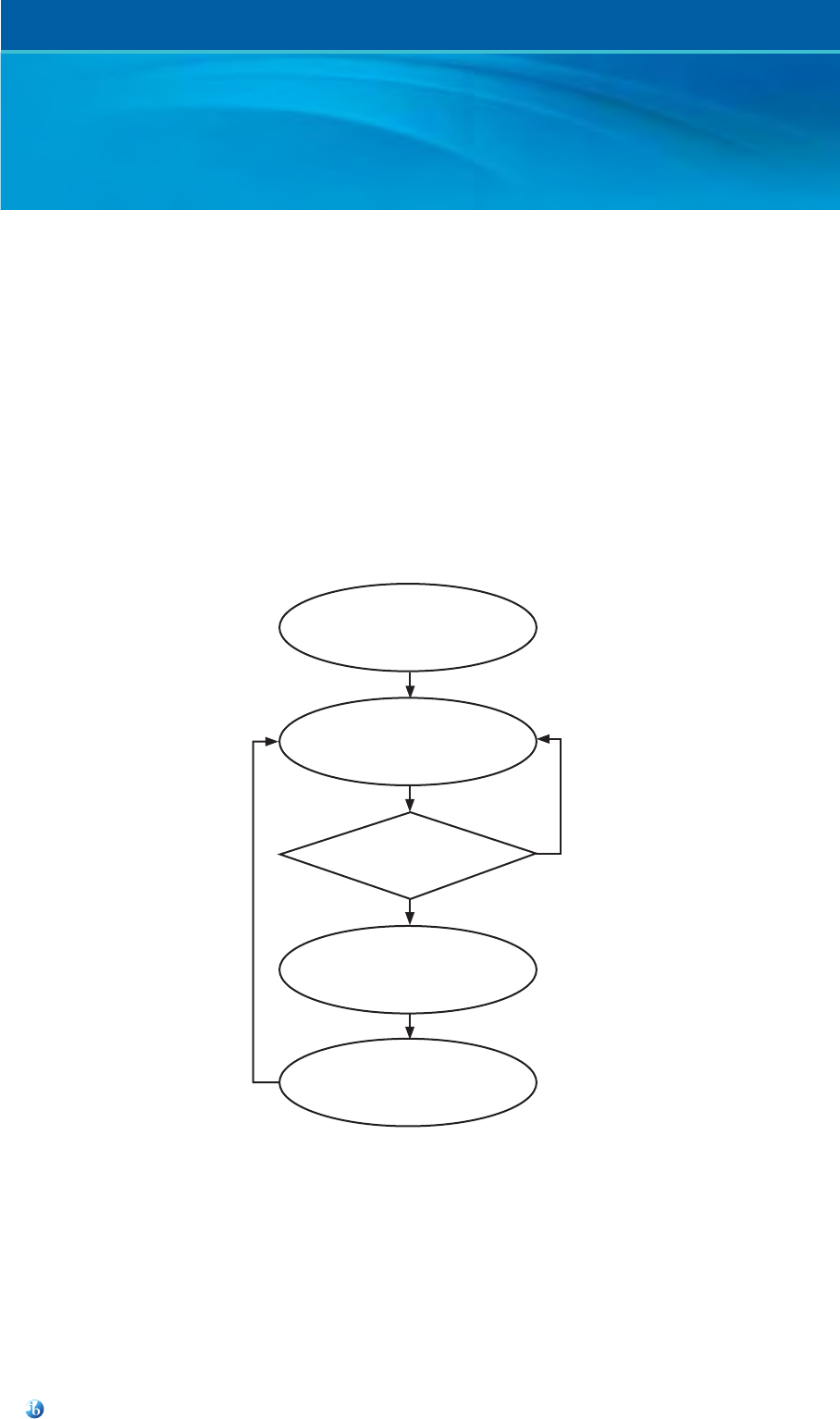
Mathematical inquiry
The IB learner profile encourages learning by experimentation, questioning and discovery. In the IB
classroom, students should generally learn mathematics by being active participants in learning activities
rather than recipients of instruction. Teachers should therefore provide students with opportunities to learn
through mathematical inquiry. This approach is illustrated in figure 2.
Explore the context
Make a conjecture
Extend
Justify
Accept
Reject
Test the conjecture
Figure 2
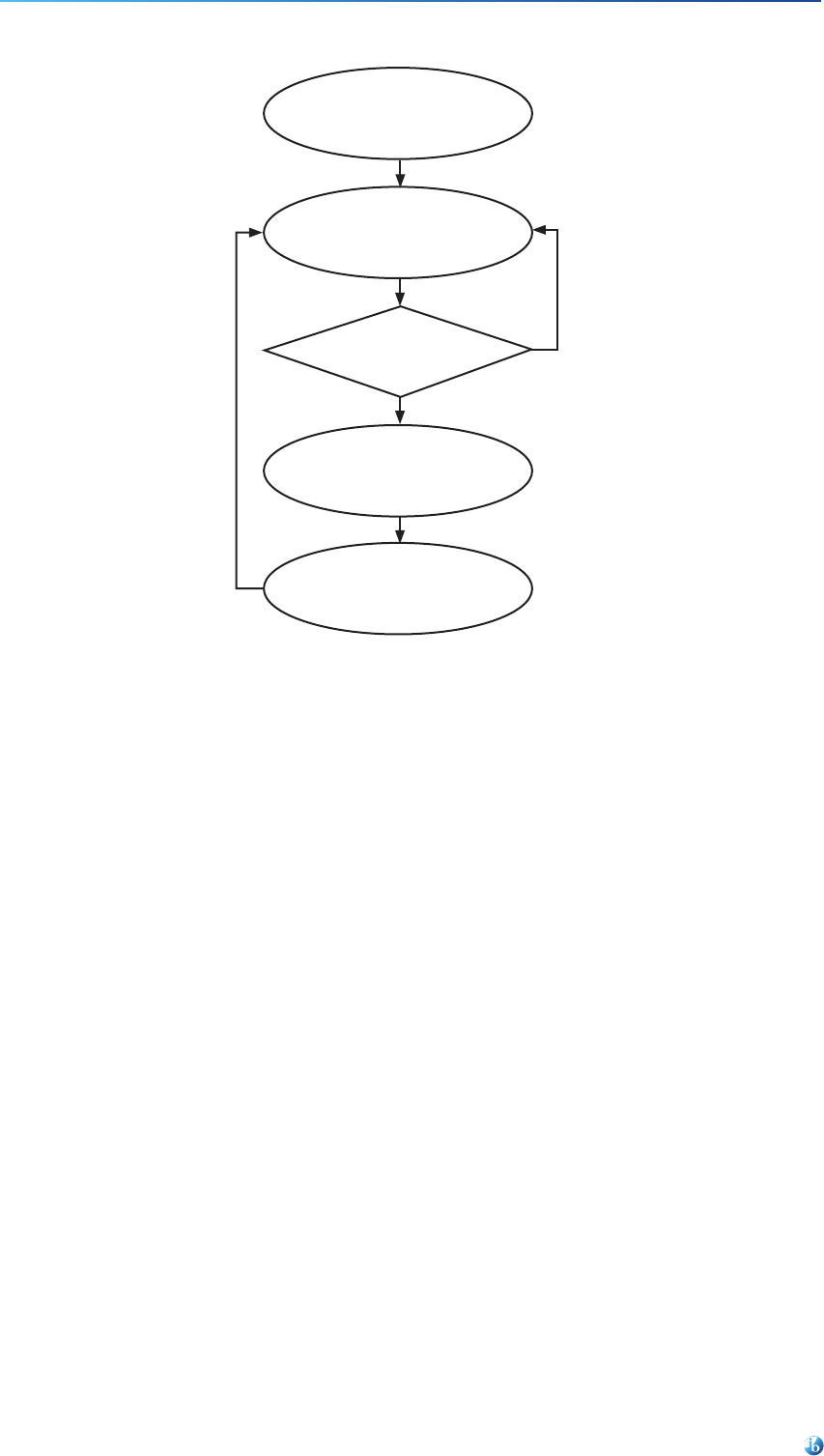
Mathematical modelling and applications
Students should be able to use mathematics to solve problems in the real world. Engaging students in the
mathematical modelling process provides such opportunities. Students should develop, apply and critically
analyse models. This approach is illustrated in figure 3.
Mathematics SL guide12
Approaches to the teaching and learning ofmathematicsSL
Pose a real-world problem
Develop a model
Extend
Reflect on and apply the model
Accept
Reject
Test the model
Figure 3
Technology
Technology is a powerful tool in the teaching and learning of mathematics. Technology can be used to enhance
visualization and support student understanding of mathematical concepts. It can assist in the collection,
recording, organization and analysis of data. Technology can increase the scope of the problem situations that
are accessible to students. The use of technology increases the feasibility of students working with interesting
problem contexts where students reflect, reason, solve problems and make decisions.
As teachers tie together the unifying themes of mathematical inquiry, mathematical modelling and
applications and the use of technology, they should begin by providing substantial guidance, and then
gradually encourage students to become more independent as inquirers and thinkers. IB students should learn
to become strong communicators through the language of mathematics. Teachers should create a safe learning
environment in which students are comfortable as risk-takers.
Teachers are encouraged to relate the mathematics being studied to other subjects and to the real world,
especially topics that have particular relevance or are of interest to their students. Everyday problems and
questions should be drawn into the lessons to motivate students and keep the material relevant; suggestions
are provided in the “Links” column of the syllabus. The mathematical exploration offers an opportunity
to investigate the usefulness, relevance and occurrence of mathematics in the real world and will add an
extra dimension to the course. The emphasis is on communication by means of mathematical forms (for
example, formulae, diagrams, graphs and so on) with accompanying commentary. Modelling, investigation,
reflection, personal engagement and mathematical communication should therefore feature prominently in the
DP mathematics classroom.

Mathematics SL guide 13
Approaches to the teaching and learning ofmathematicsSL
For further information on “Approaches to teaching a DP course”, please refer to the publication The Diploma
Programme: From principles into practice (April 2009). To support teachers, a variety of resources can be
found on the OCC and details of workshops for professional development are available on the public website.
Format of the syllabus
• Content: this column lists, under each topic, the sub-topics to be covered.
• Further guidance: this column contains more detailed information on specific sub-topics listed in the
content column. This clarifies the content for examinations.
• Links: this column provides useful links to the aims of the mathematics SL course, with suggestions for
discussion, real-life examples and ideas for further investigation. These suggestions are only a guide
for introducing and illustrating the sub-topic and are not exhaustive. Links are labelled as follows.
Appl real-life examples and links to other DP subjects
Aim 8 moral, social and ethical implications of the sub-topic
Int international-mindedness
TOK suggestions for discussion
Note that any syllabus references to other subject guides given in the “Links” column are correct for the
current (2012) published versions of the guides.
Notes on the syllabus
• Formulae are only included in this document where there may be some ambiguity. All formulae required
for the course are in the mathematics SL formula booklet.
• The term “technology” is used for any form of calculator or computer that may be available. However,
there will be restrictions on which technology may be used in examinations, which will be noted in
relevant documents.
• The terms “analysis” and “analytic approach” are generally used when referring to an approach that does
not use technology.
Course of study
The content of all six topics in the syllabus must be taught, although not necessarily in the order in which they
appear in this guide. Teachers are expected to construct a course of study that addresses the needs of their
students and includes, where necessary, the topics noted in prior learning.
Integration of the mathematical exploration
Work leading to the completion of the exploration should be integrated into the course of study. Details of how
to do this are given in the section on internal assessment and in the teacher support material.

Mathematics SL guide14
Approaches to the teaching and learning ofmathematicsSL
Time allocation
The recommended teaching time for standard level courses is 150 hours. For mathematics SL, it is expected that
10 hours will be spent on work for the exploration. The time allocations given in this guide are approximate,
and are intended to suggest how the remaining 140 hours allowed for the teaching of the syllabus might
be allocated. However, the exact time spent on each topic depends on a number of factors, including the
background knowledge and level of preparedness of each student. Teachers should therefore adjust these
timings to correspond to the needs of their students.
Use of calculators
Students are expected to have access to a graphic display calculator (GDC) at all times during the course.
The minimum requirements are reviewed as technology advances, and updated information will be provided
to schools. It is expected that teachers and schools monitor calculator use with reference to the calculator
policy. Regulations covering the types of calculators allowed in examinations are provided in the Handbook of
procedures for the Diploma Programme. Further information and advice is provided in the Mathematics HL/
SL: Graphic display calculators teacher support material (May 2005) and on the OCC.
Mathematics SL formula booklet
Each student is required to have access to a clean copy of this booklet during the examination. It is
recommended that teachers ensure students are familiar with the contents of this document from the beginning
of the course. It is the responsibility of the school to download a copy from IBIS or the OCC, check that there
are no printing errors, and ensure that there are sufficient copies available for all students.
Teacher support materials
A variety of teacher support materials will accompany this guide. These materials will include guidance for
teachers on the introduction, planning and marking of the exploration, and specimen examination papers and
markschemes.
Command terms and notation list
Teachers and students need to be familiar with the IB notation and the command terms, as these will be used
without explanation in the examination papers. The “Glossary of command terms” and “Notation list” appear
as appendices in this guide.

Mathematics SL guide 15
Syllabus
Prior learning topics
As noted in the previous section on prior learning, it is expected that all students have extensive previous
mathematical experiences, but these will vary. It is expected that mathematics SL students will be familiar with the
following topics before they take the examinations, because questions assume knowledge of them. Teachers must
therefore ensure that any topics listed here that are unknown to their students at the start of the course are included at
an early stage. They should also take into account the existing mathematical knowledge of their students to design an
appropriate course of study for mathematics SL. This table lists the knowledge, together with the syllabus content, that
is essential to successful completion of the mathematics SL course.
Students must be familiar with SI (Système International) units of length, mass and time, and their derived units.
Topic Content
Number
Routine use of addition, subtraction, multiplication and division, using integers, decimals and
fractions, including order of operations.
Simple positive exponents.
Simplification of expressions involving roots (surds or radicals).
Prime numbers and factors, including greatest common divisors and least common multiples.
Simple applications of ratio, percentage and proportion, linked to similarity.
Definition and elementary treatment of absolute value (modulus),
a
.
Rounding, decimal approximations and significant figures, including appreciation of errors.
Expression of numbers in standard form (scientific notation), that is,
10
k
a
×
,
1 10a≤<
,
k∈
.
Sets and numbers
Concept and notation of sets, elements, universal (reference) set, empty (null) set,
complement, subset, equality of sets, disjoint sets.
Operations on sets: union and intersection.
Commutative, associative and distributive properties.
Venn diagrams.
Number systems: natural numbers; integers, ; rationals, , and irrationals; real numbers, .
Intervals on the real number line using set notation and using inequalities. Expressing the
solution set of a linear inequality on the number line and in set notation.
Mappings of the elements of one set to another. Illustration by means of sets of ordered pairs,
tables, diagrams and graphs.
Algebra
Manipulation of simple algebraic expressions involving factorization and expansion,
including quadratic expressions.
Rearrangement, evaluation and combination of simple formulae. Examples from other subject
areas, particularly the sciences, should be included.
The linear function and its graph, gradient and y-intercept.
Addition and subtraction of algebraic fractions.
The properties of order relations:
,,,<≤>≥
.
Solution of equations and inequalities in one variable, including cases with rational coefficients.
Solution of simultaneous equations in two variables.

Mathematics SL guide16
Prior learning topics
Topic Content
Trigonometry
Angle measurement in degrees. Compass directions and three figure bearings.
Right-angle trigonometry. Simple applications for solving triangles.
Pythagoras’ theorem and its converse.
Geometry
Simple geometric transformations: translation, reflection, rotation, enlargement. Congruence
and similarity, including the concept of scale factor of an enlargement.
The circle, its centre and radius, area and circumference. The terms “arc”, “sector”, “chord”,
“tangent” and “segment”.
Perimeter and area of plane figures. Properties of triangles and quadrilaterals, including
parallelograms, rhombuses, rectangles, squares, kites and trapeziums (trapezoids); compound
shapes.
Volumes of prisms, pyramids, spheres, cylinders and cones.
Coordinate
geometry Elementary geometry of the plane, including the concepts of dimension for point, line, plane
and space. The equation of a line in the form
y mx c= +
.
Parallel and perpendicular lines, including
12
mm
=
and
12
1mm = −
.
Geometry of simple plane figures.
The Cartesian plane: ordered pairs
(,)xy
, origin, axes.
Mid-point of a line segment and distance between two points in the Cartesian plane and in
three dimensions.
Statistics and
probability
Descriptive statistics: collection of raw data; display of data in pictorial and diagrammatic
forms, including pie charts, pictograms, stem and leaf diagrams, bar graphs and line graphs.
Obtaining simple statistics from discrete and continuous data, including mean, median, mode,
quartiles, range, interquartile range.
Calculating probabilities of simple events.

Mathematics SL guide 17
Syllabus
Syllabus content
Syllabus content
Mathematics SL guide 1
Topic 1—Algebra 9 hours
The aim of this topic is to introduce students to some basic algebraic concepts and applications.
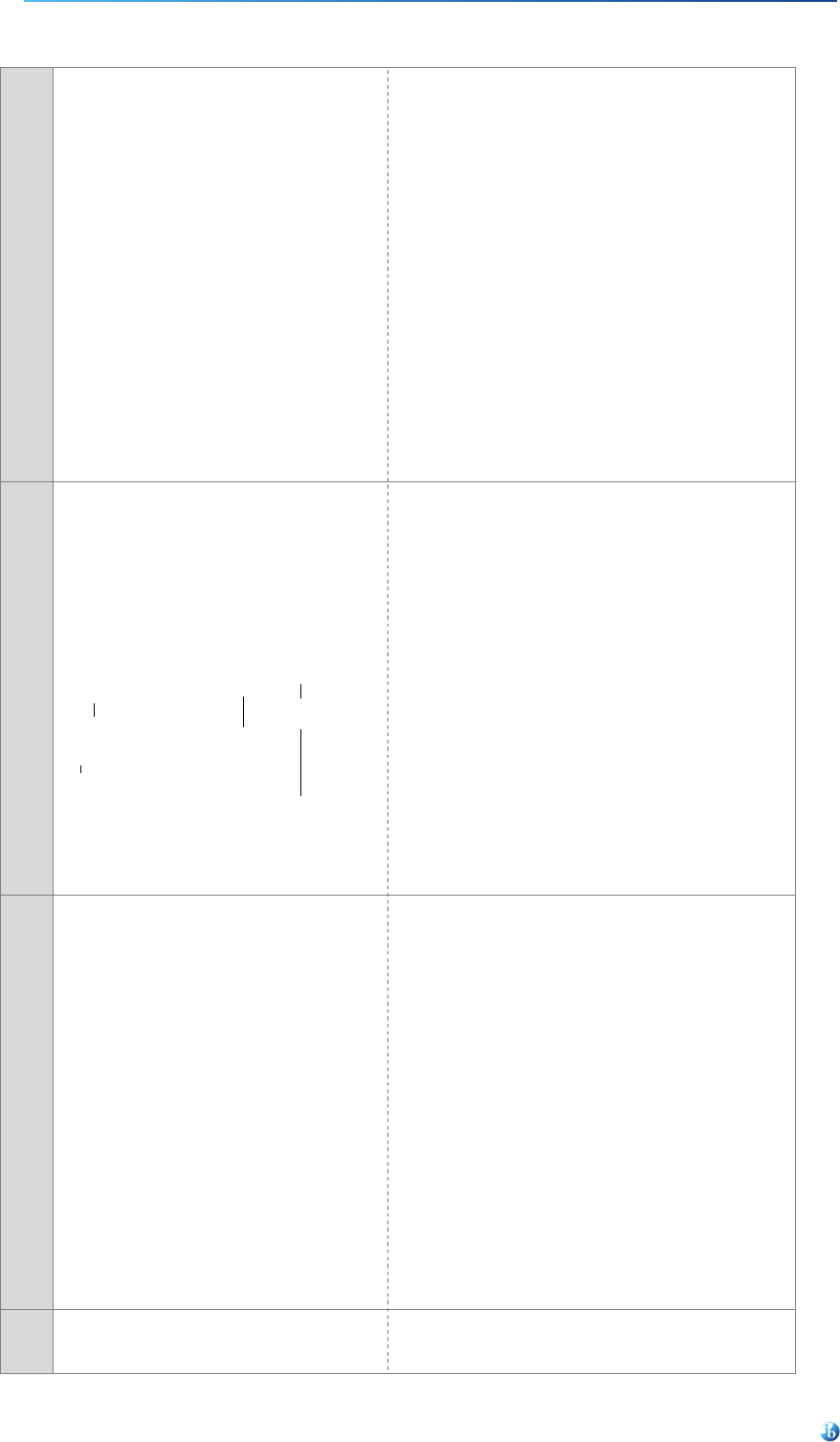
Content Further guidance Links
1.1
Arithmetic sequences and series; sum of finite
arithmetic series; geometric sequences and series;
sum of finite and infinite geometric series.
Sigma notation.
Technology may be used to generate and
display sequences in several ways.
Link to 2.6, exponential functions.
Int: The chess legend (Sissa ibn Dahir).
Int: Aryabhatta is sometimes considered the
“father of algebra”. Compare with
al-Khawarizmi.
TOK: How did Gauss add up integers from
1 to 100? Discuss the idea of mathematical
intuition as the basis for formal proof.
TOK: Debate over the validity of the notion of
“infinity”: finitists such as L. Kronecker
consider that “a mathematical object does not
exist unless it can be constructed from natural
numbers in a finite number of steps”.
TOK: What is Zeno’s dichotomy paradox?
How far can mathematical facts be from
intuition?
Applications.
Examples include compound interest and
population growth.
Mathematics SL guide18
Syllabus content
Syllabus content
Mathematics SL guide 2
Content Further guidance Links
1.2
Elementary treatment of exponents and
logarithms. Examples:
3
4
16 8
=
;
16
3log 8
4
=
;
log32 5log2=
;
4
3 12
(2 ) 2
−
−
=
.
Appl: Chemistry 18.1 (Calculation of pH ).
TOK: Are logarithms an invention or
discovery? (This topic is an opportunity for
teachers to generate reflection on “the nature of
mathematics”.)
Laws of exponents; laws of logarithms.
Change of base.
Examples:
4
ln 7
log
ln 4
7=
,
25
5
5
log
log log
125 3
125 25 2
=
=
.
Link to 2.6, logarithmic functions.
1.3
The binomial theorem:
expansion of ( ),
n
ab n
+∈
.
Counting principles may be used in the
development of the theorem.
Aim 8: Pascal’s triangle. Attributing the origin
of a mathematical discovery to the wrong
mathematician.
Int: The so-called “Pascal’s triangle” was
known in China much earlier than Pascal.
Calculation of binomial coefficients using
Pascal’s triangle and
n
r
.
n
r
should be found using both the formula
and technology.
Example: finding
6
r
from inputting
6
nr
y CX=
and then reading coefficients from
the table.
Link to 5.8, binomial distribution.
Not required:
formal treatment of permutations and formula
for
nr
P
.

Mathematics SL guide 19
Syllabus content
Syllabus content
Mathematics SL guide 3
Topic 2—Functions and equations 24 hours
The aims of this topic are to explore the notion of a function as a unifying theme in mathematics, and to apply functional methods to a variety of
mathematical situations. It is expected that extensive use will be made of technology in both the development and the application of this topic, rather than
elaborate analytical techniques. On examination papers, questions may be set requiring the graphing of functions that do not explicitly appear on the
syllabus, and students may need to choose the appropriate viewing window. For those functions explicitly mentioned, questions may also be set on
composition of these functions with the linear function
y ax b= +
.
Content Further guidance Links
2.1
Concept of function
: ()f x fx
.
Domain, range; image (value).
Example: for
2
xx
−
, domain is
2x≤
,
range is
0y≥
.
A graph is helpful in visualizing the range.
Int: The development of functions, Rene
Descartes (France), Gottfried Wilhelm Leibniz
(Germany) and Leonhard Euler (Switzerland).
Composite functions.
( )
() (())f g x fgx=
.
TOK: Is zero the same as “nothing”?
TOK: Is mathematics a formal language?
Identity function. Inverse function 1
f−.
11
( )( ) ( )( )f f x f fx x
−−
= =
.
On examination papers, students will only be
asked to find the inverse of a one-to-one function.
Not required:
domain restriction.
2.2
The graph of a function; its equation
()y fx=
.
Appl: Chemistry 11.3.1 (sketching and
interpreting graphs); geographic skills.
TOK: How accurate is a visual representation
of a mathematical concept? (Limits of graphs
in delivering information about functions and
phenomena in general, relevance of modes of
representation.)
Function graphing skills.
Investigation of key features of graphs, such as
maximum and minimum values, intercepts,
horizontal and vertical asymptotes, symmetry,
and consideration of domain and range.
Note the difference in the command terms
“draw” and “sketch”.
Use of technology to graph a variety of
functions, including ones not specifically
mentioned.
An analytic approach is also expected for
simple functions, including all those listed
under topic 2.
The graph of
1
()yfx
−
=
as the reflection in
the line
yx=
of the graph of
()y fx=
.
Link to 6.3, local maximum and minimum
points.

Mathematics SL guide20
Syllabus content
Syllabus content
Mathematics SL guide 4
Content Further guidance Links
2.3
Transformations of graphs.
Technology should be used to investigate these
transformations.
Appl: Economics 1.1 (shifting of supply and
demand curves).
Translations:
()y fx b= +
;
()y fx a= −
.
Reflections (in both axes):
()y fx= −
;
()yfx= −
.
Vertical stretch with scale factor p:
()y pf x=
.
Stretch in the x-direction with scale factor
1
q
:
( )
y f qx=
.
Translation by the vector
3
2
−
denotes
horizontal shift of 3 units to the right, and
vertical shift of 2 down.
Composite transformations.
Example:
2
yx
=
used to obtain
2
32
yx= +
by
a stretch of scale factor 3 in the y-direction
followed by a translation of
0
2
.
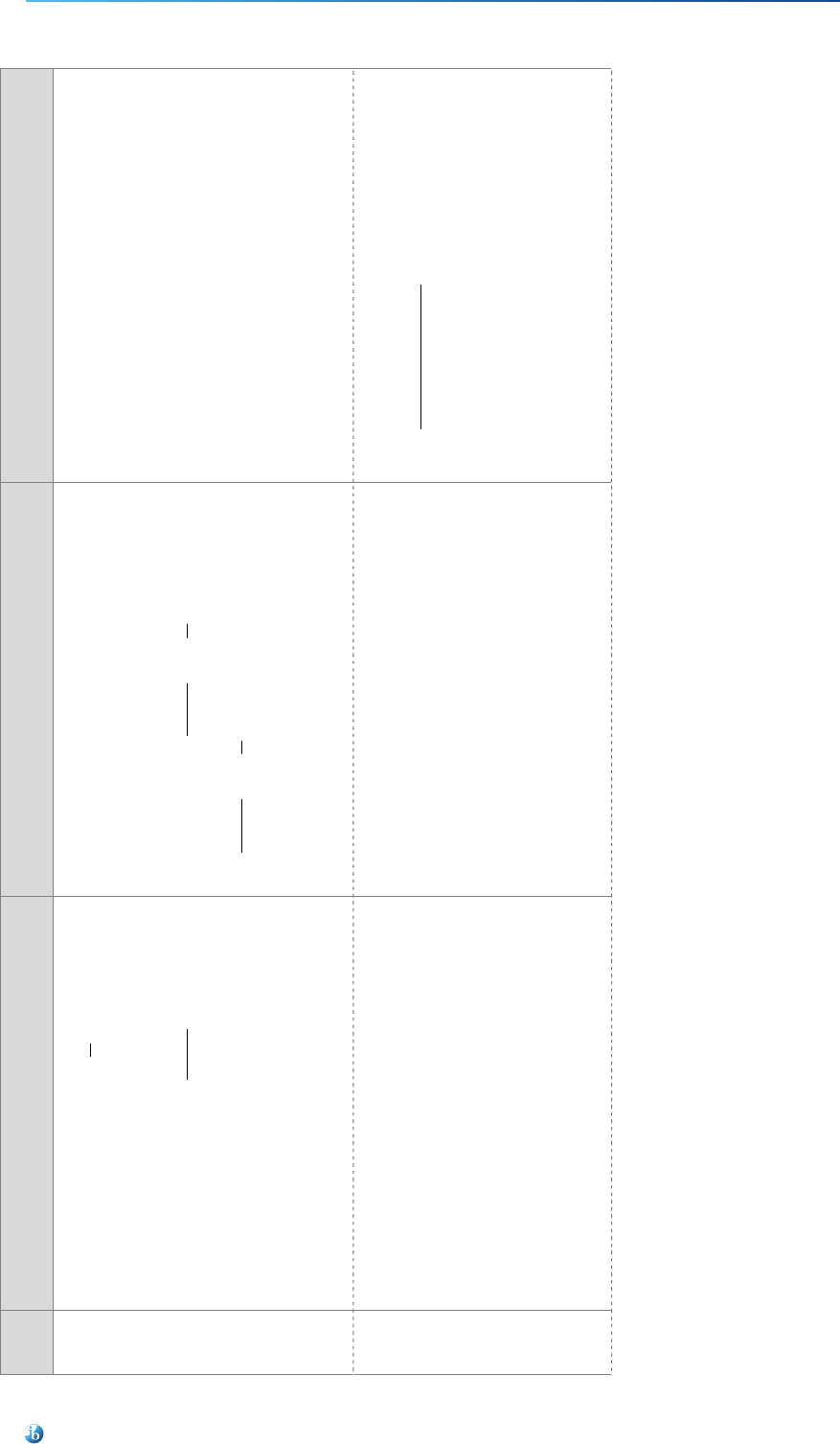
2.4
The quadratic function
2
x ax bx c
++
: its
graph, y-intercept
(0, )c
. Axis of symmetry.
The form
( )( )x ax p x q−−
,
x-intercepts
( , 0)p
and
( , 0)q
.
The form
2
()x ax h k
−+
, vertex
(, )hk
.
Candidates are expected to be able to change
from one form to another.
Links to 2.3, transformations; 2.7, quadratic
equations.
Appl: Chemistry 17.2 (equilibrium law).
Appl: Physics 2.1 (kinematics).
Appl: Physics 4.2 (simple harmonic motion).
Appl: Physics 9.1 (HL only) (projectile
motion).
Mathematics SL guide 21
Syllabus content
Syllabus content
Mathematics SL guide 5
Content Further guidance Links
2.5
The reciprocal function
1
x
x
,
0x≠
: its
graph and self-inverse nature.
The rational function
ax b
x
cx d
+
+
and its
graph.
Examples:
42
( ) ,
32 3
hx x
x
= ≠
−;
75
,
25 2
x
yx
x
+
= ≠
−
.
Vertical and horizontal asymptotes.
Diagrams should include all asymptotes and
intercepts.
2.6 Exponential functions and their graphs:
x
xa
,
0a>
,
e
x
x
.
Int: The Babylonian method of multiplication:
222
()
2
ab a b
ab + −−
=. Sulba Sutras in ancient
India and the Bakhshali Manuscript contained
an algebraic formula for solving quadratic
equations.
Logarithmic functions and their graphs:
log
a
xx
,
0x>
,
lnxx
,
0x>
.
Relationships between these functions:
ln
e
x xa
a=
;
log
x
a
ax
=
; log
a
x
ax
=,
0x>
.
Links to 1.1, geometric sequences; 1.2, laws of
exponents and logarithms; 2.1, inverse
functions; 2.2, graphs of inverses; and 6.1,
limits.

Mathematics SL guide22
Syllabus content
Syllabus content
Mathematics SL guide 6
Content Further guidance Links
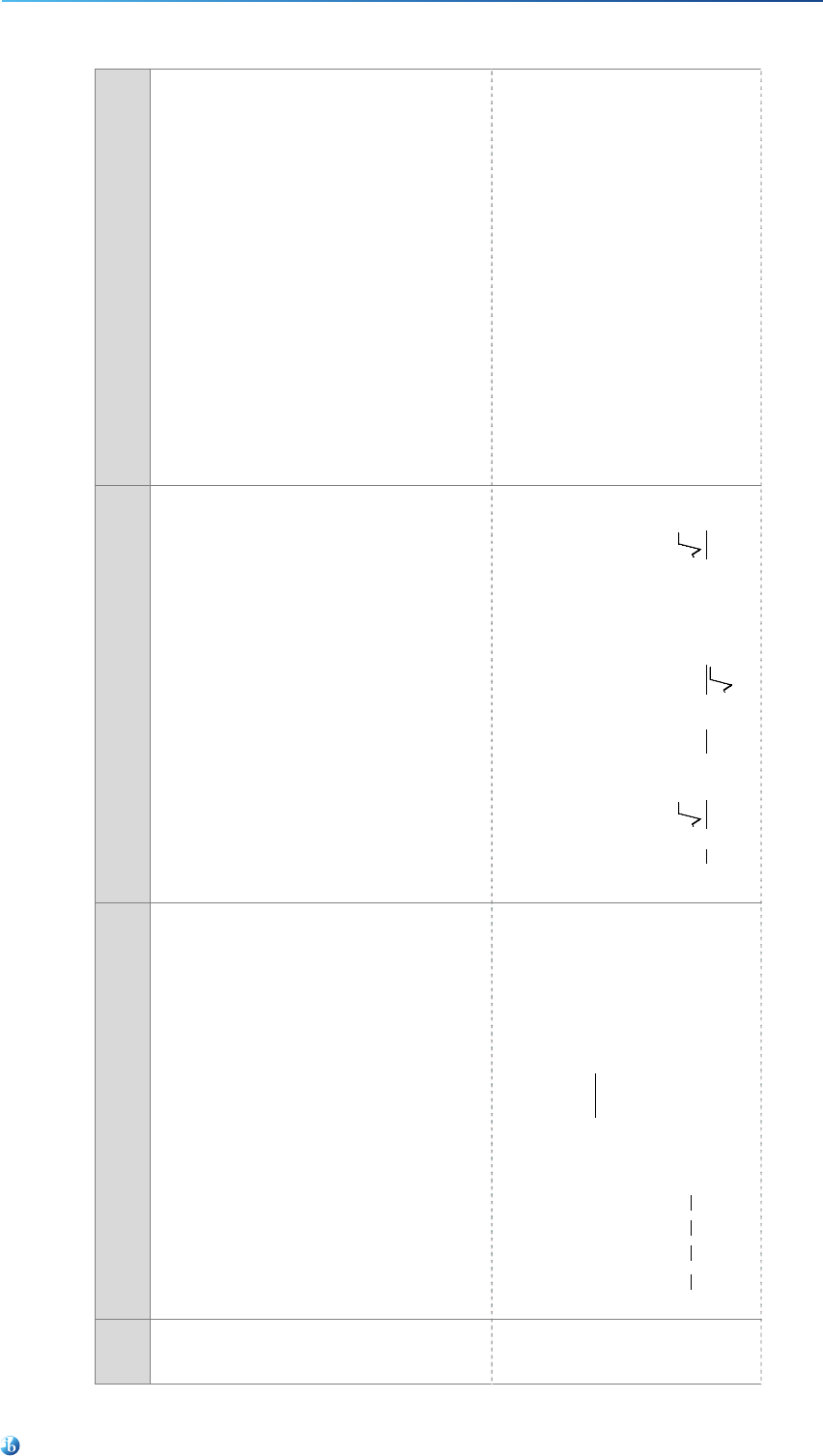
2.7 Solving equations, both graphically and
analytically.
Use of technology to solve a variety of
equations, including those where there is no
appropriate analytic approach.
Solutions may be referred to as roots of
equations or zeros of functions.
Links to 2.2, function graphing skills; and 2.3–
2.6, equations involving specific functions.
Examples:
4
5 60
e sin ,
x
xx
x
+ −=
=
.
Solving
2
0ax bx c
+ +=
,
0a≠
.
The quadratic formula.
The discriminant
2
4b ac∆= −
and the nature
of the roots, that is, two distinct real roots, two
equal real roots, no real roots.
Example: Find k given that the equation
2
32 0kx x k
+ +=
has two equal real roots.
Solving exponential equations.
Examples:
1
2 10
x−
=
,
1
19
3
x
x+
=
.
Link to 1.2, exponents and logarithms.
2.8 Applications of graphing skills and solving
equations that relate to real-life situations. Link to 1.1, geometric series. Appl: Compound interest, growth and decay;
projectile motion; braking distance; electrical
circuits.
Appl: Physics 7.2.7–7.2.9, 13.2.5, 13.2.6,
13.2.8 (radioactive decay and half-life)
Mathematics SL guide 23
Syllabus content
Syllabus content
Mathematics SL guide 7
Topic 3—Circular functions and trigonometry 16 hours
The aims of this topic are to explore the circular functions and to solve problems using trigonometry. On examination papers, radian measure should be
assumed unless otherwise indicated.
Content Further guidance Links
3.1
The circle: radian measure of angles; length of
an arc; area of a sector.
Radian measure may be expressed as exact
multiples of
π
, or decimals.
Int: Seki Takakazu calculating
π
to ten
decimal places.
Int: Hipparchus, Menelaus and Ptolemy.
Int: Why are there 360 degrees in a complete
turn? Links to Babylonian mathematics.
TOK: Which is a better measure of angle:
radian or degree? What are the “best” criteria
by which to decide?
TOK: Euclid’s axioms as the building blocks
of Euclidean geometry. Link to non-Euclidean
geometry.
3.2
Definition of
cos
θ
and
sin
θ
in terms of the
unit circle.
Aim 8: Who really invented “Pythagoras’
theorem”?
Int: The first work to refer explicitly to the
sine as a function of an angle is the
Aryabhatiya of Aryabhata (ca. 510).
TOK: Trigonometry was developed by
successive civilizations and cultures. How is
mathematical knowledge considered from a
sociocultural perspective?
Definition of
tan
θ
as
sin
cos
θ
θ
.
The equation of a straight line through the
origin is
tanyx
θ
=
.
Exact values of trigonometric ratios of
π πππ
0,,,,
6 432
and their multiples.
Examples:
π 3 3π 1 3
sin , cos , tan210
32 4 3
2
= = − °=
.

Mathematics SL guide24
Syllabus content
Syllabus content
Mathematics SL guide 8
Content Further guidance Links
3.3
The Pythagorean identity
22
cos sin 1
θθ
+=
.
Double angle identities for sine and cosine.
Simple geometrical diagrams and/or
technology may be used to illustrate the double
angle formulae (and other trigonometric
identities).
Relationship between trigonometric ratios.
Examples:
Given
sin
θ
, finding possible values of
tan
θ
without finding
θ
.
Given
3
cos
4
x=
, and x is acute, find
sin2x
without finding x.
3.4
The circular functions
sin x
,
cos x
and
tan x
:
their domains and ranges; amplitude, their
periodic nature; and their graphs.
Appl: Physics 4.2 (simple harmonic motion).
Composite functions of the form
( )
( ) sin ( )fx a bx c d= ++
.
Examples:
( ) tan 4
fx x π
= −
,
( )
( ) 2cos 3( 4) 1fx x= −+
.
Transformations.
Example:
sinyx=
used to obtain
3sin 2yx=
by a stretch of scale factor 3 in the y-direction
and a stretch of scale factor
1
2
in the
x-direction.
Link to 2.3, transformation of graphs.
Applications.
Examples include height of tide, motion of a
Ferris wheel.

Mathematics SL guide 25
Syllabus content
Syllabus content
Mathematics SL guide 9
Content Further guidance Links
3.5
Solving trigonometric equations in a finite
interval, both graphically and analytically.
Examples
:
2sin 1x=
,
02πx≤≤
,
2sin2 3cosxx=
,
oo
0 180x
≤≤ ,
( )
2tan 3( 4) 1x
−=
,
π 3πx−≤ ≤
.
Equations leading to quadratic equations in
sin , cos or tanxx x
.
Not required:
the general solution of trigonometric equations.
Examples:
2
2sin 5cos 1 0xx
+ +=
for
04x≤ <π
,
2sin cos2xx=
,
ππx−≤ ≤
.
3.6
Solution of triangles.
Pythagoras’ theorem is a special case of the
cosine rule.
Aim 8: Attributing the origin of a
mathematical discovery to the wrong
mathematician.
Int: Cosine rule: Al-Kashi and Pythagoras.
The cosine rule.
The sine rule, including the ambiguous case.
Area of a triangle,
1sin
2ab C
.
Link with 4.2, scalar product, noting that:
222
2=− ⇒ = + −⋅c a b c a b ab
.
Applications.
Examples include navigation, problems in two
and three dimensions, including angles of
elevation and depression.
TOK: Non-Euclidean geometry: angle sum on
a globe greater than 180°.

Mathematics SL guide26
Syllabus content
Syllabus content
Mathematics SL guide 10
Topic 4—Vectors 16 hours
The aim of this topic is to provide an elementary introduction to vectors, including both algebraic and geometric approaches. The use of dynamic geometry
software is extremely helpful to visualize situations in three dimensions.
Content Further guidance Links
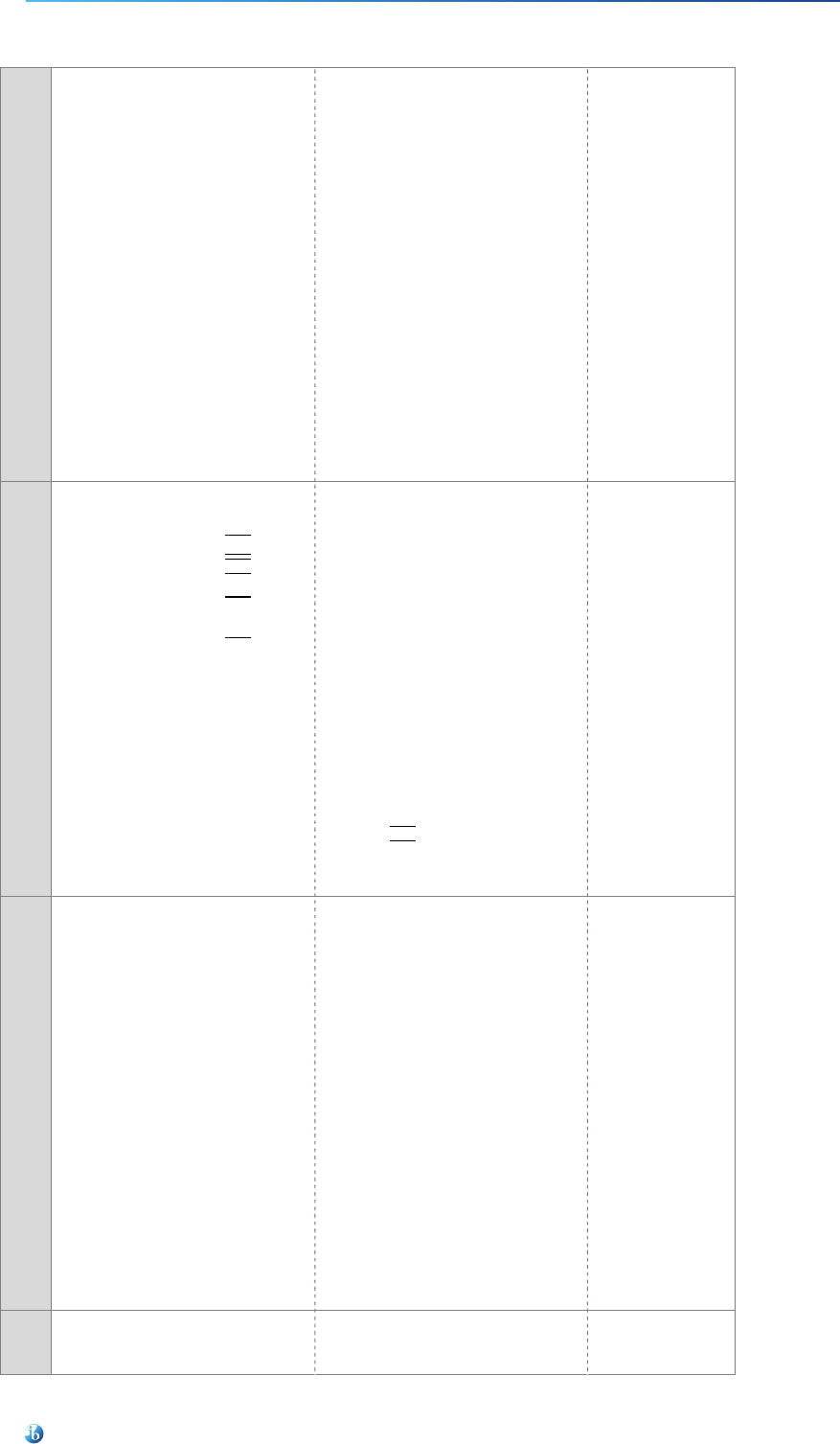
4.1
Vectors as displacements in the plane and in
three dimensions.
Link to three-dimensional geometry, x, y and z-
axes.
Appl: Physics 1.3.2 (vector sums and
differences) Physics 2.2.2, 2.2.3 (vector
resultants).
TOK: How do we relate a theory to the
author? Who developed vector analysis:
JW Gibbs or O Heaviside?
Components of a vector; column
representation;
1
2 12 3
3
v
v vv v
v
= =++
v i jk
.
Components are with respect to the unit
vectors i, j and k (standard basis).
Algebraic and geometric approaches to the
following:
Applications to simple geometric figures are
essential.
• the sum and difference of two vectors; the
zero vector, the vector
−v
; The difference of
v
and
w
is
()− = +−vwv w
. Vector sums and differences
can be represented by the diagonals of a
parallelogram.
• multiplication by a scalar,
kv
; parallel
vectors;
Multiplication by a scalar can be illustrated by
enlargement.
• magnitude of a vector,
v
;
• unit vectors; base vectors; i, j and k;
• position vectors
OA
→=a
;
•
AB OB OA
→ →→
=−=−ba
.
Distance between points A and B is the
magnitude of
AB
→
.
Mathematics SL guide 27
Syllabus content
Syllabus content
Mathematics SL guide 11
Content Further guidance Links
4.2
The scalar product of two vectors.
The scalar product is also known as the “dot
product”.
Link to 3.6, cosine rule.
Perpendicular vectors; parallel vectors.
For non-zero vectors,
0⋅=vw
is equivalent to
the vectors being perpendicular.
For parallel vectors,
k=wv
, ⋅=vw vw.
The angle between two vectors.
4.3
Vector equation of a line in two and three
dimensions:
t= +rab
.
Relevance of
a
(position) and
b
(direction).
Interpretation of
t
as time and
b
as velocity,
with b representing speed.
Aim 8: Vector theory is used for tracking
displacement of objects, including for peaceful
and harmful purposes.
TOK: Are algebra and geometry two separate
domains of knowledge? (Vector algebra is a
good opportunity to discuss how geometrical
properties are described and generalized by
algebraic methods.)
The angle between two lines.
4.4
Distinguishing between coincident and parallel
lines.
Finding the point of intersection of two lines.
Determining whether two lines intersect.

Mathematics SL guide28
Syllabus content
Syllabus content
Mathematics SL guide 12
Topic 5—Statistics and probability 35 hours
The aim of this topic is to introduce basic concepts. It is expected that most of the calculations required will be done using technology, but explanations of
calculations by hand may enhance understanding. The emphasis is on understanding and interpreting the results obtained, in context. Statistical tables will no
longer be allowed in examinations. While many of the calculations required in examinations are estimates, it is likely that the command terms “write down”,
“find” and “calculate” will be used.
Content Further guidance Links
5.1
Concepts of population, sample, random
sample, discrete and continuous data.
Presentation of data: frequency distributions
(tables); frequency histograms with equal class
intervals;
Continuous and discrete data.
Appl: Psychology: descriptive statistics,
random sample (various places in the guide).
Aim 8: Misleading statistics.
Int: The St Petersburg paradox, Chebychev,
Pavlovsky.
box-and-whisker plots; outliers.
Outlier is defined as more than
1.5 IQR×
from
the nearest quartile.
Technology may be used to produce
histograms and box-and-whisker plots.
Grouped data: use of mid-interval values for
calculations; interval width; upper and lower
interval boundaries; modal class.
Not required:
frequency density histograms.

Mathematics SL guide 29
Syllabus content
Syllabus content
Mathematics SL guide 13
Content Further guidance Links
5.2
Statistical measures and their interpretations.
Central tendency: mean, median, mode.
Quartiles, percentiles.
On examination papers, data will be treated as
the population.
Calculation of mean using formula and
technology. Students should use mid-interval
values to estimate the mean of grouped data.
Appl: Psychology: descriptive statistics
(various places in the guide).
Appl: Statistical calculations to show patterns
and changes; geographic skills; statistical
graphs.
Appl: Biology 1.1.2 (calculating mean and
standard deviation ); Biology 1.1.4 (comparing
means and spreads between two or more
samples).
Int: Discussion of the different formulae for
variance.
TOK: Do different measures of central
tendency express different properties of the
data? Are these measures invented or
discovered? Could mathematics make
alternative, equally true, formulae? What does
this tell us about mathematical truths?
TOK: How easy is it to lie with statistics?
Dispersion: range, interquartile range,
variance, standard deviation.
Effect of constant changes to the original data.
Calculation of standard deviation/variance
using only technology.
Link to 2.3, transformations.
Examples:
If 5 is subtracted from all the data items, then
the mean is decreased by 5, but the standard
deviation is unchanged.
If all the data items are doubled, the median is
doubled, but the variance is increased by a
factor of 4.
Applications.
5.3
Cumulative frequency; cumulative frequency
graphs; use to find median, quartiles,
percentiles.
Values of the median and quartiles produced
by technology may be different from those
obtained from a cumulative frequency graph.

Mathematics SL guide30
Syllabus content
Syllabus content
Mathematics SL guide 14
Content Further guidance Links
5.4
Linear correlation of bivariate data.
Independent variable x, dependent variable y.
Appl: Chemistry 11.3.3 (curves of best fit).
Appl: Geography (geographic skills).
Measures of correlation; geographic skills.
Appl: Biology 1.1.6 (correlation does not
imply causation).
TOK: Can we predict the value of x from y,
using this equation?
TOK: Can all data be modelled by a (known)
mathematical function? Consider the reliability
and validity of mathematical models in
describing real-life phenomena.
Pearson’s product–moment correlation
coefficient r.
Technology should be used to calculate r.
However, hand calculations of r may enhance
understanding.
Positive, zero, negative; strong, weak, no
correlation.
Scatter diagrams; lines of best fit.
The line of best fit passes through the mean
point.
Equation of the regression line of y on x.
Use of the equation for prediction purposes.
Mathematical and contextual interpretation.
Not required:
the coefficient of determination R2.
Technology should be used find the equation.
Interpolation, extrapolation.
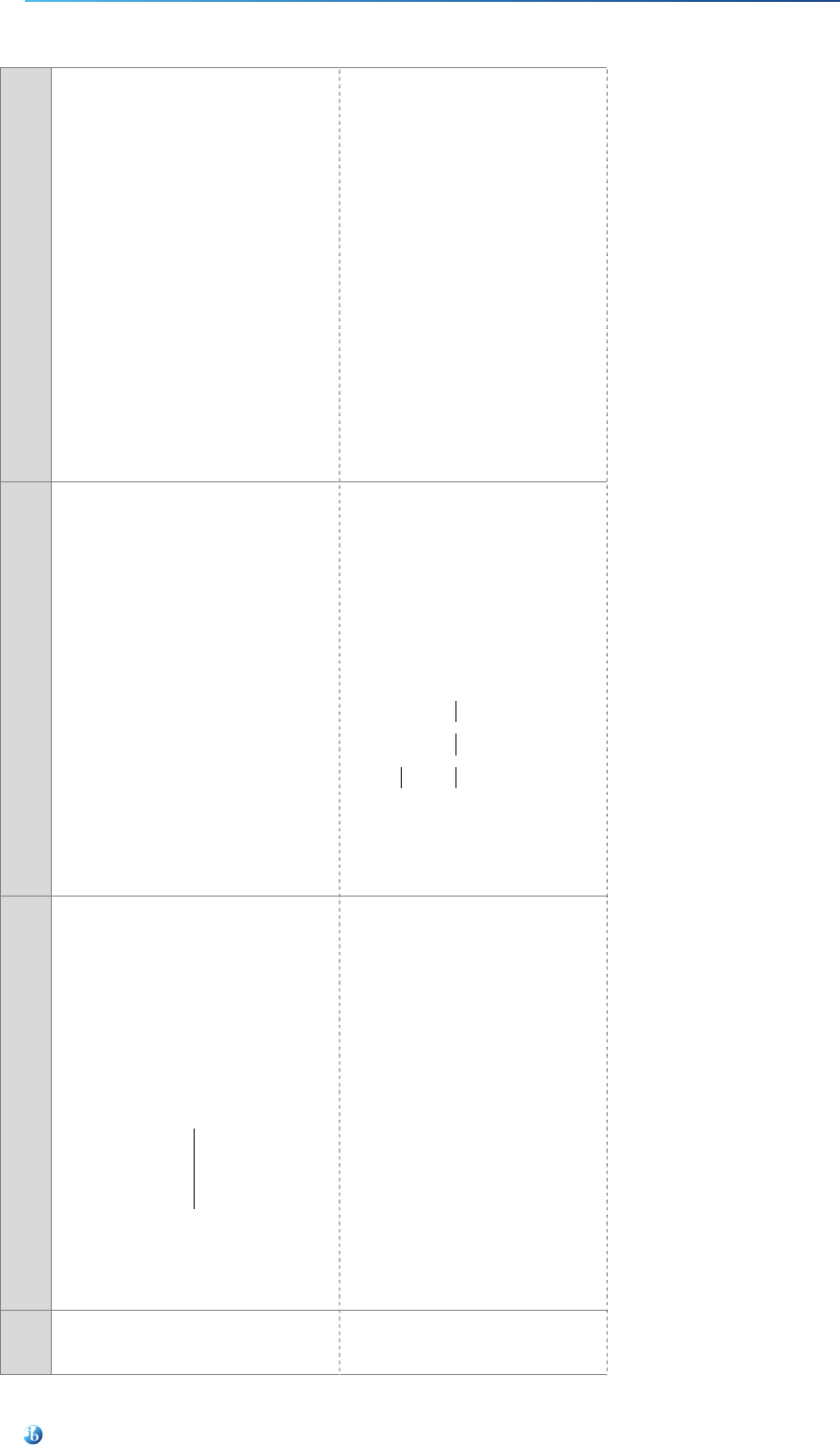
5.5
Concepts of trial, outcome, equally likely
outcomes, sample space (U) and event.
The sample space can be represented
diagrammatically in many ways.
TOK: To what extent does mathematics offer
models of real life? Is there always a function
to model data behaviour?
The probability of an event A is
()
P( )
()
nA
AnU
=
.
The complementary events A and
A′
(not A).
Use of Venn diagrams, tree diagrams and
tables of outcomes.
Experiments using coins, dice, cards and so on,
can enhance understanding of the distinction
between (experimental) relative frequency and
(theoretical) probability.
Simulations may be used to enhance this topic.
Links to 5.1, frequency; 5.3, cumulative
frequency.
Mathematics SL guide 31
Syllabus content
Syllabus content
Mathematics SL guide 15
Content Further guidance Links
5.6
Combined events,
P( )AB∪
.
Mutually exclusive events:
P( ) 0AB∩=
.
Conditional probability; the definition
( )
P( )
P| P( )
AB
AB B
∩
=
.
Independent events; the definition
( ) ( )
P| P()P|
AB A AB
′
= = .
Probabilities with and without replacement.
The non-exclusivity of “or”.
Problems are often best solved with the aid of a
Venn diagram or tree diagram, without explicit
use of formulae.
Aim 8: The gambling issue: use of probability
in casinos. Could or should mathematics help
increase incomes in gambling?
TOK: Is mathematics useful to measure risks?
TOK: Can gambling be considered as an
application of mathematics? (This is a good
opportunity to generate a debate on the nature,
role and ethics of mathematics regarding its
applications.)
5.7
Concept of discrete random variables and their
probability distributions.
Simple examples only, such as:
1
P( ) (4 )
18
Xx x= = +
for
{ }
1, 2, 3x∈
;
567
P( ) , ,
18 18 18
Xx= =
.
Expected value (mean),
E( )X
for discrete data.
Applications.
E( ) 0X=
indicates a fair game where X
represents the gain of one of the players.
Examples include games of chance.

Mathematics SL guide32
Syllabus content
Syllabus content
Mathematics SL guide 16
Content Further guidance Links
5.8
Binomial distribution.
Mean and variance of the binomial
distribution.
Not required:
formal proof of mean and variance.
Link to 1.3, binomial theorem.
Conditions under which random variables have
this distribution.
Technology is usually the best way of
calculating binomial probabilities.
5.9
Normal distributions and curves.
Standardization of normal variables (z-values,
z-scores).
Properties of the normal distribution.
Probabilities and values of the variable must be
found using technology.
Link to 2.3, transformations.
The standardized value (
z
) gives the number
of standard deviations from the mean.
Appl: Biology 1.1.3 (links to normal
distribution).
Appl: Psychology: descriptive statistics
(various places in the guide).

Mathematics SL guide 33
Syllabus content
Syllabus content
Mathematics SL guide 17
Topic 6—Calculus 40 hours
The aim of this topic is to introduce students to the basic concepts and techniques of differential and integral calculus and their applications.
Content Further guidance Links
6.1
Informal ideas of limit and convergence.
Example: 0.3, 0.33, 0.333, ... converges to
1
3
.
Technology should be used to explore ideas of
limits, numerically and graphically.
Appl: Economics 1.5 (marginal cost, marginal
revenue, marginal profit).
Appl: Chemistry 11.3.4 (interpreting the
gradient of a curve).
Aim 8: The debate over whether Newton or
Leibnitz discovered certain calculus concepts.
TOK: What value does the knowledge of
limits have? Is infinitesimal behaviour
applicable to real life?
TOK: Opportunities for discussing hypothesis
formation and testing, and then the formal
proof can be tackled by comparing certain
cases, through an investigative approach.
Limit notation.
Example:
23
lim 1
x
x
x
→∞
+
−
Links to 1.1, infinite geometric series; 2.5–2.7,
rational and exponential functions, and
asymptotes.
Definition of derivative from first principles as
0
( ) ()
( ) lim
h
fx h fx
fx h
→
+−
′=
.
Use of this definition for derivatives of simple
polynomial functions only.
Technology could be used to illustrate other
derivatives.
Link to 1.3, binomial theorem.
Use of both forms of notation,
d
d
y
x
and
( )
fx
′
,
for the first derivative.
Derivative interpreted as gradient function and
as rate of change.
Identifying intervals on which functions are
increasing or decreasing.
Tangents and normals, and their equations.
Not required:
analytic methods of calculating limits.
Use of both analytic approaches and
technology.
Technology can be used to explore graphs and
their derivatives.

Mathematics SL guide34
Syllabus content
Syllabus content
Mathematics SL guide 18
Content Further guidance Links
6.2
Derivative of
()
n
xn∈
,
sin x
,
cos x
,
tan x
,
ex and
ln x
.
Differentiation of a sum and a real multiple of
these functions.
The chain rule for composite functions.
The product and quotient rules.
Link to 2.1, composition of functions.
Technology may be used to investigate the chain
rule.
The second derivative.
Use of both forms of notation,
2
2
d
d
y
x
and
()fx
′′
.
Extension to higher derivatives.
d
d
n
n
y
x
and
( )
()
n
fx
.

Mathematics SL guide 35
Syllabus content
Syllabus content
Mathematics SL guide 19
Content Further guidance Links
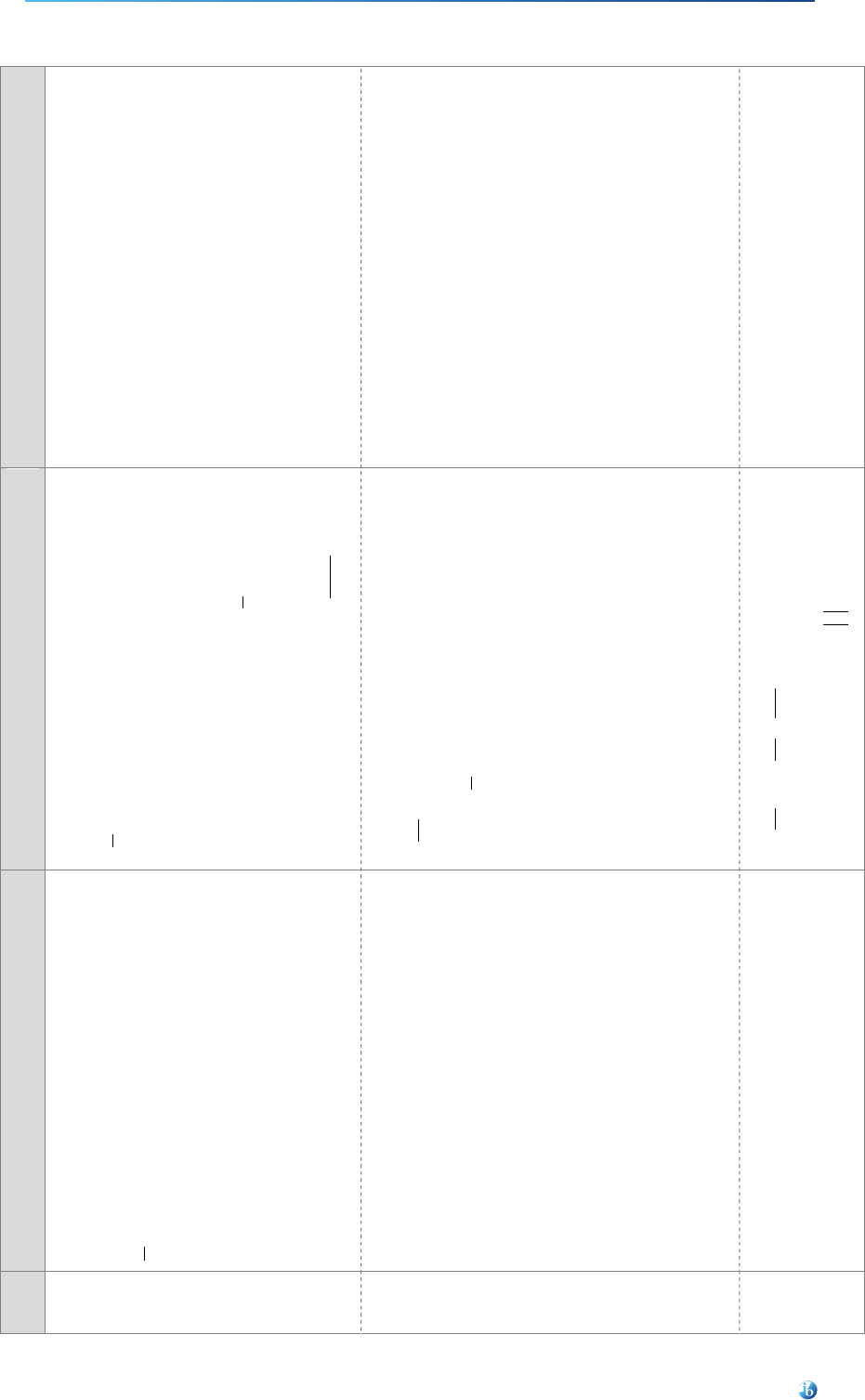
6.3
Local maximum and minimum points.
Testing for maximum or minimum.
Using change of sign of the first derivative and
using sign of the second derivative.
Use of the terms “concave-up” for
() 0fx
′′
>
,
and “concave-down” for
() 0fx
′′
<
.
Appl: profit, area, volume.
Points of inflexion with zero and non-zero
gradients. At a point of inflexion ,
() 0fx
′′
=
and changes
sign (concavity change).
() 0fx
′′ =
is not a sufficient condition for a
point of inflexion: for example,
4
yx
=
at
(0,0)
.
Graphical behaviour of functions,
including the relationship between the
graphs of
f
,
f′
and
f′′
.
Optimization.
Both “global” (for large x) and “local”
behaviour.
Technology can display the graph of a
derivative without explicitly finding an
expression for the derivative.
Use of the first or second derivative test to
justify maximum and/or minimum values.
Applications.
Not required:
points of inflexion where
()fx
′′
is not defined:
for example,
13
yx
=
at
(0,0)
.
Examples include profit, area, volume.
Link to 2.2, graphing functions.
Mathematics SL guide36
Syllabus content
Syllabus content
Mathematics SL guide 20
Content
Further guidance
Links
6.4
Indefinite integration as anti-differentiation.
Indefinite integral of
()
n
xn∈
,
sin x
,
cos x
,
1
x
and
e
x.
1d lnx xC
x
= +
∫
,
0x>
.
The composites of any of these with the linear
function
ax b+
.
Example:
1
( ) cos(2 3) ( ) sin(2 3)
2
f x x fx x C
′= + ⇒ = ++.
Integration by inspection, or substitution of the
form
(()) '()d
fgx g x x
∫.
Examples:
( )
4
22
2 1 d, sin d, d
sin
cos
xx x x x x x
x
x
+
∫ ∫∫
.
6.5
Anti-differentiation with a boundary condition
to determine the constant term.
Example:
if
2
d3
d
y
xx
x
= +
and
10y=
when
0x=
, then
32
110
2
yx x
=++
.
Int: Successful calculation of the volume of
the pyramidal frustum by ancient Egyptians
(Egyptian Moscow papyrus).
Use of infinitesimals by Greek geometers.
Definite integrals, both analytically and using
technology.
( )d ( ) ( )
b
a
g x x gb ga
′= −
∫
.
The value of some definite integrals can only
be found using technology.
Accurate calculation of the volume of a
cylinder by Chinese mathematician Liu Hui
Areas under curves (between the curve and the
x-axis).
Areas between curves.
Volumes of revolution about the x-axis.
Students are expected to first write a correct
expression before calculating the area.
Technology may be used to enhance
understanding of area and volume.
Int: Ibn Al Haytham: first mathematician to
calculate the integral of a function, in order to
find the volume of a paraboloid.
6.6
Kinematic problems involving displacement s,
velocity v and acceleration a.
d
d
s
v
t
=
; 2
2
dd
dd
vs
a
tt
= = .
Appl: Physics 2.1 (kinematics).
Total distance travelled.
Total distance travelled 2
1d
t
t
vt
=∫.

Mathematics SL guide 37
Assessment in the Diploma Programme
Assessment
General
Assessment is an integral part of teaching and learning. The most important aims of assessment in the Diploma
Programme are that it should support curricular goals and encourage appropriate student learning. Both
external and internal assessment are used in the Diploma Programme. IB examiners mark work produced
for external assessment, while work produced for internal assessment is marked by teachers and externally
moderated by the IB.
There are two types of assessment identified by the IB.
• Formative assessment informs both teaching and learning. It is concerned with providing accurate and
helpful feedback to students and teachers on the kind of learning taking place and the nature of students’
strengths and weaknesses in order to help develop students’ understanding and capabilities. Formative
assessment can also help to improve teaching quality, as it can provide information to monitor progress
towards meeting the course aims and objectives.
• Summative assessment gives an overview of previous learning and is concerned with measuring student
achievement.
The Diploma Programme primarily focuses on summative assessment designed to record student achievement
at or towards the end of the course of study. However, many of the assessment instruments can also be
used formatively during the course of teaching and learning, and teachers are encouraged to do this. A
comprehensive assessment plan is viewed as being integral with teaching, learning and course organization.
For further information, see the IB Programme standards and practices document.
The approach to assessment used by the IB is criterion-related, not norm-referenced. This approach to
assessment judges students’ work by their performance in relation to identified levels of attainment, and not in
relation to the work of other students. For further information on assessment within the Diploma Programme,
please refer to the publication Diploma Programme assessment: Principles and practice.
To support teachers in the planning, delivery and assessment of the Diploma Programme courses, a variety
of resources can be found on the OCC or purchased from the IB store (http://store.ibo.org). Teacher support
materials, subject reports, internal assessment guidance, grade descriptors, as well as resources from other
teachers, can be found on the OCC. Specimen and past examination papers as well as markschemes can be
purchased from the IB store.
Methods of assessment
The IB uses several methods to assess work produced by students.
Assessment criteria
Assessment criteria are used when the assessment task is open-ended. Each criterion concentrates on a
particular skill that students are expected to demonstrate. An assessment objective describes what students
should be able to do, and assessment criteria describe how well they should be able to do it. Using assessment
criteria allows discrimination between different answers and encourages a variety of responses. Each criterion

Mathematics SL guide38
Assessment in the Diploma Programme
comprises a set of hierarchically ordered level descriptors. Each level descriptor is worth one or more marks.
Each criterion is applied independently using a best-fit model. The maximum marks for each criterion may
differ according to the criterion’s importance. The marks awarded for each criterion are added together to give
the total mark for the piece of work.
Markbands
Markbands are a comprehensive statement of expected performance against which responses are judged. They
represent a single holistic criterion divided into level descriptors. Each level descriptor corresponds to a range
of marks to differentiate student performance. A best-fit approach is used to ascertain which particular mark to
use from the possible range for each level descriptor.
Markschemes
This generic term is used to describe analytic markschemes that are prepared for specific examination papers.
Analytic markschemes are prepared for those examination questions that expect a particular kind of response
and/or a given final answer from the students. They give detailed instructions to examiners on how to break
down the total mark for each question for different parts of the response. A markscheme may include the
content expected in the responses to questions or may be a series of marking notes giving guidance on how to
apply criteria.

Mathematics SL guide 39
Assessment
Assessment outline
First examinations 2014
Assessment component Weighting
External assessment (3 hours)
Paper 1 (1 hour 30 minutes)
No calculator allowed. (90 marks)
Section A
Compulsory short-response questions based on the whole syllabus.
Section B
Compulsory extended-response questions based on the whole syllabus.
80%
40%
Paper 2 (1 hour 30 minutes)
Graphic display calculator required. (90 marks)
Section A
Compulsory short-response questions based on the whole syllabus.
Section B
Compulsory extended-response questions based on the whole syllabus.
40%
Internal assessment
This component is internally assessed by the teacher and externally moderated by the IB at
the end of the course.
Mathematical exploration
Internal assessment in mathematics SL is an individual exploration. This is a piece of
written work that involves investigating an area of mathematics. (20 marks)
20%

40 Mathematics SL guide
Assessment
External assessment
General
Markschemes are used to assess students in both papers. The markschemes are specific to each examination.
External assessment details
Paper 1 and paper 2
These papers are externally set and externally marked. Together, they contribute 80% of the final mark for
the course. These papers are designed to allow students to demonstrate what they know and what they can do.
Calculators
Paper 1
Students are not permitted access to any calculator. Questions will mainly involve analytic approaches to
solutions, rather than requiring the use of a GDC. The paper is not intended to require complicated calculations,
with the potential for careless errors. However, questions will include some arithmetical manipulations when
they are essential to the development of the question.
Paper 2
Students must have access to a GDC at all times. However, not all questions will necessarily require the use of
the GDC. Regulations covering the types of GDC allowed are provided in the Handbook of procedures for the
Diploma Programme.
Mathematics SL formula booklet
Each student must have access to a clean copy of the formula booklet during the examination. It is the
responsibility of the school to download a copy from IBIS or the OCC and to ensure that there are sufficient
copies available for all students.
Awarding of marks
Marks may be awarded for method, accuracy, answers and reasoning, including interpretation.
In paper 1 and paper 2, full marks are not necessarily awarded for a correct answer with no working.
Answers must be supported by working and/or explanations (in the form of, for example, diagrams, graphs
or calculations). Where an answer is incorrect, some marks may be given for correct method, provided this is
shown by written working. All students should therefore be advised to show their working.

Mathematics SL guide 41
External assessment
Paper 1
Duration: 1 hour 30 minutes
Weighting: 40%
• This paper consists of section A, short-response questions, and section B, extended-response questions.
• Students are not permitted access to any calculator on this paper.
Syllabus coverage
• Knowledge of all topics is required for this paper. However, not all topics are necessarily assessed in
every examination session.
Mark allocation
• This paper is worth 90 marks, representing 40% of the final mark.
• Questions of varying levels of difficulty and length are set. Therefore, individual questions may not
necessarily each be worth the same number of marks. The exact number of marks allocated to each
question is indicated at the start of the question.
Section A
This section consists of compulsory short-response questions based on the whole syllabus. It is worth
approximately 45 marks.
The intention of this section is to test students’ knowledge and understanding across the breadth of the syllabus.
However, it should not be assumed that the separate topics are given equal emphasis.
Question type
• A small number of steps is needed to solve each question.
• Questions may be presented in the form of words, symbols, diagrams or tables, or combinations of these.
Section B
This section consists of a small number of compulsory extended-response questions based on the whole
syllabus. It is worth approximately 45 marks. Individual questions may require knowledge of more than
one topic.
The intention of this section is to test students’ knowledge and understanding of the syllabus in depth. The
range of syllabus topics tested in this section may be narrower than that tested in section A.
Question type
• Questions require extended responses involving sustained reasoning.
• Individual questions will develop a single theme.
• Questions may be presented in the form of words, symbols, diagrams or tables, or combinations of these.
• Normally, each question reflects an incline of difficulty, from relatively easy tasks at the start of a
question to relatively difficult tasks at the end of a question. The emphasis is on problem-solving.
Paper 2
Duration: 1 hour 30 minutes
Weighting: 40%
This paper consists of section A, short-response questions, and section B, extended-response questions. A
GDC is required for this paper, but not every question will necessarily require its use.

Mathematics SL guide42
External assessment
Syllabus coverage
• Knowledge of all topics is required for this paper. However, not all topics are necessarily assessed in
every examination session.
Mark allocation
• This paper is worth 90 marks, representing 40% of the final mark.
• Questions of varying levels of difficulty and length are set. Therefore, individual questions may not
necessarily each be worth the same number of marks. The exact number of marks allocated to each
question is indicated at the start of the question.
Section A
This section consists of compulsory short-response questions based on the whole syllabus. It is worth
approximately 45 marks.
The intention of this section is to test students’ knowledge and understanding across the breadth of the syllabus.
However, it should not be assumed that the separate topics are given equal emphasis.
Question type
• A small number of steps is needed to solve each question.
• Questions may be presented in the form of words, symbols, diagrams or tables, or combinations of these.
Section B
This section consists of a small number of compulsory extended-response questions based on the whole
syllabus. It is worth approximately 45 marks. Individual questions may require knowledge of more than one
topic.
The intention of this section is to test students’ knowledge and understanding of the syllabus in depth. The
range of syllabus topics tested in this section may be narrower than that tested in section A.
Question type
• Questions require extended responses involving sustained reasoning.
• Individual questions will develop a single theme.
• Questions may be presented in the form of words, symbols, diagrams or tables, or combinations of these.
• Normally, each question reflects an incline of difficulty, from relatively easy tasks at the start of a
question to relatively difficult tasks at the end of a question. The emphasis is on problem-solving.

Mathematics SL guide 43
Assessment
Internal assessment
Purpose of internal assessment
Internal assessment is an integral part of the course and is compulsory for all students. It enables students to
demonstrate the application of their skills and knowledge, and to pursue their personal interests, without the
time limitations and other constraints that are associated with written examinations. The internal assessment
should, as far as possible, be woven into normal classroom teaching and not be a separate activity conducted
after a course has been taught.
Internal assessment in mathematics SL is an individual exploration. This is a piece of written work that
involves investigating an area of mathematics. It is marked according to five assessment criteria.
Guidance and authenticity
The exploration submitted for internal assessment must be the student’s own work. However, it is not the
intention that students should decide upon a title or topic and be left to work on the exploration without any
further support from the teacher. The teacher should play an important role during both the planning stage and
the period when the student is working on the exploration. It is the responsibility of the teacher to ensure that
students are familiar with:
• the requirements of the type of work to be internally assessed
• the IB academic honesty policy available on the OCC
• the assessment criteria—students must understand that the work submitted for assessment must address
these criteria effectively.
Teachers and students must discuss the exploration. Students should be encouraged to initiate discussions
with the teacher to obtain advice and information, and students must not be penalized for seeking guidance.
However, if a student could not have completed the exploration without substantial support from the teacher,
this should be recorded on the appropriate form from the Handbook of procedures for the Diploma Programme.
It is the responsibility of teachers to ensure that all students understand the basic meaning and significance
of concepts that relate to academic honesty, especially authenticity and intellectual property. Teachers must
ensure that all student work for assessment is prepared according to the requirements and must explain clearly
to students that the exploration must be entirely their own.
As part of the learning process, teachers can give advice to students on a first draft of the exploration. This
advice should be in terms of the way the work could be improved, but this first draft must not be heavily
annotated or edited by the teacher. The next version handed to the teacher after the first draft must be the final
one.
All work submitted to the IB for moderation or assessment must be authenticated by a teacher, and must not
include any known instances of suspected or confirmed malpractice. Each student must sign the coversheet for
internal assessment to confirm that the work is his or her authentic work and constitutes the final version of
that work. Once a student has officially submitted the final version of the work to a teacher (or the coordinator)
for internal assessment, together with the signed coversheet, it cannot be retracted.

Mathematics SL guide44
Internal assessment
Authenticity may be checked by discussion with the student on the content of the work, and scrutiny of one or
more of the following:
• the student’s initial proposal
• the first draft of the written work
• the references cited
• the style of writing compared with work known to be that of the student.
The requirement for teachers and students to sign the coversheet for internal assessment applies to the work of
all students, not just the sample work that will be submitted to an examiner for the purpose of moderation. If the
teacher and student sign a coversheet, but there is a comment to the effect that the work may not be authentic,
the student will not be eligible for a mark in that component and no grade will be awarded. For further details
refer to the IB publication Academic honesty and the relevant articles in the General regulations: Diploma
Programme.
The same piece of work cannot be submitted to meet the requirements of both the internal assessment and the
extended essay.
Group work
Group work should not be used for explorations. Each exploration is an individual piece of work.
It should be made clear to students that all work connected with the exploration, including the writing of
the exploration, should be their own. It is therefore helpful if teachers try to encourage in students a sense
of responsibility for their own learning so that they accept a degree of ownership and take pride in their
own work.
Time allocation
Internal assessment is an integral part of the mathematics SL course, contributing 20% to the final assessment
in the course. This weighting should be reflected in the time that is allocated to teaching the knowledge, skills
and understanding required to undertake the work as well as the total time allocated to carry out the work.
It is expected that a total of approximately 10 teaching hours should be allocated to the work. This should
include:
• time for the teacher to explain to students the requirements of the exploration
• class time for students to work on the exploration
• time for consultation between the teacher and each student
• time to review and monitor progress, and to check authenticity.
Using assessment criteria for internal assessment
For internal assessment, a number of assessment criteria have been identified. Each assessment criterion has
level descriptors describing specific levels of achievement together with an appropriate range of marks. The
level descriptors concentrate on positive achievement, although for the lower levels failure to achieve may be
included in the description.

Mathematics SL guide 45
Internal assessment
Teachers must judge the internally assessed work against the criteria using the level descriptors.
• The aim is to find, for each criterion, the descriptor that conveys most accurately the level attained by
the student.
• When assessing a student’s work, teachers should read the level descriptors for each criterion, starting
with level 0, until they reach a descriptor that describes a level of achievement that has not been reached.
The level of achievement gained by the student is therefore the preceding one, and it is this that should
be recorded.
• Only whole numbers should be recorded; partial marks, that is fractions and decimals, are not acceptable.
• Teachers should not think in terms of a pass or fail boundary, but should concentrate on identifying the
appropriate descriptor for each assessment criterion.
• The highest level descriptors do not imply faultless performance but should be achievable by a student.
Teachers should not hesitate to use the extremes if they are appropriate descriptions of the work being
assessed.
• A student who attains a high level of achievement in relation to one criterion will not necessarily attain
high levels of achievement in relation to the other criteria. Similarly, a student who attains a low level
of achievement for one criterion will not necessarily attain low achievement levels for the other criteria.
Teachers should not assume that the overall assessment of the students will produce any particular
distribution of marks.
• It is expected that the assessment criteria be made available to students.
Internal assessment details
Mathematical exploration
Duration: 10 teaching hours
Weighting: 20%
Introduction
The internally assessed component in this course is a mathematical exploration. This is a short report written
by the student based on a topic chosen by him or her, and it should focus on the mathematics of that particular
area. The emphasis is on mathematical communication (including formulae, diagrams, graphs and so on), with
accompanying commentary, good mathematical writing and thoughtful reflection. A student should develop
his or her own focus, with the teacher providing feedback via, for example, discussion and interview. This will
allow the students to develop area(s) of interest to them without a time constraint as in an examination, and
allow all students to experience a feeling of success.
The final report should be approximately 6 to 12 pages long. It can be either word processed or handwritten.
Students should be able to explain all stages of their work in such a way that demonstrates clear understanding.
While there is no requirement that students present their work in class, it should be written in such a way that
their peers would be able to follow it fairly easily. The report should include a detailed bibliography, and sources
need to be referenced in line with the IB academic honesty policy. Direct quotes must be acknowledged.
The purpose of the exploration
The aims of the mathematics SL course are carried through into the objectives that are formally assessed as
part of the course, through either written examination papers, or the exploration, or both. In addition to testing
the objectives of the course, the exploration is intended to provide students with opportunities to increase their
understanding of mathematical concepts and processes, and to develop a wider appreciation of mathematics.
These are noted in the aims of the course, in particular, aims 6–9 (applications, technology, moral, social

Mathematics SL guide46
Internal assessment
and ethical implications, and the international dimension). It is intended that, by doing the exploration,
students benefit from the mathematical activities undertaken and find them both stimulating and rewarding. It
will enable students to acquire the attributes of the IB learner profile.
The specific purposes of the exploration are to:
• develop students’ personal insight into the nature of mathematics and to develop their ability to ask their
own questions about mathematics
• provide opportunities for students to complete a piece of mathematical work over an extended period of
time
• enable students to experience the satisfaction of applying mathematical processes independently
• provide students with the opportunity to experience for themselves the beauty, power and usefulness of
mathematics
• encourage students, where appropriate, to discover, use and appreciate the power of technology as a
mathematical tool
• enable students to develop the qualities of patience and persistence, and to reflect on the significance of
their work
• provide opportunities for students to show, with confidence, how they have developed mathematically.
Management of the exploration
Work for the exploration should be incorporated into the course so that students are given the opportunity to
learn the skills needed. Time in class can therefore be used for general discussion of areas of study, as well as
familiarizing students with the criteria.
Further details on the development of the exploration are included in the teacher support material.
Requirements and recommendations
Students can choose from a wide variety of activities, for example, modelling, investigations and applications
of mathematics. To assist teachers and students in the choice of a topic, a list of stimuli is available in the
teacher support material. However, students are not restricted to this list.
The exploration should not normally exceed 12 pages, including diagrams and graphs, but excluding the
bibliography. However, it is the quality of the mathematical writing that is important, not the length.
The teacher is expected to give appropriate guidance at all stages of the exploration by, for example, directing
students into more productive routes of inquiry, making suggestions for suitable sources of information, and
providing advice on the content and clarity of the exploration in the writing-up stage.
Teachers are responsible for indicating to students the existence of errors but should not explicitly correct these
errors. It must be emphasized that students are expected to consult the teacher throughout the process.
All students should be familiar with the requirements of the exploration and the criteria by which it is assessed.
Students need to start planning their explorations as early as possible in the course. Deadlines should be firmly
established. There should be a date for submission of the exploration topic and a brief outline description, a
date for the submission of the first draft and, of course, a date for completion.
In developing their explorations, students should aim to make use of mathematics learned as part of the course.
The mathematics used should be commensurate with the level of the course, that is, it should be similar to that
suggested by the syllabus. It is not expected that students produce work that is outside the mathematics SL
syllabus—however, this is not penalized.
Mathematics SL guide 47
Internal assessment
Internal assessment criteria
The exploration is internally assessed by the teacher and externally moderated by the IB using assessment
criteria that relate to the objectives for mathematics SL.
Each exploration is assessed against the following five criteria. The final mark for each exploration is the sum
of the scores for each criterion. The maximum possible final mark is 20.
Students will not receive a grade for mathematics SL if they have not submitted an exploration.
Criterion A Communication
Criterion B Mathematical presentation
Criterion C Personal engagement
Criterion D Reflection
Criterion E Use of mathematics
Criterion A: Communication
This criterion assesses the organization and coherence of the exploration. A well-organized exploration
includes an introduction, has a rationale (which includes explaining why this topic was chosen), describes the
aim of the exploration and has a conclusion. A coherent exploration is logically developed and easy to follow.
Graphs, tables and diagrams should accompany the work in the appropriate place and not be attached as
appendices to the document.
Achievement level Descriptor
0 The exploration does not reach the standard described by the descriptors
below.
1 The exploration has some coherence.
2 The exploration has some coherence and shows some organization.
3 The exploration is coherent and well organized.
4 The exploration is coherent, well organized, concise and complete.
Criterion B: Mathematical presentation
This criterion assesses to what extent the student is able to:
• use appropriate mathematical language (notation, symbols, terminology)
• define key terms, where required
• use multiple forms of mathematical representation, such as formulae, diagrams, tables, charts, graphs
and models, where appropriate.
Students are expected to use mathematical language when communicating mathematical ideas, reasoning and
findings.
Mathematics SL guide48
Internal assessment
Students are encouraged to choose and use appropriate ICT tools such as graphic display calculators,
screenshots, graphing, spreadsheets, databases, drawing and word-processing software, as appropriate, to
enhance mathematical communication.
Achievement level Descriptor
0 The exploration does not reach the standard described by the descriptors
below.
1 There is some appropriate mathematical presentation.
2 The mathematical presentation is mostly appropriate.
3 The mathematical presentation is appropriate throughout.
Criterion C: Personal engagement
This criterion assesses the extent to which the student engages with the exploration and makes it their own.
Personal engagement may be recognized in different attributes and skills. These include thinking independently
and/or creatively, addressing personal interest and presenting mathematical ideas in their own way.
Achievement level Descriptor
0 The exploration does not reach the standard described by the descriptors
below.
1 There is evidence of limited or superficial personal engagement.
2 There is evidence of some personal engagement.
3 There is evidence of significant personal engagement.
4 There is abundant evidence of outstanding personal engagement.
Criterion D: Reflection
This criterion assesses how the student reviews, analyses and evaluates the exploration. Although reflection
may be seen in the conclusion to the exploration, it may also be found throughout the exploration.
Achievement level Descriptor
0 The exploration does not reach the standard described by the descriptors
below.
1 There is evidence of limited or superficial reflection.
2 There is evidence of meaningful reflection.
3 There is substantial evidence of critical reflection.
Mathematics SL guide 49
Internal assessment
Criterion E: Use of mathematics
This criterion assesses to what extent students use mathematics in the exploration.
Students are expected to produce work that is commensurate with the level of the course. The mathematics
explored should either be part of the syllabus, or at a similar level or beyond. It should not be completely
based on mathematics listed in the prior learning. If the level of mathematics is not commensurate with the
level of the course, a maximum of two marks can be awarded for this criterion.
The mathematics can be regarded as correct even if there are occasional minor errors as long as they do not
detract from the flow of the mathematics or lead to an unreasonable outcome.
Achievement level Descriptor
0 The exploration does not reach the standard described by the descriptors
below.
1 Some relevant mathematics is used.
2 Some relevant mathematics is used. Limited understanding is demonstrated.
3 Relevant mathematics commensurate with the level of the course is used.
Limited understanding is demonstrated.
4 Relevant mathematics commensurate with the level of the course is used.
The mathematics explored is partially correct. Some knowledge and
understanding are demonstrated.
5 Relevant mathematics commensurate with the level of the course is used. The
mathematics explored is mostly correct. Good knowledge and understanding
are demonstrated.
6 Relevant mathematics commensurate with the level of the course is used. The
mathematics explored is correct. Thorough knowledge and understanding are
demonstrated.

50 Mathematics SL guide
Glossary of command terms
Appendices
Command terms with definitions
Students should be familiar with the following key terms and phrases used in examination questions, which
are to be understood as described below. Although these terms will be used in examination questions, other
terms may be used to direct students to present an argument in a specific way.
Calculate Obtain a numerical answer showing the relevant stages in the working.
Comment Give a judgment based on a given statement or result of a calculation.
Compare Give an account of the similarities between two (or more) items or situations,
referring to both (all) of them throughout.
Compare and
contrast
Give an account of the similarities and differences between two (or more) items or
situations, referring to both (all) of them throughout.
Construct Display information in a diagrammatic or logical form.
Contrast Give an account of the differences between two (or more) items or situations,
referring to both (all) of them throughout.
Deduce Reach a conclusion from the information given.
Demonstrate Make clear by reasoning or evidence, illustrating with examples or practical
application.
Describe Give a detailed account.
Determine Obtain the only possible answer.
Differentiate Obtain the derivative of a function.
Distinguish Make clear the differences between two or more concepts or items.
Draw Represent by means of a labelled, accurate diagram or graph, using a pencil. A
ruler (straight edge) should be used for straight lines. Diagrams should be drawn
to scale. Graphs should have points correctly plotted (if appropriate) and joined in
a straight line or smooth curve.
Estimate Obtain an approximate value.
Explain Give a detailed account, including reasons or causes.
Find Obtain an answer, showing relevant stages in the working.
Hence Use the preceding work to obtain the required result.
Hence or otherwise It is suggested that the preceding work is used, but other methods could also
receive credit.
Identify Provide an answer from a number of possibilities.

Mathematics SL guide 51
Glossary of command terms
Integrate Obtain the integral of a function.
Interpret Use knowledge and understanding to recognize trends and draw conclusions from
given information.
Investigate Observe, study, or make a detailed and systematic examination, in order to
establish facts and reach new conclusions.
Justify Give valid reasons or evidence to support an answer or conclusion.
Label Add labels to a diagram.
List Give a sequence of brief answers with no explanation.
Plot Mark the position of points on a diagram.
Predict Give an expected result.
Show Give the steps in a calculation or derivation.
Show that Obtain the required result (possibly using information given) without the formality
of proof. “Show that” questions do not generally require the use of a calculator.
Sketch Represent by means of a diagram or graph (labelled as appropriate). The sketch
should give a general idea of the required shape or relationship, and should include
relevant features.
Solve Obtain the answer(s) using algebraic and/or numerical and/or graphical methods.
State Give a specific name, value or other brief answer without explanation or
calculation.
Suggest Propose a solution, hypothesis or other possible answer.
Verify Provide evidence that validates the result.
Write down Obtain the answer(s), usually by extracting information. Little or no calculation is
required. Working does not need to be shown.

52 Mathematics SL guide
Appendices
Notation list
Of the various notations in use, the IB has chosen to adopt a system of notation based on the
recommendations of the International Organization for Standardization (ISO). This notation is used in
the examination papers for this course without explanation. If forms of notation other than those listed
in this guide are used on a particular examination paper, they are defined within the question in which
they appear.
Because students are required to recognize, though not necessarily use, IB notation in examinations, it
is recommended that teachers introduce students to this notation at the earliest opportunity. Students
are not allowed access to information about this notation in the examinations.
Students must always use correct mathematical notation, not calculator notation.
the set of positive integers and zero,
{0,1, 2, 3,...}
the set of integers,
{0, 1, 2, 3,...}±± ±
+
the set of positive integers,
{1, 2, 3, ...}
the set of rational numbers
+
the set of positive rational numbers,
{ | , 0}xx x∈>
the set of real numbers
+
the set of positive real numbers,
{ | , 0}xx x∈>
12
{ , ,...}xx
the set with elements
12
, ,...xx
()nA
the number of elements in the finite set A
{|}x
the set of all x such that
∈
is an element of
∉
is not an element of
∅
the empty (null) set
U
the universal set
∪
Union

Mathematics SL guide 53
Notation list
∩
Intersection
⊂
is a proper subset of
⊆
is a subset of
A′
the complement of the set
A
|ab
a
divides
b
1/n
a
, na
a
to the power of
1
n
, nth root of
a
(if
0a≥
then
0
na≥
)
x
modulus or absolute value of
x
, that is
for 0,
for 0,
x xx
x xx
≥∈
− <∈
≈
is approximately equal to
>
is greater than
≥
is greater than or equal to
<
is less than
≤
is less than or equal to
>
/
is not greater than
<
/
is not less than
n
u
the nth term of a sequence or series
d
the common difference of an arithmetic sequence
r
the common ratio of a geometric sequence
n
S
the sum of the first n terms of a sequence,
12
... n
uu u+ ++
S∞
the sum to infinity of a sequence,
12
...uu
++
1
n
i
i
u
=
∑
12
...
n
uu u+ ++
n
r
the rth binomial coefficient, r = 0, 1, 2, …, in the expansion of
()
n
ab+
:fA B→
f
is a function under which each element of set A has an image in set B
:fx y
f
is a function under which
x
is mapped to
y

Mathematics SL guide54
Notation list
()fx
the image of
x
under the function
f
1
f− the inverse function of the function
f
fg
the composite function of
f
and
g
lim ( )
xa
fx
→
the limit of
()fx
as
x
tends to
a
d
d
y
x
the derivative of
y
with respect to
x
()fx
′
the derivative of
()fx
with respect to
x
2
2
d
d
y
x
the second derivative of
y
with respect to
x
()fx″
the second derivative of
()fx
with respect to
x
d
d
n
n
y
x
the nth derivative of
y
with respect to
x
()
()
n
fx
the nth derivative of
()fx
with respect to
x
d
yx
∫
the indefinite integral of
y
with respect to
x
d
b
a
yx
∫
the definite integral of
y
with respect to
x
between the limits
xa=
and
xb=
ex exponential function (base e) of
x
log
a
x
logarithm to the base
a
of
x
ln x
the natural logarithm of
x
,
e
log x
sin, cos, tan the circular functions
A( , )xy
the point
A
in the plane with Cartesian coordinates
x
and
y
[AB]
the line segment with end points
A
and
B
AB the length of
[AB]
(AB)
the line containing points
A
and
B
Â
the angle at
A
ˆ
CAB
the angle between
[CA]
and
[AB]

Mathematics SL guide 55
Notation list
ABC∆
the triangle whose vertices are
A
,
B
and
C
v
the vector
v
AB
→
the vector represented in magnitude and direction by the directed line segment
from
A
to
B
a
the position vector OA
→
i, j, k unit vectors in the directions of the Cartesian coordinate axes
a
the magnitude of
a
| AB|
→
the magnitude of
AB
→
⋅vw
the scalar product of
v
and
w
P( )A
probability of event
A
P( )A′
probability of the event “not
A
”
P( | )AB
probability of the event
A
given the event
B
12
, ,...xx
Observations
12
, ,...
ff
frequencies with which the observations
12
, ,...
xx
occur
n
r
number of ways of selecting
r
items from
n
items
B( , )np
binomial distribution with parameters
n
and
p
2
N( , )
µσ
normal distribution with mean
µ
and variance 2
σ
~ B( , )X np
the random variable
X
has a binomial distribution with parameters
n
and
p
2
~N( , )X
µσ
the random variable
X
has a normal distribution with mean
µ
and
variance 2
σ
µ
population mean
2
σ
population variance
σ
population standard deviation
x
mean of a set of data,
123
, , ,...xxx

Mathematics SL guide56
Notation list
z standardized normal random variable,
x
z
µ
σ
−
=
Φ
cumulative distribution function of the standardized normal variable with
distribution
N(0, 1)
r Pearson’s product–moment correlation coefficient
