NOR NAND Flash Guide: Selecting A Storage Solution Guide Lo
User Manual:
Open the PDF directly: View PDF  .
.
Page Count: 8
1
Selecting a Flash Storage Solution
Micron has an extensive range of NOR and NAND Flash storage products available, including several code and data Flash memory solutions—
from serial and parallel NOR, to raw and managed NAND, to solid state drives (SSDs). Selecting the right solution requires an understanding of
each technology, including attributes related to I/O performance, pin count, data integrity differences dependent on the system usage model, and
manufacturing longevity requirements. This guide describes the various Flash technologies and provides a systematic way for the system designer
to select the optimal nonvolatile memory solution based on key design considerations. The application requirements will ultimately dictate the
right solution.
NOR | NAND
Flash Guide
Getting to Know NOR
NOR Flash devices are primarily used for reliable code storage
(boot, application, OS, and execute-in-place (XIP) code in an embed-
ded system). They are available in densities up to 2Gb. NOR devic-
es operate in high-speed burst or page mode for use in XIP envi-
ronments where code runs directly from the device to minimize
system boot time. NOR is easy to implement and requires mini-
mal ongoing management due to the underlying cell structure.
There are two primary types of NOR: serial and parallel. Serial NOR pro-
vides a low-cost solution thanks to low pin counts and small pack-
age offerings; it is ideal for applications like personal and ultra-
thin computers, servers, set-top boxes (STBs), printers, modem/
routers, and hard disk drives (HDDs). Parallel NOR delivers higher
XIP performance; it is ideal for applications like differential scanning
calorimetry (DSC), routers, and STBs.
Getting to Know NAND
NAND Flash devices are used to store data and code. They are avail-
able in 128Mb to 1Tb densities for packaged products. Low-density
NAND is ideal for applications like STBs, digital televisions (DTVs), and
DSC while high-density NAND is most commonly used in data-heavy
applications like SSDs, tablets, and USB drives. There is a continuous
effort to reduce the cost/GB of NAND devices, so device lifecycles
tend to be shorter with more frequent process lithography shrinks.
NAND requires a controller and specific firmware for error code cor-
rection (ECC), bad block management, and wear leveling.
There are two primary types of NAND: raw and managed. Raw
NAND is offered in a wide range of densities while managed NAND is
offered in higher densities. Micron also offers SSDs that use NAND to
increase densities and improve reliability, reduce power, and provide
excellent drive performance.
Serial NOR | Parallel NOR
• Low density, low pin count (serial and A/D
MUX parallel)
• Long life cycles
• Ease of use
• Reliability, high performance
• Reliable code and data storage
• Fast random access time
SLC NAND | MLC NAND | Managed NAND
• High density, low pin count
• Requires controller management (SLC, MLC)
• Focused on reliability and performance (SLC), cost/GB
(MLC), and reduced time-to-market (managed NAND)
• Mostly data-focused
• Fast writes and reads
• ONFI-compatible
• JEDEC and MMC standard-compliant
NOR and NAND Features Comparison
*Other design considerations include controller type, voltage requirements, individual parameter and feature specifications, security, and software.
2
NOR | NAND Flash Guide
Densities Offered by Device Type
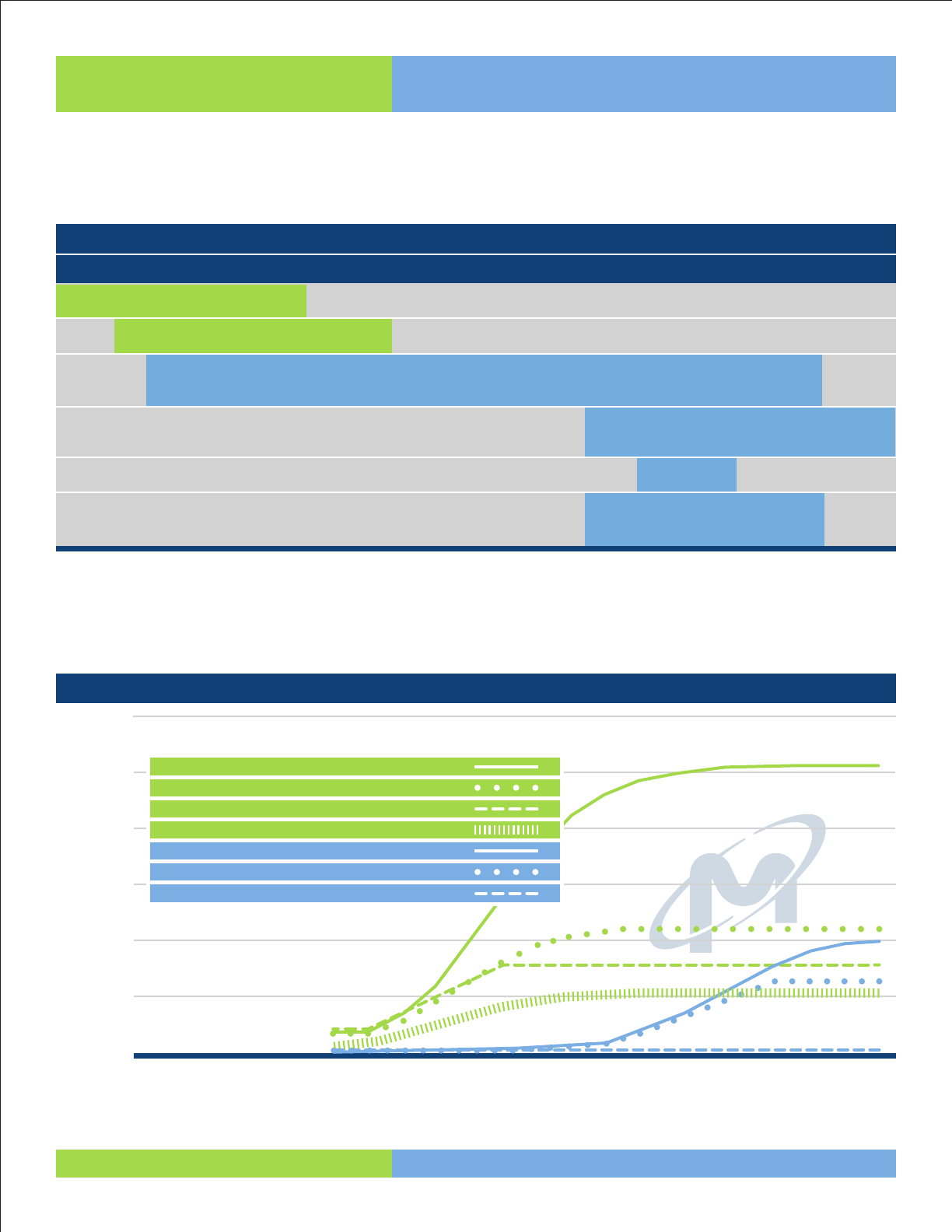
The chart below shows various NOR and NAND density ranges to help identify the best solution for your application requirements.
NOR and NAND Read Performance
As shown in the figure below, read performance is mostly governed by bus width and clock speed (e.g., x16 and 133 MHz).
Low Density Mid Density High Density
512Kb 128Mb 1Gb 2Gb 4Gb 8Gb 2GB 16GB 64GB
Serial NOR
512Kb–1Gb
Parallel NOR
32Mb–2Gb
SLC NAND
Standard 128Mb–64GB
Serial 1Gb–4Gb
MLC NAND
Standard 2GB–1Tb
Enterprise 8GB–64GB
Managed NAND
e•MMC 2GB–64GB
eUSB 2GB–16GB
Random Read Access Performance vs. Large Data Size
Bytes per Fetch
1 2 4 8 16 32 64 128 256 512 1024 2048 4096 8192 16384 32768 65536
0
50
100
150
200
250
300
Transfer Rate (MB/s)
x16, 133 MHz Burst Parallel NOR (G18)
x16, 52 MHz Burst Parallel NOR (P30, P33)
x16 Page Mode Access Parallel NOR (M29, P30, P33)
x4, 108 MHz Quad I/O Serial NOR (N25Q)
x8, 52 MHz e•MMC NAND
x8 NAND ONFI 1.0*
x1, 50 MHz Serial NAND
1Tb
*Micron offers NAND ONFI 2.X- and 3.X-compliant products.
TLC NAND
8GB–16GB

3
NOR | NAND Flash Guide
Micron Flash Portfolio
Micron has one of the broadest portfolios of NOR and NAND Flash solutions in the industry. We have products that are tailored to meet your
application requirements, including a strong product offering for automotive applications, which require more reliability than others.
NOR Choices
Serial NOR
Thanks to lower pin counts, serial NOR devices provide a cost-effective solution. They’re easy to design in, saving valuable development time while
ensuring compatibility with existing and future designs. Serial NOR is also referred to as serial peripheral interface (SPI) NOR.
Parallel NOR
Parallel NOR devices provide high performance and security. These feature-rich devices are ideal for long-term use in rigorous industrial set-
tings. Parallel NOR is offered in both standard and high-performance product types, and Micron offers both.
Low pin count, cost savings
N25Q (SPI Multi I/O):
• x1–x4 (quad I/O)
• 1.8V or 3V
• 4KB subsector erase
• 16Mb–1Gb
• 108 MHz sync reads (54 MB/s)
M25P (SPI Single I/O):
• 3V
• 512Kb–16Mb
• 50 MHz or 75 MHz sync reads (6 MB/s or
9 MB/s)
M25PX (SPI Single I/O):
• 3V
• 8Mb–16Mb
• 75 MHz sync reads (19 MB/s)
Mx5PE (SPI Single I/O):
• 3V
• 1Mb–16Mb
• 75 MHz sync reads (19 MB/s)
Serial and Parallel NOR Features Comparison
Serial (SPI)
M25P M25PX N25Q
Parallel
M29 P30/P33 G18
High performance, security, feature-rich
M29EW/M29W:
• Spansion command set
• 3V
• 4Mb–2Gb
P30/P33:
• 1.8V or 3V
• 64Mb–2Gb
• 52 MHz sync reads (104 MB/s)
G18:
• 1.8V
• 256Mb–1Gb
• 133 MHz sync reads (250 MB/s)
• Read-while-write, read-while-erase
• A/D, AA/D MUX option (reduces active pin
count by more than 50%)
• Small 8 x 10mm package

4
NOR | NAND Flash Guide
NOR Densities
The chart below shows Micron’s NOR products by type and density and highlights the key products recommended for new designs. Most of
the recommended products are also included in Micron’s Product Longevity Program (PLP), which ensures the products are supported for an
extended life cycle (learn more at micron.com/plp).
Micron Embedded NOR Solutions
Selecting a Serial NOR Device
If the key features of serial NOR match your design requirements, use the following tables to help select the right serial NOR device for your
design. For more details, see the full serial NOR part catalog and find a sales representative at micron.com.
N25Q
M25P
M25PX
M25PE,
M45PE
Product Voltage
Range Erasable
Sectors Bus
Width
Density
Range
MAX Clock/
MAX Data
Transfer Rate
Package
Options
2.7–3.6V
1.7–2.0V
2.3–3.6V
2.3–3.6V
2.3–3.6V
4KB,
64KB uniform
32KB, 64KB,
64KB uniform
4KB,
64KB uniform
256B, 4KB,
64KB uniform
x1, x2, x4
x1
x1, x2
x1
16Mb–1Gb
512Kb–16Mb
8Mb–16Mb
1Mb–16Mb
108 MHz (54 MB/s)
50 MHz (6 MB/s)
75 MHz (9 MB/s)
75 MHz (19 MB/s)
75 MHz (19 MB/s)
PDFN, SOP, PBGA
PDFN, SOP
PDFN, SOP, PBGA
PDFN, SOP
Parallel 3V
8Mb 16Mb 32Mb 64Mb
512Kb–
4Mb 128Mb 256Mb 512Mb 1Gb 2Gb
Recommended for new designs
Parallel 1.8V
Serial 3V
Serial 1.8V
P33
M29EW
M29W
M29DW M29DW
M28W
J3
P30
G18
M25P M25P
M25PE, M45PE
M25PX
N25Q
Device Type
Supported per PLP commitments
Serial NOR – Quick Features Comparison
N25Q
M25PX
*This table only includes devices recommended for new designs.
Program/
Erase
Cycling
100,000
100,000
100,000
100,000

5
Standard SPI
NOR | NAND Flash Guide
Serial NOR Application Requirements by Product Family
Selecting a Parallel NOR Device
If the key features of parallel NOR match your design requirements, use the following table to help select the right device. For more details, see
our full parallel NOR part catalog and find a sales representative at micron.com.
Product
56-pin TSOP
64-ball FBGA
64-ball TBGA
48-pin TSOP
48-ball BGA
512Kb
Small-parameter EEPROM replacement
1Mb 2Mb 4Mb 8Mb 16Mb 32Mb 64Mb 1GbApplication Requirements
M25P
Alternative hardware configuration
Dual-I/O usage
High-performance SPI, quad I/O, XIP
1.8V (low-power consumption)
M25P M25P M25P M25P M25P N25Q N25Q N25Q N25Q N25Q N25Q
M25PE M25PE M25PE M25PE M25PE
M45PE M45PE M45PE M45PE M45PE
M25PX M25PX N25Q N25Q N25Q N25Q N25Q N25Q
N25Q
N25Q N25Q N25Q N25Q N25Q N25Q
N25Q N25Q N25Q N25Q N25Q N25Q N25Q
Core
Voltage I/O
Voltage Bus
Width Density
Range Sync Burst
Read
Multi-Bank
(Read-While-
Write, Read-
While-Erase)
A/D, AA/D
MUX
Option
Security
Features
Program/
Erase
Cycling
Package
Options
M29EW 2.7–3.6V 1.65–3.6V x8, x16 32Mb–
2Gb No No No Enhanced 100,000 56-pin TSOP
64-ball FBGA
56-pin TSOP
64-ball BGA
56-pin TSOP
64-ball BGA
64-ball BGA
8 x 10mm
52 MHz
(104 MB/s)
133 MHz
(250 MB/s)
52 MHz
(104 MB/s)
No
4Mb–
256Mb
64Mb–
2Gb
64Mb–
2Gb
256Mb–
1Gb
100,000
100,000
100,000
100,000
Enhanced
Enhanced
Enhanced
Enhanced
No
No
No
Yes
No
No
No
Yes
x8, x16
x16
x16
x16
1.65–3.6V
(128Mb,
256Mb)
2.7–3.6V
(4–64Mb)
M29W
P30
P33
G18
2.7–3.6V
1.7–2.0V
2.3–3.6V
1.7–2.0V
1.7–3.6V
2.3–3.6V
1.7–2.0V
128Mb 256Mb 512Mb
Serial NOR Application Requirements by Product Family
Parallel NOR – Quick Features Comparison
*This table only includes devices recommended for new designs.

6
NOR | NAND Flash Guide
NAND Choices
Micron has a diverse portfolio of NAND Flash storage devices—including raw and managed NAND—with varying densities and
feature sets that are key considerations for most application designs. Several NAND devices are included in Micron’s Product Longevity Program
(PLP), which ensures the products are supported for an extended life cycle (learn more at micron.com/plp).
Raw NAND
Raw NAND provides the lowest cost per bit but requires an external host controller (not contained within the package) to perform all manage-
ment functions (e.g., ECC, FTL).
Single-level cell (SLC)
One bit per cell; highest performance and write endurance; designed for high-end, high-density, mission-critical systems where NAND
best-in-class performance and reliability are required and cost reduction is not a major driver
Serial SLC NAND
Low-density SLC devices with a NOR-like serial interface
Multilevel cell (MLC)
Two bits per cell; balanced performance for a wide range of cost-sensitive, high-density applications; designed for applications where
a trade-off between endurance and performance is required for cost control; requires tight technology coupling with the controller;
sometimes called mainstream NAND
Enterprise MLC NAND
Enterprise MLC uses special programming algorithms to extend write endurance; typically used in high-write workload
enterprise applications
Triple-level cell (TLC)
Three bits per cell; highest cell density, but lower performance and endurance specifications; most often used in mass storage
consumer applications (e.g., USB drives or SD cards) with very high cost sensitivity
Managed NAND
Managed NAND provides simpler solutions and speeds time-to-market because the controller is embedded within the package to provide ECC
and block management.
e
•
MMC Memory
High-capacity NAND Flash device combined with a high-speed, MultiMediaCard (MMC) controller in a single BGA package; ideal for
designers looking for MMC-like, application-to-application interoperability for a wide range of networking, industrial, and automotive
applications
Embedded USB (eUSB)
Small, cost-effective device that is reliable in harsh environments; offers distinct competitive advantages for embedded designs

7
NOR | NAND Flash Guide
Selecting a NAND Device
If the key features of NAND match your design requirements, use the following table to help select the right device. For more details, see our
NAND part catalogs and our Choosing the Right NAND page, and find a sales representative at micron.com.
Raw NAND – Quick Features Comparison
Managed NAND – Quick Features Comparison
Device Density Width Voltage Benefits
SLC NAND 128Mb–64GB x8, x16
x8
x8
x1
x8
1.8V, 3.3V • Up to 100,000 P/E cycle endurance
• Fastest NAND throughput
• Compatible with the ONFI-synchronous interface
• Solid performance and endurance
• 2X the density of SLC NAND at a lower cost per bit
• Compatible with the ONFI-synchronous interface
• Higher density in the same footprint but at a lower
cost than SLC or MLC NAND
• Enabler of large memory subsystems
• Increased power efficiency
• High performance, low power
• Increased bandwidth
3.3V
3.3V
3.3V
3.3V
MLC NAND
TLC NAND
Serial
SLC NAND
Enterprise
MLC NAND
2GB–1Tb
8GB–16GB
1Gb–4Gb
8GB–64GB
DensityDevice Interface Voltage Benefits
4.41 and 4.51
JEDEC standard
USB 2.0
• Single-package solution for designers looking
for MMC-like application-to-application
interoperability
• Offered in a variety of densities and options
• Reliable in harsh environments
• Cost-effective
• Small size
3.3V
3.3V, 5V
e
•MMC
eUSB
2GB–64GB
2GB–16GB
• Optimized for intensive enterprise applications
• High endurance, high capacity, and high reliability
(through low-defect and high-cycle rates)
• Ideal storage solution for transaction-intensive
data servers
• Compatible with ONFI 2.1-synchronous interface
• 4X to 5X performance improvement compared to
legacy NAND interfaces
8
NOR | NAND Flash Guide
micron.com
Products are warranted only to meet Micron’s production data sheet
specifications. Products and specifications are subject to change
without notice. Dates are estimates only.
©2013 Micron Technology, Inc., Micron, and the Micron logo are trademarks of Micron Technology,
Inc. All other trademarks are the property of their respective owners.
All rights reserved. 10/13
SSD Solutions
In addition to the standard NOR and NAND packaged products, Micron also offers many NAND-based solid state drive (SSD) solutions for your
system designs. Refer to micron.com for more details on these leading-edge SSDs.
Client SSD
High reads via a SATA 6 Gb/s interface with backward compatibility to 3 Gb/s SATA; improved boot and application load times; lighter, more
durable, and more power-efficient than HDDs
Enterprise SATA and SAS SSDs
High steady-state performance with low latencies, optimized error-management features, and multiple drive options offer outstanding perfor-
mance for enterprise blade servers and system storage
Enterprise PCIe SSD
Low-latency, high-IOPS P320h drive; extended endurance, exceptional reliability, and remarkable power efficiency; an ideal solution for opti-
mizing applications with heavy read access
More Information
View more information about Flash storage solutions and find a sales representative or authorized distributor at micron.com.
Print This Guide
To order printed copies of this guide, log in to Micron’s Print Collateral site at nationsprint.com/clients/micron-print, and go to Sales Tools.
