Orban 674A Stereo Equalizer Brochure
User Manual: Orban 674A Stereo Equalizer Brochure
Open the PDF directly: View PDF  .
.
Page Count: 9
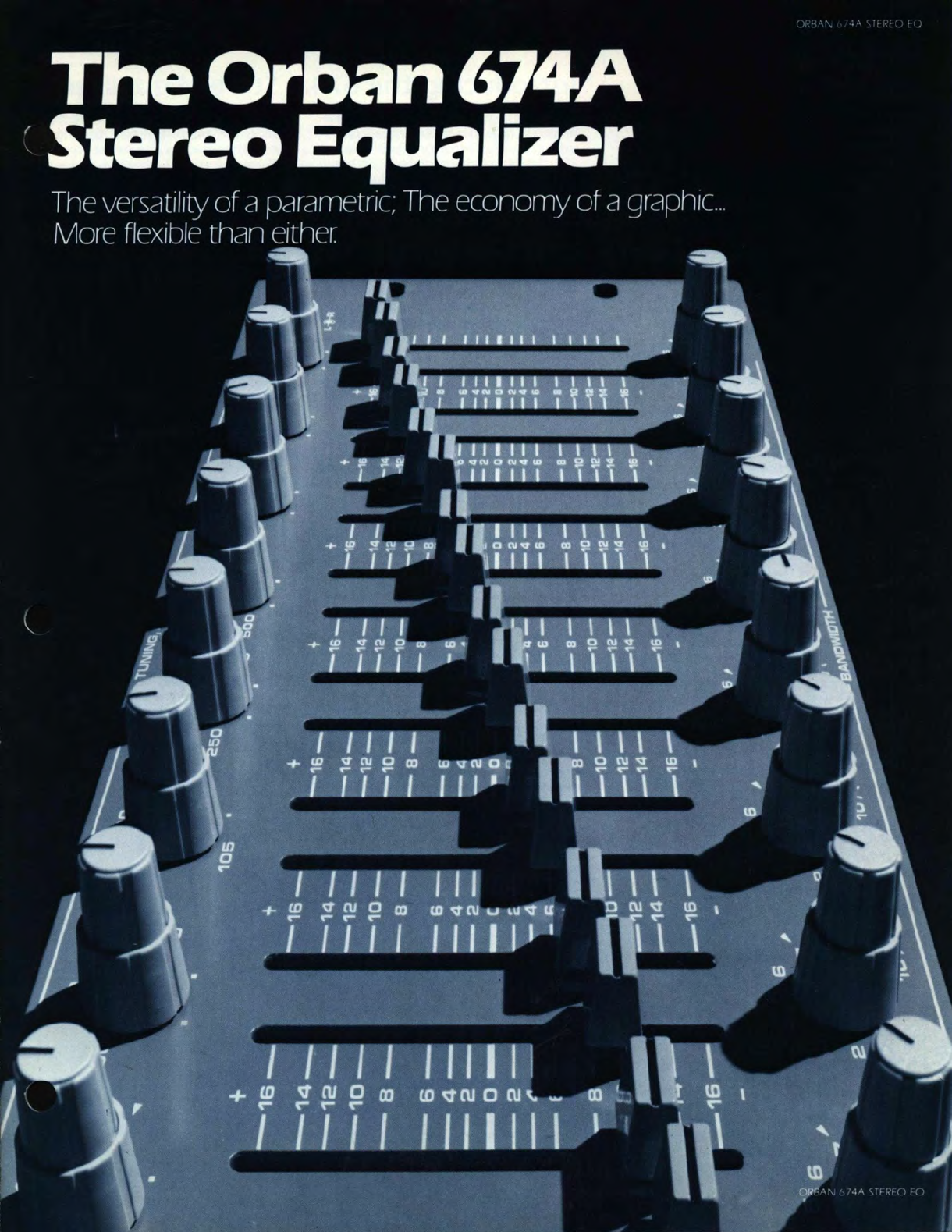
STEAM POWERED RADIO.COM
STEAM POWERED RADIO.COM
PERFORMANCE
HIGHLIGHTS
D Eight bands per channel, each
with
TUNING
AND
BANDWIDTH
controls
D Each
band
tunes
over
3:
I fre-
quency
range
D
"O"
typically
variable
between
0.3
and
20 (center TUNING)
D ± I 6dB equalization range
D EO controls are
long-throw
dust-
shielded slidepots
for
good
resolution
D TUNING
and
BANDWIDTH
controls
marked
with
"tics"
indicating
typical settings
D
Narrowband
notching
capability
ideal
for
sound reinforcement
D Bands
totally
non-interacting
D A dedicated stereo device
with
con-
trols arranged
for
optimum
ease
of
maintaining
stereo balance
HP/LP Filter Sections
D Each section
continuously
tunable
over
I 00: I range in 2 decades
D Each section
independently
switch-
able
D I 2 dB/octave slopes
D Filters
follow
graphic section.
Separate main/lowpass
and
high-
pass
outputs
allow
use
as
filters
or
as
full
electronic crossover
General
D
Very
low
noise
and
distortion
D
High
slew
rate
for
minimum
TIM
(SID)
D Front-panel
GAIN
controls; I 2dB
gain available
D "Peak-stretching" overload lamps
warn
of
clipping
anywhere
in
equalizer
D
Active
balanced inputs; unbalanced
outputs. Transformer-balanced out-
puts
optional
D
RF
suppression
on
inputs, outputs,
and
power
leads
D I I 5/230V, 50-60Hz
transformer
is
standard
D Industrial-grade parts
and
construc-
tion
including
socketed IC's
D
Highly
cost-effective
A
MONO
VERSION
OF
THIS
PRODUCT
IS
ALSO
AVAILABLE
AS
MODEL
672A
Introducing
the
674A
Stereo Equalizer
The
Orban
674A
is
a cost-effective,
pro-
fessional, quasi-parametric equalizer
with
the
convenience
of
graphic-type
EO
controls
.
Wide-range
high-
and
low-
pass filters
with
I 2d8/octave
Butter
-
worth
slopes
follow
the
EO section
for
added
versatility. The
674A
has
two
outputs
per
channel,
arranged
so
that
these filters can also be used
as
a
fully
tunable
electronic crossover.
The space-saving
674A
offers
the
facilities
of
two
complete
mono
672A's
in a single chassis. Ganged, concentric
controls
make
one-hand
stereo opera-
tion
of
bandwidth
and
tuning
a snap.
Graphic-style EO
controls
are split
parallel
for
each
of
the
eight
bands.
Separate
high-and
low-pass filters
on
each
channel
offer
stereo
two-way
elec-
tronic
crossover capability.
While
it
is
possible
to
operate
the
unit
with
two
unrelated
mono
program
sources,
under
some circumstances
high-
frequency
crosstalk
may
be experienced.
Therefore, crosstalk requirements
should
be
evaluated
in
such applications.
(See
Specifications)
The
674A
is
a professional
product
designed
to
provide
a large measure
of
versatility, convenience,
and
quality
at
a
very
attractive
price.
While
it
meets
the
requirements
of
the
demanding
profes-
sional,
it
is
also designed
and
priced
to
make
it
understandable
and
available
to
the
advanced
audiophile.
To make
the
674A
easy
to
use
in
situa-
tions
where
its
full
versatility
isn't
need-
ed,
"tic"
marks
have
been
included
on
the
dial calibrations
of
the
TUNING
and
BANDWIDTH
controls
.
When
these con-
trols
are set
to
the
tics,
the
674A
behaves like a standard octave-band
graphic
equalizer
with
the
eight
bands
on
ISO
frequencies
from
63
to
8000Hz
.
Each feature
of
the
674A
has been
thoughtfully
chosen
and
cleverly
im-
plemented
to
make
the
equalizer a par-
ticularly
powerful
tool
in
nearly
all areas
of
audio:
sound
reinforcement,
public
address, recording studio, broadcasting,
motion
picture sound, disco,
theater
...
Why
"Quasi-
Parametric
"?
There are
two
basic types
of
parametric
equalizer: full-
and
quasi-parametric.
Orban
manufactures
both
types.
Both
offer
far
more
effective
control
than
other
kinds
of
equalizers, like graphics.
Our
popular
dual-channel
6228
is
a full
parametric. This means
that
you
have
totally
non-Interacting
control
over
the
three
fundamental
parameters
of
equali-
zation:
the
amount
of
peak
boost
o.
(in dB),
the
tuning
(the
frequency
m
affected
by
the
equalization),
and
the
"O"
(wh1ch relates
to
the
sharpness
of
the
EO
curve-the
degree
to
which
fre-
quencies
on
either
side
of
the
peak fre-
quency
are affected
by
the
equalization).
As opposed
to
our
6228
Equalizer,
the
674A
is
quasi-parametric. This means
that
the
"O"
changes
when
you
adjust
the
TUNING
and/or
EO controls.
Other
control
adjustments are
completely
non-
interacting
: TUNING
and
EO
do
not
af-
fect each other.
The
other
important
performance
dif-
ference
between
the
full-parametric
6228
and
the
new
674A
is
that
the
622B's EO curves are
"constant-0";
the
674A's
curves are
"reciprocal".
"Con-
stant
O"
curves are
valuable
in
that
they
permit
infinite-depth
notches
to
be
created; reciprocal curves
limit
the
max-
imum
cut
to
the
same
number
of
dB
as
the
maximum
boost. In
the
case
of
the
674A,
I
6d8
of
cut
is
available. This
is
fine
for
tuning
out
ring-modes
in
sound
reinforcement
systems,
but
might
not
be
adequate in all circumstances
to
remove
hum
or
other
fixed-frequency
inter-
ference
from
a signal.
On
the
other
hand,
some
people
prefer
reciprocal.
curves because
the
boost
and
cut
ar
mirror
images
of
each
other,
thus
per-
mitting
previous
equalization
to
be
readily
"undone"
later. Careful design
of
the
circuitry
gives
the
674A
In
boost
mode
a characteristic similar
to
the
622B's desirable
"constant-O"
curve
family.
Why
did
we
choose
the
quasi-para-
metric
technique
for
the
674A7
Because
it
offers a
way
to
produce
a
very
high
quality,
stable equalizer
at
low
cost
without
compromising
distortion,
noise,
accuracy,
or
reliability.
Applications
Sound
Reinforcement
and
•
Monitor
Tuning
There are
many
ways
to
use
the
674A
in
sound reinforcement
and
monitor
tuning:
I)
In
an
economy
biamped
installation,
replace
both
the
third-octave
equalizer
and
the
electronic crossover
with
the
674A
. The
674A
's
narrowband,
tunable
notches can deal
with
ring-modes
more
effectively
than
the
third-octave
unit
could. Use
three
or
four
of
the
674A
bands
for
narrowband
notching;
leave
the
rest
for
wideband
EO.
2)
In a
higher
budget
biamped
instal-
lation,
use
the
674A
as
an electronic
crossover plus a
narrowband,
tunable
notch
filter
for
ring-mode
suppression;
incorporate
a separate
third-octave
equalizer
to
correct
the
house curve.
3)
Use variations
of
(I)
and
(2)
above
with
an electronic crossover;
the
674A's
highpass
and
lowpass
filters can
then
be
used
to
roll
off
the
frequency
response
of
the
system
in
a
controlled
manner
.
4)
In a
non-biamped
system (like a stage
monitor),
use
the
674A
to
equalize
the
monitor,
and
use its filters
to
restrict
response
in
the
extreme
high
and
low
frequencies.
5)
Use
the
674A
as
a
partial
electronic
crossover plus equalizer/filter
bj
devoting
one
channel
of
674A
equaliza-
•
ion
to
each
driver;
one
filter
is
required
o
perform
the
crossover
function;
the
other
can be used
for
its
normal
high-
pass (or lowpass)
function
.
6)
For super
power
in
mono
reinforce-
ment
applications,
connect
both
chan-
nels
in
series.
You'll
then
get
sixteen
EO/notch
filter
bands,
an
electronic
crossover,
and
an
extra set
of
filters
to
limit
system
bandwidth.
In
all
cases,
the
BANDWIDTH
control
can be adjusted
to
make
the
totally
non-
interacting (series-connected) bands
"combine"
-a
most
desirable charac-
teristic
in
sound
reinforcement
.
Any
way
you
cut
it,
the
674A's
economy
and
extraordinary
versatility
make
it
one
of
the
sound
reinforcement
practitioners'
most
useful tools.
Recording Studios
Every
recording
studio
needs a
few
channels
of
674A
equalization
to
handle
the
tough
chores
that
the
internal
con-
sole equalizers
can't
deal
with.
Patch
that
problem
track
through
a
674A:
its
fine-tuning
ability
lets
you
clean
up
the
track
far
more
effectively
than
you
could
with
a
graphic
or
"three
knob"
console equali?er. Use
the
tunable
filters
to
help
eliminate rumble, cymbal splash,
kick
drum
leakage-you
name it!
If
you
need
to
correct
the
equalization
of
a track because
of
second
thoughts
during
or
after
the
mix,
the
674A
can
create
the
finishing
touches
as
no
or
-
dinary
equalizer can. It's
better
than
a
third-octave
graphic, because
the
674A
can generate
broad,
non-ringing
boosts,
whereas
the
graphic
is
much
more
col-
ored
and
ringy.
The
674A
is
also
an
ideal
adjunct
to
an
electronic music
synthesizer-you
can
create
high
"O"
formats
and
shape
the
spectrum so
that
the
sound
comes alive.
Motion
Picture
Sound
The
674A
is
an
ideal replacement
for
the
graphic
equalizers
ordinarily
used
for
dialogue
equalization
in
motion
picture
sound.
Set
the
TUNING
and
BAND-
WIDTH
controls
to
the
"tics"
on
the
panel,
and
you
get
the
equivalent
of
a
familiar easy-to-operate graphic.
But
when
you
need
the
extra
control
and
flexibility-such
as
notching
out
the
ex-
traneous
sounds
that
always
seem
to
plague
location
recordings-that
power
is
there
instantly,
without
patching
or
the
use
of
external
dip
filters. The
high-
and
lowpass filters are
invaluable
for
cleaning
up
noise
and
rumble
without
affecting
dialogue-and
without
using
up
EO channels
to
try
to
achieve filter-
ing. In
addition,
many
"effects" (such
as
telephone,
pocket
radio,
or
"old
time"
recordings) can be easily created
with
the
674A
alone.
In
addition,
the
674A
can be used
to
equalize
the
"8-chain"
in
the
re-record-
ing
theater
to
the
acoustic response
specifications
of
the
studio. The
lowpass
filter
can
effectively
simulate
the
"Academy
Rolloff"
or
its
current
modifications.
Stereo Broadcasting
Use
the
674A
in
the
production
studio
to
enhance
the
announce
mike,
"sweeten"
stereo music,
and
to
create
special
production
effects
that
make
your
station stand
out
among
its com-
petitors.
Meanwhile,
another
674A
can
be
quietly
and
efficiently
equalizing
the
stereo
program
line
for
maximum
punch
and
brightness
on
the
air. Use
the
674A
to
equalize
phone
or
remote lines
for
flat
response-it's
much
more
versatile
than
the
standard
phone
company
equalizers.
In
the
main studio, use
it
on
the
announce
mike channel
to
equalize
for
maximum
presence,
and
also
to
notch
out
sounds like mechanical
hum
from
cart machine
motors
or
air condi-
tioning
noise.
Whatever
your
applica-
tion,
the
674A's
RF
suppression
and
op-
tional
output
transformer
mean
prob-
lem-free
installation
in high-RF en-
vironments.
Dance
Bars
The 674-A
is
an
.excellent dance
bar
stereo equalizer. The
sound
contractor
installing
the
system can
offer
the
management exactly the sound
desired-
including
solid,
punchy
bass free
from
muddiness
and
boom-and
an
aggres-
sive, sizzling
top
free
from
ringing
and
coloration
typical
of
a full-octave
graphic
equalizer. The
eight
bands per-
mit
substantial
work
to
be
done
in flat-
tening
out
undesired response devia-
tions in
the
upper
bass
and
midrange
.
Narrowband
notches can
even
deal
with
the
difficult
resonances sometimes
encountered
in
high-efficiency
horn-type
loudspeakers. In biamped installations,
use
the
separate
lowpass
and
highpass
filter
outputs
as
a complete electronic
crossover.
No
other
crossover
is
necessary.
The
674A
costs a
bit
more
than
an
octave-type graphic. But,
unlike
a
graphic,
it
really solves
the
problem
.
o,ban
Orban
Associates Inc.
645
Bryant
Street
San
Francisco, California 94107
(415) 957-1067
Telex: 17-1480
Cable:
ORBANAUDIO
STEAM POWERED RADIO.COM
Technical Description
The
674A Equalizer consists
of
a balanc-
ed
input
buffer
amplifier, eight
main·
equalization amplifiers connected in
series,
and tunable lowpass and
high
-
pass
positive feedback I 2d8/octave But-
terworth
filters. The
output
of
the high-
pass
filter
is
buffered
to
drive 600 ohms,
and
is
available separately. By suitable
switch settings, the main
output
can be
made
to
carry a lowpassed signal. Thus
the 674A c~n be used
as
an equalizer
cascaded
with
a full electronic crossover,
or
as
an
equalizer cascaded
with
low-
pass
and
highpass filters.
Each
amplifier in the equalizer section
provides equalization
for
one band
only,
assuring
no
interaction
between
bands.
The total equalization
is
simply the sum
(in
dB)
of
the equalizations
provided
by
each
of
the sections.
Peak
boost
is
accomplished
by
adding
the
output
of
a
two-pole
bandpass
resonator
to
the main signal; reciprocal
dip
occurs
when
this resonator
is
sym-
metrically connected
as
a feedback ele-
ment in the main equalizer amplifier.
Specifications:
All
specifications
apply
when
driving
600 ohms
or
higher impedances. Noise
measured
on
an average-reading meter
through
a 20-20,000Hz bandpass filter
with
I SdB/octave
Butterworth
skirts.
ELECTRICAL
Input:
Impedance,
Load(each
leg):
IOOK
in
parallel
with
I
OOOpF,
electronically
balanced
Impedance, Driving: Ideally 600 ohms
or
less,
balanced
or
unbalanced
Nominal
Input
Level: Between - I 0
and
+4dBm
Absolute Overload Point: + 26d8m
Output:
Impedance, Source: 47 ohms in parallel
with
IOOOpF,
unbalanced (Optional
transformer balanced 600
ohm
outputs)
Impedance, Load: Should
be
600 ohms
or
greater-will
not
ring
into
any
capacitive load
Nominal
Output
Level: + 4d8m
Max.
Output
Level Before Clipping:
greater
than
+ I 9d8m, 20-20,000Hz
Frequency Response:
± 0.25dB; 20-20,000Hz:
EQ
controls set
at
zero detents
Avallable Gain:
+ I 2dB; adjustable
to
-infinity
by
means
of
front-panel
GAIN
control
Slew Rate:
Varies between 6 and I 3V/us depend-
ing
upon
setting
of
GAIN controls; slew-
ing
is
symmetrical. Internal bandlimiting
assures
that
slew rate limiting
will
not
occur even
with
the most severe
equalization and program material.
Square
Wave
Response:
Square
wave
exhibits
no
spurious ring-
ing
at
any
output
level. The
only
ringing
8000 I 6-000-02
2/81
The
EQ
IN/OUT
switch
bypasses the last
seven main amplifiers and defeats
equalization in the first amplifier. Gain
and signal
polarity
are equal in the IN
and
OUT modes. As the BANDWIDTH
control
is
operated, the skirts
of
the
equalization curve move in and out,
but
the peak gain and peak frequency re-
main constant. As the EQUALIZATION
controls are operated, the frequencies
of
peak gain remain constant.
However,
as
the TUNING control
or
EQUALIZATION
control (in dip mode) are operated, the
bandwidth
("O'')
will
chr,ge,
because
of
the simplifications in the "quasi-para-
metric" bandpass resonator. Careful
design has enabled
us
to
produce curves
(in boost mode only) essentially identical
to
the desirable
"constant-Q"
curves
provided
by
our
6228
true
parametric
equalizer in its boost mode.
The EQUALIZATION controls all produce
peaking curves;
if
shelving curves are
desired,
they
can be approximated
by
tuning
the
lowest
band
to
20Hz and the
highest band
to
20kHz. The breakpoint
of
the shelving characteristic
is
then
ad-
justed
with
the BANDWIDTH control.
observable
is
that
theoretically
associated
with
any
given equalization
curve.
Total Harmonic Distortion:
Less
than
0.
08%
, 20-20,000Hz
(+
18dBm)
SMPTE Intermodulation Distortion:
Less
than
0.
05%
( + I SdBm: 60/700Hz,
4:
1)
Noise
at
Output:
Less
than
-78dBm
(EQ
in, filters out,
controls centered)
Overload/Noise Ratio:
Better
than
I I 3dB
for
any
single band-
pass filter,
for
any
settings
of
TUNING
or
BANDWIDTH controls.
Equalization Ranges:
± I
6d8
peaking EQ, Reciprocal
Tuning Ranges:
20-60Hz;
40-1
50Hz;
110-31
0Hz;
230-750Hz; 480-l 900Hz; I . I
-4
.5Hz;
2.8-9.0kHz; 5.
9-21
kHz. Dials calibrated
at
ISO
preferred frequencies.
Crosstalk:
Typically better
than
-55dB@ 20kHz;
improves
at
6dB/octave
below
that
fre-
quency.
"O " Range:
Greater
than
0.5
to
IO
for
any
setting
of
the TUNING control.
Low
Pass
FIiter Section:
Tunable in 2 ranges: 200-2000Hz
or
2.0-20kHz, I 2dB/octave, (2nd-order But-
terworth)
High
Pass
FIiter Section:
Tunable in 2 ranges: 20-200Hz
or
200-2000Hz, I 2dB/octave, (2nd-
order
Butterworth)
Overload
Indicator:
Lamp lights
for
200ms
if
the instan-
taneous peak
output
of
any
amplifier
rises
to
within
I
dB
of
its clipping point.
Summary
Many
people are
now
aware
of
the
power
of
parametric equalization: the
almost sensual satisfaction
of
getting the
sound really right.
These
same
people
are also demanding professionals, in-
sisting
on
inaudible noise and distortion, •
human engineering,
quality
"feel",
and
uncompromising reliability.
Orban
is
well-known
for
its line
of
fine
parametric equalizers, like the 6228.
Now
with
the 674A,
it
brings equaliza-
tion
of
the
same
rigorous
quality
to
ap-
plications
where
it
could never before
be afforded. The 674A
is
inexpensive
enough
to
qualify
it
for
serious con-
sideration in applications
which
would
otherwise
be given
by
default
to
a much
less
able graphic equalizer.
The
674A
rounds
out
the line
of
Orban
"Professionals' Parametrics." Between
the 6228
true
parametric and the 674A
quasi-parametric, there
is
an equalizer
for
virtually
every need and budget. The
Orban
"Professionals' Parametrics" are
available
at
your
authorized
Orban
dealer.
Active
RC
realized
with
FET-input
opamps. Line driver employs discrete
transistor current booster.
Operating
Temperature:
o-50°
c
Power
Requirements:
I I 5/230VAC ± I
0%
; 50/60Hz;
12
watts
PHYSICAL
Operating Controls (each channel):
EQUALIZATION, TUNING, and BAND-
WIDTH
for
each
of
eight bands. TUN-
ING, RANGE
(XI
; X
10),
and
FILTER
IN/OUT
for
each filter. EQUALIZATION
IN/OUT, POWER ON/OFF, and GAIN
for
entire equalizer.
Panel:
19
" x 5
1
/i''
(48.3 x 13.3cm): 3 units
Chassis
Depth
Behind Panel:
51
/4
"
(13.3cm)
Weight:
Net
: I I
lbs.
(5
kg); Shipping:
13
1
/i
lbs.
(6.1
kg)
AC
Cord:
3-wire
U-ground
to
USA Standard
Connectors:
140 type barrier strip
(5#
screw); holes
punched
for
XLR-type connectors
(Switchcraft D3F and
D3M
or
equal)
Circuit Ground:
Available
on
barrier strip;
normally
jumpered
to
chassis.
Options:
I)
Plexiglass security cover
for
EQ
and
filter sections
2)
Balanced transformers in
two
or
four
outputs
3)
XLR-type connectors
on
input
and
two
or
four
outputs
4)
Phone jacks
on
input
and
two
or
four
outputs
Spec1f1cat1ons
su
bject
to
change without
noti
ce
STEAM POWERED RADIO.COM
J_
•
•
•
~DINCLAB
REPORT
NORMAN
EISENBERG
AND
LEN
FELDMAN
ORBAN 674A
STEREO -EQUALIZER
"
...
an
engineering tour-de-force
which,
as
far
as
I
know,
is
unmatched
by
any
Other
single
device!'
Comment
by
Norman Eisenberg
"
...
making
this
the
most
powerful equalizing
tool
for
pro
audio work
that
I
have
yet
to
come
across!'
Comment
by
Len Feldman
Reprinted by permission of MODERN RECORDING AND MUSIC
October
1981
© Cowan Publishing Corp.
STEAM POWERED RADIO.COM
•
•
•
Orban 674A Stereo Equalizer
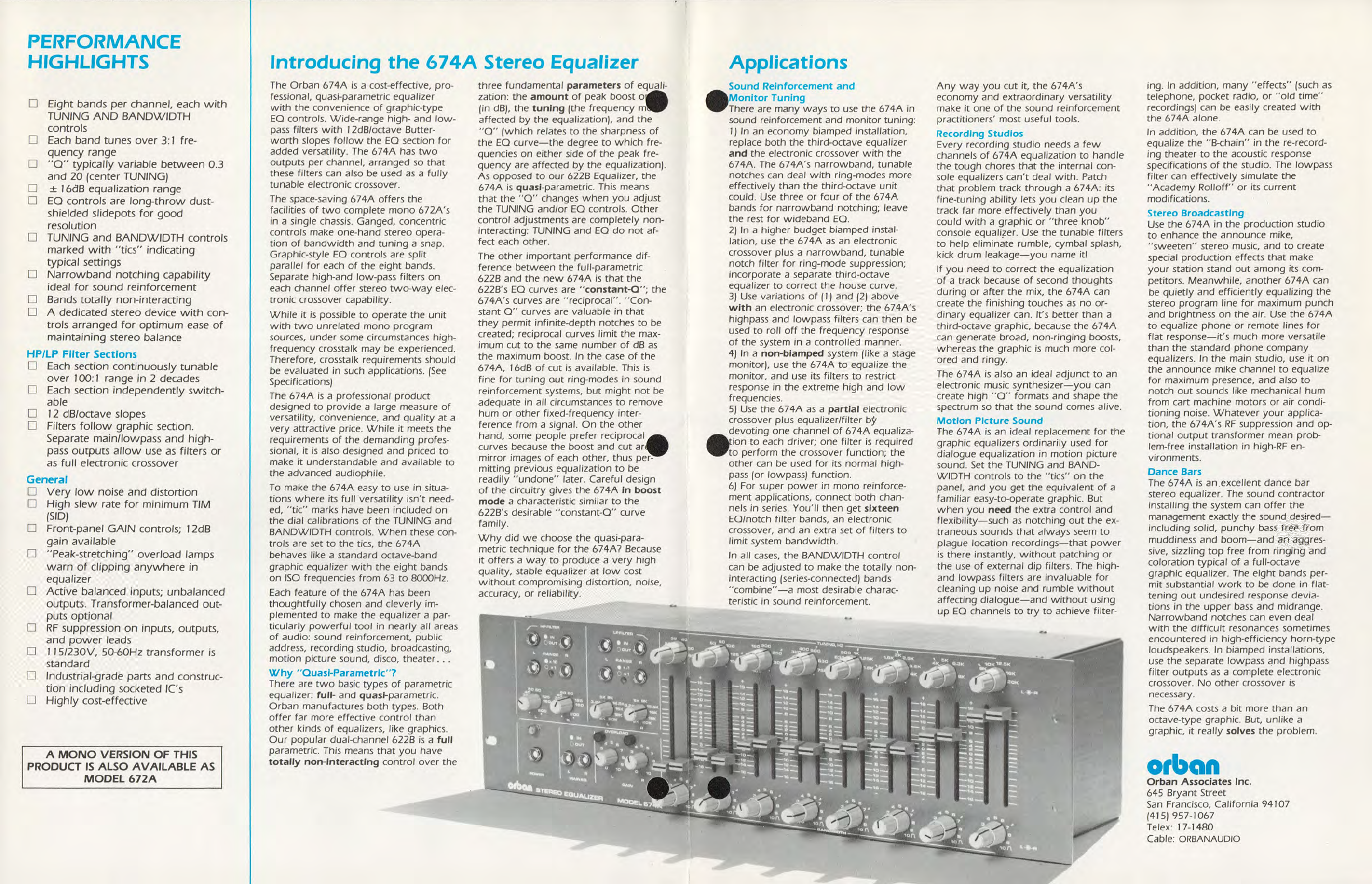
General Description:
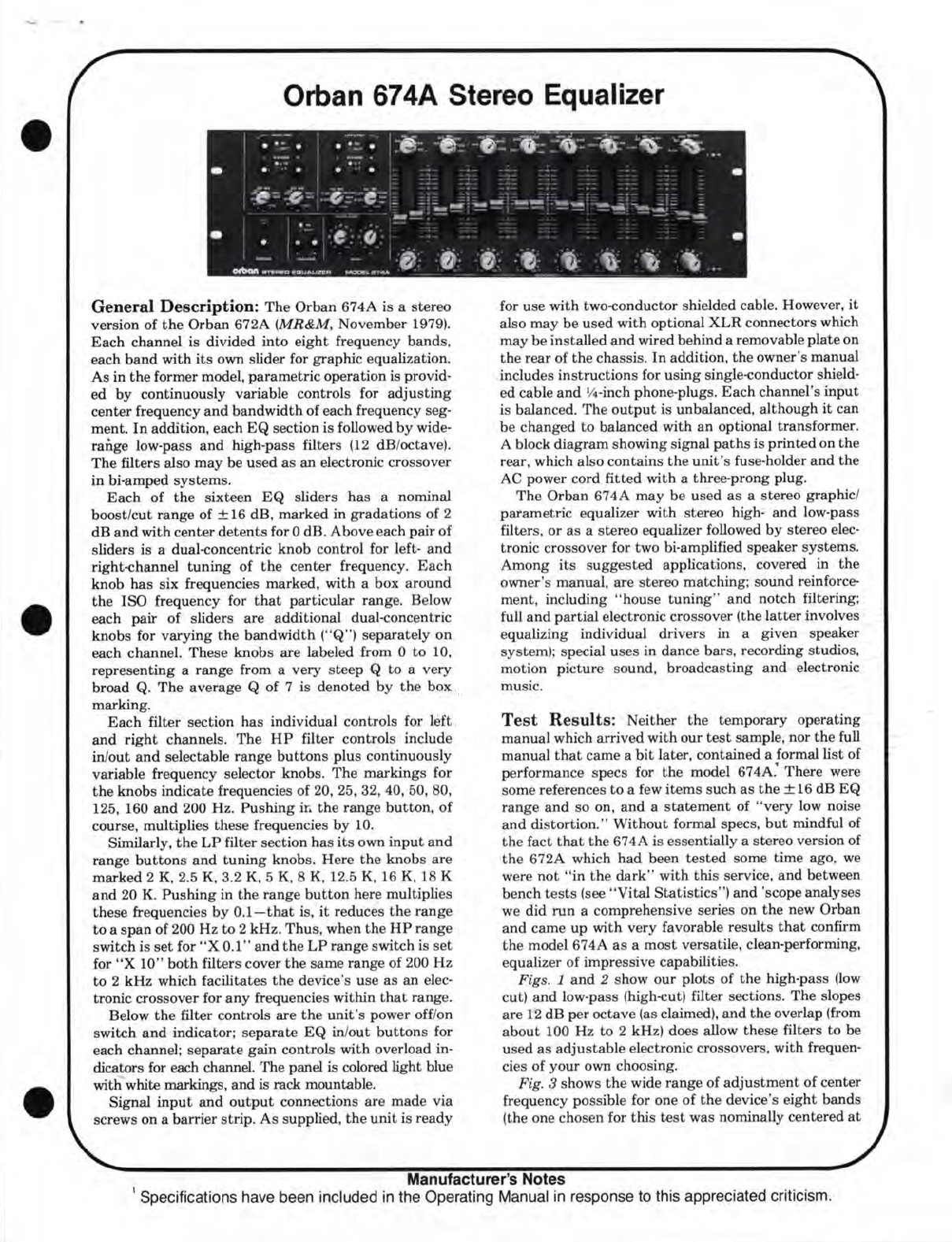
The
Orban
674A is a stereo
version of
the
Orban 672A
(MR&M,
November 1979).
Each
channel is divided into
eight
frequency bands,
each
band
with
its
own slider for graphic equalization.
As in
the
former model,
parametric
operation is provid-
ed
by
continuously variable controls for
adjusting
center frequency
and
bandwidth
of each frequency seg-
ment.
In
addition, each
EQ
section
is
followed
by
wide·
range low-pass
and
high-pass filters
(12
dB
/octave).
The
filters also
may
be
used
as
an electronic crossover
in bi-amped
systems.
Each
of
the
sixteen
EQ
sliders
has
a nominal
boost/cut range of
±16
dB, marked in
gradations
of 2
dB
and
with center
detents
for
O
dB. Above each pair of
sliders is a dual-concentric knob control for left-
and
right-channel
tuning
of
the
center frequency.
Each
knob has six frequencies marked,
with
a
box
around
the
ISO frequency for
that
particular
range. Below
each pair of sliders are additional dual-concentric
knobs for
varying
the
bandwidth
("Q") separately on
each channel. These knobs are labeled from
O
to
10,
representing a
range
from a
very
steep
Q
to
a very
broad
Q.
The average Q of 7 is denoted
by
the
box
marking.
Each
filter section has individual controls for left
and
right
channels.
The
HP
filter controls include
in/out
and
selectable
range
buttons
plus continuously
variable frequency selector knobs.
The
markings
for
the
knobs indicate frequencies of 20, 25, 32, 40, 50, 80,
125, 160
and
200 Hz.
Pushing
ir.
the
range
button,
of
course, multiplies
these
frequencies by 10.
Similarly,
the
LP
filter section
has
its
own
input
and
range
buttons
and
tuning
knobs.
Here
the
knobs
are
marked 2
K,
2.5 K, 3.2
K,
5 K, 8
K,
12.5
K,
16 K, 18 K
and
20
K.
Pushing
in
the
range
button
here multiplies
these
frequencies
by
0.
1-that
is,
it
reduces
the
range
to
a
span
of 200
Hz
to
2 kHz. Thus, when
the
HP
range
switch is
set
for
"X
0.1 "
and
the
LP
range
switch is
set
for
"X
10"
both
filters cover
the
same range of 200
Hz
to
2 kHz which facilitates
the
device's use
as
an elec-
tronic crossover for
any
frequencies within
that
range.
Below
the
filter controls are
the
unit's
power off/on
switch
and
indicator;
separate
EQ
in/out
buttons
for
each channel;
separate
gain controls
with
overload in·
dicators for each channel. The panel is colored light blue
with white markings, and is rack mountable .
Signal
input
and
output
connections are made via
screws on a barrier strip.
As
supplied,
the
unit
is ready
for use
with
two-conductor shielded cable. However,
it
also may be
used
with optional
XLR
connectors which
may
be installed
and
wired behind a removable plate on
the
rear of
the
chassis.
In
addition,
the
owner's manual
includes
instructions
for
using
single-conductor shield-
ed
cable
and
¼-inch phone-plugs.
Each
channel's
input
is balanced.
The
output
is unbalanced, although
it
can
be changed
to
balanced with
an
optional transformer.
A block
diagram
showing signal
paths
is
printed
on
the
rear, which also contains
the
unit
's fuse-holder
and
the
AC power cord fitted with a three-prong plug.
The
Orban 674A
may
be used
as
a stereo graphic/
parametric
equalizer with stereo high·
and
low-pass
filters,
or
as
a stereo equalizer followed
by
stereo elec·
tronic crossover for two bi-amplified speaker systems.
Among
its
suggested
applications, covered in
the
owner's manual, are stereo matching; sound reinforce-
ment, including "house
tuning
"
and
notch filtering;
full
and
partial
electronic crossover (the
latter
involves
equalizing individual drivers in a given speaker
system); special uses in dance bars, recording studios,
motion picture sound,
broadcasting
and
electronic
music.
Test
Results: Neither
the
temporary operating
manual which arrived
with
our
test
sample, nor
the
full
manual
that
came a
bit
later, contained a formal list of
performance specs for the model 67 4A.' There were
some references
to
a few
items
such
as
the
±16
dB
EQ
range
and
so on,
and
a
statement
of
"very
low noise
and
distortion
."
Without
formal specs,
but
mindful of
the
fact
that
the
674A is essentially a stereo version of
the
672A which
had
been
tested
some time ago,
we
were
not
"in
the
dark
" with
this
service,
and
between
bench
tests
(see
"Vital
Statistics")
and
'scope analyses
we did
run
a comprehensive series on
the
new Orban
and
came up with very favorable results
that
confirm
the
model 674A
as
a
most
versatile, clean-performing,
equalizer of impressive capabilities.
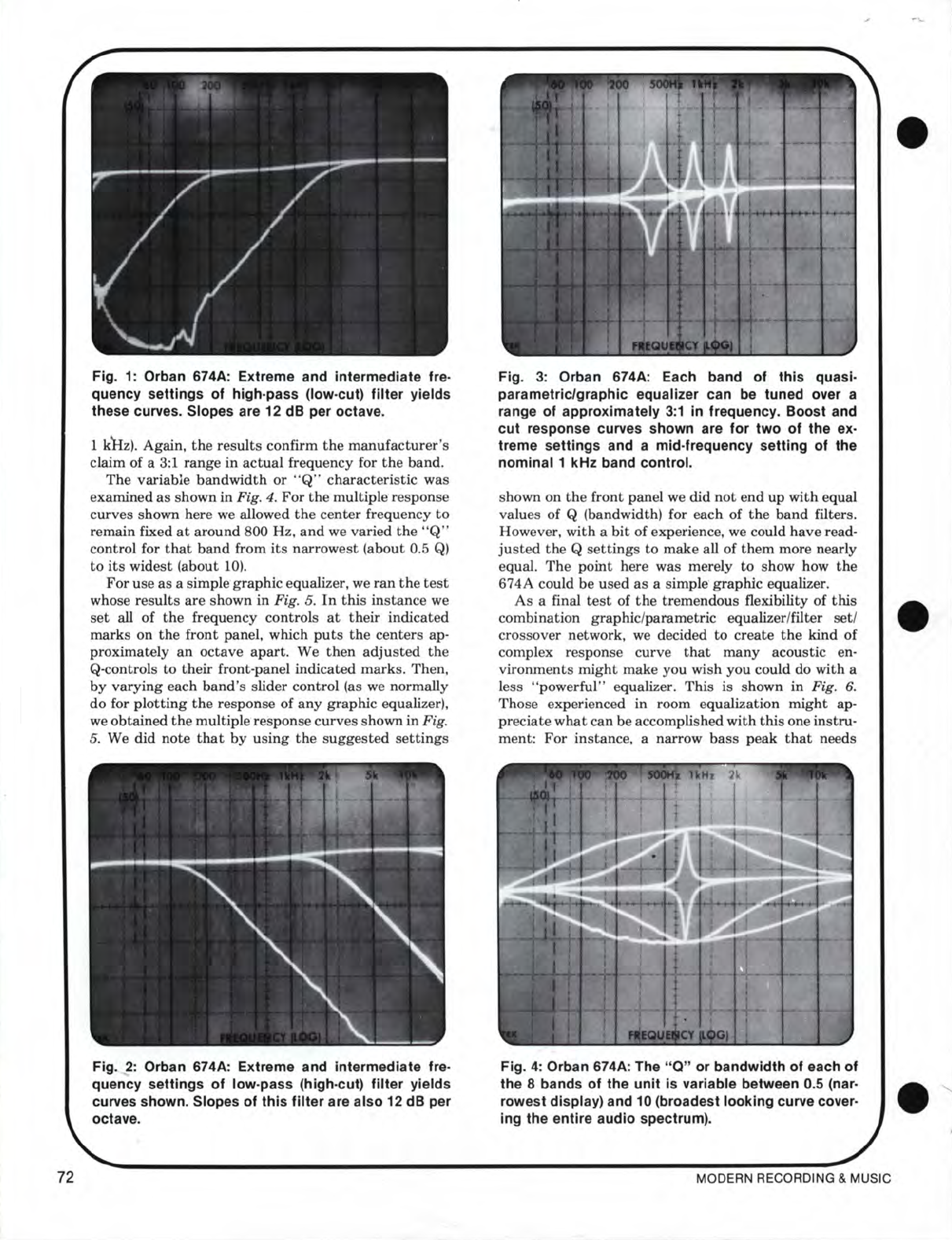
Figs. 1
and
2 show
our
plots of
the
high-pass
(low
cut)
and
low-pass (high-cut) filter sections. The slopes
are
12 dB
per
octave (as claimed),
and
the
overlap (from
about
100 Hz to 2 kHz) does allow these filters
to
be
used
as
adjustable
electronic crossovers,
with
frequen·
cies of your own choosing.
Fig
. 3 shows
the
wide range of
adjustment
of center
frequency possible for one
of
the
device's eight bands
(the one chosen for this
test
was nominally centered
at
Manufacturer's Notes
1 Specifications have been included
in
the Operating Manual
in
response to this appreciated criticism.
STEAM POWERED RADIO.COM
72
Fig.
1:
Orban
67
4A:
Extreme and intermediate fre-
quency settings
of
high-pass (low-cut) filter yields
these curves. Slopes are 12
dB
per octave.
1 kHz). Again,
the
results confirm
the
manufacturer
's
claim of a
3:1
range in
actual
frequency for
the
band
.
The
variable
bandwidth
or
"Q" characteristic was
examined
as
shown in Fig.
4.
For
the
multiple response
curves shown here
we
allowed
the
center frequency
to
remain fixed
at
around 800 Hz,
and
we
varied
the
"Q"
control for
that
band
from
its
narrowest (about 0.5
Q)
to
its
widest (about
10)
.
For
use
as
a simple graphic equalizer,
we
ran
the
test
whose results are shown in Fig.
5.
In
this
instance we
set
all of
the
frequency controls
at
their indicated
marks on
the
front panel, which
puts
the
centers
ap
·
proximately
an
octave
apart.
We
then
adjusted
the
Q-controls
to
their front-panel indicated marks. Then,
by
varying each
band
's slider control (as
we
normally
do for
plotting
the
response of
any
graphic equalizer),
we
obtained
the
multiple response curves shown in Fig.
5. We did note
that
by
using
the
suggested
settings
Fig.
2:
Orban 674A: Extreme and intermediate
fre
-
quency settings of low-pass (high-cut) filter yields
curves shown. Slopes
of
this filter are also 12
dB
per
octave.
Fig. 3: Orban 674A: Each band
of
this quasi-
parametric/graphic equalizer can
be
tuned
over
a
range
of
approximately
3:1
in
frequency. Boost and
cut response curves shown are for two
of
the
ex-
treme settings and a mid-frequency setting
of
the
nominal 1 kHz band control.
shown on
the
front panel
we
did
not
end
up
with equal
values of Q (bandwidth) for each of
the
band
filters.
However, with a
bit
of experience,
we
could
have
read·
justed
the
Q
settings
to
make all of them more nearly
equal.
The
point
here was merely
to
show how
the
674A could be
used
as
a simple graphic equalizer.
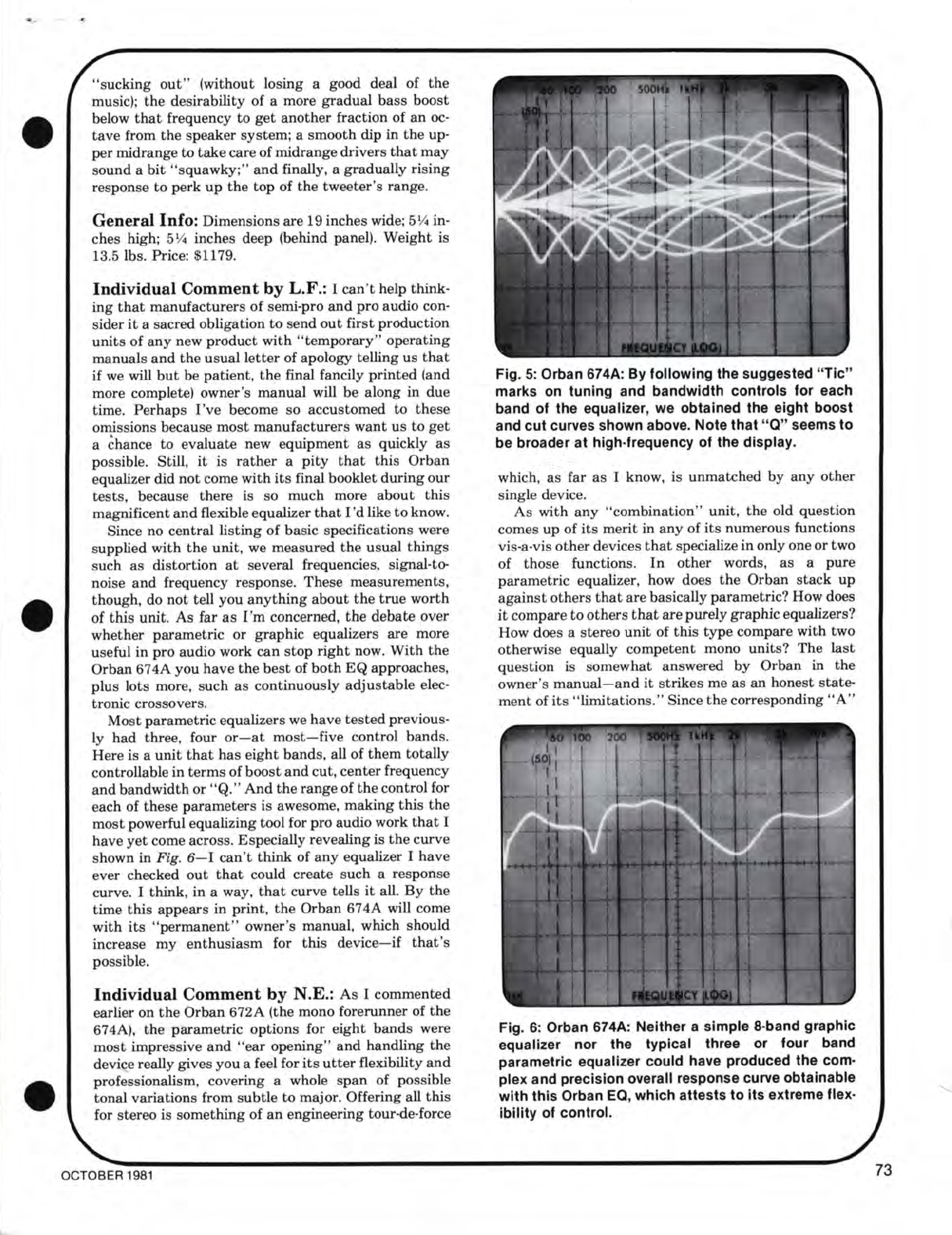
As a final
test
of
the
tremendous flexibility of this
combination graphic/parametric equalizer/filter
set
/
crossover network,
we
decided
to
create
the
kind of
complex response curve
that
many
acoustic en·
vironments
might
make you wish you could do with a
less "powerful" equalizer. This is shown in Fig.
6.
Those experienced in room equalization
might
ap·
preciate
what
can be accomplished with this one instru-
ment:
For
instance, a narrow
bass
peak
that
needs
Fig.
4:
Orban 674A: The "Q"
or
bandwidth of each
of
the 8 bands of the unit
is
variable between 0.5
(nar-
rowest display) and
10
(broadest looking curve
cover-
ing the entire audio spectrum).
MODERN RECORDING & MUSIC
•
•
•
STEAM POWERED RADIO.COM
•
•
•
"sucking
out"
(without losing a good deal of
the
music);
the
desirability of a more
gradual
bass
boost
below
that
frequency
to
get
another
fraction of an
oc-
tave
from
the
speaker system; a
smooth
dip in
the
up-
per midrange to
take
care of midrange drivers
that
may
sound a
bit
"squawky;"
and
finally, a gradually rising
response
to
perk
up
the
top of
the
tweeter's range.
General Info: Dimensions are 19 inches wide; 5 ¼ in-
ches high; 5¼ inches deep (behind panel). Weight is
13.5 lbs. Price: $1179.
Individual Comment
by
L.F.: I
can't
help think-
ing
that
manufacturers of semi-pro
and
pro
audio con-
sider
it
a sacred obligation
to
send
out
first production
units
of
any
new
product
with
"temporary"
operating
manuals
and
the
usual
letter
of apology telling us
that
if
we
will
but
be patient,
the
final fancily
printed
(and
more complete) owner's manual will be along in due
time.
Perhaps
I've
become so accustomed to
these
omissions because
most
manufacturers
want
us
to
get
a chance to evaluate new
equipment
as
quickly
as
possible. Still,
it
is
rather
a
pity
that
this Orban
equalizer did
not
come
with
its
final booklet d
uring
our
tests, because there is so much more
about
this
magnificent
and
flexible equalizer
that
I'd
like
to
know.
Since no central listing of basic specifications were
supplied with
the
unit, we measured
the
usual
things
such
as
distortion
at
several frequencies, signal-to-
noise
and
frequency response. These measurements,
though, do
not
tell you
anything
about
the
true
worth
of
this
unit
. As far
as
I'm
concerned,
the
debate
over
whether parametric or graphic equalizers are more
useful in
pro
audio work can
stop
right
now.
With
the
Orban 674A you have
the
best
of
both
EQ
approaches,
plus lots more, such
as
continuously
adjustable
elec-
tronic crossovers.
Most
parametric equalizers
we
have
tested
previous-
ly had three, four
or-at
most
-five control bands.
Here is a
unit
that
has
eight
bands, all of
them
totally
controllable in
terms
of boost
and
cut, center frequency
and
bandwidth
or
"Q."
And
the
range of
the
control for
each of these
parameters
is awesome,
making
this
the
most
powerful equalizing tool for pro audio work
that
I
have
yet
come across. Especially revealing is
the
curve
shown in
Fig.
6-1
can't
think of
any
equalizer I have
ever checked
out
that
could
create
such a response
curve. I think, in a way,
that
curve tells
it
all.
By
the
time
this
appears
in print,
the
Orban 674A will come
with
its
"permanent
" owner's manual, which should
increase
my
enthusiasm
for this
device-if
that
's
possible.
Individual Comment by N.E.: As I commented
earlier on
the
Orban 672A (the mono forerunner of
the
674A),
the
parametric options for
eight
bands
were
most
impressive
and
"ear
opening"
and
handling the
device really gives you a feel for
its
utter
flexibility
and
professionalism, covering a whole
span
of possible
tonal variations from
subtle
to
major. Offering all this
for stereo is something of
an
engineering tour-de-force
OCTOBER 1981
Fi
g.
5: Orban 674A:
By
following the suggested "Tic"
marks
on
tuning and bandwidth controls for each
band of the equalizer, we obtained the eight boost
and cut curves shown above. Note that "0 " seems to
be broader at high-frequency of the display.
which,
as
far
as
I know, is
unmatched
by any
other
single device.
As
with
any
"combination" unit,
the
old question
comes
up
of
its
merit in
any
of
its
numerous functions
vis-a-vis
other
devices
that
specialize in only one or two
of those functions.
In
other
words,
as
a pure
parametric equalizer, how does
the
Orban
stack
up
against
others
that
are basically parametric? How does
it
compare
to
others
that
are purely graphic equalizers?
How does a stereo
unit
of
this
type
compare with two
otherwise equally
competent
mono units?
The
last
question is somewhat answered
by
Orban in the
owner's manual-
and
it
strikes
me
as
an honest state-
ment of
its
"limitations
."
Since
the
corresponding"
A"
Fig. 6: Orban 674A: Neither a simple 8-band graphic
equalizer
no
r the typical three
or
four band
parametric equalizer could have produced the com-
plex and prec
is
ion overall response curve obtainable
with this Orban
EQ
, which attests to i
ts
extreme flex-
ibility of contro
l.
73
STEAM POWERED RADIO.COM
and
"B"
controls
had
to
be placed physically close
to
each other, "there
is
slight
crosstalk between
the
chan-
nels
at
very high frequencies (typically
better
than
-55
dB
at
20
kHz, falling
at
6 dB/octave
at
lower fre-
quencies). A small
amount
of leakage from one channel
to
the
other
may
be heard if
you
attempt
to
use each
674A channel
to
equalize entirely indep
endent
pro-
gram
material,
and
we recommend
that
the
674A be
used only with stereophonic
program
material.
If
you
require absolute isolation between
the
two channels,
we
recommend use of a
pair
of 672A equalizers
instead."
Orban
says
this
right
up front,
to
its
credit.
As
to
parametric options,
the
674A is clearly in a class of
its
own,
what
with
eight
frequency
bands
rather
than
the
customary
three
or
four. Are
eight
bands of parametric
"too much?" I don't know. There are
many
audio
pro
s
who feel
that
really good low-pass
and
high-pass filters
combined
with
three
or
four
bands
of parametric are all
that
they
need.
And
yet,
there
is
that
"weird" response
curve
we
were able
to
get
(Fig.
6)
with this device
that
documents a complexity
and
precision
that
seem un-
precedented for a single-unit equalizer. As a straight-
forward graphic equalizer,
the
eight
bands
of the Or-
ban
are, of course, two less
than
the
usual ten octaves
found on pro-grade units. How
important
those
extra
two
segments
are,
as
against
all
the
other
versatility of
this model (including
its
electronic crossover options),
is something you'
ll
have to decide for yourself. Whatever,
the Orban 674A merits very serious consideration.
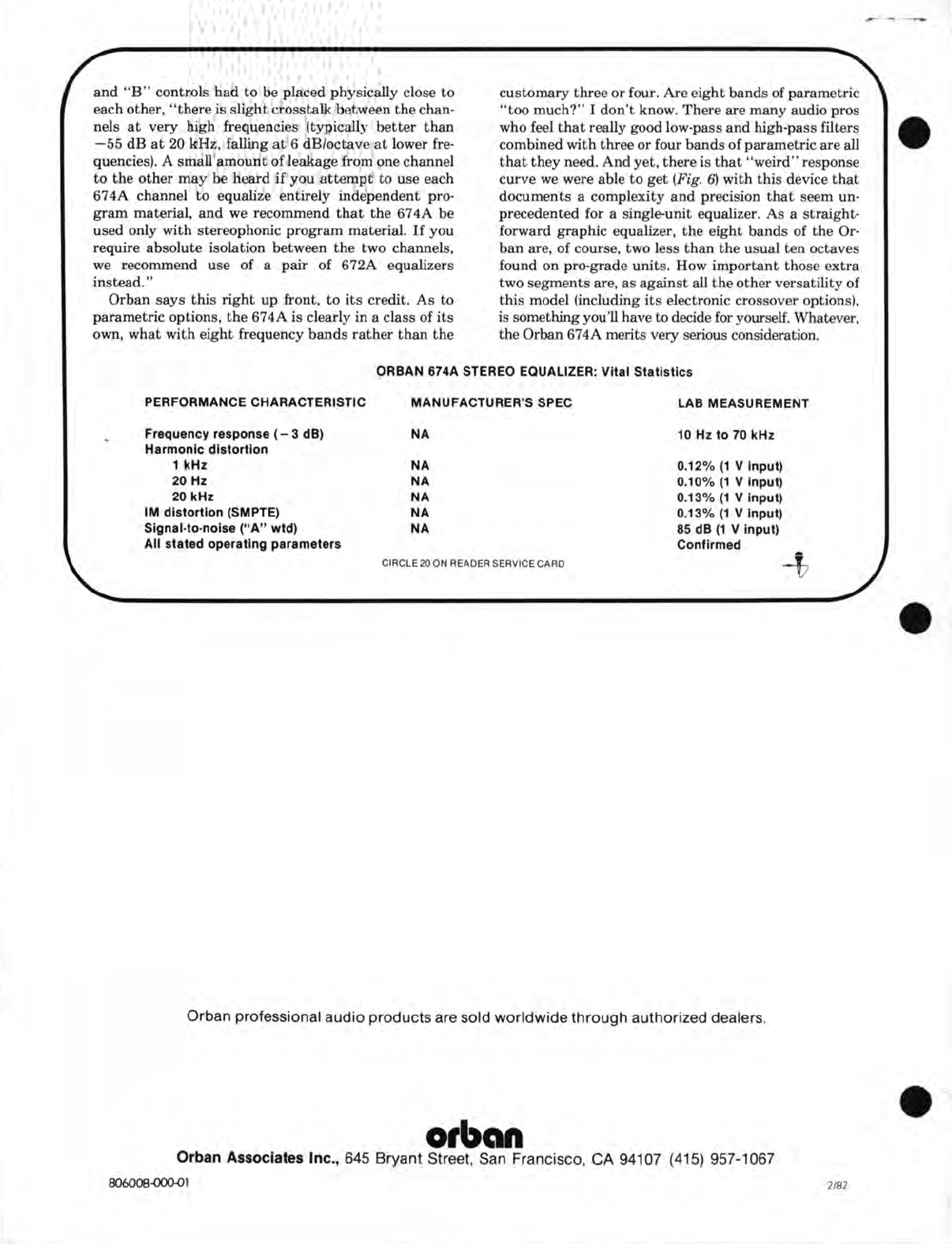
ORBAN 674A STEREO EQUALIZER: Vital Statistics
PERFORMANCE CHARACTERISTIC MANUFACTURER'S SPEC
Frequency response ( - 3
dB)
NA
Harmonic distortion
1 kHz NA
20
Hz
NA
20
kH
z NA
IM distortion (SMPTE) NA
Signal-to-noise ("A" wtd) NA
All
stated operating parameters
CIR
CL
E 20 ON READER SE
RV
ICE CARD
LAB
MEASUREMENT
10
Hz to
70
kH
z
0.12% (1 V Input)
0
.1
0%
(1
V input)
0.
13
%
(1
V input)
0.13%
(1
V input)
85
dB
(1 V input)
Confir
med
Orban pro
fe
ss
ional audio products are sold
wo
rldwide through authorized d
ea
lers.
o,ban
Orban Associates Inc
.,
645 Bryant St
re
et, San Francis
co
, CA 94
10
7
(4
1
5)
957-1067
806008-000-01
2/
82
•
•
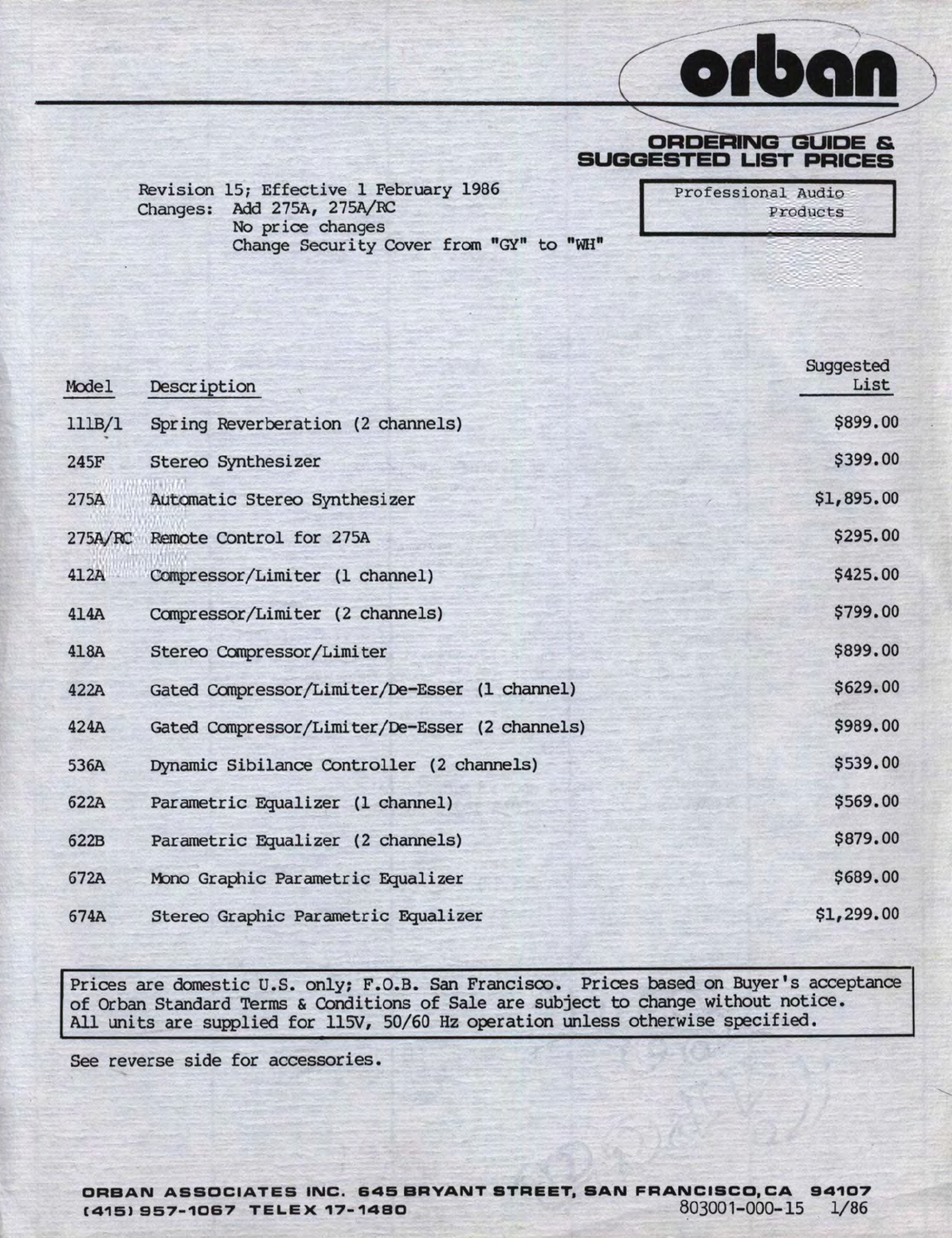
STEAM POWERED RADIO.COM
Revision 15;
Effective
1 February 1986
Changes:
Add
275A,
275A/RC
No
price
changes
Change
Security
Cover
fran
"GY"
to
"WH"
ltxlel
Description
lllB/1
Spring Reverberation
(2
channels)
245F
Stereo
Synthesizer
275A
Autanatic
Stereo
Synthesizer
275A/RC
Remote
Control
for
275A
412A
414A
418A
422A
424A
536A
622A
622B
672A
674A
canpressor/Limiter
(1
channel)
Canpressor/Limiter
(2
channels)
Stereo
Canpressor/Limiter
Gated
canpressor/Limiter/De-Esser
(1
channel)
Gated
canpressor/Limiter/De-Esser
(2
channels)
Dynamic
Sibilance
Controller
(2
channels)
Parametric
F,qualizer
(l
channel)
Parametric
F,qualizer
(2
channels)
M:>no
Graphic
Parametric
F,qualizer
Stereo
Graphic
Parametric
F.qualizer
Professional
Audio
Products
Suggested
List
$899.00
$399.00
$1,895.00
$295.00
$425.00
$799.00
$899.00
$629.00
$989.00
$539.00
$569.00
$879.00
$689.00
$1,299.00
Prices
are
domestic u.s.
only;
F.O.B. San
Francisco.
Prices
based on
Buyer's
acceptance
of
Orban Standard
Terms
& Conditions
of
Sale
are
subject
to
change without
notice.
All
units
are
supplied
for
115V,
50/60
Hz
operation
unless
otherwise
specified.
See
reverse
side
for
accessories.
ORBAN
ASSOCIATES
INC.
645
BRYANT
STREET,
BAN
FRANCIBCD,CA
94107
(415>
957-1067
TELEX
17-1480
803001-000-15 1/86
