POP 2 Reference Manual
User Manual:
Open the PDF directly: View PDF  .
.
Page Count: 42
POP
-2
REFERENCE
MANUAL
BY
R.
M.
BURSTALL
AND
R.
J.
POPPLESTONE
DEPARTMENT
OF
MACHINE
INTELLIGENCE
AND
PERCEPTION
UNIVERSITY
OF
EDINBURGH

CONTENTS
PAGE
1
INTRODUCTION
1.1
Aims
209
1.2
Main
features
209
1.3
Examples
210
1.4
Notation
for
syntactic
description
212
1.5
Notation
for
functions
213
2
ITEMS
2.1
Simple
and
compound
items
214
2.2
Integers
215
2.3
Reals
215
2.4
Truth
values
216
2.5
Undefined
216
2.6
Terminator
216
3
VARIABLES
3.1
Identifiers
216
3.2
Declaration
and
initialisation
217
3.3
Cancellation
219
4
FUNCTIONS
4.1
Definition
of
functions
219
4.2
Application
of
functions
220
4.3
Non
local
variables
221
4.4
Partial
application
221
4.5
Doublets
223
4.6
Arithmetic
operations
224
5
EXPRESSIONS
AND
STATEMENTS
5.1
Expressions
224
5.2
Precedence
226
5.3
Statements
and
imperatives
226
5.4
Labels
and
goto
statements
227
207
CONTENTS
5.5
Assignment
5.6
Comments
6
CONDITIONALS
6.1
Conditional
expressions
6.2
Conjunctions
and
disjunctions
7
DATA
STRUCTURES
7.1
Functions
of
data
structures
7.2
Records
7.3
Strips
7.4
Garbage
collection
8
STANDARD
STRUCTURES
8.1
References
8.2
Pairs
8.3
Lists
8.4
Full
strips
and
character
strips
8.5
Arrays
8.6
Words
8.7
Functions
PAGE
228
229
229
230
231
233
234
235
236
236
236
239
239
240
241
9
INPUT
AND
OUTPUT
9.1
Input
242
9.2
Output
243
10
MACHINE
CODE
244
11
MODES
OF
EVALUATION
11.1
Immediate
,evaluation
244
11.2
Macros
244
11.3
Evaluation
of
program
text
245
Acknowledgments
245
208
1.
INTRODUCTION
1.1.
Aims
The
following
are
the
main
design
objectives
for
the
POP
-2
language:
(i)
The
language
should
allow
convenient
manipulation
of
a
variety
of
data
structures
and
give
powerful
facilities
for
defining
new
functions
over
them.
(ii)
The
language
should
be
suitable
for
taking
advantage
of
on-line
use
at
a
console,
i.e.
it
should
allow
immediate
execution
of
statements
and
should
have
a
sufficiently
simple
syntax
to
avoid
frequent
typing
errors.
(iii)
A
compiler
and
operating
system
should
be
easy
to
write
and
should
not
occupy
much
storage.
(iv)
The
elementary
features
of
the
language
,should
be
easy
to
learn
and
use.
(v)
The
language
should
be
sufficiently
self
-consistent
and
economical
in
structure
to
allow
it
to
incorporate
new
facilities
when
extensions
are
desired.
In
attaining
these
objectives
certain
other
desirable
features
of
program-
ming
languages
had
to
be
relegated
to
secondary
importance:
(vi)
Fast
arithmetical
facilities
on
integer
and
real
numbers.
(vii)
Fast
subscripting
of
arrays.
(viii)
A
wide
variety
of
elegant
syntactic
forms.
Naturally
whether
(iii)
or
(vi)
and
(vii)
are
attained
is
to
a
considerable
extent
a
matter
of
implementation.
1.2.
Main
features
The
following
main
features
are
provided.
Roughly
analogous
features
of
some
other
programming
languages
are
mentioned
in
brackets
as
a
guide:
(i)
Variables
(cf.
ALGOL
but
no
types#
at
compile
time).
(ii)
Constants
(cf.
ALGOL
numeric
and
string
constants,
LISP
atoms and
list
constants).
209
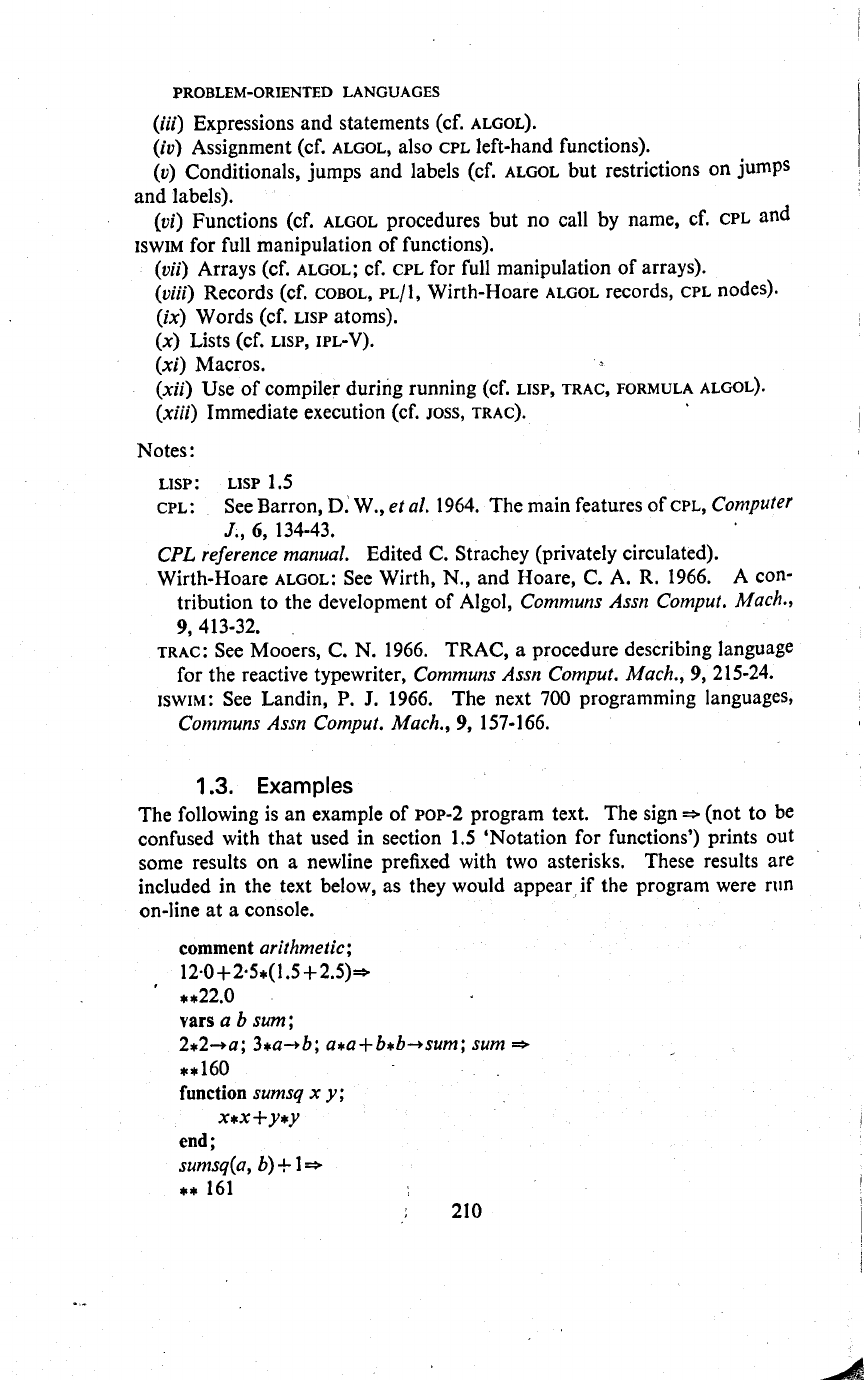
PROBLEM
-ORIENTED
LANGUAGES
(iii)
Expressions
and
statements
(cf.
ALGOL).
(iv)
Assignment
(cf.
ALGOL,
also
CPL
left-hand
functions).
(v)
Conditionals,
jumps
and
labels
(cf.
ALGOL
but
restrictions
on
jumps
and
labels).
(vi)
Functions
(cf.
ALGOL
procedures
but
no
call
by
name,
cf.
CPL
and
'swim
for
full
manipulation
of
functions).
(vii)
Arrays
(cf.
ALGOL;
cf.
CPL
for
full
manipulation
of
arrays).
(viii)
Records
(cf.
COBOL,
PL/l,
Wirth
-Hoare
ALGOL
records,
CPL
nodes).
(ix)
Words
(cf.
LISP
atoms).
(x)
Lists
(cf.
LISP,
IPL
-V).
(xi)
Macros.
(xii)
Use
of
compiler
during
running
(cf.
LISP,
TRAC,
FORMULA
ALGOL).
(Xiii)
Immediate
execution
(cf.
JOSS,
TRAC).
Notes:
LISP:
LISP
1.5
CPL:
See
Barron,
D.
W.,
etal.
1964.
The
main
features
of
CPL,
Computer
J.,
6,
134-43.
CPL
reference
manual.
Edited
C.
Strachey
(privately
circulated).
Wirth
-Hoare
ALGOL:
See
Wirth,
N.,
and
Hoare,
C.
A.
R.
1966.
A
con-
tribution
to
the
development
of
Algol,
Communs
Assn
Comput.
Mach.,
9,
413-32.
mc:
See
Mooers,
C.
N.
1966.
TRAC,
a
procedure
describing
language
for
the
reactive
typewriter,
Communs
Assn
Comput.
Mach.,
9,
215-24.
iswm:
See
Landin,
P.
J.
1966.
The
next
700
programming
languages,
Communs
Assn
Comput.
Mach.,
9,
157-166.
1.3.
Examples
The
following
is
an
example
of
pop
-2
program
text.
The
sign
(not
to
be
confused
with
that
used
in
section
1.5
'Notation
for
functions')
prints
out
some
results
on
a
newline
prefixed
with
two
asterisks.
These
results
are
included
in
the
text
below,
as
they
would
appear
if
the
program
were
run
on-line
at
a
console.
comment
arithmetic;
12.0+
2.5*(1.5
-I-
2.5).
**22.0
vars
a
b
sum;
2*2—+a;
3*a—*b;
a*a+b*b—osum;
sum
**160
function
sumsq
x
y;
x*x+y*y
end;
sumsq(a,
b)+1
**161
210
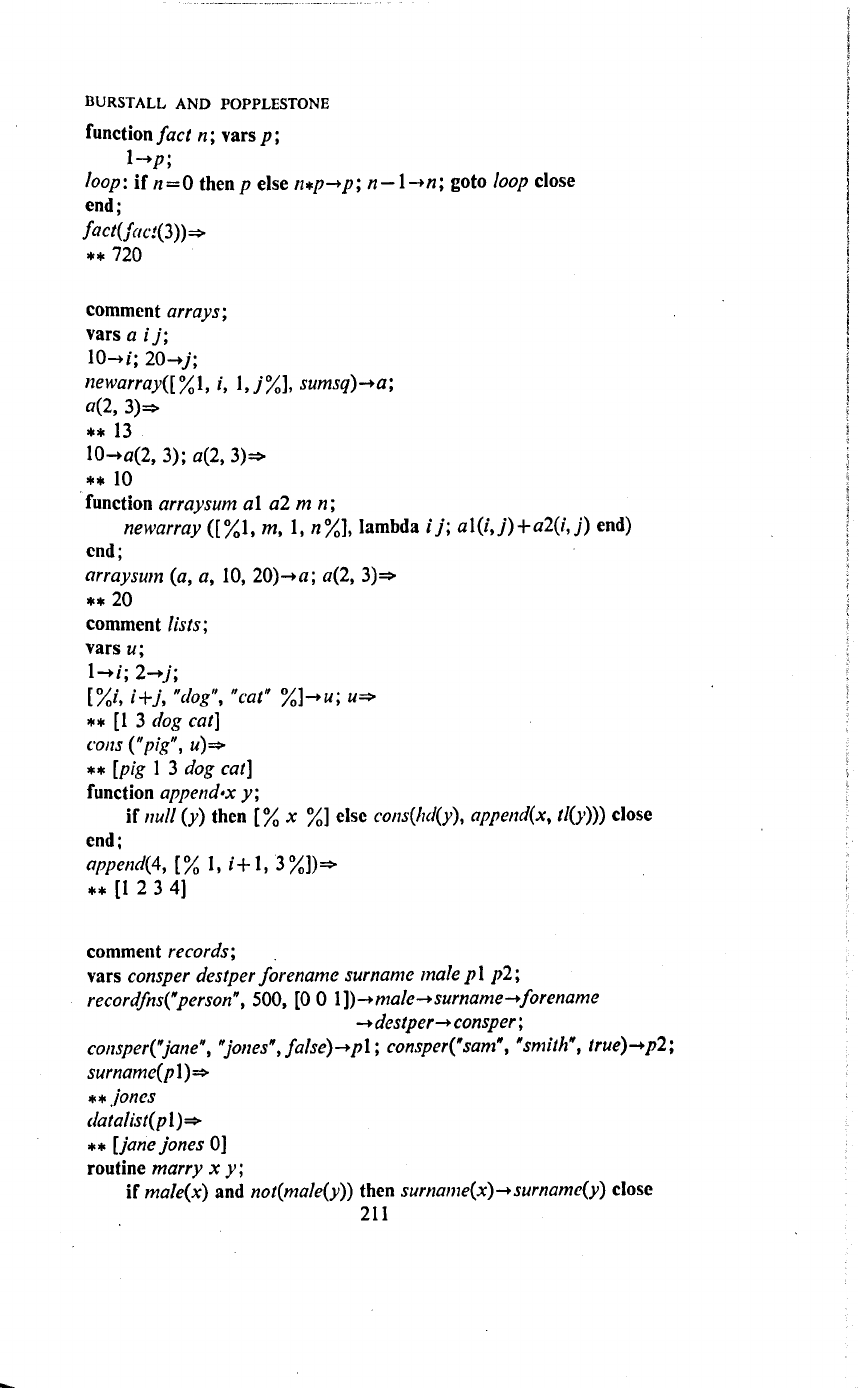
BURSTALL
AND
POPPLESTONE
function
fact
n;
vars
p;
1-0p;
loop:
if
n=0
then
p
else
n*p
-op;
n
goto
loop
close
end;
fact(fact(3))
**
720
comment
arrays;
vars
a
if;
10-31;
20
-tj;
newarray([%1,
i,
1,
j%],
sumsq)
-4a;
a(2,
**
13
10
-■a(2,
3);
a(2,
**
10
function
arraysum
al
a2
m
n;
newarray
([%1,
m,
1,
n%],
lambda
if;
al(i,
j)+a2(i,
j)
end)
end;
arrays=
(a,
a,
10,
20)
-oa;
a(2,
**
20
comment
lists;
vars
u;
1-41;
2
--tj;
[%i,
i+j,
"dog",
"cat"
%]
-'u;
**
[1
3
dog
cat]
cons
("pig",
u)-
**
[pig
1
3
dog
cat]
function
appencla
y;
if
null
(y)
then
[%
x
Y.]
else
cons(hd(y),
append(x,
tl(y)))
close
end;
append(4,
[%
1,
1+1,
3%])=
**
[1
2
3
4]
comment
records;
vars
consper
destper
forename
surname
male
pl
p2;
recordfns("person",
500,
[0
0
1])-.
male-'
surname
-'forename
-0
destper-■
consper;
comper("jane",
"Jones",
false)
-opl;
consper("sam",
"smith",
true)
-y2;
surname(p1)
**
,/ones
datalist(p1)=.
**
[Jane
Jones
0]
routine
marry
x
y;
if
male(x)
and
not(male(y))
then
surname(x)--Psurname(y)
close
211
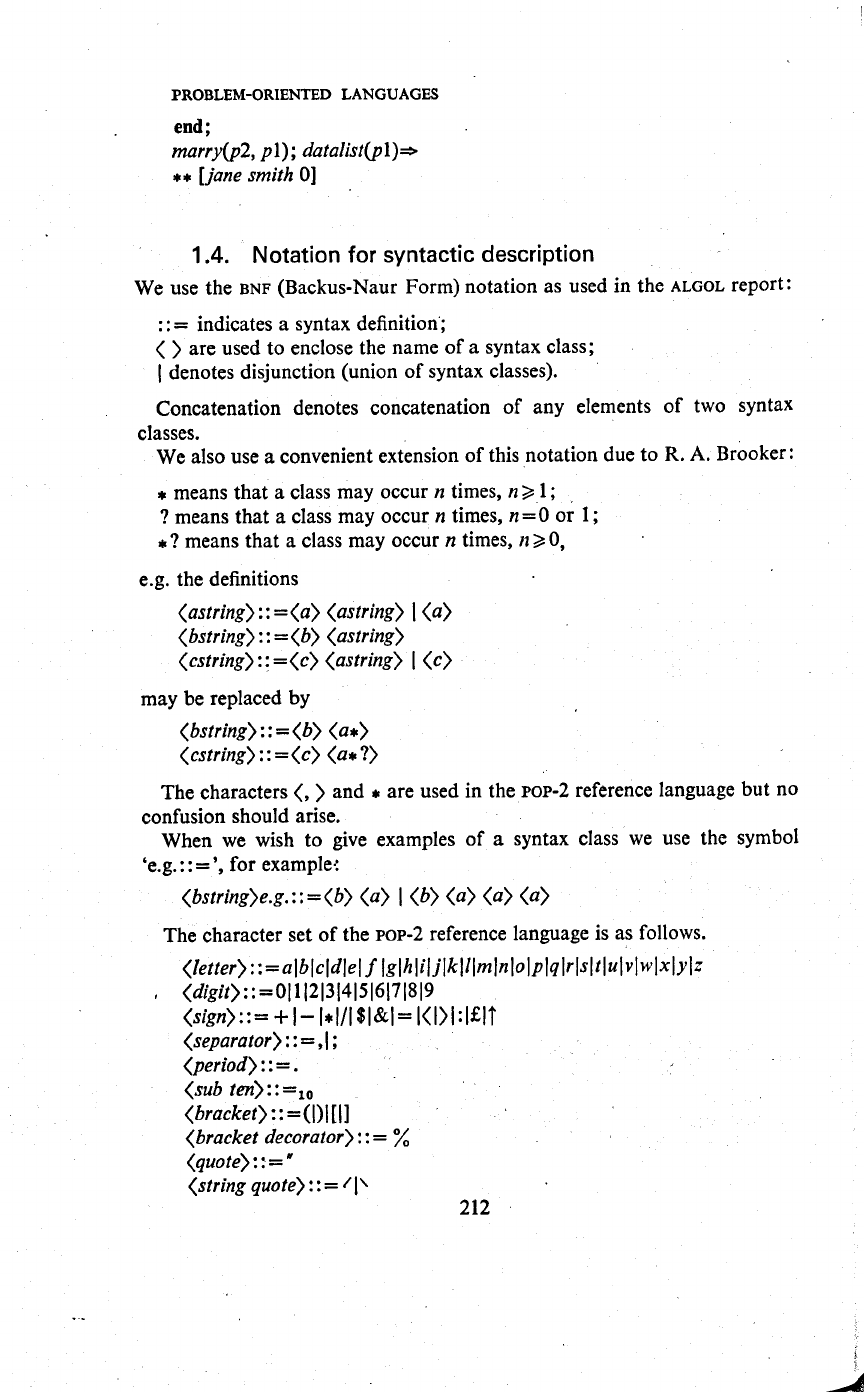
PROBLEM
-ORIENTED
LANGUAGES
end;
marry(p2,
pl);
datalist(p1)
**
[jane
smith
0]
1.4.
Notation
for
syntactic
description
We
use
the
BNF
(Backus
-Naur
Form)
notation
as
used
in
the
ALGOL
report:
=
indicates
a
syntax
definition;
<
>
are
used
to
enclose
the
name
of
a
syntax
class;
I
denotes
disjunction
(union
of
syntax
classes).
Concatenation
denotes
concatenation
of
any
elements
of
two
syntax
classes.
We
also
use
a
convenient
extension
of
this
notation
due
to
R.
A.
Brooker:
*
means
that
a
class
may
occur
n
times,
n>
1;
?
means
that
a
class
may
occur
n
times,
n=0
or
1;
*7
means
that
a
class
may
occur
n
times,
n
0,
e.g.
the
definitions
<astring>::=<a>
<astring>
I
<a>
<bstring>::=<b>
<astring>
<cstring>::=<c>
<astring>
I
<c>
may
be
replaced
by
<bstring>::=<b>
<a*>
<cstring>::=<c>
<a*?>
The
characters
<,
>
and
*
are
used
in
the
pop
-2
reference
language
but
no
confusion
should
arise.
When
we
wish
to
give
examples
of
a
syntax
class
we
use
the
symbol
'e.g.::
=',
for
example.:
<bstring>e.g.::=<b>
<a>
I
<b>
<a> <a>
<a>
The
character
set
of
the
pop
-2
reference
language
is
as
follows.
<letter>::=alblcIdlel
I
1011
j1kIllmInlolplqirlsItluIvIwIxlyiz
<digit>::=0I11213141516171819
<sign>::=
+I
-
14
,
111$1
8
d=1<l>l:ILIT
<separator>::=,1;
<period>::=.
<sub
ten>::=
10
<bracket>::=(1)I[1]
<bracket
decorator>::=
%
<quote>="
<string
quote>::=
/I\
212
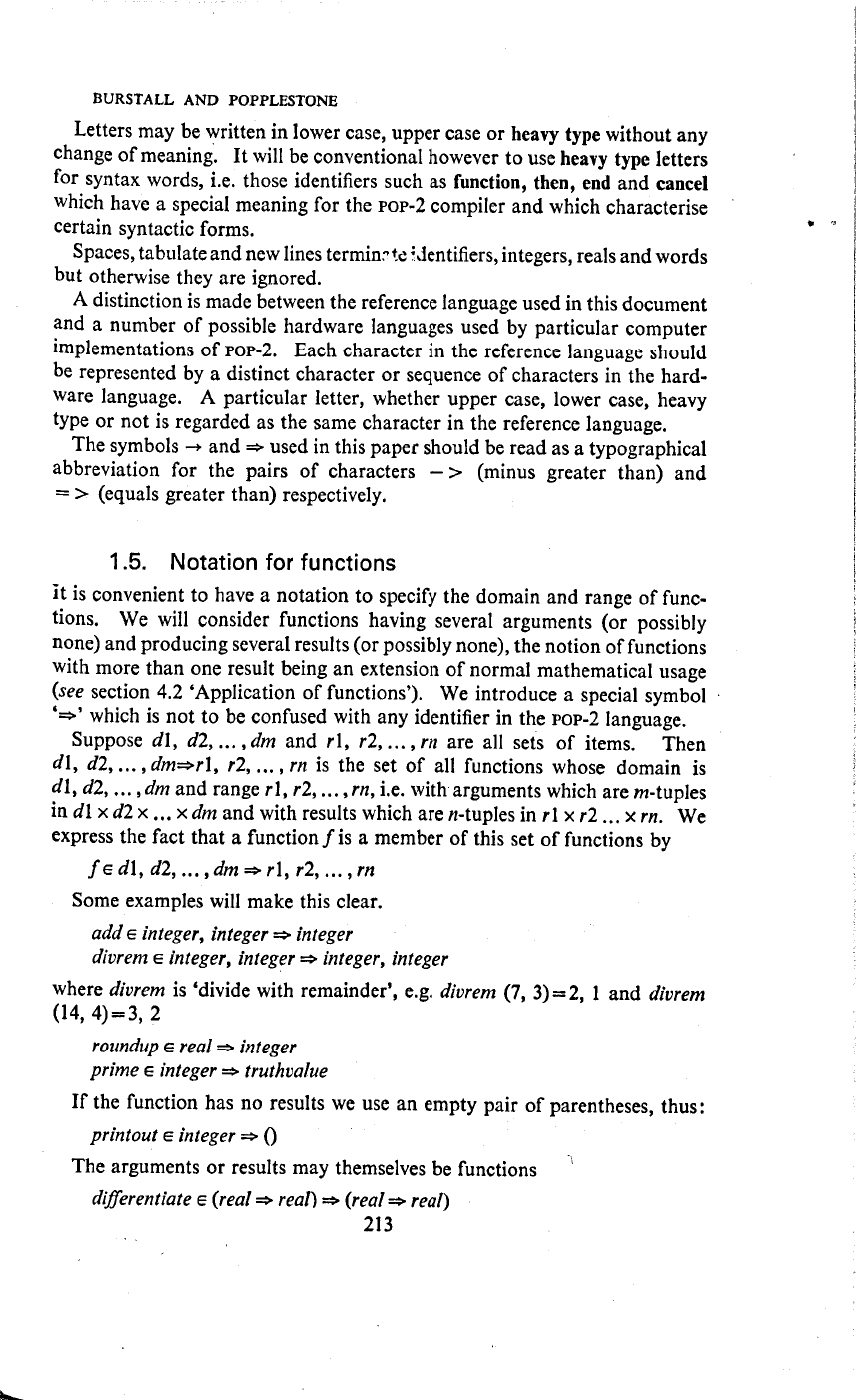
BURSTALL
AND
POPPLESTONE
Letters
may
be
written
in
lower
case,
upper
case
or
heavy
type
without
any
change
of
meaning.
It
will
be
conventional
however
to
use
heavy
type
letters
for
syntax
words,
i.e.
those
identifiers
such
as
function,
then,
end
and
cancel
which
have
a
special
meaning
for
the
pop
-2
compiler
and
which
characterise
certain
syntactic
forms.
Spaces,
tabulate
and
new
lines
terminte
dentifiers,
integers,
reals
and
words
but
otherwise
they
are
ignored.
A
distinction
is
made
between
the
reference
language
used
in
this
document
and
a
number
of
possible
hardware
languages
used
by
particular
computer
implementations
of
Pop
-2.
Each
character
in
the
reference
language
should
be
represented
by
a
distinct
character
or
sequence
of
characters
in
the
hard-
ware
language.
A
particular
letter,
whether
upper
case,
lower
case,
heavy
type
or
not
is
regarded
as
the
same
character
in
the
reference
language.
The
symbols
and
used
in
this
paper
should
be
read
as
a
typographical
abbreviation
for
the
pairs
of
characters
—>
(minus
greater
than)
and
=
>
(equals
greater
than)
respectively.
1.5.
Notation
for
functions
It
is
convenient
to
have
a
notation
to
specify
the
domain
and
range
of
func-
tions.
We
will
consider
functions
having
several
arguments
(or
possibly
none)
and
producing
several
results
(or
possibly
none),
the
notion
of
functions
with
more
than
one
result
being
an
extension
of
normal
mathematical
usage
(see
section
4.2
'Application
of
functions').
We
introduce
a
special
symbol
which
is
not
to
be
confused
with
any
identifier
in
the
pop
-2
language.
Suppose
dl,
d2,
,
dm
and
r
1,
r2,
,
rn
are
all
sets
of
items.
Then
dl,
d2,
,
r2,
,
rn
is
the
set
of
all
functions
whose
domain
is
dl,
d2,
,dm
and
range
r
1
,
r2,
•
,rn,
i.e.
with
arguments
which
are
m
-tuples
in
dl
x
d2
x x
din
and
with
results
which
are
n
-tuples
in
r
1
x
r2
x
rn.
We
express
the
fact
that
a
function
f
is
a
member
of
this
set
of
functions
by
f
e
dl,
d2,
,
dm
rl,
r2,
,
rn
Some
examples
will
make
this
clear.
add
E
integer,
integer integer
divreni
E
integer,
integer
integer,
integer
where
divrem
is
'divide
with
remainder',
e.g.
divrem
(7,
3)
=
2,
1
and
divrem
(14,
4)=3,
2
roundup
e
real
integer
prime
e
integer
truthvalue
If
the
function
has
no
results
we
use
an
empty
pair
of
parentheses,
thus:
printout
e
integer
The
arguments
or
results#20
may
themselves
be
functions
differentiate
e
(real
real)
(real
real)
213
PROBLEM
-ORIENTED
LANGUAGES
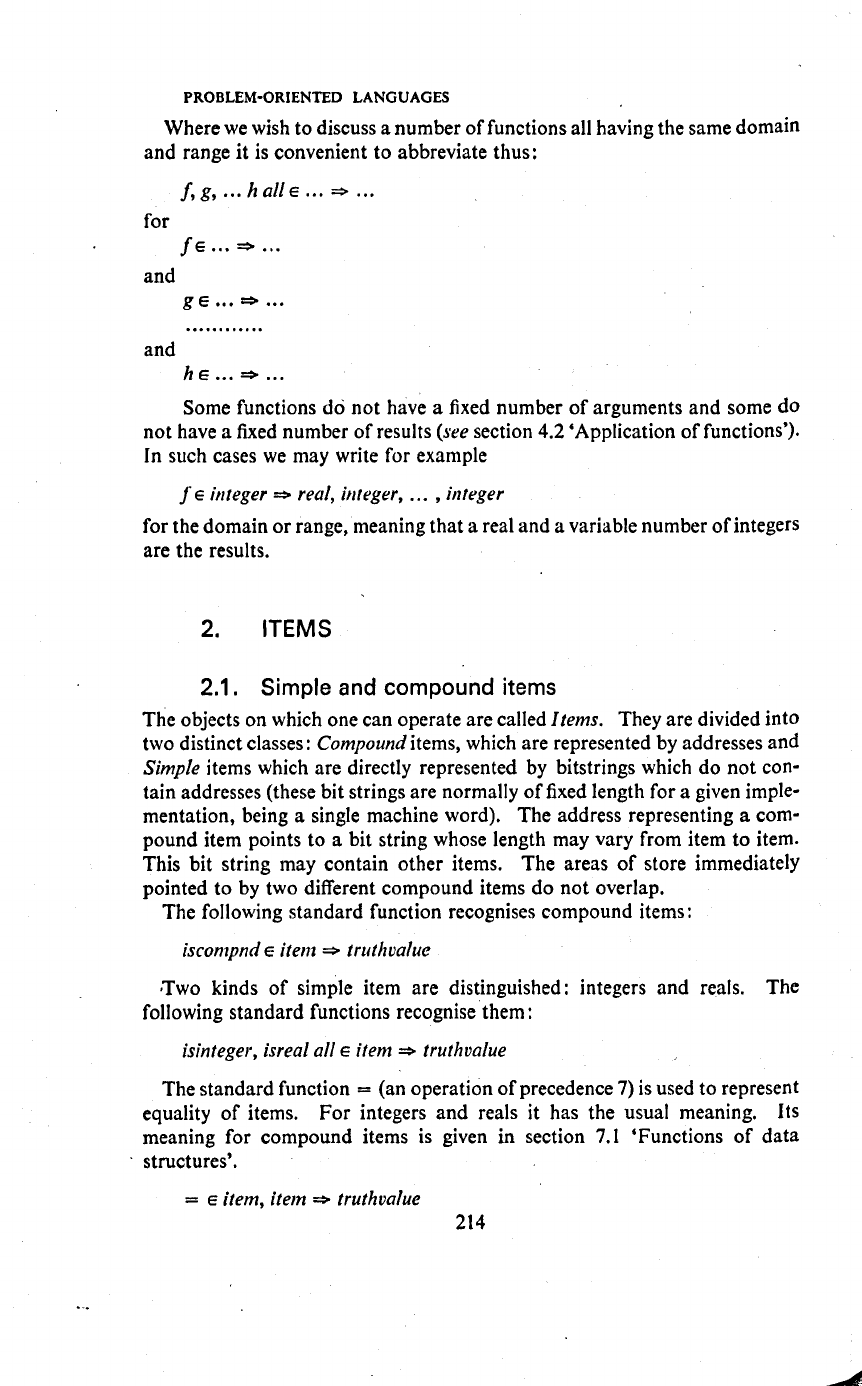
Where
we
wish
to
discuss
a
number
of
functions
all
having
the
same
domain
and
range
it
is
convenient
to
abbreviate
thus:
f,
g,
h
all
e
for
f
and
g
e
and
h
e
Some
functions
do
not
have
a
fixed
number
of
arguments
and
some
do
not
have
a
fixed
number
of
results
(see
section
4.2
'Application
of
functions').
In
such
cases
we
may
write
for
example
i
.
e
integer
real,
integer,
...
,
integer
for
the
domain
or
range,
meaning
that
a
real
and
a
variable
number
of
integers
are
the
results.
2.
ITEMS
2.1.
Simple
and
compound
items
The
objects
on
which
one
can
operate
are
called
Items.
They
are
divided
into
two
distinct
classes:
Compound
items,
which
are
represented
by
addresses
and
Simple
items
which
are
directly
represented
by
bitstrings
which
do
not
con-
tain
addresses
(these
bit
strings
are
normally
of
fixed
length
for
a
given
imple-
mentation,
being
a
single
machine
word).
The
address
representing
a
com-
pound
item
points
to
a
bit
string
whose
length
may
vary
from
item
to
item.
This
bit
string
may
contain
other
items.
The
areas
of
store
immediately
pointed
to
by
two
different
compound
items
do
not
overlap.
The
following
standard
function
recognises
compound
items:
iscompnd
e
item
truthvalue
Two
kinds
of
simple
item
are
distinguished:
integers
and
reals.
The
following
standard
functions
recognise
them:
isinteger,
isreal
all
e
item
truth
value
The
standard
function
=
(an
operation
of
precedence
7)
is
used
to
represent
equality
of
items.
For
integers
and
reals
it
has
the
usual
meaning.
Its
meaning
for
compound
items
is
given
in
section
7.1
'Functions
of
data
structures'.
=
e
item, item
truthvalue
214
BURSTALL
AND
POPPLESTONE
2.2.
Integers
Integers
are
simple
items.
They
may
be
positive,
negative
or
zero.
The
size
of
the
largest
and
smallest
integers
allowed
depends
on
the
implementation.
The#
following
functions
on
integers
are
standard:
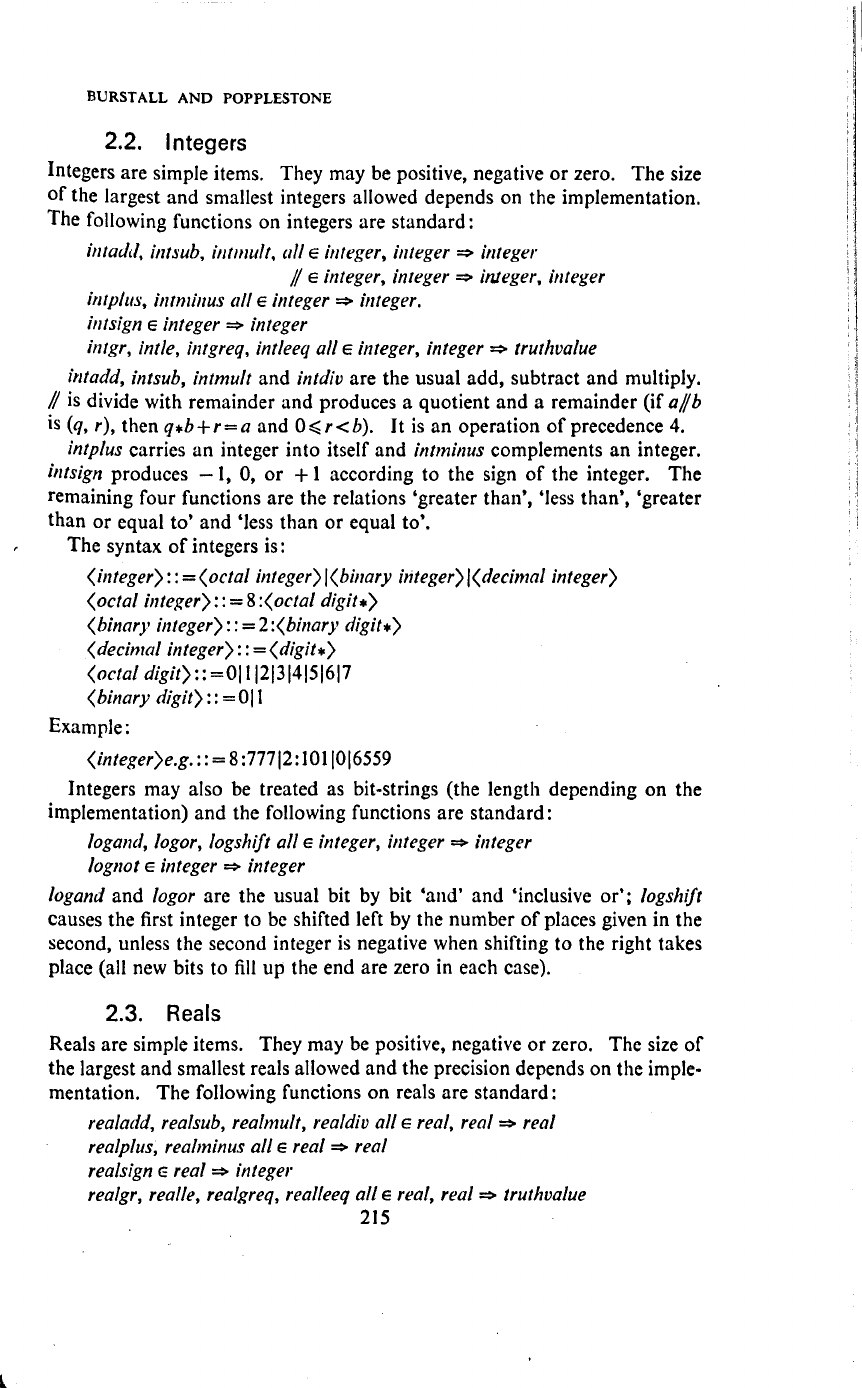
intadd,
intsub,
intmult,
all
E
integer,
integer integer
//
e
integer,
integer
integer,
integer
intplus,
intminus
all
e
integer
integer.
intsign
E
integer
integer
intgr,
mile,
intgreq,
intleeq
all
E
integer,
integer
truthvalue
intadd,
intsub,
intmult
and
intdiv
are
the
usual
add,
subtract
and
multiply.
//
is
divide
with
remainder
and
produces
a
quotient
and
a
remainder
(if
al/b
is
(q,
r),
then
q*b+
r
=a
and
0.4
r<b).
It
is
an
operation
of
precedence
4.
intplus
carries
an
integer
into
itself
and
intminus
complements
an
integer.
intsign
produces
—
1,
0,
or
+
1
according
to
the
sign
of
the
integer.
The
remaining
four
functions
are
the
relations
'greater
than',
'less
than',
'greater
than
or
equal#
to'
and
'less
than
or
equal
to'.
The
syntax
of
integers
is:
<integer>::=<octal
integer>l<binary
integer>l<decimal
integer>
<octal
integer>::=
8:<octal
digit*>
<binary
integer>::=
2:binary#2
digit*>
<decimal
integer>::=<digit*>
<octal
digit>::=011121314151617
<binary
digit>::=
011
Example:
<integer>e.g.::=
8:77712:1011016559
Integers
may
also
be
treated
as
bit
-strings
(the
length
depending
on
the
implementation)
and
the
following
functions
are
standard:
logand,
logor,
logshift
all
e
integer,
integer
integer
lognot
e
integer
integer
logand
and
logor
are
the
usual
bit
by
bit
'and'
and
'inclusive
or';
logs/ft
causes
the
first
integer
to
be
shifted
left
by
the
number
of
places
given
in
the
second,
unless
the
second
integer
is
negative
when
shifting
to
the
right
takes
place
(all
new
bits
to
fill
up
the
end
are
zero
in
each
case).
2.3.
Reals
Reals
are
simple
items.
They
may
be
positive,
negative
or
zero.
The
size
of
the
largest
and
smallest
reals
allowed
and
the
precision
depends
on
the
imple-
mentation.
The
following
functions
on
reals
are
standard:
realadd,
realsub,
realmult,
realdiv
all
e
real,
real
real
realplus,
realm
inus
all
e
real
real
realsign
e
real
integer
realgr,
realle,
realgreq,
realleeq
all
e
real,
real
truth
value
215
PROBLEM
-ORIENTED
LANGUAGES
These
are
the
usual
add,
subtract,
multiply
and
divide
on
reals.
realplus
carries
a
real
into
itself
and
realminus
complements
a
real.
realsign
produces
—1,
0
or
+1
according
to
the
sign
of
the
real.
The
remaining
four
functions
are
the
relations
'greater
than',
'less
than',
'greater
than
or
equal
to'
and
'less
than
or
equal
to'.
There
are
also
operations
to
convert
a
real
to
the
nearest
integer
and
to
convert
an
integer
to
real:
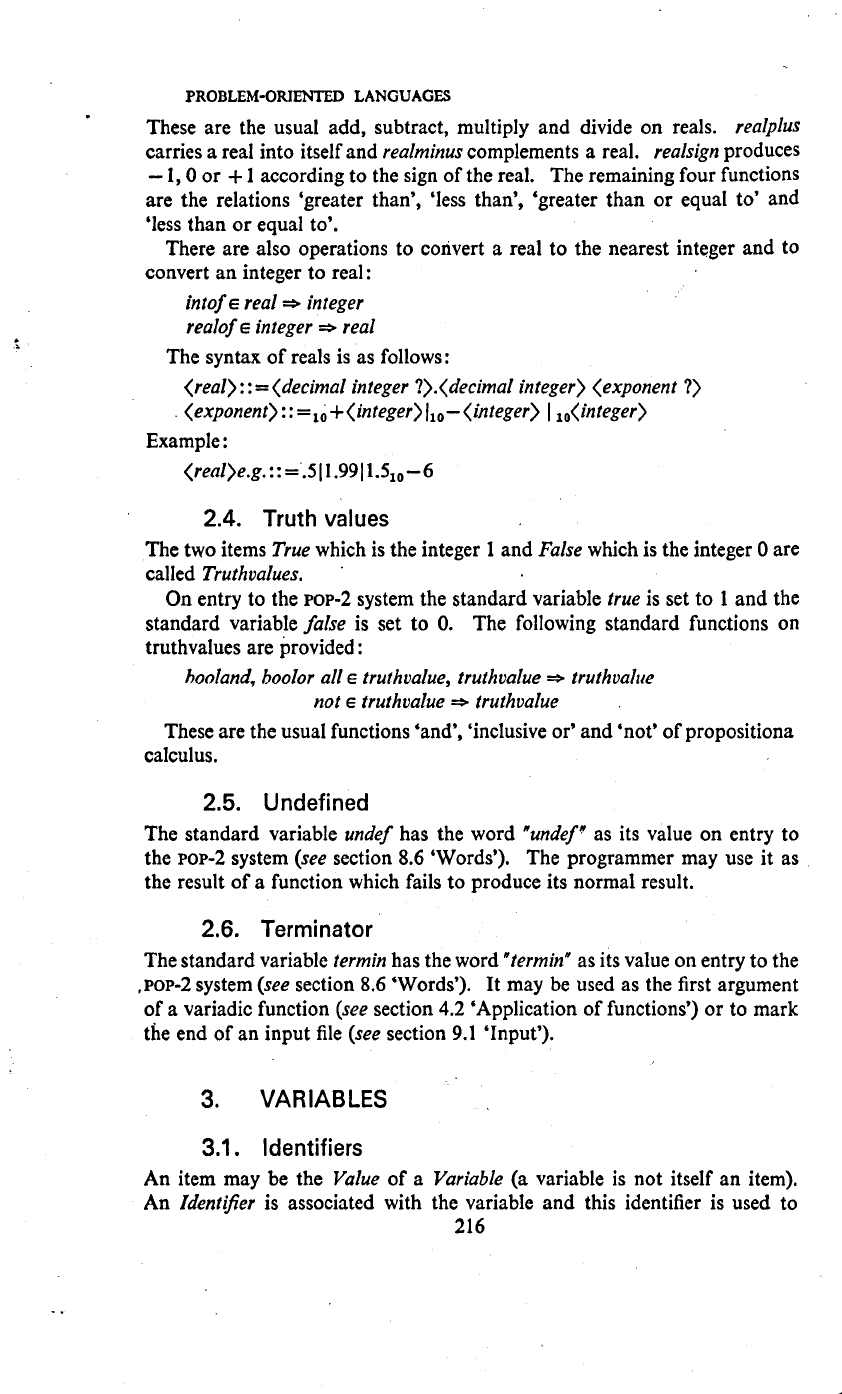
intof
e
real
integer
realof
e
integer
real
The
syntax
of
reals
is
as
follows:
<real>::=<decimal
integer
?>.<decimal
integer>
<exponent
?>
<exponent>::=
10
+<integer>1
10
—
<integer>
I
io
<integer>
Example:
<real>e.g.::=
.511.9911.5
10
-6
2.4.
Truth
values
The
two
items
True
which
is
the
integer
1
and
False
which
is
the
integer
0
are
called
Truthvalues.
• •
On
entry#
to
the
pop
-2
system
the
standard
variable
true
is
set
to
1
and
the
standard
variable
false
is
set
to
0.
The
following
standard
functions
on
truthvalues
are
provided:
hooland,
boolor
all
e
truthvalue,
truthvalue
truthvalue
not
e
truthvalue
truthvalue
These
are
the
usual
functions
'and',
'inclusive
or'
and
'not'
of
propositiona
calculus.
2.5.
Undefined
The
standard
variable
undef
has
the
word
"under
as
its
value
on
entry
to
the
pop
-2
system
(see
section
8.6
Words').
The
programmer
may
use
it
as
the
result
of
a
function
which
fails
to
produce
its
normal
result.
2.6.
Terminator
The
standard
variable
term
in
has
the
word
"termini'
as
its
value
on
entry
to
the
,pop
-2
system
(see
section
8.6
Words').
It
may
be
used
as
the
first
argument
of
a
variadic
function
(see
section
4.2
'Application
of
functions')
or
to
mark
the
end
of
an
input
file
(see
section
9.1
'Input').
3.
VARIABLES
3.1.
Identifiers
An
item
may
be
the
Value
of
a
Variable
(a
variable
is
not
itself
an
item).
An
Identifier
is
associated
with
the
variable
and
this
identifier
is
used
to
216
BURSTALL
AND
POPPLESTONE
refer
to
it
in
a
pop
-2
program.
A
number
of
distinct
variables
may
have
the
same
identifier,
but
only
one
of
them
is
Currently
associated
with
it
at
a
particular
time
in
the
evaluation
process.
An
identifier
may
be
restricted
to
a
certain
range
of
values
and
it
may
be
given
special
syntactic
properties
by
being
given
a
precedence
(see
section
5.2
'Precedence').
The
syntax
of
identifiers
is:
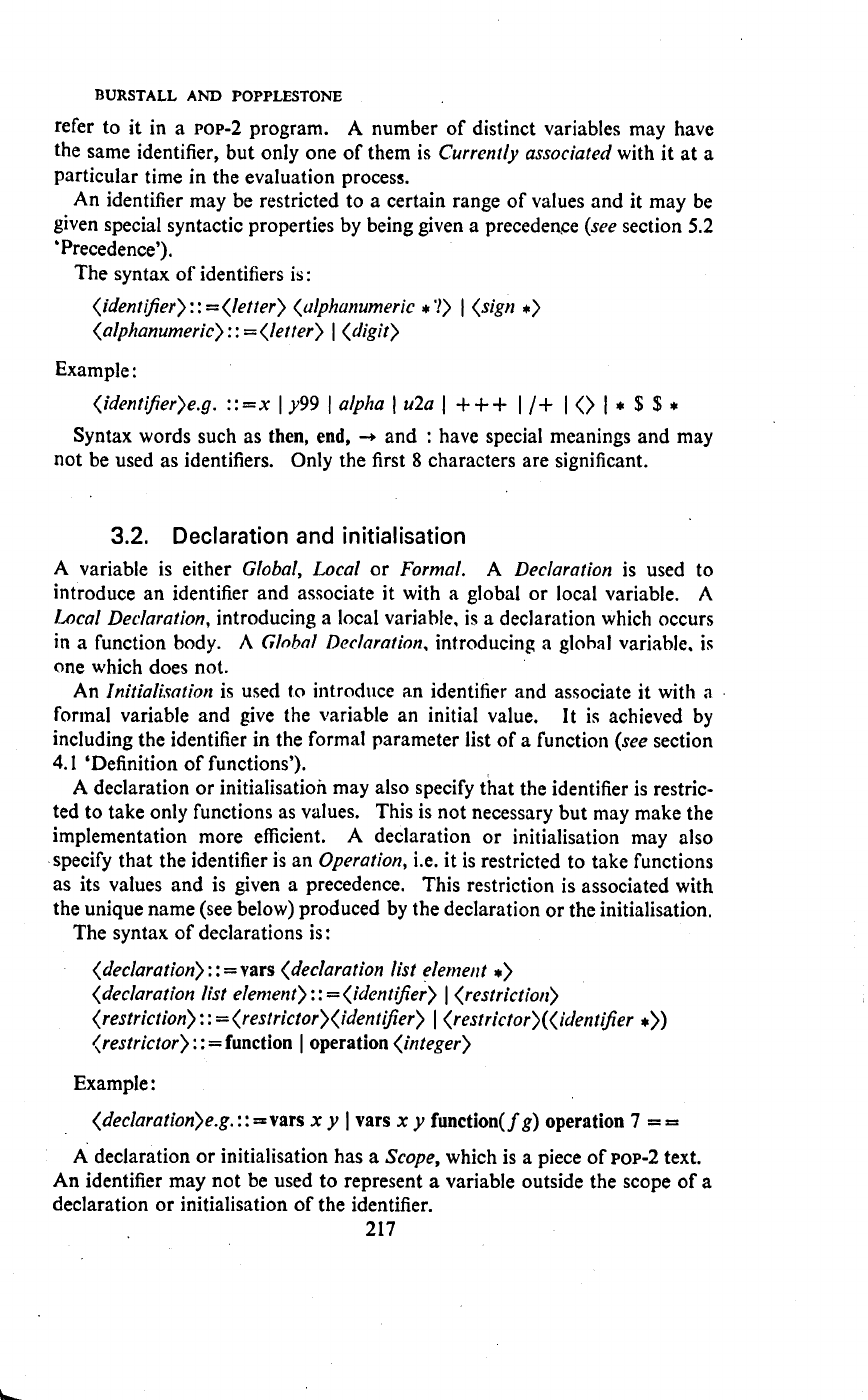
<identifier>::=<letter>
<alphanumeric
*1>
I
<sign
4.>
<alphanumeric>::
=
<letter>
I
<digit>
Example:
gdentifier>e.g.
::=x
I
y99
I
alpha
I
u2a
I
+++
11+
I
0
I
*
$ $
*
Syntax
words
such
as
then,
end,
and
:
have
special
meanings
and
may
not
be
used
as
identifiers.
Only
the
first
8
characters
are
significant.
3.2.
Declaration
and
initialisation
A
variable
is
either
Global,
Local
or
Formal.
A
Declaration
is
used
to
introduce
an
identifier
and
associate
it
with
a
global
or
local
variable.
A
Local
Declaration,
introducing
a
local
variable,
is
a
declaration
which
occurs
in
a
function
body.
A
Global
Declaration,
introducing
a
global
variable,
is
one
which
does
not.
An
Initialisation
is
used
to
introduce
an
identifier
and
associate
it
with
a
formal
variable
and
give
the
variable
an
initial
value.
It
is
achieved
by
including
the
identifier
in
the
formal
parameter
list
of
a
function
(see
section
4.1
'Definition
of
functions').
A
declaration
or
initialisation
may
also
specify
that
the
identifier
is
restric-
ted
to
take
only
functions
as
values.
This
is
not
necessary
but
may
make
the
implementation
more
efficient.
A
declaration
or
initialisation
may
also
specify
that
the
identifier
is
an
Operation,
i.e.
it
is
restricted
to
take
functions
as
its
values
and
is
given
a
precedence.
This
restriction
is
associated
with
the
unique
name
(see
below)
produced
by
the
declaration
or
the
initialisation.
The
syntax
of
declarations
is:
<declaration>::=vars
<declaration
list
element
4.>
<declaration
list
element>::=
<identifier>
I
<restriction>
<restriction>::=<restrictorXidentifier>
I
<restrictor>(<identifier
*>)
<restrictor>::=
function
I
operation
<integer>
Example:
<declaration>e.g.::=vars
x
y
I
vars
x
y
function(
f
g)
operation
7
=
=
A
declaration
or
initialisation
has
a
Scope,
which
is
a
piece
of
pop
-2
text.
An
identifier
may
not
be
used
to
represent
a
variable
outside
the
scope
of
a
declaration
or
initialisation
of
the
identifier.
217
PROBLEM
-ORIENTED
LANGUAGES
The
scope
of
a
global
declaration
starts
at
the
declaration
and
continues
until
the
identifier
is
cancelled.
The
scope
of
a
local
declaration
starts
at
the
declaration
and
continues
to
the
end
of
the
innermost
function
body
enclosing
it.
The
scope
of
an
initialisation
is
the
body
of
the
function
in
which
it
occurs.
Each
declaration
or
initialisation
gives
rise
to
a
unique
mark
and
this
mark
is
associated
with
all
occurrences
of
any
identifier
introduced
by
the
declaration
or
initialisation
within
the
scope
of
the
declaration
or
initialis-
ation.
An
identifier
together
with
its
unique
mark
is
called
a
Unique
name.
Thus
an
identifier
which
occurs
in
more
than
one
declaration
or
initialis-
ation
corresponds
to
more
than
one
unique
name.
The
generation
of
fresh
unique
names
for
identifiers
can
be
suppressed
by
using
the
standard
routines:
nonunique,
unique
all
e
0
If
nonunique
is
applied,
all
declarations
or
initialisations
of
a
given
identifier
until
unique
is
applied
will
give
rise
to
the
same
unique
name.
This
may
save
storage
space
and
can
be
used
when
no
confusion
is
liable
to
occur.
To
sum
up:
A
new
identifier
is
introduced
by
introducing
a
fresh
sequence
of
characters.
A
new
unique
name
is
introduced
by#
each
declaration
or
initialisation
(unless
nonunique
has
been
applied).
A
new
variable
is
introduced
by
each
dynamic
activation
of
a
declaration
or
initialisation.
A
variable
has
an
Extent
which
is
a
sequence
of
evaluations
of
expressions
and
statements.
The
extent
of
a
global
variable
starts
from
its
declaration
and
continues
indefinitely.
The
extent
of
a
local
or
formal
variable
starts
on
entry#
to
the
body
of
the
function
in
which
it
is
declared
or
initialised
and
continues
until
exit
from
the
body.
During
this
extent
the
extent
of
any
other
variable
with
the
same
unique
name
is
temporarily
interrupted.
This
is
called
a
Hole
in
the
Extent
of
the
other
variable.
Its
value
is
not
altered
but
it
cannot
be
accessed
or
changed
by
assignment.
Thus
there
is
only
one
variable
Currently
Associated
with
a
particular
unique
name
during
any
evaluation.
Other
variables
associated
with
the
unique
name
are
in
abeyance.
•
More
than
one
global
declaration
of
the
same
identifier
is
not
permitted
unless
a
cancellation
of
it
intervenes
in
the
text.
Similarly
a
declaration
of
a
local
variable
is
not
permitted
if
there
is
already
a
declaration
of
a
local
or
initialisation
of
a
formal
with
the
same
identifier
for
the
same
function
body.
A
Standard
Variable
is
a
global
variable
which
already
has
a
value
on
entry
to
the
pop
-2
system.
A
Standard
Function
(or
Routine)
is
one
which
is
the
value
of
a
standard
variable.
Certain
standard
variables
are
Protected,
i.e.
no
assignment
may
be
made
to
them.
218
BURSTALL
AND
POPPLESTONE
3.3.
Cancellation
A
cancellation
terminates
the
scope
of
any
declaration
of
an
identifier
and
removes
the
effect
of
any
restrictions
placed
upon
the
identifier.
The
cancellation
must
occur
textually
between
the
old
declaration
and
any
new
declaration.
It
may
not
occur
in
a
function
body.
The
syntax
of
cancellations
is:
<cancellation>::=
cancel
<identifier
*>
4.
FUNCTIONS
4.1.
Definition
of
functions
A
Function
is
a
compound
item.
Definition
and
application
of
functions
are
treated
in
this
section
and
the
next.
Certain
properties
of
a
function
regarded
as
a
data
structure
are
treated
in
section
8.7
'Functions'.
A
function
consists
of
a
Formal
Parameter
List
which
is
a
list
of
identifiers
of
formal
variables,
possibly
an
output
local
list
which
is
a
list
of
the
identifiers
of
output
local
variables
(see
section
4.2
'Application
of
functions')
and
a
Body
which
is
an
imperative
sequence
(see
section
5.3
'Statements
and
imperatives').
A
function
which
produces
no
results
(see
section
4.2
'Application
of
functions')
is
called
a
Routine.
Functions
may
be
referred
to
in
the
program
by
using
a
function
constant,
called
a
Lambda
Expression,
or
they
may
be
standard
functions
provided
by
the
pop
-2
system,
or
they
may
be
created
by
partial
application
or
by
appli-
cation
of
a
standard
function
which
produces
a
function
as
a
result.
The
syntactic
representation
of
a
function
constant
is:
(formal
parameter
list
element>::=<ident>
I
<restriction>
'(formal
parameter
list>::=<formal
parameter
list
element
*?>
<output
local
list
element>::=<ident>
I
<restriction>
<output
local
list>::=
<output
local
list
element
*?>
<function
body>::=<imperative
sequence>
<lambda
expression>
::=1ambda<formal
parameter
list><output
local
list>
;
<function
body>
end
Example:
<lambda
expression>e.g.::=
lambda
x
y;
cons(x,
cons(a,
y))
end
I
lambda
x;
n1(1);
print(x)
end
We
very
often
wish
to
declare
a
variable
and
then
assign
a
function
to
it.
The
syntactic
form
of
this
will
be
as
follows:
vars
<identifier>;
<lambdaXformal
parameter
list>;
<function
body>
end
—■
<identifier>
219
PROBLEM
-ORIENTED
LANGUAGES
This
is
so
common
that
a
special
syntactic
form
is
introduced
which
is
equivalent
to
it:
<function>::=
function
I
routine
(Junction
definition>::=<functionXidentifierXformal
parameter
list>;
<function
body>
end
The
word
routine
is
a
synonym
for
function.
It
may
be
used
for
a
function
with
no
results.
If
the
identifier
has
been
previously
declared
at
this
level
no
new
declaration
is
implied
and
the
function
definition
is
equivalent
simply to
an
assignment
of
a
lambda
expression.
The
identifier
may
be
an
operation
identifier.
Example:
(function
definition>e.g.::=
function
max
x
y;
if
x
>
y
then
x
else
y
close
end
I
routine
enter
u
v;
cons(conspair(u,
v),
dict)—•
dict
end
I
function
order
x
y
u
v;
if
x
>
y
then
x
--•
u;
y
--■
v
else
y
u;
x
—■
v
close
end
4.2.
Application
of
functions
An
n
-Tuple
is
an
ordered
sequence
of
n
items
(n
>0).
An
item
is
identical
with
the
1
-tuple
whose
sole
member
is
that
item.
An
n
-tuple
and
an
m
-tuple
may
be
Concatenated
to
produce
an
(n+m)-tuple.
A
function
of
n
arguments
(i.e.
with
n
formal
parameters,
excluding
frozen
formals;
see
section
4.4
'Partial
application'),
may
be
Applied
to
an
n
-tuple,
whose
members
are
called
the
Actual
Parameters
of
the
function.
Application
of
a
function
to
its
actual
parameters
produces
an
m
-tuple,
whose
members
are
said
to
be
the
Results
of
the
function.
A
function
producing
no
results
(i.e.
an
0
-tuple)
is
called
a
routine
(see
section
4.1
'Definition
of
functions').
A
function
which
does
not
take
a
fixed
number
of
arguments
is
called
Variadic.
A
function
which
does
not
produce
a
fixed
number
of
results
is
called
Variresult.
The
application
of
a
function
to
its
actual
parameters
consists
of
the
follow-
ing
sequence
of
events:
Entry:
a
new
variable
corresponding
to
each
formal
parameter
is
initialised
to
the
corresponding
actual
parameter
value,
or
if
it
is
a
frozen
formal
to
the
corresponding
value
in
the
frozen
value
list.
A
new
variable
corresponding
to
each
local
variable
declaration
in
the
function
body
but
not
in
any
interior
function
body
is
then
created.
The
variables
previously
associated
with
the
identifiers
of
formal
or
local
variables
can
no
-longer
be
referred
to
but
their
values
are
undisturbed.
Running:
the
function
body
is
evaluated
with
the
variables
created
on
entry.
220
BURSTALL
AND
POPPLESTONE
Exit.
Any
items
which
have
been
placed
on
the
stack
(see
section
5.3
'State-
ments
and
imperatives')
and
were
not
there
at
entry
are
concatenated
with
the
values
of
any
Output
Local
Variables
to
form
the
results
of
the
function.
The
variables
created
on
entry
are
terminated
and
the
variable
associated
with
each
identifier
reverts
to
what
it
was
on
entry.
There
is
no
change
in
the
values
of
variables
which
were
previously
associated
with
the
formal
or
local
variable
identifiers
and
have
now
been
reinstated.
The
values
of
formal
and
frozen
variables
are
lost.
The
frozen
formals
will
be
reinitialised
from
the
frozen
value
list
on
the
next
entry
to
the
function
normally
with
the
same
values
as
last
time;
the
frozen
value
list
can
be
changed
by
using
frozval
(see
section
8.7
'Functions').
4.3.
Nonlocal
variables
Variables
which
occur
in
a
function
body
and
are
not
locals
(i.e.
declared
in
the
body)
or
formals
(i.e.
elements
of
the
formal
parameter
list)
are
called
Nonlocal
to
the
function.
They
may
be
globals
or
locals
of
some
outer
function
body
which
textually
encloses
it.
Care
must
be
taken
not
to
apply
a
function
with
nonlocals
in
a
hole
in
the
extent
of
some
of
its
nonlocals
(see
section
3.2
'Declaration
and
initialisation')
or
outside
their
extent.
Mention
of
the
identifier
of
such
a
nonlocal
would
refer
to
a
quite
different
variable
currently
associated
with
that
unique
name.
The
difficulty
can
arise
for
recursive
functions.
Analogous
trouble
may
arise
if
nonunique
is
used.
To
avoid
such
difficulties
a
frozen
formal
may
be
used
instead
of
the
non-
local,
provided
that
it
is
not
desired
to
assign
a
new
value
to
the
nonlocal
as
a
result
of
the
call.
The
frozen
formal
can
be
initialised
by
partial
application
to
the
value
that
the
non
-local
would
have
taken.
(Note
that
the
frozen
formals
can
be
used
in
this
way
to
give
the
equivalent
of
CPL
fixed
functions,
see
CPL
Reference
Manual
privately
circulated
by
C.
Strachey,
Programming
Research
Unit,
Oxford
University.)
In
cases
where
assignment
to
the
non-
local
is
desired
a
frozen
formal
can
be
used
and
initialised
to
take
a
reference
(see
section
8.1
'References')
as
value.
The
component
of
this
reference
can
then
be
assigned
to,
and
so
long
as
the
reference
is
made
the
value
of
some
other
exterior
variable
the
value
is
accessible
outside
the
function
body.
4.4.
Partial
application
In
section
4.2
'Application
of
functions'
we
explained
the
method
of
applying
a
function
to
its
arguments.
There
is
a
process
somewhat
analogous
to
application
called
Partial
Application.
By
this
means
some
of
the
formal
parameters
of
a
function
may
be
made
into
Frozen
Formals,
producing
a
new
function
with
fewer
arguments.
The
frozen
formals
are
always
initialised
to
a
fixed
value
when
the
function
is
applied
and
do
not
require
any
correspond-
ing
actual
parameters
(see
however
section
8.7
'Functions'
for
means
of
altering
this
fixed
value).
In
other
words
the
actual
parameters
corresponding
221
PROBLEM
-ORIENTED
LANGUAGES
to
the
frozen
formals
are
supplied
once
and
for
all
on
partial
application.
The
values
of
the
frozen
formals
are
called
the
Frozen
Value
List.
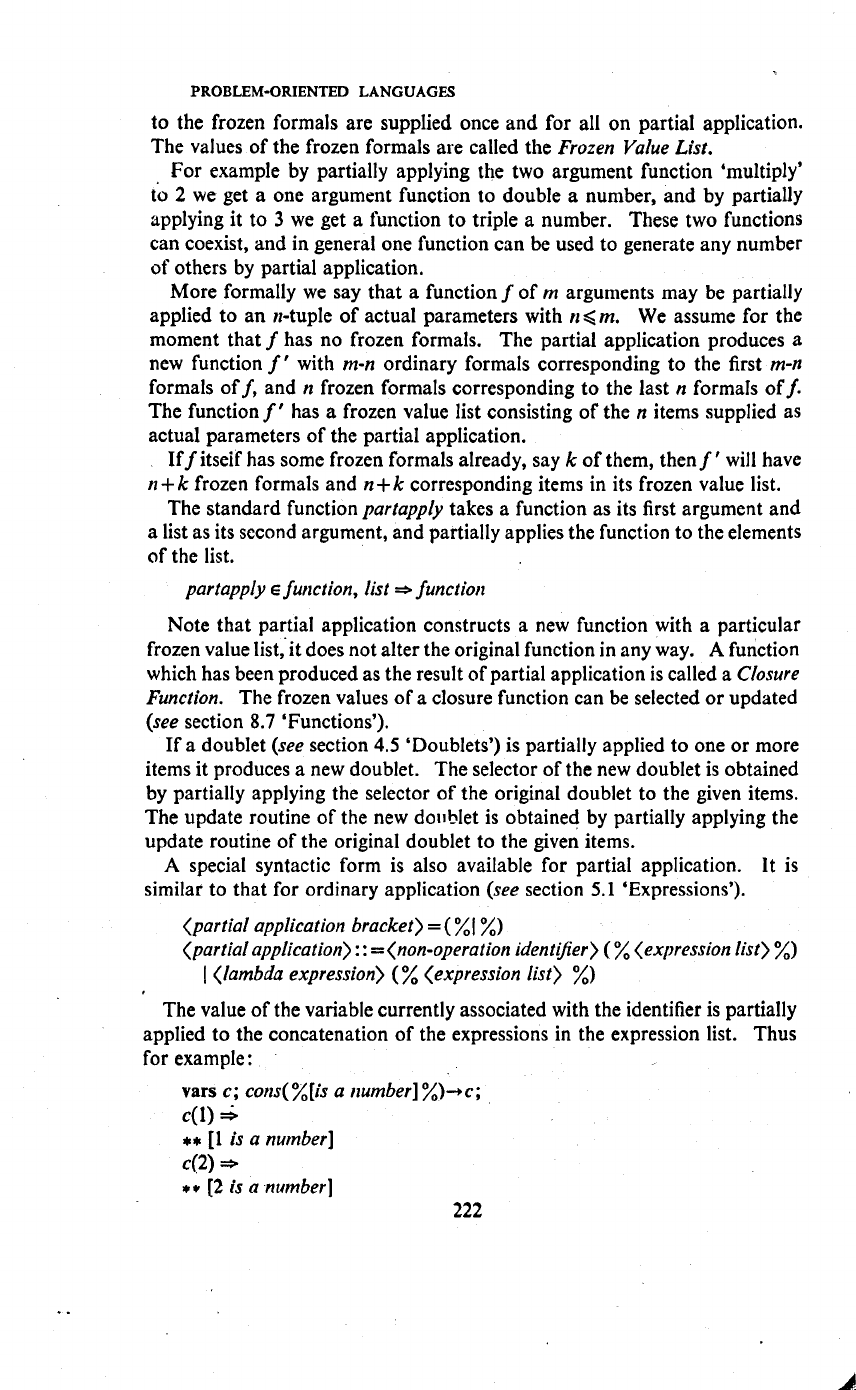
For
example
by
partially
applying
the
two
argument
function
'multiply'
to
2
we
get
a
one
argument
function
to
double
a
number,
and
by
partially
applying
it
to
3
we
get
a
function
to#
triple
a
number.
These
two
functions
can
coexist,
and
in
general
one
function
can
be
used
to
generate
any
number
of
others
by
partial
application.
More
formally
we
say
that
a
function
f
of
m
arguments
may
be
partially
applied
to
an
n
-tuple
of
actual
parameters
with
n
m.
We
assume
for
the
moment
that
f
has
no
frozen
formals.
The
partial
application
produces
a
new
function
f'
with
m
-n
ordinary
formals
corresponding
to
the
first
m
-n
formals
of
f,
and
n
frozen
formals
corresponding
to
the
last
n
formals
of
f.
The
function
f
'
has
a
frozen
value
list
consisting
of
the
n
items
supplied
as
actual
parameters
of
the
partial
application.
Iff
itself
has
some
frozen
formals
already,
say
k
of
them,
then
f
'
will
have
n
+
k
frozen
formals
and
n
+
k
corresponding
items
in
its
frozen
value
list.
The
standard
function
partapply
takes
a
function
as
its
first
argument
and
a
list
as
its#
second
argument,
and
partially
applies
the
function
to
the
elements
of
the
list.
partapply
e
function,
list
function
Note
that
partial
application
constructs
a
new
function
with
a
particular
frozen
value
list,
it
does
not
alter
the
original
function
in
any
way.
A
function
which
has
been
produced
as
the
result
of
partial
application
is
called
a
Closure
Function.
The
frozen
values
of
a
closure
function
can
be
selected
or
updated
(see
section
8.7
`Functions').
If
a
doublet
(see
section
4.5
'Doublets')
is
partially
applied
to
one
or
more
items
it
produces
a
new
doublet.
The
selector
of
the
new
doublet
is
obtained
by
partially
applying
the
selector
of
the
original
doublet
to
the
given
items.
The
update
routine
of
the
new
doublet
is
obtained
by
partially
applying
the
update
routine
of
the
original
doublet
to
the
given
items.
A
special
syntactic
form
is
also
available
for
partial
application.
It
is
similar
to#
that
for
ordinary
application
(see
section
5.1
'Expressions').
<partial
application
bracket>
=(%I%)
(partial
application>::=<non
-operation
identifier>
(%<expression
list>
%)
I
<lambda
expression>
(%
<expression
list>
%)
The
value
of
the
variable
currently
associated
with
the
identifier
is
partially
applied
to
the
concatenation
of
the
expressions
in
the
expression
list.
Thus
for
example:
vars
c;
cons(%[is
a
number]
%)—c;
c(1)
**
[us
a
number]
c(2)
**
[2
is
a
number]
222
BURSTALL
AND
POPPLESTONE
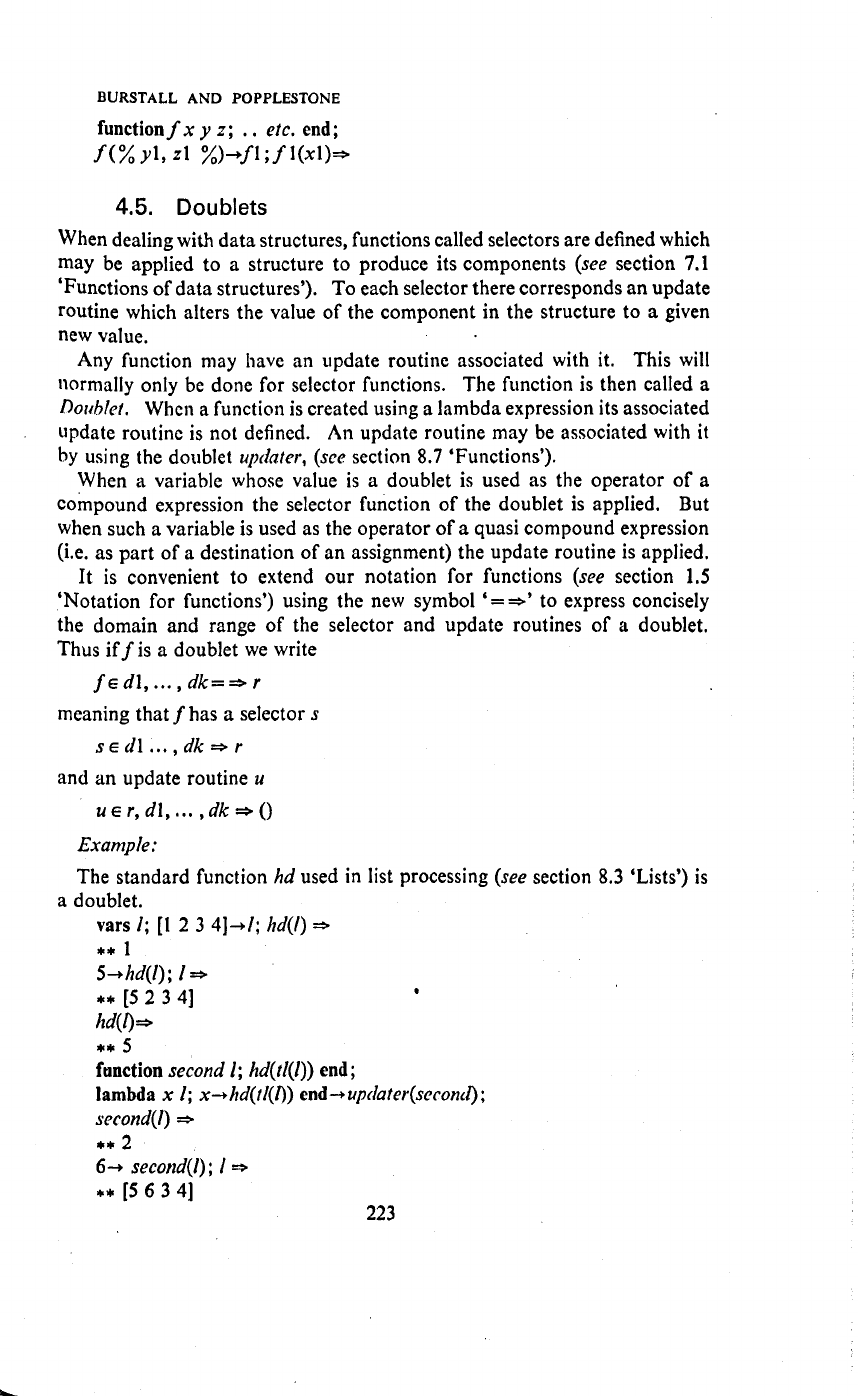
function
f
x
y
z;
..
etc.
end;
f
(%
yl,
zl
%)—*fl;
f
1(xl)
4.5.
Doublets
When
dealing
with
data
structures,
functions
called
selectors
are
defined
which
may
be
applied
to
a
structure
to
produce
its
components
(see
section
7.1
'Functions
of
data
structures').
To
each
selector
there
corresponds#
an
update
routine
which
alters
the
value
of
the
component
in
the
structure
to
a
given
new
value.
Any
function
may
have
an
update
routine
associated#
with
it.
This#
will
normally
only
be
done
for
selector
functions.
The
function
is
then
called
a
Doublet.
When
a
function
is
created
using
a
lambda
expression
its
associated
update
routine
is
not
defined.
An
update
routine
may
be
associated
with
it
by
using
the
doublet
updater,
(see
section
8.7
'Functions').
When
a
variable
whose
value
is
a
doublet
is
used
as
the
operator
of
a
compound
expression
the
selector
function
of
the
doublet
is
applied.
But
when
such
a
variable
is
used
as
the
operator
of
a
quasi
compound
expression
(i.e.
as
part
of
a
destination
of
an
assignment)
the
update
routine
is
applied.
It
is
convenient
to
extend
our
notation
for
functions
(see
section
1.5
'Notation
for
functions')
using
the
new
symbol
`.=
to
express
concisely
the
domain
and
range
of
the
selector
and
update
routines
of
a
doublet.
Thus
iff
is
a
doublet
we
write
fe
dl,
,
dk=
r
meaning
that
f
has
a
selector
s
s
e
dl
,
dk
r
and
an
update
routine
u
u
e
r,
dl,
,dk
()
Example:
The
standard
function
hd
used
in
list
processing
(see
section
8.3
'Lists')
is
a
doublet.
vars
1;
[1
2
3
41-4;
hd(I)
**
1
5—+hd(1);
1
**
[5
2
3
4]
hd(1)
**
5
function
second
I;
hd(t1(1))
end;
lambda
x
I;
x—+hd(t1(1))
end
-4updater(second);
second(1)
**
2
6—■
second(1);
1
**
[5
6
3
4]
223
PROBLEM
-ORIENTED
LANGUAGES
4.6.
Arithmetic
operations
In
sections
2.2
'Integers'
and
2.3
'Reals'
a
number
of
standard
functions
were
introduced
for
performing
arithmetic
on
integers
and
reals.
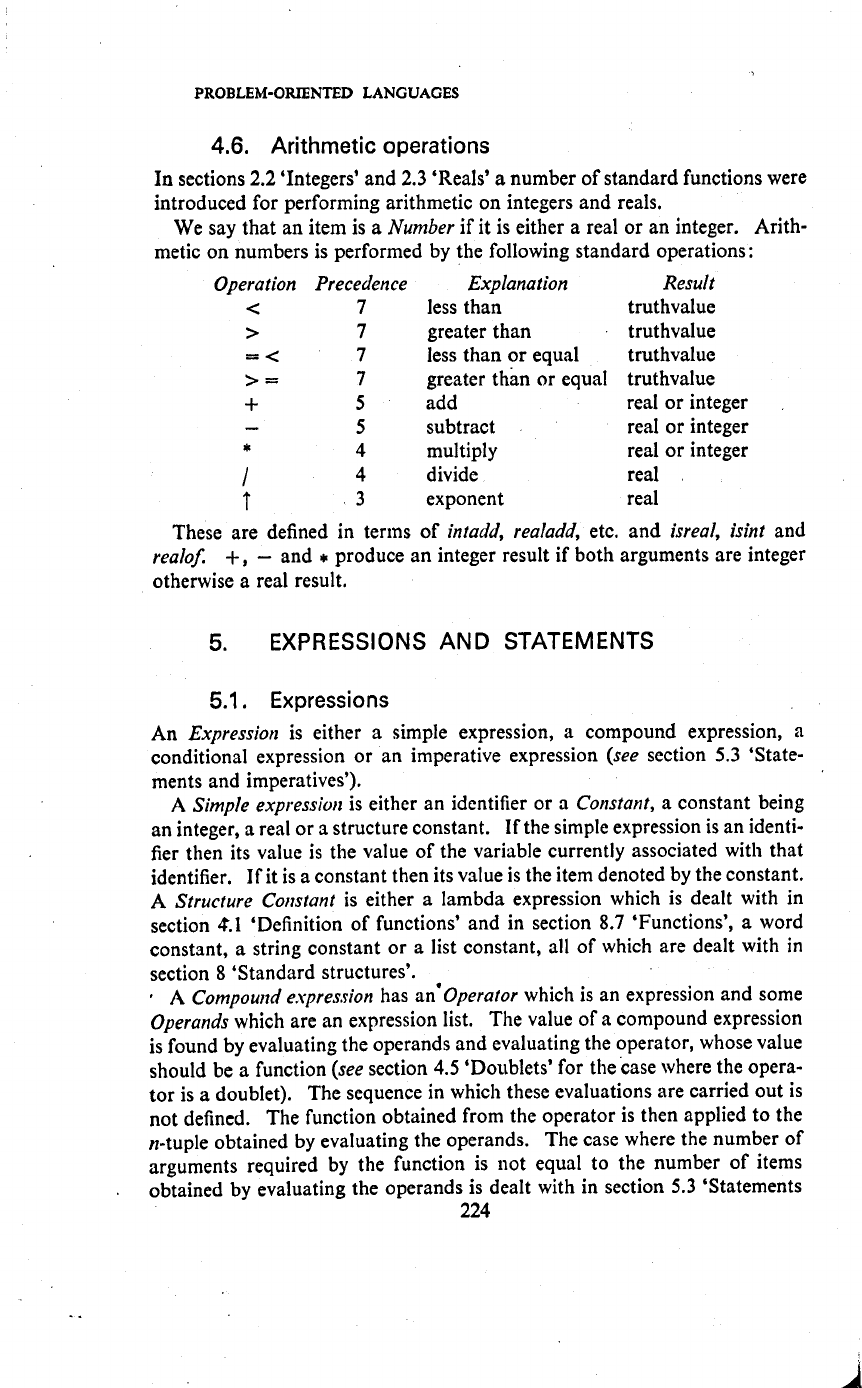
We
say
that
an
item
is
a
Number
if
it
is
either
a
real
or
an
integer.
Arith-
metic
on
numbers
is
performed
by
the
following
standard
operations:
Operation
Precedence
Explanation
Result
<
7
less
than
truthvalue
>
7
greater
than
truthvalue
=
<
7
less
than
or
equal
truthvalue
>
=
7
greater
than
or
equal
truthvalue
+
5
add
real
or
integer
—
5
subtract
real
or
integer
*
4
multiply
real
or
integer
/
4
divide
real
1
3
exponent
real
These
are
defined
in
terms
of
intadd,
realadd,
etc.
and
isreal,
isint
and
realof.
+,
—
and
*
produce
an
integer
result
if
both
arguments
are
integer
otherwise
a
real
result.
5.
EXPRESSIONS
AND
STATEMENTS
5.1.
Expressions
An
Expression
is
either
a
simple
expression,
a
compound
expression,
a
conditional
expression
or
an
imperative
expression
(see
section
5.3
'State-
ments
and
imperatives').
A
Simple
expression
is
either
an
identifier
or
a
Constant,
a
constant
being
an
integer,
a
real
or
a
structure
constant.
If
the
simple
expression
is
an
identi-
fier
then
its
value
is
the
value
of
the
variable
currently
associated
with
that
identifier.
If
it
is
a
constant
then
its
value
is
the
item
denoted
by
the
constant.
A
Structure
Constant
is
either
a
lambda
expression
which
is
dealt
with
in
section
4.1
'Definition
of
functions'
and
in
section
8.7
'Functions',
a
word
constant,
a
string
constant
or
a
list
constant,
all
of
which
are
dealt
with
in
section
8
'Standard
structures'.
•
A
Compound
expression
has
an'
Operator
which
is
an
expression
and
some
Operands
which
are
an
expression
list.
The
value
of
a
compound
expression
is
found
by
evaluating
the
operands
and
evaluating
the
operator,
whose
value
should
be
a
function
(see
section
4.5
'Doublets'
for
the
case
where
the
opera-
tor
is
a
doublet).
The
sequence
in
which
these
evaluations
are
carried
out
is
not
defined.
The
function
obtained
from
the
operator
is
then
applied
to
the
n
-tuple
obtained
by
evaluating
the
operands.
The
case
where
the
number
of
arguments
required
by
the
function
is
not
equal
to
the
number
of
items
obtained
by
evaluating
the
operands
is
dealt
with
in
section
5.3
'Statements
224
BURSTALL
AND
POPPLESTONE
and
imperatives'.
The
results
of
this
application
are
the
value
of
the
expres-
sion.
Thus
the
value
of
the
expression
is
an
n
-tuple,
with
n=0
if
the
function
is
a
routine.
Evaluation
of
conditional
expressions
is
described
in
section
6.1
'Condi-
tional
expressions',
and
that
of
imperative
expressions
in
section
5.3
'State-
ments
and
imperatives'.
An
expression
list
is
evaluated
by
evaluating
the
expressions
of
which
it
consists
and
concatenating
the
results.
The
order
in
which
the
evaluations
are
made
is
not
defined.
The
order
in
which
the
results
of
evaluating
the
expressions
are
concatenated
is
the
order
in
which
the
expressions
occur.
The
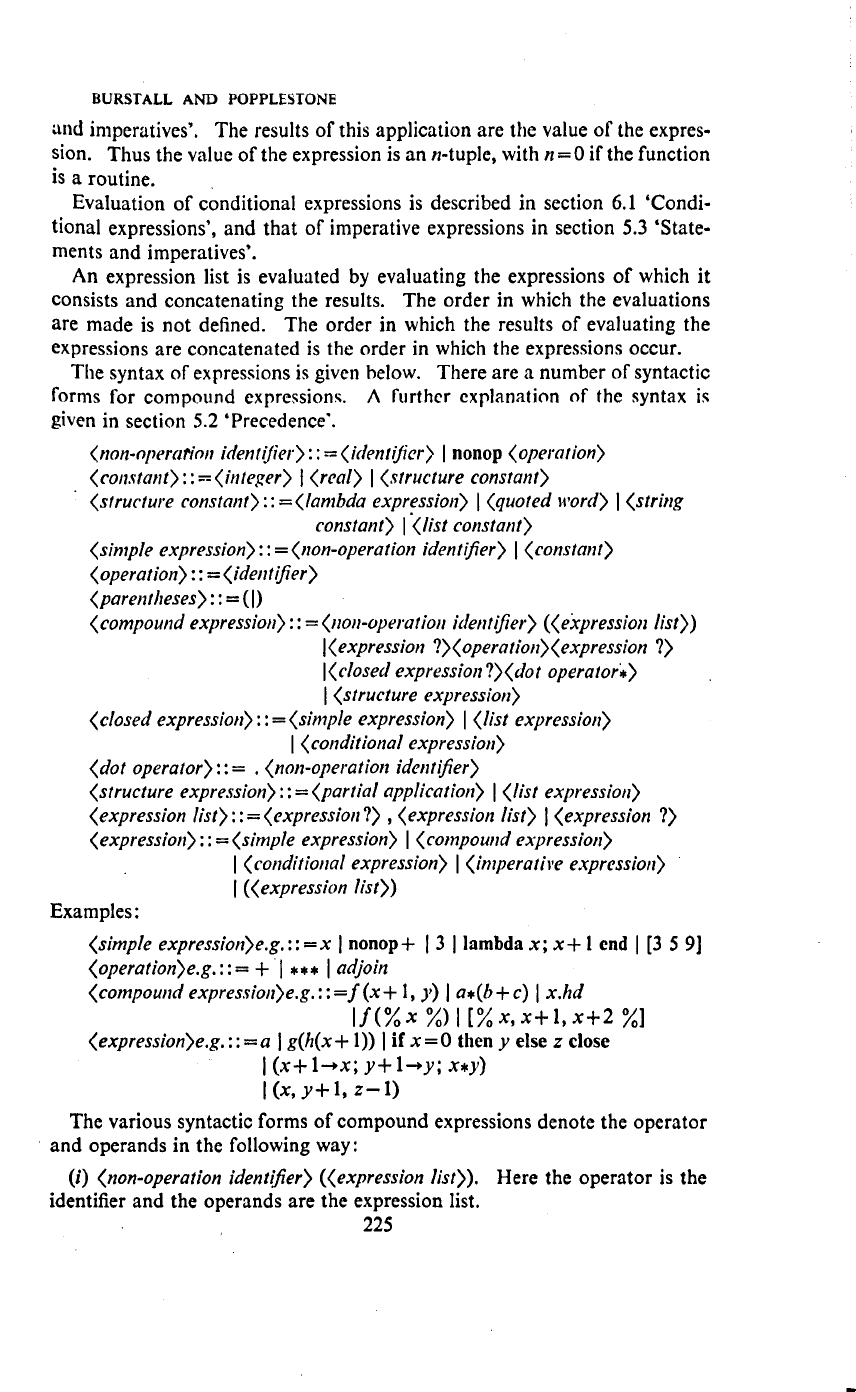
syntax
of
expressions
is
given
below.
There
are
a
number
of
syntactic
forms
for
compound
expressions.
A
further
explanation
of
the
syntax
is
given
in
section
5.2
'Precedence'.
<non
-operation
identifier>::=<identifier>
I
nonop
<operation>
<constant>::=<integer>
I
<real>
I
<structure
constant)
<structure
constant>::=<lambda
expression>
I
<quoted
word>
I
<string
constant>
I'<list
constant)
<simple
expression>::=<non
-operation
identifier>
I
<constant>
<operation>::=<identifier>
<parentheses)::=(I)
(compound
expression>::=
<non
-operation
identifier>
(<eXpression
list>)
Kexpression
?Xoperation><expression
?>
'<closed
expression?Xdot
operator*)
I
<structure
expression>
<closed
expression>::=<simple
expression>
I
<list
expression>
I
<conditional
expression>
<dot
operator>::=
.
<non
-operation
identifier>
<structure
expression>::=<partial
application)
'<list
expression>
<expression
list>::=<expression?>
,
<expression
list>
I
<expression
?>
<expression)::=
<simple
expression>
I
<compound
expression>
I
<conditional
expression>
I
<imperative
expression>
(<expression
list>)
Examples:
<simple
expression>e.g.::=x
I
nonop+
I
3
I
lambda
x;
x+
1
end
I
[3
5
9]
<operation>e.g.::=
+
I
***
I
adjoin
<compound
expression>e.g.::=f
(x
+
1,
y)
I
a*(b+
c)
I
x.hd
If
(%x
%)1E/
x+
1,
x+2
%i
<expression>e.g.::=
a
I
g(h(x
+1))
I
if
x=0
then
y
else
z
close
(x+1—•x;
y+
1
—■y;
x*y)
(x,
y+
1,
z-1)
The
various
syntactic
forms
of
compound
expressions
denote
the
operator
and
operands
in
the
following
way:
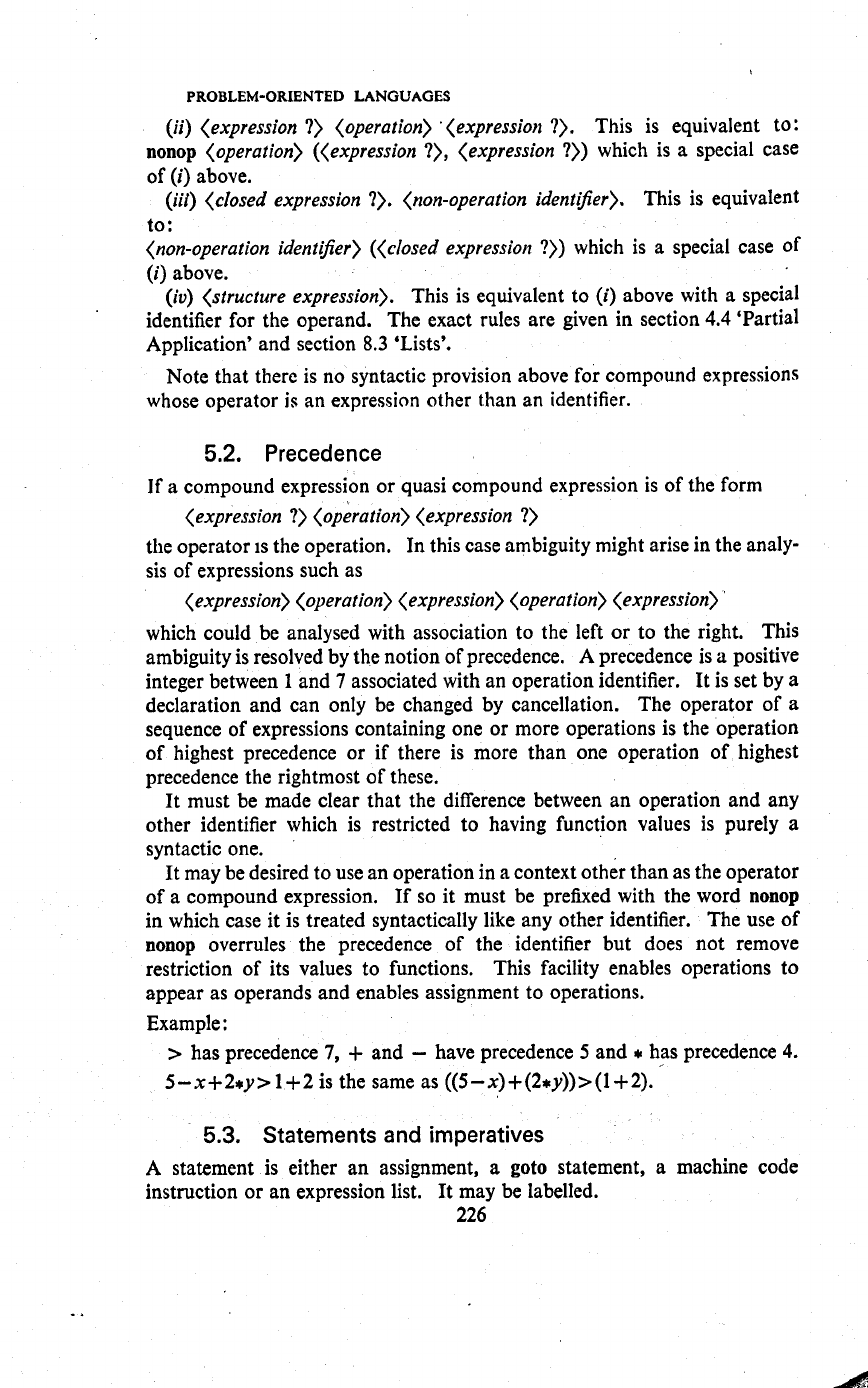
(i)
<non
-operation
identifier)
(<expression
list)).
Here
the
operator
is
the
identifier
and
the
operands
are
the
expression
list.
225
PROBLEM
-ORIENTED
LANGUAGES
(ii)
<expression
7>
<operation>
•
<expression
?>.
This
is
equivalent
to:
nonop
<operation>
(<expression
?>,
<expression
?>)
which
is
a
special
case
of
(i)
above.
(iii)
<closed
expression
?>.
<non
-operation
identifier>.
This
is
equivalent
to:
<non
-operation
identifier>
(<closed
expression
?>)
which
is
a
special
case
of
(i)
above.
(iv)
<structure
expression>.
This
is
equivalent
to
(i)
above
with
a
special
identifier
for
the
operand.
The
exact
rules
are
given
in
section
4.4
'Partial
Application'
and
section
8.3
'Lists'.
Note
that
there
is
no
syntactic
provision
above
for
compound
expressions
whose
operator
is
an
expression
other
than
an
identifier.
5.2.
Precedence
If
a
compound
expression
or
quasi
compound
expression
is
of
the
form
<expression
?>
<operation>
<expression
?>
the
operator
is
the
operation.
In
this
case
ambiguity
might
arise
in
the
analy-
sis
of
expressions
such
as
<expression>
<operation>
<expression>
<operation>
<expression>
which
could
be
analysed
with
association
to
the
left
or
to
the
right.
This
ambiguity
is
resolved
by
the
notion
of
precedence.
A
precedence
is
a
positive
integer
between
1
and
7
associated
with
an
operation
identifier.
It
is
set
by
a
declaration
and
can
only
be
changed
by
cancellation.
The
operator
of
a
sequence
of
expressions
containing
one
or
more
operations
is
the
operation
of
highest
precedence
or
if
there
is
more
than
one
operation
of
highest
precedence
the
rightmost
of
these.
It
must
be
made
clear
that
the
difference
between
an
operation
and
any
other
identifier
which
is
restricted
to
having
function
values
is
purely
a
syntactic
one.
It
may
be
desired
to
use
an
operation
in
a
context
other
than
as
the
operator
of
a
compound
expression.
If
so
it
must
be
prefixed
with
the
word
nonop
in
which
case
it
is
treated
syntactically
like
any
other
identifier.
The
use
of
nonop
overrules
the
precedence
of
the
identifier
but
does
not
remove
restriction
of
its
values
to
functions.
This
facility
enables
operations
to
appear
as
operands
and
enables
assignment
to
operations.
Example:
>
has
precedence
7,
+
and
—
have
precedence
5
and
*
has
precedence
4.
5
—
x+
2*y>
1+
2
is
the
same
as
((5
—x)+(2*y))>
(1+
2).
5.3.
Statements
and
imperatives
A
statement
is
either
an
assignment,
a
goto
statement,
a
machine
code
instruction
or
an
expression
list.
It
may
be
labelled.
226
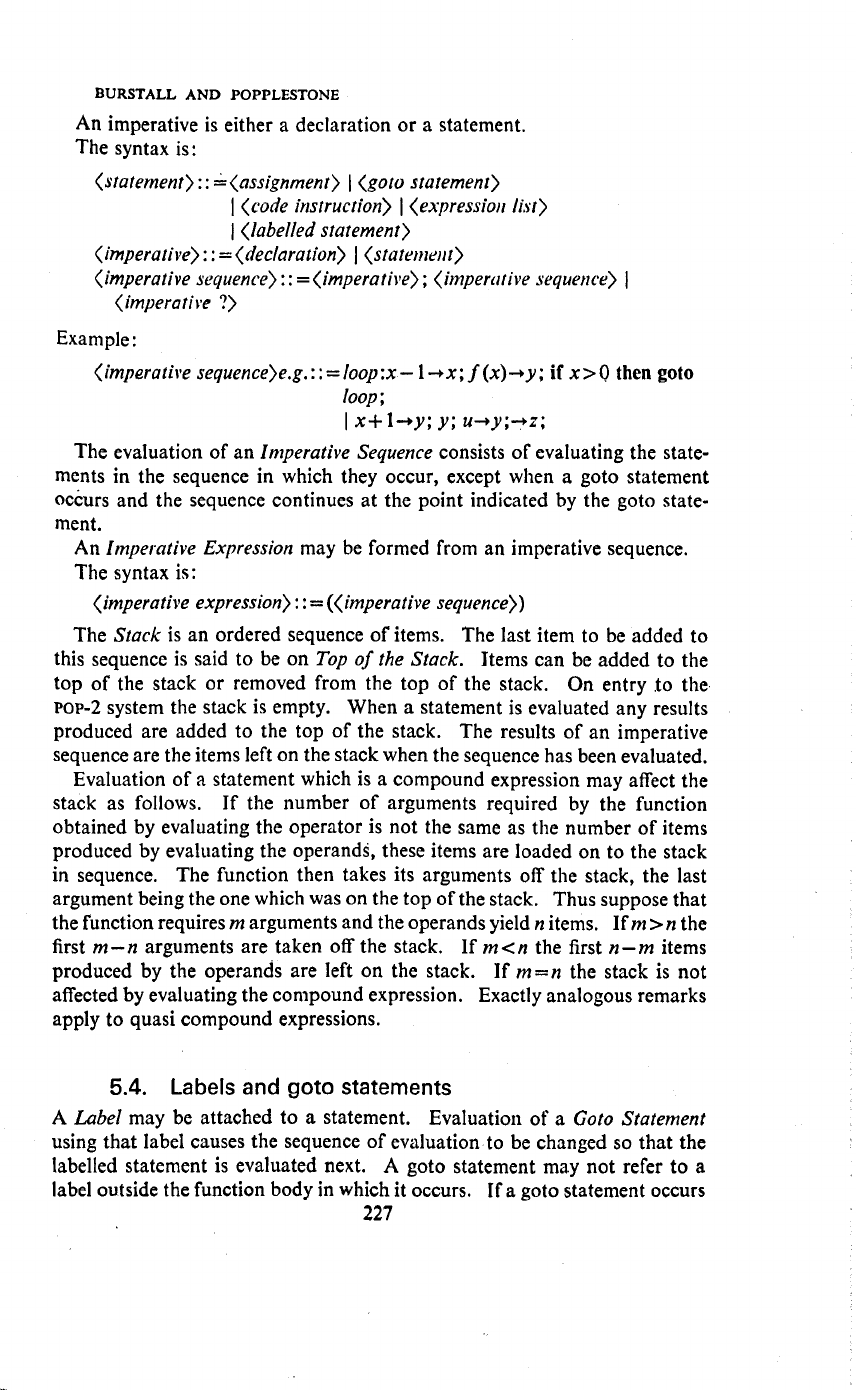
BURSTALL
AND
POPPLESTONE
An
imperative
is
either
a
declaration
or
a
statement.
The
syntax
is:
<statement>::=<assignment>
I
<goto
statement>
I
<code
instruction>
I
<expression
list>
I
<labelled
statement>
<imperative>::=<declaration>
I
<statement>
<imperative
sequence>::=<imperative>;
<imperative
sequence>
I
<imperative
?>
Example:
<imperative
sequence>e.g.::=loop:x-1—■x;
f
(x)—oy;
if
x>O
then
goto
loop;
I
x+1—q;
y;
u—oy;
—+z;
The
evaluation
of
an
Imperative
Sequence
consists
of
evaluating
the
state-
ments
in
the
sequence
in
which
they
occur,
except
when
a
goto
statement
oceurs
and
the
sequence
continues
at
the
point
indicated
by
the
goto
state-
ment.
An
Imperative
Expression
may
be
formed
from
an
imperative
sequence.
The
syntax
is:
(imperative
expression>::=(<imperative
sequence>)
The
Stack
is
an
ordered
sequence
of
items.
The
last
item
to
be
added
to
this
sequence
is
said
to
be
on
Top
of
the
Stack.
Items
can
be
added
to
the
top
of
the
stack
or
removed
from
the
top
of
the
stack.
On
entry
to
the
Pop
-2
system
the
stack
is
empty.
When
a
statement
is
evaluated
any
results
produced
are
added
to
the
top
of
the
stack.
The
results
of
an
imperative
sequence
are
the
items
left
on
the
stack
when
the
sequence
has
been
evaluated.
Evaluation
of
a
statement
which
is
a
compound
expression
may
affect
the
stack
as
follows.
If
the
number
of
arguments
required
by
the
function
obtained
by
evaluating
the
operator
is
not
the
same
as
the
number
of
items
produced
by
evaluating
the
operands,
these
items
are
loaded
on
to
the
stack
in
sequence.
The
function
then
takes
its
arguments
off
the
stack,
the
last
argument
being
the
one
which
was
on
the
top
of
the
stack.
Thus
suppose
that
the
function
requires
m
arguments
and
the
operands
yield
n
items.
If
m>n
the
first
m—n
arguments
are
taken
off
the
stack.
If
m<n
the
first
n—m
items
produced
by
the
operands
are
left
on
the
stack.
If
m=n
the
stack
is
not
affected
by
evaluating
the
compound
expression.
Exactly
analogous
remarks
apply
to
quasi
compound
expressions.
5.4.
Labels
and
goto
statements
A
Label
may
be
attached
to
a
statement.
Evaluation
of
a
Goto
Statement
using
that
label
causes
the
sequence
of
evaluation
to
be
changed
so
that
the
labelled
statement
is
evaluated
next.
A
goto
statement
may
not
refer
to
a
label
outside
the
function
body
in
which
it
occurs.
If
a
goto
statement
occurs
227
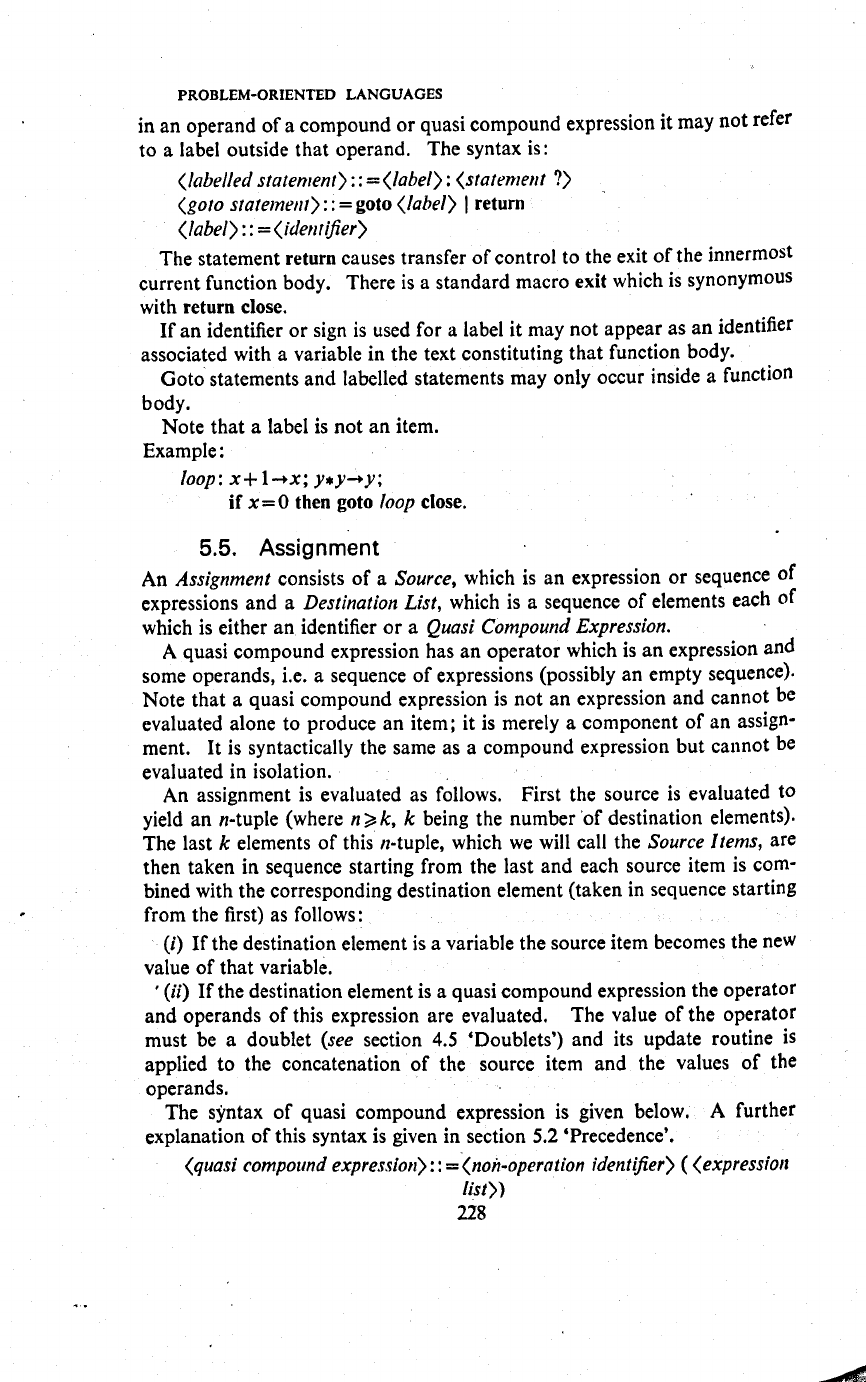
PROBLEM
-ORIENTED
LANGUAGES
in
an
operand
of
a
compound
or
quasi
compound
expression
it
may
not
refer
to
a
label
outside
that
operand.
The
syntax
is:
<labelled
statement>::=<label>:
<statement
?>
<goto
statement>::=goto
<label>
I
return
<label>::=<identifier>
The
statement
return
causes
transfer
of
control
to
the
exit
of
the
innermost
current
function
body.
There
is
a
standard
macro
exit
which
is
synonymous
with
return
close.
If
an
identifier
or
sign
is
used
for
a
label
it
may
not
appear
as
an
identifier
associated
with
a
variable
in
the
text
constituting
that
function
body.
Goto
statements
and
labelled
statements
may
only
occur
inside
a
function
body.
Note
that
a
label
is
not
an
item.
Example:
loop:
x+1
-4x;
y*y
-+y;
if
x=0
then
goto
loop
close.
5.5.
Assignment
An
Assignment
consists
of
a
Source,
which
is
an
expression
or
sequence
of
expressions
and
a
Destination
List,
which
is
a
sequence
of
elements
each
of
which
is
either
an
identifier
or
a
Quasi
Compound
Expression.
A
quasi
compound
expression
has
an
operator
which
is
an
expression
and
some
operands,
i.e.
a
sequence
of
expressions
(possibly
an
empty
sequence).
Note
that
a
quasi
compound
expression
is
not
an
expression
and
cannot
be
evaluated
alone
to
produce
an
item;
it
is
merely
a
component
of
an
assign-
ment.
It
is
syntactically
the
same
as
a
compound
expression
but
cannot
be
evaluated
in
isolation.
An
assignment
is
evaluated
as
follows.
First
the
source
is
evaluated
to
yield
an
n
-tuple
(where
n
k,
k
being
the
number
'of
destination
elements).
The
last
k
elements
of
this
n
-tuple,
which
we
will
call
the
Source
Items,
are
then
taken
in
sequence
starting
from
the
last
and
each
source
item
is
com-
bined
with
the
corresponding
destination
element
(taken
in
sequence
starting
from
the
first)
as
follows:
(I)
If
the
destination
element
is
a
variable
the
source
item
becomes
the
new
value
of
that
variable.
'
(ii)
If
the
destination
element
is
a
quasi
compound
expression
the
operator
and
operands
of
this
expression
are
evaluated.
The
value
of
the
operator
must
be
a
doublet
(see
section
4.5
'Doublets')
and
its
update
routine
is
applied
to
the
concatenation
of
the
source
item
and
the
values
of
the
operands.
The
syntax
of
quasi
compound
expression
is
given
below.
A
further
explanation
of
this
syntax
is
given
in
section
5.2
'Precedence'.
<quasi
compound
expression>::=<noh
-operation
identifier>
(<expression
list>)
228
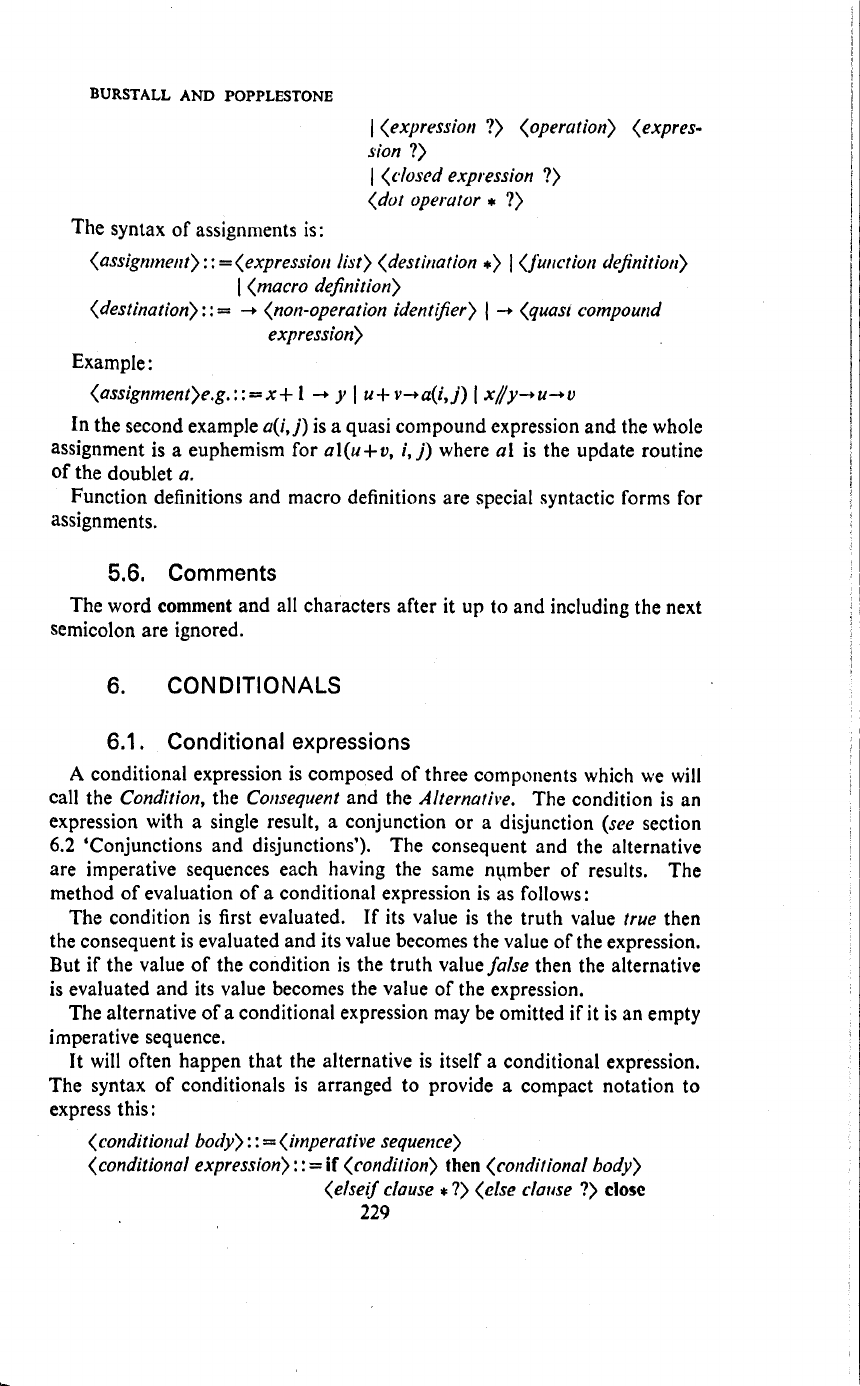
BURSTALL
AND
POPPLESTONE
I
<expression
?>
<operation>
<expres-
sion
?>
I
<closed
expression
?>
<dot
operator
*
?>
The
syntax
of
assignments
is:
<assignment>::=<expression
list>
<destination
*>
I
<function
definition>
I
<macro
definition>
<destination>::=
-■
<non
-operation
identifier>
I
-+
<quasi
compound
expression>
Example:
<assignment>e.g.::=x+
1
--•
y
I
u+v-9a(i,j)(x//y
-'u
-.v
In
the
second
example
a(i,
j)
is
a
quasi
compound
expression
and
the
whole
assignment
is
a
euphemism
for
al(u+v,
j)
where
al
is
the
update
routine
of
the
doublet
a.
Function
definitions
and
macro
definitions
are
special
syntactic
forms
for
assignments.
5.6.
Comments
The
word
comment
and
all
characters
after
it
up
to
and
including
the
next
semicolon
are
ignored.
6.
CONDITIONALS
6.1.
Conditional
expressions
A
conditional
expression
is
composed
of
three
components
which
we
will
call
the
Condition,
the
Consequent
and
the
Alternative.
The
condition
is
an
expression
with
a
single
result,
a
conjunction
or
a
disjunction
(see
section
6.2
'Conjunctions
and
disjunctions').
The
consequent
and
the
alternative
are
imperative
sequences
each
having
the
same
number
of
results.
The
method
of
evaluation
of
a
conditional
expression
is
as
follows:
The
condition
is
first
evaluated.
If
its
value
is
the
truth
value
true
then
the
consequent
is
evaluated
and
its
value
becomes
the
value
of
the
expression.
But
if
the
value
of
the
condition
is
the
truth
value
false
then
the
alternative
is
evaluated
and
its
value
becomes
the
value
of
the
expression.
The
alternative
of
a
conditional
expression
may
be
omitted
if
it
is
an
empty
imperative
sequence.
It
will
often
happen
that
the
alternative
is
itself
a
conditional
expression.
The
syntax
of
conditionals
is
arranged
to
provide
a
compact
notation
to
express
this:
<conditional
body>::=<imperative
sequence>
<conditional
expression>::=
if
<condition>
then
<conditional
body>
<elseif
clause
*7>
<else
clause
?>
close
229
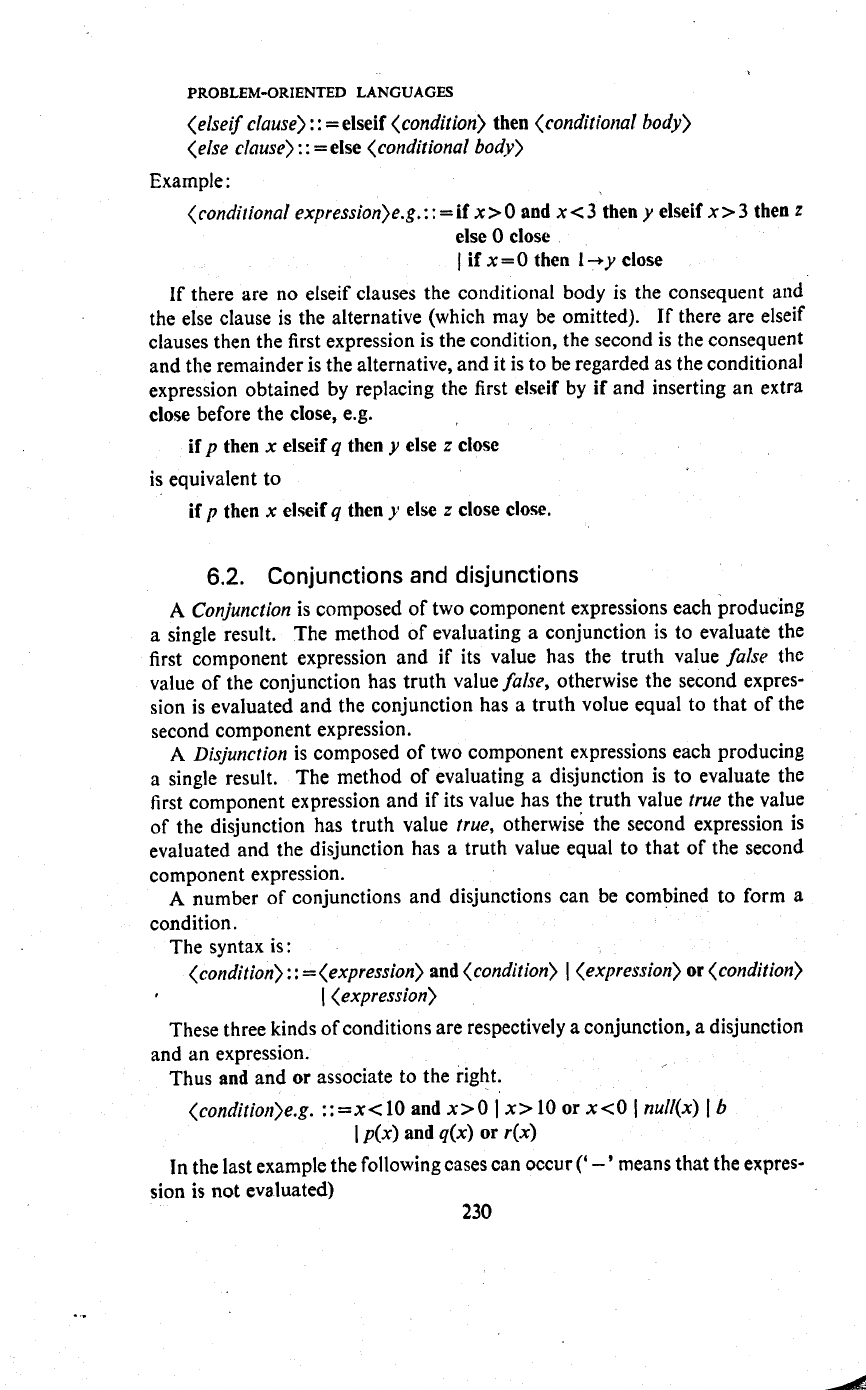
PROBLEM
-ORIENTED
LANGUAGES
<elseif
clause>::=elseif
<condition>
then
<conditional
body>
<else
clause>::=
else
<conditional
body)
Example:
<conditional
expression>e.g.::=
if
x>
0
and
x<
3
then
y
elseif
x>3
then
z
else
0
close
I
if
x=0
then
l
-+)
,
close
If
there
are
no
elseif
clauses
the
conditional
body
is
the
consequent
and
the
else
clause
is
the
alternative
(which
may
be
omitted).
If
there
are
elseif
clauses
then
the
first
expression
is
the
condition,
the
second
is
the
consequent
and
the
remainder
is
the
alternative,
and
it
is
to
be
regarded
as
the
conditional
expression
obtained
by
replacing
the
first
elseif
by
if
and
inserting
an
extra
close
before
the
close,
e.g.
if
p
then
x
elseif
q
then
y
else
z
close
is
equivalent
to
if
p
then
x
elseif
q
then
y
else
z
close
close.
6.2.
Conjunctions
and
disjunctions
A
Conjunction
is
composed
of
two
component
expressions
each
producing
a
single
result.
The
method
of
evaluating
a
conjunction
is
to
evaluate
the
first
component
expression
and
if
its
value
has
the
truth
value
false
the
value
of
the
conjunction
has
truth
value
false,
otherwise
the
second
expres-
sion
is
evaluated
and
the
conjunction
has
a
truth
volue
equal
to
that
of
the
second
component
expression.
A
Disjunction
is
composed
of
two
component
expressions
each
producing
a
single
result.
The
method
of
evaluating
a
disjunction
is
to
evaluate
the
first
component
expression
and
if
its
value
has
the
truth
value
true
the
value
of
the
disjunction
has
truth
value
true,
otherwise
the
second
expression
is
evaluated
and
the
disjunction
has
a
truth
value
equal
to
that
of
the
second
component
expression.
A
number
of
conjunctions
and
disjunctions
can
be
combined
to
form
a
condition.
The
syntax
is:
<condition>::=<expression>
and
<condition>
I
<expression>
or
<condition>
I
<expression>
These
three
kinds
of
conditions
are
respectively
a
conjunction,
a
disjunction
and
an
expression.
Thus
and
and
or
associate
to
the
right.
<condition>e.g.
::=
x<
10
and
x>0
x>
10
or
x<0
I
null(x)
I
b
p(x)
and
q(x)
or
r(x)
In
the
last
example
the
following
cases
can
occur
(`
—'
means
that
the
expres-
sion
is
not
evaluated)
230

BURSTALL
AND
POPPLESTONE
p(x)
q(x)
r(x)
value
of
condition
false
—
—
false
true
false
false false
true
false
true
true
true
true
—
true
7.
DATA
STRUCTURES
7.1.
Functions
of
data
structures
A
Data
Structure
is
a
compound
item
which
has
other
items
as
its
Components.
For
each
class
of
data
structures
there
is
a
family
of
functions
called
the
Characteristic
Functions
acting
upon
structures
of
that
class.
These
functions
are
a
constructor,
a
destructor,
selectors
and
update
routines.
A
given
compound
item
may
represent
a
number
of
different
data
structures
by
being
used
in
association
with
more
than
one
family
of
functions
and
hence
having
different
components.
Given
values
for
its
components
it
is
possible
to
construct
a
data
structure
using
a
Constructor
function,
say
c.
c
e
component,
...
,
component#20
data
structure
It
is
possible
to
select
the
value
of
a
component
of
a
data
structure.
For
each
component
there
is
a
Selector
function,
say
si.
si
e
data
structure
component
It
is
possible
to
update
a
component
of
a
data
structure,
i.e.
to
give
it
a
new
value.
For
each
component
there
is
an
Update
Routine,
say
ui:
ui
e
component,
data
structure
()
When
a
data
structure
is
updated
the
old
version
is
overwritten.
It
is
convenient
to
define
another
function
called
a
Destructor
function,
say
d,
which#
is
the
inverse
of
the
constructor,
i.e.
given
a
data
structure
it
produces
its
components
as
results.
d
e
data
structure
component,
...
,
component
After
applying
the#
destructor
to
a
structure,
the
structure
is
deleted.
There
is
a
relation
called
equality
(see
section
2.1
`Simple
and
compound
items')
which
may
hold#
between
two
compound
items.
It
is
denoted
by
the
standard
function
=
(an
operation
of
precedence
7).
This
function
is
also
defined
for
simple
items
with
the
usual
meaning.
=
e
item,
item
truthvalue
Thus
if
the
value
of
an
expression
'EV
is
equal
to
the
value
of
an
expression
'.E2'
then
the
expression
El
=
E2
has
value
true.
231
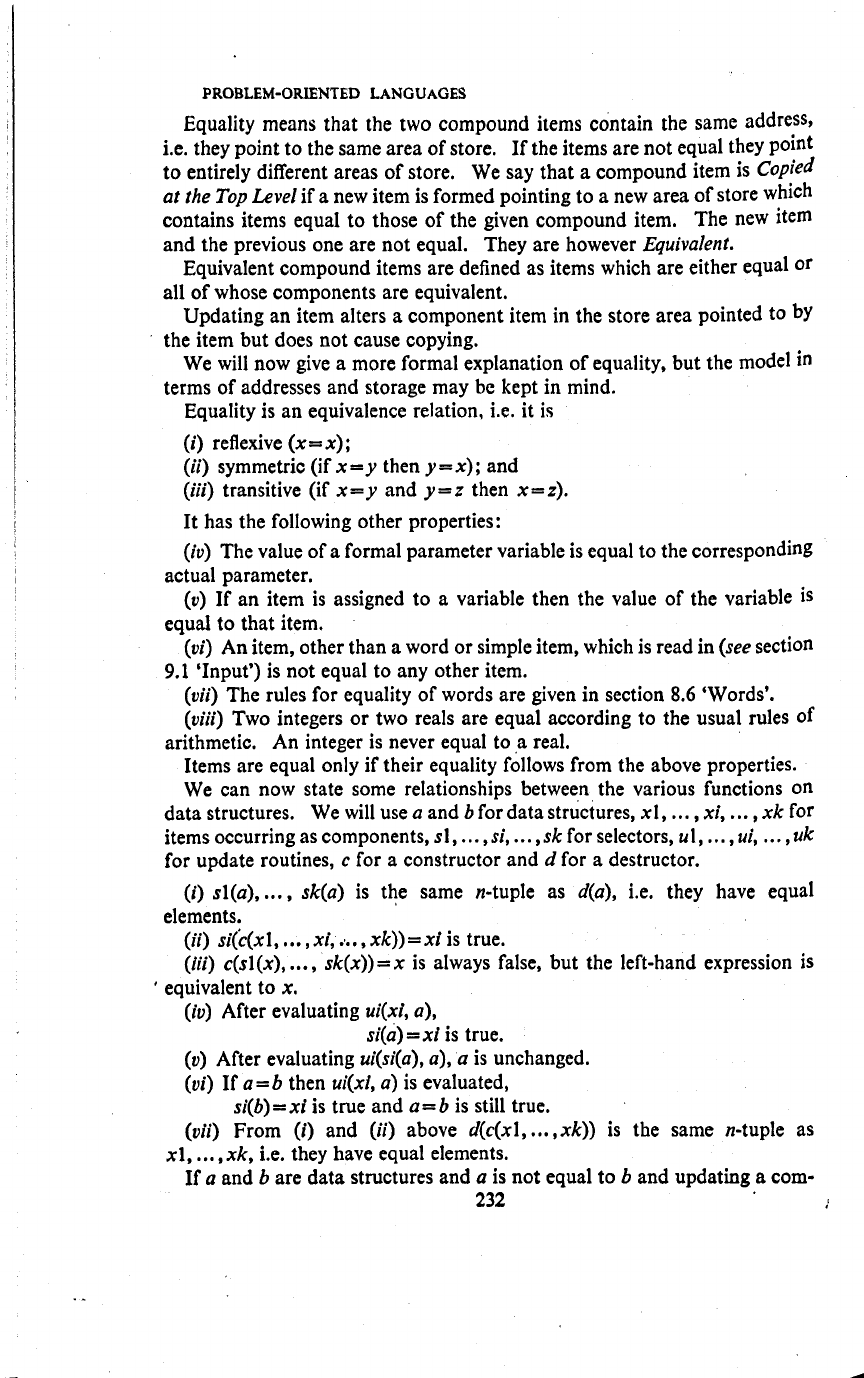
PROBLEM
-ORIENTED
LANGUAGES
Equality
means
that
the
two
compound
items
contain
the
same
address,
i.e.
they
point
to
the
same
area
of
store.
If
the
items
are
not
equal
they
point
to
entirely
different
areas
of
store.
We
say
that
a
compound
item
is
Copied
at
the
Top
Level
if
a
new
item
is
formed
pointing
to
a
new
area
of
store
which
contains
items
equal
to
those
of
the
given
compound
item.
The
new
item
and
the
previous
one
are
not
equal.
They
are
however
Equivalent.
Equivalent
compound
items
are
defined
as
items
which
are
either
equal
or
all
of
whose
components
are
equivalent.
Updating
an
item
alters
a
component
item
in
the
store
area
pointed
to
by
the
item
but
does
not
cause
copying.
We
will
now
give
a
more
formal
explanation
of
equality,
but
the
model
in
terms
of
addresses
and
storage
may
be
kept
in
mind.
Equality
is
an
equivalence
relation,
i.e.
it
is
(i)
reflexive
(x
=
x);
(ii)
symmetric
(if
x
=y
then
y=
x);
and
(iii)
transitive
(if
x=y
and
y=z
then
x=z).
It
has
the
following
other
properties:
(iv)
The
value
of
a
formal
parameter
variable
is
equal
to
the
corresponding
actual
parameter.
(v)
If
an
item
is
assigned
to
a
variable
then
the
value
of
the
variable
is
equal
to
that
item.
(vi)
An
item,
other
than
a
word
or
simple
item,
which
is
read
in
(see
section
9.1
'Input')
is
not
equal
to
any
other
item.
(vii)
The
rules
for
equality
of
words
are
given
in
section
8.6
'Words'.
(viii)
Two
integers
or
two
reals
are
equal
according
to
the
usual
rules
of
arithmetic.
An
integer
is
never
equal
to
a
real.
Items
are
equal
only
if
their
equality
follows
from
the
above
properties.
We
can
now
state
some
relationships
between
the
various
functions
on
data
structures.
We
will
use
a
and
b
for
data
structures,
xl,
,xi,
...
,
xk
for
items
occurring
as
components,
sl,
,si,
,sk
for
selectors,
ul,
,
ui,
,
uk
for
update
routines,
c
for
a
constructor
and
d
for
a
destructor.
(i)
sl(a),
,
sk(a)
is
the
same
n
-tuple
as
d(a),
i.e.
they
have
equal
elements.
(ii)
,xi,
,
xk))=
xi
is
true.
(in)
c(s1(x),...
,
sk(x))=x
is
always
false,
but
the
left-hand
expression
is
'equivalent
to
x.
(iv)
After
evaluating
ui(xi,
a),
si(a).
xi
is
true.
(v)
After
evaluating
ui(si(a)
,
a),
a
is
unchanged.
(vi)
If
a
=
b
then
ui(zi,
a)
is
evaluated,
si(b)
=
xi
is
true
and
a
=
b
is
still
true.
(vii)
From
(i)
and
(ii)
above
d(c(xl,
,
xk))
is
the
same
n
-tuple
as
xl,
,
xk,
i.e.
they
have
equal
elements.
If
a
and
b
are
data
structures
and
a
is
not
equal
to
b
and
updating
a
corn-
232
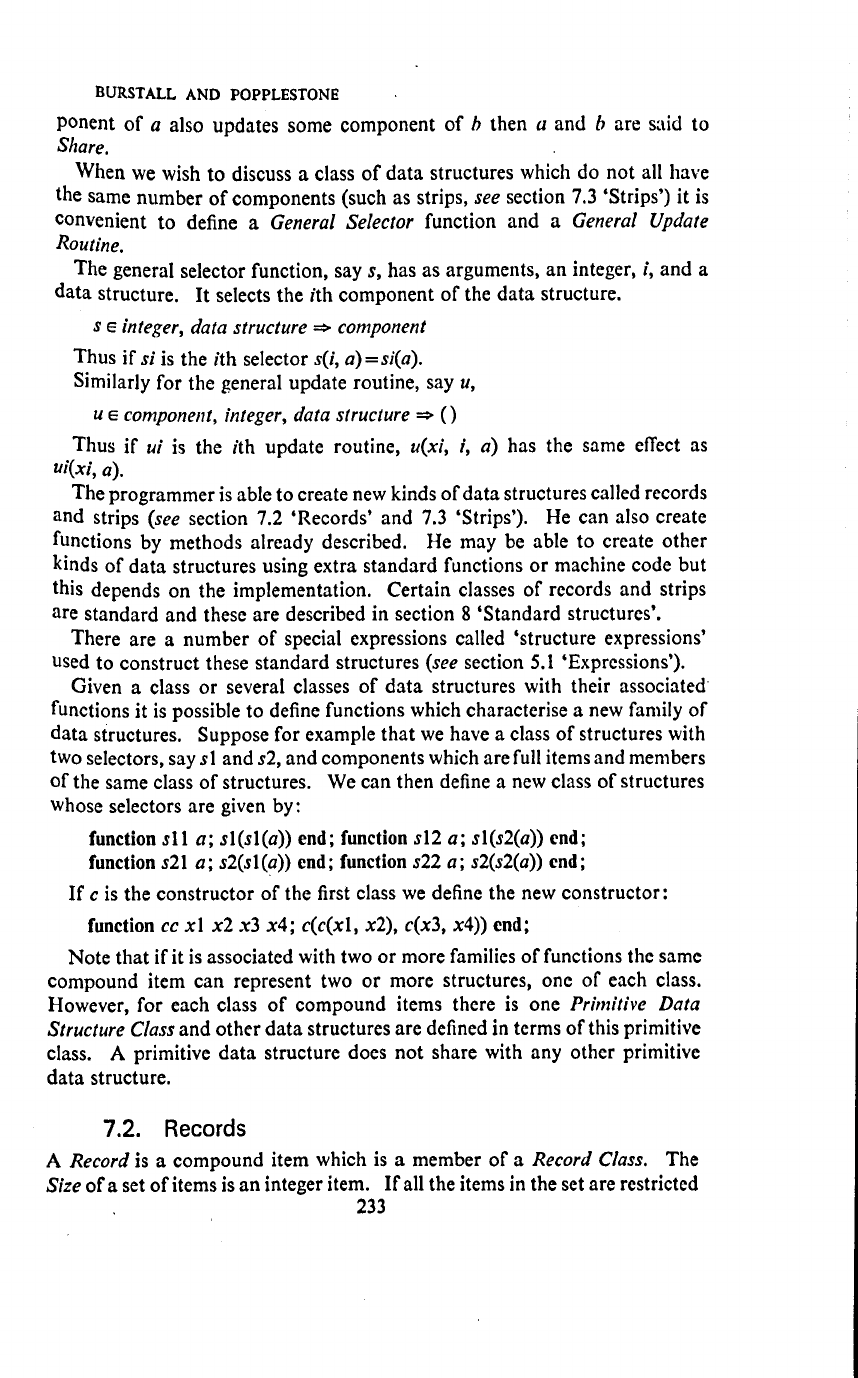
BURSTALL
AND
POPPLESTONE
ponent
of
a
also
updates
some
component
of
b
then
a
and
h
are
said
to
Share.
When
we
wish
to
discuss
a
class
of
data
structures
which
do
not
all
have
the#
same
number
of
components
(such
as
strips,
see
section
7.3
'Strips')
it
is
convenient
to
define
a
General
Selector
function
and
a
General
Update
Routine.
The
general
selector
function,
say
s,
has
as
arguments,
an
integer,
i,
and
a
data
structure.
It
selects
the
ith
component
of
the
data
structure.
S
e
integer,
data
structure
component
Thus
if
si
is
the
ith
selector
s(i,
a).
si(a).
Similarly
for
the
general
update
routine,
say
u,
U
E
component,
integer,
data
structure
=.
()
Thus
if
u/
is
the
ith
update
routine,
u(xi,
F,
a)
has
the
same
effect
as
ui(xi,
a).
The
programmer
is
able
to
create
new
kinds
of
data
structures
called
records
and
strips
(see
section
7.2
'Records'
and
7.3
`Strips').
He
can
also
create
functions
by
methods
already
described.
He
may
be
able
to
create
other
kinds
of
data
structures
using
extra
standard
functions
or
machine
code
but
this
depends
on
the
implementation.
Certain
classes
of
records
and
strips
are
standard
and
these
are
described
in
section
8
'Standard
structures'.
There
are
a
number
of
special
expressions
called
'structure
expressions'
used
to
construct
these
standard
structures
(see
section
5.1
'Expressions').
Given
a
class
or
several
classes
of
data
structures
with
their
associated
functions
it
is
possible
to
define
functions
which
characterise
a
new
family
of
data
structures.
Suppose
for
example
that
we
have
a
class
of
structures
with
two
selectors,
say
sl
and
s2,
and
components
which
are
full
items
and
members
of
the
same
class
of
structures.
We
can
then
define
a
new
class
of
structures
whose
selectors
are
given
by:
function
sit
a;
sl(s1(a))
end;
function
s12
a;
sl(s2(a))
end;
function
s21
a;
s2(s1(a))
end;
function
s22
a;
s2(s2(a))
end;
If
c
is
the
constructor
of
the
first
class
we
define
the
new
constructor:
function#
cc
xl
x2
x3
x4;
c(c(xl,
x2),
c(x3,
x4))
end;
Note
that
if
it
is
associated
with
two
or
more
families
of
functions
the
same
compound#
item#
can
represent
two
or
more
structures,
one
of
each
class.
However,
for
each
class
of
compound
items
there
is
one
Primitive
Data
Structure
Class
and
other
data
structures
are
defined
in
terms
of
this
primitive
class.
A
primitive
data
structure
does
not
share
with
any
other
primitive
data
structure.
7.2.
Records
A
Record
is
a
compound
item
which
is
a
member
of
a
Record
Class.
The
Size
of
a
set
of
items
is
an
integer
item.
If
all
the
items
in
the
set
are
restricted
233
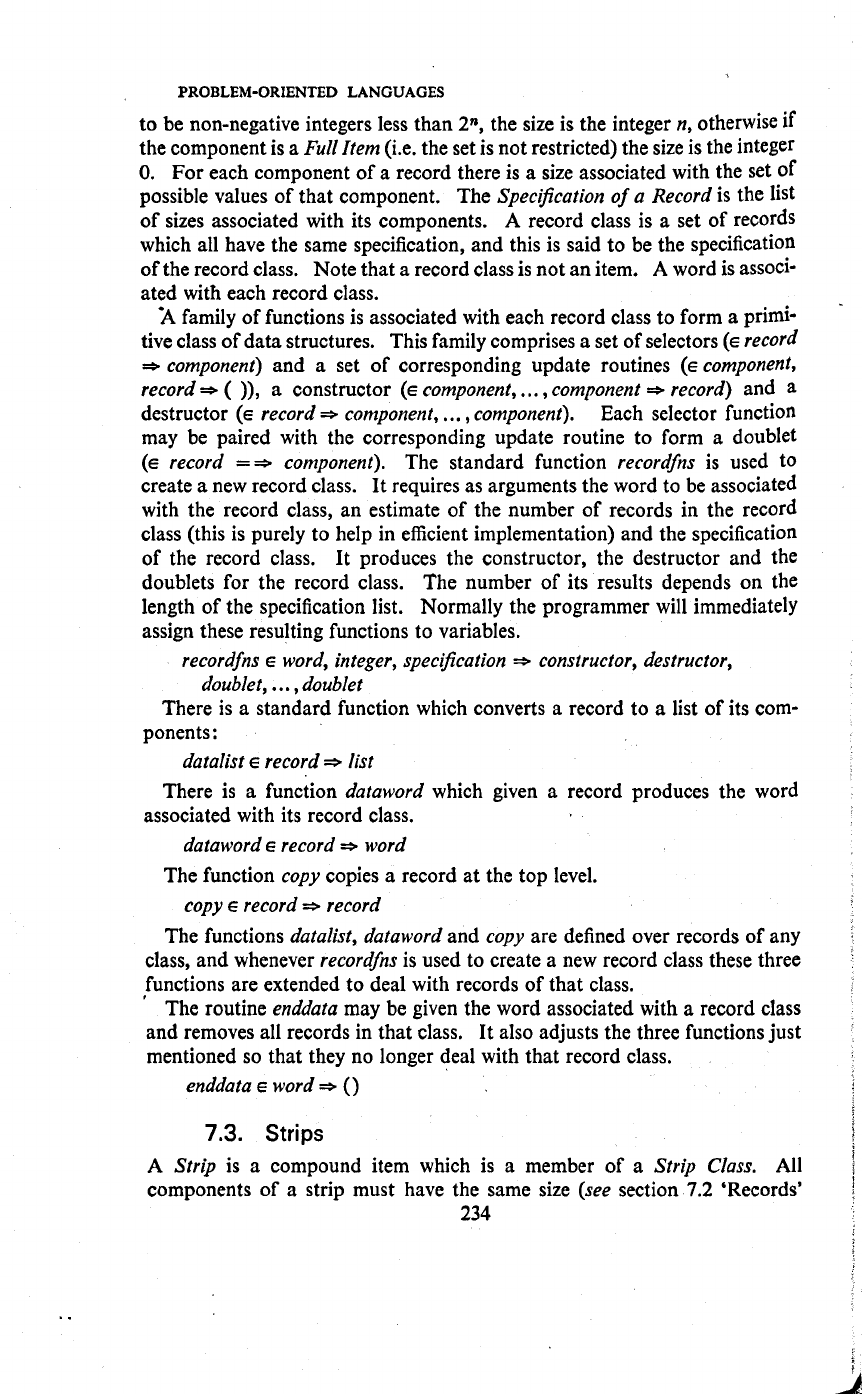
PROBLEM
-ORIENTED
LANGUAGES
to
be
non
-negative
integers
less
than
2,
the
size
is
the
integer
/4
otherwise
if
the
component
is
a
Full
Item
(i.e.
the
set
is
not
restricted)
the
size
is
the
integer
0.
For
each
component
of
a
record
there
is
a
size
associated
with
the
set
of
possible
values
of
that
component.
The
Specification
of
a
Record
is
the
list
of
sizes
associated
with
its
components.
A
record
class
is
a
set
of
records
which
all
have
the
same
specification,
and
this
is
said
to
be
the
specification
of
the
record
class.
Note
that
a
record
class
is
not
an
item.
A
word
is
associ-
ated
with
each
record
class.
*
A
family
of
functions
is
associated
with
each
record
class
to
form
a
primi-
tive
class
of
data
structures.
This
family
comprises
a
set
of
selectors
(e
record
component)
and
a
set
of
corresponding
update
routines
(e
component,
record
=.
(
)),
a
constructor
(e
component,
,
component
record)
and
a
destructor
(e
record
component,
...
,
component).
Each
selector
function
may
be
paired
with
the
corresponding
update
routine
to
form
a
doublet
(e
record
=
component).
The
standard
function
recordfns
is
used
to
create
a
new
record
class.
It
requires
as
arguments
the
word
to
be
associated
with
the
record
class,
an
estimate
of
the
number
of
records
in
the
record
class
(this
is
purely
to
help
in
efficient
implementation)
and
the
specification
of
the
record
class.
It
produces
the
constructor,
the
destructor
and
the
doublets
for
the
record
class.
The
number
of
its
results
depends
on
the
length
of
the
specification
list.
Normally
the
programmer
will
immediately
assign
these
resulting
functions
to
variables.
recordfns
e
word,
integer,
specification
constructor,
destructor,
doublet,
...
,doublet
There
is
a
standard
function
which
converts
a
record
to
a
list
of
its
com-
ponents:
datalist
e
record
list
There
is
a
function
dataword
which
given
a
record
produces
the
word
associated
with
its
record
class.
dataword
e
record
word
The
function
copy
copies
a
record
at
the
top
level.
copy
e
record record
The
functions
datalist,
dataword
and
copy
are
defined
over
records
of
any
class,
and
whenever
recordfns
is
used
to
create
a
new
record
class
these
three
functions
are
extended
to
deal
with
records
of
that
class.
The
routine
enddata
may
be
given
the
word
associated
with
a
record
class
and
removes
all
records
in
that
class.
It
also
adjusts
the
three
functions
just
mentioned
so
that
they
no
longer
deal
with
that
record
class.
enddata
e
word
7.3.
Strips
A
Strip
is
a
compound
item
which
is
a
member
of
a
Strip
Class.
All
components
of
a
strip
must
have
the
same
size
(see
section
7.2
'Records'
234
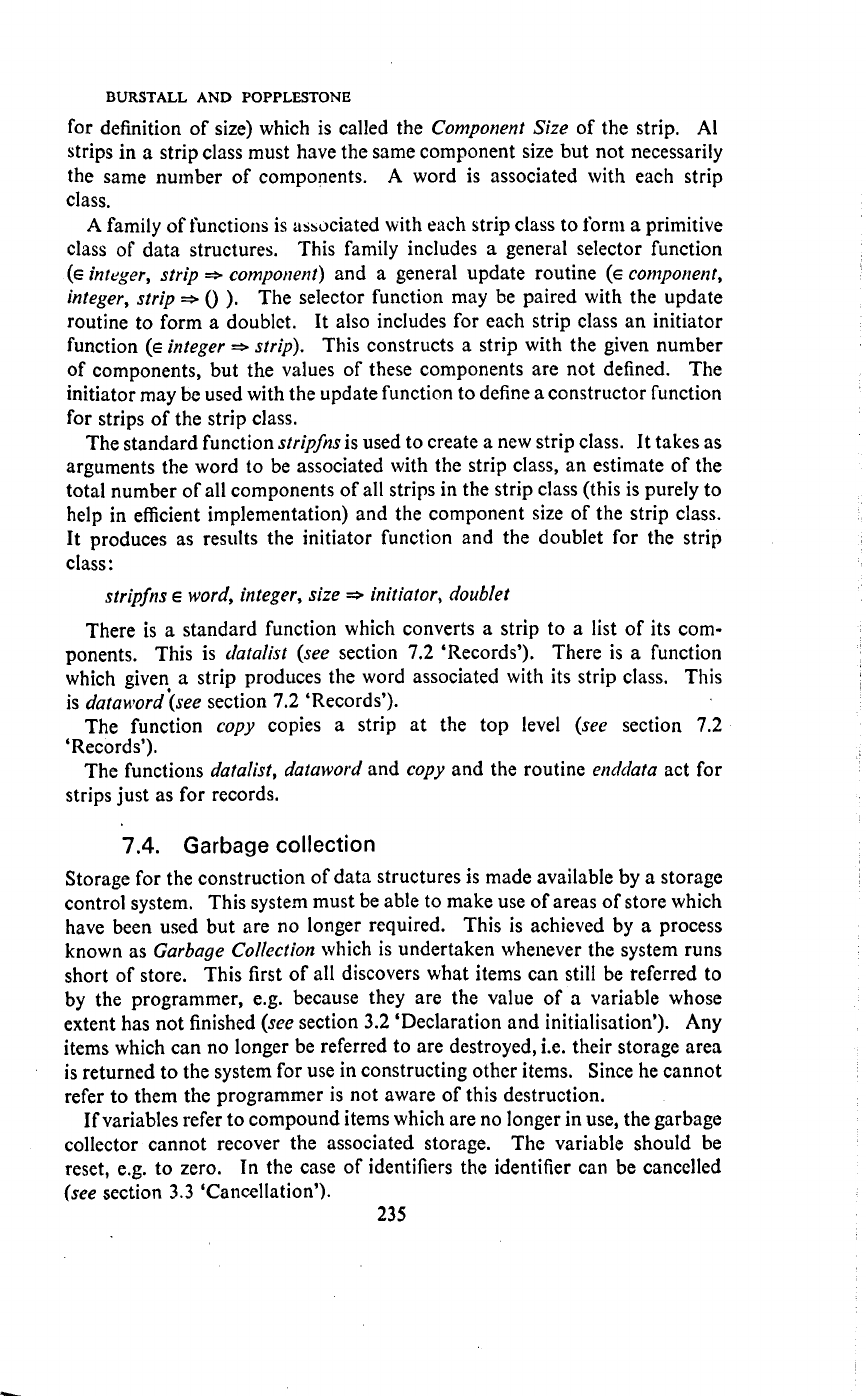
BURSTALL
AND
POPPLESTONE
for
definition
of
size)
which
is
called
the
Component
Size
of
the
strip.
Al
strips
in
a
strip
class
must
have
the
same
component
size
but
not
necessarily
the
same
number
of
components.
A
word
is
associated
with
each
strip
class.
A
family
of
functions
is
associated
with
each
strip
class
to
form
a
primitive
class
of
data
structures.
This
family
includes
a
general
selector
function
(e
integer,
strip
component)
and
a
general
update
routine
(e
component,
integer,
strip
0
).
The
selector
function
may
be
paired
with
the
update
routine
to
form
a
doublet.
It
also
includes
for
each
strip
class
an
initiator
function
(e
integer
strip).
This
constructs
a
strip
with
the
given
number
of
components,
but
the
values
of
these
components
are
not
defined.
The
initiator
may
be
used
with
the
update
function
to
define
a
constructor
function
for
strips
of
the
strip
class.
The
standard
function
stripfns
is
used
to
create
a
new
strip
class.
It
takes
as
arguments
the
word
to
be
associated
with
the
strip
class,
an
estimate
of
the
total
number
of
all
components
of
all
strips
in
the
strip
class
(this
is
purely
to
help
in
efficient
implementation)
and
the
component
size
of
the
strip
class.
It
produces
as
results
the
initiator
function
and
the
doublet
for
the
strip
class:
stripfns
e
word,
integer,
size
initiator,
doublet
There
is
a
standard
function
which
converts
a
strip
to
a
list
of
its
com-
ponents.
This
is
datalist
(see
section
7.2
'Records').
There
is
a
function
which
given
a
strip
produces
the
word
associated
with
its
strip
class.
This
is
dataword
(see
section
7.2
'Records').
The
function
copy
copies
a
strip
at
the
top
level
(see
section
7.2
'Records').
The
functions
datalist,
dataword
and
copy
and
the
routine
enddata
act
for
strips
just
as
for
records.
7.4.
Garbage
collection
Storage
for
the
construction
of
data
structures
is
made
available
by
a
storage
control
system.
This
system
must
be
able
to
make
use
of
areas
of
store
which
have
been
used
but
are
no
longer
required.
This
is
achieved
by
a
process
known
as
Garbage
Collection
which
is
undertaken
whenever
the
system
runs
short
of
store.
This
first
of
all
discovers
what
items
can
still
be
referred
to
by
the
programmer,
e.g.
because
they
are
the
value
of
a
variable
whose
extent
has
not
finished
(see
section
3.2
'Declaration
and
initialisation').
Any
items
which
can
no
longer
be
referred
to
are
destroyed,
i.e.
their
storage
area
is
returned
to
the
system
for
use
in
constructing
other
items.
Since
he
cannot
refer
to
them
the
programmer
is
not
aware
of
this
destruction.
If
variables
refer
to
compound
items
which
are
no
longer
in
use,
the
garbage
collector
cannot
recover
the
associated
storage.
The
variable
should
be
reset,
e.g.
to
zero.
In
the
case
of
identifiers
the
identifier
can
be
cancelled
(see
section
3.3
'Cancellation').
235
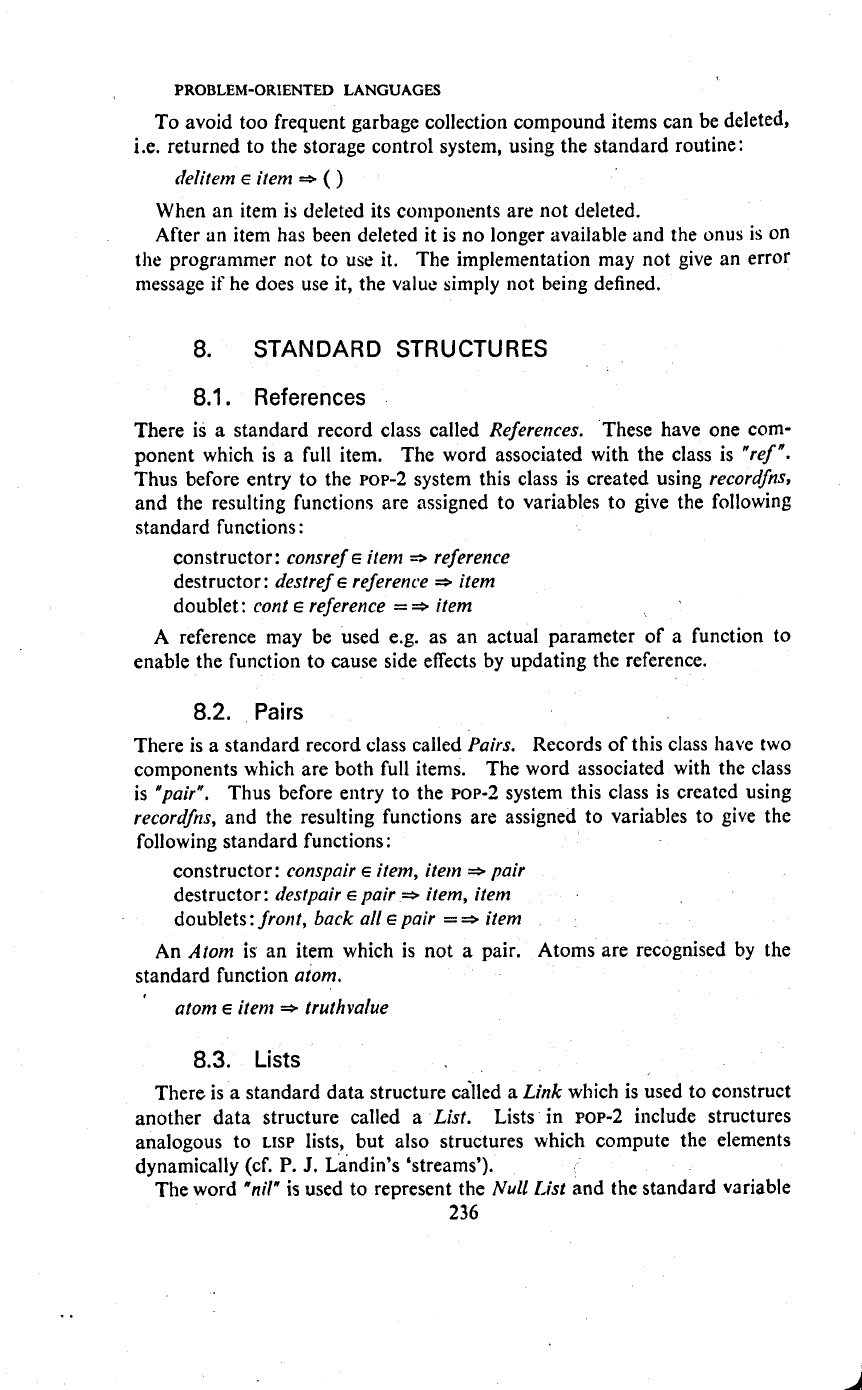
PROBLEM
-ORIENTED
LANGUAGES
To
avoid
too
frequent
garbage
collection
compound
items
can
be
deleted,
i.e.
returned
to
the
storage
control
system,
using
the
standard
routine:
delitetn
e
item
()
When
an
item
is
deleted
its
components
are
not
deleted.
After
an
item
has
been
deleted
it
is
no
longer
available
and
the
onus
is
on
the
programmer
not
to
use
it.
The
implementation
may
not
give
an
error
message
if
he
does
use
it,
the
value
simply
not
being
defined.
8.
STANDARD
STRUCTURES
8.1.
References
There
is
a
standard
record
class
called
References.
These
have
one
com-
ponent
which
is
a
full
item.
The
word
associated
with
the
class
is
ref".
"
Thus
before
entry
to
the
pop
-2
system
this
class
is
created
using
recordfns,
and
the
resulting
functions
are
assigned
to
variables
to
give
the
following
standard
functions:
constructor:
consref
E
item
=>
reference
destructor:
destref
e
reference
item
doublet:
cont
e
reference
=
item
A
reference
may
be
used
e.g.
as
an
actual
parameter
of
a
function
to
enable
the
function
to
cause
side
effects
by
updating
the
reference.
8.2.
Pairs
There
is
a
standard
record
class
called
Pairs.
Records
of
this
class
have
two
components
which
are
both
full
items.
The
word
associated
with
the
class
is
"pair".
Thus
before
entry
to
the
pop
-2
system
this
class
is
created
using
recordfns,
and
the
resulting
functions
are
assigned
to
variables
to
give
the
following
standard
functions:
constructor:
conspair
e
item, item
pair
destructor:
destpair
e
pair
item, item
doublets:front,
back
all
e
pair
=
item
An
Atom
is
an
item
which
is
not
a
pair.
Atoms
are
recognised
by
the
standard
function
atom.
atom
E
item
truth
value
8.3.
Lists
There
is
a
standard
data
structure
called
a
Link
which
is
used
to
construct
another data
structure
called
a
List.
Lists
in
pop
-2
include
structures
analogous
to
use
lists,
but
also
structures
which
compute
the
elements
dynamically
(cf.
P.
J.
Landin's
`streams').
The
word
"nil"
is
used
to
represent
the
Null
List
and
the
standard
variable
236
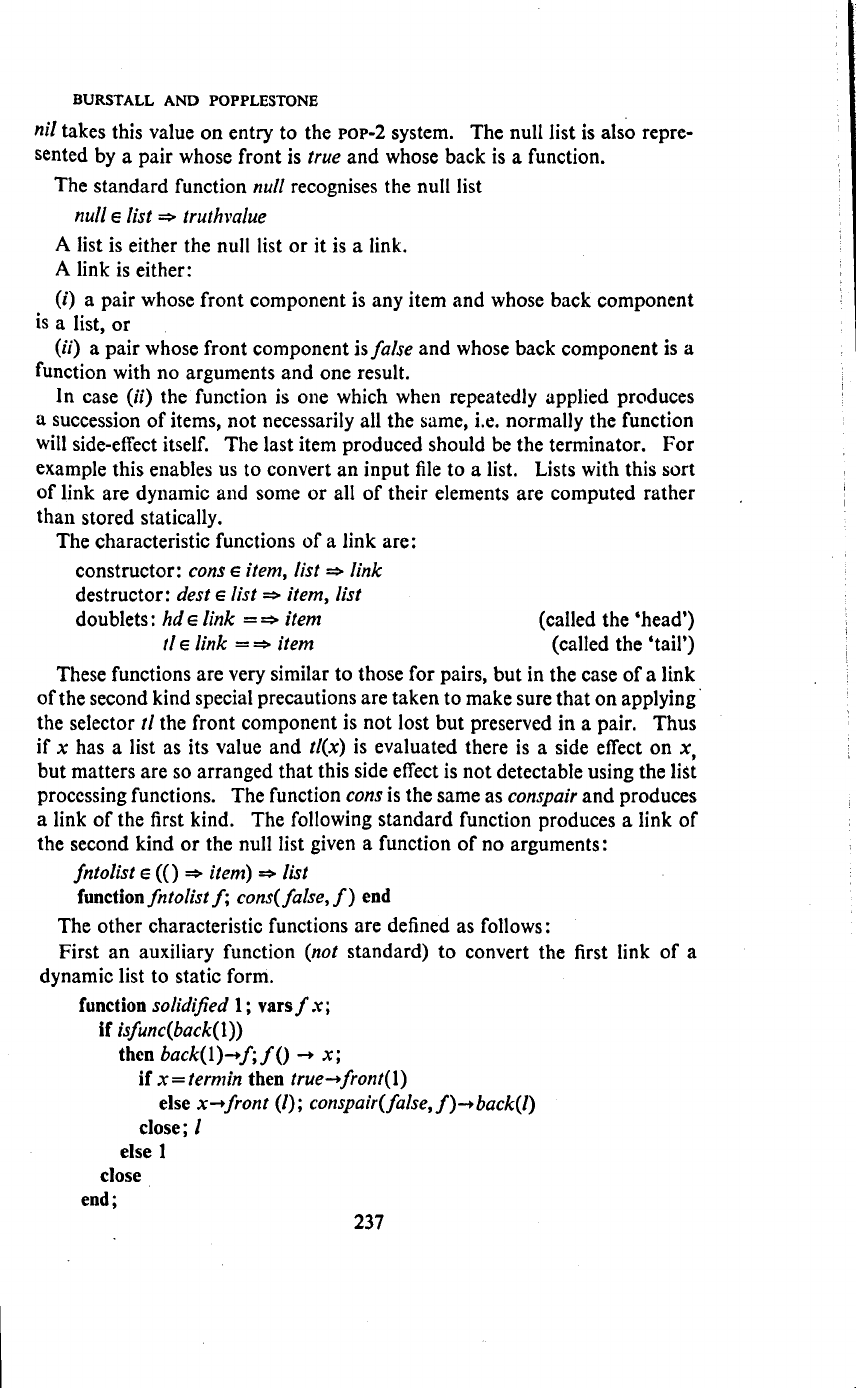
BURSTALL
AND
POPPLESTONE
nil
takes
this
value
on
entry
to
the
pop
-2
system.
The
null
list
is
also
repre-
sented
by
a
pair
whose
front
is
true
and
whose
back
is
a
function.
The
standard#
function
null
recognises
the
null
list
null
e
list
truthvalue
A
list
is
either
the
null
list
or
it
is
a
link.
A
link
is
either:
(1)
a
pair
whose
front
component
is
any
item
and
whose
back
component
is
a
list,
or
(ii)
a
pair
whose
front
component
is
false
and
whose
back
component
is
a
function
with
no
arguments
and
one
result.
In
case
(ii)
the
function
is
one
which
when
repeatedly
applied
produces
a
succession
of
items,
not
necessarily
all
the
same,
i.e.
normally
the
function
will
side-effect
itself.
The
last
item
produced
should
be
the
terminator.
For
example
this
enables
us
to
convert
an
input
file
to
a
list.
Lists
with
this
sort
of
link
are
dynamic
and
some
or
all
of
their
elements
are
computed
rather
than
stored
statically.
The
characteristic
functions
of
a
link
are:
constructor:
cons
e
item,
list
link
destructor:
dest
e
list
item,
list
doublets:
hd
E
link
=
item
(called
the
'head')
i/
e
link
==.
item
(called
the
'tail')
These
functions
are
very
similar
to
those
for
pairs,
but
in
the
case
of
a
link
of
the
second
kind
special
precautions
are
taken
to
make
sure
that
on
applying
the
selector
tl
the
front
component#
is
not
lost
but
preserved
in
a
pair.
Thus
if
x
has
a
list
as
its
value
and
t/(x)
is
evaluated
there
is
a
side
effect
on
x,
but
matters
are
so
arranged
that
this
side
effect
is
not
detectable
using
the
list
processing
functions.
The
function#
cons
is
the
same
as
conspair
and
produces
a
link
of
the
first
kind.
The
following
standard
function
produces
a
link
of
the
second
kind
or
the
null
list
given
a
function
of
no
arguments:
fntolist
e
item)
list
function
fntolist
f;
cons(
false,!)
end
The
other
characteristic
functions
are
defined
as
follows:
First
an
auxiliary
function
(not
standard)
to
convert
the
first
link#
of
a
dynamic
list
to
static
form.
function
solidified
1;
vars
f
x;
If
isfunc(back(1))
then
back(1)—tf;
f
—•
x;
if
x=
termin
then
true—'front(1)
else
x—'front
(I);
conspair(false,
f)—tback(I)
close;
1
else
1
close
end;
237
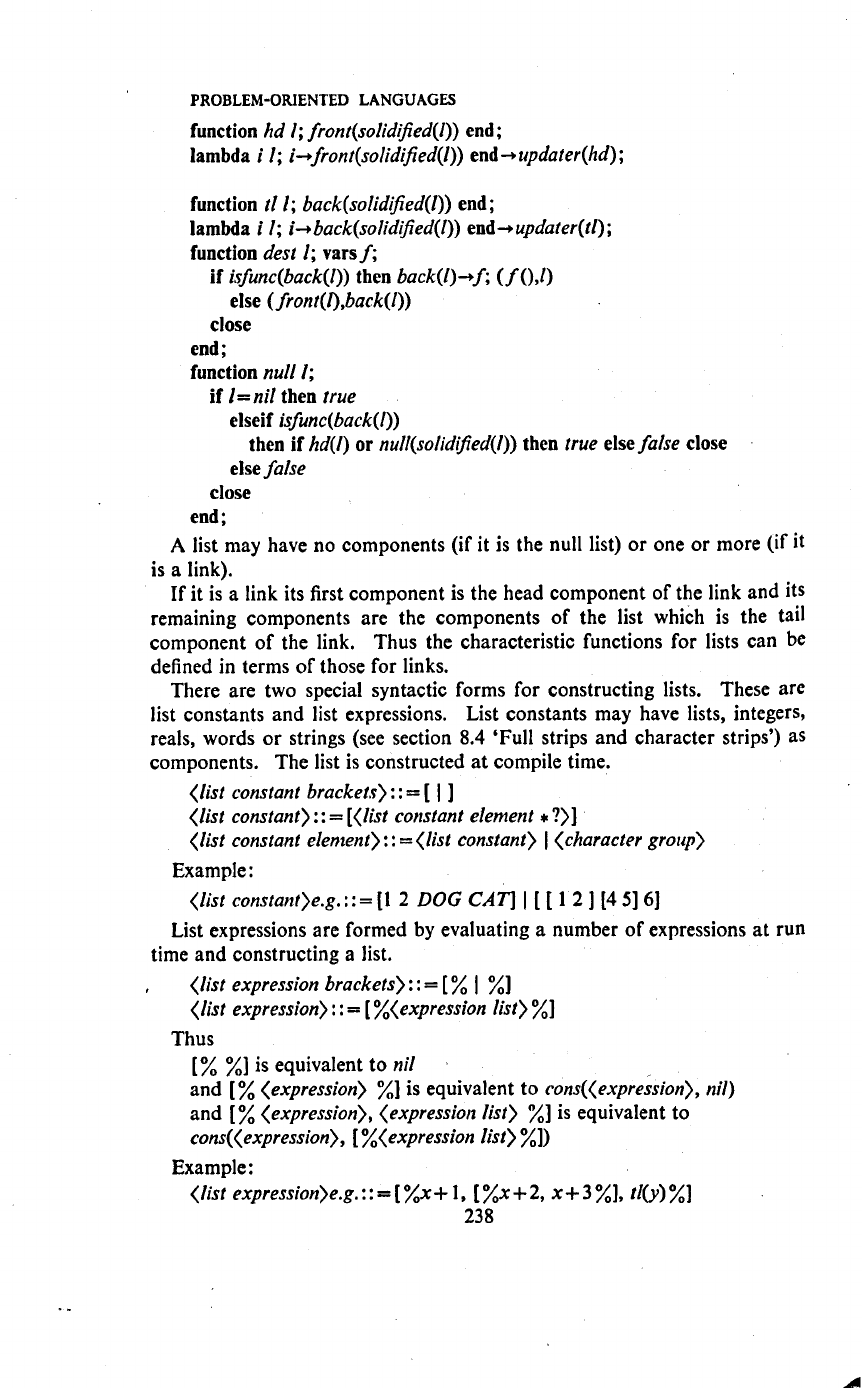
PROBLEM
-ORIENTED
LANGUAGES
function
hd
1;
front(solidified(I))
end;
lambda
ii;
1
--•front(solidtfied(1))
end
--,updater(hd);
function
d
I;
back(solidified(1))
end;
lambda
ii;
i—•back(solidified(1))end—oupdater(t1);
function
dest
I;
varsf;
if
isfunc(back(I))
then
back(I)—*f;
(
f
0,1)
else
(front(1),back(0)
close
end;
function
null
1;
if
1=
nil
then
true
elseif
isfunc(back(1))
then
if
hd(I)
or
null(solidified(1))
then
true
else
false
close
else
false
close
end;
A
list
may
have
no
components
(if
it
is
the
null
list)
or
one
or
more
(if
it
is
a
link).
If
it
is
a
link
its
first
component
is
the
head
component
of
the
link
and
its
remaining
components
are
the
components
of
the
list
which
is
the
tail
component
of
the
link.
Thus
the
characteristic
functions
for
lists
can
be
defined
in
terms
of
those
for
links.
There
are
two
special
syntactic
forms
for
constructing
lists.
These
are
list
constants
and
list
expressions.
List
constants
may
have
lists,
integers,
reals,
words
or
strings
(see
section
8.4
'Full
strips
and
character
strips')
as
components.
The
list
is
constructed
at
compile
time.
<list
constant
brackets>::=[I]
<list
constant>::=Wist
constant
element
*?>]
<list
constant
element)::=<list
constant>
'<character
group>
Example:
<list
constant>e.g.::=
[1
2
DOG
CAT]
I
[[
1
2]
[4
5]
6]
List
expressions
are
formed
by
evaluating
a
number
of
expressions
at
run
time
and
constructing
a
list.
<list
expression
brackets>::=[%
I
%]
<list
expression>::=[%<expression
list>
/
0
]
Thus
[%
Y.]
is
equivalent
to
nil
and
[%
<expression>
Y.]
is
equivalent
to
cons(<expression>,
nil)
and
[%
<expression>,
<expression
list>
%]
is
equivalent
to
cons(<expression),[%<expression
list>
%])
Example:
<list
expression>e.g.::=[%x+1,[%x+2,
x+
3
%],
11(y)%]
238
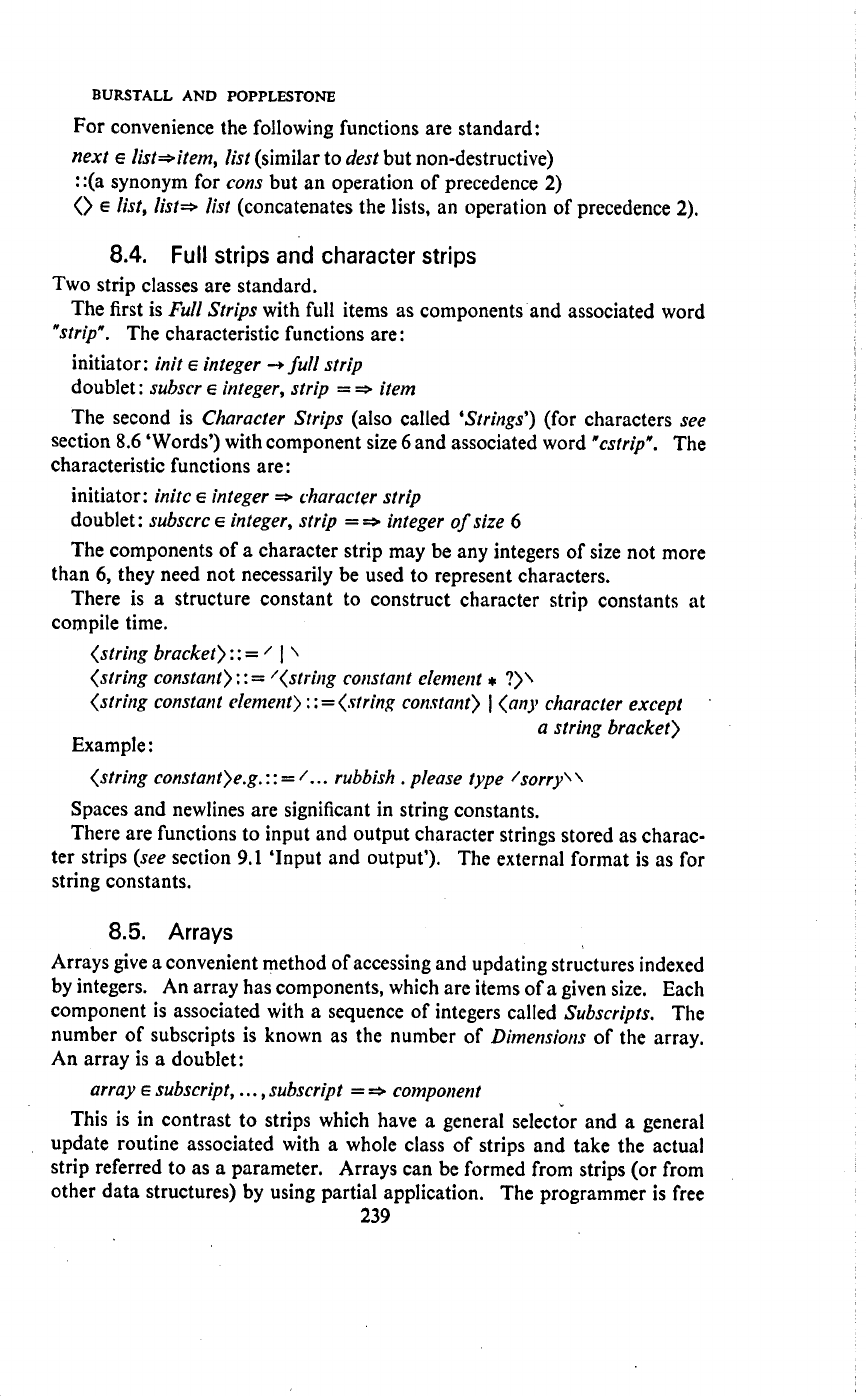
BURSTALL
AND
POPPLESTONE
For
convenience
the
following
functions
are
standard:
next
e
listitem,
list
(similar
to
dest
but
non-destructive)
:
:(a
synonym
for
cons
but
an
operation
of
precedence
2)
Øe
list,
list list
(concatenates
the
lists,
an
operation
of
precedence
2).
8.4.
Full
strips
and
character
strips
Two
strip
classes
are
standard.
The
first
is
Full
Strips
with
full
items
as
components
and
associated
word
"strip".
The
characteristic
functions
are:
initiator:
Mit
e
integer
--*
full
strip
doublet:
subscr
e
integer,
strip
=
item
The
second
is
Character
Strips
(also
called
'Strings')
(for
characters
see
section
8.6
`Words')
with
component
size
6
and
associated
word
"cstrip".
The
characteristic
functions
are:
initiator:
Mite
e
integer
character
strip
doublet:
subscrc
e
integer,
strip
=
integer
of
size
6
The
components
of
a
character
strip
may
be
any
integers
of
size
not
more
than
6,
they
need
not
necessarily
be
used
to
represent
characters.
There
is
a
structure
constant
to
construct
character
strip
constants
at
compile
time.
<string
bracket>::=
\
<string
constant>::=
'<string
constant
element
*
?>\
<string
constant
element>
::=<string
constant>
I
<any
character
except
a
string
bracket>
Example:
<string
constant>e.g.::=
i...
rubbish
.
please
type
'sorry"\
Spaces
and
newlines
are
significant
in
string
constants.
There
are
functions
to
input
and
output
character
strings
stored
as
charac-
ter
strips
(see
section
9.1
'Input
and
output').
The
external
format
is
as
for
string
constants.
8.5.
Arrays
Arrays
give
a
convenient
method
of
accessing
and
updating
structures
indexed
by
integers.
An
array
has
components,
which
are
items
of
a
given
size.
Each
component
is
associated
with
a
sequence
of
integers
called
Subscripts.
The
number
of
subscripts
is
known
as
the
number
of
Dimensions
of
the
array.
An
array
is
a
doublet:
array
e
subscript,
...
,subscript
=
component
This
is
in
contrast
to
strips
which
have
a
general
selector
and
a
general
update
routine
associated
with
a
whole
class
of
strips
and
take
the
actual
strip
referred
to
as
a
parameter.
Arrays
can
be
formed
from
strips
(or
from
other
data
structures)
by
using
partial
application.
The
programmer
is
free
239
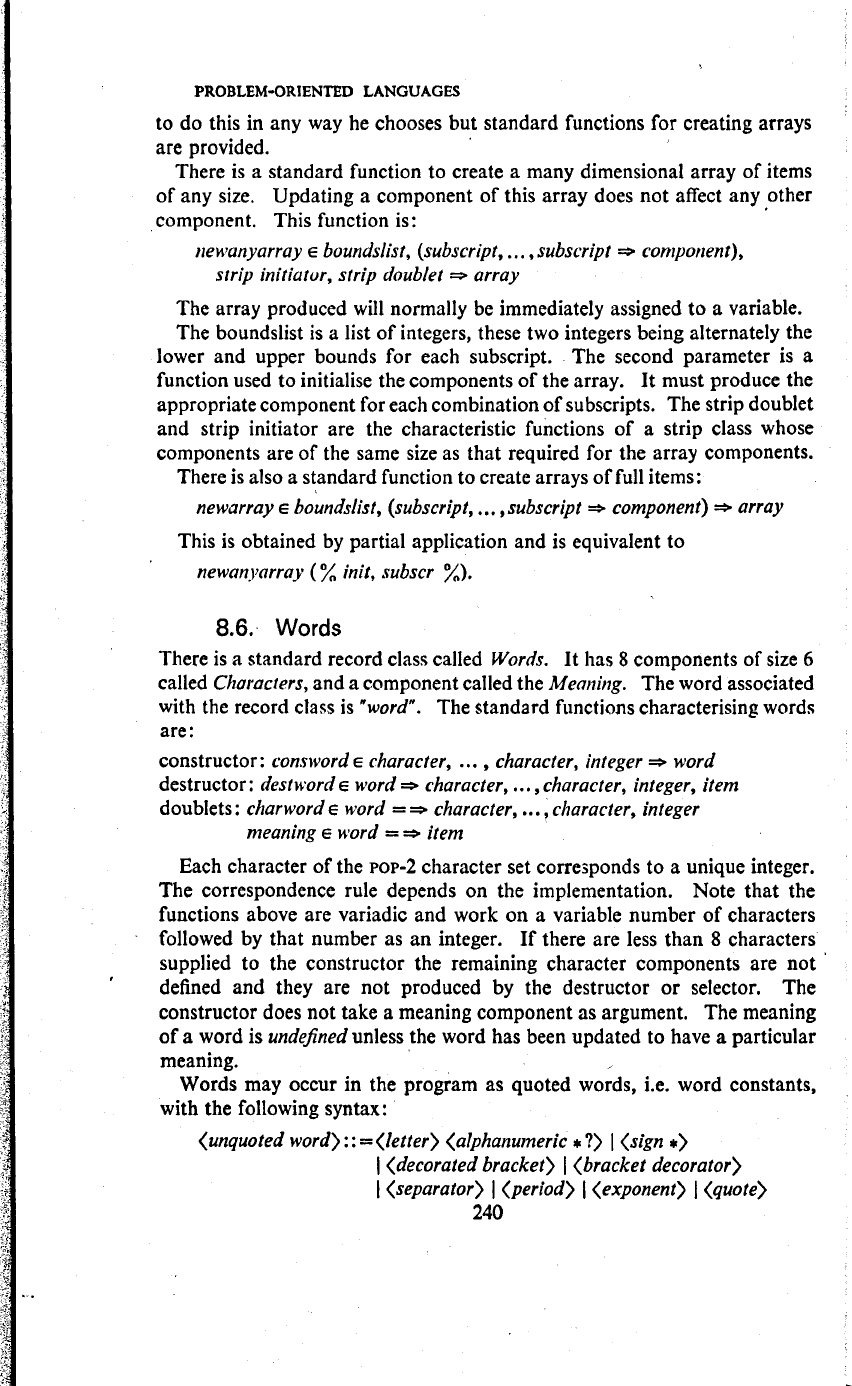
PROBLEM
-ORIENTED
LANGUAGES
to
do
this
in
any
way
he
chooses
but
standard
functions
for
creating
arrays
are
provided.
There
is
a
standard
function
to
create
a
many
dimensional
array
of
items
of
any
size.
Updating
a
component
of
this
array
does
not
affect
any
other
component.
This
function
is:
newanyarray
e
boundslist,
(subscript,
..
,
subscript
component),
strip
initiator,
strip
doublet
array
The
array
produced
will
normally
be
immediately
assigned
to
a
variable.
The
boundslist
is
a
list
of
integers,
these
two
integers
being
alternately
the
lower
and
upper
bounds
for
each
subscript.
The
second
parameter
is
a
function
used
to
initialise
the
components
of
the
array.
It
must
produce
the
appropriate
component
for
each
combination
of
subscripts.
The
strip
doublet
and
strip
initiator
are
the
characteristic
functions
of
a
strip
class
whose
components
are
of
the
same
size
as
that
required
for
the
array
components.
There
is
also
a
standard
function
to
create
arrays
of
full
items:
newarray
e
boundslist,
(subscript,
,subscript
component)
array
This
is
obtained
by
partial
application
and
is
equivalent
to
newanyarray
mit,
subscr
%).
8.6.
Words
There
is
a
standard
record
class
called
Words.
It
has
8
components
of
size
6
called
Characters,
and
a
component
called
the
Meaning.
The
word
associated
with
the
record
class
is
"word".
The
standard
functions
characterising
words
are:
constructor:
consword
e
character,
...
,
character,
integer
word
destructor:
destword
e
word
character,
...,character,
integer,
item
doublets:
charword
e
word
=
character,
...
,
character,
integer
meaning
e
word
=
item
Each
character
of
the
pop
-2
character
set
corresponds
to
a
unique
integer.
The
correspondence
rule
depends
on
the
implementation.
Note
that
the
functions
above
are
variadic
and
work
on
a
variable
number
of
characters
followed
by
that
number
as
an
integer.
If
there
are
less
than
8
characters
supplied
to
the
constructor
the
remaining
character
components
are
not
defined
and
they
are
not
produced
by
the
destructor
or
selector.
The
constructor
does
not
take
a
meaning
component
as
argument.
The
meaning
of
a
word
is
undefined
unless
the
word
has
been
updated
to
have
a
particular
meaning.
Words
may
occur
in
the
program
as
quoted
words,
i.e.
word
constants,
with
the
following
syntax:
<unquoted
word>::=
<letter>
<alphanumeric
*?>
I
<sign
*>
I
<decorated
bracket>
I
<bracket
decorator>
I
<separator>
I
<period>
I
<exponent>
I
<quote>
240
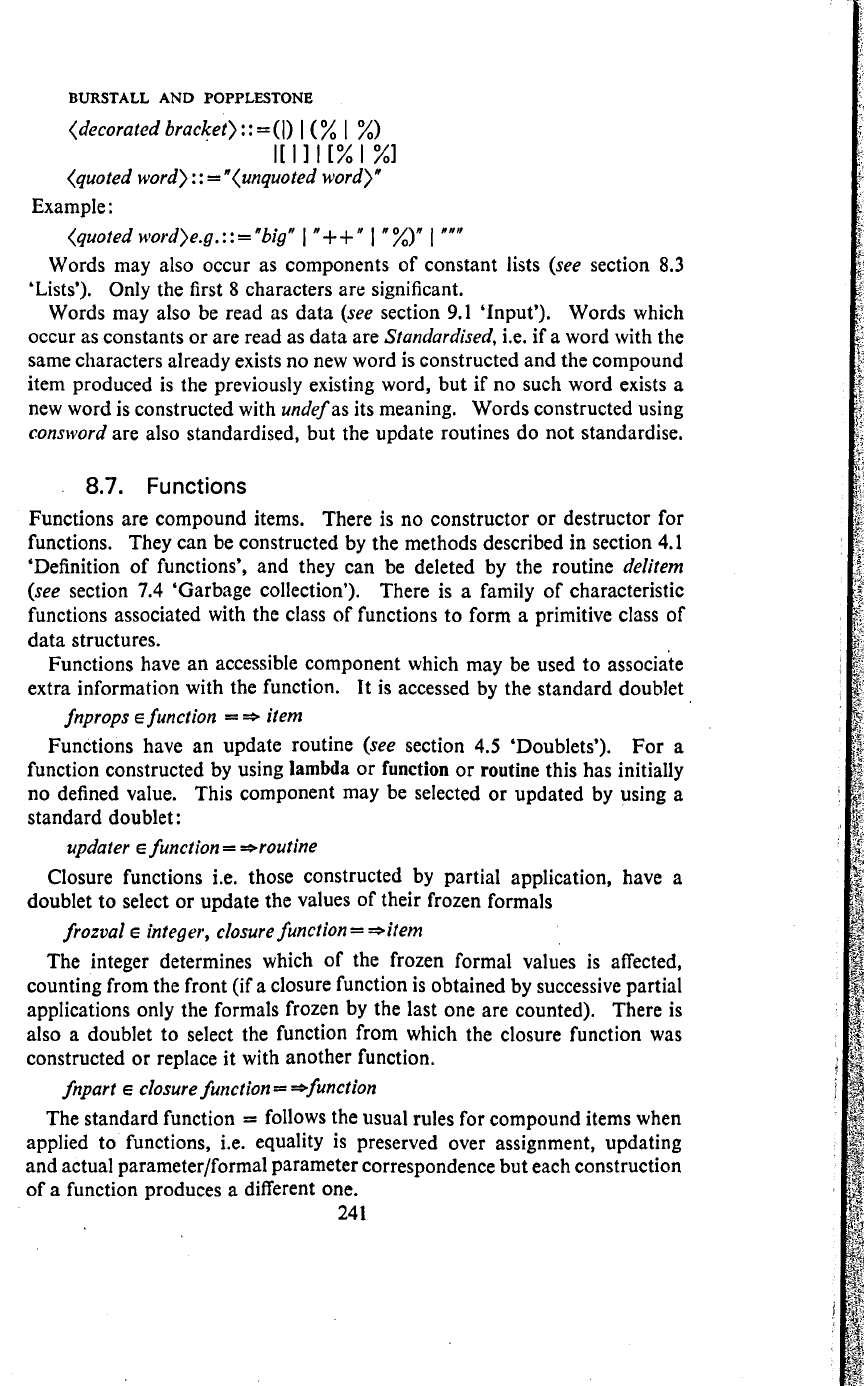
BURSTALL
AND
POPPLESTONE
<decorated
bracket>
=
(I)
I
(%
I
%)
1[
f%
I
Vol
<quoted
word>::="<unquoted
word>"
Example:
<quoted
word>e.g.::="big"
++"
i"%)"
I
n
"
Words
may
also
occur
as
components
of
constant
lists
(see
section
8.3
'Lists').
Only
the
first
8
characters
are
significant.
Words
may
also
be
read
as
data
(see
section
9.1
'Input').
Words
which
occur
as
constants
or
are
read
as
data
are
Standardised,
i.e.
if
a
word
with
the
same
characters
already
exists
no
new
word
is
constructed
and
the
compound
item
produced
is
the
previously
existing
word,
but
if
no
such
word
exists
a
new
word
is
constructed
with
undef
as
its
meaning.
Words
constructed
using
consword
are
also
standardised,
but
the
update
routines
do
not
standardise.
8.7.
Functions
Functions
are
compound
items.
There
is
no
constructor
or
destructor
for
functions.
They
can
be
constructed
by
the
methods
described
in
section
4.1
'Definition
of
functions',
and
they
can
be
deleted
by
the
routine
delitem
(see
section
7.4
'Garbage
collection').
There
is
a
family
of
characteristic
functions
associated
with
the
class
of
functions
to
form
a
primitive
class
of
data
structures.
Functions
have
an
accessible
component
which
may
be
used
to
associate
extra
information
with
the
function.
It
is
accessed
by
the
standard
doublet
fnprops
Efunction
=
item
Functions
have
an
update
routine
(see
section
4.5
`Doublets').
For
a
function
constructed
by
using
lambda
or
function
or
routine
this
has
initially
no
defined
value.
This
component
may
be
selected
or
updated
by
using
a
standard
doublet:
updater
e
function=
=rroutine
Closure
functions
i.e.
those
constructed
by
partial
application,
have
a
doublet
to
select
or
update
the
values
of
their
frozen
formals
frozval
e
integer,
closure
function
=
item
The
integer
determines
which
of
the
frozen
formal
values
is
affected,
counting
from
the
front
(if
a
closure
function
is
obtained
by
successive
partial
applications
only
the
formals
frozen
by
the
last
one
are
counted).
There
is
also
a
doublet
to
select
the
function
from
which
the
closure
function
was
constructed
or
replace
it
with
another
function.
fnpart
e
closure
function=function
The
standard
function
=
follows
the
usual
rules
for
compound
items
when
applied
to
functions,
i.e.
equality
is
preserved
over
assignment,
updating
and
actual
parameter/formal
parameter
correspondence
but
each
construction
of
a
function
produces
a
different
one.
241
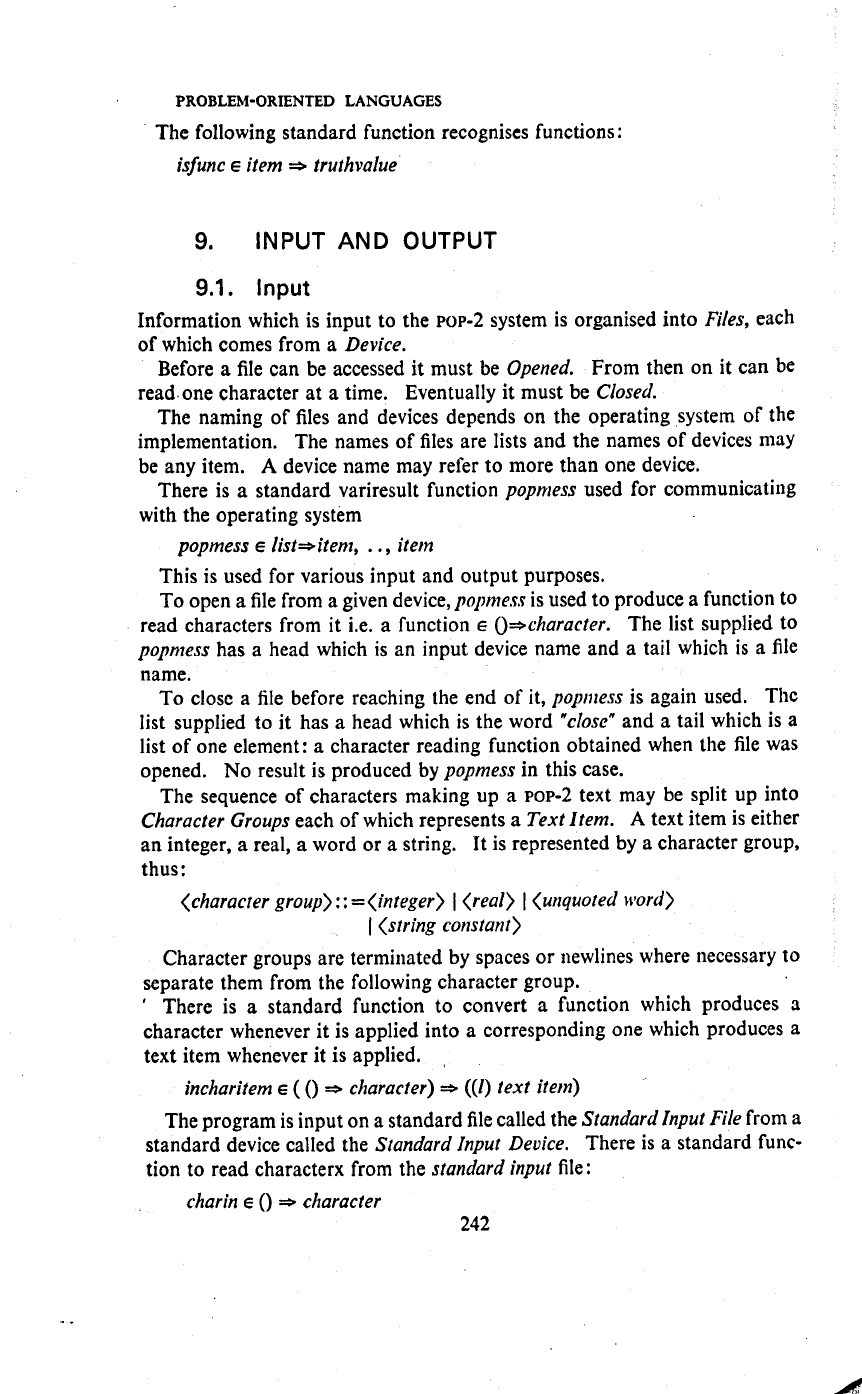
PROBLEM
-ORIENTED
LANGUAGES
The
following
standard
function
recognises
functions:
isfunc
e
item
truthvalue
9.
INPUT
AND
OUTPUT
9.1.
Input
Information
which
is
input
to
the
pop
-2
system
is
organised
into
Files,
each
of
which
comes
from
a
Device.
Before
a
file
can
be
accessed
it
must
be
Opened.
From
then
on
it
can
be
read
one
character
at
a
time.
Eventually
it
must
be
Closed.
The
naming
of
files
and
devices
depends
on
the
operating
system
of
the
implementation.
The
names
of
files
are
lists
and
the
names
of
devices
may
be
any
item.
A
device
name
may
refer
to
more
than
one
device.
There
is
a
standard
variresult
function
popmess
used
for
communicating
with
the
operating
system
popmess
e
.
.,
item
This
is
used
for
various
input
and
output
purposes.
To
open
a
file
from
a
given
device,
popmess
is
used
to
produce
a
function
to
read
characters
from
it
i.e.
a
function
e
Ocharacter.
The
list
supplied
to
popmess
has
a
head
which
is
an
input
device
name
and
a
tail
which
is
a
file
name.
To
close
a
file
before
reaching
the
end
of
it,
popmess
is
again
used.
The
list
supplied
to
it
has
a
head
which
is
the
word
'close"
and
a
tail
which
is
a
list
of
one
element:
a
character
reading
function
obtained
when
the
file
was
opened.
No
result
is
produced
by
popmess
in
this
case.
The
sequence
of
characters
making
up
a
pop
-2
text
may
be
split
up
into
Character
Groups
each
of
which
represents
a
Text
Item.
A
text
item
is
either
an
integer,
a
real,
a
word
or
a
string.
It
is
represented
by
a
character
group,
thus:
<character
group>
::=<integer>
I
<real>
I
<unquoted
word>
I
<string
constant>
Character
groups
are
terminated
by
spaces
or
newlines
where
necessary
to
separate
them
from
the
following
character
group.
'
There
is
a
standard
function
to
convert
a
function
which
produces
a
character
whenever
it
is
applied
into
a
corresponding
one
which
produces
a
text
item
whenever
it
is
applied.
incharitem
e
(0
=.
character)
((1)
text
item)
The
program
is
input
on
a
standard
file
called
the
Standard
Input
File
from
a
standard
device
called
the
Standard
Input
Device.
There
is
a
standard
func-
tion
to
read
characterx
from
the
standard
input
file:
charin
e
0
character
242
BURSTALL
AND
POPPLESTONE
The
program
is
compiled
from
the
text
item
list
which
is
the
value
of
the
standard
variable
proglist.
Initially
this
has
as
value
the
list
of
text
items
from
the
standard
input
file.
It
may
be
assigned
to
by
the
programmer
who
wishes
to
compile
from
a
different
source.
For
convenience
there
is
a
standard
function
itemread
producing
the
next
item
of
the
list
which
is
the
value
of
proglist.
itemread
e
0
text
item
It
is
defined
thus:
—
function
itemread;
proglist
.
dest
proglist
end;
9.2.
Output
Information
which
is
output
from
the
pop
-2
system
is
organised
into
files,
each
of
which
is
sent
to
a
device
(see
section
9.1
'Input').
To
open
an
output
device
the
standard
function
popmess
(see
Section
9.1
'Input')
is
used
to
produce
a
routine
to
deliver
characters
to
it
i.e.
a
routine
E
character
0.
The
list
supplied
to
popmess
has
a
head
which
is
an
output
device
name
and
a
tail
which
is
a
file
name.
There
is
a
standard
function
to
convert
a
routine
which
delivers
a
sequence
of
characters
to
an
output
file
into
one
which
delivers
a
sequence
of
text
items.
outcharitem
e
(character
())
(text
item
0)
Compiler
messages
and
results
of
computation
are
normally
output
on
a
standard
file
called
the
Standard
Output
File
to
a
standard
device
called
the
Standard
Output
Device.
There
is
a
standard
routine
to
output
characters
to
the
standard
output
file:
charout
e
character
()
There
is
a
standard
variable
cucharout
which
contains
the
routine
to
output
characters
to
the
Current
Output
File.
This
contains
initially
the
routine
for
the
standard
output
file
but
it
may
be
assigned
to
if
a
different
output
file
is
to
be
made
current.
An
output
file
is
closed
by
outputing
the
terminator.
There
are
standard
routines
to
output
spaces
or
newlines
to
the
current
output
file:
sp
e
integer
0
n1
E
integer
0
There
is
a
standard
function
which
outputs
any
item
to
this
file
in
some
suitable
format
and
produces
that
item
unchanged
as
its
result.
print
e
item item
There
is
a
standard
macro
which
uses
print
and
causes
the
items
on
the
stack
starting
at
the
bottom
to
be
printed
on
a
newline
preceded
by
two
asterisks.
These
items
are
removed
from
the
stack.
In
a
function
body
only
the
top
item
of
the
stack
is
affected.
This
macro
is
denoted
by
the
pop
-2
243
PROBLEM
-ORIENTED
LANGUAGES
identifier
=
(not
to
be
confused
with
the
used
in
this
manual
to
show
the
type
of
functions).
A
semicolon
is
implied
before
and
after
so
that
immediate
evaluation
can
occur
(see
section
11.1
'Immediate
evaluation').
10.
MACHINE
CODE
It
is
possible
to
insert
sections
of
machine
code
in
an
imperative
sequence.
The
rules
depend
on
the
implementation.
A
code
instruction
is
represented
by
the
identifier
$
followed
by
any
sequence
of
characters
which
do
not
include
';'
<code
instruction>::=1Nany
sequence
of
characters
other
than
;>
11.
MODES
OF
EVALUATION
11.1.
Immediate
evaluation
A
pop
-2
program
consists
of
a
sequence
of
imperatives
and
cancellations:
<program
element>::=<imperative>
I
<cancellation>
<program>::=<program
elementt>;
<program>
The
program
elements
are
evaluated
in
sequence
in
the
same
way
as
an
imperative
sequence.
Each
program
element
is
evaluated
as
soon
as
the
terminal
semicolon
and
a
space
has
been
read
by
the
compiler.
The
body
of
any
function
in
the
program
element
will
be
compiled
and
kept
so
that
it
may
be
evaluated
when
that
function
is
applied.
11.2.
Macros
A
Macro
is
a
routine
which
is
applied
at
compile
time.
The
definition
of
a
macro
routine
is
similar
to
that
of
any
other
routine
except
that
macro
is
used
instead
of
routine
and
no
formal
parameters
are
allowed.
<macro
definition>::=macro
<identifier>;
<function
body>
end
A
macro,
like
an
operation,
is
applied
whenever
it
is
mentioned
and
does
not
need
parentheses
after
it.
Although
a
macro
has
no
parameters
the
function
itemread
(see
section
9.1
'Input')
may
be
used
to
read
the
text
items
following
the
macro
identifier.
There
is
a
standard
routine
which,
when
applied
in
a
macro
body
to
a
list
of
text
items,
concatenates
these
items
to
the
right
of
the
macro
identifier
in
the
program
sequence
of
text
items.
macresults
e
text
item
list
0
If
it
is
applied
more
than
once
it
concatenates
to
the
right
of
the
previously
inserted
items.
On
exit
from
the
macro
the
inserted
text
items
are
evaluated
as
program.
244
BURSTALL
AND
POPPLESTONE
Example:
macro
—
-
p;
vars
x
y;
itemread
--+
x;
itemread
y;
macresults
([%
"-*",
y,
x%])
end;
7/2
—
-*q
r;
This
is
the
same
as
7//2
-+r
-q;
The
correspondence
between
a
list
of
text
items
and
pop
-2
program
is
as
follows.
Syntax
words,
identifiers
and
unquoted
words
are
represented
by
corresponding
words
in
the
list.
A
quoted
word
is
represented
by
a
word
with
the
word
quote
(consisting
of
the
character
quote)
before
and
after
it
in
the
list.
Integers
and
seals
are
represented
by
integers
and
reals.
String
constants
are
represented
by
strings.
11.3.
Evaluation
of
program
text
A
standard
function
popval
is
provided
which
will
evaluate
a
list
of
text
items
treating
it
as
a
POP
-2
imperative
sequence.
The
sequence
is
evaluated
immediately.
It
may
contain
function
definitions
and
assignments
to
current
variables.
Any
declarations
in
it
which
are
not
in
a
function
body
are
global.
The
list
must
terminate
with
the
word
goon.
For
the
correspondence
between
a
list
of
text
items
and
POP
-2
program
see
section
11.2
'Macros'.
The
result
of
the
application
of
popval
is
the
result
of
evaluating
the
imperative
sequence.
popval
E
text
item
list
item,...
,item
Note
that
popval
is
used
to
evaluate
an
imperative
sequence
at
run
time
and
the
list
of
text
items
may
have
been
produced
as
the
result
of
computation.
It
may
temporarily
affect
the
standard
variable
proglist
(see
section
9.1
'Input').
Example:
1
-+
a;
popval([vars
x;
a+2
-4
x;
x*x
goon])
**9
The
standard
routine
setpop
may
be
applied
in
the
imperative
sequence.
This
restores
the
system
to
execute
mode.
The
stack
is
cleared.
The
variable
currently
associated
with
any
identifier
is
not
altered.
After
setpop
has
been
applied
the
rest
of
the
imperative
sequence
is
ignored
and
all
function
bodies
currently
being
evaluated
are
abandoned.
The
system
then
evaluates
the
next
program
element.
setpop
may
also
be
applied
in
a
function
body.
setpop
EQ
()
ACKNOWLEDGMENTS
This
language
is
a
development
of
R.
J.
Popplestone's
'Pop
-l'
programming
language
(see
the
paper
in
this
volume).
The
debt
to
the
ALGOL,
LISP,
CPL
and
245
PROBLEM
-ORIENTED
LANGUAGES
iswim
programming
languages
should
be
obvious.
We
are
indebted
to
a
number
of
people
in
this
department
and
elsewhere
for
helpful
discussion
and
criticism,
to
Dr
David
Park
who
contributed
to
discussion
of
the
storage
control
scheme
and
to
Mrs
Margaret
Pithie
and
Miss
Eleanor
Kerse
who
typed
this
report.
Mr
M.
Healy
kindly
pointed
out
a
number
of
errors
and
obscurities
in
a
draft.
The
work
has
been
undertaken
on
a
grant
from
the
Science
Research
Council
under
the
supervision
of
Dr
D.
Michie,
whose
encouragement
has
been
invaluable.
246
