PTX_QSG_XML_SAP_179984F PTX QSG XML SAP 179984F
PTX_QSG_XML_SAP_179984F PTX_QSG_XML_SAP_179984F
PTX_QSG_XML_SAP_179984F PTX_QSG_XML_SAP_179984F
PTX_QSG_XML_SAP_179984F PTX_QSG_XML_SAP_179984F
User Manual: PTX_QSG_XML_SAP_179984F
Open the PDF directly: View PDF  .
.
Page Count: 60
- Table of Contents
- 1 Introduction
- 2 SAP Solution
- 3 Troubleshooting
- 4 Printing with XML Direct
- Using BarCode 2000 XML Direct
- A Contact Information

XML Direct for SAP
Quick Setup Guide
Thermal Series Printers
Thermal Series Printers
XML Direct for SAP
Quick Setup Guide

Trademark Acknowledgments
SAP is a registered trademark of SAP AG.
Printronix and PSA are registered trademarks of Printronix, Inc.
Unibar and BARCODE 2000 XML DIRECT are registered trademarks of
Unibar, Inc.
Portions of this manual used by permission of Unibar, Inc. Copyright 1996-
2005 Unibar Inc.
Portions of this manual used by permission of SAP AG. Copyright 2003-2005
SAP AG.
COPYRIGHT 2005, 2012 PRINTRONIX, INC.
All rights reserved.

1 Introduction ........................................................... 7
About this Manual .................................................................................. 7
XML Direct ............................................................................................. 7
2 SAP Solution......................................................... 9
Overview:SAP Auto-ID Infrastructure .................................................... 9
Process Overview ........................................................................... 9
Process Details - Pre-supplied Formats........................................ 10
Supported AII Variable Names...................................................... 10
Error Handling ............................................................................... 11
SAP Documentation...................................................................... 11
Examples ...................................................................................... 11
3 Troubleshooting .................................................. 17
4 Printing with XML Direct...................................... 19
Using BarCode 2000 XML Direct......................................................... 19
Installation ..................................................................................... 19
License Key File ..................................................................... 20
A Brief Overview ........................................................................... 20
Quick Start .............................................................................. 20
Getting Started .............................................................................. 21
To Begin ................................................................................. 21
Create Label Templates ......................................................... 21
BARCODE 2000 XML DIRECT Components ............................... 22
Introduction to Label Data Dictionary ............................................ 24
Purpose .................................................................................. 24
Menu Bar ................................................................................ 24
Toolbar.................................................................................... 24
Field Types ............................................................................. 25
Variable................................................................................... 25
Concatenated ......................................................................... 26
Counter ................................................................................... 26
Time........................................................................................ 27
Alias ........................................................................................ 27
TXDATA.................................................................................. 28
Table of Contents

Table of Contents
Substring................................................................................. 29
Alternate ................................................................................. 30
Introduction to Label Design System (LDS) .................................. 30
Purpose .................................................................................. 30
Menu Bar ................................................................................ 30
Toolbar.................................................................................... 31
Label Properties...................................................................... 34
Printer Destination Dialog ....................................................... 35
Label Data Defaults Dialog ..................................................... 36
Page Setup Dialog.................................................................. 36
Field Types ............................................................................. 38
Text......................................................................................... 38
Barcode .................................................................................. 39
Vertical/Horizontal Line........................................................... 41
Rectangle................................................................................ 41
Graphic ................................................................................... 42
RFID Tag ................................................................................ 42
Download Template Utility ............................................................ 44
Introduction to Downloading Templates ................................. 44
The DTU’s Test Printing Utility................................................ 45
Print Config ................................................................................... 46
Introduction to Configuration Tool........................................... 46
Print Destination Table ........................................................... 47
Default Destination ................................................................. 48
Formatter Options................................................................... 49
BARCODE 2000 XML DIRECT File Types ................................... 50
Executable files (no extension)............................................... 50
Configuration File & Print Destination Table ................................. 51
General Format....................................................................... 51
Printer Destination Table ........................................................ 51
Defining a Delimiter ................................................................ 53
Unibar Base Directory ................................................................... 54
Setting the Environment String ............................................... 54
A Contact Information............................................. 57
Printronix Customer Support Center.................................................... 57
Printronix Supplies Department ........................................................... 58
Corporate Offices................................................................................. 58
7
1
Introduction
About this Manual
This manual explains the use of the XML language with the Printronix®
SL5000r/T5000r and SL4M/T4M XML Direct printers. Use this manual with
your SL5000r/T5000r or SL4M/T4M User’s Manual for complete printer-
protocol operation.
XML Direct
Printronix XML Direct enabled printers come equipped with an internal XML
Forms Module. Designed in conjunction with SAP, this solution allows users
to quickly leverage RFID technology by connecting tagged objects with the
business view of an ERP system.
The following is a high level overview of how XML Direct works in 4 easy
steps:
•
The user creates the PGL formatted label template. Use XML Direct label
design software provided by Printronix or follow the examples in Chapter
2.
•
The template is downloaded to the printer's permanent memory.
•
The host application sends XML formatted run time data to the printer.
•
The run time data is merged with the stored template, the RFID tag is
encoded and the label is printed.
Details of each of these steps are as follows:
1. Create the label format. This may be done by any of the following
methods:
a. Use the XML Direct label design software provided by Printronix.
b. Use commercially available XML enabled label design software.
c. Follow the programming example in Chapter 2 of this manual to
create an XML enabled PGL template. Chapter 3 also provides
directions to find and use sample template files on the CD.

8
Chapter 1
XML Direct
2. Download the format to the printer. This may be done via the following
methods:
a. Use the Format Download Utility supplied with XML Direct label
design utility. (See Chapter 4, Download Template Utility)
b. Send the XML enabled template to the printer directly from the
operating system the same way you would any other file. For
example, from a DOS command line prompt on a parallel interface
you could type "copy/b <filename> lpt1:".
3. Host application sends XML formatted run time data to the printer. See
Chapter 2 for an overview of SAP AII-DC, supported variable names,
links to AII configuration guides, and sample XML file formats that
correspond to the sample template files.
4. Merging run time data with the stored template - this step is performed
automatically by the XML Forms Module that is resident on the printer.
If the above steps are followed, the Printronix XML enabled printer will
encode and print RFID smart labels directly from your SAP system.

9
2
SAP Solution
This section discusses the full implementation of the XML printing solution for
SAP, including an SAP specific overview, along with instructions for
installation and configuration on the SAP system.
Overview:SAP Auto-ID Infrastructure
SAP Auto-ID Infrastructure (SAP AII) is an out-of-the-box solution that
integrates RFID technology with existing SAP logistics systems and delivers a
generic infrastructure that enables integration with heterogeneous system
landscapes. The solution consists of one or more SAP AII systems that can
be implemented on various types of platforms, from PDAs through
workstations, to large servers.
The system can be deployed in two ways:
•
SAP AII Standalone system that can operate independently from an ERP
system
•
SAP AII Integrated in Supply Chain Execution
You can integrate SAP AII with both mobile and fixed RFID devices.
Process Overview
The high level sequence of events leading to RFID tag commissioning is as
follows:
1. Auto-ID Infrastructure provides a master list of variable names, including
“EPC”, which can be used during label design. The values of these
variables can be provided in the WriteTagData command sent by Auto-ID
Infrastructure.
2. The label designer creates a named format with the Printronix Tool
Barcode 2000 XML Direct and downloads it to the printer memory using
the same tool. The content of the format directs the printer to print a label
that includes the value of several variables from the master list. The
format also directs the printer to write the value of the “EPC” variable to
the RFID tag.
3. The Printronix XML enabled RFID printer is connected to the TCP/IP
network and given a specific IP address. The printer listens for print
commands on a TCPsocket for a specific port.
4. Auto-ID Infrastructure is configured with the address and port of the RFID
printer, the name of the printing format, and the associated list of variable
names.
10
Chapter 2
Overview:SAP Auto-ID Infrastructure
5. Auto-ID Infrastructure selects the printer and print format, and evaluates
the values for the associated data variables, including a unique EPC
value. An XML stream containing an SAP AII-DC WriteTagData
command message is sent to the printer.
6. The printer prints a label and writes the EPC to the RFID tag embedded in
the label.
Process Details - Pre-supplied Formats
Several named formats specific to SAP are provided in the Printronix XML
Direct Starter CD included with the Printronix XML enabled printer. After
installing the Barcode2000 XML Direct product, these formats can be easily
modified to suit your specific needs and downloaded directly to the printer
within one integrated GUI tool. The tool can also be used to create formats
from scratch. See Barcode2000 XML Users manual for details.
Supported AII Variable Names
The following variables can be included in the WriteTagData command:
Variable Name Description
EPC Hexadecimal EPC
EPC_TYPE EPCType (SGTIN-96, SSCC-96…)
EPC_URN EPC in uri format
EPC_URN_NO_HEADER EPC uri format numeric portion
SSCC Serialized Shipping
GTIN Global Trade Identification Number
PRODUCT Product associated with the GTIN in
the EPC
PRODUCT_DESCRIPTION Product Description
PRODUCT_QUANTITY Quantity in the base unit of measure
BASE_UOM Base unit of measure
UOM EPC unit of measure
DOCUMENT_NO Document ID
DOCUMENT_TYPE Document Type Code
BUSINESS_PARTNER Business Partner Name
BUSINESS_PARTNER_ADDRESS Address of Business Partner
Some users may want to use a given printer format or command message for
multiple purposes. To accommodate this and provide maximum flexibility, the
following rules apply: If a field appears as a part of the WriteTagData
command, but is not included in the designated printer format, then that field
is simply not processed. If a field is not included as part of a WriteTagData
command but does appear on the designated printer format, it is also not
processed. This allows the design of forms whose layout is partially data
driven.
Error Handling
11
Error Handling
•
In general, command messages are assumed to be well-formed. No error
processing is performed on poorly formed command messages that do
not match the AII-DC XML schema.
•
For non-RFID data, if the value supplied for a variable name exceeds that
defined in a form definition then the value is truncated.
•
When encoding an RF tag, in the event there is a mismatch between the
amount of data being sent and the size of the tag as defined on the form
(i.e. 96 bits, 64 bits) or the actual capacity of the RF Tag, then an error
message is printed on the form to alert the operator. There is no padding
or truncation as this is undesirable behavior in an RFID environment.
SAP Documentation
A detailed description of the SAP AII printer interface, including architectural
diagrams, configuration, setup, and XML schema, can be found in the
following documents available from SAP:
For instructions on the setup of the SAP Auto-ID Infrastructure for RFID label
printing - SAP RFID-Enabled Slap&Ship Outbound Processing:
Configuration Guide
For a description of the interface between SAP Auto-ID Infrastructure and
RFID device controllers – including printers - refer to the SAP AII-DC 1.0
Word document in the SAP\Reference Documents folder on the CD.
Examples
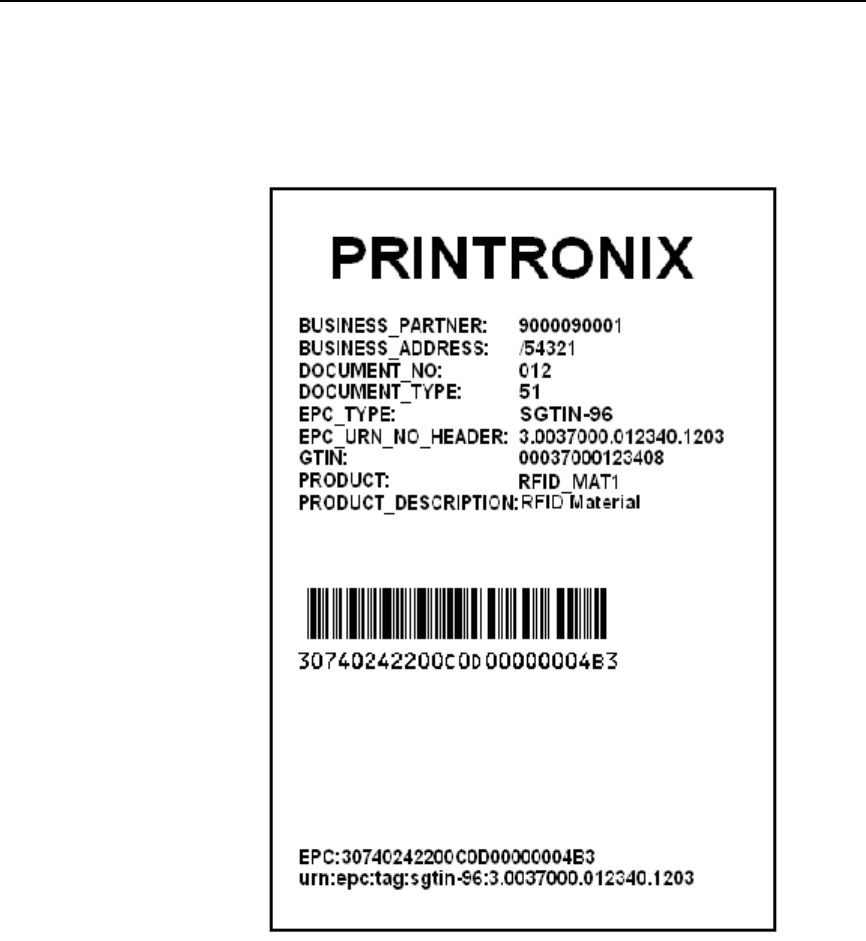
The following examples illustrate the use of all WriteTagData command
message fields names defined within SAP AII-DC at this time. XML code
corresponding label format definition, and a sample label are also provided.
Label design files corresponding to each example are bundled with the
installation of the Barcode2000 -XML software located in the SAP directory of
your starter CD.
SGTIN96
The first example shows the encoding of a 96-bit SGTIN on an RFID label
along with related human readable text and a bar code. It shows all variables
being used on a single form.

12
Chapter 2
Overview:SAP Auto-ID Infrastructure
Sample XML Code for SGTIN96
<?xml version="1.0" encoding="UTF-8" ?>
- <Command xmlns:xsi="http://www.w3.org/2001/XMLSchema-instance"
xsi:noNamespaceSchemaLocation="Command.xsd">
- <WriteTagData readerID="SGPRINT">
- <Item>
- <FieldList format="sgtin96.pgl" jobName="SGPRINT20050502233326"
quantity="1">
<Field name="BUSINESS_PARTNER">9000090001</Field>
<Field name="BUSINESS_PARTNER_ADDRESS">/ 54321</Field>
<Field name="DOCUMENT_NO">012</Field>
<Field name="DOCUMENT_TYPE">51</Field>
<Field name="EPC">30740242200C0D00000004B3</Field>
<Field name="EPC_TYPE">SGTIN-96</Field>
<Field name="EPC_URN">urn:epc:tag:sgtin96:3.0037000.012340.1203</
Field>
<Field name="EPC_URN_NO_HEADER">3.0037000.012340.1203</Field>
<Field name="GTIN">00037000123408</Field>
<Field name="PRODUCT">RFID_MAT1</Field>
<Field name="PRODUCT_DESCRIPTION">RFID Material</Field>
</FieldList>
</Item>
</WriteTagData>
</Command>
Sample PGL code for SGTIN96
NOTE: This file is included on your CD
~SETUP;SGTIN96
~NORMAL
~PAPER;PRINT DIR 1;WIDTH 40
~SETUPEND
~CREATE;SGTIN96;432;DISK
SCALE;DOT;300;300
RFWTAG;96
96;DF1;H
STOP
BOX
7;74;37;1750;1170

Examples
13
STOP
FONT;FACE 92250;SLANT OFF
ALPHA
POINT;300;200;40;40;"PRINTRONIX"
POINT;400;100;14;12;*BUSINESS_PARTNER:*
POINT;450;100;14;12;*BUSINESS_ADDRESS:*
POINT;500;100;14;12;*DOCUMENT_NO:*
POINT;550;100;14;12;*DOCUMENT_TYPE:*
POINT;600;100;14;12;*EPC_TYPE:*
POINT;650;100;14;12;*EPC_URN_NO_HEADER:*
POINT;700;100;14;12;*GTIN:*
POINT;750;100;14;12;*PRODUCT:*
POINT;800;100;14;12;*PRODUCT_DESCRIPTION:*
POINT;1600;100;14;12;*EPC:*
AF1;25;T;POINT;1600;200;14;12
AF2;45;T;POINT;1650;100;14;12
AF3;25;T;POINT;400;600;14;12
AF4;25;T;POINT;450;600;14;12
AF5;25;T;POINT;500;600;14;12
AF6;25;T;POINT;550;600;14;12
AF7;25;T;POINT;600;600;14;12
AF8;25;T;POINT;650;600;14;12
AF9;25;T;POINT;700;600;14;12
AF10;25;T;POINT;750;600;14;12
AF11;25;T;POINT;800;600;14;12
STOP
BARCODE
C3/9;XRD2:2:4:4;H4.100;BF1;25;950;100
PDF;B
STOP
END
~LINK;SGTIN96;DISK
~DF1;*EPC*
~BF1;*EPC*
~AF1;*EPC*
~AF2;*EPC_URN*
~AF3;*BUSINESS_PARTNER*

14
Chapter 2
Overview:SAP Auto-ID Infrastructure
~AF4;*BUSINESS_PARTNER_ADDRESS*
~AF5;*DOCUMENT_NO*
~AF6;*DOCUMENT_TYPE*
~AF7;*EPC_TYPE*
~AF8;*EPC_URN_NO_HEADER*
~AF9;*GTIN*
~AF10;*PRODUCT*
~AF11;*PRODUCT_DESCRIPTION*
~NORMAL
-------------------------------------------------------------------------
NOTE: Field names used in the template (such as EPC_URN and
DOCUMENT_NO) and supplied as parameters to the LINK command
are case sensitive and must match field names supplied in the XML
data stream. The LINK command replaces EXECUTE command
found in non-XML enabled templates. Details of the LINK command
are documented in the PGL programmers reference manual available
from Printronix.
Notice the ~CREATE statement has a ";DISK" parameter. This stores
the template in the printer's permanent memory.
Examples
15
SGTIN96 Label Illustration

16
Chapter 2
Overview:SAP Auto-ID Infrastructure
17
3
Troubleshooting
To aid in the initial setup, configuration, and troubleshooting several
pre-tested files have been provided. On the CD containing XML Direct and
manuals, browse to the SAP/files folder. The PGL folder contains two test
files, TESTPRINT.PGL and SGTIN96.PGL. TESTPRINT is provided as a
sample template file to assist in verifying XML printing capability when using
non-RFID labels. SGTIN96 is provided for use with 96 bit RFID labels. The
intent is for the user to download the desired template file to the printer and
then send the corresponding file from the XML folder. Successful printing/
encoding using these files in stand-alone mode should assist in the
integration of XML generated from SAP-AII-DC.
Label printing is a complex operation and may be subject to problems. There
may be problems in installing or configuring SAP or the Printronix supplied
software. Network and hardware problem may also affect label creation. The
following outline common problems and potential solutions.
1. No XML Data is Generated
Potential Cause: No label type assigned to a business flow. If no label type
were assigned to a business flow you would receive an
error message in the log file.
Potential Cause: No default format for label type. If no default label format
were assigned to a label type you would receive an error
message in the log file.
Solution: Ensure that a default label format exists in the Define Label
Formats window.
2. No Label Is Printed
Potential Cause: No printer assigned to business flow or printer does not
have default or enabled checked. If no printer were
assigned to a business flow, you would receive an error
message in the log file.
Solution: Ensure that the label type that you are trying to print has a
valid printer assigned to it. Ensure that the “Enabled” and
“Default” flags are both checked.
Potential Cause: Printer name in SAP does not match the printer name
defined in the label software.
Solution: Ensure that the printer being used has the same name
(identifier) as the label software.
Potential Cause: XML variable names used in SAP does not match those
used by the label software.

18
Chapter 3
Solution: Ensure that the variable names for the label format are
defined with the same variable names used by the label
software.
3. Label Missing Data
Potential Cause: Information not available to print.
Solution: Verify the appropriate information is available. For
example, if an item is not serial controlled, the serial label is
not available.
Potential Cause: Field not included in XML
Solution If a variable field, on the label, is not replaced by any data,
check the Define Label Format setup window and verify all
the variables on the label were added to the label format
and the variable names match. If a variable is printed on
the label but not listed in the label format, the XML content
does not have information for that variable.
Potential Cause: Variable names defined in SAP does not match the
variable names defined in the label software.
Solution The variable names included in the SAP XML message
must match, character for character and in the same case,
the variable names defined on the label format.
4. Synchronous Mode - TCP/IP Socket is not Opened
Potential Cause: Incorrect IP address or port number
Solution: Verify the printer’s IP address and port number entered on
the Define Printer IP setup form. Refer to user
documentation for details on how to check the IP address
and port. Use the Test button on the Define Printer IP setup
form to verify that the IP address and port are correct.
Potential Cause: Incorrect print mode
Solution: Verify that the print mode is set to Synchronous - TCP/IP
for the user.
• WMS: Label Print Mode = Synchronous - TCP/IP
• WMS: Label file prefix” not relevant
• WMS: Label output directory not relevant
Potential Cause: Network topology or firewall prevents messages from
getting from database to print server.
Solution: The printer may not be accessible from the database,
which is the place from which the TCP/IP socket is actually
being opened. Make sure that the firewall settings to allow
messages to the specific port or with the specific label
content to pass through.
19
4
Printing with XML Direct
Using BarCode 2000 XML Direct
This section details the installation of BarCode 2000 XML Direct software and
describes how to use it to create XML-enabled label formats.
Unibar’s BARCODE 2000 XML DIRECT is a complete bar code label printing
system for multiplatforms, including Windows, Linux, and Unix. BARCODE
2000 XML DIRECT includes a Label Designer (LDS), Format Downloading
Utility (FDU), Label Data Definition (LDD) editor, and a Label Formatter (print
module). They provide the base functions that most users need to print on
demand or batch labels.
The Label Designer is for creating the label templates. The Format
Downloading Utility is for downloading the label template to your XML-
enabled printer. The Label Data Definition editor is an easy way to setup and
define variables used in a label template. The Label Formatter provides data
mapping and printing services.
Installation
On a Windows system, you can simply run the setup program.
On a unix or linux system, the delivery file will usually end in “.tar.Z”. You can
use the following commands to uncompress and un-tar the file:
uncompress <file>.tar.Z
tar xvf <file>.tar
If the file ends in “.tar.gz”, use the command “gunzip <file>.tar.gz” in place of
uncompress.
The extract command (tar xvf) will extract the contents of the file into the
present directory or a subdirectory of it. This directory is called the install
directory, or the base directory.
uses the base directory for storing label templates, image files, configuration
files, programs, etc.
If you perform a typical install, you will have no need to think about the base
directory. If you perform an atypical install and you see a message like
“Error - can’t open <base directory>/BC2000.cfg.”
then you may need to set up an environmental string pointing to the base
directory, so that Barcode 2000 components can find it. If you think you need
to do this, please refer to the Unibar Base Directory section.

20
Chapter 4
Using BarCode 2000 XML Direct
License Key File
BARCODE 2000 XML DIRECT reads a license key file to determine the
features it should enable. The file is named “unibar.key”. The program looks
for the key file in the directory that is specified for the Unibar base directory.
A Brief Overview
Unibar’s BARCODE 2000 XML DIRECT is a complete bar code label printing
system for multi-platforms, including Windows, Linux, and Unix. BARCODE
2000 XML DIRECT includes a Label Designer (LDS), Download Template
Utility (DTU), Label Data Definition (LDD) editor, and a Label Formatter (print
module). They provide the base functions that most users need to print on-
demand or batch labels.
The Label Designer is for creating the label templates. The Download
Template Utility is for downloading the label template to your XML-enabled
printer. The Label Data Definition editor is an easy way to setup and define
variables used in a label template. The Label Formatter provides data
mapping and printing services.
Quick Start
Quick Start assumes you have successfully installed BARCODE 2000 XML
DIRECT. If you follow these instructions, you should have a label designed
and printed in a few minutes.
•
Start BARCODE 2000 XML DIRECT. Click on Design Label Format and
select File, New Label.
•
In the Label Properties Dialog Box, type FirstLabel (or some other name)
and click or tab through the LDD Name entry (this will create a new LDD
with the name FirstLabel). LDDs are very important but you can learn
about them later.
•
The default printer type is a SL5204r. If you want a different type, go to
the Printer Designation portion of the Label Properties Dialog and select
printer model. Click OK.
•
Click on a Insert Object Barcode from dropdown or Tool Bar.
•
Click label canvas where you want barcode to appear. You have a
barcode.
•
Add a couple text/data fields and a line and box. To modify field, just
double click to bring up field properties box and change attributes. Add a
graphic if you like.
•
To print the label, go to Print Destination if your printer port is lpt1, lpt2,
com1, or for Linux/Unix is the default printer, (lp) you are ready to print
your label! Note: If you have a networked printer or some other port
address, you will need to go to the Configuration (Create Printer
Destination on Main Menu.)
•
Select Print and your label should print!

Getting Started
21
Moving On
To add complicated fields such as concatenations or counters and to print
production labels from your application you will need to learn Label Data
Dictionary and Label Formatter features as well as additional Label Designer
functions. Please take some time to browse the BARCODE 2000 XML
DIRECT Manual and practice designing and printing labels that are more
complicated. For an example see the SampleLabel and SampleDictionary
that should be included with your install.
Getting Started
To Begin
Determine which items on your label will be constant (e.g. your company’s
return address) and which are variable (perhaps a product #, P.O. #, or
customer/vendor information). “Text” is a fixed part of the label template and
is not considered data. Data and bar code fields are constant or variable (or
other LDD supported versions) data defined in the dictionary. Once assigned,
the field types can’t be changed, the field must be deleted and a new one
created.
Specify the source of the data to use. If you are selecting certain fields from a
database, get a list of the fields and their maximum sizes. Also be sure that
you know the format of the source file (ASCII: delimited or fixed length).
Know which printer type(s) will be used for the job. Changing the printer after
the fact could cause you to have to rethink the whole label because not all
printers have the same capabilities.
Know the size of the label you will be using.
Know any industry standards for that label regarding placement of certain
information. (Some standard labels have been included for your reference.
You also have the option of changing these to include your own information,
but maintaining the same basic structure for compliance.)
Create Label Templates
Normally this data is in a data file or is in the program that will “print” the data
for the label. The data strings (records) that BARCODE 2000 XML DIRECT
processes, which create the labels, must be ASCII fixed or delimited.
Use the Label Designer (LDS) to design your label templates.
Using the information collected as referred to above; you can now create your
label templates. Although this is a separate process from printing production
labels, the data source definitions are critical for printing correct labels.
For each field you add to a label, you select the attributes such as symbology,
density, font, height, rotation, etc. For fields that take variable data, you define
the data in the LDD.
NOTE: The Label Designer has default values to test print barcodes.
Constant label text is text data, is defined in the label, and has no other
source.
22
Chapter 4
Using BarCode 2000 XML Direct
BARCODE 2000 XML DIRECT Components
This section will introduce you to each of the BARCODE 2000 XML DIRECT
components:
•
Introduction to Label Data Dictionary (LDD)
•
Introduction to Label Design System (LDS)
•
Introduction to Download Template Utility (DTU)
•
Introduction to Configuration Tool
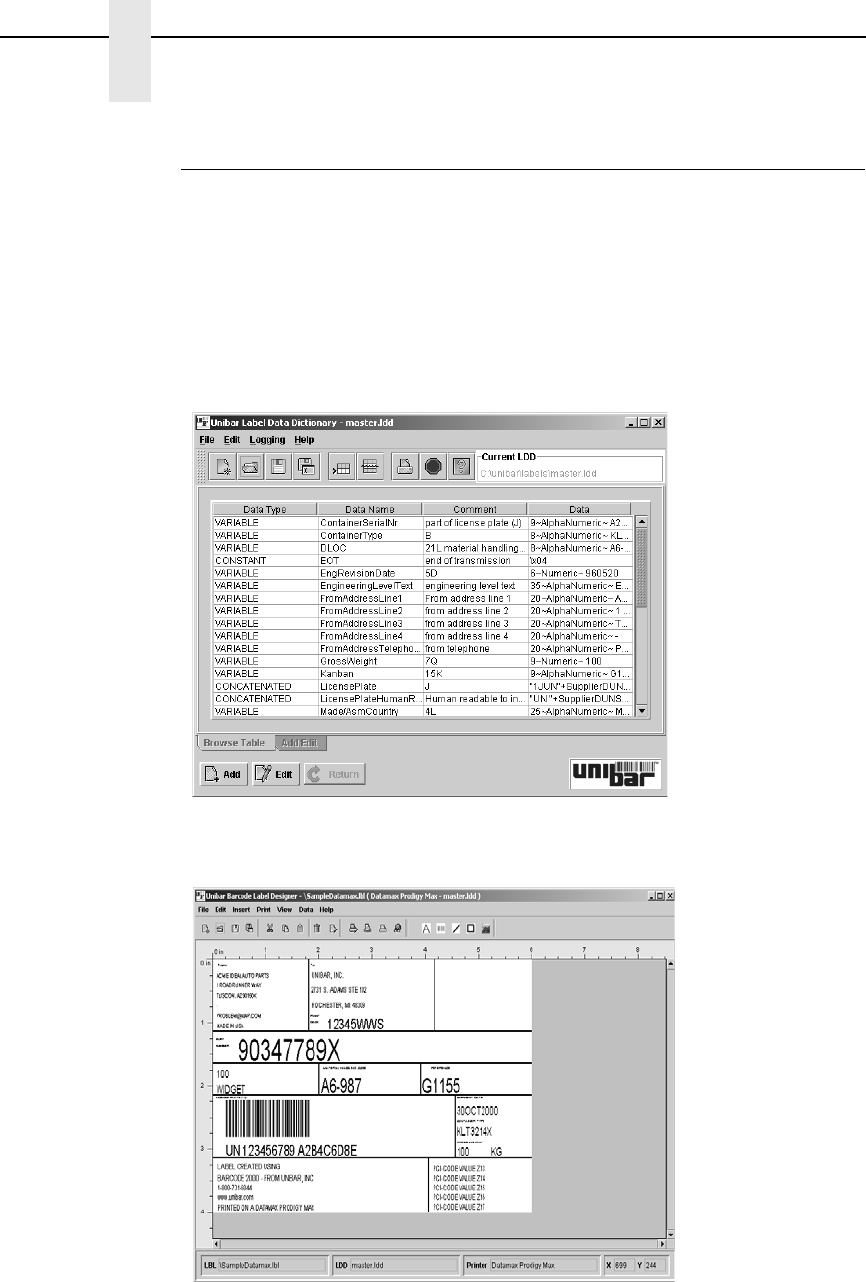
Figure 1. Easily define your data format using the Label Data Dictionary (LDD) component
Figure 2. Point, Click, Drag and Drop all the fields on the label
BARCODE 2000 XML DIRECT Components
23
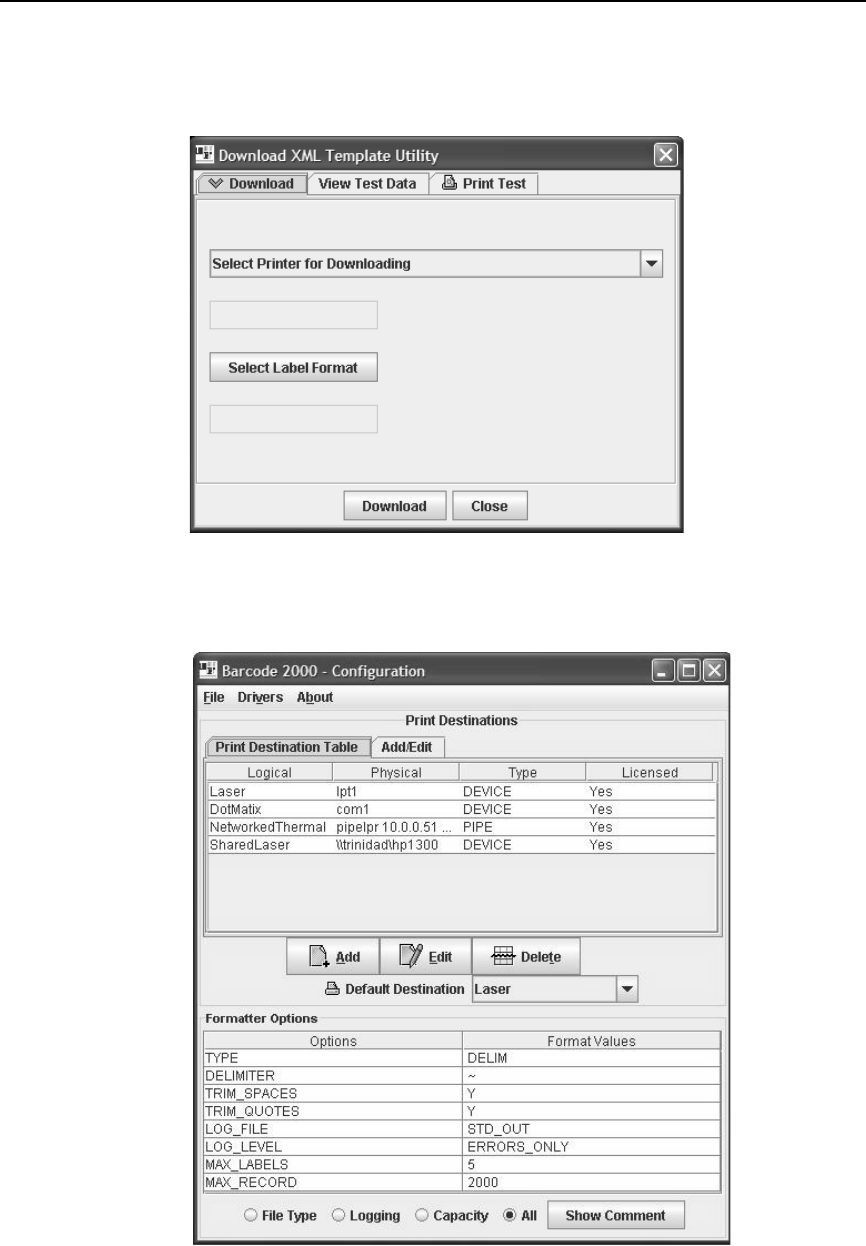
Figure 3. Download label formats to an XML enabled printer using the Download Template
Utility (DTU)
Figure 4. Set up printer destinations easily in the Configuration Tool
24
Chapter 4
Using BarCode 2000 XML Direct
Introduction to Label Data Dictionary
Purpose
The LDD stores all your data variables, concatenations and other special
fields. The field type determines the operations to be performed by the
Formatter when printing. In order for you to use a variable in a label template,
it must be defined in the LDD you have created for the label template.
NOTE: You can create one LDD for each label template or create a global
LDD that can be used with all your label templates.
Menu Bar
The menu bar is located at the top of the LDD main window. This menu bar is
similar to other menu bars found in most Windows and Java applications.
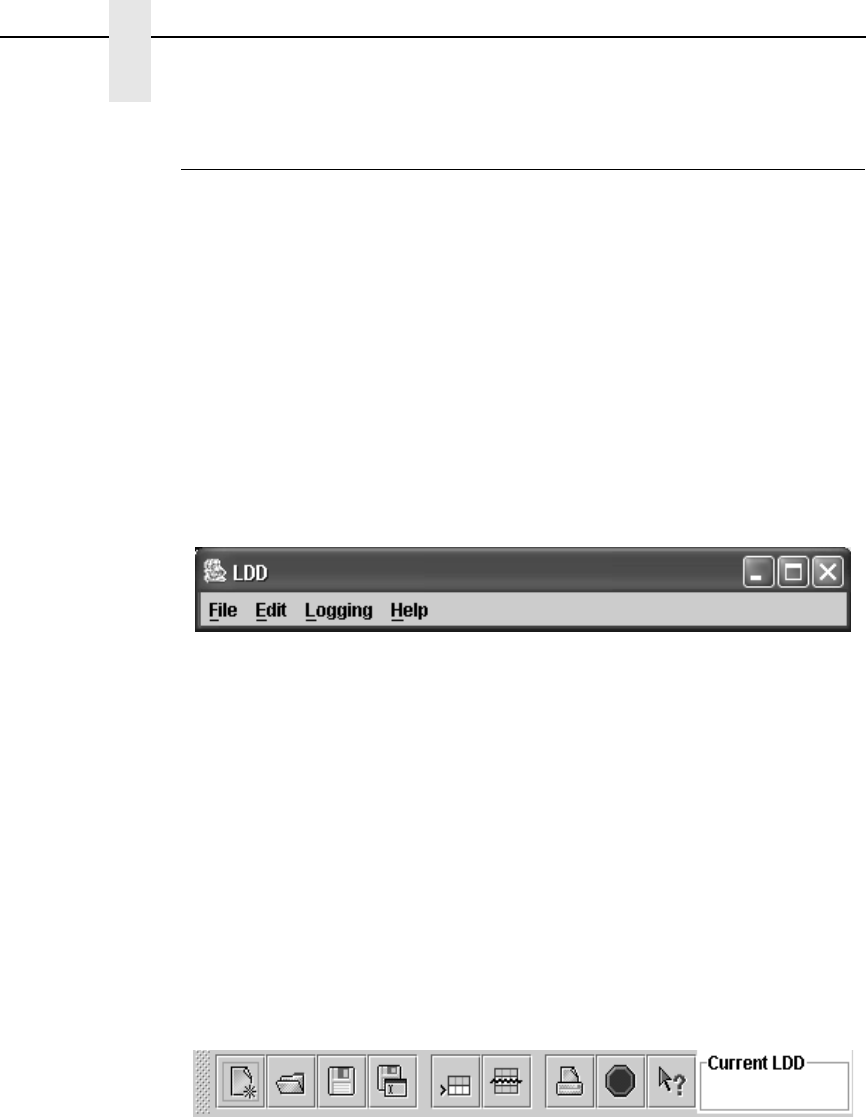
Figure 5. LDD Menu Bar
File To create, open, and save LDD files; print contents of the LDD;
quit the application.
Edit Copy and append LDD contents to another LDD file; delete a
field.
Logging Display errors that may occur when loading/saving LDD files.
Help To find help regarding LDD operations; current LDD version
number (About).
Toolbar
The toolbar provides quick and easy access to commonly used menu
commands. The toolbar is located below the menu bar.
Figure 6. LDD Toolbar
New Opens a new blank LDD file
Open Opens an existing LDD file
Save Saves the current LDD to a file.
Save As Saves the current LDD file to a different name.
Append Appends selected rows into another file or a new file.
Delete Deletes the selected row from the LDD
Print Prints the current LDD

Introduction to Label Data Dictionary
25
Quit Exit LDD
Quick Help
Displays short detailed information about the LDD application.
Current LDD
Displays the full path of the current LDD.
Field Types
Constant The constant field is a static field. The data in the ‘Constant
Value’ field will be printed on the label at print time.
NOTE: Constants can also be defined in the LDD rather than using TEXT
fields in the label template. This makes the constant field consistent in
all label templates. It can be changed in the LDD and will immediately
be reflected in all labels templates using the field.
Data Name A unique name for the field.
Constant Value
A alphanumeric value or binary.
Comment A comment about the data in the field.
Variable
This field defines data that changes at print time. An example of a variable
field would be the weight on a shipping label that changes for each box.
Data Name A unique name for the field
Length Maximum length of the field. If the data exceeds the maximum
length set, the remainder of the field will be truncated.
Character Set
Sets the character set of the variable.
Alphanumeric - Characters and digits
Binary - Binary digits only
Hexadecimal - Hexadecimal characters only
Numberic - Digits only
Default Value
Sets a default value that is used only when test printing a label
template in the LDS and when printing from the FDU.
Comment A comment about the data in the field.

26
Chapter 4
Using BarCode 2000 XML Direct
Concatenated
This field is used to combine one or more fields into one single field. An
example of using the concatenated fields would be adding 420 to a zip code
on a label.
Data Name A unique name for the field.
Data List A list of fields you can use to create the concatenated string.
Concatenated String
Displays the concatenated string.
NOTE: You can directly edit the fields and constant data in this area. Using
quotes around the data is assumed to be constant.
Example: “1234”+MyField1+”ABCDE”+MyField2
MyField1 and MyField2 are variable fields set up in the LDD.
Example:
A part number with an identifier of “P” added to the ‘PartNumber’
variable field would look like “P”+PartNumber.
Default Value
Sets a default value that is used only when test printing a label
template in teh LDS and when printing from the FDU.
Comment A comment about the data in the field.
Counter
This field is used to automatically increment/decrement a value of a barcode
or text field on the label template. For example, suppose an order consists of
a set of three cartons, which are numbered 200, 201, and 202. To generate a
set of labels, you set the starting variable to 200 and increment the value by
one and print three copies of the same label. Everything on the label is the
same for each label except the counter field.
Data Name A unique name for the field.
Start Values
Variable List
Choose the field that will have the starting value for the counter.
Enter Number
Enter the starting number of the counter. The counter will start at
this number each time you print the label(s).
Length Specifies the maximum length for the counter. The full length is
used, counters that do not fill the entire length are left padded
with 0’s.
Increment Values
Positive/Negative
Increment or decrement the counter field.
Amount Sets the amount to increment/decrement the value specified in
the Start Values section.

Introduction to Label Data Dictionary
27
Comments, Etc.
Comment A comment about the data in the field.
New Record
Increments/decrements on a new record.
Copies Increments/decrements on a copy of a record.
Reset Resets the counter field.
Examples:
Each line is a record
Checking Copies and Reset and printing three copies of each record would
produce the following results:
“Box 1 of 3”, “Box 2 of 3”, “Box 3 of 3”
“Box 1 of 3”, “Box 2 of 3”, “Box 3 of 3”
“Box 1 of 3”, “Box 2 of 3”, “Box 3 of 3”
Checking only Copies would increment/decrement on each label printed.
Checking only New Record would increment/decrement on each record.
SN00123, SN00123, SN00123
SN00124, SN00124, SN00124
SN00125, SN00125, SN00125
Time
The time field defines a string that you can use in the label template. The
string can be a date, time or both depending on how you format it. The
Formatter, at print time, will retrieve the current system time and date and
format that information into the time string you defined.
Data Name A unique name for the field.
Time Format
A list of time and date formats that can be used to build the Time
String.
Time String
Displays the current format of the date and time for the field.
Comment A comment about the data in the field.
Alias
An alias is just another way to represent a field already defined in the LDD.
This can be useful for mapping a field in a database to a field in the LDD
without changing the original LDD field name.
Data Name A unique name for the field.
Select Data Field to Alias
A list of fields you can use to create an alias to map to.
Comment A comment about the data in the field.

28
Chapter 4
Using BarCode 2000 XML Direct
TXDATA
This field is where you define a map of your data that will be sent to the
Formatter. Since, there are many ways to format your data; Unibar has
created this TXDATA field to meet most of our customers file formats. A Data
Record Format (DRF) can be defined in the Label Data Dictionary. The field
type is “TxData” (for Transaction Data Record Format). In the LDD program,
you specify a TxData name (DR01, if you’re not too creative). This name is
used in the data stream to refer to the DRF. You can add existing variable
names to the TxData and specify their offset and length if you choose a fixed-
length field type of input.
Following is a method that provides ubfmt the capability of finding your
TxData without specifying it in your data file. This was originally provided for
Version 3 users who do not make application changes to upgrade to
Version 6.
1. LDD must be named “<label_name>.ldd”; TxData is named
“TxData.<label_name>”
2. Use one TxData per label or use a master TxData, named
DEFAULT_TXDATA.
3. UBFMT: if no '/DR' is provided (i.e. No TxData), use DEFAULT_TXDATA
if present, else look for a TXDATA named “<label_name>”
Data Name A unique name for the field.
File Format
Delimited/Fixed
Choose to either use a delimited or fixed data. Delimited files
have some sort of field separator (field1~field2~field3). In a fixed
data file, the data is in a fixed position and never changes from
record to record (field1field2field3).
Offset (fixed)
Sets the position of the start of the field in a fixed data file.
Example: data=100120023003
An offset of 5 and a length of 4 would equal ‘2002’
Length (fixed)
Sets the length of the field starting from the offset.
See example in Offset.
Other
Data List A list of you can use to create the concatenated string of the
TXDATA field.
Concat String
Displays the format of the fields used in the TXDATA
Example:
Delimted Format - Field1+Field2+Field3
Fixed Format - Field1:0:5+Field2:6:7+Field3:14:5
Comment A comment about the data in the field.

Introduction to Label Data Dictionary
29
File
This field is to define a graphic file that can be used on a label template.
allows for variable graphics or constant graphics to be used on the label
templates.
Data Name A unique name for the field.
Variable/Constant
Sets the type of file you are using for this field.
File Name - Constant
Sets the path of the file.
Use the absolute path.
Example: C:\mygraphics\pic.pcx or
/usr/mygraphics/pic.pcx
Default - Variable
Sets a default value that is used only when test printing a label
template in the LDS and when printing from the FDU.
Length - Variable
Maximum length of the field. If the data exceeds the maximum
length set, the remainder of the field will be truncated. For this
field type we recommend making the length 50 or greater,
because of the variances in file names that might be used.
Comment A comment about the data in the field.
Substring
This field is used to extract a portion of data from an existing LDD field. An
example of a use of the substring would be to extract the day of the month
from a known format of ‘mm/dd/yyyy’. In which case, you would have a LDD
field defined and the field would contain ‘mm/dd/yyyy’. To extract the day of
the month you would set the Starting Position to 4, Number of Characters to 2
and Horizontal Alignment to Left.
Data Name A unique name for the field.
Select Variable Name
A list of fields you can use to create the substring field.
Starting Position
The starting point of where the substring is to start.
Number of Characters
The number of characters to use in the substring field from the
Starting Position.
Horizontal Alignment
Determines where the Starting Position is to start from.
Example:
If Horizontal Alignment is set to Right then the starting point of the
substring would be the value in the Starting Position counting
from the right.
Default Substring
Sets a default value that is used only when test printing a label
template in the LDS and when printing from the FDU.
30
Chapter 4
Using BarCode 2000 XML Direct
Comment A comment about the data in the field.
Alternate
This field provides a function of replacing the primary source with the
secondary source only if the primary source is empty. For example, suppose
you have fields defined as RetailPrice (primary) and SalePrice (secondary).
If the RetailPrice were empty (blank), then the SalePrice would used.
Data Name A unique name for the field.
Select Primary Source
A list of fields you can use for the Primary Source
Select Secondary Source
A list of fields you can use for the Secondary Source when the
Primary Source is empty.
Default Sets a default value that is used only when test printing a label
template in the LDS and when printing from the FDU.
Comment A comment about the data in the field.
Introduction to Label Design System (LDS)
Purpose
This is where you would define the specifics of the label, such as printer
model, speed, print orientation, etc. This is also the component that you
define your label template by placing fields (barcodes, text, lines, variables
and graphics) on the screen.
Menu Bar
The menu bar is located at the top of the LDS main window. This menu bar is
similar to other menu bars found in most Windows and Java applications.
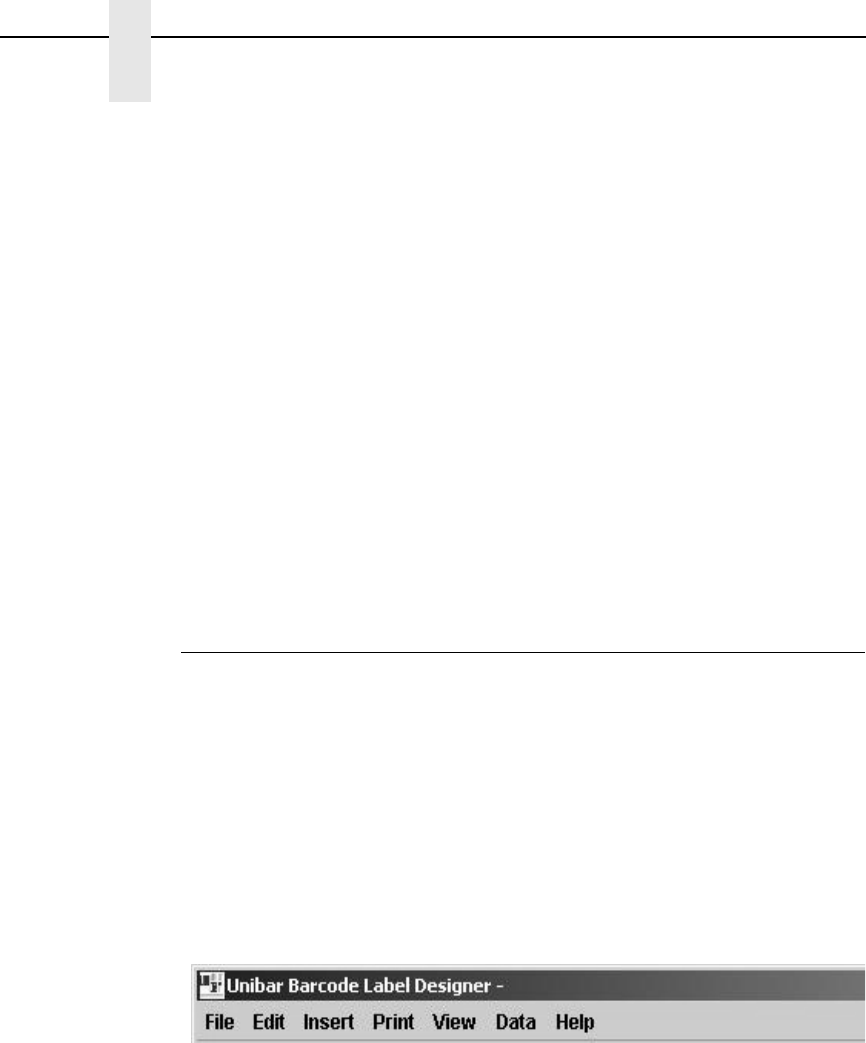
Figure 7. LDS Menu Bar
File To create, open, and close label files; print a sample label; set
printer parameters; print preview current label template; quite the
application.
Edit To cut, copy, and paste label objects; delete label objects;
deselect label objects
Insert To insert the basic label objects; text, barcode, line, rectangle,
and graphics.
Print To print a sample label; set page parameters; set printer
destination; set printer parameters, print preview current label
template.
Introduction to Label Design System (LDS)
31
View To customize the toolbar; toggle the header panel (toolbar) and
the footer (toolbar); see label properties; set label data defaults.
Data To add variabels to the Label Data Dictionary (LDD) attributed to
the current LDD (Label Design Document).
Help To see the version (About) informaiton and to access online help
menu.
Toolbar
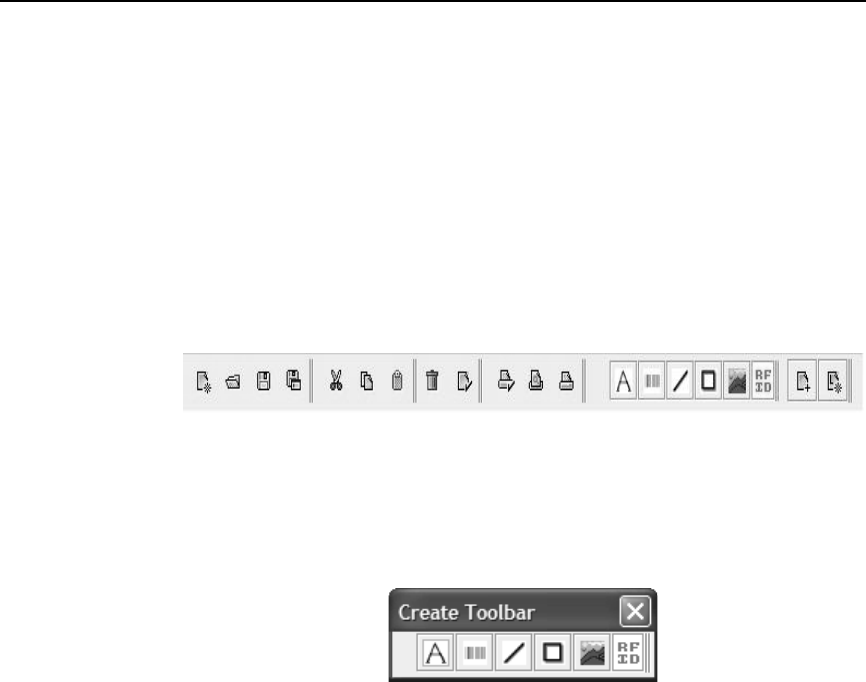
Figure 8. LDS Toolbar
The toolbar provides quick and easy access to commonly used menu
commands. There are currently four (4) toggling toolbars – File, Edit, Print,
and Insert – they toggle (visibly) ‘on’ & ‘off’.
The Create toolbar is detachable from the main bar for easy label making and
designing. This toolbar corresponds to the Insert menu as indicated below.
FILE
The File menu and toolbar share four basic functions: New, Open, Save, and
Save As.
New Label Opens a new blank label template.
Open Label Opens an existing label template.
Close Closes label in window.
Save Saves the current label template to a file.
Save As Saves the current label template to a different file name.
Print Preview
Brings up the Print Preview box.
Print Prints the current label.
Exit Exits the IDS

32
Chapter 4
Using BarCode 2000 XML Direct
EDIT
The Edit Menu and toolbar share three basic functions: Cut, Copy, and Paste;
additional functions include Delete and Deselect.
NOTE: Both the Edit and Insert menus are available as a right-click menu
item in the Designer.
Edit Field User instructions for editing an existing label object.
Cut Field Performs as a Cut operation, it is the combination of copy and
delete. If a paste operation does not follow a cut operation, the
item is lost.
Copy Field Performs as a Copy operation. If a paste operation does not
follow a copy operation, the item is lost by the next action
involving a cut or copy.
Paste FieldSingle action paste, must follow a cut or copy operation, multiple-
pasting is not supported. The object pasted will be set to the last
visual coordinates of the cursor, immediately prior to the call of
the paste function.
Select Field
User instructions for selecting a label object.
Deselect Field
User instructions for releasing a previously selected label object.
Delete Field
Deletes any label object from the template permanently, after
confirmation.
PRINT
Page Setup
Displays the page setup dialog box.
Print Preview
Displays the label template and sets the rotation for the entire
label template, the current template can be printed to the current
print destination from here.
Print Selects which printer the current label template will be sent for
printing. Sends sample label to the currently selected printer.
Print Mapping
Allows the user to map existing label template from one printer to
another.

Introduction to Label Design System (LDS)
33
VIEW
Set Label Data View
Set the visible label objects in three ways: 1. Field Names, 2.
LDD Data default values, or 3. LDD maximum lengths.
Toolbars
File Toolbar Click check box if you want it to display.
Edit Toolbar Click check box if you want it to display.
Print ToolbarClick check box if you want it to display.
Insert ToolbarClick check box if you want it to display.
Properties
Label Properties
Displays the label properties dialog box if the label
is selected. Displays the Label Object Properties
dialog if that object is selected.
Toolbar Click check box if you want it to display.
Status Bar Click check box if you want it to display.
INSERT
Inserts the chosen Label Object at the visual coordinates of the design space
immediately following the button press of the selected object.
Text Create a text or data field.
Barcode Create a barcode field.
Line Create a vertical or horizontal line.
Rectangle Create a rectangle.
Graphics Add a graphic.
RFID Add an RFID tag.
DATA
Add LDD Entry
Add a Variable to the existing Data Dictionary without opening the
LDD application.
New LDD Creates a new empty Label Data Dictionary, without opening the
LDD application.
HELP
Help Opens context based help.
About Indicates the current version of the utility and OEM contact
information.
34
Chapter 4
Using BarCode 2000 XML Direct
Label Properties
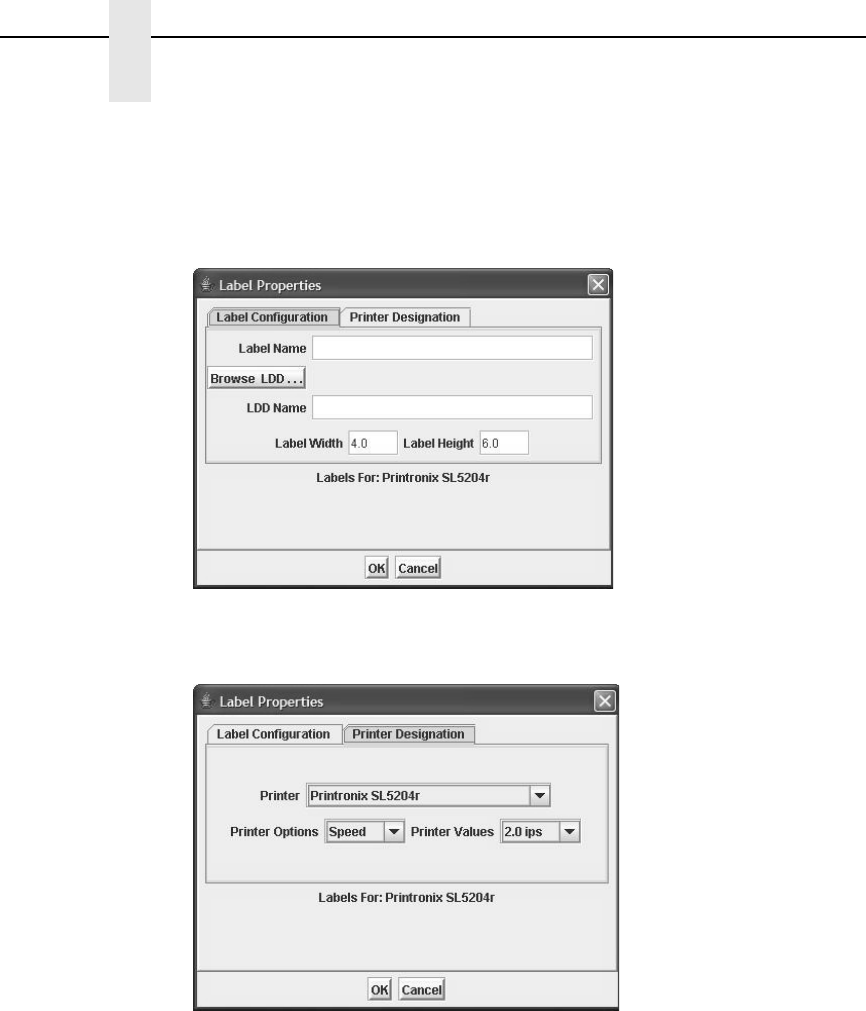
The Label Properties window allows you set the label specifics such as the
name of the label, printer model, printer speed and label dimensions.
Figure 9. Label Configuration Screen
Figure 10. Printer Designation Screen
Label Name
Defines the filename for the label template.
LDD Name Defines the LDD file that will be used for the label tempalte. Use
the Browse button to select a current LDD file.
Printer Sets the printer model for the label template. Once the printer is
chosen for that label template it cannot be changed.
Printer Operations
Set certain printer options for the label template.
NOTE: As of the version 7.0 release, only the printer speed options can be
set. As more printer options are implemented the printer options list
will reflect those additions.
Introduction to Label Design System (LDS)
35
Printer Values
Displays and sets the value(s) corresponding to the printer
options.
Label Width
Sets the width of the label template. Example: 4.0 equals 4
inches.
Label Height
Sets the height of the label template in inches. Example: 6.0
equals 6 inches.
Printer Destination Dialog
Printer Destination sets the system printer for the Print events in
BarCode2000. The current label template will print to the selected destination.
Destinations are set in the Printer Configuration Utility.
Figure 11. Selecting a Destination Printer
Default Printer
Sets the default printer LDS will use when printing a test label.
This field is populated from entries in the BC2000.cfg file that is
set up by using the Config component.
36
Chapter 4
Using BarCode 2000 XML Direct
Label Data Defaults Dialog
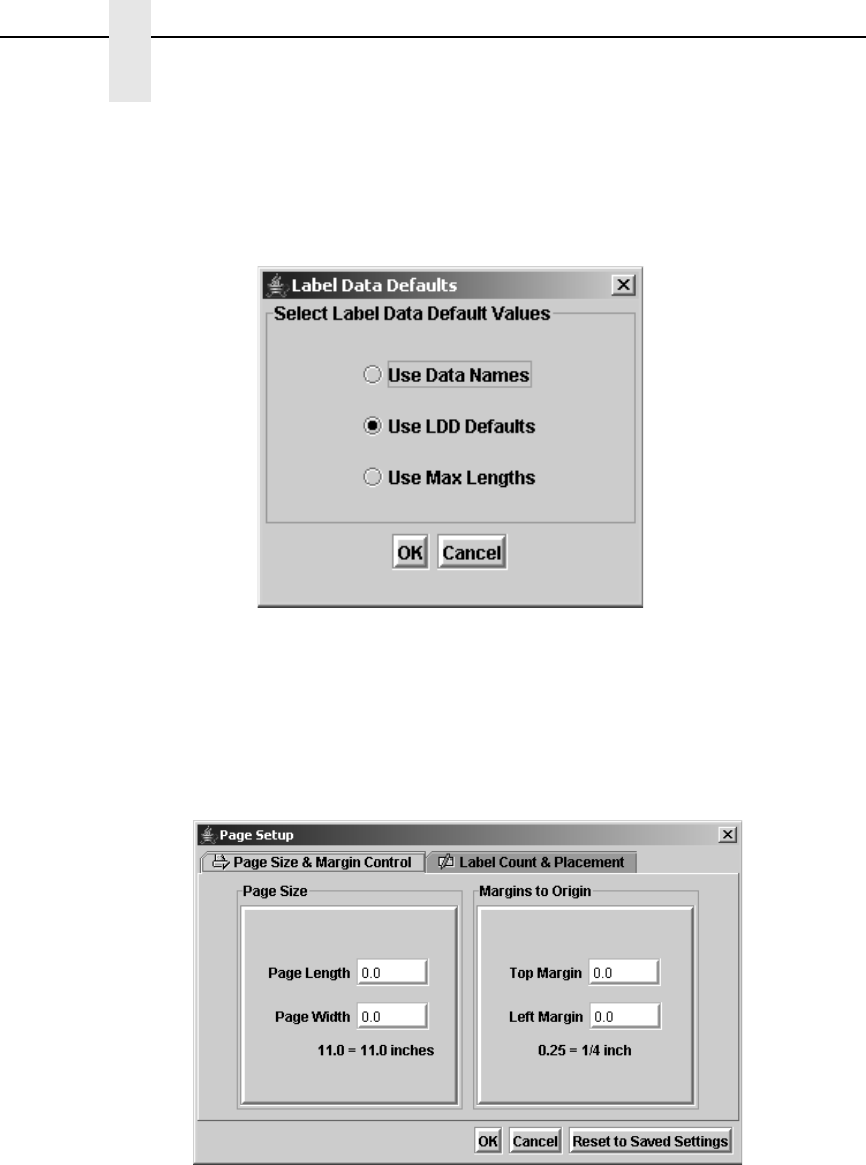
This dialog allows the label designer to choose the form that DATA fields are
displayed and printed.
Figure 12. Selecting Label Data Default Values
Page Setup Dialog
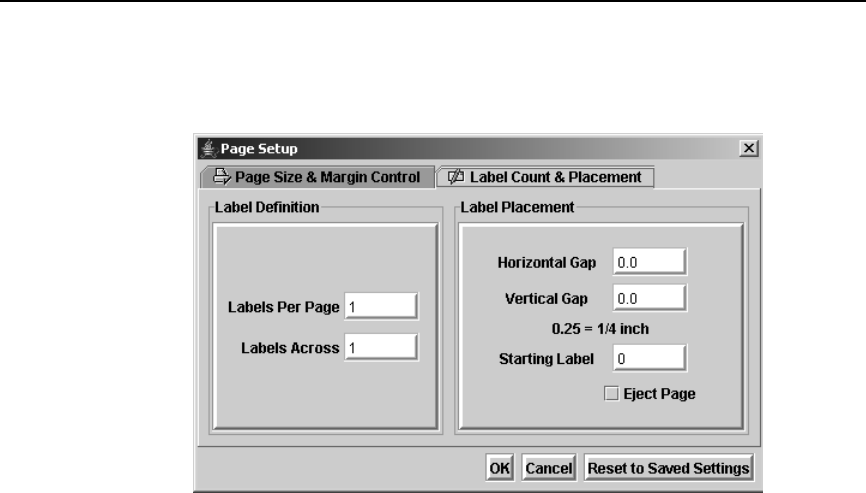
The settings in this area include margins, labels per page and across, LDS
default printer and how LDS uses the default data in the LDD.
Figure 13. Page Size and Margin Control
Introduction to Label Design System (LDS)
37
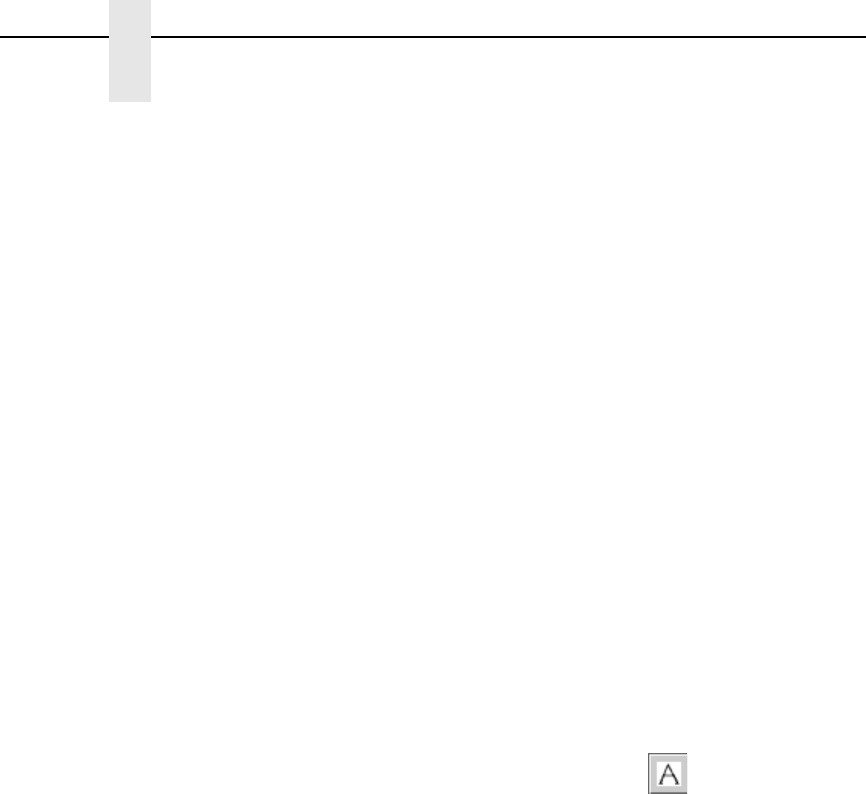
Figure 14. Label Count & Placement
Use LDD Defaults/Use Maximum Length
This determines what data is printed for the test label when
printing from LDS. The ‘Use LDD Defaults’ setting will use the
value specified in the Default box of that specific field in the LDD.
The ‘Use Maximum Length’ setting will use characters and/or
digits for the data to give you a better sense of the maximum
length of the field when printed.
Top Margin
Sets the top margin for the label template. Example: 1.25 equals
1 1/4 inch.
Left Margin
Sets the left margin for the label template. Example 1.50 equals
1 1/2 inch.
Page Width
Sets the overall width of the page. This setting is used when
printing to Avery label sheets (address labels, etc.)
Example: 11.0 equals 11 inches.
Page Length
Sets the overall length of the page. This setting is used when
printing to Avery label sheets (address labels, etc.)
Example: 8.50 equals 8 1/2 inches.
Labels Per Page
Sets the number of labels on the label stock. This setting is used
when printing Avery label sheets (address labels, etc.)
Labels Across
Sets the number of labels across the label stock. This setting is
used when printing Avery label sheets (address labels, etc.)
38
Chapter 4
Using BarCode 2000 XML Direct
Horizontal Gap
Sets the distance, horizontally, between the individual labels on
the label template. This setting is used when printing to Avery
label sheets (address labels, etc.). Example: 0.25 equals 1/4
inch.
Vertical Gap
Sets the distance, vertically, between the individual labels on the
label template. This setting is used when printing to Avery label
sheets (address labels, etc.). Example: 0.25 equals 1/4 inch.
Starting Label
Sets the starting label on a page at print time. This setting is used
when printing to Avery label sheets (address labels, etc.).
Example: If set to 5, then the first 4 labels would not print. This is
useful if you have left over labels on a sheet that can be used,
instead of discarding the used sheet.
Eject Page Determines whether or not to print a black page after each label
also known as a Form Feed.
Field Types
Default Label objects consist of Text/Data Strings, Barcodes, Lines,
Rectangles, and Graphics. All default label objects can be placed on the
template via menu bar, toolbar, or right-click menu.
Text
To add a text field to the label template, Click on the button, and then
click on the label template in the vicinity where you want to add the text field.
Field Name
This is a unique identifier for this field.
Example: TEXT1 or TEXT2
Every time the field is added to the label template the number
after the field name increases by one.
Font Types
Select the font for the particular field. The fonts listed are all the
fonts available to the particular printer model for which you are
designing.
NOTE: As of this current release, BARCODE 2000 XML DIRECT only
supports native fonts.
Scalable Fonts
Represented by True Type Fonts in the Designer if
available. The fonts are scalable via height and
width designations, typically both height and width
are represented in points.
Limited Fonts
Represented by a San Serif Family Font in the
Designer. The Limited fonts are old and typically
inaccurate. The printer manufacturers would prefer
you to use the newer Scalable Fonts.

Introduction to Label Design System (LDS)
39
Point – Limited Fonts
Sets the font size.
Height – Scalable Fonts
Sets the height of each character in points.
Width – Scalable Fonts
Sets the width of each character in points.
CPI – Limited Fonts (Character Per Inch)
Sets the characters per inch for the font. The larger the number
the denser the font will look when printed and vice versa.
NOTE: When selecting the point size, Unibar automatically choose the
recommended CPI. Fonts that do not support CPI is set to N/A.
Barcode
To add a barcode field to the label template: Click on the button, and
then click on the label template in the vicinity where you want to add the
barcode field.
Field NameThis is a unique identifier for this particular field.
Example: BARCODE1 or BARCODE2
Every time the field is added to the label template the number
after the field name increases by one.
Name A list of fields from the LDD, you can use for the barcode field.
Symbology
Sets the type of encoding for the field.
NOTE: This setting is printer dependent. Symbologies that are available for
the particular printer model chosen for the label template will only be
shown.
Human Readable
Set to Above, Below or None. This sets how the data encoded is
displayed for this field.
NOTE: This setting is printer dependent. Some printer models do not support
human readable as an option for the barcode. In this case we
recommend you place a Data field containing the data encoded
where you want the human readable to print.
Checksum This sets a property to either include the checksum or not to
include the checksum. The checksum is a character/digit that is
included as part of the barcode by a mathematical calculation
provided from the symbology specifications. It is used to perform
a check to ensure the data is read correctly.
Ratio Sets the wide-to narrow bar ratio. Range (2.0 to 3.0, in .1
increments) Example: Ratio set to 2.0 means the wide bars of the
barcode are twice as wide as the narrow bars.
Length Displays the maximum number of data set for the Name field in
the LDD.

40
Chapter 4
Using BarCode 2000 XML Direct
Density This setting, conjunction Ratio, determines the width of the
barcode. The setting is displayed in mils. The lower the number
(5.0 mils) the smaller the barcode. The range is from 5.0 to
120.0, in .5 increments).
NOTE: The setting is dependent on the DPI (dots per inch) of the printer
model. If you choose a density that the printer is incapable of
printing, then the density will be set to the nearest printer dot.
Rotation Sets the degree of rotation for the field.
X Position/Y Position
Displays the current location of the Barcode field using the lower-
left corner as the starting point. The units are displayed in
1/100th of an inch (100 equals 1 inch). After the field has been
placed on the label template, use this setting to make your fine
adjustments.
Height Sets the height of the barcode. The units are displayed in 1/100th
of an inch (50 equals 1/2 inch).
Bold/Italics/Underline
Sets a certain attribute for the field. Any combination can be
turned on or off to achieve the desired effect for the text field.
NOTE: Printer models that do not support one or more of the text attributes
will be grayed out.
Reverse Video
Sets the reverse video text attribute to either on or off.
NOTE: Printer models that do not support one or more of the text attributes
will be grayed out.
Rotation Sets the degree of rotation for the field.
Text/Data Sets the text field to either static data (text) or variable data
(data).
String Value
If the field is set to Text, then the string value is the static digits/
characters you want to print on the label template. If set to Data,
then use the dropdown box to select a field from the LDD to place
on the label template.
X Position/Y Position
Displays the current location of the Text/Data field using the
lower-left corner as the starting point. The units are displayed in
1/100th of an inch (100 equals 1 inch). After the field has been
placed on the label template, use this setting to make fine
adjustments.
Introduction to Label Design System (LDS)
41
Vertical/Horizontal Line
To add a line to the label template: Click on the button and then click-
and-drag your cursor up and down either for a vertical line or left to right for a
horizontal line.
Field Name
This is a unique identifier for this particular field.
Example: HLINE1 or VLINE2. Every time the field is added to the
label template the number after the field name increases by 1.
Start X/Start Y
Displays the starting coordinates of the line field. The units are
displayed in 1/100th of an inch (100 equals 1 inch). After the field
has been placed on the label template, use this setting to make
fine adjustments.
End X/End Y
Displays the ending coordinates of the line field. The units are
displayed in 1/100th of an inch (100 equals 1 inch). After the field
has been placed on the label template, use this setting to make
your fine adjustments.
NOTE: Horizontal lines only allow you to change the ‘End X’ coordinate and
the Vertical lines only allow you to change the ‘End Y’ coordinate.
Line Width Sets the thickness of the line. Example: 0.75 inches will create a
line that is 3/4 inch thick.
Height Sets the height of the barcode. The units are displayed in 1/100th
of an inch (50 equals 1/2 inch).
Rectangle
To add a rectangle to the label template: Click on the button and then
click-and-drag your cursor either to the approximate size of the rectangle you
want to create.
Field Name
This is a unique identifier for this particular field.
Example: RECTANGLE1 or RECTANGLE2
Every time the field is added to the label template the number
after the field name increases by 1.
Start X/Start Y
Displays the starting coordinates of the rectangle field. The units
are displayed in 1/100th of an inch (100 equals 1 inch). After the
field has been placed on the label template, use this setting to
make your fine adjustments.
End X/End Y
Displays the ending coordinates of the rectangle field. The units
are displayed in 1/100th of an inch (100 equals 1 inch). After the
field has been placed on the label template, use this setting to
make your fine adjustments.
Line Width Sets the line thickness of the rectangle.
Example: 0.75 inches will create a rectangle that has a line
thickness of 3/4 of an inch.
42
Chapter 4
Using BarCode 2000 XML Direct
Field Name
This is a unique identifier for this particular field.
Example: RECTANGLE1 or RECTANGLE2
Every time the field is added to the label template the number
after the field name increases by 1.
Start X/Start Y
Displays the starting coordinates of the rectangle field.
The units are displayed in 1/100th of an inch (100 equals 1 inch).
After the field has been placed on the label template, use this
setting to make fine adjustments.
Graphic
To add a graphic to the label template: Click on the button, and then
click on the label template where you want to add the graphic.
Field NameThis is a unique identifier for this particular field
Example: GRAPHIC1 or GRAPHIC2.
Every time the field is added to the label template the number
after the field name increases by 1.
File Name Sets the file to use for this field. The dropdown box will only show
the fields in the LDD that have been set up as a FILE field.
File Type Displays the type of file. (PCX, JPG, etc.)
X Position/Y Position
Displays the current location of the Graphic field using the lower-
left corner as the starting point. The units are displayed in
1/100th of an inch (100 equals 1 inch). After the field has been
placed on the label template, use this setting to make fine
adjustments.
RFID Tag
To add an RFID tag to the label template: Click on the button, and then
click on the label template where you want to add the RFID tag.
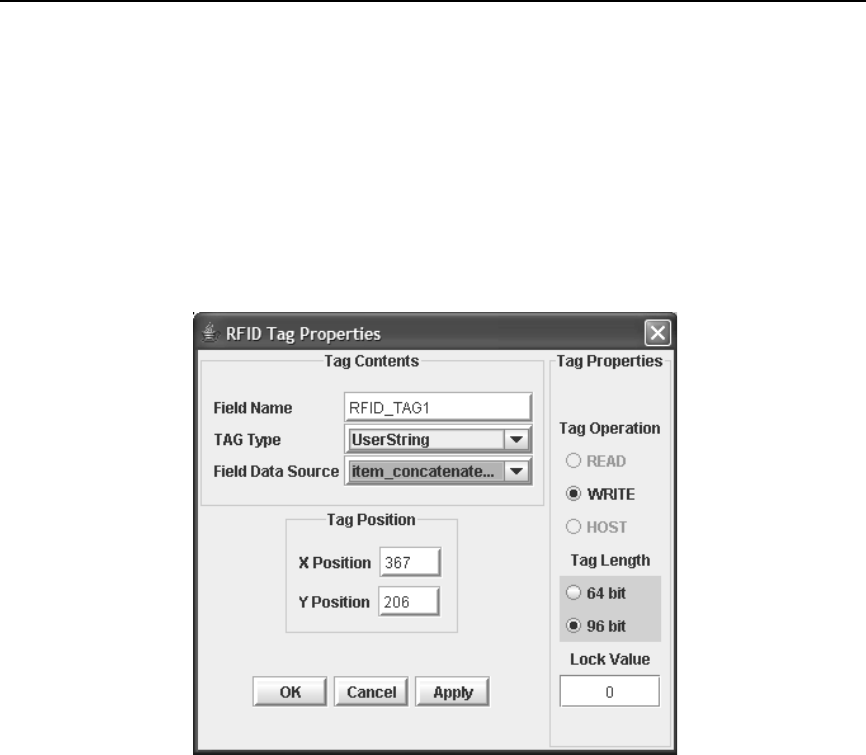
Field Name
This is a unique identifier for this particular field
Example: RFID_TAG1
Tag Type This release supports only a user-defined string, such as
ORACLE MFC provides, which is ready to be sent to the tag
without user changes.
Field Data Source
This is the name (from the current Label Data Dictionary, LDD) of
the STRING being passed (see above) to the tag Tag Operation
This release supports only the WRITE operation.
Tag Length
This release currently supports 64-bit and 96-bit RFID tags.
Lock Value
Optional parameter: Used for protecting data from becoming over
written. By default the data are not protected (value=0). This is
an integer, with values from 0 to 255.
Introduction to Label Design System (LDS)
43
Tag Position: X Position/Y Position
Displays the current location of the RFID Antenna field using the
lower-left corner as the starting point. The units are displayed in
1/100th of an inch (100 equals 1 inch). After the field has been
placed on the label template, use this setting to make fine
adjustments. For design purposes only, to help you avoid placing
other objects over the actual RFID antenna on the tag.
Figure 15. RFID Properties Dialog
44
Chapter 4
Using BarCode 2000 XML Direct
Download Template Utility
Introduction to Downloading Templates
Purpose
The Download Template Utility (DTU) is primarily for sending label formats to
your printer. Select the DTU utility by clicking on the Encode XML-Enabled
Printer tab from the main menu. The user selects both a label format and a
destination printer and directs a download of that format to the chosen printer.
The stored format will accept XML – based label data for printing.
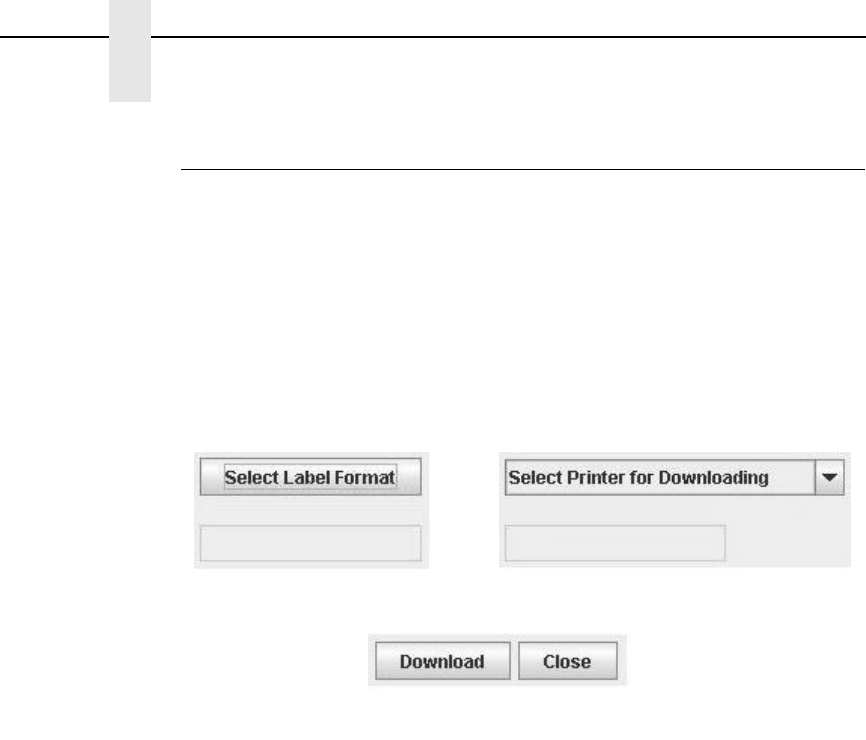
Format Selection
Select any label format for downloading by pressing the button labeled “Select
Label Format”. A file chooser dialog will open to the “labels” directory of your
installation. Select the format you wish to download to your XML-enabled
printer.
Printer Selection
Select any XML-enabled printer for downloading by pressing the list box
labeled “Select Printer for Downloading”. Only XML-enabled printer
destinations configured using the Printer Configuration tool will appear in the
list.
Download
Clicking “Download” requires the above two operations be complete. After the
operation is complete, a dialog will appear to indicate success or failure.
Close
The DTU is a modal dialog. Simply meaning if it is open, none of the other
applications will respond. Clicking the “Close” button returns the focus to the
menu allowing access to the other applications
FDU Select Format
DTU Select Format
DTU Select Printer Destination
DTU Download and Close buttons
Download Template Utility
45
The DTU’s Test Printing Utility
Purpose
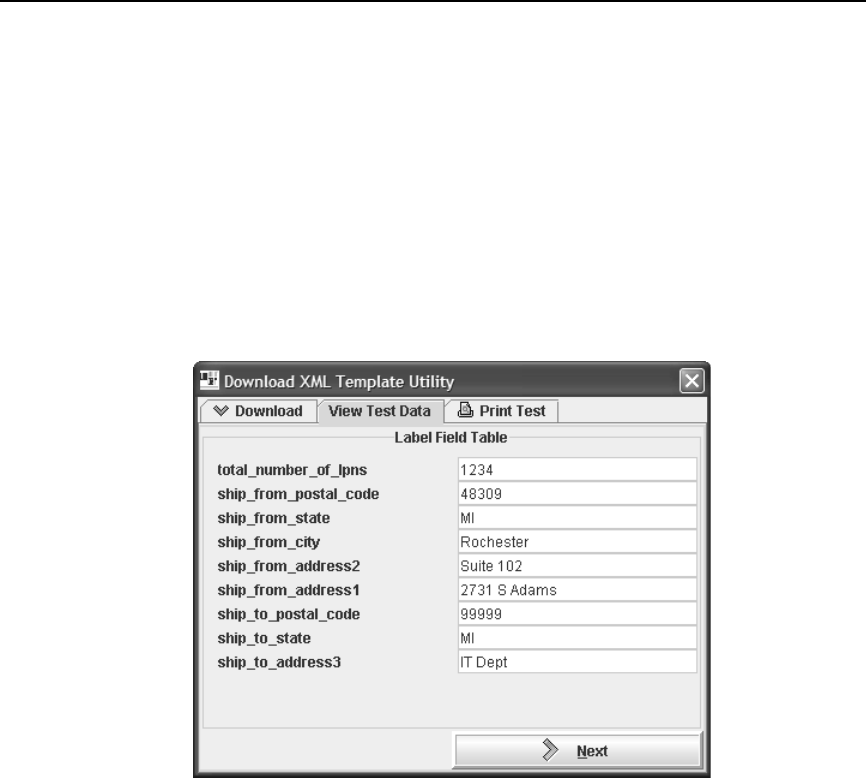
This feature is primarily for testing label formats stored on your printer. The
user has already selected both a label format and a destination printer during
the previous operation. The user views default data by clicking the “View Test
Data” tab. Next and Previous buttons are provided to cycle through all the
default data fields.
Figure 16. The View Test Data tab
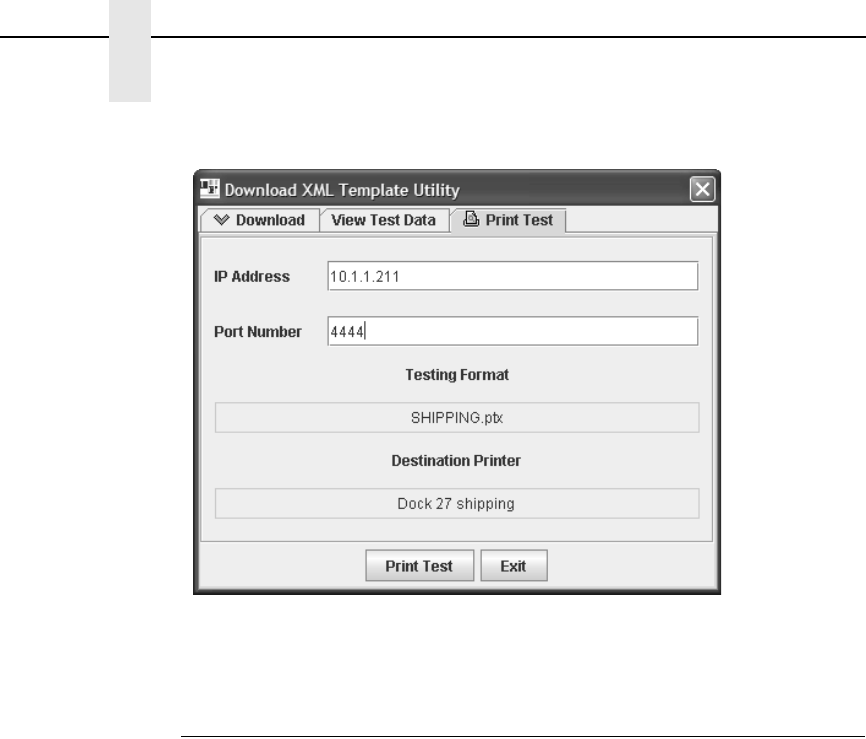
Next, the user may click over to the test print page. After selecting the IP
Address and port number of the selected XML Direct printer, the user may
click the “Print Test” button to send an xml test shot to the printer.
46
Chapter 4
Using BarCode 2000 XML Direct
Figure 17. Pre-selected Format and XML Direct Printer with Destination IP Address and Port
Number
Print Config
Introduction to Configuration Tool
Purpose
This operation allows you set the printers, error options, delimiter, and other
options used when printing. This tool modifies the BC2000.cfg file, which is
located in the Unibar base directory.
Print Config
47
Menu Bar
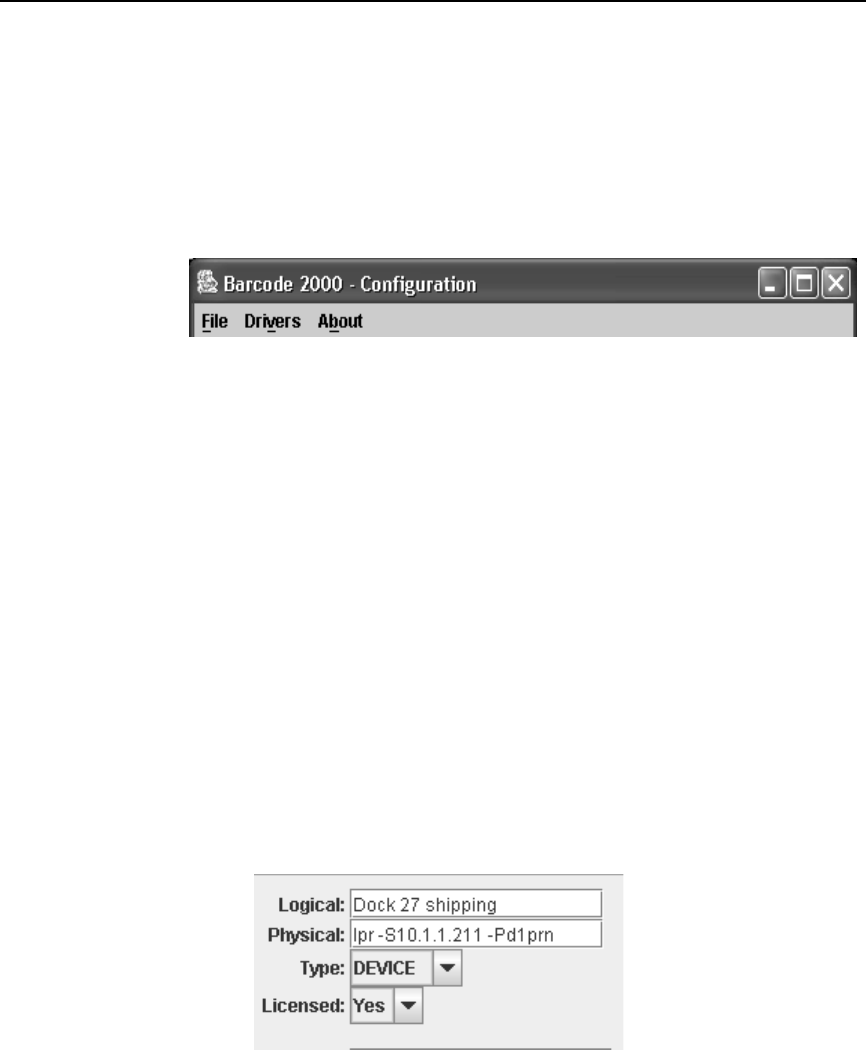
The menu bar is located at the top of the Configurations main window. This
menu bar is similar to other menu bars found in most Windows and Java
applications
Figure 18. Configuration Menu Bar
File Save the current settings to the BC2000.cfg file; Exit the
Configuration application.
Drivers A dialog opens which displays a list of printer drivers both
available and installed.
Open Driver Selection
To add a printer driver to the Installed section, double-click the
driver name. To remove the printer driver from the Installed
section, double-click the driver name.
About Displays the current Configuration version number
Print Destination Table
This section allows you to define the printers that the Formatter is going to
use at print time. Each printer definition consists of a logical name, physical
name, the type of output expected and licensing (See the Configuration File &
Print Destination Table section for more information on the Print Destination
Table).
Figure 19. Configuration Tool
Logical Sets the name assigned by the user to the printer by which the
user refers. It can be any name, such as ACCOUNTING or
DOCK_10. It is a text string of up to 40 characters.
NOTE: The Logical parameter cannot contain any command line delimiters
(space, comma, equal sign, and slashes) because it may be used in
the command line.

48
Chapter 4
Using BarCode 2000 XML Direct
Physical The meaning of the ‘Physical’ name depends on the destination
type. For DEVICE, it is the device name. For FILE, it is the file
name. For PIPE destinations, Physical name is the shell
command line passed to the system when opening the pipe
stream.
Example:
Type = FILE Physical = /usr/MyOutput.fil
Type = DEVICE Physical = LPT1
Type = PIPE Physical = lp –d Myprinter
Type Describes how the output is handled. The output from the
Formatter can be handled one of three ways:
DEVICE - is used for writing directly to I/O devices such as
/dev/lp0, /dev/tty1a, etc.
FILE - is used to write to files
PIPE - is used to specify a pipe command string
(commonly used in Unix systems to pipe the output
to the lp print command).
Licensed Sets the printer definition to Yes’ or ‘No. If Licensed is set to Yes
then it will be moved to the top of list in alphabetical order.
NOTE: You are able to have as many printer destinations as you wish, but
you can only use the number of license printer destinations that you
purchased. The license key determines the nu mber of usable printer
destinations. LocalFile is always an active printer destination.
Default Destination
This specifies the default printer by its Logical name.
Print Config
49
Formatter Options
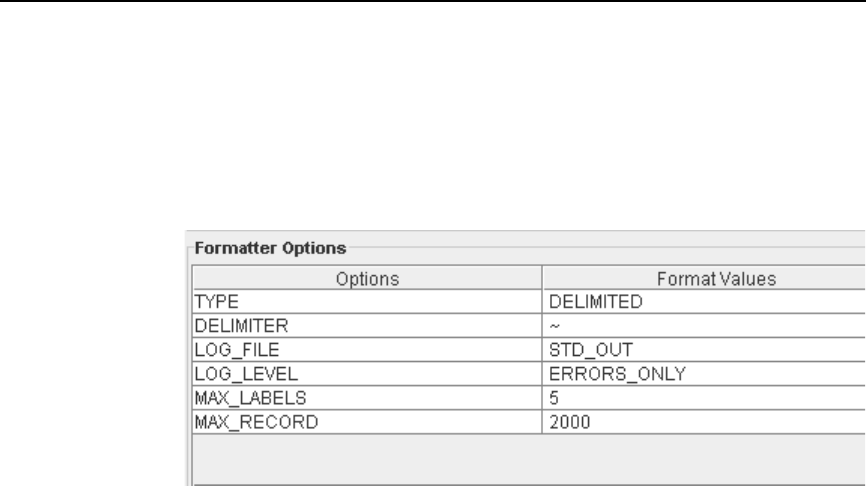
This section is for setting options that are available at print time. They can be
edited by double-clicking the option row which is to be changed.
Figure 20. Formatter options, from the Configuration Tool
Type Sets the classification of data that will be sent to the Formatter.
There are only two possibilities, delimited or fixed. Delimited data
has a field separator (field1~field2~field3). In fixed data, the data
is in a fixed position and never changes from record to record
(field1field2field3).
Delimiter If the Type is set to delimited, sets the delimiter used in the data.
The delimiter should be a unique character/symbol. Unibar
recommends using a ‘~’ (tilde) for a delimiter. Other possible
delimiters could be a tab, !, @, etc.
Trim_Spaces
This setting is either Y or N. If set to Y, then the Formatter will
remove the leading and trailing spaces that are in a field.
Example: Data = {space}{space}001234
Print = 001234 (notice no spaces in the front of the data)
Trim_Quotes
This setting is either Y or N. If set to Y, then the Formatter will
remove the leading and trailing quotes (“) for that field.
Example: Data = “Field 1”,”Field 2”,”Field 3”
Converted to: Field 1,Field 2,Field 3
Log_File This determines how the Formatter reports errors encountered.
For example if the ‘LOG_FILE’ is set to STD_OUT, the all errors
will be reported to standard out. This setting could be a filename
where errors are written to.
Log_Level Sets the error log level when the Formatter is running.
NOTE: Should be set to ERRORS_ONLY unless instructed by Unibar’s
technical support staff.
50
Chapter 4
Using BarCode 2000 XML Direct
Max_Labels
Sets the number of different label templates that will be loaded in
a printer memory at one time. For example, if set to 5, then on the
6th distinct label type encountered during a single print job, the
constant part of the labels and graphics will be deleted from the
printer memory.
NOTE: This setting will be ignored if the printer does not support storing
labels in the printer memory.
Max_Record
Sets the maximum length of a data record being sent to the Label
Formatter. Records longer than this will have truncated data.
If the truncated data is needed data incomplete labels may be
printed.
BARCODE 2000 XML DIRECT File Types
Included with this software is a complete list of all files shipped with this
program. If you should incur certain error messages, you may wish to verify
against that list to ensure that critical files have not been inadvertently deleted
from your system.
The following identifies the role of each file type in the operation of this
program.
Executable files (no extension)
Executable files are the heart of the program. They provide the command
information to the computer. Any damage to these files may require
reinstallation of the entire program.
.lbl
Files with the .lbl extension are label template files.
.ldd
Files with the .ldd extension are Data dictionary files. The LDD creates these
files, where you can set the parameters and save them. There is a “Master”
LDD set up in BC2000 as an example.
.cfg
Files with the extension .cfg are config files. A BC2000.cfg file is delivered
with the install of your software. The BC2000.cfg file updates every time
changes occur in the Configuration.
.pcx
PCX files are used for graphic information, such as logos. We have included
several versions of the Unibar logo for your practice use.
Configuration File & Print Destination Table
51
printers.typ, printers.lst and printcap.dat
These critical files allow the program to identify the specific features available
with your printer type.
Configuration File & Print Destination Table
You can use an editor to edit the configuration file manually. This section will
explain how to setup the configuration file. The BARCODE 2000 XML
DIRECT Configuration File, BC2000.cfg, contains configuration data for the
site. It is stored in the “unibar base directory”. Normally, the Java BARCODE
2000 XML DIRECT Configuration Module updates it. However, if the Label
Formatter is running on a system without a Java runtime the user can change
the file with any text editor.
The file is delivered with examples of all possible settings, many of which are
commented out. The user will often be able to make changes simply by
commenting out lines or un-commenting lines. *.cfg files should always be
saved in text (ASCII) format.
General Format
The pound sign ‘#’ is used as a comment delimiter. When placed on a line in
BC2000.cfg, the remainder of the line is ignored.
The file is divided into sections. For example, the Printer Destination Table
section, shown below describes the printer destinations configured for the
site.
Each section begins with a header in square brackets. The section continues
until either a new section header is encountered or the end of the file is
reached.
Each section consists of a set of elements. A simple element sets one value,
for example “DEFAULT=Shipping”. A complex element consists of a set of
simple elements. For example, the complex element PRT_DEST consists of
three simple elements, as shown below in the Printer Destination Table
section.
Printer Destination Table
The output of the BARCODE 2000 XML DIRECT programs (Designer,
Formatter …) is a print stream that can be sent to one of three types of
destinations:
1. Sent directly to a device, (e.g., “/dev/lp0”)
2. Piped to a program, (e.g., “lp -d LabelPrinter”)
3. Written to a file
The user can define a number of printer destinations in BC2000.cfg. Each
entry consists of a logical name, a physical name and a destination type. This
provides a way to use a simple logical name to refer to a someTimes New
Roman-complex physical destination (such as “lp -d LabelPrinter -m -q 3 -s “).

52
Chapter 4
Using BarCode 2000 XML Direct
This also provides a way to change physical printer destinations without
changing the application program. Simply update the BC2000.cfg file and the
applications and operators continue to use the logical names they used
before.
To print to a particular printer destination, the user specifies the logical name
of that printer. If no logical printer is specified, the program uses the default as
specified in the BC2000.cfg file.
The format of the Printer Destination Table section is as follows:
[Print Destination Table]
PRT_DEST =
{
Logical = Shipping
Physical = lp -d LabelPrinter
Type = PIPE
# Type = DEVICE
}
PRT_DEST =
{
Logical = Printer3
Physical = \\Network\PTX_SLPA5204r
Type = DEVICE
# Type = PIPE
}
PRT_DEST =
{
Logical = Receiving
Physical = lp -d LabelPrinter
Type = PIPE
}
DEFAULT = Shipping
[Capacity]
MAX_LABELS=16
MAX_RECORD=2048
The string “[Printer Destination Table]” is the section header. The PRT_DEST
element defines a printer destination.
Logical - is a name assigned by the user and is the name by which users
refer to the printer. It can be any useful name, such as ACCOUNTING or
DOCK_10. It is a text string of up to 40 characters. It cannot contain any
command line delimiters (space, comma, equal sign, slash, etc.) because it
may be used on the command line.
Type - is one of two keywords {DEVICE, PIPE}.
DEVICE - used for writing directly to I/O devices such as /dev/lp0, /dev/
tty1a, etc.
PIPE - used to specify a pipe command string.

Configuration File & Print Destination Table
53
Physical -The meaning of the physical name depends on the destination
type. DEVICE is the device name; FILE is the file name. For PIPE
destinations, ‘physical name’ is the shell command line that is passed to the
system when opening the pipe stream. The command is executed and a pipe
is opened from the Formatter to the program started with the command line.
BARCODE 2000 XML DIRECT does not limit the number of print destinations,
and the number of Logical names. Several Logical names can refer to the
same physical name. This can be quite useful in shielding applications and
operators from the details of printer management. Logical names should not
be duplicated. If they are, the first definition will be used and any subsequent
definitions will be ignored.
The number of physical devices is limited. The program will write to only the
number of physical devices for which the user is licensed. This is
implemented by counting from the top of the Printer Destination Table section;
so, if a user is licensed for five printers, the program will write to the first five
physical print destinations listed in the configuration file.
The DEFAULT element specifies the default printer by its logical name. If no
default is specified, the first entry is taken as the default.
Defining a Delimiter
The Label Formatter can take a logical printer name as a parameter; the
default printer will be used if no parameter is provided.
The Label Designer reads the list of logical names from the BC2000.cfg file
and allows the user to select a printer from that list.
File Type
This section of BC2000.cfg defines a default file type and delimiter for input to
the Formatter. The default built into the Formatter is Delimited file type with a
delimiter character of ‘~’. The defaults can be overridden on the command line
or in a job file.
[File Type]
Type = DELIMITED
#Type=FIXED
DELIMITER =~
#DELIMITER =,
#DELIMITER =.
The file BC2000.cfg must be in the UNIBAR base directory and must have at
least one valid PRTDEST element. If not, the program will not print.
Capacity
This section, in general, the larger the settings the more memory consumed.
Memory for many of these items is allocated up front, for the sake of
simplicity; so it is allocated even if it is not used. Thus, if memory usage is a
concern, you may want to keep these settings on the lean side.
54
Chapter 4
Using BarCode 2000 XML Direct
Max Labels
The number of different label templates that will be loaded in a printer memory
at one time. If this number is 5, on the 6th distinct label type encountered
during a single printing, the constant part of the labels and graphics will be
deleted from the printer memory. New labels and graphics will be loaded until
the max number is reached again.
Max Record (Length)
The maximum length of a data record being sent to the Label Formatter.
Records longer than this will have truncated data. If the truncated data
needed data incomplete labels may be printed.
Unibar Base Directory
BARCODE 2000 XML DIRECT uses the install directory as a base directory
for storing label templates, image files, configuration files, programs, etc.
The default base directory is “/unibar”. The user can change to any desired
directory, but if the directory is changed, the BARCODE 2000 XML DIRECT
programs must be informed. Setting the environment string will identify the
desired directory.
The environment string should be set before the BARCODE 2000 XML
DIRECT programs are run. The commands above can be inserted in a login
script so they are automatically executed whenever the user logs on. If the
BARCODE 2000 XML DIRECT programs cannot properly locate the base
directory, the following error message will be displayed:
“Error - can’t open <base directory>/BC2000.cfg.”
Refer to the “BARCODE 2000 XML DIRECT Configuration File” section for
details on setting up your Printer Destination Table.
Setting the Environment String
UNIX / Linux
$ UNIBAR=/usr/unibar
$ export UNIBAR
NOTE: 'C:\UNIBAR' is the default directory that BARCODE 2000 XML
DIRECT installs in on Windows systems. If you changed the
directory, you must reflect that change in the UNIBAR system
variable.

Unibar Base Directory
55
Windows Systems
1. Go to Control Panel>System.
2. Click the 'Environment' tab. (Under ‘Advanced’ tab for XP).
3. Select 'System Variable' by hitting ALT-V.
4. Select the 'Variable' text box.
5. Type UNIBAR.
6. Select the 'Value' text box.
7. Type C:\UNIBAR (or the path where BARCODE 2000 XML DIRECT was
installed)
8. Click the Set button.
9. Click the OK button.

56
Chapter 4
Using BarCode 2000 XML Direct
57
A
Contact Information
Printronix Customer Support Center
IMPORTANT
Please have the following information available prior to calling the
Printronix Customer Support Center:
•
Model number
•
Serial number (located on the back of the printer)
•
Installed options (i.e., interface and host type if applicable to the problem)
•
Configuration printout:
Thermal Printer
See “Printing A Configuration” in the Quick Setup Guide.
Line Matrix Printer
Press PRT CONFIG on the control panel, then press Enter.
•
Is the problem with a new install or an existing printer?
•
Description of the problem (be specific)
•
Good and bad samples that clearly show the problem (faxing or emailing
of these samples may be required)
Americas (714) 368-2686
Europe, Middle East, and Africa (31) 24 6489 410
Asia Pacific (65) 6548 4114
China (86) 800-999-6836
http://www.printronix.com/support.aspx
58
Appendix A
Printronix Supplies Department
Printronix Supplies Department
Contact the Printronix Supplies Department for genuine Printronix supplies.
Americas (800) 733-1900
Europe, Middle East, and Africa 33 (0) 1 46 25 19 07
Asia Pacific (65) 6548 4116
or (65) 6548 4182
China (86) 400-886-5598
India (800) 102-7869
http://www.printronix.com/supplies-parts.aspx
Corporate Offices
Printronix, Inc.
15345 Barranca Parkway
Irvine, CA 92618
U.S.A.
Phone: (714) 368-2300
Fax: (714) 368-2600
Printronix Inc.
c/o Printronix Nederland BV
Bijsterhuizen 11-38
6546 AS Nijmegen
The Netherlands
Phone: (31) 24 6489489
Fax: (31) 24 6489499
Printronix Schweiz GmbH
42 Changi South Street 1
Changi South Industrial Estate
Singapore 486763
Phone: (65) 6542 0110
Fax: (65) 6546 1588
Printronix Commercial (Shanghai) Co. Ltd
22F, Eton Building East,
No.555, Pudong Av.,
Shanghai City, 200120, P R China
Phone: (86) 400 886 5598
Fax: (86-21) 5138 0564
Visit the Printronix web site at www.printronix.com
179984-001F
*179984-001*
