Pawn Language Guide
Pawn_Language_Guide
User Manual:
Open the PDF directly: View PDF  .
.
Page Count: 194 [warning: Documents this large are best viewed by clicking the View PDF Link!]
- Foreword
- A tutorial introduction
- Data and declarations
- Functions
- The preprocessor
- General syntax
- Operators and expressions
- Statements
- Directives
- Proposed function library
- Pitfalls: differences from C
- Assorted tips
- Appendices
- Index

Pawn
embedded scripting language
The Language
January 2016 CompuPhase

ii
“CompuPhase” and “Pawn” are trademarks of ITB CompuPhase.
“Java” is a trademark of Sun Microsystems, Inc.
“Microsoft” and “Microsoft Windows” are registered trademarks of Microsoft
Corporation.
“Linux” is a registered trademark of Linus Torvalds.
“Unicode” is a registered trademark of Unicode, Inc.
Copyright c
⃝1997–2016, ITB CompuPhase
Eerste Industriestraat 19–21, 1401VL Bussum The Netherlands
telephone: (+31)-(0)35 6939 261
e-mail: info@compuphase.com
WWW: http://www.compuphase.com
This manual and the associated software are made available un-
der the conditions listed in appendix D of this manual.
Typeset with T
EX in the “DejaVu” typeface family.
iii
Contents
Foreword .......................................................... 1
A tutorial introduction .........................................3
Arithmetic and expressions....................................5
Arrays and constants...........................................7
Using functions .................................................8
Rational numbers .............................................13
Strings .........................................................15
Symbolic subscripts (structured data) ......................19
Bit operations to manipulate “sets” .........................22
A simple RPN calculator .....................................25
Event-driven programming ..................................31
State programming ...........................................36
Program verification ..........................................47
Documentation comments ...................................49
Warnings and errors ..........................................56
In closing ......................................................58
Data and declarations .......................................59
State variable declarations...................................59
Static local declarations ......................................60
Static global declarations ....................................60
Stock declarations ............................................60
Public declarations ...........................................60
Constant variables ............................................61
Arrays (single dimension) ....................................61
Initialization ...................................................62
Progressive initiallers for arrays ............................62
Symbolic subscripts for arrays .............................. 63
Multi-dimensional arrays.....................................64
Arrays and the sizeof operator...............................64
Tag names .....................................................65
Functions ........................................................68
Function arguments ..........................................69
Coercion rules.................................................77
Calling functions ..............................................77
Recursion ......................................................78
Forward declarations .........................................79
State classifiers ...............................................80
Public functions, function main ..............................80
Static functions ...............................................81
Stock functions................................................82
iv — Table of contents
Native functions .............................................. 82
User-defined operators .......................................83
The preprocessor ..............................................91
General syntax.................................................95
Operators and expressions ...............................102
Notational conventions .....................................102
Arithmetic ....................................................102
Bit manipulation .............................................103
Assignment...................................................104
Relational ....................................................105
Boolean.......................................................105
Miscellaneous................................................106
Operator precedence........................................107
Statements ....................................................109
Directives ......................................................114
Proposed function library..................................121
Core functions ...............................................121
Console functions............................................125
Date/time functions .........................................129
File input/output.............................................129
Fixed point arithmetic ......................................129
Floating point arithmetic ...................................130
Process and library call interface ..........................130
String manipulation .........................................130
Pitfalls: differences from C................................131
Assorted tips ..................................................134
Working with characters and strings ......................134
Internationalization .........................................136
Working with tags ...........................................139
Concatenating lines .........................................143
A program that generates its own source code ...........144
Appendices ....................................................145
A: Error and warning messages ............................145
B: The compiler ..............................................167
C: Rationale ..................................................173
D: License ....................................................180
Index ............................................................185
1
Foreword
PAWN is a simple, typeless, 32-bit “scripting” language with a
C-like syntax. Execution speed, stability, simplicity and a small
footprint were essential design criteria for both the language and
the interpreter/abstract machine that a PAWN program runs on.
An application or tool cannot do or be everything for all users.
This not only justifies the diversity of editors, compilers, operat-
ing systems and many other software systems, it also explains
the presence of extensive configuration options and macro or
scripting languages in applications. My own applications have
contained a variety of little languages; most were very simple,
some were extensive... and most needs could have been solved
by a general purpose language with a special purpose library.
Hence, PAWN.
The PAWN language was designed as a flexible language for ma-
nipulating objects in a host application. The tool set (compiler,
abstract machine) were written so that they were easily extensi-
ble and would run on different software/hardware architectures.
PAWN is a descendent of the original Small C by Ron Cain and
James Hendrix, which at its turn was a subset of C. Some of the
modifications that I did to Small C, e.g. the removal of the type
system and the substitution of pointers by references, were so
fundamental that I could hardly call my language a “subset of
C” or a “C dialect” any more. Therefore, I stripped off the “C”
from the title and used the name “SMALL” for the name of the
language in my publication in Dr. Dobb’s Journal and the years
since. During development and maintenance of the product, I
received many requests for changes. One of the frequently re-
quested changes was to use a different name for the language
—searching for information on the SMALL scripting language on
the Internet was hindered by “small” being such a common word.
The name change occurred together with a significant change in
the language: the support of “states” (and state machines).
I am indebted to Ron Cain and James Hendrix (and more recently,
Andy Yuen), for their work on Small C and to Dr. Dobb’s Journal
for publishing it. Although I must have touched nearly every line
of the original code multiple times, the Small C origins are still
clearly visible.

2 — Foreword
A detailed treatise of the design goals and compromises is in ap-
pendix C; here I would like to summarize a few key points. As
written in the previous paragraphs, PAWN is for customizing ap-
plications (by writing scripts), not for writing applications. PAWN
is weak on data structuring because PAWN programs are intended
to manipulate objects (text, sprites, streams, queries, . . . ) in the
host application, but the PAWN program is, by intent, denied di-
rect access to any data outside its abstract machine. The only
means that a PAWN program has to manipulate objects in the host
application is by calling subroutines, so called “native functions”,
that the host application provides.
PAWN is flexible in that key area: calling functions. PAWN sup-
ports default values for any of the arguments of a function, call-
by-reference as well as call-by-value, and “named” as well as
“positional” function arguments. PAWN does not have a “type
checking” mechanism, by virtue of being a typeless language,
but it does offer in replacement a “classification checking” mech-
anism, called “tags”. The tag system is especially convenient for
function arguments because each argument may specify multiple
acceptable tags.
For any language, the power (or weakness) lies not in the indi-
vidual features, but in their combination. For PAWN, I feel that
the combination of named arguments —which lets you specify
function arguments in any order, and default values —which al-
lows you to skip specifying arguments that you are not interested
in, blend together to a convenient and “descriptive” way to call
(native) functions to manipulate objects in the host application.
3
A tutorial introduction
PAWN is a simple programming language with a syntax reminis-
cent to the “C” programming language. A PAWN program con-
sists of a set of functions and a set of variables. The variables
are data objects and the functions contain instructions (called
“statements”) that operate on the data objects or that perform
tasks.
The first program in almost any computer language is one that Compiling and run-
ning scripts: page
167
prints a simple string; printing “Hello world” is a classic example.
In PAWN, the program would look like:
LISTING: hello.p
main()
printf "Hello world\n"
This manual assumes that you know how to run a PAWN program;
if not, please consult the application manual or appendix B).
A PAWN program starts execution in an “entry” function∗—in
nearly all examples of this manual, this entry function is called
“main”. Here, the function main contains only a single instruc-
tion, which is at the line below the function head itself. Line
breaks and indenting are insignificant; the invocation of the func-
tion print could equally well be on the same line as the head of
function main.
The definition of a function requires that a pair of parentheses
follow the function name. If a function takes parameters, their
declarations appear between the parentheses. The function main
does not take any parentheses. The rules are different for a func-
tion invocation (or a function call); parentheses are optional in
the call to the print function.
The single argument of the print function is a string, which must String literals: 98
be enclosed in double quotes. The characters \n near the end of
the string form an escape sequence, in this case they indicate a Escape sequence:
97
“newline” symbol. When print encounters the newline escape
sequence, it advances the cursor to the first column of the next
line. One has to use the \n escape sequence to insert a “newline”
into the string, because a string may not wrap over multiple lines.
∗This should not be confused with the “state” entry functions, which are
called entry, but serve a different purpose —see page 39.
4 — A tutorial introduction
PAWN is a “case sensitive” language: upper and lower case let-
ters are considered to be different letters. It would be an error to
spell the function printf in the above example as “PrintF”. Key-
words and predefined symbols, like the name of function “main”,
must be typed in lower case.
If you know the C language, you may feel that the above example
does not look much like the equivalent “Hello world” program in
C/C++. PAWN can also look very similar to C, though. The next
example program is also valid PAWN syntax (and it has the same
semantics as the earlier example):
LISTING: hello.p — C style
#include <console>
main()
{
printf("Hello world\n");
}
These first examples also reveal a few differences between PAWN
and the C language:
⋄there is usually no need to include any system-defined “header
file”;
⋄semicolons are optional (except when writing multiple state-
ments on one line);
⋄when the body of a function is a single instruction, the braces
(for a compound instruction) are optional;
⋄when you do not use the result of a function in an expression
or assignment, parentheses around the function argument are
optional.
As an aside, the few preceding points refer to optional syntaxes.
It is your choice what syntax you wish to use: neither style is
“deprecated” or “preferred”. The examples in this manual po-
sition the braces and use an indentation that is known as the
“Whitesmith’s style”, but PAWN is a free format language and
other indenting styles are just as good.
Because PAWN is designed to be an extension language for appli-
cations, the function set/library that a PAWN program has at its
disposal depends on the host application. As a result, the PAWN
language has no intrinsic knowledge of any function. The print
More function de-
scriptions at page
121
function, used in this first example, must be made available by
the host application and be “declared” to the PAWN parser.†It is
†In the language specification, the term “parser” refers to any implementa-
tion that processes and runs on conforming Pawn programs —either inter-
Arithmetic and expressions — 5
assumed, however, that all host applications provide a minimal
set of common functions, like print and printf.
In some environments, the display or terminal must be enabled
before any text can be output onto it. If this is the case, you
must add a call to the function “console” before the first call to
function print or printf. The console function also allows you
to specify device characteristics, such as the number of lines and
columns of the display. The example programs in this manual do
not use the console functions, because many platforms do not
require or provide it.
Arithmetic and expressions
Fundamental elements of most programs are calculations, de-
cisions (conditional execution), iterations (loops) and variables
to store input data, output data and intermediate results. The
next program example illustrates many of these concepts. The
program calculates the greatest common divisor of two values
using an algorithm invented by Euclides.
LISTING: gcd.p
/*
The greatest common divisor of two values,
using Euclides' algorithm.
*/
main()
{
print "Input two values\n"
new a = getvalue()
new b = getvalue()
while (a != b)
if (a > b)
a=a-b
else
b=b-a
printf "The greatest common divisor is %d\n", a
}
Function main now contains more than just a single “print” state-
ment. When the body of a function contains more than one state-
ment, these statements must be embodied in braces —the “{”
and “}” characters. This groups the instructions to a single com- Compound state-
ment: 109
pound statement. The notion of grouping statements in a com-
pound statement applies as well to the bodies of if–else and loop
instructions.
preters or compilers.
6 — Arithmetic and expressions
The new keyword creates a variable. The name of the variable
Data declarations
are covered in
detail starting at
page 59
follows new. It is common, but not imperative, to assign a value
to the variable already at the moment of its creation. Variables
must be declared before they are used in an expression. The
getvalue function (also common predefined function) reads in a
value from the keyboard and returns the result. Note that PAWN
is a typeless language, all variables are numeric cells that can
hold a signed integral value.
The getvalue function name is followed by a pair of parentheses.
These are required because the value that getvalue returns is
stored in a variable. Normally, the function’s arguments (or pa-
rameters) would appear between the parentheses, but getvalue
(as used in this program) does not take any explicit arguments.
If you do not assign the result of a function to a variable or use
it in a expression in another way, the parentheses are optional.
For example, the result of the print and printf statements are
not used. You may still use parentheses around the arguments,
but it is not required.
Loop instructions, like “while”, repeat a single instruction as
“while” loop: 113
“if–else”: 111 long as the loop condition (the expression that follows the while
keyword) is “true”. One can execute multiple instructions in a
loop by grouping them in a compound statement. The if–else
instruction has one instruction for the “true” clause and one for
the “false”.
Observe that some statements, like while and if–else, contain
(or “fold around”) another instruction —in the case of if–else
even two other instructions. The complete bundle is, again, a
single instruction. That is:
⋄the assignment statements “a = a - b” below the if and “b =
b-a” below the else are statements;
⋄the if–else statement folds around these two assignments and
forms a single statement of itself;
⋄the while statement folds around the if–else statement and
forms, again, a single statement.
It is common to make the nesting of the statements explicit by
indenting any sub-statements below a statement in the source
text. In the “Greatest Common Divisor” example, the left margin
indent increases by four space characters after the while state-
ment, and again after the if and else keywords. Statements that
belong to the same level, such as both printf invocations and the
while loop, have the same indentation.
Arrays and constants — 7
The loop condition for the while loop is “(a != b)”; the symbol Relational opera-
tors: 105
!= is the “not equal to” operator. That is, the if–else instruction
is repeated until “a” equals “b”. It is good practice to indent the
instructions that run under control of another statement, as is
done in the preceding example.
The call to printf, near the bottom of the example, differs from
the print call right below the opening brace (“{”). The “f” in
printf stands for “formatted”, which means that the function
can format and print numeric values and other data (in a user-
specified format), as well as literal text. The %d symbol in the
string is a token that indicates the position and the format that
the subsequent argument to function printf should be printed.
At run time, the token %d is replaced by the value of variable “a”
(the second argument of printf).
Function print can only print text; it is quicker than printf. If
you want to print a literal “%” at the display, you have to use
print, or you have to double it in the string that you give to
printf. That is:
print "20% of the personnel accounts for 80% of the costs\n"
and
printf "20%% of the personnel accounts for 80%% of the costs\n"
print the same string.
Arrays and constants
Next to simple variables with a size of a single cell, PAWN sup-
ports “array variables” that hold many cells/values. The follow-
ing example program displays a series of prime numbers using
the well known “sieve of Eratosthenes”. The program also in-
troduces another new concept: symbolic constants. Symbolic
constants look like variables, but they cannot be changed.
LISTING: sieve.p
/* Print all primes below 100, using the "Sieve of Eratosthenes" */
main()
{
const max_primes = 100
new series[max_primes] = [ true, ... ]
for (new i = 2; i < max_primes; ++i)
if (series[i])
{
printf "%d ", i
/* filter all multiples of this "prime" from the list */
for (new j = 2 * i; j < max_primes; j += i)
8 — Using functions
series[j] = false
}
}
When a program or sub-program has some fixed limit built-in, it is
Constant declara-
tion: 100 good practice create a symbolic constant for it. In the preceding
example, the symbol max_primes is a constant with the value 100.
The program uses the symbol max_primes three times after its
definition: in the declaration of the variable series and in both
for loops. If we were to adapt the program to print all primes
below 500, there is now only one line to change.
Like simple variables, arrays may be initialized upon creation.
Progressive ini-
tiallers: 62 PAWN offers a convenient shorthand to initialize all elements to
a fixed value: all hundred elements of the “series” array are
set to true —without requiring that the programmer types in the
word “true” a hundred times. The symbols true and false are
predefined constants.
When a simple variable, like the variables iand jin the primes
sieve example, is declared in the first expression of a for loop,
the variable is valid only inside the loop. Variable declaration has
its own rules; it is not a statement —although it looks like one.
One of the special rules for variable declaration is that the first
“for” loop: 110 expression of a for loop may contain a variable declaration.
Both for loops also introduce new operators in their third expres-
An overview of all
operators: 102 sion. The ++ operator increments its operand by one; meaning
that, ++i is equal to i = i + 1. The += operator adds the expres-
sion on its right to the variable on its left; that is, j += i is equal
to j = j + i.
There is an “off-by-one” issue that you need to be aware if when
working with arrays. The first element in the series array is se-
ries[0], so if the array holds max_primes elements, the last ele-
ment in the array is series[max_primes-1]. If max_primes is 100,
the last element, then, is series[99]. Accessing series[100] is
invalid.
Using functions
Larger programs separate tasks and operations into functions.
Using functions increases the modularity of programs and func-
tions, when well written, are portable to other programs. The
following example implements a function to calculate numbers
from the Fibonacci series.
Using functions — 9
The Fibonacci sequence was coined by Leonardo “Fibonacci” of
Pisa, an Italian mathematician of the 13th century —whose great-
est achievement was popularizing the Hindu-Arabic numerals in
the Western world. The goal of the sequence was to describe the
growth of a population of (idealized) rabbits; and the sequence
is 1, 1, 2, 3, 5, 8, 13, 21,... (every next value is the sum of its two
predecessors).
LISTING: fib.p
/* Calculation of Fibonacci numbers by iteration */
main()
{
print "Enter a value: "
new v = getvalue()
if (v > 0)
printf "The value of Fibonacci number %d is %d\n",
v, fibonacci(v)
else
printf "The Fibonacci number %d does not exist\n", v
}
fibonacci(n)
{
assert n > 0
newa=0,b=1
for (new i = 2; i < n; i++)
{
new c = a + b
a = b
b = c
}
return a + b
}
The assert instruction at the top of the fibonacci function de- “assert” state-
ment: 109
serves explicit mention; it guards against “impossible” or invalid
conditions. A negative Fibonacci number is invalid, and the as-
sert statement flags it as a programmer’s error if this case ever
occurs. Assertions should only flag programmer’s errors, never
user input errors.
The implementation of a user-defined function is not much dif- Functions: prop-
erties & features:
68
ferent than that of function main. Function fibonacci shows two
new concepts, though: it receives an input value through a pa-
rameter and it returns a value (it has a “result”).
Function parameters are declared in the function header; the
single parameter in this example is “n”. Inside the function, a
parameter behaves as a local variable, but one whose value is
passed from the outside at the call to the function.
10 — Using functions
The return statement ends a function and sets the result of the
function. It need not appear at the very end of the function; early
exits are permitted.
The main function of the Fibonacci example calls predefined “na-
Native function
interface: 82 tive” functions, like getvalue and printf, as well as the user-
defined function fibonacci. From the perspective of calling a
function (as in function main), there is no difference between
user-defined and native functions.
The Fibonacci numbers sequence describes a surprising variety
of natural phenomena. For example, the two or three sets of spi-
rals in pineapples, pine cones and sunflowers usually have con-
secutive Fibonacci numbers between 5 and 89 as their number
of spirals. The numbers that occur naturally in branching pat-
terns (e.g. that of plants) are indeed Fibonacci numbers. Finally,
although the Fibonacci sequence is not a geometric sequence,
the further the sequence is extended, the more closely the ratio
between successive terms approaches the Golden Ratio, of 1.618
that appears so often in art and architecture.∗
•Call-by-reference and call-by-value
Dates are a particularly rich source of algorithms and conversion
routines, because the calenders that a date refers to have known
such a diversity, through time and around the world.
The “Julian Day Number” is attributed to Josephus Scaliger†and
it counts the number of days since November 24, 4714 BC (pro-
leptic Gregorian calendar‡). Scaliger chose that date because it
marked the coincidence of three well-established cycles: the 28-
year Solar Cycle (of the old Julian calendar), the 19-year Metonic
Cycle and the 15-year Indiction Cycle (periodic taxes or govern-
mental requisitions in ancient Rome), and because no literature
∗The exact value for the Golden Ratio is 1
/2(√5 + 1). The relation between
Fibonacci numbers and the Golden Ratio also allows for a “direct” calcu-
lation of any sequence number, instead of the iterative method described
here.
†There is some debate on exactly what Josephus Scaliger invented and who
or what he called it after.
‡The Gregorian calendar was decreed to start on 15 October 1582 by pope
Gregory XIII, which means that earlier dates do not really exist in the Gre-
gorian calendar. When extending the Gregorian calendar to days before 15
October 1582, we refer to it as the proleptic Gregorian calendar.

Using functions — 11
or recorded history was known to pre-date that particular date in
the remote past. Scaliger used this concept to reconcile dates in
historic documents, later astronomers embraced it to calculate
intervals between two events more easily.
Julian Day numbers (sometimes denoted with unit “JD”) should
not be confused with Julian Dates (the number of days since the
start of the same year), or with the Julian calendar that was in-
troduced by Julius Caesar.
Below is a program that calculates the Julian Day number from a
date in the (proleptic) Gregorian calendar, and vice versa. Note
that in the proleptic Gregorian calendar, the first year is 1 AD
(Anno Domini) and the year before that is 1 BC (Before Christ):
year zero does not exist! The program uses negative year values
for BC years and positive (non-zero) values for AD years.
LISTING: julian.p
/* calculate Julian Day number from a date, and vice versa */
main()
{
new d, m, y, jdn
print "Give a date (dd-mm-yyyy): "
d = getvalue(_, '-', '/')
m = getvalue(_, '-', '/')
y = getvalue()
jdn = DateToJulian(d, m, y)
printf "Date %d/%d/%d = %d JD\n", d, m, y, jdn
print "Give a Julian Day Number: "
jdn = getvalue()
JulianToDate jdn, d, m, y
printf "%d JD = %d/%d/%d\n", jdn, d, m, y
}
DateToJulian(day, month, year)
{
/* The first year is 1. Year 0 does not exist: it is 1 BC (or -1) */
assert year != 0
if (year < 0)
year++
/* move January and February to the end of the previous year */
if (month <= 2)
year--, month += 12
new jdn = 365*year + year/4 - year/100 + year/400
+ (153*month - 457) / 5
+ day + 1721119
return jdn
}
JulianToDate(jdn, &day, &month, &year)
{
jdn -= 1721119

12 — Using functions
/* approximate year, then adjust in a loop */
year = (400 * jdn) / 146097
while (365*year + year/4 - year/100 + year/400 < jdn)
year++
year--
/* determine month */
jdn -= 365*year + year/4 - year/100 + year/400
month = (5*jdn + 457) / 153
/* determine day */
day = jdn - (153*month - 457) / 5
/* move January and February to start of the year */
if (month > 12)
month -= 12, year++
/* adjust negative years (year 0 must become 1 BC, or -1) */
if (year <= 0)
year--
}
Function main starts with creating the variables to hold the day,
month and year, and the calculated Julian Day number. Then
it reads in a date —three calls to getvalue— and calls function
DateToJulian to calculate the day number. After calculating the
result, main prints the date that you entered and the Julian Day
number for that date.
Near the top of function DateToJulian, it increments the year
value if it is negative; it does this to cope with the absence of a
“zero” year in the proleptic Gregorian calendar. In other words,
function DateToJulian modifies its function arguments (later, it
also modifies month). Inside a function, an argument behaves
like a local variable: you may modify it. These modifications re-
main local to the function DateToJulian, however. Function main
passes the values of d,mand yinto DateToJulian, who maps them
to its function arguments day,month and year respectively. Al-
“Call by value”
versus “call by
reference”: 69
though DateToJulian modifies year and month, it does not change
yand min function main; it only changes local copies of yand m.
This concept is called “call by value”.
The example intentionally uses different names for the local vari-
ables in the functions main and DateToJulian, for the purpose
of making the above explanation easier. Renaming main’s vari-
ables d,mand yto day,month and year respectively, does not
change the matter: then you just happen to have two local vari-
ables called day, two called month and two called year, which is
perfectly valid in PAWN.
The remainder of function DateToJulian is, regarding the PAWN
language, uninteresting arithmetic.
Rational numbers — 13
Returning to the second part of the function main we see that it
now asks for a day number and calls another function, JulianTo-
Date, to find the date that matches the day number. Function
JulianToDate is interesting because it takes one input argument
(the Julian Day number) and needs to calculate three output val-
ues, the day, month and year. Alas, a function can only have a
single return value —that is, a return statement in a function may
only contain one expression. To solve this, JulianToDate specifi-
cally requests that changes that it makes to some of its function
arguments are copied back to the variables of the caller of the
function. Then, in main, the variables that must hold the result
of JulianToDate are passed as arguments to JulianToDate.
Function JulianToDate marks the appropriate arguments for be-
ing “copied back to caller” by prefixing them with an &symbol.
Arguments with an &are copied back, arguments without is are
not. “Copying back” is actually not the correct term. An argu-
ment tagged with an &is passed to the function in a special way
that allows the function to directly modify the original variable.
This is called “call by reference” and an argument that uses it is
a “reference argument”.
In other words, if main passes yto JulianToDate —who maps it
to its function argument year— and JulianToDate changes year,
then JulianToDate really changes y. Only through reference ar-
guments can a function directly modify a variable that is declared
in a different function.
To summarize the use of call-by-value versus call-by-reference: if
a function has one output value, you typically use a return state-
ment; if a function has more output values, you use reference
arguments. You may combine the two inside a single function,
for example in a function that returns its “normal” output via a
reference argument and an error code in its return value.
As an aside, many desktop application use conversions to and
from Julian Day numbers (or varieties of it) to conveniently cal-
culate the number of days between to dates or to calculate the
date that is 90 days from now —for example.
Rational numbers
All calculations done up to this point involved only whole num-
bers —integer values. PAWN also has support for numbers that
can hold fractional values: these are called “rational numbers”.
14 — Rational numbers
However, whether this support is enabled depends on the host
application.
Rational numbers can be implemented as either floating-point
or fixed-point numbers. Floating-point arithmetic is commonly
used for general-purpose and scientific calculations, while fixed-
point arithmetic is more suitable for financial processing and ap-
plications where rounding errors should not come into play (or
at least, they should be predictable). The PAWN toolkit has both
a floating-point and a fixed-point module, and the details (and
trade-offs) for these modules in their respective documentation.
The issue is, however, that a host application may implement
either floating-point or fixed-point, or both or neither.∗The pro-
gram below requires that at least either kind of rational number
support is available; it will fail to run if the host application does
not support rational numbers at all.
LISTING: c2f.p
#include <rational>
main()
{
new Rational: Celsius
new Rational: Fahrenheit
print "Celsius\t Fahrenheit\n"
for (Celsius = 5; Celsius <= 25; Celsius++)
{
Fahrenheit = (Celsius * 1.8) + 32
printf "%r \t %r\n", Celsius, Fahrenheit
}
}
The example program converts a table of degrees Celsius to de-
grees Fahrenheit. The first directive of this program is to import
definitions for rational number support from an include file. The
file “rational” includes either support for floating-point num-
bers or for fixed-point numbers, depending on what is available.
The variables Celsius and Fahrenheit are declared with a tag
Tag names: 65 “Rational:” between the keyword new and the variable name.
A tag name denotes the purpose of the variable, its permitted
use and, as a special case for rational numbers, its memory lay-
out. The Rational: tag tells the PAWN parser that the variables
Celsius and Fahrenheit contain fractional values, rather than
whole numbers.
∗Actually, this is already true of all native functions, including all native func-
tions that the examples in this manual use.

Strings — 15
The equation for obtaining degrees Fahrenheit from degrees Cel-
sius is
◦F=9
5+ 32 ◦C
The program uses the value 1.8 for the quotient 9
/
5. When ra-
tional number support is enabled, PAWN supports values with a
fractional part behind the decimal point.
The only other non-trivial change from earlier programs is that
the format string for the printf function now has variable place-
holders denoted with “%r” instead of “%d”. The placeholder %r
prints a rational number at the position; %d is only for integers
(“whole numbers”).
I used the include file “rational” rather than “float” or “fixed”
in an attempt to make the example program portable. If you
know that the host application supports floating point arithmetic,
it may be more convenient to “#include” the definitions from the
file float and use the tag Float: instead of Rational —when do-
ing so, you should also replace %r by %f in the call to printf. For
details on fixed point and floating point support, please see the
application notes “Fixed Point Support Library” and “Floating
Point Support Library” that are available separately.
Strings
PAWN has no intrinsic “string” type; character strings are stored
in arrays, with the convention that the array element behind the
last valid character is zero. Working with strings is therefore
equivalent with working with arrays.
Among the simplest of encryption schemes is one called “ROT13”
—actually the algorithm is quite “weak” from a cryptographical
point of view. It is most widely used in public electronic forums
(BBSes, Usenet) to hide texts from casual reading, such as the so-
lution to puzzles or riddles. ROT13 simply “rotates” the alphabet
by half its length, i.e. 13 characters. It is a symmetric operation:
applying it twice on the same text reveals the original.
LISTING: rot13.p
/* Simple encryption, using ROT13 */
main()
{
printf "Please type the string to mangle: "
new str[100]

16 — Strings
getstring str, sizeof str, .pack = false
rot13 str
printf "After mangling, the string is: \"%s\"\n", str
}
rot13(string[])
{
for (new index = 0; string[index]; index++)
if ('a' <= string[index] <= 'z')
string[index] = (string[index] - 'a' + 13) % 26 + 'a'
else if ('A' <= string[index] <= 'Z')
string[index] = (string[index] - 'A' + 13) % 26 + 'A'
}
In the function header of rot13, the parameter “string” is de-
clared as an array, but without specifying the size of the array —
there is no value between the square brackets. When you specify
a size for an array in a function header, it must match the size of
the actual parameter in the function call. Omitting the array size
specification in the function header removes this restriction and
allows the function to be called with arrays of any size. You must
then have some other means of determining the (maximum) size
of the array. In the case of a string parameter, one can simply
search for the zero terminator.
The for loop that walks over the string is typical for string pro-
cessing functions. The loop condition is “string[index]”, the
rule for true/false conditions in PAWN is that any value is “true”,
except zero. That is, when the array cell at string[index] is
zero, it is “false” and the loop aborts.
The ROT13 algorithm rotates only letters; digits, punctuation
and special characters are left unaltered. Additionally, upper
and lower case letters must be handled separately. Inside the
for loop, two if statements filter out the characters of interest.
The way that the second if is chained to the “else” clause of
the first if is noteworthy, as it is a typical method of testing for
multiple non-overlapping conditions.
Earlier in this chapter, the concept of “call by value” versus “call
A function that
takes an array
as an argument
and that does not
change it, may
mark the argu-
ment as “const”;
see page 70
by reference” was discussed. When you are working with strings,
or arrays in general, note that PAWN always passes arrays by ref-
erence. It does this to conserve memory and to increase perfor-
mance —arrays can be large data structures and passing them
by value requires a copy of this data structure to be made, tak-
ing both memory and time. Due to this rule, function rot13 can
modify its function parameter (called “string” in the example)
without needing to declare as a reference argument.
Strings — 17
Another point of interest are the conditions in the two if state- Relational opera-
tors: 105
ments. The first if, for example, holds the condition “'a' <=
string[index] <= 'z'”, which means that the expression is true
if (and only if) both 'a' <= string[index] and string[index] <=
'z' are true. In the combined expression, the relational opera-
tors are said to be “chained”, as they chain multiple comparisons
in one condition.
Finally, note how the last printf in function main uses the escape Escape sequence:
97
sequence \" to print a double quote. Normally a double quote
ends the literal string; the escape sequence “\"” inserts a double
quote into the string.
Staying on the subject of strings and arrays, below is a program
that separates a string of text into individual words and counts
them. It is a simple program that shows a few new features of
the PAWN language.
LISTING: wcount.p
/* word count: count words on a string that the user types */
#include <string>
main()
{
print "Please type a string: "
new string[100]
getstring string, sizeof string, false
new count = 0
new word[20]
new index
for ( ;; )
{
word = strtok(string, index)
if (strlen(word) == 0)
break
count++
printf "Word %d: '%s'\n", count, word
}
printf "\nNumber of words: %d\n", count
}
strtok(const string[], &index)
{
new length = strlen(string)
/* skip leading white space */
while (index < length && string[index] <= ' ')
index++
/* store the word letter for letter */
new offset = index /* save start position of token */
new result[20] /* string to store the word in */
while (index < length
18 — Strings
&& string[index] > ' '
&& index - offset < sizeof result - 1)
{
result[index - offset] = string[index]
index++
}
result[index - offset] = EOS /* zero-terminate the string */
return result
}
Function main first displays a message and retrieves a string that
“for” loop: 110 the user must type. Then it enters a loop: writing “for (;;)” cre-
ates a loop without initialisation, without increment and without
test —it is an infinite loop, equivalent to “while (true)”. How-
ever, where the PAWN parser will give you a warning if you type
“while (true)” (something along the line “redundant test ex-
pression; always true”), “for (;;)” passes the parser without
warning.
A typical use for an infinite loop is a case where you need a loop
with the test in the middle —a hybrid between a while and a
do...while loop, so to speak. PAWN does not support loops-with-
a-test-in-the middle directly, but you can imitate one by coding an
infinite loop with a conditional break. In this example program,
the loop:
⋄gets a word from the string —code before the test;
⋄tests whether a new word is available, and breaks out of the
loop if not —the test in the middle;
⋄prints the word and its sequence number —code after the test.
As is apparent from the line “word = strtok(string, index)”
(and the declaration of variable word), PAWN supports array as-
signment and functions returning arrays. The PAWN parser ver-
ifies that the array that strtok returns has the same size and
dimensions as the variable that it is assigned into.
Function strlen is a native function (predefined), but strtok is
not: it must be implemented by ourselves. The function strtok
was inspired by the function of the same name from C/C++, but
it does not modify the source string. Instead it copies characters
from the source string, word for word, into a local array, which
it then returns.
A common operation is to clear a string. There are various ways
to do so. The recommended way to clear a string is to assign a
zero-length literal string to the variable.
Symbolic subscripts (structured data) — 19
LISTING: clearing a string
my_string = "" // assuming my_string is declared as packed array
Symbolic subscripts (structured data)
In a typeless language, we might assign a different purpose to
some array elements than to other elements in the same array.
PAWN supports symbolic substripts that allow to assign specific
tag names or ranges to individual array elements.
The example to illustrate symbolic subscripts is longer than pre-
vious PAWN programs, and it also displays a few other features,
such as global variables and named parameters.
LISTING: queue.p
/* Priority queue (for simple text strings) */
#include <string>
main()
{
new msg[.text{40}, .priority]
/* insert a few items (read from console input) */
printf "Please insert a few messages and their priorities; " ...
"end with an empty string\n"
for ( ;; )
{
printf "Message: "
getstring msg.text, .pack = true
if (strlen(msg.text) == 0)
break
printf "Priority: "
msg.priority = getvalue()
if (!insert(msg))
{
printf "Queue is full, cannot insert more items\n"
break
}
}
/* now print the messages extracted from the queue */
printf "\nContents of the queue:\n"
while (extract(msg))
printf "[%d] %s\n", msg.priority, msg.text
}
const queuesize = 10
new queue[queuesize][.text{40}, .priority]
new queueitems = 0
insert(const item[.text{40}, .priority])
{
/* check if the queue can hold one more message */
if (queueitems == queuesize)
return false /* queue is full */

20 — Symbolic subscripts (structured data)
/* find the position to insert it to */
new pos = queueitems /* start at the bottom */
while (pos > 0 && item.priority > queue[pos-1].priority)
--pos /* higher priority: move up a slot */
/* make place for the item at the insertion spot */
for (new i = queueitems; i > pos; --i)
queue[i] = queue[i-1]
/* add the message to the correct slot */
queue[pos] = item
queueitems++
return true
}
extract(item[.text{40}, .priority])
{
/* check whether the queue has one more message */
if (queueitems == 0)
return false /* queue is empty */
/* copy the topmost item */
item = queue[0]
--queueitems
/* move the queue one position up */
for (new i = 0; i < queueitems; ++i)
queue[i] = queue[i+1]
return true
}
Function main starts with a declaration of array variable msg. The
array has two fields, “.text” and “.priority”; the “.text” field
is declared as a sub-array holding 40 characters. The period is
required for symbolic subscripts and there may be no space be-
tween the period and the name.
When an array is declared with symbolic subscripts, it may only
be indexed with these subscripts. It would be an error to say,
for example, “msg[0]”. On the other hand, since there can only
be a single symbolic subscript between the brackets, the brack-
ets become optional. That is, you can write “msg.priority” as a
shorthand for “msg.[priority]”.
Further in main are two loops. The for loop reads strings and
priority values from the console and inserts them in a queue.
The while loop below that extracts element by element from the
queue and prints the information on the screen. The point to
note, is that the for loop stores both the string and the priority
number (an integer) in the same variable msg; indeed, function
main declares only a single variable. Function getstring stores
the message text that you type starting at array msg.text while
the priority value is stored (by an assignment a few lines lower)

Symbolic subscripts (structured data) — 21
in msg.priority. The printf function in the while loop reads the
string and the value from those positions as well.
At the same time, the msg array is an entity on itself: it is passed
in its entirety to function insert. That function, in turn, says near
the end “queue[queueitems] = item”, where item is an array with
the same declaration as the msg variable in main, and queue is a
two-dimensional array that holds queuesize elements, with the
minor dimension having symbolic subscripts. The declaration of
queue and queuesize are just above function insert.
At several spots in the example program, the same symbolic sub-
scripts are repeated. In practice, a program would declare the
list of symbolic constants in a #define directive and declare the
arrays using this text-substition macro. This saves typing and
makes modifications of the declaration easier to maintain. Con-
cretely, when adding near the top of the program the following
line:
#define MESSAGE[.text{40}, .priority]
you can declare an array as “msg[MESSAGE]” and subsequently
access the symbolic subscripts.
The example implements a “priority queue”. You can insert a
number of messages into the queue and when these messages
all have the same priority, they are extracted from the queue
in the same order. However, when the messages have different
priorities, the one with the highest priority comes out first. The
“intelligence” for this operation is inside function insert: it first
determines the position of the new message to add, then moves
a few messages one position upward to make space for the new
message. Function extract simply always retrieves the first el-
ement of the queue and shifts all remaining elements down by
one position.
Note that both functions insert and extract work on two shared
variables, queue and queueitems. A variable that is declared in-
side a function, like variable msg in function main can only be
accessed from within that function. A “global variable” is ac-
cessible by all functions, and that variable is declared outside
the scope of any function. Variables must still be declared be-
fore they are used, so main cannot access variables queue and
queueitems, but both insert and extract can.
Function extract returns the messages with the highest prior-
ity via its function argument item. That is, it changes its func-
tion argument by copying the first element of the queue array
22 — Bit operations to manipulate “sets”
into item. Function insert copies in the other direction and it
does not change its function argument item. In such a case, it
is advised to mark the function argument as “const”. This helps
the PAWN parser to both check for errors and to generate better
(more compact, quicker) code.
A final remark on this latest sample is the call to getstring in
Named parame-
ters: 71
getstring: 126
function main: if you look up the function declaration, you will
see that it takes three parameters, two of which are optional. In
this example, only the first and the last parameters are passed
in. Note how the example avoids ambiguity about which param-
eter follows the first, by putting the argument name in front of
the value. By using “named parameters” rather than positional
parameters, the order in which the parameters are listed is not
important. Named parameters are convenient in specifying —
and deciphering— long parameter lists.
Bit operations to manipulate “sets”
A few algorithms are most easily solved with “set operations”,
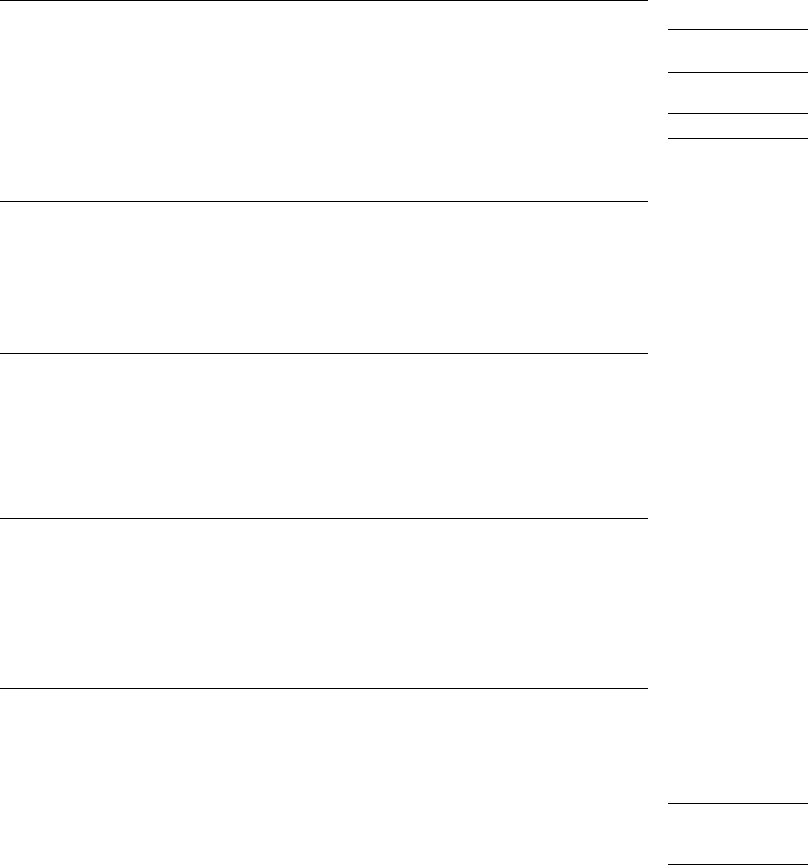
like intersection, union and inversion. In the figure below, for ex-
ample, we want to design an algorithm that returns us the points
that can be reached from some other point in a specified maxi-
mum number of steps. For example, if we ask it to return the
points that can be reached in two steps starting from B, the al-
gorithm has to return C,D,Eand F, but not Gbecause Gtakes
three steps from B.
Our approach is to keep, for each point in the graph, the set of
other points that it can reach in one step —this is the “next_step”
set. We also have a “result” set that keeps all points that we
have found so far. We start by setting the result set equal to
the next_step set for the departure point. Now we have in the

Bit operations to manipulate “sets” — 23
result set all points that one can reach in one step. Then, for
every point in our result set, we create a union of the result set
and the next_step set for that point. This process is iterated for
a specified number of loops.
An example may clarify the procedure outlined above. When the
departure point is B, we start by setting the result set to Dand
E—these are the points that one can reach from Bin one step.
Then, we walk through the result set. The first point that we en-
counter in the set is D, and we check what points can be reached
from Din one step: these are Cand F. So we add Cand Fto the
result set. We knew that the points that can be reached from D
in one step are Cand F, because Cand Fare in the next_step set
for D. So what we do is to merge the next_step set for point D
into the result set. The merge is called a “union” in set theory.
That handles D. The original result set also contained point E,
but the next_step set for Eis empty, so no more point is added.
The new result set therefore now contains C,D,Eand F.
A set is a general purpose container for elements. The only in-
formation that a set holds of an element is whether it is present
in the set or not. The order of elements in a set is insignificant
and a set cannot contain the same element multiple times. The
PAWN language does not provide a “set” data type or operators
that work on sets. However, sets with up to 32 elements can
be simulated by bit operations. It takes just one bit to store a
“present/absent” status and a 32-bit cell can therefore maintain
the status for 32 set elements —provided that each element is
assigned a unique bit position.
The relation between set operations and bitwise operations is
summarized in the following table. In the table, an upper case
letter stands for a set and a lower case letter for an element from
that set.
concept mathematical notation PAWN expression
intersection A∩BA&B
union A∪BA | B
complement A~A
empty set ε0
membership x∈A(1 << x) & A
To test for membership —that is, to query whether a set holds a
particular element, create a set with just one element and take
the intersection. If the result is 0(the empty set) the element is
not in the set. Bit numbering starts typically at zero; the lowest

24 — Bit operations to manipulate “sets”
bit is bit 0and the highest bit in a 32-bit cell is bit 31. To make
a cell with only bit 7set, shift the value 1left by seven —or in a
PAWN expression: “1 << 7”.
Below is the program that implements the algorithm described
earlier to find all points that can be reached from a specific de-
parture in a given number of steps. The algorithm is completely
in the findtargets function.
LISTING: set.p
/* Set operations, using bit arithmetic */
const
{ A = 0b0000001,
B = 0b0000010,
C = 0b0000100,
D = 0b0001000,
E = 0b0010000,
F = 0b0100000,
G = 0b1000000
}
main()
{
new nextstep[] =
[ C | E, /* A can reach C and E */
D | E, /* B " " D and E */
G, /* C " " G */
C | F, /* D " " C and F */
0, /* E " " none */
0, /* F " " none */
E | F, /* G " " E and F */
]
print "The departure point: "
new start = clamp( .value = toupper(getchar()) - 'A',
.min = 0,
.max = sizeof nextstep - 1
)
print "\nThe number of steps: "
new steps = getvalue()
/* make the set */
new result = findtargets(start, steps, nextstep)
printf "The points in range of %c in %d steps: ", start + 'A', steps
for (new i = 0; i < sizeof nextstep; i++)
if (result & 1 << i)
printf "%c ", i + 'A'
}
findtargets(start, steps, nextstep[], numpoints = sizeof nextstep)
{
new result = 0
new addedpoints = nextstep[start]
while (steps-- > 0 && result != addedpoints)
{
result = addedpoints
for (new i = 0; i < numpoints; i++)
A simple RPN calculator — 25
if (result & 1 << i)
addedpoints |= nextstep[i]
}
return result
}
The const statement just below the header of the main function “const” statement:
100
declares the constants for the nodes Ato G, using binary radix so
that that only a single bit is set in each value.
When working with sets, a typical task that pops up is to de- cellbits: 100
termine the number of elements in the set. A straightforward
function that does this is below:
LISTING: simple bitcount function
bitcount(set)
{
new count = 0
for (new i = 0; i < cellbits; i++)
if (set & (1 << i))
count++
return count
}
With a cell size of 32 bits, this function’s loop iterates 32 times
to check for a single bit at each iteration. With a bit of binary
arithmetic magic, we can reduce it to loop only for the number
of bits that are “set”. That is, the following function iterates only
once if the input value has only one bit set:
LISTING: improved bitcount function
bitcount(set)
{
new count = 0
if (set)
do
count++
while ((set = set & (set - 1)))
return count
}
A simple RPN calculator
The common mathematical notation, with arithmetic expressions Algebraic notation
is also called “in-
fix” notation
like “26−3×(5+2)”, is known as the algebraic notation. It is a com-
pact notation and we have grown accustomed to it. PAWN and by
far most other programming languages use the algebraic nota-
tion for their programming expressions. The algebraic notation
does have a few disadvantages, though. For instance, it occa-
sionally requires that the order of operations is made explicit by
26 — A simple RPN calculator
folding a part of the expression in parentheses. The expression at
the top of this paragraph can be rewritten to eliminate the paren-
theses, but at the cost of nearly doubling its length. In practice,
the algebraic notation is augmented with precedence level rules
that say, for example, that multiplication goes before addition
and subtraction.∗Precedence levels greatly reduce the need for
parentheses, but it does not fully avoid them. Worse is that when
the number of operators grows large, the hierarchy of prece-
dence levels and the particular precedence level for each oper-
ator becomes hard to memorize —which is why an operator-rich
language as APL does away with precedence levels altogether.
Around 1920, the Polish mathematician Jan Łukasiewicz demon-
strated that by putting the operators in front of their operands,
instead of between them, precedence levels became redundant
and parentheses were never necessary. This notation became
known as the “Polish Notation”.†Later, Charles Hamblin pro-
Reverse Polish
Notation is also
called “postfix”
notation
posed to put operators behind the operands, calling it the “Re-
verse Polish Notation”. The advantage of reversing the order is
that the operators are listed in the same order as they must be
executed: when reading the operators from the left to the right,
you also have the operations to perform in that order. The alge-
braic expression from the beginning of this section would read
in RPN as:
26 3 5 2 +× −
When looking at the operators only, we have: first an addition,
then a multiplication and finally a subtraction. The operands of
each operator are read from right to left: the operands for the +
operator are the values 5 and 2, those for the ×operator are the
result of the previous addition and the value 3, and so on.
It is helpful to imagine the values to be stacked on a pile, where
the operators take one or more operands from the top of the pile
and put a result back on top of the pile. When reading through
the RPN expression, the values 26, 3, 5 and 2 are “stacked” in
that order. The operator +removes the top two elements from
∗These rules are often summarized in a mnemonic like “Please Excuse My
Dear Aunt Sally” (Parentheses, Exponentiation, Multiplication, Division, Ad-
dition, Subtraction).
†Polish Notation is completely unrelated to “Hungarian Notation” —which is
just the habit of adding “type” or “purpose” identification warts to names
of variables or functions.
A simple RPN calculator — 27
the stack (5 and 2) and pushes the sum of these values back —
the stack now reads “26 3 7”. Then, the ×operator removes 3
and 7 and pushes the product of the values onto the stack —the
stack is “26 21”. Finally, the −operator subtracts 21 from 26
and stores the single value 5, the end result of the expression,
back onto the stack.
Reverse Polish Notation became popular because it was easy to
understand and easy to implement in (early) calculators. It also
opens the way to operators with more than two operands (e.g.
integration) or operators with more than one result (e.g. conver-
sion between polar and Cartesian coordinates).
The main program for a Reverse Polish Notation calculator is
below:
LISTING: rpn.p
/* a simple RPN calculator */
#include strtok
#include stack
#include rpnparse
main()
{
print "Type expressions in Reverse Polish Notation " ...
"(or an empty line to quit)\n"
new string{100}
while (getstring(string, .pack = true))
rpncalc string
}
The main program contains very little code itself; instead it in-
cludes the required code from three other files, each of which
implements a few functions that, together, build the RPN calcu-
lator. When programs or scripts get larger, it is usually advised
to spread the implementation over several files, in order to make
maintenance easier.
Function main first puts up a prompt and calls the native function
getstring to read an expression that the user types. Then it calls
the custom function rpncalc to do the real work. Function rpn-
calc is implemented in the file rpnparse.inc, reproduced below:
LISTING: rpnparse.i
/* main rpn parser and lexical analysis, part of the RPN calculator */
#include <rational>
#include <string>
#define Token [
.type, /* operator or token type */
Rational: .value, /* value, if t_type is "Number" */
.word{20}, /* raw string */
28 — A simple RPN calculator
]
const Number = '0'
const EndOfExpr = '#'
rpncalc(const string{})
{
new index
new field[Token]
for ( ;; )
{
field = gettoken(string, index)
switch (field.type)
{
case Number:
push field.value
case '+':
push pop() + pop()
case '-':
push - pop() + pop()
case '*':
push pop() * pop()
case '/', ':':
push 1.0 / pop() * pop()
case EndOfExpr:
break /* exit "for" loop */
default:
printf "Unknown operator '%s'\n", field.word
}
}
printf "Result = %r\n", pop()
if (clearstack())
print "Stack not empty\n", red
}
gettoken(const string{}, &index)
{
/* first get the next "word" from the string */
new word{20}
word = strtok(string, index)
/* then parse it */
new field[Token]
field.word = word
if (strlen(word) == 0)
{
field.type = EndOfExpr /* special "stop" symbol */
field.value = 0
}
else if ('0' <= word{0} <= '9')
{
field.type = Number
field.value = rval(word)
}
else
{
field.type = word{0}
field.value = 0
}
return field

A simple RPN calculator — 29
}
The RPN calculator uses rational numbers and rpnparse.inc in- Rational numbers,
see also the “Cel-
sius to Fahrenheit”
example on page
14
cludes the “rational” file for that purpose. Almost all of the
operations on rational numbers is hidden in the arithmetic. The
only direct references to rational numbers are the “%r” format
code in the printf statement near the bottom of function rpn-
calc and the call to rationalstr halfway function gettoken.
Near the top in the file rpnparse.inc is a preprocessor macro Preprocessor: 91
that declares the symbolic subscripts for an array. The macro
name, “Token” will be used throughout the program to declare
arrays with those fields. For example, function rpncalc declares
variable field as an array using the macro to declare the field
names.
Arrays with symbolic subscripts were already introduced in the
section Arrays and symbolic subscripts on page 19; this script
shows another feature of symbolic subscripts: individual sub-
stripts may have a tag name of their own. In this example, .type
is a simple cell, .value is a rational value (with a fractional part)
that is tagged as such, and .word can hold a string of 20 char-
acters (includding the terminating zero byte). See, for example,
the line:
printf "Unknown operator '%s'\n", field.word
how the .word subscript of the field variable is used as a string.
If you know C/C++ or Java, you may want to look at the switch “switch” state-
ment: 112
statement. The switch statement differs in a number of ways
from the other languages that provide it. The cases are not fall-
through, for example, which in turn means that the break state-
ment for the case EndOfExpr breaks out of the enclosing loop,
instead of out of the switch.
On the top of the for loop in function rpncalc, you will find the
instruction “field = gettoken(string, index)”. As already ex-
emplified in the wcount.p (“word count”) program on page 17,
functions may return arrays. It gets more interesting for a simi-
lar line in function gettoken:
field.word = word
where word is an array for 20 characters and field is an array
with 3 (symbolic) subscripts. However, as the .word subscript
is declared as having a size of 20 characters, the expression
“field.word” is considered a sub-array of 20 characters, pre-
cisely matching the array size of word.
30 — A simple RPN calculator
LISTING: strtok.i
/* extract words from a string (words are separated by white space) */
#include <string>
strtok(const string{}, &index)
{
new length = strlen(string)
/* skip leading white space */
while (index < length && string{index} <= ' ')
index++
/* store the word letter for letter */
new offset = index /* save start position of token */
const wordlength = 20 /* maximum word length */
new result{wordlength} /* string to store the word in */
while (index < length
&& string{index} > ' '
&& index - offset < wordlength)
{
result{index - offset} = string{index}
index++
}
result{index - offset} = EOS /* zero-terminate the string */
return result
}
Function strtok is the same as the one used in the wcount.p ex-
wcount.p: 17 ample. It is implemented in a separate file for the RPN calculator
program. Note that the strtok function as it is implemented here
can only handle words with up to 19 characters —the 20th char-
acter is the zero terminator. A truly general purpose re-usable
implementation of an strtok function would pass the destination
array as a parameter, so that it could handle words of any size.
Supporting both packed and unpack strings would also be a use-
ful feature of a general purpose function.
When discussing the merits of Reverse Polish Notation, I men-
tioned that a stack is both an aid in “visualizing” the algorithm
as well as a convenient method to implement an RPN parser. This
example RPN calculator, uses a stack with the ubiquitous func-
tions push and pop. For error checking and resetting the stack,
there is a third function that clears the stack.
LISTING: stack.i
/* stack functions, part of the RPN calculator */
#include <rational>
static Rational: stack[50]
static stackidx = 0
push(Rational: value)
{
assert stackidx < sizeof stack
stack[stackidx++] = value
}

Event-driven programming — 31
Rational: pop()
{
assert stackidx > 0
return stack[--stackidx]
}
clearstack()
{
assert stackidx >= 0
if (stackidx == 0)
return false
stackidx = 0
return true
}
The file stack.inc includes the file rational again. This is tech-
nically not necessary (rpnparse.inc already included the defini-
tions for rational number support), but it does not do any harm
either and, for the sake of code re-use, it is better to make any
file include the definitions of the libraries that it depends on.
Notice how the two global variables stack and stackidx are de-
clared as “static” variables; using the keyword static instead of
new. Doing this makes the global variables “visible” in that file
only. For all other files in a larger project, the symbols stack and
stackidx are invisible and they cannot (accidentally) modify the
variables. It also allows the other modules to declare their own
private variables with these names, so it avoids name clashing.
The RPN calculator is actually still a fairly small program, but
it has been set up as if it were a larger program. It was also
designed to demonstrate a set of elements of the PAWN language
and the example program could have been implemented more
compactly.
Event-driven programming
All of the example programs that were developed in this chapter
so far, have used a “flow-driven” programming model: they start
with main and the code determines what to do and when to re-
quest input. This programming model is easy to understand and
it nicely fits most programming languages, but it is also a model
does not fit many “real life” situations. Quite often, a program
cannot simply process data and suggest that the user provides
input only when it is ready for him/her. Instead, it is the user who
decides when to provide input, and the program or script should
32 — Event-driven programming
be prepared to process it in an acceptable time, regardless of
what it was doing at the moment.
The above description suggests that a program should therefore
be able to interrupt its work and do other things before picking
up the original task. In early implementations, this was indeed
how such functionality was implemented: a multi-tasking system
where one task (or thread) managed the background tasks and
a second task/thread that sits in a loop continuously requesting
user input. This is a heavy-weight solution, however. A more
light-weight implementation of a responsive system is what is
called the “event-driven” programming model.
In the event-driven programming model, a program or script de-
composes any lengthy (background) task into short manageable
blocks and in between, it is available for input. Instead of hav-
ing the program poll for input, however, the host application (or
some other sub-system) calls a function that is attached to the
event —but only if the event occurs.
A typical event is “input”. Observe that input does not only come
from human operators. Input packets can arrive over serial ca-
bles, network stacks, internal sub-systems such as timers and
clocks, and all kinds of other equipment that you may have at-
tached to your system. Many of the apparatus that produce in-
put, just send it. The arrival of such input is an event, just like a
key press. If you do not catch the event, a few of them may be
stored in an internal system queue, but once the queue is satu-
rated the events are simply dropped.
PAWN directly supports the event-driven model, because it sup-
ports multiple entry points. The sole entry point of a flow-driven
program is main; an event-driven program has an entry point
for every event that it captures. When compared to the flow-
driven model, event-driven programs often appear “bottom-up”:
instead of your program calling into the host application and de-
ciding what to do next, your program is being called from the
outside and it is required to respond appropriately and promptly.
PAWN does not specify a standard library, and so there is no guar-
antee that in a particular implementation, functions like printf
and getvalue are available. Although it is suggested that ev-
ery implementation provides a minimal console/terminal inter-
face with a these functions, their availability is ultimately imple-
mentation dependent. The same holds for the public functions
Public functions:
80 —the entry points for a script. It is implementation-dependent

Event-driven programming — 33
which public functions a host application supports. The script in
this section may therefore not run on your platform (even if all
previous scripts ran fine). The tools in the standard distribution
of the PAWN system support all scripts developed in this manual,
provided that your operating system or environment supports
standard terminal functions such as setting the cursor position.
An early programming language that was developed solely for
teaching the concepts of programming to children was “Logo”.
This dialect of LISP made programming visual by having a small
robot, the “turtle”, drive over the floor under control of a simple
program. This concept was then copied to moving a (usually tri-
angular) cursor of the computer display, again under control of a
program. A novelty was that the turtle now left a trail behind it,
allowing you to create drawings by properly programming the
turtle —it became known as turtle graphics. The term “turtle
graphics” was also used for drawing interactively with the arrow
keys on the keyboard and a “turtle” for the current position. This
method of drawing pictures on the computer was briefly popular
before the advent of the mouse.
LISTING: turtle.p
@keypressed(key)
{
/* get current position */
new x, y
wherexy x, y
/* determine how the update the current position */
switch (key)
{
case 'u': y-- /* up */
case 'd': y++ /* down */
case 'l': x-- /* left */
case 'r': x++ /* right */
case '\e': exit /* Escape = exit */
}
/* adjust the cursor position and draw something */
moveturtle x, y
}
moveturtle(x, y)
{
gotoxy x, y
print "*"
gotoxy x, y
}
The entry point of the above program is @keypressed —it is called
on a key press. If you run the program and do not type any key,
the function @keypressed never runs; if you type ten keys, @key-
pressed runs ten times. Contrast this behaviour with main: func-
34 — Event-driven programming
tion main runs immediately after you start the script and it runs
only once.
It is still allowed to add a main function to an event-driven pro-
gram: the main function will then serve for one-time initializa-
tion. A simple addition to this example program is to add a main
function, in order to clear the console/terminal window on entry
and perhaps set the initial position of the “turtle” to the centre.
Support for function keys and other special keys (e.g. the ar-
row keys) is highly system-dependent. On ANSI terminals, these
keys produce different codes than in a Windows “DOS box”. In
the spirit of keeping the example program portable, I have used
common letters (“u” for up, “l” for left, etc.). This does not mean,
however, that special keys are beyond PAWN’s capabilities.
In the “turtle” script, the “Escape” key terminates the host appli-
cation through the instruction exit. For a simple PAWN run-time
host, this will indeed work. With host applications where the
script is an add-on, or host-applications that are embedded in a
device, the script usually cannot terminate the host application.
•Multiple events
The advantages of the event-driven programming model, for cre-
ating reactive programs, become apparent in the presence of
multiple events. In fact, the event-driven model is only useful
if you have more that one entry point; if your script just handles
a single event, it might as well enter a polling loop for that sin-
gle event. The more events need to be handled, the harder the
flow-driven programming model becomes. The script below im-
plements a bare-bones “chat” program, using only two events:
one for sending and one for receiving. The script allows users
on a network (or perhaps over another connection) to exchange
single-line messages.
The script depends on the host application to provide the na-
tive and public functions for sending and receiving “datagrams”
and for responding to keys that are typed in. How the host ap-
plication sends its messages, over a serial line or using TCP/IP,
the host application may decide itself. The tools in the standard
PAWN distribution push the messages over the TCP/IP network,
and allow for a “broadcast” mode so that more than two people
can chat with each other.
Event-driven programming — 35
LISTING: chat.p
#include <datagram>
const cellchars = cellbits / charbits
@receivestring(const message[], const source[])
printf "[%s] says: %s\n", source, message
@keypressed(key)
{
static string{100}
static index
if (key == '\e')
exit /* quit on 'Esc' key */
echo key
if (key == '\r' || key == '\n' || index == sizeof string * cellchars)
{
string{index} = '\0' /* terminate string */
sendstring string
index = 0
string{index} = '\0'
}
else
string{index++} = key
}
echo(key)
{
new string{2} = { 0 }
string{0} = key == '\r' ? '\n' : key
printf string
}
The bulk of the above script handles gathering received key-
presses into a string and sending that string after seeing the
ENTER key. The “Escape” key ends the program. The function
echo serves to give visual feedback of what the user types: it
builds a zero-terminated string from the key and prints it.
Despite its simplicity, this script has the interesting property that
there is no fixed or prescribed order in which the messages are
to be sent or received —there is no query–reply scheme where
each host takes its turn in talking & listening. A new message
may even be received while the user is typing its own message.∗
∗As this script makes no attempt to separate received messages from typed
messages (for example, in two different scrollable regions), the terminal/
console will look confusing when this happens. With an improved user-
interface, this simple script could indeed be a nice message-base chat pro-
gram.
36 — State programming
State programming
In a program following the event-driven model, events arrive in-
dividually, and they are also responded to individually. On oc-
casion, though, an event is part of a sequential flow, that must
be handled in order. Examples are data transfer protocols over,
for example, a serial line. Each event may carry a command, a
snippet of data that is part of a larger file, an acknowledgement,
or other signals that take part in the protocol. For the stream of
events (and the data packets that they carry) to make sense, the
event-driven program must follow a precise hand-shaking proto-
col.
To adhere to a protocol, an event-driven program must respond
to each event in compliance with the (recent) history of events re-
ceived earlier and the responses to those events. In other words,
the handling of one event may set up a “condition” or “environ-
ment” for the handling any one or more subsequent events.
A simple, but quite effective, abstraction for constructing reac-
tive systems that need to follow (partially) sequential protocols,
is that of the “automaton” or state machine. As the number of
states are usually finite, the theory often refers to such automa-
tons as Finite State Automatons or Finite State Machines. In an
automaton, the context (or condition) of an event is its state. An
event that arrives may be handled differently depending on the
state of the automaton, and in response to an event, the automa-
ton may switch to another state —this is called a transition. A
transition, in other words, as a response of the automaton to an
event in the context of its state.
Automatons are very common in software as well as in mechan-
ical devices (you may see the Jacquard Loom as an early state
machine). Automatons, with a finite number of states, are deter-
ministic (i.e. predictable in behaviour) and their relatively simple
design allows a straightforward implementation from a “state di-
agram”.
In a state diagram, the states are usually represented as circles
or rounded rectangles and the arrows represent the transitions.
As transitions are the response of the automaton to events, an
arrow may also be seen as an event “that does something”. An
event/transition that is not defined in a particular state is as-
sumed to have no effect —it is silently ignored. A filled dot rep-
resents the entry state, which your program (or the host applica-
tion) must set in start-up. It is common to omit in a state diagram
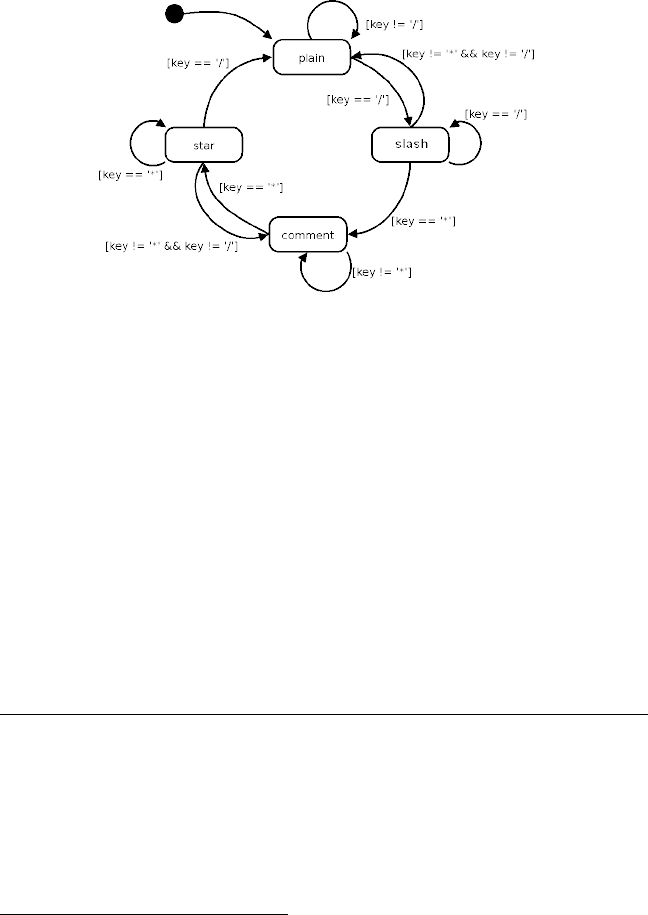
State programming — 37
all event arrows that drop back into the same state, but for the
preceding figure I have chosen to make the response to all events
explicit.
The above state diagram is for “parsing” comments that start
with “/*” and end with “*/”. There are states for plain text and
for text inside a comment, plus two states for tentative entry into
or exit from a comment. The automaton is intended to parse
the comments interactively, from characters that the user types
on the keyboard. Therefore, the only events that the automa-
ton reacts on are key presses. Actually, there is only one event
(“key-press”) and the state switches are determined by event’s
parameter: the key.
PAWN supports automatons and states directly in the language.
Every function∗may optionally have one or more states assigned
to it. PAWN also supports multiple automatons, and each state is
part of a particular automaton. The following script implements
the preceding state diagram (in a single, anonymous, automa-
ton). To differentiate plain text from comments, both are output
in a different colour.
LISTING: comment.p
/* parse C comments interactively, using events and a state machine */
main()
state plain
@keypressed(key) <plain>
{
state (key == '/') slash
if (key != '/')
echo key
}
∗With the exception of “native functions” and user-defined operators.

38 — State programming
@keypressed(key) <slash>
{
state (key != '/') plain
state (key == '*') comment
echo '/' /* print '/' held back from previous state */
if (key != '/')
echo key
}
@keypressed(key) <comment>
{
echo key
state (key == '*') star
}
@keypressed(key) <star>
{
echo key
state (key != '*') comment
state (key == '/') plain
}
echo(key) <plain, slash>
printchar key, yellow
echo(key) <comment, star>
printchar key, green
printchar(ch, colour)
{
setattr .foreground = colour
printf "%c", ch
}
Function main sets the starting state to main and exits; all logic
is event-driven. When a key arrives in state plain, the program
checks for a slash and conditionally prints the received key. The
interaction between the states plain and slash demonstrates a
complexity that is typical for automatons: you must decide how
to respond to an event when it arrives, without being able to
“peek ahead” or undo responses to earlier events. This is usually
the case for event-driven systems —you neither know what event
you will receive next, nor when you will receive it, and whatever
your response to the current event, there is a good chance that
you cannot erase it on a future event and pretend that it never
happened.
In our particular case, when a slash arrives, this might be the
start of a comment sequence (“/*”), but it is not necessarily so.
By inference, we cannot decide on reception of the slash charac-
ter what colour to print it in. Hence, we hold it back. However,
there is no global variable in the script that says that a char-
acter is held back —in fact, apart from function parameters, no
variable is declared at all in this script. The information about a

State programming — 39
character being held back is “hidden” in the state of the automa-
ton.
As is apparent in the script, state changes may be conditional.
The condition is optional, and you can also use the common if–
else construct to change states.
Being state-dependent is not reserved for the event functions.
Other functions may have state declarations as well, as the echo
function demonstrates. When a function would have the same
implementation for several states, you just need to write a single
implementation and mention all applicable states. For function
echo there are two implementations to handle the four states.∗
That said, an automaton must be prepared to handle all events
in any state. Typically, the automaton has neither control over
which events arrive nor over when they arrive, so not handling
an event in some state could lead to wrong decisions. It fre-
quently happens, then, that a some events are meaningful only
in a few specific states and that they should trigger an error or
“reset” procedure in all other cases. The function for handling
the event in such “error” condition might then hold a lot of state
names, if you were to mention them explicitly. There is a shorter
way: by not mentioning any name between the angle brackets,
the function matches all states that have not explicit implemen-
tation elsewhere. So, for example, you could use the signature
“echo(key) <>” for either of the two implementations (but not for
both).
A single anonymous automaton is pre-defined. If a program con-
tains more than one automaton, the others must be explicitly
mentioned, both in the state classifier of the function and in the
state instruction. To do so, add the name of the automaton in
front of the state name and separate the names of the automa-
ton and the state with a colon. That is, “parser:slash” stands
for the state slash of the automaton parser. A function can only
be part of a single automaton; you can share one implementation
of a function for several states of the same automaton, but you
cannot share that function for states of different automatons.
•Entry functions and automata theory
∗A function that has the same implementation for all states, does not need a
state classifier at all —see printchar.
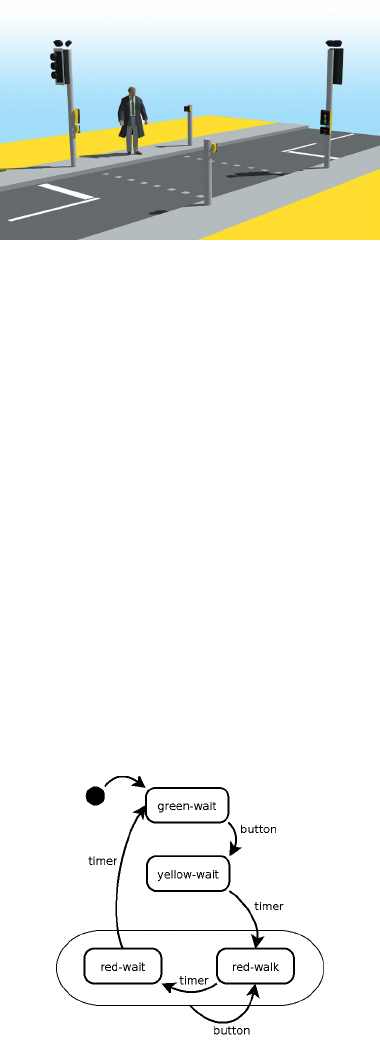
40 — State programming
State machines, and the foundation of “automata theory”, orig-
inate from mechanical design and pneumatic/electric switching
circuits (using relays rather than transistors). Typical examples
are coin acceptors, traffic light control and communication lines
switching circuits. In these applications, robustness and pre-
dictability are paramount, and it was found that in this context
it was best to link actions (output) to the states rather than to
the events (input). In this design, entering a state causes activ-
ity —events cause state changes, but do not directly carry out
operations.
In a pedestrian crossing lights system, the lights for the vehicles
and the pedestrians must be synchronized. Technically, there
are six possible combinations, but obviously the combination of a
green light for the traffic and a “walk” sign for the pedestrians is
recipe for disaster. We can also immediately dismiss the combi-
nation of yellow/walk as too dangerous. Thus, four combinations
remain to be handled. The figure below is a state diagram for the
pedestrian crossing lights. The entire process is activated with
a button, and operates on a timer.

State programming — 41
When the state red/walk times out, the state cannot immediately
go back to green/wait, because the pedestrians that are busy
crossing the road at that moment need some time to clear the
road —the state red/wait allows for this. For purpose of demon-
stration, this pedestrian crossing has the added functionality that
when a pedestrian pushes the button while the light for the traf-
fic is already red, the time that the pedestrian has for crossing is
lengthened. If the state is red/wait and the button is pressed, it
switches back to red/walk. The enfolding box around the states
red/walk and red/wait for handling the button event is just a no-
tational convenience: I could also have drawn two arrows from
either state back to red/walk. The script source code (which fol-
lows below) reflects this same notational convenience, though.
In the implementation in the PAWN language, the event func-
tions now always have a single statement, which is either a state
change or an empty statement. Events that do not cause a state
change are absent in the diagram, but they must be handled in
the script; hence, the “fall-back” event functions that do noth-
ing. The output, in this example program only messages printed
on the console, is all done in the special functions entry. The
function entry may be seen as a main for a state: it is implicitly
called when the state that it is attached to is entered. Note that
the entry function is also called when “switching” to the state
that the automaton is already in: when the state is red_walk an
invocation of the @keypressed sets the state to red_walk (which
it is already in) and causes the entry function of red_walk to run
—this is a re-entry of the state.
LISTING: traffic.p
/* traffic light synchronizer, using states in an event-driven model */
#include <time>
main() state green_wait
@keypressed(key) <green_wait> state yellow_wait
@keypressed(key) <red_walk, red_wait> state red_walk
@keypressed(key) <> {} /* fallback */
@timer() <yellow_wait> state red_walk
@timer() <red_walk> state red_wait
@timer() <red_wait> state green_wait
@timer() <> {} /* fallback */
entry() <green_wait>
print "Green / Don't walk\n"
entry() <yellow_wait>
{
print "Yellow / Don't walk\n"
settimer 2000
}

42 — State programming
entry() <red_walk>
{
print "Red / Walk\n"
settimer 5000
}
entry() <red_wait>
{
print "Red / Don't walk\n"
settimer 2000
}
This example program has an additional dependency on the host
application/environment: in addition to the “@keypressed” event
function, the host must also provide a “@timer” event with an
adjustable delay. Because of the timing functions, the script in-
cludes the system file time.inc near the top of the script.
The event functions with the state changes are all on the top
part of the script. The functions are laid out to take a single
line each, to suggest a table-like structure. All state changes are
unconditional in this example, but conditional state changes may
be used with entry functions too. The bottom part are the event
functions.
Two transitions to the state red_walk exist —or three if you con-
sider the affection of multiple states to a single event function
as a mere notational convenience: from yellow_wait and from
the combination of red_walk and red_wait. These transitions all
pass through the same entry function, thereby reducing and sim-
plifying the code.
In automata theory, an automaton that associates activity with
state entries, such as this pedestrian traffic lights example, is a
“Moore automaton”; an automaton that associates activity with
(state-dependent) events or transitions is a “Mealy automaton”.
The interactive comment parser on page 37 is a typical Mealy au-
tomaton. The two kinds are equivalent: a Mealy automaton can
be converted to a Moore automaton and vice versa, although a
Moore automaton may need more states to implement the same
behaviour. In practice, the models are often mixed, with an over-
all “Moore automaton” design, and a few “Mealy states” where
that saves a state.
•State variables
The model of a pedestrian crossing light in the previous example
is not very realistic (its only goal is to demonstrate a few prop-
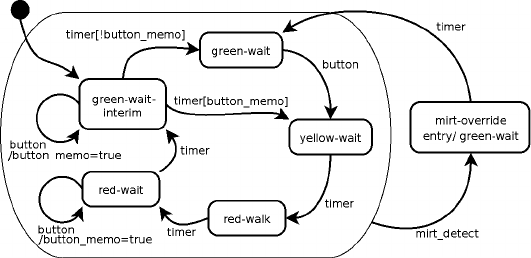
State programming — 43
erties of state programming with PAWN). The first thing that is
lacking is a degree of fairness: pedestrians should not be able to
block car traffic indefinitely. The car traffic should see a green
light for a period of some minimum duration after pedestrians
have had their time slot for crossing the road. Secondly, many
traffic lights have a kind of remote control ability, so that emer-
gency traffic (ambulance, fire truck, . . . ) can force green lights
on their path. A well-known example of such remote control is
the MIRT system (Mobile Infra-Red Transmitter) but other sys-
tems exist —the Netherlands use a radiographic system called
VETAG for instance.
The new state diagram for the pedestrian crossing light has two
more states, but more importantly: it needs to save data across
events and share it between states. When the pedestrian presses
the button while the state is red_wait, we neither want to react
on the button immediately (this was our “fairness rule”), nor the
button to be ignored or “forgotten”. In other words, we move to
the state green_wait_interim regardless of the button press, but
memorize the press for a decision made at the point of leaving
state green_wait_interim.
Automatons excel in modelling control flow in reactive and inter-
active systems, but data flow has traditionally been a weak point.
To see why, consider that each event is handled individually by
a function and that the local variables in that function disappear
when the function returns. Local variables can, hence, not be
used to pass data from one event to the next. Global variables,
while providing a work-around, have drawbacks: global scope
and an “eternal” lifespan. If a variable is used only in the event
handlers of a single state, it is desirable to hide it from the other
states, in order to protect it from accidental modification. Like-
wise, shortening the lifespan to the state(s) that the variable is

44 — State programming
active in, reduces the memory footprint. “State variables” pro-
vide this mix of variable scope and variable lifespan that are tied
to a series of states, rather than to functions or modules.
PAWN enriches the standard finite state machine (or automaton)
with variables that are declared with a state classifier. These
variables are only accessible from the listed states and the mem-
ory these variable hold may be reused by other purposes while
the automaton is in a different state (different than the ones
listed). Apart from the state classifier, the declaration of a state
variable is similar to that of a global variable. The declaration of
the variable button_memo in the next listing illustrates the con-
cept.
To reset the memorized button press, the script uses an “exit”
function. Just like an entry function is called when entering a
state, the exit function is called when leaving a state.
LISTING: traffic2.p
/* a more realistic traffic light synchronizer, including an
* "override" for emergency vehicles
*/
#include <time>
main()
state green_wait_interim
new bool: button_memo <red_wait, green_wait_interim>
@keypressed(key)
{
switch (key)
{
case ' ': button_press
case '*': mirt_detect
}
}
button_press() <green_wait>
state yellow_wait
button_press() <red_wait, green_wait_interim>
button_memo = true
button_press() <> /* fallback */
{}
mirt_detect()
state mirt_override
@timer() <yellow_wait>
state red_walk
@timer() <red_walk>
state red_wait
@timer() <red_wait>
state green_wait_interim
@timer() <green_wait_interim>

State programming — 45
{
state (!button_memo) green_wait
state (button_memo) yellow_wait
}
@timer() <mirt_override>
state green_wait
@timer() <> /* fallback */
{}
entry() <green_wait_interim>
{
print "Green / Don't walk\n"
settimer 5000
}
exit() <green_wait_interim>
button_memo = false
entry() <yellow_wait>
{
print "Yellow / Don't walk\n"
settimer 2000
}
entry() <red_walk>
{
print "Red / Walk\n"
settimer 5000
}
entry() <red_wait>
{
print "Red / Don't walk\n"
settimer 2000
}
entry() <mirt_override>
{
print "Green / Don't walk\n"
settimer 5000
}
•State programming wrap-up
The common notation used in state diagrams is to indicate tran-
sitions with arrows and states with circles or rounded rectan-
gles. The circle/rounded rectangle optionally also mentions the
actions of an entry or exit function and of events that are han-
dled internally —without causing a transition. The arrow for a
transition contains the name of the event (or pseudo-event), an
optional condition between square brackets and an optional ac-
tion behind a slash (“/”).
States are ubiquitous, even if we do not always recognize them
as such. The concept of finite state machines has traditionally

46 — State programming
been applied mostly to programs mimicking mechanical appa-
ratus and software that implements communication protocols.
With the appearance of event-driven windowing systems, state
machines now also appear in the GUI design of desktop pro-
grams. States abound in web programs, because the browser
and the web-site scripting host have only a weak link. That said,
the state machine in web applications is typically implemented
in an ad-hoc manner.
States can also be recognized in common problems and riddles.
In the well known riddle of the man that must move a cabbage,
a sheep and a wolf across a river,∗the states are obvious —the
trick of the riddle is to avoid the forbidden states.
But now that we are discovering “states” everywhere, we must
be careful not to overdo it. For example, in the second imple-
mentation of a pedestrian crossing light, see page 44, I used a
variable (button_memo) to hold a criterion for a decision made at a
later time. An alternative implementation would be to throw in a
couple of more states to hold the situations “red-wait-&-button-
pressed” and “green-wait-interim-&-button-pressed”. No more
variable would then be needed, but at the cost of a more com-
plex state diagram and implementation. In general, the number
of states should be kept small.
Although automata provide a good abstraction to model reac-
tive and interactive systems, coming to a correct diagram is not
straightforward —and sometimes just outright hard. Too often,
the “sunny day scenario” of states and events is plotted out first,
and everything straying from this path is then added on an im-
promptu basis. This approach carries the risk that some combi-
nations of events & states are forgotten, and indeed I have en-
countered two comment parser diagrams (like the one at page
37) by different book/magazine authors that were flawed in such
way. Instead, I advise to focus on the events and on the re-
sponses for individual events. For every state, every event should
be considered; do not route events through a general purpose
fall-back too eagerly.
It has become common practice, unfortunately, to introduce au-
tomata theory with applications for which better solutions exist.
∗A man has to ferry a wolf, a sheep and a cabbage across a river in a boat,
but the boat can only carry the man and a single additional item. If left
unguarded, the wolf will eat the sheep and the sheep will eat the cabbage.
How can the man ferry them across the river?
Program verification — 47
One, oft repeated, example is that of an automaton that accu-
mulates the value of a series of coins, or that “calculates” the
remainder after division by 3 of a binary number. These appli-
cations may have made sense in mechanical/pneumatic design
where “the state” is the only memory that the automaton has,
but in software, using variables and arithmetic operations is the
better choice. Another typical example is that of matching words
or patterns using a state machine: every next letter that is input
switches to a new state. Lexical scanners, such as the ones that
compilers and interpreters use to interpret source code, might
use such state machines to filter out “reserved words”. How-
ever, for any practical set of reserved words, such automatons
become unwieldy, and no one will design them by hand. In addi-
tion, there is no reason why a lexical scanner cannot peek ahead
in the text or jump back to a mark that it set earlier —which is
one of the criteria for choosing a state implementation in the first
place, and finally, solutions like “trie lookups” are likely simpler
to design and implement while being at least as quick.
Program verification
Should the compiler/interpreter not catch all bugs? This rhetor-
ical question has both technical and philosophical sides. I will
forego all non-technical aspects and only mention that, in prac-
tice, there is a trade-off between the “expressiveness” of a com-
puter language and the “enforced correctness” (or “provable cor-
rectness’) of programs in that language. Making a language very
“strict” is not a solution if work needs to be done that exceeds
the size of a toy program. A too strict language leaves the pro-
grammer struggling with the language, whereas the “problem to
solve” should be the real struggle and the language should be a
simple means to express the solution in.
The goal of the PAWN language is to provide the developer with an
informal, and convenient to use, mechanism to test whether the
program behaves as was intended. This mechanism is called “as-
sertions” and, although the concept of assertions pre-dates the
idea of “design by contract”, it is most easily explained through
the design-by-contract methodology.
The “design by contract” paradigm provides an alternative ap-
proach for dealing with erroneous conditions. The premise is
that the programmer knows the task at hand, the conditions un-
der which the software must operate and the environment. In
48 — Program verification
such an environment, each function specifies the specific con-
ditions, in the form of assertions, that must hold true before a
client may execute the function. In addition, the function may
also specify any conditions that hold true after it completes its
operation. This is the “contract” of the function.
The name “design by contract” was coined by Bertrand Meyer
and its principles trace back to predicate logic and algorithmic
analysis.
⋄Preconditions specify the valid values of the input parameters
and environmental attributes;
⋄Postconditions specify the output and the (possibly modified)
environment;
⋄Invariants indicate the conditions that must hold true at key
points in a function, regardless of the path taken through the
function.
For example, a function that computes a square root of a number
may specify that its input parameter be non-negative. This is a
precondition. It may also specify that its output, when squared,
is the input value ±0.01%. This is a postcondition; it verifies that
the routine operated correctly. A convenient way to calculate a
Example square
root function (us-
ing bisection): 75
square root is via “bisection”. At each iteration, this algorithm
gives at least one extra bit (binary digit) of accuracy. This is an
invariant (it might be an invariant that is hard to check, though).
Preconditions, postconditions and invariants are similar in the
sense that they all consist of a test and that a failed test indi-
cates an error in the implementation. As a result, you can imple-
ment preconditions, postconditions and invariants with a single
construct: the “assertion”. For preconditions, write assertions
at the very start of the routine; for invariants, write an asser-
tion where the invariant should hold; for post conditions, write
an assertion before each “return” statement or at the end of the
function.
In PAWN, the instruction is called assert; it is a simple statement
that contains a test. If the test outcome is “true”, nothing hap-
pens. If the outcome is “false”, the assert instruction terminates
the program with a message containing the details of the asser-
tion that failed.
Assertions are checks that should never fail. Genuine errors,
such as user input errors, should be handled with explicit tests in
the program, and not with assertions. As a rule, the expressions
Documentation comments — 49
contained in assertions should be free of side effects: an asser-
tion should never contain code that your application requires for
correct operation.
This does have the effect, however, that assertions never fire in
a bug-free program: they just make the code fatter and slower,
without any user-visible benefit. It is not this bad, though. An
additional feature of assertions is that you can build the source
code without assertions simply using a flag or option to the PAWN
parser. The idea is that you enable assertions during develop-
ment and build the “retail version” of the code without asser-
tions. This is a better approach than removing the assertions,
because all assertions are automatically “back” when recompil-
ing the program —e.g. for maintenance.
During maintenance, or even during the initial development, if
you catch a bug that was not trapped by an assertion, before
fixing the bug, you should think of how an assertion could have
trapped this error. Then, add this assertion and test whether it
indeed catches the bug before fixing the bug. By doing this, the
code will gradually become sturdier and more reliable.
Documentation comments
When programs become larger, documenting the program and
the functions becomes vital for its maintenance, especially when
working in a team. The PAWN language tools have some fea-
tures to assist you in documenting the code in comments. Docu-
menting a program or library in its comments has a few advan-
tages —for example: documentation is more easily kept up to
date with the program, it is efficient in the sense that program-
ming comments now double as documentation, and the parser
helps your documentation efforts in generating syntax descrip-
tions and cross references.
Every comment that starts with three slashes (“/// ”) followed by Comment syntax:
95
white-space, or that starts with a slash and two stars (“/** ”) fol-
lowed by white-space is a special documentation comment. The
PAWN compiler extracts documentation comments and optionally
writes these to a “report” file. See the application documenta-
tion, or appendix B, how to enable the report generation.
As an aside, comments that start with “/**” must still be closed
with “*/”. Single line documentation comments (“///”) close at
the end of the line.

50 — Documentation comments
The report file is an XML file that can subsequently be trans-
formed to HTML documentation via an XSL/XSLT stylesheet,∗or
be run through other tools to create printed documentation. The
syntax of the report file is compatible with that of the “.Net” de-
veloper products —except that the PAWN compiler stores more
information in the report than just the extracted documentation
strings.
The example below illustrates documentation comments in a sim-
ple script that has a few functions. You may write documentation
comments for a function above its declaration or in its body. All
documentation comments that appear before the end of the func-
tion are attributed to the function. You can also add documenta-
tion comments to global variables and global constants —these
comments must appear above the declaration of the variable or
constant. The figure 1 shows part of the output for this (rather
long) example. The style of the output is adjustable in the cas-
cading style sheet (CSS-file) associated with the XSLT transfor-
mation file.
LISTING: weekday.p
/**
* This program illustrates Zeller's congruence algorithm to calculate
* the day of the week given a date.
*/
/**
* <summary>
* The main program: asks the user to input a date and prints on
* what day of the week that date falls.
* </summary>
*/
main()
{
new day, month, year
if (readdate(day, month, year))
{
new wkday = weekday(day, month, year)
printf "The date %d-%d-%d falls on a ", day, month, year
switch (wkday)
{
case 0:
print "Saturday"
case 1:
print "Sunday"
case 2:
print "Monday"
case 3:
print "Tuesday"
case 4:
∗The report file contains a reference to the “SMALLDOC.XSL” stylesheet.
Documentation comments — 51
print "Wednesday"
case 5:
print "Thursday"
case 6:
print "Friday"
}
}
else
print "Invalid date"
print "\n"
}
/**
* <summary>
* The core function of Zeller's congruence algorithm. The function
* works for the Gregorian calender.
* </summary>
*
* <param name="day">
* The day in the month, a value between 1 and 31.
* </param>
* <param name="month">
* The month: a value between 1 and 12.
* </param>
* <param name="year">
* The year in four digits.
* </param>
*
* <returns>
* The day of the week, where 0 is Saturday and 6 is Friday.
* </returns>
*
* <remarks>
* This function does not check the validity of the date; when the
* date in the parameters is invalid, the returned "day of the week"
* will hold an incorrect value.
* <p/>
* This equation fails in many programming languages, notably most
* implementations of C, C++ and Pascal, because these languages have
* a loosely defined "remainder" operator. Pawn, on the other hand,
* provides the true modulus operator, as defined in mathematical
* theory and as was intended by Zeller.
* </remarks>
*/
weekday(day, month, year)
{
/**
* <remarks>
* For Zeller's congruence algorithm, the months January and
* February are the 13th and 14th month of the <em>preceding</em>
* year. The idea is that the "difficult month" February (which
* has either 28 or 29 days) is moved to the end of the year.
* </remarks>
*/
if (month <= 2)
month += 12, --year
new j = year % 100
new e = year / 100
52 — Documentation comments
return (day + (month+1)*26/10 + j + j/4 + e/4 - 2*e) % 7
}
/**
* <summary>
* Reads a date and stores it in three separate fields.
* </summary>
*
* <param name="day">
* Will hold the day number upon return.
* </param>
* <param name="month">
* Will hold the month number upon return.
* </param>
* <param name="year">
* Will hold the year number upon return.
* </param>
*
* <returns>
* <em>true</em> if the date is valid, <em>false</em> otherwise;
* if the function returns <em>false</em>, the values of
* <paramref name="day"/>, <paramref name="month"/> and
* <paramref name="year"/> cannot be relied upon.
* </returns>
*/
bool: readdate(&day, &month, &year)
{
print "Give a date (dd-mm-yyyy): "
day = getvalue(_,'-','/')
month = getvalue(_,'-','/')
year = getvalue()
return 1 <= month <= 12 && 1 <= day <= daysinmonth(month,year)
}
/**
* <summary>
* Returns whether a year is a leap year.
* </summary>
*
* <param name="year">
* The year in 4 digits.
* </param>
*
* <remarks>
* A year is a leap year:
* <ul>
* <li> if it is divisable by 4, </li>
* <li> but <strong>not</strong> if it is divisable by 100, </li>
* <li> but it <strong>is</strong> it is divisable by 400. </li>
* </ul>
* </remarks>
*/
bool: isleapyear(year)
return year % 400 == 0 || year % 100 != 0 && year % 4 == 0
/**
* <summary>
* Returns the number of days in a month (the month is an integer
* in the range 1 .. 12). One needs to pass in the year as well,
* because the function takes leap years into account.
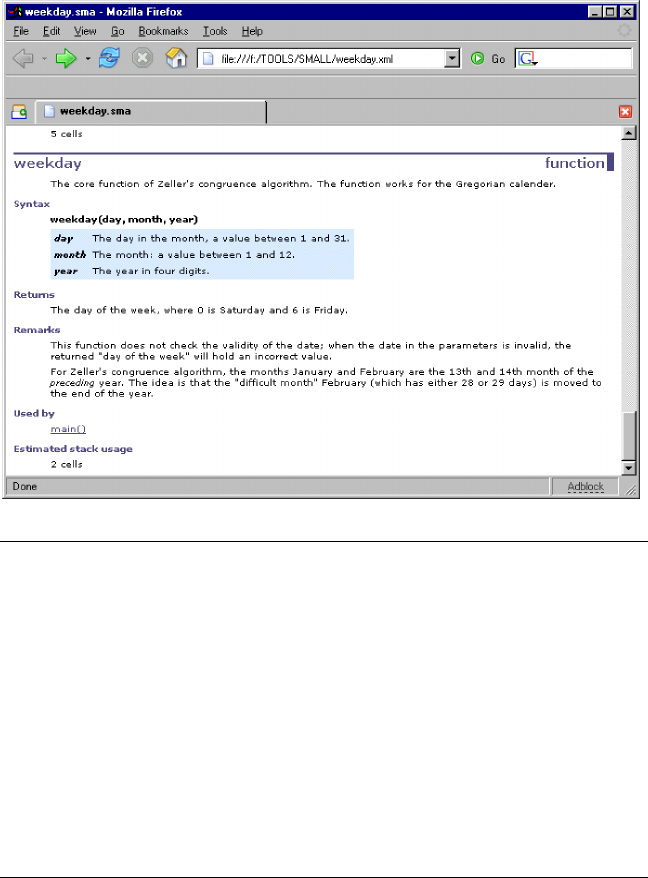
Documentation comments — 53
FIGURE 1: Documentation generated from the source code
* </summary>
*
* <param name="month">
* The month number, a value between 1 and 12.
* </param>
* <param name="year">
* The year in 4 digits.
* </param>
*/
daysinmonth(month, year)
{
static daylist[] = [ 31, 28, 31, 30, 31, 30, 31, 31, 30, 31, 30, 31 ]
assert 1 <= month <= 12
return daylist[month-1] + _:(month == 2 && isleapyear(year))
}
The format of the XML file created by “.Net” developer products
is documented in the Microsoft documentation. The PAWN parser
creates a minimal description of each function or global variable
or constant that is used in a project, regardless of whether you
used documentation comments on that function, variable or con-
stant. The parser also generates few tags of its own:
54 — Documentation comments
attribute Attributes for a function, such as “native” or “stock”.
automaton The automaton that the function belongs to (if any).
dependencyThe names of the symbols (other functions, global
variables and/global constants) that the function re-
quires. If desired, a call tree can be constructed from
the dependencies.
param Function parameters. When you add a parameter de-
scription in a documentation comment, this descrip-
tion is combined with the auto-generated content for
the parameter.
paraminfo Tags and array or reference information on a param-
eter.
referrer All functions that refer to this symbol; i.e., all func-
tions that use or call this variable/function. This in-
formation is sufficient to serve as a “cross-reference”
—the “referrer” tree is the inverse of the “depen-
dency” tree.
stacksize The estimated number of cells that the function will
allocate on the stack and heap. This stack usage es-
timate excludes the stack requirements of any func-
tions that are “called” from the function to which the
documentation applies. For example, function read-
date is documented as taking 6 cells on the stack,
but it also calls daysinmonth which takes 4 additional
cells —and in turn calls isleapyear. To calculate the
total stack requirements for function readdate, the
call tree should be considered.
In addition to the local variables and function pa-
rameters, the compiler also uses the stack for stor-
ing intermediate results in complex expressions. The
stack space needed for these intermediate results
are also excluded from this report. In general, the
required overhead for the intermediate results is not
cumulative (over all functions), which is why it would
be inaccurate to add a “safety margin” to every func-
tion. For the program as a whole, a safety margin
would be highly advised. See appendix B (page 167)
for the -v option which can tell you the maximum es-
timate stack usage, based on the call tree.
Documentation comments — 55
tagname The tag of the constant, variable, function result or
function parameter(s).
transition The transitions that the function provokes and their
conditions —see the section State programming on
page 36.
All text in the documentation comment(s) is also copied to each
function, variable or constant to which it is attached. The text in
the documentation comment is copied without further process-
ing —with one exception, see below. As the rest of the report
file is in XML format, and the most suitable way to process XML
to on-line documentation is through an XSLT processor (such as
a modern browser), you may choose to do any formatting in the
documentation comments using HTML tags. Note that you will
often need to explicitly close any HTML tags; the HTML standard
does not require this, but XML/XSLT processors usually do. The
PAWN toolkit comes with an example XSLT file (with a matching
style sheet) which supports the following XML/HTML tags:
<code> </code>
Formatted source code in a monospaced font; although
the “&”, “<” and “>” must be typed as “&”, “<”
and “&rt;” respectively.
<example> </example>
Text set under the topic “Example”.
<param name="..."> </param>
A parameter description, with the parameter name ap-
pearing inside the opening tag (the “name=” option) and
the parameter description following it.
<paramref name="..." />
A reference to a parameter, with the parameter name
appearing inside the opening tag (the “name=” option).
<remarks> </remarks>
Text set under the topic “Remarks”.
<returns> </returns>
Text set under the topic “Returns”.
<seealso> </seealso>
Text set under the topic “See also”.
<summary> </summary>
Text set immediately below the header of the symbol.
<section> </section>
Sets the text in a header. This should only be used in
documentation that is not attached to a function or a vari-
able.
56 — Warnings and errors
<subsection> </subsection>
Sets the text in a sub-header. This should only be used
in documentation that is not attached to a function or a
variable.
The following additional HTML tags are supported for general
purpose formatting text inside any of the above sections:
<c> </c>
Text set in a monospaced font.
<em> </em>
Text set emphasized, usually in italics.
<p> </p>
Text set in a new paragraph. Instead of wrapping <p>
and </p> around every paragraph, inserting <p/> as a
separator between two paragraphs produces the same
effect.
<para> </para>
An alternative for <p> </p>
<ul> </ul>
An unordered (bulleted) list.
<ol> </ol>
An ordered (numbered) list.
<li> </li>
An item in an ordered or unordered list.
As stated, there is one exception in the processing of documen-
tation comments: if your documentation comment contains a
<param ...> tag (and a matching </param>), the PAWN parser
looks up the parameter and combines your description of the pa-
rameter with the contents that it has automatically generated.
Warnings and errors
The big hurdle that I have stepped over is how to actually com-
pile the code snippets presented in this chapter. The reason is
that the procedure depends on the system that you are using: in
some applications there is a “Make” or “Compile script” command
button or menu option, while in other environments you have to
type a command like “pawncc myscript” on a command prompt.
If you are using the standard PAWN toolset, you will find instruc-
tions of how to use the compiler and run-time in the companion
booklet “The PAWN booklet — Implementer’s Guide”. If you are
using Microsoft Windows, it may prove the most convenient to
Warnings and errors — 57
use the Quincy IDE that comes with PAWN for writing, running
and debugging scripts.
Regardless of the differences in launching the compile, the phe-
nomenon that results from launching the compile are likely to be
very similar between all systems:
⋄either the compile succeeds and produces an executable pro-
gram —that may or may not run automatically after the com-
pile;
⋄or the compile gives a list of warning and error messages.
Mistakes happen and the PAWN parser tries to catch as many of
them as it can. When you inspect the code that the PAWN parser
complains about, it may on occasion be rather difficult for you
to see why the code is erroneous (or suspicious). The following
hints may help:
⋄Each error or warning number is numbered. You can look up
the error message with this number in appendix A, along with
a brief description on what the message really means.
⋄If the PAWN parser produces a list of errors, the first error in
this list is a true error, but the diagnostic messages below it
may not be errors at all.
After the PAWN parser sees an error, it tries to step over it and
complete the compilation. However, the stumbling on the er-
ror may have confused the PAWN parser so that subsequent le-
gitimate statements are misinterpreted and reported as errors
too.
When in doubt, fix the first error and recompile.
⋄The PAWN parser checks only the syntax (spelling/grammar),
not the semantics (i.e. the “meaning”) of the code. When it de-
tects code that does not comply to the syntactical rules, there
may actually exist different ways in which the code can be
changed to be “correct”, in the syntactical sense of the word
—even though many of these “corrections” would lead to non-
sensical code. The result is, though, that the PAWN parser may
have difficulty to precisely locate the error: it does not know
what you meant to write. Hence, the parser often outputs two
line numbers and the error is somewhere in the range (between
the line numbers).
⋄Remember that a program that has no syntactical errors (the
PAWN parser accepts it without error & warning messages) may
still have semantical and logical errors which the PAWN parser

58 — In closing
cannot catch. The assert instruction (page 109) is meant to
help you catch these “run-time” errors.
In closing
If you know the C programming language, you will have seen
many concepts that you are familiar with, and a few new ones.
If you don’t know C, the pace of this introduction has probably
been quite high. Whether you are new to C or experienced in C, I
encourage you to read the following pages carefully. If you know
C or a C-like language, by the way, you may want to consult the
chapter Pitfalls (page 131) first.
This booklet attempts to be both an informal introduction and
a (more formal) language specification at the same time, per-
haps succeeding at neither. Since it is also the standard book on
PAWN,∗the focus of this booklet is on being accurate and com-
plete, rather than being easy to grasp.
The double nature of this booklet shows through in the order
in which it presents the subjects. The larger conceptual parts
of the language, variables and functions, are covered first. The
operators, the statements and general syntax rules follow later
—not that they are less important, but they are easier to learn,
to look up, or to take for granted.
∗It is no longer the only book on Pawn.
59
Data and declarations
PAWN is a typeless language. All data elements are of type “cell”,
and a cell can hold an integral number. The size of a cell (in
bytes) is system dependent —usually, a cell is 32-bits.
The keyword new declares a new variable. For special declara-
tions, the keyword new is replaced by static,public or stock
(see below). A simple variable declaration creates a variable that
occupies one “cell” of data memory. Unless it is explicitly initial-
ized, the value of the new variable is zero.
A variable declaration may occur:
⋄at any position where a statement would be valid —local vari-
ables;
⋄at any position where a function declaration (native function
declarations) or a function implementation would be valid —
global variables;
⋄in the first expression of a for loop instruction —also local vari- “for” loop: 110
ables.
Local declarations
A local declaration appears inside a compound statement. Compound state-
ment: 109
A local variable can only be accessed from within the com-
pound statement, and from nested compound statements.
A declaration in the first expression of a for loop instruc-
tion is also a local declaration.
Global declarations
A global declaration appears outside a function. A global
variable is accessible to any function. Global data objects
can only be initialized with constant expressions.
State variable declarations
A state variable is a global variable with a state classifier ap-
pended at the end. The scope and the lifespan of the variable
are restricted to the states that are listed in the classifier. Fall-
back state specifiers are not permitted for state variables.
State variables may not be initialized. In contrast to normal vari-
ables (which are zero after declaration —unless explicitly initial-
ized), state variables hold an indeterminate value after declara-
tion and after first entering a state in its classifier. Typically, one
uses the state entry function(s) to properly initialize the state
variable, and the exit function(s) to reset these variables.

60 — Static local declarations
Static local declarations
A local variable is destroyed when the execution leaves the com-
pound block in which the variable was created. Local variables in
a function only exist during the run time of that function. Each
new run of the function creates and initializes new local vari-
ables. When a local variable is declared with the keyword static
rather than new, the variable remains in existence after the end of
a function. This means that static local variables provide private,
permanent storage that is accessible only from a single function
(or compound block). Like global variables, static local variables
can only be initialized with constant expressions.
Static global declarations
A static global variable behaves the same as a normal global vari-
able, except that its scope is restricted to the file that the decla-
ration resides in. To declare a global variable as static, replace
the keyword new by static.
Stock declarations
A global variable may be declared as “stock”. A stock declaration
Stock functions: 82 is one that the parser may remove or ignore if the variable turns
out not to be used in the program.
Stock variables are useful in combination with stock functions.
A public variable may be declared as “stock” as well —declaring
public variables as “public stock” enables you to declare al public
variables that a host application provides in an include file, with
only those variables that the script actually uses winding up in
the P-code file.
Public declarations
Global “simple” variables (no arrays) may be declared “public”
in two ways:
⋄declare the variable using the keyword public instead of new;
⋄start the variable name with the “@” symbol.
Arrays (single dimension) — 61
Public variables behave like global variables, with the addition
that the host program can also read and write public variables.
A (normal) global variable can only be accessed by the functions
in your script —the host program is unaware of them. As such,
a host program may require that you declare a variable with a
specific name as “public” for special purposes —such as the most
recent error number, or the general program state.
Constant variables
It is sometimes convenient to be able to create a variable that is Symbolic con-
stants: 100
initialized once and that may not be modified. Such a variable
behaves much like a symbolic constant, but it still is a variable.
To declare a constant variable, insert the keyword const between
the keyword that starts the variable declaration —new,static,
public or stock— and the variable name.
Examples:
new const address[4] = { 192, 0, 168, 66 }
public const status /* initialized to zero */
Three typical situations where one may use a constant variable
are:
⋄To create an “array” constant; symbolic constants cannot be
indexed.
⋄For a public variable that should be set by the host application,
and only by the host application. See the preceding section for
public variables.
⋄A special case is to mark array arguments to functions as const.
Array arguments are always passed by reference, declaring
them as const guards against unintentional modification. Re-
fer to page 70 for an example of const function arguments.
Arrays (single dimension)
The syntax name[constant] declares name to be an array of “con- See also “multi-
dimensional ar-
rays”, page 64,
and “symbolic
subscripts”, page
63
stant” elements, where each element is a single cell. The name
is a placeholder of an identifier name of your choosing and con-
stant is a positive non-zero value; constant may be absent. If
there is no value between the brackets, the number of elements
is set equal to the number of initiallers —see the example below.
62 — Initialization
The array index range is “zero based” which means that the first
element is at name[0] and the last element is name[constant-1].
The syntax name{constant} also declares name as an array of con-
stant elements, but now the elements are characters rather than
cells. The number of characters that fit in a cell depends on the
configuration of the PAWN parser.
Initialization
Data objects can be initialized at their declaration. The initialler
Constants: 96 of a global data object must be a constant. Arrays, global or local,
must also be initialized with constants.
Uninitialized data defaults to zero.
Examples:
LISTING: good declaration
new i = 1
new j /* j is zero */
new k = 'a' /* k has character code for letter 'a' */
new a[] = [1,4,9,16,25] /* a has 5 elements */
new s1[20] = ['a','b'] /* the other 18 elements are 0 */
new s2[] = ''Hello world...'' /* an unpacked string */
Examples of invalid declarations:
LISTING: bad declarations
new c[3] = 4 /* an array cannot be set to a value */
new i = "Good-bye" /* only an array can hold a string */
new q[] /* unknown size of array */
new p[2] = { i + j, k - 3 } /* array initiallers must be constants */
Progressive initiallers for arrays
The ellipsis operator continues the progression of the initialisa-
tion constants for an array, based on the last two initialized ele-
ments. The ellipsis operator (three dots, or “...”) initializes the
array up to its declared size.
Examples:
LISTING: array initializers
new a[10] = { 1, ... } // sets all ten elements to 1
new b[10] = { 1, 2, ... } // b = 1, 2, 3, 4, 5, 6, 7, 8, 9, 10
new c[8] = { 1, 2, 40, 50, ... } // c = 1, 2, 40, 50, 60, 70, 80, 90
new d[10] = { 10, 9, ... } // d = 10, 9, 8, 7, 6, 5, 4, 3, 2, 1
Symbolic subscripts for arrays — 63
Symbolic subscripts for arrays
An array may be declared with a list of symbols instead of a value
for its size: an example of this is the “priority queue” sample pro-
gram on page 19. An individual subscript may also be interpreted
as a sub-arrays, for example, see the RPN calculator program at
page 27.
The sub-array syntax applies as well to the initialization of an Use a #define for
convenient decla-
ration: 19
array with symbolic subscripts. Referring again to the “prior-
ity queue” sample program, to initialize a “message” array with
fixed values, the syntax is:
LISTING: array initializers
new msg[.text{40}, .priority] = { "new message", 1 }
The initialler consists of a string (a literal array) and a value;
these go into the fields “.text” and “.priority” respectively.
An array dimension that is declared as a list of symbolic sub-
scripts, may only be indexed with these subscripts. From the
above declaration of variable “msg”, we may use:
LISTING: array initializers
msg[.text] = "another message"
msg[.priority] = 10 - msg[.priority]
It is an error, however, to use a (numeric) expression to index
“msg”. For example, “msg[1]” is an invalid expression.
Since an array with symbolic subscripts may not be indexed with
an expression, the square brackets that enclose the expression
become optional. These brackets may be omitted. The snippet
below is equivalent to the previous snippet.
LISTING: array initializers
msg.text = "another message"
msg.priority = 10 - msg.priority
A subscript may have an explicit tag name as well. This tag will Tag names: 65
then override the default tag for array elements. The RPN cal-
culator program makes use of this feature to mark one of the
subscripts as a rational value. In the declaration in the snippet
below, the expression “field.type” is a plain integer (without
tag), but the expression “field.value” has tag Rational:.
LISTING: array initializers
new field[ .type, /* operator or token type */
Rational: .value, /* value, if t_type is "Number" */
.word{20} /* raw string */
]
64 — Multi-dimensional arrays
Multi-dimensional arrays
Multi-dimensional arrays are arrays that contain references to
the sub-arrays. That is, a two-dimensional array is an “array of
single-dimensional arrays”.∗Below are a few examples of decla-
rations of two-dimensional arrays.
LISTING: two-dimensional arrays
new a[4][3]
new b[3][2] = [ [ 1, 2 ], [ 3, 4 ], [ 5, 6 ] ]
new c[3][3] = [ [ 1 ], [ 2, ...], [ 3, 4, ... ] ]
new d[2]{10} = [ "agreement", "dispute" ]
new e[2][] = [ ''OK'', ''Cancel'' ]
new f[][] = [ ''OK'', ''Cancel'' ]
As the last two declarations (variable “e” en “f”) show, the final
dimension of an array may have an unspecified length, in which
case the length of each sub-array is determined from the related
initializer. Every sub-array may have a different size; in this par-
ticular example, “e[1][5]” contains the letter “l” from the word
“Cancel”, but “e[0][5]” is invalid because the length of the sub-
array “e[0]” is only three cells (containing the letters “O”, “K”
and a zero terminator).
The difference between the declarations for arrays “e” and “f” is
that we let the compiler count the number of initializers for the
major dimension —“sizeof f” is 2, like “sizeof e” (see the next
section on the sizeof operator).
Arrays and the sizeof operator
The sizeof operator returns the size of a variable in “elements”.
For a simple (non-compound) variable, the result of sizeof is al-
ways 1, because an element is a cell for a simple variable.
An array with one dimension holds a number of cells and the
sizeof operator returns that number. The snippet below would
therefore print “5” at the display, because the array “msg” holds
four characters (each in one cell) plus a zero-terminator:
LISTING: sizeof operator
new msg[] = ''Help''
printf(''%d'', sizeof msg);
∗The current implementation of the Pawn compiler supports only arrays with
up to three dimensions.
Tag names — 65
The sizeof operator always returns the number of cells, even
for a packed array. That is, in the next snippet, the value printed
would be less than “5” —although there are five characters in
the array, those are packed in fewer cells.
LISTING: sizeof operator
new msg{} = "Help"
printf(''%d'', sizeof msg);
With multi-dimensional arrays, the sizeof operator can return
the number of elements in each dimension. For the last (minor)
dimension, an element will again be a cell, but for the major di-
mension(s), an element is a sub-array. In the following code snip-
pet, observe that the syntax sizeof matrix refers to the major
dimension of the two-dimensional array and the syntax sizeof
matrix[] refers to the minor dimension of the array. The val-
ues that this snippet prints are 3 and 2 (for the major and minor
dimensions respectively):
LISTING: sizeof operator and multidimensional arrays
new matrix[3][2] = { { 1, 2 }, { 3, 4 }, { 5, 6 } }
printf(''%d %d'', sizeof matrix, sizeof matrix[]);
The application of the sizeof operator on multi-dimensional ar- Default function
arguments and
sizeof: 73
rays is especially convenient when used as a default value for
function arguments.
Tag names
A tag is a label that denotes the objective of —or the meaning
of— a variable, a constant or a function result. Tags are op-
tional, their only purpose is to allow a stronger compile-time er-
ror checking of operands in expressions, of function arguments
and of array indices.
A tag consists of a symbol name followed by a colon; it has the Label syntax: 109
same syntax as a label. A tag precedes the symbol name of a
variable, constant or function. In an assignment, only the right
hand of the “=” sign may be tagged.
Examples of valid tagged variable and constant definitions are:
LISTING: tag names
new bool:flag = true /* "flag" can only hold "true" or "false" */
const error:success = 0
const error:fatal= 1
const error:nonfatal = 2
error:errno = fatal
66 — Tag names
The sequence of the constants success,fatal and nonfatal could
“const” statement:
100 more conveniently be declared by grouping the constants in a
compount block, as illustrated below. The declaration below cre-
ates the same three constants, all with the tag error:. It is re-
quired to specify a value for the first constant of the list, the
subsequent constants are automatically assigned a value that is
the value of the previous constant +1 —unless an explicit value
is present.
LISTING: enumerated constants
const error: {
notice = 0,
warning,
nonfatal,
fatal,
}
new error: code
After declaring variable “code” with tag name “error:”, you can
assign any of the constants with that same tag name to it; how-
ever, writing “code = 2” will give a parser diagnostic (a warning
or error message). A tag override (or a tag cast) adjusts an ex-
pression to the desired tag name. As a somewhat contrived ex-
ample, the next snippet elevates “code” to a higher level (a “more
serious error”) —note how the literal value 1 is forced to the tag
name “error:”
LISTING: tag override
if (code < fatal)
code = code + error:1
Tag names introduced so far started with a lower case letter;
these are “weak” tags. Tag names that start with an upper case
letter are “strong” tags. The difference between weak and strong
tags is that weak tags may, in a few circumstances, be dropped
implicitly by the PAWN parser —so that a weakly tagged expres-
sion becomes an untagged expression. The tag checking mech-
anism verifies the following situations:
⋄When the expressions on both sides of a binary operator have a
different tag, or when one of the expressions is tagged and the
other is not, the compiler issues a “tag mismatch” diagnostic.
There is no difference between weak and strong tags in this
situation.
⋄There is a special case for the assignment operator: the com-
“lvalue”: the vari-
able on the left
side in an assign-
ment, see page
102
piler issues a diagnostic if the variable on the left side of an
assignment operator has a tag, and the expression on the right
side either has a different tag or is untagged. However, if the
variable on the left of the assignment operator is untagged, it
Tag names — 67
accepts an expression (on the right side) with a weak tag. In
other words, a weak tag is dropped in an assignment when the
lvalue is untagged.
⋄Passing arguments to a function follows the rule for assign-
ments. The compiler issues a diagnostic when the formal pa-
rameter (in a function definition) has a tag and the actual pa-
rameter (in the function call) either is untagged or has a differ-
ent tag. However, if the formal parameter is untagged, it also
accepts a parameter with any weak tag.
68
Functions
A function declaration specifies the name of the function and,
between parentheses, its formal parameters. A function may also
return a value. A function declaration must appear on a global
level (i.e. outside any other functions) and is globally accessible.
If a semicolon follows the function declaration (rather than a
The preferred way
to declare for-
ward functions is
at page 79
statement), the declaration denotes a forward declaration of the
function.
The return statement sets the function result. For example, func-
tion sum (see below) has as its result the value of both its argu-
ments added together. The return expression is optional for a
function, but one cannot use the value of a function that does
not return a value.
LISTING: sum function
sum(a, b)
return a + b
Arguments of a function are (implicitly declared) local variables
for that function. The function call determines the values of the
arguments.
Another example of a complete definition of a function is below:
function leapyear returns true for a leap year and false for a
non-leap year.
LISTING: leapyear function
leapyear(y)
return y % 4 == 0 && y % 100 != 0 || y % 400 == 0
The logical and arithmetic operators used in the leapyear exam-
ple are covered on pages 105 and 102 respectively.
Usually a function contains local variable declarations and con-
“assert” state-
ment: 109 sists of a compound statement. In the following example, note
the assert statement to guard against negative values for the
exponent.
LISTING: power function (raise to a power)
power(x, y)
{
/* returns x raised to the power of y */
assert y >= 0
new r = 1
for (new i = 0; i < y; i++)
r *= x
return r
}
Function arguments — 69
A function may contain multiple return statements —one usually
does this to quickly exit a function on a parameter error or when
it turns out that the function has nothing to do. If a function re-
turns an array, all return statements must specify an array with
the same size and the same dimensions.
Function arguments
The “faculty” function in the next program has one parameter Another exam-
ple is function Ju-
lianToDate at page
11
which it uses in a loop to calculate the faculty of that number.
What deserves attention is that the function modifies its argu-
ment.
LISTING: faculty.p
/* Calculation of the faculty of a value */
main()
{
print "Enter a value: "
new v = getvalue()
new f = faculty(v)
printf "The faculty of %d is %d\n", v, f
}
faculty(n)
{
assert n >= 0
new result = 1
while (n > 0)
result *= n--
return result
}
Whatever (positive) value that “n” had at the entry of the while
loop in function faculty, “n” will be zero at the end of the loop.
In the case of the faculty function, the parameter is passed “by
value”, so the change of “n” is local to the faculty function. In
other words, function main passes “v” as input to function fac-
ulty, but upon return of faculty, “v” still has the same value as
before the function call.
•call-by-value versus call-by-reference
Arguments that occupy a single cell can be passed by value or by
reference. The default is “pass by value”. To create a function
argument that is passed by reference, prefix the argument name
with the character &.
Example:
70 — Function arguments
LISTING: swap function
swap(&a, &b)
{
new temp = b
b=a
a = temp
}
To pass an array to a function, append a pair of brackets to the ar-
gument name. You may optionally indicate the size of the array;
doing so improves error checking of the parser.
Example:
LISTING: addvector function
addvector(a[], const b[], size)
{
for (new i = 0; i < size; i++)
a[i] += b[i]
}
Arrays are always passed by reference. As a side note, array bin
Constant vari-
ables: 61 the above example does not change in the body of the function.
The function argument has been declared as const to make this
explicit. In addition to improving error checking, it also allows
the PAWN parser to generate more efficient code.
To pass an array of literals to a function, use the same syntax as
for array initiallers: a literal string or the series of array indices
enclosed in braces (see page 98; the ellipsis for progressive ini-
tiallers cannot be used). Literal arrays can only have a single
dimension.
The following snippet calls addvector to add five to every element
of the array “vect”:
LISTING: addvector usage
new vect[3] = [ 1, 2, 3 ]
addvector(vect, [5, 5, 5], 3)
/* vect[] now holds the values 6, 7 and 8 */
The call to function printf with the string "Hello world\n" in the
“Hello world” pro-
gram: 3first ubiquitous program is another example of passing a literal
array to a function.
Function arguments — 71
•Named parameters versus positional parameters
In the previous examples, the order of parameters of a function
call was important, because each parameter is copied to the func-
tion argument with the same sequential position. For example,
with the function weekday (which uses Zeller’s congruence algo-
rithm) defined as below, you would call weekday(12,31,1999) to
get the week day of the last day of the preceding century.
LISTING: weekday function
weekday(month, day, year)
{
/* returns the day of the week: 0=Saturday, 1=Sunday, etc. */
if (month <= 2)
month += 12, --year
new j = year % 100
new e = year / 100
return (day + (month+1)*26/10 + j + j/4 + e/4 - 2*e) % 7
}
Date formats vary according to culture and nation. While the
format month/day/year is common in the United States of Amer-
ica, European countries often use the day/month/year format,
and technical publications sometimes standardize on the year/
month/day format (ISO/IEC 8824). In other words, no order of
arguments in the weekday function is “logical” or “conventional”.
That being the case, the alternative way to pass parameters to a
function is to use “named parameters”, as in the next examples
(the three function calls are equivalent):
LISTING: weekday usage —positional parameters
new wkday1 = weekday( .month = 12, .day = 31, .year = 1999)
new wkday2 = weekday( .day = 31, .month = 12, .year = 1999)
new wkday3 = weekday( .year = 1999, .month = 12, .day = 31)
With named parameters, a period (“.”) precedes the name of
the function argument. The function argument can be set to any
expression that is valid for the argument. The equal sign (“=”)
does in the case of a named parameter not indicate an assign-
ment; rather it links the expression that follows the equal sign to
one of the function arguments.
One may mix positional parameters and named parameters in a
function call with the restriction that all positional parameters
must precede any named parameters.
72 — Function arguments
•Default values of function arguments
A function argument may have a default value. The default value
Public functions
do not support de-
fault argument
values; see page
80
for a function argument must be a constant. To specify a default
value, append the equal sign (“=”) and the value to the argument
name.
When the function call specifies an argument placeholder instead
of a valid argument, the default value applies. The argument
placeholder is the underscore character (“_”). The argument
placeholder is only valid for function arguments that have a de-
fault value.
The rightmost argument placeholders may simply be stripped
from the function argument list. For example, if function in-
crement is defined as:
LISTING: increment function —default values
increment(&value, incr=1) value += incr
the following function calls are all equivalent:
LISTING: increment usage
increment(a)
increment(a, _)
increment(a, 1)
Default argument values for passed-by-reference arguments are
useful to make the input argument optional. For example, if the
function divmod is designed to return both the quotient and the
remainder of a division operation through its arguments, default
values make these arguments optional:
LISTING: divmod function —default values for reference parame-
ters
divmod(a, b, "ient=0, &remainder=0)
{
quotient = a / b
remainder = a % b
}
With the preceding definition of function divmod, the following
function calls are now all valid:
LISTING: divmod usage
new p, q
divmod(10, 3, p, q)
divmod(10, 3, p, _)
divmod(10, 3, _, q)
divmod(10, 3, p)
divmod 10, 3, p, q
Function arguments — 73
Default arguments for array arguments are often convenient to
set a default string or prompt to a function that receives a string
argument. For example:
LISTING: print error function
print_error(const message[], const title[] = "Error: ")
{
print title
print message
print "\n"
}
The next example adds the fields of one array to another array,
and by default increments the first three elements of the desti-
nation array by one:
LISTING: addvector function, revised
addvector(a[], const b[] = {1, 1, 1}, size = 3)
{
for (new i = 0; i < size; i++)
a[i] += b[i]
}
•sizeof operator and default function arguments
A default value of a function argument must be a constant, and “sizeof” operator
107
its value is determined at the point of the function’s declaration.
Using the “sizeof” operator to set the default value of a function
argument is a special case: the calculation of the value of the
sizeof expression is delayed to the point of the function call and
it takes the size of the actual argument rather than that of the
formal argument. When the function is used several times in a
program, with different arguments, the outcome of the “sizeof”
expression is potentially different at every call —which means
that the “default value” of the function argument may change.
Below is an example program that draws ten random numbers
in the range of 0–51 without duplicates. An example for an ap-
plication for drawing random numbers without duplicates is in
card games —those ten numbers could represent the cards for
two “hands” in a poker game. The virtues of the algorithm used
in this program, invented by Robert W. Floyd, are that it is effi-
cient and unbiased —provided that the pseudo-random number
generator is unbiased as well.
“random” is a pro-
posed core func-
tion, see page 121

74 — Function arguments
LISTING: randlist.p
main()
{
new HandOfCards[10]
FillRandom(HandOfCards, 52)
print "A draw of 10 numbers from a range of 0 to 51 " ...
"(inclusive) without duplicates:\n"
for (new i = 0; i < sizeof HandOfCards; i++)
printf "%d ", HandOfCards[i]
}
FillRandom(Series[], Range, Number = sizeof Series)
{
assert Range >= Number /* cannot select 50 values
* without duplicates in the
* range 0..40, for example */
new Index = 0
for (new Seq = Range - Number; Seq < Range; Seq++)
{
new Val = random(Seq + 1)
new Pos = InSeries(Series, Val, Index)
if (Pos >= 0)
{
Series[Index] = Series[Pos]
Series[Pos] = Seq
}
else
Series[Index] = Val
Index++
}
}
InSeries(Series[], Value, Top = sizeof Series)
{
for (new i = 0; i < Top; i++)
if (Series[i] == Value)
return i
return -1
}
Function main declares the array HandOfCards with a size of ten
Array declarations:
61 cells and then calls function FillRandom with the purpose that it
draws ten positive random numbers below 52. Observe, how-
ever, that the only two parameters that main passes into the
call to FillRandom are the array HandOfCards, where the random
numbers should be stored, and the upper bound “52”. The num-
ber of random numbers to draw (“10”) is passed implicitly to
FillRandom.
The definition of function FillRandom below main specifies for
its third parameter “Number = sizeof Series”, where “Series”
refers to the first parameter of the function. Due to the special
case of a “sizeof default value”, the default value of the Number
argument is not the size of the formal argument Series, but that
Function arguments — 75
of the actual argument at the point of the function call: HandOf-
Cards.
Note that inside function FillRandom, asking the “sizeof” the
function argument Series would (still) evaluate in zero, because
the Series array is declared with unspecified length (see page
107 for the behaviour of sizeof). Using sizeof as a default value
for a function argument is a specific case. If the formal parame-
ter Series were declared with an explicit size, as in Series[10],
it would be redundant to add a Number argument with the array
size of the actual argument, because the parser would then en-
force that both formal and actual arguments have the size and
dimensions.
•Arguments with tag names
A tag optionally precedes a function argument. Using tags im- Tag names: 65
proves the compile-time error checking of the script and it serves
as “implicit documentation” of the function. For example, a func-
tion that computes the square root of an input value in fixed point
precision may require that the input parameter is a fixed point
value and that the result is fixed point as well. The function be-
low uses the fixed point extension module, and an approxima- Fixed point arith-
metic: 88;
see also the appli-
cation note “Fixed
Point Support Li-
brary”
tion algorithm known as “bisection” to calculate the square root.
Note the use of tag overrides on numeric literals and expression
results.
LISTING: sqroot function —strong tags
Fixed: sqroot(Fixed: value)
{
new Fixed: low = 0.0
new Fixed: high = value
while (high - low > Fixed: 1)
{
new Fixed: mid = (low + high) >> 1
if (fmul(mid, mid) < value)
low = mid
else
high = mid
}
return low
}
With the above definition, the PAWN parser issues a diagnostic if
one calls the sqroot function with a parameter with a tag differ-
ent from “Fixed:”, or when it tries to store the function result in
a variable with a “non-Fixed:” tag.
76 — Function arguments
The bisection algorithm is related to binary search, in the sense
that it continuously halves the interval in which the result must
lie. A “successive substitution” algorithm like Newton-Raphson,
that takes the slope of the function’s curve into account, achieves
precise results more quickly, but at the cost that a stopping cri-
terion is more difficult to state. State of the art algorithms for
computing square roots combine bisection and Newton-Raphson
algorithms.
•Variable arguments
A function that takes a variable number of arguments, uses the
“ellipsis” operator (“...”) in the function header to denote the
position of the first variable argument. The function can access
the arguments with the predefined functions numargs,getarg and
setarg (see page 121).
Function sum returns the summation of all of its parameters. It
uses a variable length parameter list.
LISTING: sum function, revised
sum(...)
{
new result = 0
for (new i = 0; i < numargs(); ++i)
result += getarg(i)
return result
}
This function could be used in:
LISTING: sum function usage
new v = sum(1, 2, 3, 4, 5)
A tag may precede the ellipsis to enforce that all subsequent
Tag names: 65 parameters have the same tag, but otherwise there is no error
checking with a variable argument list and this feature should
therefore be used with caution.
The functions getarg and setarg assume that the argument is
passed “by reference”. When using getarg on normal function
parameters (instead of variable arguments) one should be cau-
tious of this, as neither the compiler nor the abstract machine
can check this. Actual parameters that are passed as part of a
“variable argument list” are always passed by reference.
Calling functions — 77
Coercion rules
If the function argument, as per the function definition (or its
declaration), is a “value parameter”, the caller can pass as a pa-
rameter to the function:
⋄a value, which is passed by value;
⋄a reference, whose dereferenced value is passed;
⋄an (indexed) array element, which is a value.
If the function argument is a reference, the caller can pass to the
function:
⋄a value, whose address is passed;
⋄a reference, which is passed by value because it has the type
that the function expects;
⋄an (indexed) array element, which is a value.
If the function argument is an array, the caller can pass to the
function:
⋄an array with the same dimensions, whose starting address is
passed;
⋄an (indexed) array element, in which case the address of the
element is passed.
Calling functions
When inserting a function name with its parameters in a state-
ment or expression, the function will get executed in that state-
ment/expression. The statement that refers to the function is the
“caller” and the function itself, at that point, is the “callee”: the
one being called.
The standard syntax for calling a function is to write the func-
tion’s name, followed by a list with all explicitly passed param-
eters between parentheses. If no parameters are passed, or if
the function does not have any, the pair of parentheses behind
the function name are still present. For example, to try out the Function power: 68
power function, the following program calls it thus:
LISTING: example program for the power function
main()
{
print "Please give the base value and the power to raise it to:"
new base = getvalue()
new power = getvalue()
new result = power(base, power)
printf "%d raised to the power %d is %d", base, power, result
}

78 — Recursion
A function may optionally return a value. The sum,leapyear and
Functions sum &
leapyear: 68
Function swap: 69
power functions all return a value, but the swap function does not.
Even if a function returns a value, the caller may ignore it.
For the situation that the caller ignores the function’s return
value, there is an alternative syntax to call the function, which
is also illustrated by the preceding example program calls the
power function. The parentheses around all function arguments
are optional if the caller does not use the return value. In the
last statement, the example program reads
printf "%d raised to the power %d is %d", base, power, result
rather than
printf("%d raised to the power %d is %d", base, power, result)
which does the same thing.
The syntax without parentheses around the parameter list is the
“procedure call” syntax. You can use it only if:
⋄the caller does not assign the function’s result to a variable and
does not use it in an expression, or as the “test expression” of
an if statement for example;
⋄the first parameter does not start with an opening parenthesis;
⋄the first parameter is on the same line as the function name,
unless you use named parameters (see the next section).
As you may observe, the procedure call syntax applies to cases
where a function call behaves rather as a statement, like in the
calls to print and printf in the preceding example. The syn-
tax is aimed at making such statements appear less cryptic and
friendlier to read, but not that the use of the syntax is optional.
As a side note, all parentheses in the example program presented
in this section are required: the return values of the calls to get-
value are stored in two variables, and therefore an empty pair of
parentheses must follow the function name. Function getvalue
has optional parameters, but none are passed in this example
program.
Recursion
Afaculty example function earlier in this chapter used a simple
“faculty”: 69
“fibonacci”: 9loop. An example function that calculated a number from the Fi-
bonacci series also used a loop and an extra variable to do the
trick. These two functions are the most popular routines to illus-
trate recursive functions, so by implementing these as iterative
Forward declarations — 79
procedures, you might be inclined to think that PAWN does not
support recursion.
Well, PAWN does support recursion, but the calculation of facul-
ties and of Fibonacci numbers happen to be good examples of
when not to use recursion. Faculty is easier to understand with
a loop than it is with recursion. Solving Fibonacci numbers by
recursion indeed simplifies the problem, but at the cost of be-
ing extremely inefficient: the recursive Fibonacci calculates the
same values over and over again.
The program below is an implementation of the famous “Towers There exists an
intriguing itera-
tive solution to the
Towers of Hanoi.
of Hanoi” game in a recursive function:
LISTING: hanoi.p
/* The Towers of Hanoi, a game solved through recursion */
main()
{
print "How many disks: "
new disks = getvalue()
move 1, 3, 2, disks
}
move(from, to, spare, numdisks)
{
if (numdisks > 1)
move from, spare, to, numdisks-1
printf "Move disk from pillar %d to pillar %d\n", from, to
if (numdisks > 1)
move spare, to, from, numdisks-1
}
Forward declarations
For standard functions, the current “reference implementation”
of the PAWN compiler does not require functions to be declared
before their first use.∗User-defined operators are special func-
tions, and unlike standard functions they must be declared be-
fore use. In many cases it is convenient to put the implemen-
tation of a user-defined operator in an include file, to make sure
that its declaration precedes its first use. Sometimes, it may how- Forbidden user-
defined operators:
89
ever be required (or convenient) to declare a user- defined op-
erator first and implement it elsewhere. A particular use of this
technique is to implement “forbidden” user-defined operators.
∗Other implementations of the Pawn language (if they exist) may use “single
pass” parsers, requiring functions to be defined before use.
80 — State classifiers
To create a forward declaration, precede the function name and
its parameter list with the keyword forward. For compatibility
with early versions of PAWN, and for similarity with C/C++, an
alternative way to forwardly declare a function is by typing the
function header and terminating it with a semicolon (which fol-
lows the closing parenthesis of the parameter list).
The full definition of the function, with a non-empty body, is
implemented elsewhere in the source file (except for forbidden
user-defined operators).
State classifiers are ignored on forward declarations.
State classifiers
All functions except native functions may optionally have a state
Example: 37 attribute. This consists of a list of state (and automata) names
between angle brackets behind the function header. The names
are separated by commas. When the state is part of a non-default
automaton, the name of the automaton and a colon separator
must precede the state; for example, “parser:slash” stands for
the state slash of the automaton parser.
If a function has states, there must be several “implementations”
of the function in the source code. All functions must have the
same function header (excluding the state classifier list).
As a special syntax, when there are no names between the an-
gle brackets, the function is linked to all states that are not at-
tributed to other implementations of the function. The function
that handles “all states not handled elsewhere” is the so-called
fall-back function.
Public functions, function main
A stand-alone program must have the function main. This func-
tion is the starting point of the program. The function main may
not have arguments.
A function library need not to have a main function, but it must
have it either a main function, or at least one public function.
Function main is the primary entry point into the compiled pro-
gram; the public functions are alternative entry points to the pro-
gram. The virtual machine can start execution with one of the
Static functions — 81
public functions. A function library may have a main function to
perform one-time initialization at start-up.
To make a function public, prefix the function name with the
keyword public. For example, a text editor may call the public
function “onkey” for every key that the user typed in, so that the
user can change (or reject) keystrokes. The onkey function below
would replace every “~” character (code 126 in the ISO Latin-1
character set) by the “hard space” code in the ANSI character
table:
LISTING: onkey function
public onkey(keycode)
{
if (key == '~')
return 160 // replace ~ by hard space (code 160 in Latin-1)
else
return key // leave other keys unaltered
}
Functions whose name starts with the “@” symbol are also pub-
lic. So an alternative way to write the public function onkey func-
tion is:
LISTING: @onkey function
@onkey(keycode)
return key=='~' ? 160 : key
The “@” character, when used, becomes part of the function
name; that is, in the last example, the function is called “@on-
key”. The host application decides on the names of the public
functions that a script may implement.
Arguments of a public function may not have default values. A Default values
of function argu-
ments: 72
public function interfaces the host application to the PAWN script.
Hence, the arguments passed to the public function originate
from the host application, and the host application cannot know
what “default values” the script writer plugged for function ar-
guments —which is why the PAWN parser flags the use of default
values for arguments of public functions as an error. The issue of
default values in public function arguments only pops up in the
case that you wish to call public functions from the script itself.
Static functions
When the function name is prefixed with the keyword static,
the scope of the function is restricted to the file that the function
resides in.
82 — Stock functions
The static attribute can be combined with the “stock” attribute.
Stock functions
A “stock” function is a function that the PAWN parser must “plug
into” the program when it is used, and that it may simply “re-
move” from the program (without warning) when it is not used.
Stock functions allow a compiler or interpreter to optimize the
memory footprint and the file size of a (compiled) PAWN program:
any stock function that is not referred to, is completely skipped
—as if it were lacking from the source file.
A typical use of stock functions, hence, is in the creation of a set
of “library” functions. A collection of general purpose functions,
all marked as “stock” may be put in a separate include file, which
is then included in any PAWN script. Only the library functions
that are actually used get “linked” in.
To declare a stock function, prefix the function name with the
Public variables
can be declared
“stock”
keyword stock. Public functions and native functions cannot be
declared “stock”.
When a stock function calls other functions, it is usually a good
practice to declare those other functions as “stock” too —with
the exception of native functions. Similarly, any global variables
Stock variables: 60 that are used by a stock function should in most cases also be
defined “stock”. The removal of unused (stock) functions can
cause a chain reaction in which other functions and global vari-
ables are not longer accessed either. Those functions are then
removed as well, thereby continuing the chain reaction until only
the functions that are used, directly or indirectly, remain.
Native functions
A PAWN program can call application-specific functions through
a “native function”. The native function must be declared in the
PAWN program by means of a function prototype. The function
name must be preceded by the keyword native.
Examples:
native getparam(a[], b[], size)
native multiply_matrix(a[], b[], size)
native openfile(const name[])
User-defined operators — 83
The names “getparam”, “multiply_matrix” and “openfile” are
the internal names of the native functions; these are the names
by which the functions are known in the PAWN program. Option-
ally, you may also set an external name for the native function,
which is the name of the function as the “host application” knows
it. To do so, affix an equal sign to the function prototype followed
by the external name. For example:
native getparam(a[], b[], size) = host_getparam
native multiply_matrix(a[], b[], size) = mtx_mul
When a native function returns an array, the dimensions and size
of the array must be explicitly declared. The array specification
occurs between the function name and the parameter list. For
example:
#define Rect [ .left, .top, .right, .bottom ]
native intersect[Rect](src1[Rect], src2[Rect])
Unless specified explicitly, the external name is equal to the in- An example of
a native user-
defined operator
is on page 87
ternal name of a native function. One typical use for explicit
external names is to set a symbolic name for a user-defined op-
erator that is implemented as a native function.
See the “Implementer’s Guide” for implementing native func-
tions in C/C++ (on the “host application” side).
Native functions may not have state specifiers.
User-defined operators
The only data type of PAWN is a “cell”, typically a 32-bit number Tags: 65
or bit pattern. The meaning of a value in a cell depends on the
particular application —it need not always be a signed integer
value. PAWN allows to attach a “meaning” to a cell with its “tag”
mechanism.
Based on tags, PAWN also allows you to redefine operators for
cells with a specific purpose. The example below defines a tag
“ones” and an operator to add two “ones” values together (the ex-
ample also implements operators for subtraction and negation).
The example was inspired by the checksum algorithm of several
protocols in the TCP/IP protocol suite: it simulates one’s comple-
ment arithmetic by adding the carry bit of an arithmetic overflow
back to the least significant bit of the value.

84 — User-defined operators
LISTING: ones.p
forward ones: operator+(ones: a, ones: b)
forward ones: operator-(ones: a, ones: b)
forward ones: operator-(ones: a)
main()
{
new ones: chksum = ones: 0xffffffff
print "Input values in hexadecimal, zero to exit\n"
new ones: value
do
{
print ">> "
value = ones: getvalue(.base=16)
chksum = chksum + value
printf "Checksum = %x\n", chksum
}
while (value)
}
stock ones: operator+(ones: a, ones: b)
{
const ones: mask = ones: 0xffff /* word mask */
const ones: shift = ones: 16 /* word shift */
/* add low words and high words separately */
new ones: r1 = (a & mask) + (b & mask)
new ones: r2 = (a >>> shift) + (b >>> shift)
new ones: carry
restart: /* code label (goto target) */
/* add carry of the new low word to the high word, then
* strip it from the low word
*/
carry = (r1 >>> shift)
r2 += carry
r1 &= mask
/* add the carry from the new high word back to the low
* word, then strip it from the high word
*/
carry = (r2 >>> shift)
r1 += carry
r2 &= mask
/* a carry from the high word injected back into the low
* word may cause the new low to overflow, so restart in
* that case
*/
if (carry)
goto restart
return (r2 << shift) | r1
}
stock ones: operator-(ones: a)
return (a == ones: 0xffffffff) ? a : ~a
stock ones: operator-(ones: a, ones: b)
return a + -b
User-defined operators — 85
The notable line in the example is “chksum = chksum + value” in
the loop in function main. Since both the variables chksum and
value have the tag ones, the “+” operator refers to the user-
defined operator (instead of the default “+” operator). User-
defined operators are merely a notational convenience; the same
effect is achieved by calling functions explicitly.
The definition of an operator is similar to the definition of a func-
tion, with the difference that the name of the operator is com-
posed by the keyword “operator” and the character of the op-
erator itself. In the above example, both the unary “-” and the
binary “-” operators are redefined. An operator function for a
binary operator must have two arguments, one for an unary op-
erator must have one argument. Note that the binary “-” oper-
ator adds the two values together after inverting the sign of the
second operand. The subtraction operator thereby refers to both
the user-defined “negation” (unary “-”) and addition operators.
A redefined operator must adhere to the following restrictions:
⋄A user-defined operator must be declared before use (this is in Forward declara-
tion: 79
contrast to “normal” functions): either put the implementation
of the user-defined operator above the functions that use it, or
add a forward declaration near the top of the file.
⋄Only the following operators may be redefined: +,-,*,/,%,++,
--,==,!=,<,>,<=,>=,!and =. That is, the sets of arithmetic
and relational operators can be overloaded, but the bitwise op-
erators and the logical operators cannot. The =and !operators
are a special case.
⋄You cannot invent new operators; you cannot define operator
“#” for example.
⋄The precedence level and associativity of the operators, as well
as their “arity” remain as defined. You cannot make an unary
“+” operator, for example.
⋄The return tag of the relational operators and of the “!” oper-
ator must be “bool:”.
⋄The return tag of the arithmetic operators is at your choosing,
but you cannot redefine an operator that is identical to another
operator except for its return tag. For example, you cannot
make both
alpha: operator+(alpha: a, alpha: b)
and
beta: operator+(alpha: a, alpha: b)
(The assignment operator is an exception to this rule.)
86 — User-defined operators
⋄PAWN already defines operators to work on untagged cells, you
cannot redefine the operators where all arguments are without
a tag.
⋄The arguments of the operator function must be non-arrays
passed by value. You cannot make an operator work on arrays.
In the example given above, both arguments of the binary op-
erators have the same tag. This is not required; you may, for
example, define a binary “+” operator that adds an integer value
to a “ones:” number.
Essentially, the operation of the PAWN parser is to look up the
tag(s) of the operand(s) that the operator works on and to look
up whether a user-defined operator exists for the combination
of the operator and the tag(s). However, the parser recognizes
special situations and provides the following features:
⋄The parser recognizes operators like “+=” as a sequence of “+”
and “=” and it will call a user-defined operator “+” if available
and/or a user-defined operator “=”. In the example program,
the line “chksum = chksum + value” might have been abbrevi-
ated to “chksum += value”.
⋄The parser recognizes commutative operators (“+”, “*”, “==”,
and “!=”) and it will swap the operands of a commutative op-
erator if that produces a fit with a user-defined operator. For
example, there is usually no need to implement both
ones:operator+(ones:a, b)
and
ones:operator+(a, ones:b)
(implementing both functions is valid, and it is useful in case
the user-defined operator should not be commutative).
⋄Prefix and postfix operators are handled automatically. You
only need to define one user operator for the “++” and “--”
operators for a tag.
⋄The parser calls the “!” operator implicitly in case of a test
without explicit comparison. For example, in the statement
“if (var) ...” when “var” has tag “ones:”, the user-defined
operator “!” will be called for var. The “!” operator thus
doubles as a “test for zero” operator. (In one’s complement
arithmetic, both the “all-ones” and the “all-zeros” bit patterns
represent zero.)
⋄The user-defined assignment operator is implicitly called for
“Call by value”
versus “call by
reference”: 69
a function argument that is passed “by value” when the tag
names of the formal and the actual arguments match the tag
names of the left and right hand sides of the operator. In other
words, the PAWN parser simulates that “pass by value” happens
User-defined operators — 87
through assignment. The user-defined operator is not called
for function arguments that are passed “by reference”.
⋄If you wish to forbid an operation, you can “forward declare”
the operator without ever defining it (see page 79). This will
flag an error when the user-defined operator is invoked. For
example, to forbid the “%” operator (remainder after division)
on floating point values, you can add the line:
forward Float: operator%(Float: a, Float: b)
User-defined operators can be declared “stock” or “native”. In Native functions:
82
the case of a native operator function, the definition should in-
clude an external name. For example (when, on the host’s side,
the native function is called float_add):
LISTING: native operator+ function
native Float: operator+(Float: val, Float: val) = float_add
The user-defined assignment operator is a special case, because
it is an operator that has a side effect. Although the operator
has the appearance of a binary operator, its “expression result”
is the value at the right hand —the assignment operator would
be a “null”-operator if it weren’t for its side-effect. In PAWN a
user-defined assignment operator is declared as:
LISTING: operator= function
ones: operator=(a)
return ones: ( (a >= 0) ? a : ~(-a) )
The user-defined “=” operator looks like a unary operator in this
definition, but it is a special case nevertheless. In contrast to the
other operators, the tag of the return value for the user-defined
operator is important: the PAWN parser uses the tags of the ar-
gument and the return value to find a matching user-defined op-
erator.
The example function above is a typical application for a user-
defined assignment operator: to automatically coerce/convert an
untagged value to a tagged value, and to optionally change the
memory representation of the value in the process. Specifically,
the statement “new ones:A = -5” causes the user-defined opera-
tor to run, and for the constant -5 the operator will return “~(-
-5)”, or ~5, or −6.∗
∗Modern CPUs use two’s complement integer arithmetic. For positive val-
ues, the bitwise representation of a value is the same in one’s complement
and two’s complement, but the representations differ for negative values.
For instance, the same bit pattern that means -5 in one’s complement stands
for -6 in two’s complement.
88 — User-defined operators
•Floating point and fixed point arithmetic
PAWN only has intrinsic support for integer arithmetic (the Z-
domain, or “whole numbers”, both positive and negative). Sup-
port for floating point arithmetic or fixed point arithmetic must
be implemented through functions or user operators. User oper-
ators allow a more natural notation of expressions with fixed or
floating point numbers.
The PAWN parser has support for literal values with a fractional
Rational literals:
96
#pragma rational:
118
part, which it calls “rational numbers”. Support for rational lit-
erals must be enabled explicitly with a #pragma. The #pragma in-
dicates how the rational numbers must be stored —floating point
or fixed point. For fixed point rational values, the #pragma also
specifies the precision in decimals. Two examples for the #pragma
are:
#pragma rational Float /* floating point format */
#pragma rational Fixed(3) /* fixed point, with 3 decimals */
Since a fixed point value must still fit in a cell, the number of dec-
imals and the range of a fixed point value are related. For a fixed
point value with 3 decimals, the range would be −2,147,482 . . . +
2,147,482.
The format for a rational number may only be specified once for
the entire PAWN program. In an implementation one typically
chooses either floating point support or fixed point support. As
stated above, for the actual implementation of the floating point
or fixed point arithmetic, PAWN requires the help of (native) func-
tions and user-defined operators. A good place to put the #pragma
for rational number support would be in the include file that also
defines the functions and operators.
The include file †for fixed point arithmetic contains definitions
like:
native Fixed: operator*(Fixed: val1, Fixed: val2) = fmul
native Fixed: operator/(Fixed: val1, Fixed: val2) = fdiv
†See the application note “Fixed Point Support Library” for where to obtain
the include file.
User-defined operators — 89
The user-defined operators for multiplication and division of two
fixed point numbers are aliased directly to the native functions
fmul and fdiv. The host application must, then, provide these
native functions.
Another native user-defined operator is convenient to transform
an integer to fixed point automatically, if it is assigned to a vari-
able tagged as “Fixed:”:
native Fixed: operator=(oper) = fixed
With this definition, you can say “new Fixed: fract = 3” and the User-defined oper-
ators: 83
value will be transformed to 3.000 when it is stored in variable
fract. As explained in the section on user-defined operators,
the assignment operator also runs for function arguments that
are passed by value. In the expression “new Fixed: root = sq-
root(16)” (see the implementation of function sqroot on page
75), the user-defined assignment operator is called on the argu-
ment 16.
For adding two fixed point values together, the default “+” op-
erator is sufficient, and the same goes for subtraction. Adding
a normal (integer) number to a fixed point number is different:
the normal value must be scaled before adding it. Hence, the
include file implements operators for that purpose too:
LISTING: additive operators, commutative and non-commutative
stock Fixed: operator+(Fixed: val1, val2)
return val1 + fixed(val2)
stock Fixed: operator-(Fixed: val1, val2)
return val1 - fixed(val2)
stock Fixed: operator-(val1, Fixed: val2)
return fixed(val1) - val2
The “+” operator is commutative, so one implementation han-
dles both cases. For the “-” operator, both cases must be imple-
mented separately.
Finally, the include file forbids the use of the remainder operator
(“%”) on fixed point values: the remainder is only applicable to
integer divisions:
LISTING: forbidden operators on fixed point values
forward Fixed: operator%(Fixed: val1, Fixed: val2)
forward Fixed: operator%(Fixed: val1, val2)
forward Fixed: operator%(val1, Fixed: val2)
90 — User-defined operators
Because of the presence of the (forward) declaration of the oper-
ator, the PAWN parser will attempt to use the user-defined opera-
tor rather than the default “%” operator. By not implementing the
operator, the parser will subsequently issue an error message.
91
The preprocessor
The first phase of compiling a PAWN source file to the executable
P-code is “preprocessing”: a general purpose text filter that mod-
ifies/cleans up the source text before it is fed into the parser. The
preprocessing phase removes comments and “conditionally com-
piled” blocks, processes the compiler directives and performs
find-&-replace operations on the text of the source file. The com-
piler directives are summarized on page 114 and the text substi-
tution (“find-&-replace”) is the topic of this chapter.
The preprocessor is a process that is invoked on all source lines
immediately after they are read. No syntax checking is per-
formed during the text substitutions. While the preprocessor
allows powerful tricks in the PAWN language, it is also easy to
shoot yourself in the foot with it.
In this chapter, I will refer to the C/C++ language on several occa-
sions because PAWN’s preprocessor is similar to the one in C/C++.
That said, the PAWN preprocessor is incompatible with the C/C++
preprocessor.
The #define directive defines the preprocessor macros. Simple
macros are:
#define maxsprites 25
#define CopyRightString "(c) Copyright 2004 by me"
In the PAWN script, you can then use them as you would use con-
stants. For example:
#define maxsprites 25
#define CopyRightString "(c) Copyright 2004 by me"
main()
{
print( Copyright )
new sprites[maxsprites]
}
By the way, for these simple macros there are equivalent PAWN
constructs:
const maxsprites = 25
stock const CopyRightString[] = "(c) Copyright 2004 by me"
92 — The preprocessor
These constant declarations have the advantage of better error
checking and the ability to create tagged constants. The syntax
for a string constant is an array variable that is declared both
“const” and “stock”. The const attribute prohibits any change
to the string and the stock attribute makes the declaration “dis-
appear” if it is never referred to.
Substitution macros can take up to 10 parameters. A typical use
for macros with parameters is to simulate tiny functions:
LISTING: the “min” macro
#define min(%1,%2) ((%1) < (%2) ? (%1) : (%2))
If you know C/C++, you will recognize the habit of enclosing each
argument and the whole substitution expression in parentheses.
If you use the above macro in a script in the following way:
LISTING: bad usage of the “min” macro
newa=1,b=4
new min = min(++a,b)
the preprocessor translates it to:
newa=1,b=4
new min = ((++a) < (b) ? (++a) : (b))
which causes “a” to possibly be incremented twice. This is one of
the traps that you can trip into when using substitution macros
(this particular problem is well known to C/C++ programmers).
Therefore, it may be a good idea to use a naming convention to
distinguish macros from functions. In C/C++ it is common prac-
tice to write preprocessor macros in all upper case.
To show why enclosing macro arguments in parentheses is a
good idea, consider the macro:
#define ceil_div(%1,%2) (%1 + %2 - 1) / %2
This macro divides the first argument by the second argument,
but rounding upwards to the nearest integer (the divide operator,
“/”, rounds downwards). If you use it as follows:
new a = 5
new b = ceil_div(8, a - 2)
The preprocessor — 93
the second line expands to “new b = (8 + a - 2 - 1) / a - 2”, Operator prece-
dence: 107
which, considering the precedence levels of the PAWN operators,
leads to “b” being set to zero (if “a” is 5). What you would have
expected from looking at the macro invocation is eight divided by
three (“a - 2”), rounded upwards —hence, that “b” would be set
to the value 3. Changing the macro to enclose each parameter
in parentheses solves the problem. For similar reasons, it is also
advised to enclose the complete replacement text in parentheses.
Below is the ceil_div macro modified accordingly:
#define ceil_div(%1,%2) ( ((%1) + (%2) - 1) / (%2) )
The pattern matching is subtler than matching strings that look
like function calls. The pattern matches text literally, but accepts
arbitrary text where the pattern specifies one or more parame-
ter(s). You can create patterns like:
LISTING: macro that translates a syntax for variable assignment
to a function call
#define Field.%1=%2; SetField(%1,%2)
When the expansion of a macro contains text that matches other
macros, the expansion is performed at invocation time, not at
definition time. Thus the code:
#define a(%1) (1+b(%1))
#define b(%1) (2*(%1))
new c = a(8)
will evaluate to “new c = (1+(2*(8)))”, even though the macro
“b” was not defined at the time of the definition of “a”.
If an argument in the replacement text has a “#” immediately in
front of it, the argument is converted to a packed string constant
—meaning that double quotes are tagged at the beginning and
the end. For example, if you have the definition:
#define log(%1) "ERR: " ... #%1 ... "\n"
then the expression log(test) will result in "ERR: " ... "test" . . . See page 99 for
concatenating lit-
eral strings with
the “...” operator
"\n". The “#” operator is also called the “stringize” operator, as
it converts arguments to (packed) strings.
In the preceding examples, the pattern and the substitution text Directives: 114
fit on a single line, as is the case for all directives. For macros
where this is inconvenient, an alternative syntax is to enclose the
substitution text between square brackets. The substitution text
must still start at the same line as the pattern, but it may be split
over multiple lines.
The pattern matching is constrained to the following rules:

94 — The preprocessor
⋄There may be no square brackets and no space characters in
the pattern. If you must match a space, you need to use the
“\32;” escape sequence. The substitution text, on the other
hand, may contain space characters and brackets. Due to the
matching rules of the macro pattern (explained below), match-
ing a space character is rarely needed.
⋄Escape sequences may appear in the pattern, and can be used,
for example, to match a literal “%” character.
⋄The pattern must not end with a parameter; a pattern like
“set:%1=%2” is illegal. If you wish to match with the end of
a statement, you can add a semicolon at the end of the pat-
tern. If semicolons are optional at the end of each statement,
the semicolon will also match a newline in the source.
⋄The pattern must start with a letter, an underscore, or an “@”
character The first part of the pattern that consists of alphanu-
meric characters (plus the “_” and/“@”) is the “name” or the
“prefix” of the macro. On the defined operator and the #undef
directive, you specify the macro prefix.
⋄In matching a pattern, the preprocessor ignores white space
between non-alphanumeric symbols and white space between
an alphanumeric symbol and a non-alphanumeric one, with one
exception: between two identical symbols, white space is not
ignored. Therefore:
the pattern abc(+-) matches “abc(+-)”
the pattern abc(--) matches “abc ( -- )” but does not match
“abc(- -)”
⋄There are up to 10 parameters, denoted with a “%” and a single
digit (1 to 9 and 0). The order of the parameters in a pattern
is not important.
⋄The #define symbol is a parser directive. As with all parser
Directives: 114 directives, the pattern definition must fit on a single line. You
can circumvent this with a “\” on the end of the line. The text
to match must also fit on a single line.
Note that in the presence of macros, lines of source code may
not be what they appear: what looks like an array access may be
“preprocessed” to a function call, and vice versa.
A host application that embeds the PAWN parser may provide an
option to let you check the result of text substitution through
macros. If you are using the standard PAWN toolset, you will
find instructions of how to use the compiler and run-time in the
companion booklet “The PAWN booklet — Implementer’s Guide”.
95
General syntax
Format
Identifiers, numbers and tokens are separated by spaces,
tabs, carriage returns and “form feeds”. Series of one or
more of these separators are called white space.
Optional semicolons
Semicolons (to end a statement) are optional if they occur Optional semi-
colons: 118
at the end of a line. Semicolons are required to separate
multiple statements on a single line. An expression may
still wrap over multiple lines, but postfix operators (++ and
--)must appear on the same line as their operand.
Comments
Text between the tokens /* and */ (both tokens may be at
the same line or at different lines) and text behind // (up
to the end of the line) is a programming comment. The
parser treats a comment as white space. Comments may
not be nested.
A comment that starts with “/** ” (two stars and white-
space behind the second star) and ends with “*/” is a doc-
umentation comment. A comment that starts with “///
” (three slashes and white-space behind the third slash)
is also a documentation comment. The parser may treat
documentation comments in a special way; for example,
it may construct on-line help from it.
Identifiers
Names of variables, functions and constants. Identifiers
consist of the characters a. . . z,A. . . Z,0. . . 9,_or @; the first
character may not be a digit. The characters @and _by
themselves are not valid identifiers, i.e. “_Up” is a valid
identifier, but “_” is not.
PAWN is case sensitive.
A parser may truncate an identifier at a maximum length.
The number of significant characters is implementation
defined, but it is at least 16 characters.
Reserved words (keywords)
Statements Operators Directives Other
assert defined #assert const
break sizeof #define forward
96 — General syntax
case state #else native
continue tagof #elseif new
default #endif operator
do #endinput public
else #error static
exit #file stock
for #if
goto #include
if #line
return #pragma
sleep #section
state #tryinclude
switch #undef
while #warning
Next to reserved words, PAWN also has several predefined
Predefined con-
stants: 100 constants, you cannot use the symbol names of the prede-
fined constants for variable or function names.
Constants (literals)
Integer numeric constants
binary
0b followed by a series of the digits 0 and 1
decimal
a series of digits between 0 and 9
hexadecimal
0x followed by a series of digits between 0
and 9 and the letters ato f
In all number radices, the single quote may be used
as a “digit group separator”. For decimal numbers,
the quote separates 3 digits (thousands separator),
for binary numbers, the quote separates 8 digits
and for hexadecimal numbers, a quote separates 4
(hexadecimal) digits. Using the single quote as a
digit group separator is optional, but if used, the
number of digits after the quote must conform to
the above specification.
Rational number constants
A rational number is a number with a fractional
Rational numbers
are also called
“real numbers”
or “floating point
numbers”
part. A rational number starts with one or more
digits, contains a decimal point and has at least
one digit following the decimal point. For exam-
ple, “12.0” and “0.75” are valid rational numbers.
Optionally, an exponent may be appended to the
General syntax — 97
rational number; the exponent notation is the let-
ter “e” (lower case) followed by a signed integer
numeric constant. For example, “3.12e4” is a valid
rational number with an exponent.
Support for rational numbers must be enabled with #pragma rational:
118
#pragma rational directive. Depending on the op-
tions set with this directive, the rational number
represents a floating point or a fixed point number.
The single quote may be used as a “thousands sep-
arator” (separating 3 digits) in the “whole part” of
the number.
Character constants
A single ASCII or Unicode character surrounded
by single quotes is a character constant (for exam-
ple: 'a','7','$'). The single quote that starts
a character constant may either be a normal (for-
ward) single quote or a reverse single quote. The
terminating quote must always be a forward single
quote.
Character constants are assumed to be numeric
constants.
Escape sequences
'\a' Audible alarm (beep)
'\b' Backspace
'\e' Escape
'\f' Form feed
'\n' New-line
'\r' Carriage Return
'\t' Horizontal tab
'\v' Vertical tab
'\\'\the escape character
'\'' ' single quote
'\"' " double quote
'\% % percent sign
'\ddd;' character code with decimal code “ddd”
'\xhhh;' character code with hexadecimal code “hhh”
The semicolon after the \ddd;and \xhhh;codes
is optional. Its purpose is to give the escape se-
quence sequence an explicit termination symbol
when it is used in a string constant.
98 — General syntax
The backslash (“\”) is the default “escape” charac-
ter. If desired, you can set a different escape char-
acter with the #pragma ctrlchar directive (page
117).
String constants
String constants are assumed to be arrays with a
size that is sufficient to hold all characters plus a
terminating '\0'. Each string is stored at a unique
position in memory; there is no elimination of du-
plicate strings.
An unpacked string is a sequence of zero or more
ASCII or Unicode characters surrounded by dou-
bled single quotes. Each array element contains
a single character. Both the forward and the re-
versed single quotes can start a string.
unpacked string constant:
``the quick brown fox...''
Apacked string literal sequence of zero or more
ASCII characters surrounded by double quotes.
packed string constant:
"...packed the lazy dog in a bag"
In the case of a packed string, the parser packs as
many characters in a cell as will fit. A character
is not addressable as a single unit, instead each
element of the array contains multiple characters.
The first character in a “pack” occupies the high-
est bits of the array element. In environments that
store memory words with the high byte at the lower
address (Big Endian, or Motorola format), the indi-
vidual characters are stored in the memory cells in
the same order as they are in the string. A packed
string ends with a zero character and the string is
padded (with zero bytes) to a multiple of cells.
A packed string can only hold characters from a
single-byte character set, such as ASCII or one of
the extended ASCII sets from the ISO 8859 norm.
Escape sequences may be used within strings. See
the section on character constants (page 97) for a
list of escape sequences.
General syntax — 99
There is an alternative syntax for “plain strings”.
In a plain string, every character is taken as-is and
escape sequences are not recognized. Plain strings
are convenient to store file/resource names, espe-
cially in the case where the escape character is also
used as a special character by the operating sys-
tem or host application.
The syntax for a plain string is the escape charac-
ter followed by the string in double quotes. The
backslash (“\”) is the default “escape” character.
In a plain string all characters are taken literally,
including escape sequences.
plain (unpacked) string constant:
\''C:\all my work\novel.rtf''
In the above example, the occurrences of “\a” and
“\n” do not indicate escape sequences, but rather
the literal character pairs “\” and “a”, and “\” and
“n”.
Plain packed strings exist as well:
\"C:\all my work\novel.rtf"
Two string literals may be concatenated by insert-
ing with an ellipsis operator (three dots, or “...”)
between the strings. For example:
"The quick" ... "brown fox"
This syntax works with packed, unpacked and raw
strings. Different kinds of string literals should not
be concatenated, though. String concatenation is
valid for string literals only —string variables must
be concatenated with a library function or run-time
code.
Array constants
A series of numeric constants between braces is an
array constant. Array constants can be used to ini-
tialize array variables with (see page 62) and they
can be passed as function arguments (see page 69).
Symbolic constants
A source file declares symbolic constants with the const
instruction. A single const keyword may declare a list of
constants with sequentially incremented values and shar-
ing the same tag name.
100 — General syntax
const identifier =constant expression
Creates a single symbolic constant with the value
Examples: 7,19 of the constant expression on the right hand of the
assignment operator. The constant can be used at
any place where a literal number is valid (for ex-
ample: in expressions, in array declarations and in
directives like “#if” and “#assert”).
const tagname {constant list }
A list of symbolic names, grouped by braces, may
follow the const keyword. The constant list is a se-
Identifiers: 95 ries of identifiers separated by commas. The first
indentifier must be explicitly assigned a (numeric)
value. Unless overruled, every subsequent con-
stant has the value of its predecessor plus 1.
Example: 24
The optional tagname token that follows the const
keyword is used as the default tag name for every
symbol in the constant list. The symbols in the con-
See page 66 for
examples of enu-
merated “const”
declarations
stant list may have an explicit tag, which overrules
the default tag name.
A symbolic constant that is defined locally, is valid up
to the end of the enclosing block. A local symbolic con-
stant may not have the same name as a variable (local or
global), a function, or another constant (local or global).
Predefined constants
cellbits The size of a cell in bits; usually 32.
cellmax The largest valid positive value that a cell can
hold; usually 2147483647.
cellmin The largest valid negative value that a cell can
hold; usually -2147483648.
charbits The size of a packed character in bits; usually
8.
charmax The largest valid packed character value; usu-
ally 255.
charmin The smallest valid character value, zero for both
packed and unpacked characters.
debug The debug level: 2 if the parser creates full sym-
bolic information plus run-time bounds check-
ing, 1 if the parser generates run-time check-
ing only (assertions and array bounds checks),
General syntax — 101
and 0 (zero) if all debug support and run-time
checking was turned off.
false 0 (this constant is tagged as bool:).
line The current line number in the source file.
Pawn The version number of the PAWN compiler in Bi-
nary Coded Decimals (BCD) —that is, for ver-
sion 2.8.1 the constant is “0x281”.
true 1 (this constant is tagged as bool:).
ucharmax The largest unpacked character value, its value
depends on the size of a cell. A typical use for
this constant is in checking whether a string is
packed or unpacked, see page 134.
Tag names
A tag consists of an identifier followed by a colon. There Identifiers: 95
may be no white space between the identifier and the
colon.
Predefined tag names
bool: For “true/false” flags. The predefined constants
true and false have this tag.
Fixed: Rational numbers have this tag when fixed point
support is enabled (page 118).
Float: Rational numbers have this tag when floating
point support is enabled (page 118).
102
Operators and expressions
An expression consists of one or more operands with an operator.
The operand can be a variable, a constant or another expression.
An expression followed by a semicolon is a statement.
LISTING: examples of expressions
v++
f(a1, a2)
v = (ia1 * ia2) / ia3
Notational conventions
The operation of some operators depends on the specific kinds
of operands. In the following sections in this chapter, operands
are notated thus:
eany expression;
vany expression to which a value can be assigned (“lvalue”
expressions);
aan array;
fa function;
sa symbol —which is a variable, a constant or a function.
Arithmetic
+ e1 + e2
Results in the addition of e1 and e2.
-e1 - e2
Results in the subtraction of e1 and e2.
-e
Results in the arithmetic negation of a (two’s complement).
* e1 * e2
Results in the multiplication of e1 and e2.
/ e1 / e2
Results in the division of e1 by e2. The result is trun-
cated to the nearest integral value that is less than
or equal to the quotient. Both negative and positive
values are rounded down, i.e. towards −∞.
Bit manipulation — 103
% e1 % e2
Results in the remainder of the division of e1 by e2.
The sign of the remainder follows the sign of e2. Inte-
ger division and remainder have the Euclidean prop-
erty: D = q*d + r, where q = D/d and r = D%d.
++ v++
increments vby 1; the result if the expression is the
value of vbefore it is incremented.
++v
increments vby 1; the result if the expression is the
value of vafter it is incremented.
-- v--
decrements vby 1; the result if the expression is the
value of vbefore it is decremented.
--v
decrements vby 1; the result if the expression is the
value of vafter it is decremented.
Notes: The unary + is not defined in PAWN.
The operators ++ and -- modify the operand. The
operand must be an lvalue.
Bit manipulation
~ ~e
results in the one’s complement of e.
>> e1 >> e2
results in the arithmetic shift to the right of e1 by e2
bits. The shift operation is signed: the leftmost bit of
e1 is copied to vacant bits in the result.
>>> e1 >>> e2
results in the logical shift to the right of e1 by e2 bits.
The shift operation is unsigned: the vacant bits of the
result are filled with zeros.
<< e1 << e2
results in the value of e1 shifted to the left by e2 bits;
the rightmost bits are set to zero. There is no distinc-
tion between an arithmetic and a logical left shift
& e1 & e2
results in the bitwise logical “and” of e1 and e2.
104 — Assignment
| e1 | e2
results in the bitwise logical “or” of e1 and e2.
^e1 ^e2
results in the bitwise “exclusive or” of e1 and e2.
Assignment
The result of an assignment expression is the value of the left
operand after the assignment. The left operand may not have a
Tag names: 65
tag override.
= v = e
assigns the value of eto variable v.
= v = a
assigns array ato variable v;vmust be an array with
the same size and dimensions as a;amay be a string
or a literal array.
Note: the following operators combine an assignment with
an arithmetic or a bitwise operation; the result of the
expression is the value of the left operand after the
arithmetic or bitwise operation.
+= v += e
increments vwith e.
-= v -= e
decrements vwith e
*= v *= e
multiplies vwith e
/= v /= e
divides vby e.
%= v %= e
assigns the remainder of the division of vby eto v.
>>= v >>= e
shifts varithmetically to the right by ebits.
>>>= v >>>= e
shifts vlogically to the right by ebits.
<<= v <<= e
shifts vto the left by ebits.
&= v &= e
applies a bitwise “and” to vand eand assigns the result to v.
|= v |= e
applies a bitwise “or” to vand eand assigns the result to v.
Boolean — 105
^= v ^= e
applies a bitwise “exclusive or” to vand eand assigns
the result to v.
Relational
A logical “false” is represented by an integer value of 0; a logical
“true” is represented by any value other than 0. Value results
of relational expressions are either 0 or 1, and their tag is set to
“bool:”.
== e1 == e2
results in a logical “true” if e1 is equal to e2.
!= e1 != e2
results in a logical “true” if e1 differs from e2.
Note: the following operators may be “chained”, as in the
expression “e1 <= e2 <= e3”, with the semantics that
the result is “1” if all individual comparisons hold and
“0” otherwise.
< e1 < e2
results in a logical “true” if e1 is smaller than e2.
<= e1 <= e2
results in a logical “true” if e1 is smaller than or equal to e2.
> e1 > e2
results in a logical “true” if e1 is greater than e2.
>= e1 >= e2
results in a logical “true” if e1 is greater than or equal to e2.
Boolean
A logical “false” is represented by an integer value of 0; a logical
“true” is represented by any value other than 0. Value results
of Boolean expressions are either 0 or 1, and their tag is set to
“bool”.
! !e
results to a logical “true” if ewas logically “false”.
106 — Miscellaneous
|| e1 || e2
results to a logical “true” if either e1 or e2 (or both)
are logically “true”. The expression e2 is only evalu-
ated if e1 is logically “false”.
&& e1 && e2
results to a logical “true” if both e1 and e2 are logi-
cally “true”. The expression e2 is only evaluated if e1
is logically “true”.
Miscellaneous
[ ] a[e]
array index: results to cell efrom array a.
{ } a{e}
array index: results to character efrom “packed” array a.
( ) f(e1,e2,...eN)
results to the value returned by the function f. The
function is called with the arguments e1,e2,. . . eN.
The order of evaluation of the arguments is undefined
(an implementation may choose to evaluate function
arguments in reversed order).
? : e1 ? e2 : e3
results in either e2 or e3, depending on the value of
e1. The conditional expression is a compound expres-
sion with a two part operator, “?” and “:”. Expres-
sion e2 is evaluated if e1 is logically “true”, e3 is eval-
uated if e1 is logically “false”.
:tagname: e
tag override; the value of the expression edoes not
change, but its tag changes. See page 65 for more
information.
, e1, e2
results in e2,e1 is evaluated before e2. If used in
function argument lists or a conditional expression,
the comma expression must be surrounded by paren-
theses.
defined defined s
Operator precedence — 107
results in the value 1 if the symbol is defined. The
symbol may be a constant (page 96), or a global or
local variable.
The tag of this expression is bool:.
Example: 73
sizeof sizeof s
results in the size in “elements” of the specified vari-
able. For simple variables and for arrays with a sin-
gle dimension, an element is a cell. For multi-dimen-
sional arrays, the result is the number of array el-
ements in that dimension —append [] to the array
name to indicate a lower/more minor dimension. If
the size of a variable is unknown, the result is zero.
When used in a default value for a function argument,
the expression is evaluation at the point of the func-
tion call, instead of in the function definition.
See also page 111
for state specifiers
state state s
where sis the name of a state that is optionally pre-
fixed with the automaton name, this operator results
in the value 1 if the automatons is in the indicated
state and in 0 otherwise.
The tag of this expression is bool:.
tagof tagof s
results in the a unique number that represents the
tag of the variable, the constant, the function result
or the tag label.
When used in a default value for a function argument,
the expression is evaluation at the point of the func-
tion call, instead of in the function definition.
Operator precedence
The table groups operators with equal precedence, starting with
the operator group with the highest precedence at the top of the
table.
If the expression evaluation order is not explicitly established
by parentheses, it is determined by the association rules. For
example: a*b/c is equivalent with (a*b)/c because of the left-to-
right association, and a=b=c is equivalent with a=(b=c).

108 — Operator precedence
() function call left-to-right
[] array index (cell)
{} array index (character)
!logical not right-to-left
~one’s complement
-two’s complement (unary minus)
++ increment
-- decrement
:tag override
defined symbol definition status
sizeof symbol size in “elements”
state automaton/state condition
tagof unique number for the tag
*multiplication left-to-right
/division
%remainder
+addition left-to-right
-subtraction
>> arithmetic shift right left-to-right
>>> logical shift right
<< shift left
&bitwise and left-to-right
^bitwise exclusive or left-to-right
|bitwise or left-to-right
<smaller than left-to-right
<= smaller than or equal to
>greater than
>= greater than or equal to
== equality left-to-right
!= inequality
&& logical and left-to-right
|| logical or left-to-right
? : conditional right-to-left
=assignment right-to-left
*= /= %= += -= >>= >>>= <<= &= ^= |=
,comma left-to-right
109
Statements
A statement may take one or more lines, whereas one line may
contain two or more statements.
Control flow statements (if,if–else,for,while,do–while and
switch) may be nested.
Statement label
A label consists of an identifier followed by a colon (“:”). Identifiers: 95
A label is a “jump target” of the goto statement.
Each statement may be preceded by a label. There must
be a statement after the label; an empty statement is al-
lowed.
The scope of a label is the function in which it is declared
(a goto statement cannot therefore jump out off the cur-
rent function to another function).
Compound statement
A compound statement is a series of zero or more state-
ments surrounded by braces ({and }). The final brace
(}) should not be followed by a semicolon. Any statement
may be replaced by a compound statement. A compound
statement is also called a block. A compound statement
with zero statements is a special case, and it is called an
“empty statement”.
Expression statement
Any expression becomes a statement when a semicolon
(“;”) is appended to it. An expression also becomes a
statement when only white space follows it on the line
and the expression cannot be extended over the next line.
Empty statement
An empty statement performs no operation and consists
of a compound block with zero statements; that is, it con-
sists of the tokens “{ }”. Empty statements are used in
control flow statements if there is no action (e.g. while
(!iskey()) {}) or when defining a label just before the
closing brace of a compound statement. An empty state-
ment does not end with a semicolon.
assert expression
Aborts the program with a run-time error if the expression Example: 9
evaluates to logically “false”.

110 — Statements
break
Terminates and exits the smallest enclosing do,for or
Example: 19 while statement from any point within the loop other than
the logical end. The break statement moves program con-
trol to the next statement outside the loop.
continue
Terminates the current iteration of the smallest enclosing
do,for or while statement and moves program control to
the condition part of the loop. If the looping statement is
afor statement, control moves to the third expression in
the for statement (and thereafter to the second expres-
sion).
do statement while ( expression )
Executes a statement before the condition part (the while
Example: 25 clause) is evaluated. The statement is repeated while the
condition is logically “true”. The statement is at least ex-
ecuted once.
exit expression
Abort the program. The expression is optional, but it must
start on the same line as the exit statement if it is present.
The exit instruction returns the expression value (plus
the expression tag) to the host application, or zero if no
exit expression is present. The significance and purpose
of exit codes is implementation defined.
for ( expression 1 ;expression 2 ;expression 3 )statement
All three expressions are optional.
Examples: 7,9,19
Variable declara-
tions: 59
expression 1Evaluated only once, and before entering the
loop. This expression may be used to initialize
a variable.
This expression may also hold a variable dec-
laration, using the new syntax. A variable de-
clared in this expression exists only in the for
loop.
You cannot combine an expression (using ex-
isting variables) and a declaration of new vari-
ables in this field —either all variables in this
field must already exist, or they must all be
created in this field.
expression 2Evaluated before each iteration of the loop; it
ends the loop if the expression results to log-
Statements — 111
ically “false”. If omitted, the result of expres-
sion 2 is assumed to be logically “true” (cre-
ating an endless loop).
expression 3Evaluated after each execution of the state-
ment. Program control moves from expres-
sion 3 to expression 2 for the next iteration
of the loop (unless expression 2 evaluates to
false).
goto label
Moves program control (unconditionally) to the statement
that follows the specified label. The label must be within
the same function as the goto statement (a goto statement
cannot jump out of a function).
if ( expression )statement 1 else statement 2
Executes statement 1 if the expression results to logically Example: 5
“true”. The else clause of the if statement is optional.
If the expression results to logically “false” and an else
clause exists, the statement 2 executes.
When if statements are nested, an else is associated with
the closest preceding if statement in the same block that
does not yet have an else.
return expression
Terminates the current function and moves program con- Examples: 9,19
trol to the statement following the calling statement. The
value of the expression is returned as the function result.
The expression may be an array variable or a literal array.
The expression is optional, but it must start on the same
line as the return statement if it is present. If absent, the
value of the function is zero.
sleep expression
Abort the program, but leave it in a re-startable state. The
expression is optional. If included, the sleep instruction
returns the expression value (plus the expression tag) to
the host application. The significance and purpose of exit
codes/tags is implementation defined; typically, an appli-
cation uses the sleep instruction to allow for light-weight
multi-tasking of several concurrent PAWN programs, or to
implement “latent” functions.
state ( expression ) automaton :name
Changes the current state in the specified automaton. The
112 — Statements
expression between parentheses is optional; if it is absent,
the parentheses must be omitted as well. The name of the
automaton is optional as well, when changing the state
of the default, anonymous, automaton; if the automaton
name is absent, the colon (“:”) must be omitted as well.
Below are two examples of unconditional state changes.
The first is for the default automaton:
state handshake
and the second for a specific automaton:
state gps:handshake
Often, whether or not a state changes depends on param-
Examples of state
changes: 37 eters of the event or the condition of the automaton as a
whole. Since conditional state changes are so frequent,
the condition may be in the state instruction itself.∗The
condition follows the keyword state, between parenthe-
ses. The state will only change if the condition is logically
“true”.
The state instruction causes an implied call to the exit
“entry” functions:
41, “exit” func-
tions: 44
function of the current state and to the entry function for
the new state —if such exit and entry functions exist.
switch ( expression ){case list }
Transfers control to one of several statements within the
switch body depending on the value of the switch expres-
sion. The body of the switch statement is a compound
statement, which contains a series of “case clauses”.
Each “case clause” starts with the keyword case followed
by a constant list and one statement. The constant list is
a series of expressions, separated by comma’s, that each
evaluates to a constant value. The constant list ends with
a colon. To specify a “range” in the constant list, separate
the lower and upper bounds of the range with a double
period (“..”). An example of a range is: “case 1..9:”.
The switch statement moves control to a “case clause” if
the value of one of the expressions in the constant list is
equal to the switch expression result.
The “default clause” consists of the keyword default and
a colon. The default clause is optional, but if it is included,
∗The alternative is to fold unconditional state changes in the common if–else
construct.
Statements — 113
it must be the last clause in the switch body. The switch
statement moves control to the “default clause” if none of
the case clauses match the expression result.
Example:
switch (weekday(12,31,1999))
{
case 0, 1: /* 0 == Saturday, 1 == Sunday */
print("weekend")
case 2:
print("Monday")
case 3:
print("Tuesday")
case 4:
print("Wednesday")
case 5:
print("Thursday")
case 6:
print("Friday")
default:
print("invalid week day")
}
while ( expression )statement
Evaluates the expression and executes the statement if Examples: 5,19,
24
the expression evaluates to logically “true”. After execut-
ing the statement, program control returns to the expres-
sion again. The statement is thus executed while the ex-
pression is true.
114
Directives
All directives must appear first on a line (they may be preceded
Line continuation:
143 by white space, but not by any other characters). All directives
start with the character #and the complete instruction may not
span more than one line —with an exception for #define.
#assert constant expression
Issues a compile time error if the supplied constant ex-
pression evaluates to zero. The #assert directive is use-
See also “Prede-
fined constants”
on page 100
ful to guard against implementation defined constructs on
which a program may depend, such as the cell size in bits,
or the number of packed characters per cell.
#define pattern replacement
Defines a text substitution macro. The pattern is matched
to all lines read from the source files; the sections that
match are replaced by the replacement texts. The pat-
tern and the replacement texts may contain parameters,
denoted by “%0” to “%9”. See page 91 for details and ex-
amples on text substitution.
#endinput
Closes the current file and thereby ignores all the text
below the #endinput directive.
#error message
Signals a “user error” with the specified message. User
errors are fatal errors and they serve a similar purpose as
the #assert directive. See #warning for a non-fatal user
error.
#file name
Adjusts the name for the current file. This directive is
used implicitly by the text preprocessor; there is usually
no need to set a filename explicitly.
#if constant expression, #elseif, #else, #endif
Portions of a program may be parsed or be ignored de-
pending on certain conditions. The PAWN parser (compiler
or interpreter) generates code only for those portions for
which the condition is true.
The directive #if must be followed by a constant expres-
sion. To check whether a variable or constant is defined,
use the defined operator.
Directives — 115
Zero or more #elseif directives may follow the initial #if
directive. These blocks are skipped if any of the preceding
#if or #elseif blocks were parsed (i.e. not skipped). As
with the #if directive, a constant expression must follow
the #elseif expression.
The #else causes the parser to skip all lines up to #en-
dif if the preceding #if or any of the preceding #elseif
directives were “true”, and the parses these lines if all
preceding blocks were skipped. The #else directive may
be omitted; if present, there may be only be one #else
associated with each #if.
The #endif directive terminates a program portion that is
parsed conditionally. Conditional directives can be nested
and each #if directive must be ended by an #endif direc-
tive.
#include filename or <filename>
Inserts the contents of the specified file at the current po-
sition within the current file. A filename between angle
brackets (“<” and “>”) refers to a system file; the PAWN
parser (compiler or interpreter) will search for such files
only in a pre-set list of directories and not in the “current”
directory. Filenames that are unquoted or that appear in
double quotes are normal include files, for which a PAWN
parser will look in the current directory first.
The PAWN parser first attempts to open the file with the
specified name. If that fails, it tries appending the ex-
tensions “.inc”, “.p” and “.pawn” to the filename (in that
order). The proposed default extension of include files is
“.inc”.
When the file can be opened successfully, the #include
directive defines a constant with the name “_inc_” plus
the base name of the file (the filename without path and
extension) and the value 1. If the constant already ex-
ists, the #include directive skips opening and including
the file, thus preventing a double inclusion. To force a
double include, remove the constant definition with the
#undef directive before the second inclusion of the file.
#line number
The current line number (in the current file). This direc-
tive is used implicitly by the text preprocessor; there is
usually no need to set the line number explicitly.
116 — Directives
#pragma extra information
A “pragma” is a hook for a parser to specify additional set-
tings, such as warning levels or extra capabilities. Com-
mon #pragmas are:
#pragma align
Aligns the next declaration to the offset set with
the alignment compiler option. Some (native) func-
tions may perform better with parameters that are
passed by reference when these are on boundaries
of 8, 16, or even 32 bytes. Alignment requirements
are dependent of the host applications.
Putting the #pragma align line in front of a declara-
tion of a global or a static variable aligns this vari-
able to the boundary set with the compiler option.
This #pragma aligns only the variable that immedi-
ately follows the #pragma. The alignment of subse-
quent variables depends on the size and alignment
of the variables that precede it. For example, if a
global array variable of 2 cells is aligned on a 16-
byte boundary and a cell is 4 bytes, the next global
variable is located 8 bytes further.
Putting the #pragma align line in front of a declara-
tion of a function will align the stack frame of that
function to the boundary specified earlier, with the
result that the first local, non-“static”, variable is
aligned to that boundary. The alignment of sub-
sequent variables depends on the size and align-
ment of the variables that precede it. In practice,
to align a local non-static variable, you must align
the function’s stack frame and declare that vari-
able before any other variables.
#pragma amxlimit value
Sets the maximum size, in bytes, that the compiled
script may grow to. This pragma is useful for (em-
bedded) environments where the maximum size of
a script is bound to a hard upper limit.
If there is no setting for the amount of RAM for the
data and stack (see the pragma amxram), this refers
to the total memory requirements; if the amount
of RAM is explicitly set, this value only gives the
amount of memory needed for the code and the
static data.
Directives — 117
#pragma amxram value
Sets the maximum memory requirements, in bytes,
for data and stack that a compiled script may have.
This value is useful for (embedded) environments
where the maximum data size of a script is bound
to a hard upper limit. Especially in the case where
the PAWN script runs from ROM, the sizes for the
code and data sections need both to be set.
#pragma codepage name/value
The PAWN parser can translate characters in char-
acter constants and in unpacked strings to Uni-
code/UCS-4 “wide” characters. This #pragma indi-
cates the codepage that must be used for the trans-
lation. See the section Internationalization on page
136 for details and required extra resources for the
codepage translation.
#pragma ctrlchar character
Defines the character to use to indicate the start of Escape character:
97
a “escape sequence”. By default, the control char-
acter is “\”.
For example
#pragma ctrlchar '$'
You may give the new value for the control charac-
ter as a character constant (between single quotes)
or as a decimal or hexadecimal value. When you
omit the value of the new control character, the
parser reverts to the default control character.
#pragma deprecated value
The subsequent symbol is flagged as “deprecated”.
If a script uses it, the parser issues a warning.
#pragma dynamic value
Sets the size, in cells, of the memory block for dy-
namic data (the stack and the heap) to the value
specified by the expression. The default size of the
dynamic data block is implementation defined. An
implementation may also choose to grow the block
on an as-needed basis (see the host program’s doc-
umentation, or the “Implementer’s Guide” for de-
tails).
#pragma library name
Sets the name of the (dynamically linked) exten-
118 — Directives
sion module in which the native functions are im-
plemented. This #pragma should appear above na-
tive function declarations that are part of the ex-
tension module.
The name parameter may be absent, in which case
the subsequent declarations of native function are
not associated with any extension module.
The scope of this #pragma is from the line at which it
appears until the end of the file in which it appears.
In typical usage, a #pragma library line will appear
at the top of an include file that declares native
functions for an extension module, and the scope
of the library “link” ends at the end of that include
file.
#pragma overlay value
The PAWN parser can generate P-code that runs as
dynamically loaded overlays. Currently, an over-
lay is the size of a function. Whether the parser
generates P-code for overlaid execution or for stan-
dard execution depends on the parser configura-
tion (and, perhaps, user settings). This #pragma al-
lows the script writer to override the default. The
parameter of this #pragma is the size of the overlay
pool in bytes, or zero to turn overlay support off.
#pragma rational tagname(value)
Enables support for rational numbers. The tagname
Rational number
support: 96 is the name of the tag that rational numbers will
have; typically one chooses the names “Float:” or
“Fixed:”. The presence of value in parentheses be-
hind tagname is optional: if it is omitted, a rational
number is stored as a “floating point” value accord-
ing to the IEEE 754 norm; if it is present, a rational
number is a fixed precision number (“scaled inte-
ger”) with the specified number of decimals.
#pragma semicolon value
If value is zero, no semicolon is required to end a
statement if that statement is last on a line. Semi-
colons are still needed to separate multiple state-
ments on the same line.
When semicolons are optional (the default), a post-
fix operator (one of “++” and “--”) may not be the
Directives — 119
first token on a line, as they will be interpreted as
prefix operators.
#pragma tabsize value
The number of characters between two consecu-
tive TAB positions. The default value is 8. You may
need to set the TAB size to avoid warning 217 (loose
indentation) if the source code is indented alter-
nately with spaces and with TAB characters. Alter-
natively, by setting the “tabsize”#pragma to zero,
the parser will no longer issue warning 217.
#pragma unused symbol,. . .
Marks the named symbol as “used”. Normally, the Warning mes-
sages: 159
PAWN parser warns about unused variables and un-
used local constants. In most situations, these vari-
ables and constants are redundant, and it is better
to remove them for the sake of code clarity. Espe-
cially in the case of local constants, it may, how-
ever, be better (or required) to keep the constant
definitions. This #pragma then permits to mark the
symbol (variable or constant) as “used”, and avoid
a parser warning.
The #pragma must appear after the symbol decla-
ration —but it need not appear immediately after
the declaration.
There may appear multiple symbol names in a sin-
gle #pragma, separated by commas.
#pragma warning disable value,. . .
Disables (hides) the warnings with the numeric iden-
tifiers. See appendix A for the list of warnings.
#pragma warning enable value,. . .
Enables the warnings with the numeric identifiers.
#pragma warning pop
Restores the enabled/disabled status of all warn-
ings, which must have been “pushed” first.
#pragma warning push
Stores the enabled/disabled status of all warnings
on an internal stack, so that these can be restored
by a later “pop”.
#section name
Starts a new section for the generated code. Any vari-
ables and functions that are declared “static” are only
120 — Directives
visible to the section to which they belong. By default,
each source file is a separate section and there is only
one section per file.
With the #section directive, you can create multiple sec-
tions in a source file. The name of a section is optional, if
it is not set, a unique identifier for the source file is used
for the name of the section.
Any declared section ends automatically at the end of the
file.
#tryinclude filename or <filename>
This directive behaves similarly as the #include directive,
but it does not give an error when the file to include does
not exist —i.e., try to include but fail silently on error.
#undef name
Removes a text substitution macro or a numeric constant
declared with const. The “name” parameter must be the
macro “prefix” —the alphanumeric part of the macro. See
page 91 for details and examples on text substitution.
#warning message
Signals a “user error” with the specified message. The
message is considered to be a warning only. For a user
error that aborts compilation, see the #error directive.
121
Proposed function library
Since PAWN is targeted as an application extension language,
most of the functions that are accessible to PAWN programs will
be specific to the host application. Nevertheless, a small set of
functions may prove useful to many environments.
Core functions
The “core” module consists of a set of functions that support the
language itself. Several of the functions are needed to pull argu-
ments out of a variable argument list (see page 76).
clamp Force a value inside a range
Syntax: clamp(value, min=cellmin, max=cellmax)
value The value to force in a range.
min The low bound of the range.
max The high bound of the range.
Returns: value if it is in the range min –max;min if value is
lower than min; and max if value is higher than max.
See also: max,min
funcidx Return a public function index
Syntax: funcidx(const name[])
Returns: The index of the named public function. If no public
function with the given name exists, funcidx returns
−1.
Notes: A host application runs a public function from the amx Exec: see the
“Implementer’s
Guide”
script by passing the function’s index to the abstract
machine (specifically function amx_Exec). With this
function, the script can query the index of a public
function, and thereby return the “next function to
call” to the application.
122 — getarg
getarg Get an argument
Syntax: getarg(arg, index=0)
arg The argument sequence number, use 0
for first argument.
index The index, in case arg refers to an array.
Returns: The value of the argument.
Notes: This function retrieves an argument from a variable
argument list. When the argument is an array, the
index parameter specifies the index into the array.
The return value is the retrieved argument.
See also: numargs,setarg
heapspace Return free heap space
Syntax: heapspace()
Returns: The free space on the heap. The stack and the heap
occupy a shared memory area, so this value indicates
the number of bytes that is left for either the stack
or the heap.
Notes: In absence of recursion, the PAWN parser can also
give an estimate of the required stack/heap space.
max Return the highest of two numbers
Syntax: max(value1, value2)
value1
value2 The two values for which to find the high-
est number.
Returns: The higher value of value1 and value2.
See also: clamp,min
random — 123
min Return the lowest of two numbers
Syntax: min(value1, value2)
value1
value2 The two values for which to find the low-
est number.
Returns: The lower value of value1 and value2.
See also: clamp,max
numargs Return the number of arguments
Syntax: numargs()
Returns: The number of arguments passed to a function; nu-
margs is useful inside functions with a variable argu-
ment list.
See also: getarg,setarg
random Return a pseudo-random number
Syntax: random(max)
max The limit for the random number.
Returns: A pseudo-random number in the range 0. . . max-1.
Notes: The standard random number generator of PAWN is a
linear congruential pseudo-random number genera-
tor with a range and a period of 231. Linear congruen-
tial pseudo-random number generators suffer from
serial correlation (especially in the low bits) and it is
unsuitable for applications that require high-quality
random numbers.
124 — setarg
setarg Set an argument
Syntax: setarg(arg, index=0, value)
arg The argument sequence number, use 0
for first argument.
index The index, in case arg refers to an array.
value The value to set the argument to.
Returns: true on success and false if the argument or the in-
dex are invalid.
Notes: This function sets the value of an argument from a
variable argument list. When the argument is an ar-
ray, the index parameter specifies the index into the
array.
See also: getarg,numargs
swapchars Swap bytes in a cell
Syntax: swapchars(c)
cThe value for which to swap the bytes.
Returns: A value where the bytes in parameter “c” are ex-
changed (the lowest byte becomes the highest byte).
tolower Convert a character to lower case
Syntax: tolower(c)
cThe character to convert to lower case.
Returns: The upper case variant of the input character, if one
exists, or the unchanged character code of “c” if the
letter “c” has no lower case equivalent.
Notes: Support for accented characters is platform-depen-
dent.
See also: toupper
clrscr — 125
toupper Convert a character to upper case
Syntax: toupper(c)
cThe character to convert to upper case.
Returns: The lower case variant of the input character, if one
exists, or the unchanged character code of “c” if the
letter “c” has no upper case equivalent.
Notes: Support for accented characters is platform-depen-
dent.
See also: tolower
Console functions
For testing purposes, the console functions that read user input
and that output strings in a scrollable window or on a standard
terminal display are often convenient. Not all terminal types and
implementations may implement all functions —especially the
functions that clear the screen, set foreground and background
colours and control the cursor position, require an extended ter-
minal control.
clreol Clear rest of the line
Syntax: clreol()
Returns: This function always returns 0.
Notes: Clears the line at which the cursor is, from the posi-
tion of the cursor to the right margin of the console.
This function does not move the cursor.
See also: clrscr
clrscr Clear screen
Syntax: clrscr()
Returns: This function always returns 0.
Notes: Clears the display and moves the cursor to the upper
left corner.
See also: clreol
126 — getchar
getchar Read one character
Syntax: getchar(echo=true)
echo If true, the character read from the key-
board is echoed on the display.
Returns: The numeric code for the character that is read (this
is usually the ASCII code).
See also: getstring
getstring Read a line
Syntax: getstring(string[], size=sizeof string,
bool:pack=false)
string The line read from the keyboard is stored
in this parameter.
size The size of the string parameter in cells.
pack If true the function stores the line as a
packed string.
Returns: The number of characters read, excluding the termi-
nating null character.
Notes: Function getstring stops reading when either the
enter key is typed or the maximum length is reached.
The maximum length is in cells (not characters) and
it includes a terminating null character. The function
can read both packed and unpacked strings; when
reading a packed string, the function may read more
characters than the size parameter specifies, since
each cell holds multiple characters.
See also: getchar
getvalue Read a number
Syntax: getvalue(base=10, end=`\r', ...)
base Must be between 2 and 36, use 10 for
decimal or 16 for hexadecimal.
print — 127
end The character code that terminates the
input. More than one character may be
listed.
pack If true the function stores the line as a
packed string.
Returns: The value that is read.
Notes: Read a value (a signed number) from the keyboard.
The getvalue function allows you to read in a nu-
meric radix from 2 to 36 (the base parameter) with
decimal radix by default.
By default the input ends when the user types the
enter key, but one or more different keys may be se-
lected (the end parameter and subsequent). In the
list of terminating keys, a positive number (like '\r')
displays the key and terminates input, and a negative
number terminates input without displaying the ter-
minating key.
See also: getstring
gotoxy Set cursor location
Syntax: gotoxy(x=1, y=1)
x
yThe new cursor position.
Returns: true if the cursor moved and false if the requested
position is invalid.
Notes: Sets the cursor position on the console. The upper
left corner is at (1,1).
See also: clrscr
print Display text on the display
Syntax: print(const string[], foreground=-1,
background=-1)
string The string to display.
foreground

128 — printf
background Colour codes for the foreground and the
background of the text string; see func-
tion setattr for a lost of colours. When
left at -1, the default colours are used.
Note that a terminal or a host application
may not support colours.
Returns: This function always returns 0.
See also: printf,setattr
printf Display formatted text on the display
Syntax: printf(const format[], ...)
format The string to display, including any (op-
tional) formatting codes.
Returns: This function always returns 0.
Notes: Prints a string with embedded codes:
%b print a number at this position in binary radix
%c print a character at this position
%d print a number at this position in decimal radix
%f print a floating point number at this position (as-
suming floating point support is present)
%q print a fixed point number at this position (as-
suming fixed point support is present)
%r print either a floating point number or a fixed
point number at this position, depending on what
is available; if both floating point and fixed point
support are present, %r is equivalent to %f (that
is, printing a floating point number)
%s print a character string at this position
%x print a number at this position in hexadecimal
radix
The printf function works similarly to the printf
function of the C language.
See also: print

Fixed point arithmetic — 129
setattr Set text colours
Syntax: setattr(foreground=-1, background=-1)
foreground
background The colour codes for the new foreground
and background colours for text. When
either of the two parameters is negative
(or absent), the respective colour setting
will not be changed.
Returns: This function always returns 0.
Notes: On most systems, the colour value must be a value
between zero and seven, as per the ANSI Escape
sequences, ISO 6429. Predefined constants for the
colours are black (0), red (1), green (2), yellow (3),
blue (4), magenta (5), cyan (6) and white (7).
See also: clrscr
Date/time functions
Functions to get and set the current date and time, as well as
a millisecond resolution “event” timer are described in an appli-
cation note entitled “Time Functions Library” that is available
separately.
File input/output
Functions for handling text and binary files, with direct support
for UTF-8 text files, is described in an application note entitled
“File I/O Support Library” that is available separately.
Fixed point arithmetic
The fixed-point decimal arithmetic module for PAWN is described
in an application note entitled “Fixed Point Support Library” that
is available separately.
130 — Floating point arithmetic
Floating point arithmetic
The floating-point arithmetic module for PAWN is described in an
application note entitled “Floating Point Support Library” that is
available separately.
Process and library call interface
The functions to launch and control external applications and
functions to use general purpose DLLs or shared libraries are
described in an application note entitled “Process control and
Foreign Function Interface” that is available separately.
String manipulation
A general set of string manipulation functions, operating on both
packed and unpacked strings, is described in an application note
entitled “String Manipulation Library”, available separately.

131
Pitfalls: differences from C
⋄PAWN lacks the typing mechanism of C. PAWN is an “integer-
only” variety of C; there are no structures or unions, and float-
ing point support must be implemented with user-defined op-
erators and the help of native functions.
⋄The accepted syntax for rational numbers is stricter than that
of floating point values in C. Values like “.5” and “6.” are ac-
ceptable in C, but in PAWN one must write “0.5” and “6.0” re-
spectively. In C, the decimal period is optional if an exponent
is included, so one can write “2E8”; PAWN does not accept the
upper case “E” (use a lower case “e”) and it requires the deci-
mal point: e.g. “2.0e8”. See page 96 for more information.
⋄PAWN does not provide “pointers”. For the purpose of passing
function arguments by reference, PAWN provides a “reference”
argument, (page 69). The “placeholder” argument replaces
some uses of the NULL pointer (page 72).
⋄Numbers can have hexadecimal, decimal or binary radix. Octal
radix is not supported. See “Constants” on page 96. Hexadeci-
mal numbers must start with “0x” (a lower case “x”), the prefix
“0X” is invalid.
⋄Escape sequences (“\n”, “\t”, etc.) are the same, except for
“\ddd” where “ddd” represent three decimal digits, instead of
the octal digits that C/C++ uses. The backslash (“\”) may be
replaced with another symbol; see #pragma ctrlchar on page
117.
⋄Cases in a switch statement are not “fall through”. Only a
single instruction may (and must) follow each case label. To
execute multiple instructions, you must use a compound state-
ment. The default clause of a switch statement must be the
last clause of the switch statement. More on page 112. In
C/C++,switch is a “conditional goto”, akin to Fortran’s calcu-
lated labels. In PAWN,switch is a structured “if”.
⋄Abreak statement breaks out of loops only. In C/C++, the break
statement also ends a case in a switch statement. Switch state-
ments are implemented differently in PAWN (see page 112).
⋄PAWN supports “array assignment”, with the restriction that
both arrays must have the same size. For example, if “a” and
“b” are both arrays with 6 cells, the expression “a=b” is valid.
132 — Pitfalls: differences from C
Next to literal strings, PAWN also supports literal arrays, allow-
ing the expression “a = {0,1,2,3,4,5}” (where “a” is an array
variable with 6 elements).
⋄defined is an operator, not a preprocessor directive. The de-
fined operator in PAWN operates on constants (declared with
const), global variables, local variables and functions.
⋄The sizeof operator returns the size of a variable in elements,
not in bytes. An element may be a cell or a sub-array. See page
107 for details.
⋄The empty instruction is an empty compound block, not a semi-
colon (page 109). This modification avoids a frequent error.
⋄Several compiler directives are cincompatible with C’s prepro-
cessor commands. Notably, the #define directive has different
semantics than in C/C++, and #ifdef and #ifndef are replaced
by the more general #if directive (see “Directives” on page
114). To create numeric constants, see also page 100; to cre-
ate string constants, see also page 91.
⋄Text substitutions (preprocessor macros; see the #define di-
rective) are not matched across lines. That is, the text that you
want to match and replace with a #define macro must appear
on a single line.
⋄A division is carried out in such a way that the remainder after
division has (or would have) the same sign as the denominator.
For positive denominators, this means that the direction for
truncation for the operator “/” is always towards the smaller
value, where -2 is smaller than -1, and that the “%” operator
always gives a positive result —regardless of the sign of the
numerator. See page 102.
⋄There is no unary “+” operator, which is a “no-operation” op-
erator anyway.
⋄Three of the bitwise operators have different precedence than
in C. The precedence levels of the “&”, “^” and |operators is
higher than the relational operators (Dennis Ritchie explained
that these operators got their low precedence levels in C be-
cause early C compilers did not yet have the logical “&&” and
|| operators, so the bitwise “&” and |were used instead).
⋄The “extern” keyword does not exist in PAWN; the current im-
plementation of the compiler has no “linking phase”. To cre-
ate a program from several source files, add all source files the
Pitfalls: differences from C — 133
compilers command line, or create one main project script file
that “#include’s” all other source files. The PAWN compiler can
optimize out functions and global variables that you do not use.
See pages 60 and 82 for details.
⋄The keyword const in PAWN implements the enum functionality
from C, see page 100.
⋄In most situations, forward declarations of functions (i.e., pro-
totypes) are not necessary. PAWN is a two-pass compiler, it
will see all functions on the first pass and use them in the sec-
ond pass. User-defined operators must be declared before use,
however.
If provided, forward declarations must match exactly with the
function definition, parameter names may not be omitted from
the prototype or differ from the function definition. PAWN cares
about parameter names in prototypes because of the “named
parameters” feature. One uses prototypes to call forwardly de-
clared functions. When doing so with named parameters, the
compiler must already know the names of the parameters (and
their position in the parameter list). As a result, the parameter
names in a prototype must be equal to the ones in the defini-
tion.
134
Assorted tips
Working with characters and strings
Strings can be in packed or in unpacked format. In the packed
format, each cell will typically hold four characters (in common
implementations, a cell is 32-bit and a character is 8 bit). In
this configuration, the first character in a “pack” of four is the
highest byte of a cell and the fourth character is in the lowest
byte of each cell.
A string must be stored in an array. For an unpacked string,
the array must be large enough to hold all characters in the
string plus a terminating zero cell. That is, in the example below,
the variable ustring is defined as having five cells, which is just
enough to contain the string with which it is initialized:
LISTING: unpacked string
new ustring[5] = ''test''
In a packed string, each cell contains several characters and the
string ends with a zero character. The example below will al-
locate enough cells to hold five packed characters. In a typical
implementation, there will be two cells in the array.
LISTING: packed string
new pstring{5} = "test"
In other words, the array is declared to be able to hold at least
the specified number of packed characters.
You can design routines that work on strings in both packed and
unpacked formats. To find out whether a string is packed or un-
packed, look at the first cell of a string. If its value is either
negative or higher than the maximum possible value of an un-
packed character, the string is a packed string. Otherwise it is
an unpacked string.
The code snippet below returns true if the input string is packed
See the separate
application note
for proposed na-
tive functions that
operate on both
packed and un-
packed strings and false otherwise:
LISTING: ispacked function
bool: ispacked(string[])
return !(0 <= string[0] <= ucharmax)
Working with characters and strings — 135
An unpacked string ends with a full zero cell. The end of a packed
string is marked with only a zero character. Since there may be
up to four characters in a 32-bit cell, this zero character may
occur at any of the four positions in the “pack”. The { } oper-
ator extracts a character from a cell in an array. Basically, one
uses the cell index operator (“[ ]”) for unpacked strings and the
character index operator (“{ }”) to work on packed strings.
For example, a routine that returns the length in characters of EOS: predefined
constant standing
for End Of String;
it has the value
’\0’
any string (packed or unpacked) is:
LISTING: my strlen function
my_strlen(string[])
{
new len = 0
if (ispacked(string))
while (string{len} != EOS) /* get character from pack */
++len
else
while (string[len] != EOS) /* get cell */
++len
return len
}
If you make functions to work exclusively on either packed or
unpacked strings, it is a good idea to add an assertion to enforce
this condition:
LISTING: strupper function
strupper(string[])
{
assert !ispacked(string)
for (new i=0; string[i] != EOS; ++i)
string[i] = toupper(string[i])
}
Although, in preceding paragraphs we have assumed that a cell
is 32 bits wide and a character is 8 bits, this should not be relied
upon. The size of a cell is implementation defined; the maximum Predefined con-
stants: 100
and minimum values are in the predefined constants cellmax and
cellmin. There are similar predefined constants for characters.
One may safely assume, however, that both the size of a charac-
ter in bytes and the size of a cell in bytes are powers of two.
The predefined charbits and cellbits constants allow you to
determine how many packed characters fit in a cell. For example:
const CharsPerCell = cellbits / charbits
136 — Internationalization
Internationalization
Programming examples in this manual have used the English lan-
guage for all output (prompts, messages, . . . ), and a Latin char-
acter set. This is not necessarily so; one can, for example, modify
the first “hello world” program on page 3 to:
LISTING: “hello world” in Greek
main()
printf ''Γεια σας κόσμο\n''
PAWN has basic support for non-Latin alphabets, but it only ac-
cepts non-Latin characters in strings and character constants.
The PAWN language requires that all keywords and symbols (i.e.
names of functions, variables, tags and other elements) be en-
coded in the ASCII character set.
For languages whose required character set is relatively small, a
common solution is to use an 8-bit extended ASCII character set
(the ASCII character set is 7-bit, holding 128 characters). The up-
per 128 codes of the extended set contain glyphs specific for the
language. For Western European languages, a well known char-
acter set is “Latin-1”, which is standardized as ISO 8859-1 —the
same set also goes by the name “codepage 1252”, at least for Mi-
crosoft Windows.∗Codepages have been defined for many lan-
guages; for example, ISO 8859-2 (“Latin-2”) has glyphs used in
Central and Eastern Europe, and ISO 8859-7 contains the Greek
alphabet in the upper half of the extended ASCII set.
Unfortunately, codepage selection can by confusing, as vendors
of operating systems typically created their own codepages irre-
spective of what already existed. As a result, for most character
sets there exist multiple incompatible codepages. For example,
codepage 1253 for Microsoft Windows also encodes the Greek
alphabet, but it is incompatible with ISO 8859-7. When writing
texts in Greek, it now becomes important to check what encoding
is used, because many Microsoft Windows applications support
both.
When the character set for a language exceeds 256 glyphs, a
codepage does not suffice. Traditionally, the codepage tech-
nique was extended by reserving special “shift” codes in the base
∗Codepage 1252 is not exactly the same as Latin-1; Microsoft extended the
standardized set to include glyphs at code positions that Latin-1 marks as
“reserved”.

Internationalization — 137
character set that switch to a new set of glyphs. The next charac-
ter then indicates the specific glyph. In effect, the glyph is now
identified by a 2-byte index. On the other hand, some characters
(especially the 7-bit ASCII set) can still be indicated by a single
byte. The “Shift-JIS” standard, for the Japanese character set, is
an example for the variable length encoding.
Codepages become problematic when interchanging documents
or data with people in regions that use a different codepage, or
when using different languages in the same document. Code-
pages that use “shift” characters complicate the matter further,
because text processing must now take into account that a char-
acter may take either one or two bytes. Scanning through a
string from right to left may even become impossible, as a byte
may either indicate a glyph from the base set (“unshifted”) or it
may be a glyph from a shifted set —in the latter case the preced-
ing byte indicates the shift set, but the meaning of the preceding
character depends on the character before that.
The ISO/IEC 10646 “Universal Character Set” (UCS) standard
has the ambitious goal to eventually include all characters used
in all the written languages in the world, using a 31-bit character
set. This solves both of the problems related to codepages and
“shifted” character sets. However, the ISO/IEC body could not
produce a standard in time, and therefore a consortium of mainly
American software manufacturers started working in parallel on
a simplified 16-bit character set called “Unicode”. The ratio-
nale behind Unicode was that it would encode abstract charac-
ters, not glyphs, and that therefore 65,536 would be sufficient.†
In practice, though, Unicode does encode glyphs and not long
after it appeared, it became apparent that 65,536 code points
would not be enough. To counter this, later Unicode versions
were extended with multiple “planes” and special codes that se-
lect a plane. The combination of a plane selector and the code
pointer inside that plane is called a “surrogate pair”. The first
65,536 code points are in the “Basic Multilingual Plane” (BMP)
and characters in this set do not need a plane selector.
Essentially, the introduction of surrogate pairs in the Unicode
standard is equivalent to the shift codes of earlier character sets
—and it carries some of the problems that Unicode was intended
†If Unicode encodes characters, an “Unicode font” is a contradictio in termi-
nis —because a font encodes glyphs.
138 — Internationalization
to solve. The UCS-4 encoding by ISO/IEC 10646 does not have/
need surrogate pairs.
Support for Unicode/UCS-4 in (host) applications and operating
systems has emerged in two different ways: either the inter-
nal representation of characters is multi-byte (typically 16-bit,
or 2-byte), or the application stores strings internally in UTF-
8 format, and these strings are converted to the proper glyphs
only when displaying or printing them. Recent versions of Mi-
crosoft Windows use Unicode internally; The Plan-9 operating
system pioneered the UTF-8 encoding approach, which is now
widely used in UNIX/Linux. The advantage of UTF-8 encoding as
an internal representation is that it is physically an 8-bit encod-
ing, and therefore compatible with nearly all existing databases,
file formats and libraries. This circumvents the need for dou-
ble entry-points for functions that take string parameters —as is
the case in Microsoft Windows, where many functions exist in an
“A”NSI and a “W”ide version. A disadvantage of UTF-8 is that it
is a variable length encoding, and many in-memory string oper-
ations are therefore clumsy (and inefficient). That said, with the
appearance of surrogate pairs, Unicode has now also become a
variable length encoding.
The PAWN language requires that symbols names are in ASCII, and
it allows non-ASCII characters in strings. There are five ways that
a host application could support non-ASCII characters in strings
and character literals:
1 Support codepages: in this strategy the entire complexity of
choosing the correct glyphs and fonts is delegated to the host
application. The codepage support is based on codepage map-
ping files with a file format of the “cross mapping tables” dis-
tributed by the Unicode consortium.
2 Support Unicode or UCS-4 and let the PAWN compiler convert
scripts that were written using a codepage to “wide” charac-
ters: for this strategy, you need to set #pragma codepage or
use the equivalent compiler option. The compiler will only
correctly translate characters in unpacked strings.
3 Support Unicode or UCS-4 and let the PAWN compiler con-
vert scripts encoded in UTF-8 to “wide” characters: when the
source file for the PAWN compiler is in UTF-8 encoding, the
compiler expands characters to Unicode/UCS-4 in unpacked
strings.
4 Support UTF-8 encoding internally (in the host application)
Working with tags — 139
and write the source file in UTF-8 too: all strings should now
be packed strings to avoid the compiler to convert them.
For most internationalization strategies, as you can see, the host
application needs to support Unicode or UCS-4. As a side note,
the PAWN compiler does not generate Unicode surrogate pairs. If
characters outside the BMP are needed and the host application
(or operating system) does not support the full UCS-4 encoding,
the host application must split the 32-bit character cell provided
by the PAWN compiler into a surrogate pair.
The PAWN compiler accepts a source file as an UTF-8 encoded Packed and un-
packed strings: 98
text file —see page 167. When the source file is in UTF-8 encod-
ing, “wide” characters in an unpacked string are stored as multi-
byte Unicode/UCS-4 characters; wide characters in a packed
string remain in UTF-8 encoding. To write source files in UTF-8
encoding, you need, of course, a (programmer’s) editor that sup-
ports UTF-8. Codepage translation does not apply for files that
are in UTF-8 encoding.
For an occasional Unicode character in a literal string, an alter- Escape sequence:
97
native is that you use an escape sequence. As Unicode character
tables are usually documented with hexadecimal glyph indices,
the \xhhh;sequence is probably the more convenient specifica-
tion of a random Unicode character. For example, the escape
sequence “\x2209” stands for the “̸∈” character.
There is a lot more to internationalization than just basic sup-
port for extended character sets, such as formatting date & time
fields, reading order (left-to-right or right-to-left) and locale-de-
pendent translation of system messages. The PAWN toolkit dele-
gates these issues to the host application.
Working with tags
The tag name system was invented to add a “usage checking” Tag names: 65
mechanism to PAWN. A tag denotes a “purpose” of a value or vari-
able, and the PAWN compiler issues a diagnostic message when
the tag of an expression does not match the required tag for the
context of the expression.
Many modern computer languages offer variable types, where
a type specifies the memory layout and the purpose of the vari-
able. The programming language then checks the type equiva-
lence; the PASCAL language is very strict at checking type equal-
ity, whereas the C programming language is more forgiving. The
140 — Working with tags
PAWN language does not have types: all variables have the size
and the layout of a cell, although bit representations in the cell
may depend on the purpose of the variable. In summary:
⋄a type specifies the memory layout and the range of variables
and function results
⋄a tagname labels the purpose of variables, constants and func-
tion results
Tags in PAWN are mostly optional. A program that was “fortified”
User-defined oper-
ators: 83 with tag names on the variable and constant declarations will
function identically when all tag names are removed. One ex-
ception is formed by user-defined operators: the PAWN compiler
uses the tags of the operands to choose between any user-defined
operators and the standard operator.
The snippet below declares three variables and does three as-
signments, two of which give a “tag mismatch” diagnostic mes-
sage:
LISTING: comparing apples to oranges
new apple:elstar /* variable "elstar" with tag "apple" */
new orange:valencia /* variable "valencia" with tag "orange" */
new x /* untagged variable "x" */
elstar = valencia /* tag mismatch */
elstar = x /* tag mismatch */
x = valencia /* ok */
The first assignment causes a “tag mismatch” diagnostic as it
More tag name
rules: 65 assigns an “orange” tagged variable to a variable with an “apple”
tag. The second assignment puts the untagged value of xinto
a tagged variable, which causes again a diagnostic. When the
untagged variable is on the left hand of the assignment operator,
as in the third assignment, there is no warning or error message.
As variable xis untagged, it can accept a value of any weak tag.
The same mechanism applies to passing variables or expressions
to functions as function operands —see page 75 for an example.
In short, when a function expects a particular tag name on an
argument, you must pass an expression/variable with a match-
ing tag to that function; but if the function expects an untagged
argument, you may pass in arguments with any weak tag.
On occasion, it is necessary to temporarily change the tag of an
expression. For example, with the declarations of the previous
code snippet, if you would wish to compare apples with oranges
(recent research indicates that comparing apples to oranges is
not as absurd than popular belief holds), you could use:
Working with tags — 141
if (apple:valencia < elstar)
valencia = orange:elstar
The test expression of the if statement (between parentheses)
compares the variable valencia to the variable elstar. To avoid
a “tag mismatch” diagnostic, it puts a tag override apple: on
valencia —after that, the expressions on the left and the right
hands of the >operator have the same tag name: “apple:”. The lvalue (definition
of ~): 102
second line, the assignment of elstar to valencia, overrides the
tag name of elstar or orange: before the assignment. In an
assignment, you cannot override the tag name of the destina-
tion; i.e., the left hand of the =operator. It is an error to write
“apple:valencia = elstar”. In the assignment, valencia is an
“lvalue” and you cannot override the tag name of an lvalue.
As shown earlier, when the left hand of an assignment holds an
untagged variable, the expression on the right hand may have
any weak tag name. When used as an lvalue, an untagged vari-
able is compatible with all weak tag names. Or rather, a weak
tag is silently dropped when it is assigned to an untagged vari-
able or when it is passed to a function that expects an untagged
argument. When a tag name indicates the bit pattern of a cell,
silently dropping a weak tag can hide errors. For example, the
snippet below has an error that is not immediately obvious:
LISTING: bad way of using tags
#pragma rational float
new limit = -5.0
new value = -1.0
if (value < limit)
printf "Value %f below limit %f\n", value, limit
else
printf "Value above limit\n"
Through the “#pragma rational”, all rational numbers receive
the “float” tag name and these numbers are encoded in the 4-
byte IEEE 754 format. The snippet declares two variables, limit
and value, both of which are untagged (this is the error). Al-
though the literal values -5.0 and -1.0 are implicitly tagged with
float:, this weak tag is silently dropped when the values get as-
signed to the untagged symbols limit and value. Now, the if
statement compares value to limit as integers, using the built-
in standard <operator (a user-defined operator would be more
appropriate to compare two IEEE 754 encoded values). When
run, this code snippet tells us that “Value -1.000000 below limit
-5.000000” —which is incorrect, of course.
142 — Working with tags
To avoid such subtle errors to go undetected, one should use
strong tags. A strong tag is merely a tag name that starts with
an upper case letter, such as Float: instead of float:. A strong
tag is never automatically “dropped”, but it may still be explicitly
overridden. Below is a modified code snippet with the proposed
adaptations:
LISTING: strong tags are safer
#pragma rational Float
new Float:limit = -5.0
new Float:value = -1.0
if (value < limit)
printf "Value %f below limit %f\n", _:value, _:limit
else
printf "Value above limit\n"
Forgetting the Float: tag name in the declaration of the vari-
ables limit or value gives a “tag mismatch” diagnostic, because
the literal values -5.0 and -1.0 now have a strong tag name.
printf is a general purpose function that can print strings and
values in various formats. To be general purpose, printf accepts
arguments with any weak tag name, be it apple:’s, orange:’s,
or something else. The printf function does this by accepting
untagged arguments —weak tags are dropped when an untagged
argument is expected. Strong tags, however, are never dropped,
and in the above snippet (which uses the original definition of
printf), I needed to put an empty tag override, “_:”, before the
variables value and limit in the first printf call.
There is an alternative to untagging expressions with strong tag
names in general purpose functions: adjust the definition of the
function to accept both all weak tags and a selective set of strong
tag names. The PAWN language supports multiple tag names for
every function arguments. The original definition of printf (from
the file CONSOLE.INC) is:
native printf(const format[], ...);
By adding both a Float: tag and an empty tag in front of the el-
lipsis (“...”), printf will accept arguments with the Float: tag
name, arguments without a tag name and arguments that have
a weak tag name. To specify plural tag names, enclose all tag
names without their final colon between braces with a comma
separating the tag names (see the example below). It is neces-
sary to add the empty tag specification to the list of tag names,
because printf would otherwise only accept arguments with a
Concatenating lines — 143
Float: tag name. Below is the new definition of the function
printf:
native printf(const format[], {Float, _}: ...);
Plural tags allow you to write a single function that accepts cells
with a precisely specified subset of tags (strong and/or weak).
While a function argument may accept being passed actual ar-
guments with diverse tags, a variable can only have a single tag
—and a formal function argument is a local variable in the body
of the function. In the presence of plural tags, the formal func-
tion argument takes on the tag that is listed first.
On occasion, you may want to check which tag an actual function
argument had, when the argument accepts plural tags. Checking
the tag of the formal argument (in the body of the function) is
of no avail, because it will always have the first tag in the tag
list in the declaration of the function argument. You can check
the tag of the actual argument by adding an extra argument to
the function, and set its default value to be the “tagof” of the
argument in question. Similar to the sizeof operator, the tagof Directives: 73
operator has a special meaning when it is applied in a default
value of a function argument: the expression is evaluated at the
point of the function call, instead of at the function definition.
This means that the “default value” of the function argument is
the actual tag of the parameter passed to the function.
Inside the body of the function, you can compare the tag to known
tags by, again, using the tagof operator.
Concatenating lines
PAWN is a free format language, but the parser directives must Directives: 114
be on a single line. Strings may not run over several lines either.
When this is inconvenient, you can use a backslash character
(“\”) at the end of a line to “glue” that line with the next line.
For example:
#define max_path max_drivename + max_directorystring + \
max_filename + max_extension
Another use of the concatenation character is to split long literal
strings over multiple lines. Note that the “\” eats up all trail-
ing white space that comes after it and leading white space on
the next line. The example below prints “Hello world” with one
space between the two words (because there is a space between
”Hello” and the backslash):
144 — A program that generates its own source code
print("Hello \
world")
An alternative way to concatenate literal strings is to separate
strings, that are each enclosed in pairs of double quotes, with an
ellipsis. The next example is equivalent to the previous one:
print("Hello " ...
"world")
A program that generates its own source
code
An odd, slightly academic, criterion to quantify the “expressive-
ness” of a programming language is size of the smallest program
that, upon execution, regenerates its own source code. The ratio-
nale behind this criterion is that the shorter the self-generating
program, the more flexible and expressive the language must be.
Programs of this kind have been created for many programming
languages —sometimes surprisingly small, as for languages that
have a built-in reflective capabilities.
Self-generating programs are called “quines”, in honour of the
philosopher Willard Van Orman Quine who wrote self-creating
phrases in natural language. The work of Van Orman Quine be-
came well known through the books “Gödel, Escher, Bach” and
“Metamagical Themas” by Douglas Hofstadter.
The PAWN quine is in the example below; it is modelled after the
famous “C” quine (of which many variations exist). At 77 charac-
ters, it is amongst the smallest versions for the class of impera-
tive programming languages, and the size can be reduced to 73
characters by removing four “space” characters that were left in
for readability.
LISTING: quine.p
new s{}="new s{}=%c%s%c; main() printf s,34,s,34"; main() printf s,34,s,34

Error and warning messages — 145
Error and warning messages
APPENDIX A
When the compiler finds an error in a file, it outputs a message
giving, in this order:
⋄the name of the file
⋄the line number were the compiler detected the error between
parentheses, directly behind the filename
⋄the error class (“error”, “fatal error” or “warning”)
⋄an error number
⋄a descriptive error message
For example:
demo.p(3) : error 001: expected token: ";", but found "{"
Note: the line number given by the compiler may specify a po-
sition behind the actual error, since the compiler cannot always
establish an error before having analyzed the complete expres-
sion.
After termination, the return code of the compiler is:
0 no errors —there may be warnings, though
1 errors found
2reserved
3 aborted by user
These return codes may be checked within batch processors or
“make” utilities.
•Error categories
Errors are separated into three classes:
Errors Describe situations where the compiler is unable to
generate correct code. Errors messages are num-
bered from 1 to 99.
Fatal errorsFatal errors describe errors from which the compiler
cannot recover. Parsing is aborted. Fatal error mes-
sages are numbered from 100 to 199.
Warnings Warnings are displayed for syntaxes that are techni-
cally correct, but may not be what is intended. Warn-
ing messages are numbered from 200 to 299.
•Errors
146 — Error and warning messages
001 expected token: token, but found token
A required token is omitted.
002 only a single statement (or expression) can follow
Pitfalls: 131
Compound state-
ment: 109
each “case”
Every case in a switch statement can hold exactly one
statement. To put multiple statements in a case, enclose
these statements between braces (which creates a
compound statement).
003 declaration of a local variable must appear in a
Compound state-
ment: 109 compound block
The declaration of a local variable must appear between
braces (“{. . . }”) at the active scope level.
When the parser flags this error, a variable declaration
appears as the only statement of a function or the only
statement below an if,else,for,while or do statement.
Note that, since local variables are accessible only from
(or below) the scope that their declaration appears in,
having a variable declaration as the only statement at
any scope is useless.
004 function name is not implemented
Forward declara-
tion: 79 There is no implementation for the designated function.
The function may have been “forwardly” declared —or
prototyped— but the full function definition including a
statement, or statement block, is missing.
005 function may not have arguments
The function main is the program entry point. It may not
have arguments.
006 must be assigned to an array
String literals or arrays must be assigned to an array.
This error message may also indicate a missing index
(or indices) at the array on the right side of the “=” sign.
007 operator cannot be redefined
Only a select set of operators may be redefined, this
operator is not one of them. See page 83 for details.
008 must be a constant expression; assumed zero
The size of arrays and the parameters of most directives
must be constant values.
009 invalid array size (negative, zero or out of bounds)
The number of elements of an array must always be 1 or
more. In addition, an array that big that it does exceeds
the range of a cell is invalid too.
Error and warning messages — 147
010 illegal function or declaration
The compiler expects a declaration of a global variable
or of a function at the current location, but it cannot
interpret it as such.
011 invalid outside functions
The instruction or statement is invalid at a global level.
Local labels and (compound) statements are only valid if
used within functions.
012 invalid function call, not a valid address
The symbol is not a function.
013 no entry point (no public functions)
The file does not contain a main function or any public
function. The compiled file thereby does not have a
starting point for the execution.
014 invalid statement; not in switch
The statements case and default are only valid inside a
switch statement.
015 “default” must be the last clause in switch state-
ment
PAWN requires the default clause to be the last clause
in a switch statement.
016 multiple defaults in “switch”
Each switch statement may only have one default
clause.
017 undefined symbol symbol
The symbol (variable, constant or function) is not de-
clared.
018 initialization data exceeds declared size Initialization: 62
An array with an explicit size is initialized, but the
number of initiallers exceeds the number of elements
specified. For example, in “arr[3]={1,2,3,4};” the
array is specified to have three elements, but there are
four initiallers.
019 not a label: name
Agoto statement branches to a symbol that is not a
label.
020 invalid symbol name Symbol name syn-
tax: 95
A symbol may start with a letter, an underscore or an
“at” sign (“@”) and may be followed by a series of letters,
digits, underscore characters and “@” characters.
148 — Error and warning messages
021 symbol already defined: identifier
The symbol was already defined at the current level.
022 must be lvalue (non-constant)
The symbol that is altered (incremented, decremented,
assigned a value, etc.) must be a variable that can
be modified (this kind of variable is called an lvalue).
Functions, string literals, arrays and constants are no
lvalues. Variables declared with the “const” attribute
are no lvalues either.
023 array assignment must be simple assignment
When assigning one array to another, you cannot com-
bine an arithmetic operation with the assignment (e.g.,
you cannot use the “+=” operator).
024 “break” or “continue” is out of context
The statements break and continue are only valid inside
the context of a loop (a do,for or while statement).
Unlike the languages C/C++ and Java, break does not
jump out of a switch statement.
025 function heading differs from prototype
The number of arguments given at a previous declaration
of the function does not match the number of arguments
given at the current declaration.
026 no matching “#if...”
The directive #else or #endif was encountered, but no
matching #if directive was found.
027 invalid character constant
Escape sequence:
97 One likely cause for this error is the occurrence of an
unknown escape sequence, like “\x”. Putting multiple
characters between single quotes, as in 'abc' also
issues this error message. A third cause for this error
is a situation where a character constant was expected,
but none (or a non-character expression) were provided.
028 invalid subscript (not an array or too many sub-
scripts): identifier
The subscript operators “[” and “]” are only valid with
arrays. The number of square bracket pairs may not
exceed the number of dimensions of the array.
029 invalid expression, assumed zero
The compiler could not interpret the expression.
Error and warning messages — 149
030 compound statement not closed at the end of file
(started at line number)
An unexpected end of file occurred. One or more
compound statements are still unfinished (i.e. the
closing brace “}” has not been found). The line number
where the compound statement started is given in the
message.
031 unknown directive
The character “#” appears first at a line, but no valid
directive was specified.
032 array index out of bounds
The array index is larger than the highest valid entry of
the array.
033 array must be indexed (variable name)
An array as a whole cannot be used in a expression; you
must indicate an element of the array between square
brackets.
034 argument does not have a default value (argument
index)
You can only use the argument placeholder when the
function definition specifies a default value for the
argument.
035 argument type mismatch (argument index)
The argument that you pass is different from the argu-
ment that the function expects, and the compiler cannot
convert the passed-in argument to the required type.
For example, you cannot pass the literal value “1” as
an argument when the function expects an array or a
reference.
036 empty statement Empty compound
block: 109
The line contains a semicolon that is not preceded by an
expression. PAWN does not support a semicolon as an
empty statement, use an empty compound block instead.
037 invalid string (possibly non-terminated string)
A string was not well-formed; for example, the final
quote that ends a string is missing, or the filename for
the #include directive was not enclosed in double quotes
or angle brackets.
150 — Error and warning messages
038 extra characters on line
There were trailing characters on a line that contained
a directive (a directive starts with a #symbol, see page
114).
039 constant symbol has no size
A variable has a size (measured in a number of cells), a
constant has no size. That is, you cannot use a (symbolic)
constant with the sizeof operator, for example.
040 duplicate “case” label (value value)
A preceding “case label” in the list of the switch state-
ment evaluates to the same value.
041 invalid ellipsis, array size is not known
You used a syntax like “arr[] = { 1, ... };”, which is
invalid, because the compiler cannot deduce the size of
the array from the declaration.
042 invalid combination of class specifiers
A function or variable is denoted as both “public” and
“native”, which is unsupported. Other combinations may
also be unsupported; for example, a function cannot be
both “public” and “stock” (a variable may be declared
both “public” and “stock”).
043 character constant value exceeds range for a packed
string/array
When the error occurs on a literal string, it is usually an
attempt to store a Unicode character in a packed string
where a packed character is 8-bits. For a literal array,
one of the constants does not fit in the range for packed
characters.
044 positional parameters must precede all named
parameters
When you mix positional parameters and named param-
eters in a function call, the positional parameters must
come first.
045 too many function arguments
The maximum number of function arguments is currently
limited to 64.
046 unknown array size (variable name)
For array assignment, the size of both arrays must be
explicitly defined, also if they are passed as function
arguments.
Error and warning messages — 151
047 array sizes do not match, or destination array is
too small
For array assignment, the arrays on the left and the
right side of the assignment operator must have the
same number of dimensions. In addition:
⋄for multi-dimensional arrays, both arrays must have
the same size —note that an unpacked array does
not fit in a packed array with the same number of
elements;
⋄for single arrays with a single dimension, the array on
the left side of the assignment operator must have a
size that is equal or bigger than the one on the right
side.
When passing arrays to a function argument, these rules
also hold for the array that is passed to the function
(in the function call) versus the array declared in the
function definition.
When a function returns an array, all return statements
must specify an array with the same size and dimensions.
048 array dimensions do not match
For an array assignment, the dimensions of the arrays
on both sides of the “=” sign must match; when passing
arrays to a function argument, the arrays passed to
the function (in the function call) must match with the
definition of the function arguments.
When a function returns an array, all return statements
must specify an array with the same size and dimensions.
049 invalid line continuation Single line com-
ment: 95
A line continuation character (a backslash at the end of
a line) is at an invalid position, for example at the end of
a file or in a single line comment.
050 invalid range
A numeric range with the syntax “n1 .. n2”, where n1
and n2 are numeric constants, is invalid. Either one of
the values in not a valid number, or n1 is not smaller
than n2.
051 invalid subscript, use “[ ]” operators on major
dimensions and for named indices
You can use the “character array index” operator
(braces: “{ }” only for the last dimension, and only
152 — Error and warning messages
when indexing the array with a number. For other di-
mensions, and when indexing the array with a “symbolic
index” (one that starts with a “.”), you must use the cell
index operator (square brackets: “[ ]”).
052 multi-dimensional arrays must be fully initialized
If an array with more than one dimension is initialized at
its declaration, then there must be equally many literal
vectors/sub-arrays at the right of the equal sign (“=”) as
specified for the major dimension(s) of the array.
053 exceeding maximum number of dimensions
The current implementation of the PAWN compiler only
supports arrays with one or two dimensions.
054 unmatched closing brace
A closing brace (“}”) was found without matching open-
ing brace (“{”).
055 start of function body without function header
An opening brace (“{”) was found outside the scope of a
function. This may be caused by a semicolon at the end
of a preceding function header.
056 arrays, local variables and function arguments
cannot be public
A local variable or a function argument starts with the
character “@”, which is invalid.
057 Unfinished expression before compiler directive
Compiler directives may only occur between statements,
not inside a statement. This error typically occurs when
an expression statement is split over multiple lines and
a compiler directive appears between the start and the
end of the expression. This is not supported.
058 duplicate argument; same argument is passed
Named versus po-
sitional parame-
ters: 71
twice
In the function call, the same argument appears twice,
possibly through a mixture of named and positional
parameters.
059 function argument may not have a default value
(variable name)
All arguments of public functions must be passed ex-
plicitly. Public functions are typically called from the
host application, who has no knowledge of the default
parameter values. Arguments of user defined operators
Error and warning messages — 153
are implied from the expression and cannot be inferred
from the default value of an argument.
060 multiple “#else” directives between “#if ... #endif
Two or more #else directives appear in the body between
the matching #if and #endif.
061 “#elseif” directive follows an “#else” directive
All #elseif directives must appear before the #else
directive. This error may also indicate that an #endif
directive for a higher level is missing.
062 number of operands does not fit the operator
When redefining an operator, the number of operands
that the operator has (1 for unary operators and 2
for binary operators) must be equal to the number of
arguments of the operator function.
063 function result tag of operator name must be name
Logical and relational operators are defined as having
a result that is either true (1) or false (0) and having
a “bool:” tag. A user defined operator should adhere to
this definition.
064 cannot change predefined operators
One cannot define operators to work on untagged val-
ues, for example, because PAWN already defines this
operation.
065 function argument may only have a single tag
(argument number)
In a user defined operator, a function argument may not
have multiple tags.
066 function argument may not be a reference argu-
ment or an array (argument number)
In a user defined operator, all arguments must be cells
(non-arrays) that are passed “by value”.
067 variable cannot be both a reference and an array
(variable name)
A function argument may be denoted as a “reference”
or as an array, but not as both.
068 invalid rational number precision in #pragma
The precision was negative or too high. For floating point
rational numbers, the precision specification should be
omitted.
154 — Error and warning messages
069 rational number format already defined
This #pragma conflicts with an earlier #pragma that
specified a different format.
070 rational number support was not enabled
#pragma rational:
118 A rational literal number was encountered, but the
format for rational numbers was not specified.
071 user-defined operator must be declared before use
Forward declara-
tion: 79 (function name)
Like a variable, a user-defined operator must be declared
before its first use. This message indicates that prior to
the declaration of the user-defined operator, an instance
where the operator was used on operands with the same
tags occurred. This may either indicate that the program
tries to make mixed use of the default operator and a
user-defined operator (which is unsupported), or that
the user-defined operator must be “forwardly declared”.
072 “sizeof” operator is invalid on “function” symbols
You used something like “sizeof MyCounter” where the
symbol “MyCounter” is not a variable, but a function. You
cannot request the size of a function.
073 function argument must be an array (argument
name)
The function argument is a constant or a simple variable,
but the function requires that you pass an array.
074 #define pattern must start with an alphabetic
character
Any pattern for the #define directive must start with a
letter, an underscore (“_”) or an “@”-character. The pat-
tern is the first word that follows the #define keyword.
075 input line too long (after substitutions)
Either the source file contains a very long line, or text
substitutions make a line that was initially of acceptable
length grow beyond its bounds. This may be caused by a
text substitution that causes recursive substitution (the
pattern matching a portion of the replacement text, so
that this part of the replacement text is also matched
and replaced, and so forth).
076 syntax error in the expression, or invalid function
call
The expression statement was not recognized as a valid
statement (so it is a “syntax error”). From the part of
Error and warning messages — 155
the string that was parsed, it looks as if the source line
contains a function call in a “procedure call” syntax
(omitting the parentheses), but the function result is
used —assigned to a variable, passed as a parameter,
used in an expression. . .
077 malformed UTF-8 encoding, or corrupted file: file-
name
The file starts with an UTF-8 signature, but it contains
encodings that are invalid UTF-8. If the source file was
created by an editor or converter that supports UTF-8,
the UTF-8 support is non-conforming.
078 function uses both “return” and “return <value>”
The function returns both with and without a return
value. The function should be consistent in always
returning with a function result, or in never returning a
function result.
079 inconsistent return types (array & non-array)
The function returns both values and arrays, which is
not allowed. If a function returns an array, all return
statements must specify an array (of the same size and
dimensions).
080 unknown symbol, or not a constant symbol (symbol
name)
Where a constant value was expected, an unknown
symbol or a non-constant symbol (variable) was found.
082 user-defined operators and native functions may
not have states
Only standard and public functions may have states.
083 a function or variable may only belong to a single
automaton (symbol name)
There are multiple automatons in the state declaration
for the indicated function or variable, which is not
supported. In the case of a function: all instances of
the function must belong to the same automaton. In the
case of a variable: it is allowed to have several variables
with the same name belonging to different automatons,
but only in separate declarations —these are distinct
variables.

156 — Error and warning messages
084 state conflict: one of the states is already assigned
State specifiers:
80 to another implementation (symbol name)
The specified state appears in the state specifier of two
implementations of the same function.
085 no states are defined for symbol name
Fall-back: 80 When this error occurs on a function, this function has
a fall-back implementation, but no other states. If the
error refers to a variable, this variable does not have
a list of states between the <and >characters. Use a
state-less function or variable instead.
086 unknown automaton name
The “state” statement refers to an unknown automaton.
087 unknown state name for automaton name
The “state” statement refers to an unknown state (for
the specified automaton).
088 public variables and local variables may not have
states (symbol name)
Only standard (global) variables may have a list of states
(and an automaton) at the end of a declaration.
089 state variables may not be initialized (symbol name)
Variables with a state list may not have initializers.
State variables should always be initialized through an
assignment (instead of at their declaration), because
their initial value is indeterminate.
090 public functions may not return arrays (symbol
name)
A public function may not return an array. Returning
arrays is allowed only for normal functions.
091 first constant in an enumerated list must be initial-
Enumerated con-
stants: 66 ized (symbol name)
The first constant in a list of enumerated symbolic
constants must be set to a value. Any subsequent symbol
is automatically set the the value of the preceding symbol
+1.
092 invalid number format
A symbol started with a digit, but is is not a valid number.
Error and warning messages — 157
093 array fields with a size may only appear in the final
dimension
In the final dimension (the “minor” dimension), the fields
of an array may optionally be declared with a size that
is different from a single cell. On the major dimensions
of an array, this is not valid, however.
094 invalid subscript, subscript does not match array Symbolic sub-
scripts: 63
definition regarding named indices (symbol name)
Either the array was declared with symbolic subscripts
and you are indexing it with an expression, or you are
indexing the array with a symbolic subscript which is
not defined for the array.
•Fatal Errors
100 cannot read from file: filename
The compiler cannot find the specified file or does not
have access to it.
101 cannot write to file: filename
The compiler cannot write to the specified output file,
probably caused by insufficient disk space or restricted
access rights (the file could be read-only, for example).
102 table overflow: table name
An internal table in the PAWN parser is too small to
hold the required data. Some tables are dynamically
growable, which means that there was insufficient
memory to resize the table. The “table name” is one of
the following:
“staging buffer”: the staging buffer holds the code
generated for an expression before it is passed to the
peephole optimizer. The staging buffer grows dynami-
cally, so an overflow of the staging buffer basically is an
“out of memory” error.
“loop table”: the loop table is a stack used with nested
do,for, and while statements. The table allows nesting
of these statements up to 24 levels.
“literal table”: this table keeps the literal constants
(numbers, strings) that are used in expressions and as
initiallers for arrays. The literal table grows dynamically,
so an overflow of the literal table basically is an “out of
memory” error.
158 — Error and warning messages
“compiler stack”: the compiler uses a stack to store tem-
porary information it needs while parsing. An overflow
of this stack is probably caused by deeply nested (or
recursive) file inclusion. The compiler stack grows dy-
namically, so an overflow of the compiler stack basically
is an “out of memory” error.
“option table”: in case that there are more options on the
command line or in the response file than the compiler
can cope with.
103 insufficient memory
General “out of memory” error.
104 incompatible options: option versus option
Two option that are passed to the PAWN compiler con-
flict with each other, or an option conflicts with the
configuration of the PAWN compiler.
105 numeric overflow, exceeding capacity
A numeric constant, notably a dimension of an array, is
too large for the compiler to handle. For example, when
compiled as a 16-bit application, the compiler cannot
handle arrays with more than 32767 elements.
106 compiled script exceeds the maximum memory size
See also #pragma
amxlimit on page
116
(number bytes)
The memory size for the abstract machine that is needed
to run the script exceeds the value set with #pragma
amxlimit. This means that the script is too large to be
supported by the host.
You might try reducing the script’s memory require-
ments by:
⋄setting a smaller stack/heap area —see #pragma dy-
namic at page 117;
⋄using packed strings instead of unpacked strings —see
pages 98 and 134;
⋄using overlays —see pages 118 and page 168 for more
information on overlays.
⋄putting repeated code in separate functions;
⋄putting repeated data (strings) in global variables;
⋄trying to find more compact algorithms to perform the
same task.
Error and warning messages — 159
107 too many error/warning messages on one line
A single line that causes several error/warning messages
is often an indication that the PAWN parser is unable to
“recover” from an earlier error. In this situation, the
parser is unlikely to make any sense of the source code
that follows —producing only (more) inappropriate error
messages. Therefore, compilation is halted.
108 codepage mapping file not found #pragma code-
page: 117
The file for the codepage translation that was specified
with the -c compiler option or the #pragma codepage
directive could not be loaded.
109 invalid path: path name Configuration file:
172
A path, for example for include files or codepage files,
is invalid. Check the compiler options and, if used, the
configuration file.
110 assertion failed: expression #assert directive:
114
Compile-time assertion failed.
111 user error: message #error directive:
114
The parser fell on an #error directive.
112 overlay function name exceeds limit by value bytes
The size of a function is too large for the overlay system.
To fix this issue, you will have to split the function into
two (or more) functions.
•Warnings
200 symbol is truncated to number characters
The symbol is longer than the maximum symbol length.
The maximum length of a symbol depends on whether
the symbol is native, public or neither. Truncation may
cause different symbol names to become equal, which
may cause error 021 or warning 219.
201 redefinition of constant/macro (symbol name)
The symbol was previously defined to a different value,
or the text substitution macro that starts with the prefix
name was redefined with a different substitution text.
202 number of arguments does not match definition
At a function call, the number of arguments passed to
the function (actual arguments) differs from the number
of formal arguments declared in the function heading.
To declare functions with variable argument lists, use an
160 — Error and warning messages
ellipsis (...) behind the last known argument in the func-
tion heading; for example: print(formatstring,...);
(see page 76).
203 symbol is never used: identifier
A symbol is defined but never used. Public functions are
excluded from the symbol usage check (since these may
be called from the outside).
204 symbol is assigned a value that is never used:
identifier
A value is assigned to a symbol, but the contents of the
symbol are never accessed.
205 redundant code: constant expression is zero
Where a conditional expression was expected, a constant
expression with the value zero was found, e.g. “while
(0)” or “if (0)”. The the conditional code below the
test is never executed, and it is therefore redundant.
206 redundant test: constant expression is non-zero
Where a conditional expression was expected, a constant
expression with a non-zero value was found, e.g. if (1).
The test is redundant, because the conditional code is
always executed.
To create an endless loop, use for ( ;; ) instead of
while (1).
207 unknown “#pragma”
The compiler ignores the pragma. The #pragma direc-
tives may change between compilers of different vendors
and between different versions of a compiler of the same
version.
208 function with tag result used before definition,
User-defined oper-
ators: 83
Forward declara-
tion: 79
forcing reparse
When a function is “used” (invoked) before being de-
clared, and that function returns a value with a tag
name, the parser must make an extra pass over the
source code, because the presence of the tag name
may change the interpretation of operators (in the pres-
ence of user-defined operators). You can speed up the
parsing/compilation process by declaring the relevant
functions before using them.
Error and warning messages — 161
209 function should return a value
The function does not have a return statement, or it does
not have an expression behind the return statement, but
the function’s result is used in a expression.
210 possible use of symbol before initialization: identi-
fier
A local (uninitialized) variable appears to be read before
a value is assigned to it. The compiler cannot deter-
mine the actual order of reading from and storing into
variables and bases its assumption of the execution or-
der on the physical appearance order of statements an
expressions in the source file.
211 possibly unintended assignment
Where a conditional expression was expected, the as-
signment operator (=) was found instead of the equality
operator (==). As this is a frequent mistake, the compiler
issues a warning. To avoid this message, put parenthe-
ses around the expression, e.g. if ( (a=2) ).
212 possibly unintended bitwise operation
Where a conditional expression was expected, a bitwise
operator (&or |) was found instead of a Boolean operator
(&& or ||). In situations where a bitwise operation seems
unlikely, the compiler issues this warning. To avoid this
message, put parentheses around the expression.
213 tag mismatch Tags are discussed
on page 65
A tag mismatch occurs when:
⋄assigning to a tagged variable a value that is untagged
or that has a different tag
⋄the expressions on either side of a binary operator
have different tags
⋄in a function call, passing an argument that is untagged
or that has a different tag than what the function
argument was defined with
⋄indexing an array which requires a tagged index with
no tag or a wrong tag name
214 possibly a “const” array argument was intended:
identifier
Arrays are always passed by reference. If a function does
not modify the array argument, however, the compiler
can sometimes generate more compact and quicker code
if the array argument is specifically marked as “const”.
162 — Error and warning messages
215 expression has no effect
The result of the expression is apparently not stored in a
variable or used in a test. The expression or expression
statement is therefore redundant.
216 nested comment
PAWN does not support nested comments.
217 loose indentation
Statements at the same logical level do not start in the
same column; that is, the indents of the statements are
different. Although PAWN is a free format language,
loose indentation frequently hides a logical error in the
control flow.
The compiler can also incorrectly assume loose indenta-
tion if the TAB size with which you indented the source
code differs from the assumed size. This may happen
if the source files use a mixture of TAB and space char-
acters to indent lines. Sometimes it is then needed to
tell the PAWN parser what TAB size to use, see #pragma
tabsize on page 119 or the compiler option -t on page
168.
You can also disable this warning with #pragma tabsize
0or the compiler option -t:0.
218 old style prototypes used with optional semicolon
forward declara-
tion: 79 When using “optional semicolons”, it is preferred to
explicitly declare forward functions with the forward
keyword than using terminating semicolon.
219 local variable identifier shadows a symbol at a
preceding level
A local variable has the same name as a global variable,
a function, a function argument, or a local variable at
a lower precedence level. This is called “shadowing”,
as the new local variable makes the previously defined
function or variable inaccessible.
Note: if there are also error messages further on in
the script about missing variables (with these same
names) or brace level problems, it could well be that the
shadowing warnings are due to these syntactical and
semantical errors. Fix the errors first before looking at
the shadowing warnings.
Error and warning messages — 163
220 expression with tag override must appear between
parentheses
In a case statement and in expressions in the conditional
operator (“ ? : ”), any expression that has a tag
override should be enclosed between parentheses, to
avoid the colon to be misinterpreted as a separator of
the case statement or as part of the conditional operator.
221 label name identifier shadows tag name
A code label (for the goto instruction) has the same
name as a previously defined tag. This may indicate a
faultily applied tag override; a typical case is an attempt
to apply a tag override on the variable on the left of the
=operator in an assignment statement.
222 number of digits exceeds rational number precision
A literal rational number has more decimals in its
fractional part than the precision of a rational number
supports. The remaining decimals are ignored.
223 redundant “sizeof”: argument size is always 1
(symbol name)
A function argument has a as its default value the
size of another argument of the same function. The
“sizeof” default value is only useful when the size of the
referred argument is unspecified in the declaration of
the function; i.e., if the referred argument is an array.
224 indeterminate array size in “sizeof” expression #if . . . #else . . .
#endif: 114
(symbol name)
The operand of the sizeof operator is an array with
an unspecified size. That is, the size of the variable
cannot be determined at compile time. If used in an “if”
instruction, consider a conditionally compiled section,
replacing if by #if.
225 unreachable code
The indicated code will never run, because an instruction
before (above) it causes a jump out of the function,
out of a loop or elsewhere. Look for return,break,
continue and goto instructions above the indicated line.
Unreachable code can also be caused by an endless loop
above the indicated line.
226 a variable is assigned to itself (symbol name)
There is a statement like “x=x” in the code. The parser
checks for self assignments after performing any text
164 — Error and warning messages
and constant substitutions, so the left and right sides
of an assignment may appear to be different at first
sight. For example, if the symbol “TWO” is a constant
with the value 2, then “var[TWO] = var[2]” is also a
self-assignment.
Self-assignments are, of course, redundant, and they
may hide an error (assignment to the wrong variable,
error in declaring constants).
Note that the PAWN parser is limited to performing
“static checks” only. In this case it means that it can
only compare array assignments for self-assignment
with constant array indices.
227 more initiallers than array fields
An array that is declared with sumbolic subscripts
contains more values/fields as initiallers than there are
(symbolic) subscripts.
228 length of initialler exceeds size of the array field
The initialler for an array element contains more values
than the size of that field allows. This occurs in an array
that has symbolic subscripts, and where a particular
subscript is declared with a size.
229 mixing packed and unpacked array indexing or
array assignment
An array is declared as packed (with {and }braces) but
indexed as unpacked (with [and ]), or vice versa. Or
one array is assigned to another and one is packed while
the other is unpacked.
230 no implementation for state name in function name,
no fall-back
A function is lacking an implementation for the indicated
state. The compiler cannot (statically) check whether the
function will ever be called in that state, and therefore it
issues this warning. When the function would be called
for the state for which no implementation exists, the
abstract machine aborts with a run time error.
See page 80 on how to specify a fall-back function, and
page 41 for a description and an example.
Error and warning messages — 165
231 state specification on forward declaration is ig- State specifiers:
80
nored
A state specification is redundant on forward decla-
rations. The function signature must be equal for all
states. Only the implementations of the function are
state-specific.
232 native function lacks a predefined index (symbol
name)
The PAWN compiler was configured with predefined
indices for native functions, but it encountered a decla-
ration for which it does not have an index declaration.
This usually means that the script uses include files that
arenot appropriate for the active configuration.
233 state variable name shadows a global variable
The state variable has the same name as a global variable
(without state specifiers). This means that the global
variable is inaccessible for a function with one of the
same states as those of the variable.
234 function is deprecated (symbol name)
The script uses a function which as marked as “depre-
cated”. The host application can mark (native) functions
as deprecated when better alternatives for the function
are available or if the function may not be supported in
future versions of the host application.
235 public function lacks forward declaration (symbol
name)
The script defines a public function, but no forward
declaration of this function is present. Possibly the
function name was written incorrectly. The requirement
for forward declarations of public functions guards
against a common error.
236 unknown parameter in substitution (incorrect
#define pattern)
A#define pattern contains a parameter in the replace-
ment (e.g. “%1”), that is not in the match pattern. See
page 91 for the preprocessor syntax.
237 recursive function name
The specified function calls itself recursively. Although
this is valid in PAWN, a self-call is often an error. Note
that this warning is only generated when the PAWN
parser/compiler is set to “verbose” mode.
166 — Error and warning messages
238 mixing string formats in concatenation
In concatenating literals strings, strings with different
formats (such as packed versus unpacked, and “plain”
versus standard strings) were combined. This is usually
an error. The parser uses the format of the first (left-
most) string in the concatenation for the result.
The compiler — 167
The compiler
APPENDIX B
Many applications that embed the PAWN scripting language use
the stand-alone compiler that comes with the PAWN toolkit. The
PAWN compiler is a command-line utility, meaning that you must
run it from a “console window”, a terminal/shell, or a “DOS box”
(depending on how your operating system calls it).
•Usage
The command-line PAWN compiler is usually called “pawncc” (or
“pawncc.exe” in Microsoft Windows). The command line syntax
is: pawncc <filename> [more filenames...] [options]
The input file name is any legal filename. If no extension is given,
“.pawn” or “.p” is assumed. The compiler creates an output file
with, by default, the same name as the input file and the exten-
sion “.amx”.
After switching to the directory with the sample programs, the
command:
pawncc hello
should compile the very first “hello world” example (page 3).
Should, because the command implies that:
⋄the operating system can locate the “pawncc” program —you
may need to add it to the search path;
⋄the PAWN compiler is able to determine its own location in the
file system so that it can locate the include files —a few oper-
ating systems do not support this and require that you use the
-i option (see below).
•Input file
The input file for the PAWN compiler, the “source code” file for
the script/program, must be a plain text file. All reserved words
and all symbol names (names for variables, functions, symbolic
constants, tags, . . . ) must use the ASCII character set. Literal
strings, i.e text between quotes, may be in extended ASCII, such
as one of the sets standardized in the ISO 8859 norm —ISO 8859-
1 is the well known “Latin 1” set.
The PAWN compiler also supports UTF-8 encoded text files, which
Packed/unpacked
strings: 98
Character con-
stants: 97
are practical in an environment based on Unicode or UCS-4. The
168 — The compiler
PAWN compiler only recognizes UTF-8 encoded characters inside
unpacked strings and character constants. The compiler inter-
prets the syntax rules for UTF-8 files strictly; non-conforming
UTF-8 files are not recognized. The input file may have, but does
not require, a “Byte Order Mark” signature; the compiler recog-
nizes the UTF-8 format based on the file’s content.
•Options
Options start with a dash (“-”) or, on Microsoft Windows and
DOS, with a forward slash (“/”). In other words, all platforms
accept an option written as “-a” (see below for the purpose of
this option) and the DOS/Windows platforms accept “/a” as an
alternative way to write “-a”.
All options should be separated by at least one space.
Many options accept a value —which is sometimes mandatory.
A value may be separated from the option letter by a colon or
an equal sign (a “:” and a “=” respectively), or the value may
be glued to the option letter. Three equivalent options to set the
debug level to two are thus:
⋄-d2
⋄-d:2
⋄-d=2
The options are:
-Avalue Alignment: the memory address of global and local
variables may optionally be aligned to multiples of
the given value. If not set, all variables are aligned
to cell boundaries. The optimal data alignment de-
pends on the hardware architecture.
-a Assembler: generate a text file with the pseudo-
assembler code for the PAWN abstract machine, in-
stead of binary code.
-Cvalue The size of a cell in bits; valid values are 16, 32 and
64.
-cname Codepage: for translating the source file from ex-
tended ASCII to Unicode/UCS-4. The default is no
translation. The name parameter can specify a full
path to a “mapping file” or just the identifier of the
codepage —in the latter case, the compiler prefixes
The compiler — 169
the identifier with the letters “cp”, appends the ex-
tension “.txt” and loads the mapping file from a
system directory.
-Dpath Directory: the “active” directory, where the com-
piler should search for its input files and store its
output files.
This option is not supported on every platform. To
verify whether the PAWN compiler supports this op-
tion, run the compiler without any option or file-
name on the command line. The compiler will then
list its usage syntax and all available options in al-
phabetical order. If the -D switch is absent, the op-
tion is not available.
-dlevel Debug level: 0 = none, 1 = bounds checking and
assertions only, 2 = full symbolic information, 3 =
full symbolic information and disable optimizations
(same as the combination -d2 and -O0).
When the debug level is 2 or 3, the PAWN compiler
also prints the estimated number of cells for the
stack/heap space that is required to run the pro-
gram.
-efilename Error file: set the name of the file into which the
compiler must write any warning and error mes-
sages; when set, there is no output to the screen.
-ipathname Include path: set the path where the compiler can
find the include files. This option may appear mul-
tiple times at the command line, to allow you to set
several include paths.
-l Listing: perform only the file reading and prepro-
cessing steps; for example, to verify the effects of
macro expansion and the conditionally compiled or
skipped sections.
-Olevel Optimization level: 0 = no optimizations, 1 = core
instructions only, 2 = core & supplemental instruc-
tions, 3 = full instruction set (core, supplemental
& packed). Optimization level 1 is compatible with
JIT implementations (JIT = “Just In Time” compiler,
a high-performance abstract machine).
-ofilename Output file: set the name and path of the binary out-
put file.
170 — The compiler
-pfilename Prefix file: the name of the “prefix file”, this is a file
that is parsed before the input file (as a kind of im-
plicit “include file”). If used, this option overrides
the default include file “DEFAULT.INC”. The -p option
on its own (without a filename) disables the process-
ing of any implicit include file.
-rfilename Report: enable the creation of a report that contains
the extracted documentation and a cross-reference.
The report is in “XML” format.
The filename parameter is optional; if not specified,
the report file has the same name as the output file
with the extension “.XML”.
-Svalue Stack size: the size of the stack and the heap in
#pragma dynamic:
117 cells.
-svalue Skip count: the number of lines to skip in the input
file before starting to compile; for example, to skip
a “header” in the source file which is not in a valid
PAWN syntax.
-Tfilename Template file: the name of the configuration file. If
Configuration file:
172 no extension is present, the file extension is “.cfg”;
if no path is present, the file is loaded from the di-
rectory where the PAWN compiler resides too. The
default configuration file is “pawn.cfg”.
-tvalue TAB size: the number of space characters to use for a
TAB character. Without this option, the PAWN parser
will auto-detect the TAB.
-V+/-/value Overlays: generate the tables and instructions for
running the code from overlays. Using overlays re-
duces the memory requirements for a script, be-
cause code sections can be swapped into and out off
memory dynamically. Since overlay loading takes
time, the resulting script will also run slower. Use
-V+ to enable overlays and -V- to create monolithic
code —alternatively, use -V followed by a value to
enable overlays and set the size of the overlay pool.
The option -V without any suffix toggles the current
setting.
-vvalue Verbose: display informational messages during the
compilation. The value can be 0 (zero) for “quiet”
The compiler — 171
compile, 1 (one) for the normal output and 2 for a
code/data/stack usage report.
-wvalue+/- Warning control: the warning number following the Warnings: 159
“-w” is enabled or disabled, depending on whether
a “+” or a “-” follows the number. When a “+” or “-”
is absent, the warning status is toggled. For exam-
ple, -w225- disables the warning for “unreachable
code”, -w225+ enables it and -w225 toggles between
enabled/disabled.
Only warnings can be disabled (errors and fatal er-
rors cannot be disabled). By default, all warnings
are enabled.
-Xvalue Limit for the abstract machine: the maximum mem- See also #pragma
amxlimit on page
116
ory requirements that a compiled script may have,
in bytes. This value is is useful for (embedded) en-
vironments where the maximum size of a script is
bound to a hard upper limit.
If there is no setting for the amount of RAM for the
data and stack, this refers to the total memory re-
quirements; if the amount of RAM is explicitly set,
this value only gives the amount of memory needed
for the code and the static data.
-XDvalue RAM limit for the abstract machine: the maximum See also #pragma
amxram on page
117
memory requirements for data and stack that a com-
piled script may have, in bytes. This value is is use-
ful for (embedded) environments where the maxi-
mum data size of a script is bound to a hard upper
limit. Especially in the case where the PAWN script
runs from ROM, the sizes for the code and data sec-
tions need both to be set.
-\Control characters start with “\” (for the sake of
similarity with C, C++ and Java).
-^ Control characters start with “^” (for compatibility
with earlier versions of PAWN).
-;+/- With -;+ every statement is required to end with
a semicolon; with -;-, semicolons are optional to
end a statement if the statement is the last on the
line. The option -; (without +or −suffix) toggles
the current setting.
172 — The compiler
-(+/- With -(+, arguments passed to a function must be
enclosed in parentheses; with -(-, parentheses are
optional if the expression result of the function call
is not used. The option -( (without +or −suffix)
toggles the current setting. See the section “Call-
ing functions” on page 77 for details on the optional
parentheses around function arguments.
sym=value define constant “sym” to the given (numeric) value.
The value is optional; the constant is set to zero if
absent.
@filename read (more) options from the specified “response
file”.
•Response file
To support operating systems with a limited command line length
(e.g., DOS), the PAWN compiler supports “response files”. A re-
sponse file is a text file that contains the options that you would
otherwise put at the command line. With the command:
pawncc @opts.txt prog.pawn
the PAWN compiler compiles the file “prog.pawn” using the op-
tions that are listed in the response file “opts.txt”.
•Configuration file
On platforms that support it (currently Microsoft DOS, Microsoft
Windows and Linux), the compiler reads the options in a “config-
uration file” on start-up. By default, the compiler looks for the
file “pawn.cfg” in the same directory as the compiler executable
program. You can specify a different configuration file with the
“-T” compiler option.
In a sense, the configuration file is an implicit response file. Op-
tions specified on the command line may overrule those in the
configuration file. One difference from a response file is that the
configuration file may also contain instructions and options for
an IDE, such as Quincy. These auxiliary instructions start with
“#”-character, which the PAWN compiler treats as a comment. For
details of the instructions supported by Quincy, please see the
Quincy manual.

Rationale — 173
Rationale
APPENDIX C
The first issue in the presentation of a new computer language
should be: why a new language at all?
Indeed, I did look at several existing languages before I designed
my own. Many little languages were aimed at scripting the com-
mand shell (TCL, Perl, Python). Other languages were not de-
signed as extension languages, and put the burden to embedding
solely on the host application.
As I initially attempted to use Java as an extension language
(rather than build my own, as I have done now), the differences
between PAWN and Java are illustrative for the almost recipro-
cal design goals of both languages. For example, Java promotes
distributed computing where “packages” reside on diverse ma-
chines, PAWN is designed so that the compiled applets can be
easily stored in a compound file together with other data. Java
is furthermore designed to be architecture neutral and applica-
tion independent, inversely PAWN is designed to be tightly cou-
pled with an application; native functions are a taboo to some ex-
tent in Java (at least, it is considered “impure”), whereas native
functions are “the reason to be” for PAWN. From the viewpoint of
PAWN, the intended use of Java is upside down: native functions
are seen as an auxiliary library that the application —in Java—
uses; in PAWN, native functions are part of “the application” and
the PAWN program itself is a set of auxiliary functions that the
application uses.
A language for scripting applications and devices: PAWN is
targeted as an extension language, meant to write application-
specific macros or sub-programs with. PAWN is not the appro-
priate language for implementing business applications or oper-
ating systems in. PAWN is designed to be easily integrated with,
and embedded in, other systems/applications. It is also designed
to run in resource-constrained environments, such as on small
micro-controllers.
As an extension language, PAWN programs typically manipulate
objects of the host application. In an animation system, PAWN
scripts deal with sprites, events and time intervals; in a commu-
nication application, PAWN scripts handle packets and connec-
tions. I assume that the host application or the device makes
174 — Rationale
(a subset of) its resources and functionality available via func-
tions, handles, magic cookies. . . in a similar way that a contem-
porary operating system provides an interface to processes writ-
ten in C/C++ —e.g., the Win32 API (“handles everywhere”) or
GNU/Linux’ “glibc”. To that end, PAWN has a simple and effi-
cient interface to the “native” functions of the host application.
A PAWN script manipulates data objects in the host application
through function calls, but it cannot access the data of the host
application directly.
The first and foremost criteria for the PAWN language were exe-
cution speed and reliability. Reliability in the sense that a PAWN
program should not be able to crash the application or tool in
which it is embedded —at least, not easily. Although this limits
the capabilities of the language significantly, the advantages are
twofold:
⋄the application vendor can rest assured that its application will
not crash due to user additions or macros,
⋄the user is free to experiment with the language with no (or
little) risk of damaging the application files.
Speed is essential: PAWN programs would probably run in an
abstract machine, and abstract machines are notoriously slow. I
had to make a language that has low overhead and a language
for which a fast abstract machine can be written. Speed should
also be reliable, in the sense that a PAWN script should not slow
down over time or have an occasional performance hiccup. Con-
sequently, PAWN excludes any required “background process”,
such as garbage collection, and the core of the abstract machine
does not implicitly allocate any system or application resources
while it runs. That is, PAWN does not allocate memory or open
files, not without the help of a native function that the script calls
explicitly.
As Dennis Ritchie said, by intent the C language confines itself
to facilities that can be mapped relatively efficiently and directly
to machine instructions. The same is true for PAWN, and this is
also a partial explication why PAWN looks so much like C. Even
though PAWN runs on an abstract machine, the goal is to keep
that abstract machine small and quick. PAWN is used in tiny
embedded systems with RAM sizes of 32 kiB or less, as well as
in high-performance games that need every processor cycle for
their graphics engine and game-play. In both environments, a
heavy-weight scripting support is difficult to swallow.
A brief analysis showed that the instruction decoding logic for

Rationale — 175
an abstract machine would quickly become the bottleneck in the
performance of the abstract machine. The quickest way to dis-
patch instructions would be to use the opcode as an index in a
jump table. Therefore all opcodes should have the same size (ex-
cluding operands), and the opcode fully specifies the instruction
(including the addressing methods, size of the operands, etc.).
That meant that for each operation on a variable, the abstract
machine needed a separate opcode for every combination of vari-
able type, storage class and access method (direct, or deref-
erenced). For even three types (int,char and unsigned int),
two storage classes (global and local) and three access methods
(direct, indirect or indexed), a total of 18 opcodes (3*2*3) are
needed to simply fetch the value of a variable.
To get an abstract machine that is both small and quick, the
number of opcodes should be kept to a minimum:∗each “vir-
tual instruction” needs to be handled by the abstract machine,
and therefore takes code space. With 18 opcodes to load a vari-
able in a register, 18 more to store a register into a variable,
another 18 to get the address of a variable, etc. . . the abstract
machine that I envisioned was quickly growing out of its desired
proportions.
The languages BOB and REXX inspired me to design a typeless
language. This saved me a lot of opcodes. At the same time, the
language could no longer be called a “subset of C”. I was chang-
ing the language. Why, then, not go a foot further in changing
the language? This is where a few more design guidelines came
into play:
⋄give the programmer a general purpose tool, not a special pur-
pose solution
⋄avoid error prone language constructs; promote error check-
ing
⋄be pragmatic
A general purpose tool: PAWN is targeted as an extension lan-
guage, without specifying exactly what it will extent. Typically,
the application or the tool that uses PAWN for its extension lan-
guage will provide many, optimized routines or commands to op-
erate on its native objects, be it text, database records or ani-
mated sprites. The extension language exists to permit the user
to do what the application developer forgot, or decided not to
∗136 Opcodes are defined at this writing, plus 20 “macro” opcodes.

176 — Rationale
include. Rather than providing a comprehensive library of func-
tions to sort data, match regular expressions, or draw Bézier
splines, PAWN should supply a (general purpose) means to use,
extend and combine the specific (“native”) functions that an ap-
plication provides.
PAWN lacks a comprehensive standard library. By intent, PAWN
also lacks features like pointers, dynamic memory allocation, di-
rect access to the operating system or to the hardware, that are
needed to remain competitive in the field of general purpose ap-
plication or system programming. You cannot build linked lists
or dynamic tree data structures in PAWN, and neither can you ac-
cess any memory beyond the boundaries of the abstract machine.
That is not to say that a PAWN program can never use dynamic,
sorted symbol tables, or change a parameter in the operating
system; it can do that, but it needs to do so by calling a “native”
function that an application provides to the abstract machine.
In other words, if an application chooses to implement the well
known peek and poke functions (from BASIC) in the abstract ma-
chine, a PAWN program can access any byte in memory, insofar
the operating system permits this. Likewise, an application can
provide native functions that insert, delete or search symbols in a
table and allows several operations on them. The proposed core
functions getproperty and setproperty are an example of native
functions that build a linked list in the background.
Promote error checking: As you may have noticed, one of the
foremost design criteria of the C language, “trust the program-
mer”, is absent from my list of design criteria. Users of script lan-
guages may not be experienced programmers; and even if they
are, PAWN will probably not be their primary language. Most
PAWN programmers will keep learning the language as they go,
and will even after years not have become experts. Enough rea-
son, hence, to replace error prone elements from the C language
(e.g. pointers) with saver, albeit less general, constructs (e.g.
references).†References are copied from C++. They are nothing
else than pointers in disguise, but they are restricted in various,
mostly useful, ways. Turn to a C++ book to find more justification
for references.
†You should see this remark in the context of my earlier assertion that many
“Pawn” programmers will be novice programmers. In my (teaching) ex-
perience, novice programmers make many pointer errors, as opposed to
experienced C/C++ programmers.
Rationale — 177
I find it sad that many, even modern, programming languages
have so little built-in, or easy to use, support for confirming that
programs do as the programmer intended. I am not referring to
theoretical correctness (which is too costly to achieve for any-
thing bigger than toy programs), but practical, easy to use, ver-
ification mechanisms as a help to the programmer. PAWN pro-
vides both compile time and execution time assertions to use for
preconditions, postconditions and invariants.
The typing mechanism that most programming languages use is
also an automatic “catcher” of a whole class of bugs. By virtue
of being a typeless language, PAWN lacked these error check-
ing abilities. This was clearly a weakness, and I created the
“tag” mechanism as an equivalent for verifying function param-
eter passing, array indexing and other operations.
The quality of the tools: the compiler and the abstract machine,
also have a great impact on the robustness of code —whatever
the language. Although this is only very loosely related to the
design of the language, I set out to build the tools such that they
promote error checking. The warning system of PAWN goes a
step beyond simply reporting where the parser fails to interpret
the data according to the language grammar. At several occa-
sions, the compiler runs checks that are completely unrelated to
generating code and that are implemented specifically to catch
possible errors. Likewise, the “debugger hook” is designed right
into the abstract machine, it is not an add-on implemented as an
after-thought.
Be pragmatic: The object-oriented programming paradigm has
not entirely lived up to its promise, in my opinion. On the one
hand, OOP solves many tasks in an easier or cleaner way, due
to the added abstraction layer. On the other hand, contempo-
rary object-oriented languages leave you struggling with the lan-
guage. The struggle should be with implementing the function-
ality for a specific task, not with the language used for the imple-
mentation. Object-oriented languages are attractive mainly be-
cause of the comprehensive class libraries that they come with
—but leaning on a standard library goes against one of the de-
sign goal for PAWN. Object-oriented programming is not a solu-
tion for a non-expert programmer with little patience for artificial
complexity. The criterion “be pragmatic” is a reminder to seek
solutions, not elegance.

178 — Rationale
•Practical design criteria
The fact that PAWN looks so much like C cannot be a coincidence,
and it isn’t. PAWN started as a C dialect and stayed that way,
because C has a proven track record. The changes from C were
mostly born out of necessity after rubbing out the features of C
that I did not want in a scripting language: no pointers and no
“typing” system.
PAWN, being a typeless language, needed a different means to
declare variables. In the course of modifying this, I also dropped
the C requirement that all variables should be declared at the
top of a compound statement. PAWN is a little more like C++ in
this respect.
C language functions can pass “output values” via pointer argu-
ments. The standard function scanf, for example, stores the val-
ues or strings that it reads from the console into its arguments.
You can design a function in C so that it optionally returns a value
through a pointer argument; if the caller of the function does not
care for the return value, it passes NULL as the pointer value. The
standard function strtol is an example of a function that does
this. This technique frequently saves you from declaring and
passing dummy variables. PAWN replaces pointers with refer-
ences, but references cannot be NULL. Thus, PAWN needed a dif-
ferent technique to “drop” the values that a function returns via
references. Its solution is the use of an “argument placeholder”
that is written as an underscore character (“ ”); Prolog program-
mers will recognize it as a similar feature in that language. The
argument placeholder reserves a temporary anonymous data ob-
ject (a “cell” or an array of cells) that is automatically destroyed
after the function call.
The temporary cell for the argument placeholder must still have
a value, because the function may see a reference parameters as
input/output. Therefore, a function must specify for each passed-
by-reference argument what value it will have upon entry when
the caller passes the placeholder instead of an actual argument.
By extension, I also added default values for arguments that are
“passed-by-value”. The feature to optionally remove all argu-
ments with default values from the right was copied from C++.
When speaking of BCPL and B, Dennis Ritchie said that C was
invented in part to provide a plausible way of dealing with char-
acter strings when one begins with a word-oriented language.
PAWN provides two options for working with strings, packed and
Rationale — 179
unpacked strings. In an unpacked string, every character fits in
a cell. The overhead for a typical 32-bit implementation is large:
one character would take four bytes. Packed strings store up
to four characters in one cell, at the cost of being significantly
more difficult to handle if you could only access full cells. Mod-
ern BCPL implementations provide two array indexing methods:
one to get a word from an array and one to get a character from
an array. PAWN copies this concept, although the syntax differs
from that of BCPL. The packed string feature also led to the al-
ternative array indexing syntax.
Unicode applications often have to deal with two characters sets:
Support for Uni-
code string liter-
als: 136
8-bit for legacy file formats and standardized transfer formats
(like many of the Internet protocols) and the 16-bit Unicode char-
acter set (or the 31-bit UCS-4 character set). Although the PAWN
compiler has an option that makes characters 16-bit (so only two
characters fit in a 32-bit cell), it is usually more convenient to
store single-byte character strings in packed strings and multi-
byte strings in unpacked strings. This turns a weakness in PAWN
—the need to distinguish packed strings from unpacked strings—
into a strength: PAWN can make that distinction quite easily. And
instead of needing two implementations for every function that
deals with strings (an ASCII version and a Unicode version —look
at the Win32 API, or even the standard C library), PAWN enables
functions to handle both packed and unpacked strings with ease.
Notwithstanding the above mentioned changes, plus those in the
chapter “Pitfalls: differences from C” (page 131), I have tried to
keep PAWN close to C. A final point, which is unrelated to lan-
guage design, but important nonetheless, is the license: PAWN
is distributed under a liberal license allowing you to use and/or
adapt the code with a minimum of restrictions —see appendix D.
180 — License
License
APPENDIX D
The software product “PAWN” (the compiler, the abstract ma-
chine and the support routines) is copyright 1997–2016 by ITB
CompuPhase, and it is distributed under the “Apache License”
version 2.0 which is reproduced below, plus an exception clause
regarding static linking.
The PAWN compiler is a derivative of “Small C”. Small C is copy-
right 1982–1983 J.E. Hendrix, and copyright 1980 R. Cain. J.E.
Hendrix has made the Small C compiler available for royalty free
use in private or commerical endeavors, on the condition that
the original copyright notices of the original authors (Ron Cain,
James Hendrix) be retained in derivative versions. Ron Cain has
put his work in the public domain.
See the file NOTICES for contributions and their respective li-
censes.
EXCEPTION TO THE APACHE 2.0 LICENSE
As a special exception to the Apache License 2.0 (and referring to the defini-
tions in Section 1 of this license), you may link, statically or dynamically, the
“Work” to other modules to produce an executable file containing portions
of the “Work”, and distribute that executable file in “Object” form under the
terms of your choice, without any of the additional requirements listed in
Section 4 of the Apache License 2.0. This exception applies only to redis-
tributions in “Object” form (not “Source” form) and only if no modifications
have been made to the “Work”.
TERMS AND CONDITIONS FOR USE, REPRODUCTION, AND DISTRIBU-
TION
1. Definitions
“License” shall mean the terms and conditions for use, reproduction, and
distribution as defined by Sections 1 through 9 of this document.
“Licensor” shall mean the copyright owner or entity authorized by the copy-
right owner that is granting the License.
“Legal Entity” shall mean the union of the acting entity and all other entities
that control, are controlled by, or are under common control with that entity.
For the purposes of this definition, “control” means (i) the power, direct or
indirect, to cause the direction or management of such entity, whether by
contract or otherwise, or (ii) ownership of fifty percent (50%) or more of the
outstanding shares, or (iii) beneficial ownership of such entity.
“You” (or “Your”) shall mean an individual or Legal Entity exercising permis-
sions granted by this License.
“Source” form shall mean the preferred form for making modifications, in-
cluding but not limited to software source code, documentation source, and
configuration files.
License — 181
“Object” form shall mean any form resulting from mechanical transformation
or translation of a Source form, including but not limited to compiled object
code, generated documentation, and conversions to other media types.
“Work” shall mean the work of authorship, whether in Source or Object form,
made available under the License, as indicated by a copyright notice that is
included in or attached to the work (an example is provided in the Appendix
below).
“Derivative Works” shall mean any work, whether in Source or Object form,
that is based on (or derived from) the Work and for which the editorial revi-
sions, annotations, elaborations, or other modifications represent, as a whole,
an original work of authorship. For the purposes of this License, Derivative
Works shall not include works that remain separable from, or merely link (or
bind by name) to the interfaces of, the Work and Derivative Works thereof.
“Contribution” shall mean any work of authorship, including the original ver-
sion of the Work and any modifications or additions to that Work or Derivative
Works thereof, that is intentionally submitted to Licensor for inclusion in the
Work by the copyright owner or by an individual or Legal Entity authorized to
submit on behalf of the copyright owner. For the purposes of this definition,
“submitted” means any form of electronic, verbal, or written communication
sent to the Licensor or its representatives, including but not limited to com-
munication on electronic mailing lists, source code control systems, and issue
tracking systems that are managed by, or on behalf of, the Licensor for the
purpose of discussing and improving the Work, but excluding communica-
tion that is conspicuously marked or otherwise designated in writing by the
copyright owner as “Not a Contribution.”
“Contributor” shall mean Licensor and any individual or Legal Entity on be-
half of whom a Contribution has been received by Licensor and subsequently
incorporated within the Work.
2. Grant of Copyright License. Subject to the terms and conditions of this
License, each Contributor hereby grants to You a perpetual, worldwide, non-
exclusive, no-charge, royalty-free, irrevocable copyright license to reproduce,
prepare Derivative Works of, publicly display, publicly perform, sublicense,
and distribute the Work and such Derivative Works in Source or Object form.
3. Grant of Patent License. Subject to the terms and conditions of this Li-
cense, each Contributor hereby grants to You a perpetual, worldwide, non-
exclusive, no-charge, royalty-free, irrevocable (except as stated in this sec-
tion) patent license to make, have made, use, offer to sell, sell, import, and
otherwise transfer the Work, where such license applies only to those patent
claims licensable by such Contributor that are necessarily infringed by their
Contribution(s) alone or by combination of their Contribution(s) with the Work
to which such Contribution(s) was submitted. If You institute patent litiga-
tion against any entity (including a cross-claim or counterclaim in a lawsuit)
alleging that the Work or a Contribution incorporated within the Work con-
stitutes direct or contributory patent infringement, then any patent licenses
granted to You under this License for that Work shall terminate as of the date
such litigation is filed.
4. Redistribution. You may reproduce and distribute copies of the Work or
Derivative Works thereof in any medium, with or without modifications, and
in Source or Object form, provided that You meet the following conditions:
a. You must give any other recipients of the Work or Derivative Works a copy
of this License; and
b. You must cause any modified files to carry prominent notices stating that
You changed the files; and
182 — License
c. You must retain, in the Source form of any Derivative Works that You
distribute, all copyright, patent, trademark, and attribution notices from
the Source form of the Work, excluding those notices that do not pertain
to any part of the Derivative Works; and
d. If the Work includes a “NOTICE” text file as part of its distribution, then
any Derivative Works that You distribute must include a readable copy
of the attribution notices contained within such NOTICE file, excluding
those notices that do not pertain to any part of the Derivative Works, in at
least one of the following places: within a NOTICE text file distributed as
part of the Derivative Works; within the Source form or documentation,
if provided along with the Derivative Works; or, within a display gener-
ated by the Derivative Works, if and wherever such third-party notices
normally appear. The contents of the NOTICE file are for informational
purposes only and do not modify the License. You may add Your own attri-
bution notices within Derivative Works that You distribute, alongside or
as an addendum to the NOTICE text from the Work, provided that such
additional attribution notices cannot be construed as modifying the Li-
cense.
You may add Your own copyright statement to Your modifications and may
provide additional or different license terms and conditions for use, reproduc-
tion, or distribution of Your modifications, or for any such Derivative Works
as a whole, provided Your use, reproduction, and distribution of the Work
otherwise complies with the conditions stated in this License.
5. Submission of Contributions. Unless You explicitly state otherwise, any
Contribution intentionally submitted for inclusion in the Work by You to the
Licensor shall be under the terms and conditions of this License, without any
additional terms or conditions. Notwithstanding the above, nothing herein
shall supersede or modify the terms of any separate license agreement you
may have executed with Licensor regarding such Contributions.
6. Trademarks. This License does not grant permission to use the trade names,
trademarks, service marks, or product names of the Licensor, except as re-
quired for reasonable and customary use in describing the origin of the Work
and reproducing the content of the NOTICE file.
7. Disclaimer of Warranty. Unless required by applicable law or agreed to in
writing, Licensor provides the Work (and each Contributor provides its Con-
tributions) on an “AS IS” BASIS, WITHOUT WARRANTIES OR CONDITIONS
OF ANY KIND, either express or implied, including, without limitation, any
warranties or conditions of TITLE, NON-INFRINGEMENT, MERCHANTABIL-
ITY, or FITNESS FOR A PARTICULAR PURPOSE. You are solely responsible
for determining the appropriateness of using or redistributing the Work and
assume any risks associated with Your exercise of permissions under this Li-
cense.
8. Limitation of Liability. In no event and under no legal theory, whether
in tort (including negligence), contract, or otherwise, unless required by ap-
plicable law (such as deliberate and grossly negligent acts) or agreed to in
writing, shall any Contributor be liable to You for damages, including any di-
rect, indirect, special, incidental, or consequential damages of any character
arising as a result of this License or out of the use or inability to use the Work
(including but not limited to damages for loss of goodwill, work stoppage,
computer failure or malfunction, or any and all other commercial damages
or losses), even if such Contributor has been advised of the possibility of such
damages.
9. Accepting Warranty or Additional Liability. While redistributing the Work
or Derivative Works thereof, You may choose to offer, and charge a fee for, ac-
ceptance of support, warranty, indemnity, or other liability obligations and/or

License — 183
rights consistent with this License. However, in accepting such obligations,
You may act only on Your own behalf and on Your sole responsibility, not
on behalf of any other Contributor, and only if You agree to indemnify, de-
fend, and hold each Contributor harmless for any liability incurred by, or
claims asserted against, such Contributor by reason of your accepting any
such warranty or additional liability.
The PAWN documentation is copyright by ITB CompuPhase, and
licensed under the Creative Commons Attribution/ShareAlike 3.0
License. To view a copy of this licence, visit
http://creativecommons.org/licenses/by-sa/3.0/
or send a letter to Creative Commons, 171 Second St, Suite 300,
San Francisco, CA 94105 USA.
Below is a “human-readable” summary of the Legal Code (the
full licence).
You are free:
to Share — to copy, distribute and transmit the work
to Remix — to adapt the work
Under the following conditions:
Attribution — You must attribute the work in the manner
specified by the author or licensor (but not in any way that
suggests that they endorse you or your use of the work).
Share Alike — If you alter, transform, or build upon this work,
you may distribute the resulting work only under the same,
similar or a compatible license.
⋄Nothing in this license impairs or restricts the author’s moral
rights.
With the understanding that:
Waiver — Any of the above conditions can be waived if you
get permission from the copyright holder.
Other Rights — In no way are any of the following rights
affected by the license:
•Your fair dealing or fair use rights;
•The author’s moral rights;
•Rights other persons may have either in the work itself or in
how the work is used, such as publicity or privacy rights.
Notice — For any reuse or distribution, you must make clear
to others the license terms of this work.
184 — License
185
Index
⋄Names of persons (not products) are in italics.
⋄Function names, constants and compiler reserved words are in
typewriter font.
!#, 93
#assert, 114
#define, 91, 94, 114, 132
#endinput, 114
#error, 114
#file, 114
#if, 114
#include, 115
#line, 115
#pragma, 116
#section, 119
#tryinclude, 120
#undef, 94, 120
#warning, 120
@-symbol, 60, 81
AActual parameter, 16, 67
Algebraic notation, 25
Alias, see External name
Alignment (variables), 116
Anno Domini, 11
APL, 26
Argument placeholder, 72
Array
symbolic subscripts, 19,
29, 63
Array assignment, 104, 131
Arrays, 64
Progressive initiallers, 62
ASCII, 136, 138, 167, 168
Assertions, 9, 47, 100, 176
Automata theory, 39, 42, 44
Automaton, 36, 80, see also
State
anonymous ~, 39, 112
BBasic Multilingual Plane, 137
BCPL, 178
Big Endian, 98
Binary Coded Decimals, 101
Binary radix, 96, 131
Bisection, 75
bitcount, 25
Bitwise operators, 23
BOB, 175
Byte Order Mark, 168
Bytecode, see P-code
CCain, Ron, 1
Call by reference, 13, 16, 76
Call by value, 12, 16, 69, 87
Callee (functions), 77
Celsius, 14
Chained relational operators,
16, 105
Character constants, 97
clamp, 121
clreol, 125
clrscr, 125
Codepage, 117, 136, 138,
139, 168
Coercion rules, 77
Comments, 95
documentation ~, 49, 95
Commutative operators, 86
Compiler options, 168
186 — Index
Compound literals, see Literal
array
Compound statement, 109
Conditional goto, 131
Configuration file, 170, 172
Constants
“const” variables, 61
literals, 96
predefined ~, 100
symbolic ~, 99
Counting bits, 25
Cross-reference, 49, 170
DData declarations, 59–64
arrays, 64
default initialization, 62
global ~, 59
local ~, 59
public ~, 60
stock ~, 60
Date
~arithmetic, 13
functions, 129
Debug level, 100
Default arguments, 72
Default initialization, 62
Design by contract, 47
Diagnostic, 66, 75, 139, see
also Errors and Warnings
Digit group separator, 96, 97
Directives, 94, 114–120
DLL calls, 130
Documentation comments,
49, 95
Documentation tags, 170
Dr. Dobb’s Journal, 1
Dynamic tree, 176
EEiffel, 48
Ellipsis operator, 62, 70, 76,
99, 144
Endless loop, 110
enum, 133
Eratosthenes, 7
Error, see also Diagnostic
Errors, 57, 145–159
Escape sequences, 97, 98
Euclides, 5
Event-driven programming
model, 32, 34, 36
Extended ASCII, 136, 167
External name, 83, 87
FFaculty, 69
faculty, 69
Fahrenheit, 14
Fall-back (state functions),
41, 80
Fibonacci, 8
fibonacci, 9
Fibonacci numbers, 9
File input/output, 129
Fixed point arithmetic, 75,
88, 129
Floating point arithmetic, 88,
96, 130, 131
Flow-driven programming
model, 31, 34
Floyd, Robert, 73
Forbidden user operators, 89
Foreign Function Interface,
130
Formal parameter, 67, 68
Forward declaration, 68, 79
FSM, see Automaton
funcidx, 121
Function library, 121
Functions, 68–83
call by reference, 13, 16,
69
call by value, 12, 16, 69,
87
callee, 77
caller, 77
coercion rules, 77
default arguments, 72
Index — 187
forward declaration, 68, 79
~index, 121
latent ~, 111
native ~, 10, 82
public ~, 80
standard library ~, 121
state classifier, 80
state entry ~, 39, 59
state exit ~, 44
static ~, 81
stock ~, 82
variable arguments, 76
Ggcd, 5
getarg, 122
getchar, 126
getstring, 126
getvalue, 126
Global variables, 59
Golden ratio, 10
gotoxy, 127
Greatest Common Divisor, 5
Gregorian calendar, 10
Gödel, Escher, Bach, 144
HHamblin, Charles, 26
Hanoi, the Towers of ~, 79
heapspace, 122
Hendrix, James, 1
Hexadecimal radix, 96, 131
Hofstadter, Douglas R., 144
Host application, 61, 83, 110,
111, 121, 139, 173
IIdentifiers, 95
Implicit conversions, see
coercion rules
Index tag, 66
Indiction Cycle, 10
Infinite loop, 18
Infix notation, see Algebraic
~
Internationalization, 136
Internet, 179
Intersection (sets), 22
ISO 8859, 98, 136, 167
ISO/IEC 10646-1, 137
ISO/IEC 8824 (date format),
71
ispacked, 134
JJacquard Loom, 36
Java, 173
JIT, 169
Julian Day number, 10
KKeyword, see Reserved word
LLatent function, 111
Latin-1, see ISO 8859
Leap year, 68
leapyear, 68
Leonardo of Pisa, 8
Library call, 130
Library functions, 82
License, 180
Line continuation character,
143
Linear congruential genera-
tor, 123
Linked lists, 176
Linux, 138, 173
LISP, 33
Literal array, 70
Literals, see Constants
Local variables, 59
Logo (programming lang-
uage), 33
Łukasiewicz, Jan, 26
lvalue, 66, 102, 141
188 — Index
MMacro, 91, 114
~prefix, 94, 120
max, 122
Mealy automata, 42
Metonic Cycle, 10
Meyer, Bertrand, 48
Micro-controllers, 173
Microsoft Windows, 138
min, 123
MIRT, 43
Moore automata, 42
NNamed parameters, 71
Native functions, 10, 82
external name, 83, 87
Newton-Raphson, 75
numargs, 123
OOctal radix, 131
Operator precedence, 107
Operators, 102–107
commutative ~, 86
user-defined ~, 83, 140
Optional semicolons, 95
Options
compiler ~, 168
Overlays, 118, 170
PP-code, 91
Packed string, 98, 134, 178
Parameter
actual ~, 16, 67
formal ~, 67, 68
Parser, 4
Placeholder, see Argument ~
Plain strings, 98
Plural tag names, 142, 143
Positional parameters, 71
power, 68
Precedence table, 107
Prefix file, 170
Preprocessor, 91–94
~macro, 91, 114
Prime numbers, 7
print, 127
printf, 15, 128
Priority queue, 21
Procedure call syntax, 78
Process control, 130
Progressive initiallers, 62
Proleptic Gregorian calendar,
10
Pseudo-random numbers,
123
Public
~functions, 80, 121
~variables, 60
QQuincy (IDE), 57, 172
Quine, 144
Rrandom, 123
Random sample, 73
Rational numbers, 14, 29, 96
Recursive functions, 78
Reference arguments, 13,
69, 76
Report, 170
Reserved words, 95
Response file, 172
Reverse Polish Notation, 26
REXX, 175
Ritchie, Dennis, 132, 174,
178
rot13, 15
ROT13 encryption, 15

Index — 189
SScaliger, Josephus, 10
Semicolons, optional, 95
Set operations, 22
setarg, 124
setattr, 129
Shadowing, 162
Shared libraries, 130
Shift-JIS, 137
sieve, 7
Single line comment, 95
sizeof operator, 107
~in function argument, 73,
74
Small C, 1
Solar Cycle, 10
sqroot, 75
Square root, 75
Standard function library,
121
State, 36, 37
~classifier, 39, 44, 59, 80
conditional ~, 39
~diagram, 36, 45
~entry function, 39, 59
~exit function, 44
fall-back ~, 41, 80
~notation, 45
~operator, 107
unconditional ~, 42
~variables, 42, 59
Statements, 109–113
Static
~functions, 81
~variables, 60
Stock
~functions, 82
~variables, 60
String
~concatenation, 99
packed ~, 98, 134, 178
plain ~, 98
unpacked ~, 98, 134, 178
String manipulation, 130
Stringize operator, 93
strtok, 17
Structure, 19, see also Sym-
bolic subscript
strupper, 135
Surrogate pair, 137, 139
swap, 69
swapchars, 124
Symbolic constants, 99
Symbolic information, 169
Symbolic subscripts (array),
19, 29, 63
Syntax rules, 95
TTag name, 14, 65, 139
~and enumerated constant,
100
array index, 66
~operator, 143
~override, 66, 106, 141
plural tags, 142, 143
predefined ~, 101
strong ~, 66, 141
~syntax, 101
untag override, 142
weak ~, 66, 140
Tag names, 177
tagof operator, 107
Text substitution, 91, 114
The Towers of Hanoi, 79
Thousands separator, 96, 97
Time
functions, 129
tolower, 124
toupper, 125
Transition (state), 36
Turtle graphics, 33
190 — Index
UUCS-4, 98, 137, 138, 167
Unicode, 98, 137, 138, 167,
168, 179
Union (sets), 22
UNIX, 138
Unpacked string, 98, 134,
178
Untag override, 142
User error, 114, 120
User-defined operators, 83,
140
forbidden ~, 89
UTF-8, 138, 139, 155, 167
VVan Orman Quine, Willard,
144
Variable arguments, 76
Variables, 59, see also Data
declarations
state ~, 42
VETAG, 43
Virtual Machine, see Abstract
machine
WWarning, see also Diagnostic
Warnings, 159–166, 171
weekday, 71, 113
White space, 95
Whitesmith’s style, 4
Wide character, 138
Word count, 17
XXML, 49, 170
XSLT, 49
YYear zero, 11
ZZeller, 71
