Operator's Manual, Generic Poulan Pro (Push Mower), 2000 01, Walk Mower !! Push [1]
Preview ! Poulan_Pro_push_mower_2000_+%5b1%5d Poulan Lawn Mower Manuals - Lawn Mower Manuals – The Best Lawn Mower Manuals Collection
User Manual: !! Poulan Lawn Mower Manuals - Lawn Mower Manuals – The Best Lawn Mower Manuals Collection
Open the PDF directly: View PDF  .
.
Page Count: 20
172782 Rev.1 01.10.00 VB
PRINTED IN U.S.A.
• Assembly
• Operation
• Maintenance
• Service and Adjustments
• Storage
• Troubleshooting
OPERATOR'S MANUAL
DELUXE PUSH ROTARY
Lawn Mower

2
Safety Rules ........................................ 2
Assembly ............................................. 5
Operation ............................................. 8
Maintenance ........................................ 14
Service and Adjustments.....................16
Storage ................................................ 17
Troubleshooting .................................. 19
SAFETY RULES
TABLE OF CONTENTS
TRAINING:
• Read this operator’s manual carefully.
Become familiar with the controls and
know how to operate your mower
properly. Learn how to quickly stop
mower.
• Do not allow children to use your
mower. Never allow adults to use mower
without proper instructions.
• Keep the area of operation clear of all
persons, especially small children and
pets.
• Use mower only as the manufacturer
intended and as described in this
manual.
• Do not operate mower if it has been
dropped or damaged in any manner.
Always have damage repaired before
using your mower.
• Do not use accessory attachments that
are not recommended by the manufac-
turer. Use of such attachments may be
hazardous.
• The blade turns when the engine is
running.
PREPARATION:
• Always thoroughly check the area to be
mowed and clear it of all stones, sticks,
wires, bones, and other foreign objects.
These objects will be thrown by the
blade and can cause severe injury.
• Always wear safety glasses or eye
shields when starting and while using
your mower.
• Dress properly. Do not operate mower
when barefoot or wearing open sandals.
Wear only solid shoes with good traction
when mowing.
• Check fuel tank before starting engine.
Do not fill gas tank indoors, when the
engine is running or when the engine is
hot. Allow the engine to cool for several
minutes before filling the gas tank.
Clean off any spilled gasoline before
starting the engine.
• Always make wheel height adjustments
before starting your mower. Never
attempt to do this while the engine is
running.
• Mow only in daylight or good artificial
light.
OPERATION:
• Keep your eyes and mind on your
mower and the area being cut. Do not let
other interests distract you.
• Do not mow wet or slippery grass. Never
run while operating your mower. Always
be sure of your footing — keep a firm
hold on the handles and walk.
• Do not put hands or feet near or under
rotating parts. Keep clear of the dis-
charge opening at all times.
• Always stop the engine whenever you
leave or are not using your mower, or
before crossing driveways, walks, roads,
and any gravel—covered areas.
• Never direct discharge of material
toward bystanders nor allow anyone
near the mower while you are operating
it.
• Before cleaning, inspecting, or repairing
your mower, stop the engine and make
absolutely sure the blade and all moving
parts have stopped. Then disconnect the
spark plug wire and keep it away from
the spark plug to prevent accidental
starting.
Safety standards require operator
presence controls to minimize the risk of
injury. Your unit is equipped with such
controls. Do not attempt to defeat the
function of the operator presence controls
under any circumstances.
IMPORTANT: This cutting machine ie capable of amputating hands and feet and
throwing objects.Failure toobserve the following safety instructions could result in
serious injury or death.

3
• Do not continue to run your mower if you
hit a foreign object. Follow the procedure
outlined above, then repair any damage
before restarting and operating you
mower.
• Do not change the governor settings or
overspeed the engine. Engine damage
or personal injury may result.
• Do not operate your mower if it vibrates
abnormally. Excessive vibration is an
indication of damage; stop the engine,
safely check for the cause of vibration
and repair as required.
• Do not run the engine indoors. Exhaust
fumes are dangerous.
• Never cut grass by pulling the mower
towards you. Mow across the face of
slopes, never up and down or you might
lose your footing. Do not mow exces-
sively steep slopes. Use caution when
operating the mower on uneven terrain
or when changing directions — maintain
good footing.
• Never operate your mower without
proper guards, plates, grass catcher or
other safety devices in place.
MAINTENANCE AND STORAGE:
• Check the blade and the engine
mounting bolts often to be sure they are
tightened properly.
• Check all bolts, nuts and screws at
frequent intervals for proper tightness to
be sure mower is in safe working
condition.
• Keep all safety devices in place and
working.
• To reduce fire hazard, keep the engine
free of grass, leaves or excessive
grease and oil.
• Check grass catcher often for deteriora-
tion and wear and replace worn bags.
Use only replacement bags that are
recommended by and comply with
specifications of the manufacturer of
your mower.
• Always keep a sharp blade on your
mower.
• Allow engine to cool before storing in
any enclosure.
• Never store mower with fuel in the tank
inside a building where fumes may
reach an open flame or an ignition
source such as a hot water heater,
space heater, clothes dryer, etc.
Look for this symbol to point out
important safety precautions. It means
CAUTION!!! BECOME ALERT!!! YOUR
SAFETY IS INVOLVED.
CAUTION: Always disconnect spark
plug wire and place wire where it cannot
contact spark plug in order to prevent
accidental starting when setting up,
transporting, adjusting or making repairs.
WARNING
The engine exhaust from this product
contains chemicals known to the State of
California to cause cancer, birth defects,
or other reproductive harm.
4
¤
CLASSIC
®
CONGRATULATIONS on your purchase of a new Lawn Mower. It has been designed,
engineered and manufactured to give you the best possible dependability and
performance.
Should you experience any problems you cannot easily remedy, please contact your
nearest authorized service center. They have competent, well trained technicians and
the proper tools to service or repair this unit.
• Read the SAFETY RULES and this Operator's Manual in its entirety before you
attempt to assemble or operate your new lawn mower to insure proper operation
and to prevent injury to yourself and others. Save this manual for future reference.
• Your new lawn mower has been assembled at the factory with the exception of those
parts left unassembled for shipping purposes. To ensure safe and proper operation
of your lawn mower, all parts and hardware you assemble must be tightened
securely. Use the correct tools as necessary to ensure proper tightness.
• All parts such as nuts, washers, bolts, etc., necessary to complete the assembly have
been placed in the parts bag.
TO REMOVE MOWER FROM CARTON
• Remove all loose parts from carton.
• Remove lawn mower housing with care. Avoid touching blade under housing.
Always wear gloves or other protection when working under or lifting mower.
THINGS TO KNOW BEFORE YOU ASSEMBLE OR OPERATE YOUR LAWN
MOWER
Do I have a side or rear discharge lawn
mower?
Look for the grass discharge opening on
your mower. If the opening is on the right
side of the mower housing, it is a side
discharge mower. If the opening is at the
back of the mower housing, it is a rear
discharge mower. Only rear discharge
lawn mowers have a grass catcher
included with the mower. Approved grass
catchers for side discharge mowers may
be purchased from your nearest autho-
rized dealer.
Do I have a mulching lawn mower?
Look for the grass discharge opening on
your mower. Raise the discharge guard
(rear door on rear discharge mowers). If
the opening is closed off by a plate, then
your lawn mower is mulcher ready. To
convert to a discharging mower, see the
Operation section of this manual.
LEFT
HAND
SIDE
RIGHT
HAND
SIDE
FRONT
What is the right and left side of the
lawn mower?
When right hand (RH) or left hand (LH) is
mentioned in this manual, it means when
you are in the operating position (stand-
ing behind the handle).
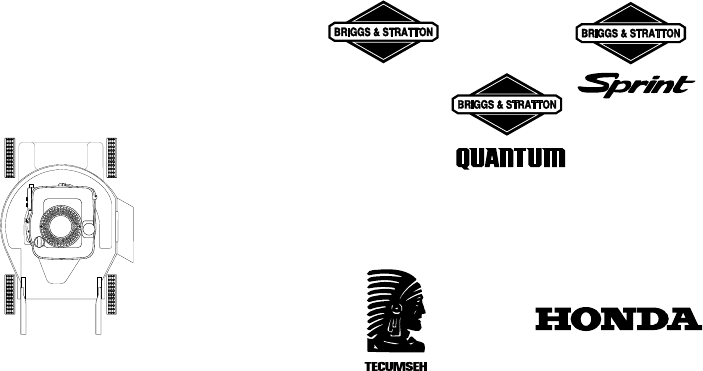
What kind of engine is on my lawn
mower?
When learning how to operate your new
lawn mower, you will need to know what
kind of engine powers the mower. A
decal on the engine will indicate the
manufacturer and type or brand name of
the engine.
BRIGGS & STRATTON ENGINES
HONDA
ENGINES
TECUMSEH
ENGINES
BACK or REAR
(Operating Position)
5
CAUTION: Do not operate this mower without the discharge guard or an entire
approved grass catcher in place. These guards are for your protection and are
required by the American National Standards Institute and Consumer Products Safety
Commission.
CAUTION: Disconnect spark plug wire from spark plug and place wire where it
cannot come in contact with plug.
HOW TO SET UP YOUR LAWN
MOWER
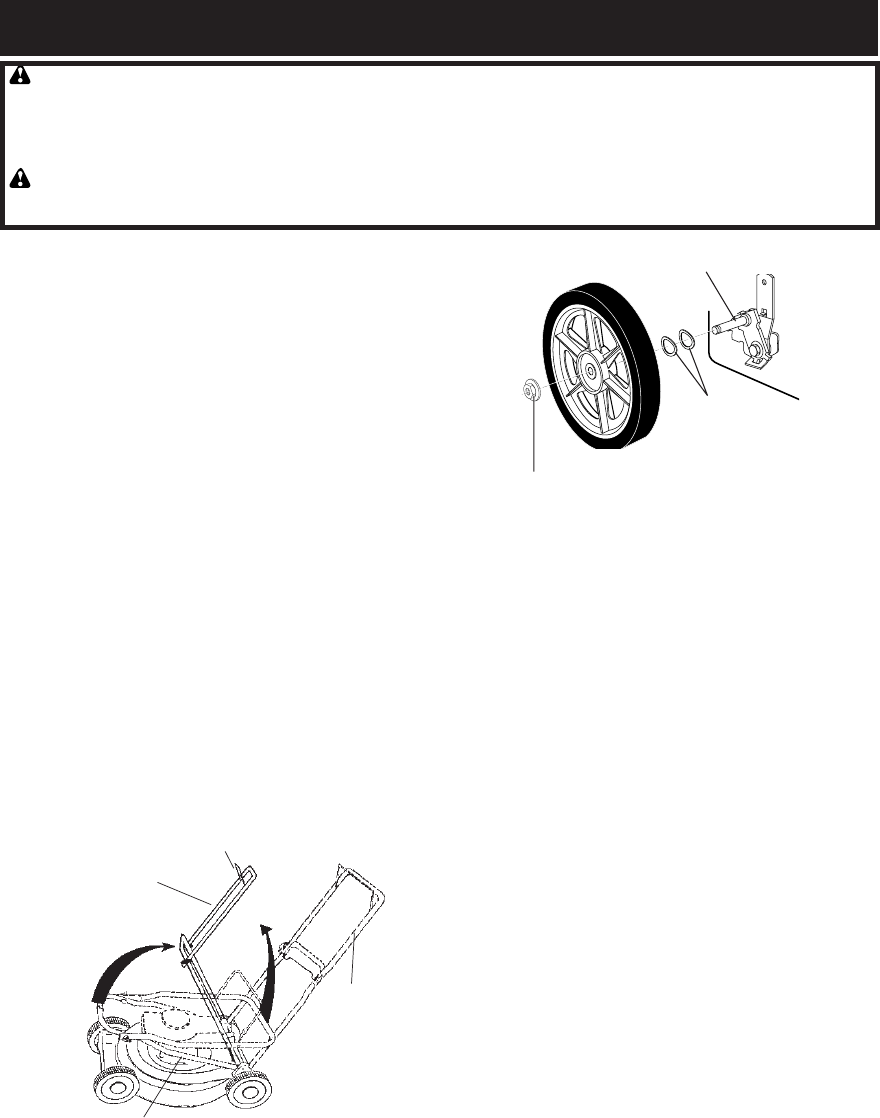
UNFOLD HANDLE
IMPORTANT: Unfold handle carefully so
as not to pinch or damage control cables.
• Raise handles until lower handle
section locks into place in operating
position.
• Raise upper handle section into place
on lower handle, remove protective
padding and tighten both handle knobs.
• Remove handle padding holding
operator presence control bar to upper
handle.
• Your lawn mower handle can be
adjusted for your mowing comfort.
Refer to “Adjust Handle” in the Service
and Adjustments section of this manual.
NOTE: For shipping purposes, the rear
wheels on your lawn mower may not be
adjusted to the same position as the front
wheels. Before operating mower adjust
all wheels to the same cutting height.
FOR REAR DISCHARGE MOWERS
ONLY - ASSEMBLE GRASS CATCHER
IMPORTANT: If your model lawn mower
is mulcher ready, the mulcher plate must
be removed before using mower as a
bagger. To convert mower to bagine or
discharging, see the Operation section in
this manual.
Look at the different grass catcher
illustrations that follow. Determine which
type of grass catcher you have and follow
the appropriate instructions.
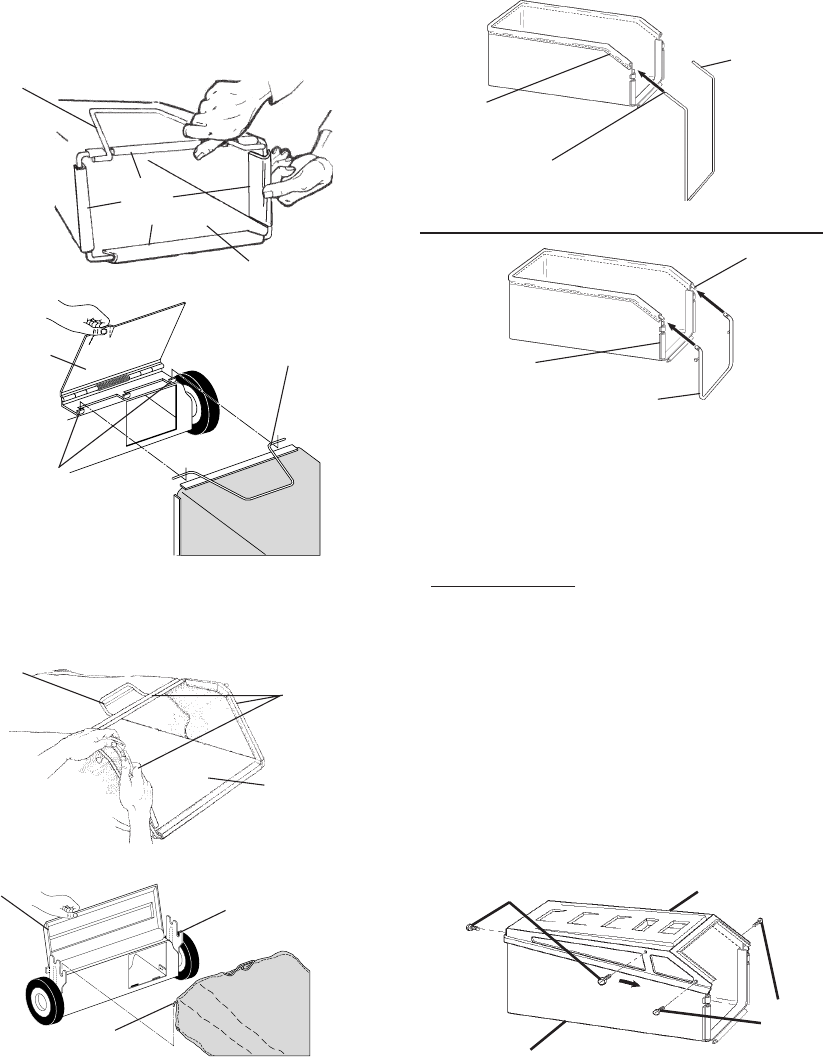
FABRIC TOP GRASS CATCHERS
TO ASSEMBLE & ATTACH GRASS
CATCHER
• Put grass catcher frame into grass bag
with rigid part of bag on the bottom.
• Slip vinyl bindings over frame.
NOTE: If vinyl bindings are too stiff, hold
them in warm water for a few minutes. If
bag gets wet, let it dry before using.
• Lift the rear door on the mower housing.
• For HINGE BRACKET mounted catcher,
place the grass catcher frame onto the
formed tabs on the rear door hinge
bracket.
• For HANDLE BRACKET mounted
catcher, place frame side hooks into
slots in handle brackets.
• The grass catcher is secured to the
lawn mower housing when the rear
door is lowered onto the grass catcher
frame.
FOR HIGH WHEEL MOWERS ONLY
INSTALL REAR WHEELS
Some high wheel models require wash-
ers which will be provided in a parts bag.
If provided, install washers on the axle
first as shown.
• Install one (1) rear wheel on the axle of
rear wheel adjuster.
• Install 3/8-16 locknut and tighten
securely.
• Repeat procedure for other rear wheel.
Mowing
position
Lift up
Lift up
Lower handle
Operator presence control
bar
Upper handle
ASSEMBLY
Washers
(If provided)
Axle
3/8-16 Locknut
6
Hinge
bracket
tabs
HINGE BRACKET MOUNTED FABRIC
TOP CATCHER
Rigid bottom
Catcher frame
Rear door Catcher
frame
HANDLE BRACKET MOUNTED FABRIC
TOP CATCHER
Catcher frame
Rigid
bottom
Vinyl
bindings
Catcher frame hook
Handle bracket
Rear door
Start
here
Hem
Upper
tubular
frame
Upper
tubular
frame
Vinyl bindings
Lower frame
HARD TOP GRASS CATCHER
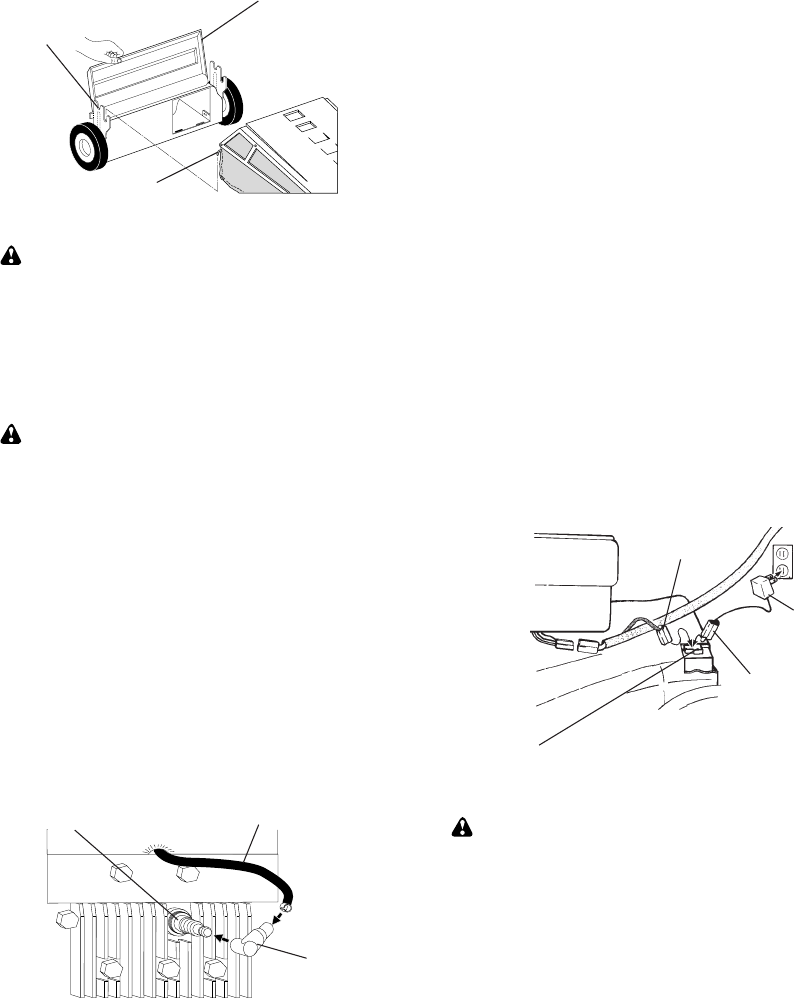
ASSEMBLE FRAME AND BAG
• Thread upper tubular frame into hem of
bag as shown. Be sure angled ends of
frame point downwards.
• Slip lower frame into tubular upper
frame as shown.
• Slip vinyl bindings over frame.
ASSEMBLE TOP TO FRAME AND BAG
NOTE: For ease of assembly, place
catcher top upside down on work surface.
• Nest bag and frame assembly into
catcher top.
• Install two (2) sharp pointed screws to
rear holes first and tighten securely.
• Pull bag forward on frame to remove
slack.
• Install two (2) remaining sharp pointed
screws in side holes and tighten
securely.
• Align lower frame and catcher top front
holes.
• Install two (2) blunt pointed screws in
front holes and tighten securely.
Vinyl
bindings
PULL CATCHER
BAG FORWARD TO
REMOVE SLACK
Sharp pointed screws
(Rear and side holes) Catcher top
Catcher bag
and frame
Blunt
pointed
screws
(Front
holes)
7
Handle
bracket
slot
Rear door
Catcher
frame hook
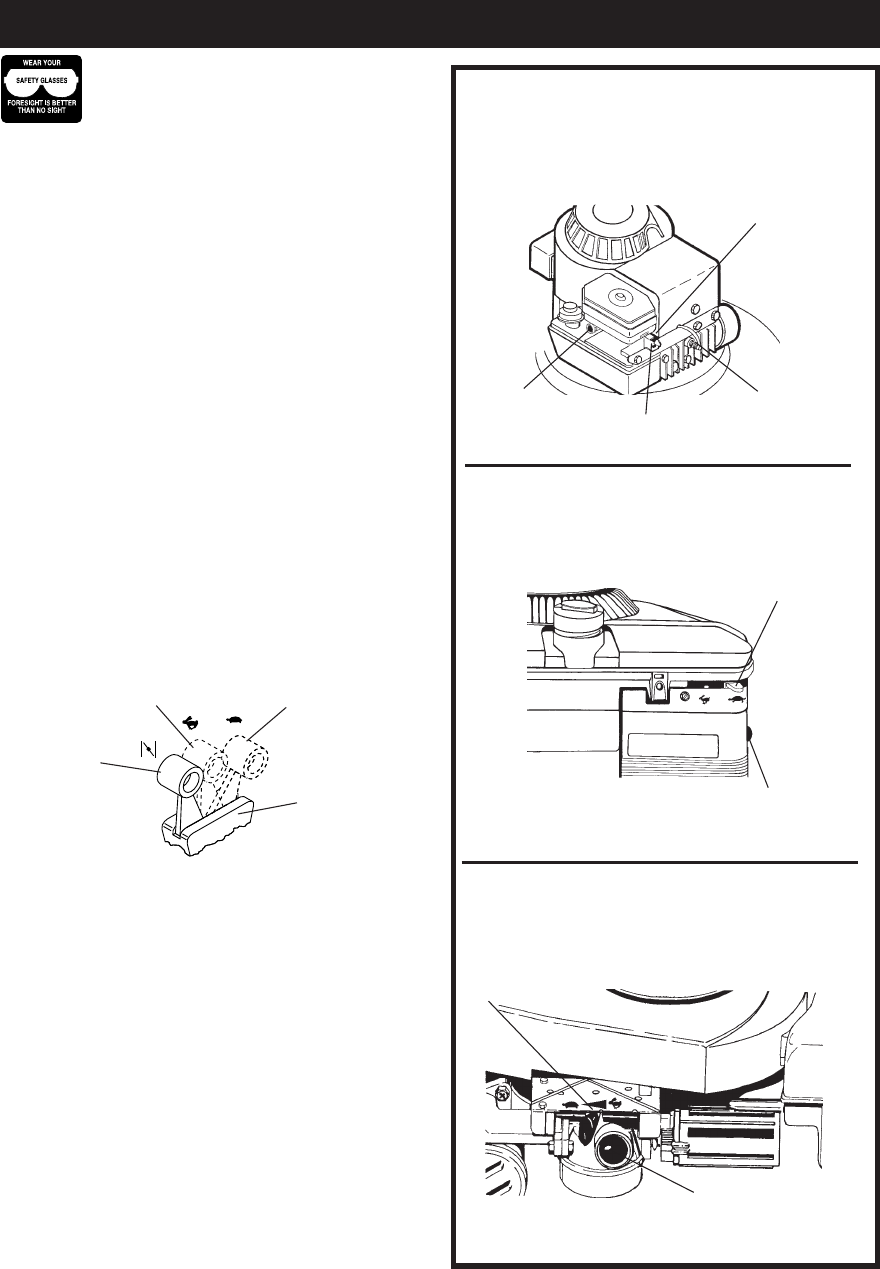
SPARK PLUG BOOT
On some models a spark plug boot is
packed loose in the parts bag. If your
model has the boot, install on spark plug
wire and reconnect spark plug wire to
spark plug.
CAUTION: Under normal usage, the
catcher material is subject to deterioration
and wear and should, therefore, be
checked frequently for replacement. Any
replacement catcher should be checked
to ensure compliance with original
manufacturer's specifications.
CAUTION: Do not run lawn mower
without the discharge guard (rear door),
approved grass catcher, clipping deflector
or mulcher plate in place. Never attempt
to operate mower with the discharge
guard (rear door) removed or propped
open.
FOR ELECTRIC START MODELS
ONLY
TO PREPARE BATTERY
NOTE: Your battery must be charged
before you can start your lawn mower.
• Disconnect engine connector (male)
from battery connector (female).
• Connect battery charger connector
(male) to battery connector (female).
• Plug battery charger into 110 volt A.C.
outlet.
• Leave battery charger connected for 24
hours before starting your engine for
the first time.
• After charging, connect engine connec-
tor (male) to battery connector.
Your engine has an integral alternator for
partial charging. Connect your battery
charger to charge battery as required.
IMPORTANT: The engine alternator will
not charge a discharged battery.
At the end of the mowing season the
battery should be charged for 48 hours to
protect the battery during winter storage.
Battery
connector
(male)
Battery
charger
CAUTION: Always disconnect the
engine connector (male) from the battery
connector (female) to prevent accidental
starting when transporting or storing your
lawn mower after the season.
Batter
connector
(male)
Battery
connector
(female)
Spark plug
Boot
TO ATTACH HARDTOP CATCHER
• Open the rear door on mower housing.
• Place frame side hooks into slots in
handle brackets.
• Release rear door allowing it to nest
into top of catcher.
8
HOW TO USE YOUR LAWN MOWER
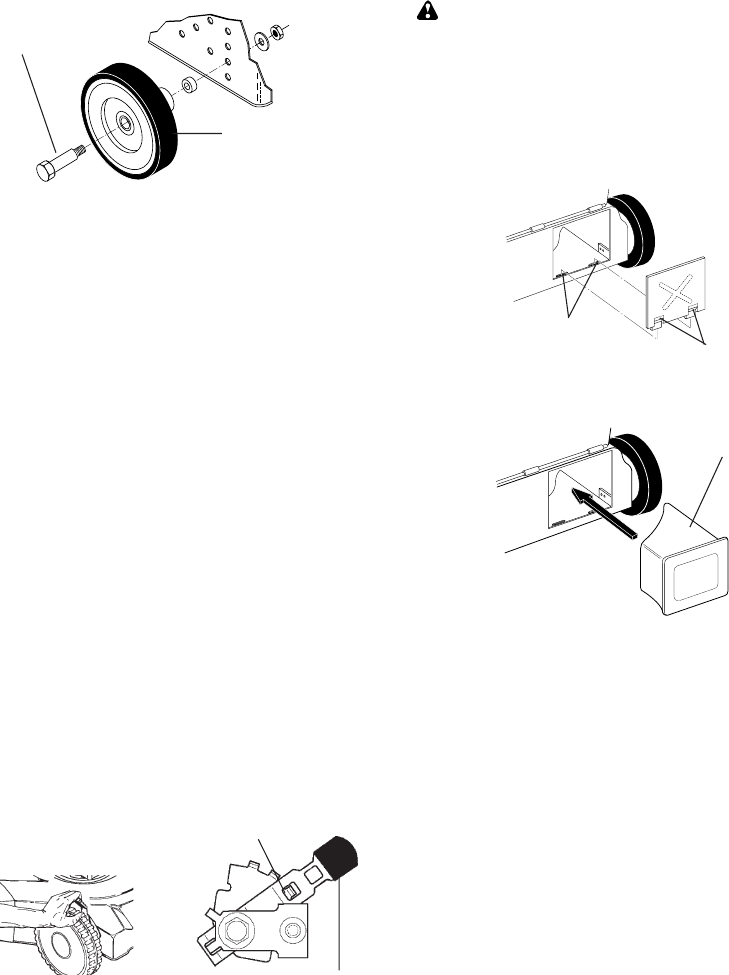
ENGINE SPEED CONTROL
MODELS WITH REMOTE THROTTLE
Engine speed is controlled by the throttle
control located on the upper handle.
• Move lever forward for fast engine
speed, starting, and for better grass
bagging.
• Move lever backward for slow engine
speed.
• Some models have engines equipped
with a choke feature. Move the lever all
the way forward to the choke position
when starting a cold engine.
The operation of any lawn
mower can result in foreign
objects thrown into the eyes,
which can result in severe eye damage.
Always wear safety glasses or eye shields
while operating your lawn mower or
performing any adjustments or repairs.
We recommend a wide vision safety mask
for over the spectacles or standard safety
glasses.
Spark plug
Rapid
MODELS WITH ENGINE MOUNTED
SPEED CONTROL
The engine speed is controlled by a lever
located at the carburetor on the engine.
High or fast position is for starting engine,
normal cutting and better grass bagging.
Low or slow position is for light cutting,
trimming and fuel economy.
MODELS WITH FIXED SPEED ENGINES
Engine speed was set at the factory for
optimum performance. Engine speed is
not adjustable.
Remote
throttle
control
Engine speed
control lever
BRIGGS & STRATTON CLASSIC AND
SPRINT
ENGINE MOUNTED SPEED CONTROL
Engine speed
control lever
Primer
(if equipped)
Fast Slow
Choke
(start)
BRIGGS & STRATTON QUANTUM
ENGINE MOUNTED SPEED CONTROL
Primer
(if equipped)
TECUMSEH
ENGINE MOUNTED SPEED CONTROL
Primer
(if equipped)
Engine speed
control lever
OPERATION
9
TO ADJUST CUTTING HEIGHT
Adjust cutting height to suit your require-
ments. Medium position is best for most
lawns. Raise wheels for low cut and
lower wheels for high cut.
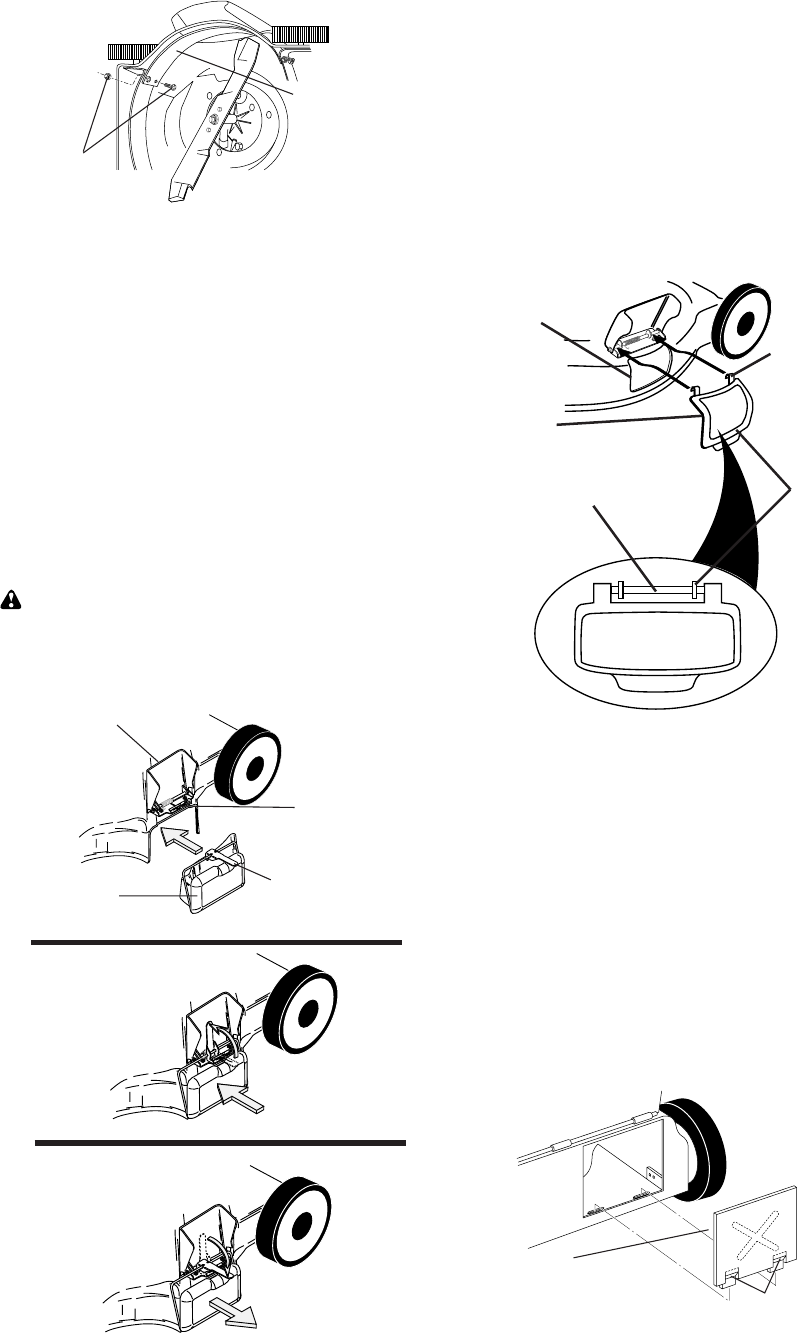
MODELS WITH MANUAL ADJUST
BOLT-ON WHEELS
• Remove wheel, bolt, and hardware and
reassemble in desired adjustment hole.
• Reinstall wheel components in the
same order as they were before
removal. Tighten securely.
• Make sure all wheels are at the same
height.
Wheel assembly
Shoulder
bolt
MODELS WITH "QUICK ADJUST"
WHEEL
HEIGHT ADJUSTERS
NOTE: For shipping purposes, the rear
wheels on your lawn mower may not be
adjusted to the same position as the front
wheels. Before operating mower adjust
all wheels to the same cutting height.
• Raise wheels for low cut and lower
wheels for high cut.
• Adjust cutting height to suit your
requirements. Medium position is best
for most lawns.
• To change cutting height, squeeze
adjuster lever toward wheel. Move
wheel up or down to suit your require-
ments. Be sure all wheels are in the
same setting.
NOTE: Adjuster is properly positioned
when plate tab inserts into hole in lever.
Also, 9-position adjusters (if so equipped)
allow lever to be positioned between the
plate tabs.
FOR MULCHING MOWERS ONLY
Most lawn mowers are shipped ready to
be used as a mulcher.
REAR DISCHARGE MOWERS
To convert to bagging or discharging,
mulcher plate or plug (if so equipped)
must be removed from the discharge
opening of the lawn mower.
• Open rear door and remove mulcher
plate or plug (if so equipped) . Store
mulcher plate or plug in a safe place.
• You can now install grass catcher or
optional clipping deflector accessory.
• To return to mulching operation, install
mulcher plate or plug into discharge
opening of mower.
CAUTION: Do not run your lawn
mower without mulcher plate/plug in
place or approved clipping deflector or
grass catcher in place. Never attempt to
operate the lawn mower with the rear
door removed or propped open.
MULCHER PLATE TYPE
Slots Mulcher
plate
tabs
MULCHER PLUG TYPE
Mulcher plug
SIDE DISCHARGE MOWERS MULCHER
PLATE TYPE
To convert to bagging or discharging,
mulcher plate must be removed from
underside of lawn mower.
• Remove the four (4) screws and lock
nuts securing the mulcher plate to the
mower.
• Store mulcher plate and hardware in a
safe place.
• Mower can now be used for side
discharging or optional grass catcher
accessory can be attached.
• To return to mulching operation, simply
reinstall mulcher plate and tighten
hardware securely.
Lower Wheels for High Cut Plate Tab
Raise Wheels for Low Cut Lever
10
MULCHER PLUG TYPE A
To convert to mulching operation, mulcher
plug must be installed into discharge
opening of mower.
• Raise discharge guard and work
mulcher plug into discharge opening of
mower.
• Position lock lever over hinge bracket
as shown and raise lever to lock
mulcher plug in place.
• Allow discharge guard to rest against
lock lever.
• To return to discharging or bagging
operation, simply lower lock lever and
remove mulcher plug from mower.
COMBI-CUT MOWERS
TO CONVERT MOWER
Your lawn mower was shipped ready to be
used as a mulcher. To convert to bagging
or discharging:
REAR BAGGING
• Open rear door and remove mulcher
plate. Store mulcher plate in a safe
place.
• You can now install grass catcher.
• To convert to mulching or discharging
operation, install mulcher plug into rear
discharge opening of mower, making
sure all tabs are seated properly.
Hinge Bracket
Raise lever to
lock
Lower lever to
lock
Lock lever
down position
Raise discharge
guard
Mulcher
plug
CAUTION: Do not run your lawn
mower without discharge guard, ap-
proved grass catcher or mulcher plate or
plug in place.
Tabs
Mulcher plate
SIDE DISCHARGING
• Mulcher plate must be installed into
rear discharge opening of mower (see
above instructions).
MULCHER PLUG TYPE B
To convert to mulching operation, mulcher
plug must be installed into discharge
opening of mower.
• Open discharge guard.
• Insert tab of mulch plug into housing
opening.
• Align hooks of mulch plug over hinge
rod of discharge guard. Push mulch
plug down until mulch plug is seated in
housing opening.
Hinge
Rod
Hooks
Mulch plug
Housing
opening
Tab
Mulcher
plate
Screw
and lock
nut
11
Discharge guard
Open
discharge
guard
Discharge
deflector
BEFORE STARTING ENGINE
Read the engine manual packed with
your mower.
FILL ENGINE WITH OIL
Your lawn mower is shipped without oil in
the engine.
• Be sure mower is level and area
around oil fill is clean.
• Remove engine oil filler plug (oil fill
cap/dipstick on models so equipped).
• Slowly add oil. For type and grade of
oil to use, see "ENGINE" in Maintence
section of this manual.
• Fill to the top of slot in filler hole (to
“FULL” line on dipstick on models so
equipped). Do not overfill.
• Replace plug (oil fill cap/dipstick on
models so equipped) and tighten.
• Check oil level before each use. Add
oil as needed.
GRASS CATCHER
(REAR DISCHARGE MODELS ONLY)
TO EMPTY GRASS CATCHER
• Simply open rear door and lift grass
catcher up and away from mower.
NOTE: Do not drag the bag when
emptying. It will cause unnecessary wear.
CAUTION: Under normal usage, the
catcher material is subject to deterioration
and wear and should, therefore, be
checked frequently for replacement. Any
replacement catcher should be checked
to ensure compliance with original
manufacturer's specifications.
CAUTION: Do not run lawn mower
without the discharge guard (rear door),
approved grass catcher or clipping
deflector in place. Never attempt to
operate mower with the discharge guard
(rear door) removed or propped open.
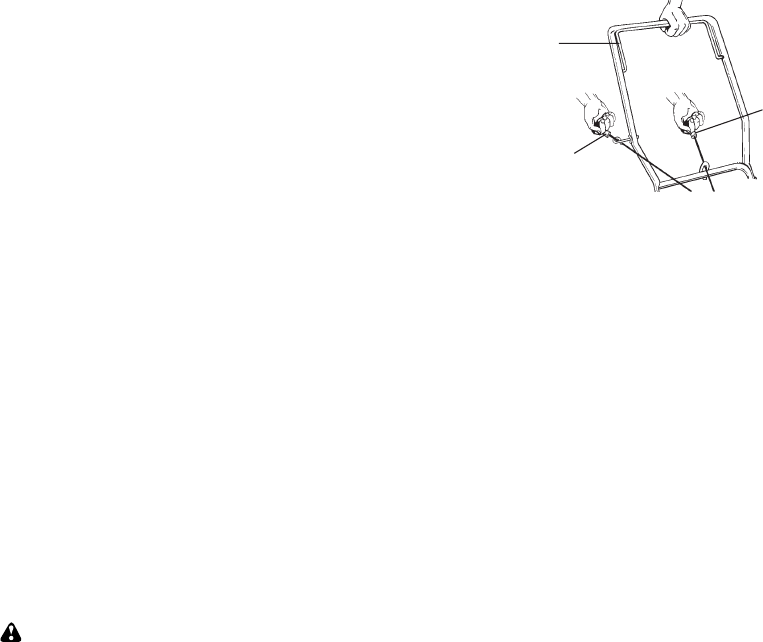
OPERATOR PRESENCE ENGINE
CONTROL BAR
Your lawn mower is equipped with an
operator presence engine control bar
which requires the operator to be posi-
tioned behind the lawn mower handle in
order to start and operate the lawn mower.
CAUTION: Federal regulations require
an engine control to be installed on this
lawn mower in order to minimize the risk
of blade contact injury. Do not under any
circumstances attempt to defeat the
function of the operator control. The blade
turns when the engine is running.
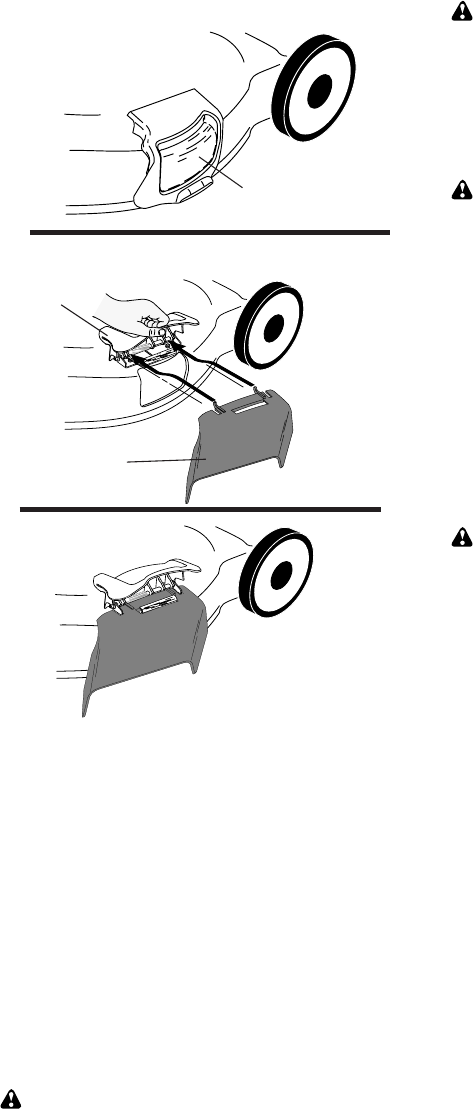
• Open discharge guard and install
discharge deflector under guard as
shown.
• Mower is now ready for discharging
operation.
• To convert to mulching or bagging
operation, discharge deflector must be
removed and discharge guard must be
closed.
SIMPLE STEPS TO REMEMBER
WHEN CONVERTING YOUR LAWN
MOWER
FOR MULCHING -
• Rear mulcher plate installed.
• Side discharge guard closed.
FOR REAR BAGGING -
• Rear mulcher plate removed.
• Grass catcher installed.
• Side discharge guard closed.
FOR SIDE DISCHARGING -
• Rear mulcher plate installed.
• Side discharge deflector installed.
CAUTION: Do not run your lawn mower
without rear mulcher plate in place or
approved grass catcher in place.
Never attempt to operate the lawn mower
with the rear door removed or propped
open.
12
Recoil starter
handle (side
mount type)
Recoil starter
handle
(center Mount
type)
Operator
presence
control bar
MODELS WITH ELECTRIC STARTER
• Move engine speed control to fast
position or to choke/start position on
models so equipped with choke
feature.
• If your mower has a primer, to start a
cold engine, push primer the number of
times as instructed in the engine
manual packed with your mower. Use
a firm push. This step is not usually
necessary when starting an engine
which has already run for a few
minutes.
• Hold operator presence control bar
down against handle.
• Push the engine start button.
IMPORTANT: Do not crank engine more
than five continous seconds between
each time you try to start. Wait 5 to 10
seconds between each attempt.
• For engines equipped with choke,
slowly move engine speed control lever
to fast after engine starts.
• To STOP engine, release operator
presence engine control bar.
NOTE: For engines with a primer, it may
be necessary to repeat priming steps in
cooler weather. In warmer weather,
overpriming may cause flooding and
engine will not start. If you do flood
engine, wait a few minutes before
attempting to start and DO NOT repeat
priming steps.
TO START ENGINE
CAUTION: The mower blade rotates
whenever the engine is running.
MODELS WITH RECOIL STARTER
• Move engine speed control to fast
position or to choke/start position on
models so equipped with choke
feature.
• If your mower has a primer, to start a
cold engine, push primer the number of
times as instructed in the engine
manual packed with your mower. Use
a firm push. This step is not usually
necessary when starting an engine
which has already run for a few
minutes.
• Hold operator presence control bar
down against handle.
• Pull starter handle quickly. Do not
allow starter rope to snap back.
• For engines equipped with choke,
slowly move engine speed control lever
to fast after engine starts.
• To STOP engine, release operator
presence engine control bar.
NOTE: For engines with a primer, it may
be necessary to repeat priming steps in
cooler weather. In warmer weather,
overpriming may cause flooding and
engine will not start. If you do flood
engine, wait a few minutes before
attempting to start and DO NOT repeat
priming steps.
• To change oil, see Maintence section of
this manual.
FILL GASOLINE TANK
• Fill gasoline tank with fresh, clean,
unleaded gasoline. DO NOT USE
PREMIUM GASOLINE. BE CAREFUL
NOT TO OVERFILL TANK.
WARNING: Experience indicates that
alcohol blended fuels (called gasohol or
using ethanol or methanol) can attract
moisture which leads to separation and
formation of acids during storage. Acidic
gas can damage the fuel system of an
engine while in storage. To avoid engine
problems, the fuel system should be
emptied before storage of 30 days or
longer. Drain the fuel tank, start the
engine and let it run until fuel lines and
carburetor are empty. Use fresh fuel next
season. See Storage Instructions for
additional information. Never use engine
or carburetor cleaner products in fuel tank
or permanent damage may occur.
13
MULCHING MOWING TIPS (IF SO
EQUIPPED)
IMPORTANT: For best performance, keep
mower housing free of built-up grass and
trash. See “Cleaning” in Maintenance
section of this manual.
• The special mulching blade will recut
the grass clippings many times and
reduce them in size so that as they fall
onto the lawn they will disperse into the
grass and not be noticed. Also, the
mulched grass will biodegrade quickly
to provide nutrients for the lawn.
Always mulch with your highest engine
(blade) speed as this will provide the
best recutting action of the blades.
• Avoid cutting your lawn when it is wet.
Wet grass tends to form clumps and
interferes with the mulching action. The
best time to mow your lawn is the early
afternoon. At this time the grass has
dried and the newly cut area will not be
exposed to the direct sun.
• For best results, adjust the lawn mower
cutting height so that the lawn mower
cuts off only the top one-third of the
grass blades. If the lawn is overgrown it
will be necessary to raise the height of
cut to reduce pushing effort and to keep
from overloading the engine and
leaving clumps of mulched grass. For
extremely heavy mulching, reduce your
width of cut by overlapping previously
cut path and mow slowly.
1/3 MAX
MOWING TIPS
• For most cutting conditions and better
bagging performance, the engine
speed should be set in the fast position.
• Under certain conditions, such as when
mowing very tall grass, raise the mower
height on the first cut to reduce pushing
effort, to avoid overheating the engine,
and to avoid leaving clumps of grass
clippings. Make the second cut to the
desired height.
• For extremely heavy cutting, reduce the
width of cut.
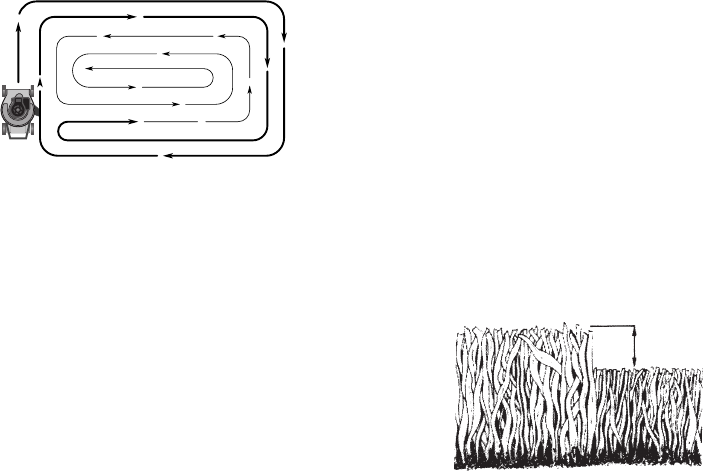
• For side discharge lawn mowers, cut in
a counterclockwise direction, starting at
the outside of the area to be cut, in
order to spread grass clippings more
evenly and to put less load on the
engine. To keep clippings off of
walkways, flower beds, etc., make the
first cuts in a clockwise direction.
• When using a rear discharge lawn
mower in moist, heavy grass, clumps of
cut grass may not enter the grass
catcher. Reduce ground speed
(pushing speed) and/or run the lawn
mower over the area a second time.
• If a trail of grass clipping is left on the
right side of a rear discharge lawn
mower, mow in a clockwise direction
with a small overlap to collect the
clippings on the next pass.
• Pores in cloth grass catchers can
become filled with dirt and dust with use
and the catcher will collect less grass.
To prevent this, regularly hose catcher
off with water and let dry before use.
• Certain types of grass and grass
conditions may require that an area be
mulched a second time to completely
hide the clippings. When doing a
second cut, mow across or perpendicu-
lar to the first cut path.
• Change your cutting pattern from week
to week. Mow north to south one week
then change to east to west the next
week. This will help prevent matting
and graining of the lawn.
14
MAINTENANCE
Change Engine Oil
Lubrication Chart
Clean Air Filter
Replace Air Filter Paper Cartridge
Clean or Replace Spark Plug
FILL IN DATES
AS YOU COMPLETE
REGULAR SERVICE
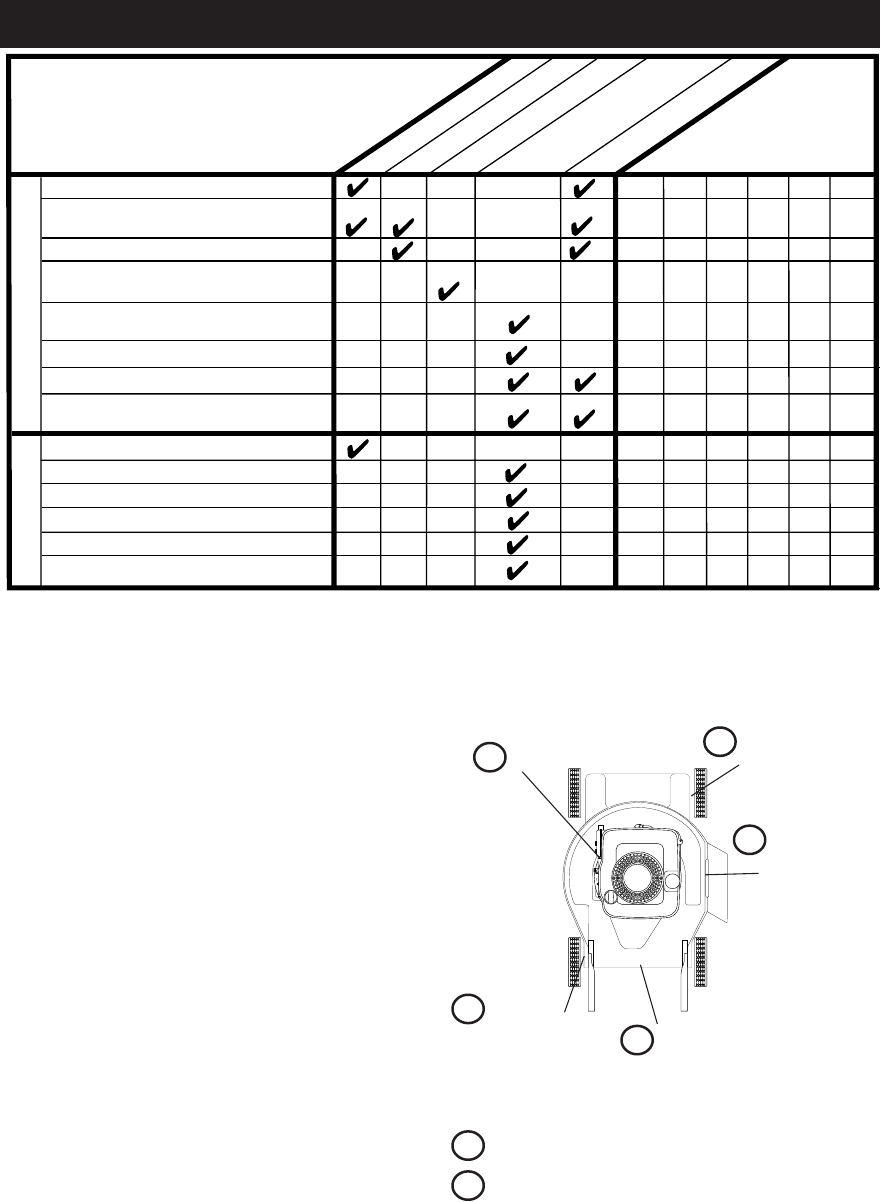
MAINTENANCE SCHEDULE
BEFORE EACH USE
AFTER EACH USE
EVERY 25 HOURS
OR EVERY SEASON
SERVICE DATES
Check for Loose Fasteners
BEFORE STORAGE
Check Engine Oil Level
Check/Sharpen/Replace Blade
Inspect Muffler
1 - Change more often when operating under a heavy load or in high ambient temperatures.
2 - Service more often when operating in dirty or dusty conditions.
3 - Replace blades more often when mowing in sandy soil.
4 - Charge 48 hours at end of season.
1,2
3
2
M
O
W
E
R
E
N
G
I
N
E
2
Clean Lawn Mower
Clean/Inspect Grass Catcher
(If Equipped)
EVERY 10 HOURS
Clean Under Drive Cover
(Power-Propelled Mowers)
Clean Battery/Recharge
(Electric Start Mowers)
4
Check drive belt/pulleys
(Power-Propelled Mowers)
2
GENERAL RECOMMENDATIONS
The warranty on this lawn mower does not
cover items that have been subjected to
operator abuse or negligence. To receive
full value from the warranty, operator must
maintain mower as instructed in this
manual.
Some adjustments will need to be made
periodically to properly maintain your unit.
All adjustments in the Service and
Adjustments section of this manual should
be checked at least once each season.
• Once a year, replace the spark plug,
clean or replace air filter element, and
check blade for wear. A new spark plug
and clean/new air filter element assure
proper air-fuel mixture and help your
engine run better and last longer.
• Follow the Maintenance Schedule in
this manual.
BEFORE EACH USE
• Check engine oil level.
• Check for loose fasteners.
LUBRICATION
Keep unit well lubricated.
LUBRICATION CHART
Handle
bracket
mounting pin
Wheel
adjusters
Engine
Rear discharge
nower rear door
hinge rod
12
2
2
2
1
2
Side
discharge
nower
guard
hinge rod
Refer to Maintenance section
Spray Lubricant
IMPORTANT: Do not oil or grease plastic
wheel bearings. viscous lubricants will
attract dust and dirt that will shorten the
life of the self-lubricating bearings. if you
feel they must be lubricated, use only a
dry, powdered graphite type lubricant
sparingly.
15
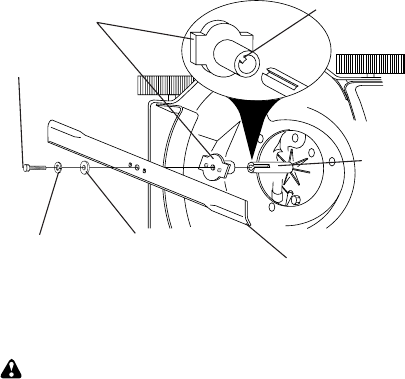
Blade trailing
edge
Lock washer Flat steel
washer
Key
Blade bolt
Blade adapter
LAWN MOWER
Always observe safety rules when
performing any maintenance.
TIRES
• Keep tires free of gasoline, oil, or insect
control chemicals which can harm
rubber.
• Avoid stumps, stones, deep ruts, sharp
objects and other hazards that may
cause tire damage.
BLADE CARE
For best results, mower blade must be
kept sharp. Replace bent or damaged
blades.
TO REPLACE BLADE
• Turn lawn mower. See engine manual
for proper direction of turning over the
engine.
• Use a wood block between blade and
mower housing to prevent blade from
turning when removing blade bolt.
• Protect your hands with gloves and/or
wrap blade with heavy cloth.
• Remove blade bolt, lock washer and
flat washer.
• Remove blade and blade adapter.
• Inspect the key inside blade adapter.
Replace adapter if damaged.
IMPORTANT: Blade bolt is grade 8 heat
treated.
• Install new or sharpened blade with
trailing edge up toward the engine.
• Position blade on blade adapter. Align
the two (2) holes in blade with raised
lugs of adapter.
• Reassemble blade bolt, lock washer
and flat washer into blade adapter and
crankshaft in exact order as shown.
• Position block of wood between blade
and mower housing.
• Tighten blade bolt securely. Recom-
mended tightening torque is 35-40 ft.
lbs.
NOTE: We do not recommend
sharpening blade - but if you do, be sure
the blade is balanced.
Crank-
shaft
TO SHARPEN BLADE
Care should be taken to keep the blade
balanced. An unbalanced blade will
cause excessive vibration and eventual
damage to lawn mower and engine.
• The blade can be sharpened with a file
or on a grinding wheel. Do not attempt
to sharpen while on the mower.
GRASS CATCHER (IF SO EQUIPPED)
Grass catcher may be hosed with water
but must be dry when used.
CAUTION: Under normal usage, the
catcher material is subject to deterioration
and wear and should therefore be
checked to ensure compliance with
original manufacturer specifications.
• To check blade balance, drive a nail
into a beam or wall. Leave about one
inch of the straight nail exposed. Place
center hole of blade over the head of
the nail. If blade is balanced, it should
remain in a horizontal position. If either
end of the blade moves downward,
sharpen the heavy end until the blade
is balanced.
ENGINE
Read the maintenance section of your
engine manual.
LUBRICATION
Change the oil after the first two hours of
operation and every 25 hours thereafter
or at least once a year if the lawn mower
is not used for 25 hours in one year.
Refer to engine manual.
TO CHANGE ENGINE OIL (SEE ENGINE
MANUAL)
• Be sure lawn mower is on level surface.
• Oil will drain more freely when warm.
• Catch oil in a suitable container.
• For engines without dipstick, remove
bottom oil drain plug.
• For engines with oil fill cap/dipstick,
remove bottom drain plug or remove
engine oil cap and turn mower on its
side.
• After oil has drained completely,
replace oil drain plug and tighten
securely.
• Refill engine with oil. Pour slowly. Do
not overfill.
• Fill to top of slot inside of filler hole or to
“FULL” line on dipstick on models so
equipped. Keep oil at proper level.
16
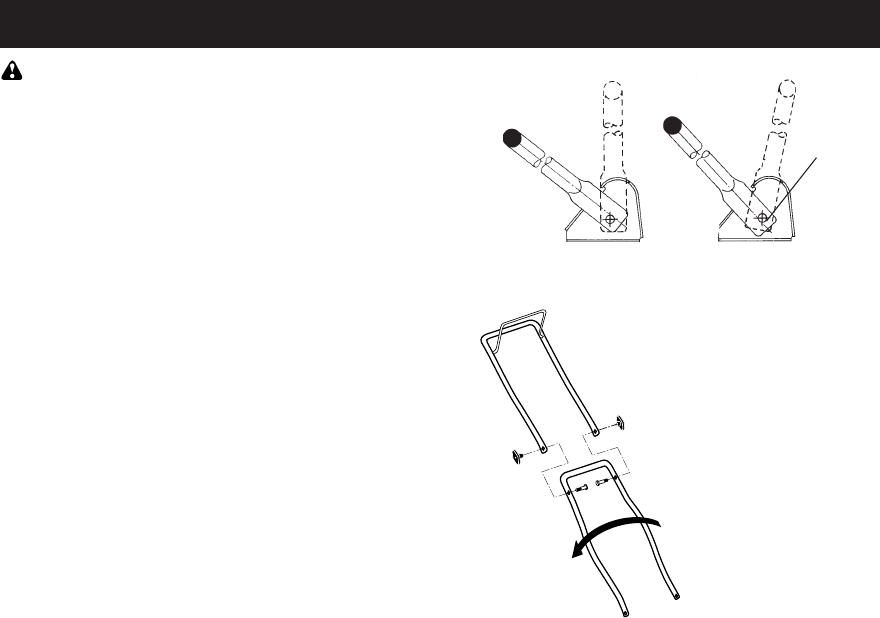
Turn lower handle
over to adjust height
SERVICE AND ADJUSTMENTS
CAUTION: Before performing any
service or adjustments-
• Release operator presence control bar.
• Make sure the blade and all moving
parts have completely stopped.
• Disconnect spark plug wire from spark
plug and place where it cannot come in
contact with plug.
Off
center
hole
LAWN MOWER
TO ADJUST CUTTING HEIGHT
See “TO ADJUST CUTTING HEIGHT” in
the Operation section of this manual.
TO ADJUST HANDLE
2 POSITION
The handle can be mounted in a high or
low position. The mounting holes in the
bottom of lower handle are off center for
raising or lowering the handle.
• Remove upper handle and all parts
attached to lower handle.
• Remove hairpin cotters from lower
handle bracket mounting pin.
• Squeeze lower handle in to remove it
from mounting pins.
• Turn lower handle over to raise or lower
handle.
• Squeeze lower handle in and position
holes onto mounting pins on handle
bracket.
• Reassemble hairpin cotters onto
mounting pins.
• Reassemble upper handle and all parts
removed from lower handle.
High
position
Low
position
AIR FILTER
Your engine will not run properly and may
be damaged by using a dirty air filter.
Clean the element after every 25 hours of
operation, more often if lawn mower is
used in very dusty, dirty conditions.
See the maintenance section of your
engine manual.
SPARK PLUG
Change the spark plug once a year to
make the engine run better and easier to
start. Set spark plug gap according to
engine manual specifications.
MUFFLER
Inspect and replace corroded muffler as it
could create a fire hazard and/or damage.
CLEANING
IMPORTANT: For best performance, keep
mower housing free of grass build-up and
trash. Clean the underside of your mower
after each use.
• Clean the underside of your lawn
mower by scraping to remove buildup
of grass and trash.
• Clean engine often to keep trash from
accumulating. A clogged engine runs
hotter and shortens engine life.
• Keep finished surfaces and wheels free
of all gasoline, oil, etc.
We do not recommend using a garden
hose to clean your lawn mower unless the
electrical system, muffler, air filter, and
carburetor are covered to keep water out.
Water in engine can shorten engine life.
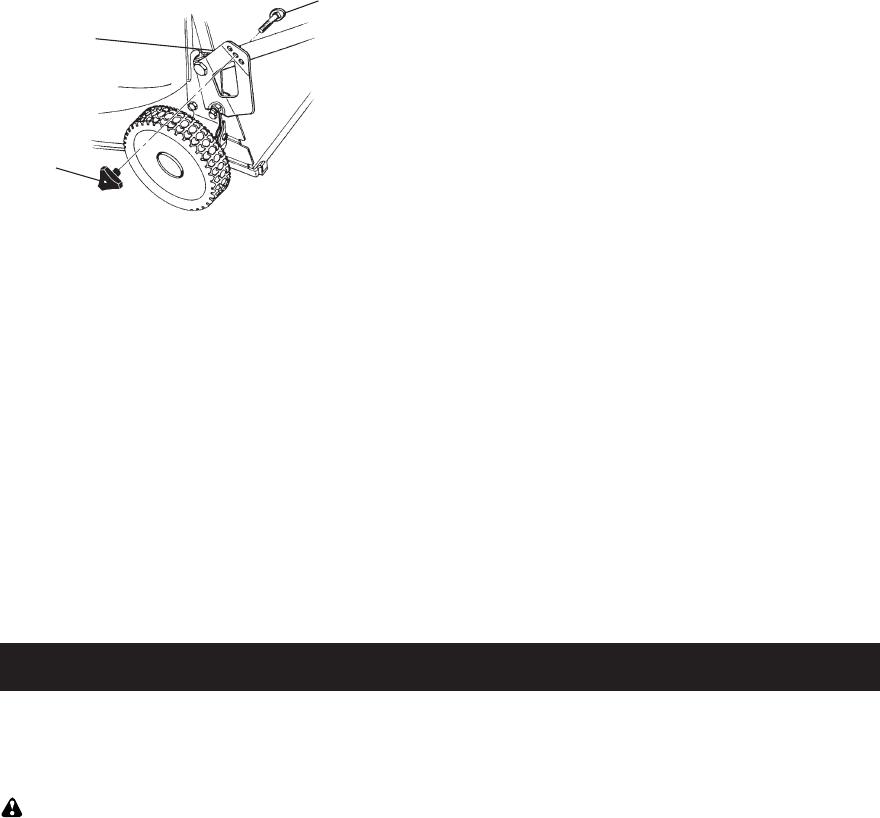
3 POSITION
The handle on your lawn mower has
three (3) height positions - adjust to height
that suits you.
• Remove knob and carriage bolt on one
side of the lower handle.
• While holding handle assembly,
remove knob and carriage bolt from
opposite side, align hole in handle with
desired hole in handle bracket and
reassemble bolt and knob and tighten
securely.
17
STORAGE
Immediately prepare your lawn mower
for storage at the end of the season or if
the unit will not be used for 30 days or
more.
CAUTION: Never store the lawn
mower with gasoline in the tank inside a
building where fumes may reach an
open flame or spark. Allow the engine to
cool before storing in any enclosure.
LAWN MOWER
When lawn mower is to be stored for a
period of time, clean it thoroughly,
remove all dirt, grease, leaves, etc.
Store in a clean, dry area.
• Clean entire lawn mower (See
“CLEANING” in the Maintenance
section of this manual).
• Lubricate as shown in the Mainte-
nance section of this manual.
• Be sure that all nuts, bolts, screws, and
pins are securely fastened. Inspect
moving parts for damage, breakage
and wear. Replace if necessary.
• Touch up all rusted or chipped paint
surfaces; sand lightly before painting.
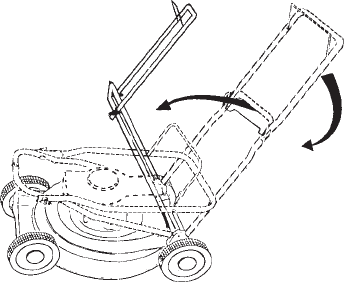
HANDLE
Your handle may be folded for storage as
shown.
• Squeeze the bottom ends of lower
handle towards each other until handle
clears the handle brackets and swing
handles forward over mower.
• Loosen upper handle mounting
hardware enough to allow upper
handle to be folded back.
IMPORTANT: When folding handles for
storage or transportation, be sure to fold
handles as shown or you may damage
the control cables.
When setting you handles up from the
storage position, the lower handle will
automatically lock into mowing position.
Knob
Bolt
Handle
adjustment
bracket
• Align opposite side of handle with same
positioning hole and secure with bolt
and knob.
REAR DEFLECTOR (IF EQUIPPED)
The rear deflector, attached between the
rear wheels of your mower, is provided to
minimize the possibility that objects will
be thrown out of the rear of the mower into
the operator mowing position. If the
deflector becomes damaged, it should be
replaced.
ENGINE
CARBURETOR
The carburetor has been preset at the
factory and adjustment should not be
necessary. However, minor adjustment
may be required to compensate for
differences in fuel, temperature, altitude or
load.
• The air filter must be assembled to the
carburetor when running engine.
• Best carburetor adjustment is obtained
when fuel tank is 1/4 full.
• In order for the engine to run, the
operator presence control bar must be
held in the operating position. There-
fore, and assistant will be required to
hold the control bar in the operating
position when making final adjustment
to the carburetor.
See the adjustment section of your engine
manual for further instructions.
ENGINE SPEED
The engine speed has been factory set.
Do not attempt to increase engine speed
as it may result in personal injury. If you
believe the engine is running too fast or
too slow, take your lawn mower to an
authorized engine service center for
repair and adjustment.
THROTTLE CONTROL
If it becomes necessary to adjust or
replace the throttle control, see the
adjustment section of your engine
manual.
18
ENGINE
FUEL SYSTEM
IMPORTANT: It is important to prevent
gum deposits from forming in essential
fuel system parts such as carburetor, fuel
filter, fuel hose, or tank during storage.
Also, experience indicates that alcohol
blended fuels (called gasohol or using
ethanol or methanol) can attract moisture
which leads to separation and formation
of acids during storage. Acidic gas can
damage the fuel systme of an engine
while in storage.
• Drain the fuel tank.
• Start the engine and let it run until the
fuel lines and carburetor are empty.
• Never use engine or carburetor cleaner
products in the fuel tank or permanent
damage may occur.
• Use fresh fuel next season.
NOTE: Fuel stabilizer is an acceptable
alternative in minimizing the formation of
fuel gum deposits during storage. Add
stabilizer to gasoline in fuel tank or
storage container. Always follow the mix
ratio found on stabilizer container. Run
engine at least 10 minutes after adding
stabilizer to allow the stabilizer to reach
the carburetor. Do not drain the gas tank
and carburetor if using fuel stabilizer.
ENGINE OIL
Drain oil (with engine warm) and replace
with clean oil. (See “ENGINE” in the
Maintenance section of this manual).
CYLINDER
• Remove spark plug.
• Pour one ounce (29 ml) of oil through
spark plug hole into cylinder.
• Pull starter handle slowly to distribute
oil.
• Replace with new spark plug.
BATTERY (IF EQUIPPED)
Disconnect the battery from the engine
connector and charge battery 48 hours.
OTHER
• Do not store gasoline from one season
to another.
• Replace your gasoline can if your can
starts to rust. Rust and/or dirt in your
gasoline will cause problems.
• If possible, store your unit indoors and
cover it to give protection from dust and
dirt.
• Cover your unit with a suitable protec-
tive cover that does not retain moisture.
Do not use plastic. Plastic cannot
breathe which allows condensation to
form and will cause your unit to rust.
IMPORTANT: Never cover mower while
engine and exhaust areas are still warm.

19
Does not start 1. Dirty air filter. 1. Clean/replace air filter.
2. Out of fuel. 2. Fill fuel tank.
3. Stale fuel. 3. Drain tank and refill with
fresh clean fuel.
4. Water in fuel. 4. Drain fuel tank and
carburetor and refill tank
with fresh gasoline.
5. Spark plug wire is 5. Connect wire to plug.
disconnected.
6. Bad spark plug. 6. Replace spark plug.
7. Loose blade or broken blade 7. Tighten blade bolt or
adapter. replace blade adapter.
8. Control bar in released 8. Depress control bar to
position. handle.
9. Control bar defective. 9. Replace control bar.
Loss of power 1. Rear of lawn mower housing 1. Set to “Higher Cut”
or cutting blade dragging position.
in heavy grass.
2. Cutting too much grass. 2. Set to “Higher Cut”
position.
3. Dirty air filter. 3. Clean/replace air filter.
4. Buildup of grass, leaves, 4. Clean underside of mower
and trash under mower. housing.
5. Too much oil in engine. 5. Check oil level.
6. Walking speed too fast. 6. Cut at slower walking
speed.
Poor cut – uneven 1. Worn, bent or loose blade. 1. Replace blade. Tighten
blade bolt.
2. Wheel heights uneven. 2. Set all wheels at same
height
3. Low engine speed 3. Contact an authorized center/
department
4. Buildup of grass, leaves 4. Clean underside of
and trash under mower. mower housing.
PROBLEM CAUSE CORRECTION
TROUBLESHOOTING CHART

Excessive 1. Worn, bent or loose blade. 1. Replace blade. Tighten
vibration blade bolt.
2. Bent engine crankshaft. 2. Contact an authorized
service center.
Starter rope hard 1. Engine flywheel brake is on 1. Depress control bar to
to pull when control bar is released. upper handle before
pulling starter rope.
2. Bent engine crankshaft. 2. Contact an authorized
service center.
3. Blade adapter broken. 3. Replace blade adapter.
4. Blade dragging in grass. 4. Move lawn mower to cut
grass or to hard surface
Grass catcher 1. Cutting height too low. 1. Raise cutting height.
not filling (if so 2. Lift on blade worn off. 2. Replace blade.
equipped) 3. Catcher not venting air. 3. Clean grass catcher.
4. Low engine speed 4. Contact an authorized center/
department
Hard to push 1. Grass is too high or wheel 1. Raise cutting height.
height is too low.
2. Rear of lawn mower 2. Raise rear of lawn mower
housing or blade dragging housing one (1) setting
in grass. higher.
3. Grass catcher too full. 3. Empty grass catcher.
4. Handle height position not 4. Adjust handle height to
right for you. suit.
PROBLEM CAUSE CORRECTION
TROUBLESHOOTING CHART
