S8000 Samsung Jet Manual
Samsung-S8000-Jet-Manual samsung-s8000-jet-manual samsung-s8000-jet-manual manuals phones s.theinformr.com 3:
S8000 to the manual 1435c0ba-1fdc-4fde-a60e-c95847c94e26
User Manual: Samsung-S8000-Jet-Manual
Open the PDF directly: View PDF  .
.
Page Count: 96
- using this manual
- contents
- safety and usage information
- introducing your mobile phone
- assembling and preparing your mobile phone
- using basic functions
- Turn your phone on and off
- Use the touch screen
- Access menus
- Switch applications
- Access an application using the Gate key
- Access an application by snapping the phone
- Use widgets
- Access help information
- Customise your phone
- Use basic call functions
- Send and view messages
- Add and find contacts
- Use basic camera functions
- Listen to music
- Browse the web
- Use the Google services
- using advanced functions
- using tools and applications
- Use the Bluetooth wireless feature
- Activate and connect to a wireless LAN (WLAN)
- Activate and send an SOS message
- Activate the mobile tracker
- View the phone display on a TV
- Make fake calls
- Record and play voice memos
- Edit images
- Print images
- Edit videos
- Upload photos and videos to the web
- Use Java-powered games and applications
- Synchronise data
- Use RSS feeds
- Launch the Samsung Mobile Navigator
- View your current position
- Update the GPS functionality
- Create and view world clocks
- Set and use alarms
- Use the calculator
- Convert currencies or measurements
- Set a countdown timer
- Use the stopwatch
- Create new tasks
- Create text memos
- Create sketches
- Manage your calendar
- troubleshooting
- index
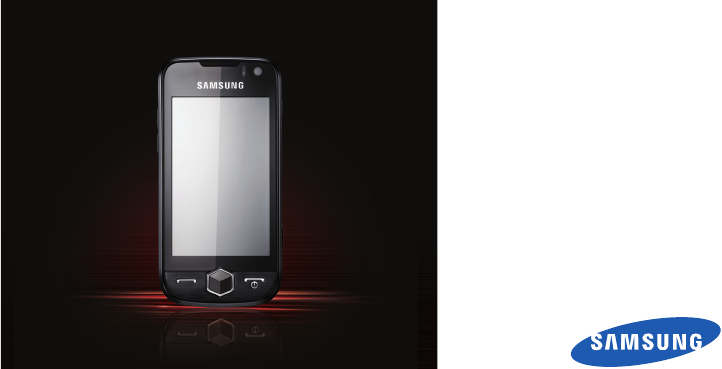
S8000
user manual
ii
using this
manual
This user manual has been specially
designed to guide you through the functions and
features of your mobile phone. To get started quickly,
refer to “introducing your mobile phone,”
“assembling and preparing your mobile phone,”
and “using basic functions.”
Instructional icons
Before you start, familiarise yourself with the icons
you will see in this manual:
Warning
—situations that could cause
injury to yourself or others
Caution
—situations that could cause
damage to your phone or other equipment
Note
—notes, usage tips, or additional
information
X
Refer to
—pages with related information;
for example:
X
p. 12 (represents “see page
12”)
using this manual
iii
Copyright information
Rights to all technologies and products that
comprise this device are the property of their
respective owners:
• Bluetooth® is a registered trademark of the
Bluetooth SIG, Inc. worldwide.
Bluetooth QD ID: B015189
• Java™ is a trademark of Sun Microsystems, Inc.
• Windows Media Player® is a registered trademark
of Microsoft Corporation.
• and are trademarks of SRS Labs,
Inc. CS Headphone and WOW HD technologies
are incorporated under licence from SRS Labs,
Inc.
•Wi-Fi®, the Wi-Fi CERTIFIED logo, and the Wi-Fi logo
are registered trademarks of the Wi-Fi Alliance.
• DivX® is a registered trademark of
DivX, Inc., and is used under
licence.
→
Followed by
—the order of options or
menus you must select to perform a step;
for example: In Idle mode, select
Messages → Create message (represents
Messages, followed by Create message)
[ ]
Square brackets
—phone keys; for
example: [ ] (represents the Power/
Menu exit key)

iv
using this manual
ABOUT DIVX VIDEO
DivX® is a digital video format created by DivX, Inc.
This is an official DivX Certified device that plays DivX
video. Plays DivX® video up to 320x240.
ABOUT DIVX VIDEO-ON-DEMAND
This DivX® Certified device must be registered with
DivX in order to play DivX Video-on-Demand (VOD)
content. First generate the DivX VOD registration
code for your device and submit it during the
registration process. [Important: DivX VOD content is
protected by a DivX DRM (Digital Rights
Management) system that restricts playback to
registered DivX Certified devices. If you try to play
DivX VOD content not authorised for your device, the
message "Authorization Error" will be displayed and
your content will not play.] Learn more at
http://vod.divx.com.

v
contents
safety and usage information .................. 2
Safety warnings ..........................................2
Safety precautions ......................................4
Important usage information .......................7
introducing your mobile phone ............. 12
Unpack .....................................................12
Phone layout .............................................13
Keys .........................................................14
Icons .........................................................15
assembling and preparing your
mobile phone .......................................... 17
Install the SIM or USIM card and battery ... 17
Charge the battery ....................................19
Insert a memory card (optional) .................20
Attach a hand strap (optional) ...................22

vi
contents
using basic functions ............................ 23
Turn your phone on and off .......................23
Use the touch screen ................................ 24
Access menus ..........................................25
Switch applications ...................................25
Access an application using the Gate key . 26
Access an application by snapping
the phone .................................................26
Use widgets .............................................. 28
Access help information ............................29
Customise your phone ..............................30
Use basic call functions ............................32
Send and view messages .........................34
Add and find contacts ............................... 37
Use basic camera functions ......................38
Listen to music .........................................39
Browse the web ........................................41
Use the Google services ...........................42
using advanced functions ..................... 44
Use advanced call functions ..................... 44
Use advanced phonebook functions ......... 47
Use advanced messaging functions .......... 48
Use advanced camera functions ............... 50
Use advanced music functions ................. 54
using tools and applications ................. 59
Use the Bluetooth wireless feature ............ 59
Activate and connect to a wireless LAN
(WLAN) ..................................................... 61
Activate and send an SOS message ......... 62
Activate the mobile tracker ........................ 63
View the phone display on a TV ................ 64
Make fake calls ......................................... 64
Record and play voice memos .................. 65
Edit images ............................................... 66
Print images .............................................. 68
Edit videos ................................................ 68

contents
vii
Upload photos and videos to the web ....... 70
Use Java-powered games and
applications .............................................. 72
Synchronise data ...................................... 73
Use RSS feeds .........................................74
Launch the Samsung Mobile Navigator ..... 75
View your current position .........................76
Update the GPS functionality ....................76
Create and view world clocks ...................76
Set and use alarms ................................... 77
Use the calculator .....................................78
Convert currencies or measurements ........78
Set a countdown timer ..............................79
Use the stopwatch ....................................79
Create new tasks ......................................79
Create text memos ................................... 79
Create sketches ........................................79
Manage your calendar ..............................81
troubleshooting ........................................ a
index ......................................................... d
2
safety and
usage
information
Comply with the following precautions to avoid
dangerous or illegal situations and ensure peak
performance of your mobile phone.
Keep your phone away from small
children and pets
Keep your phone and all accessories out of the
reach of small children or animals. Small parts may
cause choking or serious injury if swallowed.
Protect your hearing
Safety warnings
Listening to a headset at high volumes can
damage your hearing. Use only the
minimum volume setting necessary to hear
your conversation or music.

safety and usage information
3
Install mobile phones and equipment
with caution
Ensure that any mobile phones or related equipment
installed in your vehicle are securely mounted. Avoid
placing your phone and accessories near or in an air
bag deployment area. Improperly installed wireless
equipment can cause serious injury when air bags
inflate rapidly.
Handle and dispose of batteries and
chargers with care
• Use only Samsung-approved batteries and
chargers specifically designed for your phone.
Incompatible batteries and chargers can cause
serious injuries or damage to your phone.
• Never dispose of batteries or phones in a fire.
Follow all local regulations when disposing used
batteries or phones.
• Never place batteries or phones on or in heating
devices, such as microwave ovens, stoves, or
radiators. Batteries may explode when
overheated.
• Never crush or puncture the battery. Avoid
exposing the battery to high external pressure,
which can lead to an internal short circuit and
overheating.
Avoid interference with pacemakers
Maintain a minimum of 15 cm (6 inches) between
mobile phones and pacemakers to avoid potential
interference, as recommended by manufacturers
and the independent research group, Wireless
Technology Research. If you have any reason to
suspect that your phone is interfering with a
pacemaker or other medical device, turn off the
phone immediately and contact the manufacturer of
the pacemaker or medical device for guidance.

4
safety and usage information
Turn off the phone in potentially
explosive environments
Do not use your phone at refuelling points (service
stations) or near fuels or chemicals. Turn off your
phone whenever directed by warning signs or
instructions. Your phone could cause explosions or
fire in and around fuel or chemical storage and
transfer areas or blasting areas. Do not store or carry
flammable liquids, gases, or explosive materials in
the same compartment as the phone, its parts, or
accessories.
Reduce the risk of repetitive motion
injuries
While using your phone, hold the phone with a
relaxed grip, press the keys lightly, use special
features that reduce the number of keys you have to
press (such as templates and predictive text), and
take frequent breaks.
Drive safely at all times
Avoid using your phone while driving and obey all
regulations that restrict the use of mobile phones
while driving. Use hands-free accessories to
increase your safety when possible.
Follow all safety warnings and
regulations
Comply with any regulations that restrict the use of a
mobile phone in a certain area.
Use only Samsung-approved
accessories
Using incompatible accessories may damage your
phone or cause injury.
Safety precautions

safety and usage information
5
Turn off the phone near medical
equipment
Your phone can interfere with medical equipment in
hospitals or health care facilities. Follow all
regulations, posted warnings, and directions from
medical personnel.
Turn off the phone or disable the
wireless functions when in an aircraft
Your phone can cause interference with aircraft
equipment. Follow all airline regulations and turn off
your phone or switch to a mode that disables the
wireless functions when directed by airline
personnel.
Protect batteries and chargers from
damage
• Avoid exposing batteries to very cold or very hot
temperatures (below 0° C/32° F or above 45° C/
113° F). Extreme temperatures can reduce the
charging capacity and life of your batteries.
• Prevent batteries from contacting metal objects,
as this can create a connection between the +
and - terminals of your batteries and lead to
temporary or permanent battery damage.
• Never use a damaged charger or battery.
Handle your phone carefully and
sensibly
• Do not allow your phone to get wet—liquids can
cause serious damage. Do not handle your
phone with wet hands. Water damage to your
phone can void your manufacturer’s warranty.

6
safety and usage information
• Avoid using or storing your phone in dusty, dirty
areas to prevent damage to moving parts.
• Your phone is a complex electronic device—
protect it from impacts and rough handling to
avoid serious damage.
• Do not paint your phone, as paint can clog
moving parts and prevent proper operation.
• If your phone has a camera flash or light, avoid
using it close to the eyes of children or animals.
• Your phone may be damaged by exposure to
magnetic fields. Do not use carrying cases or
accessories with magnetic closures or allow your
phone to come in contact with magnetic fields for
extended periods of time.
Avoid interference with other electronic
devices
Your phone emits radio frequency (RF) signals that
may interfere with unshielded or improperly shielded
electronic equipment, such as pacemakers, hearing
aids, medical devices, and other electronic devices
in homes or vehicles. Consult the manufacturers of
your electronic devices to solve any interference
problems you experience.
Do not use the phone if the screen is
cracked or broken
Broken glass could cause injury to your hand and
face. Bring the phone to Samsung service centre to
replace the glass.

safety and usage information
7
Use your phone in the normal position
Avoid contact with your phone’s internal antenna.
Allow only qualified personnel to service
your phone
Allowing unqualified personnel to service your phone
may result in damage to your phone and will void
your warranty.
Ensure maximum battery and charger
life
• Avoid charging batteries for more than a week, as
overcharging may shorten battery life.
• Over time, unused batteries will discharge and
must be recharged before use.
• Disconnect chargers from power sources when
not in use.
• Use batteries only for their intended purpose.
Handle SIM cards and memory cards
with care
• Do not remove a card while the phone is
transferring or accessing information, as this
could result in loss of data and/or damage to the
card or phone.
• Protect cards from strong shocks, static
electricity, and electrical noise from other devices.
• Frequent writing and erasing will shorten the life
span of memory cards.
• Do not touch gold-coloured contacts or terminals
with your fingers or metal objects. If dirty, wipe the
card with a soft cloth.
Important usage information

8
safety and usage information
Ensure access to emergency services
Emergency calls from your phone may not be
possible in some areas or circumstances. Before
travelling in remote or undeveloped areas, plan an
alternate method of contacting emergency services
personnel.
Specific Absorption Rate (SAR)
certification information
Your phone conforms to European Union (EU)
standards that limit human exposure to radio
frequency (RF) energy emitted by radio and
telecommunications equipment. These standards
prevent the sale of mobile phones that exceed a
maximum exposure level (known as the Specific
Absorption Rate, or SAR) of 2.0 watts per kilogram.
During testing, the maximum SAR recorded for this
model was 0.522 watts per kilogram. In normal use,
the actual SAR is likely to be much lower, as the
phone has been designed to emit only the RF
energy necessary to transmit a signal to the nearest
base station. By automatically emitting lower levels
when possible, your phone reduces your overall
exposure to RF energy.
The Declaration of Conformity at the back of this
manual demonstrates your phone’s compliance with
the European Radio & Terminal Telecommunications
Equipment (R&TTE) directive. For more information
about the SAR and related EU standards, visit the
Samsung mobile phone website.
safety and usage information
9
Correct disposal of this product
(Waste Electrical & Electronic Equipment)
(Applicable in the European Union and
other European countries with separate
collection systems)
This marking on the product, accessories
or literature indicates that the product and
its electronic accessories (e.g. charger, headset,
USB cable) should not be disposed of with other
household waste at the end of their working life. To
prevent possible harm to the environment or human
health from uncontrolled waste disposal, please
separate these items from other types of waste and
recycle them responsibly to promote the sustainable
reuse of material resources.
Household users should contact either the retailer
where they purchased this product, or their local
government office, for details of where and how they
can take these items for environmentally safe
recycling.
Business users should contact their supplier and
check the terms and conditions of the purchase
contract. This product and its electronic accessories
should not be mixed with other commercial wastes
for disposal.
This EEE is compliant with RoHS.

10
safety and usage information
Correct disposal of batteries in this
product
(Applicable in the European Union and
other European countries with separate
battery return systems)
This marking on the battery, manual or
packaging indicates that the batteries in this product
should not be disposed of with other household
waste at the end of their working life.
Where marked, the chemical symbols Hg, Cd or Pb
indicate that the battery contains mercury, cadmium
or lead above the reference levels in EC Directive
2006/66. If batteries are not properly disposed of,
these substances can cause harm to human health
or the environment.
To protect natural resources and to promote material
reuse, please separate batteries from other types of
waste and recycle them through your local, free
battery return system.
Disclaimer
Some content and services accessible through this
device belong to third parties and are protected by
copyright, patent, trademark and/or other intellectual
property laws. Such content and services are
provided solely for your personal noncommercial
use. You may not use any content or services in a
manner that has not been authorised by the content
owner or service provider. Without limiting the
foregoing, unless expressly authorised by the
applicable content owner or service provider, you
may not modify, copy, republish, upload, post,
transmit, translate, sell, create derivative works,
exploit, or distribute in any manner or medium any
content or services displayed through this device.

safety and usage information
11
“THIRD PARTY CONTENT AND SERVICES ARE
PROVIDED "AS IS." SAMSUNG DOES NOT
WARRANT CONTENT OR SERVICES SO
PROVIDED, EITHER EXPRESSLY OR IMPLIEDLY,
FOR ANY PURPOSE. SAMSUNG EXPRESSLY
DISCLAIMS ANY IMPLIED WARRANTIES,
INCLUDING BUT NOT LIMITED TO, WARRANTIES
OF MERCHANTABILITY OR FITNESS FOR A
PARTICULAR PURPOSE. SAMSUNG DOES NOT
GUARANTEE THE ACCURACY, VALIDITY,
TIMELINESS, LEGALITY, OR COMPLETENESS OF
ANY CONTENT OR SERVICE MADE AVAILABLE
THROUGH THIS DEVICE AND UNDER NO
CIRCUMSTANCES, INCLUDING NEGLIGENCE,
SHALL SAMSUNG BE LIABLE, WHETHER IN
CONTRACT OR TORT, FOR ANY DIRECT,
INDIRECT, INCIDENTAL, SPECIAL OR
CONSEQUENTIAL DAMAGES, ATTORNEY FEES,
EXPENSES, OR ANY OTHER DAMAGES ARISING
OUT OF, OR IN CONNECTION WITH, ANY
INFORMATION CONTAINED IN, OR AS A RESULT
OF THE USE OF ANY CONTENT OR SERVICE BY
YOU OR ANY THIRD PARTY, EVEN IF ADVISED OF
THE POSSIBILITY OF SUCH DAMAGES."
Third party services may be terminated or interrupted
at any time, and Samsung makes no representation
or warranty that any content or service will remain
available for any period of time. Content and
services are transmitted by third parties by means of
networks and transmission facilities over which
Samsung has no control. Without limiting the
generality of this disclaimer, Samsung expressly
disclaims any responsibility or liability for any
interruption or suspension of any content or service
made available through this device.
Samsung is neither responsible nor liable for
customer service related to the content and
services. Any question or request for service relating
to the content or services should be made directly to
the respective content and service providers.

12
introducing your
mobile phone
In this section, learn about your mobile phone’s
layout, keys, and icons.
Unpack
Check your product box for the following items:
• Mobile phone
• Battery
• Travel adapter (charger)
•User manual
The items supplied with your phone may vary
depending on the software and accessories
available in your region or offered by your
service provider. You can obtain additional
accessories from your local Samsung dealer.
introducing your mobile phone
13
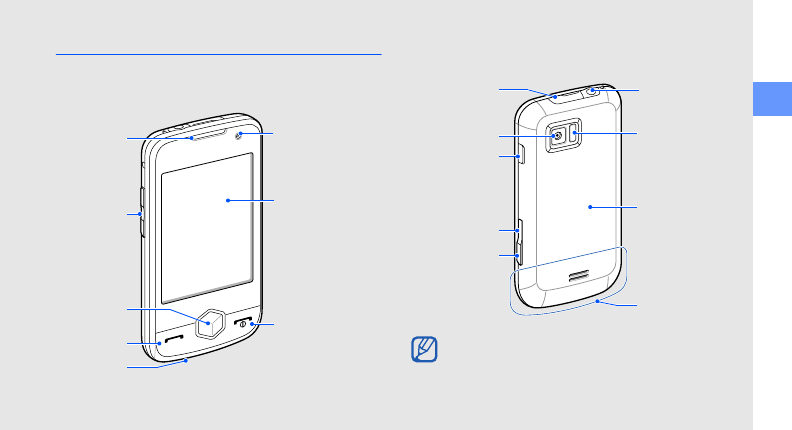
Phone layout
The front of your phone includes the following keys
and features:
The rear of your phone includes the following keys
and features:
Front camera
lens for video
calls
Power/Menu
exit key
Dial key
Touch screen
Earpiece
Mouthpiece
Volume key
Menu key
You can lock the touch screen and keys to
prevent any unwanted phone operations. To
lock, press the Hold key.
Battery cover
Rear camera
lens
Camera key
Internal antenna
Gate key
Multifunction
jack
Flashbulb
Hold key
Headset/
TV-out cable jack
14
introducing your mobile phone
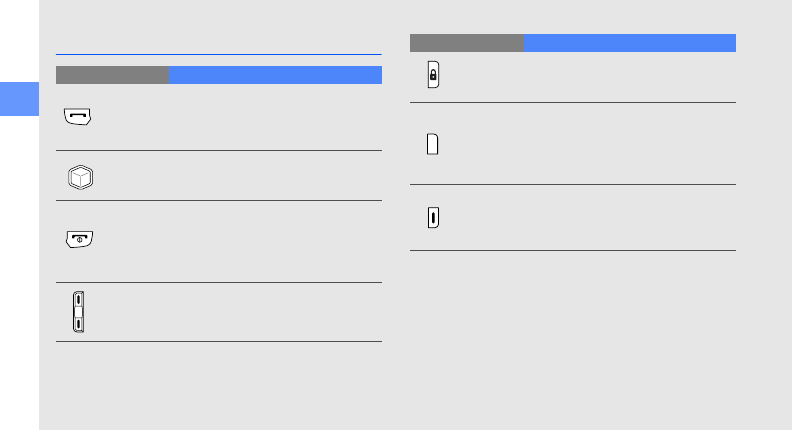
Keys
Key Function
Dial
Make or answer a call; In Idle mode,
retrieve recently dialled, missed, or
received numbers
Menu Access Menu mode; Shows all active
applications (press and hold)
Power/
Menu exit
Turn the phone on and off (press and
hold); End a call; In Menu mode,
return to the main menu or return to
Idle mode
Volume Adjust the phone’s volume
Hold Lock or unlock the touch screen and
keys
Gate
Open the cube screen to access
entertainment applications; Access
the motion tutorial and motion-
activated shortcuts (press and hold)
Camera
In Idle mode, turn on the camera; In
Camera mode, take a photo or record
a video
Key Function
introducing your mobile phone
15
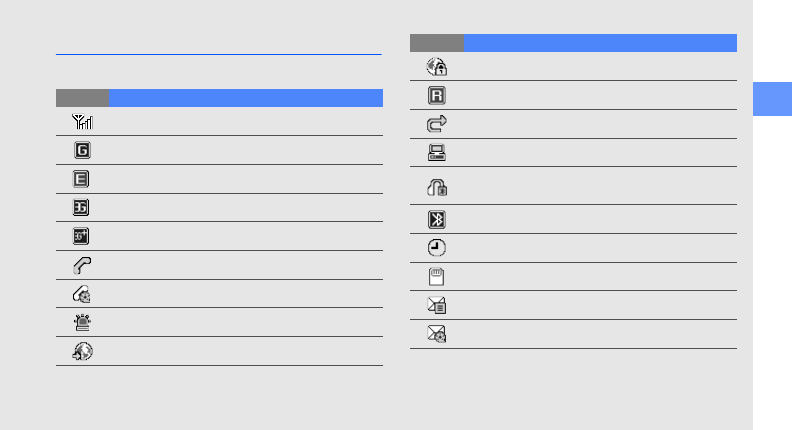
Icons
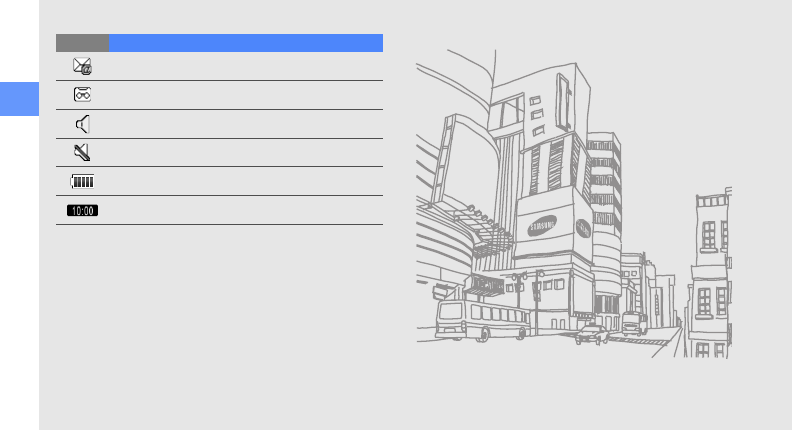
Learn about the icons that appear on your display.
Icon Definition
Signal strength
GPRS network connected
EDGE network connected
UMTS network connected
HSDPA network connected
Voice call in progress
Video call in progress
SOS message feature activated
Browsing the web
Connected to secured web page
Roaming (outside of normal service area)
Call diverting activated
Synchronised with PC
Bluetooth hands-free car kit or headset
connected
Bluetooth activated
Alarm activated
Memory card inserted
New text message (SMS)
New multimedia message (MMS)
Icon Definition
16
introducing your mobile phone
New email message
New voice mail message
Normal profile activated
Silent profile activated
Battery power level
Current time
Icon Definition

17
assembling and
preparing your
mobile phone
Get started by assembling and setting up
your mobile phone for its first use.
Install the SIM or USIM card and
battery
When you subscribe to a cellular service, you will
receive a Subscriber Identity Module, or SIM card,
with subscription details, such as your personal
identification number (PIN) and optional services.
To use UMTS or HSDPA services, you can purchase
a Universal Subscriber Identity Module (USIM) card.
18
assembling and preparing your mobile phone
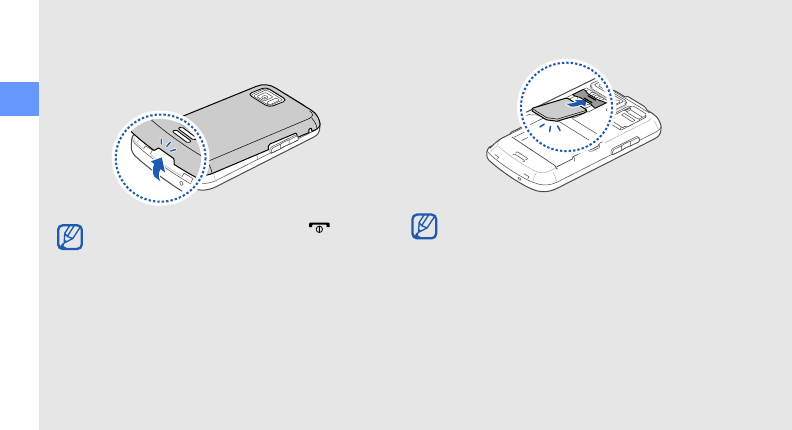
To install the SIM or USIM card and battery,
1. Remove the battery cover.
2. Insert the SIM or USIM card.
If the phone is on, press and hold [ ] to turn
it off.
• Place the SIM or USIM card in the phone
with the gold-coloured contacts facing
down.
• Without inserting a SIM or USIM card, you
can use your phone’s non-network services
and some menus.
assembling and preparing your mobile phone
19
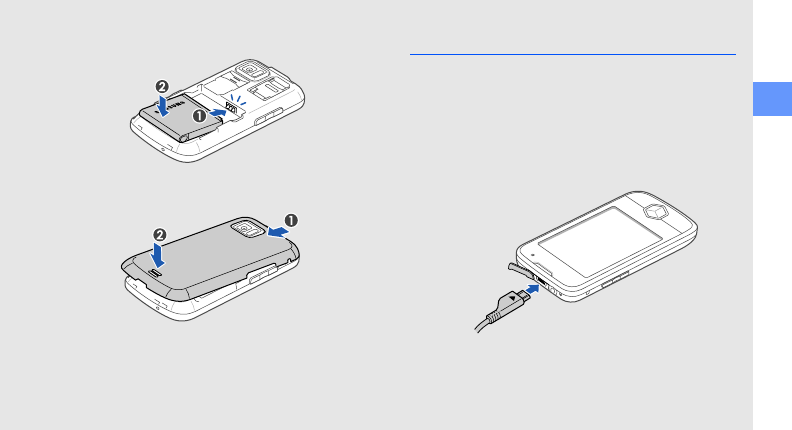
3. Insert the battery.
4. Replace the battery cover.
Charge the battery
Before using the phone for the first time, you must
charge the battery.
1. Open the cover to the multifunction jack on the
top of the phone.
2. Plug the small end of the travel adapter into the
multifunction jack.
With the triangle
facing up
20
assembling and preparing your mobile phone
3. Plug the large end of the travel adapter into a
power outlet.
4. When the battery is fully charged (the icon is
no longer moving), unplug the travel adapter from
the power outlet.
5. Unplug the travel adapter from the phone.
6. Close the cover to the multifunction jack.
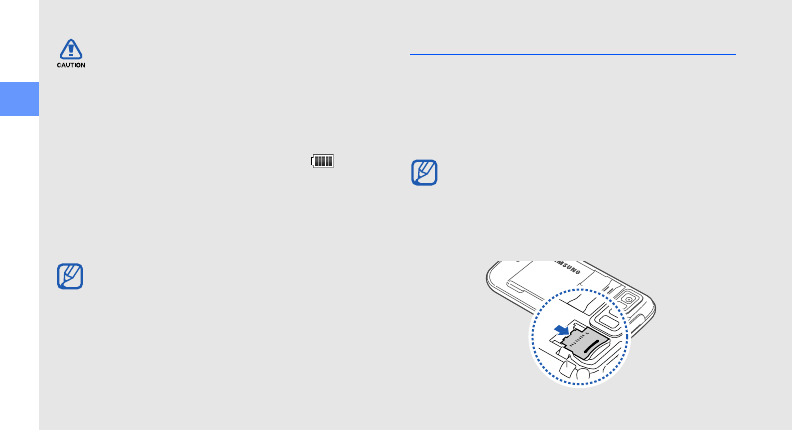
Insert a memory card (optional)
To store additional multimedia files, you must insert a
memory card. Your phone accepts microSD™ or
microSDHC™ memory cards up to 16 GB
(depending on memory card manufacturer and
type).
1. Remove the battery cover.
2. Unlock the memory card holder.
Improperly connecting the travel adapter can
cause serious damage to the phone. Any
damages by misuse are not covered by the
warranty.
About the low battery indicator
When your battery is low, the phone will emit
a warning tone and a low battery message.
The battery icon will also be empty and
blinking. If the battery level becomes too low,
the phone will automatically power off.
Recharge your battery to continue using your
phone.
Formatting the memory card on a PC may
cause incompatibility with your phone. Format
the memory card only on the phone.
assembling and preparing your mobile phone
21
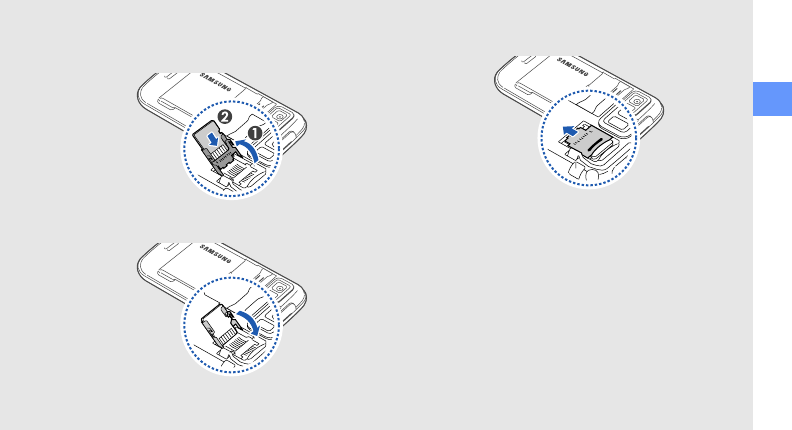
3. Lift the memory card holder and insert a memory
card as shown.
4. Close the memory card holder.
5. Lock the memory card holder.
6. Replace the battery cover.
To remove the memory card, remove the battery
cover, unlock and lift the memory card holder, and
remove the memory card.
22
assembling and preparing your mobile phone
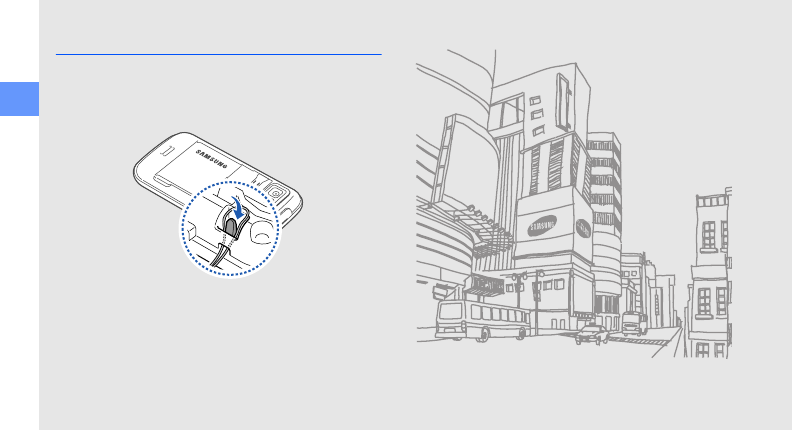
Attach a hand strap (optional)
1. Remove the battery cover.
2. Slide a hand strap through the slot and hook it
over the small projection.

23
using basic
functions
Learn how to perform basic operations and use the
main features of your mobile phone.
Turn your phone on and off
To turn your phone on,
1. Press and hold [ ].
2. Enter your PIN and select Confirm (if necessary).
To turn your phone off, repeat step 1 above.
Switch to the offline profile
By switching to the offline profile, you can use your
phone’s non-network services in areas where
wireless devices are prohibited, such as aeroplanes
and hospitals.
To switch to the offline profile, in Menu mode, select
Settings → Phone profiles → Offline.
Follow all posted warnings and directions from
official personnel when in areas where wireless
devices are prohibited.
24
using basic functions
Use the touch screen
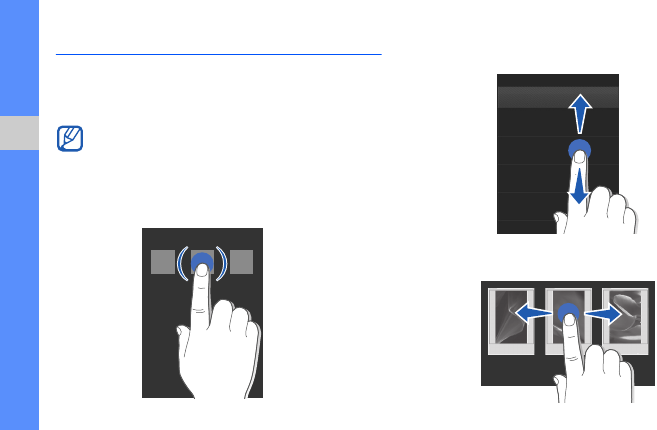
Your phone’s touch screen lets you easily select
items or perform functions. Learn basic actions to
use the touch screen.
• Touch an icon to open a menu or launch an
application.
• Drag your finger up or down to scroll through
vertical lists.
• Drag your finger left or right to scroll through
horizontal lists.
For the optimal use of the touch screen,
remove the screen protection film before using
your phone.

25
using basic functions
Access menus
To access your phone’s menus,
1. In Idle mode, select Menu or press the Menu
key to access Menu mode.
2. Scroll left or right to a Menu mode screen.
3. Select a menu or option.
4. Select to move up one level; Press [ ] to
return to Idle mode.
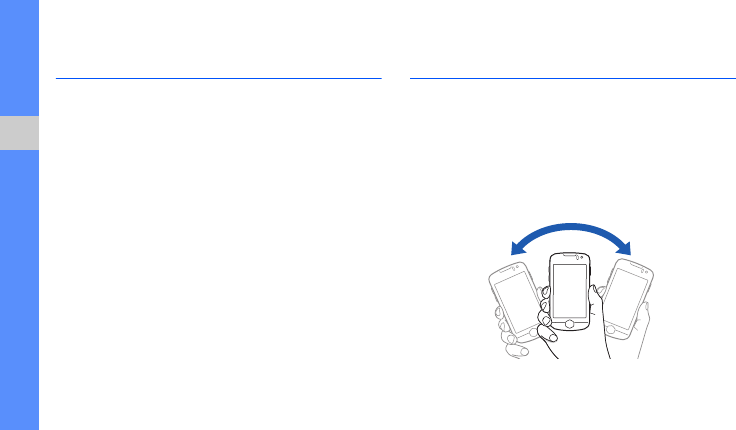
Use the motion sensor
Your phone features a built-in motion sensor that
switches the display from portrait to landscape
mode.
The following applications support landscape mode:
Camera, Video player, Music player, and Photo
browser.
Switch applications
Your phone allows you to multi-task by running
multiple applications at the same time.
Switch from one active application to
another
1. Press and hold the Menu key to open a list of
applications.
2. Scroll to an application and select it.
To change the view mode, select Grid view.
Close applications
To close the current application, press [ ].
To close an application that is running in the
background,
1. Press and hold the Menu key to open a list of
applications.
2. Scroll to an application and select .
26
using basic functions
Access an application using the
Gate key
To access entertainment applications,
1. Press the Gate key.
2. Select an application by rotating the cube to the
appropriate side or selecting an icon at the
bottom line of the screen.
You can launch the video player, FM radio, or
music player. You can also launch the web
browser, select a game, or access the list of
photos and videos.
Access an application by snapping
the phone
Learn to use a motion-activated shortcut for your
favourite applications.
1. In Idle mode, press and hold the Gate key.
2. Select Guide and follow the motion tutorial. You
can learn the following actions.
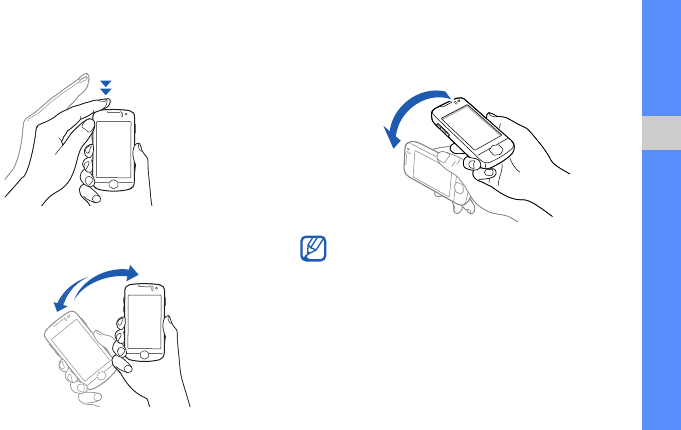
• Shake the phone quickly more than 3 times to
end an application.
27
using basic functions
• Tap the top of the phone twice within 1 second to
pause or resume playback, or capture a photo.
• Snap the phone left or right and then quickly back
to the initial position to launch an application.
• Quickly tilt the phone left or right and then quickly
back to the initial position to launch an
application.
3. When the entertainment applications screen
appears, snap the phone in the direction of the
appropriate shortcut (left or right).
• To deactivate the motion tutorial the next time
you press and hold the Gate key, select
Deactivate
.
• To access the motion tutorial, in Menu mode,
select
Games and more
→
Motion tutorial
.

28
using basic functions
4. Shake the phone more than 3 times to close the
current application.
Tips for using the motion-related actions:
• Perform the actions within 1 second.
• Wait at least 1 second before performing the
actions.
• Learn the actions by following the motion tutorial.
To change an entertainment application assigned to
a motion direction,
1. In Menu mode, select Settings → Motion
settings → Motion gate.
2. Select an application to be changed.
3. Select a menu to assign to the direction and
select Save.
4. Select Save.
Use widgets
Learn to use widgets on the widget toolbar.
Open the widget toolbar
In Idle mode, select the arrow at the bottom left of
the screen to open the widget toolbar. You can
rearrange widgets on the widget toolbar or move
them to the idle screen.
• The motion-related actions are for both right
and left hand users.
• When you are using multiple applications at
the same time, you cannot use the motion-
related actions.
• Some of your widgets connect to web
services. Selecting a web-based widget may
incur additional charges.
• Available widgets may vary depending on
your region or service provider.
29
using basic functions
Move the widgets to the idle screen
1. Open the widget toolbar.
2. Drag a widget from the widget toolbar to the idle
screen. You can position the widget anywhere
on the screen.
Change the widgets
1. In Menu mode, select Settings → Display and
light → Widget.
2. Select the widgets you want to include to the
widget toolbar and select Save.
Use widget packages
Group your favourite widgets together as a widget
package.
To create a widget package,
1. In Idle mode, scroll left or right to one of the idle
screens.
2. Drag a widget from the widget toolbar to the idle
screen.
To open the package, scroll left or right to the
corresponding screen.
Access help information
Learn to access helpful information about your
phone.
1. Open the widget toolbar.
2. Drag to the idle screen and select it.
3. Rotate the phone anti-clockwise to landscape
view.
4. Select a help topic to learn about an application
or feature.
5. Drag your finger to the right or left to get more
information. To return to the previous level, select
.

30
using basic functions
Customise your phone
Get more from your phone by customising it to
match your preferences.
Adjust the volume of the key tones
In Idle mode, press the Volume key up or down and
adjust the key tone volume.
Adjust the vibration intensity on the
touch screen
You can adjust the intensity of the vibration when you
touch the phone screen.
1. In Idle mode, press the Volume key up or down.
2. Select Vibration and adjust the intensity of the
vibration.
Switch to or from the silent profile
In Idle mode, select Keypad and touch and hold
to silence or unsilence your phone.
Calibrate the screen
You can calibrate the screen so that your phone
recognises the input better.
1. In Menu mode, select Settings → Phone
settings → Calibration.
2. Touch the target on the screen.
3. Select OK.
Change your ringtone
1. In Menu mode, select Settings → Phone
profiles.
2. Select next to the profile you are using.

31
using basic functions
3. Select Voice call ringtone or Video call
ringtone.
4. Select a ringtone from the list and select Save.
5. Select Save.
To switch to another profile, select it from the list.
Activate Etiquette pause
You can temporarily mute all phone sounds by
placing the phone face down when Etiquette pause
is activated.
1. In Menu mode, select Settings → Motion
settings → Etiquette pause → On.
2. Select Save.
Select a wallpaper (Idle mode)
1. Scroll left or right to one of the idle screens.
2. In Menu mode, select Settings → Display and
light → Wallpaper.
3. Scroll left or right to an image.
4. Select Set.
Lock your phone
1. In Menu mode, select Settings → Security.
2. Select On under Phone lock.
3. Enter a new 4- to 8-digit password and select
Confirm.
4. Enter the new password again and select
Confirm.
You can also set a wallpaper while viewing a
photo. If you set the photo as the wallpaper,
only the currently selected idle screen will be
changed.

32
using basic functions
Unlock the touch screen with smart
unlock
By drawing a specified character on the locked
touch screen, you can unlock the screen only,
unlock and then make a call to a speed dial number,
or unlock and then launch an application. To set a
smart unlock character,
1. In Menu mode, select Settings → Smart
unlock.
2. Select On under Gesture unlock.
3. Select an unlock option.
4. Select a speed dial number to dial or select an
application to launch (if necessary).
5. Select a character for the smart unlock feature.
6. Select .
7. Select Save.
Use basic call functions
Learn to make or answer calls and use basic call
functions.
Make a call
1. In Idle mode, select Keypad and enter an area
code and a phone number.
2. Select → Voice call or press [ ] to dial the
number.
• The first time you access a menu that
requires a password, you will be prompted to
create and confirm a password.
• Samsung is not responsible for any loss of
passwords or private information or other
damages caused by illegal software.
During a call, your phone automatically locks
the touch screen to prevent accidental inputs.
To unlock, press the Hold key.

33
using basic functions
For a video call, select → Video call.
3. To end the call, press [ ].
Answer a call
1. When a call comes in, press [ ].
2. For a video call, press [ ] and select Show
me to allow the caller to see you via the front
camera lens.
3. To end the call, press [ ].
Adjust the volume
To adjust the volume during a call, press the Volume
key up or down.
Use the speakerphone feature
1. During a call, select Speaker → Yes to activate
the speaker.
2. To switch back to the earpiece, select Speaker.
You can set the phone to activate the speaker
automatically.
1. In Menu mode, select Settings → Motion
settings → Speaker call → On.
2. Select Save.
3. During a call, place your phone on a table or a
flat surface.
Use the headset
By plugging the supplied headset into the
multifunction jack, you can make and answer calls:
• To redial the last call, press the headset button,
and then press again and hold.
• To answer a call, press the headset button.
In noisy environments, you may have difficulty
hearing the calls while using the speakerphone
feature. For better audio performance, use the
normal phone mode.

34
using basic functions
• To end a call, press the headset button.
Send and view messages
Learn to send and view text (SMS), multimedia
(MMS), and email messages.
Send a text or multimedia message
1. In Idle mode, select Messages → Create
message → Message.
2. Select Tap to add recipient → Enter manually.
3. Enter a destination number and select Done.
4. Select the text input field.
5. Enter your message text and select Done.
X
Enter text
For sending as a text message, skip to step 7.
For attaching multimedia, continue with step 6.
6. Select Add media and add an item.
7. Select Send to send the message.
Send an email
1. In Idle mode, select Messages → Create
message → Email.
2. Select Tap to add recipient → Enter manually.
3. Enter an email address and select Done.
4. Select Tap to add subject, enter a subject, and
select Done.
5. Select Tap to add text, enter your email text,
and select Done.
6. Select Add files and attach a file (if necessary).
7. Select Send to send the message.
35
using basic functions
Enter text
With your phone’s touch screen, you can enter text
and create messages or notes.
Change the text input method
When you open the text input field, the virtual keypad
appears. Select the Keypad drop-down menu and
select one of the following input methods for
entering text:
•Keypad
•Writing full sc.
•Writing box 1
•Writing box 2
Enter text using the keypad
1. Change the text input method to Keypad.
2. Select the appropriate virtual key to enter text.
• To change case or use numbers or symbols,
select Abc or T9Ab.
• To enter text in T9 mode, select T9.
You can use the following text input modes:
You can use a wide keyboard when you rotate
the phone anti-clockwise to landscape view
when entering text.
Mode Function
ABC Select the appropriate
virtual key
until the
character you want appears on the display.
T9
1.
Select
the appropriate virtual key to enter an
entire word.
2. When the word displays correctly,
select
to insert a space. If the correct word
does not display, select an alternate word
from the list that appears.
36
using basic functions
Enter text using the writing full screen
1. Change the text input method to Writing full sc.
2. Write each character anywhere on the screen.
To change case or use numbers or symbols,
select Abc.
Enter text using the writing box 1
1. Change the text input method to Writing box 1.
2. Write each character in the writing area at the
bottom of the screen.
Write numbers and symbols in the ?1 column at
the bottom right of the writing area.
Enter text using the writing box 2
1. Change the text input method to Writing box 2.
2. Write each character in the writing area at the
bottom of the screen.
To change case or use numbers or symbols,
select Abc.
View text or multimedia messages
1. In Idle mode, select Messages → Inbox.
2. Select a text or multimedia message.
View an email
1. In Idle mode, select Messages → Email inbox.
2. Select an account.
3. Select Download.
4. Select an email or a header.
Number Select the
appropriate virtual key
to enter a
number.
Symbol Select the
appropriate virtual key
to enter a
symbol.
Mode Function

37
using basic functions
5. If you selected a header, select Retrieve to view
the body of the email.
Add and find contacts
Learn the basics of using the phonebook feature.
Add a new contact
1. In Idle mode, select Keypad and enter a phone
number.
2. Select → Add to Phonebook → New.
3. Select Phone or SIM.
4. Enter contact information.
5. Select Save to add the contact to memory.
Find a contact
1. In Idle mode, select Phonebook.
2. Select the search field, enter the letter of the
name you want to find, and select Done.
You can also drag to select the first letter of the
name.
3. Select the contact’s name from the search list.
Once you have found a contact, you can:
• call the contact by selecting
• edit the contact information by selecting
Edit
38
using basic functions
Use basic camera functions
Learn the basics to capture and view photos and
videos.
Capture photos
1. In Idle mode, press the Camera key to turn on
the camera.
2. Rotate the phone anti-clockwise to landscape
view.
3. Aim the lens at the subject and make any
adjustments.
• To turn the flash on or off, select .
• To set the exposure value, select .
4. Press the Camera key to take a photo.
The photo is saved automatically.
After capturing photos, select to view photos.
View photos
In Menu mode, select My files → Images → My
photos → a photo file.
• Rotate the phone anti-clockwise to landscape
view. Tilt the phone to the left or right, photos will
scroll left or right automatically.
• Touch and hold the screen and drag to zoom
in. Double-touch the screen to exit the zoom
screen.
To categorise and view photos in a wide view,
1. In Menu mode, select Photo browser.
2. Rotate the phone anti-clockwise to landscape
view.
3. Select → a category to categories the
photos.
4. Scroll left or right to view photos.
Tilt the phone to the left or right, photos will scroll
left or right automatically.

39
using basic functions
Capture videos
1. In Idle mode, press the Camera key to turn on
the camera.
2. Rotate the phone anti-clockwise to landscape
view.
3. Select to switch to Recording mode.
4. Aim the lens at the subject and make any
adjustments.
• To change the recording mode, select .
• To turn the flash on or off, select .
• To set the exposure value, select .
5. Press the Camera key to start recording.
6. Select or press the Camera key to stop
recording.
The video is saved automatically.
After capturing videos, select to view videos.
View videos
Use one of the following methods to view videos.
• In Menu mode, select My files → Videos → My
video clips → a video file.
• In Menu mode, select Video player → a video
file.
Rotate the phone anti-clockwise to landscape view.
Listen to music
Learn how to listen to music via the music player or
FM radio.
Listen to the FM radio
1. Plug the supplied headset into the phone.
2. In Menu mode, select FM radio.
3. Select Yes to start automatic tuning.
The radio scans and saves available stations
automatically.
40
using basic functions
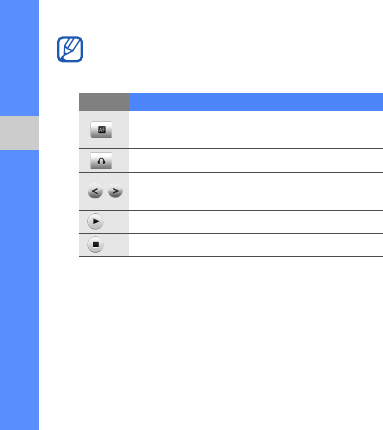
4. Control the FM radio using the following icons:
If you want to get information about the song you
hear, select More → Find music.
X
p. 58
Listen to music files
Start by transferring files to your phone or memory
card:
• Download from the wireless web.
X
p. 41
• Download from a PC with the optional Samsung
PC Studio.
X
p. 54
• Receive via Bluetooth.
X
p. 60
• Copy to your memory card.
X
p. 55
• Synchronise with Windows Media Player 11.
X
p. 55
After transferring music files to your phone or
memory card,
1. In Menu mode, select Music player.
2. Select a music category → a music file.
The first time you access the FM radio, you will
be prompted to start automatic tuning.
Icon Function
Set your phone to re-tune frequencies for
stations
Change the sound output
Tune a radio station; Select a saved radio
station (touch and hold)
Start the FM radio
Turn off the FM radio
41
using basic functions
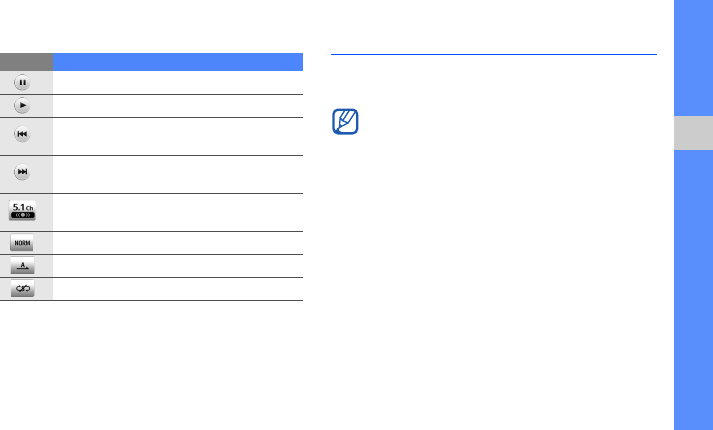
3. Control playback using the following icons: Browse the web
Learn to access and bookmark your favourite web
pages.
Browse web pages
1. In Menu mode, select Internet → Home to
launch your service provider’s homepage.
Icon Function
Pause playback
Play or resume playback
Skip backward; Scan backward in a file
(touch and hold)
Skip forward; Scan forward in a file (touch
and hold)
Activate the 5.1 channel surround sound
system
Change the sound effect
Change the repeat mode
Activate Shuffle mode
• You may incur additional charges for
accessing the web and downloading media.
• The internet menu may be labelled differently
depending on your service provider.
• Available icons may vary depending on your
region or service provider.
42
using basic functions
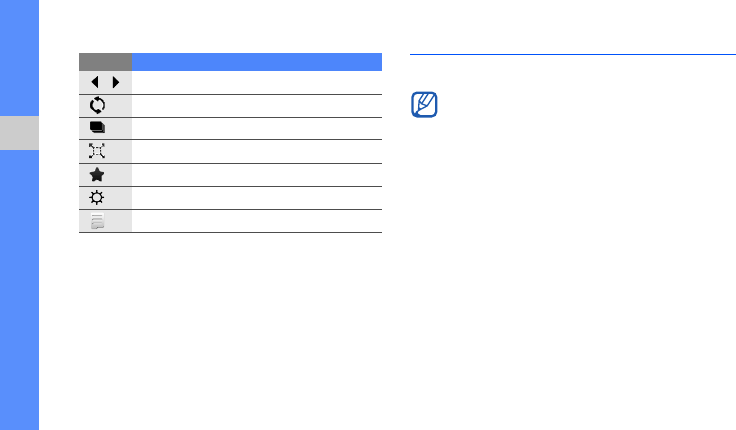
2. Navigate web pages using the following icons:
Bookmark your favourite web pages
1. In Menu mode, select Internet → Bookmarks.
2. Select Add.
3. Enter a page title and a web address (URL).
4. Select Save.
Use the Google services
Learn how to use various Google services.
Connect to Search
1. In Menu mode, select Google → Search.
2. Enter a keyword in the search field.
Connect to Mail
1. In Menu mode, select Google → Mail.
2. Set up your Google account and sign in.
3. Send or receive emails.
Icon Function
Move backward or forward on a web page
Refresh the current web page
Open a list of activated web pages
Change the view mode
Open a list of saved bookmarks
Adjust the brightness of the screen
Access a list of browser options
• This feature may be unavailable depending
on your region or service provider.
• The steps you must select to use this feature
may differ depending on your region or
service provider.

43
using basic functions
Connect to Maps
To search the map,
1. In Menu mode, select Google → Maps.
2. Scroll through the map.
3. Zoom in or out on the location you want.
To search for a specific location,
1. In Menu mode, select Google → Maps.
2. Select Menu → Search Map and enter the
address or the category of the business.
To get directions to a specific destination,
1. In Menu mode, select Google → Maps.
2. Select Menu → Get Directions.
3. Enter the addresses of the starting location and
the ending location.
4. Select Show directions to view on the map.
To enhance the map functionality, download GPS
data files.
X
p. 76
The map service may be unavailable
depending on your region.

44
using advanced
functions
Learn how to perform advanced operations and use
additional features of your mobile phone.
Use advanced call functions
Learn about your phone’s additional calling
capabilities.
View and dial missed calls
Your phone will display calls you have missed on the
display.
When you have one missed call, select the call from
the event alert widget and select Voice call to dial.
When you have two missed calls or more, select the
call from the event alert widget and select Logs → a
missed call.
Call a recently dialled number
1. In Idle mode, press [ ] to display a list of
recent numbers.

45
using advanced functions
2. Select the number you want and select or
press [ ] to dial.
Hold a call or retrieve a held call
Select Hold to place a call on hold or select
Retrieve to retrieve a held call.
Dial a second call
If your network supports this function, you can dial
another number during a call:
1. Select Hold to place the first call on hold.
2. Enter the second number to dial and select New
call or press [ ].
3. Select Swap to switch between the two calls.
4. To end the call on hold, select On hold → .
5. To end the current call, press [ ].
Answer a second call
If your network supports this function, you can
answer a second incoming call:
1. Press [ ] to answer the second call.
The first call is automatically placed on hold.
2. Select Swap to switch between the calls.
Make a multiparty call (conference call)
1. Call the first party you want to add to the
multiparty call.
2. While connected to the first party, call the
second party.
The first party is automatically placed on hold.
3. When connected to the second party, select
Join.
4. Repeat steps 2 and 3 to add more parties (if
necessary).

46
using advanced functions
5. To end the multiparty call, press [ ].
Call an international number
1. In Idle mode, select Keypad and touch and hold
0 to insert the + character.
2. Enter the complete number you want to dial
(country code, area code, and phone number),
and then select → Voice call or press [ ]
to dial.
Call a contact from the phonebook
You can call numbers directly from the phonebook
using stored contacts.
X
p. 37
1. In Idle mode, select Phonebook.
2. Select the contact you want.
3. Select
next to
the number you want to dial →
.
Reject a call
To reject an incoming call, press [ ]. The caller will
hear a busy tone.
To reject calls from certain numbers automatically,
use the auto rejection. To activate the auto rejection
and set up the reject list,
1. In Menu mode, select Settings → Application
settings → Call → All calls → Auto reject.
2. Select On under Activation.
3. Select Add number.
4. Select the number input field.
5. Enter a number to reject and select Done.
6. Select the check box next to the number.
7. Select Save.

47
using advanced functions
Use advanced phonebook functions
Learn to create namecards, set favourite numbers,
and create groups of contacts.
Create a namecard
1. In Idle mode, select Phonebook → More → My
namecard.
2. Enter your personal details.
3. Select Save.
Set favourite numbers
1. In Idle mode, select Phonebook.
2. Select the Contacts drop-down menu and
select Favourites.
3. Select Add.
4. Select a contact.
The contact is saved to the favourite number.
Create a group of contacts
By creating groups of contacts, you can assign
group names, ringtones, caller ID photos, and
vibration type to each group or send messages and
emails to an entire group. Start by creating a group:
1. In Idle mode, select Phonebook.
2. Select the Contacts drop-down menu and
select Groups.
3. Select Create group.
4. Set a group name, the caller ID photo, a group
ringtone, and vibration type.
5. Select Save.
You can send your namecard by attaching it to
a message or email or transferring it via the
Bluetooth wireless feature.
The first 5 favourite numbers will be assigned
to the favourite contacts (
)
on the widget
toolbar.

48
using advanced functions
Link your photos to contacts
Learn to tag faces in your photos to make calls or
send messages from photos.
To link your photos to contacts,
1. In Menu mode, select Photo contacts.
2. Select Add → a photo.
3. Select Edit to add a tag to a person’s face.
4. Select Add tag, move or resize the rectangle on
a face, and select Done (if necessary).
5. Select the face tag → Link to Phonebook → a
contact.
The selected contact is linked to the photo.
6. Select to add more photo contacts (step 2).
Make calls or send messages from
photos
1. In Menu mode, select Photo contacts.
2. Scroll up or down to a photo.
The face tag appears with the name.
3. Select the face tag
→ Voice call, Video call, or
Message.
Use advanced messaging functions
Learn to create and use templates to create new
messages, and create message folders.
Create a text template
1. In Idle mode, select Messages → Templates →
Text templates.
2. Select Create to open a new template window
and
e
nter your text.
3. Select Save.

49
using advanced functions
Create a multimedia template
1. In Idle mode, select Messages → Templates →
Multimedia templates.
2. Select Create to open a new template window.
3. Create a multimedia message, with a subject
and desired attachments, to use as your
template.
X
p. 34
4. Select Save.
Insert text templates in new messages
1. To start a new message, in Idle mode, select
Messages → Create message → a message
type.
2. Select More → Insert → Text template → a
template.
Create a message from a multimedia
template
1. In Idle mode, select Messages → Templates →
Multimedia templates.
2. Select the template you want.
3. Select Send.
Your template opens as a new multimedia
message.
Create a folder to manage messages
1. In Idle mode, select Messages → My folders.
2. Select Create folder.
3. Enter a new folder name and select Done.
Move messages from the Inbox to your folders to
manage them as your preferences.

50
using advanced functions
Use advanced camera functions
Learn how to capture photos in various modes and
customise camera settings.
Capture photos by using options preset
for various scenes
1. In Idle mode, press the Camera key to turn on
the camera.
2. Rotate the phone anti-clockwise to landscape
view.
3. Select → a scene → OK.
4. Make any necessary adjustments.
5. Press the Camera key to take a photo.
Capture a series of photos
1. In Idle mode, press the Camera key to turn on
the camera.
2. Rotate the phone anti-clockwise to landscape
view.
3. Select → Continuous.
4. Make any necessary adjustments.
5. Press and hold the Camera key to take a series
of photos.
Capture panoramic photos
1. In Idle mode, press the Camera key to turn on
the camera.
2. Rotate the phone anti-clockwise to landscape
view.
3. Select → Panorama.
4. Select a direction.
5. Make any necessary adjustments.
6. Press the Camera key to take the first photo.

51
using advanced functions
7. Slowly move the phone to the direction you
selected. The phone captures the next photo
automatically.
8. Repeat step 7 to complete the panoramic photo.
9. Select to save the panoramic photo.
Capture photos in Smile shot mode
1. In Idle mode, press the Camera key to turn on
the camera.
2. Rotate the phone anti-clockwise to landscape
view.
3. Select → Smile shot.
4. Press the Camera key.
5. Aim the camera lens at your subject.
Your phone recognises people in an image and
detects their smiles. When the subject smiles,
the phone automatically takes a photo.
Capture divided photos
1. In Idle mode, press the Camera key to turn on
the camera.
2. Rotate the phone anti-clockwise to landscape
view.
3. Select → Mosaic.
4. Select an image layout and press the Camera
key.
5. Make any necessary adjustments.
6. Press the Camera key to take photos for each
segment.
Capture photos with decorative frames
1. In Idle mode, press the Camera key to turn on
the camera.
2. Rotate the phone anti-clockwise to landscape
view.
52
using advanced functions
3. Select → Frame.
4. Select a frame and press the Camera key.
5. Make any necessary adjustments.
6. Press the Camera key to take a photo with the
frame.
Capture videos in slow motion
1. In Idle mode, press the Camera key to turn on
the camera.
2. Rotate the phone anti-clockwise to landscape
view.
3. Select to switch to Recording mode.
4. Select → Slow motion.
5. Press the Camera key to start recording.
6. Select or press the Camera key to stop
recording.
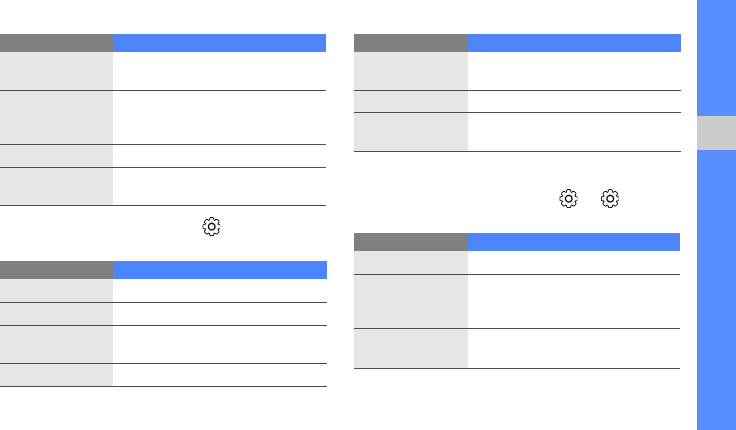
Use camera options
Before capturing a photo, select to access the
following options:
Option Function
Timer
Select the time delay
Resolution
Change the resolution option
White balance
Adjust the colour balance of the
photo
Effects
Apply a special effect
ISO
Adjust the sensitivity of camera
imaging sensor
Exposuremeter
Select a type of exposure metring
Focus mode
Change the camera focus
Anti-Shake
Reduce blur caused by vibration or
movement
53
using advanced functions
Before capturing a video, select to access the
following options:
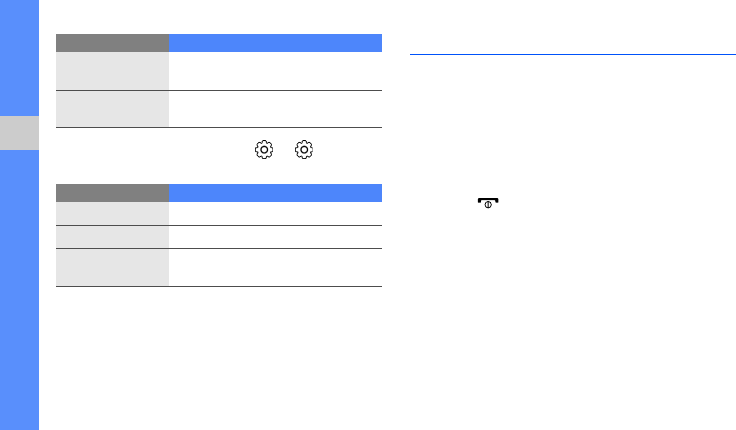
Customise camera settings
Before capturing a photo, select → to
access the following settings:
WDR
Adjust the camera’s sensitivity to a
wide range of available light
Blink detection
Set the camera to capture a photo
again automatically when people
close eyes
Image quality
Set the quality of your digital photos
Adjust
Adjust contrast, saturation, and
sharpness
Option Function
Timer
Select the time delay
Resolution
Change the resolution option
White balance
Adjust the colour balance of the
video clip
Effects
Apply a special effect
Option Function
WDR
Adjust the camera’s sensitivity to a
wide range of available light
Video quality
Adjust the quality of your video clips
Adjust
Adjust contrast, saturation, and
sharpness
Setting Function
Guidelines
Display the guidelines
Review
Set the camera to switch to the
preview screen after capturing
photos
GPS
connection
Set the camera to record GPS
information to photos
Option Function
54
using advanced functions
Before capturing a video, select → to access
the following settings:
Use advanced music functions
Learn to prepare music files, create playlists, and
store radio stations.
Copy music files via Samsung PC Studio
1. In Menu mode, select Settings → Phone
settings → PC connections → Samsung PC
studio or Mass storage → Save.
2. Press [ ] to return to Idle mode.
3. Using an optional PC data cable, connect the
multifunction jack on your phone to a PC.
4. Run Samsung PC Studio and copy files from the
PC to the phone.
Refer to the Samsung PC Studio help for more
information.
Shutter sound
Select a sound to accompany the
shutter action
Storage
Select a memory location to store
new photos
Setting Function
Guidelines
Display the guidelines
Audio recording
Turn the audio on or off
Storage
Select a memory location to store
new video clips
Setting Function

55
using advanced functions
Copy music files to a memory card
1. Insert a memory card.
2. In Menu mode, select Settings → Phone
settings → PC connections → Mass storage
→ Save.
3. Press [ ] to return to Idle mode.
4. Using an optional PC data cable, connect the
multifunction jack on your phone to a PC.
When connected, a pop-up window will appear
on the PC.
5. Open the folder to view files.
6. Copy files from the PC to the memory card.
Synchronise your phone with Windows
Media Player
1. Insert a memory card.
2. In Menu mode, select Settings → Phone
settings → PC connections → Media player →
Save.
3. Press [ ] to return to Idle mode.
4. Using an optional PC data cable, connect the
multifunction jack on your phone to a PC with
Windows Media Player installed.
When connected, a pop-up window will appear
on the PC.
5. Open Windows Media Player to synchronise
music files.
6. Edit or enter your phone’s name in the pop-up
window (if necessary).

56
using advanced functions
7. Select and drag the music files you want to the
sync list.
8. Start synchronisation.
Create a playlist
1. In Menu mode, select Music player → Playlists.
2. Select Create.
3. Enter a title for your new playlist.
4. To assign an image to the playlist, select Tap to
edit and select an image or capture a new
photo.
5. Select Save.
6. Select the new playlist.
7. Select Add → Tracks.
8. Select the files you want to include and select
Add.
Access the album list
1. During playback, rotate the phone anti-clockwise
to landscape view.
2. Scroll to an album and select it.
3. Select a music file to play it.
Select or
to pause or resume the current
playback.
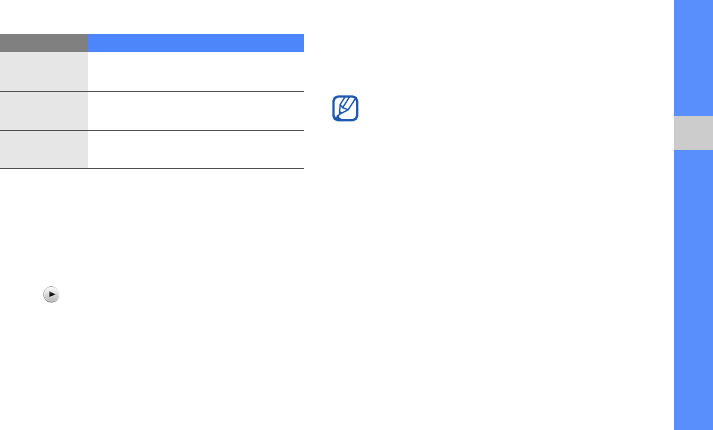
Customise your music player settings
1. In Menu mode, select Music player.
2. Select Settings.
3. Adjust the settings to customise your music
player.
Option Function
Background
playing
Set whether to play music in the
background when you end the
music player
57
using advanced functions
4. Select Save.
Record songs from the FM radio
1. Plug the supplied headset into the phone.
2. In Menu mode, select FM radio.
3. Select to start the FM radio.
4. Select More → Record to start recording.
5. When you are finished recording, select Stop.
The music file will be saved in Radio clips (in
Menu mode, select My files → Sounds).
Store radio stations automatically
1. Plug the supplied headset into the phone.
2. In Menu mode, select FM radio.
3. Select More → Self-tuning.
4. Select Yes to confirm (if necessary).
The radio scans and saves available stations
automatically.
Sound
effects
Select the default equaliser type
Visualisation
Select a background image during
playback
Music menu
Select music categories to display in
the music library screen
Option Function
The recording feature is developed for voice
recording only. The quality of the recording will
be much lower than digital media.
58
using advanced functions
Find information of music
Learn to access an online music service and get
information about the songs you hear while on the
move.
1. In Menu mode, select Find music.
2. Select Find music to connect to the server.
3. When your phone is successfully registered,
select to record a part of music you want to
find.
Some service providers may not support this
service and the database may not have
information for all songs.

59
using tools and
applications
Learn how to work with your mobile phone’s tools
and additional applications.
Use the Bluetooth wireless feature
Learn about your phone’s ability to connect to other
wireless devices for exchanging data and using
hands-free features.
Turn on the Bluetooth wireless feature
1. In Menu mode, select Bluetooth.
2. Select the circle in the centre to turn on the
Bluetooth wireless feature.
3.
To allow other devices to locate your phone,
select
Settings →
On under My phone’s
visibility →
a visibility option →
Save →
Save.
If you selected Custom, set duration that your
phone is visible.

60
using tools and applications
Find and pair with other Bluetooth-
enabled devices
1. In Menu mode, select Bluetooth → Search.
2. Select and drag a device icon into the centre.
3. Enter a PIN for the Bluetooth wireless feature or
the other device’s Bluetooth PIN, if it has one,
and select Done.
When the owner of the other device enters the
same PIN or accepts the connection, pairing is
complete.
Send data using the Bluetooth wireless
feature
1. Select the file or item from one of your phone’s
applications that you want to send.
2. Select Send via or Send URL via → Bluetooth.
Receive data using the Bluetooth
wireless feature
1. Enter the PIN for the Bluetooth wireless feature
and select OK (if necessary).
2. Select Yes to confirm that you are willing to
receive data from the device (if necessary).
You may not need to enter a PIN depending on
the device.

61
using tools and applications
Use Remote SIM mode
In Remote SIM mode, you can make or answer calls
only with a connected Bluetooth hands-free car kit
via the SIM or USIM card on your phone.
To activate Remote SIM mode,
1. In Menu mode, select Bluetooth → Settings.
2. Select On under Remote SIM mode → Save.
To use Remote SIM mode, start the Bluetooth
connection from a Bluetooth hands-free car kit.
Activate and connect to a wireless
LAN (WLAN)
Learn to activate and connect to a wireless LAN.
Activate a WLAN
1. In Menu mode, select Wi-Fi.
2. Select the circle in the centre to activate a
WLAN.
The Bluetooth hands-free car kit must be
authorised. To authorise, select the device and
select
Authorise device
.
Your device uses a non-harmonised frequency
and is intended for use in the following
countries: United Kingdom, Greece, Latvia,
Lithuania, Estonia, Sweden, Denmark, Finland,
Norway, Portugal, Poland, Italy, Bulgaria,
Germany, Austria, France, Switzerland,
Kazakhstan, Russia, Ukraina.
The activated WLAN in the background will
consume battery power. To preserve battery
power, activate the WLAN only when needed.

62
using tools and applications
Search for and connect to a WLAN
1. In Menu mode, select Wi-Fi → Search.
2. Select a network icon → Add and add a
connection profile.
3. In Menu mode, select Internet or Communities,
or in Idle mode, select a web-based widget.
Your phone connects to the network using the
connected WLAN profile.
Activate and send an SOS message
In case of an emergency, you can send an SOS
message asking for help.
1. In Idle mode, select Messages → SOS
messages → Sending options.
2. Select On to turn on the SOS messaging
feature.
3. Select the recipient field to open the recipient list.
4. Select to open your contact list.
5. Select the contacts you want and select Add.
6. Select a phone number (if necessary).
7. Select OK to save the recipients.
• If the network you want needs an IP address,
subnet mask, DNS, or gateway information,
select
Advanced settings
.
• Wi-Fi security should be set as the selected
network configuration and 802.1x (EAP-
TTLS, PEAP) is supported.
To access the internet via another method,
change the connection profile to the desired
method.
This feature may be unavailable depending on
your region or service provider.

63
using tools and applications
8. Select the Once drop-down menu and select
the number of times to repeat the SOS
message.
9. Select Save → Yes.
To send an SOS message, the touch screen and
keys must be locked. Press the Volume key four
times.
Activate the mobile tracker
When someone inserts a new SIM or USIM card in
your phone, the mobile tracker feature will
automatically send the contact number to two
recipients to help you locate and recover your
phone. To activate the mobile tracker,
1. In Menu mode, select Settings → Security →
Mobile tracker.
2. Enter your password and select Confirm.
3. Select On to turn on the mobile tracker.
4. Select the recipient field to open the recipient list.
5. Enter a phone number.
6. Select OK to save the recipients.
7. Select the sender input field.
8. Enter the sender’s name.
9. Select Save → Accept.
Once you send an SOS message, all phone
functions will be suspended until you press the
Hold key.
If you press [ ], phone functions
will be available, but the keys will remain
locked.

64
using tools and applications
View the phone display on a TV
Learn to view files by connecting your phone to a TV.
1. With the TV on, connect your phone to the TV
with a TV out cable.
2. Switch the TV to the appropriate external input
mode.
If you cannot view the phone via the TV, try
changing the TV-out settings: In Menu mode,
select Settings → Phone settings → a video
encoding system under TV out.
Make fake calls
You can simulate fake incoming calls when you want
to get out of meetings or unwanted conversations.
You can also make it appear as if you are talking on
the phone by playing back a recorded voice.
Record a voice
1. In Menu mode, select Settings → Application
settings → Call → Fake call → Fake call voice.
2. Select On under Fake call voice.
3. Select Voice recording.
4. Select to start recording.
5. Speak into the microphone.
6. When you are finished speaking, select .
7. Select to set the recording as a response for
the fake call.
8. Select Save.
Your files may not display correctly, due to
differences in video systems or quality of the TV
display. The Bluetooth stereo headset and
zoom functions will not work in TV-out mode.
65
using tools and applications
Make a fake call
To make a fake call, press and hold the Volume key
down in Idle mode.
To change the delay time before fake calls, in Menu
mode, select Settings → Application settings →
Call → Fake call → Fake call timer → an option →
Save.
Record and play voice memos
Learn to operate your phone’s voice recorder.
Record a voice memo
1. In Menu mode, select Voice recorder.
2. Select to start recording.
3. Speak your memo into the microphone.
4. When you are finished speaking, select .
Your memo is saved automatically.
Play a voice memo
1. In Menu mode, select My files → Sounds →
Voice clips.
2. Select a file.
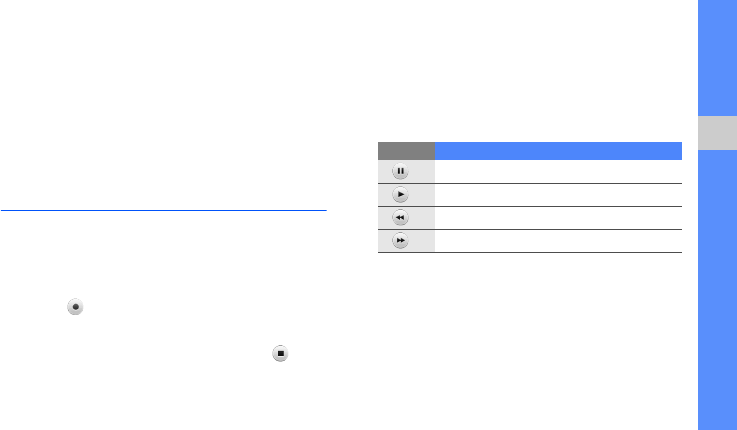
3. Control the playback using the following icons:
Icon Function
Pause playback
Play or resume playback
Scan backward in a file (touch and hold)
Scan forward in a file (touch and hold)
66
using tools and applications
Edit images
Learn to edit images and apply fun effects.
Apply effects to images
1. In Menu mode, select My files → Images → My
photos → a photo file.
2. Select .
3. Select Edit → Effects → an effect option (filter,
style, warp, or partial blur).
4. Select a variation of the effect to apply and select
Done.
To apply a blur effect to a specific area of an
image, draw the rectangle and select Blur →
Done.
5. When you are finished with applying effects,
select Files → Save as.
6. Select a memory location (if necessary).
7. Enter a new file name for the image and select
Done.
Adjust an image
1. Open an image to be edited. Refer to steps 1-2
in “Apply effects to images.”
2. Select Edit → Adjust → an adjustment option
(brightness, contrast, or colour).
To adjust the image automatically, select Auto
level.
3. Adjust the image as desired and select Done.
4. Save the edited image with a new file name.
Refer to steps 5-7 in “Apply effects to images.”

67
using tools and applications
Transform an image
1. Open an image to be edited. Refer to steps 1-2
in “Apply effects to images.”
2. Select Edit → Transform → Resize, Rotate, or
Flip.
3. Rotate or flip the image as desired and select
Done.
To resize the image, select a size → Save →
Done.
4. Save the edited image with a new file name.
Refer to steps 5-7 in “Apply effects to images.”
Crop an image
1. Open an image to be edited. Refer to steps 1-2
in “Apply effects to images.”
2. Select Edit → Crop.
3. Draw the rectangle over the area you want to
crop and select Crop → Done.
4. Save the edited image with a new file name.
Refer to steps 5-7 in “Apply effects to images.”
Insert a visual feature
1. Open an image to be edited. Refer to steps 1-2
in “Apply effects to images.”
2. Select Edit → Insert → a visual feature (frame,
image, clip art, emoticon, or text).
3. Select a visual feature, or enter text and select
Done.
4. Move or resize the visual feature or text and
select Done.
5. Save the edited image with a new file name.
Refer to steps 5-7 in “Apply effects to images.”
Add a memo by handwriting
1. Open an image to be edited. Refer to steps 1-2
in “Apply effects to images.”

68
using tools and applications
2. Select Edit → Memo on screen.
3. Select a colour, write a memo on the screen,
and select Done.
4. Save the edited image with a new file name.
Refer to steps 5-7 in “Apply effects to images.”
Print images
Learn to print your image with a USB connection or
the Bluetooth wireless feature.
To print an image using a USB connection,
1. Connect the multifunction jack on your phone to
a compatible printer.
2. Open an image.
X
p. 38
3. Select More → Print via → USB.
4. Set print options and print the image.
To print an image using the Bluetooth wireless
feature,
1. Open an image.
X
p. 38
2. Select More → Print via → Bluetooth.
3. Select a Bluetooth-enabled printer and pair with
the printer.
X
p. 60
4. Set print options and print the image.
Edit videos
Learn to edit video files and apply visual effects.
Trim any segment
1. In Menu mode, select Video editor.
2. Select Files → Import image or Import video.

69
using tools and applications
3. Select an image or video category → an image
or video and select Add.
For an image, select the duration that the image
displays.
4. Select More → Files to add more images or
videos.
5. Select Edit → Trim.
6. Select to play the video and select Start
mark at the point where you want the new video
to begin.
7. Select End mark at the point where you want
the new video to end.
8. Select Trim.
9. When you are finished, select More → Export →
Video → Yes.
To save the project for future use, select
More →
Files → Save project
. The project will be saved
in
Other files
.
10. Enter a new file name and select Done.
11. To check the file, select Yes (if necessary).
Split videos
1. Open images and videos to be edited. Refer to
steps 1-4 in “Trim any segment.”
2. Select Edit → Split.
3. Select to play the video and select Split
point → Split to divide the file into two clips.
4. Insert an image or video as desired between the
clips.
5. Save the edited video with a new file name. Refer
to steps 9-11 in “Trim any segment.”

70
using tools and applications
Insert text
1. Open images and videos to be edited. Refer to
steps 1-4 in “Trim any segment.”
2. Select Edit → Insert → Text.
3. Select to play the video and select Start
mark at the point where you want the text to be
displayed.
4. Select End mark at the point where you want
the text to be disappeared.
5. Select Insert.
6. Enter text and select Done.
7. Move or resize the text and select Done.
To change the text colour, select Colour.
8. Save the edited video with a new file name. Refer
to steps 9-11 in “Trim any segment.”
Add sound track
1. Open images and videos to be edited. Refer to
steps 1-4 in “Trim any segment.”
2. Select Additional audio track → Import sound.
3. Select Sounds → a sound category → a sound.
4. Save the edited video with a new file name. Refer
to steps 9-11 in “Trim any segment.”
Upload photos and videos to the
web
Learn to post your photos and videos to photo
sharing websites and blogs.
Inserting text to a video may be unavailable
depending on your service provider.
Communities
may be unavailable depending
on your region or service provider.

71
using tools and applications
Set your favourite destination list
1. In Menu mode, select Communities.
2. Select Yes to set your favorite destination list (if
necessary).
3. Select Accept to confirm that you agree to the
general disclaimer.
4. Select the destinations you want to add and
select Save.
If you selected Update lists, new destination
sites are added to the list automatically.
Upload a file
To upload photos and videos, you must have
accounts of photo sharing websites and blogs.
1. In Menu mode, select Communities.
2. Select a destination you want to post to.
3. Enter the user ID and password of the
destination.
4. Select Tap to add and select a media file.
5. Enter the post details and select Upload to
web.
The first time you access
Communities
, you
will be prompted to confirm.
To edit the favourite destination list or update the
lists, from the Communities screen, select
Settings → Preferred lists
→
Edit
.
You can also upload media files from
Camera
or My files, by selecting or More →
Upload to web.

72
using tools and applications
Use Java-powered games and
applications
Learn to use games and applications powered by
award-winning Java technology.
Download games or applications
1. In Menu mode, select Games and more →
More games.
Your phone connects to the website preset by
your service provider.
2. Search for a game or application and download it
to the phone.
Play games
1. In Menu mode, select Games and more.
2. Select a game from the list and follow the on-
screen instructions.
Launch applications
1. In Menu mode, select Games and more → an
application.
2. Select More to access a list of various options
and settings for your application.
The download of java files may not be
supported depending on the software of the
phone.
Available games may vary depending on your
region or service provider. Game controls and
options may vary.

73
using tools and applications
Synchronise data
Learn to synchronise the contacts, calendar events,
tasks, and memos with the web server you have
specified. To synchronise the contacts, calendar
events, tasks, and emails, specify a Microsoft
Exchange server.
Synchronise data with a web server
To create a synchronisation profile,
1. In Menu mode, select Synchronise.
2. Select Add and specify profile parameters.
3. When you are finished, select Save.
To start synchronisation,
1. In Menu mode, select Synchronise.
2. Select a synchronisation profile.
3. Select Continue to start synchronisation with the
web server you have specified.
Synchronise data with a Microsoft
Exchange server
To set a Microsoft Exchange server and
synchronisation profile,
1. In Menu mode, select Exchange ActiveSync.
2. Specify Microsoft Exchange server settings.
3. Select Save.
4. Specify an email connection profile by following
the email setup wizard.
5. When you are finished, select Save.
You may only use the Microsoft
®
Exchange
ActiveSync
®
feature in this phone with a
service that is licensed by Microsoft
Corporation to use Microsoft
®
Exchange
ActiveSync
®
.

74
using tools and applications
6. Select a synchronisation profile.
Synchronisation with the Microsoft Exchange
server you have specified starts.
To synchronise all items,
1. In Menu mode, select Exchange ActiveSync.
2. Select Sync.
To synchronise emails only,
1. In Menu mode, select Exchange ActiveSync.
2. Select Email → Inbox → Sync → Email.
Use RSS feeds
Learn to use RSS feeds to get the latest news and
information from your favourite websites.
Add an RSS feed address
1. In Menu mode, select Internet → RSS feeds.
2. Select Add.
3. Select the address input field.
4. Enter the address of an RSS feed and select
Done.
5. Select OK.
6. Select → Add RSS feed.
You may incur additional charges for accessing
the server.
If you synchronise all items, you may incur
charges for updating unnecessary items.

75
using tools and applications
Update and read RSS feeds
1. In Menu mode, select Internet → RSS feeds.
2. Select Update → a feed → Update → Yes.
3. Select a feed category → an updated feed.
Launch the Samsung Mobile
Navigator
In Menu mode, select Navigation.
For details, refer to the quick start guide of the
Samsung mobile navigator.
If this feature is not provided as default depending on
your region or service provider, you can install the
navigation application by yourself.
1. In Menu mode, select Settings → Phone
settings → Navigation → On.
2. Insert a memory card into the phone.
X
p. 20
3. Download the navigation application to the
memory card using the Samsung PC studio.
4. Purchase a licence to use the navigation
application.
For details or the user manual, visit
http://www.66.com/samsung.
The auto update feature sets the phone to
automatically update the RSS feeds at the
specified interval. You can activate the auto
update feature by selecting
Internet
→
Settings → RSS update
.
• While using the navigation application, do not
remove the inserted memory card.
• This feature may be unavailable depending
on your region or service provider.

76
using tools and applications
View your current position
Learn to determine the latitude, longitude, and
altitude of your current position using the global
navigation satellite system. You must be in outdoors
for using the satellite.
In Menu mode, select Settings → Phone settings
→ GPS settings → GPS position.
Update the GPS functionality
Learn to enhance the GPS functionality by
downloading GPS data files. You can improve the
speed and accuracy of positioning capability and
expand your navigation to areas where cellular
networks are not accessible.
1. In Menu mode, select Settings → Phone
settings → GPS settings → GPS+ settings →
Download data.
2. Select Yes to connect to a server and download
GPS data files.
Create and view world clocks
Learn to view the time in another region and set
world clocks to appear on your display.
View a world clock
1. In Menu mode, select World clock.
2. Scroll through the world map and select a time
zone you want.
If your phone has the navigation feature, you
can use a Bluetooth-enabled GPS device.
Change the connection type.
In Menu node,
select Settings
→
Phone settings
→
GPS
settings
→
GPS navigation via
→
Bluetooth GPS
.

77
using tools and applications
Create a world clock
1. In Menu mode, select World clock
.
2. Select → Add.
3. Select a time zone.
4. To set daylight saving time, select .
5. Select OK to create your world clock.
The world clock is set as the second clock.
6. Select Add to add more world clocks (step 3).
Add a world clock to your display
With the dual clock widget, you can view clocks with
two different time zones on your display.
After you have created a world clock,
1. In Menu mode, select World clock.
2. Select → Set as second clock.
3. Select the world clock you want to add.
4. Select Set.
Set and use alarms
Learn to set and control alarms for important events.
Set a new alarm
1. In Menu mode, select Alarms.
2. Select Create alarm.
3. Set alarm details.
4. Select Save.
The auto power-up feature sets the phone to
automatically turn on and sound the alarm at
the designated time if the phone is turned off.

78
using tools and applications
Stop an alarm
When the alarm sounds,
• Drag the slider to Stop to stop the alarm without
snooze.
• Drag the slider to Stop to stop the alarm with
snooze or drag the slider to Snooze to silence the
alarm for the snooze period.
Deactivate an alarm
1. In Menu mode, select Alarms.
2. Select Off next to the alarm you want to
deactivate.
Use the calculator
1. In Menu mode, select Calculator.
2. Use the keys that correspond to the calculator
display to perform basic mathematical
operations.
Convert currencies or
measurements
1. In Menu mode, select Convertor → a
conversion type.
2. Enter the currencies or measurements and units
in the appropriate fields.

79
using tools and applications
Set a countdown timer
1. In Menu mode, select Timer.
2. Set the length of time to count down.
3. Select Start to begin the countdown.
4. When the timer expires, drag the slider to Stop
to stop the alert.
Use the stopwatch
1. In Menu mode, select Stopwatch.
2. Select Start to begin the stopwatch.
3. Select Lap to record lap times.
4. When you are finished, select Stop.
5. Select Reset to clear recorded times.
Create new tasks
1. In Menu mode, select Task.
2. Select Create task.
3. Enter the details of the task and select Save.
Create text memos
1. In Menu mode, select Memo.
2. Select Create memo.
3. Enter your memo text and select Done.
Create sketches
Learn to create sketches with various sketch tools.
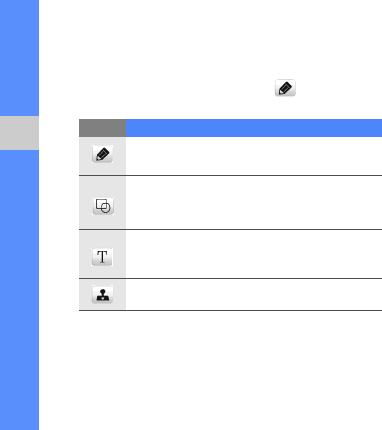
80
using tools and applications
Create a new sketch
1. In Menu mode, select Dynamic canvas.
2. From the sketch toolbar, select to change
the tool type. You have the following tools:
3. Using the tools, make a sketch.
4. To delete text, stamps, or image stamps that you
added, select an item → More → Delete.
5. When you are finished, select File → Save as
Image.
6. Enter a new file name and select Done.
Add motion to a sketch
1. Make a sketch with stamps or image stamps.
2. To use the preset motion type, select More →
Motion → Preset → a stamp or an image stamp
→ a motion type → OK.
To use a new motion type, select More →
Motion → Motion line → a stamp or an image
stamp. Draw a line to track and select Preview
to preview the motion. Select OK.
3. When you are finished, select File → Save as
Flash.
4. Enter a new file name and select Done.
Tool Function
Add a line; You can select the line type, line
thickness, and colour
Add a circle or rectangle; You can select
the line thickness, line colour, and colour to
fill the figure
Enter text to insert; You can change the font
size, attribute, and text colour
Insert a stamp or an image stamp

81
using tools and applications
Manage your calendar
Learn to change the calendar view and create
events.
Change the calendar view
1. In Menu mode, select Calendar.
2. Select More → View by day or View by week.
Create events
1. In Menu mode, select Calendar.
2. Select Create → an event type.
3. Enter the details of the event as required.
4. Select Save.
View events
To view events of a specific date,
1. In Menu mode, select Calendar.
2. Select a date on the calendar.
3. Select an event to view its details.
To view events by event types,
1. In Menu mode, select Calendar.
2. Select Event list → an event type.
3. Select an event to view its details.

a
troubleshooting
If you are having trouble with your mobile phone, try these troubleshooting procedures before contacting a service
professional.
While using your phone, the following messages
may appear:
Message Try this to solve the problem:
Insert SIM
card to
access
network
services
Ensure that the SIM or USIM card is
installed correctly.
Phone lock
When the phone lock feature is
enabled, you must enter the password
you set for the phone.
PIN code
When using the phone for the first time
or when the PIN requirement is
enabled, you must enter the PIN
supplied with the SIM or USIM card.
You can disable this feature by using
the
PIN lock
menu.
PIN2 lock
When you access a menu requiring
the PIN2, you must enter the PIN2
supplied by the SIM or USIM card. For
details, contact your service provider.
Message Try this to solve the problem:

b
troubleshooting
Your phone displays “Service unavailable” or
“Network error.”
• When you are in areas with weak signals or poor
reception, you may lose reception. Move to
another area and try again.
• You cannot access some options without a
subscription. Contact your service provider for
more details.
You enter a number, but the call is not dialled.
• Ensure that you have pressed the Dial key: [ ].
• Ensure that you have accessed the right cellular
network.
• Ensure that you have not set call barring for the
phone number.
Another caller cannot reach you.
• Ensure that your phone is turned on.
• Ensure that you have accessed the right cellular
network.
• Ensure that you have not set call barring for the
phone number.
Another caller cannot hear you speaking.
• Ensure that you are not covering the built-in
microphone.
• Ensure that the microphone is close to your
mouth.
• If using a headset, ensure that it is properly
connected.
PUK code
Your SIM or USIM card is blocked,
usually as a result of entering your PIN
incorrectly several times. You must
enter the PUK supplied by your
service provider.
Message Try this to solve the problem:

c
troubleshooting
The phone beeps and the battery icon flashes.
Your battery is low. Recharge or replace the battery to
continue using the phone.
The audio quality of the call is poor.
• Ensure that you are not blocking the phone’s
internal antenna.
• When you are in areas with weak signals or poor
reception, you may lose reception. Move to
another area and try again.
You select a contact to call, but the call is not
dialled.
• Ensure that the correct number is stored in the
contact list.
• Re-enter and save the number, if necessary.
The battery does not charge properly or
sometimes the phone turns itself off.
• The battery terminals may be dirty. Wipe both
gold-coloured contacts with a clean, soft cloth
and try charging the battery again.
• If the battery will no longer charge completely,
dispose of the old battery properly and replace it
with a new battery.
Your phone is hot to the touch.
When you use several applications at once, your
phone requires more power and may heat up.
This is normal and should not affect your phone’s
lifespan or performance.
d
index
alarms
creating, 77
deactivating, 78
stopping, 78
battery
charging, 19
installing, 17
low battery indicator, 20
Bluetooth
activating, 59
receiving data, 60
remote SIM mode, 61
sending data, 60
browser
see web or photo browser
calculator
see tools, calculator
calendar
see tools, calendar
calls
advanced functions, 44
answering additional calls, 45
answering, 33
basic functions, 32
dialling additional calls, 45
dialling missed calls, 44
from the phonebook, 46
international numbers, 46
making fake calls, 64
making, 32
multiparty, 45
placing on hold, 45
recently dialled, 44
rejecting, 46
retrieving held calls, 45
viewing missed, 44
clock
see world clock
Communities
see tool, mobile blog

e
index
conference calls
see calls, multiparty
contacts
adding, 37
creating groups, 47
finding, 37
linking from photos, 48
converter
see tools, convertor
countdown timer
see tools, countdown timer
display - viewing on TV 64
Dynamic canvas
see tools, sketch memo
fake calls
see calls, making fake calls
FM radio
listening to, 39
recording songs, 57
storing stations, 57
Google services 42
headset 33
images
adding memos, 67
adjusting, 66
applying effects, 66
cropping, 67
inserting visual features, 67
printing, 68
transforming, 67
internet
see web browser
Java
accessing applications, 72
downloading, 72
launching games, 72
key tones 30
lock
see phone lock
memo
see text or voice memos
memory card 20
messages
sending email, 34
sending multimedia, 34
sending text, 34
viewing email, 36
viewing multimedia, 36
viewing text, 36

f
index
Microsoft Exchange
synchronisation 73
mobile tracker 63
multimedia
see messages
music finding 58
music player
creating playlists, 56
customising, 56
listening to music, 40
synchronising, 55
namecards 47
navigator 75
offline profile 23
phone lock 31
photo browser 38
photo contacts 48
photos
advanced capturing, 50
basic capturing, 38
editing, 66
viewing, 38
radio
see FM radio
ringtone 30
RSS feeds
see tools, RSS feeds
Samsung PC Studio 54
silent profile 30
SIM card 17
SOS message 62
stopwatch
see tools, stopwatch
synchronisation
creating a profile, 73
starting, 73
task
see tools, task
templates
inserting, 49
multimedia, 49
text, 48
text
creating memos, 79
entering, 35
messages, 34

g
index
timer
see tools, countdown timer
tools
alarm, 77
calculator, 78
calendar, 81
convertor, 78
countdown timer, 79
image editor, 66
mobile blog, 70
RSS feeds, 74
sketch memo, 79
stopwatch, 79
task, 79
video editor, 68
video player 39
videos
advanced capturing, 52
basic capturing, 39
editing, 68
viewing, 39
voice memos
playing, 65
recording, 65
volume
call volume, 33
key tone volume, 30
wallpaper 31
web browser
adding bookmarks, 42
launching homepage, 41
widgets 28
Wi-Fi 61
Windows Media Player 55
world clock
creating, 77
setting dual display, 77
viewing, 76

Declaration of Conformity (R&TTE)
We, Samsung Electronics
declare under our sole responsibility that the product
GSM Mobile Phone : S8000
to which this declaration relates, is in conformity with the following
standards and/or other normative documents.
SAFETY EN 60950- 1 : 2001 +A11:2004
SAR EN 50360 : 2001
EN 62209-1 : 2006
EMC EN 301 489- 01 V1.6.1 (09-2005)
EN 301 489- 07 V1.3.1 (11-2005)
EN 301 489- 17 V1.2.1 (08-2002)
EN 301 489- 24 V1.3.1 (11-2005)
EN 301 489- 24 V1.4.1 (09-2007)
RADIO EN 301 511 V9.0.2 (03-2003)
EN 300 328 V1.7.1 (10-2006)
EN 301 908- 1 V3.2.1 (05-2007)
EN 301 908- 2 V3.2.1 (05-2007)
We hereby declare that [all essential radio test suites have been carried
out and that] the above named product is in conformity to all the
essential requirements of Directive 1999/5/EC.
The conformity assessment procedure referred to in Article 10 and
detailed in Annex[IV] of Directive 1999/5/EC has been followed with the
involvement of the following Notified Body(ies):
BABT, Balfour House, Churchfield Road,
Walton-on-Thames, Surrey, KT12 2TD, UK*
Identification mark: 0168
The technical documentation kept at :
Samsung Electronics QA Lab.
which will be made available upon request.
(Representative in the EU)
Samsung Electronics Euro QA Lab.
Blackbushe Business Park, Saxony Way,
Yateley, Hampshire, GU46 6GG, UK*
2009.04.16 Yong-Sang Park / S. Manager
(place and date of issue) (name and signature of authorised person)
* It is not the address of Samsung Service Centre. For the address or the
phone number of Samsung Service Centre, see the warranty card or contact
the retailer where you purchased your phone.

Some of the contents in this manual may differ from your phone depending on the software of the phone or your
service provider.
World Wide Web
http://www.samsungmobile.com
Printed in Korea
Code No.:GH68-24283A
English (EU). 06/2009. Rev. 1.2
