EV SL M770 2708A Shimano XT Shift Lever User Manual
User Manual: Shimano XT M770 Shift Lever User Manual
Open the PDF directly: View PDF  .
.
Page Count: 3
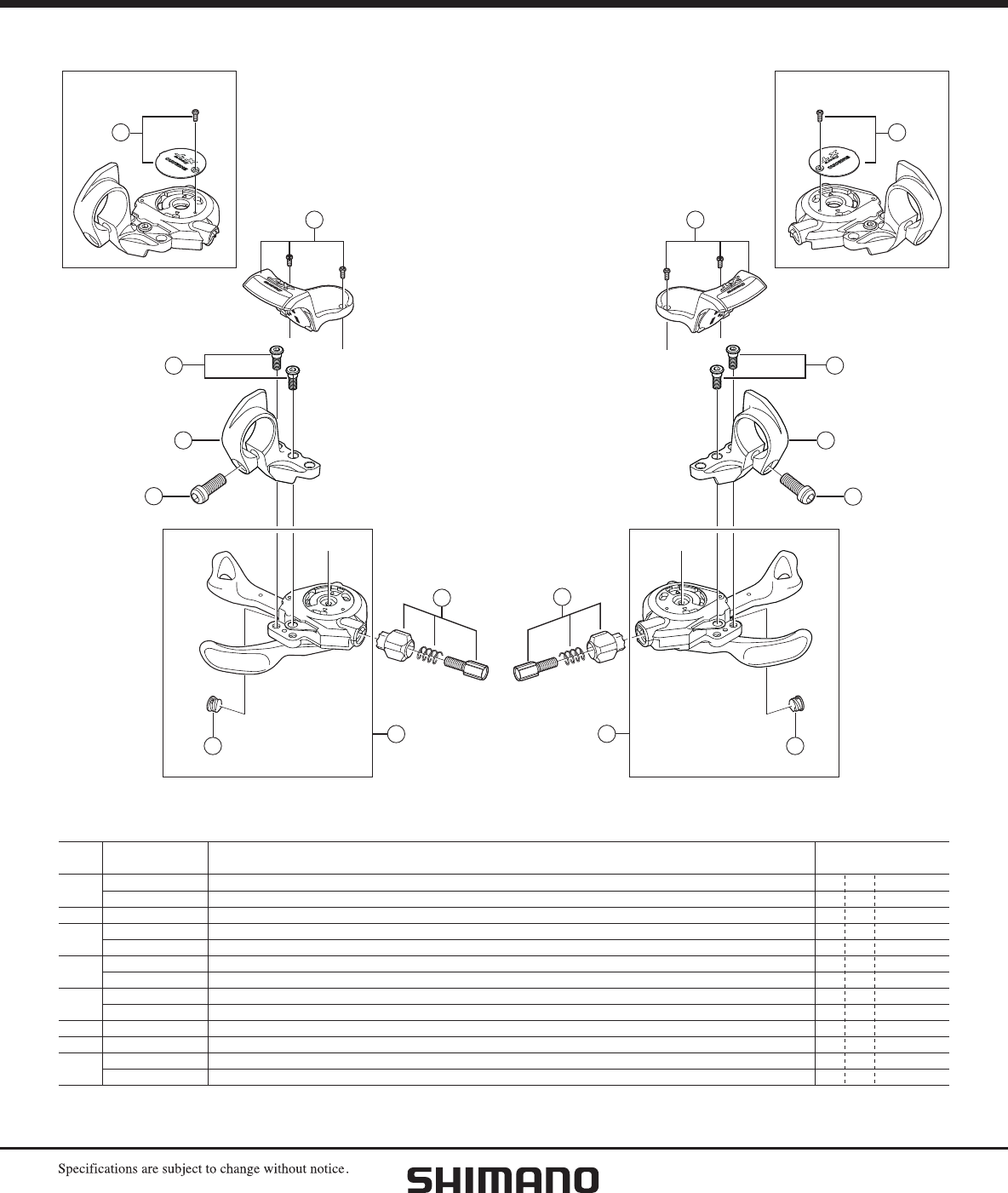
DESCRIPTION
SHIMANO
CODE NO.
ITEM
NO.
*
*
*
*
1
2
3
4
5
6
7
8
R.H. Shifting Lever Unit
L.H. Shifting Lever Unit
Inner Hole Cap
R.H. Indicator Unit
L.H. Indicator Unit
R.H. Cable Adjustting Bolt Unit
L.H. Cable Adjustting Bolt Unit
R.H. Bracket
L.H. Bracket
SL Fixing Bolt (M4) 2pcs.
Clamp Bolt (M6 x 15)
R.H. Base Hole Cap & Bolt Unit
L.H. Base Hole Cap & Bolt Unit
Y-6MP
Y-6MP
Y-6CD
Y-6MP
Y-6MP
Y-6GR
Y-6MP
Y-6MP
Y-6NX
Y-6MP
Y-8U9
Y-6MP
Y-6MP
98010
98020
33000
98030
98040
98090
98070
01000
51000
98080
14000
98090
98100
A: Same parts.
B: Parts are usable, but differ in materirals, appearance, finish, size, etc.
Absence of mark indicates non-interchangeability.
INTERCHANGE-
ABILITY
SL-M770
DEORE XT Mega-9 Rapidfire Lever
0707-2708A
w/o Indicator Type w/o Indicator Type
For Left Hand For Right Hand
3 3
4
4
88
11
66
22
7
5
5
7
SL-M970
SL-M760
SL-M952
A
B
B
A
B
B
B
A
B
B
B
50 mm 50 mm
44T 44T / 48T
X
X
22T
12T
S, M, L
66° - 69°
50 mm
44T
FD-M770-E
X
X
22T
12T
–
66° - 69°
FD-M770 FD-M771
X
X
22T
12T
S, M, L
66° - 69°
50 mm
44T / 48T
FD-M772 / M772A
FD-M773
X
X
22T
12T
S, M, L
63° - 66°
If not using the indicator, this shifting lever can be installed either
on the inside or the outside of the brake lever.
If adjusting the position, remove the indicator, and then be sure
to secure it in the new position with the two fixing bolts.
• FD-M771/FD-M773
•Install the shifting lever in a position where it will not obstruct brake
operation and gear shifting operation.
• Do not use in a combination which causes brake operation to be
obstructed.
The level section of the chain guide
outer plate should be directly above
and parallel to the largest chainring.
Secure using a 5 mm Allen key.
Series XT
Rapidfire (Shifting lever) SL-M770
Outer casing SIS-SP41
Front derailleur FD-M770 / FD-M771 / FD-M772 / FD-M773 / FD-M770-E / FD-M772A
Front chainwheel FC-M770 / FC-M771-K
Chain CN-HG93
Bottom bracket cable guide SM-SP17 / SM-BT17
Te c h n i c a l Ser vice I n s t r uctions SI-6MPFA-003
Front Drive System
In order to realize the best performance, we recommend that the following combination be used.
SIS Adjustment
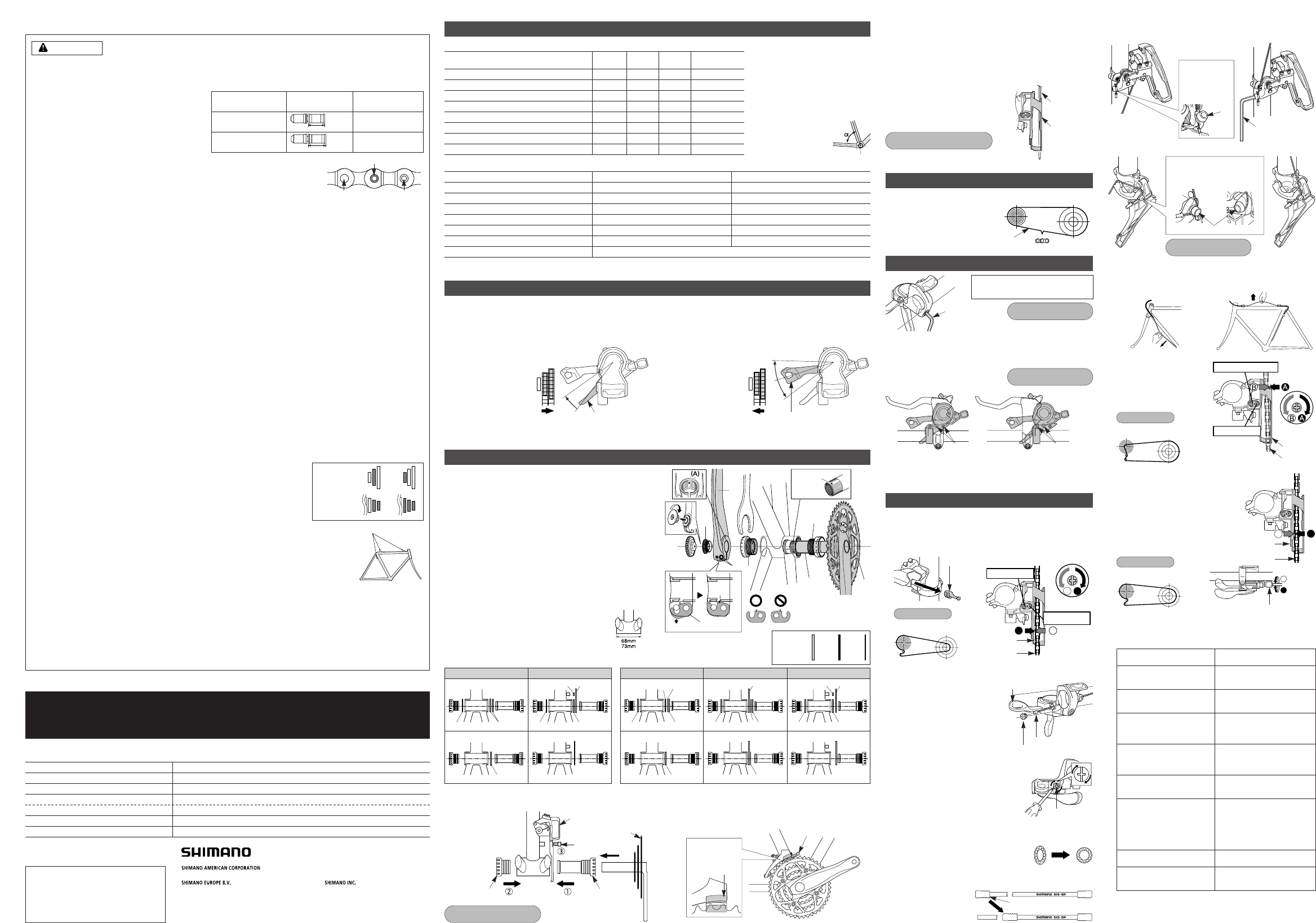
Installation of the lever
Adjust and then install the front derailleur as shown in the
illustration. Do not remove the Pro-Set alignment block at this time.
Gear teeth
should come
within this range
Pro-Set gauge
Tightening torque :
5 - 7 N·m {44 - 60 in. lbs.}
Chainwheel
(largest chainring)
Chain guide
Chain length
Add 2 links (with the chain on both
the largest sprocket and the largest
chainring)
Largest sprocket Largest chainring
Chain
Be sure to follow the sequence described below.
1. Low adjustment
First remove the Pro-Set alignment block .
Next, set so that the clearance between the chain guide inner
plate and the chain is 0 - 0.5 mm.
A
B
B
A
FD-M771/M773
FD-M770/
M772/ M772A
Low adjustment
screw
Chain
Pro-Set alignment
block
Chain guide
inner plate
Chain position
Largest
sprocket
Smallest
chainring
After taking up the initial slack in the cable, re-secure to the front
derailleur as shown in the illustration.
Normal type
< Normal type >
• FD-M770/ FD-M772/ FD-M772A
< Top route type >
Top rou te t yp e
Pull
Pull
FD-M770/ M772/M772A
FD-M771/M773
Chain
5 mm Allen key
Chain guide
outer plate
To p a dj u s tm e n t
screw
A
B
Chain
Chain guide
inner plate
A
B
Outer casing adjustment barrel
Chain position
Smallest
sprocket
Largest
chainring
Chain position
Largest
sprocket
Intermediate
chainring
3. Top adjustment
Set so that the clearance
between the chain guide outer
plate and the chain is
0 - 0.5 mm.
4. Adjustment of the intermediate
chainring
When carrying out adjustment, set the
chain to the largest sprocket, and at the
front, set the chain to the intermediate
chainring. Adjust using the outer casing
adjustment barrel so that the clearance
between the chain guide inner plate and
the chain is 0 - 0.5 mm.
Note:
Pass the cable
through as shown
in the illustration.
Wire
fixing bolt
Pro-Set alignment block
For bracket type
Install as shown in the
illustration.
Bolt
AdapterAdapter
Front Derailleur
Front Chainwheel
Tightening torque :
35 - 50 N·m {305 - 435 in. lbs.}
To shift fro m a sm a l l ch a i nr in g to a la rg er c h a in ri ng
When lever (A) is pressed once, there is
a shift of one step from a small chainring
to a larger chainring.
Example:
from intermediate chainring
to largest chainring.
To shif t from a la rg e ch ai nr ing to a s m a ll er c h ai nr ing
When lever (B) is pressed once, there is
a shift of one step from a large
chainring to a smaller chainring.
Example:
from largest chainring
to intermediate chainring.
Gear shifting operation
This release lever is equipped with a 2-way release mechanism which allows release operations to be carried out by either pushing or pulling
the lever.
Both lever (A) and lever (B) always return to the initial position when they are released after shifting.
When operating one of the levers, always be sure to turn the crank arm at the same time.
Lever (A) initial position Lever (B)
2-way release
2. Connecting and securing the inner cable
Operate lever (B) two times or
more, and check on the indicator
that the lever is at the lowest
position. Then remove the inner
hole cover and connect the inner
cable.
Inner hole cover
Lever (B)
Inner cable
Install the inner hole cover by turning it as
shown in the illustration until it stops.
Do not turn it any further than this, otherwise
it may damage the screw thread.
Inner hole cover
Use a handlebar grip with a
maximum outer diameter of 36 mm.
Tightening torque :
5 N·m {44 in. lbs.}
4 mm Allen key
If the chain falls to the crank
side.
If shifting is difficult from the
intermediate chainring to the
smallest chainring.
Tighten the top adjustment screw
clockwise (about 1/4 turn).
Loosen the top adjustment screw
counterclockwise
(about 1/8 turn).
Loosen the low adjustment screw
counterclockwise
(about 1/4 turn).
If there is interference between
the chain and the front derailleur
inner plate at the largest
chainring.
If there is interference between
the chain and the front derailleur
outer plate at the largest
chainring.
Tighten the top adjustment screw
clockwise (about 1/8 turn).
Loosen the top adjustment screw
counterclockwise
(about 1/8 turn).
If the intermediate chainring is
skipped when shifting from the
largest chainring.
Loosen the outer casing
adjustment barrel
counterclockwise (1 or 2 turns).
If the chain falls to the bottom
bracket side.
If the lever is stiff when shifting
from the intermediate chainring
to the largest chainring
Tighten the outer casing
adjustment barrel clockwise
(1 or 2 turns).
Tighten the low adjustment screw
clockwise (about 1/2 turn).
Loosen the top adjustment screw
counterclockwise (about 1/4
turn).
5. Troubleshooting chart
After completion of steps 1 - 4, move the shifting lever to check the
shifting. (This also applies if shifting becomes difficult during use.)
If there is interference between
the chain and front derailleur
inner plate when the rear
sprocket is shifted to the largest
sprocket when the chainwheel is
at the intermediate chainring
position.
If shifting is difficult from the
intermediate chainring to the
largest chainring.
Tightening torque :
6 - 7 N·m {52 - 60 in. lbs.}
Specifications
Model number
Normal type
To p r ou t e t yp e
Front chainwheel tooth difference
Min. difference between top and intermediate
Front derailleur installation band diameter
Chainstay angle (a)
Applicable chain line
X = Available
Front Derailleur
Applicable front chainwheel
Installation band diameters:
S (28.6 mm), M (31.8 mm), L (34.9 mm)
When using the S, M size, use an
installation band with a diameter of
28.6 mm, 31.8mm and install it to a
L size adapter.
Chainstay angle
Chainwheel
Model number
Chainwheel tooth combination
Bolt circle diameter
Crank arm length
Chain line
Bottom bracket shell width
Thread dimensions
Applicable bottom bracket
FC-M770
44-32-22T
104 mm / 64 mm
165 mm, 170 mm, 175 mm, 180 mm
50 mm
68, 73 mm
BC1.37 (68, 73mm)
SM-BB70
FC-M771-K
48-36-26T
104 mm / 64 mm
165 mm, 170 mm, 175 mm, 180 mm
50 mm
68, 73 mm
BC1.37 (68, 73mm)
■Refer to the Service Instructions for the Rear Drive
System for details on replacing and installing the
indicator unit.
Tightening torque :
2.5 N·m {22 in. lbs.}
3 mm Allen key
Note:
Pass the cable through as shown
in the illustration.
FD-M771 FD-M773
Wire fixing bolt
Outboard Inboard
3 mm Allen key
One Holland, Irvine, California 92618, U.S.A. Phone: +1-949-951-5003
Industrieweg 24, 8071 CT Nunspeet, The Netherlands Phone: +31-341-272222 3-77 Oimatsu-cho, Sakai-ku, Sakai-shi, Osaka 590-8577, Japan
* Service Instructions in further languages are available at :
http://techdocs.shimano.com
Please note: specifications are subject to change for improvement without notice. (English)
©Apr.2009 by Shimano Inc. XBC SZK Printed in Japan.
This service instruction explains how to use
and maintain the Shimano bicycle parts
which have been used on your new bicycle.
For any questions regarding your bicycle or
other matters which are not related to
Shimano parts, please contact the place of
purchase or the bicycle manufacturer.
General Safety Information
WARNING
• Use neutral detergent to clean the chain. Do not use alkali-based or acid based detergent such as rust cleaners as it may result
in damage and/or failure of the chain.
• Use the reinforced connecting pin only for connecting the narrow type of chain.
•There are two different types of reinforced connecting pins available.Be sure to check the table below before selecting which
pin to use.
If connecting pins other than reinforced connecting pins
are used, or if a reinforced connecting pin or tool which
is not suitable for the type of chain is used, sufficient
connection force may not be obtained, which could
cause the chain to break or fall off.
•If it is necessary to adjust the length of the chain due
to a change in the number of sprocket teeth, make the
cut at some other place than the place where the chain
has been joined using a reinforced connecting pin or an end pin. The chain will be damaged if it
is cut at a place where it has been joined with a reinforced connecting pin or an end pin.
• Be careful not to let the cuffs of your clothes get caught in the chain while riding, otherwise you
may fall off the bicycle.
•Check that the tension of the chain is correct and that the chain is not damaged.If the tension
is too weak or the chain is damaged, the chain should be replaced. If this is not done, the chain
may break and cause serious injury.
• Use a front chainwheel which is compatible with 9-speed chains in conjunction with Shimano CN-7701,
CN-HG93 and CN-HG73 chains. If a chainwheel for an 8-speed chain or less is used, front chainwheel gear shifting problems
may occur, or the chain pins might fall out, causing the chain to break.
•The two left crank arm mounting bolts should be tightened alternately in stages rather than each bolt being fully tightened all at
once. Use a torque wrench to check that the final tightening torques are within the range of 12 - 14 N·m.
Furthermore, after riding approximately 100 km (60 miles), use a torque wrench to re-check the tightening torques.
It is also important to periodically check the tightening torques.
If the tightening torques are too weak or if the mounting bolts are not tightened alternately in stages, the left crank arm may
come off and the bicycle may fall over, and serious injury may occur as a result.
•Check that there are no cracks in the crank arms before riding the bicycle.If there are any cracks, the crank arm may break and
you may fall off the bicycle.
•If the inner cover is not installed correctly, the axle may rust and become damaged, and the bicycle may fall over and serious
injury may occur as a result
.
•Obtain and read the service instructions carefully prior to installing the parts. Loose, worn or damaged parts may cause the
bicycle to fall over and serious injury may occur as a result. We strongly recommend only using genuine Shimano replacement
parts.
•Obtain and read the service instructions carefully prior to installing the parts. If adjustments are not carried out correctly, the
chain may come off and this may cause you to fall off the bicycle which could result in serious injury.
• Read these Technical Service Instructions carefully, and keep them in a safe place for later reference.
Chain toolChain
9-speed super narrow
chain such as
CN-7701 / CN-HG93
8- / 7- / 6-speed narrow
chain such as
CN-HG50 / CN-HG40
Reinforced
connecting pin
TL-CN32 / TL-CN27
TL-CN32 / TL-CN27
6.5mm
7.1mm
Silver
Black
Reinforced Connecting Pin
End Pin Link Pin
Note
•In addition, if pedaling performance does not feel normal, check this once more.
•Before riding the bicycle, check that there is no play or looseness in the connection.Also, be sure to retighten the crank arms
and pedals at periodic intervals.
•
If a squeaking noise is heard coming from the bottom bracket axle and the left crank arm connector, apply grease to the connector and
then tighten it to the specified torque.
• Do not wash the bottom bracket with high-pressure jets of water.
•If you feel any looseness in the bearings, the bottom bracket should be replaced.
•If gear shifting operations do not feel smooth, wash the derailleur and lubricate all moving parts.
•If the amount of looseness in the links is so great that adjustment is not possible, you should replace the derailleur.
•You should periodically wash the chainrings in a neutral detergent and then lubricate them again.In addition, cleaning the chain
with neutral detergent and lubricating it can be an effective way of extending the useful life of the chainrings and the chain.
•If the chain keeps coming off the chainrings during use, replace the chainrings and the
chain.
• When the chain is in the position shown in the illustration, the chain may contact the front
chainrings or front derailleur and generate noise. If the noise is a problem, shift the chain
onto the next-larger rear sprocket or the one after.
•Apply grease to the left and right adapters before installing them.
•For smooth operation, use the specified outer casing and the bottom bracket cable guide.
•This front derailleur is for triple front chainwheel use only. It cannot be used with the
double front chainwheel, as the shifting points do not match.
• When installing the top route type, choose a frame that has three outer casing holders as shown in the
illustration at right.
• Use an outer casing which still has some length to spare even when the handlebars are turned all the way
to both sides. Furthermore, check that the shifting lever does not touch the bicycle frame when the
handlebars are turned all the way.
• A special grease is used for the gear shifting cable (SIS-SP41). Do not use DURA-ACE grease or other
types of grease, otherwise they may cause deterioration in gear shifting performance.
•Grease the inner cable and the inside of the outer casing before use to ensure that they slide properly.
•Operation of the levers related to gear shifting should be made only when the front chainwheel is turning.
•If the brake fluid used in the oil disc brakes is of a type which tends to adhere to the plastic parts of the shifting lever, this may
cause the plastic parts to crack or become discolored. Therefore, you should make sure that the brake fluid does not adhere to
these plastic parts.
The mineral oil which is used in SHIMANO disc brakes does not cause cracking or discoloration if it adheres to plastic parts, but
such parts should be cleaned with alcohol beforehand to prevent foreign particles from adhering.
•Do not disassemble the indicator and shifting lever unit, as this may damage them or cause mis-operation.
•Parts are not guaranteed against natural wear or deterioration resulting from normal use.
•For maximum performance we highly recommend Shimano lubricants and maintenance products
•For any questions regarding methods of installation, adjustment, maintenance or operation, please contact a professional
bicycle dealer.
Outer casing holders
Front
chainrings
Rear
sprockets
■Note
When installing the components to carbon frame/handle bar
surfaces, verify with the manufacturer of the carbon frame/parts for
their recommendation on tightening torque in order to prevent over
tightening that can cause damage to the carbon material and/or
under tightening that can cause lack of fixing strength for the
components.
Attach the same outer end cap to the cut end of the outer casing.
Outer end cap
Cutting the outer casing
When cutting the outer casing, cut the opposite end to the end
with the marking. After cutting the outer
casing, make the end round so that the
inside of the hole has a uniform diameter.
SI-6MPFA-003-00
Band Type Bracket Type
<FC-M770 ><
FC-M771-K >
Band Type Chaincase Stay Type Bracket Type
68 mm
2.5 mm 1.8 mm 0.7 mm
Spacer
68 mm BB mount-
type bracket
73 mm 73 mm
68 mm 68 mm Chaincase stay
73 mm 73 mm
68 mm BB mount-
type bracket
73 mm
F
A
F
A
F
A
F
A
F
C
F
C
F
C
F
B
F
A
F
A
F
A
F
AF
A
F
A
F
A
F
AF
AF
A
F
AF
BF
C
Installation of the Front Chainwheel and Front Derailleur
Follow the procedure in the figure.
1, 2 Use the special tool TL-FC32/36 to install the right adapter
(counterclockwise thread) and the left adapter (clockwise
thread).
Tightening torque: 35 - 50 N·m {305 - 435 in. lbs.}
3Insert the right crank unit.
4Set section A of the left crank into the axle of the right crank unit
where the groove is wide.
5Use the TL-FC16/18 to tighten the cap.
Tightening torque: 0.7 - 1.5 N·m {6 - 13 in. lbs.}
6Push in the stopper plate and check that the plate pin is securely
in place, and then tighten the bolt of the left crank arm. (5 mm
Allen key)
Note : Each of the bolts should be evenly and equally tightened
to 12 - 14 N·m {106 - 122 in. lbs.}.
■Spacer installation method
(1) Check whether the width of the bottom bracket
shell is 68 mm or 73 mm.
(2) Next, install the adapter while referring to the
illustrations below.
*1 If using three 2.5 mm spacers with a band type and a bottom bracket shell having a width of 68 mm, install the three spacers so that there are two on the right and one on the
left.
*2 1.8 mm corresponds to the thickness of the chain case.
*1*2
5
62
4
1
3
Wide groove
area
TL-FC16
TL-FC32
Stopper plate
Plate pin
Push up
Note :
Set the stopper plate in
the right direction as
shown in illustration.
Inner cover
[Installation]
3. Operate lever B eight times or more
to set the lever to the top position.
4. Check that the indicator needle is
pointing to the left, and then insert
the pin at the bottom of the indicator
into the hole in the winder. Next,
insert the two bosses on the
indicator into the shifting lever unit
so that they are aligned with the o
marks, and then turn the indicator
unit counterclockwise to set it into
place.
5. Tu rn th e i ndi ca tor c ou nte rc lockwi se , a nd t he n
tighten the two indicator fixing screws.
6. Check the operation of the indicator. If it does
not operate correctly, reinstall it while paying
particular attention to steps 3 and 4.
Series XT
RAPIDFIRE (Shifting lever) SL-M770
Outer casing SIS-SP41
Rear derailleur RD-M771
Ty p e SGS / GS
Freehub FH-M770 / FH-M775
Gears 9
Cassette sprocket
Chain
Bottom bracket guide
CS-M770
CN-HG93
SM-SP17 / SM-BT17
Te c h n i c a l Ser vice I n s t r uctions SI-6MPRA-003
Rear Drive System
In order to realize the best performance, we recommend that the following combination be used.
Specifications
Replacing and installing the indicator
Model number
Ty p e
Gears
Total capacity
Largest sprocket
Smallest sprocket
Front chainwheel tooth difference
RD-M771
SGS GS
33T
34T
11T
22T
9
45T
34T
11T
22T
Rear Derailleur
Model number
CS-M770
Group name
aQ
as
Gears
9
9
Tooth combination
11, 12, 14, 16, 18, 21, 24, 28, 32T
11, 13, 15, 17, 20, 23, 26, 30, 34T
Cassette sprocket tooth combination
Model number
Gears
FH-M770 / FH-M775
9
36 / 32No. of spoke holes
Freehub
Disassembly and reassembly should only be carried out when
removing or replacing the indicator. For the front, the direction of
rotation when removing and installing is opposite to the position of
the needle.
Chain length on bicycles
with rear suspension
The length of A will vary depending on the movement of the rear
suspension. Because of this, an excessive load may be placed on
the drive system if the chain length is too short. Set the length of
the chain by adding two links to the chain when the rear suspension
is at a position where dimension "A" is longest and the chain is on
the largest sprocket and the largest chainring. If the amount of
movement of the rear suspension is large, the slack in the chain
may not be taken up properly when the chain is on the smallest
chainring and smallest sprocket.
A
A'
Add 2 links (with the chain on
both the largest sprocket and
the largest chainring)
Largest
sprocket
Chain Largest
chainring
Installation of the sprockets
[Removal]
1. Remove the two indicator fixing screws
which are securing the indicator.
2. Tu rn th e i ndi ca tor u ni t clo ck wi se a s s how n
in the illustration to remove it.
<If not installing the indicator>
1. Remove the indicator bracket protective cover which is attached
to the indicator, starting from the shorter tab as shown in the
illustration.
2. First insert the tab of the indicator bracket protective cover as
shown in the illustration, and then set it onto the shifting lever unit
and secure it with the indicator fixing screws.
32T
ba
ba
28T
ba
24T
ba
21T
ap ba
18T
11T
a
Q
a
r
ba
12T
a
Q
ar
ba
9S
C
S
-
6
J
P
A
A
N
M
9
0
H
P
Y
E
E
R
G
L
I
D
11
T
ap
a
Q
ba
ar
16T
ap
a
Q
ar
ba
14T
apas
34T
ap as
30T
ap as
26T
ap as
23T
as
20T
as
17T
as
au
11T
as
au
13T
as
au
15T
C
S
-
6
J
P
A
A
N
M
9
0
H
P
Y
E
E
R
G
L
I
D
11
T
For each sprocket, the
surface that has the group
mark should face outward
and be positioned so that
the wider part of each
sprocket and the A part
(where the groove width is
wide) of the freewheel
body are aligned.
CS-M770 (aQ)
CS-M770 (as)
The groove is
wide at one
place only.
a
c
-
1
4
T
A
Wide part
Sprocket spacer
Lock ring spacer
Lock ring spacer
Lock ring
Lock ring
•For installation of the sprockets, use
the special tool (TL-LR15) to tighten
the lock ring.
•To replace the sprockets, use the
special tool (TL-LR15) and TL-SR21
to remove the lock ring.
Tightening torque:
30 - 50 N·m {261 - 434 in. lbs.}
Gear shifting operation
This release lever is equipped with a 2-way release mechanism which allows release operations to be carried out by either pushing or pulling
the lever.
Both lever (A) and lever (B) always return to the initial position when they are released after shifting. When operating one of the levers,
always be sure to turn the crank arm at the same time.
These Service Instructions describe the operation method when using the RAPIDFIRE SL-M770 in combination with the RD-M771 top
normal-type rear derailleur. If using in combination with the RD-M770 reverse spring-type derailleur, the operations and indicator
displays will be reversed.
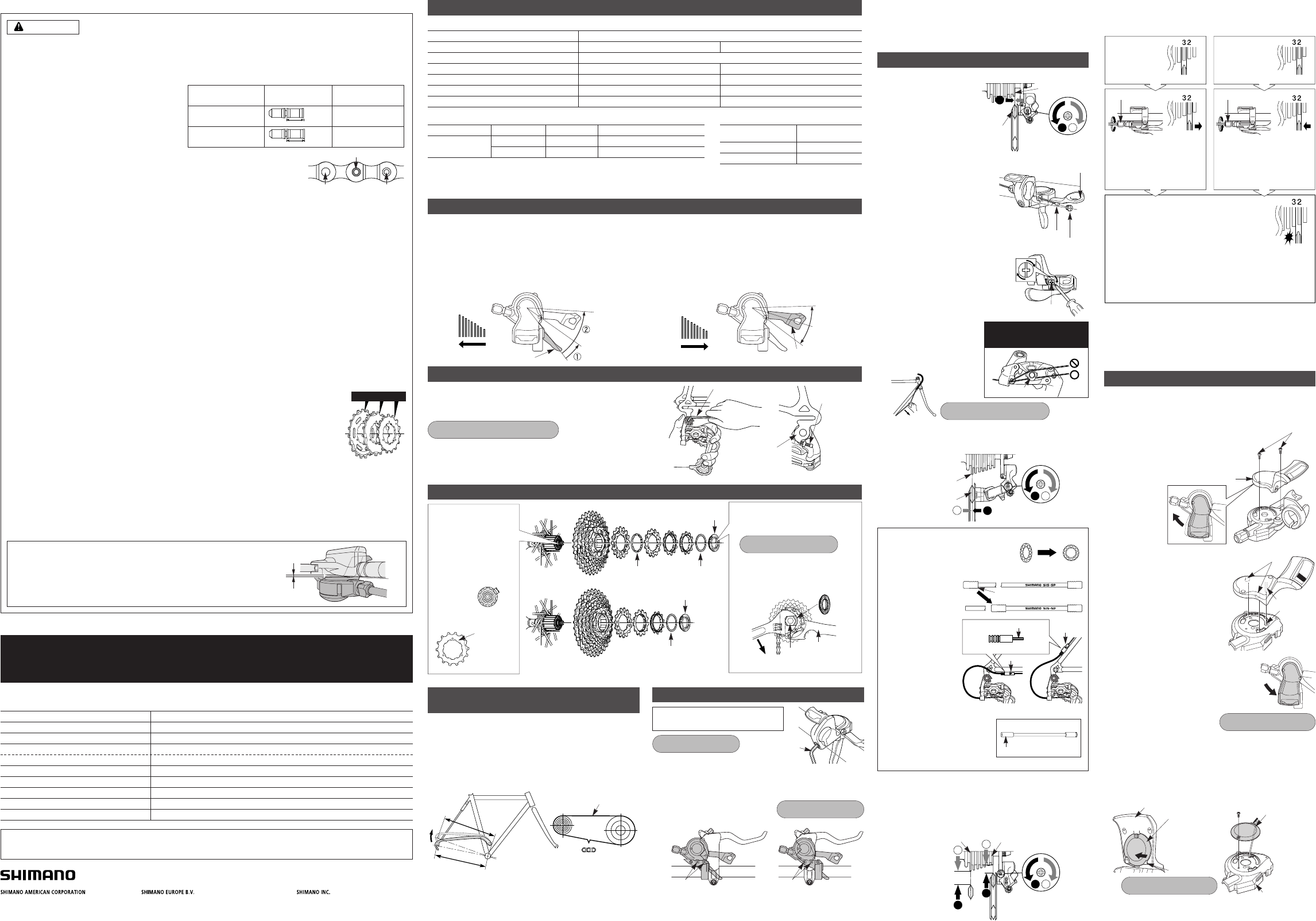
To shift fro m a sm a l l sp roc k et to a la rg er s p r o c ke t
(Lever A)
To shift one step only, press lever (A) to the (1) position. To shift two
steps at one time, press to the (2) position.
To shif t from a la rg e sp ro c ke t to a small e r sp ro c k et
(Lever B)
Press lever (B) once to shift one step from a larger to a smaller
sprocket.
Lock ring
To ol
(TL-SR21)
Disassembly
TL-LR15
5. SIS Adjustment
Operate the shifting lever several times to move the chain to the
2nd sprocket. Then, while pressing the lever just enough to take
up the play in the lever, turn the crank arm.
When shifting to
3rd
Tighten the outer casing
adjustment barrel until the
chain returns to the 2nd
sprocket. (clockwise)
Loosen the outer casing
adjustment barrel until the
chain touches the 3rd sprocket
and makes noise. (counter
clockwise)
When no sound
at all is heard
Best setting
The best setting is when the shifting lever is
operated just enough to take up the play and the
chain touches the 3rd sprocket and makes noise.
*Return the lever to its original position (the position where
the lever is at the 2nd sprocket setting and it has been
released) and then turn the crank arm clockwise. If the
chain is touching the 3rd sprocket and making noise, turn the outer
casing adjustment barrel clockwise slightly to tighten it until the noise
stops and the chain runs smoothly.
Operate lever to change gears, and check that no noise occurs
in any of the gear positions.
For the best SIS performance, periodically lubricate all
power-transmission parts.
Adjustment bolt Adjustment bolt
Lever (A) initial position Lever (B)
2-way release
Installation of the rear derailleur
When installing, be careful not to let the B-tension adjustment screw
come into contact with the dropout tab, otherwise deformation may result.
Bracket spindle Tightening torque :
8 - 10 N·m {70 - 86 in. lbs.}
5 mm Allen key
Dropout tab
B-tension
adjustment screw
Install the inner hole cover by turning it
as shown in the illustration until it stops.
Do not turn it any further than this,
otherwise it may damage the screw
thread.
1
12
2
Largest
sprocket
Guide pulley
Low adjustment
screw
3. Low adjustment
Turn the low adjustment screw so that the guide pulley moves to
a position directly in line with the largest sprocket.
4. How to use the B-tension adjustment screw
Mount the chain on the smallest chainring and the largest
sprocket, and turn the crank arm backward. Then turn the
B-tension adjustment screw to adjust the guide pulley as close to
the sprocket as possible but not so close that it touches. Next,
set the chain to the smallest sprocket and repeat the above to
make sure that the pulley does not touch the sprocket.
1
2
12
2
1
Largest sprocket Smallest sprocket
B-tension
adjustment screw
Connect the cable to the rear
derailleur and, after taking up
the initial slack in the cable,
re-secure to the rear derailleur
as shown in the illustration.
Pull
Tightening torque :
6 - 7 N·m {52 - 60 in. lbs.}
1. Top adjustment
Turn the top adjustment screw
to adjust so that the guide
pulley is in line with the outer
line of the smallest sprocket
when looking from the rear.
2. Connection and securing of the inner cable
Operate lever (B) eight times or
more, and check on the indicator
that the lever is at the highest
position. Then remove the inner hole
cover and connect the inner cable.
12
12
Outer line of
smallest sprocket
Guide pulley
To p a dj us tm en t
screw
Lever (B)
Inner hole cover
SIS Adjustment
Groove
Note: Be sure that the cable is
securely in the groove.
Inner hole cover
Inner cable
Cutting the outer casing
When cutting the outer casing, cut the
opposite end to the end with the marking.
After cutting the outer casing, make the
end round so that the inside of the hole has a uniform diameter.
Attach the same outer
end cap to the cut end
of the outer casing.
Outer end cap
The sealed cap with
tongue and the rubber
shield should be
installed to the outer
casing stopper of the
frame. Rubber shield
Rubber shield
Be careful not to bend
Sealed cap with tongue
*If the rear derailleur moves to a large degree, such as in
bicycles with rear suspension, it
is recommended that you replace
the cap with the accessory
aluminum cap.
The end of the outer casing
which has the aluminum cap should be at the derailleur side.
Aluminum cap
Derailleur side
■Read these Service Instructions in conjunction with the
Service Instructions for the FH-M770/M775.
Indicator unit
Shorter tab
Indicator bracket
protective cover
Shifting lever unit
Indicator bracket
protective cover
Tightening torque :
0.2 N·m {1 in. lbs.}
Tightening torque :
0.2 N·m {1 in. lbs.}
Bosses
Indicator fixing screws
Indicator unit
Pin
Winder hole
If not using the indicator, this shifting lever can be installed either
on the inside or the outside of the brake lever.
If adjusting the position, remove the indicator, and then be sure
to secure it in the new position with the two fixing bolts.
•Install the shifting lever in a position where it will not obstruct brake
operation and gear shifting operation.
•Do not use in a combination which causes brake operation to be
obstructed.
•When installing the components to carbon frame/handle bar
surfaces, verify with the manufacturer of the carbon frame/parts for
their recommendation on tightening torque in order to prevent over
tightening that can cause damage to the carbon material and/or
under tightening that can cause lack of fixing strength for the
components.
Installation of the lever
Use a handlebar grip with a maximum
outer diameter of 36 mm.
Tightening torque :
5 N·m {44 in. lbs.} 4 mm Allen key
Tightening torque :
2.5 N·m {22 in. lbs.}
3 mm Allen key
Inboard Outboard
3 mm Allen key
One Holland, Irvine, California 92618, U.S.A. Phone: +1-949-951-5003 Industrieweg 24, 8071 CT Nunspeet, The Netherlands Phone: +31-341-272222 3-77 Oimatsu-cho, Sakai-ku, Sakai-shi, Osaka 590-8577, Japan
* Service Instructions in further languages are available at : http://techdocs.shimano.com
Please note: specifications are subject to change for improvement without notice. (English) © May 2009 by Shimano Inc. XBC SZK Printed in Japan.
This service instruction explains how to use and maintain the Shimano bicycle parts which have been used on your new bicycle.
For any questions regarding your bicycle or other matters which are not related to Shimano parts, please contact the place of
purchase or the bicycle manufacturer.
General Safety Information
WARNING
Note
•If gear shifting operations do not feel smooth, wash the derailleur and lubricate all moving parts.
•If the amount of looseness in the links is so great that adjustment is not possible, you should replace the derailleur.
•You should periodically clean the derailleur and lubricate all moving parts (mechanism and pulleys).
•If gear shifting adjustment cannot be carried out, check the degree of parallelism at the rear end of the bicycle.Also check if the
cable is lubricated and if the outer casing is too long or too short.
•If you hear abnormal noise as a result of looseness in a pulley, you should replace the pulley.
•If the wheel becomes stiff and difficult to turn, you should lubricate it with grease.
•Do not apply any oil to the inside of the hub, otherwise the grease will come out.
•You should periodically wash the sprockets in a neutral detergent and then lubricate them again.In addition, cleaning the chain
with neutral detergent and lubricating it can be a effective way of extending the useful life of the sprockets and the chain.
•If the chain keeps coming off the sprockets during use, replace the sprockets and the chain.
•Use a frame with internal cable routing is strongly discouraged as it has tendencies to impair the SIS shifting function due to its
high cable resistance.
•Always be sure to use the sprocket set bearing the same group marks. Never use in combination with a sprocket bearing a
different group mark.
•Use an outer casing which still has some length to spare even when the handlebars are turned all the way
to both sides. Furthermore, check that the shifting lever does not touch the bicycle frame when the
handlebars are turned all the way.
•A special grease is used for the gear shifting cable (SIS-SP41).Do not use DURA-ACE grease or other
types of grease, otherwise they may cause deterioration in gear shifting performance.
•Grease the inner cable and the inside of the outer casing before use to ensure that they slide properly.
•For smooth operation, use the specified outer casing and the bottom bracket cable guide.
•Operation of the levers related to gear shifting should be made only when the front chainwheel is turning.
•If the brake fluid used in the oil disc brakes is of a type which tends to adhere to the plastic parts of the shifting lever, this may
cause the plastic parts to crack or become discolored. Therefore, you should make sure that the brake fluid does not adhere to
these plastic parts.
The mineral oil which is used in SHIMANO disc brakes does not cause cracking or discoloration if it adheres to plastic parts, but
such parts should be cleaned with alcohol beforehand to prevent foreign particles from adhering.
•Do not disassemble the indicator and shifting lever unit, as this may damage them or cause mis-operation.
•Parts are not guaranteed against natural wear or deterioration resulting from normal use.
•For maximum performance we highly recommend Shimano lubricants and maintenance products
•For any questions regarding methods of installation, adjustment, maintenance or operation, please contact a professional
bicycle dealer.
•Check that the wheels are fastened securely before riding the bicycle.If the wheels are loose in any way, they may come off the
bicycle and serious injury may result.
•Use neutral detergent to clean the chain.Do not use alkali-based or acid based detergent such as rust cleaners as it may result
in damage and/or failure of the chain.
•Use the reinforced connecting pin only for connecting the narrow type of chain.
•There are two different types of reinforced connecting pins available.Be sure to check the table below before selecting which
pin to use.
If connecting pins other than reinforced connecting
pins are used, or if a reinforced connecting pin or tool
which is not suitable for the type of chain is used,
sufficient connection force may not be obtained, which
could cause the chain to break or fall off.
•If it is necessary to adjust the length of the chain due
to a change in the number of sprocket teeth, make the
cut at some other place than the place where the chain
has been joined using a reinforced connecting pin or an end pin. The chain will be damaged if it
is cut at a place where it has been joined with a reinforced connecting pin or an end pin.
•Check that the tension of the chain is correct and that the chain is not damaged.If the tension
is too weak or the chain is damaged, the chain should be replaced. If this is not done, the chain
may break and cause serious injury.
•Use a front chainwheel which is compatible with 9-speed chains in conjunction with Shimano
CN-7701, CN-HG93 and CN-HG73 chains. If a chainwheel for an 8-speed chain or less is used, front chainwheel gear shifting
problems may occur, or the chain pins might fall out, causing the chain to break.
•Obtain and read the service instructions carefully prior to installing the parts. Loose, worn or damaged parts may cause the
bicycle to fall over and serious injury may occur as a result. We strongly recommend only using genuine Shimano replacement
parts.
•Obtain and read the service instructions carefully prior to installing the parts. If adjustments are not carried out correctly, the
chain may come off and this may cause you to fall off the bicycle which could result in serious injury.
•Read these Technical Service Instructions carefully, and keep them in a safe place for later reference.
Chain toolChain
9-speed super narrow
chain such as
CN-7701 / CN-HG93
8- / 7- / 6-speed narrow
chain such as
CN-HG50 / CN-HG40
Reinforced
connecting pin
TL-CN32 / TL-CN27
TL-CN32 / TL-CN27
6.5mm
7.1mm
Silver
Black
g
a
-
18
T
-
S
H
I
M
A
N
O
H
Y
P
E
R
G
L
I
D
E
C
a
g
-
1
5
T
a
g
-
1
3
T
Group marks
Reinforced Connecting Pin
End Pin Link Pin
SI-6MPRA-001-00
1mm
Do not push the brake lever against the indicator cover, otherwise it
may cause problems with the operation of the needle.
