EV RD M986 3430 Shimano XTR SGS Rear Derailleur Shadow Plus User Manual
User Manual: Shimano XTR M986 SGS Rear Derailleur Shadow Plus User Manual
Open the PDF directly: View PDF  .
.
Page Count: 3
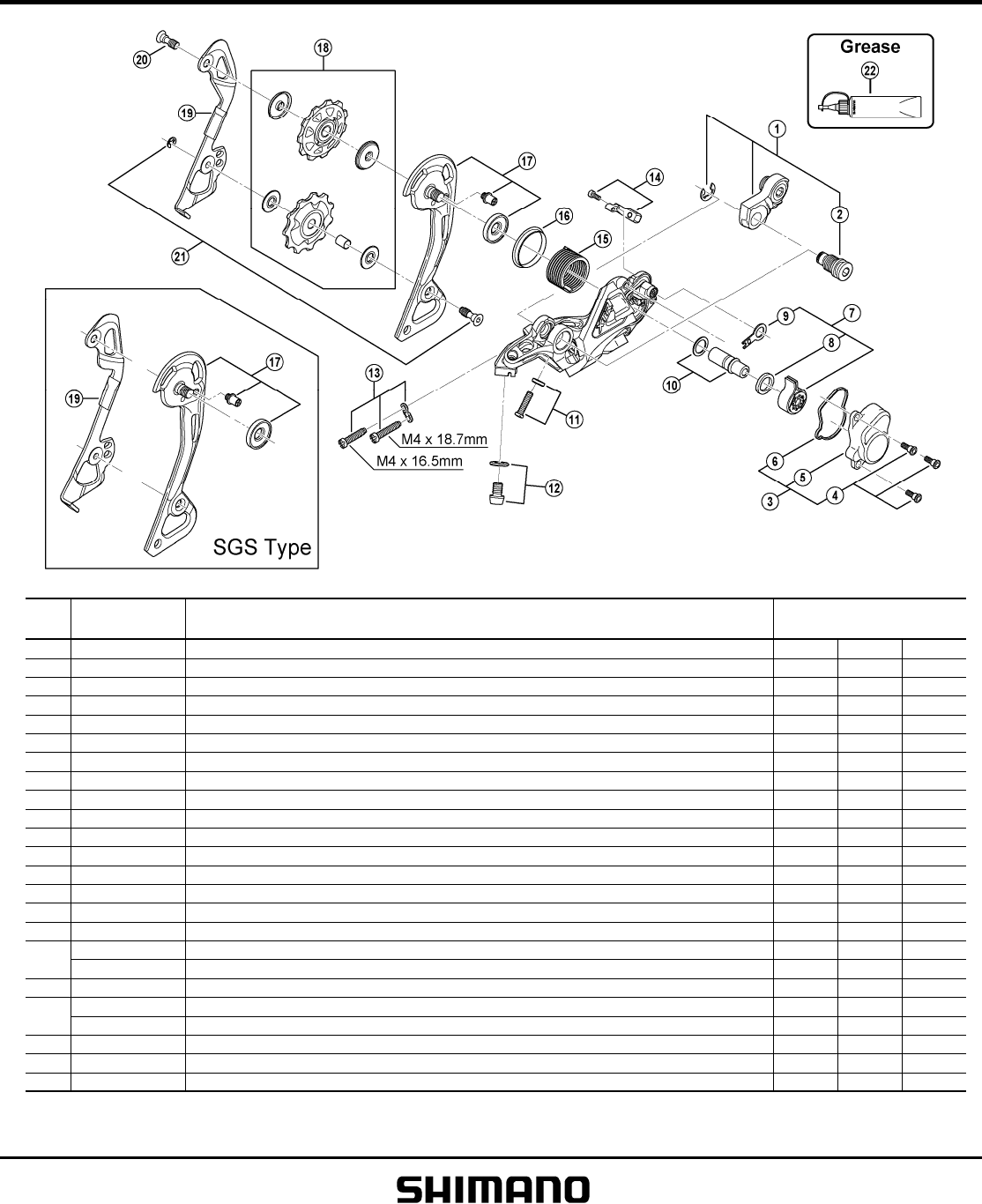
XTR Rear Derailleur
RD-M986
(GS)
Long Cage
RD-M986
(SGS)
Super Long Cage
1Y5XY98010 Bracket Axle Unit (for Normal Type) A
2Y5XY14000 B-Axle 2 (for Direct Mount Type) A
3Y5XD98010 P-Cover Unit
4Y5XD98020 P-Cover Bolt Set (3 pcs.)
5Y5XD20000 P-Cover
6Y5XD21000 P-Cover Packing
7Y5XD98030 Stabilizer Unit
8Y5XD38000 P-Axle Washer 2
9Y5XD35000 Switch Stabilizer
10 Y5XD98050 P-Axle Unit & Washer
11 Y5XC98040 B-Tension Adjusting Screw (M4 x 15.1) & Plate A
12 Y5XC98050 Cable Fixing Bolt (M6 x 8) & Plate A
13 Y5WJ98020 Adjusting Screws & Plate A
14 Y5XD98070 Switch Lever Unit & Bolt (M2.6 x 6)
15 Y5XD19000 P-Tension Spring A
16 Y5XD15000 P-Seal Ring A
Y5XD98090 Outer Plate Assembly (GS-Type)
Y5XD98100 Outer Plate Assembly (SGS-Type)
18 Y5XC98110 Guide & Tension Pulley Unit A
Y5XC09000 Inner Plate (GS-Type) AB
Y5XC10000 Inner Plate (SGS-Type) A
20 Y5WJ21000 Guide Pulley Bolt A
21 Y5XC98100 Tension Pulley Bolt & Stop Ring A
22 Y04120800 Grease for Stabilizer (Net. 100g)
A: Same parts. May.-2012-3430
B: Parts are usable, but differ in materials, appearance, finish, size, etc.
©
Shimano Inc.
A
Absence of mark indicates non-interchangeability.
Specifications are subject to change without notice.
17
19
INTERCHANGEABILITY
SHIMANO
CODE NO. DESCRIPTION
ITEM
NO.
RD-M981
RD-M786
Te c h n i c a l Ser vice I n s t r uctions SI-0120A-003
Maintenance
RD-M985
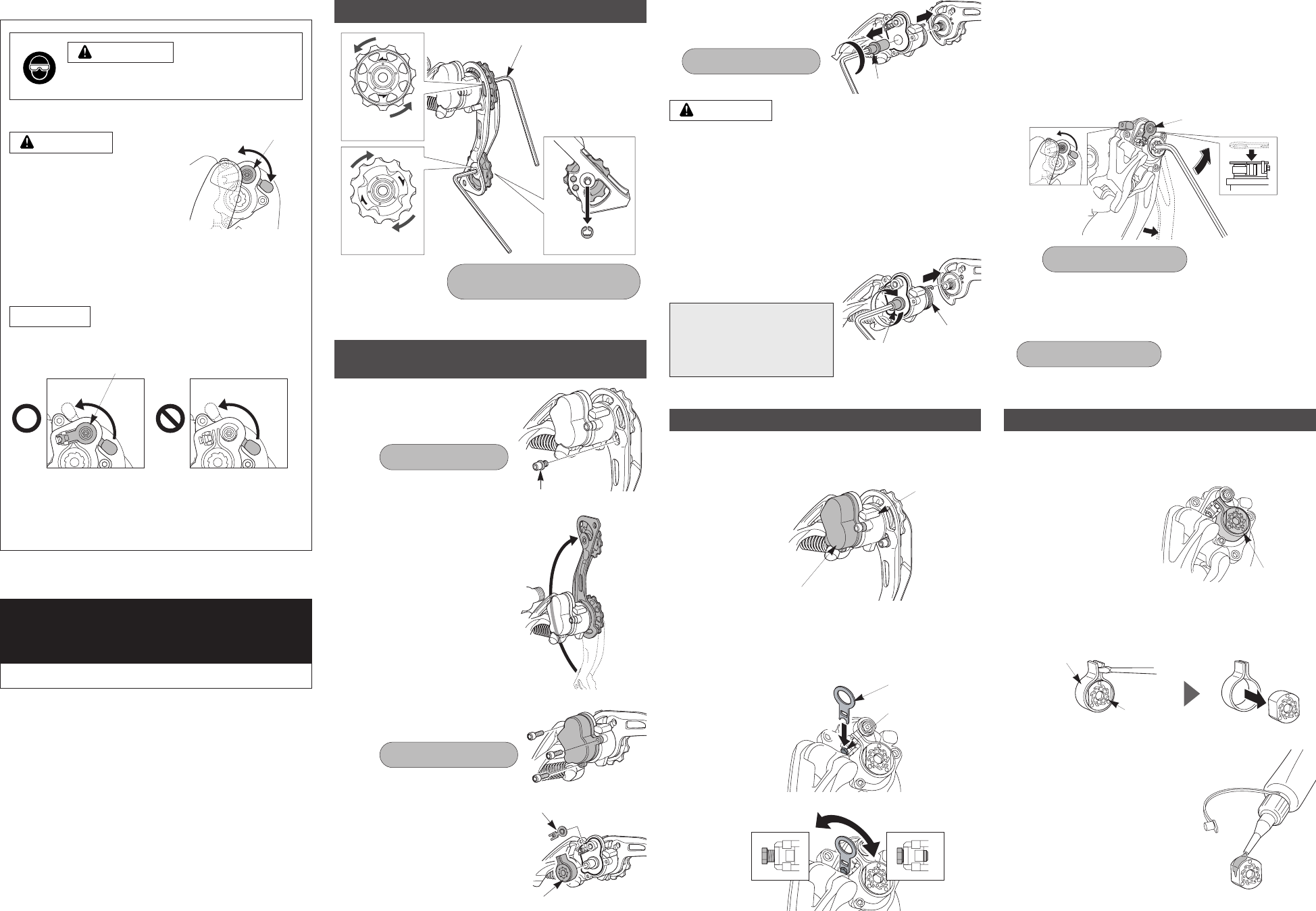
Replacement of the pulley
Friction adjustment Applying grease to the chain stabilizer
Replacement of the plate and the
plate tension spring
General Safety Information
•If operating the lever switch while the
plate unit cover is removed, press
the switch stabilizer with your finger
so that it does not fly out.
OFF
Switch stabilizer
ON
•If you move the lever switch from OFF to ON while the switch
stabilizer is removed, it may damage the product.
•Be sure to install the plate unit cover before riding the bicycle.
OFF
ON ON
OFF
Switch stabilizer
* Move the lever switch to the OFF position before
carrying out maintenance.
Note:
When removing the
tension pulley in
order to replace the
rear derailleur,
remove the E-ring
first.
Guide pulley / Tension pulley
Tightening torque :
2.5 - 5.0 N·m {22 - 44 in. lbs.}
3 mm Allen key
Guide pulley
Te ns io n pu ll ey E-ring
1. Remove the plate stopper pin.
• Phillips screwdriver #2
2. Tu r n the plate to loosen the p l a t e tension
spring as shown in the illustration.
< Disassembly >
Tightening torque :
1 N·m {9 in. lbs.}
Plate stopper pin
3. Remove the plate unit cover bolt.
4. Remove the switch stabilizer.
5. Remove the chain stabilizer.
6. Use a 4 mm Allen key to remove the
plate axle.
Tightening torque :
1 - 1.5 N·m {9 - 13 in. lbs.}
Tightening torque :
8 - 10 N·m {70 - 86 in. lbs.}
Switch stabilizer
Chain stabilizer
Plate axle
• 2 mm Allen key
Note:
When reassembling, insert the end
of the plate tension spring into the
groove in the plate.
Reassemble by carrying out the disassembly procedure in reverse.
Reassemble by carrying out the disassembly procedure in reverse.
Be sure to install the switch
stabilizer. If you try to operate
the lever switch without the
switch stabilizer installed, it
will damage the product.
< Assembly >
Plate axle
Plate tension spring
When installing and removing the plate and the plate unit, be careful
to avoid injury such as getting your fingers caught by the strong
reaction force of the plate tension spring.
•When installing and removing the plate and the plate unit, be
careful to avoid injury such as getting your fingers caught by
the strong reaction force of the plate tension spring.
The friction amount can be adjusted as desired.
Furthermore, you can also adjust after a change of the
friction occurs during use.
2. Remove the plate unit cover.
3. Remove the switch stabilizer.
4. Move the friction adjustment bolt to adjust the friction.
* The switch stabilizer can be
used as a tool to carry out
the adjustment.
1. Set the lever switch
to OFF.
Plate unit cover
Friction adjustment bolt
Switch stabilizer
Lever switch
Chain stabilizer
Clutch
Friction spring
Friction
increases
Friction
decreases
5. Check the friction torque.
• Securely install the switch stabilizer as shown in Figure 1.
• While pressing the switch stabilizer with your finger as shown in
Figure 2, set the lever switch to the ON position and check the
friction torque.
* If adjusting the friction once more, be sure to set the lever
switch to the OFF position while pressing the switch stabilizer
with your finger before making the adjustment.
6. Check that the switch stabilizer is securely installed.
7. Install the plate unit cover.
Friction torque:
3.5 - 5.4 N·m {30 - 47 in. lbs.}
Tightening torque:
1 - 1.5 N·m {9 - 13 in. lbs.}
Switch stabilizer
4 mm Allen key
Figure 2
Figure 1
1. After carrying out steps
1, 2 and 3 in “Friction
adjustment”, remove the
chain stabilizer.
2. Use a flat-tipped screwdriver or similar tool to separate the
friction spring and the clutch. Be careful not to bend the friction
spring with the tip of the flat-tipped screwdriver at this time.
3. Apply grease to the clutch.
Make sure that no grease gets inside the clutch at
this time. If grease gets inside the clutch,
it will cause the clutch to malfunction.
Grease number: Y04120800
SI-0120A-003-00
Be sure to wear safety glasses or goggles to
protect your eyes while working.
WARNING
CAUTION
CAUTION
* Service Instructions in further languages are available at :
http://techdocs.shimano.com
Please note: specifications are subject to change for improvement without notice. (English)
CAUTION
If the friction changes or noise is generated, the grease
may have become discolored or may have disappeared.
Apply more grease.
General Safety Information
Model number
Te ch ni ca l S er v ic e I ns tr uc ti on s SI-5XD0A-001
RD-M985
Rear derailleur
Series
RAPIDFIRE
(Shifting lever)
Outer casing
Rear derailleur
Ty p e
Freehub
Gears
Cassette sprocket
Chain
Bottom bracket guide
* It is recommended that you use the sealed outer cap with tongue.
In order to realize the best performance, we recommend
that the following combination be used.
Specifications
Installation of the rear derailleur
5 mm Allen key
Dropout
Bracket
Bracket spindle
Tightening torque :
8 - 10 N·m {70 - 86 in. lbs.}
Move the lever switch to the OFF
position when doing this.
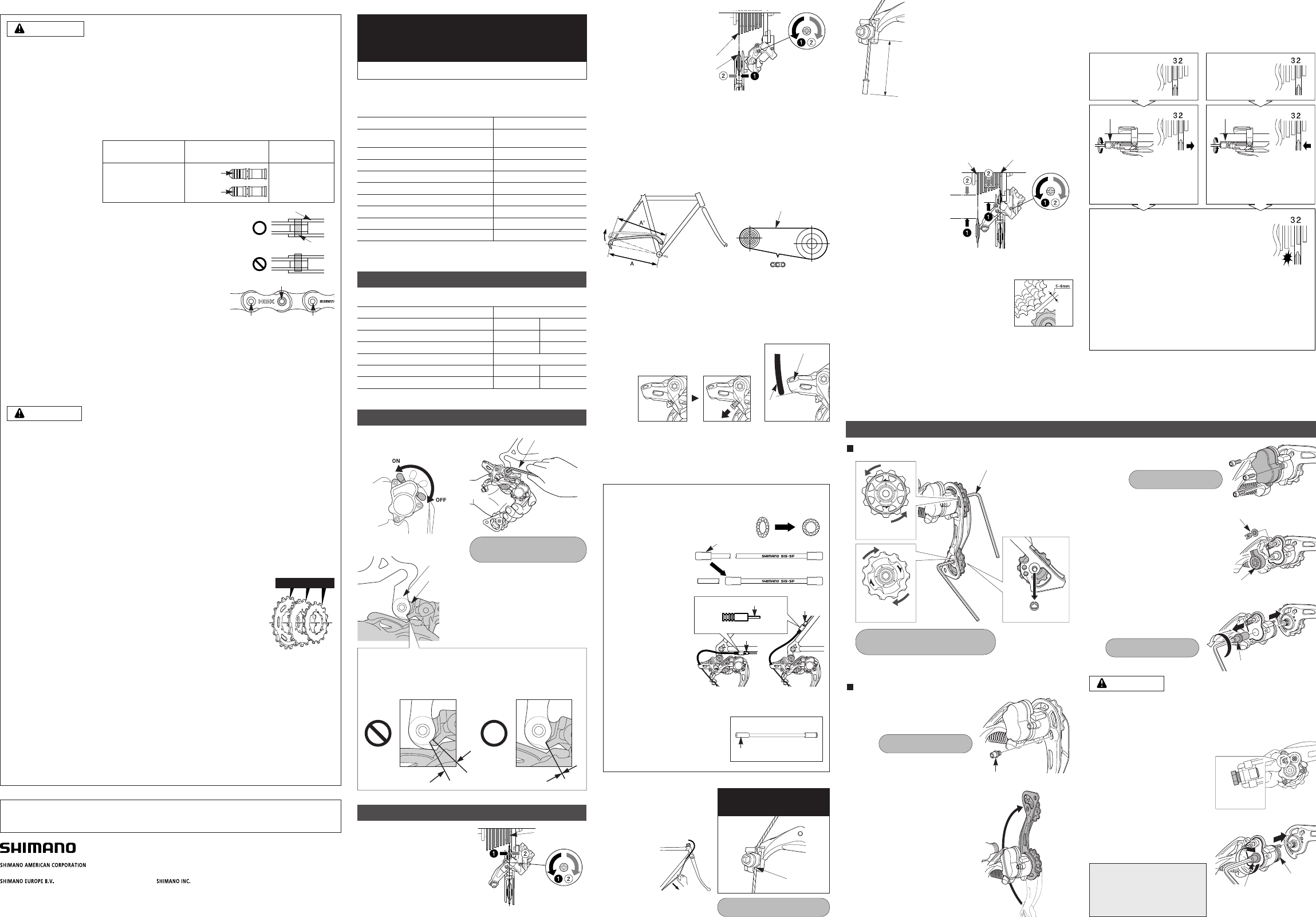
1. Top adjustment
Tu rn th e to p a dj us tm e nt sc rew
to adjust so that the guide pulley
is in line with the outer line of
the smallest sprocket when
looking from the rear.
SIS Adjustment
To p a dj us t me nt
screw
Outer line of
smallest sprocket
Ty p e
Gears
Total capacity
Applicable sprocket combination
Smallest sprocket
Front chainwheel tooth difference
Rear Derailleur
SGS
10
41T
11T
18T
XTR
SL-M980 / SL-M980-I
OT-SP41*
RD-M985
SGS / GS
FH-M985 / FH-M988
10
CS-M980
CN-M980
SM-SP17 / BT17
RD-M985
GS
10
35T
11T
18T
11 - 32T, 11 - 34T, 11 - 36T
Note: Periodically check that there is no gap between the
dropout and the bracket as shown in the illustration. If there is a
gap between these two parts, problems with gear shifting
performance may occur.
4. Outer casing length
(1) Loosen the B-tension adjustment screw until it is in the
position shown in the illustration.
(2) Check that there is enough slack in the outer casing. Next,
align the outer casing with the bottom
edge of the outer casing holder at the
rear derailleur and then cut of any excess
length of outer casing.
Note:
The distance between the outer stopper to the outer casing
holder of the rear derailleur may change when the rear
suspension moves, so determine the length of the outer casing at
the point where this length is at its greatest.
Cutting the outer casing
When cutting the outer casing, cut the opposite end to the end
with the marking. After cutting the outer
casing, make the end round so that the
inside of the hole has a uniform diameter.
Attach the same outer
end cap to the cut end
of the outer casing.
Outer end cap
The sealed cap with
tongue and the rubber
shield should be
installed to the outer
casing stopper of the
frame. Rubber shield
Rubber shield
Be careful not to bend
Sealed cap with tongue
*If the rear derailleur moves to a large degree, such as in
bicycles with rear suspension, it is recommended that you
replace the cap with the
accessory aluminum cap.
The end of the outer casing which
has the aluminum cap should be
at the derailleur side.
3. Chain length on bicycles with rear suspension
The length of A will vary depending on the movement of the rear
suspension. Because of this, an excessive load may be placed
on the drive system if the chain length is too short. Set the
length of the chain by adding two links to the chain when the rear
suspension is at a position where dimension "A" is longest and
the chain is on the largest sprocket and the largest chainring. If
the amount of movement of the rear suspension is large, the
slack in the chain may not be taken up properly when the chain is
on the smallest chainring and smallest sprocket.
Add 2 links (with the chain on both the largest
sprocket and the largest chainring)
Largest
sprocket
Chain
Largest
chainring
Connect the cable to the rear
derailleur and, after taking up
the initial slack in the cable,
re-secure to the rear
derailleur as shown in the
illustration.
Pull
Tightening torque :
6 - 7 N·m {52 - 60 in. lbs.}
Groove
Note: Be sure that the cable is
securely in the groove.
2. Low adjustment
Turn the low adjustment screw
so that the guide pulley moves
to a position directly in line
with the largest sprocket.
Low adjustment
screw
Guide pulley
Largest sprocket
Outer casing
(1) (2)
Outer casing holder
Maintenance
1. Remove the plate stopper pin.
2. Turn the plate to loosen the plate tension
spring as shown in the illustration.
3. Remove the plate unit cover bolt.
4. Remove the switch stabilizer.
5. Remove the chain stabilizer.
Replacement of the pulley
6. SIS Adjustment
Carry out the adjustment while the lever switch is in the OFF
position.
Operate the shifting lever several times to move the chain to the
2nd sprocket. Then, while pressing the lever just enough to take
up the play in the lever, turn the crank arm.
When shifting to
3rd
Tighten the outer casing
adjustment barrel until the
chain returns to the 2nd
sprocket. (clockwise)
Loosen the outer casing
adjustment barrel until the
chain touches the 3rd sprocket
and makes noise. (counter
clockwise)
When no sound
at all is heard
Best setting
The best setting is when the shifting lever is
operated just enough to take up the play and the
chain touches the 3rd sprocket and makes noise.
*Return the lever to its original position (the position where
the lever is at the 2nd sprocket setting and it has been
released) and then turn the crank arm clockwise. If the
chain is touching the 3rd sprocket and making noise, turn the outer
casing adjustment barrel clockwise slightly to tighten it until the noise
stops and the chain runs smoothly.
Operate lever to change gears, and check that no noise occurs
in any of the gear positions.
Set the lever switch to ON, and then ride the bicycle normally
and check that there are no problems with gear shifting.
For the best SIS performance, periodically lubricate all
power-transmission parts.
Adjustment barrel Adjustment barrel
Less than 30 mm
Note:
Set the inner cable so that it protrudes by a
length of less than about 30 mm, and then
check that the inner cable does not interfere with
the spokes of the wheel. Stop the wheel from
turning while carrying out this step.
* Move the lever switch to the OFF position before carrying out maintenance.
Replacement of the plate and the plate tension spring
< Disassembly >
Note:
When removing the
tension pulley in
order to replace the
rear derailleur,
remove the E-ring
first.
Guide pulley / Tension pulley
Tightening torque :
2.5 - 5.0 N·m {22 - 44 in. lbs.}
Tightening torque :
1 N·m {9 in. lbs.}
Tightening torque :
1 - 1.5 N·m {9 - 13 in. lbs.}
Tightening torque :
8 - 10 N·m {70 - 86 in. lbs.}
3 mm Allen key
Guide pulley
Te ns io n p u ll ey E-ring
Switch stabilizer
Chain stabilizer
Plate stopper pin
• Phillips screwdriver #2
WARNING
“Maintenance interval depends on the usage and riding circumstances.
Clean regularly the chain with an appropriate chaincleaner. Never use
alkali based or acid based solvents such as rust cleaners. If those solvent
be used chain might break and cause serious injury.”
•In order to obtain good gear shifting performance, this chain has a forward side
and a reverse side, and the sides are marked so that the chain will face the
correct way when installed. The proper design performance will be obtained when
the chain is installed so that it faces the correct way. If it is installed so that it
faces the opposite way, the chain may come off and the bicycle may fall over and
serious injury may occur as a result.
•Use the reinforced connecting pin only for connecting the narrow type of chain.
•If connecting pins other
than reinforced connecting
pins are used, or if a
reinforced connecting pin
or tool which is not suitable
for the type of chain is
used, sufficient connection
force may not be obtained,
which could cause the
chain to break or fall off.
• Make sure that the connecting pin is aligned with the outer link surface
from the side that the pin is inserted. It should feel smooth and flush
when you run your finger over it. The pin will protrude slightly on the
backside after the break off pin is removed.
•If it is necessary to adjust the length of the chain due to a change in the
number of sprocket teeth, make the cut at some other place than the
place where the chain has been joined using a reinforced connecting
pin. The chain will be damaged if it is cut at a place where it has
been joined with a reinforced connecting pin.
•Check that the tension of the chain is correct and that the chain
is not damaged. If the tension is too weak or the chain is
damaged, the chain should be replaced. If this is not done, the
chain may break and cause serious injury.
•Obtain and read the service instructions carefully prior to installing the parts. Loose, worn or
damaged parts may cause the bicycle to fall over and serious injury may occur as a result. We
strongly recommend only using genuine Shimano replacement parts.
•Obtain and read the service instructions carefully prior to installing the parts. If adjustments
are not carried out correctly, the chain may come off and this may cause you to fall off the bicycle
which could result in serious injury.
•Read these Technical Service Instructions carefully, and keep them in a safe place for later
reference.
•When installing and removing the plate and the plate unit, be careful to avoid injury such as
getting your fingers caught by the strong reaction force of the plate tension spring.
Note
•If gear shifting operations do not feel smooth, wash the derailleur and lubricate all moving parts.
•If the amount of looseness in the links is so great that adjustment is not possible, you should
replace the derailleur.
•You should periodically clean the derailleur and lubricate all moving parts (mechanism and
pulleys).
•If gear shifting adjustment cannot be carried out, check the degree of parallelism at the rear end
of the bicycle. Also check if the cable is lubricated and if the outer casing is too long or too short.
•If you hear abnormal noise as a result of looseness in a pulley, you should replace the pulley.
•You should periodically wash the sprockets in a neutral detergent and then lubricate them again.
In addition, cleaning the chain with neutral detergent and lubricating it can be a effective way of
extending the useful life of the sprockets and the chain.
•If the chain keeps coming off the sprockets during use, replace the sprockets and the chain.
•Use a frame with internal cable routing is strongly discouraged as it has tendencies to impair the
SIS shifting function due to its high cable resistance.
•Always be sure to use the sprocket set bearing the same group marks.
Never use in combination with a sprocket bearing a different group mark.
•Use an outer casing which still has some length to spare even when the
handlebars are turned all the way to both sides. Furthermore, check that the
shifting lever does not touch the bicycle frame when the handlebars are
turned all the way.
•A special grease is used for the gear shifting cable.Do not use DURA-ACE
grease or other types of grease, otherwise they may cause deterioration in
gear shifting performance.
•Grease the inner cable and the inside of the outer casing before use to ensure that they slide
properly.
•For smooth operation, use the specified outer casing and the bottom bracket cable guide.
•Operation of the levers related to gear shifting should be made only when the front chainwheel is
turning.
•The guide pulley has an arrow on it to indicate the direction of rotation.Install the guide pulley so
that the arrow is pointing counterclockwise when looking at the outer side of the derailleur.
•The tension pulley has an arrow on it to indicate the direction of rotation.Install the tension pulley
so that the arrow is pointing clockwise when looking at the outer side of the derailleur.
•Parts are not guaranteed against natural wear or deterioration resulting from normal use.
•For maximum performance we highly recommend Shimano lubricants and maintenance products
•For any questions regarding methods of installation, adjustment, maintenance or operation,
please contact a professional bicycle dealer.
g
a
-
18
T
-
S
H
I
M
A
N
O
H
Y
P
E
R
G
L
I
D
E
C
a
g
-
1
5
T
a
g
-
1
3
T
Group marks
* Service Instructions in further languages are available at : http://techdocs.shimano.com
Please note: specifications are subject to change for improvement without notice. (English)
© Nov. 2010 by Shimano Inc. XBC SZK Printed in Japan.
One Holland, Irvine, California 92618, U.S.A. Phone: +1-949-951-5003
Industrieweg 24, 8071 CT Nunspeet, The Netherlands Phone: +31-341-272222 3-77 Oimatsu-cho, Sakai-ku, Sakai-shi, Osaka 590-8577, Japan
This service instruction explains how to use and maintain the Shimano bicycle parts which have been
used on your new bicycle. For any questions regarding your bicycle or other matters which are not
related to Shimano parts, please contact the place of purchase or the bicycle manufacturer.
Reinforced Connecting Pin
Link Pin Link Pin
Link surface
Connecting pin
Chain toolChain
10-speed super narrow
chain for MTB
Reinforced
connecting pin
TL-CN32
TL-CN23
TL-CN27
with groove (3)
with groove (2)
SI-5XD0A-001-00
Aluminum cap
Derailleur side
5. How to use the B-tension adjustment screw
Mount the chain on the smallest chainring and the largest
sprocket, and turn the crank arm to shift gears. Then turn the B-
tension adjustment screw
to adjust so that the guide
pulley does not interfere
with the sprocket but not so
close that it touches the
chain. Next, set the chain
to the smallest sprocket
and repeat the above to
make sure that the pulley
does not touch the
sprocket.
<Checking the distance between the largest sprocket
and the guide pulley>
Set the rear derailleur to the lowest gear
position, stop the wheel from turning, and then
check that the distance from the edge of the
guide pulley to the edge of the largest
sprocket is within the range of 5 - 6 mm. Turn
the crank arm to shift gears and check that
there is no roughness in the feel. If the number of teeth for the
cassette sprocket is changed, carry out this setting again.
Largest sprocket Smallest sprocket
B-tension
adjustment screw
6. Use a 4 mm Allen key to remove the
plate axle.
Note:
•Do not move the friction
adjustment bolt.
•When reassembling, insert the
end of the plate tension spring
into the groove in the plate.
Reassemble by carrying out the
disassembly procedure in reverse.
Be sure to install the switch
stabilizer. If you try to operate
the lever switch without the
switch stabilizer installed, it
will damage the product.
< Assembly >
Friction
adjustment bolt
Plate axle
Plate axle
Plate tension spring
When installing and removing the plate and the plate unit, be careful
to avoid injury such as getting your fingers caught by the strong
reaction force of the plate tension spring.
CAUTION
CAUTION
