TEOS 10 Manual
User Manual:
Open the PDF directly: View PDF  .
.
Page Count: 210 [warning: Documents this large are best viewed by clicking the View PDF Link!]
- Thermodynamic_Manual_16Oct10_1st_part.pdf
- Thermodynamic_Manual_17Oct10_2nd_part.pdf
- A.1.3 Theoretical conversion between IPTS-68 and ITS-90
- A.1.4 Practical conversion between IPTS-68 and ITS-90
- A.1.5 Recommendation regarding temperature conversion
- A.20.1 Using Preformed Salinity as the conservative salinity variable
- A.20.2 Including a source term in the evolution equation for Absolute Salinity
- A.20.3 Including a source term in the evolution equation for Reference Salinity
- A.20.4 Discussion of the consequences if remineralization is ignored
- A.20.5 Discussion of the options for including remineralization
- Mj
- TSO
- tSO
- Thermodynamic_Manual_16Oct10_3rd_part.pdf

The international thermodynamic
equation of seawater – 2010:
Calculation and use of thermodynamic properties
Manuals and Guides 56
Intergovernmental Oceanographic Commission

ManualsandGuides56
IntergovernmentalOceanographicCommission
Theinternationalthermodynamic
equationofseawater–2010:
Calculation and use of thermodynamic properties
The authors are responsible for the choice and the presentation of the facts contained in this publication
and for the opinions expressed therein, which are not necessarily those of UNESCO, SCOR or IAPSO and
do not commit those Organizations.
The photograph on the front cover of a CTD and lowered ADCP hovering just below the sea surface was
taken south of Timor from the Southern Surveyor in August 2003 by Ann Gronell Thresher.
For bibliographic purposes, this document should be cited as follows:
IOC,SCORandIAPSO,2010:Theinternationalthermodynamicequationofseawater–2010:Calculationand
useofthermodynamicproperties.IntergovernmentalOceanographicCommission,ManualsandGuidesNo.
56,UNESCO(English),196pp.
Printed by UNESCO
(IOC/2010/MG/56)
© UNESCO/IOC et al. 2010
iii
IOC Manuals and Guides No. 56
Table of contents
Acknowledgements ……………………………………………………………………... vii
Foreword ……………………………………………………………………………….…… viii
Abstract ………………………………………………………………………………...……… 1
1. Introduction ………………………………………………………………….…..… 2
1.1 Oceanographic practice 1978 - 2009 ……………………………………………………. 2
1.2 Motivation for an updated thermodynamic description of seawater ………….… 2
1.3 SCOR/IAPSO WG127 and the approach taken ………………....……………….… 3
1.4 A guide to this TEOS-10 manual ………………………………………………………. 6
1.5 A remark on units …………………………………………………………………..…… 7
1.6 Recommendations …………………………………………………………………..…… 7
2. Basic Thermodynamic Properties ……………….………………..…. 9
2.1 ITS-90 temperature ………………………………...…..…………………………..……. 9
2.2 Sea pressure ………………………………….…………………..……….……………. 9
2.3 Practical Salinity …………………………..…………………………………………..… 9
2.4 Reference Composition and the Reference-Composition Salinity Scale …..……. 10
2.5 Absolute Salinity ………………………………………………………………………. 11
2.6 Gibbs function of seawater .…….………………………………………………… 15
2.7 Specific volume ………….…….……………………….…….……………………… 18
2.8 Density ………...…………………...……………………………………………….… 18
2.9 Chemical potentials ……..………………………………..………………………… 19
2.10 Entropy …………………………………………………….............................……… 20
2.11 Internal energy …………………………………………………..............….……… 20
2.12 Enthalpy ………..………………………………………………………….…...…… 20
2.13 Helmholtz energy ….…………………………………………………….....……… 21
2.14 Osmotic coefficient ….………………………………………………….….........… 21
2.15 Isothermal compressibility ..…….………………………………………………... 21
2.16 Isentropic and adiabatic compressibility …..…………….……………………… 22
2.17 Sound speed ……………………….……………………………………………..… 22
2.18 Thermal expansion coefficients ……...………………………………………….... 22
2.19 Saline contraction coefficients ……………………………………………….…… 23
2.20 Isobaric heat capacity ………..…………………………………………………… 24
2.21 Isochoric heat capacity ……….…………………………………………………… 24
2.22 Adiabatic lapse rate ………..……………………………………………………… 25
iv
IOC Manuals and Guides No. 56
3. Derived Quantities …………………………………..……….………………. 26
3.1 Potential temperature …………………………………………………………………. 26
3.2 Potential enthalpy ………………………………………....………………………… 27
3.3 Conservative Temperature ……………….………………….………………………. 27
3.4 Potential density ……………………………………………….……………………… 28
3.5 Density anomaly …………………….………………………….…………………… 28
3.6 Potential density anomaly ………….…………………………….…………………… 29
3.7 Specific volume anomaly ………………………………………….…………………. 29
3.8 Thermobaric coefficient ………….……………………………………………………. 30
3.9 Cabbeling coefficient ………….…………………………………………………....…. 31
3.10 Buoyancy frequency ……….…………………………………………….……..….… 32
3.11 Neutral tangent plane …….……………………………………………………..…. 32
3.12 Geostrophic, hydrostatic and “thermal wind” equations …….………………. 33
3.13 Neutral helicity …………….…………………………………………………..….…. 34
3.14 Neutral Density ….…………………………………………………………..….…….. 35
3.15 Stability ratio …..………………………………………………………………...…. 36
3.16 Turner angle ….………………………………………………………………………. 36
3.17 Property gradients along potential density surfaces …………………………… 36
3.18 Slopes of potential density surfaces and neutral tangent planes compared ..… 37
3.19 Slopes of in situ density surfaces and specific volume anomaly surfaces …..… 37
3.20 Potential vorticity …………………………………….………………………………. 38
3.21 Vertical velocity through the sea surface …….…………………………………… 39
3.22 Freshwater content and freshwater flux …………………………………………. 40
3.23 Heat transport …………………….………………………………………………….. 40
3.24 Geopotential ………….……………………………………………………………….. 41
3.25 Total energy …………….…………………………………………………………….. 41
3.26 Bernoulli function ……….…………………………………………………………… 42
3.27 Dynamic height anomaly …………………………………………………………… 42
3.28 Montgomery geostrophic streamfunction ………….…………………………… 43
3.29 Cunningham geostrophic streamfunction ……….……………………………… 44
3.30 Geostrophic streamfunction in an approximately neutral surface ….………… 45
3.31 Pressure-integrated steric height ……..…………………………………………… 45
3.32 Pressure to height conversion …….………………………………………………… 46
3.33 Freezing temperature ……….…………………………………………………….….. 46
3.34 Latent heat of melting ….…………………………………………..………….…… 48
3.35 Sublimation pressure …………………………………………………………….… 49
3.36 Sublimation enthalpy …………………………………………………………….… 50
3.37 Vapour pressure ……………………………………………………………….…… 52
3.38 Boiling temperature ……….……………………………………….…………….… 53
3.39 Latent heat of evaporation ………………………………………………………… 53
3.40 Relative humidity and fugacity …………………………………………………… 55
3.41 Osmotic pressure …………………………………………………………………… 58
3.42 Temperature of maximum density …….….……………………………………… 59
4. Conclusions ………………………………………….……..……………………… 60
v
IOC Manuals and Guides No. 56
Appendix A: Background and theory underlying the use of the
Gibbs function of seawater ………………..……………...... 62
A.1 ITS-90 temperature …………………………………………………………………... 62
A.2 Sea pressure, gauge pressure and absolute pressure …………………………….... 66
A.3 Reference Composition and the Reference-Composition Salinity Scale …….…... 67
A.4 Absolute Salinity ……………………………………………….……………………... 69
A.5 Spatial variations in seawater composition ……………………………….………... 75
A.6 Gibbs function of seawater ………………………………….…………….……..…... 78
A.7 The fundamental thermodynamic relation ………………………………….……... 79
A.8 The “conservative” and “isobaric conservative” properties ……………….…..…. 79
A.9 The “potential” property ……………….……….………………………………...... 82
A.10 Proof that
()
A,S
θ
θη
= and
(
)
A,S
θ
Θ=Θ .…………………….…………………... 84
A.11 Various isobaric derivatives of specific enthalpy ……………...…..…………… 84
A.12 Differential relationships between ,,
η
θ
Θ
and A
S …………...……...….………. 86
A.13 The First Law of Thermodynamics ………………….……………………...…...... 87
A.14 Advective and diffusive “heat” fluxes ………………….………………..……...... 90
A.15 Derivation of the expressions for ,,
θθ
α
βα
Θ
and
β
Θ
………………….……….. 92
A.16 Non-conservative production of entropy ………………………...……………...... 94
A.17 Non-conservative production of potential temperature ………………….……... 97
A.18 Non-conservative production of Conservative Temperature ………………….. 99
A.19 Non-conservative production of density and of potential density ………….. 102
A.20 Therepresentationofsalinityinnumericaloceanmodels………………........... 103
A.21 The material derivatives of *,S A,S R
S and
Θ
in a turbulent ocean ……….... 108
A.22 The material derivatives of density and of locally-referenced
potential density; the dianeutral velocity e
…………….……............................ 112
A.23 The water-mass transformation equation …………….…….................................. 113
A.24 Conservation equations written in potential density coordinates ………..……. 114
A.25 The vertical velocity through a general surface …………….………………….... 116
A.26 The material derivative of potential density ………………………..….……..... 116
A.27 The diapycnal velocity of layered ocean models (without rotation
of the mixing tensor) ……………………………………………….….….……..... 117
A.28 The material derivative of orthobaric density ………………………..….……..... 118
A.29 The material derivative of Neutral Density …………………………….……..... 119
A.30 Computationally efficient 25-term expressions for the density
of seawater in terms of
Θ
and
θ
………………………..…………………….. 120
Appendix B: Derivation of the First Law of Thermodynamics ….…….…… 123
Appendix C: Publications describing the TEOS-10 thermodynamic
descriptions of seawater, ice and moist air ……...………..…..…. 130
Appendix D: Fundamental constants …….…………………..……………………... 133
vi
IOC Manuals and Guides No. 56
Appendix E: Algorithm for calculating Practical Salinity ……….…………….. 137
E.1 Calculation of Practical Salinity in terms of K15 ….……........................................... 137
E.2 Calculation of Practical Salinity at oceanographic temperature and pressure ..... 137
E.3 Calculation of conductivity ratio R for a given Practical Salinity .......................... 138
E.4 Evaluating Practical Salinity using ITS-90 temperatures ......................................... 139
E.5 Towards SI-traceability of the measurement procedure for Practical Salinity
and Absolute Salinity .................................................................................................. 139
Appendix F: Coefficients of the IAPWS-95 Helmholtz function of
fluid water (with extension down to 50K) …………...………...… 142
Appendix G: Coefficients of the pure liquid water Gibbs function
of IAPWS-09 ………………………...……………………….…...………. 145
Appendix H: Coefficients of the saline Gibbs function for seawater
of IAPWS-08 ………………………………………………..…….………. 146
Appendix I: Coefficients of the Gibbs function of ice Ih of IAPWS-06 …... 147
Appendix J: Coefficients of the Helmholtz function of moist air
of IAPWS-10 ……………………………..…….………………………… 149
Appendix K: Coefficients of 25-term expressions for the density
of seawater in terms of
Θ
and of
θ
…….……………………....... 153
Appendix L: Recommended nomenclature, symbols and
units in oceanography ………………………………………………… 156
Appendix M: Seawater-Ice-Air (SIA) library of computer software ……….. 162
Appendix N: Gibbs-SeaWater (GSW) Oceanographic Toolbox ..................... 173
Appendix O: Checking the Gibbs function of seawater against the
original thermodynamic data ……………………….………….…… 175
Appendix P: Thermodynamic properties based on
(
)( )
AA
,, , , , ,gS tp hS p
η
()
A,,hS p
θ
and
(
)
A
ˆ,,hS pΘ …………………….…………………... 178
References ……………………………..……………………………….………….…….… 182
Index ……………………………………..……………………………….…………….….… 191
vii
IOC Manuals and Guides No. 56
Acknowledgements
ThisTEOS‐10ManualreviewsandsummarizestheworkoftheSCOR/IAPSOWorking
Group127ontheThermodynamicsandEquationofStateofSeawater.DrJohnGouldand
ProfessorPaolaMalanotte‐Rizzoliplayedpivotalrolesintheestablishmentofthe
WorkingGroupandwehaveenjoyedrock‐solidscientificsupportfromtheofficersof
SCOR,IAPSOandIOC.TJMcDwishestoacknowledgefruitfuldiscussionswithDrs
JürgenWillebrandandMichaelMcIntyreregardingthecontentsofappendixB.Wehave
benefitedfromextensivecommentsondraftsofthismanualbyDrStephenGriffiesandDr
AllynClarke.DrHarryBrydenisthankedforvaluableandtimelyadviceonthe
treatmentofsalinityinoceanmodels.LouiseBellofCSIROprovidedmuchappreciated
adviceonthelayoutofthisdocument.TJMcDandDRJwishtoacknowledgepartial
financialsupportfromtheWealthfromOceansNationalFlagship.Thisworkcontributes
totheCSIROClimateChangeResearchProgram.Thisdocumentisbasedonwork
partiallysupportedbytheU.S.NationalScienceFoundationtoSCORunderGrantNo.
OCE‐0608600.FJMwishestoacknowledgetheOceanographicSectionoftheNational
ScienceFoundationandtheNationalOceanicandAtmosphericAdministrationfor
supportinghiswork.
ThisdocumenthasbeenwrittenbythemembersofSCOR/IAPSOWorkingGroup127,
TrevorJ.McDougall,(chair),CSIRO,Hobart,Australia
RainerFeistel,Leibniz‐InstitutfuerOstseeforschung,Warnemuende,Germany
DanielG.Wright+,BedfordInstituteofOceanography,Dartmouth,Canada
RichPawlowicz,UniversityofBritishColumbia,Vancouver,Canada
FrankJ.Millero,UniversityofMiami,Florida,USA
DavidR.Jackett,CSIRO,Hobart,Australia
BrianA.King,NationalOceanographyCentre,Southampton,UK
GilesM.Marion,DesertResearchInstitute,Reno,USA
SteffenSeitz,Physikalisch‐TechnischeBundesanstalt(PTB),Braunschweig,Germany
PetraSpitzer,Physikalisch‐TechnischeBundesanstalt(PTB),Braunschweig,Germany
C‐T.ArthurChen,NationalSunYat‐SenUniversity,Taiwan,R.O.C.
March2010
+deceased,8thJuly2010.

viii
IOC Manuals and Guides No. 56
Foreword
ThisdocumentdescribestheInternationalThermodynamicEquationOfSeawater–2010
(TEOS‐10forshort).Thisdescriptionofthethermodynamicpropertiesofseawaterand
oficeIhhasbeenadoptedbytheIntergovernmentalOceanographicCommissionatits
25thAssemblyinJune2009toreplaceEOS‐80astheofficialdescriptionofseawaterand
icepropertiesinmarinescience.
FundamentaltoTEOS‐10aretheconceptsofAbsoluteSalinityandReference
Salinity.Thesevariablesaredescribedindetailhere,emphasisingtheirrelationshipto
PracticalSalinity.
ThescienceunderpinningTEOS‐10hasbeendescribedinaseriesofpapers
publishedintherefereedliterature(seeappendixC).Thepresentdocumentmaybe
calledthe“TEOS‐10Manual”andactsasaguidetothosepublishedpapersand
concentratesonhowthethermodynamicpropertiesobtainedfromTEOS‐10aretobe
usedinoceanography.
Inadditiontothethermodynamicpropertiesofseawater,TEOS‐10alsodescribesthe
thermodynamicpropertiesoficeandofhumidair,andthesepropertiesaresummarised
inthisdocument.TheTEOS‐10computersoftware,thisTEOS‐10Manualandother
documentsmaybeobtainedfromwww.TEOS‐10.org.
WhenreferringtotheuseofTEOS‐10,itisthepresentdocumentthatshouldbe
referencedasIOCetal.(2010)[IOC,SCORandIAPSO,2010:Theinternational
thermodynamicequationofseawater–2010:Calculationanduseofthermodynamicproperties.
IntergovernmentalOceanographicCommission,ManualsandGuidesNo.56,UNESCO
(English),196pp.].
ThisversionoftheTEOS‐10Manualincludescorrectionsupto16thOctober2010.
TEOS-10 Manual: Calculation and use of the thermodynamic properties of seawater
IOC Manuals and Guides No. 56
1
Abstract
Thisdocumentoutlineshowthethermodynamicpropertiesofseawaterareevaluated
usingtheInternationalThermodynamicEquationOfSeawater–2010(TEOS‐10).This
thermodynamicdescriptionofseawaterisbasedonaGibbsfunctionformulationfrom
whichthermodynamicpropertiessuchasentropy,potentialtemperature,enthalpyand
potentialenthalpyarecalculateddirectly.WhendeterminedfromtheGibbsfunction,
thesequantitiesarefullyconsistentwitheachother.Entropyandenthalpyarerequired
foranaccuratedescriptionoftheadvectionanddiffusionofheatintheoceaninteriorand
forquantifyingtheocean’sroleinexchangingheatwiththeatmosphereandwithice.The
GibbsfunctionisafunctionofAbsoluteSalinity,temperatureandpressure.Incontrastto
PracticalSalinity,AbsoluteSalinityisexpressedinSIunitsanditincludestheinfluenceof
thesmallspatialvariationsofseawatercompositionintheglobalocean.AbsoluteSalinity
istheappropriatesalinityvariablefortheaccuratecalculationofhorizontaldensity
gradientsintheocean.AbsoluteSalinityisalsotheappropriatesalinityvariableforthe
calculationoffreshwaterfluxesandforcalculationsinvolvingtheexchangeoffreshwater
withtheatmosphereandwithice.Potentialfunctionsareincludedforiceandformoist
air,leadingtoaccurateexpressionsfornumerousthermodynamicpropertiesoficeandair
includingfreezingtemperatureandlatentheatsofmeltingandofevaporation.This
TEOS‐10Manualdescribeshowthethermodynamicpropertiesofseawater,iceandmoist
airareusedinordertoaccuratelyrepresentthetransportofheatintheoceanandthe
exchangeofheatwiththeatmosphereandwithice.
2 TEOS-10 Manual: Calculation and use of the thermodynamic properties of seawater
IOC Manuals and Guides No. 56
1. Introduction
1.1 Oceanographic practice 1978 - 2009
ThePracticalSalinityScale,PSS‐78,andtheInternationalEquationofStateofSeawater
(Unesco(1981))whichexpressesthedensityofseawaterasafunctionofPracticalSalinity,
temperatureandpressure,haveservedtheoceanographiccommunityverywellforthirty
years.TheJointPanelonOceanographicTablesandStandards(JPOTS)(Unesco(1983))
alsopromulgatedtheMillero,PerronandDesnoyers(1973)algorithmforthespecificheat
capacityofseawateratconstantpressure,theChenandMillero(1977)expressionforthe
soundspeedofseawaterandtheMilleroandLeung(1976)formulaforthefreezingpoint
temperatureofseawater.ThreeotheralgorithmssupportedundertheauspicesofJPOTS
concernedtheconversionbetweenhydrostaticpressureanddepth,thecalculationofthe
adiabaticlapserate,andthecalculationofpotentialtemperature.Theexpressionsforthe
adiabaticlapserateandforpotentialtemperaturecouldinprinciplehavebeenderived
fromtheotheralgorithmsoftheEOS‐80set,butinfacttheywerebasedontheformulasof
Bryden(1973).Weshallrefertoallthesealgorithmsjointlyas‘EOS‐80’forconvenience
becausetheyrepresentoceanographicbestpracticefromtheearly1980sto2009.
1.2 Motivation for an updated thermodynamic description of seawater
Inrecentyearsthefollowingaspectsofthethermodynamicsofseawater,iceandmoistair
havebecomeapparentandsuggestthatitistimelytoredefinethethermodynamic
propertiesofthesesubstances.
• SeveralofthepolynomialexpressionsoftheInternationalEquationofStateof
Seawater(EOS‐80)arenottotallyconsistentwitheachotherastheydonotexactly
obeythethermodynamicMaxwellcross‐differentiationrelations.Thenew
approacheliminatesthisproblem.
• Sincethelate1970samoreaccurateandmorebroadlyapplicablethermodynamic
descriptionofpurewaterhasbeendevelopedbytheInternationalAssociationfor
thePropertiesofWaterandSteam,andhasappearedasanIAPWSRelease(IAPWS‐
95).Alsosincethelate1970ssomemeasurementsofhigheraccuracyhavebeen
madeofseveralpropertiesofseawatersuchas(i)heatcapacity,(ii)soundspeedand
(iii)thetemperatureofmaximumdensity.Thesecanbeincorporatedintoanew
thermodynamicdescriptionofseawater.
• Theimpactonseawaterdensityofthevariationofthecompositionofseawaterin
thedifferentoceanbasinshasbecomebetterunderstood.Inordertofurther
progressthisaspectofseawater,astandardmodelofseawatercompositionis
neededtoserveasagenerallyrecognisedreferencefortheoreticalandchemical
investigations.
• Theincreasingemphasisontheoceanasbeinganintegralpartoftheglobalheat
enginepointstotheneedforaccurateexpressionsfortheentropy,enthalpyand
internalenergyofseawatersothatheatfluxescanbemoreaccuratelydeterminedin
theoceanandacrosstheinterfacesbetweentheoceanandtheatmosphereandice
(entropy,enthalpyandinternalenergywerenotavailablefromEOS‐80).
TEOS-10 Manual: Calculation and use of the thermodynamic properties of seawater
IOC Manuals and Guides No. 56
3
• Theneedforathermodynamicallyconsistentdescriptionoftheinteractionsbetween
seawater,iceandmoistair;inparticular,theneedforaccurateexpressionsforthe
latentheatsofevaporationandfreezing,bothattheseasurfaceandinthe
atmosphere.
• ThetemperaturescalehasbeenrevisedfromIPTS‐68toITS‐90andrevisedIUPAC
(InternationalUnionofPureandAppliedChemistry)valueshavebeenadoptedfor
theatomicweightsoftheelements(Wieser(2006)).
1.3 SCOR/IAPSO WG127 and the approach taken
In2005SCOR(ScientificCommitteeonOceanicResearch)andIAPSO(International
AssociationforthePhysicalSciencesoftheOcean)establishedWorkingGroup127onthe
“ThermodynamicsandEquationofStateofSeawater”(henceforthreferredtoasWG127).
Thisgrouphasnowdevelopedacollectionofalgorithmsthatincorporateourbest
knowledgeofseawaterthermodynamics.Thepresentdocumentsummarizestheworkof
SCOR/IAPSOWorkingGroup127.
Tocomputeallthermodynamicpropertiesofseawateritissufficienttoknowoneofits
so‐calledthermodynamicpotentials(Fofonoff1962,Feistel1993,Alberty2001).ItwasJ.W.
Gibbs(1873)whodiscoveredthat“anequationgivinginternalenergyintermsofentropyand
specificvolume,ormoregenerallyanyfiniteequationbetweeninternalenergy,entropyandspecific
volume,foradefinitequantityofanyfluid,maybeconsideredasthefundamentalthermodynamic
equationofthatfluid,asfromit…maybederivedallthethermodynamicpropertiesofthefluid(so
farasreversibleprocessesareconcerned).”
TheapproachtakenbyWG127hasbeentodevelopaGibbsfunctionfromwhichall
thethermodynamicpropertiesofseawatercanbederivedbypurelymathematical
manipulations(suchasdifferentiation).Thisapproachensuresthatthevarious
thermodynamicpropertiesareself‐consistent(inthattheyobeytheMaxwellcross‐
differentiationrelations)andcomplete(inthateachofthemcanbederivedfromthegiven
potential).
TheGibbsfunction(orGibbspotential)isafunctionofAbsoluteSalinityA
S(rather
thanofPracticalSalinityP
S),temperatureandpressure.AbsoluteSalinityistraditionally
definedasthemassfractionofdissolvedmaterialinseawater.TheuseofAbsolute
SalinityasthesalinityargumentfortheGibbsfunctionandforallotherthermodynamic
functions(suchasdensity)isamajordeparturefrompresentpractice(EOS‐80).Absolute
SalinityispreferredoverPracticalSalinitybecausethethermodynamicpropertiesof
seawateraredirectlyinfluencedbythemassofdissolvedconstituentswhereasPractical
Salinitydependsonlyonconductivity.Considerforexampleexchangingasmallamount
ofpurewaterwiththesamemassofsilicateinanotherwiseisolatedseawatersampleat
constanttemperatureandpressure.Sincesilicateispredominantlynon‐ionic,the
conductivity(andthereforePracticalSalinityP
S)isalmostunchangedbuttheAbsolute
Salinityisincreased,asisthedensity.Similarly,ifasmallmassofsayNaClisaddedand
thesamemassofsilicateistakenoutofaseawatersample,themassfractionabsolute
salinitywillnothavechanged(andsothedensityshouldbealmostunchanged)butthe
PracticalSalinitywillhaveincreased.
Thevariationsintherelativeconcentrationsofseawaterconstituentscausedby
biogeochemicalprocessesactuallycausecomplicationsinevendefiningwhatexactlyis
meantby“absolutesalinity”.Theseissueshavenotbeenwellstudiedtodate,butwhatis
knownissummarizedinsection2.5andappendicesA.4,A.5andA.20.Hereitis
sufficienttopointoutthattheAbsoluteSalinityA
Swhichisthesalinityargumentofthe
TEOS‐10Gibbsfunctionistheversionofabsolutesalinitythatprovidesthebestestimate
ofthedensityofseawater;anothernameforA
Sis“DensitySalinity”.
4 TEOS-10 Manual: Calculation and use of the thermodynamic properties of seawater
IOC Manuals and Guides No. 56
TheGibbsfunctionofseawater,publishedasFeistel(2008),hasbeenendorsedbythe
InternationalAssociationforthePropertiesofWaterandSteamastheReleaseIAPWS‐08.
Thisthermodynamicdescriptionofseawaterproperties,togetherwiththeGibbsfunction
oficeIh,IAPWS‐06,hasbeenadoptedbytheIntergovernmentalOceanographic
Commissionatits25thAssemblyinJune2009toreplaceEOS‐80astheofficialdescription
ofseawaterandicepropertiesinmarinescience.Thethermodynamicpropertiesofmoist
airhavealsorecentlybeendescribedusingaHelmholtzfunction(Feisteletal.(2010a),
IAPWS(2010))soallowingtheequilibriumpropertiesattheair‐seainterfacetobemore
accuratelyevaluated.Thenewapproachtothethermodynamicpropertiesofseawater,of
iceIhandofhumidairisreferredtocollectivelyasthe“InternationalThermodynamic
EquationOfSeawater–2010”,or“TEOS‐10”forshort.AppendixCliststhepublications
whichliebehindTEOS‐10.
AnotabledifferenceofTEOS‐10comparedwithEOS‐80istheadoptionofAbsolute
Salinitytobeusedinjournalstodescribethesalinityofseawaterandtobeusedasthe
salinityargumentinalgorithmsthatgivethevariousthermodynamicpropertiesof
seawater.Thisrecommendationdeviatesfromthecurrentpracticeofworkingwith
PracticalSalinityandtypicallytreatingitasthebestestimateofAbsoluteSalinity.This
practiceisinaccurateandshouldbecorrected.Notehoweverthatwestrongly
recommendthatthesalinitythatisreportedtonationaldatabasesremainPractical
SalinityasdeterminedonthePracticalSalinityScaleof1978(suitablyupdatedtoITS‐90
temperaturesasdescribedinappendixEbelow).
TherearethreeverygoodreasonsforcontinuingtostorePracticalSalinityratherthan
AbsoluteSalinityinsuchdatarepositories.First,PracticalSalinityisan(almost)directly
measuredquantitywhereasAbsoluteSalinityisgenerallyaderivedquantity.Thatis,we
calculatePracticalSalinitydirectlyfrommeasurementsofconductivity,temperatureand
pressure,whereastodatewederiveAbsoluteSalinityfromacombinationofthese
measurementsplusothermeasurementsandcorrelationsthatarenotyetwellestablished.
PracticalSalinityispreferredovertheactuallymeasuredinsituconductivityvalue
becauseofitsconservativenaturewithrespecttochangesoftemperatureorpressure,or
dilutionwithpurewater.Second,itisimperativethatconfusionisnotcreatedinnational
databaseswhereachangeinthereportingofsalinitymaybemishandledatsomestage
andlaterbemisinterpretedasarealincreaseintheocean’ssalinity.Thissecondpoint
arguesstronglyfornochangeinpresentpracticeinthereportingofPracticalSalinityP
S
innationaldatabasesofoceanographicdata.Thirdly,thealgorithmsfordeterminingthe
ʺbestʺ estimateofAbsoluteSalinityofseawaterwithnon‐standardcompositionare
immatureandwillundoubtedlychangeinthefuture,sowecannotrecommendstoring
AbsoluteSalinityinnationaldatabases.Storageofamorerobustintermediatevalue,the
ReferenceSalinity,R
S(definedasdiscussedinappendixA.3togivethebestestimateof
AbsoluteSalinityofStandardSeawater)wouldalsointroducethepossibilityofconfusion
inthestoredsalinityvalueswithoutprovidinganyrealadvantageoverstoringPractical
Salinitysowealsoavoidthispossibility.ValuesofReferenceSalinityobtainedfrom
suitableobservationaltechniques(forexamplebydirectmeasurementofthedensityof
StandardSeawater)shouldbeconvertedtocorrespondingnumbersofPracticalSalinity
forstorage,asdescribedinsections2.3‐2.5.
Notethatthepracticeofstoringonetypeofsalinityinnationaldatabases(Practical
Salinity)butusingadifferenttypeofsalinityinpublications(AbsoluteSalinity)isexactly
analogoustoourpresentpracticewithtemperature;insitutemperaturetisstoredindata
bases(sinceitisthemeasuredquantity)butthetemperaturevariablethatisusedin
publicationsisacalculatedquantity,beingeitherpotentialtemperature
θ
or
ConservativeTemperatureΘ.

TEOS-10 Manual: Calculation and use of the thermodynamic properties of seawater
IOC Manuals and Guides No. 56
5
InordertoimprovethedeterminationofAbsoluteSalinityweneedtobegincollecting
andstoringvaluesofthesalinityanomalyAAR
SSS
δ
=
−basedonmeasuredvaluesof
density(suchascanbemeasuredwithavibratingtubedensimeter,Kremling(1971)).The
4‐letterGF3code(IOC(1987))DENSiscurrentlydefinedforinsitumeasurementsor
computedvaluesfromEOS‐80.Itisrecommendedthatthedensitymeasurementsmade
withavibratingbeamdensimeterbereportedwiththeGF3codeDENSalongwiththe
laboratorytemperature(TLABinC°)andlaboratorypressure(PLAB,theseapressurein
thelaboratory,usually0dbar).FromthisinformationandthePracticalSalinityofthe
seawatersample,theabsolutesalinityanomalyAAR
SSS
δ
=
−canbecalculatedusingan
inversionoftheTEOS‐10equationfordensitytodetermineA.SForcompleteness,itis
advisabletoalsoreportA
S
δ
underthenewGF3codeDELS.
ThethermodynamicdescriptionofseawaterandoficeIhasdefinedinIAPWS‐08and
IAPWS‐06hasbeenadoptedastheofficialdescriptionofseawaterandoficeIhbythe
IntergovernmentalOceanographicCommissioninJune2009.Thesenewinternational
standardswereadoptedwhilerecognizingthatthetechniquesforestimatingAbsolute
Salinitywilllikelyimproveoverthecomingdecades,andthealgorithmforevaluating
AbsoluteSalinityintermsofPracticalSalinity,latitude,longitudeandpressurewillbe
updatedfromtimetotime,afterrelevantappropriatelypeer‐reviewedpublicationshave
appeared,andthatsuchanupdatedalgorithmwillappearonthewww.TEOS‐10.orgweb
site.Usersofthissoftwareshouldalwaysstateintheirpublishedworkwhichversionof
thesoftwarewasusedtocalculateAbsoluteSalinity.
ThemoreprominentadvantagesofTEOS‐10comparedwithEOS‐80are
• TheGibbsfunctionapproachallowsthecalculationofinternalenergy,entropy,
enthalpy,potentialenthalpyandthechemicalpotentialsofseawateraswellasthe
freezingtemperature,andthelatentheatsoffreezingandofevaporation.These
quantitieswerenotavailablefromtheInternationalEquationofState1980butare
essentialfortheaccurateaccountingof“heat”intheoceanandfortheconsistent
andaccuratetreatmentofair‐seaandice‐seaheatfluxes.Forexample,anew
temperaturevariable,ConservativeTemperature,canbedefinedasbeing
proportionaltopotentialenthalpyandisavaluablemeasureofthe“heat”content
perunitmassofseawaterforuseinphysicaloceanographyandinclimatestudies,
asitisapproximatelytwoordersofmagnitudemoreconservativethanpotential
temperature.
• Forthefirsttimetheinfluenceofthespatiallyvaryingcompositionofseawatercan
systematicallybetakenintoaccountthroughtheuseofAbsoluteSalinity.Inthe
openocean,thishasanon‐trivialeffectonthehorizontaldensitygradientcomputed
fromtheequationofstate,andtherebyontheoceanvelocitiesandheattransports
calculatedviathe“thermalwind”relation.
• Thethermodynamicquantitiesavailablefromthenewapproacharetotally
consistentwitheachother.
• Thenewsalinityvariable,AbsoluteSalinity,ismeasuredinSIunits.Moreoverthe
treatmentoffreshwaterfluxesinoceanmodelswillbeconsistentwiththeuseof
AbsoluteSalinity,butisonlyapproximatelysoforPracticalSalinity.
• TheReferenceCompositionofstandardseawatersupportsmarinephysicochemical
studiessuchasthesolubilityofseasaltconstituents,thealkalinity,thepHandthe
oceanacidificationbyrisingconcentrationsofatmosphericCO2.

6 TEOS-10 Manual: Calculation and use of the thermodynamic properties of seawater
IOC Manuals and Guides No. 56
1.4 A guide to this TEOS-10 manual
Theremainderofthismanualbeginsbylisting(insection2)thedefinitionsofvarious
thermodynamicquantitiesthatfollowdirectlyfromtheGibbsfunctionofseawaterby
simplemathematicalprocessessuchasdifferentiation.Thesedefinitionsarethen
followedinsection3bythediscussionofseveralderivedquantities.Thecomputer
softwaretoevaluatethesequantitiesisavailablefromtwoseparatelibraries,theSeawater‐
Ice‐Air(SIA)libraryandtheGibbs‐SeaWater(GSW)OceanographicToolbox,asdescribed
inappendicesMandN.ThefunctionsintheSIAlibraryaregenerallyavailableinbasic‐SI
units(1
kg kg−,kelvinandPa),bothfortheirinputparametersandfortheoutputsofthe
algorithms.SomeadditionalroutinesareincludedintheSIAlibraryintermsofother
commonlyusedunitsfortheconvenienceofusers.TheSIAlibrarytakessignificantly
morecomputertimetoevaluatemostquantities(approximatelyafactorof65more
computertimeformanyquantities,comparingoptimizedcodeinbothcases)and
providessignificantlymorepropertiesthandoestheGSWToolbox.TheSIAlibraryuses
theworld‐widestandardforthethermodynamicdescriptionofpurewatersubstance
(IAPWS‐95).Sincethisisdefinedoverextendedrangesoftemperatureandpressure,the
algorithmsarelongandtheirevaluationtime‐consuming.TheGSWToolboxusesthe
GibbsfunctionofFeistel(2003)(IAPWS‐09)toevaluatethepropertiesofpurewater,and
sincethisisvalidonlyovertherestrictedrangesoftemperatureandpressureappropriate
fortheocean,thealgorithmsareshorterandtheirexecutionisfaster.TheGSW
OceanographicToolboxisnotascomprehensiveastheSIAlibrary;forexample,the
propertiesofmoistairareonlyavailableintheSIAlibrary.Inaddition,acomputationally
efficientexpressionfordensity
ρ
intermsofConservativeTemperature(ratherthanin
termsofinsitutemperature)involvingjust25coefficientsisalsoavailableandisdescribed
inappendixA.30andappendixK.
TheinputandoutputparametersoftheGSWOceanographicToolboxareinunits
whichoceanographerswillfindmorefamiliarthanbasicSIunits.Weexpectthat
oceanographerswillmostlyusethisGSWToolboxbecauseofitsgreatersimplicityand
computationalefficiency,andbecauseofthemorefamiliarunitscomparedwiththeSIA
library.ThenameGSW(Gibbs‐SeaWater)hasbeenchosentobesimilarto,butdifferent
fromtheexisting“sw”(SeaWater)librarywhichisalreadyinwidecirculation.Boththe
SIAandGSWlibraries,togetherwiththisTEOS‐10Manualareavailablefromthewebsite
www.TEOS‐10.org.InitiallytheSIAlibraryisbeingmadeavailableinVisualBasicand
FORTRANwhiletheGSWlibraryisavailablemainlyinMATLAB.
Afterthesedescriptionsinsections2and3ofhowtodeterminethethermodynamic
quantitiesandvariousderivedquantities,weendwithsomeconclusions(section4).
AdditionalinformationonPracticalSalinity,theGibbsfunction,ReferenceSalinity,
compositionanomalies,AbsoluteSalinity,andsomefundamentalthermodynamic
propertiessuchastheFirstLawofThermodynamics,thenon‐conservativenatureofmany
oceanographicvariables,alistofrecommendedsymbols,andsuccinctlistsof
thermodynamicformulaearegivenintheappendices.Muchofthisworkhasappeared
elsewhereinthepublishedliteraturebutiscollectedhereinacondensedformforthe
usersʹconvenience.

TEOS-10 Manual: Calculation and use of the thermodynamic properties of seawater
IOC Manuals and Guides No. 56
7
1.5 A remark on units
Themostconvenientvariablesandunitsinwhichtoconductthermodynamic
investigationsareAbsoluteSalinityA
Sinunitsofkgkg‐1,AbsoluteTemperatureT(K),
andAbsolutePressure
P
inPa.ThesearetheparametersandunitsusedintheSIA
softwarelibrary.Oceanographicpracticetodatehasusednon‐basic‐SIunitsformany
variables,inparticular,temperatureisusuallymeasuredontheCelsius(C°)scale,
pressureisseapressurequotedindecibarsrelativetothepressureofastandard
atmosphere(10.1325dbar),whilesalinityhashaditsownoceanography‐specificscale,the
PracticalSalinityScaleof1978.IntheGSWOceanographicToolboxweadoptC°forthe
temperatureunit,pressureisseapressureindbarandAbsoluteSalinityA
Sisexpressed
inunitsofgkg−1sothatittakesnumericalvaluesclosetothoseofPracticalSalinity.
Adoptingthesenon‐basic‐SIunitsdoesnotcomewithoutapenaltyastherearemany
thermodynamicformulaethataremoreconvenientlymanipulatedwhenexpressedinSI
units.Asanexample,thefreshwaterfractionofseawateriswrittencorrectlyas
()
A
1S−,
butitisclearthatinthisinstanceAbsoluteSalinitymustbeexpressedin1
kg kg−notin
1
gkg .
−TherearealsocaseswithintheGSWToolboxinwhichSIunitsarerequiredand
thismayoccasionallycausesomeconfusion.Acommonexampleofthisissueariseswhen
avariableisdifferentiatedorintegratedwithrespecttopressure.Nevertheless,formany
applicationsitisdeemedimportanttoremainclosetopresentoceanographicpracticeeven
thoughitmeansthatonehastobevigilanttodetectthoseexpressionsthatneedavariable
tobeexpressedintheless‐familiarSIunits.
1.6 Recommendations
InaccordancewithresolutionXXV‐7oftheIntergovernmentalOceanographic
Commissionatits25thAssemblyinJune2009,andtheseveralReleasesandGuidelinesof
theInternationalAssociationforthePropertiesofWaterandSteam,theTEOS‐10
thermodynamicdescriptionofseawater,oficeandofmoistairisrecommendedforuseby
oceanographersinplaceoftheInternationalEquationOfState–1980(EOS‐80).The
softwaretoimplementthischangeisavailableatthewebsitewww.TEOS‐10.org.
UnderTEOS‐10itisrecognizedthatthecompositionofseawatervariesaroundthe
worldoceanandthatthethermodynamicpropertiesofseawateraremoreaccurately
representedasfunctionsofAbsoluteSalinityA
SthanofPracticalSalinityP
S.Itisuseful
tothinkofthetransitionfromPracticalSalinitytoAbsoluteSalinityintwosteps.Inthe
firststepaseawatersampleiseffectivelytreatedasthoughitisStandardSeawaterandits
ReferenceSalinityR
Siscalculated;ReferenceSalinitymaybetakentobesimply
proportionaltoPracticalSalinity.ReferenceSalinityhasSIunits(forexample,1
gkg
−)and
isthenaturalstartingpointtoconsidertheinfluenceofanyvariationincomposition.In
thesecondsteptheAbsoluteSalinityAnomalyisevaluatedusingoneofseveral
techniques,theeasiestofwhichisviaacomputeralgorithmthateffectivelyinterpolates
betweenaspatialatlasofthesevalues.ThenAbsoluteSalinityisestimatedasthesumof
ReferenceSalinityandAbsoluteSalinityAnomaly.Ofthefourpossibleversionsof
absolutesalinity,theonethatisusedastheargumentfortheTEOS‐10Gibbsfunctionis
designedtoprovideaccurateestimatesofthedensityofseawater.
Itisrecognizedthatourknowledgeofhowtoestimateseawatercomposition
anomaliesandtheireffectonthermodynamicpropertiesislimited.Nevertheless,we
shouldnotcontinuetoignoretheinfluenceofthesecompositionvariationsonseawater
propertiesandonoceandynamics.Asmoreknowledgeisgainedinthisareaoverthe
comingdecadeorso,andaftersuchknowledgehasbeendulypublishedinthescientific

8 TEOS-10 Manual: Calculation and use of the thermodynamic properties of seawater
IOC Manuals and Guides No. 56
literature,anyupdatedalgorithmtoevaluatetheAbsoluteSalinityAnomalywillbe
available(withitsversionnumber)fromwww.TEOS‐10.org.
ThestorageofsalinityinnationaldatabasesshouldcontinuetooccurasPractical
Salinity,asthiswillmaintaincontinuityofthisimportanttimeseries.Oceanographic
databaseslabelstored,processedorexportedparameterswiththeGF3codePSALfor
PracticalSalinityandSSALforsalinitymeasuredbefore1978(IOC,1987).Inorderto
avoidpossibleconfusionindatabasesbetweendifferenttypesofsalinityitisvery
stronglyrecommendedthatundernocircumstancesshouldeitherReferenceSalinityor
AbsoluteSalinitybestoredinnationaldatabases.
Inordertoaccuratelycalculatethethermodynamicpropertiesofseawater,Absolute
SalinitymustbecalculatedbyfirstcalculatingReferenceSalinityandthenaddingonthe
AbsoluteSalinityAnomaly.BecauseAbsoluteSalinityistheappropriatesalinityvariable
forusewiththeequationofstate,AbsoluteSalinityshouldbethesalinityvariablethatis
publishedinoceanographicjournals.Theversionnumberofthesoftware,ortheexact
formula,thatwasusedtoconvertReferenceSalinityintoAbsoluteSalinityshouldalways
bestatedinpublications.Nevertheless,theremaybesomeapplicationswherethelikely
futurechangesinthealgorithmthatrelatesReferenceSalinitytoAbsoluteSalinity
presentsaconcern,andfortheseapplicationsitmaybepreferabletopublishgraphsand
tablesinReferenceSalinity.Forthesestudiesorwhereitisclearthattheeffectof
compositionalvariationsareinsignificantornotofinterest,theGibbsfunctionmaybe
calledwithR
SratherthanA
S,thusavoidingtheneedtocalculatetheAbsoluteSalinity
Anomaly.Whenthisisdone,itshouldbeclearlystatedthatthesalinityvariablethatis
beinggraphedisReferenceSalinity,notAbsoluteSalinity.
TheTEOS‐10approachofusingthermodynamicpotentialstodescribetheproperties
ofseawater,iceandmoistairmeansthatitispossibletoderivemanymore
thermodynamicpropertiesthanwereavailablefromEOS‐80.Theseawaterproperties
entropy,internalenergy,enthalpyandparticularlypotentialenthalpywerenotavailable
fromEOS‐80butarecentraltoaccuratelycalculatingthetransportof“heat”intheocean
andhencetheair‐seaheatfluxinthecoupledclimatesystem.
UnderEOS‐80theobservedvariables
(
)
P,,Stpwerefirstusedtocalculatepotential
temperature
θ
andthenwatermasseswereanalyzedontheP
S
θ
−
diagram.Curved
contoursofpotentialdensitycouldalsobedrawnonthissameP
S
θ
−
diagram.Under
TEOS‐10,sincedensityandpotentialdensityarenownotfunctionsofPracticalSalinityP
S
butratherarefunctionsofAbsoluteSalinityA
S,itisnownotpossibletodrawisolinesof
potentialdensityonaP
S
θ
−diagram.Rather,becauseofthespatialvariationsof
seawatercomposition,agivenvalueofpotentialdensitydefinesanareaontheP
S
θ
−
diagram,notacurvedline.UnderTEOS‐10,theobservedvariables
(
)
P,,Stp,together
withlongitudeandlatitude,areusedtofirstformAbsoluteSalinityA
SandConservative
Temperature.ΘOceanographicwatermassesarethenanalyzedontheA
S−Θdiagram,
andpotentialdensitycontourscanalsobedrawnonthisA
S
−
Θdiagram,while
PreformedSalinity*
Sisthenaturalsalinityvariabletobeusedinapplicationssuchas
numericalmodellingwhereitisimportantthatthesalinityvariablebeconservative.
WhendescribingtheuseofTEOS‐10,itisthepresentdocument(theTEOS‐10Manual)
thatshouldbereferencedasIOCetal.(2010)[IOC,SCORandIAPSO,2010:The
internationalthermodynamicequationofseawater–2010:Calculationanduseofthermodynamic
properties.IntergovernmentalOceanographicCommission,ManualsandGuidesNo.56,
UNESCO(English),196pp].
TEOS-10 Manual: Calculation and use of the thermodynamic properties of seawater
IOC Manuals and Guides No. 56
9
2.BasicThermodynamicProperties
2.1ITS‐90temperature
In1990theInternationalPracticalTemperatureScale1968(IPTS‐68)wasreplacedbythe
InternationalTemperatureScale1990(ITS‐90).Therearetwomainmethodstoconvert
betweenthesetwotemperaturescales;Rusby’s(1991)8thorderfitvalidoverawiderange
oftemperatures,andSaunders’(1990)1.00024scalingwidelyusedintheoceanographic
community.Thetwomethodsareformallyindistinguishableintheoceanographic
temperaturerangebecausetheydifferbylessthaneithertheuncertaintyin
thermodynamictemperature(oforder1mK),orthepracticalapplicationoftheIPTS‐68
andITS‐90scales.ThedifferencesbetweentheSaunders(1990)andRusby(1991)
formulaearelessthan1mKthroughoutthetemperaturerange‐2°Cto40°Candlessthan
0.03mKinthetemperaturerangebetween‐2°Cand10°C.Hencewerecommendthatthe
oceanographiccommunitycontinuestousetheSaundersformula
()
(
)
68 90
/ C = 1.00024 / C .tt°°(2.1.1)
Oneapplicationofthisformulaisintheupdatedcomputeralgorithmforthecalculationof
PracticalSalinity(PSS‐78)intermsofconductivityratio.ThealgorithmsforPSS‐78
require68
tasthetemperatureargument.Inordertousethesealgorithmswith90
tdata,
68
tmaybecalculatedusing(2.1.1).
Anextendeddiscussionofthedifferenttemperaturescales,theirinherentuncertainty
andthereasoningforourrecommendationof(2.1.1)canbefoundinappendixA.1.
2.2Seapressure
SeapressurepisdefinedtobetheAbsolutePressure
P
lesstheAbsolutePressureofone
standardatmosphere,0101 325Pa;P≡thatis
0.pPP
≡
−(2.2.1)
Itiscommonoceanographicpracticetoexpressseapressureindecibars(dbar).Another
commonpressurevariablethatarisesnaturallyinthecalibrationofsea‐boardinstruments
isgaugepressuregauge
pwhichisAbsolutePressurelesstheAbsolutePressureofthe
atmosphereatthetimeoftheinstrument’scalibration(perhapsinthelaboratory,or
perhapsatsea).Becauseatmosphericpressurechangesinspaceandtime,seapressurep
ispreferredasathermodynamicvariableasitisunambiguouslyrelatedtoAbsolute
Pressure.TheseawaterGibbsfunctionintheGSWToolboxisexpressedasafunctionof
seapressurep(functionallyequivalenttotheuseofAbsolutePressure
P
intheIAPWS
ReleasesandintheSIAlibrary);thatis,
g
isafunctionofp,itisnotafunctionofgauge
p.
2.3PracticalSalinity
PracticalSalinityP
SisdefinedonthePracticalSalinityScaleof1978(Unesco(1981,1983))
intermsoftheconductivityratio15
Kwhichistheelectricalconductivityofthesampleat
temperature68
t=15°Candpressureequaltoonestandardatmosphere(p=0dbarand
absolutepressure
P
equalto101325Pa),dividedbytheconductivityofastandard

10 TEOS-10 Manual: Calculation and use of the thermodynamic properties of seawater
IOC Manuals and Guides No. 56
potassiumchloride(KCl)solutionatthesametemperatureandpressure.Themass
fractionofKCl(i.e.,themassofKClpermassofsolution)inthestandardsolutionis
3
32.4356 10−
×.When15
K=1,thePracticalSalinityP
Sisbydefinition35.Notethat
PracticalSalinityisaunit‐lessquantity.Thoughsometimesconvenient,itistechnically
incorrecttoquotePracticalSalinityin“psu”;ratheritshouldbequotedasacertain
PracticalSalinity“onthePracticalSalinityScalePSS‐78”.Theformulaforevaluating
PracticalSalinitycanbefoundinappendixEalongwiththesimplechangethatmustbe
madetotheUnesco(1983)formulaesothatthealgorithmforPracticalSalinitycanbe
calledwithITS‐90temperatureasaninputparameterratherthantheolder68
t
temperatureinwhichthePSS‐78algorithmsweredefined.Thereaderisalsodirectedto
theCDIACchapteron“Methodforsalinity(conductivityratio)measurement”which
describesbestpracticeinmeasuringtheconductivityratioofseawatersamples(Kawano
(2009)).
PracticalSalinityisdefinedonlyintherangeP
242.S
<
<PracticalSalinitiesbelow2
orabove42computedfromconductivity,asmeasuredforexampleincoastallagoons,
shouldbeevaluatedbythePSS‐78extensionsofHilletal.(1986)andPoissonand
Gadhoumi(1993).SamplesexceedingaPracticalSalinityof50mustbedilutedtothevalid
salinityrangeandthemeasuredvalueshouldbeadjustedbasedontheaddedwatermass
andtheconservationofseasaltduringthedilutionprocess.Thisisdiscussedfurtherin
appendixE.
Datastoredinnationalandinternationaldatabasesshould,asamatterofprinciple,be
measuredvaluesratherthanderivedquantities.Consistentwiththis,werecommend
continuingtostorethemeasured(insitu)temperatureratherthanthederivedquantity,
potentialtemperature.SimilarlywestronglyrecommendthatPracticalSalinityP
S
continuetobethesalinityvariablethatisstoredinsuchdatabasessinceP
Sisclosely
relatedtothemeasuredvaluesofconductivity.Thisrecommendationhasthevery
importantadvantagethatthereisnochangetothepresentpracticeandsothereisless
chanceoftransitionalerrorsoccurringinnationalandinternationaldatabasesbecauseof
theadoptionofAbsoluteSalinityinoceanography.
2.4ReferenceCompositionandtheReference‐CompositionSalinityScale
ThereferencecompositionofseawaterisdefinedbyMilleroetal.(2008a)astheexactmole
fractionsgiveninTableD.3ofappendixDbelow.Thiscompositionwasintroducedby
Milleroetal.(2008a)astheirbestestimateofthecompositionofStandardSeawater,being
seawaterfromthesurfacewatersofacertainregionoftheNorthAtlantic.Theexact
locationforthecollectionofbulkmaterialforthepreparationofStandardSeawaterisnot
specified.ShipsgatheringthisbulkmaterialaregivenguidancenotesbytheStandard
SeawaterService,requestingthatwaterbegatheredbetweenlongitudes50°Wand40°W,
indeepwater,duringdaylighthours.Reference‐CompositionSalinityR
S(orReference
Salinityforshort)wasdesignedbyMilleroetal.(2008b)tobethebestestimateofthe
mass‐fractionAbsoluteSalinityA
SofStandardSeawater.Independentofaccuracy
considerations,itprovidesaprecisemeasureofdissolvedmaterialinStandardSeawater
andisthecorrectsalinityargumenttobeusedintheTEOS‐10GibbsfunctionforStandard
Seawater.
FortherangeofsalinitieswherePracticalSalinitiesaredefined(thatis,intherange
P
242S<<)Milleroetal.(2008a)showthat
RPSP
SuS≈where 1
PS (35.165 04 35) g kgu
−
≡.(2.4.1)
IntherangeP
242S<<,thisequationexpressestheReferenceSalinityofaseawatersample
ontheReference‐CompositionSalinityScale(Milleroetal.(2008a)).Forpractical
TEOS-10 Manual: Calculation and use of the thermodynamic properties of seawater
IOC Manuals and Guides No. 56
11
purposes,thisrelationshipcanbetakentobeanequalitysincetheapproximatenatureof
thisrelationonlyreflectstheextenttowhichPracticalSalinity,asdeterminedfrom
measurementsofconductivityratio,temperatureandpressure,varieswhenaseawater
sampleisheated,cooledorsubjectedtoachangeinpressurebutwithoutexchangeof
masswithitssurroundings.ThePracticalSalinityScaleof1978wasdesignedtosatisfy
thispropertyasaccuratelyaspossiblewithintheconstraintsofthepolynomial
approximationsusedtodetermineChlorinity(andhencePracticalSalinity)intermsofthe
measuredconductivityratio.
FromEqn.(2.4.1),aseawatersampleofReferenceCompositionwhosePractical
SalinityP
Sis35hasaReferenceSalinityR
Sof1
35.165 04 g kg
−
.Milleroetal.(2008a)
estimatethattheabsoluteuncertaintyinthisvalueis1
0.007 g kg
−
±.Thedifference
betweenthenumericalvaluesofReferenceandPracticalSalinitiescanbetracedbackto
theoriginalpracticeofdeterminingsalinitybyevaporationofwaterfromseawaterand
weighingtheremainingsolidmaterial.Thisprocessalsoevaporatedsomevolatile
componentsandmostofthe1
0.165 04 g kg
−
salinitydifferenceisduetothiseffect.
MeasurementsofthecompositionofStandardSeawaterataPracticalSalinityP
Sof35
usingmassspectrometryand/orionchromatographyareunderwayandmayprovide
updatedestimatesofboththevalueofthemassfractionofdissolvedmaterialinStandard
Seawateranditsuncertainty.AnyupdateofthisvaluewillnotchangetheReference‐
CompositionSalinityScaleandsowillnotaffectthecalculationofReferenceSalinitynor
ofAbsoluteSalinityascalculatedfromReferenceSalinityplustheAbsoluteSalinity
Anomaly.
Oceanographicdatabaseslabelstored,processedorexportedparameterswiththeGF3
codePSALforPracticalSalinityandSSALforsalinitymeasuredbefore1978(IOC,1987).
Inordertoavoidpossibleconfusionindatabasesbetweendifferenttypesofsalinityitis
verystronglyrecommendedthatundernocircumstancesshouldeitherReferenceSalinity
orAbsoluteSalinitybestoredinnationaldatabases.
DetailedinformationonReferenceCompositionandReferenceSalinitycanbefound
inMilleroetal.(2008a).Fortheuserʹsconvenienceabriefsummaryofinformationfrom
Milleroetal.(2008a),includingtheprecisedefinitionofReferenceSalinityisgivenin
appendixA.3andinTableD3ofappendixD.
2.5AbsoluteSalinity
AbsoluteSalinityistraditionallydefinedasthemassfractionofdissolvedmaterialin
seawater.ForseawaterofReferenceComposition,ReferenceSalinitygivesourcurrent
bestestimateofAbsoluteSalinity.Todealwithcompositionanomaliesinseawater,we
needanextensionoftheReference‐CompositionSalinityR
Sthatprovidesauseful
measureofsalinityoverthefullrangeofoceanographicconditionsandagreesprecisely
withReferenceSalinitywhenthedissolvedmaterialhasReferenceComposition.When
compositionanomaliesarepresent,nosinglemeasureofdissolvedmaterialcanfully
representtheinfluencesonseawaterpropertiesonallthermodynamicproperties,soitis
clearthateitheradditionalinformationwillberequiredorcompromiseswillhavetobe
made.Inaddition,wewouldliketointroduceameasureofsalinitythatistraceabletothe
SI(Seitzetal.,2010b)andmaintainsthehighaccuracyofPSS‐78necessaryfor
oceanographicapplications.TheintroductionofʺDensitySalinityʺ dens
A
Saddressesbothof
theseissues;itisthistypeofabsolutesalinitythatinTEOS‐10parlanceislabeledA
Sand
calledAbsoluteSalinity.InthissectionweexplainhowA
Sisdefinedandevaluated,but
firstweoutlineotherchoicesthatareavailableforthedefinitionofabsolutesalinityinthe
presenceofcompositionvariationsinseawater.
12 TEOS-10 Manual: Calculation and use of the thermodynamic properties of seawater
IOC Manuals and Guides No. 56
Themostobviousdefinitionofabsolutesalinityis“themassfractionofdissolvednon‐
H2Omaterialinaseawatersampleatitstemperatureandpressure”.Thisseemingly
simpledefinitionisactuallyfarmoresubtlethanitfirstappears.Notably,thereare
questionsaboutwhatconstituteswaterandwhatconstitutesdissolvedmaterial.Perhaps
themostobviousexampleofthisissueoccurswhenCO2isdissolvedinwatertoproducea
mixtureofCO2,H2CO3,HCO3‐,CO32‐,H+,OH‐andH2O,withtherelativeproportions
dependingondissociationconstantsthatdependontemperature,pressureandpH.Thus,
thedissolutionofagivenmassofCO2inpurewateressentiallytransformssomeofthe
waterintodissolvedmaterial.Achangeinthetemperatureandevenanadiabaticchange
inpressureresultsinachangeinabsolutesalinitydefinedinthiswayduetothe
dependenceofchemicalequilibriaontemperatureandpressure.Pawlowiczetal.(2010)
andWrightetal.(2010b)addressthissecondissuebydefining“SolutionAbsolute
Salinity”(usuallyshortenedto“SolutionSalinity”),soln
A
S,asthemassfractionofdissolved
non‐H2Omaterialafteraseawatersampleisbroughttotheconstanttemperature25 Ct=°
andthefixedseapressure0dbar(fixedAbsolutePressureof101325Pa).
Anothermeasureofabsolutesalinityisthe“Added‐MassSalinity”add
A
SwhichisR
S
plusthemassfractionofmaterialthatmustbeaddedtoStandardSeawatertoarriveatthe
concentrationsofallthespeciesinthegivenseawatersample,afterchemicalequilibrium
hasbeenreached,andafterthesampleisbroughttotheconstanttemperature25 Ct=°
andthefixedseapressureof0dbar.Theestimationofabsolutesalinityadd
A
Sisnot
straightforwardforseawaterwithanomalouscompositionbecausewhilethefinal
equilibriumstateisknown,onemustiterativelydeterminethemassofanomaloussolute
priortoanychemicalreactionswithReference‐Compositionseawater.Pawlowiczetal.
(2010)provideanalgorithmtoachievethis,atleastapproximately.Thisdefinitionof
absolutesalinity,add
A
S,isusefulforlaboratorystudiesofartificialseawateranditdiffers
fromsoln
A
Sbecauseofthechemicalreactionsthattakeplacebetweentheseveralspeciesof
theaddedmaterialandthecomponentsofseawaterthatexistinStandardSeawater.
Added‐MassSalinitymaybethemostappropriateformofsalinityforaccurately
accountingforthemassofsaltdischargedbyriversandhydrothermalventsintothe
ocean.
“PreformedAbsoluteSalinity”(usuallyshortenedto“PreformedSalinity”),*
S,isa
differenttypeofabsolutesalinitywhichisspecificallydesignedtobeascloseaspossible
tobeingaconservativevariable.Thatis,*
Sisdesignedtobeinsensitiveto
biogeochemicalprocessesthataffecttheothertypesofsalinitytovaryingdegrees.
PreformedSalinity*
Sisformedbyfirstestimatingthecontributionofbiogeochemical
processestooneofthesalinitymeasuresA
S,soln
A
S,oradd
A
S,andthensubtractingthis
contributionfromtheappropriatesalinityvariable.InthiswayPreformedSalinity*
Sis
designedtobeaconservativesalinityvariablewhichisindependentoftheeffectsofthe
non‐conservativebiogeochemicalprocesses. *
Swillfindaprominentroleinocean
modeling.Thethreetypesofabsolutesalinitysoln
A
S,add
A
Sand*
Sarediscussedinmore
detailinappendicesA.4andA.20,whereapproximaterelationshipsbetweenthese
variablesanddens
AA
SS≡arepresented,basedontheworkofPawlowiczetal.(2010)and
Wrightetal.(2010b).NotethatforasampleofStandardSeawater,allofthefivesalinity
variablesR
S,A
S,soln
A
S,add
A
Sand*
Sandareequal.
Thereisnosimplemeanstomeasureeithersoln
A
Soradd
A
Sforthegeneralcaseofthe
arbitraryadditionofmanycomponentstoStandardSeawater.Henceamorepreciseand
easilydeterminedmeasureoftheamountofdissolvedmaterialinseawaterisrequired
andTEOS‐10adopts“DensitySalinity”forthispurpose.“DensitySalinity”dens
A
Sis
definedasthevalueofthesalinityargumentoftheTEOS‐10expressionfordensitywhich
givesthesample’sactualmeasureddensityatthetemperature25 Ct
=
°andatthesea
pressurep=0dbar.Whenthereisnoriskofconfusion,“DensitySalinity”isalsocalled
TEOS-10 Manual: Calculation and use of the thermodynamic properties of seawater
IOC Manuals and Guides No. 56
13
AbsoluteSalinitywiththelabelA
S,thatisdens
AA
SS≡.Usuallywedonothaveaccurate
measurementsofdensitybutratherwehavemeasurementsofPracticalSalinity,
temperatureandpressure,andinthiscase,AbsoluteSalinitymaybecalculatedusing
PracticalSalinityandthecomputeralgorithmofMcDougall,JackettandMillero(2010a)
whichprovidesanestimateofAAR
SSS
δ
=
−.Thiscomputerprogramwasformedas
follows.
Inaseriesofpapers(Milleroetal.(1976a,1978,2000,2008b),McDougalletal.(2010a)),
accuratemeasurementsofthedensityofseawatersamples,alongwiththePractical
Salinityofthosesamples,gaveestimatesofAAR
SSS
δ
=
−frommostofthemajorbasinsof
theworldocean.Thiswasdonebyfirstcalculatingthe“ReferenceDensity”fromthe
TEOS‐10equationofstateusingthesample’sReferenceSalinityasthesalinityargument
(thiscalculationessentiallyassumesthattheseawatersamplehasthecompositionof
StandardSeawater).Thedifferencebetweenthemeasureddensityandthe“Reference
Density”wasthenusedtoestimatetheAbsoluteSalinityAnomalyAAR
SSS
δ
=−(Millero
etal.(2008a)).TheMcDougalletal.(2010a)algorithmisbasedontheobservedcorrelation
betweenthisAR
SS−dataandthesilicateconcentrationoftheseawatersamples(Millero
etal.,2008a),withthesilicateconcentrationbeingestimatedbyinterpolationofaglobal
atlas(GouretskiandKoltermann(2004)).
ThealgorithmforAbsoluteSalinitytakestheform
(
)
ARAAP
,,, ,SSSSS p
δφλ
=+ = (2.5.1)
Where
φ
islatitude(degreesNorth),
λ
islongitude(degreeseast,rangingfrom0°Eto
360°E)whilepisseapressure.
HeuristicallythedependenceofAAR
SSS
δ
=
−onsilicatecanbethoughtofas
reflectingthefactthatsilicateaffectsthedensityofaseawatersamplewithout
significantlyaffectingitsconductivityoritsPracticalSalinity.Inpracticethisexplains
about60%oftheeffectandtheremainderisduetothecorrelationofothercomposition
anomalies(suchasnitrate)withsilicate.IntheMcDougalletal.(2010a)algorithmthe
BalticSeaistreatedseparately,followingtheworkofMilleroandKremling(1976)and
Feisteletal.(2010c,2010d),becausesomeriversflowingintotheBalticareunusuallyhigh
incalciumcarbonate.
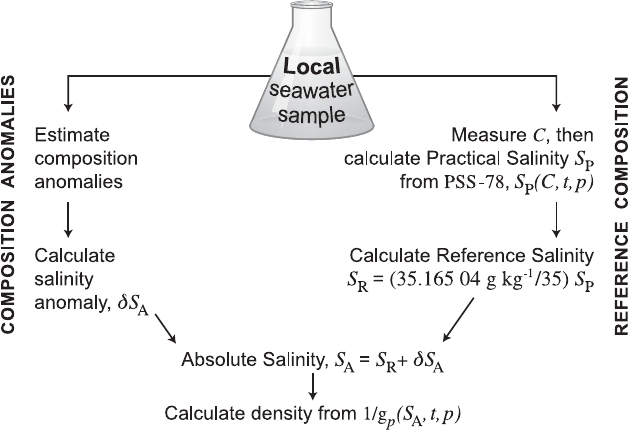
Figure1.Asketchindicatinghowthermodynamicquantities
suchasdensityarecalculatedasfunctionsofAbsoluteSalinity.
AbsoluteSalinityisfoundbyaddinganestimateofthe
AbsoluteSalinityAnomalyA
S
δ
totheReferenceSalinity.
14 TEOS-10 Manual: Calculation and use of the thermodynamic properties of seawater
IOC Manuals and Guides No. 56
Sincethedensityofseawaterisrarelymeasured,werecommendtheapproach
illustratedinFigure1asapracticalmethodtoincludetheeffectsofcomposition
anomaliesonestimatesofAbsoluteSalinityanddensity.Whencompositionanomalies
arenotknown,thealgorithmofMcDougalletal.(2010a)maybeusedtoestimateAbsolute
SalinityintermsofPracticalSalinityandthespatiallocationofthemeasurementinthe
worldoceans.
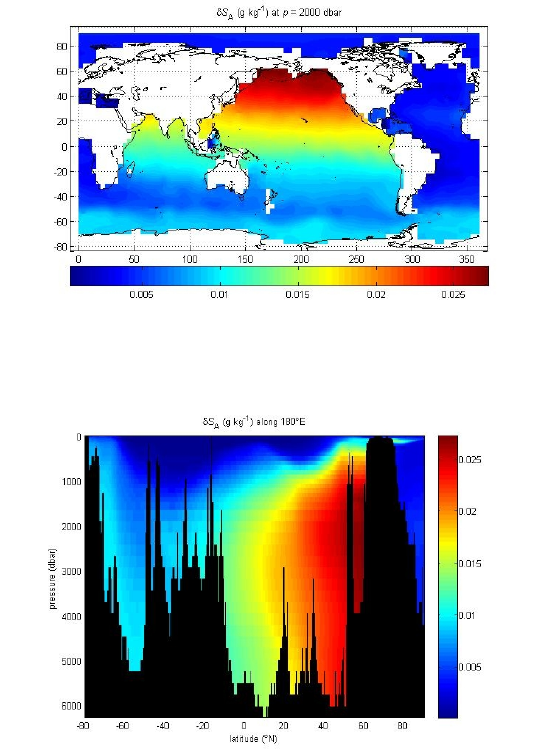
ThedifferencebetweenAbsoluteSalinityandReferenceSalinity,asestimatedbythe
McDougalletal.(2010a)algorithm,isillustratedinFigure2(a)atapressureof2000dbar,
andinaverticalsectionthroughthePacificOceaninFigure2(b).
Oftheapproximately800samplesofseawaterfromtheworldoceanthathavebeen
examinedtodateforAAR
SSS
δ
=−thestandarderror(squarerootofthemeansquared
value)ofAAR
SSS
δ
=−is0.0107gkg‐1.Thatis,the“typical”valueofAAR
SSS
δ
=−ofthe
811samplestakentodateis0.0107gkg‐1.Thestandarderrorofthedifferencebetweenthe
measuredvaluesofAAR
SSS
δ
=−andthevaluesevaluatedfromthecomputeralgorithm
ofMcDougalletal.(2010a)is0.0048gkg‐1.ThemaximumvaluesofAAR
SSS
δ
=−of
approximately0.025gkg‐1occurintheNorthPacific.
Figure2(a).AbsoluteSalinityAnomalyA
S
δ
atp=2000dbar.
Figure2(b).AverticalsectionofAbsoluteSalinity
AnomalyA
S
δ
along180oEinthePacificOcean.
The thermodynamic description of seawater and of ice Ih as defined in IAPWS-08 and
IAPWS-06 has been adopted as the official description of seawater and of ice Ih by the
Intergovernmental Oceanographic Commission in June 2009. These thermodynamic

TEOS-10 Manual: Calculation and use of the thermodynamic properties of seawater
IOC Manuals and Guides No. 56
15
descriptions of seawater and ice were endorsed recognizing that the techniques for
estimating Absolute Salinity will likely improve over the coming decades. The algorithm
for evaluating Absolute Salinity in terms of Practical Salinity, latitude, longitude and
pressure, will likely be updated from time to time, after relevant appropriately peer-
reviewed publications have appeared, and such an updated algorithm will appear on the
www.TEOS-10.org web site. Users of this software should state in their published work
which version of the software was used to calculate Absolute Salinity.
ThepresentcomputersoftwarewhichevaluatesAbsoluteSalinityA
Sgiventheinput
variablesPracticalSalinity P
S,longitude
λ
,latitude
φ
andpressureisavailableat
www.TEOS‐10.org.AbsoluteSalinityisalsoavailableastheinversefunctionofdensity
()
A,,STP
ρ
intheSIAlibraryofcomputeralgorithmsasthealgorithmsea_sa_si(see
appendixM)andintheGSWToolboxasthealgorithmgsw_SA_from_rho.
2.6Gibbsfunctionofseawater
TheGibbsfunctionofseawater
(
)
A,,
g
Stpisrelatedtothespecificenthalpyhand
entropy,
η
by
()
0
g
hTt
η
=− + where0273.15KT
=
istheCelsiuszeropoint.TEOS‐10
definestheGibbsfunctionofseawaterasthesumofapurewaterpartandthesalinepart
(IAPWS‐08)
()
(
)
(
)
WS
AA
,, , ,,
g
S tp g tp g S tp=+ .(2.6.1)
ThesalinepartoftheGibbsfunction,S,
g
isvalidovertheranges0<A
S<42gkg–1,
–6.0°C<t<40°C,and4
0< 10 dbarp<,althoughitsthermalandcolligativeproperties
arevaliduptot=80°CandA
S=120gkg–1atp=0.
Thepure‐waterpartoftheGibbsfunction,W,
g
canbeobtainedfromtheIAPWS‐95
Helmholtzfunctionofpure‐watersubstancewhichisvalidfromthefreezingtemperature
orfromthesublimationtemperatureto1273K.Alternatively,thepure‐waterpartofthe
GibbsfunctioncanbeobtainedfromtheIAPWS‐09Gibbsfunctionwhichisvalidinthe
oceanographicrangesoftemperatureandpressure,fromlessthanthefreezing
temperatureofseawater(atanypressure),upto40 C°(specificallyfrom
()
1
0
(2.65 0.0743 MPa ) CpP −
−++× °
to40°C),andinthepressurerange4
0 < 10 dbarp<.
ForpracticalpurposesinoceanographyitisexpectedthatIAPWS‐09willbeusedbecause
itexecutesapproximatelytwoordersofmagnitudefasterthantheIAPWS‐95codefor
purewater.Howeverifoneisconcernedwithtemperaturesbetween40 C°and80 C°
thenonemustusetheIAPWS‐95versionofW
g
(expressedintermsofabsolute
temperature(K)andabsolutepressure(Pa))ratherthantheIAPWS‐09version.
ThethermodynamicpropertiesderivedfromtheIAPWS‐95(theReleaseprovidingthe
Helmholtzfunctionformulationforpurewater)andIAPWS‐08(theReleaseendorsingthe
Feistel(2008)Gibbsfunction)combinationareavailablefromtheSIAsoftwarelibrary,
whilethatderivedfromtheIAPWS‐09(theReleaseendorsingthepurewaterpartof
Feistel(2003))andIAPWS‐08combinationareavailablefromtheGSWOceanographic
Toolbox.TheGSWToolboxisrestrictedtotheoceanographicstandardrangein
temperatureandpressure,howeverthevalidityofresultsextendsatp=0toAbsolute
Salinityuptomineralsaturationconcentrations(Marionetal.2009).Specificvolume
(whichisthepressurederivativeoftheGibbsfunction)ispresentlyanextrapolated
quantityoutsidetheNeptunianrange(i.e.theoceanographicrange)oftemperatureand
AbsoluteSalinityatp=0,andexhibitserrorsthereofupto3%.Weemphasizethat
modelsofseawaterpropertiesthatuseasinglesalinityvariable,A,Sasinputrequire
approximatelyfixedchemicalcompositionratios(e.g.,Na/Cl,Ca/Mg,Cl/HCO3,etc.).As
seawaterevaporatesorfreezes,eventuallymineralssuchasCaCO3willprecipitate.Small
anomaliesarereasonablyhandledbyusingA
Sastheinputvariable(seesection2.5)but
16 TEOS-10 Manual: Calculation and use of the thermodynamic properties of seawater
IOC Manuals and Guides No. 56
precipitationmaycauselargedeviationsfromthenearlyfixedratiosassociatedwith
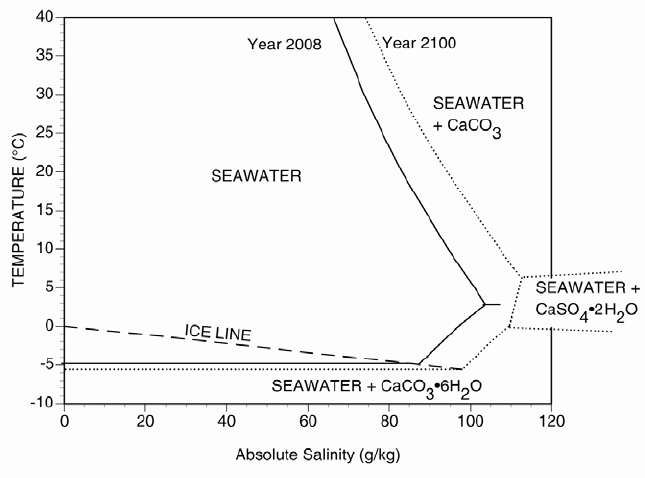
standardseawater.Underextremeconditionsofprecipitation,modelsofseawaterbased
ontheMilleroetal.(2008a)ReferenceCompositionwillnolongerbeapplicable.Figure3
illustratesA
St−boundariesofvalidity(determinedbytheonsetofprecipitation)for2008
(pCO2=385atm
μ
)and2100(pCO2=550atm
μ
)(fromMarionetal.(2009)).
Figure3.TheboundariesofvalidityoftheMilleroetal.(2008a)
compositionatp=0inYear2008(solidlines)andpotentially
inYear2100(dashedlines).Athighsalinity,calciumcarbonate
saturatesfirstandcomesoutofsolution;thereafterthe
ReferenceCompositionofStandardSeawaterofMilleroetal.
(2008a)doesnotapply.
TheGibbsfunction(2.6.1)containsfourarbitraryconstantsthatcannotbedetermined
byanysetofthermodynamicmeasurements.Thesearbitraryconstantsmeanthatthe
Gibbsfunction(2.6.1)isunknownandunknowableuptothearbitraryfunctionof
temperatureandAbsoluteSalinity(where0
TistheCelsiuszeropoint,273.15K)
()
(
)
120 340 A
aaTt aaTtS
⎡⎤⎡⎤
+++++
⎣⎦⎣⎦
(2.6.2)
(seeforexampleFofonoff(1962)andFeistelandHagen(1995)).Thefirsttwocoefficients
1
aand2
aarearbitraryconstantsofthepurewaterGibbsfunction
()
W,
g
tpwhilethe
secondtwocoefficients3
aand4
aarearbitrarycoefficientsofthesalinepartoftheGibbs
function
()
S
A,, .
g
StpFollowinggenerallyacceptedconvention,thefirsttwocoefficients
arechosentomaketheentropyandinternalenergyofliquidwaterzeroatthetriplepoint
(
)
W
tt
,0tp
η
=
(2.6.3)
and
(
)
W
tt
,0utp
=
(2.6.4)
asdescribedinIAPWS‐95andinmoredetailinFeisteletal.(2008a)fortheIAPWS‐95
Helmholtzfunctiondescriptionofpurewatersubstance.Whenthepure‐waterGibbs
function
()
W,
g
tpof(2.6.1)istakenfromthefittedGibbsfunctionofFeistel(2003),thetwo
arbitraryconstants1
aand2
aare(intheappropriatenon‐dimensionalform)00
g
and10
g
ofthetableinappendixGbelow.Thesevaluesof00
g
and10
g
arenotidenticaltothe
valuesinFeistel(2003)becausethepresentvalueshavebeentakenfromIAPWS‐09and
TEOS-10 Manual: Calculation and use of the thermodynamic properties of seawater
IOC Manuals and Guides No. 56
17
havebeenchosentomostaccuratelyachievethetriple‐pointconditions(2.6.3)and(2.6.4)
asdiscussedinFeisteletal.(2008a).
Theremainingtwoarbitraryconstants3
aand4
aof(2.6.2)aredeterminedbyensuring
thatthespecificenthalpyhandspecificentropy
η
ofasampleofstandardseawaterwith
standard‐oceanproperties1
SO SO SO
( , , ) (35.165 04 g kg , 0 C, 0 dbar)Stp −
=°arebothzero,
thatisthat
()
SO SO SO
,, 0hS t p
=
(2.6.5)
and
()
SO SO SO
,, 0.Stp
η
=
(2.6.6)
Inmoredetail,theseconditionsareactuallyofficiallywrittenas(Feistel(2008),IAPWS‐08)
(
)
(
)
(
)
SWW
SO SO SO t t SO SO
,, , ,hS t p u tp h t p=− (2.6.7)
and
(
)
(
)
(
)
SWW
SO SO SO t t SO SO
,, , ,Stp tp tp
ηηη
=− .(2.6.8)
Writteninthisway,(2.6.7)and(2.6.8)usepropertiesofthepurewaterdescription(the
right‐handsides)toconstrainthearbitraryconstantsinthesalineGibbsfunction.While
thefirsttermsontheright‐handsidesoftheseequationsarezero(see(2.6.3)and(2.6.4)),
theseconstraintsonthesalineGibbsfunctionarewrittenthiswaysothattheyare
independentofanysubsequentchangeinthearbitraryconstantsinvolvedinthe
thermodynamicdescriptionofpurewater.Whilethetwoslightlydifferent
thermodynamicdescriptionsofpurewater,namelyIAPWS‐95andIAPWS‐09,both
achievezerovaluesoftheinternalenergyandentropyatthetriplepointofpurewater,
thevaluesassignedtotheenthalpyandentropyofpurewateratthetemperatureand
pressureofthestandardocean,
(
)
W
SO SO
,htpand
(
)
W
SO SO
,tp
η
ontheright‐handsidesof
(2.6.7)and(2.6.8),areslightlydifferentinthetwocases.Forexample
()
W
SO SO
,htpis
3
3.3 10x−1
Jkg
−fromIAPWS‐09(asdescribedinthetableofappendixG)comparedwith
theround‐offerrorof8
210x−1
Jkg
−
whenusingIAPWS‐95withdouble‐precision
arithmetic.Thisissuesisdiscussedinmoredetailinsection3.3.
ThepolynomialformandthecoefficientsforthepurewaterGibbsfunction
()
W,
g
tp
fromFeistel(2003)andIAPWS‐09aregiveninappendixG,whilethecombined
polynomialandlogarithmicformandthecoefficientsforthesalinepartoftheGibbs
function
()
S
A,,
g
Stp(fromFeistel(2008)andIAPWS‐08)arereproducedinappendixH.
SCOR/IAPSOWorkingGroup127hasindependentlycheckedthattheGibbsfunctions
ofFeistel(2003)andofFeistel(2008)doinfactfittheunderlyingdataofvarious
thermodynamicquantitiestotheaccuracyquotedinthosetwofundamentalpapers.This
checkingwasperformedbyGilesM.Marion,andissummarizedinappendixO.Further
checkingoftheseGibbsfunctionshasoccurredintheprocessleadinguptoIAPWS
approvingtheseGibbsfunctionformulationsastheReleasesIAPWS‐08andIAPWS‐09.
DiscussionsofhowwelltheGibbsfunctionsofFeistel(2003)andFeistel(2008)fitthe
underlying(laboratory)dataofdensity,soundspeed,specificheatcapacity,temperature
ofmaximumdensityetcmaybefoundinthosepapers,alongwithcomparisonswiththe
correspondingalgorithmsofEOS‐80.TheIAPWS‐09releasediscussestheaccuracyto
whichtheFeistel(2003)Gibbsfunctionfitstheunderlyingthermodynamicpotentialof
IAPWS‐95;insummary,forthevariablesdensity,thermalexpansioncoefficientand
specificheatcapacity,thermsmisfitbetweenIAPWS‐09andIAPWS‐95,intheregionof
validityofIAPWS‐09,areafactorofbetween20and100lessthanthecorrespondingerror
inthelaboratorydatatowhichboththermodynamicpotentialswerefitted.Hence,inthe
oceanographicrangeofparameters,IAPWS‐09andIAPWS‐95mayberegardedasequally
accuratethermodynamicdescriptionsofpureliquidwater.
TheGibbsfunction
g
hasunitsof1
Jkg
−
inboththeSIAandGSWsoftwarelibraries.

18 TEOS-10 Manual: Calculation and use of the thermodynamic properties of seawater
IOC Manuals and Guides No. 56
2.7Specificvolume
ThespecificvolumeofseawatervisgivenbythepressurederivativeoftheGibbs
functionatconstantAbsoluteSalinityA
Sandinsitutemperature,tthatis
()
A
A,
,, .
PST
vvStpg gP===∂∂(2.7.1)
NoticethatspecificvolumeisafunctionofAbsoluteSalinityA
SratherthanofReference
SalinityR
SorPracticalSalinityP.STheimportanceofthispointisdiscussedinsection
2.8.Whenderivativesaretakenwithrespecttoinsitutemperature,oratconstantinsitu
temperature,thesymboltisavoidedasitcanbeconfusedwiththesamesymbolfortime.
Rather,weuseTinplaceoftintheexpressionsforthesederivatives.
Formanytheoreticalandmodelingpurposesinoceanographyitisconvenientto
regardtheindependenttemperaturevariabletobepotentialtemperature
θ
or
ConservativeTemperatureΘratherthaninsitutemperature.tWenoteherethatthe
specificvolumeisequaltothepressurederivativeofspecificenthalpyatfixedAbsolute
Salinitywhenanyoneof,
η
θ
orΘisalsoheldconstant,asfollows(fromappendixA.11)
AA A
,, ,
.
SS S
hP hP hP v
ηθ
Θ
∂∂ =∂∂ =∂∂ = (2.7.2)
Theuseof
P
intheseequationsemphasizesthatitmustbeinPa notdbar. Specific
volumevhasunitsof31
mkg
−inboththeSIAandGSWsoftwarelibraries.
2.8Density
Thedensityofseawater
ρ
isthereciprocalofthespecificvolume.Itisgivenbythe
reciprocalofthepressurederivativeoftheGibbsfunctionatconstantAbsoluteSalinityA
S
andinsitutemperature,tthatis
()()
(
)
A
1
1
A,
,, .
PST
Stp g gP
ρρ
−
−
===∂∂(2.8.1)
NoticethatdensityisafunctionofAbsoluteSalinityA
SratherthanofReferenceSalinity
R
SorPracticalSalinityP.SThisisanextremelyimportantpointbecauseAbsolute
SalinityA
Sinunitsof1
gkg
−isnumericallygreaterthanPracticalSalinitybybetween
0.1651
gkg
−and0.1951
gkg
−intheopenoceansothatifPracticalSalinitywere
inadvertentlyusedasthesalinityargumentforthedensityalgorithm,asignificantdensity
errorofbetween3
0.12 kg m−and3
0.15 kg m
−
wouldresult.
Formanytheoreticalandmodelingpurposesinoceanographyitisconvenientto
regarddensitytobeafunctionofpotentialtemperature
θ
orConservativeTemperature
Θratherthanofinsitutemperature.tThatis,itisconvenienttoformthefollowingtwo
functionalformsofdensity,
()
(
)
AA
ˆ
,, , , ,Sp Sp
ρρ θ ρ
==Θ
(2.8.2)
where
θ
andΘarerespectivelypotentialtemperatureandConservativeTemperature,
bothreferencedtor0dbar.p=Wewilladopttheconvention(seeTableL.2inappendix
L)thatwhenenthalpy,hspecificvolumevordensity
ρ
aretakentobefunctionsof
potentialtemperaturetheyattractanover‐tildeasinv
or,
ρ
andwhentheyaretakento
befunctionsofConservativeTemperaturetheyattractacaretasinˆ
vandˆ.
ρ
Withthis
convention,expressionsinvolvingpartialderivativessuchas(2.7.2)canbewrittenmore
compactlyas(fromappendixA.11)
1
ˆ
PPP
hhh v
ρ
−
== ==
(2.8.3)
sincetheothervariablesaretakentobeconstantduringthepartialdifferentiation.
AppendixPlistsexpressionsformanythermodynamicvariablesintermsofthe
thermodynamicpotentials

TEOS-10 Manual: Calculation and use of the thermodynamic properties of seawater
IOC Manuals and Guides No. 56
19
()
A,,hhS p
η
=
,
(
)
A,,hhS p
θ
=and
(
)
A
ˆ,, .
hhS p=Θ
(2.8.4)
Density
ρ
hasunitsof3
kg m−inboththeSIAandGSWsoftwarelibraries.
Computationallyefficientexpressionsfor
(
)
A
ˆ,,
Sp
ρ
Θand
(
)
A,,Sp
ρθ
involving25
coefficientsareavailable(McDougalletal.(2010b))andaredescribedinappendixA.30
andappendixK.Theseexpressionscanbeintegratedwithrespecttopressuretoprovide
closedexpressionsfor
(
)
A
ˆ,,
hS pΘand
(
)
A,,hS p
θ
(seeEqn.(A.30.6)).
2.9Chemicalpotentials
Asforanytwo‐componentthermodynamicsystem,theGibbsenergy,,Gofaseawater
samplecontainingthemassofwaterW
mandthemassofsaltS
mattemperaturetand
pressurepcanbewrittenintheform(LandauandLifshitz(1959),Alberty(2001),Feistel
(2008))
()
WS
WS W S
,,,Gm m tp m m
μ
μ
=+(2.9.1)
wherethechemicalpotentialsofwaterinseawaterW
μ
andofsaltinseawaterS
μ
are
definedbythepartialderivatives
S
W
W,,mTp
G
m
μ
∂
=∂,and
W
S
S,,
.
mTp
G
m
μ
∂
=∂(2.9.2)
Identifyingabsolutesalinitywiththemassfractionofsaltdissolvedinseawater,
()
AS WS
/Smmm=+(Milleroetal.(2008a)),thespecificGibbsenergy
g
isgivenby
() ()
()
WSW SW
AAAA
WS
,, 1
G
gS tp S S S
mm
μμμ μμ
==−+=+−
+(2.9.3)
andisindependentofthetotalmassofthesample.Notethatthisexpressionfor
g
asthe
sumofawaterpartandasalinepartisnotthesameasthepurewaterandthesalinesplit
in(2.6.1)(W
μ
isthechemicalpotentialofwaterinseawater;itdoesnotcorrespondtoa
purewatersampleasW
g
does).ThisGibbsenergy
g
isusedasthethermodynamic
potentialfunction(Gibbsfunction)forseawater.Theabovethreeequationscanbeusedto
writeexpressionsforW
μ
andS
μ
intermsoftheGibbsfunction
g
as
() ()
S
S
WS
WA
WS A
WAWA
,,
,, Tp Tp
m
mTp
mmg gS g
gm m gS
mSmS
μ
⎡⎤
∂+ ∂∂ ∂
⎣⎦
==++=−
∂∂∂∂
(2.9.4)
andforthechemicalpotentialofsaltinseawater,
() () ()
W
W
WS
SA
WS A
SASA
,,
,,
1
Tp Tp
m
mTp
mmg gS g
gm m g S
mSmS
μ
⎡⎤
∂+ ∂∂ ∂
⎣⎦
==++=+−
∂∂∂∂
(2.9.5)
Therelativechemicalpotential
μ
(commonlycalledthe“chemicalpotentialofseawater”)
followsfrom(2.9.4)and(2.9.5)as
SW
A,
,
Tp
g
S
μμμ
∂
=− =
∂(2.9.6)
anddescribesthechangeintheGibbsenergyofaparcelofseawateroffixedmassifa
smallamountofwaterisreplacedbysaltatconstanttemperatureandpressure.Also,
fromthefundamentalthermodynamicrelation(Eqn.(A.7.1)inappendixA.7)itfollows
thatthechemicalpotentialofseawater
μ
describesthechangeofenthalpydhifat
constantpressureandentropy,asmallmassfractionofwaterisreplacedbysalt,A
d.S
Equations(2.9.4)–(2.9.6)servetodefinethethreechemicalpotentialsintermsofthe

20 TEOS-10 Manual: Calculation and use of the thermodynamic properties of seawater
IOC Manuals and Guides No. 56
Gibbsfunction
g
ofseawater.NotethattheweightsofthesumsthatappearinEqns.
(2.9.1)–(2.9.5)arestrictlythemassfractionsofsaltandofpurewaterinseawater,sothat
foraseawatersampleofanomalouscompositionthesemassfractionswouldbemore
accuratelygivenintermsofsoln
A
Sthanbydens
AA
SS≡.Inthisregard,theGibbsenergyin
Eqn.(2.9.1)shouldstrictlybetheweightedsumofthechemicalpotentialsofallthe
constituentsinseawater.However,practicallyspeaking,thevapourpressure,thelatent
heatandthefreezingtemperatureareallratherweaklydependentonsalinity,andhence
theuseofA
Sinthissectionisrecommended.
TheSIAcomputersoftwarelibrary(appendixM)predominantlyusesbasicSIunits,so
thatA
Shasunitsof1
kg kg−andS
,,g
μ
μ
andW
μ
allhaveunitsof1
Jkg .
−IntheGSW
OceanographicToolbox(appendixN)A
Shasunitsof1
gkg
−
whileS
,
μ
μ
andW
μ
allhave
unitsof1
Jg .
−Thisadoptionofoceanographic(i.e.non‐basic‐SI)unitsforA
Smeansthat
specialcareisneededinevaluatingequationssuchas(2.9.3)and(2.9.5)whereintheterm
()
A
1S−itisclearthatA
Smusthaveunitsof1
kg kg
−
.Theadoptionofnon‐basic‐SIunits
iscommoninoceanography,butoftencausessomedifficultiessuchasthis.
2.10Entropy
Thespecificentropyofseawater
η
isgivenby
()
A
A,
,, .
TSp
Stp g gT
ηη
==−=−∂∂(2.10.1)
Whentakingderivativeswithrespecttoinsitutemperature,thesymbolTwillbeusedfor
temperatureinorderthatthesederivativesnotbeconfusedwithtimederivatives.
Entropy
η
hasunitsof11
Jkg K
−−
inboththeSIAandGSWsoftwarelibraries.
2.11Internalenergy
Thespecificinternalenergyofseawateruisgivenby(where0
TistheCelsiuszeropoint,
273.15Kand0101 325PaP=isthestandardatmospherepressure)
()()() () ()
AA
A000 0
,,
,, .
Sp ST
gg
uuStp gTt pPv gTt pP
TP
η
∂∂
==++−+=−+−+
∂∂
(2.11.1)
Thisexpressionisanexamplewheretheuseofnon‐basicSIunitspresentsaproblem,
becauseintheproduct
()
0
pPv−+ ,
(
)
0
pP P
+
=mustbeinPaifspecificvolumehasits
regularunitsof31
mkg
−:‐hencehereseapressurepmustbeexpressedinPa .Also,the
pressurederivativeinEqn.(2.11.1)mustbedonewithrespecttopressureinPa .
Specificinternalenergyuhasunitsof1
Jkg
−
inboththeSIAandGSWsoftware
libraries.
2.12Enthalpy
Thespecificenthalpyofseawaterhisgivenby
()() ()
A
A00
,
,, .
Sp
g
hhStp gTt gTtT
η
∂
==++=−+
∂(2.12.1)
Specificenthalpyhhasunitsof1
Jkg
−
inboththeSIAandGSWsoftwarelibraries.
TEOS-10 Manual: Calculation and use of the thermodynamic properties of seawater
IOC Manuals and Guides No. 56
21
2.13Helmholtzenergy
ThespecificHelmholtzenergyofseawater
f
isgivenby
( ) () ()
A
A00
,
,, .
ST
g
f fStp g pPv g pP P
∂
==−+=−+
∂(2.13.1)
Thisexpressionisanotherexamplewheretheuseofnon‐basicSIunitspresentsaproblem,
becauseintheproduct
()
0
pPv−+ ,pmustbeinPaifspecificvolumehasitsregularunitsof
31
mkg .
−ThespecificHelmholtzenergy
f
hasunitsof1
Jkg
−
inboththeSIAandGSW
computersoftwarelibraries.
2.14Osmoticcoefficient
Theosmoticcoefficientofseawater
φ
isgivenby
() ()
()
1
S
AASW0
A,
,, .
Tp
g
Stp g S mRT t
S
φφ
−
⎛⎞
∂
⎜⎟
==−− +
⎜⎟
∂
⎝⎠
(2.14.1)
Theosmoticcoefficientofseawaterdescribesthechangeofthechemicalpotentialofwater
permoleofaddedsalt,expressedasmultiplesofthethermalenergy,
()
0
RT t+(Millero
andLeung(1976),FeistelandMarion(2007),Feistel(2008)),
()
(
)
(
)
WW
ASW0
0, , , ,tp S tp m RT t
μ
μφ
=++.(2.14.2)
Here,R=8.31447211
Jmol K
−−
istheuniversalmolargasconstant.ThemolalitySW
mis
thenumberofdissolvedmolesofsolutes(ions)oftheReferenceCompositionasdefined
byMilleroetal.(2008a),perkilogramofpurewater.Notethatthemolalityofseawater
maytakedifferentvaluesifneutralmoleculesofsaltratherthanionsarecounted(seethe
discussiononpage519ofFeistelandMarion(2007)).Thefreezing‐pointlowering
equations(3.33.1,3.33.2)orthevapour‐pressureloweringcanbecomputedfromthe
osmoticcoefficientofseawater(seeMilleroandLeung(1976),Bromleyetal.(1974)).
2.15Isothermalcompressibility
ThethermodynamicquantitiesdefinedsofarareallbasedontheGibbsfunctionitselfand
itsfirstderivatives.Theremainingquantitiesdiscussedinthissectionallinvolvehigher
orderderivatives.
Theisothermalandisohalinecompressibilityofseawatert
κ
isdefinedby
()
AA
11
A
,,
,,
tt
P
P
P
ST ST
vg
Stp v
P
Pg
ρ
κκ ρ
−−
∂∂
===−=−
∂∂ (2.15.1)
wherethesecondderivativeof
g
istakenwithrespecttopressure(inPa )atconstantA
S
and.tTheuseof
P
inthepressurederivativesinEqn.(2.15.1)servestoemphasizethat
thesederivativesmustbetakenwithrespecttopressureinPa notindbar .The
isothermalcompressibilityofseawatert
κ
producedbyboththeSIAandGSWcomputer
softwarelibraries(appendicesMandN)hasunitsof1
Pa .
−

22 TEOS-10 Manual: Calculation and use of the thermodynamic properties of seawater
IOC Manuals and Guides No. 56
2.16Isentropicandisohalinecompressibility
WhentheentropyandAbsoluteSalinityareheldconstantwhilethepressureischanged,
theisentropicandisohalinecompressibility
κ
isobtained:
()
()
AAAA
1111
A
,,,,
2
,,
.
SSSS
TP TT PP
PTT
v
Stp v
PPPP
ggg
gg
ηηθ
ρρρ
κκ ρ ρ ρ
−−−−
Θ
∂∂∂∂
== =−= =
∂∂∂∂
−
=
(2.16.1)
Theisentropicandisohalinecompressibility
κ
issometimescalledsimplytheisentropic
compressibility(orsometimesthe“adiabaticcompressibility”),ontheunstated
understandingthatthereisalsonotransferofsaltduringtheisentropicoradiabatic
changeinpressure.Theisentropicandisohalinecompressibilityofseawater
κ
produced
byboththeSIAandGSWsoftwarelibraries(appendicesMandN)hasunitsof1
Pa .
−
2.17Soundspeed
Thespeedofsoundinseawatercisgivenby
() ()
(
)
A
12
A,
,, .
PTT TP TTPP
S
ccStp P gg g gg
η
ρρκ
−
==∂∂== −
(2.17.1)
NotethatintheseexpressionsinEqn.(2.17.1),sincesoundspeedisin1
ms
−anddensity
hasunitsof3
kg m−itfollowsthatthepressureofthepartialderivativesmustbeinPaand
theisentropiccompressibility
κ
musthaveunitsof1
Pa
−
.Thesoundspeedcproduced
byboththeSIAandtheGSWsoftwarelibraries(appendicesMandN)hasunitsof1
ms
−.
2.18Thermalexpansioncoefficients
Thethermalexpansioncoefficientt
α
withrespecttoinsitutemperature,tis
()
AA
A
,,
11
,, .
tt TP
P
Sp Sp
vg
Stp TvT g
ρ
αα ρ
∂∂
==−==
∂∂ (2.18.1)
Thethermalexpansioncoefficient
θ
α
withrespecttopotentialtemperature,
θ
is(see
appendixA.15)
()
(
)
AA
Ar
Ar
,,
,,
11
,, , ,
TT
TP
PTT
Sp Sp
gS p
vg
Stpp vgg
θθ
θ
ρ
αα ρθ θ
∂∂
==−==
∂∂ (2.18.2)
wherer
pisthereferencepressureofthepotentialtemperature.TheTT
g
derivativeinthe
numeratorisevaluatedat
()
Ar
,,Sp
θ
whereastheotherderivativesareallevaluatedat
()
A,, .Stp
Thethermalexpansioncoefficient
α
Θ
withrespecttoConservativeTemperature,Θis
(seeappendixA.15)
() ()
AA
0
A
0
,,
11
,, .
p
TP
PTT
Sp Sp
c
vg
Stp vgTg
ρ
αα ρθ
ΘΘ ∂∂
==−==−
∂Θ ∂Θ + (2.18.3)
NotethatConservativeTemperature
Θ
isdefinedonlywithrespecttoareference
pressureof0dbarsothatthe
θ
inEqn.(2.18.3)isthepotentialtemperaturewith
0dbar.
r
p=Allthederivativesontheright‐handsideofEqn.(2.18.3)areevaluatedat
()
A,, .StpTheconstant0
p
cisdefinedinEqn.(3.3.3)below.
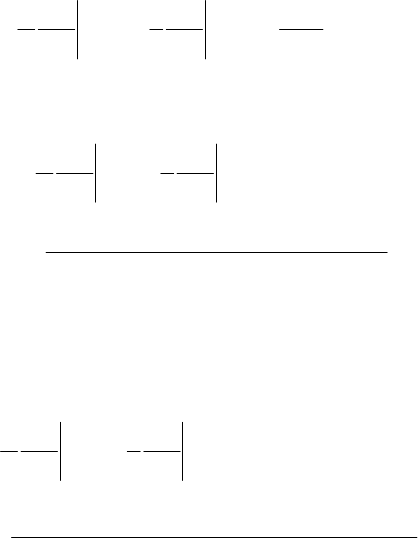
TEOS-10 Manual: Calculation and use of the thermodynamic properties of seawater
IOC Manuals and Guides No. 56
23
2.19Salinecontractioncoefficients
Thesalinecontractioncoefficientt
β
(sometimesalsocalledthehalinecontraction
coefficient)atconstantinsitutemperature,tis
()
A
A
AA
,,
11
,, .
SP
tt
P
Tp Tp
g
v
Stp SvS g
ρ
ββ ρ
∂∂
===−=−
∂∂ (2.19.1)
Thesalinecontractioncoefficient
θ
β
atconstantpotentialtemperature,
θ
is(see
appendixA.15)
()
()
AA A
Ar
AA
,,
Ar
11
,, ,
,, ,
pp
TP ST ST TT SP
PTT
v
Stpp SvS
gg gg
gSp
gg
θθ
θθ
ρ
ββ ρ
θ
∂∂
===−
∂∂
⎡⎤
−−
⎣⎦
=
(2.19.2)
wherer
pisthereferencepressureof.
θ
OneoftheA
ST
g
derivativesinthenumeratoris
evaluatedat
()
Ar
,,Sp
θ
whereasalltheotherderivativesareevaluatedat
()
A,, .Stp
Thesalinecontractioncoefficient
β
Θ
atconstantConservativeTemperature,Θis(see
appendixA.15)
()
() ( )
AA A
A
AA
,,
1
0A
11
,,
,,0
.
pp
TP S T S TT S P
PTT
v
Stp SvS
gg gg
gT S
gg
ρ
ββ ρ
θθ
ΘΘ
ΘΘ
−
∂∂
===−
∂∂
⎡⎤
−+ −
⎣⎦
=
(2.19.3)
NotethatConservativeTemperature
Θ
isdefinedonlywithrespecttoareference
pressureof0dbarasindicatedinthisequation.TheA
S
g
derivativeinthenumeratoris
evaluatedat
()
A,,0S
θ
whereasalltheotherderivativesareevaluatedat
()
A,, .Stp
IntheSIAcomputersoftware(appendixM)allthreesalinecontractioncoefficientsare
producedinunitsof1
kg kg−whileintheGSWOceanographicToolbox(appendixN)all
threesalinecontractioncoefficientsareproducedinunitsof1
kg g
−
consistentwiththe
preferredoceanographicunitforA
SintheGSWToolboxbeing1
gkg .
−
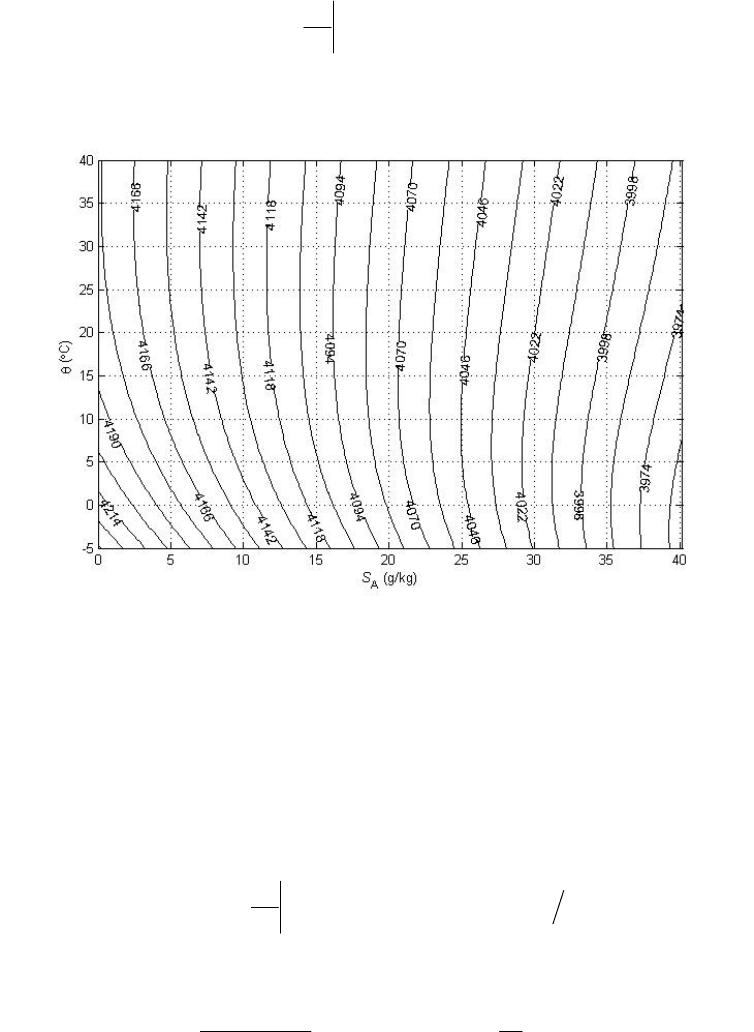
24 TEOS-10 Manual: Calculation and use of the thermodynamic properties of seawater
IOC Manuals and Guides No. 56
2.20Isobaricheatcapacity
Thespecificisobaricheatcapacityp
cistherateofchangeofspecificenthalpywith
temperatureatconstantAbsoluteSalinityA
Sandpressure,psothat
() ()
A
A0
,
,, .
pp TT
Sp
h
ccStp Ttg
T
∂
===−+
∂(2.20.1)
Theisobaricheatcapacityp
cvariesovertheA
S
−
Θplaneatp=0byapproximately5%,
asillustratedinFigure4.
Figure4.Contoursofisobaricspecificheatcapacityp
cofseawater
(in 11
Jkg K
−−
),Eqn.(2.20.1),atp=0.
Theisobaricheatcapacityp
chasunitsof11
Jkg K
−
−inboththeSIAandGSW
computersoftwarelibraries.
2.21Isochoricheatcapacity
Thespecificisochoricheatcapacityv
cistherateofchangeofspecificinternalenergyu
withtemperatureatconstantAbsoluteSalinityA
Sandspecificvolume,,vsothat
() ()
()
A
2
A0
,
,, .
v v TT PP TP PP
Sv
u
ccStp Ttgg g g
T
∂
===−+−
∂(2.21.1)
Notethattheisochoricandisobaricheatcapacitiesarerelatedby
()
()
()
2
0,
t
vp t
Tt
cc
α
ρκ
+
=− andby .
vp
t
cc
κ
κ
=(2.21.2)
Theisochoricheatcapacityv
chasunitsof11
Jkg K
−
−inboththeSIAandGSW
computersoftwarelibraries.

TEOS-10 Manual: Calculation and use of the thermodynamic properties of seawater
IOC Manuals and Guides No. 56
25
2.22Theadiabaticlapserate
TheadiabaticlapserateΓisthechangeofinsitutemperaturewithpressureatconstant
entropyandAbsoluteSalinity,sothat(McDougallandFeistel(2003))
()
(
)
() () () ()
()
AA A
A
AA
2
0
A
,, ,
2
00 00
00 0
A
,
,,
.
,,0
t
TP
TT p
SS Sp
S
p
pp p
Sp S
Tt
tt ghv
Stp PP g P c
TTTT
vh
PcS
cc c
η
θ
α
ηη ρ
θθθαθα
ρθ
ρ
Θ
Θ
+
∂∂ ∂ ∂
Γ=Γ = = = − = = =
∂∂ ∂∂∂
++++
∂∂
====
∂Θ ∂Θ∂
(2.22.1)
Theadiabatic(andisohaline)lapserateiscommonly(andincorrectly)explainedasbeing
proportionaltotheworkdoneonafluidparcelasitsvolumechangesinresponsetoan
increaseinpressure.Accordingtothisexplanationtheadiabaticlapseratewouldincrease
withbothpressureandthefluid’scompressibility,butthisisnotthecase.Rather,the
adiabaticlapserateisproportionaltothethermalexpansioncoefficientandis
independentofthefluid’scompressibility.Indeed,theadiabaticlapseratechangessignat
thetemperatureofmaximumdensitywhereasthecompressibilityandtheworkdoneby
compressionisalwayspositive.McDougallandFeistel(2003)showthattheadiabatic
lapserateisindependentoftheincreaseintheinternalenergythataparcelexperiences
whenitiscompressed.Rather,theadiabaticlapseraterepresentsthatchangein
temperaturethatisrequiredtokeeptheentropy(andalso
θ
and
Θ
)ofaseawaterparcel
constantwhenitspressureischangedinanadiabaticandisohalinemanner.Thereference
pressureofthepotentialtemperature
θ
thatappearsinthelastfourexpressionsinEqn.
(2.22.1)isr0dbar.p=
TheadiabaticlapserateΓoutputofboththeSIAandtheGSWcomputersoftware
librariesisinunitsof1
K Pa−.
26 TEOS-10 Manual: Calculation and use of the thermodynamic properties of seawater
IOC Manuals and Guides No. 56
3.DerivedQuantities
3.1Potentialtemperature
Theveryusefulconceptofpotentialtemperaturewasappliedtotheatmosphereoriginally
byHelmholtz(1888),firstunderthenameof‘heatcontent’,andlaterrenamed‘potential
temperature’(Bezold(1888)).Theseconceptsweretransferredtooceanographyby
Helland‐Hansen(1912).Potentialtemperatureisthetemperaturethatafluidparcel
wouldhaveifitspressurewerechangedtoafixedreferencepressurer
pinanisentropic
andisohalinemanner.Thephrase“isentropicandisohaline”isusedrepeatedlyinthis
document.Tothesetwoqualifiersweshouldreallyalsoadd“withoutdissipationof
mechanicalenergy”.Aprocessthatobeysallthreerestrictionsisathermodynamically
reversibleprocess.Notethatoneoften(falsely)readsthattherequirementofareversible
processisthattheprocessoccursatconstantentropy.Howeverthisstatementis
misleadingbecauseitispossibleforafluidparceltoexchangesomeheatandsomesalt
withitssurroundingsinjusttherightratiosoastokeepitsentropyconstant,butthe
processesisnotreversible(seeEqn.(A.7.1)).
Potentialtemperaturereferredtoreferencepressurer
pisoftenwrittenasthepressure
integraloftheadiabaticlapserate(Fofonoff(1962),(1985))
()
[]
()
r
Ar AA
,, , , ,, , , .
P
P
S tpp t S S tpp p dP
θθ θ
′
′′
==+Γ
∫(3.1.1)
NotethatthispressureintegralneedstobedonewithrespecttopressureexpressedinPa
notdbar .
ThealgorithmthatisusedwiththeTEOS‐10Gibbsfunctionapproachtoseawater
equatesthespecificentropiesoftwoseawaterparcels,onebeforeandtheotherafterthe
isentropicandisohalinepressurechange.Inthisway,
θ
isevaluatedusingaNewton‐
Raphsoniterativesolutiontechniquetosolvethefollowingequationfor
θ
()
(
)
Ar A
,, ,, ,Sp Stp
ηθ η
=(3.1.2)
or,intermsoftheGibbsfunction,,
g
()
(
)
Ar A
,, ,, .
TT
g
Sp gStp
θ
−=−(3.1.3)
ThisrelationisformallyequivalenttoEqn.(3.1.1).IntheGSWOceanographicToolbox
θ
isfoundtomachineprecision(14
10 C
−°∼)intwoiterationsofamodifiedNewton‐Raphson
method,usingasuitableinitialvalueasdescribedbyMcDougalletal.(2010b)..
Notethatthedifferencebetweenthepotentialandinsitutemperaturesisnotdueto
theworkdoneincompressingafluidparcelongoingfromonepressuretoanother:‐the
signofthisworkisofteninthewrongsenseandthemagnitudeisoftenwrongbyafew
ordersofmagnitude(McDougallandFeistel(2003)).Rather,thedifferencebetweenthese
temperaturesiswhatisrequiredtokeeptheentropyconstantduringtheadiabaticand
isohalinepressurechange.Thepotentialtemperature
θ
outputoftheSIAsoftwareisin
unitsofKwhiletheoutputfromtheGSWToolboxisinC°.

TEOS-10 Manual: Calculation and use of the thermodynamic properties of seawater
IOC Manuals and Guides No. 56
27
3.2Potentialenthalpy
Potentialenthalpy0
histheenthalpythatafluidparcelwouldhaveifitspressurewere
changedtoafixedreferencepressurer
pinanisentropicandisohalinemanner.Because
heatfluxesintoandoutoftheoceanoccurmostlyneartheseasurface,thereference
pressureforpotentialenthalpyisalwaystakentober
p=0dbar(thatis,atzerosea
pressure).Potentialenthalpycanbeexpressedasthepressureintegralofspecificvolume
as(fromMcDougall(2003)andseethediscussionbelowEqn.(2.8.2))
()()()()
[]
()
() ( )
() ( )
() ( )
0
0
0
0
00
AA AA AA
AA
AA
AA
,, , ,0 , ,, , ,, , ,
,, , ,
,, , ,
ˆ
,, , , ,
P
P
P
P
P
P
P
P
h S tp hS h S hS tp vS S tpp p dP
hS tp vS p dP
hS tp vS p dP
hS tp vS p dP
θθ θ
η
θ
′′ ′
=== −
′′
=−
′′
=−
′′
=−Θ
∫
∫
∫
∫
(3.2.1)
andweemphasizethatthepressureintegralsheremustbedonewithrespecttopressure
expressedinPa ratherthandbar. IntermsoftheGibbsfunction,potentialenthalpy0
his
evaluatedas
()( )
(
)
(
)
(
)
0
AA A0A
,, ,,0 ,,0 ,,0.
T
hStp hS gS T gS
θθθθ
== −+ (3.2.2)
3.3ConservativeTemperature
ConservativeTemperatureΘisdefinedtobeproportionaltopotentialenthalpy
accordingto
()()
(
)
(
)
0000
AAA A
,, , ,, ,
pp
Stp S hStpc hS c
θθ
Θ=Θ= =
(3.3.1)
wherethevaluethatischosenfor0
p
cismotivatedintermsofpotentialenthalpyevaluated
atanAbsoluteSalinityof1
SO PS
35 35.165 04 g kgSu
−
== andat25 C
θ
=
°by
()()
SO SO 11
,25 C,0 ,0 C,0 3991.867 957 119 63 J kg K ,
(25 K)
hS hS
−
−
⎡⎤
°− °
⎣⎦
≈(3.3.2)
notingthat
()
SO ,0 C,0dbarhS °iszeroaccordingtothewaytheGibbsfunctionisdefined
in(2.6.5).Infactweadopttheexactdefinitionfor0
p
ctobethe15‐digitvaluein(3.3.2),so
that
011
3991.867 957 119 63 J kg K .
p
c
−
−
≡(3.3.3)
WhenIAPWS‐95isusedforthepurewaterpartoftheGibbsfunction,
()
SO ,0 C,0SΘ°and
()
SO ,25 C,0SΘ°differfrom0°Cand25°Crespectivelybytheround‐offamountof
12
510 C.
−
×°WhenIAPWS‐09(whichisbasedonthepaperofFeistel(2003),seeappendix
G)isusedforthepurewaterpartoftheGibbsfunction,
(
)
SO ,0 C,0SΘ°differsfrom0°C
by8
8.25 10 C
−
−× °and
()
SO ,25 C,0SΘ°differsfrom25°Cby6
9.3 10 C.
−
×
°Overthe
temperaturerangefrom0C°to40 C°thedifferencebetweenConservativeTemperature
usingIAPWS‐95andIAPWS‐09asthepurewaterpartisnomorethan5
1.5 10 C
−
±× °,a
temperaturedifferencethatwillbeignored.
Thevalueof0
p
cin(3.3.3)isveryclosetotheaveragevalueofthespecificheatcapacity
p
cattheseasurfaceoftoday’sglobalocean.Thisvalueof0
p
calsocausestheaverage
valueof
θ
−Θattheseasurfacetobeveryclosetozero.Since0
p
cissimplyaconstantof
proportionalitybetweenpotentialenthalpyandConservativeTemperature,itistotally
28 TEOS-10 Manual: Calculation and use of the thermodynamic properties of seawater
IOC Manuals and Guides No. 56
arbitrary,andweseenoreasonwhyitsvaluewouldneedtochangefrom(3.3.3)even
wheninfuturedecadesanimprovedGibbsfunctionofseawaterisagreedupon.
AppendixA.18outlineswhyConservativeTemperaturegetsitsname;itis
approximatelytwoordersofmagnitudemoreconservativecomparedwitheither
potentialtemperatureorentropy.
TheSIAandGSWsoftwarelibrariesbothincludeanalgorithmfordetermining
ConservativeTemperatureΘfromvaluesofAbsoluteSalinityA
Sandpotential
temperature
θ
referencedto0dbarp=.Theselibrariesalsohaveanalgorithmfor
evaluatingpotentialtemperature(referencedto0 dbar )fromA
SandΘ.Thisinverse
algorithm,
()
A
ˆ,S
θ
Θ,hasaninitialseedbasedonarationalfunctionapproximationand
findspotentialtemperaturetomachineprecision(14
10 C
−°∼)inoneandahalfiterationsof
amodifiedNewton‐Raphsontechnique(McDougalletal.(2010b)).
3.4Potentialdensity
Potentialdensity
θ
ρ
isthedensitythatafluidparcelwouldhaveifitspressurewere
changedtoafixedreferencepressurer
pinanisentropicandisohalinemanner.Potential
densityreferredtoreferencepressurer
pcanbewrittenasthepressureintegralofthe
isentropiccompressibilityas
()()
[]
()
[]
()
r
Ar A AA AA
,, , ,, , ,, , , , ,, , , .
P
P
Stpp Stp S Stpp p S Stpp pdP
θ
ρρρθ κθ
′
′′′′
=+
∫(3.4.1)
ThesimplerexpressionforpotentialdensityintermsoftheGibbsfunctionis
()
[
]
()
[
]
(
)
1
Ar AArr AArr
,, , , ,, , , , ,, , , .
P
Stpp S Stpp p g S Stpp p
θ
ρρθ θ
−
== (3.4.2)
Usingeitherofthefunctionalforms(2.8.2)forinsitudensity,thatis,either
()
A,,Sp
ρρ θ
=or
()
A
ˆ,, ,Sp
ρρ
=Θpotentialdensitywithrespecttoreferencepressure
r
p(e.g.1000dbar)canbeeasilyevaluatedas
(
)
(
)
(
)
(
)
(
)
A r A r Ar Ar A r
ˆ
,, , ,, , , , , , , , ,S tpp S tpp S p S p S p
θ
ρρρηρθρ
Θ
====Θ
(3.4.3)
wherewenotethatthepotentialtemperature
θ
inthethirdexpressionisthepotential
temperaturewithrespectto0dbar.Oncethereferencepressureisfixed,potentialdensity
isafunctiononlyofAbsoluteSalinityandConservativeTemperature(orequivalently,of
AbsoluteSalinityandpotentialtemperature).Notethatitisequallycorrecttolabel
potentialdensityas
θ
ρ
or
ρ
Θ(orindeedas
η
ρ
)because
η
,
θ
and
Θ
areconstantduring
theisentropicandisohalinepressurechangefromptor
p;thatis,thesevariablesposses
the“potential”propertyofappendixA.9.
FollowingthediscussionafterEqn.(2.8.2)above,potentialdensitymayalsobe
expressedintermsofthepressurederivativeoftheexpressions
()
A,,hhS p
θ
=and
()
A
ˆ,,hhS p=Θ
forenthalpyas(seealsoappendixP)
()()( ) ( )
1
1
Ar Ar A r A r
ˆ
,, , ,, , , , , , .
PP
Stpp Stpp hS pp hS pp
θ
ρρ θ
−
−
Θ
⎡
⎤
⎡⎤
====Θ=
⎣⎦
⎣
⎦
(3.4.4)
3.5Densityanomaly
Densityanomalyt
σ
isanold‐fashioneddensitymeasurethatisnowseldomused.Itis
thedensityevaluatedattheinsitutemperaturebutatzeroseapressure,minus1000
3
kg m ,
−thatis,
()()
(
)
31 3
AA A
,, ,,0 1000kgm ,,0 1000kgm .
tP
Stp St g St
σρ
−
−−
=− = − (3.5.1)
t
σ
wasusedasanapproximationto
θ
σ
whichavoidedthecomputationaldemandof
evaluating
θ
.Densityanomalyt
σ
isnotprovidedintheTEOS‐10softwarelibraries.

TEOS-10 Manual: Calculation and use of the thermodynamic properties of seawater
IOC Manuals and Guides No. 56
29
3.6Potentialdensityanomaly
Potentialdensityanomaly,
θ
σ
or,
σ
Θ
issimplypotentialdensityminus1000kgm–3,
()()
(
)
()
[]
()
3
Ar Ar Ar
3
Ar
13
AA rr
,, , ,, , ,, , 1000kgm
,, , 1000kgm
,,,,, 1000kgm.
P
Stpp Stpp Stpp
Stpp
gS Stppp
θθ
σσρ
ρ
θ
Θ−
Θ−
−
−
==−
=−
=−
(3.6.1)
Notethatitisequallycorrecttolabelpotentialdensityanomalyas
θ
σ
or
σ
Θbecauseboth
θ
andΘareconstantduringtheisentropicandisohalinepressurechangefromptor.p
3.7Specificvolumeanomaly
Thespecificvolumeanomaly
δ
isdefinedasthedifferencebetweenthespecificvolume
andagivenfunctionofpressure.Traditionally
δ
hasbeendefinedas
(
)( )
(
)
AASO
,, ,, ,0C,Stp vStp vS p
δ
=−°(3.7.1)
(wherethetraditionalvalueofPracticalSalinityof35hasbeenupdatedtoanAbsolute
Salinityof1
SO 35 35.16504 g kg
PS
Su
−
== inthepresentformulation).Notethatthesecond
term,
()
SO ,0 C, ,vS p°isafunctiononlyofpressure.Inordertohaveasurfaceofconstant
specificvolumeanomalymoreaccuratelyapproximateneutraltangentplanes(seesection
3.11),itisadvisabletoreplacetheargumentsSO
Sand0C°withmoregeneralvaluesA
S
andt
thatarecarefullychosen(assaythemedianvaluesofAbsoluteSalinityand
temperaturealongthesurface)sothatthemoregeneraldefinitionofspecificvolume
anomalyis
()()
(
)
()
(
)
AAA A A
,, ,, , , ,, , , .
PP
Stp vStp vStp g Stp gStp
δ
=−= −
(3.7.2)
ThelasttermsinEqns.(3.7.1)and(3.7.2)aresimplyfunctionsofpressureandonehas
thefreedomtochooseanyotherfunctionofpressureinitsplaceandstillretainthe
dynamicalpropertiesofspecificvolumeanomaly.Inparticular,onecanconstructspecific
volumeandenthalpytobefunctionsofConservativeTemperature(ratherthaninsitu
temperature)as
()
A
ˆ,,vS pΘand
(
)
A
ˆ,,hS pΘandwriteaslightlydifferentdefinitionof
specificvolumeanomalyas
()()
(
)
()
(
)
AAA A A
ˆˆ
ˆˆ
,, ,, ,, ,, ,, .
PP
SpvSpvSphSphSp
δ
Θ= Θ− Θ= Θ− Θ
(3.7.3)
Thesamecanalsobedonewithpotentialtemperaturesothatintermsofthespecific
volume
()
A,,vS p
θ
andenthalpy
(
)
A,,hS p
θ
wecanwriteanotherformofthespecific
volumeanomalyas
()()
(
)
()
(
)
AAA A A
,, ,, ,, ,, ,, .
PP
S p vS pvS p hS phS p
δθ θ θ θ θ
=−= −
(3.7.4)
Theseexpressionsexploitthefactthat(seeappendixA.11)
AA A
,, ,
.
SS S
hP hP hP v
ηθ
Θ
∂∂ =∂∂ =∂∂ = (3.7.5)

30 TEOS-10 Manual: Calculation and use of the thermodynamic properties of seawater
IOC Manuals and Guides No. 56
3.8Thermobariccoefficient
Thethermobariccoefficientquantifiestherateofvariationwithpressureoftheratioofthe
thermalexpansioncoefficientandthesalinecontractioncoefficient.Withrespectto
potentialtemperature
θ
thethermobariccoefficientis(McDougall(1987b))
()
()
AA
A
bbA
,,
,
,.
SS
S
TTStp PP P
θθ θθθ
θθ θ
θ
θ
θ
θ
αβ ααβ
ββ
∂∂∂
== =−
∂∂ ∂
(3.8.1)
Thisexpressionforthethermobariccoefficientismostreadilyevaluatedbydifferentiating
anexpressionfordensityexpressedasafunctionofpotentialtemperatureratherthanin
situtemperature,thatis,withdensityexpressedinthefunctionalform
()
A,, .Sp
ρρ θ
=
WithrespecttoConservativeTemperature
Θ
thethermobariccoefficientis
()
()
AA
A
bbA
,,
,
,.
SS
S
TTStp PP P
αβ ααβ
ββ
ΘΘ ΘΘΘ
ΘΘ Θ
Θ
Θ
Θ
Θ
∂∂∂
== =−
∂∂ ∂
(3.8.2)
Thisexpressionforthethermobariccoefficientismostreadilyevaluatedbydifferentiating
anexpressionfordensityexpressedasafunctionofConservativeTemperatureratherthan
insitutemperature,thatis,withdensityexpressedinthefunctionalform
()
A
ˆ,, .Sp
ρρ
=Θ
Thethermobariccoefficiententersvariousquantitiestodowiththepath‐dependent
natureofneutraltrajectoriesandtheill‐definednatureofneutralsurfaces(see(3.13.1)–
(3.13.7)).Thethermobaricdianeutraladvectionassociatedwiththelateralmixingofheat
andsaltalongneutraltangentplanesisgivenbyTb 2
bnn
egNKT P
θ
θ
−
=− ∇ ⋅∇ or
Tb 2
bnn
egNKT P
−Θ
=− ∇Θ⋅∇ wheren
θ
∇
andn
∇
Θarethetwo‐dimensionalgradientsof
eitherpotentialtemperatureorConservativeTemperaturealongtheneutraltangent
plane,n
P
∇isthecorrespondingepineutralgradientofabsolutepressureandKisthe
epineutraldiffusioncoefficient.Notethatthethermobaricdianeutraladvectionis
proportionaltothemesoscaleeddyfluxof“heat”alongtheneutraltangentplane,
0,
pn
cK−∇Θandisindependentoftheamountofsmall‐scale(dianeutral)turbulentmixing
andhenceisalsoindependentofthedissipationofmechanicalenergy
ε
(Klockerand
McDougall(2010a)).ItisshowninappendixA.14belowthatwhiletheepineutral
diffusivefluxesn
K
θ
−∇andn
K−∇Θaredifferent,theproductofthesefluxeswiththeir
respectivethermobariccoefficientsisthesame,thatis,bb
.
nn
TT
θ
θ
Θ
∇
=∇ΘHencethe
thermobaricdianeutraladvectionTb
eisthesamewhetheritiscalculatedas
2
bnn
g
NKT P
θ
θ
−
−∇⋅∇oras2
b.
nn
g
NKT P
−Θ
−∇Θ⋅∇Expressionsfor
b
T
θ
and
b
TΘintermsof
enthalpyinthefunctionalforms
(
)
A,,hS p
θ
and
(
)
A
ˆ,,hS pΘcanbefoundinappendixP.
Interestingly,forgivenmagnitudesoftheepineutralgradientsofpressureand
ConservativeTemperature,thedianeutraladvection,Tb 2
bnn
egNKT P
−Θ
=
−∇Θ⋅∇,of
thermobaricityismaximizedwhenthesegradientsareparallel,whileneutralhelicityis
maximizedwhenthesegradientsareperpendicular,sinceneutralhelicityisproportional
to
()
bnn
TP
Θ∇×∇Θ⋅k(seeEqn.(3.13.2)).
Thisthermobaricverticaladvectionprocess,Tb
e,isabsentfromstandardlayered
oceanmodelsinwhichtheverticalcoordinateisafunctiononlyofA
SandΘ(suchas2,
σ
potentialdensityreferencedto2000dbar).AsdescribedinappendixA.27below,the
isopycnaldiffusionofheatandsaltintheselayeredmodels,causedbybothparameterized
diffusionalongthecoordinateandbyeddy‐resolvedmotions,doesgiverisetothe
cabbelingadvectionthroughthecoordinatesurfacesbutdoesnotallowthethermobaric
velocityTb
ethroughthesesurfaces(KlockerandMcDougall(2010a)).
InboththeSIAandGSWcomputersoftwarelibrariesthethermobaricparameteris
outputinunitsof11
K Pa
−
−.

TEOS-10 Manual: Calculation and use of the thermodynamic properties of seawater
IOC Manuals and Guides No. 56
31
3.9Cabbelingcoefficient
Thecabbelingcoefficientquantifiestherateatwhichdianeutraladvectionoccursasa
resultofmixingofheatandsaltalongtheneutraltangentplane.Withrespecttopotential
temperature
θ
thecabbelingcoefficientis(McDougall(1987b))
()
A
2
bbA
AA
,, ,
,2 .
Sp p p
CCStp SS
θθθθθ
θθ
θθ
θθ
ααααβ
θββ
⎛⎞
∂∂ ∂
==+ −
⎜⎟
∂∂ ∂
⎝⎠ (3.9.1)
Thisexpressionforthecabbelingcoefficientismostreadilyevaluatedbydifferentiatingan
expressionfordensityexpressedasafunctionofpotentialtemperatureratherthaninsitu
temperature,thatis,withdensityexpressedinthefunctionalform
()
A,, .Sp
ρρ θ
=
WithrespecttoConservativeTemperature
Θ
thecabbelingcoefficientis
()
A
2
bbA
AA
,, ,
,2 .
Sp p p
CCStp SS
ααααβ
ββ
ΘΘΘΘΘ
ΘΘ
ΘΘ
ΘΘ
⎛⎞
∂∂ ∂
==+ −
⎜⎟
∂Θ ∂ ∂
⎝⎠ (3.9.2)
Thisexpressionforthecabbelingcoefficientismostreadilyevaluatedbydifferentiatingan
expressionfordensityexpressedasafunctionofConservativeTemperatureratherthanin
situtemperature,thatis,withdensityexpressedinthefunctionalform
()
A
ˆ,, .Sp
ρρ
=Θ
Thecabbelingdianeutraladvectionassociatedwiththelateralmixingofheatandsalt
alongneutraltangentplanesisgivenbyCab 2
bnn
egNKC
−Θ
=
−∇Θ⋅∇Θ(orlessaccuratelyby
Cab 2
bnn
egNKC
θ
θ
θ
−
≈− ∇ ⋅∇ )wheren
θ
∇
andn
∇
Θarethetwo‐dimensionalgradientsof
eitherpotentialtemperatureorConservativeTemperaturealongtheneutraltangentplane
andKistheepineutraldiffusioncoefficient.Thecabbelingdianeutraladvectionis
proportionaltothemesoscaleeddyfluxof“heat”alongtheneutraltangentplane,
,
n
K−∇Θandisindependentoftheamountofsmall‐scale(dianeutral)turbulentmixing
andhenceisalsoindependentofthedissipationofmechanicalenergy(Klockerand
McDougall(2010a)).ItisshowninappendixA.14thatbbnn n n
CC
θ
θθ
Θ
∇
⋅∇ ≠ ∇ Θ⋅∇ Θso
thattheestimateofthecabbelingdianeutraladvectionisdifferentwhencalculatedusing
potentialtemperaturethanwhenusingConservativeTemperature.Theestimateusing
potentialtemperatureisslightlylessaccuratebecauseofthenon‐conservativenatureof
potentialtemperature.
Whenthecabbelingandthermobaricityprocessesareanalyzedbyconsideringthe
mixingoftwofluidparcelsonefindsthatthedensitychangeisproportionaltothesquare
oftheproperty(Θand/orp)contrastsbetweenthetwofluidparcels(forthecabbeling
case,seeEqn.(A.19.4)inappendixA.19).Thisleadstothethoughtthatifanoceanfrontis
splitupintoaseriesofmanysmallerfrontsthentheeffectsofcabbelingand
thermobaricitymightbereducedbyperhapsthesquareofthenumberofsuchfronts.This
isnotthecase.Rather,thetotaldianeutraltransportacrossafrontalregiondependson
theproductofthelateralfluxofheatpassingthroughthefrontandthecontrastin
temperatureand/orpressureacrossthefront,butisindependentofthesharpnessofthe
front(KlockerandMcDougall(2010a)).Thiscanbeunderstoodbynotingfromabovethat
thedianeutralvelocityduetocabbeling,Cab 2
b,
nn
egNKC
−Θ
=
−∇Θ⋅∇Θisproportionaltothe
scalarproductoftheepineutralfluxofheat0
pn
cK
−
∇Θandtheepineutraltemperature
gradientn
∇Θ.Spatiallyintegratingthisproductovertheareaofthefrontalregion,one
findsthatthetotaldianeutraltransportisproportionaltothelateralheatfluxtimesthe
differenceintemperatureacrossthefrontalregion(inthecaseofcabbeling)orthe
differenceinpressureacrossthefrontalregion(inthecaseofthermobaricity).
InboththeSIAandGSWsoftwarelibrariesthecabbelingparameterisoutputinunits
of2
K−.Expressionsfor
b
C
θ
and
b
C
Θ
intermsofenthalpyinthefunctionalforms
()
A,,hS p
θ
and
()
A
ˆ,,hS pΘcanbefoundinappendixP.

32 TEOS-10 Manual: Calculation and use of the thermodynamic properties of seawater
IOC Manuals and Guides No. 56
3.10Buoyancyfrequency
Thesquareofthebuoyancyfrequency(sometimescalledtheBrunt‐Väisäläfrequency)2
N
isgivenintermsoftheverticalgradientsofdensityandpressure,orintermsofthe
verticalgradientsofpotentialtemperatureandAbsoluteSalinity(orintermsofthe
verticalgradientsofConservativeTemperatureandAbsoluteSalinity)by(the
g
onthe
left‐handsideisthegravitationalacceleration,andx,yandzarethespatialCartesian
coordinates)
(
)
12 1 1 2
A,
A,
/
.
zz zz
zxy
zxy
g
NPPc
Sz
Sz
θθ
ρρ κ ρ ρ
αθ β
αβ
−− −
ΘΘ
=− + =− −
=−∂∂
=Θ−∂∂
(3.10.1)
Fortwoseawaterparcelsseparatedbyasmalldistance
z
Δ
inthevertical,anequally
accuratemethodofcalculatingthebuoyancyfrequencyistobringbothseawaterparcels
adiabaticallyandwithoutexchangeofmattertotheaveragepressureandtocalculatethe
differenceindensityofthetwoparcelsafterthischangeinpressure.Inthiswaythe
potentialdensityofthetwoseawaterparcelsarebeingcomparedatthesamepressure.
ThiscommonprocedurecalculatesthebuoyancyfrequencyNaccordingto
2
2,
gg
NzP
ρρ
ρ
ΘΘ
ΔΔ
=− =
ΔΔ
(3.10.2)
where
ρ
Θ
Δisthedifferencebetweenthepotentialdensitiesofthetwoseawaterparcels
withthereferencepressurebeingtheaverageofthetwooriginalpressuresoftheseawater
parcels.ThelastpartofEqn.(3.10.2)hasusedthehydrostaticrelationz
P
g
ρ
=− .
3.11Neutraltangentplane
Theneutralplaneisthatplaneinspaceinwhichthelocalparcelofseawatercanbemoved
aninfinitesimaldistancewithoutbeingsubjecttoaverticalbuoyantrestoringforce;itis
theplaneofneutral‐orzero‐buoyancy.Thenormalvectortotheneutraltangentplanen
isgivenby
(
)
12 1 1 2
A
A
/
.
g
NPPc
S
S
θθ
ρρκ ρ ρ
αθβ
αβ
−− −
ΘΘ
=− ∇ + ∇ =− ∇ −∇
=∇−∇
=∇Θ−∇
n
(3.11.1)
Asdefined,nisnotquiteaunitnormalvector,ratheritsverticalcomponentisexactly,k
thatis,itsverticalcomponentisunity.ItisclearthatA
S
θθ
αθβ
∇
−∇isexactlyequalto
A.S
αβ
ΘΘ
∇Θ − ∇ Interestingly,both
θ
α
θ
∇
andA
S
θ
β
∇
areindependentofthefour
arbitraryconstantsoftheGibbsfunction(seeEqn.(2.6.2))whileboth
α
Θ∇Θ andA
S
β
Θ∇
containanidenticaladditionalarbitrarytermproportionalto3A
aS
∇
;termsthatexactly
cancelintheirdifference,A,S
αβ
ΘΘ
∇Θ − ∇ inEqn.(3.11.1).
Expressingthetwo‐dimensionalgradientofpropertiesintheneutraltangentplaneby
,
n
∇thepropertygradientsinaneutraltangentplaneobey
(
)
112
A
A
/
.
nn nn
nn
nn
P
Pc
S
S
θθ
ρρκ ρ ρ
αθβ
αβ
−−
ΘΘ
−∇+∇ =− ∇−∇
=∇−∇
=∇Θ−∇
=0
(3.11.2)
Heren
∇isanexampleofaprojectednon‐orthogonalgradient

TEOS-10 Manual: Calculation and use of the thermodynamic properties of seawater
IOC Manuals and Guides No. 56
33
0,
rxy
rr
ττ
τ
∂∂
∂∂
∇≡ + +ijk(3.11.3)
thatiswidelyusedinoceanicandatmospherictheoryandmodelling.Horizontal
distancesaremeasuredbetweentheverticalplanesofconstantlatitudexandlongitudey
whilethevaluesoftheproperty
τ
areevaluatedonthersurface(e.g.anisopycnal
surface,orinthecaseofn
∇,aneutraltangentplane).Thiscoordinatesystemisdescribed
bySutcliffe(1947),Bleck(1978),McDougall(1987b),McDougall(1995)andGriffies(2004).
Notethatr
τ
∇hasnoverticalcomponent;itisnotdirectedalongthersurface,butrather
itpointsinexactlythehorizontaldirection.
FinitedifferenceversionsofEqn.(3.11.2)suchasA0S
αβ
ΘΘ
Δ
Θ− Δ ≈ arealsovery
accurate.Here
α
Θand
β
Θarethevaluesofthesecoefficientsevaluatedattheaverage
valuesofA
,SΘandpoftwoparcels
(
)
1
A11
,,SpΘand
(
)
2
A22
,,SpΘona“neutralsurface”
andΔΘ andA
SΔarethepropertydifferencesbetweenthetwoparcels.Theerror
involvedwiththisfiniteamplitudeversionofEqn.(3.11.2),namely
()
2
b
1
,TPPd
Θ
−−Θ
∫(3.11.4)
isdescribedinsection2andappendixA(c)ofJackettandMcDougall(1997).Anequally
accuratefiniteamplitudeversionofEqn.(3.11.2)istoequatethepotentialdensitiesofthe
twofluidparcels,eachreferencedtotheaveragepressure
(
)
12
0.5 .ppp=+
3.12Geostrophic,hydrostaticand“thermalwind”equations
Thegeostrophicapproximationtothehorizontalmomentumequations((B9)below)
equatestheCoriolistermtothehorizontalpressuregradientz
P
∇
sothatthegeostrophic
equationis
z
f
P
ρ
×=−∇ku or 1.
z
f
P
ρ
=×∇vk (3.12.1)
whereuisthethreedimensionalvelocityand
(
)
=
−× ×vkkuisthehorizontalvelocity
wherekistheverticalunitvector(pointingupwards)and
f
istheCoriolisparameter.
Thehydrostaticequationisanapproximationtotheverticalmomentumequation(see
Eqn.(B9)),namely
.
z
P
g
ρ
=
−(3.12.2)
Theuseof
P
intheseequationsratherthanpservestoremindusthatinordertoretain
theusualunitsforheight,densityandthegravitationalacceleration,pressureinthese
dynamicalequationsmustbeexpressedinPa notdbar.
Thesocalled“thermalwind”equationisanequationfortheverticalgradientofthe
horizontalvelocityunderthegeostrophicapproximation.VerticallydifferentiatingEqn.
(3.12.1),usingthehydrostaticequationEqn.(3.12.2)andignoringthetinyterminz
ρ
(whichisofBoussinesqmagnitude),thethermalwindcanbewrittenas
()
2
1,
gN
zzz z n
g
f
PP
ρρρ
ρ
=×∇ =−×∇= ×∇vk k k(3.12.3)
wherez
∇isthegradientoperatorintheexactlyhorizontaldirectionalonggeopotentials,
andthelastpartofthisequationrelatesthe“thermalwind”tothepressuregradientinthe
neutraltangentplane,thatis,effectivelytotheslopeoftheneutraltangentplane(see
McDougall(1995)).

34 TEOS-10 Manual: Calculation and use of the thermodynamic properties of seawater
IOC Manuals and Guides No. 56
3.13Neutralhelicity
Neutraltangentplanes(whichdoexist)donotlinkupinspacetoformawell‐defined
neutralsurfaceunlesstheneutralhelicityn
Hiseverywherezeroonthesurface.Neutral
helicityisdefinedasthescalarproductofthevectorA
S
αβ
ΘΘ
∇
Θ− ∇ withitscurl,
()
(
)
n
AA
HS S
αβ αβ
ΘΘ ΘΘ
≡∇Θ−∇⋅∇×∇Θ−∇(3.13.1)
andthisisproportionaltothethermobariccoefficient
b
T
Θ
oftheequationofstate
accordingto
()
()
()
n
bA
bA
12
b
12
b
zpp
nn
aa
HTPS
PT S
gNT P
gNT P
β
β
ΘΘ
ΘΘ
−Θ
−Θ
=∇⋅∇×∇Θ
=∇×∇Θ⋅
=∇×∇Θ⋅
≈∇×∇Θ⋅
k
k
k
(3.13.2)
wherez
P
issimplytheverticalgradientofpressure(1
Pa m
−
)andn
∇
Θandp
∇Θ
arethe
two‐dimensionalgradientsofΘintheneuraltangentplaneandinthehorizontalplane
(actuallytheisobaricsurface)respectively.Thegradientsa
P
∇
anda
∇
Θaretakeninan
approximatelyneutralsurface.SinceA
S
θθ
αθβ
∇
−∇andA
S
αβ
ΘΘ
∇
Θ− ∇ areexactly
equal,neutralhelicitycanbedefinedinEqn.(3.13.1)asthescalarproductofthisvector
withitscurlbasedoneitherformulation,sothat(fromthethirdlineofEqn.(3.13.2),and
bearinginmindthatn
∇Θandn
θ
∇areparallelvectors)weseethatbb
,
nn
TT
θθ
Θ
∇= ∇Θa
resultthatweuseinsection3.8andinappendixA.14.Neutralhelicityhasunitsof3
m.
−
Becauseofthenon‐zeroneutralhelicityintheocean,lateralmotionfollowingneutral
tangentplaneshasthecharacterofhelicalmotion.Thatis,ifweignoretheeffectsof
diapycnalmixingprocesses(aswellasignoringcabbelingandthermobaricity),themean
flowaroundoceangyresstillpassesthroughanywell‐defined“density”surfacebecause
ofthehelicalnatureofneutraltrajectories,causedinturnbythenon‐zeroneutralhelicity.
Thisdia‐surfaceflowisexpressedinEqns.(A.25.4)and(A.25.6)intermsofthe
appropriatemeanhorizontalvelocityandthedifferencebetweentheslopeoftheneutral
tangentplaneandtheslopeofawell‐defined“density”surface.
Neutralhelicityisproportionaltothecomponentoftheverticalshearofthe
geostrophicvelocity(,
z
vthe“thermalwind”)inthedirectionofthetemperaturegradient
alongtheneutraltangentplane,
n
∇Θsince,fromEqn.(3.12.3)andthethirdlineof(3.13.2)
wefindthat
n
b.
zn
HTf
ρ
Θ
=⋅∇Θv(3.13.3)
Intheevolutionequationofpotentialvorticitydefinedwithrespecttopotential
density
θ
ρ
thereisthebaroclinicproductionterm2p
θ
ρρ ρ
−
∇
⋅∇ ×∇ (Straub(1999))and
thefirstterminaTaylorseriesexpansionforthisbaroclinicproductiontermis
proportionaltoneutralhelicityandisgivenby(McDougallandJackett(2007))
(
)
2n
r
P
PPH
θ
ρρ ρ
−∇⋅∇×∇≈ − (3.13.4)
wherer
P
isthereferencepressureofthepotentialdensity.Similarly,thecurlina
potentialdensitysurfaceofthehorizontalpressuregradientterminthehorizontal
momentumequation,
()
1,
zp
σρ
∇× ∇ isgivenby(McDougallandKlocker(2010))
()
()
1
n
1r.
zPHPPz
σρ
ρ
−
Θ
⎛⎞
∂
∇× ∇ ⋅ = − −
⎜⎟
∂
⎝⎠
k(3.13.5)
Thefactthatthiscurlisnonzeroprovesthatageostrophicstreamfunctiondoesnotexistin
apotentialdensitysurface.
Neutralhelicityn
Halsoarisesinthecontextoffindingaclosedexpressionforthe
meanvelocityintheocean.Thecomponentofthehorizontalvelocityinthedirection

TEOS-10 Manual: Calculation and use of the thermodynamic properties of seawater
IOC Manuals and Guides No. 56
35
alongacontourofΘinaneutraltangentplane,namelythevelocitycomponent
/,
nn
⋅×∇Θ∇Θvk isgivenby(McDougall(1995),Zikaetal.(2010a,2010b))
n
b
,
nz
nz
zn
Hv
fT
φ
φρ
⊥
Θ
∇Θ −
⋅× = +
∇Θ ∇Θ
vk (3.13.6)
sothatthefullexpressionforthehorizontalvelocityis
n
b
.
nn
z
zn n
zn
Hv v
fT
φ
φρ
⊥⊥
Θ
⎧⎫
∇
Θ∇Θ
−
⎪⎪
=+×+
⎨⎬
∇
Θ∇Θ
∇Θ
⎪⎪
⎩⎭
vk
(3.13.7)
Herez
φ
istherateofspiraling(radianspermeter)intheverticaloftheΘcontourson
neutraltangentplanes,andv⊥isthevelocitycomponentacrosstheΘcontouronthe
neutraltangentplane(avelocitycomponentthatresultsfromirreversiblemixing
processes).Neutralhelicityarisesinthiscontextbecauseitisproportionaltothe
componentofthethermalwindvectorz
vinthedirectionacrosstheΘcontouronthe
neutraltangentplane(see(3.13.3)).Thisequation(3.13.7)fortheisopycnally‐averaged
velocityvshowsthatintheabsenceofmixingprocesses(sothat0
z
vv
⊥⊥
=
=)andsolong
as(i)theepineutral
Θ
contoursspiralintheverticaland(ii)n
∇
Θisnotzero,thenneutral
helicityn
Hisrequiredtobenon‐zerointheoceanwhenevertheoceanisnotmotionless.
Interestingly,forgivenmagnitudesoftheepineutralgradientsofpressureand
ConservativeTemperature,neutralhelicityismaximizedwhenthesegradientsare
perpendicularsinceneutralhelicityisproportionalto
(
)
bnn
TP
Θ
∇
×∇ Θ ⋅k(seeEqn.
(3.13.2)),whilethedianeutraladvectionofthermobaricity,Tb 2
bnn
egNKT P
−Θ
=
−∇Θ⋅∇,is
maximizedwhenn
∇Θandn
P
∇areparallel(seesection3.8).
3.14NeutralDensity
NeutralDensityisthenamegiventoadensityvariablethatresultsfromthecomputer
softwaredescribedinJackettandMcDougall(1997).NeutralDensityisgiventhesymbol
n
γ
butitisnotathermodynamicvariableasitisafunctionnotonlyofsalinity,
temperatureandpressure,butalsooflatitudeandlongitude.Becauseofthenon‐zero
neutralhelicityn
Hintheoceanitisnotpossibletoformsurfacesthatareeverywhere
osculatewithneutraltangentplanes(McDougallandJackett(1988)).NeutralDensity
surfacesminimizeinsomesensetheglobaldifferencesbetweentheslopesoftheneutral
tangentplaneandtheNeutralDensitysurface.Thisslopedifferenceisgivenby
(
)
2
A
na a a
zzgN S
βα
−Θ Θ
=∇ −∇ = ∇ − ∇Θs(3.14.1)
wheren
z
∇istheslopeoftheneutraltangentplane,a
z
∇
istheslopeoftheapproximately
neutralsurfaceanda
∇isthetwo‐dimensionalgradientoperatorintheapproximately
neutralsurface(ofwhichaNeutralDensitysurfaceisoneexample).Theverticalvelocity
throughanapproximatelyneutralsurfaceduetolateralmotionalonganeutraltangent
planeisthescalarproduct⋅vswherevisthehorizontalvelocity(seeEqn.(A.25.4)).
SinceNeutralDensityisnotathermodynamicvariable,itwillnotbedescribedmorefully
inthismanual.

36 TEOS-10 Manual: Calculation and use of the thermodynamic properties of seawater
IOC Manuals and Guides No. 56
3.15Stabilityratio
ThestabilityratioR
ρ
istheratiooftheverticalcontributionfromConservative
TemperaturetothatfromAbsoluteSalinitytothestaticstability2
Nofthewatercolumn.
From(3.10.1)abovewefind
() ()
AA
.
zz
zz
RSS
θ
ρθ
ααθ
ββ
Θ
Θ
Θ
=≈
(3.15.1)
3.16Turnerangle
TheTurnerangleTu ,namedafterJ.StewartTurner,isdefinedasthefour‐quadrant
arctangent(Ruddick(1983)andMcDougalletal.(1988),particularlytheirFigure1)
(
)
(
)
()
() ()
()
1
AA
1
AA
tan ,
tan ,
zz
zz
zz
zz
Tu S S
SS
θθ θθ
αβ αβ
αθ β αθ β
−Θ Θ Θ Θ
−
=Θ+ Θ−
≈+ − (3.16.1)
wherethefirstofthetwoargumentsofthearctangentfunctionisthe“y”‐argumentand
thesecondonethe“x”‐argument,thisbeingthecommonorderoftheseargumentsin
FortranandMATLAB.TheTurnerangleTu isquotedindegreesofrotation.Turner
anglesbetween45°and90°representthe“salt‐finger”regimeofdouble‐diffusive
convection,withthestrongestactivitynear90°.Turneranglesbetween−45°and−90°
representthe“diffusive”regimeofdouble‐diffusiveconvection,withthestrongestactivity
near−90°.Turneranglesbetween−45°and45°representregionswherethestratificationis
stablystratifiedinbothΘandA.STurneranglesgreaterthan90°orlessthan−90°
characterizeastaticallyunstablewatercolumninwhich20.N
<
Asacheckonthe
calculationoftheTurnerangle,notethat
(
)
tan 45 .RTu
ρ
=
−+°
TheTurnerangleandthe
stabilityratioareavailableintheGSWOceanographicToolboxfromthefunction
gsw_Turner_Rsubrho_CT25.
3.17Propertygradientsalongpotentialdensitysurfaces
Thetwo‐dimensionalgradientofascalar
ϕ
alongapotentialdensitysurface
σ
ϕ
∇is
relatedtothecorrespondinggradientintheneutraltangentplanen
ϕ
∇
by
[
]
1
z
nn
z
Rr
Rr
ρ
σ
ρ
ϕ
ϕϕ
−
∇=∇+ ∇Θ
Θ⎡⎤
−
⎣⎦
(3.17.1)
(fromMcDougall(1987a)),whereristheratiooftheslopeontheA
S
−
Θdiagramofan
isolineofpotentialdensitywithreferencepressurer
ptotheslopeofapotentialdensity
surfacewithreferencepressurep,andisdefinedby
(
)
(
)
()()
AA
Ar Ar
,, ,,
,, ,,
Sp Sp
rSp Sp
αβ
αβ
ΘΘ
ΘΘ
ΘΘ
=ΘΘ
.(3.17.2)
Substituting
ϕ
=
Θinto(3.17.1)givesthefollowingrelationbetweenthe(parallel)
isopycnalandepineutralgradientsof
Θ
1
nn
rR G
Rr
ρ
σ
ρ
Θ
⎡⎤
−
⎣⎦
∇Θ= ∇Θ= ∇Θ
⎡⎤
−
⎣⎦
(3.17.3)
wherethe“isopycnaltemperaturegradientratio”
1
1
R
GRr
ρ
ρ
Θ
⎡
⎤
−
⎣
⎦
≡
⎡
⎤
−
⎣
⎦
(3.17.4)

TEOS-10 Manual: Calculation and use of the thermodynamic properties of seawater
IOC Manuals and Guides No. 56
37
hasbeendefinedasashorthandexpressionforfutureuse.ThisratioGΘisavailablein
theGSWToolboxfromthealgorithmgsw_isopycnal_vs_ntp_CT_ratio_CT25,whilethe
ratiorofEqn.(3.17.2)isavailablethereasgsw_isopycnal_slope_ratio_CT25.
SubstitutingA
S
ϕ
=intoEqn.(3.17.1)givesthefollowingrelationbetweenthe(parallel)
isopycnalandepineutralgradientsofA
S
AAA
1.
nn
RG
SSS
r
Rr
ρ
σ
ρ
Θ
⎡⎤
−
⎣⎦
∇= ∇= ∇
⎡⎤
−
⎣⎦
(3.17.5)
3.18Slopesofpotentialdensitysurfacesandneutraltangentplanescompared
Thetwo‐dimensionalslopeofasurfaceisdefinedasthetwo‐dimensionalgradientof
heightzofthatsurface.Thetwo‐dimensionalslopeofasurfaceisanexactlyhorizontal
gradientvector;ithasnoverticalcomponent.Theslopedifferencebetweentheneutral
tangentplaneandapotentialdensitysurfacewithreferencepressurer
pisgivenby
(McDougall(1988))
[]
()
[
]
11
1.
1
nnn
nzzz z
Rr Rr
zz G
Rr rR
ρ ρ
σσ
σ
ρ ρ
Θ
−−
∇Θ ∇Θ ∇Θ−∇Θ ∇Θ
∇−∇ = = − = =
ΘΘΘ Θ
⎡⎤ ⎡⎤
−−
⎣⎦ ⎣⎦
(3.18.1)
Whilepotentialdensitysurfaceshavebeenthemostcommonlyusedsurfaceswith
whichtoseparate“isopycnal”mixingprocessesfromverticalmixingprocesses,many
othertypesofdensitysurfacehavebeenused.Thelistincludesspecificvolumeanomaly
surfaces,patchedpotentialdensitysurfaces(ReidandLynn(1971)),NeutralDensity
surfaces(JackettandMcDougall(1997)),orthobaricdensitysurfaces(deSzoekeetal.
(2000))andsomepolynomialfitsofNeutralDensityasfunctionofonlysalinityandeither
θ
orΘ(EdenandWillebrand(1999),McDougallandJackett(2005b)).Themostrecent
methodforformingapproximatelyneutralsurfacesisthatofKlockeretal.(2009a,b).This
methodisrelativelycomputerintensivebuthasthebenefitthattheremnantmis‐match
betweenthefinalsurfaceandtheneutraltangentplaneateachpointisdueonlytothe
neutralhelicityofthedatathroughwhichthesurfacepasses.Therelativeskillofallthese
surfacesatapproximatingtheneutraltangentplaneslopeateachpointhasbeen
summarizedintheequationsandhistogramplotsinthepapersofMcDougall(1989,1995),
McDougallandJackett(2005a,2005b),andKlockeretal.(2009a,b).
WhenlateralmixingwithisopycnaldiffusivityKisimposedalongpotentialdensity
surfacesratherthanalongneutraltangentplanes,afictitiousdiapycnaldiffusivityarises
whichisoftenlabeledthe“Veroniseffect”afterVeronis(1975)(whoconsideredtheill
effectsofexactlyhorizontalversusisopycnalmixing).Thisfictitiousdiapycnaldiffusivity
ofdensityisequaltoKtimesthesquareoftheslopeerror,Eqn.(3.18.1)(Klockeretal.
(2009a)).
3.19Slopesofinsitudensitysurfacesandspecificvolumeanomalysurfaces
Thevectorslopeofaninsitudensitysurface,,
z
ρ
∇
isdefinedtobetheexactlyhorizontal
vector
0,
zz
xy
z
ρρρ
∂∂
∂∂
∇= + +ijk(3.19.1)
representingthe“dip”ofthesurfaceinbothhorizontaldirections(notethatheight
z
is
definedpositiveupwards).Thisvectorslopecanberelatedtothe(verysmall)slopeof
isobaricsurfaceby(
g
hereisthegravitationalacceleration)(McDougall(1989))

38 TEOS-10 Manual: Calculation and use of the thermodynamic properties of seawater
IOC Manuals and Guides No. 56
()
1
22
2
1,
pnp
gc
zz zz N
ρ
−
⎡
⎤
∇−∇ =∇−∇ +
⎢
⎥
⎣
⎦(3.19.2)
wherecisthespeedofsoundandNisthebuoyancyfrequency.Intheupperwater
columnwherethesquareofthebuoyancyfrequencyissignificantlylargerthan
22 52
4.3 10
g
cxs
−−
≈,theinsitudensitysurfacehasasimilarslopetotheneutraltangent
plane.
n
z
∇Inthedeepocean2
Nisonlyabout1%of22
g
candsothesurfacesof
constantinsitudensityhaveaslopeofonly1%oftheslopeoftheneutraltangentplane.
Atapressureofabout1000dbarwhere252
10 sN
−
−
≈,theslopeofaninsitudensitysurface
isonlyaboutonefifththatoftheneutraltangentplane.Neutrallybuoyantfloatsinthe
oceanareusuallymetalcylindersthataremuchlesscompressiblethanseawater.These
floatshaveaconstantmassandanalmostconstantvolume.Hencethesefloatshavean
almostconstantinsitudensityandtheirmotionapproximatelyoccursonsurfacesof
constantinsitudensitywhichatmiddepthintheoceanaremuchclosertobeingisobaric
surfacesthanbeinglocally‐referencedpotentialdensitysurfaces.Thisiswhythesefloats
aresometimesdescribedas“isobaricfloats”.
Theslopeofaspecificvolumeanomalysurface,,
z
δ
∇
canbeexpressedas
()
1
22 22
22
1,
pnp
gc gc
zz zz NN
δ
−
⎡
⎤
∇−∇ =∇−∇ + −
⎢
⎥
⎣
⎦
(3.19.3)
wherec
isthesoundspeedofthereferenceparcel
(
)
A,S
Θ
atpressure.pThisexpression
confirmsthatwherethelocalseawaterpropertiesareclosetothoseofthereferenceparcel,
thespecificvolumeanomalysurfacecancloselyapproximatetheneutraltangentplane.
ThesquarebracketinEqn.(3.19.3)isequalto2
g
Nz
ρδ
−
∂
∂(fromsection7ofMcDougall
(1989)where
δ
isspecificvolumeanomaly).
3.20Potentialvorticity
PlanetarypotentialvorticityistheCoriolisparameter
f
timestheverticalgradientofa
suitablevariable.Potentialdensityissometimesusedforthatvariablebutusingpotential
density(i)involvesaninaccurateseparationbetweenlateralanddiapycnaladvection
becausepotentialdensitysurfacesarenotagoodapproximationtoneutraltangentplanes
and(ii)incursthenon‐conservativebaroclinicproductiontermofEqn.(3.13.4).Using
approximatelyneutralsurfaces,“ans”,(suchasNeutralDensitysurfaces)providesan
optimalseparationbetweentheeffectsoflateralanddiapycnalmixinginthepotential
vorticityequation.Inthiscasethepotentialvorticityvariableisproportionaltothe
reciprocalofthethicknessbetweenapairofcloselyspacedapproximatelyneutral
surfaces.ThisplanetarypotentialvorticityvariableiscalledNeutral‐Surface‐Potential‐
Vorticity(NSPV forshort)andisrelatedto2
f
Nby
(
)
{
}
1n 2 22
b
ans
exp .
zaPa
NSPV g f fN g N T P d
ργ ρ
−−Θ
≡− ≈ − ∇Θ−Θ ∇ ⋅
∫l(3.20.1)
TheexponentialexpressionwasderivedbyMcDougall(1988)(hisequation(47))andis
approximatebecausethevariationofthesalinecontractioncoefficient
β
Θwithpressure
wasneglectedincomparisonwiththelargerproportionalchangeinthethermalexpansion
coefficient
α
Θwithpressure.TheintegralinEqn.(3.20.1)istakenalonganapproximately
neutralsurfacefromalocationwhereNSPV isequalto2.
f
NInterestinglythe
combinationaPa
P
∇Θ−Θ∇ issimplytheisobaricgradientofConservativeTemperature,
,
P
∇Θwhichisalmostthesameasthehorizontalgradient,.
z
∇
ΘAmoreaccurateversion
ofthisequationwhichdoesnotignorethevariationofthesalinecontractioncoefficient
canbeshowntobe

TEOS-10 Manual: Calculation and use of the thermodynamic properties of seawater
IOC Manuals and Guides No. 56
39
(
)
{
}
{}
1n 2 2 2
A
ans
222
ans
exp ( ) ( )
exp ( ) .
zPPPP
P
NSPV g f fN g N S d
fN g N d
ργ ρα ρβ
ρκ
−−ΘΘ
−
≡− = − ∇ Θ− ∇ ⋅
=∇⋅
∫
∫
l
l(3.20.2)
TheexponentialfactorinEqn.(3.20.2)isapproximatelytheintegratingfactorb,defined
asn()
lll
b
γ
ρρρ
≡∇ ⋅∇ ∇ ⋅∇ whereA
()
lS
ρρβ α
ΘΘ
∇
≡∇−∇Θ,whichallowsspatialintegrals
ofn
A
()
l
bS b
ρ
βα ργ
ΘΘ
∇− ∇Θ=∇≈∇tobeapproximatelyindependentofpathfor
“verticalpaths”,thatis,forpathsinsurfaceswhosenormalhaszeroverticalcomponent.
Thegradienta
∇of2
f
NisrelatedtothatofNSPV by(fromEqns.(3.20.2)and(3.20.1))
()
()
(
)
22222
b
ln ln ( ) .
aa P aPa
f
NNSPVgN gNT P
ρκ ρ
−−Θ
∇−∇ =−∇≈ ∇Θ−Θ∇(3.20.3)
Thedeficienciesof2
f
Nasaformofplanetarypotentialvorticityhavenotbeenwidely
appreciated.Eveninalake,andalsointhesimplesituationwheretemperaturedoesnot
varyalongadensitysurface(a
∇Θ=0),theuseof2
f
Nasplanetarypotentialvorticityis
inaccuratesincetheright‐handsideof(3.20.3)isthenapproximately
22
bb
1
P
aa
R
g
NT P T P
R
ρ
ρ
ρα
−Θ Θ
Θ
−
Θ∇ = ∇
⎡⎤
−
⎣⎦
,(3.20.4)
andthemerefactthatthedensitysurfacehasaslope(i.e.aP
∇
≠0)meansthatthe
contoursof2
f
NwillnotbeparalleltocontoursofNSPV onthedensitysurface.(Inthis
situation(wherea
∇Θ=0)thecontoursofNSPV alongapproximatelyneutralsurfaces
coincidewiththoseofisopycnal‐potential‐vorticity(
I
PV ),thepotentialvorticitydefined
withrespecttotheverticalgradientofpotentialdensityby1z
IPV fg
ρ
ρ
−
Θ
=− ).
I
PV isrelatedto2
f
Nby(McDougall(1988))
()
()
()
()
1rr
22
111
,
1
zRr
pp
IPV g
fN N p p G G
R
ρ
ρ
ββ
ρρ
ββ
ΘΘ
−Θ
ΘΘΘΘ
⎡⎤
−
−⎣⎦
≡= = ≈
⎡⎤
−
⎣⎦
(3.20.5)
sothattheratioofNSPV to
I
PV plottedonanapproximatelyneutralsurfaceisgivenby
()
()
{}
22
ans
r
1exp ( ) .
1P
R
p
NSPV
g
Nd
IPV pRr
ρ
ρ
βρκ
β
Θ−
Θ
⎡⎤
−
⎣⎦
=∇⋅
⎡⎤
−
⎣⎦
∫l(3.20.6)
YouandMcDougall(1991)showthatbecauseofthehighlydifferentiatednatureof
potentialvorticity,isolinesof
I
PV andNSPV donotcoincideevenatthereference
pressurer
pofthepotentialdensityvariable(seeequations(14)–(16)andFigure14of
thatpaper). NSPV ,2
f
Nand
I
PV havetheunits3
s.
−
Theratio2
I
PV fN isavailablein
theGSWOceanographicToolboxasthefunctiongsw_IPV_vs_fNsquared_ratio_CT25.
3.21Verticalvelocitythroughtheseasurface
Therehasbeenconfusionregardingtheexpressionthatrelatesthenetevaporationatthe
seasurfacetotheverticalvelocityintheoceanthroughtheseasurface.Sincethese
expressionshaveofteninvolvedthesalinity(throughthefactor
(
)
A
1S−)andsoappearto
bethermodynamicexpressions,herewepresentthecorrectequationwhichwewillseeis
merelykinematics,notthermodynamics.Let
(
)
WEP
ρ
−betheverticalmassfluxthrough
theair‐seainterfaceontheatmosphericsideoftheinterface(where
(
)
EP
−
isthenotional
verticalvelocityoffreshwaterthroughtheair‐seainterfacewithdensityW
ρ
;thisdensity
beingthatofpurewaterattheseasurfacetemperatureandatatmosphericpressure).The
samemassflux
(
)
WEP
ρ
−mustflowthroughtheair‐seainterfaceontheoceansideof
theinterfacewherethedensityis
(
)
A,,0.St
ρρ
=Theverticalvelocitythroughan
arbitrarysurfacewhoseheightis
(
)
,,
z
xyt
η
=canbeexpressedasH
wt
η
η
−⋅∇−∂∂V
(wherewistheverticalvelocitythroughthegeopotentialsurface,seesection3.24,and

40 TEOS-10 Manual: Calculation and use of the thermodynamic properties of seawater
IOC Manuals and Guides No. 56
notethattistimeinthiscontext)andthemassfluxassociatedwiththisdia‐surface
verticalvelocitycomponentisthisverticalvelocitytimesthedensityoftheseawater,.
ρ
Byequatingthetwomassfluxesoneithersideoftheair‐seainterfacewearriveatthe
verticaloceanvelocitythroughtheair‐seainterfaceas(Griffies(2004),Warren(2009))
(
)
1W .
H
wtEP
ηη ρρ
−
−⋅∇−∂∂= −V(3.21.1)
3.22Freshwatercontentandfreshwaterflux
Oceanographerstraditionallycallthepurewaterfractionofseawaterthe“freshwater
fraction”orthe“freshwatercontent”.Thiscancauseconfusionbecauseinsomescience
circles“freshwater”isusedtodescribewateroflowbutnon‐zerosalinity.Nevertheless,
hereweretaintheoceanographicuseof“freshwater”asbeingsynonymouswithpure
water(i.e.A0S=,thispurewaterbeinginliquid,gaseousorsolidiceforms).The
freshwatercontentofseawateris
(
)
(
)
1
AA
110.001/(gkg).SS
−
−=− Thefirstexpression
hereclearlyrequiresthatAbsoluteSalinityisexpressedinkgofseasaltperkgofsolution.
NotethatthefreshwatercontentisnotbasedonPracticalSalinity,thatis,itisnot
()
P
1 0.001 .S−
Theadvectivefluxofmassperunitareaisu
ρ
whereuisthefluidvelocitythrough
thechosenareaelementwhiletheadvectivefluxofseasaltisA.Su
ρ
Theadvectivefluxof
freshwaterperunitareaisthedifferenceofthesetwomassfluxes,namely
()
A
1.Su
ρ
−As
outlinedinsection2.5andappendicesA.4andA.20,forwaterofanomalouscomposition
therearefourtypesofabsolutesalinitythatmightberelevanttothisdiscussionof
freshwaterfluxes;DensitySalinitydens
AA
SS≡,SolutionSalinitysoln
A
S,Added‐MassSalinity
add
A
S,andPreformedSalinity*
S.SincePreformedSalinityisdesignedtobeaconservative
variablewithazerofluxair‐seaboundarycondition,probablythebestformoffreshwater
content,atleastinthecontextofanoceanmodel,is
(
)
(
)
1
**
1 1 0.001 / (g kg ) .SS
−
−=−
3.23Heattransport
Afluxofheatacrosstheseasurfaceataseapressureof0dbarisidenticaltothefluxof
potentialenthalpywhichinturnisexactlyequalto0
p
ctimesthefluxofConservative
TemperatureΘ,where0
p
cisgivenby(3.3.3).Bycontrast,thesameheatfluxacrossthe
seasurfacechangespotentialtemperature
θ
ininverseproportionto
()
A,,0
p
cS
θ
andthis
heatcapacityvariesby5%attheseasurface,dependingmainlyonsalinity.
TheFirstLawofThermodynamics,namelyEqn.(A.13.1)ofappendixA.13,canbe
approximatedas
A
A
0RQ
d,
d
S
pS
ch
t
ρρερ
Θ≈−∇⋅ −∇⋅ + +
FF S(3.23.1)
withanerrorinΘthatisapproximatelyonepercentoftheerrorincurredbytreating
either0
p
c
θ
or
()
A,,0
p
cS
θ
θ
asthe“heatcontent”ofseawater(seeMcDougall(2003)and
appendicesA.13andA.18).Equation(3.23.1)isexactat0dbarwhileatgreatdepthinthe
oceantheerrorwiththeapproximation(3.23.1)isnolargerthantheneglectofthe
dissipationofmechanicalenergyterm
ρ
ε
inthisequation(seeappendixA.21).
Becausetheleft‐handsideoftheFirstLawofThermodynamics,Eqn.(3.23.1),canbe
writtenasdensitytimesthematerialderivativeof0
p
c
Θ
itfollowsthat
Θ
canbetreatedas
aconservativevariableintheoceanandthat0
p
c
Θ
istransportedbyadvectionandmixed
byturbulentepineutralanddianeutraldiffusionasthoughitisthe“heatcontent”of
seawater.Forexample,theadvectivemeridionalfluxof“heat”istheareaintegralof
00
p
vh vc
ρρ
=Θ(herevisthenorthwardvelocity).Theerrorincomparingthisadvective

TEOS-10 Manual: Calculation and use of the thermodynamic properties of seawater
IOC Manuals and Guides No. 56
41
meridional“heatflux”withtheair‐seaheatfluxisapproximately1%oftheerrorinso
interpretingtheareaintegralofeither0
p
vc
ρ
θ
or
(
)
A,,0
p
vc S
ρ
θθ
.Similarly,turbulent
diffusivefluxesof“heat”areaccuratelygivenbyaturbulentdiffusivitytimesthespatial
gradientof0
p
cΘbutarelessaccuratelyapproximatedbythesameturbulentdiffusivity
timesthespatialgradientof0
p
c
θ
(seeappendixA.14foradiscussionofthispoint).
Warren(1999,2006)hasarguedthatbecauseenthalpyisunknownuptoalinear
functionofsalinity,itisonlypossibletotalkofafluxof“heat”throughanoceansectionif
thefluxesofmassandsaltthroughtheoceansectionarebothzero.Thisopinionseemsto
bewidelyheld,butitisincorrect.Becauseenthalpyisunknownandunknowableuptoa
linearfunctionofA
S(i.e.uptothearbitraryfunction13A
aaS
+
intermsoftheconstants
definedinEqn.(2.6.2)),theleft‐handsideofEqn.(3.23.1)isunknowabletotheextent
3A
dd.aSt
ρ
ItisshowninappendixBthatthetermsA
A
QS
S
h
ρ
−∇⋅ +FSontheright‐hand
sideofEqn.(3.23.1)arealsounknowabletothesameextentsothattheeffectof3
acancels
fromEqn.(3.23.1).Hencethefactthat0
p
c
Θ
isunknowableuptoalinearfunctionofA
S
doesnotaffecttheusefulnessof0
hor0
p
c
Θ
asmeasuresof“heatcontent”.Similarly,the
differencebetweenthemeridionalfluxesof0
p
c
Θ
acrosstwolatitudesisequaltothearea‐
integratedair‐seaandgeothermalheatfluxesbetweentheselatitudes(afterallowingfor
anyunsteadyaccumulationof0
p
cΘinthevolume),irrespectiveofwhethertherearenon‐
zerofluxesofmassorsaltacrossthesections.Thispowerfulresultfollowsdirectlyfrom
thefactthat0
p
cΘisaconservativevariable,obeyingthesimpleconservationstatement
Eqn.(3.23.1).Thisissueisdiscussedatgreaterlengthinsection6ofMcDougall(2003).
3.24Geopotential
ThegeopotentialΦisthegravitationalpotentialenergyperunitmasswithrespecttothe
height
z
=0.Allowingthegravitationalaccelerationtobeafunctionof
z
,Φisgivenby
()
0
.
z
g
zdz
′
′
Φ=∫(3.24.1)
Ifthegravitationalaccelerationistakentobeconstant
Φ
issimply.
g
zNotethatheight
andΦarenegativequantitiesintheoceansincetheseasurface(orthegeoid)istakenas
thereferenceheightand
z
ismeasuredupwardfromthissurface.InSIunitsΦis
measuredin122
Jkg m s .
−−
=Iftheoceanisassumedtobeinhydrostaticbalancesothat
z
P
g
ρ
=− (or
g
dz vdP
′
′
−= )thenthegeopotentialEqn.(3.24.1)maybeexpressedasthe
verticalpressureintegralofthespecificvolumeinthewatercolumn,
()
0
0,
P
Pvp dP
′
′
Φ=Φ−∫(3.24.2)
where0
Φisthevalueofthegeopotentialatzeroseapressure,thatis,thegravitational
accelerationtimestheheightofthefreesurfaceabovethegeoid.Notethatthe
gravitationalaccelerationhasnotbeenassumedtobeconstantinEqn.(3.24.2).
3.25Totalenergy
Thetotalenergy
E
isthesumofspecificinternalenergy,ukineticenergyperunitmass
0.5 ⋅uu(whereuisthethree‐dimensionalvelocityvector)andthegeopotential,Φ
1
2.u
=
+Φ+ ⋅uu
E
(3.25.1)
Totalenergy
E
isnotafunctionofonly
(
)
A,,Stpandsoisnotathermodynamic
quantity.

42 TEOS-10 Manual: Calculation and use of the thermodynamic properties of seawater
IOC Manuals and Guides No. 56
3.26Bernoullifunction
TheBernoullifunctionisthesumofspecificenthalpy,hkineticenergyperunitmass
0.5 ⋅uu,andthegeopotential,Φ
1
2.h=+Φ+ ⋅uu
B
(3.26.1)
Usingtheexpression(3.2.1)thatrelatesenthalpyandpotentialenthalpy,togetherwith
Eqn.(3.24.2)for,ΦtheBernoullifunction(3.26.1)maybewrittenas
() ( )
0
00
1A
2ˆ,, .
P
P
hvpvSpdP
′
′′
=+Φ+⋅− − Θ
∫
uu
B
(3.26.2)
Thepressureintegraltermhereisaversionofthedynamicheightanomaly(3.27.1),this
timeforaspecificvolumeanomalydefinedwithrespecttotheAbsoluteSalinityand
ConservativeTemperature(orequivalently,withrespecttotheAbsoluteSalinityand
potentialtemperature)oftheseawaterparcelinquestionatpressure
P
.Thispressure
integralisequaltotheCunninghamgeostrophicstreamfunction,Eqn.(3.29.2).
TheBernoullifunction
B
isnotafunctionofonly
(
)
A,,Stpandsoisnota
thermodynamicquantity.
TheBernoullifunctionisdominatedbythecontributionofenthalpyhto(3.26.1)and
bythecontributionofpotentialenthalpy0
hto(3.26.2).Thevariationofkineticenergyor
thegeopotentialfollowingafluidparcelistypicallyseveralthousandtimeslessthanthe
variationofenthalpyorpotentialenthalpyfollowingthefluidmotion.
ThedefinitionofspecificvolumeanomalygiveninEqn.(3.7.3)hasbeenusedby
Saunders(1995)towrite(3.26.2)as(withthedynamicheightanomalyΨdefinedin
(3.27.1))
()()
()()()()
0
00 1SO A
2
00 1SO SO A A
2
ˆˆ
,0 C, , ,
ˆˆˆˆ
,0 C, ,0 C,0 , , , ,0 .
P
P
hvSpvSpdP
hhSphShSphS
′′′
=+Φ+Ψ+ ⋅− ° − Θ
=+Φ+Ψ+ ⋅− ° + ° + Θ − Θ
∫
uu
uu
B
(3.26.3)
Notethat
()
0
A
ˆ,,0 p
hS cΘ=Θand
()
SO
ˆ,0 C,0 0hS °=
.
3.27Dynamicheightanomaly
ThedynamicheightanomalyΨ,givenbytheverticalintegral
[][]
()
0
A,, ,
P
PSptppdP
δ
′
′′ ′
Ψ=−∫(3.27.1)
isthegeostrophicstreamfunctionfortheflowatpressure
P
withrespecttotheflowatthe
seasurfaceand
δ
isthespecificvolumeanomaly.Thusthetwo‐dimensionalgradientof
Ψinthe
P
pressuresurfaceissimplyrelatedtothedifferencebetweenthehorizontal
geostrophicvelocityvat
P
andattheseasurface 0
vaccordingto
0.
P
f
f×∇ Ψ = −kvv(3.27.2)
ThedefinitionEqn.(3.27.1)ofdynamicheightanomalyappliestoallchoicesofthe
referencevaluesA
S
and,t
θ
orˆ
Θ
inthedefinitionEqns.(3.7.1–3.7.4)ofthespecific
volumeanomaly.
δ
Also,
δ
inEqn.(3.27.1)canbereplacedwithspecificvolumev
withoutaffectingtheisobaricgradientoftheresultingstreamfunction.Thatis,this
substitutiondoesnotaffectEqn.(3.27.2)becausetheadditionaltermisafunctiononlyof
pressure.Traditionallyitwasimportanttousespecificvolumeanomalyinpreferenceto
specificvolumeasitwasmoreaccuratewithcomputercodewhichworkedwithsingle‐
precisionvariables.Sincecomputersnowregularlyemploydouble‐precision,thisissue
hasbeenovercomeandconsequentlyeither
δ
orvcanbeusedintheintegrandofEqn.
(3.27.1),somakingiteitherthe“dynamicheightanomaly”orthe“dynamicheight”.Asin

TEOS-10 Manual: Calculation and use of the thermodynamic properties of seawater
IOC Manuals and Guides No. 56
43
thecaseofEqn.(3.24.2),soalsothedynamicheightanomalyEqn.(3.27.1)hasnotassumed
thatthegravitationalaccelerationisconstantandsoEqn.(3.27.2)appliesevenwhenthe
gravitationalaccelerationistakentovaryinthevertical.
Thedynamicheightanomaly
Ψ
shouldbequotedinunitsof22
m s
−.Thesearethe
unitsinwhichtheGSWToolbox(appendixN)outputsdynamicheightanomalyinthe
functiongsw_geo_strf_dyn_height.NotethattheintegrationinEqn.(3.27.1)ofspecific
volumeanomalywithpressureindbar wouldyielddynamicheightanomalyinunitsof
31
m kg dbar
−,andtheuseoftheseunitsinEqn.(3.27.2)wouldnotgivetheresultant
horizontalgradientintheusualunits,beingtheproductoftheCoriolisparameter(unitsof
1
s−)andthevelocity(unitsof1
m s
−
).Thisisthereasonwhythepressureintegrationis
donewithpressureinPa anddynamicheightanomalyisoutputin22
m s
−.
3.28Montgomerygeostrophicstreamfunction
TheMontgomery“accelerationpotential”
π
definedby
()
[][]
()
0
0A
,,
P
P
P
PSptppdP
πδδ
′
′′ ′
=− −
∫(3.28.1)
isthegeostrophicstreamfunctionfortheflowinthespecificvolumeanomalysurface
()
A1
,,Stp
δ
δ
=relativetotheflowat0
P
P
=
(thatis,at0dbarp
=
).Thusthetwo‐
dimensionalgradientof
π
inthe1
δ
specificvolumeanomalysurfaceissimplyrelatedto
thedifferencebetweenthehorizontalgeostrophicvelocityvinthe1
δ
δ
=
surfaceandat
theseasurface 0
vaccordingto
10
f
f
δ
π
×∇ = −kvv
or
(
)
10.ff
δπ
∇=−×−kvv
(3.28.2)
Thedefinition,Eqn.(3.28.1),oftheMontgomerygeostrophicstreamfunctionappliestoall
choicesofthereferencevaluesA
S
andt
inthedefinition,Eqn.(3.7.2),ofthespecific
volumeanomaly.
δ
Bycarefullychoosingthesereferencevaluesthespecificvolume
anomalysurfacecanbemadetocloselyapproximatetheneutraltangentplane
(McDougallandJackett(2007)).
ItisnotuncommontoreadofauthorsusingtheMontgomerygeostrophic
streamfunction,Eqn.(3.28.1),asageostrophicstreamfunctioninsurfacesotherthan
specificvolumeanomalysurfaces.Thisincurserrorsthatshouldberecognized.For
example,thegradientoftheMontgomerygeostrophicstreamfunction,Eqn.(3.28.1),ina
neutraltangentplanebecomes(insteadofEqn.(3.28.2)inthe1
δ
δ
=
surface)
(
)
(
)
00nn
ff PP
π
δ
∇=−× − +−∇kvv ,(3.28.3)
wherethelasttermrepresentsanerrorarisingfromusingtheMontgomery
streamfunctioninasurfaceotherthanthesurfaceforwhichitwasderived.
ZhangandHogg(1992)subtractedanarbitrarypressureoffset,
()
0
P
P−,from
()
0
P
P−inthefirstterminEqn.(3.28.1),sodefiningthemodifiedMontgomery
streamfunction
()
[][]
()
0
Z-H
A,, .
P
P
P
PSptppdP
πδδ
′
′′ ′
=− −
∫(3.28.4)
ThegradientofZ-H
π
inaneutraltangentplanebecomes
(
)
(
)
Z-H
0,
nn
ff PP
π
δ
∇=−×−+−∇kvv (3.28.5)
wherethelasttermcanbemadesignificantlysmallerthanthecorrespondingterminEqn.
(3.28.3)bychoosingtheconstantpressure
P
tobeclosetotheaveragepressureonthe
surface.
Thistermcanbefurtherminimizedbysuitablychoosingtheconstantreferencevalues
A
S
andΘ
inthedefinition,Eqn.(3.7.3),ofspecificvolumeanomaly
δ
sothatthissurface

44 TEOS-10 Manual: Calculation and use of the thermodynamic properties of seawater
IOC Manuals and Guides No. 56
morecloselyapproximatestheneutraltangentplane(McDougall(1989)).This
improvementisavailablebecauseitcanbeshownthat
()
(
)
(
)
AA
,, ,, .
nnbn
Sp SpPT P
ρδ κ κ
Θ
⎡⎤
∇=− Θ− Θ ∇≈ Θ−Θ∇
⎢⎥
⎣⎦
(3.28.6)
ThelastterminEqn.(3.28.5)isthenapproximately
()
(
)
()
2
1
1
2
nbn
P
PTPP
δρ
−Θ
−∇ ≈ Θ−Θ∇ −
(3.28.7)
andhencesuitablechoicesof
P
,A
S
and
Θ
canreducethelastterminEqn.(3.28.5)that
representstheerrorininterpretingtheMontgomerygeostrophicstreamfunction,Eqn.
(3.28.4),asthegeostrophicstreamfunctioninasurfacethatismoreneutralthanaspecific
volumeanomalysurface.
TheMontgomerygeostrophicstreamfunctionshouldbequotedinunitsof22
m s
−
.
ThesearetheunitsinwhichtheGSWToolbox(appendixN)outputstheMontgomery
geostrophicstreamfunctioninthefunctiongsw_geo_strf_Montgomery.
3.29Cunninghamgeostrophicstreamfunction
Cunningham(2000)andAldersonandKillworth(2005),followingSaunders(1995)and
Killworth(1986),suggestedthatasuitablestreamfunctiononadensitysurfaceina
compressibleoceanwouldbethedifferencebetweentheBernoullifunction
B
and
potentialenthalpy0.hSincethekineticenergyperunitmass,0.5 ⋅uu,isatiny
componentoftheBernoullifunction,itwasignoredandCunningham(2000)essentially
proposedthestreamfunction0
Π+Φ (seehisequation(12)),where
()
0
00
1
2
00
AA A
ˆ
(,,) (,,0) (),(), .
P
P
h
hh
hS p hS vS p p p dP
Π≡ − − ⋅−Φ
=− +Φ−Φ
′
′′ ′
=Θ−Θ− Θ
∫
uu
B
(3.29.1)
Thelastlineofthisequationhasusedthehydrostaticequationz
P
g
ρ
=− toexpress
g
zΦ≈ intermsoftheverticalpressureintegralofspecificvolumeandtheheightofthe
seasurfacewherethegeopotentialis0.
Φ
Thedefinitionofpotentialenthalpy,Eqn.(3.2.1),isusedtorewritethelastlineofEqn.
(3.29.1),showingthatCunningham’s
Π
isalsoequalto
()()
0
AA
ˆˆ
(), (), ,, .
P
PvS p p p vS p dP
′
′′ ′ ′
Π=− Θ − Θ
∫(3.29.2)
Inthisformitappearsverysimilartotheexpression,Eqn.(3.27.1),fordynamicheight
anomaly,theonlydifferencebeingthatinEqn.(3.27.1)thepressure‐independentvalues
ofAbsoluteSalinityandConservativeTemperaturewereSO
Sand0C°whereasherethey
arethelocalvaluesonthesurface,A
Sand
Θ
.WhiletheselocalvaluesofAbsolute
SalinityandConservativeTemperatureareconstantduringthepressureintegralinEqn.
(3.29.2),theydovarywithlatitudeandlongitudealongany“density”surface.
Thegradientof
Π
alongtheneutraltangentplaneis
{
}
()
2
1
11
0b0
2,
nz n
PTPP
ρρ
−Θ
∇
Π≈ ∇ −∇Φ − − ∇Θ(3.29.3)
(fromMcDougallandKlocker(2010))sothattheerrorinn
∇
ΠinusingΠasthe
geostrophicstreamfunctionisapproximately
()
2
1
1b0
2n
TPP
ρ
−Θ
−
−∇Θ
.Whenusingthe
CunninghamstreamfunctionΠinapotentialdensitysurface,theerrorin
σ
∇Πis
approximately
()
(
)
1
1b0r0
22TPP PPP
σ
ρ
−Θ
−−−−∇Θ
.TheCunninghamgeostrophic
streamfunctionshouldbequotedinunitsof22
m s
−
andisavailableintheGSW
OceanographicToolbox(appendixN)asthefunctiongsw_geo_strf_Cunningham.

TEOS-10 Manual: Calculation and use of the thermodynamic properties of seawater
IOC Manuals and Guides No. 56
45
3.30Geostrophicstreamfunctioninanapproximatelyneutralsurface
Inordertoevaluatearelativelyaccurateexpressionforthegeostrophicstreamfunctionin
anapproximatelyneutralsurface(suchasan
ω
‐surfaceofKlockeretal.(2009a,b)ora
NeutralDensitysurfaceofJackettandMcDougall(1997))asuitablereferenceseawater
parcel
()
A,,SpΘ
isselectedfromtheapproximatelyneutralsurfacethatoneisconsidering,
andthespecificvolumeanomaly
δ
isdefinedasin(3.7.3)above.Theapproximate
geostrophicstreamfunctionisgivenby(fromMcDougallandKlocker(2010))
()
()
()
(
)
(
)
0
2
n1
11
AAb
212
,, ,, .
P
P
Sp PPSp T PP dP
ϕδρ δ
−Θ ′
Θ= − Θ− Θ−Θ−−
∫
(3.30.1)
Thisexpressionisveryaccuratewhenthevariationofconservativetemperaturewith
pressurealongtheapproximatelyneutralsurfaceiseitherlinearorquadratic.Thatis,in
thesesituations
(
)
n100
nz
P
ff
ρ
ϕ
∇≈∇−∇Φ=−×−kvvtoaverygoodapproximation.In
Eqn.(3.30.1)1
b
T
ρ
−Θ
istakentobetheconstantvalue15 1 2 2 2
2.7 10 K (Pa) m sx
−
−−−
.This
McDougall‐KlockergeostrophicstreamfunctionisavailablefromtheGSWOceanographic
Toolboxasthefunctiongsw_geo_strf_McD_Klocker.
3.31Pressure‐integratedstericheight
Thedepth‐integratedmassfluxofthegeostrophicEulerianflowbetweentwofixed
pressurelevelscanalsoberepresentedbyastreamfunction.Usingthehydrostatic
relation,
z
P
g
ρ
=− andassumingthegravitationalaccelerationtobeindependentof
height,thedepth‐integratedmassfluxdz
ρ
∫visgivenby1
g
dP
−
−∫vandthismotivates
takingthepressureintegraloftheDynamicHeightAnomaly
Ψ
(fromEqn.(3.27.1))to
formthePressure‐Integrated‐Steric‐Height
P
ISH (alsocalledDepth‐IntegratedSteric
Height
D
ISH byGodfrey(1989)),
()
[][]
()
()
[][]
()
000
0
11
A
1
A
=,,
,, .
PPP
PPP
P
P
P
ISH g p dP g S p t p p dP dP
g PP SptppdP
δ
δ
′′
−−
−
′′′′′ ′′′′′′
Ψ= Ψ =−
′′′′′
=− −
∫∫∫
∫
(3.31.1)
Thetwo‐dimensionalgradientof
′
Ψ
isrelatedtothedepth‐integratedmassfluxofthe
velocitydifferencewithrespecttothevelocityatzeroseapressure,0,vaccordingto
()
()
()
()
0
0
1
00
.
zP P
pzP P
f
zdzgfpdP
ρ
−
′′′′′
⎡⎤ ⎡ ⎤
×∇ Ψ = − = −
⎣⎦ ⎣ ⎦
∫∫
kvvvv(3.31.2)
Thedefinition,Eqn.(3.31.1),of
P
ISH appliestoallchoicesofthereferencevaluesAA
,SS
and,t
θ
orΘ
inthedefinitions,Eqns.(3.7.2–3.7.4),ofthespecificvolumeanomaly.
Sincethevelocityatdepthintheoceanisgenerallymuchsmallerthanatthesea
surface,itiscustomarytotakethereferencepressuretobesomeconstant(deep)pressure
1
P
sothatEqn.(3.27.1)becomes
[][]
()
1
A,,
P
PSptppdP
δ
′
′′ ′
Ψ= ∫(3.31.3)
and
P
ISH ,reflectingthedepth‐integratedhorizontalmasstransportfromtheseasurface
topressure1
P
,relativetotheflowat1
P
,is

46 TEOS-10 Manual: Calculation and use of the thermodynamic properties of seawater
IOC Manuals and Guides No. 56
()
[][]
()
()
[][]
()
[][]
()
()
()
()
111
00
1
0
2
10
11
A
1
0A
2
1
1A0
20
=,,
,,
,, .
PPP
PPP
P
P
PP
P
ISH g p dP g S p t p p dP dP
gPPSptppdP
gSptppdPP
δ
δ
δ
−−
′′
−
−
−
′
′′ ′′ ′ ′ ′ ′ ′′
Ψ= Ψ =
′′′′′
=−
′′′ ′
=−
∫∫∫
∫
∫
(3.31.4)
Thetwo‐dimensionalgradientof
′
Ψ
isnowrelatedtothedepth‐integratedmassfluxof
thevelocitydifferencewithrespecttothevelocityat 1
P
,1,vaccordingto
()
()
()
()
01
10
1
11
.
zP P
pzP P
f
zdzgfpdP
ρ
−
′
′′ ′ ′
⎡⎤ ⎡ ⎤
×∇ Ψ = − = −
⎣⎦ ⎣ ⎦
∫∫
kvvvv(3.31.5)
Thespecificvolumeanomaly
δ
inEqns.(3.31.1),(3.31.3)and(3.31.4)canbereplacedwith
specificvolumevwithoutaffectingtheisobaricgradientoftheresultingstreamfunction.
Thatis,thissubstitutionin′
ΨdoesnotaffectEqn.(3.31.2)orEqn.(3.31.5),asthe
additionaltermisafunctiononlyofpressure.Withspecificvolumeinplaceofspecific
volumeanomaly,Eqn.(3.31.4)becomesthedepth‐integratedgravitationalpotential
energyofthewatercolumn(plusaverysmalltermthatispresentbecausethe
atmosphericpressureisnotzero,McDougalletal.(2003)).
P
ISH shouldbequotedinunitsof2
kg s
−
sothatitstwo‐dimensionalgradienthasthe
sameunitsasthedepth‐integratedfluxof
(
)
1
z
ρ
′
⎡
⎤
−
⎣
⎦
vvtimestheCoriolisfrequency.
3.32Pressuretoheightconversion
Whenverticallyintegratingthehydrostaticequationz
P
g
ρ
=
−inthecontextofanocean
modelwhereAbsoluteSalinityA
SandConservativeTemperatureΘ(orpotential
temperature
θ
)arepiecewiseconstantinthevertical,thegeopotential(Eqn.(3.24.2))
()
0
0,
P
Pvp dP
′
′
Φ=Φ−∫(3.32.1)
canbeevaluatedasaseriesofexactdifferences.Ifthereareaseriesoflayersofindexi
separatedbypressuresi
pand1i
p
+
(with1ii
pp
+>)thentheintegralcanbeexpressed
(makinguseof(3.7.5),namelyA,
ˆ
PP
S
hhv
Θ
=
=)asasumovernlayersofthedifferences
inspecificenthalpysothat
()
()()
0
1
001
AA
1
ˆˆ
,, ,, .
Pniii iii
i
Pvp dP hS p hS p
−+
=
⎡
⎤
′′
Φ=Φ− =Φ− Θ − Θ
⎣
⎦
∑
∫(3.32.2)
3.33Freezingtemperature
Freezingoccursatthetemperaturef
tatwhichthechemicalpotentialofwaterinseawater
W
μ
equalsthechemicalpotentialoficeIh
μ
.Thus,f
tisfoundbysolvingtheimplicit
equation
()
(
)
WIh
Af f
,, ,Stp tp
μμ
=(3.33.1)
orequivalently,intermsofthetwoGibbsfunctions,
()
(
)
(
)
A
Ih
Af A Af f
,, ,, , .
S
g
g
Stp S Stp g tp−=(3.33.2)
TheGibbsfunctionforiceIh,
(
)
Ih ,,
g
tp isdefinedbyIAPWS‐06(IAPWS(2009a))and
FeistelandWagner(2006)andissummarizedinappendixIbelow.Inthespecialcaseof
zerosalinity,thechemicalpotentialofwaterinseawaterreducestotheGibbsfunctionof

TEOS-10 Manual: Calculation and use of the thermodynamic properties of seawater
IOC Manuals and Guides No. 56
47
purewater,
() ()
WW
0, , , .tp g tp
μ
=Asimplecorrelationfunctionforthemeltingpressure
asafunctionoftemperatureisavailablefromIAPWS(2008b)andhasbeenimplemented
intheSIAlibrary.
Attheoceansurface,p=0dbar,fromEqn.(3.33.1)theTEOS‐10freezingpointofpure
wateris
()
1
f0gkg , 0dbart−=0.002519°Cwithanuncertaintyofonly2μK,notingthatthe
triplepointtemperatureofwaterisexactly273.16KbydefinitionoftheITS‐90
temperaturescale.Thefreezingtemperatureofthestandardoceanis
()
fSO
,0dbartS =
‐1.919°Cwithanuncertaintyof2mK.NotethatEqn.(3.33.1)isvalidforair‐free
water/seawater.Dissolutionofairinwaterlowersthefreezingpointslightly;saturation
withairlowersthefreezingtemperaturesbyabout2mK .
Toestimatetheeffectsofsmallchangesinthepressureorsalinityonthefreezing
temperature,itisconvenienttoconsiderapowerseriesexpansionof(3.33.1).Theresultin
thelimitofaninfinitesimalpressurechangeatfixedsalinitygivesthepressurecoefficient
offreezingpointlowering,as(Clausius‐Clapeyronequation,Feisteletal.(2010a)),
()
A
A
A
Ih
A
f
AIh
A
,.
pSpp
pTSTT
S
g
Sg g
tSp
p
g
Sg g
χ
−−
∂==−
∂−−
(3.33.3)
Itsvalues,evaluatedfromTEOS‐10,varyonlyweaklywithsalinitybetween
()
1
0gkg , 0dbar
p
χ
−=–0.7429mK/dbar forpurewaterand
(
)
SO ,0dbar
pS
χ
=–0.7483
mK/dbar forthestandardocean.TEOS‐10isconsistentwiththemostaccurate
measurementofp
χ
anditsexperimentaluncertaintyof0.0015mK/dbar (Feisteland
Wagner(2005),(2006)).Sincethevalueofp
χ
alwaysexceedsthatoftheadiabaticlapse
rateΓ,coldseawatermayfreezeanddecomposeintoiceandbrineduringadiabatic
upliftbutthiscanneverhappentoasinkingparcel.
InthelimitofinfinitesimalchangesinAbsoluteSalinityatfixedpressure,weobtain
thesalinecoefficientoffreezingpointlowering,as(Raoult’slaw),
()
AA
A
A
f
AIh
AA
,.
SS
STSTT
p
Sg
tSp
SgSg g
χ
∂==
∂−−
(3.33.4)
Typicalnumericalvaluesare
()
1
0gkg , 0dbar
S
χ
−=–59.21
mK/(g kg )
−
forpurewaterand
()
SO ,0dbar
SS
χ
=–56.91
mK/(g kg )
−forseawater.
Asarawpracticalestimate,Eqn.(3.33.4)canbeexpandedintopowersofsalinity,
usingonlytheleadingtermoftheTEOS‐10salineGibbsfunction,S
SA A
ln
g
RTS S≈,which
stemsfromPlanck’sideal‐solutiontheory(Planck(1888)).Here,SS
RRM
=
=264.7599
Jkg–1K–1isthespecificgasconstantofseasalt,Ristheuniversalmolargasconstant,and
S
M
=31.40382gmol–1isthemolarmassofseasaltwithReferenceComposition.The
denominatorofEqn.(3.33.4)isproportionaltothemeltingheatSI
p
L,Eqn.(3.34.7).The
convenientresultobtainedwiththesesimplificationsis
()
21
Sf
0f
SI
A
59 mK/(g kg )
p
p
R
tTt
SL
−
∂≈− + ≈−
∂.(3.33.5)
wherewehaveusedf2Ct=− andSI
p
L
= 3301
Jkg
−
asapproximationsthatareappropriate
forthestandardocean.Thissimpleresultisonlyweaklydependentonthesechoicesand
isinreasonableagreementwiththeexactvaluesfromEqn.(3.33.4)andwithMilleroand
Leung(1976).Thefreezingtemperatureofseawaterisalwayslowerthanthatofpure
water.
Whensea‐iceisformed,itoftencontainsremnantsofseawaterincludedinbrine
pockets.Atequilibrium,thesalinityinthesepocketsdependsonlyontemperatureand
pressure,ratherthan,forexample,onthepocketvolume,andcanbecomputedinthe
functionalform
(
)
A,StpasanimplicitsolutionofEqn.(3.33.1).Measuredvaluesforthe
brinesalinityofAntarcticseaiceagreeverywellwiththosecomputedofEqn.(3.33.1)up
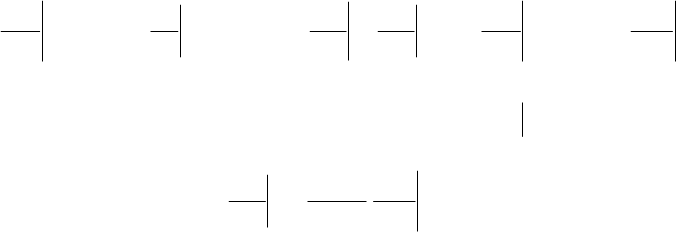
48 TEOS-10 Manual: Calculation and use of the thermodynamic properties of seawater
IOC Manuals and Guides No. 56
tothesaturationconcentrationofabout1101
gkg
−
atsurfacepressure(Feisteletal.
(2010b)).Athighpressures,thevalidityoftheGibbsfunctionofseawater,andtherefore
ofthecomputedfreezingpointorbrinesalinity,too,islimitedtoonly501
gkg
−.
Wenotethatinthefirstapproximation,asinferredfromPlanck’stheoryofideal
solutions,theabovepropertiesdependonthenumberofdissolvedparticlesregardlessof
theparticlesizes,massesorcharges.Inotherwords,theydependmainlyonthemolar
ratherthanonthemassdensityofthesolute,incontrasttopropertiessuchasthedensity
ofseawaterandpropertiesderivedfromit.Thepropertiesconsideredintheremainderof
thissection(3.33‐3.42)whichsharethisattributearereferredtoasthecolligative
propertiesofseawater.
3.34Latentheatofmelting
Themeltingprocessoficeinpurewatercanbeconductedbysupplyingheatatconstant
pressure.Ifthisisdoneslowlyenoughthatequilibriumismaintained,thenthe
temperaturewillalsoremainconstant.Theheatrequiredpermassofmolteniceisthe
latentheat,orenthalpy,ofmelting,WI
p
L.Itisfoundasthedifferencebetweenthespecific
enthalpyofwater,W,handthespecificenthalpyofice,Ih ,h(Kirchhoff’slaw,Curryand
Webster(1999)):
()
(
)
(
)
WI W Ih
ff
,,.
p
L
phtphtp=− (3.34.1)
Here,
()
f
tpisthefreezingtemperatureofwater,section3.33.TheenthalpiesW
handIh
h
areavailablefromIAPWS‐95(IAPWS(2009b))andIAPWS‐06(IAPWS(2009a)),
respectively.
Inthecaseofseawater,themeltwaterwilladditionallymixwiththeambientbrine,
thuschangingthesalinityandthefreezingtemperatureoftheseawater.Consequently,
theenthalpyrelatedtothisphasetransitionwilldependontheparticularconditions
underwhichthemeltingoccurs.
Here,wedefinethelatentheatofmeltingastheenthalpyincreaseperinfinitesimal
massofmolteniceofacompositesystemconsistingoficeandseawater,whenthe
temperatureisincreasedatconstantpressureandatconstanttotalmassesofwaterand
salt,inexcesstotheheatneededtowarmuptheseawaterandicephasesindividually
(FeistelandHagen(1998),Feisteletal.(2010b)).Massconservationofbothwaterandsalt
duringthisthermodynamicprocessisessentialtoensuretheindependenceofthelatent
heatformulafromtheunknownabsoluteenthalpiesofsaltandwaterthatotherwise
wouldaccompanyanymassexchange.
Theenthalpyofseaice,SI ,hisadditivewithrespecttoitsconstituentsice,Ih ,hwith
themassfractionIh ,wandseawater,,hwiththeliquidmassfraction
(
)
Ih
1:w−
()
(
)
(
)
SI Ih Ih Ih
A
1,, ,h w hS tp wh tp=− + .(3.34.2)
Uponwarming,themassofmeltwaterchangestheicefractionIh
wandthebrinesalinity
A.STherelatedtemperaturederivativeofEqn.(3.34.2)is
() () ()
A
SI Ih Ih
Ih Ih Ih Ih
A
A
,,
11
Sp p
Tp
ppp
hh hShw
ww whh
TT STT T
∂∂ ∂∂∂∂
=− +− + + −
∂∂ ∂∂∂ ∂
.(3.34.3)
TherateofbrinesalinitychangewithtemperatureisgivenbythereciprocalofEqn.
(3.33.4)andisrelatedtotheisobaricmeltingrate,Ih /p
wT
−
∂∂,bytheconservationofthe
totalsalt,
()
Ih
A
1wS−=const,intheform
Ih
AA
Ih
1
pp
SSw
TT
w
∂∂
=
∂∂
−.(3.34.4)

TEOS-10 Manual: Calculation and use of the thermodynamic properties of seawater
IOC Manuals and Guides No. 56
49
Usingthisrelation,Eqn.(3.34.3)takesthesimplifiedform
()
SI Ih
Ih Ih Ih SI
1ppp
pp
hw
wc wc L
TT
∂∂
=− + −
∂∂
.(3.34.5)
Thecoefficientinfrontofthemeltingrate,
()
SI Ih
AA
A,
,
p
Tp
h
LSp hS h
S
∂
=− −
∂,(3.34.6)
providesthedesiredexpressionforisobaricmeltingenthalpy,namelythedifference
betweenthepartialspecificenthalpiesofwaterinseawaterandofice.Asisphysically
requiredforanymeasurablethermodynamicquantity,thearbitraryabsoluteenthalpiesof
ice,waterandsaltcancelintheformula(3.34.6),providedthatthereferencestate
conditionsfortheiceandseawaterformulationsarechosenconsistently(Feisteletal.
(2008a)).Notethatbecauseof
(
)
0
hg Tt
η
=+ + andEqn.(3.33.2),thelatentheatcanalso
bewrittenintermsofentropies
η
ratherthanenthalpies,hintheform
()( )
SI Ih
A0fA
A,
,
p
Tp
LSp T t S S
η
ηη
⎛⎞
∂
⎜⎟
=+×− −
⎜⎟
∂
⎝⎠
.(3.34.7)
Againtheresultisindependentofunknown(andunknowable)constants.
Thelatentheatofmeltingdependsonlyweaklyonsalinityandonpressure.Atthe
surfacepressure,thecomputedvalueis
(
)
(
)
SI WI
0,0 0
pp
LL==333426.5Jkg–1forpurewater,
and
()
SI
SO ,0
p
LS =329928.5Jkg–1forthestandardocean,withadifferenceofabout1%due
tothedissolvedsalt.Atapressureof1000dbar,thesevaluesreduceby0.6%to
()()
SI WI
0,1000dbar 1000dbar
pp
LL==331528Jkg–1and
(
)
SI
SO ,1000dbar
p
LS =328034Jkg–1.
TEOS‐10isconsistentwiththemostaccuratemeasurementsofWI
p
Landtheirexperimental
uncertaintiesof200Jkg–1,or0.06%(FeistelandWagner(2005),(2006)).
3.35Sublimationpressure
Thesublimationpressureoficesubl
P
isdefinedastheabsolutepressure
P
ofwater
vapourinequilibriumwithiceatagiventemperaturet,atorbelowthefreezing
temperature.ItisfoundbyequatingthechemicalpotentialofwatervapourV
μ
withthe
chemicalpotentialoficeIh ,
μ
soitisfoundbysolvingtheimplicitequation
()
(
)
Vsubl Ihsubl
,,,tP tP
μμ
=(3.35.1)
orequivalently,intermsofthetwoGibbsfunctions,
()
(
)
Vsubl Ihsubl
,,.gtP gtP=(3.35.2)
TheGibbsfunctionforiceIh,
(
)
Ih ,
g
tP isdefinedbyIAPWS‐06andFeistelandWagner
(2006)andissummarizedinappendixIbelow.Notethatheretheabsolutepressure
P
ratherthantheseapressurepisusedbecausethesublimationpressureoficeatambient
conditionsismuchlowerthantheatmosphericpressure.
TheGibbsfunctionofvapour,
(
)
V,
g
tP ,isavailablefromtheHelmholtzfunctionof
fluidwater,asdefinedbyIAPWS‐95;fordetailsseeforexampleFeisteletal.(2008a),
(2010a),(2010b).Thehighestpossiblesublimationpressureisfoundatthetriplepointof
water.TheTEOS‐10valueofthemaximumsublimationpressure(i.e.,thetriplepoint
pressure)computedfromEqn.(3.35.1)issubl
t
P
P
=
=611.655Paandhasanuncertaintyof
0.01Pa(IAPWS‐06,Feisteletal.(2008a)).
Reliabletheoreticalvaluesforthesublimationpressureareavailabledownto20K
(FeistelandWagner(2007));asimplecorrelationfunctionforthesublimationpressure
downto50KisprovidedbyIAPWS(2008b)andisincludedasafunctionintheSIA

50 TEOS-10 Manual: Calculation and use of the thermodynamic properties of seawater
IOC Manuals and Guides No. 56
library.TheIAPWS‐95functionV
μ
requiredforEqn.(3.35.1)isonlyvalidabove130K.
Anextensionto50KwasdevelopedforTEOS‐10(Feisteletal.(2010a))andisavailableas
thedefaultoptionintheSIAlibrary.Innature,vapourcannotreasonablybeexpectedto
existbelow50Ksinceithasextremelylowdensity,evenintheinterstellarvacuum.For
thisreason,theiceofcometsdoesnotevaporatefarfromthesun.Thelowest
temperaturesestimatedfortheterrestrialpolaratmospheredonotgobelow130K.
Inthepresenceofair,iceisunderhighertotalpressurethanjustitsownsublimation
pressure.Thepartialpressureofvapourinhumidair,vap
V
P
xP=,iscomputedfromthe
totalabsolutepressure
P
andthemolefractionofvapour,V.
x
Similartotheabsolute
salinityA
Sofseawater,thevariable
A
describesthemassfractionofdryairpresentin
humidair.Given,
A
themolefractionofvapouriscomputedfrom
()
V
WA
1
11 /
A
xAMM
−
=−− ,(3.35.3)
whereA
M
isthemolarmassofdryairandW
M
isthemolarmassofwater.
Thesublimationpressure,
(
)
subl sat
V
,
P
tP x P=,oficeinequilibriumwithhumidairisthe
partialpressureofvapourinsaturatedair.Tocomputesat
V
x
fromEqn.(3.35.3),the
requiredairfractionatsaturation,
(
)
sat ,,
A
AtP=isfoundbyequatingthechemical
potentialofwatervapourinhumidairAV
W
μ
withthechemicalpotentialoficeIh ,
μ
sothat
itisfoundbysolvingtheimplicitequation
()
()
AV sat Ih
W,, , ,
A
tP tP
μμ
=(3.35.4)
orequivalently,intermsofthetwoGibbsfunctions,
()
(
)
()
AV sat sat AV sat Ih
,, ,, ,
A
g
AtPAg AtPgtP−=.(3.35.5)
TheGibbsfunctionofhumidair,
()
AV ,,
g
AtP ,isdefinedbyFeisteletal.(2010a).
Att=0°Candatmosphericpressure,thesublimationpressureoficehasthevalue
subl
P
(0°C,101325Pa)=613.745Pa,computedbysolvingEqn.(3.35.4)forsat ,
A
thenusing
(3.35.3)todeterminethecorrespondingmolefractionandmultiplyingtheatmospheric
pressurebythisquantity.Similarly,atthefreezingpointofthestandardoceanthe
sublimationpressureissubl
P
(‐1.919°C,101325Pa)=523.436Pa.
Thedifferencebetweenobservedormodelledpartialvapourpressuresandthe
sublimationpressurecomputedfromTEOS‐10isanappropriatequantityforusein
parameterizationsofthemassfluxbetweeniceandtheatmosphere.
3.36Sublimationenthalpy
Thesublimationprocessthatoccurswheniceisincontactwithpurewatervapourcanbe
conductedbysupplyingheatatconstanttandP,withtatorbelowthefreezing
temperature.Theheatrequiredpermassevaporatedfromtheiceisthelatentheat,or
enthalpy,ofsublimation,VI
p
L.Itisfoundasthedifferencebetweenthespecificenthalpy
ofwatervapour,V,handthespecificenthalpyofice,Ih :h
()
(
)
(
)
VI V subl Ih subl
,,.
p
Lt htP htP=− (3.36.1)
Here,
()
subl
P
tisthesublimationpressureoficeatthetemperature,tsection3.35.The
enthalpiesV
handIh
hareavailablefromIAPWS‐95andIAPWS‐06,respectively.Reliable
valuesforthesublimationenthalpyaretheoreticallyavailabledownto20Kfromasimple
correlationfunction(FeistelandWagner(2007)).Atthetriplepointofwater,theTEOS‐10
sublimationenthalpyis
()
VI 0.01 C
p
L°=2834359Jkg–1withanuncertaintyof1000Jkg–1,or
0.03%.

TEOS-10 Manual: Calculation and use of the thermodynamic properties of seawater
IOC Manuals and Guides No. 56
51
Inthecasewhenairispresent,thevapourresultingfromthesublimationwilladdto
thegasphase,thusincreasingthemolefractionofvapoursat
V
x
.Ifforexamplethetotal
pressure
P
isheldconstant,thepartialpressuresat
V
x
Pwillrise,andtheicemustget
warmertomaintainequilibriumatthemodifiedsublimationpressuresubl sat
V.
P
xP=
Consequently,theenthalpyrelatedtothisphasetransitionwilldependontheparticular
conditionsunderwhichthesublimationprocessoccurs.Theseeffectsaresmallunder
ambientconditionsbutmayberelevantathigherairdensities.
Here,wedefinethelatentheatofsublimationastheenthalpyincreaseper
infinitesimalmassofsublimatediceofacompositesystemconsistingoficeandhumidair,
whenthetemperatureisincreasedatconstantpressureandatconstanttotalmassesof
wateranddryair,inexcessoftheenthalpyincreaseneededtowarmuptheiceandhumid
airphasesindividually(Feisteletal.(2010a)).Massconservationofbothtotalwaterand
dryairduringthisthermodynamicprocessisessentialtoensuretheindependenceofthe
latentheatformulafromtheunknownabsoluteenthalpiesofairandwaterthatotherwise
wouldaccompanyanymassexchange.
Theenthalpyoficeair,AI ,hisadditivewithrespecttoitsconstituentsice,Ih ,hwith
themassfractionIh ,wandhumidair,AV ,hwiththegasfraction
(
)
Ih
1:w−
()
(
)
(
)
AI Ih AV Ih Ih
1,, ,h w h Atp wh tp=− + .(3.36.2)
Uponwarming,themassofvapourproducedbysublimationreducestheicefractionIh
w
andincreasesthehumidity,thatis,decreasestherelativedry‐airfraction
A
ofthegas
phase.TherelatedtemperaturederivativeofEqn.(3.36.2)is
() () ()
AI AV AV Ih Ih
Ih Ih Ih Ih AV
,,
11
p
pApTpp p
hh hAh w
ww whh
TT ATT T
∂∂ ∂∂∂ ∂
=− +− + + −
∂∂ ∂∂∂ ∂
.(3.36.3)
Theair‐fractionchangeisrelatedtotheisobaricsublimationrate,Ih /p
wT
−
∂∂,bythe
conservationofthedryair,
()
Ih
1wA−=const,intheform
Ih
Ih
1
pp
AAw
TT
w
∂∂
=
∂∂
−.(3.36.4)
Usingthisrelation,Eqn.(3.36.3)takesthesimpleform
()
AI Ih
Ih AV Ih Ih AI
1.
ppp
pp
hw
wc wc L
TT
∂∂
=− + −
∂∂
(3.36.5)
Thecoefficientinfrontofthesublimationrate,
()
AV
AI AV Ih
,
,
p
Tp
h
LAp h A h
A
∂
=− −
∂,(3.36.6)
providesthedesiredexpressionforisobaricsublimationenthalpy,namelythedifference
betweenthepartialspecificenthalpiesofvapourinhumidairandofice.Intheideal‐gas
approximationsforairandforvapour,thepartialspecificenthalpyofvapourinhumid
air,AV AV
A
hAh−,equalsthespecificenthalpyofvapour,
(
)
V
ht,asafunctionofonlythe
temperature,independentofthepressureandofthepresenceofair(Feisteletal.(2010a)).
Inthiscase,Eqn.(3.36.6)coincidesformallywithEqn.(3.36.1),exceptthatthetwoare
evaluatedatthedifferentpressures
P
andsubl ,Prespectively.Asisphysicallyrequired
foranymeasurablethermodynamicquantity,thearbitraryabsoluteenthalpiesofice,
vapourandaircancelintheformula(3.36.6),providedthatthereferencestateconditions
fortheiceandhumidairformulationsarechosenconsistently(Feisteletal.(2008a),
(2010a)).Thelatentheatofsublimationdependsonlyweaklyontheairfractionandon
thepressure.
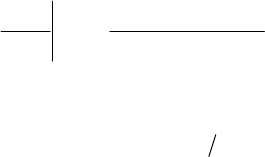
52 TEOS-10 Manual: Calculation and use of the thermodynamic properties of seawater
IOC Manuals and Guides No. 56
Forsaturatedairoverseaice,theairfractionsat
A
A=canbecomputedfromthebrine
salinity,orfromtheseasurfacesalinityinthecaseoffloatingice,section3.38.Atthe
absolutesurfacepressureSO
P
=101325Paandthefreezingpointf
t=‐1.919°Cofthe
standardocean,theTEOS‐10valueforsaturatedairwith
(
)
sat
SO f SO
,
A
AtP==0.99678is
()
AI
SO SO
,
p
LAP=2833006Jkg–1.Therelatedsublimationpressureis
()
subl
fSO
,
P
tP =523.436
Pa,seesection3.35.
Observationaldatashowthattheambientairovertheoceansurfaceissub‐saturated
intheclimatologicalmean.Ratherthanbeingsaturated,valuesforAthatcorrespondtoa
relativehumidityof75%–82%(seesection3.40)maybeamorerealisticestimateforthe
marineatmosphere(Dai(2006));thesevaluesrepresentnon‐equilibriumconditionsthat
resultinnetevaporationaspartoftheglobalhydrologicalcycle.
3.37Vapourpressure
Thevapourpressureofseawater
(
)
vap
A,
P
Stisdefinedastheabsolutepressure
P
of
watervapourinequilibriumwithseawateratagiventemperaturetandsalinityA.SItis
foundbyequatingthechemicalpotentialofvapourV
μ
withthechemicalpotentialof
waterinseawater W
μ
sothatitisfoundbysolvingtheimplicitequation
(
)
(
)
V vap W vap
A
,,,tP S tP
μμ
=,(3.37.1)
orequivalently,intermsofthetwoGibbsfunctions,
()
(
)
(
)
A
V vap vap vap
AAA
,,, ,,
S
gtP gStP Sg StP=− .(3.37.2)
Notethathereweusetheabsolutepressure
P
ratherthantheseapressurep;sincethe
vapourpressureofwateratambientconditionsismuchlowerthantheatmospheric
pressure,thecorrespondingseapressure(Pvap–101325Pa)wouldbenegativeandnear
‐105Pa.TheGibbsfunctionsofvapourandseawater,
(
)
V,
g
tP andA
(,,),
g
StPare
availablefromtheHelmholtzfunctionoffluidwater,asdefinedbyIAPWS‐95,andthe
Gibbsfunctionofseawater,IAPWS‐08orIAPWS‐09(IAPWS(2009c)).
Inthecaseofpurewater,A0,S
=
thesolutionofEqn.(3.37.1)istheso‐called
saturationcurveinthetP−diagramofwater,whichconnectsthetriplepointwiththe
criticalpoint.Thelowestpossiblevapourpressureofpureliquidwaterisfoundatthe
triplepointofwater.TheTEOS‐10valueofthisminimumvapourpressure,computed
fromEqn.(3.37.1),isvap
P
(0,0.01°C)=t
P
=611.655Pawithanuncertaintyof0.01Pa
(IAPWS‐95,Feisteletal.(2008a)).Forcomparison,thevapourpressureofthestandard
oceanisvap
P
(SO ,S0°C)=599.907Pa.Atlaboratorytemperaturetherelatedvaluesare
vap
P
(0,25°C)=3169.93Paandvap
P
(SO ,S25°C)=3110.57Pa.
Therelativelysmallvapourpressureloweringcausedbythepresenceofdissolvedsalt
canbecomputedfromtheisothermalsalinityderivativeofEqn.(3.37.1)intheform
(Raoult’slaw)
AA
A
vap A
V
AA
SS
P
SP P
T
Sg
P
S
g
Sg g
∂=
∂−−
.(3.37.3)
Asarawpracticalestimate,thisequationcanbeexpandedintopowersofsalinity,using
onlytheleadingtermoftheTEOS‐10salineGibbsfunction,S
SA A
ln
g
RTS S≈,whichstems
fromPlanck’sideal‐solutiontheory.Here,SS
RRM
=
=264.7599Jkg–1K–1isthespecific
gasconstantofseasalt,Ristheuniversalmolargasconstant,andS
M
=31.40382gmol–1
isthemolarmassofseasaltwithReferenceComposition.Thespecificvolumeof
seawater,,
p
g
isneglectedincomparisontothatofvapour.Thelatterisapproximately
consideredasanidealgas,
(
)
Vvap
W
/
p
gRTMP≈,whereW
M
=18.015268gmol–1isthe
molarmassofwater.Theconvenientresultobtainedwiththesesimplificationsis
TEOS-10 Manual: Calculation and use of the thermodynamic properties of seawater
IOC Manuals and Guides No. 56
53
vap
vap vap
W
AS
0.57
T
MP
P
P
SM
∂≈− ≈− ×
∂.(3.37.4)
Thevapourpressureofseawaterisalwayslowerthanthatofpurewater.
Inthepresenceofair,seawaterisunderahigherpressure
P
thanunderitsvapour
pressurevap .PInthiscase,thevapourpressureofseawater
(
)
vap
A,,
P
StPisdefinedasthe
partialpressureofwatervapourinhumidairthatisinequilibriumwithseawaterata
givenpressure,
P
temperaturetandsalinityA.SItisfoundbyequatingthechemical
potentialofvapourinhumidairV
AV
μ
withthechemicalpotentialofwaterinseawater
W
μ
sothatitisfoundbysolvingtheimplicitequation
()
()
Vcond W
AV A
,, ,,
A
tP S tP
μμ
=(3.37.5)
for
()
cond
A,,
A
StP,orequivalently,intermsofthetwoGibbsfunctions,
()
(
)
() ()
A
AV cond cond AV cond
AAA
,, ,, ,, ,,
AS
g
A tP A g A tP gS tP S g S tP−=−.(3.37.6)
Sincethevapourpressureisloweredinthepresenceofseasalt(Eqn.(3.37.4)),atvapour
pressuresabovethecondensationpointvapourcondensesoutoftheairattheseasurface,
evenbeforethesaturationpoint(thatis,relativehumidityof100%)isreached,tomaintain
localequilibriumwiththeseawater.Thelargerscaleequilibrationprocessmayinvolve
downwarddiffusionofwatervapourtotheseasurfaceratherthanprecipitationofdewor
fog.Fromthecalculatedsub‐saturatedairfractionofthecondensationpoint,cond
A
,the
molefractionofvapourcond
V
x
(3.53.2),andinturnthevapourpressure
()
vap cond
AV
,,
P
StP x P=areavailablefromstraightforwardcalculations.TheGibbsfunction
ofhumidairAV
g
isavailablefromFeisteletal.(2010a)andisalsoplannedtobemade
availableasthedocumentIAPWS(2010).
TheTEOS‐10valuecomputedfromEqn.(3.37.5)isvap
P
(0,0°C,PSO)=613.760Pafor
purewateratsurfaceairpressure;thevapourpressureofthestandardoceanis
vap
P
(SO ,S0°C,SO
P
)=602.403Pa.Atlaboratorytemperaturetherelatedvaluesare
vap
P
(0,25°C,SO
P
)=3183.73Paandvap
P
(SO ,S25°C,SO
P
)=3124.03Pa.
3.38Boilingtemperature
Theboilingtemperatureofwaterorseawaterisdefinedasthetemperature
()
boil
A,tSPat
whichthevapourpressure(ofsection3.37)equalsagivenpressure.
P
Itisfoundby
equatingthechemicalpotentialofvapourV
μ
withthechemicalpotentialofwaterin
seawater W
μ
sothatitisfoundbysolvingtheimplicitequation
()
(
)
Vboil W boil
A
,,,,tP StP
μμ
=(3.38.1)
forboil
A
(,)tSP,orequivalentlyintermsofthetwoGibbsfunctions,
(
)( )
(
)
A
V boil boil boil
AAA
,,, ,,.
S
g
tP gStPSgStP=− (3.38.2)
TheTEOS‐10boilingtemperatureofpurewateratatmosphericpressureis
()
boil
SO
0,tP=
99.974°C.Thistemperatureisoutsidethevalidityrangeofupto80°CoftheTEOS‐10
Gibbsfunctionforseawater.
3.39Latentheatofevaporation
Theevaporationprocessofpureliquidwaterincontactwithpurewatervapourcanbe
conductedbysupplyingheatatconstanttand.
P
Theheatrequiredpermassevaporated
fromtheliquidisthelatentheat,orenthalpy,ofevaporation,VW
p
L.Itisfoundasthe

54 TEOS-10 Manual: Calculation and use of the thermodynamic properties of seawater
IOC Manuals and Guides No. 56
differencebetweenthespecificenthalpyofwatervapour,V,handthespecificenthalpyof
liquidwater,W:h
()
(
)
(
)
VW V vap W vap
,,
p
Lt htP htP=−.(3.39.1)
Here,vap ()
P
tisthevapourpressureofwateratthetemperaturet(section3.37).The
enthalpiesV
handW
hareavailablefromIAPWS‐95.Atthetriplepointofwater,the
TEOS‐10evaporationenthalpyis
(
)
VW 0.01 C
p
L°=2500915Jkg–1.
Inthecaseofseawaterincontactwithair,thevapourresultingfromtheevaporation
willaddtothegasphase,thusincreasingthemolefractionofvapour,whiletheliquid
waterlosswillincreasethebrinesalinity,andcauseachangetotheseawaterenthalpy.
Consequently,theenthalpyrelatedtothisphasetransitionwilldependontheparticular
conditionsunderwhichtheevaporationprocessoccurs.
Here,wedefinethelatentheatofevaporationastheenthalpyincreaseper
infinitesimalmassofevaporatedwaterofacompositesystemconsistingofseawaterand
humidair,whenthetemperatureisincreasedatconstantpressureandatconstanttotal
massesofwater,saltanddryair,inexcessoftheenthalpyincreaseneededtowarmupthe
seawaterandhumidairphasesindividually(Feisteletal.(2010a)).Massconservation
duringthisthermodynamicprocessisessentialtoensuretheindependenceofthelatent
heatformulafromtheunknownabsoluteenthalpiesofair,saltandwaterthatotherwise
wouldaccompanyanymassexchange.
Theenthalpyofseaair,SA ,hisadditivewithrespecttoitsconstituents,seawater,,h
withthemassfractionSW ,wandhumidair,AV ,hwiththegasfraction
(
)
SW
1:w−
()
(
)
(
)
SA SW AV SW
A
1,, ,,hwhAtpwhStp=− + .(3.39.2)
Uponwarming,themassofwatertransferredfromtheliquidtothegasphaseby
evaporationreducestheseawatermassfractionSW ,wincreasesthebrinesalinityA
Sand
increasesthehumidity,withacorrespondingdecreaseinthedry‐airfraction
A
ofthegas
phase.TherelatedtemperaturederivativeofEqn.(3.39.2)is
() ()
()
A
SA AV AV
SW SW
,,
SW
SW SW AV
A
A
,,
11
.
p
pApTp
Sp p
Tp p
hh hA
ww
TT AT
hhS w
ww hh
TST T
∂∂ ∂∂
=− +−
∂∂ ∂∂
∂∂∂ ∂
++ +−
∂∂∂ ∂
(3.39.3)
TheisobaricevaporationrateSW /p
wT−∂ ∂ isrelatedtotheair‐fractionchangebythe
conservationofthedryair,
()
SW
1wA−=const,intheform
SW
SW
1
pp
AAw
TT
w
∂∂
=
∂∂
−,(3.39.4)
andtothechangeofsalinitybytheconservationofthesalt,SW
A
wS=const,intheform
SW
AA
SW .
pp
SSw
TT
w
∂∂
=−
∂∂
(3.39.5)
Usingtheserelations,Eqn.(3.39.3)takesthesimplifiedform
()
SA SW
SW AV SW SA
1ppp
pp
hw
wc wcL
TT
∂∂
=− + −
∂∂
.(3.39.6)
Thecoefficientinfrontoftheevaporationrate,
()
AV
SA AV
AA
A,
,
,,, ,
p
Tp
Tp
hh
LAStp h A hS
AS
∂∂
=− −+
∂∂
(3.39.7)

TEOS-10 Manual: Calculation and use of the thermodynamic properties of seawater
IOC Manuals and Guides No. 56
55
providesthedesiredexpressionforisobaricevaporationenthalpy,namelythedifference
betweenthepartialspecificenthalpiesofvapourinhumidair(thefirsttwoterms)andof
waterinseawater(thelasttwoterms).Intheideal‐gasapproximationsforairandfor
vapour,thepartialspecificenthalpyofvapourinhumidair,AV AV
A
hAh−,equalsthe
specificenthalpyofvapour,
()
V
ht,asafunctionofonlythetemperature,independentof
thepressureandofthepresenceofair(Feisteletal.(2010a)).Asisphysicallyrequiredfor
anymeasurablethermodynamicquantity,thearbitraryabsoluteenthalpiesofwater,salt
andaircancelintheformula(3.39.7),providedthatthereferencestateconditionsforboth
theseawaterandthehumid‐airformulationarechosenconsistently(Feisteletal.(2008a),
(2010a)).Thelatentheatofevaporationdependsonlyweaklyonsalinityandonair
fraction,andisanalmostlinearfunctionofthetemperatureandofthepressure.
Selectedrepresentativevaluesfortheairfractionatcondensation,cond ,Aandthelatent
heatofevaporation,SA
p
L
,aregiveninTable3.39.1.
Table3.39.1:Selectedvaluesfortheequilibriumairfraction,cond ,Acomputed
fromEqn.(3.37.6),andthelatentheatofevaporation,SA
p
L
,
computedfromEqn.(3.39.7),fordifferentsea‐surfaceconditions.
NotethattheTEOS‐10formulationforhumid‐airisvalidupto5
MPa,i.e.,almost500dbarseapressure.
ConditionA
S
gkg–1
t
°C
p
dbar
cond
A
%
SA
p
L
Jkg–1
Purewater00 0 99.62231 2499032
Brackishwater100 0 99.62427 2499009
Standardocean35.16504 0 0 99.62931 2498510
Tropicalocean35.16504 25 098.05933 2438971
Highpressure35.16504 0400 99.98943 2443759
InthederivationofEqn.(3.39.7),thevalueof
A
isindirectlyassumedtobecomputed
fromtheequilibriumcondition(3.37.6)betweenhumidairandseawater,
A
=cond .AAt
thishumiditytheairisstillsub‐saturated,cond sat ,
A
A>butitsvapourstartscondensingat
theseasurface.Thevaluesofcond
A
andsat
A
coincideonlybelowthefreezingpointof
seawater,oratvanishingsalinity,seealsothefollowingsection3.40.
Theevaporationrate,SW /p
wT−∂ ∂ ,canbecomputedfromEqn.(3.37.6),the
equilibriumconditionbetweenhumidairandseawater,atchangingtemperatureand
constantpressure(Feisteletal.(2010a)).Incontrast,thederivationofSA
p
LusingEqns.
(3.39.2)‐(3.39.7)isamereconsiderationofmassandenthalpybalances;noequilibrium
conditionisactuallyinvolved.Hence,itisphysicallyevidentthatEqn.(3.39.7)canalsobe
appliedtosituationsinwhich
A
takesanygivenvaluedifferentfromcond ,Athatis,itcan
beappliedregardlessofwhetherornotthehumidairisactuallyatequilibriumwiththe
seasurface.
3.40Relativehumidityandfugacity
Parameterisedformulasforthefluxofwaterandheatthroughtheoceansurfaceare
usuallyexpressedintermsofagivenrelativehumidityoftheairincontactwithseawater.
Inthissectionweprovidetheformulasfortherelativehumidityandthefugacityfromthe
TEOS‐10potentialfunctionsforseawaterandhumidair,andweexplainwhytherelative
fugacitywithrespecttocondensationratherthanwithrespecttosaturationshouldbe
usedforoceanographicfluxestimates(Feisteletal.(2010a)).Nearthesaturationpoint,the

56 TEOS-10 Manual: Calculation and use of the thermodynamic properties of seawater
IOC Manuals and Guides No. 56
twofluxformulasmayevenexhibitdifferentsigns(differentfluxdirections)since
condensationoccursattheseasurfaceatsub‐saturatedvaluesofrelativehumidity.
Relativehumidityisnotuniquelydefinedintheliterature,butthecommondefinitions
givethesameresultsintheideal‐gaslimitofhumidair.Alsointhisapproximation,
relativehumidityisonlyapropertyoffluidwateratgiventemperatureandpressureof
thevapourphase,independentofthepresenceofair.
TheCCT1definitionofrelativehumidityisintermsofmolefraction:“Atgiven
pressureandtemperature,[therelativehumidityisdefinedas]theratio,expressedasa
percent,ofthemolefractionofwatervapourtothevapourmolefractionwhichthemoist
gaswouldhaveifitweresaturatedwithrespecttoeitherwateroriceatthesamepressure
andtemperature.”ConsistentwithCCT,IUPAC2definesrelativehumidity“astheratio,
oftenexpressedasapercentage,ofthepartialpressureofwaterintheatmosphereatsome
observedtemperature,tothesaturationvapourpressureofpurewateratthis
temperature”(Calvert(1990),IUPAC(1997)).Thisdefinitionoftherelativehumidity
takestheform
V
CCT sat
V
x
RH
x
=(3.40.1)
withregardtothemolefractionofvapour
(
)
V,
x
AEqn.(3.35.3),andthesaturatedair
fraction
() ( )
sat cond
,0,,
A
AtP A tP== eitherfromEqn.(3.37.6)withrespecttoliquidwater,
attabovethefreezingpointofpurewater,orfromEqn.(3.35.5)withrespecttoice,att
belowthefreezingpointofpurewater.Here,
(
)
cond
A,,
A
StPistheairfractionofhumid
airatequilibriumwithseawater,Eqn.(3.37.5),whichissubsaturatedforA0.S>
TheWMO3definitionoftherelativehumidityis(PruppacherandKlett(1997),
Jacobson(2005)),
WMO sat sat
1/ 1
1/ 1
rA
RH rA
−
==
−
(3.40.2)
where
()
1/rAA=− isthehumidityratio.Ifrissmall,wecanestimateVAW
/
x
rM M≈
(fromEqn.(3.35.3))andthereforeWMO CCT
RH RH
≈
,thatis,wefindapproximate
consistencybetweenEqns.(3.40.1)and(3.40.2).
Sometimes,especiallywhenconsideringphaseorchemicalequilibria,itismore
convenienttousethefugacity(oractivity)ratherthanpartialpressureratio(IUPAC
(1997)).Thefugacityofvapourinhumidairisdefinedas
()
VV, id
VV
W
,, exp .fATP xP RT
μμ
⎧
⎫
−
⎪
⎪
=
⎨
⎬
⎪
⎪
⎩⎭
(3.40.3)
Here,WW
RRM=isthespecificgasconstantofwater,
(
)
VAVAV
,,
A
A
TP g Ag
μ
=− isthe
chemicalpotentialofvapourinhumidair,and
(
)
V, id ,,
A
TP
μ
isitsideal‐gaslimitwhichis
equaltothetruechemicalpotentialinthelimitofverylowpressure,
() ()
V
0
V, id V V,id V
0W
V
0
,, 1 'd' ln
'
T
p
T
x
PT
AT P g c T T R T
T
P
μ
⎛⎞
=+ − +
⎜⎟
⎝⎠
∫.(3.40.4)
ThevaluesofV
0
g
,V
0
P
andV
0
TofV,id
μ
mustbechosenconsistentlywiththeadjustable
constantsofAV
g
(Feisteletal.(2010a)).Theideal‐gasheatcapacityofvapour
()
V, id
p
cTis
availablefromIAPWS‐95.Intheideal‐gaslimitofinfinitedilution,V
f
convergestothe
partialpressureofvapour(Glasstone(1947)),
(
)
vap
VV
0
lim , , .
PfATP xP P
→==(3.40.5)
1CCT:ConsultativeCommitteeforThermometry,www.bipm.org/en/committees/cc/cct/
2IUPAC:InternationalUnionofPureandAppliedChemistry,www.iupac.org
3WMO:WorldMeteorologicalOrganisation,www.wmo.int

TEOS-10 Manual: Calculation and use of the thermodynamic properties of seawater
IOC Manuals and Guides No. 56
57
Thesaturationfugacityisdefinedbytheequilibriumbetweenliquidwater(orice)and
vapourinair,
()()
VW
,, 0,,
A
TP TP
μμ
=,thatis,
()
(
)
WV,idsat
sat sat
VV
W
0, , , ,
exp ,
TP A TP
fxP RT
μμ
⎧
⎫
−
⎪
⎪
=
⎨
⎬
⎪
⎪
⎩⎭
(3.40.6)
where
()
W0, ,
g
TP
μ
=isthechemicalpotentialofliquidwater(orthechemicalpotential
ofice,Ih
μ
).Therelativefugacity
ϕ
ofhumidairisthendefined,dividingEqn.(3.40.3)by
Eqn.(3.40.6)andmakinguseofEqn.(3.40.4),as
()()
VW
V
sat
W
V
,, 0,,
exp .
AT P T P
f
RT
f
μμ
ϕ
⎧
⎫
−
⎪
⎪
==
⎨
⎬
⎪
⎪
⎩⎭
(3.40.7)
Intheideal‐gaslimit, VV, id
,
μμ
=andusing(3.40.3)weseethattherelativefugacity
ϕ
coincideswiththerelativehumidity,Eqn.(3.40.1).
TakingEqn.(3.40.7)atthecondensationpoint,cond ,AA=Eqn.(3.37.5),itfollowsthat
therelativefugacityofhumidairatequilibriumwithseawater(“seaair”forshort)is
()()
WW
SA
A
SA V
sat
W
V
,, 0,,
exp .
STP TP
f
RT
f
μμ
ϕ
⎧
⎫
−
⎪
⎪
==
⎨
⎬
⎪
⎪
⎩⎭
(3.40.8)
Thechemicalpotentialdifferenceintheexponentisproportionaltotheosmoticcoefficient
ofseawater,,
φ
whichiscomputedfromthesalinepartoftheGibbsfunctionas(Feistel
andMarion(2007),Feistel(2008)),
()
S
S
AA
SW A ,
1
,, ,
TP
g
STP g S
mRT S
φ
⎡
⎤
∂
⎢
⎥
=− − ∂
⎢
⎥
⎣
⎦
(3.40.9)
whereSW
misthemolalityofseawater(Milleroetal.(2008a)),
()
A
SW
AS
.
1
S
mSM
=−(3.40.10)
Fromthechemicalpotentialofwaterinseawater,A
W
AS
µ
gSg=− ,andEqns.(3.40.8)‐
(3.40.10)weinferfortherelativefugacityofseaairthesimpleformula
(
)
SA
SW W
exp ,mM
ϕ
φ
=− (3.40.11)
whichisidenticaltotheactivityW
aofwaterinseawater.Similartotheidealgas
approximation,therelativefugacityofseaairisindependentofthepresenceorthe
propertiesofair.InEqn.(3.40.11),therelativefugacitySA 1
ϕ
≤
expressesthefactthatthe
vapourpressureofseawaterislowerthanthatofpurewater,i.e.,thathumidairin
equilibriumwithseawateraboveitsfreezingtemperatureisalwayssub‐saturated.
Asarawpracticalestimate,usingaseriesexpansionofEqns.(3.40.10)and(3.40.11)
withrespecttosalinity,wecanobtainfromthemolality2
SW A S A
/()mSMOS=+andthe
osmoticcoefficient
()
A
1OS
φ
=+ thelinearrelation
SA W
A
S
1,
MS
M
ϕ
≈− (3.40.12)
i.e.,Raoult’slawforthevapour‐pressureloweringofseawater,Eqn.(3.37.4).
Belowthefreezingtemperatureofpurewateratagivenpressure,thesaturationof
vapourisdefinedbythechemicalpotentialoficeratherthanliquidwater,i.e.by
()
(
)
Ih V,id sat
sat sat
VV
W
,,,
exp ,
TP A TP
fxP RT
μμ
⎧⎫
−
⎪⎪
=⎨⎬
⎪⎪
⎩⎭
(3.40.13)
ratherthanEqn.(3.40.6).Then,therelativefugacityofseaairis

58 TEOS-10 Manual: Calculation and use of the thermodynamic properties of seawater
IOC Manuals and Guides No. 56
()()
WIh
SA
A
SA V
sat
W
V
,, ,
exp .
STP TP
f
RT
f
μμ
ϕ
⎧
⎫
−
⎪
⎪
==
⎨
⎬
⎪
⎪
⎩⎭
(3.40.14)
Whenthetemperatureisloweredfurthertothefreezingpointofseawater,theexponentof
(3.40.14)vanishesandseaairissaturated,SA 1,
ϕ
=
forsea‐iceairatanylowertemperature.
Thermodynamicfluxesinnon‐equilibriumstatesaredrivenbyOnsagerforcessuchas
thegradientof/T
μ
(DeGrootandMazur(1984)).Attheseasurface,assumingthesame
temperatureandpressureonbothsidesofthesea‐airinterface,thedimensionlessOnsager
force
()
SA A
,,,XASTPdrivingthetransferofwateristhedifferencebetweenthechemical
potentialsofwaterinhumidairandinseawater,
(
)
(
)
VW
AV A
SA
WW W
,, ,, .
A
TP S TP
XRT RT RT
μμ
μ
⎛⎞
=Δ = −
⎜⎟
⎝⎠ (3.40.15)
Thisdifferencevanishesatthecondensationpoint,
(
)
cond
A,, ,
A
ASTP=Eqn.(3.37.5),
ratherthanatsaturation. SA
Xcanalsobeexpressedintermsoffugacities,Eqns.(3.40.7),
(3.40.8)and(3.40.11),intheform
(
)
() ()
SA SW W
SA
A
ln ln .
A
XmMA
S
ϕφϕ
ϕ
==+(3.40.16)
Ratherthantherelativehumidity,Eqns.(3.40.1),(3.40.2),thesea‐airOnsagerforceSA ,Xin
conjunctionwiththeformula(3.39.7),isrelevantfortheparameterizationofnon‐
equilibriumlatentheatfluxesacrosstheseasurface.Inthespecialcaseoflimnological
applications,orbelowthefreezingpointofseawater,itreducesto
()
SA lnXA
ϕ
=,which
correspondstotherelativehumidity,
(
)
CCT
ln RH ,intheideal‐gasapproximation.All
propertiesrequiredforthecalculationoftheformula(3.40.16)areavailablefromthe
TEOS‐10thermodynamicpotentialsforseawater,ice,andhumidair.
3.41Osmoticpressure
Ifpurewaterisseparatedfromseawaterbyasemi‐permeablemembranewhichallows
watermoleculestopassbutnotsaltparticles,waterwillpenetrateintotheseawater,thus
dilutingitandpossiblyincreasingitspressure,untilthechemicalpotentialofwaterin
bothboxesbecomesthesame(orthepurewaterreservoirisexhausted).Intheusual
modelconfiguration,thetwosamplesarethermallycoupledbutmaypossessdifferent
pressures;theresultingpressuredifferencerequiredtomaintainequilibriumisthe
osmoticpressureofseawater.Anexampleofapracticalapplicationisdesalinationby
reverseosmosis;ifthepressureonseawaterinavesselexceedsitsosmoticpressure,
freshwatercanbe“squeezed”outofsolutionthroughsuitablemembranewalls
(Sherwoodetal.(1967)).Theosmoticpressureofseawaterisveryimportantformarine
organisms;itisconsideredresponsibleforthesmallnumberofspeciesthatcansurvivein
brackishenvironments.
Thedefiningconditionfortheosmoticequilibriumisequalityofthechemical
potentialsofpurewateratthepressureW
pandofwaterinseawateratthepressure,p
()
()
WW
AA
A,
,,, .
Tp
g
gtp gStp SS
∂
=−
∂(3.41.1)
Thesolutionofthisimplicitrelationfortheosmoticpressureis
(
)
osm W
A,, .
P
Stp P P=− (3.41.2)
TheTEOS‐10valuefortheosmoticpressureofthestandardoceanis
()
osm
SO ,0 C,0dbarPS°=
2354684Pa,computedfromEqn.(3.41.1).

TEOS-10 Manual: Calculation and use of the thermodynamic properties of seawater
IOC Manuals and Guides No. 56
59
3.42Temperatureofmaximumdensity
Atabout4°Candatmosphericpressure,purewaterhasadensitymaximumbelowwhich
thethermalexpansioncoefficientandtheadiabaticlapseratechangetheirsigns(Röntgen
(1892),McDougallandFeistel(2003)).Atsalinitieshigherthan23.8gkg–1thetemperature
ofmaximumdensityMD
tisbelowthefreezingpointf
t(Table3.42.1).Theseasonaland
spatialinterplaybetweendensitymaximumandfreezingpointishighlyimportantforthe
stratificationstabilityandtheseasonaldeepconvectionforbrackishestuarieswith
permanentverticalandlateralsalinitygradientssuchastheBalticSea(Feisteletal.
(2008b),LeppärantaandMyrberg(2009),Reissmannetal.(2009)).
ThetemperatureofmaximumdensityMD
tiscomputedfromtheconditionof
vanishingthermalexpansioncoefficient,thatis,fromthesolutionoftheimplicitequation
forMD A
(,)tSp,
(
)
AMD
,, 0.
TP
gSt p
=
(3.42.1)
ThetemperatureofmaximumdensityisavailableintheGSWOceanographicToolboxas
functiongsw_temps_maxdensity.Thisfunctionalsoreturnsthepotentialtemperature
andtheConservativeTemperatureatthismaximumdensitypoint.SelectedTEOS‐10
valuescomputedfromEqn.(3.42.1)aregiveninTable3.42.1.
Table3.42.1:Freezingtemperaturef
tandtemperatureofmaximumdensityMD
t
forair‐freebrackishseawaterwithabsolutesalinitiesA
Sbetween0
and1
25 g kg−,computedatthesurfacepressurefromTEOS‐10.
ValuesofMD
tinparenthesesarelessthanthefreezingtemperature.
A
S
g kg–1
f
t
°C
MD
t
°C
A
S
g kg–1
f
t
°C
MD
t
°C
A
S
g kg–1
f
t
°C
MD
t
°C
0 +0.003 3.978 8.5 –0.456 2.128 17 –0.912 0.250
0.5 –0.026 3.868 9 –0.483 2.019 17.5 –0.939 0.139
1 –0.054 3.758 9.5 –0.509 1.909 18 –0.966 0.027
1.5 –0.081 3.649 10 –0.536 1.800 18.5 –0.994 –0.085
2 –0.108 3.541 10.5 –0.563 1.690 19 –1.021 –0.196
2.5 –0.135 3.432 11 –0.590 1.580 19.5 –1.048 –0.308
3 –0.162 3.324 11.5 –0.616 1.470 20 –1.075 –0.420
3.5 –0.189 3.215 12 –0.643 1.360 20.5 –1.102 –0.532
4 –0.216 3.107 12.5 –0.670 1.249 21 –1.130 –0.644
4.5 –0.243 2.999 13 –0.697 1.139 21.5 –1.157 –0.756
5 –0.269 2.890 13.5 –0.724 1.028 22 –1.184 –0.868
5.5 –0.296 2.782 14 –0.750 0.917 22.5 –1.212 –0.980
6 –0.323 2.673 14.5 –0.777 0.807 23 –1.239 –1.092
6.5 –0.349 2.564 15 –0.804 0.696 23.5 –1.267 –1.204
7 –0.376 2.456 15.5 –0.831 0.584 24 –1.294 (–1.316)
7.5 –0.403 2.347 16 –0.858 0.473 24.5 –1.322 (–1.428)
8 –0.429 2.238 16.5 –0.885 0.362 25 –1.349 (–1.540)

60 TEOS-10 Manual: Calculation and use of the thermodynamic properties of seawater
IOC Manuals and Guides No. 56
4.Conclusions
TheInternationalThermodynamicEquationofSeawater–2010(TEOS‐10)allowsallthe
thermodynamicpropertiesofpurewater,iceIh,seawaterandmoistairtobeevaluatedin
aninternallyself‐consistentmanner.IceIhisthenaturallyabundantformofice,having
hexagonalcrystals.Forthefirsttimetheeffectsofthesmallvariationsinseawater
compositionaroundtheworldoceancanbeincluded,especiallytheireffectsonthedensity
ofseawater(whichcanbeequivalenttotentimestheprecisionofourPracticalSalinity
measurementsatsea).
PerhapsthemostapparentchangecomparedtotheInternationalEquationofStateof
seawater(EOS‐80)istheadoptionofAbsoluteSalinityA
SinsteadofPracticalSalinityP
S
(PSS‐78)asthesalinityargumentforthethermodynamicpropertiesofseawater.
Importantly,PracticalSalinityisretainedasthesalinityvariablethatisstoredindata
basesbecausePracticalSalinityisvirtuallythemeasuredvariable(whereasAbsolute
Salinityisacalculatedvariable)andalsosothatnationaldatabasesdonotbecome
corruptedwithincorrectlylabeledandstoredsalinitydata.
TheadoptionofAbsoluteSalinityastheargumentforallthealgorithmsusedto
evaluatethethermodynamicpropertiesofseawatermakessensesimplybecausethe
thermodynamicpropertiesofseawaterdependonA
SratherthanonP
S;seawaterparcels
thathavethesamevaluesoftemperature,pressureandofP
Sdonothavethesame
densityunlesstheparcelsalsosharethesamevalueofA
S.AbsoluteSalinityismeasured
inSIunitsandthecalculationofthefreshwaterconcentrationandoffreshwaterfluxes
followsnaturallyfromAbsoluteSalinity,butnotfromPracticalSalinity.
AbsoluteSalinityiscalculatedinatwo‐stageprocess.FirstReferenceSalinityis
calculatedfrommeasurementsofPracticalSalinityusingEqn.(2.4.1).ThentheAbsolute
SalinityAnomalyisestimatedfromthecomputeralgorithmofMcDougalletal.(2010a)or
byothermeans,andAbsoluteSalinityisformedasthesumofReferenceSalinityandthe
AbsoluteSalinityAnomaly.Therearesubtleissuesindefiningwhatisexactlymeantby
“absolutesalinity”andatleastfourdifferentdefinitionsarepossiblewhencompositional
anomaliesarepresent.Wehavechosenthedefinitionthatyieldsthemostaccurate
estimatesofseawaterdensitysincetheoceancirculationissensitivetorathersmall
gradientsofdensity.ThealgorithmthatestimatesAbsoluteSalinityAnomalyrepresents
thestateoftheartasat2010,butthisareaofoceanographyisrelativelyimmature.Itis
likelythattheaccuracyofthisalgorithmwillimproveasmoreseawatersamplesfrom
aroundtheworldoceanhavetheirdensityaccuratelymeasured.Aftersuchfuturework
ispublishedandtheresultsdistilledintoarevisedalgorithmforAbsoluteSalinity
Anomaly,suchanalgorithmwillbeservedfromwww.TEOS‐10.org.Oceanographers
shouldpublishtheversionnumberofthissoftwarethatisusedtoobtainthermodynamic
propertiesintheirmanuscripts.
BecauseAbsoluteSalinityistheappropriatesalinityvariableforusewiththeequation
ofstate,AbsoluteSalinityisthesalinityvariablethatshouldbepublishedin
oceanographicjournals.Theversionnumberofthesoftwarethatisusedtoconvert
ReferenceSalinityR
SintoAbsoluteSalinityA
Sshouldalwaysbestatedinpublications.
Nevertheless,theremaybesomeapplicationswherethelikelyfuturechangesinthe
algorithmthatrelatesReferenceSalinitytoAbsoluteSalinitypresentsaconcern,andfor
theseapplicationsitmaybepreferabletopublishgraphsandtablesinReferenceSalinity.
TEOS-10 Manual: Calculation and use of the thermodynamic properties of seawater
IOC Manuals and Guides No. 56
61
Forthesestudiesorwhereitisclearthattheeffectofcompositionalvariationsare
insignificantornotofinterest,theGibbsfunctionmaybecalledwithR
SratherthanA
S,
thusavoidingtheneedtocalculatetheAbsoluteSalinityAnomaly.Whenthisisdone,it
shouldbeclearlystatedthatthesalinityvariablethatisbeinggraphedisReference
Salinity,notAbsoluteSalinity.
ThetreatmentofsalinityinoceanmodelsisdiscussedinappendixA.20.The
recommendedapproachistocarrybothPreformedSalinity*
SandAbsoluteSalinity
AnomalyA
S
δ
asmodelvariablessothatDensitySalinitycanbecalculatedateachtime
stepofthemodelandusedtoaccuratelyevaluatedensity.
Potentialtemperaturehasbeenusedinoceanographyasthoughitisaconservative
variable,andyetthespecificheatofseawatervariesby5%attheseasurface,andpotential
temperatureisnotconservedwhenseawaterparcelsmix.TheFirstLawof
Thermodynamicscanbeveryaccuratelyregardedasthestatementthatpotentialenthalpy
isaconservativevariableintheocean.This,togetherwiththeknowledgethattheair‐sea
heatfluxisexactlytheair‐seafluxofpotentialenthalpy(i.e.theair‐seafluxof0
p
c
Θ
)
meansthatpotentialenthalpycanbetreatedasthe“heatcontent”ofseawaterandfluxes
ofpotentialenthalpyintheoceancanbetreatedas“heatfluxes”.Justasitisperfectly
validtotalkofthefluxofsalinityanomaly,A
(constant)S
−
,acrossanoceansectioneven
whenthemassfluxacrossthesectionisnon‐zero,soitisperfectlyvalidtotreatthefluxof
0
p
cΘacrossanoceansectionasthe“heatflux”acrossthesectionevenwhenthefluxesof
massandofsaltacrossthesectionarenon‐zero.
Thetemperaturevariableinoceanmodelsiscommonlyregardedasbeingpotential
temperature,butsincethenon‐conservativesourcetermsthatarepresentintheevolution
equationforpotentialtemperaturearenotincludedinmodels,itisapparentthatthe
interiorofoceanmodelsalreadytreattheprognostictemperaturevariableasConservative
Temperature.ΘTocompletethetransitionto
Θ
inoceanmodeling,modelsshouldbe
initializedwithΘratherthan
θ
,theoutputtemperaturemustbecomparedtoobserved
Θdataratherthanto
θ
data,andduringthemodelrun,anyair‐seafluxesthatdependon
thesea‐surfacetemperature(SST)mustbecalculatedateachmodeltimestepusing
()
A
ˆ,.
S
θθ
=ΘThefinalingredientneededforanoceanmodelisacomputationally
efficientformofdensityintermsofConservativeTemperature,thatis
()
A
ˆ,, ,
Sp
ρρ
=Θ
suchasthatdescribedinappendixA.30andappendixKofthisTEOS‐10Manual.
UnderEOS‐80theobservedvariables
(
)
P,,Stpwerefirstusedtocalculatepotential
temperature
θ
andthenwatermasseswereanalyzedontheP
S
θ
−
diagram.Curved
contoursofpotentialdensitycouldalsobedrawnonthissameP
S
θ
−
diagram.Under
TEOS‐10,sincedensityandpotentialdensityarenownotfunctionsofPracticalSalinityP
S
butratherarefunctionsofAbsoluteSalinityA
S,itisnownotpossibletodrawisolinesof
potentialdensityonaP
S
θ
−diagram.Rather,becauseofthespatialvariationsof
seawatercomposition,agivenvalueofpotentialdensitydefinesanareaontheP
S
θ
−
diagram,notacurvedline.UnderTEOS‐10,theobservedvariables
(
)
P,,Stp,together
withlongitudeandlatitude,areusedtofirstformAbsoluteSalinityA
SandConservative
Temperature.ΘOceanographicwatermassesarethenanalyzedontheA
S−Θdiagram,
andpotentialdensitycontourscanalsobedrawnonthisA
S
−
Θdiagram,while
PreformedSalinity*
Sisthenaturalsalinityvariabletobeusedinapplicationssuchas
numericalmodellingwhereitisimportantthatthesalinityvariablebeconservative.
WhendescribingtheuseofTEOS‐10,itisthepresentdocument(theTEOS‐10Manual)
thatshouldbereferencedasIOCetal.(2010)[IOC,SCORandIAPSO,2010:The
internationalthermodynamicequationofseawater–2010:Calculationanduseofthermodynamic
properties.IntergovernmentalOceanographicCommission,ManualsandGuidesNo.56,
UNESCO(English),196pp].

62 TEOS-10 Manual: Calculation and use of the thermodynamic properties of seawater
IOC Manuals and Guides No. 56
APPENDIXA:
Backgroundandtheoryunderlying
theuseoftheGibbsfunctionofseawater
A.1 ITS-90 temperature
Inordertounderstandthelimitationsofconversionbetweendifferenttemperaturescales,
itishelpfultoreviewthedefinitionsoftemperatureandoftheinternationalscaleson
whichitisreported.
A.1.1Definition
Whenconsideringtemperature,thefundamentalphysicalquantityisthermodynamic
temperature,symbolT.Theunitfortemperatureisthekelvin.Thenameoftheunithasa
lowercasek.ThesymbolfortheunitisuppercaseK.Onekelvinis1/273.16ofthe
thermodynamictemperatureofthetriplepointofwater.(Arecentevolutionofthe
definitionhasbeentospecifytheisotopiccompositionofthewatertobeusedasthatof
ViennaStandardMeanOceanWater,VSMOW.)TheCelsiustemperature,symbol,tis
definedbyC K 273.15,tT°= − and1°Cisthesamesizeas1K.
A.1.2ITS‐90temperaturescale
ThedefinitionoftemperaturescalesistheresponsibilityoftheConsultativeCommittee
forThermometry(CCT)whichreportstotheInternationalCommitteeforWeightsand
Measures(oftenreferredtoasCIPMforitsnameintheFrenchlanguage).Overthelast40
years,twotemperaturescaleshavebeenused;theInternationalPracticalTemperature
Scale1968(IPTS‐68),followedbytheInternationalTemperatureScale1990(ITS‐90).These
aredefinedbyBarber(1969)andPreston‐Thomas(1990).Forinformationaboutthe
InternationalTemperatureScalesof1948and1927thereaderisreferredtoPreston‐
Thomas(1990).
Intheoceanographicrange,temperaturesaredeterminedusingaplatinumresistance
thermometer.Thetemperaturescalesaredefinedasfunctionsoftheratio,Wnamelythe
ratioofthethermometerresistanceatthetemperaturetobemeasured
()
Rttothe
resistanceatareferencetemperature0.RInIPTS‐68,0
Ris
(
)
0C,R°whileinITS‐900
Ris
()
0.01 C .R°Thedetailsofthesetemperaturescalesandthedifferencesbetweenthetwo
scalesarethereforedefinedbythefunctionsofWusedtocalculate.TForITS‐90,andin
therange0°C<90
t<968.71°C,90
tisdescribedbyapolynomialwith10coefficientsgiven
byTable4ofPreston‐Thomas(1990).
WenoteinpassingthattheconversionsfromWtoTandfromTtoWareboth
definedbypolynomialsandthesearenotperfectinversesofoneanother.Preston‐
Thomaspointsoutthattheinversesareequivalenttowithin0.13mK.Infacttheinverses
haveadifferenceof0.13mKat861°C,andamaximumerrorintherange0°C<90
t<40°C
of0.06mKat31°C.ThattheCCTallowedthisdiscrepancybetweenthetwopolynomials
immediatelyprovidesanindicationoftheabsoluteuncertaintyinthedetermination,and
indeedinthedefinition,oftemperature.

TEOS-10 Manual: Calculation and Use of the Thermodynamic Properties of Seawater
IOC Manuals and Guides No. 56
63
AseconduncertaintyintheabsoluterealizationofITS‐90arisesfromwhatisreferred
toassub‐rangeinconsistency.Thepolynomialreferredtoabovedescribesthebehaviour
ofan‘ideal’thermometer.Anypracticalthermometerhassmalldeviationsfromthisideal
behaviour.ITS‐90allowsthedeviationstobedeterminedbymeasuringtheresistanceof
thethermometeratuptofivefixedpoints:thetriplepointofwaterandthefreezingpoints
oftin,zinc,aluminiumandsilver,coveringtherange0.01°C<90
t<961.78°C.Ifnotallof
thesepointsaremeasured,thenitispermissibletoestimatethedeviationfromasmanyof
thosepointsasaremeasured.ThemeltingpointofGallium(90
t=29.7646°C)andthe
triplepointofMercury(90
t=‐38.8344°C)mayalsobeusedifthethermometeristo
operateoverasmallertemperaturerange.Hencethemannerinwhichthethermometer
maybeusedtointerpolatebetweenthepointsisnotunique.Ratheritdependsonwhich
fixedpointsaremeasured,andthereareseveralpossibleoutcomes,allequallyvalid
withinthedefinition.Sections3.3.2and3.3.3ofPreston‐Thomas(1990)giveprecise
detailsoftheformulationofthedeviationfunction.Thedifferencebetweenthedeviation
functionsderivedfromdifferentsetsoffixedpointswilldependonthethermometer,soit
notpossibletostateanupperboundonthisnon‐uniqueness.Commonpracticein
oceanographicstandardslaboratoriesistoestimatethedeviationfunctionfrom
measurementsatthetriplepointofwaterandthemeltingpointofGallium(90
t=29.7646
°C).Thisallowsalineardeviationfunctiontobedetermined,butnohigherorderterms.
Insummary,thereisnon‐uniquenessinthedefinitionofITS‐90,inadditiontoany
imperfectionsofmeasurementbyanypracticalthermometer(RudtschandFischer(2008),
Feisteletal.(2008a)).Itisthereforenotpossibletoseekauniqueandperfectconversion
betweenIPTS‐68andITS‐90.
GoldbergandWeir(1992)andMaresandKalova(2008)havediscussedthe
proceduresneededtoconvertmeasuredthermophysicalquantities(suchasspecificheat)
fromonetemperaturedefinitiontoanother.Whenmechanicalorelectricalenergyisused
inalaboratorytoheatacertainsample,thisenergycanbemeasuredinelectricalor
mechanicalunitsbyappropriateinstrumentssuchasanamperemeter,independentof
anydefinitionofatemperaturescale.Itisobviousfromthefundamentalthermodynamic
relation(atconstantAbsoluteSalinity),dd d,uT Pv
η
=
+thatthesameenergydifference
dT
η
resultsindifferentvaluesfortheentropy,
η
dependingonthenumberreadforT
fromathermometercalibratedonthe1990comparedwithonecalibratedonthe1968
scale.Asimilardependenceisfoundfornumbersderivedfromentropy,forexample,for
theheatcapacity,
A,.
pT
Sp
cT
η
=
Douglas(1969)listedasystematicconsiderationofthequantitativerelationsbetweenthe
measuredvaluesofvariousthermalpropertiesandtheparticulartemperaturescaleused
inthelaboratoryatthetimethemeasurementwasconducted.Conversionformulasto
ITS‐90ofreadingsonobsoletescalesareprovidedbyGoldbergandWeir(1992)andWeir
andGoldberg(1996).
Anythermalexperimentaldatathatenteredtheconstructionofthethermodynamic
potentialsthatformTEOS‐10werecarefullyconvertedbytheserules,inadditiontothe
conversionbetweenthevariousolderdefinitionsofforexamplecaloriesandjoules.This
mustbeborneinmindwhenpropertiescomputedfromTEOS‐10arecombinedwith
historicalmeasurementsfromtheliterature.

64 TEOS-10 Manual: Calculation and use of the thermodynamic properties of seawater
IOC Manuals and Guides No. 56
A.1.3TheoreticalconversionbetweenIPTS‐68andITS‐90
HavingunderstoodthattheconversionbetweenIPTS‐68andITS‐90isnotuniquely
defined,wereviewthesourcesofuncertainty,orevenflexibility,intheconversion
between90
tand68.t
Considerfirstwhy90
tand68
ttemperaturesdiffer:
1)ThefixedpointshavenewtemperaturedefinitionsinITS‐90,duetoimprovementsin
determiningtheabsolutethermodynamictemperaturesofthemelting/freezingphysical
statesrelativetothetriplepointofwater.
2)ForsomegivenresistanceratioWthetwoscaleshavedifferentalgorithmsfor
interpolatingbetweenthefixedpoints.
Nowconsiderwhythereisnon‐uniquenessintheconversion:
3)InsomerangeofITS‐90,theconversionofWto90
tcanbeundertakenwithachoiceof
coefficientsthatismadebytheuser(Preston‐Thomas(1990)Sections3.3.2.1to3.3.3),
referredtoassub‐rangeinconsistency.
4)TheimpactoftheITS‐90deviationfunctionontheconversionisnon‐linear.Therefore
thesizeofthecoefficientsinthedeviationfunctionwillaffectthedifference,90 68.tt−
Theformalconversionisdifferentforeachactualthermometerthathasbeenusedto
acquiredata.
ThegroupresponsiblefordevelopingITS‐90waswellawareofthenon‐uniqueness
oftheconversion.Table6ofPreston‐Thomas(1990)givesdifferences
()
90 68
tt−witha
resolutionof1mK,because
(a)thetruethermodynamictemperatureTwasknowntohaveuncertaintiesoforder
1mKorlargerinsomeranges,
(b)thesub‐rangeinconsistencyofITS‐90usingthesamecalibrationdatagavean
uncertaintyofseveraltenthsof1mK.
Thereforetoattempttodefineagenericconversionof
(
)
90 68
tt−witharesolutionofsay
0.1mKwouldprobablybemeaninglessandpossiblymisleadingasthereisn’taunique
genericconversionfunction.
A.1.4PracticalconversionbetweenIPTS‐68andITS‐90
Rusby(1991)publishedan8thorderpolynomialthatwasafittoTable6ofPreston‐
Thomas(1990).Thisfitisvalidintherange73.15Kto903.89K(‐200°Cto630.74°C).He
reportsthatthepolynomialfitsthetabletowithin1mK,commensuratewiththenon‐
uniquenessofIPTS‐68.
Rusby’s8thorderpolynomialisineffectthe‘officialrecommended’conversion
betweenIPTS‐68andITS‐90.ThispolynomialhasbeenusedtoconverthistoricalIPTS‐68
datatoITS‐90forthepreparationofthenewthermodynamicpropertiesofseawaterthat
arethemainsubjectofthismanual.
Asaconvenientconversionvalidinanarrowertemperaturerange,Rusby(1991)also
proposed
(
)
(
)
90 68 68
/K = - 0.00025 / K - 273.15TT T−(A.1.1)
intherange260Kto400K(‐13°Cto127°C).Rusby(1991)alsoexplicitlyremindsreaders
(seehispage1158)thatcompoundquantitiesthatinvolvetemperatureintervalssuchas
heatcapacityandthermalconductivityareaffectedbytheirdependenceonthederivative
()
90 68 68
/.dT T dT−AboutthesametimethatRusbypublishedhisconversionfrom68
tto
90 ,tSaunders(1990)madearecommendationtooceanographersthatinthecommon
oceanographictemperaturerange‐2°C<68
t<40°C,conversioncouldbeachievedusing
()
(
)
90 68
/ C = / C 1.00024.tt°° (A.1.2)
TEOS-10 Manual: Calculation and Use of the Thermodynamic Properties of Seawater
IOC Manuals and Guides No. 56
65
ThedifferencebetweenSaunders(1990)andRusby(1991)arisesfromthebestslopebeing
1.00024near0°Cand1.00026near100°C(recallthat68
tfortheboilingpointofwaterwas
100°Cwhileits90
tis99.974°C).ThusRusby(1991)chose1.00025overthewiderrangeof
0°Cto100°C.
Inconsideringwhatisa‘reasonable’conversionbetweenthetwotemperaturescales,
wemustrecallthattheuncertaintyinconversionbetweenmeasuredresistanceandeither
temperaturescaleisoforderafewtenthsofmK,andtheuncertaintyintheabsolute
thermodynamictemperatureTisprobablyatleastaslarge,andmaybelargerthan1mK
insomepartsoftheoceanographicrange.Forallpracticalpurposesdataconvertedusing
Saunders’1.00024cannotbeimprovedupon;conversionsusingRusby’s(1991)8thorderfit
arefullyconsistentwithSaunders’1.00024intheoceanographictemperaturerangewithin
thelimitationsofthetemperaturescales.
A.1.5Recommendationregardingtemperatureconversion
TheITS‐90scalewasintroducedtocorrectdifferencesbetweentruethermodynamic
temperature,TandtemperaturesreportedinIPTS‐68.
Thereareremainingimperfectionsandresidualsin90
TT
−
(Rusby,pers.comm.),
whichmaybeashighasacoupleofmKintheregionofinterest.Thisisbeing
investigatedbytheConsultativeCommitteeforThermometry(CCT).Atameetingin
2000(RusbyandWhite(2003))theCCTconsideredintroducinganewtemperaturescale
toincorporatetheknownimperfections,referredtoatthattimeasITS‐XX.Further
considerationbyCCTWG1hasmovedthinkingawayfromthedesirabilityofanewscale.
Thefieldofthermometryisundergoingrapidadvancesatpresent.Insteadofanew
temperaturescale,theknownlimitationsoftheITS‐90canbeaddressedinlargepart
throughtheITS‐90TechnicalAnnex,anddocumentationfromtimetotimeofanyknown
differencesbetweenthermodynamictemperatureandITS‐90(Rippleetal.(2008)).
ThetwomainconversionscurrentlyinuseareRusby’s8thorderfitvalidoverawide
rangeoftemperatures,andSaunders’1.00024scalingwidelyusedintheoceanographic
community.Theyareformallyindistinguishablebecausetheydifferbylessthanboththe
uncertaintyinthermodynamictemperature,andtheuncertaintyinthepractical
applicationoftheIPTS‐68andITS‐90scales.NeverthelesswenotethatRusby(1991)
suggestsalinearfitwithslope1.00025intherange‐13°Cto127°C,andthatSaunders’
slope1.00024isabetterfitintherange‐2°Cto40°CwhileRusby’s8thorderfitismore
robustfortemperaturesoutsidetheoceanographicrange.Thedifferencebetween
Saunders(1990)andRusby(1991)islessthan1mKeverywhereintherange‐2°Cto40°C
andlessthan0.03mKintherange‐2°Cto10°C.
Inconclusion,thealgorithmsforPSS‐78require68
tasthetemperatureargument.In
ordertousethesealgorithmswith90
tdata,68
tmaybecalculatedusingEqn.(A.1.3)thus
()
(
)
68 90
/ C = 1.00024 / C .tt°°(A.1.3)

66 TEOS-10 Manual: Calculation and use of the thermodynamic properties of seawater
IOC Manuals and Guides No. 56
A.2 Sea pressure, gauge pressure and absolute pressure
SeapressurepisdefinedtobetheAbsolutePressure
P
lesstheAbsolutePressureofone
standardatmosphere,0101 325Pa;P≡thatis
0.pPP
≡
−(A.2.1)
Also,itiscommonoceanographicpracticetoexpressseapressureindecibars(dbar).
Anothercommonpressurevariablethatarisesnaturallyinthecalibrationofsea‐board
instrumentsisgaugepressuregauge
pwhichisAbsolutePressurelesstheAbsolute
Pressureoftheatmosphereatthetimeoftheinstrument’scalibration(perhapsinthe
laboratory,orperhapsatsea).Becauseatmosphericpressurechangesinspaceandtime,
seapressurepispreferredasathermodynamicvariableasitisunambiguouslyrelatedto
AbsolutePressure.TheseawaterGibbsfunctionisnaturallyafunctionofseapressurep
(orfunctionallyequivalently,ofAbsolutePressure
P
);itisnotafunctionofgauge
pressure.
TableA.2.1Pressureunitconversiontable
Pascal
(Pa)
decibar
(dbar)
bar
(bar)
Technical
atmosphere
(at)
atmosphere
(atm)
torr
(Torr)
pound‐
forceper
square
inch
(psi)
1Pa≡1N/m210−410−510.197×10−69.8692×10−67.5006×10−3145.04×10−6
1dbar104≡105dyn/cm20.10.1019798.692×10−375.0061.45037744
1bar10000010≡106dyn/cm21.01970.98692750.0614.5037744
1at98066.59.806650.980665≡1kgf/cm20.967841735.5614.223
1atm10132510.13251.013251.0332≡1atm76014.696
1torr133.3221.3332×10−21.3332×10−31.3595×10−31.3158×10⁻³≡1Torr19.337×10−3
1psi6894.7570.6894868.948×10−370.307×10−368.046×10−351.715≡1lbf/in2
Example:1Pa=1N/m2=10−4dbar=10−5bar=10.197×10−6at=9.8692×10−6atm,etc.
Thedifferencebetweenseapressureandgaugepressureisquitesmallandprobably
insignificantformanyoceanographicapplications.Neverthelessitwouldbebestpractice
toensurethattheCTDpressurethatisusedintheseawaterGibbsfunctioniscalibrated
ondecktoreadtheatmosphericpressureasreadfromtheship’sbridgebarometer,less
theabsolutepressureofonestandardatmosphere,0101 325Pa.P
≡
(WhentheCTDis
loweredfromtheseasurface,themonitoringsoftwaremaywelldisplaygaugepressure,
indicatingthedistancefromthesurface.)
Sincethereareavarietyofdifferentunitsusedtoexpressatmosphericpressure,we
presentatable(TableA.2.1)toassistinconvertingbetweenthesedifferentunitsof
pressure(seeISO(1993)).Notethatonedecibar(1dbar)isexactly0.1bar,andthat1
mmHgisverysimilarto1torrwiththeactualrelationshipbeing1mmHg=1.000000142
466321...torr.Thetorrisdefinedasexactly1/760oftheAbsolutePressureofone
standardatmosphere,sothatonetorrisexactlyequalto(101325/760)Pa.

TEOS-10 Manual: Calculation and Use of the Thermodynamic Properties of Seawater
IOC Manuals and Guides No. 56
67
A.3 Reference Composition and the Reference-Composition Salinity Scale
Asmentionedinthemaintext,theReferenceCompositionofseawaterisdefinedby
Milleroetal.(2008a)astheexactmolefractionsgiveninTableD.3ofappendixDbelow.
Thiscompositionmodelwasdeterminedfromthemostaccuratemeasurementsavailable
ofthepropertiesofStandardSeawater,whichisfilteredseawaterfromthesurfacewaters
oftheNorthAtlanticasmadeavailablebytheIAPSOStandardSeawaterService.The
ReferenceCompositionisperfectlyconsistentwithchargebalanceofoceanwatersandthe
mostrecentatomicweightestimates(Wieser(2006)).Forseawaterwiththisreference
compositiontheReference‐CompositionSalinityR
Sasdefinedbelowprovidesourbest
estimateoftheAbsoluteSalinity.
TheReferenceCompositionincludesallimportantcomponentsofseawaterhaving
massfractionsgreaterthanabout0.0011
gkg
−
(i.e.1.01
mg kg
−
)thatcansignificantly
affecteithertheconductivityorthedensityofseawaterhavingaPracticalSalinityof35.
ThemostsignificantionsnotincludedareLi
+
(~0.181
mg kg
−
)andRb+(~0.121
mg kg
−
).
Dissolvedgases2
N(~161
mg kg−)and2
O(upto81
mg kg
−
intheocean)arenotincluded
asneitherhaveasignificanteffectondensityoronconductivity.Inaddition,2
Nremains
withinafewpercentofsaturationatthemeasuredtemperatureinalmostalllaboratory
andinsituconditions.However,thedissolvedgas2
CO (~0.71
mg kg
−
),andtheionOH
−
(~0.081
mg kg−)areincludedintheReferenceCompositionbecauseoftheirimportantrole
intheequilibriumdynamicsofthecarbonatesystem.ChangesinpH whichinvolve
conversionof2
CO toandfromionicformsaffectconductivityanddensity.
Concentrationsofthemajornutrients4
Si(OH) ,3
NO
−
and3
4
PO
−
areassumedtobe
negligibleinStandardSeawater;theirconcentrationsintheoceanrangefrom0‐16
1
mg kg−,0‐21
mg kg
−
,and0‐0.21
mg kg
−
respectively.TheReferenceCompositiondoes
notincludeorganicmatter.ThecompositionofDissolvedOrganicMatter(DOM)is
complexandpoorlyknown.DOMistypicallypresentatconcentrationsof0.5‐21
mg kg
−
intheocean.
Reference‐CompositionSalinityisdefinedtobeconservativeduringmixingor
evaporationthatoccurswithoutremovalofseasaltfromsolution.Becauseofthis
property,theReference‐CompositionSalinityofanyseawatersamplecanbedefinedin
termsofproductsdeterminedfromthemixtureorseparationoftwopreciselydefinedend
members.PurewaterandKCl‐normalizedseawateraredefinedforthispurpose.Purewater
isdefinedasViennaStandardMeanOceanWater,VSMOW,whichisdescribedinthe
2001GuidelineoftheInternationalAssociationforthePropertiesofWaterandSteam
(IAPWS(2005),BIPM(2005));itistakenasthezeroreferencevalue.KCl‐normalized
seawater(ornormalizedseawaterforshort)isdefinedtocorrespondtoaseawatersample
withaPracticalSalinityof35.Thus,anyseawatersamplethathasthesameelectrical
conductivityasasolutionofpotassiumchloride(KCl)inpurewaterwiththeKClmass
fractionof32.4356gkg‐1whenbothareattheITS‐90temperaturet=14.996°Candone
standardatmospherepressure,
P
=101325Paisreferredtoasnormalizedseawater.
Here,KClreferstothenormalisotopicabundancesofpotassiumandchlorineasdescribed
bytheInternationalUnionofPureandAppliedChemistry(Wieser(2006)).Asdiscussed
below,anynormalizedseawatersamplehasaReference‐CompositionSalinityof
35.165041
gkg .
−
SinceReference‐CompositionSalinityisdefinedtobeconservativeduringmixing,ifa
seawatersampleofmass1
mandReference‐CompositionSalinityR1
Sismixedwith
anotherseawatersampleofmass2
mandReference‐CompositionSalinityR2,Sthefinal
Reference‐CompositionSalinityR12
Softhissampleis
1R1 2R2
R12
12
mS mS
Smm
+
=+.(A.3.1)

68 TEOS-10 Manual: Calculation and use of the thermodynamic properties of seawater
IOC Manuals and Guides No. 56
Negativevaluesof1
mand2,mcorrespondingtotheremovalofseawaterwiththe
appropriatesalinityarepermitted,solongas
(
)
(
)
1R12R2
110mSmS
−
+−>.Inparticular,if
R2 0S=(purewater)and2
misthemassofpurewaterneededtonormalizetheseawater
sample(thatis,2
misthemassneededtoachieveR12
S=35.16504gkg−1),thentheoriginal
Reference‐CompositionSalinityofsample1isgivenby
-1
R1 2 1
[1 ( / )] 35.16504 g kgSmm=+ × .(A.3.2)
ThedefinitionsandproceduresaboveallowonetodeterminetheReferenceSalinityof
anyseawatersampleattheITS‐90temperaturet=14.996°Candonestandard
atmospherepressure.Tocompletethedefinition,wenotethattheReference‐Composition
SalinityofaseawatersampleatgiventemperatureandpressureisequaltotheReference‐
CompositionSalinityofthesamesampleatanyothertemperatureandpressureprovided
thetransitionprocessisconductedwithoutexchangeofmatter,inparticular,without
evaporation,precipitationordegassingofsubstancefromthesolution.Notethatthis
propertyissharedbyPracticalSalinitytotheaccuracyofthealgorithmsusedtodefine
thisquantityintermsoftheconductivityratio15.R
WenotedabovethataPracticalSalinityof35isassociatedwithaReferenceSalinityof
35.165041
gkg .
−ThisvaluewasdeterminedbyMilleroetal.(2008a)usingthereference
compositionmodel,themostrecentatomicweights(Wieser(2006))andtherelationS=
1.80655Cl /1
(g kg )
−whichwasusedintheoriginaldefinitionofPracticalSalinityto
convertbetweenmeasuredChlorinityvaluesandPracticalSalinity.Sincetherelation
betweenPracticalSalinityandconductivityratiowasdefinedusingthesameconservation
relationassatisfiedbyReferenceSalinity,theReferenceSalinitycanbedeterminedtothe
sameaccuracyasPracticalSalinitywhereverthelatterisdefined(thatis,intherange
P
242S<<),as
RPSP
SuS≈where 1
PS (35.165 04 35) g kgu
−
≡.(A.3.3)
Forpracticalpurposes,thisrelationshipcanbetakentobeanequalitysincethe
approximatenatureofthisrelationonlyreflectstheaccuracyofthealgorithmsusedinthe
definitionofPracticalSalinity.ThisfollowsfromthefactthatthePracticalSalinity,like
ReferenceSalinity,isintendedtobepreciselyconservativeduringmixingandalsoduring
changesintemperatureandpressurethatoccurwithoutexchangeofmasswiththe
surroundings.
TheReference‐CompositionSalinityScaleisdefinedsuchthataseawatersample
whosePracticalSalinityP
Sis35hasaReference‐CompositionSalinityR
Sofprecisely
1
35.165 04 g kg−.Milleroetal.(2008a)estimatethattheabsoluteuncertaintyassociated
withusingthisvalueasanestimateoftheAbsoluteSalinityofReferenceComposition
Seawateris1
0.007 g kg−
±.ThusthenumericaldifferencebetweentheReferenceSalinity
expressedin1
gkg
−andPracticalSalinityisabout24timeslargerthanthisestimateof
uncertainty.ThedifferenceisalsolargecomparedtoourabilitytomeasurePractical
Salinityatsea(whichcanbeaspreciseas0.002
±
).Understandinghowthisdiscrepancy
wasintroducedrequiresconsiderationofsomehistoricaldetailsthatinfluencedthe
definitionofPracticalSalinity.ThedetailsarepresentedinMilleroetal.(2008a)andin
Millero(2010)andarebrieflyreviewedbelow.
Therearetwoprimarysourcesoferrorthatcontributetothisdiscrepancy.First,and
mostsignificant,intheoriginalevaporationtechniqueusedbySørensenin1900(Forchet
al.1902)toestimatesalinity,somevolatilecomponentsofthedissolvedmaterialwerelost
sotheamountofdissolvedmaterialwasunderestimated.Second,theapproximate
relationdeterminedbyKnudsen(1901)todetermine
(
)
‰Sfrommeasurementsof
()
‰Cl
wasbasedonanalysisofonlyninesamples(onefromtheRedSea,onefromtheNorth
Atlantic,onefromtheNorthSeaandsixfromtheBalticSea).Boththeerrorsinestimating
absoluteSalinitybyevaporationandthebiastowardsBalticSeaconditions,wherestrong

TEOS-10 Manual: Calculation and Use of the Thermodynamic Properties of Seawater
IOC Manuals and Guides No. 56
69
compositionanomaliesrelativetoNorthAtlanticconditionsarefound,arereflectedin
Knudsenʹsformula,
()
(
)
K‰0.031.805 ‰.SCl=+ (A.3.4)
WhenthePracticalSalinityScalewasdecideduponinthelate1970sitwasknownthat
thisrelationincludedsignificanterrors,butitwasdecidedtomaintainnumerical
consistencywiththisaccepteddefinitionofsalinityfortypicalmid‐oceanconditions
(Millero(2010)).Toachievethisconsistencywhilehavingsalinitydirectlyproportionalto
Chlorinity,theJointPanelforOceanographicTablesandStandards(JPOTS)decidedto
determinetheproportionalityconstantfromKnudsenʹsformulaatK
S=35‰(Cl =
19.3740‰),(Woosteretal.,1969).Thisresultedintheconversionformula
()
(
)
‰ 1.80655 ‰SCl=(A.3.5)
beingusedinthedefinitionofthepracticalsalinityscaleasifitwereanidentity,thus
introducingerrorsthathaveeitherbeenoverlookedoracceptedforthepast30years.We
nowbreakwiththistraditioninordertodefineasalinityscalebasedonacomposition
modelforStandardSeawaterthatwasdesignedtogiveamuchimprovedestimateofthe
mass‐fractionsalinityforStandardSeawaterandforReference‐CompositionSeawater.
Theintroductionofthissalinityscaleprovidesamorephysicallymeaningfulmeasureof
salinityandsimplifiesthetaskofsystematicallyincorporatingtheinfluenceofspatial
variationsofseawatercompositionintotheprocedureforestimatingAbsoluteSalinity.
Finally,wenotethattodefinetheReference‐CompositionSalinityScalewehave
introducedthequantityPS
uinEqn.(A.3.3),definedby1
PS (35.165 04 35) g kgu−
≡.This
valuewasdeterminedbytherequirementthattheReference‐CompositionSalinitygives
thebestestimateofthemass‐fractionAbsoluteSalinity(thatis,themass‐fractionofnon‐
H2Omaterial)ofReference‐CompositionSeawater.However,theuncertaintyinusingR
S
toestimatetheAbsoluteSalinityofReferenceCompositionSeawaterisatleast0.007
1
gkg
−atS=35(Milleroetal.(2008b)).Thus,althoughPS
uispreciselyspecifiedinthe
definitionoftheReference‐CompositionSalinityScale,itmustbenotedthatusingthe
resultingdefinitionoftheReferenceSalinitytoestimatetheAbsoluteSalinityofReference
CompositionSeawaterdoeshaveanon‐zerouncertaintyassociatedwithit.Thisand
relatedissuesarediscussedfurtherinthenextsubsection.
A.4 Absolute Salinity
Milleroetal.(2008a)listthefollowingsixadvantagesofadoptingReferenceSalinityR
S
andAbsoluteSalinityA
SinpreferencetoPracticalSalinity P.S
1. ThedefinitionofPracticalSalinityP
SonthePSS‐78scaleisseparatefromthe
systemofSIunits(BIPM(2006)).ReferenceSalinitycanbeexpressedintheunit
1
(g kg )
−asameasureofAbsoluteSalinity.AdoptingAbsoluteSalinityand
ReferenceSalinitywillterminatetheongoingcontroversiesintheoceanographic
literatureabouttheuseof“PSU”or“PSS”andmakeresearchpapersmore
readabletotheoutsidescientificcommunityandconsistentwithSI.
2. Thefreshwatermassfractionofseawaterisnot(1–0.001P
S).Rather,itis
(1–0.001A
S/( 1
gkg
−)),whereA
SistheAbsoluteSalinity,definedasthemass
fractionofdissolvedmaterialinseawater.ThevaluesofA
S/( 1
gkg
−)andP
Sare
knowntodifferbyabout0.5%.Thereseemstobenogoodreasonforcontinuing
toignorethisknowndifference,forexampleinoceanmodels.
3. PSS‐78islimitedtotherange2<P
S<42.Forasmoothcrossoverononesideto
purewater,andontheothersidetoconcentratedbrinesuptosaturation,asfor
70 TEOS-10 Manual: Calculation and use of the thermodynamic properties of seawater
IOC Manuals and Guides No. 56
exampleencounteredinseaiceatverylowtemperatures,salinitiesbeyondthese
limitsneedtobedefined.WhilethisposesachallengeforP,SitistrivialforR.S
4. ThetheoreticalDebye‐Hückellimitinglawsofseawaterbehavioratlowsalinities,
usedforexampleinthedeterminationoftheGibbsfunctionofseawater,canonly
becomputedfromachemicalcompositionmodel,whichisavailableforR
Sbut
notforP.S
5. ForartificialseawaterofReferenceComposition,R
Shasafixedrelationto
Chlorinity,independentofconductivity,salinity,temperature,orpressure.
6. StoichiometricanomaliescanbespecifiedaccuratelyrelativetoReference‐
CompositionSeawaterwithitsknowncomposition,butonlyuncertainlywith
respecttoIAPSOStandardSeawaterwithitsunknowncomposition.These
variationsinthecompositionofseawatercausesignificant(afewpercent)
variationsinthehorizontaldensitygradient.
Regardingpointnumber2,PracticalSalinityP
Sisadimensionlessnumberofthe
orderof35intheopenocean;nounitsortheirmultiplesarepermitted.Thereishowever
morefreedominchoosingtherepresentationofAbsoluteSalinityA
Ssinceitisdefinedas
themassfractionofdissolvedmaterialinseawater.Forexample,allthefollowing
quantitiesareequal(seeISO(1993)andBIPM(2006)),
34g/kg=34mg/g=0.034kg/kg=0.034=3.4%=34000ppm=34000mg/kg.
Inparticular,itisstrictlycorrecttowritethefreshwaterfractionofseawateraseither
(1–0.001A
S/( 1
gkg
−
))oras(1–A
S)butitwouldbeincorrecttowriteitas(1–0.001A
S).
ClearlyitisessentialtoconsidertheunitsusedforAbsoluteSalinityinanyparticular
application.Ifthisisdone,thereshouldbenodangerofconfusion,buttomaintainthe
numericalvalueofAbsoluteSalinityclosetothatofPracticalSalinityP
Sweadoptthefirst
optionabove,namely1
gkg
−asthepreferredunitforA,S(asinA
S=35.16504gkg−1).
TheReferenceSalinity,R,Sisdefinedtohavethesameunitsandfollowsthesame
conventionsasA.SSalinity“S‰”measuredpriortoPSS‐78availablefromtheliterature
orfromdatabasesisusuallyreportedin‰orppt(partperthousand)andisconvertedto
theReferenceSalinity,RPS
‰,SuS=bythenumericalfactorPS
ufrom(A.3.3).
Regardingpointnumber5,ChlorinityCl istheconcentrationvariablethatwasused
inthelaboratoryexperimentsforthefundamentaldeterminationsoftheequationofstate
andotherproperties,buthasseldombeenmeasuredinthefieldsincethedefinitionof
PSS‐78(Millero,2010).Sincetherelation1.806 55SCl
=
forStandardSeawaterwasused
inthedefinitionofPracticalSalinitythismaybetakenasanexactrelationforStandard
SeawateranditisalsoourbestestimateforReferenceCompositionSeawater.Thus,
Chlorinityexpressedin‰canbeconvertedtoReference‐CompositionSalinitybythe
relation, RCl
,SuCl=withthenumericalfactorCl PS
1.806 55 .uu
=
Theseconstantsare
recommendedfortheconversionofhistorical(pre1900)data.Theprimarysourceoferror
inusingthisrelationwillbethepossiblepresenceofcompositionanomaliesinthe
historicaldatarelativetoStandardSeawater.
Regardingpointnumber6,thecompositionofdissolvedmaterialinseawaterisnot
constantbutvariesalittlefromoneoceanbasintoanother,andthevariationiseven
strongerinestuaries,semi‐enclosedorevenenclosedseas.BrewerandBradshaw(1975)
andMillero(2000)pointoutthatthesespatialvariationsintherelativecompositionof
seawaterimpacttherelationshipbetweenPracticalSalinity(whichisessentiallyameasure
oftheconductivityofseawateratafixedtemperatureandpressure)anddensity.Allthe
thermophysicalpropertiesofseawateraswellasothermulticomponentelectrolyte
solutionsaredirectlyrelatedtotheconcentrationsofthemajorcomponents,notthe
salinitydeterminedbyconductivity;notethatsomeofthevariablenonelectrolytes(e.g.,
TEOS-10 Manual: Calculation and Use of the Thermodynamic Properties of Seawater
IOC Manuals and Guides No. 56
71
4
Si (OH) ,2
CO anddissolvedorganicmaterial)donothaveanappreciableconductivity
signal.ItisforthisreasonthatthenewTEOS‐10thermodynamicdescriptionofseawater
(Milleroetal.(2008a),Millero(2010))hastheGibbsfunction
g
ofseawaterexpressedasa
functionofAbsoluteSalinityas
(
)
A,,
g
StpratherthanasafunctionofPracticalSalinity
P
SorofReferenceSalinity,R.STheissueofthespatialvariationinthecompositionof
seawaterisdiscussedmorefullyinappendixA.5.
Regardingpointnumber2,wenotethatitisperhapsdebatablewhichof
(1–0.001dens
A
S/( 1
gkg
−)),(1–0.001soln
A
S/( 1
gkg
−
)),(1–0.001add
A
S/( 1
gkg
−))or
(1–0.001*
S/( 1
gkg
−
))isthemostappropriatemeasureofthefreshwatermassfraction.
(Thesedifferentversionsofabsolutesalinityaredefinedinsection2.5andalsolaterinthis
appendix.)ThisisaminorpointcomparedwiththepresentuseofP
Sinthiscontext,and
thechoiceofwhichoftheseexpressionsmaydependontheuseforthefreshwatermass
fraction.Forexample,inthecontextofoceanmodelling,if*
Sisthesalinityvariablethat
istreatedasaconservativevariableinanoceanmodel,then(1–0.001*
S/( 1
gkg
−))is
probablythemostappropriateversionoffreshwatermassfraction.
ItshouldbenotedthatthequantityA
Sappearingasanargumentofthefunction
()
A,,
g
StpistheAbsoluteSalinity(the“DensitySalinity”dens
AA
SS≡)measuredonthe
Reference‐CompositionSalinityScale.ThisisimportantsincetheGibbsfunctionhasbeen
fittedtolaboratoryandfieldmeasurementswiththeAbsoluteSalinityvaluesexpressed
onthisscale.Thus,forexample,itispossiblethatsometimeinthefutureitwillbe
determinedthatanimprovedestimateofthemassfractionofdissolvedmaterialin
StandardSeawatercanbeobtainedbymultiplyingR
Sbyafactorslightlydifferentfrom1
(uncertaintiespermitvaluesintherange1
±
0.002).WeemphasizethatsincetheGibbs
functionisexpressedintermsoftheAbsoluteSalinityexpressedontheReference‐
CompositionSalinityScale,useofanyotherscale(evenonethatgivesmoreaccurate
estimatesofthetruemassfractionofdissolvedsubstancesinStandardSeawater)will
reducetheaccuracyofthethermodynamicpropertiesdeterminedfromtheGibbs
function.Inpartforthisreason,werecommendthattheReference‐CompositionSalinity
continuetobemeasuredonthescaledefinedbyMilleroetal.(2008a)evenifnewresults
indicatethatimprovedestimatesofthetruemassfractioncanbeobtainedusinga
modifiedscale.Thatis,werecommendthatthevalueofPS
uusedin(A.3.3)notbe
updated.Ifamoreaccuratemassfractionestimateisrequiredforsomepurposeinthe
future,sucharevisedestimateshoulddefinitelynotbeusedasanargumentofthe
TEOS‐10Gibbsfunction.
Finally,wenoteasecondreasonforrecommendingthatthevalueassignedtoPS
unot
bemodifiedwithoutverycarefulconsideration.WorkingGroup127isrecommending
thatthepracticeofexpressingsalinityasPracticalSalinityinpublicationsbephasedoutin
favourofusingAbsoluteSalinityforthispurpose.Itiscriticallyimportantthatthisnew
measureofsalinityremainstableintothefuture.Inparticular,wenotethatanychangein
thevalueofPS
uusedinthedeterminationofReferenceSalinitywouldresultinachange
inreportedsalinityvaluesthatwouldbeunrelatedtoanyrealphysicalchange.For
example,achangeinPS
ufrom35.16504/35to(35.16504/35)x1.001forexample,would
resultinchangesofthereportedsalinityvaluesoforder0.0351
gkg
−
whichismorethan
tentimeslargerthantheprecisionofmodernsalinometers.Thuschangesassociatedwith
aseriesofimprovedestimatesofPS
u(asameasureofthemassfractionofdissolvedsalts
inStandardSeawater)couldcauseveryseriousconfusionforresearcherswhomonitor
salinityasanindicatorofclimatechange.Basedonthisconcernandthefactthatthe
GibbsfunctionisexpressedasafunctionofAbsoluteSalinitymeasuredontheReference‐
CompositionSalinityScaleasdefinedbyMilleroetal.(2008a),westronglyrecommend
thattheReference‐CompositionSalinitycontinuetobeexpressedonthisscale;nochanges
inthevalueofPS
ushouldbeintroduced.
72 TEOS-10 Manual: Calculation and use of the thermodynamic properties of seawater
IOC Manuals and Guides No. 56
ForseawaterofReferenceComposition,ReferenceSalinityR
Sisthebestavailable
estimateofthemass‐fractionofnon‐H2Omaterialinseawater.Asdiscussedinsections
2.4and2.5,underTEOS‐10R
Swasdeterminedtoprovidethebestavailableestimateof
themass‐fractionofnon‐H2OmaterialinStandardSeawaterbyMilleroetal.(2008a).
Subsequently,Pawlowicz(2010)hasarguedthattheDICcontentoftheReference
Compositionisprobablyabout1171
mol kg
μ
−
lowforSSWandalsofortheNorthAtlantic
surfacewaterfromwhichitwasprepared.ThisdifferenceinDICcausesanegligible
effectonbothconductivityanddensity,andhenceonReferenceSalinityandDensity
Salinity.TheinfluenceonSolutionSalinityisnearlyafactorof10larger(Pawlowiczetal.,
2010)butat0.00551
gkg
−itisstilljustbelowtheuncertaintyof0.0071
gkg
−assignedto
theestimatedAbsoluteSalinitybyMilleroetal.(2008a).Infact,thelargestuncertaintiesin
ReferenceSalinityasameasureoftheAbsoluteSalinityofSSWareassociatedwith
uncertaintiesinthemassfractionsofotherconstituentssuchassulphate,whichmaybeas
largeas0.051
gkg
−(Seitzetal.,2010a).Nevertheless,itseemsthatthesulphatevalueof
Reference‐CompositionSeawaterlieswithinthe95%uncertaintyrangeofthebest
laboratory‐determinedestimatesofSSW’ssulphateconcentration,sothereisno
justificationforanupdateoftheReferenceCompositionatthistime.
WhenthecompositionofseawaterdiffersfromthatofStandardSeawater,thereare
severalpossibledefinitionsoftheabsolutesalinityofaseawatersample,asdiscussedin
section2.5.Conceptuallythesimplestdefinitionis“themassfractionofdissolvednon‐
2
HOmaterialinaseawatersampleatitstemperatureandpressure”.Onedrawbackof
thisdefinitionisthatbecausetheequilibriumconditionsbetween2
HOandseveralcarbon
compoundsdependsontemperatureandpressure,thismass‐fractionwouldchangeasthe
temperatureandpressureofthesampleischanged,evenwithouttheadditionorlossof
anymaterialfromthesample.Thisdrawbackcanbeovercomebyfirstbringingthe
sampletotheconstanttemperature25 Ct
=
°andthefixedseapressure0dbar,andwhen
thisisdone,theresultingmass‐fractionofnon‐2
HOmaterialiscalled“SolutionAbsolute
Salinity”(usuallyshortenedto“SolutionSalinity”),soln
A
S.Anothermeasureofabsolute
salinityisthe“Added‐MassSalinity”add
A
SwhichisR
Splusthemassfractionofmaterial
thatmustbeaddedtoStandardSeawatertoarriveattheconcentrationsofallthespecies
inthegivenseawatersample,afterchemicalequilibriumhasbeenreached,andafterthe
samplehasbeenbroughtto25 Ct=°andp
=
0dbar.
Anotherformofabsolutesalinity,“PreformedAbsoluteSalinity”(usuallyshortened
to“PreformedSalinity”),*
S,hasbeendefinedbyPawlowiczetal.(2010)andWrightetal.
(2010b).PreformedSalinity*
Sisdesignedtobeascloseaspossibletobeinga
conservativevariable.Thatis,*
Sisdesignedtobeinsensitivetobiogeochemical
processesthataffecttheothertypesofsalinitytovaryingdegrees. *
Sisformedbyfirst
estimatingthecontributionofbiogeochemicalprocessestooneofthesalinitymeasures
A
S,soln
A
S,oradd
A
S,andthensubtractingthiscontributionfromtheappropriatesalinity
variable.Becauseitisdesignedtobeaconservativeoceanographicvariable,*
Swillfinda
prominentroleinoceanmodeling.
Thereisstillnosimplemeanstomeasureeithersoln
A
Soradd
A
Sforthegeneralcaseofthe
arbitraryadditionofmanycomponentstoStandardSeawater.Henceamorepreciseand
easilydeterminedmeasureoftheamountofdissolvedmaterialinseawaterisrequired
andTEOS‐10adopts“DensitySalinity”dens
A
Sforthispurpose.“DensitySalinity”dens
A
Sis
definedasthevalueofthesalinityargumentoftheTEOS‐10expressionfordensitywhich
givesthesample’sactualmeasureddensityatthetemperature25 Ct
=
°andatthesea
pressurep=0dbar.Whenthereisnoriskofconfusion,“DensitySalinity”isalsocalled
AbsoluteSalinitywiththelabelA
S,thatisdens
AA
SS≡.Therearetwoclearadvantagesof
dens
AA
SS≡overbothsoln
A
Sandadd
A
S.First,itispossibletomeasurethedensityofa
seawatersampleveryaccuratelyandinanSI‐traceablemanner,andsecond,theuseof
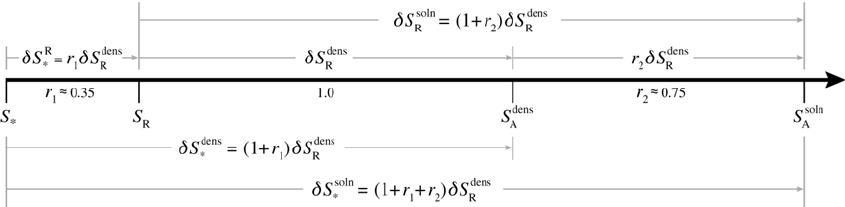
TEOS-10 Manual: Calculation and Use of the Thermodynamic Properties of Seawater
IOC Manuals and Guides No. 56
73
dens
AA
SS≡yieldsthebestavailableestimatesofthedensityofseawater.Thisisimportant
becauseinthefieldofphysicaloceanography,itisdensitythatneedstobeknowntothe
highestrelativeaccuracy.
Pawlowiczetal.(2010)andWrightetal.(2010b)foundthatwhilethenatureofthe
ocean’scompositionvariationschangesfromoneoceanbasintoanother,thefivedifferent
salinitymeasuresR
S,dens
A
S,soln
A
S,add
A
Sand*
Sareapproximatelyrelatedbythefollowing
simplelinearrelationships,(obtainedbycombiningequations(55)–(57)and(62)of
Pawlowiczetal.(2010))
dens
RR
0.35SS S
δ
∗−≈− ,(A.4.1)
dens dens
AR R
1.0SS S
δ
−≡ ,(A.4.2)
soln dens
AR R
1.75 δSSS−≈ ,(A.4.3)
add dens
AR R
0.78SS S
δ
−≈ .(A.4.4)
Eqn.(A.4.2)issimplythedefinitionoftheAbsoluteSalinityAnomaly,
dens dens
ARAR
SSSS
δδ
≡≡−.NotethatinmanyTEOS‐10publications,thesimplernotation
A
S
δ
isusedfordens dens
RAR
SSS
δ
≡−,asalinitydifferenceforwhichaglobalatlasis
available(McDougalletal.(2010a)).Inthecontextofoceanmodelling,itismore
convenienttocastthesesalinitydifferenceswithrespecttothePreformedSalinityS∗as
follows(usingtheaboveequations)
dens
RR
0.35SS S
δ
∗
−≈ ,(A.4.5)
dens dens
AR
1.35SS S
δ
∗
−≈ ,(A.4.6)
soln dens
A* R
2.1SS S
δ
−≈ ,(A.4.7)
add dens
AR
1.13SS S
δ
∗
−≈ .(A.4.8)
TheserelationshipsareillustratedonthenumberlineofsalinityinFigureA.4.1.ForSSW,
allfivesalinityvariablesR
S,dens
A
S,soln
A
S,add
A
Sand*
Sareequal.Itshouldbenotedthat
thesimplerelationshipsofEqns.(A.4.1)–(A.4.8)arederivedfromsimplelinearfitsto
modelcalculationsthatshowmorecomplexvariations.However,thevariationabout
theserelationshipsisnotlargerthanthetypicaluncertaintyofoceanmeasurements.
Theselinearrelationshipsprovideawaybywhichtheeffectsofanomalousseawater
compositionmaybeaddressedinoceanmodels(seeappendixA.20).
FigureA.4.1.Numberlineofsalinity,illustratingthedifferences
betweenvariousformsofsalinityforseawaterwhose
compositiondiffersfromthatofStandardSeawater.
IfmeasurementsareavailableoftheTotalAlkalinity,DissolvedInorganicCarbon,and
thenitrateandsilicateconcentrations,butnotofdensityanomalies,thenalternative
formulaeareavailableforthefoursalinitydifferencesthatappearontheleft‐handsidesof

74 TEOS-10 Manual: Calculation and use of the thermodynamic properties of seawater
IOC Manuals and Guides No. 56
Eqns.(A.4.1)–(A.4.8).Pawlowiczetal.(2010)haveusedachemicalmodelofconductivity
anddensitytoestimatehowthemanysalinitydifferencesintroducedabovedependon
themeasuredpropertiesofseawater.ThefollowingequationscorrespondtoEqns.(A.4.1)
–(A.4.4)above,andcomefromequations(51)–(54)and(59)ofPawlowiczetal.(2010).
Theseequationsarewrittenintermsofthevaluesofthenitrateandsilicateconcentrations
intheseawatersample(measuredin1
mol kg
−
),thedifferencebetweentheTotalAlkalinity
(TA )andDissolvedInorganicCarbon(DIC )ofthesampleandthecorrespondingvalues
ofourbestestimatesofTA andDIC inStandardSeawater,TA
Δ
andDICΔ,both
measuredin1
mol kg
−
.ForStandardSeawaterourbestestimatesofTAandDICare
P
0.0023 ( 35)S1
mol kg−andP
0.00208 ( 35)S1
mol kg
−
respectively(seePawlowicz(2010),
Pawlowiczetal.(2010)andthediscussionofthisaspectofSSWversusRCSWinWrightet
al.(2010b))).
()
()
1 1
*R 3 4
/ (g kg ) 18.1 TA 7.1 DIC 43.0 NO 0.1 Si(OH) (mol kg )SS −−−
−=−Δ−Δ−+ ,(A.4.9)
() ( )
dens 1 1
AR 3 4
/ (g kg ) 55.6 TA 4.7 DIC +38.9 NO 50.7 Si(OH) (mol kg )SS −−−
−=Δ+Δ + ,(A.4.10)
() ( )
soln 1 1
AR 3 4
/ (g kg ) 7.2 TA 47.0 DIC+ 36.5 NO 96.0 Si(OH) (mol kg )SS −−−
−=Δ+Δ + ,(A.4.11)
() ( )
add 1 1
AR 3 4
/ (g kg ) 25.9 TA 4.9 DIC +16.1NO 60.2 Si(OH) (mol kg )SS −−−
−=Δ+Δ + .(A.4.12)
ThestandarderrorofthemodelfitsinEqns.(A.4.9)–(A.4.11)aregivenbyPawlowiczet
al.(2010)atlessthan43
10 kg m
−−
(intermsofdensity)whichisequivalenttoafactorof20
smallerthantheaccuracytowhichPracticalSalinitycanbemeasuredatsea.Itisclear
thatifmeasurementsofTA,DIC,nitrateandsilicateareavailable(andrecognizingthat
thesemeasurementswillcomewiththeirownerrorbars),theseexpressionswilllikely
givemoreaccurateestimatesofthesalinitydifferencesthantheapproximatelinear
expressionspresentedinEqns.(A.4.1)–(A.4.8).ThecoefficientsinEqn.(A.4.10)are
reasonablysimilartothecorrespondingexpressionofBrewerandBradshaw(1975)(as
correctedbyMilleroetal.(1976a)):‐ whenexpressedasthesalinityanomalydens
AR
SS−
ratherthanasthecorrespondingdensityanomalyR
ρ
ρ
−,theirexpressioncorresponding
toEqn.(A.4.10)hadthecoefficients71.4,‐12.8,31.9and59.9comparedwiththe
coefficients55.6,4.7,38.9and50.7respectivelyinEqn.(A.4.10).
ThesalinitydifferencesexpressedwithrespecttoPreformedSalinity*
Swhich
correspondtoEqns.(A.4.5)–(A.4.8)canbefoundbylinearcombinationsofEqns.(A.4.9)–
(A.4.12)asfollows
()
()
1 1
R* 3 4
/ (g kg ) 18.1 TA 7.1 DIC 43.0 NO 0.1 Si(OH) (mol kg )SS −−−
−=Δ+Δ+− ,(A.4.13)
() ( )
dens 1 1
A* 3 4
/ (g kg ) 73.7 TA 11.8 DIC +81.9 NO 50.6 Si(OH) (mol kg )SS −−−
−=Δ+Δ + ,(A.4.14)
() ( )
soln 1 1
A* 3 4
/ (g kg ) 25.3 TA 54.1 DIC +79.5 NO 95.9 Si(OH) (mol kg )SS −−−
−=Δ+Δ + ,(A.4.15)
() ( )
add 1 1
A* 3 4
/ (g kg ) 44.0 TA 12.0 DIC+59.1NO 60.1 Si(OH) (mol kg )SS −−−
−=Δ+Δ + .(A.4.16)
TEOS-10 Manual: Calculation and Use of the Thermodynamic Properties of Seawater
IOC Manuals and Guides No. 56
75
A.5 Spatial variations in seawater composition
WhentheoceanographicdataneededtoevaluateEqn.(A.4.10)fordens
AR
SS−isnot
available,thelook‐uptablemethodofMcDougalletal.(2010a)isrecommendedto
evaluatedens dens
AR AR
SS SS
δδ
≡≡−.Thefollowingparagraphsdescribehowthismethod
wasdeveloped.
InaseriesofpapersMilleroetal.(1976a,1978,2000,2008b)andMcDougalletal.
(2010a)havereportedondensitymeasurementsmadeinthelaboratoryonsamples
collectedfromaroundtheworld’soceans.EachsamplehashaditsPracticalSalinity
measuredinthelaboratoryaswellasitsdensity(measuredwithavibratingtube
densimeterat25°Candatmosphericpressure).ThePracticalSalinityyieldsaReference
SalinityR
SaccordingtoEqn.(A.3.3),whilethedensitymeasurementmeas
ρ
impliesan
AbsoluteSalinitydens
AA
SS≡byusingtheequationofstateandtheequality
()
meas dens
A,25 C,0dbarS
ρρ
=°.Thedifferencedens
AR
SS−betweenthesetwosalinity
measuresistakentobeduetothecompositionofthesamplebeingdifferenttothatof
StandardSeawater.InthesepapersMilleroestablishedthatthesalinitydifferenceAR
SS−
couldbeestimatedapproximatelyfromknowledgeofjustthesilicateconcentrationofthe
fluidsample.Thereasonfortheexplainingpowerofsilicatealoneisthoughttobethat(a)
itisitselfsubstantiallycorrelatedwithotherrelevantvariables(e.g.totalalkalinity,nitrate
concentration,DIC[oftencalledtotalcarbondioxide]),(b)itaccountsforasubstantial
fraction(about0.6)ofthetypicalvariationsinconcentrations1
(g kg )
−oftheabovespecies
and(c)beingessentiallynon‐ionic;itspresencehaslittleeffectonconductivitywhile
havingadirecteffectondensity.
WhentheexistingdataonA
S
δ
,basedonlaboratorymeasurementsofdensity,was
regressedagainstthesilicateconcentrationoftheseawatersamples,McDougalletal.
(2010a)foundthesimplerelation
(
)
11 1
AAR 4
/(gkg ) ( )/(gkg ) 98.24 Si(OH) /(mol kg )SSS
δ
−− −
=− = .Global(A.5.1)
Thisregressionwasdoneoverallavailabledensitymeasurementsfromtheworldocean,
andthestandarderrorinthefitwas0.0054gkg‐1.
ThedependenceofA
S
δ
onsilicateconcentrationisobservedtobedifferentineach
oceanbasin,andthisaspectwasexploitedbyMcDougalletal.(2010a)toobtainamore
accuratedependenceofA
S
δ
onlocationinspace.FordataintheSouthernOceansouthof
30oSthebestsimplefitwasfoundtobe
()
11
A4
/(gkg ) 74.884 Si(OH) /(mol kg )S
δ
−−
=,SouthernOcean(A.5.2)
andtheassociatedstandarderroris0.0026gkg‐1.
Thedatanorthof30oSineachofthePacific,IndianandAtlanticOceanswastreated
separately.Ineachofthesethreeregionsthefitwasconstrainedtomatch(A.5.2)at30oS
andtheslopeofthefitwasallowedtovarylinearlywithlatitude.Theresultingfitswere
(forlatitudesnorthof30oS,thatisfor30
λ
≥− °)
[
]
()
(
)
1 1
A4
/ (g kg ) 74.884 1 0.3622 / 30 1 Si(OH) / (mol kg )S
δλ
− −
=+ °+ ,Pacific(A.5.3)
[
]
()
(
)
1 1
A4
/ (g kg ) 74.884 1 0.3861 / 30 1 Si(OH) / (mol kg )S
δλ
− −
=+ °+ ,Indian(A.5.4)
[
]
()
(
)
1 1
A4
/ (g kg ) 74.884 1 1.0028 / 30 1 Si(OH) / (mol kg ) .S
δλ
− −
=+ °+ Atlantic(A.5.5)
TheserelationshipsbetweentheAbsoluteSalinityAnomalyAAR
SSS
δ
=
−andsilicate
concentrationhavebeenusedbyMcDougall,JackettandMillero(2010a)inacomputer
algorithmthatusesanexistingglobaldatabaseofsilicate(GouretskiandKoltermann
(2004))andprovidesanestimateofAbsoluteSalinitywhengivenaseawatersample’s
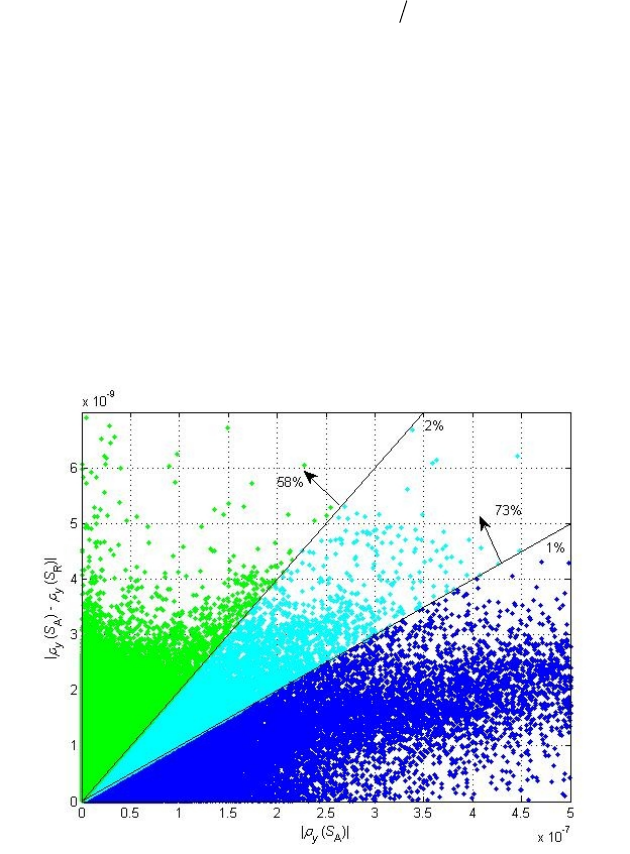
76 TEOS-10 Manual: Calculation and use of the thermodynamic properties of seawater
IOC Manuals and Guides No. 56
PracticalSalinityaswellasitsspatiallocationintheworldocean.Thiscomputer
algorithmaccountsforthelatestunderstandingofAbsoluteSalinityintheBalticSea,butit
issilentontheinfluenceofcompositionalvariationsinothermarginalseas.TheAbsolute
SalinityAnomalyintheBalticSeahasbeenquitevariableoverthepastfewdecadesof
observation(Feisteletal.(2010c)).ThecomputeralgorithmofMcDougalletal.(2010a)
usestherelationshipfoundbyFeisteletal.(2010c)thatappliesintheyears2006‐2009,
namely
()
1
AR RSO
0.087 g kg 1SS SS
−
−= ×− ,(A.5.6)
whereSO
S=35.16504gkg–1isthestandard‐oceanReferenceSalinitythatcorrespondsto
thePracticalSalinityof35.
Inordertogaugetheimportanceofthespatialvariationofseawatercomposition,the
northwardgradientofdensityatconstantpressureisshowninFig.A.5.1forthedataina
worldoceanhydrographicatlasdeeperthan1000m.Theverticalaxisinthisfigureisthe
magnitudeofthedifferencebetweenthenorthwarddensitygradientatconstantpressure
whentheTEOS‐10algorithmfordensityiscalledwithdens
AA
SS≡(asitshouldbe)
comparedwithcallingthesameTEOS‐10densityalgorithmwithR
Sasthesalinity
argument.FigureA.5.1showsthatthe“thermalwind”ismisestimatedbymorethan2%
for58%ofthedataintheworldoceanbelowadepthof1000miftheeffectsofthevariable
seawatercompositionareignored.
FigureA.5.1.Thenorthwarddensitygradientatconstantpressure(thehorizontalaxis)
fordataintheglobaloceanatlasofGouretskiandKoltermann(2004)for
1000p>dbar.Theverticalaxisisthemagnitudeofthedifference
betweenevaluatingthedensitygradientusingA
SversusR
Sasthe
salinityargumentintheTEOS‐10expressionfordensity.
TheimportanceofthespatialvariationsinseawatercompositionillustratedinFig.
A.5.1canbecomparedwiththecorrespondingimprovementachievedbytheTEOS‐10
GibbsfunctionforStandardSeawatercomparedwithusingEOS‐80.Thisisdoneby
ignoringspatialvariationsinseawatercompositioninboththeevaluationofTEOS‐10and
inEOS80bycallingTEOS‐10withR
SandEOS‐80withP
S.FigureA.5.2showsthe
magnitudeoftheimprovementinthe“thermalwind”inthepartoftheoceanthatis
deeperthan1000 m throughtheadoptionofTEOS‐10butignoringtheinfluenceof
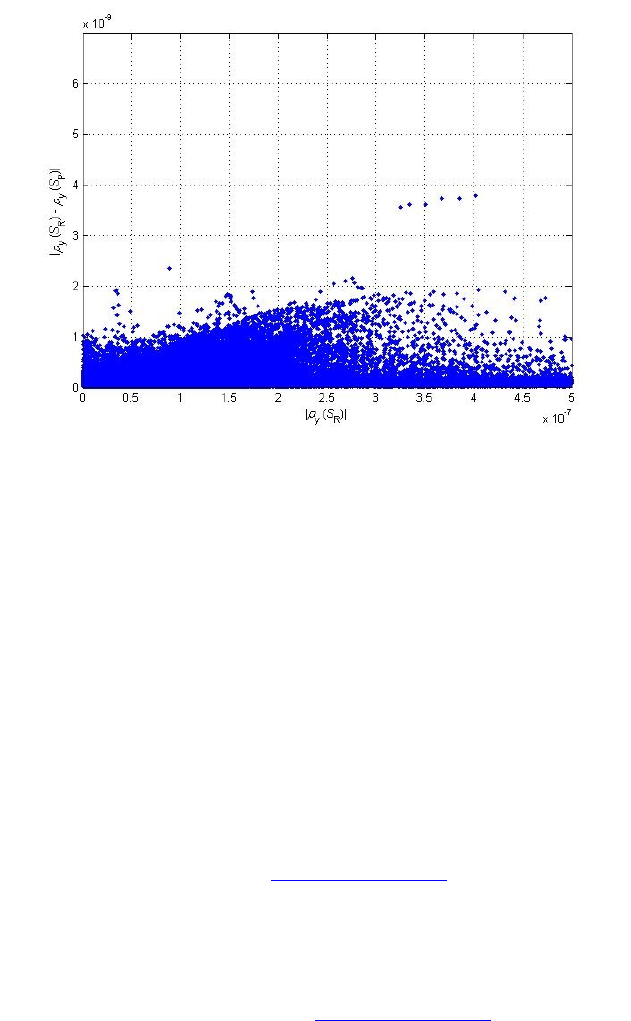
TEOS-10 Manual: Calculation and Use of the Thermodynamic Properties of Seawater
IOC Manuals and Guides No. 56
77
compositionalvariations.BycomparingFigs.A.5.1andA.5.2itisseenthatthemain
benefitthatTEOS‐10deliverstotheevaluationofthe“thermalwind”isthroughthe
incorporationofspatialvariationsinseawatercomposition;thegreateraccuracyofTEOS‐
10overEOS‐80forStandardSeawaterisonly18%aslargeastheimprovementgainedby
theincorporationofcompositionalvariationsintoTEOS‐10(i.e.thermsvalueofthe
verticalaxisinFig.A.5.2is18%ofthatoftheverticalaxisofFig.A.5.1).IftheAtlantic
wereexcludedfromthiscomparison,therelativeimportanceofcompositionalvariations
wouldbeevenlarger.
FigureA.5.2.Thenorthwarddensitygradientatconstantpressure(thehorizontalaxis)
fordataintheglobaloceanatlasofGouretskiandKoltermann(2004)for
1000 dbarp>.Theverticalaxisisthemagnitudeofthedifference
betweenevaluatingthedensitygradientusingR
Sasthesalinity
argumentintheTEOS‐10expressionfordensitycomparedwithusingP
S
intheEOS‐80algorithmfordensity.
ThethermodynamicdescriptionofseawaterandoficeIhasdefinedinIAPWS‐08and
IAPWS‐06hasbeenadoptedastheofficialdescriptionofseawaterandoficeIhbythe
IntergovernmentalOceanographicCommissioninJune2009.TheadoptionofTEOS‐10
hasrecognizedthatthistechniqueofestimatingAbsoluteSalinityfromreadilymeasured
quantitiesisperhapstheleastmatureaspectoftheTEOS‐10thermodynamicdescriptionof
seawater.Thepresentcomputersoftware,inbothFORTRANandMATLAB,whichevaluates
AbsoluteSalinityA
SgiventheinputvariablesPracticalSalinity P
S,longitude
λ
,latitude
φ
andseapressurepisavailableatwww.TEOS‐10.org.Itisexpected,asnewdata
(particularlydensitydata)becomeavailable,thatthedeterminationofAbsoluteSalinity
willimproveoverthecomingdecades,andthealgorithmforevaluatingAbsoluteSalinity
intermsofPracticalSalinity,latitude,longitudeandpressure,willbeupdatedfromtime
totime,afterrelevantappropriatelypeer‐reviewedpublicationshaveappeared,andsuch
anupdatedalgorithmwillappearonthewww.TEOS‐10.orgwebsite.Usersofthis
softwareshouldstateintheirpublishedworkwhichversionofthesoftwarewasusedto
calculateAbsoluteSalinity.
78 TEOS-10 Manual: Calculation and use of the thermodynamic properties of seawater
IOC Manuals and Guides No. 56
A.6 Gibbs function of seawater
TheGibbsfunctionofseawater
()
A,,
g
StpisdefinedasthesumoftheGibbsfunctionfor
purewater
()
W,
g
tpandthesalinepartoftheGibbsfunction
(
)
S
A,,
g
Stpsothat
()
(
)
(
)
WS
AA
,, , ,, .
g
S tp g tp g S tp=+ (A.6.1)
InthiswayatzeroAbsoluteSalinity,thethermodynamicpropertiesofseawaterareequal
tothoseofpurewater.ThisconsistencyisalsomaintainedwithrespecttotheGibbs
functionforicesothatthepropertiesalongtheequilibriumcurvecanbeaccurately
determined(suchasthefreezingtemperatureasafunctionofAbsoluteSalinityand
pressure).Thecarefulalignmentofthethermodynamicpotentialsofpurewater,iceIh
andseawaterisdescribedinFeisteletal.(2008a).
Theinternationallyacceptedthermodynamicdescriptionofthepropertiesofpure
water(IAPWS‐95)istheofficialpure‐waterbasisuponwhichtheGibbsfunctionof
seawaterisbuiltaccordingto(A.6.1).This
()
W,
g
tpGibbsfunctionofliquidwaterisvalid
overextendedrangesoftemperatureandpressurefromthefreezingpointtothecritical
point(–22°C<t<374°Cand600Pa<p+P0<1000MPa)howeveritisacomputationally
expensivealgorithm.PartofthereasonforthiscomputationalintensityisthattheIAPWS‐
95formulationisintermsofaHelmholtzfunctionwhichhasthepressureasafunctionof
temperatureanddensity,sothataniterativeprocedureisneedtofortheGibbsfunction
()
W,
g
tp(seeforexample,Feisteletal.(2008a))
Forpracticaloceanographicuseintheoceanographicrangesoftemperatureand
pressure,fromlessthanthefreezingtemperatureofseawater(atanypressure),upto
40 C°(specificallyfrom
()
1
0
2.65 0.0743 MPa CpP −
⎡⎤
−++× °
⎣⎦
to40°C),andinthepressure
range4
0 < 10 dbarp<wealsorecommendtheuseofthepurewaterpartoftheGibbs
functionofFeistel(2003)whichhasbeenapprovedbyIAPWSastheSupplementary
Release,IAPWS‐09.TheIAPWS‐09releasediscussestheaccuracytowhichtheFeistel
(2003)GibbsfunctionfitstheunderlyingthermodynamicpotentialofIAPWS‐95;in
summary,forthevariablesdensity,thermalexpansioncoefficientandspecificheat
capacity,thermsmisfitbetweenIAPWS‐09andIAPWS‐95,intheregionofvalidityof
IAPWS‐09,areafactorofbetween20and100lessthanthecorrespondingerrorinthe
laboratorydatatowhichIAPWS‐95wasfitted.Hence,intheoceanographicrangeof
parameters,IAPWS‐09andIAPWS‐95mayberegardedasequallyaccurate
thermodynamicdescriptionsofpureliquidwater.
AllofthethermodynamicpropertiesofseawaterthataredescribedinthisManualare
availableasbothFORTRANandMATLABimplementations.Theseimplementationsare
availablefor
()
W,
g
tpbeingIAPWS‐95andIAPWS‐09,bothbeingequallyaccurate
relativetothelaboratory‐determinedknownproperties,butwiththecomputercodebased
onIAPWS‐09beingapproximatelyafactorof65fasterthanthatbasedonIAPWS‐95.
Mostoftheexperimentalseawaterdatathatwerealreadyusedfortheconstructionof
EOS‐80wereexploitedagainfortheIAPWS‐08formulationaftertheircarefuladjustment
tothenewtemperatureandsalinityscalesandtheimprovedpure‐waterreference
IAPWS‐95.Additionally,IAPWS‐08wassignificantlyimproved(comparedwithEOS‐80)
bymakinguseoftheoreticalrelationssuchastheideal‐solutionlawandtheDebye‐
Hückellimitinglaw,aswellasbyincorporatingadditionalaccuratemeasurementssuch
asthetemperaturesofmaximumdensity,vapourpressuresandmixingheats,and
implicitlybytheenormousbackgrounddatasetwhichhadenteredthedeterminationof
IAPWS‐95(WagnerandPruß(2002),Feistel(2003,2008)).Forexample,MilleroandLi
(1994)concludedthatthepure‐waterpartoftheEOS‐80sound‐speedformulaofChenand
Millero(1977)wasresponsibleforadeviationof0.51
ms
−
fromDelGrosso’s(1974)
formulaforseawaterathighpressuresandtemperaturebelow5oC.ChenandMillero
(1977)onlymeasuredthedifferencesinthesoundspeedsofseawaterandpurewater.The

TEOS-10 Manual: Calculation and Use of the Thermodynamic Properties of Seawater
IOC Manuals and Guides No. 56
79
newGibbsfunctioninwhichweuseIAPWS‐95forthepure‐waterpartaswellassound
speedsfromDelGrosso(1974),isperfectlyconsistentwithChenandMillero’s(1976)
densitiesandBradshawandSchleicher’s(1970)thermalexpansiondataathighpressures.
Theaccuracyofhigh‐pressureseawaterdensitieshasincreasedwiththeuseofIAPWS‐95,
directlyasthepure‐waterpart,andindirectlybycorrectingearlierseawater
measurements,makingthemʺnewʺ seawaterdata.Inthismannertheknownsound‐
speedinconsistencyofEOS‐80hasbeenresolvedinanaturalmanner.
A.7 The fundamental thermodynamic relation
Thefundamentalthermodynamicrelationforasystemcomposedofasolvent(water)and
asolute(seasalt)relatesthetotaldifferentialsofthermodynamicquantitiesforthecase
wherethetransitionsbetweenequilibriumstatesarereversible.Thisrestrictionissatisfied
forinfinitesimallysmallchangesofaninfinitesimallysmallseawaterparcel.The
fundamentalthermodynamicrelationis
(
)
0A
dd d dhvP Tt S
ημ
−=++ .(A.7.1)
AderivationofthefundamentalthermodynamicrelationcanbefoundinWarren(2006)
(hisequation(8)).Theleft‐handsideofEqn.(A.7.1)isoftenwrittenas
()
0
ddupPv++
where
()
0
pP+istheabsolutepressure.Herehisthespecificenthalpy(i.e.enthalpyper
unitmassofseawater),uisthespecificinternalenergy,1
v
ρ
−
=isthespecificvolume,
()
0
Tt+istheabsolutetemperature,
η
isthespecificentropyand
μ
istherelative
chemicalpotential.Influiddynamicsweusuallydealwithmaterialderivatives,ddt,that
is,derivativesdefinedfollowingthefluidmotion,ddtt
=
∂∂ + ⋅∇uwhereuisthefluid
velocity.Intermsofthistypeofderivative,andassuminglocalthermodynamic
equilibrium(i.e.thatlocalthermodynamicequilibriumismaintainedduringthetemporal
change),thefundamentalthermodynamicrelationis
()
A
0
d1d d d
.
dd d d
hP S
Tt
tt tt
η
μ
ρ
−=++ (A.7.2)
Notethattheconstancyofentropydoesnotimplytheabsenceofirreversibleprocesses
because,forexample,therecanbeirreversiblechangesofbothsalinityandenthalpyat
constantpressureinjusttherightratiosoastohaveequaleffectsinEqns.(A.7.1)or(A.7.2)
sothatthechangeofentropyintheseequationsiszero.
A.8 The “conservative” and “isobaric conservative” properties
AthermodynamicvariableCissaidtobe“conservative”ifitsevolutionequation(thatis,
itsprognosticequation)hastheform
() ( )
C
d.
d
t
C
CC
t
ρρρ
+∇⋅ = = −∇⋅uF(A.8.1)
Forsucha“conservative”property,intheabsenceoffluxesC
Fattheboundaryofa
controlvolume,thetotalamountofC‐stuffisconstantinsidethecontrolvolume.The
middlepartofEqn.(A.8.1)hasusedthecontinuityequation(whichistheequationforthe
conservationofmass)
(
)
,, 0.
xyz
t
ρρ
∂∂ +∇⋅ =u(A.8.2)
Inthespecialcasewhenthematerialderivativeofapropertyiszero(thatis,themiddle
partofEqn.(A.8.1)iszero)thepropertyissaidtobe“materiallyconserved”.
Theonlyquantitythatcanberegardedas100%conservativeintheoceanismass
[equivalenttotaking1C=andC
=
F0inEqn.(A.8.1)].Infact,lookingaheadto

80 TEOS-10 Manual: Calculation and use of the thermodynamic properties of seawater
IOC Manuals and Guides No. 56
appendicesA.20andA.21,ifwestrictlyinterpret
ρ
uasthemassfluxperunitareaof
pureseawater(i.e.ofonlypurewaterplusdissolvedmaterial)andspecifically,that
ρ
u
excludesthefluxofparticulatematter,thentheright‐handsideofthecontinuityequation
(A.8.2)shouldbeA
S
ρ
S,thenon‐conservativesourceofmassduetobiogeochemical
processes.ItcanbeshownthattheinfluenceofthissourcetermA
S
ρ
Sinthecontinuity
equationontheevolutionequationforAbsoluteSalinityislessimportantbythefactor
()
AA
ˆˆ
1SS−thanthesamesourcetermthatappearsinthisevolutionequationfor
AbsoluteSalinity,Eqn.(A.21.8).Hencethecurrentpracticeofassumingthatthenon‐
particulatepartoftheoceanobeystheconservativeform(A.8.2)ofthecontinuityequation
isconfirmedeveninthepresenceofbiogeochemicalprocesses.
Twoothervariables,totalenergy0.5u
=
+⋅+Φuu
E
(seeEqn.(B.15))and
ConservativeTemperatureΘ(orequivalently,potentialenthalpy0
h)arenotcompletely
conservative,buttheerrorinassumingthemtobeconservativeisnegligible(seeappendix
A.21).OthervariablessuchasReferenceSalinityR,SAbsoluteSalinityA,Spotential
temperature,
θ
enthalpy,hinternalenergy,uentropy,
η
density,
ρ
potentialdensity
,
θ
ρ
specificvolumeanomaly
δ
andtheBernoullifunction0.5h
=
+⋅+Φuu
B
(seeEqn.
(B.17))arenotconservativevariables.
WhilebothAbsoluteSalinityandReferenceSalinityareconservativeunderthe
turbulentmixingprocess,bothareaffectedinanon‐conservativewaybythe
remineralizationprocess.Becausethedominantvariationsofthecompositionofseawater
areduetospecieswhichdonothaveastrongsignatureinconductivity,insomesituations
itmaybesufficientlyaccuratetotakeReferenceSalinityR
Stobeaconservativevariable.
However,wenotethattheerrorinvolvedwithassumingthatR
Sisaconservative
variableisafactorofapproximately40larger(intermsofitseffectsondensity)thanthe
errorinassumingthatΘisaconservativevariable.PreformedSalinity*
Sisconstructed
sothatitcontainsnosignatureofthebiogeochemicalprocessesthatcausethespatial
variationofseawatercomposition.Inthisway*
Sisspecificallydesignedtobea
conservativeoceanicsalinityvariable.Havingsaidthat,theaccuracywithwhichwecan
constructPreformedSalinity*
Sfromoceanobservationsispresentlylimitedbyour
knowledgeofthebiogeochemicalprocesses(seeappendicesA.4andA.5andPawlowiczet
al.(2010)).
Summarizingthisdiscussionthusfar,thequantitiesthatcanbeconsidered
conservativeintheoceanare(indescendingorderofaccuracy)(i)mass,(ii)totalenergy
0.5u=+ ⋅+Φuu
E
,(iii)ConservativeTemperature
Θ
,and(iv)PreformedSalinity*
S.
Adifferentformof“conservation”attribute,namely“isobaricconservation”occurs
whenthetotalamountofthequantityisconservedwhentwofluidparcelsaremixedat
constantpressurewithoutexternalinputofheatormatter.This“isobaricconservative”
propertyisaveryvaluableattributeforanoceanographicvariable.Any“conservative”
variableisalso“isobaricconservative”,thusthefourconservativevariableslistedabove,
namelymass,ConservativeTemperature
Θ
,PreformedSalinity*
S,andtotalenergy
E
are“isobaricconservative”.Inaddition,theBernoullifunction
B
andspecificenthalpyh
arealso“isobaricconservative”(seeEqn.(B.17)andthediscussionthereafter).
Somevariablesthatarenot“isobaricconservative”includepotentialtemperature,
θ
internalenergy,uentropy,
η
density,
ρ
potentialdensity,
θ
ρ
andspecificvolume
anomaly.
δ
EnthalpyhandConservativeTemperature
Θ
arenotexactly“isobaric
conservative”becauseenthalpyincreaseswhenthekineticenergyoffluidmotionis
dissipatedbymolecularviscosityinsidethecontrolvolumeandwhenthereisasalinity
sourcetermduetotheremineralizationofparticulatematter.However,thesearetiny
effectsintheFirstLawofThermodynamics(seeappendixA.21)andtraditionallywe
regardenthalpyhasan“isobaricconservative”variable.Notethatwhilehis“isobaric
conservative”,itisnota“conservative”variable.
TEOS-10 Manual: Calculation and Use of the Thermodynamic Properties of Seawater
IOC Manuals and Guides No. 56
81
AppendicesA.18andA.21showthatforallpracticalpurposeswecantreatΘand0
h
asbeing“conservative”variables(andhencealso“isobaricconservative”variables);doing
soignoresthedissipationofmechanicalenergy
ε
andothertermsofsimilarorsmaller
magnitude.Henceforallpracticalpurposesinoceanographywehavemassandthe
followingthreeothervariablesthatare“conservative”and“isobaricconservative”;
(1)ConservativeTemperature,
Θ
(andpotentialenthalpy0
h),
(2)PreformedSalinity*
S,and
(3)totalenergy
E
.
Herewecommentbrieflyonthelikelyerrorsinvolvedwithassumingvariablesother
than*
SandΘtobeconservativevariablesinoceanmodels.IfonetookAbsoluteSalinity
A
Sasanoceanmodel’ssalinityvariableandtreateditasbeingconservative,thesalinity
errorwould(afteralongspin‐uptime)beapproximatelyaslargeastheAbsoluteSalinity
Anomaly(asshowninFigure2),whichislargerthan1
0.025 g kg
−
intheNorthPacific,
implyingdensityerrorsof3
0.020 kg m
−
.Asameasureoftheimportanceofthistypeof
densityerror,wenotethatiftheequationofstateinanoceanmodelwerecalledwithR
S
insteadofwithA
S,thenorthwarddensitygradientatfixedpressure(i.e.thethermal
wind)wouldbemisestimatedbymorethan2%formorethan58%ofthedatabelowa
pressureof1000dbarintheworldocean.Itisclearlydesirabletonothavethistypeof
systematicerrorinthedynamicalequationsoftheoceancomponentofcoupledclimate
models.AppendixA.20discussespracticalwaysofincludingtheeffectsofthenon‐
conservativeremineralizationsourceterminoceanmodels.Therecommendedoptionis
thatoceanmodelscarryPreformedSalinity*
Sasthemodel’sconservativesalinitymodel
variable,andthattheyalsocarryanevolutionequationforanAbsoluteSalinityAnomaly
asdescribedinsectionA.20.1andEqns.(A.20.3)–(A.20.5).
Theerrorsincurredinoceanmodelsbytreatingpotentialtemperature
θ
asbeing
conservativehavenotyetbeenthoroughlyinvestigated,butMcDougall(2003)and
Tailleux(2010)havemadeastartonthistopic.McDougall(2003)foundthattypicalerrors
in
θ
are0.1 C±°whileinisolatedregionssuchaswherethefreshAmazonwater
dischargesintotheocean,theerrorcanbeaslargeas1.4 C°.Thecorrespondingerrorin
themeridionalheatfluxappearstobeabout0.005PW(orarelativeerrorof0.4%).The
useofConservativeTemperature
Θ
inoceanmodelsreducestheseerrorsbyalmosttwo
ordersofmagnitude.
Iftheoceanwereinthermodynamicequilibrium,itstemperaturewouldbethesame
everywhereaswouldthechemicalpotentialsofwaterandofeachdissolvedspecies,while
theentropyandtheconcentrationsofeachspecieswouldbefunctionsofpressure.
Turbulentmixingactsinthecomplementarydirection,tendingtomakesalinityand
entropyconstantbutintheprocesscausinggradientsintemperatureandthechemical
potentialsasfunctionsofpressure.Thatis,turbulentmixingactstomaintainanon‐
equilibriumstate.Thisdifferencebetweentherolesofmolecularversusturbulentmixing
resultsfromthesymmetrybreakingroleofthegravityfield;forexample,inalaboratory
withoutgravity,turbulentandmolecularmixingwouldhaveindistinguishableeffects.
NotethatthemolecularfluxofsaltS
Fisgivenbyequation(58.11)ofLandauand
Lifshitz(1959)andbyEqn.(B.23)below. S
Fconsistsnotonlyoftheproductoftheusual
moleculardiffusivityandA
S
ρ
−∇ ,butalsocontainstwoothertermsthatareproportional
tothegradientsoftemperatureandpressurerespectively.Itisthesetermsthatcausethe
equilibriumverticalgradientsofthedissolvedsolutesinanon‐turbulentoceantobe
differentandnon‐zero;thelasttermbeingcalledthebaro‐diffusioneffect.Thepresence
ofturbulentmixingintherealoceanrendersthisprocessmootasturbulencetendsto
homogenizetheoceanandmaintainsarelativelyconstantsea‐saltcomposition.
Notethatthedescription“conservationequation”ofaparticularquantityisoften
usedfortheequationthatdescribeshowthisquantitychangesinresponsetothe
82 TEOS-10 Manual: Calculation and use of the thermodynamic properties of seawater
IOC Manuals and Guides No. 56
divergenceofvariousfluxesofthequantityandtonon‐conservative“source”terms.For
example,itisusualtorefertothe“conservationequation”forentropyorfor“potential
temperature”.Sincethesevariablesarenotconservativevariablesitseemsunnaturalto
refertotheirevolutionequationsas“conservationequations”.Henceherewewillusethe
term“conservationequation”onlyforavariablethatis(forallpracticalpurposes)
conserved.Forothervariableswewillrefertotheir“evolutionequation”ortheir
“prognosticequation”ortheir“localbalanceequation”.
A.9 The “potential” property
Anythermodynamicpropertyofseawaterthatremainsconstantwhenaparcelof
seawaterismovedfromonepressuretoanotheradiabatically,withoutexchangeofmass
andwithoutinteriorconversionbetweenitsturbulentkineticandinternalenergies,issaid
topossessthe“potential”property,orinotherwords,tobea“potential”variable.Prime
examplesof“potential”variablesareentropy
η
andalltypesofsalinity.Theconstancyof
entropy
η
canbeseenfromtheFirstLawofThermodynamicsinEqn.(B.19)below;with
theright‐handsideofEqn.(B.19)beingzero,andwithnochangeinAbsoluteSalinity,it
followsthatentropyisalsoconstant.Anythermodynamicpropertythatisafunctionof
onlyAbsoluteSalinityandentropyalsoremainsunchangedbythisprocedureandissaid
tohavethe“potential”property.Thermodynamicpropertiesthatpossesthe“potential”
attributeincludepotentialtemperature,
θ
potentialenthalpy0,hConservative
TemperatureΘandpotentialdensity
θ
ρ
(nomatterwhatfixedreferencepressureis
chosen).Somethermodynamicpropertiesthatdonotpossesthepotentialpropertyare
temperature,tenthalpy,hinternalenergy,uspecificvolume,vdensity,
ρ
specific
volumeanomaly,
δ
totalenergy
E
andtheBernoullifunction.
B
FromEqn.(B.17)we
noticethatintheabsenceofmolecularfluxesandthesourcetermofAbsoluteSalinity,the
Bernoullifunction
B
isconstantfollowingthefluidflowonlyifthepressurefieldis
steady;ingeneralthisisnotthecase.Thenon‐potentialnatureof
E
isexplainedinthe
discussionfollowingEqn.(B.17).
Someauthorshaveusedtheterm“quasi‐material”todescribeavariablethathasthe
“potential”property.Thename“quasi‐material”derivesfromtheideathatthevariable
onlychangesasaresultofirreversiblemixingprocessesanddoesnotchangeinresponse
toadiabaticandisohalinechangesinpressure.
Theword“adiabatic”istraditionallytakentomeanaprocessduringwhichthereisno
exchangeofheatbetweentheenvironmentandthefluidparceloneisconsidering.With
thisdefinitionof“adiabatic”itisstillpossiblefortheentropy
η
,thepotentialtemperature
θ
andtheConservativeTemperature
Θ
ofafluidparceltochangeduringanisohaline
andadiabaticprocess.Thisisbecausethedissipationofmechanicalenergy
ε
causes
increasesin
η
,
θ
andΘ(seetheFirstLawofThermodynamics,Eqns.(A.13.3)‐(A.13.5)).
Whilethedissipationofmechanicalenergyisasmalltermwhoseinfluenceisroutinely
neglectedintheFirstLawofThermodynamicsinoceanography,itseemsadvisableto
modifythemeaningoftheword“adiabatic”inoceanographysothatouruseoftheword
moreaccuratelyreflectsthepropertieswenormallyassociatewithanadiabaticprocess.
Accordinglyweproposethattheword“adiabatic”inoceanographybetakentodescribea
processoccurringwithoutexchangeofheatandalsowithouttheinternaldissipationof
mechanicalenergy.Withthisdefinitionof“adiabatic”,aprocessthatisbothisohalineand
adiabaticdoesimplythattheentropy
η
,potentialtemperature
θ
andConservative
TemperatureΘareallconstant.
Usingthismorerestrictivedefinitionoftheword“adiabatic”wecanrestatethe
definitionofa“potential”propertyasfollows;anythermodynamicpropertyofseawater
thatremainsconstantwhenaparcelofseawaterismovedfromonepressuretoanother

TEOS-10 Manual: Calculation and Use of the Thermodynamic Properties of Seawater
IOC Manuals and Guides No. 56
83
“adiabatically”andwithoutexchangeofmass,issaidtopossessthe“potential”property,
orinotherwords,tobea“potential”variable.
InappendixA.8aboveweconcludedthatonlymass,andthethreevariables
E
,*
S
andΘ(approximately)are“conservative”(andhencealso“isobaricconservative”).Since
E
doesnotpossesthe“potential”property,wenowconcludethatonlymassandthetwo
variables*
Sand
Θ
possesallthreehighlydesiredproperties,namelythattheyare
“conservative”,“isobaricconservative”andare“potential”variables.Inthecaseof
ConservativeTemperature,Θits“conservative”(andthereforeits“isobaric
conservative”)natureisapproximate:‐ while
Θ
isnota100%conservativevariable,itis
approximatelytwoordersofmagnitudeclosertobeingatotallyconservativevariable
thanareeitherpotentialtemperatureorentropy.Similarly,PreformedSalinity*
Sisin
principle100%conservative,butourabilitytoevaluate*
Sfromhydrographic
observationsislimited(forexample,bytheapproximaterelations(A.4.1)or(A.4.9)).
TableA.9.1The“potential”,“conservative”,“isobaricconservative”and
thefunctionalnatureofvariousoceanographicvariables
Variable “potential”? “conservative”? “isobaric conservative”? function of
()
A,,Stp?
*
S x
A
S x 1 x 1
RP
,SS
x 1 x 1 x
t x x x
θ
x x
η
x x
h x x 2
0
,hΘ 3 3
u x x x
B
x x 4 x
E
x 4 4 x
,v
ρ
x x x
θ
ρ
x x
δ
x x x
v
ρ
x x x 5
n
γ
x x x x
1TheremineralizationoforganicmatterchangesR
SlessthanitchangesA.S
2Taking
ε
andtheeffectsofremineralizationtobenegligible.
3Taking
ε
andothertermsofsimilarsizetobenegligible(seethediscussion
followingEqn.(A.21.13)).
4Takingtheeffectsofremineralizationtobenegligible.
5Oncethereferencesoundspeedfunction
(
)
0,cp
ρ
hasbeendecidedupon.
InTableA.9.1variousoceanographicvariablesarecategorizedaccordingtowhetherthey
possesthe“potential”property,whethertheyare“conservative”variables,whetherthey
are“isobaricconservative”variables,andwhethertheyarefunctionsofonly
()
A,,Stp.

84 TEOS-10 Manual: Calculation and use of the thermodynamic properties of seawater
IOC Manuals and Guides No. 56
NotethatΘistheonlyvariablethatachievefour“ticks”inthistable,whilePreformed
Salinity*
Shasticksinthefirstthreecolumns,butnotinthelastcolumnsinceitisa
functionnotonlyof
()
A,,Stpbutalsoofthecompositionofseawater.HenceΘisthe
most“ideal”thermodynamicvariable.Ifitwerenotforthenon‐conservationofAbsolute
Salinity,ittoowouldbean“ideal”thermodynamicvariable,butinthissense,Preformed
SalinityissuperiortoAbsoluteSalinity.ConservativeTemperatureΘandPreformed
Salinity*
Saretheonlytwovariablesinthistabletobeboth“potential”and
“conservative”.ThelastfourrowsofTableA.9.1areforpotentialdensity,
θ
ρ
(seesection
3.4),specificvolumeanomaly,
δ
(seesection3.7),orthobaricdensity,v
ρ
(seeappendix
A.28)andNeutralDensityn
γ
(seesection3.14andappendixA.29).
A.10 Proof that
()
A,S
θ
θη
= and
(
)
A,S
θ
Θ=Θ
Considerchangesoccurringattheseasurface,(specificallyatp
=
0dbar)wherethe
temperatureisthesameasthepotentialtemperaturereferencedto0dbarandthe
incrementofpressuredpiszero.Regardingspecificenthalpyhandchemicalpotential
μ
tobefunctionsofentropy
η
(inplaceoftemperaturet),thatis,consideringthe
functionalformofhand
μ
tobe
(
)
A,,hhS p
η
=
and
(
)
A,, ,Sp
μμ η
=
itfollowsfromthe
fundamentalthermodynamicrelation(Eqn.(A.7.1))that
() ()
(
)
(
)
A
AAA0AA
,,0d ,,0 d d ,,0d ,
S
hS h S S T S S
η
ηη η θημη
+=++
(A.10.1)
whichshowsthatspecificentropy
η
issimplyafunctionofAbsoluteSalinityA
Sand
potentialtemperature,
θ
thatis
(
)
A,S
η
ηθ
=,withnoseparatedependenceonpressure.
Itfollowsthat
(
)
A,.S
θ
θη
=
Similarly,fromthedefinitionofpotentialenthalpyandConservativeTemperaturein
Eqns.(3.2.1)and(3.3.1),at0p=dbaritcanbeseenthatthefundamentalthermodynamic
relation(A.7.1)implies
()
(
)
0
0AA
dd,,0d.
p
cT SS
θη μ θ
Θ= + +(A.10.2)
ThisshowsthatConservativeTemperatureisalsosimplyafunctionofAbsoluteSalinity
andpotentialtemperature,
()
A,S
θ
Θ=Θ ,withnoseparatedependenceonpressure.Itthen
followsthatΘmayalsobeexpressedasafunctionofonlyA
Sand.
η
Itfollowsthat
Θ
hasthe“potential”property.
A.11 Various isobaric derivatives of specific enthalpy
Becauseofthecentralroleofenthalpyinthetransportandtheconservationof“heat”in
theocean,thederivativesofspecificenthalpyatconstantpressureareherederivedwith
respecttoAbsoluteSalinityandwithrespecttothethree“temperature‐like”variables
,
η
θ
andΘaswellasinsitutemperature.t
Webeginbynotingthatthethreestandardderivativesof
()
A,,hhStp=whenin
situtemperature tistakenasthe“temperature‐like”variableare
()
(
)
(
)
AA0A
,,, ,, ,
T
Tp
hS Stp T t Stp
μμ
∂∂ = − + (A.11.1)
()
(
)
(
)
AA0A
,,, ,, ,
pT
Sp
hT c Stp T t Stp
η
∂∂ = = + (A.11.2)
and
()
(
)
(
)
AA0A
,,, ,, .
T
ST
h P vS tp T tv S tp∂∂ = − + (A.11.3)

TEOS-10 Manual: Calculation and Use of the Thermodynamic Properties of Seawater
IOC Manuals and Guides No. 56
85
Nowconsideringspecificenthalpytobeafunctionofentropy(ratherthanof
temperaturet),thatis,taking
(
)
A,, ,hhS p
η
=
thefundamentalthermodynamicrelation
(A.7.1)becomes
()
AA0 A
dd dd
S
hhSTt S
η
ηημ
+=++
while
A,,
S
hP v
η
∂
∂=
(A.11.4)
sothat
()
A0
,Sp
hTt
η
∂∂ = +
and A,.
p
hS
η
μ
∂
∂=
(A.11.5)
Nowtakingspecificenthalpytobeafunctionofpotentialtemperature(ratherthanof
temperaturet),thatis,taking
(
)
A,, ,hhS p
θ
=thefundamentalthermodynamicrelation
(A.7.1)becomes
()
AA0 A
dd dd
S
hhSTt S
θθημ
+=++
while
A,.
S
hP v
θ
∂
∂=
(A.11.6)
Toevaluatetheh
θ
partialderivative,itisfirstwrittenintermsofthederivativewith
respecttoentropyas
()
AA
AA0
,,,
SS
Sp Sp
hh Tt
θθηθ
ηη
==+
(A.11.7)
where(A.11.5)hasbeenused.Thisequationcanbeevaluatedat0p
=
whenitbecomes
(thepotentialtemperatureusedhereisreferencedtor0p
=
)
()
(
)
A
AA0
,0 ,,0 .
pS
Sp
hcS T
θθ
θ
ηθ
===+
(A.11.8)
Thesetwoequationsareusedtoarriveatthedesiredexpressionforh
θ
namely
()
(
)
()
A
0
A
,0
,,0 .
p
Sp
Tt
hcST
θ
θ
θ
+
=+
(A.11.9)
ToevaluatetheA
S
h
partialderivative,wefirstwritespecificenthalpyinthefunctional
form
()
()
AA
,,,hhS S p
ηθ
=
andthendifferentiateit,finding
AA A
A
,,,
.
SS S
ppSp
hhh
η
θ
θηη
=+
(A.11.10)
ThepartialderivativeofspecificentropyT
g
η
=
−(Eqn.(2.10.1))withrespecttoAbsolute
Salinity,AA
,
SST
g
η
=− isalsoequaltoT
μ
−
sincechemicalpotentialisdefinedbyEqn.
(2.9.6)asA
S
g
μ
=.SincethepartialderivativeofentropywithrespecttoA
Sin(A.11.10)is
performedatfixedpotentialtemperature(ratherthanatfixedinsitutemperature),thisis
equaltoT
μ
−evaluatedat0.p=Substitutingbothpartsof(A.11.5)into(A.11.10)we
havethedesiredexpressionforA
S
h
namely
()
(
)
(
)
AA0A
,,, , ,0.
ST
p
hStpTtS
θ
μμθ
=−+
(A.11.11)
Noticethatthisexpressioncontainssomethingsthatareevaluatedatthegeneralpressure
pandoneevaluatedatthereferencepressurer0.p
=
NowconsideringspecificenthalpytobeafunctionofConservativeTemperature
(ratherthanoftemperaturet),thatis,taking
(
)
A
ˆ,, ,hhS p
=Θthefundamental
thermodynamicrelation(A.7.1)becomes
()
AA0 A
ˆˆ
dd dd
S
hhSTt S
ημ
ΘΘ+ = + + while
A,
ˆ.
S
hP v
Θ
∂
∂=(A.11.12)
Thepartialderivativeˆ
hΘfollowsdirectlyfromthisequationas
() ()
AA
A
00
,
,
ˆ.
Sp S
Sp
hTt Tt
ηη
ΘΘΘ
=+ =+ (A.11.13)
At0p=thisequationreducesto
()
A
A
0
0
,0
ˆ,
pS
Sp
hcT
θη
ΘΘ
===+ (A.11.14)
andcombiningthesetwoequationsgivesthedesiredexpressionforˆ
h
Θ
namely

86 TEOS-10 Manual: Calculation and use of the thermodynamic properties of seawater
IOC Manuals and Guides No. 56
(
)
()
A
00
,0
ˆ.
p
Sp
Tt
hc
T
θ
Θ
+
=+(A.11.15)
ToevaluatetheA
ˆS
hpartialderivativewefirstwritehinthefunctionalform
()
()
AA
,,,hhS S p
η
=Θ
andthendifferentiateit,finding(usingbothpartsofEqn.(A.11.5))
()()
AA
A0
,
ˆ,, .
SS
p
hStpTt
μη
Θ
Θ=++(A.11.16)
ThedifferentialexpressionEqn.(A.11.12)canbeevaluatedat0p
=
wheretheleft‐hand
sideissimply0d
p
cΘsothatfromEqn.(A.11.12)wefindthat
(
)
()
A
A
0
,,0,
S
S
T
μθ
ηθ
Θ=− +(A.11.17)
sothatthedesiredexpressionforA
ˆS
his
()
(
)
()
()
A
0
AA
,0
ˆ,, , ,0.
Sp
Tt
hStp S
T
μμθ
θ
Θ
+
=−
+(A.11.18)
Theaboveboxedexpressionsforfourdifferentisobaricderivativesofspecificenthalpyare
importantastheyareintegraltoformingtheFirstLawofThermodynamicsintermsof
potentialtemperatureandintermsofConservativeTemperature.
A.12 Differential relationships between ,,
η
θ
Θ
and A
S
Evaluatingthefundamentalthermodynamicrelationintheforms(A.11.6)and(A.11.12)
andusingthefourboxedequationsinappendixA.11,wefindtherelations
() () ()
()
() ( ) ( ) ()
()
() () ()
()
()
0
0A 0A
0
00
0
A
00
dd 0d 0d
d0d.
pT
p
Tt
Tt pS c p Tt S
T
Tt Tt
cp S
TT
ημ θ μ μ
θ
μμ
θθ
+⎡⎤
++ = + −+
⎣⎦
+
⎡⎤
++
=Θ+−
⎢⎥
++
⎢⎥
⎣⎦
(A.12.1)
Thequantity
()
A
dpS
μ
isnowsubtractedfromeachofthesethreeexpressionsandthe
wholeequationisthenmultipliedby
(
)
(
)
00
TTt
θ
+
+obtaining
() ()
(
)
(
)
(
)
0
00AA
d0d 0dd0d.
pTp
TcT Sc S
θη θ θμ μ
+= −+ =Θ− (A.12.2)
Fromthisfollowsallthefollowingpartialderivativesbetween,,
η
θ
Θ
andA,S
()
A
0
A,,0 ,
pp
ScS c
θθ
Θ=
(
)
(
)
(
)
A
0
A0A
,,0 ,,0 ,
STp
STSc
θμθ θμ θ
⎡⎤
Θ= −+
⎣⎦
(A.12.3)
()
A
0
0,
p
STc
η
θ
Θ=+
(
)
A
0
A,,0 ,
Sp
Sc
η
μθ
Θ= (A.12.4)
()
(
)
A0A
,,0,
p
STcS
η
θθθ
=+
(
)
(
)
(
)
A0A A
,,0 ,,0,
STp
TScS
η
θθμθθ
=+ (A.12.5)
()
A
0
A,,0,
pp
SccS
θθ
Θ=
(
)
(
)
(
)( )
AA0A A
,,0 ,,0 ,,0,
STp
STScS
θμθ θμθ θ
Θ⎡⎤
=− − +
⎣⎦
(A.12.6)
()()
AA0
,,0 ,
p
ScS T
θ
η
θθ
=+
(
)
AA,,0,
ST
S
θ
ημθ
=− (A.12.7)
()
A
0
0,
p
ScT
η
θ
Θ=+
(
)
(
)
AA0
,,0 .
SST
η
μθ θ
Θ=− + (A.12.8)
Thethreesecondorderderivativesof
(
)
A
ˆ,S
η
Θ
arelistedinEqns.(P.14)and(P.15)of
appendixP.Thecorrespondingderivativesof
()
A
ˆ,S
θ
Θ
,namelyˆ
θ
Θ
,A
ˆS
θ
,ˆ
θ
ΘΘ ,A
ˆS
θ
Θand
AA
ˆSS
θ
canalsobederivedusingEqn.(P.13),obtaining

TEOS-10 Manual: Calculation and Use of the Thermodynamic Properties of Seawater
IOC Manuals and Guides No. 56
87
1
ˆ
θ
θ
Θ=Θ
, A
A
ˆS
S
θ
θ
Θ
=−Θ
,
()
3
ˆ
θθ
θ
θ
ΘΘ
Θ
=− Θ
,
() ()
AA
A23
ˆSS
S
θ
θθ
θθ
θ
Θ
Θ
ΘΘ
=− +
ΘΘ
,(A.12.9a,b,c,d)
and AA A A A
AA
2
ˆ2
SS S S S
SS
θ
θ
θ
θ
θθ θ θ
θ
⎛⎞
ΘΘΘΘ
Θ
=− + −
⎜⎟
⎜⎟
ΘΘΘΘΘ
⎝⎠
,(A.12.10)
intermsofthepartialderivatives
θ
Θ
,A
S
Θ
,
θ
θ
Θ
,A
S
θ
Θ
andAA
SS
Θ
whichcanbeobtained
bydifferentiatingthepolynomial
(
)
A,S
θ
Θ
fromtheTEOS‐10Gibbsfunction.
A.13 The First Law of Thermodynamics
Thelawoftheconservationofenergyforthermodynamicequilibriumstateswas
discoveredinthe19thcenturybyGibbs(1873)andotherearlypioneers.Itwasformulated
asabalancebetweeninternalenergy,heatandwork,similartothefundamentalequation
(A.7.1),andreferredtoastheFirstLawofThermodynamics(Thomson(1851),Clausius
(1876),Alberty(2001)).Undertheweakerconditionofalocalthermodynamicequilibrium
(GlansdorffandPrigogine(1971)),theoriginalthermodynamicconceptscanbesuitably
generalizedtodescribeirreversibleprocessesoffluiddynamicswhicharesubjectto
molecularfluxesandmacroscopicmotion(LandauandLifshitz(1959),DeGrootand
Mazur(1984)).
Insomecirclesthe“FirstLawofThermodynamics”isusedtodescribetheevolution
equationfortotalenergy,beingthesumofinternalenergy,potentialenergyandkinetic
energy.HerewefollowthemorecommonpracticeofregardingtheFirstLawof
Thermodynamicsasthedifferencebetweentheconservationequationoftotalenergyand
theevolutionequationforkineticenergypluspotentialenergy,leavingwhatmight
looselybetermedtheevolutionequationof“heat”,Eqn.(A.13.1)(LandauandLifshitz
(1959),McDougall(2003),Griffies(2004)).
TheFirstLawofThermodynamicscanthereforebewrittenas(seeEqn.(B.19)andthe
otherEqns.(A.13.3),(A.13.4)and(A.13.5)ofthisappendix;alloftheseequationsare
equallyvalidincarnationsoftheFirstLawofThermodynamics)
A
A
RQ
d1d ,
dd
S
S
hP h
tt
ρρερ
ρ
⎛⎞
−=−∇⋅−∇⋅++
⎜⎟
⎝⎠
FF S(A.13.1)
whereR
FisthesumoftheboundaryandradiativeheatfluxesandQ
Fisthesumofall
moleculardiffusivefluxesofheat,beingthenormalmolecularheatfluxdirecteddownthe
temperaturegradientplusatermproportionaltothemolecularfluxofsalt(theDufour
Effect,seeEqn.(B.24)below).Lastly,
ε
istherateofdissipationofmechanicalenergyper
unitmass,transformedintointernalenergyandA
A
S
S
h
ρ
Sistherateofincreaseof
enthalpyduetotheinteriorsourcetermofAbsoluteSalinitycausedbyremineralization.
Thederivationof(A.13.1)issummarizedinappendixBbelow,wherewealsodiscussthe
relatedevolutionequationsfortotalenergyandfortheBernoullifunction.
FollowingFofonoff(1962)wenotethatanimportantconsequenceof(A.13.1)isthat
whentwofinitesizedparcelsofseawateraremixedatconstantpressureandunderideal
conditions,thetotalamountofenthalpyisconserved.Toseethisonecombines(A.13.1)
withthecontinuityequation
(
)
0t
ρρ
∂∂+∇⋅ =utofindthefollowingdivergenceformof
theFirstLawofThermodynamics,
() ()
A
A
RQ
d.
d
S
S
P
ht h h
t
ρρ ρερ
∂∂+∇⋅ −=−∇⋅−∇⋅++uFFS(A.13.2)
Onethenintegratesoverthevolumethatencompassesbothfluidparcelswhileassuming
theretobenoradiative,boundaryormolecularfluxesacrosstheboundaryofthecontrol
volume.Thiscontrolvolumemaychangewithtimeasthefluidmoves(atconstant

88 TEOS-10 Manual: Calculation and use of the thermodynamic properties of seawater
IOC Manuals and Guides No. 56
pressure),mixesandcontracts.Thedissipationofmechanicalenergybyviscousfriction
andthesourcetermduetotheproductionofAbsoluteSalinityarealsocommonlyignored
duringsuchmixingprocessesbutinfactthesetermsdocauseasmallincreaseinthe
enthalpyofthemixturewithrespecttothatofthetwooriginalparcels.Apartfromthese
non‐conservativesourceterms,undertheseassumptionsEqn.(A.13.2)reducestothe
statementthatthevolumeintegratedamountofh
ρ
isthesameforthetwoinitialfluid
parcelsasforthefinalmixedparcel,thatis,thetotalamountofenthalpyisunchanged.
Thisresultofnon‐equilibriumthermodynamicsisoftheutmostimportancein
oceanography.Thefactthatenthalpyisconservedwhenfluidparcelsmixatconstant
pressureisthecentralresultuponwhichallofourunderstandingof“heatfluxes”andof
“heatcontent”intheoceanrests.Theimportanceofthisresultcannotbeoveremphasized;
itmustformpartofallourintroductorycoursesonoceanographyandclimatedynamics.
Asimportantasthisresultis,itdoesnotfollowthatenthalpyisthebestvariableto
represent“heatcontent”intheocean.Enthalpyisaverypoorrepresentationof“heat
content”intheoceanbecauseitdoesnotpossesthe“potential”property.Itwillbeseen
thatpotentialenthalpy0
h(referencedtozeroseapressure)isthebestthermodynamic
variabletorepresent“heatcontent”intheocean.
TheFirstLawofThermodynamics(A.13.1)canbewritten(usingEqn.(A.7.2))asan
evolutionequationforentropyasfollows
()
A
A
RQ
A
0
dd .
dd
S
S
S
Tt h
tt
η
ρμ ρερ
⎛⎞
++ =−∇⋅−∇⋅++
⎜⎟
⎝⎠
FF S(A.13.3)
TheFirstLawofThermodynamics(A.13.1)canalsobewrittenintermsofpotential
temperature
θ
(withrespecttoreferencepressurer
p)bysubstitutingEqns.(A.11.9)and
(A.11.11)intoEqn.(A.13.1)as(fromBaconandFofonoff(1996)andMcDougall(2003))
()
()
() () ( ) ( )
A
A
0A
r0r
0
RQ
dd
dd
,
pT
S
S
Tt S
cp p T t p
Tt t
h
θ
ρμμ
θ
ρε ρ
⎛⎞
+⎡⎤
+−+ =
⎜⎟
⎣⎦
⎜⎟
+
⎝⎠
−∇⋅ −∇⋅ + +FF S
(A.13.4)
where0
TistheCelsiuszeropoint(0
Tisexactly273.15K),whileintermsofConservative
TemperatureΘ,theFirstLawofThermodynamicsis(fromMcDougall(2003),usingEqns.
(A.11.15)and(A.11.18)above)
()
() () ()
()
()
A
A
00
0A
00
RQ
dd
0
dd
,
p
S
S
Tt Tt S
cp
Tt T t
h
ρμμ
θθ
ρε ρ
⎛⎞
⎡⎤
++
Θ+− =
⎜⎟
⎢⎥
⎜⎟
++
⎢⎥
⎣⎦
⎝⎠
−∇⋅ −∇⋅ + +FF S
(A.13.5)
where0
p
cisthefixedconstantdefinedbytheexact15‐digitnumberinEqn.(3.3.3).
InappendicesA.16,A.17andA.18thenon‐conservativeproductionofentropy,
potentialtemperatureandConservativeTemperaturearequantified,bothasTaylorseries
expansionswhichidentifytherelevantnon‐linearthermodynamictermsthatcausethe
productionofthesevariables,andalsoontheA
S
−
Θdiagramwherevariablesare
contouredwhichgraphicallyillustratethenon‐conservationofthesevariables.Inother
words,appendicesA.16,A.17andA.18quantifythenon‐idealnatureoftheleft‐handsides
ofEqns.(A.13.3)‐(A.13.5).Thatis,theseappendicesquantifythedeviationsoftheleft‐
handsidesoftheseequationsfrombeingproportionaltoddt
ρ
η
,ddt
ρ
θ
andddt
ρ
Θ.
Aquickrankingofthesethreevariables,,
η
θ
and,
Θ
fromtheviewpointofthe
amountoftheirnon‐conservation,canbegleanedbyexaminingtherangeoftheterms(at
fixedpressure)thatmultiplythematerialderivativesontheleft‐handsidesoftheabove
Eqns.(A.13.3),(A.13.4)and(A.13.5).Theoceancirculationmaybeviewedasaseriesof
adiabaticandisohalinemovementsofseawaterparcelsinterruptedbyaseriesofisolated
turbulentmixingevents.Duringanyoftheadiabaticandisohalinetransportstagesevery
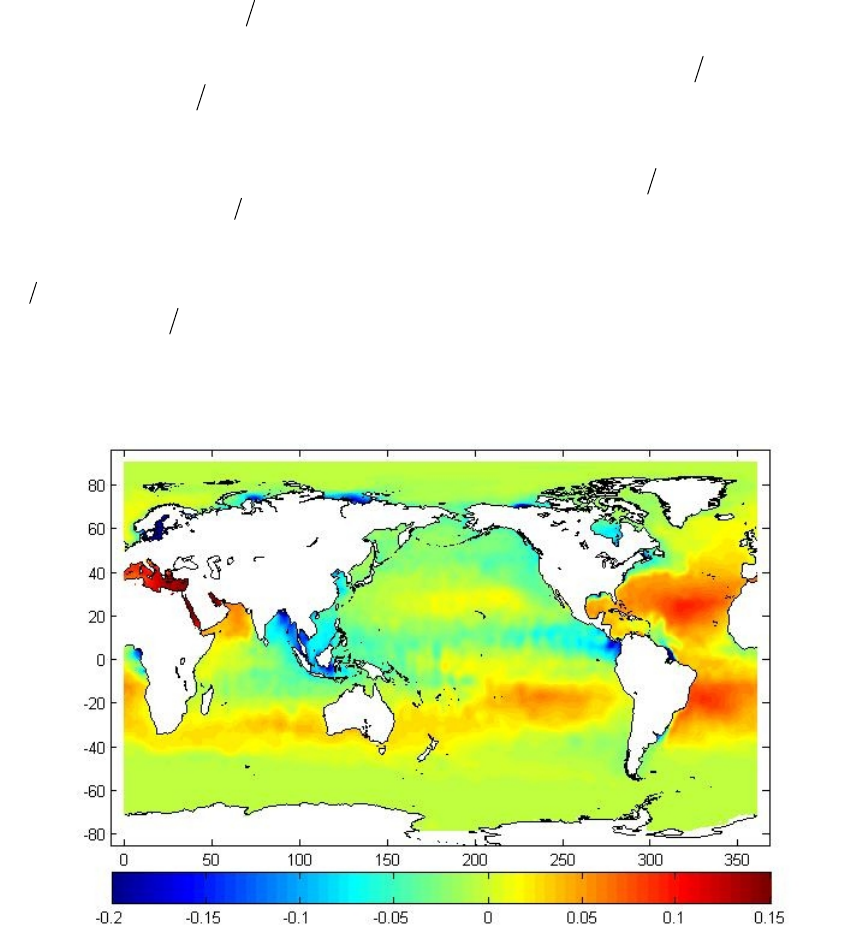
TEOS-10 Manual: Calculation and Use of the Thermodynamic Properties of Seawater
IOC Manuals and Guides No. 56
89
“potential”propertyisconstant,soeachoftheabovevariables,entropy,potential
temperatureandConservativeTemperatureare100%idealduringtheseadiabaticand
isohalineadvectionstages.Theturbulentmixingeventsoccuratfixedpressuresothe
non‐conservativeproductionofsayentropydependsontheextenttowhichthe
coefficients
()
0
Tt+and
μ
inEqn.(A.13.3)varyatfixedpressure.Similarlythenon‐
conservativeproductionofpotentialtemperaturedependsontheextenttowhichthe
coefficients
()
(
)( )
r0 0p
cpT t T
θ
++and
(
)
(
)
(
)
0rT
pTt p
μμ
⎡
⎤
−+
⎣
⎦inEqn.(A.13.4)varyat
fixedpressure,whilethenon‐conservativeproductionofConservativeTemperature
dependsontheextenttowhichthecoefficients
(
)( )
00
TtT
θ
++and
() ()( )( )
00
0pTtT
μ
μθ
⎡⎤
−++
⎣⎦
inEqn.(A.13.5)varyatfixedpressure.
Accordingtothiswayoflookingattheseequationswenotethatthematerial
derivativeofentropyappearsinEqn.(A.13.3)multipliedbytheabsolutetemperature
()
0
Tt+whichvariesbyabout15%attheseasurface(
(
)
273.15 40 273.15 1.146+≈),the
termthatmultipliesddt
θ
in(A.13.4)isdominatedbythevariationsintheisobaric
specificheat
()
Ar
,,
p
cStpwhichismainlyafunctionofA
Sandwhichvariesby5%atthe
seasurface(seeFigure4),whilethematerialderivativeofConservativeTemperature
ddtΘinEqn.(A.13.5)ismultipliedbytheproductofaconstant“heatcapacity”0
p
cand
thefactor
()
(
)
00
TtT
θ
++whichvariesverylittleintheocean,especiallywhenone
realizesthatitisonlythevariationofthisratioateachpressurelevelthatisofconcern.
Thisfactorisunityattheseasurfaceandisalsoveryclosetounityinthedeepocean.
FigureA.13.1.Contours(inC°)ofthedifference
θ
−
Θbetweenpotential
temperature
θ
andConservativeTemperature
Θ
atthe
seasurfaceoftheannually‐averagedatlasofGouretski
andKoltermann(2004).
Fortunately,ConservativeTemperatureisnotonlymuchmoreaccuratelyconserved
intheoceanthanpotentialtemperaturebutitisalsorelativelyeasytousein
oceanography.BecauseConservativeTemperaturealsopossessesthe“potential”
property,itisaveryaccuraterepresentationofthe“heatcontent”ofseawater.The
difference
θ
−Θbetweenpotentialtemperature
θ
andConservativeTemperatureΘat
theseasurfaceisshowninFigureA.13.1(afterMcDougall,2003).Ifanoceanmodelis
90 TEOS-10 Manual: Calculation and use of the thermodynamic properties of seawater
IOC Manuals and Guides No. 56
writtenwithpotentialtemperatureastheprognostictemperaturevariableratherthan
ConservativeTemperature,andisrunwiththesameconstantvalueoftheisobaricspecific
heatcapacity(0
p
casgivenbyEqn.(3.3.3)),theneglectofthenon‐conservativesource
termsthatshouldappearintheprognosticequationfor
θ
meansthatsuchanocean
modelincurserrorsinthemodeloutput.Theseerrorswilldependonthenatureofthe
surfaceboundarycondition;forfluxboundaryconditionstheerrorsareasshownin
FigureA.13.1.
Thisappendixhaslargelydemonstratedthebenefitsofpotentialenthalpyand
ConservativeTemperaturefromtheviewpointofconservationequations,butthebenefits
canalsobeprovenbythefollowingparcel‐basedargument.First,theair‐seaheatflux
needstoberecognizedasafluxofpotentialenthalpywhichisexactly0
p
ctimesthefluxof
ConservativeTemperature.Second,theworkofappendixA.18showsthatwhileitisthe
insituenthalpythatisconservedwhenparcelsmix,anegligibleerrorismadewhen
potentialenthalpyisassumedtobeconservedduringmixingatanydepth.Third,note
thattheoceancirculationcanberegardedasaseriesofadiabaticandisohalinemovements
duringwhichΘisabsolutelyunchanged(becauseofits“potential”nature)followedbya
seriesofturbulentmixingeventsduringwhich
Θ
isalmosttotallyconserved.Henceitis
clearthatΘisthequantitythatisadvectedanddiffusedinanalmostconservativefashion
andwhosesurfacefluxisexactlyproportionaltotheair‐seaheatflux.
A.14 Advective and diffusive “heat” fluxes
Insection3.23andappendicesA.8andA.13theFirstLawofThermodynamicsisshownto
bepracticallyequivalenttotheconservationequation(A.21.15)forConservative
Temperature.ΘWehaveemphasizedthatthismeansthattheadvectionof“heat”isvery
accuratelygivenastheadvectionof0.
p
c
Θ
Inthisway0
p
c
Θ
canberegardedasthe“heat
content”perunitmassofseawaterandtheerrorinvolvedwithmakingthisassociationis
approximately1%oftheerrorinassumingthateither0
p
c
θ
or
(
)
A,,0dbar
p
cS
θ
θ
isthe
“heatcontent”perunitmassofseawater(seealsoappendixA.21foradiscussionofthis
point).
Theconservativeform(A.21.15)impliesthattheturbulentdiffusivefluxofheatshould
bedirecteddownthemeangradientofConservativeTemperatureratherthandownthe
meangradientofpotentialtemperature.Inthisappendixwequantifythedifference
betweenthesemeantemperaturegradients.
Considerfirsttherespectivetemperaturegradientsalongtheneutraltangentplane.
FromEqn.(3.11.2)wefindthat
()
(
)
A,
nn n
S
θθ
αβ θ αβ
ΘΘ
∇=∇ = ∇Θ(A.14.1)
sothattheepineutralgradientsof
θ
and
Θ
arerelatedbytheratiosoftheirrespective
thermalexpansionandsalinecontractioncoefficients,namely
(
)
()
.
nn
θθ
αβ
θαβ
ΘΘ
∇= ∇Θ(A.14.2)
Thisproportionalityfactorbetweentheparalleltwo‐dimensionalvectorsn
θ
∇andn
∇Θis
readilycalculatedandillustratedgraphically.Beforedoingsowenotetwoother
equivalentexpressionsforthisproportionalityfactor.
Theepineutralgradientsof
θ
,
Θ
andA
Sarerelatedby(using
()
A
ˆ,S
θθ
=
Θ)
AA
ˆˆ
,
nnSn
S
θθ θ
Θ
∇=∇Θ+ ∇ (A.14.3)
andusingtheneutralrelationship
(
)
Ann
S
αβ
ΘΘ
∇
=∇Θwefind
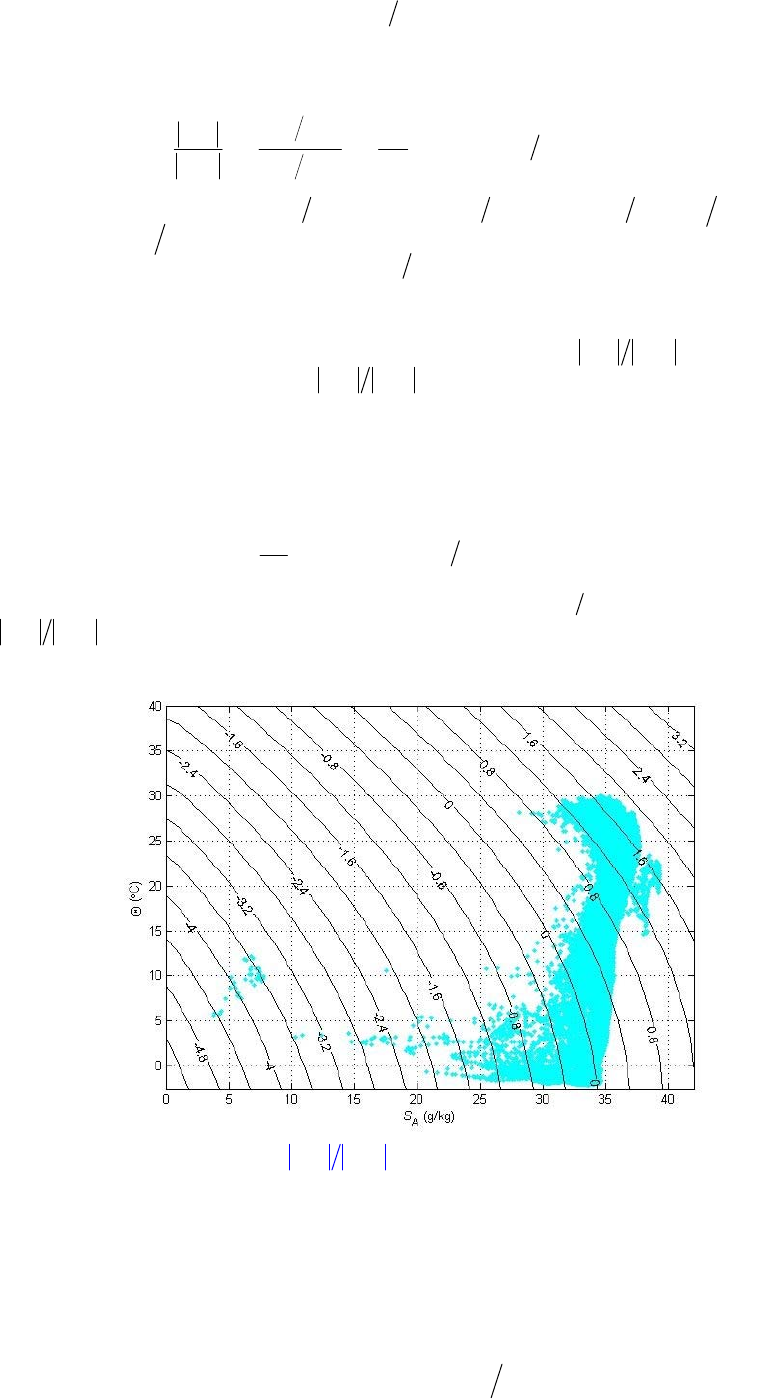
TEOS-10 Manual: Calculation and Use of the Thermodynamic Properties of Seawater
IOC Manuals and Guides No. 56
91
()
A
ˆˆ
.
nSn
θθ αβθ
ΘΘ
Θ⎡⎤
∇= + ∇Θ
⎣⎦ (A.14.4)
Also,insection3.13wefoundthat,
bn bn
TT
θ
θ
Θ
∇
=∇Θsothatwecanwritetheequivalent
expressions
()
()
A
ˆˆ
,
nbS
nb
T
T
θ
θθ
αβ
θ
θ
αβθ
αβ
ΘΘ ΘΘΘ
Θ
∇⎡⎤
===+
⎣⎦
∇Θ (A.14.5)
anditcanbeshownthatˆ
θ
α
αθ
Θ
Θ
=and
(
)
A
ˆˆ
1S
θ
β
βαβθθ
ΘΘΘ
Θ
⎡⎤
=+
⎣⎦ ,thatis,
A
ˆˆ
.
S
θ
β
βαθθ
ΘΘ
Θ
=+ Thepartialderivativesˆ
θ
Θ
andA
ˆS
θ
inthelastpartofEqn.(A.14.5)
arebothindependentofpressurewhile
α
β
Θ
Θisafunctionofpressure.Thisratio,Eqn.
(A.14.5),oftheepineutralgradientsof
θ
and
Θ
isshowninFigureA.14.1at0p=,
indicatingthattheepineutralgradientofpotentialtemperatureissometimesmorethat1%
differenttothatofConservativeTemperature.Thisrationn
θ
∇
∇Θisonlyaweak
functionofpressure.Thisratio,nn
θ
∇
∇Θ(i.e.Eqn.(A.14.5)),isavailableintheGSW
OceanographicToolboxasfunctiongsw_ntp_pt_vs_CT_ratio_CT25.
SimilarlytoEqn.(A.14.3),theverticalgradientsarerelatedby
AA
ˆˆ
,
z
zzS
S
θθ θ
Θ
=Θ+ (A.14.6)
andusingthedefinition,Eqn.(3.15.1),ofthestabilityratiowefindthat
A
1
ˆˆ
.
zS
z
R
ρ
θ
θ
αβθ
−ΘΘ
Θ⎡⎤
=+⎣⎦
Θ(A.14.7)
Forvaluesofthestabilityratio
R
ρ
closetounity,theratiozz
θ
Θ
isclosetothevaluesof
nn
θ
∇∇ΘshowninFigureA.14.1.ForothervaluesofR
ρ
,Eqn.(A.14.7)canbe
calculatedandplotted.
FigureA.14.1.Contoursof
()
1100%
nn
θ
∇∇Θ−× at0p
=
,showingthepercentage
differencebetweentheepineutralgradientsof
θ
andΘ.Thebluedots
arefromtheoceanatlasofGouretskiandKoltermann(2004)at0p=.
Asnotedinsection3.8thedianeutraladvectionofthermobaricityisthesamewhen
quantifiedintermsofpotentialtemperatureaswhendoneintermsofConservative
Temperature.Thesameisnottrueofthedianeutralvelocitycausedbycabbeling.Theratio
ofthecabbelingdianeutralvelocitycalculatedusingpotentialtemperaturetothatusing
ConservativeTemperatureisgivenby
(
)
(
)
bbnn n n
CC
θθθ
Θ
∇
⋅∇ ∇ Θ⋅∇ Θ (seesection3.9)which
canbeexpressedas
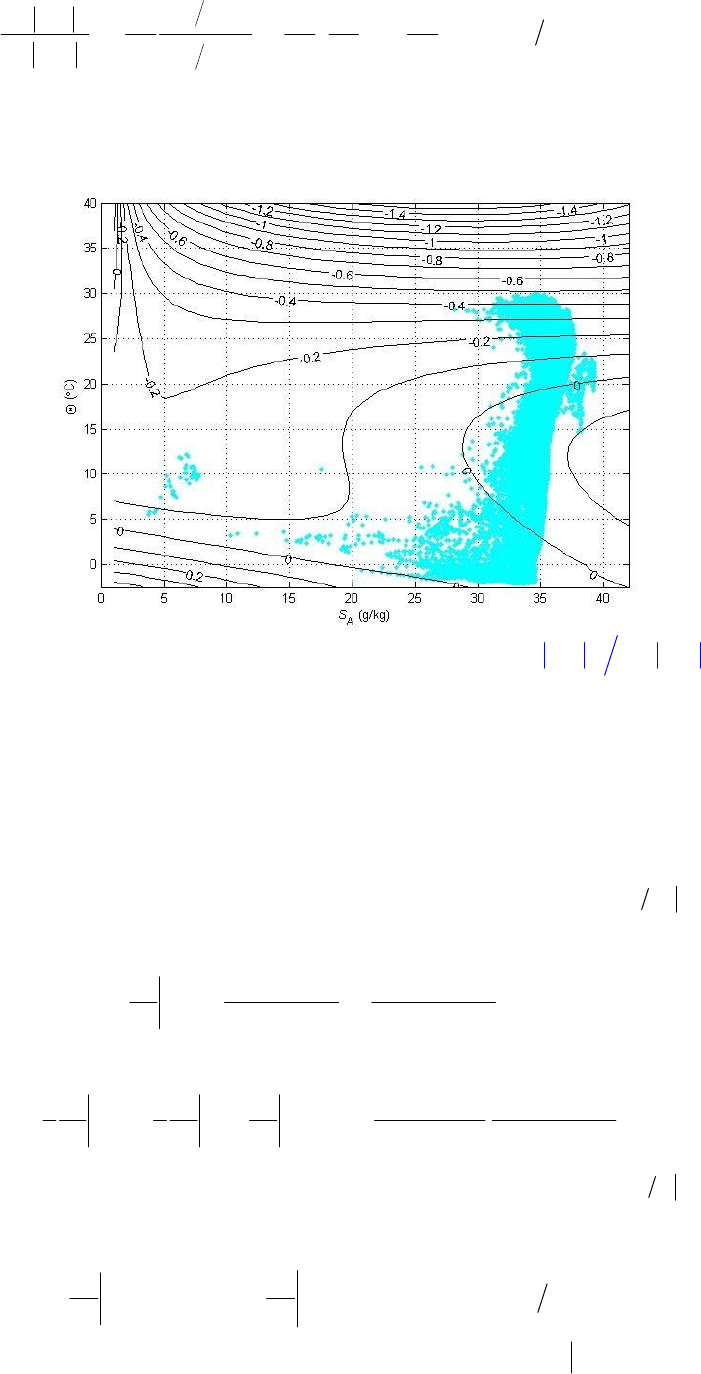
92 TEOS-10 Manual: Calculation and use of the thermodynamic properties of seawater
IOC Manuals and Guides No. 56
()
()
()
A
22
22
bbbbb
22
bbbb
b
ˆˆ
,
nS
n
CCCTC
CCTC
C
θθθθ
θ
θθ
αβ
θθαβθ
αβ
ΘΘ ΘΘΘ
Θ
ΘΘΘ
Θ
⎛⎞
∇⎡⎤
===+
⎜⎟ ⎣⎦
∇Θ ⎝⎠ (A.14.8)
andthisiscontouredinFig.A.14.2.WhiletheratioofEqn.(A.14.8)isnotexactlyunity,it
variesrelativelylittleintheoceanographicrange,indicatingthatthedianeutraladvection
duetocabbelingestimatedusing
θ
or
Θ
arewithinhalfapercentofeachotherat0p=.
FigureA.14.2.Contoursofthepercentagedifferenceof
(
)()
22
bbnn
CC
θθ
Θ
∇
∇Θ
fromunityat0p
=
dbar.
A.15 Derivation of the expressions for ,,
θθ
α
βα
Θ
and
β
Θ
ThisappendixderivestheexpressionsinEqns.(2.18.2)–(2.18.3)and(2.19.2)–(2.19.3)for
thethermalexpansioncoefficients
θ
α
and
α
Θ
andthehalinecontractioncoefficients
θ
β
and.
β
Θ
InordertoderiveEqn.(2.18.2)for
θ
α
wefirstneedanexpressionforA,.
Sp
T
θ
∂∂ This
isfoundbydifferentiatingwithrespecttoinsitutemperaturetheentropyequality
()
[
]
()
AAArr
,, , ,, , ,Stp S Stpp p
ηηθ
=whichdefinespotentialtemperature,obtaining
(
)
()
(
)
()
A
AA
Ar Ar
,
,, ,, .
,, ,,
TTT
TTT
Sp
Stp g Stp
TSpgSp
η
θ
ηθ θ
∂==
∂(A.15.1)
ThisisthenusedtoobtainthedesiredexpressionEqn.(2.18.2)for
θ
α
asfollows
()
()
()
()
AAA
1
AAr
AA
,,,
,, , ,
11 .
,, ,,
TP TT
PTT
Sp Sp Sp
g
Stpg S p
vv
v v T T g S tp g S tp
θ
θ
θ
αθ
−
⎛⎞
∂∂∂
== =
⎜⎟
⎜⎟
∂∂∂
⎝⎠
(A.15.2)
InordertoderiveEqn.(2.18.3)for
α
Θ
wefirstneedanexpressionforA,.
Sp
t∂Θ ∂ This
isfoundbydifferentiatingwithrespecttoinsitutemperaturetheentropyequality
()
[
]
()
AAA
ˆ
,, , ,,
Stp S Stp
ηη
=Θ obtaining
() ()( )
AA
0
A0A
,
,, ,, ,
TTTp
Sp S
Stp T g Stpc
T
ηθ
η
∂Θ ∂Θ
==−+
∂∂ (A.15.3)
wherethesecondpartofthisequationhasusedEqn.(A.12.4)for
A
.
S
η
ΘThisisthenused
toobtainthedesiredexpressionEqn.(2.18.3)for
α
Θ
asfollows

TEOS-10 Manual: Calculation and Use of the Thermodynamic Properties of Seawater
IOC Manuals and Guides No. 56
93
()
()
()( )
AAA
10
A
A0 A
,,,
,,
11 .
,, ,,
p
TP
PTT
Sp Sp Sp
c
gStp
vv
vvTT gStpTgStp
αθ
−
Θ⎛⎞
∂∂∂Θ
== =−
⎜⎟
⎜⎟
∂Θ ∂ ∂ +
⎝⎠
(A.15.4)
InordertoderiveEqn.(2.19.2)for
θ
β
wefirstneedanexpressionforA,.
Tp
S
θ
∂∂ This
isfoundbydifferentiatingwithrespecttoAbsoluteSalinitytheentropyequality
()
[
]
()
AAArr
,, , ,, , ,Stp S Stpp p
ηηθ
=whichdefinespotentialtemperature,obtaining
()( )
()
()
()()
()()()
AA
A
AA
AAr
A,
0
Ar A
Ar
AArAr
,, , ,
,, ,,
,,
,, ,, ,, ,
SS
S
Tp
TT
p
ST ST TT
Stp S p
S
TSp Stp
cS p
g
Stp g S p g S p
η
θθη η θ
θμθ μ
θ
θθ
∂⎡⎤
=−
⎣⎦
∂
+⎡⎤
=−
⎣⎦
⎡⎤
=−
⎣⎦
(A.15.5)
whereEqns.(A.12.5)and(A.12.7)havebeenusedwithageneralreferencepressurer
p
ratherthanwithr0.p=Bydifferentiating
[
]
(
)
AA r
,,,,,SStppp
ρρ θ
=withrespectto
AbsoluteSalinityitcanbeshownthat(Gill(1982),McDougall(1987a))
AAA
,,,
11 ,
pTpTp
SSS
θθ
θ
ρρθ
βα
ρρ
∂∂∂
== +
∂∂∂
(A.15.6)
andusingEqn.(A.15.5)wearriveatthedesiredexpressionEqn.(2.19.2)for
θ
β
()
()
()()( )
()()
AA
AAA Ar
A
AAA
,, ,, , ,
,, .
,, ,, ,,
TP S T S T
SP
PPTT
gg
gStp Stp S p
gStp
g S tp g S tpg S tp
θθ
β
⎡
⎤
−
⎣
⎦
=− + (A.15.7)
NotethatthetermsinthenaturallogarithmofthesquarerootofAbsoluteSalinitycancel
fromthetwopartsofthesquarebracketsinEqns.(A.15.5)and(A.15.7).
InordertoderiveEqn.(2.19.3)for
β
Θ
wefirstneedanexpressionforA,.
Tp
S∂Θ ∂
ThisisfoundbydifferentiatingwithrespecttoAbsoluteSalinitytheentropyequality
()
[
]
()
AAA
ˆ
,, , ,,Stp S Stp
ηη
=Θ obtaining(usingEqns.(A.12.4)and(A.12.8))
()
()()()
()()()
AA
A
AA
A
A,
0
A0A
0
A0 A
ˆ
,,
,,0 ,,
,,0 ,, .
SS
S
Tp
Tp
SSTp
Stp
S
STStpc
g
STgStpc
ηηη
μθ θμ
θθ
Θ
∂Θ ⎡⎤
=Θ −
⎣⎦
∂
⎡⎤
=−+
⎣⎦
⎡⎤
=−+
⎣⎦
(A.15.8)
Differentiating
[]
(
)
AA
ˆ,,,,SStpp
ρρ
=Θ withrespecttoAbsoluteSalinityleadsto
AAA
,,,
11 ,
pTpTp
SSS
ρρ
βα
ρρ
ΘΘ
Θ
∂∂∂Θ
==+
∂∂∂
(A.15.9)
andusingEqn.(A.15.8)wearriveatthedesiredexpression(2.19.3)for
β
Θnamely
()
()
()()()()
()()
AA
AAAA0
A
AAA
,, ,, , ,0
,, .
,, ,, ,,
TP S T S
SP
PPTT
gg
gStp Stp S T
gStp
g S tp g S tpg S tp
θθ
β
Θ
⎡
⎤
−+
⎣
⎦
=− + (A.15.10)
NotethatthetermsinthenaturallogarithmofthesquarerootofAbsoluteSalinitycancel
fromthetwopartsofthesquarebracketsinEqns.(A.15.8)and(A.15.10).

94 TEOS-10 Manual: Calculation and use of the thermodynamic properties of seawater
IOC Manuals and Guides No. 56
A.16 Non-conservative production of entropy
Inthisandthefollowingthreeappendices(A.16–A.19)thenon‐conservativenatureof
severalthermodynamicvariables(entropy,potentialtemperature,Conservative
Temperatureandpotentialdensity)willbequantifiedbyconsideringthemixingofpairs
ofseawaterparcelsatfixedpressure.Themixingistakentobecompletesothattheend
stateisaseawaterparcelthatishomogeneousinAbsoluteSalinityandentropy.Thatis,
wewillbeconsideringmixingtocompletionbyaturbulentmixingprocess.Inappendix
A.20thenon‐conservativeproductionofAbsoluteSalinitybytheremineralizationof
particulateorganicmatterisconsidered.Thisprocessisnotbeingconsideredin
appendicesA.16–A.19.Thenon‐conservativeproductionwhichisquantifiedin
appendicesA.16–A.19occursintheabsenceofanyvariationinseawatercomposition.
FollowingFofonoff(1962),considermixingtwofluidparcels(parcels1and2)that
haveinitiallydifferenttemperaturesandsalinities.Themixingprocessoccursatpressure
.pThemixingisassumedtohappentocompletionsothatinthefinalstateAbsolute
Salinity,entropyandalltheotherpropertiesareuniform.Assumingthatthemixing
happenswithavanishinglysmallamountofdissipationofmechanicalenergy,the
ε
term
canbedroppedfromtheFirstLawofThermodynamics,(A.13.1),thisequationbecoming
() ( )
RQ
.
t
hh
ρρ
+∇⋅ = −∇⋅ −∇⋅uFFatconstantpressure(A.16.1)
Notethatthisequationhastheform(A.8.1)andsohisconservedduringmixingat
constantpressure,thatis,his“isobaricconservative”.Inthecaseweareconsideringof
mixingthetwoseawaterparcels,thesystemisclosedandtherearenoradiative,boundary
ormolecularheatfluxescomingthroughtheoutsideboundarysotheintegraloverspace
andtimeoftheright‐handsideofEqn.(A.16.1)iszero.Thesurfaceintegralof
()
h
ρ
u
throughtheboundaryisalsozero.Henceitisapparentthatthevolumeintegralofh
ρ
is
thesameatthefinalstateasitisattheinitialstate,thatis,enthalpyisconserved.Hence
duringthemixingprocessthemass,saltcontentandenthalpyareconserved,thatis
12 ,mmm
+
=(A.16.2)
1A1 2A2 A
,mS mS mS+=(A.16.3)
11 2 2 ,mh mh mh+=(A.16.4)
whilethenon‐conservativenatureofentropymeansthatitobeystheequation,
11 2 2 .mm mm
η
ηδηη
++=(A.16.5)
HereA,Shand
η
arethevaluesofAbsoluteSalinity,enthalpyandentropyofthefinal
mixedfluidand
δ
η
istheproductionofentropy,thatis,theamountbywhichentropyis
notconservedduringthemixingprocess.Entropy
η
isnowregardedasthefunctional
form
()
A,,Shp
ηη
=andisexpandedinaTaylorseriesofA
Sandhaboutthevaluesof
A
Sandhofthemixedfluid,retainingtermstosecondorderin
[
]
A2 A1 A
SS S
−
=Δ andin
[]
21 .hh h−=ΔThen1
η
and2
η
areevaluatedand(A.16.4)and(A.16.5)usedtofind
() ( )
{
}
AAA
22
12
1AA
222.
hh hS S S
mm hhS S
m
δη η η η
=− Δ + Δ Δ + Δ
(A.16.6)
Towardstheendofthissectiontheimplicationsoftheproduction(A.16.6)ofentropy
willbequantified,butfornowweaskwhatconstraintstheSecondLawof
ThermodynamicsmightplaceontheformoftheGibbsfunction
(
)
A,,
g
Stpofseawater.
TheSecondLawofThermodynamicstellsusthattheentropyexcess
δ
η
mustnotbe
negativeforallpossiblecombinationsofthedifferencesinenthalpyandsalinitybetween
thetwofluidparcels.From(A.16.6)thisrequirementimpliesthefollowingthree
inequalities,
0,
hh
η
<
(A.16.7)

TEOS-10 Manual: Calculation and Use of the Thermodynamic Properties of Seawater
IOC Manuals and Guides No. 56
95
AA 0,
SS
η
<
(A.16.8)
()
AAA
2,
hS hh S S
ηηη
<
(A.16.9)
wherethelastrequirementreflectstheneedforthediscriminantofthequadraticin
(A.16.6)tobenegative.SinceentropyisalreadyafirstderivativeoftheGibbsfunction,
theconstraintswouldseemtobethreedifferentconstraintsonvariousthirdderivativeof
theGibbsfunction.Infact,wewillseethattheyamounttoonlytworatherwell‐known
constraintsonsecondorderderivativesoftheGibbsfunction.
Fromthefundamentalthermodynamicrelation(A.7.1)wefindthat(whereTisthe
absolutetemperature,0
TT t=+)
A
1
,
hSp
T
h
η
η
−
∂
==
∂
(A.16.10)
A
A,
,
S
hp
ST
η
μ
η
∂
==−
∂
(A.16.11)
andfromtheserelationsthefollowingexpressionsforthesecondorderderivativesof
η
canbefound,
AA
212
2
,,
,
hh p
Sp Sp
TT
hc
h
η
η
−−
∂∂ −
== =
∂
∂
(A.16.12)
(
)
A
A
2
A,
1,
Sh pT
pSp
T
hS h c T
μ
ημ
η
∂−
∂⎛⎞
== =−
⎜⎟
∂∂ ∂ ⎝⎠
(A.16.13)
and
(
)
(
)
AA
A
A
2
2
AA
A,
,,,
2
2
.
SS
Tp
hp Tp S p
S
pT
TT
h
ShS
S
T
TcT
μμ
η
η
μμ
∂− ∂−
∂∂
== −
∂∂∂
∂
⎡⎤
⎛⎞
=− − ⎢⎥
⎜⎟
⎝⎠
⎣⎦
(A.16.14)
ThelastequationcomesfromregardingA
S
η
as
[
]
(
)
AA
AA
,,,,.
SS
ShStpp
ηη
=
Theconstraint(A.16.7)that0
hh
η
<
simplyrequires(from(A.16.12))thattheisobaric
heatcapacityp
cispositive,orthat0.
TT
g
<
Theconstraint(A.16.8)thatAA 0,
SS
η
<
requires(from(A.16.14))that
AA
2
3
,
SS pT
T
gcT
μ
⎡
⎤
⎛⎞
>−
⎢
⎥
⎜⎟
⎝⎠
⎣
⎦(A.16.15)
thatis,thesecondderivativeoftheGibbsfunctionwithrespecttoAbsoluteSalinityAA
SS
g
mustexceedsomenegativenumber.Theconstraint(A.16.9)that
()
AAA
2
hS hh S S
ηηη
<
requiresthat(substitutingfrom(A.16.12),(A.16.13)and(A.16.14))
AA
30,
SS
p
g
Tc >(A.16.16)
andsincetheisobaricheatcapacitymustbepositive,thisrequirementisthatAA 0,
SS
g>
andsoismoredemandingthan(A.16.15).
Weconcludethatwhiletherearethethreerequirements(A.16.7)to(A.16.9)onthe
functionalformofentropy
()
A,,Shp
ηη
=inordertosatisfytheconstraintoftheSecond
LawofThermodynamicsthatentropybeproducedwhenwaterparcelsmix,thesethree
constraintsaresatisfiedbythefollowingtwoconstraintsontheformoftheGibbsfunction
()
A,,
g
Stp,
0
TT
g
<
(A.16.17)
and
AA 0.
SS
g>(A.16.18)

96 TEOS-10 Manual: Calculation and use of the thermodynamic properties of seawater
IOC Manuals and Guides No. 56
TheSecondLawofThermodynamicsdoesnotimposeanyadditionalrequirementonthe
crossderivativesA
ST
g
noronanythirdorderderivativesoftheGibbsfunction.
Theconstraint(A.16.18)canbeunderstoodbyconsideringthemoleculardiffusionof
saltwhichisknowntobedirecteddownthegradientofchemicalpotential
()
A,,Stp
μ
(LandauandLifshitz(1959)).Thatis,themolecularfluxofsaltisproportionalto.
μ
−∇
Expanding
μ
−∇ intermsofgradientsofAbsoluteSalinity,oftemperature,andof
pressure,onefindsthatthefirsttermisAASS
μ
−
∇andinordertoavoidanunstable
explosionofsaltonemusthaveAAA
0.
SSS
g
μ
=
>Sotheconstraint(A.16.18)amountsto
therequirementthatthemoleculardiffusivityofsaltispositive.
Thetwoconstraints(A.16.17)and(A.16.18)ontheGibbsfunctionarewellknownin
thethermodynamicsliterature.LandauandLifshitz(1959)derivethemonthebasisofthe
contributionofmolecularfluxesofheatandsalttotheproductionofentropy(their
equations58.9and58.13).Alternatively,Planck(1935)aswellasLandauandLifshitz
(1980)intheir§96(thisis§98ineditionsbeforethe1976extensionmadebyLifshitzand
Pitayevski)inferredsuchinequalitiesfromthermodynamicstabilityconsiderations.Itis
pleasingtoobtainthesameconstraintsontheseawaterGibbsfunctionfromtheabove
Non‐EquilibriumThermodynamicsapproachofmixingfluidparcelssincethisapproach
involvesturbulentmixingwhichisthetypeofmixingthatdominatesintheocean;
(moleculardiffusionhasthecomplementaryroleofdissipatingtracervariance).
InadditiontotheSecondLawrequirements(A.16.17)and(A.16.18)thereareother
constraintswhichtheseawaterGibbsfunctionmustobey.Oneisthattheadiabatic(and
isohaline)compressibilitymustbepositiveforotherwisethefluidwouldexpandin
responsetoanincreaseinpressurewhichisanunstablesituation.Taking0
P
g>(since
specificvolumeneedstobepositive)therequirementthattheadiabatic(andisohaline)
compressibilitybepositiveimposesthefollowingtwoconstraints(from(2.16.1))
0
PP
g
<
(A.16.19)
and
()
2,
TP PP TT
g
gg<(A.16.20)
recognizingthatTT
g
isnegative(TP
g
may,anddoes,takeeithersign).Equation(A.16.20)
ismoredemandingof
P
P
g
thanis(A.16.19),requiring
P
P
g
tobelessthananegative
numberratherthansimplybeinglessthanzero.Thislastinequalitycanalsoberegarded
asaconstraintonthethermalexpansioncoefficientt
α
,implyingthatitssquaremustbe
lessthan2
P
PP TT
g
gg
−orotherwisetherelevantcompressibility(
κ
)wouldbenegativeand
thesoundspeedcomplex.
TheconstraintsontheseawaterGibbsfunction
(
)
A,,
g
Stp
thathavebeendiscussed
abovearesummarizedas
0,
p
g> AA 0
SS
g>, 0,
PP
g
<
0,
TT
g
<
and
()
2.
TP PP TT
g
gg<(A.16.21)
Wereturnnowtoquantifythenon‐conservativeproductionofentropyintheocean.
Whenthemixingprocessoccursat0,p
=
theexpression(A.16.6)fortheproductionof
entropycanbeexpressedintermsofConservativeTemperature
Θ
(sinceΘissimply
proportionaltohat0p=)asfollows(nowentropyistakentobethefunctionalform
()
A
ˆ,S
ηη
=Θ)
() ( )
{
}
AAA
22
12
1AA
22ˆˆ ˆ
2.
SSS
mm SS
m
δη η η η
ΘΘ Θ
=− ΔΘ + ΔΘΔ + Δ (A.16.22)
Themaximumproductionoccurswhenparcelsofequalmassaremixedsothat
2
11
12
28
mmm
−=andweadoptthisvalueinwhatfollows.Toillustratethemagnitudeof
thisnon‐conservationofentropywefirstscaleentropybyadimensionalconstantsothat
theresultingvariable(“entropictemperature”)hasthevalue25 C°at
()( )
ASO
,,25CSSΘ= ° andthenΘissubtracted.TheresultiscontouredinA
S−Θspace
inFigureA.16.1.
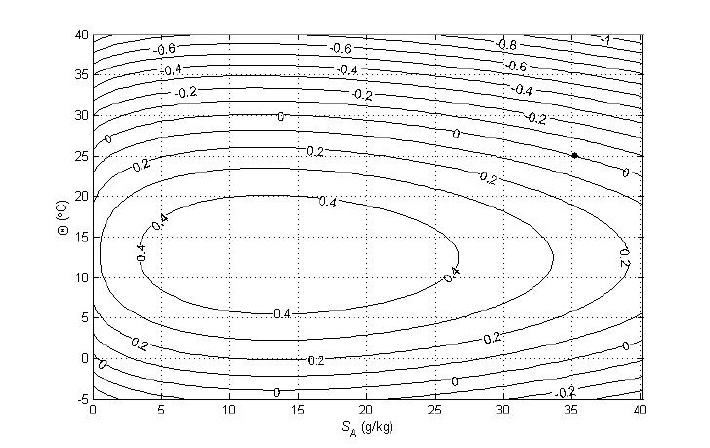
TEOS-10 Manual: Calculation and Use of the Thermodynamic Properties of Seawater
IOC Manuals and Guides No. 56
97
FigureA.16.1.Contours(inC°)ofavariablewhichillustratesthenon‐conservative
productionofentropy
η
intheocean.
ThefactthatthevariableinFigureA.16.1isnotzerooverthewholeA
S−Θplaneis
becauseentropyisnotaconservativevariable.Thenon‐conservativeproductionof
entropycanbereadoffthisfigurebyselectingtwoseawatersamplesandmixingalong
thestraightlinebetweentheseparcelsandthenreadingofftheproduction(inC°)of
entropyfromthefigure.Takingthemostextremesituationwithoneparcelat
()
()
1
A,0gkg,0CS−
Θ= ° andtheotheratthewarmestandsaltiestcornerofthefigure,the
non‐conservativeproductionof
η
onmixingparcelsofequalmassisapproximately
0.9 C°.
Sinceentropycanbeexpressedindependentlyofpressureasafunctionofonly
AbsoluteSalinityandConservativeTemperature
(
)
A
ˆ,S
ηη
=
Θ,andsinceatanypressure
intheoceanbothA
SandΘmaybeconsideredconservativevariables(seeappendixA.18
below),itisclearthatthenon‐conservativeproductiongivenby(A.16.22)andillustrated
inFigureA.16.1isequivalenttotheslightlymoreaccurateexpression(A.16.6)which
appliesatanypressure.Theonlydiscrepancybetweentheproductionofentropy
calculatedfrom(A.16.22)andthatfrom(A.16.6)isduetotheverysmallnon‐conservative
productionofΘatpressuresotherthanzero(aswellasthefactthatbothexpressions
containonlythesecondordertermsinaninfiniteTaylorseries).
A.17 Non-conservative production of potential temperature
Whenfluidparcelsundergoirreversibleandcompletemixingatconstantpressure,the
thermodynamicquantitiesthatareconservedduringthemixingprocessaremass,
AbsoluteSalinityandenthalpy.AsinsectionA.16weagainconsidertwoparcelsbeing
mixedwithoutexternalinputofheatormassandthethreeequationsthatrepresentthe
conservationofthesequantitiesareagainEqns.(A.16.2)–(A.16.4).Potentialtemperature
θ
isnotconservedduringthemixingprocessandtheproductionofpotential
temperatureisgivenby
11 2 2 .mmm m
θ
θδθ θ
++=(A.17.1)
Enthalpyinthefunctionalform
(
)
A,,hhS p
θ
=isexpandedinaTaylorseriesofA
Sand
θ
aboutthevaluesA
Sand
θ
ofthemixedfluid,retainingtermstosecondorderin

98 TEOS-10 Manual: Calculation and use of the thermodynamic properties of seawater
IOC Manuals and Guides No. 56
[]
A2 A1 A
SS S−=Δandin
[]
21 .
θ
θθ
−=ΔThen1
hand2
hareevaluatedandEqns.(A.16.4)
and(A.17.1)usedtofind
() ()
AAA
22
12
1AA
222.
SSS
hh
h
mm SS
hh h
m
θ
θθ
θθ θ
δθ θ θ
⎧⎫
⎪⎪
=Δ+ΔΔ+Δ
⎨⎬
⎪⎪
⎩⎭
(A.17.2)
Themaximumproductionoccurswhenparcelsofequalmassaremixedsothat
2
11
12
28
.mmm
−=The“heatcapacity”h
θ
isnotastrongfunctionof
θ
butisamuch
strongerfunctionofA
SsothefirstterminthecurlybracketsinEqn.(A.17.2)isgenerally
smallcomparedwiththesecondterm.Also,thethirdterminEqn.(A.17.2)whichcauses
theso‐called“dilutionheating”,isusuallysmallcomparedwiththesecondterm.A
typicalvalueofA
S
h
θ
isapproximately–5.411 11
Jkg K (gkg )
−
−−−
(seethedependenceof
isobaricheatcapacityonA
SinFigure4ofsection2.20)sothatanapproximateexpression
fortheproductionofpotentialtemperature
δ
θ
is
()
A
41
1AA
43.4 10 / [g kg ] .
S
hSh x S
θθ
δ
θ
θ
−−
≈Δ ≈− Δ
Δ
(A.17.3)
Sincepotentialtemperature
(
)
A
ˆ,S
θθ
=
Θcanbeexpressedindependentlyofpressure
asafunctionofonlyAbsoluteSalinityandConservativeTemperature,andsinceduring
turbulentmixingbothA
SandΘmaybeconsideredconservativevariables(seesection
A.18below),itisclearthatthenon‐conservativeproductiongivenby(A.17.2)canbe
approximatedbythecorrespondingproductionofpotentialtemperaturethatwouldoccur
ifthemixinghadoccurredat0p=,namely
() ()
AAA
22
12
1AA
222SSS
mm SS
m
θ
θθ
θθ θ
δθ θ θ
ΘΘ
⎧⎫
Θ
=Δ+ΔΔ+Δ
⎨⎬
ΘΘ Θ
⎩⎭
,(A.17.4)
wheretheexactproportionalitybetweenpotentialenthalpyandConservative
Temperature00
p
hc≡Θhasbeenexploited.Themaximumproductionoccurswhenparcels
ofequalmassaremixedsothat2
11
12
28
mmm
−
=
andweadoptthisvalueinwhatfollows.
Equations(A.17.2)or(A.17.4)maybeusedtoevaluatethenon‐conservative
productionofpotentialtemperatureduetomixingapairoffluidparcelsacrossafrontat
whichthereareknowndifferencesinsalinityandtemperature.Thetemperature
difference
θ
−ΘiscontouredinFigureA.17.1andcanbeusedtoillustrateEqn.(A.17.4).
δ
θ
canbereadoffthisfigurebyselectingtwoseawatersamplesandmixingalongthe
straightlinebetweentheseparcels(alongwhichbothAbsoluteSalinityandConservative
Temperatureareconserved)andthencalculatingtheproduction(inC°)of
θ
fromthe
contouredvaluesof
θ
−Θ.Takingthemostextremesituationwithoneparcelat
()
()
1
A,0gkg,0CS−
Θ= ° andtheotheratthewarmestandsaltiestcornerofFigureA.17.1,
thenon‐conservativeproductionof
θ
onmixingparcelsofequalmassisapproximately‐
0.55C°.Thisistobecomparedwiththecorrespondingmaximumproductionofentropy,
asdiscussedaboveinconnectionwithFigureA.16.1,ofapproximately0.9C°.
IfFigureA.17.1weretobeusedtoquantifytheerrorsinoceanographicpractice
incurredbyassumingthat
θ
isaconservativevariable,onemightselectproperty
contraststhatweretypicalofaprominentoceanicfrontanddecidethatbecause
δ
θ
is
smallatthisonefront,thattheissuecanbeignored(seeforexample,Warren(2006)).But
theobservedpropertiesintheoceanresultfromalargeandindeterminatenumberofsuch
priormixingeventsandthenon‐conservativeproductionof
θ
accumulatesduringeachof
thesemixingevents,ofteninasign‐definitefashion.Howcanwepossiblyestimatethe
errorthatismadebytreatingpotentialtemperatureasaconservativevariableduringall
oftheseunknowablymanypastindividualmixingevents?Thisseeminglydifficultissue
ispartiallyresolvedbyconsideringwhatisactuallydoneinoceanmodelstoday.These
modelscarryatemperatureconservationequationthatdoesnothavenon‐conservative
sourceterms,sothatthemodel’stemperaturevariableisbestinterpretedasbeingΘ.This
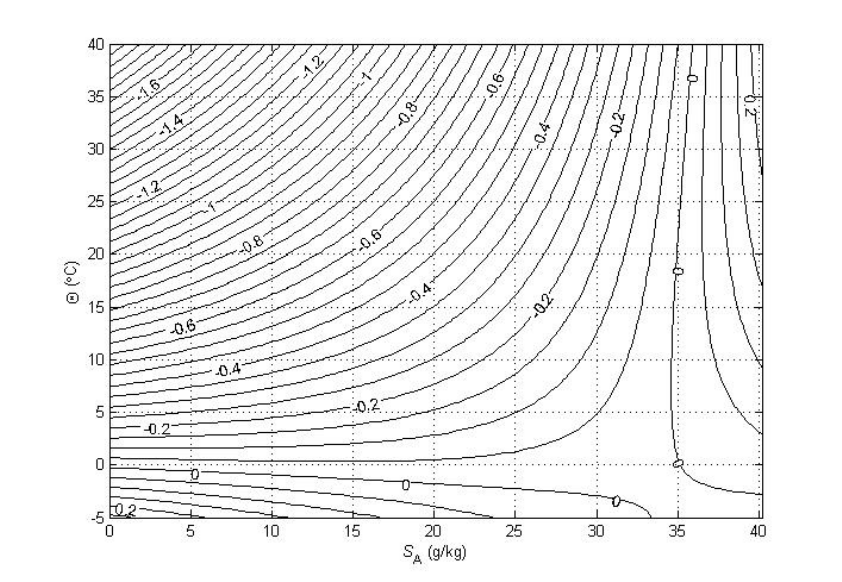
TEOS-10 Manual: Calculation and Use of the Thermodynamic Properties of Seawater
IOC Manuals and Guides No. 56
99
beingthecase,thetemperaturedifferencecontouredinFigureA.17.1illustratestheerror
thatismadebyinterpretingthemodeltemperatureasbeing
θ
.Thatis,thevalues
contouredinFiguresA.16.1andA.17.1arerepresentativeoftheerror,expressedinC°,
associatedwithassumingthat
η
and
θ
respectivelyareconservativevariables.These
contouredvaluesoftemperaturedifferenceencapsulatetheaccumulatednon‐conservative
productionthathasoccurredduringallthemanymixingprocessesthathaveleadtothe
ocean’spresentstate.Themaximumsucherrorfor
η
isapproximately‐1.0C°(from
FigureA.16.1)whilefor
θ
themaximumerrorisapproximately‐1.8C°(fromFigure
A.17.1).Onepercentofthedataattheseasurfaceoftheworldoceanhavevaluesof
θ
−Θ
thatlieoutsidearangethatis0.25C°wide(McDougall(2003)),implyingthatthisisthe
magnitudeoftheerrorincurredbyoceanmodelswhentheytreat
θ
asaconservative
quantity.FromthecurvatureoftheisolinesonFigureA.17.1itisclearthatthenon‐
conservativeproductionofpotentialtemperaturetakesbothpositiveandnegativesigns.
FigureA.17.1.Contours(inC°)ofthedifferencebetweenpotentialtemperature
andConservativeTemperature
θ
−
Θ.Thisplotillustratesthenon‐
conservativeproductionofpotentialtemperature
θ
intheocean.
A.18 Non-conservative production of Conservative Temperature
Whenfluidparcelsundergoirreversibleandcompletemixingatconstantpressure,the
thermodynamicquantitiesthatareconservedduringthemixingprocessaremass,
AbsoluteSalinityandenthalpy.AsinsectionsA.16andA.17weconsidertwoparcels
beingmixedwithoutexternalinputofheatormassandthethreeequationsthatrepresent
theconservationofthesequantitiesareagainEqns.(A.16.2)–(A.16.4).Potentialenthalpy
0
handConservativeTemperature
Θ
arenotexactlyconservedduringthemixingprocess
andtheproductionofΘisgivenby

100 TEOS-10 Manual: Calculation and use of the thermodynamic properties of seawater
IOC Manuals and Guides No. 56
11 2 2 .mmmm
δ
Θ+ Θ+ Θ= Θ(A.18.1)
Enthalpyinthefunctionalform
(
)
A
ˆ,,hhS p=Θ
isexpandedinaTaylorseriesofA
Sand
Θ
aboutthevaluesA
SandΘofthemixedfluid,retainingtermstosecondorderin
[]
A2 A1 A
SS S−=Δ
andin
[]
21 .Θ−Θ =ΔΘThen1
hand2
hareevaluatedandEqns.(A.16.4)
and(A.18.1)areusedtofind
() ()
AAA
22
12
1AA
22
ˆˆ
ˆ
2.
ˆˆ ˆ
SSS
hh
h
mm SS
mhh h
δ
Θ
ΘΘ
ΘΘ Θ
⎧⎫
⎪⎪
Θ= ΔΘ + ΔΘΔ + Δ
⎨⎬
⎪⎪
⎩⎭
(A.18.2)
Inordertoevaluatethesepartialderivatives,wefirstwriteenthalpyintermsofpotential
enthalpy(i.e.0
p
cΘ)usingEqn.(3.2.1),as
() ( )
0
0
AA
ˆˆ
,, ,, .
P
pP
hhSpc vSpdP
′
′
=Θ=Θ+ Θ
∫(A.18.3)
Thisisdifferentiatedwithrespectto
Θ
giving
A0
0
,
ˆ.
P
p
Sp P
hhc dP
αρ
Θ
ΘΘ
′
==+
∫(A.18.4)
Theright‐handsideofEqn.(A.18.4)scalesas
(
)
01
0,
p
cPP
ρ
α
−
Θ
+− whichismorethan0
p
c
byonlyabout0
0.0015 p
cfor
()
0
P
P−of7
410×Pa(4,000dbar).Hence,toaverygood
approximation,ˆ
hΘinEqn.(A.18.2)maybetakentobesimply0
p
c.Itisinterestingto
examinewhythisapproximationissoaccuratewhenthedifferencebetweenenthalpy,,h
andpotentialenthalpy,0,hasgivenbyEqns.(3.2.1)and(A.18.3),scalesas1
P
ρ
−whichis
aslargeastypicalvaluesofpotentialenthalpy.ThereasonisthattheintegralinEqns.
(3.2.1)or(A.18.3)isdominatedbytheintegralofthemeanvalueof1,
ρ
−socausinga
significantoffsetbetweenhand0
hasafunctionofpressurebutnotaffectingthepartial
derivativeˆ
hΘwhichistakenatfixedpressure.Eventhedependenceofdensityon
pressurealonedoesnotaffectˆ.hΘ
Thesecondorderderivativesofˆ
hareneededinEqn.(A.18.2),andthesecanbe
estimatedintermsofthestrengthofcabbelingasfollows.Equation(A.18.4)is
differentiatedwithrespecttoConservativeTemperature,giving
(
)
00
ˆˆ,
PP
PP
h v dP dP
αρ
Θ
ΘΘ ΘΘ Θ
′
′
==
∫∫ (A.18.5)
sothatwemaywriteEqn.(A.18.2)approximatelyas(assuming12
mm
=
)
(
)() ( )
{
}
AAA
22
0
AA
0ˆˆ ˆ
2.
8SSS
p
PP vvSvS
c
δ
ΘΘ Θ
−
Θ≈ ΔΘ + ΔΘΔ + Δ (A.18.6)
ThedominantterminEqn.(A.18.6)isusuallytheterminˆ
v
Θ
Θwhichisapproximately
2ˆ
ρ
ρ
−ΘΘ
−,andfromEqn.(A.19.4)belowweseethat
δ
Θ
isapproximatelyproportionalto
thenon‐conservativeproductionofdensityatfixedpressure,oftenreferredtolooselyas
“cabbeling”(McDougall,1987b),thatis,
()
()
(
)()
(
)
22
000
00220
ˆ
ˆ.
88
ppp
PP PP PP
v
ccc
ρ
δ
δρ
ρρ
Θ
ΘΘ
ΘΘ
−−−
Θ ≈ ΔΘ ≈ − ΔΘ ≈ (A.18.7)
TheproductionofΘcausesanincreaseintemperatureandaconsequentdecreasein
densityof
ρ
αδ
Θ
−Θ.Theratioofthischangeindensity(usingEqn.(A.18.6))tothat
causedbycabbeling(fromEqn.(A.19.4))is
(
)
0
0p
P
Pc
α
ρ
Θ
−− whichisabout0.0015fora
valueof
()
0
P
P−of40MPa.Henceitisclearthatcabbelinghasamuchlargereffecton
densitythandoesthenon‐conservationof.
Θ
Nevertheless,fromEqn.(A.18.6)wesee
thatthenon‐conservativeproductionof
Θ
isapproximatelyproportionaltotheproductof
seapressureandthestrengthofcabbeling.
ThefirstterminthebracketinEqn.(A.18.6)isusuallyaboutafactoroftenlargerthan
theothertwoterms(McDougall(1987b)),sotheproductionofConservativeTemperature
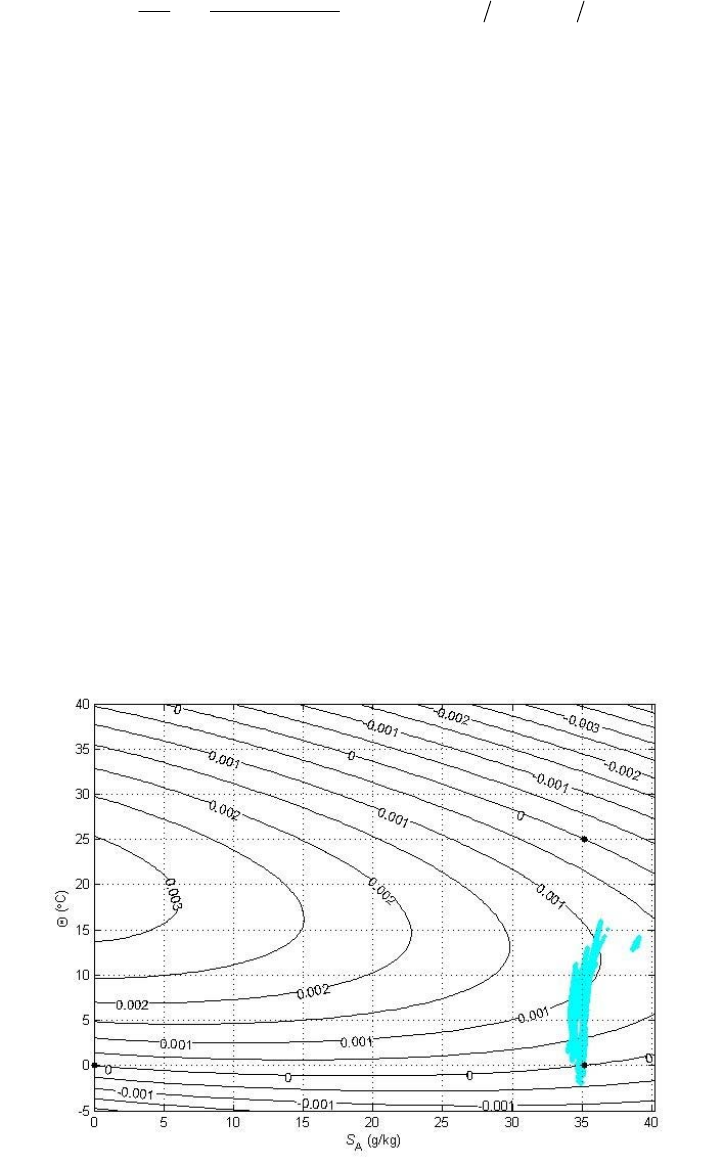
TEOS-10 Manual: Calculation and Use of the Thermodynamic Properties of Seawater
IOC Manuals and Guides No. 56
101
δ
ΘasaratioofthecontrastinConservativeTemperature21
Δ
Θ=Θ −Θmaybe
approximatedas(since21
ˆ
ˆ
v
ρ
ρρα
−−Θ
ΘΘ ΘΘ Θ
≈− ≈ )
() ()()
09
03.3 10 dbar K .
8p
PP p
c
α
δ
ρ
Θ
Θ−
−ΔΘ
Θ≈≈×ΔΘ
ΔΘ (A.18.8)
where
α
Θ
Θhasbeentakentobe52
1.1 10 K
−
−
×(McDougall,1987b).
AttheseasurfaceConservativeTemperature
Θ
istotallyconserved(0
δ
Θ= ).The
non‐conservativeproductionofConservativeTemperature,,
δ
Θ
increaseslinearlywith
pressure(seeEqn.(A.18.6))butatlargerpressuretherangeoftemperatureandsalinityin
theoceandecreases,andfromtheaboveequationsitisclearthatthemagnitudeof
δ
Θ
decreasesproportionallytothesquareofthetemperatureandsalinitycontrasts.
McDougall(2003)concludedthattheproduction
δ
Θ
betweenextremeseawaterparcelsat
eachpressureislargestat600dbar,andthemagnitudeofthenon‐conservative
productionofConservativeTemperature,,
δ
Θ
isillustratedinFigureA.18.1fordataat
thispressure.ThequantitycontouredonthisfigureisthedifferencebetweenΘandthe
followingtotallyconservativequantityat600p
=
dbar.Thisconservativequantitywas
constructedbytakingtheconservativepropertyenthalpyhatthispressureandadding
thelinearfunctionofA
Swhichmakestheresultequaltozeroat
(
)
A0, 0 CS
=
Θ= ° andat
()
1
A35.165 04 g kg , 0 C .S−
=Θ=°Thisquantityisthenscaledsothatitbecomes25 C°at
()
1
A35.165 04 g kg , 25 C .S−
=Θ=°InthismannerthequantitythatiscontouredinFigure
A.18.1hasunitsofC°andrepresentstheamountbywhichConservativeTemperature
Θ
isnotatotallyconservativevariableatapressureof600dbar.Themaximumamountof
productionbymixingseawaterparcelsattheboundariesofFigureA.18.1isabout
3
410 C
−
×°althoughtherangeofvaluesencounteredintherealoceanatthispressureis
actuallyquitesmall,asindicatedinFigureA.18.1.McDougall(2003)concludesthatthe
maximumnon‐conservationofΘintherealoceanisafactorofapproximatelyahundred
lessthanthemaximumnon‐conservativeproductionofpotentialtemperature.
θ
FigureA.18.1.Contours(inC°)ofavariablethatisusedtoillustratethenon‐
conservativeproductionofConservativeTemperatureΘat
600p
=
dbar.Thecloudofpointsshowwheremostofthe
oceanicdataresideat600p
=
dbar.Thethreepointsthatare
forcedtobezeroareshownwithblackdots.

102 TEOS-10 Manual: Calculation and use of the thermodynamic properties of seawater
IOC Manuals and Guides No. 56
FromthecurvatureoftheisolinesonFigureA.18.1itisclearthatthenon‐conservative
productionofConservativeTemperatureat600p
=
dbarispositive,sothatanocean
modelthatignoresthisproductionofConservativeTemperaturewillslightly
underestimateΘ.FromEqn.(A.18.2)oneseesthenon‐conservativeproductionof
ConservativeTemperatureisalwayspositiveifˆ0hΘΘ >,AA
ˆ0
SS
h>andAAA
2
ˆˆˆ
()
SSS
hhh
ΘΘΘ
<
everywhere,anditcanbeshownthattheserequirementsareinfactmet.
FromEqns.(A.18.8)and(A.17.3)wecanwritetheratiooftheproductionof
ConservativeTemperaturetotheproductionofpotentialtemperaturewhentwoseawater
parcelsmixastheapproximateexpression
()()
()
1
51
A
10 dbar K / [g kg ] .pS
δ
δθ
−
−−
Θ≈− ΔΘ Δ (A.18.9)
Takingatypicalratiooftemperaturedifferencestosalinitydifferencesinthedeepocean
tobe1
10 K / [g kg ]
−,Eqn.(A.18.9)becomes
(
)
4
10 dbar .p
δδθ
−
Θ≈− Atapressureof4000
dbarthisratiois0.4
δ
δθ
Θ≈−implyingthatConservativeTemperatureisalmostasnon‐
conservativeasispotentialtemperature.Whilethisisthecase,thetemperatureand
salinitycontrastsinthedeepoceanaresmall,sothenon‐conservationofbothtypesof
temperatureamounttoverysmalltemperatureincrementsofboth
δ
θ
and.
δ
ΘThe
largestnon‐conservativeincrementofConservativeTemperature
δ
Θ
seemstooccurata
pressureofabout600dbar(McDougall(2003))andthisvalueof
δ
Θ
isapproximatelytwo
ordersofmagnitudelessthanthemaximumvalueof
δ
θ
whichoccursattheseasurface.
ThematerialinappendicesA.16‐A.18hascloselyfollowedthepaperofMcDougall
(2003).
A.19 Non-conservative production of density and of potential density
Forthepurposeofcalculatingthenon‐conservativeproductionofdensitywetakeboth
AbsoluteSalinityA
SandConservativeTemperature
Θ
tobe100%conservative(see
appendixA.18above).Densityiswritteninthefunctionalform
(
)
A
ˆ,,Sp
ρρ
=Θ(A.19.1)
andthesamemixingprocessbetweentwofluidparcelsisconsideredasintheprevious
appendices.MassandAbsoluteSalinityareconservedduringtheturbulentmixing
process(Eqns.(A.16.2)and(A.16.3))asisConservativeTemperature,thatis
11 22 ,mm mΘ+ Θ= Θ(A.19.2)
whilethenon‐conservativenatureofdensitymeansthatitobeystheequation,
11 2 2 .mm mm
ρ
ρδρρ
++=(A.19.3)
DensityisexpandedinaTaylorseriesofA
Sand
Θ
aboutthevaluesofA
SandΘofthe
mixedfluid,retainingtermstosecondorderin
[
]
A2 A1 A
SS S
−
=Δ andin
[]
21 .Θ−Θ =ΔΘ
Then1
ρ
and2
ρ
areevaluatedand(A.19.3)isusedtofind
() ( )
{
}
AAA
22
12
1AA
22ˆˆ ˆ
2.
SSS
mm SS
m
δρ ρ ρ ρ
ΘΘ Θ
=− ΔΘ + ΔΘΔ + Δ (A.19.4)
Thenon‐conservativeproductionofdensity
δ
ρ
ofEqn.(A.19.4)isillustratedinFigure
A.19.1formixingat0p=dbar.Thatis,thisfigureshowstheproduction
θ
δ
ρ
of
potentialdensity
θ
ρ
(notethatthesymbol
ρ
Θ
couldequallywellbeusedforpotential
density).Thequantitycontouredonthisfigureisformedasfollows.Firstthelinear
functionofA
Sisfoundthatisequalto
θ
ρ
at
(
)
A0, 0 CS
=
Θ= ° andat
()
1
A35.165 04 g kg , 0 C .S−
=Θ=°ThislinearfunctionofA
Sissubtractedfrom
θ
ρ
andthe
resultisscaledtoequal25 C°at
(
)
1
A35.165 04 g kg , 25 C .S−
=
Θ= ° Thevariablethatis
contouredinFigureA.19.1isthedifferencebetweenthisscaledlinearcombinationof
θ
ρ
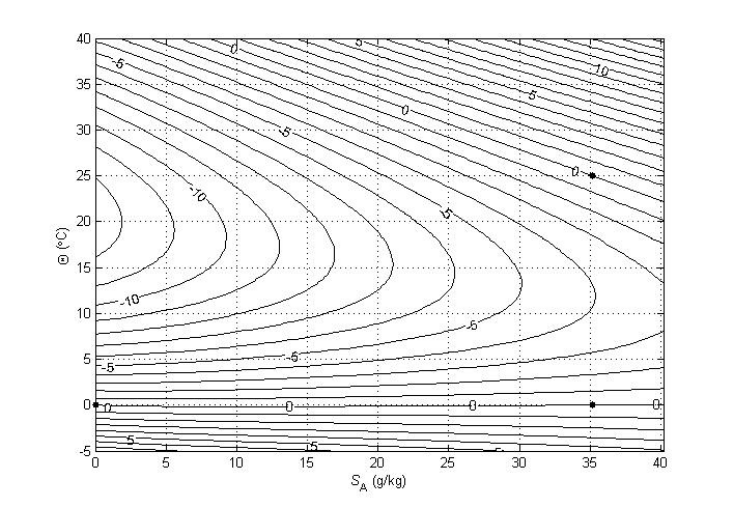
TEOS-10 Manual: Calculation and Use of the Thermodynamic Properties of Seawater
IOC Manuals and Guides No. 56
103
andA
S,andConservativeTemperature.Thisfigureallowsthenon‐conservativenature
ofdensitytobeunderstoodintemperatureunits.Themixingofextremefluidparcelson
FigureA.19.1causesthesameincreaseindensityasacoolingofapproximately10 C.°
FromFigureA.18.1itisseenthatthe(tiny)non‐conservativenatureofΘisafactorof
approximately4000smallerthanthis.
FigureA.19.1.Contours(inC°)ofavariablethatisusedtoillustratethenon‐
conservativeproductionofpotentialdensity.
θ
ρ
Thethree
pointsthatareforcedtobezeroareshownwithblackdots.
A.20 The representation of salinity in numerical ocean models
Oceanmodelsneedtoevaluatesalinityateverytimestepasanecessarypreludetousing
theequationofstatetodeterminedensityanditsderivativesforuseinthehydrostatic
relationshipandfrequentlyinneutralmixingalgorithms.Thecurrentpracticein
numericalmodelsistotreatsalinityasaperfectlyconservedquantityintheinteriorofthe
ocean;salinitychangesatthesurfaceandatcoastalboundariesduetoevaporation,
precipitation,brinerejection,icemeltandriverrunoffandsatisfiesanadvection‐diffusion
equationawayfromtheseboundaries.Theinclusionofcompositionanomalies
necessitatesseveralchangestothisapproach.Thesechangescanbedividedintotwo
broadcategories.First,inadditiontofreshwaterinputsandbrinerejection,allsourcesof
dissolvedmaterialenteringthroughthesurfaceandcoastalboundariesofthemodel
shouldbeconsideredaspossiblesourcesofcompositionanomalies.Second,withinthe
interiorofthemodel,changesduetothegrowth,decayandremineralizationofbiological
materialmustbeconsidered.Here,wefocusonthissecondissue.Whiletheultimate
resolutionoftheseissueswillinvolvebiogeochemicalmodels,inthisappendixwediscuss
somepracticalwaysforwardbasedontheapproximaterelations(A.4.5)and(A.4.6)
betweenthesalinityvariablesR*
,SSanddens
AA
SS=thatwerediscussedinsectionA.4.At
thetimeofwriting,thesuggestedapproachesherehavenotbeentested,soitmustbe
acknowledgedthatthetreatmentofseawatercompositionanomaliesinoceanmodelsis
currentlyaworkinprogress.
WebeginbyrestatingEqns.(A.4.5)and(A.4.6),namely
dens
R1R
SSrS
δ
∗
−≈ ,(A.20.1)

104 TEOS-10 Manual: Calculation and use of the thermodynamic properties of seawater
IOC Manuals and Guides No. 56
dens dens
A1R
(1 )SS rS
δ
∗
−≈+ ,(A.20.2)
where1
rwillbetakentobetheconstant0.35basedontheworkofPawlowiczetal.(2010),
andinthissectiontheseapproximaterelationswillbetakentobeexact.TheAbsolute
SalinityAnomalydens dens
RA R
SS S
δ
≡−isthesalinitydifferencethatcanbedirectlymeasured
fromseawatersamplesusingavibratingbeamdensimeterandknowledgeofthesample’s
PracticalSalinity,andagloballook‐uptableexistsforthisquantity(McDougalletal.
(2010a)).Becausethisparticularsalinitydifferenceisbasedondirectmeasurements,itis
thenaturalmeasureoftheanomalouscompositionofseawatertouseindevelopingthe
followingoptionsfornumericalmodelingofcompositionanomalies.
A.20.1UsingPreformedSalinity*
Sastheconservativesalinityvariable
BecausePreformedAbsoluteSalinity*
S(henceforthreferredtobytheshortenedname,
PreformedSalinity)isdesignedtobeaconservativesalinityvariable,blindtotheeffectsof
biogeochemicalprocesses,itsevolutionequationwillbeintheconservativeform(A.8.1).
Whenthistypeofconservationequationisaveragedintheappropriatemanner(see
appendixA.21)theconservationequationforPreformedSalinitybecomes(fromEqn.
(A.21.7)),
()
**
1*
ˆˆ
dˆ.
dnn
h
z
SS
hK S D
tz
⎛⎞
∂
=∇⋅ ∇ +
⎜⎟
⎜⎟
∂
⎝⎠
(A.20.3)
AsexplainedinappendixA.21,theover‐tildeof*
ˆ
Sindicatesthatthisvariableisthe
thickness‐weightedaveragePreformedSalinity,havingbeenaveragedbetweenapairof
closelyspacedneutraltangentplanes.Thematerialderivativeontheleft‐handsideof
Eqn.(A.20.3)iswithrespecttothesumoftheEulerianandquasi‐Stokesvelocitiesof
heightcoordinates(equivalenttothedescriptioninappendixA.21intermsofthe
thickness‐weightedaveragehorizontalvelocityandthemeandianeutralvelocity),while
theright‐handsideofthisequationisthestandardnotationindicatingthat*
ˆ
Sisbeing
diffusedalongneutraltangentplaneswiththediffusivityKandintheverticaldirection
withthediapycnaldiffusivityD(andhhereistheaveragethicknessbetweentwoclosely
spacedneutraltangentplanes).
Inordertoevaluatedensityduringtherunningofanoceanmodel,DensitySalinity
mustbeevaluated.ThiscanbedonefromEqn.(A.20.2)asthesumofthemodel’ssalinity
variable*
ˆ
Sanddens
1R
(1 )rS
δ
+.Thiscouldbedonebysimplyaddingtothemodel’s
salinityvariable1
(1 )r
+
timesthefixedspatialmapof
()
dens
RobsS
δ
asobservedtoday(and
asisavailablefromthecomputeralgorithmofMcDougalletal.(2010a)).However
experiencehasshownthatevenasmoothfieldofdensityerrorscanresultinsignificant
anomaliesindiagnosticmodelcalculations,primarilyduetothemisalignmentofthe
densityerrorsandthemodelbottomtopography.Indeed,evenifthecorrectmean
densitycouldsomehowbedetermined,approximationsassociatedwiththespecification
ofthemodelbottomtopographywouldresultinsignificanterrorsinbottompressure
torquesthatcandegradethemodelsolution.Onewaytominimizesucherrorsistoallow
somedynamicaladjustmentofthespecifieddensityfieldsothat,forexample,density
contourstendtoalignwithbottomdepthcontourswheretheflowisconstrainedtofollow
bottomtopography.Thissimpleideaisthekeytothesuccessoftherobustdiagnostic
approach(SarmientoandBryan(1982)).ToallowdynamicaladjustmentoftheAbsolute
SalinityAnomaliesdens
R(, , )Sxyp
δ
whilenotpermittingthemtodeveloplargedifferences
fromtheobservedvaluesdens
R(obs)S
δ
,werecommendcarryinganevolutionequationfor
dens
R
S
δ
sothatitbecomesanextramodelvariablewhichevolvesaccordingto
() ()
dens dens
dens 1 dens dens
RR
1RRR
d(obs) .
dnn
h
z
SS
hK S D S S
tz
δδ
δτδδ
−
⎛⎞
∂
=∇⋅ ∇ + + −
⎜⎟
∂
⎝⎠ (A.20.4)

TEOS-10 Manual: Calculation and Use of the Thermodynamic Properties of Seawater
IOC Manuals and Guides No. 56
105
Herethemodelvariabledens
R
S
δ
wouldbeinitializedbasedonobservations,dens
R(obs)S
δ
,
andadvectedanddiffusedlikeanyothertracer,butinaddition,thereisanon‐
conservativesourceterm
()
1 dens dens
RR
(obs)SS
τδ δ
−−whichservestorestorethemodel
variabledens
R
S
δ
towardstheobservedvaluewitharestoringtime
τ
thatcanbechosento
suitparticularmodelingneeds.Itshouldbeatleast30daystopermitsignificant
adjustment,butitmightproveappropriatetoallowamuchlongeradjustmentperiod(up
toseveralyears)ifdriftfromobservationsissufficientlyslow.Thelowerboundisbased
onaveryroughestimateofthetimerequiredforthedensityfieldtobealignedwith
topographybyadvectiveprocesses.Theupperboundissetbytherequirementtohave
therestoringtimerelativelyshortcomparedtoverticalandbasin‐scalehorizontal
redistributiontimes.
Ideallyonewouldlikethenon‐conservativesourcetermtoreflecttheactualphysical
andchemicalprocessesresponsibleforremineralizationintheoceaninterior,butuntilour
knowledgeoftheseprocessesimprovessuchthatthisispossible,theapproachofEqn.
(A.20.4)providesawayforward.Anindicationofhowthisapproachmightbeimproved
inthefuturecanbegleanedfromlookingatEqn.(A.4.14)fordens
A
SS
∗
−(takenfrom
Pawlowiczetal.(2010)).Ifabiogeochemicalmodelproducedestimatesofthequantities
ontheright‐handsideofthisequation,itcouldbeimmediatelyintegratedintoanocean
modeltodiagnosetheeffectsoftheincludedbiogeochemicalprocessesonthemodelʹs
densityanditscirculation.
Insummary,theapproachsuggestedherecarriestheevolutionEqns.(A.20.3)and
(A.20.4)for*
ˆ
Sanddens
R
S
δ
,whiledens
A
ˆ
Siscalculatedbythemodelateachtimestep
accordingto
dens dens
A1R
ˆˆ
(1 )SS rS
δ
∗
=++ ,(A.20.5)
withourbestpresentestimateof1
(1 )r
+
being1.35 .Themodelisinitializedwithvalues
ofPreformedSalinityusingEqn.(A.20.1)(namelydens
R1 R
ˆˆ
SSrS
δ
∗=− )basedon
observationsofReferenceSalinityandontheglobaldatabaseof
()
dens
RobsS
δ
from
McDougalletal.(2010a).
A.20.2IncludingasourcetermintheevolutionequationforAbsoluteSalinity
Anequivalentprocedureistocarrythefollowingevolutionequation(A.20.6)forAbsolute
Salinity,whichmorespecifically,iscalledDensitySalinity,dens
AA
.SS≡Oninspectionof
Eqn.(A.20.2),dens dens
A1R
(1 )SS rS
δ
∗
−≈+ ,andrecognizingthatS
∗
isaconservativevariable,
itisclearthatthenon‐conservativeproductionofdens
A
Smustoccurattherate1
(1 )r+
timestherateatwhichthesamenon‐conservativeprocessesaffecttheAbsoluteSalinity
Anomalydens
R
S
δ
.Since(fromEqn.(A.20.4))thenon‐conservativesourcetermfordens
R
S
δ
is
()
1 dens dens
RR
(obs)SS
τδ δ
−−,wefindthattheevolutionequationforDensitySalinitytobe
()
()
()
()
A
dens dens
dens 1 dens dens
AA
1A1RR
dens
dens A
1A
ˆˆ
dˆ1(obs)
d
ˆˆ
ˆ
nn
h
z
S
nn
h
z
SS
hK S D r S S
tz
S
hK S D z
τδ δ
−
⎛⎞
∂
=∇⋅ ∇ + ++ −
⎜⎟
⎜⎟
∂
⎝⎠
⎛⎞
∂
=∇⋅ ∇ + +
⎜⎟
⎜⎟
∂
⎝⎠
S
(A.20.6)
Alternatively,thisequationcanbederivedbysummingEqn.(A.20.3)plus1
(1 )r+times
Eqn.(A.20.4).Herethenon‐conservativesourcetermintheevolutionequationfor
DensitySalinityhasbeengiventhelabelA
ˆS
Sforlateruse.
Inthisapproachtheevolutionequation(A.20.4)fordens
R
S
δ
isalsocarriedandthe
model’ssalinityvariable,dens
A
ˆ
S,isuseddirectlyastheargumentoftheequationofstate
andotherthermodynamicfunctionsinthemodel.Themodelwouldbeinitializedwith
valuesofDensitySalinityusingEqn.(A.4.2)(namelydens dens
ARR
ˆˆ
SSS
δ
=+ )basedon
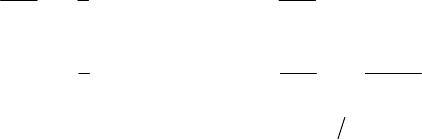
106 TEOS-10 Manual: Calculation and use of the thermodynamic properties of seawater
IOC Manuals and Guides No. 56
observationsofReferenceSalinityandontheglobaldatabaseof
()
dens
RobsS
δ
from
McDougalletal.(2010a).
ThisapproachshouldgiveidenticalresultstothatdescribedinsectionA.20.1using
PreformedSalinity.OnedisadvantageofhavingDensitySalinityasthemodel’ssalinity
variableisthatitsevolutionequation(A.20.6)isnotintheconservativeformsothat,for
example,itisnotpossibletoperformeasyglobalbudgetsofsalinitytotestforthe
numericalintegrityofthemodelcode.Anotherdisadvantageisthattheair‐seafluxof
carbondioxideandothergasesmayneedtobetakenintoaccountasthesurfaceboundary
conditionofDensitySalinity.Suchair‐seafluxesdonotaffectPreformedSalinity.
A.20.3IncludingasourcetermintheevolutionequationforReferenceSalinity
Anequivalentprocedureistocarrythefollowingevolutionequation(A.20.7)for
ReferenceSalinity.OninspectionofEqn.(A.20.1),dens
R1R
SSrS
δ
∗
−≈ ,andrecognizing
thatS∗isaconservativevariable,itisclearthatthenon‐conservativeproductionofR
S
mustoccurattherate1
rtimestherateatwhichthesamenon‐conservativeprocesses
affecttheAbsoluteSalinityAnomalydens
R
S
δ
.Since(fromEqn.(A.20.4))thenon‐
conservativesourcetermfordens
R
S
δ
is
(
)
1 dens dens
RR
(obs)SS
τδ δ
−−,theevolutionequationfor
ReferenceSalinityis
()
()
()
()
A
1 dens dens
RR
1R1RR
R1
1R
1
ˆˆ
dˆ(obs)
d
ˆˆ
ˆ
1
nn
h
z
S
nn
h
z
SS
hK S D r S S
tz
Sr
hK S D zr
τδ δ
−
⎛⎞
∂
=∇⋅ ∇ + + −
⎜⎟
⎜⎟
∂
⎝⎠
⎛⎞
∂
=∇⋅ ∇ + +
⎜⎟
⎜⎟
∂+
⎝⎠
S
,(A.20.7)
wherethenon‐conservativesourcetermis11
(1 )rr
+
timesthecorrespondingsourceterm
intheevolutionequationforDensitySalinityinEqn.(A.20.6).
InthisapproachtheevolutionEqns.(A.20.7)and(A.20.4)forR
ˆ
Sanddens
R
S
δ
are
carriedbytheoceanmodel,whiledens
A
ˆ
Siscalculatedbythemodelateachtimestep
accordingtoEqn.(A.4.2),namely
dens dens
ARR
ˆˆ
SSS
δ
=+ .(A.20.8)
Thisapproach,likethatofsectionA.20.2shouldgiveidenticalresultstothatdescribed
insectionA.20.1usingPreformedSalinityexceptforthemorecomplicatedair‐seaflux
boundaryconditionforReferenceSalinitythanforPreformedSalinity.Itdoesseemthat
theconservativenatureofEqn.(A.20.3)forPreformedSalinityisasignificantadvantage,
andsothisapproachislikelytobepreferredbyoceanmodelers.
A.20.4Discussionoftheconsequencesifremineralizationisignored
IfanoceanmodeldoesnotcarrytheevolutionequationforAbsoluteSalinityAnomaly
(Eqn.(A.20.4))andthemodel’ssalinityevolutionequationdoesnotcontainthe
appropriatenon‐conservativesourceterm,istherethenanypreferencetoinitializingand
interpretingthemodel’ssalinityvariableaseitherPreformedSalinity,AbsoluteSalinityor
ReferenceSalinity?Thatis,thesimplestmethodofdealingwiththesesalinityissuesisto
continuethegeneralapproachthathasbeentakenforthepastseveraldecadesofsimply
takingonetypeofsalinityinthemodelandthatsalinityistakentobeconservative.
Underthisapproximationthesalinitythatisusedintheequationofstatetocalculate
densityinthemodelisthesameasthesalinitythatobeysanormalconservationequation
oftheformEqn.(A.20.3).Inthisapproachthereisstillachoiceofhowtoinitializethe
salinityinamodel,andherewediscusstherelativevirtuesoftheseoptions.
IfthemodelisinitializedwithadatasetofestimatedPreformedSalinity*
S,then*
S
shouldevolvecorrectly,since*
SisaconservativevariableanditsevolutionequationEqn.
(A.20.3)containsnonon‐conservativesourceterms.Inthisapproachtheequationofstate
TEOS-10 Manual: Calculation and Use of the Thermodynamic Properties of Seawater
IOC Manuals and Guides No. 56
107
willbecalledwith*
ˆ
Sratherthandens
A
ˆ
S,andthesesalinitiesdifferbyapproximately
dens
1R
(1 )rS
δ
+.Thelikelyerrorswiththisapproachcanbeestimatedusingthesimple
exampleofFigureA.5.1.Theverticalaxisinthisfigureisthedifferencebetweenthe
northwarddensitygradientatconstantpressurewhentheequationofstateiscalledwith
dens
A
ˆ
SandwithR
ˆ
S.ThefigureshowsthatwhenusingR
ˆ
S,forallthedataintheworld
oceanbelowadepthof1000m,58%ofthisdataisinerrorbymorethan2%.Ifthisgraph
werere‐donewith*
ˆ
SasthesalinityargumentratherthanR
ˆ
S,theerrorswouldbelarger
intheratio1
(1 ) 1.35r+≈ .Thatis,for58%ofthedataintheworldoceandeeperthan1000
m,the“thermalwind”relationwouldbemisestimatedby2.7%
≈
if*
ˆ
Sisusedinplaceof
dens
A
ˆ
Sasthesalinityargumenttotheequationofstate.Also,thesepercentageerrorsin
“thermalwind”arelargerinthePacificOcean.
Anotherchoiceofthesalinitydatatoinitializethemodelisdens
A
ˆ
S.Thischoicehasthe
advantagethatforaninitialperiodoftimeafterinitializationtheequationofstateiscalled
withthecorrectsalinityvariable.Howeveratlatertimes,theneglectofthenon‐
conservativesourceterminEqn.(A.20.6)meansthatthemodel’ssalinityvariablewill
departfromrealityanderrorswillcreepinduetothelackoftheselegitimatenon‐
conservativesourceterms.Howlongmightitbeacceptabletointegratesuchamodel
beforetheerrorsapproachedthosedescribedinthepreviousparagraph?Onecould
imaginethatintheupperoceantheinfluenceofthesedifferentsalinityvariablesis
dwarfedbyotherphysicssuchasairseainteractionandactivegyralmotions.Ifone
consideredadepthof1000masbeingadepthwheretheinfluenceofthedifferent
salinitieswouldbebothapparentandwouldmakeasignificantimpactonthethermal
windequation,thenonemightguessthatitwouldtakeseveraldecadesfortheneglectof
thenon‐conservativesourcetermsintheevolutionequationforDensitySalinitytobegin
tobeimportant.Thisisnottosuggestthattherelaxationtimescale
τ
shouldbechosento
beaslongasthis,ratherthisisanestimateofhowlongitwouldtakefortheneglectofthe
non‐conservativesourcetermA
ˆS
SinEqn.(A.20.6)tobecomesignificant.
AthirdchoiceistoinitializethemodelwithReferenceSalinity,R
ˆ
S.Thischoiceincurs
theerrorsdisplayedinFigureA.5.1rightfromthestartofanynumericalsimulation.
Thereafter,onsomeunknowntimescale,furthererrorswillarisebecausetheconservation
equationforReferenceSalinityismissingthelegitimatenon‐conservativesourceterms
thatrepresenttheeffectsofbiogeochemistryonconductivityandR
ˆ
S.Hencethischoiceis
theleastdesiredofthethreeconsideredinthissubsection.Notethatthischoiceis
basicallytheapproachthathasbeenusedtodateinoceanmodelingstudiessincewehave
routinelyinitializedmodelswithobservationsofPracticalSalinityandhavetreateditas
thoughitwereaconservativevariableandhaveuseditasthesalinityargumentforthe
equationofstate.
Inprinciple,thereareothercombinationsofoptionswheretheevolutionequationfor
AbsoluteSalinityAnomaly(A.20.4)iscarriedbyanoceanmodel,butsomeoptionother
thanthosediscussedinsubsectionsA.20.1–A.20.3ispursued.Wedonotconsiderthese
variousoptionshere,sinceifonegoestothetroubleofcarryingtheevolutionequationfor
AbsoluteSalinityAnomaly,thenoneshouldbesufficientlycarefultoimplementoneof
theoptionsdiscussedinsubsectionsA.20.1–A.20.3.
A.20.5Discussionoftheoptionsforincludingremineralization
TheapproachesofsubsectionsA.20.1–A.20.3ofthisappendixcaneachaccountforthe
non‐conservativeeffectsofremineralizationif1
risaconstantandsolongasthe
appropriateboundaryconditionsareimposed.Theadvantageofusing*
ˆ
Sisthatitobeys
astandardconservativeevolutionequation(A.20.3)withnosourcetermontheright‐hand
side.Since*
Sisdesignedtobeaconservativesalinityvariable,itwouldappeartobethe
mostappropriatesalinityvariableforhavingasanaxisofthetraditional“S
θ
−diagram”,

108 TEOS-10 Manual: Calculation and use of the thermodynamic properties of seawater
IOC Manuals and Guides No. 56
whichwouldthenbecomethe*
S−Θdiagram.Similarly,*
ˆ
Swouldalsobethebestchoice
forthesalinityvariableinaninversestudy.
IfanoceanmodelweretoberunwithoutcarryingtheevolutionequationforAbsolute
SalinityAnomaly(A.20.4)andhencewithouttheabilitytoincorporatetheappropriate
non‐conservativesourcetermsineitherEqns.(A.20.6)or(A.20.7),thenthemodelmust
resorttocarryingonlyonesalinityvariable,andthissalinityvariablemustbetreatedasa
conservativevariableintheoceanmodel.Inthiscircumstance,weadvisethattheocean’s
salinityvariablebeinterpretedasDensitySalinity,andinitializedassuch.Inthisway,the
errorsinthethermalwindequationwilldeveloponlyslowlyoveratimescaleofseveral
decadesormoreinthedeepocean.
Itshouldbenotedthateachofthemodellingapproachesdescribedinsubsections
A.20.1–A.20.3arerelatedtotoday’sestimateofthe
()
dens
RobsS
δ
field.Thisfieldwill
changenotonlyastheobservationaldatabaseimprovesbutalsoastheoceancomposition
evolveswithtime.
A.21 The material derivatives of *,S A,S R
S and
Θ
in a turbulent ocean
PreformedSalinity*
Sisdesignedtobeaconservativevariablewhichobeysthefollowing
instantaneousconservationequation(basedonEqn.(A.8.1))
() ( )
S
*
**
d.
d
t
S
SS
t
ρρρ
+∇⋅ = = −∇⋅uF(A.21.1)
ThereareseveraldifferentcontributionstothemolecularfluxofsaltS
F,expressionsfor
whichcanbeseenatequation(58.11)ofLandauandLifshitz(1959)andinEqn.(B.23)
below.Forcompleteness,werepeatthecontinuityequation(A.8.2)hereas
(
)
0.
t
ρρ
+∇⋅ =u(A.21.2)
TemporallyaveragingthisequationinCartesiancoordinates(i.e.atfixed,,
x
yz)gives
(
)
0,
t
ρρ
+∇⋅ =u(A.21.3)
whichwechoosetowriteinthefollowingform,afterdivisionbyaconstantdensity0
ρ
(usuallytakentobe3
1035 kg m−,seeGriffies(2004))
(
)
00
t
ρρ
+∇⋅ =u
where 0.
ρ
ρ
≡uu
(A.21.4)
Thisvelocityu
isactuallyproportionaltotheaveragemassfluxofseawaterperunitarea.
TheconservationequationforPreformedSalinity(A.21.1)isnowaveragedinthe
correspondingmannerobtaining(McDougalletal.2002)
()()
()
00 00
S
*11
** * *
.
t
S
SS S S
t
ρ
ρρ ρ
ρρ
ρρ ρρ
ρ
∂′′ ′′
+∇⋅ = + ⋅∇ = − ∇⋅ − ∇⋅
∂
uu Fu
(A.21.5)
HerethePreformedSalinityhasbeendensity‐weightedaveraged,thatis,**
SS
ρ
ρ
ρ
≡,
andthedoubleprimedquantitiesaredeviationsoftheinstantaneousquantityfromits
density‐weightedaveragevalue.Sincetheturbulentfluxesaremanyordersofmagnitude
largerthanmolecularfluxesintheocean,themolecularfluxofsaltishenceforthignored.
TheaveragingprocessinvolvedinEqn.(A.21.5)hasnotinvokedthetraditional
Boussinesqapproximation.Theaboveaveragingprocessisbestviewedasanaverage
overmanysmall‐scalemixingprocessesoverseveralhours,butnotovermesoscaletime
andspacescales.Thislateraveragingovertheenergeticmesoscaleeddiesisnotalways
necessary,dependingonthescaleofthepieceofoceanoroceanmodelthatisunder
investigation.Thetwo‐stageaveragingprocesses,withoutinvokingtheBoussinesq
approximation,overfirstsmall‐scalemixingprocesses(severalmeters)followedby
averagingoverthemesoscale(oforder100km)hasbeenperformedbyGreatbatchand
McDougall(2003),yieldingtheprognosticequationforPreformedSalinity

TEOS-10 Manual: Calculation and Use of the Thermodynamic Properties of Seawater
IOC Manuals and Guides No. 56
109
() ()()
()
000000
**
*** *
*
1*
ˆˆ
ˆˆˆ ˆ
ˆˆ
ˆ
ˆ.
nn
tz
nn
nn
h
z
SS
SSeS Se
tz
S
hK S D z
ρρρρρρ
ρρρρρρ
∂∂
+∇ ⋅ + = + ⋅∇ +
∂∂
⎛⎞
∂
=∇⋅ ∇ +
⎜⎟
⎜⎟
∂
⎝⎠
vv
(A.21.6)
Heretheover‐caretmeansthatthevariable(e.g.*
ˆ
S)hasbeenaveragedinathickness‐and‐
density‐weightedmannerbetweenapairof“neutralsurfaces”asmalldistancehapartin
thevertical,ˆ
visthethickness‐and‐density‐weightedhorizontalvelocity,eisthe
dianeutralvelocity(theverticalvelocitythatpenetratesthroughtheneutraltangentplane)
ande
isthetemporalaverageofeonthe“neutralsurface”(thatis,e
isnotthickness‐
weighted).TheturbulentfluxesareparameterizedbytheepineutraldiffusivityKandthe
dianeutral(orvertical)diffusivity.
D
Thedensityvalue
ρ
isthedensitywhoseaverage
heightistheheightatwhichtheequationisevaluated.Theissuesofaveraginginvolved
inEqns.(A.21.5)and(A.21.6)aresubtle,andarenotcentraltoourpurposeinthis
thermodynamicmanual.HenceweproceedwiththemorestandardBoussinesq
approach,butretaintheover‐caretstoremindthereaderofthethickness‐weightednature
ofthevariables.
Havingderivedthisevolutionequation(A.21.6)forPreformedSalinitywithout
invokingtheBoussinesqapproximation,wenowfollowcommonpracticeandinvokethis
approximation,findingthesimplerexpression
()
** *
1
**
ˆˆ ˆ
ˆˆ
ˆ.
nnn
h
nz
SS S
Se hKS D
tz z
⎛⎞
∂∂ ∂
+⋅∇ + =∇⋅ ∇ +
⎜⎟
⎜⎟
∂∂ ∂
⎝⎠
v(A.21.7)
Theleft‐handsideisthematerialderivativeofthethickness‐weightedPreformedSalinity
withrespecttothethickness‐weightedhorizontalvelocityˆ
vandthetemporallyaveraged
dianeutralvelocitye
ofdensitycoordinates.Theright‐handsideisthedivergenceofthe
turbulentfluxesofPreformedSalinity;thefactthatthelateraldiffusiontermisthe
divergenceofafluxcanbeseenwhenitistransformedtoCartesiancoordinates.The
sameconservationstatementEqn.(A.21.7)canbederivedwithoutmakingtheBoussinesq
approximationbyasimplereinterpretationoftheverticalcoordinateasbeingpressure,
andthisinterpretationisnowbecomingcommoninoceanmodelling(seeBleck(1978),
Huangetal.(2001),deSzoekeandSamelson(2002),Loschetal.(2004)andGriffies(2004)).
WenowproceedtodevelopthecorrespondingevolutionequationforAbsolute
SalinityA.SNotethatA
SistheconvenientgenericsymbolforDensitySalinitydens
A
S;
unlessthereisroomforconfusionwiththeothermeasuresofabsolutesalinity,soln
A
Sand
add
A
S,itprovesconvenienttousethesimplersymbolA
Sratherthandens
A
Sandtousethe
descriptionAbsoluteSalinityratherthanDensitySalinity.
AbsoluteSalinityobeystheinstantaneousevolutionequation(basedonEqn.(A.8.1))
() ( )
A
S
A
AA
d.
d
S
t
S
SS
t
ρρρ ρ
+∇⋅ = = −∇⋅ +uFS(A.21.8)
ThesourcetermA
S
SisdescribedinappendixA.20(seeeqn.(A.20.6)).Thisnon‐
conservativesourcetermisduetobiogeochemicalprocesses,forexample,the
remineralizationofbiologicalmaterial;theturningofparticulatematterintodissolved
seasalt.Whenthisequationisdensity‐weightedaveraged,wefind
()()
()
00
A
00 0
A
AA A
S
11
A,
t
S
S
SS S
t
S
ρ
ρρ ρ
ρρ
ρρ
ρ
ρ
ρρ ρ
ρ
∂
+∇⋅ = + ⋅∇
∂
′′ ′′
=− ∇⋅ − ∇⋅ +
uu
Fu
S
(A.21.9)
whichcorrespondstoEqn.(A.21.5)above.Whenaveragedoverthemesoscalethe
prognosticequationforAbsoluteSalinitybecomes

110 TEOS-10 Manual: Calculation and use of the thermodynamic properties of seawater
IOC Manuals and Guides No. 56
() ()()
()
000000
A
0
AA
AAA A
A
1A
ˆˆ
ˆˆˆ ˆ
ˆˆ
ˆˆ
ˆ,
nn
tz
nn
S
nn
h
z
SS
SSeS Se
tz
S
hK S D z
ρρρρρρ
ρρρρρρ
ρ
ρ
∂∂
+∇ ⋅ + = + ⋅∇ +
∂∂
⎛⎞
∂
=∇⋅ ∇ + +
⎜⎟
⎜⎟
∂
⎝⎠
vv
S
(A.21.10)
andwhentheBoussinesqapproximationismadewefindthesimplerexpression
()
A
AA A
1
AA
ˆˆ ˆ
ˆ
ˆˆ
ˆ.
S
nnn
h
n z
SS S
Se hKS D
tz z
⎛⎞
∂∂ ∂
+⋅∇ + =∇⋅ ∇ + +
⎜⎟
⎜⎟
∂∂ ∂
⎝⎠
vS(A.21.11)
Theleft‐handsideisthematerialderivativeofthethickness‐weightedAbsoluteSalinity
withrespecttothethickness‐weightedhorizontalvelocityˆ
vandthetemporallyaveraged
dianeutralvelocitye
ofdensitycoordinates.Apartfromthenon‐conservativesource
termA
ˆS
S,theright‐handsideisthedivergenceoftheturbulentfluxesofAbsolute
Salinity.
ThecorrespondingturbulentevolutionequationforReferenceSalinityis
()
()
A
RR R1
1
RR
1
ˆˆ ˆ
ˆ
ˆˆ
ˆ.
1
S
nnn
h
n z
SS Sr
Se hKS D
tz zr
⎛⎞
∂∂ ∂
+⋅∇ + =∇⋅ ∇ + +
⎜⎟
⎜⎟
∂∂ ∂+
⎝⎠
vS(A.21.12)
Thenon‐conservativesourcetermhereisjustifiedinsubsectionA.20.3ofappendixA.20.
AsdiscussedinappendicesA.4andA.20,givenourratherelementaryknowledgeofthe
wayvariationsinseawatercompositionaffectconductivity,werecommendthat1
rbe
takentobetheconstant10.35.r=HenceweseethatReferenceSalinityisaffectedby
biogeochemicalprocessesatabout0.26(0.35/ 1.35
≈
)ofthecorrespondinginfluenceof
biogeochemistryonDensitySalinity.
WeturnnowtoconsiderthematerialderivativeofConservativeTemperatureina
turbulentocean.FromEqns.(A.13.5)and(A.21.8)theinstantaneousmaterialderivativeof
Θis,withoutapproximation,
(
)
()
()
()
()
() ()
()
A
A
A
0
0RQ
0
0S
0
d
d
0.
S
pS
S
T
ch
tTt
Tp
Tt
θ
ρρερ
θμμ ρ
+
Θ=−∇⋅−∇⋅++
+
⎡⎤
+
−−−∇⋅+
⎢⎥
+
⎢⎥
⎣⎦
FF
F
S
S
(A.21.13)
Thefactthattheright‐handsideofEqn.(A.21.13)isnotthedivergenceofafluxmeans
thatΘisnota100%conservativevariable.However,thefinite‐amplitudeanalysisof
mixingpairsofseawaterparcelsinappendixA.18hasshownthatthenonconstant
coefficientsofthedivergencesofthemolecularfluxesofheatQ
−
∇⋅FandsaltS
−∇⋅ F
appearingontheright‐handsideofEqn.(A.21.13)areofnopracticalconsequenceasthey
causeanerrorinConservativeTemperatureofnomorethan1.2mK (seeFigureA.18.1).
Thesenon‐idealtermsontheright‐handsideofEqn.(A.21.13)arenolargerthanthe
dissipationterm
ρ
ε
whichisalsojustifiablyneglectedinoceanography(McDougall
(2003)).ThesourcetermA
S
ρ
Swasnotconsideredinthemixingofseawaterparcelsin
appendixA.18,andwenowshowthatthesetermsalsomakenegligiblecontributionsto
Eqn.(A.21.13).
ThepartialderivativeofenthalpywithrespecttoAbsoluteSalinity,A,
S
hthatappears
inEqn.(A.21.13)isabout1
65 J g
−
−(i.e.65
−
111
Jkg (gkg )
−
−−
)atatemperatureof10 C°.
ThisvaluecanbededucedfromFigureA.17.1andalsofromFigure30(c)andTable12of
Feistel(2003),albeitfortheGibbsfunctionofseawaterthatimmediatelypredatedthe
TEOS‐10salineGibbsfunctionofFeistel(2008)andIAPWS(2008).Thespatialintegralof
thesourcetermA
S
ρ
SfromtheNorthAtlantictotheNorthPacificissufficienttocausea
changeinAbsoluteSalinityof0.0251
gkg
−
,sothemaximumcontributiontoanerrorin
Θ

TEOS-10 Manual: Calculation and Use of the Thermodynamic Properties of Seawater
IOC Manuals and Guides No. 56
111
fromthesourceterm
()
(
)
A
A00
S
S
hTTt
ρθ
+
+SinEqn.(A.21.13),whenintegratedoverthe
wholeocean,isapproximately
(
)
(
)
01 1 1
( ) 65 J g 0.025 g kg 0.4 mK
p
c−− −
≈.Theothertermin
A
S
ρ
SinEqn.(A.21.13)ismultipliedbythesquarebracketwhichfromequation(27)of
McDougall(2003)isequalto
()
(
)
00
TTt
θ
++timesapproximately1
p
β
ρ
Θ−
−,sothatthis
squarebracketisapproximately301
Jg
−
(i.e.30 111
Jkg (gkg )
−
−−
)atapressurepof4000
dbar(40MPa)sothecontributionofthistermislessthanhalfthatoftheterminA
S
ρ
Sin
thefirstlineofEqn.(A.21.13).ThisconfirmsthatthepresenceofthetwotermsinA
S
ρ
S
intheFirstLawofThermodynamicshaslessimpactthaneventhenon‐idealnatureofthe
molecularfluxdivergencetermsinEqn.(A.21.13)andthedissipationofmechanical
energyinthisequation.
Hencewithnegligibleerror,theright‐handsideofEqn.(A.21.13)mayberegardedas
thesumoftheidealmolecularfluxofheattermQ
−
∇⋅Fandthetermduetotheboundary
andradiativeheatfluxes,
()
(
)
R
00
.TTt
θ
−+∇⋅ +FAttheseasurfacethepotential
temperature
θ
andinsitutemperaturetareequalsothatthistermissimplyR
−∇⋅Fso
thattherearenoapproximationswithtreatingtheair‐seasensible,latentandradiative
heatfluxesasbeingfluxesof0.
p
cΘThereisanissueattheseafloorwheretheboundary
heatflux(thegeothermalheatflux)affectsConservativeTemperaturethroughthe“heat
capacity”
()()
0
00p
TtcT
θ
++ratherthansimply0.
p
cThatis,theinputofacertain
amountofgeothermalheatwillcausealocalchangein
Θ
asthoughtheseawaterhadthe
“specificheatcapacity”
()
(
)
0
00p
TtcT
θ
++ratherthan0.
p
cThesetwospecificheat
capacitiesdifferfromeachotherbynomorethan0.15%atapressureof4000dbar.Ifthis
smallpercentagechangeintheeffective“specificheatcapacity”waseverconsidered
important,itcouldbecorrectedbyartificiallymultiplyingthegeothermalheatfluxatthe
seafloorby
()()
00
TTt
θ
++.
WeconcludethatitissufficientlyaccuratetoassumethatConservativeTemperature
isinfactconservativeandthattheinstantaneousconservationequationis
() ( )
00 0 RQ
d.
d
pp p
t
cc c
t
ρρρ
Θ
Θ + ∇⋅ Θ = = −∇⋅ − ∇⋅uFF(A.21.14)
Nowweperformthesametwo‐stageaveragingprocedureasoutlinedaboveinthecaseof
PreformedSalinity.TheBoussinesqformofthemesoscale‐averagedequationis
(analogoustoEqn.(A.21.7))
()( )
bound
1
ˆˆ
ˆˆˆ
ˆ.
nnnz
hz
n
ehKDF
tz
∂Θ ∂Θ
+ ⋅∇Θ+ = ∇ ⋅ ∇Θ + Θ−
∂∂
v(A.21.15)
Asinthecaseofthe*
Sequation(A.21.7),themolecularfluxofheathasbeenignoredin
comparisonwiththeturbulentfluxesofConservativeTemperature.Theair‐seafluxesof
sensibleandlatentheat,theradiativeandthegeothermalheatfluxesremaininEqn.
(A.21.15)intheverticalheatflux
b
ound
Fwhichisthesumoftheseboundaryheatfluxes
dividedby0
0.
p
c
ρ
Anyconservativevariable,,Cobeysaconservationequationidentical
informtoEqns.(A.21.7)and(A.21.15),withˆ
Csimplyreplacing*
ˆ
Sorˆ
Θinthese
equations,andofcoursewiththeboundaryfluxbeingtheboundaryfluxofpropertyC.
Theerrorsincurredinoceanmodelsbytreatingpotentialtemperature
θ
asbeing
conservativehavenotyetbeenthoroughlyinvestigated,butMcDougall(2003)and
Tailleux(2010)havemadeastartonthistopic.McDougall(2003)foundthattypicalerrors
in
θ
are0.1 C±°whileinisolatedregionssuchaswherethefreshAmazonwater
dischargesintotheocean,theerrorcanbeaslargeas1.4 C°.Thecorrespondingerrorin
themeridionalheatfluxappearstobeabout0.005PW(orarelativeerrorof0.4%).The
useofConservativeTemperatureΘinoceanmodelsreducestheseerrorsbytwoordersof
magnitude.
Itispossibletoderiveanevolutionequationforpotentialtemperaturewhich
resemblesEqn.(A.21.15)butwhichcontainsadditionalnon‐conservativesourcetermson

112 TEOS-10 Manual: Calculation and use of the thermodynamic properties of seawater
IOC Manuals and Guides No. 56
theright‐handsideoftheequation.However,thereseemslittlepointindoingsohere,as
itismuchmoreconvenienttoinsteadadopttheConservativeTemperaturevariable.Note
thattheconsequencesfordynamicaloceanographyofignoringthenon‐conservative
sourcetermsinthepotentialtemperatureevolutionequationareaslargeasignoringthe
variationsinseawatercomposition;a
θ
rangeof0.2 C°correspondstoadensityrangeof
3
0.04 kg m−whichistwiceaslargeasthedensityerrorduetoignoringthemaximum
valueofAR
SS−of1
0.025 g kg−.
TheevolutionequationsofPreformedSalinity(A.21.7)andConservativeTemperature
(A.21.15)aretheunderpinningconservationequationsforthesevariablesinocean
models.Animportantissueforoceanmodelsishowtorelateˆ
vtotheEulerian‐mean
horizontalvelocityv.Thisareaofresearchinvolvestemporal‐residual‐meantheoryand
thequasi‐Stokesstreamfunction(GentandMcWilliams(1990),Gentetal.(1995),
McDougallandMcIntosh(2001)andGriffies(2004)).Wewillnotdiscussthistopichere.
SufficeittosaythatthemeanadvectioncanbeexpressedinCartesiancoordinates,with
forexample,Eqn.(A.21.15)becoming
()( )
* bound
1
ˆ
dˆˆˆ ˆˆ
ˆ,
dtzznn z
hz
zwhKDF
t
Θ=Θ + ⋅∇Θ+ Θ = ∇ ⋅ ∇Θ + Θ −v(A.21.16)
wheretheverticalvelocity*
wisrelatedtoe
by
*ˆ.
tn
n
wz ze=+⋅∇+v(A.21.17)
A.22 The material derivatives of density and of locally-referenced
potential density; the dianeutral velocity e
RegardingdensitytobeafunctionofConservativeTemperature(i.e.
()
A
ˆ,,Sp
ρρ
=Θ)and
takingthematerialderivativeofthenaturallogarithmofdensityfollowingthemesoscale‐
thickness‐weighted‐averagedmeanflow(asinEqns.(A.21.15)or(A.21.16)),wehave
1A
ˆˆ
ˆ
dddd
ˆ,
dddd
SP
tttt
ρ
ρβακ
−ΘΘ
Θ
=−+
(A.22.1)
whereˆ
ρ
isthethickness‐weightedaveragevalueofdensity.Onecancontinueto
considerthematerialderivativeofinsitudensity,andinsodoing,onecarriesalongthe
lastterminEqn.(A.22.1),dP dt
κ
,butitismorerelevantandmoreinterestingtoconsider
thematerialderivativeofthelogarithmofthelocally‐referencedpotentialdensity,ˆ,
l
ρ
since
thisvariableislocallyconstantintheneutraltangentplane.Thematerialderivativeofˆl
ρ
isgivenby
11 A
ˆˆ
ˆˆ
ddddd
ˆˆ .
ddddd
lPS
ttttt
ρρ
ρρκβα
−− ΘΘ
Θ
=−= −(A.22.2)
SubstitutingfromEqns.(A.21.11)and(A.21.15)above,andnotingthatboththetemporal
andthelateralgradientsofˆl
ρ
vanishalongtheneutraltangentplane(thatis,
A
ˆˆ
nn
S
αβ
ΘΘ
∇Θ− ∇ =0andA
ˆˆ
0
t
tnn
S
αβ
ΘΘ
Θ− =),thematerialderivativeofˆl
ρ
amounts
tothefollowingequationforthedianeutralvelocitye
(notethattheboundaryheatflux
b
ound
Falsoneedstobeincludedforfluidvolumesthatabuttheseasurface)
()
(
)
(
)
() ( )
A
11
AA
A
ˆˆ ˆ ˆ
ˆ
ˆˆ .
z
z
znnnn
S
zzz
eShhKhhKS
DDS
αβ α β
αβ β
Θ Θ Θ− Θ−
ΘΘ Θ
Θ− = ∇⋅ ∇Θ− ∇⋅ ∇
+Θ− −
S(A.22.3)
Theleft‐handsideisequalto12
eg N
−
andthefirsttwotermsontherighthandside
wouldsumtozeroiftheequationofstatewerelinear.Thisequationcanberewrittenas
thefollowingequationforthetemporallyaveragedverticalvelocitythroughtheneutral

TEOS-10 Manual: Calculation and Use of the Thermodynamic Properties of Seawater
IOC Manuals and Guides No. 56
113
tangentplaneatagivenlongitudeandlatitude(fromMcDougall(1987b),andseeEqns.
(3.8.2)and(3.9.2)forthedefinitionsof
b
C
Θ
and
b
T
Θ
)
()
(
)
(
)
A
12
bb A
ˆ
ˆˆ ˆ ˆ ˆ .
z
S
nn nn z
zz
eg N K C T p D DS
αβ β
−Θ Θ ΘΘΘ
=− ∇Θ⋅∇Θ+ ∇Θ⋅∇ + Θ − −
S(A.22.4)
Thecabbelingnonlinearity(the
b
CΘterm)alwayscauses“densification”,thatis,italways
causesanegativedianeutralvelocity,e
,whilethethermobaricnonlinearity(the
b
TΘterm)
cancauseeitherdiapycnalupwellingordownwelling.
TosummarizethisappendixA.22;wehavefoundthatthematerialderivativeofin
situdensityEqn.(A.22.1),whenadjustedforthedynamicallypassivecompressibility
term,becomesthematerialderivativeoflocally‐referencedpotentialdensityEqn.(A.22.2)
whichcanbeinterpretedasanexpressionEqn.(A.22.4)for,e
thetemporally‐averaged
verticalvelocitythroughthelocalneutraltangentplane.Thisdianeutralvelocitye
isnot
aseparatemixingprocess,butratherisadirectresultofmixingprocessessuchas(i)
small‐scaleturbulentmixingasparameterizedbythediffusivity,
D
and(ii)lateral
turbulentmixingofheatandsaltalongtheneutraltangentplane(asparameterizedbythe
lateralturbulentdiffusivityK)actinginconjunctionwiththecabbelingandthermobaric
nonlinearitiesoftheequationofstate.Notethatacommondiapycnalmixingmechanism,
double‐diffusiveconvection(whichactuallycomesintwoseparateflavours,asalt‐
fingeringtypeanda“diffusive”typeofdouble‐diffusiveconvection)isomittedfromthe
conservationequations(A.21.11)and(A.21.15)andalsofromthemeandianeutralvelocity
equation(A.22.4).Itishoweverstraight‐forwardtoincludetheseprocessesinthese
conservationequations(seeforexampleMcDougall(1994,1997b)).
A.23 The water-mass transformation equation
ItisinstructivetosubstituteEqn.(A.22.4)fore
intotheexpression(A.21.15)forthe
materialderivativeofˆ
Θ,thuseliminatinge
andobtainingthefollowingequationforthe
temporalandspatialevolutionofˆ
Θalongtheneutraltangentplane(McDougall(1984))
() ( )
()
A
2
1bb
2
23 A
2
ˆˆˆˆˆˆˆ
ˆ
ˆˆ
ˆ,
ˆ1
n n n z nn nn
h
n
S
z
hK KgN C T p
t
R
dS
DgN dR
ρ
ρ
β
βα
−Θ Θ
Θ
Θ−
Θ
∂Θ + ⋅∇ Θ = ∇ ⋅ ∇ Θ + Θ ∇ Θ⋅∇ Θ + ∇ Θ⋅∇
∂
+Θ+
Θ−
v
S
(A.23.1)
where
R
ρ
isthestabilityratioofthewatercolumn,A
ˆˆ
.
z
z
R
S
ρ
αβ
ΘΘ
=Θ Theterminvolving
D
hasbeenwrittenasproportionaltothecurvatureoftheA
ˆˆ
S
−
Θdiagramofavertical
cast;thistermcanalsobewrittenas
(
)
2
AA
ˆˆ ˆ ˆ .
zz z
zzz
DgN S S
β
Θ−
Θ−ΘTheformofEqn.(A.23.1)
illustratesthatwhenanalyzedindensitycoordinates,ConservativeTemperature(and
AbsoluteSalinity)(i)areaffectednotonlybytheexpectedlateraldiffusionprocessalong
densitysurfacesbutalsobythenonlineardianeutraladvectionprocesses,cabbelingand
thermobaricity,(ii)areaffectedbydiapycnalturbulentmixingonlytotheextentthatthe
verticalA
ˆˆ
S−Θdiagramisnotlocallystraight,and(iii)arenotinfluencedbythevertical
variationof
D
sincez
D
doesnotappearinthisequation.
Equations(A.21.11)and(A.21.15)arethefundamentalconservationequationsof
salinityandConservativeTemperatureinaturbulentocean,andthepairofequations
(A.22.4)and(A.23.1)aresimplyderivedaslinearcombinationsofEqns.(A.21.11)and
(A.21.15).The“density”conservationequation(A.22.4)andthe“water‐mass
transformation”equation(A.23.1)areinsomesensethe“normalmodes”ofEqns.
(A.21.11)and(A.21.15).Thatis,Eqn.(A.22.4)expresseshowmixingprocessescontribute
tothemeanverticalvelocitye
throughtheneutraltangentplane,while(A.23.1)expresses

114 TEOS-10 Manual: Calculation and use of the thermodynamic properties of seawater
IOC Manuals and Guides No. 56
howthetracercalled“ConservativeTemperaturemeasuredalongtheneutraldirection”is
affectedbymixingprocesses;thisequationdoesnotcontain.e
Forcompleteness,thewater‐massconservationequationforAbsoluteSalinitythat
correspondstoEqn.(A.23.1)is
() ( )
()
A
2
A1
AAAbb
2
23 A
2
ˆˆˆˆˆˆˆ
ˆ
ˆˆ
ˆ,
ˆ1
z
nnn nnnn
h
n
S
z
SShKSKgNSC Tp
t
R
dS
DgN dR
ρ
ρ
α
−Θ Θ
Θ−
∂+ ⋅∇ = ∇ ⋅ ∇ + ∇ Θ⋅∇ Θ + ∇ Θ⋅∇
∂
+Θ+
Θ−
v
S
(A.23.2)
anditeasytoshowthat
α
Θtimestheright‐handsideofEqn.(A.23.1)isequalto
β
Θtimes
theright‐handsideofEqn.(A.23.2).
Toconstructthewater‐masstransformationequationofaconservativetracer,Cthe
meandianeutralvelocitye
iseliminatedfromtheˆ
Cconservationequation(A.24.1)using
Eqn.(A.22.4)giving(fromMcDougall(1984))
() ( )
()
A
2
1bb
22
223 2
A
A22
AA
ˆˆˆˆˆˆˆ
ˆ
ˆˆ ˆ ˆ
ˆˆˆ
.
ˆˆ ˆ
z
z
n n n z nn nn
h
n
S
zzz
CChKCKgNCC Tp
t
dC C dS
DS D gN CgN
dS S d
αβ
−Θ Θ
Θ− −Θ
∂+ ⋅∇ = ∇ ⋅ ∇ + ∇Θ⋅∇Θ+ ∇Θ⋅∇
∂
++Θ+
Θ
v
S
(A.23.3)
Thisequationshowsthatverticalturbulentmixingprocessesaffectthetraceronneutral
tangentplanesaccordingtothecurvaturesofverticalcastsasdisplayedonboththe
A
ˆˆ
SC−andtheA
ˆˆ
S
−
Θcurves.Thetermsinvolving
D
canalsobewrittenas
()
() ()
22
223 A
A22
AA
2
AAA AAA
ˆˆ ˆ
ˆˆ
ˆˆ ˆ
ˆˆ ˆ ˆ ˆ ˆ ˆˆ ˆˆ ˆ
.
z
z
z
zz z zz z z
zz
zz z z z zz
dC C dS
DS D gN
dS S d
D
SC S C S DC gN S S S
α
α
Θ−
Θ−
+Θ=
Θ
−+Θ−Θ
(A.23.4)
A.24 Conservation equations written in potential density coordinates
ThematerialderivativeofaquantityCcanbeexpressedwithrespecttotheCartesian
referenceframe,theneutraltangentplane,orapotentialdensityreferenceframesothat
theconservationequationofaconservativevariablecanbewrittenas(seeEqn.(A.21.16),
()()
* d
1
ˆˆˆ ˆ
ˆˆˆˆˆ
ˆˆˆ
ˆˆ
,
znzz
zn
nn z
hz
CCC C
Cw CeC CeC
tzt t
hK C DC
σ
σ
∂∂∂ ∂
+⋅∇+ = +⋅∇+ = +⋅∇ +
∂∂∂ ∂
=∇⋅ ∇ +
vvv
(A.24.1)
whered
e
isthemeanverticalcomponentofthetotaltransportvelocitythatmoves
throughthepotentialdensitysurface.AnyfluxofCacrosstheoceanboundaries
b
ound
F
(e.g.,theseasurface)wouldneedtobeaddedastheextraterm
b
ound
z
F−onthelastlineof
Eqn.(A.24.1).Noticethatthelateraldiffusionoccursalongtheneutraltangentplane.In
thissectionweconsiderwhattermsareneglectedifthislateralmixingtermisinstead
regardedasdiffusionoccurringalongpotentialdensitysurfaces.
ThetemporalandlateralgradientsofAbsoluteSalinityandConservative
Temperatureinapotentialdensitysurfacearerelatedby(McDougall(1991))
() ()
rrA
ˆˆ
0
t
t
ppS
σσ
αβ
ΘΘ
Θ− =and
(
)
(
)
rrA
ˆˆ
ppS
σσ
αβ
ΘΘ
∇
Θ− ∇ =0,(A.24.2)
where
()
r
p
α
Θand
()
r
p
β
Θareshorthandnotationsfor
(
)
Ar
ˆˆ
,,Sp
α
ΘΘand
()
Ar
ˆˆ
,,Sp
β
ΘΘ
respectively,andr
pisthereferencepressureofthepotentialdensity.UsingEqns.(3.17.1)

TEOS-10 Manual: Calculation and Use of the Thermodynamic Properties of Seawater
IOC Manuals and Guides No. 56
115
to(3.17.5)whichrelatethegradientsofpropertiesinapotentialdensitysurfacetothosein
aneutraltangentplane,thefollowingformoftheconservationequation(A.21.15)for
ConservativeTemperaturecanbederived(seeequation(26)ofMcDougall(1991))
()()
()
d1
1
ˆˆ
ˆˆˆ
ˆ
ˆ
1
ˆˆ
1,
ˆ
z
hz
nn
h
nn
zz
ehKD
tz
GhK
GG K
σ
σ
σσσ
σ
Θ
ΘΘ
∂Θ ∂Θ
+ ⋅∇Θ+ = ∇ ⋅ ∇Θ + Θ
∂∂
⎡⎤
−∇⋅ − ∇Θ
⎣⎦
⎛⎞
∇Θ⋅∇Θ
⎡⎤
−−
⎜⎟
⎣⎦
⎜⎟
Θ
⎝⎠
v
(A.24.3)
wherethe“isopycnaltemperaturegradientratio”G
Θ
isdefinedas(fromEqn.(3.17.4))
1GrR Rr
ρρ
Θ⎡⎤⎡⎤
=− −
⎣⎦⎣⎦
andrisdefinedinEqn.(3.17.2)astheratioof/
α
β
ΘΘ
atthein
situpressureptothatevaluatedatthereferencepressurer.pThecorresponding
equationforAbsoluteSalinityis
()()
A
d
AA
1
AAA
1A
A
ˆˆ ˆ
ˆˆˆ
ˆ
ˆ
1
ˆˆ
1.
ˆ
z
S
hz
nn
h
nn
zz
SS
Se hKS DS
tz
GhK S
r
SG GK
r
σ
σ
σσσ
σ
Θ
ΘΘ
∂∂
+⋅∇ + = ∇⋅ ∇ + +
∂∂
⎛⎞
⎡⎤
−∇⋅ − ∇
⎜⎟
⎢⎥
⎜⎟
⎣⎦
⎝⎠
⎛⎞
∇Θ⋅∇
⎡⎤
−−
⎜⎟
⎣⎦
⎜⎟
Θ
⎝⎠
vS
(A.24.4)
ThetermsinthesecondandthirdlinesofEqns.(A.24.3)and(A.24.4)arisebecauseinthe
firstlineoftheseequations,thelateraldiffusioniswrittenasbeingalongpotentialdensity
surfacesratherthanalongneutraltangentplanes.AsexplainedinMcDougall(1991),
thesetermsarenonzeroevenatthereferencepressureofthepotentialdensityvariable.
MultiplyingEqn.(A.24.4)by
(
)
r
p
β
Θandsubtracting
(
)
r
p
α
ΘtimesEqn.(A.24.3)we
findthecorrespondingexpressionforthediapycnalvelocityd
e
(followingMcDougall
(1991))
()
(
)
()
(
)
()
()
()
()
()
()( )
()
()
() ()
()
()
()
A
d11
rAr
rA r r
1
rr
r
r
r
r
bb
ˆ
1ˆˆ
ˆ
ˆ
ˆˆ
ˆˆ
1
ˆˆ
1ˆ
ˆˆ ˆ
1
z
hh
S
z
zz
nn nn
h
nn
z
z
nn n
ephKSphK
z
pDS pD p
G
pr hK p Kr
r
p
pGGK
p
pGKC T
r
p
σσ
σσ
σσ σσ
ρ
βα
ρ
βαβ
αα
α
ββ
β
β
ΘΘ
Θ
Θ
ΘΘΘ
Θ
ΘΘ
Θ
ΘΘΘ
Θ
ΘΘΘΘ
Θ
∂= ∇⋅∇− ∇⋅∇Θ
∂
+−Θ+
+−∇⋅∇Θ+ ∇⋅∇Θ
⎛⎞ ∇Θ⋅∇Θ
⎡⎤
−−
⎜⎟
⎣⎦
⎜⎟ Θ
⎝⎠
⎡⎤
−−∇Θ⋅∇Θ+∇
⎢⎥
⎣⎦
S
()
.
npΘ⋅∇
(A.24.5)
Allthetermsinthelastthreelinesofthisequationoccurbecausethefirstlinehaslateral
mixingalongpotentialdensitysurfacesratherthanalongneutraltangentplanes.Evenat
thereferencepressurewhere1Gr
Θ
=
=theselastthreelinesdonotreducetozerobut
rathertobˆ
nn
TK p
Θ∇Θ⋅∇ showingthatthethermobariceffectremains.
Insummary,thissectionhaswrittendowntheexpressionsforthematerialderivatives
ofConservativeTemperature,AbsoluteSalinityandpotentialdensityinaformwhereone
canidentifythemanyrathernastytermsthatareneglectedifoneassumesthattheocean
mixeslaterallyalongpotentialdensitysurfacesinsteadofthephysicallycorrectneutral
tangentplanes.Itisnotedinpassingthatthefirstlineoftheright‐handsideofEqn.
(A.24.5)canalsobewrittenas
()
br ˆˆ
CpK
σσ
Θ
∇
Θ⋅∇ Θ(c.f.thelastlineofEqn.(A.27.2)below).

116 TEOS-10 Manual: Calculation and use of the thermodynamic properties of seawater
IOC Manuals and Guides No. 56
A.25 The vertical velocity through a general surface
Considerageneralsurfacewhichweidentifywiththelabel“a”(forexample,thiscould
standfor“approximatelyneutralsurface”).Thematerialderivativeontheleft‐handsides
oftheconservationequations(A.21.11)and(A.21.15)forAbsoluteSalinityand
ConservativeTemperaturearenowwrittenwithrespecttothisgeneral“a”coordinateas
()
A
AA A
1
AA
ˆˆ ˆ
ˆ
ˆˆ
ˆ,
S
a
ann
h
a z
SS S
Se hKS D
tz z
⎛⎞
∂∂ ∂
+⋅∇ + =∇⋅ ∇ + +
⎜⎟
⎜⎟
∂∂ ∂
⎝⎠
vS(A.25.1)
and
()()
1
ˆˆ
ˆˆˆ
ˆ.
a
annz
hz
a
ehKD
tz
∂Θ ∂Θ
+⋅∇Θ+ =∇⋅ ∇Θ+ Θ
∂∂
v(A.25.2)
Cross‐multiplyingtheseequationsby
(
)
A
ˆˆ
,,Sp
ββ
ΘΘ
=Θand
()
A
ˆˆ
,,Sp
αα
ΘΘ
=Θand
subtractinggivesthefollowingequationfortheverticalvelocitythroughthe
approximatelyneutralsurface,
()
() ( )
()
A
2
bb
22
A
22
A
A
ˆˆ ˆ
ˆ
ˆˆ
ˆˆ
ˆˆ
ˆ.
z
ann nn
S
zzz
aa
aa
egNKC T p
gN D DS gN
S
gN S gN tt
αβ β
βα β α
−Θ Θ
−Θ Θ −Θ
−Θ Θ −Θ Θ
=− ∇Θ⋅∇Θ+ ∇Θ⋅∇
+Θ− −
⎡
⎤
∂∂Θ
⎡⎤
+⋅∇−∇Θ+ −
⎢
⎥
⎣⎦
∂∂
⎢
⎥
⎣
⎦
v
S(A.25.3)
Thetermsinthethirdlineofthisequationrepresentthedeviationofthe“a”coordinate
fromneutralityandthesetermscanbeshowntobe(fromKlockerandMcDougall(2010b)
andfromEqn.(3.14.1)above,assumingthesurfacesarenotvertical)
()
2
A
ˆ
ˆˆ
ˆˆˆˆ
ˆ
l
a
aa na
l
z
gN S z z
ρ
βα ρ
−Θ Θ ∇
⎡⎤
⋅∇−∇Θ=−⋅ =⋅∇−∇=⋅
⎣⎦
vvvvs(A.25.4)
and
2A
ˆ
ˆˆ
ˆ
l
tatt
lna
z
aa
S
g
Nzz
tt
ρ
βα ρ
−Θ Θ
⎡⎤
∂∂Θ
−=−=−
⎢⎥
∂∂
⎢⎥
⎣⎦
(A.25.5)
whereˆl
ρ
isthe(thickness‐weighted)locally‐referencedpotentialdensity.
CombiningtheseresultswithEqn.(A.22.4)wehavetherathersimplekinematicresult
that
ˆ,
att
na
ee zz=+⋅+ −vs
(A.25.6)
showingthattheverticalvelocitythroughageneral“a”surface,,
a
e
isthatthroughthe
neutraltangentplanee
plusthatduetothe“a”surfacehavingadifferentslopeinspace
totheneutraltangentplane,ˆ,
⋅vs
plusthatduetothe“a”surfacemovingverticallyin
time(atfixedlatitudeandlongitude)atadifferentratethantheneutraltangentplane,
.
tt
na
z
z−
A.26 The material derivative of potential density
Thematerialderivativeofthenaturallogarithmofpotentialdensityis
()
r
p
β
Θtimesthe
materialderivativeEqn.(A.21.11)ofAbsolutesalinityminus
(
)
r
p
α
Θtimesthematerial
derivativeEqn.(A.21.15)ofConservativeTemperature.UsingtherelationshipsEqn.
(A.24.2)thatrelatethegradientsofAbsoluteSalinityandConservativeTemperaturein
potentialdensitysurfaces,andtakingthematerialderivativeofpotentialdensitywith

TEOS-10 Manual: Calculation and Use of the Thermodynamic Properties of Seawater
IOC Manuals and Guides No. 56
117
respecttopotentialdensitysurfaces,onefindsthatthetemporalandisopycnalgradient
termscancelleavingonlytheterminthemeandiapycnalvelocityd
e
asfollows
()
()
()
()
()
()
()
()
()
A
d11
rAr
rA r r
ˆ
1ˆˆ
ˆ
ˆ
ˆˆ ,
z
nn nn
hh
S
z
zz
e p hK S p hK
z
pDS pD p
ρβα
ρ
βαβ
ΘΘΘ
Θ
ΘΘΘ
∂= ∇⋅∇ − ∇⋅∇Θ
∂
+−Θ+
S
(A.26.1)
wherethefollowingexactexpressionfortheverticalgradientofpotentialdensityhasbeen
used,
() ()
rA r
ˆ
1ˆˆ
.
ˆzz
pS p
z
ρβα
ρ
ΘΘΘ
Θ
∂=−Θ
∂(A.26.2)
Equation(A.26.1)canbewrittenmoreinformativelyas(followingMcDougall,1991)
()
() () ()
{}
()
[]
()
()
()
()
A
AA
d
r
22
rrArA
1
r
r
bb
ˆˆ
1ˆ
ˆˆ
ˆˆˆˆ
2
ˆ
1
ˆˆ ˆ ,
z
z
S
z
zS z S
nn
h
nn nn
D
ep
zz
Dp pS pS
pr hK
pKC T p
p
ρρ
β
ρρ
αα β
α
β
β
ΘΘ
Θ
ΘΘ
ΘΘ Θ
Θ
Θ
ΘΘΘ
Θ
⎛⎞
∂∂
=+
⎜⎟
∂∂
⎝⎠
+Θ+Θ−
+−∇⋅∇Θ
+ ∇ Θ⋅∇ Θ + ∇ Θ⋅∇
S
(A.26.3)
whererisdefinedinEqn.(3.17.2)astheratioof/
α
β
Θ
Θattheinsitupressureptothat
evaluatedatthereferencepressurer.pIftheequationofstatewerelinear,onlythefirst
twotermswouldbepresentontherightofEqn.(A.26.3).
A.27 The diapycnal velocity of layered ocean models (without rotation of the
mixing tensor)
Layeredmodelsoftheoceancirculationhaveapotentialdensityvariable(usuallywitha
referencepressurer
pof2000dbar)astheirverticalcoordinate.Todatethesemodelshave
notrotatedthedirectionoflateralmixingtoalignwiththeneutraltangentplanebut
ratherhavemixedlaterallyalongthepotentialdensitycoordinatedirection.The
diapycnalvelocityd_model
e
inthisclassofmodelobeystheequation(c.f.Eqn.(A.26.1)
above)
()
()
()
()
()
()
()
()
()
A
d_model 11
rAr
rA r r
ˆ
1ˆˆ
ˆ
ˆ
ˆˆ ,
z
hh
S
z
zz
ephKSphK
z
pDS pD p
σσ
σσ σσ
σσ σσ
ρβα
ρ
βαβ
ΘΘΘ
Θ
ΘΘΘ
∂
=
∇⋅ ∇ − ∇⋅ ∇Θ
∂
+−Θ+
S
(A.27.1)
where
σ
∇isthegradientoperatoralongthepotentialdensitycoordinate,K
σ
isthelateral
diffusivityalongthelayersandh
σ
isthethicknessbetweenapairofpotentialdensity
surfacesinthevertical.Thisequationcanberewrittenas
()
() () ()
{}
()
A
AA
d_model
r
22
rrArA
br
ˆˆ
1ˆ
ˆˆ
ˆˆˆˆ
2
ˆˆ
.
z
z
S
z
zS z S
D
ep
zz
Dp pS pS
KC p
σσσ
ρρ
β
ρρ
αα β
ΘΘ
Θ
ΘΘ
ΘΘ Θ
Θ
Θ
⎛⎞
∂∂
=+
⎜⎟
∂∂
⎝⎠
+Θ+Θ−
+∇Θ⋅∇Θ
S
(A.27.2)
Thetermsintheverticalturbulentdiffusivity
D
areidenticaltothoseinthecorrect
equation(A.26.3)whilethediapycnalvelocityduetocabbelingisquitesimilartothatin
thecorrectexpressionEqn.(A.26.3);thedifferencemostlybeingthatthecabbeling
coefficientishereevaluatedatthereferencepressureinsteadofattheinsitupressure,and

118 TEOS-10 Manual: Calculation and use of the thermodynamic properties of seawater
IOC Manuals and Guides No. 56
thatthelateraltemperaturegradientishereevaluatedalongthepotentialdensitysurface
ratherthanalongtheneutraltangentplane(thesegradientsareproportionaltoeachother
viatherelation(3.17.3)).Anotherdifferenceisthattheterm
()
[]
()
1
rˆ
1nn
pr h hK
α
Θ−
−
∇⋅ ∇Θ
inEqn.(A.26.3)ismissingfromEqn.(A.27.2).Thistypeofdifferenceistobeexpected
sincethedirectionofthelateralmixingisdifferent.
NoticetheabsenceofthethermobaricdiapycnaladvectionfromEqn.(A.27.2);thatis,
thetermproportionaltobˆ
nn
KT p
Θ∇Θ⋅∇ inEqn.(A.26.3)isabsentfromEqn.(A.27.2),as
firstremarkedonbyIudiconeetal.(2008).Thethermobaricdiapycnaladvectionis
probablysignificantintheSouthernOcean(KlockerandMcDougall(2010a))andthis
wouldarguefortherotationofthelateralmixingtensorinlayeredmodelstothelocal
directionoftheneutraltangentplane,asisdoneinheight‐coordinateoceanmodels.Also
missingfromlayeredoceanmodelsisthemeanverticaladvectionˆ
⋅
vsduetothehelical
natureofneutraltrajectoriesintheocean(seesection3.13,Eqn.(A.25.4)andKlockerand
McDougall(2010b)).
A.28 The material derivative of orthobaric density
Orthobaricdensity
()
,
vp
ρ
ρ
hasbeendefinedbydeSzoekeetal.(2000)asapressure
correctedformofinsitudensity.Theconstructionoforthobaricdensityrequiresthe
isentropiccompressibilitytobeapproximatedasafunctionofpressureandinsitudensity.
Whileorthobaricdensityhastheadvantageofbeingathermodynamicvariable,
orthobaricdensitysurfacesareoftennotparticularlygoodapproximationstoneutral
tangentplanes(seeMcDougallandJackett(2005a)andKlockeretal.(2009a,b)).The
materialderivativeofv
ρ
canbeexpressedwithrespecttoorthobaricdensitysurfacesas
ˆ,
vv
v
v
vvv
vee
tzz
ρρ
ρ
ρ
ρ
ρρ
ρ
∂∂∂
+⋅∇ + =
∂∂∂
v
(A.28.1)
wherethetemporallyaveragedverticalvelocitythroughthev
ρ
surfaceisgivenby(from
McDougallandJackett(2005a))
()
()
(
)
2
Aˆ
1,
v
v
v
tz
egN S p pp
ρ
ρ
ρ
αβ ψ
−Θ Θ
=Θ−+−+⋅∇v
(A.28.2)
where(fromdeSzoekeetal.(2000))
() ()
223 2 2
0b0
ˆ
12 ,,gN c c gT N p
ψ
ρρ
−− Θ−
⎡
⎤
−≈ Δ≈− Θ−Θ
⎣
⎦(A.28.3)
andcΔisthedifferencebetweenthereferencesoundspeedfunction
()
0,cp
ρ
andthe
soundspeedofseawaterwhichcanbeexpressedinthefunctionalform
()
,, .cp
ρ
ΘThis
differenceinthesoundspeedisequivalenttothedifferencebetweentheactual
ConservativeTemperatureofawaterparcelandthereferencevalue
(
)
0,.p
ρ
ΘHereA
S
is
shorthandforthematerialderivativeofA
ˆ
Sandisexpressedintermsofmixingprocesses
bytheright‐handsideofEqn.(A.21.11);
Θ
issimilarlyshorthandforthematerial
derivativeofˆ
Θandisgivenbytheright‐handsideofEqn.(A.21.15).
ThefirsttermontherightofEqn.(A.28.2)representstheeffectsofirreversiblemixing
processesontheflowthroughorthobaricdensitysurfaces,andthiscontributiontov
e
ρ
is
exactlythesameastheflowthroughneutraltangentplanes,e
(Eqn.(A.22.4)).Thesecond
terminEqn.(A.28.2)arisesfromthenon‐quasi‐material(non‐potential)natureof
orthobaricdensity.Thisverticaladvectionarisesfromtheseeminglyinnocuoussliding
motionalongtheslopingorthobaricdensitysurfaceandfromtheverticalheavingofthese
surfaces.

TEOS-10 Manual: Calculation and Use of the Thermodynamic Properties of Seawater
IOC Manuals and Guides No. 56
119
A.29 The material derivative of Neutral Density
NeutralDensityn
γ
isnotathermodynamicfunctionsinceitdependsonlatitudeand
longitude.TheNeutralDensityalgorithmfindsthedatapointinapre‐labeledreference
datasetthathasthesamepotentialdensityasthedatapointthatisbeinglabeled;the
referencepressureofthispotentialdensityistheaverageofthepressuresofthetwo
parcels.Thematerialderivativeofn
γ
canbeexpressedas
n
nn n
ˆ,
zz
ee
t
γγ
γ
γ
γ
γ
γγ
∂+⋅∇ + =
∂v
(A.29.1)
wherethetemporallyaveragedverticalvelocitythroughthen
γ
surfaceisgivenby(from
McDougallandJackett(2005b))
()
()
()
()
()
()
()
()
()
()
Aref
ref ref
A
1
ref 1
ref ref
ref
A
ref ref
A
ref
() () ˆ
() ()
ˆ
1
()
ˆˆ
1ˆ
()
() ()
2( 1)
() ()
ˆ
1.
z
z
z
tz
z
z
ppS
eppS
ppp
pp
pp
ppS
ppS
γ
γγ
γ
γγγ
γ
γ
αβ
αβ
ψ
ψ
αβ
ψαβ
ψ
ΘΘ
ΘΘ
−
−
ΘΘ
ΘΘ
Θ−
≈+⋅
Θ−
+− +⋅∇
⎛⎞
−
+− ⋅∇ − ⋅∇Θ
⎜⎟
Θ−Θ
⎝⎠
Θ−
+− Θ−
+−⋅
vs
v
vv
vs
(A.29.2)
HereA
S
isshorthandforthematerialderivativeofA
ˆ
Sfollowingtheappropriatemean
velocityandisexpressedintermsofmixingprocessesbytheright‐handsideofEqn.
(A.21.11),Θ
issimilarlyshorthandforthematerialderivativeofˆ
Θ
andisgivenbyEqn.
(A.21.15),and
()
1
γ
ψ
−isdefinedby
()
2ref
1b
2
2 2 ref ref ref
1
ref b b
2
ˆ
()
1.
ˆ
() ()
z
gT
NgT gTPP
γ
ρ
ψρ
Θ
ΘΘ
−Θ−Θ
−=
⎡⎤
+Θ−Θ+ −Θ
⎣⎦
(A.29.3)
Here2
ref
Nisthesquareofthebuoyancyfrequencyofthepre‐labelledreferencedataset.
Equation(A.29.3)showsthat
()
1
γ
ψ
−
isnonzerototheextentthatthereisawatermass
contrastref
()Θ−Θ betweentheseawaterparcelthatisbeinglabeledandthedataonthe
pre‐labeledreferencedatasetthatcommunicatesneutrallywiththeseawatersample.For
reasonablevaluesofref
ˆ
()Θ−Θ andref
()pp−thedenominatorinEqn.(A.29.3)iscloseto
2
ref
Nand
()
1
γ
ψ
−issmall.Intheseexpressionsthethermalexpansioncoefficient
()
p
α
Θ
andsalinecontractioncoefficient
(
)
p
β
Θareevaluatedattheaverageofthepropertiesof
theparcelbeinglabeledandtheparcelinthereferencedatasettowhichitisneutrally
related,thatis,
()
p
α
Θand
()
p
β
Θareshorthandfor
(
)
A,,Sp
α
ΘΘand
()
A,, .Sp
β
ΘΘ
ThefirstterminEqn.(A.29.2)isexpectedasNeutralDensitychangesinresponseto
theirreversiblemixingprocessesΘ
andS
.ThenextterminEqn.(A.29.2),ref
ˆ,⋅
vs isalso
expected;itisthemeanverticalmotionthroughthen
γ
surfaceduetothehelicalmotion
ofneutraltrajectoriesinthereferencedataset,causedinturnbythenon‐zeroneutral
helicityofthereferencedataset.TheremainingtermsinthelastfourlinesofEqn.(A.29.2)
arisebecauseofthenon‐quasi‐material(non‐potential)natureofNeutralDensity.The
secondlineofEqn.(A.29.2)representsthecontributiontoe
γ
arisingfromtheseemingly
innocuousslidingmotionalongtheslopingn
γ
surfaceandfromtheverticalheavingof
thesesurfaces.Thelateralgradientsofpropertiesinthereferencedatasetalsoaffectthe
meanflowe
γ
throughthen
γ
surface.Notethatas
(
)
ref
ˆ
Θ−Θ tendstozero,
()
1
γ
ψ
−also
tendstozerosothatthethirdlineofEqn.(A.29.2)iswell‐behavedandbecomes
proportionalto1ref ref
ˆ
() .
z
ppp
γ
−−⋅∇Θv

120 TEOS-10 Manual: Calculation and use of the thermodynamic properties of seawater
IOC Manuals and Guides No. 56
A.30 Computationally efficient 25-term expressions for the density of seawater
in terms of Θ and
θ
Oceanmodelstodatehavetreatedtheirsalinityandtemperaturevariablesasbeing
PracticalSalinityP
Sandpotentialtemperature
θ
.AsthefullimplicationsofTEOS‐10are
incorporatedintooceanmodelstheywillneedtocarryPreformedSalinity*
Sand
ConservativeTemperatureΘasconservativevariables(asdiscussedinappendicesA.20
andA.21),andacomputationallyefficientexpressionfordensityintermsofAbsolute
SalinityA
SandConservativeTemperature
Θ
willbeneeded.
FollowingtheworkofMcDougalletal.(2003)andJackettetal.(2006),theTEOS‐10
density
ρ
hasbeenapproximatedbyarationalfunctionofthesameformasinthose
papers.Thefittedexpressionistheratiooftwopolynomialsof
(
)
A,,SpΘ
25 25
25
num denom
PP
ρρ
ρρ
≈= .(A.30.1)
Thedensitydatahasbeenfittedina“funnel”ofdatapointsin
(
)
A,,Stpspacewhichis
describedinmoredetailinMcDougalletal.(2010b).The“funnel”extendstoapressureof
8000dbar .Attheseasurfacethe“funnel”coversthefullrangeoftemperatureand
salinitywhileforpressuresgreaterthan5500dbar,themaximumtemperatureofthefitted
datais12 C°andtheminimumAbsoluteSalinityis1
PS 30 g kgu
−
.Thatis,thefithasbeen
performedoveraregionofparameterspacewhichincludeswaterthatisapproximately
10 C°warmerand1
5gkg
−fresherinthedeepoceanthanexistsinthepresentocean(see
Figure1ofJackettetal.(2006)).TableK.1ofappendixKcontainsthe25coefficientsofthe
expression(A.30.1)fordensityintermsof
(
)
A,,SpΘ.
AsoutlinedinappendixK,this25‐termrational‐functionexpressionfor
ρ
yieldsthe
thermalexpansionandhalinecontractioncoefficients,
α
Θ
and
β
Θ
,thatareessentiallyas
accurateasthosederivedfromthefullTEOS‐10Gibbsfunctionfordatainthe
“oceanographicfunnel”.Thesamecannotbeclaimedforthesoundspeedderivedby
differentiatingEqn.(A.30.1)withrespecttopressure;thissoundspeedhasanrmserrorin
the“funnel”ofalmost1
0.25 m s−whereasTEOS‐10fitstheavailablesoundspeeddata
withanrmserrorofonly1
0.035 m s
−
.
Indynamicaloceanographyitisthethermalexpansionandhalinecontraction
coefficients
α
Θand
β
Θwhicharethemostimportantaspectsoftheequationofstate
sincethe“thermalwind”isproportionaltoApp
S
αβ
ΘΘ
∇Θ− ∇ andtheverticalstatic
stabilityisgivenintermsofthebuoyancyfrequencyNby12
A
()
zz
gN S
αβ
−ΘΘ
=Θ− .
Hencefordynamicaloceanographywemaytakethe25‐termrationalfunctionexpression
fordensity,Eqn.(A.30.1),asessentiallyreflectingthefullaccuracyofTEOS‐10.Thisis
confirmedinFig.A.30.1wheretheerrorinusingthe25‐termexpressionfordensityto
calculatetheisobaricnorthwarddensitygradientisshown.Theverticalaxisonthisfigure
isthemagnitudeofthedifferenceinthenorthwardisobaricdensitygradientintheworld
oceanbelow1000 m whenevaluatedusingEqn.(A.30.1)versususingthefullTEOS‐10
Gibbsfunction.Thescalesoftheaxesofthisfigurehavebeenchosentobethesameas
thoseofFig.A.5.1ofappendixA.5sothatthesmallnessoftheerrorsassociatedwithusing
the25‐termdensityexpressioncanbeappreciated.TheerrorsrepresentedinFig.A.30.1
representperhapshalfoftheremaininguncertaintyinourknowledgeofseawater
properties,andbycomparingFigs.A.30.1andA.5.1itisclearthatthemuchmore
importantissueistoproperlyrepresenttheeffectsofseawatercompositiononseawater
density.ThermsvalueoftheverticalaxisinFig.A.30.1is11.4%ofthatofFig.A.5.1.
McDougalletal.(2010b)havealsoprovideda25‐termrational‐functionexpressionfor
densityintermsof
(
)
A,,Sp
θ
.The25coefficientscanbefoundinTableK.2ofappendix
K.Asanapproximationtodensity,this25‐termrationalfunctionisapproximatelyas
accurateastheonedescribedaboveintermsof
(
)
A,,SpΘ.Itmustbeemphasizedthough
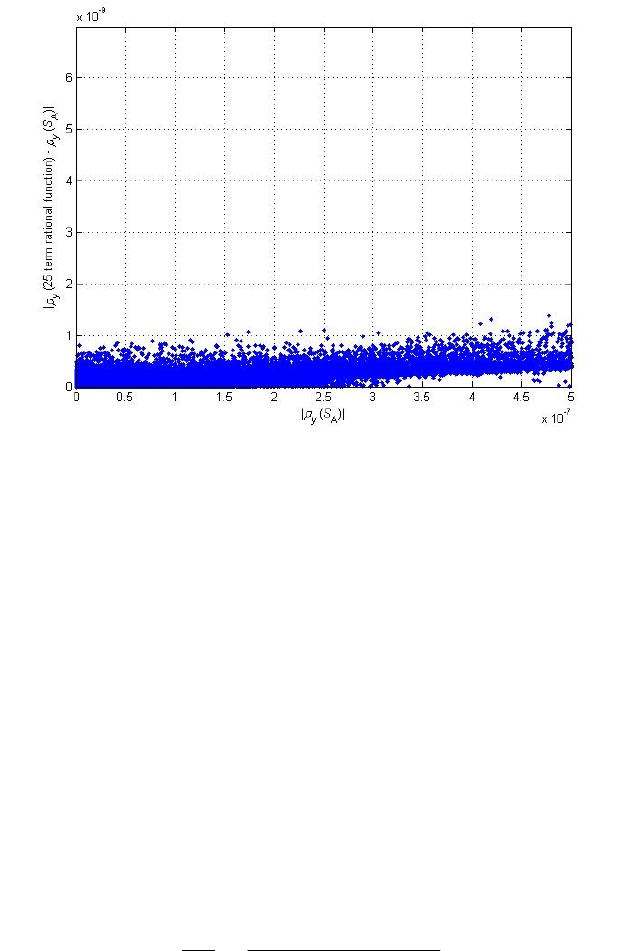
TEOS-10 Manual: Calculation and Use of the Thermodynamic Properties of Seawater
IOC Manuals and Guides No. 56
121
thatanoceanmodelthattreatedpotentialtemperatureasaconservativevariablewould
makeerrorsinitstreatmentofheatfluxes,asdescribedinappendicesA.13,A.14andA.17,
andasillustratedinFiguresA.13.1,A.14.1andA.17.1.
FigureA.30.1.Thenorthwarddensitygradientatconstantpressure(thehorizontal
axis)fordataintheworldoceanatlasofGouretskiandKoltermann
(2004)for1000 dbarp>.Theverticalaxisisthemagnitudeofthe
differencebetweenevaluatingthedensitygradientusingthe25‐term
expressionEqn.(A.30.1)insteadofusingthefullTEOS‐10expression,
usingAbsoluteSalinityA
Sasthesalinityargumentinbothcases.
AppendixPdescribeshowanexpressionfortheenthalpyofseawaterintermsof
ConservativeTemperature,specificallythefunctionalform
(
)
A
ˆ,,hS pΘ,togetherwithan
expressionforentropyintheform
(
)
A
ˆ,S
η
Θ
,canbeusedasanalternativethermodynamic
potentialtotheGibbsfunction
(
)
A,,
g
Stp.Theneedforthefunctionalform
(
)
A
ˆ,,hS pΘ
alsoarisesinsection3.32andinEqns.(3.26.3)and(3.29.1).The25‐termexpression,Eqn.
(A.30.1),for
()
25 25
A
ˆ,,Sp
ρρ
=Θcanbeusedtofindaclosedexpressionfor
(
)
A
ˆ,,hS pΘby
integratingthereciprocalof
()
25
A
ˆ,,Sp
ρ
Θwithrespecttopressure(inPa ),since
1
ˆP
hv
ρ
−
== (seeEqn.(2.8.3)).
The25‐termexpressionforspecificvolume,Eqn.(A.30.1),isfirstwrittenexplicitlyas
theratiooftwopolynomialsinseapressurep(indbar )as
23
25 01 2 3
25 2
01 2
1
ˆˆ2
aapapap
vbbpbp
ρ
++ +
== ++ ,(A.30.2)
wherethecoefficients0
ato3
aand0
bto2
barethefollowingfunctionsofA
SandΘ
() ()
1.5 1.5
234 3 2
0 14 15 16 17 18 A 19 A 20 A 21 A 22 A
1acccccScScScScS=+ Θ+ Θ+ Θ+ Θ+ + Θ+ Θ+ + Θ,
123
ac=,
3
224
ac=Θ,
325
ac=Θ,
()
2
23
012 3 4 5A6A 7A
bcccccScScS=+Θ+Θ+Θ+ + Θ+ ,
()
2
18910A
0.5bcccS=+Θ+,
2
21112
bc c=+Θ,
andthenumberedcoefficients1
cto25
caresoidentifiedinTableK.1(notethat13 1c=).
ItisnotdifficulttorearrangeEqn.(A.30.2)intotheform

122 TEOS-10 Manual: Calculation and use of the thermodynamic properties of seawater
IOC Manuals and Guides No. 56
()
25 25 31 32
A22
22
2012
2
ˆˆ ,, ,
2
ab aaNMp
vvS p p
bb
bbbpbp
⎛⎞ +
=Θ=−++
⎜⎟ ++
⎝⎠ (A.30.3)
whereNand
M
aregivenby
301 20
02
2
2
2.
abb ab
Na b
b
=+ − and 1
2
330 21
12
22
2
42
ab ab ab
Ma bb
b
=+ − − .(A.30.4)
ThepressureintegralofthelastterminEqn.(A.30.3)iswellknown(seeforexample
section2.103ofGradshteynandRyzhik(1980))andisdependentonthesignofthe
discriminantofthedenominator.Inourcaseitcanbeshownthat2
102
bbb>overthe
domainofthe“funnel”andalsothatboth0
band1
barepositive,while2
bisnegativeand
boundedawayfromzero.Theindefiniteintegral,withrespecttoseapressuremeasured
inPa ,ofthelastterminEqn.(A.30.3)is(with *4
10NN=and*4
10
M
M=)
2
***
21102
221
01 2
222
2
01 2 21 02 2 1 1 02
ln 2 ln
2
22
bp b b bb
NMp M NbMb
dP b b p b p
b
bbpbp b b bb b p b b bb
∫+− −
+−
′=+++
++ −++−
,(A.30.5)
Theenthalpy
()
25
A
ˆ,,
hS pΘisthedefiniteintegralofEqn.(A.30.3)from0
P
to
P
,plus0
p
c
Θ
,
beingthevalueofenthalpyat0
P
(i.e.at0dbarp
=
).Hencethefullexpressionfor
()
25
A
ˆ,,
hS pΘis(with2
1102
A
bbbb=− − and2
1102
Bb b bb=+ − )
()
()
()
()
25 0 4 4 2
31 32
A2
22
2
**
1
*
2
12 2
2
200 2
2
ˆ,, 10 10
2
2
ln 1 ln 1 .
2
pab a
a
hS p c p p
bb
b
b
NM BA
Mbb bb
pp p
bbb BA ABbp
⎛⎞
Θ=Θ+ − +
⎜⎟
⎝⎠
−⎛⎞
−
⎛⎞
++++ +
⎜⎟
⎜⎟
−+
⎝⎠ ⎝⎠
(A.30.6)
Thefactorof4
10 thatappearshereandin*
Nand*
M
effectivelyservestoconvertthe
unitsoftheintegrationvariablefromdbar toPa sothat
()
25
A
ˆ,,
hS pΘhasunitsof1
Jkg .
−
IntheseequationsA
Sisin1
gkg
−,
Θ
inC°andpisindbar. Theargumentsofthetwo
naturallogarithmsinEqn.(A.30.6)arealwaysgreaterthan1,andinfacttheyarebetween
1and1.2evenforpaslargeas4
10 dbar (notethatboth2
band
A
arenegative).Also,
whentheenthalpydifferenceatthesamevaluesofA
Sand
Θ
butatdifferentpressures
(seeEqn.(3.32.2))isevaluatedusingEqn.(A.30.6),theexpressioncanalsobearrangedto
containonlytwologarithmterms.
FollowingYoung(2010),thedifferencebetweenspecificenthalpyand0
p
cΘmaybe
called“dynamicenthalpy”andcanbereadilycalculatedfromEqn.(A.30.6),recognizing
thatthisequationisbasedonthecomputationallyefficient25‐termexpressionfordensity
ofMcDougalletal.(2010b)ratherthanbeingevaluatedfromthefullTEOS‐10Gibbs
function.Similarly,thepartialderivativesof
()
25
A
ˆ,,
hS pΘwithrespecttoAbsolute
SalinityA
SandwithrespecttoConservativeTemperature
Θ
canbecalculatedeitherby
algebraicdifferentiationofEqn.(A.30.6)orbyfirstalgebraicallydifferentiatingEqn.
(A.30.1)andthennumericallyintegratingthisexpressionwithrespecttopressure(this
secondprocedureismotivatedbytakingtheappropriateA
Sor
Θ
derivativesofEqn.
(3.2.1);seeEqns.(A.18.4)and(A.18.5)).
Anexpression
()
25
A,,hS p
θ
forenthalpyasafunctionofpotentialtemperature
θ
can
befoundinasimilarmannertothatoutlinedabove,butwiththecoefficientsofthe25‐
termrational‐functionexpressionfordensitynowbeingtakenfromTableK.2,andwith
thefirsttermbeingexpressedastheexactpolynomialexpressionfor
(
)
A,,0hS
θ
insteadof
as0
p
cΘ.

TEOS-10 Manual: Calculation and Use of the Thermodynamic Properties of Seawater
IOC Manuals and Guides No. 56
123
AppendixB:
DerivationoftheFirstLawofThermodynamics
Motivation
Forapurefluidinwhichthereisnodissolvedmaterial(suchaspurewaterwithzero
AbsoluteSalinity)thederivationoftheFirstLawofThermodynamicsusuallystartswitha
discussionofhowtheinternalenergyUofafixedmassoffluidischangedunderthe
influenceofitbeing“heated”bytheamountQ
δ
anditsvolumeVbeingchanged.The
infinitesimalchangeintheinternalenergyoftheparceliswrittenas
()
0
ddUQpPV
δ
=−+
where
()
0dpP V−+ isthemechanicalworkdoneonthefluidbythepressureatthe
movingboundariesofthefluidparcel.Thisrelationshipcanbewrittenintermsofthe
specific(i.e.perunitmass)enthalpy,hthedensity,
ρ
andQ
δ
perunitvolume,,q
δ
as
d1d .
ddd
hPq
ttt
δ
ρρ
⎛⎞
−=
⎜⎟
⎝⎠
forpurewater(B.1)
Itisrecognizedthattheright‐handsideof(B.1)isnotthedivergenceofa“heat”flux,and
thetermthatcausesthiscomplicationisthedissipationofmechanicalenergyinto“heat”,
whichcontributes
ρ
ε
totheright‐handsideof(B.1).Apartfromthisfamiliardissipation
term,theright‐handsideisminusthedivergenceofthesumoftheboundaryand
radiativeheatfluxes,R
F,andminusthedivergenceofthemolecularfluxofheat
qT
kT=− ∇F(whereT
kisthemoleculardiffusivityofheat),sothattheFirstLawof
Thermodynamicsforpurewateris
()
R
d1d .
ddd
T
hPq kT
ttt
δ
ρ
ρε
ρ
⎛⎞
−==−∇⋅+∇⋅∇+
⎜⎟
⎝⎠ Fforpurewater(B.2)
NowconsiderseawaterinwhichtheAbsoluteSalinityanditsgradientsarenon‐zero.
ThesametraditionaldiscussionoftheFirstLawofThermodynamicsinvolvingthe
“heating”,theapplicationofcompressionworkandthechangeofsalinitytoafluidparcel
showsthatthechangeofenthalpyofthefluidparcelisgivenby(seeequations6band17b
ofWarren(2006))
[
]
(
)
0A
dd d,
T
HVP Q Tt MS
δμ μ
−=+−+ (B.3)
where
M
isthemassofthefluidparcel.Whenwrittenintermsofthespecificenthalpy
,handQ
δ
perunitvolume,q
δ
,thisequationbecomes(usingA
dd S
St
ρ
=−∇⋅F)
[]
()
S
0
d1d
ddd T
hPq Tt
ttt
δ
ρμμ
ρ
⎛⎞
−=−−+∇⋅
⎜⎟
⎝⎠ F.(B.4)
Doesthishelpwiththetaskofconstructinganexpressionfortheright‐handsideof
(B.4)intermsofthedissipationofmechanicalenergyandthemolecular,radiativeand
boundaryfluxesof“heat”andsalt?Ifthe“heating”termdqt
δ
in(B.4)werethesameas
inthepurewatercase(B.2)thenwewouldhavesuccessfullyderivedtheFirstLawof
Thermodynamicsinasalineoceanviathisroute.However,wewillnowshowthatdqt
δ
in(B.4)isnotthesameasthatinthepurewatercase,(B.2).
Substitutingtheexpressionfordqt
δ
from(B.2)intotheright‐handsideof(B.4)we
findthattheright‐handsideisnotthesameastheFirstLawofThermodynamics(B.19)
whichwederivebelow(thiscomparisoninvolvesusingthecorrectexpression(B.24))for

124 TEOS-10 Manual: Calculation and use of the thermodynamic properties of seawater
IOC Manuals and Guides No. 56
themolecularfluxQ
F).ThetwoversionsoftheFirstLawofThermodynamicsare
differentby
[]
()
[
]
A
0
SS
0
S
TS
Tt
Tt b k
μ
μμ μ
ρ
⎡
⎤
⎛⎞
+
−−+ ∇⋅+∇⋅ +
⎢
⎥
⎜⎟
⎜⎟
⎢
⎥
⎝⎠
⎣
⎦
FF.(B.5)
Thisinconsistencymeansthattheratherpoorlydefined“rateofheating”dqt
δ
mustbe
differentinthesalinecasethaninthepurewatersituationbythisamount.Weknowof
nowayofjustifyingthisdifferenceandintheabsenceofnewinspirationwhichwehave
notfoundintheliterature,wetentativelyconcludethatanyattempttoderivetheFirst
LawofThermodynamicsviathisrouteinvolvingthelooselydefined“rateofheating”
dqt
δ
isdoomedtofailure.
SincethereappearstobenowayofderivingtheFirstLawofThermodynamicsthat
involvesthe“heating”termdqt
δ
,wefollowLandauandLifshitz(1959)andderivethe
FirstLawviathefollowingcircuitousroute.Ratherthanattemptingtoguesstheformof
themolecularforcingtermsinthisequationdirectly,wefirstconstructaconservation
equationforthetotalenergy,beingthesumofthekinetic,gravitationalpotentialand
internalenergies.Itisinthisequationthatweinsertthemolecularfluxesofheatand
momentumandtheradiativeandboundaryfluxesofheat.Weknowthattheevolution
equationfortotalenergymusthavetheconservativeform,andsoweinsistthatthe
forcingtermsinthisequationappearasthedivergenceoffluxes.
Havingformedtheconservationequationfortotalenergy,theknownevolution
equationsfortwoofthetypesofenergy,namelythekineticandgravitationalpotential
energies,aresubtracted,leavingaprognosticequationfortheinternalenergy,thatis,the
FirstLawofThermodynamics.
Westartbydevelopingtheevolutionequationsforgravitationalpotentialenergyand
forkineticenergy(viathemomentumequation).Thesumofthesetwoevolution
equationsisnoted.Wethenstepbackalittleandconsiderthesimplifiedsituationwhere
therearenomolecularfluxesofheatandsaltandnoeffectsofviscosityandnoradiative
orboundaryheatfluxes.Inthis“adiabatic”limitweareabletodeveloptheconservation
equationfortotalenergy,beingthesumofinternalenergy,kineticenergyand
gravitationalpotentialenergy.Tothisequationweintroducethemolecular,radiativeand
boundaryfluxdivergences.FinallytheFirstLawofThermodynamicsisfoundby
subtractingfromthistotalenergyequationtheconservationstatementforthesumofthe
kineticandgravitationalpotentialenergies.
Thefundamentalthermodynamicrelation
Recallthefundamentalthermodynamicrelation(A.7.1)repeatedhereintheform(A.7.2)
intermsofmaterialderivativesfollowingtheinstantaneousmotionofafluidparcel
,,
dd ,
xyz
tt=∂ ∂ + ⋅∇u
() ()
A
00
d1d d d d d
.
ddd d d d
hPu v S
pP T t
ttt t tt
η
μ
ρ
−=++=++ (B.6)
Theuseofthesamesymboltfortimeandforinsitutemperaturein°Cisnotedbut
shouldnotcauseconfusion.Themiddleexpressionin(B.6)usesthefactthatspecific
enthalpyhandspecificinternalenergyuarerelatedby
()
0
huPvu pPv=+ =+ + where
visthespecificvolume.

TEOS-10 Manual: Calculation and Use of the Thermodynamic Properties of Seawater
IOC Manuals and Guides No. 56
125
Gravitationalpotentialenergy
Ifthegravitationalaccelerationistakentobeconstantthegravitationalpotentialenergy
perunitmasswithrespecttotheheight
z
=0issimply.
g
zAllowingthegravitational
accelerationtobeafunctionofheightmeansthatthegravitationalpotentialenergyper
unitmassΦwithrespecttosomefixedheight0
zisdefinedby
()
0
.
z
z
g
zdz
′
′
Φ=∫(B.7)
AtafixedlocationinspaceΦisindependentoftimewhileitsspatialgradientisgivenby
g
∇Φ = kwherekistheunitvectorpointingupwardsintheverticaldirection.The
evolutionequationforΦisthenreadilyconstructedas
() ( )
d,
d
t
g
w
t
ρρρρ
Φ
Φ+∇⋅ Φ = =u(B.8)
Wherewistheverticalcomponentofthethree‐dimensionalvelocity,thatis.w=⋅uk
(Clearlyinthissection
g
isthegravitationalacceleration,nottheGibbsfunction).Note
thatthislocalbalanceequationforgravitationalpotentialenergyisnotintheform(A.8.1)
requiredofaconservativevariablesincetheright‐handsideof(B.8)isnotminusthe
divergenceofaflux.
Momentumevolutionequation
ThemomentumevolutionequationisderivedinmanytextbooksincludingLandauand
Lifshitz(1959),Batchelor(1970),Gill(1982)andGriffies(2004).Themolecularviscosity
appearsintheexactmomentumevolutionequationintherathercomplicatedexpressions
appearinginequations(3.3.11)and(3.3.12)ofBatchelor(1970).Weignorethetermthat
dependsontheproductofthesocalleddynamicviscosityvisc
vandthevelocity
divergence∇⋅u(followingGill(1982)),soarrivingat
p
(
)
visc
d,
dfPgv
t
ρρρρ
+×=−∇− +∇⋅ ∇
uku k u
(B.9)
Where
f
istheCoriolisfrequency,visc
vistheviscosityand
p
∇
uistwicethesymmetrized
velocityshear,
p
(
)
.
ij ji
ux u x∇=∂ ∂ +∂ ∂uUnderthesameassumptionasaboveofignoring
thevelocitydivergence,thepressurepthatenters(B.9)canbeshowntobeequivalentto
theequilibriumpressurethatisrightlythepressureargumentoftheequationofstate
(Batchelor(1970).Thecentripetalaccelerationassociatedwiththecoordinatesystembeing
onarotatingplanetcanbetakenintoaccountbyanadditiontothegravitational
accelerationin(B.9)(Griffies(2004)).
Kineticenergyevolutionequation
ThekineticenergyevolutionequationisfoundbytakingthescalarproductofEqn.(B.9)
withugiving
()
[]
()
()
[]
()
11
22
visc 1
1
22
dd ,
t
tPgwv
ρρ
ρ
ρρ ρε
⋅+∇⋅ ⋅
=⋅=−⋅∇−+∇⋅∇⋅−
uu u uu
uu u uu (B.10)
wherethedissipationofmechanicalenergy
ε
isthepositivedefinitequantity
p
p
(
)
visc
1
2.v
ε
≡∇⋅∇uu(B.11)

126 TEOS-10 Manual: Calculation and use of the thermodynamic properties of seawater
IOC Manuals and Guides No. 56
Evolutionequationforthesumofkineticandgravitationalpotentialenergies
Theevolutionequationfortotalmechanicalenergy0.5
⋅
+Φuu isfoundbyaddingEqns.
(B8)and(B10)giving
()()
()
[]
()
11
22
visc 1
1
22
dd .
t
tPv
ρρ
ρ
ρρε
⎡⎤ ⎡⎤
⋅+Φ +∇⋅ ⋅+Φ
⎣⎦ ⎣⎦
= ⋅ +Φ = − ⋅∇ +∇⋅ ∇ ⋅ −
uu u uu
uu u uu (B.12)
Noticethattheterm
g
w
ρ
whichhastheroleofexchangingenergybetweenthekinetic
andgravitationalpotentialformshascancelledwhenthesetwoevolutionequationswere
added.
Conservationequationfortotalenergy
E
intheabsenceofmolecularfluxes
Intheabsenceofmolecularorotherirreversibleprocesses(suchasradiationofheat),andin
theabsenceofthenon‐conservativesourcetermforAbsoluteSalinitythatisassociatedwith
remineralization,boththespecificentropy
η
andtheAbsolutesalinityA
Sofeachfluid
parcelisconstantfollowingthefluidmotionsothattheright‐handsideof(B.6)iszeroand
thematerialderivativeofinternalenergysatisfies
(
)
0
dd ddut pP vt=− + sothattheinternal
energychangesonlyasaresultoftheworkdoneincompressingthefluidparcel.Realizing
that1
v
ρ
−
=andusingthecontinuityEqn.(A.8.1)intheformdd 0,t
ρ
ρ
+
∇⋅ =uddutcan
beexpressedinthissituationofnomolecular,radiativeorboundaryfluxesas
()
1
0
dd .ut pP
ρ
−
=− + ∇⋅uAddingthisequationtotheinviscid,non‐dissipativeversionof
(B.12)gives
() ( )
[
]
(
)
0
dd
ttpP
ρρρ
+∇⋅ = = −∇⋅ +uu
EEE
,nomolecularfluxes(B.13)
wherethetotalenergy
1
2
u=+ ⋅+Φuu
E
(B.14)
isdefinedasthesumoftheinternal,kineticandgravitationalpotentialenergies.
Conservationequationfortotalenergyinthepresenceofmolecularfluxesand
remineralization
Now,followingsection49LandauandLifshitz(1959)weneedtoconsiderhowmolecular
fluxesofheatandsaltandtheradiationofheatwillalterthesimplifiedconservation
equationoftotalenergy(B.14).Themolecularviscositygivesrisetoastressinthefluid
representedbythetensor,σandtheinteriorfluxofenergyduetothisstresstensoris
⋅uσsothatthereneedstobetheadditionalterm
(
)
−
∇⋅ ⋅u
σ
addedtotheright‐handside
ofthetotalenergyconservationequation.ConsistentwithEqn.(B.9)abovewetakethe
stresstensortobe
p
visc
v
ρ
=− ∇uσsothattheextratermis
[]
(
)
visc 1
2.v
ρ
∇⋅ ∇ ⋅uu Alsoheat
fluxesattheoceanboundariesandbyradiationR
FandmoleculardiffusionQ
F
necessitatetheadditionaltermsRQ
−∇⋅ − ∇ ⋅FF.Atthisstagewehavenotspecifiedthe
formofthemoleculardiffusivefluxofheatQ
Fintermsofgradientsoftemperatureand
AbsoluteSalinity;thisisdonebelowineq(B.24).Thenon‐conservativeproductionof
AbsoluteSalinitybytheremineralizationofsinkingparticulatematter,A
S
ρ
S,introduces
asourceofenergybecausethespecificinternalenergyandthespecificenthalpyofseasalt
arenotthesameasforpurewater.Thetotalenergyconservationequationinthepresence
ofmolecular,radiativeandboundaryfluxes,aswellastheinteriorsourceofsalinityis
() ( )
[
]
(
)
[]
()
A
A
RQ
0
visc 1
2
dd
.
t
S
S
tpP
vh
ρρρ
ρρ
+∇⋅ = = −∇⋅ + −∇⋅ −∇⋅
+∇⋅ ∇ ⋅ +
uuFF
uu S
EEE
(B.15)

TEOS-10 Manual: Calculation and Use of the Thermodynamic Properties of Seawater
IOC Manuals and Guides No. 56
127
where
()
A0ST
hTt
μ
μ
=− + (seeEqn.(A.11.1))isthepartialderivativeofspecificenthalpy
withrespecttoAbsoluteSalinityatfixedtemperatureandpressure.ThislastterminEqn.
(B.15)ismorereadilyjustifiedinEqn.(B.17)below,whichisarearrangedformofEqn.
(B.15).
Ifitwerenotfortheremineralizationsourceterm,A
A
S
S
h
ρ
S,theright‐handsideof
the
E
conservationequation(B.15)wouldbethedivergenceofaflux,ensuringthattotal
energy
E
wouldbebotha“conservative”variableandan“isobaricconservative”
variable(seeappendixA.8forthedefinitionofthesecharacteristics).
Twoalternativeformsoftheconservationequationfortotalenergy
Anotherwayofexpressingthetotalenergyequation(B.15)istowriteitinaquasi‐
divergenceform,withthetemporalderivativebeingof
(
)
1
2
u
ρρ
=
+⋅+Φuu
E
whilethe
divergencepartoftheleft‐handsideisbasedonadifferentquantity,namelytheBernoulli
function 1
2.h=+ ⋅+Φuu
B
Thisformofthetotalenergyequationis
() ( )
[
]
(
)
A
A
RQ visc
1
2.
S
S
tvh
ρρ ρ ρ
+∇⋅ =−∇⋅ −∇⋅ +∇⋅ ∇ ⋅ +uFF uuS
EB
(B.16)
Inanoceanmodellingcontext,itisratherstrangetocontemplatetheenergyvariablethat
isadvectedthroughthefaceofamodelgrid,
B
,tobedifferenttotheenergyvariablethat
ischangedinthegridcell,
E
.Hencethisformofthetotalenergyequationhasnot
provedpopular.
Athirdwayofexpressingthetotalenergyequation(B.15)istowritetheleft‐handside
intermsofonlytheBernoullifunction1
2
h
=
+⋅+Φuu
B
sothattheprognosticequation
fortheBernoullifunctionis
() ( )
[
]
(
)
A
A
RQ visc
1
2
dd .
S
tS
ttP v h
ρρρ ρ ρ
+∇⋅ = = −∇⋅ −∇⋅ +∇⋅ ∇ ⋅ +uFFuu
BBB
S(B.17)
ThesourcetermA
S
ρ
SofAbsoluteSalinitycausedbytheremineralizationofparticulate
matteraffectsenthalpyattherate
(
)
A0ST
hTt
μ
μ
=− + andcanbethoughtofasreplacing
someseasaltinplaceofwatermolecules,occurringatfixedpressureandtemperature,as
mightoccurthroughtwosyringesintheinteriorofaseawaterparcel,onesupplyingpure
saltandtheotherextractingpurewater,atthesametemperatureandpressure.The
influenceofthesalinityincrementcausedbythissourcetermonenthalpy(andtherefore
ontheBernoullifunction
B
)issimilartothewayanincrementofAbsoluteSalinity
entersEqn.(B.3).Whentheflowissteady,andinparticular,whenthepressurefieldis
timeinvariantateverypointinspace,thisBernoulliformofthetotalenergyequationhas
thedesirablepropertythat
B
isconservedfollowingthefluidmotionintheabsenceof
radiative,boundaryandmolecularfluxesandintheabsenceofnon‐conservativesalinity
production.Subjecttothissteady‐stateassumption,andintheabsenceofA
S
ρ
Sthe
Bernoullifunction
B
possessesthe“potential”property.Thenegativeaspectofthis
B
evolutionequation(B.17)isthatinthemoregeneralsituationwheretheflowisunsteady,
thepresenceofthet
P
termmeansthattheBernoullifunctiondoesnotbehaveasa
conservativevariablebecausetheright‐handsideof(B.17)isnotthedivergenceofaflux.
Inthisgeneralnon‐steadysituation
B
is“isobaricconservative”butisnota
“conservative”variablenordoesitpossesthe“potential”property.
Notingthatthetotalenergy
E
isrelatedtotheBernoullifunctionby
()
0
pP
ρ
=−+
EB
andcontinuingtotakethewholeoceantobeinasteadystateand
withA0
S
ρ
=S,sothat
B
hasthe“potential”property,itisclearthat
E
doesnothave
the“potential”propertyinthissituation.Thatis,ifaseawaterparcelmovesfromsay
2000dbarto0dbarwithoutexchangeofmaterialorheatwithitssurroundingsandwith
0
t
P=everywhere,then
B
remainsconstantwhiletheparcel’stotalenergy
E
changes
bythedifferenceinthequantity
(
)
0
pP
ρ
−+ betweenthetwolocations.Hencewe
concludethateveninasteadyocean
E
doesnotpossesthe“potential”property.

128 TEOS-10 Manual: Calculation and use of the thermodynamic properties of seawater
IOC Manuals and Guides No. 56
ObtainingtheFirstLawofThermodynamicsbysubtraction
Theevolutionequation(B.12)forthesumofkineticandgravitationalpotentialenergiesis
nowsubtractedfromthetotalenergyconservationequation(B.15)giving
() ( )
(
)
A
A
RQ
0
dd .
S
S
t
uuutpP h
ρρρ ρερ
+∇⋅ = = − + ∇⋅ −∇⋅ −∇⋅ + +uuFFS(B.18)
Usingthecontinuityequationintheformddvt
ρ
=
∇⋅uandthefundamental
thermodynamicrelation(A.7.2),thisequationcanbewrittenas
() ()
A
A
A
00
RQ
d1d d d d d
dd d d d d
S
S
hP u v S
pP T t
tt t t tt
h
η
ρρ ρμ
ρ
ρε ρ
⎛⎞
⎛⎞⎛ ⎞
−=++=++
⎜⎟
⎜⎟⎜ ⎟
⎝⎠⎝ ⎠
⎝⎠
=−∇⋅ −∇⋅ + +FF S
,(B.19)
whichistheFirstLawofThermodynamics.Thecorrespondingevolutionequationfor
AbsoluteSalinityis(Eqn.(A.21.8))
() ( )
A
S
A
AA
d,
d
S
t
SSS
t
ρρ ρ ρ
= +∇⋅ = −∇⋅ +uFS(B.20)
whereS
FisthemolecularfluxofsaltandA
S
ρ
Sisthenon‐conservativesourceof
AbsoluteSalinityduetotheremineralizationofparticulatematter.Formanypurposesin
oceanographytheexactdependenceofthemolecularfluxesofheatandsaltonthe
gradientsofAbsoluteSalinity,temperatureandpressureisunimportant,nevertheless,
Eqns.(B.23)and(B.24)belowlistthesemolecularfluxesintermsofthespatialgradientsof
thesequantities.
AtfirstsightEqn.(B.19)haslittletorecommendit;therearetwonon‐conservative
sourceterms
ρ
ε
andA
A
S
S
h
ρ
Sontheright‐handsideandtheleft‐handsideisnot
ρ
timesthematerialderivativeofanyquantityasisrequiredofaconservationequationofa
conservativevariable.Equation(B.19)correspondstoequation(57.6)ofLandauand
Lifshitz(1959)andisrepeatedatEqns.(A.13.1)and(A.13.3)above.
TheapproachusedheretodeveloptheFirstLawofThermodynamicsseemsrather
convolutedinthattheconservationequationfortotalenergyisfirstformed,andthenthe
evolutionequationsforkineticandgravitationalpotentialenergiesaresubtracted.
Moreover,themolecular,radiativeandboundaryfluxeswereincludedintothetotal
energyconservationequationasseparatedeliberatefluxdivergences,ratherthancoming
fromanunderlyingbasicconservationequation.ThisistheapproachofLandauand
Lifshitz(1959)anditisadoptedforthefollowingreasons.Firstthisapproachensuresthat
themolecular,radiativeandboundaryfluxesdoenterthetotalenergyconservation
equation(B.15)asthedivergenceoffluxessothatthetotalenergyisguaranteedtobea
conservativevariable(apartfromthesalinitysourceterm).Thisisessential;totalenergy
canonlybeallowedtospontaneouslyappearordisappearwhenthereisabonafide
interiorsourcetermsuchasA
A
S
S
h
ρ
S.Second,itisratherunclearhowonewould
otherwisearriveatthemolecularfluxesofheatandsaltontheright‐handsideoftheFirst
LawofThermodynamicssincethedirectapproachwhichwasattemptedatthebeginning
ofthisappendixinvolvedthepoorlydefined“rateofheating”dqt
δ
anddidnotleadus
totheFirstLaw.Forcompleteness,themolecularfluxesQ
FandS
Farenowwrittenin
termsofthegradientsofAbsoluteSalinity,temperatureandpressure.
LandauandLifshitz(1959)(theirsection58)showthatthemolecularfluxesQ
Fand
S
Faregivenintermsofthechemicalpotential
μ
andthegradientsoftemperatureandof
chemicalpotentialby

TEOS-10 Manual: Calculation and Use of the Thermodynamic Properties of Seawater
IOC Manuals and Guides No. 56
129
S,abT
μ
=− ∇ − ∇F(B.21)
and
QS
0
() ,bT t T
μγ μ
=− + ∇ − ∇ +FF(B.22)
where,aband
γ
arethreeindependentcoefficients.Notethesymmetrybetweensome
ofthecross‐diffusiontermsinthatthesamecoefficientbappearsinbothequations.
WhenwrittenintermsofthegradientsofAbsoluteSalinity,temperatureandpressure
theseexpressionsforthemolecularfluxesQ
FandS
Fbecome
AA
S
A,
SSt
ST
SS
kk
kS bT P
ρμ β
ρμμ
⎛⎞
=− ∇ − + ∇ + ∇
⎜⎟
⎜⎟
⎝⎠
F(B.23)
(usingtherelationtp
β
ρμ
=− thatfollowsfromthedefinitionofbotht
β
and
μ
interms
oftheGibbsfunction)and
()
A
0
QS
.
ST
S
Tt
bkT
k
μ
μρ
⎛⎞
+
=+ −∇
⎜⎟
⎜⎟
⎝⎠
FF(B.24)
Theseexpressionsinvolvethepuremoleculardiffusivitiesoftemperatureandsalinity(T
k
andS
k)andthesingleparameterbthatappearsinpartofboththecross‐diffusionofsalt
downthetemperaturegradientandpartofthecross‐diffusionof“heat”downthe
gradientofAbsoluteSalinity.Theotherparametersintheseequationsfollowdirectly
fromtheGibbsfunctionofseawater.Thelasttermin(B.23)represents“barodiffusion”as
itcausesafluxofsaltdownthegradientofpressure.Themiddletermin(B.23)isafluxof
saltduetothegradientofinsitutemperatureandiscalledtheSoreteffectwhilethefirst
termin(B.24)isafluxof“heat”causedbythemolecularfluxofsalt,S
F,andthisiscalled
theDufoureffect.
Themolecularfluxofsaltisindependentofthefourarbitraryconstants(Fofonoff
(1962))thatappearintheGibbsfunctionofseawater(seeEqn.(2.6.2)).SinceT
μ
contains
thearbitraryadditionalconstant4,athefactthatS
Fcontainsnoarbitraryconstants
impliesthatthecross‐diffusioncoefficientbinEqns.(B.21)–(B.24)isarbitrarytothe
extentA
4
SS
ak
ρ
μ
−.
Themolecularfluxof“heat”Q
FisunknowabletotheextentS
3
aF(since
μ
is
arbitrarytotheextent
()
340
aaTt++andthepresenceofbinEqn.(B.24)cancelsthe
influenceof4
a).ThismeansthattheQ
−
∇⋅FtermontherightoftheFirstLawEqn.
(B.19)isunknowabletotheextentS
3.a
−
∇⋅FTheleft‐handsideofEqn.(B.19)is
unknowabletotheextent3A
ddaSt
ρ
(sincespecificenthalpyhcontainsthearbitrary
component13A
aaS+).ThelastterminEqn.(B.19)containsthearbitrarytermA
3
S
a
ρ
S
(sinceA
S
hisarbitrarybytheamount3
a).Thesethreearbitrary,unknowable
contributionstotheFirstLawofThermodynamicsEqn.(B.19)sumto3
atimesthe
evolutionequation(B.20)forAbsoluteSalinity.Thisallowsthesearbitrarytermstobe
subtractedfromEqn.(B.19),confirmingthatthefourarbitraryunknowableconstantsof
Eqn.(2.6.2)havenomeasureableconsequencesontheFirstLawofThermodynamics.
RegardingEqns.(B.21)–(B.24),itisnotedthatstrictlyspeakingthegradientofthe
chemicalpotential
μ
mustbereplacedbythegradientsofthechemicalpotentialsofthe
individualconstituentsofseasalt,andthediffusioncoefficientsinfrontofthesemany
gradientsaredifferentforeachconstituent,sincethereisnouniformmoleculardiffusion
ofthemixtureʺseasaltʺ.Whenadditionalprocessesacttokeepthecomposition
approximatelyfixed,theuseofonlyonechemicalpotentialforseasaltispermittedin
non‐equilibriumsituations.TheseprocessesaremainlyionrelaxationbyCoulombforces,
whichintheformofambipolardiffusionpreventanylocalelectricalchargeseparation,
andsecondly,turbulentmixingwhichhasthesametransportcoefficientforeachspecies
andwhosefluxesareproportionaltotheconcentrationgradientsof“potential”quantities
(seeappendixA.9)ratherthantothegradientsoftheindividualchemicalpotentials.

130 TEOS-10 Manual: Calculation and use of the thermodynamic properties of seawater
IOC Manuals and Guides No. 56
AppendixC:
PublicationsdescribingtheTEOS‐10thermodynamic
descriptionsofseawater,iceandmoistair
Primarystandarddocuments
Harvey,A.H.andP.H.Huang,2007:First‐PrinciplesCalculationoftheAir–WaterSecond
VirialCoefficient.Int.J.Thermophys.,28,556–565.
Hyland,R.W.andA.Wexler,1983:Formulationsforthethermodynamicpropertiesofdryair
from173.15to473.15K,andofsaturatedmoistairfrom173.15to372.15K,atpressures
upto5Mpa.ASHRAETransact.89,520–535.
IAPWS,2008a:ReleaseontheIAPWSFormulation2008fortheThermodynamicPropertiesof
Seawater.TheInternationalAssociationforthePropertiesofWaterandSteam.Berlin,
Germany,September2008,availablefromhttp://www.iapws.org.ThisReleaseisreferred
tointhetextasIAPWS‐08.
IAPWS,2009a:RevisedReleaseontheEquationofState2006forH2OIceIh.TheInternational
AssociationforthePropertiesofWaterandSteam.Doorwerth,TheNetherlands,
September2009,availablefromhttp://www.iapws.org.ThisrevisedReleaseisreferredto
inthetextasIAPWS‐06.
IAPWS,2009b:RevisedReleaseontheIAPWSFormulation1995fortheThermodynamic
PropertiesofOrdinaryWaterSubstanceforGeneralandScientificUse.TheInternational
AssociationforthePropertiesofWaterandSteam.Doorwerth,TheNetherlands,
September2009,availablefromhttp://www.iapws.org.ThisrevisedReleaseisreferredto
inthetextasIAPWS‐95.
IAPWS,2009c:SupplementaryReleaseonaComputationallyEfficientThermodynamic
FormulationforLiquidWaterforOceanographicUse.TheInternationalAssociationfor
thePropertiesofWaterandSteam.Doorwerth,TheNetherlands,September2009,
availablefromhttp://www.iapws.org.ThisReleaseisreferredtointhetextasIAPWS‐09.
IAPWS,2010:GuidelineonanEquationofStateforHumidAirinContactwithSeawaterand
Ice,ConsistentwiththeIAPWSFormulation2008fortheThermodynamicPropertiesof
Seawater.TheInternationalAssociationforthePropertiesofWaterandSteam.Niagara
Falls,Canada,July2010,availablefromhttp://www.iapws.org.ThisGuidelineisreferred
tointhetextasIAPWS‐10.
Lemmon,E.W.,R.T.Jacobsen,S.G.PenoncelloandD.G.Friend,2000:Thermodynamic
propertiesofairandmixturesofnitrogen,argonandoxygenfrom60to2000Kat
pressuresto2000MPa.J.Phys.Chem.Ref.Data,29,331–362.
Millero,F.J.,R.Feistel,D.G.Wright,andT.J.McDougall,2008a:ThecompositionofStandard
SeawaterandthedefinitionoftheReference‐CompositionSalinityScale,Deep‐SeaRes.I,
55,50‐72.
Secondarystandarddocuments
IOC,SCORandIAPSO,2010:Theinternationalthermodynamicequationofseawater–2010:
Calculationanduseofthermodynamicproperties.IntergovernmentalOceanographic
Commission,ManualsandGuidesNo.56,UNESCO(English),196pp,Paris.Available
fromhttp://www.TEOS‐10.org[thepresentdocument,calledtheTEOS‐10manual]

TEOS-10 Manual: Calculation and Use of the Thermodynamic Properties of Seawater
IOC Manuals and Guides No. 56
131
Tertiarystandarddocuments
McDougall,T.J.,D.R.JackettandF.J.Millero,2010a:AnalgorithmforestimatingAbsolute
Salinityintheglobalocean.submittedtoOceanScience,apreliminaryversionisavailable
atOceanSci.Discuss.,6,215‐242.http://www.ocean‐sci‐discuss.net/6/215/2009/osd‐6‐215‐
2009‐print.pdfandthecomputersoftwareisavailablefromhttp://www.TEOS‐10.org
Backgroundpaperstothedeclaredstandards
Feistel,R.,2003:AnewextendedGibbsthermodynamicpotentialofseawater.Progr.
Oceanogr.,58,43‐114.
Feistel,R.,2008:AGibbsfunctionforseawaterthermodynamicsfor−6to80°Candsalinityup
to120gkg–1.Deep‐SeaRes.I,55,1639‐1671.
Feistel,R.andW.Wagner,2006:ANewEquationofStateforH2OIceIh.J.Phys.Chem.Ref.
Data,35,2,1021‐1047.
Feistel,R.,S.Weinreben,H.Wolf,S.Seitz,P.Spitzer,B.Adel,G.Nausch,B.SchneiderandD.
G.Wright,2010c:DensityandAbsoluteSalinityoftheBalticSea2006–2009.Ocean
Science,6,3–24.http://www.ocean‐sci.net/6/3/2010/os‐6‐3‐2010.pdf
Feistel,R.,D.G.Wright,H.‐J.Kretzschmar,E.Hagen,S.HerrmannandR.Span,2010a:
Thermodynamicpropertiesofseaair.OceanScience,6,91–141.http://www.ocean‐
sci.net/6/91/2010/os‐6‐91‐2010.pdf
Feistel,R.,D.G.Wright,K.Miyagawa,A.H.Harvey,J.Hruby,D.R.Jackett,T.J.McDougall
andW.Wagner,2008:Mutuallyconsistentthermodynamicpotentialsforfluidwater,ice
andseawater:anewstandardforoceanography.OceanScience,4,275‐291.
http://www.ocean‐sci.net/4/275/2008/os‐4‐275‐2008.html
McDougall,T.J.,2003:Potentialenthalpy:Aconservativeoceanicvariableforevaluatingheat
contentandheatfluxes.JournalofPhysicalOceanography,33,945‐963.
Marion,G.M.,F.J.Millero,andR.Feistel,2009:Precipitationofsolidphasecalcium
carbonatesandtheireffectonapplicationofseawaterA
STP
−
−models,OceanSci.,5,
285‐291.www.ocean‐sci.net/5/285/2009/
Millero,F.J.,2000.Effectofchangesinthecompositionofseawateronthedensity‐salinity
relationship.Deep‐SeaRes.I47,1583‐1590.
Millero,F.J.,2010:Historyoftheequationofstateofseawater.Oceanography,23,18‐33.
Millero,F.J.,F.Huang,N.Williams,J.WatersandR.Woosley,2009:Theeffectofcomposition
onthedensityofSouthPacificOceanwaters,Mar.Chem.,114,56‐62.
Millero,F.J.,J.Waters,R.Woosley,F.Huang,andM.Chanson,2008b:Theeffectof
compositiononthedensityofIndianOceanwaters,Deep‐SeaRes.I,55,460‐470.
Pawlowicz,R.,2010:Amodelforpredictingchangesintheelectricalconductivity,Practical
Salinity,andAbsoluteSalinityofseawaterduetovariationsinrelativechemical
composition.OceanScience,6,361–378.http://www.ocean‐sci.net/6/361/2010/os‐6‐361‐
2010.pdf
Pawlowicz,R.,D.G.WrightandF.J.Millero,2010:Theeffectsofbiogeochemicalprocesseson
oceanicconductivity/salinity/densityrelationshipsandthecharacterizationofreal
seawater.OceanScienceDiscussions,7,773–836.
http://www.ocean‐sci‐discuss.net/7/773/2010/osd‐7‐773‐2010‐print.pdf
Seitz,S.,R.Feistel,D.G.Wright,S.Weinreben,P.SpitzerandP.deBievre,2010b:Metrological
TraceabilityofOceanographicSalinityMeasurementResults.OceanScienceDiscussions,7,
1303–1346.http://www.ocean‐sci‐discuss.net/7/1303/2010/osd‐7‐1303‐2010‐print.pdf
Wagner,W.andPruß,A.,2002:TheIAPWSformulation1995forthethermodynamic
propertiesofordinarywatersubstanceforgeneralandscientificuse.J.Phys.Chem.Ref.
Data,31,387‐535.
Wright,D.G.,R.Pawlowicz,T.J.McDougall,R.FeistelandG.M.Marion,2010b:Absolute
Salinity,“DensitySalinity”andtheReference‐CompositionSalinityScale:presentand
futureuseintheseawaterstandardTEOS‐10.OceanSci.Discuss.,7,1559‐1625.
http://www.ocean‐sci‐discuss.net/7/1559/2010/osd‐7‐1559‐2010‐print.pdf

132 TEOS-10 Manual: Calculation and use of the thermodynamic properties of seawater
IOC Manuals and Guides No. 56
Papersdescribingcomputersoftware
Feistel,R.,D.G.Wright,D.R.Jackett,K.Miyagawa,J.H.Reissmann,W.Wagner,U.Overhoff,
C.Guder,A.FeistelandG.M.Marion,2010b:Numericalimplementationand
oceanographicapplicationofthethermodynamicpotentialsofliquidwater,water
vapour,ice,seawaterandhumidair‐Part1:Backgroundandequations.OceanScience,6,
633‐677.http://www.ocean‐sci.net/6/633/2010/os‐6‐633‐2010.pdfandhttp://www.ocean‐
sci.net/6/633/2010/os‐6‐633‐2010‐supplement.pdf
Wright,D.G.,R.Feistel,J.H.Reissmann,K.Miyagawa,D.R.Jackett,W.Wagner,U.Overhoff,
C.Guder,A.FeistelandG.M.Marion,2010a:Numericalimplementationand
oceanographicapplicationofthethermodynamicpotentialsofliquidwater,water
vapour,ice,seawaterandhumidair‐Part2:Thelibraryroutines.OceanScience,6,695‐
718.http://www.ocean‐sci.net/6/695/2010/os‐6‐695‐2010.pdfandhttp://www.ocean‐
sci.net/6/695/2010/os‐6‐695‐2010‐supplement.pdf
McDougallT.J.,D.R.Jackett,P.M.Barker,C.Roberts‐Thomson,R.FeistelandR.W.Hallberg,
2010b:Acomputationallyefficient25‐termexpressionforthedensityofseawaterin
termsofConservativeTemperature,andrelatedpropertiesofseawater.submittedto
OceanScienceDiscussions.Computersoftwareisavailablefromhttp://www.TEOS‐10.org
McDougall,T.J.,D.R.JackettandF.J.Millero,2010a:AnalgorithmforestimatingAbsolute
Salinityintheglobalocean.submittedtoOceanScience,apreliminaryversionisavailable
atOceanSci.Discuss.,6,215‐242.
TEOS‐10website
SCOR/IAPSOWorkingGroup127hascreatedthewebsitewww.TEOS‐10.orgwhichserves
manyoftheTEOS‐10papers,thisTEOS‐10manualaswellastheSIA(SeawaterIceAir)
andGSW(GibbsSeaWater)librariesofoceanographiccomputersoftware.TheGSW
MATLABOceanographicToolboxcontainsmanyhelpfiles,includingonecalled“Getting
startedwiththeGibbsSeaWater(GSW)OceanographicToolboxofTEOS‐10”whichserves
asasuccinctintroductiontotheuseofTEOS‐10inphysicaloceanography.
NotethatseveralofthepaperslistedinthisappendixareappearinginOceanScienceinthe
specialissue“ThermophysicalPropertiesofSeawater”.

TEOS-10 Manual: Calculation and Use of the Thermodynamic Properties of Seawater
IOC Manuals and Guides No. 56
133
AppendixD:Fundamentalconstants
FollowingtherecommendationofIAPWS(2005),thevaluesofthefundamentalconstants
weretakenfromCODATA2006(Mohretal.(2008)),aslistedinTableD.1.Selected
propertiesofpurewaterweretakenfromIAPWS(1996,1997,2005,2006)aslistedinTable
D.2.ThechemicalReferenceCompositionofseawaterfromMilleroetal.(2008a)isgiven
inTableD.3.SelectedseawaterconstantsderivedfromtheReferenceCompositionare
listedinTableD.4.Theexactvalueoftheisobaric“heatcapacity”0
p
cisgiveninTable
D.5.
TableD.1.FundamentalconstantsfromCODATA2006(Mohretal.(2008))andISO(1993).
SymbolValueUncertaintyUnitComment
R8.3144720.000015Jmol–1K–1molargasconstant
0
P
101325exactPanormalpressure
0
T273.15exactKCelsiuszeropoint
TableD.2.SelectedpropertiesofliquidwaterfromIAPWS(1996,1997,2005,2006)
andFeistel(2003).
SymbolValueUncertaintyUnitComment
W
M
18.0152680.000002gmol–1molarmass
MD
t3.9781210.04°Cmaximumdensity,temperature
MD
ρ
999.974950.00084kgm–3maximumdensityat0
P
0
ρ
999.84310.001kgm–3densityat0
Tand0
P
,00
1/v
ρ
=
(
)
0/
P
T
ρ
∂∂6.774876×10–20.06×10–2kgm–3K–1
(
)
/
P
T
ρ
∂∂ at0
Tand0
P
t
T273.16exactKtriplepointtemperature
t
P
611.6570.01Patriplepointpressure
t
ρ
999.7930.01kgm–3triplepointdensity
t
η
0exactJkg–1K–1triplepointentropy
t
u0exactJkg–1triplepointinternalenergy
0
f
T273.1525190.000002Kfreezingpointat0
P

134 TEOS-10 Manual: Calculation and use of the thermodynamic properties of seawater
IOC Manuals and Guides No. 56
TableD.3.Theseasaltcompositiondefinitionforreferencesalinityofthestandardocean.
Thestandardoceanisat25°Cand101325Pa.X–molefractions,Z–valences,
W–massfractions(Milleroetal.2008a).MolarmassesMfromWieser(2006)
withtheiruncertaintiesgiveninthebrackets.Themassfractionsarewith
respecttothemassofsolutionratherthanthemassofpurewaterinsolution.
Solute j Zj Mj
g mol–1
Xj
10–7 Xj × Zj
10–7 Wj
Na+ +1 22.989 769 28(2) 4188071 4188071
0.3065958
Mg2+ +2 24.305 0(6) 471678 943356
0.0365055
Ca2+ +2 40.078(4) 91823 183646
0.0117186
K+ +1 39.098 3(1) 91159 91159
0.0113495
Sr2+ +2 87.62(1) 810 1620
0.0002260
Cl– –1 35.453(2) 4874839 –4874839
0.5503396
SO4
2– –2 96.062 6(50) 252152 –504304
0.0771319
HCO3
– –1 61.016 84(96) 15340 –15340
0.0029805
Br– –1 79.904(1) 7520 –7520
0.0019134
CO3
2– –2 60.008 9(10) 2134 –4268
0.0004078
B(OH)4
– –1 78.840 4(70) 900 –900
0.0002259
F– –1 18.998 403 2(5) 610 –610
0.0000369
OH– –1 17.007 33(7) 71 –71
0.0000038
B(OH)3 0 61.833 0(70) 2807 0
0.0005527
CO2 0 44.009 5(9) 86 0
0.0000121
Sum 1 000 000 0 0 1.0

TEOS-10 Manual: Calculation and Use of the Thermodynamic Properties of Seawater
IOC Manuals and Guides No. 56
135
TableD.4.SelectedpropertiesoftheKCl‐normalisedreferenceseawater
(Milleroetal.2008a),andproposalsofWG127(2006).
Symbol Value Uncertainty Unit Comment
S
M
31.403 8218 0.001 g mol–1
referencesalinitymolarmass
S
j
j
j
M
XM=
∑
2
Z
1.245 2898 exacta -
referencesalinityvalencefactor
22
j
j
j
Z
XZ=
∑
A
N 6.022 141 79 × 1023 3 × 10¹⁶ 1
mol
−
Avogadroconstant
S
N 1.917 6461 × 1022 6 × 10¹⁷ g–1 referencesalinityparticlenumber
SAS
/NNM
=
PS
u 1.004 715… exacta g kg–1 unitconversionfactor,
PS
u
≡
35.165 04 g kg–1 / 35
SSO 35.165 04 exacta g kg–1 standardoceanreferencesalinity,
35 PS
u
TSO 273.15 exactK standardoceantemperature
TSO = T0
tSO 0 exact°C standardoceantemperature
tSO = TSO – T0
PSO 101 325 exactPa standardoceansurfacepressure
PSO = P0
SO
p 0 exactPa standardoceansurfaceseapressure
SO
p = PSO – P0
hSO 0 exactJ kg–1 standardoceansurfaceenthalpy
hSO = ut
η
SO 0 exactJ kg–1 K–1 standardoceansurfaceentropy
η
SO =
η
t
Su 40.188 617… exacta g kg–1 unit‐relatedscalingconstant,
40 PS
u
tu 40 exact°C unit‐relatedscalingconstant
pu 108 exactPa unit‐relatedscalingconstant
gu 1 exactJ kg–1 unit‐relatedscalingconstant
a bydefinitionofReferenceSalinityandreferencecomposition
TableD.5.Theexactdefinitionoftheisobaric“heatcapacity”thatrelates
potentialenthalpytoConservativeTemperature.
Θ
Symbol Value Uncertainty Unit Comment
0
p
c 3991.867 957 119 63 exact J kg–1 K–1 See Eqn. (3.3.3)

136 TEOS-10 Manual: Calculation and use of the thermodynamic properties of seawater
IOC Manuals and Guides No. 56
TableD.6.ChemicalcompositionofdryairwithafixedCO2level.
MolefractionsarefromPicardetal.(2008)exceptfor2
N
whichwasadjustedbysubtractingallothermole
fractionsfrom1(Picardetal.(2008)).Uncertaintiesof
themolarmasses(Wieser(2006))aregiveninbrackets.
Gas Mole
fraction
Mass
fraction
Molar mass
g mol–1
N2 0.780 847 9 0.755 184 73 28.013 4(3)
O2 0.209 390 0 0.231 318 60 31.998 8(4)
Ar 0.009 332 0 0.012 870 36 39.948 (1)
CO2 0.000 400 0 0.000 607 75 44.009 5(9)
Ne 0.000 018 2 0.000 012 68 20.179 7(6)
He 0.000 005 2 0.000 000 72 4.002 602(2)
CH4 0.000 001 5 0.000 000 83 16.042 46(81)
Kr 0.000 001 1 0.000 003 18 83.798 (2)
H2 0.000 000 5 0.000 000 03 2.015 88(10)
N2O 0.000 000 3 0.000 000 46 44.012 8(4)
CO 0.000 000 2 0.000 000 19 28.010 1(9)
Xe 0.000 000 1 0.000 000 45 131.293 (6)
Air 1.000 000 0 0.999 999 98 28.965 46(33)
CoriolisParameter
TherotationrateoftheearthΩis(inradianspersecond)
51
7.292 1150 10 sx
−
−
Ω= ,(D.1)
(Groten(2004))andtheCoriolisparameterfis(inradianspersecond)
41
2 sin 1.458 423 00 10 sin sfx
φφ
−
−
=Ω = ,(D.2)
where
φ
islatitude(
φ
hasoppositesignsinthetwohemispheres).
GravitationalAcceleration
Thegravitationalacceleration
g
intheoceancanbetakentobethefollowingfunctionof
latitude
φ
andseapressurep,orheight
z
relativetothegeoid,
()
(
)
()
()
()
()
232627
32 54 7
32 54 7
(m s ) 9.780 327 1 5.3024 10 sin 5.8 10 sin 2 1 2.26 10 (m)
9.780 327 1 5.2792 10 sin 2.32 10 sin 1 2.26 10 (m)
9.780 327 1 5.2792 10 sin 2.32 10 sin 1 2.22 10 (dbar) .
gxxxz
xx xz
xx xp
φφ
φφ
φφ
−−−−
−− −
−− −
=+ − −
=+ + −
≈+ + +
(D.3)
ThedependenceonlatitudeinEqn.(D.3)isfromMoritz(2000)andisthegravitational
accelerationonthesurfaceofanellipsoidwhichapproximatesthegeoid.Thevariationof
g
with
z
andpintheoceaninEqn.(D.3)isderivedinMcDougalletal.(2010b).The
height
z
abovethegeoidisnegativeintheocean.Notethat
g
increaseswithdepthin
theoceanatabout71.85%oftherateatwhichitdecreaseswithheightintheatmosphere.
Atalatitudeof45 N°andat0p
=
,2
9.8062 m s ,g
−
=whichisavaluecommonlyused
inoceanmodels.Thevalueof
g
averagedovertheearth’ssurfaceis2
9.7976 m s ,g
−
=
whilethevalueaveragedoverthesurfaceoftheoceanis2
9.7963 m sg
−
=(Griffies(2004)).

TEOS-10 Manual: Calculation and use of the thermodynamic properties of seawater
IOC Manuals and Guides No. 56
137
AppendixE:
AlgorithmforcalculatingPracticalSalinity
E.1 Calculation of Practical Salinity in terms of K15
PracticalsalinityP
SisdefinedonthePracticalSalinityScaleof1978(Unesco(1981,1983))
intermsoftheconductivityratio15
Kwhichistheelectricalconductivityofthesampleat
temperature68
t=15°Candpressureequaltoonestandardatmosphere(p=0dbarand
absolutepressurePequalto101325Pa),dividedbytheconductivityofastandard
potassiumchloride(KCl)solutionatthesametemperatureandpressure.Themass
fractionofKClinthestandardsolutionis32.4356x10‐3(massofKClpermassofsolution).
When15
K=1,thePracticalSalinityP
Sisbydefinition35.NotethatPracticalSalinityisa
unit‐lessquantity.Thoughsometimesconvenient,itistechnicallyincorrecttoquote
PracticalSalinityin“psu”;ratheritshouldbequotedasacertainPracticalSalinity“on
thePracticalSalinityScalePSS‐78”.When15
Kisnotunity,P
Sand15
Karerelatedby
(Unesco,1981,1983)thePSS‐78equation
()
52
P15
0
i
i
i
SaK
=
=∑where
(
)
()
P68
15
68
,15C,0
,
35, 15 C,0
CS t
KCt
=°
==° (E.1.1)
andthecoefficientsi
aaregiveninthefollowingtable.Notethatthesumofthesixi
a
coefficientsisprecisely35,whilethesumofthesixi
bcoefficientsispreciselyzero.
Equation(E.1.1)isvalidintherangeP
242.S
<
<
i i
a i
b i
c i
d i
e
0 0.0080 0.0005 6.766097 x 10⁻¹
1 - 0.1692 - 0.0056 2.00564 x 10⁻² 3.426 x 10⁻² 2.070 x 10⁻⁵
2 25.3851 - 0.0066 1.104259 x 10⁻⁴ 4.464 x 10⁻⁴ - 6.370 x10⁻¹⁰
3 14.0941 - 0.0375 - 6.9698 x 10⁻⁷ 4.215 x 10⁻¹ 3.989 x10⁻¹⁵
4 - 7.0261 0.0636 1.0031 x 10⁻⁹ - 3.107 x 10⁻³
5 2.7081 - 0.0144
E.2 Calculation of Practical Salinity at oceanographic temperature and pressure
ThefollowingformulaefromUnesco(1983)arevalidovertherange2C 35Ct−° ≤ ≤ °
and0 10 000dbar.
p≤≤ Measurementsofsalinityinthefieldgenerallymeasurethe
conductivityratioR
()
()
()
()
(
)
()
(
)
()
P68 P68 P68 68
68 P 68 68 68
,, ,, ,,0 35,,0
35, 15 C,0 , ,0 35, ,0 35, 15 C,0
CS t p CS t p CS t C t
RCt CSt Ct Ct
==
=° =° (E.2.1)
whichhasbeenexpressedin(E.2.1)astheproductofthreefactors,whicharelabeled
,
pt
RR
andt
rasfollows
()
()
P68
68
,, .
35, 15 C,0 ptt
CS t p
RRRr
Ct
==
=° (E.2.2)

138 TEOS-10 Manual: Calculation and use of the thermodynamic properties of seawater
IOC Manuals and Guides No. 56
Thelastfactort
rhasbeenfittedtoexperimentaldataasthepolynomialintemperature
(68
t)
()
4
68
0
/C
i
ti
i
rct
=
=
°
∑(E.2.3)
andthefactorp
Rhasbeenfittedtoexperimentaldataasafunctionof,p68
tandRas
()() ()
3
1
2
1 68 2 68 3 4 68
1.
1/C /C /C
i
i
i
p
ep
R
dt dt Rd dt
=
=+
⎡
⎤
+°+°++°
⎣
⎦
∑
(E.2.4)
ThusforanysamplemeasurementofRitispossibletoevaluatet
randp
Randhence
calculate
.
t
pt
R
RRr
=(E.2.5)
Atatemperatureof68 15 C,t=°t
Rissimply15
KandPracticalSalinityP
Scanbe
determinedform(E.1.1).Fortemperaturesotherthan68 15 Ct
=
°,PracticalSalinityP
Sis
givenbythefollowingfunctionoft
Rwith0.0162,k
=
()
(
)
()
()
55
22
68
P
00
68
/C 15 .
1/C15
ii
it it
ii
t
SaR bR
kt
==
°−
=+
⎡⎤
+°−
⎣⎦
∑∑
(E.2.6)
Equations(E.1.1)and(E.2.6)arevalidonlyintherangeP
242.S
<
<Outsidethis
rangeP
Scanbedeterminedbydilutionwithpurewaterorevaporationofaseawater
sample.PracticalSalinityP
ScanalsobeestimatedfromtheextensionsofthePractical
SalinityScaleproposedbyHilletal.(1986)forP
02S
<
<andbyPoissonandGadhoumi
(1993)forP
42 50.S<< ThevaluesofPracticalSalinityP
Sestimatedinthismannermay
thenbeusedinEqn.(2.4.1),namelyRPSP
SuS
≈
toestimateReferenceSalinityR.S
ThetemperaturesinEqns.(E.2.1)to(E.2.6)areallontheIPTS‐68scale.Thefunctions
andcoefficientshavenotbeenrefittedtoITS‐90temperatures.Thereforeinorderto
calculatePracticalSalinityfromconductivityratioatameasuredpressureand90
t
temperature,itisnecessaryfirsttoconvertthetemperatureto68
tusing68 90
1.00024tt=
asdescribedEqn.(A.1.3)ofappendixA.1.Thisisdoneasthefirstlineofthecomputer
codedescribedintheGSWOceanographicToolbox(appendixN).Furtherremarkson
theimplicationsofthedifferenttemperaturescalesonthedefinitionandcalculationof
PracticalSalinitycanbefoundinappendixE.4below.
E.3 Calculation of conductivity ratio R for a given Practical Salinity
WhenPracticalSalinityisknownandonewantstodeducetheconductivityratioR
associatedwiththisvalueofPracticalSalinityatagiventemperature,aNewton‐Raphson
iterativeinversionofEqn.(E.2.6)isfirstperformedtoevaluatet
R.Becauset
risa
functiononlyoftemperature,atthisstagebotht
Randt
rareknownsothatEqn.(E.2.4)
canbewrittenasaquadraticinRwithknowncoefficientswhichissolvedtoyield .R
ThisprocedureisoutlinedinmoredetailinUnesco(1983)andisalsoavailableinthe
GSWOceanographicToolboxasthefunctiongsw_cndr_from_SP.Notethatthisiterative
inverseprocedureisdoneintermsof68
t;thecodeaccepts90
tastheinputand
immediatelyconvertsthistoa68
ttemperaturebeforeperformingtheaboveiterative
procedure.TheiterationisstoppedwhenthePracticalSalinitycorrespondingtothe
outputconductivityratiodiffersfromtheinputPracticalSalinitybylessthan10
10−.

TEOS-10 Manual: Calculation and use of the thermodynamic properties of seawater
IOC Manuals and Guides No. 56
139
E.4 Evaluating Practical Salinity using ITS-90 temperatures
WefirstconsidertheconsequenceofthechangefromIPTS‐68toITS‐90forthedefinition
ofPracticalSalinityasafunctionof15
KandthedefiningmassfractionofKCl.Suppose
PracticalSalinityP
Sweretobeevaluatedusingthepolynomial(E.1.1)butusing15 90
K
−
insteadof15
K,where15 90
K−isdefined
(
)
()
P90
15 90
90
,15C,0
.
35, 15 C,0
CS t
KCt
−
=°
==° (E.4.1)
Themagnitudeofthedifference15 90 15
KK
−
−
canbecalculatedandisfoundtobeless
than6.8x10‐7everywhereintherangeP
242.S
<
<Furthercalculationshowsthat
P15
41SK∂∂ <everywhereinthevalidrangeofPracticalSalinity,sothattheconsequence
ofusing15 90
K−in(E.1.1)insteadof15
KincursachangeinPracticalSalinityoflessthan
3x10‐5.Thisisnearlytwoordersofmagnitudebelowthemeasurementaccuracyofa
sample,andanorderofmagnitudesmallerthantheerrorcausedbytheuncertaintyin
thedefinitionofthemassfractionofKCl.Ifalltheoriginalmeasurementsthatformthe
basisofthePracticalSalinityScalewereconvertedtoITS‐90,andtheanalysisrepeatedto
determinetheappropriatemassfractiontogivetherequiredconductivityat90 15 C,t=°
thesamemassfraction32.4356x10‐3wouldbederived.
Notwithstandingtheinsensitivityofthisconductivityratiotosuchasmall
temperaturedifference,followingMilleroetal.(2008a)thedefinitionofPracticalSalinity
canberestatedwithreferencetotheITS‐90scalebynotingthatthe15
KratioinEqn.
(E.1.1)canequivalentlyrefertoaratioofconductivitiesat90 14.996 C.t
=
°
Thefactthattheconductivityratiot
Risratherweaklydependentonthetemperature
atwhichtheratioisdeterminedisimportantforthepracticaluseofbenchsalinometers.
Itisimportantthatsamplesandseawaterstandardsshouldberunatthesame
temperature,stableatorder1mK.Thisisachievedbytheuseofalargewaterbathinthe
instrument.However,itisnotcriticaltoknowthestablebathtemperaturetoanybetter
than10or20mK.
Theratios,
pt
RR
andt
rthatunderliethetemperature‐dependentexpression(E.2.6)
forPracticalSalinityaremoresensitivetothedifferencebetweenIPTS‐68andITS‐90
temperaturesandthisisthereasonwhywerecommendretainingtheoriginalcomputer
algorithmsfortheseratios,andtosimplyconverttheinputtemperature(whichthese
daysisontheITS‐90temperaturescale)intothecorrespondingIPTS‐68temperature
using68 90
1.00024tt=asthefirstoperationinthesoftware.Thereafterthesoftware
proceedsaccordingto(E.2.1)–(E.2.6).
E.5 Towards SI-traceability of the measurement procedure for Practical Salinity
and Absolute Salinity
Theobservationofclimatechangetakingplaceintheworldoceanonaglobalscaleover
decadesorcenturiesrequiresmeasurementtechniquesthatpermitthehighestaccuracy
currentlyavailable,long‐termstabilityandworld‐widecomparabilityofthemeasured
values.Thehighestreliabilityforthispurposecanbeensuredonlybytraceabilityof
thesemeasurementresultstotheprimarystandardsoftheInternationalSystemofUnits
(SI),supportedbytheNationalMetrologicalInstitutessuchastheNIST(National
InstituteofStandardsandTechnology)intheUS,theNPL(NationalPhysicalLaboratory)
intheUK,orthePTB(Physikalisch‐TechnischeBundesanstalt)inGermany.
Inordertocomputethethermodynamicpropertiesofaseawatersamplewith
standardcomposition,threeindependentparametersmustbemeasured.Sincethe
introductionofthePracticalSalinityScaleof1978asaninternationalstandardfor
oceanography,thesethreepropertieshavebeenelectrolyticconductivity,temperature
140 TEOS-10 Manual: Calculation and use of the thermodynamic properties of seawater
IOC Manuals and Guides No. 56
andpressure,fromwhichsalinity,densityandotherpropertiesarecomputedinturnby
standardalgorithms.Thetraceabilityoftemperatureandpressuremeasurementresults,
forexamplebyCTDsensors,isensuredduetoestablishedcalibrationprocedurescarried
outbythemanufacturerorotherlaboratoriesandwillnotbeconsideredhereanyfurther.
Theobservationoftheocean’ssalinityisamorecomplicatedtask(Milleroetal.
(2008a)).Eventhoughoverthelastcenturydifferentandpermanentlyimprovedmethods
weredevelopedandintroducedinoceanography,traceabilityofsalinitymeasurement
resultstoSIunitshasnotyetbeenachieved(Seitzetal.2008andSeitzetal.(2010b)).This
impliestheriskthatreadingstakentodaymaypossessanenlargeduncertaintywhen
beingcomparedwithobservationstakenahundredyearsfromnow,acircumstancethat
willreducetheaccuracyoflong‐termtrendanalysesperformedinthefuture.
Aquantity,quitegenerally,isa“propertyofaphenomenon,bodyorsubstance,
wherethepropertyhasamagnitudethatcanbeexpressedasanumber”(ISO/IEC,2007).
Theprocesstoobtainthisnumberiscalledmeasurement.Thevalueoftheindicated
number(thequantityvalue)isdeterminedbyacalibrationofthemeasuringsystemwith
areferencehavingaknownquantityvalueofthesamekind.Inturn,thequantityvalue
ofthereferenceisassignedinasuperiormeasurementprocedure,whichislikewise
calibratedwithareferenceandsoon.Thiscalibrationhierarchyendsinaprimary
referenceprocedureusedtoassignaquantityvalueandaunittoaprimarystandardfor
thatkindofquantity.Thus,theunitofameasuredquantityvalueexpressesitslink(its
metrologicaltraceability)tothequantityvalueofthecorrespondingprimarystandard.
Obviously,quantityvaluesmeasuredatdifferenttimesorlocations,bydifferentpersons
withdifferentdevicesormethodscanbecomparedwitheachotheronlyiftheyare
linkedtothesamereferencestandard,whosecorrespondingquantityvaluemustbe
reproduciblewithahighdegreeofreliability.
Concerningcomparabilityofmeasuredquantityvaluesasecondaspectisof
importance.Thequantityvalueofaprimarystandardcanonlyberealisedwithan
inevitableuncertainty.Thesameholdsforeverymeasurementandcalibration.A
measurementresultthereforealwayshastoindicatethemeasuredquantityvalueandits
uncertainty.Obviously,thelatterincreaseswitheverycalibrationstepdownthe
calibrationhierarchy.Measuredquantityvaluescanevidentlyonlybeassumed
equivalentiftheirdifferenceissmallerthantheirmeasurementuncertainty
(compatibility).Ontheotherhandtheycanonlybeassumedreliablydifferent,ifthe
differenceislargerthantheuncertainty.
Toensurecomparabilityinpractice,theInternationalSystemofUnits(SI)was
established.NationalMetrologicalInstitutes(NMIs)havedevelopedprimaryreference
procedurestorealisetheSIunitsintheformofprimarystandards.Extensive(ongoing)
effortsaremadetolinktheseunitstofundamentalandphysicalconstantsinorderto
achievethehighestdegreeofreproducibility.Moreover,theNMIsperiodicallyconduct
internationalcomparisonmeasurementsundertheumbrellaoftheInternationalBureau
ofWeightsandMeasures,inordertoensurethecompatibilityofthequantityvaluesof
nationalstandards.
PSS‐78,andsimilarlythenewReference‐CompositionSalinityScale(Milleroetal.
(2008a)),computethesalinityvaluefromameasuredconductivityratiowithrespectto
the15
KconductivityratioofIAPSOStandardSeawater(SSW,CulkinandRidout(1998)
andBaconetal.(2007)),whichplaystheroleofaprimarystandard.Theproduction
procedureifIAPSOStandardSeawater,andinparticulartheadjustmentofits
conductivitytothatofapotassiumchloride(KCl)solutionofdefinitepurityandthe
correspondingassignmentofthe15
Kratio,canbeseenasaprimaryreferenceprocedure.
HoweverbothofthesesolutionsareartefactslyingoutsidetheSIsystem;theyarenot
subjecttoregularinternationalinter‐comparisons;theirsufficientlyprecisereplicability
TEOS-10 Manual: Calculation and use of the thermodynamic properties of seawater
IOC Manuals and Guides No. 56
141
byarbitraryindependentlaboratoriesisneitherknownnorevengranted.Aslowdriftof
artefactpropertiescannotrigorouslybeexcluded,similarinprincipletothe
“evaporation”ofmassfromthekilogramprototypestoredinParis.Itisimpossibleto
foreseeeffectsthatmightaffecttheconductivityofSSWsolutiononeday.Thus,with
respecttodecadalorcenturytimescales,thereisanuncertaintyofits15
Kratio,whicha
prioricannotbequantifiedandputslongtermcomparabilityofsalinitymeasurement
resultsatrisk.
Thisfundamentalproblem,whichisrelatedtoanyartificialreferencestandard,can,
atleastinprinciple,beavoidediftheconductivityofseawaterismeasuredtraceableto
primarySIstandards(“absolute”conductivity)ratherthanrelyingonaconductivity
ratio.Unfortunatelytherelateduncertaintyofabsoluteconductivitymeasurementswith
present‐daystate‐of‐the‐arttechnologyisoneorderofmagnitudelargerthanthatofthe
relativemeasurementspresentlyusedfortheoceanobservationsystem(Seitzetal.
(2008)).
Awayoutofthispracticaldilemmaisthemeasurementofadifferentseawater
quantitythatistraceabletoSIstandardsandpossessesthedemandedsmalluncertainty,
andfromwhichthesalinitycanbecomputedviaanempiricalrelationthatisvery
preciselyknown(Seitzetal.(2010b)).Amongthepotentialcandidatesforthispurpose
arethesoundspeed,therefractiveindex,chemicalanalysis(e.g.bymassspectroscopy)of
thesea‐saltconstituents,inparticularchlorine,anddirectdensitymeasurements.The
latterhasthreeimportantadvantages,i)SI‐traceabledensitymeasurementsofseawater
canbecarriedoutwitharelativeuncertaintyof1ppm(Wolf(2008)),whichperfectly
meetstheneedsofoceanobservation,ii)arelationexistsbetweendensityandthe
AbsoluteSalinityofseawaterisavailablewitharelativeuncertaintyof4ppmintheform
oftheTEOS‐10Gibbsfunction,iii)themeasurand,density,isofimmediaterelevancefor
oceanography,incontrasttootheroptions.
Itisimportanttonotethattheactualmeasuringprocedureforaquantityvalueis
irrelevantforitstraceability.Tomeasuretheweightofaperson,amassbalancecanbe
used,aspringoramagneticcoil;itisthequantityvaluethatistraceable,notthemethod
toachievethisvalue.Themethodinuseisnotintrinsicallyimportantexceptinsofaras
itisresponsiblefortheuncertaintyofthequantityvalue.Hence,wemaymeasurethe
densityofseawaterwithaCTDconductivitysensor,providedthissensorisproperly
calibratedwithrespecttoanSI‐traceabledensityreferencestandard.Inpractice,thiswill
meanthatthesensorcalibrationinoceanographiclabsmustbedonewithstandard
seawatersamplesofcertifieddensityratherthancertifiedPracticalSalinity.Thedensity
valuereturnedfromtheCTDreadingatseaisthenconvertedintoanAbsoluteSalinity
valuebymeansoftheequationofstateofseawater,andeventuallyintoaPractical
Salinitynumberforstorageindatacentres.Thelatterstepmayincludesome
modificationregardinglocalseasaltcompositionanomalies.Storingasalinityvalue
ratherthantherelateddensityreadinghastheadvantageofconservativitywithrespect
todilutionorchangesoftemperatureorpressure.
ThisconceptualproposalofWG127isstillimmatureandneedstobeworkedoutin
moredetailinthefollowingyears.Althoughitmayimplyonlyminorchangesinthe
practicaluseofaCTDorsimilardevices,thenewconceptisverypromisingregarding
thelong‐termreliabilityofobservationsmadeinthenearfutureforclimatictrend
analysestobeperformedbythecominggenerations.Animmediateconsequenceofthis
proposalistohavethedensity(atagiventemperatureandpressure)ofseveralsamples
ofeachbatchofIAPSOStandardSeawatermeasuredwhentheyareproducedandhave
thesedensitiesmadeavailableasreferencevaluesforeachbatch.

142 TEOS-10 Manual: Calculation and use of the thermodynamic properties of seawater
IOC Manuals and Guides No. 56
AppendixF:
CoefficientsoftheIAPWS‐95Helmholtzfunction
offluidwater(withextensiondownto50K)
ThespecificHelmholtzenergyforfluid(gaseousandliquid)waterisgivenbytherevised
IAPWSRelease,IAPWS(2009b),whichisbasedmainlyontheworkofWagnerandPruß
(2002).ThisrevisedreleaseisstillreferredtoasIAPWS‐95.ThespecificHelmholtz
energyofIAPWS‐95isdefinedby
()
(
)
(
)
flu V,id res
W
,, ,fT f T RT
ρ
ρϕτδ
=+ , (F.1)
where
()
V,id ,fT
ρ
istheideal‐gaspart,(F.2),W
R=461.51805Jkg–1K–1isthespecificgas
constantofwaterusedinIAPWS‐95,and
(
)
res ,
ϕ
τδ
isthedimensionlessresidualpart
consistingof56terms,availablefrom(F.5)andTablesF.2‐F.4.Notethatthegasconstant
usedherediffersfromthemostrecentvalue,W
W
RRM==461.52364Jkg–1K–1,where
W
M
=18.015268gmol–1isthemolarmassofwater(IAPWS(2005)).
Theideal‐gaspart,
()
V,id ,,fT
ρ
ofthespecificHelmholtzenergyforwatervapour
is(fromIAPWS(2009b),WagnerandPruß(2002),Feisteletal.(2010a))
() () ()
V,id 0 ex
W
,,.fT RT
ρ
ϕτδ ϕ τ
⎡
⎤
=+
⎣
⎦ (F.2)
Notethattheterm
()
ex
ϕ
τ
hasbeenaddedbyFeisteletal.(2010a)inordertoextendthe
formulationtoextraterrestrialapplications,andbecausesublimationpressurevaluesare
nowavailabledownto50KfromFeistelandWagner(2007)andIAPWS(2008b);an
extremerangewherenorelatedexperimentshavebeenperformed.Thistermis
additionaltothespecificHelmholtzenergyofIAPWS(2009b)andWagnerandPruß
(2002).Thefunction
()
0,
ϕ
τδ
wasobtainedfromanequationforthespecificisobaricheat
capacityofvapourandreads
()
(
)
0
8
00000
12 3
4
,ln ln ln1
i
i
i
nn n n e
γ
τ
ϕτδ δ τ τ
−
=
=+++ + −
∑. (F.3)
The“reduceddensity”c
/
δ
ρρ
=and“reducedtemperature”c/TT
τ
=
arespecifiedby
3
c322 kg m
ρ
−
=,c647.096 K.T
=
Thecoefficientsof(F.3)areavailablefromTableF.1.The
IAPWS‐95referencestateconditionsdefinetheinternalenergyandtheentropyofliquid
watertobezeroatthetriplepoint.Ahighlyaccuratenumericalimplementationofthese
conditionsgavethefollowingvaluesroundedto16digitsfortheadjustablecoefficients
18.320 446 483 749 693n=−
and26.683 210 527 593 226.n=
Thesearethevaluesusedin
TEOS‐10(IAPWS(2009b),Feisteletal.(2008a)).
ThetemperatureTismeasuredontheITS‐90scale.Therangeofvalidityis130–
2000Kwithouttheextension(F.4),thatiswith
(
)
ex 0.
ϕτ
=
Therangecanbeextendedto
includetheregion50–130Kwiththefollowingcorrectionfunction
()
ex
ϕ
τ
addedto(F.2)
inthistemperaturerange,
() ()
2
ex
223
13 99
ln
22
22
E
τττ
ϕτ τε
τεε
ε
εε
⎛⎞
=×− − + − + +
⎜⎟
⎝⎠
, for50 K ≤ T ≤ 130 K, (F.4)
whereE
T=130K,E=0.278296458178592,andcE
/TT
ε
=
.At,
τ
ε
=
()
ex
ϕ
τ
iszero,as
wellasitsfirst,second,thirdandfourthtemperaturederivatives.Thiscorrectionhas
beendeterminedsuchthatwhenappliedtotheformulausedinIAPWS‐95,itresultsina
fittotheheatcapacitydataofWoolley(1980)between50and130Kwithanr.m.s.

TEOS-10 Manual: Calculation and use of the thermodynamic properties of seawater
IOC Manuals and Guides No. 56
143
deviationof4
610
−
×inPW
.cR Thisextensionformulahasbeendevelopedparticularly
forimplementationinTEOS‐10(Feisteletal.(2010a)),itisconsistentwiththecorrelation
functiongiveninIAPWS(2008b),butithasnotyetbeenendorsedbyIAPWS.
Theresidualpartof(F.1)hastheform
()
()()
()
751
res
18
54 56
22
52 55
exp
exp
ii ii i
ii i
dt dt c
ii
ii
dt b
iiiiii
ii
nn
nn
ϕδτδτδ
δ
ταδεβτγ δψ
==
==
=+ −
+−−−−+Δ
∑∑
∑∑
(F.5)
withtheabbreviations
i
a
i
B2
21−+=Δ
δθ
, i
i
A
β
δτθ
1
11 −+−= ,and
() ()
(
)
22
exp 1 1 .
ii
CD
ψδτ
=−−− −(F.6)
Thecoefficientsof(F.5)areavailablefromTablesF.2–F.4.
TableF.1.CoefficientsappearinginEqn.(F.3).Notethattheoriginallypublishedvalues
(WagnerandPruß(2002))oftheadjustablecoefficients1
nand2
nareslightlydifferent
fromthoseofTEOS‐10givenhere(Feisteletal.(2008a)).
i 0
i
n 0
i
γ
1 –8.32044648374969
2 6.68321052759323
3 3.00632
4 0.012436 1.28728967
5 0.97315 3.53734222
6 1.2795 7.74073708
7 0.96956 9.24437796
8 0.24873 27.5075105
TableF.2.Coefficientsoftheresidualpart(F.5).
i ci d
i t
i n
i
1 0 1 –0.5 0.012533547935523
2 0 1 0.875 7.8957634722828
3 0 1 1 –8.7803203303561
4 0 2 0.5 0.31802509345418
5 0 2 0.75 –0.26145533859358
6 0 3 0.375 –7.8199751687981× 10⁻³
7 0 4 1 8.8089493102134× 10⁻³
8 1 1 4 –0.66856572307965
9 1 1 6 0.20433810950965
10 1 1 12 –6.6212605039687× 10⁻⁵
11 1 2 1 –0.19232721156002
12 1 2 5 –0.25709043003438
13 1 3 4 0.16074868486251
14 1 4 2 –0.040092828925807
15 1 4 13 3.9343422603254× 10⁻⁷
16 1 5 9 –7.5941377088144× 10⁻⁶
17 1 7 3 5.6250979351888× 10⁻⁴
18 1 9 4 –1.5608652257135× 10⁻⁵
19 1 10 11 1.1537996422951× 10⁻⁹
20 1 11 4 3.6582165144204× 10⁻⁷
21 1 13 13 –1.3251180074668× 10⁻¹²
22 1 15 1 –6.2639586912454× 10⁻¹⁰

144 TEOS-10 Manual: Calculation and use of the thermodynamic properties of seawater
IOC Manuals and Guides No. 56
23 2 1 7 –0.10793600908932
24 2 2 1 0.017611491008752
25 2 2 9 0.22132295167546
26 2 2 10 –0.40247669763528
27 2 3 10 0.58083399985759
28 2 4 3 4.9969146990806× 10⁻³
29 2 4 7 –0.031358700712549
30 2 4 10 –0.74315929710341
31 2 5 10 0.4780732991548
32 2 6 6 0.020527940895948
33 2 6 10 –0.13636435110343
34 2 7 10 0.014180634400617
35 2 9 1 8.3326504880713× 10⁻³
36 2 9 2 –0.029052336009585
37 2 9 3 0.038615085574206
38 2 9 4 –0.020393486513704
39 2 9 8 –1.6554050063734× 10⁻³
40 2 10 6 1.9955571979541× 10⁻³
41 2 10 9 1.5870308324157× 10⁻⁴
42 2 12 8 –1.638856834253× 10⁻⁵
43 3 3 16 0.043613615723811
44 3 4 22 0.034994005463765
45 3 4 23 –0.076788197844621
46 3 5 23 0.022446277332006
47 4 14 10 –6.2689710414685× 10⁻⁵
48 6 3 50 –5.5711118565645× 10⁻¹⁰
49 6 6 44 –0.19905718354408
50 6 6 46 0.31777497330738
51 6 6 50 –0.11841182425981
TableF.3.Coefficientsoftheresidualpart(F.5).
i di t
i n
i αi βi γi εi
52 3 0 –31.306260323435 20 150 1.21 1
53 3 1 31.546140237781 20 150 1.21 1
54 3 4 –2521.3154341695 20 250 1.25 1
TableF.4.Coefficientsoftheresidualpart(F.5).
i ai b
i B
i n
i C
i D
i A
i βi
55 3.5 0.85 0.2 –0.14874640856724 28 700 0.32 0.3
56 3.5 0.95 0.2 0.31806110878444 32 800 0.32 0.3
Equation(F.1)isvalidbetween50and1273Kandforpressuresupto1000MPainthe
stablesingle‐phaseregionoffluidwater.Uncertaintyestimatesareavailablefrom
IAPWS(2009b)andWagnerandPruß(2002).

TEOS-10 Manual: Calculation and use of the thermodynamic properties of seawater
IOC Manuals and Guides No. 56
145
AppendixG:Coefficientsofthepureliquid
waterGibbsfunctionofIAPWS‐09
ThepureliquidwaterpartoftheGibbsfunctionofFeistel(2003)hasbeenapprovedby
IAPWS(IAPWS(2009c))asanalternativethermodynamicdescriptionofpurewaterto
IAPWS‐95intheoceanographicrangesoftemperatureandpressure.Thepurewater
specificGibbsenergy
()
W,
g
tpisthefollowingfunctionoftheindependentvariablesITS‐
90Celsiustemperature,u
tt y=×,andseapressure,u
pp z
=
×
76
u
00
(, )
Wjk
jk
jk
g
tp g g yz
==
=∑∑ ,(G.1)
withthereducedtemperatureu
ytt
=
andthereduced(dimensionless)pressure
/u
z
pp=.Theunit‐relatedconstantsuu
,tpandu
g
aregiveninTableD4ofappendixD
(e.g.84
10 Pa 10 dbar
u
p== ).Coefficientsnotcontainedinthetablebelowhavethevalue
j
k
g
=0.Twoofthese41parameters(00
g
and10
g
)arearbitraryandarecomputedfrom
thereference‐stateconditionsofvanishingspecificentropy,,
η
andspecificinternal
energy,,uofliquidH2Oatthetriplepoint,
()
tt
,0,Tp
η
=and
(
)
tt
,0.uT p
=
(G.2)
Notethatthevaluesof00
g
and10
g
inthetablebelowaretakenfromFeisteletal.(2008a)
andIAPWS(2009),andarenotidenticaltothevaluesinFeistel(2003).Themodified
valueshavebeenchosentomostaccuratelyachievethetriple‐pointconditions(G.2)(see
Feisteletal.(2008a)foradiscussionofthispoint).
j k gjk j k gjk
0 0
0.101 342 743 139 674 × 103 3 2
0.499 360 390 819 152 × 103
0 1
0.100 015 695 367 145 × 106 3 3
–0.239 545 330 654 412 × 103
0 2
–0.254 457 654 203 630 × 104 3 4
0.488 012 518 593 872 × 102
0 3
0.284 517 778 446 287 × 103 3 5
–0.166 307 106 208 905 × 10
0 4
–0.333 146 754 253 611 × 102 4 0
–0.148 185 936 433 658 × 103
0 5
0.420 263 108 803 084 × 10 4 1
0.397 968 445 406 972 × 103
0 6 –0.546 428 511 471 039 4 2 –0.301 815 380 621 876 × 103
1 0
0.590 578 347 909 402 × 10 4 3
0.152 196 371 733 841 × 103
1 1
–0.270 983 805 184 062 × 103 4 4
–0.263 748 377 232 802 × 102
1 2
0.776 153 611 613 101 × 103 5 0
0.580 259 125 842 571 × 102
1 3
–0.196 512 550 881 220 × 103 5 1
–0.194 618 310 617 595 × 103
1 4
0.289 796 526 294 175 × 102 5 2
0.120 520 654 902 025 × 103
1 5
–0.213 290 083 518 327 × 10 5 3
–0.552 723 052 340 152 × 102
2 0
–0.123 577 859 330 390 × 105 5 4
0.648 190 668 077 221 × 10
2 1
0.145 503 645 404 680 × 104 6 0
–0.189 843 846 514 172 × 102
2 2
–0.756 558 385 769 359 × 103 6 1
0.635 113 936 641 785 × 102
2 3
0.273 479 662 323 528 × 103 6 2
–0.222 897 317 140 459 × 102
2 4
–0.555 604 063 817 218 × 102 6 3
0.817 060 541 818 112 × 10
2 5
0.434 420 671 917 197 × 10 7 0
0.305 081 646 487 967 × 10
3 0
0.736 741 204 151 612 × 103 7 1
–0.963 108 119 393 062 × 10
3 1
–0.672 507 783 145 070 × 103

146 TEOS-10 Manual: Calculation and use of the thermodynamic properties of seawater
IOC Manuals and Guides No. 56
AppendixH:Coefficientsofthesaline
GibbsfunctionforseawaterofIAPWS‐08
Non‐zerocoefficientsijk
g
ofthesalinespecificGibbsenergy
(
)
S
A,,
g
Stp
asafunctionof
theindependentvariablesabsolutesalinity,Au
²SSx
=
×,ITS‐90Celsiustemperature,
u
tt y=×,andseapressure,u
pp z=×:
S2
Au1
,1
(,,) ln ijk
jk ijk
jk i
g
Stp g g x x gx yz
>
⎧⎫
=+
⎨⎬
⎩⎭
∑∑
. (H.1)
Theunit‐relatedconstantsuu
,,
u
St pandu
g
aregiveninTableD4ofappendixD(e.g.
84
10 Pa 10 dbar
u
p== ).Coefficientswithk>0areadoptedfromFeistel(2003).Pure‐
watercoefficientswithi=0donotoccurinthesalinecontribution.Thecoefficients200
g
and210
g
weredeterminedtoexactlyachieveEqns.(2.6.7)and(2.6.8)whenthepurewater
GibbsfunctionwasthatofIAPWS‐95.
i j k gijk i j k gijk i j k gijk
1 0 0 5812.81456626732 2 5 0 –21.6603240875311 3 2 2 –54.1917262517112
1 1 0 851.226734946706 4 5 0 2.49697009569508 2 3 2 –204.889641964903
2 0 0 1416.27648484197 2 6 0 2.13016970847183 2 4 2 74.7261411387560
3 0 0 –2432.14662381794 2 0 1 –3310.49154044839 2 0 3 –96.5324320107458
4 0 0 2025.80115603697 3 0 1 199.459603073901 3 0 3 68.0444942726459
5 0 0 –1091.66841042967 4 0 1 –54.7919133532887 4 0 3 –30.1755111971161
6 0 0 374.601237877840 5 0 1 36.0284195611086 2 1 3 124.687671116248
7 0 0 –48.5891069025409 2 1 1 729.116529735046 3 1 3 –29.4830643494290
2 1 0 168.072408311545 3 1 1 –175.292041186547 2 2 3 –178.314556207638
3 1 0 –493.407510141682 4 1 1 –22.6683558512829 3 2 3 25.6398487389914
4 1 0 543.835333000098 2 2 1 –860.764303783977 2 3 3 113.561697840594
5 1 0 –196.028306689776 3 2 1 383.058066002476 2 4 3 –36.4872919001588
6 1 0 36.7571622995805 2 3 1 694.244814133268 2 0 4 15.8408172766824
2 2 0 880.031352997204 3 3 1 –460.319931801257 3 0 4 –3.41251932441282
3 2 0 –43.0664675978042 2 4 1 –297.728741987187 2 1 4 –31.6569643860730
4 2 0 –68.5572509204491 3 4 1 234.565187611355 2 2 4 44.2040358308000
2 3 0 –225.267649263401 2 0 2 384.794152978599 2 3 4 –11.1282734326413
3 3 0 –10.0227370861875 3 0 2 –52.2940909281335 2 0 5 –2.62480156590992
4 3 0 49.3667694856254 4 0 2 –4.08193978912261 2 1 5 7.04658803315449
2 4 0 91.4260447751259 2 1 2 –343.956902961561 2 2 5 –7.92001547211682
3 4 0 0.875600661808945 3 1 2 83.1923927801819
4 4 0 –17.1397577419788 2 2 2 337.409530269367

TEOS-10 Manual: Calculation and use of the thermodynamic properties of seawater
IOC Manuals and Guides No. 56
147
AppendixI:CoefficientsoftheGibbsfunction
oficeIhofIAPWS‐06
TheGibbsenergyoficeIh,thenaturallyabundantformofice,havinghexagonalcrystals,
isafunctionoftemperature(ITS‐90)andseapressure,
(
)
Ih ,.
g
tp ThisGibbsfunctionhas
beenderivedbyFeistelandWagner(2006)andwasadoptedasanIAPWSReleasein2006
andrevisedin2009(IAPWS(2009a)),herereferredtoasIAPWS‐06.Thisequationofstate
foriceIhisgivenbyEqn.(I.1)asafunctionoftemperature,withtwoofitscoefficients
beingpolynomialfunctionsofseapressurep(0
pPP
=
−)
() ( )( )( )( )
()
()
2
2
Ih
00t t
1
4
00
t
0
2
22
t
0
,Relnln2ln
,
kk k k k kk
k
k
k
k
k
k
k
k
gtp g sT T rt t t t t t t
p
gp g P
p
rp r P
τ
τττττ
=
=
=
⎡
⎤
=− ⋅+ − −++ +− −
⎢
⎥
⎣
⎦
⎛⎞
=⋅
⎜⎟
⎝⎠
⎛⎞
=⋅
⎜⎟
⎝⎠
∑
∑
∑
(I.1)
withthereducedtemperature
(
)
0t
TtT
τ
=+ andt
Tandt
P
aregiveninTableI.1.Ifthe
seapressurepisexpressedindbar thent
P
mustalsobegivenintheseunitsas
t0.061 1657 dbarP=.Therealconstants00
g
to04
g
and0
s
,thecomplexconstants1
t,1
r,
2
t,and20
rto22
rarelistedinTableI.2.
TABLEI.1SpecialconstantsandvaluesusedintheiceIhGibbsfunction.
Quantity Symbol Value Unit
Experimental triple-point pressure t
P
611.657 Pa
Numerical triple-point pressure num
t
P 611.654 771 007 894 Pa
Normal pressure 0
P
101325 Pa
Triple-point temperature t
T 273.16 K

148 TEOS-10 Manual: Calculation and use of the thermodynamic properties of seawater
IOC Manuals and Guides No. 56
TABLEI.2Coefficientsoftheequationofstate(Gibbspotentialfunction)oficeIh
asgivenbyEqn.(I.1).
Coefficient Real part Imaginary part Unit
g00 – 0.632 020 233 335 886 × 106 J kg–1
g01 0.655 022 213 658 955 J kg–1
g02 – 0.189 369 929 326 131 × 10-7 J kg–1
g03 0.339 746 123 271 053 × 10-14 J kg–1
g04 – 0.556 464 869 058 991 × 10-21 J kg–1
s0 (absolute) 0.189 13 × 103 J kg–1 K–1
s0 (IAPWS-95) – 0.332 733 756 492 168 × 104 J kg–1 K–1
t1 0.368 017 112 855 051 × 10-1 0.510 878 114 959 572 ×10-1
r1 0.447 050 716 285 388 × 102 0.656 876 847 463 481 × 102 J kg–1 K–1
t2 0.337 315 741 065 416 0.335 449 415 919 309
r20 – 0.725 974 574 329 220 × 102 – 0.781 008 427 112 870 × 102 J kg–1 K–1
r21 – 0.557 107 698 030 123 × 10-4 0.464 578 634 580 806 × 10-4 J kg–1 K–1
r22 0.234 801 409 215 913 × 10-10 – 0.285 651 142 904 972 × 10-10 J kg–1 K–1
Thenumericaltriplepointpressurenum
t
PlistedinTableI.1wasderivedinFeisteletal.
(2008a)astheabsolutepressureatwhichthethreephasesofwaterwerein
thermodynamicequilibriumatthetriplepointtemperature,usingthemathematical
descriptionsofthethreephasesasgivenbyIAPWS‐95andIAPWS‐06.Thecomplex
logarithm
()
ln
z
ismeantastheprincipalvalue,i.e.itevaluatestoimaginarypartsinthe
interval
(
)
Im ln z
π
π
⎡⎤
−< ≤+
⎣⎦ .Thecomplexnotationusedherehasnodirectphysical
basisbutservesforconvenienceofanalyticalpartialderivativesandforcompactnessof
theresultingformulae,especiallyinprogramcode.Complexdatatypesaresupportedby
scientificcomputerlanguageslikeFortran(asCOMPLEX*16)orC++(ascomplex
<double>),thusallowinganimmediateimplementationoftheformulaegiven,without
theneedforpriorconversiontomuchmorecomplicatedrealfunctions,orforexperience
incomplexcalculus.
Theresidualentropycoefficients0isgiveninTableI.2intheformoftwoalternative
values.Its‘IAPWS‐95’versionisrequiredforphaseequilibriastudiesbetweeniceand
fluidwaterandseawater.Thisisthevalueof0
s
usedintheTEOS‐10algorithms.Inthe
ʹabsoluteʹversion,0
s
isthestatisticalnon‐zeroentropyicepossessesatthezeropoint(0
K)resultingfromthemultiplicityofitsenergeticallyequivalentcrystalconfigurations(for
details,seeFeistelandWagner(2005)).
Thevalueof00
g
listedintableI.2isthevalueintherevisedIAPWS‐2006IceIh
Release(IAPWS(2009a))whichimprovesthenumericalconsistency(Feisteletal.(2008a))
withtheIAPWS‐1995Releaseforthefluidphaseofwater.

TEOS-10 Manual: Calculation and use of the thermodynamic properties of seawater
IOC Manuals and Guides No. 56
149
AppendixJ:
CoefficientsoftheHelmholtzfunctionof
moistairofIAPWS‐10
Theequationofstateofhumidairdescribedhere(Feisteletal.(2010a),IAPWS(2010)[an
IAPWSGuideline,inpreparation])isrepresentedintermsofaHelmholtzfunctionwhich
expressesthespecificHelmholtzenergyasafunctionofdry‐airmassfraction,
A
absolute
temperatureTandhumid‐airmassdensity,,
ρ
andtakestheform
()()
(
)
(
)
(
)
AV VV AAmix
,, 1 , , ,,fAT AfT AfT fAT
ρ
ρρ ρ
=− + + . (J.1)
ThevapourpartisgivenbytheIAPWS‐95Helmholtzfunctionforfluidwater(IAPWS
(2009b)),
()
(
)
VV fluV
,,,fT f T
ρρ
≡ (J.2)
iscomputedatthevapourdensity,
(
)
V1
A
ρ
ρ
=− ,andisdefinedinEqn.(F.1)ofappendix
F.Thedry‐airpart,
()
AA
,,fT
ρ
iscomputedatthedry‐airdensity,A,
A
ρ
ρ
=andis
definedbyEqn.(J.3).Theair‐watercross‐overpartmix
f
isdefinedbyEqn.(J.8).
TableJ.1.Specialconstantsandvaluesusedinthisappendix.Notethatthe
molargasconstantusedherediffersfromthemostrecentvalue
(IAPWS(2005)),andthemolarmassofdryairusedherediffersfrom
themostrecentvalue(Picardetal.(2008)),TableD6.
Quantity Symbol Value Unit Reference
Molar gas constant L
R 8.314 51 J mol–1 K–1 Lemmon et al. (2000)
Molar gas constant R 8.314 472 J mol–1 K–1 IAPWS (2005)
Molar mass of dry air MA 28.958 6 g mol–1 Lemmon et al. (2000)
Molar mass of dry air MA 28.965 46 g mol–1 IAPWS (2010)
Molar mass of water MW 18.015 268 g mol–1 IAPWS (2005)
Celsius zero point T0 273.15 K Preston-Thomas (1990)
Normal pressure 0
P
101 325 Pa ISO(1993)
ThespecificHelmholtzenergyfordryairis(Lemmonetal.(2000)),
()
() ()
L
AA id res
A
,,,
RT
fT M
ρ
ατδ α τδ
⎡
⎤
=+
⎣
⎦. (J.3)
ThevaluestobeusedformolarmassA
M
ofdryair,andforthemolargasconstantL
R
aregiveninTableJ.1.Thefunction
(
)
id ,
α
τδ
istheideal‐gaspart,

150 TEOS-10 Manual: Calculation and use of the thermodynamic properties of seawater
IOC Manuals and Guides No. 56
()
()
() ()
5
id 0 4 0 1.5 0 0 0
67 8 11
1
000 0
91210 13
,ln lnln1exp
ln 1 exp ln 2 / 3 exp
i
i
i
nnnn n
nnn n
α
τδ δ τ τ τ τ
ττ
−
=
⎡
⎤
=+ + + + −−
⎣
⎦
⎡⎤⎡ ⎤
+−−+ +
⎣⎦⎣ ⎦
∑ (J.4)
and
()
res ,
α
τδ
istheresidualpart,
()
()
10 19
res
111
,exp.
kk kk k
ij ij l
kk
kk
nn
ατδ δτ δτ δ
==
=+ −
∑∑ (J.5)
The“reducedvariables”inEqns.(J.3)‐(J.5)are*
A/TT
τ
=withthereducingtemperature
*
A132.6312 KT=,andA*
A
/
δ
ρρ
=withthereducingdensity*3
AA
10.4477 mol dm
M
ρ
−
=×.
A
M
isgiveninTableJ.1.ThecoefficientsofEqns.(J.4)and(J.6)aregiveninTablesJ.2
andJ.3.
Twooftheparameters(0
4
nand0
5
n)listedinTableJ.2arearbitraryandarecomputed
herefromthereference‐stateconditionsofvanishingspecificentropy,A,
η
andspecific
enthalpy,A,hofdryairatthetemperature0
Tandthenormalpressure0,
P
asgivenin
TableJ.1,
(
)
A
00
,0,TP
η
=
(J.6)
(
)
A
00
,0.hTP
=
(J.7)
TheHelmholtzfunctionmix
f
inEqn.(J.1)describesthewater‐airinteractionandis
definedby
()
() () () () ()
mix AW AAW AWW
AW A W
11
3
,, 2 .
2
AART A
A
fAT BT C T C T
MM M M
ρ
ρρ
⎧⎫
⎡
⎤
−−
⎪⎪
=++
⎨⎬
⎢
⎥
⎪⎪
⎣
⎦
⎩⎭
(J.8)
Thevaluesusedforthemolargasconstant,Rthemolarmassofdryair,A,
M
andthe
molarmassofwater,W,MaregiveninTableJ.1.
Thesecondcross‐virialcoefficient,
(
)
AW ,BTisgivenbyHarveyandHuang(2007)as
3
AW
1
() * .
i
d
i
i
BT b c
τ
=
=∑ (J.9)
ThecoefficientsofEqn.(J.9)aregiveninTableJ.4.
Thethirdcross‐virialcoefficients
(
)
AAW
CTand
(
)
AWW
CTaredefinedinHylandand
Wexler(1983),intheform
()
4
AAW
0
*,
i
i
i
CTca
τ
−
=
=∑ (J.10)
and
()
3
AWW
0
*exp i
i
i
CT c b
τ
−
=
⎧
⎫
=−
⎨
⎬
⎩⎭
∑. (J.11)
Thecoefficientsi
aandi
bofEqns.(J.10)and(J.11)aregiveninTableJ.4.

TEOS-10 Manual: Calculation and use of the thermodynamic properties of seawater
IOC Manuals and Guides No. 56
151
TableJ.2.Dimensionlesscoefficientsandexponentsfortheideal‐gaspart,
Eqn.(J.4),fordryair(Lemmonetal.(2000)).InTEOS‐10,thecoefficients
0
4
nand0
5
narere‐adjustedtothereferencestateconditions,Eqns.(J.6,J.7),
anddeviatefromtheoriginallypublishedvaluesofLemmonetal.(2000).
i 0
i
n i 0
i
n
1 0.605 719 400 000 000 × 10–7 8 0.791 309 509 000 000
2 –0.210 274 769 000 000 × 10–4 9 0.212 236 768 000 000
3 –0.158 860 716 000 000 × 10–3 10 –0.197 938 904 000 000
4 0.974 502 517 439 480 × 10 11 0.253 636 500 000 000 × 102
5 0.100 986 147 428 912 × 102 12 0.169 074 100 000 000 × 102
6 –0.195 363 420 000 000 × 10–3 13 0.873 127 900 000 000 × 102
7 0.249 088 803 200 000 × 10
TableJ.3.Coefficientsandexponentsfortheresidualpart,Eqn.(J.5),
fordryair(Lemmonetal.(2000)).
k ik j
k l
k n
k
1 1 0 0 0.118 160 747 229
2 1 0.33 0 0.713 116 392 079
3 1 1.01 0
–0.161 824 192 067 × 10
4 2 0 0
0.714 140 178 971 × 10–1
5 3 0 0
–0.865 421 396 646 × 10–1
6 3 0.15 0 0.134 211 176 704
7 4 0 0
0.112 626 704 218 × 10–1
8 4 0.2 0
–0.420 533 228 842 × 10–1
9 4 0.35 0
0.349 008 431 982 × 10–1
10 6 1.35 0
0.164 957 183 186 × 10–3
11 1 1.6 1 –0.101 365 037 912
12 3 0.8 1 –0.173 813 690 970
13 5 0.95 1
–0.472 103 183 731 × 10–1
14 6 1.25 1
–0.122 523 554 253 × 10–1
15 1 3.6 2 –0.146 629 609 713
16 3 6 2
–0.316 055 879 821 × 10–1
17 11 3.25 2
0.233 594 806 142 × 10–3
18 1 3.5 3
0.148 287 891 978 × 10–1
19 3 15 3
–0.938 782 884 667 × 10–2

152 TEOS-10 Manual: Calculation and use of the thermodynamic properties of seawater
IOC Manuals and Guides No. 56
TableJ.4.Coefficientsofthecross‐virialcoefficients
(
)
AW ,
B
T
()
AAW
CT and
(
)
AWW ,CT Eqns.(J.9)‐(J.11).Thereducingfactorsare63 1
*10mmolb−−
=
and66 2
*10mmol,c−−
=the“reducedtemperature”is
()
/100KT
τ
=.
i ai b
i c
i d
i
0 0.482 737 × 10–3 –0.107 288 76 × 102
1 0.105 678 × 10–2 0.347 802 00 × 102 0.665 687 × 102 –0.237
2 –0.656 394 × 10–2 –0.383 383 00 × 102 –0.238 834 × 103 –1.048
3 0.294 442 × 10–1 0.334 060 00 × 102 –0.176 755 × 103 –3.183
4 –0.319 317 × 10–1
Theequationofstate,Eqn.(J.1),isvalidforhumidairwithinthetemperatureand
pressurerange
193K ≤T≤473Kand10nPa≤
P
≤5MPa.(J.12)
Thepressureiscomputedfrom2AV
.Pf
ρ
ρ
=Allvalidityregionsoftheformulas
combinedinEqn.(J.1),includingtheHelmholtzfunctionsofwatervapourandofdryair,
aswellasthecross‐virialcoefficients,overlaponlyinthisrange.Theseparaterangesof
validityoftheindividualcomponentsarewider;someofthemsignificantlywider.
Therefore,Eqn.(J.1)willprovidereasonableresultsoutsideoftheTP−rangegiven
aboveundertheconditionthatacertaincomponentdominatesnumericallyinEqn.(J.1)
andisevaluatedwithinitsparticularrangeofvalidity.
Theairfraction
A
cantakeanyvaluebetween0and1providedthatthepartial
vapourpressure,vap
V
P
xP=,(V
x
isthemolefractionofvapour,Eqn.(3.35.3))doesnot
exceeditssaturationvalue,i.e.,
01A≤≤ and
(
)
sat ,.
A
TP A≤(J.13)
Theexactvalueoftheairfraction
(
)
sat ,
A
TP ofsaturatedhumidairisgivenbyequal
chemicalpotentialsofwatervapourinhumidairandofeitherliquidwater,Eqn.(3.37.5),
ifthetemperatureisabovethefreezingpoint,orofice,Eqn.(3.35.4),ifthetemperatureis
belowthefreezingpoint.Atlowdensity,thesaturationvapourpressuresat
P
ofhumid
aircanbeestimatedbythecorrelationfunctionforeitherthevapourpressure,
()
liq ,
P
Tof
purewater(IAPWS(2007)),orforthesublimationpressure,
(
)
subl ,
P
Tofice(IAPWS
(2008b)),toobtain
()
()
()
sat sat sat
WA
,/1/,ATP PP PP M M
⎡
⎤
=− − −
⎣
⎦fromEqn.(3.35.3)asa
practicallysufficientapproximation.

TEOS-10 Manual: Calculation and use of the thermodynamic properties of seawater
IOC Manuals and Guides No. 56
153
AppendixK:Coefficientsof25‐termexpressions
forthedensityofseawaterintermsofΘandof
θ
TheTEOS‐10Gibbsfunctionofseawater
(
)
A,,
g
Stp
iswrittenasapolynomialinterms
ofinsitutemperaturet,whileforoceanmodels,densityneedstobeexpressedasa
computationallyefficientexpressionintermsofeitherConservativeTemperatureΘor
potentialtemperature
θ
(referencedtor0p
=
dbar).McDougalletal.(2010b)havefitted
theTEOS‐10valuesofdensity
ρ
toA,S
Θ
andpina“funnel”ofdatapointsin
(
)
A,,Stpspace.Thefittedexpressionisintheformofarationalfunction,beingtheratio
oftwopolynomialsof
(
)
A,,SpΘ
25 25
num denom
PP
ρρ
ρ
=.(K.1)
The“funnel”ofdatapointsin
(
)
A,,StpspaceisdescribedinmoredetailinMcDougallet
al.(2010b);attheseasurfaceitcoversthefullrangeoftemperatureandsalinitywhilefor
pressuregreaterthan5500dbar,themaximumtemperatureofthefitteddatais12 C°and
theminimumAbsoluteSalinityis1
PS 30 g kgu
−
.Themaximumpressureofthe“funnel”
is8000dbar .TableK.1containsthe25coefficientsoftheexpression(K.1)fordensityin
termsof
(
)
A,,SpΘ.Thecoefficients112
cc
−
inthistablehaveunitsof3
kg m−andthe
coefficients13 25
cc−aredimensionless,andthenormalizingvaluesofA,SΘandpare
takentobe1
1g kg
−,1Kand1dbarrespectively.
Thermserrorofthis25‐termapproximationtotheTEOS‐10densityislessthan
3
0.0015 kg m−overthe“funnel”;thiscanbecomparedwiththermsuncertaintyof
3
0.004 kg m−oftheunderlyinglaboratorydensitydatatowhichtheTEOS‐10Gibbs
functionwasfitted(seethefirsttworowsofTableO.1ofappendixO).Similarly,the
appropriatethermalexpansioncoefficient,
A,
1
Sp
ρ
αρ
Θ∂
=− ∂Θ ,(K.2)
ofthe25‐termequationofstateisdifferentfromthesamethermalexpansioncoefficient
evaluatedfromTEOS‐10withanrmserrorinthe“funnel”oflessthan61
0.3 10 Kx−−
,
comparedwiththermserrorofthethermalexpansioncoefficientofthelaboratorydata
towhichtheFeistel(2008)Gibbsfunctionwasfittedof61
0.6 10 Kx
−
−(seerowsixofTable
O.1ofappendixO).Intermsoftheevaluationofdensitygradients,thehalinecontraction
coefficientevaluatedfromEqn.(K.1)ismoreaccuratethanthethermalexpansion
coefficient.Hencewemayconsiderthe25‐termrationalfunctionexpressionfordensity,
Eqn.(K.1),tobeequallyasaccurateasthefullTEOS‐10expressionsfordensity,the
thermalexpansioncoefficientandthesalinecontractioncoefficientfordatathatreside
insidethe“oceanographicfunnel”.
Thesoundspeedevaluatedfromthe25‐termrationalfunctionEqn.(K.1),hasanrms
erroroverthe“funnel”ofalmost0.251
ms
−
whichisapproximatelyfivetimestherms
erroroftheunderlyingsoundspeeddatathatwasincorporatedintotheFeistel(2008)
Gibbsfunction(seerows7to9ofTableO.1ofappendixO).Hence,the25‐term
expressionfordensityisnotaparticularlyaccurateexpressionforthesoundspeedin
seawater,eveninthe“funnel”.Butfordynamicaloceanographywhere
α
Θand
β
Θare
theaspectsoftheequationofstatethat,togetherwithspatialgradientsofA
Sand
Θ
driveoceancurrentsandaffectthecalculationofthebuoyancyfrequency,wemaytake

154 TEOS-10 Manual: Calculation and use of the thermodynamic properties of seawater
IOC Manuals and Guides No. 56
the25‐termrational‐functionexpressionfordensity,Eqn.(K.1),asessentiallyreflecting
thefullaccuracyofTEOS‐10.
25
num
P
ρ
Coefficients 25
denom
P
ρ
Coefficients
1
c 9.998 438 029 070 821 4 x 10² 13
c 1.0
2
c Θ 7.118 809 067 894 091 0 x 100 14
c
Θ
7.054 768 189 607 157 6 x 10⁻³
3
c 2
Θ -1.945 992 251 337 968 7 x 10⁻² 15
c2
Θ
-1.175 369 560 585 864 7 x 10⁻⁵
4
c 3
Θ 6.174 840 445 587 464 1 x 10⁻⁴ 16
c3
Θ
5.921 980 948 827 490 3 x 10⁻⁷
5
c A
S 2.892 573 154 127 765 3 x 100 17
c4
Θ
3.488 790 222 801 251 9 x 10⁻¹⁰
6
c A
SΘ 2.147 149 549 326 832 4 x 10⁻³ 18
cA
S 2.077 771 608 561 845 8 x 10⁻³
7
c
()
2
A
S 1.945 753 175 118 305 9 x 10⁻³ 19
cA
S
Θ
-2.221 085 729 372 299 8 x 10⁻⁸
8
c p 1.193 068 181 853 174 8 x 10⁻² 20
c3
A
S
Θ
-3.662 814 106 789 528 2 x 10⁻¹⁰
9
c 2
pΘ 2.696 914 801 183 075 8 x 10⁻⁷ 21
c
()
1.5
A
S 3.468 821 075 791 734 0 x 10-6
10
c A
pS 5.935 568 592 503 565 3 x 10⁻⁶ 22
c
()
1.5 2
A
S
Θ
8.019 054 152 807 065 5 x 10⁻¹⁰
11
c 2
p -2.594 338 980 742 903 9 x 10⁻⁸ 23
cp 6.831 462 955 412 332 4 x 10⁻⁶
12
c 22
pΘ -7.273 411 171 282 270 7 x 10-12 24
c23
p
Θ
-8.529 479 483 448 544 6 x 10-17
25
c3
p
Θ
-9.227 532 514 503 807 0 x 10-18
TABLEK.1Coefficients of the polynomials
(
)
25
num A ,,
P
Sp
ρ
Θ and
(
)
25
denom A ,,
P
Sp
ρ
Θ that
define the 25-term rational-function Eqn. (K.1) for density.
ThesameprocedurehasbeenusedbyMcDougalletal.(2010b)tofitarational
functionoftheformofEqn.(K.1)butwherethepolynomialsinthenumeratorand
denominatorarefunctionsof
(
)
A,,Sp
θ
ratherthanof
(
)
A,,SpΘ.Thisformofthe25‐
termrationalfunctionexpressionfordensityisofapproximatelythesameaccuracyas
thatdescribedabove,andthe25coefficientsofthisexpressionaregiveninTableK.2.
Thecoefficients112
cc
−
inthistablehaveunitsof3
kg m
−
andthecoefficients13 25
cc−are
dimensionless,andthenormalizingvaluesofA,S
θ
andparetakentobe1
1g kg
−,1K
and1dbarrespectively.

TEOS-10 Manual: Calculation and use of the thermodynamic properties of seawater
IOC Manuals and Guides No. 56
155
25
num
P
ρ
Coefficients 25
denom
P
ρ
Coefficients
1
c 9.998 427 704 040 868 8 x 10² 13
c 1.0
2
c
θ
7.353 990 725 780 200 0 x 100 14
c
θ
7.288 277 317 994 539 7 x 10⁻³
3
c 2
θ
-5.272 502 484 658 053 7 x 10⁻² 15
c2
θ
-4.427 042 357 570 579 5 x 10⁻⁵
4
c 3
θ
5.105 140 542 790 050 1 x 10⁻⁴ 16
c3
θ
4.821 816 757 416 573 2 x 10⁻⁷
5
c A
S 2.837 207 495 416 299 4 x 100 17
c4
θ
1.966 643 777 649 954 1 x 10⁻¹⁰
6
c A
S
θ
-5.746 287 373 866 898 5 x 10⁻³ 18
cA
S 2.019 220 131 573 115 6 x 10⁻³
7
c
()
2
A
S 2.016 582 840 401 100 5 x 10⁻³ 19
cA
S
θ
-7.838 666 741 074 767 1 x 10⁻⁶
8
c p 1.150 668 012 876 069 5 x 10⁻² 20
c3
A
S
θ
-2.749 397 117 121 584 4 x 10⁻¹⁰
9
c 2
p
θ
1.202 602 702 900 458 1 x 10⁻⁷ 21
c
()
1.5
A
S 4.661 419 029 016 429 3 x 10⁻⁶
10
c A
pS 5.536 190 936 504 846 6 x 10⁻⁶ 22
c
()
1.5 2
A
S
θ
1.518 271 263 728 829 5 x 10⁻⁹
11
c 2
p -2.756 315 640 465 192 8 x 10⁻⁸ 23
cp 6.414 629 356 742 288 6 x 10⁻⁶
12
c 22
p
θ
-5.883 476 945 993 336 4 x 10-12 24
c23
p
θ
-9.536 284 588 639 736 0 x 10-17
25
c3
p
θ
-9.623 745 548 627 732 0 x 10-18
TABLEK.2Coefficients of the polynomials
(
)
25
num A ,,
P
Sp
ρ
θ
and
(
)
25
denom A ,,
P
Sp
ρ
θ
that
define the 25-term rational-function Eqn. (K.1) for density.

156 TEOS-10 Manual: Calculation and use of the thermodynamic properties of seawater
IOC Manuals and Guides No. 56
AppendixL:Recommendednomenclature,
symbolsandunitsinoceanography
L.1 Recommended nomenclature
ThestrictSIunitsofAbsoluteSalinity,temperatureandpressureare1
kg kg−,Absolute
TemperatureinKandAbsolutePressure
P
inPa.Thesearetheunitspredominantly
adoptedintheSIAcomputersoftwarefortheinputandoutputvariables.If
oceanographersweretoadoptthispracticeofusingstrictlySIquantitiesitwould
simplifymanythermodynamicexpressionsatthecostofusingunfamiliarunits.
TheGSWOceanographicToolbox(appendixN)adoptsasfaraspossiblethe
currentlyusedoceanographicunits,sothattheinputvariablesforallthecomputer
algorithmsareAbsoluteSalinityinA
Sin1
gkg ,
−
temperatureinC°andpressureassea
pressureindbar.Theoutputsofthefunctionsarealsogenerallyconsistentwiththis
choiceofunits,butsomevariablesaremorenaturallyexpressedinSIunits.
Itseemsimpracticaltorecommendthatthefieldofoceanographyfullyadoptstrict
basicSIunits.Itishoweververyvaluabletohavethefieldadoptuniformsymbolsand
units,andintheinterestsofachievingthisuniformitywerecommendthefollowing
symbolsandunits.ThesearethesymbolsandunitswehaveadoptedintheGSW
OceanographicToolbox.
TableL.1.RecommendedSymbolsandUnitsinOceanography
Quantity Symbol Units Comments
Chlorinity Cl g kg–1 WG127 is recommending that Chlorinity be
defined in terms of a mass fraction as
0.328 523 4 times the ratio of the mass of pure
silver required to precipitate all dissolved chloride,
bromide and iodide in seawater to the mass of
seawater. Hence WG127 recommends that mass
fraction units are used for Chlorinity.
Standard Ocean
Reference Salinity SO
S g kg–1 35.165 04 g kg–1 being exactly PS
35 u,
corresponding to the standard ocean Practical
Salinity of 35.
Freezing temperatures ff
,,tθ
f
Θ
ºC In situ, potential and conservative values, each as a
function of A
S and p.
Absolute pressure P Pa When absolute pressure is used it should always be
in Pa, not in Mpa nor in dbar.
Sea pressure. Sea
pressure is the pressure
argument to all software
in the GSW Toolbox.
p dbar Equal to 0
PP
−
and usually expressed in dbar not
Pa.

TEOS-10 Manual: Calculation and use of the thermodynamic properties of seawater
IOC Manuals and Guides No. 56
157
Gauge pressure. Gauge
pressure (also called
applied pressure) is
sometimes reported from
ship-born instruments.
gauge
p dbar Equal to the absolute pressure P minus the local
atmospheric pressure at the time of the instrument
calibration, and expressed in dbar not Pa. Sea
pressure p is preferred over gauge pressure gauge ,p
as p is the argument to the seawater Gibbs
function.
Reference pressure r
p dbar The value of the sea pressure p to which potential
temperature and/or potential density are
referenced.
One standard atmosphere 0
P
Pa exactly 101 325 Pa (= 10.1325 dbar)
Isopycnal slope ratio r 1
(
)
(
)
() ()
rr
p
p
r
p
p
αβ
αβ
ΘΘ
ΘΘ
=
Stability ratio R
ρ
1
(
)
(
)
AA
.
zz
z
z
RS S
θθ
ρ
αβ αθβ
ΘΘ
=Θ ≈
Isopycnal temperature
gradient ratio
GΘ 1 1GrR Rr
ρρ
Θ
⎡
⎤⎡ ⎤
=
−−
⎣
⎦⎣ ⎦
; n
G
σ
Θ
∇
Θ= ∇Θ
Practical Salinity P
S 1 Defined in the range P
242S
<
< by PSS-78 based
on measured conductivity ratios.
Reference Salinity R
S g kg-1 Reference-Composition Salinity (or Reference
Salinity for short) is the Absolute Salinity of
seawater samples that have Reference
Composition. At P
S = 35, R
S is exactly PS P
uS
while in the range P
242S
<
< RPSP
.SuS≈
Absolute Salinity
(This is the salinity
argument to all the
GSW Toolbox functions.)
dens
AA
SS=g kg-1 AR A PSP A
SS S uS S
δ
δ
=+ ≈ +
Absolute Salinity is the sum of R
S on the Millero
et al. (2008a) Reference-Salinity Scale and the
Absolute Salinity Anomaly. The full symbol for
A
S is dens
A
S as it is the type of absolute salinity
which delivers the best estimate of density when
used as the salinity argument of the TEOS-10
Gibbs function. Another name for dens
AA
SS= is
“Density Salinity”.
Absolute Salinity
Anomaly A
S
δ
g kg-1 AAR
SSS
δ
=−
, the difference between Absolute
Salinity, dens
AA
,SS= and Reference-Composition
Salinity. An algorithm to evaluate A
S
δ
is
available (McDougall et al. (2010a)). In terms of
the full nomenclature of Pawlowicz et al. (2010),
Wright et al. (2010b) and appendix A.4 herein, the
Absolute Salinity Anomaly A
S
δ
is dens
R
S
δ
.
“Preformed Absolute
Salinity”,
often shortened to
“Preformed Salinity”
*
S g kg-1 Preformed Absolute Salinity *
S is a salinity
variable that is designed to be as conservative as
possible, by removing the estimated
biogeochemical influences on the seawater
composition from other forms of salinity (see
Pawlowicz et al. (2010), Wright et al. (2010b) and
appendix A.4 herein).
“Solution Absolute
Salinity”, often shortened
to “Solution Salinity”
soln
A
S g kg-1 The mass fraction of non-H2O constituents in
seawater after it has been brought to chemical
equilibrium at t = 25 C° and p = 0 dbar (see
Pawlowicz et al. (2010), Wright et al. (2010b) and
appendix A.4 herein).
“Added-Mass Salinity” add
A
S g kg-1 add
AR
SS
−
is the estimated mass fraction of non-
H2O constituents needed as ingredients to be added
to Standard Seawater which when mixed and
brought to chemical equilibrium at t = 25 C° and
p = 0 dbar results in the observed seawater
composition.

158 TEOS-10 Manual: Calculation and use of the thermodynamic properties of seawater
IOC Manuals and Guides No. 56
Temperature t ºC
Absolute Temperature T K
(
)
(
)
0
/ K / K / C 273.15 / CTT t t
≡
+°= +°
temperature derivatives T K When a quantity is differentiated with respect to in
situ temperature, the symbol T is used in order to
distinguish this variable from time.
Celsius zero point 0
T K 0273.15 KT
≡
Potential temperature
θ
ºC Defined implicitly by Eqn. (3.1.3)
Conservative Temperature Θ ºC Defined in Eqn. (3.3.1) as exactly potential
enthalpy divided by 0
p
c.
A constant “specific
heat”, for use with
Conservative Temperature
0
p
c J kg–1 K–1 011
3991.867 957 119 63 J kg K .
p
c−−
≡ This 15-digit
number is defined to be the exact value of 0
p
c.
Combined standard
uncertainty
uc Varies
Enthalpy H J
Specific enthalpy h J kg–1
(
)
0.hu pPv=+ +
Here p and 0
P
must be in Pa not dbar.
Specific potential
enthalpy
h0 J kg–1 Specific enthalpy referenced to zero sea pressure,
[
]
(
)
0
AA r r
,,,,0,0hhS Stpp p
θ
=
==
Specific isobaric heat
capacity
p
c J kg–1 K–1
A,
pSp
chT=∂ ∂
Internal energy U J
Specific internal energy u J kg–1
Specific isochoric heat
capacity v
c J kg–1 K–1
A,
vSv
cuT=∂ ∂
Gibbs function
(Gibbs energy)
G J
Specific Gibbs function
(Gibbs energy)
g J kg–1
Specific Helmholtz
Energy
f J kg–1
Unit conversion factor for
salinities PS
u g kg–1 11
PS (35.16504 35) g kg 1.004 715... g kgu
−
−
≡≈
The first part of this expression is exact. This
conversion factor is an important and invariant
constant of the 2008 Reference-Salinity Scale
(Millero et al. (2008a)).
Entropy Σ J K–1
Specific entropy
η
J kg–1 K–1 In many other publications the symbol s is used for
specific entropy.
Density
ρ
kg m–3
Density anomaly t
σ
kg m–3
(
)
A,,0St
ρ
– 1000 kg m–3
Potential density anomaly
referenced to a sea
pressure of 1000 dbar
1
σ
kg m–3
[
]
(
)
AA rr
,,,,,SStppp
ρθ
– 1000 kg m-3 where
r1000 dbarp
=
Potential density anomaly
referenced to a sea
pressure of 4000 dbar
4
σ
kg m–3
[
]
(
)
AA rr
,,,,,SStppp
ρθ
– 1000 kg m-3 where
r4000 dbarp
=
Thermal expansion
coefficient with respect to
in situ temperature
t
α
K–1 AA
11
,,
//
Sp Sp
vvT T
ρρ
−−
∂∂ =− ∂ ∂
Thermal expansion
coefficient with respect to
potential temperature
θ
θ
α
K–1 AA
11
,,
//
Sp Sp
vv
θρρθ
−−
∂∂ =− ∂ ∂

TEOS-10 Manual: Calculation and use of the thermodynamic properties of seawater
IOC Manuals and Guides No. 56
159
Thermal expansion
coefficient with respect to
Conservative Temperature
Θ
α
Θ K–1 AA
11
,,
//
Sp Sp
vv
ρρ
−−
∂∂Θ =− ∂ ∂Θ
Saline contraction
coefficient at constant in
situ temperature
t
β
kg g–1
11
A, A,
//
Tp Tp
vvS S
ρρ
−−
−∂∂ = ∂∂
Note that the units for t
β
are consistent with SA
being in g kg-1.
Saline contraction
coefficient at constant
potential temperature
θ
β
kg g–1
11
A, A,
//
pp
vvS S
θ
θ
ρρ
−−
−∂∂ = ∂∂
Note that the units for
θ
β
are consistent with SA
being in g kg-1.
Saline contraction
coefficient at constant
Conservative Temperature
β
Θ kg g–1
11
A, A,
//
pp
vvS S
ρρ
−−
ΘΘ
−∂∂ =+∂∂
Note that the units for
β
Θ
are consistent with SA
being in g kg-1.
Isothermal
compressibility
t
κ
Pa–1
Isentropic and isohaline
compressibility
κ
Pa–1
Chemical potential of
water in seawater
W
μ
J g–1
Chemical potential of sea
salt in seawater
S
μ
J g–1
Relative chemical
potential of (sea salt and
water in) seawater
μ
J g–1
(
)
SW
A,tp
gS
μ
μ
∂∂ = −
Dissipation rate of kinetic
energy per unit mass
ε
J kg–1 s–1
= m2 s–3
Adiabatic lapse rate Γ K Pa–1
AAA
,,,SSS
ttt
PPP
θ
η
Θ
∂∂∂
Γ= = =
∂∂∂
Sound speed c m s–1
Specific volume v m3 kg–1 1
v
ρ
−
=
Specific volume anomaly
δ
m3 kg–1
Thermobaric coefficient
based on
θ
b
T
θ
11
KPa
−
−
(
)
A
b,S
TP
θθθθ
θ
βαβ
=∂ ∂
Thermobaric coefficient
based on Θ
b
TΘ 11
KPa
−
−
(
)
A
b,S
TP
βαβ
ΘΘΘΘ
Θ
=∂ ∂
Cabbeling coefficient
based on
θ
b
C
θ
2
K
−
A
2
bAA
,, ,
2
Sp p p
CSS
θθ
θθ
θθ θ θ
αα
ββ
θ
θ
αθ α β
⎛⎞
=∂ ∂ + ∂ ∂ − ∂ ∂
⎜⎟
⎝⎠
Cabbeling coefficient
based on Θ
b
CΘ 2
K
−
A
2
bAA
,, ,
2
Sp p p
CSS
αα
ββ
αα β
ΘΘ
ΘΘ
ΘΘ Θ Θ
ΘΘ
⎛⎞
=∂ ∂Θ + ∂ ∂ − ∂ ∂
⎜⎟
⎝⎠
Buoyancy frequency N 1
s
−
(
)
(
)
2
AA
z
z
zz
Ng S g S
θθ
αβ αθβ
ΘΘ
=Θ− = −
Neutral helicity n
H 3
m
−
Defined by Eqns. (3.13.1) and (3.13.2)
Neutral Density n
γ
kg m–3 A density variable whose iso-surfaces are designed
to be approximately neutral, i. e.
A.S
γγ
αβ
ΘΘ
∇Θ≈ ∇
Neutral-Surface-Potential-
Vorticity
NSPV 3
s
−
1n
z
N
SPV g f
ρ
γ
−
=− where f is the Coriolis
parameter.
Dynamic height anomaly ′
Φ 22
ms
−
31 22
Pa m kg m s
−
−
=
Montgomery geostrophic
streamfunction
π
22
ms
−
31 22
Pa m kg m s
−
−
=

160 TEOS-10 Manual: Calculation and use of the thermodynamic properties of seawater
IOC Manuals and Guides No. 56
PISH (Pressure-Integrated
Steric Height)
′
Ψ kg s-2 Streamfunction for f times the depth-integrated
relative mass flux, see Eqns. (3.31.1) – (3.31.5).
Coriolis parameter
f
1
s
−
41
1.458 42 10 sin sx
φ
−
−, where
φ
is latitude
Molality
SW
m
mol kg–1
()
A
SW
SA
1
1
i
i
S
mm
MS
==−
∑ where S
M
is the
mole-weighted average atomic weight of the
elements of sea salt,
1
S0.031 403 821 8 kg molM−
=…
Ionic strength
I
mol kg–1
()
22
11
SW
22
SW
1A
A
0.622 644 9
622.644 9 mol kg
31.403 821 8 1
ii
i
ImZ mz
m
S
S
−
==
=
≈−
∑
Osmotic coefficient
φ
1
()
(
)
(
)
()
W
A
A
SW 0
0, , , ,
,,
g
tp S tp
STp mRT t
μ
φ
−
=+
where the molar gas constant,
R = 8.314 472 J mol–1 K–1. See also Eqn. (3.40.9)
for an equivalent definition of .
φ

TEOS-10 Manual: Calculation and use of the thermodynamic properties of seawater
IOC Manuals and Guides No. 56
161
L.2 Suggested Symbols when variables are functions of ,
η
θ
and Θ
Notethatwhetherusingstandardnotationorvariantsfromit,allvariablesshouldbe
explicitlydefinedinpublicationswhenfirstused.Standardnotationshouldbe
consideredasanadditionalaidtoimprovereadability,notasareplacementforexplicit
definitions.
Notethatoxygenshouldbereportedinμmol/kgandnotcm3dm–3,ml/lorμmol/l
(thisreflectsadesireforconsistencywithreportingofotherquantitiesandwillavoid
problemsassociatedwithconversionbetweenmolesandmlusingthegasequations).
Whenthermodynamicvariablesaretakentobefunctionsofvariablesotherthanthe
standardcombination
()
A,,Stpitisconvenienttoindicatethisbyamarkingonthe
variable.Thisgreatlysimplifiesthenomenclatureforpartialderivatives.TableL.2lists
thesuggestedmarkingsonthevariablesthatarisecommonlyinthiscontext.The
thermodynamicvariablesarerelatedtothethermodynamicpotentials
()
A,,hhS p
η
=
,
()
A,,hhS p
θ
=and
()
A
ˆ,,
hhS p=ΘbytheexpressionsinappendixP.
TableL.2.SuggestedSymbolswhenvariablesarefunctionsof,
η
θ
andΘ
quantity function of symbol for this
functional form
enthalpy,h
specificvolume,v
density,
ρ
entropy,
η
(
)
A,,Stp
(
)
A,,hhStp=
(
)
A,,vvStp=
(
)
A,,Stp
ρρ
=
(
)
A,,Stp
ηη
=
enthalpy,h
specificvolume,v
density,
ρ
potentialtemperature,
θ
(
)
A,,Sp
η
(
)
A,,hhS p
η
=
(
)
A,,vvS p
η
=
(
)
A,,Sp
ρρ η
=
(
)
A,S
θ
θη
=
enthalpy,h
specificvolume,v
density,
ρ
entropy,
η
(
)
A,,Sp
θ
(
)
A,,hhS p
θ
=
(
)
A,,vvS p
θ
=
(
)
A,,Sp
ρρ θ
=
(
)
A,S
η
ηθ
=
enthalpy,h
specificvolume,v
density,
ρ
entropy,
η
(
)
A,,SpΘ
(
)
A
ˆ,,
hhS p=Θ
(
)
A
ˆ,,
vvS p=Θ
(
)
A
ˆ,,
Sp
ρρ
=Θ
(
)
A
ˆ,
S
ηη
=
Θ
162 TEOS-10 Manual: Calculation and use of the thermodynamic properties of seawater
IOC Manuals and Guides No. 56
AppendixM:
Seawater‐Ice‐Air(SIA)libraryofcomputersoftware
Thissoftwarelibrary,theSeawater‐Ice‐Airlibrary(theSIAlibraryforshort),containsthe
TEOS‐10subroutinesforevaluatingawiderangeofthermodynamicpropertiesofpure
water(usingIAPWS‐95),seawater(usingIAPWS‐08forthesalinepart),iceIh(using
IAPWS‐06)andformoistair(usingFeisteletal.(2010a),IAPWS(2010)).Itisdividedinto
sixlevels(levels0through5)witheachsuccessivelevelbuildingonthefunctional
capabilitiesintroducedatlowerlevels.Briefly,
• level0definesfundamentalconstants,setsoptionsusedthroughoutthelibraryand
providesroutinestoconvertbetweenPracticalSalinityandAbsoluteSalinity
• level1definesacompletesetofindependentandconsistentelementsthatarebased
onpreviousworkandformtheessentialbuildingblocksfortherestofthelibrary
routines
• level2providesaccesstoasetofpropertiesforindividualmediums(liquidorvapour
water,ice,seawateranddryorhumidair)thatcanbecalculatedfromthelevel0and
1routineswithoutadditionalapproximations
• level3introducesadditionalfunctionsthatrequirenumericalsolutionofequations.
Mostimportantly,itisatthislevelthatthedensityofpurefluidwaterisdetermined
fromtemperatureandpressureinformation.ThispermitsthedefinitionofGibbs
functionsforpurewaterandseawaterthatmakeuseoftheIAPWS‐95Helmholtz
functionasafundamentalbuildingblock
• level4dealswithafairlybroad(butnotexhaustive)selectionofequilibrium
propertiesinvolvingfluidwater,seawater,iceandair;and
• level5includesasetofroutinesthatbuildontheSIAroutinesbutviolateprincipals
adheredtothroughoutlevels0though4.Inparticular,non‐basicSIunitsare
permittedatthislevelasdiscussedbelow.
Asageneralrule,theinputsandtheoutputsofthealgorithmsintheSIAlibraryare
inbasicSIunits.HencethesalinityisAbsoluteSalinityA
Sinunitsof1
kg kg−(sothatfor
examplestandardoceanReferenceSalinityisinputtoSIAfunctionsas0.03516504
(1
kg kg−)ratherthan35.165 04 (1
gkg
−
),insitutemperatureisinputasAbsolute
TemperatureTinK,andpressureisinputasAbsolutePressure
P
inPa.Useofthese
basicSIunitssimplifiesthecalculationoftheoreticalexpressionsinthermodynamics.
TheonlyexceptionstothisrulefortheunitsoftheinputsandoutputsintheSIAlibrary
areasfollows.
• ThefunctionAAP
(,,,)SSS P
φ
λ
=thatcalculatesAbsoluteSalinity(inkgkg‐1)when
givenPracticalSalinityP
S(whichisunitlessandtakesnumberslike35not0.035)as
itssalinityinputvariable,alongwithlocationintheformoflongitude
λ
(°E)latitude
φ
(°N)andAbsolutePressure
P
(Pa).Locationisrequiredinthisroutinetoaccount
fortheinfluenceofcompositionanomaliesthroughalookuptableadoptedfromthe
GSWOceanographicToolbox.
• Theinversefunction
()
PPA
,,, .SSS P
φλ
=Thisandthepreviousroutinearefoundat
level0sinceAbsoluteSalinityisrequiredasaninputtomanyofthehigherlevel
libraryroutines.
TEOS-10 Manual: Calculation and use of the thermodynamic properties of seawater
IOC Manuals and Guides No. 56
163
• Generalpurposeroutinesthatallowforconversionsbetweenabroadrangeof
pressure,temperatureandsalinityunitsthatareincommonusageareprovidedat
level5.Thenumericalinputvalueanditsunitareprovidedbytheuserandresults
arereturnedinaspecifiedoutputunit.
• Algorithmsareincludedatlevel5thatusenon‐basicSIunitsasinputandasoutput.
MostnoteworthyistheGSWlibrarymodulethatusestheSIAroutinestomimic
manyoftheroutinesintheGSWOceanographicToolbox.Theseroutinesuse
IAPWS‐09forpurewaterinplaceofIAPWS‐95toprovideimprovedcomputational
efficiency.Theyhavebeenusedtoprovideindependentchecksonthe
correspondingroutinesintheGSWOceanographicToolbox.
BecausetheIAPWS‐95descriptionofpurewatersubstance(bothliquidandvapour)
istheworld‐widestandardforpurewatersubstance,theSIAlibraryistheofficial
descriptionofseawater,althoughitshouldbenotedthatthecomputersoftwaredoesnot
comewithanywarranty.RatheritistheunderlyingpapersaslistedinappendixCthat
aretheofficiallywarranteddescriptions.
TheSIAlibrarybenefitsfromthefullrangeofapplicabilityoftheIAPWS‐95
Helmholtzfunctionforpurewater,0kgm‐3<
ρ
<1200kgm‐3,130K<T<1273K,plus
anextensiondownto50KintroducedbyFeisteletal.(2010a).Itdoeshoweverhavetwo
disadvantagesasfarasthefieldofoceanographyisconcerned.First,becauseIAPWS‐95
isvalidoververywiderangesoftemperatureandpressure,itisnecessarilyanextensive
seriesofpolynomialsandexponentialswhichisnotasfastcomputationallyasthe
equationofstateEOS‐80withwhichoceanographersarefamiliar.Second,theIAPWS‐95
thermodynamicpotentialisaHelmholtzfunctionwhichexpressesthermodynamic
propertiesintermsofdensityandtemperatureratherthanpressureandtemperatureas
normallyusedinoceanography.SinceIAPWS‐95describesnotonlyliquidwaterbutalso
watervapour,thisHelmholtzformofthethermodynamicpotentialisnatural.Although
thelibraryalsoincludesaGibbsfunctionformulationwithtemperatureandpressureas
independentvariables,thecoreroutinesimplementthisformulationbyfirstsolving
2(, )PfT
ρ
ρ
ρ
=for
ρ
andthenusingIAPWS‐95,whichisacomputationallyexpensive
procedure.
IntheGSWOceanographicToolbox(appendixN)wepresentanalternative
thermodynamicdescriptionofseawaterpropertiesbasedontheIAPWS‐09descriptionof
thepureliquidwaterpartasaGibbsfunction.TheGSWformulationislimitedtothe
Neptunianrange(i.e.theoceanographicrange)oftemperatureandpressureanddeals
onlywithliquidwater,butitisfarmorecomputationallyefficientsincethelimitedrange
ofvalidityallowsequivalentaccuracywithfewertermsandtheGibbsfunction
formulationavoidstheneedtoinverttherelation 2(, )PfT
ρ
ρ
ρ
=.Thisformulationis
alsoimplementedatlevel5oftheSIAlibraryasacross‐checkontheGSWroutinesand
fortheconvenienceofSIAlibraryusersworkingonapplicationsrequiringincreased
computationalefficiency.NotehoweverthatsomeofroutinesintheSIAimplementation
oftheGSWroutinesarenotasfullyoptimizedasthecorrespondingroutinesintheGSW
OceanographicToolbox.
Thepresenceofdissolvedsaltsinseawaterreducestherangeofapplicabilityofthe
SIAandGSWseawaterroutinesincomparisonwiththeIAPWS‐95rangeofapplicability
forpurefluidwater,whetherornottheIAPWS‐09Gibbsformulationisusedtorepresent
purewaterproperties.Thisisbecausetherangeofapplicabilityofthesalinecomponent
oftheGibbsfunctionislimitedto0kgkg‐1≤ A
S≤0.12kgkg‐1,262K≤T≤353K,and
100Pa≤P≤ 8
10 Pa.
Sincethismanualfocusesonseawater,wereferthereadertoFeisteletal.(2010b)and
Wrightetal.(2010a)fordetailsontheiceandaircomponentsoftheSIAlibrary.

164 TEOS-10 Manual: Calculation and use of the thermodynamic properties of seawater
IOC Manuals and Guides No. 56
However,below,wediscussafewfeaturesofthelibrarythatrelatetotheseadditional
components.First,wenotethatthethermodynamicpotentialsofpurewater,ice,the
salinepartoftheseawaterGibbsfunctionandtheGibbsfunctionofmoistairhavebeen
carefullyadjustedtomakethemfullycompatiblewitheachother(Feisteletal.(2008a)).
Onlybysodoingcantheequilibriumpropertiesofcoincidentphasesbeaccurately
evaluated(forexample,thefreezingtemperatureofpurewaterandofseawater).Many
functionsinvolvingequilibriumpropertiesofwater,vapour,ice,seawateranddryor
humidairareimplementedinlevel4oftheSIAlibrary.Toprovideanindicationofthe
rangeoffunctionsavailable,wehavelistedtheroutinenamesinTableM.1below.This
tablecomesfromTable3.1ofWrightetal.(2010a);werefertheinterestedreadertoFeistel
etal.(2010b))andWrightetal.(2010a))fordetailedinformation.Wrightetal.(2010a)
provideasupplementarytablethatiscross‐referencedtotheirTable3.1togivedetailson
theusageofeachroutineandeachtableintheirsupplementreferencesinturnthe
relevantsectionsofFeisteletal.(2010b)foradditionalbackgroundinformation.
DuetothefactthateachleveloftheSIAlibrarybuildsonlowerlevelsandthefact
thatmultiplephasesmaybeinvolvedintheequilibriumcalculations,thedetermination
oftherangesofvalidityoftheroutinesintheSIAlibrarycanbecomeratherinvolved.To
dealwiththisissue,aprocedurehasbeenimplementedinthelibrarytoreturnanerror
codeforfunctionevaluationsthatdependonresultsfromanyofthebasicbuildingblock
routinesfromoutsideoftheirindividualrangesofvalidity.Numericalcheckvaluesare
providedwitheachoftheroutinesinthelibraryandauxiliaryroutinesareprovidedto
assistusersinthevalidationoflocalimplementations.
FurtherdetailsoftheSIAsoftwarelibraryareprovidedinthepapersFeisteletal.
(2010b))andWrightetal.(2010a))andthesoftwareisservedfromthewww.TEOS‐10.org
website.

TEOS-10 Manual: Calculation and use of the thermodynamic properties of seawater
IOC Manuals and Guides No. 56
165
TableM.1.TheSIAlibrarycontents.Modulenamesareinboldanduser‐accessible
routinesareinplaintype.EachofthePublicRoutinescanbeaccessedby
users.Theunderlinedroutinesarethermodynamicpotentialfunctions
includingfirstandsecondderivatives.Thebracketednumberspreceding
mostmodulenamesgivetherelatedtablenumbersinthesupplementto
Wrightetal.(2010a)wheredetailedinformationontheuseofeachfunctionis
provided.
Level 0 routines
Constants_0
Public Parameter Values
celsius_temperature_si
check_limits
cp_chempot_si
cp_density_si
cp_pressure_si
cp_temperature_si
dry_air_dmax
dry_air_dmin
dry_air_tmax
dry_air_tmin
errorreturn
flu_dmax
flu_dmin
flu_tmax
flu_tmin
gas_constant_air_si
gas_constant_air_L2000
gas_constant_molar_si
gas_constant_molar_L2000
gas_constant_h2O_si
gas_constant_h2O_iapws95
ice_pmax
ice_pmin
ice_tmax
ice_tmin
isextension2010
isok
Constants_0 (Cont'd)
Parameter Values (cont'd)
mix_air_dmax
mix_air_dmin
mix_air_tmax
mix_air_tmin
molar_mass_air_si
molar_mass_air_l2000
molar_mass_h2o_si
molar_mass_seasalt_si
pi
sal_pmax
sal_pmin
sal_smax
sal_smin
sal_tmax
sal_tmin
sealevel_pressure_si
so_salinity_si
so_temperature_si
so_pressure_si
tp_density_ice_iapws95_si
tp_density_liq_iapws95_si
tp_density_vap_iapws95_si
tp_enthalpy_ice_si
tp_enthalpy_vap_si
tp_pressure_exp_si
tp_pressure_iapws95_si
tp_temperature_si
Maths_0
Uses
constants_0
Public Routines
get_cubicroots
matrix_solve
(S2) Convert_0
Uses
constants_0
Public Routines
air_massfraction_air_si
air_massfraction_vap_si
air_molar_mass_si
air_molfraction_air_si
air_molfraction_vap_si
asal_from_psal
psal_from_asal
Level 1 routines
(S3) Flu_1 (IAPWS95)
Uses
constants_0
Public Routines
chk_iapws95_table6
chk_iapws95_table7
flu_f_si
(S4) Ice_1 (IAPWS06)
Uses
constants_0
Public Routines
chk_iapws06_table6
ice_g_si
(S5) Sal_1 (IAPWS08)
Uses
constants_0
Public Routines
sal_g_term_si
(S6) Air_1
Uses
constants_0
Public Routines
air_baw_m3mol
air_caaw_m6mol2
air_caww_m6mol2
dry_f_si
dry_init_clear
dry_init_Lemmon2000

166 TEOS-10 Manual: Calculation and use of the thermodynamic properties of seawater
IOC Manuals and Guides No. 56
Level 2 routines
(S7) Flu_2
Uses
constants_0, flu_1
Public Routines
flu_cp_si
flu_cv_si
flu_enthalpy_si
flu_entropy_si
flu_expansion_si
flu_gibbs_energy_si
flu_internal_energy_si
flu_kappa_s_si
flu_kappa_t_si
flu_lapserate_si
flu_pressure_si
flu_soundspeed_si
((S8) Ice_2
Uses
constants_0, ice_1
Public Routines
ice_chempot_si
ice_cp_si
ice_density_si
ice_enthalpy_si
ice_entropy_si
ice_expansion_si
ice_helmholtz_energy_si
ice_internal_energy_si
ice_kappa_s_si
ice_kappa_t_si
ice_lapserate_si
ice_p_coefficient_si
ice_specific_volume_si
(S9) Sal_2
Uses
constants_0, sal_1
Public Routines
sal_act_coeff_si
sal_act_potential_si
sal_activity_w_si
sal_chem_coeff_si
sal_chempot_h2o_si
sal_chempot_rel_si
sal_dilution_si
sal_g_si
sal_mixenthalpy_si
sal_mixentropy_si
sal_mixvolume_si
sal_molality_si
sal_osm_coeff_si
sal_saltenthalpy_si
sal_saltentropy_si
sal_saltvolume_si
(S10) Air_2
Uses
constants_0, flu_1, air_1
Public Routines
air_f_si
air_f_cp_si
air_f_cv_si
air_f_enthalpy_si
air_f_entropy_si
air_f_expansion_si
air_f_gibbs_energy_si
air_f_internal_energy_si
air_f_kappa_s_si
air_f_kappa_t_si
air_f_lapserate_si
air_f_mix_si
air_f_pressure_si
air_f_soundspeed_si
chk_iapws10_table
Level 3 routines
(S11) Flu_3a
Uses
constants_0, convert_0,
maths_0, flu_1
Public Routines
get_it_ctrl_density
liq_density_si
liq_g_si
set_it_ctrl_density
vap_density_si
vap_g_si
(S12) Sea_3a
Uses
constants_0, sal_1, sal_2,
flu_3a (convert_0, maths_0,
flu_1)
Public Routines
chk_iapws08_table8a
chk_iapws08_table8b
chk_iapws08_table8c
sea_chempot_h2o_si
sea_chempot_rel_si
sea_cp_si
sea_density_si
sea_enthalpy_si
sea_entropy_si
sea_g_si
sea_g_contraction_t_si
sea_g_expansion_si
sea_gibbs_energy_si
sea_internal_energy_si
sea_kappa_s_si
sea_kappa_t_si
sea_lapserate_si
sea_osm_coeff_si
sea_soundspeed_si
sea_temp_maxdensity_si
(S13) Air_3a
Uses
constants_0, convert_0,
maths_0, air_1, air_2 (flu_1)
Public Routines
air_density_si
air_g_si
get_it_ctrl_airdensity
set_it_ctrl_airdensity

TEOS-10 Manual: Calculation and use of the thermodynamic properties of seawater
IOC Manuals and Guides No. 56
167
(S14) Flu_3b
Uses
constants_0, flu_2, flu_3a
(convert_0, maths_0,
flu_1)
Public Routines
liq_cp_si
liq_cv_si
liq_enthalpy_si
liq_entropy_si
liq_expansion_si
liq_gibbs_energy_si
liq_internal_energy_si
liq_kappa_s_si
liq_kappa_t_si
liq_lapserate_si
liq_soundspeed_si
vap_cp_si
vap_cv_si
vap_enthalpy_si
vap_entropy_si
vap_expansion_si
vap_gibbs_energy_si
vap_internal_energy_si
vap_kappa_s_si
vap_kappa_t_si
vap_lapserate_si
vap_soundspeed_si
(S15) Sea_3b
Uses
constants_0, sal_2, flu_3a,
sea_3a (convert_0, maths_0,
flu_1, sal_1)
Public Routines
sea_h_si
sea_h_contraction_h_si
sea_h_contraction_t_si
sea_h_contraction_theta_si
sea_h_expansion_h_si
sea_h_expansion_t_si
sea_h_expansion_theta_si
sea_potdensity_si
sea_potenthalpy_si
sea_pottemp_si
sea_temperature_si
set_it_ctrl_pottemp
(S16) Air_3b
Uses
constants_0, convert_0,
air_1, air_2, air_3a (maths_0,
flu_1)
Public Routines
air_g_chempot_vap_si
air_g_compressibility
factor_si
air_g_contraction_si
air_g_cp_si
air_g_cv_si
air_g_density_si
air_g_enthalpy_si
air_g_entropy_si
air_g_expansion_si
air_g_gibbs_energy_si
air_g_internal_energy_si
air_g_kappa_s_si
air_g_kappa_t_si
air_g_lapserate_si
air_g_soundspeed_si
chk_lemmon_etal_2000
(S17) Sea_3c
Uses
constants_0, sea_3a, sea_3b
(convert_0, maths_0, flu_1,
sal_1, sal_2, flu_3a)
Public Routines
sea_eta_contraction_h_si
sea_eta_contraction_t_si
sea_eta_contraction_theta_si
sea_eta_density_si
sea_eta_entropy_si
sea_eta_expansion_h_si
sea_eta_expansion_t_si
sea_eta_expansion_theta_si
sea_eta_potdensity_si
sea_eta_pottemp_si
sea_eta_temperature_si
set_it_ctrl_entropy_si
(S18) Air_3c
Uses
constants_0, convert_0,
air_2, air_3a, air_3b
(maths_0, air_1, flu_1)
Public Routines
air_h_si
air_potdensity_si
air_potenthalpy_si
air_pottemp_si
air_temperature_si
set_it_ctrl_air_pottemp
(S19) Sea_3d
Uses
constants_0, sal_2, flu_3a
(convert_0, maths_0, flu_1,
sal_1)
Public Routines
sea_sa_si
set_it_ctrl_salinity

168 TEOS-10 Manual: Calculation and use of the thermodynamic properties of seawater
IOC Manuals and Guides No. 56
Level 4 routines
(S20) Liq_Vap_4
Uses
constants_0, maths_0, flu_1,
flu_2, flu_3a (Convert_0)
Public Routines
chk_iapws95_table8
liq_vap_boilingtemperature_si
liq_vap_chempot_si
liq_vap_density_liq_si
liq_vap_density_vap_si
liq_vap_enthalpy_evap_si
liq_vap_enthalpy_liq_si
liq_vap_enthalpy_vap_si
liq_vap_entropy_evap_si
liq_vap_entropy_liq_si
liq_vap_entropy_vap_si
liq_vap_pressure_liq_si
liq_vap_pressure_vap_si
liq_vap_temperature_si
liq_vap_vapourpressure_si
liq_vap_volume_evap_si
set_liq_vap_eq_at_p
set_liq_vap_eq_at_t
set_it_ctrl_liq_vap
(S21) Ice_Vap_4
Uses
constants_0, maths_0, flu_1,
flu_2, ice_1, ice_2
Public Routines
ice_vap_chempot_si
ice_vap_density_ice_si
ice_vap_density_vap_si
ice_vap_enthalpy_ice_si
ice_vap_enthalpy_subl_si
ice_vap_enthalpy_vap_si
ice_vap_entropy_ice_si
ice_vap_entropy_subl_si
ice_vap_entropy_vap_si
ice_vap_pressure_vap_si
ice_vap_sublimationpressure_si
ice_vap_sublimationtemp_si
ice_vap_temperature_si
ice_vap_volume_subl_si
set_ice_vap_eq_at_p
set_ice_vap_eq_at_t
set_it_ctrl_ice_vap
(S22) Sea_Vap_4
Uses
constants_0, maths_0, flu_1,
sal_1, sal_2, flu_3a, sea_3a,
flu_3b (convert_0, flu_2)
Public Routines
sea_vap_boilingtemperature_si
sea_vap_brinefraction_seavap_si
sea_vap_brinesalinity_si
sea_vap_cp_seavap_si
sea_vap_density_sea_si
sea_vap_density_seavap_si
sea_vap_density_vap_si
sea_vap_enthalpy_evap_si
sea_vap_enthalpy_sea_si
sea_vap_enthalpy_seavap_si
sea_vap_enthalpy_vap_si
sea_vap_entropy_sea_si
sea_vap_entropy_seavap_si
sea_vap_entropy_vap_si
sea_vap_expansion_seavap_si
sea_vap_g_si
sea_vap_kappa_t_seavap_si
sea_vap_pressure_si
sea_vap_salinity_si
sea_vap_temperature_si
sea_vap_vapourpressure_si
sea_vap_volume_evap_si
set_it_ctrl_sea_vap
set_sea_vap_eq_at_s_p
set_sea_vap_eq_at_s_t
set_sea_vap_eq_at_t_p
(S23) Ice_Liq_4
Uses
constants_0, maths_0, flu_1,
ice_1, flu_2, ice_2
Public Routines
ice_liq_chempot_si
ice_liq_density_ice_si
ice_liq_density_liq_si
ice_liq_enthalpy_ice_si
ice_liq_enthalpy_liq_si
ice_liq_enthalpy_melt_si
ice_liq_entropy_ice_si
ice_liq_entropy_liq_si
ice_liq_entropy_melt_si
ice_liq_meltingpressure_si
ice_liq_meltingtemperature_si
ice_liq_pressure_liq_si
ice_liq_temperature_si
ice_liq_volume_melt_si
set_ice_liq_eq_at_p
set_ice_liq_eq_at_t
set_it_ctrl_ice_liq
(S24) Sea_Liq_4
Uses
constants_0, flu_1, sal_1, flu_2,
sal_2, flu_3a (convert_0,
maths_0)
Public Routines
sea_liq_osmoticpressure_si
set_sea_liq_eq_at_s_t_p
set_it_ctrl_sea_liq

TEOS-10 Manual: Calculation and use of the thermodynamic properties of seawater
IOC Manuals and Guides No. 56
169
(S25) Sea_Ice_4
Uses
constants_0, convert_0,
maths_0, flu_1, ice_1, sal_1,
ice_2, sal_2, flu_3a, sea_3a,
flu_3b (flu_2)
Public Routines
sea_ice_brinefraction_seaice_si
sea_ice_brinesalinity_si
sea_ice_cp_seaice_si
sea_ice_density_ice_si
sea_ice_density_sea_si
sea_ice_density_seaice_si
sea_ice_dtfdp_si
sea_ice_dtfds_si
sea_ice_enthalpy_ice_si
sea_ice_enthalpy_melt_si
sea_ice_enthalpy_sea_si
sea_ice_enthalpy_seaice_si
sea_ice_entropy_ice_si
sea_ice_entropy_sea_si
sea_ice_entropy_seaice_si
sea_ice_expansion_seaice_si
sea_ice_freezingtemperature_si
sea_ice_g_si
sea_ice_kappa_t_seaice_si
sea_ice_meltingpressure_si
sea_ice_pressure_si
sea_ice_salinity_si
sea_ice_temperature_si
sea_ice_volume_melt_si
set_it_ctrl_sea_ice
set_sea_ice_eq_at_s_p
set_sea_ice_eq_at_s_t
set_sea_ice_eq_at_t_p
(S26) Sea_Air_4
Uses
constants_0, convert_0,
maths_0, flu_1, sal_1, air_1,
flu_2, sal_2, air_2, flu_3a,
sea_3a, air_3a, air_3b,
liq_vap_4, liq_air_4a
Public Routines
sea_air_chempot_evap_si
sea_air_condense_temp_si
sea_air_density_air_si
sea_air_density_vap_si
sea_air_enthalpy_evap_si
sea_air_entropy_air_si
sea_air_massfraction_air_si
sea_air_vapourpressure_si
set_it_ctrl_sea_air
set_sea_air_eq_at_s_a_p
set_sea_air_eq_at_s_t_p

170 TEOS-10 Manual: Calculation and use of the thermodynamic properties of seawater
IOC Manuals and Guides No. 56
(S27) Liq_Ice_Air_4
Uses
constants_0, convert_0,
maths_0, flu_1, ice_1, air_1,
flu_2, ice_2, air_2, air_3b,
ice_liq_4 (air_3a)
Public Routines
liq_ice_air_airfraction_si
liq_ice_air_density_si
liq_ice_air_dryairfraction_si
liq_ice_air_enthalpy_si
liq_ice_air_entropy_si
liq_ice_air_ifl_si
liq_ice_air_iml_si
liq_ice_air_liquidfraction_si
liq_ice_air_pressure_si
liq_ice_air_solidfraction_si
liq_ice_air_temperature_si
liq_ice_air_vapourfraction_si
set_liq_ice_air_eq_at_a
set_liq_ice_air_eq_at_p
set_liq_ice_air_eq_at_t
set_liq_ice_air_eq_at
_wa_eta_wt
set_liq_ice_air_eq_at
_wa_wl_wi
set_it_ctrl_liq_ice_air
(S28) Sea_Ice_Vap_4
Uses
constants_0, maths_0, flu_1,
ice_1, sal_1, sal_2
Public Routines
sea_ice_vap_density_vap_si
sea_ice_vap_pressure_si
sea_ice_vap_salinity_si
sea_ice_vap_temperature_si
set_it_ctrl_sea_ice_vap
set_sea_ice_vap_eq_at_p
set_sea_ice_vap_eq_at_s
set_sea_ice_vap_eq_at_t
(S29) Liq_Air_4a
Uses
constants_0, convert_0,
maths_0, flu_1, air_1, flu_2,
air_2, flu_3a, air_3a, air_3b,
liq_vap_4
Public Routines
liq_air_a_from_rh_cct_si
liq_air_a_from_rh_wmo_si
liq_air_condensationpressure_si
liq_air_density_air_si
liq_air_density_liq_si
liq_air_density_vap_si
liq_air_dewpoint_si
liq_air_enthalpy_evap_si
liq_air_entropy_air_si
liq_air_icl_si
liq_air_ict_si
liq_air_massfraction_air_si
liq_air_pressure_si
liq_air_rh_cct_from_a_si
liq_air_rh_wmo_from_a_si
liq_air_temperature_si
set_it_ctrl_liq_air
set_liq_air_eq_at_a_eta
set_liq_air_eq_at_a_p
set_liq_air_eq_at_a_t
set_liq_air_eq_at_t_p
(S30) Ice_Air_4a
Uses
constants_0, convert_0,
maths_0, air_1, ice_1, ice_2,
air_2, air_3a, air_3b, ice_vap_4
(flu_1, flu_2)
Public Routines
ice_air_a_from_rh_cct_si
ice_air_a_from_rh_wmo_si
ice_air_condensationpressure_si
ice_air_density_air_si
ice_air_density_ice_si
ice_air_density_vap_si
ice_air_enthalpy_subl_si
ice_air_frostpoint_si
ice_air_icl_si
ice_air_ict_si
ice_air_massfraction_air_si
ice_air_pressure_si
ice_air_rh_cct_from_a_si
ice_air_rh_wmo_from_a_si
ice_air_sublimationpressure_si
ice_air_temperature_si
set_ice_air_eq_at_a_eta
set_ice_air_eq_at_a_p
set_ice_air_eq_at_a_t
set_ice_air_eq_at_t_p
set_it_ctrl_ice_air

TEOS-10 Manual: Calculation and use of the thermodynamic properties of seawater
IOC Manuals and Guides No. 56
171
(S31) Liq_Air_4b
Uses
constants_0, flu_3a, air_3a,
liq_air_4a (convert_0,
maths_0, flu_1, air_1, flu_2,
air_2, air_3b, liq_vap_4)
Public Routines
liq_air_g_si
liq_air_g_cp_si
liq_air_g_density_si
liq_air_g_enthalpy_si
liq_air_g_entropy_si
liq_air_g_expansion_si
liq_air_g_kappa_t_si
liq_air_g_lapserate_si
liq_air_liquidfraction_si
liq_air_vapourfraction_si
(S32) Ice_Air_4b
Uses
constants_0, convert_0, ice_1,
air_3a, ice_air_4a (maths_0,
flu_1, air_1, flu_2, ice_2, air_2,
air_3b, ice_vap_4)
Public Routines
ice_air_g_si
ice_air_g_cp_si
ice_air_g_density_si
ice_air_g_enthalpy_si
ice_air_g_entropy_si
ice_air_g_expansion_si
ice_air_g_kappa_t_si
ice_air_g_lapserate_si
ice_air_solidfraction_si
ice_air_vapourfraction_si
(S33) Liq_Air_4c
Uses
constants_0, air_3a, ice_liq_4,
liq_air_4a, liq_air_4b
(convert_0, maths_0, flu_1,
ice_1, air_1, flu_2, ice_2 air_2,
flu_3a, air_3b, liq_vap_4)
Public Routines
liq_air_h_si
liq_air_h_cp_si
liq_air_h_density_si
liq_air_h_kappa_s_si
liq_air_h_lapserate_si
liq_air_h_temperature_si
liq_air_potdensity_si
liq_air_potenthalpy_si
liq_air_pottemp_si
set_it_ctrl_liq_air_pottemp
(S34) Ice_Air_4c
Uses
constants_0, convert_0,
ice_liq_4, ice_air_4b (maths_0,
flu_1, ice_1, air_1, flu_2, ice_2,
air_2, air_3a, air_3b,
ice_air_4a, ice_vap_4)
Public Routines
ice_air_h_si
ice_air_h_cp_si
ice_air_h_density_si
ice_air_h_kappa_s_si
ice_air_h_lapserate_si
ice_air_h_temperature_si
ice_air_potdensity_si
ice_air_potenthalpy_si
ice_air_pottemp_si
set_it_ctrl_ice_air_pottemp

172 TEOS-10 Manual: Calculation and use of the thermodynamic properties of seawater
IOC Manuals and Guides No. 56
Level 5 routines
(S35) Flu_IF97_5
Uses
constants_0
Public Routines
chk_iapws97_table
fit_liq_density_if97_si
fit_liq_g_if97_si
fit_vap_density_if97_si
fit_vap_g_if97_si
(S36) Ice_Flu_5
Uses
constants_0
Public Routines
fit_ice_liq_pressure_si
fit_ice_liq_temperature_si
fit_ice_vap_pressure_si
(S37) Sea_5a
Uses
constants_0, sea_3a,
sea_3b, sea_3c (convert_0,
maths_0, flu_1, sal_1, sal_2,
flu_3a)
Public Routines
sea_alpha_ct_si
sea_alpha_pt0_si
sea_alpha_t_si
sea_beta_ct_si
sea_beta_pt0_si
sea_beta_t_si
sea_cabb_ct_si
sea_cabb_pt0_si
sea_ctmp_from_ptmp0_si
sea_ptmp0_from_ctmp_si
sea_thrmb_ct_si
sea_thrmb_pt0_si
(S38) Air_5
Uses
constants_0,
air_3b, liq_air_4a
(convert_0,
maths_0, flu_1,
flu_2, flu_3a, air_1,
air_2, air_3a,
liq_vap_4)
Public Routines
air_lapserate_moist
_c100m
(S39) Liq_F03_5
Uses
constants_0
Public Routines
chk_iapws09_table6
fit_liq_cp_f03_si
fit_liq_density_f03_si
fit_liq_expansion_f03_si
fit_liq_g_f03_si
fit_liq_kappa_t_f03_si
fit_liq_soundspeed_f03_si
(S40) OS2008_5
Uses
flu_1, flu_2,
flu_3a, ice_1, liq_vap_4,
sal_1, sal_2 (constants_0,
convert_0, maths_0)
Public Routines
chk_os2008_table
(S41) GSW_Library_5
Uses
constants_0, maths_0,
liq_f03_5, flu_1, flu_3a,
sal_1, sal_2, sea_3a,
sea_3b, sea_5a (convert_0)
Public Routines
gsw_alpha_ct
gsw_alpha_pt0
gsw_alpha_t
gsw_asal_from_psal
gsw_beta_ct
gsw_beta_pt0
gsw_beta_t
gsw_cabb_ct
gsw_cabb_pt0
gsw_cp
gsw_ctmp_from_ptmp0
gsw_dens
gsw_enthalpy
gsw_entropy
gsw_g
gsw_kappa
gsw_kappa_t
gsw_pden
gsw_psal_from_asal
gsw_ptmp
gsw_ptmp0_from_ctmp
gsw_specvol
gsw_svel
gsw_thrmb_ct
gsw_thrmb_pt0
(S42) Convert_5
Uses
constants_0,
convert_0
Public Routines
cnv_pressure
cnv_salinity
cnv_temperature

TEOS-10 Manual: Calculation and use of the thermodynamic properties of seawater
IOC Manuals and Guides No. 56
173
AppendixN:
Gibbs‐SeaWater(GSW)OceanographicToolbox
ThisGibbs‐SeaWater(GSW)OceanographicToolbox(the“GSWToolbox”forshort),
containstheTEOS‐10subroutinesforevaluatingthethermodynamicpropertiesofpure
water(usingIAPWS‐09)andseawater(usingIAPWS‐08forthesalinepart).TheGSW
OceanographicToolboxdoesnotprovidepropertiesoficeorofmoistair(these
propertiescanbefoundintheSIAlibrary).ThisGSWOceanographicToolboxdoesnot
adheretostrictbasic‐SIunitsbutratheroceanographicunitsareadopted.Whileitis
comfortableforoceanographerstoadoptthesefamiliarnon‐basicSIunits,doingso
comesataprice,sincemanyofthethermodynamicexpressionsdemandthatvariablesbe
expressedinbasic‐SIunits.Thesimplestexampleisthepurewaterfraction(theso‐called
“freshwaterfraction”)whichis
()
A
1S−onlywhenAbsoluteSalinityA
Sisinbasic‐SI
units.Thepricethatonepaysforadoptingcomfortableunitsisthatonemustbevigilant
whenevaluatingthermodynamicexpressions;therearetrapsfortheunwary,particularly
concerningtheunitsofAbsoluteSalinityandofpressure.
ThisGSWOceanographicToolboxhasinputsin“oceanographic”units,namely
AbsoluteSalinityA
Sin1
gkg
−(sothatforexample,standardoceanreferencesalinitySO
S
is35.165041
gkg
−[not0.035165041
kg kg
−
]),insitutemperaturetin°Candpressureas
seapressurepindbar.
TheGSWOceanographicToolboxisdesignedasasuccessortotheSeawaterlibrary
ofoceanographicMATLABroutineswhichhasbeenwidelyusedbyoceanographersinthe
pastfifteenyears;seehttp://www.cmar.csiro.au/datacentre/ext_docs/seawater.htmMany
ofthenon‐thermodynamicsubroutinesoftheSeawaterlibraryhavebeenretainedor
updatedintheGSWToolbox(forexample,afunctiontocalculatethesquareofthe
buoyancyfrequency,andfunctionstocalculateaselectionofdifferentgeostrophic
streamfunctions).ThepaperbyMcDougalletal.(2010b)describeshowmanyofthese
functionsarecalculated.
Thethermodynamicvariablesdensityandenthalpy,andseveralthermodynamic
variablesderivedfromdensityandenthalpy,areavailableintheGSWToolboxintwo
forms.OneformusesthefullTEOS‐10Gibbsfunction(beingthesumofIAPWS‐09and
IAPWS‐08)whiletheotherformisbasedona25‐termcomputationallyefficient
expressionfordensityasafunctionofAbsoluteSalinity,ConservativeTemperatureand
pressure(seeappendixA.30andappendixK).Bothformsgivevaluesofdensity,the
thermalexpansioncoefficientetc.withintheaccuracyoflaboratory‐determinedvalues
forthesequantities,sothatforoceanographicpurposesthetwoformscanberegardedas
equallyaccurate.Certainly,thepresentuncertaintyinaccountingforthespatial
variationsinseawatercompositionhasalargerimpactondensityetc.thanthesmall
differenceincurredbyusingthecomputationallyefficient25‐termversionfordensity.
Version1oftheGSWToolboxwasreleasedinJanuary2009andversion2.0in
October2010.Thisversion2.0oftheGSWToolboxisavailabletodateonlyinMATLAB
(version1isalsoavailableinFORTRAN)fromthewebsiteatwww.TEOS‐10.org.Aquick
introductiontoTEOS‐10isavailableontheTEOS‐10website(www.TEOS‐10.org)asthe
shortdocumentcalled“GettingstartedwiththeGibbsSeaWater(GSW)Oceanographic
ToolboxofTEOS‐10”.SomeofthefunctionnamesintheGSWOceanographicToolbox
aregiveninthefollowingtable.

174 TEOS-10 Manual: Calculation and use of the thermodynamic properties of seawater
IOC Manuals and Guides No. 56
TableN.1.Aselectionoffunctionsinversion2.0oftheGSWOceanographicToolbox.
Thermodynamic
Property
Functionname
(inMATLAB)
Remarks
AbsoluteSalinity A
Sgsw_SA_from_SP theMcDougall,JackettandMillero(2010a)
algorithmforA
Susingalook‐uptableforA
S
δ
PreformedSalinity*
Sgsw_Sstar_from_SP PreformedSalinity*
SfromPracticalSalinityP
S
Conservative
TemperatureΘgsw_CT_from_t ConservativeTemperatureΘ,from
()
A,,Stp
Gibbsfunction
g
andits
1stand2ndderivatives gsw_gibbs thesumoftheIAPWS‐09andIAPWS‐08Gibbs
functions,andthederivativesofthissum
specificvolumevgsw_specvol
(
)
A,,vS tpspecificvolumeusinggsw_gibbs
density
ρ
gsw_rho
(
)
A,,Stp
ρ
insitudensityusinggsw_gibbs
potentialdensity
ρ
Θgsw_pot_rho
(
)
Ar
,, ,Stpp
ρ
Θusinggsw_gibbs
density
ρ
,and
potentialdensity
ρ
Θ gsw_rho_CT25
(
)
A
ˆ,,Sp
ρ
Θ,insitudensityusingthe25‐term
expressionfordensityintermsofConservative
Temperature(CTforshort),Θ.Potentialdensity
withrespecttopressurer
p,usingthis25‐term
expression,isobtainedbysimplycalling
gsw_rho_CT25withthispressure,obtaining
()
Ar
ˆ,,
Sp
ρρ
Θ=Θ.
specificentropy
η
gsw_entropy
(
)
A,,Stp
η
usinggsw_gibbs
specificenthalpyh gsw_enthalpy
(
)
A,,hS tpusinggsw_gibbs
firstorderderivativesof
enthalpywithrespectto
ConservativeTemperature
gsw_enthalpy_first_derivati
ves
ˆ
h
Θ
andA
ˆS
husinggsw_gibbs(seeEqns.(A.11.15)
and(A.11.18))
secondorderderivativesof
enthalpywithrespectto
ConservativeTemperature
gsw_enthalpy_second_deri
vatives A
ˆˆ
,S
hh
ΘΘ Θ andAA
ˆSS
husinggsw_gibbs
soundspeedcgsw_sound_speed
(
)
A,,cS tpusinggsw_gibbs
Conservative
TemperatureΘgsw_CT_from_pt
(
)
A,S
θ
Θ,founddirectlyfromgsw_gibbs.
Here
θ
ispotentialtemperaturewithr
p=0.
potentialtemperature
θ
gsw_pt_from_t
(
)
Ar
,, ,Stpp
θ
foundbyusinggsw_gibbsandby
equatingtwovaluesofentropy
potentialtemperature
θ
gsw_pt0_from_t
(
)
A,,Stp
θ
,acomputationallyfasterversionof
gsw_pt_from_twhenr0p
=
dbar.
potentialtemperature
θ
gsw_pt_from_CT
(
)
A,S
θ
Θ
,foundbyNewton_Raphsoniteration,
beingtheinversefunctionofgsw_CT_from_pt
thermalexpansion
coefficientwithrespectto
Conservative
Temperature
α
Θ
gsw_alpha_wrt_CT
()
A,,Stp
α
Θusinggsw_gibbs
salinecontraction
coefficientatconstant
Conservative
TemperatureΘ
gsw_beta_const_CT
()
A,,Stp
β
Θusinggsw_gibbs
density,thermal
expansionandsaline
contractioncoefficient
gsw_rho_alpha_beta_CT25
(
)
A
ˆ,,Sp
ρ
Θ,
()
A
ˆ,,
Sp
α
ΘΘand
()
A
ˆ,,
Sp
β
ΘΘ
usingthe25‐termexpressionfordensityinterms
ofConservativeTemperatureΘ
dynamicheightanomalygsw_geo_strf_dyn_height geostrophicstreamfunctioninanisobaricsurface
McDougall‐Klocker
geostrophicstreamfunctiongsw_geo_strf_McD_Klocker geostrophicstreamfunctioninanapproximately
neutralsurface,seeEqn.(3.30.1)
Montgomerygeostrophic
streamfunction gsw_geo_strf_Montgomery geostrophicstreamfunctioninaspecificvolume
anomalysurface,seeEqn.(3.28.1)

TEOS-10 Manual: Calculation and use of the thermodynamic properties of seawater
IOC Manuals and Guides No. 56
175
AppendixO:
CheckingtheGibbsfunctionofseawater
againsttheoriginalthermodynamicdata
OneofthetasksundertakenbySCOR/IAPSOWorkingGroup127wastoverifythe
accuracyoftheFeistel(2003)andFeistel(2008)Gibbsfunctionsagainsttheunderlying
laboratorydatatowhichtheseGibbsfunctionswerefitted.Thischeckingwasperformed
byGilesM.Marion,andisreportedhere.
VerificationoftheFeistel(2003)Gibbsfunction
Table9ofFeistel(2003)includedarootmeansquare(r.m.s.)estimateofthefitofthe
Gibbsfunctiontotheoriginalexperimentaldata.InTableO.1here,thisestimateisthe
columnlabeled“Resultingr.m.s.”.AllthedatainTableO.1arefromFeistel(2003)except
forthelastcolumn,whereGilesM.Marionhasestimatedanindependent“Verifying
r.m.s.”.
TheseawaterpropertiesthatwereusedtodeveloptheFeistel(2003)Gibbsfunction
(seeColumn1ofTableO.1)includeddensity
ρ
,isobaricspecificheatcapacityp
c,
thermalexpansioncoefficientt
α
,soundspeed,cspecificvolume,vfreezing
temperaturef
tmixingheat.hΔThisdatasetincluded1834observations.Column2of
TableO.1arethedatasourcesthatarelistedinthereferences.Ther.m.s.valueswere
calculatedwiththeequation:
()
0.5
2
1
r.m.s F03 - expt.datum
n
n
⎡⎤
=⎢⎥
⎣⎦
∑(O.1)
whereF03referstooutputoftheFORTRANcodethatimplementsFeistel’s(2003)Gibbs
function.Inmanycases,theexperimentaldatahadtobeadjustedtobringthisdatainto
conformitywithrecentdefinitionsoftemperatureandthethermalpropertiesofpure
water(seeFeistel(2003)forthespecificsofthedatasetsusedandtheinternal
assumptionsinvolvedindevelopingtheGibbsfunction).
Comparisonsofthe“Resulting”(Feistel)and“Verifying”(Marion)columnsinTable
O.1showthattheyareinexcellentagreement.Thesmalldifferencesbetweenthetwo
r.m.s.columnsarelikelydueto(1)thenumberofdigitsusedinthecalculations,(2)small
variationsintheexactequationsusedforthecalculations,or(3)smallerrorsinmodel
inputs.Inanycase,thesesmalldifferencesareinsignificant.
ThereweretwotypographicalerrorsintheoriginalTable9ofFeistel(2003)inthe
“Resultingr.m.s.”column.TheoriginalvalueforthePG93datasetwaslistedas11.3
ppm,whichisslightlydifferentfromtheverifyingvalueof11.9ppm.Asubsequent
checkindicatedthatthisvalueshouldhavebeenlistedas12.0ppm,whichisinexcellent
agreementwiththevalueof11.9ppm.Similarly,theoriginal“Resultingr.m.s.”valuefor
theBDSW70datasetwaslistedas0.54J/(kgK),whichissignificantlyatvariancefromthe
verifyingestimateof1.43J/(kgK).Asubsequentcheckindicatedthatthisvalueshould
havebeenlistedas1.45J/(kgK),whichisinexcellentagreementwiththeindependent
estimateof1.43J/(KgK).
TherewerethreeminorerrorsbetweentheoriginalliteraturedataandtheFeistel
(2003)compilationofthisdata.IntheBS70dataset,twoP
Scolumnsweremislabeledas
176 TEOS-10 Manual: Calculation and use of the thermodynamic properties of seawater
IOC Manuals and Guides No. 56
30.504and30.502,wherethecorrectordershouldhavebeen30.502and30.504.Inthe
CM76dataset,thecorrectvalueatP
S=20.062,t=25°C,andp=588.0barsshouldhave
been0.9643933
kg m
−
,not0.9643833
kg m
−
.Theseminorerrorsareinsignificant.The
independentcomparisonsinTableO.1verifytheaccuracyoftheFeistel(2003)Gibbs
function.
VerificationoftheFeistel(2008)salinepartoftheGibbsfunctionofseawater
ThesalineGibbsfunctionFeistel(2008)wasdesignedtoincreasethetemperature
rangeupto80°Candthesalinityrangeupto1201
gkg
−
(Feistel,2008).Table7ofFeistel
(2008)includedarootmeansquare(r.m.s.)estimateofthemodelfittotheoriginal
experimentaldata(seethecolumn“Resultingr.m.s.”intheattachedTableO.2).Allthe
datainthistablearefromtheFeistel(2008)paperexceptforthelastcolumn,whereGiles
M.Marionhasestimatedanindependent“Verifyingr.m.s.”.
ThenewseawatersalinitydatabasesthatwereusedtodeveloptheFeistel(2008)
Gibbsfunction(seeColumn1ofTableO.2)includedisobaricspecificheatcapacity
p
c,
mixingheathΔ,freezingpointdepressionf
twatervapourpressurevap ,pandthe
Debye‐Hückellimitinglaw.
LL
g
Thissalinitydatasetincluded602observations.
Column2ofTableO.2arethedatasourcesthatarelistedinthereferences.Inmany
cases,theexperimentaldatahadtobeadjustedtobringthisdataintoconformitywith
recentdefinitionsoftemperatureandthethermalpropertiesofpurewater(seeFeistel
(2008)forthespecificsonthedatasetsusedandtheinternalassumptionsinvolvedin
modeldevelopment).
Comparisonsofthe“Resulting”(Feistel)and“Verifying”(Marion)“r.m.s.”columns
showthattheyareinexcellentagreement.Themostlikelyexplanationforthefewsmall
differencesisthenumberofdigitsusedinthecalculations.Ingeneral,thegreaterthe
numberofdigitsusedinthesecalculations,themoreaccuratethecalculations.
Thisindependentcheckrevealsthattherearenosignificantdifferencesbetweenthe
FeistelandMarionestimationsofr.m.s.valuesforthesecomparisons(TableO.2),which
verifiestheaccuracyoftheFeistel(2008).
VerificationofthePureWaterpartoftheFeistel(2003)Gibbsfunction
ThepurewaterpartoftheFeistel(2003)GibbsfunctionwasitselfafittotheIAPWS‐
95Helmholtzfunctionofpurewatersubstance.TheaccuracyofthisfittoIAPWS‐95in
theoceanographicrangesoftemperatureandpressurehasbeencheckedindependently
bytwomembersoftheSCOR/IAPSOWorkingGroup127(DanG.WrightandDavidR.
Jackett).TheaccuracyofthispurewaterpartoftheFeistel(2003)Gibbsfunctionhasalso
beencheckedbyanevaluationcommitteeofIAPWSintheprocessofapprovingthe
Feistel(2003)GibbsfunctionasanIAPWSRelease(IAPWS‐09).InIAPWS‐09itisshown
thatthepurewaterpartoftheFeistel(2003)GibbsfunctionfitstheIAPWS‐95properties
morepreciselythantheuncertaintyofthedatathatunderliesIAPWS‐95.Hencewecan
betotallycomfortablewiththeuseoftheFeistel(2003)Gibbsfunctiontorepresentthe
propertiesofpureliquidwaterintheoceanographicrangesoftemperatureandpressure.

TEOS-10 Manual: Calculation and use of the thermodynamic properties of seawater
IOC Manuals and Guides No. 56
177
Table O.1. Summary of data used in the regression to determine the coefficients of the Feistel
(2003) Gibbs potential.
Quantity
Source
()
1
AgkgS−
t /°C
P/MPa
#
Points
Required
r.m.s.
Resulting
r.m.s.
Verifying
r.m.s.
ρ
MGW76c 0.5-40 0-40 0 122 4 ppm 4.1 ppm 4.2 ppm
ρ
PBB80 5-42 0-30 0 345 4 ppm 4.0 ppm 4.2 ppm
ρ
PG93 34-50 15-30 0 81 10 ppm 12.0i ppm 11.9 ppm
cp BDSW70 10-50 0-40 0 25 2 J/(kg K) 1.45ii J/(kg K) 1.43 J/(kg K)
cp MPD73 1-40 5-35 0 48 0.5 J/(kg K) 0.52 J/(kg K) 0.45 J/(kg K)
t
α
C78 10-30 -6-1 0.7-33 31 0.6x10⁻⁶ K-1 0.73x10⁻⁶ K-1 0.74x10⁻⁶ K-1
c D74(I-III) 29-43 0-35 0-2 92 5 cm/s 1.7 cm/s 1.6 cm/s
c D74(IVa-d) 29-43 0-30 0.1-5 32 5 cm/s 1.2 cm/s 1.2 cm/s
c D74(V-VI) 33-37 0-5 0-100 128 5 cm/s 3.5 cm/s 3.5 cm/s
v CM76 5-40 0-40 0-100 558 10 ppm 11.0 ppm 11.2 ppm
vS BS70 30-40 -2-30 1-100 221 4 ppm 2.6 ppm 2.6 ppm
f
t DK74 4-40 -2-0 0 32 2 J/kg 1.8 J/kg 1.9 J/kg
Δ
h B68 0-33 25 0 24 4 J 2.4 J 2.4 J
Δ
h MHH73 1-41 0-30 0 95 0.4 J/kg 0.5 J/kg 0.5 J/kg
i TheoriginalvalueinTable9ofFeistel(2003)of11.3ppmreferstothespecificvolume.
ii TheoriginalvalueinTable9ofFeistel(2003)was0.54J/(kgK),whichapparentlywasa
typographicalerror.
Table O.2. Summary of extra datasets used in the regression to determine the coefficients of
the Feistel (2008) Gibbs potential.
Quantity
Source
()
1
AgkgS−
t /°C
P/MPa
Points
Resulting
r.m.s.
Verifying
r.m.s.
cp BDCW67 11-117 2-80 0 221 3.46 J/(kg K) 3.46 J/(kg K)
S
p
c MPD73 1-40 5-35 0 48 0.57 J/(kg K) 0.57 J/(kg K)
cp MP05 1-35 10-40 0 41 1.30 J/(kg K) 1.30 J/(kg K)
Δ
h B68 0-97 25 0 33 0.75 J/kg 0.75 J/kg
Δ
h C70 35-36 2-25 0 19 7.2 J/kg 7.1 J/kg
Δ
h MHH73 1-35 0-30 0 120 3.3 J/kg 3.3 J/kg
f
t DK74 4-40 -0.2-(-2.2) 0 32 1.6 mK 1.6 mK
f
t FM07 5-109 -0.3-(-6.9) 0 22 1.2 mK 1.0 mK
pvap R54 18-40 25 0 13 2.8 J/kg 2.8 J/kg
b
oil
t BSRSR74 6-70 60-80 0 32 9.1 J/kg 9.3 J/kg
gLL F08 35 -5-95 0 21 0.091 J/kg 0.092 J/kg

178 TEOS-10 Manual: Calculation and use of the thermodynamic properties of seawater
IOC Manuals and Guides No. 56
AppendixP:Thermodynamicproperties
basedon
(
)
(
)
(
)
AA A
,, , , , , , ,gS tp hS p hS p
ηθ
and
(
)
A
ˆ,,hS pΘ
ThethermodynamicpotentialonwhichTEOS‐10isbasedistheGibbsfunctionof
seawater.BeingaGibbsfunction,
(
)
A,,
g
StpisnaturallyafunctionofAbsoluteSalinity,
insitutemperatureandpressure.Thereareotherchoicesforathermodynamicpotential.
OnesuchchoiceisenthalpyhasafunctionofAbsoluteSalinity,entropyandpressure,
andwegivethisfunctionalformforenthalpyaboomerangoverthehsothat
()
A,, .hhS p
η
=
Itprovestheoreticallyconvenienttoconsidertheadditionalfunctional
forms
()
A,,hhS p
θ
=and
()
A
ˆ,,hhS p=Θ
forenthalpy.Thesetwofunctionalformsdonot
constituteacompletethermodynamicdescriptionofseawaterbutwhensupplementedby
theexpressions
()
A,S
η
ηθ
=and
(
)
A
ˆ,S
ηη
=
Θforentropy,theydoformcomplete
thermodynamicpotentials.Intheexpressions
(
)
A,,hhS p
θ
=and
()
A,S
η
ηθ
=itis
possibletochooseanyfixedreferencepressurer
pforthedefinitionofpotential
temperature,
θ
.Howeverthereisnoadvantagetochoosingthereferencepressuretobe
differentfromr0p
=
anditisthisvaluethatistakeninTableP.1andthroughoutthis
appendix.TableP.1listsexpressionsforsomecommonthermodynamicquantitiesin
termsofthesepotentialfunctions(theresultsinthistablefor
(
)
A,,hS p
η
mostlycome
fromFeistel(2008)andFeisteletal.(2010b)).Notethatthereferencepressurer
pthat
appearsinthelastthreecolumnsofthe
θ
ρ
rowofTableP.1isthereferencepressureof
potentialdensity,notof
θ
,whereasintheGibbsfunctioncolumn,thisgeneralreference
pressuremustalsobeusedtoevaluate
θ
.
InadditiontoTableP.1wehavethefollowingexpressionsforthethermobaricand
cabbelingcoefficients(ofEqns.(3.8.1)–(3.9.2))
AA A
A
AA
,
ˆ
PPS PS PS
PP P P P
b
S
PS P S
P
hv
hh vv
Tvvv
hh
h
θθθ θθ θθ
ρ
ρρ
ρρρ
=− =− =−+
(P.1)
AA A
AA
A
ˆ
ˆˆ ˆ
ˆˆˆ
ˆˆ ,
ˆˆˆ ˆˆˆ
ˆˆˆ
PPS PS PS
PP P P P
b
SS
PPSP
hv
hh vv
Tvvv
hhh
ρ
ρρ
ρρρ
ΘΘΘ ΘΘ ΘΘ
=− =− =−+ (P.2)
AAA AAA
AA
AA
AAA
AA
22
2
22
ˆ
2,
PS PS S S S S
PP P
b
SS
PS P PS P
P
SSS
SS
hh vv
hh h vv v
Cvvv v v
hh h h
h
θθ
θθθ θ θ θθ θ θ
θ
θθ θ θ
ρρ
ρρ ρ
ρρρρ ρ
⎛⎞ ⎛⎞
=− + =− +
⎜⎟ ⎜⎟
⎜⎟
⎜⎟ ⎝⎠
⎝⎠
⎛⎞
=− + −
⎜⎟
⎜⎟
⎝⎠
(P.3)
AAA AAA
AA
AA
AAA
AA
22
2
ˆˆ
ˆˆ ˆ ˆˆ
ˆˆ ˆ
22
ˆˆˆ ˆ ˆ ˆˆˆˆ ˆ
ˆˆ
ˆˆ ˆ
2.
ˆˆˆ ˆ ˆ
PS PSS S SS
PP P
b
SS
PPSP PS P
SSS
SS
hh vv
hh h vv v
Cvvvv v
hhh h h
ρρ
ρρ ρ
ρρρ ρ ρ
ΘΘ
ΘΘΘ Θ Θ ΘΘ Θ Θ
Θ
ΘΘ Θ Θ
⎛⎞ ⎛⎞
⎜⎟
=− + =− +
⎜⎟
⎜⎟
⎜⎟ ⎝⎠
⎝⎠
⎛⎞
=− + −⎜⎟
⎜⎟
⎝⎠
(P.4)
HerefollowssomeinterestingexpressionsthatcanbegleanedfromTableP.1.

TEOS-10 Manual: Calculation and use of the thermodynamic properties of seawater
IOC Manuals and Guides No. 56
179
() ()
2
0ˆ
00 ,
ˆ
pp
chc
θθ
η
η
Θ
ΘΘ
==Θ=−
()
0
0,
ˆ
p
c
T
θ
η
Θ
+=
(
)
()
A
0
00
0,
ˆ
,
Sp
p
Tt hh
Tch
θ
Θ
+∂
==
+∂(P.5)
() ()
AA
2
00
0
20
,
ˆˆ
1
ˆ,
ˆ0
pp
p
Sp S p
cc
T
c
c
θ
θ
ηθη
θθ α
θηα
Θ
ΘΘ ΘΘ
Θ
Θ
+
∂∂
====− =− = =
∂Θ ∂Θ Θ
(P.6)
() ()
A
A
0
0
ˆˆ
0,
ˆ
pS
S
cT
η
μθη
η
Θ
=− = − + (P.7)
()
AA A
A
2
010
0
20
AA A
,
ˆˆ
ˆ
ˆ.
ˆ
SpS S
Sp
p
p
cT
c
SS S c
θ
ηθη
η
θθ
θη
−
ΘΘ
Θ
Θ
ΘΘ Θ
Θ+
∂
∂∂
= = =− =− = = −
∂∂ ∂
Θ
(P.8)
SeealsoEqn.(A.12.6)foranalternativeexpressionforA
ˆS
θ
.Equation(P.8)canalsobe
writtenas
()
A
1
0
0
A
ˆ.
S
p
T
Sc
η
θ
−
Θ
Θ
∂+ =
∂(P.9)
NowweconsiderhowallthetermsinthelastcolumnofTableP.1maybeevaluated
intermsoftheexpression
()
25
A
ˆ,,hS pΘofEqn.(A.30.6);thisbeingtheexpressionfor
specificenthalpythatfollowsfromthe25‐termexpressionfordensityasafunctionof
()
A,,SpΘasdescribedinEqn.(K.1)andTableK.1.Thesuperscript“25”isaddedto
()
25
A
ˆ,,hS pΘtoemphasizethatthisisanapproximateexpressionforspecificenthalpy.
Thefirststepistoevaluate
θ
exactlyfromthefollowingimplicitexpressionforΘin
termsoftheGibbsfunctionat0p=(seeEqn.(2.12.1)),asdiscussedinsection3.3,
()
(
)
(
)
(
)
0
AA0A
,,0 ,,0 ,,0
pT
chSt gSt TgSt
θθθθ
Θ= = = = − + = .(P.10)
Next,weremindourselvesthatweknowthefunctionalformsof
(
)
A,S
η
θ
,
()
A,S
θ
Θ
and
()
A,,0S
μθ
intermsofthecoefficientsoftheGibbsfunctionofseawaterastheexact
polynomialandlogarithmtermsgivenby(fromEqns.(2.10.1)and(2.9.6))
() ( )
AA
,,,0
T
SgSt
ηθ θ
=− =
,
(
)
(
)
A
AA
,,0 , ,0
S
SgSt
μθ θ
==
,(P.11a,b)
andEqn.(P.10)isrepeatedhereemphasizingthefunctionalformoftheleft‐handside,
()( )
(
)
(
)
0
AA 0A
,,,0 ,,0
pT
cS gSt T gSt
θθθθ
Θ==−+ =
.(P.12)
Thepartialderivativeswithrespectto
Θ
andwithrespectto
θ
,bothatconstantA
S
andp,andthepartialderivativeswithrespecttoA
S,arerelatedby
AA
,,
1
Sp Sp
θθ
∂∂
=
∂Θ ∂
Θ
,and A
A
AA ,
,,
S
Sp
pp
SS
θ
θ
θ
Θ
Θ
∂∂ ∂
=−
∂∂ ∂
Θ
.(P.13a,b)
Useoftheseexpressions,actingonentropyyields(with0p
=
everywhere,andusing
Eqn.(P.7)[orEqn.(A.12.8b)]andEqn.(P.8))
()
0
0
ˆp
c
T
θ
θ
η
η
θ
Θ=≡
+
Θ
,
()
0
2
0
1
ˆp
c
T
θ
η
θ
ΘΘ =−Θ+
,
(
)
()
A
A
0
,,0
ˆS
S
T
μθ
ηθ
=− +
,(P.14a,b,c)
()
A
A
0
2
0
ˆSp
S
c
T
θ
η
θ
Θ
Θ
=Θ+
,and
()
()
(
)
()
A
A
AA
20
A
2
00
,,0
ˆS
Sp
SS
Sc
TT
θ
μθ
ηθ
θ
Θ
=− −
+Θ+
,(P.15a,b)
intermsofthepartialderivativesoftheexactpolynomialexpressions(P.11b)and(P.12).
AllofthethermodynamicvariablesofthelastcolumnofTableP.1cannowbe
evaluatedusingthepartialderivativesof
()
25
A
ˆ,,hS pΘandtheexactexpressions(P.14)
and(P.15)whicharewrittenintermsofpotentialtemperature
θ
whichisfoundfromthe
exactimplicitequation(P.10).Thiscompletesthediscussionofhow
()
25
A
ˆ,,hS pΘcanbe
usedasanalternativethermodynamicpotentialofseawater.Thepartialderivativesof
entropyinEqns.(P.14)and(P.15)areavailableintheGSWToolboxfromthefunctions
gsw_entropy_first_derivativesandgsw_entropy_second_derivatives.

180 TEOS-10 Manual: Calculation and use of the thermodynamic properties of seawater
IOC Manuals and Guides No. 56
Table P.1. Expressions for various thermodynamic variables based on four different thermodynamic potentials
Expressionsbasedon
()
A,,
g
Stp
Expressionsbasedon
(
)
A,,hS p
η
Expressionsbasedon
()
A,,hS p
θ
and
(
)
A,S
η
θ
Expressionsbasedon
(
)
A
ˆ,,hS pΘand
(
)
A
ˆ,S
η
Θ
t t
(
)
0
Tt h
η
+
=
()
0
Tt h
θ
θ
η
+=
(
)
0ˆˆ
Tt h
η
Θ
Θ
+=
θ
(
)( )
Ar A
,, ,,
TT
g
SpgStp
θ
=
[thisisanimplicitequationfor
θ
]
(
)
(
)
00Th
η
θ
+=
()
(
)
0
;0Th
θ
θ
θ
θη
+=
(
)
0
0ˆ
p
Tc
θ
η
Θ
+=
Θ
(
)( )
(
)
A0A
0
,,0 ,,0
T
p
gS T g S
c
θθθ
−+
Θ=
(
)
0
0p
hcΘ=
(
)
0
0p
hcΘ=
(
)
0
ˆ
;0
p
hcΘΘ=
g
()
A,,
g
gS tp=
g
hh
η
η
=−
gh h
θ
θ
η
η
=−
ˆˆ
ˆˆ
gh h
η
η
Θ
Θ
=−
η
T
g
η
=−
η
(
)
A,S
η
ηθ
=
(
)
A
ˆ,S
ηη
=
Θ
h
()
0T
hgTtg=− +
(
)
A,,hhS p
η
=
(
)
A,,hhS p
θ
=
(
)
A
ˆ,,hhS p=Θ
v
P
vg=
P
vh=
P
vh= ˆ
P
vh=
ρ
()
1
P
g
ρ
−
=
(
)
1
P
h
ρ
−
=
(
)
1
P
h
ρ
−
=
(
)
1
ˆP
h
ρ
−
=
μ
A
S
g
μ
= A
S
h
μ
=
AA
SS
hh
θ
θ
μ
ηη
=−
AA
ˆˆ
ˆˆ
SS
hh
μ
ηη
Θ
Θ
=−
u
(
)( )
00TP
ugTtg pPg=− + − +
(
)
0
P
uh pPh=− +
(
)
0
P
uh pPh=− +
(
)
0
ˆˆ
P
uh pPh=− +
f
()
0
P
f
gpPg=−+
(
)
0
P
f
hh pPh
η
η
=− − +
(
)
0
P
f
hh pPh
θθ
ηη
=− − +
(
)
0
ˆˆ ˆ
ˆˆ
P
f
hh pPh
ηη
ΘΘ
=− − +
p
c
()
0pTT
cTtg=− + p
chh
η
ηη
=
(
)
2
p
ch hh
θ
θθθθθθθ
ηη η
=−
(
)
2
ˆˆˆ
ˆˆ ˆ
p
ch h h
ηη η
Θ
ΘΘΘΘΘΘΘ
=−
0
h
()()()
0
A0A
,,0 ,,0
T
hgS T gS
θθθ
=−+
(
)
00hh=
(
)
00hh=
(
)
00
ˆ0p
hh c
=
=Θ
θ
ρ
()
1
Ar
,,
P
gS p
θ
ρθ
−
⎡⎤
=⎣⎦
()
1
rP
hp
θ
ρ
−
⎡
⎤
=
⎣
⎦
()
1
rP
hp
θ
ρ
−
⎡
⎤
=
⎣
⎦
()
1
r
ˆP
hp
θ
ρρ
−
Θ
⎡
⎤
==
⎣
⎦
t
κ
1t
P
PP
g
g
κ
−
=−
2
11
P
t
PPP P
h
hh h h
η
η
η
κ
−−
=− +
()
2
11tP
PPP P
h
hh h hh
θθ
θ
θθ θθ θ
η
κ
η
η
−−
=− − −
()
2
11
ˆˆ
ˆˆ ˆ
ˆˆ
ˆˆ
tP
PPP P
h
hh h
hh
η
κ
η
η
−−
ΘΘ
Θ
ΘΘ ΘΘ Θ
=− − −
κ
2
11
TP
PPP P
TT
g
gg g
g
κ
−−
=− + 1
P
PP
hh
κ
−
=−
1
P
PP
hh
κ
−
=− 1
ˆˆ
P
PP
hh
κ
−
=−
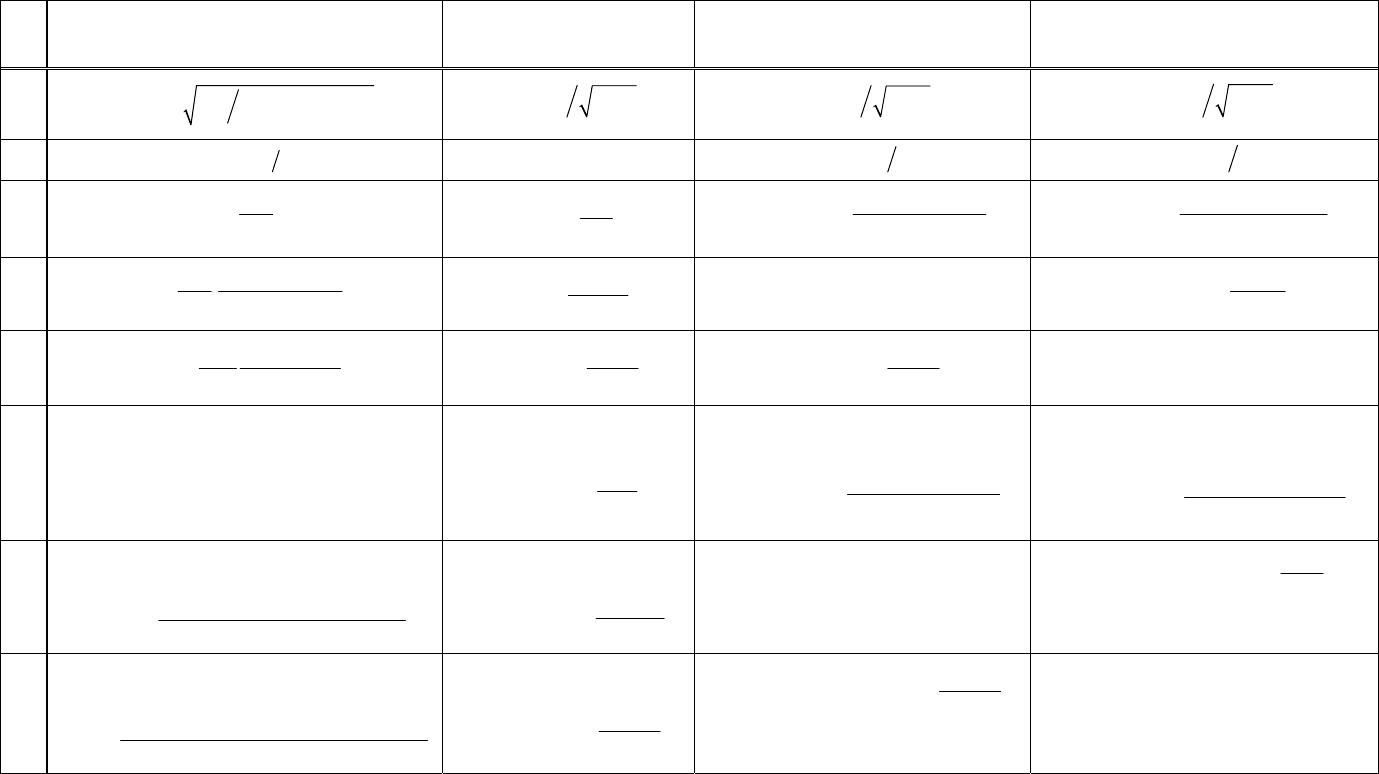
TEOS-10 Manual: Calculation and use of the thermodynamic properties of seawater
IOC Manuals and Guides No. 56
181
Table P.1. (cont’d) Expressions for various thermodynamic variables based on four different thermodynamic potentials
Expressionsbasedon
()
A,,
g
Stp
Expressionsbasedon
(
)
A,,hS p
η
Expressionsbasedon
()
A,,hS p
θ
and
(
)
A,S
η
θ
Expressionsbasedon
(
)
A
ˆ,,hS pΘand
(
)
A
ˆ,S
η
Θ
c
()
2
P
TT TP TT PP
cgg g gg=−
P
PP
ch h=−
P
PP
ch h=−
ˆˆ
P
PP
ch h=−
Γ TP TT
g
g
Γ
=−
P
h
η
Γ=
P
h
θ
θ
η
Γ= ˆˆ
P
h
η
Θ
Θ
Γ=
t
α
tTP
P
g
g
α
= 1
P
t
P
h
hh
η
η
η
α
−
=
()
2
1t
PP
hh hh
θ
θ
θ
θθ θθ θ
η
α
η
η
−
=− −
()
2
1ˆ
ˆˆ
ˆˆ
ˆˆ
t
PP
hh
hh
η
α
η
η
−Θ
Θ
Θ
ΘΘ ΘΘ Θ
=− −
θ
α
()
Ar
,,
TT
TP
PTT
g
Sp
g
gg
θ
θ
α
=
()
1
0
P
P
h
hh
η
θ
ηη
α
−
=
1
P
P
hh
θ
θ
α
−
=
2
1
0
ˆ
ˆˆ
ˆ
PP
p
hh c
θ
η
α
η
−Θ
Θ
Θ
Θ
=−
α
Θ
()
0
0
p
TP
P
TT
c
g
g
Tg
αθ
Θ=− +
()
0
1
0
p
PP
c
hh h
η
η
α
Θ−
=
()
0
1
0
p
PP
c
hh h
θ
θ
α
Θ−
=
1
ˆˆ
P
P
hh
α
Θ−
Θ
=
t
β
A
1t
P
PS
g
g
β
−
=− A
A
1
1
t
PPS
S
PP
hh
h
hh h
η
η
η
η
β
−
−
=−
+
()
()
A
AA
1
1
t
PPS
SS
PP
hh
hh
hh hh
θ
θθθ
θ
θθθ θθθ
β
η
η
ηη
−
−
=−
−
+−
()
()
A
AA
1
1
ˆˆ
ˆˆ
ˆˆ
ˆˆ
ˆˆ
ˆˆ
t
PPS
SS
PP
hh
hh
hh
hh
β
η
η
ηη
−
Θ
ΘΘΘ
−Θ
ΘΘΘ ΘΘΘ
=−
−
+−
θ
β
()
A
AA
1
Ar
,,
PPS
TP ST ST
PTT
g
g
gg
gSp
gg
θ
β
θ
−
=−
⎡⎤
−
⎣⎦
+
()
()
A
A
1
10
0
PPS
S
PP
hh
h
hh h
θ
η
η
ηη
β
−
−
=−
+
A
1
P
PS
hh
θ
β
−
=− A
A
11
ˆ
ˆˆ ˆˆ
ˆ
S
PPS PP
hh hh
θη
βη
Θ
−−
Θ
Θ
Θ
=− +
β
Θ
()( )
A
AA
1
1
0A
,,0
PPS
TP S T S
PTT
g
g
gg
gT S
gg
β
θθ
Θ−
−
=−
⎡
⎤
−+
⎣
⎦
+
()
()
A
A
1
10
0
PPS
S
PP
hh
h
hh h
η
η
β
Θ−
−
=−
+
(
)
()
A
A
11
0
0
S
PPS PP
h
hh hh h
θ
θ
β
Θ− −
=− +
A
1
ˆˆ
P
PS
hh
β
Θ−
=−

182 TEOS-10 Manual: Calculation and use of the thermodynamic properties of seawater
IOC Manuals and Guides No. 56
References
Alberty,R.A.,2001:UseofLegendretransformsinchemicalthermodynamics.PureAppl.
Chem.,73,1349–1380.
Alderson,S.G.andP.D.Killworth,2005:Apreoperationalschemeforcalculatingseasurface
heightbyBernoulliinverseofAgrofloatdataintheNorthAtlantic.J.Atmos.Oceanic
Tech.,22,1416‐1422.
Bacon,S.,F.Culkin,N.HiggsandP.Ridout,2007:IAPSOStandardSeawater:Definitionofthe
uncertaintyinthecalibrationprocedure,andstabilityofrecentbatches.JAtmos.Oceanic
Technol.24,1785‐1799.
Bacon,S.andNFofonoff,1996:Oceanicheatfluxcalculation.JAtmos.OceanicTechnol.13,
1327‐1329.
Barber,C.R.,1969:TheInternationalTemperatureScaleof1968.Metrologia,5,35‐44.
Batchelor,G.K.,1970:AnIntroductiontoFluidDynamics.CambridgeUniversityPress,615pp.
Bezold,W.v.,1888:ZurThermodynamikderAtmosphaere.PotentielleTemperatur.Verticaler
Temperaturgradient.ZusammengesetzteConvection.SitzungsberichtederKoeniglich
PreussischenAkademiederWissenschaftenzuBerlin,46,1189‐1206.
http://bibliothek.bbaw.de/bibliothek‐
digital/digitalequellen/schriften/anzeige/index_html?band=10‐sitz/1888‐2&seite:int=530
BIPM,2005:Clarificationofthedefinitionofthekelvin,unitofthermodynamictemperature
RECOMMENDATION2(CI‐2005)TheInternationalCommitteeforWeightsand
Measures(CIPM),http://www.bipm.org/cc/CIPM/Allowed/94/CIPM‐Recom2CI‐2005‐EN.pdf
BIPM,2006:TheInternationalSystemofUnits(SI),8thedition.BureauInternationaldesPoidset
Mesures,OrganisationIntergouvernementaledelaConventionduMètre,Sèvres,France.
http://www.bipm.fr/utils/common/pdf/si_brochure_8_en.pdf
Bleck,R.,1978:Finitedifferenceequationsingeneralizedverticalcoordinates,I,Totalenergy
conservation.Contrib.Atmos.Phys.,51,360‐372.
Bradshaw,A.andK.E.Schleicher,1970:Directmeasurementsofthermalexpansionofsea
waterunderpressure.Deep‐SeaRes.,17,691‐706.
Brewer,P.G.,andA.Bradshaw,1975.Theeffectofnon‐idealcompositionofseawateron
salinityanddensity.J.Mar.Res.33,157‐175.
Bromley,L.A.,1968:Relativeenthalpiesofseasaltsolutionsat25°C.JournalofChemicaland
EngineeringData,13,399‐402.
Bromley,L.A.,V.A.Desaussure,J.C.Clipp,andJ.S.Wright,1967:Heatcapacitiesofsea
watersolutionsatsalinitiesof1to12%andtemperaturesof2°to80°.JournalofChemical
andEngineeringData,12,202‐206.
Bromley,L.A.,A.E.Diamond,E.Salami,andD.G.Wilkins,1970:Heatcapacitiesand
enthalpiesofseasaltsolutionsto200°C.JournalofChemicalandEngineeringData,15,246‐
253.
Bromley,L.A.,D.Singh,P.Ray,S.Sridhar,andS.M.Read,1974:Thermodynamicproperties
ofseasaltsolutions.AIChEJournal,20,326‐335.
Bryden,H.L.,1973:Newpolynomialsforthermalexpansion,adiabatictemperaturegradient
andpotentialtemperatureofseawater.Deep‐SeaRes.,20,401‐408.
Caldwell,D.R.,1978:Themaximumdensitypointsofpureandsalinewater.Deep‐Sea
Research,25,175‐181.
Calvert,J.G.,1990:Glossaryofatmosphericchemistryterms(Recommendations1990),Pure&
App.Chem.,62,2167‐2219.
Chen,C.‐T.andF.J.Millero,1976:Thespecificvolumeofseawaterathighpressures.Deep‐Sea
Res.23,595‐612.

TEOS-10 Manual: Calculation and Use of the Thermodynamic Properties of Seawater
IOC Manuals and Guides No. 56
183
Chen,C.‐T.andF.J.Millero,1977:Soundspeedofseawaterathighpressures.J.Acoust.Soc.
Am.,62,1129‐1135.
Clausius,R.,1876:DieMechanischeWärmetheorie.FriedrichViewegundSohn,
Braunschweig.
Culkin,F.andP.S.Ridout,1998:StabilityofIAPSOStandardSeawater,J.Atmos.Oceanic.
Technol.,15,1072–1075.
Cunningham,S.A.,2000:CirculationandvolumefluxoftheNorthAtlanticusingsynoptic
hydrographicdatainaBernoulliinverse.J.MarineRes.,58,1‐35.
Curry,J.A.andP.J.Webster,1999:Thermodynamicsofatmospheresandoceans.AcademicPress,
SanDiego,USA.
Dai,A.,2006:RecentClimatology,Variability,andTrendsinGlobalSurfaceHumidity.J.
Climate,19,3589‐3605.
DeGroot,S.R.andP.Mazur,1984:Non‐equilibriumthermodynamics.DoverPublications,Inc.,
NewYork.
DelGrosso,V.A.,1974:Newequationforthespeedofsoundinnaturalwaters(with
comparisontootherequations).J.Acoust.Soc.Am.,56,1084‐1091.
deSzoeke,R.A.,2000:EquationsofMotionUsingThermodynamicCoordinates.Journalof
PhysicalOceanography,30,2814‐2829.
deSzoeke,R.A.andR.M.Samelson,2002:ThedualitybetweentheBoussinesqandnon‐
Boussinesqhydrostaticequationsofmotion.JournalofPhysicalOceanography,32,2194‐
2203.
deSzoeke,R.A.,S.R.SpringerandD.M.Oxilia,2000:Orthobaricdensity:Athermodynamic
variableforoceancirculationstudies.J.Phys.Oceanogr.,30,2830‐2852.
Douglas,T.B.,1969:Conversionofexistingcalorimetricallydeterminedthermodynamic
propertiestothebasesoftheInternationalPracticalScaleof1968.Jour.ofRes.NBS‐A:
PhysicsandChemistry,73A,451–470.
Eden,C.andJ.Willebrand,1999:Neutraldensityrevisited.Deep‐SeaRes.II,46,33‐54.
Feistel,R.,1993:Equilibriumthermodynamicsofseawaterrevisited,Progr.Oceanogr.,31,101‐
179.
Feistel,R.,2003:AnewextendedGibbsthermodynamicpotentialofseawater,Progr.
Oceanogr.,58,43‐114.
Feistel,R.,2008:AGibbsfunctionforseawaterthermodynamicsfor−6to80°Candsalinityup
to120gkg–1,Deep‐SeaRes.I,55,1639‐1671.
Feistel,R.andE.Hagen,1995:OntheGIBBSthermodynamicpotentialofseawater.Prog.in
Oceanogr.,36,249‐327.
Feistel,R.andE.Hagen,1998:AGibbsthermodynamicpotentialofseaice,ColdRegionsSci.
Technol.,28,83‐142,1998.
Feistel,R.andG.M.Marion,2007:AGibbs‐Pitzerfunctionofhigh‐salinityseawater
thermodynamics.ProgressinOceanography,74,515‐539.
Feistel,R.,G.M.Marion,R.PawlowiczandD.G.Wright,2010d:Thermophysicalproperty
anomaliesofBalticseawater.OceanScienceDiscussions,7,1103‐1208.http://www.ocean‐
sci‐discuss.net/7/1103/2010/osd‐7‐1103‐2010‐print.pdf
Feistel,R.,G.Nausch,N.Wasmund(Eds),2008b:StateandEvolutionoftheBalticSea,1952‐
2005.ADetailed50‐YearSurveyofMeteorologyandClimate,Physics,Chemistry,
Biology,andMarineEnvironment.JohnWiley&Sons,Inc.,Hoboken.
Feistel,R.andW.Wagner,2005.High‐pressurethermodynamicGibbsfunctionsoficeandsea
ice.JournalofMarineResearch,63,95‐139.
Feistel,R.andW.Wagner,2006:ANewEquationofStateforH2OIceIh.J.Phys.Chem.Ref.
Data,35,2,1021‐1047.
Feistel,R.andW.Wagner,2007:SublimationpressureandsublimationenthalpyofH2OiceIh
between0and273.16K,Geochim.Cosmochim.Acta,71,36–45,2007.
Feistel,R.,S.Weinreben,H.Wolf,S.Seitz,P.Spitzer,B.Adel,G.Nausch,B.SchneiderandD.
G.Wright,2010c:DensityandAbsoluteSalinityoftheBalticSea2006–2009.Ocean
Science,6,3–24.http://www.ocean‐sci.net/6/3/2010/os‐6‐3‐2010.pdf

184 TEOS-10 Manual: Calculation and use of the thermodynamic properties of seawater
IOC Manuals and Guides No. 56
Feistel,R.,D.G.Wright,K.Miyagawa,A.H.Harvey,J.Hruby,D.R.Jackett,T.J.McDougall
andW.Wagner,2008a:Mutuallyconsistentthermodynamicpotentialsforfluidwater,ice
andseawater:anewstandardforoceanography.OceanScience,4,275‐291.
http://www.ocean‐sci.net/4/275/2008/os‐4‐275‐2008.pdf
Feistel,R.,D.G.Wright,D.R.Jackett,K.Miyagawa,J.H.Reissmann,W.Wagner,U.Overhoff,
C.Guder,A.FeistelandG.M.Marion,2010b:Numericalimplementationand
oceanographicapplicationofthethermodynamicpotentialsofliquidwater,water
vapour,ice,seawaterandhumidair‐Part1:Backgroundandequations.OceanScience,6,
633‐677.http://www.ocean‐sci.net/6/633/2010/os‐6‐633‐2010.pdfandhttp://www.ocean‐
sci.net/6/633/2010/os‐6‐633‐2010‐supplement.pdf
Feistel,R.,D.G.Wright,H.‐J.Kretzschmar,E.Hagen,S.HerrmannandR.Span,2010a:
Thermodynamicpropertiesofseaair.OceanScience,6,91–141.http://www.ocean‐
sci.net/6/91/2010/os‐6‐91‐2010.pdf
Fofonoff,N.P.,1962:Physicalpropertiesofseawater.TheSea,Vol.1,MNHill,Ed.,Wiley‐
Interscience,3‐30.
Fofonoff,N.P.,1985:Physicalpropertiesofseawater:Anewsalinityscaleandequationof
stateforseawater.J.Geophys.Res.,90,3322–3342.
Gent,P.R.andJ.C.McWilliams,1990:Isopycnalmixinginoceancirculationmodels.Journalof
PhysicalOceanography,20,150‐155.
Gent,P.R.,J.Willebrand,T.J.McDougallandJ.C.McWilliams,1995:Parameterizingeddy‐
inducedtracertransportsinoceancirculationmodels.JournalofPhysicalOceanography,25,
463‐474.
Gibbs,J.W.,1873:Graphicalmethodsinthethermodynamicsoffluids,Trans.Connecticut
Acad.ArtsandSci.,2,309‐342.
Gill,A.E.,1982:Atmosphere‐OceanDynamics.AcademicPress,662pp.
Glasstone,S.,1947:ThermodynamicsforChemists,D.vanNostrandCompany,Inc.,Princeton,
NewJersey,USA.
Godfrey,J.S.,1989:ASverdrupmodelofthedepth‐integratedflowfortheworldocean
allowingforislandcirculations.GeophysicalandAstrophysicalFluidDynamics.45,89‐119.
Goldberg,R.N.andR.D.Weir,1992:Conversionoftemperaturesandthermodynamic
propertiestothebasisoftheInternationalTemperatureScaleof1990.Pure&Applied
Chemistry,64,1545‐1562.
Gouretski,V.V.andK.P.Koltermann,2004:WOCEglobalhydrographicclimatology.Berichte
desBundesamtesfürSeeschifffahrtundHydrographieTech.Rep.35/2004,49pp.
Gradshteyn,I.S.andI.M.Ryzhik,1980:TablesofIntegrals,SeriesandProducts.AcademicPress,
1160pp.
Greatbatch,R.J.andT.J.McDougall,2003:Thenon‐BoussinesqTemporal‐Residual‐Mean.
JournalofPhysicalOceanography,33,1231‐1239.
Griffies,S.M.,2004:FundamentalsofOceanClimateModels.Princeton,NJ:PrincetonUniversity
Press,518pp+xxxiv.
Groten,E.,2004:FundamentalParametersandCurrent(2004)BestEstimatesoftheParameters
ofCommonRelevancetoAstronomy,Geodesy,andGeodynamics.JournalofGeodesy,77,
724‐797.
Harvey,A.H.andP.H.Huang,2007:First‐PrinciplesCalculationoftheAir–WaterSecond
VirialCoefficient.Int.J.Thermophys.,28,556–565.
Helland‐Hansen,B.,1912:TheOceanWaters.Intern.Rev.Hydrobiol.Hydrog.,Hydrog.Supp.
Ser.1No.2,Leipzig.
Helmholtz,H.v.,1888:UeberatmosphaerischeBewegungen.SitzungsberichtederKoeniglich
PreussischenAkademiederWissenschaftenzuBerlin,46,647–663.
http://bibliothek.bbaw.de/bibliothek‐
digital/digitalequellen/schriften/anzeige/index_html?band=10‐sitz/1888‐1&seite:int=665
Hill,K.D.,T.M.DauphineeandD.J.Woods,1986:TheextensionofthePracticalSalinityScale
1978tolowsalinities,IEEEJ.OceanicEng.,11,109–112.
Huang,R.X.,X.JinandX.Zhang,2001:Anoceanicgeneralcirculationmodelinpressure
coordinates.AdvancesinAtmosphericPhysics,18,1‐22.

TEOS-10 Manual: Calculation and Use of the Thermodynamic Properties of Seawater
IOC Manuals and Guides No. 56
185
Hyland,R.W.andA.Wexler,1983:Formulationsforthethermodynamicpropertiesofdryair
from173.15to473.15K,andofsaturatedmoistairfrom173.15to372.15K,atpressures
upto5Mpa.ASHRAETransact.89,520–535.
IAPWS,2005:GuidelineontheUseofFundamentalPhysicalConstantsandBasicConstantsof
Water.TheInternationalAssociationforthePropertiesofWaterandSteam.Gaithersburg,
Maryland,USA,September2001.RevisedJuly2005,availableat:http://www.iapws.org
IAPWS,2007:RevisedReleaseontheIAPWSIndustrialFormulation1997forthe
ThermodynamicPropertiesofWaterandSteam,Lucerne,Switzerland,August2007,
availablefromwww.iapws.org
IAPWS,2008a:ReleaseontheIAPWSFormulation2008fortheThermodynamicPropertiesof
Seawater.TheInternationalAssociationforthePropertiesofWaterandSteam.Berlin,
Germany,September2008,availablefromwww.iapws.org.ThisReleaseisreferredtoin
thetextasIAPWS‐08.
IAPWS,2008b:RevisedReleaseonthePressurealongtheMeltingandSublimationCurvesof
OrdinaryWaterSubstance.TheInternationalAssociationofthePropertiesofWaterand
Steam,Berlin,Germany,September2008,availablefromhttp://www.iapws.org.
IAPWS,2009a:RevisedReleaseontheEquationofState2006forH2OIceIh.TheInternational
AssociationforthePropertiesofWaterandSteam.Doorwerth,TheNetherlands,
September2009,availablefromhttp://www.iapws.org.ThisReleaseisreferredtointhe
textasIAPWS‐06.
IAPWS,2009b:RevisedReleaseontheIAPWSFormulation1995fortheThermodynamic
PropertiesofOrdinaryWaterSubstanceforGeneralandScientificUse.TheInternational
AssociationforthePropertiesofWaterandSteam.Doorwerth,TheNetherlands,
September2009,availablefromhttp://www.iapws.org.ThisReleaseisreferredtointhe
textasIAPWS‐95.
IAPWS,2009c:SupplementaryReleaseonaComputationallyEfficientThermodynamic
FormulationforLiquidWaterforOceanographicUse.TheInternationalAssociationfor
thePropertiesofWaterandSteam.Doorwerth,TheNetherlands,September2009,
availablefromhttp://www.iapws.org.ThisReleaseisreferredtointhetextasIAPWS‐09.
IAPWS,2010:GuidelineonanEquationofStateforHumidAirinContactwithSeawaterand
Ice,ConsistentwiththeIAPWSFormulation2008fortheThermodynamicPropertiesof
Seawater.TheInternationalAssociationforthePropertiesofWaterandSteam.Niagara
Falls,Canada,July2010,availablefromhttp://www.iapws.org.ThisGuidelineisreferred
tointhetextasIAPWS‐10.
IOC,1987:GF3‐AGeneralFormattingSystemforGeo‐ReferencedData.Vol.2,Technical
DescriptionoftheGF3FormatandCodeTables.IntergovernmentalOceanographic
Commission,ManualsandGuides17,UNESCO.
IOC,SCORandIAPSO,2010:Theinternationalthermodynamicequationofseawater–2010:
Calculationanduseofthermodynamicproperties.IntergovernmentalOceanographic
Commission,ManualsandGuidesNo.56,UNESCO(English),196pp.Availablefrom
http://www.TEOS‐10.org[thepresentdocument,calledtheTEOS‐10manual]
ISO,1993:ISOStandardsHandbook:QuantitiesandUnits.InternationalOrganizationfor
Standardization,Geneva,Switzerland.
ISO/IEC,2007:InternationalVocabularyofMetrology(VIM)–BasicandGeneralConceptsand
AssociatedTerms,ISO/IECGuide99‐12.availablefromhttp://www.bipm.org/en/publications/
Iudicone,D.,G.Madec,andT.J.McDougall,2008:Water‐masstransformationsinaneutral
densityframeworkandthekeyroleoflightpenetration.JournalofPhysicalOceanography,
38,1357‐1376.
IUPAC,1997:CompendiumofChemicalTerminology,2nded.(theʺGoldBookʺ).Compiled
byA.D.McNaughtandA.Wilkinson.BlackwellScientificPublications,Oxford1997.
XMLon‐linecorrectedversion:http://goldbook.iupac.org(2006‐)createdbyM.Nic,J.
Jirat,B.Kosata;updatescompiledbyA.Jenkins.ISBN0‐9678550‐9‐8.
doi:10.1351/goldbook.
Jackett,D.R.andT.J.McDougall,1997:Aneutraldensityvariablefortheworld’soceans.
JournalofPhysicalOceanography,27,237‐263.

186 TEOS-10 Manual: Calculation and use of the thermodynamic properties of seawater
IOC Manuals and Guides No. 56
Jackett,D.R.,T.J.McDougall,R.Feistel,D.G.WrightandS.M.Griffies,2006:Algorithmsfor
density,potentialtemperature,conservativetemperatureandfreezingtemperatureof
seawater.JournalofAtmosphericandOceanicTechnology,23,1709‐1728.
Jacobson,M.Z.,2005:FundamentalsofAtmosphericModeling,2ndEdition,UniversityPress,
Cambridge,UK.
Kawano,T.,2009:Methodforsalinity(conductivityratio)measurement.GlobalShip‐basedRepeat
HydrographyManual,IOCCPReportNo.14,ICPOPublicationSeriesno.134,13pp,
availablefromhttp://cdiac3.ornl.gov/hydrography/and
http://www.go‐ship.org/HydroMan.html
Killworth,P.D.,1986:ABernoulliinversemethodfordeterminingtheoceancirculation.
JournalofPhysicalOceanography,16,2031‐2051.
Klocker,A.andT.J.McDougall,2010a:Influenceofthenonlinearequationofstateonglobal
estimatesofdianeutraladvectionanddiffusion.JournalofPhysicalOceanography,40,1690‐
1709.
Klocker,A.andT.J.McDougall,2010b:Quantifyingtheconsequencesoftheill‐definednature
ofneutralsurfaces.JournalofPhysicalOceanography,40,1866‐1880.
Klocker,A.,T.J.McDougallandD.R.Jackett,2009a:Anewmethodforforming
approximatelyneutralsurfaces.OceanSci.,5,155‐172.
http://www.ocean‐sci.net/5/155/2009/os‐5‐155‐2009.html
Klocker,A.,T.J.McDougallandD.R.Jackett,2009b:CorrigendumtoʺAnewmethodfor
formingapproximatelyneutralsurfaces”,publishedinOceanScience,5,155–172,2009,
OceanSci.,5,191‐191.http://www.ocean‐sci.net/5/191/2009/os‐5‐191‐2009.html
Kremling,K.,1971:NewMethodformeasuringdensityofseawater,Nature,229,109–110.
Landau,L.D.andE.M.Lifshitz,1959:FluidMechanics.Pergamon,536pp.
Landau,L.D.andE.M.Lifshitz,1980:StatisticalPhysics.ReedEducationalandProfessional
PublishingLtd.544pp.
Lemmon,E.W.,R.T.Jacobsen,S.G.PenoncelloandD.G.Friend,2000:Thermodynamic
propertiesofairandmixturesofnitrogen,argonandoxygenfrom60to2000Kat
pressuresto2000MPa.J.Phys.Chem.Ref.Data,29,331–362.
Leppäranta,M.,K.Myrberg,2009:PhysicalOceanographyoftheBalticSea.SpringerVerlag
Heidelberg,Germany.
Losch,M.,A.AdcroftandJ.‐M.Campin,2004:Howsensitivearecoarsegeneralcirculation
modelstofundamentalapproximationsintheequationsofmotion?JournalofPhysical
Oceanography,34,306‐319.
Mares,R.andJ.Kalova,2008:Thermophysicalpropertiesconvertedfromdataandequations
basedonoldtemperaturescales.In:Water,Steam,andAqueousSolutions:Advancesin
ScienceandTechnologyforPowerGeneration.Proceedingsofthe15thInternational
ConferenceonthePropertiesofWaterandSteam.September7‐11,2008,Berlin/Germany.
ISBN978‐3‐931384‐64‐7.
Marion,G.M.,F.J.Millero,andR.Feistel,2009:Precipitationofsolidphasecalcium
carbonatesandtheireffectonapplicationofseawaterA
STP
−
−models,OceanSci.,5,
285‐291.www.ocean‐sci.net/5/285/2009/
McDougall,T.J.,1984:Therelativerolesofdiapycnalandisopycnalmixingonsubsurface
watermassconversion.JournalofPhysicalOceanography,14,1577‐1589.
McDougall,T.J.,1987a:Neutralsurfaces.JournalofPhysicalOceanography,17,1950‐1964.
McDougall,T.J.,1987b:Thermobaricity,cabbeling,andwater‐massconversion.J.Geophys.
Res.,92,5448‐5464.
McDougall,T.J.,1988:Neutral‐surfacepotentialvorticity.ProgressinOceanography,20,185‐
221.
McDougall,T.J.,1989:Streamfunctionsforthelateralvelocityvectorinacompressibleocean.
J.MarineResearch,47,267‐284.
McDougall,T.J.,1991:ParameterizingmixingininversemodelsinDynamicsofOceanicInternal
GravityWaves,editedbyP.MüllerandD.Henderson,Proceedingsofthesixth’Aha
Huliko’aHawaiianWinterWorkshop,UniversityofHawaiiatManoa,355‐386.

TEOS-10 Manual: Calculation and Use of the Thermodynamic Properties of Seawater
IOC Manuals and Guides No. 56
187
McDougall,T.J.,1995:Theinfluenceofoceanmixingontheabsolutevelocityvector.Journalof
PhysicalOceanography,25,705‐725.
McDougall,T.J.,2003:Potentialenthalpy:Aconservativeoceanicvariableforevaluatingheat
contentandheatfluxes.JournalofPhysicalOceanography,33,945‐963.
McDougall,T.J.,J.A.ChurchandD.R.Jackett,2003:Doesthenonlinearityoftheequationof
stateimposeanupperboundonthebuoyancyfrequency?JournalofMarineResearch,61,
745‐764.
McDougall,T.J.andR.Feistel,2003:Whatcausestheadiabaticlapserate?Deep‐SeaResearch,
50,1523‐1535.
McDougall,T.J.,R.J.GreatbatchandY.Lu,2002:Onconservationequationsinoceanography:
HowaccurateareBoussinesqoceanmodels?JournalofPhysicalOceanography,32,1574‐
1584.
McDougall,T.J.andD.R.Jackett,1988:Onthehelicalnatureofneutraltrajectoriesinthe
ocean.ProgressinOceanography,20,153‐183.
McDougall,T.J.andD.R.Jackett,2005a:Anassessmentoforthobaricdensityintheglobal
ocean.JournalofPhysicalOceanography,35,2054–2075.
McDougall,T.J.andD.R.Jackett,2005b:Thematerialderivativeofneutraldensity.Journalof
MarineResearch,63,159‐185.
McDougall,T.J.andD.R.Jackett,2007:ThethinnessoftheoceaninSp
−
Θ− spaceandthe
implicationsformeandiapycnaladvection.JournalofPhysicalOceanography,37,1714‐
1732.
McDougallT.J.,D.R.Jackett,P.M.Barker,C.Roberts‐Thomson,R.FeistelandR.W.Hallberg,
2010b:Acomputationallyefficient25‐termexpressionforthedensityofseawaterin
termsofConservativeTemperature,andrelatedpropertiesofseawater.submittedto
OceanScienceDiscussions.Computersoftwareisavailablefromhttp://www.TEOS‐10.org
McDougall,T.J.,D.R.JackettandF.J.Millero,2010a:AnalgorithmforestimatingAbsolute
Salinityintheglobalocean.submittedtoOceanScience,apreliminaryversionisavailable
atOceanSci.Discuss.,6,215‐242.http://www.ocean‐sci‐discuss.net/6/215/2009/osd‐6‐215‐
2009‐print.pdfandthecomputersoftwareisavailablefromhttp://www.TEOS‐10.org
McDougall,T.J.,D.R.Jackett,D.G.WrightandR.Feistel,2003:Accurateandcomputationally
efficientalgorithmsforpotentialtemperatureanddensityofseawater.J.Atm.Ocean.
Technol.,20,730‐741.
McDougall,T.J.andA.Klocker,2010:Anapproximategeostrophicstreamfunctionforusein
densitysurfaces.OceanModelling,32,105‐117.
McDougall,T.J.andP.C.McIntosh,2001:Thetemporal‐residual‐meanvelocity.PartII:
Isopycnalinterpretationandthetracerandmomentumequations.JournalofPhysical
Oceanography,31,1222‐1246.
McDougall,T.J.,S.A.ThorpeandC.H.Gibson,1988:Small‐scaleturbulenceandmixingin
theocean:Aglossary,inSmall‐scaleturbulenceandmixingintheocean,editedbyJ.C.J.
NihoulandB.M.Jamart,Elsevier,Amsterdam.3‐9.
Millero,F.J.,1974:Seawaterasamulticomponentelectrolytesolution.TheSea,Vol.5,E.D.
Goldberg,Ed.,Wiley‐Interscience,3‐80.
Millero,F.J.,2000.Effectofchangesinthecompositionofseawateronthedensity‐salinity
relationship.Deep‐SeaRes.I47,1583‐1590.
Millero,F.J.,2010:Historyoftheequationofstateofseawater.Oceanography,23,18‐33.
Millero,F.J.,R.Feistel,D.G.Wright,andT.J.McDougall,2008a:ThecompositionofStandard
SeawaterandthedefinitionoftheReference‐CompositionSalinityScale,Deep‐SeaRes.I,
55,50‐72.
Millero,F.J.,Forsht,D.,Means,D.,Giekes,J.,Kenyon,K.,1978:ThedensityofNorthPacific
Oceanwaters.J.Geophys.Res.83,2359‐2364.
Millero,F.J.,A.Gonzalez,A.andG.K.Ward,1976c:Thedensityofseawatersolutionsatone
atmosphereasafunctionoftemperatureandsalinity.J.Mar.Res.,34,61‐93.
Millero,F.J.,Gonzalez,A.,Brewer,P.G.,Bradshaw,A.,1976a:ThedensityofNorthAtlantic
andNorthPacificdeepwaters.EarthandPlanetarySci.Letters32,468‐472.

188 TEOS-10 Manual: Calculation and use of the thermodynamic properties of seawater
IOC Manuals and Guides No. 56
Millero,F.J.,F.Huang,N.Williams,J.WatersandR.Woosley,2009:Theeffectofcomposition
onthedensityofSouthPacificOceanwaters,Mar.Chem.,114,56‐62.
Millero,F.J.,Lawson,D.,Gonzalez,A.,1976b:Thedensityofartificialriverandestuarine
waters.J.Geophys.Res.81,1177‐1179.
Millero,F.J.andW.H.Leung,1976:Thethermodynamicsofseawateratoneatmosphere,Am.
J.Sci.,276,1035–1077.
Millero,F.J.andX.Li,1994:Commentson“Onequationsforthespeedofsoundinseawater”
[J.Acoust.Soc.Am.94,255‐275(1993)].J.Acoust.Soc.Am.95,2757‐2759.
Millero,F.J.andK.Kremling,1976:ThedensitiesofBalticSeawaters.Deep‐SeaResearch,23,
1129‐1138.
Millero,F.J.,G.PerronandJ.F.Desnoyers,1973:Heatcapacityofseawatersolutionsfrom5to
35°Cand.05to22 %0Chlorinity.J.Geophys.Res.,78,4499‐4506.
Millero,F.J.,J.Waters,R.Woosley,F.Huang,andM.Chanson,2008b:Theeffectof
compositiononthedensityofIndianOceanwaters,Deep‐SeaRes.I,55,460‐470.
Mohr,P.J.,B.N.TaylorandD.B.Newell,2008:CODATArecommendedvaluesofthe
fundamentalphysicalconstants:2006.Rev.Mod.Phys.,80,633‐730;alsopublishedinJ.
Phys.Chem.Ref.Data,37,1187‐1284(2008).
Mohr,P.J.andB.N.Taylor,2005:CODATArecommendedvaluesofthefundamentalphysical
constants:2002.Rev.Mod.Phys.,77,1‐107.
Moritz,H.,2000:Geodeticreferencesystem1980.JournalofGeodesy,74,128‐133.
Pawlowicz,R.,2010:Amodelforpredictingchangesintheelectricalconductivity,Practical
Salinity,andAbsoluteSalinityofseawaterduetovariationsinrelativechemical
composition.OceanScience,6,361–378.http://www.ocean‐sci.net/6/361/2010/os‐6‐361‐
2010.pdf
Pawlowicz,R.,D.G.WrightandF.J.Millero,2010:Theeffectsofbiogeochemicalprocesseson
oceanicconductivity/salinity/densityrelationshipsandthecharacterizationofreal
seawater.OceanScienceDiscussions,7,773–836.
http://www.ocean‐sci‐discuss.net/7/773/2010/osd‐7‐773‐2010‐print.pdf
Picard,A.,R.S.Davis,M.GläserandK.Fujii,2008:Revisedformulaforthedensityofmoist
air(CIPM‐2007),Metrologia,45,149‐155.
Planck,M.,1888:DaschemischeGleichgewichtinverdünntenLösungen.AnnalenderPhysik
undChemie,NeueFolge,34,139‐154.Availablefrom
http://www.archive.org/stream/annalenderphysi53unkngoog#page/n151/mode/1up
Planck,M.1935:BemerkungenüberQuantitätsparameter,Intensitätsparameterundstabiles
Gleichgewicht.PhysicaII,1029‐1032.ReprintedinEbeling,W.,Hoffmann,D.(Eds.),2008,
ÜberThermodynamischeGleichgewichte,vonMaxPlanck.VerlagHarryDeutsch,Frankfurt
amMain,236pp.
Poisson,A.,andM.H.Gadhoumi,1993:AnextensionofthePracticalSalinityScale1978and
theEquationofState1980tohighsalinities.Deep‐SeaRes.I,40,1689‐1698.
Preston‐Thomas,H.,1990:Theinternationaltemperaturescaleof1990(ITS‐90),Metrologia27,
3‐10.
Pruppacher,H.R.andJ.D.Klett,1997:MicrophysicsofCloudsandPrecipitation.SecondRevised
andEnlargedEditionwithanIntroductiontoCloudChemistryandCloudElectricity,
KluwerAcademicPublishers,Dordrecht/Boston/London.
Reid,J.L.andR.J.Lynn,1971:OntheinfluenceoftheNorwegian‐GreenlandandWeddell
seasuponthebottomwatersoftheIndianandPacificoceans.Deep‐SeaRes.,18,1063‐1088.
Robinson,R.A.,1954:Thevapourpressureandosmoticequivalenceofseawater.Journalof
theMarineBiologicalAssociationoftheU.K.33,449‐455.
Reissmann,J.H.,H.Burchard,R.Feistel,E.Hagen,H.U.Lass,V.Mohrholz,G.Nausch,L.
Umlauf,G.Wieczorek,2009:State‐of‐the‐artreviewonverticalmixingintheBalticSea
andconsequencesforeutrophication.ProgressinOceanography,82,47‐80.
RippleD.,B.Fellmuth,J.Fischer,G.Machin,P.Steur,O.TamuraandD.R.White,2008:Report
fromtheMiseenPratiqueTaskGroup:thenextinternationaltemperaturescaleandthe
miseenpratiqueforthedefinitionofthekelvin.CCT/08‐17/rev.8pp.Availablefrom
http://www.bipm.org/cc/CCT/Allowed/24/D17_rev_MePK_Report_2008c.pdf

TEOS-10 Manual: Calculation and Use of the Thermodynamic Properties of Seawater
IOC Manuals and Guides No. 56
189
Röntgen,W.C.,1892:UeberdieConstitutiondesflüssigenWassers,AnnalenderPhysik,45,91‐
97.
Ruddick,B.,1983:Apracticalindicatorofthestabilityofthewatercolumntodouble‐diffusive
activity.Deep‐SeaRes.,30,1105–1107.
Rudtsch,S.andJ.Fischer,2008:TemperaturemeasurementsaccordingtotheInternational
TemperatureScaleof1990anditsassociateduncertainties.Accred.Qual.Assur.,13,607–
609.
Rusby,R.L.,1991:TheconversionofthermalreferencevaluestotheITS‐90.J.Chem.
Thermodynamics,23,1153‐1161.
Rusby,R.L.andR.White,2003:CCTWorkshop:TowardtheITS‐XX:Summaryofthe
proceedings,CCT/03‐01.
Saunders,P.1990:TheInternationalTemperatureScaleof1990,ITS‐90.WOCENewsletter10,
IOS,Wormley,UK.
Saunders,P.M.,1995:TheBernoullifunctionandfluxofenergyintheocean.J.Geophys.Res.,
100,22,647‐22,648.
Sarmiento,J.L.andK.Bryan,1982:AnoceantransportmodelfortheNorthAtlantic.Journalof
GeophysicalResearch,87(C1),394‐408.
Sarmiento,J.L.andN.Gruber,2006:OceanBiogeochemicalDynamics,PrincetonUniversity
Press,Princeton,503pp.
Saunders,P.M,1981:Practicalconversionofpressuretodepth.JournalofPhysical
Oceanography,11,573‐574.
Saunders,P.M.andN.P.Fofonoff,1976:Conversionofpressuretodepthintheocean.Deep‐
SeaResearch,23,109‐111.
Seitz,S.,P.SpitzerandR.J.C.Brown,2008:Consistencyofpracticalsalinitymeasurements
traceabletoprimaryconductivitystandards:Eurometproject918,Accred.Qual.Assur.13,
601–605.
Seitz,S.,P.SpitzerandR.J.C.Brown,2010a:CCQM‐P111studyontraceabledeterminationof
practicalsalinityandmassfractionofmajorseawatercomponents.Accred.Qual.Assur.
15,9–17.
Seitz,S.,R.Feistel,D.G.Wright,S.Weinreben,P.SpitzerandP.deBievre,2010b:Metrological
TraceabilityofOceanographicSalinityMeasurementResults.OceanScienceDiscussions,7,
1303–1346.http://www.ocean‐sci‐discuss.net/7/1303/2010/osd‐7‐1303‐2010‐print.pdf
Sherwood,T.K.,P.L.T.BrianandR.E.Fisher,1967:Desalinationbyreverseosmosis,Ind.
Eng.Chem.Fundamen.,6,2‐12.
Straub,D.N.,1999:Onthermobaricproductionofpotentialvorticityintheocean.TellusA,51,
314‐325.
Sutcliffe,R.C.A.,1947:Acontributiontotheproblemofdevelopment.Quart.J.Roy.Meteor.
Soc.,73,370‐383.
Tailleux,R.,2010:Identifyingandquantifyingnonconservativeenergyproduction/destruction
termsinhydrostaticBoussinesqprimitiveequationmodels.OceanModelling,34,125‐136.
Thomson,W.,1851:Onthedynamicaltheoryofheat;withnumericalresultsdeducedfrom
Mr.JouleʹsequivalentofathermalunitandM.Regnaultʹsobservationsonsteam.Trans.
Roy.Soc.Edinburgh,3,48‐52.
Unesco,1981:ThePracticalSalinityScale1978andtheInternationalEquationofStateof
Seawater1980.Unescotechnicalpapersinmarinescience36,25pp.
Unesco,1983:Algorithmsforcomputationoffundamentalpropertiesofseawater.Unesco
technicalpapersinmarinescience44,53pp.
Veronis,G.,1975:Theroleofmodelsintracerstudies,in:NumericalModelsofOceanCirculation,
pp.133–146,NationalAcademyofScience.
Wagner,W.andA.Pruß,2002:TheIAPWSformulation1995forthethermodynamic
propertiesofordinarywatersubstanceforgeneralandscientificuse.J.Phys.Chem.Ref.
Data,31,387‐535.
Warren,B.A.,1999:Approximatingtheenergytransportacrossoceanicsections.J.Geophys.,
Res.,104,7915‐7919.

190 TEOS-10 Manual: Calculation and use of the thermodynamic properties of seawater
IOC Manuals and Guides No. 56
Warren,B.A.,2006:Thefirstlawofthermodynamicsinasaltyocean.Prog.inOceanogr.,70,
149‐167.
Warren,B.A.,2009:Noteontheverticalvelocityanddiffusivesaltfluxinducedby
evaporationandprecipitation.JournalofPhysicalOceanography,39,2680–2682.
Weir,R.D.andR.N.Goldberg,1996:Ontheconversionofthermodynamicpropertiestothe
basesoftheInternationalTemperatureScaleof1990.J.Chem.Thermodyn.,28,261‐276.
Wieser,M.E.,2006:Atomicweightsoftheelements2005(IUPACTechnicalReport).Pure
Appl.Chem.78,2051‐2066.www.iupac.org/publications/pac/78/11/2051/pdf/
Wolf,H.,2008:Determinationofwaterdensity:limitationsattheuncertaintylevelof1x10–6,
Accred.Qual.Assur.13,587–591.
Woolley,H.W.,1980:ThermodynamicpropertiesforH2Ointheidealgasstate,in:Straub,J.,
andScheffler,K.(Eds.),WaterandSteam,Proceedingsofthe9thInternationalConference
onthePropertiesofSteam,München,1979.PergamonPress,Oxford‐NewYork‐Toronto‐
Sydney‐Paris‐Frankfurt,pp.166–175.
Wooster,W.S.,A.J.LeeandG.Dietrich,1969:Redefinitionofsalinity,Limnology.
Oceanography,14,437‐438.
Wright,D.G.,R.Feistel,J.H.Reissmann,K.Miyagawa,D.R.Jackett,W.Wagner,U.Overhoff,
C.Guder,A.FeistelandG.M.Marion,2010a:Numericalimplementationand
oceanographicapplicationofthethermodynamicpotentialsofliquidwater,water
vapour,ice,seawaterandhumidair‐Part2:Thelibraryroutines.OceanScience,6,695‐
718.http://www.ocean‐sci.net/6/695/2010/os‐6‐695‐2010.pdfandhttp://www.ocean‐
sci.net/6/695/2010/os‐6‐695‐2010‐supplement.pdf
Wright,D.G.,R.Pawlowicz,T.J.McDougall,R.FeistelandG.M.Marion,2010b:Absolute
Salinity,“DensitySalinity”andtheReference‐CompositionSalinityScale:presentand
futureuseintheseawaterstandardTEOS‐10.OceanSci.Discuss.,7,1559‐1625.
http://www.ocean‐sci‐discuss.net/7/1559/2010/osd‐7‐1559‐2010‐print.pdf
You,Y.andT.J.McDougall,1990:NeutralsurfacesandpotentialvorticityintheWorldʹs
Oceans.JournalofGeophysicalResearch,95,13235‐13261.
Young,W.R.,2010:Dynamicenthalpy,ConservativeTemperature,andtheseawater
Boussinesqapproximation.JournalofPhysicalOceanography,40,394–400.
Zhang,H‐MandN.G.Hogg,1992:CirculationandwatermassbalanceintheBrazilBasin.J.
MarineResearch,50,385‐420.
Zika,J.D.,T.J.McDougallandB.M.Sloyan,2010a:Atracer‐contourinversemethodfor
estimatingoceancirculationandmixing.J.PhysicalOceanography,40,26–47.
Zika,J.D.,T.J.McDougallandB.M.Sloyan,2010b:WeakmixingintheeasternNorth
Atlantic:Anapplicationofthetracer‐contourinversemethod.J.PhysicalOceanography,
40,1881‐1893.
TEOS-10 Manual: Calculation and Use of the Thermodynamic Properties of Seawater
IOC Manuals and Guides No. 56
191
Index
absolutepressure,9,66,156
AbsoluteSalinitydens
AA
SS=,11‐15,69‐77,
103‐110,157
AbsoluteSalinityAnomaly,13,72‐77,157
absolutetemperature,62
Added‐massSalinityadd
A
S,12,72‐74,157
adiabaticlapserate,25
Bernoullifunction,42
boilingtemperature,53
Boussinesqapproximation,109
buoyancyfrequency,32
cabbelingcoefficient,31,91,159,178
chemicalpotentials,19,159,180
Chlorinity,11,68‐70,156
compositionvariation,3,11‐14,72‐77,
103‐111
“conservative”property,79‐84
ConservativeTemperatureΘ,3,6,18,
22,27,97‐102,110‐112,158,178‐181
Coriolisparameter,136,160
Cunninghamstreamfunction,44,
density,18,120,152‐155
density,25‐termexpression,120,152‐155
DensitySalinitydens
AA
SS=,11‐15,69‐77,
103‐110,157
dianeutraladvection,112
dianeutralvelocity,112
dynamicheightanomaly,42
enthalpy,18‐19,20,84‐86,87,100,
121‐122,124,158,178‐181
enthalpyasthermodynamicpotential,18,
19,121‐122,178‐181
entropy,20,26,79,84,88,94,158,178‐181
EOS‐80,vii,2,77
FirstLawofThermodynamics,87‐90,
123‐129
freshwatercontent,40
freshwaterflux,40
freezingtemperature,46
fundamentalthermodynamicrelation,79
fugacity,55
geostrophicstreamfunctions,43‐45
GibbsfunctionoficeIh,7,147
Gibbsfunctionofpurewater,15‐17,78,
142‐144,145
Gibbsfunctionofseawater,5,15‐17,78,
146
gravitationalacceleration,136
GSWOceanographicToolbox,173‐174
halinecontractioncoefficients,23,32,
90‐91,93,112‐114,159,181
heattransport,5,27,40‐41,79‐84,90‐92,
99‐102,108‐112
heatdiffusion,5,27,40‐41,79‐84,90‐92,
99‐102,108‐112
Helmholtzenergy,21
Helmholtzfunctionoffluidwater,142
Helmholtzfunctionofmoistair,149‐152
IAPSO,3
IAPWS,4,
IAPWS‐95,130,142‐144
IAPWS‐06,130,147‐148
IAPWS‐08,130,146
IAPWS‐09,130,145
IAPWS‐10,130,149‐152
internalenergy,20,79,
IPTS‐68temperature,3,9,62‐65,137‐139
IOC,7,61
ionicstrength,160
isentropicandadiabatic
compressibility,22,32,159,180
isochoricheatcapacity,24,158
isobaricheatcapacity,24,25,84‐85,86,
88,95,158,179,180
isopycnal‐potential‐vorticity,39
isothermalcompressibility,21,24
“isobaric‐conservative”property,79‐84
ITS‐90temperature,3,9,62‐65,137‐139,
146
latentheatofevaporation,53
latentheatofmelting,48
materialderivatives,108‐114
molality,21,57,160
Montgomerystreamfunction,43‐44,159
NeutralDensity,35,119
192 TEOS-10 Manual: Calculation and use of the thermodynamic properties of seawater
IOC Manuals and Guides No. 56
neutralhelicity,30,34‐35,37,119,159
Neutral‐Surface‐Potential‐Vorticity,38,
39,159
neutraltangentplane,29,30,31,32‐33,
34‐39,43,90,104,109,112‐118
nomenclature,156‐161
orthobaricdensity,118
osmoticcoefficient,21,160
osmoticpressure,58
PreformedSalinity*
S,12,72‐74,103‐109
potentialdensity,28
potentialenthalpy0
h,27,158
“potential”property,82‐84
potentialtemperature
θ
,26,86,158,
178‐181
potentialvorticity,34,38‐39,159
PracticalSalinityP
S,9,68,137‐141
pressure,9,66,156,157
absolutepressure,9,66,156
gaugepressure,9,66,157
seapressure,9,66,156
Pressure‐IntegratedStericHeight,45
recommendednomenclature,156‐161
recommendedsymbols,156‐161
ReferenceComposition(RC),10‐11,67‐74
Reference‐CompositionSalinityR
S,10,
11,67‐77,103‐110
Reference‐CompositionSalinityScale,10,
11,67‐77
ReferenceDensity,13
ReferenceSalinityR
S,10‐11,67‐77,
103‐110
relativehumidity,55
salinecontractioncoefficients,23,32,
90‐91,93,112‐114,159,181
salinity
AbsoluteSalinitydens
AA
SS=,11‐15,
69‐77,103‐110,157
Added‐massSalinityadd
A
S,12,72‐74,
157
DensitySalinitydens
AA
SS=,11‐15,
69‐77,103‐110,157
PracticalSalinityP
S,9,69‐77,103‐110
PreformedSalinity*
S,12,72‐74,
103‐109
ReferenceSalinityR
S,10‐11,67‐77,
103‐110
SolutionSalinitysoln
A
S,12,72‐74,157
salinityinoceanmodels,103‐110
SCOR,3
seapressure,9,66,156
SIAsoftwarelibrary,162‐172
SI‐traceabilityofsalinity,139‐141
slopesofsurfaces,37‐38
SolutionSalinitysoln
A
S,12,72‐74,157
soundspeed,22,159,181
specificvolume,18,29,41,42,44,46,85,
159,161,180
specificvolumeanomaly,29,42,43,45
stabilityratio,36,37,39,91,113,157
StandardSeawater(SSW),10‐15,67‐74
sublimationenthalpy,50
sublimationpressure,49
25‐termexpressionfordensity,120‐122,
153‐155
TEOS‐10,4‐8,60‐61
TEOS‐10website,60,132
Temperature
absolutetemperatureT,62
Celsiustemperaturet,62
ConservativeTemperatureΘ,3,6,
18,22,27,97‐102,110‐112,158,
178‐181
insitutemperature,26
potentialtemperature
θ
,26,86,158,
178‐181
temperatureofmaximumdensity,59
thermalexpansioncoefficients,22,25,32,
90‐91,92,112‐114,158‐159,181
“thermalwind”,33,76‐77,120‐121
thermodynamicpotentials,3,121‐122,
178‐181
thermobariccoefficient,30,34,90,159,178
totalenergy,41,80‐83,126‐127
Turnerangle,36
vapourpressure,52
water‐masstransformation,113‐114
WG127,3

TEOS-10 Manual: Calculation and Use of the Thermodynamic Properties of Seawater
IOC Manuals and Guides No. 56
193
IOCManualsandGuides
No. Title
1rev.2GuidetoIGOSSDataArchivesandExchange(BATHYandTESAC).1993.27
pp.(English,French,Spanish,Russian)
2InternationalCatalogueofOceanDataStation.1976.(Outofstock)
3rev.3GuidetoOperationalProceduresfortheCollectionandExchangeofJCOMM
OceanographicData.ThirdRevisedEdition,1999.38pp.(English,French,
Spanish,Russian)
4GuidetoOceanographicandMarineMeteorologicalInstrumentsand
ObservingPractices.1975.54pp.(English)
5rev.2GuideforEstablishingaNationalOceanographicDataCentre.SecondRevised
Edition,2008.27pp.(English)(Electroniconly)
6rev.WaveReportingProceduresforTideObserversintheTsunamiWarning
System.1968.30pp.(English)
7GuidetoOperationalProceduresfortheIGOSSPilotProjectonMarine
Pollution(Petroleum)Monitoring.1976.50pp.(French,Spanish)
8(SupersededbyIOCManualsandGuidesNo.16)
9rev.ManualonInternationalOceanographicDataExchange.(FifthEdition).1991.82
pp.(French,Spanish,Russian)
9AnnexI(SupersededbyIOCManualsandGuidesNo.17)
9AnnexIIGuideforResponsibleNationalOceanographicDataCentres.1982.29pp.
(English,French,Spanish,Russian)
10(SupersededbyIOCManualsandGuidesNo.16)
11TheDeterminationofPetroleumHydrocarbonsinSediments.1982.38pp.
(French,Spanish,Russian)
12ChemicalMethodsforUseinMarineEnvironmentMonitoring.1983.53pp.
(English)
13ManualforMonitoringOilandDissolved/DispersedPetroleumHydrocarbons
inMarineWatersandonBeaches.1984.35pp.(English,French,Spanish,
Russian)
14ManualonSea‐LevelMeasurementsandInterpretation.(English,French,
Spanish,Russian)
Vol.I:BasicProcedure.1985.83pp.(English)
Vol.II:EmergingTechnologies.1994.72pp.(English)
Vol.III:ReappraisalsandRecommendationsasoftheyear2000.2002.55pp.
(English)
Vol.IV:AnUpdateto2006.2006.78pp.(English)

194 TEOS-10 Manual: Calculation and use of the thermodynamic properties of seawater
IOC Manuals and Guides No. 56
No. Title
15OperationalProceduresforSamplingtheSea‐SurfaceMicrolayer.1985.15pp.
(English)
16MarineEnvironmentalDataInformationReferralCatalogue.ThirdEdition.
1993.157pp.(CompositeEnglish/French/Spanish/Russian)
17GF3:AGeneralFormattingSystemforGeo‐referencedData
Vol.1:IntroductoryGuidetotheGF3FormattingSystem.1993.35pp.(English,
French,Spanish,Russian)
Vol.2:TechnicalDescriptionoftheGF3FormatandCodeTables.1987.111pp.
(English,French,Spanish,Russian)
Vol.3:StandardSubsetsofGF3.1996.67pp.(English)
Vol.4:UserGuidetotheGF3‐ProcSoftware.1989.23pp.(English,French,
Spanish,Russian)
Vol.5:ReferenceManualfortheGF3‐ProcSoftware.1992.67pp.(English,
French,Spanish,Russian)
Vol.6:QuickReferenceSheetsforGF3andGF3‐Proc.1989.22pp.(English,
French,Spanish,Russian)
18UserGuidefortheExchangeofMeasuredWaveData.1987.81pp.(English,
French,Spanish,Russian)
19GuidetoIGOSSSpecializedOceanographicCentres(SOCs).1988.17pp.
(English,French,Spanish,Russian)
20GuidetoDriftingDataBuoys.1988.71pp.(English,French,Spanish,Russian)
21(SupersededbyIOCManualsandGuidesNo.25)
22GTSPPReal‐timeQualityControlManual.1990.122pp.(English)
23MarineInformationCentreDevelopment:AnIntroductoryManual.1991.32pp.
(English,French,Spanish,Russian)
24GuidetoSatelliteRemoteSensingoftheMarineEnvironment.1992.178pp.
(English)
25StandardandReferenceMaterialsforMarineScience.RevisedEdition.1993.
577pp.(English)
26ManualofQualityControlProceduresforValidationofOceanographicData.
1993.436pp.(English)
27ChlorinatedBiphenylsinOpenOceanWaters:Sampling,Extraction,Clean‐up
andInstrumentalDetermination.1993.36pp.(English)
28NutrientAnalysisinTropicalMarineWaters.1993.24pp.(English)
29ProtocolsfortheJointGlobalOceanFluxStudy(JGOFS)CoreMeasurements.
1994.178pp.(English)

TEOS-10 Manual: Calculation and Use of the Thermodynamic Properties of Seawater
IOC Manuals and Guides No. 56
195
No. Title
30MIMPublicationSeries:
Vol.1:ReportonDiagnosticProceduresandaDefinitionofMinimum
RequirementsforProvidingInformationServicesonaNationaland/orRegional
Level.1994.6pp.(English)
Vol.2:InformationNetworking:TheDevelopmentofNationalorRegional
ScientificInformationExchange.1994.22pp.(English)
Vol.3:StandardDirectoryRecordStructureforOrganizations,Individualsand
theirResearchInterests.1994.33pp.(English)
31HABPublicationSeries:
Vol.1:AmnesicShellfishPoisoning.1995.18pp.(English)
32OceanographicSurveyTechniquesandLivingResourcesAssessmentMethods.
1996.34pp.(English)
33ManualonHarmfulMarineMicroalgae.1995.(English)[supersededbyasale
publicationin2003,92‐3‐103871‐0.UNESCOPublishing]
34EnvironmentalDesignandAnalysisinMarineEnvironmentalSampling.1996.86
pp.(English)
35IUGG/IOCTimeProject.NumericalMethodofTsunamiSimulationwiththeLeap‐
FrogScheme.1997.122pp.(English)
36MethodologicalGuidetoIntegratedCoastalZoneManagement.1997.47pp.
(French,English)
37Post‐TsunamiSurveyFieldGuide.FirstEdition.1998.61pp.(English,French,
Spanish,Russian)
38GuidelinesforVulnerabilityMappingofCoastalZonesintheIndianOcean.2000.
40pp.(French,English)
39ManualonAquaticCyanobacteria–Aphotoguideandasynopsisoftheir
toxicology.2006.106pp.(English)
40GuidelinesfortheStudyofShorelineChangeintheWesternIndianOceanRegion.
2000.73pp.(English)
41PotentiallyHarmfulMarineMicroalgaeoftheWesternIndianOcean
MicroalguespotentiellementnuisiblesdelʹocéanIndienoccidental.2001.104pp.
(English/French)
42Desoutilsetdeshommespourunegestionintégréedeszonescôtières‐Guide
méthodologique,vol.II.StepsandToolsTowardsIntegratedCoastalArea
Management–MethodologicalGuide,Vol.II.2001.64pp.(French,English;
Spanish)
43BlackSeaDataManagementGuide(Cancelled)
44SubmarineGroundwaterDischargeinCoastalAreas–Managementimplications,
measurementsandeffects.2004.35pp.(English)

196 TEOS-10 Manual: Calculation and use of the thermodynamic properties of seawater
IOC Manuals and Guides No. 56
No. Title
45AReferenceGuideontheUseofIndicatorsforIntegratedCoastalManagement.
2003.127pp.(English).ICAMDossierNo.1
46AHandbookforMeasuringtheProgressandOutcomesofIntegratedCoastaland
OceanManagement.2006.iv+215pp.(English).ICAMDossierNo.2
47TsunamiTeacher–Aninformationandresourcetoolkitbuildingcapacityto
respondtotsunamisandmitigatetheireffects.2006.DVD(English,Bahasa
Indonesia,BangladeshBangla,French,Spanish,andThai)
48VisionsforaSeaChange.Reportofthefirstinternationalworkshoponmarine
spatialplanning.2007.83pp.(English).ICAMDossierNo.4
49Tsunamipreparedness.Informationguidefordisasterplanners.2008.(English,
French,Spanish)
50HazardAwarenessandRiskMitigationinIntegratedCoastalAreaManagement.
2009.141pp.(English).ICAMDossierNo.5
51IOCStrategicPlanforOceanographicDataandInformationManagement(2008–
2011).2008.46pp.(English)
52TsunamiriskassessmentandmitigationfortheIndianOcean;knowingyour
tsunamirisk–andwhattodoaboutit.2009.82pp.(English)
53MarineSpatialPlanning.AStep‐by‐stepApproach.2009.96pp.(English).ICAM
DossierNo.6
54OceanDataStandardsSeries:
Vol.1:RecommendationtoAdoptISO3166‐1and3166‐3CountryCodesasthe
StandardforIdentifyingCountriesinOceanographicDataExchange.2010.13pp.
(English)
55MicroscopicandMolecularMethodsforQuantitativePhytoplanktonAnalysis.
2010.114pp.(English)
56TheInternationalThermodynamicEquationofSeawater—2010:Calculationand
UseofThermodynamicProperties.2010.196pp.(English)
+User’sGuidetotheInternationalThermodynamicEquationofSeawater–2010
(abridgededition).2010.(Arabic,Chinese,English,French,Russian,Spanish)
TEOS-10 Manual: Calculation and Use of the Thermodynamic Properties of Seawater
IOC Manuals and Guides No. 56
197
ChangesmadetothisTEOS‐10manual,sincethe13thApril2010
versionwhichwasprintedbyIOC.
17thApril2010Page102,line6,anerrorintheinequalityfixed,andchangedtobeintermsofˆ
h.
4thJuly2010Page39,Eqn.(3.20.4).Anerrorfixedinthisequation;anextrafactorofR
ρ
.
5thJuly2010Page123‐124.FixedanerrorinEqn.(B.4)andchangedEqn.(B.5).
20thAug2010Throughoutthedocument,changedp
hto
P
handsohelptoclarifywhenpressure
mustbeexpressedinParatherthandbar.Thesechangeswerequiteextensive.
3rdSept2010Extensivechangestopage122(thedescriptionofenthalpyobtainedfromthe25‐term
expressionfordensity),page174(thelistofGSWToolboxfunctionnames)andpage
179(thedescriptionofhowthe25‐termexpressionfordensity,alongwith
knowledgeoftheexactGibbsfunctionatp=0dbar,canbeusedasthefull
thermodynamicpotentialofseawater).
14thSept2010Correctedatypoontheleft‐handsideofEqn.(A.11.16);A
S
h
wasreplacedbyA
ˆ.
S
h
22ndSept2010Page100.ChangesinEqns.(A.18.5)–(A.18.7).
Page122.SimplifiedEqn.(A.30.6).
InthisTEOS‐10Manualthetextis10.5ptPalatinolinotypeatexactly14ptvertical
spacing.Thereferencesare10ptPalatinolinotypeatexactly13ptverticalspacing.The
textisbothrightandleftjustified.Leftmarginis3.17cmandtherightmarginis3.10cm
respectively.Thetopandbottommarginsareboth2.05cm.Theheaderandfooterare
both70%grey.TheMATHTYPEsizesettingsare10.5,7,6,16,9,75%,100%and150%
respectively.
198 TEOS-10 Manual: Calculation and use of the thermodynamic properties of seawater
IOC Manuals and Guides No. 56

The Intergovernmental Oceanographic Commission (IOC) of UNESCO celebrates
its 50th anniversary in 2010. Since taking the lead in coordinating the International
Indian Ocean Expedition in 1960, the IOC has worked to promote marine research,
protection of the ocean, and international cooperation. Today the Commission is also
developing marine services and capacity building, and is instrumental in monitoring
the ocean through the Global Ocean Observing System (GOOS) and developing
marine-hazards warning systems in vulnerable regions. Recognized as the UN
focal point and mechanism for global cooperation in the study of the ocean, a key
climate driver, IOC is a key player in the study of climate change. Through promoting
international cooperation, the IOC assists Member States in their decisions towards
improved management, sustainable development, and protection of the marine
environment.
Intergovernmental Oceanographic Commission (IOC)
United Nations Educational, Scientific and Cultural Organization
1, rue Miollis
75732 Paris Cedex 15, France
Tel: +33 1 45 68 10 10
Fax: +33 1 45 68 58 12
Website: http://ioc.unesco.org
