User Manual Matlab
User Manual:
Open the PDF directly: View PDF  .
.
Page Count: 21

Multi-Imbalance: an open-source software for multi-class imbalance learning
User Manual in MATLAB
Chongsheng Zhanga, Jingjun Bia, Shixin Xua, Enislay Ramentolb, Gaojuan
Fana, Hamido Fujitac
aThe Big Data Research Center, Henan University, 475001 KaiFeng, China
bSICS Swedish ICT, Isafjordsgatan 22, Box 1263, SE-164 29 Kista, Sweden
cFaculty of Software and Information Science, Iwate Prefectural University, Iwate, Japan
This user manual presents "Multi-Imbalance", which is the first open source software
for the multi-class imbalanced learning field. It contains 18 algorithms for multi-class
imbalanced data classification.
If you have any problems, please do not hesitate to send us an email: henucs@qq.com
This software is protected by the GNU General Public License (GPL).
CONTENTS
1. Overview of Multi-Imbalance .......................................................................................................................1
2. Installation in MATLAB .................................................................................................................................1
3. Usage Example for Each Algorithm ............................................................................................................2
3.1 AdaBoost.M1 .........................................................................................................................................2
3.2 SAMME ..................................................................................................................................................3
3.3 AdaC2.M1 ...............................................................................................................................................4
3.4 AdaBoost.NC .........................................................................................................................................5
3.5 PIBoost ....................................................................................................................................................6
3.6 DECOC ...................................................................................................................................................7
3.7 DOVO ......................................................................................................................................................8
3.8 FuzzyImbECOC ....................................................................................................................................9
3.9 HDDTova ............................................................................................................................................. 10
3.10 HDDTecoc ......................................................................................................................................... 10
3.11 MCHDDT .......................................................................................................................................... 11
3.12 ImECOC + sparse ............................................................................................................................ 12
3.13 ImECOC + OVA .............................................................................................................................. 13
3.14 ImECOC + dense ............................................................................................................................. 14
3.15 Multi-IM + OVA .............................................................................................................................. 15
3.16 Multi-IM + OVO ............................................................................................................................. 16
3.17 Multi-IM + OAHO .......................................................................................................................... 17
3.18 Multi-IM + A&O ............................................................................................................................. 18
1
1. Overview of Multi-Imbalance
In recent years, although many researchers have proposed different algorithms and techniques to
tackle the multi-class imbalanced data classification issue, there is still no open-source software for
this specific field. To address this issue, we develop the "Multi-Imbalance" (Multi-class Imbalanced
data classification) software package and share it with the community, to boost research in this field.
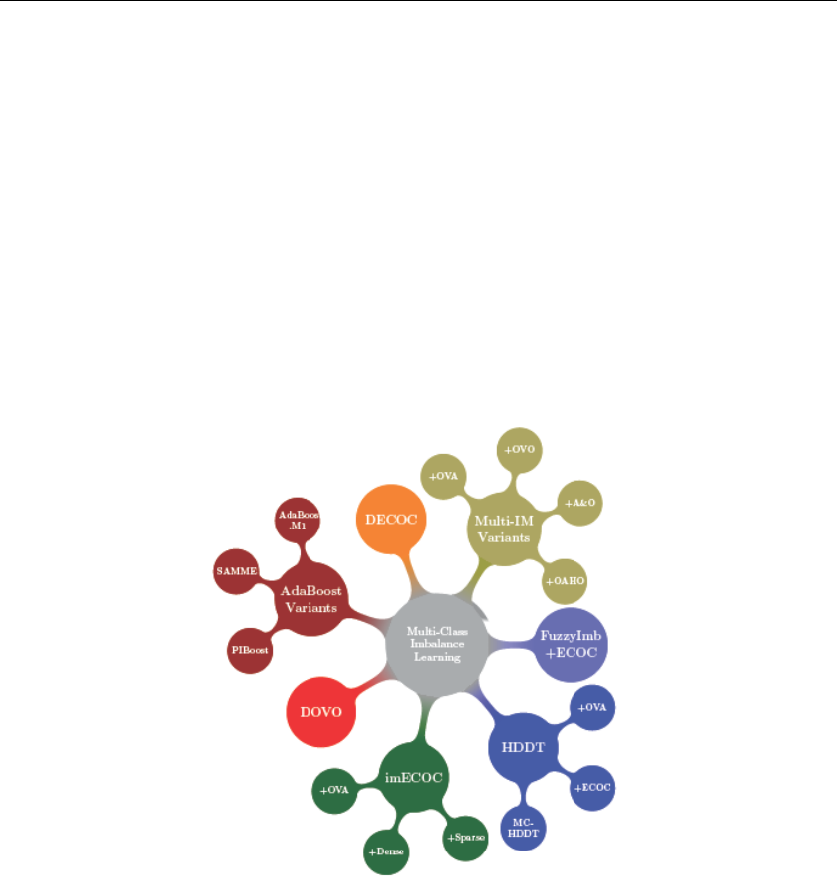
The developed Multi-Imbalance software contains 18 different algorithms for multi-class imbalance
learning, which are depicted in Figure 1, many of them were proposed in recent years. We divide
these algorithms into 7 modules (categories). We will introduce the framework and functionalities
of this software in the next sections.
Figure 1. The major modules in Multi-Imbalance
Using Multi-Imbalance, researchers can directly re-use our implementations on multi-class
imbalanced data classification, thus avoid implementing them from scratch. Hence, Multi-
Imbalance will be helpful and indispensable for researchers in the multi-class imbalance learning
field.
2. Installation in MATLAB
In order to use Multi-Imbalance, users only need to add the Multi-Imbalance software package to
the MATLAB search path.

2
Figure 2. Adding the Multi-Imbalance package to the MATLAB path
3. Usage Example for Each Algorithm
There are 7 classes (categories) of algorithms for multi-class imbalance learning, each class
consisting of one or more algorithms. In total, there are 18 major algorithms for multi-class
imbalance learning. In the following, we give the user manual of these 18 major algorithms for
multi-class imbalance learning.
If users need to test a new dataset, they only need to replace the original
“Wine_data_set_index_fixed” with the new dataset.
3.1 AdaBoost.M1
Input: the imbalanced dataset
Output: the prediction results on the dataset using the AdaBoost.M1 algorithm,
where _p.mat is the prediction results, and _c.mat is the ground truth.
Usage example:
function runAdaBoostM1
javaaddpath('weka.jar');
p = genpath(pwd);
addpath(p, '-begin');
% record = 'testall.txt';
% save record record

3
dataset_list = {'Wine_data_set_indx_fixed'};
for p = 1:length(dataset_list)%1:numel(dataset_list)
load(['data\', dataset_list{p},'.mat']);
disp([dataset_list{p}, ' - numero dataset: ',num2str(p), ]);
%AdaBoost.M1
for d=1:5
[Cost(d).adaboostcartM1tr,Cost(d).adaboostcartM1te,Pre(d).adaboostcartM1] =
adaboostcartM1(data(d).train,data(d).trainlabel,data(d).test,20);
end
save (['results/', dataset_list{p},'_', 'p', '.mat'], 'Pre');
save (['results/', dataset_list{p},'_', 'c', '.mat'], 'Cost');
clear Cost Pre Indx;
end
Reference:
Freund, Y. & Schapire, R. E. (1997). A decision-theoretic generalization of on-line learning and an
application to boosting. Journal of Computer and System Sciences, August 1997, 55(1).
3.2 SAMME
Input: the imbalanced dataset
Output: the prediction results on the dataset using the SAMME algorithm,
where _p.mat is the prediction results, and _c.mat is the ground truth.
Usage example:
function runSAMME
javaaddpath('weka.jar');
p = genpath(pwd);
addpath(p, '-begin');
% record = 'testall.txt';
% save record record
dataset_list = {'Wine_data_set_indx_fixed'};
for p = 1:length(dataset_list)%1:numel(dataset_list)
load(['data\', dataset_list{p},'.mat']);

4
disp([dataset_list{p}, ' - numero dataset: ',num2str(p), ]);
%SAMME
for d=1:5
[Cost(d).SAMMEcarttr,Cost(d).SAMMEcartte,Pre(d).SAMMEcart] =
SAMMEcart(data(d).train,data(d).trainlabel,data(d).test,20);
end
save (['results/', dataset_list{p},'_', 'p', '.mat'], 'Pre');
save (['results/', dataset_list{p},'_', 'c', '.mat'], 'Cost');
clear Cost Pre Indx;
end
Reference:
Zhu, J., Zou, H., Rosset, S., et al. (2006). Multi-class AdaBoost. Statistics & Its Interface, 2006,
2(3), 349-360.
3.3 AdaC2.M1
Input: the imbalanced dataset
Output: the prediction results on the dataset using the AdaC2.M1 algorithm,
where _p.mat is the prediction results, and _c.mat is the ground truth.
Usage example:
function runAdaC2M1
javaaddpath('weka.jar');
p = genpath(pwd);
addpath(p, '-begin');
% record = 'testall.txt';
% save record record
dataset_list = {'Wine_data_set_indx_fixed'};
for p = 1:length(dataset_list)%1:numel(dataset_list)
load(['data\', dataset_list{p},'.mat']);
disp([dataset_list{p}, ' - numero dataset: ',num2str(p), ]);
%AdaC2.M1
for d=1:5
tic;

5
C0=GAtest(data(d).train,data(d).trainlabel);
Cost(d).GA=toc;
Indx(d).GA=C0;
[Cost(d).adaC2cartM1GAtr,Cost(d).adaC2cartM1GAte,Pre(d).adaC2cartM1GA] =
adaC2cartM1(data(d).train,data(d).trainlabel,data(d).test,20,C0);
end
save (['results/', dataset_list{p},'_', 'p', '.mat'], 'Pre');
save (['results/', dataset_list{p},'_', 'c', '.mat'], 'Cost');
clear Cost Pre Indx;
end
Reference:
Sun, Y., Kamel, M. S. & Wang, Y. (2006). Boosting for learning multiple classes with imbalanced
class distribution. Proceedings of the 6th International Conference on Data Mining, 2006 (PP. 592-
602).
3.4 AdaBoost.NC
Input: the imbalanced dataset
Output: the prediction results on the dataset using the AdaBoost.NC algorithm,
where _p.mat is the prediction results, and _c.mat is the ground truth.
Usage example:
function runAdaBoostNC
javaaddpath('weka.jar');
p = genpath(pwd);
addpath(p, '-begin');
% record = 'testall.txt';
% save record record
dataset_list = {'Wine_data_set_indx_fixed'};
for p = 1:length(dataset_list)%1:numel(dataset_list)
load(['data\', dataset_list{p},'.mat']);
disp([dataset_list{p}, ' - numero dataset: ',num2str(p), ]);
%AdaBoost.NC
for d=1:5

6
[Cost(d).adaboostcartNCtr,Cost(d).adaboostcartNCte,Pre(d).adaboostcartNC] =
adaboostcartNC(data(d).train,data(d).trainlabel,data(d).test,20,2);
end
save (['results/', dataset_list{p},'_', 'p', '.mat'], 'Pre');
save (['results/', dataset_list{p},'_', 'c', '.mat'], 'Cost');
clear Cost Pre Indx;
end
Reference:
Wang, S., Chen, H. & Yao, X. Negative correlation learning for classification ensembles. Proc. Int.
Joint Conf. Neural Netw., 2010 (PP. 2893-2900).
3.5 PIBoost
Input: the imbalanced dataset
Output: the prediction results on the dataset using the PIBoost algorithm,
where _p.mat is the prediction results, and _c.mat is the ground truth.
Usage example:
function runPIBoost
javaaddpath('weka.jar');
p = genpath(pwd);
addpath(p, '-begin');
% record = 'testall.txt';
% save record record
dataset_list = {'Wine_data_set_indx_fixed'};
for p = 1:length(dataset_list)%1:numel(dataset_list)
load(['data\', dataset_list{p},'.mat']);
disp([dataset_list{p}, ' - numero dataset: ',num2str(p), ]);
%PIBoost
for d=1:5
[Cost(d).PIBoostcarttr,Cost(d).PIBoostcartte,Pre(d).PIBoostcart] =
PIBoostcart(data(d).train,data(d).trainlabel,data(d).test,20);
end

7
save (['results/', dataset_list{p},'_', 'p', '.mat'], 'Pre');
save (['results/', dataset_list{p},'_', 'c', '.mat'], 'Cost');
clear Cost Pre Indx;
end
Reference:
Fernndez, B. A. & Baumela. L. (2014). Multi-class boosting with asymmetric binary weak-learners.
Pattern Recognition, 2014, 47(5), PP. 2080-2090.
3.6 DECOC
Input: the imbalanced dataset
Output: the prediction results on the dataset using the DECOC algorithm,
where _p.mat is the prediction results, and _c.mat is the ground truth.
Usage Example
function runDECOC
javaaddpath('weka.jar');
p = genpath(pwd);
addpath(p, '-begin');
% record = 'testall.txt';
% save record record
dataset_list = {'Wine_data_set_indx_fixed'};
for p = 1:length(dataset_list)%1:numel(dataset_list)
load(['data\', dataset_list{p},'.mat']);
disp([dataset_list{p}, ' - numero dataset: ',num2str(p), ]);
%DECOC
for d=1:5
[Cost(d).imECOCDOVOs1tr,Cost(d).imECOCDOVOs1te,Pre(d).imECOCDOVOs1]
= DECOC(data(d).train,data(d).trainlabel,data(d).test, 'sparse',1);
end
save (['results/', dataset_list{p},'_', 'p', '.mat'], 'Pre');
save (['results/', dataset_list{p},'_', 'c', '.mat'], 'Cost');
clear Cost Pre Indx;
end

8
Reference:
Jingjun Bi, Chongsheng Zhang*. (2018). An Empirical Comparison on State-of-the-art Multi-class
Imbalance Learning Algorithms and A New Diversified Ensemble Learning Scheme. Knowledge-
based Systems, 2018, Vol.158, pp. 81-93.
3.7 DOVO
Input: the imbalanced dataset
Output: the prediction results on the dataset using the DOVO algorithm,
where _p.mat is the prediction results, and _c.mat is the ground truth.
Usage example:
function runDOVO
javaaddpath('weka.jar');
p = genpath(pwd);
addpath(p, '-begin');
% record = 'testall.txt';
% save record record
dataset_list = {'Wine_data_set_indx_fixed'};
for p = 1:length(dataset_list)%1:numel(dataset_list)
load(['data\', dataset_list{p},'.mat']);
disp([dataset_list{p}, ' - numero dataset: ',num2str(p), ]);
%DOVO
for d=1:5
[Cost(d).DOAOtr,Cost(d).DOAOte,Pre(d).DOAO,Indx(d).C] =
DOVO([data(d).train,data(d).trainlabel],data(d).test,data(d).testlabel,5);
end
save (['results/', dataset_list{p},'_', 'p', '.mat'], 'Pre');
save (['results/', dataset_list{p},'_', 'c', '.mat'], 'Cost');
clear Cost Pre Indx;
end
Reference:
Kang, S., Cho, S. & Kang P. (2015) Constructing a multi-class classifier using one-against-one

9
approach with different binary classifiers. Neurocomputing, 2015, Vol. 149, pp. 677-682.
3.8 FuzzyImbECOC
Input: the imbalanced dataset
Output: the prediction results on the dataset using the FuzzyImbECOC algorithm,
where _p.mat is the prediction results, and _c.mat is the ground truth.
Usage example:
function runFuzzyImbECOC
javaaddpath('weka.jar');
p = genpath(pwd);
addpath(p, '-begin');
% record = 'testall.txt';
% save record record
dataset_list = {'Wine_data_set_indx_fixed'};
for p = 1:length(dataset_list)%1:numel(dataset_list)
load(['data\', dataset_list{p},'.mat']);
disp([dataset_list{p}, ' - numero dataset: ',num2str(p), ]);
%FuzzyImb+ECOC
for d=1:5
tic;
[Pre(d).fuzzyw6] =
fuzzyImbECOC(data(d).train,data(d).trainlabel,data(d).test,data(d).testlabel, 'w6',0.1);
Cost(d).fuzzyw6=toc;
end
save (['results/', dataset_list{p},'_', 'p', '.mat'], 'Pre');
save (['results/', dataset_list{p},'_', 'c', '.mat'], 'Cost');
clear Cost Pre Indx;
end
Refrence:
E. Ramentol, S. Vluymans, N. Verbiest, et al. , IFROWANN: Imbalanced Fuzzy-Rough Ordered
Weighted Average Nearest Neighbor Classification, IEEE Transactions on Fuzzy Systems 23 (5)
(2015) 1622-1637.

10
3.9 HDDTova
Input: the imbalanced dataset
Output: the prediction results on the dataset using the HDDTova algorithm,
where _p.mat is the prediction results, and _c.mat is the ground truth.
Usage example:
function runHDDTOVA
javaaddpath('weka.jar');
p = genpath(pwd);
addpath(p, '-begin');
% record = 'testall.txt';
% save record record
dataset_list = {'Wine_data_set_indx_fixed'};
for p = 1:length(dataset_list)%1:numel(dataset_list)
load(['data\', dataset_list{p},'.mat']);
disp([dataset_list{p}, ' - numero dataset: ',num2str(p), ]);
%HDDT+OVA
for d=1:5
[Cost(d).HDDTovatr,Cost(d).HDDTovate,Pre(d).HDDTova] =
HDDTova(data(d).train,data(d).trainlabel,data(d).test,data(d).testlabel);
end
save (['results/', dataset_list{p},'_', 'p', '.mat'], 'Pre');
save (['results/', dataset_list{p},'_', 'c', '.mat'], 'Cost');
clear Cost Pre Indx;
end
Reference:
Hoens, T. R., Qian, Q., Chawla, N. V., et al. (2012). Building decision trees for the multi-class
imbalance problem. Advances in Knowledge Discovery and Data Mining. Springer Berlin
Heidelberg, 2012 (PP. 122-134).
3.10 HDDTecoc
Input: the imbalanced dataset

11
Output: the prediction results on the dataset using the HDDTecoc algorithm,
where _p.mat is the prediction results, and _c.mat is the ground truth.
Usage example:
function runHDDTECOC
javaaddpath('weka.jar');
p = genpath(pwd);
addpath(p, '-begin');
% record = 'testall.txt';
% save record record
dataset_list = {'Wine_data_set_indx_fixed'};
for p = 1:length(dataset_list)%1:numel(dataset_list)
load(['data\', dataset_list{p},'.mat']);
disp([dataset_list{p}, ' - numero dataset: ',num2str(p), ]);
%HDDT+ECOC
for d=1:5
[Cost(d).HDDTecoctr,Cost(d).HDDTecocte,Pre(d).HDDTecoc] =
HDDTecoc(data(d).train,data(d).trainlabel,data(d).test,data(d).testlabel);
end
save (['results/', dataset_list{p},'_', 'p', '.mat'], 'Pre');
save (['results/', dataset_list{p},'_', 'c', '.mat'], 'Cost');
clear Cost Pre Indx;
end
Reference:
Hoens, T. R., Qian, Q., Chawla, N. V., et al. (2012). Building decision trees for the multi-class
imbalance problem. Advances in Knowledge Discovery and Data Mining. Springer Berlin
Heidelberg, 2012 (PP. 122-134).
3.11 MCHDDT
Input: the imbalanced dataset
Output: the prediction results on the dataset using the MCHDDT algorithm,
where _p.mat is the prediction results, and _c.mat is the ground truth.
Usage example:

12
function runMCHDDT
javaaddpath('weka.jar');
p = genpath(pwd);
addpath(p, '-begin');
% record = 'testall.txt';
% save record record
dataset_list = {'Wine_data_set_indx_fixed'};
for p = 1:length(dataset_list)%1:numel(dataset_list)
load(['data\', dataset_list{p},'.mat']);
disp([dataset_list{p}, ' - numero dataset: ',num2str(p), ]);
%MC-HDDT
for d=1:5
[Cost(d).MCHDDTtr,Cost(d).MCHDDTte,Pre(d).MCHDDT] =
MCHDDT(data(d).train,data(d).trainlabel,data(d).test,data(d).testlabel);
end
save (['results/', dataset_list{p},'_', 'p', '.mat'], 'Pre');
save (['results/', dataset_list{p},'_', 'c', '.mat'], 'Cost');
clear Cost Pre Indx;
end
Reference:
Hoens, T. R., Qian, Q., Chawla, N. V., et al. (2012). Building decision trees for the multi-class
imbalance problem. Advances in Knowledge Discovery and Data Mining. Springer Berlin
Heidelberg, 2012 (PP. 122-134).
3.12 ImECOC + sparse
Input: the imbalanced dataset
Output: the prediction results on the dataset using the ImECOC sparse algorithm,
where _p.mat is the prediction results, and _c.mat is the ground truth.
Usage example:
function runImECOCsparse
javaaddpath('weka.jar');

13
p = genpath(pwd);
addpath(p, '-begin');
% record = 'testall.txt';
% save record record
dataset_list = {'Wine_data_set_indx_fixed'};
for p = 1:length(dataset_list)%1:numel(dataset_list)
load(['data\', dataset_list{p},'.mat']);
disp([dataset_list{p}, ' - numero dataset: ',num2str(p), ]);
%imECOC+sparse
for d=1:5
[Cost(d).imECOCs1tr,Cost(d).imECOCs1te,Pre(d).imECOCs1] =
imECOC(data(d).train,data(d).trainlabel,data(d).test, 'sparse',1);
end
save (['results/', dataset_list{p},'_', 'p', '.mat'], 'Pre');
save (['results/', dataset_list{p},'_', 'c', '.mat'], 'Cost');
clear Cost Pre Indx;
end
Reference:
Liu, X. Y., Li, Q. Q. & Zhou Z H. (2013). Learning imbalanced multi-class data with optimal
dichotomy weights. IEEE 13th International Conference on Data Mining (IEEE ICDM), 2013 (PP.
478-487).
3.13 ImECOC + OVA
Input: the imbalanced dataset
Output: the prediction results on the dataset using the ImECOC OVA algorithm,
where _p.mat is the prediction results, and _c.mat is the ground truth.
Usage example:
function runImECOCOVA
javaaddpath('weka.jar');
p = genpath(pwd);
addpath(p, '-begin');
% record = 'testall.txt';
% save record record

14
dataset_list = {'Wine_data_set_indx_fixed'};
for p = 1:length(dataset_list)%1:numel(dataset_list)
load(['data\', dataset_list{p},'.mat']);
disp([dataset_list{p}, ' - numero dataset: ',num2str(p), ]);
%imECOC+OVA
for d=1:5
[Cost(d).imECOCo1tr,Cost(d).imECOCo1te,Pre(d).imECOCo1] =
imECOC(data(d).train,data(d).trainlabel,data(d).test, 'OVA',1);
end
save (['results/', dataset_list{p},'_', 'p', '.mat'], 'Pre');
save (['results/', dataset_list{p},'_', 'c', '.mat'], 'Cost');
clear Cost Pre Indx;
end
Reference:
Liu, X. Y., Li, Q. Q. & Zhou Z H. (2013). Learning imbalanced multi-class data with optimal
dichotomy weights. IEEE 13th International Conference on Data Mining (IEEE ICDM), 2013 (PP.
478-487).
3.14 ImECOC + dense
Input: the imbalanced dataset
Output: the prediction results on the dataset using the ImECOC dense algorithm,
where _p.mat is the prediction results, and _c.mat is the ground truth.
Usage example:
function runImECOCdense
javaaddpath('weka.jar');
p = genpath(pwd);
addpath(p, '-begin');
% record = 'testall.txt';
% save record record
dataset_list = {'Wine_data_set_indx_fixed'};
for p = 1:length(dataset_list)%1:numel(dataset_list)

15
load(['data\', dataset_list{p},'.mat']);
disp([dataset_list{p}, ' - numero dataset: ',num2str(p), ]);
%imECOC+dense
for d=1:5
[Cost(d).imECOCd1tr,Cost(d).imECOCd1te,Pre(d).imECOCd1] =
imECOC(data(d).train,data(d).trainlabel,data(d).test, 'dense',1);
end
save (['results/', dataset_list{p},'_', 'p', '.mat'], 'Pre');
save (['results/', dataset_list{p},'_', 'c', '.mat'], 'Cost');
clear Cost Pre Indx;
end
Reference:
Liu, X. Y., Li, Q. Q. & Zhou Z H. (2013). Learning imbalanced multi-class data with optimal
dichotomy weights. IEEE 13th International Conference on Data Mining (IEEE ICDM), 2013 (PP.
478-487).
3.15 Multi-IM + OVA
Input: the imbalanced dataset
Output: the prediction results on the dataset using the Multi-IM OVA algorithm,
where _p.mat is the prediction results, and _c.mat is the ground truth.
Usage example:
function runMultiImOVA
javaaddpath('weka.jar');
p = genpath(pwd);
addpath(p, '-begin');
% record = 'testall.txt';
% save record record
dataset_list = {'Wine_data_set_indx_fixed'};
for p = 1:length(dataset_list)%1:numel(dataset_list)
load(['data\', dataset_list{p},'.mat']);
disp([dataset_list{p}, ' - numero dataset: ',num2str(p), ]);
%Multi-IM+OVA

16
for d=1:5
[Cost(d).classOVAtr,Cost(d).classOVAte,Pre(d).classOVA] =
classOVA(data(d).train,data(d).trainlabel,data(d).test);
end
save (['results/', dataset_list{p},'_', 'p', '.mat'], 'Pre');
save (['results/', dataset_list{p},'_', 'c', '.mat'], 'Cost');
clear Cost Pre Indx;
end
Reference:
Ghanem, A. S., Venkatesh, S. & West, G. (2010). Multi-class pattern classification in imbalanced
data. International Conference on Pattern Recognition (ICPR), 2010 (PP. 2881-2884).
3.16 Multi-IM + OVO
Input: the imbalanced dataset
Output: the prediction results on the dataset using the Multi-IM OVO algorithm,
where _p.mat is the prediction results, and _c.mat is the ground truth.
Usage example:
function runMultiImOVO
javaaddpath('weka.jar');
p = genpath(pwd);
addpath(p, '-begin');
% record = 'testall.txt';
% save record record
dataset_list = {'Wine_data_set_indx_fixed'};
for p = 1:length(dataset_list)%1:numel(dataset_list)
load(['data\', dataset_list{p},'.mat']);
disp([dataset_list{p}, ' - numero dataset: ',num2str(p), ]);
%Multi-IM+OVO
for d=1:5
[Cost(d).classOAOtr,Cost(d).classOAOte,Pre(d).classOAO] =
classOAO([data(d).train,data(d).trainlabel],data(d).test);

17
end
save (['results/', dataset_list{p},'_', 'p', '.mat'], 'Pre');
save (['results/', dataset_list{p},'_', 'c', '.mat'], 'Cost');
clear Cost Pre Indx;
end
Reference:
Ghanem, A. S., Venkatesh, S. & West, G. (2010). Multi-class pattern classification in imbalanced
data. International Conference on Pattern Recognition (ICPR), 2010 (PP. 2881-2884).
3.17 Multi-IM + OAHO
Input: the imbalanced dataset
Output: the prediction results on the dataset using the Multi-IM OAHO algorithm,
where _p.mat is the prediction results, and _c.mat is the ground truth.
Usage example:
function runMultiImOAHO
javaaddpath('weka.jar');
p = genpath(pwd);
addpath(p, '-begin');
% record = 'testall.txt';
% save record record
dataset_list = {'Wine_data_set_indx_fixed'};
for p = 1:length(dataset_list)%1:numel(dataset_list)
load(['data\', dataset_list{p},'.mat']);
disp([dataset_list{p}, ' - numero dataset: ',num2str(p), ]);
%Multi-IM+OAHO
for d=1:5
[Cost(d).classOAHOtr,Cost(d).classOAHOte,Pre(d).classOAHO] =
classOAHO([data(d).train,data(d).trainlabel],data(d).test);
end
save (['results/', dataset_list{p},'_', 'p', '.mat'], 'Pre');
save (['results/', dataset_list{p},'_', 'c', '.mat'], 'Cost');

18
clear Cost Pre Indx;
end
Reference:
Ghanem, A. S., Venkatesh, S. & West, G. (2010). Multi-class pattern classification in imbalanced
data. International Conference on Pattern Recognition (ICPR), 2010 (PP. 2881-2884).
3.18 Multi-IM + A&O
Input: the imbalanced dataset
Output: the prediction results on the dataset using the Multi-IM A&O algorithm,
where _p.mat is the prediction results, and _c.mat is the ground truth.
Usage example:
function runMultiImAO
javaaddpath('weka.jar');
p = genpath(pwd);
addpath(p, '-begin');
% record = 'testall.txt';
% save record record
dataset_list = {'Wine_data_set_indx_fixed'};
for p = 1:length(dataset_list)%1:numel(dataset_list)
load(['data\', dataset_list{p},'.mat']);
disp([dataset_list{p}, ' - numero dataset: ',num2str(p), ]);
%Multi-IM+A&O
for d=1:5
[Cost(d).classAandOtr,Cost(d).classAandOte,Pre(d).classAandO] =
classAandO(data(d).train,data(d).trainlabel,data(d).test);
end
save (['results/', dataset_list{p},'_', 'p', '.mat'], 'Pre');
save (['results/', dataset_list{p},'_', 'c', '.mat'], 'Cost');
clear Cost Pre Indx;
end

19
Reference:
Ghanem, A. S., Venkatesh, S. & West, G. (2010). Multi-class pattern classification in imbalanced
data. International Conference on Pattern Recognition (ICPR), 2010 (PP. 2881-2884).
