Presentation GMI 10 Airmar
User Manual: GMI 10
Open the PDF directly: View PDF  .
.
Page Count: 142 [warning: Documents this large are best viewed by clicking the View PDF Link!]
- Seminar Agenda
- NMEA 2000® Sensors
- NEW NMEA 2000 B744V
- NEW NMEA 2000 ST850 & ST800
- NEW NMEA 2000 B122 Long-Stem
- DT800 Tilted Element™ Benefits
- U200 Supported PGN’s
- U200 Diagnostics
- PB200 WeatherStation® Instrument
- PB200 Wind Speed Accuracy vs RM Young Meteorological Wind Only Instrument
- PB200 Wind Speed Accuracy vs Vaisala Meteorological Wind Only Instrument
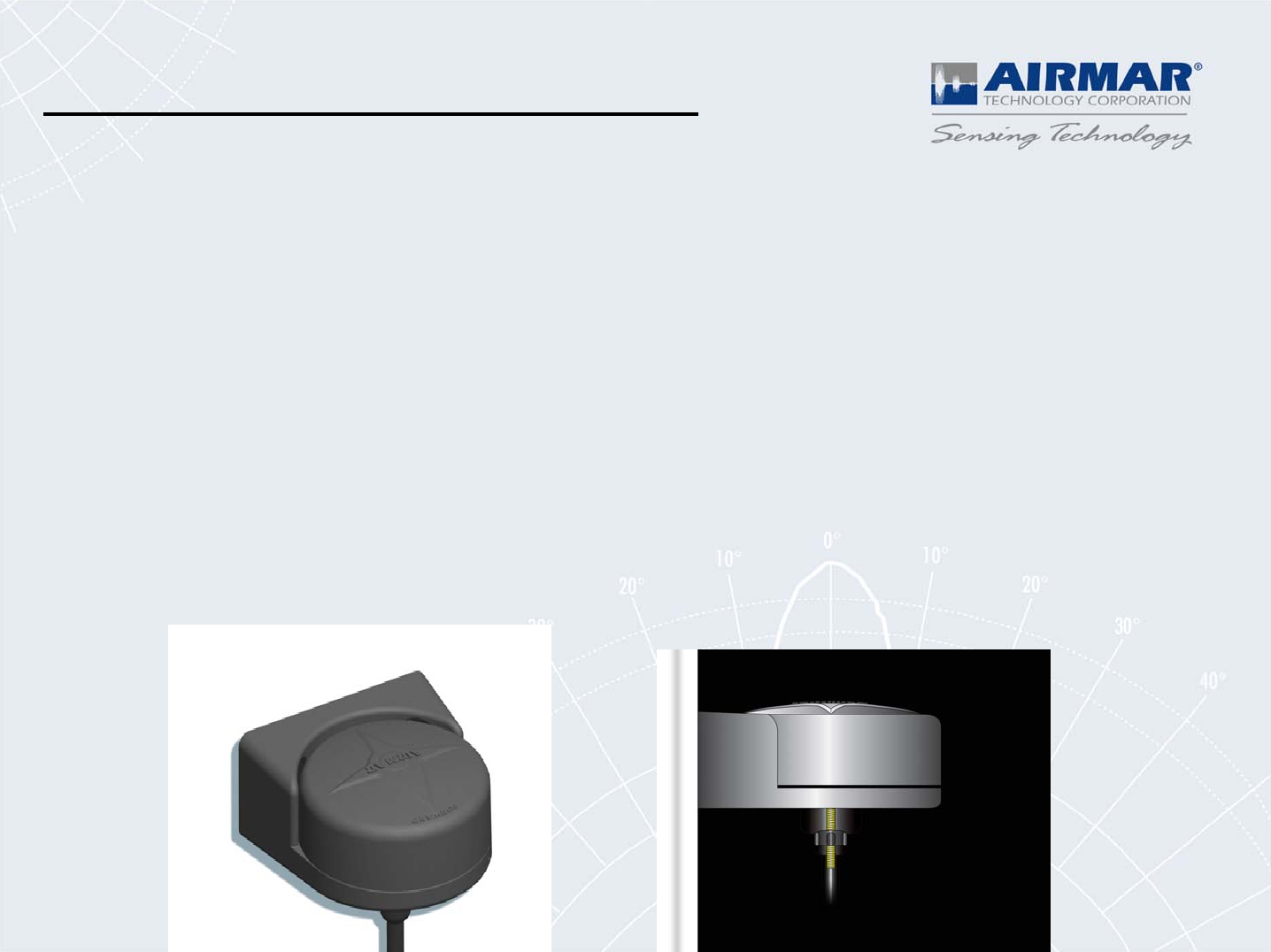
- GH2183 Heading Sensor with GPS
- NMEA Compatibility Chart
- NMEA Compatibility Chart
- NMEA Compatibility Chart
- NMEA Compatibility Chart
- NMEA Compatibility Chart
- Response to Customer Feedback
- B164, SS164 Enhancements
- R99 Enhancements
- R99, R209, R309 Fairings
- R99, R209, & R309 Installations
- R99, R209, & R309 Installations
- Smart Sensor Enhancements: DT800, DST800, P39, P79
- How Smart Sensors track the bottom Firmware Version: 1.011
- How Smart Sensors track the bottom Firmware Version: 1.011
- How Smart Sensors track the bottom Firmware Version: 1.011
- New Fast-Response Temperature Thermistor on 1kW Models
- Airmar Transducer Models
- What’s inside popular models?
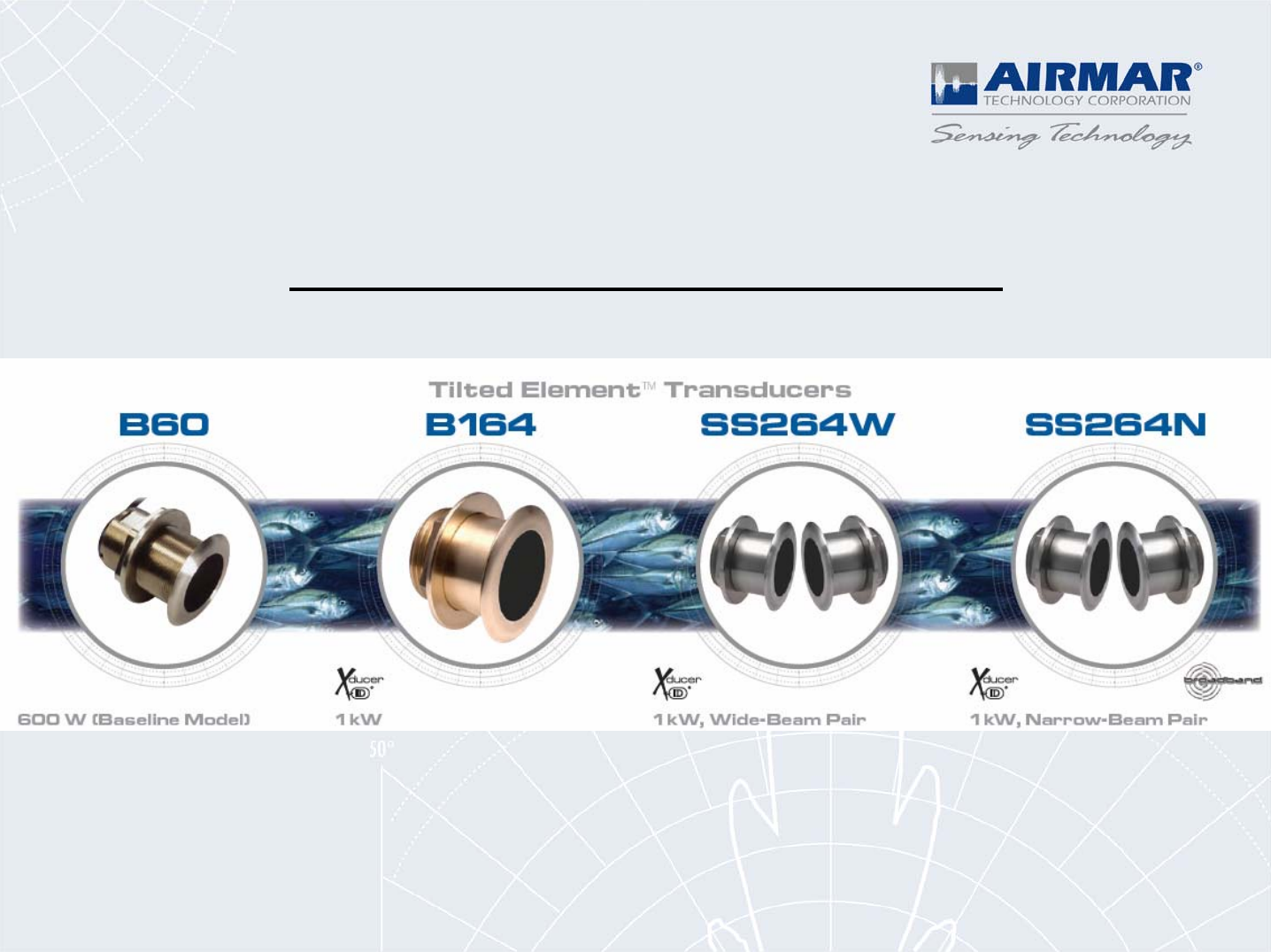
- Tilted Element™ Family
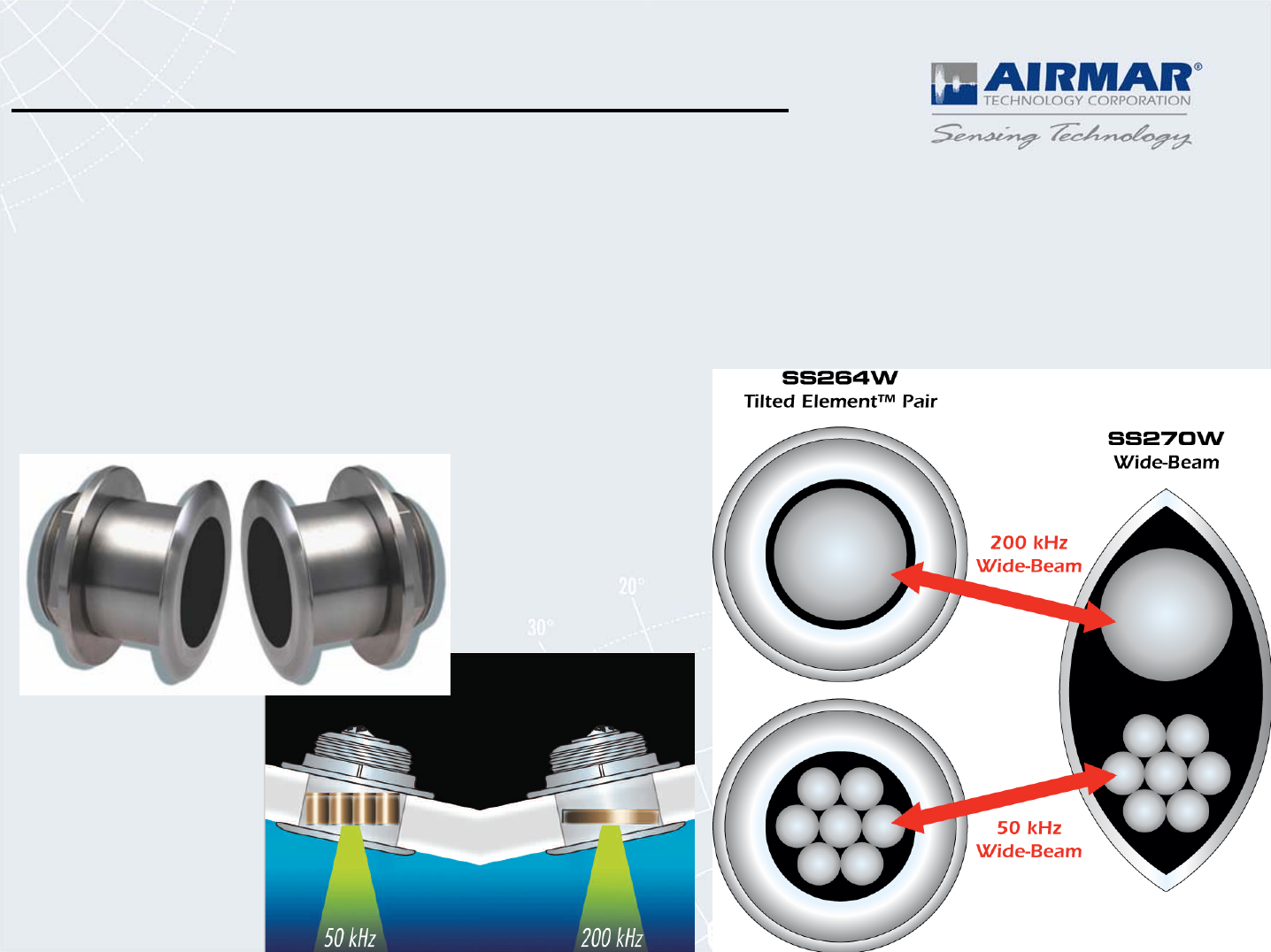
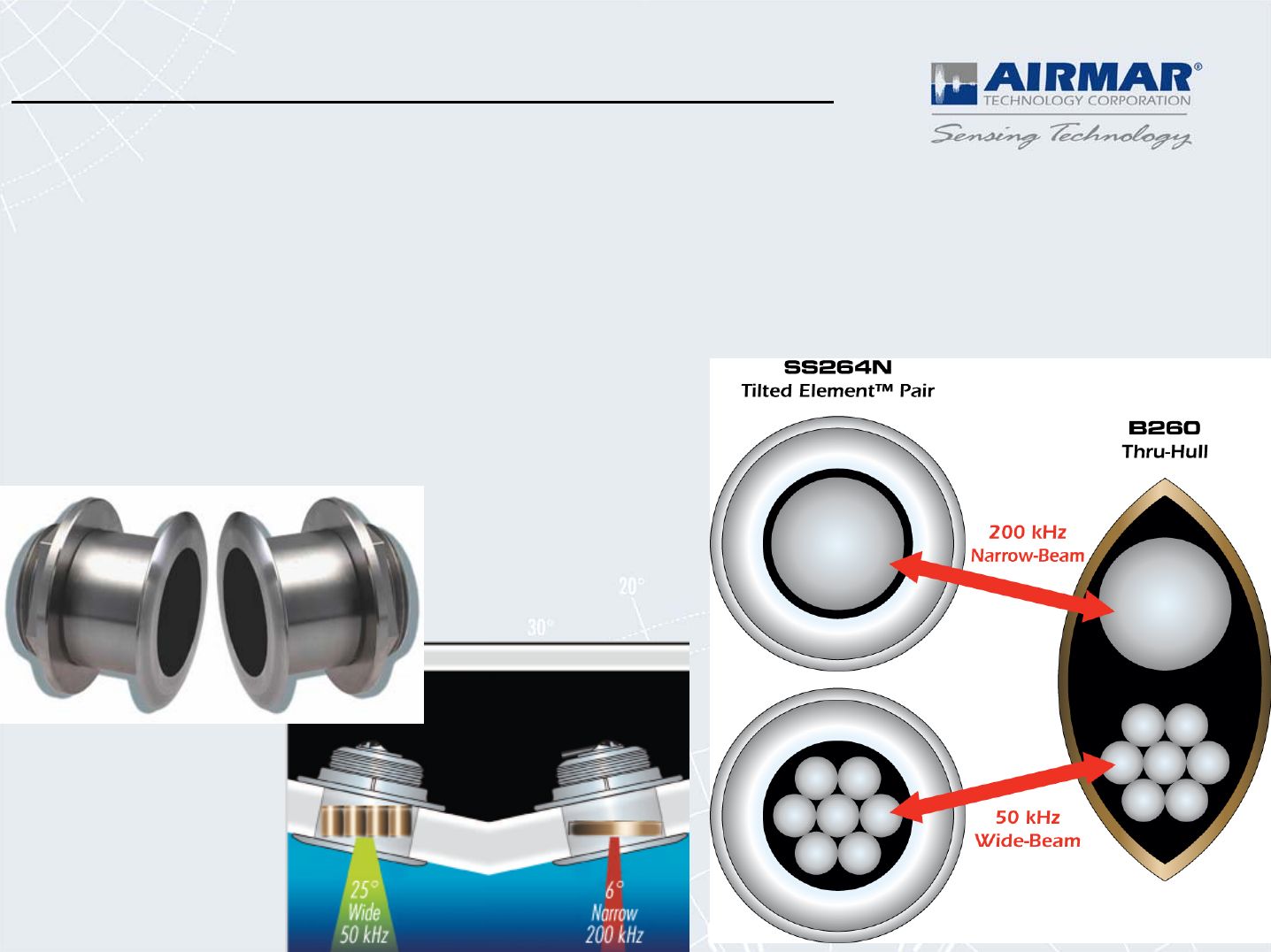
- SS264W Wide Beam Tilted Pair
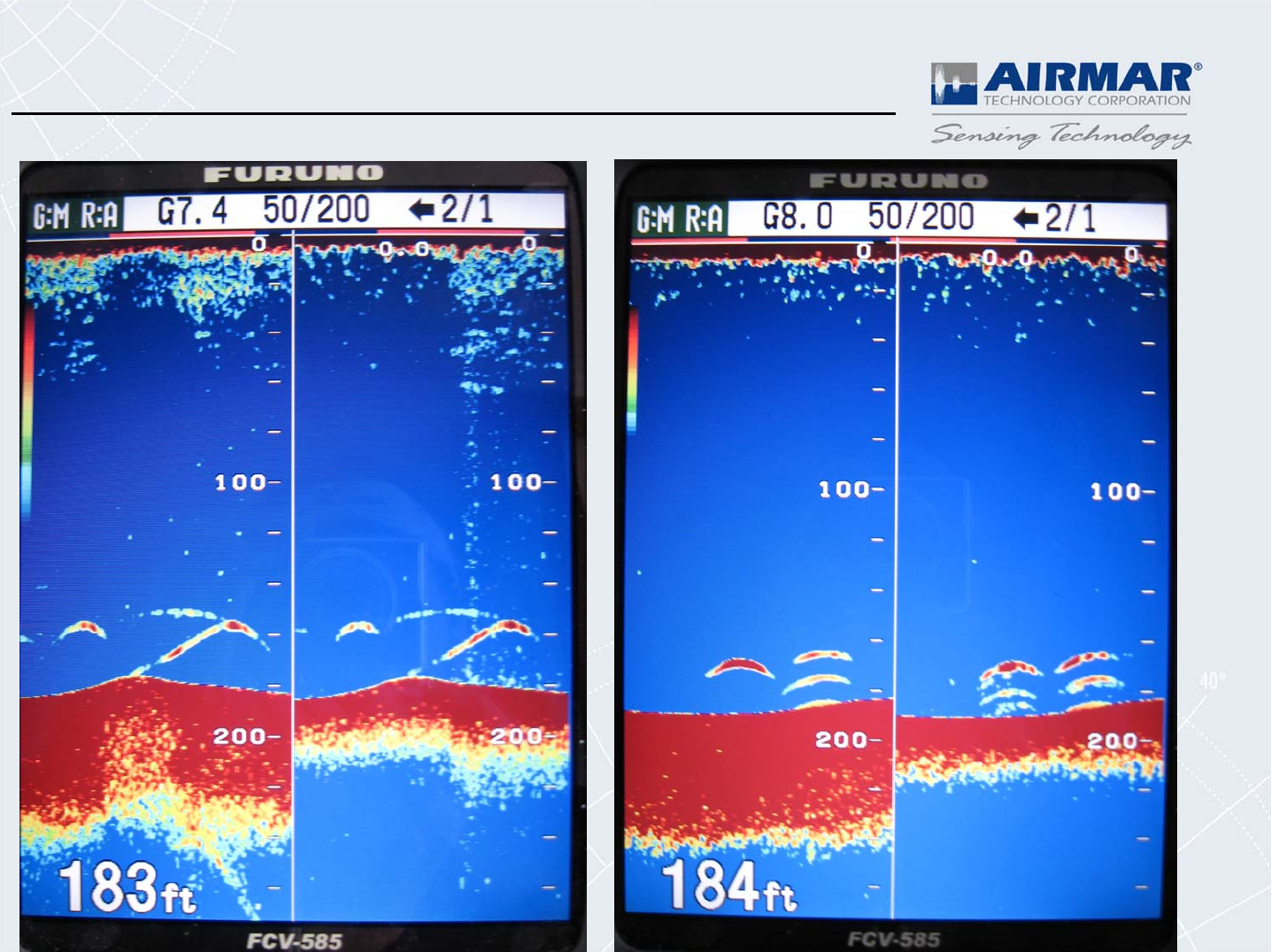
- SS270W & SS264W Screen Images
- SS264N & B260 Screen Images
- SS264W & SS264N Tilted Element™ Pair
- SS270W Fishing Applications
- NEW High Performance 1kW Transom Mount Transducer Line
- High Performance 1kW Transom Bracket
- 3 New 1kW Transom Models:
- P48W Adjustable-Beam Transom Mount
- P48W Adjustable Beam
- Installation-Specific Products
- SB264 200kHz Wide/Narrow-Beam Switch box
- SB260 1kW Switch box
- External Diplexer Box
- 1kW Mix & Match Transducers
- Converting Transducers to Different Manufacturer’s Equipment
- Converting Transducers
- Converting Transducers
- Converting Transducers
- Converting Transducers
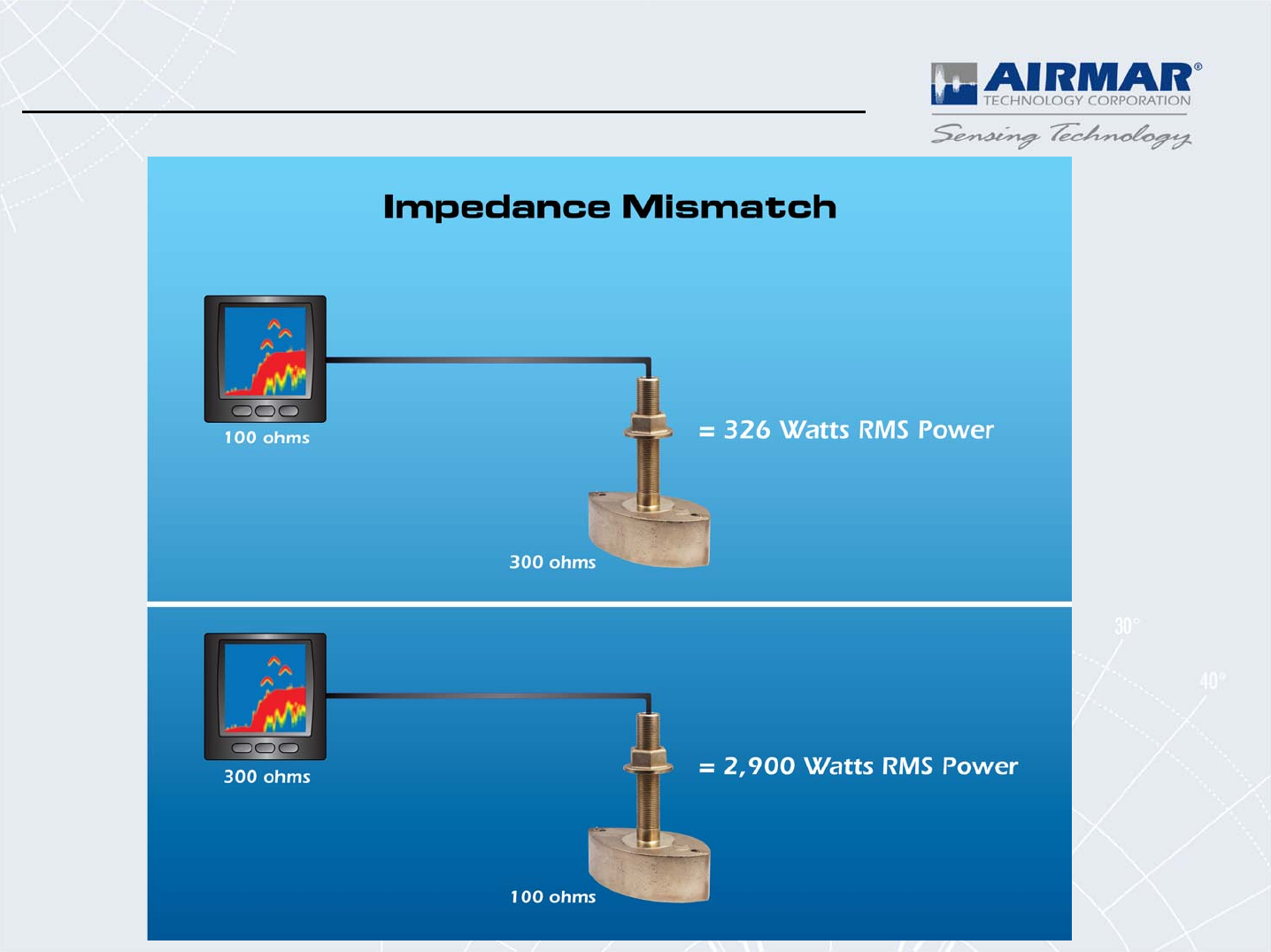
- General Notes on Impedance when converting manufacturer’s transducers
- Impedance Chart- Power Curve
- Impedance in relation to RMS Power
- Transducer Adaptor Cables Converts the following:
- Installation & Troubleshooting
- Installation & Troubleshooting
- This installation of a B164 looks good, however notice the strake 10 feet directly in front of the transducer. This causes tu
- Bad Installation
- Bad Installation
- Good Installation
- In Hull Transducers
- In-Hull Transducers for Fiberglass Hulls
- In-Hull Transducers: Depth Performance vs. Hull Thickness
- M260 Max depth @ 50 kHz with 1kW Input power
- M260 200 kHz FREQUENCY SHIFT vs. HULL THICKNESS
- M260 Max depth @ 200 kHz with 1kW Input Power
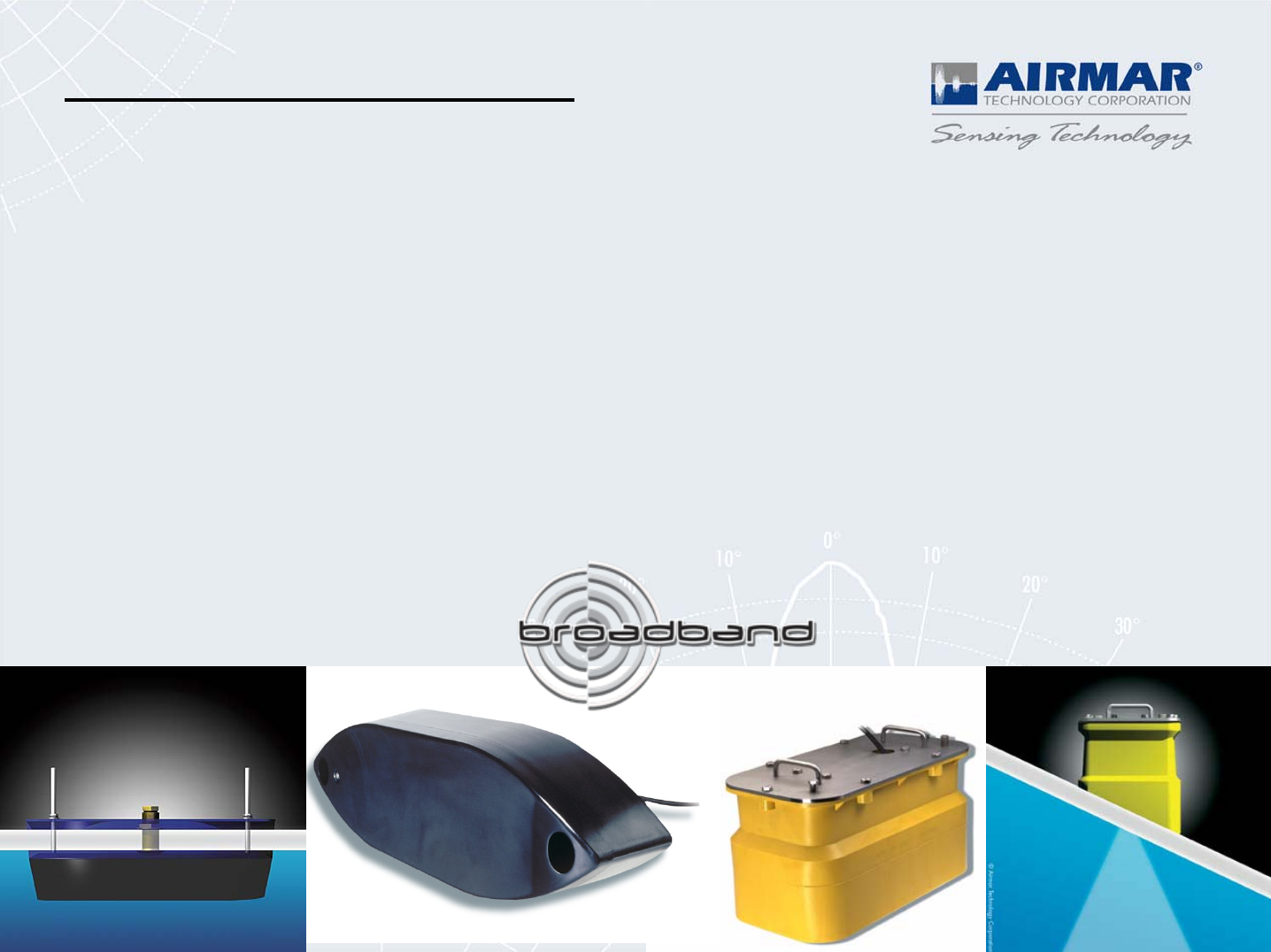
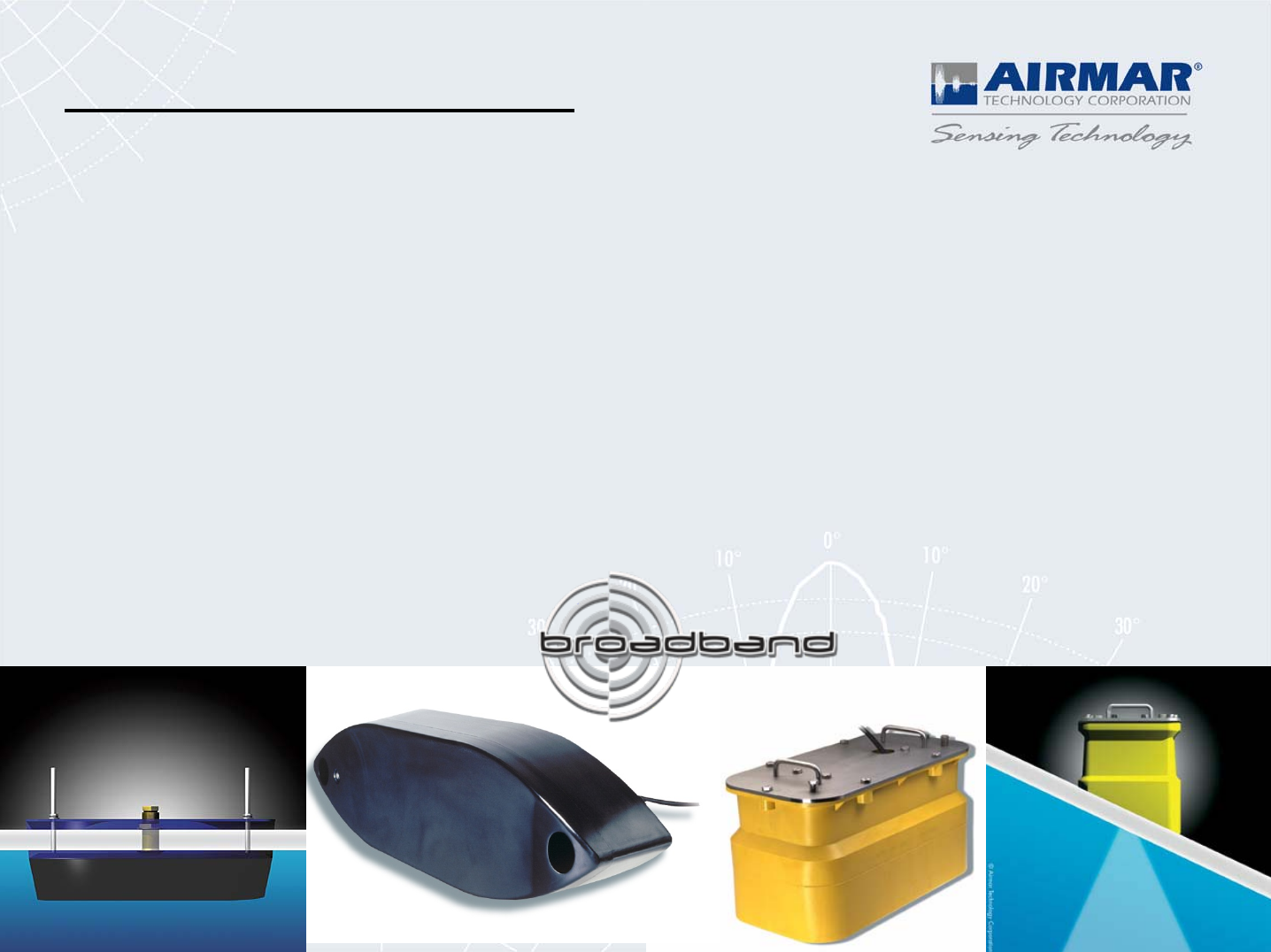
- Broadband Transducers
- Benefits of Tunable Fishfinders with Broadband Transducers
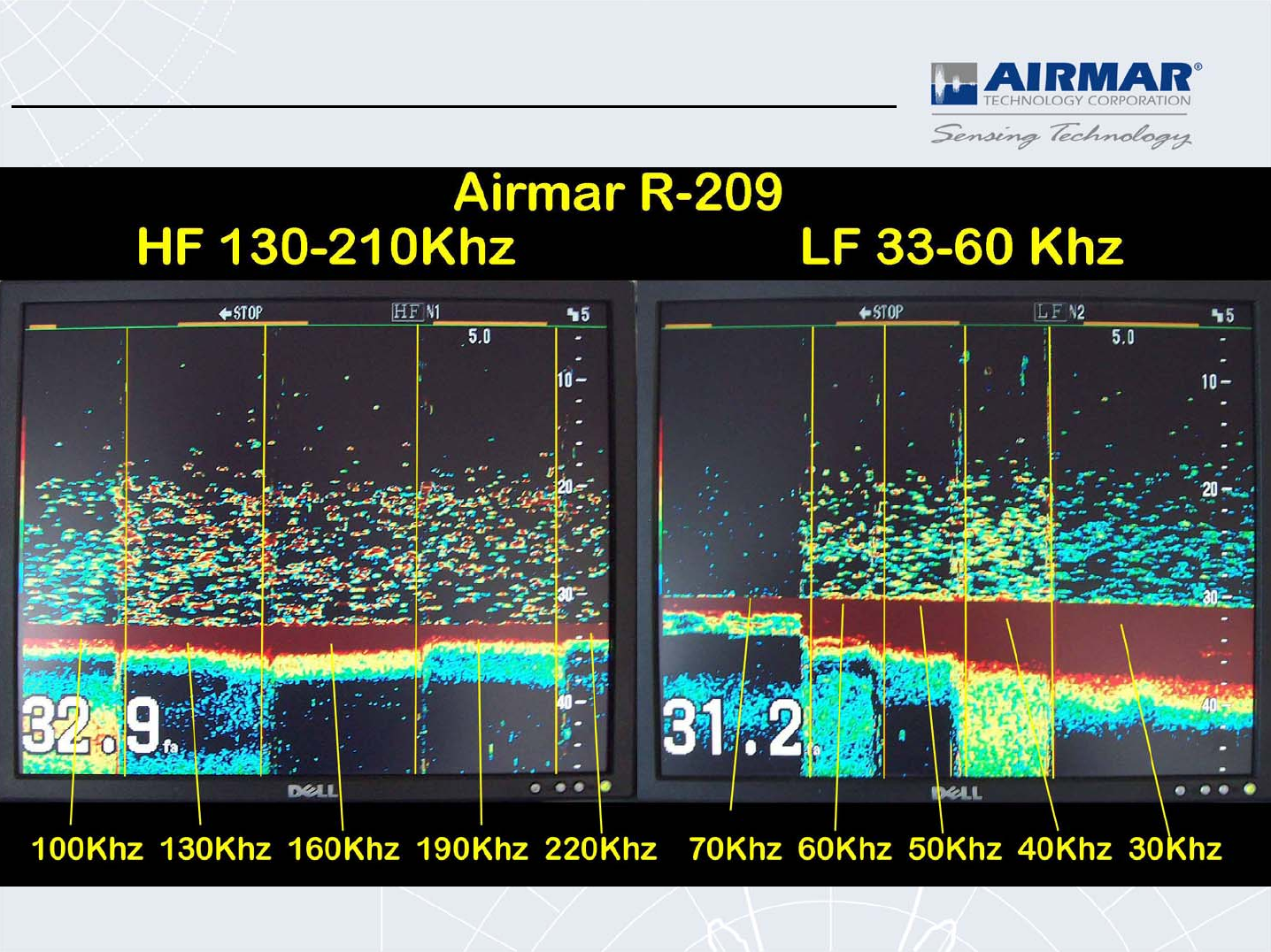
- Imaging at various frequencies
- B238 Middle Frequency
- 2-3kW R209 & R299
- 2-3kW R309 & R399
- Installing & Troubleshooting Transom-Mount Models
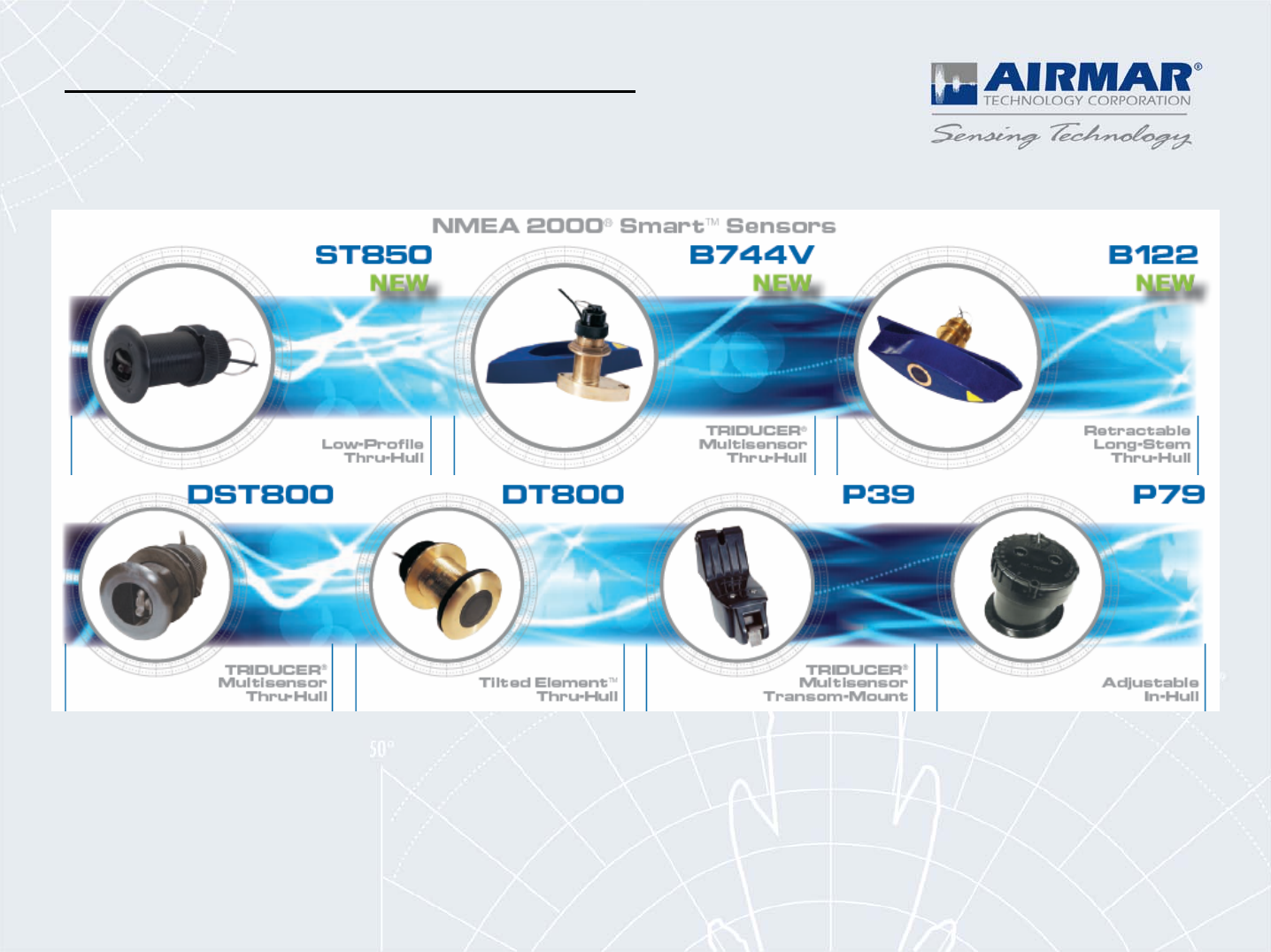
NMEA 2000® Sensors
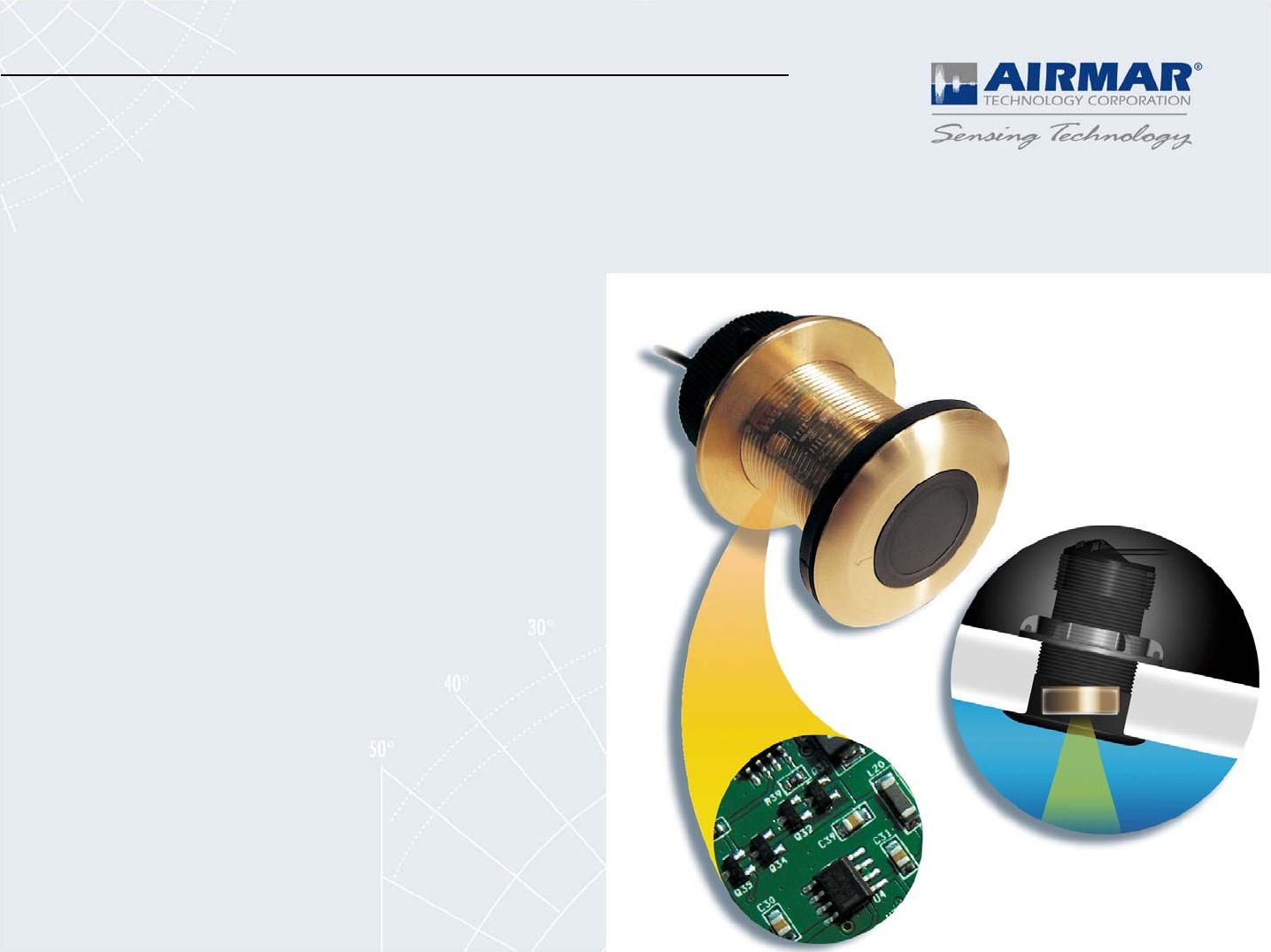
NMEA 0183 & 2000® Smart Sensors
•All signal processing is done inside the transducer
•Operates at 235kHz
•No interference with on-board 50/200 kHz sounder
•Provides digital depth, speed, and temperature
•Separate models for 0183 and 2000
NMEA 0183 Smart Sensors are compatible
with all NMEA 0183 displays that can read the
following sentences:
$SDDBT, DDPT....Depth
$VWVHW........... Speed
$VWVLW............ Distance
$YXMTW.............Water Temperature
NMEA 2000 Smart Sensors are compatible
with all NMEA 2000 displays
that can read the following PGN’s:
128259........ Speed Water Reference
128267.........Water Depth and Transducer
128275........ Distance Log
130310........ Water Temperature
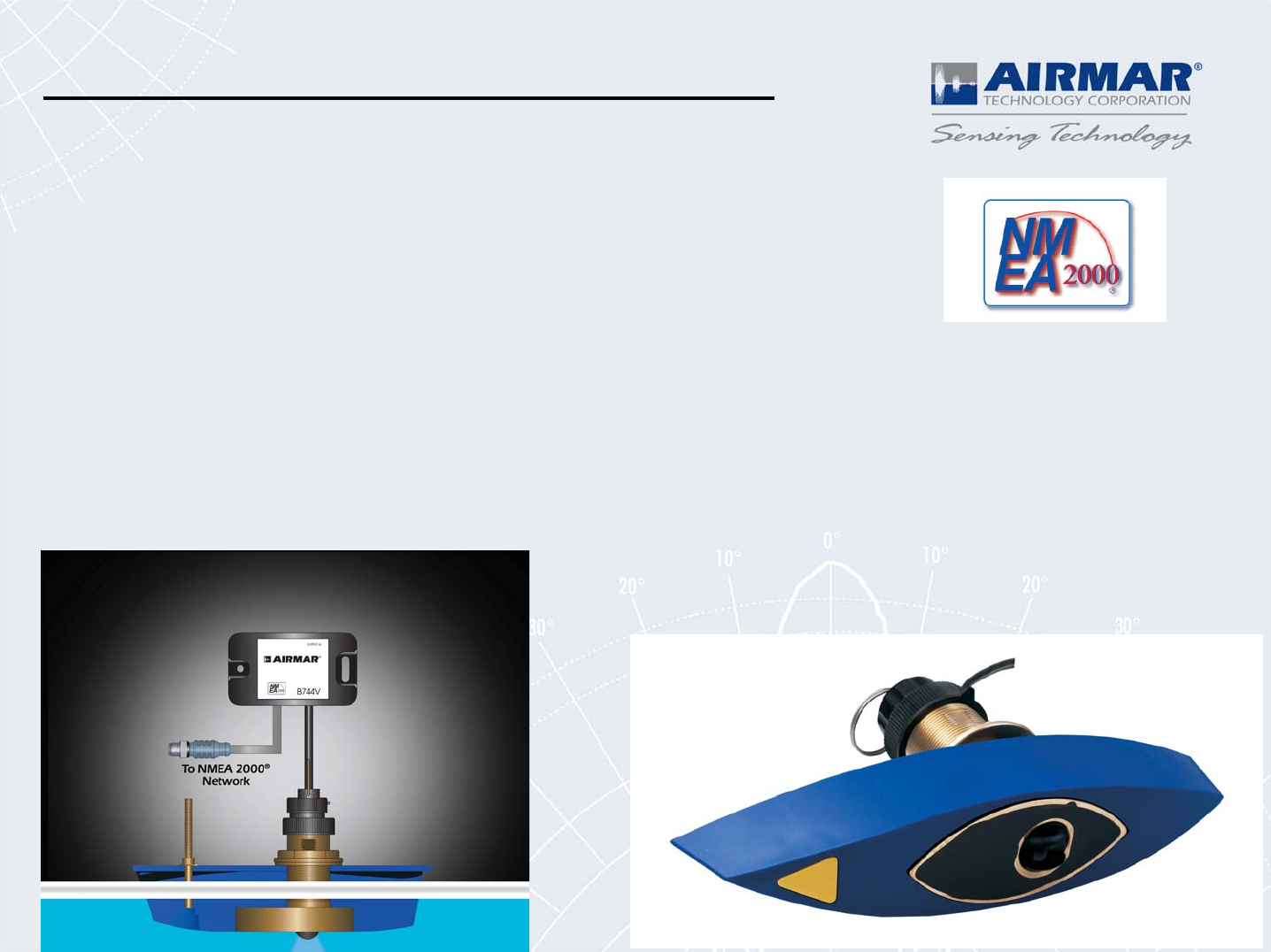
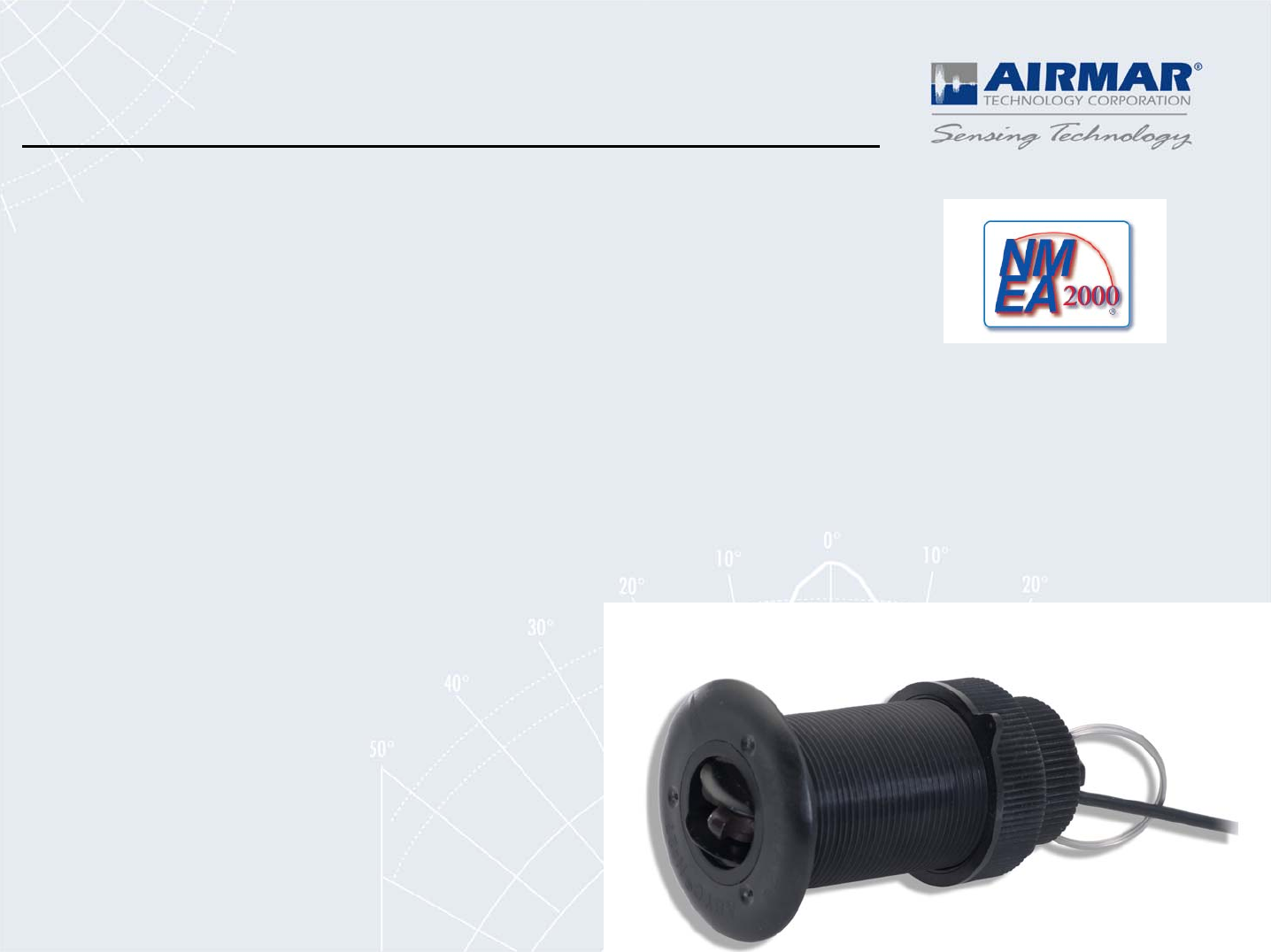
NEW NMEA 2000 B744V
• Depth, speed, and temperature
• 235 kHz
• 100 Watts Power with broadband ceramic
• Minimum Depth Range: 0.5 m (1.6’)
• Maximum Depth Range: Up to 180 m (590’)
• Bronze housing
• For installations requiring a High-Performance Fairing
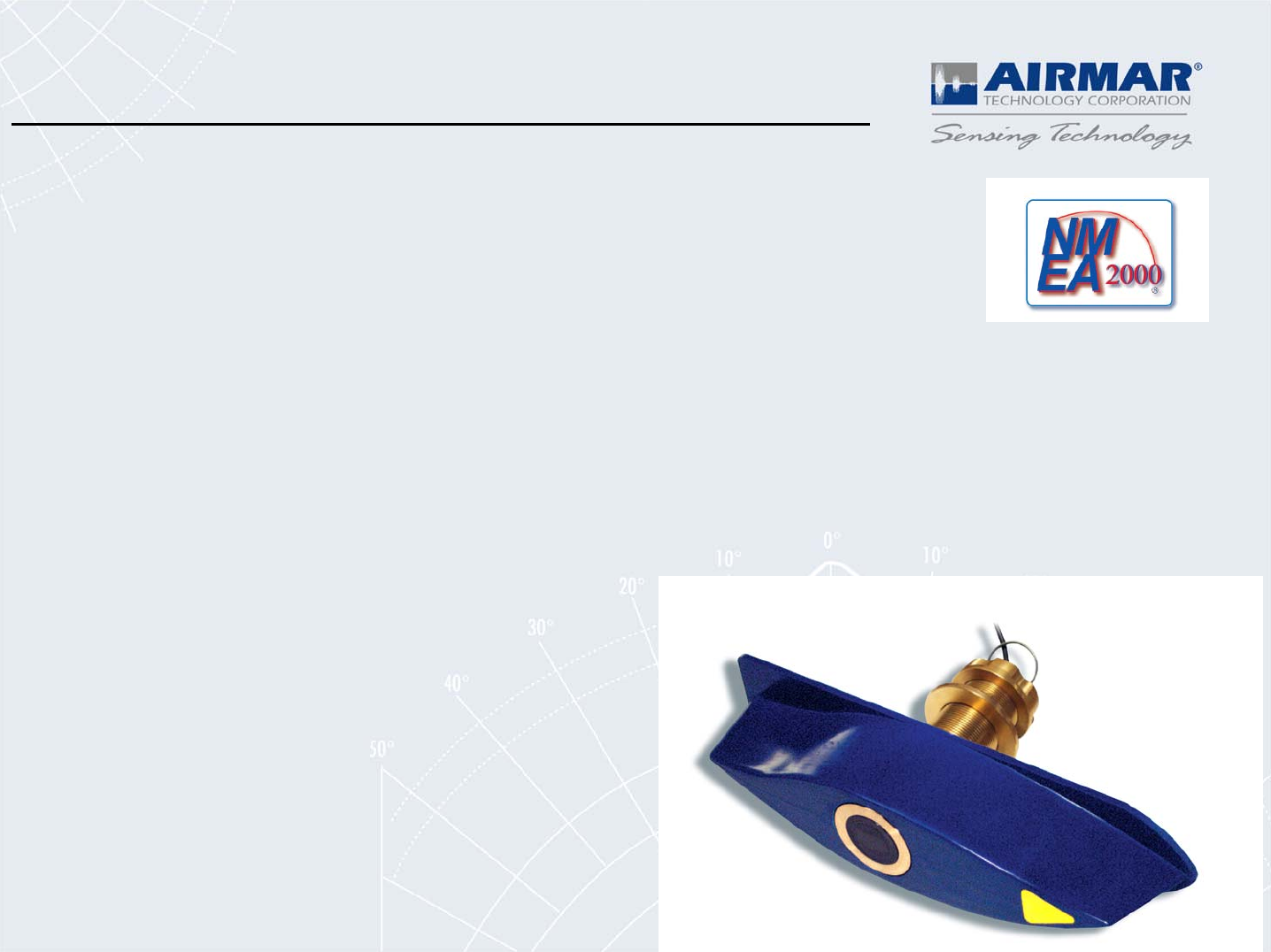
NEW NMEA 2000 ST850 & ST800
• Speed and temperature
• 6 m (20’) NMEA 2000 cable
• Devicenet connector
• ST850 retrofits into existing Airmar P17 & B17 2” housings
• ST800 retrofits into existing Airmar P120 & B120 2” housings
• Retractable housing with water valve
• Plastic, bronze, or stainless steel housings
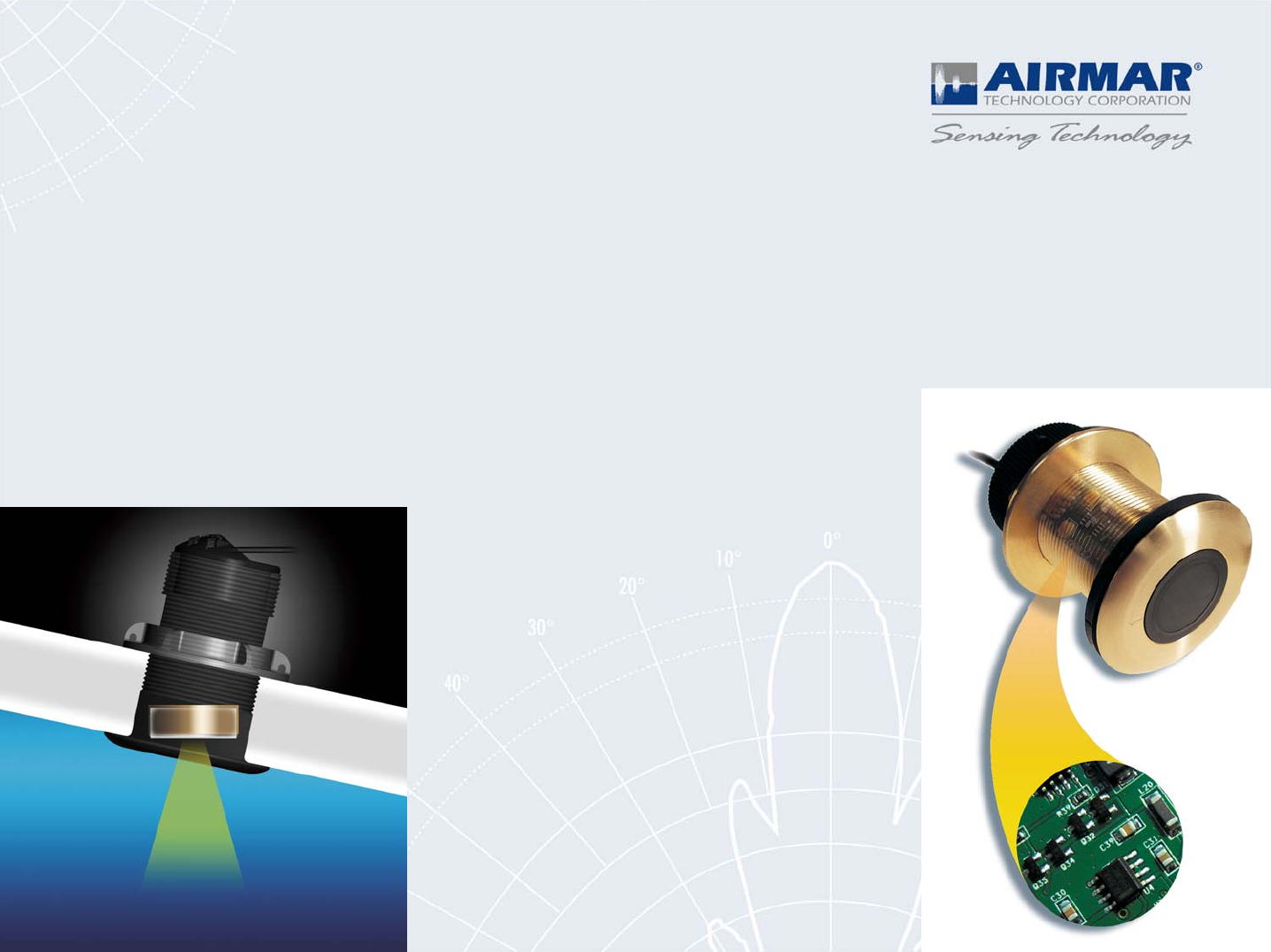
NEW NMEA 2000 B122 Long-Stem
• Depth and temperature
• 235 kHz
• 100 Watts Power with broadband ceramic
• Minimum Depth Range: 0.5 m (1.6’)
• Maximum Depth Range: Up to 180 m (590’)
• Bronze, long-stem housing
• For steep deadrise and thick hull vessels
DT800 Tilted Element™ Smart Sensors
New design incorporates:
• Broadband 235kHz Ceramic
• Higher power rating (100W)
• Increased depth capability down to 600ft
• Better shallow water performance(<1.6 ft)
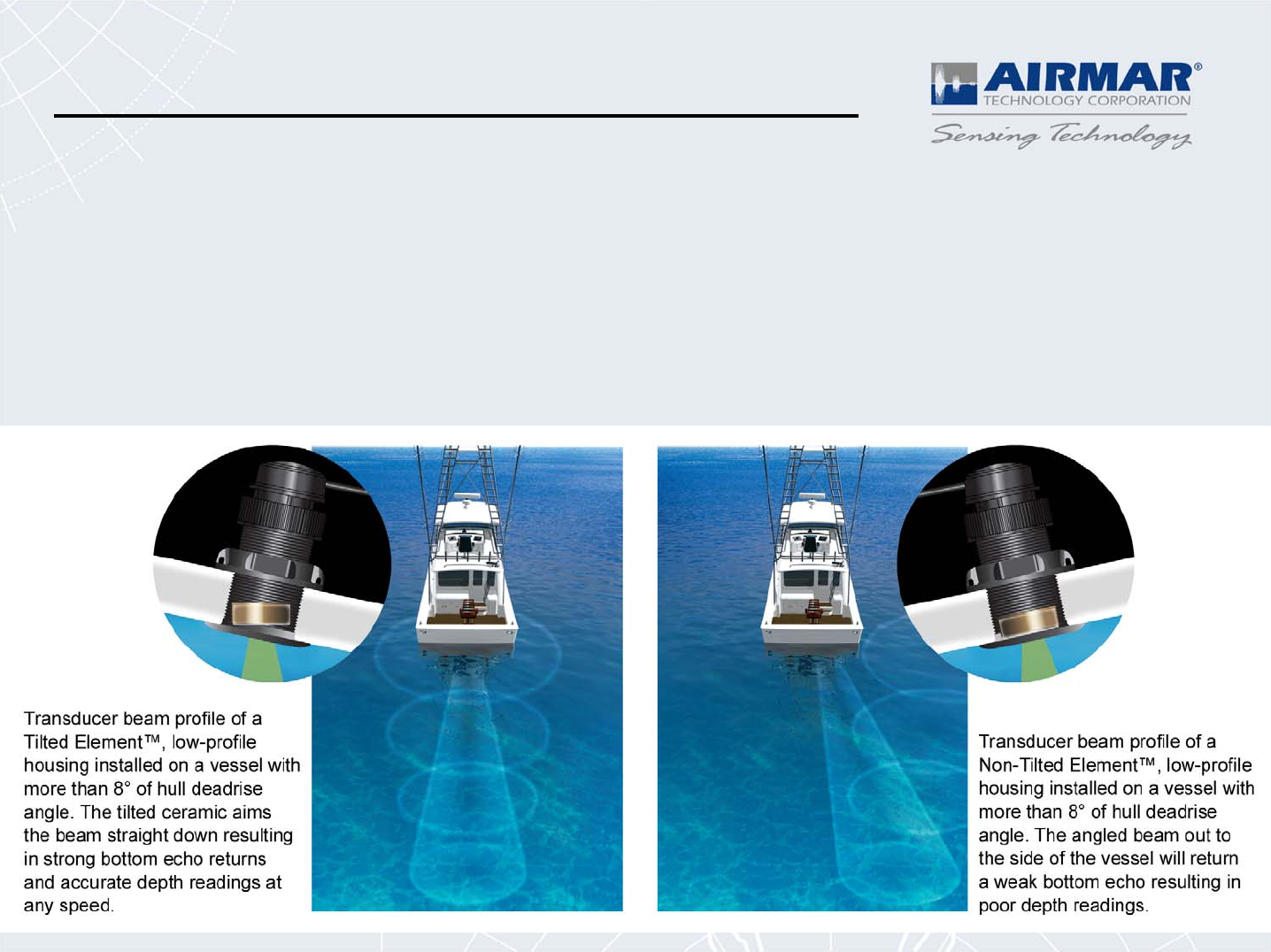
DT800 Tilted Element™ Benefits
With Tilt Without Tilt
•Available in 0°, 12°, or 20° Tilts
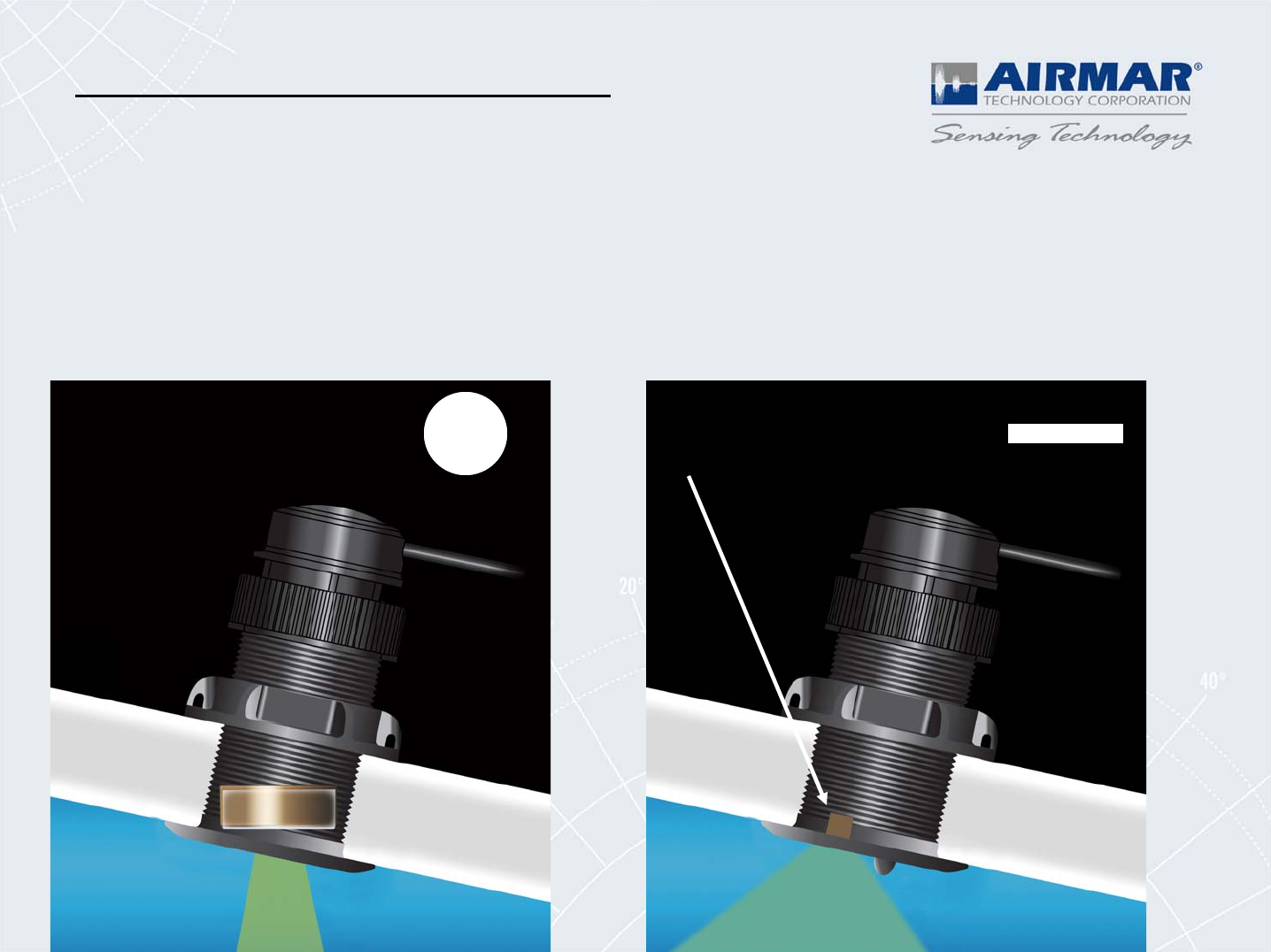
DT800 vs. DST800
•Broadband, round ceramic
•Better sensitivity vs. DST800
•12° beam, 590’ max depth
•Fixed 0°, 12°, or 20° tilt
•Rectangular bar ceramic
•Three sensors in one housing
•10° x 44° beam, 330’ max depth
•Works with all deadrise angles
Ceramic shape: Ceramic shape:
Smart™ Sensor Family
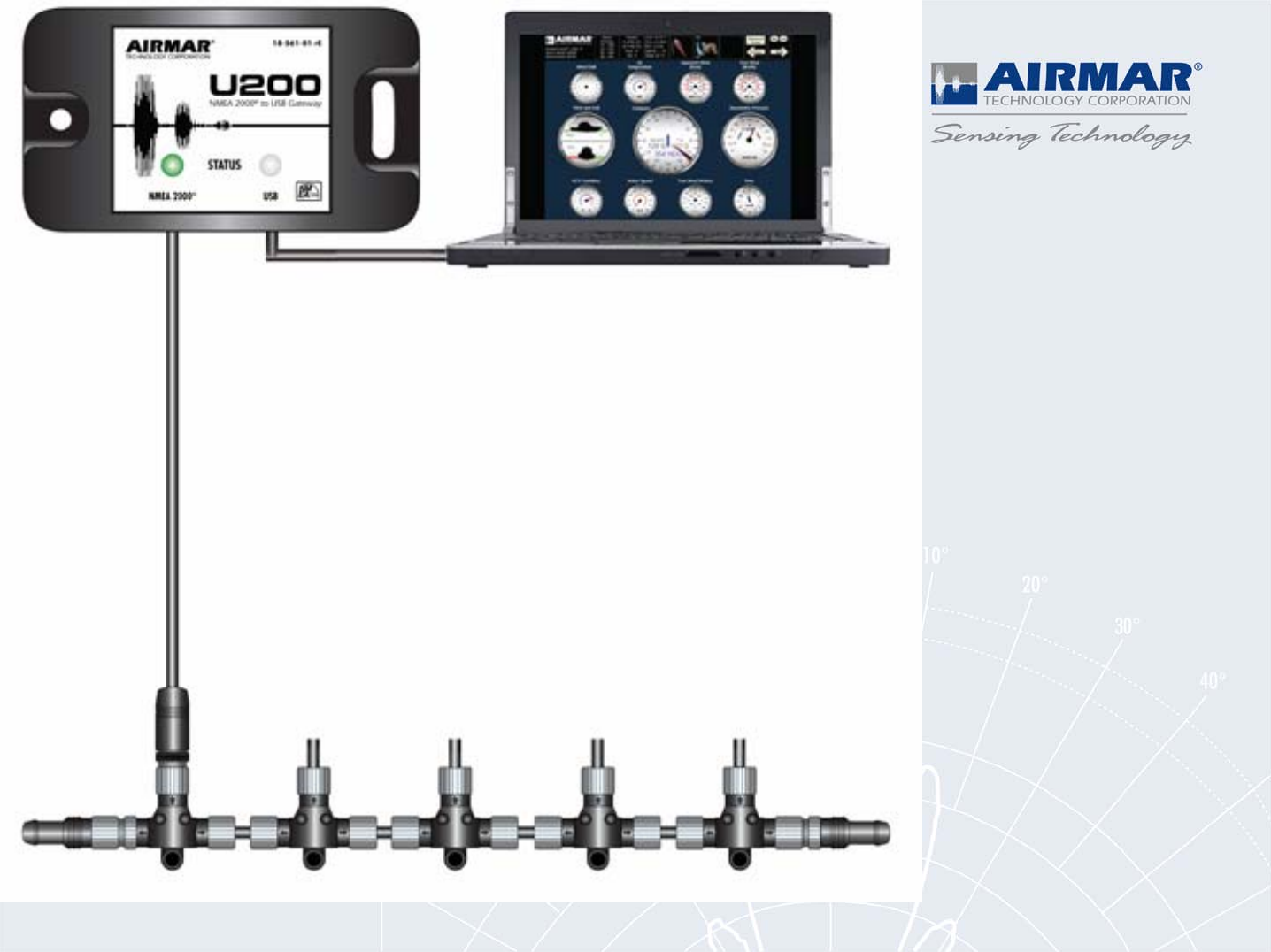
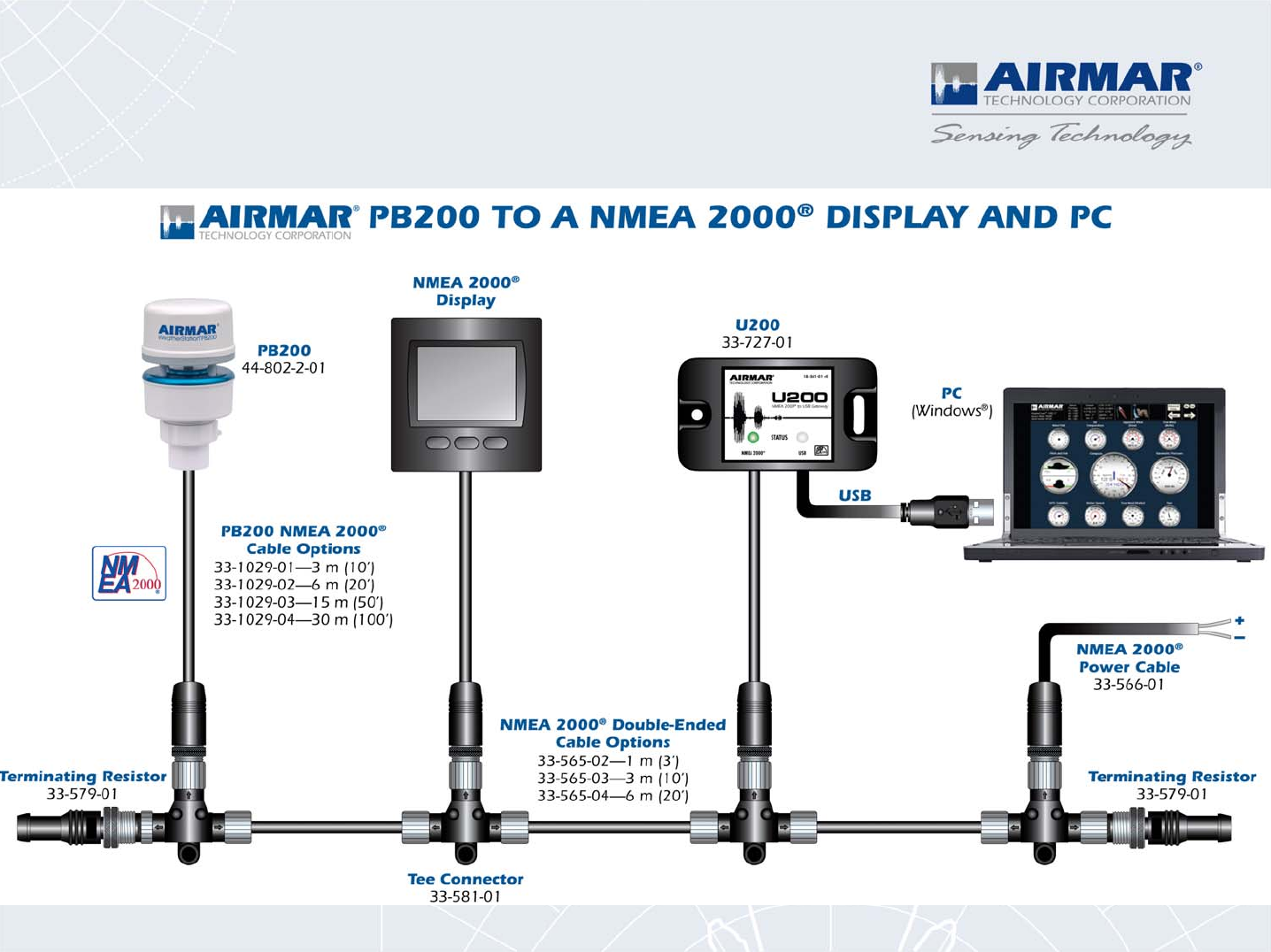
• Converts NMEA 2000® PGNs to USB format
• Plug-and-play connectivity from a NMEA 2000
network backbone to a PC
• For Airmar NMEA 2000 Sensors and other Certified
NMEA 2000 Sensors: GPS Receivers, Heading
Sensors, and Smart™, Depth, Speed, and
Temperature Sensors
• Airmar WeatherCaster™ Software included
• Baud Rate: 115,200
U200 Supported PGN’s
•059392........ ISO Acknowledgment
•059904........ ISO Request
•060160........ ISO Transport Protocol, Data Transfer
•060416........ Transport Protocol, Connection Management
•060928........ ISO Address Claim
•065240........ ISO Commanded Address
•126208........ Acknowledge Group Function
•126208........NMEA Complex Command Group Function
•126464........ PGN List—Transmit and Receive PGNs Group
•126992........ System Time
•126996........ Product Information
•126998........ Configuration Information
•127250........Vessel Heading
•127251........ Rate of Turn
•127257........ Attitude
•127258........ Magnetic Variation
•128259........ Speed
•128267........Water Depth
•128275........ Distance Log
•129025........ Position, Rapid Update
•129026........ COG and SOG, Rapid Update
•129029........ GPS Position Data
•129033........ Time and Date
•129044........Datum
•129538........ GNSS Control Status
•129539........GNSS DOPs
•129540........ GNSS Sats in View
•129541........ GPS Almanac Data
•130306........ Wind Data
•130310........ Environmental Parameters
•130311........ Environmental Parameters
•130323........ Meteorological Station Data
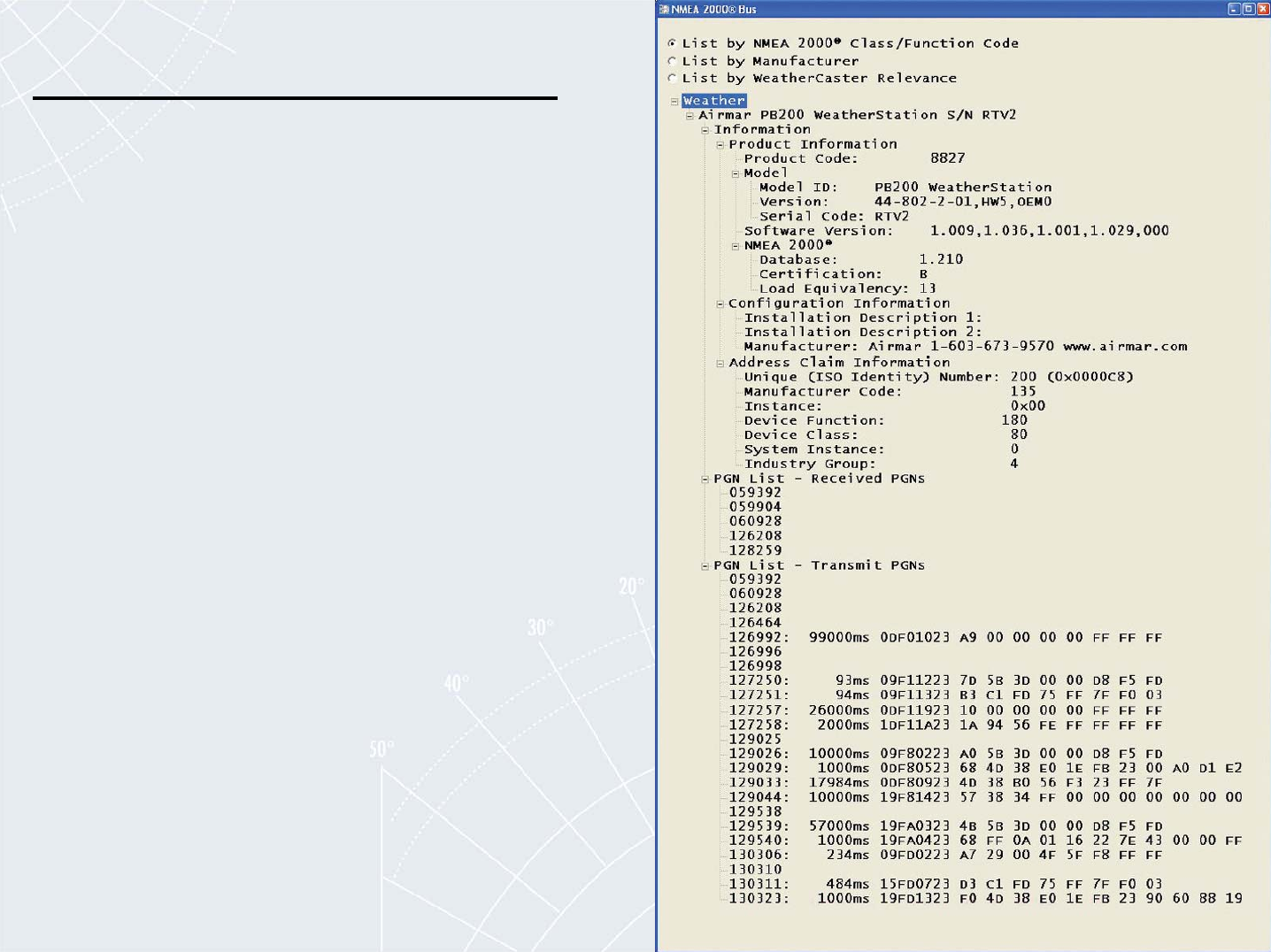
U200 Diagnostics
•View all connected devices
•Troubleshoot the network
•Select priority of devices
•Calibrate Airmar products
•Flash update Airmar products
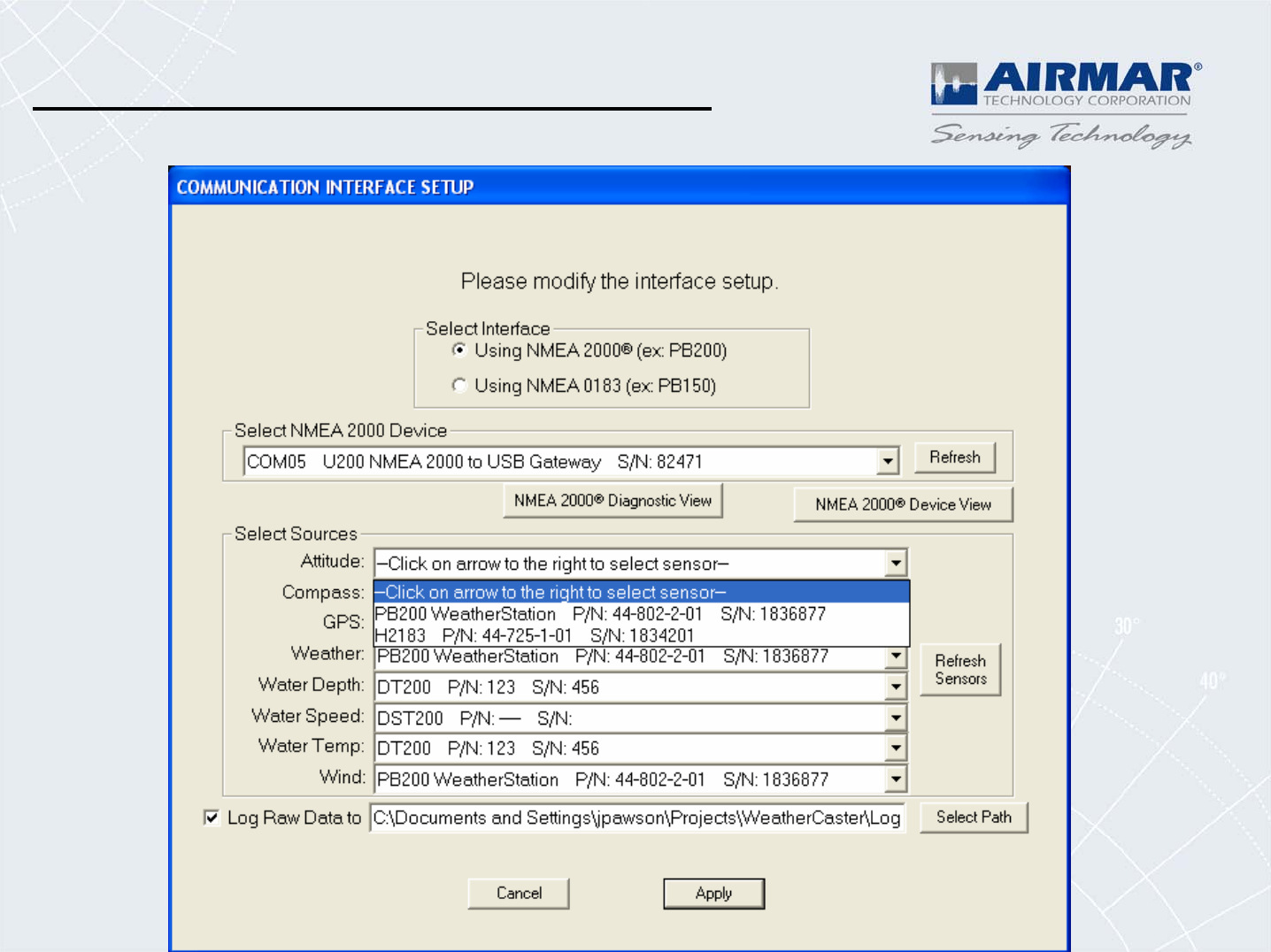
U200 Device Selection
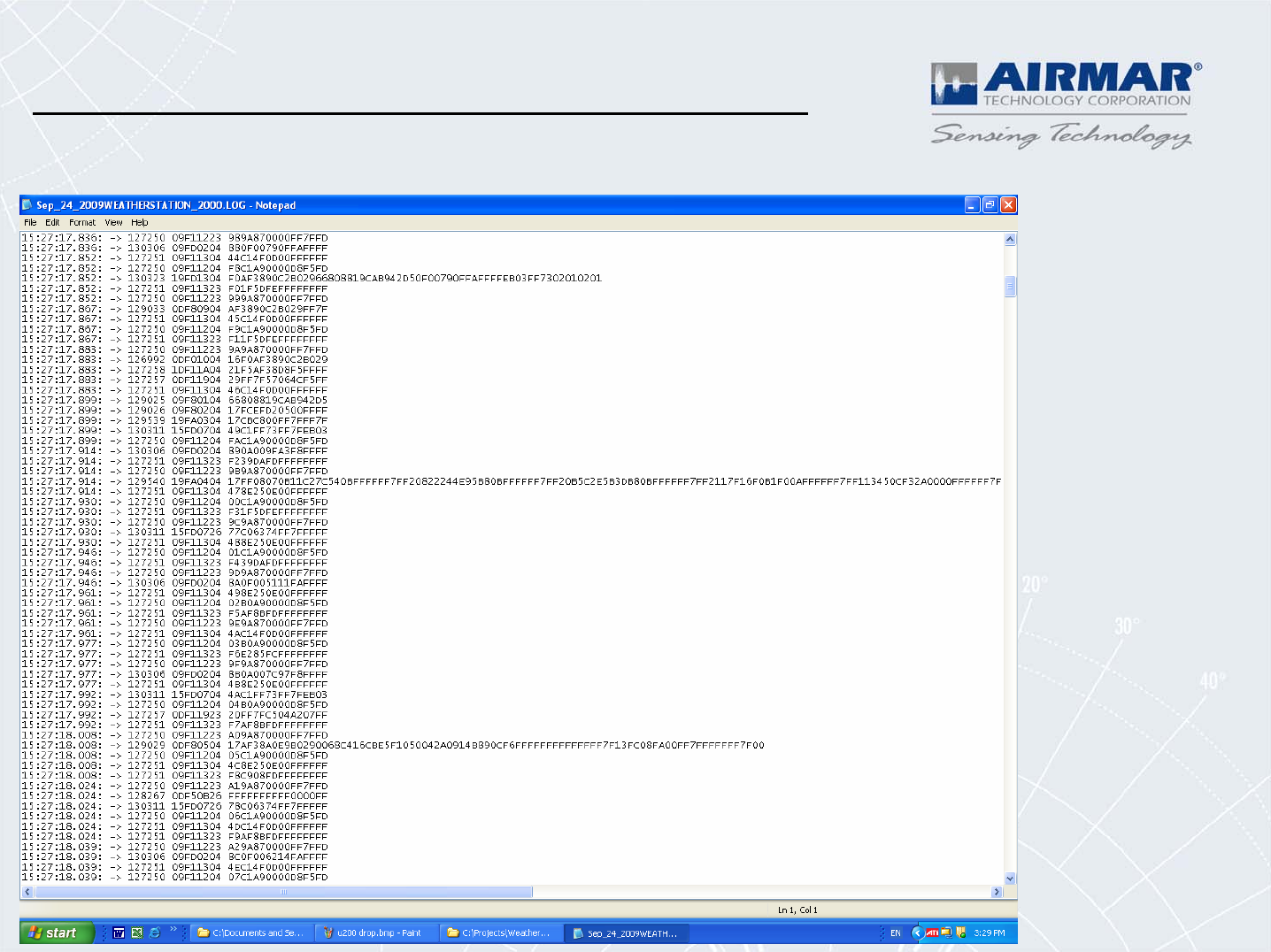
U200 & Weathercaster Logging
•Raw data can be exported and plotted in MS Excel
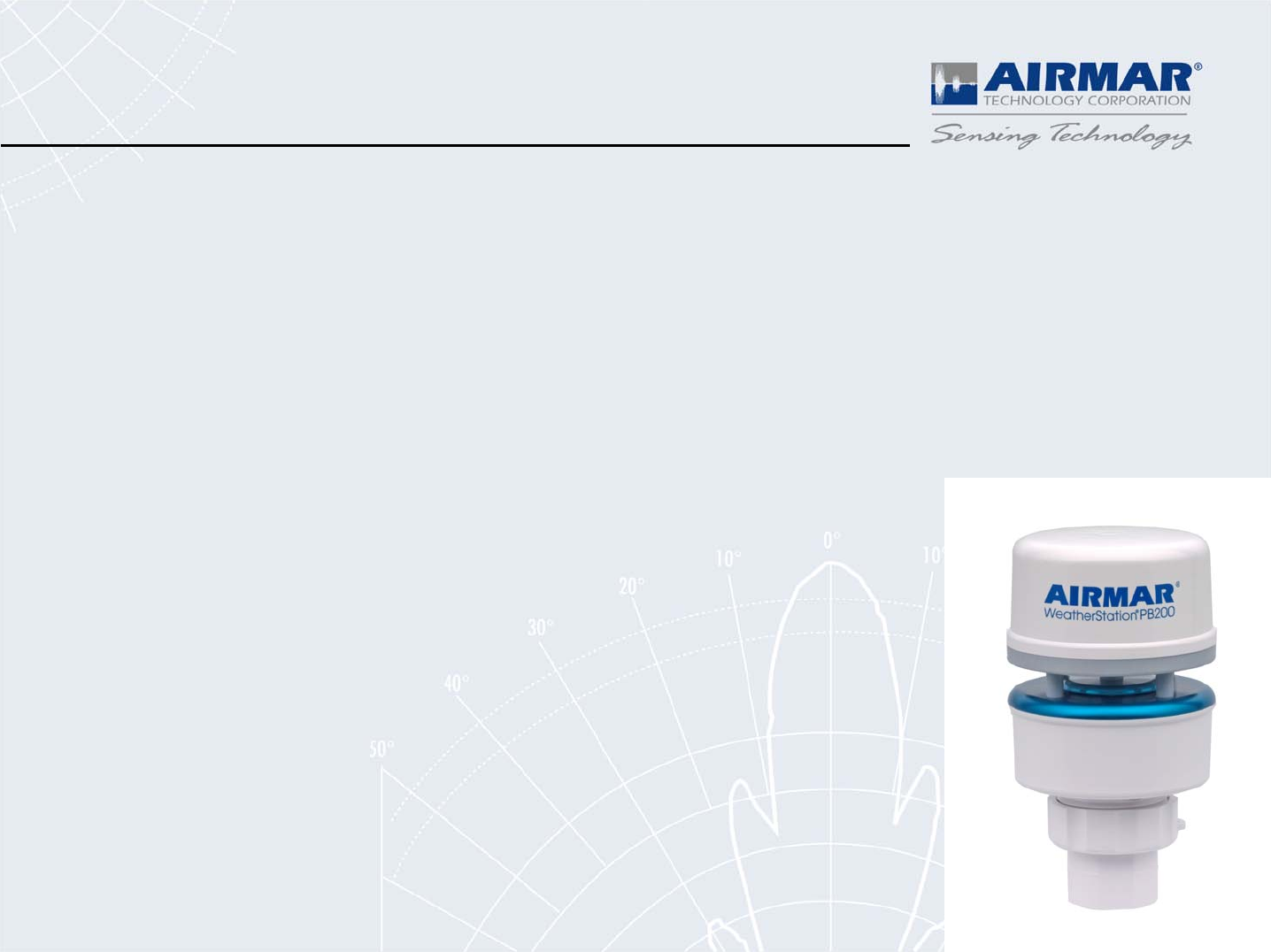
PB200 WeatherStation® Instrument
• NEW 360° calibration results in:
• Improved wind direction accuracy
– 5° RMS at wind speeds from 4 to 10 knots
– 2° RMS at wind speeds from 10 to 80 knots
• Improved barometer accuracy +/- 2 mbar
• Exposed Air temperature button improves
accuracy to +/- 1°C (1.8° F)
• Built-in terminating resistor on NMEA 2000
cables over 6 meters.
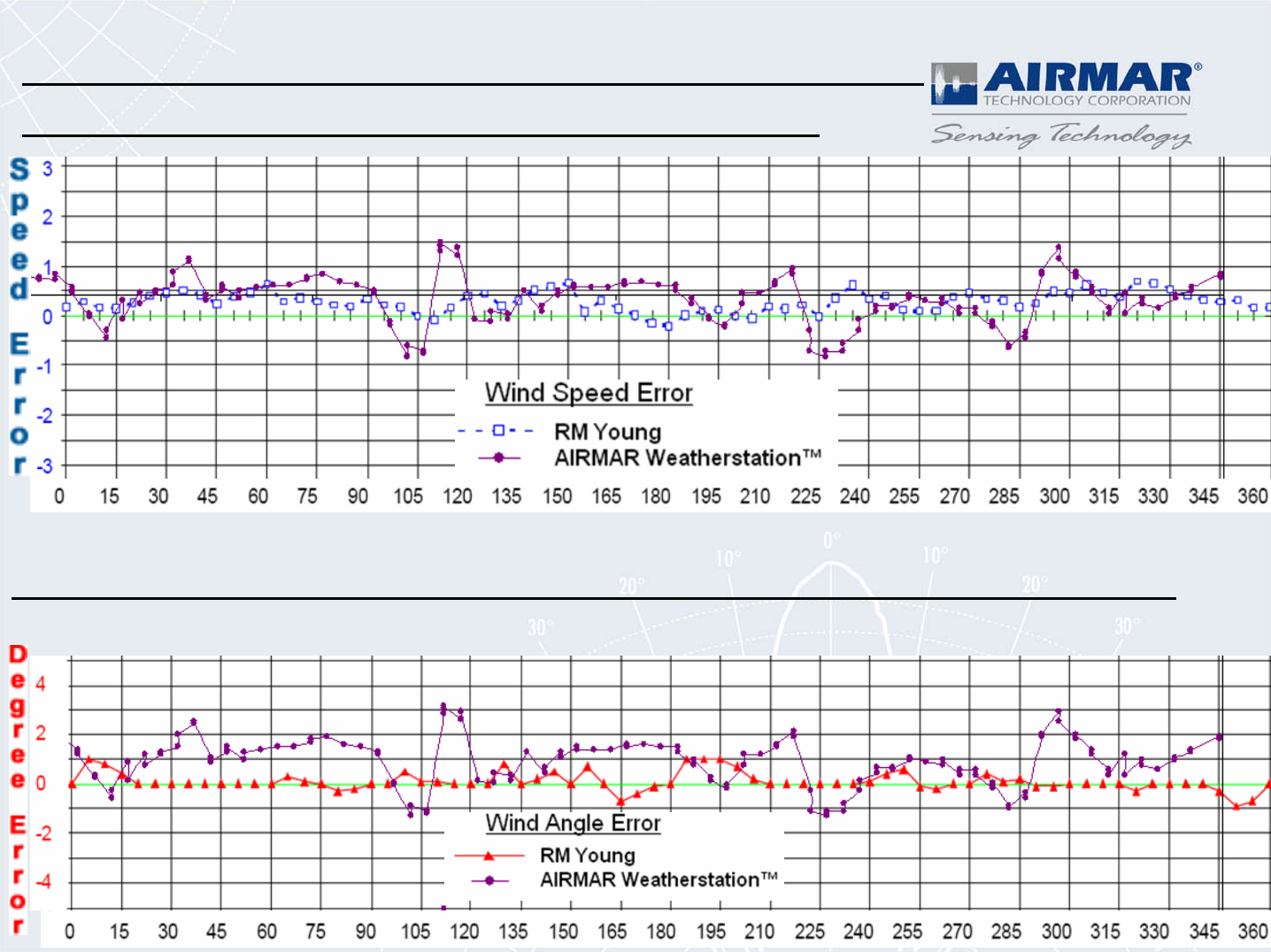
PB200 Wind Speed Accuracy vs RM Young
Meteorological Wind Only Instrument
PB200 Wind Direction Accuracy vs RM Young ($1,700)
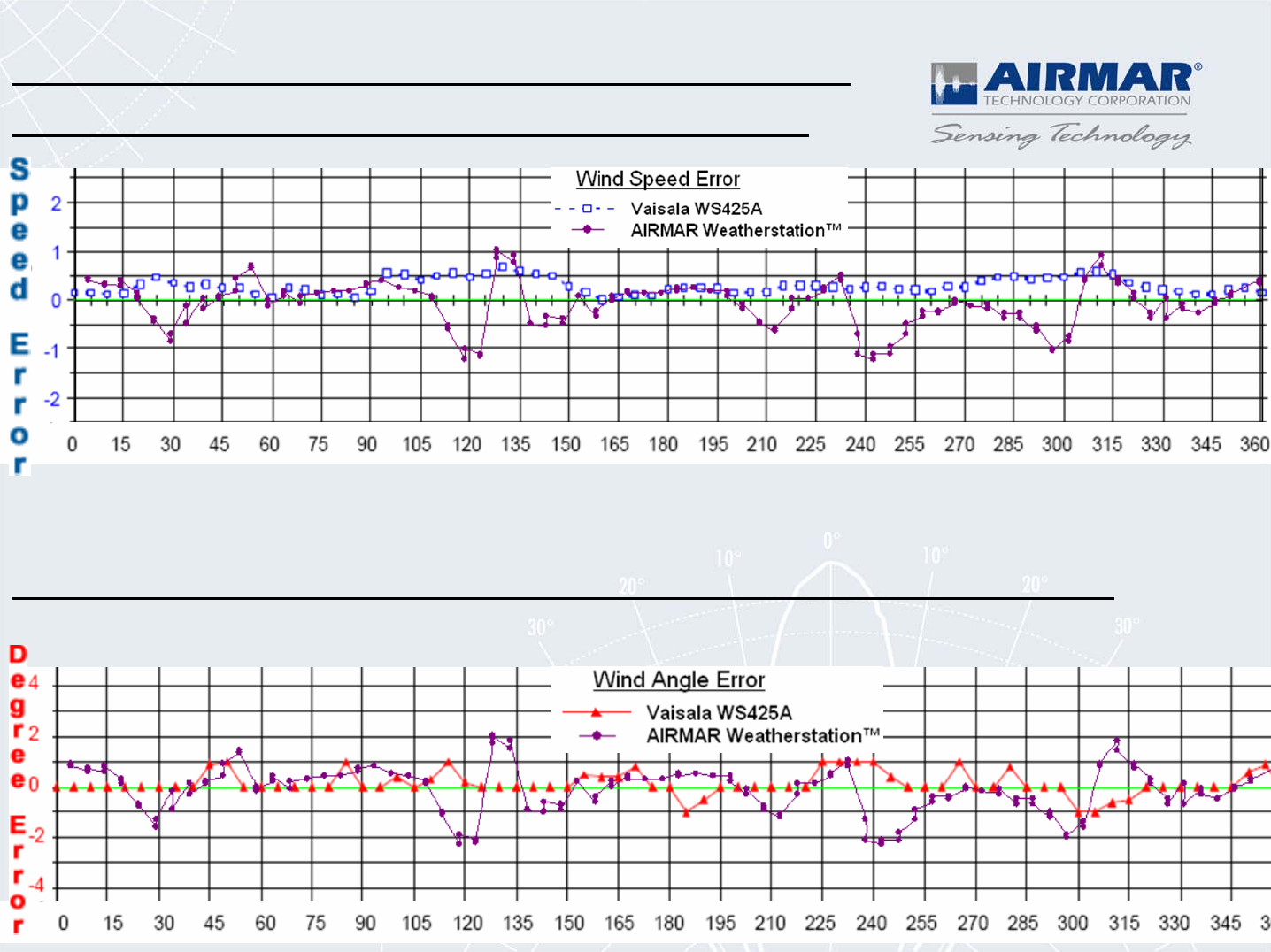
PB200 Wind Speed Accuracy vs Vaisala
Meteorological Wind Only Instrument
PB200 Wind Direction Accuracy vs Vaisala ($2,050)
-Better than 1° heading accuracy in static conditions
-Best-in-class 2° heading accuracy in dynamic conditions
Patent Pending Dynamic tilt correction
-Only recreational heading sensor that uses a three-axis rate gyro
and a three axis accelerometer
-Easily mounts on any angled bulkhead
-IPX6 waterproof enclosure
-Default 10 Hz update rate for heading
-Outputs NMEA 0183 and NMEA 2000 data simultaneously
H2183 Heading Sensor
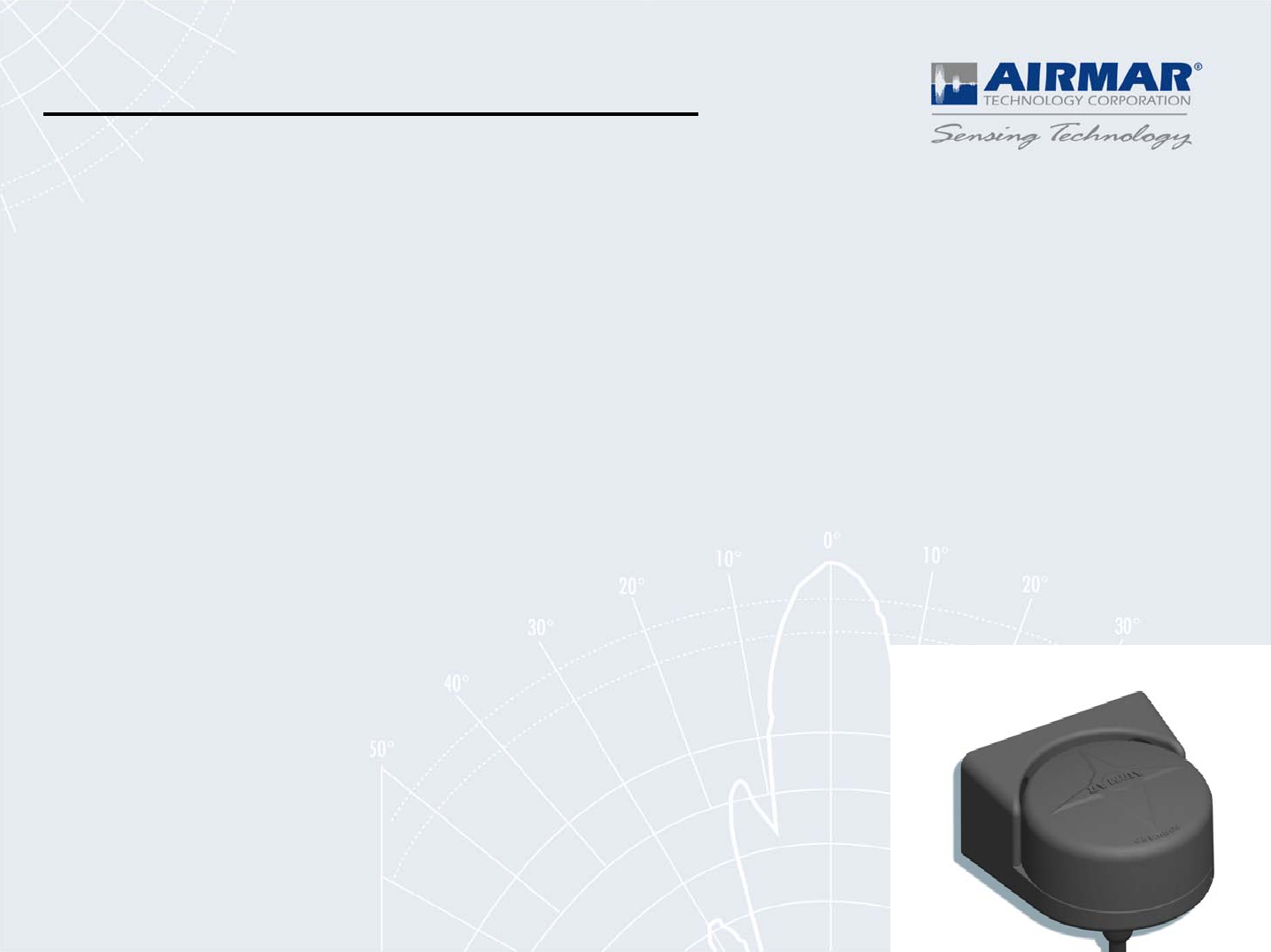
-Easy Auto calibration feature on ANY display
Cycling power then begin a circle within 2 minutes will trigger
auto-calibration on any NMEA display. Within 2-4 minutes of circling,
heading will stop outputting while in calibration mode and come back when
calibration is complete.
Calibration can also be done with WeatherCaster PC Software
NMEA 0183 Default Outputs(Limited Bandwidth)
ON $HCHDG...10Hz Heading, Deviation, and Variation
ON $TIROT.....1.6Hz Rate of Turn
ON $YXXDR....2.5Hz Transducer Measurements: Vessel Attitude
OFF $HCHDT............. Heading Relative to True North
NMEA 2000® Default Outputs
ON 127250....10Hz ..Vessel Heading
ON 127251....10Hz .. Rate of Turn
ON 127257....2Hz... Attitude
H2183 Heading Sensor
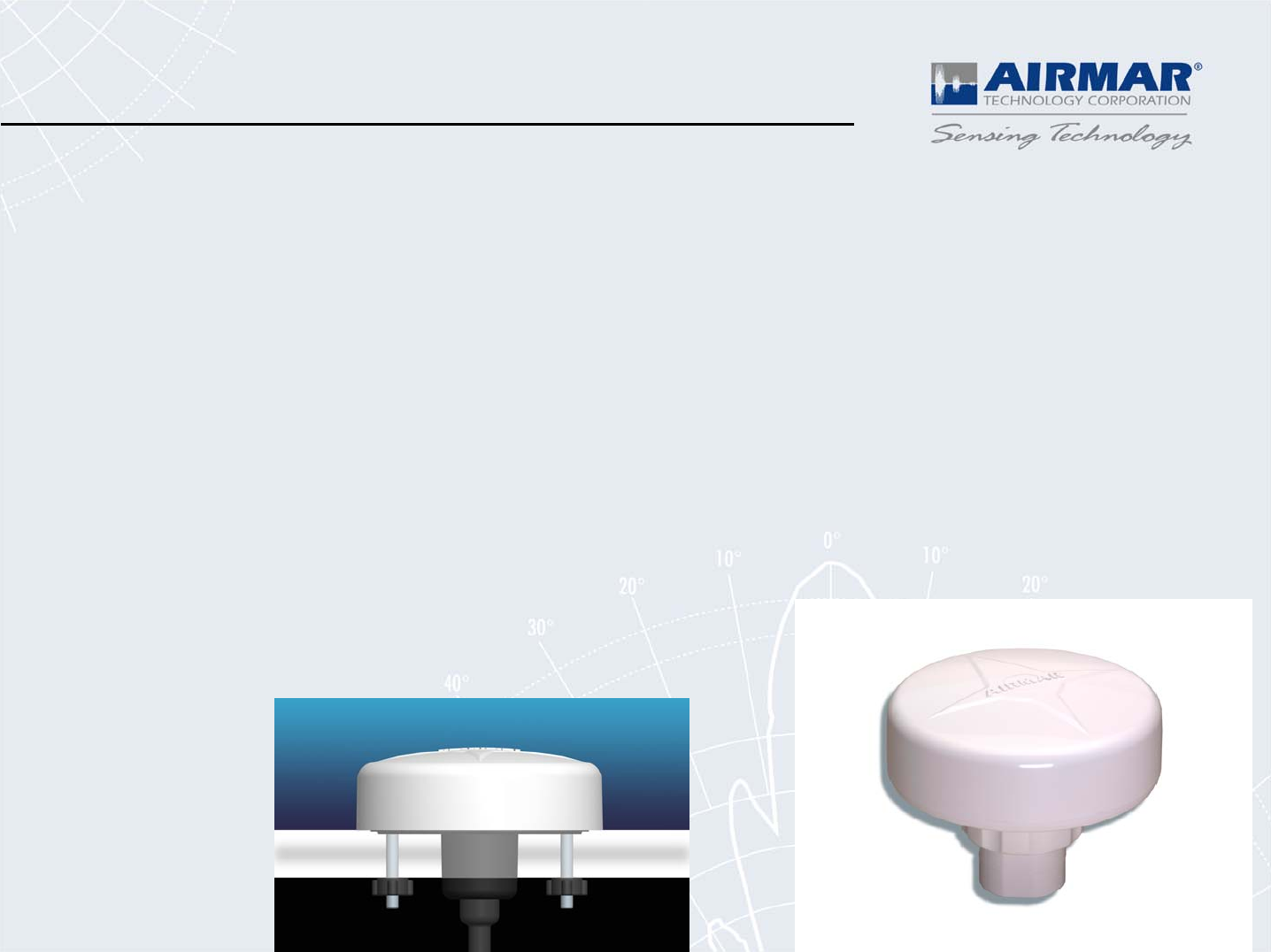
•GPS and heading combined into one housing
•Saves installation time and money
•Better than 1° heading accuracy in static conditions
•Best-in-class 2° heading accuracy in dynamic conditions
•Three-axis solid-state compass provides heading data
•Three-axis accelerometer provides pitch and roll data
•Only recreational heading sensor that uses a
three-axis rate gyro and a three axis accelerometer
•Perfect product for metal hulled boats because the
heading sensor is mounted above the deck
•WAAS GPS provides latitude, longitude, COG, SOG,
time and date, and magnetic variation
•Optionally available as GPS only (G2183)
•IPX6 waterproof enclosure
•Outputs NMEA 0183 and NMEA 2000® data
GH2183 Heading Sensor with GPS
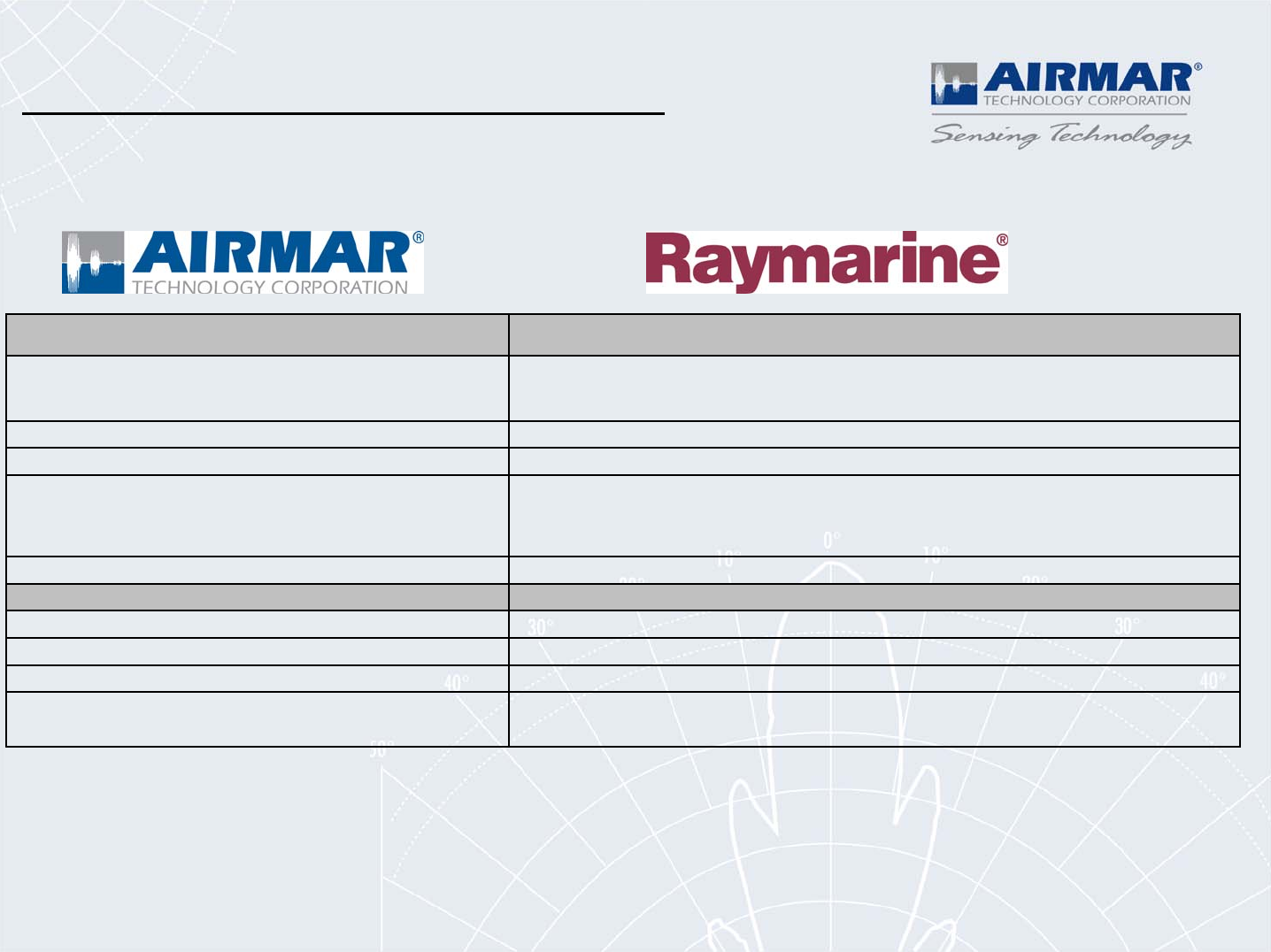
NMEA 2000 NMEA 2000
Product Product
DT800, DST800, P39, P79 Smart™ Transducers C, E, G-Series, ST60, ST70- All Data
G, H, GH2183 GPS & Heading Sensors C, E, G-Series, ST60, ST70- All Data
PB200 WeatherStation® Instrument ST-70-All Data
C,E,G-Series- Displays Apparent Wind, Air Temp, Barometer, Heading , GPS
NMEA 0183 NMEA 0183
DT800, DST800, P39, P79 Smart™ Transducers C, E, G-Series, ST60, - All Data
G, H, GH2183 GPS & Heading Sensors C, E, G-Series, ST60, - All Data
PB200 WeatherStation® Instrument C,E,G-Series- Displays Apparent Wind, Air Temp, Barometer, Heading , GPS
NMEA Compatibility Chart
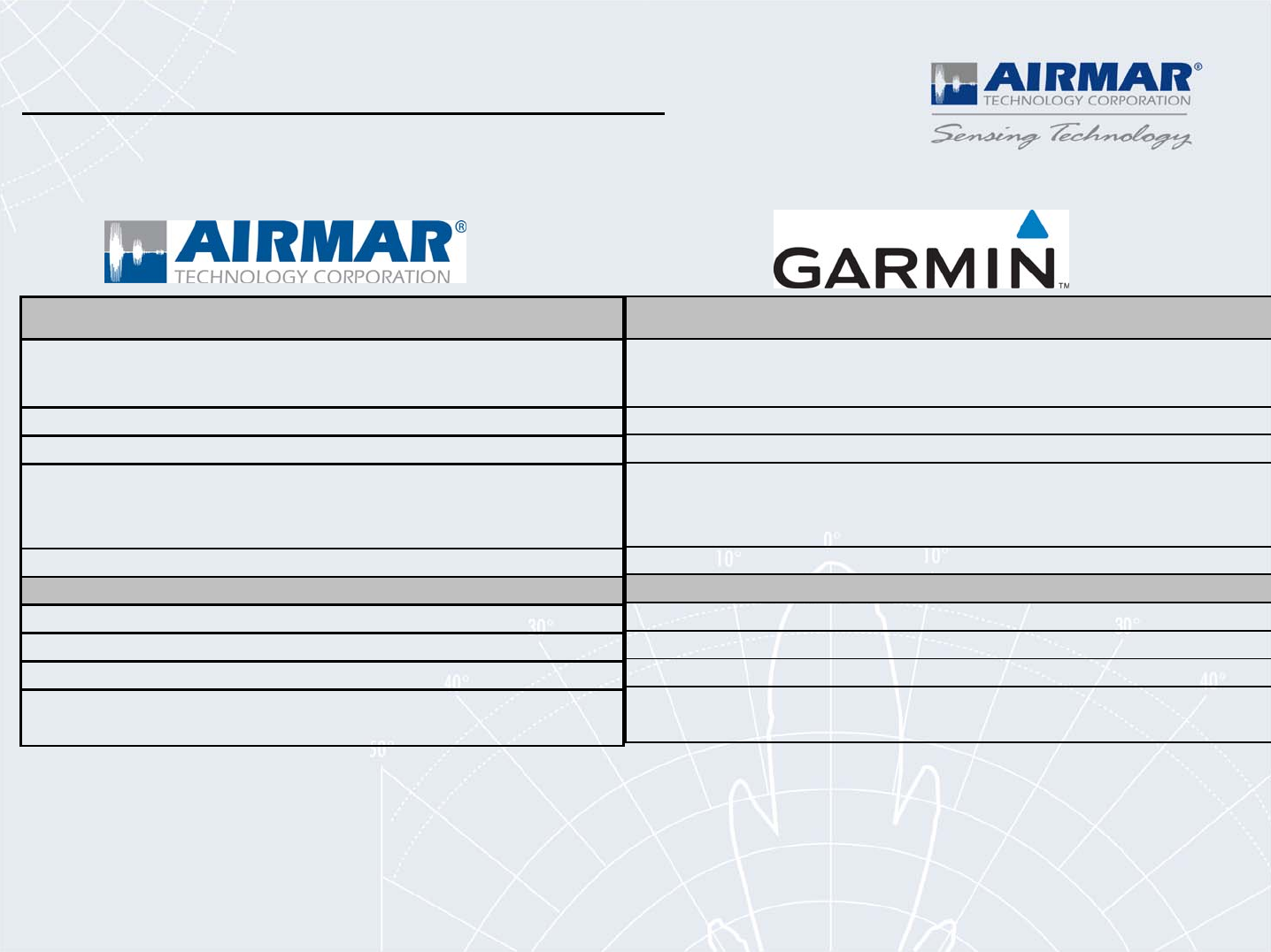
NMEA 2000
GMI 10, 4200, 5200 Series Displays- All Data
GMI 10, 4200, 5200 Series Displays- All Data
GMI-10-Displays
A
ll Data except wind chill
4200, 5200 Displays Apparent wind, True wind, Heading, GPS
NMEA 0183
GMI 10, 4200, 5200 Series Displays
GMI 10, 4200, 5200 Series Displays
GMI-10-All Data
4200, 5200 Displays Apparent wind, True wind, Heading, GPS
NMEA 2000
Product
DT800, DST800, P39, P79 Smart™ Transducers
G, H, GH2183 GPS & Heading Sensors
PB200 WeatherStation® Instrument
NMEA 0183
DT800, DST800, P39, P79 Smart™ Transducers
G, H, GH2183 GPS & Heading Sensors
PB200 WeatherStation® Instrument
NMEA Compatibility Chart
NMEA 2000
Product
DT800, DST800, P39, P79 Smart™ Transducers
G, H, GH2183 GPS & Heading Sensors
PB200 WeatherStation® Instrument
NMEA 0183
DT800, DST800, P39, P79 Smart™ Transducers
G, H, GH2183 GPS & Heading Sensors
PB200 WeatherStation® Instrument
NMEA 2000
FI Instruments, Navnet 3-- All Data
FI Instruments, Navnet 3-- All Data
FI Instruments, Navnet 3-- All Data
NMEA 0183
RD-30, Navnet 1,2,3 All Data
RD-30, Navnet 1,2,3 All Data
RD-30, Navnet 1,2,3 All Data except wind chill
NMEA Compatibility Chart
NMEA Compatibility Chart
NMEA 2000 Products
IS20 Instruments-All Data
IS20 Instruments-All Data
IS20 Instruments-All Data except wind chill
NMEA 2000 Products
DT800, DST800, P39, P79 Smart™ Transducers
G, H, GH2183 GPS & Heading Sensors
PB200 WeatherStation® Instrument
NMEA Compatibility Chart
NMEA 2000
Product
DSM 250, 350 Displays- All Data
DSM 250, 350 Displays- All Data
DSM 250, 350 Displays- All Data
NMEA 2000
Product
DT800, DST800, P39, P79 Smart™ Transducers
G, H, GH2183 GPS & Heading Sensors
PB200 WeatherStation® Instrument
Response to Customer Feedback
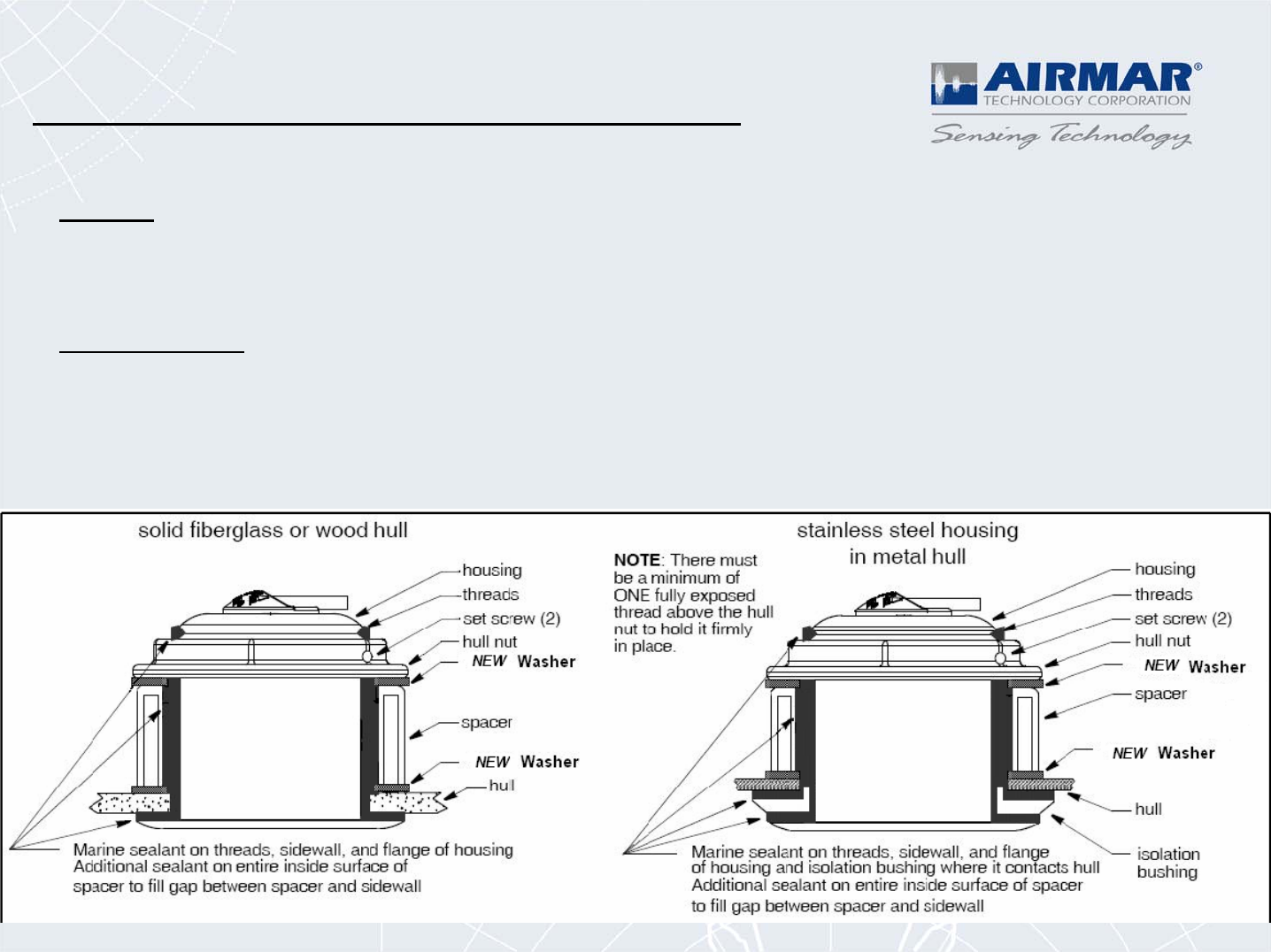
B164, SS164 Enhancements
• Issue: 50kHz horizontal banding on Furuno digital
fishfinders
• Resolution: Addition of two rubber insulating washers on
either side of the plastic spacer and two set screws for the
hull nut.
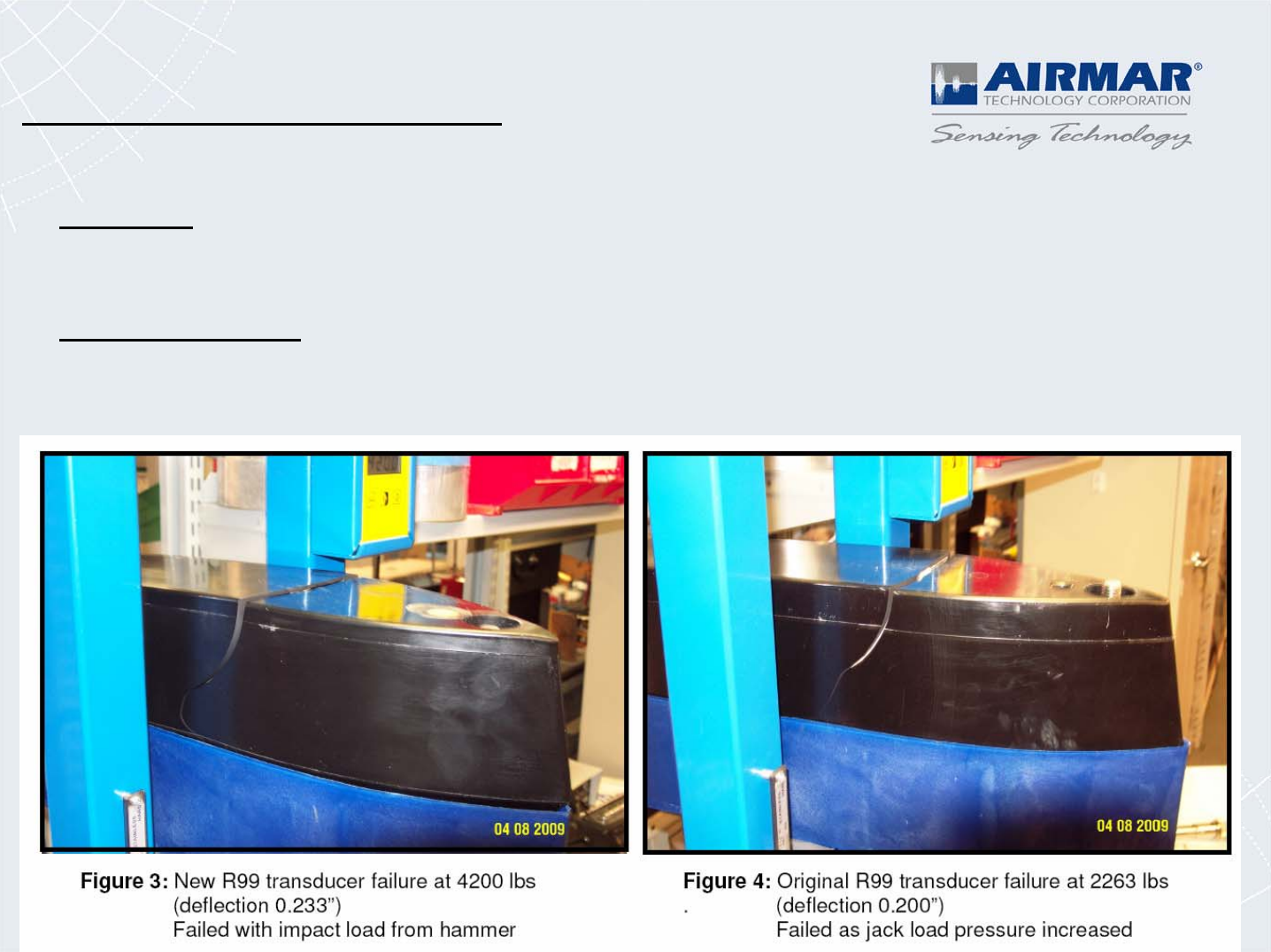
R99 Enhancements
•Issue:Housings cracking due to stress or improper
installation
• Resolution: Added thickness to epoxy housing
resulting in almost double the strength.
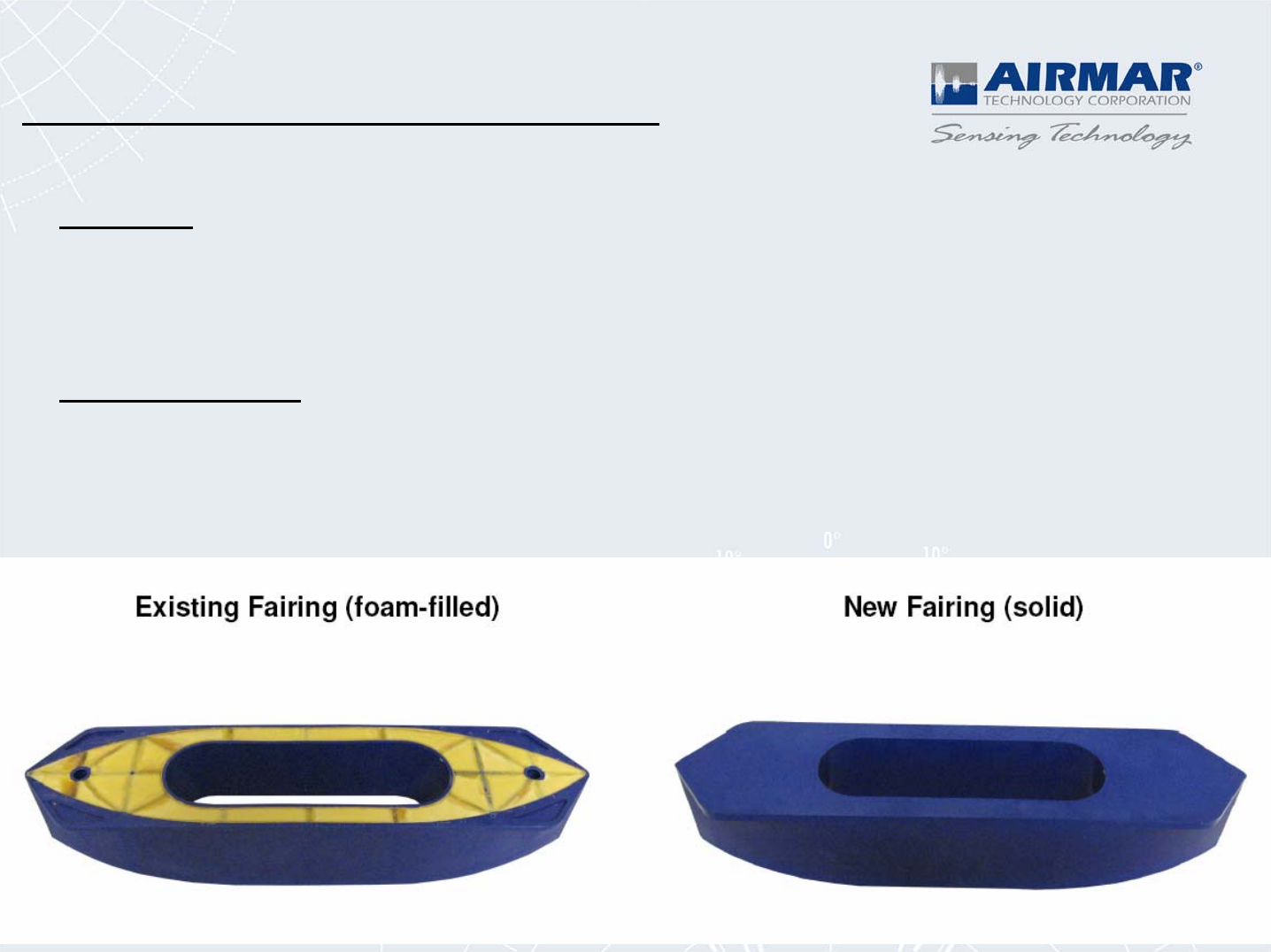
R99, R209, R309 Fairings
•Issue:Fairings cracking due to stress or improper
installation
• Resolution: New solid blue fairings that are not
foam-injected. These are 2 times stronger than the
foam injected fairings.
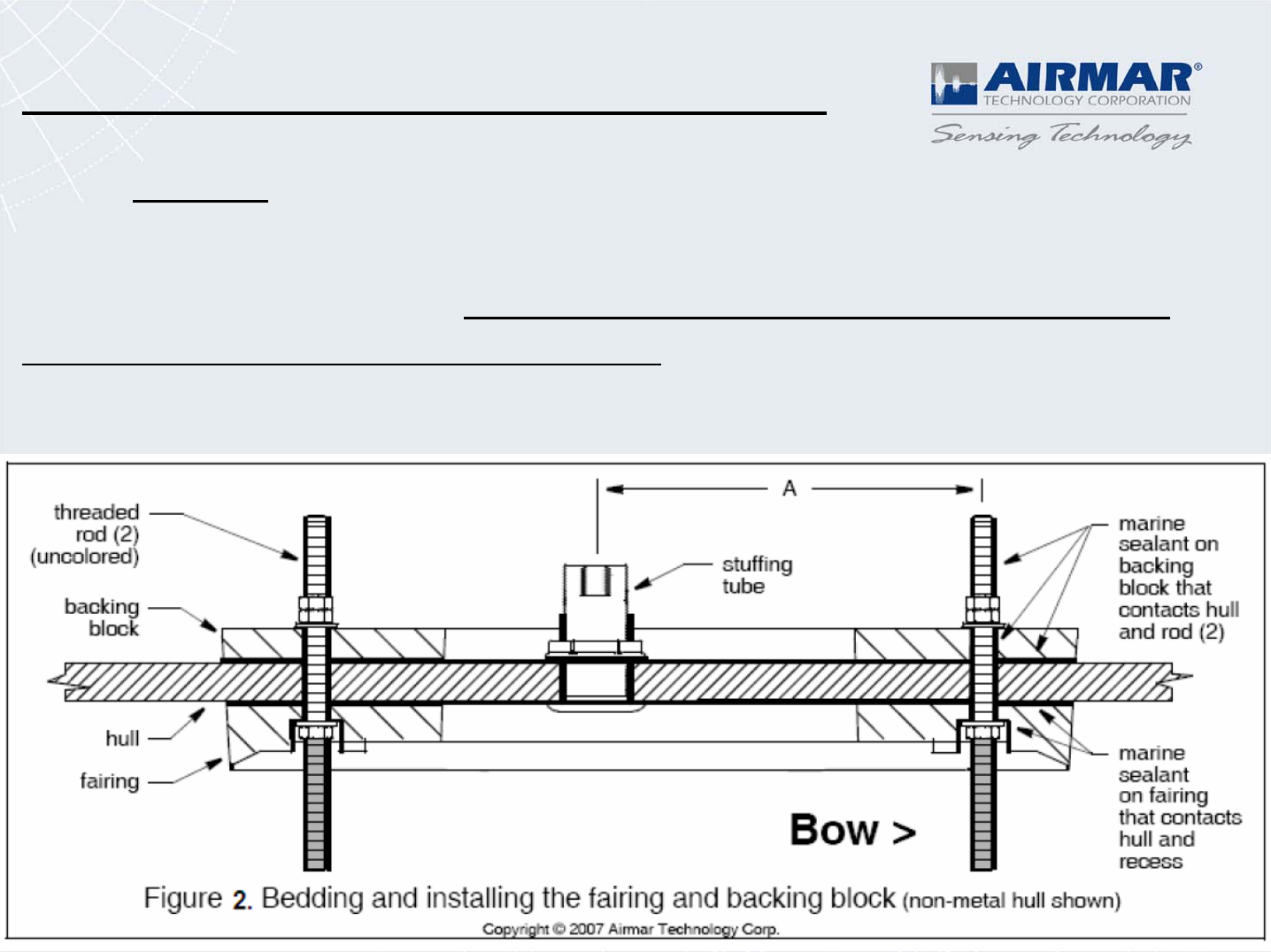
R99, R209, & R309 Installations
•It is Critical that the fairing be bolted and secured to the hull
before the transducer is installed.
•Be sure the fairing is 100% flush to the hull and does not
rock front to back or side to side. This rocking could cause
the final installation to crack the fairing or transducer.
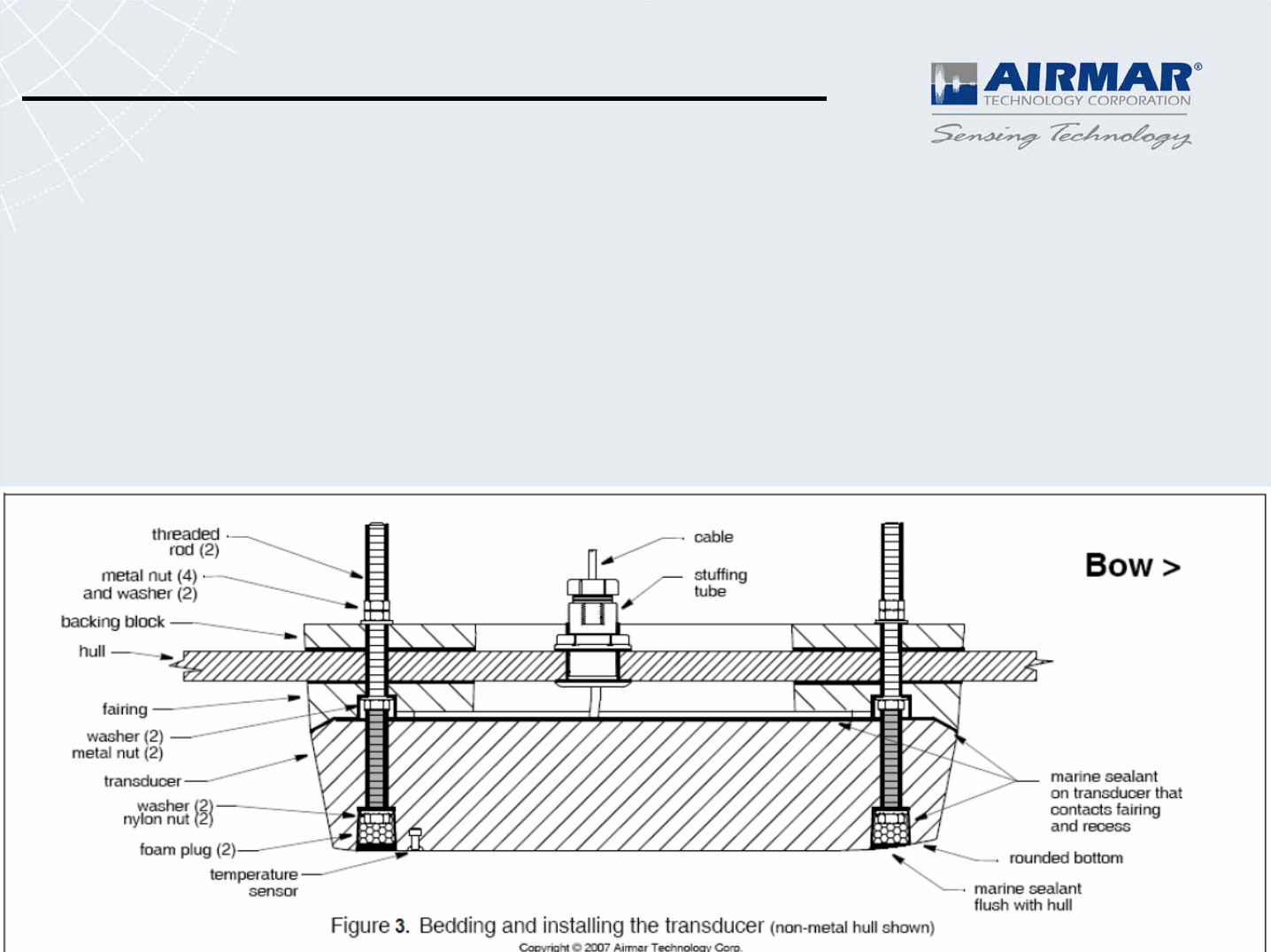
R99, R209, & R309 Installations
•After the fairing is bolted to the hull, slide the transducer
onto the threaded rods being sure the rounded bottom is
facing forward toward the bow and the temperature
sensor is aft.
•Be sure the rods extend a minimum of 3 threads
beyond the nut after being tightened to 20ft.-lb of torque.
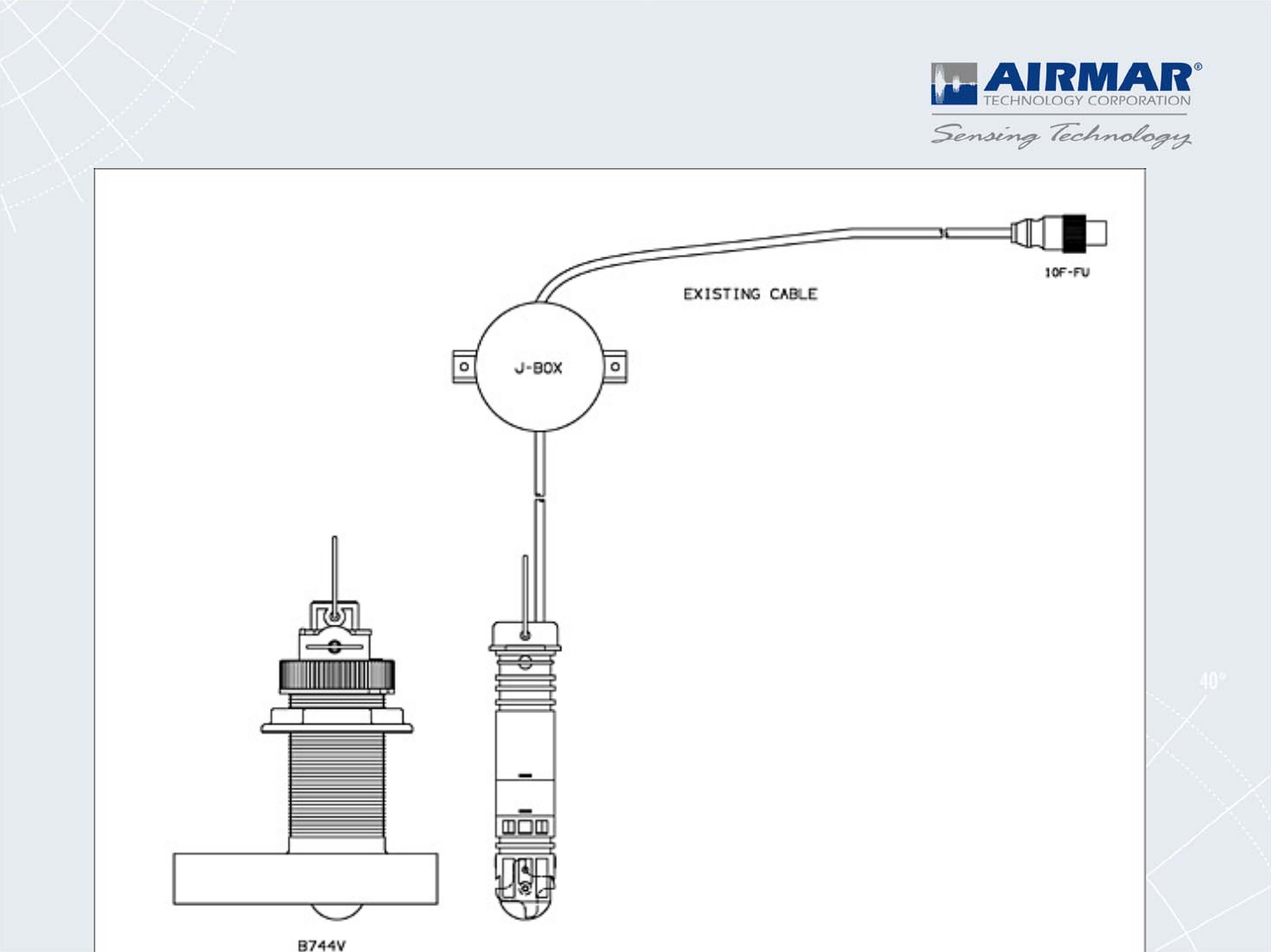
B744V Speed/ Temp Replacement
B744V Speed/ Temp Replacement
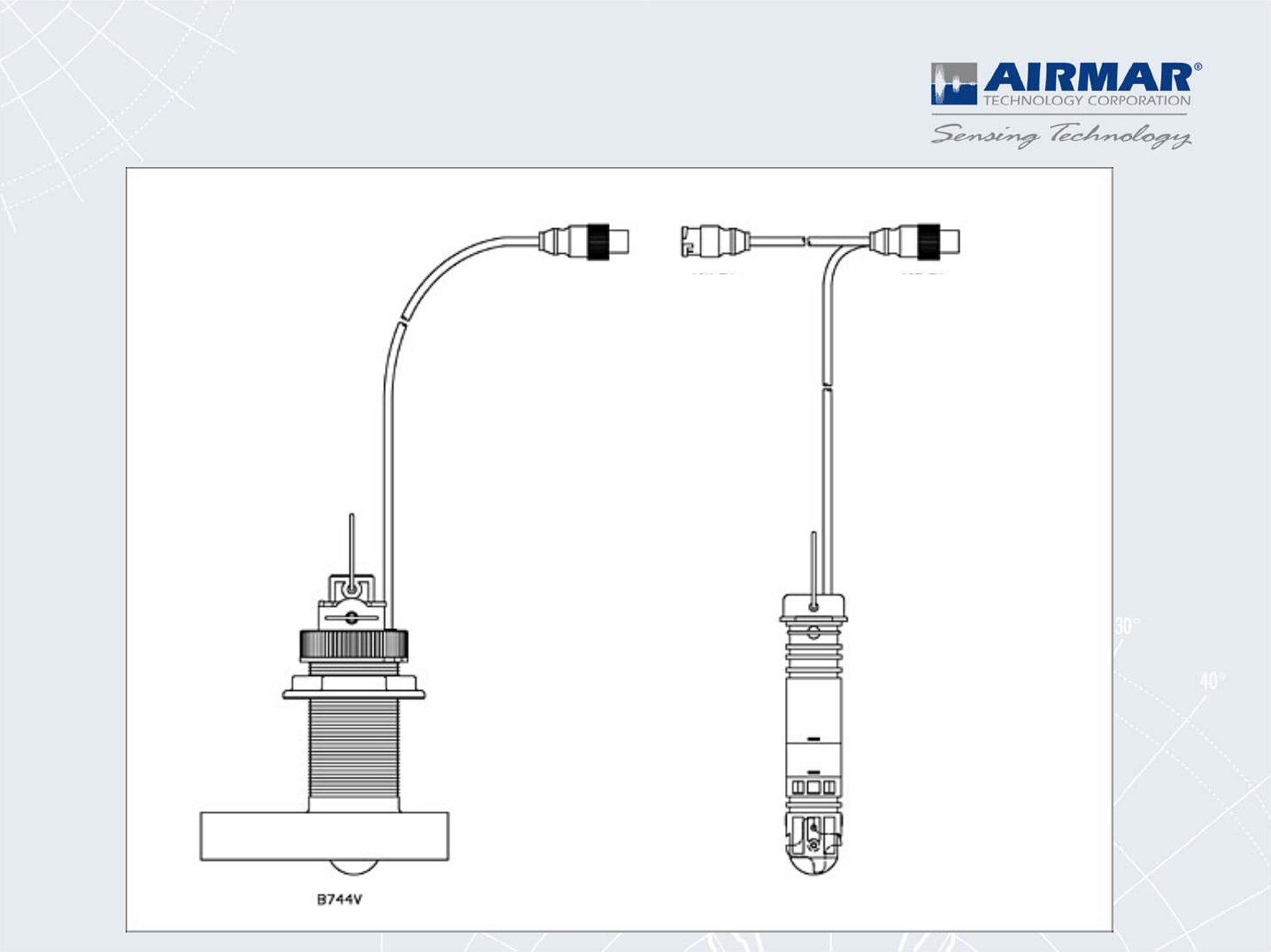
B744V Speed/ Temp Replacement
B744V Speed/ Temp Replacement
Active Speed/Temp Insert
Active Speed/Temp Insert
Smart Sensor Enhancements:
DT800, DST800, P39, P79
• Airmar has developed new firmware for Smart Sensors that
improves depth tracking ability at all depths from shallow to
deep.
• This firmware addresses the following customer reported
issues:
• DT800 depth readings in shallow, sandy bottom (<3ft)
occasionally locking in on second or third echoes. The sensor
could occasionally report depths 2x,3x, or 4x greater than the
actual depth.
• DST800 sensors mounted on steep dead rise angles
occasionally locking in on the boats own bow wake or surface
waves. The sensor would then report a very shallow depth <3
ft. This was reported more when the vessel is in very deep
water beyond the sensors maximum depth capability.
How Smart Sensors track the bottom
Firmware Version: 1.011
• Before an Airmar Smart Sensor reports a depth as valid, it
must have confidence that the integrity of the target being
tracked is truly the bottom and not a fish, bubbles, or debris in
the water.
• The confidence increases each time a potential target is seen
at the same approximate depth. This helps eliminate a smart
sensor reporting on targets that are not persistent over time
(fish, debris, etc).
• Once the confidence in a potential target increases to a
predetermined level, the sensor starts tracking the target, and
reports its depth as valid. It will take at least 3 seconds for a
target to enter depth tracking mode.
How Smart Sensors track the bottom
Firmware Version: 1.011
•If the sensor loses track of a target at the same depth, the
confidence in its depth decreases, but it will keep repeating the
last good depth.
•Once the confidence decreases to a predetermined level, the
sensor abandons the lock on the bottom and declares the depth
as data not available, and starts looking for new potential
targets that it can report on with confidence.
•The time for a high confidence locked target to be abandoned
depends on the depth, it is between 4 seconds in shallow water
and 8 seconds in deep water (>250ft).
How Smart Sensors track the bottom
Firmware Version: 1.011
•Shallow water operation: The sensor can track bottom into
as little as 1.5' of water before it loses its lock, but it will not
be able to regain a lock until about 3' of water is seen.
•Deep-water operation: When the sensor gets beyond its
depth capability, our new firmware minimizes the possibility
of locking on surface waves or clutter. Depth is reported as
data not available vs. reporting random shallow readings
even though the vessel is in very deep water.
• Airmar Smart Sensors can provide a proprietary Depth
Quality Factor PGN that reports a value from 1-10 based on
depth confidence level.
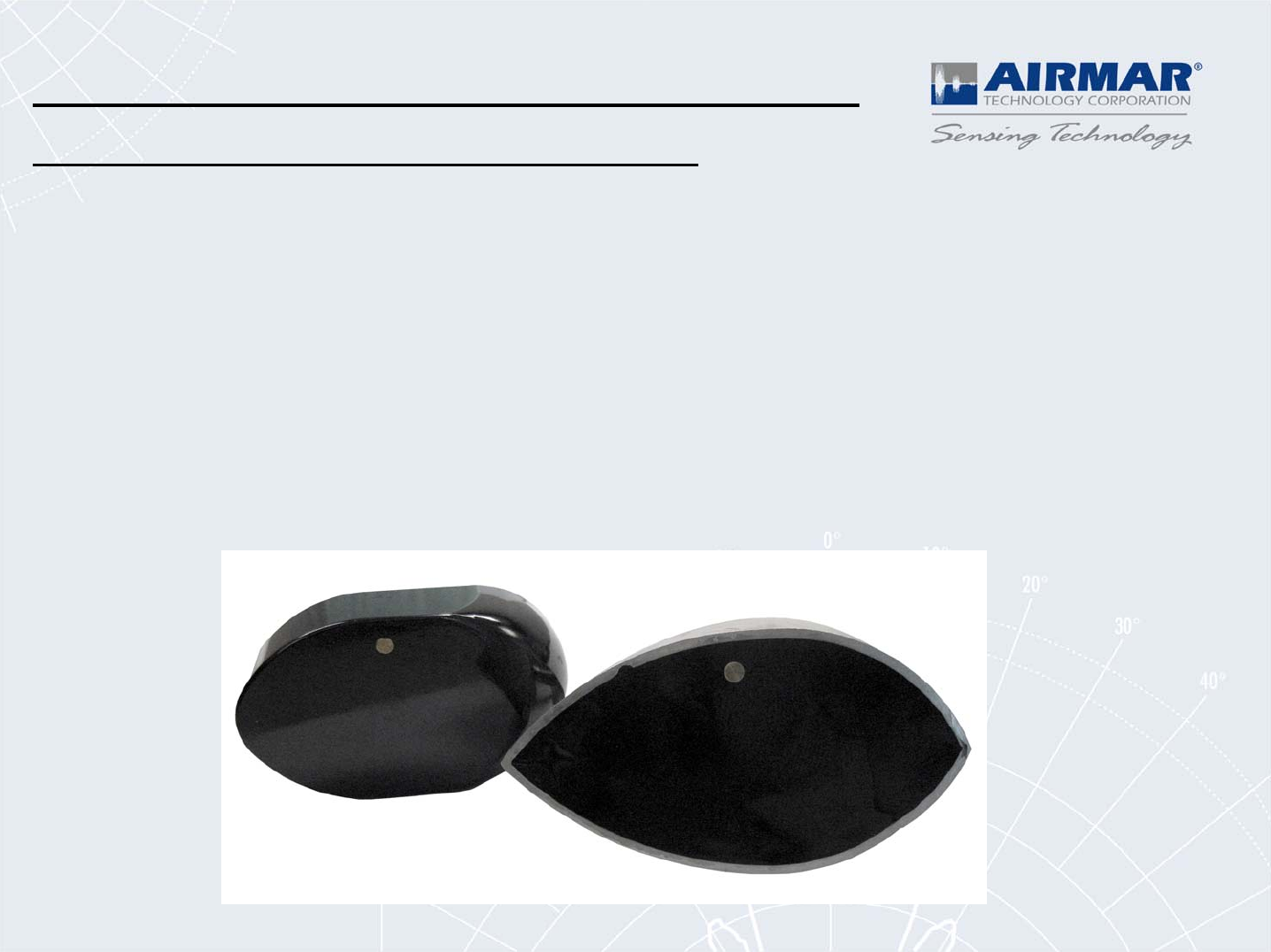
New Fast-Response Temperature
Thermistor on 1kW Models
• New, exposed bronze button is 6.5X faster in thermal
response as compared to the old thermistor encapsulated
within the housing.
• Exposed copper button is on all 1kW+ models.
• Products Include: B258, TM258, B260, TM260, SS270W,
TM270W, B164, SS264 W & N Pairs, R99, R209, R309
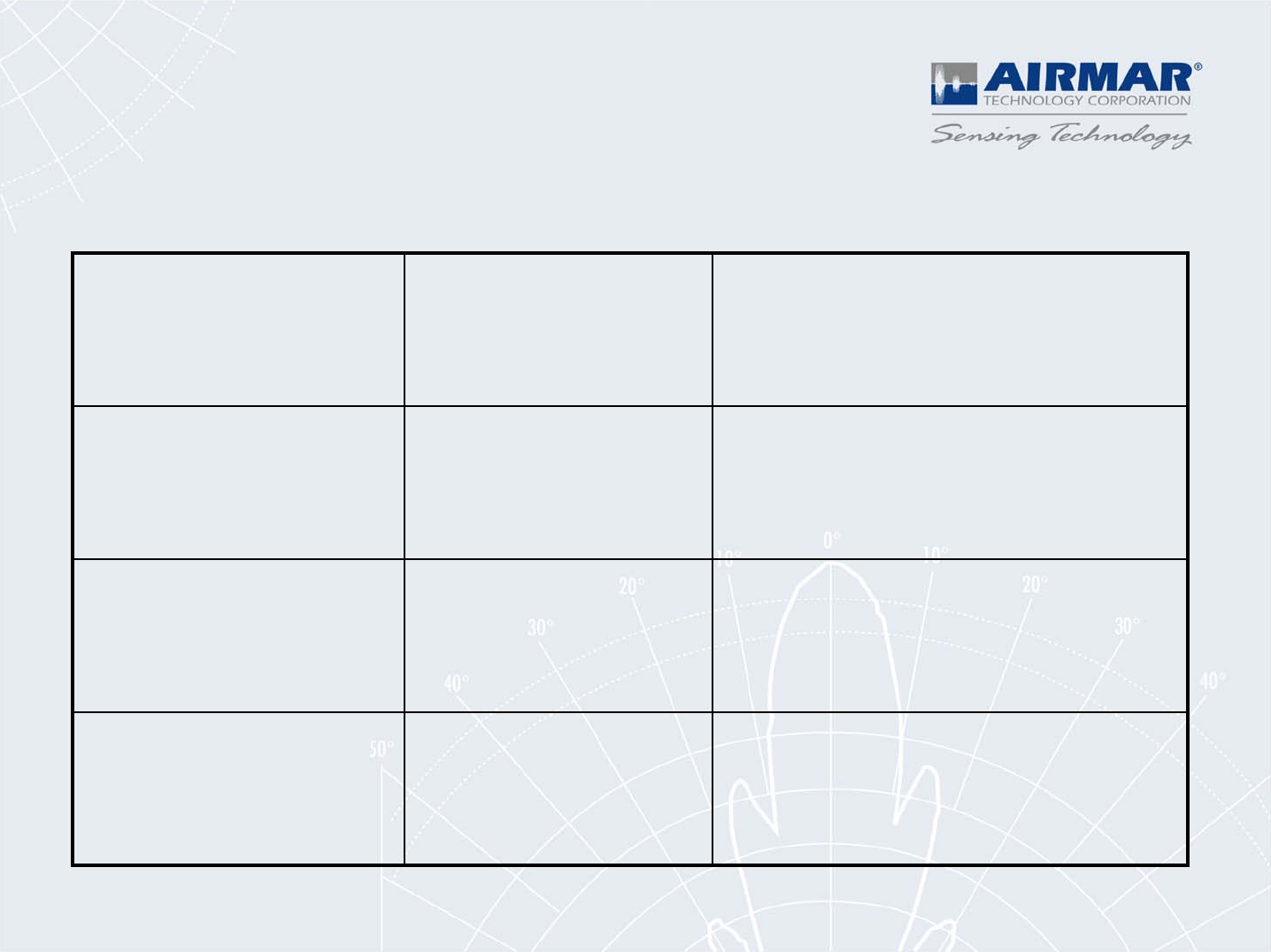
Housing Old Design Current Design
B260 1:30 25 seconds
B258 2:00 25 seconds
TM258 2:30 25 seconds
Temperature Time Constants
Airmar Transducer Models
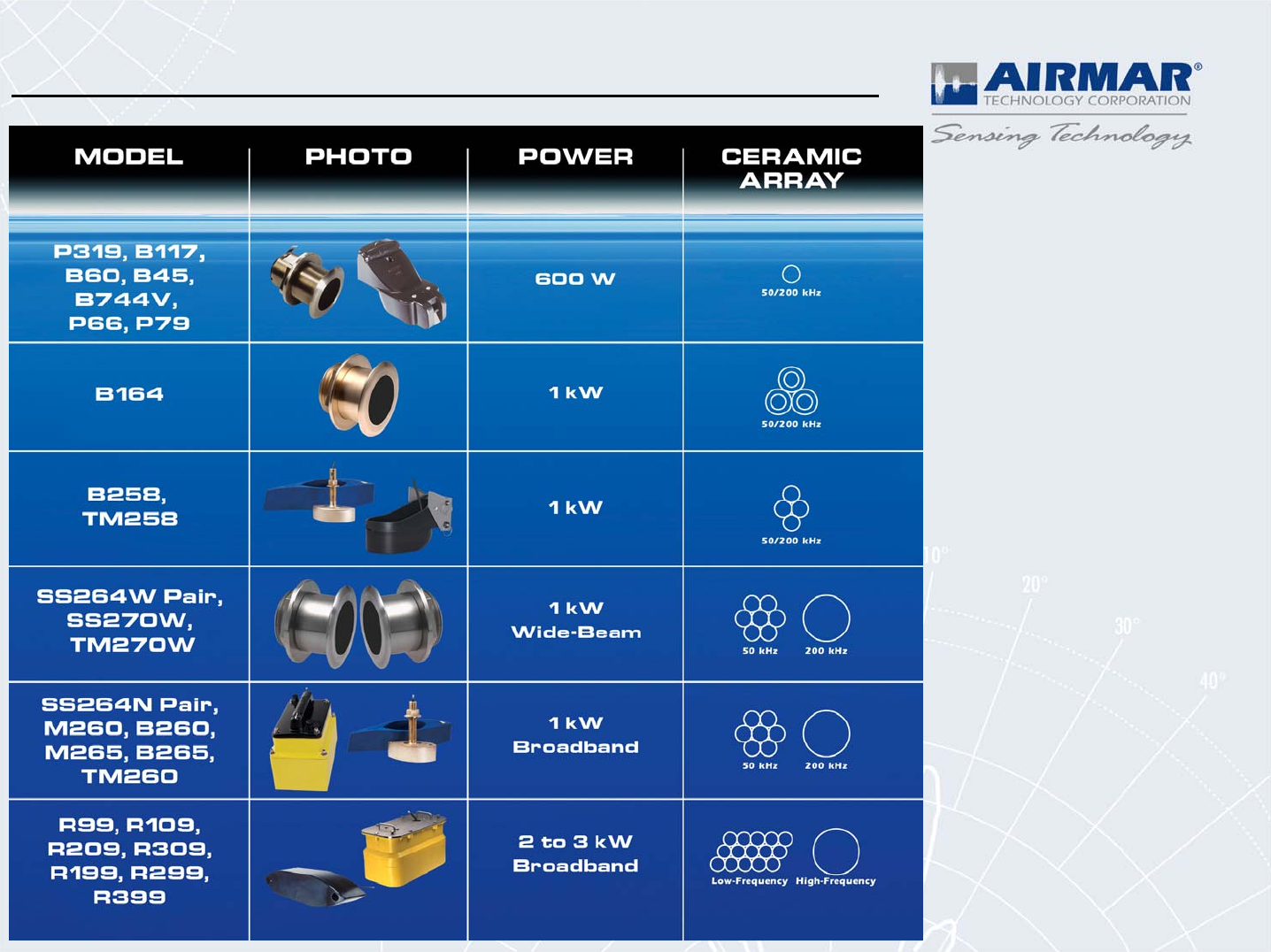
What’s inside popular models?
Tilted Element™ Family
SS264W Wide Beam Tilted Pair
• SS270W elements split apart into two tilted element™ transducers
• Same ceramics and performance as the SS270W
• Separate transducers for 50 kHz and 200 kHz
• Engineered for Center console and trailered boats up to 40ft
• Transducers sold separately
• No High Performance Fairing needed
• Fast Response temperature sensor
SS270W & SS264W Screen Images
• B260 elements split apart into two tilted element™ transducers
• Same ceramics & performance as the B260 at 200 kHz
• Separate transducers for 50 kHz and 200 kHz
• Top of the line 1kW tilted element™
• Engineered for Center console and trailered boats up to 40 feet
• Transducers sold separately
• No High Performance Fairing needed
• Fast Response temperature sensor
SS264N Narrow Beam Tilted Pair
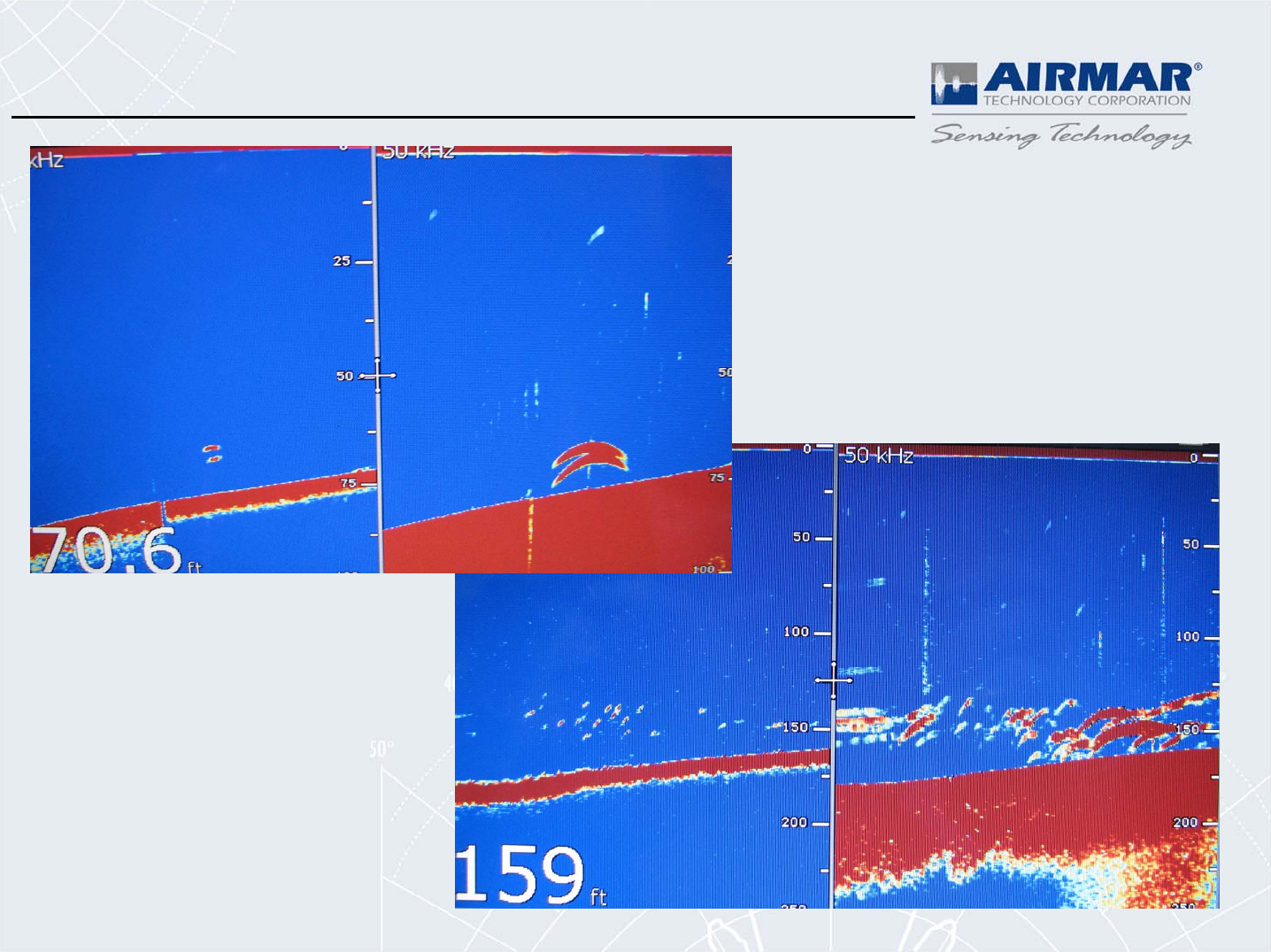
SS264N & B260 Screen Images
200kHz
50kHz
50kHz
200kHz
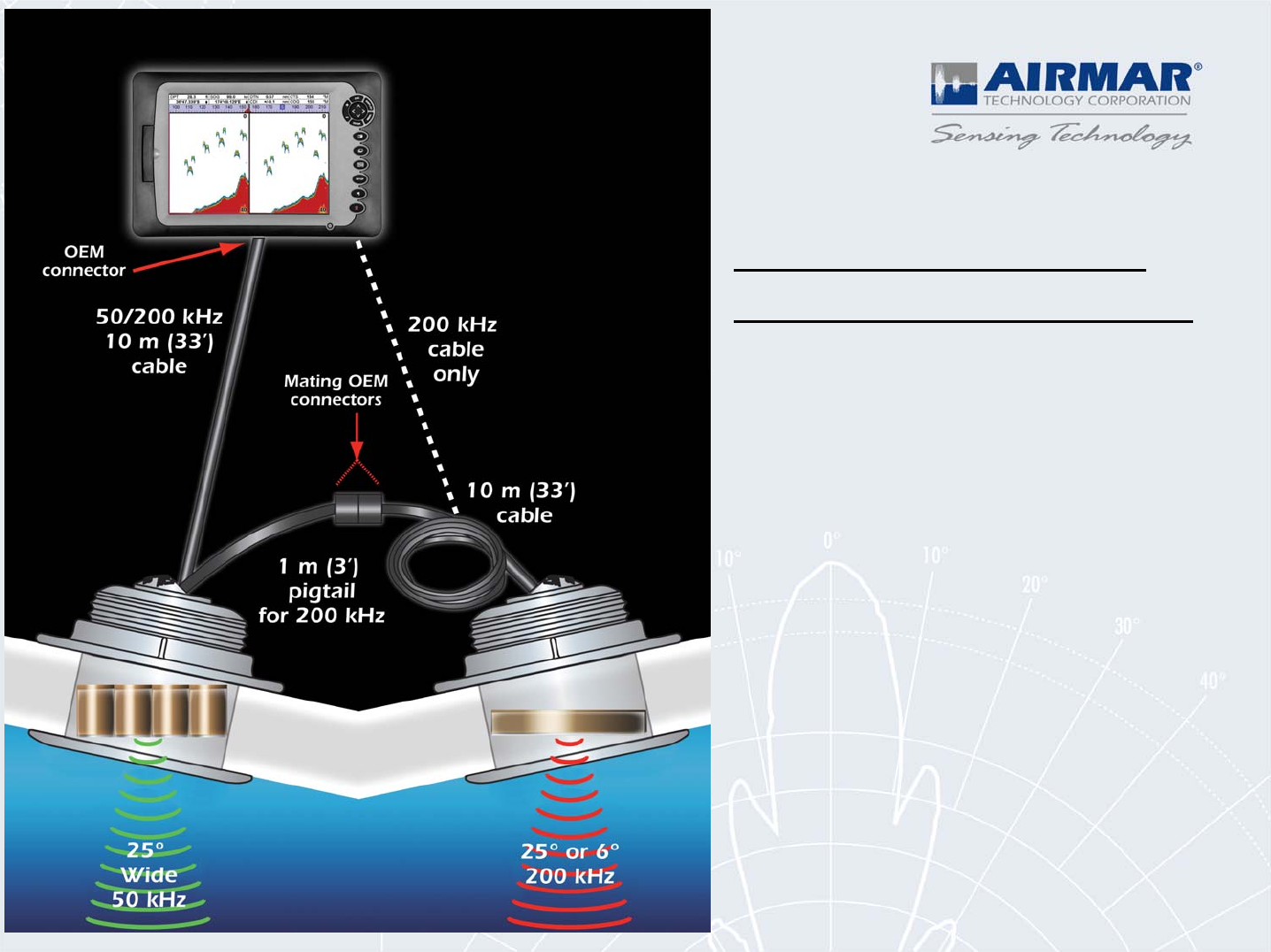
SS264W & SS264N
Tilted Element™ Pair
•FOR: Garmin, Navico,
Raymarine DSM300
Furuno FCV585, BBFF1, DFF1
•Once the transducers are
connected, a single cable is
routed to the display.
•Each transducer has an
internal diplexer with XID
feature, and comes with OEM
connectors
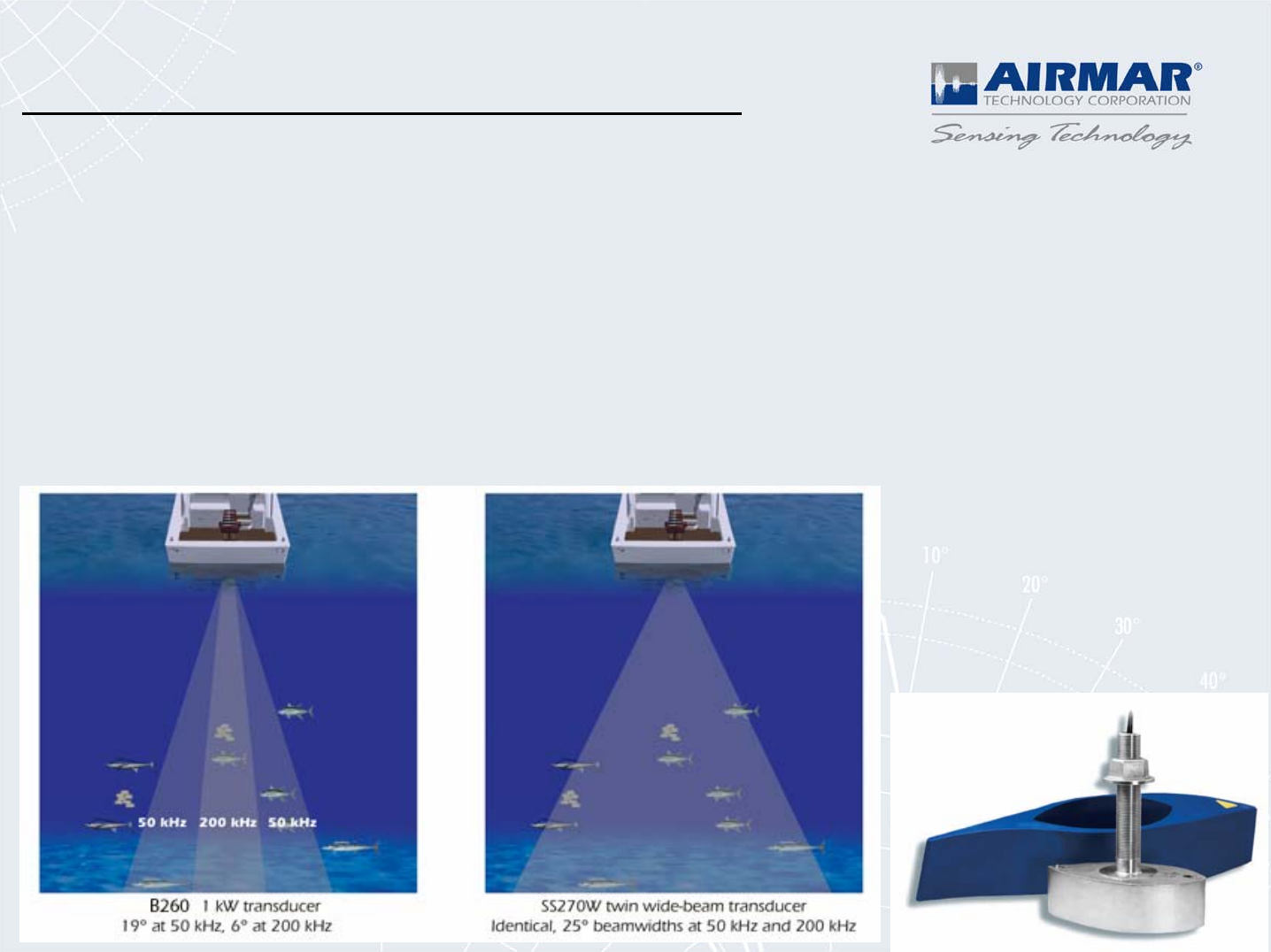
SS270W Fishing Applications
• Wide 25° beams at 50kHz & 200kHz marks more on the fishfinder
• Tuna, Marlin fishing—mark more bait
• Wreck fishing—see more of the wreck
– See jigs and lures on the screen and avoid wreck hang-ups
• Commercial Salmon Trolling—see stabilizers and trolling gear
• SKA King fishing & Lake fishing—see downriggers & trolling gear
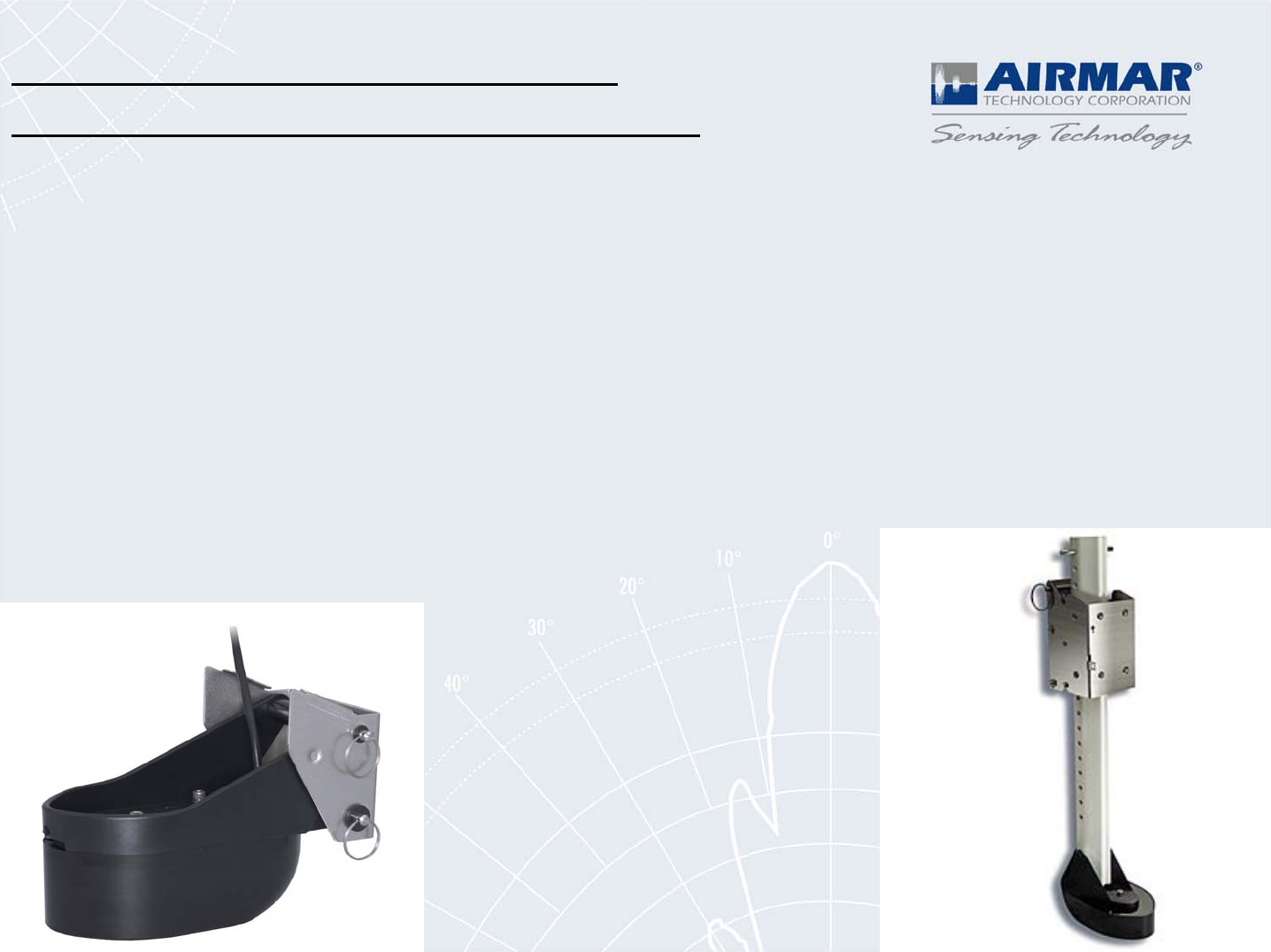
NEW High Performance 1kW
Transom Mount Transducer Line
• Exposed temperature button with improved thermal
time constant: from 2:30 (old) to 25 seconds (new)
• New bracket design
• Heavy Gauge plastic bracket with 316 Stainless
mounting plate (0.90” thick)
• Kicks up and locks in place without damaging the
transom
• Easy to install
• Retrofits to TM258 and TM260’s in the field
• High speed performance over 30 Knots
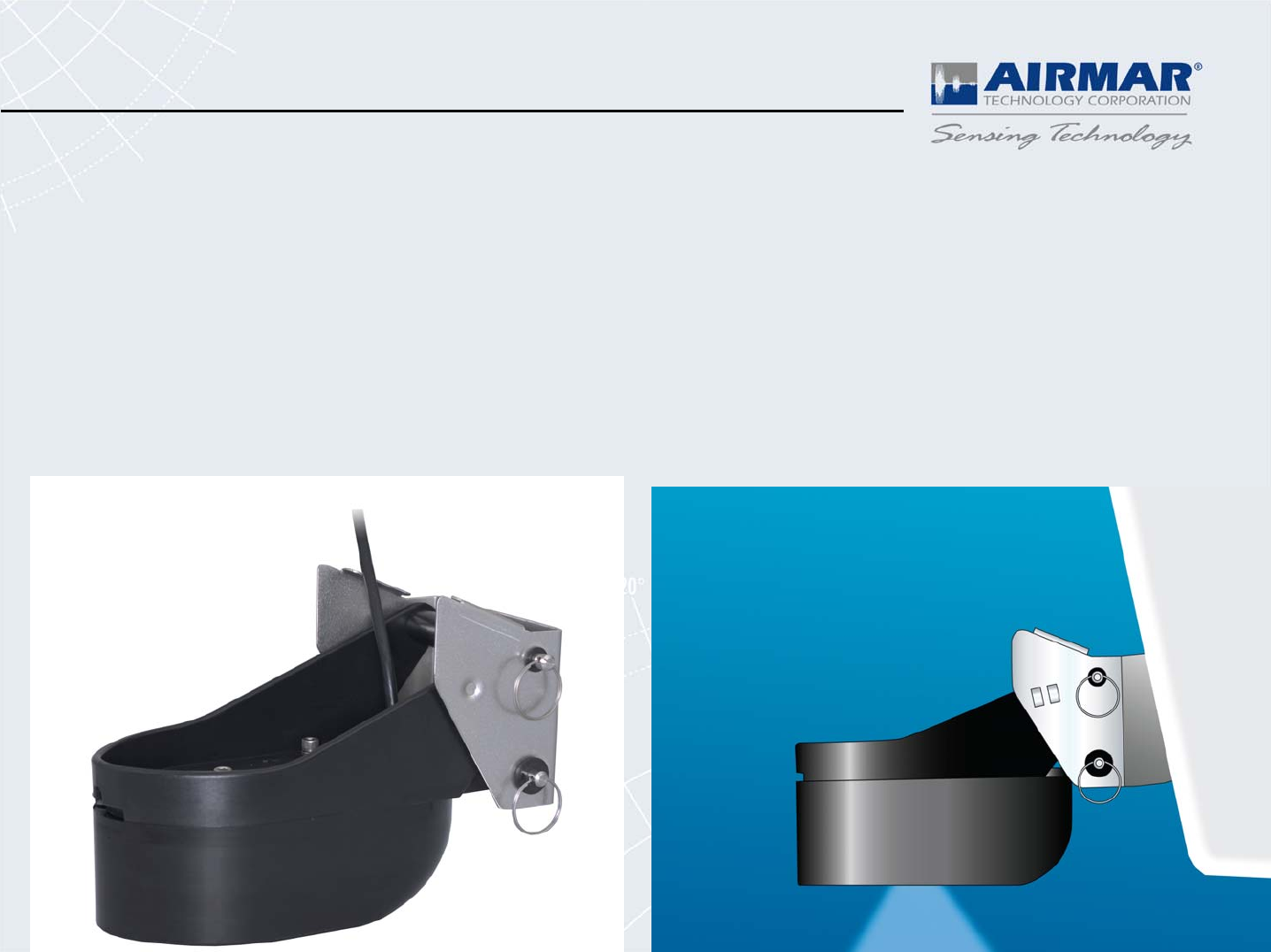
High Performance 1kW Transom Bracket
• Heavy Gauge plastic bracket with 316 Stainless mounting plate
(0.90” thick)
• Allows for 2 new products- TM260(narrow), & TM270W(wide)
• Kicks up and locks in place without damaging the transom
• Easy to install
• Retrofits to TM258 and TM260’s in the field
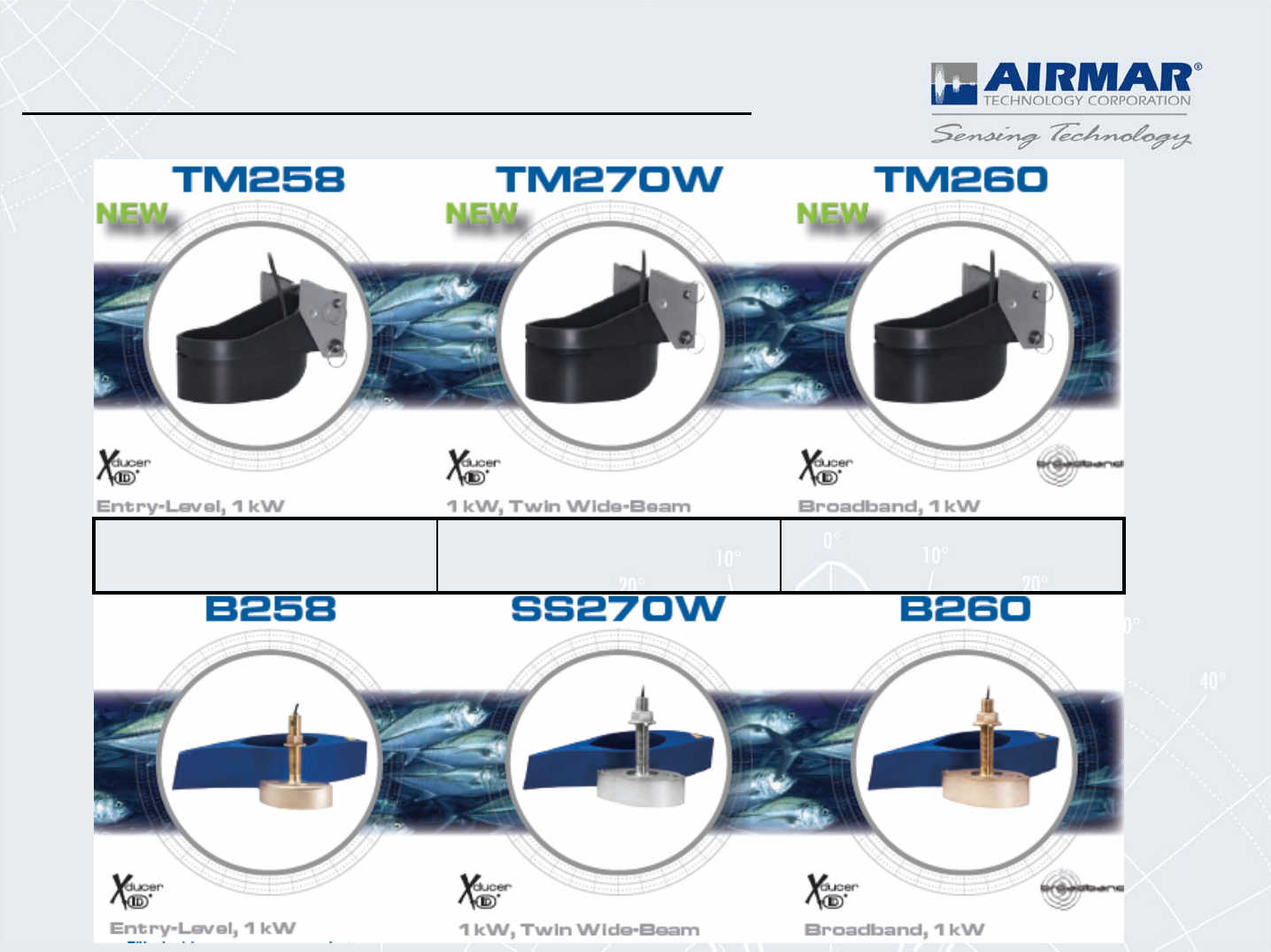
3 New 1kW Transom Models:
Same Ceramics as: Same Ceramics as: Same Ceramics as:
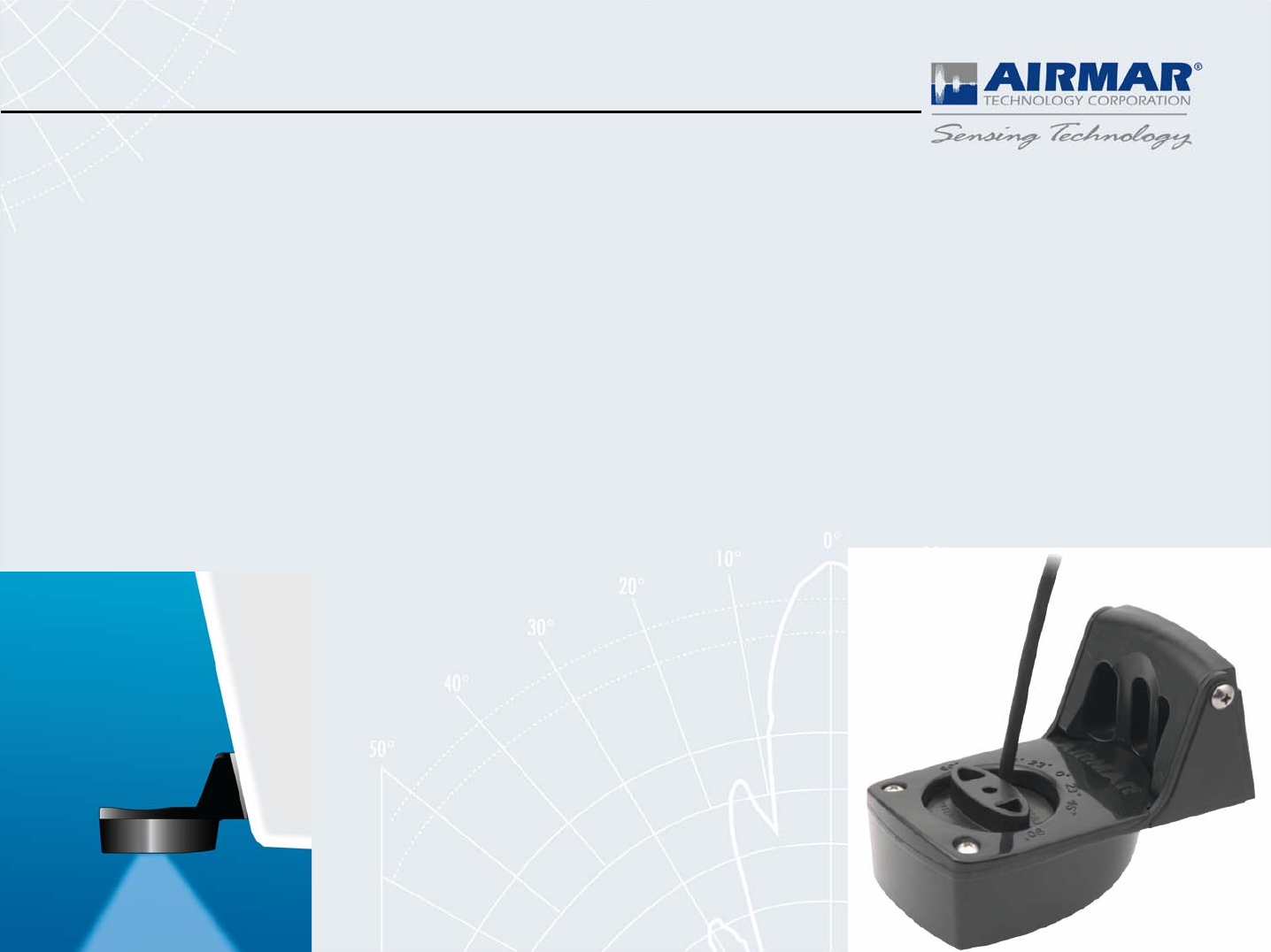
P48W Adjustable-Beam Transom Mount
• The widest transom-mount transducer on the market
• True 38° x 12° beam that is measured at -3 dB
• Depth and temperature, 200 kHz Only
• 100 Watts RMS power (800 Watts Peak-to-Peak)
• Maximum Depth: 122 m (400’)
• Transom or trolling-motor mounting options
• For 18’ to 25’ Inshore saltwater & freshwater boats
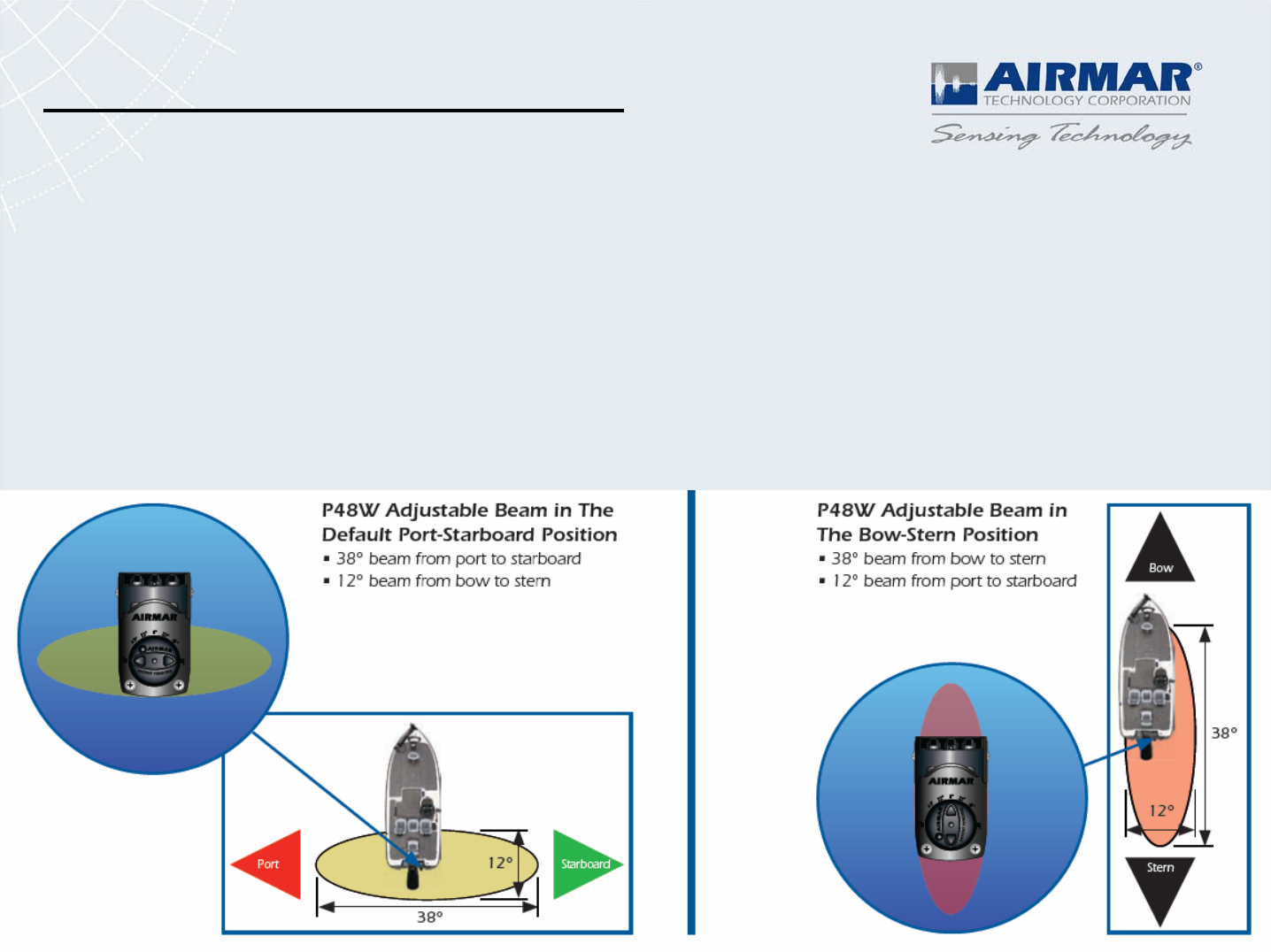
P48W Adjustable Beam
• User can manually change the beam direction
–Pressing and twisting the knob on top changes beam
–Port-Starboard beam is 38°wide x 12° bow-stern
–Marks more fish side to side
–Bow-Stern beam is 12° wide x 38° bow-stern
–Looks forward and aft to help detect bottom changes
Installation-Specific Products
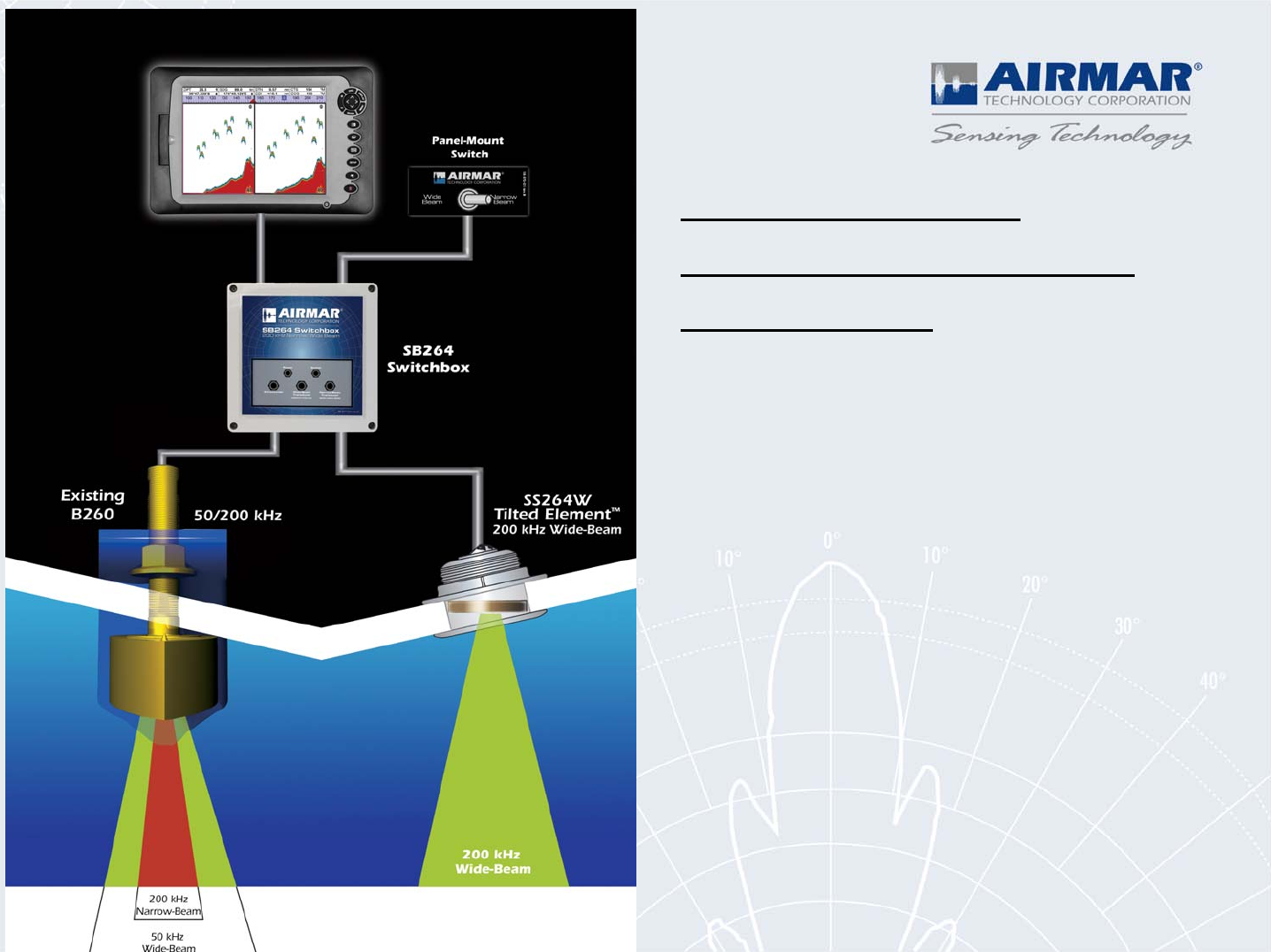
SB264 200kHz
Wide/Narrow-Beam
Switch box
•Allows SS270W or SS264W
200 kHz to work with existing
B260, M260, & B258 installations.
•User now has a switchable
200 kHz wide or narrow beam
for the specific type of fishing.
•For single transmission line
transducers only
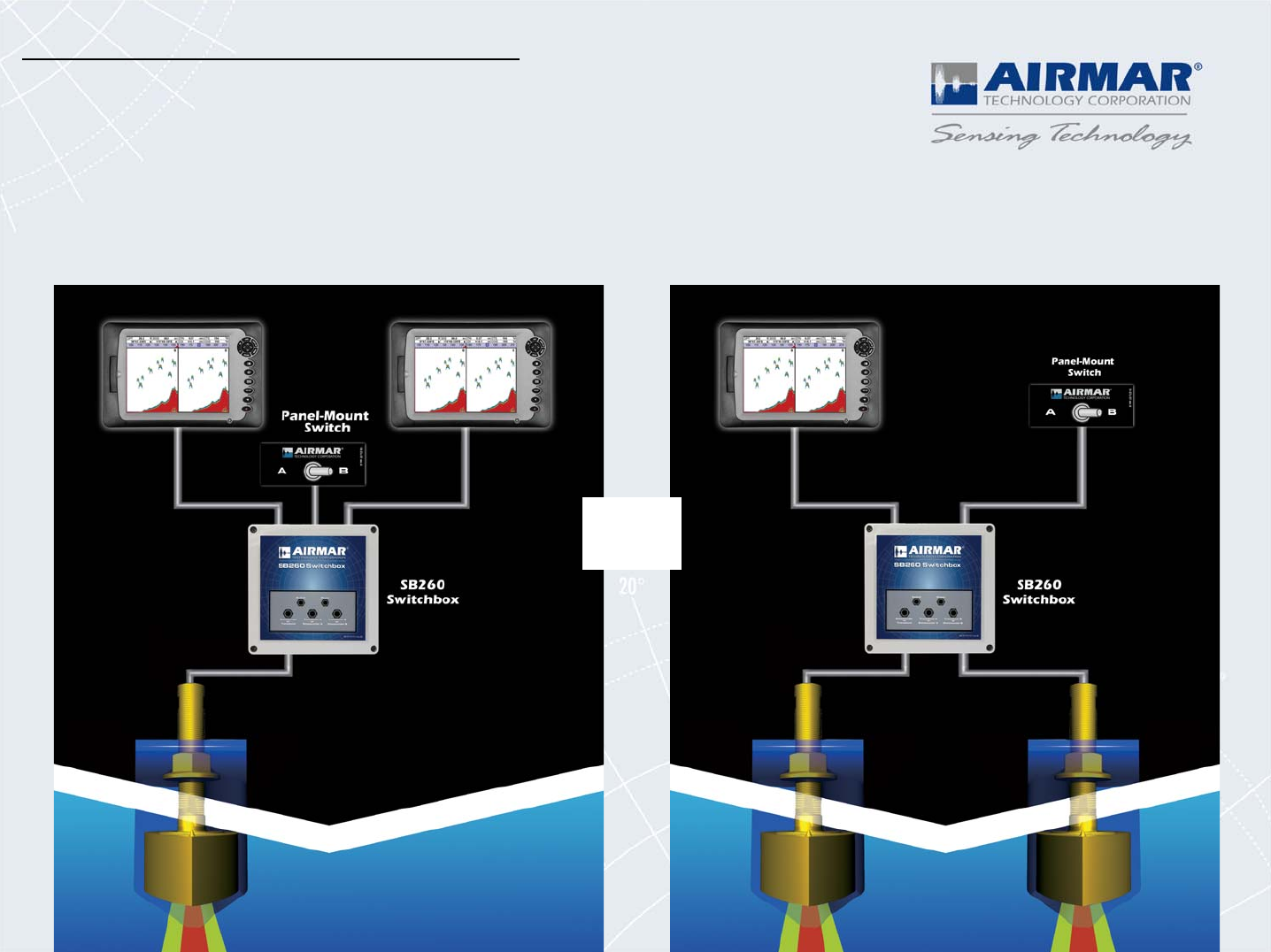
SB260 1kW Switch box
•Switches 2 fish finders with one transducer
•Switches 2 transducers with one fish finder
•For single transmission line transducers only
•Not for use with transducers of different power ratings
OR
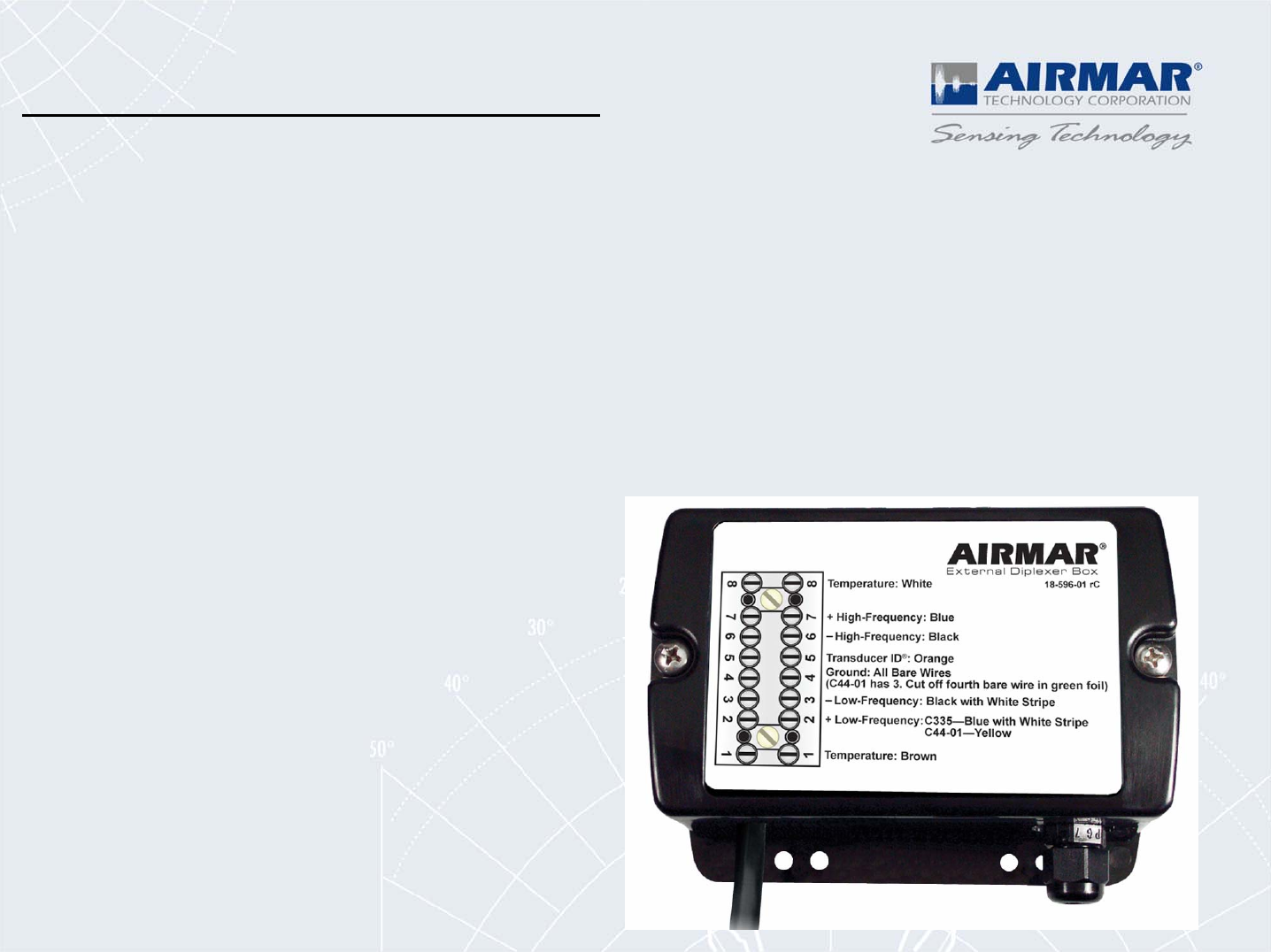
External Diplexer Box
• Converts dual-transmission-line transducers to a
single-transmission-line (4 wires for depth down to
2 wires)
• For use with 1 kW sounders only
• Good option for future upgrades to next generation
Chirp & FM sounders as most of these will require
4 wires for depth
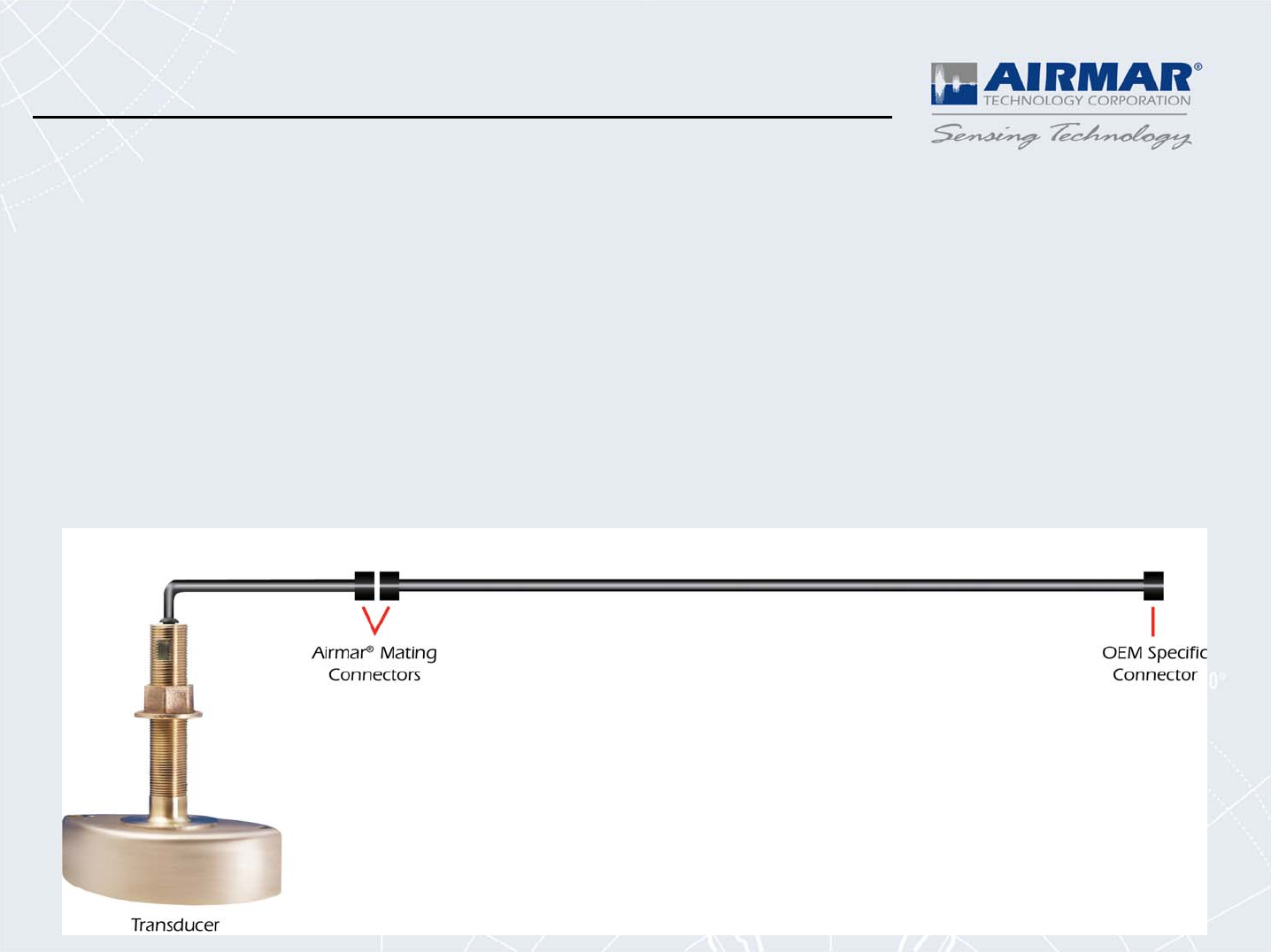
1kW Mix & Match Transducers
• 600W and 1kW Airmar transducers with a mix and match
cable.
• This allows you to stock a common transducer (B258) and
then either stock or order the specific OEM connector cable
(Furuno, Raymarine, Garmin, Lowrance, Simrad, Northstar)

Converting Transducers to Different
Manufacturer’s Equipment
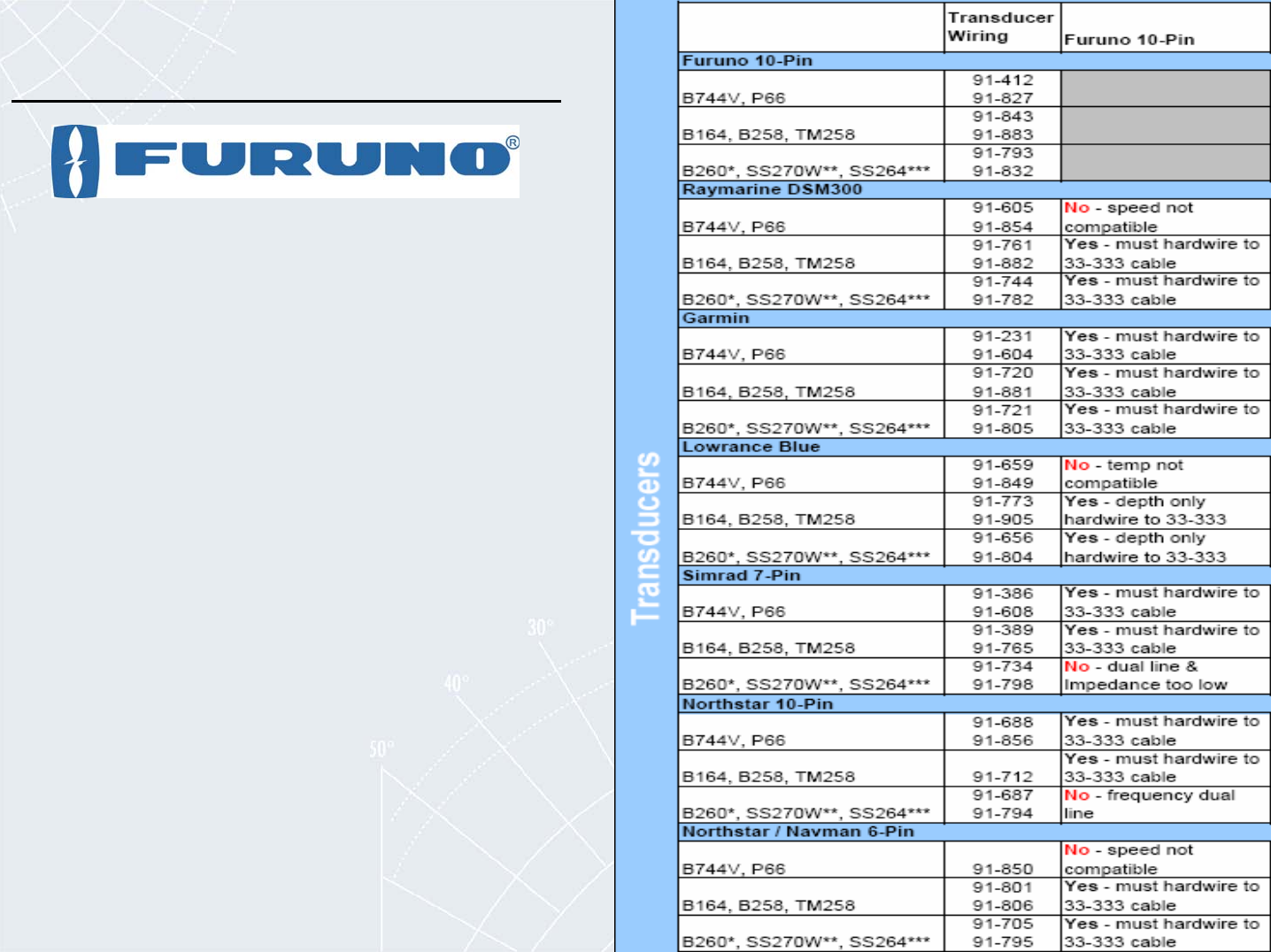
Converting Transducers
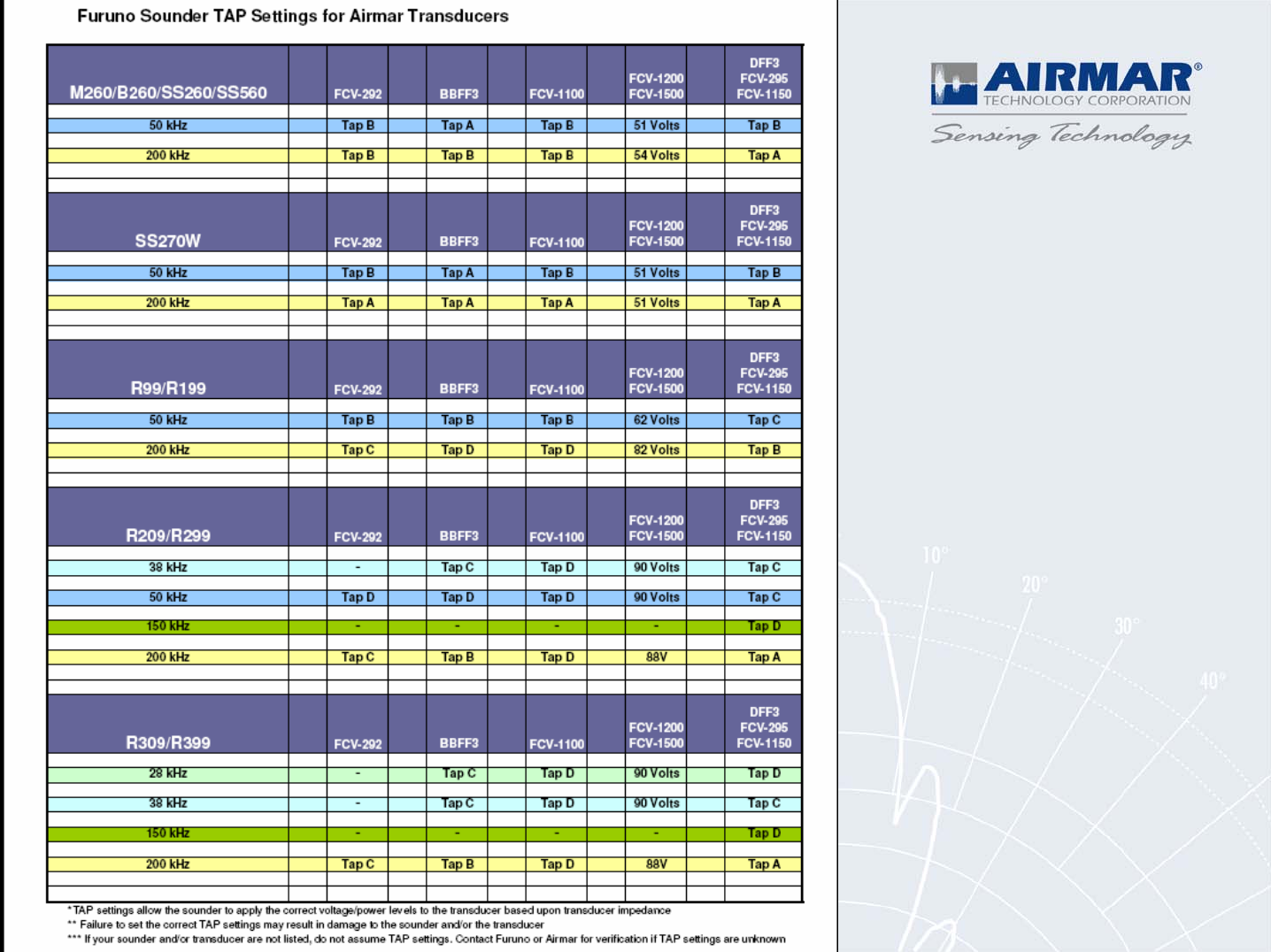
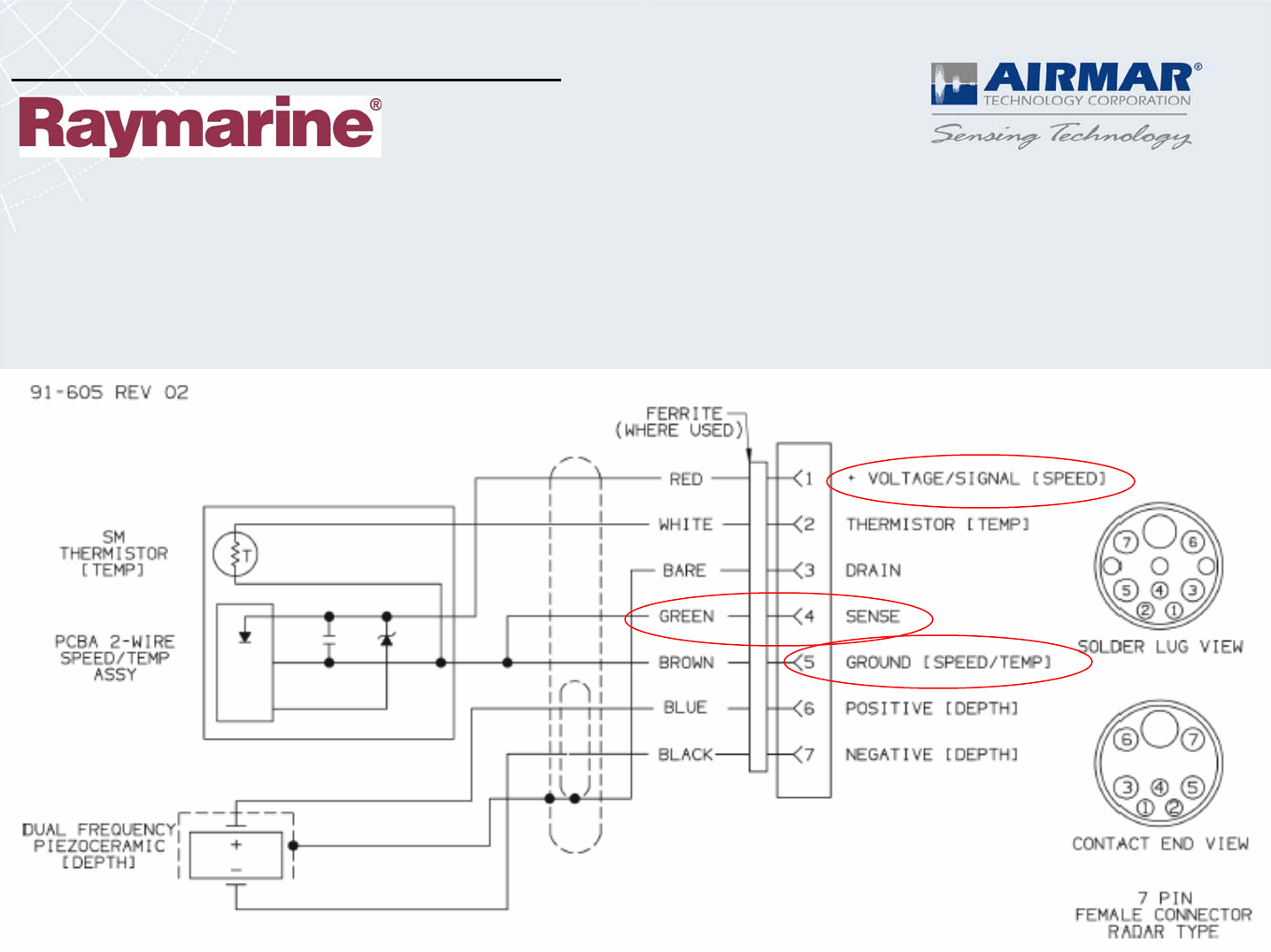
Converting Transducers
•Sense wire (green) determines if transducer is present and how
much power to apply. This is short on 600W transducers (see wiring)
•Unique 2-wire speed – Most OEM’s use 3 wire speed. Navman is
the only other exception
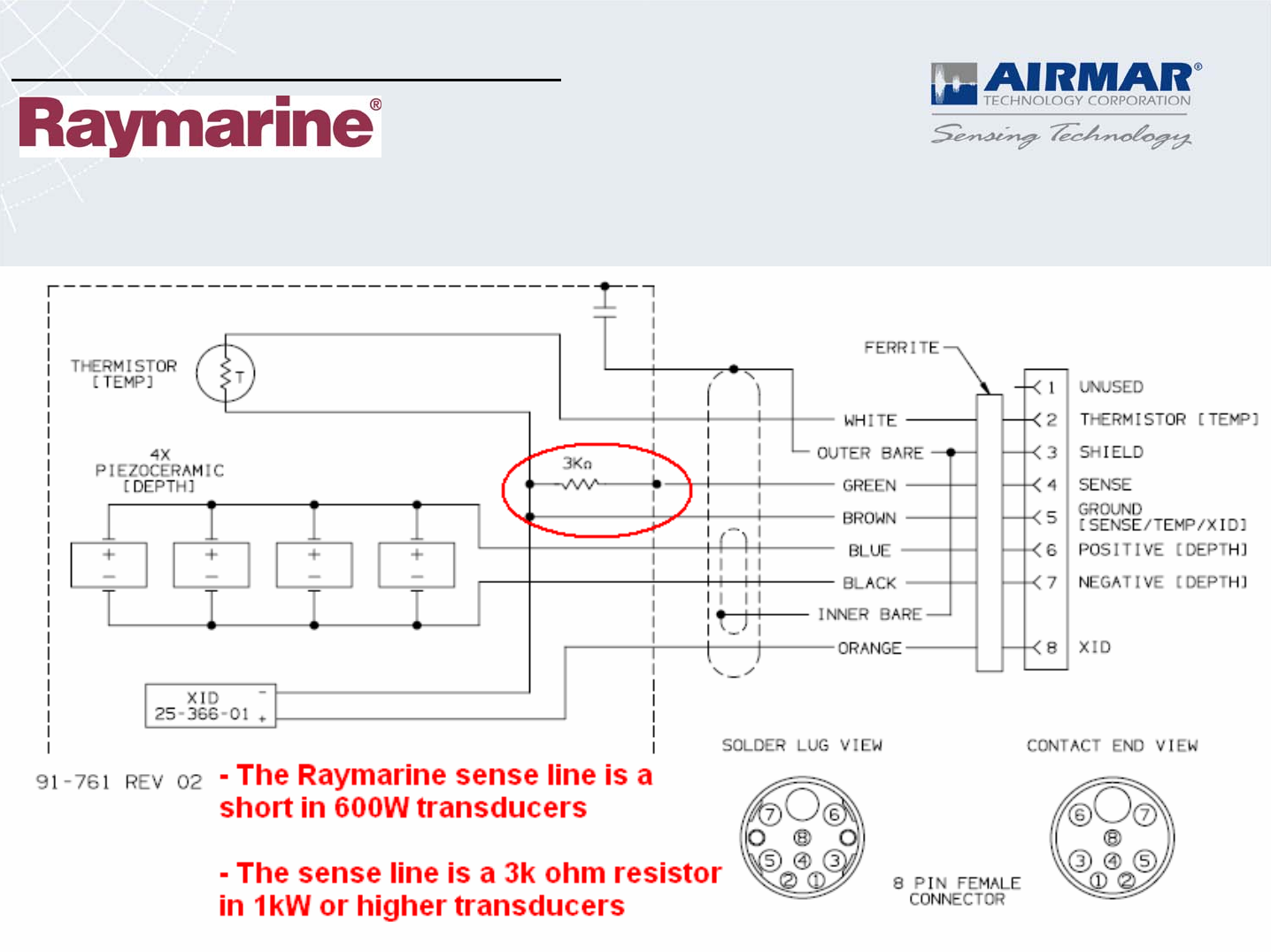
Converting Transducers
•Sense wire (green) determines if transducer is present and how
much power to apply. (see wiring)
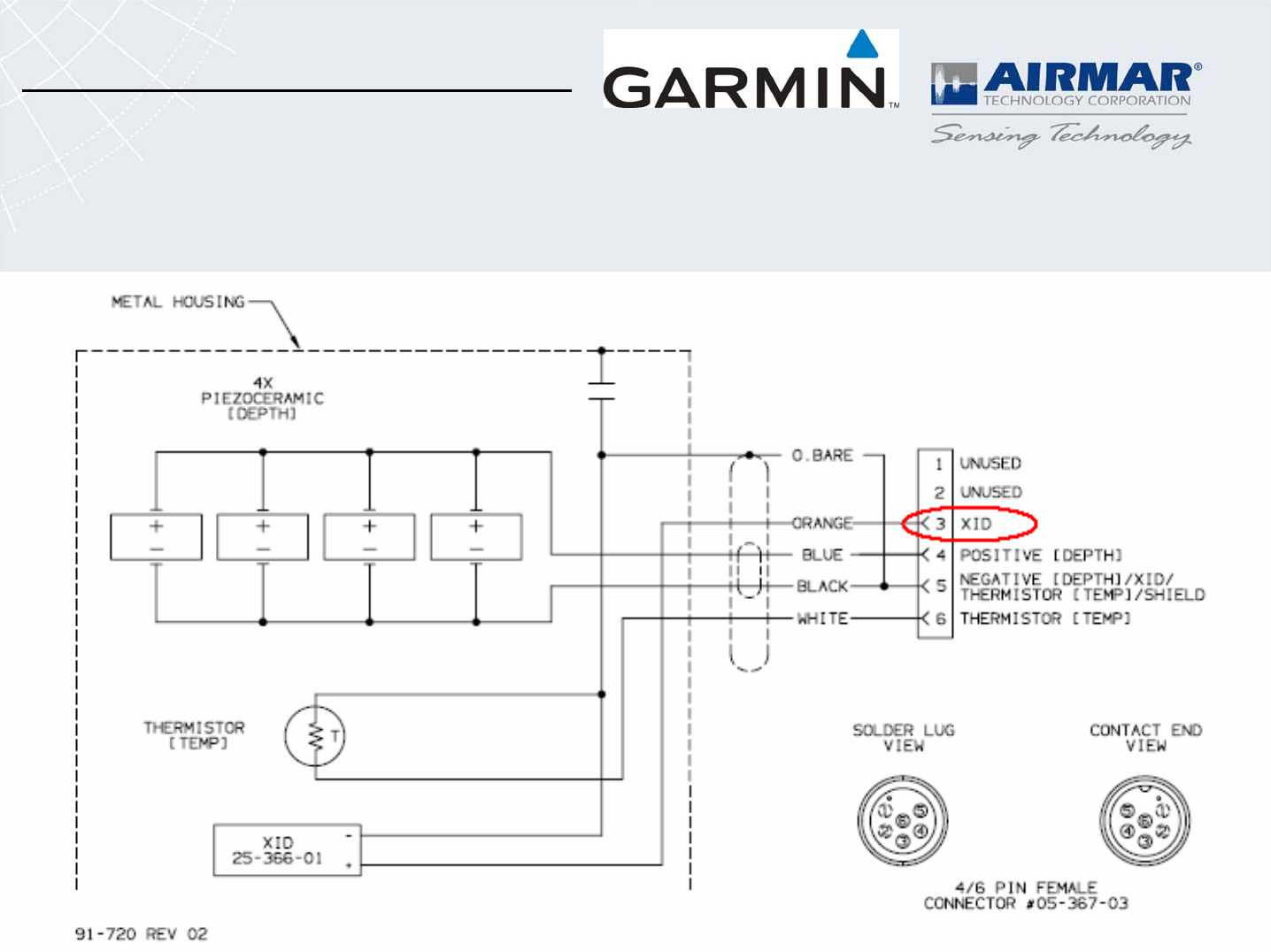
Converting Transducers
•Uses Transducer ID wire (pin 3) to set power at 1kW+ (See wiring)
•If the transducer does not have XID, the sounder will default to 500watt
s
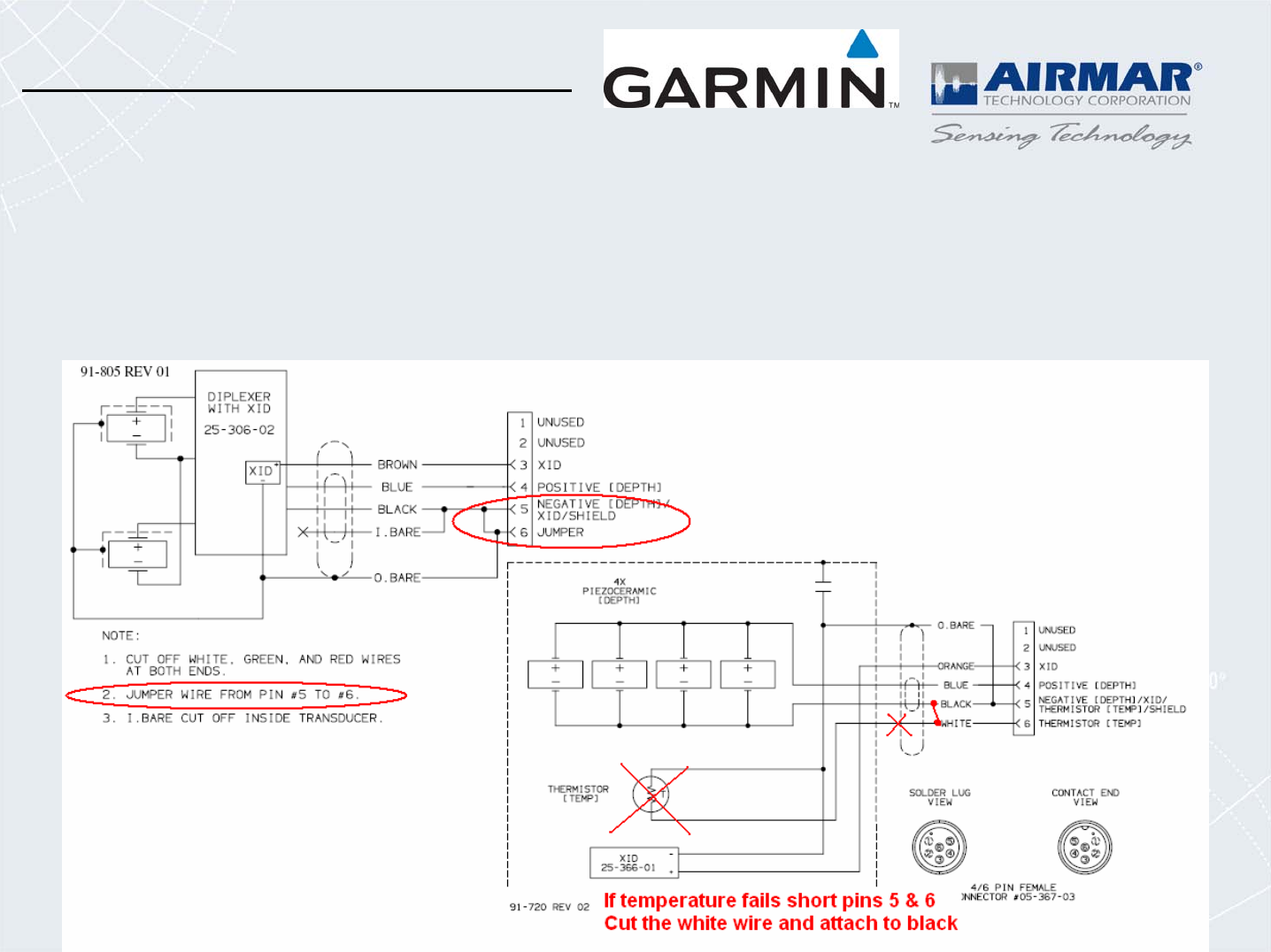
Converting Transducers
•Uses the temperature to sense that a transducer is connected to the
sounder. If temperature fails, the transducer is not recognized.
•To fix this, short pins 5 & 6 to get depth
•If adapting a depth only transducer from another OEM, these
pins must be shorted.
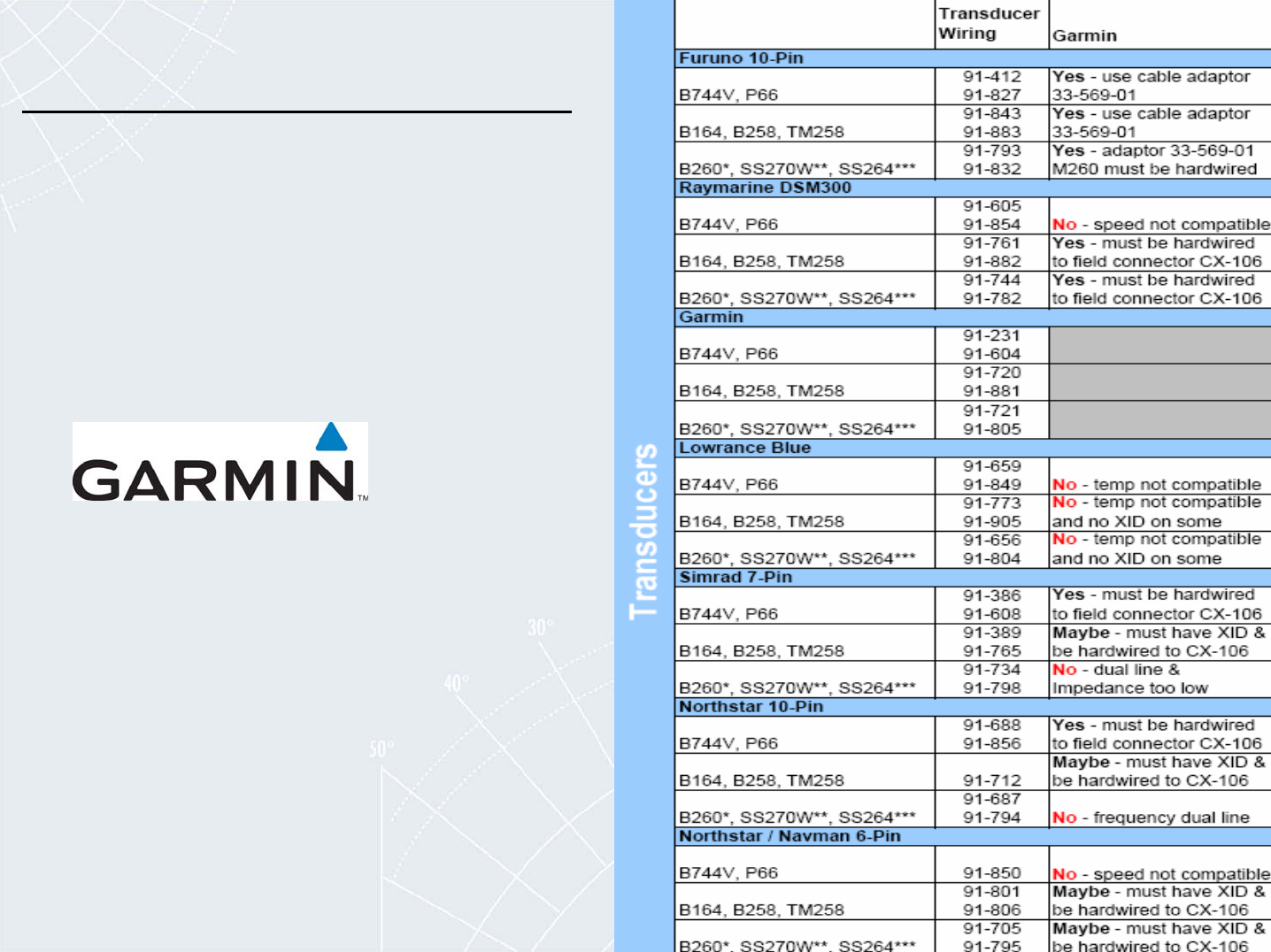
Converting Transducers
to
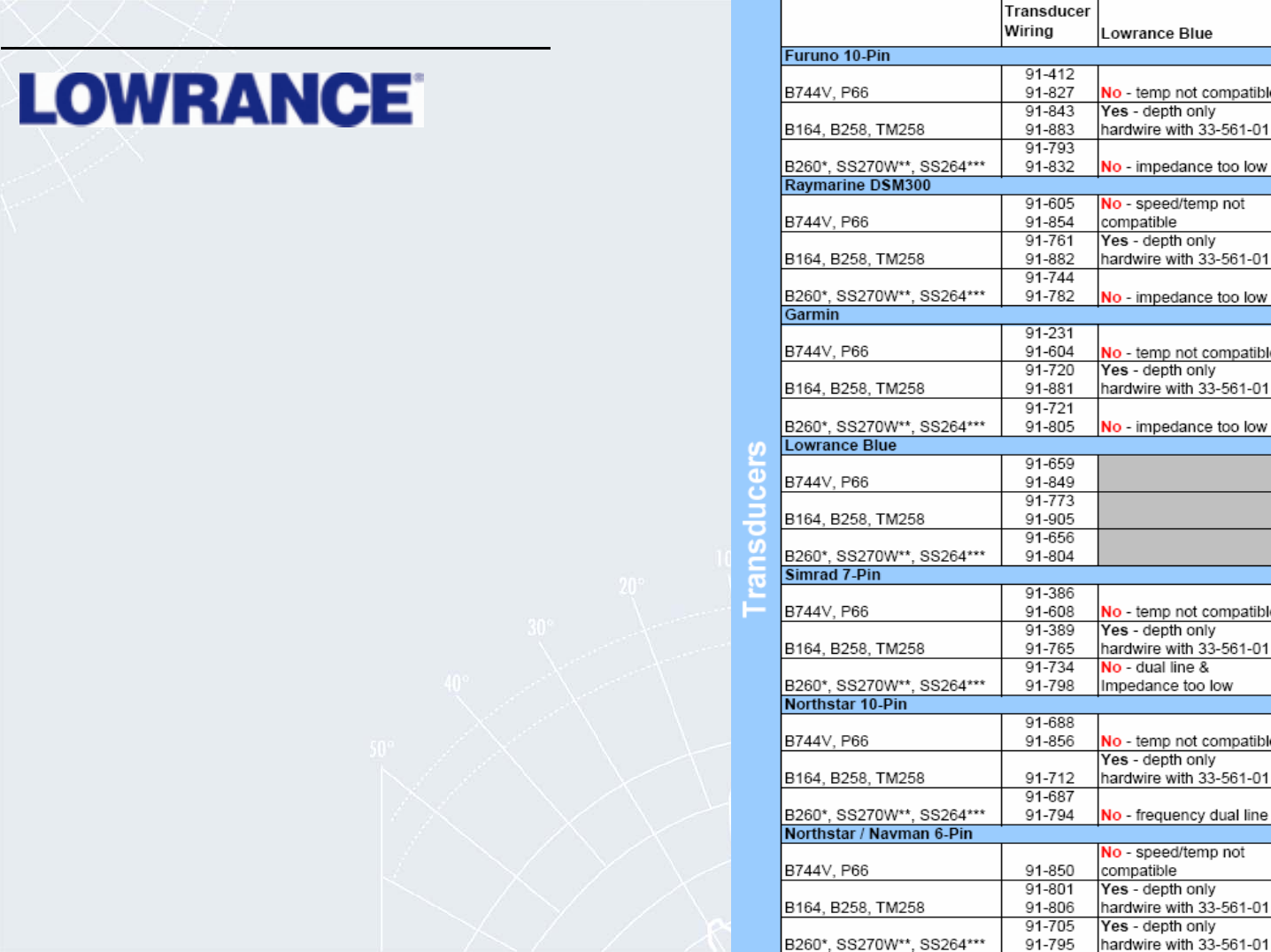
Converting Transducers
•Unique temperature 5k Ohm
•All others use 10k Ohm
•Depth is compatible
•Temperature NOT Compatible
•B260, M260 from Furuno,
Garmin, and Raymarine is NOT
compatible. These use broadband
200 kHz ceramics with low
impedance(90 Ohms)
•New Navico Broadband box
requires 200 ohms at 200kHz
•Specific B260 & M260 for Lowrance
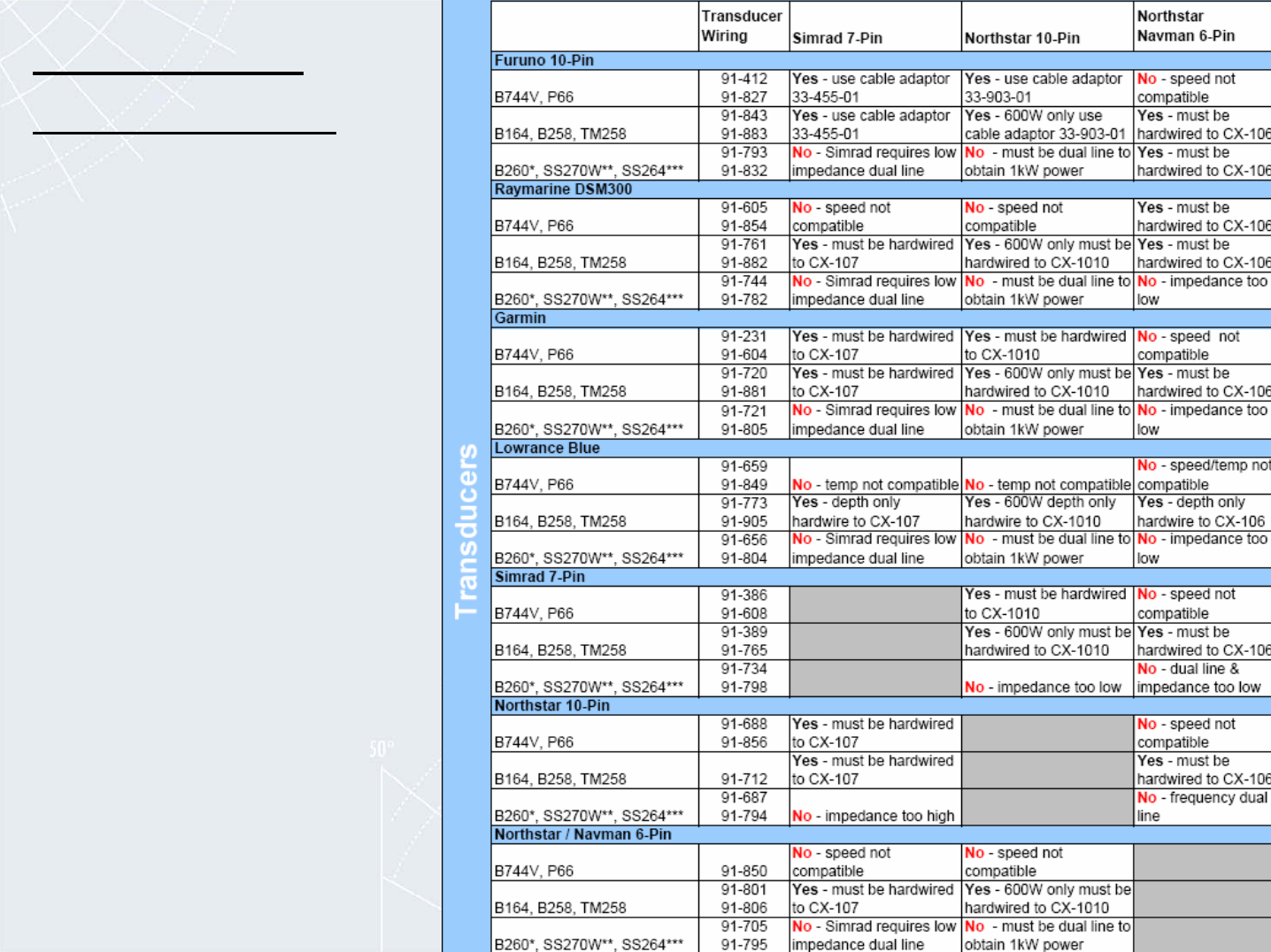
Converting
Transducers
Older Models
Simrad 7-pin
Northstar 10-pin
Navman 6-pin

General Notes on Impedance when
converting manufacturer’s transducers
• The impedance (ohms) at each frequency both in the
transducer and in the fishfinder should match
• As impedance gets lower, power increases (see chart)
• As impedance gets higher, power decreases (see chart)
• It is OK to have a transducer with higher impedance
connected to a fishfinder with lower impedance
• It is NOT OK to have a transducer with lower
impedance connected to a fishfinder with higher
impedance. This will overdrive the transducer
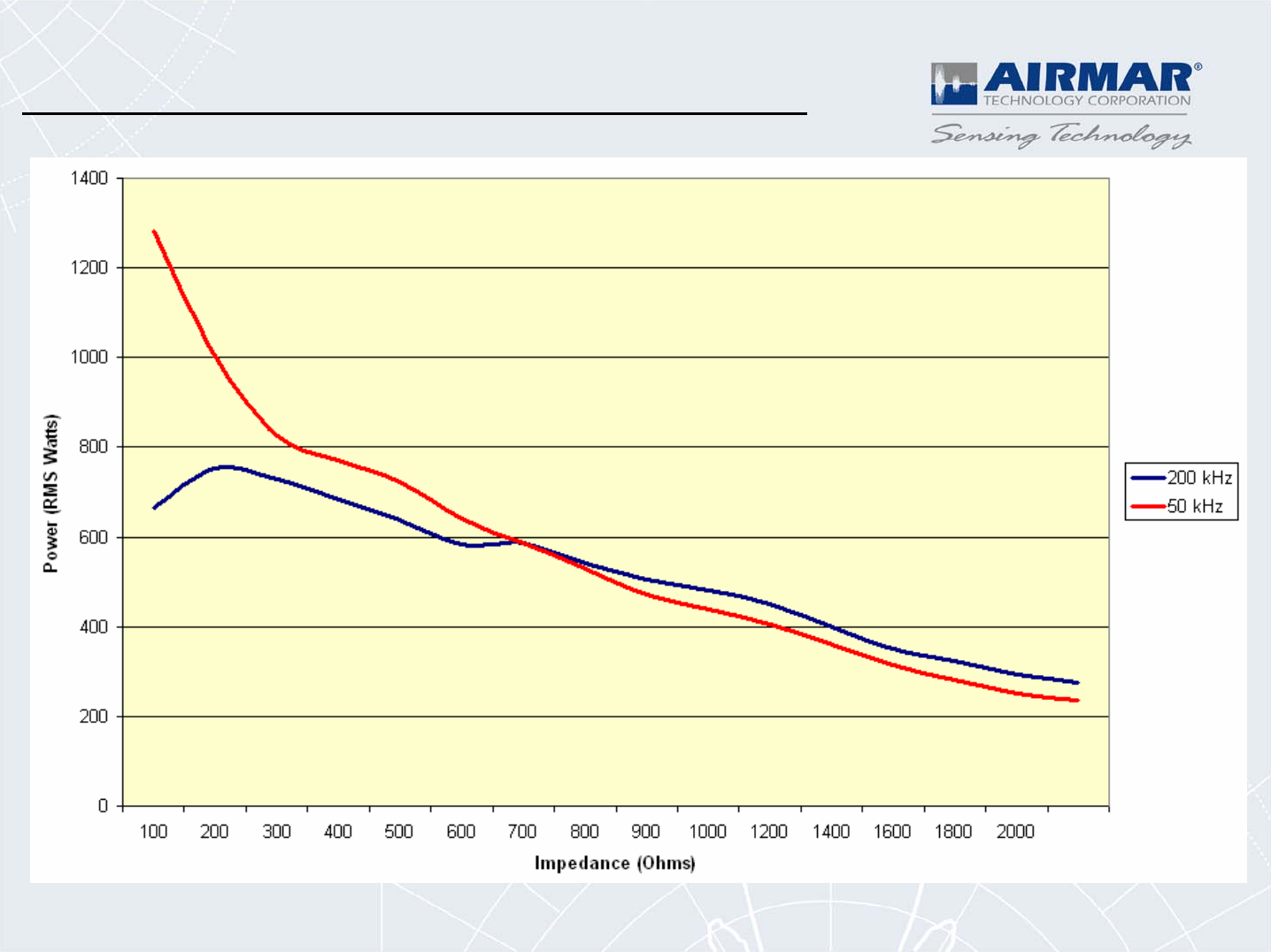
Impedance Chart- Power Curve
Impedance in relation to RMS Power

Transducer Adaptor Cables
Converts the following:
• Furuno 10-pin to Garmin
• Raymarine “A” to DSM
• Furuno 10-pin to Northstar 10-pin
• Furuno 8-pin to Furuno 10-pin
• Furuno 10-pin to Simrad 7-pin
OEM Field-attachable connectors are also available
Installation & Troubleshooting
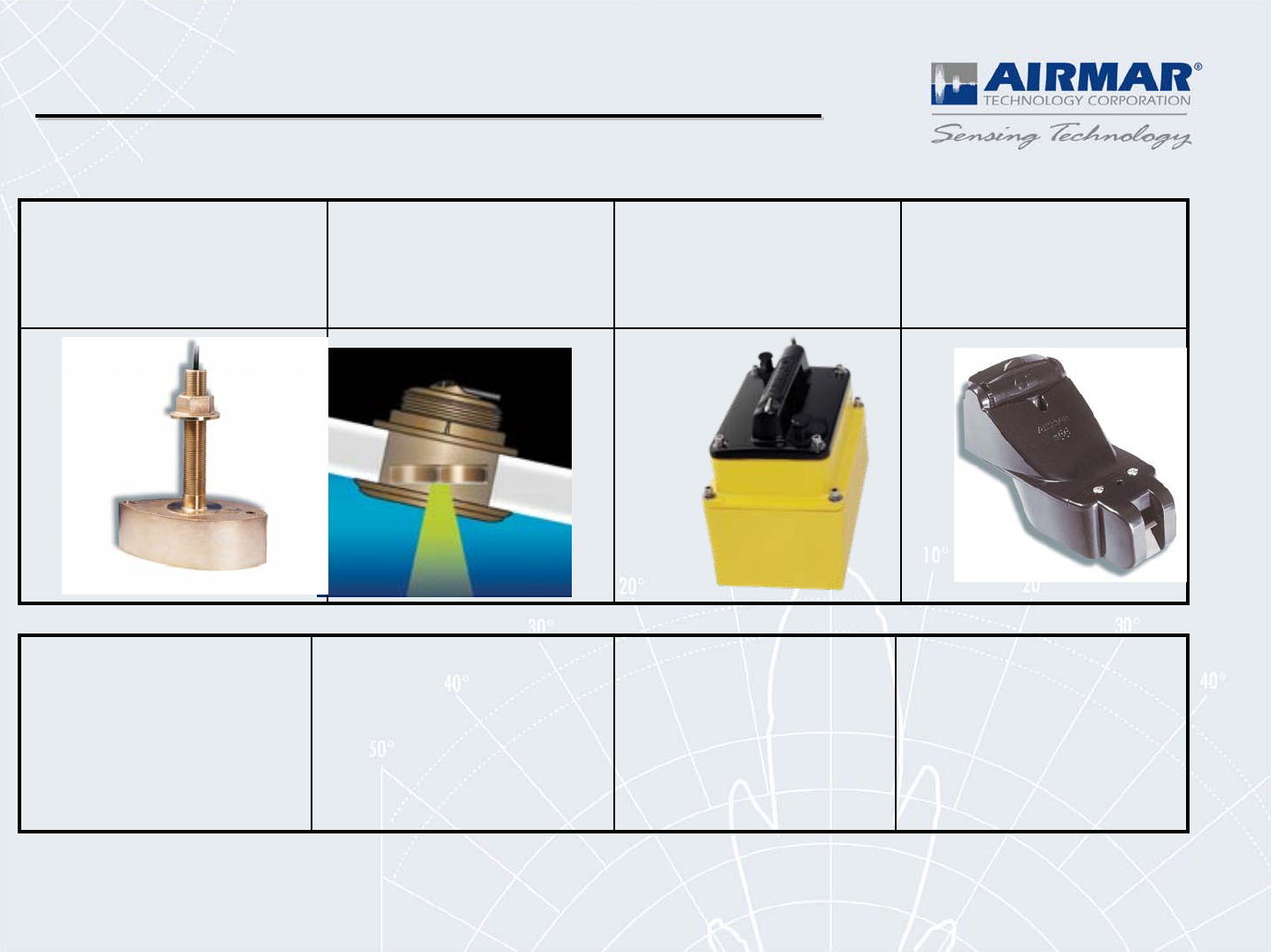
Four Transducer Categories
Four Transducer Categories
Thru-Hull Tilted
Element™ In-Hull Transom
+ Best overall
performance
-Fairing needs to be
cut & installed
+ No fairing, low
profile
-Requires larger hole
+ No Hull
protrusions
-No integrated
temperature
+ Low Cost
-Moderate
performance at
speed
•
•Delivers the best performance
Delivers the best performance
because the transducer face is in
because the transducer face is in
contact with the water.
contact with the water.
•
•For stepped, planing or
For stepped, planing or
displacement hulls.
displacement hulls.
•
•Models available for wood,
Models available for wood,
fiberglass, aluminum or steel hulls.
fiberglass, aluminum or steel hulls.
•
•Can be used with inboard, I/O, OB
Can be used with inboard, I/O, OB
and jet drive propulsion systems.
and jet drive propulsion systems.
•
•Excellent high speed results with
Excellent high speed results with
use of high
use of high-
-performance fairings.
performance fairings.
•
•For hull dead rise angles up to 25°
For hull dead rise angles up to 25°
Thru-Hull models
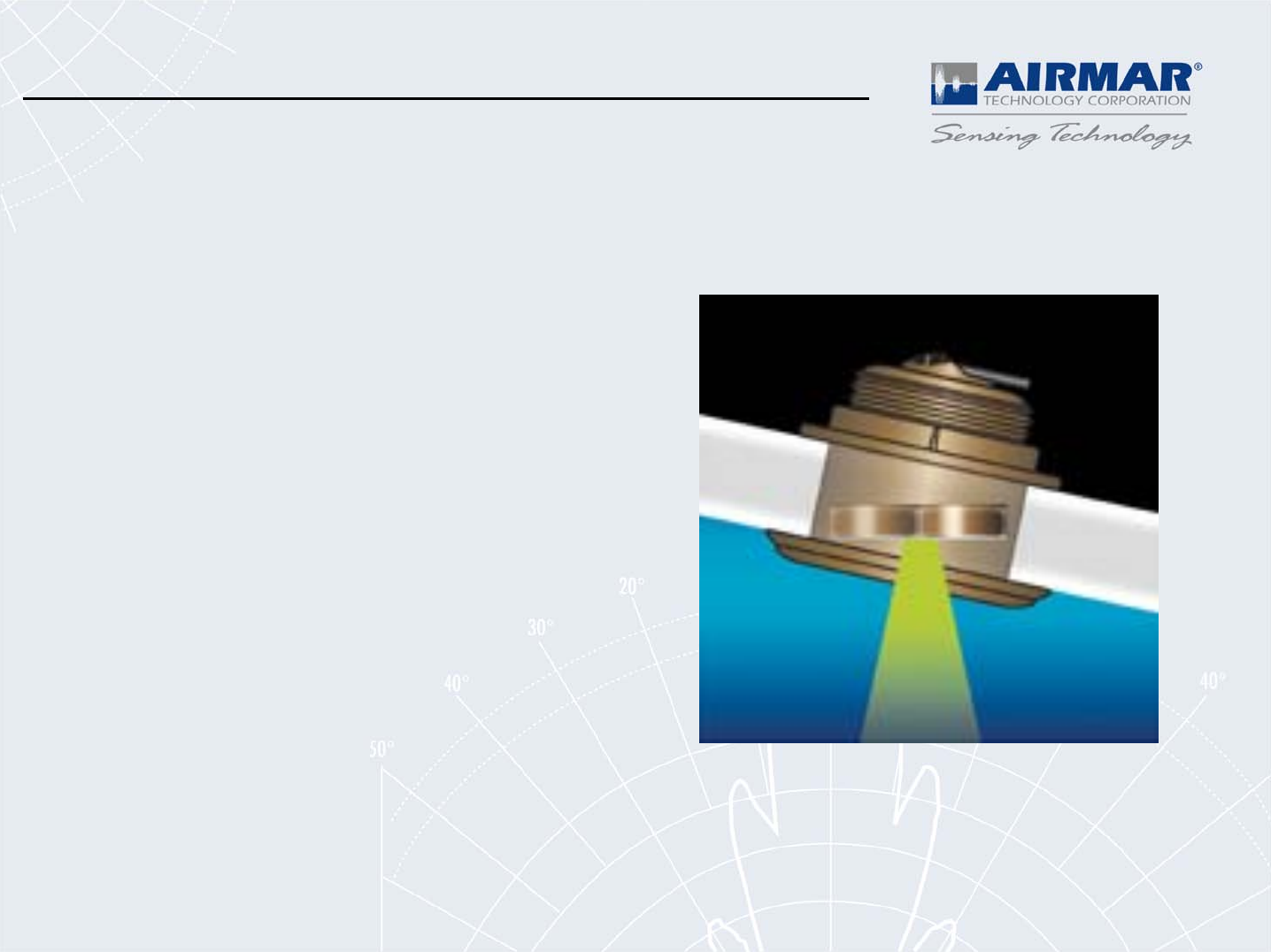
•
•For large, trailered center
For large, trailered center
console and walk
console and walk-
-arounds that
arounds that
can not accommodate a thru
can not accommodate a thru-
-hull
hull
with fairing
with fairing
•
•Virtually flush installation to the
Virtually flush installation to the
hull
hull
•
•Models available for wood,
Models available for wood,
fiberglass, aluminum or steel hulls
fiberglass, aluminum or steel hulls
•
•Can be used with inboard, I/O,
Can be used with inboard, I/O,
OB and jet drive systems
OB and jet drive systems
•
•Gives excellent high speed
Gives excellent high speed
results over 30 knots
results over 30 knots
•
•For hull dead rise angles up to
For hull dead rise angles up to
25 degrees.
25 degrees.
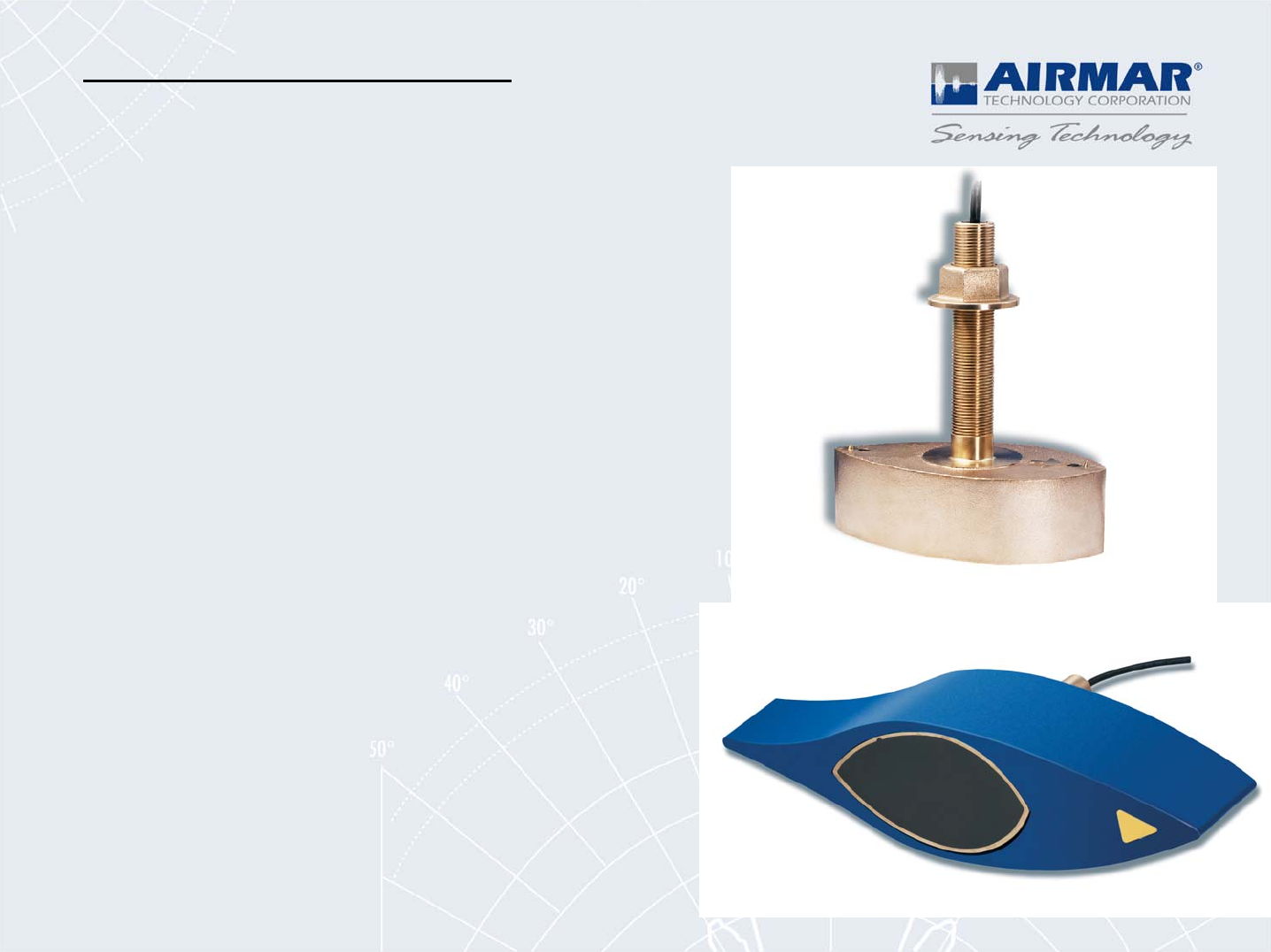
Thru-Hull Tilted Element™ Models
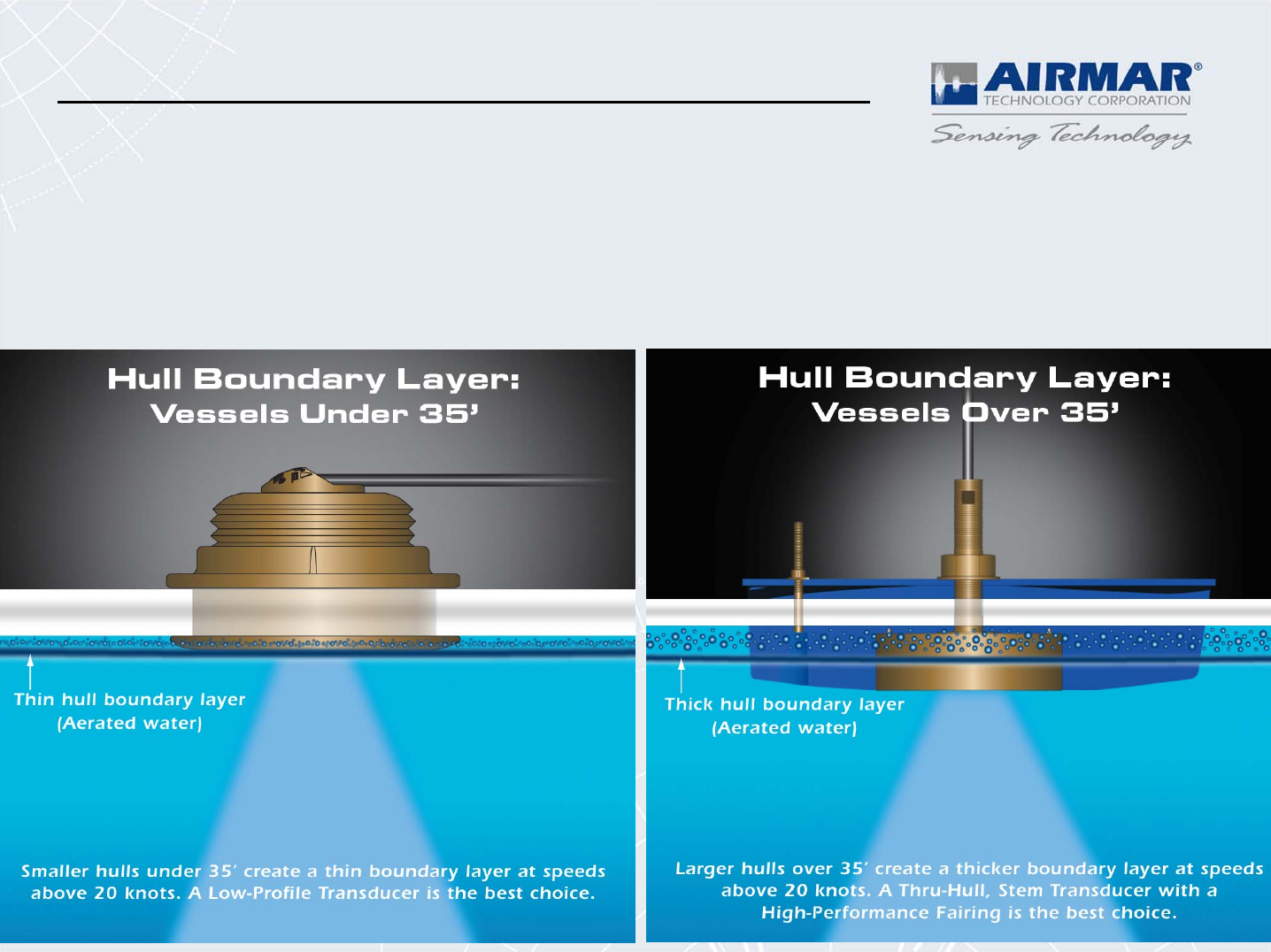
What is the hull boundary layer?
•Aerated water flow along the boat hull at cruising speeds
•Boundary layers get thicker as vessel size increases
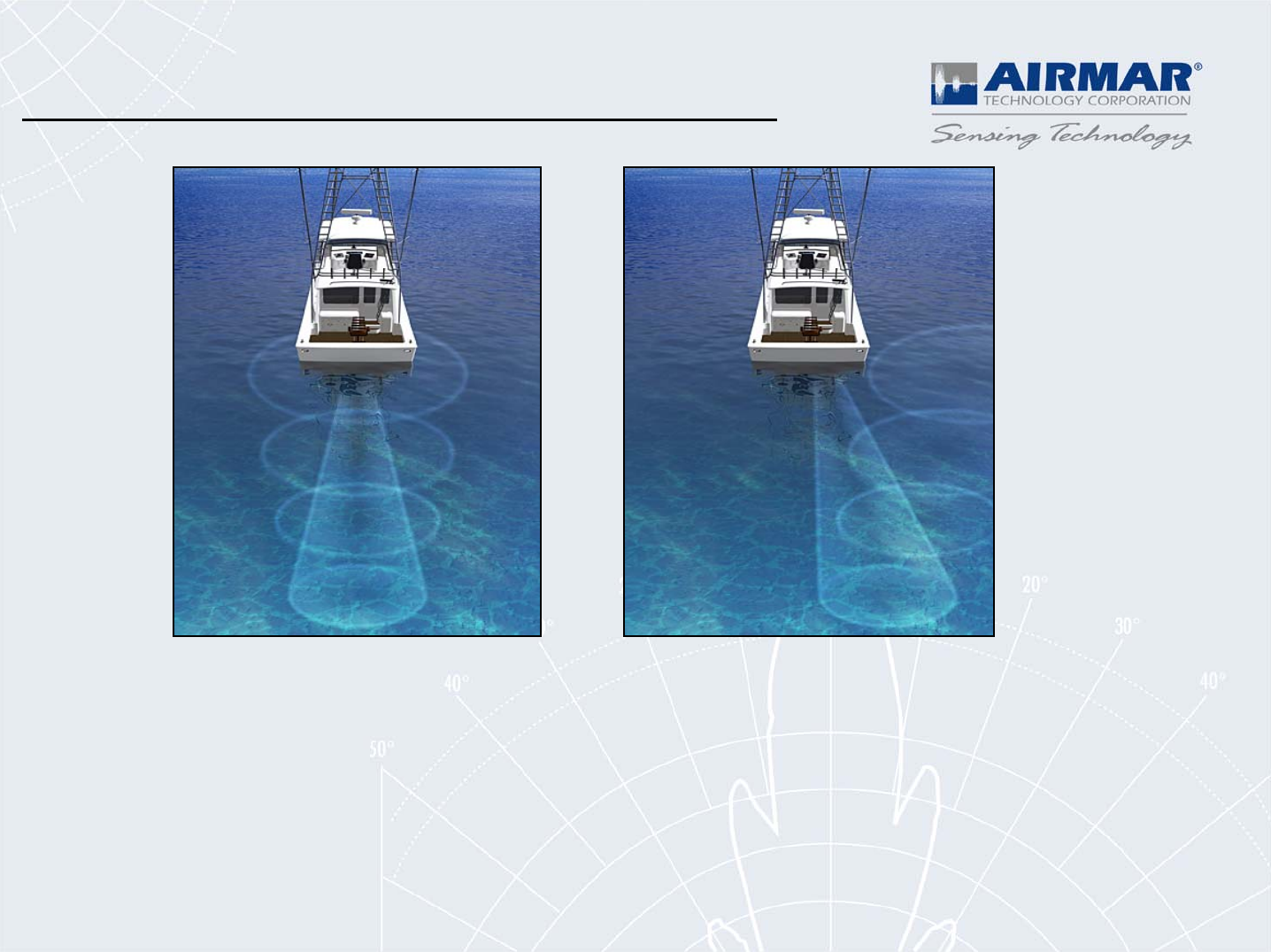
Importance of a vertical beam
Regardless of mounting style, a properly installed
transducer delivers a vertical beam that aims straight
down toward the bottom, resulting in strong echo
returns and accurate depth readings.
Good Bad
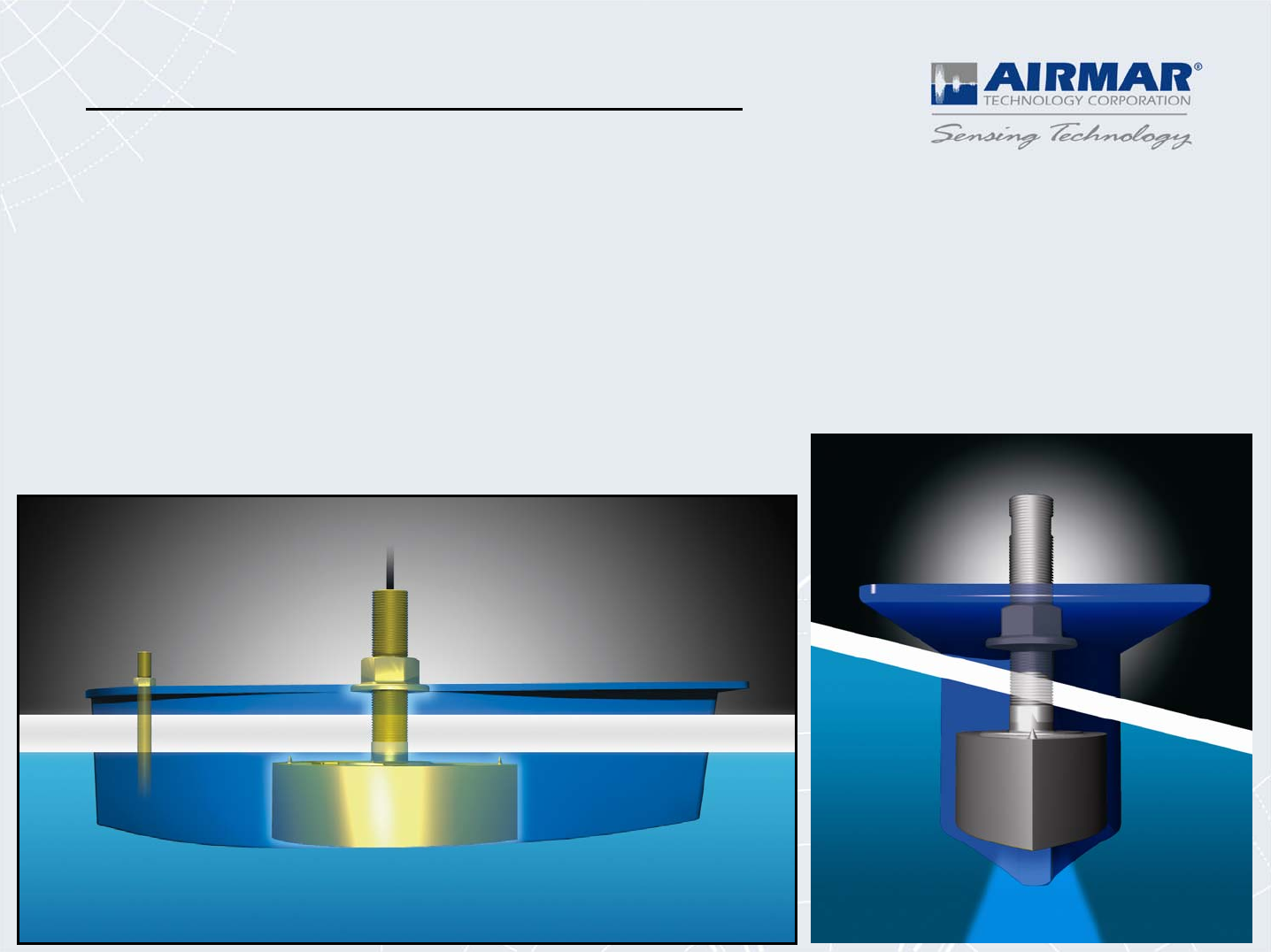
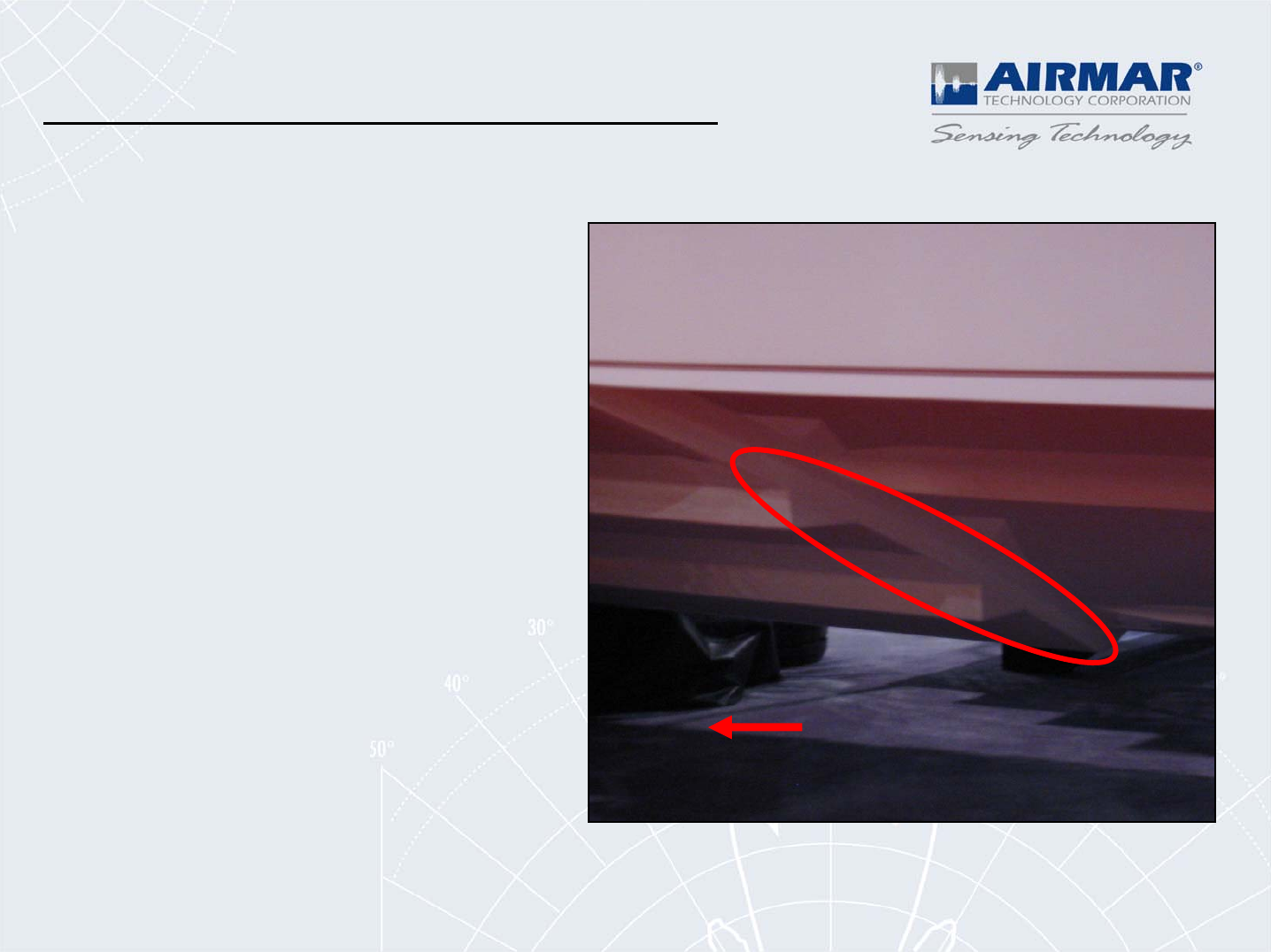
High Performance Fairings
The face of the transducer extends off of the hull surface,
placing the active surface outside of the boundary layer.
The transducer delivers a vertical beam that aims straight
down toward the bottom.
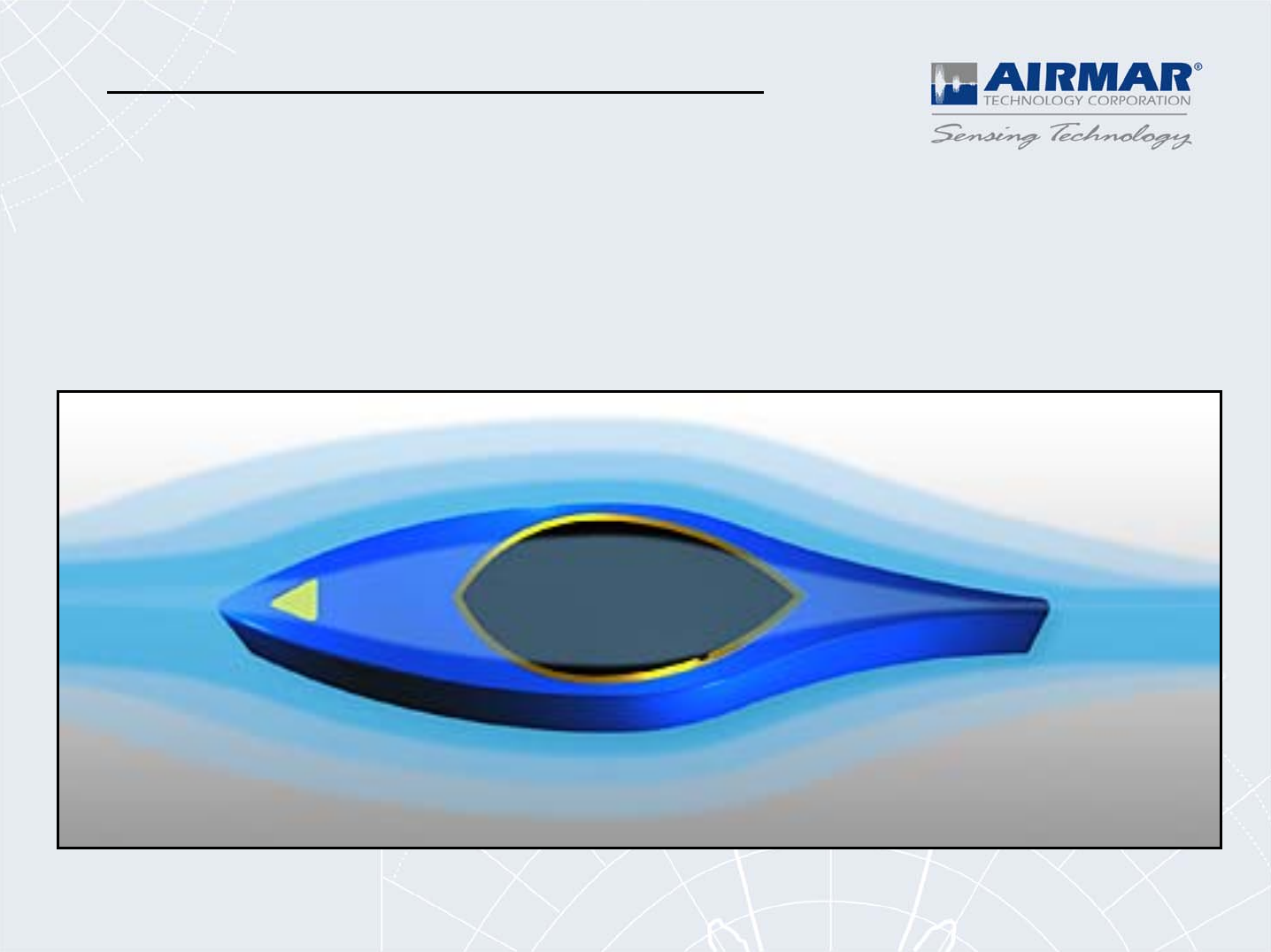
High Performance Fairings
Maintain smooth flow, significantly reducing drag on
Maintain smooth flow, significantly reducing drag on
the hull and lessening the chance of intake and prop
the hull and lessening the chance of intake and prop
cavitation. This installation works great over 30 kts.
cavitation. This installation works great over 30 kts.
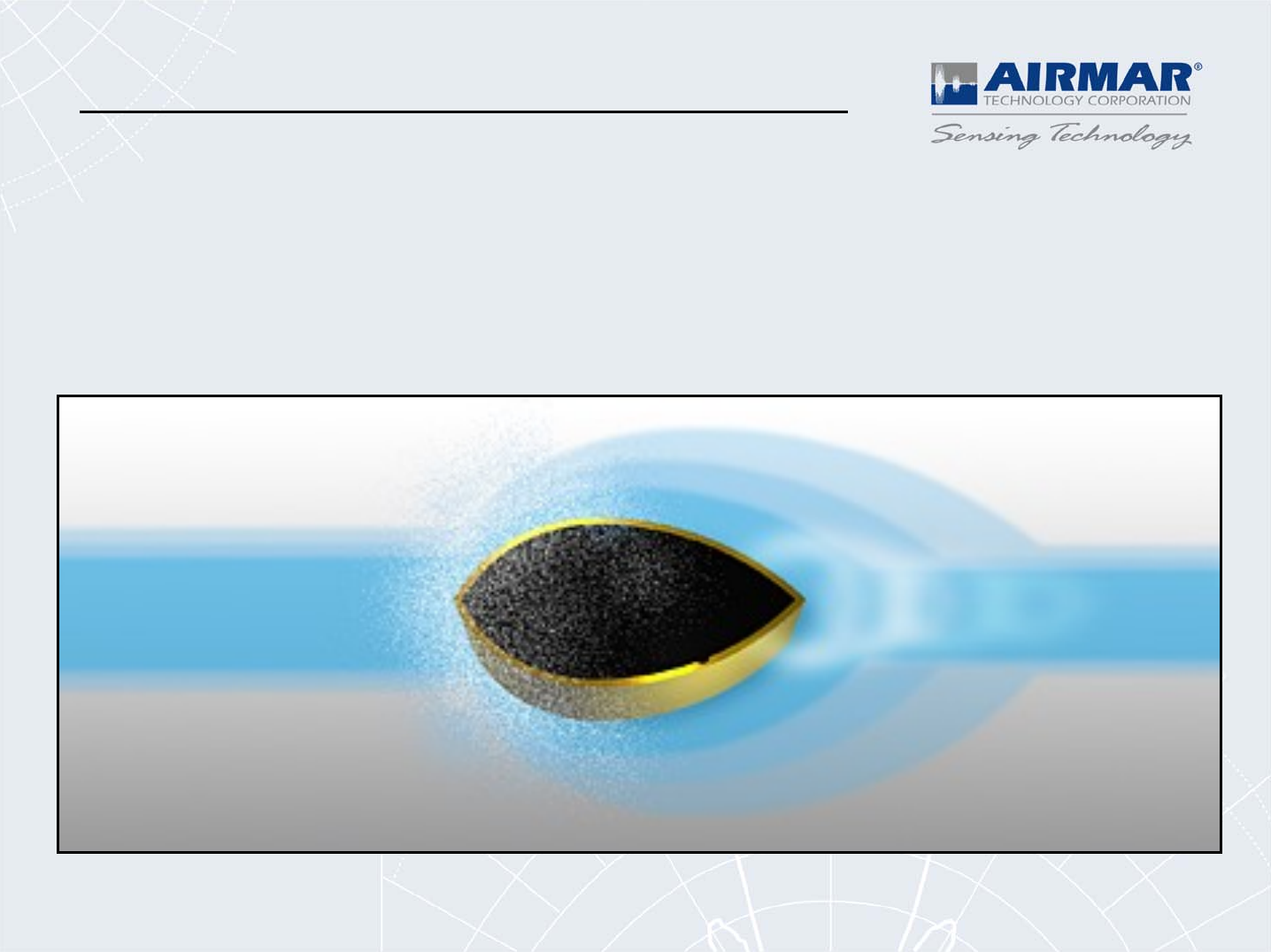
Without a High-Performance Fairing
The transducer face is exposed to aeration and
The transducer face is exposed to aeration and
turbulence as the flow makes an abrupt change in
turbulence as the flow makes an abrupt change in
direction. This installation will work poorly above 10 kts.
direction. This installation will work poorly above 10 kts.

Installation & Troubleshooting
Basics: Mounting Location
• The water flowing across the hull must be smooth with a
minimum of bubbles and turbulence (especially at high speeds).
•DO NOT MOUNT near water intake or discharge
openings or behind strakes, fittings, or hull irregularities.
• The transducer must be continuously immersed in water.
• The transducer beam must be unobstructed by the keel or
propeller shaft(s).
• Choose a location away from interference caused by power and
radiation sources such as: the propeller(s) and shaft(s), other
machinery, other echosounders, and other cables. The lower the
noise level, the higher the echosounder gain setting that can be
used.
• Choose a location with a minimum deadrise angle.
• Choose an accessible spot inside the vessel with adequate
headroom for the height of the housing, tightening the nuts, and
removing the insert.
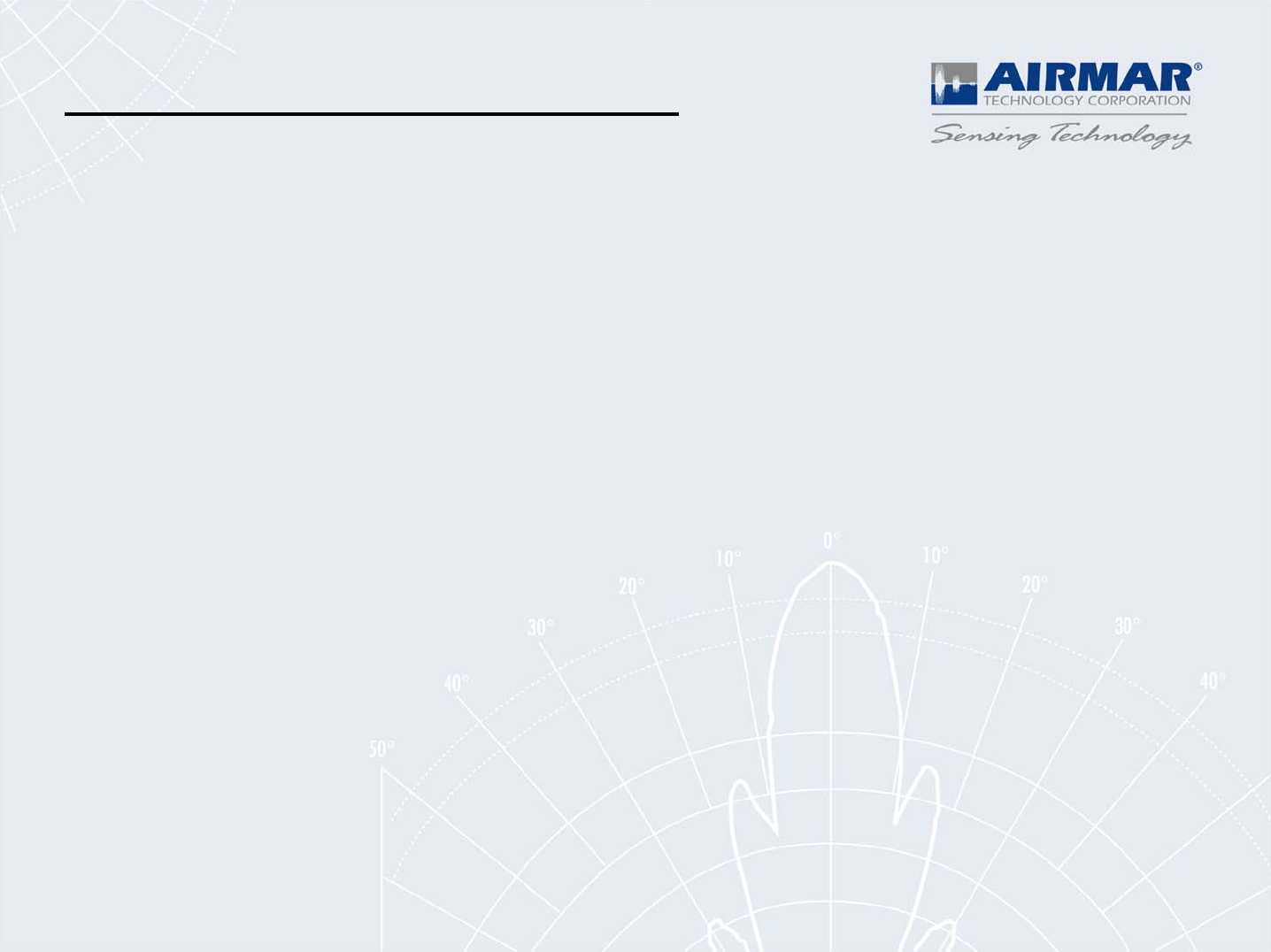
• Always choose a location away from interference caused by
sources such as propeller shafts, satellite or radar equipment,
other machinery and cable runs.
• The lower the overall noise level around the transducer and
cable, the higher the gain setting that can be used, resulting
in more screen detail.
• If screen interference appears at a specific rpm or when the
boat is put in and out of gear, this could be a sign of
electrical interference on the sounder’s power line. Try
powering the sounder directly from a stand-alone battery.
• If the screen interference increases proportional to vessel
speed this usually indicates that the transducer face is
exposed to aerated water.
Avoiding Interference
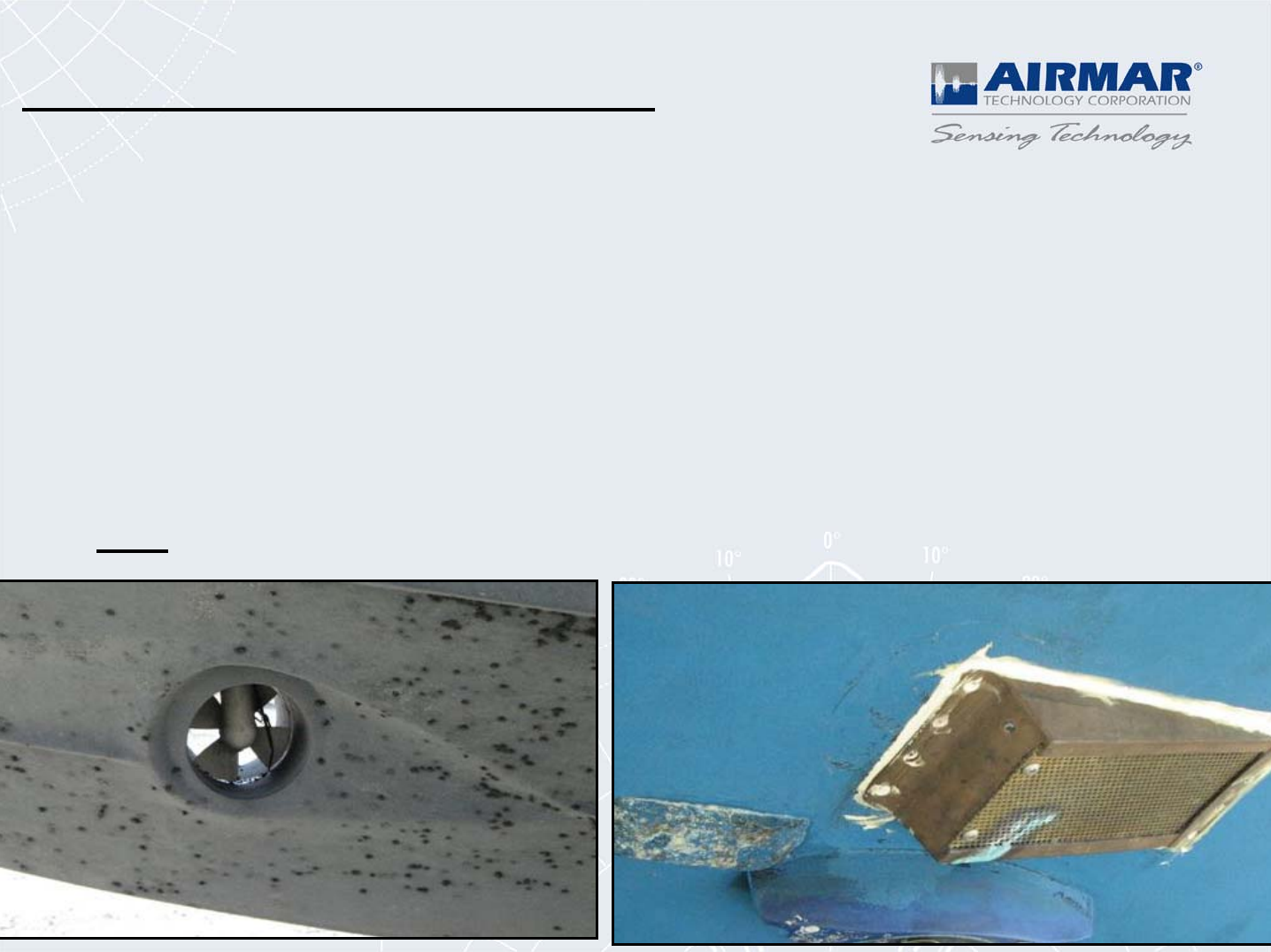
• Bow thrusters, live well or cooling intakes as well as chines, steps
and strakes can all introduce aerated water into the path of the
transducer.
• Remember to always look forward all the way to the bow of the
vessel to see if there will be any interference in front of the
transducer’s mounting location.
• If there is an intake 50 feet ahead, in line with the transducer,
it will effect performance at high speeds.
Installation Guidelines
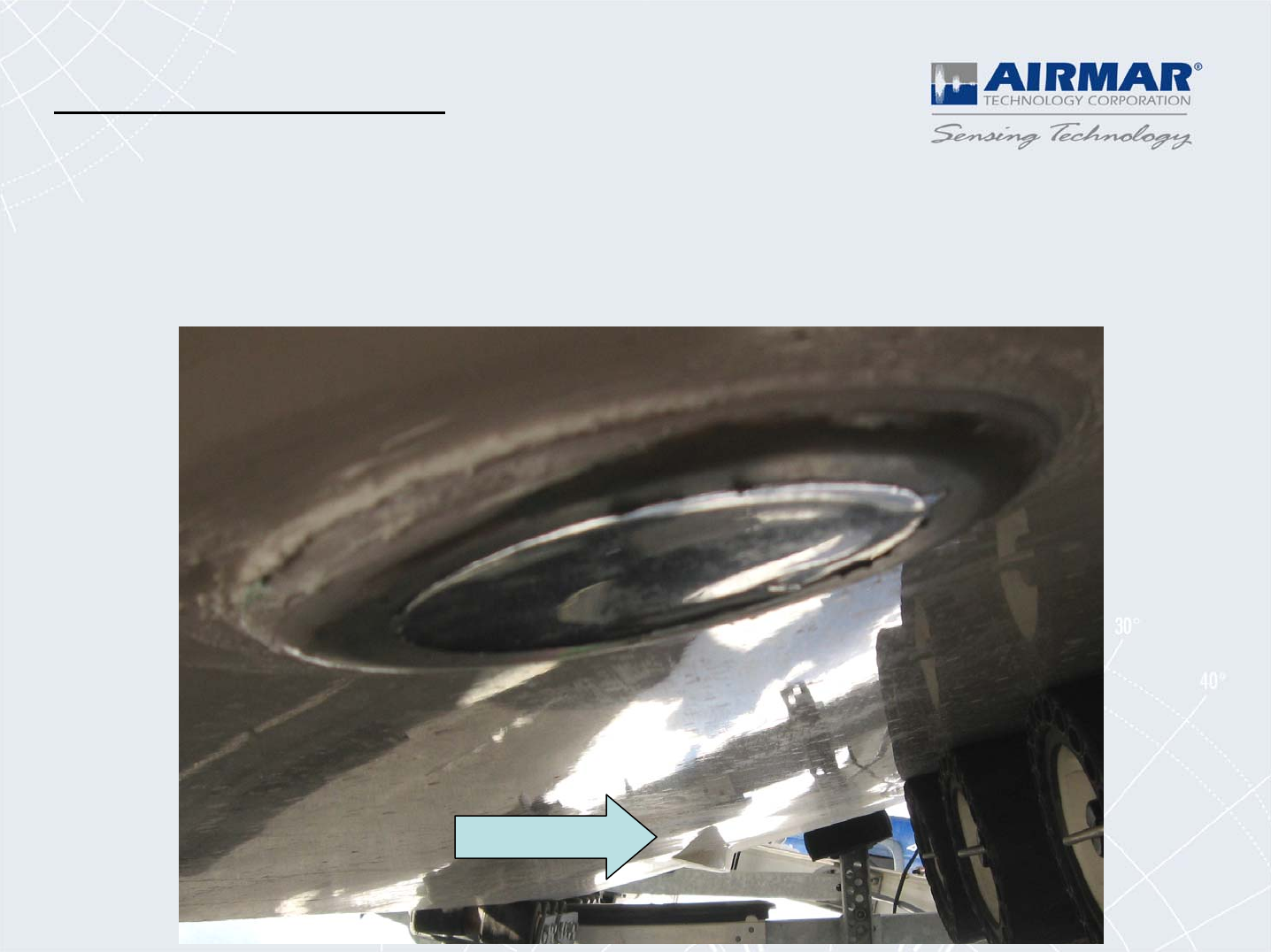
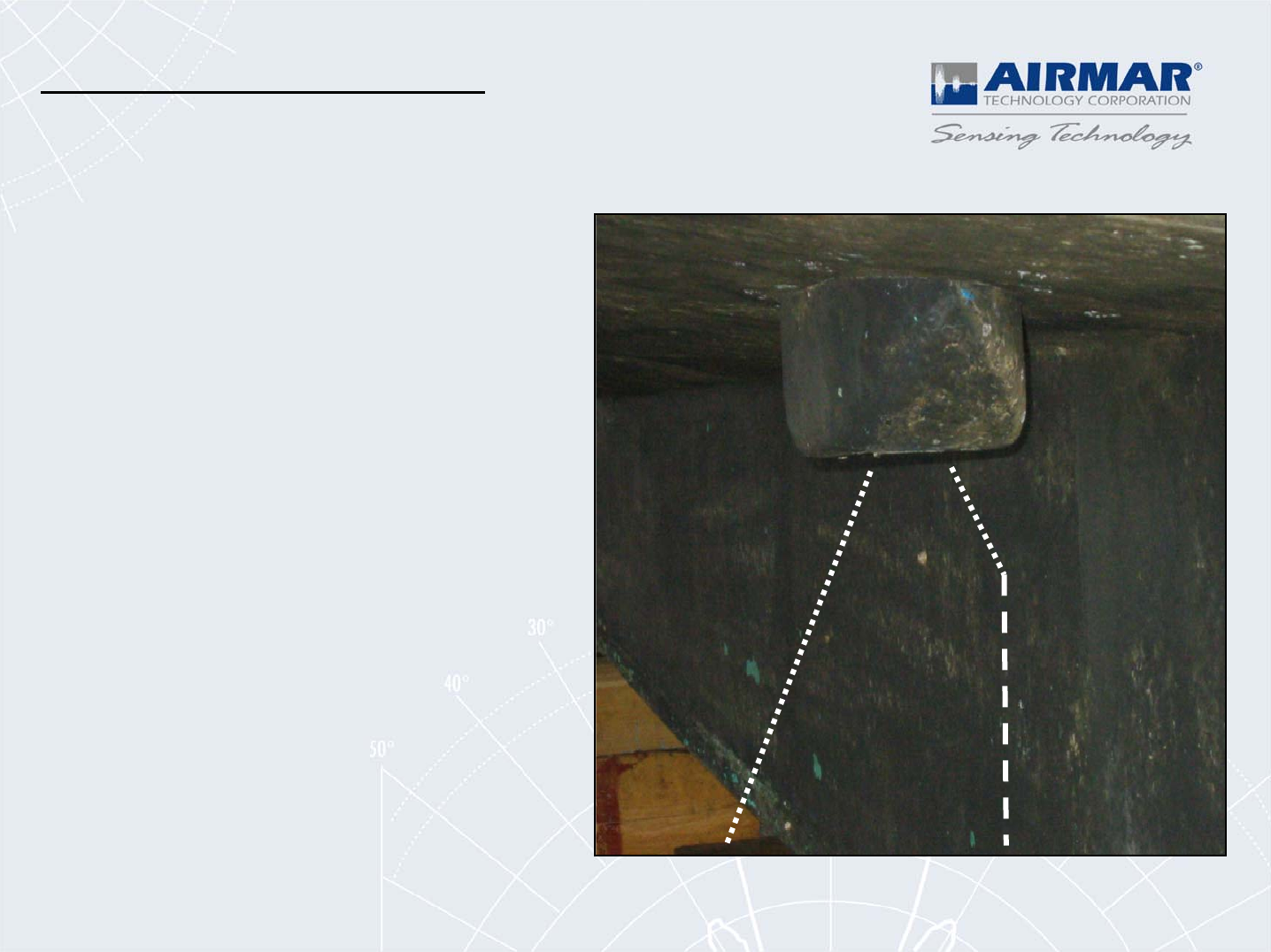
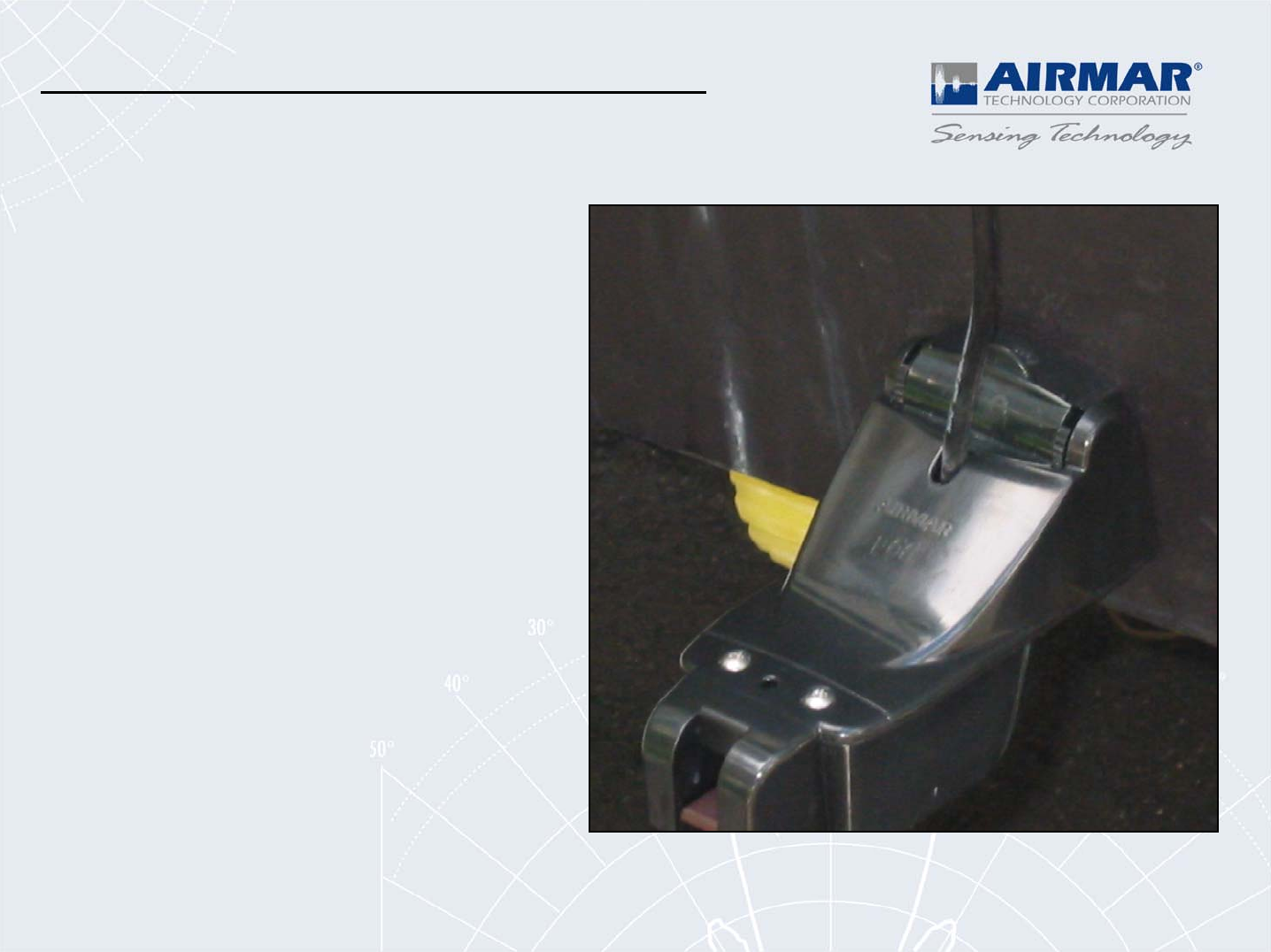
This installation of a B164 looks good, however notice the strake 10 feet directly
in front of the transducer. This causes turbulence and air bubbles making the
transducer stop reading bottom at 12 knots.
strake
Bad Installation
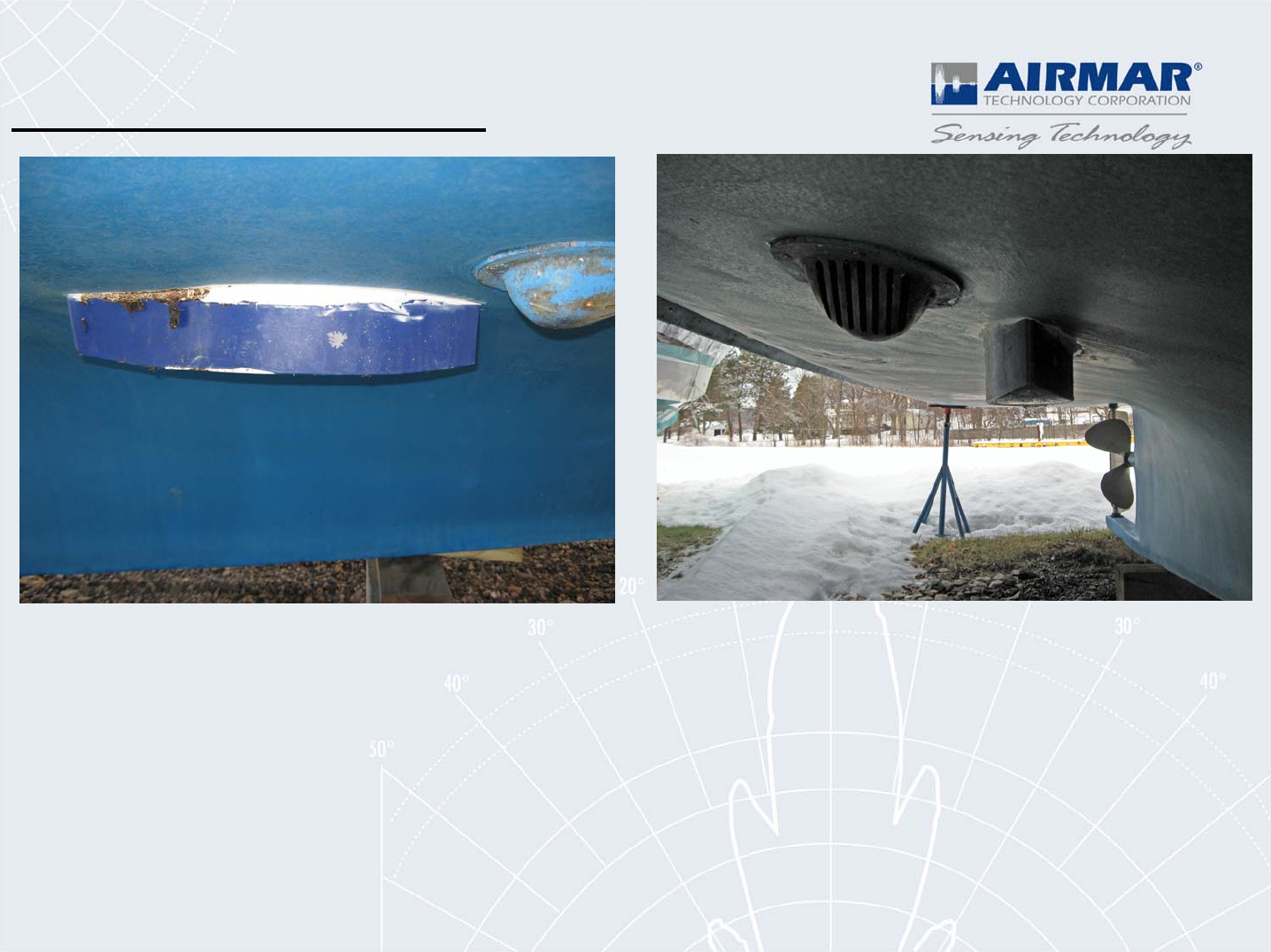
Bad Installation
Side View Aft View
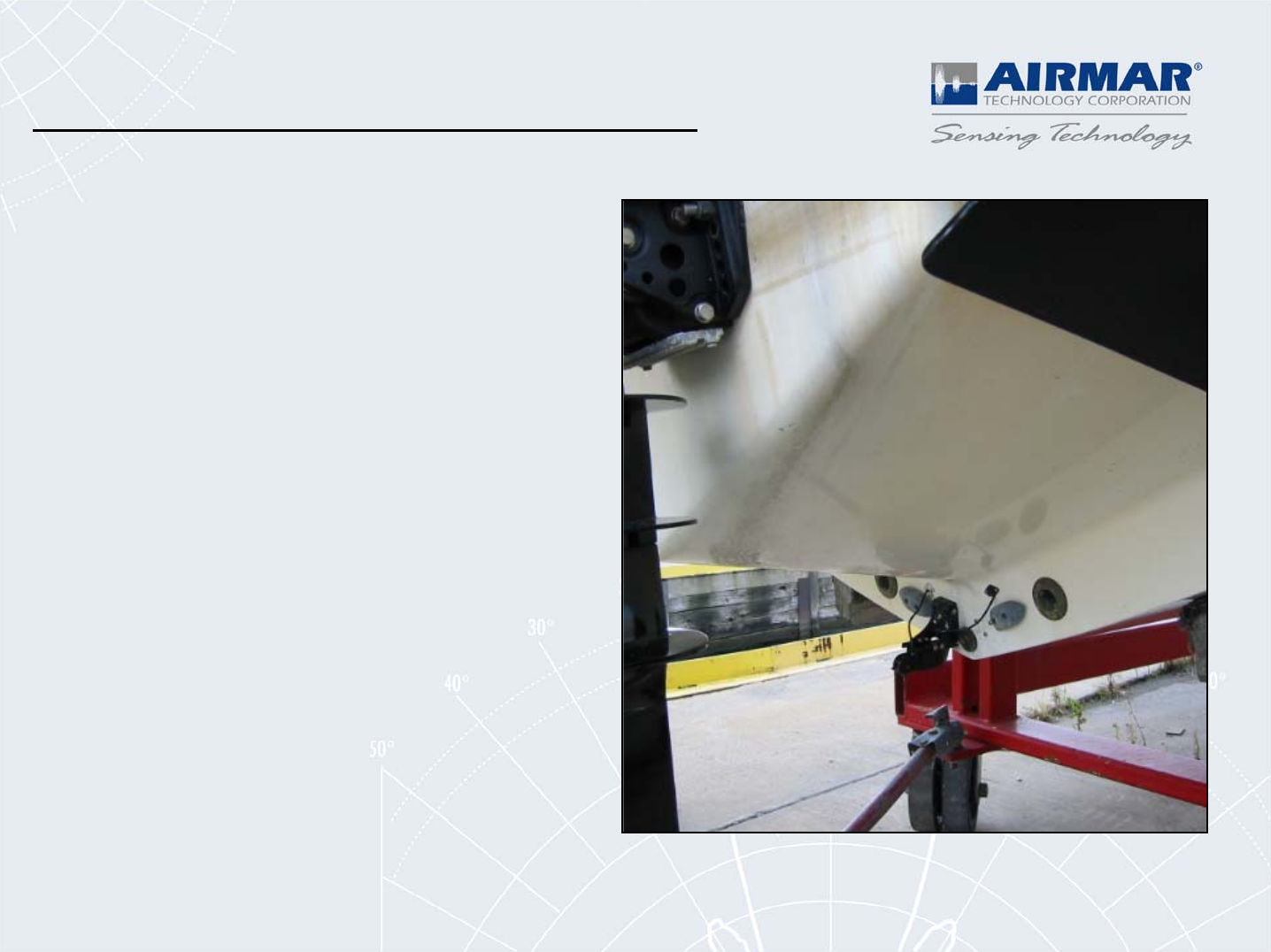
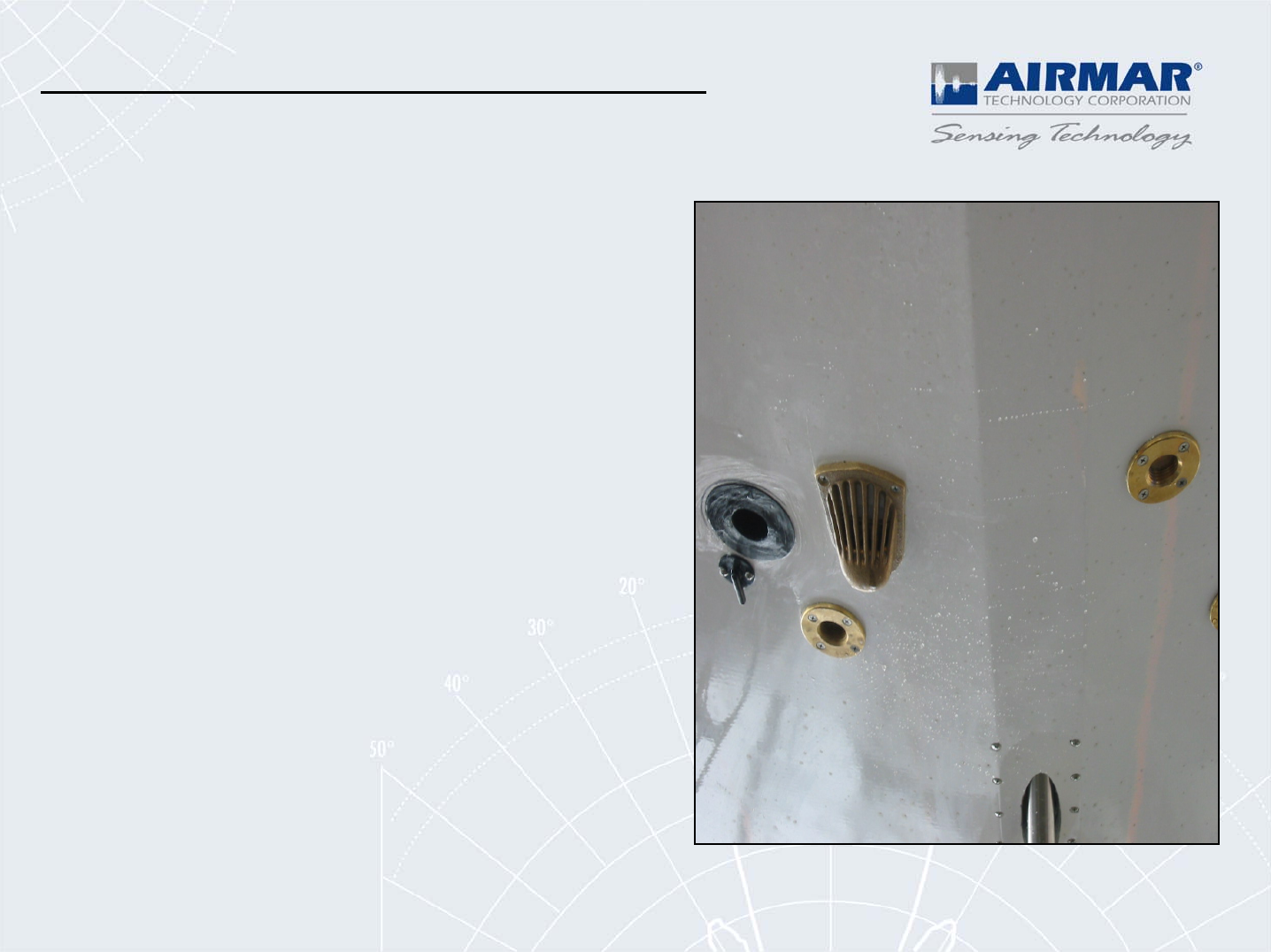
This intake shown in the photos above will cause
turbulence and send air bubbles over the transducer
face as vessel speed increases. The transducer will work
great when the vessel is drifting, but will not work well at
speed.
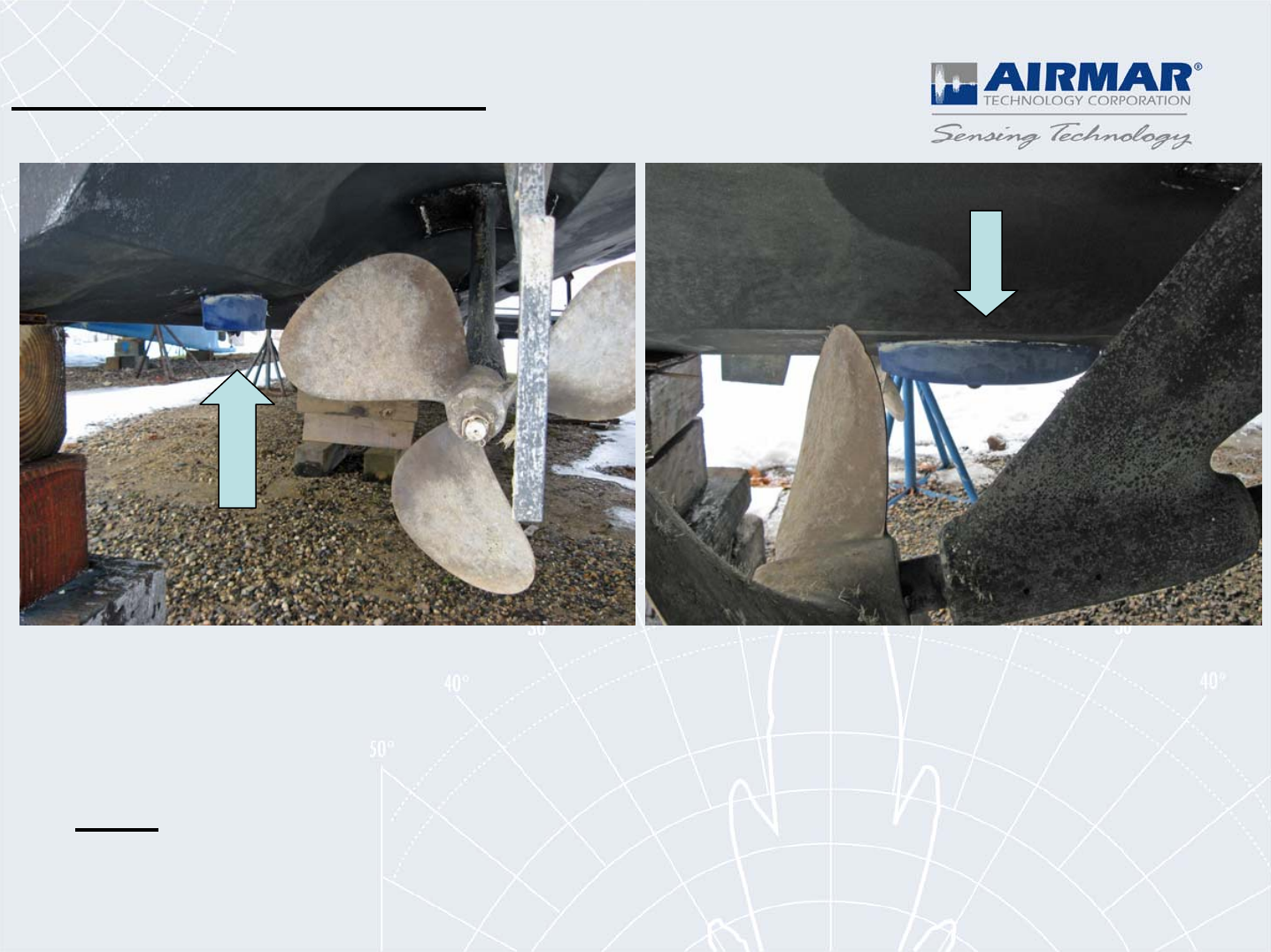
Bad Installation
Forward View Side View
This transducer is mounted too far aft and will be affected by
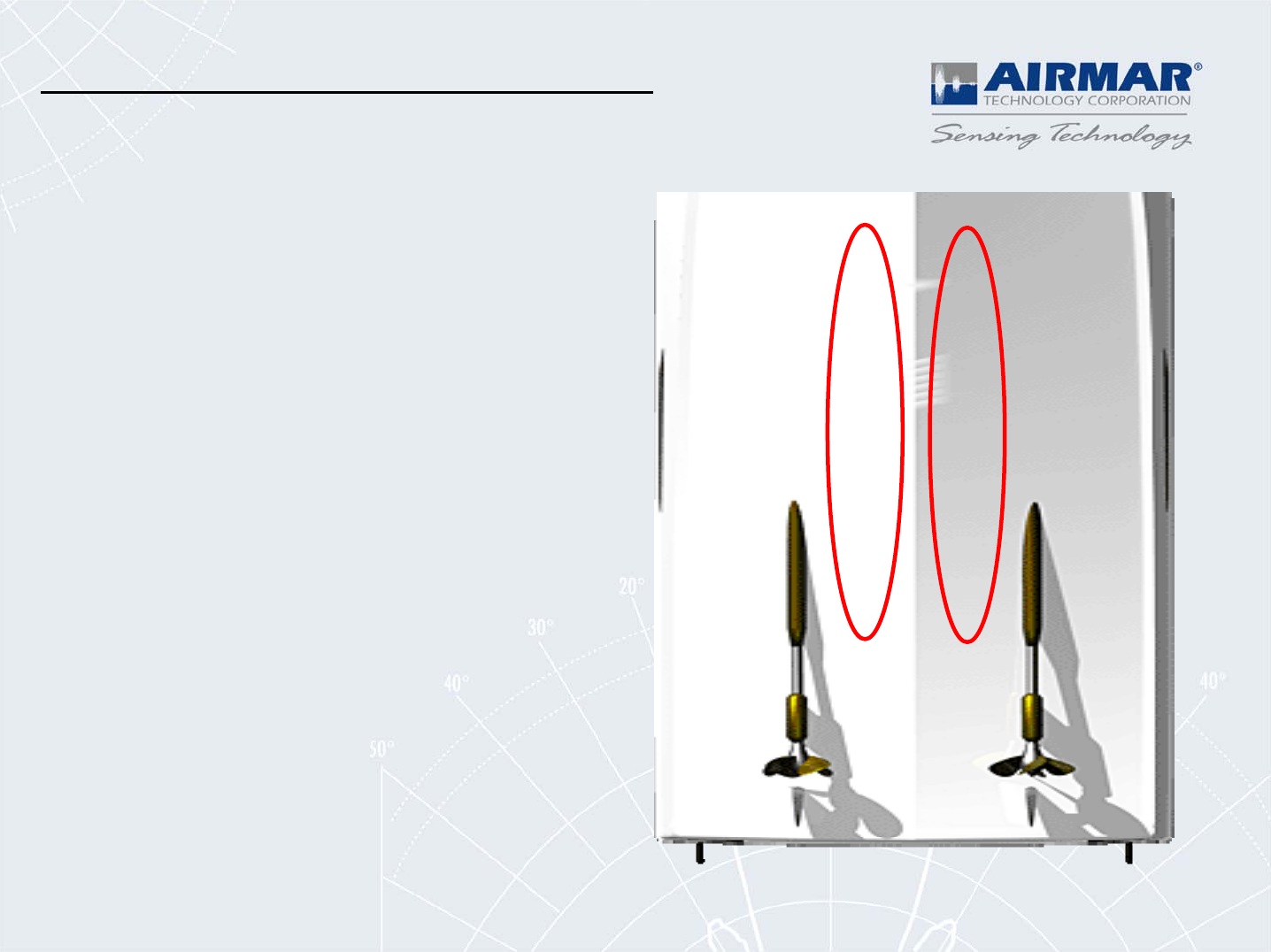
the turbulent water that the starboard propeller will create at
ANY speed.
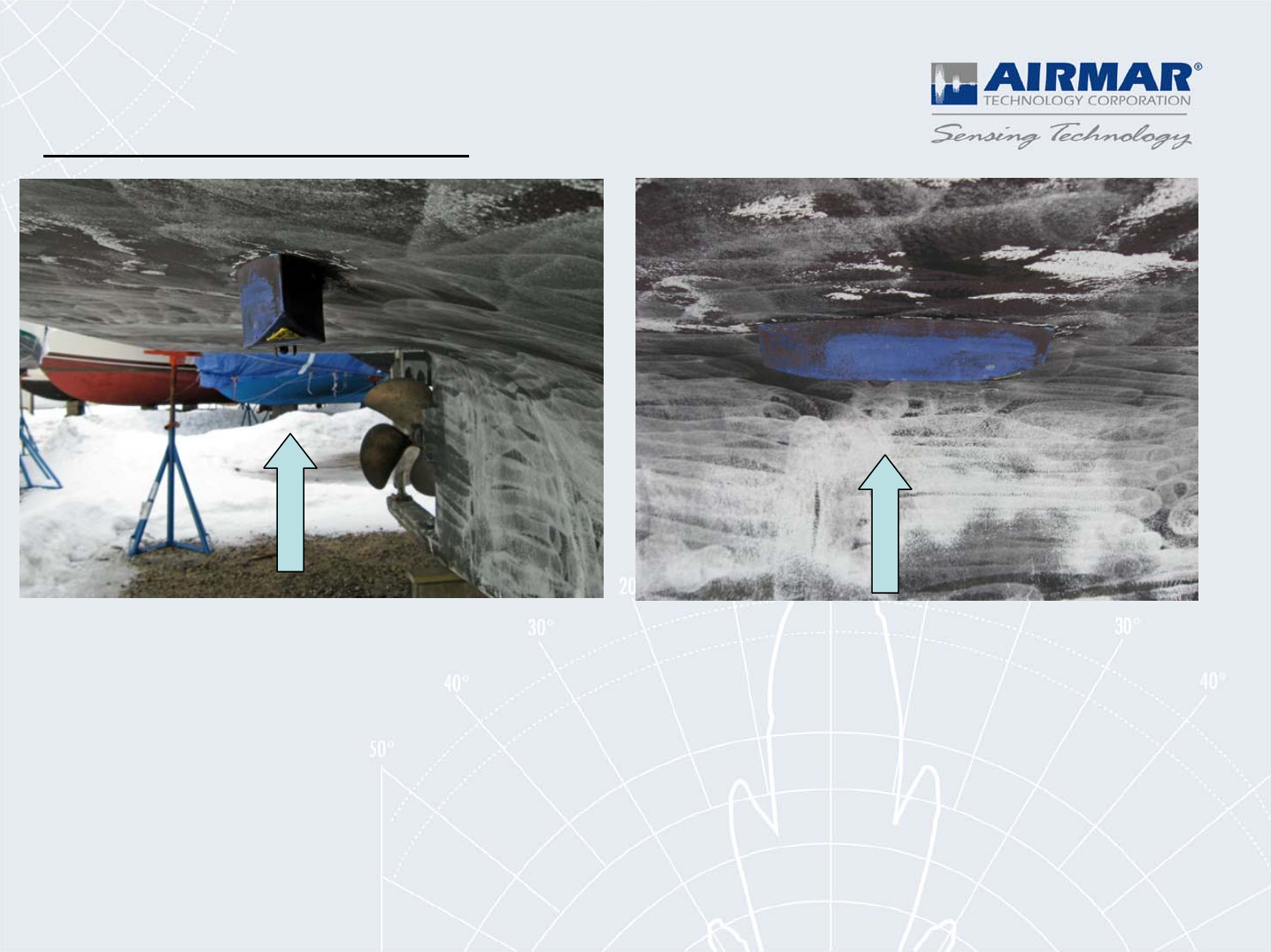
Good Installation
This is a excellent installation of a B744V. There are no hull
protrusions in front or alongside the transducer. The transducer is
also installed away from the keel so that the beam is not shaded.
An installation like this will give clear bottom readings up and above
30 knots.
Aft View Side View
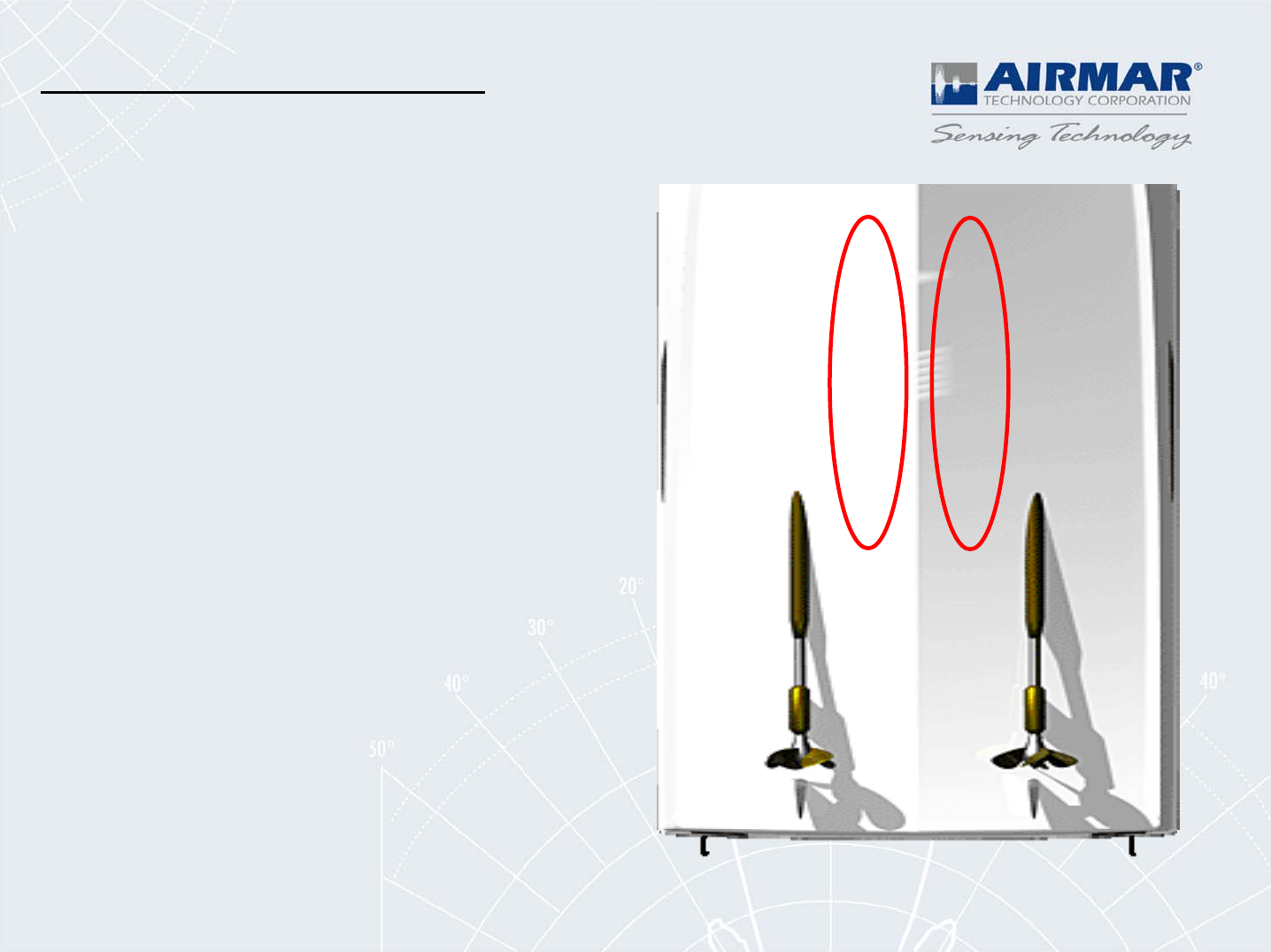
Location selection
Transducer
Transducer
placement should be
placement should be
aft and close to the
aft and close to the
centerline. It needs
centerline. It needs
to be located low
to be located low
enough that the
enough that the
transducer is in the
transducer is in the
water at all times.
water at all times.
Consider items
such as the
lifting strap
placement into
the location as
well as trailer
bunks and
rollers if it is
a trailered
vessel.
Thru-hull location selection
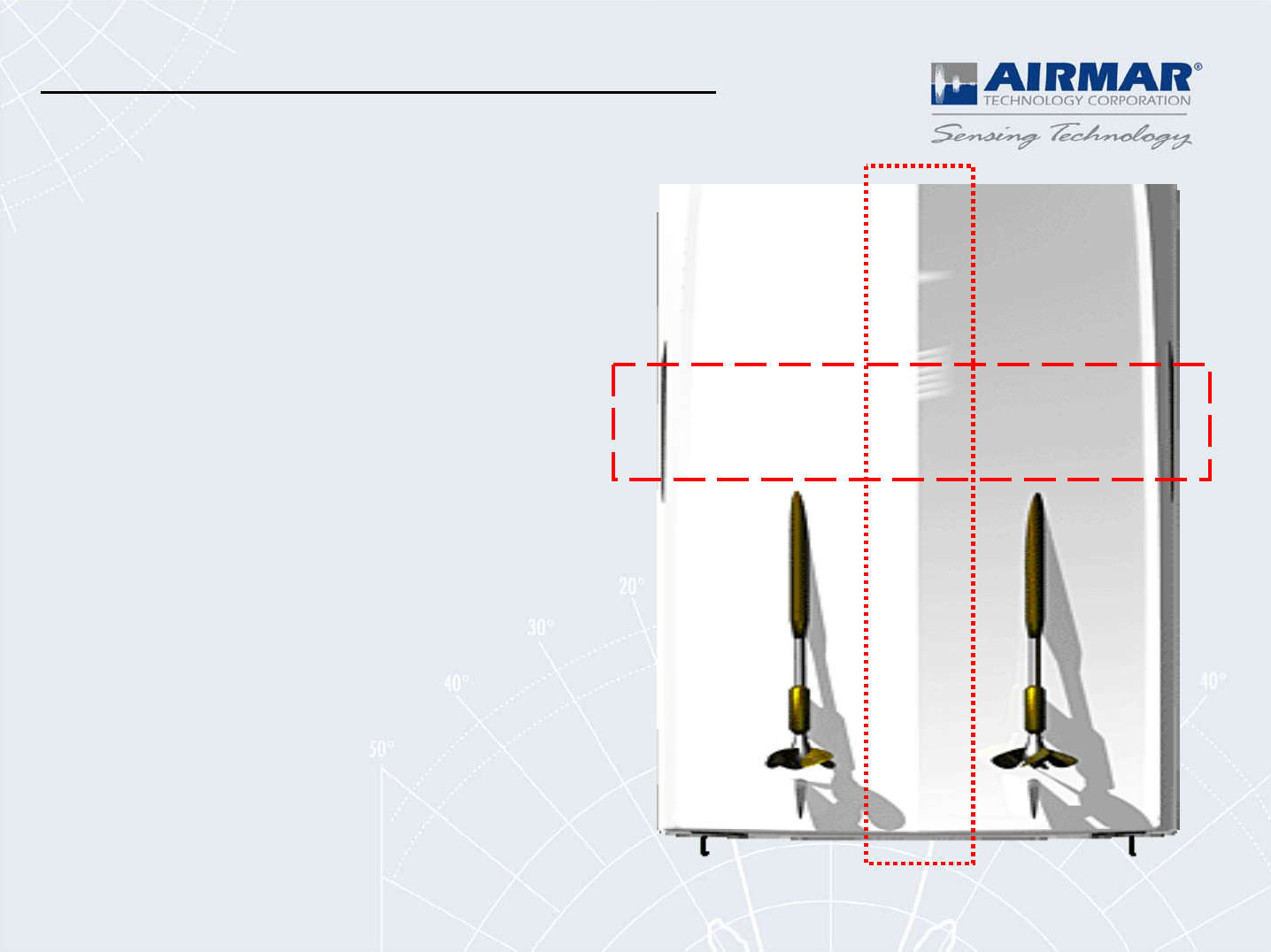
Location selection
Be sure that the
Be sure that the
transducer signal will
transducer signal will
not intersect the prop
not intersect the prop
shaft(s), keel or any
shaft(s), keel or any
other hull projections,
other hull projections,
and that it is not
and that it is not
directly in
directly in-
-line with
line with
the prop(s)
the prop(s)
BOW
BOW
Thru-hull location selection
Thru hulls can be
Thru hulls can be
used on stepped hull
used on stepped hull
vessels, but they
vessels, but they
must
must be located in
be located in
front of the first step
front of the first step
and low to the keel
and low to the keel
to operate
to operate
affectively
affectively
Thru-hull Installation
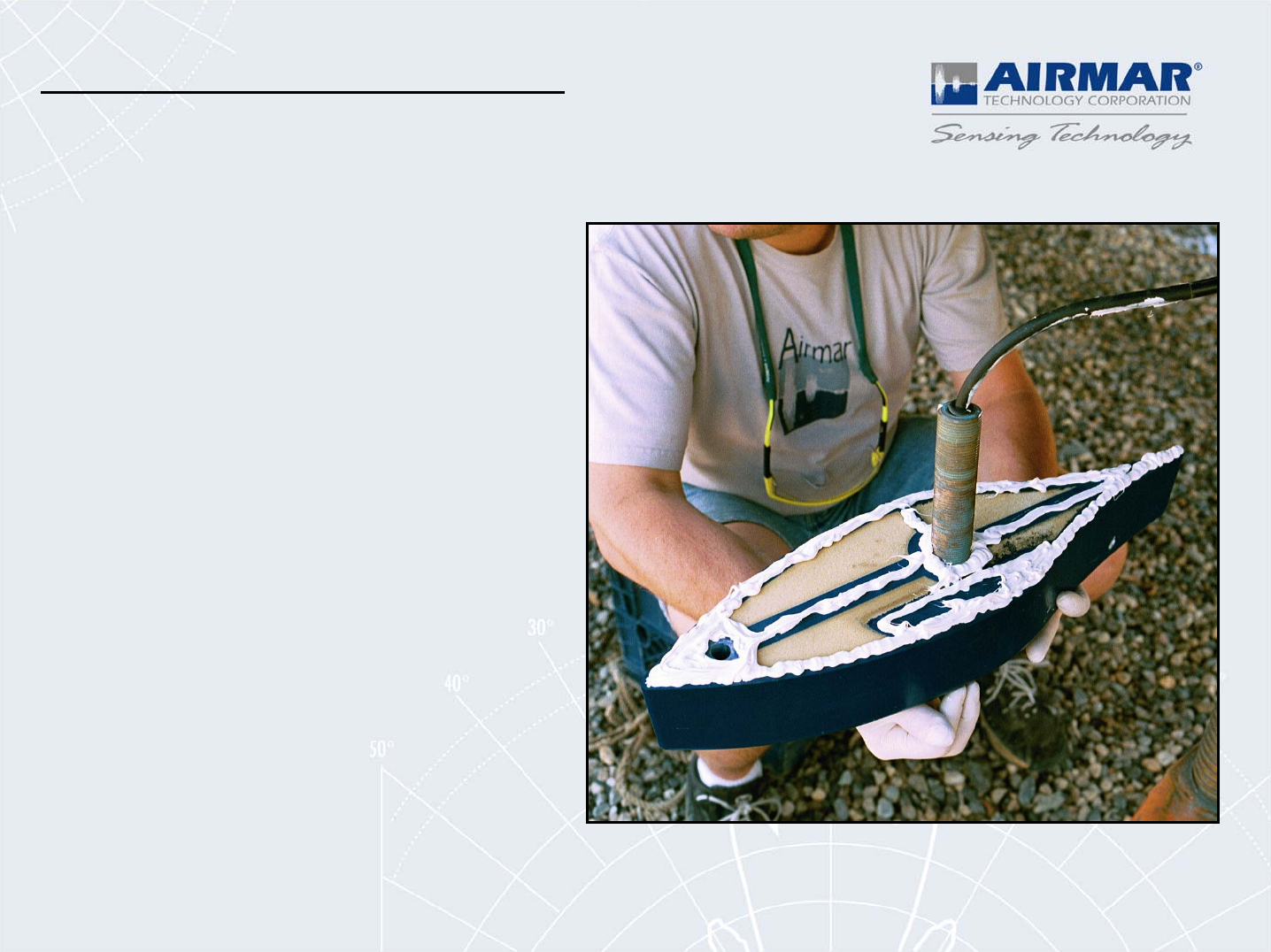
3M 4200 or 5200
3M 4200 or 5200
is the common
is the common
sealant used. be
sealant used. be
sure to apply
sure to apply
enough to allow it
enough to allow it
to fully seal the
to fully seal the
stem hole.
stem hole.
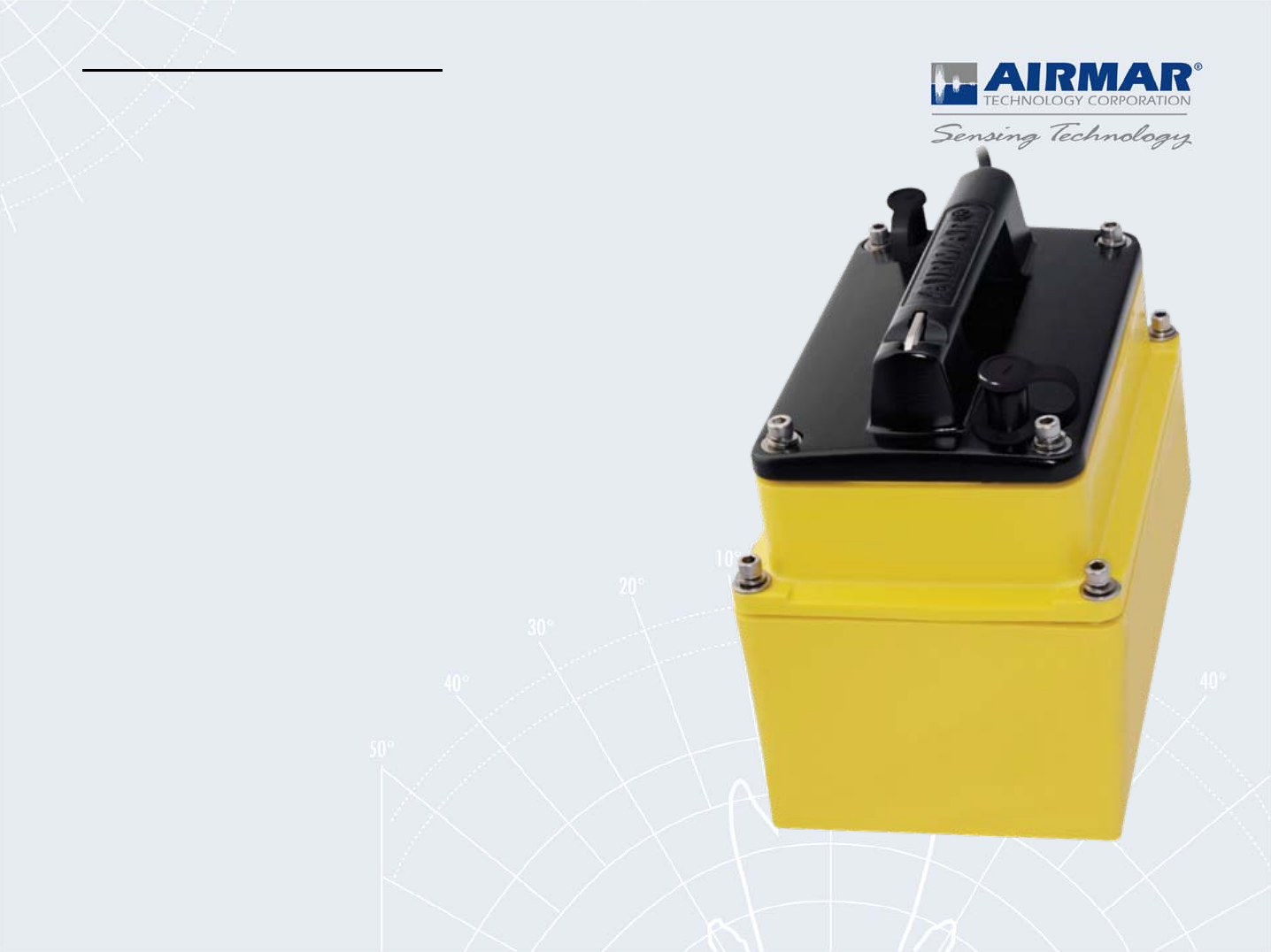
•For solid fiberglass stepped,
planing or displacement type
hulls
•No hull penetration. Entire
installation is done from inside
the hull
•Can be installed while boat is in
the water.
•Can be used with single or
twin inboard, I/O, OB and jet
drive propulsion
•For deadrise angles up to 30
degrees
•Can now be mounted port/
starboard or bow/stern
In-hull models
In-hull location selection
The same installation
The same installation
placement guidelines for
placement guidelines for
Thru
Thru-
-Hulls apply for In
Hulls apply for In-
-
Hulls.
Hulls.
The selected location
The selected location
should be aft and close to
should be aft and close to
the centerline so that the
the centerline so that the
transducer is in the water
transducer is in the water
at all times.
at all times.
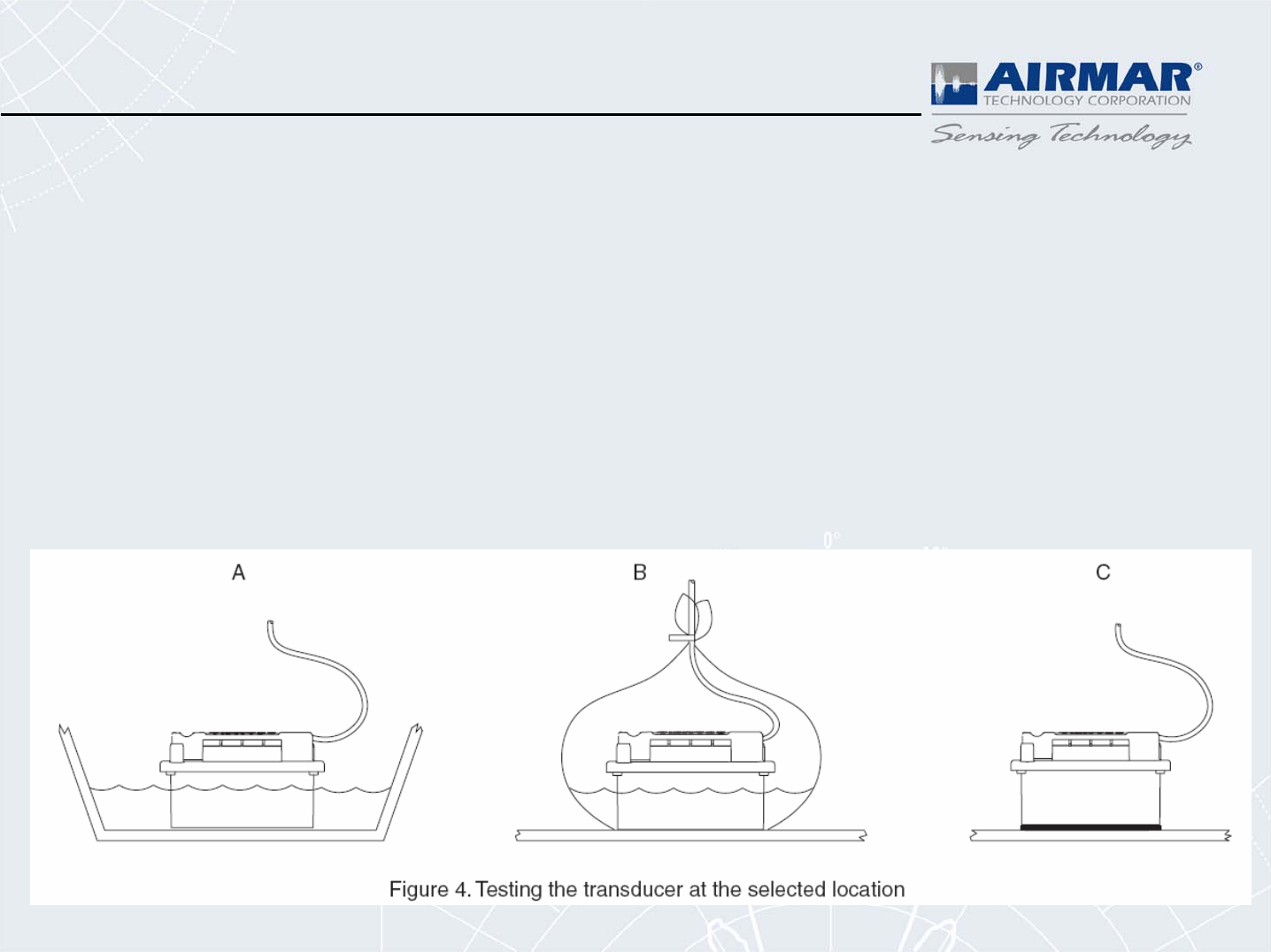
Testing an In-Hull Mounting Location
Before installing the transducer tank, perform one of the 3
methods below in as deep of water as possible. Connect the transducer
cable to the fishfinder to verify strong bottom readings.
A. Flood the area with bilge water.
B. Place the transducer in a garbage bag and fill with water
C. Apply a water based lubricant to the transducer face and press
against the hull
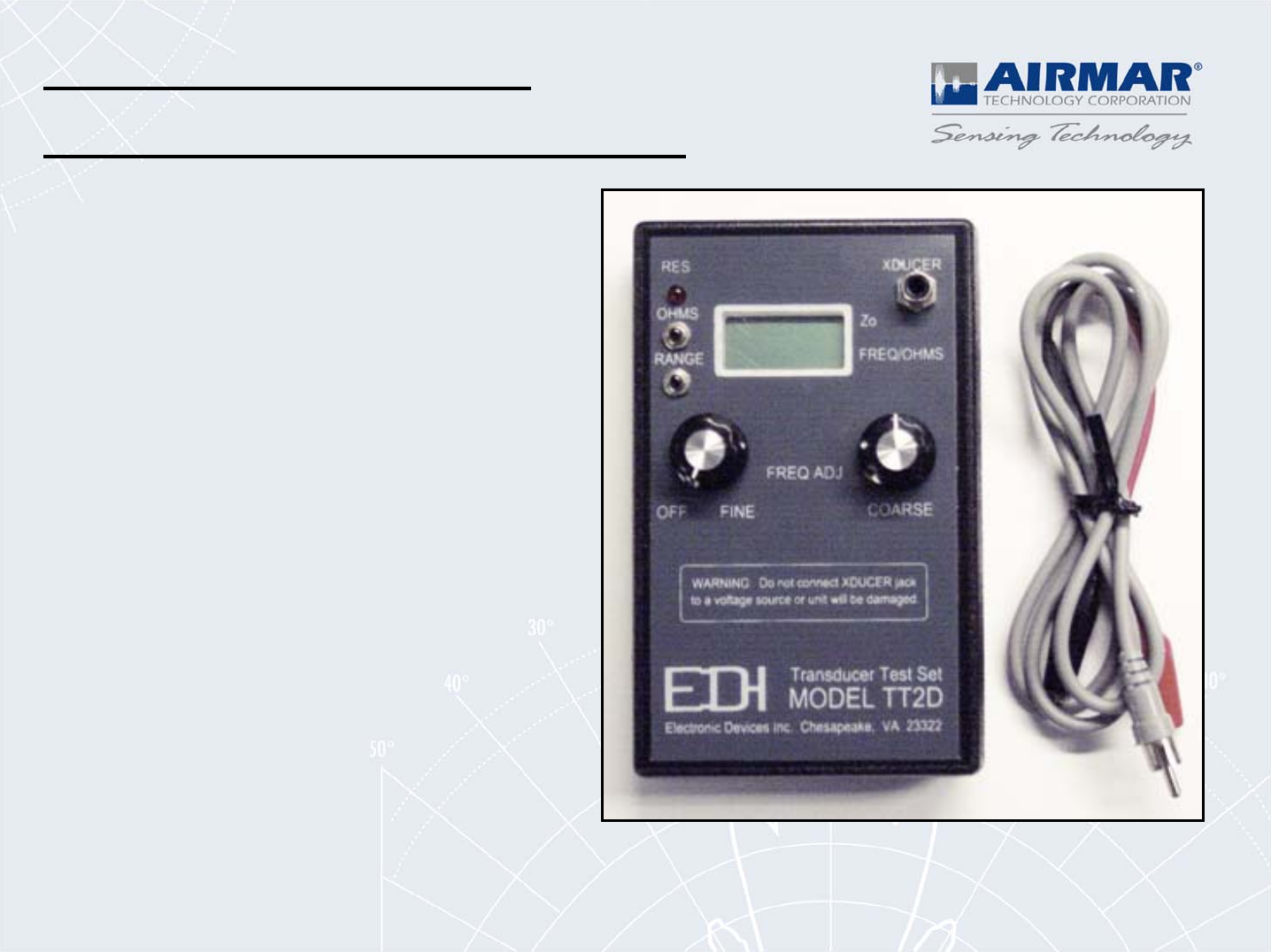
Using an EDI transducer test
box you can determine the
resonant frequency of a
transducer and confirm that
all of it’s functions are
operating properly.
Gemeco offers adaptor cables
that plug directly into popular
transducer connectors
Testing for depth
EDI transducer testers
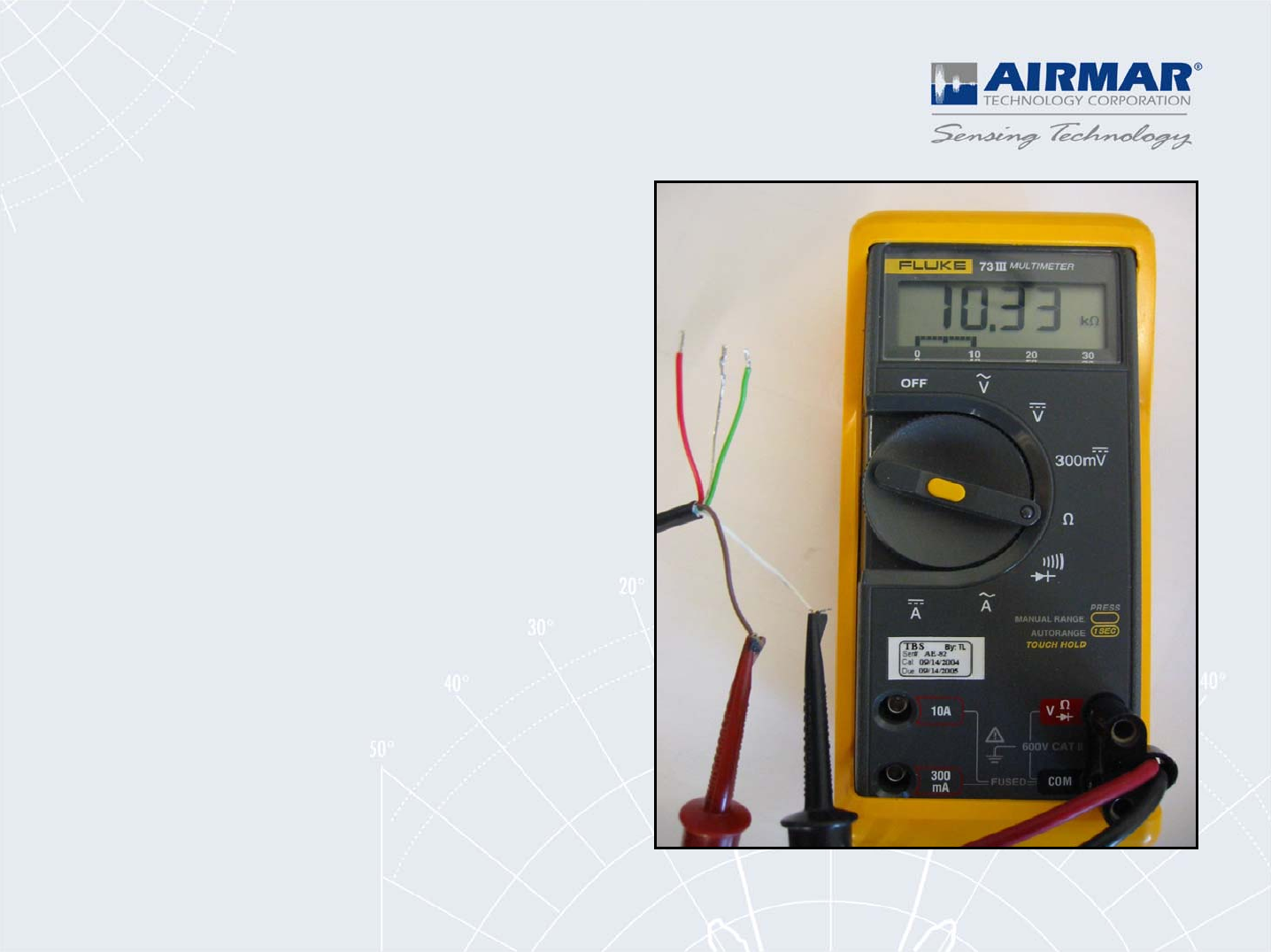
With meter set to OHMS the
reading should be in the
10,000 ohm range at 77
degrees F.
The resistance increases as
the temp decreases.
The sensor will read
correctly in or out of water.
Testing for temp function
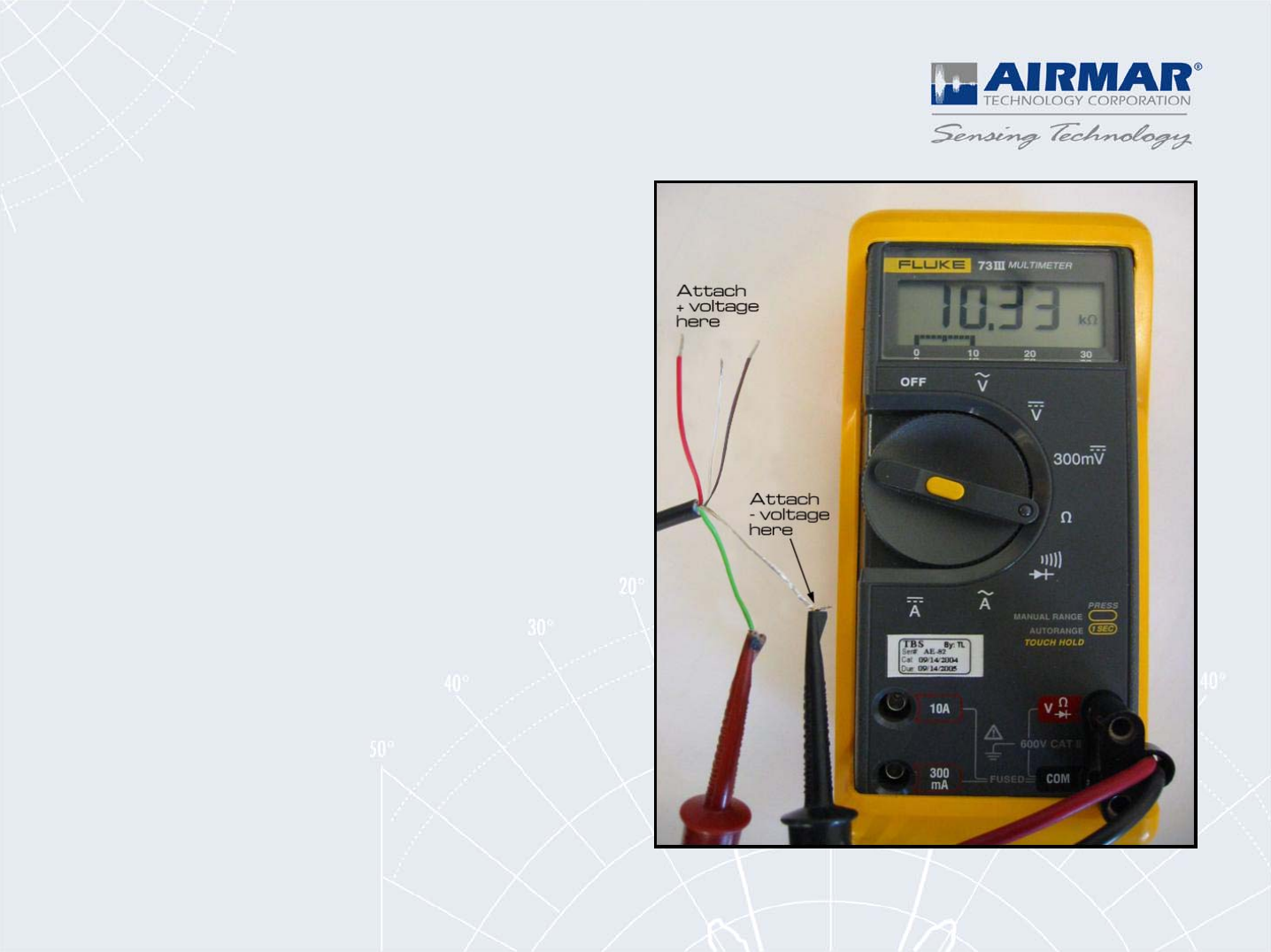
Use a 9 volt or 12 volt
cordless drill battery to
apply battery voltage to red
and bare wires.
Attach meter test leads
between the green and bare
wires.
Testing for speed function
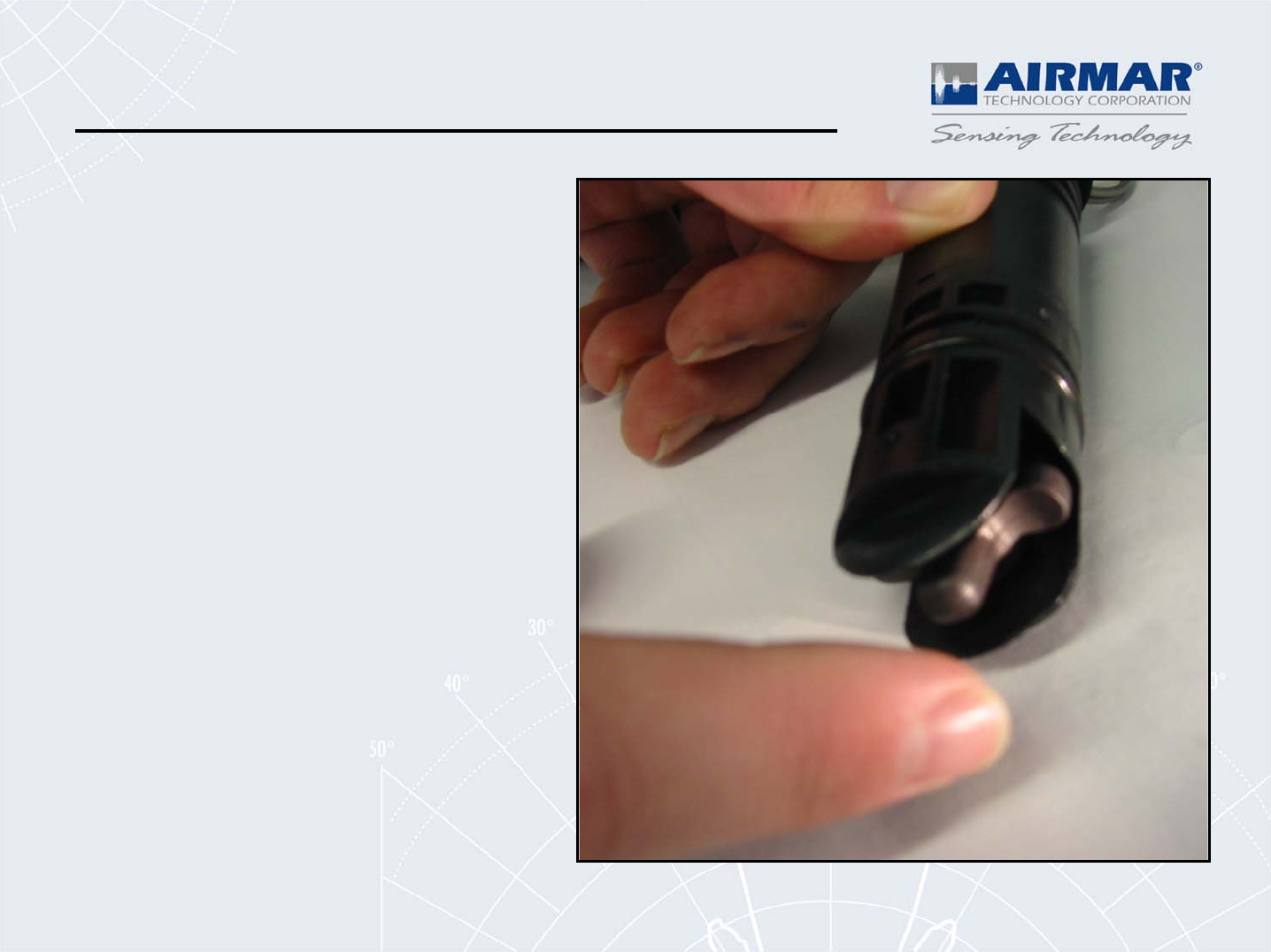
Turn the paddlewheel slowly
by hand. The volt meter
should toggle between zero
volts and the input voltage
with each 90 degrees of
rotation.
Testing for speed function
In Hull Transducers
In-Hull Transducers for Fiberglass Hulls
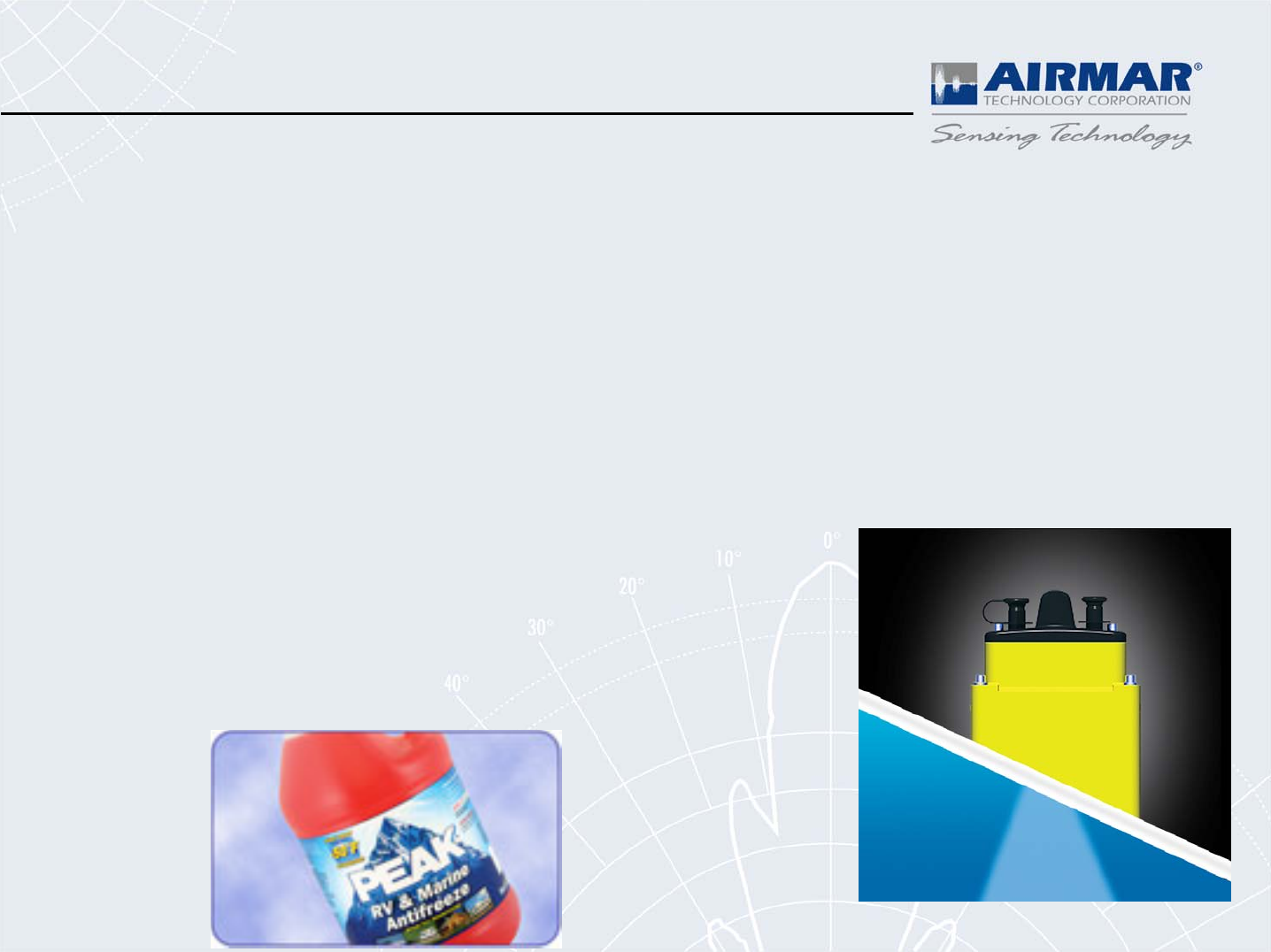
Mounting:
Sand/grind the fiberglass until rough. Clean the
fiberglass, then mount with:
1. Fiberglass Resin (best choice for long-tern adhesion)
2. Fusor® 100EZ / T10.
3. 3M 5200,
Filling the tank:
Use non-toxic Marine & RV
red/pink anti-freeze
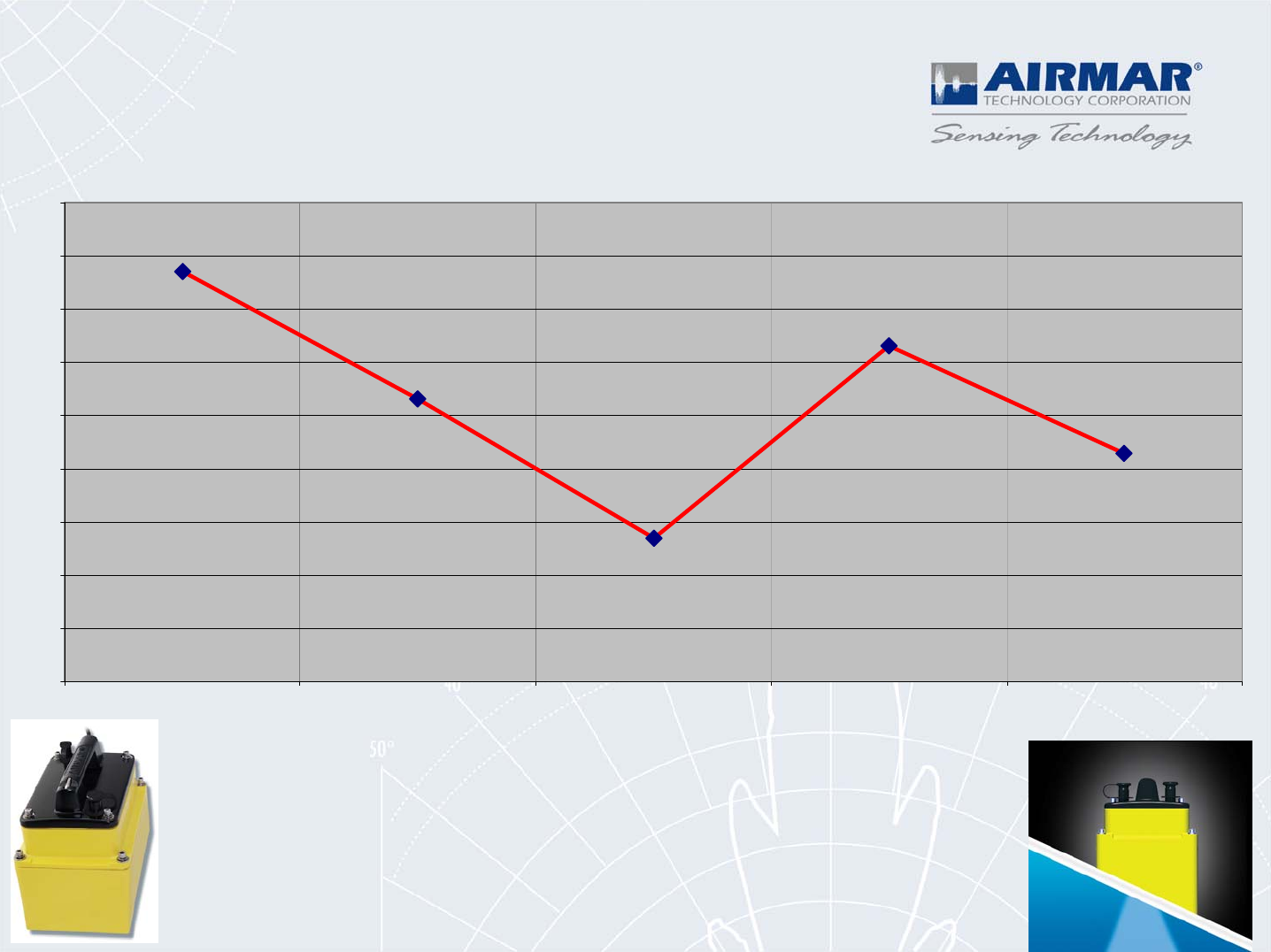
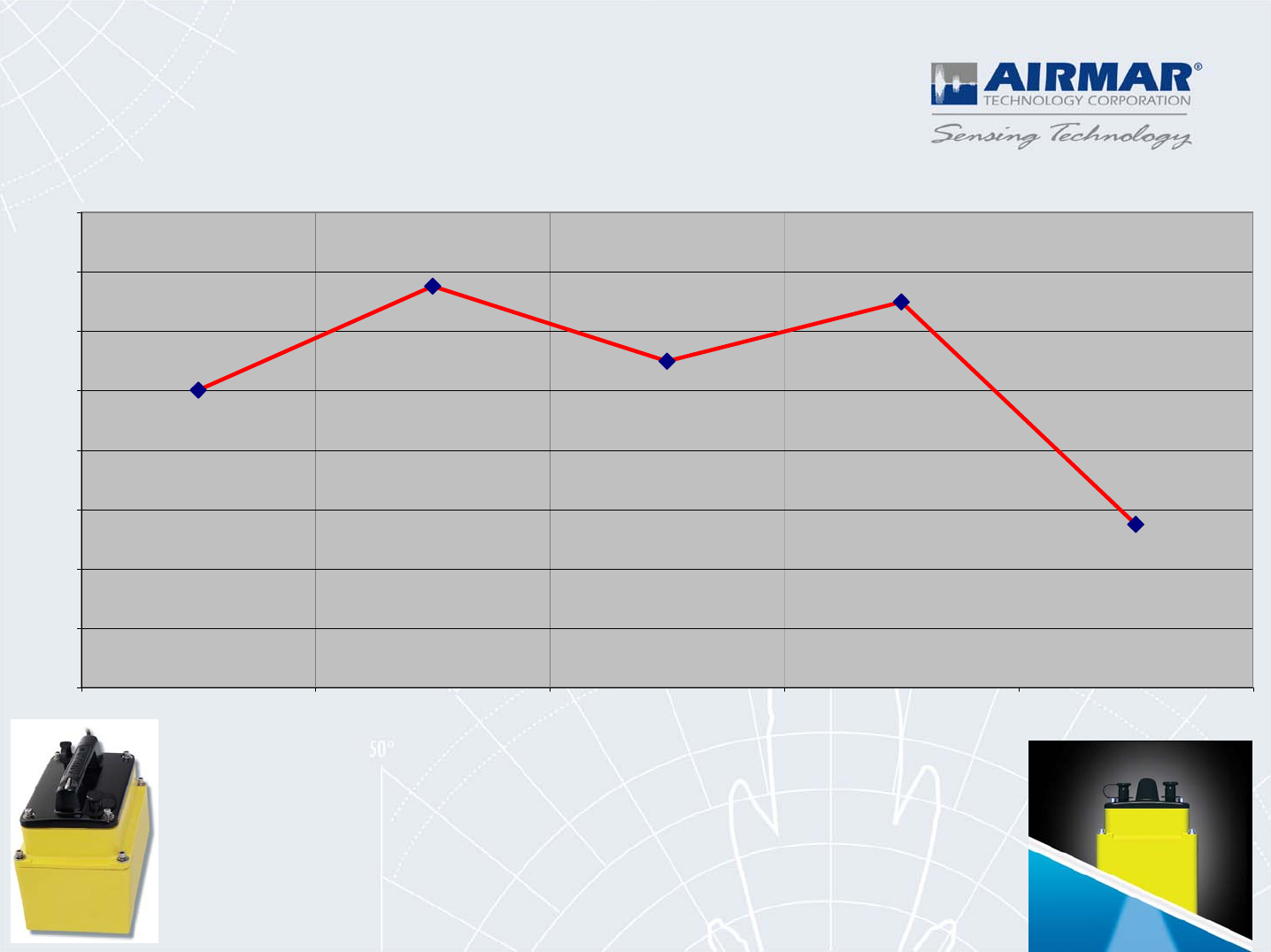
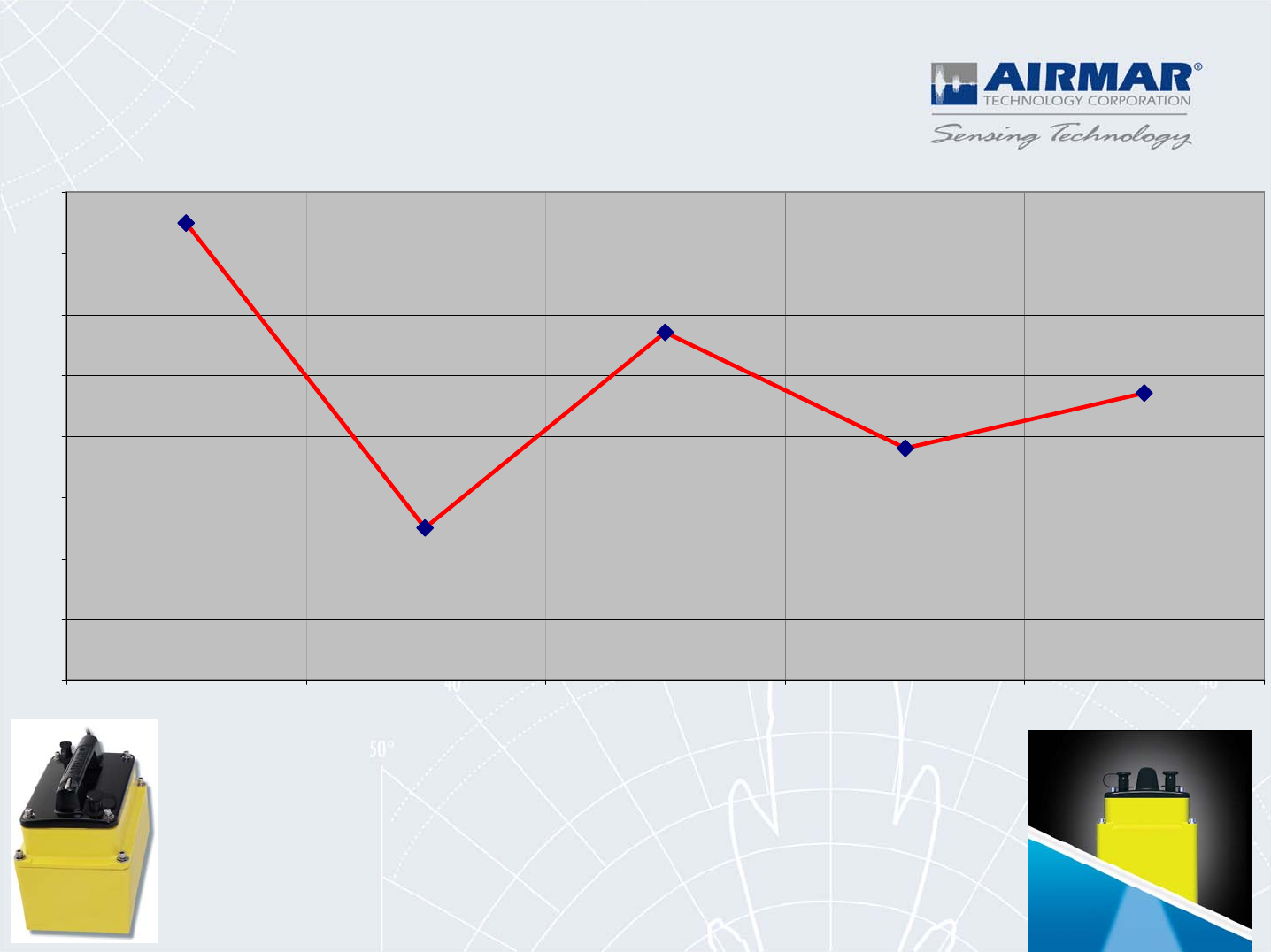
The following graphs show the loss and frequency shift when a
M260 in-hull transducer is transmitting through:
• No Fiberglass
• 3/8” Fiberglass
• 1/2” Fiberglass
• 3/4” Fiberglass
• 1” Fiberglass
• Broadband transducers can compensate for frequency shift if
connected to a tunable echosounder
• Note: In Hull transducers will not work with cored fiberglass,
wood, or aluminum hulls due to excessive signal loss.
In-Hull Transducers:
Depth Performance vs. Hull Thickness
155
156
157
158
159
160
161
162
163
164
0" FIBERGLASS 3/8" FIBERGLASS 1/2" FIBERGLASS 3/4" FIBERGLASS 1" FIBERGLASS
HULL THICKNESS
TVR (dB)
0% Loss in Range
10% Loss in Range
5% Loss in Range
3% Loss in Range
7% Loss in Range
M260 50 kHz TVR CHANGE(RANGE LOSS)
vs. HULL THICKNESS
40
42
44
46
48
50
52
54
56
0" FIBERGLASS 3/8" FIBERGLASS 1/2" FIBERGLASS 3/4" FIBERGLASS 1" FIBERGLASS
HULL THICKNESS
kHz
M260 50 kHz FREQUENCY SHIFT
vs. HULL THICKNESS
50 kHz
53.5 kHz
51 kHz
53 kHz
45.5 kHz
M260 Max depth @ 50 kHz with
1kW Input power
• No fiberglass- 3333’ (1015m)
•3/8” fiberglass- 3100’ (944m)
• ½” fiberglass- 2850’ (868m)
• ¾” fiberglass- 3190’ (972m)
• 1” fiberglass- 3000’ (914m)
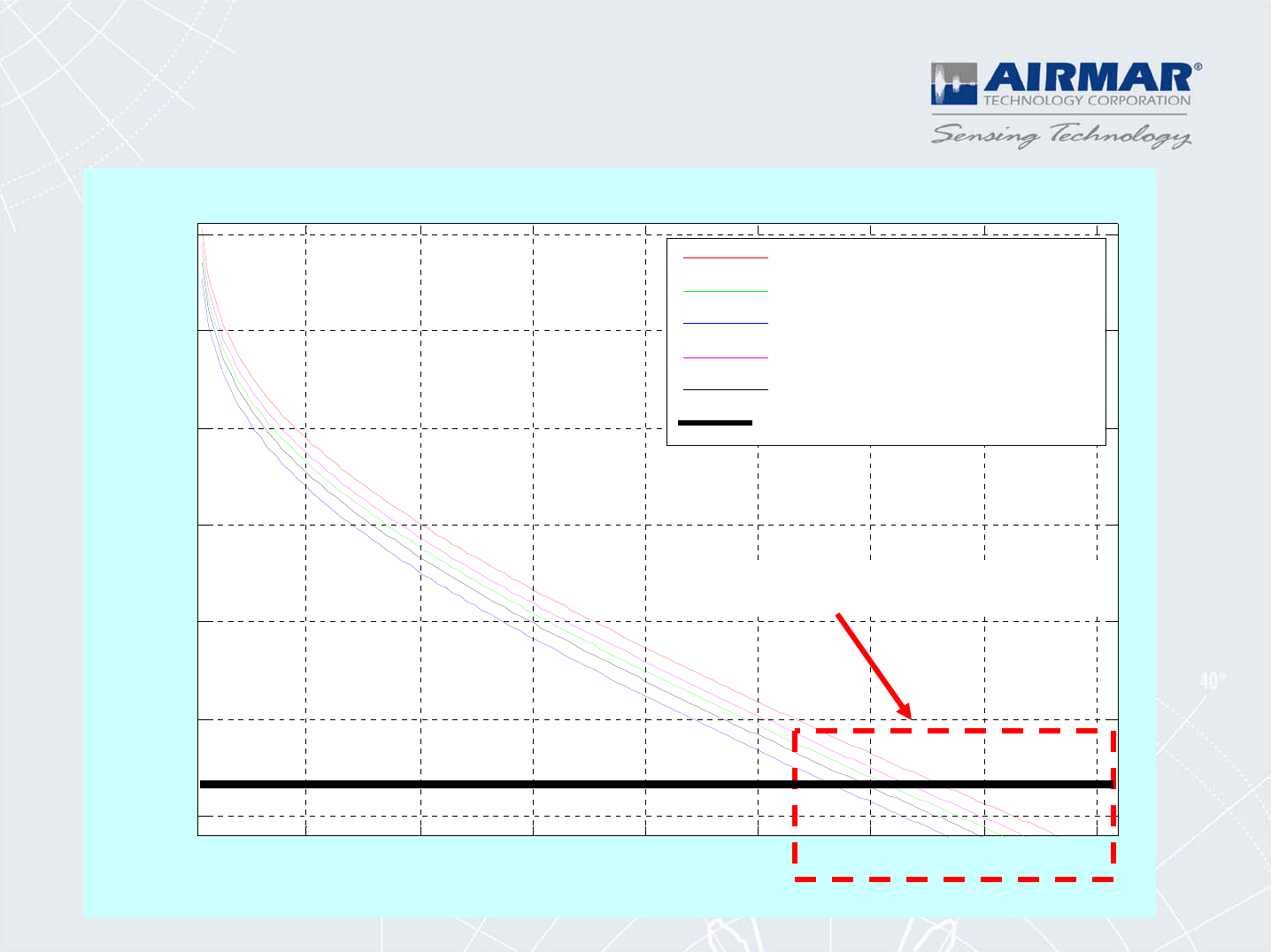
50kHz Maximum Depth Range
M260 In-Hull - 1kW Input Power
500 1000 1500 2000 2500 3000 3500 4000
0
20
40
60
80
100
120
Depth, feet
Signal Excess, dB
50 kHz Thru Hull Range Behavior
no hull
3/8" hull
1/2" hull
3/4" hull
1" hull
+6 dB detection threshold
Area of Detail – (Next Slide)
Maximum Depth Line
Maximum Depth Line
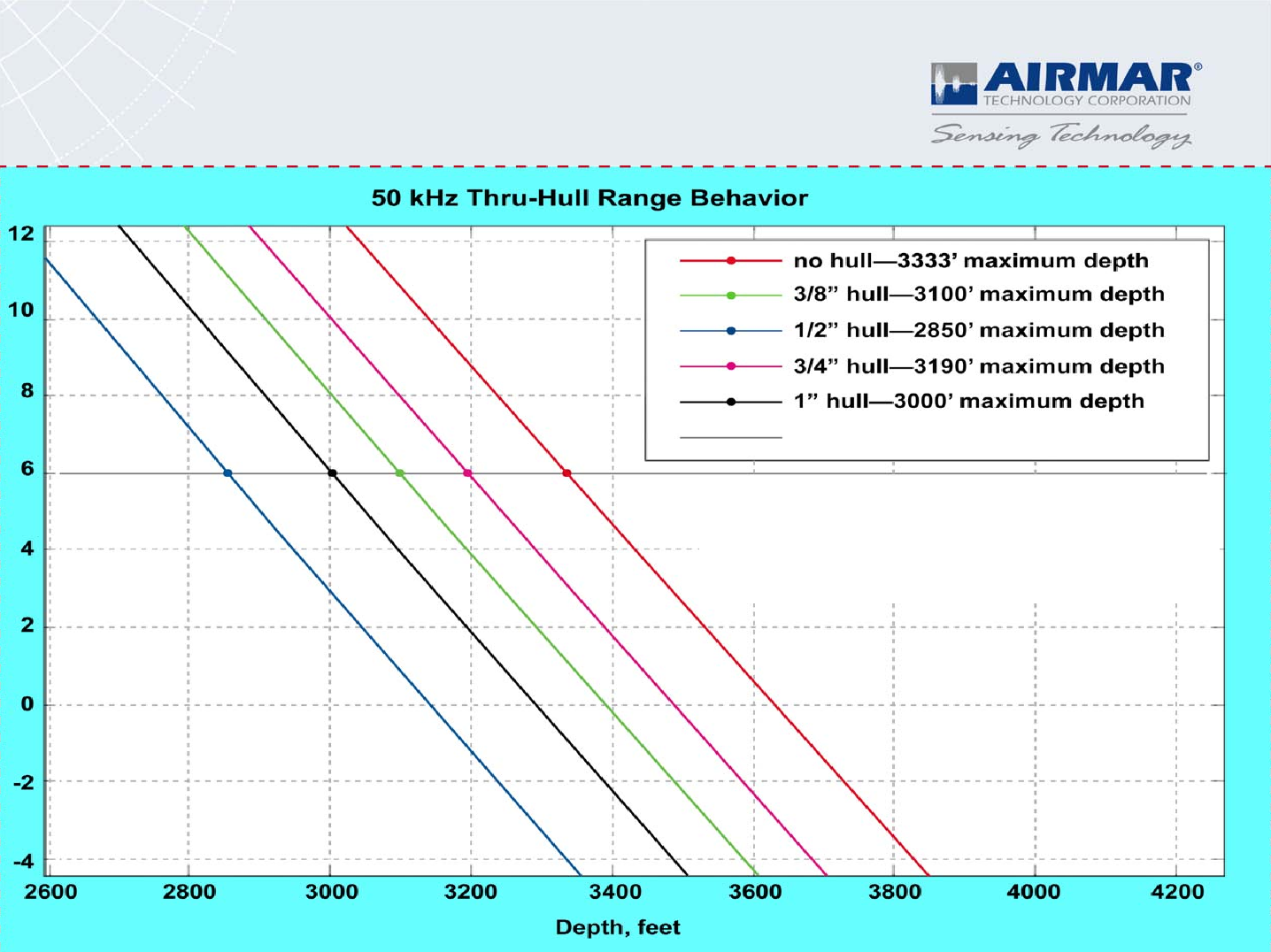
50 kHz Maximum Depth Range
M260 In-Hull - 1kW Input Power
Depending on hull thickness,
340 feet of depth sensing(11%)
can be gained (or lost)
Maximum Depth Line
164
165
166
167
168
169
170
171
172
0" FIBERGLASS 3/8" FIBERGLASS 1/2" FIBERGLASS 3/4" FIBERGLASS 1" FIBERGLASS
HULL THICKNESS
TVR, (dB)
7% Loss in Range
3% Loss in Range
5% Loss in
Ran
g
e
4% Loss in Range
0% Loss in Range
M260 200 kHz TVR CHANGE & RANGE LOSS
vs. HULL THICKNESS
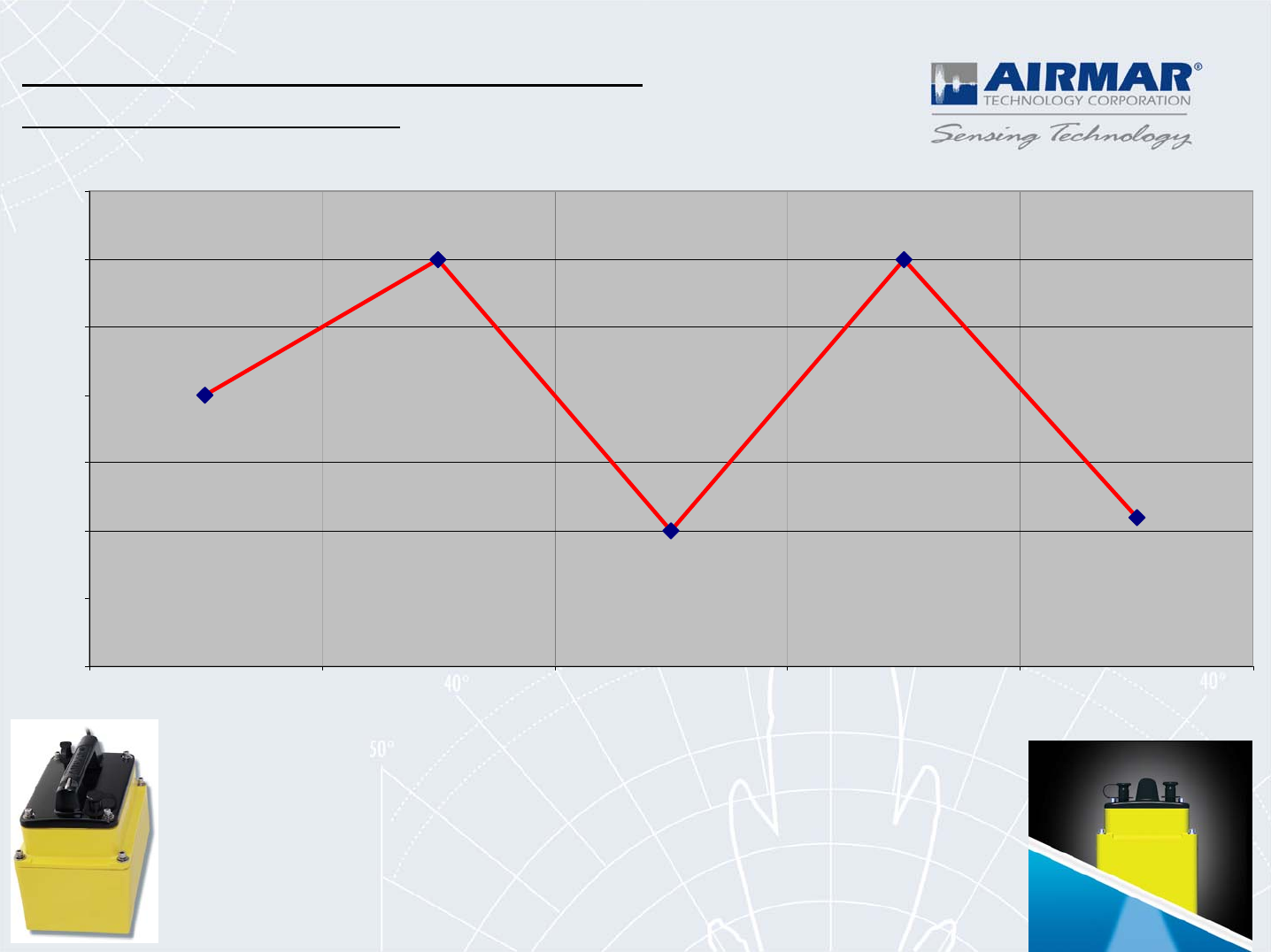
M260 200 kHz FREQUENCY SHIFT
vs. HULL THICKNESS
180
185
190
195
200
205
210
215
0" FIBERGLASS 3/8" FIBERGLASS 1/2" FIBERGLASS 3/4" FIBERGLASS 1" FIBERGLASS
HULL THICKNESS
kHz
200 kHz
210 kHz
190 kHz
210 kHz
191 kHz
M260 Max depth @ 200 kHz
with 1kW Input Power
• No fiberglass- 1305’ (397m)
• 3/8” fiberglass-1165’(355m)
• ½” fiberglass- 1255’ (382m)
• ¾” fiberglass- 1200’ (365m)
• 1” fiberglass- 1225’ (373m)
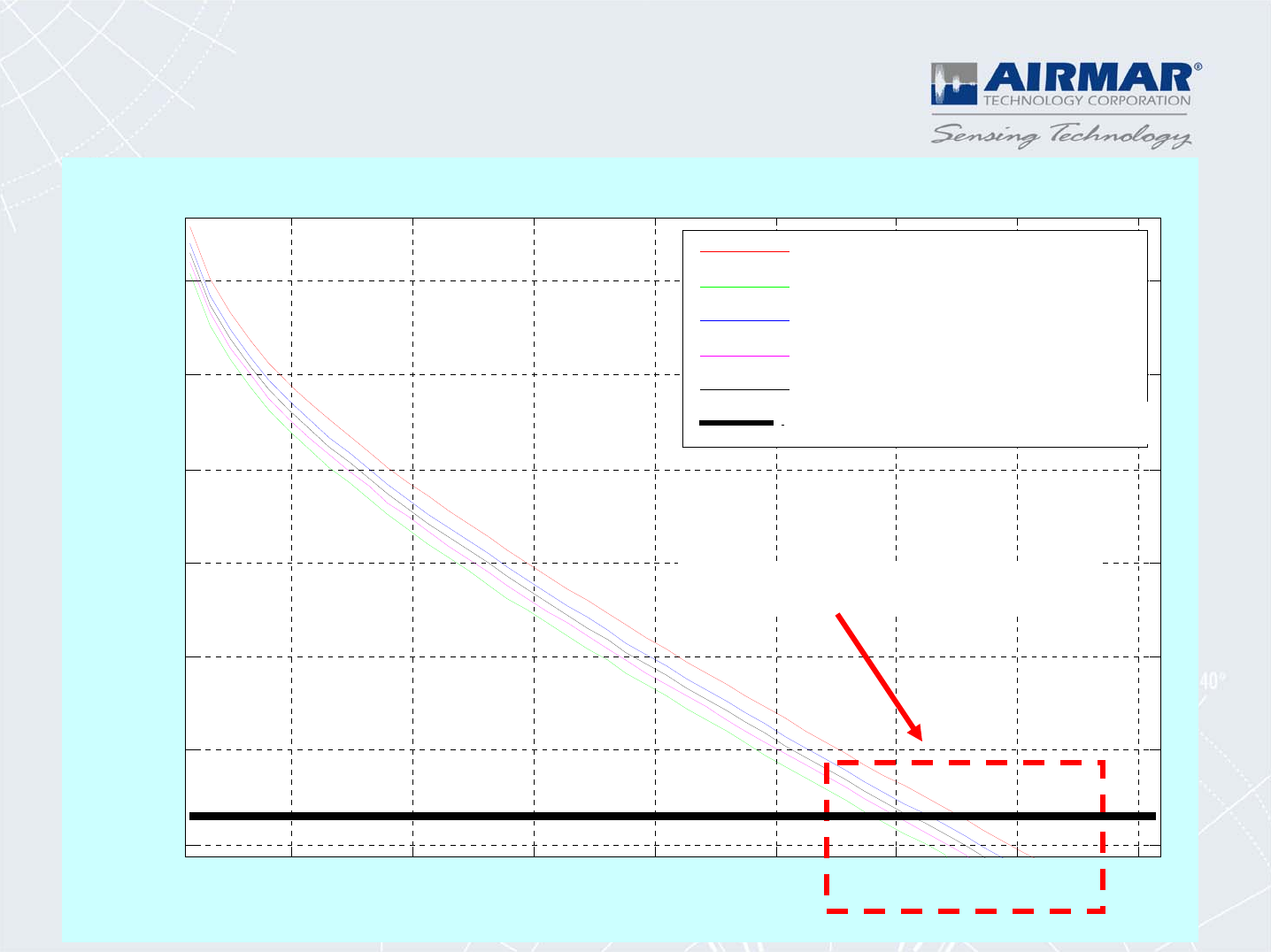
200 kHz Maximum Depth Range
M260 In-Hull - 1kW Input Power
200 400 600 800 1000 1200 1400 1600
0
20
40
60
80
100
120
Depth, feet
Signal Excess, dB
200 kHz Thru Hull Range Behavior
no hull
3/8" hull
1/2" hull
3/4" hull
1" hull
+6 dB detection threshold
Area of Detail – (Next Slide)
Maximum Depth Line
Maximum Depth Line
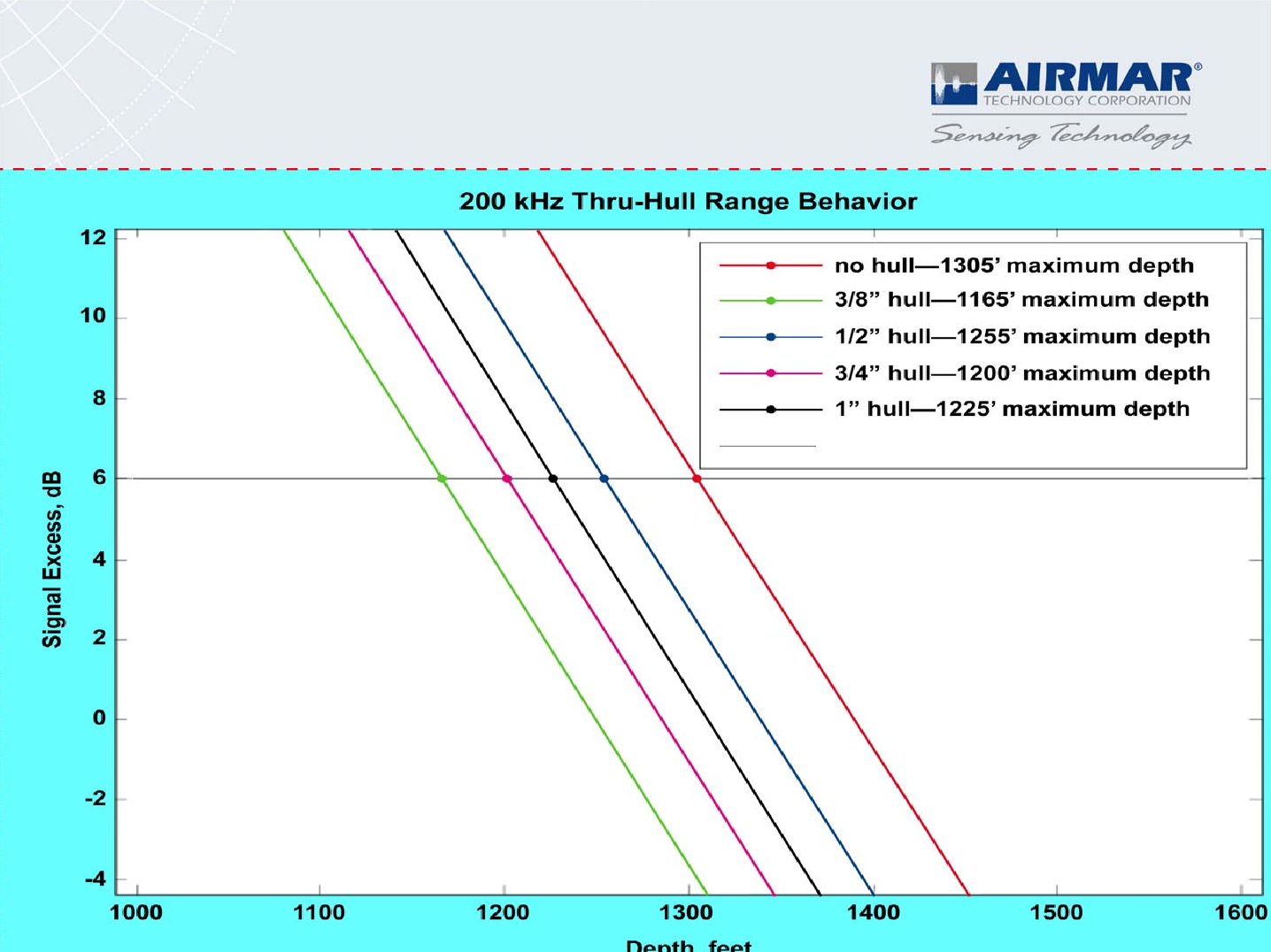
200 kHz Maximum Depth Range
M260 In-Hull - 1kW Input Power
Depending on hull thickness,
90 feet of depth sensing (7%)
can be gained (or lost)
Maximum Depth Line
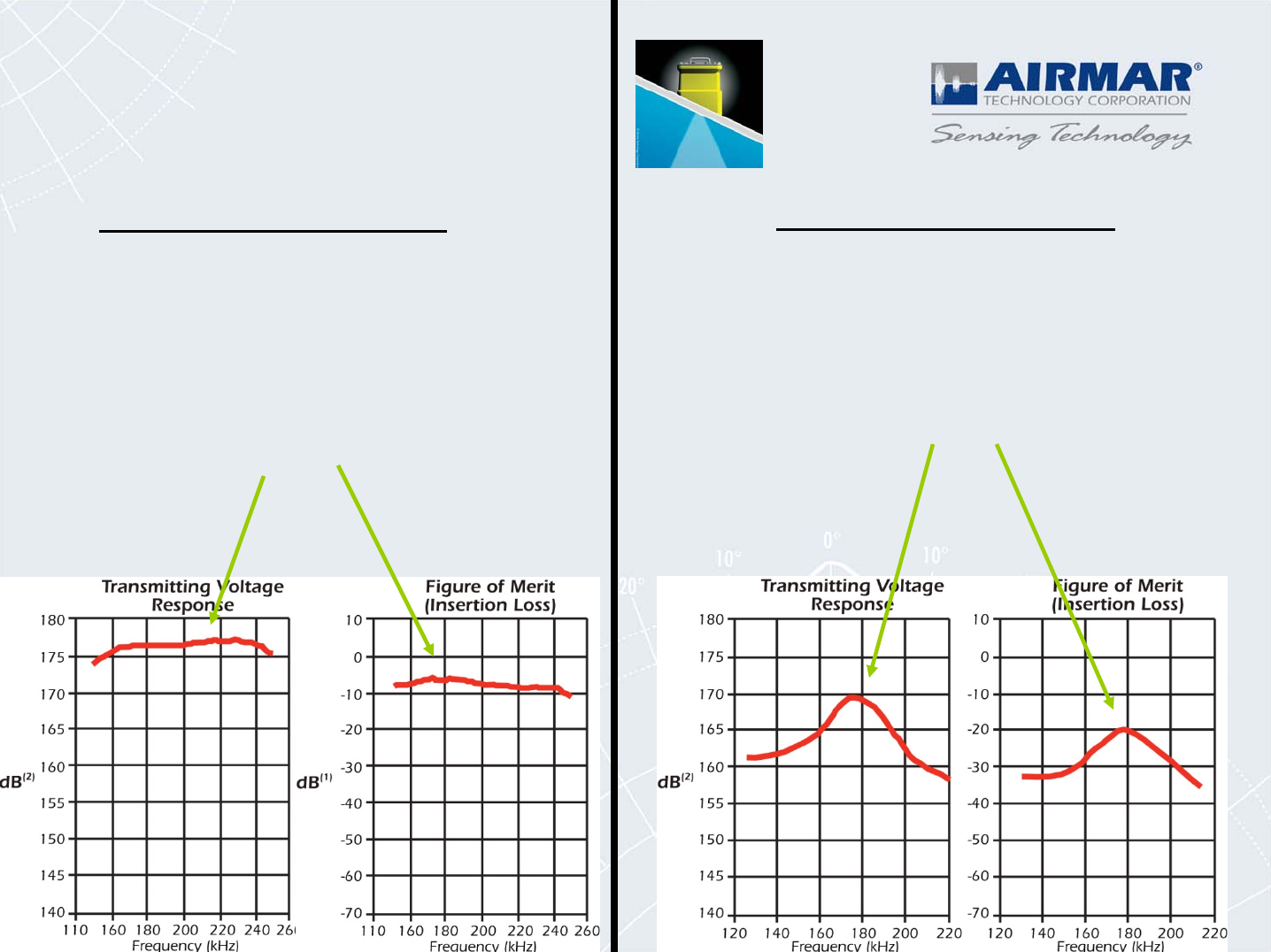
200kHz Q = 2 200kHz Q = 4.5
No Fiberglass ¾” Fiberglass
Flat response: any frequency
between 160 to 240 kHz is an
efficient operating frequency
Transmitting through the hull
reduces bandwidth and shifts
frequency - 180 kHz is now
the best operating frequency
R199 2kW @ 200 kHz
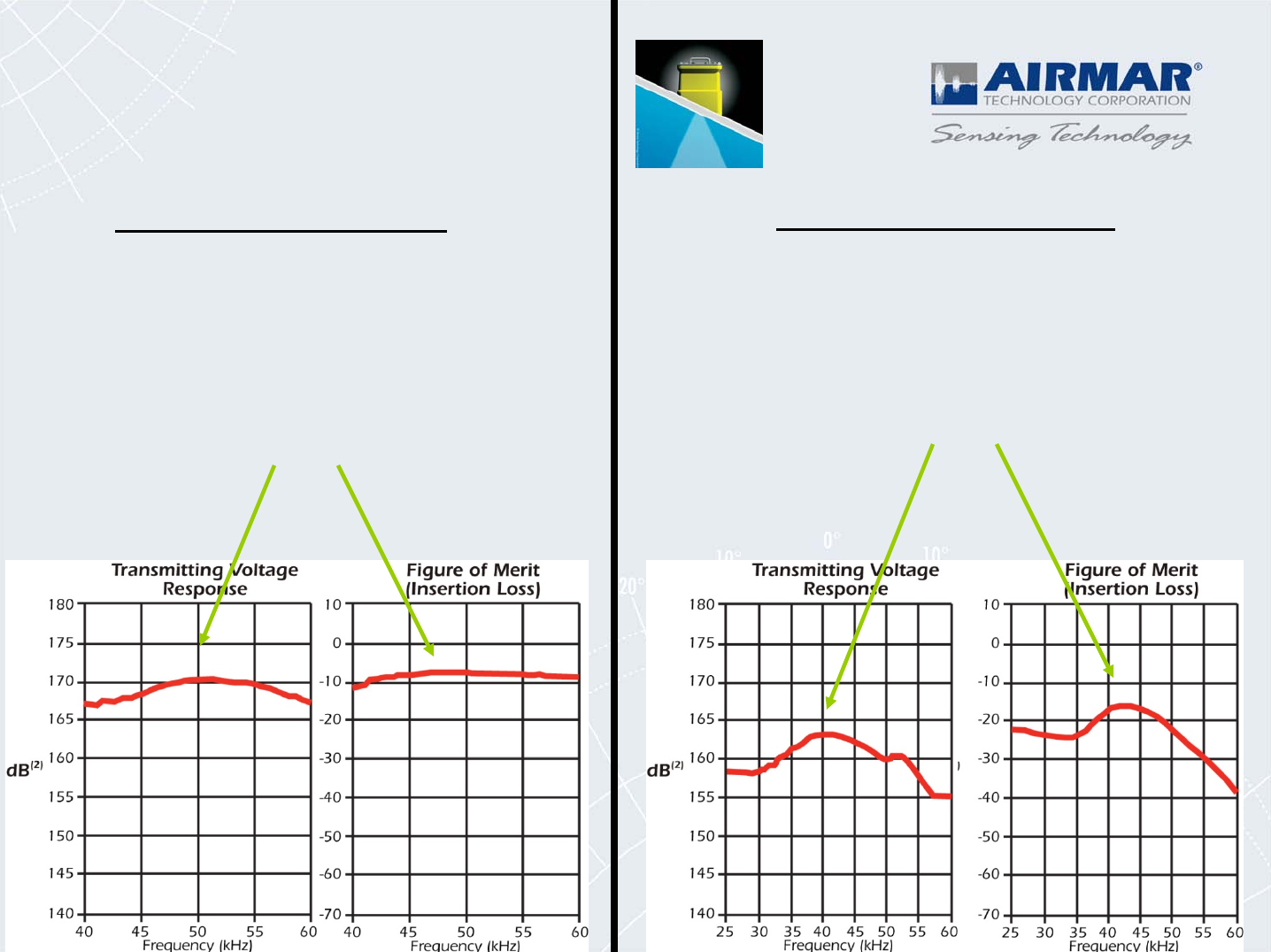
50kHz Q = 3 50kHz Q = 4.1
No Fiberglass ¾” Fiberglass
Flat response: any frequency
between 46 to 55 kHz is an
efficient operating frequency
Transmitting through the hull
reduces bandwidth and shifts
frequency - 43 kHz is now
the best operating frequency
R199 2kW @ 50 kHz

Broadband Transducers
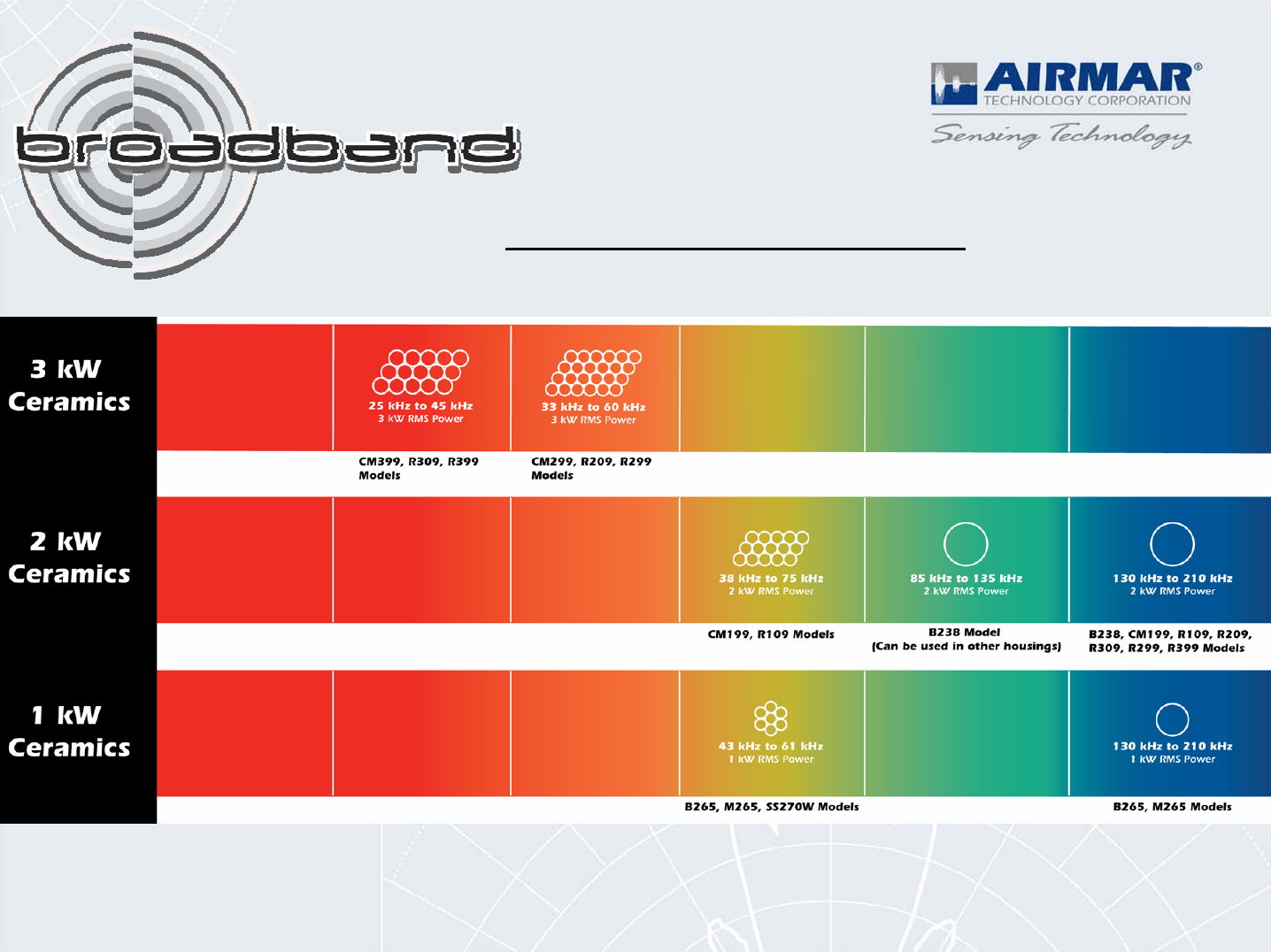
Transducer options
• Frequency agility allows the user to adjust the
frequency if the connected echosounder is
"tunable".
• No loss of sensitivity across the frequency range
• Adjusting the frequency will change the beam
width and depth capabilities.
• Certain fish are more detectable at specific
frequencies so the fishfinder & transducer can be
tuned to get the best echo return for the species
being targeted (tuna, marlin, ground fish, bait).
Benefits of Tunable Fishfinders
with Broadband Transducers
Imaging at various frequencies
Fish 6” above blends
into bottom echo by
long ring from high Q
Fish 6” above blends
into bottom echo by
long ring from high Q
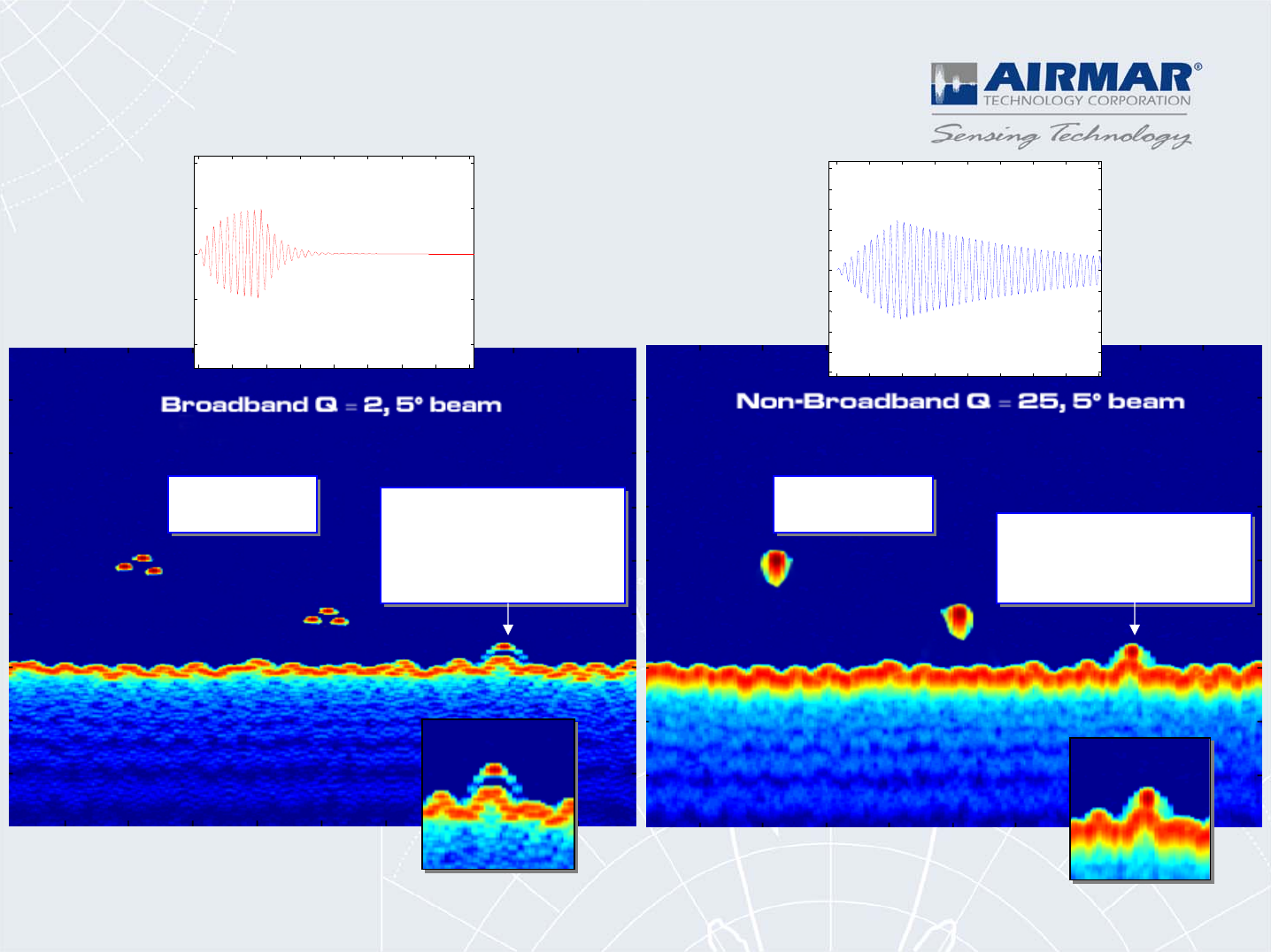
Individual fish are detected
Fish are detected 1” above the bottom Shows fish as “blobs”
Fish less than 6” above bottom will blend in
00.05 0.1 0.15 0.2 0.25 0.3 0.35 0.4
-10
-8
-6
-4
-2
0
2
4
6
8
10
ti illi d
Broadband vs. Narrowband
(no signal processing)
Fish 1” above the
bottom is still
detected by short
ring from low Q
Fish 1” above the
bottom is still
detected by short
ring from low Q
Individual fish
blend together
Individual fish
blend together
Individual fish
are separated
Individual fish
are separated
Long ring- High Q
00.05 0.1 0.15 0.2 0.25 0.3 0.35 0.4
-10
-5
0
5
10
Xm it waveform
time, milliseconds
Short Ring- Low Q
Broadband Narrowband
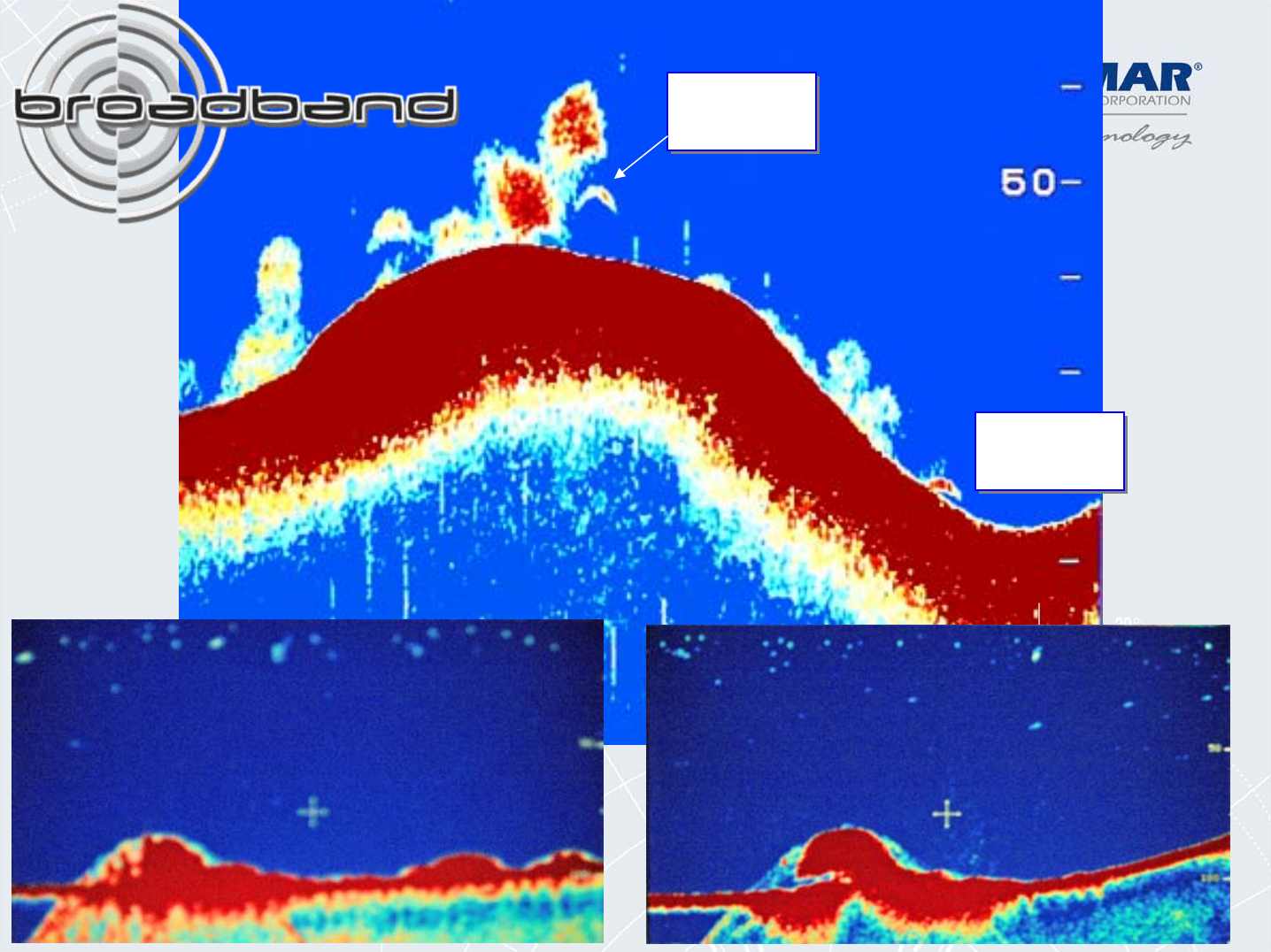
Individual fish
below & along
side baitfish
Individual fish
below & along
side baitfish
Individual fish
holding tight
to bottom
Individual fish
holding tight
to bottom
Broadband TransducerNon-Broadband Transducer
Broadband and the future: CHIRP
•Improved signal-to-noise ratio
•Very good performance from shallow to deep
•Better target definition
•Better performance at speed
•Variable beamwidths
•Better rejection of noise sources
-Frequency Modulated Transmissions
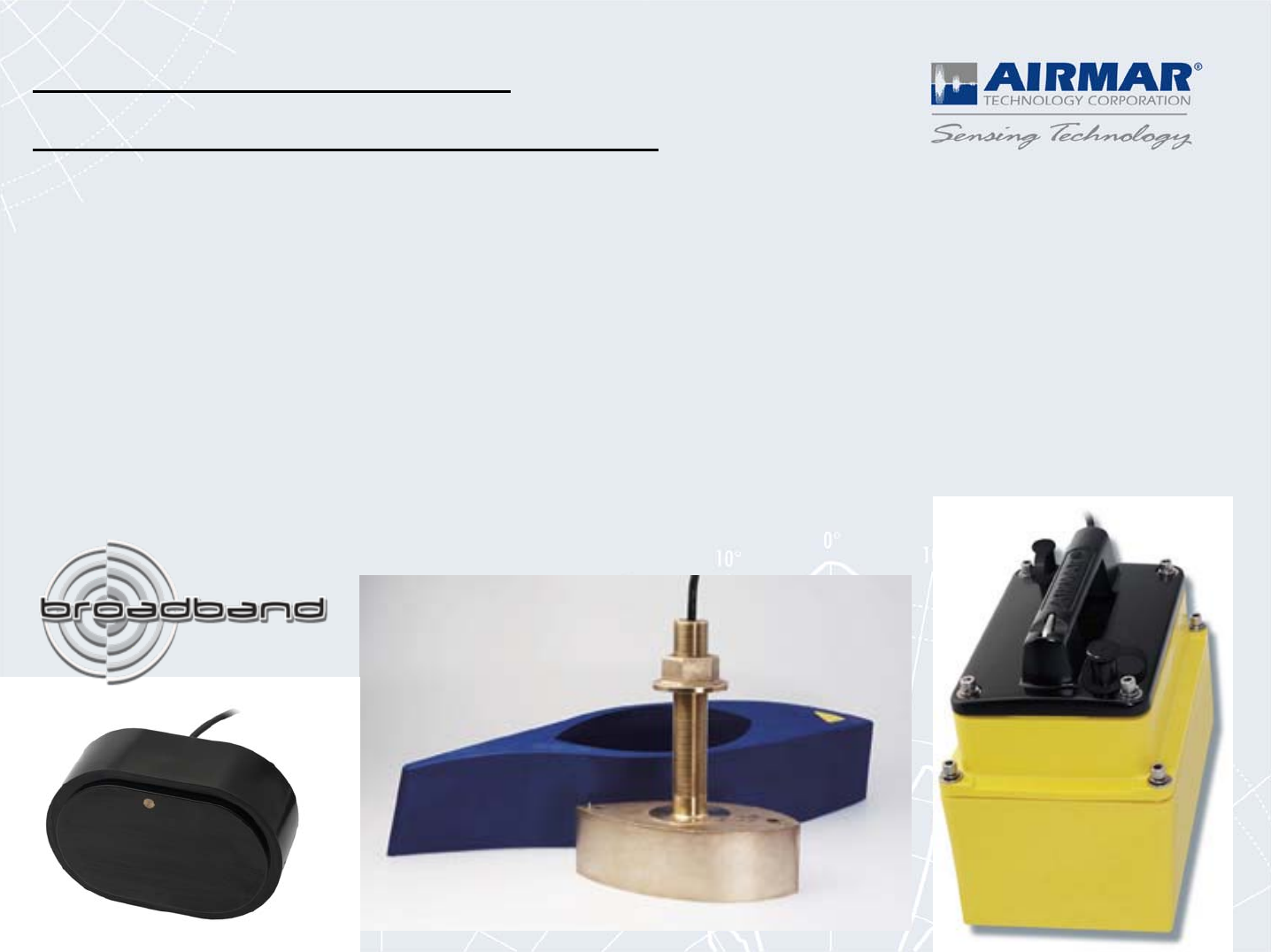
• 1kW Broadband / Chirp versions of the B260 Thru-Hull & M260 In-Hull
• Dual Transmission lines-(separate wires for LF and HF depth)
• Active Temperature Control monitoring of internal ceramics
Better Deep-water, High-Frequency Depth Performance at 130kHz
Adjustable frequency can compensate for frequency shift when
shooting through solid fiberglass (M265 model)
New B265,M265, &
CM265(Commercial tank Mount)
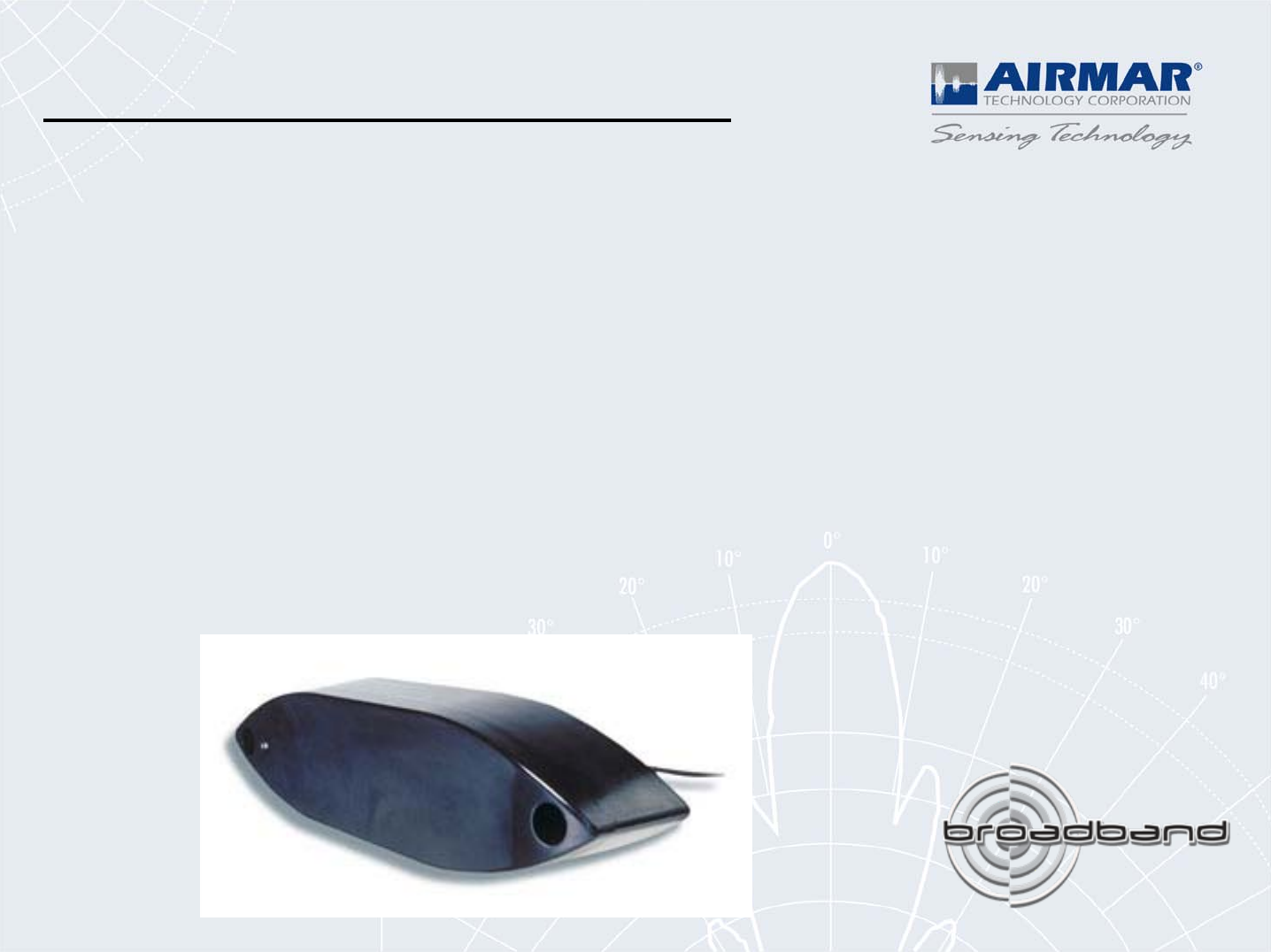
• 2kW Broadband / Chirp version of the R99
• Operates anywhere between 38kHz to 75kHz & 130kHz to 210kHz
• Active Temperature Control monitoring of internal ceramics
• Better Deep-water, High-Frequency Depth Performance at 130kHz
• Very deep sounding capability at 38kHz
R109 External Thru-Hull
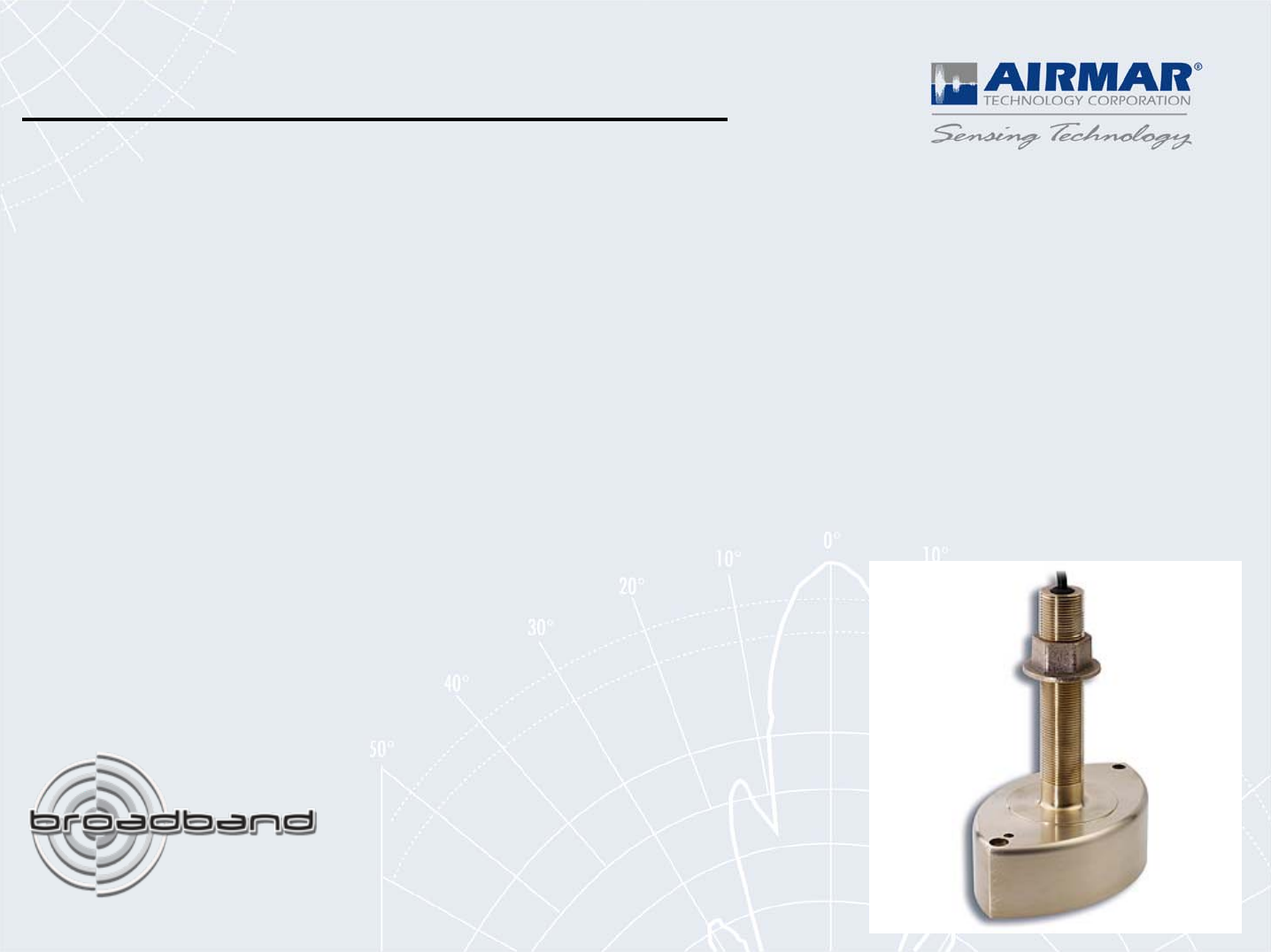
B238 Middle Frequency
• Operates anywhere between 85kHz to 135kHz
• Single 3” ceramic handles 2kW Power
• Completes broadband line by filling the mid-frequency gap.
• Active Temperature Control monitoring of internal ceramics
• Popular 88kHz & 107kHz Commercial fishing Frequencies
2-3kW R209 & R299
• Broadband on both low and high frequencies.
• Dual Transmission line-(separate wires for LF and HF depth)
• Active Temperature Control monitoring of internal ceramics
• 24 element low-frequency array that operate between 33kHz to
60kHz and handle up to 3 kW of input power.
• High-frequency 3.5" Broadband ceramic can operate between
130kHz to 210 kHz and can handle up to 2 kW of input power.
Superb Deep-water, High-Frequency Depth Performance at 130kHz
Adjustable frequency can compensate for frequency shift when
shooting through solid fiberglass (R299 model)
2-3kW R309 & R399
• Very low frequency operation between 25kHz to 45kHz
• Dual Transmission line-(separate wires for LF and HF depth)
• Active Temperature Control monitoring of internal ceramics
• 15 element low-frequency array that operate between 25kHz to
45kHz and handle up to 3 kW of input power.
• High-frequency 3.5" Broadband ceramic can operate between
130kHz to 210 kHz and can handle up to 2 kW of input power.
Superb Deep-water, High-Frequency Depth Performance at 130kHz
Adjustable frequency can compensate for frequency shift when
shooting through solid fiberglass (R399 model)
Installing & Troubleshooting
Transom-Mount Models
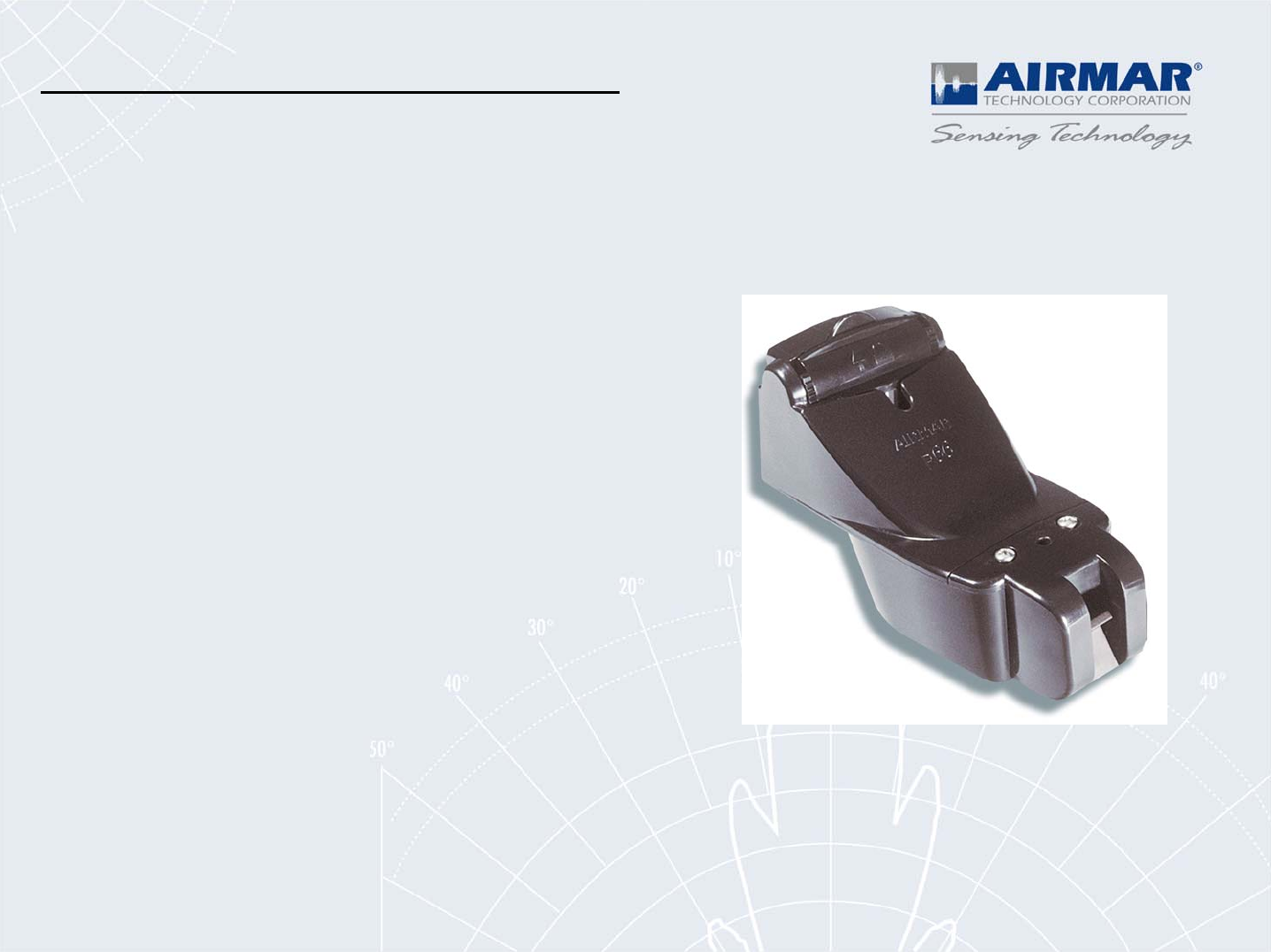
For displacement or planing
hulls only
Can be used on wood,
fiberglass, aluminum or steel
hulls
Can be used with single or
twin I/O, OB and jet drive
propulsion systems
Good high speed
performance can be achieved
with careful installation
Easy maintenance designs
Transom Mount Models
Transom location selection
Transom models are
best suited for small
and trailered vessels
where a thru-hull is
not practical. They
are not for use on
stepped hull boats or
with inboard power.
Transom location selection
Transom models can
Transom models can
be used on
be used on stepped
stepped
transom
transom boats that
boats that
have sufficient
have sufficient
headroom for
headroom for
release. They should
release. They should
be mounted on the
be mounted on the
lower surface.
lower surface.
Transom location selection
Select a mounting location
Select a mounting location
that is not directly behind
that is not directly behind
any strakes, hull fittings or
any strakes, hull fittings or
sources of turbulence.
sources of turbulence.
The water flowing over the
The water flowing over the
face of the transducer
face of the transducer
must be turbulent free.
must be turbulent free.
Transom location selection
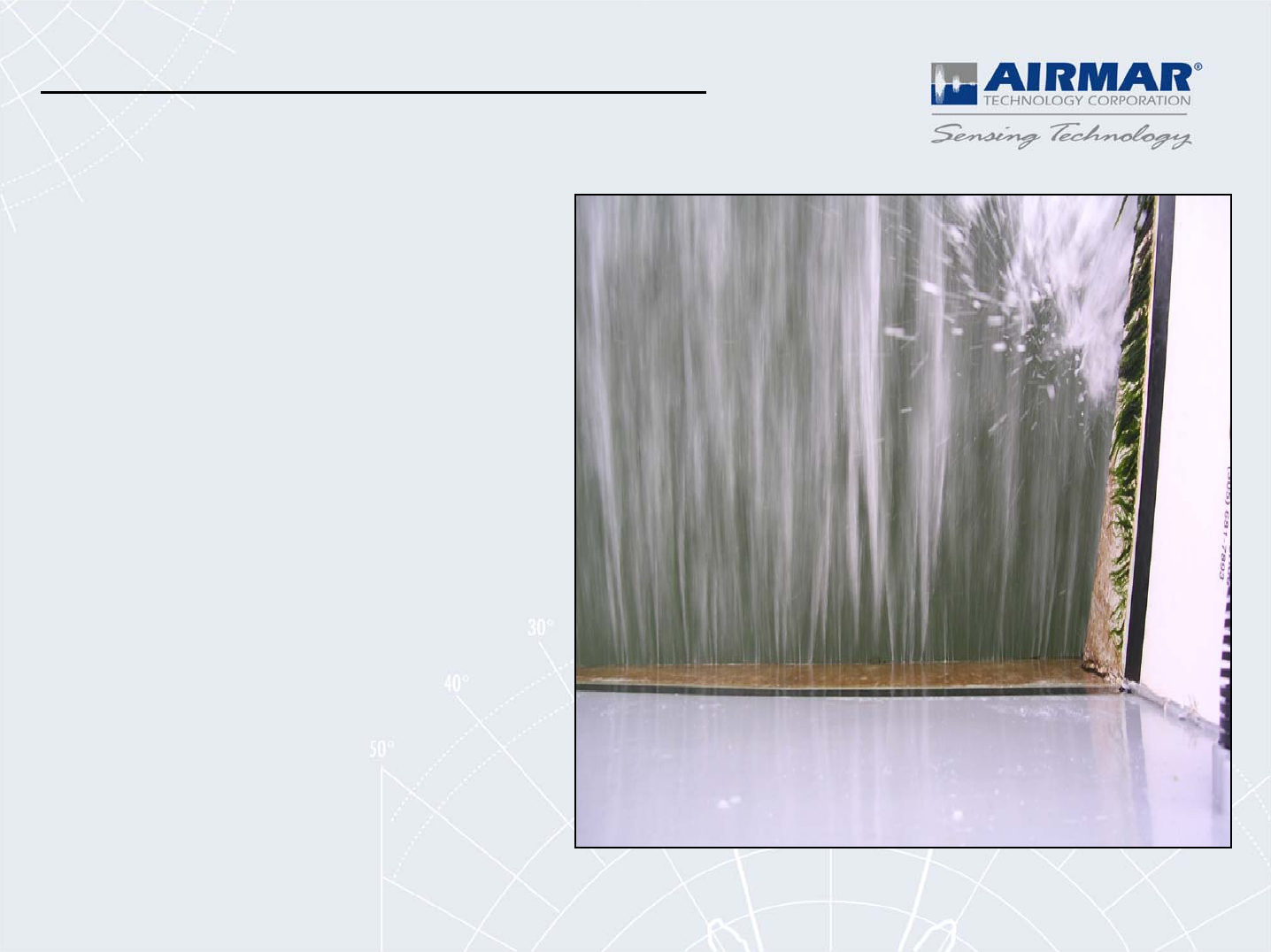
Before installation, run
Before installation, run
the boat at speed and
the boat at speed and
watch the water flow
watch the water flow
over the back of the
over the back of the
transom. Locate the
transom. Locate the
transducer in an area
transducer in an area
which you observed
which you observed
clean flow.
clean flow.
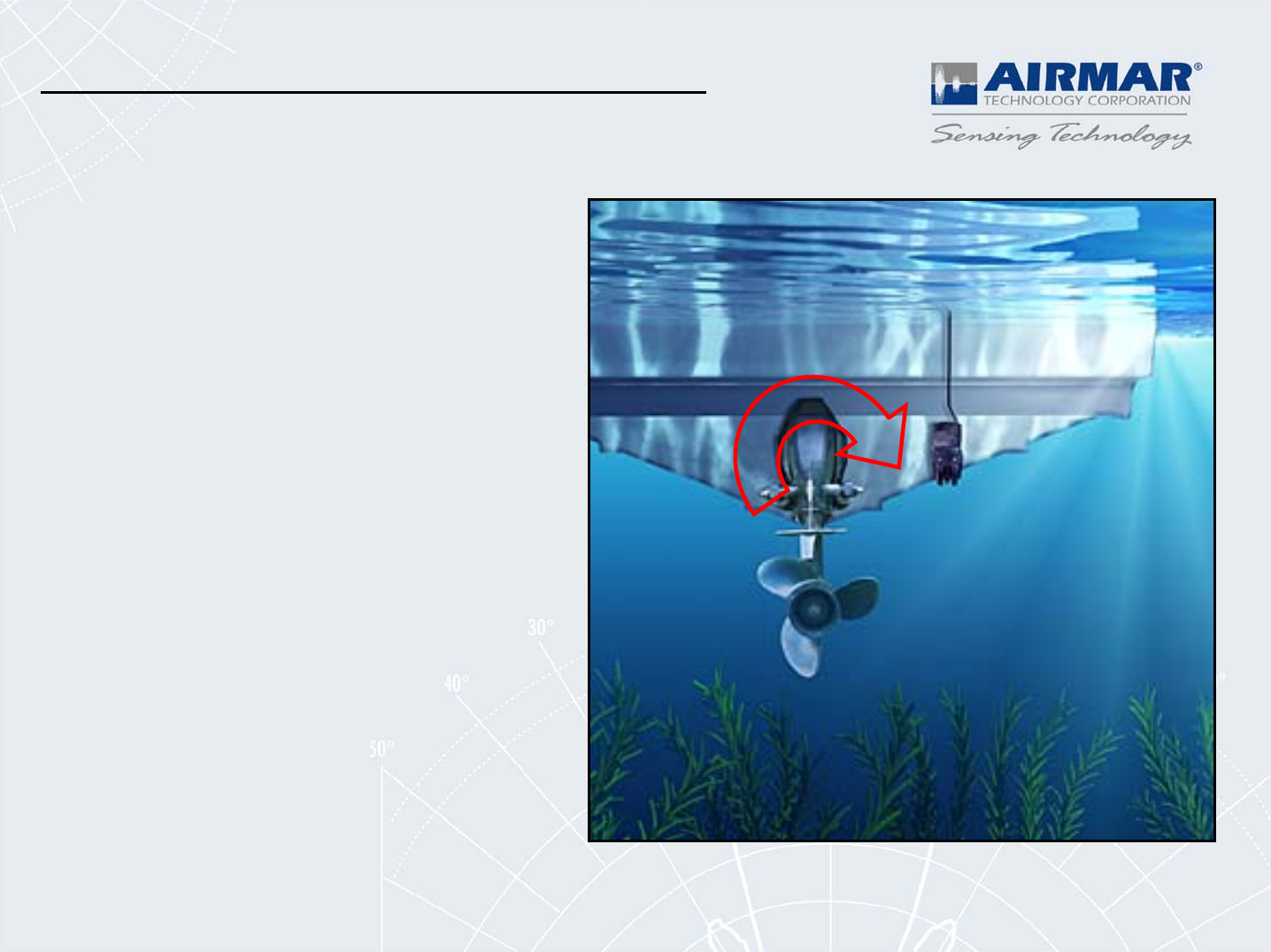
Transom location selection
Best results are
Best results are
achieved when the
achieved when the
flow from the prop
flow from the prop
comes over the top
comes over the top
of the transducer.
of the transducer.
Typically this is on
Typically this is on
the starboard side of
the starboard side of
the transom.
the transom.
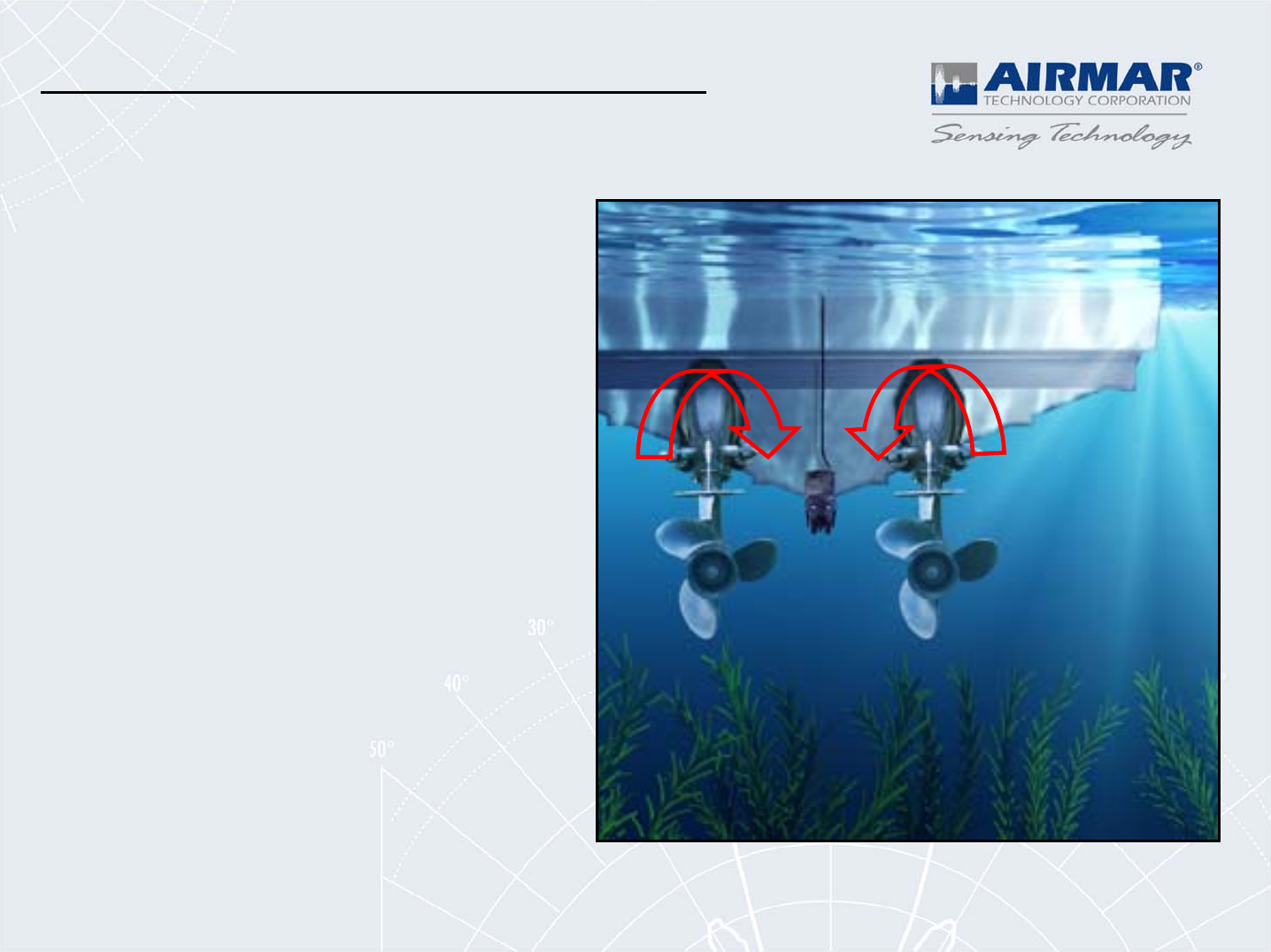
Transom location selection
For twin OB or I/O
For twin OB or I/O
applications best
applications best
results are achieved
results are achieved
by mounting the
by mounting the
transducer between
transducer between
the two drives, either
the two drives, either
on or just off of the
on or just off of the
centerline.
centerline.
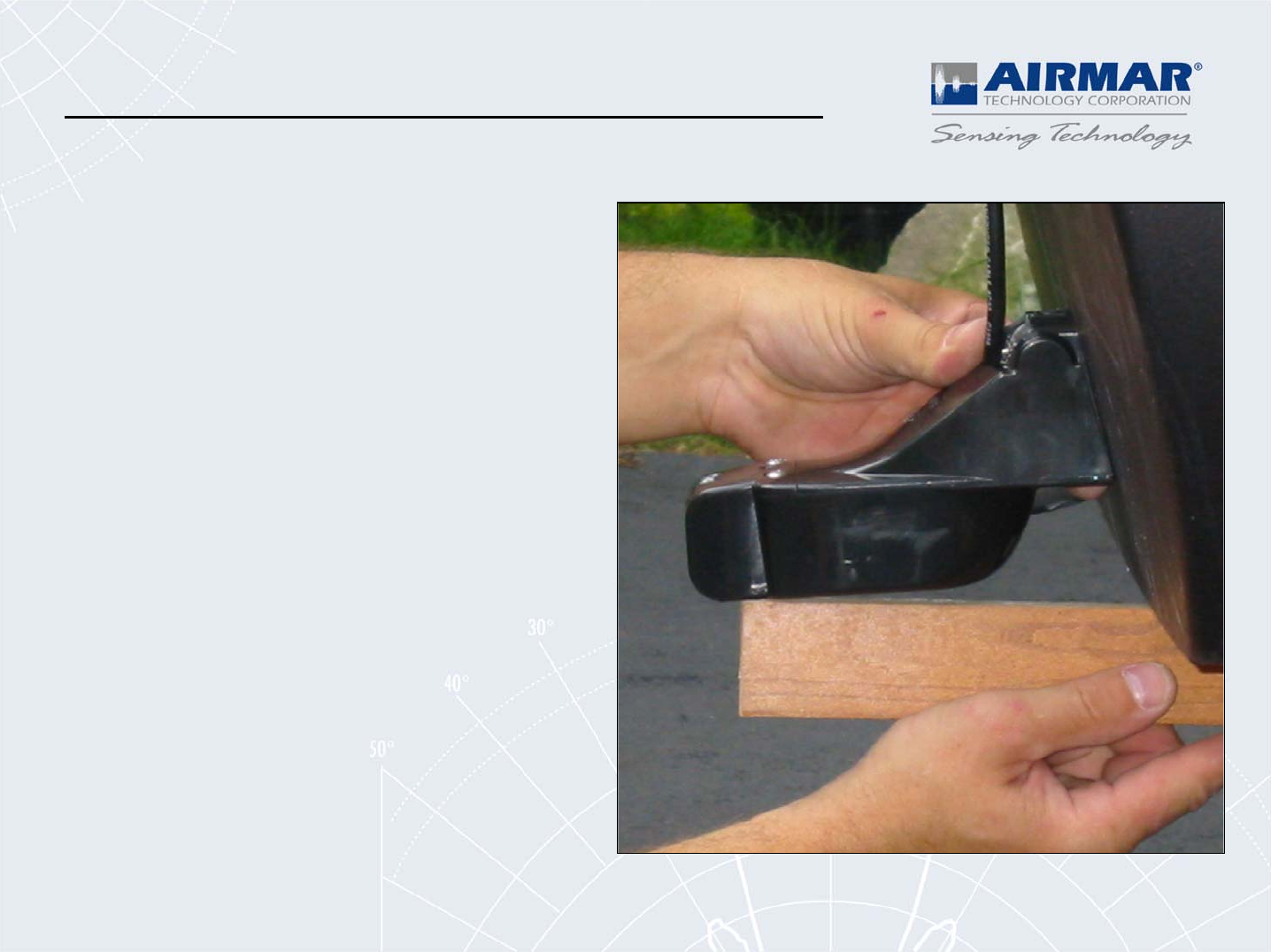
Mount so that the bow of
the sensor is slightly
higher than the stern of
the sensor and the sensor
projects below the hull,
otherwise aeration will
occur.
Transom Mount Guidelines
Sea trial the vessel
and adjust the
transducer mounting
height to achieve clear
screen images at
speed.

If experiencing interference with a transom mounted
transducer you must test drive the vessel to determine what
speed the image is lost at.
Move the transducer to it’s lowest position and retest.
If screen image is improved repeat until you are
satisfied with results.
If screen image gets worse, move transducer up
and re-test until improvement is seen.
Transom Mount Flow Noise
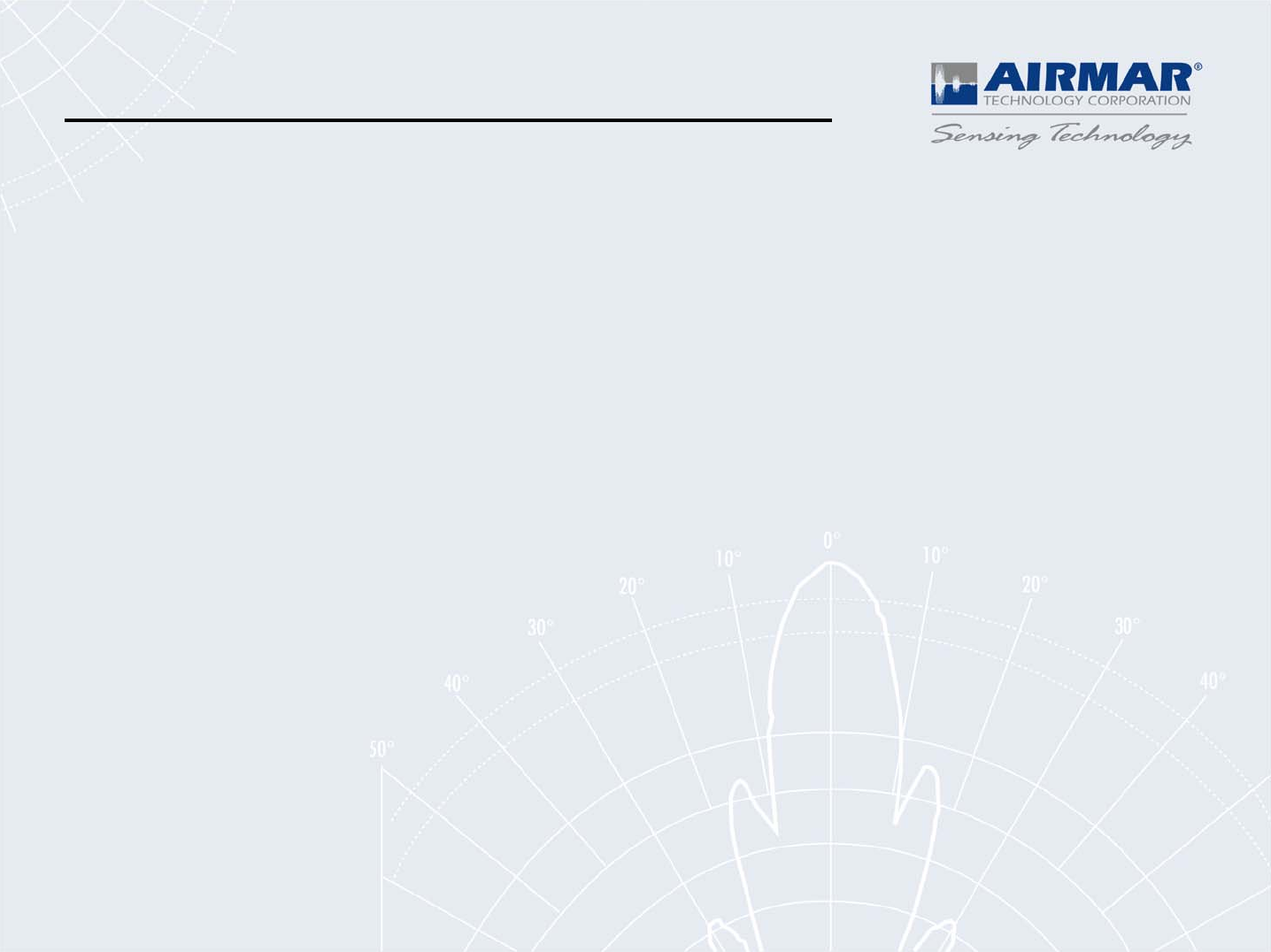
• Perform a slow but constant turn to the side of the hull that the
transom transducer is mounted. Gradually increase rate of turn.
If screen image improves the transducer needs to be mounted
lower in the water.
• If screen image is worse when turning to the same side as the
transducer try turning the opposite direction. This would
indicate the transducer needs to be mounted higher in the
water.
Transom Mount Flow Noise
