ARM TR 008 7654 Bmet Handbook
User Manual: 7654
Open the PDF directly: View PDF  .
.
Page Count: 18
ARM TR-034
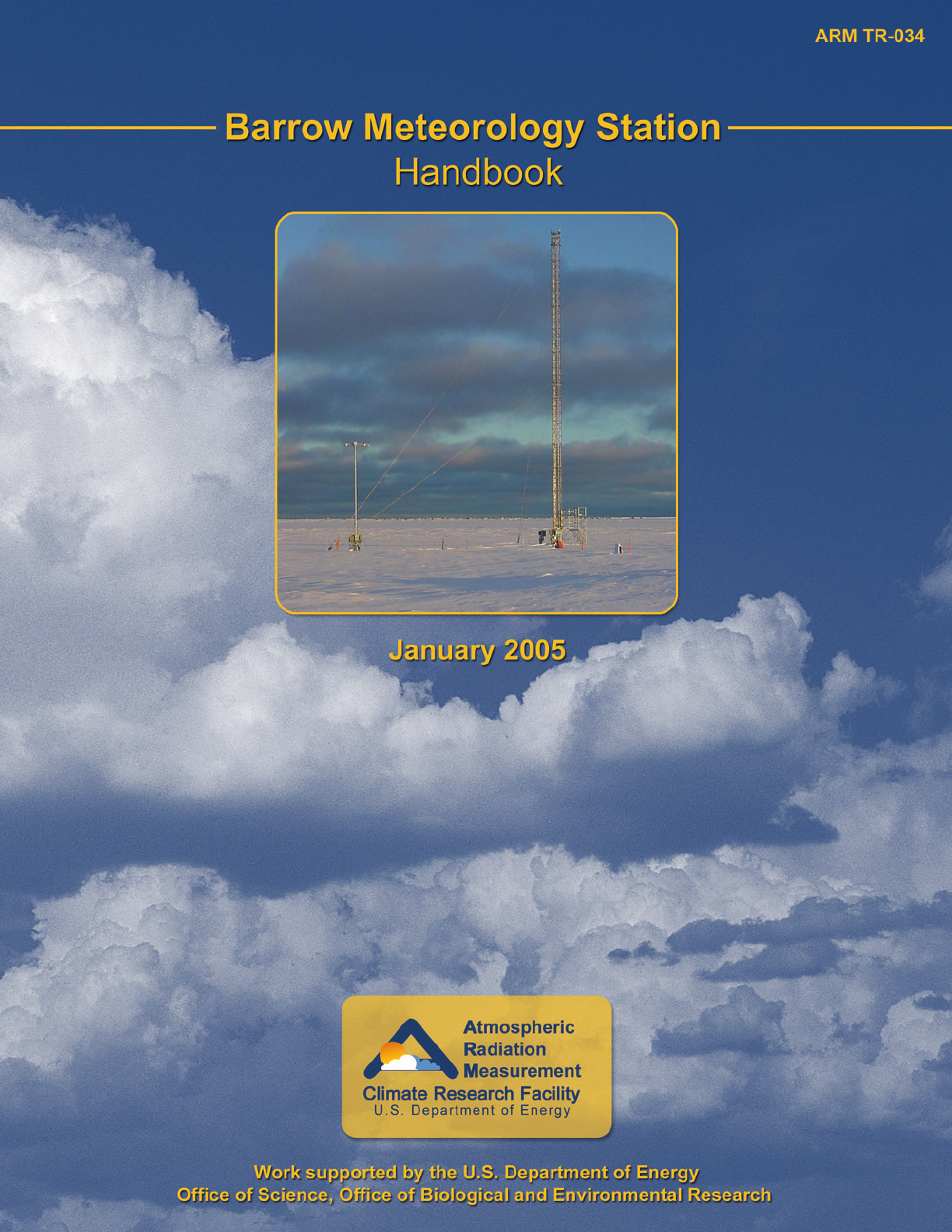
Barrow Meteorology Station Handbook
November 2004
M. T. Ritsche
Work supported by the U.S. Department of Energy,
Office of Science, Office of Biological and Environmental Research

November 2004, ARM TR-034
Contents
1. General Overview ...............................................................................................................................1
2. Contacts...............................................................................................................................................1
3. Deployment Locations and History.....................................................................................................2
4. Near-Real-Time Data Plots.................................................................................................................2
5. Data Description and Examples..........................................................................................................3
6. Data Quality ......................................................................................................................................10
7. Instrument Details.............................................................................................................................11
Tables
1. .............................................................................................................................................................2
2. NSA Met Tower..................................................................................................................................3
3. Present Weather Sensor.......................................................................................................................4
4. Chilled Mirror Hygrometer.................................................................................................................5
5. Optical Rain Gauge.............................................................................................................................5
6. NSA Met Tower..................................................................................................................................5
7. Present Weather Sensor.......................................................................................................................7
8. Chilled Mirror Hygrometer.................................................................................................................7
9. Optical Rain Gauge.............................................................................................................................7
10. NSA Met Tower..................................................................................................................................8
11. Present Weather Sensor.......................................................................................................................8
12. Optical Rain Gauge.............................................................................................................................8
13. NSA Met Tower..................................................................................................................................9
14. Present Weather Sensor.......................................................................................................................9
15. Chilled Mirror Hygrometer.................................................................................................................9
16. Optical Rain Gauge.............................................................................................................................9
iii

November 2004, ARM TR-034
1. General Overview
The Barrow meteorology station (BMET) uses mainly conventional in situ sensors mounted at four
different heights on a 40 m tower to obtain profiles of wind speed, wind direction, air temperature, and
humidity. It also obtains barometric pressure, visibility, and precipitation data.
2. Contacts
2.1 Mentor
Michael Ritsche
Argonne National Laboratory
9700 South Cass Avenue
Argonne, IL 60439
Phone: 630-252-1554
Fax: 630-252-5498
E-mail: mtritsche@anl.gov
2.2 Instrument Developer
Wind Speed and Direction, Temperature and Relative Humidity, Barometric Pressure, Present
Weather
Vaisala
100 Commerce Way
Woburn, MA 01801-1068
Phone: 617-933-4500
Fax: 617-933-8029
Aspirated Radiation Shields
R.M. Young Company
2801 Aero-Park Drive
Traverse City, MI 49686
Phone: 616-946-3980
Fax: 616-946-4772
Chilled-Mirror Hygrometer
Meteolabor AG
Hofstrasse 92
CH-8620 Wetzikon
Schweis
Phone: (+41) 1 932 18 81
Fax: (+41) 1 932 32 49
Web page: www.meteolabor.ch
1
November 2004, ARM TR-034
Precipitation
Scientific Technology, Inc.
205 Perry Parkway, Suite 14
Gaithsburg, MD 20877-2141
Phone: 301-948-6070
Fax: 301-948-4674
Computer
Gateway2000
610 Gateway Drive
P.O. Box 2000
North Sioux City, SD 57049-2000
Phone: 605-232-2000
Fax: 605-232-2023
RocketPort 485 Multport Board
Control Corporation
900 Long Lake Road
St. Paul, MN 55112
Phone: 612-631-7654
Fax: 612-631-8117
BridgeVIEW software
National Instruments
6504 Bridge Point Parkway
Austin, TX 78730-5039
Phone: 512-794-0100
Fax: 512-794-8411
3. Deployment Locations and History
This one-of-a-kind system was installed at the NSA Barrow Alaska site in March 1998. In October 2003
the collection system and various sensors were replaced. See the Surface and Tower Meteorological
Instrumentation at Barrow (METTWR4H) for the current data, sensors and measurement methods.
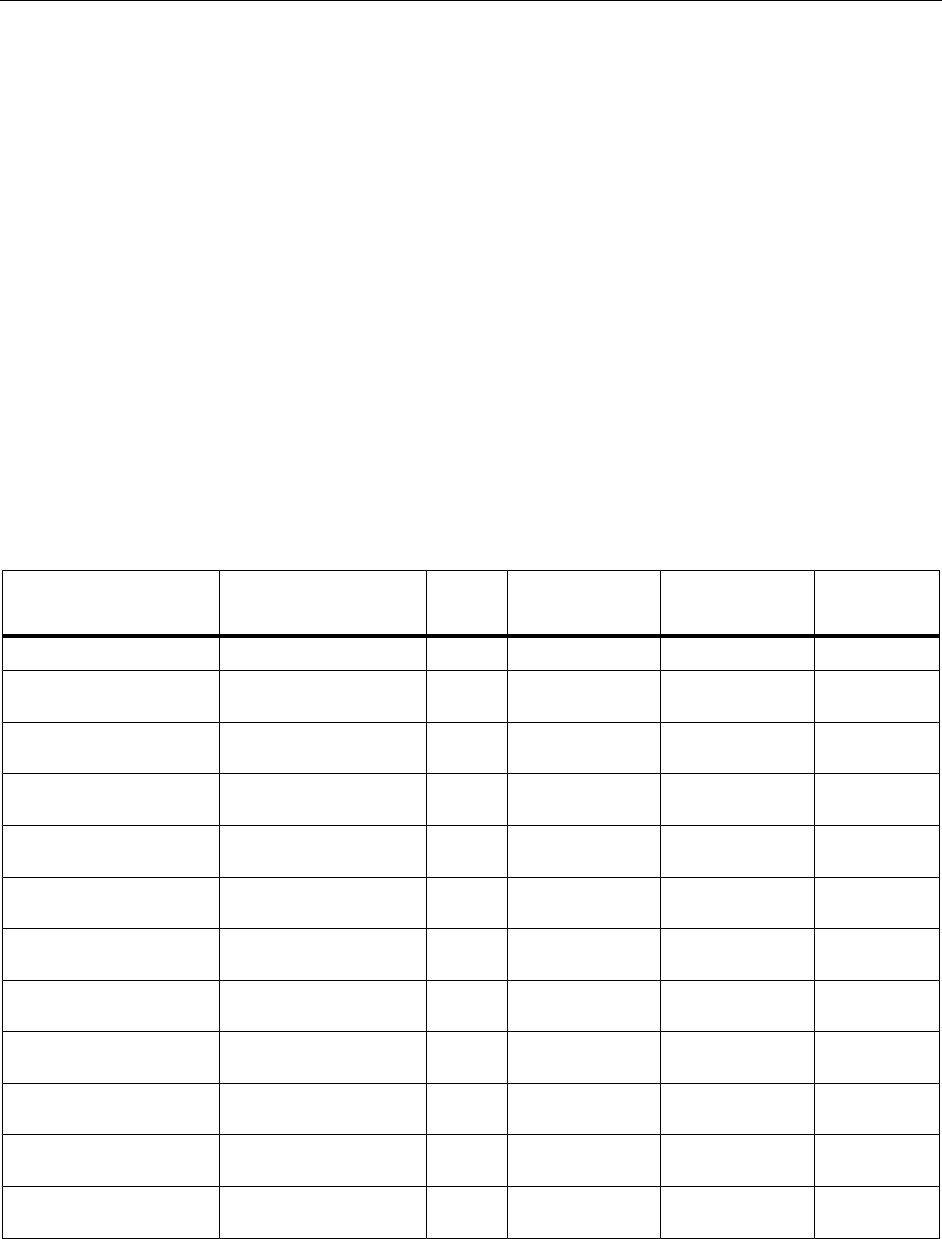
Table 1.
Location Date installed Date Removed Status
NSA C2 03/1998 N/A-changed changed
4. Near-Real-Time Data Plots
This section is not applicable to this instrument.
2
November 2004, ARM TR-034
5. Data Description and Examples
This section is not applicable to this instrument.
5.1 Data File Contents
5.1.1 Primary Variables and Expected Uncertainty
The BMET station directly measures wind speed, wind direction, air temperature, and relative humidity at
2 m, 10 m, 20 m, and 40 m. Vector-averaged wind speeds, vector-averaged wind directions, dew points,
and vapor pressures are computed from these primary measurements.
Periodically, 2 m air and dew point temperatures are measured using a chilled-mirror hygrometer.
Barometric pressure, visibility, and precipitation at the surface are also directly measured.
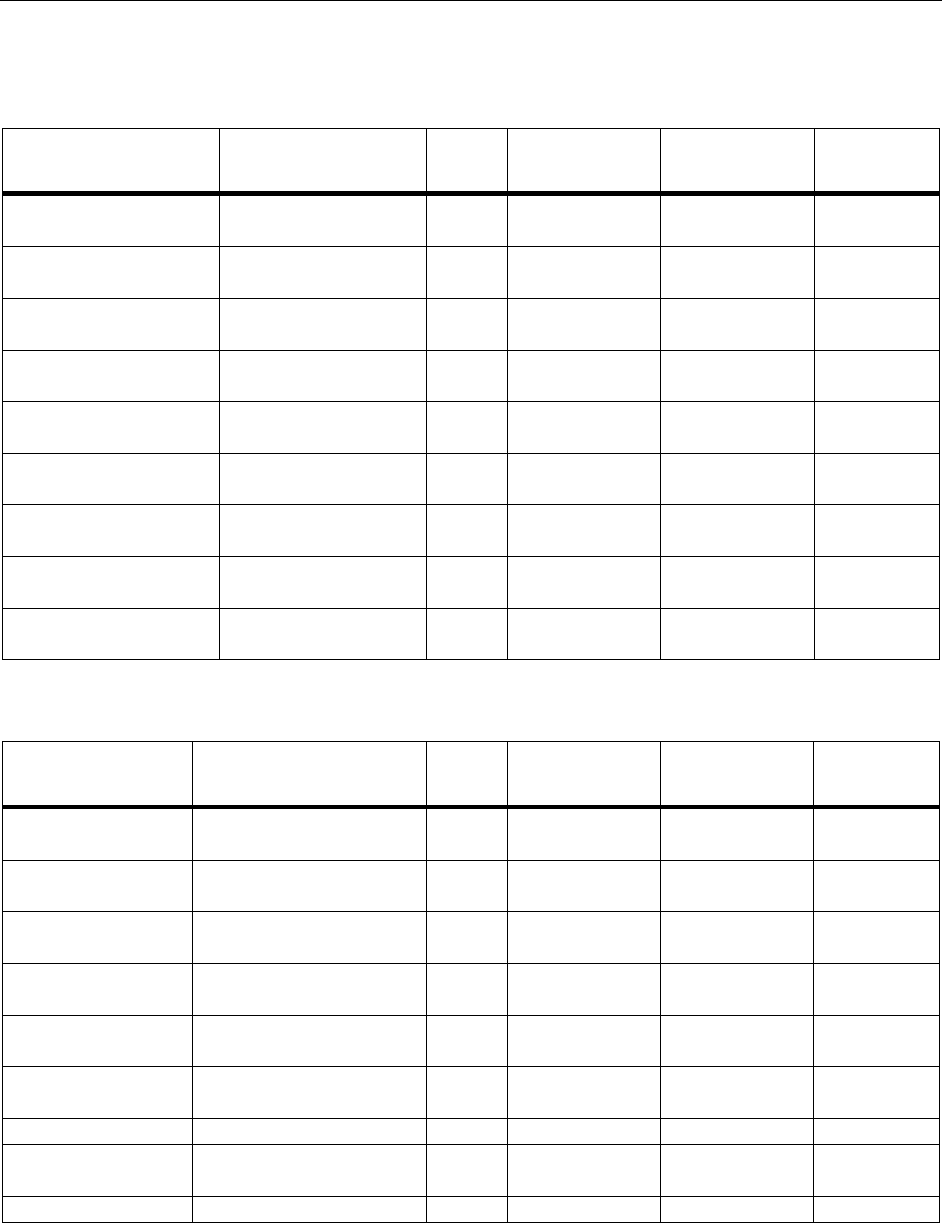
Table 2. NSA Met Tower
Quantity Variable Unit
Measurement
Level Measurement
Interval Resolution
Barometric Pressure atmos_pressure hPa 4m 1 min 0.01
Mean Wind Speed wind_spd_mean m/s 2m, 10m, 20m,
40m 1 min 0.001
Maximum
Wind Speed wind_spd_max m/s
2m, 10m, 20m,
40m 1 min 0.001
Minimum
Wind Speed wind_spd_min m/s
2m, 10m, 20m,
40m 1 min 0.001
Vector-averaged
Wind Speed wind_spd_vec_avg m/s
2m, 10m, 20m,
40m 1 min 0.001
Vector-averaged
Wind Direction wind_dir_vec_avg deg
2m, 10m, 20m,
40m 1 min 0.001
Std Dev of
Wind Direction wind_dir_sd deg
2m, 10m, 20m,
40m 1 min
Maximum
Wind Direction wind_dir_max deg
2m, 10m, 20m,
40m 1 min 0.001
Minimum
Wind Direction wind_dir_min deg
2m, 10m, 20m,
40m 1 min 0.001
Mean Air Temperature
or Hardware Error temp_mean C
2m, 10m, 20m,
40m 1 min 0.001
Maximum
Air Temperature temp_max C
2m, 10m, 20m,
40m 1 min 0.001
Minimum
Air Temperature temp_mean C
2m, 10m, 20m,
40m 1 min 0.001
3
November 2004, ARM TR-034
Table 2. (cont’d)
Quantity Variable Unit
Measurement
Level Measurement
Interval Resolution
Mean
Relative Humidity relh_mean %
2m, 10m, 20m,
40m 1 min 0.01
Maximum
Relative Humidity relh_max %
2m, 10m, 20m,
40m 1 min 0.01
Minimum
Relative Humidity relh_min %
2m, 10m, 20m,
40m 1 min 0.01
Mean Dew Point
Temperature dew_pt_temp_mean C
2m, 10m, 20m,
40m 1 min 0.001
Maximum Dew Point
Temperature dew_pt_temp_max C
2m, 10m, 20m,
40m 1 min 0.001
Minimum Dew Point
Temperature dew_pt_temp_min C
2m, 10m, 20m,
40m 1 min 0.001
Mean
Vapor Pressure vap_pres_mean hPa
2m, 10m, 20m,
40m 1 min 0.001
Maximum
Vapor Pressure vap_pres_max hPa
2m, 10m, 20m,
40m 1 min 0.001
Minimum
Vapor Pressure vap_pres_min hPa
2m, 10m, 20m,
40m 1 min 0.001
Table 3. Present Weather Sensor
Quantity Variable Unit
Measurement
Level Measurement
Interval Resolution
NWS Code present_weather_sensor_
NWS_code N/A 3m 1 min N/A
One Minute
Visibility one_minute_visibility m 3m 1 min 1
Ten Minute
Visibility ten_minute_visibility m 3m 1 min 1
One Minute
PW code one_minute_PW_code N/A 3m 1 min N/A
Ten Minute
PW Code ten_minute_PW_code N/A 3m 1 min N/A
One Hour
PW code one_hour_PW_code N/A 3m 1 min N/A
Precipitation Rate precip_rate mm/hr 3m 1 min 0.01
Cumulative Liquid
Water Equivalent cumul_liq_water_equiv mm/hr 3m 1 min 0.01
Cumulative Snow cumul_snow mm/hr 3m 1 min 0.01
4
November 2004, ARM TR-034
Table 4. Chilled Mirror Hygrometer
Quantity Variable Unit
Measurement
Level Measurement
Interval Resolution
Air temperature air_temp C 2m 10 min 0.1
Dew point temperature dew_pt_temp C 2m 10 min 0.01
Relative humidity relh % 2m 10 min 0.1
Table 5. Optical Rain Gauge
Quantity Variable Unit
Measurement
Level Measurement
Interval Resolution Uncertainty
NWS Code precip_NWS_code N/A 1 m 1 min N/A N/A
ORG
Precipitation
Rate
precip_rate mm/hr 1 m 1 min 0.001 5%
Daily
Accumulation precip_daily_accum mm 1 m 1440 min 0.001 10%
5.1.1.1 Definition of Uncertainty
When the wind speed drops below the starting threshold for the cup anemometers or the wind vanes, the
sensors will not respond properly. If the wind speed stays below the starting threshold, the sensors will
not respond at all.
During periods of rime ice, the air flow through the aspirated radiation shields will be modified. The air
flow may be reduced and the temperature in the shield may be closer to that of the rime ice than that of
the air. The humidity in the shield may also be affected.
5.1.2 Secondary/Underlying Variables
This section is not applicable to this instrument.
5.1.3 Diagnostic Variables
Table 6. NSA Met Tower
Variable Measurement Interval
Measurement
Level Min Max
Barometric Pressure out of
range error atmos_pressure_out_of_range_error 4m 800 1100
Barometric Pressure read
timeout error atmos_pressure_read_timeout_error 4m
PTB Serial Error atmos_pressure_PTB_Serial_Error 4m
5

November 2004, ARM TR-034
Table 6. (cont’d)
Variable Measurement Interval
Measurement
Level Min Max
Std Dev of Wind Speed wind_spd_sd 2m, 10m, 20m,
40m
Std Dev of Air Temperature temp_sd 2m, 10m, 20m,
40m
Std Dev of Relative Humidity
or Hardware Error Code relh_sd 2m, 10m, 20m,
40m
Std Dev of Dew Point
Temperature dew_pt_temp_sd 2m, 10m, 20m,
40m
Std Dev of Vapor Pressure vap_pres_sd 2m, 10m, 20m,
40m
Wind Speed out of range error wind_spd_out_of_range_error 2m, 10m, 20m,
40m 0 100
Wind Direction out of range
error wind_dir_out_of_range_error 2m, 10m, 20m,
40m 0 360
Air Temperature out of range
error temp_out_of_range_error 2m, 10m, 20m,
40m -50 30
Relative Humidity out of range
error relh_out_of_range_error 2m, 10m, 20m,
40m -2 104
Dew Point Temperature out of
range error dew_pt_temp_out_of_range_error 2m, 10m, 20m,
40m -60 30
Vapor Pressure out of range
error vap_press_out_of_range_error 2m, 10m, 20m,
40m 0.002 43
Internal Voltage out of range
error internal_voltage_out_of_range 2m, 10m, 20m,
40m 21.5 28.5
Internal Temperature out of
range error internal_temp_out_of_range_error 2m, 10m, 20m,
40m -50 100
Air Temperature Hardware
Error temp_hardware_error 2m, 10m, 20m,
40m N/A N/A
Dew Point Temperature
Hardware Error dew_pt_hardware_error 2m, 10m, 20m,
40m N/A N/A
Number of timeout readings of
the met tower data by QLI read_timeout_count 2m, 10m, 20m,
40m N/A N/A
6
November 2004, ARM TR-034
Table 7. Present Weather Sensor
Variable Measurement Interval Min Max
One Minute Visibility
out of range error one_minute_vis_out_of_range_error 0 50000
Ten Minute Visibility
out of range error ten_minute_vis_out_of_range_error 0 50000
One Minute PW code
out of range error one_min_pw_code_out_of_range_error 0 99
Ten Minute PW code
out of range error ten_min_pw_code_out_of_range_error 0 99
One Hour PW code
out of range error one_hour_pw_code_out_of_range_error 0 99
PWS Precipitation Rate
out of range error precip_rate_out_of_range_error_ 0 999
Liquid Water Equivalent
out of range error cumul_liq_water_equiv_out_of_range_error 0 999
Cumulative Snow
out of range error cumul_snow_out_of_range_error 0 999
Present Weather Sensor
Serial Error pws_serial_error N/A N/A
Present Weather Sensor
Read Timeout Error pws_read_timeout_error N/A N/A
Table 8. Chilled Mirror Hygrometer
Quantity Variable
Measurement
Interval Min Max
Air temperature
out of range error air_temp_out_of_range_error 10 min unk unk
Dew point temperature
out of range error dew_pt_temp_out_of_range_error 10 min unk unk
Relative Humidity
out of range error relh_out_of_range_error 10 min unk unk
Read timeout error read_timeout_error 10 min unk unk
Serial port read error serial_read_error 10 min unk unk
Table 9. Optical Rain Gauge
Quantity Variable
Measurement
Interval Min Max
Daily Accumulation
out of range error precip_out_of_range_error 1 min 0 700
ORG No Data Error precip_no_data_error 1 min N/A N/A
ORG Read Timeout Error precip_read_timeout_error 1 min N/A N/A
ORG Serial Error precip_serial_error 1 min N/A N/A
7
November 2004, ARM TR-034
5.1.4 Data Quality Flags
Data Quality flags were contained in the MetTWR, Mettiptwr, Optical Rain Gauge (ORG), Present
Weather Sensor (PWS), and Snow Depth Sensor Data Object Design Changes for ARM netCDF file
header descriptions. Contact the mentor if you need a copy.
Table 10. NSA Met Tower
Quantity Variable
Measurement
Level Measurement
Interval Min Max Delta
Barometric Pressure qc_atmos_pressure 4m 1 min 800 1100 10
Mean
Wind Speed qc_wind_spd_mean 2m, 10m, 20m,
40m 1 min 0 100 20
Vector-averaged Wind
Direction qc_wind_dir_vec_avg 2m, 10m, 20m,
40m 1 min 0 360 90
Mean Air Temperature
or Hardware Error qc_temp_mean 2m, 10m, 20m,
40m 1 min -60 30 10
Mean Relative Humidity qc_relh_mean 2m, 10m, 20m,
40m 1 min -2 104 30
Mean Dew Point
Temperature qc_dew_pt_temp 2m, 10m, 20m,
40m 1 min -60 30 10
Mean
Vapor Pressure qc_vap_pres_mean 2m, 10m, 20m,
40m 1 min 0.002 43 10
Table 11. Present Weather Sensor
Quantity Variable
Measurement
Interval Min Max Delta
One Minute Visibility qc_one_minute_visibility 1 min 0 50000 5000
Ten Minute Visibility qc_ten_minute_visibility 1 min 0 50000 5000
One Minute PW Code qc_one_minute_PW_code 1 min 0 99 N/A
Ten Minute PW Code qc_ten_minute_PW_code 1 min 0 99 N/A
One Hour PW Code qc_one_hour_PW_code 1 min 0 99 N/A
Precipitation Rate qc_precip_rate 1 min 0 999 100
Cumulative Liquid Water
Equivalent qc_cumul_liq_water_equiv 1 min 0 999 100
Cumulative Snow qc_cumulative_snow 1 min 0 999 100
Table 12. Optical Rain Gauge
Quantity Variable
Measurement
Interval Min Max Delta
ORG Precipitation Rate qc_precip_rate 1 min 0 700 100
8
November 2004, ARM TR-034
5.1.5 Dimension Variables
Table 13. NSA Met Tower
Variable Measurement Interval Unit
base_time 1 min seconds since YYYY-mm-dd XX:XX:XX X:XX
time_offset 1 min seconds since YYYY-mm-dd XX:XX:XX X:XX
lat 1 min degrees
lon 1 min degrees
alt 1 min meters above sea level
Table 14. Present Weather Sensor
Variable Measurement Interval Unit
base_time 1 min seconds since YYYY-mm-dd XX:XX:XX X:XX
time_offset 1 min seconds since YYYY-mm-dd XX:XX:XX X:XX
Lat 1 min degrees
Lon 1 min degrees
Alt 1 min meters above sea level
Table 15. Chilled Mirror Hygrometer
Variable Measurement Interval Unit
base_time 1 min seconds since YYYY-mm-dd XX:XX:XX X:XX
time_offset 1 min seconds since YYYY-mm-dd XX:XX:XX X:XX
lat 1 min degrees
lon 1 min degrees
alt 1 min meters above sea level
Table 16. Optical Rain Gauge
Variable Measurement Interval Unit
base_time 1 min seconds since YYYY-mm-dd XX:XX:XX X:XX
time_offset 1 min seconds since YYYY-mm-dd XX:XX:XX X:XX
lat 1 min degrees
lon 1 min degrees
alt 1 min meters above sea level
9

November 2004, ARM TR-034
5.2 Annotated Examples
This section is not applicable to this instrument.
5.3 User Notes and Known Problems
This section is not applicable to this instrument.
5.4 Frequently Asked Questions
This section is not applicable to this instrument.
6. Data Quality
6.1 Data Quality Health and Status
This section is not applicable to this instrument.
6.2 Data Reviews by Instrument Mentor
Each data measurement value was compared to upper and lower limits by the data acquisition and
processing program. If a single value obtained during the one-minute processing interval was outside of
these limits, a flag was set and included in the data record for that minute.
6.3 Data Assessments by Site Scientist/Data Quality Office
This section is not applicable to this instrument.
6.4 Value-Added Procedures and Quality Measurement Experiments
Many of the scientific needs of the ARM Program are met through the analysis and processing of existing
data products into "value-added" products or VAPs. Despite extensive instrumentation deployed at the
ARM CART sites, there will always be quantities of interest that are either impractical or impossible to
measure directly or routinely. Physical models using ARM instrument data as inputs are implemented as
VAPs and can help fill some of the unmet measurement needs of the program. Conversely, ARM
produces some VAPs not in order to fill unmet measurement needs, but instead to improve the quality of
existing measurements. In addition, when more than one measurement is available, ARM also produces
"best estimate" VAPs. A special class of VAP called a Quality Measurement Experiment (QME) does not
output geophysical parameters of scientific interest. Rather, a QME adds value to the input datastreams by
providing for continuous assessment of the quality of the input data based on internal consistency checks,
comparisons between independent similar measurements, or comparisons between measurement with
modeled results, and so forth. For more information, see the VAPs and QMEs web page.
10

November 2004, ARM TR-034
7. Instrument Details
7.1 Detailed Description
7.1.1 List of Components
Wind speed sensors: Vaisala WAA251 cup anemometers with heated cups and shafts are used to
measure wind speed at each height. Vaisala quotes a starting threshold of about 0.5 m, a distance
constant of 2.7 m, and a linear output with an accuracy of +/-0.17 m/s between 0.4 to 75 m/s.
Wind direction sensors: Vaisala WAV251 wind vanes with heated shafts are used to measure wind
direction at each height. Vaisala quotes a starting threshold of 0.4 m/s, a damping ratio of 0.14, an
overshoot ratio of 0.65, and a delay distance of 0.4 m.
Temperature and relative humidity sensors: Vaisala HMP35D or HMP45D Relative Humidity and
Temperature Probes are used to measure air temperature and relative humidity at each height. They are
mounted in R. M. Young 43408-2 Aspirated Radiation Shields. Vaisala quotes an accuracy of +/-2%RH
(0% to 90%RH) and +/-3%RH (90% to 100% RH).
Data converters: Vaisala QLI50 Sensor Collectors are used at each height to convert the wind speed,
wind direction, temperature, and relative humidity sensor signals to digital data.
DC power supplies: Vaisala WHP25 power supplies at each tower level power the instrumentation at
that level.
Chilled-mirror hygrometer: A Meteolabor AG VTP6 Ventilated Thermohygrometer is used to measure
air and dew point temperatures at 2 m. It runs on a 10 minute cycle. Meteolabor AG quotes a resolution
of 0.1 deg C resolution and an accuracy of +/- 0.15 deg C between -20 deg C and +50 deg C and +/-0.25
deg C between -65 deg C and -20 deg C.
Precipitation sensor: A Scientific Technology, Inc. ORG-815-DR optical precipitation sensor is used to
obtain the accumulation of liquid or frozen precipitation. ScTi quotes a resolution of 0.001 mm and an
accuracy of +/-5% for rain and +/-10% for snow.
Present weather sensor: A Vaisala FD12P Present Weather Sensor produces visibility and precipitation
data. It also produces NWS and WMO weather codes. Vaisala quotes the visibility accuracy to be +/-
10% between 10 and 10,000 meters and +/-20% for 10,000 to 50,000 meters and a precipitation accuracy
of +/-30%.
Barometric pressure sensor: A Vaisala PTB201A Digital Barometer is used to measure the station
barometric pressure. The barometer has a resolution of 0.1 hPa and an accuracy of 0.25 hPa.
Data acquisition and processing system: A Gateway2000 G6-300 computer is used to acquire and
process the data.
11

November 2004, ARM TR-034
7.1.2 System Configuration and Measurement Methods
A set of sensors for measuring wind speed, wind direction, air temperature, and relative humidity and a
Sensor Collector which converts the signals from the sensors into digital data are deployed on each of 4
booms mounted on the 40 m tower. A chilled-mirror hygrometer is mounted at 2 m near the 2 m boom.
An optical precipitation sensor is mounted on an arm at the base of the tower. A Present Weather Sensor
and a digital barometer are located nearby.
Wind speed at 2, 10, 20 and 40 m
The cup anemometers use a photo-chopper to produce a 10 Hz per m/s signal. The Sensor Collectors
determine the frequency by obtaining the average period between pulses and convert them to wind
speeds. Both the cups and the shafts of these sensors are heated in order to prevent ice buildup from
affecting the accuracies of the measurements. One minute means, vector-averages, and standard
deviations are reported with a precision of 0.001 m/s but have a resolution of only 0.02 m/s. Minima and
maxima are reported with a precision of 0.1 m/s
Wind direction at 2, 10, 20 and 40 m
The wind vanes use an optically detected GRAY code disk with a 5.6 deg resolution. The Sensor
Collectors convert the GRAY code into a binary value. The shafts of these sensors are heated in order to
prevent ice buildup from affecting the accuracies of the measurements. Vector-averages and standard
deviations are reported with a precision of 0.001 deg but have a resolution of only 0.1 deg. Minima and
maxima are reported with 1 deg precision.
Air temperature at 2, 10, 20 and 40 m
The air temperature sensors, 4-wire 100 ohm platinum resistance thermometers, are included in the same
probe as the relative humidity sensors. The probes are mounted in aspirated radiation shields to minimize
radiation and self-heating errors. The Sensor Collectors supply a 1.2 mA constant-current excitation and
measure the voltages across the sensors. They then compute the temperatures from the voltages. Means
and standard deviations are reported with a precision of 0.001 C. Minima and maxima are reported with a
precision of 0.01 C.
Relative humidity at 2, 10, 20 and 40 m
The relative humidity probes use Vaisala HUMICAP sensors and associated electronics to produce a 0 to
1 V output corresponding to an RH of 0 to 100%. The Sensor Collectors use A/D converters to measure
the voltages and convert them to % RH. They also compute the Dew Points from the air temperatures and
relative humidities. Means and standard deviations of relative humidity are reported with a precision of
0.001% RH but have resolution of only 0.1% RH. Minima and maxima are reported with a precision of
0.1% RH.
12

November 2004, ARM TR-034
Air and dew point temperatures at 2 m
The Meteolabor AG VTP6 Ventilated Thermohygrometer uses a chilled-mirror hygrometer to measure
the dew point temperature and a thermocouple to measure the air temperature. The hygrometer cycle
incorporates a heater, a mirror cleaning feature, and automatic differentiation between ice and water films
on the mirror. It makes 10 measurements within a 40 second period every 10 minutes and transmits
averaged values. The data acquisition system obtains the past hour's readings a few minutes after the hour
and writes the data to a separate file.
Optical precipitation at the base of the tower
The optical precipitation sensor measures rain or snow by detecting scintillation of a coherent infrared
light beam. The sensor uses automatic gain control to eliminate the effects of source power drift or dirty
optics. It reports precipitation as a digital (RS-232) output with a 0.001 mm precision.
Visibility and Present Weather
The Present Weather Sensor is a microprocessor controlled, intelligent sensor that uses a forward scatter
visibility meter, a capacitive rain detector, and a platinum resistance thermometer to measure visibility
and amount and type of precipitation. By monitoring the LED transmitted light intensity, the sensor
compensates for temperature and aging effects. It has a digital (RS-232) output. Visibilities are reported
in meters, precipitation in mm/hr, liquid water equivalence in mm, and total snow in mm.
Barometric pressure
The barometer produces a digital output from measurements of a silcon capacitive absolute pressure
sensor. The sensor is located next to the computer in the shelter but has a port to the outside. It reports
atmospheric pressure with a 0.1 hPa resolution.
Data acquisition and processing
National Instruments' BridgeVIEW, a superset of LabVIEW, is used on a Pentium II computer operating
under WindowsNT4.0 to acquire and process the data. The Sensor Collectors, the optical precipitation
sensor, the barometer, and the Present Weather Sensor are all digital output devices. The computer polls
the Sensor Collectors every 2 seconds and computes means, standard deviations, minima, and maxima
over periods of 1-minute duration. It also computes vapor pressures and vector-averaged winds. Once a
minute it polls the barometer, the precipitation sensor, and the Present Weather Sensor. Once an hour it
polls the chilled-mirror hygrometer. All incoming data are compared to limits and flags are set if any are
outside those limits.
7.1.3 Specifications
The specifications are given under List of Components, Section 7.1.1., and are further discussed under
System Configuration and Measurement Methods, Section 7.1.2., above.
13

November 2004, ARM TR-034
7.2 Theory of Operation
Each of the primary measurements of wind speed, wind direction, air temperature, relative humidity,
barometric pressure, and rate of rainfall are intended to represent self-standing data streams that can be
used independently or in combinations. The theory of operation of each of these sensors is similar to that
for sensors typically used in other conventional surface meteorological stations. Some details can be
found under Description of System Configuration and Measurement Methods but further, greatly detailed
description of theory of operation is not considered necessary for effective use of the data for these rather
common types of measurements. The instrument mentor or the manufacturers can be contacted for further
information.
7.3 Calibration
7.3.1 Theory
The BMET is not calibrated as a system. The sensors along with the Sensor Collectors and the
instruments are calibrated separately. The system was installed using components that had a current
calibration. The sensor, Sensor Collector, and instrument calibrations are checked in the field by
comparison to calibrated references. Any unit that fails a field check is returned to the manufacturer for
recalibration.
Wind speed calibrations are checked by rotating the anemometer shafts at a series of fixed rpm's using an
R. M. Young Model 18810 Anemometer Drive. The reported wind speeds are compared to a table of
expected values and tolerances. If the reported wind speeds are outside the tolerances for any rate of
rotation, the sensor is replaced by one with a current calibration.
Wind direction calibrations are checked by using a vane angle fixture, R. M. Young Model 18212, to
position the vane at a series of angles. The reported wind directions are compared to the expected values.
If any direction is in error by more than 5 degrees, the sensor is replaced by one with a current calibration.
Air temperature and relative humidity calibrations are checked by comparison with the Meteolabor AG
Ventilated Thermohygrometer. If the reported temperature and relative humidity vary by more than the
sensor uncertainty from the reference, the probe is replaced by one with a current calibration.
Barometric pressure calibration is checked by comparison with a reference Vaisala PA-11 Barometer. If
the reported pressure varies by more than the sensor uncertainty from the reference, the sensor is replaced
by one with a current calibration.
The Present Weather Sensor is check calibrated following the manufacturer's recommendation.
7.3.2 Procedures
This section is not applicable to this instrument.
14

November 2004, ARM TR-034
7.3.3 History
All equipment were calibrated at the manufacturers prior to installation.
A field check calibration on the instruments was made on 18 SEP 1999. All were within tolerances.
All wind speed, wind direction, and temperature/humidity sensors were replaced and a field calibration
check on the instruments were made on 9-13 OCT 2001. All were within tolerances.
On September 18, 2002, the 20m wind speed sensor was replaced. The heating mechanism had failed
causing the sensor to accumulate ice.
7.4 Operation and Maintenance
7.4.1 User Manual
This section is not applicable to this instrument.
7.4.2 Routine and Corrective Maintenance Documentation
This section is not applicable to this instrument.
7.4.3 Software Documentation
ARM netCDF file header descriptions were found in the MetTWR, Mettiptwr, Optical Rain Gage (ORG),
Present Weather Sensor (PWS), and Snow Depth Sensor Data Object Design files. Contact the mentor to
request a copy.
7.4.4 Additional Documentation
This section is not applicable to this instrument.
7.5 Glossary
See the ARM Glossary.
7.6 Acronyms
See the ARM Acronyms and Abbreviations.
7.7 Citable References
None
15
