Salmon In The Classroom, EM 8910 E (Oregon State University Extension Service) EM8910
User Manual: EM8910
Open the PDF directly: View PDF  .
.
Page Count: 36
■ The Salmon Life Cycle
■ Funky Fish Morphology
■ Salmon Stream Design
■ Salmon Release Field Trip
SALMON
IN THE
CLASSROOM
Rural Science Education Program
A partnership between Oregon State University
and rural K-12 schools
EM 8910-E • June 2006
Archival copy. For current information, see the OSU Extension Catalog: https://catalog.extension.oregonstate.edu/em8910

Designers, editors, and contributors
Sujaya Rao, director, Rural Science Education Program (associate professor of
entomology)
Ian Courter, lead author, graduate fellow, Rural Science Education Program (currently
fi sheries project leader, Cramer Fish Sciences, Gresham, OR)
Rural Science Education Program
The Rural Science Education Program is a partnership between Oregon State University
and local rural K–12 schools for enrichment of the science curriculum with hands-
on science activities. The curricula include simple, innovative inquiry- and site-based
experiments that encourage critical thinking in K–12 students about the impacts of
agriculture on the environment and the implications of advanced scientifi c research on
human lives.
For more information
For more information about the Rural Science Education Program, to order copies of
Salmon in the Classroom, or to request a loaner kit that includes limited supplies for each
activity, contact Sujaya Rao (phone: 541-737-9038; e-mail: sujaya@oregonstate.edu;
fax: 541-737-5725).
Also available: Insects: Taking a Deeper Look at the World of Bugs, EM 8896-E,
three lesson plans for grades 3 through 8.
© 2006 Oregon State University
This material is based upon work supported by the National Science Foundation under Grant No. 0139372. Any opinions, fi ndings,
and conclusions or recommendations expressed in this material are those of the author(s) and do not necessarily refl ect the views of
the National Science Foundation.
This publication was produced and distributed in furtherance of the Acts of Congress of May 8 and June 30, 1914. Extension work is
a cooperative program of Oregon State University, the U.S. Department of Agriculture, and Oregon counties. Oregon State University
Extension Service offers educational programs, activities, and materials—without regard to race, color, religion, sex, sexual orienta-
tion, national origin, age, marital status, disability, and disabled veteran or Vietnam-era veteran status—as required by Title VI of the
Civil Rights Act of 1964, Title IX of the Education Amendments of 1972, and Section 504 of the Rehabilitation Act of 1973. Oregon
State University Extension Service is an Equal Opportunity Employer.
Published June 2006.
Archival copy. For current information, see the OSU Extension Catalog: https://catalog.extension.oregonstate.edu/em8910
The Salmon Life Cycle
Lesson Plan
Salmon Life Cycle Story
Salmon Life Stage Cards
Funky Fish Morphology
Lesson Plan
Habitat Cards
Salmon Stream Design
Lesson Plan
Sample Completed Stream Design
Salmon Release Field Trip
Lesson Plan
Student Worksheet—Salmon Release Field Trip
CONTENTS
Lesson plan Student worksheet
Look for
these
symbols
Archival copy. For current information, see the OSU Extension Catalog: https://catalog.extension.oregonstate.edu/em8910
Archival copy. For current information, see the OSU Extension Catalog: https://catalog.extension.oregonstate.edu/em8910
SALMON IN THE CLASSROOM
DESCRIPTION
The lessons in this unit are designed to be used during and after salmon
have been raised in the classroom. Most of the lessons can be adapted,
however, if salmon eggs and incubator equipment are not available.
Local hatchery programs can help you set up an incubator in your class.
Most offi ces of the Oregon Department of Fish and Wildlife (ODFW) have
recovery and education programs to facilitate these activities. Please consult
your local ODFW offi ce for more information about raising salmon in your
classroom. (See “Extensions/Resources” on page 3.)
This unit is designed to begin in the early fall, but the exact start date may
vary. We recommend that you spread the four lessons throughout the month
required for incubation so that your students get steady exposure to salmon
biology leading up to the salmon release fi eld trip. The fi rst three lessons can
be completed in any order.
Benefi ts of raising salmon
• Generates higher levels of interest in the lessons.
• Fosters a sense of environmental stewardship and responsibility.
• Provides in-class reference for the subject material.
• Encourages community involvement.
• Introduces a policy-relevant topic: Salmon management is controversial.
• Engages students with a sense of place: Salmon are an icon species in the
Northwest.
STUDENT OUTCOMES/OBJECTIVES
• Students will be able to list the salmon life cycle stages in order.
• Students will be able to draw a stream showing vegetation, animals, and
water quality parameters that are necessary for salmon survival.
• Students will be able to identify salmon habitat characteristics in the fi eld.
• Students will be able to explain the connection between animal morphol-
ogy and habitat.
Salmon in the Classroom Introduction—page 1
Archival copy. For current information, see the OSU Extension Catalog: https://catalog.extension.oregonstate.edu/em8910

STANDARDS
Benchmark 1
• Describe a habitat and the organisms that live there.
Benchmark 2
• Describe basic plant and animal structures and their functions.
• Describe the living and nonliving resources in a specifi c habitat and the
adaptations of organisms to that habitat.
• Describe the life cycle of an organism.
• Describe how adaptations help a species survive.
• Identify conditions that might cause a species to become extinct.
TIME ESTIMATE
• One month for the entire unit (the time it takes to incubate the salmon)
• One 50-minute class period for each lesson
MATERIALS
For the lessons
• Salmon life cycle video (see “Resources” on page 2 of the Salmon Life
Cycle lesson plan for suggestions)
• Salmon life cycle story (included in this package)
• Salmon life stage cards (included in this package)
• Preserved fi sh or photos/illustrations of fi sh and other animals
• Scissors
• Stapler
• Crayons/markers
• Colored clay
• Fish habitat cards (included in this package)
• Rite in the Rain paper
• Thermometer (for taking stream temperatures)
• Turbidity meter (if available)
• Paper or plastic cups
To raise salmon
• Refrigerating unit or lots of ice
• 10- to 20-gallon tank
• Under-gravel or power fi lter
• Aquarium rocks
• Thermometer
• Eggs provided by a local hatchery or fi sh and wildlife program
Salmon in the Classroom Introduction—page 2
Archival copy. For current information, see the OSU Extension Catalog: https://catalog.extension.oregonstate.edu/em8910

WORKSHEETS
• Salmon Release Field Trip
LESSON PLANS
• The Salmon Life Cycle
• Funky Fish Morphology
• Salmon Stream Design
• Salmon Release Field Trip
EXTENSIONS/RESOURCES
• Oregon Department of Fish and Wildlife Salmon Trout Enhancement
Program
http://www.dfw.state.or.us/STEP/
• Oregon Department of Fish and Wildlife local offi ces
http://www.dfw.state.or.us/agency/directory/local_offi ces.asp
• Oregon Department of Fish and Wildlife
3406 Cherry Avenue NE
Salem, OR 97303
Phone 503-947-6000 or 1-800-720-ODFW
• Life cycle videos are available at most libraries. Suggested videos are
listed under “Resources” on page 2 of the Salmon Life Cycle lesson
plan.
Salmon in the Classroom Introduction—page 3
Archival copy. For current information, see the OSU Extension Catalog: https://catalog.extension.oregonstate.edu/em8910
Archival copy. For current information, see the OSU Extension Catalog: https://catalog.extension.oregonstate.edu/em8910
The Salmon
Life Cycle
Lesson Plan
Salmon Life Cycle Story
Salmon Life Stage Cards
Archival copy. For current information, see the OSU Extension Catalog: https://catalog.extension.oregonstate.edu/em8910
Archival copy. For current information, see the OSU Extension Catalog: https://catalog.extension.oregonstate.edu/em8910
LESSON PLAN
THE SALMON LIFE CYCLE
Objectives
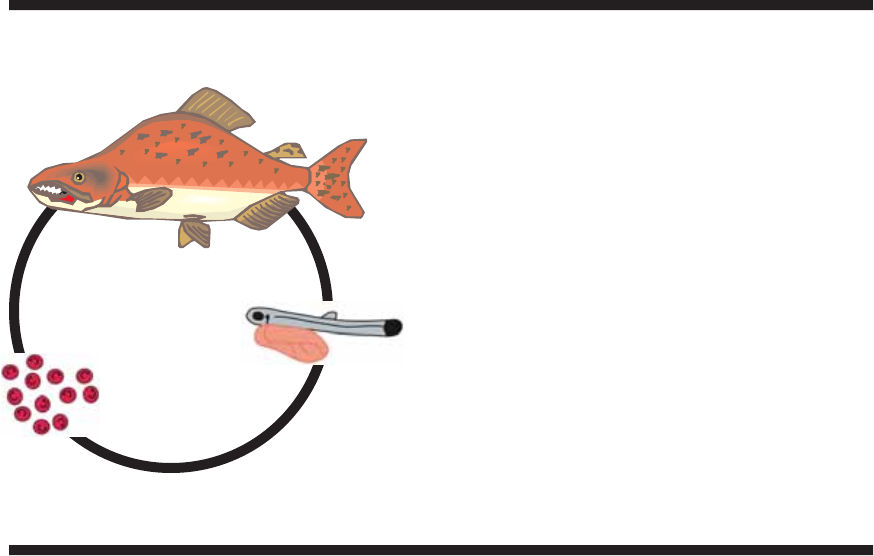
• Students will be able to list the salmon life cycle stages in order.
Materials
• Salmon life cycle video (see suggestions under “Resources,” page 2 of this
lesson plan)
• Salmon life cycle story (following this lesson plan)—photocopy one story
for each student
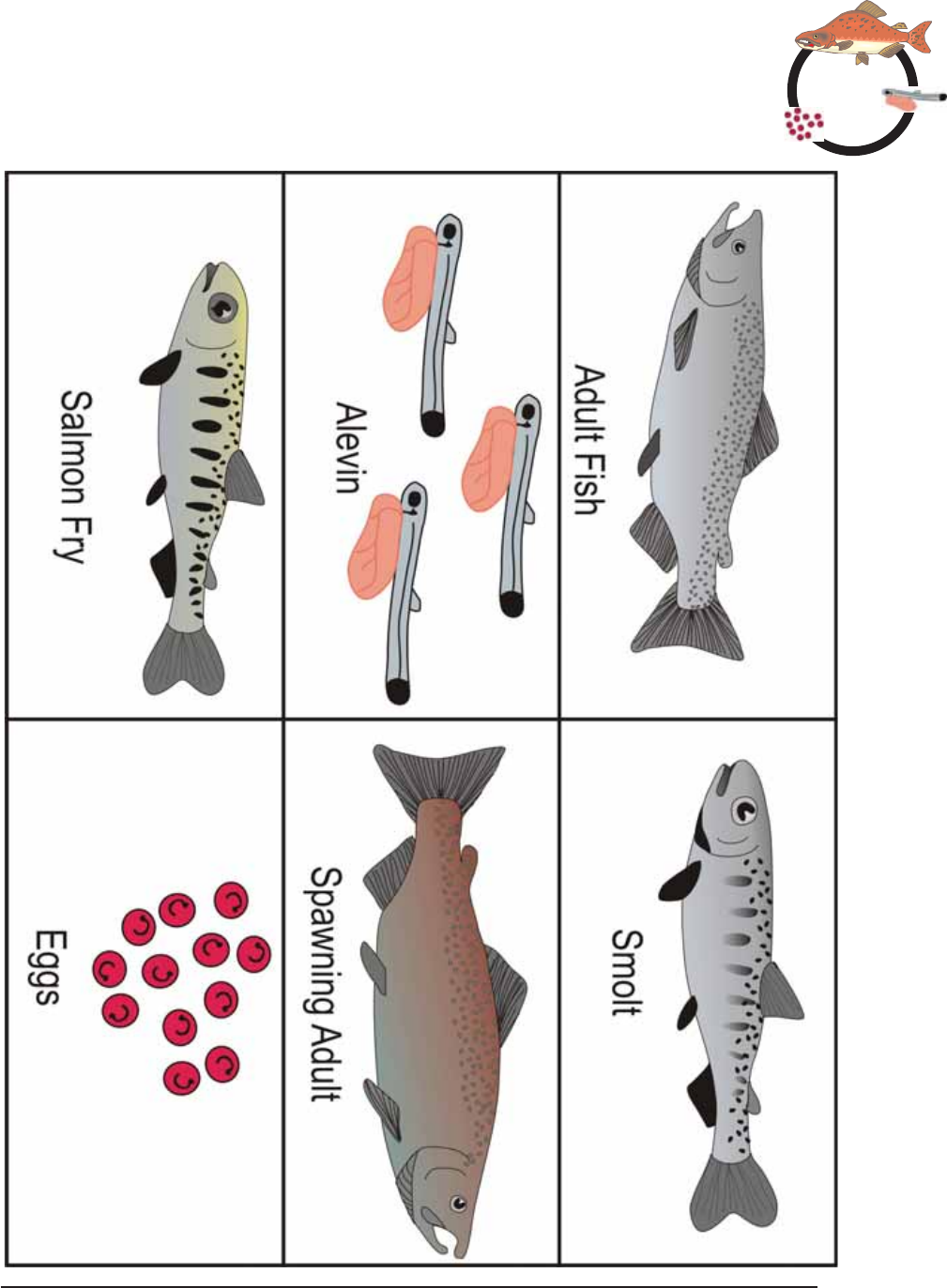
• Salmon life stage cards (following the salmon life cycle story)—
photocopy one sheet for each student
• Scissors
• Crayons/markers
• Stapler
Introduction (10 minutes)
The salmon life cycle is famous in the fi sh world, and justifi ably so. The odds
against a fi sh surviving from egg to spawning are huge. The epic journey
from the spawning grounds to the sea and the return to spawn in the same
spot years later is also a remarkable feat.
Activity (30 minutes)
• Watch a video about the salmon life cycle.
• Cut out the 8-page story and staple it together to make a booklet. Cut out
the six life stage cards. Ask the students to read the story and match the
picture with the appropriate page in the life cycle booklet.
• Allow students to illustrate their booklets with crayons or markers.
Closing activity/Assessment (10 minutes)
• Read the life cycle story together and ask students to tell which life stage
picture goes with each page.
The Salmon Life Cycle Lesson Plan—page 1
Note: Italicized words
are potential script for
the teacher.
Archival copy. For current information, see the OSU Extension Catalog: https://catalog.extension.oregonstate.edu/em8910

Resources
• Life Cycle of the Salmon (VHS video). Produced by Oregon Sea Grant
in cooperation with the U.S. Army Corps of Engineers ( Corvallis, OR:
Oregon Sea Grant Communications, Oregon State University, 1999).
• Journey of the Kings (VHS video). Northwest Power Planning Council.
Produced by Echo Film Productions, Inc. (Doug Copsey, producer, screen-
writer; Norman Nelson, director).
• To Restore a Legacy: The Struggle for the Snake Riverʼs Salmon and
Steelhead Trout (VHS video). Presented by the U.S. Department of the
Interior, Fish and Wildlife Service in cooperation with the National Fish
and Wildlife Foundation. Produced by Stefan Dobert Productions, Inc.
(Edouard Crateau, executive producer).
The Salmon Life Cycle Lesson Plan—page 2
Archival copy. For current information, see the OSU Extension Catalog: https://catalog.extension.oregonstate.edu/em8910

The Salmon Life Cycle Salmon Life Cycle Story
The Life of
__________________________
(Your fi rst name)
the Salmon
During spawning, my parents were care-
ful to make sure I had plenty of cool water
fl owing over me. Then they gently covered
me with gravel to keep me from washing
away.
After hatching, I had to work my way up
through the gravel nest by following the
light of the moon. I emerged from the nest
at night to avoid predators. Once I was out, I
swam for shelter right away. I donʼt need to
worry about food for awhile because I can
survive on my yolk sack for several weeks.
Oh no, my yolk sack has run out! Iʼd better
fi nd some food quickly or Iʼll starve. Itʼs a
good thing I have this camoufl age pattern
on my skin so that predators wonʼt see me
while I look for food. Iʼm able to eat insects
that feed on bits of fl esh left behind by the
rotting adult salmon. Disgusting!
12
34
Archival copy. For current information, see the OSU Extension Catalog: https://catalog.extension.oregonstate.edu/em8910
Archival copy. For current information, see the OSU Extension Catalog: https://catalog.extension.oregonstate.edu/em8910

The Salmon Life Cycle Salmon Life Cycle Story
Iʼve become larger and less vulnerable to
predators. I can eat bigger insects and small
fi sh. My skin has started to become brighter
and more suited for ocean life, so I start to
make my journey downstream.
Once I reach the ocean, I fi nd a lot of food.
I follow other salmon to feeding grounds
way out in the Pacifi c Ocean. I spend the
next several years hogging out on all dif-
ferent kinds of food. Iʼll eat just about
anything I can fi t in my mouth.
After Iʼve grown very large, I use my nose
to fi nd my way back to the stream where I
was born. My body begins to change shape,
and my snout becomes long and hooked.
Eventually, I make it back to the same part
of the stream where I hatched, and I spawn.
The journey was very diffi cult, and I have
worn myself out dodging fi shing nets,
jumping waterfalls, and sliding over rocks.
I have become so tired out that I die. How-
ever, my body is not wasted. It becomes
food for future generations of salmon and
other river
creatures.
65
78
Archival copy. For current information, see the OSU Extension Catalog: https://catalog.extension.oregonstate.edu/em8910
Archival copy. For current information, see the OSU Extension Catalog: https://catalog.extension.oregonstate.edu/em8910
The Salmon Life Cycle Salmon Life Stage Cards
SALMON LIFE STAGE CARDS
Artwork by Caryn Ackerman
Archival copy. For current information, see the OSU Extension Catalog: https://catalog.extension.oregonstate.edu/em8910
Archival copy. For current information, see the OSU Extension Catalog: https://catalog.extension.oregonstate.edu/em8910
Funky Fish
Morphology
Lesson Plan
Habitat Cards
Archival copy. For current information, see the OSU Extension Catalog: https://catalog.extension.oregonstate.edu/em8910
Archival copy. For current information, see the OSU Extension Catalog: https://catalog.extension.oregonstate.edu/em8910
LESSON PLAN
FUNKY FISH MORPHOLOGY
Objectives
• Students will be able to explain the connection between animal
morphology and habitat.
Materials
• Colored clay
• Fish habitat cards (following this lesson plan)
• Examples of fi sh morphology (preserved fi sh, photos, illustrations, etc.)
and other animals
Introduction (10 minutes)
• While showing examples of salmon morphology, briefl y explain why
certain morphologies are advantageous given the fi shʼs native habitat and
predator-prey relationships. Leading question: What effect might habitat,
potential predators, and prey types have on fi sh morphology?
Examples: A sea horseʼs unique shape allows it to live in seagrass or
on reefs. A fl ounder hides from prey by burying itself in the sand. A
puffer fi sh avoids predators by becoming too big to eat.
• Make sure each student understands the relationship between form and
function in the animal world.
Activity (30 minutes)
• Explain that the goal of this activity is to design the best adapted fi sh
possible.
• Give each student or group a large glob of clay.
• Give one habitat card to each student or group.
• Instruct students to use the clay to shape their fi sh, giving special attention
to mouth morphology. Mouth morphology should be clearly represented in
detail.
• Show more examples of animal morphologies. This time include
nonaquatic animals as well. Help the class compare and contrast several of
their fi sh designs with other creatures that inhabit similar habitats.
Closing activity/Assessment (10 minutes)
• Ask students or groups to show their models in front of the class, indicat-
ing how certain features will benefi t and/or inhibit the fi shʼs survival in its
habitat.
Funky Fish Morphology Lesson Plan—page 1
Note: Italicized words
are potential script for
the teacher.
Archival copy. For current information, see the OSU Extension Catalog: https://catalog.extension.oregonstate.edu/em8910
Archival copy. For current information, see the OSU Extension Catalog: https://catalog.extension.oregonstate.edu/em8910
Funky Fish Morphology Habitat Cards
Your fi sh lives in cold, fresh water.
It is a carnivore, but relies on
camoufl age rather than speed to
catch its prey.
Your fi sh lives in cold, fresh water.
It is a carnivore, but relies on
camoufl age rather than speed to
catch its prey.
Your fi sh must travel long distances
from its spawning grounds to its
feeding grounds. It prefers to eat
meat, but will also eat plants when
they are available. Your fi sh is a very
fast swimmer and lives in salt water.
Your fi sh must travel long distances
from its spawning grounds to its
feeding grounds. It prefers to eat
meat, but will also eat plants when
they are available. Your fi sh is a very
fast swimmer and lives in salt water.
Your fi sh is very large, but eats very
tiny animals called krill. Krill are
found in large groups in the ocean,
numbering in the millions.
Your fi sh is very large, but eats very
tiny animals called krill. Krill are
found in large groups in the ocean,
numbering in the millions.
Your fi sh lives in freshwater lakes. It
has no natural predators and spends
most of its time munching on plants
found at the bottom of lakes.
Your fi sh lives in freshwater lakes. It
has no natural predators and spends
most of its time munching on plants
found at the bottom of lakes.
Your fi sh is an aggressive carnivore
that lives in fresh water. It eats other
fi sh, amphibians, mammals, and even
its own kind.
Your fi sh is an aggressive carnivore
that lives in fresh water. It eats other
fi sh, amphibians, mammals, and even
its own kind.
HABITAT CARDS
Archival copy. For current information, see the OSU Extension Catalog: https://catalog.extension.oregonstate.edu/em8910
Archival copy. For current information, see the OSU Extension Catalog: https://catalog.extension.oregonstate.edu/em8910
Salmon Stream Design
Lesson Plan
Sample Completed
Stream Design
Archival copy. For current information, see the OSU Extension Catalog: https://catalog.extension.oregonstate.edu/em8910
Archival copy. For current information, see the OSU Extension Catalog: https://catalog.extension.oregonstate.edu/em8910
LESSON PLAN
SALMON STREAM DESIGN
Objectives
• Students will be able to draw a stream with the vegetation, animals, and
water quality parameters that are necessary for salmon survival.
Materials • Rite in the Rain paper—Prior to class, make photocopies of two curved
lines on Rite in the Rain paper (to represent a river). Make one copy for
each pair of students.
Introduction (10 minutes)
This lesson will help students learn about freshwater salmon habitat while
tying the previous lessons together. It should be done in preparation for the
salmon release fi eld trip. The activity is intended to be a transition from in-
class activities to the salmon release fi eld trip.
Activity (30 minutes)
• Group students in pairs.
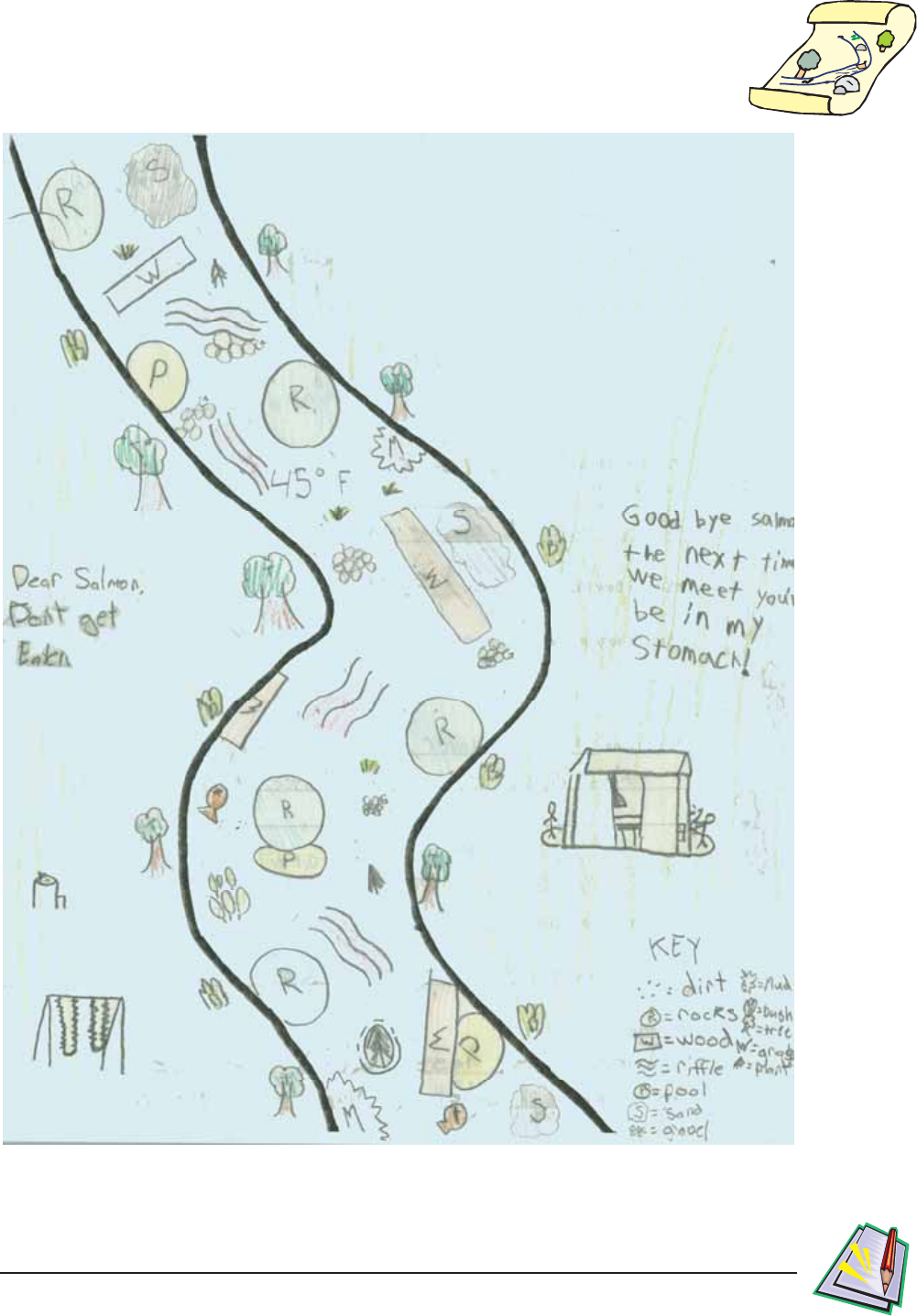
• Briefl y discuss the parameters that are necessary for salmon survival. After
each topic, allow the pairs to add that parameter to their drawings. Make
sure students understand the role each parameter plays in supporting or
inhibiting salmon survival. An example of a fi nished stream design follows
this lesson plan.
Parameters to cover
• Water quality: Temperature, dissolved oxygen, turbidity/sedimentation
• Physical parameters: Shelter (debris, boulders, trees, etc.), stream fl ow,
substrate (gravel, mud, etc.)
• Other living things: Vegetation, insects, amphibians, predators (birds,
other fi sh)
Closing activity/Assessment (10 minutes)
• At the end of class, have each student write a one-sentence farewell to the
salmon fry. The students will bring their drawings on the fi eld trip so that
they can compare the habitat they drew with the habitat at the release site.
Salmon Stream Design Lesson Plan—page 1
Archival copy. For current information, see the OSU Extension Catalog: https://catalog.extension.oregonstate.edu/em8910
Archival copy. For current information, see the OSU Extension Catalog: https://catalog.extension.oregonstate.edu/em8910
Salmon Stream Design Sample Completed Stream Design
SAMPLE COMPLETED STREAM DESIGN
Archival copy. For current information, see the OSU Extension Catalog: https://catalog.extension.oregonstate.edu/em8910
Archival copy. For current information, see the OSU Extension Catalog: https://catalog.extension.oregonstate.edu/em8910
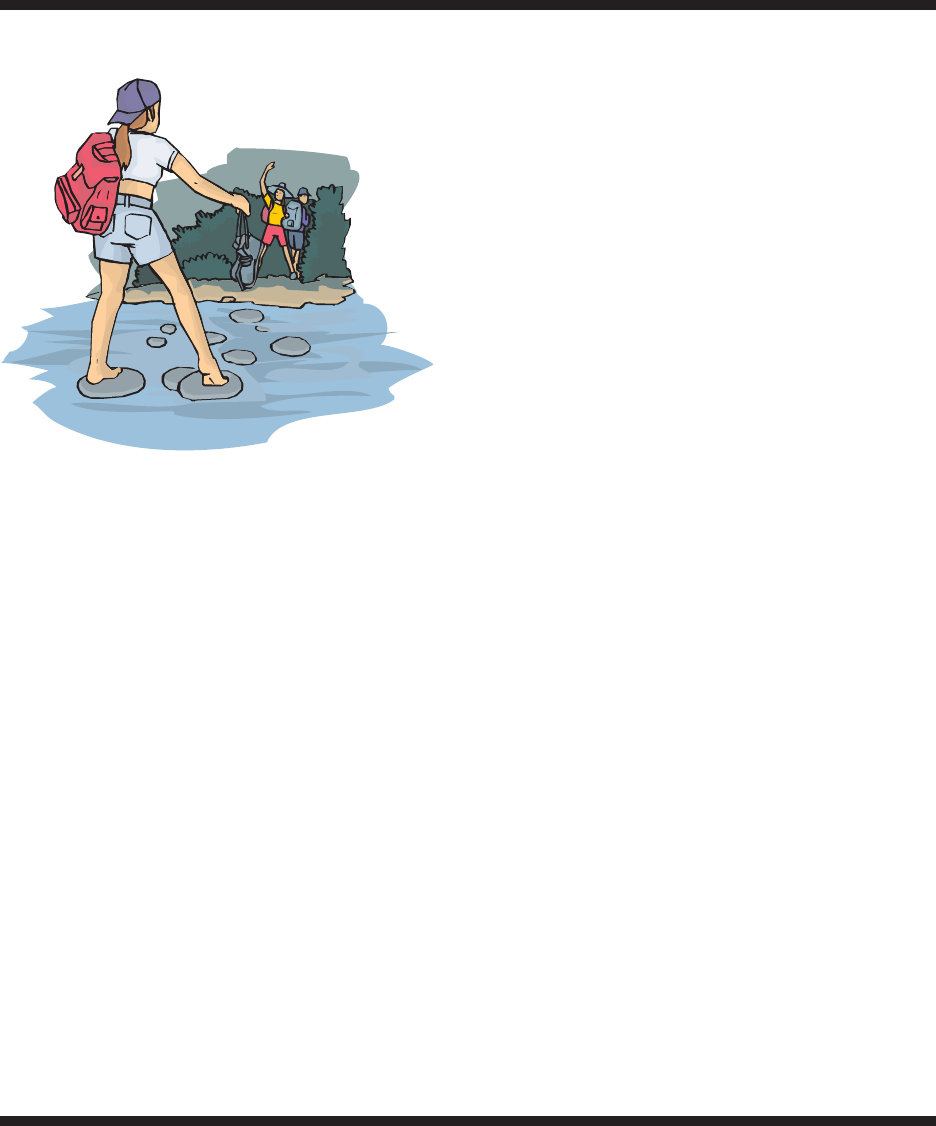
Salmon Release
Field Trip
Introduction
Student Worksheet—Salmon
Release Field Trip
Archival copy. For current information, see the OSU Extension Catalog: https://catalog.extension.oregonstate.edu/em8910
Archival copy. For current information, see the OSU Extension Catalog: https://catalog.extension.oregonstate.edu/em8910
Salmon Release Field Trip Lesson Plan—page 1
LESSON PLAN
SALMON RELEASE FIELD TRIP
Objectives
• Students will be able to measure qualitative and quantitative stream
parameters.
• Students will be able to identify salmon habitat characteristics in the fi eld.
Materials
• Thermometer
• Turbidity meter (if unavailable, have the students make a qualitative
measurement)
• Unfed salmon fry
• Paper or plastic cups
• Studentsʼ stream design maps from the Salmon Stream Design lesson
Worksheets
• Salmon Release Field Trip
Introduction (10 minutes)
Remind the students about the six salmon life cycle stages and answer any
questions before you begin the dayʼs activities.
Activity (40 minutes)
• Divide the students into three groups. The three groups correspond to the
fi rst three sections on the Salmon Release Field Trip worksheet. Designate
one adult to each of three stations:
• Station 1: Water quality
• Station 2: Physical stream characteristics
• Station 3: Stream organisms
• The three groups of students will rotate among the stations to receive
assistance with each section of the worksheet.
• When the worksheet is completed, place the unfed salmon fry in cups and
give every two or three students a cup.
• Locate a suitable, safe release area and instruct the students to release the
salmon after they read their farewells aloud. (The farewells should have
been written during the Salmon Stream Design lesson.)
Archival copy. For current information, see the OSU Extension Catalog: https://catalog.extension.oregonstate.edu/em8910

Closing activity/Assessment (5–15 minutes)
• Instruct the students to fi ll out the fi nal section of their worksheet,
“Conclusions.” Ask them to compare what they observed at the
release site with their drawings from the Stream Design lesson. Does
the habitat seem suitable for survival? Whatʼs present? Whatʼs missing?
Salmon Release Field Trip Lesson Plan—page 2
Archival copy. For current information, see the OSU Extension Catalog: https://catalog.extension.oregonstate.edu/em8910
STUDENT WORKSHEET
SALMON RELEASE FIELD TRIP
Data collection and observations
Water quality
Temperature ___________________________________________________________
Turbidity ______________________________________________________________
Physical stream characteristics
Types of shelter for salmon ________________________________________________
______________________________________________________________________
Stream fl ow (fast, slow, or both) ____________________________________________
Stream bottom type (gravel, boulders, or mud) ________________________________
Stream organisms
Vegetation _____________________________________________________________
______________________________________________________________________
______________________________________________________________________
______________________________________________________________________
Insects ________________________________________________________________
Possible salmon predators _________________________________________________
Amphibians or reptiles ___________________________________________________
Conclusions
______________________________________________________________________
______________________________________________________________________
______________________________________________________________________
Name: ______________________________________ Date:____________________
Salmon Release Field Trip Student Worksheet
Archival copy. For current information, see the OSU Extension Catalog: https://catalog.extension.oregonstate.edu/em8910
Archival copy. For current information, see the OSU Extension Catalog: https://catalog.extension.oregonstate.edu/em8910
