HP ProLiant ML150 G6 Server Maintenance And Service Guide Hewlett Packard Emr Na C01706108 8
User Manual: Hewlett-Packard Server ML150 G6
Open the PDF directly: View PDF  .
.
Page Count: 114 [warning: Documents this large are best viewed by clicking the View PDF Link!]
- HP ProLiant ML150 G6 Server Maintenance and Service Guide
- Notice
- Contents
- Customer self repair
- Illustrated parts catalog
- Removal and replacement procedures
- Diagnostic Tools and Setup Utilities
- Physical and Operating Specifications
- Documentation feedback
- Index

HP ProLiant ML150 G6 Server
Maintenance and Ser vice Guide
Part number 501530-005
Fourth edition June 2013
Legal notices
©Copyright 2009, 2013 Hewlett-Packard Development Company, L.P.
The information contained herein is subject to change without notice. The only warranties for HP products and services are
set forth in the express warranty statements accompanying such products and services. Nothing herein should be construed
as constituting an additional warranty. HP shall not be liable for technical or editorial errors or omissions contained herein.
Microsoft® and Windows® are U.S. registered trademarks of Microsoft Corporation.
Intel® and Xeon® are trademarks of Intel Corporation in the U.S. and other countries.

Contents 3
Contents
Customer self repair ............................................................................................................................... 5
Parts only warranty service ........................................................................................................................ 5
Illustrated parts catalog ......................................................................................................................... 16
Mechanical components ......................................................................................................................... 16
Electrical components ............................................................................................................................. 19
HP contact information ........................................................................................................................... 22
Before you contact HP ............................................................................................................................ 23
Removal and replacement procedures .................................................................................................... 24
Required tools ....................................................................................................................................... 24
Hardware configuration information ......................................................................................................... 24
Non-hot-plug devices ......................................................................................................................... 24
Electrostatic discharge information ...................................................................................................... 25
Symbols on equipment ....................................................................................................................... 25
Pre-installation instructio ns .................................................................................................................. 26
Post-installation instruct ions ................................................................................................................. 26
Powering down the server ....................................................................................................................... 26
System covers ........................................................................................................................................ 27
Access panel .................................................................................................................................... 27
Front bezel ....................................................................................................................................... 29
Cable manage ment ................................................................................................................................ 31
Cabling guidelines ............................................................................................................................ 31
Cable connections ............................................................................................................................ 32
Mass storage devices (drives) .................................................................................................................. 33
Optical and tape drive s ..................................................................................................................... 34
Hard drives ...................................................................................................................................... 36
HDD cage ........................................................................................................................................ 40
System board components (replace able ) ................................................................................................... 42
Processor ......................................................................................................................................... 42
Memory ........................................................................................................................................... 52
Expansion c ards ............................................................................................................................... 56
System battery .................................................................................................................................. 60
System fans ........................................................................................................................................... 62
Fan holder assembly re mo val and replacement ..................................................................................... 62
Rear fan assembly removal and replacement ........................................................................................ 63
System board removal and replaceme nt procedure .................................................................................... 66
Removing the system board ................................................................................................................ 66
Replacing the system board ................................................................................................................ 67
Power supply unit (PSU) .......................................................................................................................... 68
Removing a PSU ............................................................................................................................... 68
Installing a PSU or RPS ...................................................................................................................... 70
Diagnostic Tools a n d Setup Utilities ........................................................................................................ 72
BIOS Software ....................................................................................................................................... 72
BIOS Setup Utility .................................................................................................................................. 72
Accessing the BIOS Setup Utility ......................................................................................................... 73
Navigating through the Setup Utility .................................................................................................... 73
BIOS Updating ...................................................................................................................................... 90

Contents 4
Clearing CM OS .................................................................................................................................... 91
Power-On Self Test ................................................................................................................................. 91
POST Error Indicators ............................................................................................................................. 92
Recoverable POST Errors ................................................................................................................... 92
POST Related Troubleshooting ............................................................................................................ 94
NMI button ........................................................................................................................................... 94
Components, Switches, a nd Indicators ...................................................................................................... 95
Front and Rear Panel Comp onents, Swit c hes, and Indicators ....................................................................... 95
System Boar d Components , Switches, and Indicators .................................................................................. 97
System board switches and jumpers .................................................................................................... 99
SAS/SATA Hot-Plug Hard Dri ve LE Ds ..................................................................................................... 100
Physical and Operating Specifications .................................................................................................. 101
System Unit ......................................................................................................................................... 101
Memory .............................................................................................................................................. 106
Processor ............................................................................................................................................ 106
SATA DVD-ROM Dr ive .......................................................................................................................... 108
SAS Hard Drive ................................................................................................................................... 109
SATA Hard Drive ................................................................................................................................. 110
Documentation feedback ..................................................................................................................... 111
Index ................................................................................................................................................ 112

Customer self repair 5
Customer self repair
HP products are designed with many Customer Self Repair (CSR) parts to minimize repair time and
allow for greater flexibility in performin g defective parts replacement. If during the dia gn osis period
HP (or HP service providers or service partners) identifies that the repair can be accomplished by the
use of a CSR part, H P w ill sh ip t h at part directly to you for replacement. There are two ca tegories of
CSR parts:
• Mandatory—Pa r ts for which customer self repair is mandator y. If you request HP to replace
these parts, you will be char g ed for the travel a nd labor costs of thi s ser vice.
• Optional—Parts for which customer self repair is option al. These parts ar e also designed for
customer se l f repair. If, however, you require t h at HP replace them for you, there may or may not
be additional charges, depending on the type of warranty service designated for your product.
NOTE: Some HP pa r t s are not designed fo r customer self repair. In order to sa tisfy the customer
warranty, HP requires that an authorized service provider replace the p art. These parts a r e i dentified
as "No" in the Illustrated Parts Catalog.
Based on availability and where geography permits, CSR parts will be shipped for next business day
delivery. Same day or four-hour delivery may be offered at an additional charge where geography
permits. If assistance is required, you can call the HP Technical Support Center and a technician will
help you over the telephone. HP specifies in the materials shipped with a replacement CSR part
whether a defective pa r t must be returned to H P . In cases where it i s r equired to return the defective
part to HP, you must ship the defective part back to HP within a defined period of time, normally five
(5) business days. The defective part must be returned with the associated documentation in the
provided shipp in g m aterial. Failure to return the defective part may result in HP b illing you for the
replacement. With a customer self repair, HP will pay all shipping and part return costs and
determine t he courier/carr ier to be used.
For more information about HP's Customer Self Repair program, contact your local service provider.
For the North American program, refer to the HP website (http://www.hp.com/go/selfrepair).
Parts only warranty service
Your HP Limited Warranty may include a parts only warranty service. Under the terms of parts only
warranty service, HP will provide replacement parts free of charge.
For parts only warranty service, CSR part replacement is mandatory. If you request HP to replace
these parts, you will be char g ed for the travel a nd labor costs of thi s ser vice.

Customer self repair 6
Réparation par le client (CSR)
Les produit s HP comportent de n ombreuses pièces CSR (Customer Self Repair = répar ation par le
client) afin de minimiser les délais de répa r ation et faciliter le remplacemen t des pièces défectueuses.
Si pendant la période de diagnostic, HP (ou ses partenaires ou mainteneurs agréés) détermine que la
réparation peut être effect uée à l'aide d'une p ièce CSR, HP vous l'e n voie directement. Il existe deux
catégories de pièces CSR:
• Obligatoire - Pièces pour lesquell es la réparation par le client est obligatoire. Si vous
demandez à HP de remplacer ces pièces, les coûts de déplacement et main d'œuvre du service
vous seront facturés.
• Facultatif - Pièces pour lesquelles la réparation par le client est facultative. Ces pièces sont
également conçues pour perm et tre au client d'eff ectuer lui-même la réparation. Toutefois, si vous
demandez à HP de remplacer ces pièces, l'intervention peut ou non vous être facturée, sel o n l e
type de garantie applicable à votre produit.
REMARQUE: Certaines pièces HP ne sont pas conçues pour permettre au client d'effectuer lui-même
la réparation. Pour que la garantie puisse s'appliquer, HP exige que le remplacement de la pièce soit
effectué par un Mainteneur Agr éé. Ces pièces sont identifiées par la mention "Non" dans le
Catalogue illustr é.
Les pièces CS R sont livrées le jo ur o uv ré suivant, d ans la limite des stocks disponibles et selon votre
situation géographique. Si votre situation géographique le permet et que vous demandez une
livraison le jour mêm e ou dans les 4 heures, celle-ci vous sera facturée. Pour bénéficier d'une
assistanc e téléphonique, appelez le Centre d 'assistance technique HP. Dan s les documents envoy és
avec la pièce de rechange CSR, HP précise s'il est nécessaire de lui retourner la pièce défectueuse. Si
c'est le cas, vous devez le faire dans le délai ind i qué, généralement cinq (5) jours o uv r és. La pièce et
sa documentation doivent être retournées da n s l 'emballage fourni. Si vous ne retournez pas la pièce
défectueuse, HP se réserve le droit de vous fact urer les coûts de r emplacement. Dans le cas d'une
pièce CSR, HP supporte l'ensemble des frais d'expédition et de retour, et déterm ine la société de
courses ou le transporteur à utiliser.
Pour plus d'inform a t ions sur le programm e CS R de H P, contactez votre Mainteneur Agrée local. Pour
plus d'informations sur ce programme en Amérique du Nord, consultez le s it e Web HP
(http://www.hp.com/go/selfrepair).
Service de garantie "pièces seules"
Votre garant ie limitée HP peut inclure un servi ce d e g arantie "piè ces seules". Dans ce cas, les pièc es
de rechange fournies par HP ne sont pas facturé es.
Dans le cadre de ce service, la réparation des pièces CSR par le client est obligatoire. Si vous
demandez à HP de remplacer ces pièces, les coûts de déplacement et main d'œuvre du service vous
seront facturés.

Customer self repair 7
Riparazione da parte del cliente
Per abbreviare i tempi di riparazione e garantire una maggiore flessibilità nella sostituzione di parti
difettose, i prodott i H P sono realizzati con numerosi componenti che posson o essere riparati
direttamente dal cliente (CSR, Customer Self Repair). Se in fase di diagnostica HP (o un centro di
servizi o di assistenza H P ) identifica il guasto come riparabile mediante un ricambio CSR, HP lo
spedirà direttamente al cliente per la sostituzione. Vi sono due cate gor ie di parti CSR:
• Obbligatorie – Parti che devon o essere necessa r i amente riparate dal cliente. Se il cliente ne
affida la riparazione ad HP, deve sostenere le spese di spedizione e di manodopera per il
servizio.
• Opzionali – Parti la cui riparazione da parte del cliente è facoltativa. Si tratta comunque di
componenti progettati per questo scopo. Se tutt avia il cliente ne richiede la sostituzione ad HP,
potrebbe dover sostenere spese addizionali a seconda del tipo di garanzia previsto per il
prodotto.
NOTA: alcuni componenti HP non sono progettati per la riparazione da parte del cliente. Per
rispettare l a garanzia, HP rich iede che queste pa r t i siano sostituit e da un centro di assistenza
autorizzato. Tal i p arti sono identificate da un "No" nel Catalogo illustra t o dei componenti.
In base alla disponibilità e alla località geografica, le parti CSR vengono spedite con consegna entr o
il giorno lavorativo seguente. La consegna nel giorno stesso o entro quattr o ore è offerta con un
supplement o di costo solo i n alcune zone. In caso di necessità si può richiedere l'assistenza telefonica
di un addetto del centro di supporto tecnico HP. Nel materiale fornito con una parte di ricambio CSR,
HP specifica se il cliente deve r estituire dei componenti. Qualora si a richiesta la resa ad HP del
componente difettoso, lo si deve spedire ad HP entro un determinato periodo d i tempo, generalmente
cinque (5) giorni lavorativi. Il componente difettoso deve essere restituito con la documentazione
associata nell'imballo di spedizione fornito. La mancata restituzione del componente può comportare
la fatturazione del ricambio da parte di HP. Nel caso di riparazione da parte del cliente, HP sostiene
tutte le spes e di spedizione e resa e sceglie il corriere/vettore da utilizzare.
Per ulteriori inform azioni sul programma CS R d i H P contattare il centro di assist enza di zona. Per il
programma in Nord America fare riferimento al sito Web HP (http://www.hp.com/go/selfrepair).
Servizio di garanzia per i soli componenti
La garanzia limitata HP può includere un servizio di garanzia per i soli componenti. Nei termini di
garanzia del servizio per i soli component i, HP fornirà gratuitamente le parti di ricambio.
Per il servizio di garanzia per i soli componenti è obbligatoria la formula CS R che prevede la
riparazione da parte del cliente. Se il cliente invece richiede la sostituzione ad HP, dovrà sostenere le
spese di spedizion e e di manodopera per il servizio.

Customer self repair 8
Customer Self Repair
HP Produkte enthalten viele CSR-Teile (Customer Self Repair), um Reparaturzeiten zu minimieren und
höhere Flexibi l it ä t beim Austausch defekte r Ba uteile zu ermöglichen. Wenn HP ( oder ein HP
Servicepartner) bei der Diagnose feststellt, dass das Produkt mithilfe eines CSR-Teils repariert werd en
kann, sendet Ihnen HP dieses Ba uteil zum Austausch direkt zu. CSR-Teile werden in zwei Kategorien
unterteilt:
• Zwingend – Teile, für die das Customer Sel f Rep air-Verfahren zw i ngend vorgege ben ist.
Wenn Sie den Austausch dieser Teile von HP vornehmen lassen, werden Ihnen die Anfahrt- und
Arbeitskosten für diesen Service berechnet.
• Optional – Teile, für die das Customer Self Repair-Verfahren optional ist. Diese Teile sind auch
für Customer Self Repair au sgelegt. Wenn Sie j edoch den Austausch dieser Teile von HP
vornehmen lassen möchten, können bei diesem Service je nach den für Ihr Produkt vorgesehenen
Garantiebedingungen zusätzliche Kosten anfallen.
HINWEIS: Einige Teile sin d nicht für Customer Self Repair ausgelegt. Um den Garantieanspruch des
Kunden zu erfüllen, muss das Teil von einem HP Servicepartne r er setzt werden. Im i ll ustrierten
Teilekatal o g sind diese Teile mit „No“ bzw. „Nein“ gekennzeichnet.
CSR-Teile werden abhängig von der Verfügbarkeit und vom Lieferziel am folgenden Geschäftstag
geliefert. F ür bestimmte St andorte ist eine Lieferung am selben Tag oder innerha l b von vier Stunden
gegen einen Aufpreis verfü gbar. Wenn Sie Hilfe benötigen, können Sie das HP t ech nische Suppor t
Center anrufen und sich von einem Mitarbeiter per Telefon helfen lassen. D en Materialien, d i e mit
einem CSR-Ersa t zteil geliefert wer den, können Si e en tnehmen, ob das defekte Teil an HP
zurückgeschickt werden muss. Wenn es erfor derlich ist, das defekte Teil an H P zurückzuschicken,
müssen Sie dies innerhalb eines vorgegeben en Zeitraums tun, in der Reg el inn erhalb von fünf (5)
Geschäftst agen. Das defe kte Teil muss mit der zugehörigen D okumentation i n der Verpackung
zurückgeschickt werden, die im Lieferumfang enthalten ist . Wenn Sie das def ekte Teil nicht
zurückschicken, kann HP Ihnen das Ersatzteil in Rechnung stellen. Im Falle von Customer Self Repair
kommt HP für alle Kosten für die Lieferung und Rüc ksendung auf und bestimmt den Kuri er-
/Frachtdienst.
Weitere Inf o rmationen über das HP Customer S el f Repair Programm erhalten Sie von Ihrem
Servicepartner vor Ort. Informationen über das CSR-Programm in Nordamerika finden Sie auf der HP
Website unter (http://www.hp.com/go/selfrepair).
Parts-only Warranty Service (Garantieservice
aus schließlich für Teile)
Ihre HP Garantie umfasst möglicherweise einen Parts-only Warranty Service (Garantieservice
ausschließl ich für Teile). Gemäß den Bestimmungen des Parts-only Warranty Service stellt HP
Ersatzteile kos t enlos zur Verfügung.
Für den Parts-only Warranty Service ist das CSR-Verfahren zwingend vorgegeben. Wenn Sie den
Austausch dieser Teile von HP vornehmen lassen, werden Ihnen die Anfahrt- und Arbeitskost en für
diesen Service berechnet.

Customer self repair 9
Reparaciones del propio cliente
Los productos de HP incluyen muchos componentes que el propio usuario puede reemplazar
(Customer Self Repair, CSR) para minimizar el tiempo de reparación y ofrecer una mayor flexibilidad
a la hora de real i zar sustitucion es de componentes defectuosos. Si, durante la fase de diagnóstico,
HP (o los proveedores o socios de servicio de HP) identifica que una reparación puede llevarse a
cabo mediante el uso de un componente CSR, HP le enviará dicho componente directamente para
que realice su sustitución. Los componentes CSR se clasifican en do s categorías:
• Obligatorio: componentes para los que la reparación por parte del usuario es obligatoria. Si
solicita a HP que realice la sustitución de estos componentes, tendrá que hacerse car g o de los
gastos de desplazamiento y de mano de obra de dicho servicio.
• Opcional: componentes para los que la reparación por parte del usuario es opcional. Estos
componentes también están diseñados para que puedan ser reparados por el usuario. Sin
embargo, si prec isa q ue HP realice su sustitución, p uede o no conllevar costes adic ion ales,
dependiendo del tipo de servicio d e ga rantía correspondiente a l p roducto.
NOTA: Algunos componentes no están diseñados para que puedan ser reparados por el usuario.
Para que el usuario haga valer su garantía, HP pone como condición que un proveedor de servicios
autorizado real ice la sustitución de estos componentes. Dichos component es se identifican con la
palabra "No" en el catálogo ilustrado de componentes.
Según la disponibilidad y la situación geográfica, los componentes CSR se enviarán para que
lleguen a su destino al siguiente día laborable. Si la situación geográfica l o p ermite, se puede
solicitar la entrega en el m ismo día o en cuatro horas con un coste adicional. Si preci sa a sistencia
técnica, puede llamar al Centro de asistencia técnica de HP y recibirá ayuda telefónica por parte de
un técnico. Con el envío de materiales para l a sustitución de componentes CSR, HP especificará si los
componentes defectuosos deberán devolv er se a HP. En aquello s casos en los que sea necesario
devolver algún componente a HP, deberá hacerlo en el periodo de tiempo especifi cado,
normalmente cinco días laborables. Los componentes defectuosos deberán devolverse con toda la
documentación relacionada y con el embalaje de envío. Si no enviara el componente defectuoso
requerido, HP podrá cobrarle por el de sustitución. En el caso de todas sustituciones que lleve a cabo
el cliente, HP se hará cargo de t o dos los gastos de env ío y devolución de componentes y esc ogerá la
empresa de transporte que se utilice para dicho servicio.
Para obtener más información acerca del programa de Reparaciones del propio cliente de HP,
póngase en contacto con su proveedor de servicios local. Si está interesado en el programa para
Norteamérica, visite la página web de HP siguiente (http://www.hp.com/go/selfrepair).
Servicio de garantía exclusivo de componentes
La garantía limitada de HP puede que incluya un servicio de garantía exclusivo de componentes.
Según las condicion es d e este servicio exclusivo de componentes, HP le facilitará los comp o n entes de
repuesto sin cargo a d icional alguno.
Para este servici o d e ga r a n t ía exclusivo de componente s, es ob liga toria la sustitución de
componentes por parte del usuario (CSR). Si solicita a HP que realice la sustitución de estos
componentes, tendrá que hacerse cargo de los gastos de desplazamiento y de mano de obra de
dicho servicio.

Customer self repair 10
Customer Self Repair
Veel onderdelen in HP producten zijn door de klant zelf te repareren, waardoor de reparatieduur tot
een minimum beperkt kan blijven en de flexibiliteit in het vervangen van defecte onderdelen groter is.
Deze onderdelen worden CS R-onderdelen (Customer Self R epair) genoemd. Als HP (of een HP
Service Partner) bij de diagnose vaststelt dat de reparatie kan worden uitgevoerd met een CSR-
onderdeel, verzendt HP dat ond er deel rechtstreeks naar u, zodat u het defecte onder deel daarmee
kunt vervangen. Er zijn twee categorieën CSR-onderdelen:
• Verplicht: Onderdelen waarvoor reparatie door de klant verplicht is. Als u HP verzoekt deze
onderdelen voor u te vervangen, worden u voor deze service reiskosten en a r beidsloon in
rekening gebracht.
• Optioneel: Onderdelen waarvoor reparatie door de klant opt ioneel is. Ook deze on derdelen
zijn ontworpen v oor rep aratie door de klant. Als u echter HP verzoekt deze onderdelen voor u te
vervangen, kunnen daarvoor extra kosten in rekening worden gebracht, afhankelijk van het type
garantieservice voor het product.
OPMERKING: Sommige HP onderdelen zijn niet ontwikke ld voor reparatie door d e klan t . In
verband met de garanti evoorwaarden moet het onderdeel door een geautor i seerde Service Partner
worden vervangen. Deze onderdelen word en in de geïllustre er de onderdelenca t alogus aangemerkt
met "Nee".
Afhankelijk van de leverbaarheid en de locatie worden CSR-onderdelen verzonden voor leverin g op
de eerstvolgende werkdag. Levering op dezel fde dag of binnen vier uur kan tegen meerkosten
worden aangebod en, indien dit mogelijk is gez ien de locatie. Indien assistentie gewenst is, belt u een
HP Service Partner om via de telefoon technische ondersteuning te ontvangen. HP vermeldt in de
documentatie bij het vervangende CSR-onderd eel of het defecte on derdeel aan HP moet w orden
geretourneerd. Als het defecte onderdeel aan HP moet word en teruggezonden, moet u het defecte
onderdeel binnen een bepaalde p eriod e, gewoonlijk vijf (5) werkdagen, retourneren aan HP. Het
defecte onderdeel moet met de bijbehorende documentatie w o r den geretourneer d in het
meegelever de verpakkings materiaal. Als u h et defecte onderdeel n iet terugzendt, kan HP u voor het
vervangende onderdeel kosten in rekening brengen. Bij reparatie door de klant betaalt HP alle
verzendko st en voor het verv angende en geretourneerde onder deel en kiest HP zelf welke
koerier/trans p or t on d erneming hiervoor w ordt gebruikt.
Neem contact op met een Service Partner voor m eer informatie over het Customer Self Repair
programma van HP. Informatie over Service Partners vindt u op de HP website
(http://www.hp.com/go/selfrepair).
Garantieservice "Parts Only"
Het is mogelijk dat de HP garantie alleen de garantieservice "Parts Only" omvat. Volgens de
bepalingen van de Parts Only g arantieservice zal HP kosteloos vervangende onderdelen ter
beschikking stellen .
Voor de Parts Only ga rantieservice is verva n gin g d oor CSR-onderdelen verplicht. Als u HP verzoekt
deze onderdelen voor u te vervangen, worden u v oo r deze service reiskosten en arbei dsloon in
rekening gebracht.

Customer self repair 11
Reparo feito pelo cliente
Os produtos da HP são projetados com muitas peças para reparo feito pelo cliente (CSR) de modo a
minimizar o tempo de reparo e permitir maior flexibilidade na substituição de peças com defeito. Se,
durante o período de diagnóstico, a HP (ou fornecedores/parceiros de serviço da HP) concluir que o
reparo pode ser efetuado pelo uso de uma peça CSR, a peça de reposição será enviada diretamente
ao cliente. Existem duas categorias de peças CSR:
• Obrigatória – P eças cujo reparo feito pelo cliente é obrigatório. Se dese jar que a HP substitua
essas peças, serão cobrad as as despesas de tra nsporte e mão-de-obra do serviço.
• Opcional – Peças cujo re paro feito pelo cliente é opcional. Essas peças também são
projetadas para o reparo feito pelo cliente. No entanto, se desejar que a HP as substitua, pode
haver ou não a cobrança de taxa adicional, dependendo do tipo de serviço de garantia
destinado ao produto.
OBSERVAÇÃO: Algumas peças da HP não são projetadas para o reparo feito pelo cliente. A fim
de cumprir a garantia do cliente, a HP exige que um técnico autorizado substitua a peça. Essas
peças estão identificadas com a marca "No" (Não), no catálogo de peças ilustrado.
Conforme a disponibilidade e o local geográfico, as peças CSR serão enviadas no primeiro dia útil
após o pedido. Onde as condições geográficas permitirem, a entrega no mesmo dia ou em quatro
horas pode ser feita mediante uma taxa adicional. Se precisar de auxílio, entre em contato com o
Centro de suporte técnico d a HP para que um técnico o ajude por telefone. A HP espe cifica nos
materiais fornecidos com a peça CSR de reposição se a peça com defeito deve ser devolvida à HP.
Nos casos em que isso for necessá r i o, é preciso env iar a peça com defeito à HP dentro do p eríodo
determinado, normalmente cinco (5) dias úteis. A peça com defeito deve ser enviada com a
documentação correspondente no material de transporte fornecido. Caso não o faça, a HP poderá
cobrar a reposição. Para as peças de reparo feito pelo cliente, a HP paga todas as despesas de
transporte e de devolução da peça e determina a transportadora/serviço postal a ser utilizado.
Para obter mais informações sobre o programa de reparo feito pelo cliente da HP, entre em contato
com o fornecedor de serviços local. Para o programa norte-americano, visite o site da HP
(http://www.hp.com/go/selfrepair).
Serviço de garantia apenas para peças
A garantia limitada da HP pode incluir um serviço de garantia apenas para peças. Segundo os
termos do serviço de garantia apenas para peças, a HP fornece as peças de reposição sem cobrar
nenhuma taxa.
No caso desse serviço, a substituição de peças CSR é obrigatória. Se desejar que a HP substitua
essas peças, serão cobrad as as despesas de tra nsporte e mão-de-obra do serviço.
Customer self repair 12
Customer self repair 13
Customer self repair 14
Customer self repair 15
Illustrated parts catalog 16
Illustrated parts catalog
This chapter provides the illustrated parts breakdown and spare parts lists for the HP ProLiant ML150
G6 server. Inform ation for contacting HP is a l so p rovided.
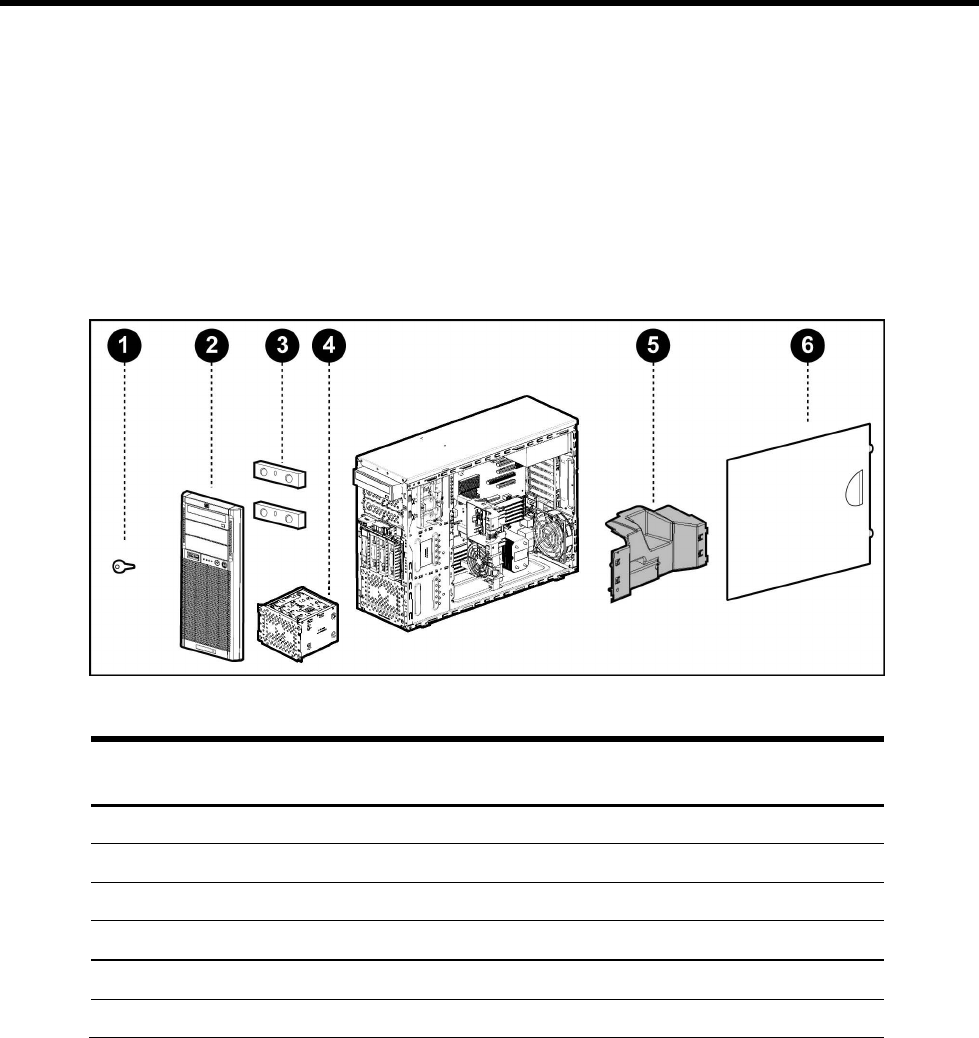
Mechanical components
Figure 2-1 Mechanical components
Table
2
-1 Mechanical components spare parts list
Item Description Spare
part number Customer
self repair
1 SPS-KEY, BEZEL 519732-001 Mandatory1
2 SPS-BEZEL 519731-001 Mandatory1
3 ODD BLANK 0.5 HEIGHT EMI 518394-001 Mandatory1
4 SPS-CAGE, NON- HOT PLUG 519734-001 Mandatory1
5 SPS-BAFFLE 519741-001 Mandatory1
6 SPS-PANEL, SIDE 519729-001 Mandatory1
1Mandatory—Parts for which customer self repai r is mandatory. If you request HP to r eplace these parts, you wi ll be charged
for the travel and labor costs of this service.
2Optional—Parts for which customer self repair is optional. These parts are also d esigned for customer self repair. If, however,
you require that HP replace them for you, there may or may not be additional charges, depending on the type of warra nty
service designated for your product.
3No—Some HP parts are not designed for customer self repair. In order to satisfy the customer warranty, HP requires that an
authorized service provid er replace the part. These parts are i dentified as "No" in the Illustrated Par t s Catalog.
1Mandatory: Obligatoire—Pièces pour lesquelles la réparation par le client est obligatoire. Si vous dem andez à HP de
remplacer ces pièces, les coûts de déplacement et main d'œuvre du service vous seront fact urés.
Illustrated parts catalog 17
2Optional: Facultatif—Pièces pour lesquelles la réparation pa r le client est facultative. Ces pièces sont également conçues pour
permettre au client d'effectuer lui-même la réparation. Toutefois, si vous demandez à HP de remplacer ces pièces, l'intervention
peut ou non vous être facturée, selon le type de garantie applicab le à votre prod uit .
3No: Non—Certaines pièces HP ne sont pas conçues pour permettre au client d'effectuer lui-même la réparation. Pour que la
garantie puisse s'appliquer, HP exige que le remplacement de la pièce soit effectué p ar un Mainteneur Agréé. Ces pièces sont
identifiées par la mention “Non” dans le Catalogue illustré.
1Mandatory: Obbligatorie—Parti che devono essere necessariamente rip arate dal cliente. Se il cliente ne affida la riparazione
ad HP, deve sostenere le spese di spedizione e di manodopera per il servizio.
2Optional: Opzionali—Parti la cui riparazione da parte del cliente è facoltativa. Si tratta comunque di componenti progettati
per questo scopo. Se tuttavia il cliente ne richiede la sostituzione ad HP, potrebbe dover sostener e sp ese addizionali a
seconda del tipo di garanzia previsto per il prodotto.
3No: Non CSR—Alcuni componenti HP non sono progettati per la riparazione da parte del cliente. Per rispettare la garanzia,
HP richiede che queste parti siano sostituite da un centro di assistenza autorizzato. Tali parti sono identificate da un “N o” nel
Catalogo illustrato dei componenti.
1Mandatory: Zwingend—Teile, die im Rahmen des Customer Self Repair Programms ersetzt werden müssen. Wenn Sie diese
Teile von HP ersetzen lassen, werd en Ihnen die Versand- und Arbeitskosten für diesen Service berechnet.
2Optional: Optional—Teile, für die das Customer Self Repa i r-Verfahren optional ist. Diese T ei le sind auch für Customer Self
Repair ausgelegt. Wenn Sie jedoch den Austausch dieser Tei le von HP vornehmen lassen möchten, können bei diesem Service
je nach den für Ihr Produkt vorgesehenen Garantieb e dingungen zusätzliche Kosten anfallen.
3No: Kein—Einige Teile sind nicht für Customer Self Repair ausgelegt. Um den Garanti e anspruch des Kunden zu erfüllen, muss
das Teil von einem HP Servicepartner ersetzt werden. Im illustrierten Teilekatalog sind diese Teile mit „No“ bzw. „Nein“
gekennzeichnet.
1Mandatory: Obligatorio—componentes para los que la reparación por parte del usuario es obligatoria. Si solicita a HP que
realice la sustitución de estos componentes, tendrá que hacerse cargo de los gastos de desplazamiento y de mano de obra de
dicho servicio.
2Optional: Opcional— componentes para los que la reparación por parte del usuario es opcional. Estos componentes
también están diseñados para que puedan ser reparados por el usuario. Sin embargo, si precisa que HP realice su
sustitución, puede o no conllevar costes adicionales, dependiendo del tipo de servicio de garantía correspondiente al
producto.
3No: No—Algunos componentes no están diseñados para que puedan ser reparados por el usuario. Para que el usuario
haga valer su garantía, HP pone como condición que un proveedor de servicios autorizad o realice la sustitución de estos
componentes. Dichos componentes se identifican con la palabra “No” en el catálogo ilustrado de componentes.
1Mandatory: Verplicht—Onderdelen waarvoor Customer Self Repair verplicht is. Als u HP verzoekt deze onderdelen te
vervangen, komen de reiskosten e n het arbeidsloon voor uw rekening.
2Optional: Optioneel—Onderdelen waarvoor reparatie door de klant optioneel is. Ook deze onderdelen zijn ontworpen voor
reparatie door de klant. Als u echter HP verzoekt deze onderdelen voor u te vervangen, kunnen daarvoor extra kosten in
rekening worden gebracht, afhankelijk van het type garantieservice voor het product.
3No: Nee—Sommige HP onderdelen zijn niet ontwikkeld voor reparatie door de klant. In verband met de
garantievoorwaarden moet het o nderdeel door een geautoriseerde Service Partner wor den vervangen. Deze onderdelen
worden in de geïllustreerde onderdelencatalogus aangemerkt met "Nee".
1Mandatory: Obrigatória—Peças cujo reparo feito pelo cliente é obr igatório. Se desejar que a HP substitua essas peças,
serão cobradas as despesas de transporte e mão-de-obra do serviço.
Illustrated parts catalog 18
2Optional: Opcional—Peças cujo reparo feito pelo cliente é opcional. Essas peças também são projetadas para o reparo feito
pelo cliente. No entanto, se desejar que a HP as substitua, pode haver ou não a cobrança de taxa adicional, dependendo do
tipo de serviço de garantia destinado ao produto.
3No: Nenhuma—Algumas peças da HP não são projetadas para o reparo feito pelo cliente. A fim de cumprir a garantia do
cliente, a HP exige que um técnico autorizado substitua a peça. Essas peças estão identificadas com a marca “No” (Não), no
catálogo de peças ilustrado.
Illustrated parts catalog 19
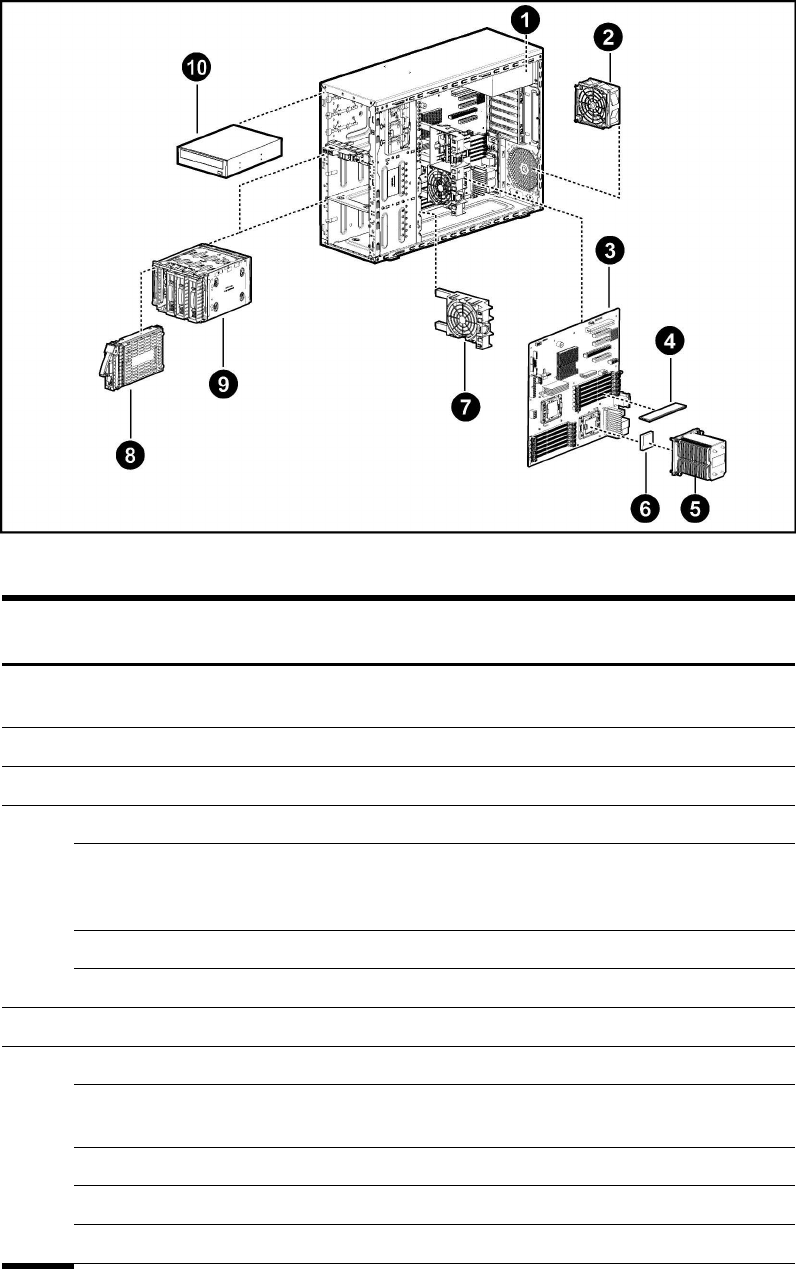
Electrical components
Figure 2-2 Electrical components
Table
2
-2 Electrical components spare parts list
Item Description Spare part
number Customer
self repair
1 SPS-POWER SUPPLY, 460 W
SPS-POWER SUPPLY, 750 W* 519742-001
511778-001 Mandatory1
2 SPS-FAN, REAR 519738-001 Mandatory1
3 SPS-BD, SYSTEM 519728-001 Optional2
4 SPS-DIMM, 2 GB PC3-10600R,128Mx8, RoHS 501533-001 Mandatory1
SPS-DIMM, 4 GB PC3-10600R, 256Mx4, RoHS*
SPS-DIMM, 4 GB PC3-8500R, 128Mx8, RoHS*
SPS-DIMM, 4 GB PC3-10600E, 256Mx8, RoHS*
501534-001
501535-001
501541-001
Mandatory1
SPS-DIMM, 1 GB PC3-10600E, 128Mx8, RoHS* 501539-001 Mandatory1
SPS-DIMM, 2 GB PC3-10600E, 128Mx8, RoHS* 501540-001 Mandatory1
5 SPS-HEATSINK 509505-001 Optional2
6 SPS-PROC, Nehalem EP 1.86 GHz, 4 M, 80 W DC 490075-001 Optional2
SPS-PROC, Nehalem EP 2.00 GHz, 4 M, 80 W
QC* 490074-001 Optional2
SPS-PROC, Nehalem, 2.13 GHz, 8 M,80 W QC* 506013-001 Optional2
SPS-PROC, Nehalem EP 2.26 GHz, 8 M, 80 W* 490073-001 Optional2
SPS-PROC, Nehalem EP 2.4 GHz, 8 M, 80 W* 490072-001 Optional2
Illustrated parts catalog 20
Table
2
-2 Electrical components spare parts list
Item Description Spare part
number Customer
self repair
SPS-PROC, Nehalem EP 2.53 GHz, 8 M, 80 W* 490071-001 Optional2
SPS-PROC, Nehalem EP 1.86 GHz, 4 M, 80 W
DC*
490075-001 Optional2
7 SPS-FAN, FRONT SYSTEM 519737-001 Mandatory1
SPS-FAN, PCI & HOLDER* 519740-001 Mandatory1
8 SPS-DRV, HD, 160 G, 7.2K, SATA 3.5, 3G NC Q
NHP
483096-001 Mandatory1
9 Hot-pluggable HDD cage assembly:
SPS-CAGE, HOT PLUG
SPS-BACKPLANE, HDD
519733-001
519736-001
Mandatory1
Mandatory1
10 SPS-DRV, ODD, SATA, 16X, DVDROM 447464-001 Mandatory1
11 System battery* 234556-001 Mandatory1
* Not shown
1Mandatory—Parts for which customer self repai r is mandatory. If you request HP to r eplace these parts, you will be charged
for the travel and labor costs of this service.
2Optional—Parts for which customer self repair is optional. These parts are also d esigned for customer self repair. If, however,
you require that HP replace them for you, there may or may not b e additional charges, depending on the type of warra nty
service designated for your product.
3No—Some HP parts are not designed for customer self repair. In order to satisfy the customer warranty, HP requires that an
authorized service provid er replace the part. These parts are i dentified as "No" in the Illustrated Par t s Catalog.
1Mandatory: Obligatoire—Pièces pour lesquelles la réparation par le client est obligatoire. Si vous dem andez à HP de
remplacer ces pièces, les coûts de déplacement et main d'œuvre du service vous seront facturés.
2Optional: Facultatif—Pièces pour lesquelles la réparation pa r le client est facultative. Ces pièces sont également conçues pour
permettre au client d'effectuer lui-même la réparation. Toutefois, si vous demandez à HP de remplacer ces pièces, l'intervention
peut ou non vous être facturée, selon le type de garantie applicab le à votre prod uit .
3No: Non—Certaines pièces HP ne sont pas conçues pour permettre au client d'effectuer lui-même la réparation. Pour que la
garantie puisse s'appliquer, HP exige que le remplacement de la pièce soit effectué par un Mainteneur Agréé. Ces pièces sont
identifiées par la mention “Non” dans le Catalogue illustré.
1Mandatory: Obbligatorie—Parti che devono essere necessariamente rip arate dal cliente. Se il cliente ne affida la riparazione
ad HP, deve sostenere le spese di spedizione e di manodopera per il servizio.
2Optional: Opzionali—Parti la cui riparazione da parte del cliente è facoltativa. Si tratta comunque di componenti progettati
per questo scopo. Se tuttavia il cliente ne richiede la sostituzione ad HP, potrebbe dover sostener e sp ese addizionali a
seconda del tipo di garanzia previsto per il prodotto.
3No: Non CSR—Alcuni componenti HP non sono progettati per la riparazione da parte del cliente. Per rispettare la garanzia,
HP richiede che queste parti siano sostituite da un centro di assistenza autorizzato. Tali parti sono identificate da un “N o” nel
Catalogo illustrato dei componenti.
1Mandatory: Zwingend—Teile, die im Rahmen des Customer Self Repair Programms ersetzt werden müssen. Wenn Sie diese
Teile von HP ersetzen lassen, werd en Ihnen die Versand- und Arbeitskosten für diesen Service berechnet.
Illustrated parts catalog 21
2Optional: Optional—Teile, für die das Customer Self Repa i r-Verfahren optional ist. Diese Teile sind auch für Customer Self
Repair ausgelegt. Wenn Sie jedoch den Austausch dieser Tei le von HP vornehmen lassen möchten, können bei diesem Service
je nach den für Ihr Produkt vorgesehenen Garantieb e dingungen zusätzliche Kosten anfallen.
3No: Kein—Einige T e ile sind nicht für Customer Self Repa ir ausgelegt. Um den Garantieanspr uch des Kunden zu erfüllen, muss
das Teil von einem HP Servicepartner ersetzt werden. Im illustrierten Teilekatalog sind diese Teile mit „No“ bzw. „Nein“
gekennzeichnet.
1Mandatory: Obligatorio—componentes para los que la reparación por parte del usuario es obligatoria. Si solicita a HP que
realice la sustitución de estos componentes, tendrá que hacerse cargo de los gastos de desplazamiento y de mano de obra de
dicho servicio.
2Optional: Opcional— componentes para los que la reparación por parte del usuario es opcional. Estos componentes
también están diseñados para que puedan ser reparados por el usuario. Sin embargo, si precisa que HP realice su
sustitución, puede o no conllevar costes adicionales, dependiendo del tipo de servicio de garantía correspondiente al
producto.
3No: No—Algunos componentes no están diseñados para que puedan ser reparados por el usuario. Para que el usuario
haga valer su garantía, HP pone como condición que un proveedor de servicios autorizado realice la s ustit ución de estos
componentes. Dichos componentes se identifican con la palabra “No” en el catálogo ilustrado de componentes.
1Mandatory: Verplicht—Onderdelen waarvoor Customer Self Repair verplicht is. Als u HP verzo ekt deze onderdelen te
vervangen, komen de reiskosten e n het arbeidsloon voor uw rekening.
2Optional: Optioneel—Onderdelen waarvoor reparatie door de klant optioneel is. Ook deze onderdelen zijn ontworpen voor
reparatie door de klant. Als u echter HP verzoekt deze onderdelen voor u te vervangen, kunnen daarvoor extra kosten in
rekening worden gebracht, afhankelijk van het type garantieservice voor het product.
3No: Nee—Sommige HP onderdelen zijn niet ontwikkeld voor reparatie door de klant. In verband met de
garantievoorwaarden moet het o nderdeel door een geautoriseerde Service Partner wor den vervangen. Deze onderdelen
worden in de geïllustreerde onderdelencatalogus aangemerkt met "Nee".
1Mandatory: Obrigatória—Peças cujo reparo feito pelo cliente é obrigatório. Se desejar que a HP substitua essas p eças,
serão cobradas as despesas de transporte e mão-de-obra do serviço.
2Optional: Opcional—Peças cujo reparo feito pelo cliente é opcional. Essas peças também são projetadas para o reparo feito
pelo cliente. No entanto, se desejar que a HP as substitua, pode haver ou não a cobrança de taxa adicional, dependendo do
tipo de serviço de garantia destinado ao produto.
3No: Nenhuma—Algumas peças da HP não são projetadas para o reparo feito pelo cliente. A fim de cumprir a garantia do
cliente, a HP exige que um técnico autorizado substitua a peça. Essas peças estão identificadas com a marca “No” (Não), no
catálogo de peças ilustrado.
Illustrated parts catalog 22
HP contact information
For the name of the nearest HP authorized reseller:
• In the United States, call 1-800-345-1518.
• In Canada, call 1-800-263-5868.
• In other locations, refer to the HP website at http://www.hp.com/.
For HP technical support:
• In North America:
○ Call 1-800-HP-INVENT (1-800-474-6836). This ser vice is available 24 hours a day, 7 days
a week. For continuous quality improv ement, calls may be recorded or monitored.
○ If you have purchased a Care Pack (service upgr ade), call 1-800-633-3600. For more
information about Care Packs, refer to the HP website at http://www.hp.com/.
• Outside North America, call the nearest HP Technical Support Phone Center. For telephone
numbers for worldwide Technical Support Centers, refer to the HP website at
http://www.hp.com/.
Illustrated parts catalog 23
Before you conta ct HP
Be sure to have the following information a vailable before you call HP:
• Technical support registration number (if applicable)
• Product serial number
• Product model name and number
• Applicable error messages
• Add-on boards or hardware
• Third-party hardware or software
• Operating system type and revision level
Removal and replacement procedures 24
Removal and replacement procedures
This chapter provides subassembly/module-level remova l and replacement p r ocedures for the HP
ProLiant ML150 G6 server.
Before installin g a new component, revi ew it s specificati ons to ensure compat ibility with t h e server.
When integrating a new component into the system, record all pertinent component information,
including model and serial number, for future reference. After completing any removal or replacement
procedure, run t h e d ia gn ostics program to verify that all components operate properly.
Required tools
You need the following tools to perform these pr ocedures:
• T-15 Torx screwdriver
• Flat-blade screwdriver
NOTE: The f igures used in this chapter to illustrate procedural steps are labeled numerically (i .e., 1,
2…). When th ese figures are used i n substep items, t he alphabetically labeled instr uctions
correspond to the numbered l abels on the related figure (i.e., Label 1 corresp on ds to step a, label 2
corresponds to step b, etc.).
Hardware co nfi g u ration information
WARNING: Only authorized technicians trained by HP should attempt to repair this equipment.
Because of the complexity of the individual boards and subassemblies, no one should attempt to
make repairs at the component level or to make modifications to any printed wiring board.
Improper repairs can create a safety hazard.
CAUTION: Electrostatic discharge (ESD) can damage electronic components. Be sure that you are
properly grounded (earthed) before beginning any installation procedure. Refer to the “Electrostatic
Discharge Inf ormation” section for more information.
Before removing any servic eable parts, determine whether th e part is a hot-plug or non-hot-plug type.
Non-hot-plug devices
Non-hot-pluggable devices require t hat the server be powered down before remova l o r installation.
Non-hot-plug devices in the server include the processor, all boards, memory modules, fans, PCI and
IPMI option cards, and non-hot-pluggable hard drives.
Removal and replacement procedures 25
Electrostatic discharge information
ESD can damage static-sensitive devices or micro circuitry. P roper packaging and grounding
techniques are necessary precautions to prevent damage. To prevent elect r ostatic dama g e, observe
the following precautions:
• Transport products in static-safe container s such as conductive tubes, bags, or boxes.
• Keep electrostatic-sensitive parts in their containers until they arrive at static-free stati ons.
• Cover worksta t ion s wit h a pproved static-dissipating material. Use a wrist strap connected to the
work surface and properly grounded (earthed) tools and equipment.
• Keep work area free of nonconductive materials, such as ordinary plastic assembly aids and
foam packing.
• Make sure that you are always properly grounded (earthed) when touching a static-sensitive
component or assembly.
• Avoid touching pins, leads, or circuitry.
• Always place drives with the Printed Circuit Board (PCB) assembly-side down.
• Use conductive field servi ce tools.
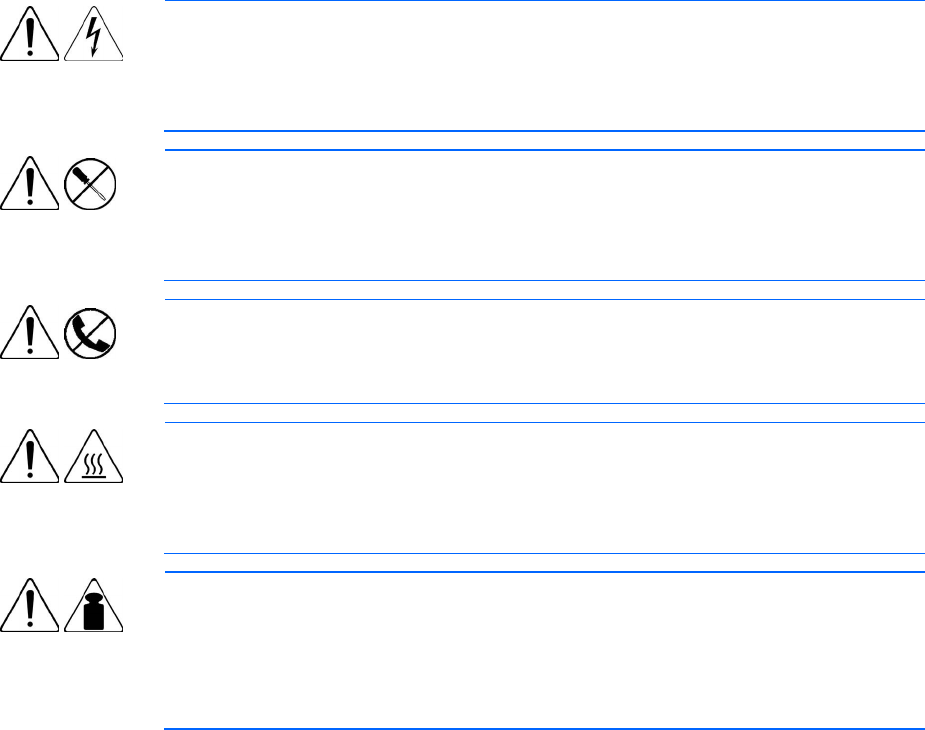
Symbols on equipment
The following symbols may be placed on equipment to indicate the presence of potentially hazardous
conditions.
This symbol indicates the pr esence of hazardous energy circuits or electric shoc k
hazards. Refer all servicing to qualified personnel.
WARNING: To reduce the risk of injury from electric shock hazards, do not open this
enclosure. Refer all maintenance, upgrades, and servicing to qualified personnel.
This symbol indicates the pr esence of electric shock hazards. The area contains no
user or field serviceable parts. Do not open for any reason.
WARNING: To reduce the ri sk of injury from el ectric shock hazards, do not open t h i s
enclosure.
This symbol on an RJ-45 receptacle indicates a network interface connection.
WARNING: To reduce the ri sk of electric shock, fire, or da mage to the equipment, do
not plug telephone or telecommunications connectors into this receptacle.
This symbol indicates the pres ence of a hot surfac e or hot component . If this surface is
contacted, the potential for injury exists.
WARNING: To reduce the risk of injury from a hot component, allow the surface to
cool before touch in g.
This symbol indicates that the component exceeds the recomm en ded weight for one
individual to handle safely.
WARNING: To reduce the risk of personal injury or damage to the equipment,
observe local occupational h ealth and safety requirements and guidelines for manual
material handling.

Removal and replacement procedures 26
These symbo ls, on power supp l i es or systems, indicate that th e equipment is supplied
by multiple sources of p ow er.
WARNING: To reduce the risk of injury from electric shock, remov e all power cords
to completely disconnect power from the system.
Pre-installation instructions
Perform the steps below bef o r e y ou open the serv er o r before you remove or replace an y com ponent:
1. Turn off the server and all t he p er ipherals conn ected to it.
2. Refer to the Powering down the server section in this chapter for detailed instructions on how to
completely po w er down the server.
3. Unplug all cab les from power outlets to avoid exp osure to high energy level s t h a t may cause
burns if parts are short-circuited by metal objects such as tools or jewelry. If necessary, label
each cable for reassembly.
4. Disconnect telecommunication cables to avoid exposure to shock hazard from ringing volt a ges.
5. Open the server according to the instructions described in the System covers section in this
chapter.
6. Follow the ESD precautions listed previously in this chapter when handling a server component.
WARNING: Failure to properly turn off the server before you open it or before you st art
installing/removing components may cause serious damage as well as bodily harm.
Post-installation instructions
Observe the following items after installing or removing a server component:
1. Make sure that y ou insta l l all components according to the described step-by-step instructions.
2. Make sure not to leave loose tool s or parts inside the server.
3. Reinstall any expansion board(s), peripheral(s), board cover(s), and system cable(s) that have
previously been removed.
4. Reinstall t h e system covers.
5. Connect all external cables and the AC power cord to the system.
6. Press the power button on the front panel to turn on the server.
CAUTION: Do not operate the server for more than 10 minutes with the access panel and drives
removed. Otherwise, improper cooling airflow may damage system components.
Powering down the server
To power do w n the server:
1. Shut down the server as di r ected by the operat i n g system documentation.
2. If necessar y, press and hol d the power button until the server shut s off.

Removal and replacement procedures 27
3. Disconnect the AC power cord(s) from the AC outlet(s) and then disconnect the cord(s) from the
server.
4. Be sure that the power LED indicator is turned off and that the fan noise has stopped.
5. Disconne ct all external peripheral devices from the serv er .
WARNING: To completely remove al l power from the system, disconnect all power cords from the
server.
WARNING: Hazardous v ol tages are pres en t inside the server . Always disconnect AC power from
the server and other associa t ed assemblies whil e w orking inside the unit. Serious injury may result if
this warning is not observed.
WARNING: To reduce the risk of injury from electric shock, discon n ect all power cords to
completely remov e p ow er from the system.
WARNING: To reduce the risk of personal in jur y f rom hot surfaces, allow the internal system
components to cool before touching them.
CAUTION: Protect the server from power fluctuations and temporary interruptions with a regulating
uninterruptible power supply (UPS). This device protects the hardware from damage caused by
power surges and voltage spikes, and keeps the sy st em in operation during a p ower failure.
CAUTION: The server must always be operated w i t h the system covers on. Proper coo ling is not
achieved wh en the system covers are removed.
System covers
The access panel and the front bezel are both detachable. Both system covers must be r emoved and
detached before removing or replacing non-hot-plug components. S ervers configured with h ot-plug
drives require only the front bezel to be remov ed to remove and r eplace hot-plug drives.
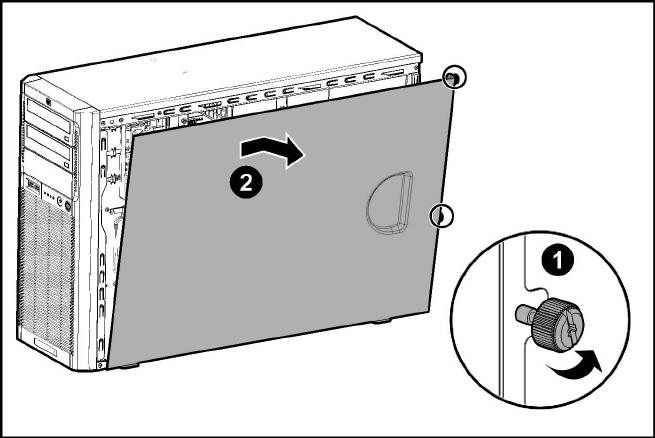
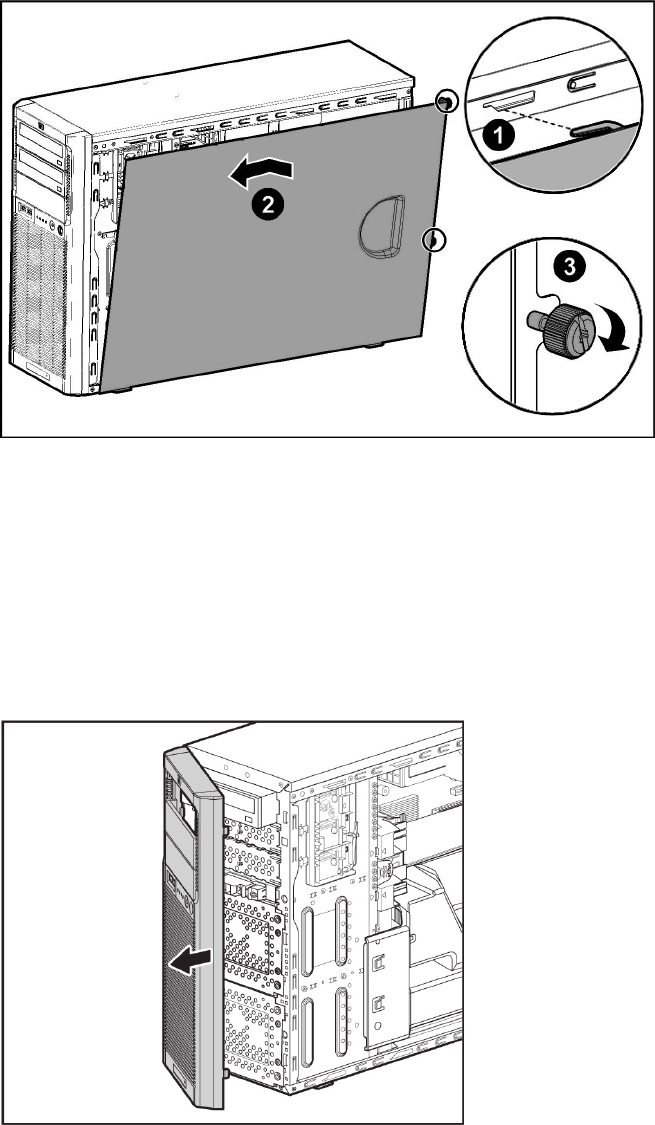
Access p ane l
To remove the access panel:
1. If necessar y, unlock the uni t using the supplied key .
2. Loosen the captive thumbscrews located on t h e r ear edge of the access panel.
3. Slide the panel back about 1.3 cm (0.5 in).
NOTE: The access panel does not need to be removed for removal and replacement of hot-plug
drives.
Removal and replacement procedures 28
Figure 3-1 Removing the access panel
Removal and replacement procedures 29
To reinstall the acc ess panel:
1. Use both ha n ds to place the access panel flat aga i n st the chassis, th e back of the access p anel
extending about 1.3 cm (0.5 in) behind the back of the server. Mak e sure the stand-off on the
access panel align with the holes on the edges of the chassis.
2. Slide the panel toward the front of the chassis to position it into place.
3. Tighten the captive thumbscrews to secure the panel.
Figure 3-2 Reinstalling the access panel
End of procedure.
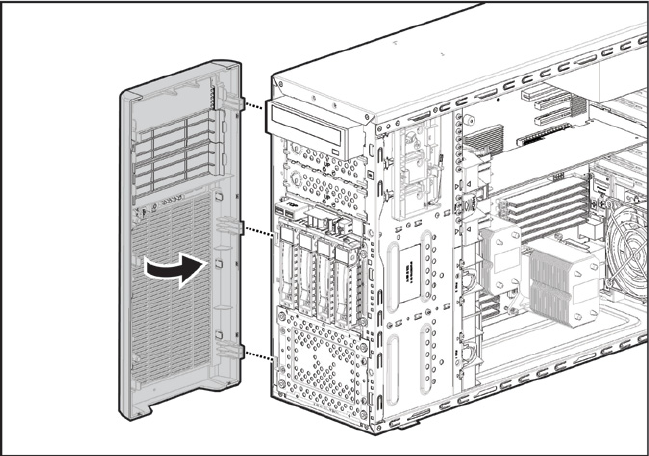
Front bezel
To open or remove t h e f r ont bezel:
1. If necessary, unlock the front bezel door using the supp lied key.
2. Open the bezel door to the right and lift up to remove it.
Figure 3-3 Opening the front bezel
Removal and replacement procedures 30
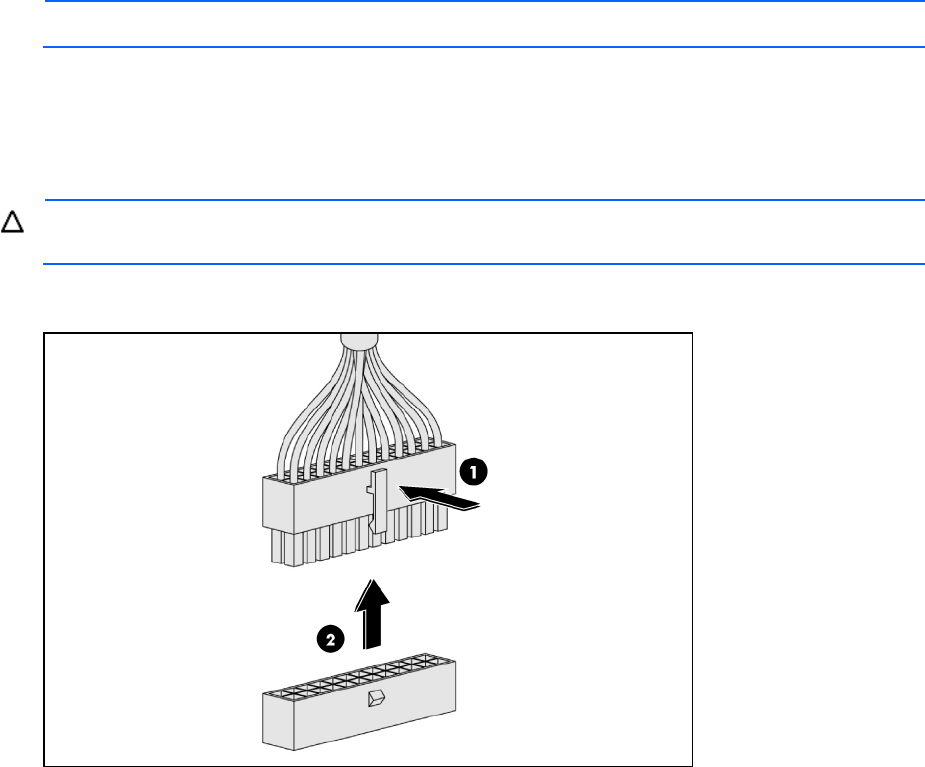
To re-attach and close the front bezel:
1. Insert the three hooks on the right side of the bezel into the rectangular holes on the chassis.
2. Rotate the bezel to the left so that the three tabs on the left side of the bezel snap into the slots on
the chassis.
Figure 3-4 Closing the front bezel
End of procedure.
Removal and replacement procedures 31
Cable management
Cabling guidelines
• Keep cables away from major heat sources lik e t h e heatsink assembly.
• Do not jam cables on top of expansion cards or memory modules. Printed circuit cards are not
designed to withstand exc essive pressure.
• Keep cables clear of sliding or moveable parts to prevent cutting or crimping.
• Do not sharply bend any cable. A sharp bend can break the internal wires.
• Never bend a SATA/SAS data cable tighter than a 30 mm (1.18 in) radius.
• Never crease a SATA/SAS data cable.
• Do not rely on components like the drive cage, power supply, or computer cov er to push cables
down into the chassis.
• Use supplied cable management straps to secure cables.
NOTE: Always follow good cable management practices when working inside the computer.
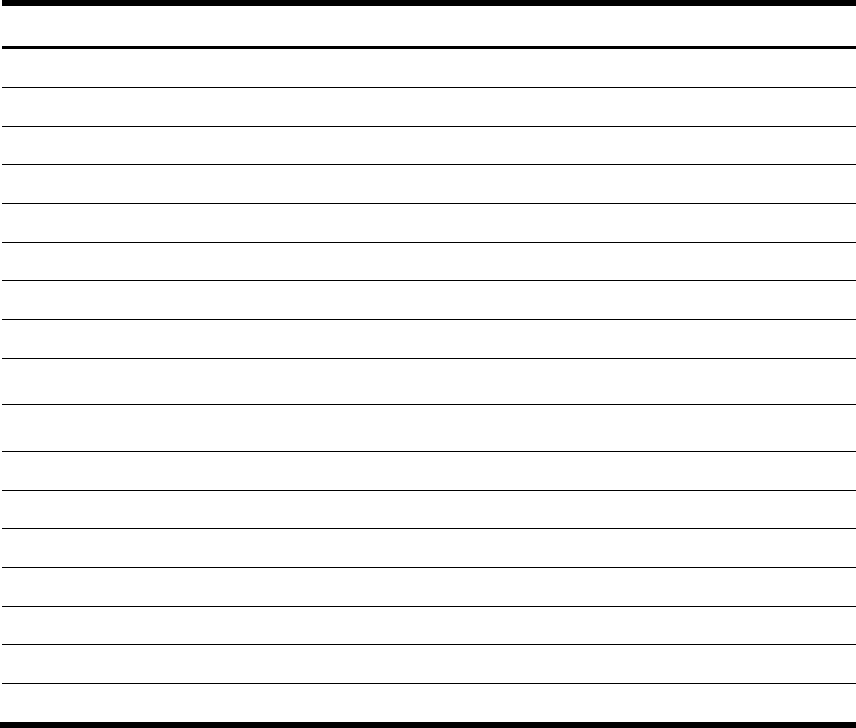
To remove power supply power cables and RPS from system board connectors respectively use the
following steps:
1. Squeeze on the top of the retaining latch attached to the cable end of the connector.
2. Grasp the cable end of the connector and pull it straight up.
CAUTION: When removing cables, always pull the connector - NEVER pull on the cable. Pulling the
cable could cause cable damage and result in power supply failure.
Figure 3-5 Unplugging power cables from the system board
Removal and replacement procedures 32
Cable connections
Table 3-1 provides cabling information for the server chassi s. For m ore detailed information about
system board components, see System board components in Chapter 5.
Table
3
-1 Cable connection
From To # of pins
Power supply, P1 System board, J39 24
Power supply, P2 System board, J14 4
Power supply, P3 System board, J37 8
Power supply, RPS System board, J25 16
Power supply , P8, 9, 14, 15 ATX drives and/or hot-plug HDD backplane 4
Power supply, P4-7, 10-13 SATA drives 15
System Fan 1 System board, J54 6
System Fan 2 System board, J44 6
System Fan 3 System board, J38 6
System Fan 4 System board, J4 6
Front USB 2.0 ports System board, J30 10
System board SATA1 SATA hard drive #1 [1], J40 7
System board SATA2 SATA hard drive #2 [1], J51 7
System board SATA3 SATA hard drive #3 [1], J52 7
System board SATA4 SATA hard drive #4 [1], J41 7
System board SATA5 SATA optical drive #1, J29 7
System board SATA6 SATA optical drive #2, J26 7
NOTE:
[1] For systems with hot-pluggable hard disk drives, hard drives #1-4 are terminated into one connector that attaches to th e
hot-plug SAS/SA TA module.
Removal and replacement procedures 33
Mass storag e devices (drives)
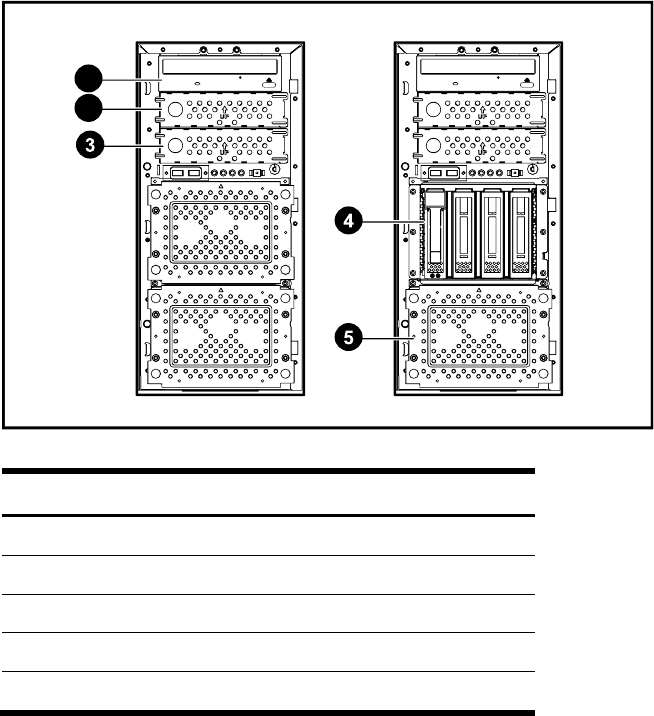
The server supports a maximum of 11 mass storage dev i ces. The top-most drive bay (bay 11) is
populated with an optical drive in the standard configuration. The next lower drive bay (bay 10) can
accommodate an additional optical drive, and bay 9 can accommodate a tape drive. The upper hard
drive area supports a non-hot-plug or hot-plug hard disk drive (HDD) cage providing bays 1 through
4.
Servers shipped with a hot-plug HDD cage in the upper drive bay area can support an additional hot-
plug HDD cage in the lower drive bay area providing bays 5 through 8. Servers shipped with a n on-
hot-plug HDD cage in the upper bay area can be upgraded to a hot-plug HDD system by replacing
the non-hot-plug HDD cage wit h an optional hot-plug HDD cage. The server supports SATA or SAS
drives.
Figure 3-6 Drive bay configuration
1
2
Item
Description
1 1st optical drive (bay 11)
2 2nd optical drive (bay 10)
3 Tape driv e or 3rd optical drive bay (bay 9)
4 Upper hard drive area, bays 1 (left) through 4 (right)
5 Lower hard drive area, bays 5 (left) throug h 8 (right)
Removal and replacement procedures 34
Optical and tape drives
Installing an optical or tape driv e
NOTE: The following procedure shows the installation of an optical drive in bay 10. The procedure
for installing a t ape drive in bay 9 is virtually the same.
To add an optical drive to the server:
1. Power down the server.
2. Disconnect the power cord(s).
3. Remove th e access panel and f r ont bezel as describ ed in the section t i t l ed “System covers.”
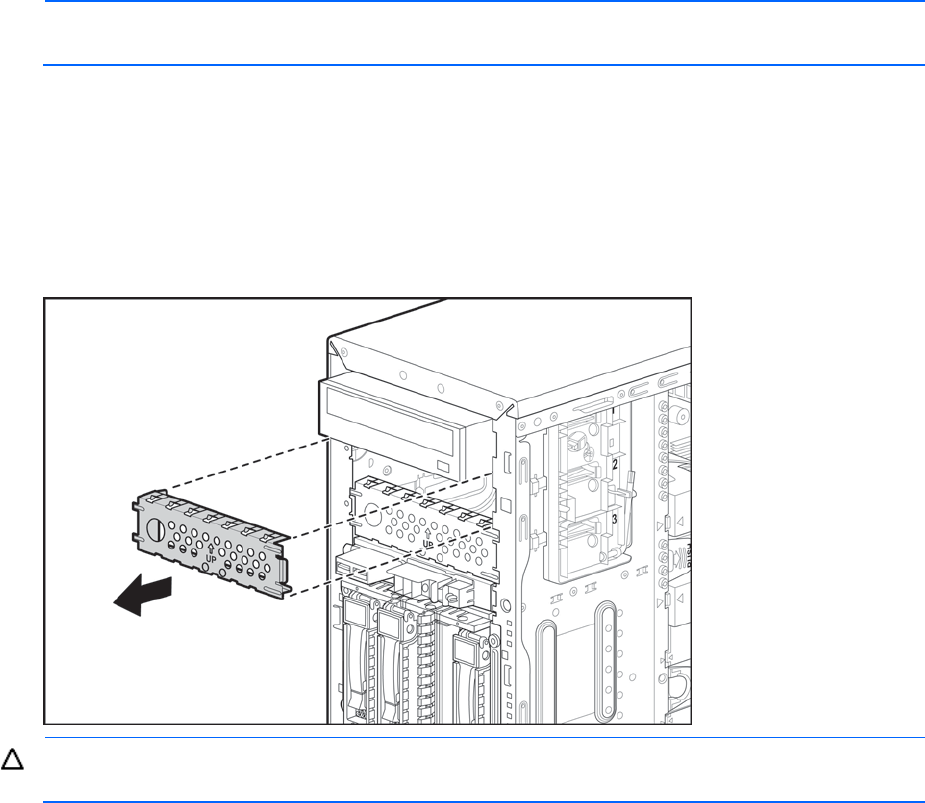
4. Remove the EMI shield from the drive bay by placing the thumb and forefinger into the large
holes of the shield and pulling the shield straight out of the chassis.
Figure 3-7 Removing the EMI shield
CAUTION: Do not discard the EMI shield. I f t he drive is removed in the future, the sh i eld must be re-
installed to ma in t a in proper EMI shielding.
5. Remove the new d rive from the protective packaging.
Removal and replacement procedures 35
6. Using the provided surplus screws, inst all four screw s.
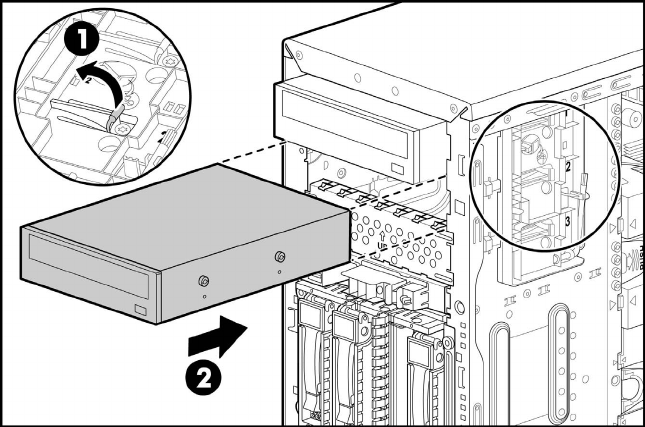
7. Release th e drive latch lever (Figure 3-8, 1).
8. Slide the new drive into the bay until it stops (Figure 3-8, 2).
Figure 3-8 Installing an optical drive
9. Connect the power and data cables to the connectors on the rear of the new drive.
10. Replace the front bezel and access panel.
11. Reconnect the power cord(s).
End of procedure.
To remove an optical or tape drive, reverse the procedure above.

Removal and replacement procedures 36
Hard drives
The server uses an HDD cage assembly that supports four hard drives in either a non-hot-plug or hot-
plug configuration . The server supports SATA or SAS hard drives. SATA hard drives are supported
directly by the system board. SAS hard drives require an SATA/SAS PCIe expansion card. For more
information ab out in stalling PCIe expansion cards, see “Expansion cards.”
Non-hot-plug hard drives
Servers shipped in a non-hot-plug drive configuration include a non-hot-plug HDD cage installed in the
upper bay area (bays 1 through 4).
Removing/r e placing a non-hot-plu g h ar d dr iv e
To remove and replace a non-hot-plug hard drive:
1. Power down the server.
2. Disconnect the power cord(s).
3. Remove the access panel and fr o n t bezel as described in the section t it l ed “System covers.”
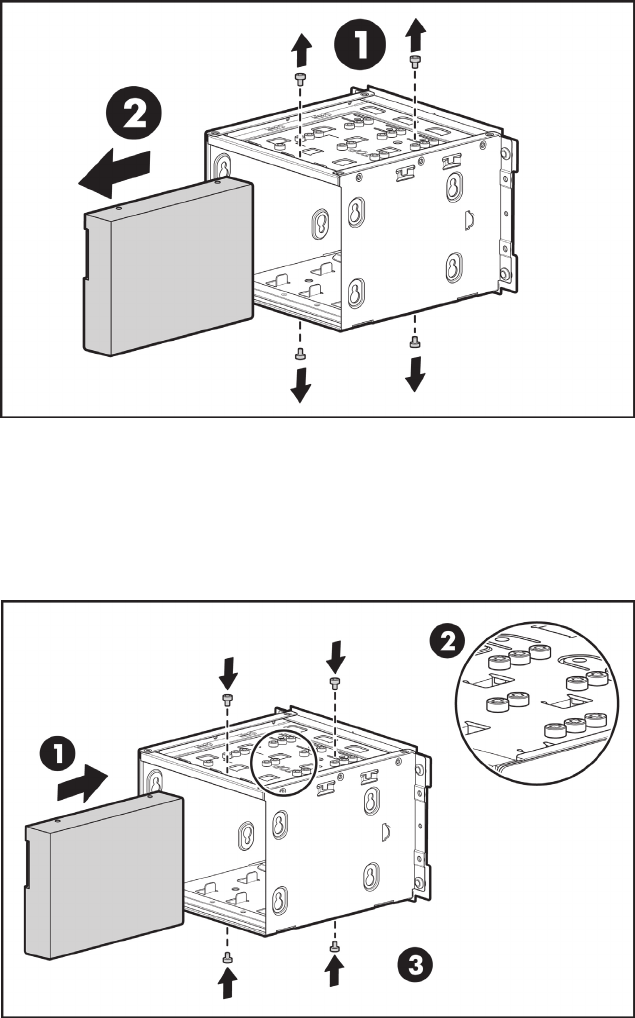
4. Disconnect the power and data cables from all hard drives (Figure 3-9, 1).
5. Remove the four mounting scre w s from the HDD cage (Figure 3-9, 2) and slide the HDD cage out
from the serv er chassis (Fig ure 3-9, 3).
Figure 3-9 Removing a non-hot-plug HDD cage
Removal and replacement procedures 37
6. To remove a hard drive from the HDD cage:
a. Remove the four retaining screws (two on the top, two on the bottom) holding the drive in
place (Figure 3-10, 1).
b. Slide the driv e out from the HDD cage (Figure 3-10, 2).
Figure 3-10 Removing a non-hot-plug hard drive
7. To replace a hard drive into the HDD cage:
a. Slide the hard drive into the HDD cage (Figure 3-11, 1).
b. Using the pr ovided surplus screws if necessar y (Fi gure 3-11, 2), install four retainin g screws
(Figure 3-11, 3).
Figure 3-11 Replacing a non-hot-plug hard drive
8. Re-install the non-hot-plug HDD cage into the server and re-install the six mounting screws.
9. Connect the power and data cables to all hard drives.
10. Replace the access panel and the front bezel.
11. Reconnect the power cord(s).
End of procedure.
To replace the non-hot-plug drive, reverse the steps 1 through 6.
Removal and replacement procedures 38
Hot-plug hard drive s
Servers shipped in a hot-plug drive configura t ion include a hot-plug HDD cage installed in the upper
bay area (bays 1 through 4). The hot-plug HDD cage includes a backplane that four hard drive
carriers plug into.
Removing/r e placing a hot-plug har d drive
NOTE: The server does not need to be powered d ow n for this procedure.
To remove and replace a hot-plug hard drive:
1. Remove the front bezel as described in the sect io n t i tled “System covers.”
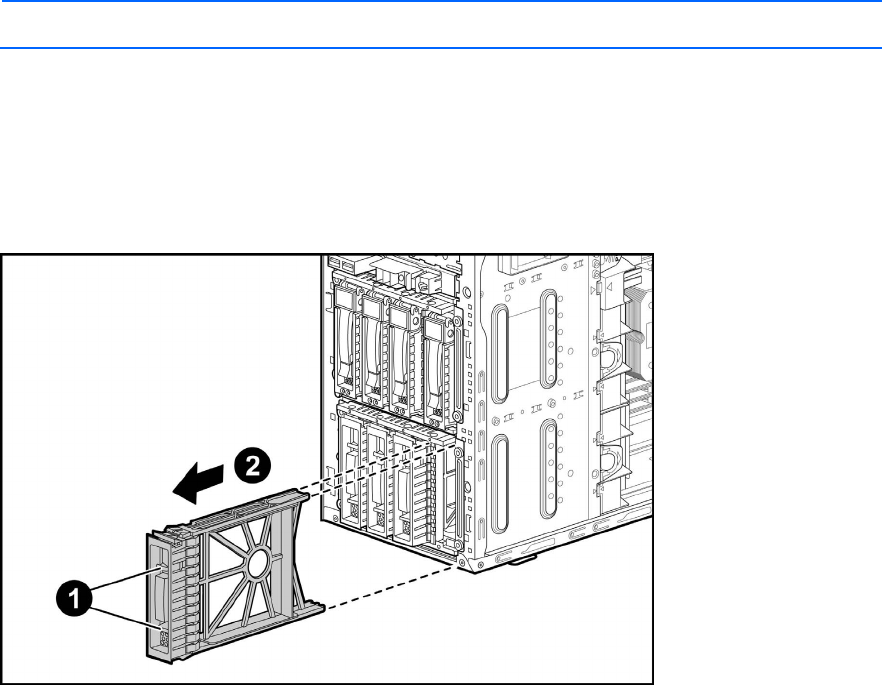
2. If adding a hot-plug drive, first remove the hot-plug drive blanking panel:
a. Press the release latches toward each oth er (Fig ure 3-12, 1).
b. Pull the blanking panel out of the bay (Figure 3-12, 2).
Figure 3-12 Removing a hot-plug drive blanking panel
Removal and replacement procedures 39
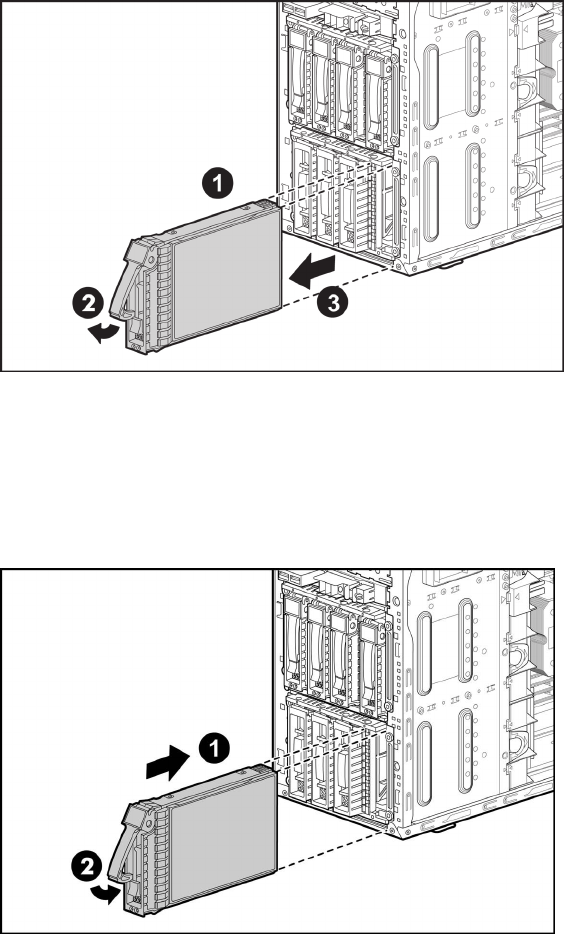
3. If replacing a hot-plug drive, remove the hot-plug drive to be replaced:
a. Push in the thumb release of t h e desired hard dri ve carrier (Figure 3-13, 1).
b. Pull the cam latch upward (Figure 3-13, 2).
c. Gently pull the hard drive carrier straight out from the drive bay (Figure 3-13, 3).
Figure 3-13 Removing a hot-plug hard drive
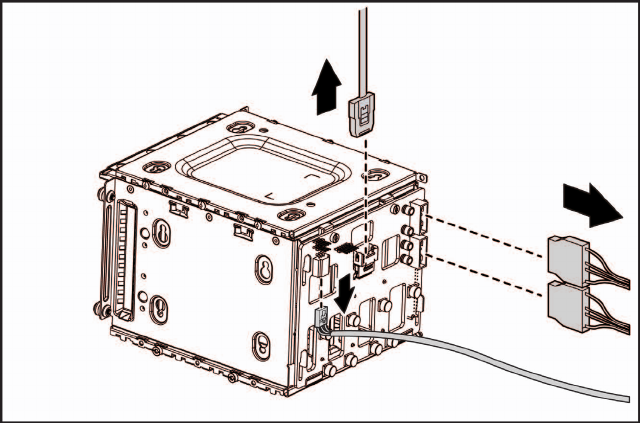
4. Slide the hot-plug HDD drive into the drive bay until resistance is felt (Figure 3-14, 1).
5. Verify that the hooks behind the pivot end of the cam latch will engage the hole on the edge of
the hard drive cage.
6. Rotate the cam latch down to fully seat the drive carrier into the backplane and press in until it
clicks into place (Figure 3-14, 2).
Figure 3-14 Installing a hot-plug hard drive
7. Replace an d close the front bezel.
End of procedure.
Removal and replacement procedures 40
HDD cage
The server can accommodate two types of cages: a non-hot-plug HDD cage (without a backplane)
and a hot-plug HDD cage (with a backplane). In the standard configuration the server will have one
of these types of HDD cages installed in the upper hard drive area.
Removing and replacing a non-hot-plug HDD cage
The removal and replacement of the non-hot-plug HDD cage is described in the Hard Drive subsection
titled “Removing/replacing a non-hot-plug hard drive.”
Removing and replacing a hot-plug HDD cage and bac kplane
To remove and replace the hot-plug HDD cage:
1. Power down the server.
2. Disconnect the power cord(s).
3. Remove the access panel and fr o n t bezel as described in the section t it l ed “System covers.”
4. Remove all hard drives from the HDD cage as described in the section titled
“Removing/replacing a hot-plug hard drive.”
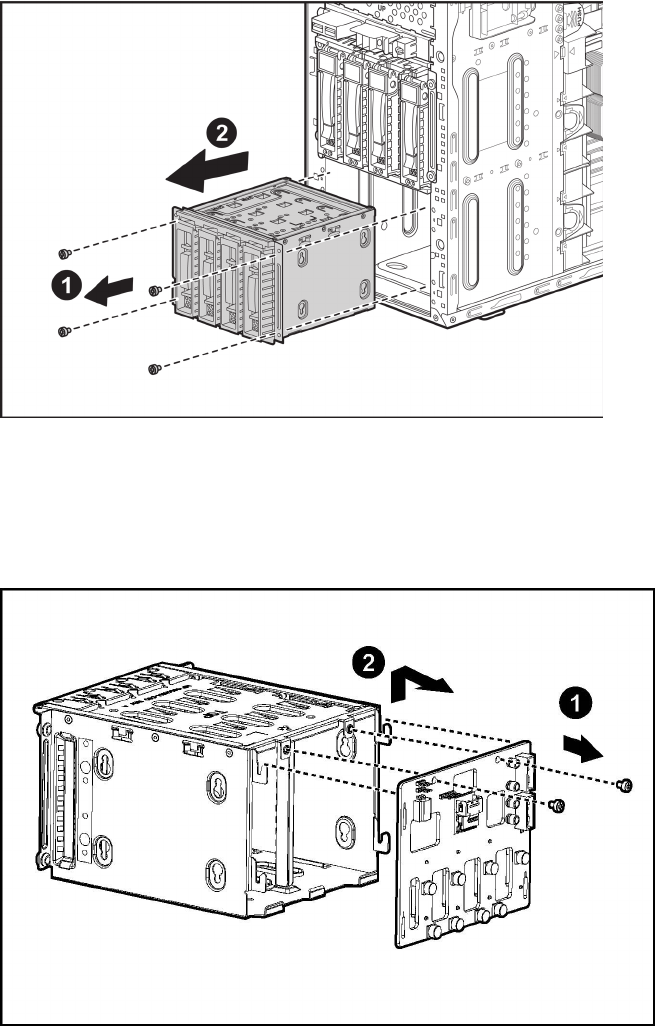
5. Disconnect the power data cables and 12C cable from the backplane of the HDD cage.
Figure 3-15 Disconnecting cables from the HDD cage backplane
Removal and replacement procedures 41
6. Remove the four mounting scre w s from the HDD cage (Figure 3-16, 1) and slide the HDD cage
out from the server chassis (Figure 3-16, 2).
Figure 3-16 Removing a hot-plug HDD cage
7. To remove and replace the backplane:
a. Remove the two screws securing the backplane to the HDD cage (Figure 3-17, 1).
b. Slide the backplane up slightly to clear the four cage hooks and securing post and then lift
the backplane away from the cage (Figure 3-17, 2).
Figure 3-17 Removing the backplane from the HDD cage
c. To replace the backplane, r everse steps a and b.
End of procedure.
To replace the hot-plug HD D cage, reverse steps 1 through 6.
Removal and replacement procedures 42
System board components (replaceable)
Refer to the following sections for instru ctions on removing or replacing the processor, t h e m em ory
modules, the expansion cards, and the system battery.
Processor
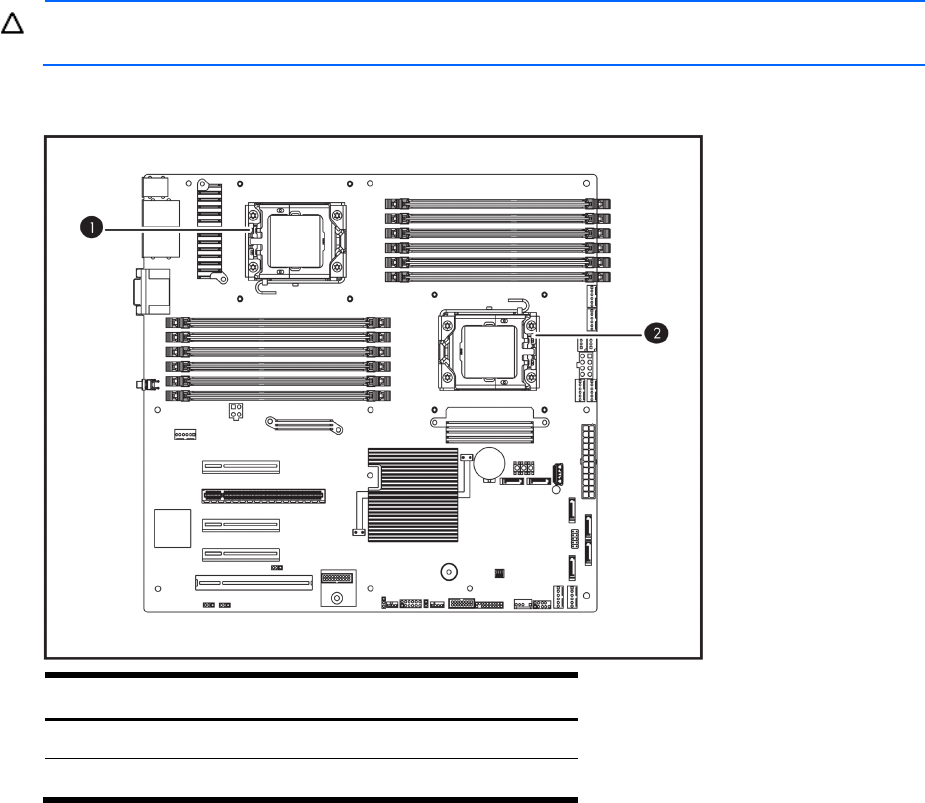
The HP ProLiant ML150 G6 Server supports singl e ( 1 P) and dual-processor (2P) operation. With two
processors installed, th e server supports boot functions through the processor installed in process or
socket 1. How ever, if proces sor 1 fails, the system automatically b oots from the pro cessor install ed in
processor socket 2 and provides a processor failur e message.
The two LGA1366 processor sockets support the following processor ty p es:
• Intel Xeon Dual Core E5502 series processors
• Intel Xeon Quad Core E5504/E5506/E5510/E5530/E5540 series processors
CAUTION: To prevent pos sible server malfunction in 2P systems, ensure tha t both processors are the
same type (s eries).
Figure 3-18 LGA1366 processor sockets
Item Description
1 Processor 1 socket
2 Processor 2 socket
Removal and replacement procedures 43
Removing a processor
To remove a processor, proceed as follows:
1. Power down the server.
2. Disconnect the power cord(s).
3. Unlock the server if necessary and remove the access pan el ( r efer to section “System covers”).
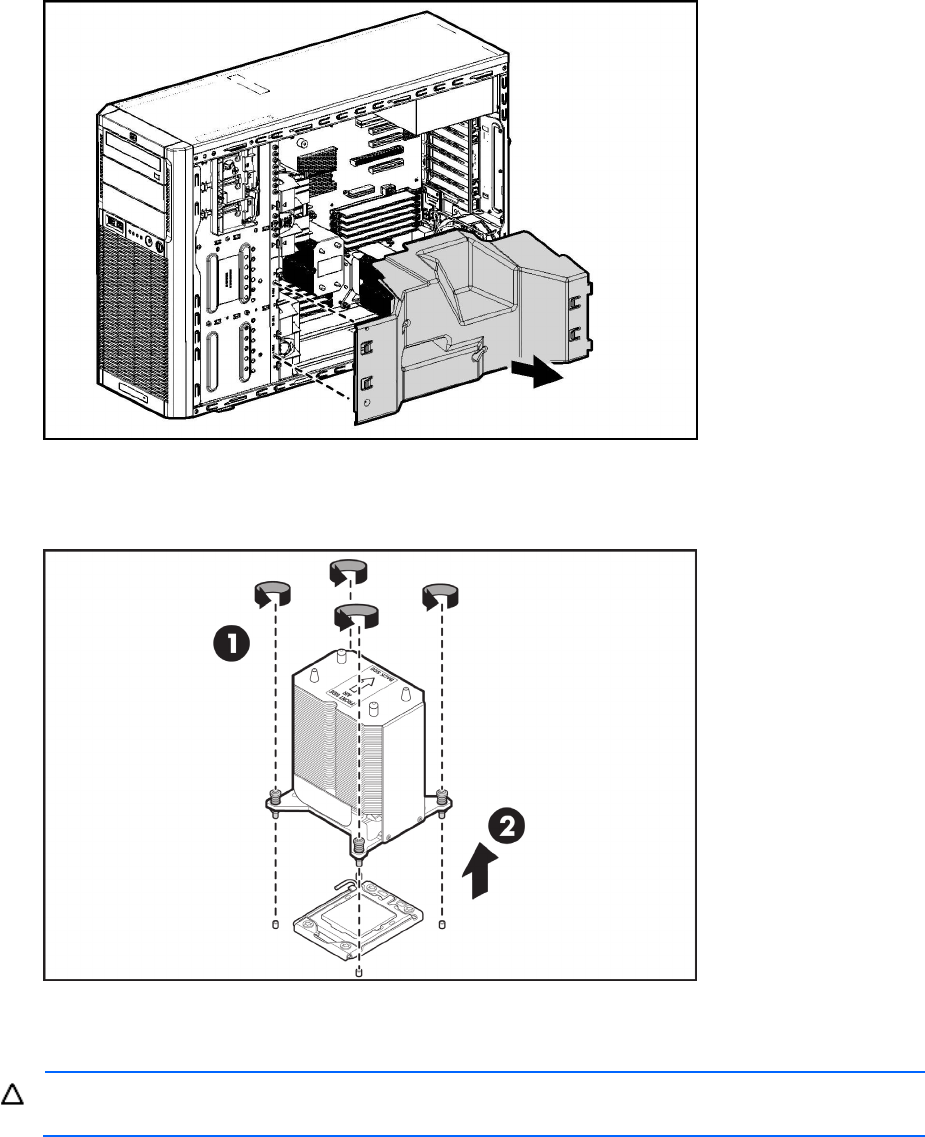
4. On the air baffle, pull the four tabs out slightly and lift the baffle away from the chassis.
Figure 3-19 Removing the air baffle
5. Place the server on its side w ith the open side up.
6. Remove the heatsink (Figure 3-20).
Figure 3-20 Removing the heatsink
7. Loosen the heatsink mounting screws (Figure 3-20, 1) and lift the heatsink away from the system
board (Figure 3-20, 2).
CAUTION: If the heatsink is to be reused, carefully place the heatsink in a position where the base
(processor contact area) will not come in contact with foreign material.
Removal and replacement procedures 44
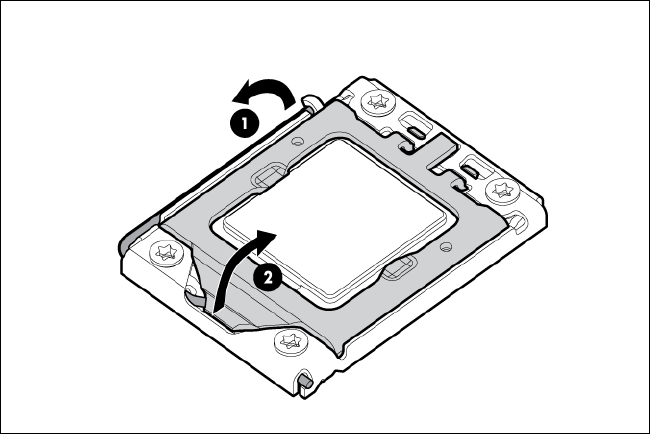
To remove a processor:
1. Open the processor lockin g lever and the pr ocessor socket retai n ing bracket.
Figure 3-21 Opening the processor socket retaining bracket
Removal and replacement procedures 45
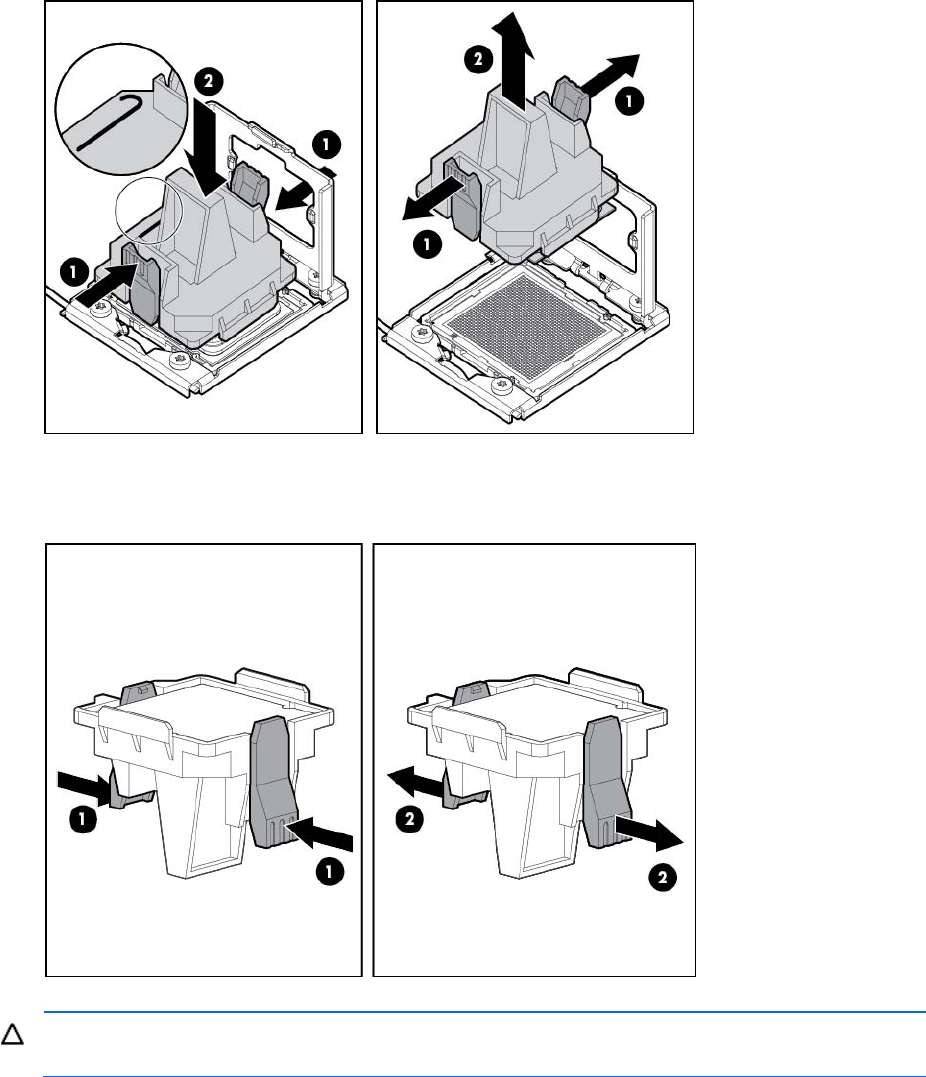
2. Using the processor removal tool, remove the processor from the system board:
a. Line up the proces sor t ool , ensuring the locking lev er graphic on the tool is corr ectly oriented.
b. Press in on the plastic tabs, and then place the tool on the processor.
c. Release the tabs, and then carefully lift the processor and tool straight up.
Figure 3-22 Removing the processor
3. Carefully rotate the tool, and then push in and release the tabs to secure the processor in the
tool.
Figure 3-23 Securing the processor
CAUTION: To avoid damage to the pr ocessor, do not touch the bottom of the processor, especially
the contact area.
Removal and replacement procedures 46
Replacing the processor
CAUTION: To allow the heatsink to draw away as much heat as possible from the processor, there
must be a tight connection between the heatsink base and the top of the processor. To ensure this
connection, a thermal grease compound must be used.
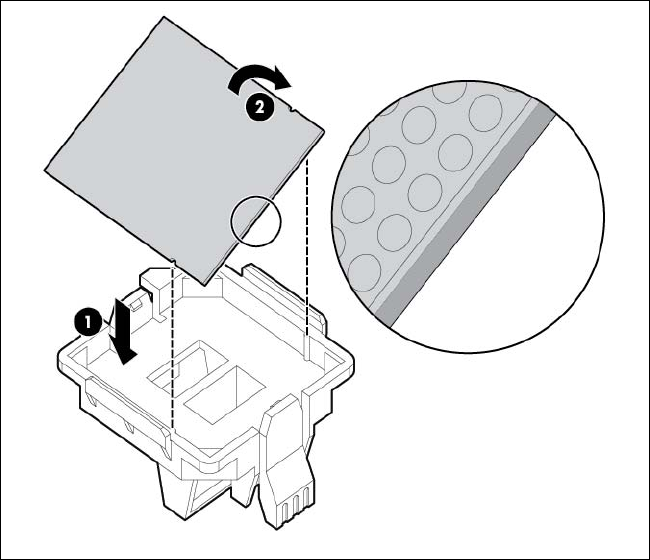
To replace or install a p r ocessor:
1. Using a clean cloth dipped in rubbing alcohol, clea n t he surface of the heatsin k b a se (contact
area) and the top of new processor. Ensure that both surfaces are clean and that no particles or
dust contaminants are evident.
2. Apply the thermal grease compound to the top of the processor (the contact surface).
CAUTION: HP recommend s thermal grea se of X-23-7783D made by Shin-Etsu.
3. Use the edge o f a razor blade to spr ead the grease throughout the en tire contact surface and
lightly scrape off any excess grease. Make sur e t hat you only apply a very thin layer so that the
contact sur face is still visible.
CAUTION: Never touch the contact area of the processor. Any contaminant could prevent the
mounting pads from making contact with the socket.
CAUTION: Applying too m uch grease creates a gap between the contact surfac es, significantly
reducing the ability of t h e cooler to draw out heat. Instal lin g t h e cooler with excessiv e grease can
also cause the grease to spread over the processor pins or the system board base, which can cause
electrical shorts that damage the system.
Removal and replacement procedures 47
To install the new processor:
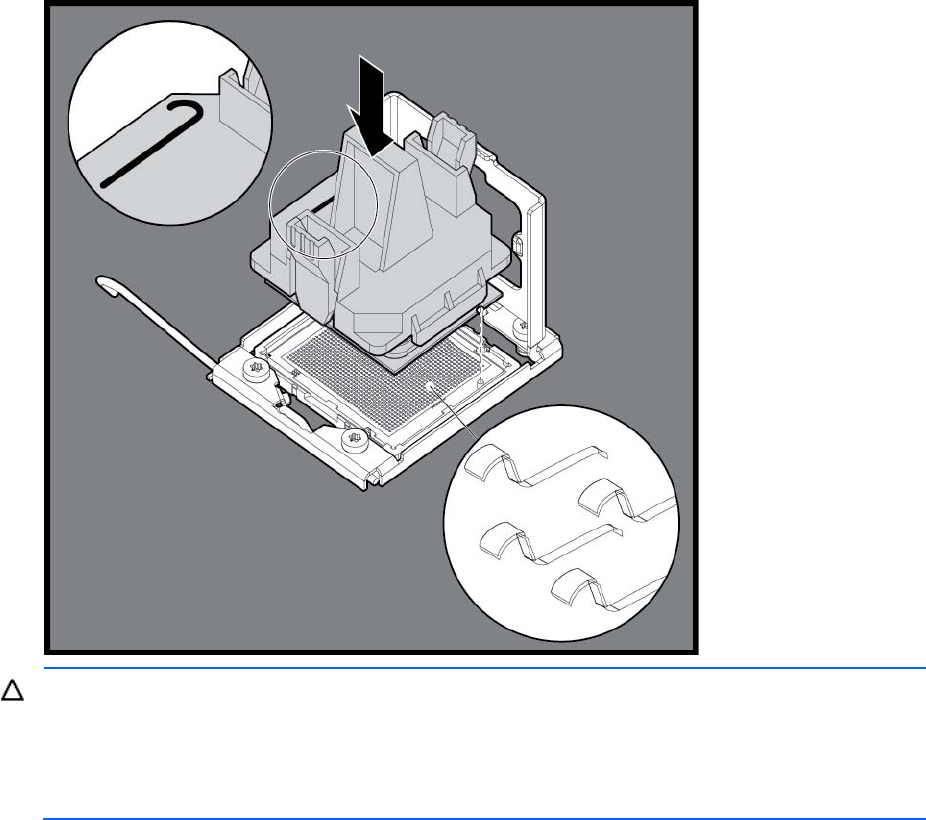
1. Carefully inse rt t h e p r oce ssor into the processor in st a llation tool. Handle the pr ocessor by the
edges only, and do not touch the bottom of the processor, especially the contact area.
Figure 3-24 Inserting the processor
Removal and replacement procedures 48
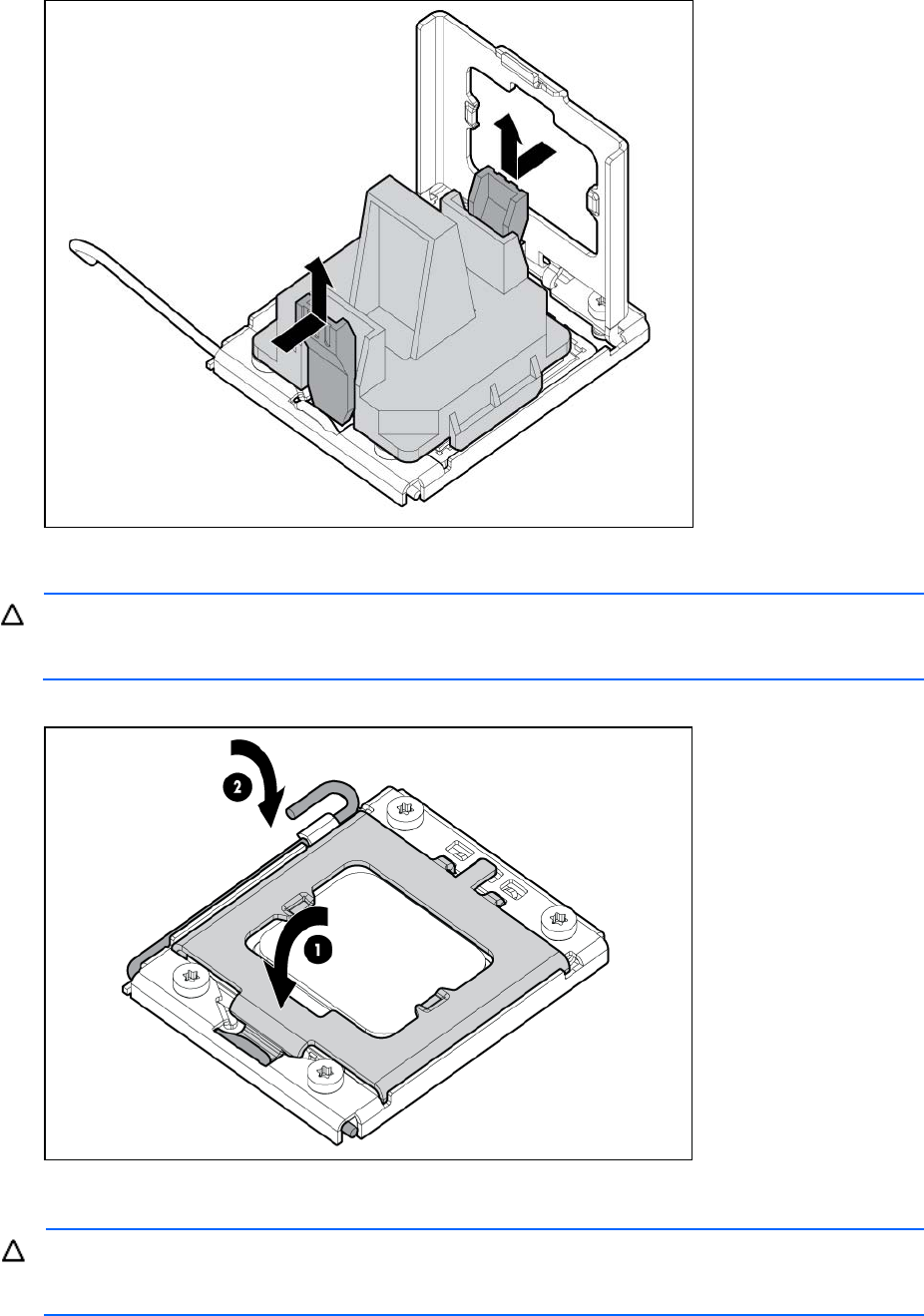
2. Be sure the tool is orient ed correctly. Align the pr oce ssor installation tool wit h th e socket, and
then install the processor. THE PINS ON THE SYSTEM BOARD ARE VERY FRAGILE AND EASILY
DAMAGED.
Figure 3-25 Installing the processor
CAUTION: THE PINS ON THE SYSTEM BOARD ARE VERY FRAGILE AND EASILY DAMAGED. To avoid
damage to the system board:
•
Never install or remove a processor without using the processor installation tool.
•
Do not touch the processor socket contacts.
•
Do not tilt or slide the processor when lowering the processor into the socket.
3. Press and hold the tabs on the processor installation tool to separate it from the processor, and
then remove the tool.
Removal and replacement procedures 49
Figure 3-26 Removing the processor installation tool
4. Close the processor socket retaining bra cket and the processor locking lever.
CAUTION: Be sure to close t he processor so cket retaining bracket before closing the proces so r
locking lever. The lever should close without resistance. Forcing t he lever closed can da m age the
processor and socket, requiring system board replacement.
Figure 3-27 Closing the processor socket retaining bracket
CAUTION: To allow the heatsink to draw as much heat as possible fr om the processor base, there
must be good contact between the heatsink base and the top of the processor. To ensure good
contact, you must apply thermal interface material.
Removal and replacement procedures 50
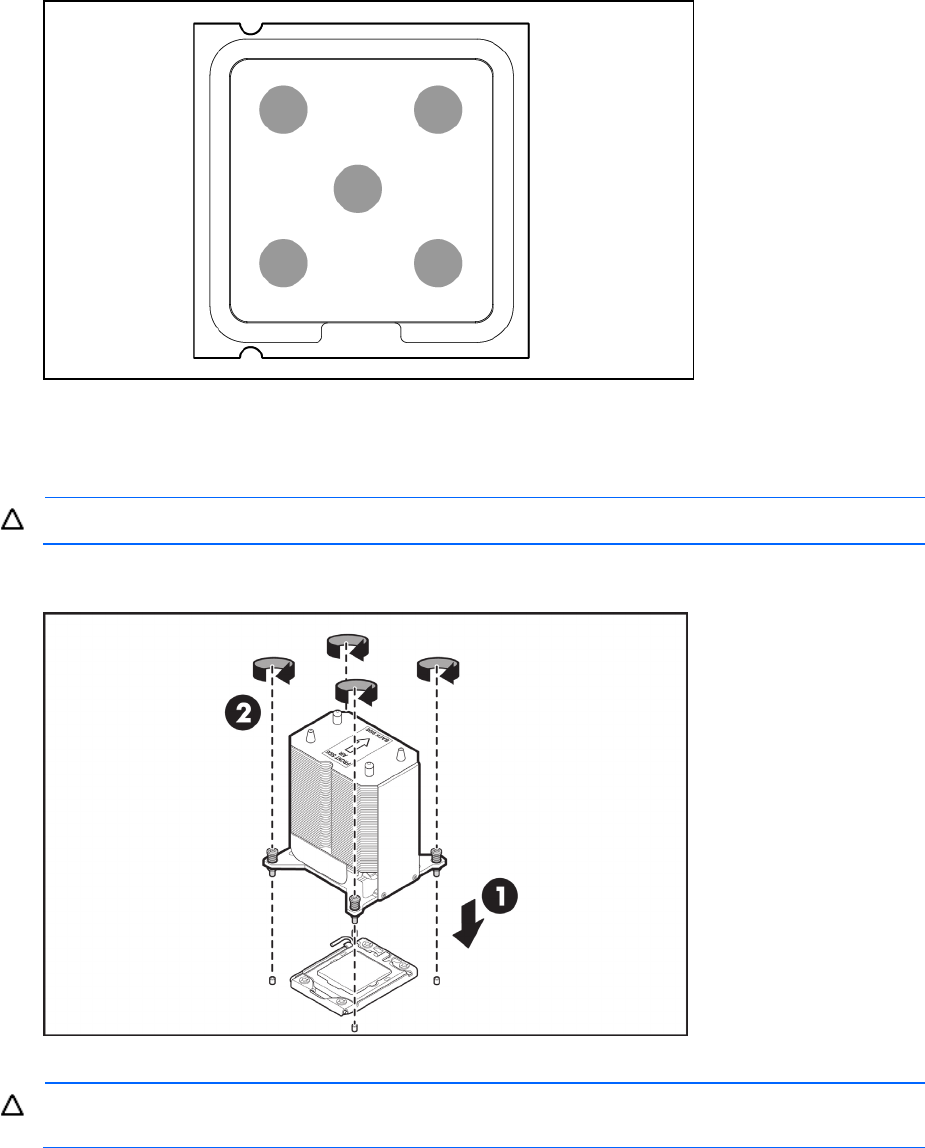
5. Apply all the grease to the top of the processor in the following pattern to ensure even
distribution.
Figure 3-28 Applying grease
6. Properly align the heatsink mounting screws to the system board mounting holes so that the air
flow indicator arrow on the top of the heatsink should point toward the rear of the chassis
(Figure 3-29, 1) and tighten with a screwdriver (Figure 3-29, 2).
CAUTION: Do not overtighten heatsink mounting screws.
Figure 3-29 Installing the heatsink assembly
7. Install the heatsink.
CAUTION: Failure to connect the processor fan cable to the system board may result in damage to
the processor and could cause the server to shut down without displaying mes sa ges.
8. Align the air baffle guide pins with the holes on the chassis support bar and lower it into place.
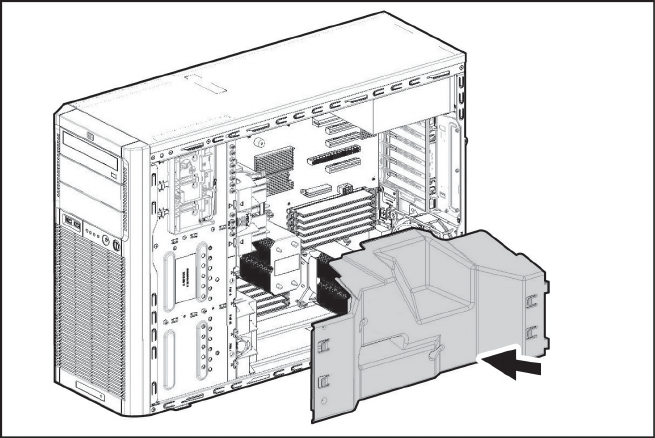
Removal and replacement procedures 51
Figure 3-30 Installing the air baffle
End of procedure.
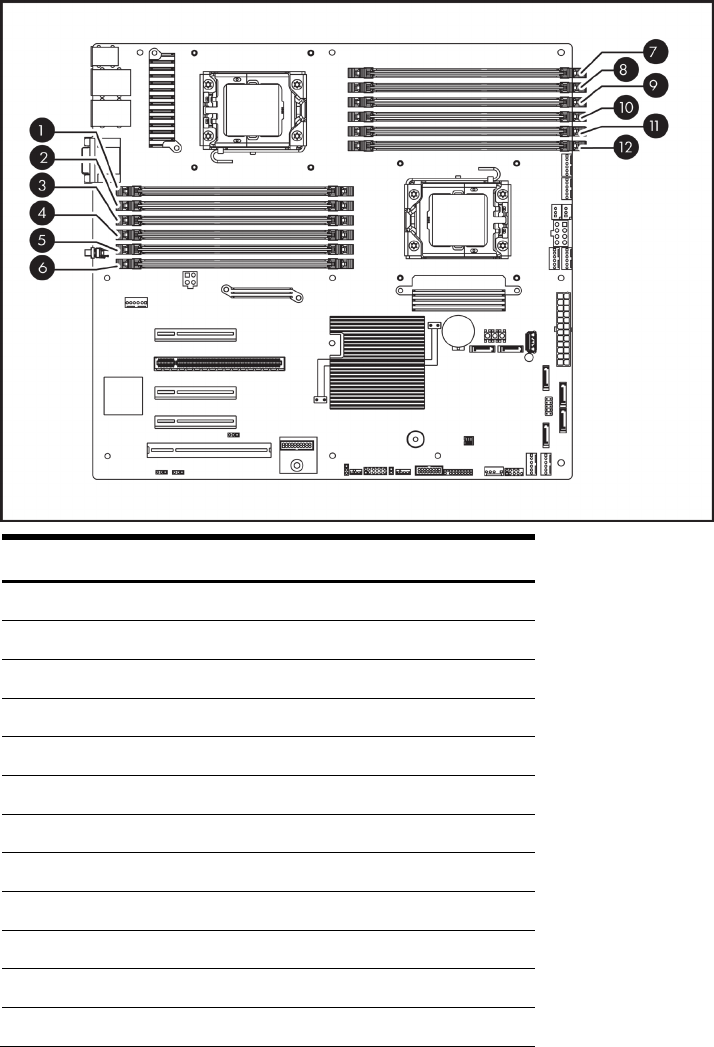
Removal and replacement procedures 52
Memory
The HP ProLiant ML150 G6 server provides 12 DIMM slots that support up to 48 GB of system
memory.
Figure 3-31 DIMM slots
Guidelines for installing memory modul es
Use the following guidelines when adding or repla cing memory modules:
• Use register ed and un-buffered D DR3 ECC DIMM.
Item Description
1 CPU1_DIMM slot 1D
2 CPU1_DIMM slot 2A
3 CPU1_DIMM slot 3E
4 CPU1_DIMM slot 4B
5 CPU1_DIMM slot 5F
6 CPU1_DIMM slot 6C
7 CPU2_DIMM slot 6C
8 CPU2_DIMM slot 5F
9 CPU2_DIMM slot 4B
10 CPU2_DIMM slot 3E
11 CPU2_DIMM slot 2A
12 CPU2_DIMM slot 1D
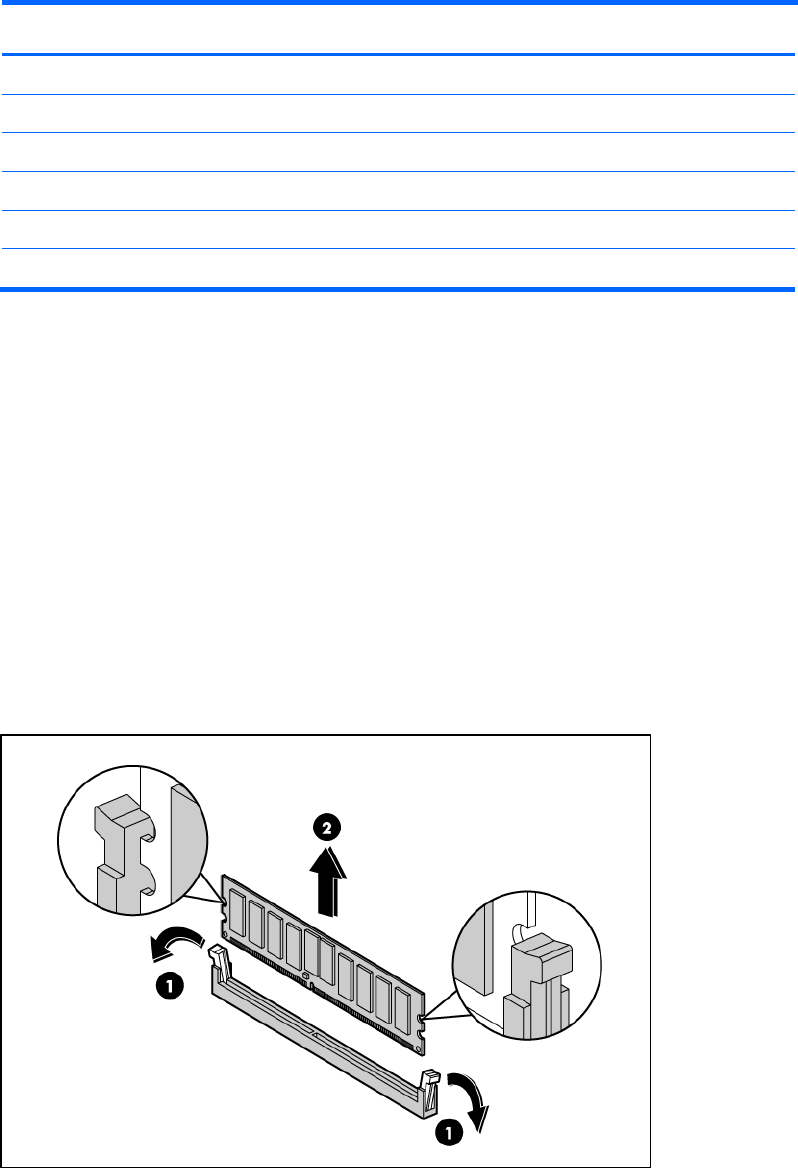
Removal and replacement procedures 53
• Supported DIMM capacities: 1 GB, 2 GB, 4 GB DDR3 registered DIMM and 1 GB, 2 GB, 4 GB
un-buffered DIMM.
• Supported tech n ologies: 1 GB, 2 GB, 4 GB x12 devices for registered and 1 G B, 2 GB, 4 GB x
12 devices for un-buffered.
• For best performance, DIMMs should be installed in symmetrical (balance-capacity) pairs.
Table
3
-2 DIMM slot Configurations
1D 2A 3E 4B 5F 6C
– • – – – –
– • – • – –
– • – • – •
• • – • – •
• • • • – •
• • • • • •
– : Empty
•: DIMM installed
To remove a memory module:
1. Power down the server.
2. Disconnect the power cord(s).
3. Unlock the server if necessary and remove the access pan el as described in the section “System
covers.”
4. Remove the air baffle by pulling up slightly on the four tabs and lifting the baffle away from the
chassis.
5. Remove the hard drive fan h o lder if needed.
6. Completely open the holding clips securing the module (Figure 3-32, 1).
7. Gently pull the mem or y m odule upward to remove it fr om the slot (Figure 3-32, 2).
Figure 3-32 Removing a memory module (DIMM)

Removal and replacement procedures 54
CAUTION: Place the memory module on a static-dissipating work surface or inside an anti-static
bag.
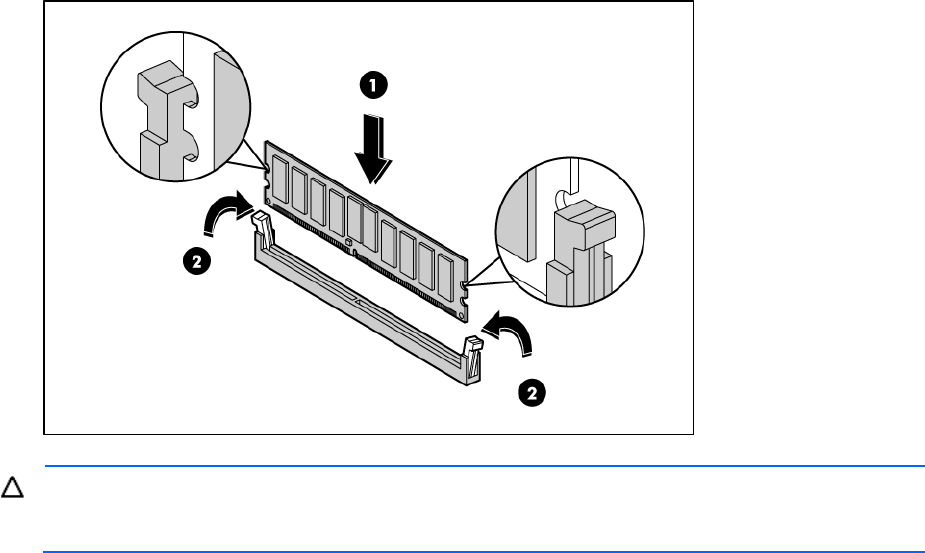
Removal and replacement procedures 55
To install a memory module:
1. Completely open the holding clips.
2. Orient the module so that the notch on the bottom edge of the module aligns with the keyed
surface of the DIMM slot, and then press it fully into the slot (Figure 3-33, 1).
3. Firmly press t h e hol d in g clips inward to secure the memory module in place (Figure 3-33, 2).
Figure 3-33 Installing a memory module (DIMM)
CAUTION: The memory slots are structur ed to ensure proper installation. I f a memory module does
not fit easily into the slot, it may be inserted incorrectly. Double-check the orientation of the module
and reinsert. If the holding clips do not close compl etely, the module is not inserted correctly.
End of procedure.
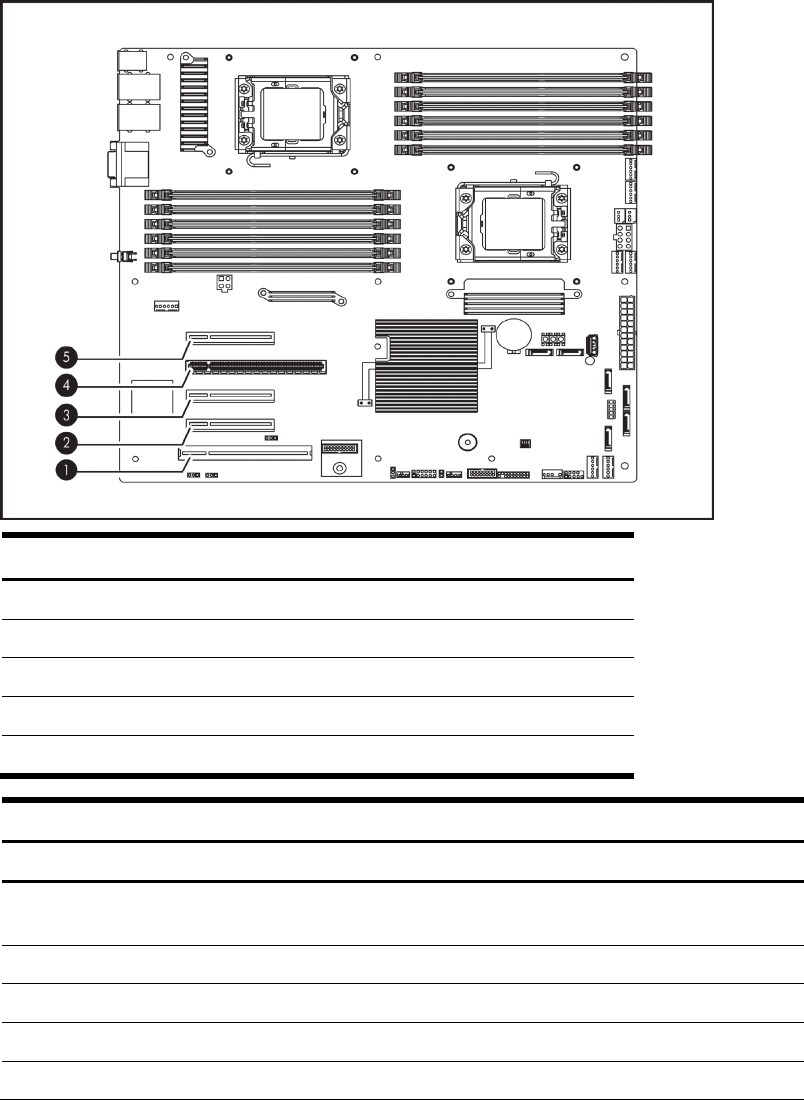
Removal and replacement procedures 56
Expansion cards
The server p r o vides seven expa nsion slots as shown i n Figure 3-34.
• One Peripheral Component Interconnect (PCI) 2.3-compliant slot
• Three PCI Express (PCIe) x4 sl ot s
• One PCIe x16 slot
Figure 3-34 Expansion slot locations
Item
Description
1 Expansion Slot 1
2 Expansion Slot 2
3 Expansion Slot 3
4 Expansion Slot 4
5 Expansion Slot 5
Expansion slot definitions
Expansion Slot Technology Bus Width Connector Width Form factor
1 (Standard) PCI 2.3 3. 3 V; 32
bits Full-length, Full- height slot
2 (Standard) PCI-E Gen1 x4 x8 Full-length, Full- height slot
3 (Standard) PCI-E Gen2 x4 x8 Full-length, Full- height slot
4 (Standard) PCI-E Gen2 x16 x16 Full-length, Full- height slot
5 (Standard) PCI-E Gen2 x4 x8 Half-length, Full- height slot
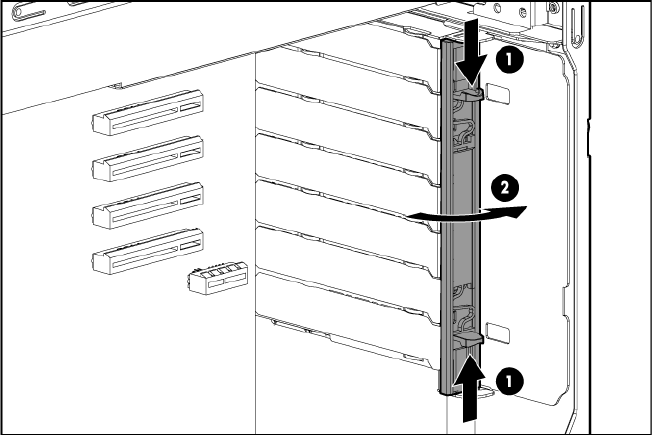
Removal and replacement procedures 57
Installing an expansion card
To install an expansion card:
1. Power down the server.
2. Disconnect the power cord(s).
3. Unlock the server if necessary and remove the access pan el as described in the section ”System
covers.”
4. Press and hold the latches (Figure 3-35), and turn the card holder upward.
Figure 3-35 Releasing the expansion card holder
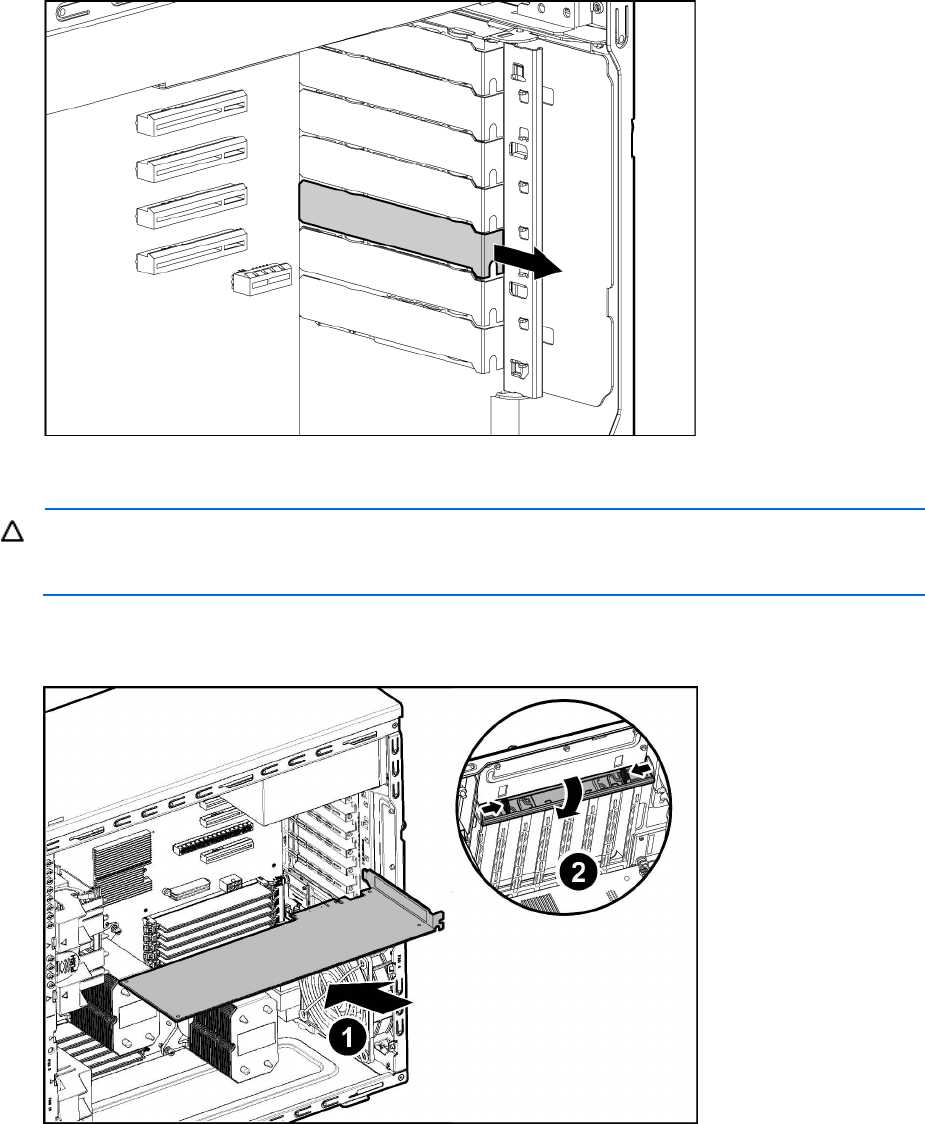
Removal and replacement procedures 58
5. Remove the expansion slot cover.
Figure 3-36 Removing the expansion slot cover
6. Position the expansion card over the expansion slot connector and push down (Figure 3-37, 1).
CAUTION: When installing an expansion card, hold the card just above the expansion slot on the
system board, and then move the card toward the rear of the chassis so that the bracket on the card
is aligned with the open slot on the rear of the chassis.
7. Press down the card holder until the latches snap into position in the rear panel, securing the
expansion card into the slot (Figure 3-37, 2).
Figure 3-37 Installing an expansion card
8. Connect any interior cables associated with the installed expansion card.
9. Replace the side access cover.
10. Reconnect the power cord(s).
End of procedure.

Removal and replacement procedures 59
Removing an expansion card
To remove an expansion card, reverse steps 1 th r ough 10 of “Installing an expansion card.”
CAUTION: If replacing an expansion card, store the old card in the anti-static packaging that
contained the new card.
CAUTION: If removing an expa n sion ca rd, slot covers must be installed in empty slots to maintain
proper system cooling.
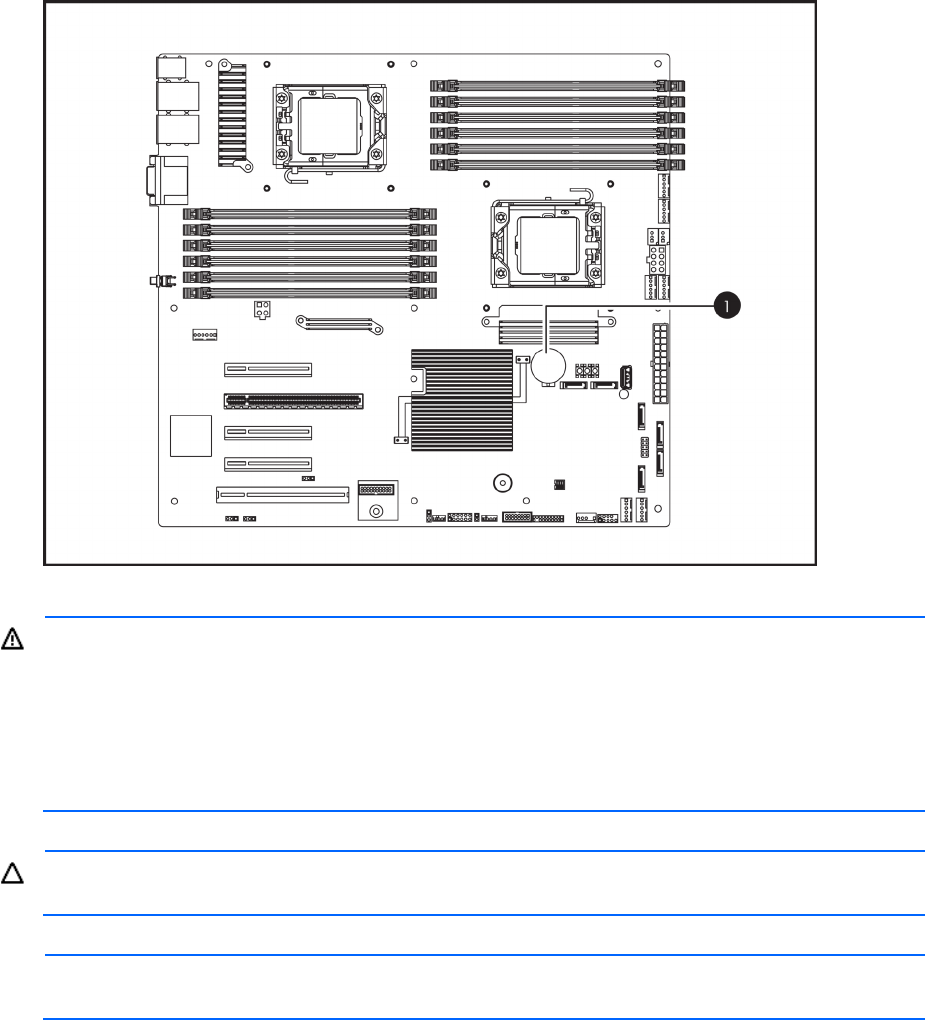
Removal and replacement procedures 60
System battery
The server uses nonvolatile memory that requires a 3-volt lithium coin cell battery to retain system
information when power is removed. The battery is located on the system board as item 1 shown in
Figure 3-38.
Figure 3-38 System battery location
WARNING: When replacing the system battery…
•
Replace the battery with the same type as the battery recommended by HP. Use of another battery type
may present a risk of fire or explosion.
•
A risk of fire and chemical burn exists if the battery is not handled properly. Do not disassemble, crush,
puncture, or short external contacts, or expose the battery to temperatures higher than 60°C (140°F).
•
Do not dispose of a used battery in water or fire. Dispose of used batteries according to manufacturer's
instructions.
CAUTION: Loss of BIOS set t ings occurs w h en the battery is removed. The BIO S must be reconfig ured
after replacing the battery.
NOTE: If the server no longer automatically displays the correct date and time, you may need to
replace the system battery. Under normal usage, battery life is five to ten years.
To remove and replace the system battery:
1. Power down the server.
2. Disconnect the power cord(s).
3. Unlock the server if necessary and remove the access pan el as described in the section “System
covers.”
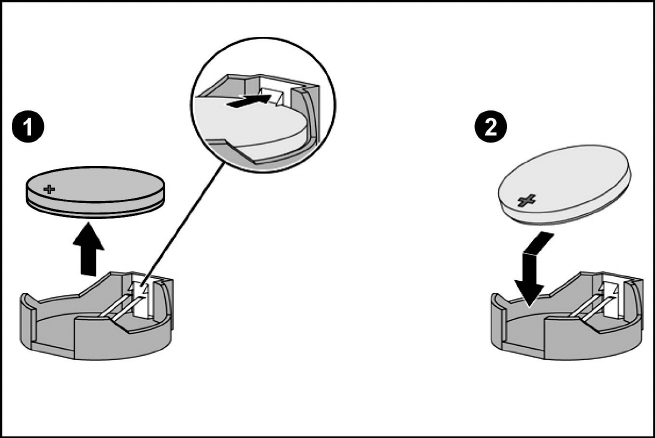
Removal and replacement procedures 61
4. Release the battery from its holder by squeezing the metal clamp that extends above one edge of
the battery. When the battery pops up, lift it out (Figure 3-39, 1).
5. To insert the new battery, slide one edge of the replacement battery under the holder’s lip with
the positive side up. Push the other edge down until the clamp snaps over the other edge of the
battery (Figure 3-39, 2).
Figure 3-39 Replacing the system battery
End of procedure.
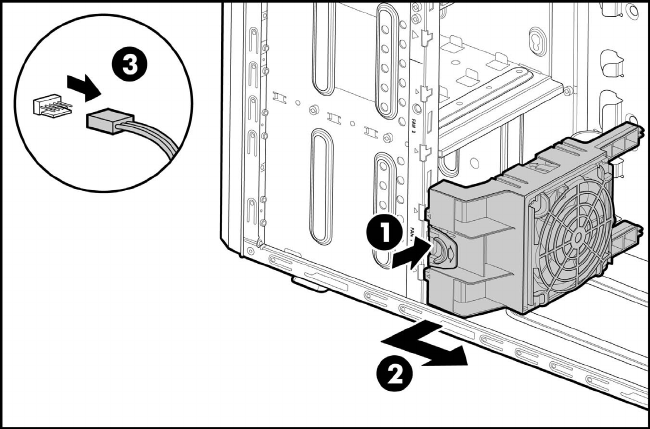
Removal and replacement procedures 62
System fans
The server includes four system fan assemblies; three front fan holder assemblies and a rear fan
assembly.
Fan holder assembly removal and replacement
To remove the front fan/PCI ca r d holder assembly:
1. Power down the server.
2. Disconnect the power cord(s).
3. Unlock the server if necessary and remove the access pan el as described in the section “System
covers.”
4. Remove all full-size expansion ca r ds as described in the section “Removing an expansion card”
if necessary .
5. On the front fan holder assembly, press the thumb lever down slightly (Figure 3-40, 1) and slide
the assembly a short distan ce t o w ard the top of th e server chassis (Figure 3-40, 2).
Figure 3-40 Removing the front fan/PCI card holder assembly
6. Rotate the fan assembly toward the rear of the chassis and lift away from the mounting slots, but
not completely from the chassis.
7. While supporting the fan holder assembly with one hand, disconnect the fan cable from system
board connector ( Figure 3-40, 3).
8. Remove the front fan holder assembly from the chassis.
End of procedure.
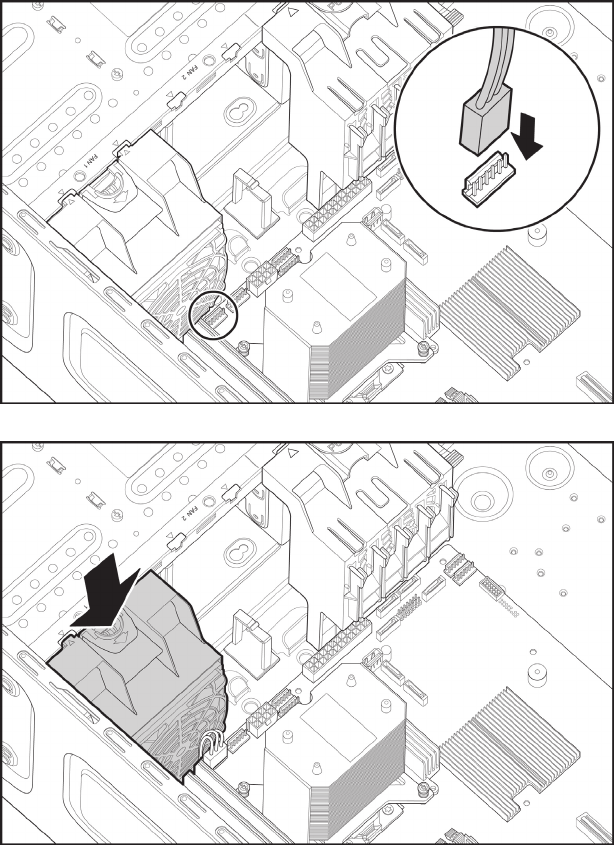
Removal and replacement procedures 63
To replace the front fan holder assembly,
1. Connect the system fan cable to system board connector (Figure 3-41).
2. Install the system fan onto the chassis. (Figure 3-41).
Figure 3-361 Replacing the front fan/PCI card holder assembly
Figure 3-372 Installing the system fan
3. Reinstall t h e air baffle.
4. Reinstall the access panel and tighten the thumbscrews.
5. Return the server to the upright position.
6. Connect the power cables to the power supplies.
End of procedure.
Rear fan assembly removal and replacement
To remove the rear fan assembly, proceed as follows:
1. Power down the server.
2. Disconnect the power cord(s).
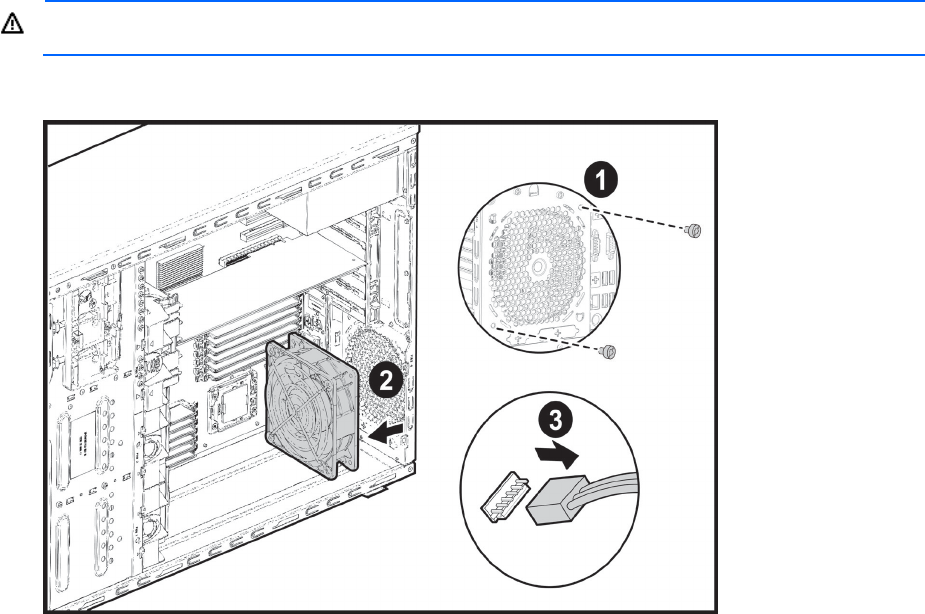
Removal and replacement procedures 64
3. Unlock the server if necessary and remove the access pan el as described in the section “System
covers.”
4. Remove the air baffle as de scribed in the section “Removing a processor.”
5. Remove the two screws (Figure 3-43, 1) and take off the rea r f an (Figure 3-43, 2).
WARNING: Be sure to support the fan with your hands when removing it from the chassis. The fan
could fall and cause personal injury or equipment damage if not supported.
6. Disconnect the fan cable from the system board connector (Figure 3-43, 3).
Figure 3-383 Removing the rear chassis fan assembly
7. Lift the fan assembly away from the rear panel and from the chassis.
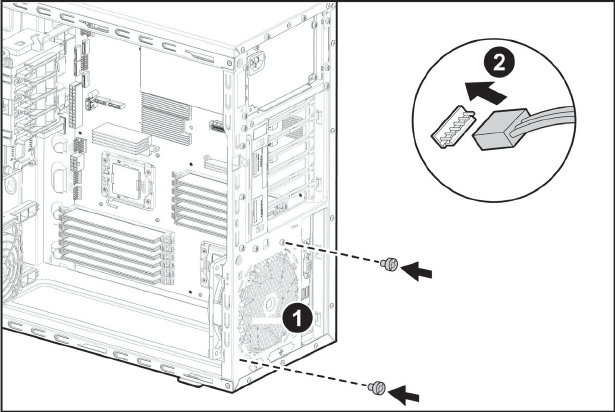
Removal and replacement procedures 65
To replace the rear fan assembly:
1. Secure the rear fan to the chassis with two screws. (Figure 3-44, 1).
2. Connect the fan cable to the system board connector. (Fig ure 3-44, 2)
3. Slide the fan assembly toward the expansion slots until it snaps into place.
Figure 3-394 Installing a rear system fan
4. Replace the air baffle.
5. Replace the access panel an d reconnect the po w er cord(s).
End of procedure.
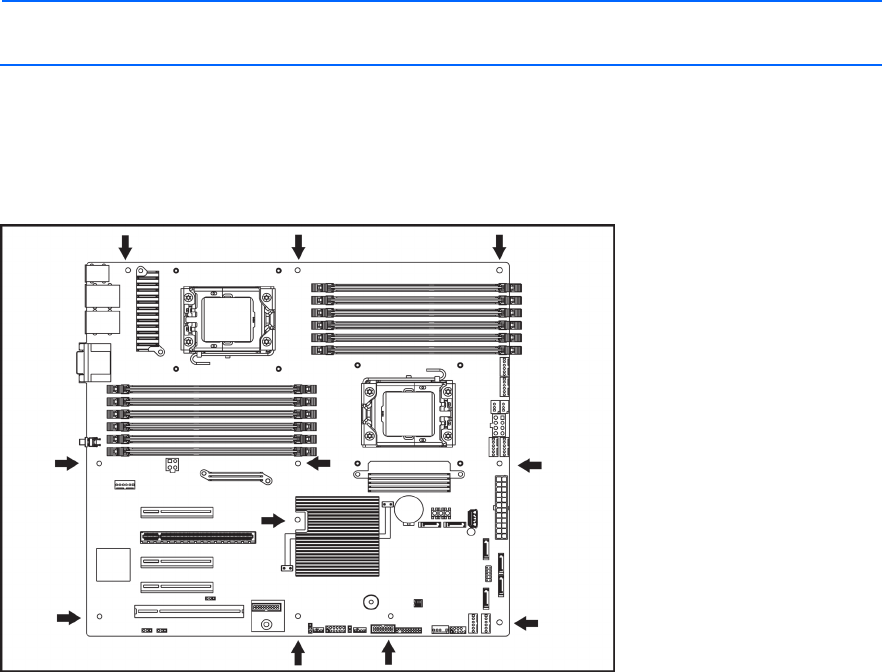
Removal and replacement procedures 66
System board removal and replacement procedure
Removing the system board
To remove the system board, proceed as follows:
1. Power down the server.
2. Disconnect the power cord(s).
3. Unlock the server if necessary and remove the access pan el as described in the section “System
covers.”
4. Place the server on its side w ith the open side up.
5. Remove all expansion cards as described in the section “Removing an expansion card.”
6. Remove the system fans as d escribed in the se cti on “System fans.”
7. Remove the processor heatsink(s) as describ ed in the section “Removing a processor.”
NOTE: If th e system board i s t o be reused, only t h e processor heatsink needs to be rem oved for this
procedure. The processor(s) can be left in the socket(s).
8. Disconnect all power supply cables from the system board.
9. Disconnect all mass storage device data cables from the system board.
10. Locate the 11 mounting screws from the system board (indicated by arrows in the following
figure).
Figure 3-405 System board mounting screw locations
11. Loosen and remove the mounting screws from the system board.
12. Grasping the system board by the edges, lift the front edge of the system board up slightly, pull
the board away from the rear panel and lift up from the chassis.
13. Place the board on a grounded mat or in a protective anti-static bag.
End of procedure.
Removal and replacement procedures 67
Replacing the system board
To replace the system board, proceed as follow s:
1. Lower the system board into the chassis, tilting the rear edge down first so that the rear port
connectors align with the rear panel cutouts, then lower the front edge down until it is level.
Ensure that the mounting holes on the board are aligned with the screw taps on the chassis.
2. Insert and tighten the 11 mounting screws.
3. Install the processor heatsink( s) as described in the section “Replacing the processor.”
4. Install the system fans as d escribed in the section “System fans.”
5. Install any expansion cards as d escribed in the sect i on “Installing an expansion card.”
6. Return the server to an upright position.
7. Replace the access panel.
8. Connect the power supply cord(s).
End of procedure.
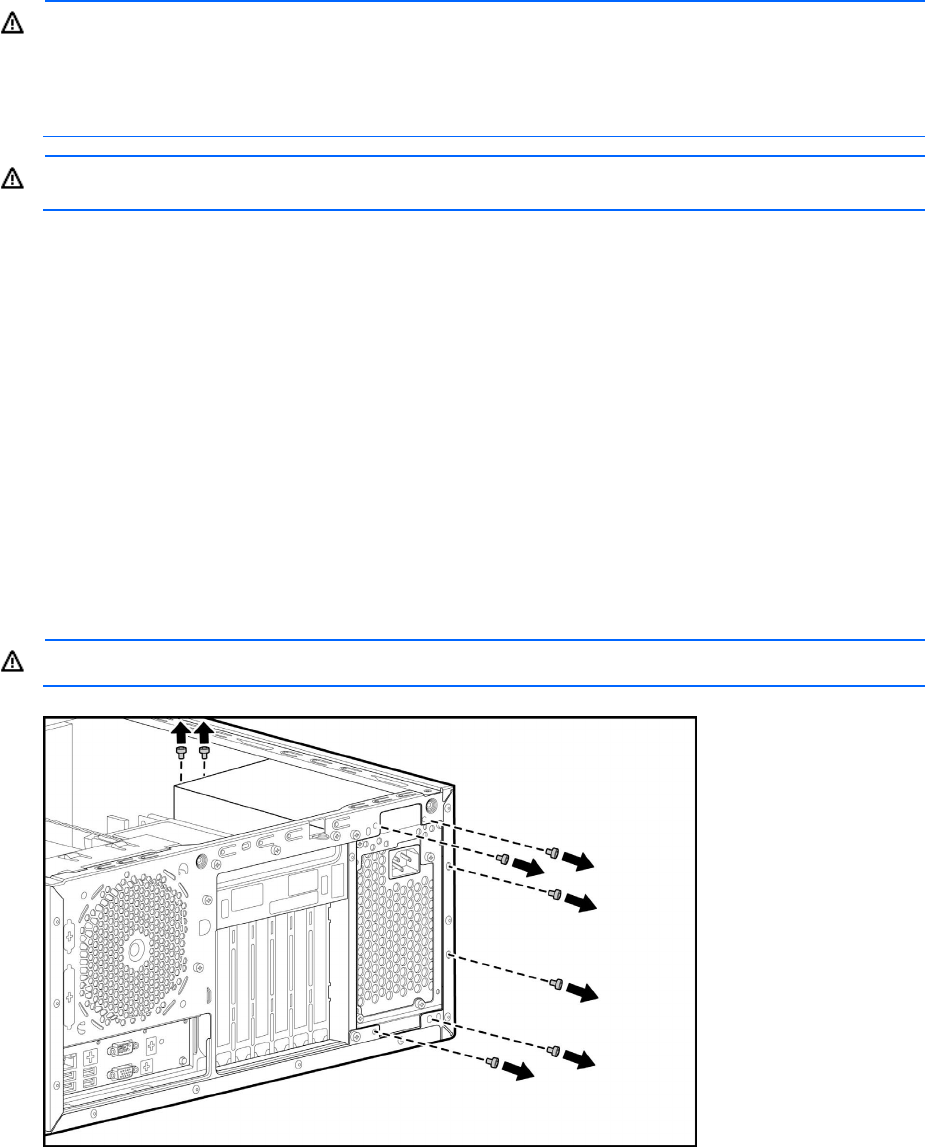
Removal and replacement procedures 68
Power supply unit (PSU)
The standard server configuration includes a sin gle, auto ranging 460-watt power supply unit (PSU)
with power factor correction (PFC). The server can be upgraded by replacing the standard PSU with a
redundant power supply (RPS) unit.
WARNING: Note the following reminders to reduce the risk of p ersonal injury from elect ric shock
hazards and/or damage to the equipment.
•
Installation of the power supply unit should be referred to individuals who are qualified to service server
systems and are trained to deal with equipment capable of generating hazardous energy levels.
•
DO NOT open the power supply unit. There are no serviceable parts inside the power supply unit.
WARNING: To prevent possible personal injury and damage to system components, HP
recommends performing this procedure with t he server placed o n i ts side with the open side up.
Removing a PSU
To remove the PSU, proceed as follows:
1. Power down th e ser ver.
2. Disconnect the power cord.
3. Unlock the server if necessary and remove the access pan el ( r efer to the section “System
covers.”)
4. Remove the air baffle as de scribed in the section “Removing a processor.”
5. Place the server on its side with the open side up.
6. Disconnect all power supply cables from the system board, mass storage devices, and/or
backplane.
7. Remove the eight mounting screws that secure the PSU to the rear chassis panel.
WARNING: The PSU is heavy and can cause personal injury or damage system components.
Figure 3-416 Removing the PSU mounting screws
8. Slightly lift up the power supply and then push toward the front of the chassis until it clears the
support ledge.
9. Tilt the power supply t oward processor 1 and ca r ef ull y remove it from t h e ch assis.
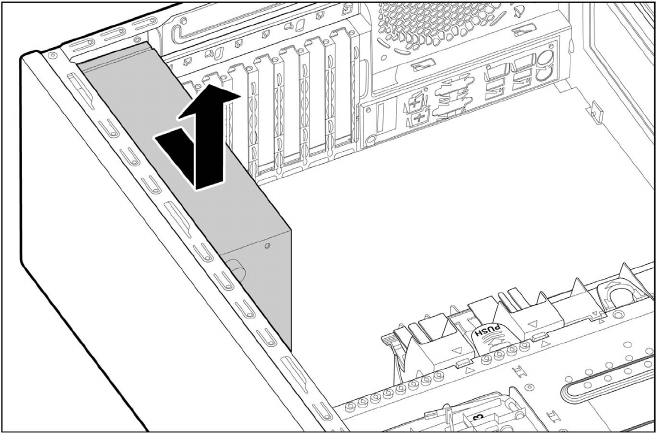
Removal and replacement procedures 69
Figure 3-427 Removing the PSU (cables not shown)
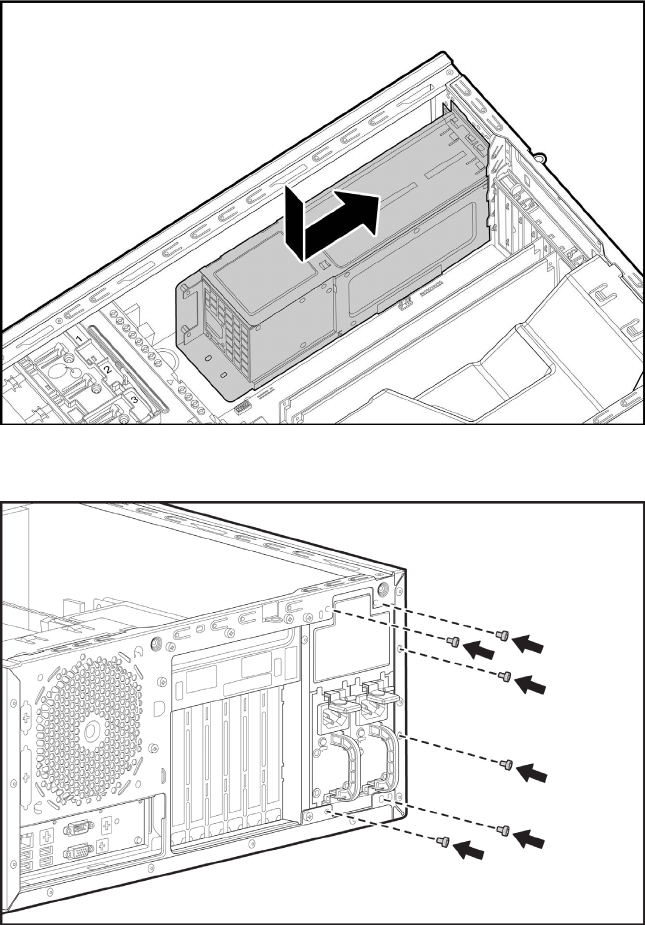
Removal and replacement procedures 70
Installing a PSU or RPS
To install a PSU or RPS:
1. Tilting the power supply slightly, lower the unit into the chassis and slide over the support ledg e
to the rear of the chassis until it is flush against the rear panel.
Figure 3-438 Installing a PSU or RPS (RPS unit shown)
2. Secure the power supply to the rear chassis panel using the six mounting screws.
Figure 3-449 Installing the rear mounting screws (RPS unit shown)
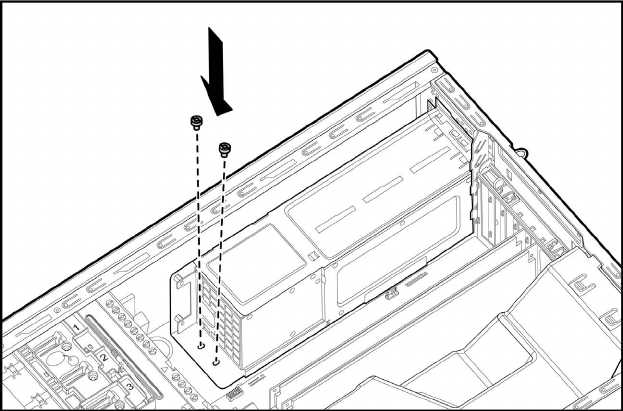
Removal and replacement procedures 71
3. If installing an RPS, install the two additional mounting screws at the front of the RPS assembly.
Figure 3-50 Installing additional RPS mounting screws (cables not shown)

Diagnostic Tools and Setup Utilities 72
Diagnostic Tools and Setup Utilities
This chapter prov ides an overview of the Power-On Self-Test (POST), the POST error messages, and
BIOS, SAS and SATA setup utilities.
BIOS Software
The ProLiant ML150 G6 server uses BIOS to boot up t h e system. BIOS software is a ROM BIOS-based
firmware that a l lows reliability, manageability, and connectivity for server platforms. This software
contains a set of programs permanently stored in an EEPROM chipset located on the system board.
These programs assist in managing, initializing, and testing the hardware devices installed on the
computer.
BIOS software a llows you to:
• Perform configura t ion from the BIOS Setup Utilit y
Using the Setup Utility, you can install, configure, and optimize the hardware devices on the
system board. In addition, you can enable various features such as serial console redirection,
hyper-threading, PXE boot, and much more.
• Initialize hardware at boot up using POST rout in es
During power-on or wa rm reset, the BIOS performs Power-On Self Test (POST) routines to test
system components, to allocate resource for various hardware devices, and to prepare the
system to boot to various operating systems.
BIOS Setup Utility
The BIOS Setup Utility provides the user with general system in formation and allows t h e u ser to
configure th e server for opti mum performa n ce and security. If any operational p roblems occur after
changing BIOS parameters, the BIOS Setup Utility allows the user to restore the server to the default
or failsafe values.
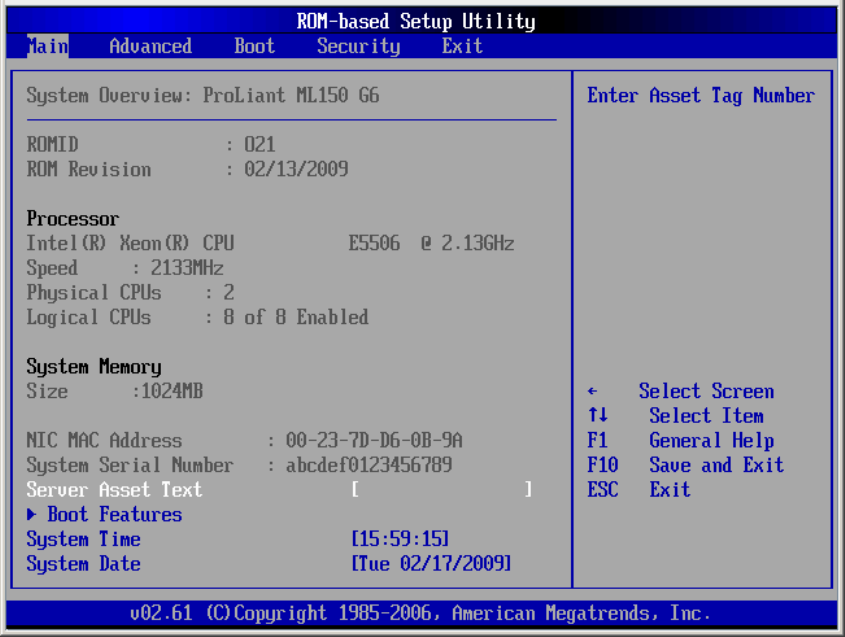
Diagnostic Tools and Setup Utilities 73
Accessing the BIOS Setup Utility
To access the BIOS Setup Utility, perform th e following steps:
1. Turn on the monitor and server. If the server is already turned on, save your data and exit all
open applications, then restart the server.
2. When the HP logo is displayed during POST, press F10. After a few moments, the Main menu
will be displayed (Figure 4-1). NOTE: If you fail to press F10 before POST is completed, you will
need to resta rt the server.
Figure 4-1 Main menu of the BIOS Setup Utility
Navigating through the Setup Utility
Table 4-1 lists and describes the keys used for navigating through the Setup Utility menus and
selecting and changing parameters. Pressing F1 from the Main menu displays a pop-up menu that
also displays most of th e n avigation keys and their functions.
Diagnostic Tools and Setup Utilities 74
Table
4
-1 Setup Utility Navigation Keys
Key Function
← and → When pressed, these keys select the primary menu on the top menu bar.
↑ and ↓ When pressed, these keys select the field. The currently selected field will be
highlighted. The right side of each menu screen displays a field/item-specific help
panel, and displays the help text for the currently selected field.
+ and – When pressed, these keys select a value or option for the currently selected field
(only if it is user-configurable). Press the (+), (–) keys repeatedly to display each
possible entry, or the Enter key to choose from a pop-up menu.
Parameters that are enclosed in square brackets [ ] are user-configurable.
Grayed-out parameters are not user-configurable for one of the following reasons:
•
The field value is auto-configured or auto-detected.
•
The field value is informational only.
•
The field is password-protected.
Enter When pressed, this key performs one of the following:
•
Selects a field value or display a submenu screen.
•
Displays more options for selected item (marked with )
•
Expands all device list
Esc When pressed, his key performs one of the following:
•
From a primary menu screen, displays the Exit menu.
•
From a submenu screen, displays the previous screen.
•
From a pop-up window, closes the pop-up window without making a selection.
Page Up or
Page Down
When pressed, displays the previous/next page on scrollable menus.
Home or End When pressed, moves the cursor to the top/button item of current menu.
F1 When pressed, displays the General Help window. The General Help window
describes other Setup navigation keys that are not displayed on the legend bar.
F2 or F3 When pressed, changes the Setup Utility screen color.
F7 When pressed, discards the change value.
F8 When pressed, loads the failsafe default system values.
F9 When pressed, loads the default system values.
F10 When pressed, saves changes and closes the Setup Utility.
The BIOS Setup Utility allows the user to view and configure the server subsystems through five
primary menus:
• Main
• Advanced
• Security
• Boot
• Exit
The following sections show and describe the Setup Utility menus.
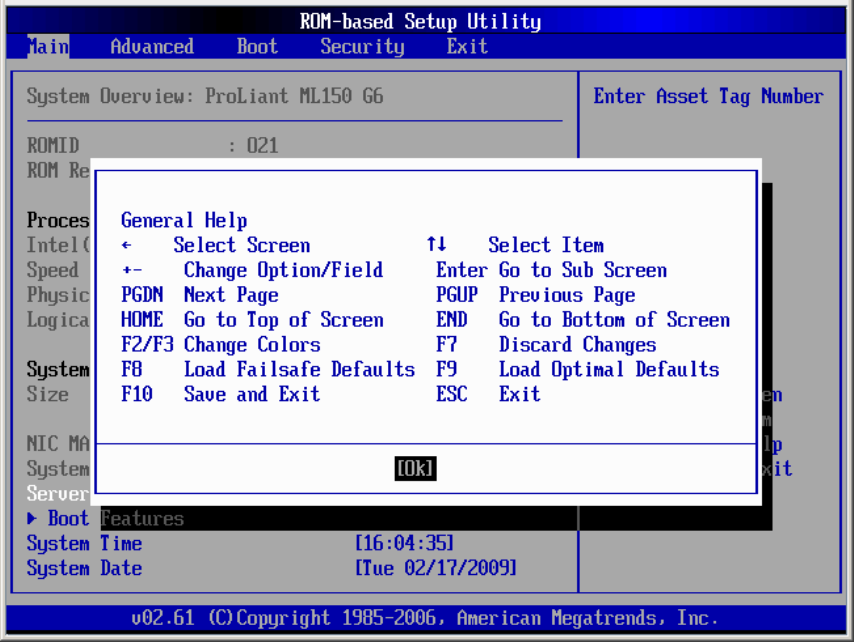
Diagnostic Tools and Setup Utilities 75
Main menu
The Main menu (Figure 4-2 ) provides general BIOS, p rocessor, memory, and sy stem id en t ification
information. The main menu allows the user to:
• View BIOS inform a t ion
• View processor type, speed, and number information.
• View system mem o r y size.
• View MAC address for the embedded NIC.
• View System serial ID.
• Enter server Asset Tag Text.
The General Help pop-up window is always available by pressing the F1 key.
Figure 4-2 Main menu and General Help screen
The screen in Figure 4-2 has the selection arrow set to select the Boot Features sub menu. Pressing the
Enter key calls up the Boot Fea t ures sub menu (F igure 4-3).
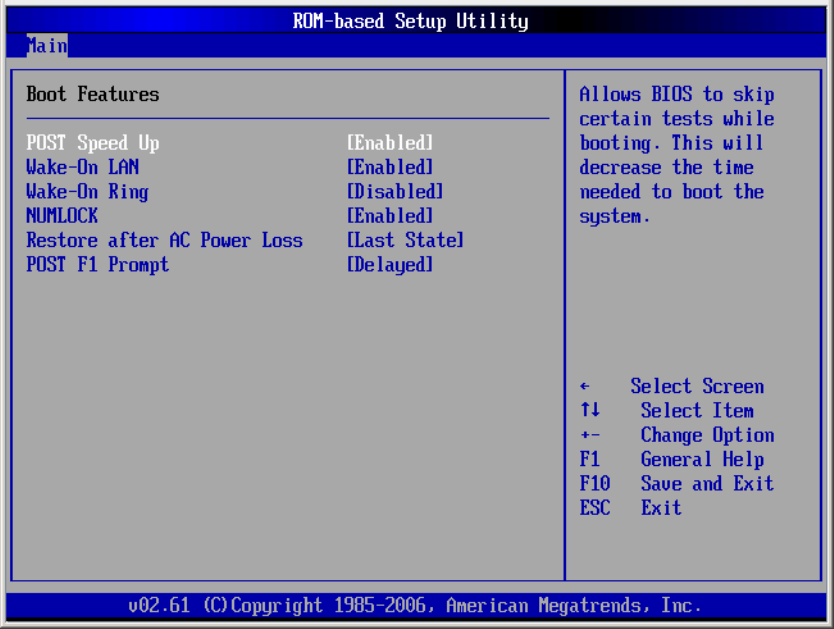
Diagnostic Tools and Setup Utilities 76
The Boot Features sub m enu (Figure 4-3) allows the user to set which type of event(s) that will occur
during the boot process.
Figure 4-3 Main menu–Boot Features submenu
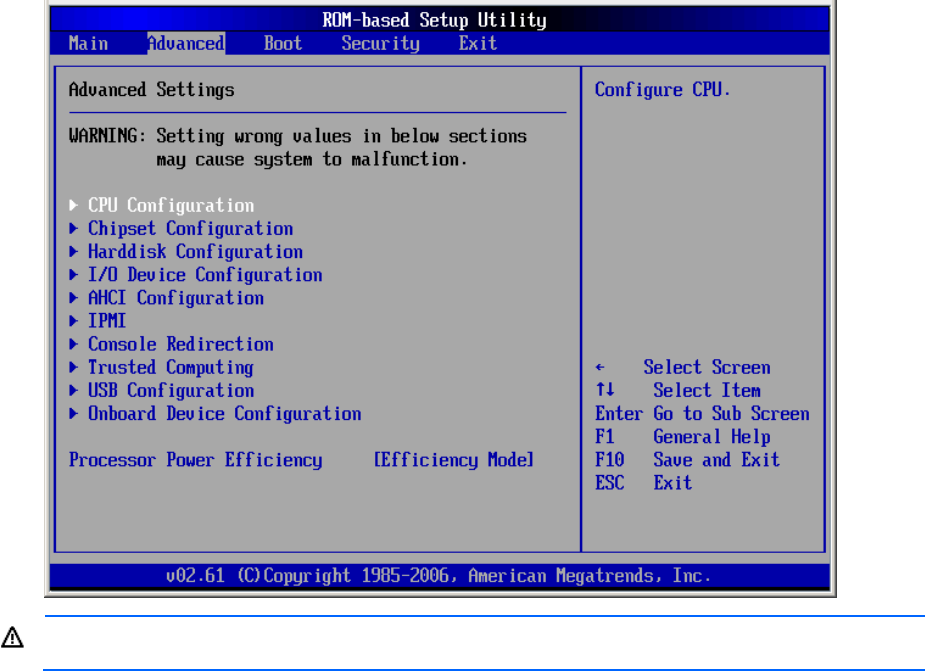
Diagnostic Tools and Setup Utilities 77
Advanced Menu
The Advanced menu (Figure 4-4) allows the user to con figure the following:
• CPU Configuration – Configure the CPU (processor). Enable or disable the Hyper Threading (HT)
features for t he processor to utilize its execution resources more efficiently as two v ir t ual
processors, and enable or disable the Vanderpool technology features for the processor
supported.
• Chipset Configuration – Configure Chipset settin gs.
• Harddisk Configuration – Configure the hard disk sett i ngs of the server, view CD-R O M status and
SATA hard drive status.
• I/O Device Configuration – Configure the serial port settings o f the server.
• AHCI Configurat ion – Hard drives AHCI function settings.
• IPMI – Configure the Intelligent Platform Management Interface (IPMI) settings
• Console Redirection – Configure the settings when r edirecting the con sole to a serial port.
• Trusted Computing – Configure TPM settings.
• USB Configuration – Configure the USB sett ings of the server.
• Onboard Device Configura tion – Configure NIC and VGA settings.
Figure 4-4 Advanced menu
WARNING: Incorrect settings may cause the server to malfunction. To correct the settings, press F9
key to restore the default settings.
The specifi c advanced settin gs that are user-configurable are accessible through the Advanced
Settings submenus shown in Figures 4-5 through 4-14.
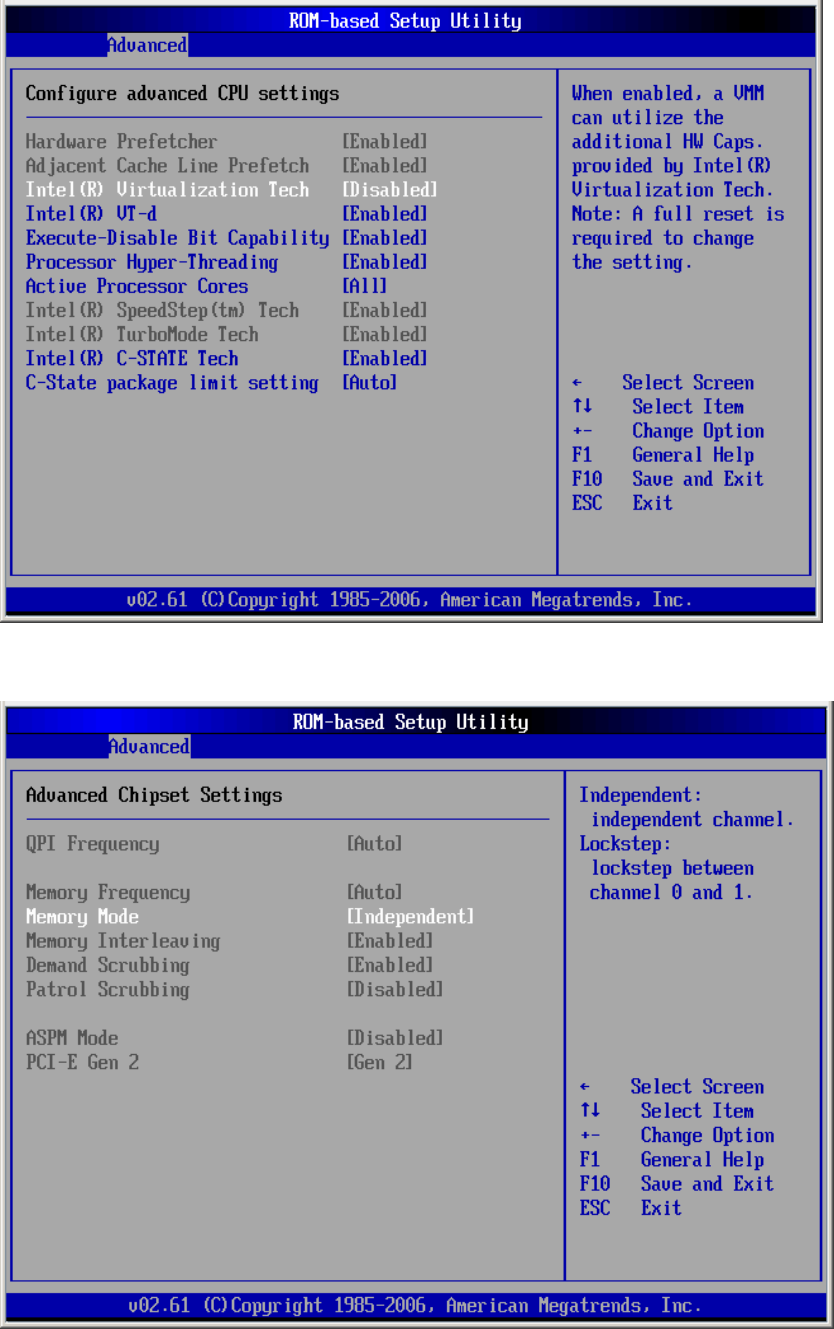
Diagnostic Tools and Setup Utilities 78
Figure 4-5 Advanced menu–CPU Configuration submenu
Figure 4-6 Advanced menu–Chipset Settings
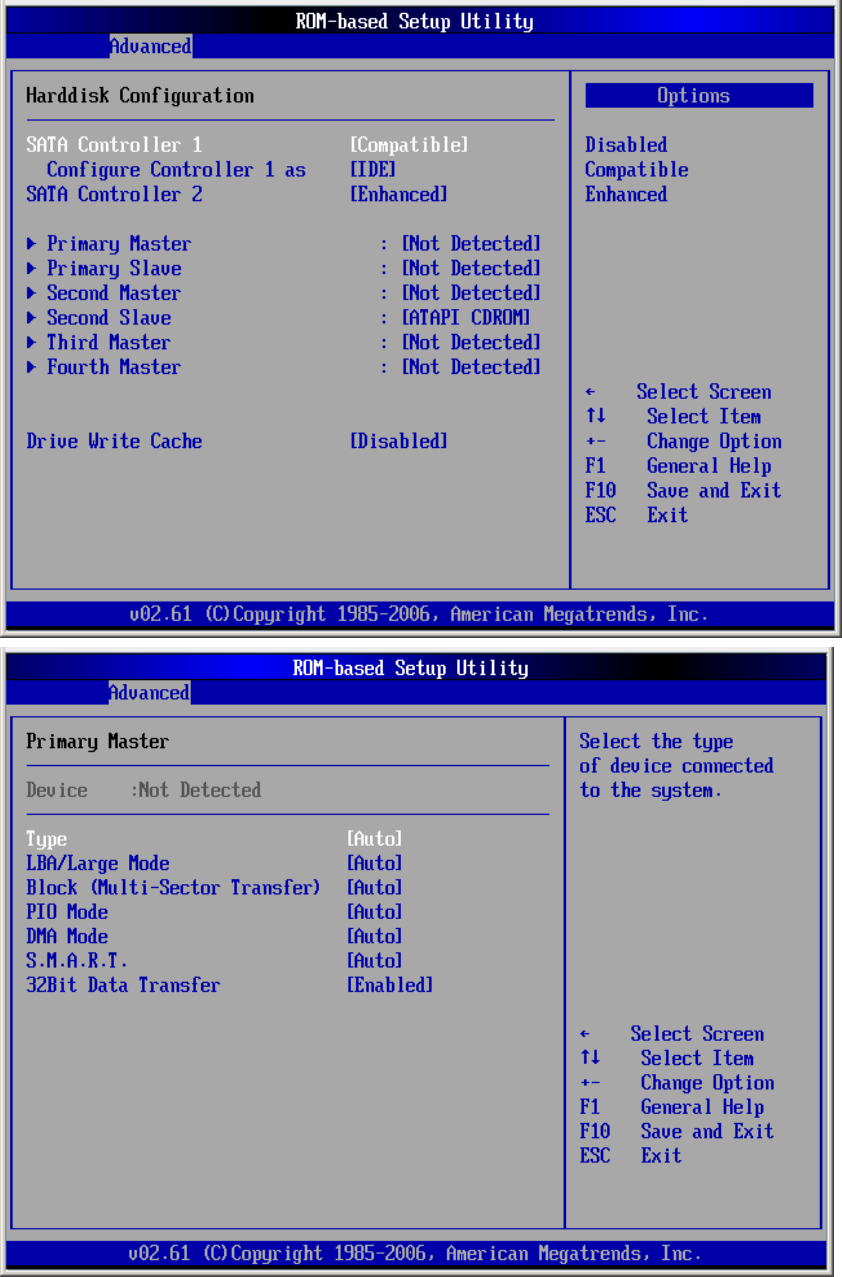
Diagnostic Tools and Setup Utilities 79
Figure 4-7 Advanced menu–Harddisk Configuration submenu
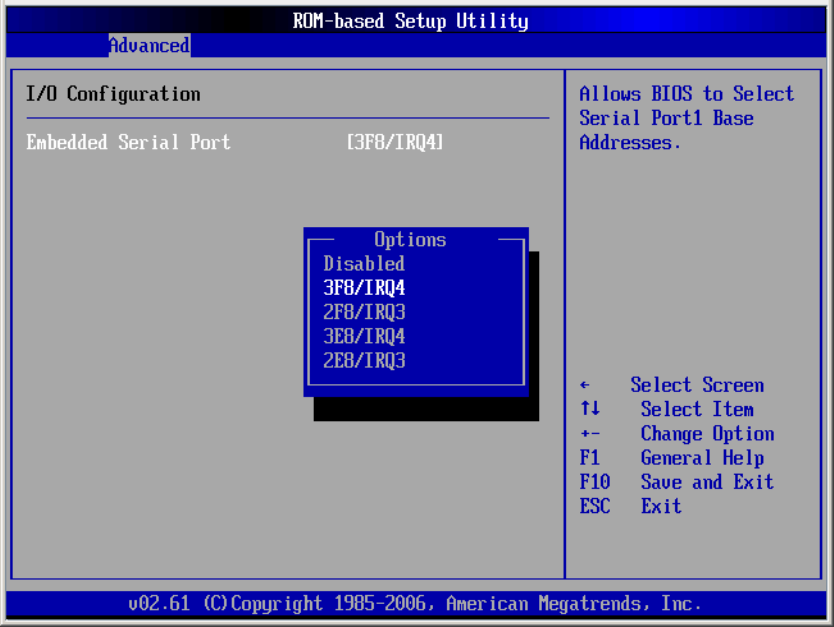
Diagnostic Tools and Setup Utilities 80
Figure 4-8 Advanced menu–I/O Configuration submenu
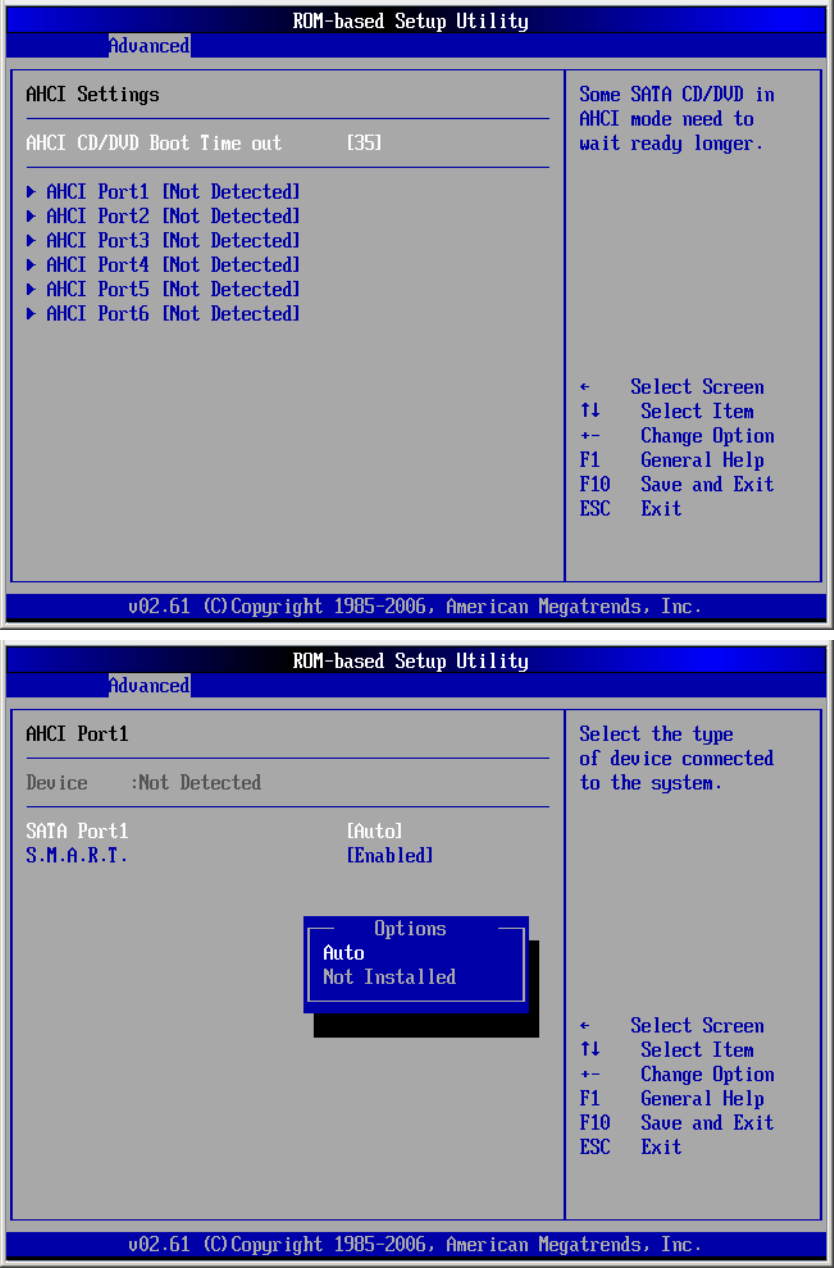
Diagnostic Tools and Setup Utilities 81
Figure 4-9 Advanced menu–AHCI Settings
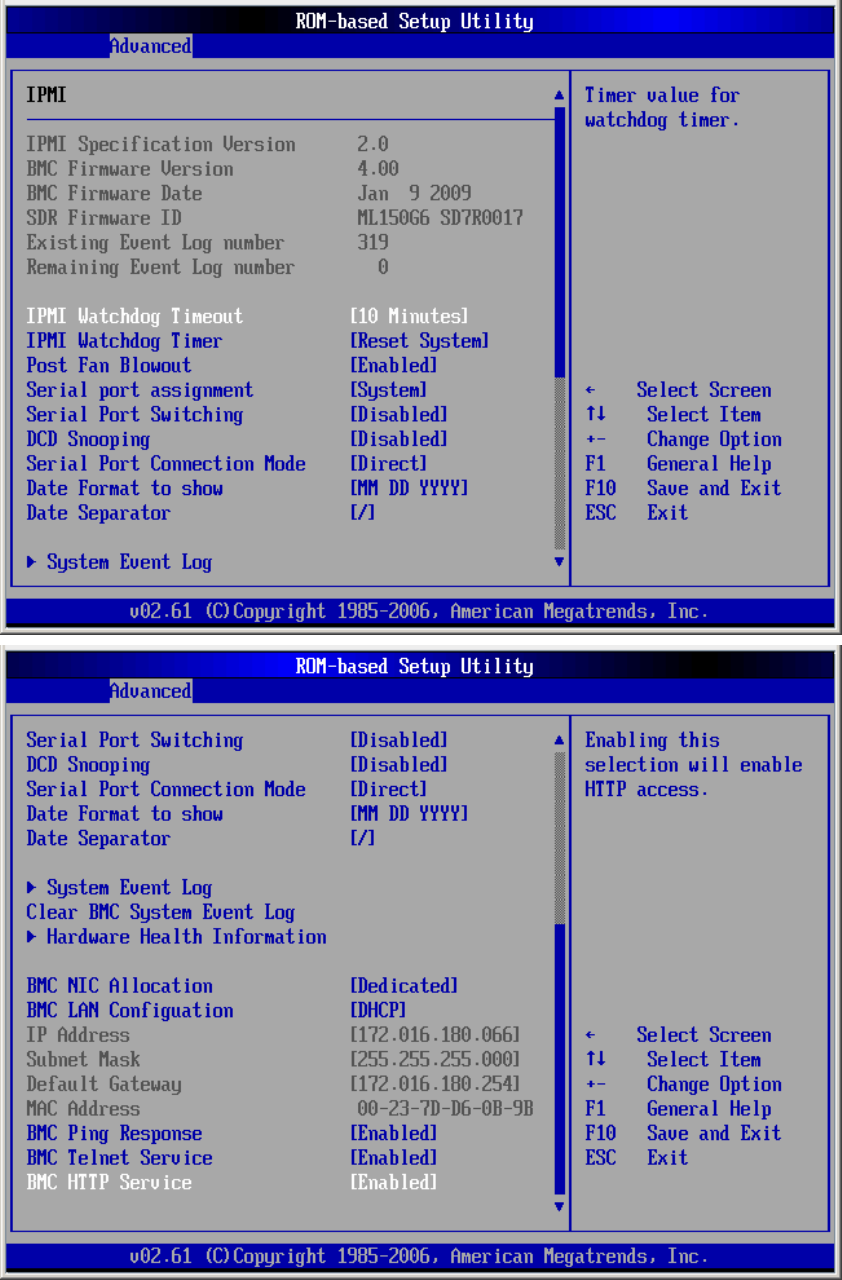
Diagnostic Tools and Setup Utilities 82
Figure 4-10 Advanced menu–IPMI submenu, upper screen
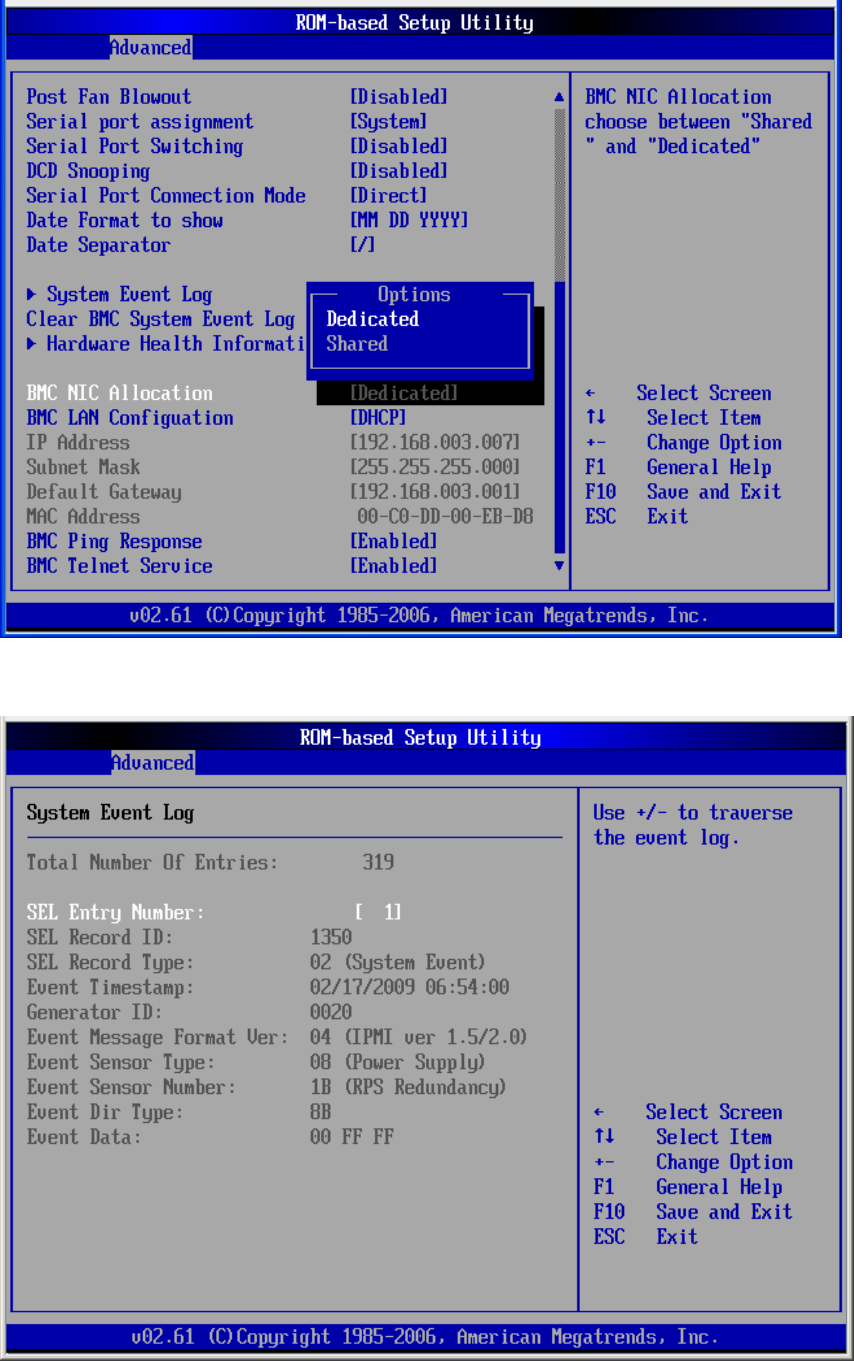
Diagnostic Tools and Setup Utilities 83
Figure 4-11 Advanced menu–IPMI submenu, System Event Log screen
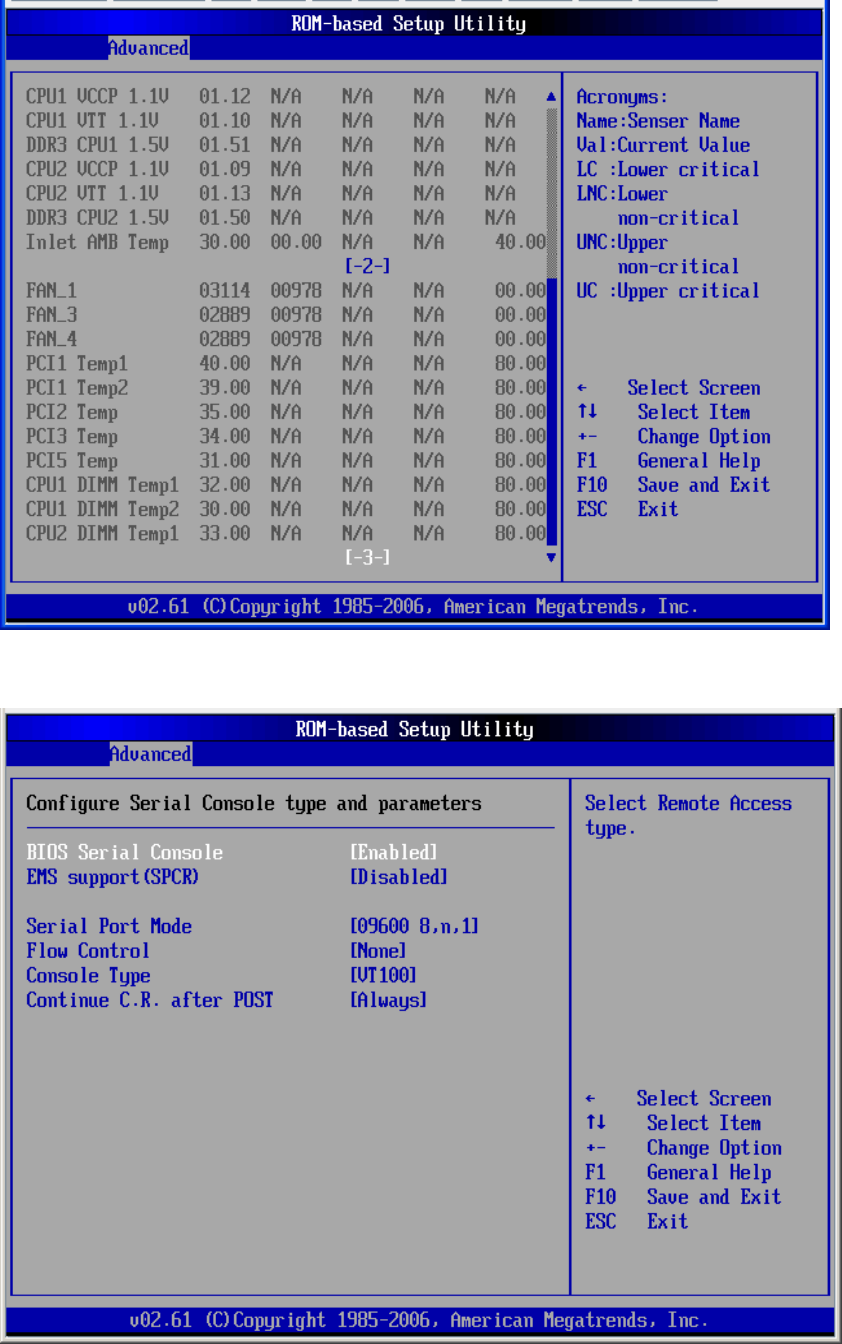
Diagnostic Tools and Setup Utilities 84
Figure 4-12 Advanced menu–IPMI submenu, Hardware Health Information
Figure 4-13 Advanced menu–Console Redirection submenu
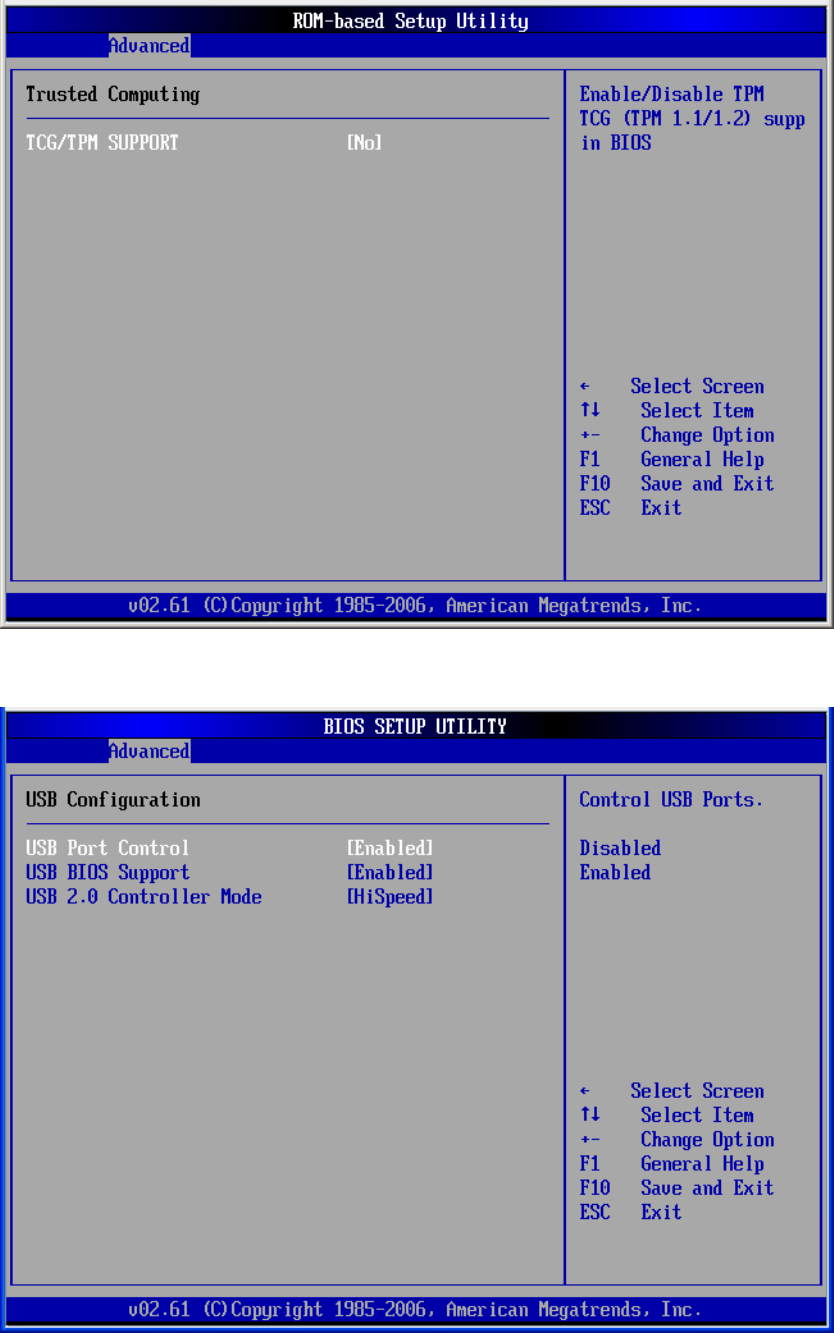
Diagnostic Tools and Setup Utilities 85
Figure 4-14 Advanced menu– Trusted Computing submenu
Figure 4-15 Advanced menu–USB Configuration submenu
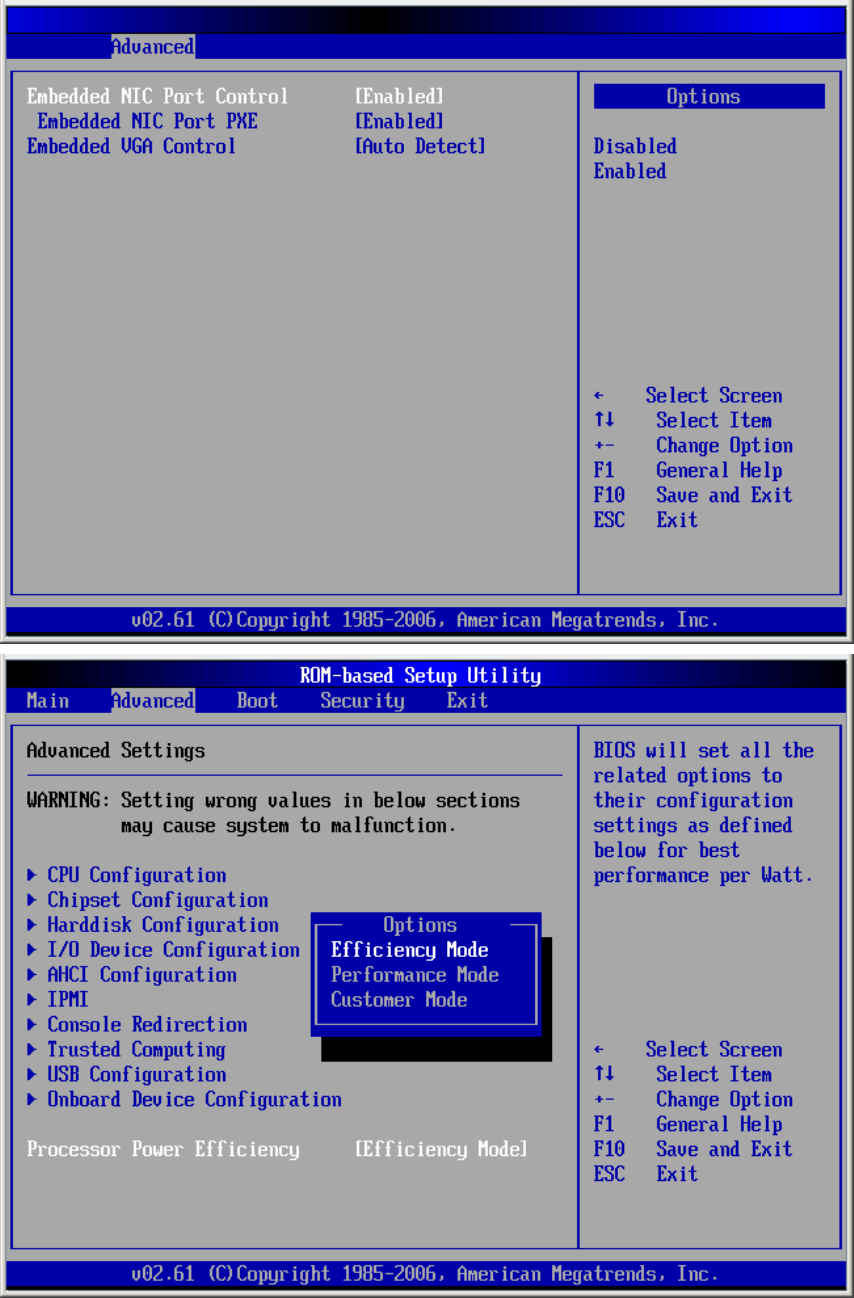
Diagnostic Tools and Setup Utilities 86
Figure 4-16 Advanced menu–Onboard Device Configuration submenu
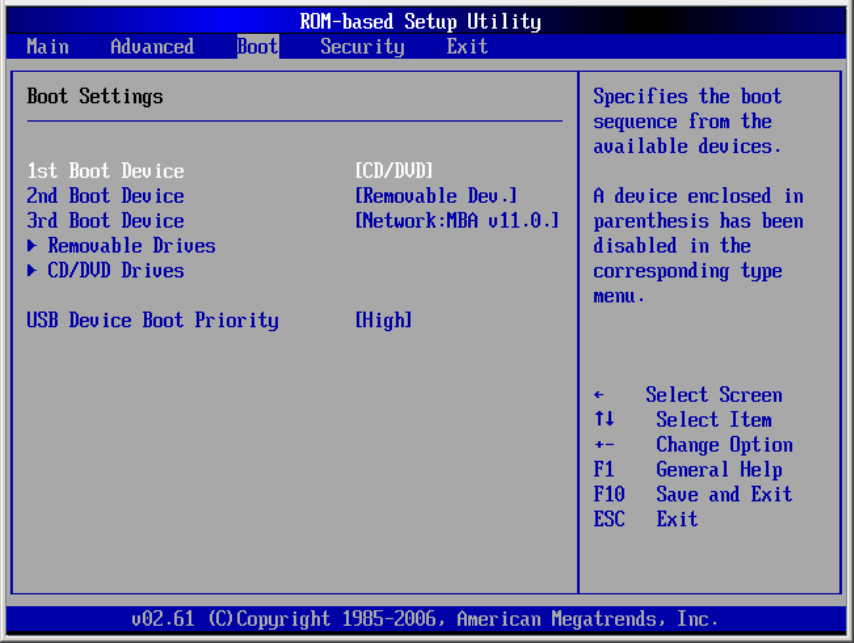
Diagnostic Tools and Setup Utilities 87
Boot menu
The boot menu (Figure 4-17) allows the user to configure the priority sequ ence of bootable devices.
By default, the server searches for boot devices in the followin g or der:
1. CD-ROM/DVD-ROM drives
2. Hard drive
3. USB boot precedence
Figure 4-17 Boot menu
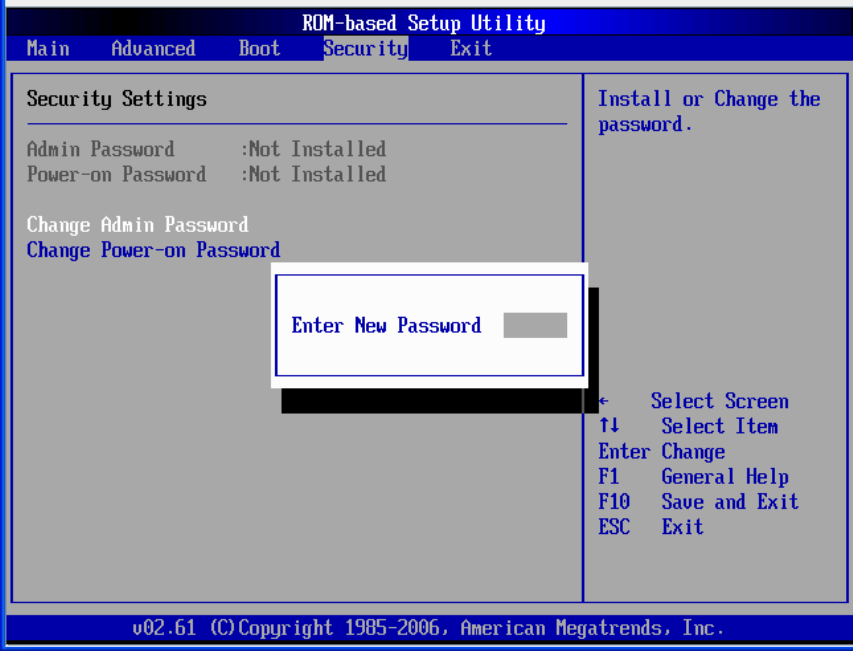
Diagnostic Tools and Setup Utilities 88
Security menu
The Security menu (Figure 4-18) allows the user to set the administrator password and the power-on
password.
The Administrator Password protection level allows the authorized user to change all settings in the
Setup Utility and configure acc ess for system us er s.
If the Administrator Password is set, t h e Power-on Password protection level allows t h e a uth orized user
to enable or disable the requirement of entering the Administrator Password when booting the server.
Figure 4-18 Security menu
The server is shipped with no password set. To set the administrator password:
1. In the Security menu, select - Set Admin Password, and then press Enter.
2. In the Enter New Password dialog box, type a new password and then press Enter (the
password may consist of up to six alphanumeric characters (A-Z, a-z, 0-9).
3. Retype the password to verify the first entry, and then press Enter.
4. Press F10 to close the Setup Utility.
5. After setting the password, Setup automatically sets the sel ected password field to Enabled.
The power-on password option (avail a ble only if the Administrator Password is set) is set by selecting
Change Power-on Password and selecting enable or disable.
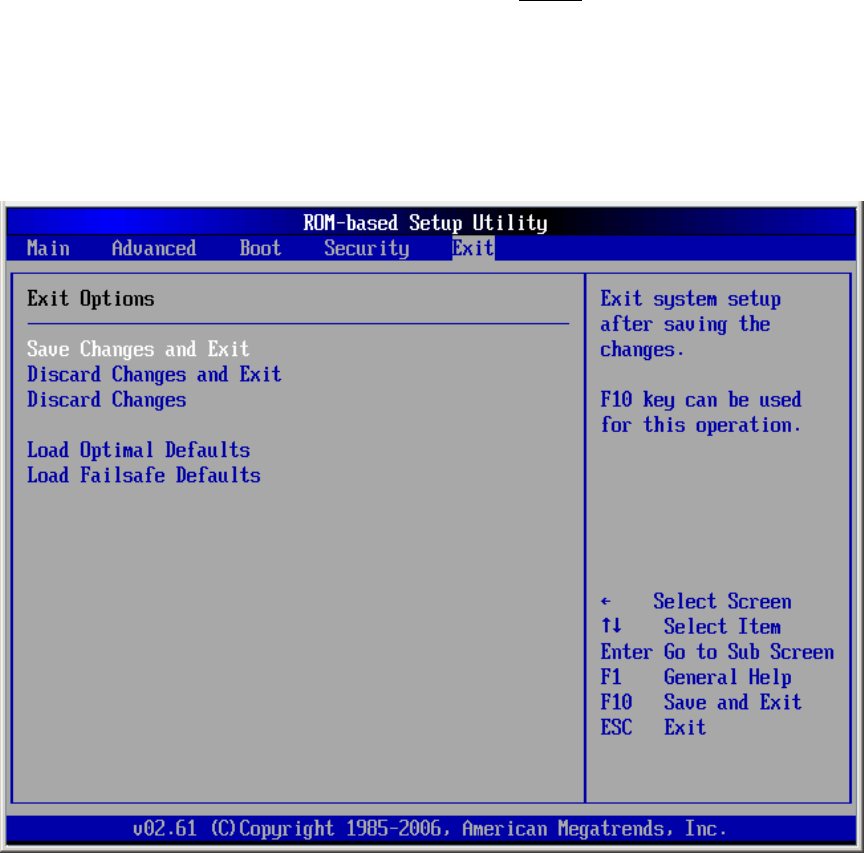
Diagnostic Tools and Setup Utilities 89
Exit menu
The Exit menu (Figure 4-19) allows a user to save or discard changes.
• Save Changes and Exit --- Save the changes you have made and exit the BIOS Setup Utility
(pressing the F10 key will perform the same function).
• Discard Changes and Exit --- Exit the BIOS Setup Utility without saving the changes you have
made (pressing the Esc key will perform the same function).
• Discard Changes --- Discard any changes you have made without exiting the BIOS Setup Utility.
• Load Optimal Defaults --- Load the suggested factory values for all items.
• Load Failsafe Defaults --- Load the factory values necessary for ba sic server operation.
Figure 4-19 Exit menu
Diagnostic Tools and Setup Utilities 90
BIOS Updating
To update the system BIOS, a BIOS Update USB disk must be created as follows:
1. Insert a USB disk into the USB port. Please make sure the USB disk can be formatted and
bootable.
Download the Smart Component (SPxxxxx.exe) to a directory on the hard drive and navigate to
that directory.
2. From that drive and directory, execute the downloaded file.
3. On executing t h e d own l oaded file, the user is prompted t o enter the drive letter to be
overwritten. Enter the drive letter of the USB disk. The utility creates a bootable USB disk and
copies the files over to t h e USB disk.
4. Reboot the ML150 G6 Server with the USB disk. Make sure the BIOS setting all ow s b ooting from
the USB disk.
5. Follow the on-screen instructions to finish the flashing of the BIOS.

Diagnostic Tools and Setup Utilities 91
Clearing CMOS
The Setup configuration values stored in battery-backed memory (CMOS) may need to be cleared if
the configuration has been corrupted or if incorrect settings made in the Setup Utility have caused
error messages to be unreadable.
NOTE: Clearing CMOS deletes all system configuration s and password settings.
To clear CMOS:
1. Power down the server.
2. Disconne ct t he power cord( s) f r om the server.
3. If necessar y, unlock the front bezel.
4. Remove the side access panel .
5. Locate the CMOS Clear jumper (JP12) on the system board (refer to the “System Board
Components, Switches, and Indicators” section in Chapter 5.
6. If necessary, remove any expansion boards or cables that prevent access to the CMOS Clear
jumper.
7. Plugged the C MO S Clear jumper.
8. If necessary, reinstall any expansion boards and cables.
9. Replace the access panel.
10. Reconnect the power cord(s).
11. Power up the server, and during POST, press F10 to access the Setup Utility.
12. Load setup defaults by pressing F9.
13. Set time, d ate, and other syst em values as nec essary.
14. Press F10 to close the Setup Utility.
Power-On Self Test
Before the server can be used, all devices must be tested and initialized, and the operating system
must be bootstrapped to the memory. This is referred to as Power–On Self Test or POST. POST is a
series of dia gnostic tests that checks firmware and hardw are components on the system to ensure that
the server is properly functioning. This diagnostic function automatically runs each time the server is
powered on.
These diagnostics, which reside in the BIOS ROM, isolate serve r-related logic failures and in d icate the
board or component that you need to replace, as indicated by the err or messages. Most server
hardware failures will be accurately isolated during POST. The number of tests displayed depends on
the configur ation of the server.
During POST you can:
• Press ESC to skip the HP logo an d go t o P OST boot progress display system summary screen.
• Press F7 to display the Boot menu.
• Press F10 to access the Setup Utility.
• Press F12 to request a network boot (PXE).

Diagnostic Tools and Setup Utilities 92
POST Error Indicators
When POST detects a system failure, it displays a POST error message.
Recoverable POST Errors
Whenever a non-fatal error occurs during POST, an error message describing the problem appears
onscreen. Th ese error messages are displayed in normal video (white text on black background), and
show the details of the error. The following is an exa mple of a POST error message:
Table 4-2 lists the most common PO S T error messages with corresponding troublesh ooting
recommendation. HP recommends that any errors be corrected, even if the server appears to boot
successfully.
Table
4
-2 POST Error Messages
Error Code Error Message Description/Corrective Action
002h ADM Module Error Activates ADM driver fail. ADM takes control of video and
starts serving the API for user output.
002h RAM R/W test failed Memory test read write fail ed Replace memory module(s).
002h Display memory test failed Output device (video) initialize failed.
002h Passwor d check failed P assword input err or. Reset the syst em and input password
again.
002h S.M.A.R.T. Command
Failed Hard disks SMART f ea t ure initialization failed.
005h PMM Allocate error PMM could n ot or did not allocate the requested amount
of memory for driver usage.
005h Refresh timer test failed Refresh retra ce test fail.
005h DMA Controll er E r ror HDD DMA controller error. Replace the HDD drive.
005h DMA-1 Error Error in the fir st D MA controller.
005h DMA-2 Error Error in the second DMA controller.
012h Timer Error The 8254 timer did not respond as expected. System
board replacement might be required.
012h CMOS Battery Low The CMOS battery is discharged. Repla ce the CMOS
battery.
501h Redundant Power Supply
#1 Unplugged
Redundant Power Supply #1 not detected. Check
Redundant Power Supply #1 and plug in.
502h Redundant Power Supply
#2 Unplugged
Redundant Power Supply #2 not detected. Check
Redundant Power Supply #2 and plug in.
Diagnostic Tools and Setup Utilities 93
Table
4
-2 POST Error Messages
Error Code Error Message Description/Corrective Action
503h Redundant Power Supply
#1 Failure
Redundant Power Supply #1 fails. Replace Redundant
Power Supply #1.
504h Redundant Power Supply
#2 Failure Redundant Power Supply #2 fails. Replace Redundant
Power Supply #2.
510h BMC SEL Is Full BMC SEL is full.
601h BMC not responding BMC is not responding.
5100h Unsupported Processor The processor is not sup ported.
Multi-Bit ECC Memory
Error
This message will only occur on systems using ECC
enabled memory modules. ECC memory has the ability
to correct single-bit errors that may occur from faulty
memory modules.
A multiple bit corruption of memory has occurred, and
the ECC memory algorithm cannot correct it. This may
indicate a defective memory module.
Fan Failure Sy st em fan failure. Uninstall fan.
System currently defaulted
to typical configura tion
settings. Pl ease run RBSU
to modify default settings.
CMOS is cleared or CMOS checksum is inva l i d.
FAN or Inlet ambient
sensor detect fa iled
System fan failure or Inlet ambient cable not present.
Parity Error Fatal Memory Parity Error. System halts after
displaying this message.
S.M.A.R.T. Status BAD,
Backup and Replace
A S.M.A.R.T. capable hard disk sends this message when
it detects an imminent failure.
This message can be reported by an ATAPI device using
the S.M.A.R.T. error reporting standard.
S.M.A.R.T. failure messa g es may indicat e t h e need to
replace the hard disk.
System Halted The system has been halted. A r eset or power cycle i s
required to reboot the machine. This message appears
after a fatal error has been detected.

Diagnostic Tools and Setup Utilities 94
POST Related Troubleshooting
The POST is an important routine that checks the basic functions of the server during the boot process.
Perform the following procedures when POST fails to run, displays error messages, or emit s beep
codes.
If the POST fails durin g b oot up (displays error messages, or em i ts beep codes), c h eck the following:
• All external cab les an d power cables should be firm ly plugged in.
• The power outlet to which the server is connected and is working.
• The server and monitor are both turned on. The bi-color status LED indicator on the front panel
must be lit up green.
• The monitor's contrast and brightness settings are correct.
• All internal cab les a re p r operly connected and all boards firmly seated.
• The process o r is fully seated in its socket on the syst em board.
• The heatsink assembly is properly insta l led on top of the pro cessor.
• All memory modules a re p roperly installed.
• If you have installed a PCI accessory board, verify that the board is firmly seated and any
switches or jumpers on the board are properly set. Refer to the documentation provided with the
accessory board.
• All internal cabling and connections are in their proper order.
• Verify that each switch on the system board is properly set, especially if any switch positions
have been changed p r ior to booting the server.
NMI button
The system board has a Non-Maskable Interrupt (NMI) button (SW3) that provides a diagnostic
function when the server is in an unrecoverable state (locked up or “hung”). The NMI button, when
pressed, allows a memory dump to be performed and crash dump files to be created before a hard
reset (power cycle) is performed. This funct io n requires support from the operating system (O S).
CAUTION: The NMI button i s fo r diagnostic purp oses only and sh o uld never be pressed w hile the
server is opera t in g n ormally. Pressing this button while the server is in normal operation will cause
the system to halt immediately.
NOTE: The NMI button may not work in some situations, such as if an NMI has already occurred or
if the OS crash handler is unable to run properly.
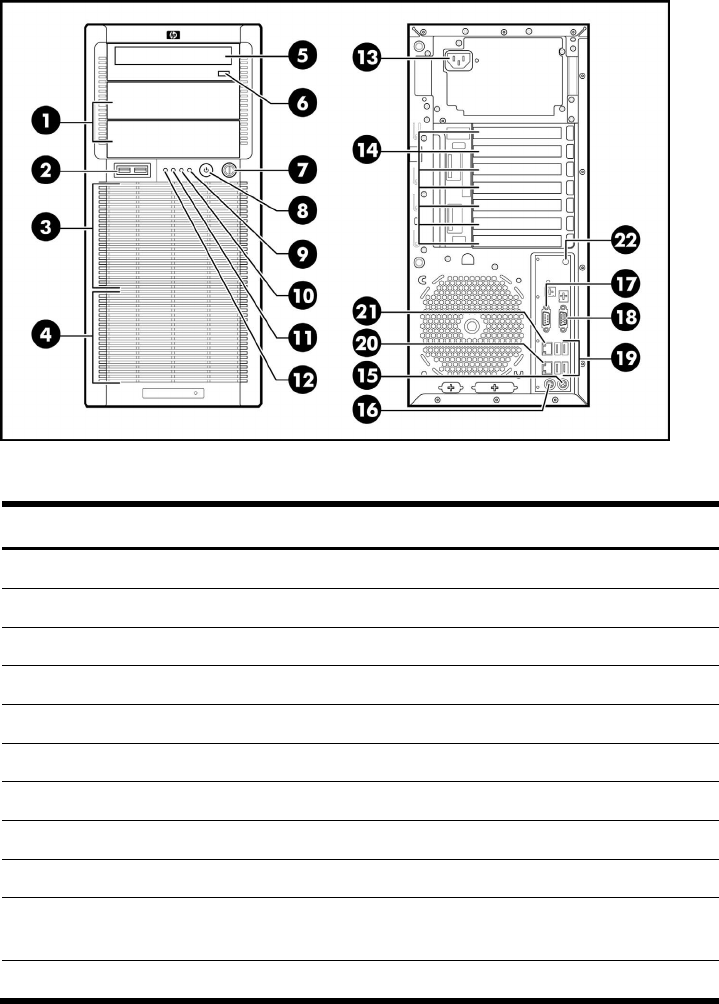
Diagnostic Tools and Setup Utilities 95
Components, Switches, and Indicators
This chapter contain s illustrations and tables identifying and describing the key components (including
connectors), switches, and LED indicators located on the front and rear panels, the system board, and
hard drives o f the HP ProLiant ML150 G6 Server.
Front and Rear Panel Components, Switches,
and Indicat or s
Figure 5-20 Front and Rear Panel Components, Switches, and Indicators
Table
5
-3 Front and Rear Panel Components
Item
Description
Item
Description
1 Media bays 12 System Health LED
2 USB 2.0 ports (2) 13 AC input connector
3 HDD bays 1-4 14 Expansion slots
4 HDD bays 5-8 15 Keyboard connector
5 Optical drive bay 16 Mouse connector
6 Media eject button 17 Serial port connector
7 Front key lock 18 VGA connector
8 System power button/LED 19 USB 2.0 ports (4)
9 HDD activity LED 20 NIC connector
10 NIC2 LED 21 Dedicate LO100 Management
port
11 NIC1 LED 22 UID
Diagnostic Tools and Setup Utilities 96
Table
5
-4 Front and rear panel LED indicator status
LED Status Description
System power Green System is on
Amber System is in standby, System is off,
but has AC power
Off System has no AC power
System health Red (blinking) Critical system failure detected
(processor, memory, regulator,
thermal event, fan, NMI)
Amber (blinking) System degraded
Green System is on and no failures
detected
Off System is off and there are no
failures prior to system power off
NIC1 Green (blinking) Network activity detected
Green Linked to the network
off Network not active
NIC2 Green (blinking) Network activity detected
Green Linked to the network
off Network not active
Hard drive activity Green (blinking) Drive activity
Off No drive activity
IPMI/NIC activity Green (blinking) Linked and activity on the network
Green (steady) Linked to the network
Off No connection
IPMI/NIC link Off No connection
Green 100 Mb/speed
Amber 1 Gb/speed
UID Blue Identification
Blue (blinking) System is being remotely managed
Off System is off
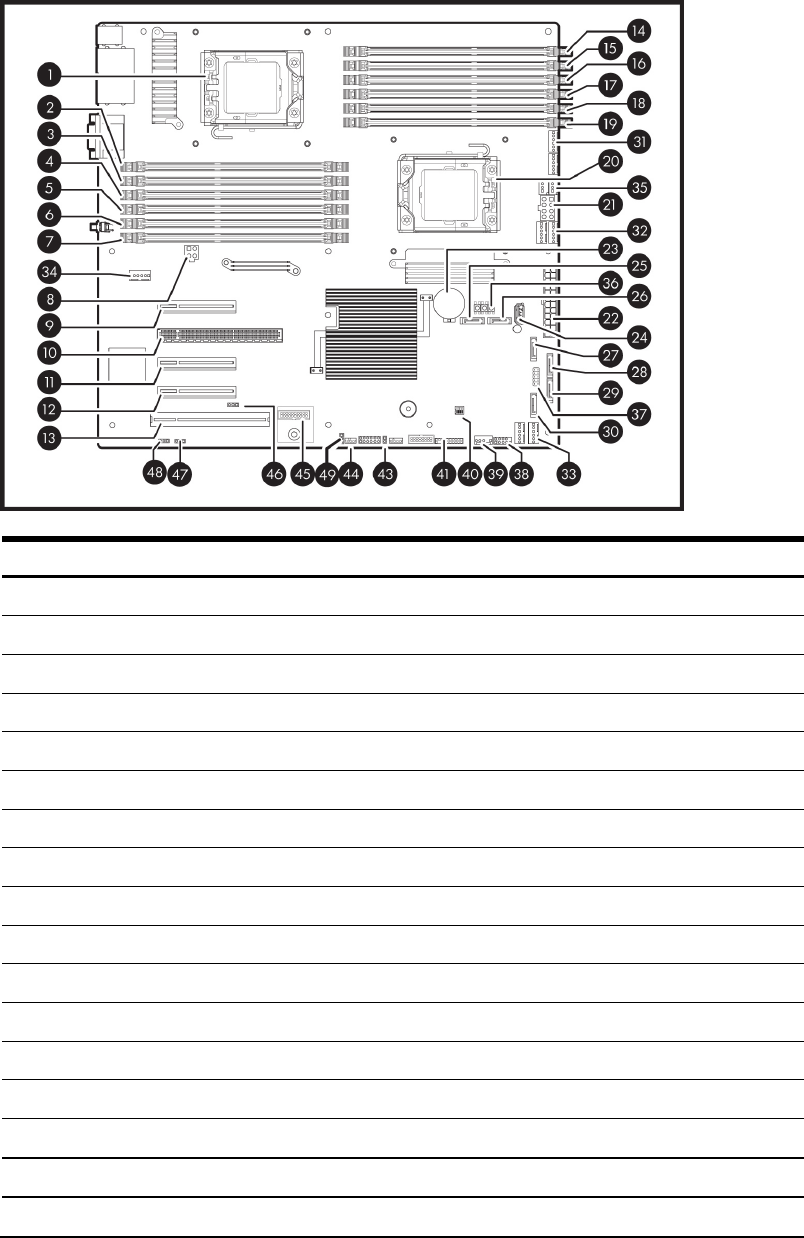
Diagnostic Tools and Setup Utilities 97
System Boa rd Components, Switches, and
Indicators
Figure 5-21 System Board Components, switches, and indicators
Item
Description
Item
Description
1 Processor 1 socket 26 SATA 5 ODD 1 connector
2 CPU1_DIMM slot 1D 27 SATA 4 connector
3 CPU1_DIMM slot 2A 28 SATA 3 connector
4 CPU1_DIMM slot 3E 29 SATA 2 connector
5 CPU1_DIMM slot 4B 30 SAT A 1 connector
6 CPU1_DIMM slot 5F 31 System fan 1
7 CPU1_DIMM slot 6C 32 System fan 2 (Redundant)
8 Power supply connector (4-pin) 33 System fan 3
9 Expansion slot 5 34 System fan 4
10 Expansion slot 4 35 I2C connector ( 2)
11 Expansion slot 3 36 NMI button
12 Expansion slot 2 37 SGPIO
13 Expansion slot 1 38 Front panel USB connector
14 CPU2_DIMM slot 6C 39 Internal USB port
15 CPU2_DIMM slot 5F 40 Chassis/Board ID DIP switch
16 CPU2_DIMM slot 4B 41 Front panel I/O connector
17 CPU2_DIMM slot 3E 42 Redundant power supply connector
Diagnostic Tools and Setup Utilities 98
Item
Description
Item
Description
18 CPU2_DIMM slot 2A 43 HDD LED connector
19 CPU2_DIMM slot 1D 44 Thermal sensor connector
20 Processor 2 socket 45 TPM
21 Power supply connector (8-pin) 46 CMOS Clear jumper
22 Power Supply connector (24-pin) 47 BMC Reset password jumper
23 Battery 48 BMC Recovery jumper
24 Internal USB connector 49 CMOS Reset password jumper
25 SATA 6 ODD 2 connector

Diagnostic Tools and Setup Utilities 99
System board switches and jumpers
CMOS clear jumper
The system board has a CMOS clear jumper (JP12, item 46 in Figure 5-2) that allows the system
configuration data in non-volatile memory to be cleared. To clear t he CMOS refer to the pr oce dure
described in Chapter 4 in the section “Clearing CMOS.”
CMOS reset password jumper
The system board has a CMOS password clear jumper (JP15) that allows the CMOS password data in
non-volatile memory to be cleared.
BMC recovery jumper
The system board has a BMC recovery jumper (JP8) that allows the BMC data in the memory to be
recovered.
BMC reset Password jumper
The system board has a BMC password clear jumper (JP10) that allows the BMC password data in
non-volatile memory to be cleared.
NMI button
The system board has a Non-Maskable Interrupt (NMI) button (SW3, item 36 in Figure 5-2) that
provides a diagn ostic function if the system becomes locked up or “hung.” For more information refer
to the Chapter 4 section “NMI button.”
CAUTION: The NMI button is for diagn ostic purposes only. Pressing this button while the server is in
normal operation will cause the system to halt immediately.
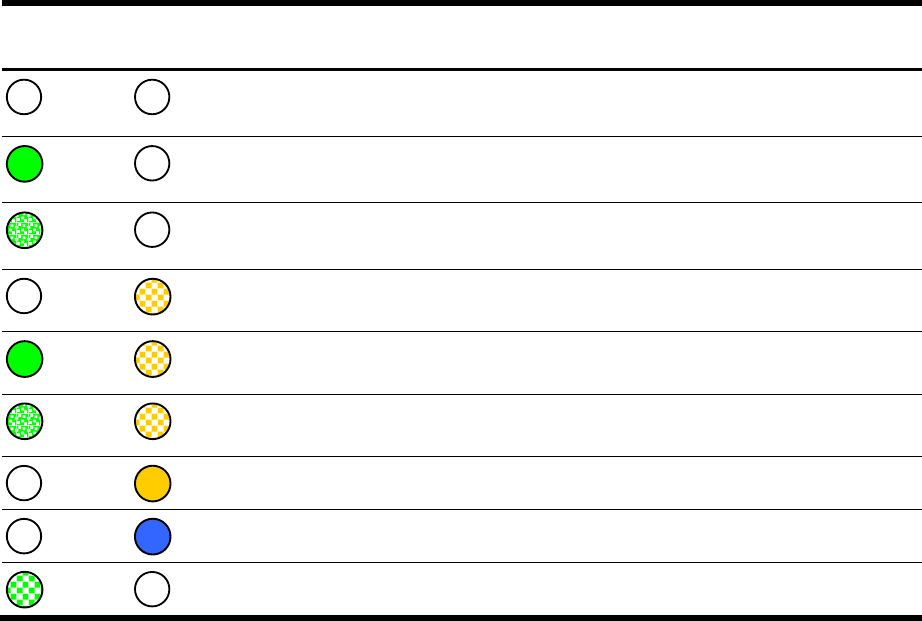
Diagnostic Tools and Setup Utilities 100
SAS/SATA Hot-Plug Hard Drive LEDs
The SAS and SATA hot-plug hard drive LEDs are located on each physical drive and visible when the
front bezel is open.
• Activity LED—This green LED indicates the disk drive access activity. This LED is controlled by the
disk drive d ir ect l y . When a drive is accessed, the LE D shows a green ligh t
• Status LED—This amber/blue LED indicates th e d r iv e operating condition: normal, warning, or
failure.
Table 5–3 describes the LEDs signals used to indicate the operating status of a SAS or SATA disk
drive.
Table
5
-5 Carrier status light definitions
Activity
(green)
Status
(amber/blue)
Description
No power, offline or not configured
Normal operation under power. no activity [green is on-solid]
Normal operation under power, disk activity [green is fluttering]
Offline, disk not being accessed, predictive failure [amber is flashing at
constant 1 Hz]
Online, no activity, predictive failure (further investigation required) [green is
fluttering, amber is flashing at constant 1 Hz]
Disk activity, predictive failure (further investigation required) [green is
fluttering, amber is flashing at constant 1 Hz]
Offline, no activity, critical fault condition [amber is on-solid]
Offline, drive selected (blue reserved for identification only) [blue is on steady]
Drive rebuilding [green is flashing at constant 1 Hz]

Physical and Operating Specifications 101
Physical and Operating Specifications
This chapter provides physical and operating specifications for the HP ProLiant ML150 G6 server.
Specifications a r e p rovided for the following:
• System unit
• Software
• Physical
• Environmental
• Power supply
• Memory
• Processor
• Optical drive
• SAS drive
• SATA drive
• SAS/SATA controller card
System Unit
Table
6
-1 Hardware Specifications
Item
Component
Processor socket Intel LGA1366(2)
Processor support Intel Xeon Dual-Core E5502
Intel Xeon Quad-Core
E5504/E5506/E5520/E5530/E5540
Chipset Intel® 5500 Chipset (IOH24D & ICH10R)
Hardware monitoring device Server Engines Pilot2
Gigabit Ethernet controller Broadcom BCM5723
Video controller Server Engines Pilot2
I/O subsystem
•
One PCI 2.3-compliant slot
•
Three PCIe x8 slots
•
1 PCIe x16 slots
Memory* 12 DIMM slots supporting up to 48 GB of registered and 24
GB of Un-buffered DIMMs with ECC
Default media storage
•
One-half height SATA optical drive
•
Non-hot-plug or hot-plug HDD cage supporting up to four
SATA/SAS hard drives
Physical and Operating Specifications 102
Table
6
-1 Hardware Specifications
Item
Component
Optional media storage
•
Two half-height drive bays for additional SATA optical
drive and tape drive
•
Second hot-plug HDD cage supporting up to four hot-
plug SATA/SAS hard drives
I/O ports PS2 keyboard port, PS2 mouse port, USB 2.0 ports (two
front-mounted ports, four rear-mounted ports and two internal
connectors on the system board), video (VGA) port, serial
port and NIC (GbE) port, Dedicate LO100 Management.
Status LED indicators Front panel:
•
System health
•
NIC1
•
NIC2
•
Hard drive activity
•
System power
Rear panel:
•
NIC activity
•
NIC link
•
UID
System board:
•
5-V auxiliary power
Power Supply unit (PSU) 460 watts single and 750 watts redundant
Thermal solution
•
Four system fans (rear system fan , two front system fan
and one redundant front system fans)
•
Processor heatsink
•
Power supply fan (one per power supply)
*460W PSU does not support registered DIMMs
Physical and Operating Specifications 103
Table
6
-2 Software Specifications
Item Description
Network operating system (NOS)
support
•
Microsoft Windows 2003 R2 Standard (X86/X64)
•
Microsoft Windows 2003 R2 Enterprise (X86/X64)
•
Microsoft Windows 2003 R2 Data Center
(X86/X64)
•
Microsoft Windows 2003 R2 Web Editions
(X86/X64)
•
Microsoft Windows 2008 Standard (X86/X64)
•
Microsoft Windows 2008 Enterprise (X86/X64)
•
Microsoft Windows 2008 Data Center (X86/X64)
•
Microsoft Windows 2008 Web Edition (X86/X64)
•
Microsoft Windows 2008 Embedded Systems
•
Microsoft Windows 2008 Essential Business Server
•
Microsoft Windows 2008 SBS
•
Red Hat Enterprise Linux 4 Edition (X86/X64)
•
Red Hat Enterprise Linux 5 Edition (X86/X64)
•
SuSE Linux Enterprise Server 10 Edition (X86/X64)
•
SuSE Linux Enterprise Server 11 Edition (X86/X64)
System diagnostics
•
AMI BIOS Setup Utility
•
HP Insight Diagnostics
Physical and Operating Specifications 104
Table 6-3
Physical Dimensions
Parameter Description
System board platform EATX (Extended Advanced Technology)
System board dimension 12 in. x 13 in.
Server dimensions in tower
configuration (H x W x D) 16.69 in. x 7.87 in. x 24.33 in.
(424 mm x 200 mm x 616.86 mm)
Server weight in basic
configuration, ex clud e s
keyboard and monitor
40.89 lb.
(18.55 kg)
Table
6
-4 Environmental Specifications
Parameter Description
Temperature:
Operating
Non-operating
Storage
Wet-bulb temperature
+50 to +95°F (+10 to +35°C)
-22 to 140°F (-30 to 60°C)
-22 to 140°F (-30 to 60°C)
84.2°F (29°C)
Relative humidity:
Operating
Non-operating
Storage
10% to 90% (non-condensing)
10% to 95%
10% to 95%
Altitude:
Operating
Non-operating
0 to 10,000 ft (0 to 3000 meters)
0 to 30,000 ft (0 to 9144 meters)

Physical and Operating Specifications 105
Table 6-5
Power Supply Specifications (460 W)
Parameter Description
Dimensions (H x W x D) 3.39 in. x 5.91 in. x 5.51 in. (86 mm x 150 mm x 140 mm)
Weight (approximate) 4.19 lb. (1.9 kg)
Input requirements :
Rated input voltage
Normal line voltage
90 VAC to 265 VAC
100 VAC to 127 VAC/200 VAC to 240 VAC
Line frequency 47 – 63 Hz
Rated input current load:
Low line
High line
10 A @100 VAC to 127 VAC
5 A @ 200 VAC to 240 VAC
BTU rating N/A
Power supply output power:
Steady state power in watts
Maximum peak power in watts
460 watts
490 watts
Temperature range:
Operating
Shipping
+10°C to +45°C
–40°C to +70°C
Relative humidity:
Operating
Non-operating
5% to 95% (non-condensing at +40° C)
90% (for a period of 24 hours at 65° C ambient)
Table
6
-6 Power Supply Specifications (750 W)
Parameter
Description
Dimensions (H x W x D) 1.515 in. x 3.4 in. x 7.5 in. (38.5 mm x 86.4 mm x 190.5 mm)
Weight (approximate) Max: 3 lb. (1.36 kg) (For reference only).
Voltage
+12 V static: +11.85 V to +12.45 VDC.
+12 Vaux static: +11.40 V to +12.60 VDC.
+12 V dynamic: +11.60 V to +12.60 VDC.
+12 Vaux dynamic: +10.80 V to +13.20 VDC.
Current:
+12 V
+12 Vaux
Max: 62.5 A
Max: 2.5 A
Power supply output power:
Steady state power in watts
Maximum peak power in watts
750 watts
750 watts

Physical and Operating Specifications 106
Table
6
-6 Power Supply Specifications (750 W)
Parameter
Description
Temperature range:
Operating
Shipping
+5°C to +50°C
-40°C to +85°C
Relative humidity:
Operating
Non-operating
5% to 95% (non-condensing)
5% to 95% (non-condensing)
Memory
Table
6
-7 Memory specifications
Item Description
Sockets Two DIMM sockets per channel (12 total)
DIMM capacity Registered DDR3: 1 GB, 2 GB, 4 GB/unbuffered: 1 GB, 2 GB, 4
GB
Speed 1066 MHz/1333 MHz
Supported technologies/Densities 1 Gb, 2 Gb x4 and x8 for Registered and 2 Gb, 4 Gb x8 and
x16 for unbuffered
DIMM type supported Registered DDR3 1066/1333 DIMM with ECC and unbuffered
DDR3 1333 DIMM with ECC
Processor
The HP ProLiant ML150 G6 server provides two Intel L G A1366 processor so ckets that support Intel
Nehalem Dual-Core E5502 and Intel Nehalem Quad-Core E5504/E5506/E5520/E5530/E5540
processors.
CAUTION: Two-processor (2P) syst ems must be config ured with processor s of t h e same type.
For systems configured with two process or s, both processors must be of the sam e type.
Table
6
-8 Intel Xeon Dual-Core Processor 5502 series specifications
Model
Number Operating
Frequency QPI On-die
L2 cache Thermal Design
Point (power)
E5502 1.86 GHz 4.8 GT/s 4 MB 80 watts
Physical and Operating Specifications 107
Table 6-9
Intel Xeon Quad-Core E5504/E5506/E5520/E5530/E5540 processors specifications
Model
Number Operating
Frequency QPI On-die
L2 cache Thermal Design
Point (power)
E5504 2.0 GHz 4.8 GT/s 4 MB 80 watts
E5506 2.13 GHz 4.8 GT/s 4 MB 80 watts
E5520 2.26 GHz 5.86 GT/s 8 MB 80 watts
E5530 2.40 GHz 5.86 GT/s 8 MB 80 watts
E5540 2.53 GHz 5.86 GT/s 8 MB 80 watts
Physical and Operating Specifications 108
SATA DVD-ROM Drive
Table
6
-10 SATA DVD-ROM Specifications
Parameter Description
Form factor 5.25 in, half-height
Dimensions:
Height
Width
Depth
41.5 mm (1.6 in)
145.8 mm (5.7 in)
170.0 mm (6.7 in)
Weight 0.8 kg (1.8 Ib)
Supported disc formats Mixed mode (audio and data combined)
CD-DA, mode (basic format), Mode 2, Form 1 and
Form 2
Photo-CD (multi-session), CD-XA
CD-1, CD-Plus/CD-Extra,0
CD-ROM, CD-R, CD-RW
DVD-ROM, DVD-ROM DL, DVD-RAM, DVD+R, DVD+R
DL, DVD+RW, DVD-R, DVD-RW, DVD-R DL
Read speeds CD-ROM, CD-R: up to 48x
CD-RW: up to 32x
DVD-ROM: up to16x
DVD+R/-R/+RW: up to 8x
DVD-RAM: up to 4x
Disc capacity
Single layer: up to 4.7 GB
Double layer: up to 8.5 GB
Average access time:
Typical random
Full stroke
CD: < 125 ms
DVD: <140 ms
CD: < 210 ms
DVD: < 250 ms
Three-way eject support Using software
Using drive open/eject button
Using emergency eject hole
Operating conditions:
Temperature
Relative humidity
41°F to 110°F (5°C to 50°C)
10% to 90% RH

Physical and Operating Specifications 109
SAS Hard Drive
Table
6
-11 SAS Hard drive specifications
Parameter
72-GB Drive
146-GB Drive
Capacity 72 GB 146 GB
Height 1 in 1 in
Width 4 in 4 in
Interface SAS SAS
Transfer Rate 1441 to 1607 MB/s 1441 to 1607 MB/s
Rotational Speed 15,000 RPM 15,000 RPM
Bytes per sector 512 512
Operating
Temperature 5°C to 60°C 5°C to 60°C
Table
6
-12 Dual Port SAS Hard drive specifications
Parameter 146-GB
Drive
300-GB
Drive
400-GB
drive
450-GB
Drive
750-GB
Drive
1-TB
Drive
Capacity 146 GB 300 GB 400 GB 450 GB 750 GB 1 TB
Height 1 in 1 in 1 in 1 in 1 in 1 in
Width 4 in 4 in 4 in 4 in 4 in 4 in
Interface SAS SAS SAS SAS SAS SAS
Transfer Rate 1607 to
1997 MB/s 1607 to
1997 MB/s 1607 to
1997 MB/s 1607 to
1997 MB/s 1607 to
1997 MB/s 1607 to
1997 MB/s
Rotational Speed 15,000 RPM 15,000 RPM 15,000 RPM 15,000 RPM 15,000 RPM 15,000
RPM
Bytes per sector 512 512 512 512 512 512
Operating Temperature 5°C to 60°C 5°C to 60°C 5°C to 60°C 5°C to 60°C 5°C to 60°C 5°C to
60°C

Physical and Operating Specifications 110
SATA Hard Drive
Table
6
-13 SATA Hard Drive Specifications
Item
160-GB
250-GB
500-GB
Capacity 160 GB 250 GB 500 GB
Dimensions:
Height
Width
Depth
26.10 mm (1.03 in)
101.6 mm (4.0 in)
147.0 mm (5.8 in)
26.10 mm (1.03 in)
101.6 mm (4.0 in)
147.0 mm (5.8 in)
26.10 mm (1.03 in)
101.6 mm (4.0 in)
147.0 mm (5.8 in)
Weight 0.63 kg (1.4 Ib) 0.63 kg (1.4 Ib) 0.63 kg (1.4 Ib)
Interface SATA 150 Gbps
8 MB Buffer
SATA 150 Gbps
16 MB Buffer
SATA 150 Gbps
16 MB Buffer
Maximum
transfer rate 3.0 Gb/s 3.0 Gb/s 3.0 Gb/s
Rotational speed 7200 RPM 7200 RPM 7200 RPM
Byte per sector 512 512 n/a
Sectors per drive 320,173,056 490,234,752 n/a
Operating
temperature
0°C to 60°C 0°C to 60°C 0°C to 60°C
Item 750-GB 1-TB
Capacity 750 GB 1 TB
Dimensions:
Height
Width
Depth
26.10 mm (1.03 in)
101.6 mm (4.0 in)
147.0 mm (5.8 in)
26.10 mm (1.03 in)
101.6 mm (4.0 in)
147.0 mm (5.8 in)
Weight 0.63 kg (1.4 Ib) 0.63 kg (1.4 Ib)
Interface SATA 16 MB, 32 MB Buffer SATA 32 MB Buffer
Maximum
transfer rate
300 Mb/s 300 Mb/s
Rotational speed 7200 RPM 7200 RPM
Byte per sector 512 512
Max. Block Number 1,465,149,167 1,953,525,167
Operating
temperature 0°C to 55°C 0°C to 55°C

Documentation feedback 111
Documentation feedback
HP is committed t o providing documentation that meets your needs. To help us improve the
documentation, send any errors, suggestions, or comments to Documentation Feedback
(mailto:docsfeedback@hp.com). Include the document title and part number, version number, or the
URL when submitting your feedback.

Index 112
Index
A
AC power
disconnecting, warning, 27
power-down procedures, 27
access panel
removing, 27
air baffle
removing, 43
B
battery
location, 60
replacement warnings, 60
replacing, 60
BIOS Setup Utility
accessing, 12.
additional navigation keys, 12.
menu bar, 114
BIOS software: Overview, 11.
C
cable connections, 32
cable management, 31
cautions
ESD, 24
improper airflow, 26
power fluctuations, 27
proper cooling, 27
CMOS
CMOS clear button location, 99
component-level repairs, warnings, 24
Components
front and rear panel, 95
system board, 97
cooling, caution, 27
CSR (customer self repair), 5
customer self repair (CSR), 5
D
Diagnostic tools and Setup Utilities
BIOS Setup Utility, 72
BIOS software, 72
BIOS update, 90
clear CMOS, 91
POST, 91
DIMM
slots, 52
documentation feedback, 111
drive bay configuration
optical drive, 34
overview, 33
tape drive, 34
drives, 33
cable connections, 32
cable management, 31
E
electrostatic discharge. See ESD
ESD
damage precautions, 25
work area recommendations, 25
F
front bezel
closing, 30
opening, 29
front fan/PCI card holder assembly
replacing, 62
H
hard drive, 36
hard drives
hot-plug, 38
non-hot-plug, 36
hardware configuration
access panel, 27
ESD damage prevention, 25
front bezel, 29
optical drive, 34
post-installation procedures, 26
power supply unit, 68
pre-installation procedures, 26
symbols in equipment, 26
system fans, 62
tape drive, 34
Index 113
tools, 24
Hardware Specifications, 101
chipset, 101
default media storage, 101
Hardware monitoring device, 101
I/O subsystem, 101
hazardous conditions. See symbols on equipment
HDD cage
backplane, 40
hot-plug, 40
non-hot-plug, 40
HDD cage, 40
hot surface
warning, 27
I
IDE CD-ROM Drive, 108
L
labels. See symbols on equipment
LEDs
SAS/SATA hot-plug hard drive LEDs indicators, 100
M
mass storage devices
drive bay configuration, 33
Memory, 106
memory modules
DIMM slots, 52
guidelines for installation, 52
installing, 55
module orientation, 55
removing, 53
N
NMI
NMI button usage, 94
non-hot-plug device, 24
Non-hot-plug device, 24
O
optical drive
adding, 34
P
parts
storing, 25
transporting, 25
PCI devices
bus channels, 56
PCI slots, 56
PCI expansion cards
PCI slots, 56
removing, 57
Peripheral Component Interconnect. See PCI devices
personal injury, warning, 27
power fluctuations, caution, 27
power supply
part number, 102
power supply unit. See PSU
power-down procedures, 27
Power-On Self Test
POST error indicators, 92
POST related troubleshooting, 94
recoverable POST errors, 92
processor
applying thermal grease, 46
installing, 47
installing, 46
overheating prevention, 54, 55
removing, 44
socket location, 42
Processor, 106
PSU
replacement warnings, 68
replacing, 68
R
Rear system fan, 32
S
SAS Hard Drive
specificati ons , 109
SATA Hard Drive
specificati ons , 110
Setup Utility menu bar
advanced menu, 77
boot menu, 87
exit menu, 89
security menu, 88
standby mode
effects, 27
symbols on equipment, 26
system board
configuration, 42
system board components
battery, 60
Index 114
expansion cards, 56
memory (DIMM), 52
processor, 42
system board components (location), 97
system board components (replaceable), 42
system board components, switches, 99
system covers
access panel, 27
front bezel, 29
system fan
replacing, 63
System Unit
specificati ons , 101
T
thermal grease
caution, 46
U
uninterruptible power supply. See UPS
UPS, 27
W
warnings
battery replacement, 60
component-level repairs, 24
hot surface, 27
improper repairs, 24
personal injury, 27
PSU replacement, 68
technician notes, 24
warranty, 5
work area recommendations, 25
