Es4540c 6550c Scan Guide V01
User Manual:
Open the PDF directly: View PDF  .
.
Page Count: 116 [warning: Documents this large are best viewed by clicking the View PDF Link!]
- Preface
- CONTENTS
- OVERVIEW
- BASIC OPERATION
- USEFUL FUNCTIONS
- Changing Scan Settings
- Specifying color mode
- Specifying resolution
- Selecting original mode
- Changing orientation
- Scanning 2-sided originals
- Specifying original size
- Changing compression ratio
- Removing blank pages
- Erasing black frames around images
- Adjusting exposure
- Adjusting contrast
- Adjusting background density
- Adjusting sharpness
- Adjusting color balance
- Previewing Scans
- Specifying E-mail Addresses
- Scanning With Dual Functions (Dual Agents)
- Encrypting PDF Files
- Changing Scan Settings
- USING TEMPLATES
- OTHER SCANNING METHODS
- INTERNET FAX
- INDEX

MULTIFUNCTIONAL DIGITAL SYSTEMS
Scanning Guide

©2011 TOSHIBA TEC CORPORATION All rights reserved
Under the copyright laws, this manual cannot be reproduced in any form without prior written permission of TTEC. No patent liability
is assumed, however, with respect to the use of the information contained herein.
Preface 1
Preface
Thank you for purchasing TOSHIBA Multifunctional Digital Systems or Multifunctional Digital Color Systems. This manual
provides instructions on how to use the equipment for scanning and Internet faxing. Read this manual before using your
Multifunctional Digital Systems or Multifunctional Digital Color Systems. Keep this manual within easy reach, and use it to
configure an environment that makes the best use of the e-STUDIO’s functions.
How to read this manual
Symbols in this manual
In this manual, some important items are marked with the symbols shown below. Be sure to read these items before using
this equipment.
Other than the above, this manual also marks information that may be useful for the operation of this equipment with the
following signs:
Model and series names in this manual
In this manual, each model name is replaced with a series name as shown below.
Explanation for control panel and touch panel
yIllustrations for the control panel and the touch panel shown in this manual are those of the e-STUDIO4540C Series.
The shape and location of some buttons on the control panel and the dimension of the touch panel of the
e-STUDIO6550C Series differ from those of e-STUDIO4540C Series, however, the names and functions of the buttons
and parts are the same.
yThe details on the touch panel menus may differ depending on the operating environment such as whether options are
installed.
yThe illustration screens used in this manual are for paper in the A/B format. If you use paper in the LT format, the
display or the order of buttons in the illustrations may differ from that of your equipment.
Indicates a potentially hazardous situation which, if not avoided, could result in death, serious
injury, or serious damage, or fire in the equipment or surrounding objects.
Indicates a potentially hazardous situation which, if not avoided, may result in minor or moderate
injury, partial damage to the equipment or surrounding objects, or loss of data.
Indicates information to which you should pay attention when operating the equipment.
Describes handy information that is useful to know when operating the equipment.
Pages describing items related to what you are currently doing. See these pages as required.
Model name Series name in this manual
e-STUDIO5540C/6540C/6550C e-STUDIO6550C Series
e-STUDIO2040C/2540C/3040C/3540C/4540C e-STUDIO4540C Series

2 Preface
Trademarks
yThe official name of Windows XP is Microsoft Windows XP Operating System.
yThe official name of Windows Vista is Microsoft Windows Vista Operating System.
yThe official name of Windows 7 is Microsoft Windows 7 Operating System.
yThe official name of Windows Server 2003 is Microsoft Windows Server 2003 Operating System.
yThe official name of Windows Server 2008 is Microsoft Windows Server 2008 Operating System.
yMicrosoft, Windows, Windows NT, and the brand names and product names of other Microsoft products are
trademarks of Microsoft Corporation in the US and other countries.
yApple, AppleTalk, Macintosh, Mac, Mac OS, Safari, and TrueType are trademarks of Apple Inc. in the US and other
countries.
yAdobe, Acrobat, Reader, and PostScript are either registered trademarks or trademarks of Adobe Systems
Incorporated in the United States and/or other countries.
yMozilla, Firefox and the Firefox logo are trademarks or registered trademarks of Mozilla Foundation in the U.S. and
other countries.
yIBM, AT and AIX are trademarks of International Business Machines Corporation.
yNOVELL, NetWare, and NDS are trademarks of Novell, Inc.
yTopAccess is a trademark of Toshiba Tec Corporation.
yOther company and product names given in this manual or displayed in this software may be the trademarks of their
respective companies.

CONTENTS 3
CONTENTS
Preface....................................................................................................................................... 1
Chapter 1 OVERVIEW
Scan Features ........................................................................................................................... 6
Scan functions....................................................................................................................... 6
Scan speed ........................................................................................................................... 9
Templates.............................................................................................................................. 9
Internet Fax Features ............................................................................................................. 10
Chapter 2 BASIC OPERATION
Viewing Touch Panel for Scan Menu.................................................................................... 12
Default Settings ...................................................................................................................... 14
Scan to e-Filing....................................................................................................................... 15
Scan to File ............................................................................................................................. 16
Scan to E-mail......................................................................................................................... 23
Scan to USB ............................................................................................................................ 29
Web Service (WS) Scan ......................................................................................................... 33
Using Saved Scan Data.......................................................................................................... 35
Using scan data saved as e-Filing documents.................................................................... 35
Using scan data saved as files ............................................................................................ 35
Viewing the Scan Job Status and Log.................................................................................. 37
Viewing the scan job status ................................................................................................. 37
Viewing the scan job log...................................................................................................... 38
Chapter 3 USEFUL FUNCTIONS
Changing Scan Settings ........................................................................................................ 40
Specifying color mode ......................................................................................................... 40
Specifying resolution ...........................................................................................................41
Selecting original mode ....................................................................................................... 41
Changing orientation ........................................................................................................... 42
Scanning 2-sided originals .................................................................................................. 43
Specifying original size ........................................................................................................43
Changing compression ratio................................................................................................ 44
Removing blank pages ........................................................................................................ 45
Erasing black frames around images .................................................................................. 46
Adjusting exposure ..............................................................................................................47
Adjusting contrast ................................................................................................................ 47
Adjusting background density.............................................................................................. 47
Adjusting sharpness ............................................................................................................ 48
Adjusting color balance ....................................................................................................... 48
Previewing Scans ................................................................................................................... 49
Specifying E-mail Addresses ................................................................................................ 51
Scanning With Dual Functions (Dual Agents) ..................................................................... 65
Encrypting PDF Files ............................................................................................................. 68

4 CONTENTS
Chapter 4 USING TEMPLATES
Registering Scan Templates ................................................................................................. 72
Using Scan Templates ........................................................................................................... 77
Chapter 5 OTHER SCANNING METHODS
Scanning Images Using the TOSHIBA e-STUDIO Remote Scan Driver ............................ 88
Scanning Images Using the TOSHIBA e-STUDIO WIA Driver ............................................ 89
Chapter 6 INTERNET FAX
Precautions for Internet Fax Transmissions ....................................................................... 92
Viewing Touch Panel for Fax Menu ...................................................................................... 93
Sending Internet Faxes ..........................................................................................................95
Sending Internet faxes ........................................................................................................ 95
Saving sent data as a file (Internet fax and file) .................................................................. 98
Setting advanced functions ............................................................................................... 102
Receiving Internet Faxes ..................................................................................................... 106
Available file formats ......................................................................................................... 106
Receiving Internet faxes .................................................................................................... 106
Viewing the Internet Fax Job Status and Log.................................................................... 107
Viewing the Internet fax job status..................................................................................... 107
Viewing the send log for Internet fax jobs.......................................................................... 108
Viewing the receive log for Internet fax jobs...................................................................... 109
Saving contact information to the address book................................................................ 109
INDEX ................................................................................................................................................................... 111

1.OVERVIEW
This chapter provides an overview of the scan and Internet Fax features.
Scan Features........................................................................................................................... 6
Scan functions........................................................................................................................................................6
Scan speed ............................................................................................................................................................9
Templates ...............................................................................................................................................................9
Internet Fax Features............................................................................................................. 10
1 OVERVIEW
6 Scan Features
Scan Features
With the equipment, originals placed in the Reversing Automatic Document Feeder* or on the original glass can easily be
scanned as image data. The image data can then be stored in the e-Filing boxes and/or the shared folder of the
equipment and/or sent to e-mail addresses.
* The Reversing Automatic Document Feeder is optional for the e-STUDIO4540C Series.
Scan functions
This equipment supports 5 scan functions; “Scan to e-Filing”, “Scan to File”, “Scan to E-mail”, “Scan to USB” and “Web
Service Scan”.
Scan to e-Filing
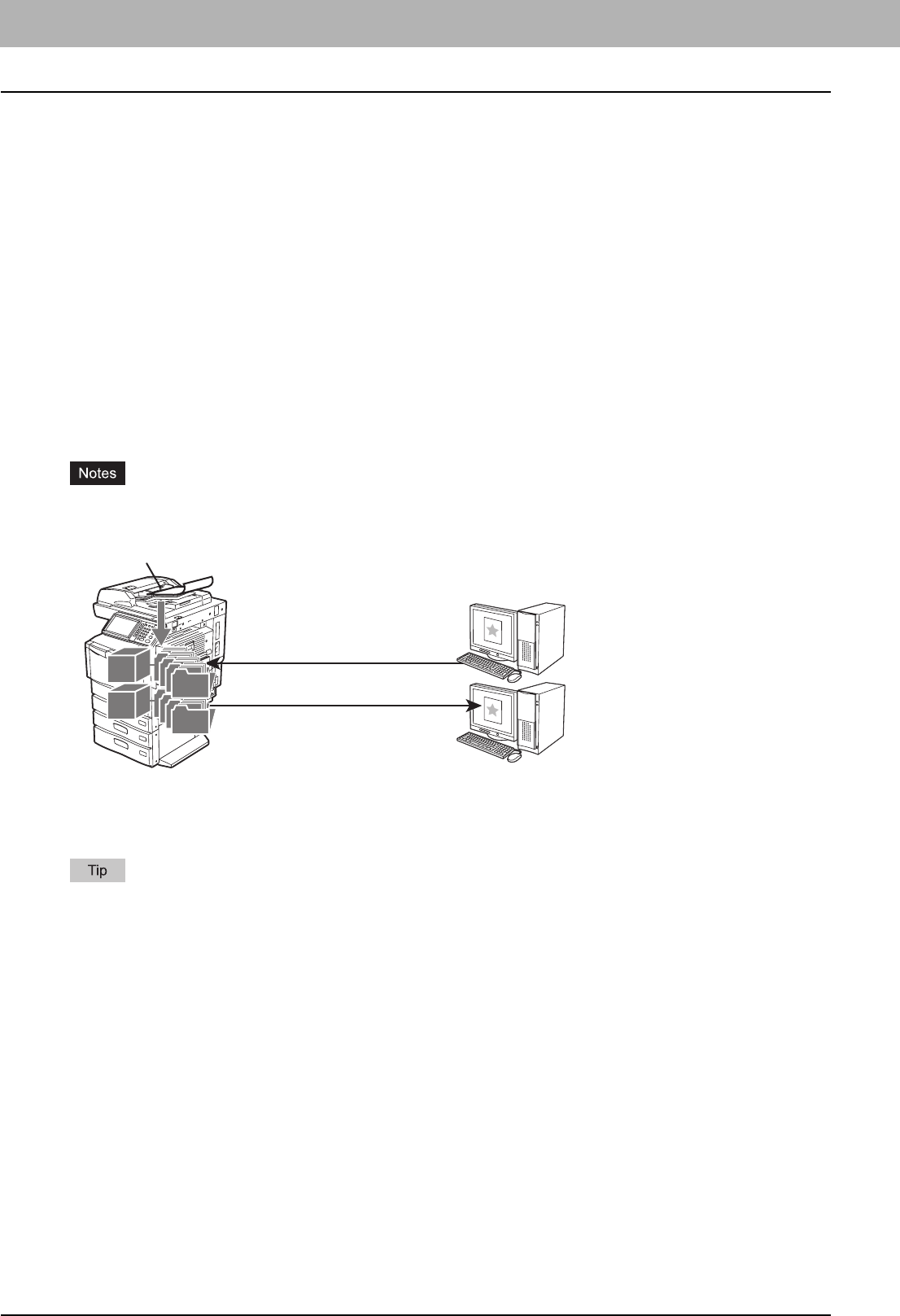
Scan to e-Filing allows you to store your scans as e-Filing documents in the equipment. The stored e-Filing documents
can be managed by creating boxes and folders. With the e-Filing Web utility, you can print the e-Filing documents or
merge them to create a new document. With the TWAIN Driver / File Downloader, you can retrieve this data and load it to
your computer.
Up to 27 GB of data can be stored in the e-Filing boxes and the shared folder in total. The remaining data capacity can be
viewed on the TopAccess [Device] tab.
yDelete documents stored in e-Filing when they are no longer needed.
yThe e-Filing boxes can be accessed from a client computer running Windows OS.
To learn more about Scan to e-Filing, see the following section:
P.15 “Scan to e-Filing”
To learn more about e-Filing, refer to the e-Filing Guide.
Windows
computer
Managing e-Filing documents
using a Web browser
Scan to e-Filing
Windows
computer
Retrieving e-Filing documents
as images using the TWAIN Driver
or File Downloader
e-Filing
e-Filing
e-Filing
1.OVERVIEW
Scan Features 7
1 OVERVIEW
Scan to File
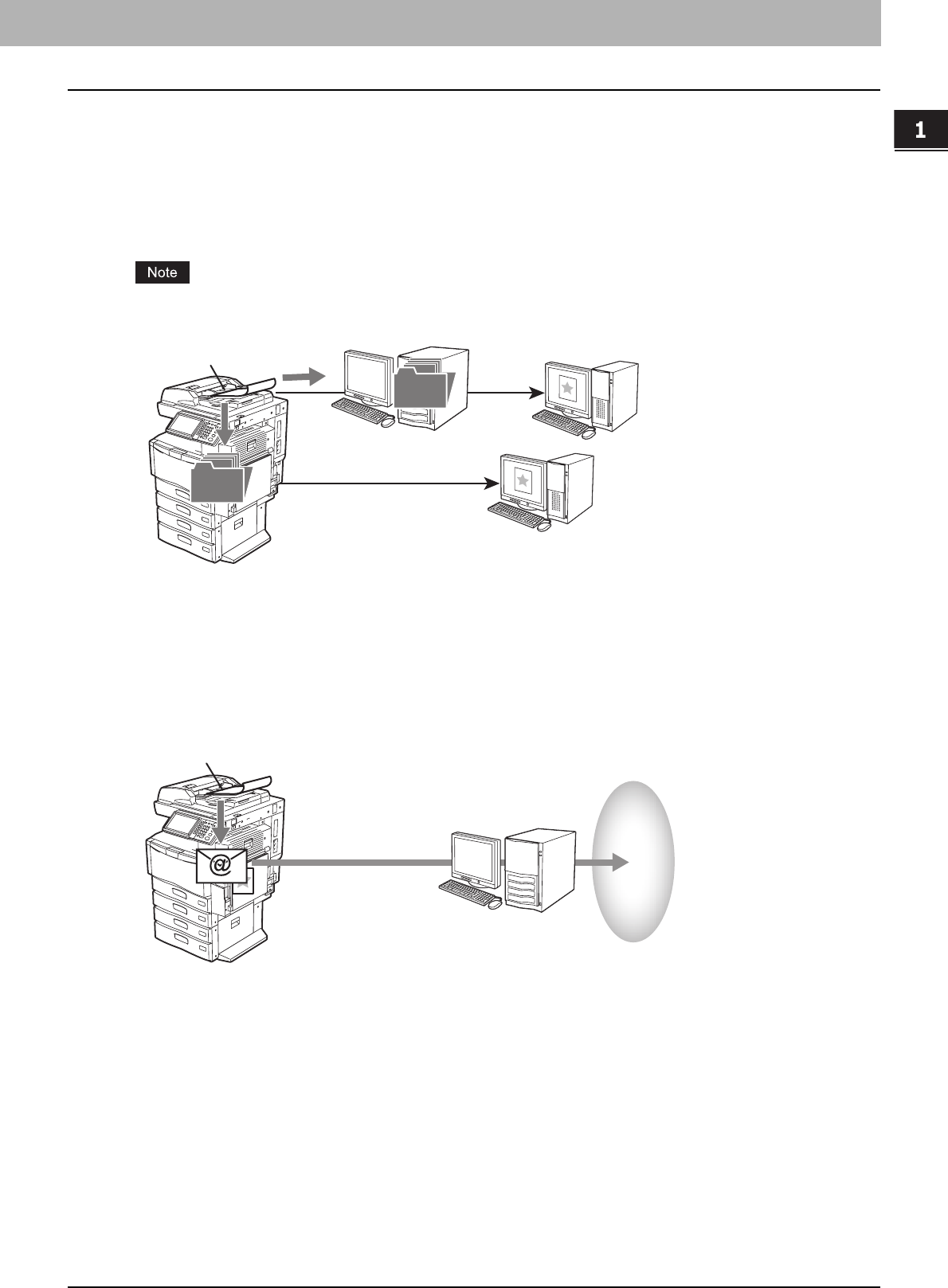
Scan to File allows you to store scans as PDF, XPS, TIFF or JPEG files in the shared folder in the equipment or in a
network folder. From these folders, you can copy the saved data and use it on your computer.
If you choose to store your scans in the network folder, the type of operating system, such as Windows or Macintosh, does
not matter; you can save the data in any network folder accessible by FTP, SMB, NetWare IPX, NetWare IP, or FTPS.
The equipment has a data capacity of 27 GB in the shared folder and the e-Filing boxes in total. The remaining data
capacity can be viewed on the TopAccess [Device] tab.
Delete documents stored in the shared folder when they are no longer needed.
To learn more about Scan to File, see the following section:
P.16 “Scan to File”
Scan to E-mail
Scan to E-mail allows you to send your scans to specified e-mail addresses. The scanned image is converted to a PDF,
XPS, TIFF, or JPEG file and sent as an e-mail attachment.
To learn more about Scan to E-mail, see the following section:
P.23 “Scan to E-mail”
Copying files from the shared
folder in the equipment
Scan to File
Copying files from the
network folder
Windows computer
or
Macintosh computer
Client
computer
Network Folder
Network Folder
Network Folder
Shared Folder
Shared Folder
Shared Folder
Scan to E-mail
Internet
Send e-mail to the Internet
via SMTP server
SMTP server
1 OVERVIEW
8 Scan Features
Scan to USB
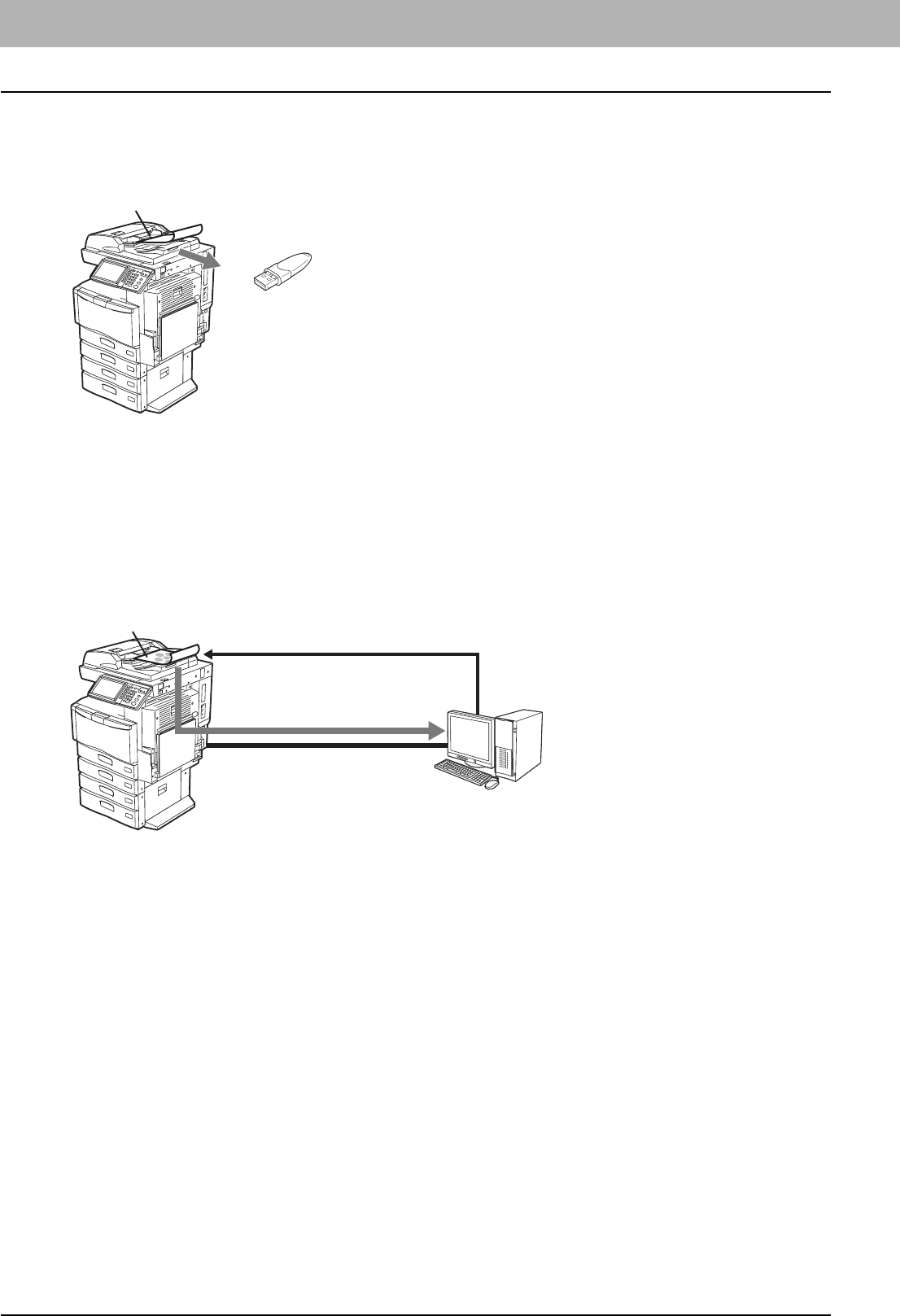
Scan to USB allows you to save scanned images as PDF, XPS, TIFF, or JPEG files in a USB storage device.
To learn more about Scan to USB, see the following section:
P.29 “Scan to USB”
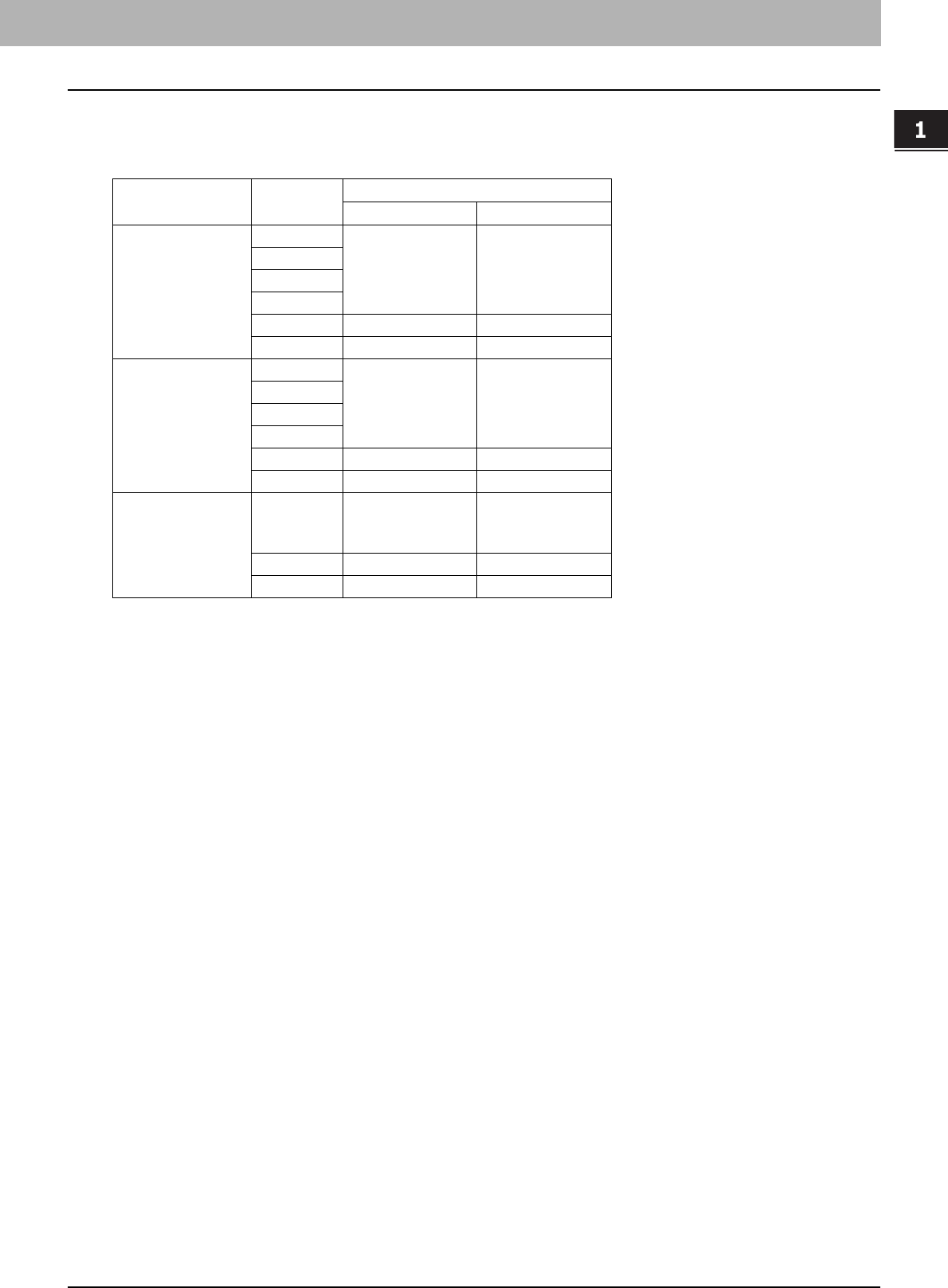
Web Service (WS) Scan
Web Service (WS) Scan uses the functions of Windows Vista / Windows 7 / Windows Server 2008 to scan images from a
client computer through the network. The images scanned on the equipment can be loaded to your client computer and
viewed via an application supporting the Windows Imaging Acquisition (WIA) Scan Driver.
To learn more about WS Scan, see the following section:
P.33 “Web Service (WS) Scan”
Scan to USB
USB Media
USB Media
USB Media
Perform scanning from the control panel
or through remote operation using
a WIA-compliant application.
Load a scanned image into
the WIA-compliant application.
Install the driver in advance.
Windows
Windows 7
Windows Server 2008
Vista
Originals
1.OVERVIEW
Scan Features 9
1 OVERVIEW
Scan speed
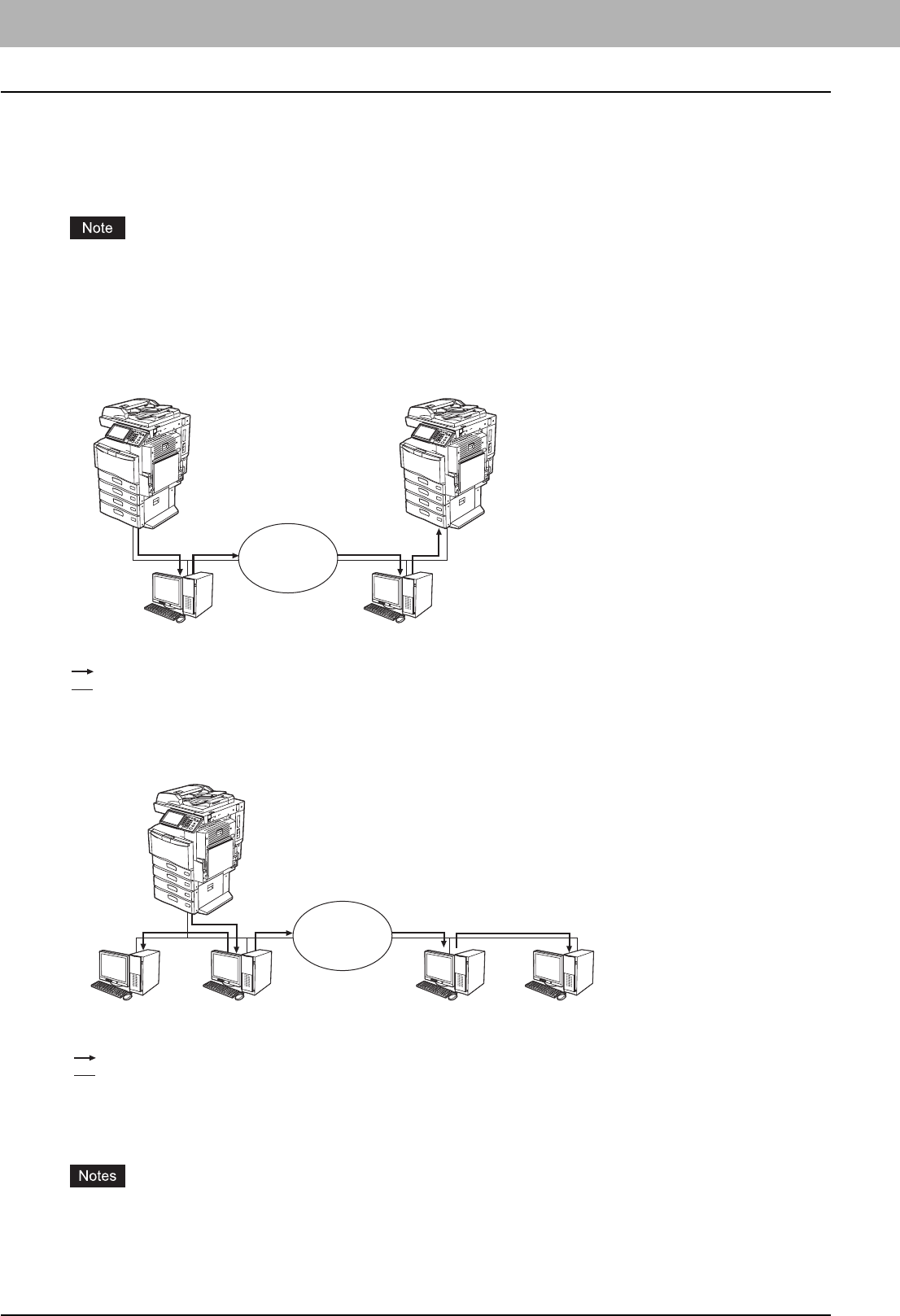
The scan speed depends on the selected color mode and resolution settings.
The approximate scan speed (for printing A4/LT) under each condition is listed in the table below.
The color mode and resolution settings can be changed on the SCAN SETTING screen. For details, see the following
sections:
P.40 “Specifying color mode”
P.41 “Specifying resolution”
Templates
Once you register a template, you can easily perform scan operations by recalling pre-set scan settings. With Meta Scan
Enabler GS-1010 (optional), you can attach meta data (XML files) to your scans and e-mail them and/or store them in the
equipment’s shared folder.
For instructions on how to register and use templates for scanning, see the following sections:
P.71 “USING TEMPLATES”
Color Mode Resolution Scan Speed
4540C Series 6550C Series
Black 100 dpi
57 pages/minute 77 pages/minute
150 dpi
200 dpi
300 dpi
400 dpi 53 pages/minute 66 pages/minute
600 dpi 45 pages/minute 62 pages/minute
Gray Scale 100 dpi
57 pages/minute 77 pages/minute
150 dpi
200 dpi
300 dpi
400 dpi 53 pages/minute 66 pages/minute
600 dpi 45 pages/minute 53 pages/minute
Full Color/Auto Color 100 dpi
150 dpi
200 dpi
300 dpi
57 pages/minute 77 pages/minute
400 dpi 53 pages/minute 66 pages/minute
600 dpi 45 pages/minute 53 pages/minute
1 OVERVIEW
10 Internet Fax Features
Internet Fax Features
Internet Fax allows a copy of a scanned document to be sent as an e-mail with an attached TIFF-FX (Profile S) file. Since
an Internet line is used instead of a phone line, the communication costs can be dramatically reduced.
With Internet Fax, an e-mail address is to be specified in place of a phone number to transmit a copy of a scanned
document to the Internet Fax equipment or the client computers.
When an Internet Fax is received, it is automatically output just like a traditional fax.
Internet faxing requires the network settings configured by the network administrator. Consult your network
administrator for help.
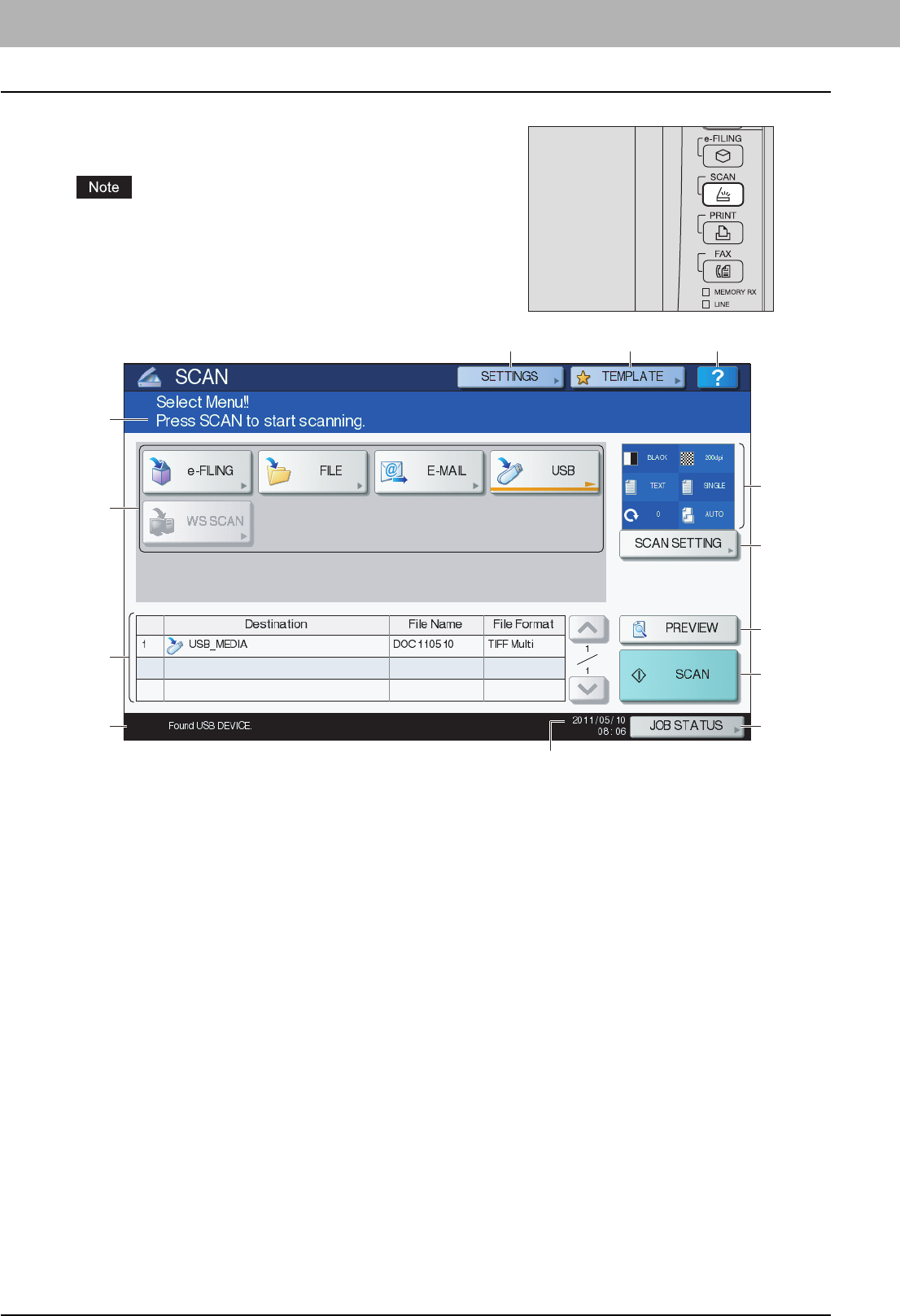
With Internet Fax, you can perform various transmissions as illustrated below.
yInternet Fax Equipment to Internet Fax Equipment
The equipment can send a copy of a document to other Internet Fax equipment via Internet or Intranet. The copy of the
document is sent as an e-mail.
yInternet Fax Machine to/from Client Computers
The equipment can send a copy of a document as an e-mail to client computers via Internet or Intranet. The client
computers can send an e-mail to the equipment as well.
For instructions on Internet faxing, see the following section:
P.91 “INTERNET FAX”
yWhen the equipment sends a copy of a document using Internet Fax, the client computer receives the copy as
TIFF-FX (Profile S) images.
yThe equipment can print out only text files and image files in TIFF format; from the client computer, you cannot
send files other than text or TIFF images to the equipment. For available formats, see the following section:
P.106 “Available file formats”
E-mail transmission
LAN
Mail serverMail server
Internet
Intranet
E-mail transmission
LAN
Mail server Mail serverClient computer Client computer
Internet
Intranet

2.BASIC OPERATION
This chapter describes the basic scanning operations.
Viewing Touch Panel for Scan Menu.................................................................................... 12
Default Settings...................................................................................................................... 14
Scan to e-Filing....................................................................................................................... 15
Scan to File ............................................................................................................................. 16
Scan to E-mail......................................................................................................................... 23
Scan to USB............................................................................................................................ 29
Web Service (WS) Scan ......................................................................................................... 33
Using Saved Scan Data ......................................................................................................... 35
Using scan data saved as e-Filing documents .....................................................................................................35
Using scan data saved as files.............................................................................................................................35
Viewing the Scan Job Status and Log.................................................................................. 37
Viewing the scan job status ..................................................................................................................................37
Viewing the scan job log.......................................................................................................................................38
2 BASIC OPERATION
12 Viewing Touch Panel for Scan Menu
Viewing Touch Panel for Scan Menu
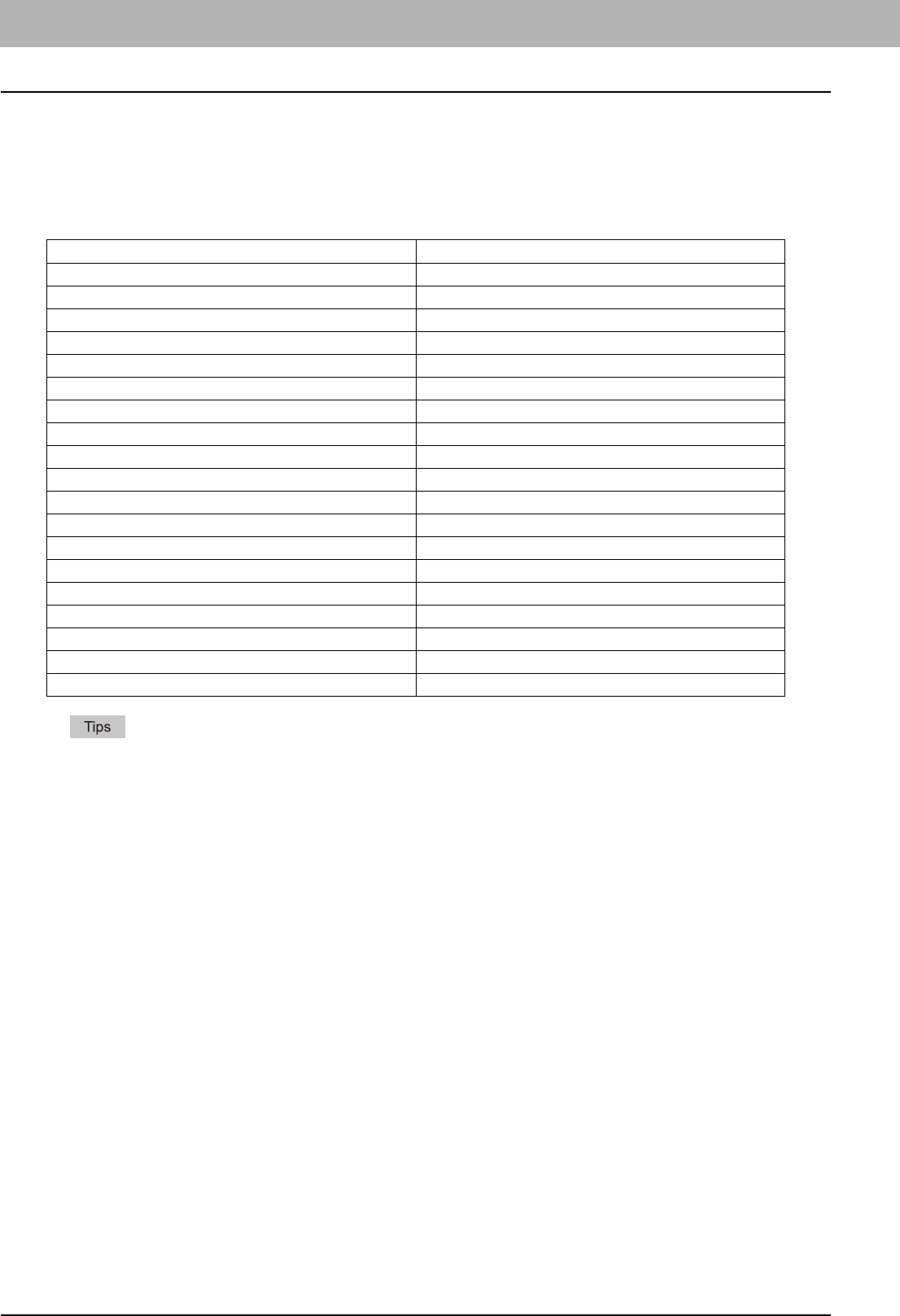
1) Message Display Area
Operational instructions and the status of the equipment are displayed.
2) Function Buttons
Press one of these buttons when you select the scan function. Pressing one of these buttons displays the set-up
screen specific to the selected scan function.
3) Destination Display Area
The scan jobs are displayed before their performance in the saving destinations or addresses.
4) Alert Message Display Area
Alert messages are displayed when the equipment needs a toner cartridge replacement, the waste toner box needs
cleaning, etc. For details on these messages, refer to the Troubleshooting Guide.
5) Date and Time
6) [JOB STATUS]
Press this button when you want to monitor your copy, fax, scan, and/or print jobs or view the job logs.
P.37 “Viewing the scan job status”
P.38 “Viewing the scan job log”
7) [SCAN]
Press this button to perform scanning.
When you press the [SCAN] button on the control panel, the SCAN
menu is displayed on the touch panel.
If the equipment is managed by the Department Management or
User Management features, you need to enter a department code
or the user information, such as the user name and password.
5
1
111213
2
3
46
7
8
9
10

2.BASIC OPERATION
Viewing Touch Panel for Scan Menu 13
2 BASIC OPERATION
8) [PREVIEW]
Press this button when you want to preview your scans.
P.49 “Previewing Scans”
9) [SCAN SETTING]
Press this button to change scan settings applicable to “Scan to e-Filing”, “Scan to File”, “Scan to E-mail” and “Scan to
USB”.
P.40 “Changing Scan Settings”
10) Scan Settings Display Area
The selected scan settings are displayed.
11) [?] (Help Button)
Press this button for descriptions on each function or button on the touch panel.
12) [TEMPLATE]
Press this button when you want to use a template.
P.71 “USING TEMPLATES”
13) [SETTINGS]
Press this button to display a list of the selected options for scan settings.
2 BASIC OPERATION
14 Default Settings
Default Settings
A default refers to a setting selected automatically when you turn on the equipment, when the equipment wakes up from
Sleep Mode, or when the [FUNCTION CLEAR] button is pressed on the control panel. To scan your document, the default
settings can be used as they are whereas pressing [SCAN SETTING] during the scan operation allows you to select the
preferred settings for each scan job.
P.40 “Changing Scan Settings”
The available settings in the scan mode and their factory defaults are listed in the table below.
yTo display a list of the selected options for scan settings, press [SETTINGS].
P.12 “Viewing Touch Panel for Scan Menu”
yThe default settings can be changed using the [USER FUNCTIONS] button on the control panel. For details, refer
to the MFP Management Guide.
Settings Factory Defaults
Color Mode BLACK
Resolution 200 (dpi)
Original Mode TEXT
Rotation 0 (degrees)
Single/2-sided Scan SINGLE
Original Size AUTO
Compress MID
Omit Blank Page OFF
Outside Erase OFF
Range Adjustment ±0
Exposure AUTO
Contrast ±0
Background Adjustment ±0
Sharpness ±0
Saturation ±0
RGB Adjustment
Red (R) ±0
Green (G) ±0
Blue (B) ±0

2 BASIC OPERATION
Scan to e-Filing 15
Scan to e-Filing
With this function, you can scan originals and store the scans in e-Filing boxes. Up to 27 GB of data can be stored in the
e-Filing boxes and the shared folder in total. You can scan 200 pages per job.
When saving your scans, you can specify a public box or one of the user boxes. The public box is a pre-defined box and is
used to store documents that any users of the equipment may need to work with. A user box is one created by the user. If
a password has been set for a user box, you need to enter the correct password to access it.
The stored data can be printed out any time from the touch panel. You can also manage the data using the e-Filing web
utility. With the e-Filing web utility, you can create user boxes and folders, print documents, and even merge several
documents to create a new one.
For instructions on how to store your scans with Scan to e-Filing, create user boxes, and print e-Filing documents, refer to
the e-Filing Guide.
yBefore saving your scans in a user box, you need to set up the user box.
yTo prevent loss of data, we recommended that you back up the data saved in the equipment’s hard disk. You can
back up the data with the computer using File Downloader or e-Filing Backup/Restore Utility.
yDelete documents stored in e-Filing when they are no longer needed.
2 BASIC OPERATION
16 Scan to File
Scan to File
The Scan to File or USB function sends and stores scans to a shared folder in the equipment’s hard disk or a specified
network folder. The equipment has a data capacity of 27 GB in the shared folder and the e-Filing boxes in total. You can
scan up to 1000 pages per job.
The data stored in the shared folder can be accessed directly from the computer via network.
yThe shared folder in the equipment’s hard disk can contain a maximum of 2000 files.
yThe network administrator has to make settings for storing the scanned data to the client computers. For details,
refer to the TopAccess Guide.
yWe recommend that you back up the data stored in the shared folder.
yDelete documents stored in the shared folder when they are no longer needed.
Scanning to files
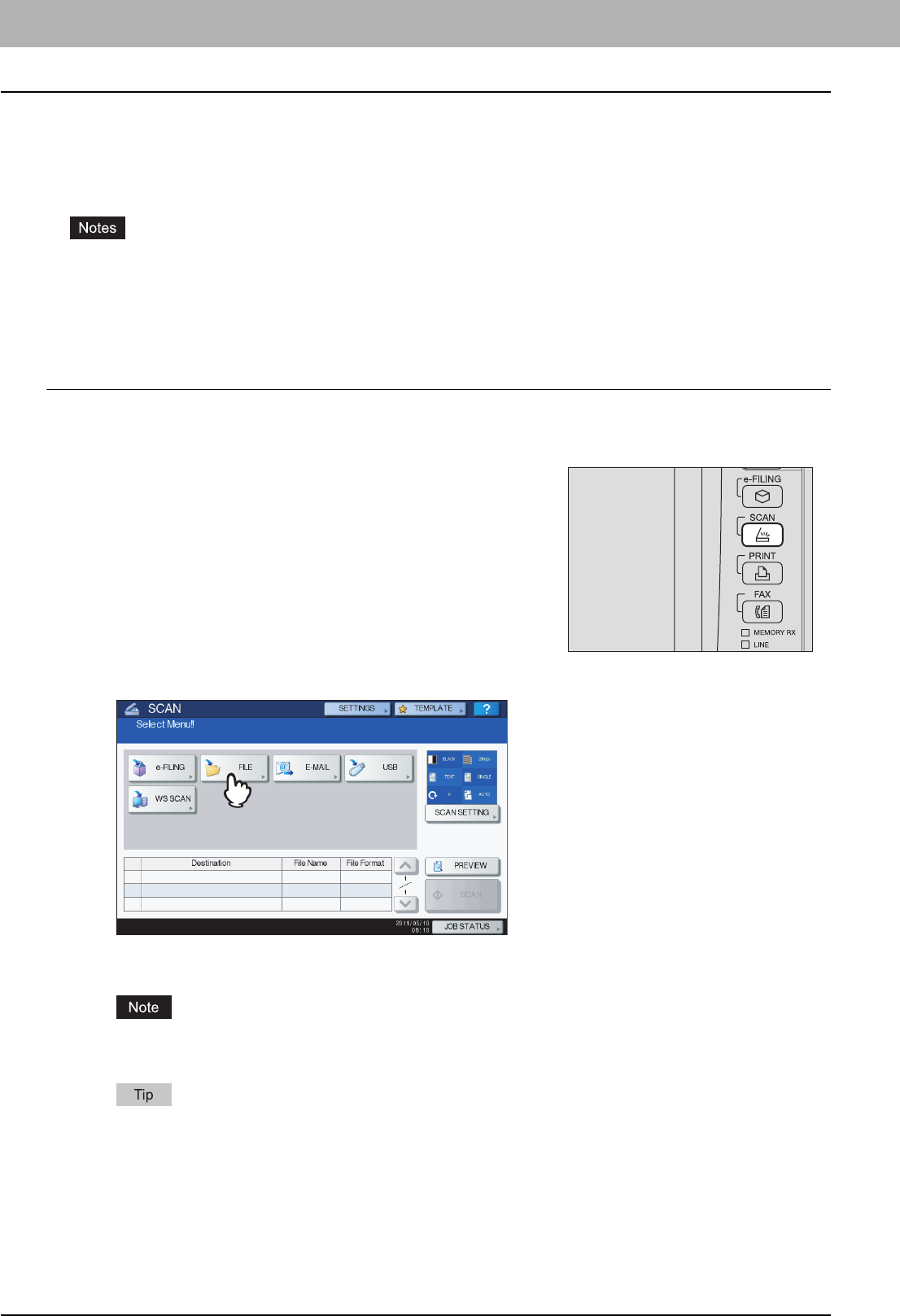
1
Place the original(s).
For help, refer to the Quick Start Guide.
3
Press [FILE].
yTo store the scan in the equipment’s shared folder, proceed to step 4.
yTo store the scan in a network folder, proceed to step 5.
Storing data in a network folder requires the administrator to set the equipment configuration. For details, refer
to the TopAccess Guide.
If you want to preview your scans later, press [PREVIEW] here and then select the scan function. For
instructions on how to preview your scans, see the following section:
P.49 “Previewing Scans”
2
On the control panel, press the [SCAN] button to
enter the SCAN menu.
2.BASIC OPERATION
Scan to File 17
2 BASIC OPERATION
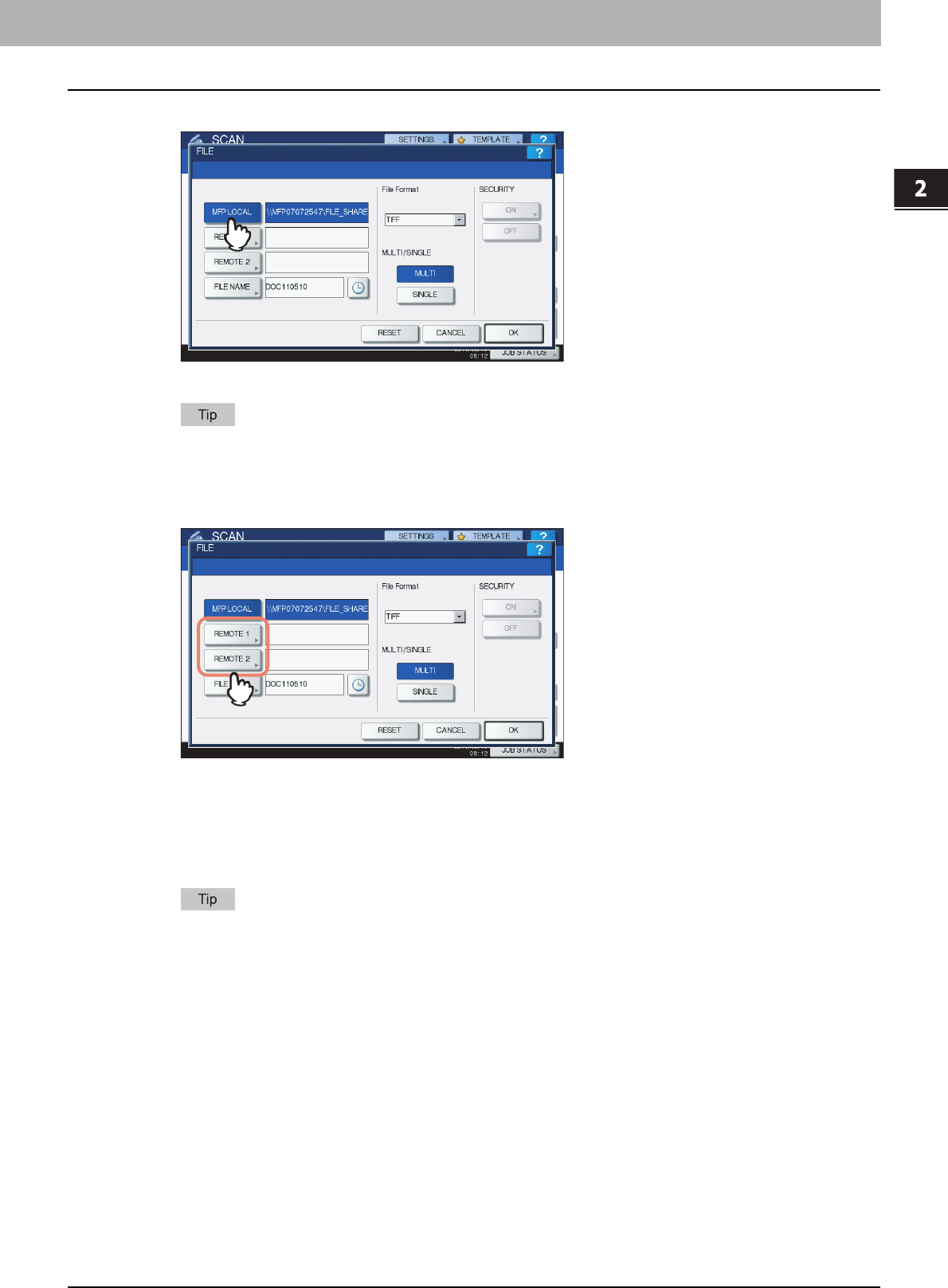
4
Make sure that [MFP LOCAL] is selected and highlighted.
Proceed to step 9.
If saving data in a network folder is enabled by the administrator, you can select 2 file destinations from [MFP
LOCAL], [REMOTE 1] and [REMOTE 2]. If you select [MFP LOCAL], you can specify a network folder
(REMOTE 1 or 2) as a remote destination. To set a network folder as a remote destination, proceed to step 5.
5
To store the scan in a network folder, press [REMOTE 1] or [REMOTE 2].
yIf the selected remote destination (REMOTE 1 or 2) is configured by the administrator so that you can specify a
desired network folder, the screen for setting up the remote destination is displayed. Proceed to step 6.
yIf the selected remote destination (REMOTE 1 or 2) is already defined by the administrator so that the scan is
saved in a specified network folder, pressing the button does not display the screen for specifying the file
destination. In this case, you cannot change the file destination. Proceed to step 9. If you need to change the
remote destination, ask your network administrator for help.
If saving data in a network folder is enabled by the administrator, you can select 2 file destinations from [MFP
LOCAL], [REMOTE 1] and [REMOTE 2].
2 BASIC OPERATION
18 Scan to File
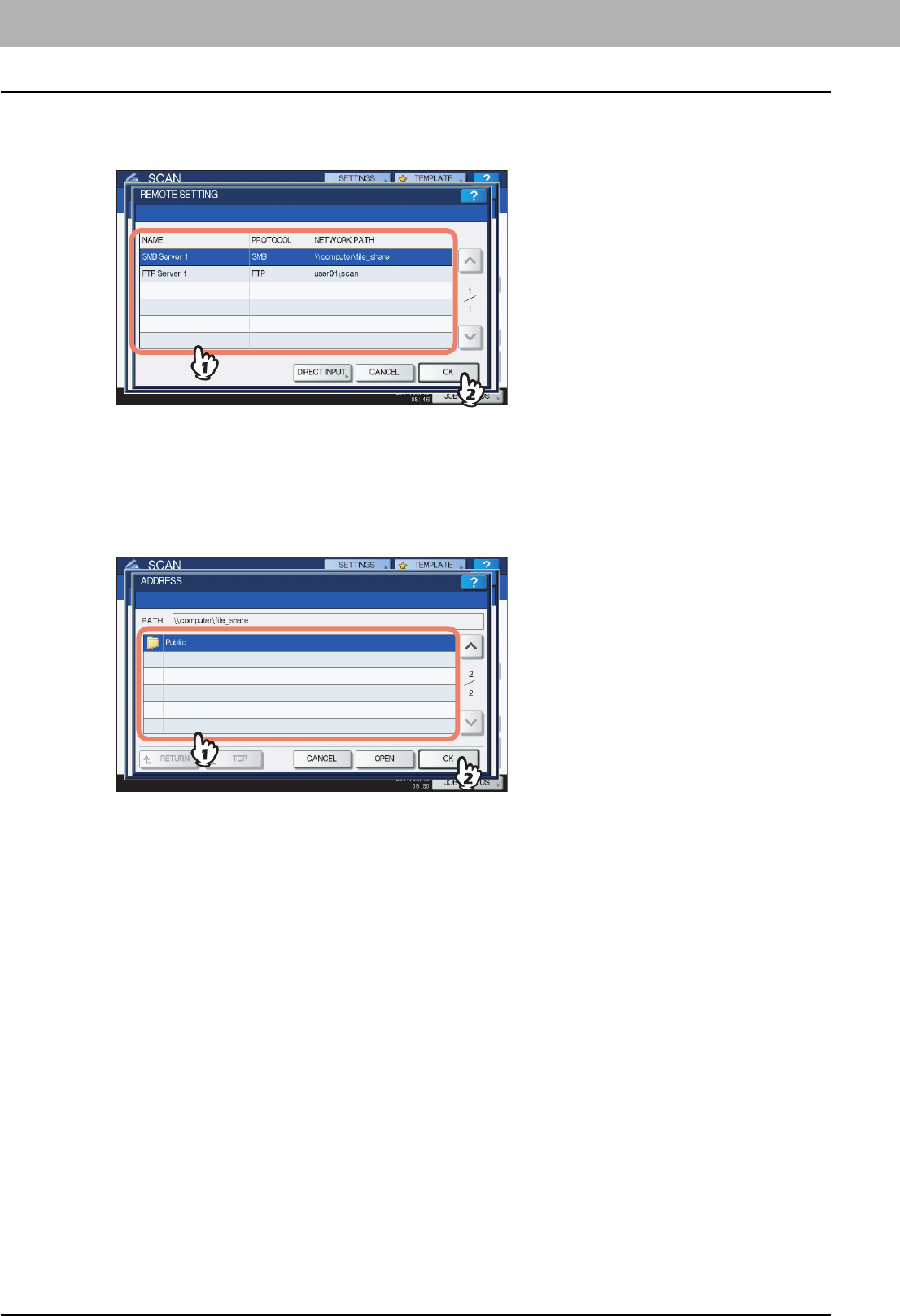
6
Select the desired file destination from the list.
1) Select the file destination.
2) Press [OK].
yIf FTP, NetWare IPX, NetWare IP or FTPS is selected for the file destination, proceed to Step 9.
yIf SMB is selected for the file destination, proceed to Step 7.
yIf your desired file destination has not been registered in the equipment, press [DIRECT INPUT] and proceed to
Step 8.
7
If SMB is selected for the file destination, select the folder to be stored.
1) Select the folder to be stored.
2) Press [OK].
Proceed to Step 9.
2.BASIC OPERATION
Scan to File 19
2 BASIC OPERATION
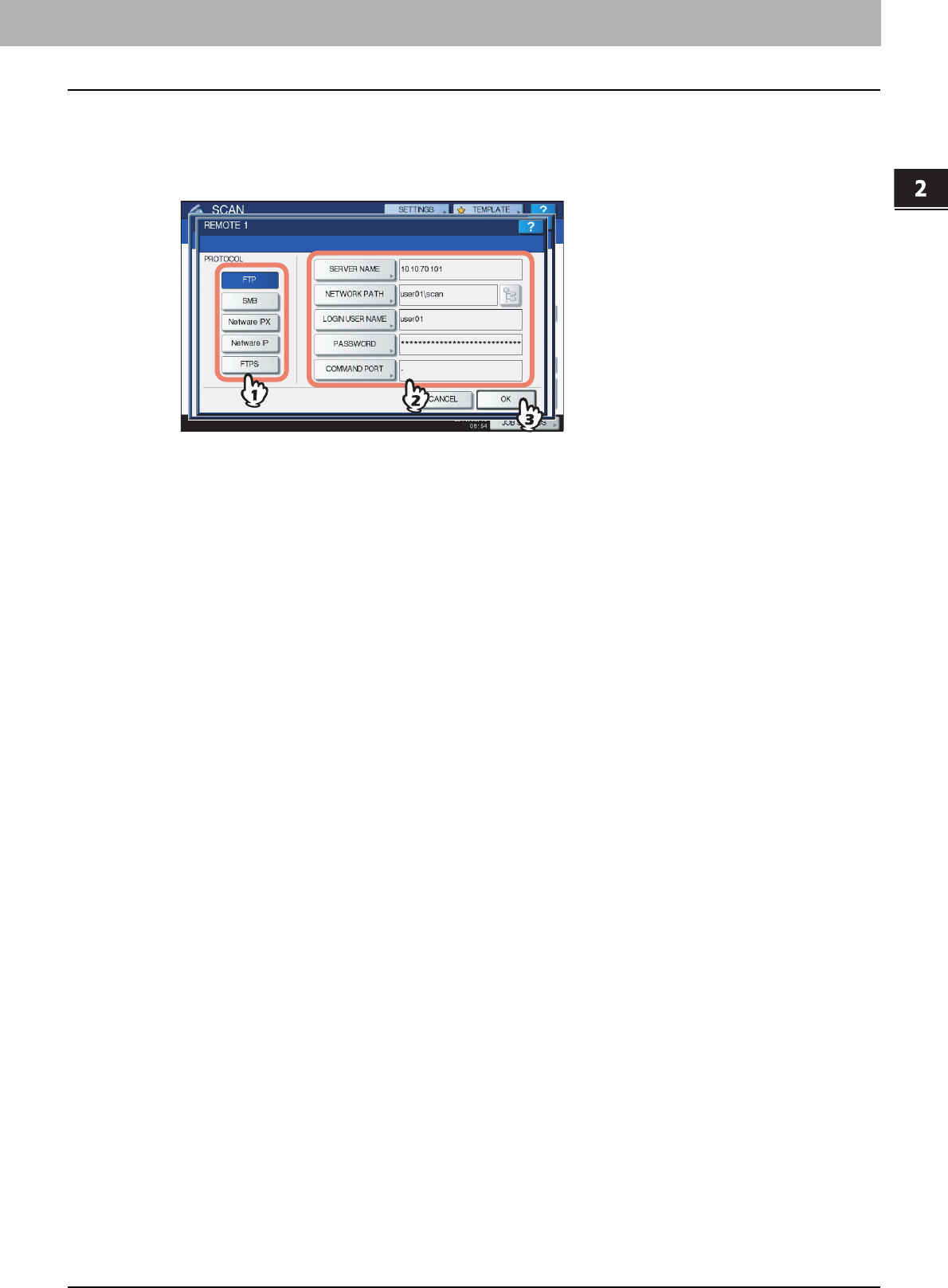
8
Select a folder for the remote destination.
1) Select FTP, SMB, NetWare IPX, NetWare IP, or FTPS as a protocol to transfer the file.
2) Press [SERVER NAME], [NETWORK PATH], [LOGIN USER NAME], [PASSWORD] and/or [COMMAND
PORT] and specify the file destination.
3) Finally, press [OK].
y[SERVER NAME] (FTP, NetWare IPX, NetWare IP, and FTPS only)
When you select [FTP]:
Enter the IP address of the FTP server. For example, to transfer the scanned data to “ftp://10.10.70.101/user01/
scan/,” enter “10.10.70.101” in this box.
When you select [NetWare IPX]:
Enter the name of the NetWare file server or the Tree/Context (when NDS is available).
When you select [NetWare IP]:
Enter the IP address of the NetWare file server.
When you select [FTPS]:
Enter the IP address of the FTP server. For example, to transfer the scanned data to “ftps://10.10.70.101/user01/
scan/,” enter “10.10.70.101” in this box.
y[NETWORK PATH]
When you select [FTP]:
Enter the path to a folder in the FTP server where you want to store the scanned data. For example, to transfer the
scanned data to “ftp://10.10.70.101/user01/scan/,” enter “user01\scan” in this box.
When you select [SMB]:
Enter the network path to the folder where you want to store the scanned data.
When you select [NetWare IPX] or [NetWare IP]:
Enter the path to a folder in the NetWare file server where you want to store the scanned data. For example, to
transfer the scanned data to the “sys\scan” folder in the NetWare file server, enter “\sys\scan” in this box.
When you select [FTPS]:
Enter the path to a folder in the FTP server where you want to store the scanned data. For example, to transfer the
scanned data to “ftps://10.10.70.101/user01/scan/,” enter “user01\scan” in this box.
y[LOGIN USER NAME]
When you select [FTP]:
Enter the log-in user name for the FTP server if required.
When you select [SMB]:
Enter the user name to access the network folder if required.
When you select [NetWare IPX] or [NetWare IP]:
Enter the log-in user name for the NetWare file server if required.
When you select [FTPS]:
Enter the log-in user name for the FTP server if required.
y[PASSWORD]
When you select [FTP]:
Enter the log-in password for the FTP server if required.
When you select [SMB]:
Enter the password for accessing the network folder if required.
When you select [NetWare IPX] or [NetWare IP]:
Enter the log-in password for the NetWare file server if required.
When you select [FTPS]:
Enter the log-in password for the FTP server if required.
2 BASIC OPERATION
20 Scan to File
y[COMMAND PORT] (FTP and FTPS only)
Enter the port number to be used for command execution. By default, a hyphen “-” is entered in this box, and the
port number set by the administrator is used. Change the entry in this box only when you want to use another port
number.
yPressing each button displays an on-screen keyboard. Enter each item using the keyboard and digital keys,
and then press [OK] to set the entry.
yTo store files in [SMB], enter the network path, login user name and password then press, so that you
can select the folder.
9
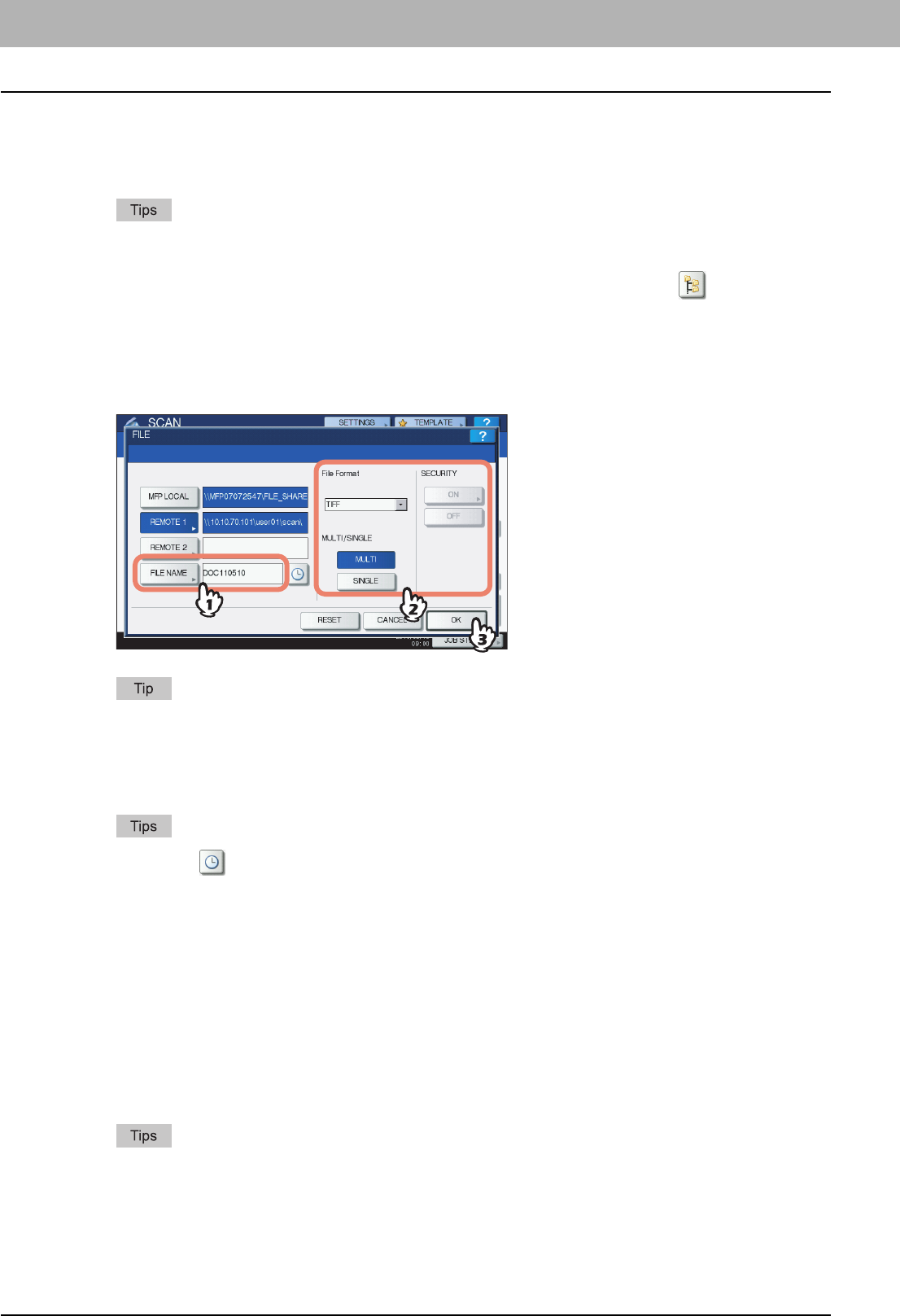
Define the settings for the new file as required.
1) Press [FILE NAME] and change the file name.
2) Select an option for each of the FILE FORMAT, MULTI/SINGLE PAGE and/or SECURITY settings.
3) Finally, press [OK].
To clear the settings, press [RESET].
y[FILE NAME]
Pressing the button displays an on-screen keyboard. Change the file name using the keyboard and digital keys,
and then press [OK] to set the entry. The file name can consist of a maximum of 128 characters.
yPressing adds a meaningful number, such as date and time, to the file name. The number is assigned
according to the format selected for the Date Format setting, which is available for the administrator on
TopAccess. For details, refer to the TopAccess Guide.
yThe trailing characters in a file name (maximum 74) may be deleted depending on the type of letters used.
yFILE FORMAT
[PDF] — Press this button to store your scan as a PDF file.
[TIFF] — Press this button to store your scan as a TIFF file.
[XPS] — Press this button to store your scan as an XPS file.
[SLIM PDF] — Press this button to store your scan as a slim PDF file. This option is suitable when minimizing the
file size is more important than the image quality. This option is available only when [FULL COLOR] or [GRAY
SCALE] is selected for the color mode setting.
[JPEG] — Press this button to store your scan as a JPEG file. This option is available only when [FULL COLOR] or
[GRAY SCALE] is selected for the color mode setting.
yXPS files are supported by Windows Vista, Windows 7 or Windows Server 2008 SP1; they can also be used
on a computer running Windows XP SP2 or Windows Server 2003 SP1 or later versions with. NET
Framework 3.0 installed.
yIf the forced encryption setting is enabled, PDF is the only available file format. To learn more about the
forced encryption setting, refer to the MFP Management Guide.
2.BASIC OPERATION
Scan to File 21
2 BASIC OPERATION
yMULTI/SINGLE PAGE
[MULTI] — Press this button to store your scan as a multiple page file. When you scan several pages, the
equipment stores all the pages as a single file.
[SINGLE] — Press this button to store your scan as a single file for each page. When you scan several pages, the
equipment stores each page as a separate file.
ySECURITY
When PDF is selected for the file format, you can decide whether or not to encrypt the PDF file. To encrypt the PDF
file, press [ON]. For further instructions on how to encrypt PDF files, see the following section:
P.68 “Encrypting PDF Files”
10
Press [SCAN].
yTo scan 2-sided documents or change settings such as Color Mode and Resolution, press [SCAN
SETTING].
P.40 “Changing Scan Settings”
yYou can preview your scans by pressing [PREVIEW], followed by [SCAN].
P.49 “Previewing Scans”
yYou can set another scan function by pressing [e-FILING], [E-MAIL] or [USB]. (Dual Agents)
P.65 “Scanning With Dual Functions (Dual Agents)”
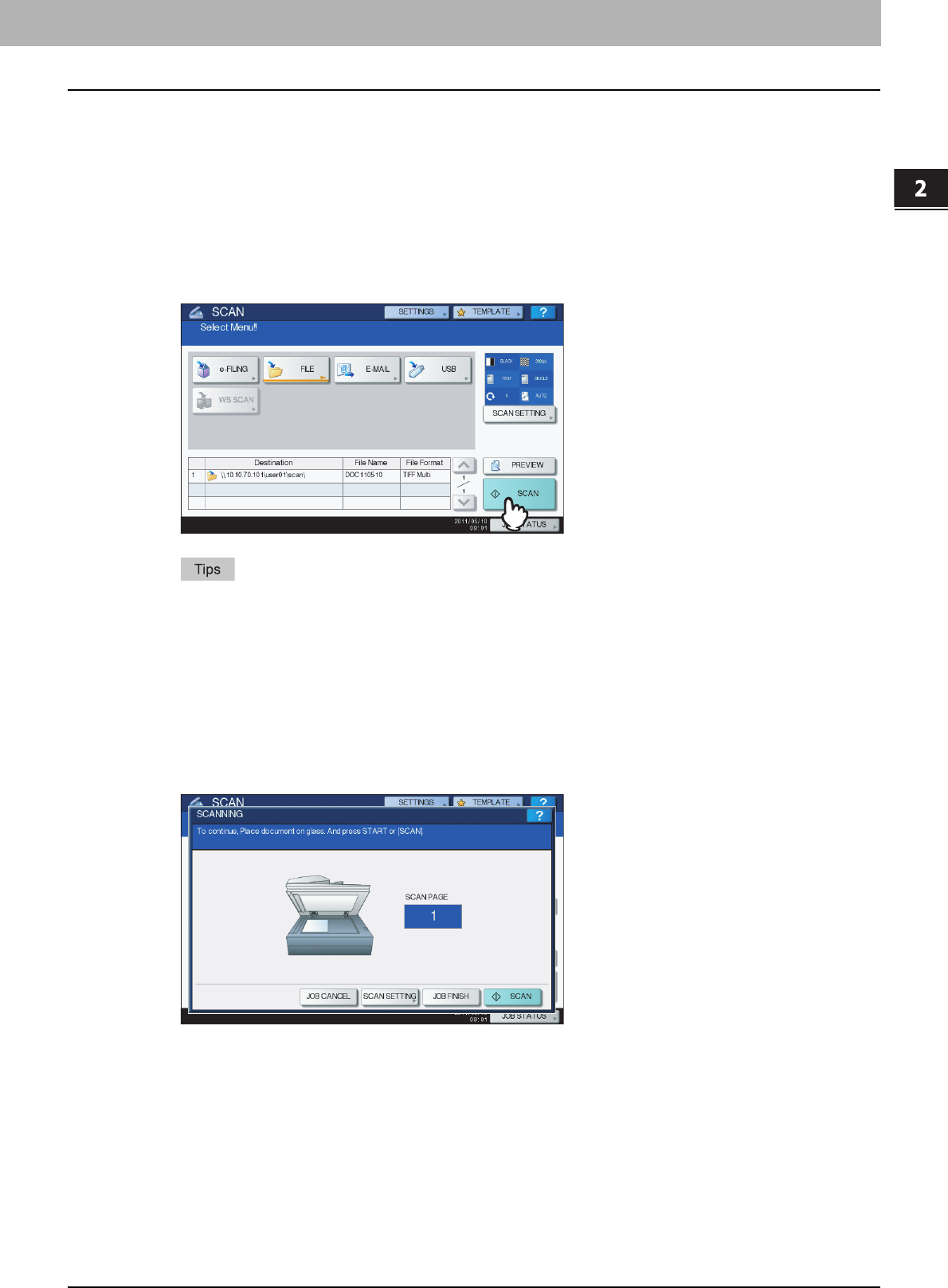
11
If the screen below appears, place another original on the original glass and press
[SCAN] or the [START] button to continue scanning. To finish the job, press [JOB
FINISH], followed by the [FUNCTION CLEAR] button.
yThe above screen is not displayed under the following conditions:
- You scan the original from the Reversing Automatic Document Feeder* without pressing [CONTINUE] to
scan additional originals.
- A scan preview is displayed.
yTo cancel the operation, press [JOB CANCEL].
yTo change the scan settings, press [SCAN SETTING].
P.40 “Changing Scan Settings”
* The Reversing Automatic Document Feeder is optional for the e-STUDIO4540C Series.

2 BASIC OPERATION
22 Scan to File
yWhen the equipment has scanned more than 1000 pages in a job, the “The number of originals exceeds the
limits. Will you save stored originals?” message appears. If you want to save the scans, press [YES].
yWhen the temporary workspace is full on the equipment’s hard disk, a message appears and the job is
canceled. The available workspace can be viewed on the TopAccess [Device] tab.
yIf the number of jobs waiting to store scans in the equipment's hard disk exceeds 20, a message appears to
indicate that the equipment’s memory is full. In this case, wait a while until memory becomes available again
or delete unnecessary jobs from [JOB STATUS].
P.37 “Viewing the scan job status”
2 BASIC OPERATION
Scan to E-mail 23
Scan to E-mail
With this scan function, you can send your scans to a specified e-mail address as an attached file.
The Scan to E-mail function requires the network administrator to set the equipment configuration.
Scanning to e-mail
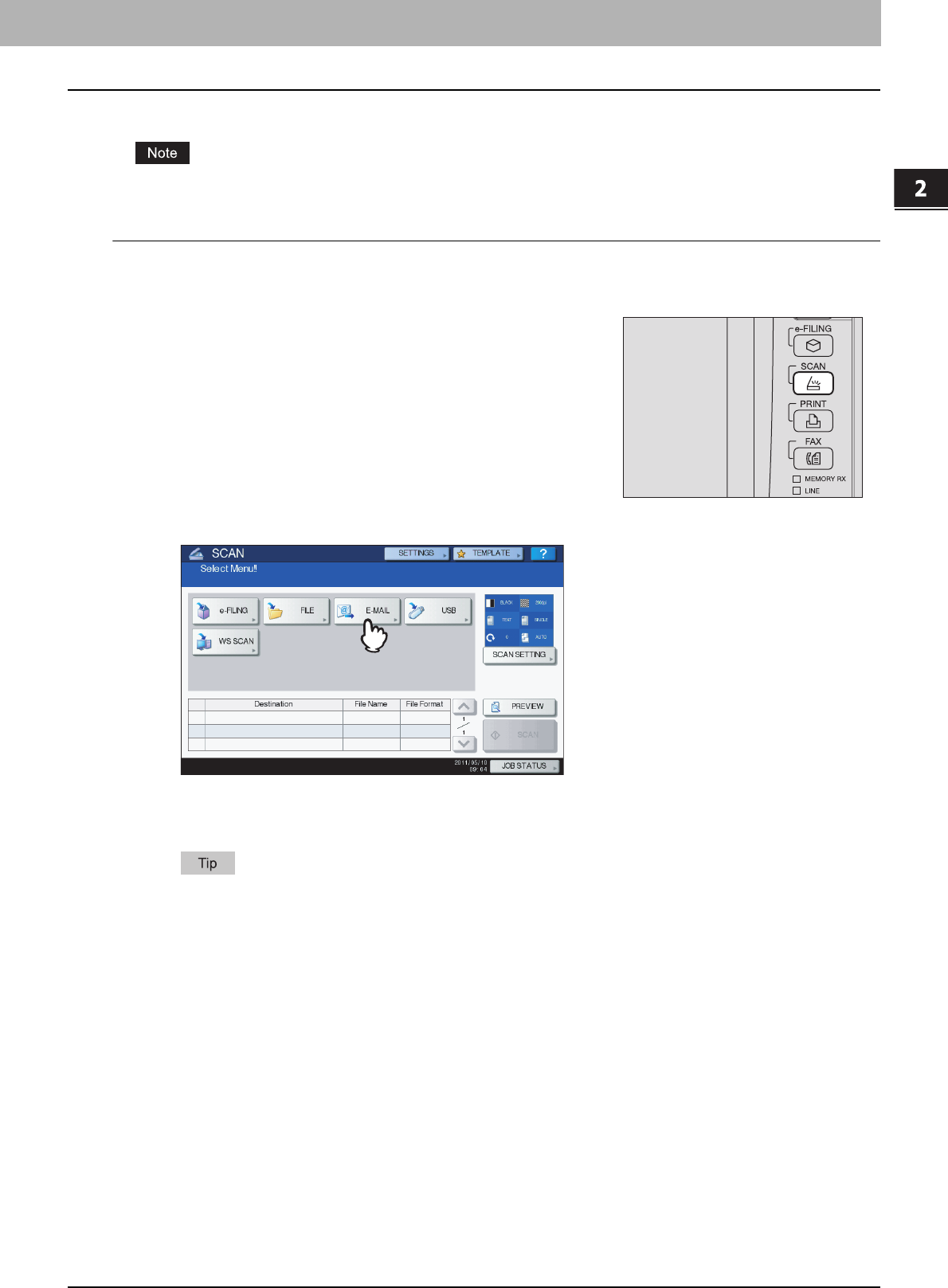
1
Place the original(s).
For help, refer to the Quick Start Guide.
3
Press [E-MAIL].
yIf the User Authentication for Scan to E-mail setting is enabled by the administrator on TopAccess, the
AUTHENTICATION screen is displayed. In this case, proceed to step 4.
yIf the User Authentication for the Scan to E-mail setting is disabled by the administrator, proceed to step 5.
If you want to preview your scans later, press [PREVIEW] here and then select the scan function. For
instructions on how to preview your scans, see the following section:
P.49 “Previewing Scans”
2
On the control panel, press the [SCAN] button to
enter the SCAN menu.
2 BASIC OPERATION
24 Scan to E-mail
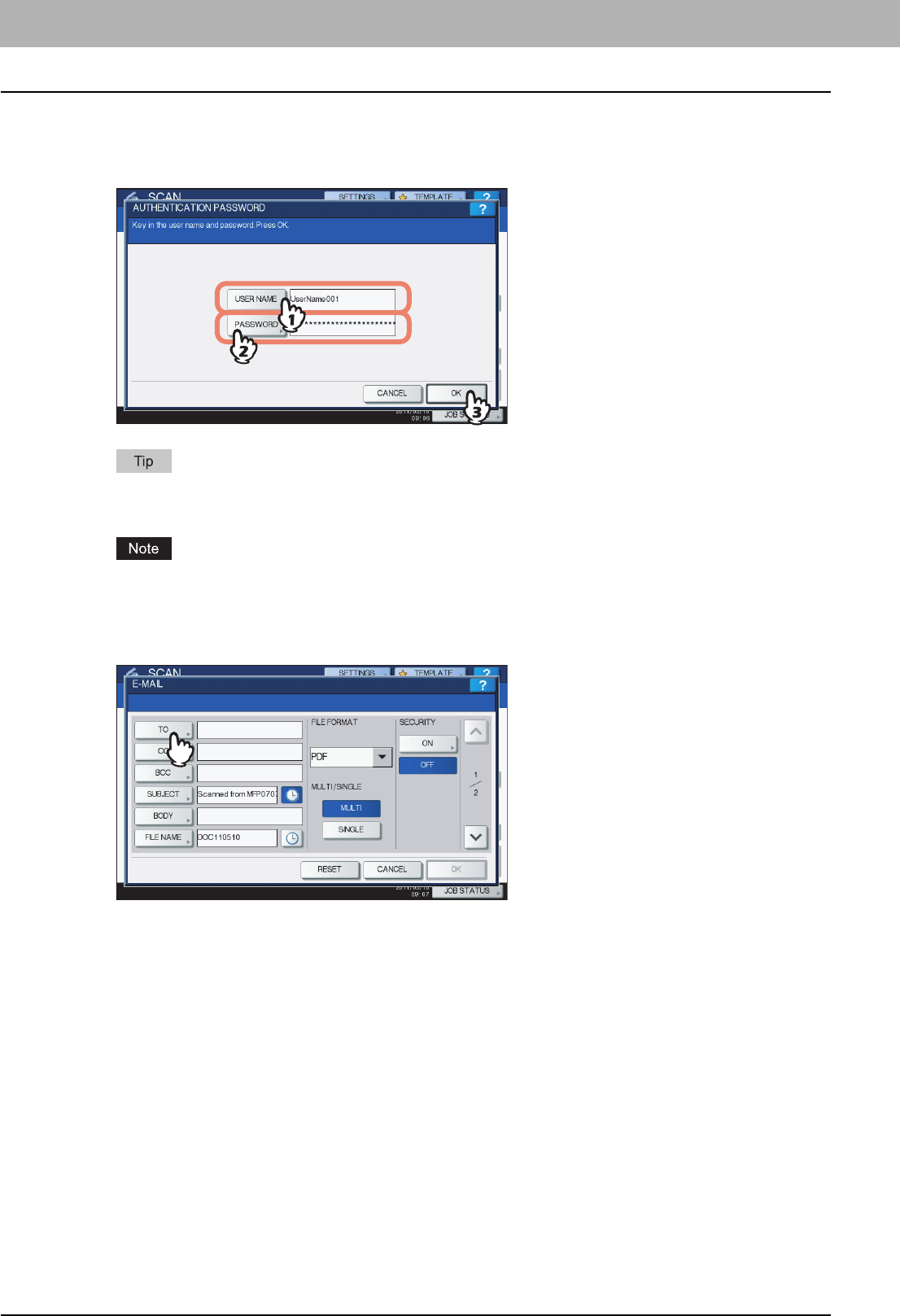
4
On the AUTHENTICATION screen, complete the user authentication.
1) Press [USER NAME] and enter the user name.
2) Press [PASSWORD] and enter the password.
3) Finally, press [OK].
Pressing each button displays an on-screen keyboard. Enter each item using the keyboard and digital keys,
and then press [OK] to set the entry.
The above screen is displayed only when the User Authentication for Scan to E-mail setting is enabled on
TopAccess by the administrator. If this screen is displayed, you must enter your user name and password to log
in to the SCAN TO E-MAIL screen. For the user name and password, ask your network administrator.
5
Press [TO].
2.BASIC OPERATION
Scan to E-mail 25
2 BASIC OPERATION
6
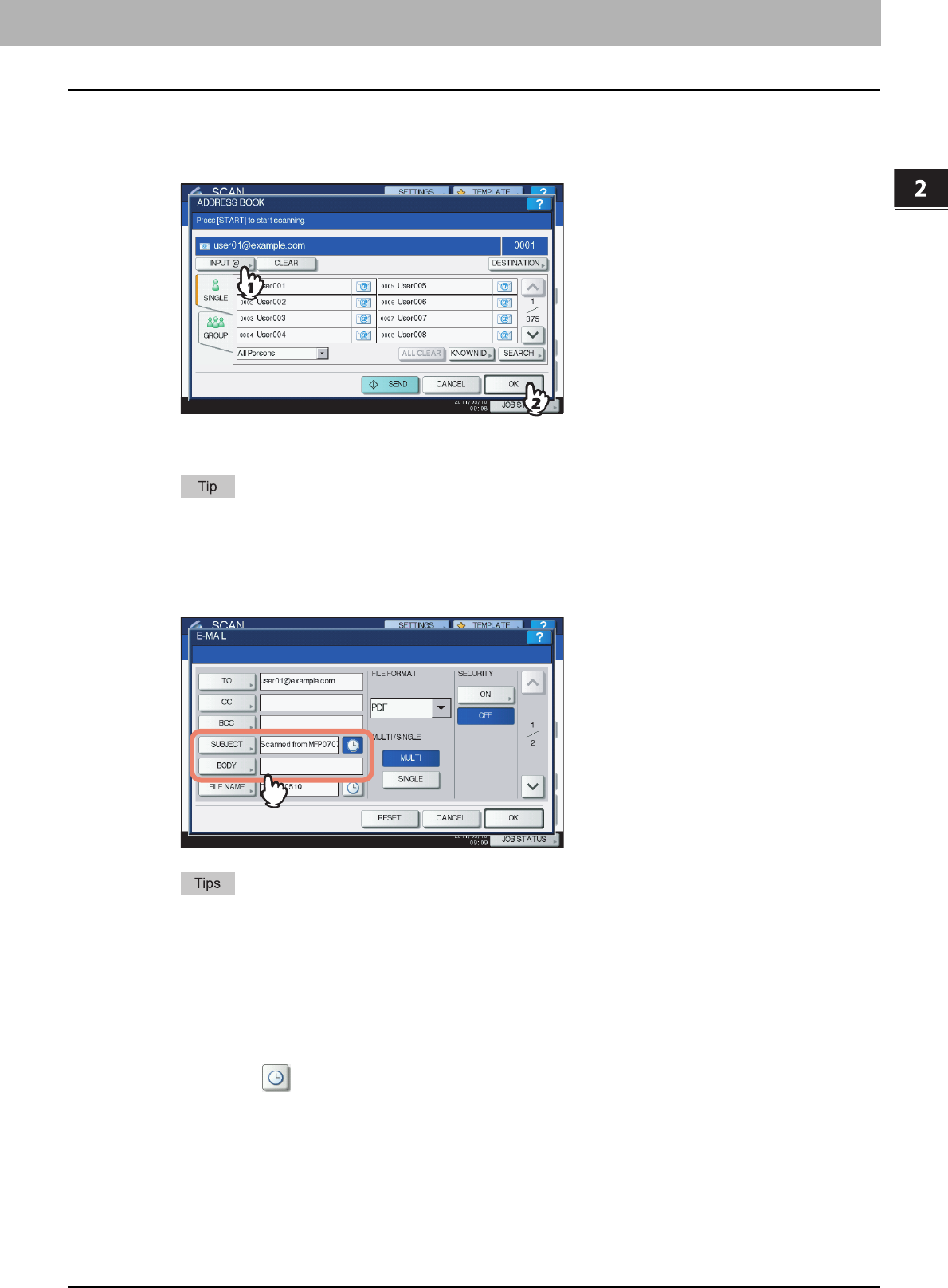
Specify the e-mail address(es) that you want to send to.
1) Press [INPUT @].
2) Enter an e-mail address using the keyboard and digital keys, and then press [OK] to set the entry.
3) Finally, press [OK].
You can specify e-mail addresses in various ways. For details, see the following section:
P.51 “Specifying E-mail Addresses”
The entry in the FROM ADDRESS box (→ step 9) may already be set by the administrator on TopAccess.
(Refer to the TopAccess Guide for descriptions of the E-mail Setting and/or the User Authentication for Scan
to E-mail setting.) In this case, you can start sending your scans by specifying the e-mail address(es) and then
pressing [SEND] or the [START] button.
7
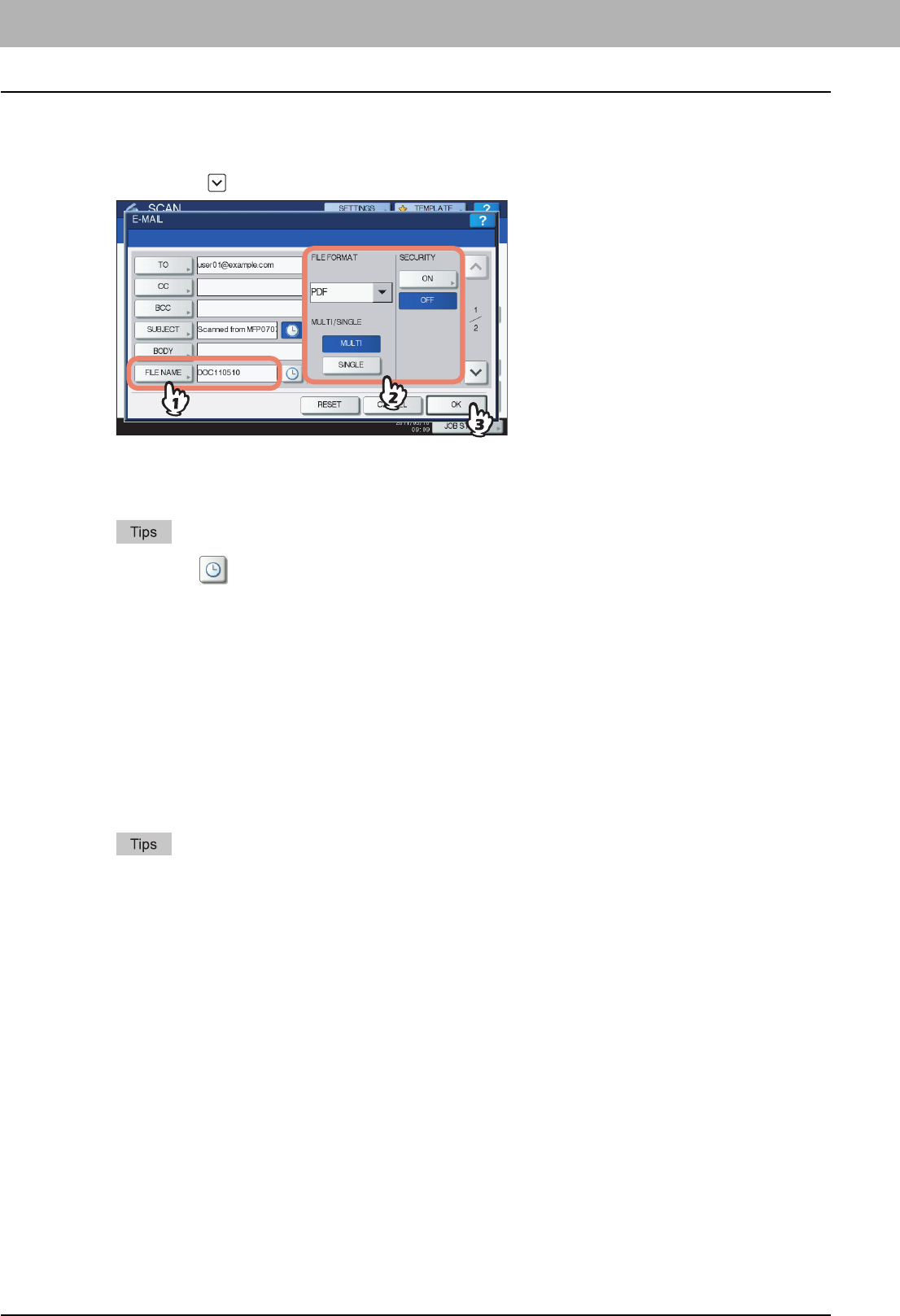
Press [SUBJECT] and [BODY] and enter each item.
yTo clear the settings, press [RESET].
yPressing each button displays an on-screen keyboard. Enter each item using the keyboard and digital keys,
and then press [OK] to set the entry. The maximum number of characters allowed for each box is as follows:
- [SUBJECT]: 128 characters
- [BODY]: 1000 characters
yTo add another contact, press [CC] or [BCC] to add the E-mail address of the contact.
yWhen the e-mail is sent, the date and time are automatically added to the subject.
yThe administrator can change the body text. For details, refer to the MFP Management Guide or the
TopAccess Guide.
yPressing adds a meaningful number, such as date and time, to the subject. For details, refer to the
TopAccess Guide.
2 BASIC OPERATION
26 Scan to E-mail
8
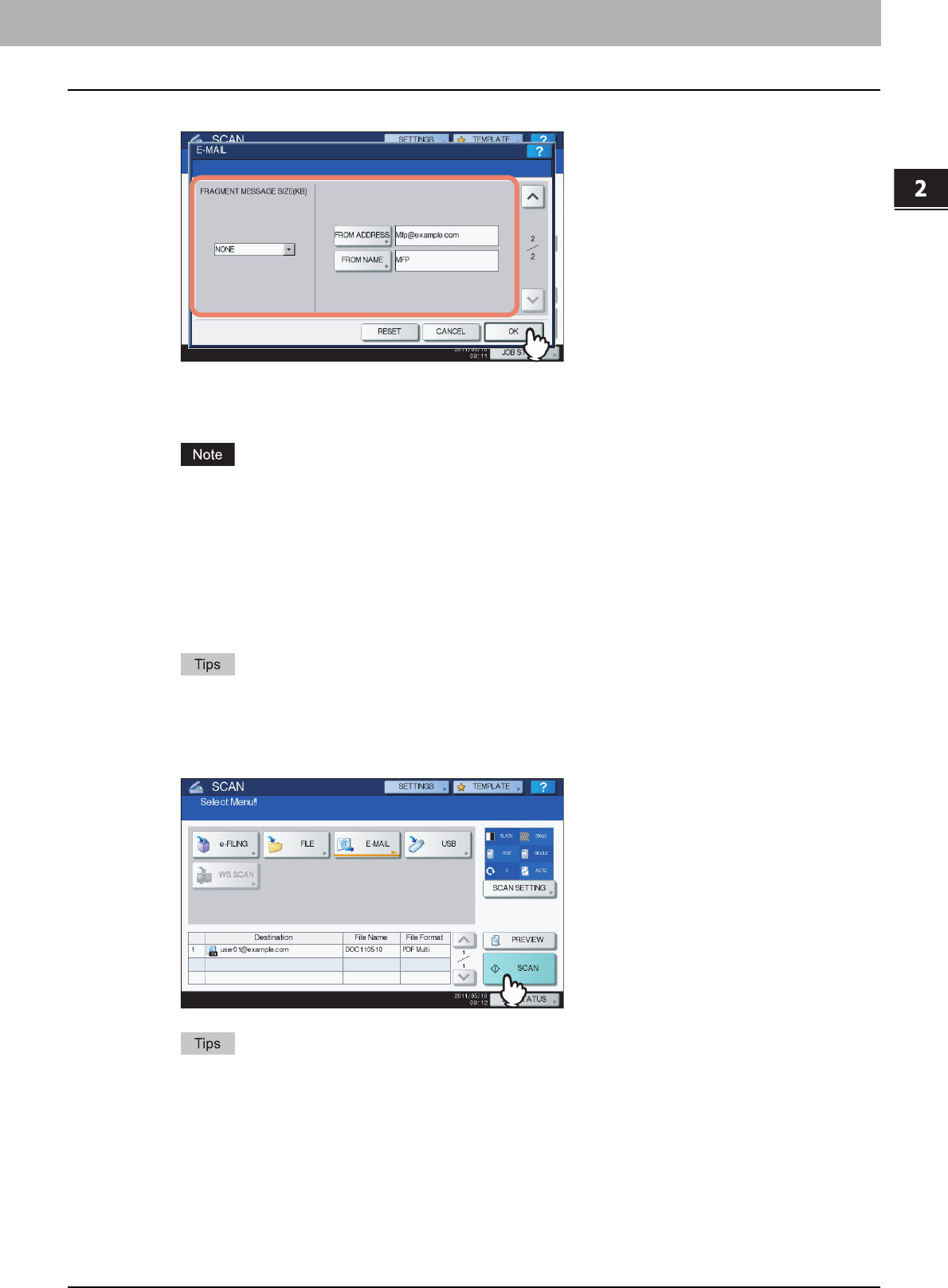
If necessary, make the following settings for the attached file.
1) Press [FILE NAME] and change the file name.
2) Select an option for each of the FILE FORMAT, MULTI/SINGLE PAGE and/or SECURITY settings.
3) Finally, press .
y[FILE NAME]
Pressing the button displays an on-screen keyboard. Enter the file name using the keyboard and digital keys, and
then press [OK] to set the entry. The file name can consist of a maximum of 128 characters.
yPressing adds a meaningful number, such as date and time, to the file name. The number is assigned
according to the format selected for the Date Format setting, which is available for the administrator on
TopAccess. For details, refer to the TopAccess Guide.
yThe trailing characters in a file name (maximum 74) may be deleted depending on the type of letters used.
yFILE FORMAT
[PDF] — Press this button to store your scan as a PDF file.
[TIFF] — Press this button to store your scan as a TIFF file.
[XPS] — Press this button to store your scan as an XPS file.
[SLIM PDF] — Press this button to store your scan as a slim PDF file. This option is suitable when minimizing the
file size is more important than the image quality. This option is available only when [FULL COLOR] or [GRAY
SCALE] is selected for the color mode setting.
[JPEG] — Press this button to store your scan as a JPEG file. This option is available only when [FULL COLOR] or
[GRAY SCALE] is selected for the color mode setting.
yXPS files are supported by Windows Vista, Windows 7 or Windows Server 2008 SP1; they can also be used
on a computer running Windows XP SP2 or Windows Server 2003 SP1 or later versions with. NET
Framework 3.0 installed.
yIf the forced encryption setting is enabled, PDF is the only available file format. To learn more about the
forced encryption setting, refer to the MFP Management Guide.
yMULTI/SINGLE PAGE
[MULTI] — Press this button to store your scan as a multiple page file. When you scan several pages, the
equipment stores all the pages as a single file.
[SINGLE] — Press this button to store your scan as a single file for each page. When you scan several pages, the
equipment stores each page as a separate file.
ySECURITY
When PDF is selected for the file format, you can decide whether or not to encrypt the PDF file. To encrypt the PDF
file, press [ON]. For further instructions on how to encrypt PDF files, see the following section:
P.68 “Encrypting PDF Files”
2.BASIC OPERATION
Scan to E-mail 27
2 BASIC OPERATION
9
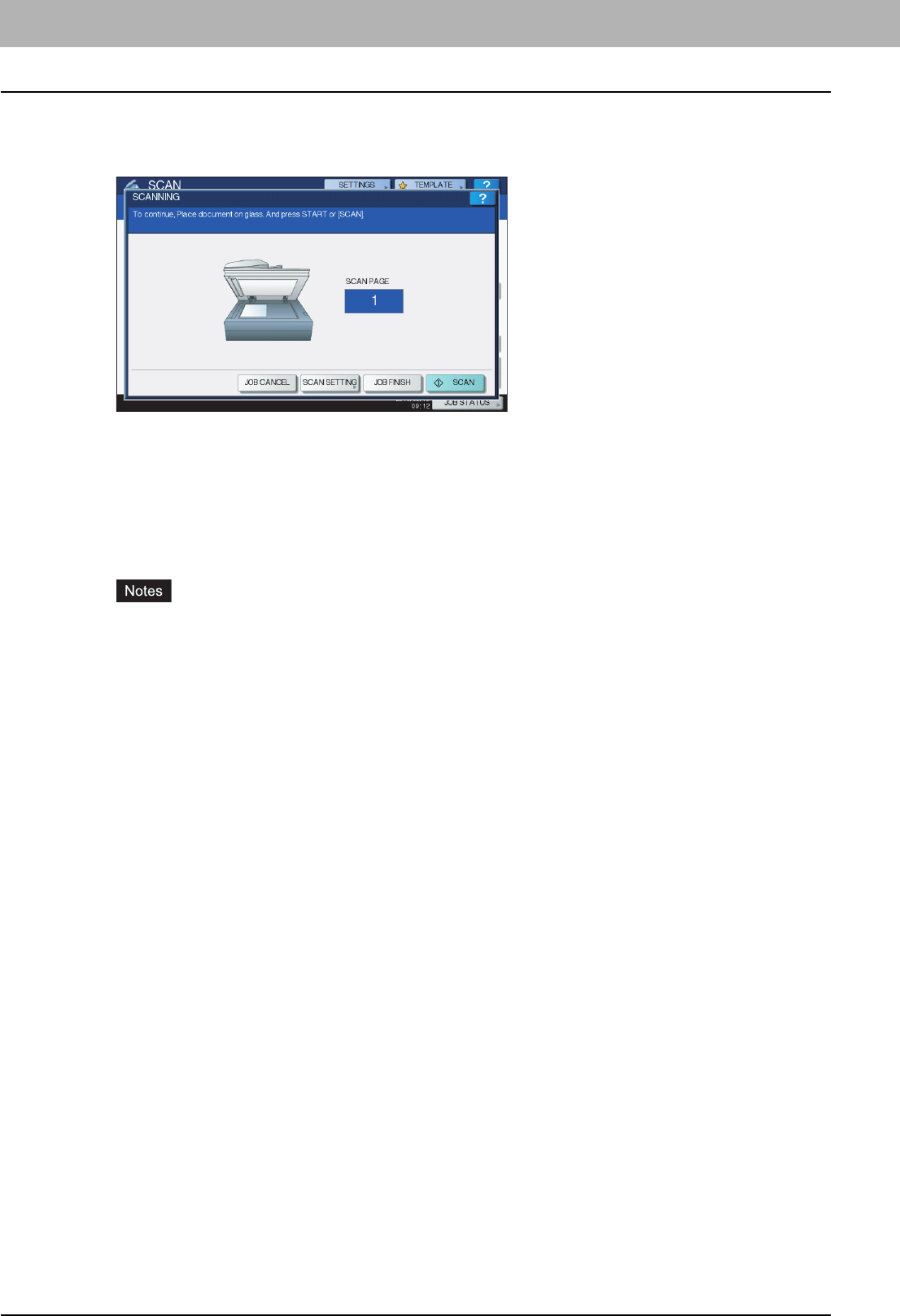
Specify the following items as required, and then press [OK].
yFRAGMENT MESSAGE SIZE (KB)
Select the size of message fragmentation. If the size of the attached file exceeds that selected here, the equipment
transmits the file by dividing the data into smaller blocks.
If the data size of the e-mail exceeds the maximum allowed for transmission, the attached file will not be sent.
The maximum data size for e-mail transmission can be set by the administrator on the TopAccess SMTP Client
page.
y[FROM ADDRESS]
Press this button to edit the sender’s e-mail address. You cannot edit the box if the administrator sets the sender’s
e-mail address so that it cannot be edited.
y[FROM NAME]
Press this button to edit the sender’s name.
yPressing [FROM ADDRESS] or [FROM NAME] displays an on-screen keyboard. Enter each item using the
keyboard and digital keys, and press [OK] to set the entry.
yYou can start sending your scans on the above screen by pressing the [START] button on the control panel.
10
Press [SCAN] or the [START] button.
yTo scan 2-sided documents or change settings such as Color Mode and Resolution, press [SCAN
SETTING].
P.40 “Changing Scan Settings”
yYou can preview your scans by pressing [PREVIEW], followed by [SCAN].
P.49 “Previewing Scans”
yTo set other scan functions, press [e-FILING], [FILE] or [USB]. (Dual Agents)
P.65 “Scanning With Dual Functions (Dual Agents)”
2 BASIC OPERATION
28 Scan to E-mail
11
If the screen below appears, place another original on the original glass and press
[SCAN] or the [START] button to continue scanning. To finish the job, press [JOB
FINISH], followed by the [FUNCTION CLEAR] button.
yThe above screen is not displayed under the following conditions:
- You scan the original from the Reversing Automatic Document Feeder* without pressing [CONTINUE] to
scan additional originals.
- A scan preview is displayed.
yTo cancel the operation, press [JOB CANCEL].
yTo change the scan settings, press [SCAN SETTING].
P.40 “Changing Scan Settings”
* The Reversing Automatic Document Feeder is optional for the e-STUDIO4540C Series.
yWhen the equipment has scanned more than 1000 pages in a job, the “The number of originals exceeds the
limits. Will you save stored originals?” message appears. If you want to save the scans, press [YES].
yWhen the temporary workspace is full on the equipment’s hard disk, a message appears and the job is
canceled. The available workspace can be viewed on the TopAccess [Device] tab.
2 BASIC OPERATION
Scan to USB 29
Scan to USB
The Scan to USB function stores scans to a USB storage device.
yTo store data in a USB storage device, the Save to USB Media setting must be enabled by the administrator. For
details, refer to the TopAccess Guide.
yUSB storage devices must meet requirements below. However, some USB storage devices may not be used with
this equipment even though the requirements below are met.
- FAT16 or FAT32 format
- Single-partition (USB storage devices with multiple partitions are not supported.)
Scanning to USB
1
Place the original(s).
For help, refer to the Quick Start Guide.
2
On the control panel, press the [SCAN] button to
enter the SCAN menu.
3
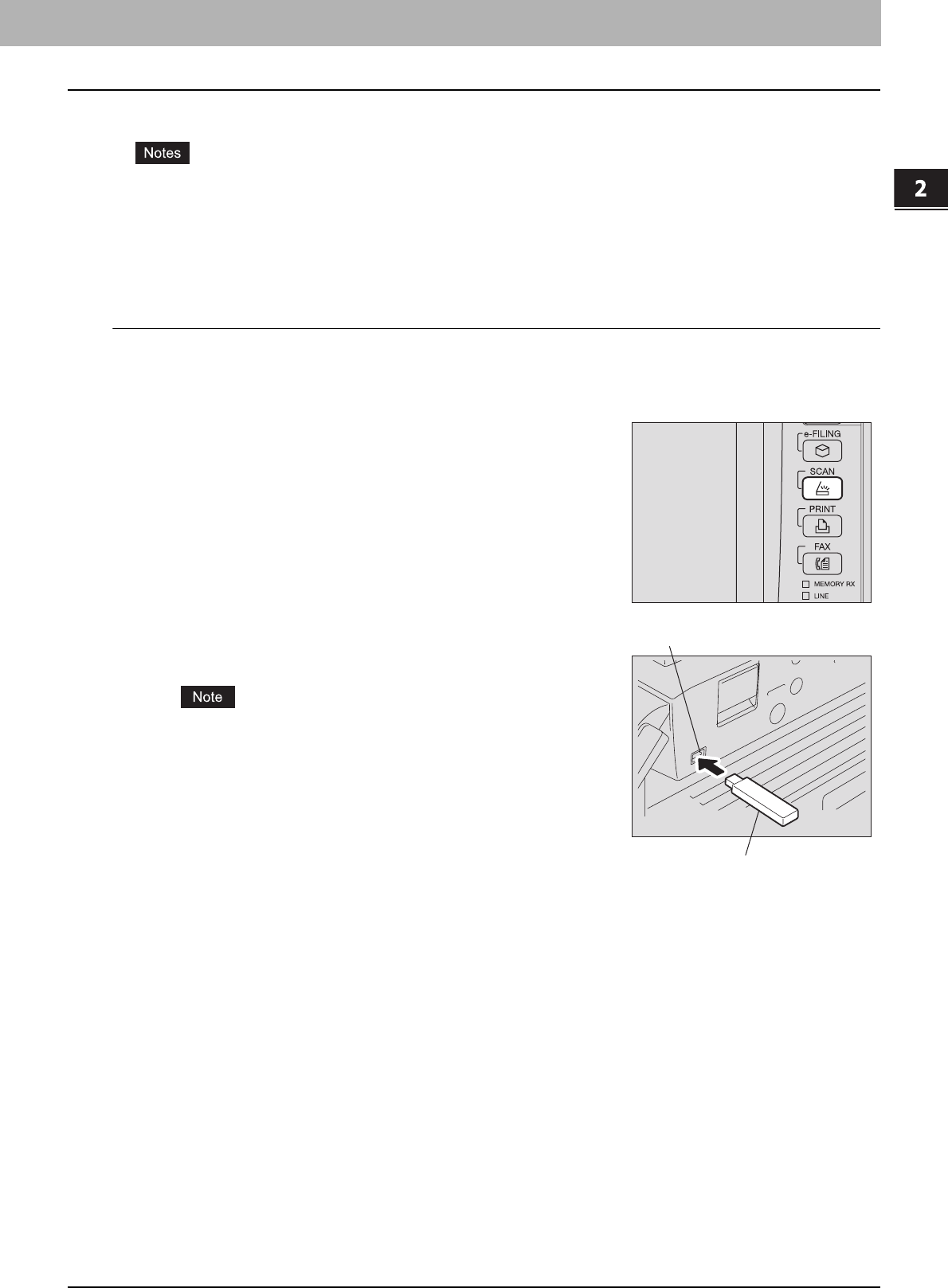
To store scans in a USB storage device, connect the
device to the equipment and wait a few seconds.
Connect the USB storage device to the USB port. For the location
of the USB port on the equipment, refer to the Quick Start Guide.
USB Port
USB Storage Device
2 BASIC OPERATION
30 Scan to USB
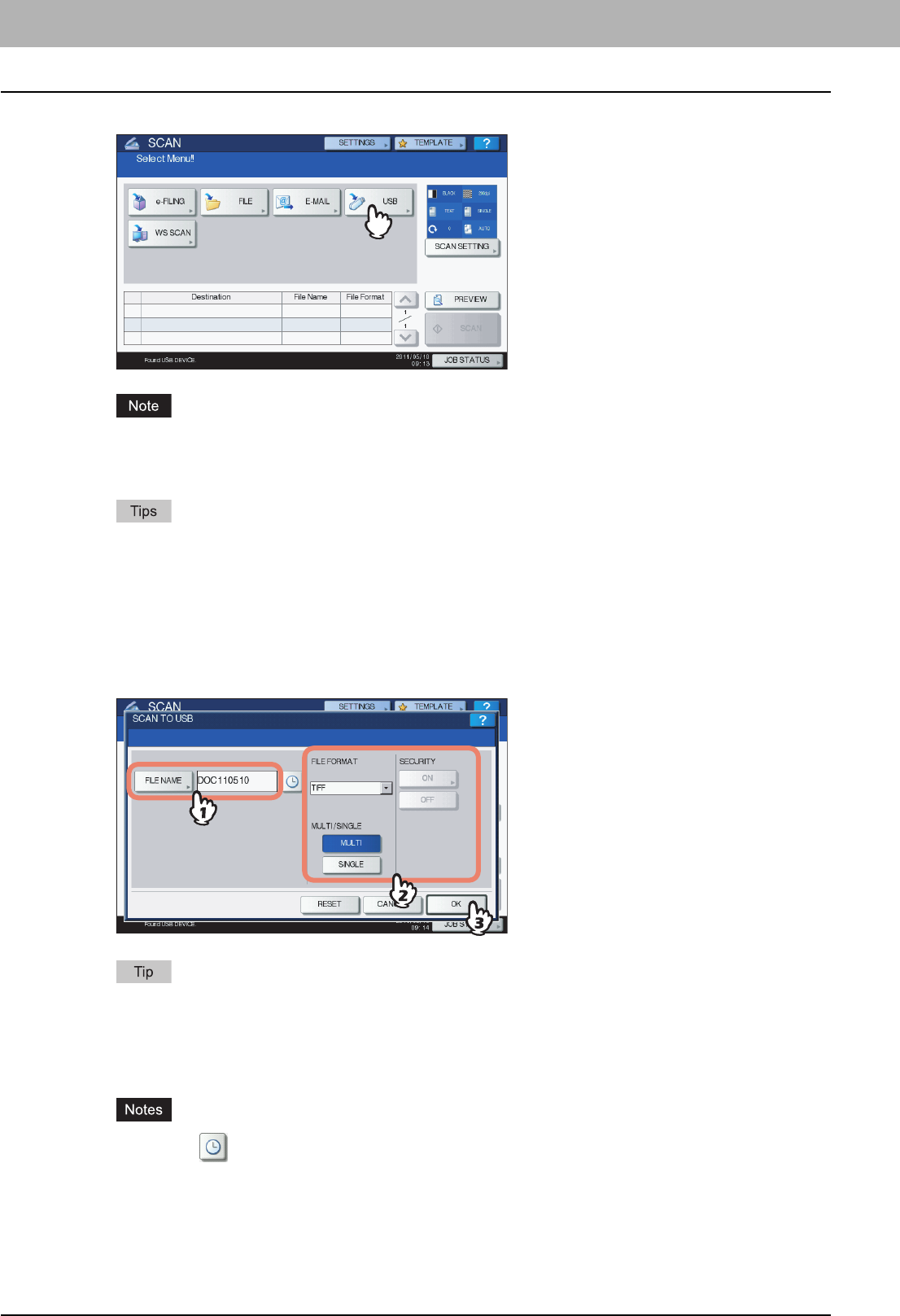
4
When “Found USB DEVICE.” message appears on the touch panel, press [USB].
When you store scans in a USB storage device, never attempt to remove the device from the equipment until
data transmission is completed. Removing the USB storage device during data transmission may corrupt the
device.
yStoring scans to a USB storage device may take a long time depending on the volume of the scans.
yTo preview the stored scans at the end, press [PREVIEW] at this step and then select scanning options. For
previewing scans, see the following section:
P.49 “Previewing Scans”
5
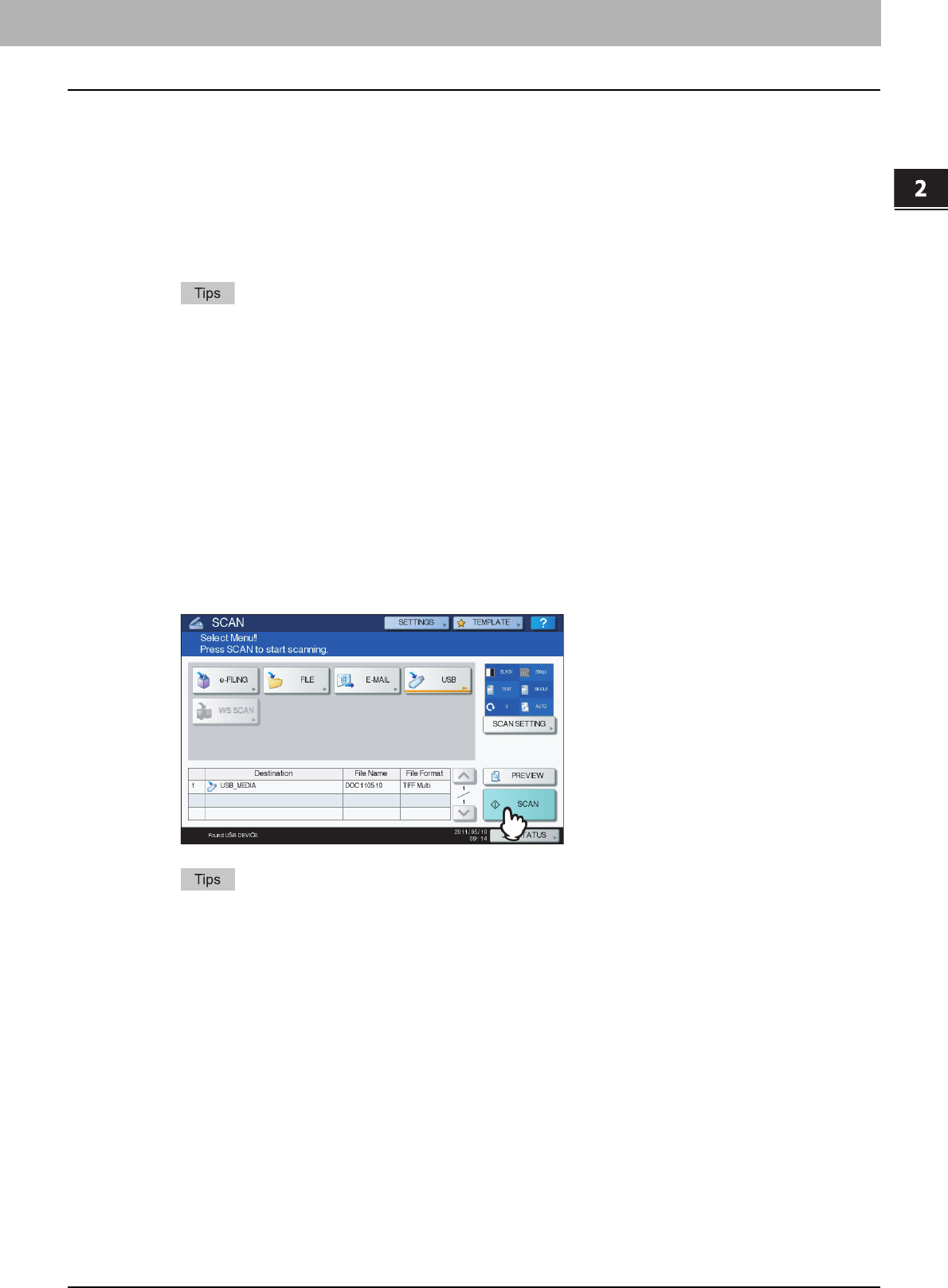
Define the settings for the new file as required.
1) Press [FILE NAME] to change the file name.
2) Select an option for each of the FILE FORMAT, MULTI/SINGLE PAGE and SECURITY settings.
3) After the settings are done, press [OK].
To clear the settings, press [RESET].
y[FILE NAME]
Pressing this button displays an on-screen keyboard. Change the file name using the keyboard and digital keys,
and then press [OK] to set the entry. A maximum of 128 letters can be used for the file name.
yPressing adds some numbers such as date and time to the file name. These numbers can be set in the
format selected in the Date Format setting of the TopAccess menu, which can be set by the administrator.
For details, refer to the TopAccess Guide.
yThe trailing characters in a file name (maximum 74) may be deleted depending on the type of letters used.
2.BASIC OPERATION
Scan to USB 31
2 BASIC OPERATION
yFILE FORMAT
[PDF] – Press this button to store scans as a PDF file.
[TIFF] – Press this button to store scans as a TIFF file.
[XPS] – Press this button to store scans as an XPS file.
[SLIM PDF] – Press this button to store scans as a slim PDF file. This option is suitable when minimizing the file
size is more important than the image quality. This option is available only when [FULL COLOR] or [GRAY SCALE]
is selected for the color mode setting.
[JPEG] – Press this button to store scans as a JPEG file. This option is available only when [FULL COLOR] or
[GRAY SCALE] is selected for the color mode setting.
yXPS files are supported by Windows Vista, Windows 7 or Windows Server 2008 SP1, or in cases that NET
Framework 3.0 is installed on your computer with Windows XP SP2 or Windows Server 2003 SP1 or later
versions.
yIf the forced encryption setting is enabled, PDF is the only format available. For the details of the forced
encryption setting, refer to the MFP Management Guide.
yMULTI/SINGLE PAGE
[MULTI] – Press this button to store scans as a multiple page file. When you scan several pages, the equipment
stores all the pages as a single file.
[SINGLE] – Press this button to store scans as a single file for each page. When you scan several pages, the
equipment stores each page as a separate file.
ySECURITY
When PDF is selected for the file format, you can decide whether or not to encrypt the PDF file. To encrypt the PDF
file, press [ON]. For the details of the encryption setting, see the following section:
P.68 “Encrypting PDF Files”
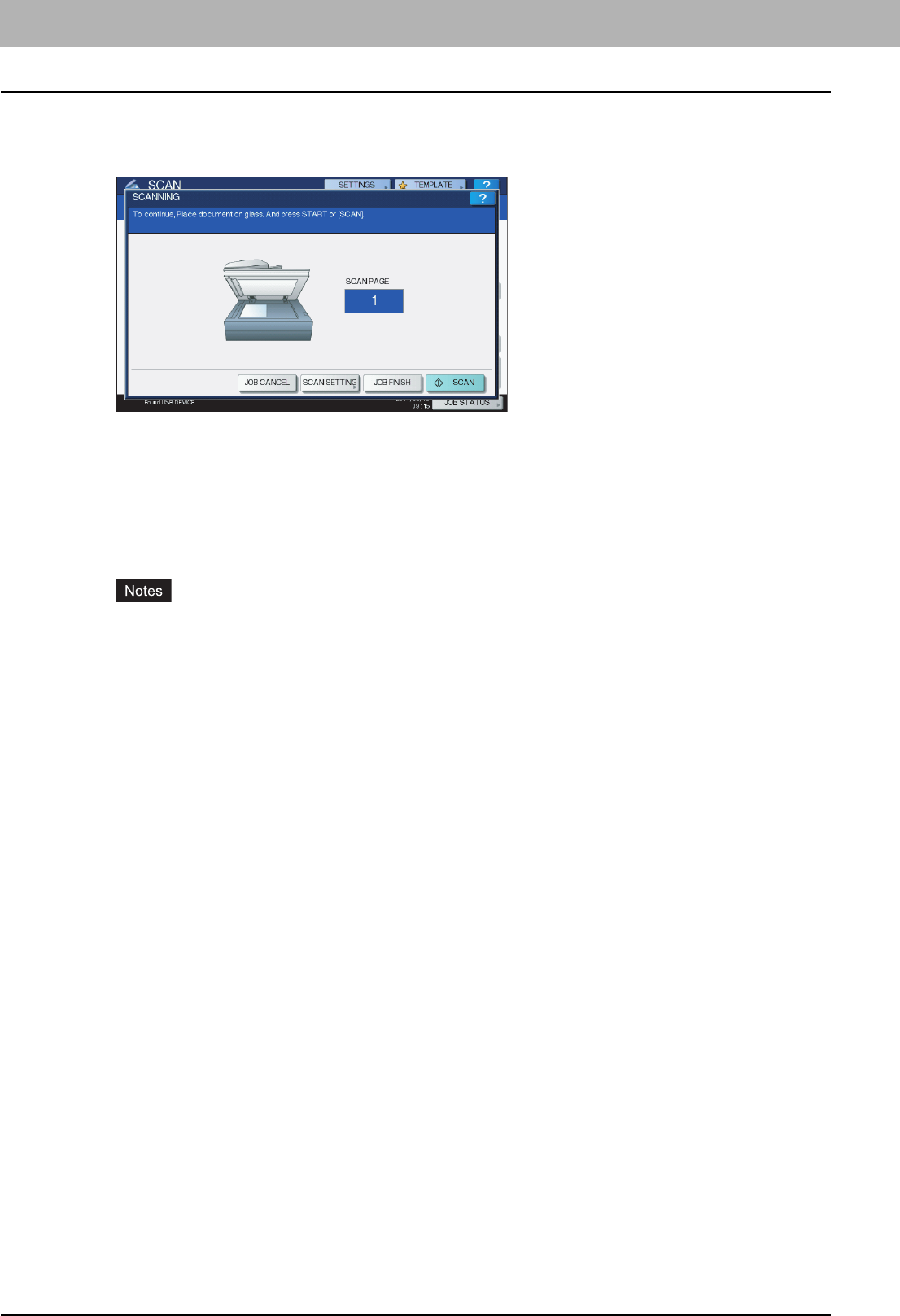
6
Press [SCAN] to scan data.
yTo scan 2-sided documents or set Color Mode or Resolution, etc., press [SCAN SETTING].
P.40 “Changing Scan Settings”
yTo preview the scans, press [PREVIEW] and then [SCAN].
P.49 “Previewing Scans”
yTo set other scan functions, press [e-FILING], [FILE] or [E-MAIL]. (Dual Agents)
P.65 “Scanning With Dual Functions (Dual Agents)”
2 BASIC OPERATION
32 Scan to USB
7
If the screen below appears, place another original on the original glass and press
[SCAN] or the [START] button to continue scanning. To finish the job, press [JOB
FINISH], followed by the [FUNCTION CLEAR] button.
yThe above screen is not displayed under the following conditions:
- You scan the original from the Reversing Automatic Document Feeder* without pressing [CONTINUE] to
scan additional originals.
- A scan preview is displayed.
yTo cancel the operation, press [JOB CANCEL].
yTo change the scan settings, press [SCAN SETTING].
P.40 “Changing Scan Settings”
* The Reversing Automatic Document Feeder is optional for the e-STUDIO4540C Series.
yWhen the equipment has scanned more than 1000 pages in a job, the “The number of originals exceeds the
limits. Will you save stored originals?” message appears. If you want to save the scans, press [YES].
yWhen the temporary workspace is full on the equipment’s hard disk, a message appears and the job is
canceled. The available workspace can be viewed on the TopAccess [Device] tab.
yIf the number of jobs waiting to store scans in the equipment's hard disk exceeds 20, a message appears to
indicate that the equipment’s memory is full. In this case, wait a while until memory becomes available again
or delete unnecessary jobs from [JOB STATUS].
P.37 “Viewing the scan job status”
2 BASIC OPERATION
Web Service (WS) Scan 33
Web Service (WS) Scan
Web Service (WS) Scan uses the functions of Windows operating systems such as Windows Vista to scan images from a
client computer through the network. Scanning can be performed through the touch panel operation or from a client
computer running Windows operating systems such as Windows Vista. The images scanned on the equipment can be
loaded to your client computer and viewed on an application supporting the Windows Imaging Acquisition (WIA) Scan
Driver.
System Requirements
The WS Scan function is available under the following environments:
yOS
Windows Vista / Windows 7 / Windows Server 2008
ySoftware
Windows Imaging Acquisition (WIA)-compliant applications
Scan Driver Installation
WS Scan uses the WIA Scan Driver included with Windows operating systems such as Windows Vista. The WIA Scan
Driver is automatically installed to your client computer when you install client software for Web Service Printing. For help,
refer to the Software Installation Guide.
To install the WIA Scan Driver on a client computer, the Web Service Scan setting must be enabled by the
administrator on TopAccess. For details, refer to the TopAccess Guide.
The Client Utilities CD-ROM includes the TOSHIBA e-STUDIO WIA Driver for users of Windows XP/Windows Vista/
Windows 7/Windows Server 2003/Windows Server 2008. This driver can be used together with a WIA-compliant
application, such as Microsoft Paint supported by Windows XP or Windows Vista, to scan images on the equipment
and load them to your client computer. For details, refer to the following section:
P.89 “Scanning Images Using the TOSHIBA e-STUDIO WIA Driver”
This guide provides instructions for using the touch panel to scan images on the equipment. For operational instructions
on the client computers, refer to the documentation that comes with your WIA-compliant application.
Scanning with Web Service Scan
1
Place the original(s).
For help, refer to the Quick Start Guide.
2
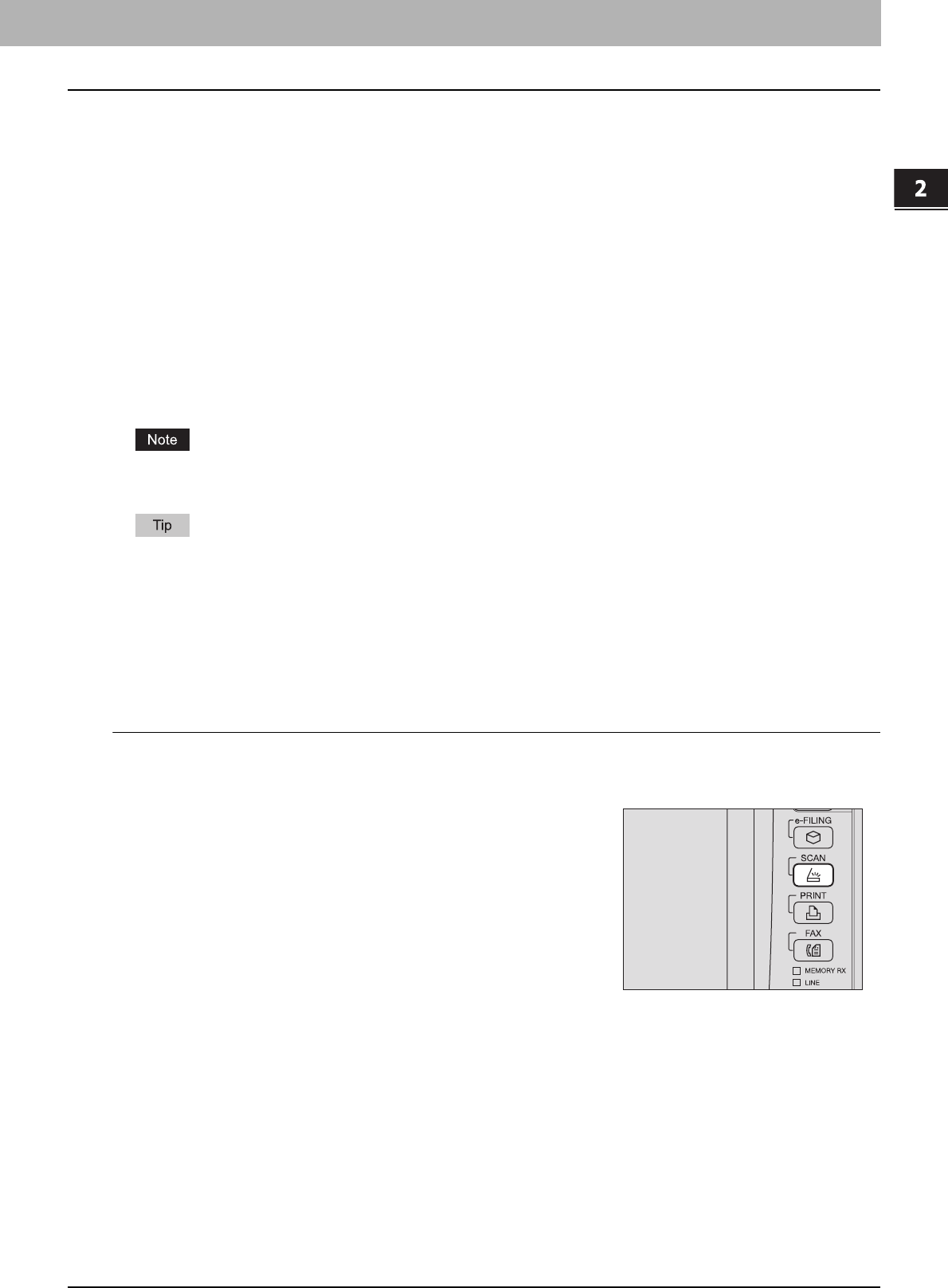
On the control panel, press the [SCAN] button to
enter the SCAN menu.
2 BASIC OPERATION
34 Web Service (WS) Scan
3
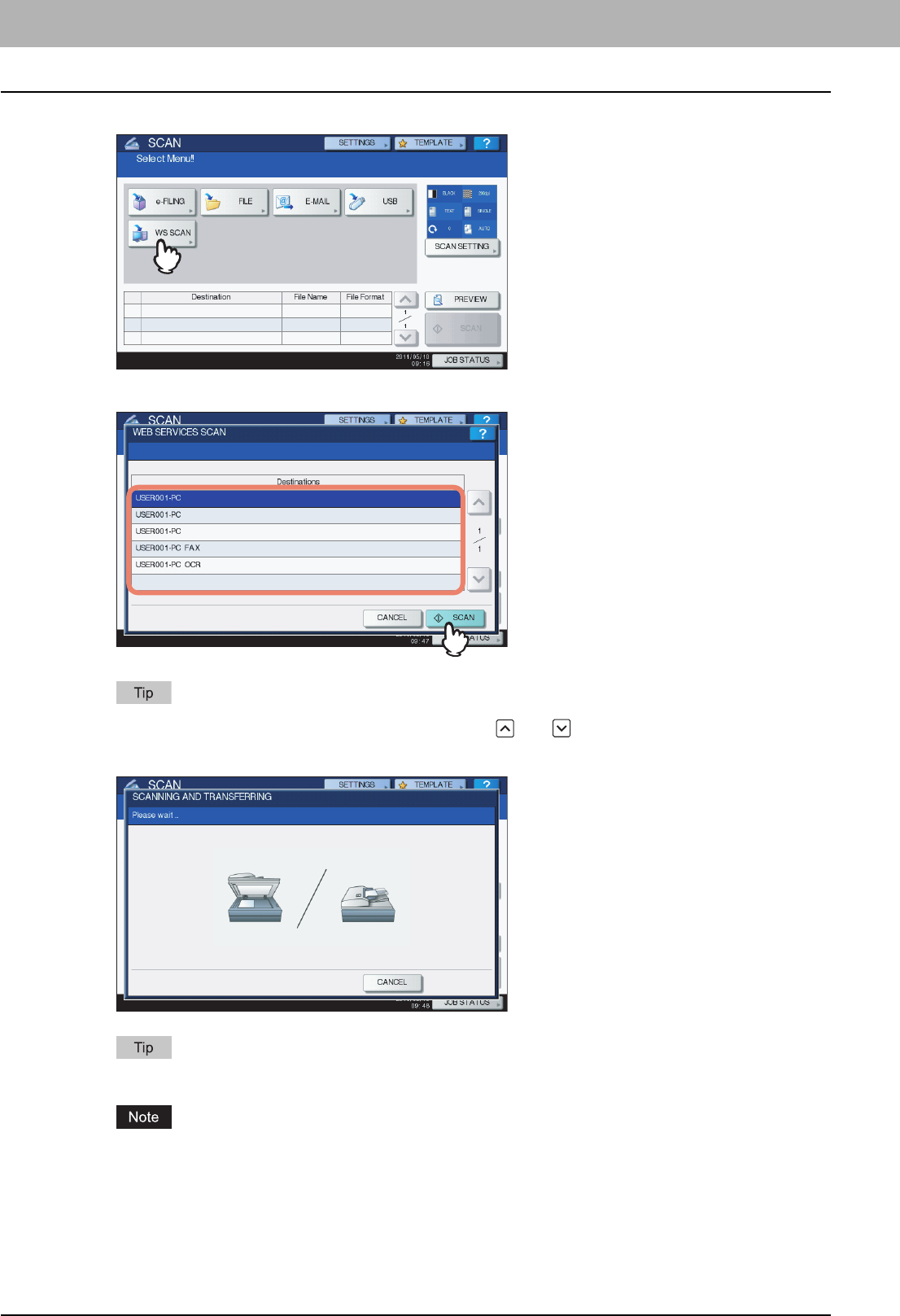
Press [WS SCAN].
4
Select the client that fits your needs, and then press [SCAN].
If the desired client name is not shown on the screen, use and to switch between pages.
The following screen is displayed.
To cancel the operation, press [CANCEL].
If the above screen does not appear, make sure that the selected client is running.
2 BASIC OPERATION
Using Saved Scan Data 35
Using Saved Scan Data
Using scan data saved as e-Filing documents
You can display a list of the scan data stored in e-Filing and use it in various ways from the touch panel or with the e-Filing
web utility. For instructions on how to use the data stored in e-Filing, refer to the e-Filing Guide.
Using scan data saved as files
To access your scans stored in the equipment’s shared folder, a USB storage device, or a network folder, use the
Windows Explorer search function or the Macintosh Finder.
Using scans saved in MFP LOCAL
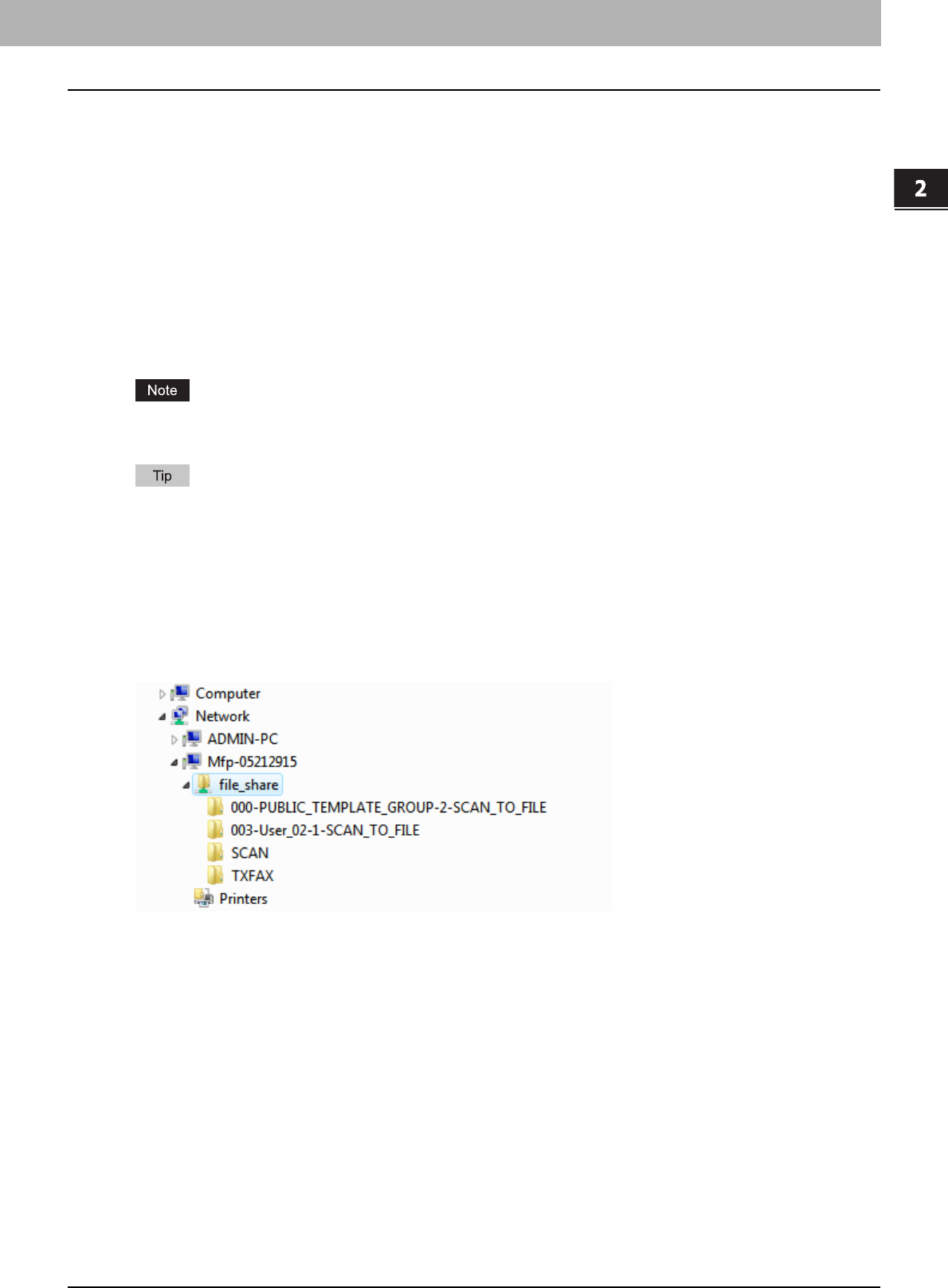
When you select [MFP LOCAL] to save your scans, they are stored in the equipment’s shared folder named “file_share.”
You can access this folder from a computer running a Windows OS or Mac OS X 10.3.x or later.
The equipment’s shared folder cannot be accessed from Mac OS X 10.2.x or earlier because these versions do not
support SMB.
If you access the equipment’s shared folder from Macintosh OS X 10.3.x or later, connecting to the network from the
Finder displays the SMB/CIFS File dialog box. Enter your user name and password in the dialog box as required.
Whether your scans are stored directly in the shared folder or in a sub-folder is controlled by the Local Storage Path
setting on TopAccess. The administrator can change this setting from the Setup page by clicking the “Save as file”
submenu. For details, refer to the TopAccess Guide.
When scans are sent to a sub-folder:
When the Local Storage Path setting is set to send the scans to a sub-folder in the path, the equipment automatically
creates a sub-folder. The name of the sub folder depends on how you operate the Scan to File function.
The sub-folders created under “file_share” are as follows:
y“SCAN” — This sub-folder contains files created by the Scan to File function.
y“000-PUBLIC_TEMPLATE_GROUP-[Template Name]” — This sub-folder contains files created using a scan
template in the Public Template group.
y“[Group No.]-[Group Name]-[Template Name]” — This sub-folder contains files created using a scan template in the
User Template group.
The sub-folders are automatically deleted when the folder becomes empty.
When scans are sent directly to the shared folder:
When the Local Storage Path setting is set to send the scan data directly to storage, they are stored in the equipment
under the “file_share” folder.
2 BASIC OPERATION
36 Using Saved Scan Data
Using scans saved in USB storage device
When you select [USB] to save your scans, they are stored in the USB storage device connected to the equipment.
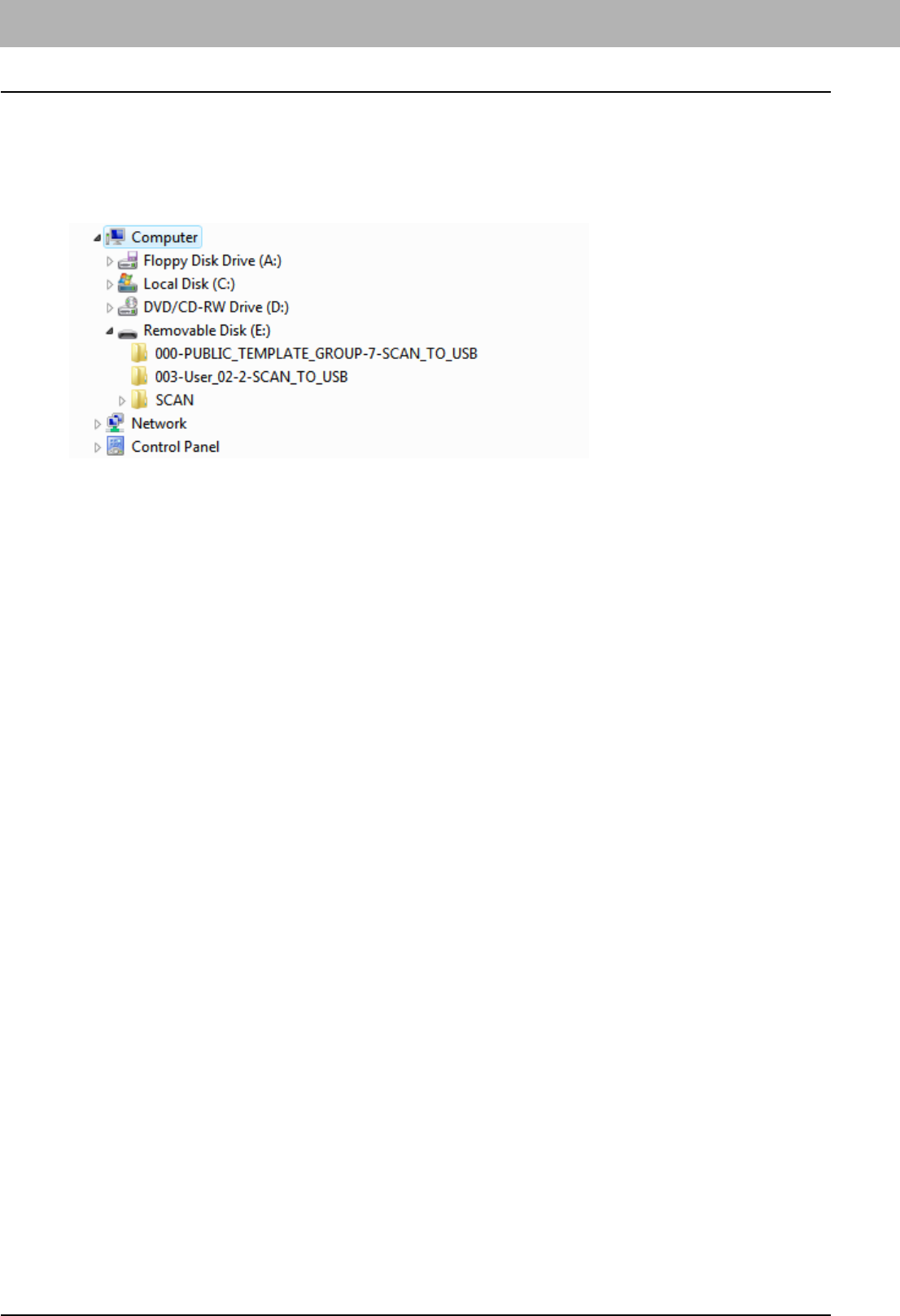
When you save your scans in the USB storage device, a sub-folder is automatically created. The name of the sub-folder
depends on how you operate the Scan to USB function.
y“SCAN” — This sub-folder contains files created by the Scan to USB function.
y“000-PUBLIC_TEMPLATE_GROUP-[Template Name]” — This sub-folder contains files created using a scan
template in the Public Template group.
y“[Group No.]-[Group Name]-[Template Name]” — This sub-folder contains files created using a scan template in the
User Template group.
Using scans saved in network folders (REMOTE 1/2)
When you select [REMOTE 1] or [REMOTE 2] to store data, they are stored in the Scan folder automatically created in the
specified network folder. When these data contain a template, they are stored in a folder that has been specified in the
template setting.
2 BASIC OPERATION
Viewing the Scan Job Status and Log 37
Viewing the Scan Job Status and Log
The status and log of scan jobs can be viewed on the touch panel.
If the equipment is managed by the User Management feature, you need to enter the user information, such as the
user name and password.
Viewing the scan job status
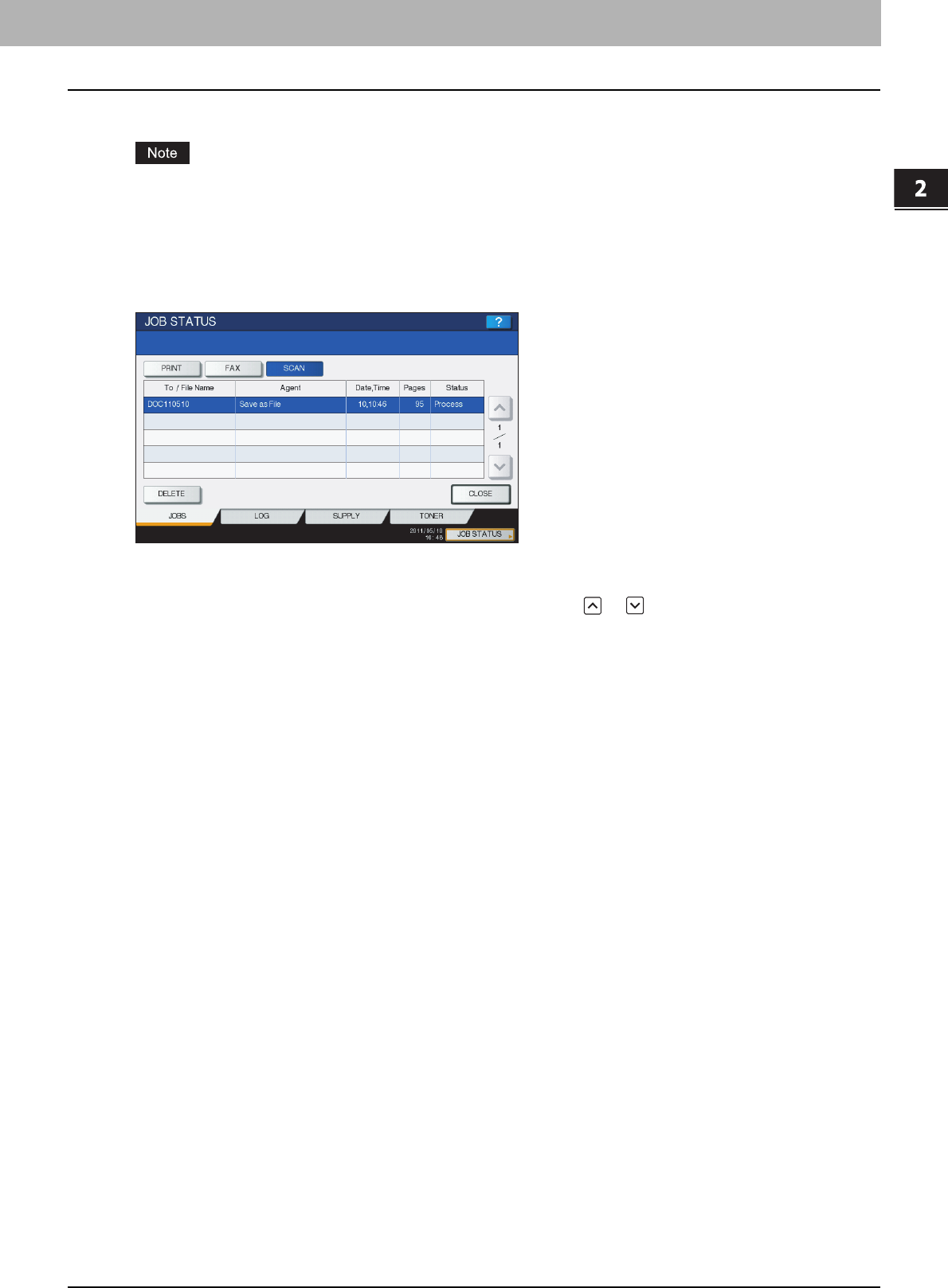
Pressing [JOB STATUS] > [JOBS] > [SCAN] on the touch panel displays a list of the scan jobs in progress. The jobs can
be deleted if needed.
In the list, you can view each job’s destination/file name, agent (scan function), date and time, number of pages, and
current status.
Up to 1000 jobs can be listed. To display the previous or next page, press or . The number of jobs displayed on a
page varies depending on the equipment used.
To delete jobs, select one on the list and press [DELETE]. You can select more than one job to be deleted.
To exit from the JOB STATUS screen, press [CLOSE].
2 BASIC OPERATION
38 Viewing the Scan Job Status and Log
Viewing the scan job log
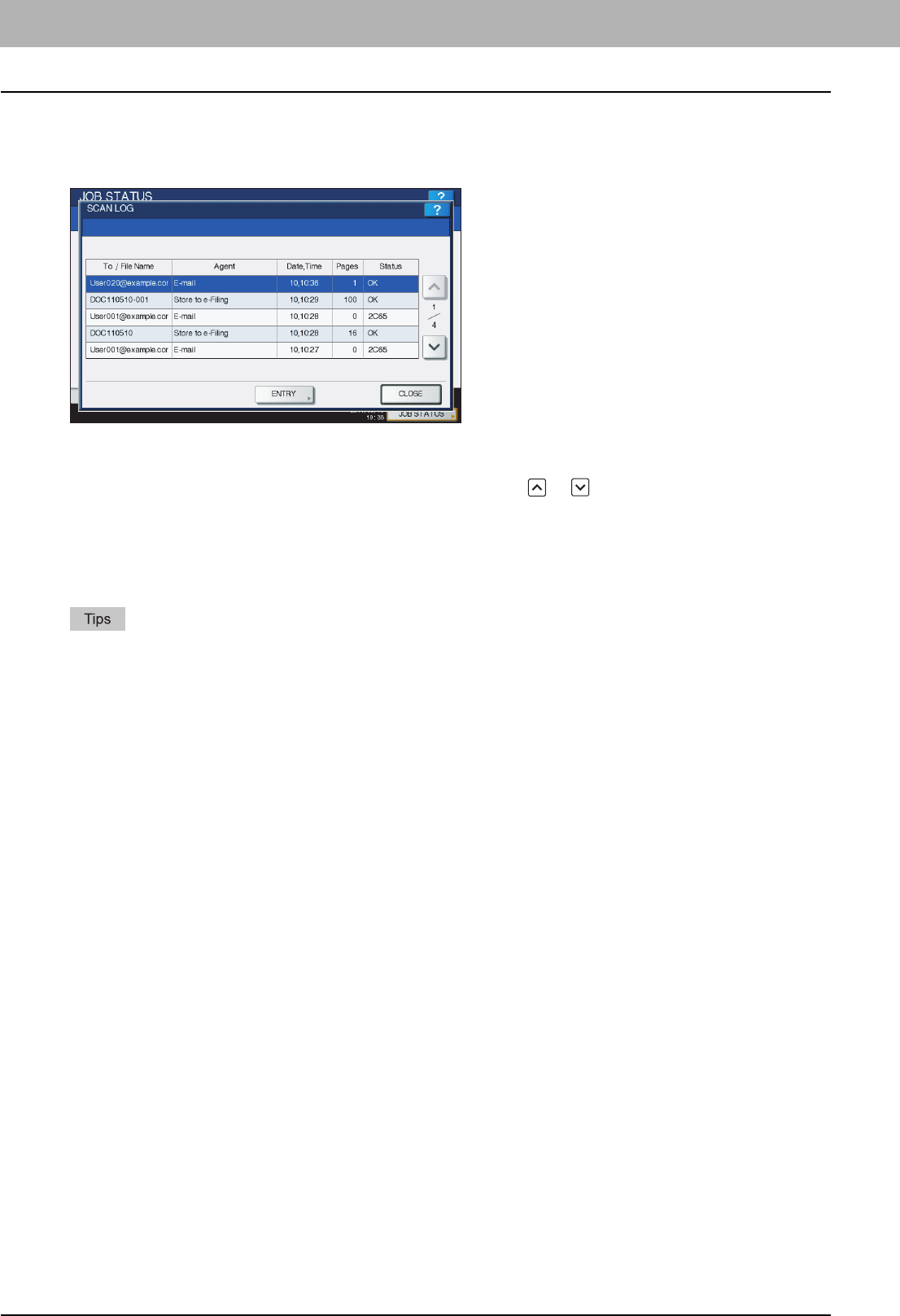
A record of scan jobs can be displayed on the [LOG] tab of the JOB STATUS screen. To display the record on the touch
panel, press [JOB STATUS] > [LOG] > [SCAN].
On the [LOG] tab, you can view each job’s destination/file name, agent (scan function), date and time, number of pages,
and status (job result).
Up to 1000 jobs can be listed. To display the previous or next page, press or . The number of jobs displayed on a
page varies depending on the equipment used.
If you want to register an e-mail address on the list to the address book, press [ENTRY].
P.109 “Saving contact information to the address book”
To exit from the SCAN LOG screen, press [CLOSE].
yFor details of the job record displayed on the [LOG] tab, refer to the TopAccess Guide.
yFor details on error codes displayed in the “Status” column, refer to the Troubleshooting Guide.
yThe scan job log can be exported to a USB storage device. For details, refer to the MFP Management Guide.

3.USEFUL FUNCTIONS
This chapter describes how to scan documents using various advanced settings.
Changing Scan Settings........................................................................................................ 40
Specifying color mode ..........................................................................................................................................40
Specifying resolution ............................................................................................................................................41
Selecting original mode ........................................................................................................................................41
Scanning 2-sided originals ...................................................................................................................................43
Specifying original size .........................................................................................................................................43
Changing orientation ............................................................................................................................................42
Changing compression ratio.................................................................................................................................44
Removing blank pages.........................................................................................................................................45
Erasing black frames around images ...................................................................................................................46
Adjusting exposure...............................................................................................................................................47
Adjusting contrast.................................................................................................................................................47
Adjusting background density ..............................................................................................................................47
Adjusting sharpness .............................................................................................................................................48
Adjusting color balance ........................................................................................................................................48
Previewing Scans................................................................................................................... 49
Specifying E-mail Addresses ................................................................................................ 51
Scanning With Dual Functions (Dual Agents) ..................................................................... 65
Encrypting PDF Files ............................................................................................................. 68
3 USEFUL FUNCTIONS
40 Changing Scan Settings
Changing Scan Settings
“Scan settings” are settings applied commonly to the “Scan to e-Filing”, “Scan to File”, “Scan to E-mail” and “Scan to USB”
functions. The options frequently used in scanning are generally registered as the default scan settings ( P.14), and you
can scan documents without changing the settings. If you want to change the settings for a particular job to suit your
preferences, press [SCAN SETTING] on the touch panel and select the desired settings. The SCAN SETTING screen
consists of 4 pages. Use and to switch between them.
yPage 1/4
P.40 “Specifying color mode”
P.41 “Specifying resolution”
P.41 “Selecting original mode”
P.42 “Changing orientation”
P.43 “Scanning 2-sided originals”
P.43 “Specifying original size”
yPage 2/4
P.44 “Changing compression ratio”
P.45 “Removing blank pages”
P.46 “Erasing black frames around images”
yPage 3/4
P.47 “Adjusting exposure”
P.47 “Adjusting contrast”
P.47 “Adjusting background density”
P.48 “Adjusting sharpness”
yPage 4/4
P.48 “Adjusting color balance”
If you finish changing the desired settings, press [OK] to set your selections and continue the scan operation.
P.16 “Scan to File”
P.23 “Scan to E-mail”
P.29 “Scan to USB”
For instructions on how to store your scans with Scan to e-Filing, refer to the e-Filing Guide.
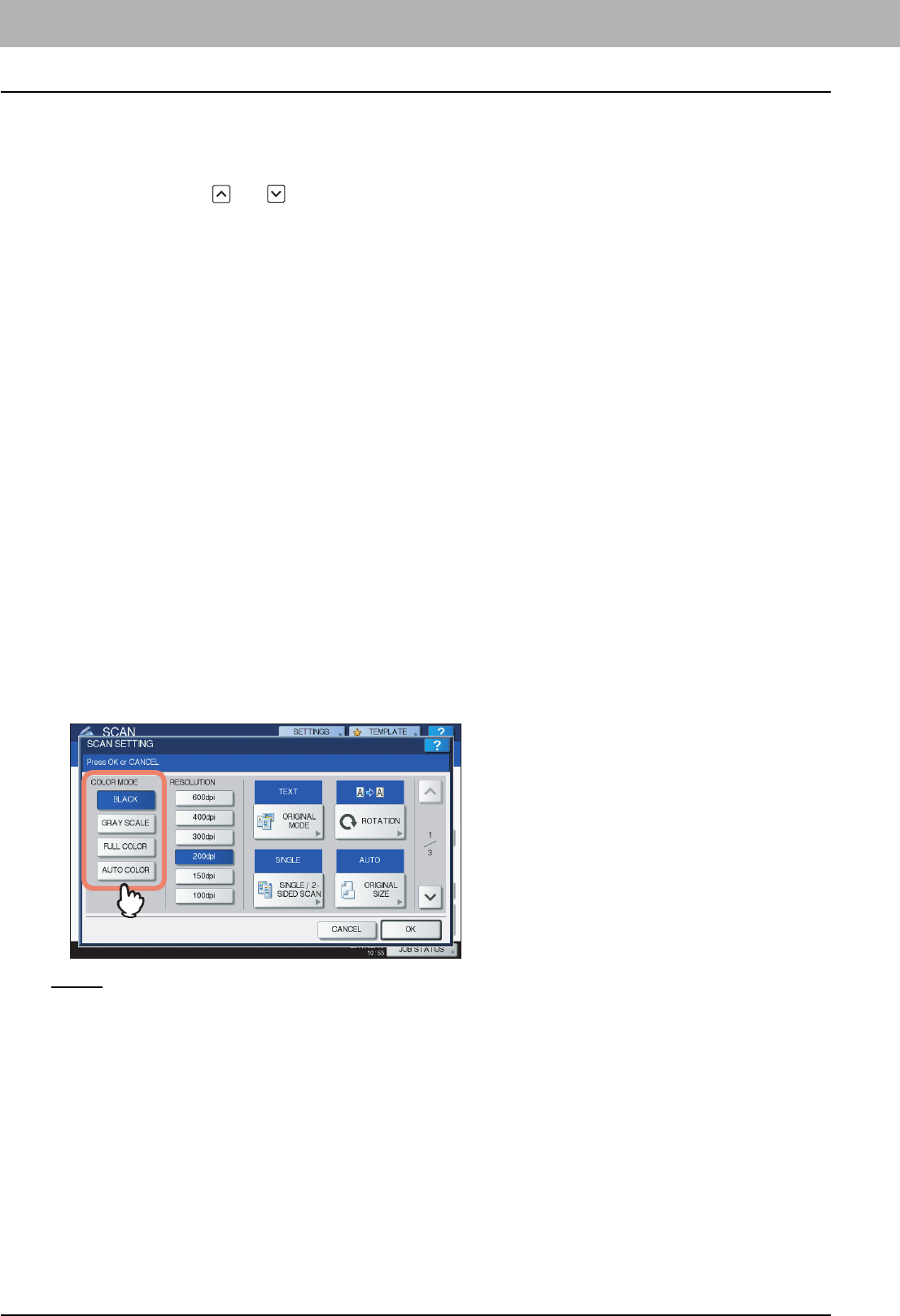
Specifying color mode
Select the color mode best suited to your scan job from the following options:
[BLACK] — Select this option to scan images in black and white.
[GRAY SCALE] — Select this option to scan images containing both text and photos and when you want to enhance the
photo quality.
[FULL COLOR] — Select this option to scan color images.
[AUTO COLOR] — Select this option to scan monochrome images in black and white and color images in color by
automatically detecting the color type of each document page. The level for determining color or monochrome can be set
with the ACS Adjustment setting accessible from the [USER FUNCTIONS] button on the control panel. For details, refer to
the MFP Management Guide.
3.USEFUL FUNCTIONS
Changing Scan Settings 41
3 USEFUL FUNCTIONS
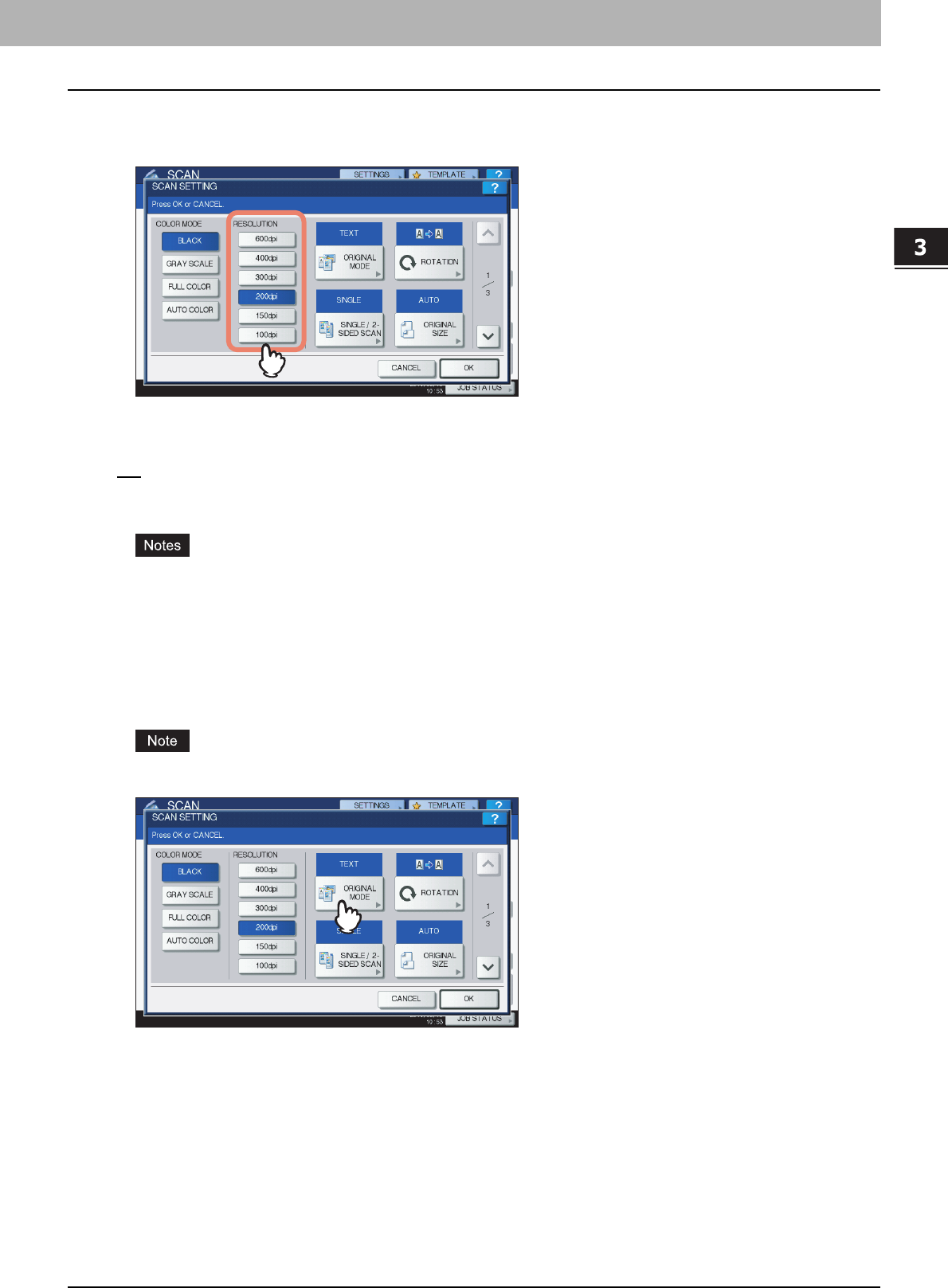
Specifying resolution
Select a resolution from the following options:
[600] — Select this option to scan originals at 600 dpi.
[400] — Select this option to scan originals at 400 dpi.
[300] — Select this option to scan originals at 300 dpi.
[200] — Select this option to scan originals at 200 dpi.
[150] — Select this option to scan originals at 150 dpi.
[100] — Select this option to scan originals at 100 dpi.
yWith “Scan to File” or “Scan to USB”, A5, A6, ST-R, 8K or 16K size originals scanned at 100 dpi may be handled as
non-standard size depending on applications.
yWith “Scan to File”, “Scan to E-mail” or “Scan to USB”, the resolution setting is not available if [SLIM PDF] is
selected for the file format setting.
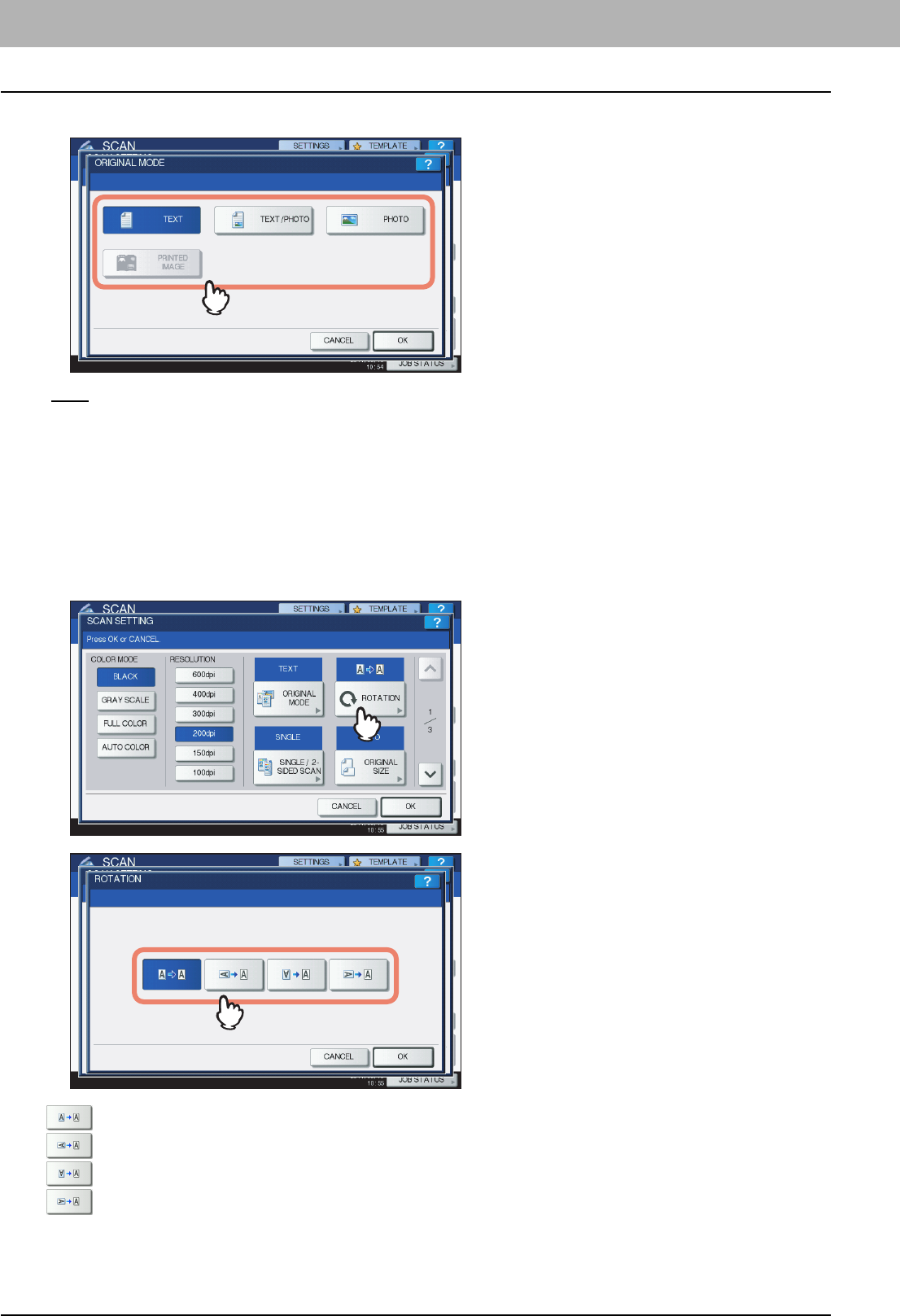
Selecting original mode
Select the original mode for the image quality best suited to your originals.
The Original Mode setting is not available when [GRAY SCALE] is selected for the color mode setting.
3 USEFUL FUNCTIONS
42 Changing Scan Settings
[TEXT] — Select this option to scan text originals.
[TEXT/PHOTO] — Select this option to scan originals containing text and photos. This option is available only when
[BLACK] is selected for the color mode setting.
[PHOTO] — Select this option to scan originals containing photos printed on photographic paper.
[PRINTED IMAGE] — Select this option to scan originals as printed images. This option is available only when [FULL
COLOR] or [AUTO COLOR] is selected for the color mode setting.
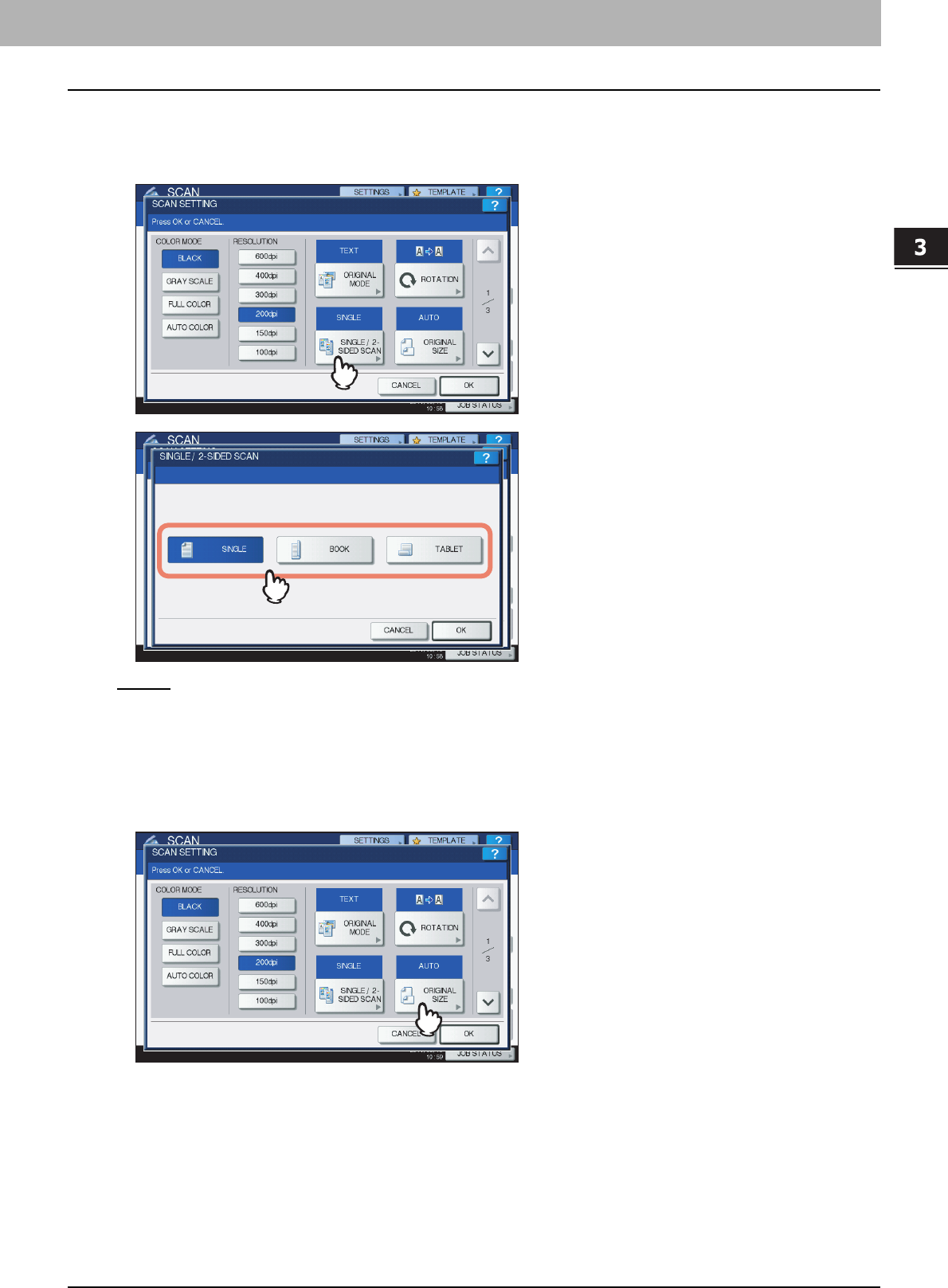
Changing orientation
With the rotation setting, you can change the orientation of your scans. If necessary, select the desired rotation pattern
from the following options:
— Select this option to scan originals without a change in orientation.
— Select this option to rotate your scans 90 degrees to the right.
— Select this option to rotate your scans 180 degrees.
— Select this option to rotate your scans 90 degrees to the left.
3.USEFUL FUNCTIONS
Changing Scan Settings 43
3 USEFUL FUNCTIONS
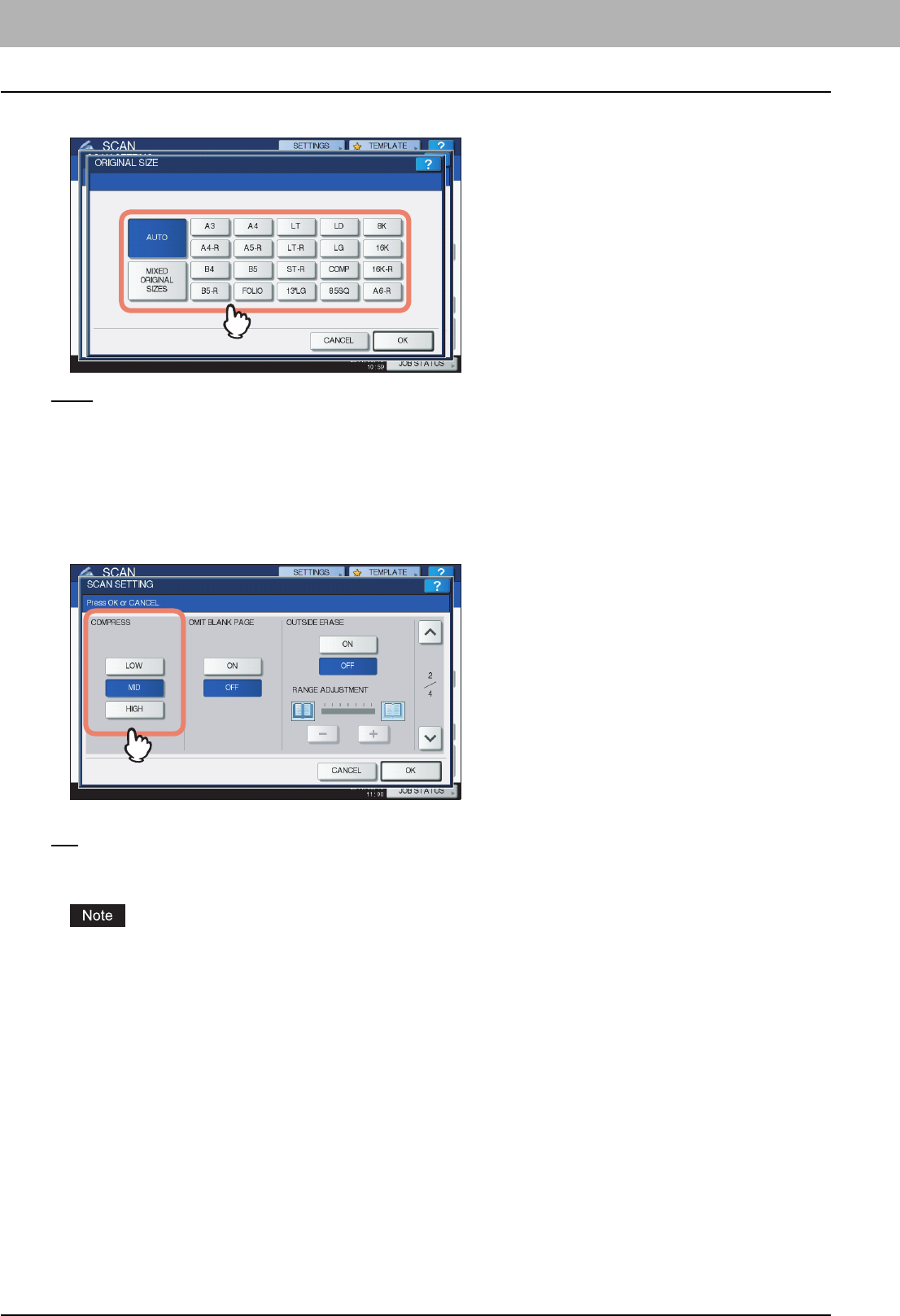
Scanning 2-sided originals
With the Single/2-sided Scan setting, you can choose whether to scan your originals on both sides. Select from the
following options:
[SINGLE] — Select this option to scan only the front of the originals.
[BOOK] — Select this option to scan both sides of the originals in the same direction.
[TABLET] — Select this option to scan the front in one direction and the back rotated by 180 degrees.
Specifying original size
To specify the original size, press [ORIGINAL SIZE]. Pressing the button displays the buttons for selectable original sizes
along with the following buttons:
3 USEFUL FUNCTIONS
44 Changing Scan Settings
[AUTO] — Select this option to have the equipment automatically detect the size of your originals.
[MIXED ORIGINAL SIZES] — Select this option when placing originals of different sizes in the Reversing Automatic
Document Feeder*.
* The Reversing Automatic Document Feeder is optional for the e-STUDIO4540C Series.
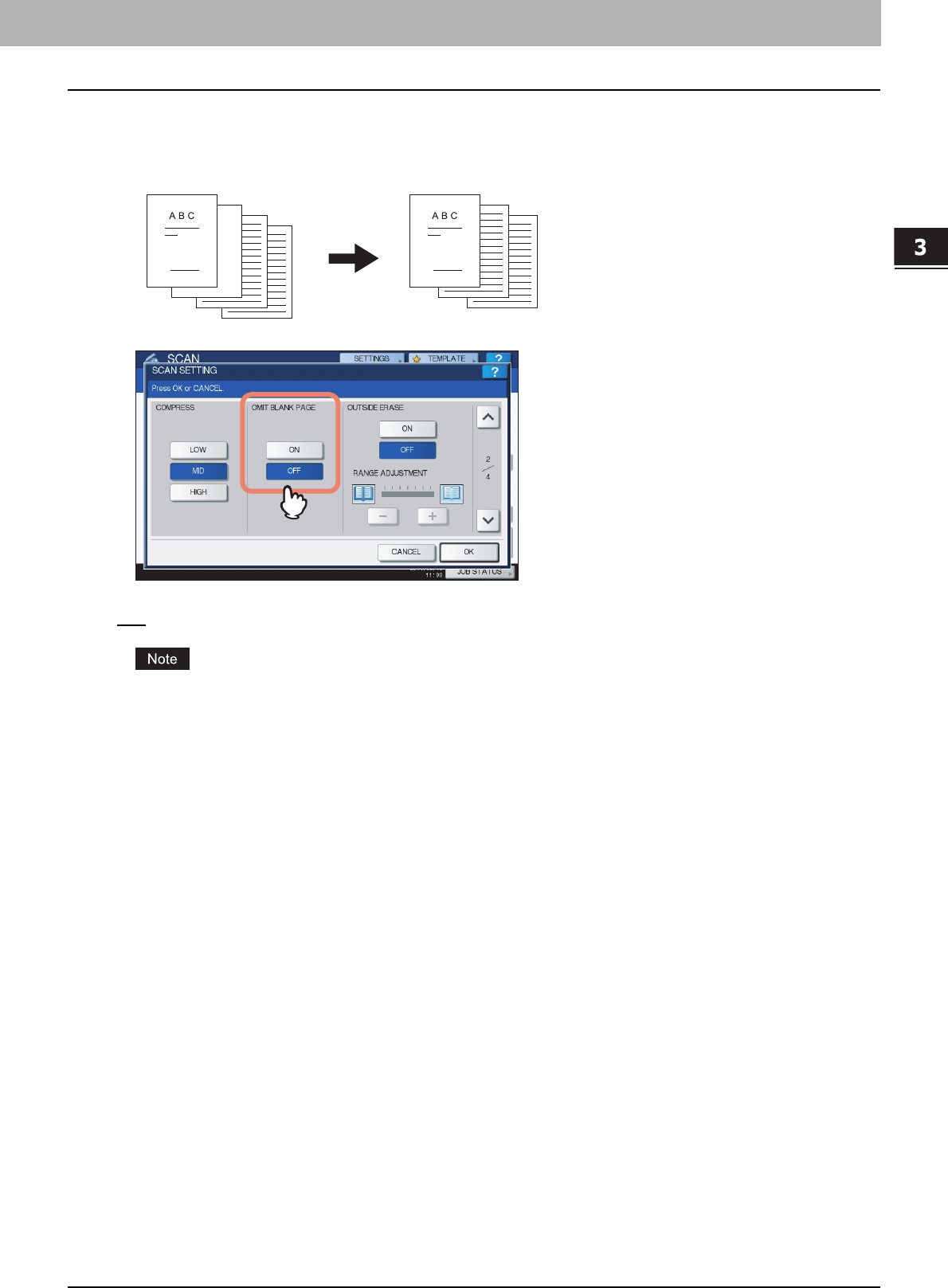
Changing compression ratio
You can select the compression ratio for the scanned image data. In general, the higher the compression ratio, the lower
the image quality. Select from the following options:
[LOW] — Select this option to apply a low compression ratio and enhance the image quality.
[MID] — Select this option to compress the data with a moderate compression ratio and obtain an average image quality.
[HIGH] — Select this option for a high compression ratio. This option is suitable when you want to minimize the data size
rather than enhance the image quality.
The compression ratio setting is not available in either of the following conditions:
y[SLIM PDF] is selected as the file format setting.
y[BLACK] is selected as the color mode setting.
3.USEFUL FUNCTIONS
Changing Scan Settings 45
3 USEFUL FUNCTIONS
Removing blank pages
If your original contains blank pages, you can remove them from the scan result. To take advantage of this feature, enable
the Omit Blank Page setting.
[ON] — Select this option when you want to enable the feature and remove blank pages from the scan result.
[OFF] — Select this option when you want to disable the feature and include blank pages in your scans.
The equipment may not detect blank pages correctly in the following cases:
yThe original consists of half-tone pages.
yPages contain small text/images, such as a page number printed on a blank page.
3 USEFUL FUNCTIONS
46 Changing Scan Settings
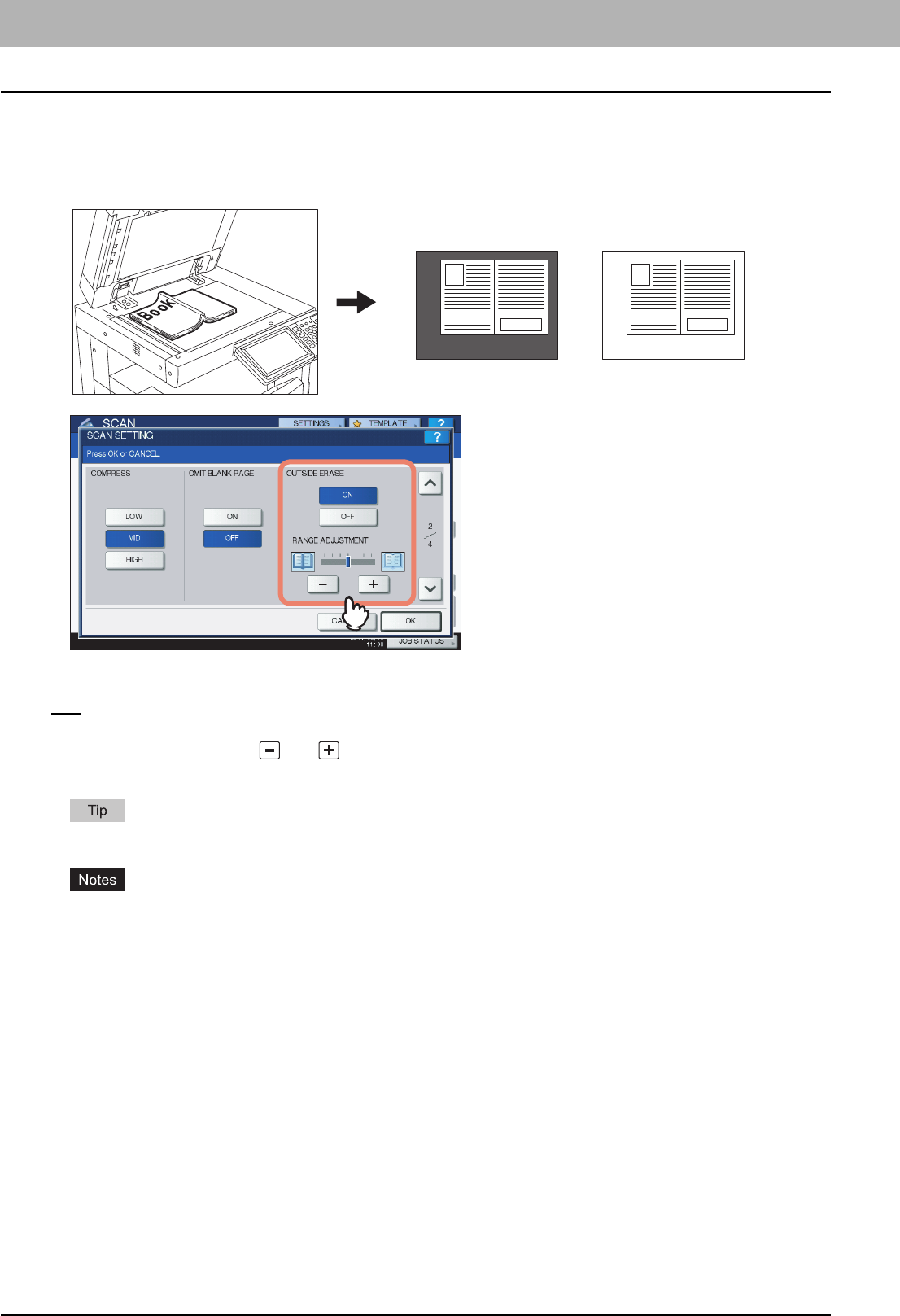
Erasing black frames around images
You may want to scan originals with the original cover left open especially when they are as small as a drivers license or
as thick a book as a dictionary. In this case, the open cover admits light to the Original Glass surface, producing a scan
image with a black outer frame. This black frame can be erased using the Outside Erase feature.
[ON] — Select this option to enable the Outside Erase feature. Pressing the button makes the Range Adjustment slider
available.
[OFF] — Select this option to disable the Outside Erase feature.
RANGE ADJUSTMENT — Use and to select the appropriate sensitivity from 7 levels to detect the boundary
between the image and outer frame. The higher the level, the more area is erased.
The sensitivity level for detecting images and the outer frame can be changed for each job using the control panel.
yRegardless of the settings, this feature is disabled under the following conditions:
- The Document Cover is closed at the time of scanning.
- The originals are scanned from the Reversing Automatic Document Feeder*.
ySet the appropriate exposure manually. Enabling Outside Erase cancels the automatic exposure adjustment
feature.
P.47 “Adjusting exposure”
yThe feature may not produce an appropriate output when your original contains a concave shaped image with a
dent.
yThe margins may not be erased correctly under the following conditions:
- Light intrudes into the margin area of the original placed on the Original Glass.
- Hands or fingers holding the original on the Original Glass are scanned.
* The Reversing Automatic Document Feeder is optional for the e-STUDIO4540C Series.
OFF ON
3.USEFUL FUNCTIONS
Changing Scan Settings 47
3 USEFUL FUNCTIONS
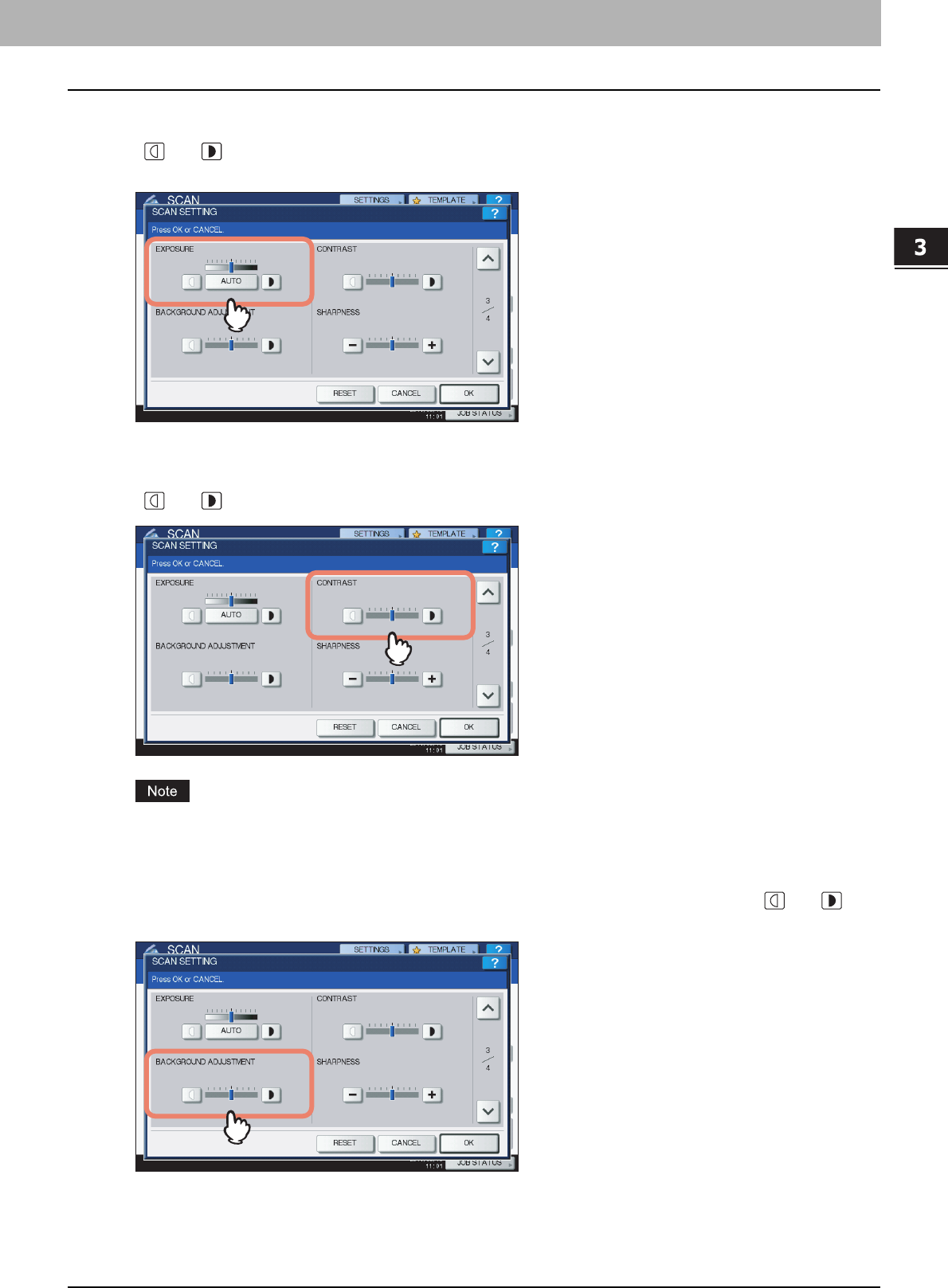
Adjusting exposure
Use and to select the preferable exposure setting from 11 levels. If [AUTO] is selected, the automatic exposure
adjustment feature is enabled, automatically setting the exposure best suited to your originals.
Adjusting contrast
Use and to select the preferable contrast setting from 9 levels.
The contrast setting is available only when [FULL COLOR] or [AUTO COLOR] is selected for the color mode setting.
Adjusting background density
With the background adjustment setting, you can lighten or darken the background of your scans. Use and to
select the preferable background density from 9 levels.
3 USEFUL FUNCTIONS
48 Changing Scan Settings
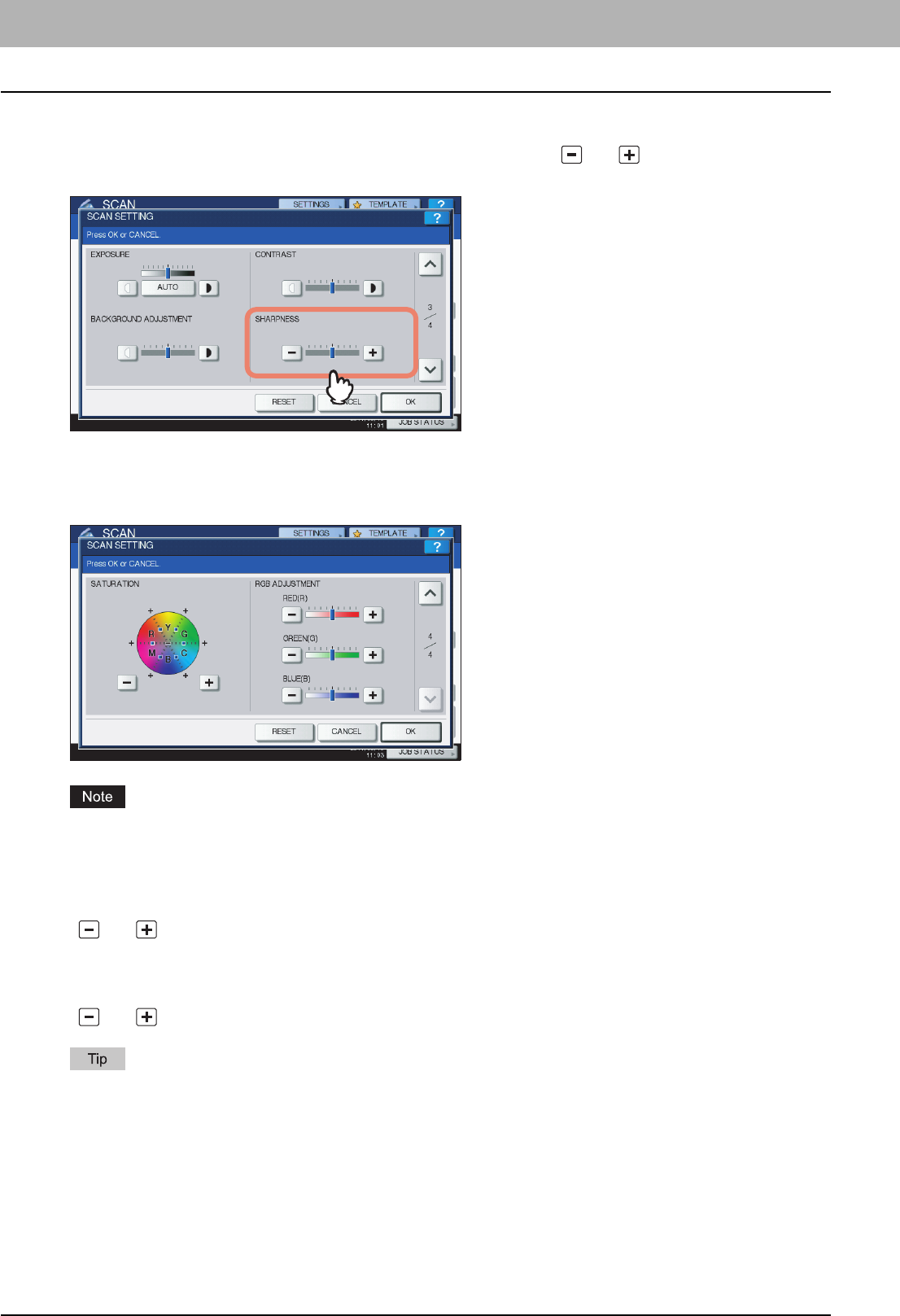
Adjusting sharpness
The sharpness setting determines whether your scans look clear or blurry. Use and to select the preferable
setting from 9 levels.
Adjusting color balance
The color balance of your scans can be adjusted with the saturation and RGB adjustment settings.
The page shown in the above figure is available only when [FULL COLOR] or [AUTO COLOR] is selected for the color
mode setting.
Saturation
Use and to manually specify the saturation level.
RGB adjustment
Use and to manually specify the density level for each color: red (R), green (G), and blue (B).
To reset all of the color balance settings back to the defaults, press [RESET].
3 USEFUL FUNCTIONS
Previewing Scans 49
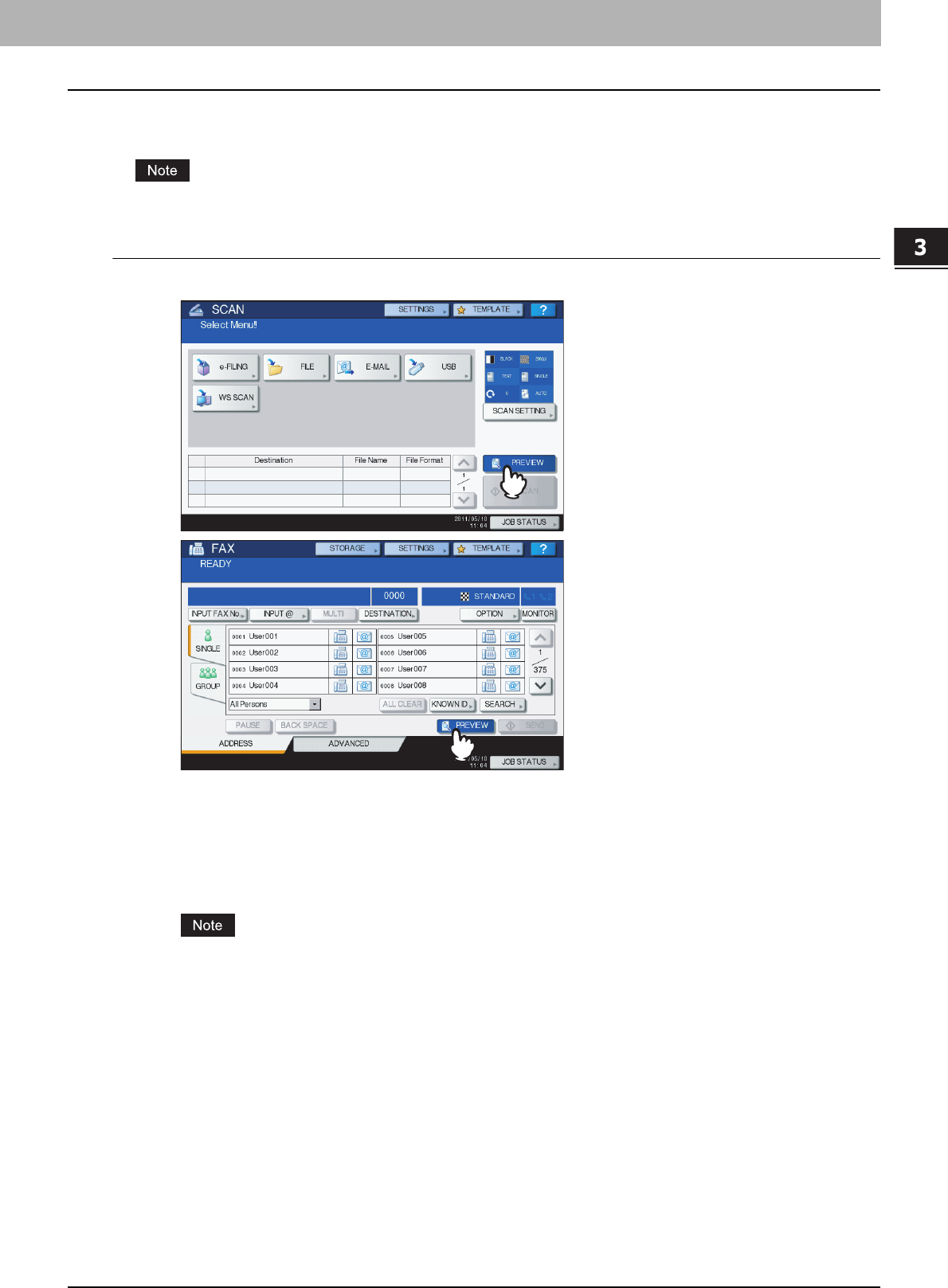
Previewing Scans
With the preview feature, you can view your scans on the touch panel before saving or e-mailing them. Follow the
procedure below.
The preview feature is not available with the WS Scan function.
Previewing scans
1
On the SCAN or FAX menu screen, press [PREVIEW].
2
See the following sections to select the desired function before scanning originals:
P.16 “Scan to File”
P.23 “Scan to E-mail”
P.29 “Scan to USB”
P.95 “Sending Internet Faxes”
For instructions on how to scan your documents with Scan to e-Filing, refer to the e-Filing Guide.
The preview feature is not available with the WS Scan function.
3 USEFUL FUNCTIONS
50 Previewing Scans
3
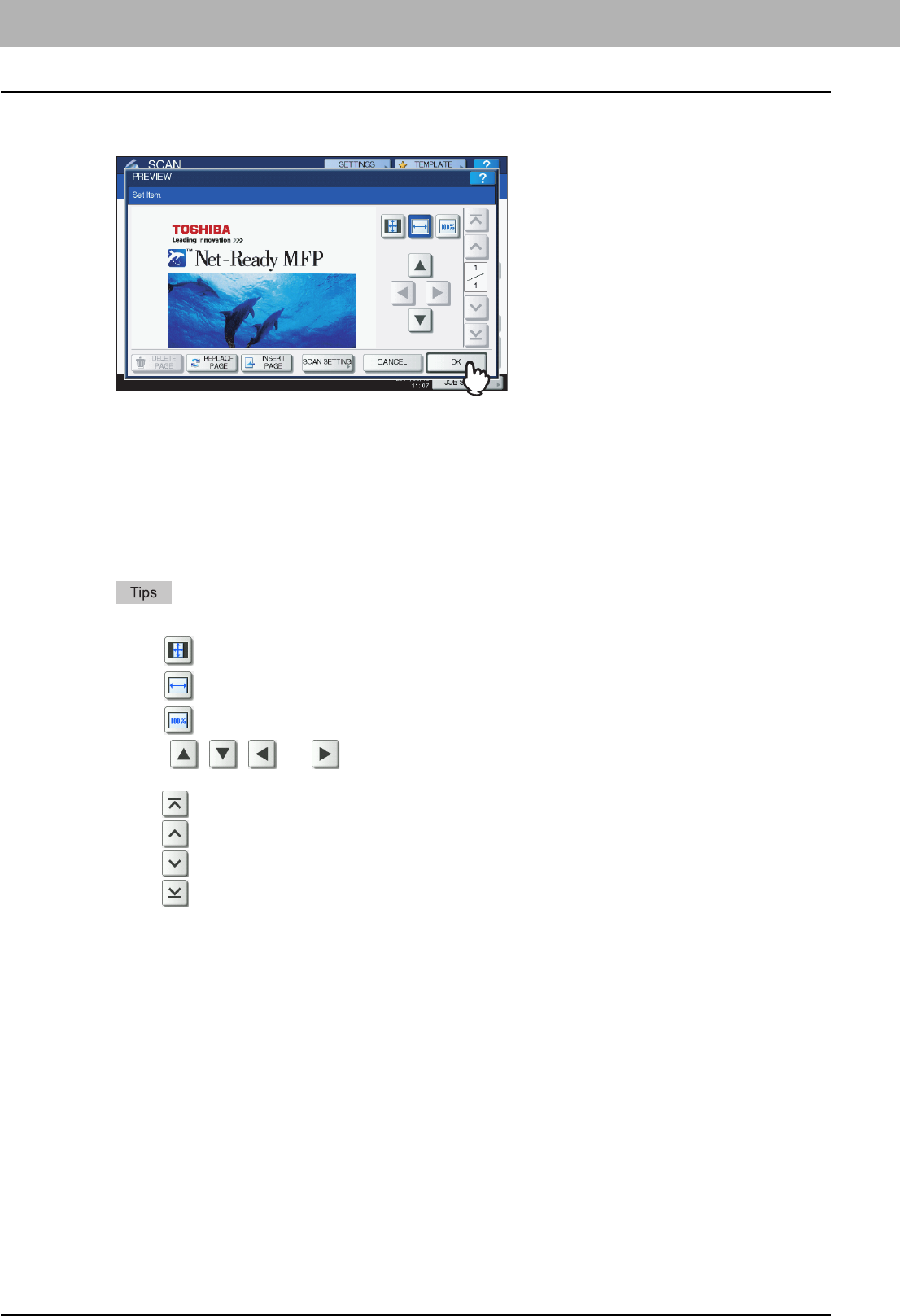
Carefully check the displayed preview of your scans. To save or e-mail your scans,
press [OK].
yIf you want to scan another original, place it on the original glass or in the Reversing Automatic Document
Feeder*, and then press [START] button.
yTo delete the page being previewed, press [DELETE PAGE].
yTo replace the page being previewed with another page, press [REPLACE PAGE].
yTo insert another scan before the page being previewed, press [INSERT PAGE].
yTo change scan settings, press [SCAN SETTING] on the SCAN menu, or press [OPTION] on the FAX menu.
P.40 “Changing Scan Settings”
P.95 “Sending Internet Faxes”
* The Reversing Automatic Document Feeder is optional for the e-STUDIO4540C Series.
yThree kinds of preview types are provided as follows.
- — Press this button to display a page of your scan to fit entirely in the preview window.
- — Press this button to display a page of your scan to fit the width of the preview window.
- — Press this button to display a page of your scans at the actual size.
yUse , , and to scroll the displayed image.
yIf multiple pages are scanned, you can switch between the pages using the following navigation buttons:
- — Press this button to display the very first page.
- — Press this button to display the previous page.
- — Press this button to display the following page.
- — Press this button to display the very last page.
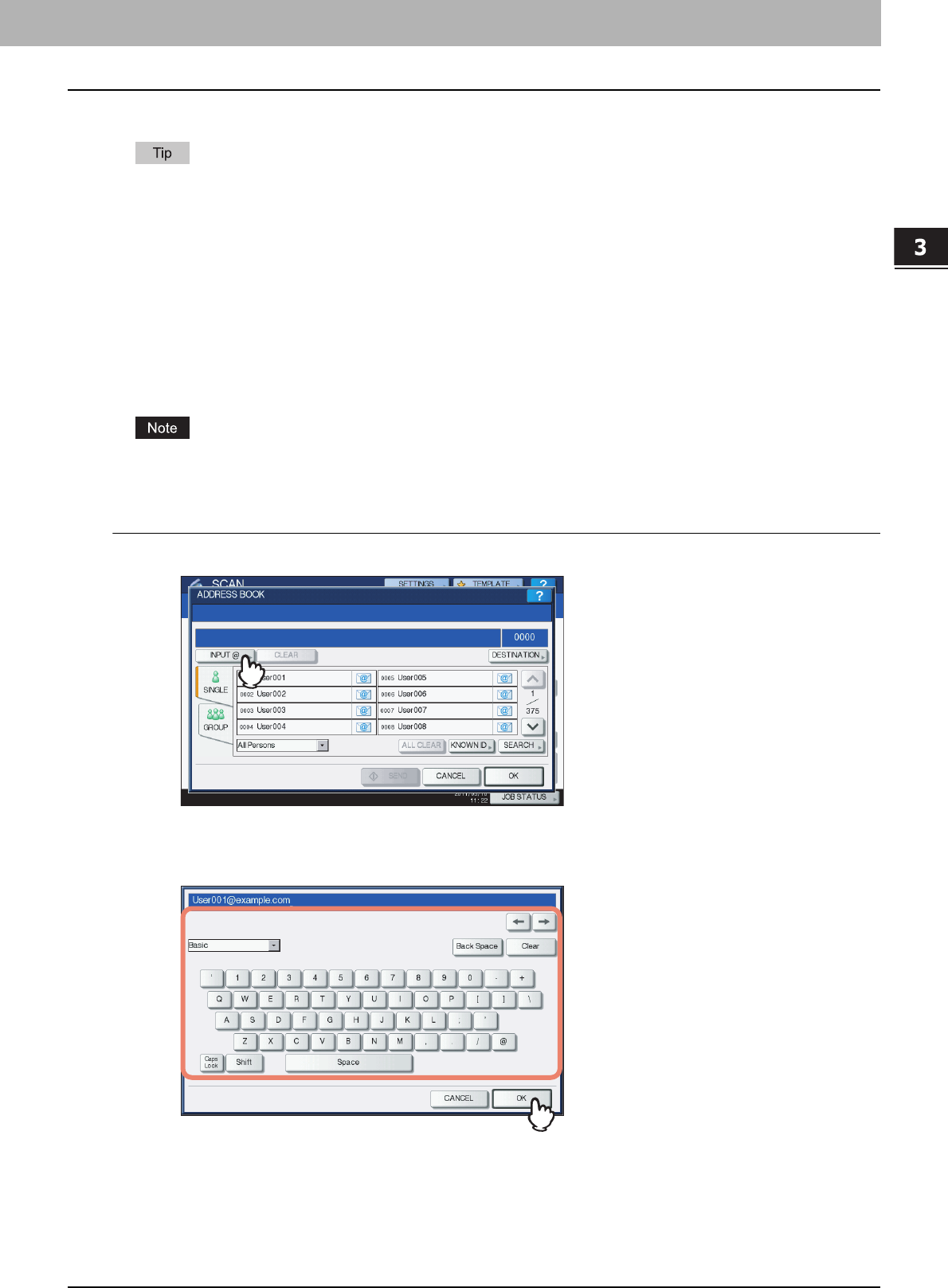
3 USEFUL FUNCTIONS
Specifying E-mail Addresses 51
Specifying E-mail Addresses
To specify e-mail addresses for the Scan to E-mail function or Internet faxing, you have the following options:
Up to 400 addresses can be specified.
P.51 “Entering an e-mail Addresses”
P.53 “Selecting from the address book”
P.54 “Refining your search”
P.54 “Searching the address book with ID numbers”
P.55 “Searching the address book with search strings”
P.58 “Searching the LDAP server with search strings”
P.60 “Selecting groups”
P.61 “Searching for groups with ID numbers”
P.62 “Searching for groups by name”
P.64 “Viewing/Deleting specified e-mail addresses”
The screen displays in the following procedures are examples of the Scan to E-mail function. The appearance of the
screens differs slightly from those of Internet faxes.
Entering an e-mail Addresses
1
Press [INPUT @].
The on-screen keyboard appears.
2
Enter an e-mail address using the keyboard and digital keys, and then press [OK] to set
the entry.
yFor Scan to E-mail, proceed to step 3.
yFor Internet faxing, the e-mail address is specified. Continue the Internet faxing operation.
P.95 “Sending Internet faxes”
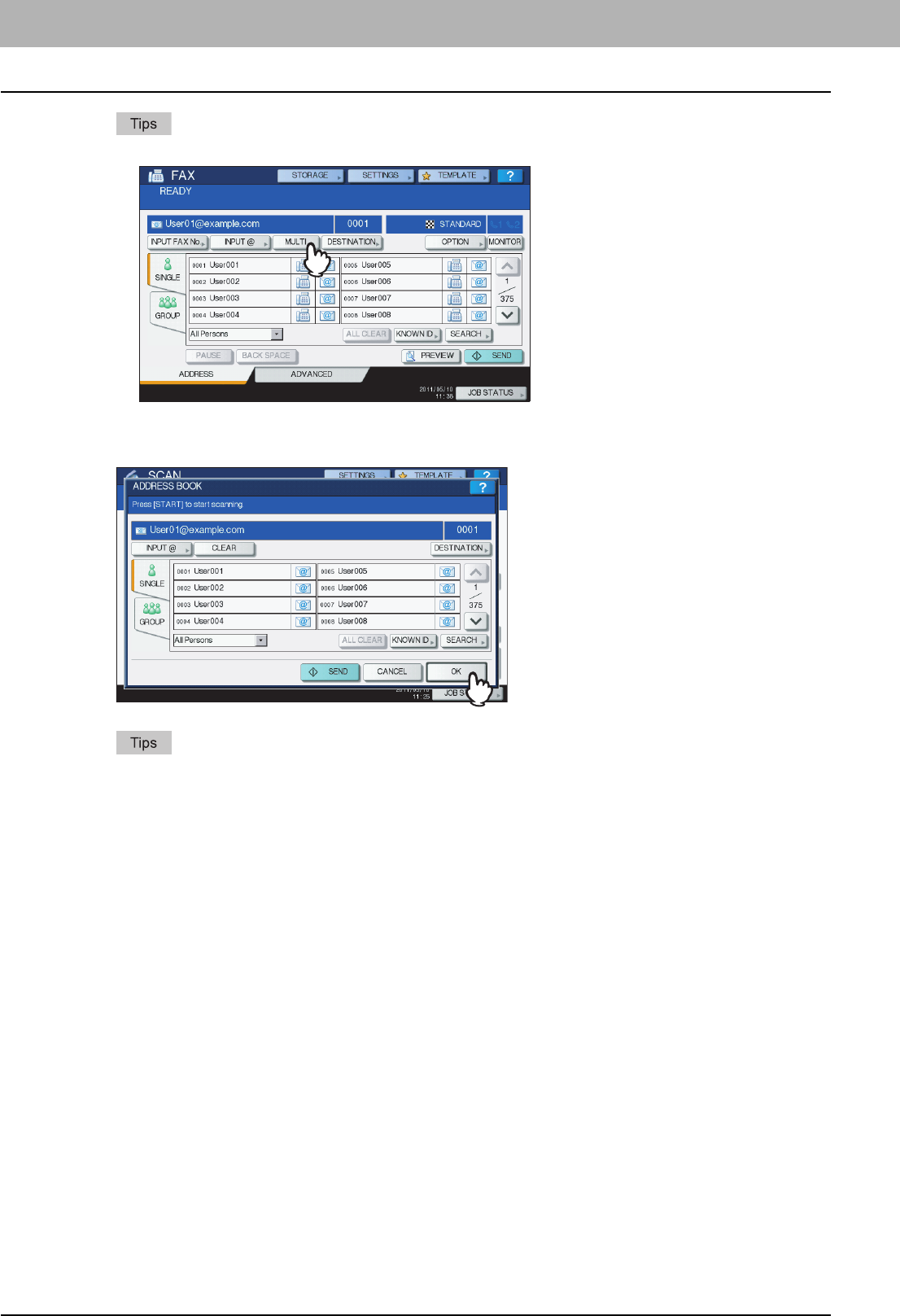
3 USEFUL FUNCTIONS
52 Specifying E-mail Addresses
yIf you want to specify multiple e-mail addresses for Internet faxing, press [MULTI] and repeat steps 1 and 2.
yIf you press [INPUT @] without pressing [MULTI], you can edit the e-mail address you have just entered.
3
Press [OK].
yBefore pressing [OK], you can specify additional e-mail addresses.
yIf you want to view or delete the specified e-mail addresses, press [DESTINATION].
P.64 “Viewing/Deleting specified e-mail addresses”
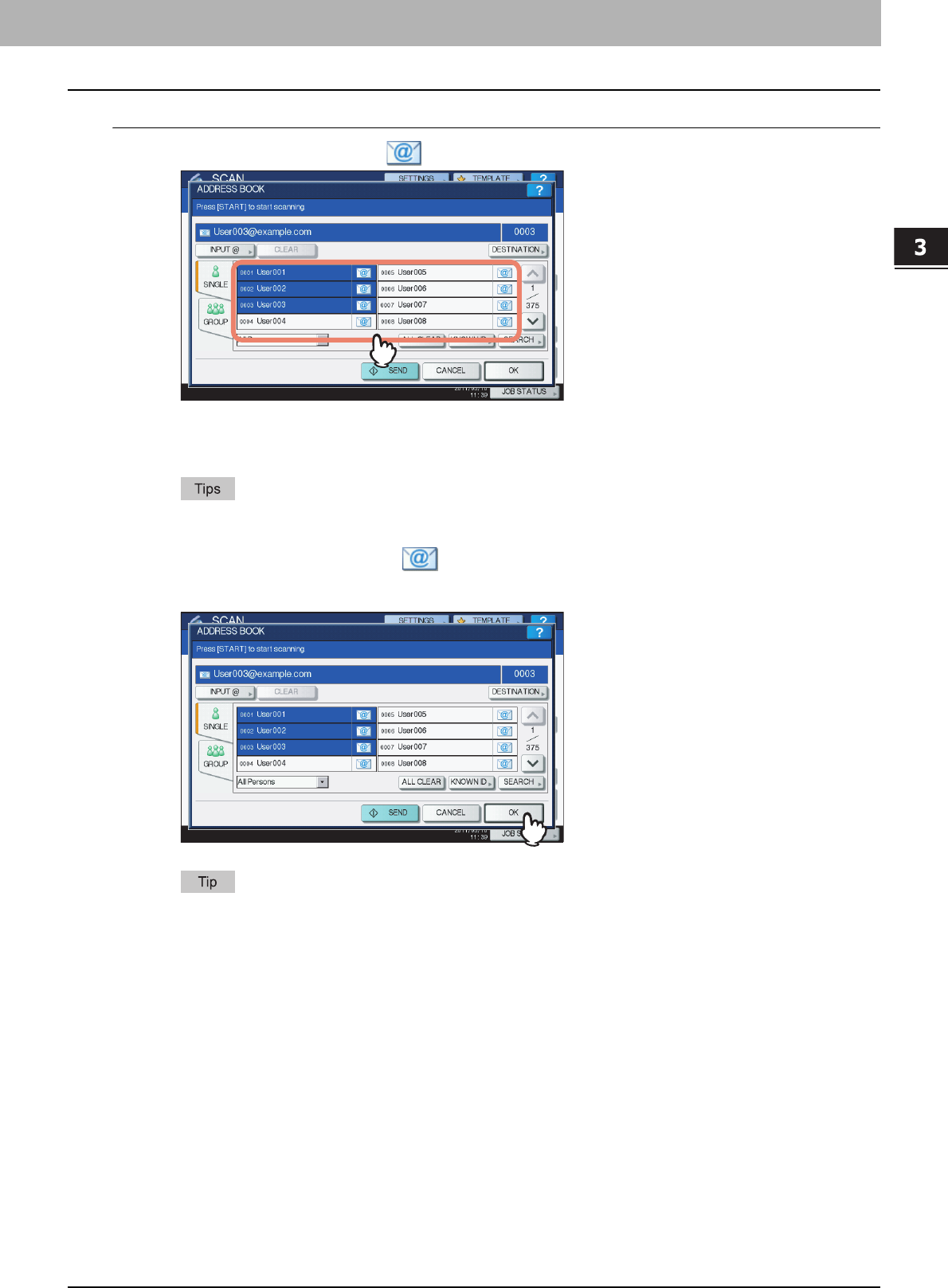
3.USEFUL FUNCTIONS
Specifying E-mail Addresses 53
3 USEFUL FUNCTIONS
Selecting from the address book
1
On the [SINGLE] tab, press for the desired contacts.
yFor Scan to E-mail, proceed to step 2.
yFor Internet faxing, the e-mail address is specified. Continue the Internet faxing operation.
P.95 “Sending Internet faxes”
yYou can select multiple contacts.
ySelected contacts are highlighted.
yTo cancel your selection, press again.
2
Press [OK].
If you want to view or delete the specified e-mail addresses, press [DESTINATION].
P.64 “Viewing/Deleting specified e-mail addresses”
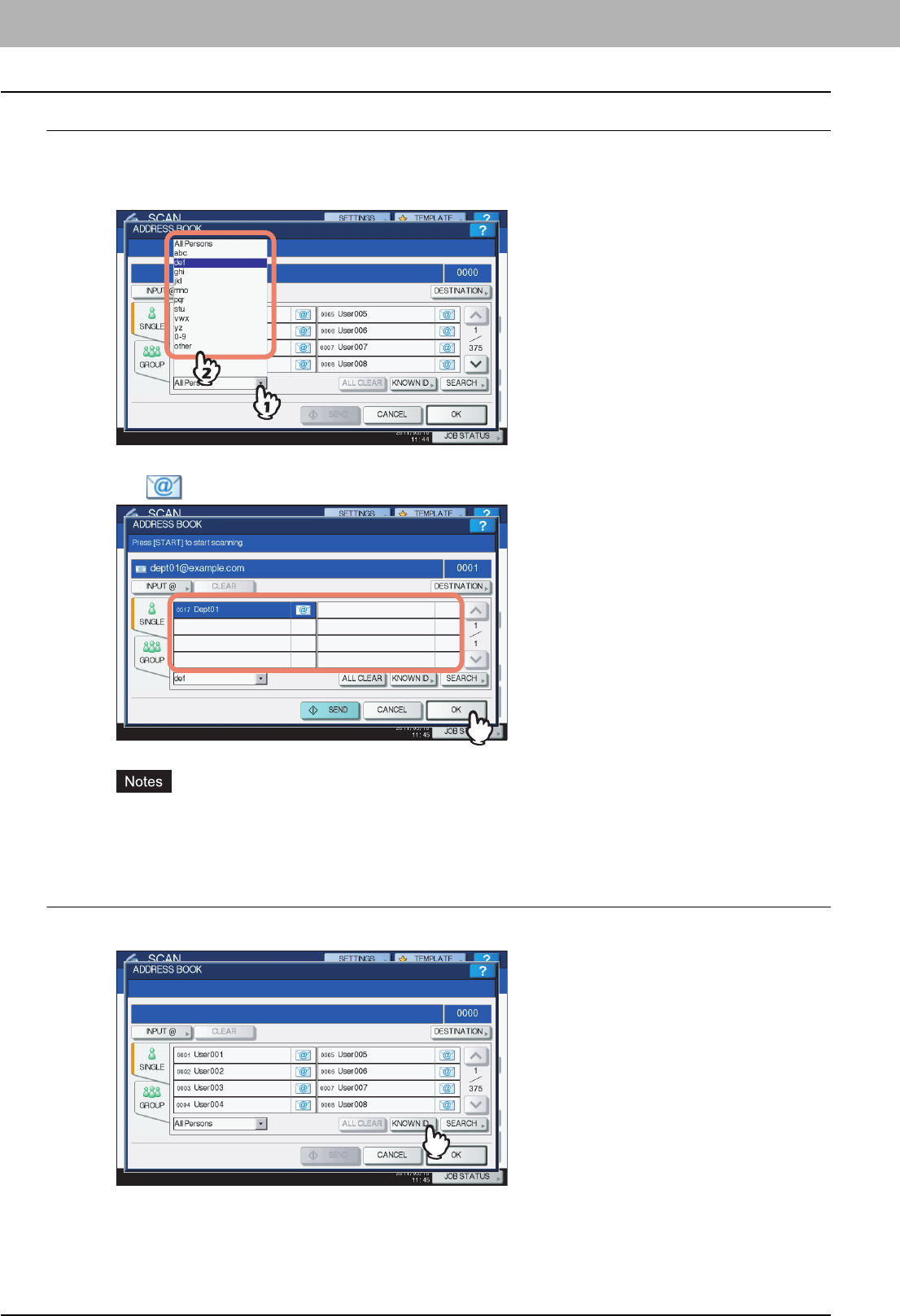
3 USEFUL FUNCTIONS
54 Specifying E-mail Addresses
Refining your search
1
Click the pull-up menu, and then select letters that you want to display.
1) Click the pull-up menu.
2) Select letters that you want to display.
Addresses with the selected letter(s) first are displayed.
2
Press for the desired contacts. For Scan to E-mail, press [OK] at the end.
yBefore pressing [OK], you can specify additional e-mail addresses.
yIf you want to view or delete the specified e-mail addresses, press [DESTINATION].
P.64 “Viewing/Deleting specified e-mail addresses”
Searching the address book with ID numbers
1
Press [KNOWN ID].
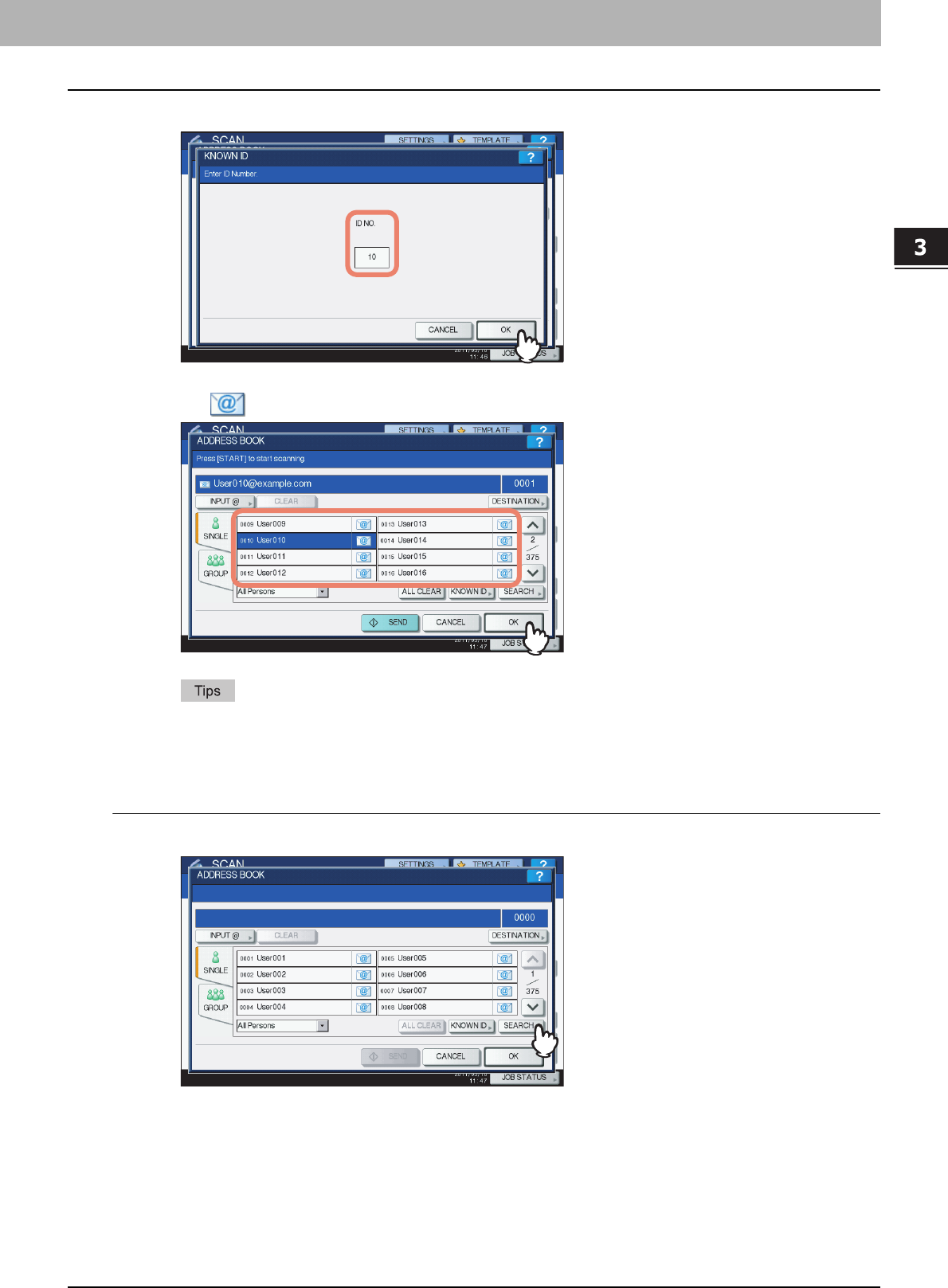
3.USEFUL FUNCTIONS
Specifying E-mail Addresses 55
3 USEFUL FUNCTIONS
2
Using the digital keys, enter the ID number for the desired contact and then press [OK].
The page containing the contact of the specified ID number is displayed.
3
Press for the desired contacts. For Scan to E-mail, press [OK] at the end.
yBefore pressing [OK], you can specify additional e-mail addresses.
yIf you want to view or delete the specified e-mail addresses, press [DESTINATION].
P.64 “Viewing/Deleting specified e-mail addresses”
Searching the address book with search strings
1
Press [SEARCH].
The SEARCH screen appears.
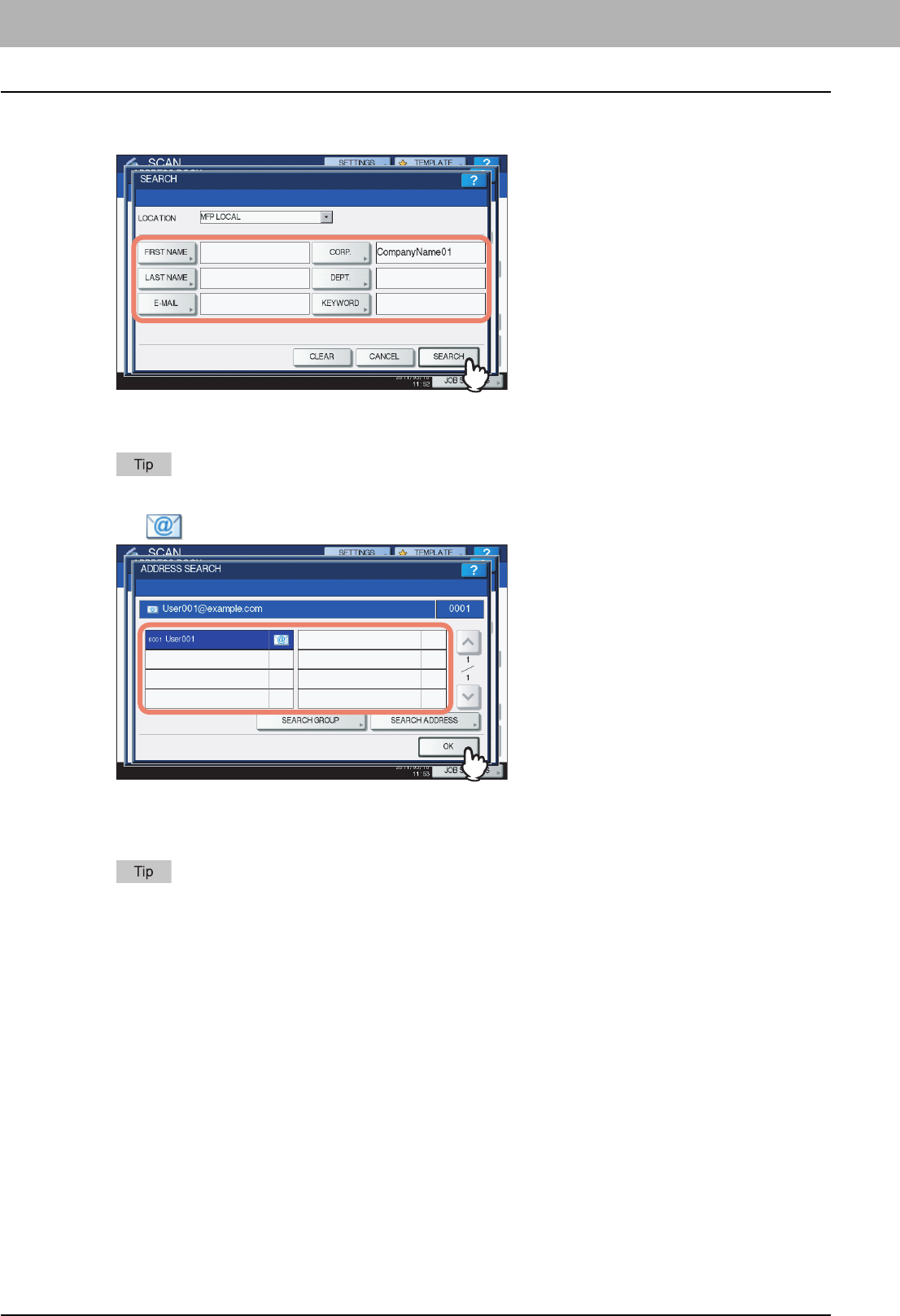
3 USEFUL FUNCTIONS
56 Specifying E-mail Addresses
2
Press the corresponding button(s) for the desired search category and enter the
search string. Finally, press [SEARCH].
Pressing each button displays an on-screen keyboard. Enter a search string using the keyboard and digital keys,
and then press [OK] to set the entry.
The contacts are searched for based on the entered search string(s).
3
Press for the desired contacts and then press [OK].
yFor Scan to E-mail, proceed to step 4.
yFor Internet faxing, the e-mail addresses are specified. To specify additional e-mail addresses, repeat the
above steps.
For Scan to E-mail, pressing [SEARCH ADDRESS] or [SEARCH GROUP] allows you to continue searching for
individual contacts or groups with other search strings.
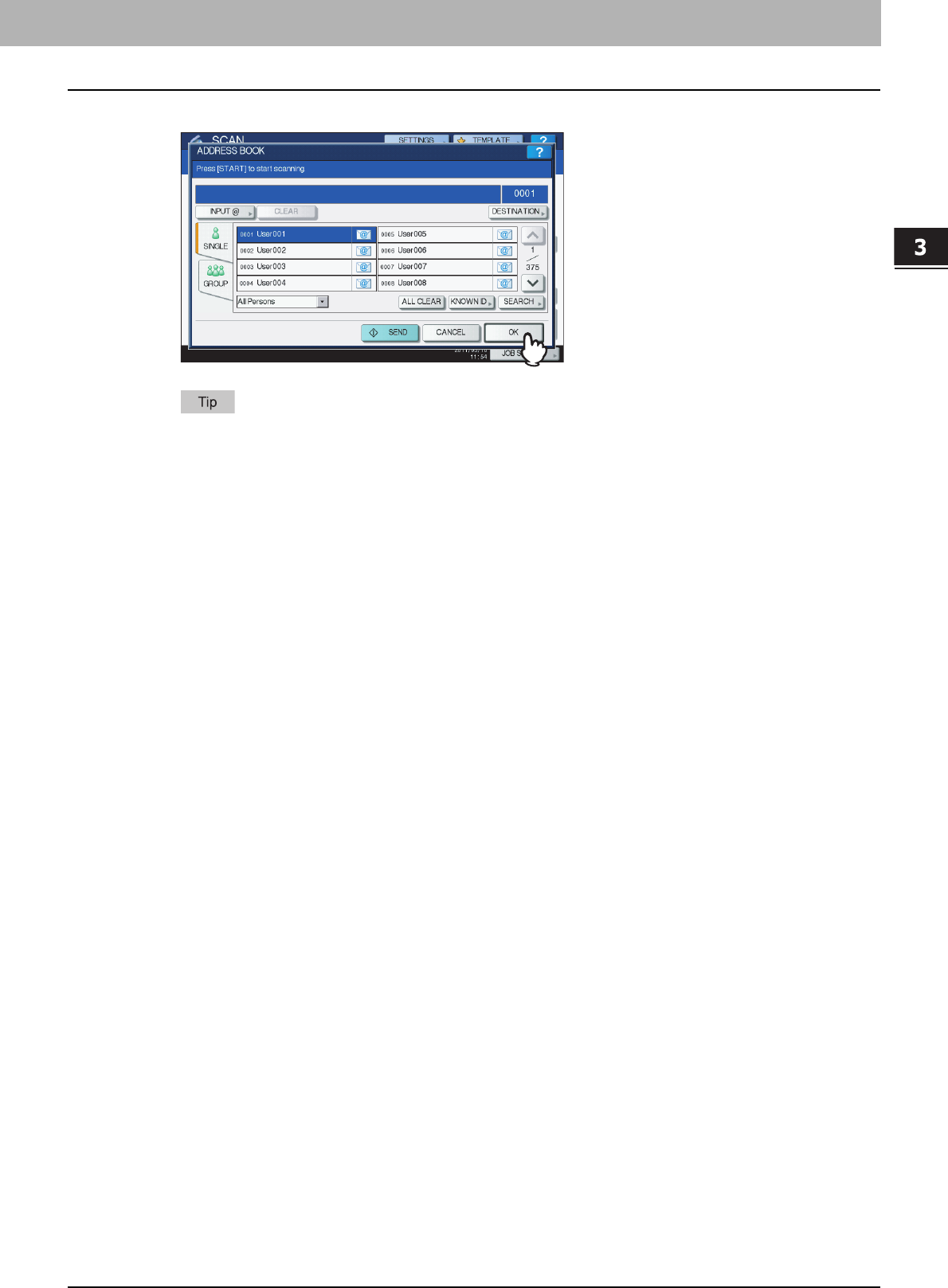
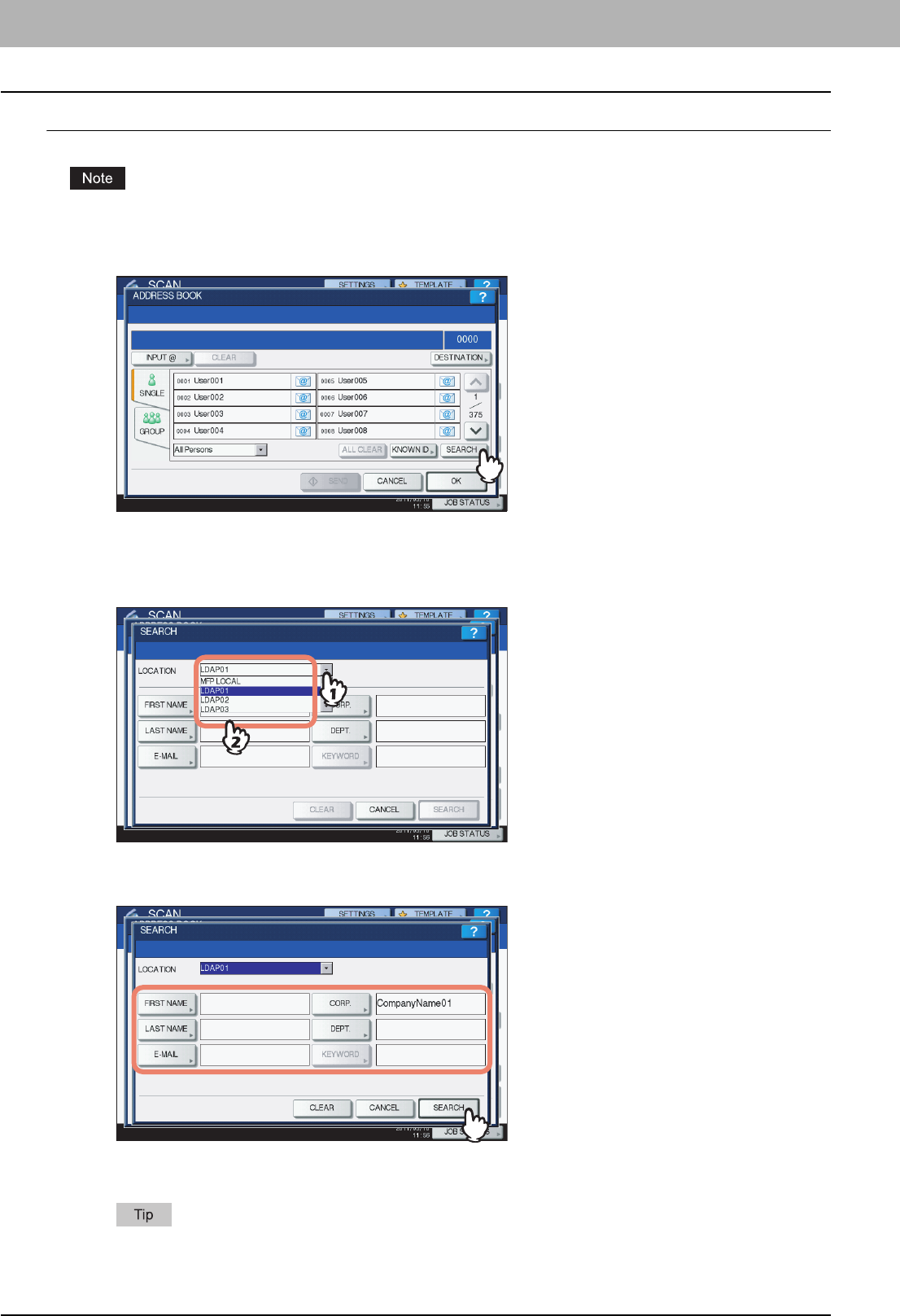
3 USEFUL FUNCTIONS
58 Specifying E-mail Addresses
Searching the LDAP server with search strings
To search an LDAP server for e-mail addresses, the network administrator must register the directory service on
TopAccess.
1
Press [SEARCH].
The ADDRESS SEARCH screen appears.
2
Select the directory service name that you want to search in the LOCATION.
1) Click the pull-down menu.
2) Select the directory service name that you want to search.
3
Press the corresponding button(s) for the desired search category and enter the
search string. Finally, press [SEARCH].
Pressing each button displays an on-screen keyboard. Enter a search string using the keyboard and digital keys,
and then press [OK] to set the entry.
The contacts are searched for based on the entered search string(s).
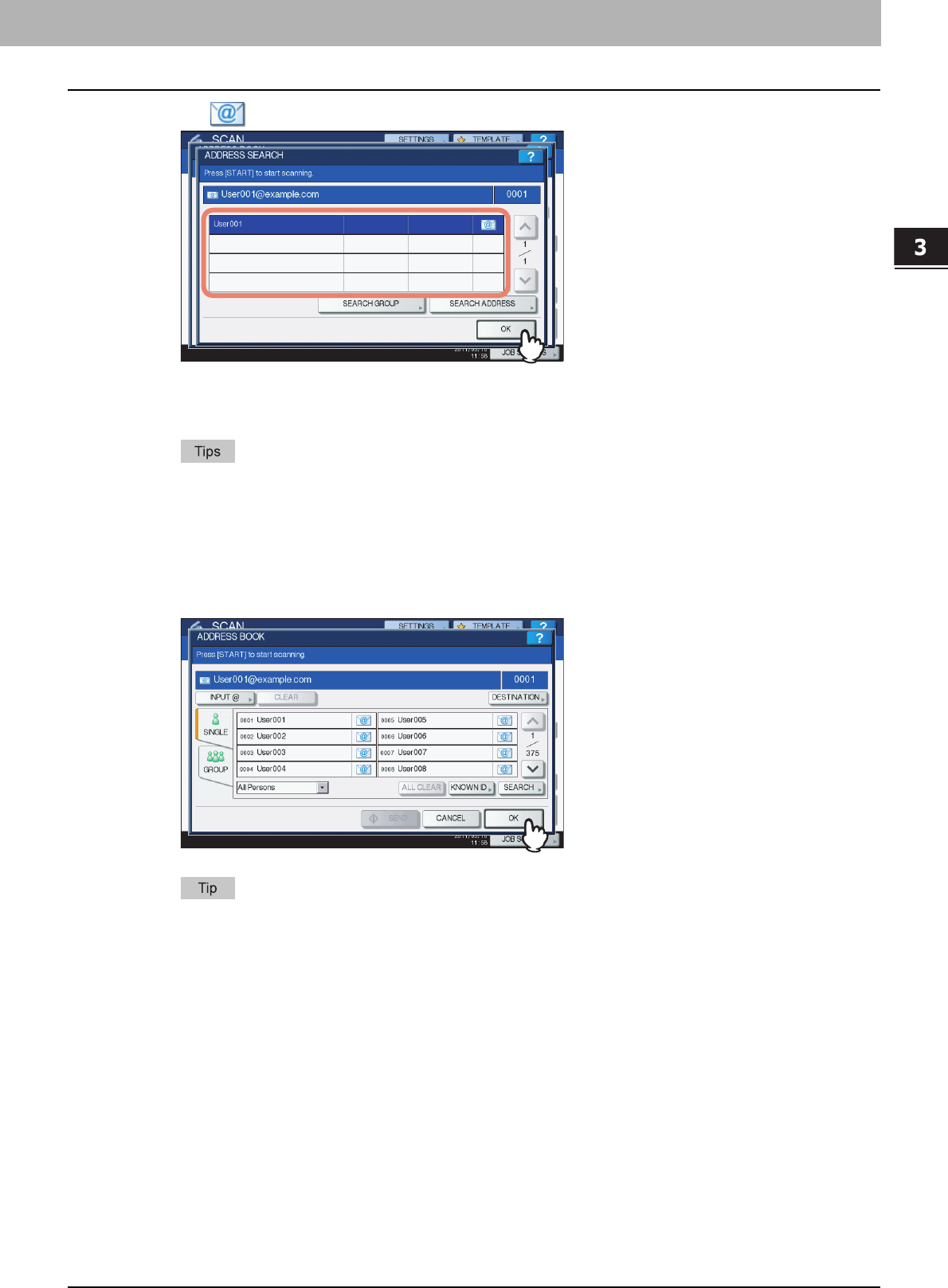
3.USEFUL FUNCTIONS
Specifying E-mail Addresses 59
3 USEFUL FUNCTIONS
4
Press for the desired contacts and then press [OK].
yFor Scan to E-mail, proceed to step 5.
yFor Internet faxing, the e-mail addresses are specified. To specify additional e-mail addresses, repeat the
above steps.
yIf you selected a wrong contact, press the wrong contact again to be unselected, or press the [FUNCTION
CLEAR] button to restart the operation.
P.23 “Scan to E-mail”
P.95 “Sending Internet faxes”
yFor Scan to E-mail, pressing [SEARCH ADDRESS] or [SEARCH GROUP] allows you to continue searching
for individual contacts or groups with other search strings.
5
Press [OK].
If you want to view or delete the specified e-mail addresses, press [DESTINATION].
P.64 “Viewing/Deleting specified e-mail addresses”
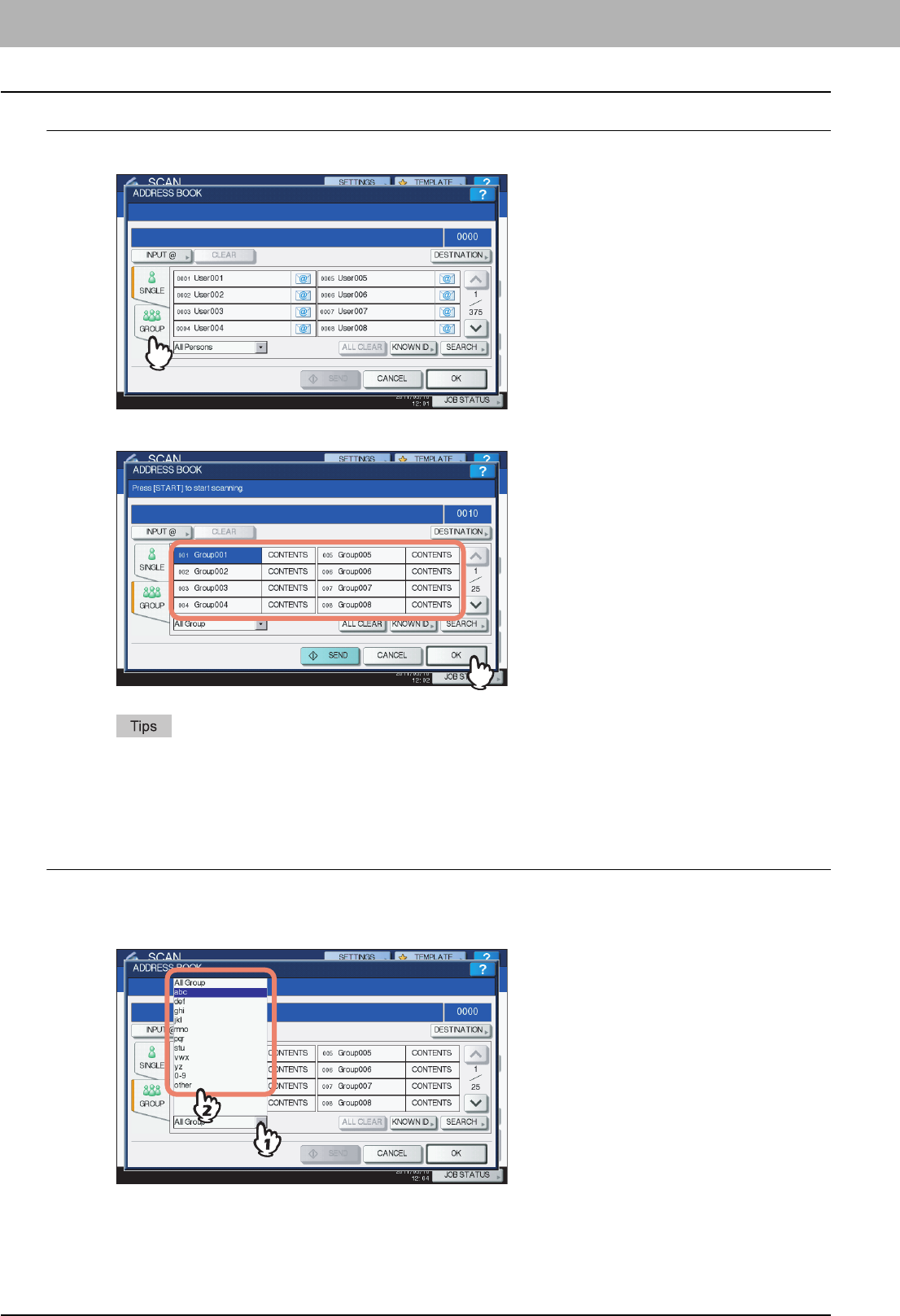
3 USEFUL FUNCTIONS
60 Specifying E-mail Addresses
Selecting groups
1
Press [GROUP] to display the [GROUP] tab.
2
Select the desired group(s). For Scan to E-mail, press [OK] at the end.
yTo view e-mail addresses registered in a group, press [CONTENTS].
yBefore pressing [OK], you can specify additional e-mail addresses.
yIf you want to view or delete the specified e-mail addresses, press [DESTINATION].
P.64 “Viewing/Deleting specified e-mail addresses”
Refining groups search
1
Click the pull-up menu, and then select the letters that you want to display.
1) Click the pull-up menu.
2) Select the letters that you want to display.
Addresses with the selected letter(s) first are displayed.
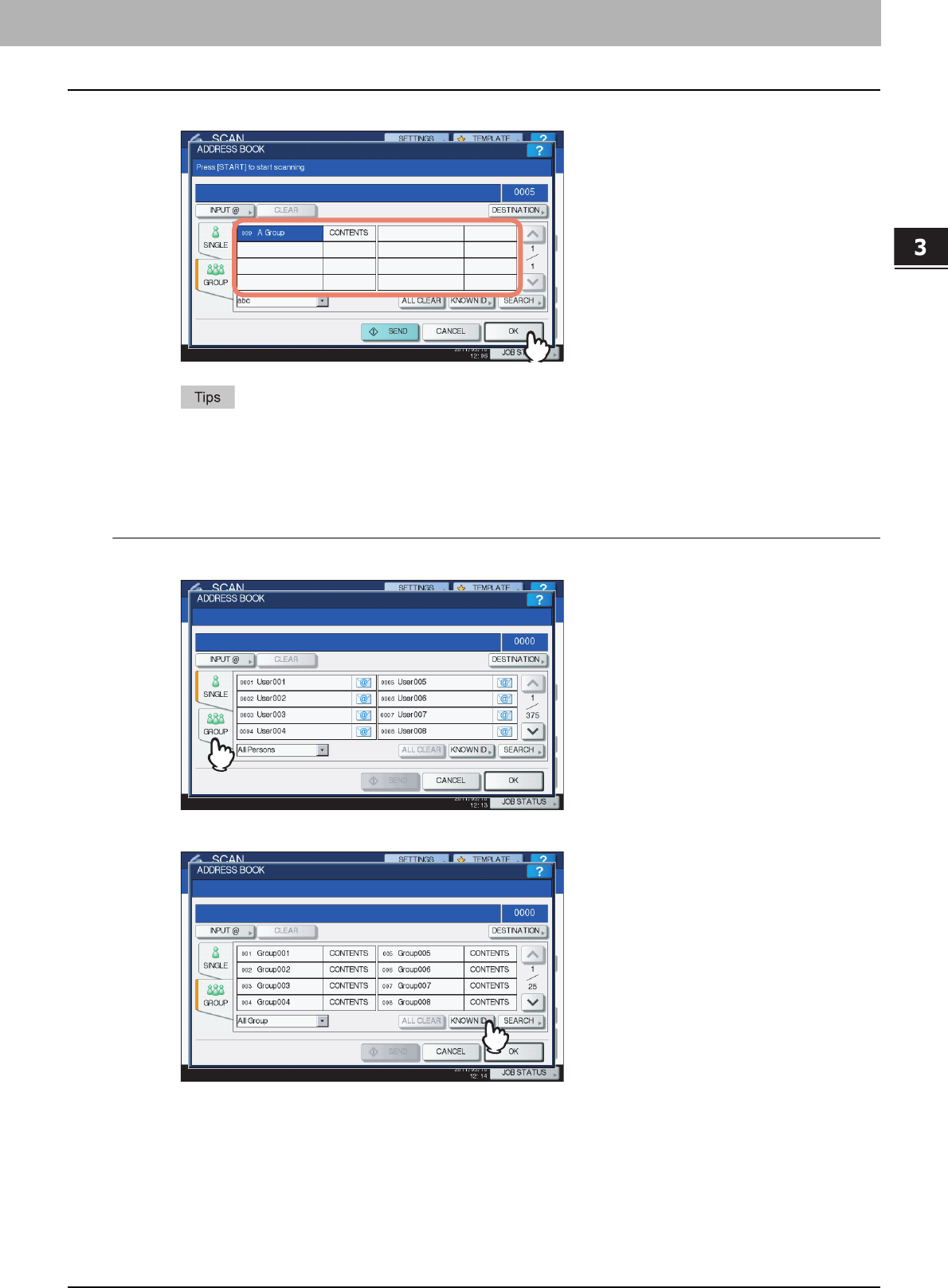
3.USEFUL FUNCTIONS
Specifying E-mail Addresses 61
3 USEFUL FUNCTIONS
2
Select the desired group. For Scan to E-mail, press [OK] at the end.
yTo view e-mail addresses registered in a group, press [CONTENTS].
yBefore pressing [OK], you can specify additional e-mail addresses.
yIf you want to view or delete the specified e-mail addresses, press [DESTINATION].
P.64 “Viewing/Deleting specified e-mail addresses”
Searching for groups with ID numbers
1
Press [GROUP] to display the [GROUP] tab.
2
Press [KNOWN ID].
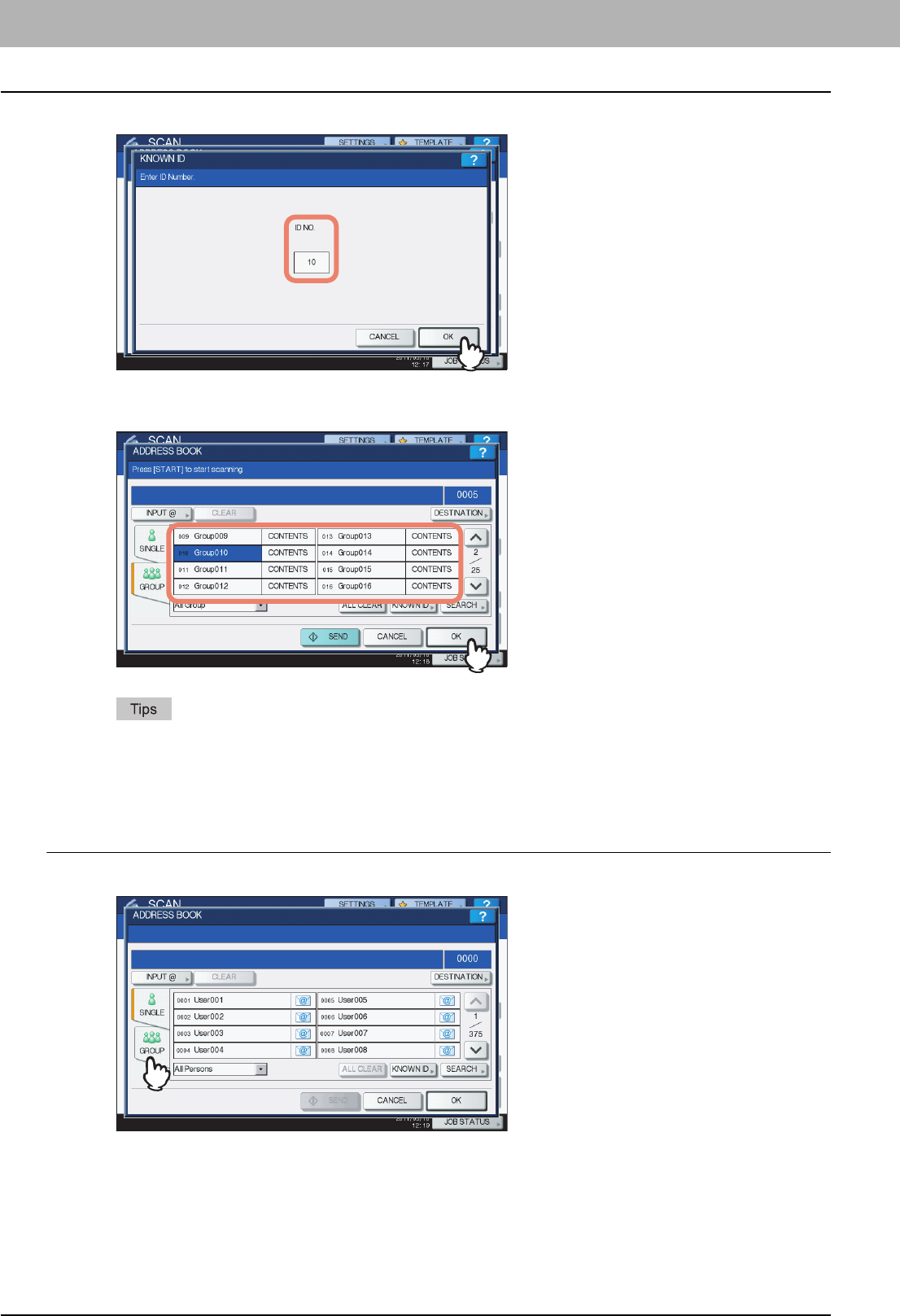
3 USEFUL FUNCTIONS
62 Specifying E-mail Addresses
3
Using the digital keys, enter the ID number for the desired group, and then press [OK].
The page containing the group of the specified ID number is displayed.
4
Select the desired group. For Scan to E-mail, press [OK] at the end.
yTo view e-mail addresses registered in a group, press [CONTENTS].
yBefore pressing [OK], you can specify additional e-mail addresses.
yIf you want to view or delete the specified e-mail addresses, press [DESTINATION].
P.64 “Viewing/Deleting specified e-mail addresses”
Searching for groups by name
1
Press [GROUP] to display the [GROUP] tab.
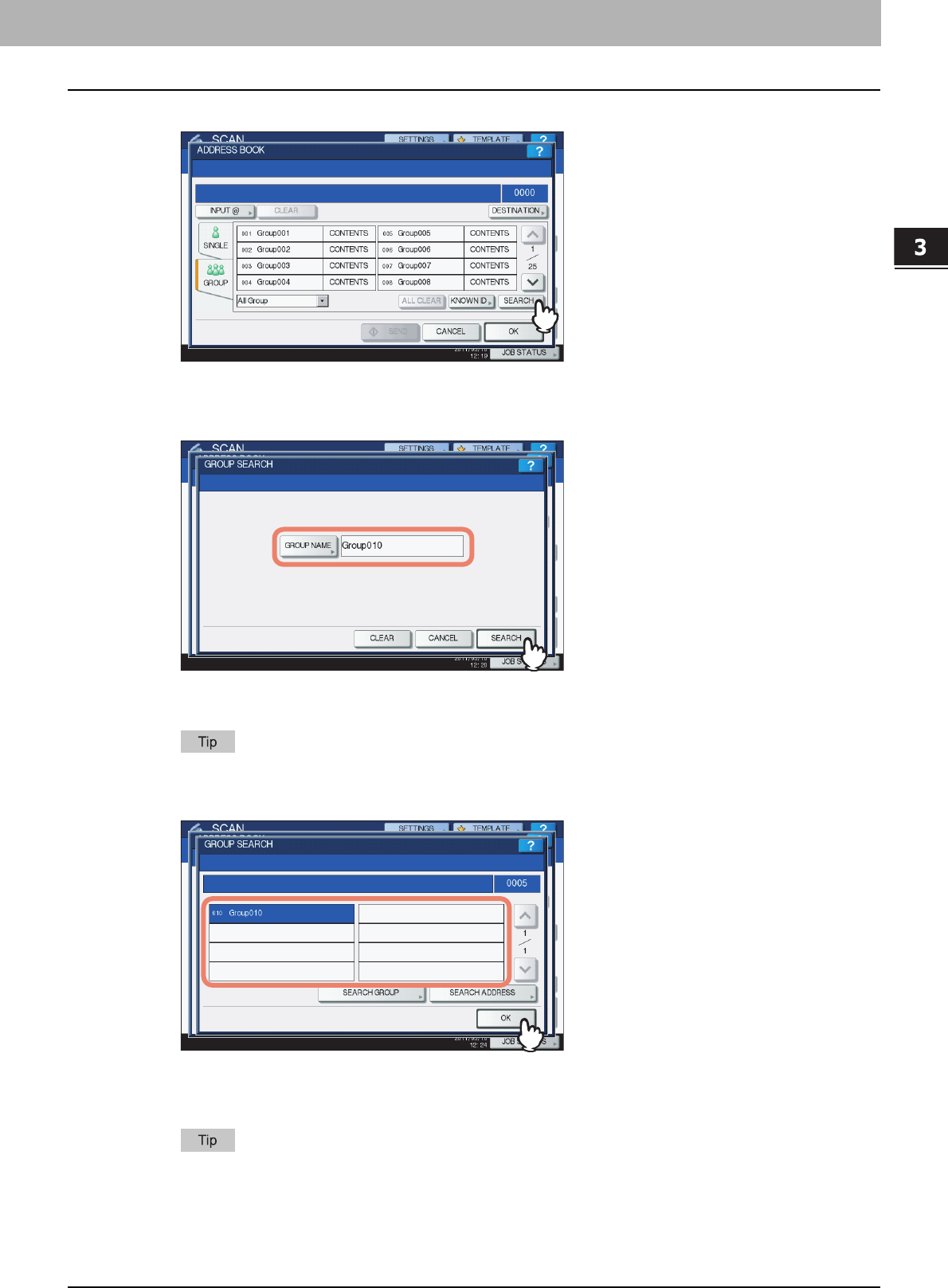
3.USEFUL FUNCTIONS
Specifying E-mail Addresses 63
3 USEFUL FUNCTIONS
2
Press [SEARCH].
The GROUP SEARCH screen appears.
3
Press [GROUP NAME] and key in a search string for the desired group name. Finally,
press [SEARCH].
Pressing [GROUP NAME] displays an on-screen keyboard. Enter a search string using the keyboard and digital
keys, and then press [OK] to set the entry.
The groups are searched for based on the entered search string.
4
Press the corresponding button(s) for the desired group(s), and then press [OK].
yFor Scan to E-mail, proceed to step 5.
yFor Internet faxing, the e-mail addresses are specified. To specify additional e-mail addresses, repeat the
above steps.
For Scan to E-mail, pressing [SEARCH ADDRESS] or [SEARCH GROUP] allows you to continue searching for
individual contacts or groups with other search strings.
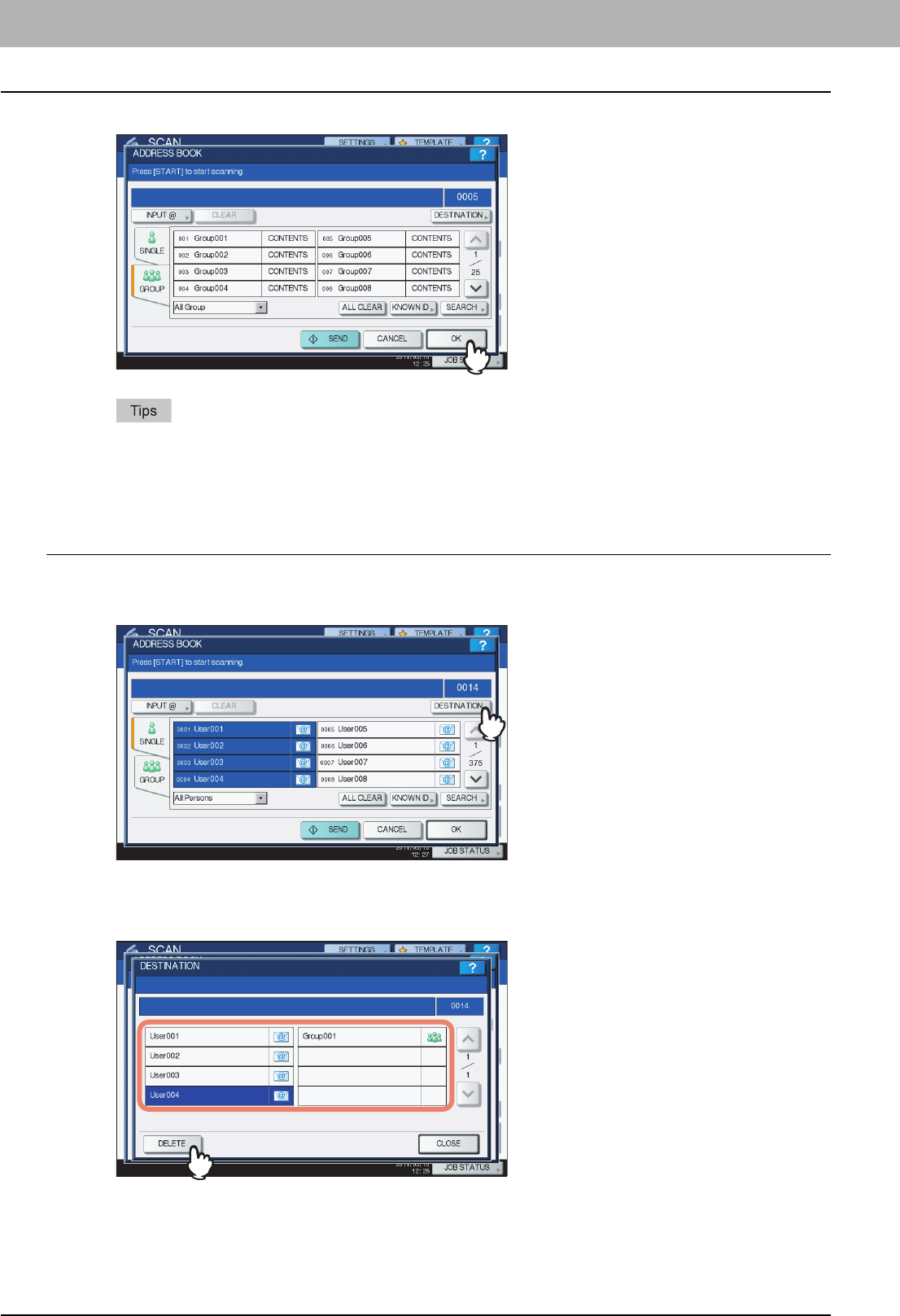
3 USEFUL FUNCTIONS
64 Specifying E-mail Addresses
5
Press [OK].
yTo view e-mail addresses registered in a group, press [CONTENTS].
yBefore pressing [OK], you can specify additional e-mail addresses.
yIf you want to view or delete the specified e-mail addresses, press [DESTINATION].
P.64 “Viewing/Deleting specified e-mail addresses”
Viewing/Deleting specified e-mail addresses
You can view the specified e-mail addresses, contacts, and groups, and delete them from the list.
1
Press [DESTINATION].
Currently selected e-mail addresses, contacts, and groups are listed on the screen.
2
To delete an e-mail address, contact, and/or group from the list, select a listing you
want to delete, and then press [DELETE].
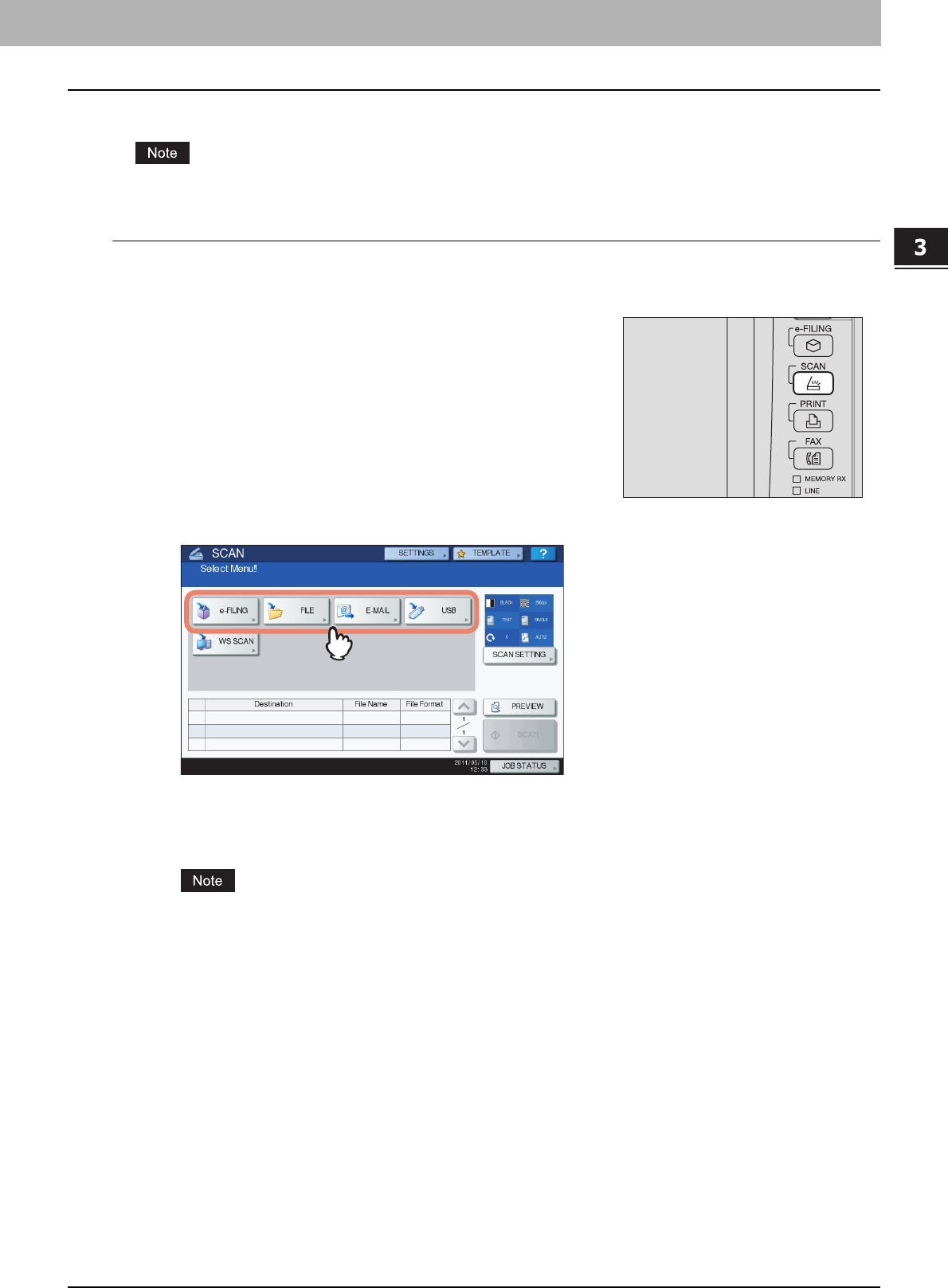
3 USEFUL FUNCTIONS
Scanning With Dual Functions (Dual Agents) 65
Scanning With Dual Functions (Dual Agents)
When performing a scan operation, you can select 2 of the scan functions at one time.
The WS Scan function cannot be selected together with other scan functions.
Scanning with dual functions (Dual Agents)
1
Place the original(s).
For help, refer to the Quick Start Guide.
3
Select a scan function that you want to use.
[e-FILING] — Your scans are saved in the e-Filing boxes.
[FILE] — Your scans are saved as files in the equipment’s shared folder or a network folder.
[E-MAIL] — Your scans are sent to specified e-mail addresses.
[USB] — Press this button to store scans to a USB storage device.
The WS Scan function cannot be selected with other scan functions.
4
Make the settings required for the selected scan function, and then press [OK].
yThe required settings vary depending on the selected scan function. For instructions on how to perform settings
for each scan function, see the following sections:
P.16 “Scan to File”
P.23 “Scan to E-mail”
P.29 “Scan to USB”
For instructions on how to scan your documents with Scan to e-Filing, refer to the e-Filing Guide.
yPressing [OK] on the screen for each scan function takes you back to the basic scan menu with the selected
function button marked with an orange line.
2
On the control panel, press the [SCAN] button to
enter the SCAN menu.
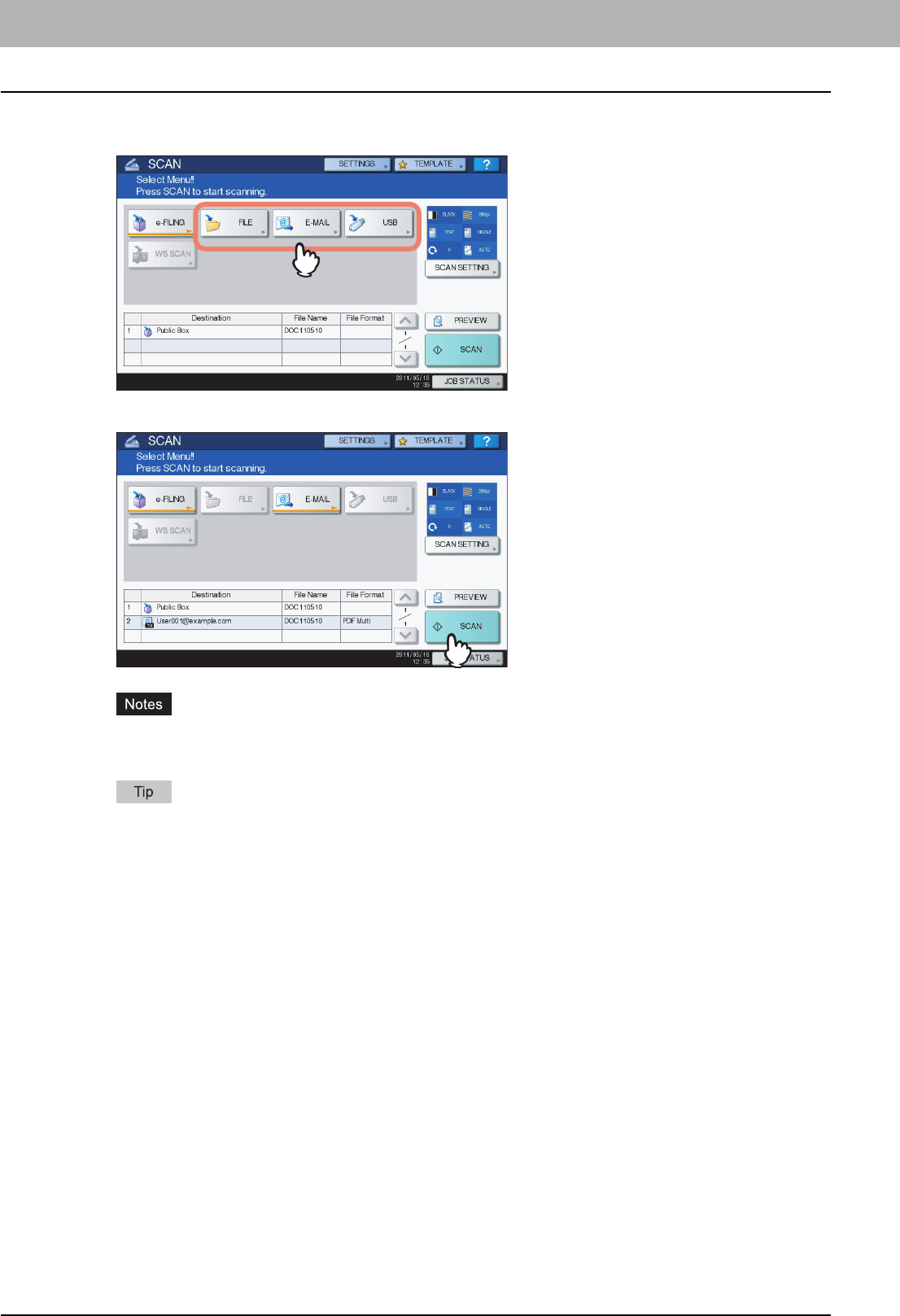
3 USEFUL FUNCTIONS
66 Scanning With Dual Functions (Dual Agents)
5
On the SCAN menu, select the second scan function that you want to use, and repeat
step 4.
6
On the SCAN menu, press [SCAN].
yYou can set 2 scan functions at one time. Selecting 3 scan functions at one time is not allowed.
yThe WS Scan function cannot be selected with other scan functions.
To clear the scan functions, select one and press [RESET]. The screen on the touch panel returns to the basic
scan menu and the selected button is cleared.
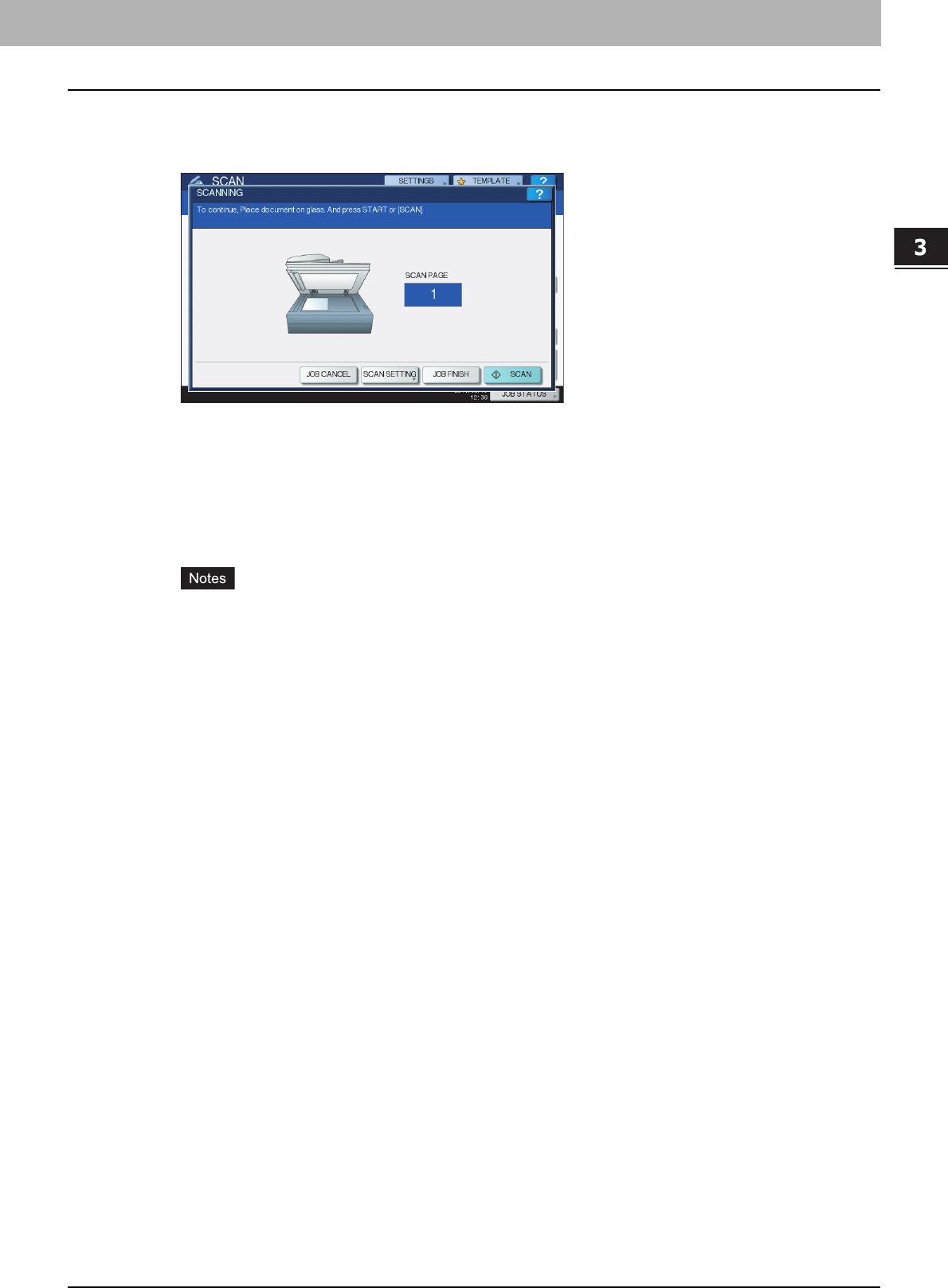
3.USEFUL FUNCTIONS
Scanning With Dual Functions (Dual Agents) 67
3 USEFUL FUNCTIONS
7
If the screen below appears, place another original on the original glass and press
[SCAN] or the [START] button to continue scanning. To finish the job, press [JOB
FINISH], followed by the [FUNCTION CLEAR] button.
yThe above screen is not displayed under the following conditions:
- You scan the original from the Reversing Automatic Document Feeder* without pressing [CONTINUE] to
scan additional originals.
- A scan preview is displayed.
yTo cancel the operation, press [JOB CANCEL].
yTo change the scan settings, press [SCAN SETTING].
P.40 “Changing Scan Settings”
* The Reversing Automatic Document Feeder is optional for the e-STUDIO4540C Series.
yWhen the equipment has scanned more than 1000 pages in a job, the “The number of originals exceeds the
limits. Will you save stored originals?” message appears. If you want to save the scans, press [YES].
yWhen the temporary workspace is full on the equipment’s hard disk, a message appears and the job is
canceled. The available workspace can be viewed on the TopAccess [Device] tab.
yIf the number of jobs waiting to store scans in the equipment’s hard disk exceeds 20, a message appears to
indicate that the equipment’s memory is full. In this case, wait a while until memory becomes available again
or delete unnecessary jobs from [JOB STATUS].
P.37 “Viewing the scan job status”
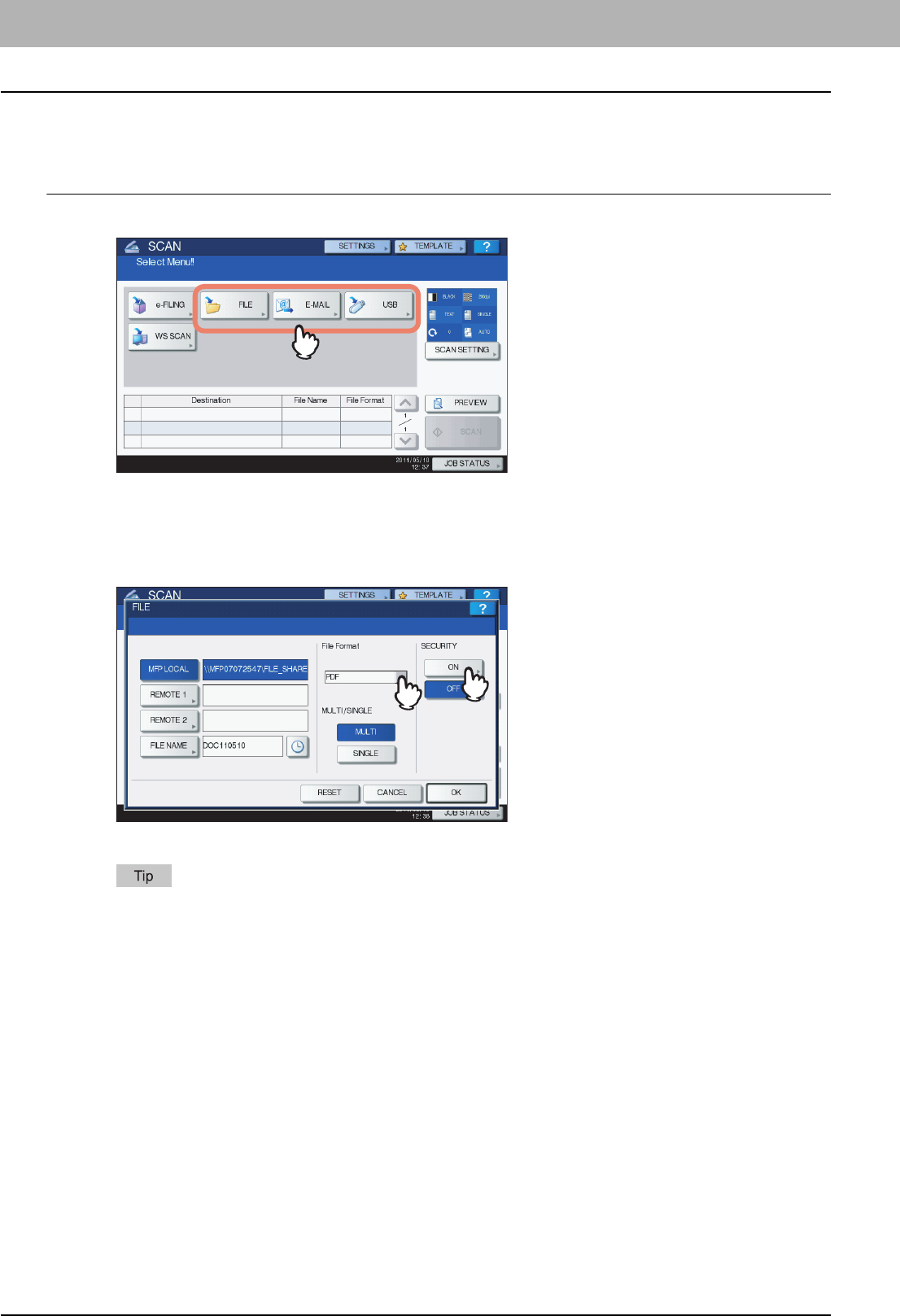
3 USEFUL FUNCTIONS
68 Encrypting PDF Files
Encrypting PDF Files
With “Scan to File”, “Scan to E-mail” or “Scan to USB”, you can encrypt PDF files when you select [PDF] for the file format
by following the procedure below.
Encrypting PDF files
1
On the SCAN menu, press [FILE], [E-MAIL] or [USB] for the desired scan function.
For help, see the following sections:
P.16 “Scanning to files”
P.23 “Scanning to e-mail”
P.29 “Scanning to USB”
2
Select [PDF] for the file format and then [ON] for the security setting.
The PDF SECURITY SETTINGS screen appears.
If the forced encryption setting is enabled, [ON] is always selected for the security setting. To learn more about
the forced encryption setting, refer to the MFP Management Guide.
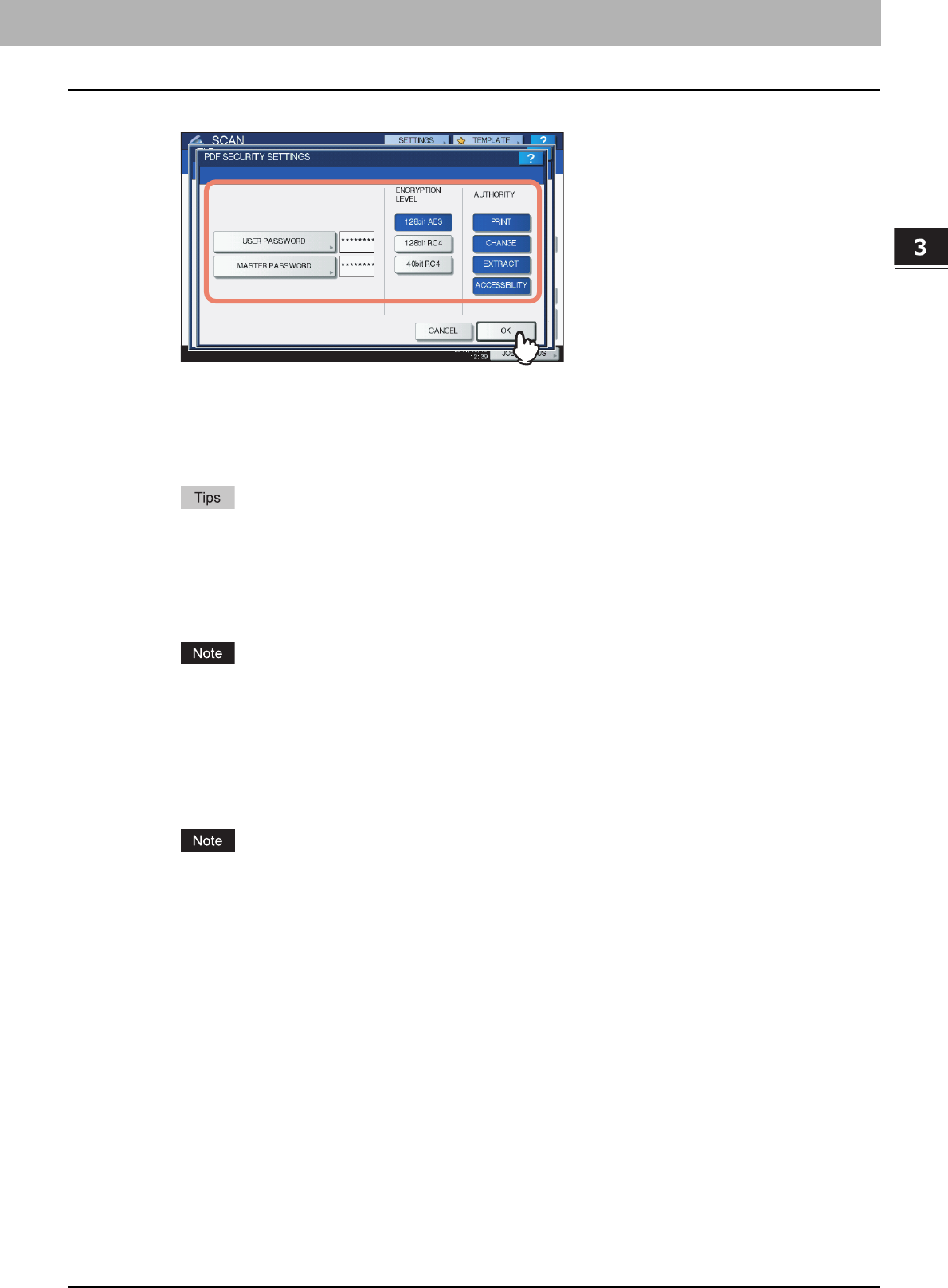
3.USEFUL FUNCTIONS
Encrypting PDF Files 69
3 USEFUL FUNCTIONS
3
Key in or select the following items, and then press [OK].
y[USER PASSWORD]
Press this button to set a password for the encrypted PDF file(s). The password is asked for when you open the
file.
y[MASTER PASSWORD]
Press this button to set a password for changing the encryption level and authority settings.
yThe user password and the master password are not set at the factory shipment. If the master password is
to be set, ask your network administrator.
yPressing each button displays an on-screen keyboard. Enter a password using the keyboard and digital
keys, and then press [OK] to set the entry.
yPasswords can consist of between 1 and 20 one-byte characters, including “#” and “*.”
yYou cannot set the same password for the user and master passwords.
Depending on the Security Setting by the Administrator, the user and master passwords can be changed. If you
are unauthorized to change the master password, you cannot change the encryption level or authorization
settings described below. To reset these passwords, ask your network administrator.
yEncryption Level
[128bit AES] — Press this button to set to an encryption level compatible with Acrobat 7.0 (PDF Version 1.6).
[128bit RC4] — Press this button to set to an encryption level compatible with Acrobat 5.0 (PDF Version 1.4).
[40bit RC4] — Press this button to set to an encryption level compatible with Acrobat 3.0 (PDF Version 1.1).
When [128bit AES] is selected, the created PDF files cannot be printed using USB Direct Printing. In this case,
print these files from a client computer. To learn more about USB Direct Printing, refer to the Printing Guide.
yAuthority
[PRINT] — Press this button to authorize users to print PDF files.
[CHANGE] — Press this button to authorize users to edit and convert PDF files.
[EXTRACT] — Press this button to authorize users to copy and extract the contents of PDF files.
[ACCESSIBILITY] — Press this button to enable the accessibility feature.
4
Make the other settings as required, and press [SCAN] to scan your documents.
For help, see the following sections:
P.16 “Scanning to files”
P.23 “Scanning to e-mail”
P.29 “Scanning to USB”
P.40 “Changing Scan Settings”

4.USING TEMPLATES
This chapter describes how to scan documents using templates.
Registering Scan Templates ................................................................................................. 72
Using Scan Templates ...........................................................................................................77
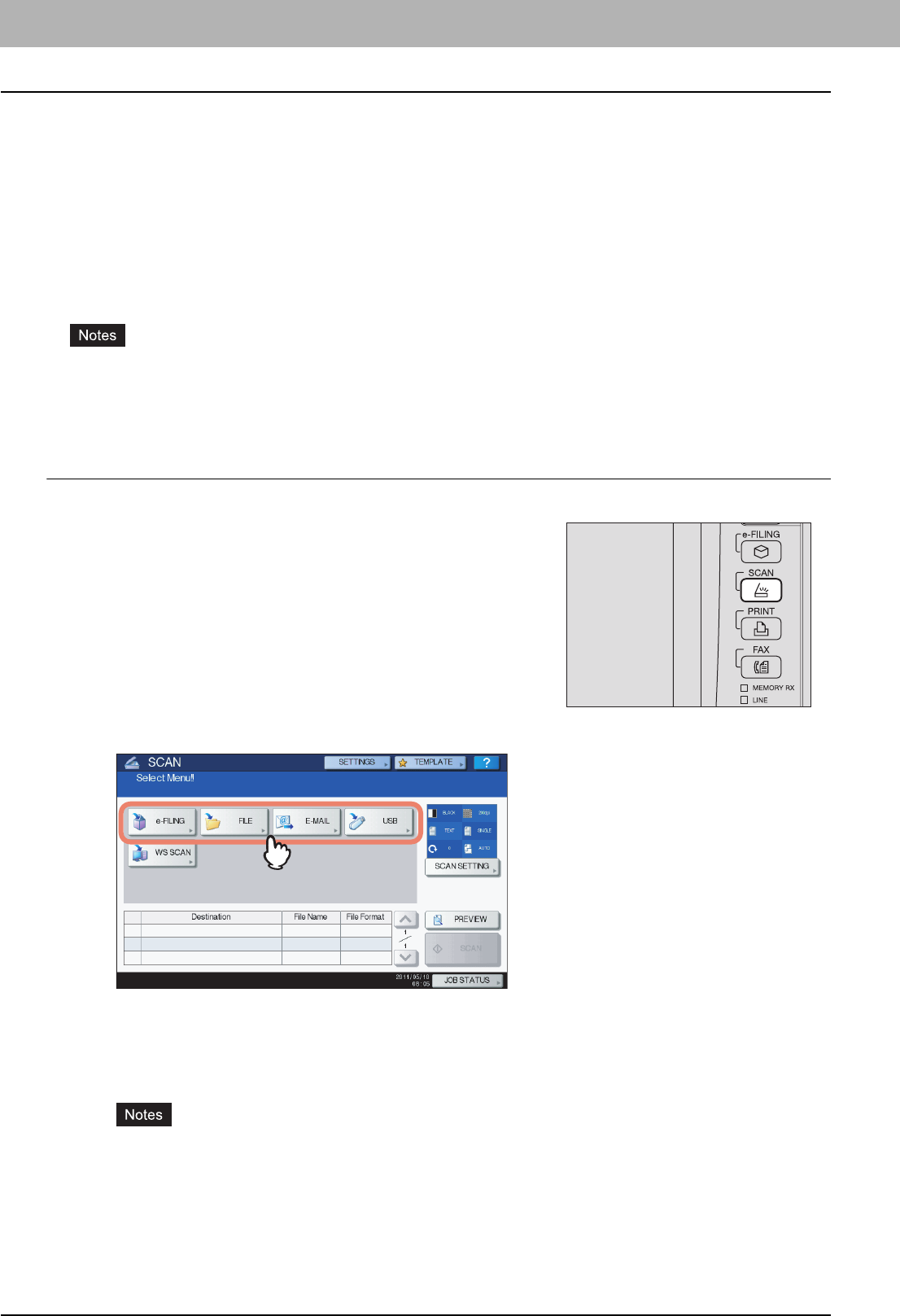
4 USING TEMPLATES
72 Registering Scan Templates
Registering Scan Templates
Once you register a template, you can easily perform scan operations by recalling a set of preferred scan settings.
Depending on the purpose, templates can be registered either to the public template group or a private template group.
yPUBLIC TEMPLATE GROUP
This group is provided for registering scan templates that are frequently used by all users in the company, a
department, etc. Access to a template can be restricted by setting a password. Up to 60 (64 for the e-STUDIO6550C
Series) templates can belong to this group.
yPRIVATE TEMPLATE GROUP
This group is created and controlled by each department, section, or user to register their own templates. The group
#001 contains pre-defined templates useful for various situations. Use can be restricted by setting a password for each
group. Up to 200 groups can be registered, each of which can contain a maximum of 60 (64 for the e-STUDIO6550C
Series) templates.
yTo register a template to the public template group, the administrator’s password must be entered.
yBefore registering a template to a private template group other than the group #001, you need to create your own
private template group. For help, refer to the Copying Guide.
yTemplates cannot be created with the WS Scan function.
Registering scan templates
2
Select a scan function and make the settings as required.
For help, see the following sections:
P.16 “Scan to File”
P.23 “Scan to E-mail”
P.29 “Scan to USB”
For instructions on how to make the settings for Scan to e-Filing, refer to the e-Filing Guide.
yDo not press [SCAN] in this step.
yTemplates cannot be created or used with the WS Scan function.
1
On the control panel, press the [SCAN] button to
enter the SCAN menu.
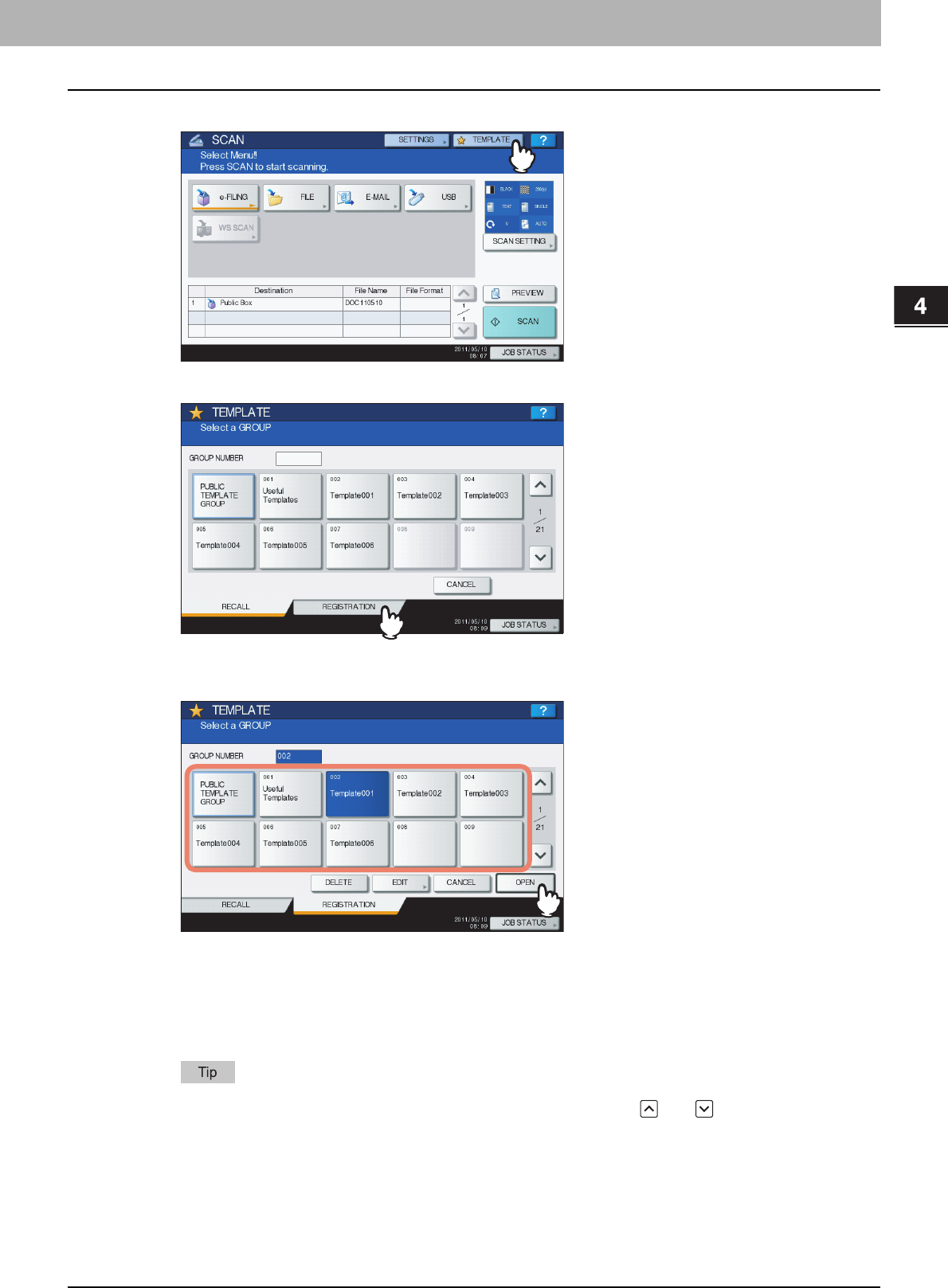
4.USING TEMPLATES
Registering Scan Templates 73
4 USING TEMPLATES
3
On the touch panel, press [TEMPLATE] to display the TEMPLATE menu.
4
Press [REGISTRATION] to display the [REGISTRATION] tab.
5
Select [PUBLIC TEMPLATE GROUP] or one of the private template group buttons, and
then press [OPEN].
yIf you select [PUBLIC TEMPLATE GROUP], the ADMINISTRATOR PASSWORD screen appears. In this case,
proceed to step 6.
yIf you select a private template group for which a password has been set, the password input screen appears.
In this case, proceed to step 8.
yIf you select a private template group for which no password has been set, the template buttons are displayed
for the selected group. In this case, proceed to step 11.
If the desired private template group is not displayed on the screen, use and to switch between pages.
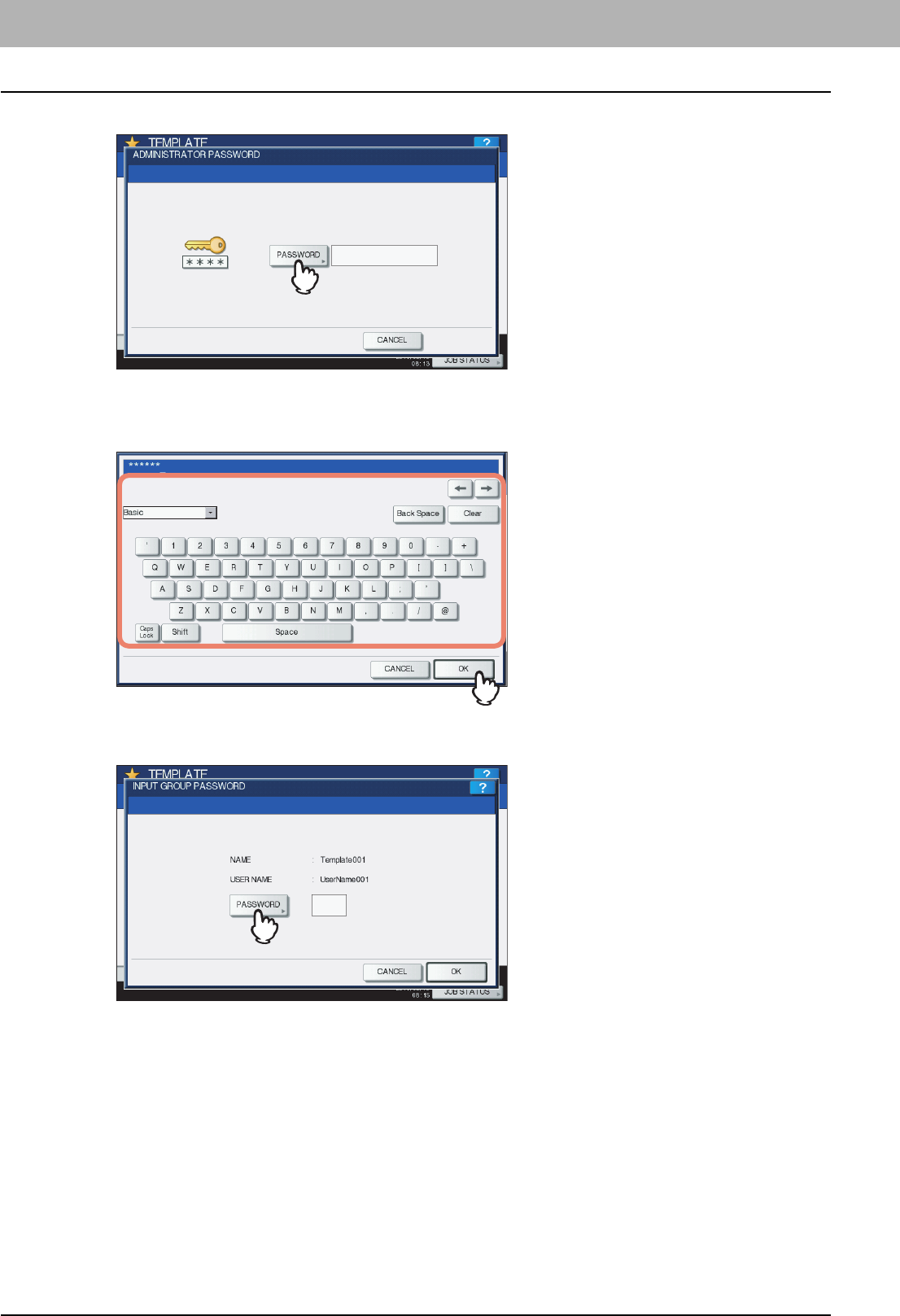
4 USING TEMPLATES
74 Registering Scan Templates
6
Press [PASSWORD].
The on-screen keyboard appears.
7
Enter the administrator password using the keyboard and digital keys, and then press
[OK].
The template buttons are displayed for the selected group. Proceed to step 11.
8
Press [PASSWORD].
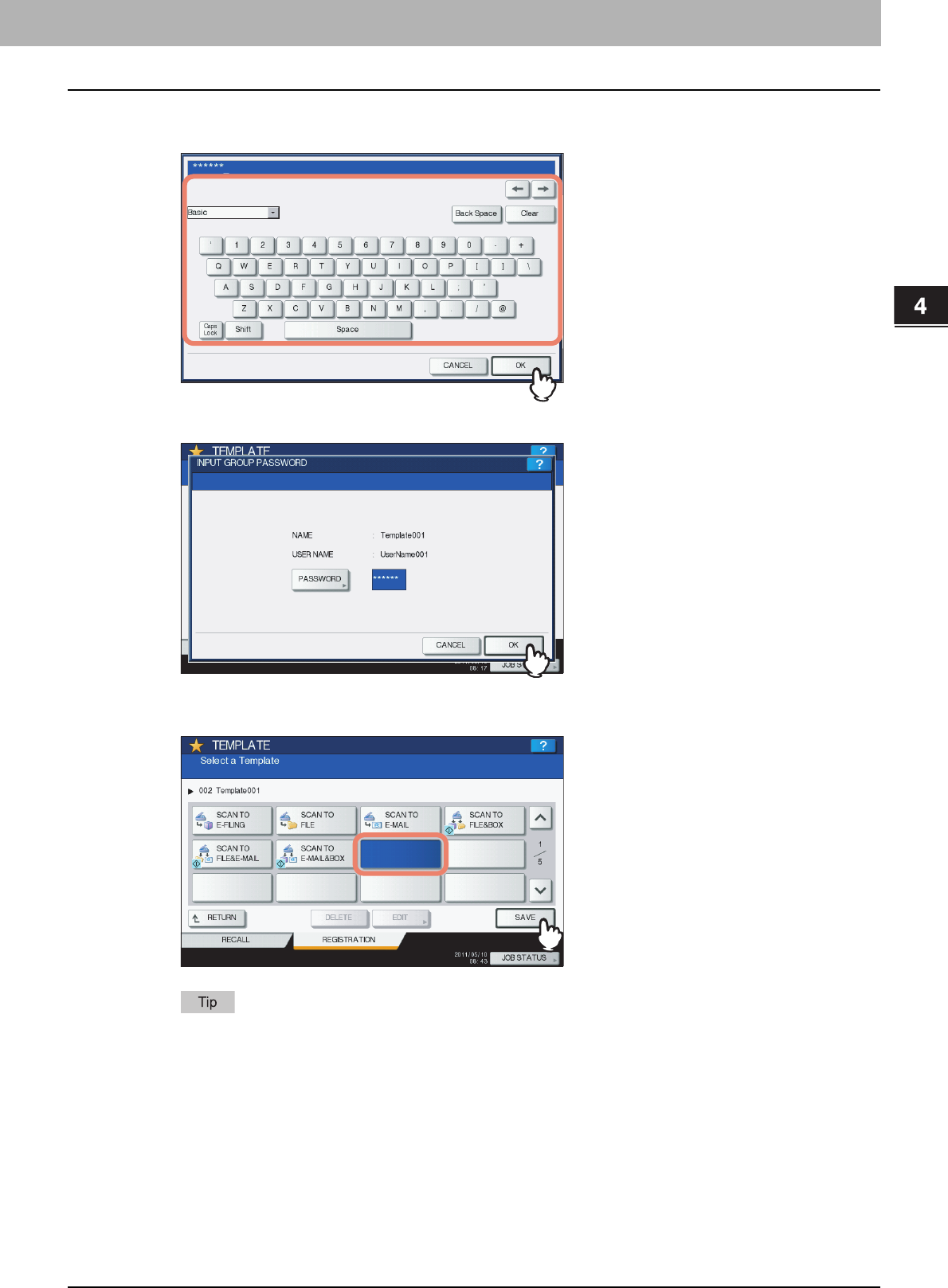
4.USING TEMPLATES
Registering Scan Templates 75
4 USING TEMPLATES
9
Using the keyboard and digital keys, enter the password for the selected private
template group, and then press [OK].
10
Press [OK].
The template buttons are displayed for the selected group.
11
Select an empty template button, and then press [SAVE].
If you press the button for an existing template, you can overwrite the template.
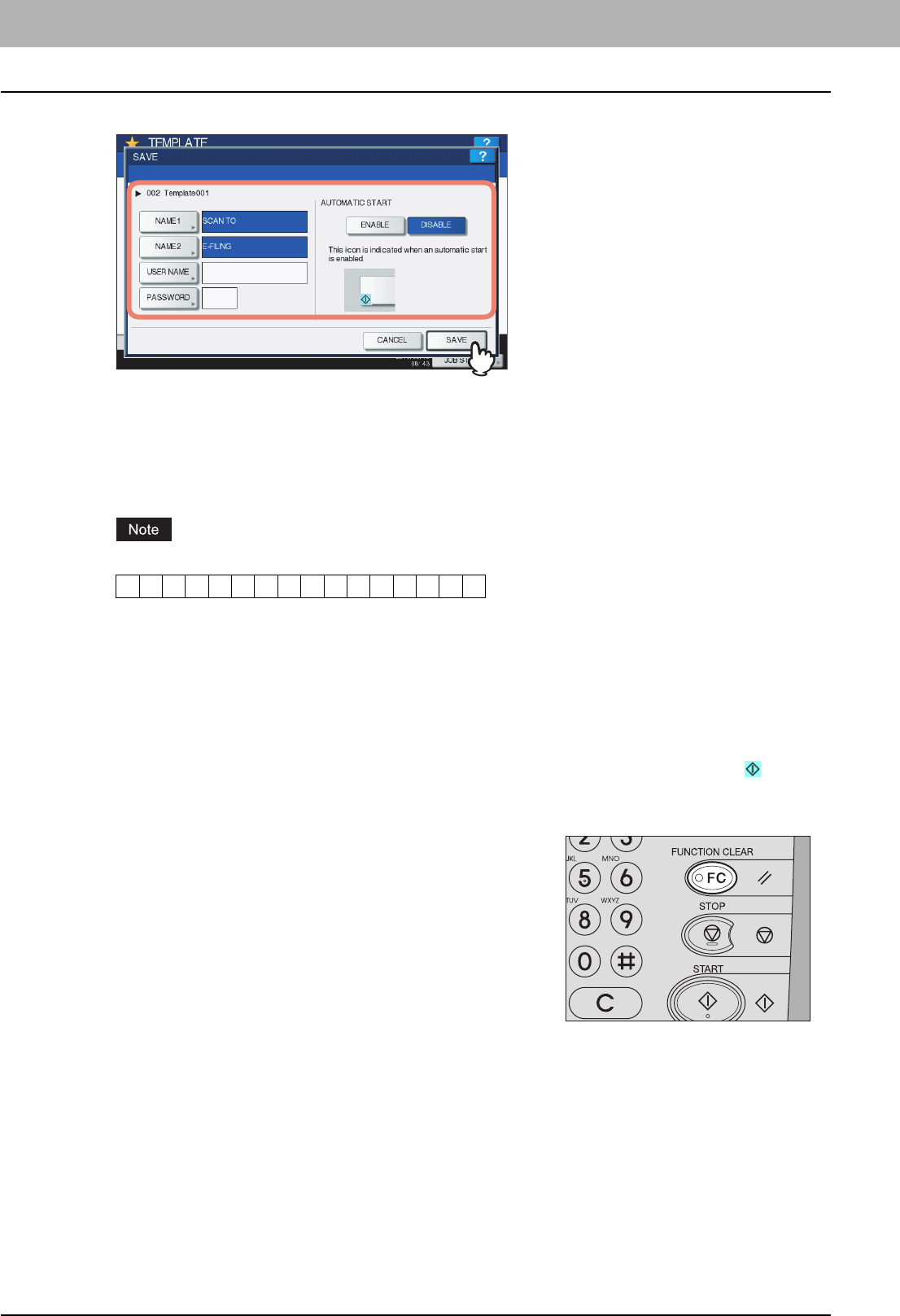
4 USING TEMPLATES
76 Registering Scan Templates
12
Make the settings for the following items as required, and then press [SAVE].
y[NAME 1]
Press this button to enter the name displayed on the 1st line of the template button. This name can consist of a
maximum of 11 alphanumeric characters.
y[NAME 2]
Press this button to enter the name displayed on the 2nd line of the template button. This name can consist of a
maximum of 11 alphanumeric characters.
The following symbols cannot be used for [NAME 1] and [NAME 2]:
y[USER NAME]
Press this button to enter the user name of the template. The user name can consist of a maximum of 30
alphanumeric characters.
y[PASSWORD]
Press this button to set a 1 to 20-digit password for the template. When you use a template for which a password
has been set, you must enter the password.
yAUTOMATIC START
Select whether to enable or disable the automatic start function. If this function is enabled, pressing the template
button automatically starts operation with the registered template. When this function is enabled, the icon is
shown in the lower left corner of the template button.
;:/\"=|*<>?+[],.
13
On the control panel, press the [FUNCTION CLEAR]
button to return to the SCAN menu.
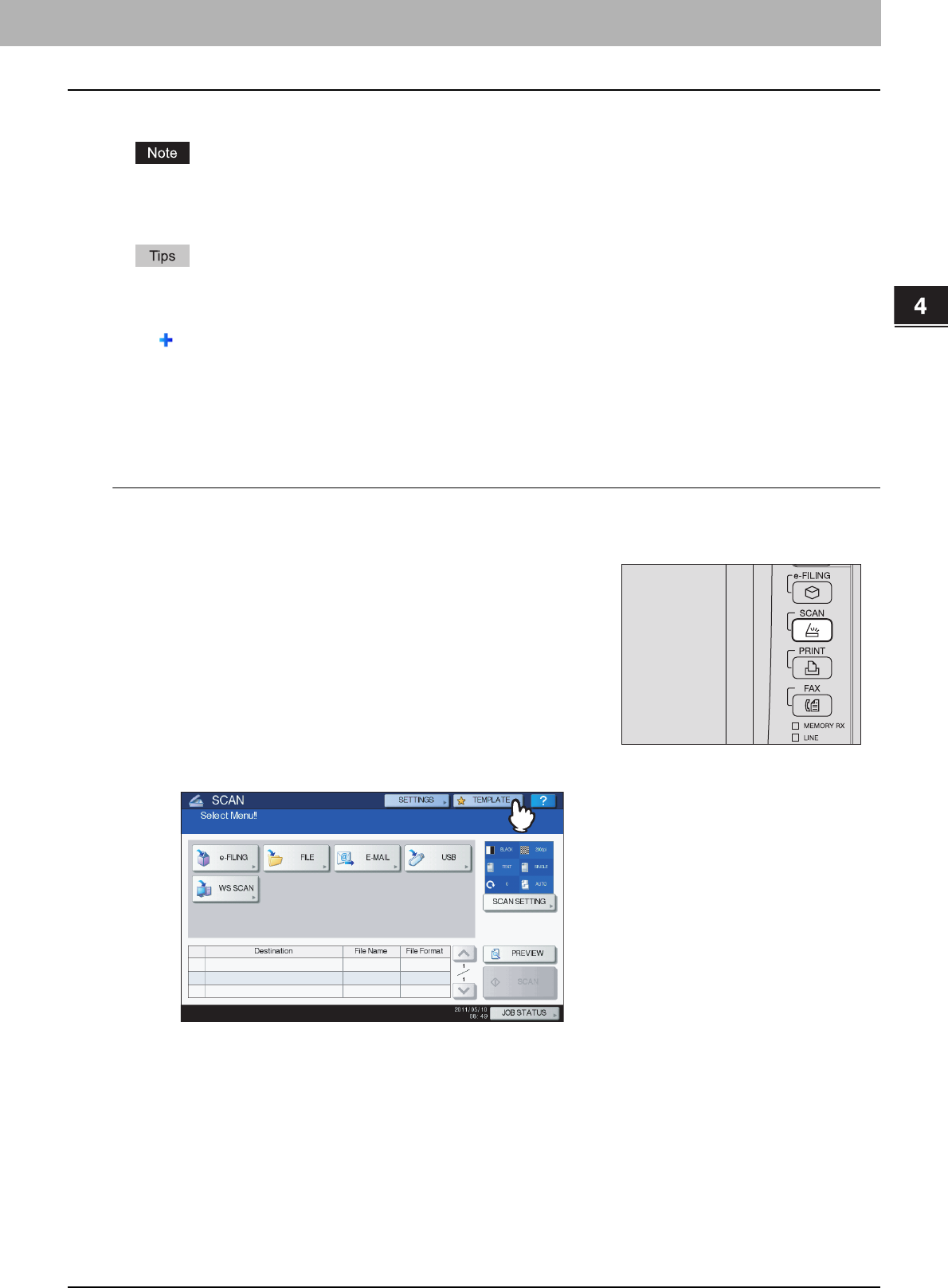
4 USING TEMPLATES
Using Scan Templates 77
Using Scan Templates
Once you register a template, your scanning operation becomes much easier.
Before using a template for scanning, you need to register the template. For instructions on how to register a template,
see the following section:
P.72 “Registering Scan Templates”
yUsing the templates for the Scan to E-mail function may require users to be authenticated for access to the SMTP
server. For instructions on how to use templates for Scan to E-mail, see the following section:
P.82 “Using templates for Scan to E-mail (When SMTP is selected for authentication method)”
y icon appears on a template created exclusively for meta scan. You may need to enter various information
before performing meta scan depending on the template settings. The Meta Scan Enabler GS-1010 (optional) is
required to enable the meta scan feature.
yWith the meta scan function, you can attach meta data (XML file) to scan images and send them with an e-mail, or
store them in the shared folder in this equipment. For the details of meta scan function, refer to the TopAccess
Guide.
Using scan templates
1
Place the original(s).
For help, refer to the Quick Start Guide.
3
On the touch panel, press [TEMPLATE] to display the TEMPLATE menu.
2
On the control panel, press the [SCAN] button to
enter the SCAN menu.
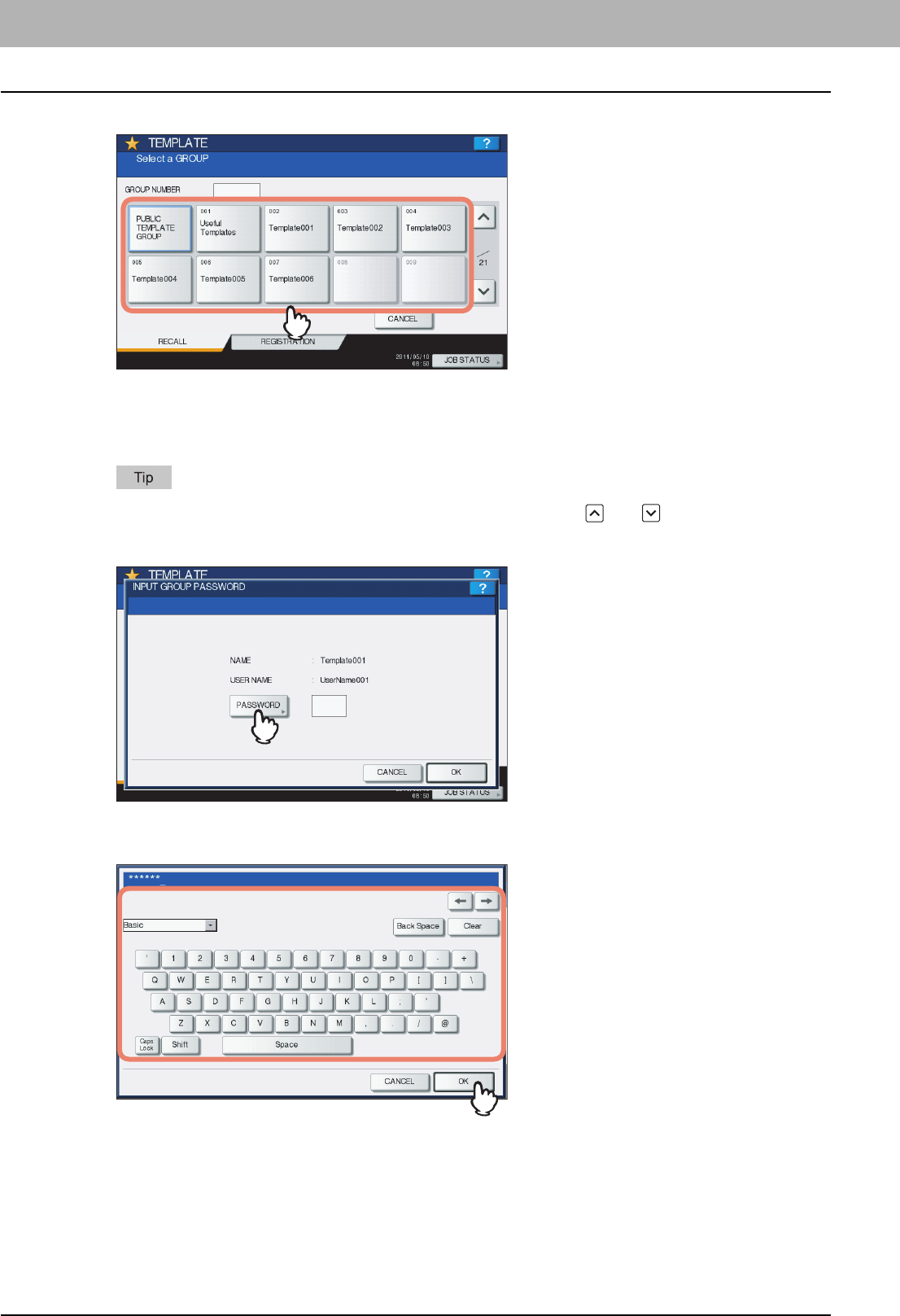
4 USING TEMPLATES
78 Using Scan Templates
4
On the [RECALL] tab, select a group containing the template that you want to use.
yIf you select a private template group for which a password has been set, the password input screen appears.
In this case, proceed to step 5.
yIf you select [PUBLIC TEMPLATE GROUP] or a private template group for which no password has been set,
the template buttons are displayed. In this case, proceed to step 8.
If the desired private template group is not displayed on the screen, use and to switch between pages.
5
Press [PASSWORD].
6
On the password input screen, enter the group password using the keyboard and
digital keys, and then press [OK].
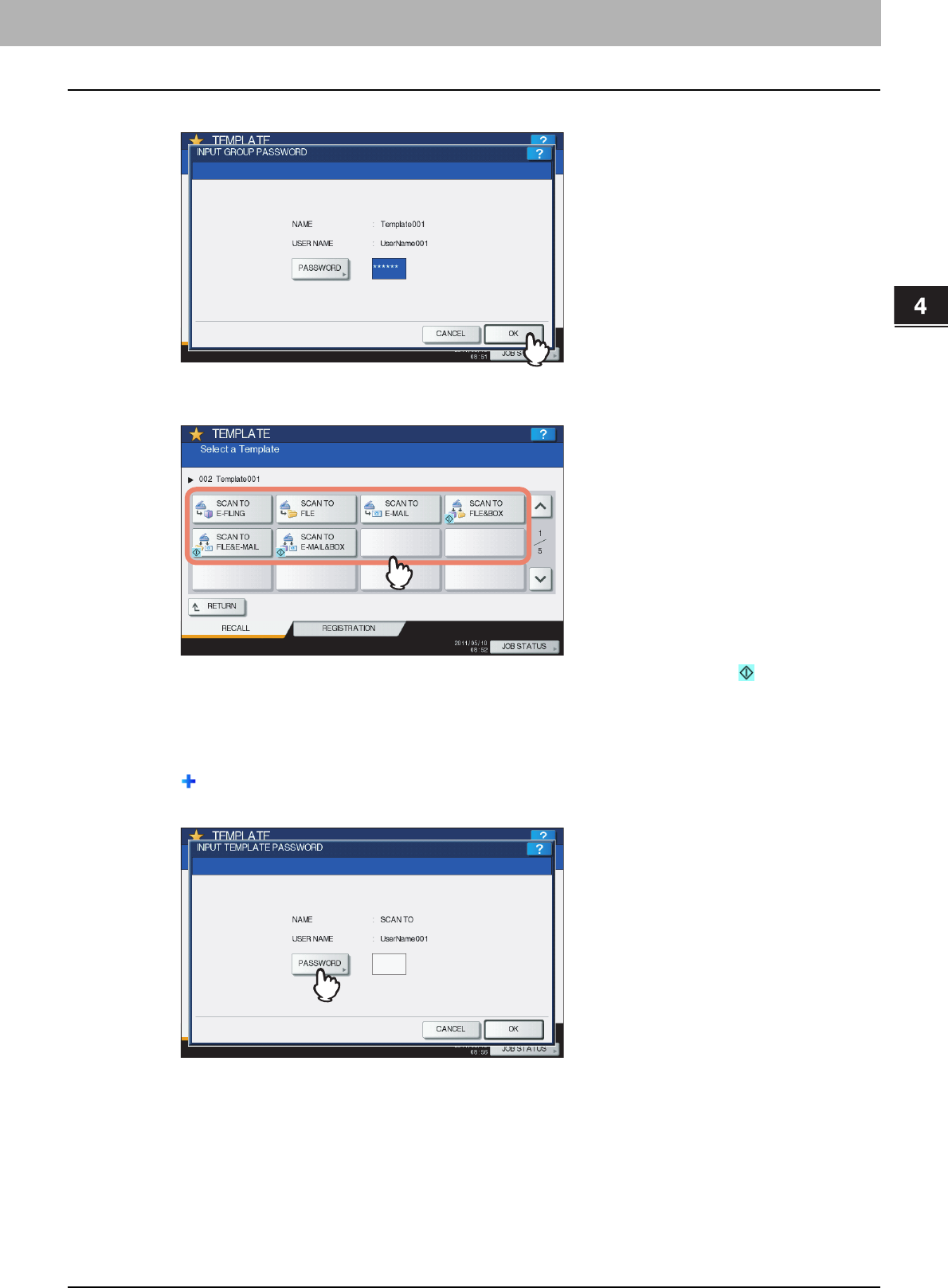
4.USING TEMPLATES
Using Scan Templates 79
4 USING TEMPLATES
7
Press [OK].
The template buttons are displayed for the selected group.
8
Select the template that you want to use.
yIf you select a password-free template for which the automatic start function is enabled ( is shown on the
button), the equipment automatically starts the scanning operation. (End of procedure)
yIf you select a password-free template for which the automatic start function is disabled, the SCAN menu
appears. In this case, proceed to step 13.
yIf you select a template for which a password is set, you need to enter the password. In this case, proceed to
step 9.
y icon appears on a meta scan template. If you select a meta scan template, proceed to step 12.
9
Press [PASSWORD].
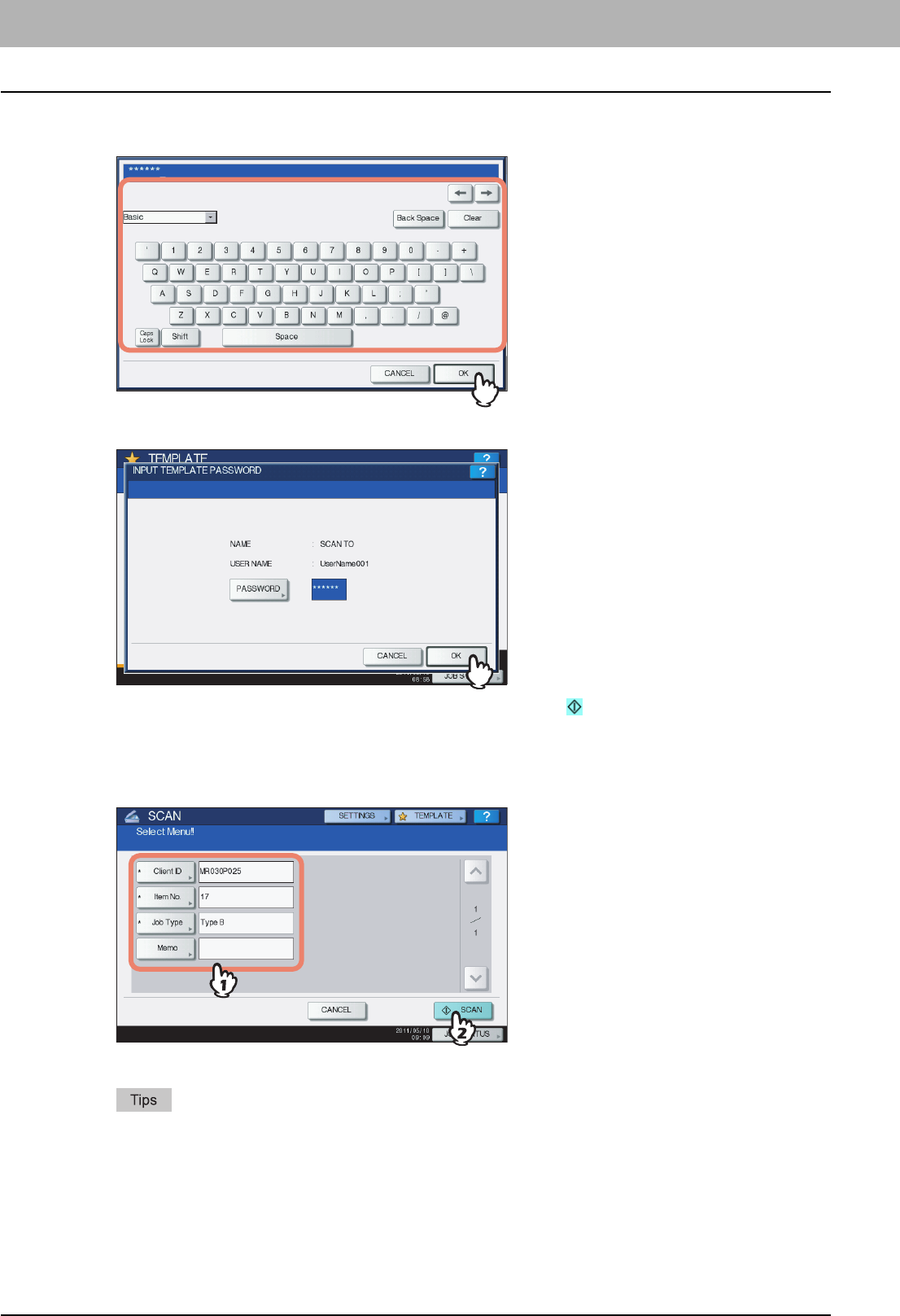
4 USING TEMPLATES
80 Using Scan Templates
10
On the password input screen, enter the template password using the keyboard and
digital keys, and then press [OK].
11
Press [OK].
If you select a template for which the automatic start function is enabled ( is shown on the button), the
equipment automatically starts the scanning operation. (Proceed to step 14.)
12
To use a meta scan template, enter information as required, and then press [SCAN].
1) Press the button for each item and enter information as required.
2) Finally, press [SCAN].
Proceed to step 14.
yItems shown in the figure above are samples. Ask the administrator for items you need to enter.
yRequired items are marked with asterisks.
yPressing each button displays an on-screen keyboard. Enter each item using the keyboard and digital keys,
and then press [OK] to set the entry.
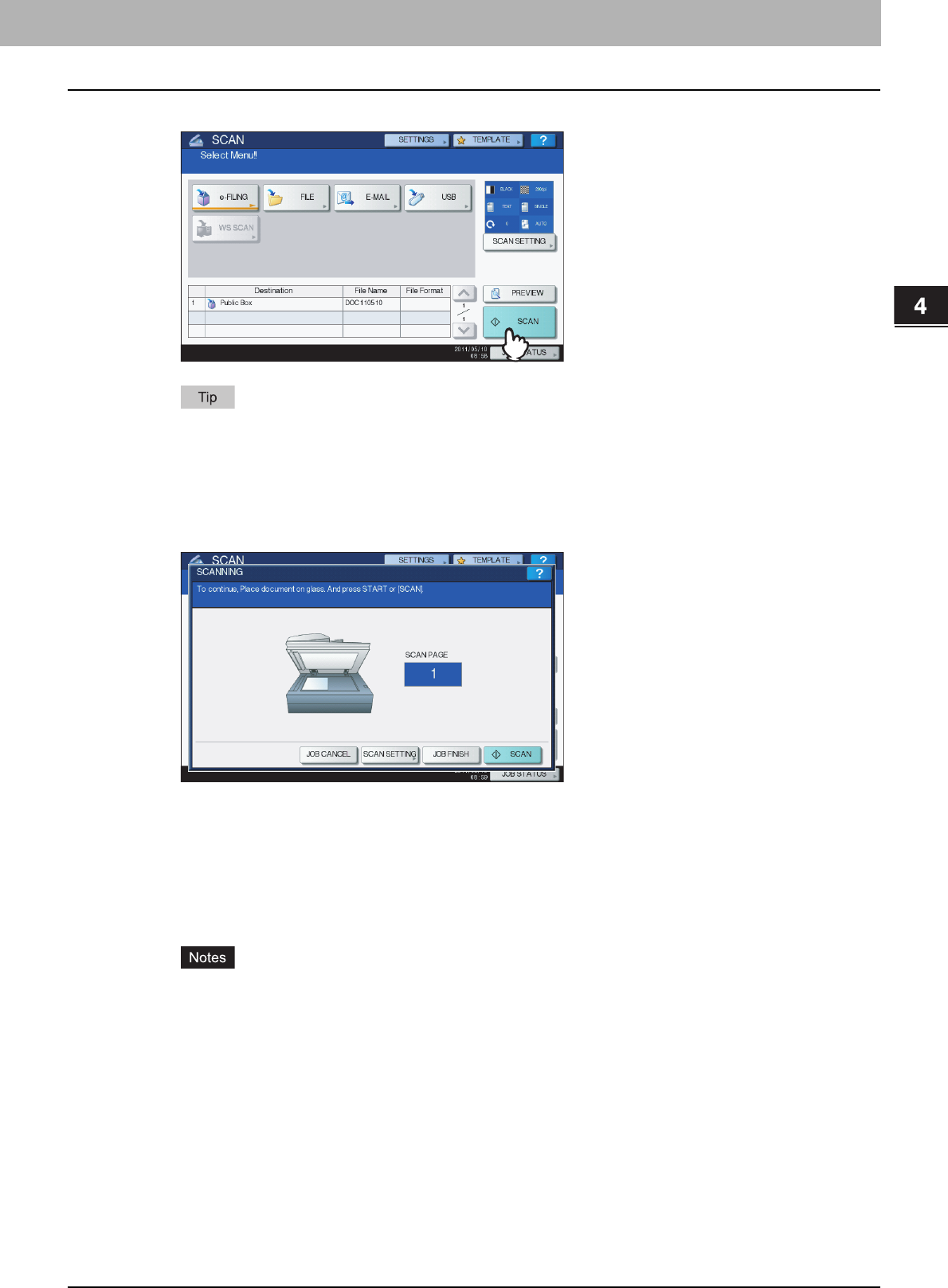
4.USING TEMPLATES
Using Scan Templates 81
4 USING TEMPLATES
13
Press [SCAN].
You can preview your scans by pressing [PREVIEW], followed by [SCAN]. For instructions on how to preview
your scans, see the following section:
P.49 “Previewing Scans”
14
If the screen below appears, place another original on the original glass and press
[SCAN] or the [START] button to continue scanning. To finish the job, press [JOB
FINISH], followed by the [FUNCTION CLEAR] button.
yThe above screen is not displayed under the following conditions:
- You scan the original from the Reversing Automatic Document Feeder* without pressing [CONTINUE] to
scan additional originals.
- A scan preview is displayed.
yTo cancel the operation, press [JOB CANCEL].
yTo change the scan settings, press [SCAN SETTING].
P.40 “Changing Scan Settings”
* The Reversing Automatic Document Feeder is optional for the e-STUDIO4540C Series.
yWhen the equipment has scanned more than 1000 pages in a job, the “The number of originals exceeds the
limit. Do you want to save stored originals?” message appears. If you want to save the scans, press [YES].
yWhen the temporary workspace is full on the equipment’s hard disk, a message appears and the job is
canceled. The available workspace can be viewed on the TopAccess [Device] tab.
yIf the number of jobs waiting to store scans in the equipment’s hard disk exceeds 20, a message appears to
indicate that the equipment’s memory is full. In this case, wait a while until memory becomes available again
or delete unnecessary jobs from [JOB STATUS].
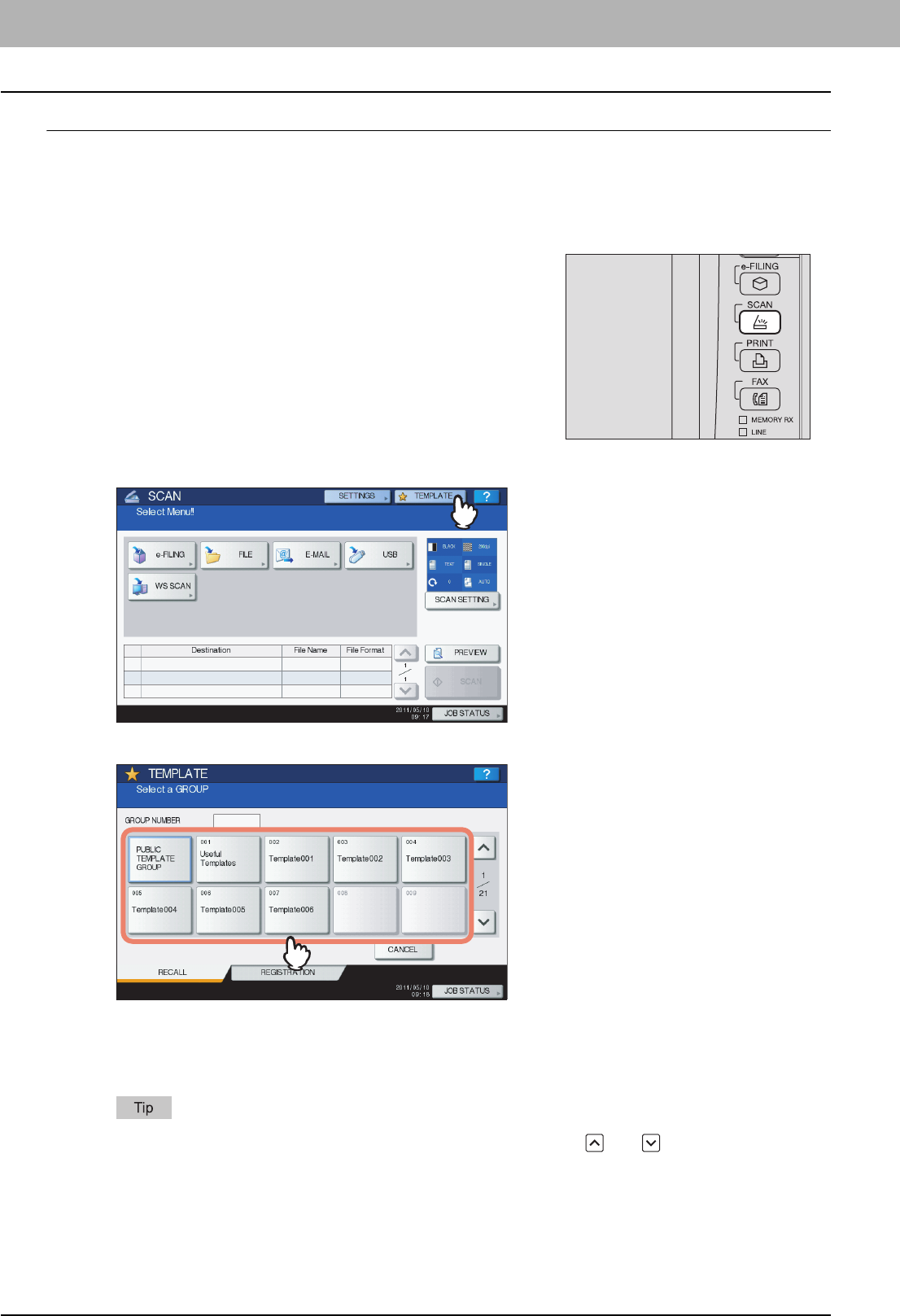
4 USING TEMPLATES
82 Using Scan Templates
Using templates for Scan to E-mail (When SMTP is selected for authentication method)
The procedure for using templates for the Scan to E-mail function differs slightly when the “User Authentication for Scan to
Email” setting on TopAccess is set to use SMTP to authenticate users. In this case, follow the steps below.
1
Place the original(s).
For help, refer to the Quick Start Guide.
3
On the touch panel, press [TEMPLATE] to display the TEMPLATE menu.
4
On the [RECALL] tab, select a group containing the template that you want to use.
yIf you select a private template group for which a password has been set, the password input screen appears.
In this case, proceed to step 5.
yIf you select [PUBLIC TEMPLATE GROUP] or a private template group for which no password has been set,
the template buttons are displayed. In this case, proceed to step 7.
If the desired private template group is not displayed on the screen, use and to switch between pages.
2
On the control panel, press the [SCAN] button to
enter the SCAN menu.
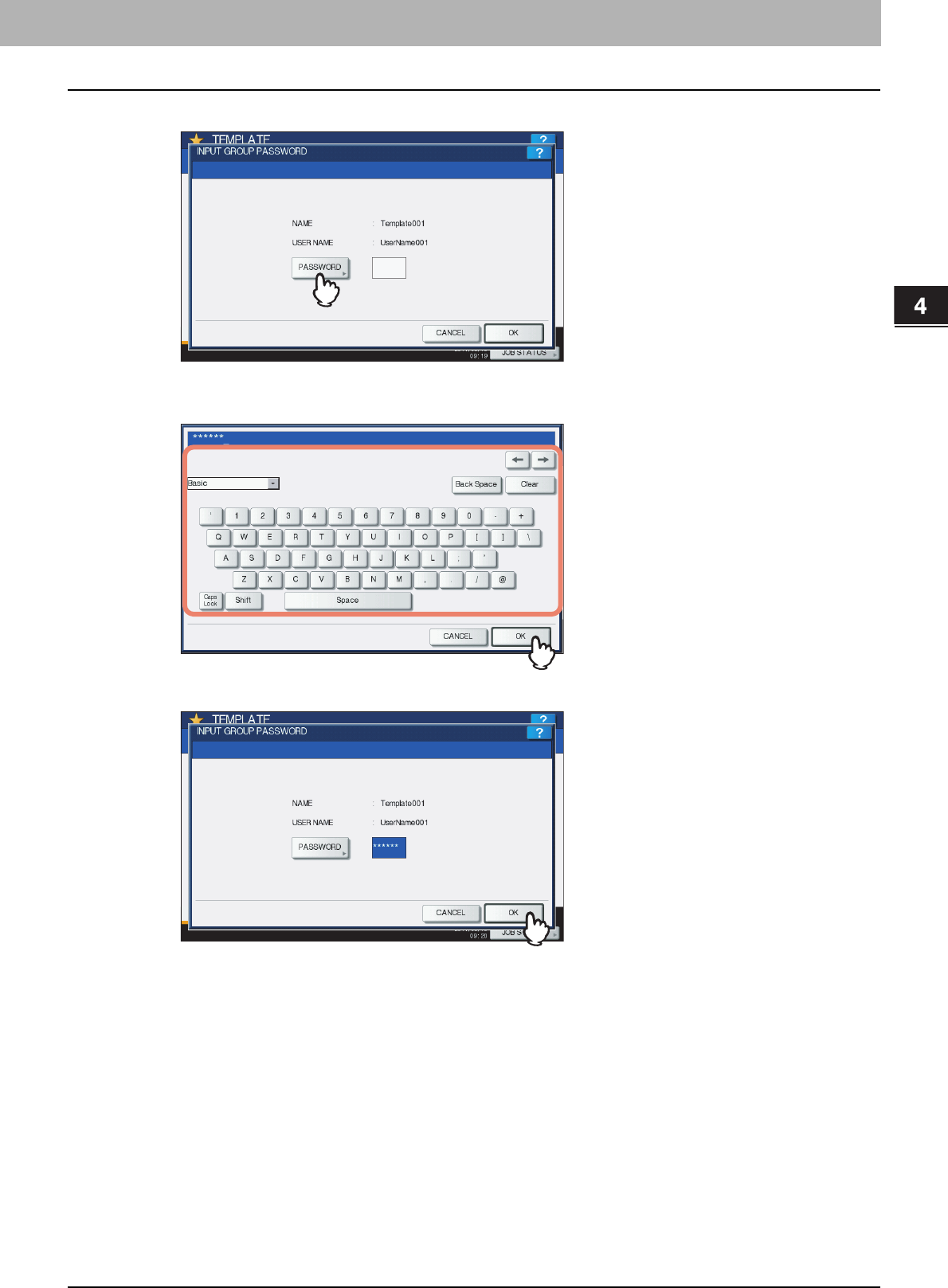
4.USING TEMPLATES
Using Scan Templates 83
4 USING TEMPLATES
5
Press [PASSWORD].
6
On the password input screen, enter the group password the keyboard and digital
keys, and then press [OK].
7
Press [OK].
The template buttons are displayed for the selected group.
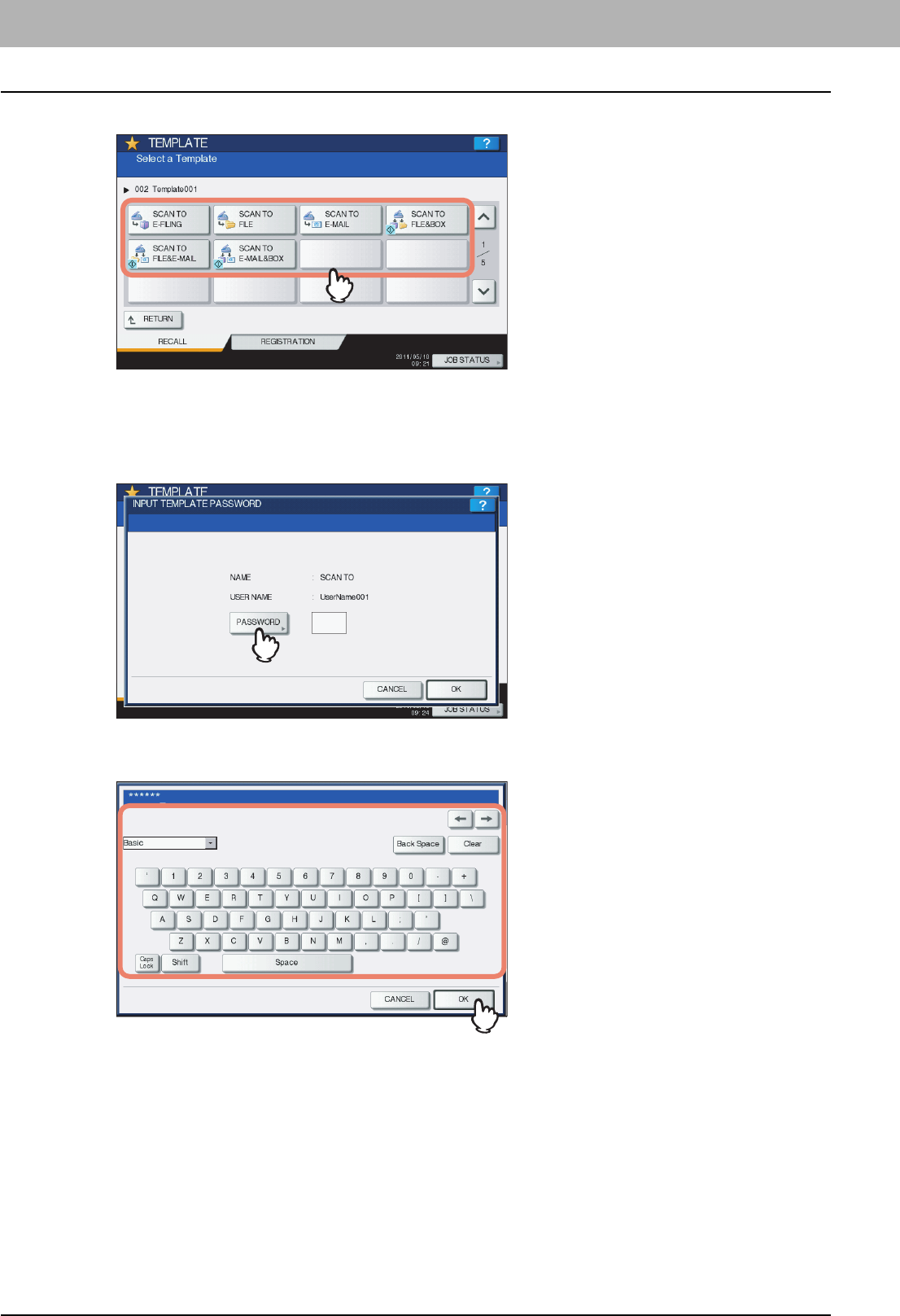
4 USING TEMPLATES
84 Using Scan Templates
8
Select a “SCAN TO E-MAIL” template that you want to use.
yIf you select a template for which a password is set, you need to enter the password. In this case, proceed to
step 9.
yIf you select a password-free template, the AUTHENTICATION screen appears. In this case, proceed to step
12.
9
Press [PASSWORD].
10
On the password input screen, enter the template password using the keyboard and
digital keys, and then press [OK].
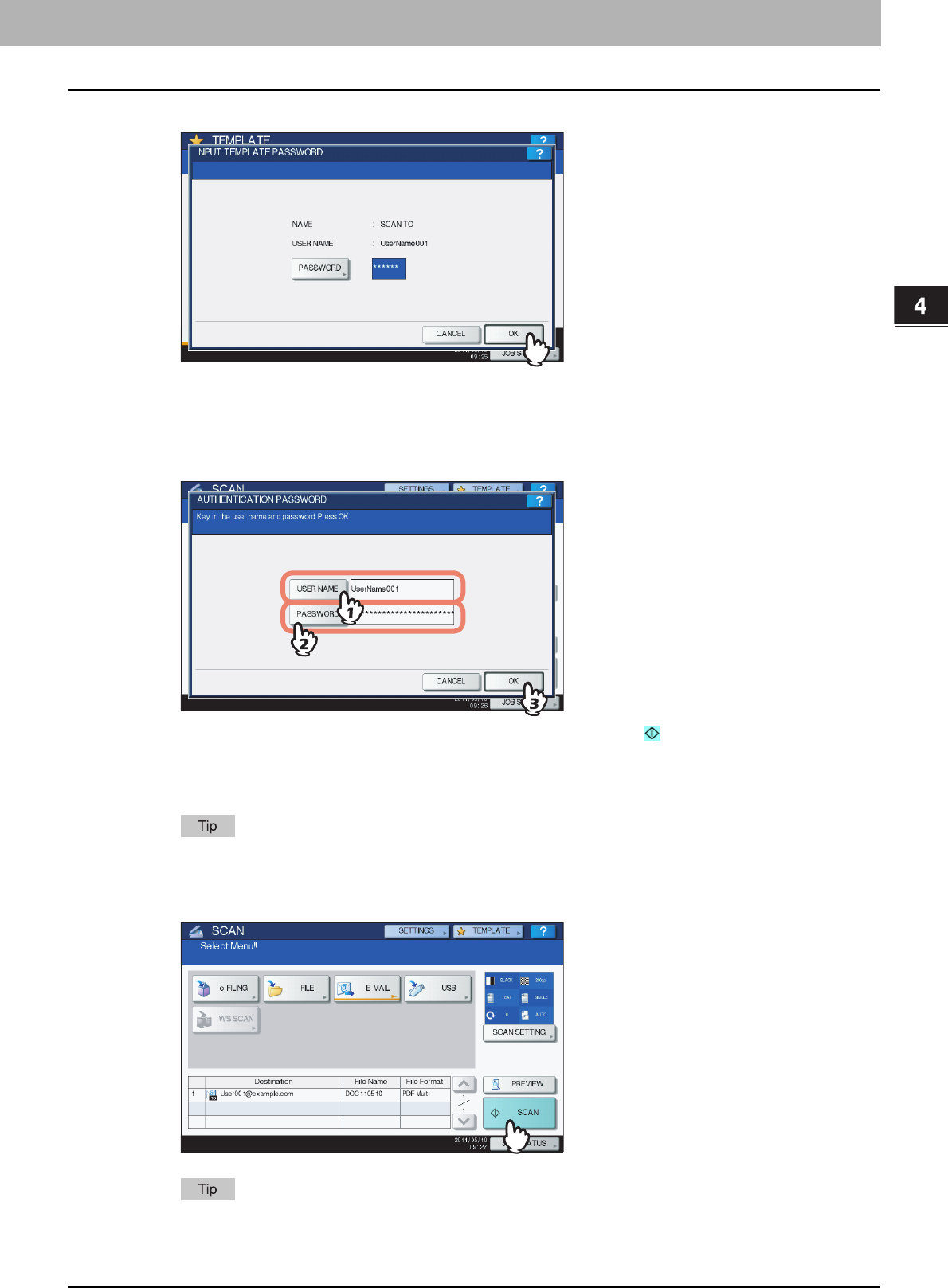
4.USING TEMPLATES
Using Scan Templates 85
4 USING TEMPLATES
11
Press [OK].
12
When the AUTHENTICATION screen is displayed, enter the user name and the
password to complete the user authentication.
1) Press [USER NAME] and enter the user name.
2) Press [PASSWORD] and enter the password.
3) Finally, press [OK].
yIf you select a template for which the automatic start function is enabled ( is shown on the button), the
equipment automatically starts the scanning operation. (End of procedure)
yIf you select a template for which the automatic start function is disabled, the SCAN menu appears. In this case,
proceed to step 13.
Pressing each button displays an on-screen keyboard. Enter each item using the keyboard and digital keys,
and then press [OK] to set the entry. Ask the administrator for the user name and password.
13
Press [SCAN].
You can preview your scans by pressing [PREVIEW], followed by [SCAN]. For instructions on how to preview
your scans, see the following section:
P.49 “Previewing Scans”
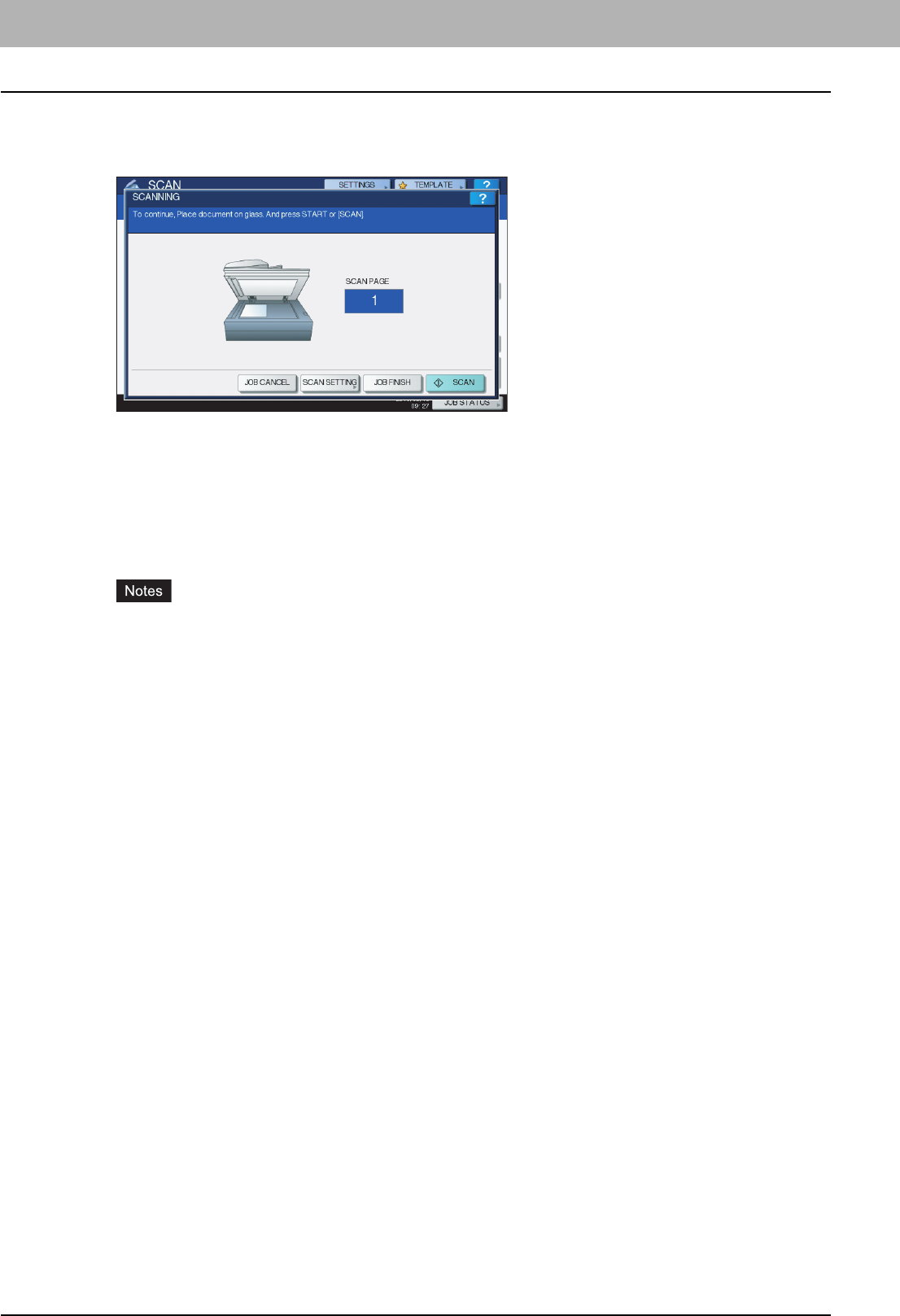
4 USING TEMPLATES
86 Using Scan Templates
14
If the screen below appears, place another original on the original glass and press
[SCAN] or the [START] button to continue scanning. To finish the job, press [JOB
FINISH], followed by the [FUNCTION CLEAR] button.
yThe above screen is not displayed under the following conditions:
- You scan the original from the Reversing Automatic Document Feeder* without pressing [CONTINUE] to
scan additional originals.
- A scan preview is displayed.
yTo cancel the operation, press [JOB CANCEL].
yTo change the scan settings, press [SCAN SETTING].
P.40 “Changing Scan Settings”
* The Reversing Automatic Document Feeder is optional for the e-STUDIO4540C Series.
yWhen the equipment has scanned more than 1000 pages in a job, the “The number of originals exceeds the
limits. Will you save stored originals?” message appears. If you want to save the scans, press [YES].
yWhen the temporary workspace is full on the equipment’s hard disk, a message appears and the job is
canceled. The available workspace can be viewed on the TopAccess [Device] tab.
yIf the number of jobs waiting to store scans in the equipment’s hard disk exceeds 20, a message appears to
indicate that the equipment’s memory is full. In this case, wait a while until memory becomes available again
or delete unnecessary jobs from [JOB STATUS].
P.37 “Viewing the scan job status”

5.OTHER SCANNING METHODS
This chapter provides a brief introduction to the scan drivers included with the Client Utilities CD-ROM.
Scanning Images Using the TOSHIBA e-STUDIO Remote Scan Driver ............................ 88
Scanning Images Using the TOSHIBA e-STUDIO WIA Driver ............................................ 89
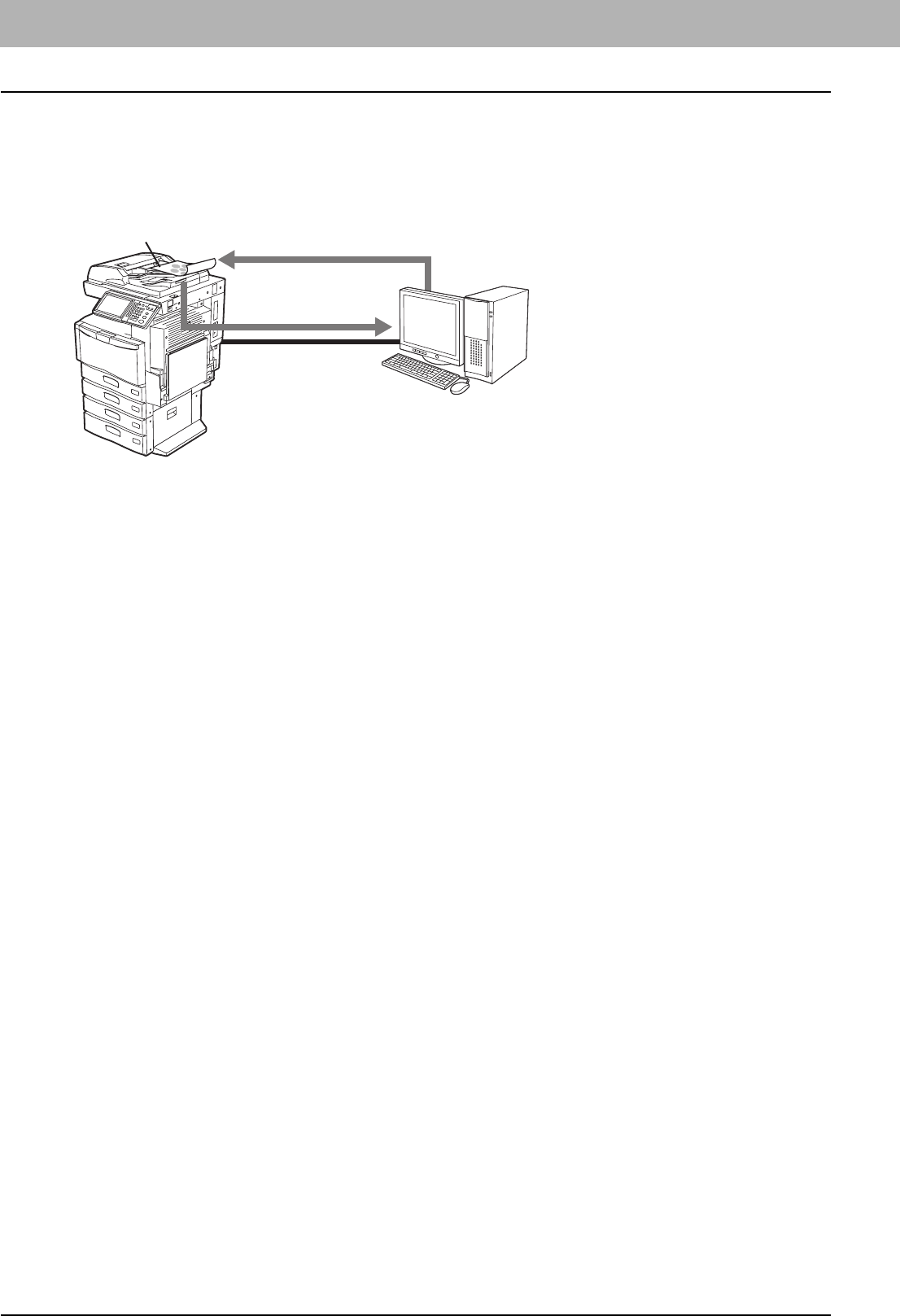
5 OTHER SCANNING METHODS
88 Scanning Images Using the TOSHIBA e-STUDIO Remote Scan Driver
Scanning Images Using the TOSHIBA e-STUDIO Remote Scan Driver
One of the scan drivers included with the Client Utilities CD-ROM is the TOSHIBA e-STUDIO Remote Scan driver. With
this driver, you can perform scanning operations remotely from your Windows computer over the TCP/IP network. Your
scans can be loaded to your Windows computer running a TWAIN-compliant application.
For instructions on how to install the driver, refer to the Software Installation Guide.
Windows XP
Windows Vista
Windows 7
Windows Server 2003
Windows Server 2008
Connecting over TCP/IP Network
Scan originals remotely using
the TOSHIBA e-STUDIO Remote Scan driver
Originals
Import your scans to
a TWAIN-compliant application
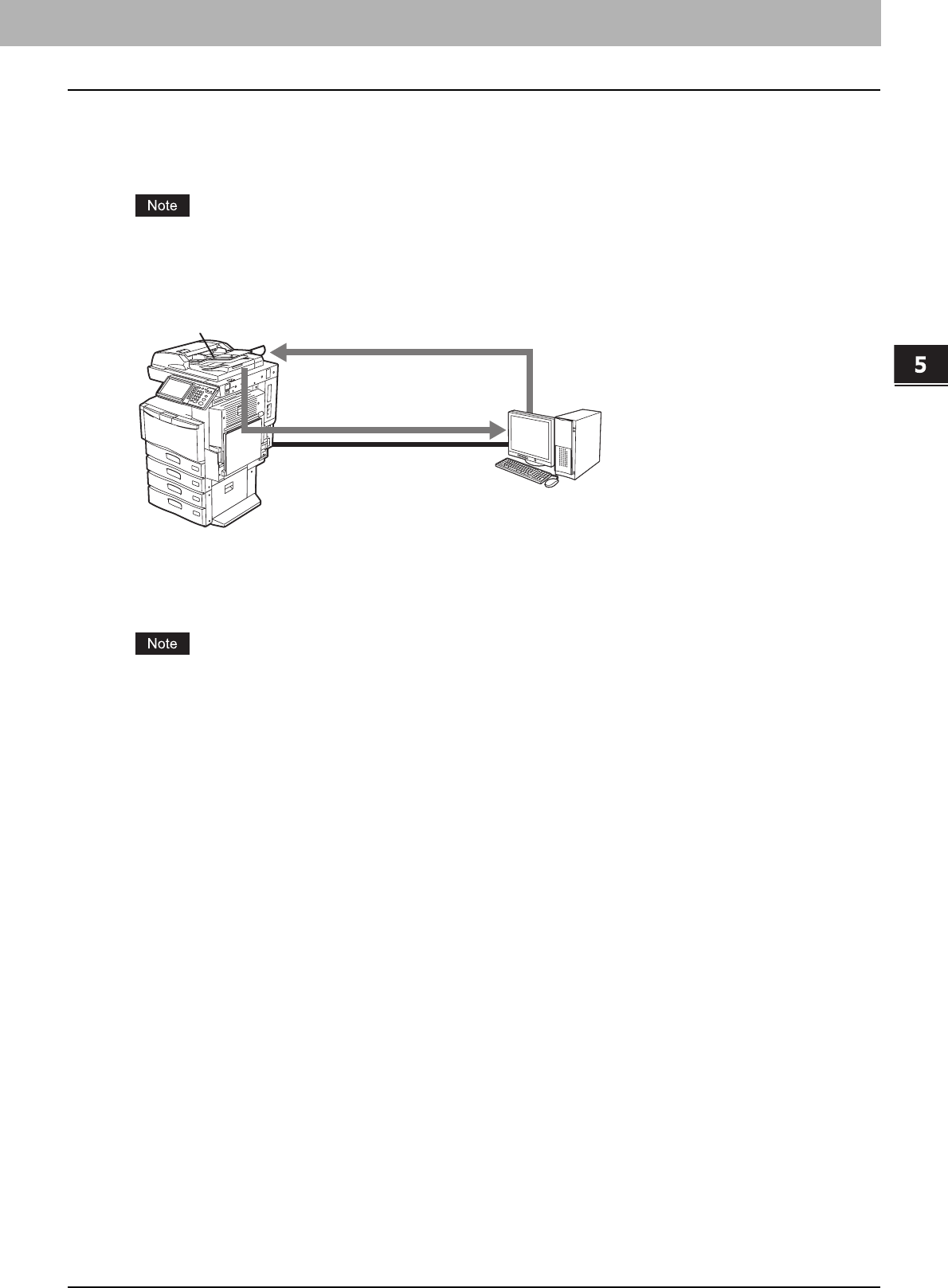
5 OTHER SCANNING METHODS
Scanning Images Using the TOSHIBA e-STUDIO WIA Driver 89
Scanning Images Using the TOSHIBA e-STUDIO WIA Driver
The Client Utilities CD-ROM also includes the TOSHIBA e-STUDIO WIA Driver for users of Windows XP/Windows Vista/
Windows 7/Windows Server 2003/Windows Server 2008. This driver can be used together with a WIA-compliant
application, such as Microsoft Paint supported by Windows XP or Windows Vista, to scan images on the equipment and
load them to your client computer.
If only the Department Management features are enabled, the department code needs to be entered.
For instructions on how to install the driver, refer to the Software Installation Guide. For instructions on how to scan and
acquire images to your computer, refer to the documentation that comes with your WIA-compliant application.
If you are using Windows XP or Windows Server 2003, follow the procedure below to register this equipment to the
TOSHIBA e-STUDIO WIA Driver after the installation of the driver.
1. Double-click [Scanners and Cameras] of [Control Panel].
2. Right-click [TOSHIBA e-STUDIO WIA Driver] and then click [Properties].
3. Click [Discover] on the [Device Setting] tab menu.
4. Click [Start Discovery].
5. Select this equipment and then click [OK].
6. Click [OK].
Scan originals using
the TOSHIBA e-STUDIO WIA Driver
Originals
Import your scans to
a WIA-compliant application
Windows XP
Windows Vista
Windows 7
Windows Server 2003
Windows Server 2008
Connecting over TCP/IP Network

6.INTERNET FAX
This chapter describes the Internet Fax feature.
Precautions for Internet Fax Transmissions ....................................................................... 92
Viewing Touch Panel for Fax Menu ...................................................................................... 93
Sending Internet Faxes..........................................................................................................95
Sending Internet faxes .........................................................................................................................................95
Saving sent data as a file (Internet fax and file) ...................................................................................................98
Setting advanced functions ................................................................................................................................102
Receiving Internet Faxes..................................................................................................... 106
Available file formats ..........................................................................................................................................106
Receiving Internet faxes.....................................................................................................................................106
Viewing the Internet Fax Job Status and Log.................................................................... 107
Viewing the Internet fax job status......................................................................................................................107
Viewing the send log for Internet fax jobs...........................................................................................................108
Viewing the receive log for Internet fax jobs.......................................................................................................109
Saving contact information to the address book.................................................................................................109

6 INTERNET FAX
92 Precautions for Internet Fax Transmissions
Precautions for Internet Fax Transmissions
Internet Fax works just like e-mail and may cause the same kinds of troubles as e-mail unless you understand how it
works. Before you start using the Internet Fax feature, carefully read and familiarize yourself with the following
precautions:
yInternet Fax sends a copy of a document to your e-mail server, not via the PSTN* as with a traditional fax. The data is
then sent from the server to the Internet. Unlike traditional faxing, Internet faxing does not involve a direct
communication with the recipient(s). Transmission is considered complete when the sent copy of the document
reaches your e-mail server.
yThe security level of Internet transmissions is low. We recommend traditional faxing when sending confidential
documents.
y Due to heavy line traffic, Internet transmissions may take a while to arrive.
yThe configuration of the e-mail server may prevent successful transmission if the data size of the sent document
exceeds set limits.
yWhen you send an Internet fax to multiple recipients, all the recipients’ e-mail addresses are printed if the header page
is set to be printed on the recipients devices. If you need to secure the personal information, send the Internet fax
separately to each recipient rather than sending to multiple recipients at the same time.
* PSTN (Public Switched Telephone Network) is a global telephone system capable of communicating worldwide using copper wires to transmit
analog data.
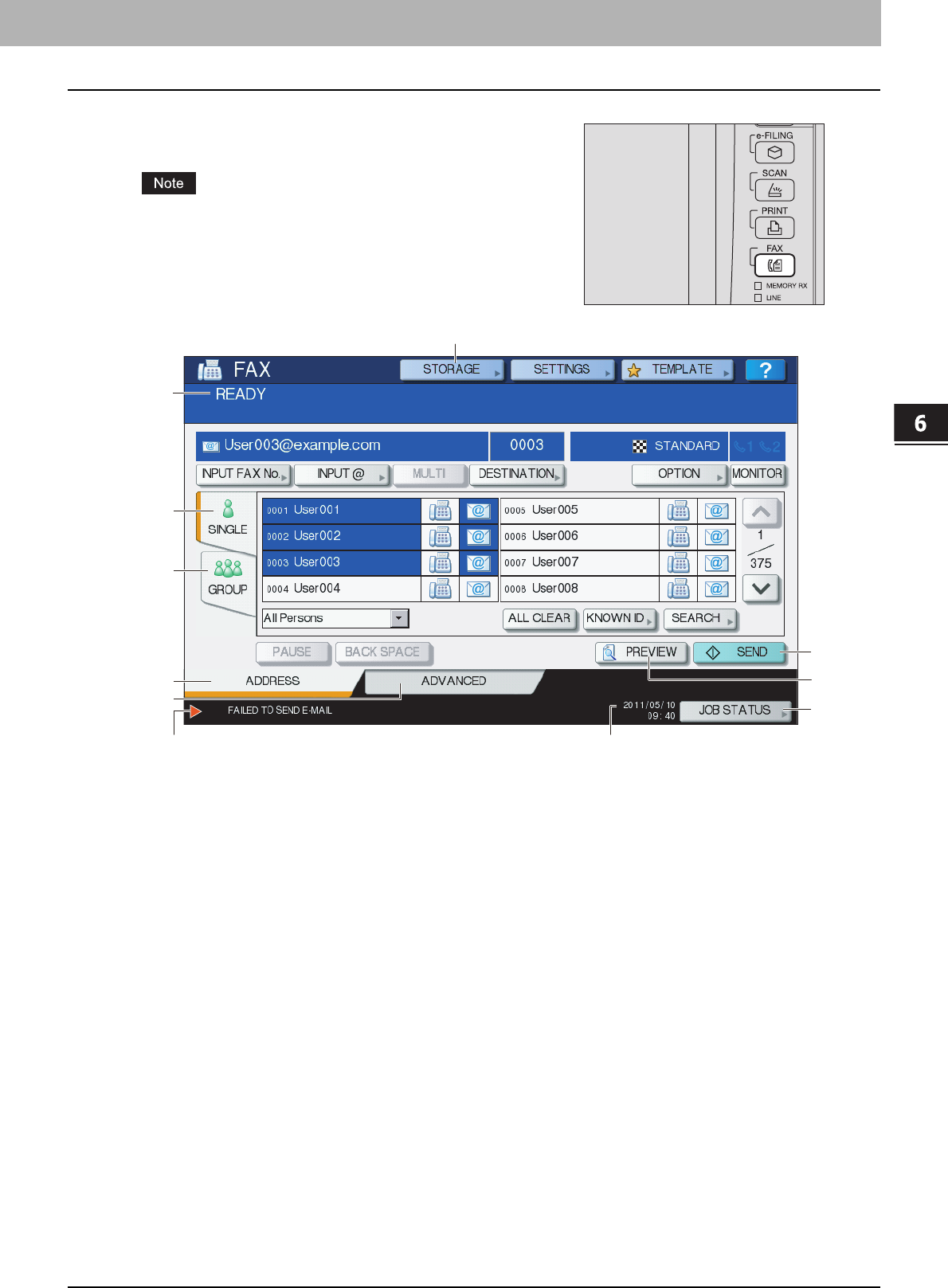
6 INTERNET FAX
Viewing Touch Panel for Fax Menu 93
Viewing Touch Panel for Fax Menu
1. Message Display Area
Operational instructions and the status of the equipment are displayed.
2. [SINGLE] Tab
On this tab, you can select individual contacts and various function buttons relevant to Internet faxing operation.
3. [GROUP] Tab
On this tab, you can select groups of contacts and various function buttons relevant to Internet faxing operation.
4. [ADDRESS] Tab
This tab contains contacts information saved in the equipment’s address book and displays the information on the
[SINGLE] and the [GROUP] tab.
5. [ADVANCED] Tab
On this tab, various kinds of advanced functions are available for you.
P.102 “Setting advanced functions”
6. Alert Message Display Area
Alert messages are displayed when the equipment needs a toner cartridge replacement, the waste toner box needs
cleaning, etc. For details on these messages, refer to the Troubleshooting Guide.
7. Date and Time
When you press the [FAX] button on the control panel, the FAX menu is
displayed on the touch panel.
If the equipment is managed by the Department Management or
User Management features, you need to enter a department code
or the user information, such as the user name and password.
1
11
7
9
2
58
10
3
4
6

6 INTERNET FAX
94 Viewing Touch Panel for Fax Menu
8. [JOB STATUS]
Press this button when you want to monitor your copy, fax, scan, and/or print jobs or view the job logs.
P.107 “Viewing the Internet fax job status”
P.108 “Viewing the send log for Internet fax jobs”
P.109 “Viewing the receive log for Internet fax jobs”
9. [PREVIEW]
Press this button to preview scans.
P.49 “Previewing Scans”
10. [SEND]
Press this button to send a copy of your document placed on the equipment.
11. [STORAGE]
Press this button when you want to both send a copy of your document and store the sent data in the equipment’s hard
disk.
P.98 “Saving sent data as a file (Internet fax and file)”
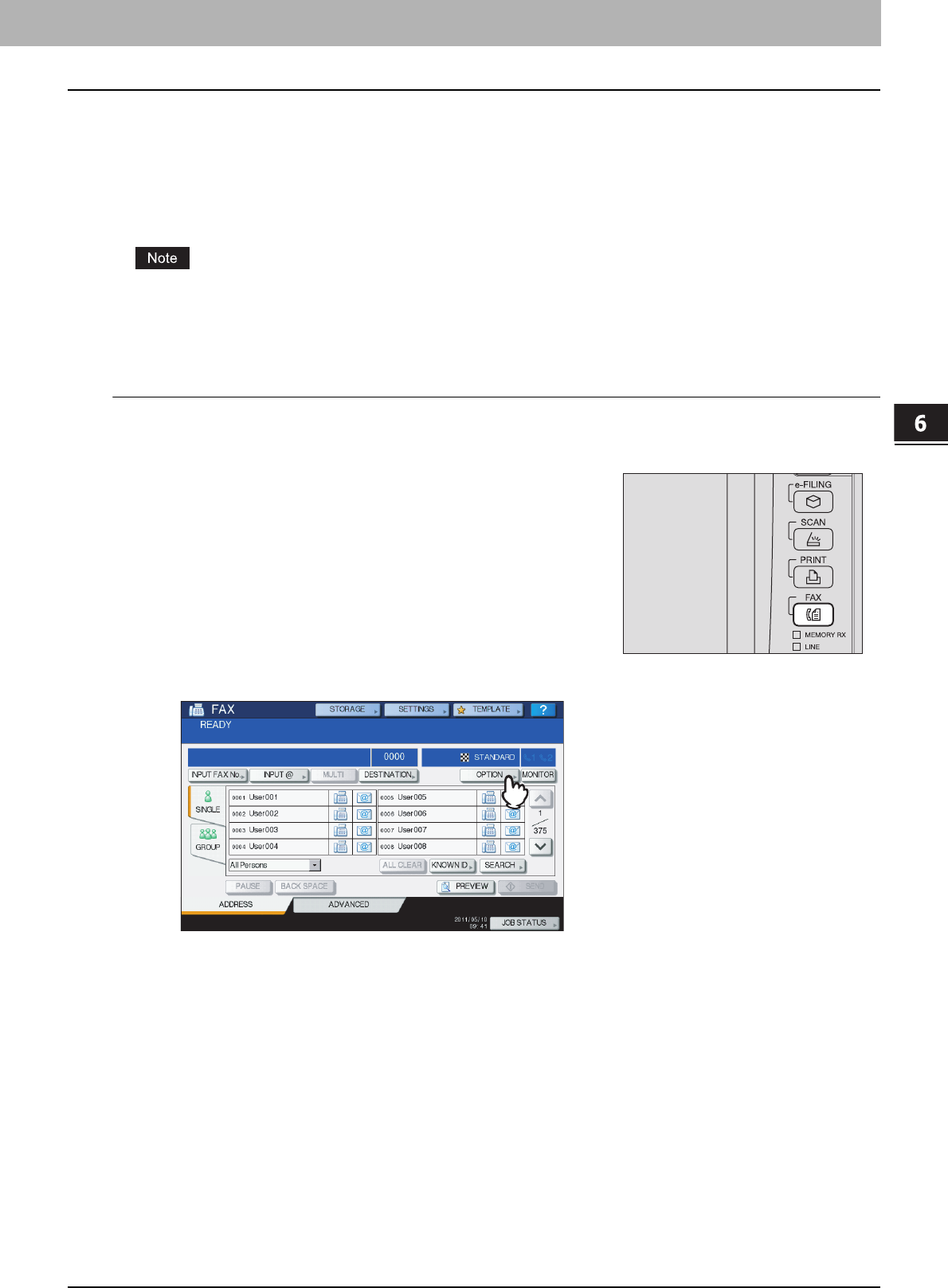
6 INTERNET FAX
Sending Internet Faxes 95
Sending Internet Faxes
Just like the Scan to E-mail function, Internet Fax sends scanned data to specified e-mail addresses as an attached file.
The difference is the format of the file; it is TIFF-FX (Profile S), which can be received and printed on Internet Fax devices.
With a few additional steps, you can also save the sent data or set advanced functions for each transmission.
P.95 “Sending Internet faxes”
P.98 “Saving sent data as a file (Internet fax and file)”
P.102 “Setting advanced functions”
To use the Internet Fax feature, the network administrator must set the equipment configuration.
Sending Internet faxes
Sending Internet Faxes
1
Place the original(s).
For help, refer to the Quick Start Guide.
3
On the [ADDRESS] tab, press [OPTION].
2
On the control panel, press the [FAX] button.
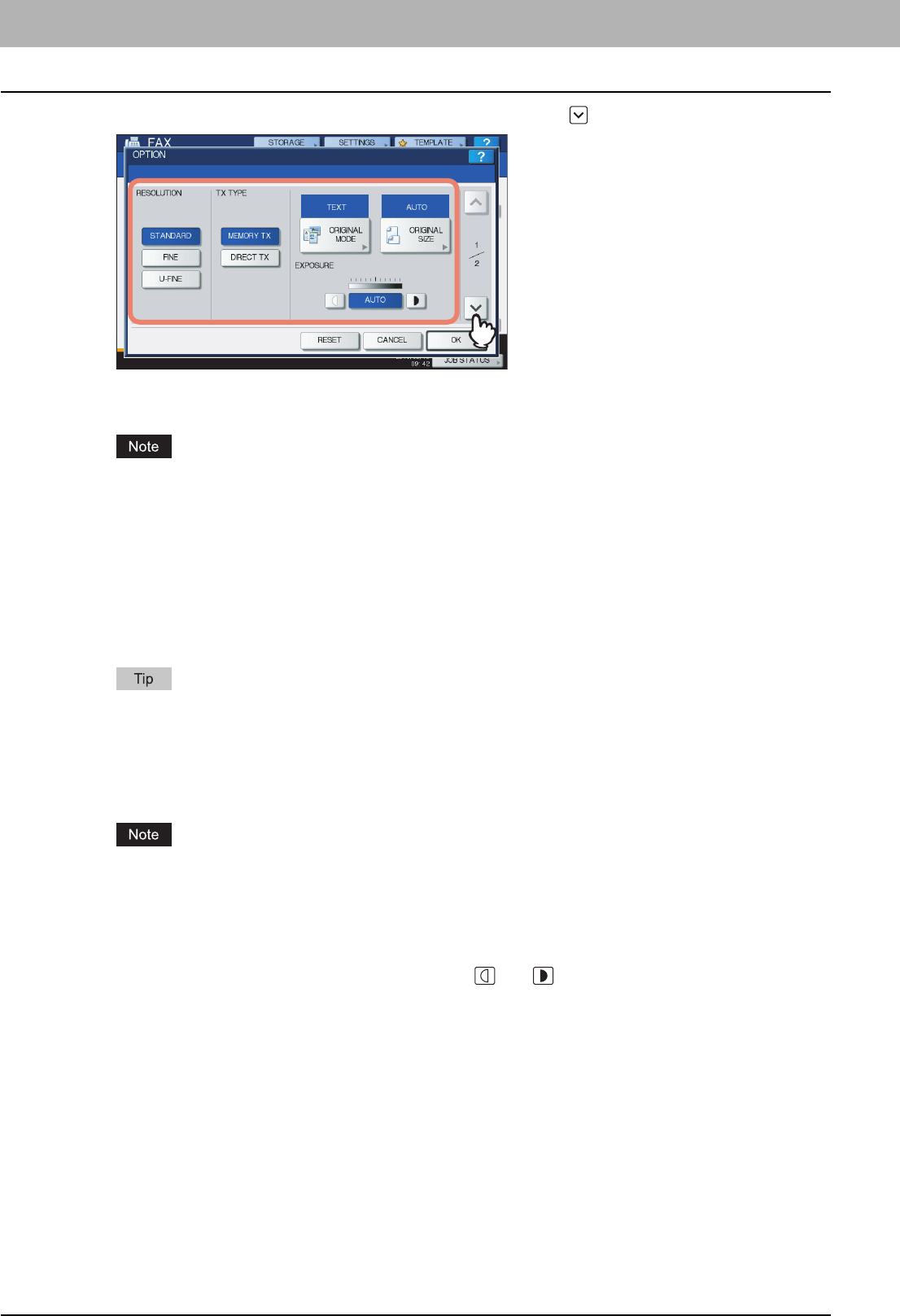
6 INTERNET FAX
96 Sending Internet Faxes
4
Specify the following items as required, and then press .
yRESOLUTION
Select the resolution for scanning the original.
When sending an Internet Fax, [FINE] is always applied even if you select [U-FINE].
yTX TYPE
When sending an Internet Fax, you can only select [MEMORY TX].
This button can be selected only when the FAX Unit (optional) is installed on the equipment.
yORIGINAL MODE
Select an original mode to scan the original for the best image quality.
[TEXT/PHOTO] — Press this button to scan an original consisting of both text and photos.
[TEXT] — Press this button to scan an original consisting of text.
[PHOTO] — Press this button to scan an original containing photo images printed on photographic paper.
When either [TEXT/PHOTO] or [PHOTO] is selected, the transmission may take a while.
yORIGINAL SIZE
Press the corresponding button for the original size. To have the equipment automatically set the original size,
press [AUTO].
When using originals of various paper widths, press [DIFFERENT WIDTH].
Internet faxing sends copies of A4, LT or LG size originals in the same size as the originals.’ Originals larger
than A4, LT, or LG are reduced to A4 or LT, whereas originals smaller than these sizes are sent as A4 or LT
without being enlarged.
yEXPOSURE
Select the appropriate exposure for scanning the original. Pressing [AUTO] automatically sets the exposure best
suited to your originals. To set the exposure manually, use and to select the appropriate exposure.
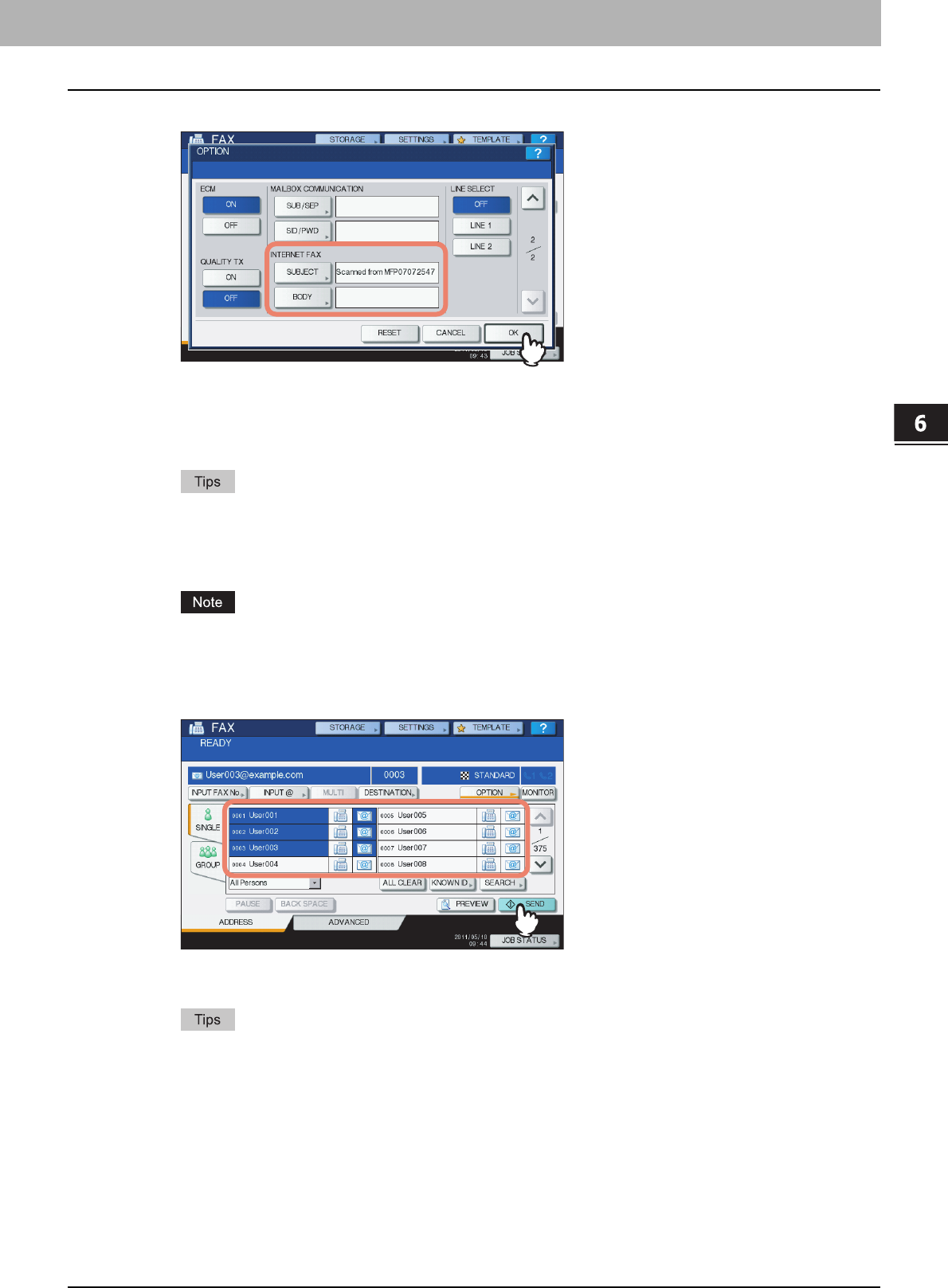
6.INTERNET FAX
Sending Internet Faxes 97
6 INTERNET FAX
5
Specify the following items as required, and then press [OK].
y[SUBJECT]
Press this button to enter the subject of the Internet Fax to be sent.
y[BODY]
Press this button to enter the body message of the Internet Fax to be sent.
yPressing each button displays an on-screen keyboard. Enter each item using the keyboard and digital keys,
and then press [OK] to set the entry.
yThe administrator can change the body message from TopAccess. For details, refer to the TopAccess
Guide.
All the settings required for Internet faxing are mentioned in the above steps. Settings other than the above
apply only to fax transmissions.
6
Specify the e-mail addresses that you want to send to, and then press [SEND] or the
[START] button.
You can specify e-mail addresses in various ways. For details, see the following section:
P.51 “Specifying E-mail Addresses”
yYou can save the sent data as a file.
P.98 “Saving sent data as a file (Internet fax and file)”
yYou can also set advanced functions, such as 2-sided Scan and Priority Reserve.
P.102 “Setting advanced functions”
yTo preview the scans, press [PREVIEW] and then [SCAN].
P.49 “Previewing Scans”
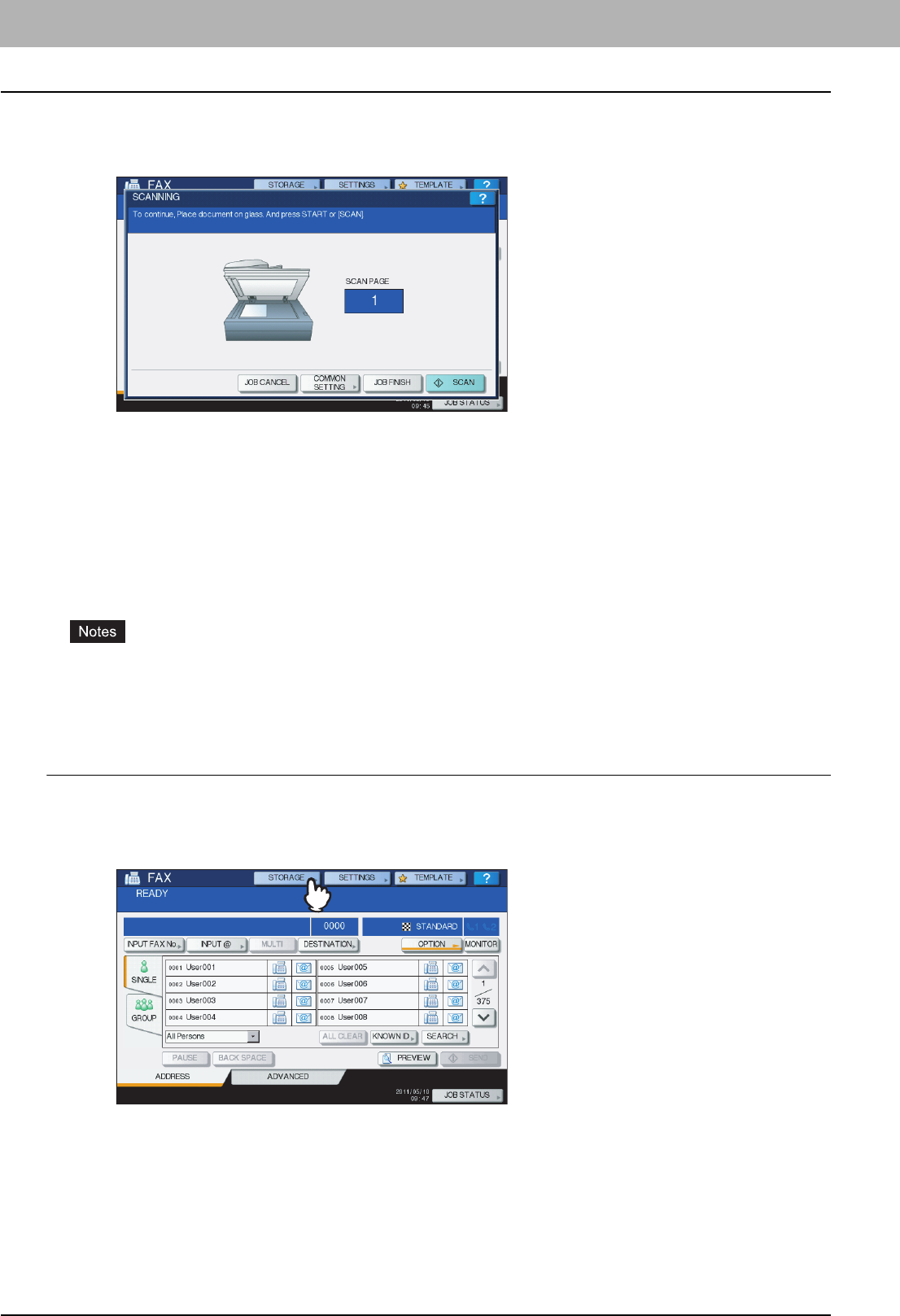
6 INTERNET FAX
98 Sending Internet Faxes
7
If the screen below appears, place another original on the original glass and press
[SCAN] or the [START] button to continue scanning. If you finish scanning all the
originals, press [JOB FINISH].
yThe above screen is not displayed when the original is scanned from the Reversing Automatic Document
Feeder*.
yTo cancel the operation, press [JOB CANCEL].
yTo change the selected settings, press [OPTION].
* The Reversing Automatic Document Feeder is optional for the e-STUDIO4540C Series.
Saving sent data as a file (Internet fax and file)
When sending an Internet fax, you can also save the sent data in the equipment's shared folder and/or a network folder
(REMOTE1 or 2).
yTo save the data in a network folder, the administrator needs to set the equipment configuration. For details, refer
to the TopAccess Guide.
yInternet Fax and File is not available when the forced encryption setting is enabled. To learn more about the forced
encryption setting, refer to the MFP Management Guide.
Saving sent data as a file (Internet Fax and File)
1
Refer to “Sending Internet Fax”( P.95) and follow steps 1 to 5.
2
Press [STORAGE].
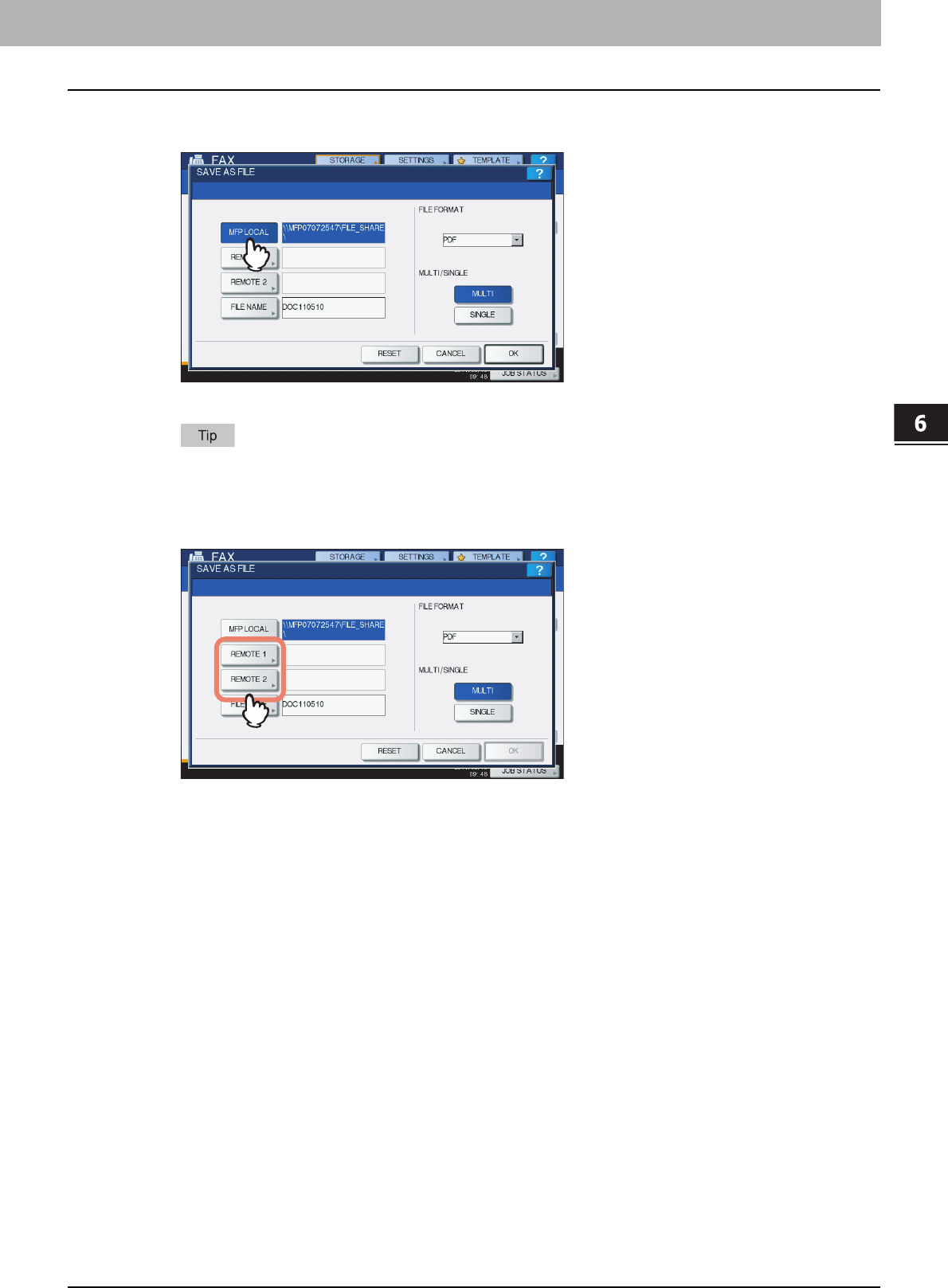
6.INTERNET FAX
Sending Internet Faxes 99
6 INTERNET FAX
3
If you want to store the data in the equipment’s shared folder, select [MFP LOCAL] and
make sure that the button is highlighted.
Proceed to step 6.
If saving data in a network folder is enabled by the administrator, you can select 2 file destinations from [MFP
LOCAL], [REMOTE 1] and [REMOTE 2]. If you want to select [REMOTE 1] and/or [REMOTE 2], proceed to
step 4.
4
To store the data in a network folder, press [REMOTE 1] or [REMOTE 2].
yIf the selected remote destination (REMOTE 1 or 2) is configured by the administrator so that you can specify a
desired network folder, the screen for setting up the remote destination is displayed. Proceed to step 5.
yIf the selected remote destination (REMOTE 1 or 2) is already defined by the administrator so that your scans
are saved in a specified network folder, pressing the button does not display the screen for specifying the file
destination. In this case, you cannot change the file destination. Proceed to step 6. If you need to change set
remote destinations, ask your network administrator for help.
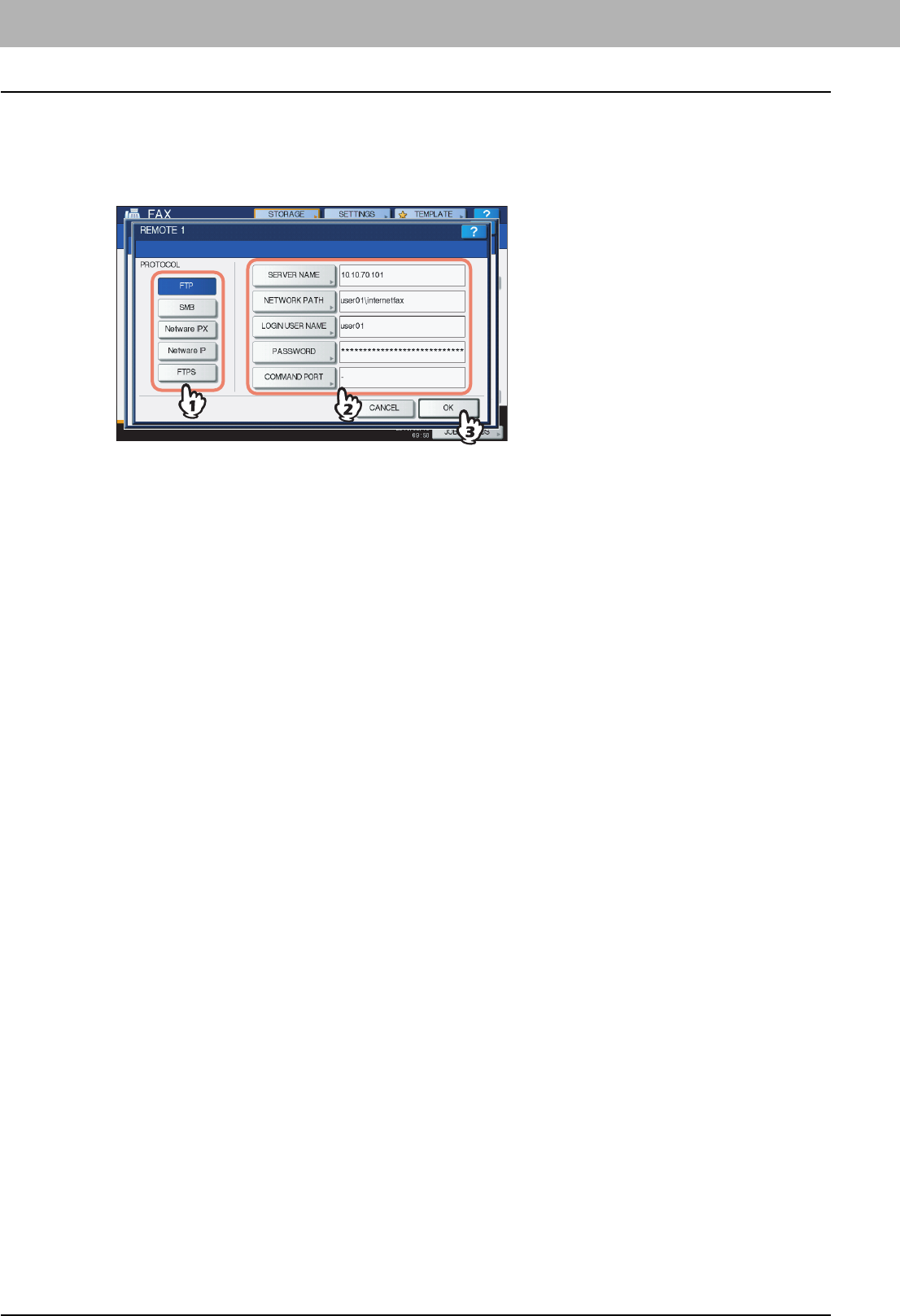
6 INTERNET FAX
100 Sending Internet Faxes
5
Select a folder for the remote destination.
1) Select FTP, SMB, NetWare IPX, NetWare IP, or FTPS as a protocol to transfer the file.
2) Press [SERVER NAME], [NETWORK PATH], [LOGIN USER NAME], [PASSWORD] and/or [COMMAND
PORT] and specify the file destination.
3) Finally, press [OK].
y[SERVER NAME] (FTP, NetWare IPX, NetWare IP, and FTPS only)
When you select [FTP]:
Enter the IP address of the FTP server. For example, to transfer the data to “ftp://10.10.70.101/user01/internetfax/,”
enter “10.10.70.101” in this box.
When you select [NetWare IPX]:
Enter the name of the NetWare file server or the Tree/Context (when NDS is available).
When you select [NetWare IP]:
Enter the IP address of the NetWare file server.
When you select [FTPS]:
Enter the IP address of the FTP server. For example, to transfer the scanned data to “ftps://10.10.70.101/user01/
scan/,” enter “10.10.70.101” in this box.
y[NETWORK PATH]
When you select [FTP]:
Enter the path to a folder in the FTP server where you want to store the data. For example, to transfer the data to
“ftp://10.10.70.101/user01/internetfax/,” enter “user01\internetfax” in this box.
When you select [SMB]:
Enter the network path to the folder where you want to store the data.
When you select [NetWare IPX] or [NetWare IP]:
Enter the path to a folder in the NetWare file server where you want to store the data. For example, to transfer the
data to the “sys\internetfax” folder in the NetWare file server, enter “\sys\internetfax” in this box.
When you select [FTPS]:
Enter the path to a folder in the FTP server where you want to store the scanned data. For example, to transfer the
scanned data to “ftps://10.10.70.101/user01/scan/,” enter “user01\scan” in this box.
y[LOGIN USER NAME]
When you select [FTP]:
Enter the log-in user name for the FTP server if required.
When you select [SMB]:
Enter the user name to access the network folder if required.
When you select [NetWare IPX] or [NetWare IP]:
Enter the log-in user name for the NetWare file server if required.
When you select [FTPS]:
Enter the log-in user name for the FTP server if required.
y[PASSWORD]
When you select [FTP]:
Enter the log-in password for the FTP server if required.
When you select [SMB]:
Enter the password for accessing the network folder if required.
When you select [NetWare IPX] or [NetWare IP]:
Enter the log-in password for the NetWare file server if required.
When you select [FTPS]:
Enter the log-in password for the FTP server if required
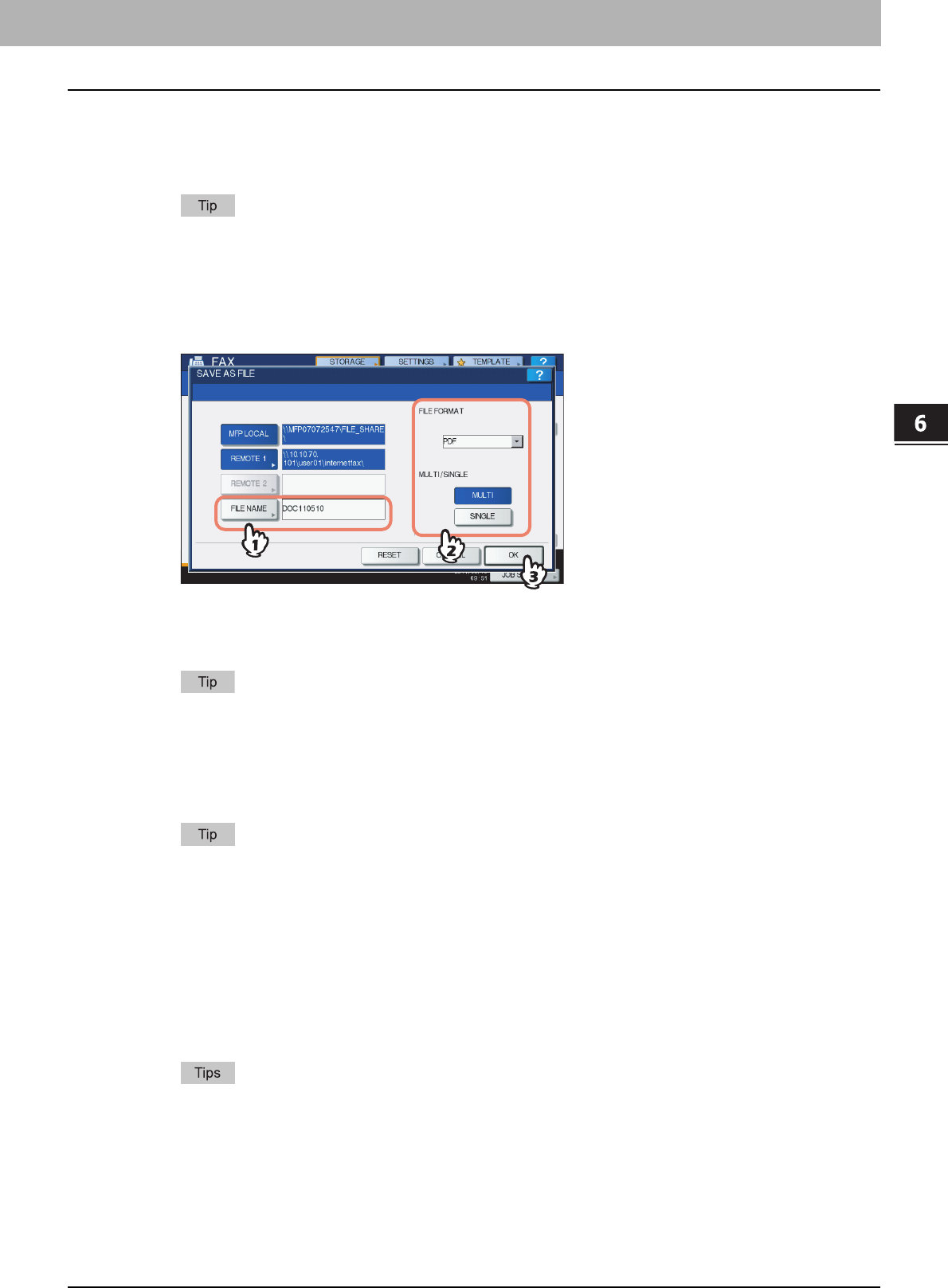
6.INTERNET FAX
Sending Internet Faxes 101
6 INTERNET FAX
y[COMMAND PORT] (FTP and FTPS only)
Enter the port number to be used for command execution. By default, a hyphen “-” is entered in this box, and the
port number set by the administrator is used. Change the entry in this box only when you want to use another port
number.
Pressing each button displays an on-screen keyboard. Enter each item using the keyboard and digital keys,
and then press [OK] to set the entry.
6
Define the settings for the new file(s) as required.
1) Press [FILE NAME] and change the file name.
2) Select an option for the FILE FORMAT and/or MULTI/SINGLE PAGE settings.
3) Finally, press [OK].
y[FILE NAME]
Pressing the button displays an on-screen keyboard. Change the file name using the keyboard and digital keys,
and then press [OK] to set the entry. The file name can consist of a maximum of 128 characters.
The trailing characters in a file name (maximum 74) may be deleted depending on the type of letters used.
yFILE FORMAT
[PDF] — Press this button to store your scan as a PDF file.
[TIFF] — Press this button to store your scan as a TIFF file.
[XPS] — Press this button to store your scan as an XPS file.
XPS files are supported by Windows Vista or Windows Server 2008 SP1; they can also be used on a computer
running Windows XP SP2 or Windows Server 2003 SP1 or later versions with. NET Framework 3.0 installed.
yMULTI/SINGLE PAGE
[MULTI] — Press this button to store your scan as a multiple page file. When you scan several pages, the
equipment stores all the pages as a single file.
[SINGLE] — Press this button to store your scan as a single file for each page. When you scan several pages, the
equipment stores each page as a separate file.
7
Refer to “Sending Internet Fax”( P.95) and follow steps 6 and 7 to send your
documents.
yWhen the transmission is complete, the equipment saves the sent data. If the transmission results in failure
even after several retries, the equipment saves the data in the selected folder(s). The number of retries to
be made can be specified by the administrator on TopAccess.
yIf the data are saved in the equipment’s shared folder, they will be found in the “TXFAX” folder under the
“file_share” folder. To learn more about the “file_share” folder, see the following section:
P.35 “Using Saved Scan Data”
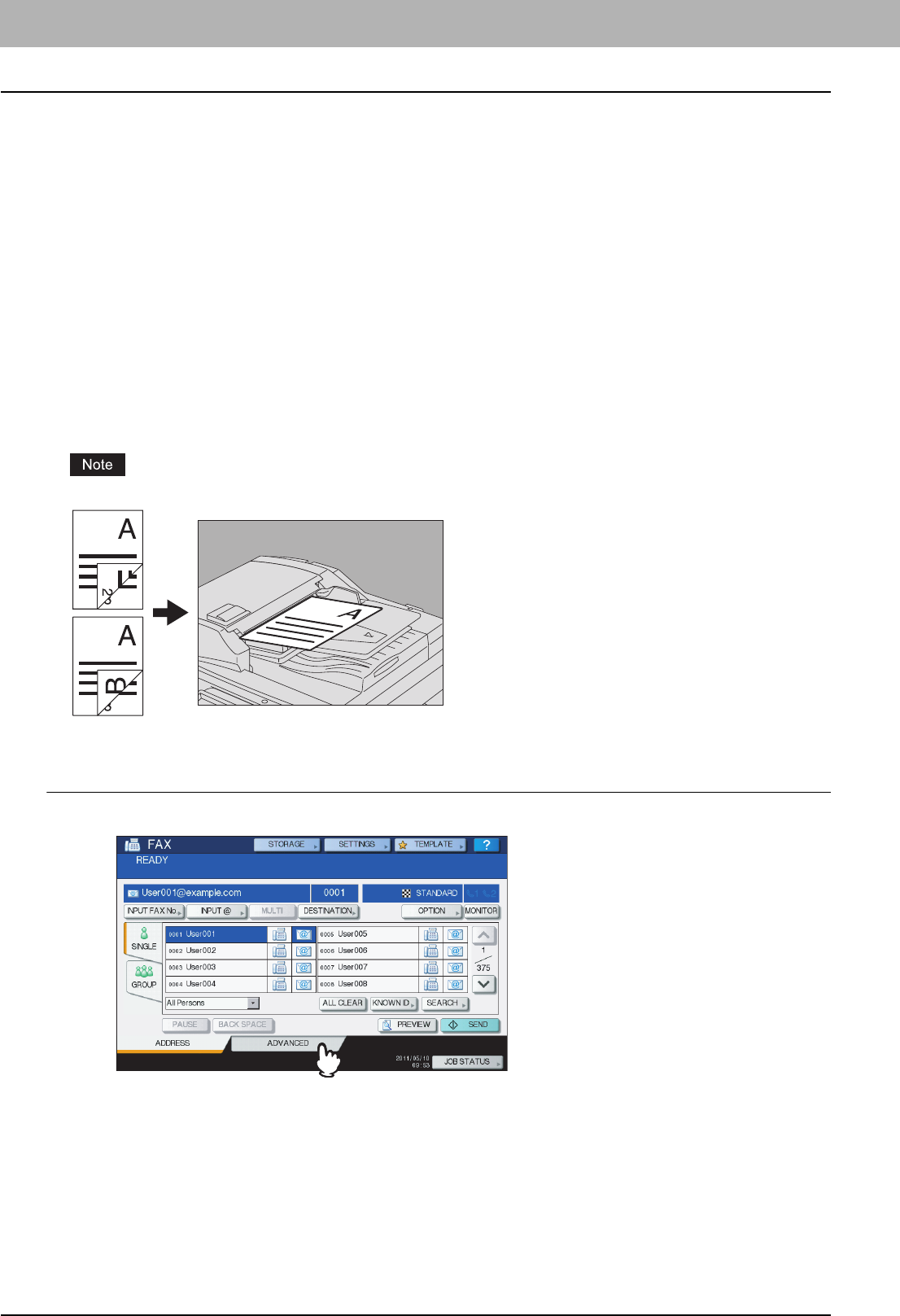
6 INTERNET FAX
102 Sending Internet Faxes
Setting advanced functions
Pressing [ADVANCED] during the Internet faxing operation displays the [ADVANCED] tab. On this tab, the following
advanced functions are available:
y2-SIDED SCAN — Use this function when you want to send 2-sided originals from the Reversing Automatic Document
Feeder*.
P.102 “Setting 2-sided scan”
yPRIORITY RESERVE — Use this function when you want to send originals ahead of the currently reserved
transmissions.
P.104 “Setting Priority Reserve”
* The Reversing Automatic Document Feeder is optional for the e-STUDIO4540C Series.
Setting 2-sided scan
Use this function when you want to send 2-sided originals from the Reversing Automatic Document Feeder*. The default
of this function is restored when each transmission is complete; you must enable the setting every time you want to use
this function.
* The Reversing Automatic Document Feeder is optional for the e-STUDIO4540C Series.
To set A4 or LT size originals in the Reversing Automatic Document Feeder, place them in portrait orientation.
Setting 2-sided scan
1
Press [ADVANCED] to display the [ADVANCED] tab.
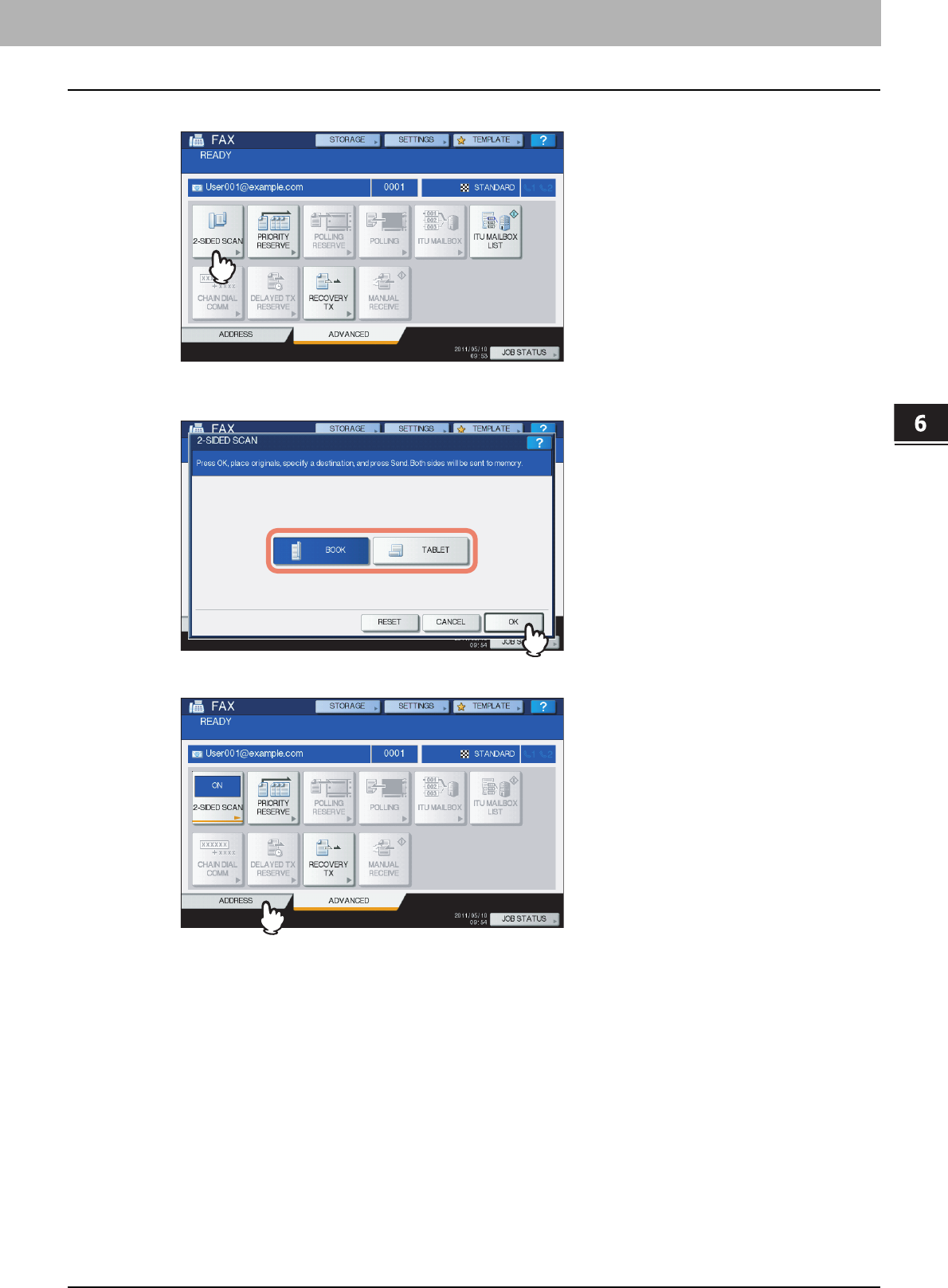
6.INTERNET FAX
Sending Internet Faxes 103
6 INTERNET FAX
2
Press [2-SIDED SCAN].
The 2-SIDED SCAN screen appears.
3
Select either [BOOK] or [TABLET] for the original type, and then press [OK].
4
Press [ADDRESS] to return to the [ADDRESS] tab.
Continue the Internet faxing operation.
P.95 “Sending Internet faxes”
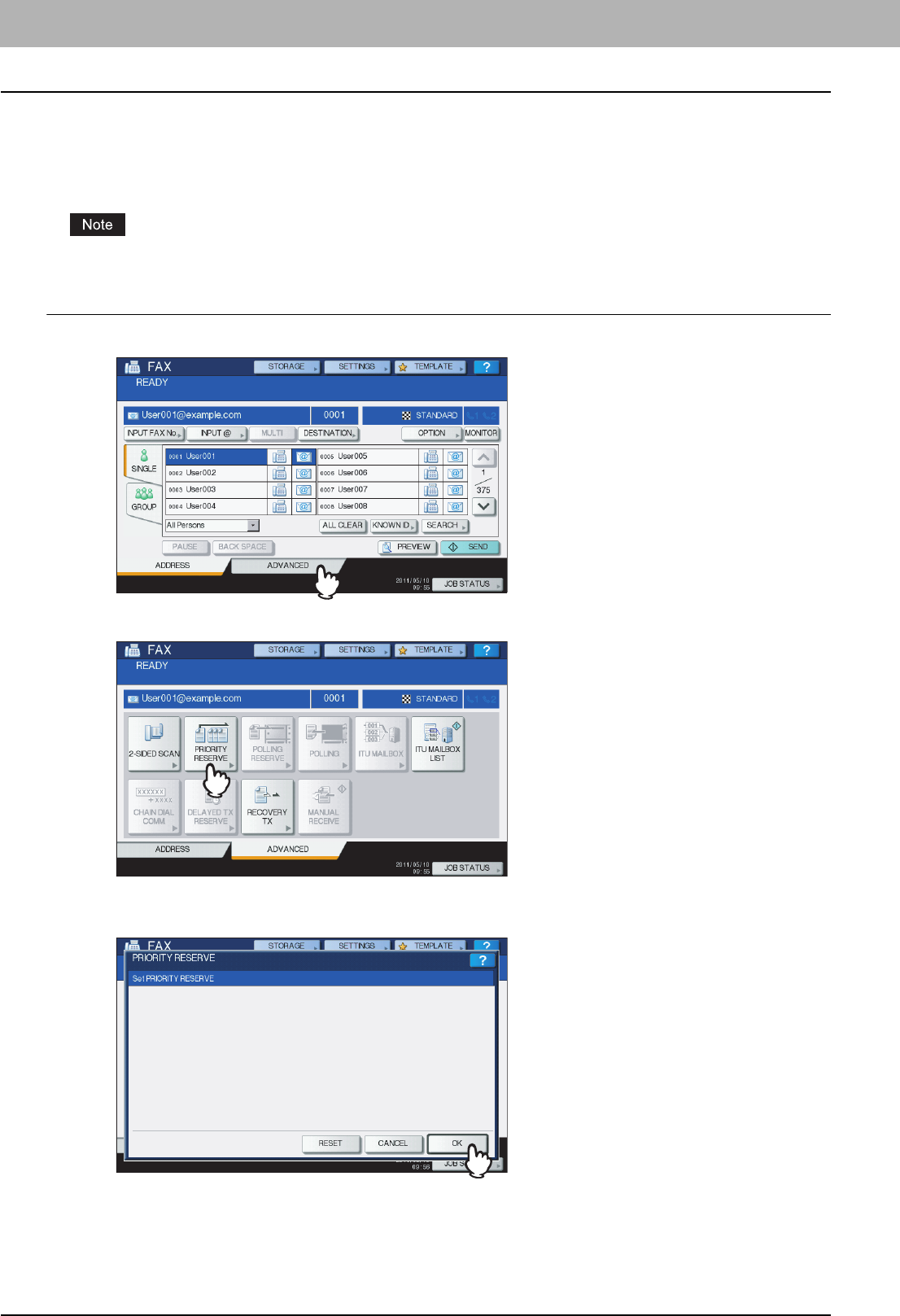
6 INTERNET FAX
104 Sending Internet Faxes
Setting Priority Reserve
Use the Priority Reserve function when you want to send originals ahead of the jobs currently waiting in the queue. The
default of this function is restored when each transmission is complete; you must enable the setting every time you want to
use this function.
You can specify the e-mail addresses by keying in them or searching the address book.
Setting Priority Reserve
1
Press [ADVANCED] to display the [ADVANCED] tab.
2
Press [PRIORITY RESERVE].
The PRIORITY RESERVE screen appears.
3
Press [OK].
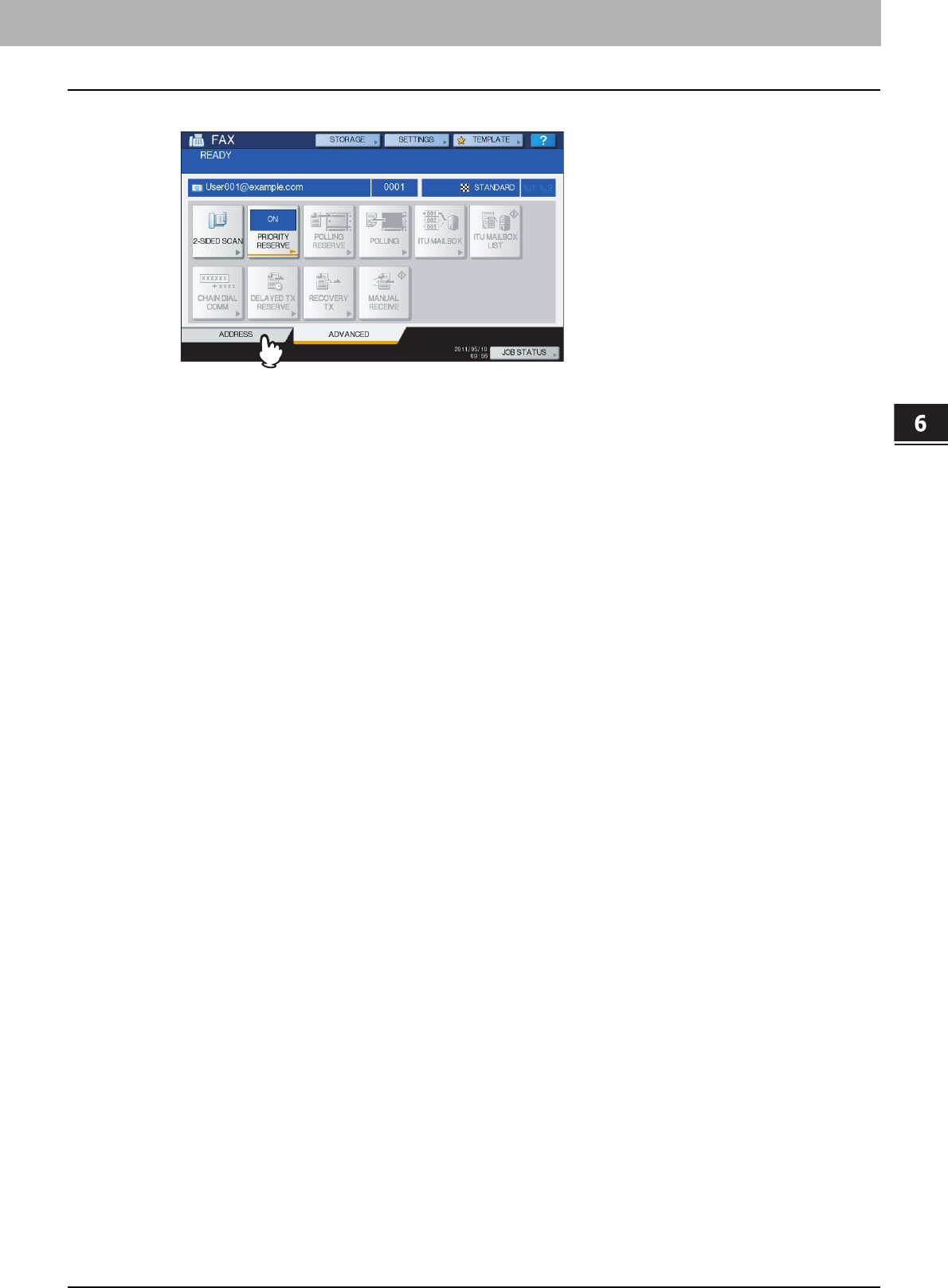
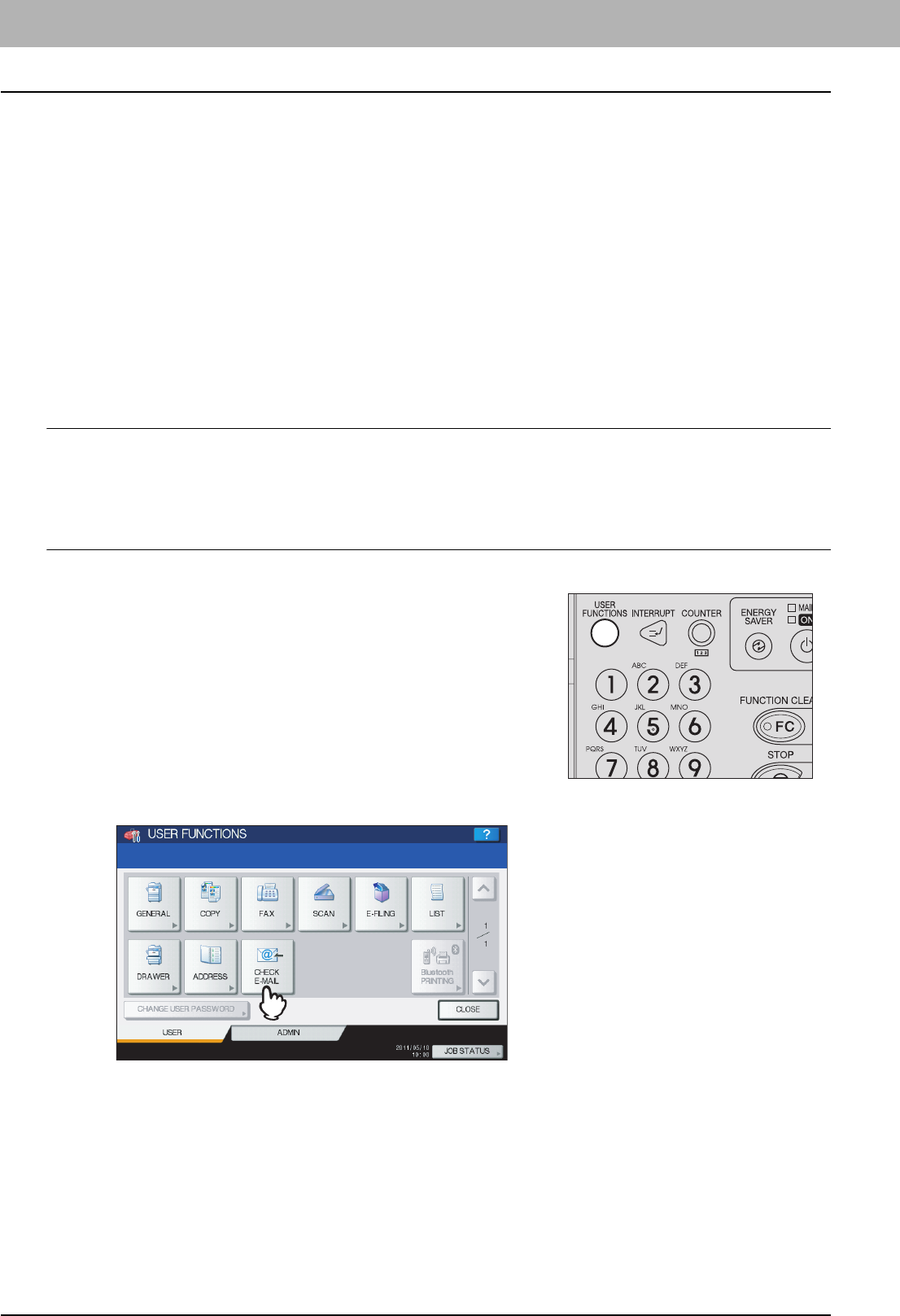
6 INTERNET FAX
106 Receiving Internet Faxes
Receiving Internet Faxes
Available file formats
The equipment can print out TIFF-FX images, TIFF images scanned by the scanner, and text data. In addition, the
resolution of the TIFF-FX images must be either 8 x 3.85 or 8 x 7.7 or 8 x 15.4 (dot/mm) while that of the TIFF images
scanned by the scanner must be 200 x 100, 200 x 200, 200 x 400, 400 x 400, or 600 x 600 (dpi).
If any files failing to meet the above conditions are attached to a received e-mail/Internet Fax, an e-mail printing error
occurs and is recorded as an error code on the RECEIVE log. On TopAccess, the “Email Print” settings are available for
the administrator so that error codes can be printed as a report. The administrator can also set the equipment to forward
such e-mail/Internet Faxes to another e-mail address. For details, refer to the TopAccess Guide.
Receiving Internet faxes
The equipment accesses the e-mail server at specified intervals to check whether any e-mail has been delivered. New
e-mail is automatically received and printed out unless you check manually.
Receiving Internet Faxes automatically
The administrator can set up the equipment configuration on TopAccess to automatically receive Internet faxes from the
e-mail server. If the “Scan Rate” setting is specified, the equipment accesses the e-mail server to check for any new e-mail
at specified intervals. (The factory default is 5 minutes.) For more details, refer to the TopAccess Guide.
Receiving Internet Faxes manually
2
On the [USER] tab, press [CHECK E-MAIL].
yThe equipment begins checking for new e-mail. If Internet Faxes have been received, “RECEIVING E-mail”
appears on the screen. After “NEW E-mail RECEIVED” is displayed, the equipment starts printing the Internet
Faxes.
yIf no new e-mails are found, “CURRENTLY NO E-mail” is displayed on the screen.
1
On the control panel, press [USER FUNCTIONS]
button.
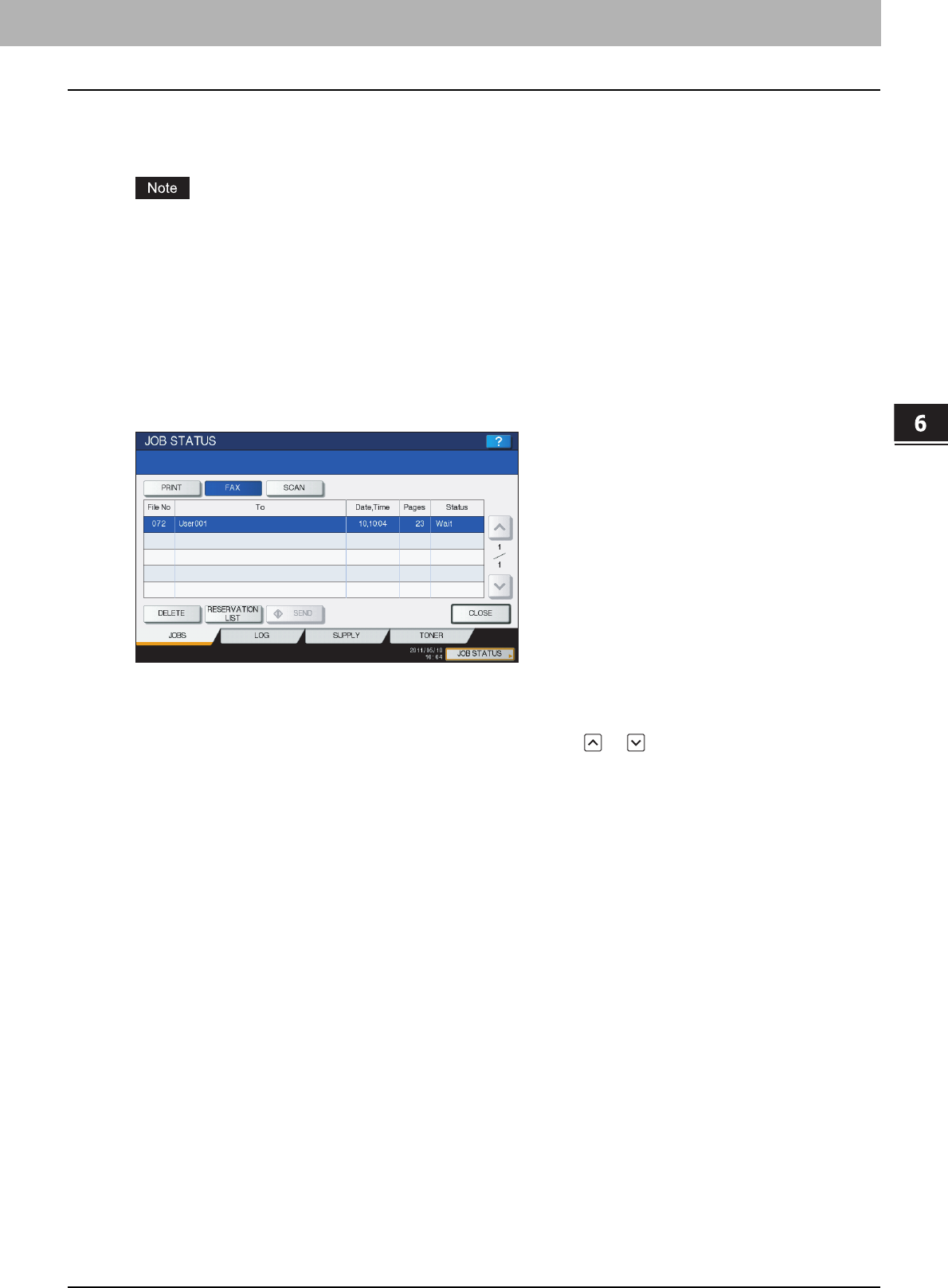
6 INTERNET FAX
Viewing the Internet Fax Job Status and Log 107
Viewing the Internet Fax Job Status and Log
You can view the status of the Internet Fax transmissions from the touch panel. After Internet Faxes are sent or received,
the record of the jobs can also be viewed and printed. On the SEND/RECEIVE LOG screen, you can save contact
information, such as phone numbers and e-mail addresses, to the address book.
If the equipment is managed by the User Management feature, you need to enter the user information, such as the
user name and password.
P.107 “Viewing the Internet fax job status”
P.108 “Viewing the send log for Internet fax jobs”
P.109 “Viewing the receive log for Internet fax jobs”
P.109 “Saving contact information to the address book”
Viewing the Internet fax job status
Pressing [JOB STATUS] > [JOBS] > [FAX] on the touch panel displays a list of Internet Fax, traditional fax (optional), and
Network Fax jobs in progress or in wait for transmission. The jobs can be deleted if needed.
In the list, you can view each job’s file number (chronological order of jobs), recipient’s e-mail address or fax number, date
and time, number of pages, and current status.
Up to 1000 jobs can be listed. To display the previous or next page, press or . The number of jobs displayed on a
page varies depending on the equipment used.
To delete jobs, select a job on the list and press [DELETE]. You can select more than one job to be deleted.
To print out the displayed information, press [RESERVATION LIST].
The STATUS column provides the following status information:
yLine1 — Traditional faxing in progress on the 1st line.
yLine2 — Traditional faxing in progress on the 2nd line.
yNetwork — Internet faxing in progress.
yDelayed — Traditional fax or Network Fax transmission scheduled for a specified time.
yWait — The job in wait for transmission.
yInvalid — The Network Fax job suspended due to an invalid department code. To learn more about Network Fax, refer
to the Network Fax Guide.
To exit from the JOB STATUS screen, press [CLOSE].
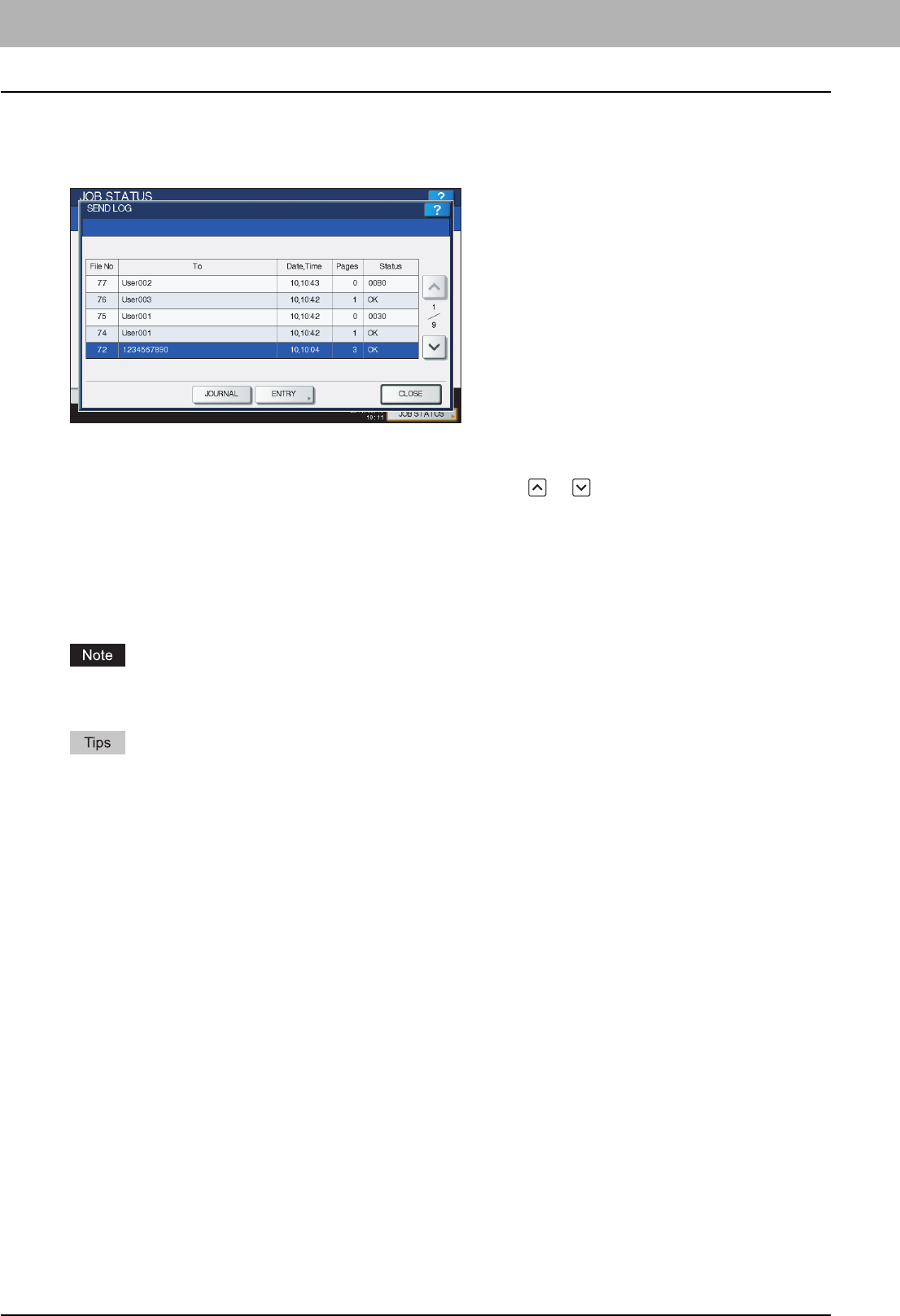
6 INTERNET FAX
108 Viewing the Internet Fax Job Status and Log
Viewing the send log for Internet fax jobs
The transmission record of Internet Fax jobs can be displayed on the SEND LOG screen. To display the record on the
touch panel, press [JOB STATUS] > [LOG] > [SEND].
On the SEND LOG screen, you can view each job’s file number (chronological order of jobs), recipient’s e-mail address or
fax number, date and time, number of pages, and status (job result).
Up to 1000 jobs can be listed. To display the previous or next page, press or . The number of jobs displayed on a
page varies depending on the equipment model.
To print out the displayed information, press [JOURNAL].
If you want to save contact information, such as phone numbers and e-mail addresses, to the address book, press
[ENTRY].
P.109 “Saving contact information to the address book”
To exit from the SEND LOG screen, press [CLOSE].
Besides Internet Fax transmissions, fax (optional) transmissions are recorded and displayed on the SEND LOG
screen.
yFor details on error codes displayed in the “Status” column, refer to the Troubleshooting Guide.
yThe transmission record of Internet FAX jobs can be exported to a USB storage device. For details, refer to the
MFP Management Guide.
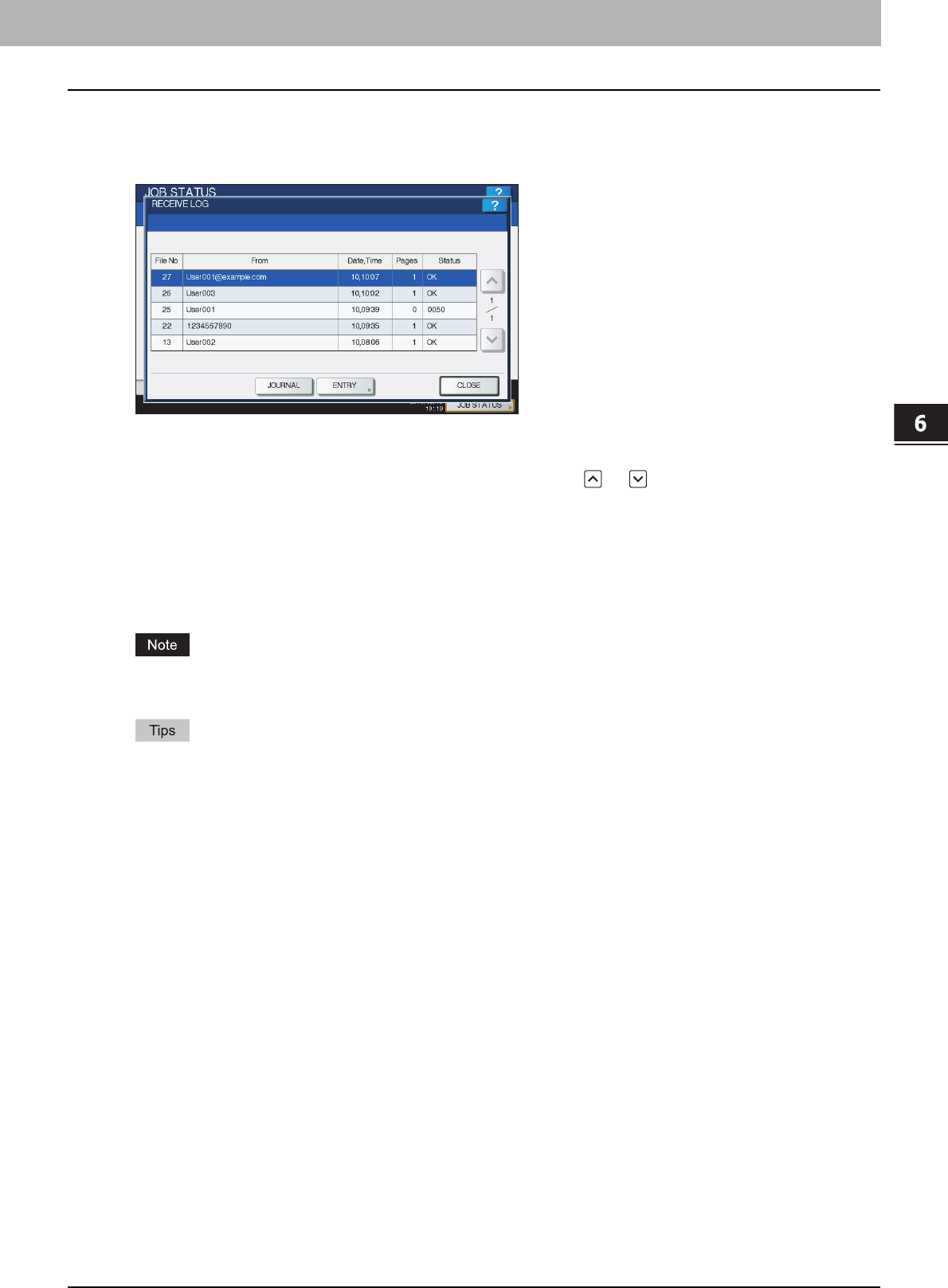
6.INTERNET FAX
Viewing the Internet Fax Job Status and Log 109
6 INTERNET FAX
Viewing the receive log for Internet fax jobs
The record of received Internet Faxes can be displayed on the RECEIVE LOG screen. To display the record on the touch
panel, press [JOB STATUS] > [LOG] > [RECEIVE].
On the RECEIVE LOG screen, you can view each job’s file number (chronological order of jobs), sender’s e-mail address
or fax number, date and time, number of pages, and status (job result).
Up to 1000 jobs can be listed. To display the previous or next page, press or . The number of jobs displayed on a
page varies depending on the equipment model.
To print out the displayed information, press [JOURNAL].
If you want to save contact information, such as phone numbers and e-mail addresses, to the address book, press
[ENTRY].
P.109 “Saving contact information to the address book”
To exit from the RECEIVE LOG screen, press [CLOSE].
Besides Internet Fax receptions, fax (optional) and e-mail receptions are recorded and displayed on the RECEIVE
LOG screen.
yFor details on error codes displayed in the “Status” column, refer to the Troubleshooting Guide.
yThe reception record of Internet FAX jobs can be exported to a USB storage device. For details, refer to the MFP
Management Guide.
Saving contact information to the address book
On the SEND, RECEIVE, and SCAN LOG screens, you can save contact information, such as phone numbers and e-mail
addresses, to the address book. For instructions and details on the address book, refer to the MFP Management Guide.

INDEX 111
INDEX
Numerics
2-sided scan ................................................... 102, 103
A
Address book ...................................... 53, 54, 55, 109
[ADDRESS] Tab ........................................................93
Advanced functions ..................................................102
[ADVANCED] Tab ......................................................93
Alert Message Display Area ................................. 12, 93
Authority ...................................................................69
[AUTOMATIC START] ................................................76
B
Background Adjustment ....................................... 14, 47
Blue (B) ....................................................................14
[BODY] .............................................................. 25, 97
C
Client Utilities CD-ROM ..............................................33
Color balance ............................................................48
Color mode ........................................................ 14, 40
[COMMAND PORT] .......................................... 20, 101
Compress .......................................................... 14, 44
Compression ratio ......................................................44
Contact information ..................................................109
Contrast ............................................................. 14, 47
D
Date and Time .................................................... 12, 93
Default Settings .........................................................14
Destination Display Area .............................................12
Dual Agents ..............................................................65
Dual Functions ..........................................................65
E
e-Filing ..........................................................6, 15, 35
E-mail addresses .......................................................51
deleting ..................................................................64
viewing ..................................................................64
Encryption Level ........................................................69
[ENTRY] ........................................................ 108, 109
Exposure .....................................................14, 47, 96
F
Features
Internet Fax ............................................................10
Scan ........................................................................6
File formats ................................................20, 26, 106
[FILE NAME] ...................................................... 20, 26
FRAGMENT MESSAGE SIZE .....................................27
[FROM ADDRESS] ....................................................27
[FROM NAME] ..........................................................27
Function Buttons ........................................................12
G
Green (G) .................................................................14
[GROUP] Tab ............................................................93
Groups .............................................................. 60, 61
H
[?] (Help Button) ........................................................13
I
ID numbers ........................................................ 54, 61
Internet Fax
precautions ........................................................... 92
receiving ............................................................. 106
sending ................................................................. 95
Internet Fax and File ................................................. 98
J
[JOB STATUS] ................................................... 12, 94
L
LDAP server ............................................................. 58
Log
Internet Fax ......................................................... 107
scan ..................................................................... 38
send ................................................................... 108
[LOGIN USER NAME] ....................................... 19, 100
M
[MASTER PASSWORD] ............................................ 69
Menu
Internet Fax ........................................................... 93
Scan ..................................................................... 12
Message Display Area ......................................... 12, 93
Meta scan .......................................................... 77, 80
[MFP LOCAL] ...............................................17, 35, 99
Multi/Single ........................................................ 21, 26
N
[NAME 1] ................................................................. 76
[NAME 2] ................................................................. 76
Navigation button ...................................................... 50
Network folder .................................................... 16, 36
[NETWORK PATH] ........................................... 19, 100
O
Omit Blank Page ................................................. 14, 45
Orientation ............................................................... 42
Original mode ...............................................14, 41, 96
Original size .................................................14, 43, 96
Outside Erase ..................................................... 14, 46
P
[PASSWORD] ............................................19, 76, 100
PDF
encrypting ............................................................. 68
security setting ....................................................... 68
[PREVIEW] ........................................................ 13, 94
Preview .................................................................... 49
Priority Reserve .............................................. 102, 104
Private template group ............................................... 72
Public template group ................................................ 72
R
Range adjustment ............................................... 14, 46
Red (R) .................................................................... 14
[REMOTE 1] .................................................17, 36, 99
[REMOTE 2] .................................................17, 36, 99
Resolution ....................................................14, 41, 96
RGB adjustment ................................................. 14, 48
Rotation ............................................................. 14, 42
S
Saturation .......................................................... 14, 48
[SCAN] .................................................................... 12
Scan function .............................................................. 6
[SCAN SETTING] ..................................................... 13

112 INDEX
Scan Settings ............................................................40
Scan Settings Display Area .........................................13
Scan speed .................................................................9
Scan to e-Filing ..................................................... 6, 15
Scan to E-mail ...................................................... 7, 23
Scan to File .......................................................... 7, 16
Scan to USB ........................................................ 8, 29
Search .........................................................54, 60, 63
Search string ...................................................... 55, 58
Security .......................................................21, 26, 68
[SEND] .....................................................................94
Send log .................................................................108
[SERVER NAME] .............................................. 19, 100
[SETTINGS] ..............................................................13
Shared folder ...................................................... 16, 35
Sharpness .......................................................... 14, 48
[SINGLE] Tab ............................................................93
Single/2-sided Scan ............................................ 14, 43
Status
Internet Fax job ....................................................107
scan job .................................................................37
[STORAGE] ..............................................................94
Sub-folder .................................................................35
[SUBJECT] ........................................................ 25, 97
T
[TEMPLATE] .............................................................13
Template
registering ..............................................................72
SMTP authentication ...............................................82
using .....................................................................77
TOSHIBA e-STUDIO Remote Scan Driver ....................88
TOSHIBA e-STUDIO WIA Driver .......................... 33, 89
Touch panel
Internet Fax ............................................................93
Scan ......................................................................12
TWAIN Driver / File Downloader ....................................6
TX TYPE ...................................................................96
U
USB storage device ...................................................36
[USER NAME] ...........................................................76
[USER PASSWORD] .................................................69
W
Web Service (WS) Scan ........................................ 8, 33
Windows Imaging Acquisition (WIA) Scan Driver ...........33
FC-5540C/6540C/6550C
FC-2040C/2540C/3040C/3540C/4540C
OME100062A0

2-17-2, HIGASHIGOTANDA, SHINAGAWA-KU, TOKYO, 141-8664, JAPAN
MULTIFUNCTIONAL DIGITAL SYSTEMS
Scanning Guide
©2011 TOSHIBA TEC CORPORATION All rights reserved
R100520J1001-TTEC (SYS V1.0)
Ver01 2011-07
