Handcrafted Fraud And Extortion Manual Account Hijacking In The Wild
User Manual:
Open the PDF directly: View PDF  .
.
Page Count: 13

Handcrafted Fraud and Extortion:
Manual Account Hijacking in the
Wild
By Elie Bursztein, Borbala Benko, Daniel Margolis, Tadek Pietraszek, Andy
Archer, Allan Aquino, Andreas Pitsillidis, Stefan Savage
Published at: IMC (Internet Measurement Conference)
Year: 2014
URL: https://www.elie.net/publication/handcrafted-fraud-and-extortion-manual-account-hijacking-in-the-wild
Slides:
http://www.slideshare.net/elie-bursztein/handcrafted-fraud-and-extortion-manual-account-hijacking-in-the-w
ild
Related research: https://www.elie.net/tag/anti_fraud_and_abuse
Handcrafted Fraud and Extortion: Manual Account
Hijacking in the Wild
Elie Bursztein†Borbala Benko†Daniel Margolis†Tadek Pietraszek†
Andy Archer†Allan Aquino†Andreas Pitsillidis⇤Stefan Savage⇤
†Google, Inc ⇤University of California, San Diego
{elieb, bbenko, dmargolis, tadek, archer, aaquino}@google.com {apitsill, savage}@cs.ucsd.edu
ABSTRACT
Online accounts are inherently valuable resources—both for the data
they contain and the reputation they accrue over time. Unsurpris-
ingly, this value drives criminals to steal, or hijack, such accounts.
In this paper we focus on manual account hijacking—account hi-
jacking performed manually by humans instead of botnets. We
describe the details of the hijacking workflow: the attack vectors,
the exploitation phase, and post-hijacking remediation. Finally we
share, as a large online company, which defense strategies we found
effective to curb manual hijacking.
1. INTRODUCTION
Online accounts are inherently valuable resources—both for the
data they contain and the reputation they accrue over time. With
the advent of the cloud, the most intimate details of our lives are
contained on remote servers in a single account. This makes ac-
count theft, or account hijacking, a lucrative monetization vector
for miscreants. Criminals leverage millions of hijacked credentials
to send spam [5,10], tap into the social connections of victim’s to
compromise additional accounts [24], or alternatively liquidate a
victim’s financial assets using malware such as Zeus or SpyEye [12].
While significant research attention has focused on wide-spread
automated hijacking facilitated via botnets, we explore a second
class of attacks we refer to as manual hijacking. Manual hijackers
spend significant non-automated effort on profiling victims and
maximizing the profit—or damage—they can extract from a single
credential. In contrast to automated hijacking, manual hijacking is
exceedingly rare. We observe an average of 9 incidents per million
Google users per day. However, the damage manual hijackers incur
is far more severe and distressing to users [22] and can result in
significant financial loss [4]. These needle-in-a-haystack attacks are
very challenging and represent an ongoing threat to Internet users.
Permission to make digital or hard copies of all or part of this work for personal or
classroom use is granted without fee provided that copies are not made or distributed
for profit or commercial advantage and that copies bear this notice and the full citation
on the first page. Copyrights for components of this work owned by others than the
author(s) must be honored. Abstracting with credit is permitted. To copy otherwise, or
republish, to post on servers or to redistribute to lists, requires prior specific permission
and/or a fee. Request permissions from permissions@acm.org.
IMC’14, November 5–7, 2014, Vancouver, BC, Canada.
Copyright is held by the owner/author(s). Publication rights licensed to ACM.
ACM 978-1-4503-3213-2/14/11 ...$15.00.
http://dx.doi.org/10.1145/2663716.2663749.
In this paper, we explore the manual hijacking lifecycle as gleaned
from incidents that occurred at Google between 2011–2014. Our
study consists of three components: we explore how criminals
acquire a victim’s credentials (Section 4); examine how criminals
monetize account credentials (Section 5); and finally highlight the
process Google used to ultimately restore control back to the victim
(Section 6). Based on our findings, we offer a set of best practices
for others to defend against manual hijacking and discuss many of
the corner cases that exacerbate the problem (Section 8).
In particular, we link manual hijacking with phishing and provide
evidence supporting the hypothesis that phishing is the main way
manual hijackers steal user credentials. We found that phishing
requests target victims’ email (35%) and banking institutions (21%)
accounts, as well as their app stores and social networking creden-
tials. Of the hijacking case samples we analyzed, we found that
most of the hijackers appear to originate from five main countries:
China, Ivory Coast, Malaysia, Nigeria, and South Africa.
Injecting decoy credentials in phishing pages targeting Google
users reveals that criminals’ response time is surprisingly fast. We
found that criminals attempted to access 20% of the accounts within
30 minutes. Looking at real hijacking cases, we observed that, once
logged in, manual hijackers profile the victim’s account and spend
an average of 3 minutes to assess the value of the account before
exploiting it or abandoning the process. This step entails searching
through the victim’s email history for banking details or messages
that the victim had previously flagged as important. We also see
attackers scanning through email contacts which are then either
solicited for funds or targeted with a salvo of targeted phishing
emails.
Restoring a victim’s account access is a non-trivial problem. We
found that SMS is the most reliable out-of-band channel, where
users that provided a phone number recover their account 81% of
the time. Providing a secondary email address is also fruitful, suc-
ceeding 75% of the time. Absent these two mechanisms, we must
rely on secret questions or manual review where our success rate
falls to 14%.
Ethics
We acknowledge that most of the results in the paper depend
on proprietary data. As a result, we attempted to clearly explain how
we reached our conclusions while balancing our need to protect the
security and privacy of our users.
347
Depth of exploitation
Number of accounts
Manual
Hijacking
Automated
hijacking
Targeted attack
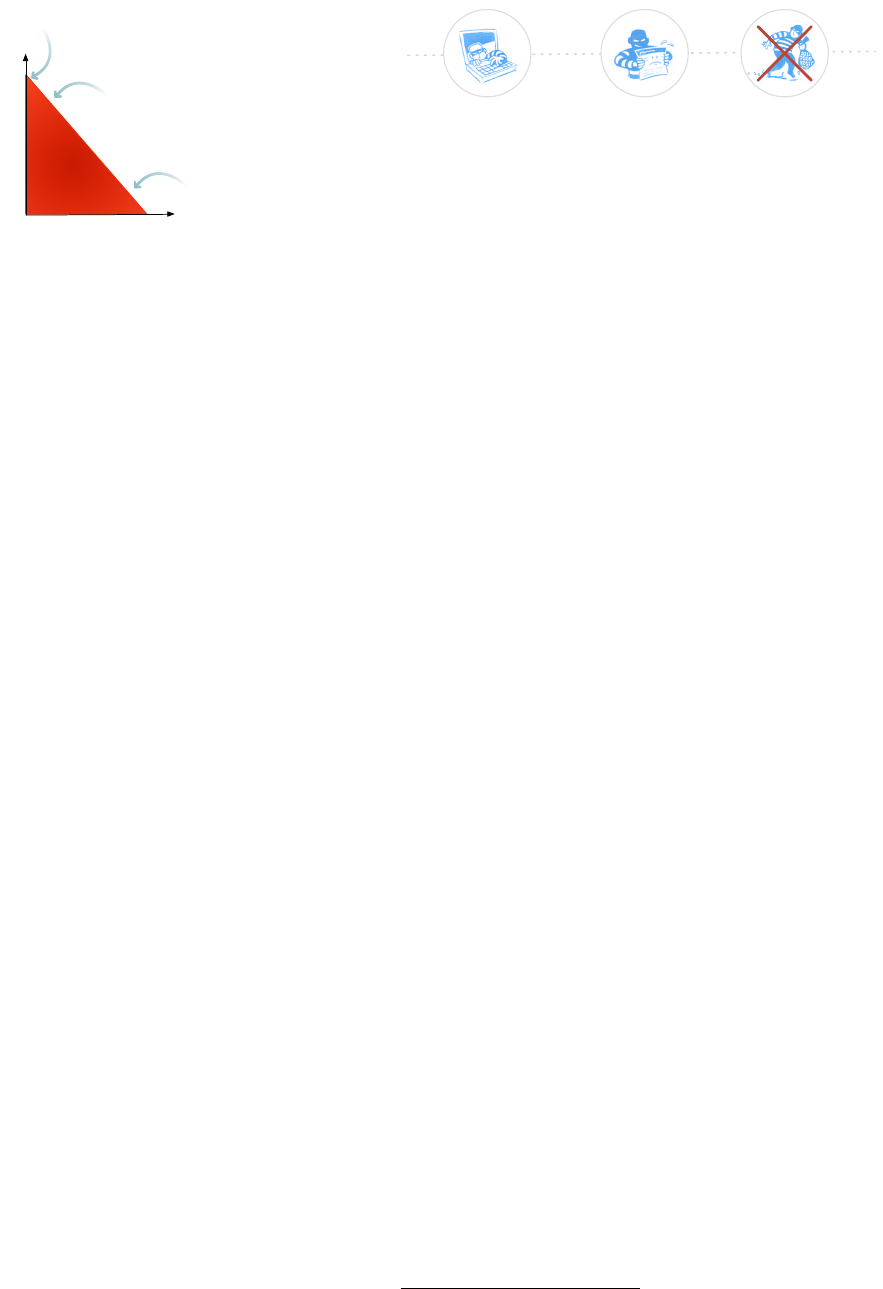
Figure 1: Hijacking trade-off: the depth of exploitation versus
the number of accounts compromised.
2. HIJACKER TAXONOMY
Account hijacking stems from a multitude of attack vectors and
underlying incentives. At Google, we categorize hijacking cam-
paigns based on the depth of exploitation (e.g. the damage incurred
to each victim) and the number of accounts impacted, as depicted in
Figure 1. We currently observe three classes of attacks:
Automated hijacking:
An automated hijacking attack attempts
to compromise large quantities of accounts using botnets or other
professional spamming infrastructure [11]. This type of attack
is carried out entirely by automated tools that monetize the most
common resources across all compromised accounts (e.g. spamming
via a victim’s email).
Targeted attacks:
Targeted attacks [23] include industrial espi-
onage and state-sponsored break-ins. In our experience, these at-
tacks are carried out by highly sophisticated parties who have the
resources to extensively profile targets and launch tailored attacks.
These include using dedicated 0-day exploits [20], less expensive
readily-available exploits, or highly targeted phishing campaigns.
Manual hijacking:
Manual hijacking consist of attack that oppor-
tunistically select victims with the intent of monetizing the victim’s
contacts or personal data; any sufficiently lucrative credential will
suffice. These attacks are carried manually rather than automatically.
As a result, we observe orders of magnitude fewer instances com-
pared to automated hijacking. However, criminals heavily abuse
victim’s information, making such attacks highly distressing to the
impacted parties [22].
In this paper, we choose to focus on manual hijacking. While
automated hijacking impacts the most users, manual hijacking incurs
significantly more damage to the victims involved and represents
an ongoing pertinent threat to Google. We restrict our analysis of
manual hijacking to cases where the attacker does not know the
victim personally. Similarly, we also exclude hijacking instances
where an attacker leverages physical access to a victim’s devices.
These personalized attacks represent their own area of focus [2,
17], and while they are of serious importance, combating such
threats relies on individual insights that benefit little from large-
scale measurement.
Credentials
acquisition
v
Account
Exploitation
Remeditation
Figure 2: Overview of the account hijacking cycle.
3. METHODOLOGY
We provide a high-level workflow of the account hijacking lifecy-
cle, depicted in Figure 2, along with our methodology for studying
each component.
In total, we rely on 14 distinct datasets collected between 2011–
2014, outlined in Table 1. Each dataset originates from various
system logs that we aggregate via map-reduce computation. For
privacy and storage reasons, Google sanitizes or entirely erases
many authentication-related logs within a short time window. Con-
sequently, some of our datasets are drawn over a period of only a
few weeks despite the three year span of our study. Similarly, as
many of our datasets rely on user reports, we are forced to manually
curate data points sampled from a much larger, noisy source to have
precise ground truth. This problem originates from the fact that
both computers and humans alike are imprecise at distinguishing
phishing or similar attacks from scams and other bulk spam.
To offer some perspective on sample size, we observed an average
of 9 case of manual hijacking per million active users per day in
2012 and 2013. This number includes those our abuse detection
mechanisms detected before the hijacker fully exploits the account,
and those for which the victim had to file a recovery claim. An
account is considered active if it has been accessed within the past
30 days. In term of phishing page, SafeBrowsing detected between
16,000 and 25,000 page per week on the Internet for the period
2012–2013 [9] [Dataset 2 and 3 in Table 1].
Credential acquisition
[Section 4]: Account hijacking begins when
a hijacker steals a user’s credentials. This can occur in a multi-
tude of ways: phishing a user’s credentials; installing malware on
the victim’s machine to steal credentials; or guessing a victim’s
password. Overall we find corroborating evidence throughout our
measurements that phishing is likely to be the main way hijackers
compromise user accounts. We argue that phishing is the attack
vector of choice for manual hijackers as it is easier and cheaper to
perform than other mean to compromise accounts: e.g using 0-day
exploits to install malwares. This is why for this part of the study
dedicated to the attack vectors used by manual hijackers we decided
to focus on phishing emails and phishing pages targeting Google
users.
Datasets used: In this section we use a manually curated sample of
100 phishing emails selected from a random sample of 5000 emails
reported by our users to understand how email phishing is structured
and what type of accounts are targeted
1
[Dataset 1 in Table 1]. Next
we use a manually reviewed random sample of 100 phishing pages
detected by the SafeBrowsing anti-phishing pipeline [26] while
indexing the web for our search engine to understand what type of
accounts are phished [Dataset 2 in Table 1].
1
we only have access to the emails the users manually reported as
spam and phishing.
348

Id Data type Samples Date Used in section
1 Phishing emails 100 Jan 2014 4.1
2 Phishing pages detected by SafeBrowsing 100 Jan 2014 4.1
3 Google Forms taken down for phishing 100 Nov 2012 4.2
4 Decoy credentials injected in phishing pages 200 Nov 2012 5.1
5 Login attempts from IPs belonging to hijackers 300 IPs/day Nov 2012 5.1
6 Keywords searched by hijackers Top 10 Jan 2014 5.2
7 High-confidence hijhacked accounts 575 Nov 2012 5.2
8
Mail sent from hijhacked accounts from dataset 7 and reported
as spam by users
200 Nov 2012 5.3
9
Hijacked account contacts and active users random sample
hijacking rate
3000 / 3000 Nov 2011 5.3
10 High-confidence hijhacked accounts 600 Oct 2011 5.4
11 Hijacked accounts recovery cases 5000 Nov 2012 6.2
12 Accounts recovery 1 month Feb 2013 6.3
13 IP used by hijackers 3000 hijacking cases Jan 2014 7
14 Phone numbers used by hijackers 300 Mid-2012 7
Table 1: List of dataset used throughout this study.
The manual review was used to identify what type of account
are targeted by phishers (e.g Bank, Social Network). Finally we
look at the HTTP logs of a random sample of 100 Google Drive
forms that were used as phishing pages before we detected and took
them down [Dataset 3 in Table 1]. This dataset is used to understand
the conversion rate of phishing pages, the victims targeted, and the
methods for luring victims to the pages.
Account exploitation
[Section 5]: If the hijacker is able to log
into the victim’s account, then a second phase begins that we call
the exploitation phase. We observe that this phase consists of two
distinct parts: The account profiling part where the hijacker decides
on a concrete exploitation plan and the exploitation itself.
The existence of this profiling phase is one of the most surprising
insights we gained by fighting manual hijackers. Instead of blindly
exploiting every account, hijackers take on average 3 minutes to
assess the value of the account before deciding to proceed. This pro-
filing phase and the fact that hijackers decide to not exploit certain
accounts is consistent with our claim that this type of hijacking is
manual rather that automated. Similarly, we observe that most man-
ual hijackers use semi-personalized scams as the main exploitation
vector, e.g. to trick the victim’s contacts into transferring money
to the hijacker. We have also observed other more opportunistic
approaches such as holding the account for ransom. We note that
this type of exploitation is very different from the one we observe for
automated hijacking, which mainly focuses on abusing the hijacked
account’s good reputation to send email spam that will bypass spam
filters.
Datasets used: In this section we start by using a dataset of 200 fake
credentials injected into various phishing pages targeting Google to
measure a hijacker’s responsiveness [Dataset 4 in Table 1]. Those
pages were detected while indexing the web by the SafeBrowsing
anti-phishing pipeline. Then we look at 200 IPs that were used
to access stolen accounts to understand hijackers’ access patterns
[Dataset 5 in Table 1]. Next we analyze a set of 575 accounts that
were hijacked to characterize how hijackers are exploiting accounts
[Dataset 6 in Table 1]. Those accounts were selected based on
their account recovery claims, which clearly indicate that they were
manually hijacked.
Next we look at 200 phishing emails sent by those accounts during
the hijacking period to understand what type of attack the hijackers
conducted [Dataset 7 in Table 1]. We also examine the likelihood
that a victim’s contacts will become compromised compared to a
random sample of users, using a sample of 3,000 contacts and 3,000
random accounts [Dataset 8 in Table 1]. Our analysis confirms
that a contact’s victims are heavily targeted by hijackers as their
hijacking rate is 36 times higher than our random sample. Finally
we study how hijackers’ tactics to retain control of the hijacked
accounts evolved over time by comparing the tactics used on our
2012 dataset with the tactics used on a set of hijacked accounts from
2011 [Dataset 9 in Table 1]. The accounts used in datasets 8 and 9
have no overlap.
Hijacking remediation
[Section 6]: This last phase of the cycle
starts when the exploitation is over or is interrupted by our defense
mechanisms. The goal of this phase is to give the account back to its
real owner and revert all the account changes made by the hijacker.
Datasets used: We analyze a set of 5000 hijacked accounts that
were successfully recovered to estimate how long hijackers retained
control of each account [Dataset 11 in Table 1]. We note that there
is no overlap between dataset 7 and dataset 11. We next examine
a month’s worth of account recovery claims (Feb. 2013) to deter-
mine the most successful method for recovering account ownership
[Dataset 12 in Table 1].
Hijacking attribution
[Section 7] Stepping back from the manual
hijacking workflow, we shed light on the origin of hijackers. Of
the hijacking case samples we analyzed, we found that most of the
hijackers appears to originate from five main countries: China, Ivory
Coast, Malaysia, Nigeria and South Africa.
Datasets used: Our analysis relies on the geolocation of IPs used to
access 3000 hijacked accounts selected at random in January 2014.
Independently, we examine the country code of a set of 300 phones
that hijackers used in a attempt to lock out their victims by turning
on two-factor authentication for hijacked accounts in 2012. We
lack more recent data on phone numbers as hijackers abandoned
this tactic after realizing it was unsuccessful.[Dataset 13 and 14 in
Table 1].
349
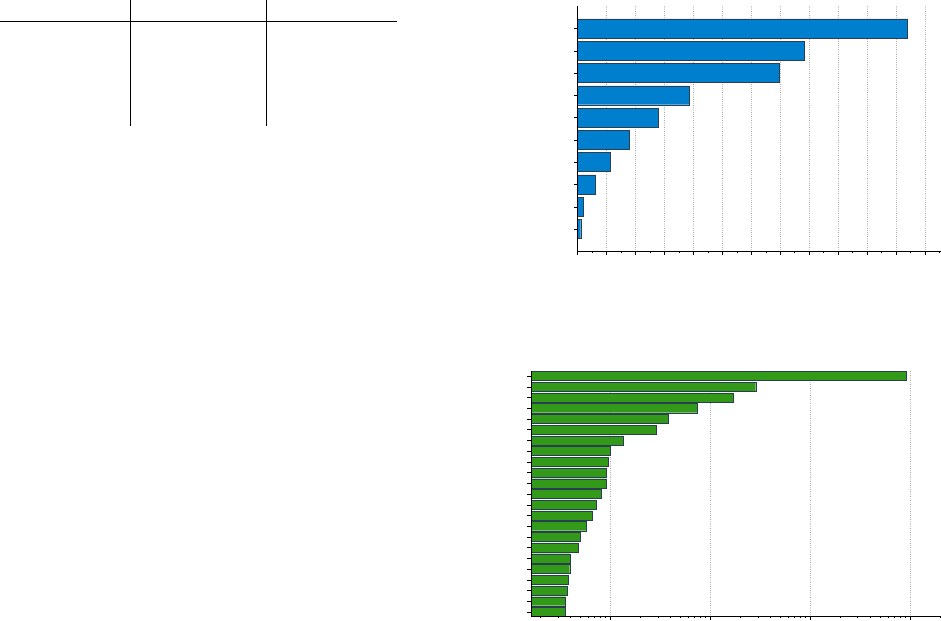
Account type Phishing emails Phishing pages
Mail 35 27
Bank 21 25
App Store 16 17
Social network 14 15
Other 14 15
Table 2: Number of phishing emails and pages targeting a spe-
cific type of account.
4. ATTACK VECTORS
Manual hijacking begins with acquiring a victim’s credentials.
Phishing is a natural attack vector of choice for manual hijackers.
It requires less infrastructure than operating a botnet and allows
attackers to target specific victims, especially an existing victim’s
contacts.
Although phishing as an attack mechanism is well studied [1,6,
16,27,13], little is known about its victims or effectiveness.
To understand what types of accounts are targeted by phishers
and the relation of phishing to manual hijacking, we looked at
what type of accounts are targeted by email-based phishing and
website-based phishing. We start by analyzing email-based phishing
attacks, in which phishers send email that pretends to come from a
legitimate source and requests user credentials under a false pretext,
such as impending account deactivation. We then turn to web-
based phishing, in which an attacker sets up a webpage which looks
like a traditional sign-in page for a web service and attempts to
get users to input their login credentials. Finally, to understand
phishing effectiveness and how users are lured to phishing pages,
we look at the traffic of a random sample of phishing pages that
were inadvertently hosted on Google Drive.
4.1 Phishing targets
We generated a manually curated sample of the phishing emails
from January, 2014 [Dataset 1 in Table 1] This dataset was con-
structed by first extracting a random sample of 5,000 phishing
emails and then manually reviewing the sample to find 100 emails
that explicitly phish for users credentials or point to phishing web-
pages. This manual curation is necessary to reliably distinguish
spam emails from phishing emails.
We found that 62 of those emails contain URLs, which were likely
to point to phishing pages designed to impersonate well known site
login pages in order to trick users into submitting their credentials.
The remaining 38 did not contain URLs and instead asked users to
reply to the email with their credentials. By manually categorizing
the type of account each phishing email targets, we found that email
account credentials were by far the most popular target, followed
by bank credentials (Table 2). The result of a similar analysis
for phishing pages reported on the same table reveals a mirrored
distribution in terms of which type of credentials were phished for.
This analysis was conducted by manually reviewing 100 phishing
pages detected while indexing the web [26].
The target distribution consistency between our two distinct
datasets suggests that phishing is mainly used by the group of at-
tackers that focuses on acquiring email and financial institution
credentials.
This focus is consistent with manual hijackers priorities, as this
group primarily monetize victim’s accounts by running emails and
financial scams as detailed in section 5.
Webmail Generic
Yahoo
Other
GMail
Google
Microsoft
AOL
Phishtank
Facebook
Yandex
Number of HTTP referers
0100 200 300 400 500 600 700 800 900 1000 1100 1200
Figure 3: Non-Blank HTTP referrers breakdown.
Phished TLD
edu
com
ca
net
ar
org
br
se
uk
us
fr
it
cl
in
es
fi
mx
au
pl
sg
de
nl
gov
Percentage of phished email address (logarithmic)
0.1% 1% 10% 100%
Figure 4: Phished email TLD breakdown
4.2 Phishing effectiveness
Using a separate dataset, we analyzed traffic to a random sample
of 100 Google Forms that Google later flagged as phishing and
disabled for abuse [Dataset 3 in Table 1]. We used this dataset to
understand how users were lured to phishing pages, what domains
were targeted most often by phishers, how many credentials hijack-
ers could collect per hour/page, and what success rates phishing
pages had. We caution that the behaviors we observed on Google
Forms may not be representative of all phishing pages, but no other
studies exist on the topic to offer comparison.
Origin of Phished Users:
We looked at the HTTP referer of the
requests made to phishing pages to understand how users are lured
onto those pages. We were surprised to observe that above 99% of
those referrers were blank. We hypothesize that it is due to the fact
that most traffic toward phishing pages is driven via emails as this
source of traffic don’t have HTTP referer. Traffic from desktop email
clients don’t have HTTP referer as it come from an application, and
major webmails, including Gmail, ensure the HTTP referer is not
set by opening links in a new tab. The hypothesis that most victims
are lured via emails is further supported by the fact that most of the
remaining 1% of visitors arrived from various webmail providers
(Figure 3). The Gmail referrers oddity can be traced back to one of
our old HTML frontends used by legacy phones.
The TLDs of the email addresses phished, reported in Figure 4,
reveal that the vast majority (
>99%
) of the emails address phished
come from .edu domains.
350
Average success rate: 13.78%
Success rate
0%
10%
20%
30%
40%
Distinct phishing page
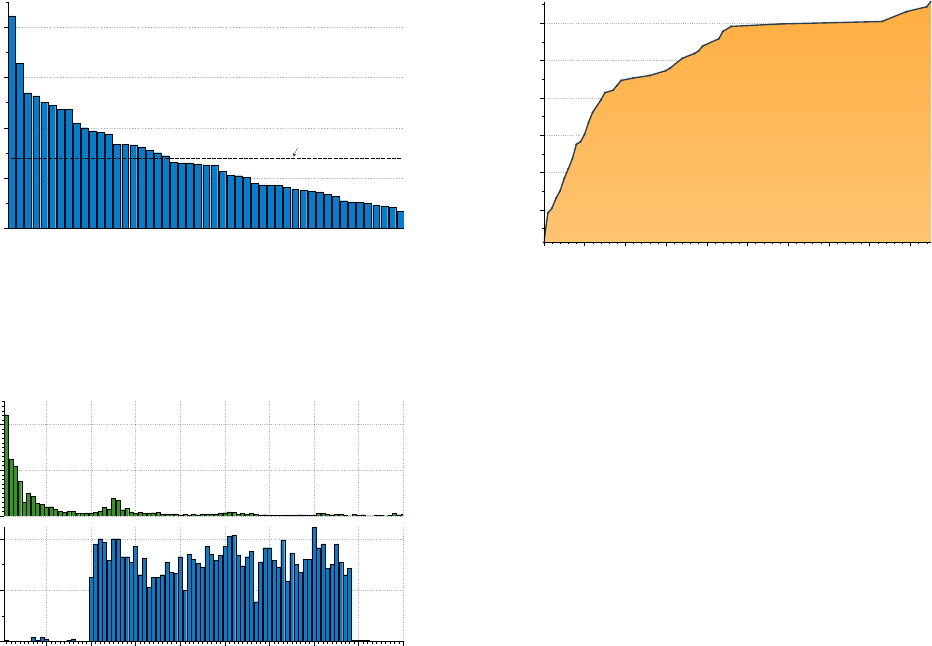
Figure 5: Credential submission rate for phishing pages. Ratio
between the number of submitted credential and the number of
page views
High Volume Outlier
Standard pattern
Accounts phished
0
20
40
Accounts phished
0
100
200
Hours
10 h 20 h 30 h 40 h 50 h 60 h 70 h 80 h 90 h
Figure 6: Average number of submitted credentials over time.
A possible explanation, behind the overwhelming prevalence of
.edu emails address is that self-hosted emails, e.g by universities,
have less robust spam filters than large mail providers and social
networks. This explanation is supported by previous work [14]
that observed that the spam delivery rate was 10 times higher for
webmail protected by commodity spam filtering than by large mail
provider such as Gmail, Yahoo, and Hotmail. This explanation is
also consistent with our hypothesis that most phishing victims are
lured to phishing pages via email.
Phishing Submission Rates:
Using the submission rate of visitors
to phishing forms, we can estimate the success rate of phishing cam-
paigns. The phishing page success rate is computed by dividing the
number of page submissions (HTTP POST requests) by the number
of page views (HTTP GET requests). We observe that 13.7% of
visitors complete the form (which we assume indicates users submit-
ted accurate credentials); much higher than we anticipated. Broken
down by individual page,s we observe a huge variance in success
rate, with the highest page having a 45% success rate and the lowest
only 3% (Figure 5).
We visually inspected a sample of pages and found that those
with low submission rates were very poorly executed and contained
only a form asking for a username and password.
Percentage of decoy accounts accessed by hijackers
20%
30%
40%
50%
60%
70%
Time (hours) since account credential submission to phishing pages
0 5 10 15 20 25 30 35 40 45
Figure 7: Speed of compromised account access.
Arrival Rate of Phishing Victims:
Finally we looked at the aver-
age hourly volume of credential submissions for a phishing page,
calculated from the time when the page was first visited (first entry
in the HTTP request log) until it was taken down (Figure 6) as
determined by our logs. The pattern exhibits a clear decay, from
the moment the webpage receives its first visitors until it is taken
down. This pattern is consistent with a mass mailed email, with
clicks centered around the initial delivery time.
We note that while analyzing our phishing page set, we found
a single outlier (Figure 6, bottom) that received a huge number of
submissions after a step function following a gentle diurnal pattern
through several days. This is a prime example of a successful large-
scale phishing campaign—starting when the first email went out and
ending abruptly when the phishing page was taken down. The initial
15 hour quiet period is, upon a closer investigation, best explained
by the attackers testing the page themselves before launching the
campaign.
Overall our analysis supports our hypothesis that phishing is a
key vector of attack used by manual hijackers and that email is the
primary vector by which victims are phished or lured to phishing
pages.
5. ACCOUNT EXPLOITATION
Once hijackers obtain access to a victim’s login credentials, we
observe a multitude of monetization vectors. We find that criminal
activities are well-structured, efficient, and savvy at taking advantage
of human psychology. A typical hijacker’s method adheres to the
following playbook: access the account, assess its value, exploit it,
and make efforts to delay account recovery in order to increase the
chances of successful exploitation. We present our findings about
each of these steps.
5.1 Logging Into Accounts
Rapid response time:
In order to measure the hijacker response
time—the delta between a victim submitting an account’s login
credentials to a hijacker and the account being accessed by the
hijacker—we manually submitted 200 fake credentials into a ran-
dom sample of 200 phishing pages that explicitly ask for Google
credentials (each credential was submitted to exactly one phishing
page)[Dataset 4 in Table 1]. We recorded the time when each creden-
tial was submitted to a phishing page, and used our logs to observe
when the hijacker first attempted to access each account. We found
that 20% of the decoy accounts were accessed within 30 minutes of
credential submission, and 50% within 7 hours.
351
# of attempts per IP
# of successes per IP
Number of attempts
4
5
6
7
8
9
10
11
Date
10/23 10/24 10/25 10/26 10/27 10/28 10/29 10/30 10/31 11/1 11/2 11/3
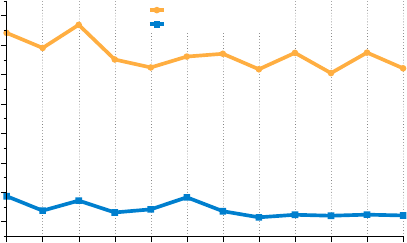
Figure 8: Average hijacker activity per IP.
Figure 7describes this relationship in more detail. Although not
all of the decoy accounts were accessed, possibly due to the sus-
pension of either the phishing website or the email account used by
the hijacker to collect credentials [19], the speed with which decoy
accounts were accessed was astonishing. Our findings suggest that
in order to prevent a hijacked account’s exploitation, the reaction
time to the credential compromise needs to be even faster than pre-
viously thought [18]. Hijhackers’ extreme reactivity emphasizes the
need to perform an accurate, real-time login risk analysis (Sec 8.2)
at the time of log-in in order to detect hijacking attempts since it
is unreasonable to expect both the user and the service provider to
reliably react within a time window as short as 30 minutes. How we
implemented such real time hijacking detection system is discussed
in Section 8.
Efforts to Blend in With Organic Traffic:
Our next surprising
finding is the systematic effort the manual hijackers make in order to
avoid detection. Studying the log-in activity of a random sample of
300 IPs used by hijackers, selected daily over a period of two weeks
in October/November 2012, reveals that on average, the hijackers
attempted to access only 9.6 distinct accounts from each IP, which
makes their activity extremely difficult to distinguish from organic
traffic [Dataset 5 in Table 1].
The average number of account access attempts per IP is consis-
tently under 10 during the entire two week period studied (Figure 8),
suggesting that the manual hijackers may have established guide-
lines to avoid detection. We observe that hijackers have the correct
password for an account 75% of the time (including retries with
trivial variants).
5.2 Account Value Assessment
A surprising finding is that hijackers spend 3 minutes on average
assessing the value of the account and will not attempt to exploit
accounts that they deem not valuable enough. This systematic as-
sessment phase and the fact that certain accounts are not exploited
suggest that manual hijackers are "professional" and follow a well
established playbook designed to maximize profits. The assessment
phase ends when the hijacker performs an active action (e.g sending
an email) or logs out of the account. The remaining results in this
section are based on a study of 575 randomly sampled accounts that
were compromised by manual hijackers [Dataset 7 in Table 1].
We analyze which features of Gmail were accessed by hijackers
and find that the most common way for them to assess an account’s
value is via the Gmail search feature. We also observe that beside
familiarizing themselves with the contents of the victim’s account
via the search terms, hijackers often also open content folders of
special significance, such as Starred (viewed by 16% of hijackers)
Drafts (11% of hijackers), Sent Mail (5% of hijackers), or Trash
(less than 1%). The hijackers also look at the user contacts to esti-
mate the number of potential scam and phishing victims.
To better understand how the search feature is abused, we set
up a temporary experiment that collected and analyzed the search
terms hijackers used for exploring the contents of the victim’s mail-
box. We found out that hijackers mainly look for financial data
(including the victim’s financial status and images of signatures
to be used for future impersonation), linked account credentials
(e.g., usernames and passwords for the victim’s other accounts),
and personal material that might be sold or used for blackmail (e.g.,
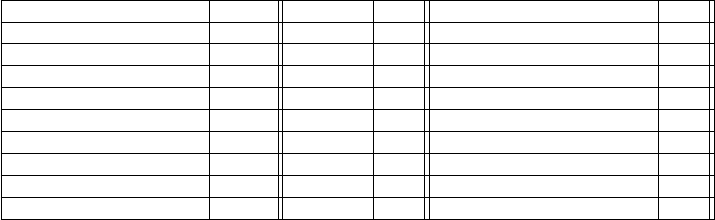
adult pictures). Table 3summarizes the frequency of hijackers’ top
10 search keywords [Dataset 6 in Table 1]. We find that searches
are overwhelmingly for financial data as opposed to other account
credentials or content.
The fact that some searches were performed in Spanish and Chi-
nese suggests that certain hijackers target specific regions the world.
This observation is consistent with our hijacking attribution analysis
(section 7), which shows that besides Africa, hijackers seem to come
from Asia (China, Malaysia) and South America (Venezula).
We believe few hijackers look for account credentials because
most websites will not send them in clear and instead favor a pass-
word reset process. We note that searches for credentials for e-
commerce and gaming sites are most prominent among the account
searches. Confirming how any of these searches yield an actual fi-
nancial attack or blackmail is beyond the capabilities of our datasets.
Although, as discussed in Section 8, detection of account hijack-
ing at the initial log-in stage is the most effective way to prevent
harm due to hijacking, the systematic approach hijackers use to
assess the value of accounts opens another possibility for rapid ac-
count hijacking detection. Namely, an approach that models manual
hijacker initial activity on hijacked accounts and compares a logged-
in user’s activity to this model in order to flag those that exhibit
excessive similarity to hijacker activity.
5.3 Account’s contacts exploitation
If the brief account value exploration using the above techniques
yields promising results, the hijackers spend an additional 15 to
20 minutes per account sifting through emails and finding ways to
monetize the account. We now discuss how hijackers use this time
to exploit the victim’s contacts through scams and phishing.
Scam Schemes:
Among the exploitations that we can observe, the
most common one employed by the manual hijackers is to scam the
contacts of the hijacked account owner. A typical scam consists of
an email describing a reasonably credible story of how the account
owner got into a difficult situation and a plea for money to help get
out of the situation. We observe that scams are semi-personalized,
e.g take into account the victim gender and location, appeal to
human emotions, and systematically exploit known psychological
principles [3] to maximize their success rate as discussed below.
352
Finance Account Content
wire transfer 14.4% password .6% jpg .2%
bank 11.9% amazon .4% mov .2%
transfer 6.2% dropbox .1% mp4 .2%
bank transfer 5.2% paypal .3% 3gp .1%
wire 4.7% match .1% passport .1%
transferencia 4.6% ftp .1% sex .1%
investment 3.4% facebook .1% filename:(jpg or jpeg or png) .1%
banco 3.0% skype .1% is:starred .1%
&U(account statement) 1.9% username .1% zip .1%
Table 3: Top search terms used by hijackers for the various type of information searched.
A prominent example of such a scam scheme is the Mugged-In-
“City” scheme, in which, according to the story told by the hijacker,
the account owner was robbed during his or her trip to a faraway
city and is asking for a temporary emergency loan to help settle bills
and get out of the situation:
...My family and I came down here to West Midlands, UK for a
short vacation...
...we were mugged last night in an alley by a gang of thugs on our
way back from shopping, one of them had a knife poking my neck
for almost two minutes and everything we had on us including my
cell phone, credit cards were all stolen, quite honestly it was beyond
a dreadful experience...
...I’m urgently in need of some money to pay for my hotel bills
and my flight ticket home, will payback as soon as i get back home...
Besides the Mugged-In-“City” scheme, there is a large variety of
scam schemes with different stories that appeal to the same human
emotions and exploit the same psychological principles. For exam-
ple, the following excerpt presents an example where the reason for
the plea is a sick relative with a sudden need for a medical procedure:
Sorry to bother you with this. I am presently in Spain with my
ill Cousin. She’s suffering from a kidney disease and must undergo
Kidney Transplant to save her life. ...
Over time, we realized that scam schemes share a set of core
principles that we were then able to formalize as follow:
•A story with credible details to limit the victim suspicion.
•
Words or phrases that evoke sympathy and aim to persuade.
E.g apologizing and providing distressing details such as "had
a knife poking my neck for almost two minutes".
•
An appearance of limited financial risk for the plea recipient,
as financial requests are typically requests for a loan with
concrete promises of speedy repayment.
•
Language that discourages the plea recipient from trying to
verify the story by contacting the victim through another
means of communication, often through claims that the vic-
tim’s phone was stolen.
•
An untraceable, fast and hard-to-revoke yet safe-looking
money transfer mechanism. The payment also needs to be
picked up anywhere and somewhat anonymously as the scam-
mers might not be from the country they claim the victim
what mugged in.
For example, a request to transfer money to the victim by
name via Western Union/MoneyGram helps the request ap-
pear credible, and enables the recipient to reclaim money
anywhere in the world. [28].
Thus, despite the appearance of simplicity, in reality, the scam
emails are well-formed and thought-out in a way to maximize ef-
ficiency by preying on known human physiological principles [3].
The potentially high level of financial and psychological distress
due to scam emails [22], explains why detecting and filtering out
such emails is a high priority for us.
The volume of scam emails sent from hijacked accounts is rela-
tively low and supports our earlier claim that they are likely a result
of manual work. For 65% of the victims, the hijacker sends at most
five messages, each with a high number of recipients We further
analyze the 6% of the cases in which the number of recipients is less
than 10, and conclude that those tend to contain a more customized
message.
We hypothesize that although message customization comes at
an additional (time) cost for the hijackers, certain hijacker groups
anticipate higher returns on those messages, thus making the trade-
off worthwhile.
Phishing:
Another common exploitation pattern is to use the hi-
jacked account for email-based phishing. We reached this conclu-
sion by observing 2 key facts: First the number of outgoing emails
for our sample accounts was only 25% higher on average on the
suspected day of the hijacking compared with the previous day’s
volume, the number of distinct recipients of that traffic was 630%
higher than on the previous day. This suggests that hijackers gener-
ate traffic by sending the same message to many recipients.
Secondly the traffic generated on the suspected day of the hijack-
ing received 39% more user spam/phishing reports than the previous
day’s traffic. This sharp increase of reports confirms that malicious
emails were sent from stolen account and corroborate our hypoth-
esis that manual hijackers attempt to scam and phish the victim’s
contacts. To further confirm this, we performed a manual analysis
of 200 randomly selected phishing messages sent from one of the
hijacked accounts on the day of the suspected hijacking [Dataset 8
in Table 1]. This analysis reveals that 35% of them were phishing
messages and the remaining 65% were attempts to scam the recipi-
ents, as described earlier in this section. These results also support
our hypothesis that hijacked accounts are used for phishing.
353
We were able to confirm that hijackers favor the use of the victim’s
contacts to select their next set of phishing victims and to improve
the attack’s chances of success using a second measurement. For
this second analysis we measured the number of account hijacked
for two account sets: The first set consisted of random sample of
3000 accounts that belonged to the contact list of accounts that
were hijacked [Dataset 9 in Table 1]. The second set consisted of
3000 randomly sampled 7-day active users[Dataset 9 in Table 1]We
found that the number of manual hijackings over the next 60 days
among the users of the first set was 36 times higher than among the
users of the second set. This supports our hypothesis that hijackers
use victim’s contacts as their next targets.
These results are consistent with our first experiment observations
and support the hypothesis that phishing is manual hijackers’ main
way to compromised accounts. We hypothesize that the rationale
behind phishing people in the social circle of previous victims is that
hijackers try to leverage the sometimes more lenient and trusting
treatment given by automated mail classifiers and humans to emails
originating from a person’s regular contact. This observation is
consistent with previous studies on the subject [24].
5.4 Account Retention Tactics
In order for the scam attempts to succeed, the hijacker needs
to control the account for a sufficiently long period of time. For
example, the Mugged-In-"City" scams typically require at least two
rounds of emails – one with the call for help and one with the money
transfer details, meaning that even the shortest process may take
one or two days, depending on the responsiveness of the contact.
In this section, we present our analysis of the account-level tactics
deployed by the hijackers in order to increase the chances of their
scam’s success. This longitudinal study was performed by compar-
ing the retention tactics used for 600 high confidence hijacking cases
from October 2011 [Dataset 10 in Table 1] with the retention tactics
used for the 575 high confidence hijacking cases from November
2012 that are used in throughout this section [Dataset 7 in Table 1].
The most popular tactics during this period were: locking out the
victim from his account and delaying account recovery,minimizing
the chances of account hijacking discovery, and redirecting future
communications from the plea recipients to a “doppelganger” ac-
count. These tactics are often combined with each other or alternated
between.
Locking out the Victim and Delaying Recovery:
The intent be-
hind locking out the account owner is to separate him from his
contacts. Most people do not have a copy of their contact list offline,
so by losing access to the account the victim also loses the ability to
warn his contacts about the scam. The lockout can be as simple as
changing the account’s password. Most victims are not experts in
manual hijacking, so even if they realize that they cannot log in to
their account they may not conclude that their contacts are at risk of
being scammed. As a result, they are unlikely to warn their contacts
of a potential scam via an alternate channel. Locking out the victim
is, however, a double-edged sword. While it helps the hijacker in
delaying the victim’s counter-actions, it also provides a very clear
signal for abuse detection and account recovery purposes.
Besides locking out the user, the hijackers also often invest effort
in delaying account recovery by changing the account’s recovery
options, including the secondary email, recovery phone number,
and secret question. Finally, they often delete the user’s emails and
contact lists, so even after the recovery, the victim cannot easily
warn his contacts.
Acting in the Shadow:
Hijackers sometimes find it more beneficial
to remain unnoticed and carry out the scam while the victim remains
in control of the account. However, operating in the background is
risky for the hijacker: his direct actions (e.g., marking a mail as read)
as well as the service provider’s countermeasures (e.g., suspicious
activity notifications) can easily reveal his presence. In order to
remain undetected, hijackers try to separate their emails from the
victim’s communications. A common tactic for doing so is to set up
an email filter and redirect all hijacker-initiated communication to
the Trash or to the Spam folder.
In a sample from November 2012, ,15% of the accounts had
hijacker-initiated email forwarding rules and 26% had a hijacker-
configured Reply-To address.
“Doppelganger” Accounts:
Given that the exploitation window
can close rapidly, it is advantageous for the hijacker to divert the
communication to a separate email account that he owns. That way
the hijacker has all the time in the world to scam its victim. In
order to accomplish this, the hijacker creates and uses a duplicate
(“doppelganger”) email account that looks reasonably similar from
the point of view of the victims. The exact choice of the account
name depends on the available usernames and on the personal taste
of the hijacker. Some hijackers prefer to set up the doppelganger
with the same provider as the victim’s account, and introduce a
difficult-to-detect typo to the username. Other hijackers prefer to
host the doppelganger with a different email provider, preferably,
but not necessarily, with a similar-looking domain name [15]. For
example johndoe@example.com is a doppelganger account for john-
doe@gmail.com that retain the same username but use a different
mail provider.
We observe that the methods of choice for attackers to divert
subsequent emails to their doppelganger accounts are to either pop-
ulate the Reply-To email field with it when sending the first email
or to use the Gmail email filters to forward all victim’s email to his
own accounts. To efficiently counter those doppelganger tactics it is
essential during the account recovery process to have these settings
reviewed by the legitimate account owner or automatically cleared.
Retention tactics evolution:
It is interesting to note that hijacker’s
tactics are constantly evolving in response to the new defenses
we put in place. For example, in October 2011, for 46% of the
manual hijacking cases in which the hijackers initiated a password-
change, the user also suffered a mass deletion of their emails. We
believe hijackers deleted emails in attempt to make harder for the
victims to reach their contacts when they got their accounts back. By
November 2012 this probability was down to 1.6%, since hijackers
realized that this tactic was no longer effective after we improved our
account recovery process by allowing users to optionally restore the
emails, contacts, and settings added/modified/deleted by hijackers.
Following this change we also saw the ratio of hijacker-initiated
recovery option changes dropping from 60% (October 2011) to 21%
(November 2012).
354
5.5 Manual Hijacking – an Ordinary Office
Job?
We present further circumstantial evidence that manual hijackers
may work in organized groups that follow a playbook based on an
opportunity that we had to (retrospectively) monitor the activities of
five individual hijackers for a short period of time.
We did observe the following:
•
The individuals seemed to work according to a tight daily
schedule. They started around the same time every day, and
had a synchronized, one hour lunch break. They were largely
inactive over the weekends.
•
All individuals followed the same daily time table, defining
when to process the newly gathered password lists, and how
to divide time between ongoing scams and new victims.
•
They were operating from different IPs, on different victims,
and in parallel with each other, but the tools and utilities they
used were the same. They also shared certain resources such
as phone numbers.
We note that these observations support the results of the analysis
presented throughout this paper.
6. HIJACKING REMEDIATION
In this section we discuss how our remediation process works.
In particular, we study how long it takes for users to recover their
account after being hijacked and analyze what is the success rate of
the various options (SMS, email, knowledge test) that can be used
by user to recover their accounts.
6.1 Remediation Workflow
The account hijacking remediation process consists of two parts.
The first part, the recovery process, typically starts when the user
realizes that his account is not accessible and submits an account
recovery claim. The exact trigger may be a notification (e.g. an
SMS notification about the password change on the account), or
the user may just notice by himself that the password does not
work or that the account was disabled by our anti-abuse systems
to prevent further damage. The recovery part ends with Google
verifying ownership and restoring exclusive access to the account to
its rightful owner. The second part of the process is the cleanup and
mitigation phase. This is triggered either by the account recovery
system itself, or at the user’s explicit request. At the end of it, all
the changes made by the hijacker are ideally reverted.
6.2 ETA until recovery
From the anti-hijacking standpoint, a core metric is latency, which
is the time elapsed between the hijacking and when the victim re-
gains exclusive control over the account. The lower the latency, the
less opportunity the hijacker has for exploitation, and the lower the
cost for the victim. To encourage users to reclaim their accounts
quickly, we keep users informed about key settings changes and
potential suspicious activity via notifications over independent chan-
nels (e.g. SMS or secondary email address) whenever possible.
Figure 9shows the distribution of the end-to-end recovery laten-
cies for a random sample of 5000 accounts that were returned to the
rightful owner after hijacking in Nov 2012 [Dataset 11 in Table 1].
In 22% of the cases, the victim successfully reclaimed the account
within one hour after the hijacking, and in 50% of the cases the
account was returned in less than 13 hours. The recovery time is
calculated by taking the delta between the time our risk analysis
Accounts recovered (5000 samples)
0
200
400
600
800
1000
Hours
0 h 5 h 10 h 15 h 20 h 25 h 30 h 35 h
Figure 9: Hijacking recoveries by time. Sample of 5000 recov-
eries.
system flagged the account as hijacked and the time the user started
the recovery process. The fastest recoveries are best explained by
the proactive notifications we send, enabling the user to recognize
the hijacking and act immediately. Enabling more users to react
quickly in case of hijacking is one of the main reason why we ask
our users to keep their contact information up to date and give us
their mobile phone number.
6.3 Recovery methods
Providing a secure and efficient account recovery process is a
complex problem for two main reasons. First, we need to accom-
modate varying levels of user comfort towards sharing information
for recovery (e.g. a phone number). Secondly, the recovery process
needs to include contingency plans for the cases where an existing
recovery option is inaccurate, outdated, or is itself compromised.
This is particularly problematic for the secondary email recovery
option as several providers, including Microsoft [25], expire email
addresses after some period of inactivity and allows anyone, includ-
ing the hijacker, to register them again. As of 2014, we estimate that
7% of the secondary emails our users provided for recovery have
since been recycled. This email recycling problem makes recovery
emails address a somewhat unreliable medium.
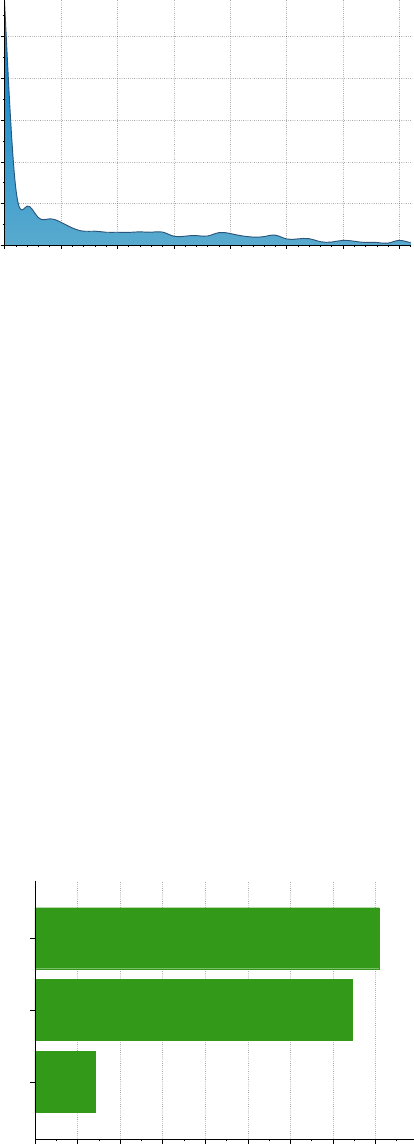
80.91%
74.57%
14.20%
SMS
Email
Fallback
0% 10% 20% 30% 40% 50% 60% 70% 80%
Figure 10: Success rate for various recovery methods.
355
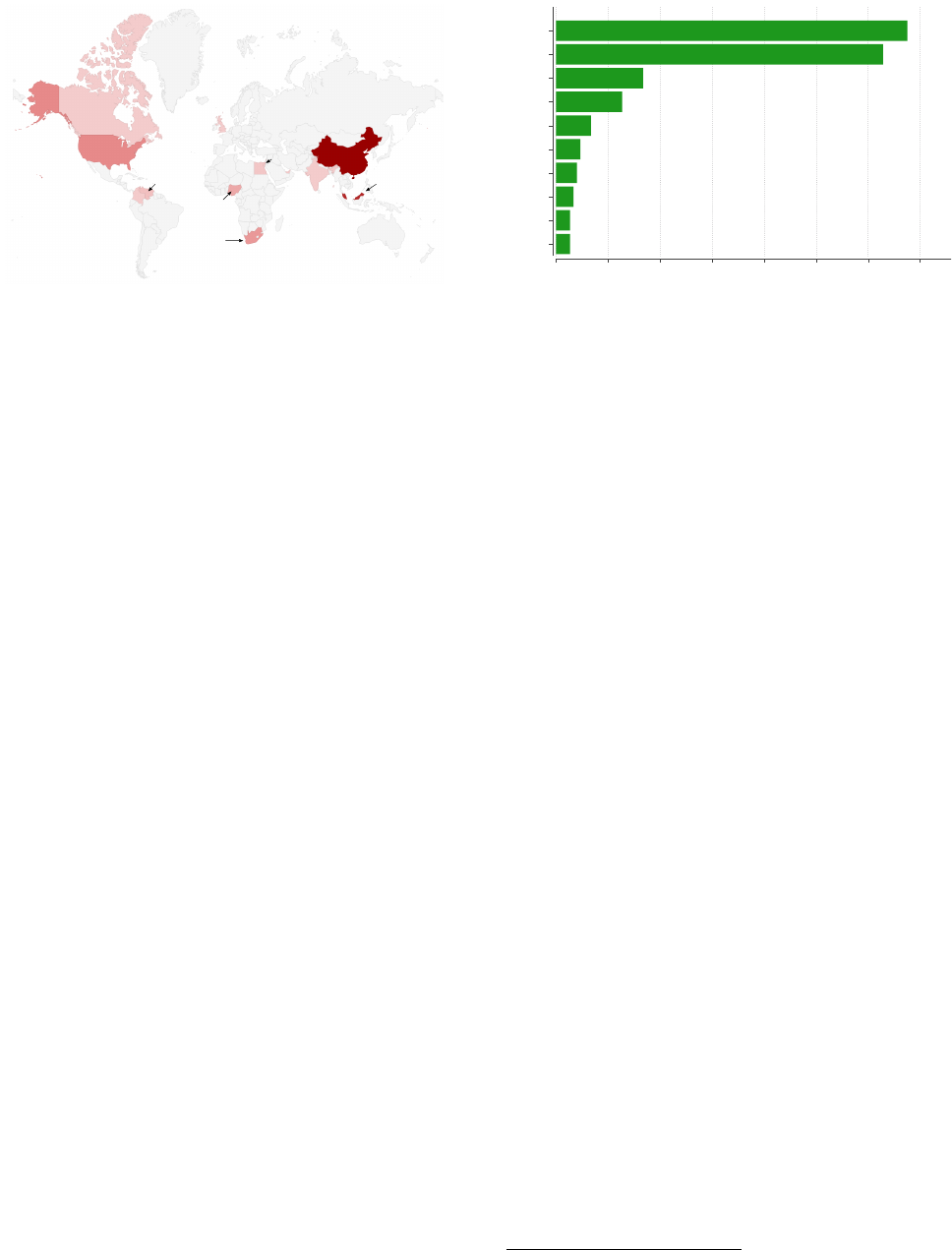
35.7%
35.7%
11. 8 %
9.1%
6.1%
2.4%
1.6%
Figure 11: Top countries for the IPs involved in hijacking.
Figure 10 depicts the recovery success rate, based on a random
sample of a month worth of account recovery claims, broken down
by the method used to recover the account. Given the low volume of
hijacking cases, this sample contains all the claims that were made
in Feb. 2013 to avoid sample bias issues [Dataset 12 in Table 1].
We note that, while we always offer multiple recovery options to
our users, the choice that we offer depends on our risk analysis and
the recovery options that the account owner selected.
SMS:
SMS verification, which has an over 80% success rate, is the
most reliable recovery option for multiple reasons. First, users tend
to keep their phone number up-to-date, which make non-existent
phone numbers a non-issue. Secondly, it provides a very good user
experience. Users find it easy to type in the code they receive via
SMS. Finally, it is hard to fake. Failures can be traced back to the
unreliability of SMS gateways in certain countries, and to confused
users who did not really mean to use this option.
Email:
Email is our most popular account recovery option and has
a success rate of 74.57%. Email based recovery provides a good
cross-device user experience as the user simply has to click on the
link contained in the email. However as we explained earlier, email
is a weaker recovery channel than SMS both in terms of security and
reliability. The main source of failures is that users mistype their
recovery emails, causing the password reset link to go to a wrong
address or to a non-existing email address. We saw email bounces
in approximately 5% of the cases. We are actively mitigating this
issue by encouraging our users to verify their recovery addresses,
but we do not enforce this step. Secondly, as also discussed above,
the ownership of the secondary email is easier to lose, and users
tend to not keep this recovery option up-to-date. We encourage our
users to update their recovery email by showing reminder when they
use our services. Furthermore to mitigate the risk of returning the
account to an impostor, we do not offer this option if there is any
indicatios that the secondary email address has been recycled.
Fallback options:
We offer industry standard fallback options (se-
curity questions, knowledge tests and manual review) to our users
when the account has no other recovery option available. For these
fallback options, both the user experience and the success rate are
significantly worse than for email or SMS.
We are constantly encouraging our users to upgrade to other op-
tions to improve their experience. Sadly a large portion of our users
still hasn’t upgraded, which force us to rely upon those less reliable
options when they need to recover their accounts [21].
33.8%
31.4%
8.4%
6.4%
3.3%
2.3%
2.0%
1.7%
1.3%
1.3%
CI
NG
ZA
FR
IN
US
BR
ML
VN
AF
0% 5% 10% 15% 20% 25% 30% 35%
Figure 12: Top countries for the phone numbers involved in
hijacking.
We also deemed security questions insecure and unreliable, and
stopped allowing new users to use them as they have poor user recall
and would-be hijackers may succeed by guessing the answer. How-
ever secret questions answering is still the only available method for
a non-negligible portion of our user base. This is why, we only offer
the ability to recover an account via security questions under certain
limited circumstances, and repeatedly ask our users to give us better
means to help them restore access to their accounts if needed. We
only support knowledge-based options as a last resort.
6.4 Remission
After hijacking, regardless of whether the victim was locked out
or has retained access, hijacker-initiated changes must to be reverted.
This is very important because, as discussed in section 5.4, hijackers
used to change the account settings and delete users’ emails and
contacts before we added this step to our account recovery flow. The
remission process include restoring hijacker-deleted content, remov-
ing the hijacker-added content, and resetting all account options to
their original state.
We found out by experimenting with various alternatives, that mak-
ing content recovery an optional last step rather than having a fully
automated process was user preferred behavior.
7. HIJACKERS’ ORIGIN
Attributing accounts hijacking to specific groups of actors is very
difficult as we have at best incidental proof. This section discuss
hijacking attribution based on a sample of IPs used by hijackers in
January 2014 [Dataset 13 in Table 1] and a set phone numbers used
by hijackers sometime in 2012 [Dataset 14 in Table 1].
Figure 11 summarizes the geo-location of the IPs involved in
3000 hijacking cases that occurred in January 2014. As visible on
the map, most of the traffic comes from China and Malaysia. We
don’t know if this traffic come from proxies or represent the true
origin of the hijackers. However we do note that having Chinese
traffic is consistent with the fact that hijackers search for Chinese
terms.
2
Similarly having traffic originating from south america,
mainly Venezuela, is consistent with hijackers search in spanish.
2
While some Google services such as YouTube are completely
blocked in China, Gmail on the other hand is not systematically
blocked
356
The other source of data we have is a set of phone numbers that
hijackers briefly used in 2012 to try to lock out users out of their
accounts by enabling the two step authentication as an account
retention tactic.
They quickly gave up after realizing it was not effective and we
haven’t seen this tactic used in the last 2 years which explain why we
don’t use a more recent dataset. The mapping of those 300 phone
numbers to country using phone country code is summarized in
figure 12. From this dataset two major groups of hijackers emerge:
the Nigerian one (NG) and the Ivory Coast (CI) one. We believe
those two groups to be different as their native language differs,
French vs English, and they are 2000km apart. Anecdotal evidence
suggest that the Ivory Coast specialize in scamming French speaking
countries where as the Nigeria focus on English speaking countries.
The volume of phone numbers involved in this type of attack is
small enough to corroborate our hypothesis that is manual work
and large enough to point to organized groups that are dedicated to
monetize hijacked accounts. Finally we note that South Africa (ZA)
account for 10% of both datasets which suggest that South Africa
is also one of the largest home of hijackers. The fact that neither
China or Malaysia show up in the phone dataset might be explained
by the fact that the hijacking groups from those countries didn’t try
to use second factor enabling as a retention tactic.
8. DISCUSSION
In this section we discuss why it is difficult to defend against
manual hijackers. In particular we summarize the defenses strategies
that we found to work well, and those that did not work out so well.
8.1 Detecting manual hijackers is challenging
In our experience the greatest challenges in detecting manual
hijacking is that it is extremely low volume, that hijackers are very
versatile, and that it is difficult to strike the right balance between
false positives (challenging legitimate users) and false negative
(letting a hijacker in) when it come to detection.
Low volume:
The volume of successful manual hijacking Google
sees is extremely low. The exact rate varies with time, but its average
is around 9 hijacks per day per million active accounts. This make
the use of any large statistical model at best very difficult.
Hijacker versatility:
Manual hijackers, as the name suggests, are
human beings with all the flexibility and intelligence that comes
with it. Our observations indicate that they are likely to have aver-
age technical ability, plus some additional knowledge of using IP
cloaking services and browser plugins. Accordingly, what manual
hijackers do when interacting with Google’s services is not very
different from what normal users do. Normal users also search their
inboxes and read emails, set up email filters, and change their pass-
word and their recovery options. Thus the rules or models derived
from those behaviors are not crystal clear and are certainly not high
enough confidence to act upon easily. Furthermore, as we have em-
phasized throughout this paper, manual hijacking is an ever-moving
target. The actions of the hijacker, while following certain patterns,
are by no means deterministic or static.
Striking the right balance:
A key challenge is handling the base
error rate of our detection systems. Although we have invested a
great deal in minimizing the error rate, our systems are not per-
fect. We have to carefully tune the aggressiveness of our system to
balance acting upon signals that might indicate manual hijacking
(but potentially inconveniencing legitimate users) against the risk
of harm done by allowing hijackings to occur. This is especially
difficult in light of the extreme low volume of manual hijacking; the
vast majority of users are not hijacked this way. We concluded that a
certain error rate, which we call the false positive rate, is a fair price
to pay for greatly reducing the number of successful hijackings, e.g.,
temporarily not being able to access the account or being asked to
answer additional verification questions.
8.2 Defense strategies
Second factor
: Using a second authentication factor, such as a
phone, has proven the best client-side defense against hijacking.
While second factor authentication has some drawbacks, we believe
that it is the best way to curb hijacking long term. The main is-
sue with second factor authentication is that it is incompatible with
legacy applications, such as mail clients. We work around this by
authorizing our users to generate an application-specific password
for those type of apps. However, this is far from ideal since those
passwords can be phished. Consequently, we also work with ven-
dors to move their apps to a better authentication technology, such
as OAuth. An additional drawback of second factor authentication
is usability. While phones provide a good user experience, we are
exploring alternatives [7] for people who don’t have a smartphone
(e.g emerging countries) or want a separated physical device. We
hope to see more research done in this space as there is a clear need
of innovation in term of usability and accessibility.
Login time risk analysis
is for us the best defense strategy that
an identity provider can implement server-side since it stops the
hijacker before getting into the account. Over the years we have
built a complex login risk analysis system that assess for each lo-
gin attempt whether it is the legitimate owner or not. Our system
uses many signals (that we can’t disclose for obvious reasons) to
evaluate how anomalous a login attempt is. If the login attempt is
deemed suspicious the user is redirected to an additional verification
step before begin allowed to access his account: the login chal-
lenge [8]. Our login challenge asks the user to answer knowledge
test questions or to verify their identity by proving he has access
to the phone that was registered with the account earlier. e.g. by
receiving an SMS. We view the proof of having access to the phone
associated with the account as a safer challenge than knowledge
question answers that the hijacker may just guess by researching
the user’s background. We spend a lot of time ensuring that our
login challenge is easy to pass for our users, but hard for hijackers.
This allows us to aggressively block hijacking in exchange for a
small fraction of false positives as the "annoyance" cost associated
of being mistakenly challenged is marginal for legitimate users.
Account behavioral risk analysis
is important and needed, but
we argue that it should be viewed as a last resort as it is already
too late from the victim perspective. By that time any behavioral
detector reports an anomaly the hijacker already had accessed the
account data (emails / contact lists), and even might have setup
means to continue his attack by setuping a “doppelganger” account
for example.
User notifications
is another tool that as proven to be essential
to fight hijackers. Triggering notifications on critical events is very
effective to thwart hijacking attempts and speed up the recovery
process. We found out that is is important to being mindful about
the keeping the volume of notification low so users know they are
important when they see them. We notify our users upon account
settings changes, blocked suspicious logins, and unusual in-product
activity for which we have high confidence.
357
Iron tight Account recovery
Finally we can’t stress enough how
important it is to invest into having a very secure and reliable account
recovery system. We continuously improve our recovery process to
ensure that it is easy for legitimate users to get their account back
while keeping hijackers out. Developing novel ways to validate user
identity both for login challenge and account recovery purpose is
something that we view as critical and we would love to see more
research done in this space.
9. REFERENCES
[1]
APWG. Global phishing survey: Trends and domain name use
in 1h2011.
http://www.antiphishing.org/reports/, 2011.
[2] A. J. Aviv, K. Gibson, E. Mossop, M. Blaze, and J. M. Smith.
Smudge attacks on smartphone touch screens. In Proceedings
of the 4th USENIX conference on Offensive technologies,
pages 1–7. USENIX Association, 2010.
[3] R. B. Cialdini. Influence: The psychology of persuasion.
1993.
[4] FBI. 2013 internet crime report. Technical report, FBI, 2013.
[5] H. Gao, J. Hu, C. Wilson, Z. Li, Y. Chen, and B. Y. Zhao.
Detecting and characterizing social spam campaigns. In
SIGCOMM. ACM, 2010.
[6] S. Garera, N. Provos, M. Chew, and A. D. Rubin. A
framework for detection and measurement of phishing attacks.
In WORM ’07, 2007.
[7] Google. Google’s internet identity research. https:
//sites.google.com/site/oauthgoog/gnubby.
[8] Google. Login challenge for suspicious sign-ins.
https://support.google.com/a/answer/
6002699?hl=en.
[9] Google. Transparency report: Safe browsing.
http://www.google.com/transparencyreport/
safebrowsing/?hl=en.
[10] C. Grier, K. Thomas, V. Paxson, and M. Zhang. @spam: The
Underground on 140 Characters or Less. In Proceedings of the
ACM Conference on Computer and Communications Security
(CCS), 2010.
[11] M. Hearn. An update on our war against account hijackers.
http://bit.ly/1qfMckD, 2013.
[12] IOActive. Reversal and analysis of zeus and spyeye banking
trojans. http://www.ioactive.com/pdfs/
ZeusSpyEyeBankingTrojanAnalysis.pdf.
[13] T. Jagatic, N. Johnson, M. Jakobsson, and F. Menczer. Social
phishing. Communications of the ACM, 50(10):94–100, 2007.
[14]
C. Kanich, C. Kreibich, K. Levchenko, B. Enright, G. Voelker,
V. Paxson, and S. Savage. Spamalytics: An empirical analysis
of spam marketing conversion. Proceedings of the 15th ACM
conference on Computer and communications security, pages
3–14, 2008.
[15] J. Leyden. Typo-squatting domains can harvest corporate
emails. http://bit.ly/1o8dx6d, 2011.
[16] C. Ludl, S. McAllister, E. Kirda, C. Kruegel, and C. Kruegel.
On the effectiveness of techniques to detect phishing sites. In
DIMVA ’07: Proceedings of the 4th International Conference
on Detection of Intrusions, Malware, and Vulnerability
Assessment, pages 20–39, 2007.
[17] S. Maggi, A. Volpatto, S. Gasparini, G. Boracchi, and
S. Zanero. Poster: Fast, automatic iphone shoulder surfing. In
Proceedings of the 18th ACM conference on Computer and
communications security, pages 805–808. ACM, 2011.
[18] T. Moore and R. Clayton. Examining the impact of website
take-down on phishing. In Proceedings of the anti-phishing
working groups 2nd annual eCrime researchers summit, pages
1–13. ACM, 2007.
[19] T. Moore and R. Clayton. Discovering phishing dropboxes
using email metadata. In eCrime Researchers Summit
(eCrime), 2012, pages 1–9. IEEE, 2012.
[20] R. Naraine. Zdnet security blog: ‘state-sponsored attackers’
using ie zero-day to hijack gmail accounts, Jun. 2012.
[21] S. Schechter, A. B. Brush, and S. Egelman. It’s no secret.
measuring the security and reliability of authentication via
“secret” questions. In Security and Privacy, pages 375–390.
IEEE, 2009.
[22]
R. Shay, I. Ion, R. W. Reeder, and S. Consolvo. “my religious
aunt asked why i was trying to sell her viagra”: Experiences
with account hijacking. In CHI, 2014.
[23] Symantec. Industrial espionage: Targeted attacks and
advanced persistent threats (apts).
http://bit.ly/RsGkV7.
[24] K. Thomas, F. Li, C. Grier, and V. Paxson. Consequences of
connectivity: Characterizing account hijacking on twitter. In
Proceedings of the 21st Annual Conference on Computer and
Communications Security, 2014.
[25] T. N. Web. Microsoft can recycle your outlook.com email
address if your account becomes inactive.
http://tnw.co/1sWsNAU, 2013.
[26] C. Whittaker, B. Ryner, M. Nazif, and M. Nazif. Large-scale
automatic classification of phishing pages. In NDSS, 2010.
[27] Y. Zhang, S. Egelman, L. Cranor, J. Hong, and J. Hong.
Phinding phish: Evaluating anti-phishing tools. In NDSS,
2007.
[28] Embassy of the Unites States warning on West African
advanced fee scams, http://abidjan.usembassy.gov/
art_of_scam.html.
358
