I OS6 Kernel Security A Hacker's Guide Mark Dowd
User Manual:
Open the PDF directly: View PDF  .
.
Page Count: 71


Introduction
iOS 6 recently released
Large focus on security improvements –
particularly kernel hardening
Primarily targets strategies employed in
“jailbreaks”
This talk provides an overview of the new
kernel-based mitigations
Explores new techniques for attacking iOS 6

Topics Covered
Part 1 – Defense
–Heap Hardening Strategies
–Stack Cookies
–Information Leaking Mitigations
–Address Space Layout Randomization (ASLR)
–User/Kernel address space hardening
Part 2 – Offense
–Information Leaking
–Heap Strategies

Randomization Algorithm
First, a word on randomness…
Used to derive random numbers for stack
cookie, heap cookies, kernel map ASLR, and
pointer obfuscation
Random seed generated (or retrieved) during
boot loading (iBoot)
Combined with current time to get random
value
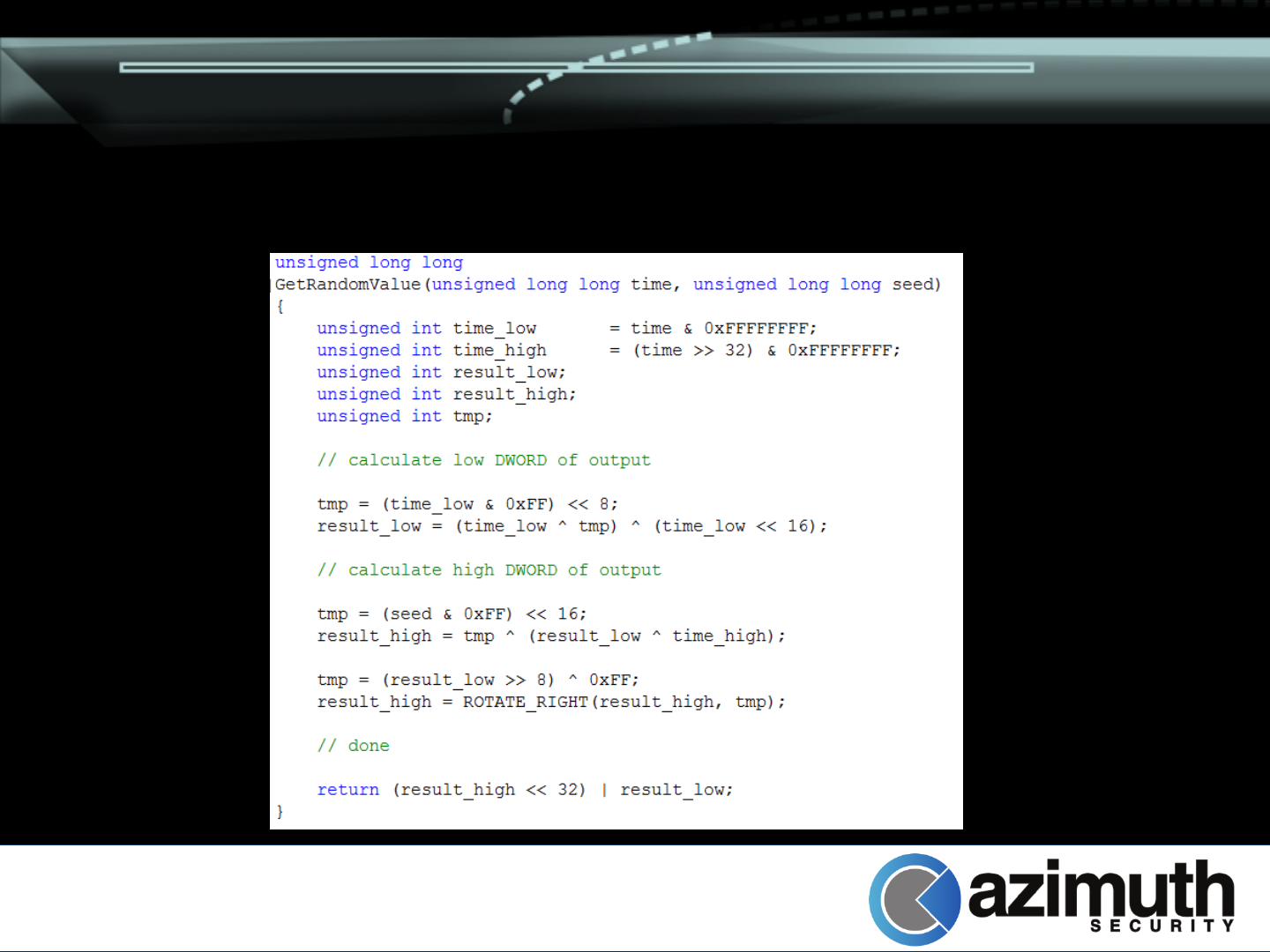
Randomization Algorithm

Heap Hardening
Heap has been hardened to prevent well-
known attack strategies
Three mitigations put in place
–Pointer validation
–Block poisoning
–Freelist integrity verification
Specific to the zone allocator (zalloc( ), used
by kalloc( ), MALLOC( ), MALLOC_ZONE( ))

Heap Hardening - Recap
Quick recap of old exploitation techniques
required
–Covered in the past extensively by Stefan Esser,
Nemo, probably others
Zone allocations divided in to fixed-size
zones (kalloc.8, kalloc.16, ... kalloc.32768)
–Specialized zones also utilized for specific tasks
(eg. Pmap_zone, vm_map_copy_zone, etc)
Zone allocates more pages on demand
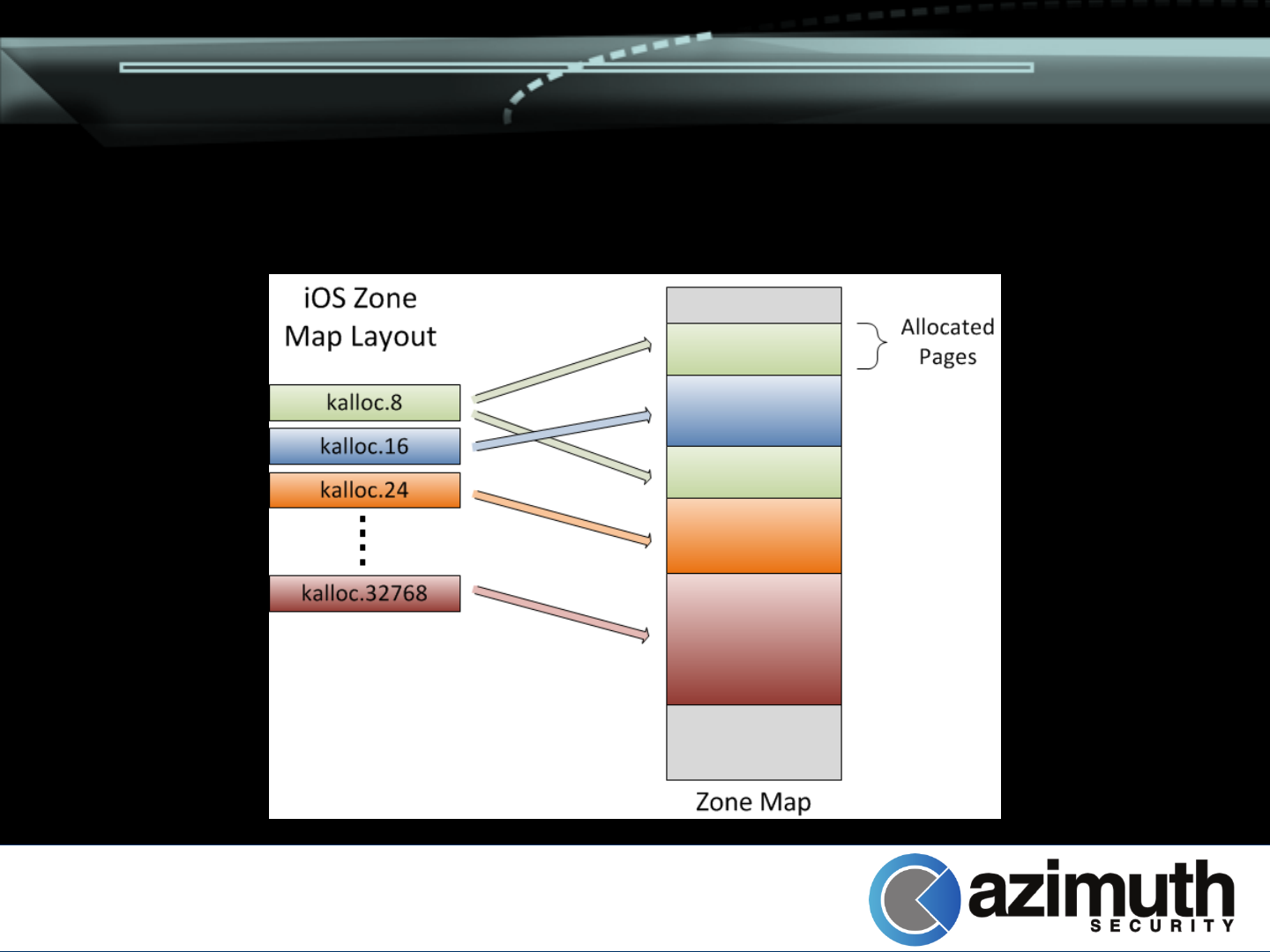
Heap Hardening - Recap

Heap Hardening - Recap
Zone allocates blocks of pages on demand
–Divides memory in to element-size blocks
–All blocks initially added to zone’s free list
Zone free list maintained as singly linked list
–First DWORD of free block overwritten with “next”
pointer when it is freed
Allocations simply remove elements from the
free list
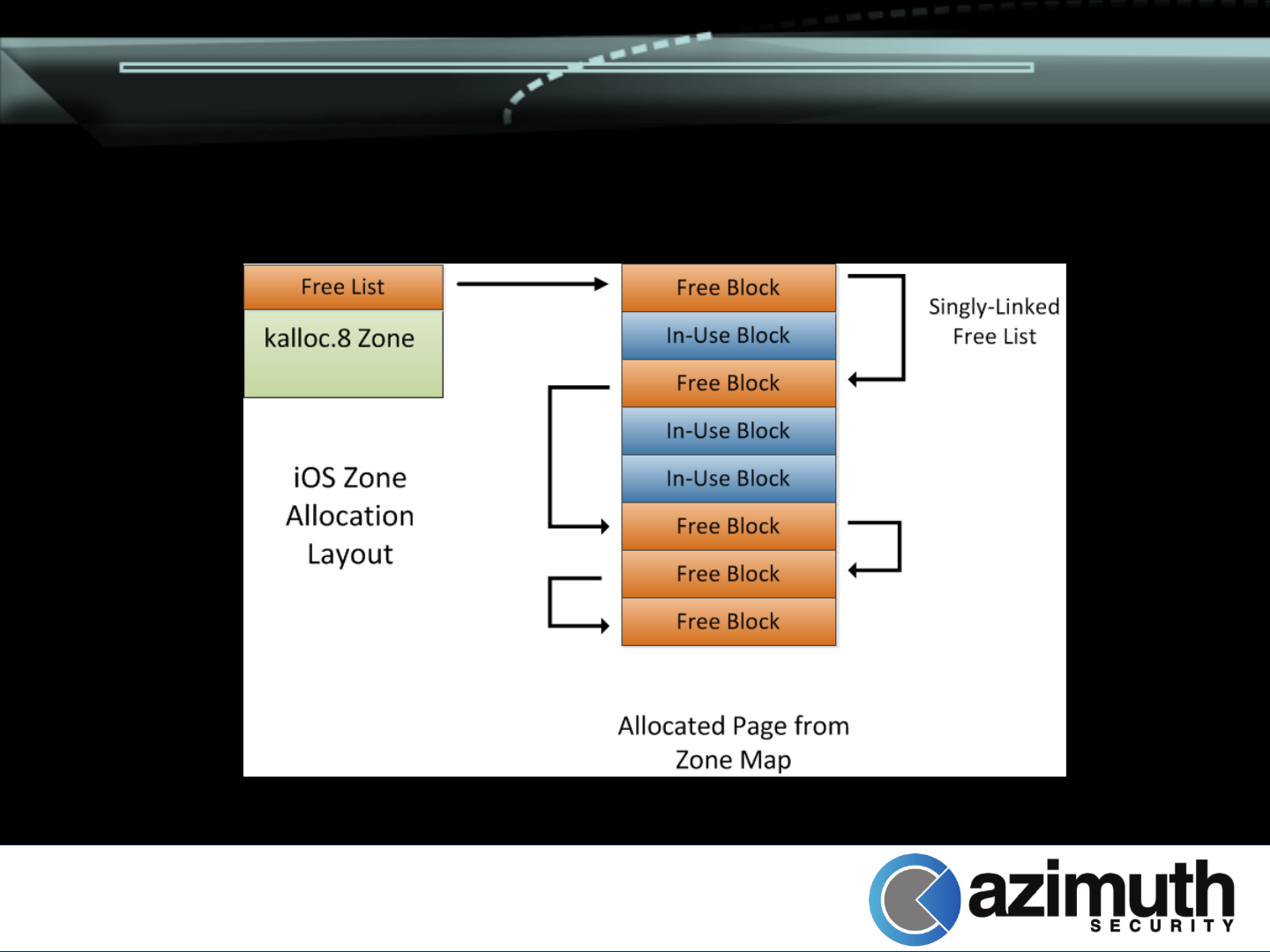
Heap Hardening - Recap

Heap Hardening - Recap
Previous exploitation techniques rely on
overwriting free list pointers in free blocks
–Future allocation can return arbitrary memory
block
Typical strategy: Add a pointer to sysent
–Add new system call
–Invoke new system call
–Profit

Heap Hardening – Pointer Validation
Goal: Prevent invalid pointers being entered
in to kalloc( ) zone’s freelist
Additional checks performed on pointers
passed to zfree( )
–Also performed as part of validation on pointers in
freelist during allocation (zalloc( ))

Heap Hardening – Pointer Validation
Pointer verified to be in kernel memory (0x80000000
< ptr < 0xFFFEFFFF)
If allows_foreign is set in zone, no more
validation performed
–Currently event_zone,
vm_map_entry_reserved_zone, vm_page_zone
If pointer is within kernel image, allow (??)
Otherwise, ensure pointer is within
zone_map

Heap Hardening – Block Poisoning
Goal: Prevent UAF-style attacks
Strategy involves filling blocks with sentinel
value (0xdeadbeef) when being freed
–Performed by add_to_zone( ) called from zfree( )
Only performed on selected blocks
–Block sizes smaller than cache line size of
processor (e.g. 32 bytes on A5/A5X devices)
–Can override with “-zp”, “-no-zp”, “zp-factor” boot
parameters

Heap Hardening – Freelists
Goal: Prevent heap overwrites from being
exploitable
Two random values generated at boot time
(zone_bootstrap( ))
–32-bit cookie for “poisoned blocks”
–31-bit cookie for “non-poisoned blocks”
Low bit is clear
Values serve as validation cookies

Heap Hardening – Freelists
Freelist pointers at the top of a free block are
now validated by zalloc( )
–Work performed by alloc_from_zone( )
Encoded next pointer placed at end of block
–XOR’d with poisoned_cookie or
nonpoisoned_cookie
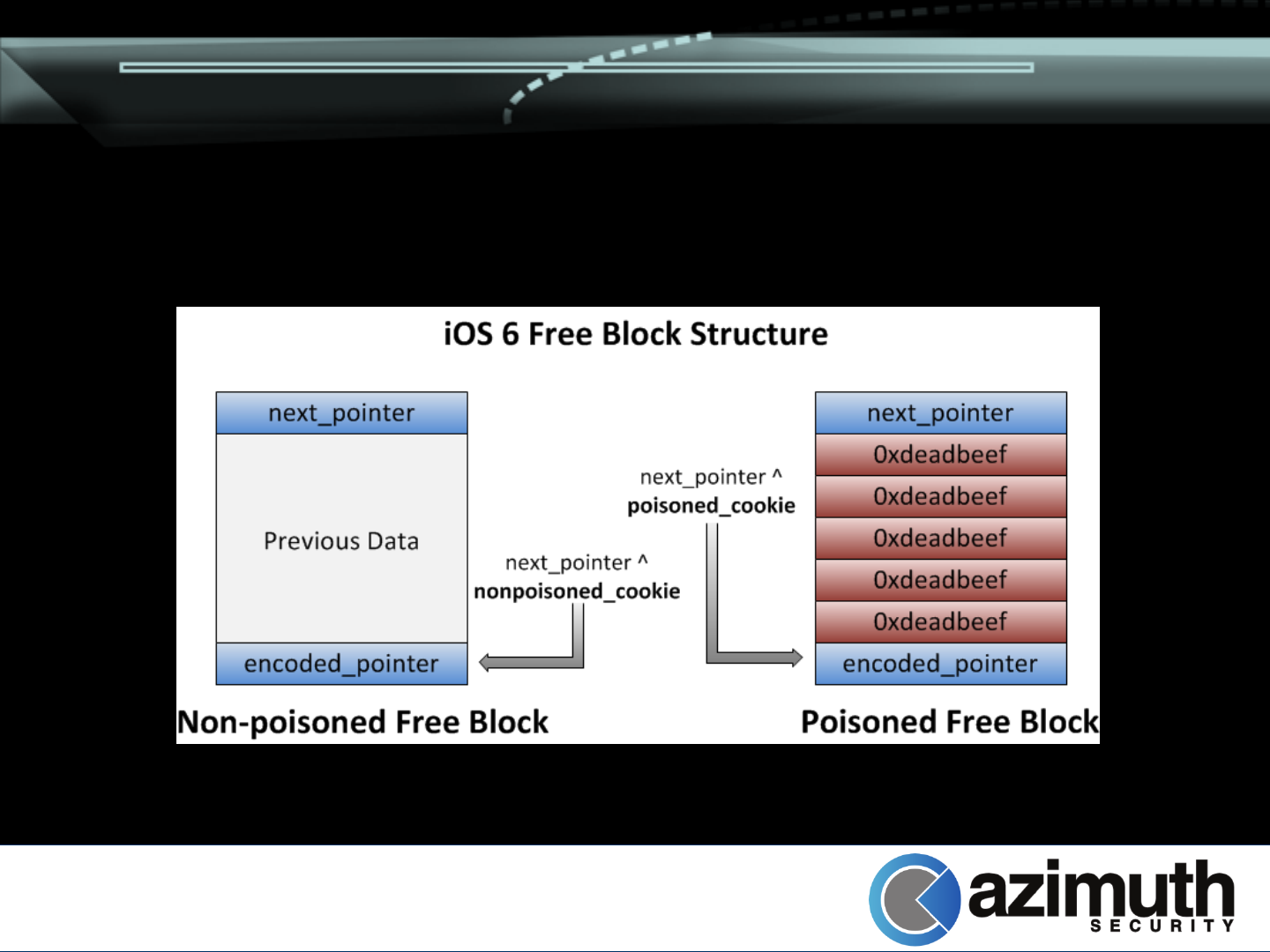
Heap Hardening – Freelists

Heap Hardening – Freelists
zalloc( ) ensures next_pointer matches
encoded pointer at end of block
–Tries both cookies
–If poisoned cookie matches, check whole block
for modification of sentinel (0xdeadbeef) values
–Cause kernel panic if either check fails
Next pointer and cookie replaced by
0xdeadbeef when allocated
–Possible information leak protection

Heap Hardening – Primitives
OSUnserializeXML( ) could previously be
used to perform kernel heap feng shui
–Technique presented by Stefan Esser in «iOS
Kernel Heap Armageddon» at SyScan 2012
Allowed precise allocation and freeing of
kalloc zone data
Also possible to force persistent allocations
by wrapping the reference count

Heap Hardening - Primitives
<plist version="1.0">
<dict>
<key>AAAA</key>
<array ID="1" CMT="IsNeverFreedTooManyReferences">...</array>
<key>REFS</key>
<array>
<x IDREF="1"/><x IDREF="1"/><x IDREF="1"/><x IDREF="1"/>
<x IDREF="1"/><x IDREF="1"/><x IDREF="1"/><x IDREF="1"/>
<x IDREF="1"/><x IDREF="1"/><x IDREF="1"/><x IDREF="1"/>
...
<x IDREF="1"/><x IDREF="1"/><x IDREF="1"/><x IDREF="1"/>
</array>
</dict>
</plist>

Heap Hardening - Primitives
Duplicate dictionary keys no longer result in
freeing of the original key/value
Dictionary entries can no longer be pinned to
memory using multiple references
In both cases, the plist dictionary is
considered invalid

Stack Cookies
Goal: Prevent stack overflow exploitation
Only applied to functions with
structures/buffers
Random value generated during early kernel
initialization (arm_init( ))
24-bit random value
–32-bit value really, but 2nd byte zeroed out
–Presumably string copy prevention

Stack Cookies
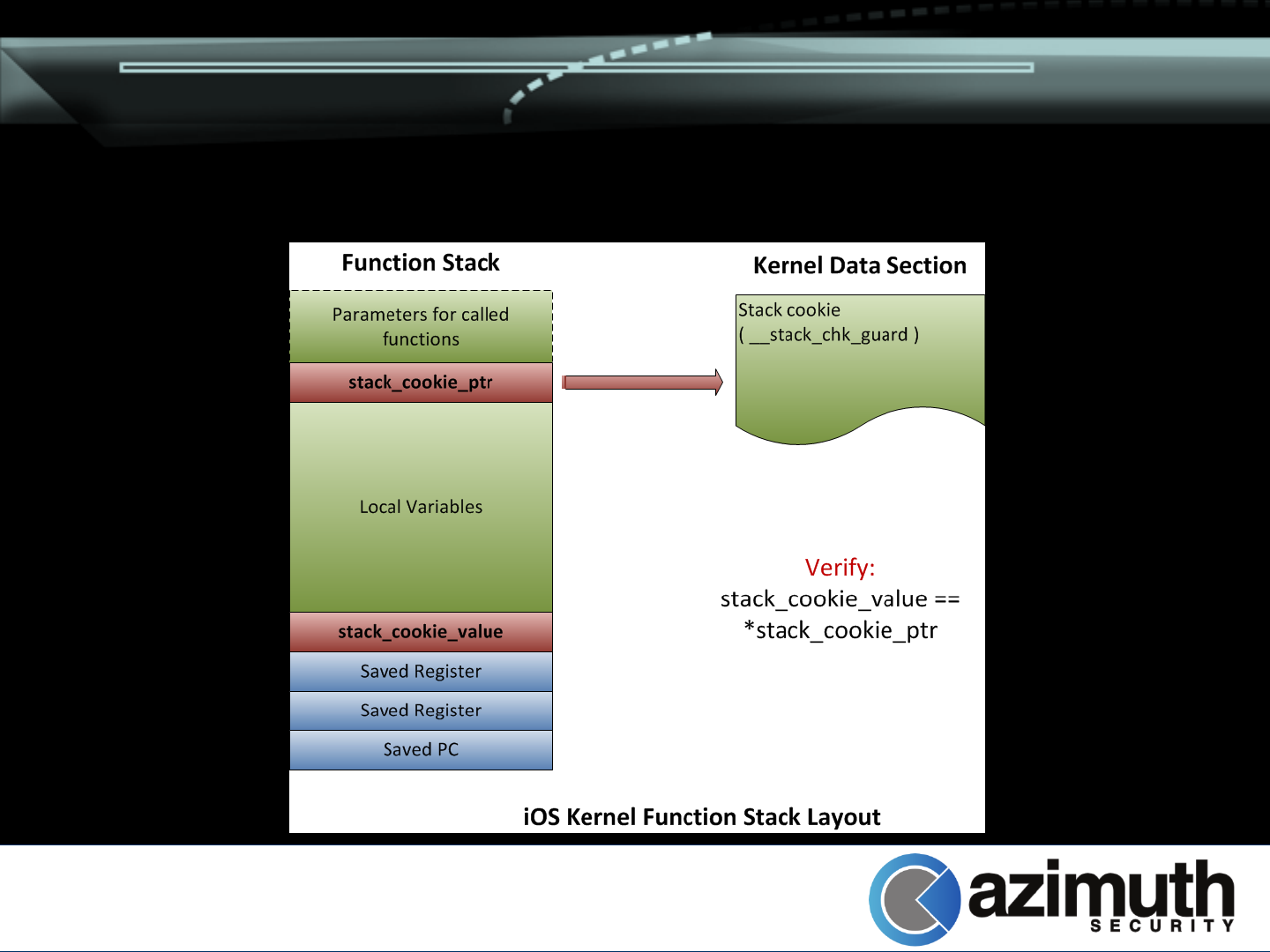
Generated stack cookie placed directly after
saved registers at bottom of stack frame
Pointer to cookie saved at top of stack frame
–Or in a register if convenient
–Space above stack cookie pointer used for called
functions if necessary
Stack Cookies
Stack Cookies
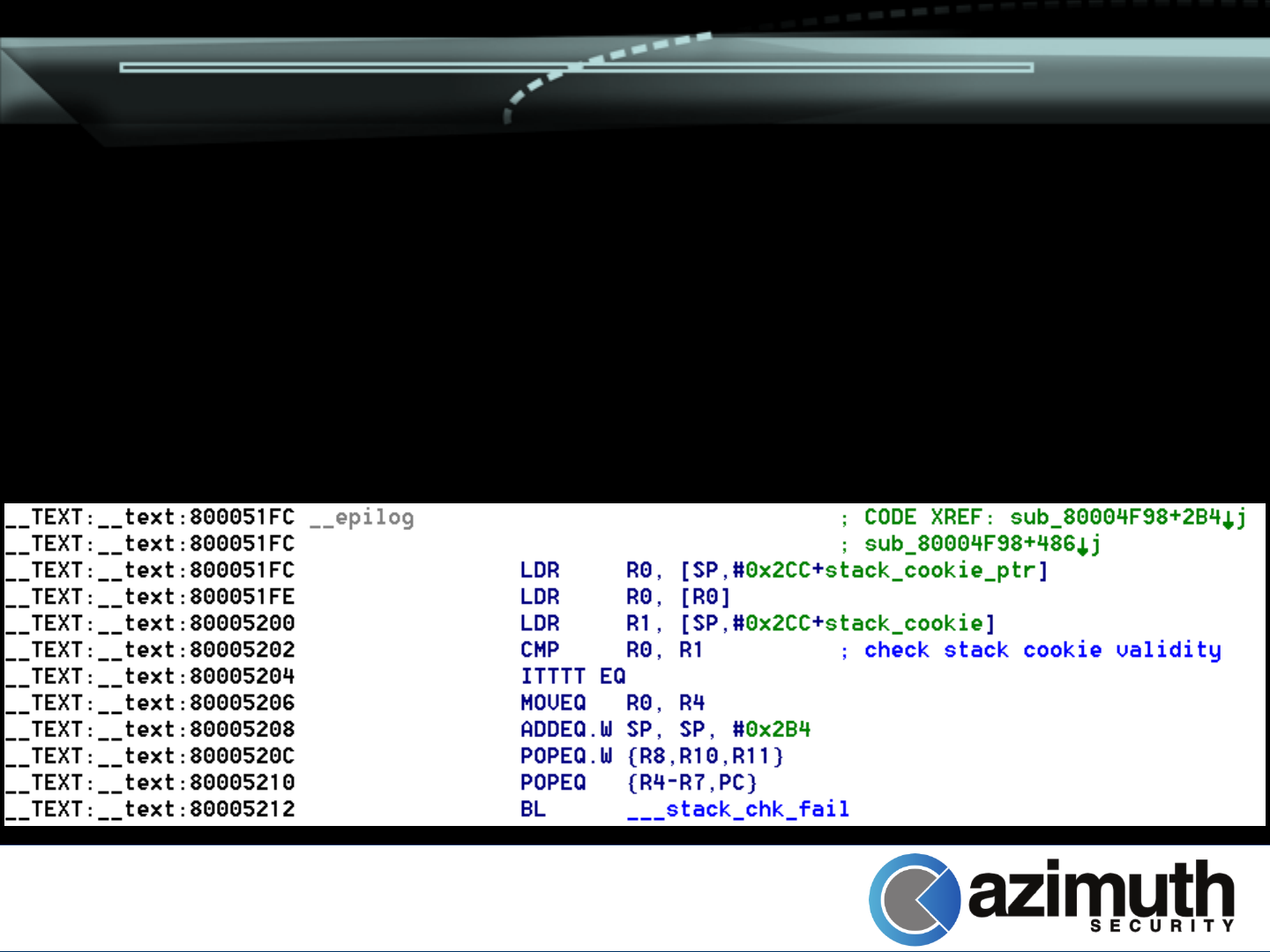
Function epilog verifies saved stack cookie
–Generated value found by following saved pointer
Verification failure results in kernel panic

Information Leaking Mitigations
Goals:
–Prevent disclosure of kernel base
–Prevent disclosure of kernel heap addresses
Strategies:
–Disables some APIs
–Obfuscate kernel pointers for some APIs
–Zero out pointers for others
Information Leaking Mitigations
Previous attacks relied on zone allocator
status disclosure
–host_zone_info( ) / mach_zone_info( )
–Stefan Esser described using this for heap “feng
shui” (https://media.blackhat.com/bh-us-
11/Esser/BH_US_11_Esser_Exploiting_The_iOS
_Kernel_Slides.pdf)
APIs now require PE_i_can_has_debugger()
access

Information Leaking Mitigations
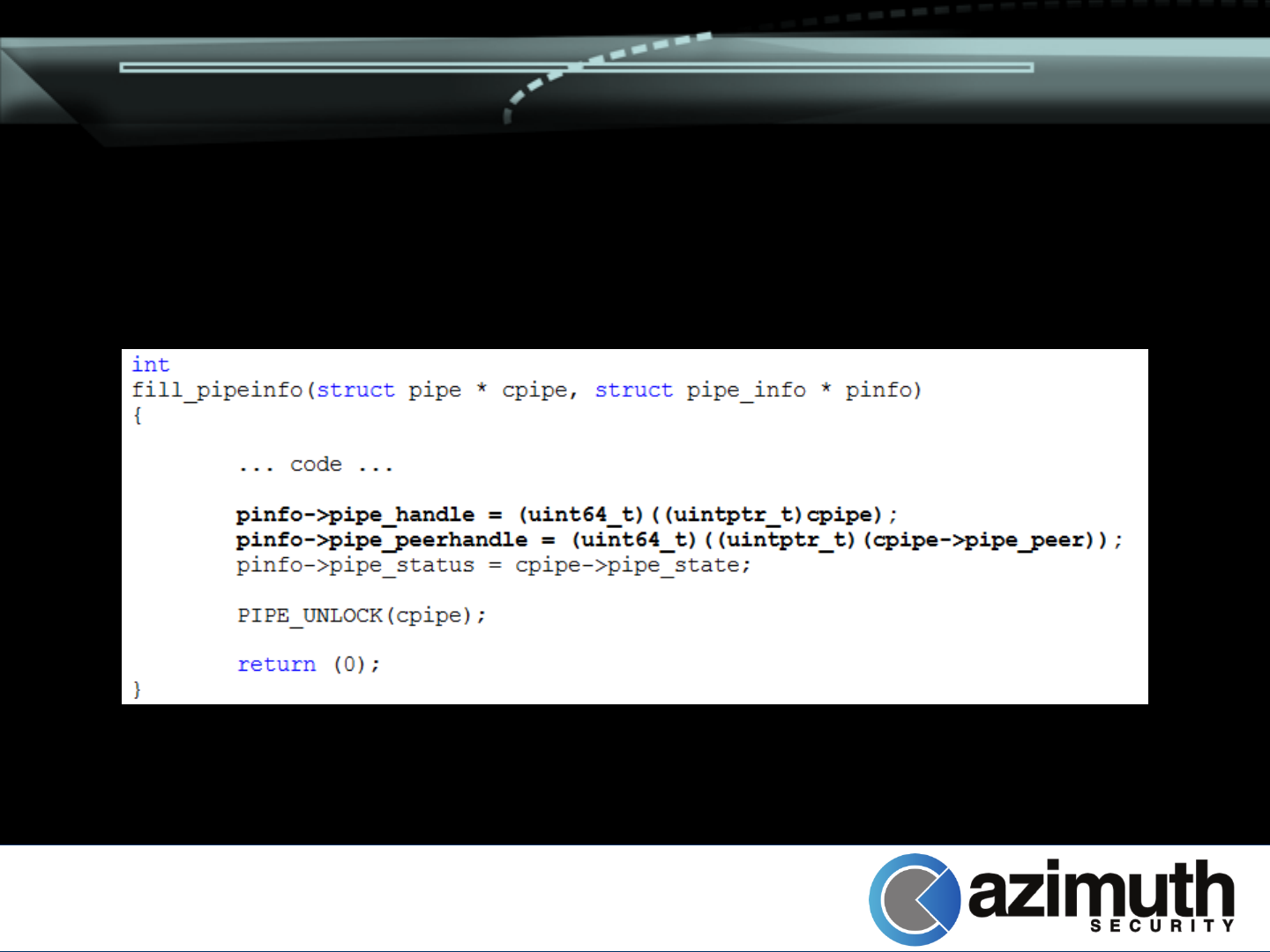
Several APIs disclose kernel object pointers
–mach_port_kobject( )
–mach_port_space_info( )
–vm_region_recurse( ) / vm_map_region_recurse( )
–vm_map_page_info( )
–proc_info ( PROC_PIDREGIONINFO,
PROC_PIDREGIONPATHINFO, PROC_PIDFDPIPEINFO,
PROC_PIDFDSOCKETINFO,
PROC_PIDFILEPORTSOCKETINFO )
–fstat( ) (when querying pipes)
–sysctl( net.inet.*.pcblist )

Information Leaking Mitigations
Need these APIs for lots of reasons
–Often, underlying APIs rather than exposed ones
listed previously
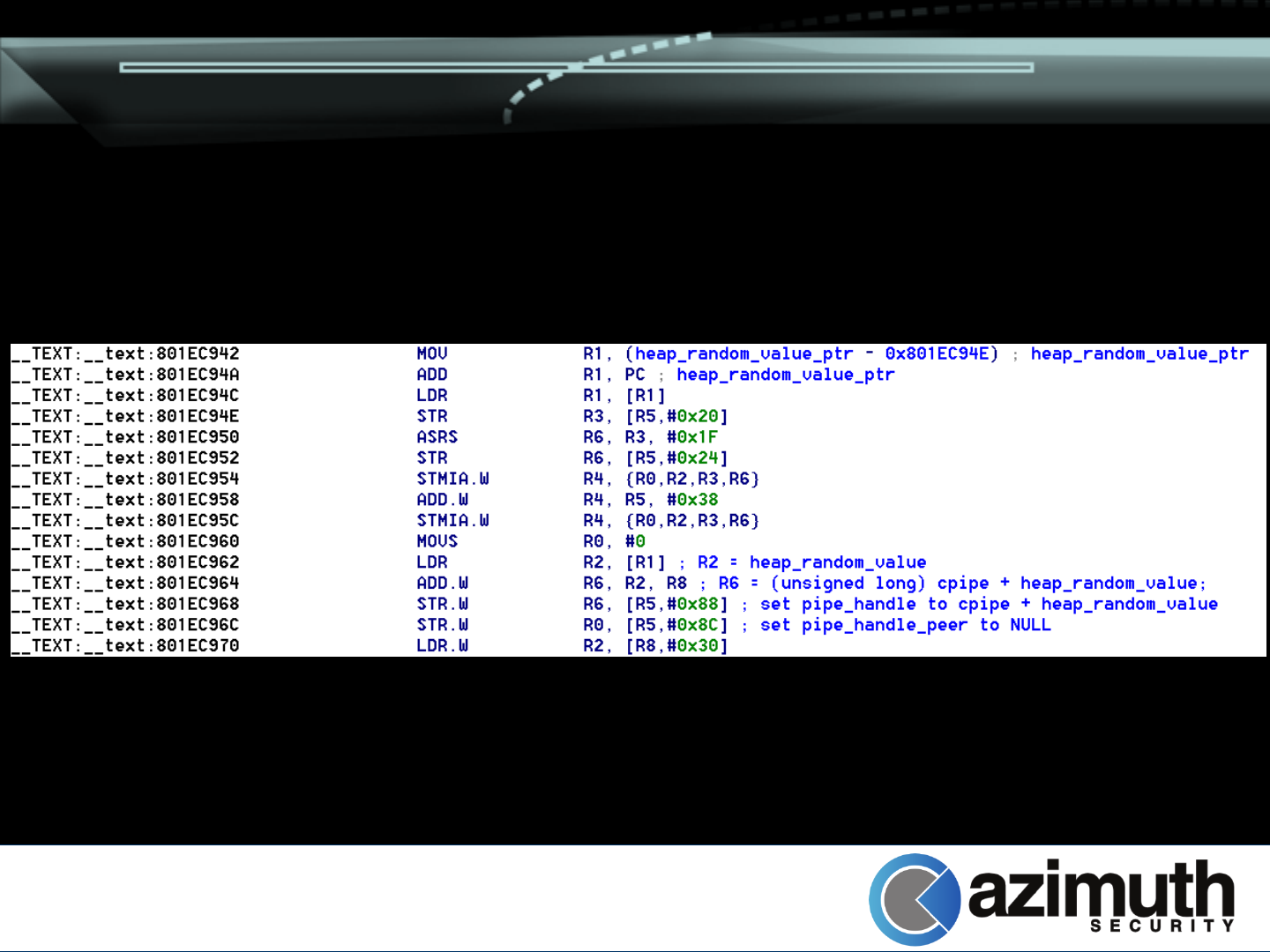
Strategy: Obfuscate pointers
–Generate 31 bit random value at boot time
lowest bit always 1
–Add random value to real pointer
Information Leaking Mitigations
Information Leaking Mitigations

Information Leaking Mitigations
Other APIs disclose pointers unnecessarily
–Zero them out
Used to mitigate some leaks via sysctl
–Notably, known proc structure infoleak

Kernel ASLR
Goal: Prevent attacker’s from
modifying/utilizing data at known (fixed)
addresses
Strategy is two-fold
–Randomize kernel image base
–Randomize base of kernel_map (sort of)

Kernel ASLR – Kernel Image
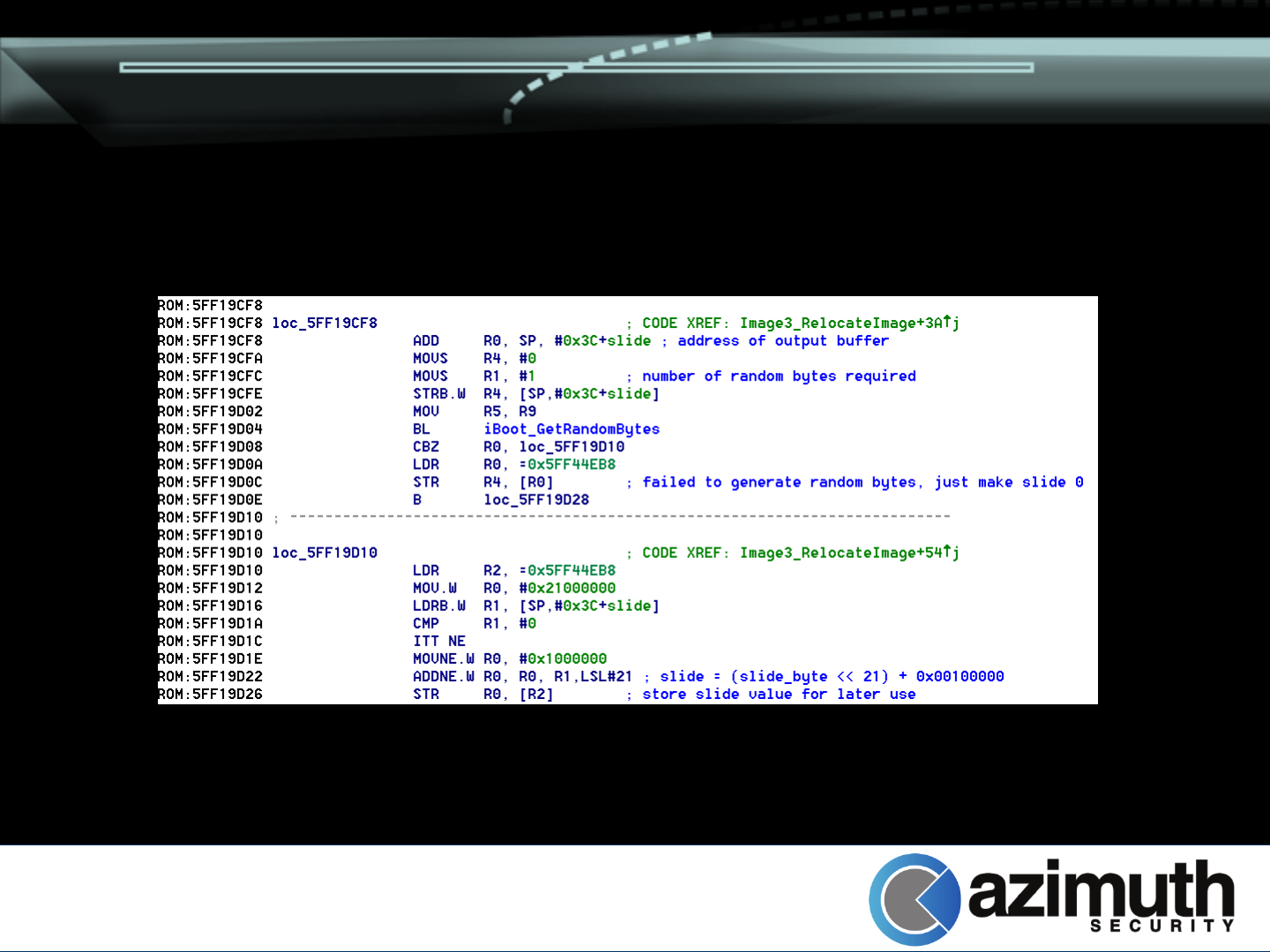
Kernel base randomized by boot loader
(iBoot)
–Random data generated
–SHA-1 hash of data taken
–Byte from SHA-1 hash used to calculate kernel
“slide”
Kernel is rebased using the formula:
0x01000000 + (slide_byte * 0x00200000)
–If slide is 0, static offset of 0x21000000 is used
Kernel ASLR – Kernel Image

Kernel ASLR – Kernel Image
Calculated value added to kernel preferred
base later on
Result:
–Kernel can be rebased at 1 of 256 possible
locations
–Base addresses are 2MB apart
Example: 0x81200000, 0x81400000, … 0xA1000000
Adjusted base passed to kernel in boot args
structure (offset 0x04)

Kernel ASLR – Kernel Map
Used for kernel allocations of all types
–kalloc( ), kernel_memory_allocate( ), etc
Spans all of kernel space (0x80000000 ->
0xFFFEFFFF)
Kernel-based maps are submaps of
kernel_map
–zone_map, ipc_kernel_map, etc

Kernel ASLR – Kernel Map
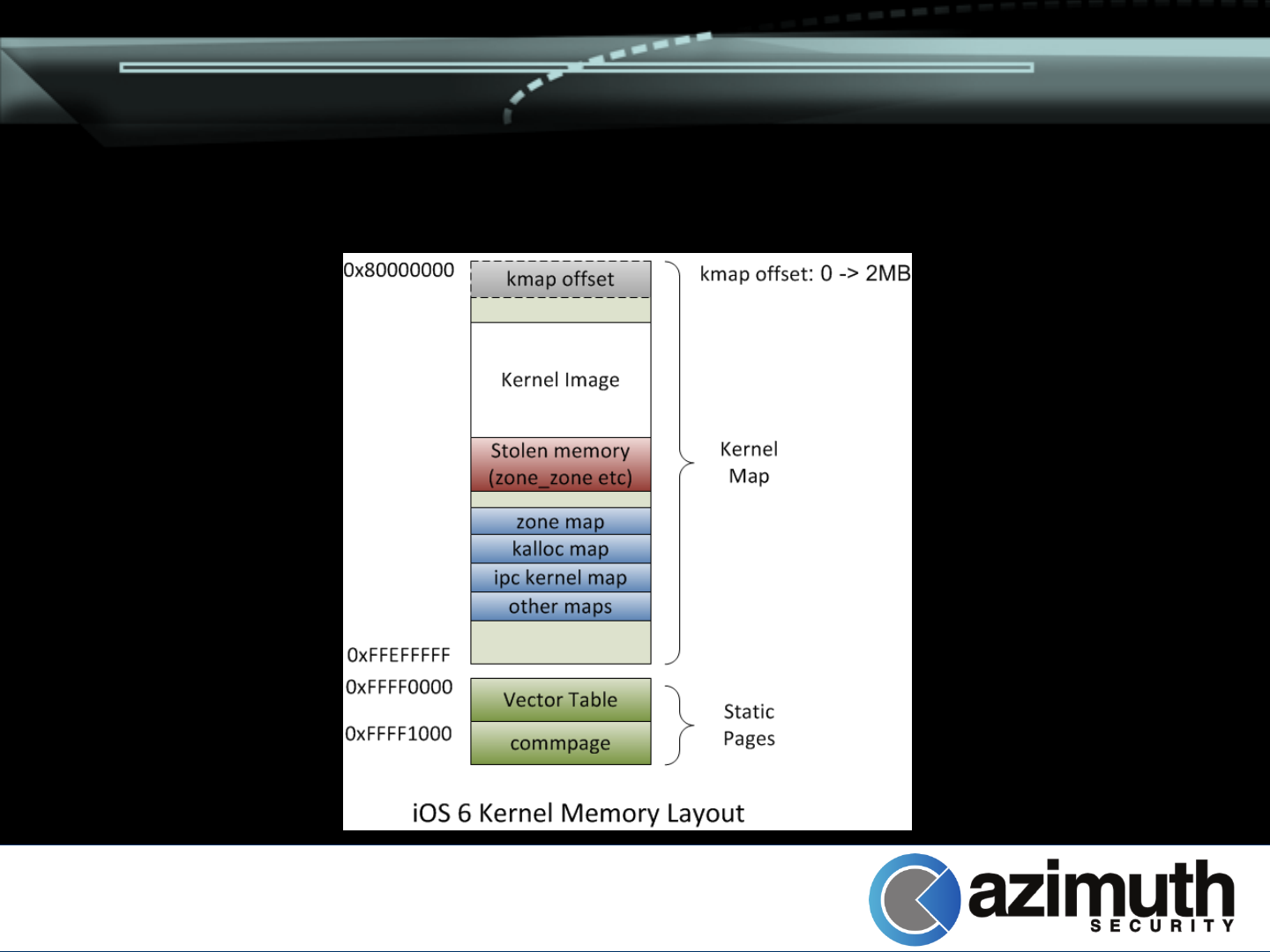
Strategy involves randomizing the base of
kernel_map
–Random 9-bit value generated right after
kmem_init( ) (which establishes kernel_map)
–Multiplied by page size
–Resulting value used as size for initial
kernel_map allocation
–9 bits = 512 different allocation size possibilities

Kernel ASLR – Kernel Map
Future kernel_map (including submap)
allocations pushed forward by random
amount
–Allocation silently removed after first garbage
collection (and reused)
Behavior can be overridden with “kmapoff”
boot parameter
Kernel ASLR – Kernel Map

Kernel Address Space Protection
Goal: Prevent NULL/offset-to-NULL
dereference vulnerabilities
Previously, kernel mapped in to user-mode
address space
NULL-dereferences were prevented by
forcing binaries to have __PAGE_ZERO
section
–Does not prevent offset-to-NULL problems

Kernel Address Space Protection
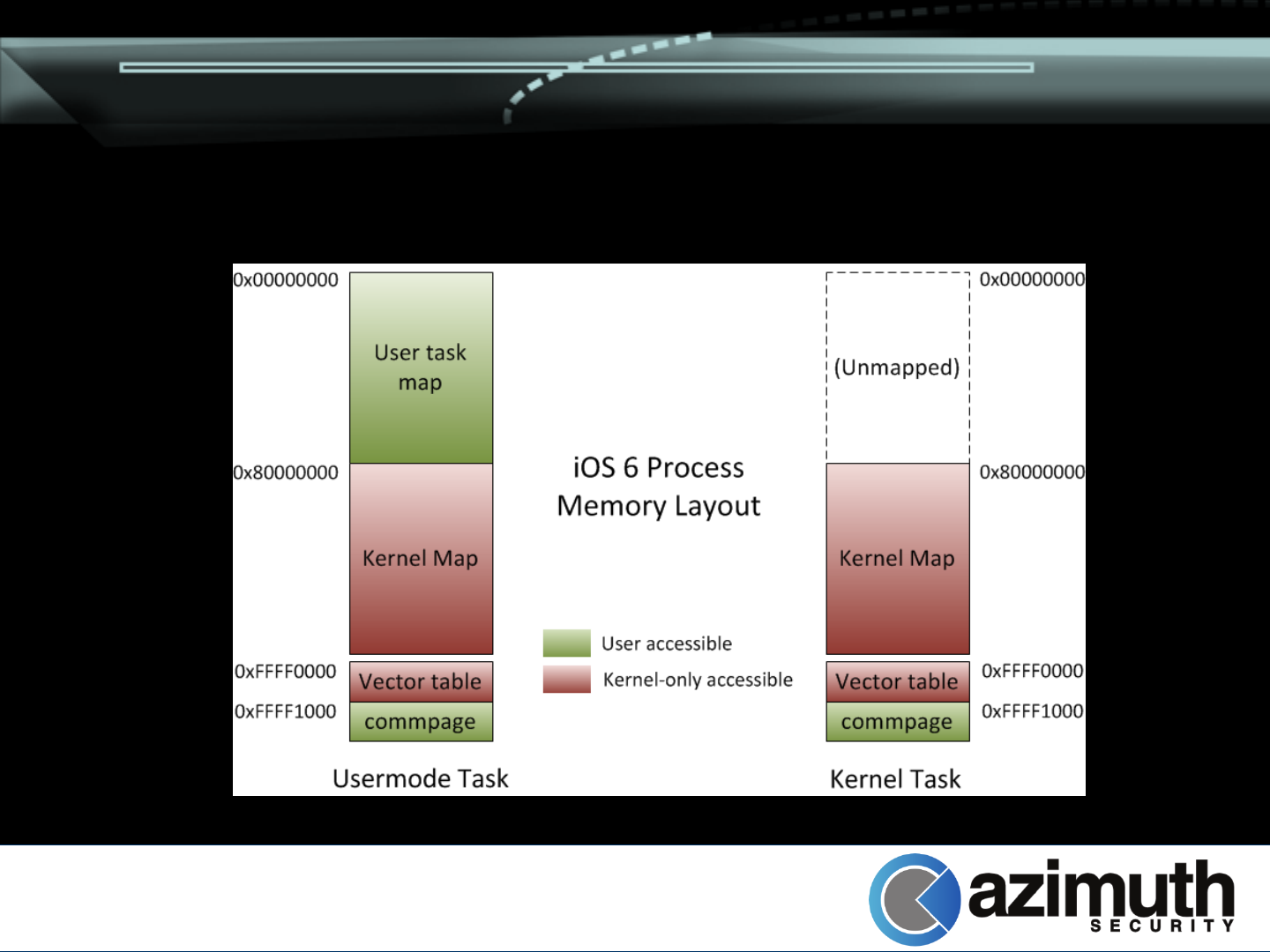
kernel_task now has its own address space
while executing
–Transitioned to with interrupt handlers
–Switched between during copyin( ) / copyout( )
User-mode pages therefore not accessible
while executing in kernel mode
Impossible to accidentally access them
Kernel Address Space Protection

Kernel Address Space Protection
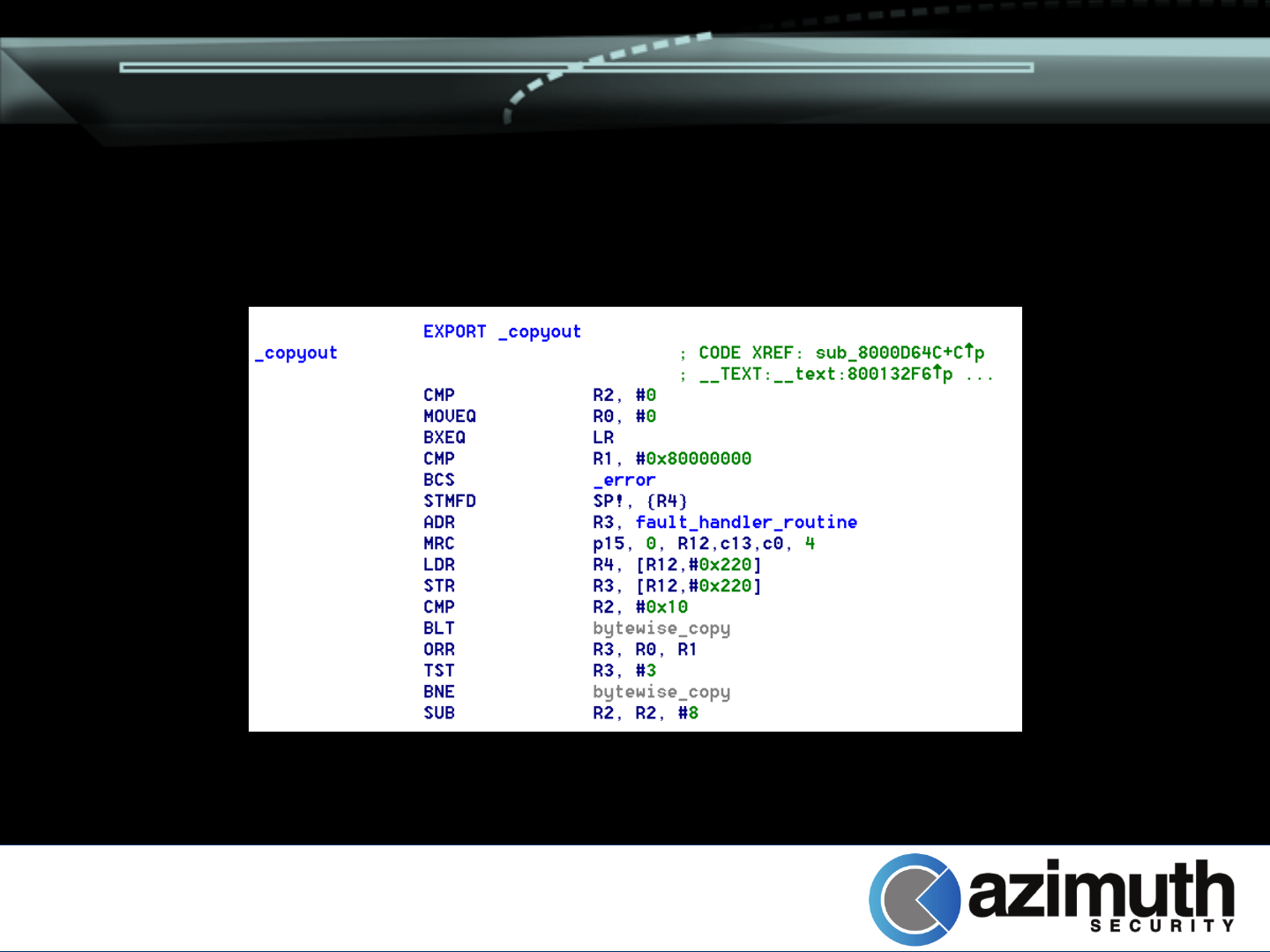
BUG – iOS 5 and earlier had very poor user/kernel
validation in copyin( ) / copyout( )
–Only validation: usermode pointer < 0x80000000
–Length not validated
Pointer + length can be > 0x80000000 (!)
–Can potentially read/write to kernel memory
Limitation: Device must have > 512M to map
0x7FFFF000
–iPad 3 / iPhone 5
Kernel Address Space Protection

Kernel Address Space Protection
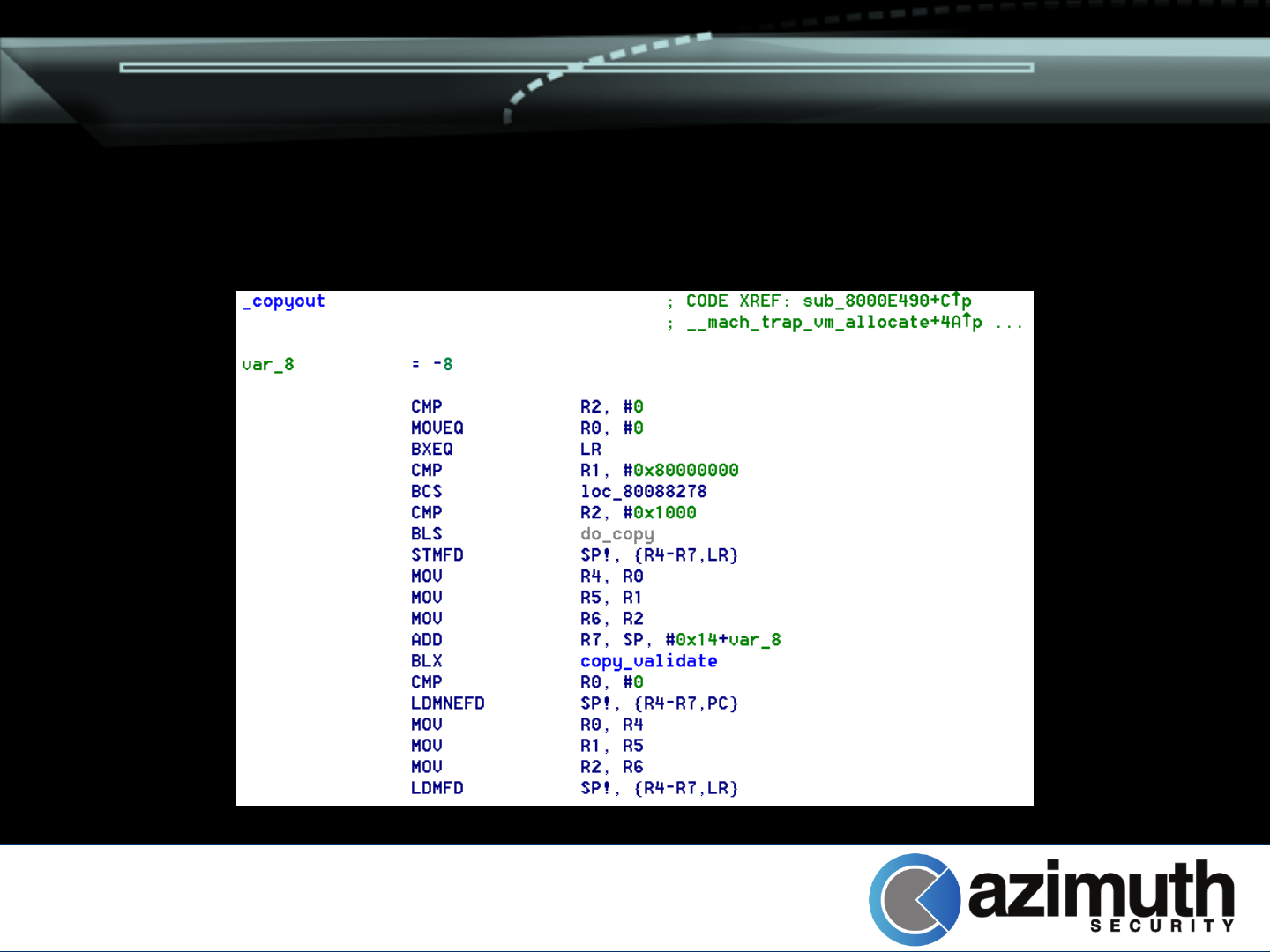
iOS 6 added security checks
–Integer overflow/signedness checks
–Conservative maximum length
–Pointer + length < 0x80000000
iOS 6 still vulnerable!
–If copy length <= 0x1000, pointer + length check
not performed
–Can read/write to first page of kernel memory
Kernel Address Space Protection

Kernel Address Space Protection
Is anything in the first page of memory?
–Initially contains kmap offset allocation, but that is
removed after first garbage collection
–Some things allocate to kernel map directly
HFS
kalloc() blocks of >= 256k
Create a pipe, specify buffers > 0x7FFFF000
Bonus: If memory is not mapped, kernel will
not panic (safely return EFAULT)

Kernel Address Space Protection
Memory is no longer RWX
–Kernel code cannot be directly patched
–Heap is non-executable
–Stack is non-executable

Kernel Attacks: Overview
Protections kill most of the known attack
strategies
–Syscall table overwrites
–Patching kernel code
–Attacking key data structures (randomized
locations)
Need something new!

Kernel Attacks: Overview
Generally, exploit will require information
leaking followed by corruption
Corruption primitives dictate strategy
–Write in to adjacent buffer (overflow)
–Write to relative location from buffer
–Write to arbitrary location
Different types of primitives will be
considered separately

Kernel Attacks: KASLR
Leaking the kernel base is really useful
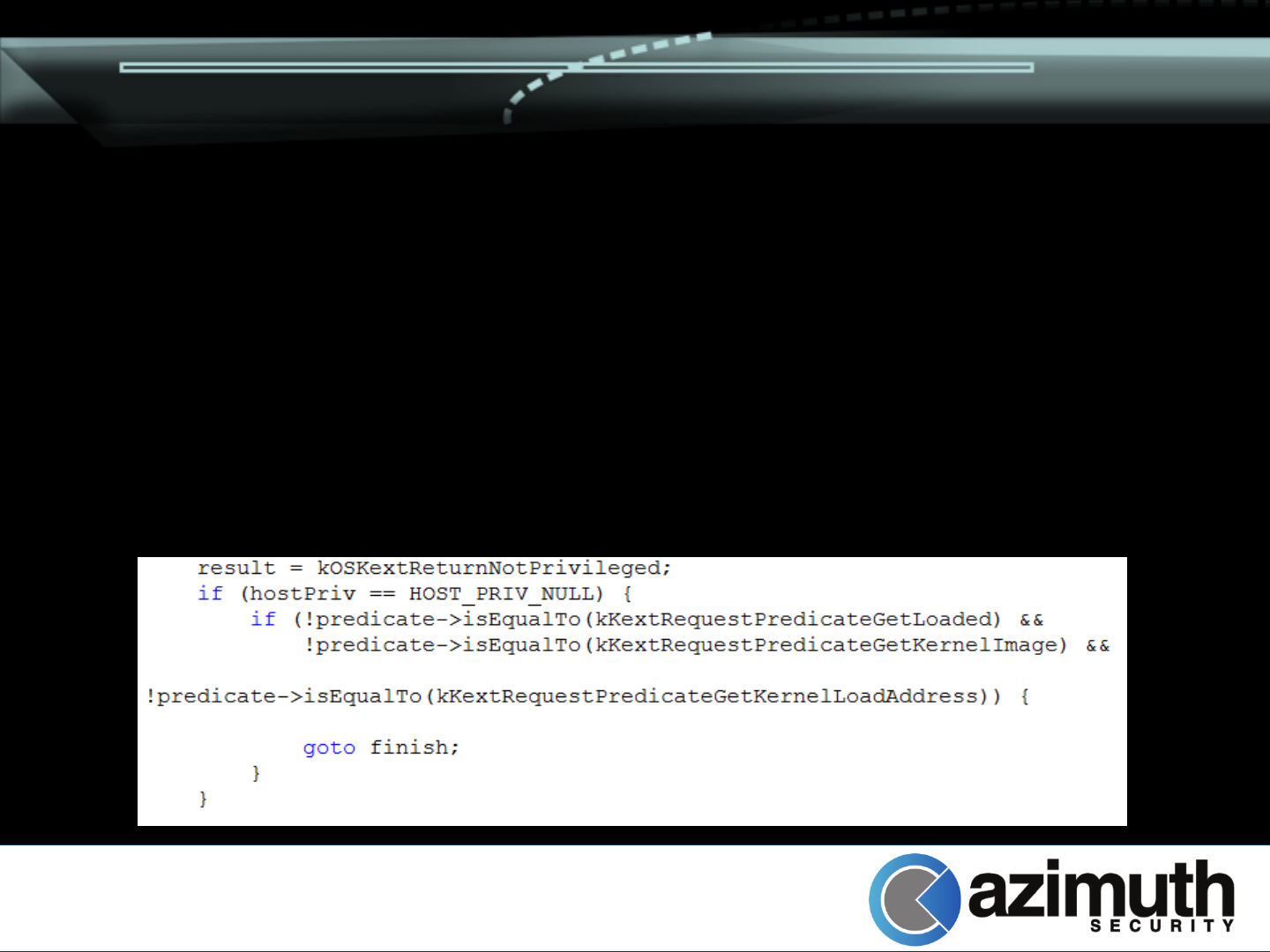
Kext_request( ) allows applications to
request information about kernel modules
–Divided into active and passive operations
Active operations (load, unload, start, stop,
etc.) require privileged (root) access
–Secure kernels (i.e. iOS) remove ability to load
kernel extensions
Kernel Attacks: KASLR
Passive operations were originally
unrestricted in < iOS 6
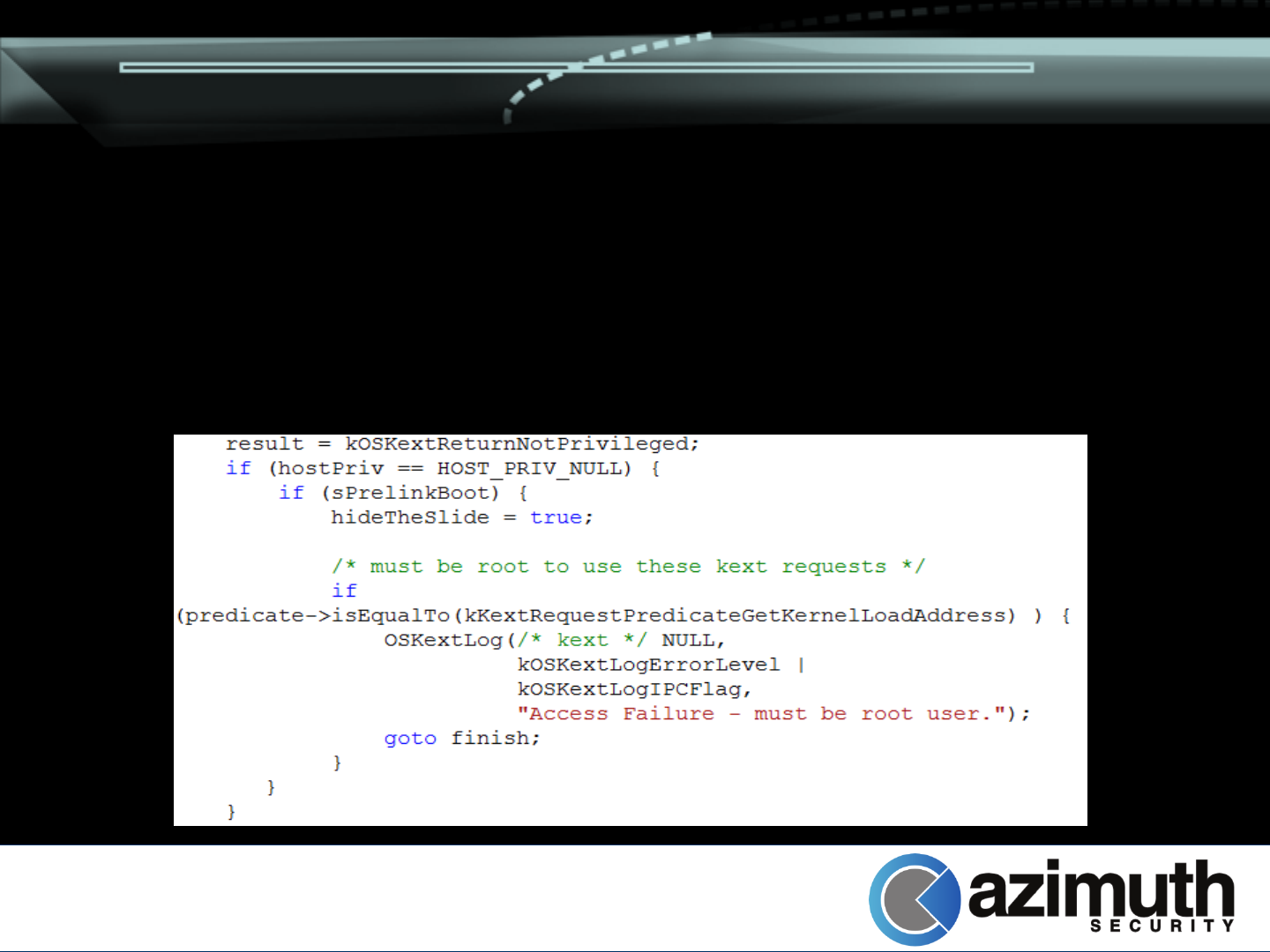
–Allowed unprivileged users to query kernel and
module base addresses
Kernel Attacks: KASLR
iOS 6 inadvertently removed some limitations
–Only load address requests disallowed

Kernel Attacks: KASLR
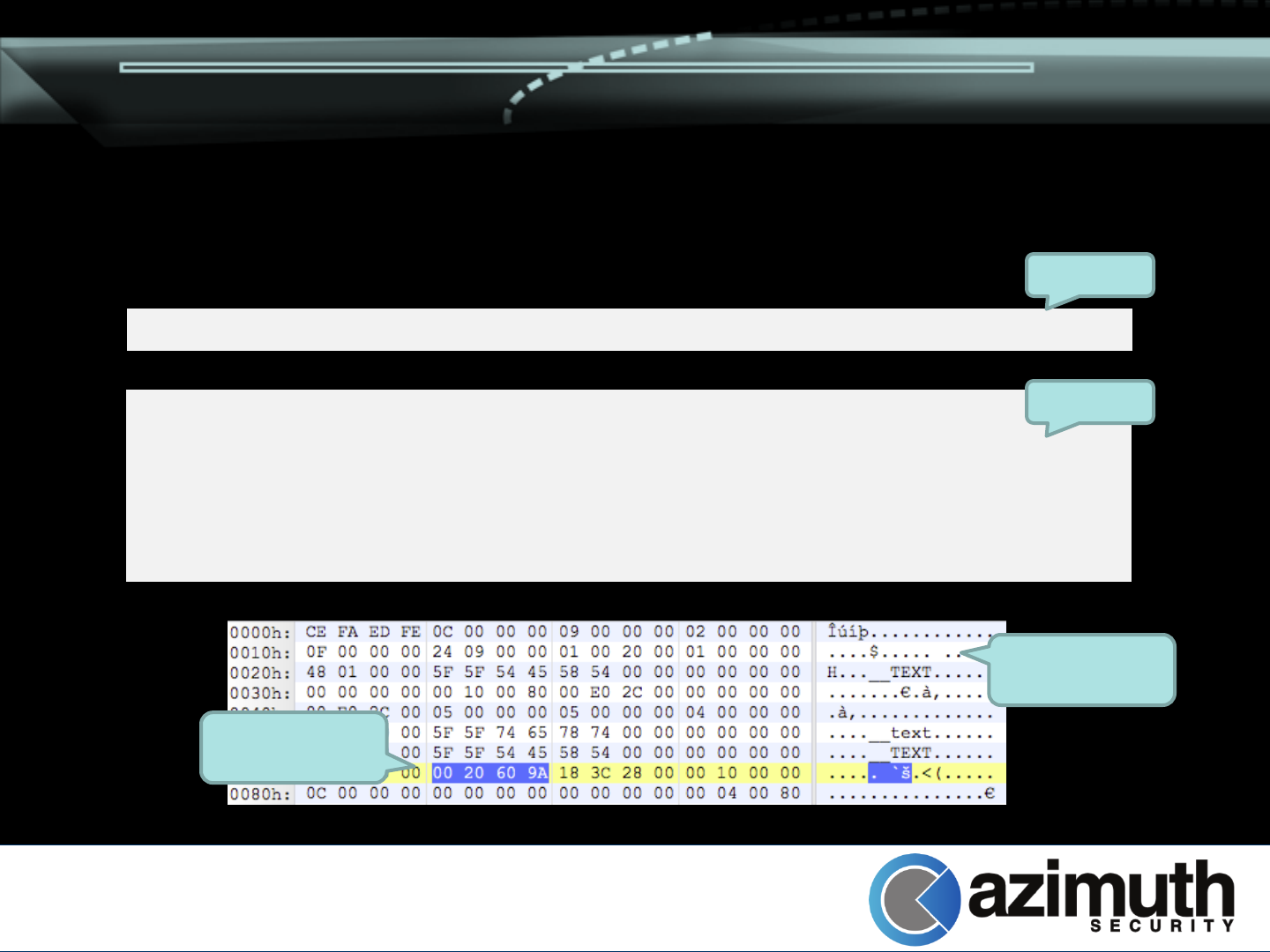
We can use
kKextRequestPredicateGetLoaded
–Returns load addresses and mach-o header
dumps (base64 encoded)
–Load address / Mach-O segment headers are
obscured to hide ASLR slide
–Mach-O section headers are not!
–Reveals virtual addresses of loaded kernel
sections
Kernel Attacks: KASLR
<dict><key>Kext Request Predicate</key><string>Get Loaded Kext Info</string></dict>
<dict ID="0"><key>__kernel__</key><dict
ID="1"><key>OSBundleMachOHeaders</key><data
ID="2">zvrt/gwAAAAJAAAAAgA…AAAAAAAAAAAAAAAAAAAAAAAAAAAAAAAAAMhQ
CIAAAAAAJgAAABAAAAAwPDIAwEUAAA==</data>
…
<key>OSBundleLoadAddress</key><integer size="64" ID="9">0x80001000</integer>
Request
Response
Decoded kernel
macho header
Real __text
section address

Kernel Attacks: Heap Corruption
Standard heap overflow tricks no longer work
–Overwriting freelist pointer results in validation
step failing
Exploitation requires new strategies
–Information leak to find heap address/cookies
–Control structure manipulation
Depends on corruption primitives

Kernel Attacks: Heap Overflows
Overflowing metadata is useful
–Various control structures can be targeted instead
–Requires some heap grooming (may or may not
be difficult depending on block size)
Various heap attacking primitives can be
combined to gain code execution
Kernel Attacks: Heap Overflows
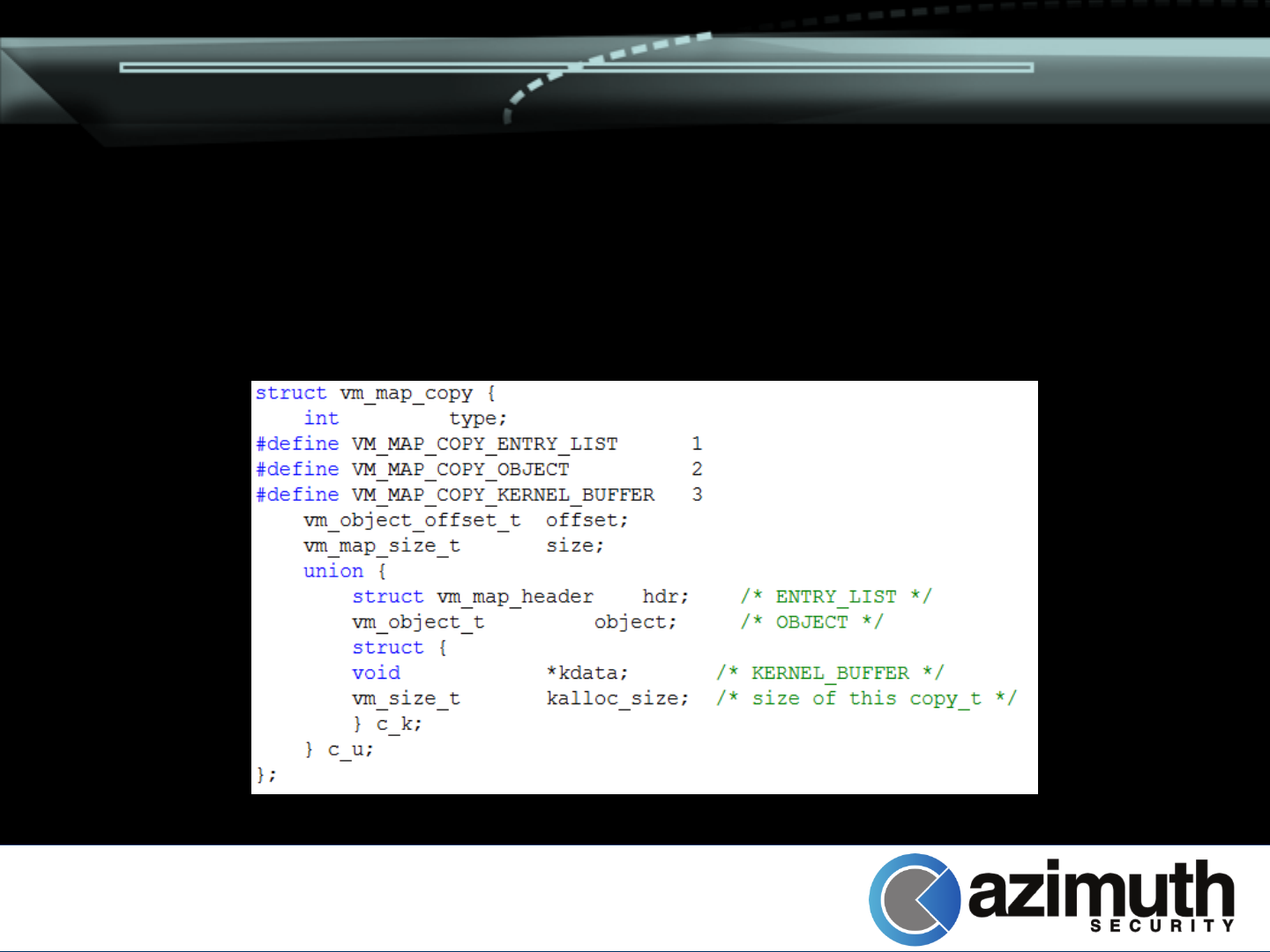
Introducing vm_map_copy_t

Kernel Attacks: Heap Overflows
Kernel buffers allocated by vm_map_copyin()
if size < 4096
Creating them is easy
–Send messages to a mach port with
ool_descriptors in them
–They are persistent until the message is received
Corrupting these structures are useful for
information leaking and exploitation

Kernel Attacks: Heap Overflows
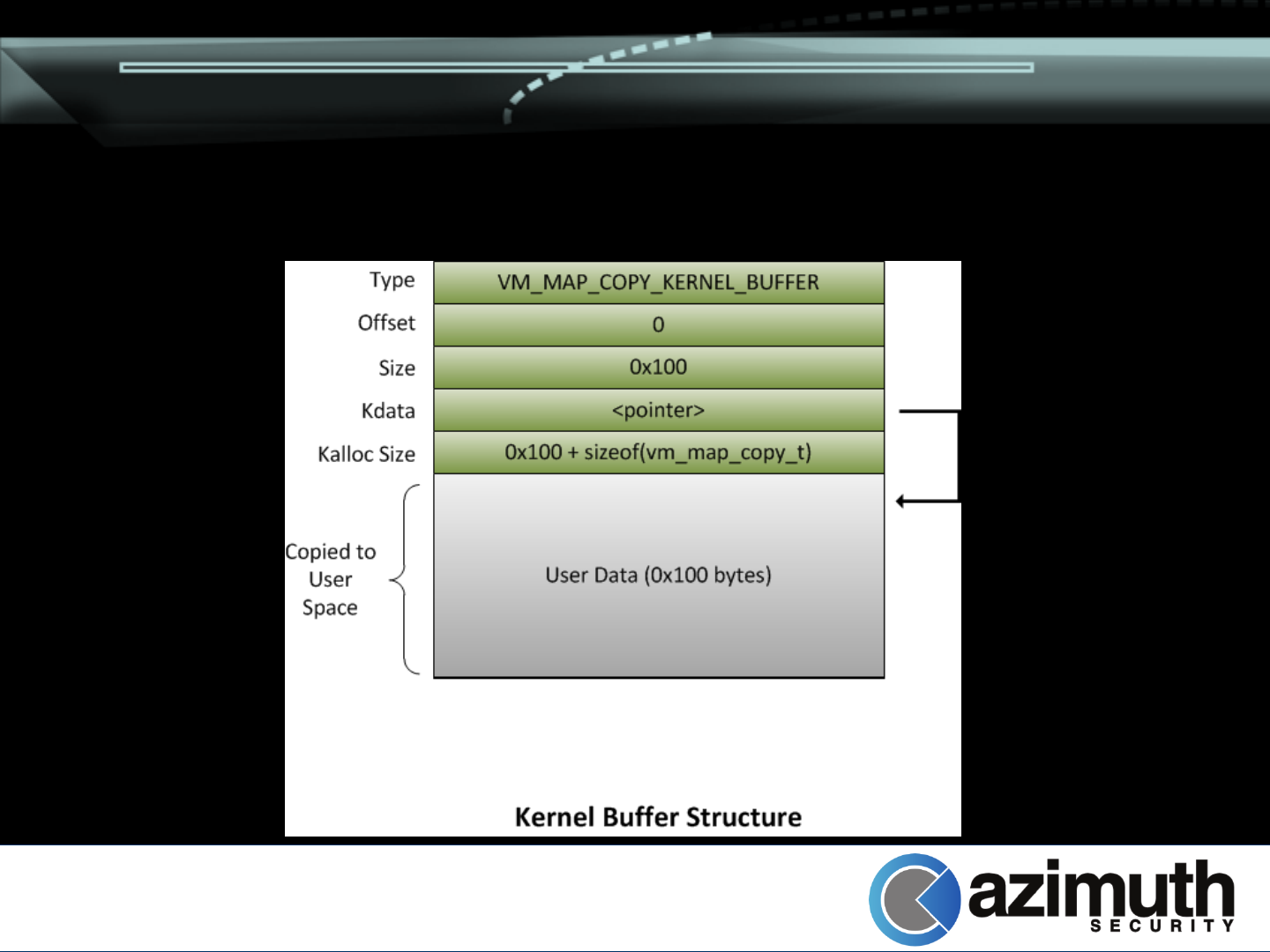
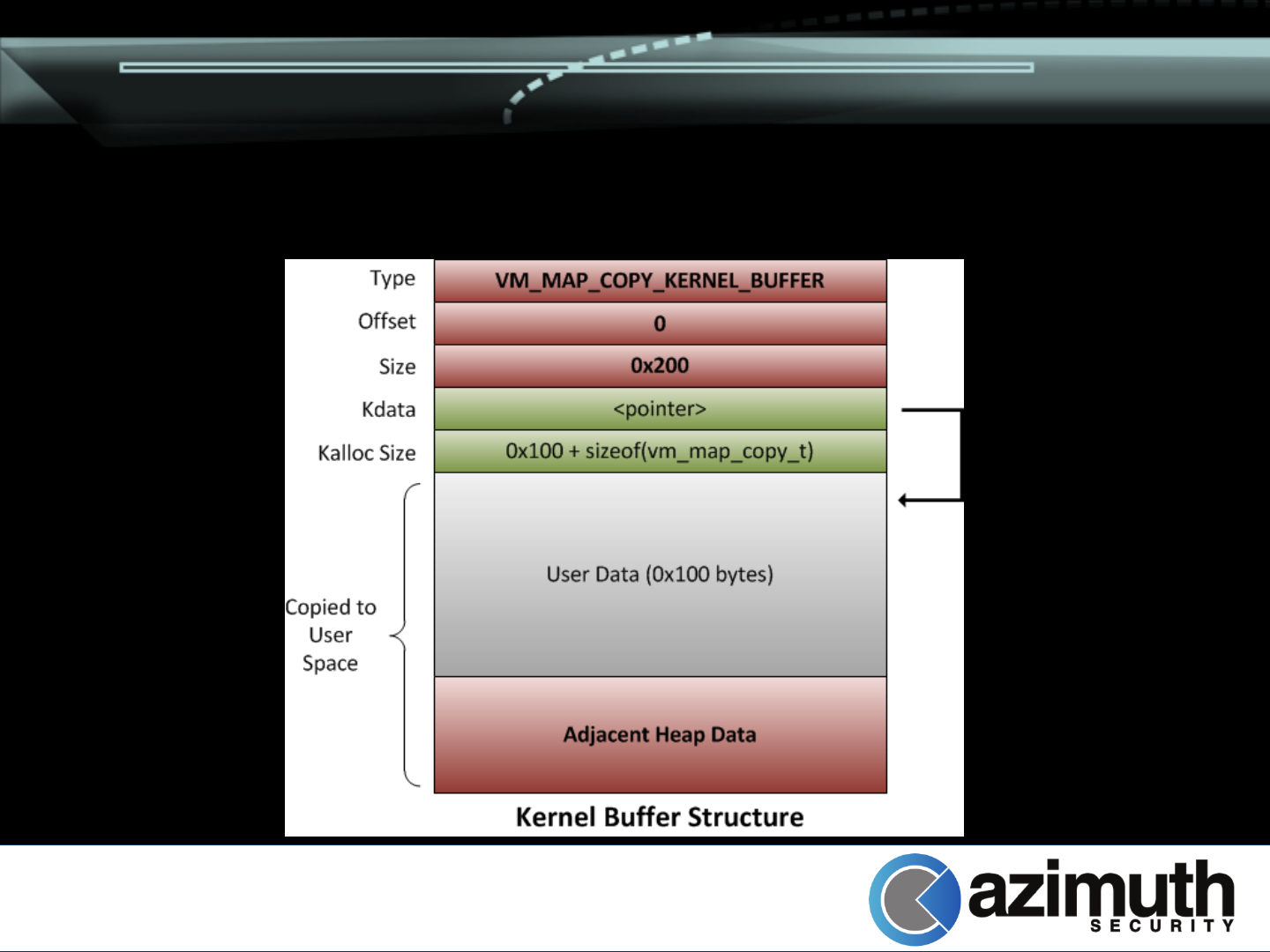
Primitive 1: Adjacent Disclosure
–Overwrite size parameter of vm_map_copy_t
–Receive the message corresponding to the map
–Returns memory past the end of your allocated
buffer
Bonus: Overwritten size is not used in kfree()
–No side effects
Kernel Attacks: Heap Overflows
Kernel Attacks: Heap Overflows

Kernel Attacks: Heap Overflows
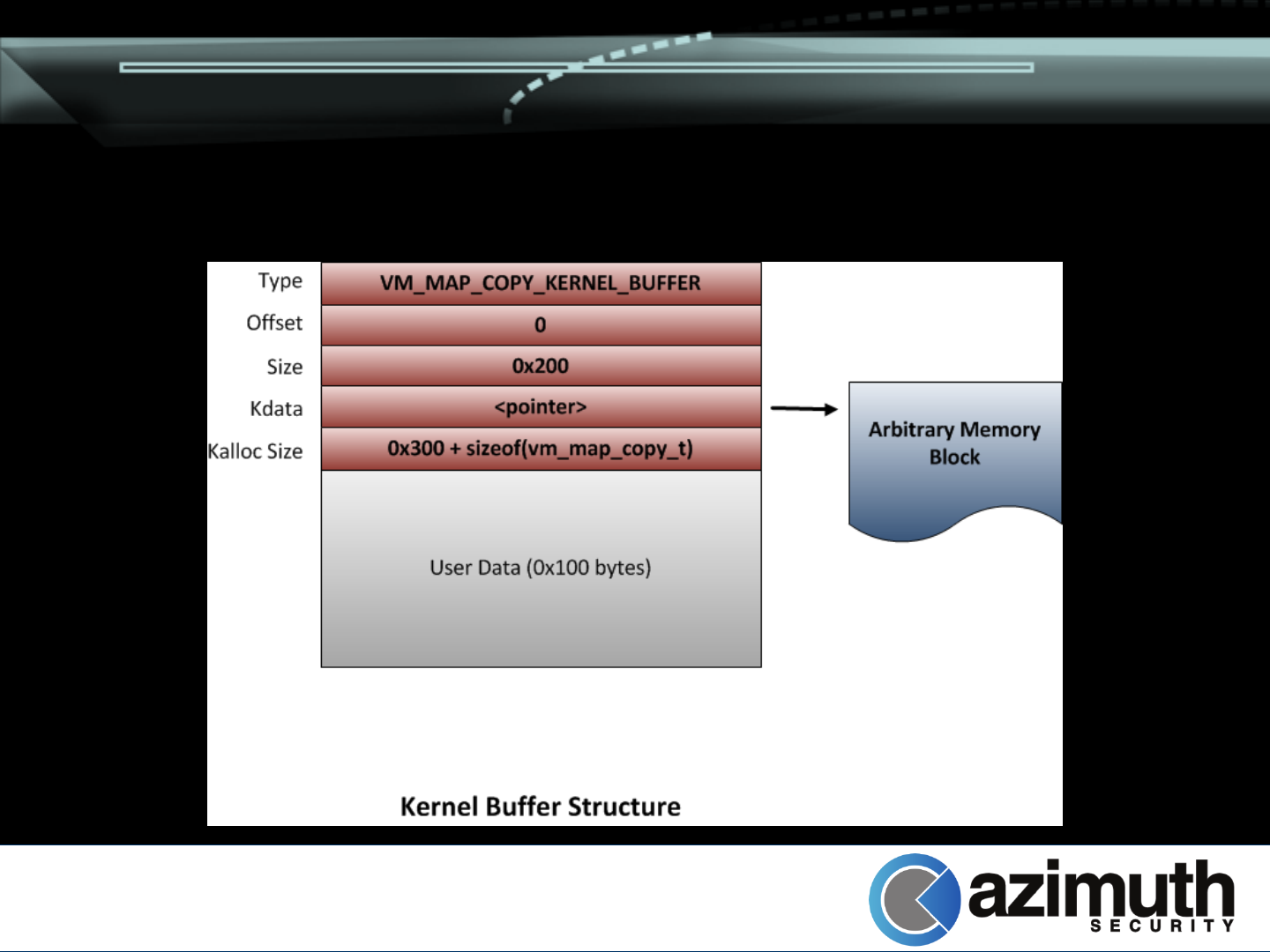
Primitive 2: Arbitrary Memory Disclosure
–Overwrite size and pointer of adjacent
vm_map_copy_t
–Receive message, read arbitrary memory from
kernel
No side effects
–Data pointer (cpy_kdata) is never passed to
kfree() (the vm_map_copy_t is)
–Leave kalloc_size alone!

Kernel Attacks: Heap Overflows
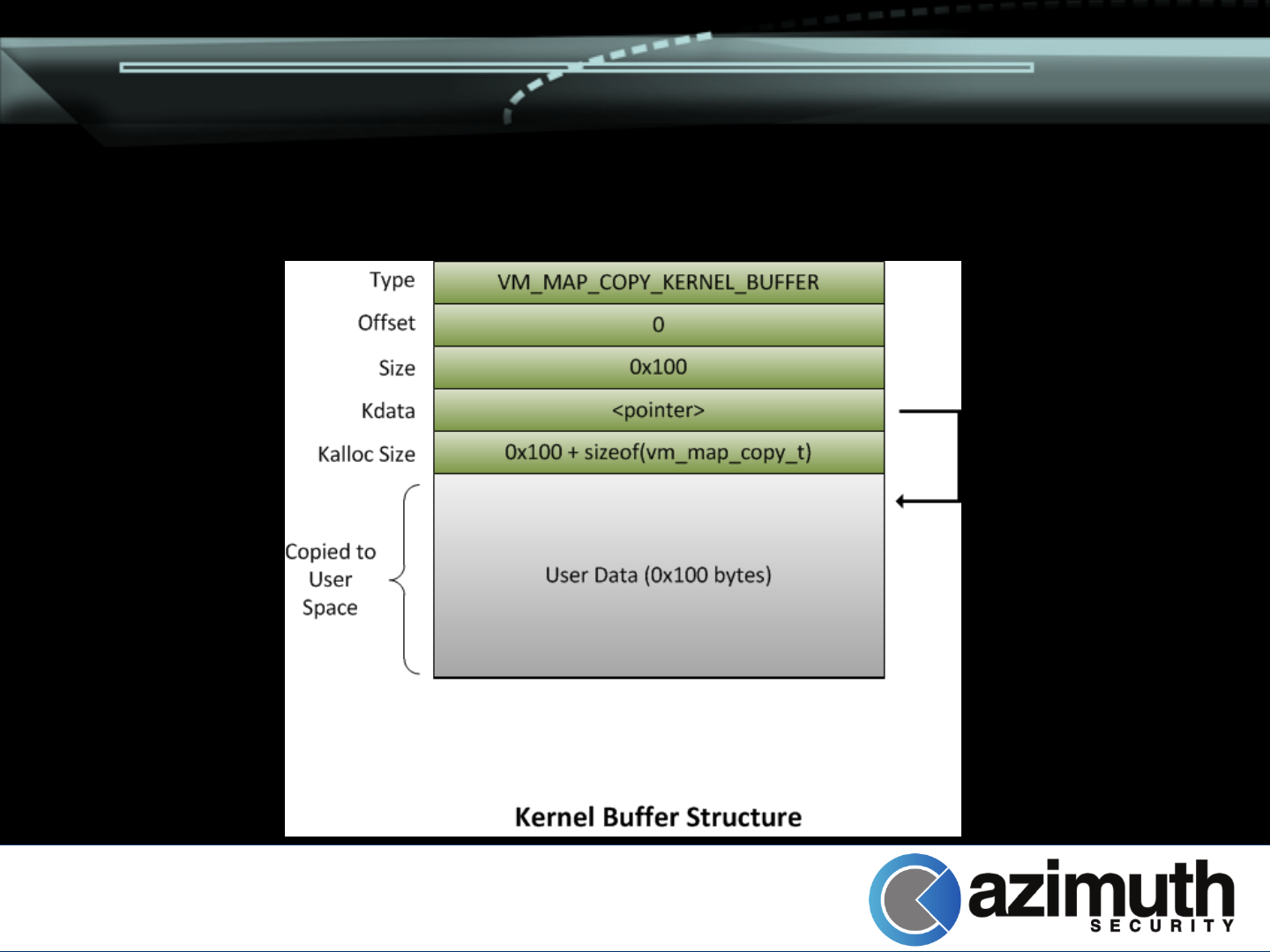
Primitive 3: Extended Overflow
–Overwrite kalloc_size with larger value
–Passed to kfree() – block entered in to wrong
zone (eg. kalloc.256 instead of kalloc.128)
–Allocate block from poisoned zone
–Profit
Kernel Attacks: Heap Overflows
Kernel Attacks: Heap Overflows

Kernel Attacks: Heap Overflows
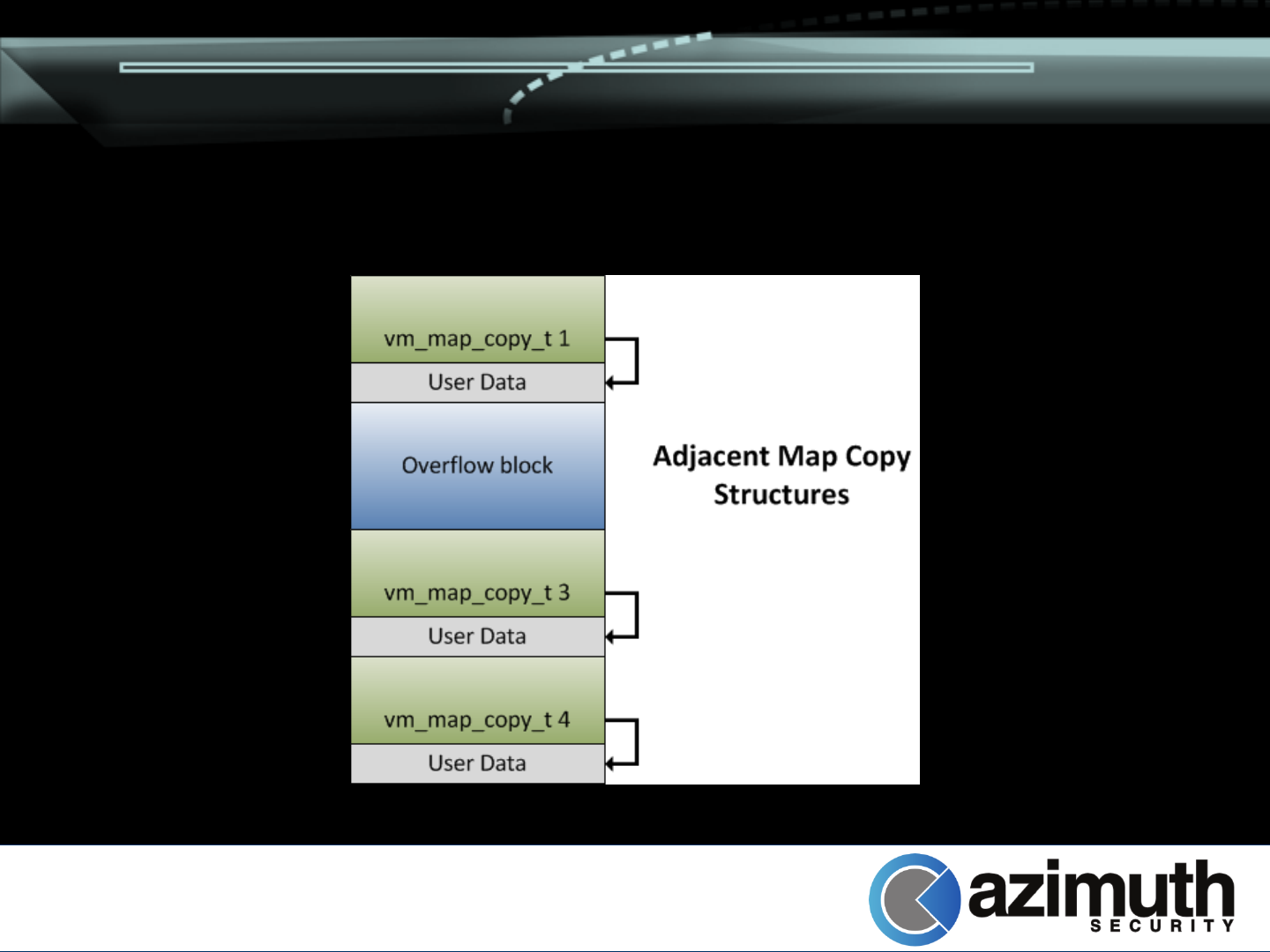
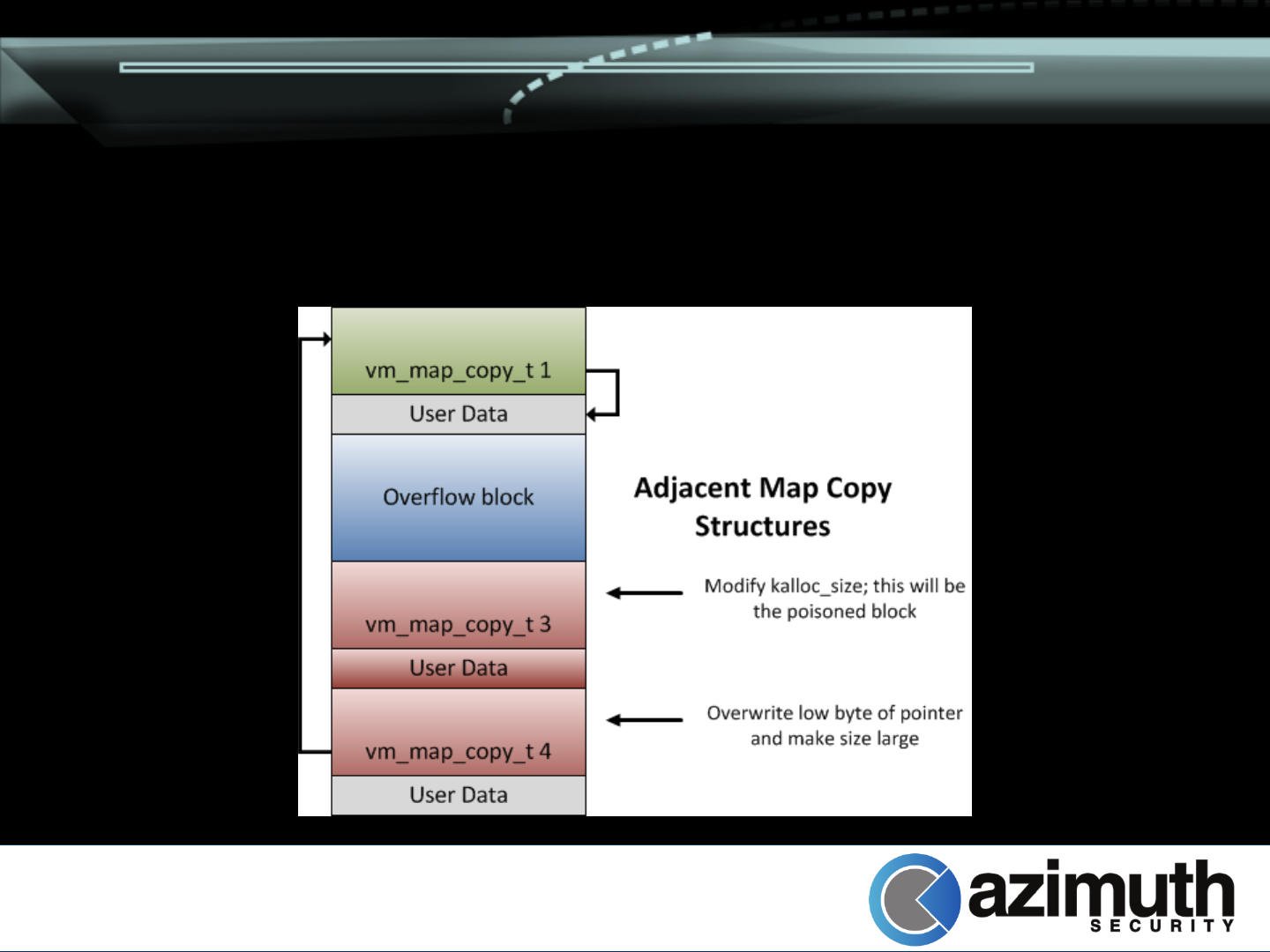
Primitive 4: Find our own address + Overflow
–Mix and match primitive 1 and 3
–Overwrite one whole vm_map_copy_t, changing
kalloc_size to be suitably large
–Overflow in to adjacent vm_map_copy_t, partially
overwriting pointer / length
–Free second copy (revealing pointers to itself)
–Free first copy, creating poisoned kalloc block at
known location
Kernel Attacks: Heap Overflows
Kernel Attacks: Heap Overflows

Conclusion
iOS 6 mitigations significantly raise the bar
–Many of the old tricks don’t work
–A variety of bugs likely to be (reliably)
unexploitable now
Presented strategies provide useful
mechanisms for exploiting iOS 6
Thanks!
