Math Guide
User Manual:
Open the PDF directly: View PDF  .
.
Page Count: 17
Table of Contents
1Introduction .................................................................. Page 3
2Derivative Tricks .............................................................. Page 4
xn.................................................................... Page 4
sin & cos cycles ......................................................... Page 8
3Everything About Limits ..................................................... Page 9
Direct Substitution ...................................................... Page 9
Fractions .............................................................. Page 9
e.................................................................... Page 10
Infinity ................................................................ Page ?
Trigonometric .......................................................... Page ?
Integral ............................................................... Page ?
Derivative ............................................................. Page ?
Sequence .............................................................. Page ?
4Ciphering & Mathbowl Tricks ................................................ Page 13
5Various Forgettable Topics from Calculus .................................... Page 14
Linear Approximation (Differentials) ....................................... Page ?
Inverse Functions ....................................................... Page ?
Average Value vs. Average Rate of Change ................................. Page ?
Cross-sections .......................................................... Page ?
Inverse Trigonometric Functions ........................................... Page ?
Logarithmic Differentiation/Integration ..................................... Page ?
8Obscure Topics from Calculus ................................................ Page 15
Euler’s Method ......................................................... Page ?
Propagated Error ....................................................... Page ?
Marginal Cost .......................................................... Page ?
Epsilon-Delta Definition of a Limit ........................................ Page ?
Page 2
Introduction
Here’s a bunch of tournament techniques and knowledge you can use. It’s a work in progress
as of now. I’ll try to update it regularly. Also, feel free to skim around, since you might
know a lot of it already.
Enjoy! Sweep!
Page 3

Derivative Tricks
1xn
Differentiating xn
Know these three facts:
•The nth derivative of xnis n!
•The (n−1)th derivative of xnis n!·x
•The (n+ 1)th derivative of xnis 0
Memorizing this is extremely useful for ciphering/mathbowl and will save time on individual
tests. Example:
Example 1
What is the 69th derivative of x70?
Answer: 70! ·x
Example 2
What is the 70th derivative of x70?
Answer: 70!
Example 3
What is the 71th derivative of x70?
Answer: 0
Example 4
What is the 72th derivative of x70?
Answer: 0
Example 5
What is the 89th derivative of x70?
Answer: 0
Page 4

Notice that for any ngreater than n+1, the derivative of xnwill also be 0. Keep that in mind.
Practice Problem 1
What is the 30th derivative of x31?
Practice Problem 2
What is the 10th derivative of x11?
Practice Problem 3
What is the 6th derivative of x5?
Practice Problem 4
What is the 77th derivative of x77?
What about something like 39th derivative of x70
There is an easy trick to this too!
Page 5

Differentiating xnless than (n−1) times
Suppose αis a number less than (n−1):
The αth derivative of xnis n·(n−1) ·(n−2) ·. . . ·(n−α+ 1) ·x(n−α)
This may look intimidating at first, but looking at a few examples will make it obvious
how simple it is:
Example 1
What is the 50th derivative of x70?
70 ·69 ·68 ·. . . ·(70 −50 + 1) ·x70−50
= 70 ·69 ·68 ·. . . ·21 ·x20
Example 2
What is the 20th derivative of x50?
50 ·49 ·48 ·. . . ·31 ·x30
Example 3
What is the 24th derivative of x78?
78 ·77 ·76 ·. . . ·55 ·x54
Example 4
What is the 19th derivative of x44?
44 ·43 ·42 ·. . . ·26 ·x25
Example 5
What is the 5th derivative of x10?
10 ·9·8·7·6·x5
Page 6

Try some out yourself. Finding the pattern is key here. Practice with smaller derivatives
if you are having trouble with this.
Practice Problem 1
What is the 30th derivative of x42?
Practice Problem 2
What is the 10th derivative of x57?
Practice Problem 3
What is the 6th derivative of x12?
Practice Problem 4
What is the 77th derivative of x99?
Page 7

2sin &cos cycles
Differentiating sin x n times
Divide nby 4, and find the remainder, r. If:
r= 0, fn= sin x
r= 1, fn= cos x
r= 2, fn=−sin x
r= 3, fn=−cos x
Example 1
What is the 64th derivative of sin x?
64/4 leaves remainder 0, so it is sin x
Example 2
What is the 33th derivative of sin x?
33/4 leaves remainder 1, so it is cos x
Example 3
What is the 74th derivative of sin x?
74/4 leaves remainder 2, so it is −sin x
Example 4
What is the 19th derivative of sin x?
19/4 leaves remainder 3, so it is −cos x
Example 5
What is the 25th derivative of sin x?
25/4 leaves remainder 1, so it is cos x
For cos x, it’s the same as sin x, but one forward. So, what I usually do is, if asked to
do 6th derivative of cos x, I just do 7th derivative of sin xinstead. General case: The nth
derivative of cos xis the (n+ 1)th derivative of sin x. If you would rather memorize the ones
for cos x, go ahead and derive them yourself!
Page 8
Everything About Limits
Here are some limit techniques:
1 Limits by Direct Substitution
Plug in the x-value.
Example:
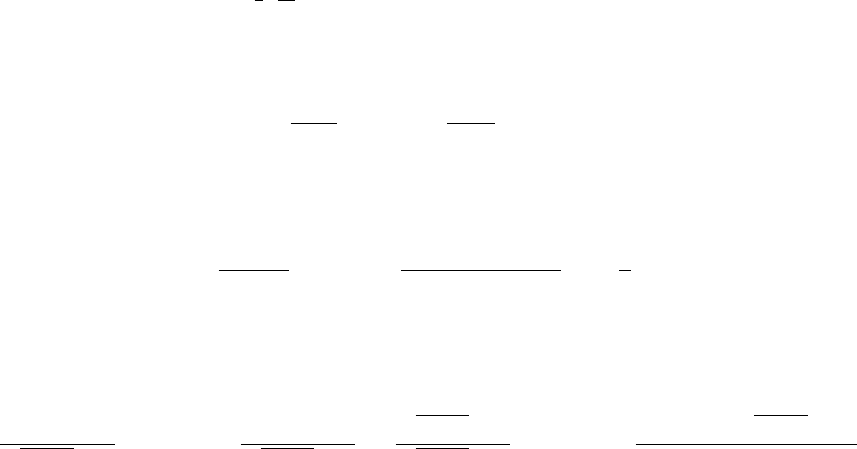
lim
x→3(23x) = 69
2 Limits with Fractions
Plug x-value, if indeterminate (0
0,∞
∞,∞−∞,00,1∞,∞0), use one of following:
L’Hopital’s Rule: Differentiate top and bottom. (No quotient rule).
Example:
lim
x→0sin x
x⇒lim
x→0cos x
1⇒1
Factoring: Find the common factor.
Example:
lim
x→0ex−1
e2x−1⇒lim
x→0
(ex−1)
(ex−1)(ex+ 1)!⇒1
2
Rationalization: You multiply by the conjugate.
Example:
lim
x→−1 x+ 1
√x+ 5 −2!⇒lim
x→−1 x+ 1
√x+ 5 −2! √x+ 5 + 2
√x+ 5 + 2!⇒lim
x→−1 (
x+ 1) ·(√x+ 5 + 2)
x+ 1 !⇒4
Page 9
3 Limits Involving Number e
Limit Definition of Derivative
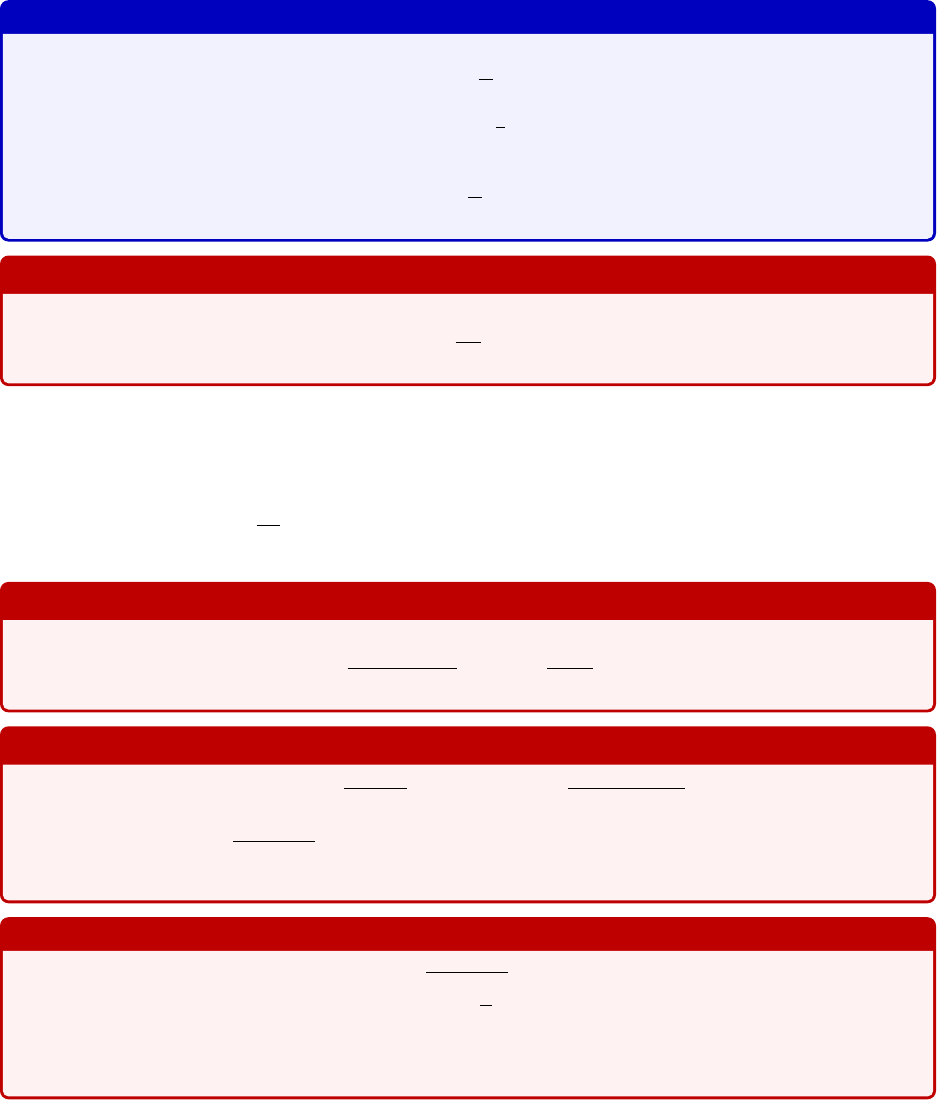
lim
n→∞ 1 + 1
nn
=e
lim
n→0(1 + n)1
n=e
lim
x→∞ 1 + r
xtx
=ert
Example 1
lim
x→∞ 1 + 1
2x3x
=e3/2
4 Limits at Infinity
Use dominance (Note: √x2=−xif approaching −∞) :
Example 1
lim
n→∞
x6+ 18x3
2x2+ 48x8⇒lim
n→∞
x6
48x8= 0
Example 2
lim
n→−∞ x−√x2+ 4 ⇒lim
n→−∞ x−√x2+ 4x+ 4 ⇒
lim
n→−∞ x−q(x+ 2)2⇒lim
n→−∞ x−(−(x+ 2)) ⇒lim
n→−∞ 2x−2⇒DNE
Practice Problem 1
lim
x→−∞
sx2−4
3x+2+x
Answer: 8/3
Page 10
5 Trigonometric Limits
Know that sin xand cos xoscillate between 1 and -1. This is important when taking domi-
nance into account. If a limit ends in oscillation, it is DNE. If the trig fraction results in 0/0
L’hopital’s is possible.
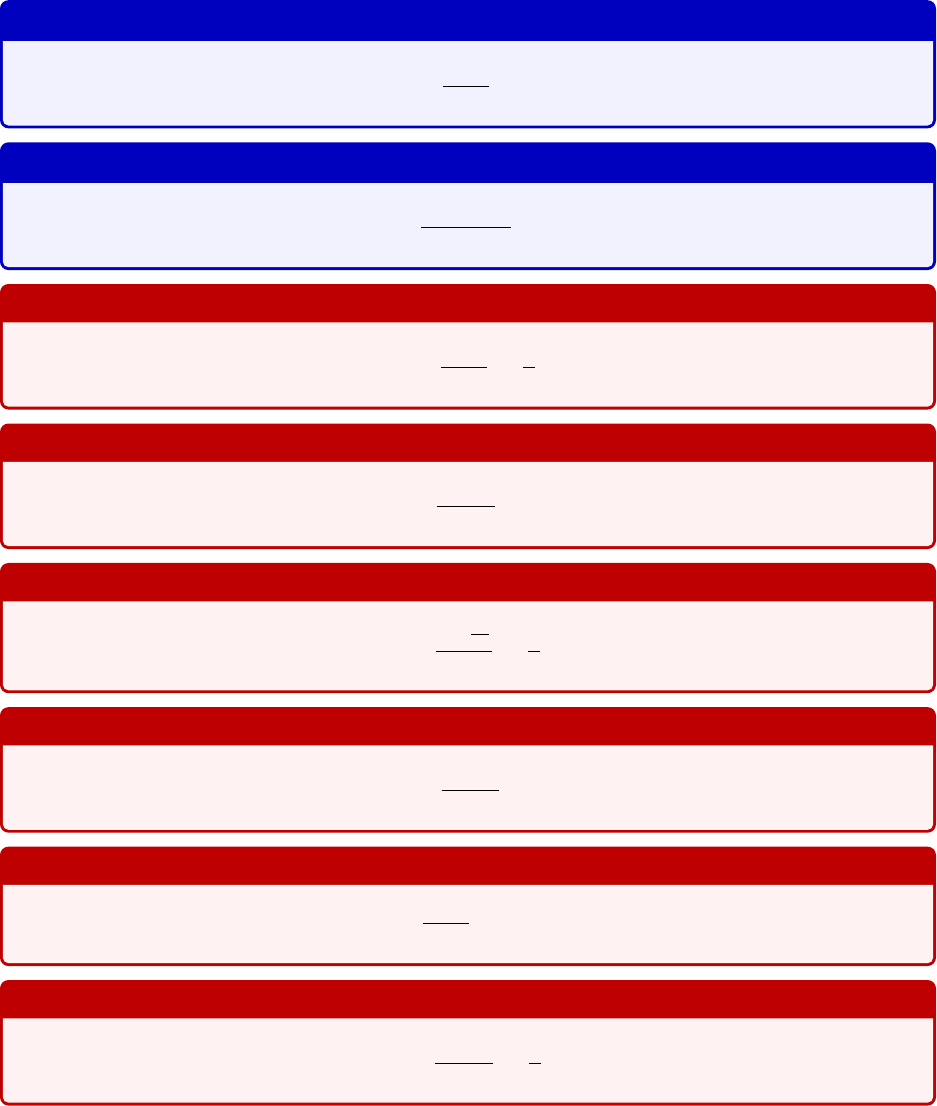
sin x/x
lim
n→0
sin x
x= 1
1 - cos x/x
lim
n→0
1−cos x
x= 0
Example 1
lim
n→0
sin x
2x=1
2
Example 2
lim
n→0
sin 5x
x= 5
Example 3
lim
n→0
sin 2x
7
x=2
7
Example 4
lim
n→∞
sin 2x
x= 0
Example 5
lim
n→∞
x
sin x=DNE
Example 6
lim
n→0
sin 2x
sin 5x=2
5
Page 11

Extra 1
Evaluate: lim
x→0tanx = 0
Extra 2
lim
x→∞ arctan(x) = π
2
6 Limit Definition of a Derivative (and the Alternate)
Limit Definition of Derivative
Regular ⇒lim
h→0
f(x+h)−f(x)
h=f0(x)
Alternate ⇒lim
x→α
f(x)−f(α)
x−α=f0(α)
lim
x→αf(x) means that lim
x→α+f(x) and lim
x→α−
f(x)
Example 1
lim
h→0
f0(x+h)−f0(x)
h=f00(x)
Example 2
lim
x→α
sin(x)−sin(α)
x−α= cos α
Example 3
Evaluate limx→5x+5
x−5.
Solution:
DNE, since lim
x→5+
x+ 5
x−5=∞and lim
x→5−
x+ 5
x−5=−∞ are not equal
Page 12

Example 4 (Really Good Problem)
Find αsuch that limx→0tan(αx+π/4)−1
x= 4
Solution:
lim
x→0
tan(αx +π/4) −1
x⇒lim
x→0α·tan(αx +π/4) −1
αx ⇒αf0(π/4) ⇒αsec2(π/4) ⇒α·2
Therefore, α·2 = 4, so α= 2
Example 5 (Another Really Good Problem)
Find limx→2f(x)−f(2)
√x−√2
Solution:
lim
x→2
f(x)−f(2)
√x−√2·√x+√2
√x+√2⇒lim
x→2
f(x)−f(2)
x−2·(√x+√2) ⇒f0(2) ·(√2 + √2)
= 2√2f0(2)
Note: for limit definition of integral, go to Various Forgettable Topics section
7 Change of Limit
If all nothing else works, this is your last technique to rely on. The trigger to use this is if
you see a fraction, typically 1
x.
Know that:
If u=1
x,lim
x→∞ = lim
u→0
Example 1
lim
x→∞ xsin( 1
x)⇒lim
u→0
sin u
u= 1
Page 13
Ciphering & Mathbowl Tricks
Gotta go fast. Use these tricks when applicable and if you’re comfortable with them. Here:
Solving answer while saying it - ex: f(x) = xcos x, find f0(x)
you can raise your hand immediately and solve it without writing it down. (mathbowl trick)
Skipping derivatives - ex: f(x)=3x2+ 2x+ 1, find f00(x)
don’t bother with first derivative, go straight to second (use the xnderivative trick)
you can also use this for inflection point questions
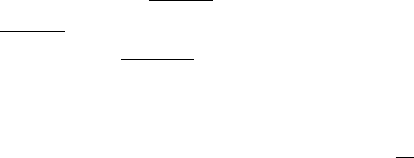
Circle - ex: Evaluate R1
−1√1−x2dx
If you see R√k−x2, it is the same as finding the area of a circle (remember circle is x2+y2=
r2and rewritten is y=√r2−x2). find radius and plug into area formula (make sure to look
at bounds, it could be a half/quarter of the circle)
Shorthand notation - write less, use y0instead of dy
dx . save like 1-2 secs. maybe even make
your own for some (like maybe t(x) instead of tan(x))
Page 14

Various Forgettable Topics
Linear Approximation (Differentials)
Practice: http://tutorial.math.lamar.edu/Problems/CalcI/Differentials.aspx
Ex: Compute the differential for y=x2as x changes from 1 to 1.01
Answer: dy
dx = 2x⇒dy = 2xdx ⇒dy = 2(1)(.01) ⇒dy = 0.02
You just compute derivative, but multiply by dx at the end. Plug in “integer” value of x
(i.e. x = 1) for x, and ∆xfor dx.
Inverse Functions (f−1(x))
Practice: http://tutorial.math.lamar.edu/Problems/CalcI/InverseFunctions.aspx
Find the inverse function by swapping x and y.
If it is not easy to differentiate, do the following:
Let g(x) = f−1(x) and g(f(x)) = x. Differentiate and solve.
Average Value vs. Average Rate of Change
Practice (Value): http://tutorial.math.lamar.edu/Problems/CalcI/AvgFcnValue.aspx
Practice (ROC): https://www.khanacademy.org/math/algebra/algebra-functions/average-rate-of-change-word-problems/
a/average-rate-of-change-review
Average Value is Rb
af(x)dx
b−a. Average ROC is f(b)−f(a)
b−a.
Cross-sections
Practice: https://www.khanacademy.org/math/ap-calculus- ab/ab-applications- of-integration- new/ab-8- 7/e/volumes-with- square-and- rectangle-cross- sections
Volume with cross-sections: Rb
aA(x)dx, where A(x) is the area of cross-section
Inverse Trigonometric Functions
Practice (Diff.): https://www.math.ucdavis.edu/~kouba/CalcOneDIRECTORY/invtrigderivdirectory/InvTrigDeriv.html
Practice (Int.): https://www.intmath.com/methods-integration/6-integration-inverse-trigonometric-forms.php
You can derive with triangle or implicit differentiation, or memorize them.
Logarithmic/Exponential Differentiation
Practice (Logs): https://www.intmath.com/differentiation-transcendental/5-derivative-logarithm.php
Practice (Expo): https://www.math.ucdavis.edu/~kouba/CalcOneDIRECTORY/logdiffdirectory/LogDiff.html
All you really have to know is derivative of logαxis 1
x·lnα and derivative of αxis αx·ln α
This can be easily derived from knowing logαx=lnx
lnα and αx=eln α·x
Quick Examples:
Differentiating logsin xxis the same as differentiating ln x
ln sin x, which you know how to do.
Differentiating xsin xis the same as differentiating eln x·sin x,which you know how to do.
Page 15
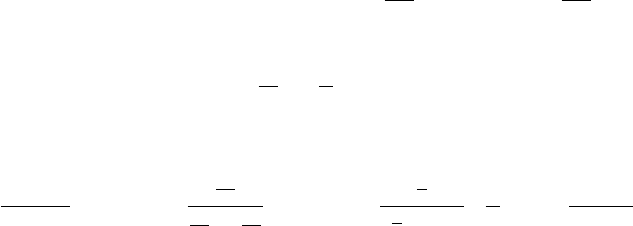
Limit Definition of Integral
Practice (Probs #9-13): https://www.math.ucdavis.edu/~kouba/CalcTwoDIRECTORY/defintdirectory/DefInt.html
Basically, lim
n→∞
∞
X
i=1
f(ci)∆xi=Zb
af(x)dx, where ∆xi=b−a
nand ci=a+b−a
n·i
Quick Example:
lim
n→∞
∞
X
i=1
(2 + 4i
n)2·4
n=Z6
2x2dx
Hard Example:
lim
n→∞
n
X
i=1
i
i2+n2= lim
n→∞
n
X
i=1
i2
n2
i2
n2+n2
n2
= lim
n→∞
n
X
i=1
i
n
(i
n)2+ 1 ·1
n=Z1
0
x
x2+ 1dx
Shell Method
Practice: https://www.khanacademy.org/math/old-ap-calculus-ab/ab-applications-definite-integrals/ab-shell-method/
a/stacy-scaling-3
Difficult to explain through text alone. I recommend looking at Khan Academy’s video on
shell method. This is a good alternative to ring/washer method sometimes when working
with difficult solids of revolution.
Page 16

Obscure Topics from Calculus
The chances these topics will show up on locals is little to none. This is just for if you’re extra.
Euler’s Method
Practice: https://www.khanacademy.org/math/ap-calculus-bc/bc-differential-equations-new/bc-7-5/e/euler-s-method
You make a chart with x, y, and dy/dx on the top. It’s difficult to explain with just text.
Watching the Khan Academy video and doing some problems is the easiest way to learn it.
Propagated Error
Practice (lol): https://www.youtube.com/watch?v=R7t9Iv_lTc8
The same thing as differentials, except you plug in the error value into dx (or whatever
variable you are with respect to).
Example: There is a square with side s = 12 inches, with a possible error of 1/64 inches.
Calculate the propagated error in computing the area of the square.
A=s2(area of square)
dA
ds = 2s
dA = 2sds
dA = 2 ·12 · ±1/64 ⇒ ±3
8in.2
Marginal Cost
Practice: http://tutorial.math.lamar.edu/Problems/CalcI/BusinessApps.aspx
Marginal cost is a joke. It’s basically find the derivative at x = some constant.
Example: A company’s production cost when producing xtoys is represented by C(x) = x2.
What is the marginal cost when x=2?
Answer: Evaluate C0(2) = 4
Epsilon-Delta Definition of Limit
Practice: https://brilliant.org/wiki/epsilon-delta-definition-of-a-limit/
This one is easy, but hard to explain. Solving some problems is usually the best way to learn
this. ACTM (from the resources file) has quite a few of these.
Page 17
