Subsea Boosting Offers Field Development Solutions E&P April 2017 Onesubsea
User Manual: Subsea Boosting Offers Field Development Solutions - E&P - April 2017 Resource Library
Open the PDF directly: View PDF  .
.
Page Count: 3
APRIL 2017
Frontier Exploration
MPD/UBD
Production
Management
Rig & Drillship
Effi ciency
Regional Report:
MEXICO
MEXICO
EPMAG.COM
April 2017 | EPmag.com
Phillip Luce, OneSubsea, a Schlumberger company
When subsea boosting was implemented in 1994,
it opened a new frontier for offshore develop-
ments. In today’s tough environment the technology
has become more impactful than it was back then. The
industry of late has been looking to innovative technol-
ogies in an unprecedented manner to overcome low
oil-price woes. Introducing innovative methodology
associated with subsea boosting technology aligned with
project specifics is becoming even more relevant during
the recent industry downturn. The value of subsea
boosting technology is now being closely associated with
a fixed development concept that takes into account
various boosting methodologies including tiebacks, well
deferral and brownfield revitalization.
Production economics
Subsea boosting will improve field economics by reducing
backpressure on the reservoir, which will increase produc-
tion rates. By allowing the pump to reduce the backpres-
sure on the reservoir, an increase in well flow rates and total
recoverable reserves results and flow assurance improve-
ments such as increasing velocity in pipelines, temperature
increases and production stability also are achieved. Deep-
water and ultradeepwater Gulf of Mexico (GoM) operators
who are embracing this technology (which has been used
in other regions for some time) stand to gain much from
both the production and economic perspectives.
At higher oil prices more wells were being drilled, flow-
lines were being added and more subsea hardware was the
norm. Today the industry downturn has helped to highlight
different approaches to field developments such as tiebacks,
well deferral and brownfield revitalization.
The tieback option and use of a subsea pump is
attractive in terms of reducing overall field develop-
ment capital costs and improved recovery rates. In the
instance of day-one boosting, net present value can
be significantly increased by implementing a phased
drilling approach, allowing the operator to see the
benefits of the pump to maintain or increase the target
production on top of saving drilling costs. In the case of
brownfield revitalization, oil production from a mature
field can be renewed by using a pump to supplement
the amount of energy to drive the reservoir production.
Business case to accelerate production
This better understanding of economically viable
alternatives has led to customizing the methodology
associated with each application of subsea boosting. For
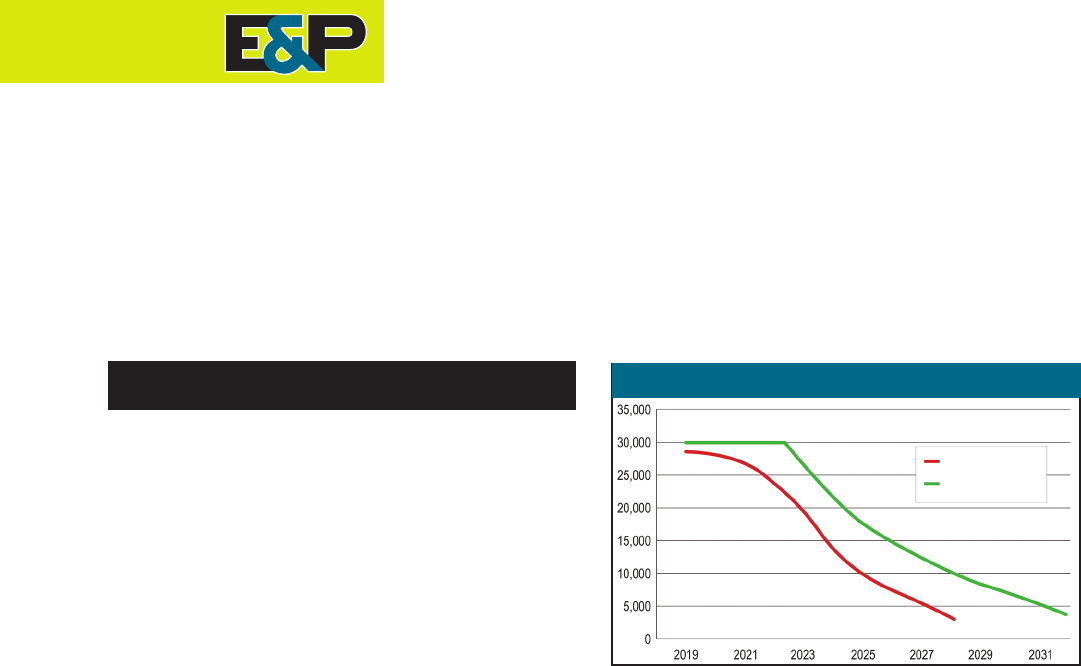
example, one GoM operator has seen enhanced pro-
duction and field life extension. Based on the natural
production curves, the required targets could not be
reached to make the project economical. However, by
implementing a subsea pump, this operator was able
to increase production to the target levels and extend
the production plateau, thus making the project viable.
Cumulative effects of increased recovery also were wit-
nessed in the later stages of well life (Figure 1).
In another field, an operator could reach production
targets; however, enhanced production was desired. By
including a subsea pump in the field architecture, the
early years provided an accelerated production wedge
that offered an immediate return on investment and a
greater return on capex, allowing the project to become
economically viable.
Subsea boosting offers eld
development solutions
The GoM stands to benefit from new wave of subsea boosting.
ENABLER
FIGURE 1. In a field where a target production was desired,
use of a subsea pump resulted in accelerated production and
extended plateau during the field’s early years, offering an
immediate return on investment and a greater return on capex.
(Source: Schlumberger)
Not economical
Economical with boosting
AS SEEN IN
APRIL 2017
Well deferral: sensible economics
Another GoM operator was able to get over the
FEED hurdle by applying a well deferral scenario
that allowed the company to increase production
while maintaining a better return on investment.
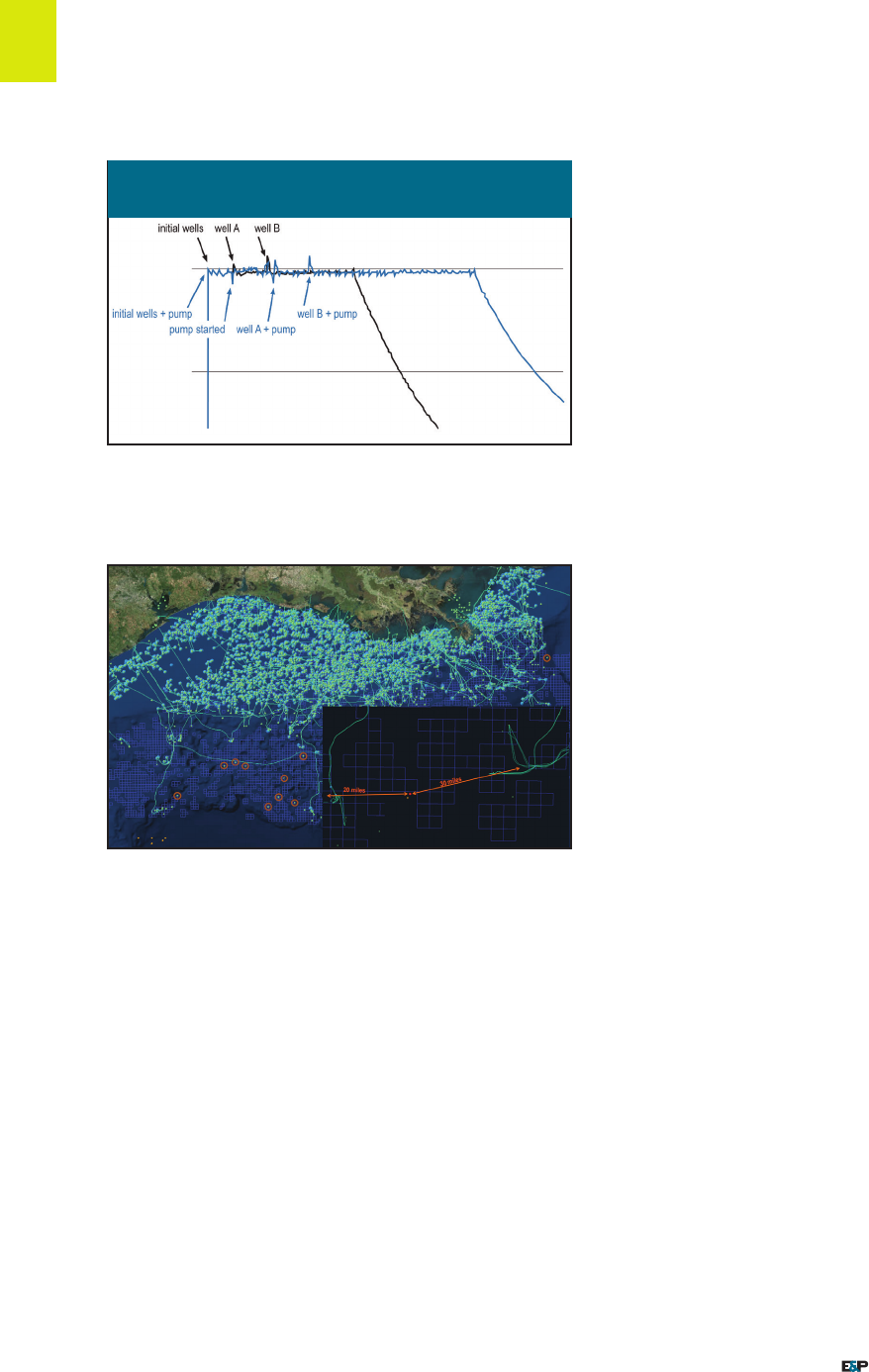
The operator had originally planned to drill multiple
wells. However, the operator was struggling to pass
the FEED stage. By deferring two wells and only drill-
ing three initial wells, the operator was able to use a
subsea pump to boost these three wells, increasing
production and in turn paying back costs incurred at
project startup (Figure 2).
Tieback vs. host facility
One operator, also in the GoM, found that taking a tie-
back-to-existing facility approach had significant savings
rather than taking the traditional approach to create a
local host for the development. While a local host was
considered in the early stage of the project, economics
were just not strong enough to support that concept. A
review was conducted of surrounding infrastructure that
identified multiple tieback opportunities. First under
consideration was a 32-km (20-mile) tieback. The effects
of adding subsea pumps allowed this concept to support
increased production over natural production while
adding higher arrival temperatures and optimizing flow-
line sizing. Second under consideration was to exam-
ine the effects of extending the tieback to 48 km (30
miles), which still showed promising economics through
boosted production. Considering the overall produc-
tion of the field, the 32-km boosted concept provided
the most economical solution, allowing the operator to
progress the concept where a local host was no longer
needed (Figure 3).
Brownfield revitalized
When a GoM operator’s reservoir was maturing and
reaching the end of its natural production, the oper-
ator decided to evaluate subsea boosting technology
as a concept to remove the overburden and constant
pressures being placed on the reservoir. Through the
implementation of subsea boosting, the operator was
able to revitalize the field and extend field life by many
years. This allowed further reduction in overall life-
of-field costs. Subsea pumps were able to reduce well-
head pressure while increasing total recoverables. The
subsea pump also was used to alleviate flow assurance
instabilities. Terrain slugging was present due to the
maturing natural production. By the pump increasing
velocities in the flowline, slugging concerns were elimi-
nated. An additional enhancement of pump operations
was the ability to restart flowing conditions from the
weak wells. Taking advantage of these multiple subsea
pump operational benefits, an additional 30 MMbbl
were recovered.
Continuing a legacy of innovation
Subsea boosting technology, when combined with a
well-planned and well-executed development design,
yields economically viable projects and delivers the
optimal solution for various well conditions and devel-
opment drivers. With a multitude of GoM wells possi-
ble to be tied back and many brownfields on the
decline, options abound for operators in the GoM to
leverage subsea boosting as a technology and economic
enabler. Under the current economic conditions sub-
sea boosting promises to become a concept that will
continue to challenge the industry to reevaluate proj-
ect development scenarios.
COVER STORY:
SUBSEA
DIFFERENCE BETWEEN NATURAL AND
BOOSTED PRODUCTION
FIGURE 2. By incorporating subsea boosting, a well deferral
scenario was implemented that allowed the operator to
increase production while maintaining a better return on
investment. (Source: Schlumberger)
FIGURE 3. Rather than create a local host for a GoM field
development, a 32-km boosted tieback provided the most
economical solution. (Source: Schlumberger)
COPYRIGHT © HART ENERGY | 1616 S. VOSS, STE. 1000, HOUSTON, TX 77057 USA | +1 713 260 6400 | FAX +1 713 840 8585
