Temperature Compensation In Measment Measurement White Paper Techncial
User Manual: Temperature Compensation in Measurement White Paper Resource Library
Open the PDF directly: View PDF  .
.
Page Count: 5

TEMPERATURE COMPENSATION IN LIQUID MEASUREMENT
Prepared By: Bob Petty
Linco-Electromatic, Inc.
4580 W. Wall
Midland, Texas 79703
All measurement systems should be designed to provide a means of accuracy in volume determination and quality
determination while minimizing measurement losses. Three pnmay sources of error in petroleum measurement
include:
1. Volume Measurement
2. Sediment and Water
3. Temperature
This paper is confined to the discussion of techniques for temperature compensation of gross measured volumes of
crude oil on Lease Automatic Custody Transfer (LACT) units, truck and pipeline ACT units. The main objective is
to review the fundamentals involved in temperature compensation and evaluate alternative methods.
INTRODUCTION
During the past decade the value of petroleum has increased tenfold. This fact has fostered an increased concern
over accurate measurement. Any type of measurement error can result in a financial loss whether it be to the buyer
or the seller. Accurate temperature measurement can be just as important as maintaining meter accuracy. A 2º
Fahrenheit error in temperature can equate to a 0.1% error in volume.
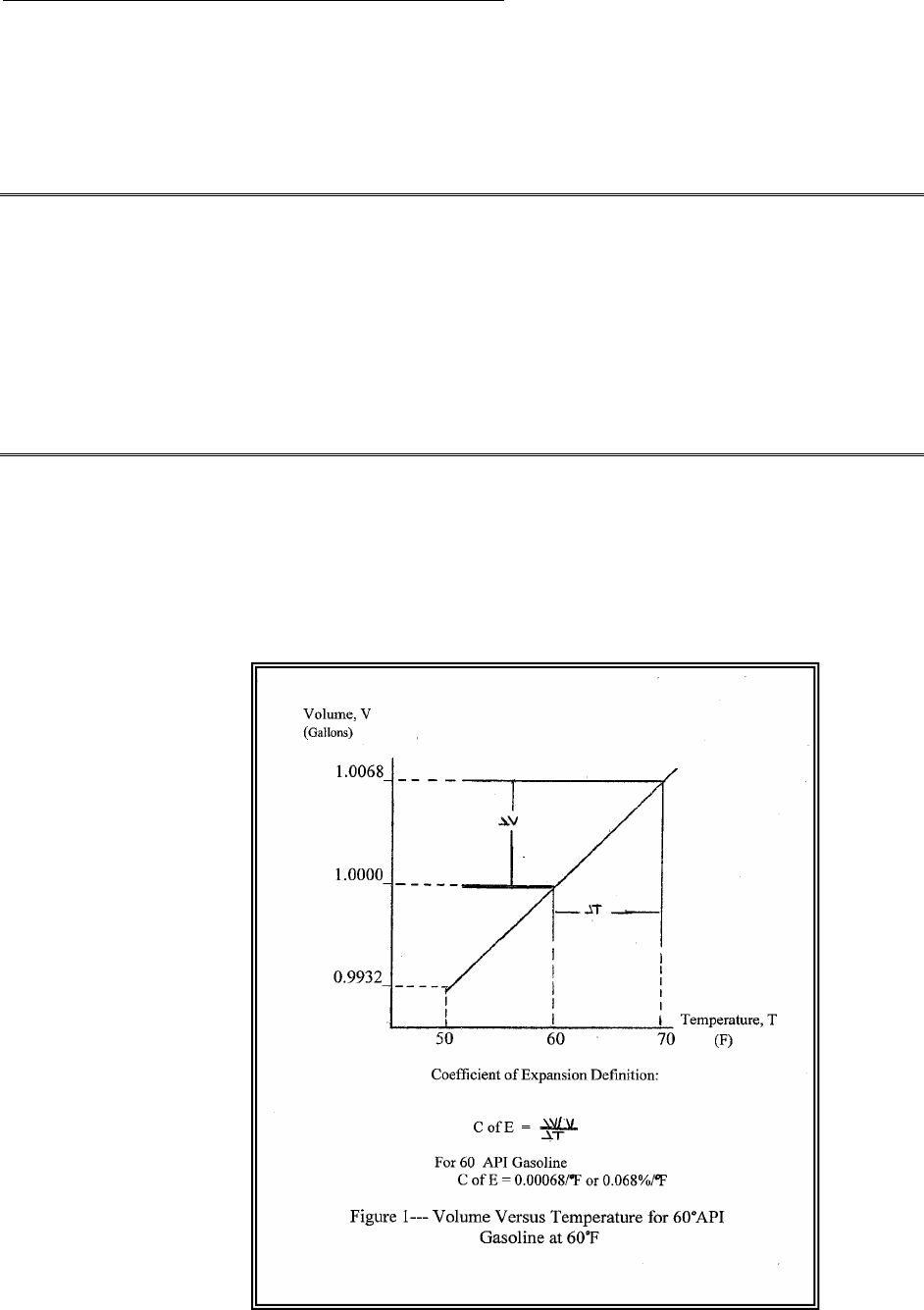
A characteristic of all liquids is that they expand and contract with changes in temperature. For example,
1,000 barrels of 39º API gravity crude oil metered during the summer months at 80º Fahrenheit occupies
about 1% (10 barrels) more volume than at 60º Fahrenheit: 1,000 barrels metered at 40º Fahrenheit in the
winter months occupies about 1% (10 barrels) less volume than at 60º Fahrenheit.
The degree of volume change, with temperature change, is dependent on the amount of temperature change and the
Coefficient of Expansion (C of E) of the particular liquid. High API gravity petroleum liquids have a high C of E
and low API gravity products have a low C of E. If an error is made in sensing or determining operating
temperature, the percentage error of the net volume will be greater for a high API gravity than a low API gravity.
The Coefficient of Expansion (C of E) of a liquid is defined as the change in volume (Delta V) per limit volume (V)
per change in temperature (Delta T):
C of E= De1taV/V
Delta T
The petroleum industry uses 60º Fahrenheit as a standard to correct liquid hydrocarbon volumes. We refer to this
corrected volume as Net Volume. The uncorrected volume is referred to as a Gross Volume.
Temperature Compensation in Liquid Measurement Page 2 of 5
Standards are provided for converting the volume of liquid hydrocarbons at temperatures other than 60º
Fahrenheit to a volume at 60º Fahrenheit based on API gravity. These standards are contained in the
Petroleum Measurement Tables - API standard 2540, Chapter 11.1- Volume Correction Factors, in the
API Manual of Petroleum Measurement Standards. These tables give Volume Correction Factors (VCF)
directly as a function of temperature and API gravity.
EXCERPT FROM API TABLE 6A
GENERALIZED CRUDE OILS VOLUME CORRECTION TO 60º F
TEMP API GRAVITY AT 60º
ºF 45.0 45.5 46.0 46.5 47.0 47.5 48.0 48.5
Factor for correcting volume to 60º F
75.0 0.9920 0.9920 0.9919 0.9919 0.9918 0.9918 0.9917 0.9917
75.5 0.9917 0.9917 0.9916 0.9916 0.9915 0.9915 0.9915 0.91o
76.0 0.9915 0.9914 0.9914 0.9913 0.9913 0.9912 0.9912 0.9911
Utilizing volume correction factors, a true net volume can be determined by the following formula:
Gross Meter Volume Sediment Net
Meter X Factor X Correction - and Water = Volume
Registration Factor (VCF) Content

Temperature Compensation in Liquid Measurement Page 3 of 5
MECHANICAL DEVICES
Many devices are available that provide a means of temperature compensation. Some are mechanical, utilizing
thermal systems and a combination of mechanical linkages. These mechanical compensators are often referred to as
ATCs (automatic temperature compensator) or ATG’s (automatic temperature and gravity compensator). The ATG
is a meter mounted mechanical temperature compensator that offers the operator an adjustable gravity selector
system. The ATC is a meter mounted mechanical temperature compensator that requires a fixed gravity selection.
These devices consist of a thermal system (filled with a fluid that has a linear coefficient of expansion per degree
temperature change) and a calibrator (adjuster system). The thermal system reacts to temperature changes providing
a linear response to the calibrator which in turn changes the drive ratio to the meter register. Meters equipped with
either the ATC or ATG provide a net volume registration.
Mechanical automatic temperature compensating devices are fairly accurate but fragile outdated instruments. Newer
devices that incorporate microprocessor technology and perform various levels of electronic temperature
measurement and/or conversions have magnified the mechanical compensator’s faults.
Mechanical automatic temperature compensating devices are linear within ±1.0º Fahrenheit, when operating
nearheir calibration temperature. When product and ambient temperatures vary 20º to 30º Fahrenheit from the
calibration temperature, the potential error can be as much as 2º Fahrenheit.
Mechanical compensators require from 3 to 6 minutes to stabilize their thermal systems if significant temperature
swings are present. LACT units that start and stop often are more likely to suffer from the sluggish temperature
response.
Failure of these mechanical temperature compensators can only be verified by proving the sales meter or either
cycling the unit through a “hot and cold test”. This procedure involves removing the thermal sensing element from
the mechanical compensator and subjecting it to a cold external temperature while the sales meter is operating. The
procedure is duplicated by subjecting the sensing element to a hot temperature. The difficulty involved in verifying
the instrument's integrity, coupled with the previously mentioned problems, has made the compensators less popular
in new metering installations.
ELECTRONIC DEVICES
The 1980 Revision to the API Standard 2540, Petroleum Measurement Tables, helped precipitate the transition from
utilizing conventional mechanical ATC’s to microprocessor based instrumentation. The old standard was a tabular
listing of volume correction factors. The revised standard incorporated the implementation of an exponential
equation relating VCFs to obtainable measurements (e.g. temperature, relative density, etc.).
The emergence of microprocessor based electronic temperature compensators has increased measurement accuracy,
flexibility and convenience. These benefits have been widely recognized, consequently, many major oil companies
no longer allow the use of mechanical compensators on large custody transfer units.
Electronic Automatic Temperature Compensators are available for mounting directly on to the positive
displacement sales meter. These units usually allow the user to program such information as meter factor, K factor
(pulses per unit of volume), API gravity or C of E of the measured product. The processor combines the meter input
pulses, applies the C of E and meter factor and ultimately yields a Net meter

Temperature Compensation In Liquid Measurement Page 4 of 5
reading. Most units offer communication outputs, pulse outputs (to drive sampling equipment) and failure alarms
Temperature is measured by a temperature probe normally inserted in a liquid filled thermowell in the meter
housing. This probe can be one of several types but most common are the thermistor and the PRTD (platinum
resistance temperature device). These probes perform with a high degree of accuracy over their given range
(normally ± O.29º Fahrenheit). They offer faster response times and are unaffected by ambient temperature changes.
Instrument error, such as analog to digital conversion and calculation error, can also attribute to a small inaccuracy
in temperature measurement. The combined system accuracy (probe and processor) of some devices are within 0.50º
Fahrenheit over the operating range of 32ºto 122º Fahrenheit.
As previously mentioned, thermally activated mechanical devices can be in error as much as 2º Fahrenheit when
operating temperature varies 20º to 30º Fahrenheit from their calibrated temperature. For example, 39º API crude
oil would produce an error in the temperature corrected volume of 0.1%; whereas the error
with an electronic device would be less than 0.25º Fahrenheit or 0.0 1%.
CALCULATION
Mechanical ATC’s assume a constant C of E for a given product at all temperatures. Some dedicated
microprocessor based units permit the user to select the proper API Table (i.e. API Table 6A) and enter the density
of the product to be measured. Rather than assume a constant C of E, the instrument calculates the correction factor
for the actual temperature of the metered liquid (CTL). All temperature calculations precisely match the correct API
Tables.
ELECTRONIC AVERAGING DEVICES
Electronic Temperature averaging devices have been gaining in popularity since the early 1980’s. These devices
combine the high degree of accuracy proven in electronic temperature measurement with the simplicity of operation.
Operator error is minimal since very little, if any, programming is necessary.
The newer electronic temperature averagers are microprocessor based instruments capable of calculating the average
temperature based on a volume input signal. Rather than perform an actual temperature compensation, these devices
simply provide a true volume weighted average temperature. These devices display current probe temperature, pulse
input counts, total temperature, average temperature and alarm status. The average temperature and the current
probe temperature are displayed to the nearest 0.1º Fahrenheit. Some instruments are capable of alarming if the
processor or the probe fails.
Various features of the electronic temperature averager have made it a popular choice on LACT and ACT units.
These features include the abilities to offer system accuracy of ± 0.4º Fahrenheit over a range of –22º Fahrenheit to
120º Fahrenheit, to improve the response time of the temperature measurement over the mechanical systems and to
provide features such as self-calibration, shut down alarms, and multiple meter inputs at very reasonable prices.

Temperature Compensation In Liquid Measurement Page 5 of 5
CONCLUSION
The design of all measurement systems should be concerned with achieving a balance between accuracy, flexibility
and cost. Companies tying to obtain reductions in measurement losses are also seeking cost effective measuring
systems which wili achieve acceptable levels of uncertainty. In recent years electronic temperature compensators
have become more user friendly, less expensive and more accurate. The improvements have made this balance a
simpler task for measurement personnel.
