Ensoniq Corporation Transoniq Hacker Archive Issue #087 Th 087
Ensoniq Corporation Transoniq Hacker Archive Issue #087 087 Ensoniq Corporation - Transoniq Hacker Archive - Issue #087
Ensoniq Corporation Transoniq Hacker Archive Issue #087 th_087 Ensoniq Corporation - Transoniq Hacker Archive - Issue #087
User Manual: Ensoniq Corporation Transoniq Hacker Archive Issue #087 Ensoniq Corporation - Transoniq Hacker Archive - Issue #087
Open the PDF directly: View PDF  .
.
Page Count: 32
Iransfliiq
The DP/4 — First Look
Ladies and gentlemen, let me introduce
to you to (what I feel) is the coolest
black box on the planetface, Ensoniq's
DP/4 Digital Effects Processor. If you
have not yet played with this piece of
musical gear at an Ensoniq clinic or
dealer, do so. Following is a brief "get
started" tutorial to help you listen to the
unit right out of the box or while on dis
play at a dealer. If there isn't one on
display, offer to hook it up for the key
board salesperson.
First get the stuff you need to hook up
the DP/4 — an amp or a PA to listen
through, two cables to connect a stereo
output of the DP/4 into the stereo PA
(totally necessary to get full coolness
effect), a mono signal such as a guitar
(with cable for input to the DP/4), and
something to pick your jaw up off the
floor with. Second, find an AC outlet
with a three prong outlet and hook it up.
Then, plug the two shielded cables into
the output jacks 1 and 2. This will be
our stereo feed to the PA. Next, plug
the guitar into the input 1 jack on the
front panel. Any signal like a micro
phone, that has a low-to-high imped
ance transformer, or a keyboard can be
used. The input on the back labelled 1
is okay, too. The front panel input jack
disables the rear number 1 input. Set all
of the inputs and outputs controls to ap
proximately 12 o'clock and that'll do it
f o r n o w .
Hacker
The Independent News
Magazine for Ensoniq Users
Dennie Edwards
Setting Input Levels
A technique that works most of the time
to set the input levels is to set the input
at the optimum level without causing
distortion, press the config (configura
tion) button twice to bypass all the
units, then play the inputted instrument
at its loudest level. Rotate the pot for
input one until the peak LED flashes
above the input knob. Then, rotate the
k n o b c o u n t e r - c l o c k w i s e u n t i l t h e L E D
doesn't flash anymore. Simply press the
config button once more and the imit
will be back on-line. Now we can select
the different types of configurations.
A config preset is the most powerful of
all the presets on the DP/4. It lets you
save everything that is in the DP/4 at
that time and recalls all algorithms, sig
nal routing among the four units, and all
the mixing parameters. It also allows
you to select the number of inputs. In
short, a config preset shows how the in
puts, units, and outputs are routed.
L e t ' s G e t S t a r t e d
I'm gonna assume that you'll use an
electric guitar to scope out the coolness
of Mr. DP/4. First, select the proper
configuration for a "1-Source Mono
Input." Press config, then use the data
knob to select config #53. Next, press
the select button. Now that we have that
done, we can listen to some effects.
I n th i s i ss u e
Articles:
The DP/4 — A First Look
Dennie Edwards cover
A Brief List of Famous Ensoniq Users
T o m S h e a r 5
Wave Mutilation for SQs & KSs — Part 6
J a c k S t e p h e n T o l i n 8
The Book of SQs & KSs — Part 13
C l a r k S a l i s b u r y 1 0
Installing a MIDI Indicator — EPS Rack
S a m M i n t s 1 2
But I Don't Want Chorus — EPSs
Bryce Inman 13
Transoniq Trivia II
Garth Hjelte 14
SQ-1 = B-3
M a r k C l i f t o n 1 7
SQ-80 Sequencing Tips
T o m S h e a r 1 9
Reviews:
Ensoniq's SL-9 for EPSs
T i m O ' C o n n o r 6
Basement Tapes: Anderton & Hospers
Daniel Mandel 7
The SD-1/32 Voice Upgrade
J e f f r e y P . F i s h e r 1 5
Talking Owner's Manual — SD-1
T o n y T h o m a s 1 6
Regular Stuff:
Random Notes 3
Hypersoniq 3
C u r r e n t O . S 3
H a r d D r i v e s L i s t 3 0
Classifieds 20
Hackerpatches
S a m M i n t s & J e f f r e y R h o a d s 2 1
The Interface 23
H a c k e r B o o t e e q 3 1
ISSUE NUMBER 87, $2.50 SEPTEMBER. 1992
We are going to listen to the DP/4 as one super unit. This
config allows all four units within the DP/4 to act as one.
This is easily done since all of the signal routing is done in
the digital domain (a digital patchbayl). We are now in the
one source config. To select the 4 unit presets, press the con-
fig button. Turn the large data entry knob until the screen
shows "Select 4 U Presets," (50). Press Select. Rotate the
data entry knob to choose among the ICQ 4-unit presets.
Remember that there are 50 RAM and 50 ROM that make up
the 100 presets. Find a preset that you want to hear and press
the select button. After you have given these presets a listen,
get ready to do some knob turning and button pushing.
Okay, so you are impressed with using 4 24-bit processors at
once, but wouldn't you like to hear how each processor
sounds by itself? 'Course you would. Press the config button
once again and select the "1 U Presets," (52). Also remem
ber to press the select button. The yellow light above the A
unit should light showing that you have selected the A
processor for use. The bypass LED (the red ones) should
now light over units B, C, D. With our current input config
we can only listen to processor A. One can still edit and
select one unit presets for the other processors, but we only
have an input going to unit A. Next, turn the data entry knob
to display the names of the 1-unit presets. Remember, an al
gorithm will not load into the processor until you press the
select button. Again, have fun and listen to the clarity of
24-bit fidelity.
Speaking about this 24-bit stuff, why does Ensoniq choose
to use 24-bit processor instead of 16- or 18-bit processors?
The answer is both simple and complex. 16-bit processing
gives us the full 20k bandwidth of frequency response that
our ears have now come to expect from digital products. If a
signal is to be processed to create a reverb, it then must be
allowed to sustain and retain its integrity at 20k bandwidth.
If more signal is pumped through the processor, it then be
comes very difficult for that processor to sustain such long
reverbs while maintaining true fidelity. With a 24-bit proces
sor there is a ton of processing power within the unit. So
how many bits does it take, then, to double the resolution of
a 16-bit machine? 32-bits do you say? WRONG! Believe it
or not, it only takes 17-bits to double the resolution of
16-bits. It only takes 18-bits to double the resolution of
17-bits. Which is why the Room/Hall Decay parameter for
the Small Room, Large Room, and Hall reverbs can last
from 100 seconds, 150 seconds, and 250 seconds respective
ly. This, friends, is why Ensoniq uses nothing less than
24-b it effects on a ll of their machine s.
Okay, so we're impressed with the factory presets that the
guys with the pocket protectors made, but is it easy for us
normal people to use? Yup! As one would expect from a
straight-forward machine, the first button push is the EDIT
button. Next, select the processor A, B, C, or D you wish to
edit. We now have selected the unit's algorithm for editing.
The active unit's LED should be lit and the two-digit display
should read "00." If not, press the left arrow until it does.
You can now scroll through the parameters and listen to
each one. With each new algorithm, there will also be
parameters specifically for that algorithm. To change a
parameter all you have to do is use the left and right arrow
to select the appropriate parameter and then use the data
entry knob the change the value. As soon as you change a
parameter, the edit LED flashes, indicating that you have
now entered the edit buffer. To compare between the
original and your edited version, press the Edit button.
Are you excited yet? This appears to be first processor on
the market that will allow the average musician to get the
same quality as the BIG STUDIOS get out of their out
rageously expensive machines. It will help the everyday
musician create better demos and have a better shot at get
ting in with the big A/R guys who are used to listening to
product coming from these mega studios. The bottom line is
this, if you want to sound good, I mean really good, a DP/4
can be a major factor in achieving this goal. It is a little
complex, but don't worry. There are a series of instructional
videos coming from Ensoniq and I am sure we're gonna hear
from some third parties to help you master the machine.
Also, Ensoniq is making a huge effort in training all of their
dealers on the DP/4, so make sure you ask your local En
soniq dealer for help. One last thing — I understand that a
lot a major artists and producers are buying these toys, like
The System, Nile Rodgers, Joey DeFrancesco, David Was,
George Duke, and Randy Jackson to name a few.
So what it comes down to is that the gap of audio quality
that lies between the pros and the rest of us working mu
sicians has just been narrowed considerably by the DP/4.
Good deal, mm
Bio: Dennie Edwards is the Asst. ManagerlKeyboard sales
man for Vince's Backstage Music in Lafayette, La. Dennie
also does MIDI consulting and sound programming for local
jingles and other productions. His favorite colors are blue
and florescent pink. It is rumored that Dennie is the son of
th e Shel l A n sw e r Man .
B A C K I S S U E S
Back issues are $2.00 each. (Overseas: $3 each.) Issues 1- 30,35-38,
and 61 -12 no longer available. Subscriptions will be extended an
equal number of issues for any issues ordered that are not available at
the time we receive your order. ESQ-1 coverage started with Issue
Number 13. SQ-80 coverage started with Number 29, (although most
ESQ-1 coverage also appUes to the SQ-80). EPS coverage started with
Number 30. (But didn't really get going till Number 35.) VEX
coverage (which also applies to the SDs) got started in Number 48. The
SQs pt going in Number 63. (SQ articles also apply to the KS-32.)
Permission has been given to photocopy issues that we no longer have
available — check the classifieds for people offering them. A free back
issue index is available which contains the tables of content for all is
sues since Number 43.
2

Front Panel
RND
Hacker News
We'd like to remind KS-32 owners that all previous articles and
patches (including Clark Salisbury's excellent umpteen-part
series) relating to the SQs also apply to the KS-32. We can't
spare the space to re-plow old ground so you should check your
back issue indexes — these things don't get datedl (Just call us if
you need a back issue index.)
Mark Clifton has a new & improved percussion layout (accom
panies his article in Issue #85) that is also available for the price
of a phone call. Call him at 703-494-5432.
Correction to Jack Tolin's Waveform Mutilating in Issue #86:
Said:
Voice 2: ENV2: Initial = 00, Peak = 15, Break = 00, Sustain = 15
Should have said:
Voice 2: ENV2: Attack = 00, Decay 1 = 15, Decay 2 = 00, Release = 15
Third-Party News
Latter Soimd Productions has moved to 1341 Westhaven Coint,
Tallahassee, FL 32310-8625. Phone: 904-575-5561.
Monster Tracks has moved to 655 Goodpasture Island Road, #28,
Eugene, OR 97401. Phone: 503-683-7115.
HYPERSONIQ
NEW PRODUCTS
Latter Sound Productions has released Volume 4 - Effects for
the VFX, VFX-sd, and SD-1. These sounds are divided into ten
banks and cover a wide variety of soimd effects. Air war, high
way, city, space, ghostly, countryside, oceanside, ethnic and
more. Volume 4 (disks) is $40. And new for SQ-80 owners:
Volume I - The Collection. 40 sounds created for various musical
applications. Bass, guitar, woodwind, voice, effects, organ, brass
vector and synth. $19 (disks). For more information, write or
call: Latter Sound Productions, 1341 Westhaven Court, Tallahas
see, FL 32310-8625. Phone: 904-575-5561.
TRANSONIQ-NET
HELP WITH QUESTIONS
All of the individuals listed below are volunteers! P lease take
that into consideration when calling. If you get a recording and
leave a message, let 'em know if it's okay to call back collect
(this will greatly increase your chances of getting a return call).
ALL ENSONIQ GEAR - Ensoniq Customer Service. 9:30 am to noon,
1:15 pm to 6:30 pm EST Monday to Friday. 215-647-3930.
ALL ENSONIQ GEAR - Electric Factory (Ensoniq's Australia dis
tributor). Business hours - Victoria. (03) 4805988.
SD-1 QUESTIONS - John Cox, 609-888-5519, 6 - 8 pm EST.
SQ-80 QUESTIONS - Robert Romano, 607-533-7878. Any ol* time.
HARD DRIVES & DRIVE SYSTEM - Rob Feiner, Cinetunes. 914-963-
5818. 11 am-3 pm EST.
SQ-80 QUESTIONS - Michael Mortilla, 805-966-7252 weekends and
after 5 pm Pacific Time.
EPS & EPS-16 PLUS QUESTIONS - Garth Hjelte. Rubber Chicken
Software. Pacific Time (WA). CaU anytime. If message, 24-hour callback.
(206) 821-5054.
ESQ-1 AND SQ-80 QUESTIONS - Tom McCaffrey. ESQUPA. 215-
8304)241, before 11 pm Eastern Time.
ESQ-1 QUESTIONS - Jim Johnson, (503) 684-0942. 8 am to 5 pm
Pacific Time (OR).
EPS/MIRAGE/ESQ/SQ-80 M.U.G. 24-HOUR HOTLINE - 212-465-
3430. Leave name, number, address. 24-hr Callback.
SAMPLING & MOVING SAMPLES - Jack Loesch, (201) 264-3512.
Eastern Time (N.J.). Call after 6:00 pm.
MIDI USERS - Eric Baragar, Canadian MIDI Users Group, (613)
392-6296 during business hours. Eastern Time (Toronto, ONT) or call
MIDIUNE BBS at (613) 966-6823 24 hours.
MIRAGE SAMPLING - Mark Wyar, (216) 323-1205. Eastern time zone
(OH). Calls between 6 pm and 11 pm.
SD-1, sound programming, sequencing, & MIDI - Eric Olsen, Pegasus
Sounds, (616) 676-0863. Mon, Tues, Thurs, Fri: 4 pm to 9:30 pm Eastern
Time. Sat: 12 to 10 pm. (No calls on Wednesday please!)
SQ-1 QUESTIONS - Pat Finnigan, 317-462-8446. 8:00 am to 10:00 pm
EST.
ESQ-1, MIDI & COMPUTERS - Joe Slater, (404) 925-7929. Eastern
time zone.
Questar Technology has introduced Questar Sequencer; a pow
erful MS-DOS MIDI sequencer for IBM-compatible PCs. The
program features pulldown menus, mouse support, context-sen
sitive online help, 48 tracks with independent track looping.
Standard MIDI File support, SMPTE time displays, SMPTE/
MTC synchronization, selectable timebase resolution up to 240
PPQ, MIDI metronome, multiple port support, and a built-in sys
tem librarian. Editing capabilities include percentage quantiza
tion, cut and paste, pitch transpose, search/replace, length, slide,
fill, and undo. $49.95. For more information: Questar Technol
ogy, P.O. Box 295, Allendale, NJ 07401-0295. Phone: (201)
825-2182.
CURRENT ENSONIQ 0.8. (DIsk/EPROM)
EPS 1.10/2.40 VFX-SD 2.1/2.00
EPS-M 1.10/2.40 SQ-1 1.11
EPS-16 PLUS 1.1 SQ-R 1.02
MASOS 2.0 SQ-1 PLUS 1.1
MIRAGE 3.2 SQ-2 1.2
ESQ 3.5 SD-1/SD-1 32 4.10/4.10
ESO-M 1.2 DP/4 1.06
SO-80 1.8 KS-32 3.0
VFX 2.1
3
(800) 800-4654
MasterCard
J^IIUISIIC-
Yo u r Music De p artme n t Store.
FAX (813)238-5443
NOW IN STOCK
Carpet Cover ATA
EPS. EPS-16+. 80-1,
SQ-1, VFX, VFX-sd $11900 $235<»
Mirage, Mirage DSK $11900 $235«'
SQ-2 $150~ $270~
C U S T O M D E S I G N Y O U R O W N C A S E ! ! !
Internal And External
Hard Drives
Customize your sampler
20 Meg Internal
from $199°°,
Any type HD available
Any size, any format
Also available for HD recording
Memory Expansion Kits
for SD-1, SQ-1, SQ-2
Only $12900
Universal Sync Box with
SMPTE, Song-Pointer, i
DIrect-Lockl
SYNCUAN is a full-feature, professional
quaity sync box which supports all major
syncronizatlon formats including SMPTE.
MIDI Time Coda. Direct Lock (for Per
former) and Song Pointer. With SYNCUAN
you can precisely synchronize any sequen
cer to tape and meet all of your
synchronization needs.
SYNCMAN f eatur es In clude ;
S MP T E T ime C o de G e ne r a to r / Re a d er
• Q e n e r at e s a n d r e a ds a l l S MP T E f o r m a ts
Including 24,25. 30. and Drop Frame.
• C o n v er U S MP T E t o e i t h e r M I D I T i me C o d e
or Direct Time Lock (for Performer).
• Special DupHcaHon Feature allows you to
duplicate recorded SMPTE Stripes.
• Includes spedal SMPTE "Jam" Sync to
recover from tape drop-out.
• Can write SMPTE manually (with 0 offset)
or remotely with specified offset upon
receipt of a User Bit message and a Time
Code message.
Song Polntor Sync Generator/Reader
• Special Song Pointer Sync (SPS)
Duplication feature allows you to duplicate
recorded SPS Stripes.
• Includes 'Jam' Song Pointer Sync to
recover from tape drop-out.
9vdc
Oupiicatt
OfacHocS
SengPoaMt
aiWeFocmai ^
24 2S DF 30 {
iO 00 00 00 -^
Smpta/Song Pointer Sync Box
@SYNCMAN1I.[
Smioiman
Guaranteed for life.
Addltlanal SYNCMAN Features;
• Bulh-in Merge Mode allows you to merge
all keyboard or sequencer MIDI information
with either MIDI Time Code or Song
Pointer Sync information
• D i m e n s i o n s : 4 ' X 6 ' X 1 '
• Weight: under 1 lb.
TM
Lowest prices on anything musical in the USA!
A Brief List of Famous
Ensoniq Users
To m S h e ar
Back when I was just getting into electronic music I owned a
Korg Poly-800. While it's certainly not the cutting edge of tech
nology today, it was a pretty decent machine (and I still haven't
heard any synth that can touch it when it comes to flutes). One
thing that Korg did that I thought was pretty cool was to print a
list of famous users of Korg equipment in their catalogs. Sure, we
all know it doesn't matter if anyone famous is using the same
stuff as us, but it is kind of fun to read a list like that. So what
I've done here is to give you an extremely basic list of some es
tablished artists out there who have, at one time or another, made
use of Ensoniq beasties just like you and I have. Wherever poss
ible I tried to include the equipment I knew for certain they used,
but keep in mind that there may be a lot of EPS users out there
who I didn't pick up on simply because it's very difficult to dis
tinguish what kind of sampler is used in a song unless really ob
vious presets are used. I avoided listing anything too obvious
such as the authors of the Signature Series, etc. So without fur
ther ado, here it is. And keep us up to date! If there's someone
well known that you don't see mentioned on the list write and tell
u s a b o u t i t !
Progressive Rockers Marillion (Mirage).
Michael Josephs, Composer for TV's "America's Most Wanted" (EPS).
Solo artist and producer Todd Rundgren (Mirage).
Big time production team Jam & Lewis (Mirage, EPS).
German techno-punks Schnitt Acht (ESQ-1)
Top 40 dance duo Times Two (Mirage).
Texan rappers MC 900 Ft. Jesus (EPS).
New age artist William Aura (ESQ-1, Mirage).
Australian underground dance artists Severed Heads (ESQ-1)
Netherlands' first psychedelic band, The Legendary Pink Dots (ESQ-1).
Television personality and composer John Tesh (Mirage).
light jazz-rocker Tom Grant (EPS).
Zimbabwean ambassador Johnathan Wutawunashe (Mirage).
Thomas Dolby keyboardist, Mike Kapitan (Mirage).
Doomsday rockers. The Cure (Mirage).
Funk/punk practioners. Fishbone (EPS).
"Soft Robot" composer, John Greenland (EPS).
New York downtown avante-garde artist, Elliost Sharpe (Mirage).
Patrick Leonard, producer for Pink Floyd, Madonna (ESQ-1).
New York industrial trio, Ajax (ESQ-1).
Belgium's Vomito Negro (SQ-80).
R & B star, Johnny GUI (VFX).
Swedish industrial rockers. Cat Rapes Dog (ESQ-1).
Session/solo artist extraordinaie, "Blue" Gene Tyranny (Mirage, ESQ-1).
Boston legends. The Cars (ESQ-1).
New York's underground favorite. Suicide (ESQ-1).
Legends of industrial dance, Skinny Puppy/Cyberactif (Mirage, ESQ-1).
Jazz-rocker, T Lavitz (SQ-80, EPS).
Genesis (VFX)
Yes (VFX)
Bio: Tom Shear one day hopes to make the list of famous Ensoniq
users if only those record company weasels would listen to his
demo...
UNAUTHORIZED BREAK-IN
New WAVeBOY disk exposes direct audio input to EPS-16 PLUS Effects
Send any signal through the EPS effects processor, with the new
WAVeBOY Audio-In Effects Disk. Guitar, mic, or line level
audio. Works with all 13 factory algorithms. Disk also includes
Plate Reverb, Non-linear Reverb, and 3-voice Pitch-shifter that
can process external audio and internal sounds. Just $39.95
Also available, the amazing WAVeBOY Parallel Effects Disk.
Four different effects at once. Also only $39.95.
"A Genius-at-work kind of product... I can't imagine any
I EPS-16 PLUS owner who wouldn't want to have this disk..."
-Craig Anderton, TH review, April, '92
Order now! Overseas add $6. PA Residents Add 6% sales tax.
Mastercard or Visa accepted. To order call (215) 251-9562.
Or send cashier check or money order to:
WAVeBOY, P.O.Box 233, Paoli, PA 19301
S L - 9 S o u n d L i b r a r y D i s k s F r o m
Ensoniq
T i m O ' C o n n o r
Fon EPSs.
Product: SL-9 Sound Library — FLUTES.
Price: $39.95.
From: Ensoniq Corp. 155 Great Valley Parkway, Malvern, PA 19355,
(215) 647-3930 or contact your local Ensoniq dealer.
flute, n. [OFr. fleOte, flaute ] 1. a long, rounded groove in the
shaft of a column or pillar; 2. a shuttle used in weaving; 3. a
breakfast roll; 4. a high pitched wind instrument consisting of a
slender tube played by blowing across a hole near the upper
end.
The flute, once an extremely popular musical instrument, con
tinues to play a role in popular music today, although except
for jazz, is usually relegated to a minor supportive role. We all
remember the gentle flute duet in the beginning of Stairway to
Heaven-, and who can forget the somewhat odd sounding flute
intro in the Beatles' Strawberry Fields Forever (which was ac
tually a Mellotron). The sideblown, or transverse flute (as op
posed to an endblown whistle) was invented in the East and
arrived in Europe some time in the twelfth century. It was used
primarily for military music during the Middle Ages, but by the
middle of the 17th century it had become very popular as an in
strument of the opera and the court orchestra. In the early
1830s, Theobald Boehm of Munich provided radical design
changes which continue to this day. In 1992, Ensoniq Corpora
tion created several digitized versions of this this instrument
packaged as Sound Library #9.
There are nine instruments contained in SL-9: FOLK FLUTE,
PICCOLO, JAZZ FLUTE, ALTO FLUTE, PAN FLUTE, BASS
FLUTE, PERC FLUTE, CLASSIC FLUTE AND HARMODIA.
As you would expect, there are sequences to demonstrate each
one of the sounds. I previewed each one of the instruments on
both the the 16 Plus and the original EPS, and found that they
can be used on the "classic" with no tweaking whatsoever.
First up is FOLK FLUTE. This is a very mellow, earthy
wooden flute sound. Like all the other instruments, via patch
selects it can perform as a solo legato instrument (great for tril
ling), or as a polyphonic instrument. This is an excellent flute
sound for folk or ethnic music and is one of my favorites. They
have provided a very lively and cheery sequence to showcase
t h i s i n s t r u m e n t .
The first thing you notice about PICCOLO is that it does not
span the entire keyboard range. Ensoniq says that it has been
designed to play within the instruments natural key range, al
though why they decided to be such purists on this instrument
and n o n e of the o t h e rs I d o n ' t kno w. T h i s sou n d also has a
brisk sequence with lots of realistic trills for all you two-fin
gered keyboardists out there. I did notice a minor click in the
loop of the lowest wavesample.
Next in line is JAZZ FLUTE, another of my favorites. Herbie
Maim will go on Social Security with this one. The left patch
select gives a sforzando type of attack and swell, common in
the jazz idiom. This flute would also work well in some rock
arrangements. The accompanying jazzy sequence also includes
the next two instruments.
ALTO FLUTE is a very good general purpose flute sound, and
at 500 blocks should be able to be squeezed into any arrange
ment. It has a very dark and rich lower register. The mod wheel
controls the LEG depth and (on the 16+) key pressure controls
the rate, allowing for some realistic variations on the vibrato.
For you Zamfir fans there is PANFLUTE. You know, the in
strument that the Greek mythology creature Pan used to play in
the woods to persuade all those Athenian tarts to doff their
togas in bacchanalian abandon. This instrument uses velocity
switching to bring in an extra heavy "chiff' attack at the higher
velocities. Keeping true to the instrument's character, there is
no legato layering for the panflute. Chording creates a passable
calliope. I found it best to stick to the middle registers with this
one since there is only one wavesample to cover the entire key
board range.
I have never heard a BASS FLUTE live before, so I am trust
ing that the one provided here is authentic sounding. I can say
that it has a very pleasant, very dark and mournful tone. I can
hear it being used in a film soundtrack, the scene where the
female lead is alone in her bedroom, trying to decide whether
to run off to Pago Pago with her lover or to plot his murder.
Good sound. One of the patch selects creates a very surrealistic,
highly chorused stereo pad which sounds totally unflutelike but
is interesting nonetheless.
Next up is PERC FLUTE. Like the name suggests, this is a
very short, percussive sound with a somewhat metallic attack.
It only vaguely resembles a flute in sonic character. I found this
sound to be most interesting when used with effects, such as
delays and reverse reverbs. BASS and PERC flutes are per
formed in a sort of "Pop New Age" sequence which was my
favorite of the lot.
CLASSIC FLUTE is the Rolls of the set. At a whopping 1829
blocks, what do we get for all our hard-earned RAM? Well, 21
wavesamples spread across two velocity switching layers. The
flute was actually sampled blown softly and blown hard to give
very natural sounding dynamics. This is an excellent flute
sound, and except for a couple of samples with quavery loops, I
couldn't find anything wrong with it. A very good classical se
quence comes with this instrument.
6
And last on our list is HARMODIA. I'm not quite sure how to
describe this instrument. It begins with a very dark fundamental
tone which then swells to include some very odd resonating
frequencies. Eventually the overtones completely overshadow
the fundamental. This is a strange and spooky sounding instrU'
ment. If played loudly out your window on Halloween night it
is guaranteed no kiddies will come to your door.
So there you have it. Nine instruments on five disks. All very
cleanly recorded and no real clinkers in the set. I only have two
complaints to make about SL-9. First of all, the accompanying
manual is rife with errors as far as what patch selects go with
what types of layers. The patch selects typically brought up
mono layers, poly layers, detuned layers, key-up layers, etc..
Disoordian Sampling
Tape; 4 More Years
Artist: Rude A1 & the ToyMaster (a.k.a. Craig Anderton and A1 Hospers)
Contact info: P.O. Box 966, Ukiah, CA 95482
Equipment: EPS-16 PLUS and original EPS rackmount (both
expanded to 4X and stuffed to the gills with samples), Peavey
DPM 3 SE for all the synth parts (and another meg of George
Bush samples) with SDR 20/20 for the vocals, and Alesis
SR-16/Midiverb 11/1622 mixer; Digidesign's Sound Tools did
the original sample mutilation (uh, manipulation).
I should probably state my bias before I begin — I don't like
politicians. I, ahem, think power corrupts. I just can't wait until
Bill Clinton's ad campaign manager gets hold of this one!
What we're leading up to here is a review of this hilarious tid
bit sent in by Mr. Anderton, entitled 4 More Years by Rude Al
and the Toymaster. This is a fuimy, quirky little piece that fea
tures a young man asking George Bush a few questions, to
which George, of course, responds with some amazing answers.
This reminds me of leaming how to splice tape in my recording
classes. We had an assignment to interview somebody and then
make their answers seem absurd or humorous. It required a lot
of trial and error. Many hours were spent with the machine,
marking, listening, cutting and splicing. Our instructor told us
stories of an earlier time when people like Frank Zappa and
George Martin would splice their tapes together without using a
splicing block!
I can just imagine a sampling class today. But that's just what
Craig Anderton and Rude Al did with the equipment. All the
sentences really do sound like George Bush said them. The
and in almost every case, the booklet erroneously described
each patch select. Oh well, at least the folks in Malvem can
write in proper English. My other complaint about this set is
what they left out, and it is the flute sound I have yet to ac
quire. And that is the real gutsy, shrieking, almost screaming
type of Ian Anderson (Jethro Tull) rock flute. The one where
the microphone ends up drenched in spittle after a concert. That
would truly make this set complete — ethnic, mysterious, sub
lime, cool, and head-banging. And then all we would need is
that weird Mellotron flute from Strawberry Fields Forever... me
Bio: Tim O'Connor sings Celtic punk reggae in a barbershop
quartet, rarely combs his hair and has a cat that knows what
the highest prime number is but isn't telling.
o
Daniel Mandel
only thing I found truly difficult to cast my vote for was the
bad white rap in the middle of the piece.
Craig wrote in, "The enclosed tape is a collaboration between
Al Hospers (formerly with Blood, Sweat and Tears; now with
Dr. T's software) and me, with an assist from Vanessa Else of
Silk Media. The tune is your basic election year political satire.
And no, George Bush did not say many of the things we made
him say (thanks to the wonders of hard disk recording). But he
really did say 'I saw Elvis.'" No kidding. I hope you enjoy it!
Copies are available for $6.95 postpaid from Four More Years,
c/o Dr. T's Music Software, 124 Crescent Rd., Needham, MA
02194.
I also wanted to thank Anthony Ferrara and Carmen Cara-
manica for dropping me a line in response to their reviews. An
thony says he is working furiously on volume two and Carmen
is going to submit some new stuff next time around! Keep up
the good work, boys and girls!! h
[Ed. - Favorable reviews of jibes at politicians should certain
ly not be taken to imply support for any of the other clowns
If you want your tape run through the
ringer, err. Hacker, just mail it off to:
Basement Tapes, Transoniq Hacker,
1402 SW Upland Dr., Portland OR
97221.
Bio; Daniel Mandel is a songwriter,
sound designer, and has sold pro
audio and keyboard equipment and
produced demo tapes for local bands.
HACKER BASEMENT TAPES
running for office.]
7
W a v e M u t i l a t i o n 1 0 1 f o r S Q s & K S s
Part 6: Features Distorted
DVZZZSSHH!
Tommy Lee • Alan White # Jim Keitner
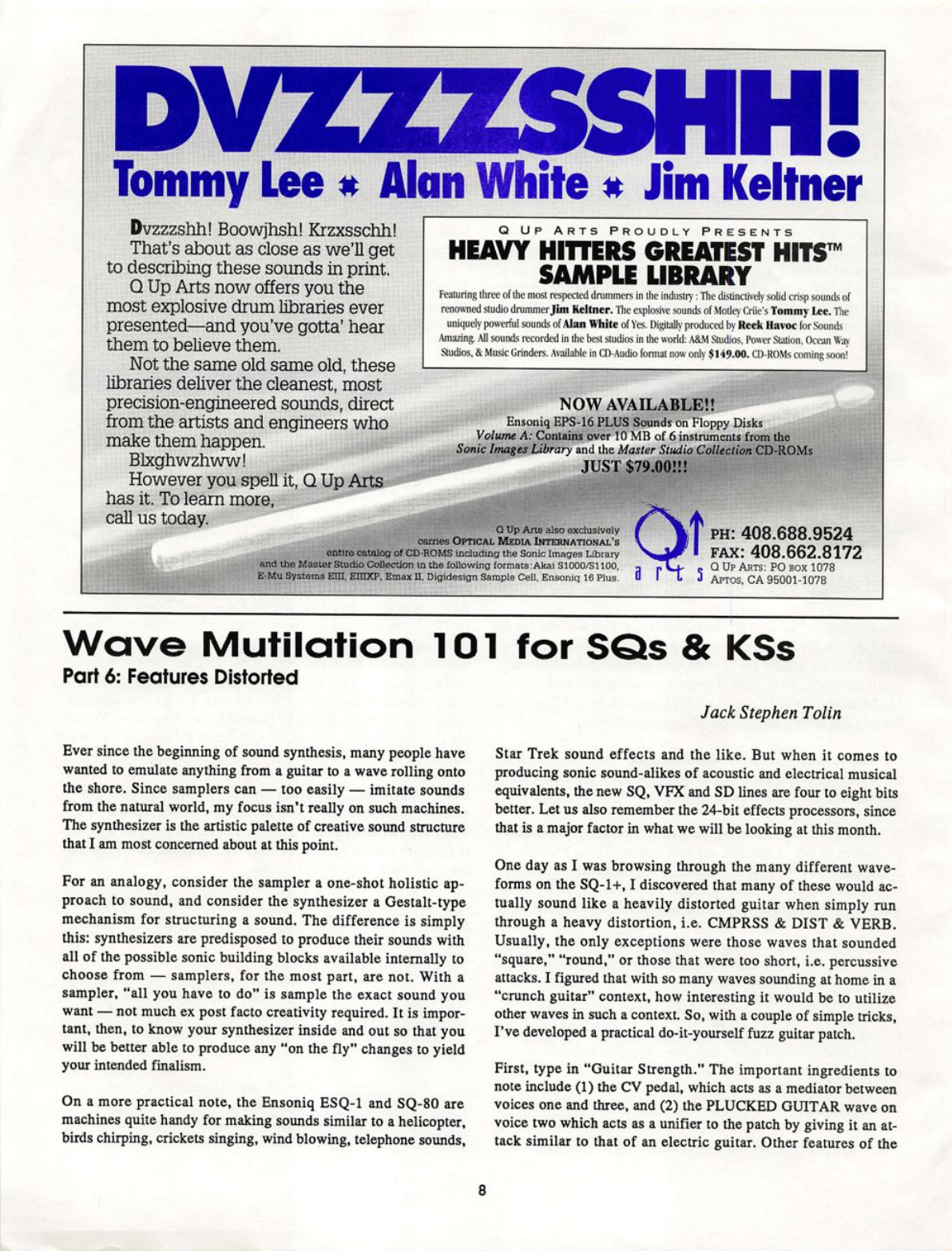
Dvzzzshh! Boowjhsh! Krzxsschh!
That's about as close as we'U get
to describing these sounds in print.
Q Up Arts now offers you the
most explosive drum libraries ever
presented—and you've gotta' hear
them to believe them.
Not the same old same old, these
libraries deliver the cleanest, most
precision-engineered sounds, direct
from the artists and engineers who
make them happen.
Blxghwzhww!
However you spell it, Q Up Arts
has it. To learn more,
call us today.
Q U p A r t s P r o u d l y P r e s e n t s
HEAVY HITTERS GREATEST HITS'"
SAMPLE LIBRARY
Featuring three of the mo.st respected drummers in the industry: The distinctively solid crisp sounds of
renowned studio drummer Jim Keitner. The explosive sounds of Motley Criie's Tommy lee. The
uniquely powerful sounds of Alan White of Yes. Digitally prodticed by Reek Havoc for .Sounds
Amazing. All sounds recorded in the best studios in the world: A&M Studios, Power Station, Ocean Wav
Smdios, & Music Grinders. Available in CD-Audio format now only $149.00. CD-ROMs coming soon!
NOW AVAILABLE!!
Ensoniq EPS-16 PLUS Sounds on Floppy Disks
Volume A: Contains over 10 MB of 6 instruments from tlie
Sonic Images Library and the Master Studio Collection CD-ROMs
jrSl 479.00!!!
Sy$t«!»a Eai, KBDJP,
also asttanslvely
OVTICAL MKDIA iMTEHMATItlNAL's
SncaudUia the Sonic Images Library
ifeBowing formatsrAkai siooo/siioo,
H, Digidesign Sample Cell, Ensoniq 16 Plus.
I f a x :
a Th S IZ'
408.688.9524
408.662.8172
A b t s : P O b o x 1 0 7 8
Aptos, CA 95001-1078
Ever since the beginning of sound synthesis, many people have
wanted to emulate anything from a guitar to a wave rolling onto
the shore. Since samplers can — too easily — imitate sounds
from the natural world, my focus isn't really on such machines.
The synthesizer is the artistic palette of creative soimd structure
that I am most concerned about at this point.
For an analogy, consider the sampler a one-shot holistic ap
proach to sound, and consider the synthesizer a Gestalt-type
mechanism for structuring a sound. The difference is simply
this: synthesizers are predisposed to produce their sounds with
all of the possible sonic building blocks available internally to
choose from — samplers, for the most part, are not. With a
sampler, "all you have to do" is sample the exact sound you
want — not much ex post facto creativity required. It is impor
tant, then, to know your synthesizer inside and out so that you
will be better able to produce any "on the fly" changes to yield
your intended finalism.
On a more practical note, the Ensoniq ESQ-1 and SQ-80 are
machines quite handy for making sounds similar to a helicopter,
birds chirping, crickets singing, wind blowing, telephone soimds.
Jack Stephen Tolin
Star Trek sound effects and the like. But when it comes to
producing sonic sound-alikes of acoustic and electrical musical
equivalents, the new SQ, VFX and SD lines are four to eight bits
better. Let us also remember the 24-bit effects processors, since
that is a major factor in what we will be looking at this month.
One day as I was browsing through the many different wave
forms on the SQ-l-t-, I discovered that many of these would ac
tually sound like a heavily distorted guitar when simply run
through a heavy distortion, i.e. CMPRSS & DIST & VERB.
Usually, the only exceptions were those waves that sounded
"square," "round," or those that were too short, i.e. percussive
attacks. I figured that with so many waves sounding at home in a
"crunch guitar" context, how interesting it would be to utilize
other waves in such a context. So, with a couple of simple tricks,
I've developed a practical do-it-yourself fuzz guitar patch.
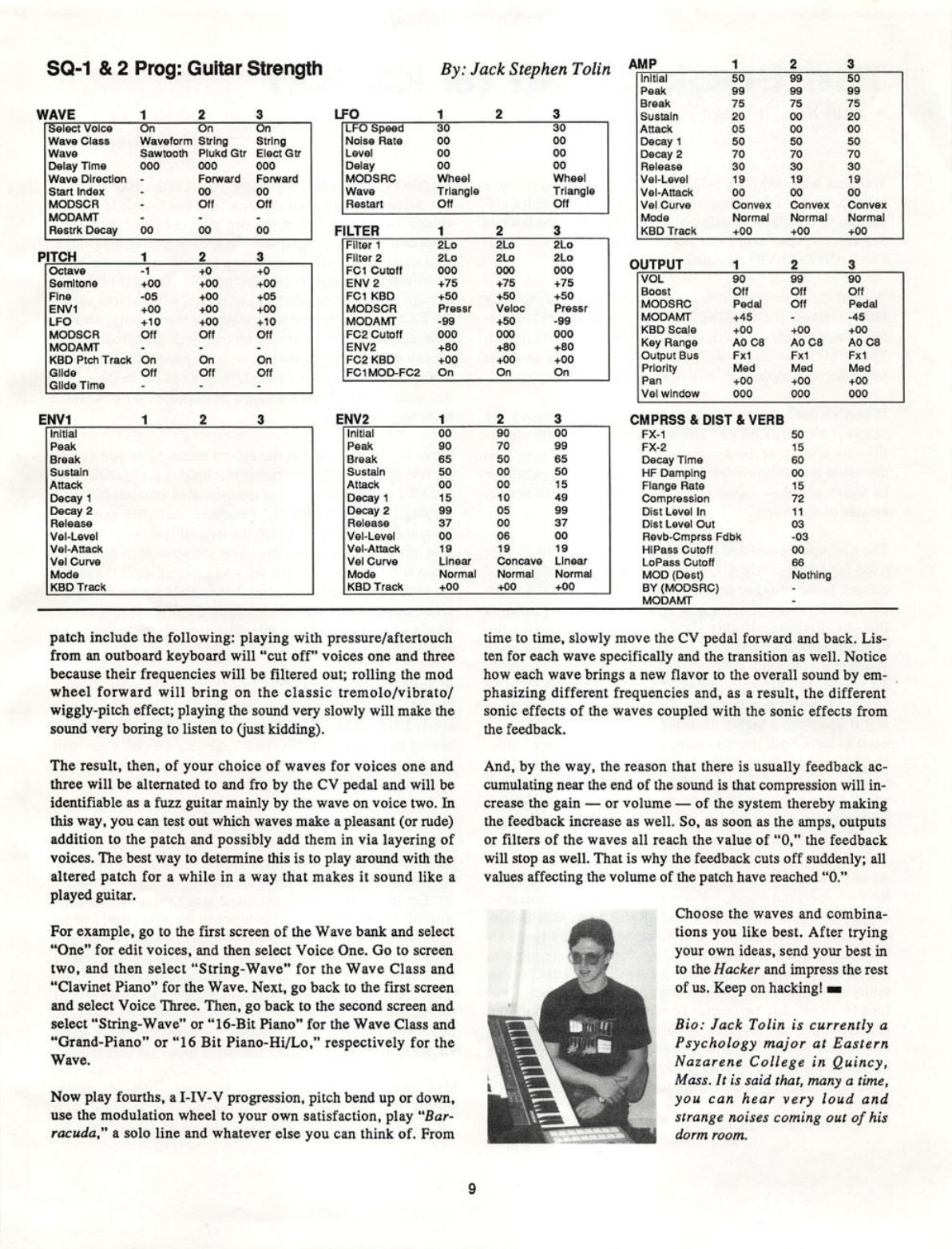
First, type in "Guitar Strength." The important ingredients to
note include (1) the CV pedal, which acts as a mediator between
voices one and three, and (2) the PLUCKED GUITAR wave on
voice two which acts as a unifier to the patch by giving it an at
tack similar to that of an electric guitar. Other features of the
8
SQ-1 & 2 Prog: Guitar Strength By: Jack Stephen Tolin
WAVE
Select Voice On On On
Wave Class Wave for m S tri ng String
Wave Sawtooth Plukd Gtr Elect Gtr
Delay Time 000 000 000
Wave Direction Fonward Fonward
Start Index 00 00
MODSCR Off Off
MODAMT
Restrk Decay 00 00 00
ITCH 12 3
Octave -1 +0 +0
Semitone +00 +00 +00
Fine -05 +00 +05
ENV1 +00 +00 +00
LFO +10 +00 +10
MODSCR Off Off Off
MODAMT
KBD Ptch Track On On On
Glide Off Off Off
Glide Time - -
FO 1 2 3
LFO Speed 30 30
Noise Rate 00 00
Level 00 00
Delay 00 00
MODSRC Wheel Wheel
Wave Triangle Triangle
Restart Off Off
ILTER 123
Fil te r 1 2Lo 2Lo 2Lo
F i l t e r 2 2Lo 2Lo 2Lo
FC1 Cutoff 000 000 000
ENV2 +75 +75 +75
FC1 KBD +50 +50 +50
MODSCR Pressr Veloc Pressr
MODAMT -99 +50 -99
FC2 Cutoff 000 000 000
ENV2 +80 +80 +80
FC2 KBD +00 +00 +00
FC1MOD-FC2 On On On
LMP 12 3
Initial 50 99 50
Peak 99 99 99
Break 75 75 75
Sustain 20 00 20
Attack 05 00 00
Decay 1 50 50 50
Decay 2 70 70 70
Release 30 30 30
Vel-Level 19 19 19
Vel-Attack 00 00 00
Vel Curve Convex Convex Convex
Mode Normal Normal Normal
KBD Track +00 +00 +00
)UTPUT 1 2 3
VOL 90 99 90
Boost Off Off Off
MODSRC Pedal Off Pedal
MODAMT +45 -45
KBD Scale +00 +00 +00
Key Range A0C8 AO C8 AO C8
Output Bus Fxl Fxl Fxl
Priority Med Med Med
Pan +00 +00 +00
Vel window 000 000 000
ENV1 1 2 3
Initial
Poak
Break
Sustain
Attack
Decay 1
Decay 2
Release
Vel-Level
Vel-Attack
Vel Curve
Mode
KBD Track
iNV2 12 3 C M P R S S & D I S T & V E R B
Initial 00 90 00 FX-1 50
Peak 90 70 99 FX-2 15
Break 65 50 65 Decay Time 60
Sustain 50 00 50 HF Damping 00
Attack 00 00 15 Flange Rate 15
Decay 1 15 10 49 Compression 72
Decay 2 99 05 99 DIst Level In 11
Release 37 00 37 DIst Level Out 03
Vel-Level 00 06 00 Revb-Cmprss Fdbk -03
Vel-Attack 19 19 19 H I P a s s C u t o f f 00
Vel Curve Linear Concave Linear L o P a s s C u t o f f 66
Mode Normal Normal Normal MOD (Dest) Nothing
KBD Track +00 +00 +00 BY (MODSRC)
MODAMT
patch include the following: playing with pressure/aftertouch
from an outboard keyboard will "cut off voices one and three
because their frequencies will be filtered out; rolling the mod
wheel forward will bring on the classic tremolo/vibrato/
wiggly-pitch effect; playing the sound very slowly will make the
sound very boring to listen to (just kidding).
The result, then, of your choice of waves for voices one and
three will be alternated to and fro by the CV pedal and will be
identifiable as a fuzz guitar mainly by the wave on voice two. In
this way, you can test out which waves make a pleasant (or rude)
addition to the patch and possibly add them in via layering of
voices. The best way to determine this is to play around with the
altered patch for a while in a way that makes it sound like a
played guitar.
For example, go to the first screen of the Wave bank and select
"One" for edit voices, and then select Voice One. Go to screen
two, and then select "String-Wave" for the Wave Class and
"Clavinet Piano" for the Wave. Next, go back to the first screen
and select Voice Three. Then, go back to the second screen and
select "String-Wave" or "16-Bit Piano" for the Wave Class and
"Grand-Piano" or "16 Bit Piano-Hi/Lo," respectively for the
Wave.
Now play fourths, a I-IV-V progression, pitch bend up or down,
use the modulation wheel to your own satisfaction, play "Bar
racuda," a solo line and whatever else you can think of. From
time to time, slowly move the CV pedal forward and back. Lis
ten for each wave specifically and the transition as well. Notice
how each wave brings a new flavor to the overall sound by em
phasizing different frequencies and, as a result, the different
sonic effects of the waves coupled with the sonic effects from
the feedback.
And, by the way, the reason that there is usually feedback ac
cumulating near the end of the soimd is that compression will in
crease the gain — or volume — of the system thereby making
the feedback increase as well. So, as soon as the amps, outputs
or filters of the waves all reach the value of "0," the feedback
will stop as well. That is why the feedback cuts off suddenly; all
values affecting the volume of the patch have reached "0."
C h o o s e t h e w a v e s a n d c o m b i n a
tions you like best. After trying
your own ideas, send your best in
to the Hacker and impress the rest
of us. Keep on hacking! mm
Bio: Jack Tolin is currently a
Psychology major at Eastern
Nazarene College in Quincy,
Mass. It is said that, many a time,
you can hear very loud and
strange noises coming out of his
dorm r o o m .
9
T h e B o o k o f S Q
-Part XIII, "It Goes To 11"
Welcome back, SQ (& KS-32!) programmers. In this month's
installment, we'll be wrapping up our rather long-winded dis
cussion of the SQ effects algorithms by examining the last two
SQ ef f e ct s , t h e " D IS T +C H OR US + RE V B" an d the "C M -
PRSS+DIST+REVB" algorithms.
Both of these are multi-effect algorithms, which is probably
fairly obvious. The "DIST+CHORUS+REVB" algorithm con
tains three separate effects: distortion, chomsing, and reverb.
The "CMPRSS+ DIST+REVB" algorithm actually contains
four effects: compression, distortion, reverb, and flanging.
If you've been following these articles, programming the
"DIST+CHORUS+ REVB" effect should pose no difficulty —
the only effect contained in this algorithm that we haven't yet
discussed is the distortion effect, and it only has one parameter
to worry about — "Dist Level," which is used to set the
amount of distortion.
The distortion generated by this algorithm is generally best
used for more subtle effects — to add a little edge to an
electric piano or organ sound, for example, or to add a touch
of "crunch" to an electric guitar sound. The reason for this is
that the distortion in this algorithm works much like the
natural distortion generated by tube amplifiers — the more
you turn up the amp, the more distorted the signal becomes.
To achieve this effect, however, the distortion is set up to be
interactive with the output stage of the SQ. What this means is
that if you want a highly distorted signal out of the SQ, you
need to have both the distortion level and the voice output
level turned up fairly high, and this can make the resulting
sound a good deal louder than most of the other programs
you'll have on board. So for highly distorted sounds, you're
probably better off using the "CMPRSS+DIST+ REVB" algo
rithm, which we'll talk about in a moment.
At any rate, to get a sense of how the "DIST+CHORUS+
REVB" algorithm works, let's try it out on an organ sound —
ROM sound #31, "Organ 1." After selecting this sound, enter
edit mode by pressing the "Edit Sound" button. Go to the ef
fect editing menu, and then hit the screen 0 button to move to
the first of the menu pages. You'll find that the effect is cur
rently set to "ROTARY SPKR+ REVB" — use the cursor but
tons to select this parameter (it should start flashing) and
change it (using the slider or up/down buttons) to "DIST+
CHORUS+ REVB." You'll immediately be able to hear the
change in sound — the organ is now fairly distorted and some
what louder (owing to the extra gain boost from the distortion
effect).
tc KS-32)
Clark Salisbury
A little experimenting will show you that the FXl and FX2
bus parameters are used solely to control reverb levels for
voices routed to either of the two effects busses. Distortion
level and other effect parameters are controlled elsewhere.
And in keeping with conventions established for the other
multi-effects, voices routed to the FXl bus will be routed
through the distortion, chorus, and reverb, while voices sent to
the FX2 bus will be routed through the reverb only. This, of
course, allows you to have a mix of both distorted (and or
chorused) and straight sounds, without having to give up the
reverb for either type of sound. In this case both the voices
that make up this sound are routed through the FXl bus, which
is the way we want it.
Move to the next page in the effects menu. Here you can set
the reverb decay time (remember that level is set from the FXl
and FX2 bus parameters) and the distortion amount. Note that
varying the "DIST LEVEL" parameter not only varies the
amount of distortion, but also the overall level of the sound.
You might think that you could set the amount of distortion
you want here and then use the voice output ievel to control
the overall level of the sound, but it ain't so; reducing the
voice output level will also reduce the distortion amount.
That's why I prefer to use this distortion algorithm for more
subtle effects.
At any rate, setting the "Dist Level" parameter to something
like 26 will give us a nice gritty organ sound, without being
overly loud. Unfortunately, using this effect algorithm means
having to give up the "ROTARY SPKR+REVB" algorithm
which is so effective on organ sounds. You can, however, use
the chorus to simulate this type of effect.
Move to the next effects menu page. Here you can set the
chorus rate and depth — the default values for both of these
parameters is 20. Leave it there but set the depth parameter to
06 — this way when we speed the chorus rate up to simulate a
fast Leslie speaker setting, the sound won't get overly wobbly.
Now hit the screen 3 button to move to the next page, and set
the chorus center parameter to 92 or thereabouts (which will
have the effect of making the chorusing more pronounced on
the upper frequencies), and set the feedback parameter to +50
to thicken the overall effect up a bit. Finally, go to the effects
modulation page and set the effect up to "Modulate RATE by
MODWHEEL +60." This allows you to control choras speed
via the modwheel, and viola! Simulated rotary speaker effect.
Now let's move on to the final effect algorithm, the "CM-
PRSS+DIST+REVRB" effect. To get a bead on this one, we'll
try doing a distorted electric guitar-type of sound. Start by
10
selecting ROM program #24, "Clav." I often like to use
clav-type sounds in place of guitars, particularly for live per
formance; they sometimes seem to cut a little better.
Enter editing mode and move to the top of the effects menu
pages. Select the current effect (in this case it should be
" C H O R U S + R E V E R B " ) a n d s e l e c t t h e " C M P R S S +
DIST+REVRB" effect. Play a few notes now and you'll find
that the sound is pretty gonzo already — lots of crunch, with a
bit of feedback (the ringing sound at the tail end of a note),
and an abrupt decay.
As with the other multi-effects, FXl and FX2 are used to con
trol reverb amounts. The rest of the effect levels are controlled
from within the algorithm itself. However, the reverb in this
effect is intenelated with the compressor in a way which we'll
discuss in a moment, so we may find we're using the reverb a
bit differently in this effect than in others.
Move to the next page of the effects menu, and here's where
you'll find controls for reverb decay and HF (high-frequency)
damping. As you may remember form previous discussions of
reverb parameters, HF damping allows you to control the rate
of decay of the high frequencies contained in the reverbed sig
nal. A higher number for this parameter will cause the high
frequencies to decay more quickly than the lower ones.
Move us to the next effects menu page. From here you can set
the one parameter related to the flanger, rate. A higher flanger
rate will make the flanging more pronounced; values above
about 30 or so will begin to sound dowmight silly. If you don't
want any flanging, set flanger rate to GO. Also available on this
page is the "Compression" parameter — basically, a compres
sion amount control. A compressor is a gain-control device
which will attenuate louder signals and boost quieter ones. The
net effect is to remove dynamics from the input material, so
don't be surprised if sounds that are highly compressed don't
seem as responsive to keyboard velocity as other sounds —
that's the way compressors work. Compressors became pop
ular among guitar players when it was discovered that they
could help to increase the apparent sustain of the guitar. Of
course, sustain is not generally an issue with the SQ, since
most of the waves are looped and can be sustained as long as
desired. But the sound of compression has become so as
sociated with certain types of guitar sounds that its inclusion in
this mu lti-effect is most welc ome.
Note that if you set the compression control up full — 99 —
most of the dynamics from the clav sound will have disap
peared. Also, the overall level of the sound will increase a bit,
driving the distortion a bit harder, so the sound will become
grungier as well. Leave compression set to "72" and move to
the next effects menu page.
From here w e can control the d i s t o r t i o n amount. T h i s d istor
tion algorithm presents us with both distortion "In" and "Out"
controls. Putting more signal into the distortion will drive the
distortion harder, providing more grunge. Of eourse, putting
more signal into the distortion will also cause the signal at the
output to be louder, so the distortion "Out" control allows you
to bring the overall level of the effect down into a listening
range that won't endanger your good standing with your land
lord. You'll find, though, that these controls are somewhat in
teractive and are also interactive with the voice output level
parameter located in the AMP section, so the most distorted
sounds are only attainable at rather high volume — just like in
real life. You'll also note that the range for both the "In" and
"Out" parameters is from GO to 11 ("It goes one more than IG"
— Nigel Tufnel, guitar player for the band. Spinal Tap).
Go to the next page, "Reverb to Cmprss Feedback." You can
use this parameter to route some of the reverbed signal back
into the compressor and on through the rest of the effects, al
lowing you to simulate the effect of an electric guitar feed
ing-back into its amplifier. The effect will be most pronounced
at the tail end of a note played (that is, if you keep this para
meter set within a reasonable range — about -IG to +1G. For
settings greater than this I can take no responsibility — you're
on your own).
Onto the next menu page. This presents us with a two-band fil
ter, allowing the sound to be further tonally tailored. You will
rem ember f rom our d iscussion of filter s that the "HiPass" filter
is used to filter out lower frequencies, letting high frequencies
pass through. This will have the effect of thinning out the
overall sound. The "LoPass" filter does the opposite — it lets
low frequencies pass through, while removing the highs. This
will have the effect of mellowing the sound out. Note that
using either filter to remove some or all frequencies will also
affect the overall level of your sound, since the filters actually
remove frequency-specific parts of the sound.
The final page of the this algorithm is the effect modulation
page. We've already spent a good deal of time discussing
modulation in previous articles, so I won't go back into that
here. And with this we finally wrap up the effects program
ming section of our journey through the SQ series of syn
thesizers. Stay tuned, though — in the next installment we'll
be talking about tips, tricks, and advanced programming tech-
B i o : C l a r k S a l i s
bury has been
actively involved
in the composi
tion, performance,
and recording of
e l e c t r o n i c m u s i c
for over 8 years.
His favorite color
is chrom e.
11
I nst a l l i n g a M IDI I n di c a t o r i n a n
E P S R a c k
Sam S. Mims
My EPS-16 PLUS module is probably my all-time favorite in
strument. But there is one thing I wish it had that it doesn't — a
simple LED to indicate if MIDI is being received or not. In a
complex setup with audio lines running from keyboards into
mixers and MIDI cables snaking in and out of patch bays,
keyboards, and modules, it's inevitable that occasionally some
thing that is supposed to be playing won't be. And it can be a
tedious procedure to track down the source of the problem.
If you're not hearing your EPS or EPS-16 Plus rack, it's simple
to plug a set of headphones directly into the sampler to see if it
is making noise or not. If it isn't, then either it has crashed or it
isn't getting MIDI signals. Now you're stuck with tracing and
repatching a squillion MIDI cables or simply rebooting the
EPS, reloading a sound, and seeing if it plays. Neither of these
is much fun in the middle of a session or a gig. To get around
this trouble, I installed an LED on the front panel of my
EPS-16 which lights up whenever any MIDI information is
received.
The indicator itself can be any standard LED, available in parts
shops everywhere. The circuit to drive it is simple, and requires
only two components — a 220-ohm resistor and a common
diode, such as a 1N4001 or equivalent. The circuit was outlined
in-an article by Craig Anderton in Electronic Musician (April,
1990, page 80). It took me a few hours to adapt and install it in
my sampler, and the new indicator looks like it came that way
from the factory. Note that this project WILL VOID the warran
ty on your EPS (if it is still valid), and it requires some basic
skills with a drill and a soldering iron. Neither this author nor
the Transoniq Hacker can be held liable if you blow your house
apart. So, if you're still game, let's make sure all cables —
especially the power cable — are unplugged, and proceed. In
addition to the three parts listed above, you'll need a drill and
bits, a soldering iron and solder, a medium Phillips screw
driver, and about 30 inches of small-gauge paired wire.
(1) Remove the EPS module from your rack, and pop off the
knobs from the volume and data sliders. They should pull right
off.
(2) Remove the rack ears, if any, by taking out the four
machine screws from each. If no rack ears are on the EPS, these
screws will still have to be removed.
(3) Remove the small machine screw(s) from the top and/or
bottom of the case that go into the disk drive. There is one hole
on top, and one on bottom, but only one of these may be in use.
(4) Remove the five small screws from the rear panel that
secure the top cover. Keep these separate, for they are a dif
ferent size from the screws in the top and sides.
(5) Remove the two small screws from each side panel, and the
four from the top. You should be able to remove the top of the
case now.
(6) The front panel should also be free at this point, except for
the wires which are attached to it. Unplug all the wiring con
nections except the ribbon cable to the disk drive and make
sure you know how to put them back!
(7) Remove the four screws that secure the disk drive to the
front panel (two at the top, two at the bottom). Set the disk
drive aside.
(8) Remove the eight screws that secure the large circuit board
to the front panel. The circuit board should be completely free
at this point.
(9) Drill a hole in the front panel to moimt the LED (these vary
in diameter). The hole should be directly above the data slider,
and directly to the right of the sequencer RECORD, STOP/
CONT, and PLAY buttons (see diagram).
(10) Insert the LED in the hole from the back of the panel; it
should fit snugly. A dab of Krazy Glue should hold it in place.
(11) Drill four tiny holes in the front panel circuit board that
will mount the resistor and the diode parallel to each other.
These holes should be in the unused upper comer of the board,
directly above the data slider. Be sure that they are low enough
so that the resistor and diode will clear the mounting rail on the
front panel, yet high enough so that the holes are well clear of
the etched traces on the board.
(12) Insert the diode and resistor in the new holes. It doesn't
matter which way the resistor is inserted, but it does for the
diode. Make sure that the cathode lead of the diode — marked
by an indicator stripe on one end — is toward the center of the
circuit board. Bend this cathode lead of the diode and the
nearest lead of the resistor together, and solder them together.
(13) Cut a 24-inch length of the wire pair, and solder one end
of this to the free ends of the resistor and diode (the ends
closest to the edge of the board), one wire to each component.
This will carry the MIDI signal.
(14) Cut a six-inch length of wire pair, and solder one wire to
the resistor/diode connection, and the other wire to the opposite
end of the diode.
(15) Solder the free end of the 24-inch wire pair to the MIDI IN
jack, mounted to the main circuit board in the EPS. The wire
leading to the resistor should cormect to pin 4 of the jack, the
12
wire leading to the diode should connect to pin 5.
(16) Solder the free end of the short wire pair to the two leads
of the LED. The wire from the resistor/diode connection should
go the anode lead of the LED.
(17) Wipe off any fingerprints from the inside edge of the dis
play window, then reinstall the circuit board to the front panel.
(18) Reinstall the disk drive to the front panel. The excess wire
to the LED can loop above the drive to keep it free from the
data slider.
(19) Reconnect the wiring to the front panel.
(20) Reinstall the top cover, and the volume and data slider
knobs.
Now, you should be able to see at a glance whenever your EPS
rack is receiving MIDI data. Any MIDI information — notes,
pitch bends, and so on — will cause the LED to light up, re
gardless of the channel. If the EPS makes no noise, yet the
LED lights up, then either MIDI chaimels are set wrong, or the
EPS has crashed. Note that the LED requires no power from the
EPS and therefore it operates even when the EPS is off. n
But I Don't Want Ctiorus
- A Quick Tip for Working with EP$-16 PLUS Effects
As is true of many EPS owners who upgrade to the 16 PLUS,
the first place I turned my attention was those new-fangled on
board effects. I have an SPX 90 which is capable of a number
of useful effects, but since it's my only processor, I use it al
most exclusively as a reverb unit. Now, with those cool on
board effects, I could finally use multiple effects in my
sequences.
The combination of effects I most wanted to use was a mixture
of reverb and digital delay. So, I scrolled through the available
effects looking for what I needed. Reverb and digital delay...
reverb and digital delay...hmmm, the closest I could find was
ROM Effect #10 which contains chorus, reverb and digital
delay.
I decided that would have to do — all I had to do was bypass
the chorus. After looking at the diagrams in the owner's
manual, however, I thought I was out of luck. According the
manual. Bus 1 is routed through the chorus and reverb. Bus 2 is
routed through the reverb and Bus 3 is routed through the digi
tal delay. Bummer! What I needed was one chaimel for reverb
another for the digital delay and finally — this part was miss
ing — a chaimel that would provide a dry signal path.
Now, those of you who are expert programmers might see the
solution to my problem right away, but I'm just an average
keyboard player who has difficulty with technological stuff if
it's not spelled out in black and white (and sometimes even
when it is).
I finally discovered the solution to my problem as I was play
ing around with the factory disks Ensoniq so kindly included
with my keyboard. As I was messing around with Disk 003,1
found that the drums (TR BOS'") had been placed on three
separate tracks. The first track was dry, the second track had
digital delay and the third track had reverb! (I discovered later
that the reverb also had some chorus mixed in.) When I looked
to see which effect was being used, I found that same one I had
tried earlier (the mixture of chorus, reverb and digital delay)
Bryce Inman
was being used. So where did they get the dry chaimel?
Here's the solution: What hadn't occurred to me was that, al
though Bus 1 has to nm through both the chorus and reverb, the
chorus can be tumed off leaving this as a reverb only channel;
and, although Bus 2 has to run through the reverb, the reverb
mix can be tumed all the way to zero so it becomes a dry chan
nel.
To set up this configuration requires only two changes as fol
lows:
1. After selecting ROM effect CHOR+REV-i-DDL, press EDIT
then EFFECTS.
2. Scroll a couple of pages to the right until the screen says
BUS 2 REVERB MIX = 25. Set this value to 0. This turns off
the reverb for Bus 2 making it a dry bus.
3. Scroll a few more pages until the screen reads CHORUS
MIX = 50. Set this value to 0. This turns off the chorus for Bus
1 making it a reverb-only channel.
That's it!!! Now Bus 1 has reverb. Bus 2 is dry and Bus 3 has
digital delay. Okay, this isn't anything earth-shattering, but this
little discovery opened my eyes to a
number of possibilities that weren't
previously apparent. I hope this little
tip is helpful for those of you who,
like me, have difficulty reading be
tween the lines. ■■
Bio: Bryce In man is a free-lance
music editor and arranger for Word,
Inc. in Irving, TX. Although he has
decided to make Texas his permanent
home, he refuses to say "y'all" or
"fixin'
13
Transoniq Trivia ii
Garth Hjelte
Searching for the meaning of life is hard. I mean it really is. Considering aU the different alluring things that concepts, ideas and people have to
offer us, it can get quite confusing. I know you're all in search of something, but we can all agree on thing. Everything else is just plain trivia,
isn't it? Sure is. Below is an example of such. After all, what could be more trivial than Transoniq Trivia?
1. What is unique about September '91 's cover?
2. What Hacker advertiser doesn't "give you the bird"?
3. What Hacker writer names himself after a famous fictional sci-fi
character?
4. What is a Tali s man?
5. How is the. Hacker's color-of-the-month determined?
6. W ho is Ot is?
7. Where are the remaining copies of Gary Giebler's first album?
8. Whose voices are "nothing short of stunning"?
9. Who is the Ensoniq distributor in Australia?
10. What software company's products does Ensoniq distribute at the
present time?
11. Who created the "Ensoniq Suite"!
12. BONUS QUESTION: What company does the "Ensoniq Suite"
admonish Ensoniq not to be like?
13. What cartoon movie is this man a fan of?
14. In the 3.4 OS chip update of the ESQ-1, Ensoniq accidentally
screwed up one of the waveforms.
A . W h a t w a v e f o r m w a s i t ?
B. Which reader caught it?
C. ANOTHER BONUS QUESTION: What popular soft drink
does this writer consume when he works on his computer?
15. What did Jack Tolin do to Erech Swanston in 1992 — and in what
month?
16. According to the Hacker, what broadcastingly prepared sample
company has "completely disappeared"?
17. Look at the back covers of Dec. '91 and Jan. '92. Name the four
differences.
18. What is wrong with this sentence: "Hi, my name is Bryce Inman.
Y'all come down to Texas, ya hear and we'll talk EPS while my
wife's fixin' some babyback ribs!"?
19. What went up in price in May '92.
20. What country is William Pont from?
21. Black dots started appearing on the Hacker cover in what issue?
22. How many writers were added to the "bevy" listing at the start of
'92?
23. Who "quit" at that time?
24. Who is John McCubbery?
25. Who was the last official Hacker typist?
26. What is the name of Dick Lord's company?
27. What feature is missing from the July '92 issue?
■j s n S O j u a u n o a q x ' L Z
•sjdaouo^ piBMdfi -gj
• n a u u o o . o p B q s T Z
•itiojoBX oujoaia JO P«OH "tZ
ijoos trepjof puB 'X/vtoq uua;^ 'qwug sijq^
•iBaqs
uiox puB 'Jfuijjoi uqof 'laiqaio kivQ 'uotjno — Jnoj 'ZZ
■(bmosuvjx ui aqj jaxo) x6, 'JsnSny 'IZ
• B o u j v q j n o s - Q Z
■zz%
OJ 0£$ luojj 'U3H3VU aqj oj suotjdiiosqns ..Jaqto ^b,, jo aoud aqx '61
..-.uixa,, puB spjOAv aip Xbs ot sasnjai aoXig -gj
■aStreqo Xxag -q
■ajBp jq3uXdo3 -3
■10103 -g
•laqiunM jiuuog -y 'LX
•XpBsg otpBg -gj
"26, "1 -lolUAV B SB luiq aoBjdag -g j
■OTOD lotQ 'D
•uosuqof luif -g
■o A B M Z O N d a o m ' V " h i
sotpnjs XausiQ Xq vtsvtuvj -gj
•sjinoiia iBtiuanbas "Zl
(■siBaX
aqj MAO sassa^onr jsaSSiq aqj pasiBj UAtop-spuBq SBq 'XgBotjaqj
-uaiBd 'oqAi — gx) UBSiuuig jbj 'ojiBUtpioBijxa rajtJAt u9^ov}j - Ji
■q^TD '01
■XjojoBg oujoaia aqx "6
•s.SBiuoqx "X - g
qasop luoojpaq siq uj
"XdA oqi poJOMod qoiqAt 'diqo m 30a s'T ■'oj aiUBU jad s.btuosug -g
(•XgBnjoB 'ajqissod sb uiopuBi sb ji a3]Biu oj Xij a^y^ ;hx) io-ioqi
SI 'ga^ -rapJO JBjnoijjBd ou si ajaqx '£
(■spB
JO saSBd aiotu Xuou/ aq p.araqj 'os aioAV
®Tqi Jl =Hl) sjaAiod jboiSBUI qjiAV auQ "t
pjBiiuiis ..31-nN in^dB3„ -g
XuBdiuo3 ajBMjjog ua3[aiq3 Jaqqng
■adXj
ajoijjB JO pjBoqXa3[ Xq pajBJBdas jou ajB
Xjojaajip anss] stqi «/aqj ui sapijJB aqx "I
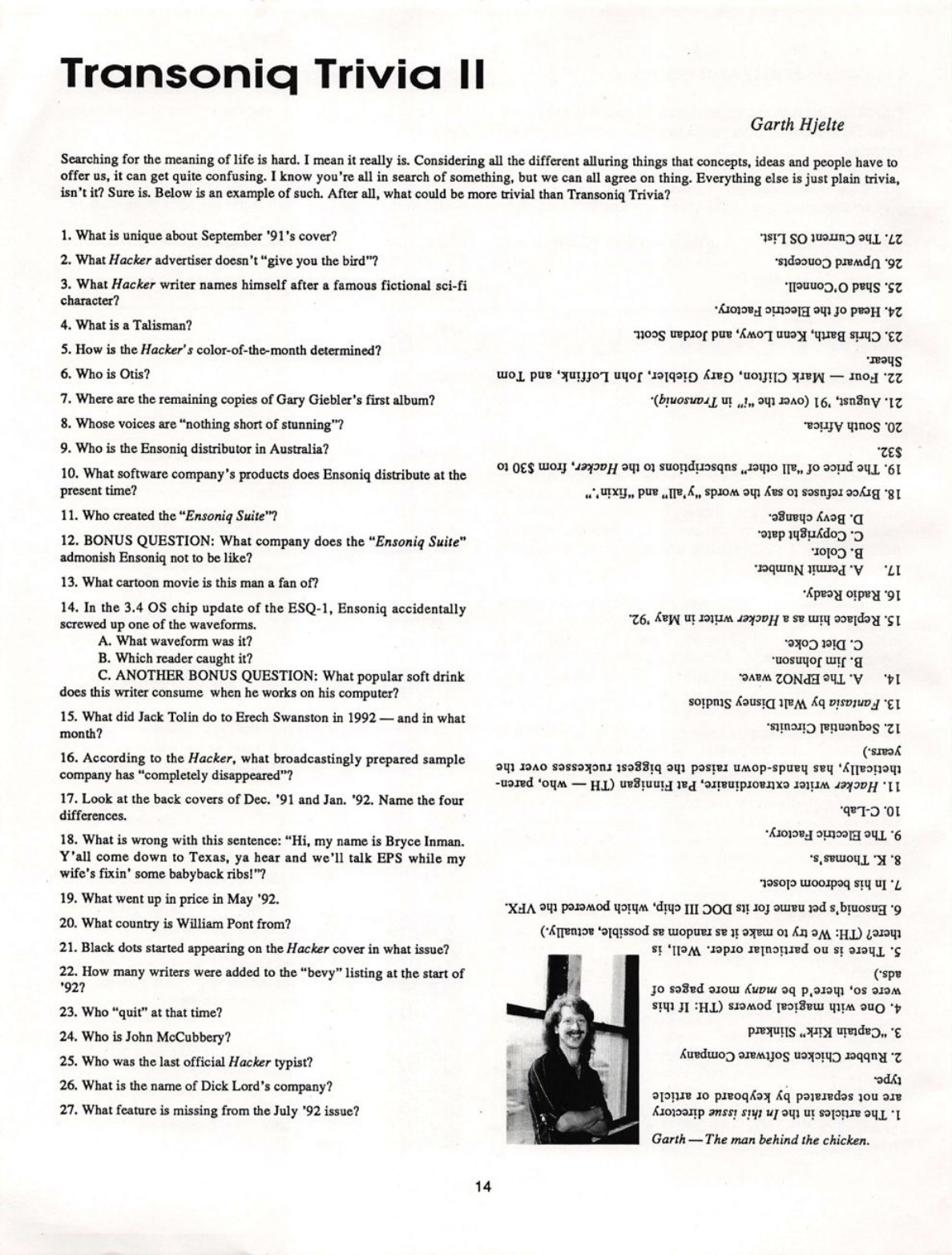
Garth — The man behind the chicken.
14
Confessions of on Upgrader
or — How I Stopped Worrying and Learned to Love my $D-l/32
I know many VFX-sd/SD-1 owners are contemplating upgrad
ing into the latest, greatest SD-1/32 voice. It's expensive ($699
for VFX-sd, $250 for SD-ls purchased before November 1991,
and $100 for the newer SD-ls) and you're probably wondering
if it's really worth it.
Well, here's what you get with your new upgrade:
F o r V F X - s d o w n e r s :
• SD-l new waveforms including 16-bit pianos, solo violin,
vibraphone, timpani, moog and slap bass, and several hip per
cus s i o n/dru m waves.
• An extra set of ROM sounds — 60 sounds/20 presets using
many of the newer waves — it's kind of a "Best Of" collection
from the VFX-sd library. You get 120 ROM sounds, 60 RAM,
plus the cartridge all on board.
• The new Drum Map feature.
• 16-bit output DACS for pristine sound quality.
• Several new effects algorithms including a killer distortion ef
fect, a dense plate reverb, and a phaser.
• The sequencer operating systems updates.
• And a complete cleaning, calibration, and general overhaul to
bring your VFX-sd into Ensoniq's state-of-the-moment specs.
• To sweeten the deal, Ensoniq throws in a new manual and the
latest OS disk: VSD-201.
For original SD-1 (and VFX-sd) owners:
• The SQX-70 memory expander that increases the sequencer to
75,000 notes.
• Sequencer upgrades to version 4.1 with the new SWING fea
ture added.
• 32 voice polyphony.
That may not look like much, but once you see and hear what
you've been missing, you'll be pleasantly surprised.
The Verdict
So is it worth it? The answer is an emphatic yes! Especially for
VFX-sd owners. It may be a little less attractive for SD-1
Jeffrey P. Fisher
owners (though the lure of 32-voice polyphony is strong). They
may want to wait and see if Ensoniq decides to offer more fea
t u r e s s o o n .
I sent my VFX-sd off for the complete upgrade and am very
happy with the result. They even fixed my keyboard-calibration
error.
The new sounds are topnotch and made even better by the new
output circuitry. Before I shipped my board, I recorded a
simple sequence on tape using some of my favorite sounds.
When my upgraded synth returned, I again recorded the se
quence to tape then compared the two. I was shocked. I ex
pected a subtle difference, but was amazed by the clarity, better
fidelity, increased punch, and the crisp and clean highs.
The new sounds really shine and old patches get new life. In
fact, several of my sequences sounded completely different.
And then there's the new piano. I thought the Mega-piano was
cool — this 16-bit piano is hot. The included sound, DY
NAMIC GRAND, really shows what this wave can do (and
sound like)! The drum map feature is a welcome addition, as
are the increases in sequencer memory and polyphony. Even
with dynamic voice allocation, my VFX-sd suffered during
complex musical passages. The 33% increase really makes a
difference. And the additional memory makes copying and
backing up a snap. Disk copies now only take about three disk
swaps.
Unfortunately, even though it's an SD-1/32 voice under the
hood, the outside still says VFX-sd. How about a slap-on stick
er so you can impress your friends?
How to Upgrade
What does it take to get the upgrade? Contact Ensoniq and
they'll give you a repair authorization number. Next, pack up
your keyboard (you saved the original shipping container just
for such an eventuality, didn't you?) and write the authorization
number on both ends of the box in big, BOLD letters. Then,
trek on down to your nearest UPS office. It'll cost between $12
- $18 to ship UPS ground depending on where you live. (En
soniq also requires that it be insured — or at least they say that
they aren't responsible for any damage that happens en route.)
In about two weeks your fresh, new SD-1/32 voice will arrive
COD. To simplify matters, Ensoniq decided to only offer the
upgrade COD. Unfortunately, that means you can't use your
credit card to pay. I applaud them for making it uncomplicated,
though. The return shipping charges are included in the COD
total.
15
Still not Convinced? Need more? Play the SD-1 PALETTE demo sequence.
So, the new sounds, new features, and the painless upgrade pro
cedure not enough for you? Don't take my word for it. Go
down to your local Ensoniq dealer and ask to hear the SD-1/32
voice. Load in the SD-1 PALETTE demo and play these RAM
(INTO) sounds: DYNAMIC GRAND, RUDE-GUITAR,
STACKED, and WARMS BOWS. Next, play these ROM
sounds: MOOG-MUTE (RM15), CROSS-BASS (RM15),
DRUMS-MAP-R (RM19), 808-MAP-R (RM19), and
ORCH-PERKS (RM19).
For: SD-l/SD-1 32 Voice (also available for the EPS-16 PLUS, SQ-1 &
SQ-2 and VFX).
Product: Talking Owner's Manual — audio cassettes.
Price: $14.95
From: Ensoniq Corp. 155 Great Valley Parkway, Malvern, PA 19355,
(215) 647-3930 or contact your local Ensoniq dealer.
Deciphering the contents of most keyboard manuals is like
learning a foreign language. You often have to wade through
pages and pages of technospeak to find the pearl you are seek
ing.
As a result, many novices don't even bother to read manuals.
They find them too frustrating, too intimidating and too dif
ficult. Instead, they plunge in and attempt to learn a complex
instrument via trial and error. If they happen to stumble on a
function or sound they need, they are elated. Unfortunately,
their elation soon turns into frustration when they are unable to
replicate that feat later on stage or in the recording studio. It is
no wonder that most people never get beyond playing the
presets on the instruments they buy.
The Talking Owner's Manual is designed to alleviate the in
timidation factor and to help the SD-1 owner navigate this
complex instrument without getting seasick. The package con
sists of an audio cassette and a 3.5" SD-1 disk. You pop the
cassette into your tapedeck, load the disk into your SD-1 and
you're ready to go. You'll probably have to use a portable cas
sette recorder, unless your setup includes a mixer which will
enable you to listen to a tape deck and your SD-1 at the same
time. This is probably the best option since the tape sounded a
bit fuzzy through my good quality tape deck. The duplication
quality could definitely stand some improvement.
It is recommended that you jot down the counter numbers on
your tape recorder which correspond to each section of the tape
and use the same tape recorder each time, since these numbers
vary from recorder to recorder. You can use these numbers as
And One More Item of Interest to Professionals
Remember this: the upgrade is really a kind of repair. If you
use your VFX-sd/SD-1 for business, like me, the cost is fully
tax-deductible! b
Bio; Jejfrey P. Fisher is a composer for films and video and the
author o/How To Make Big Money Scoring Soundtracks for
Corporations, Cable TV, and Commercials.
Cannot Face
Tony Thomas
an index when you need to review certain sections of the tape.
It also might be a good idea to keep a notebook handy to jot
down your thoughts and ideas while listening to the tape.
The tape opens with a short primer which tells you how to hook
up the SD-1. Next, there is a tour of the instrument's front
panel, with short explanations of each fimction. Then, there is
an overview of the Ensoniq's Musician's Manual. The manual
is used as a reference source for the Talking Owner's manual.
The rest of the tape provides detailed information on how to
use the SD-1. Sonic examples are included on the tape to il
lustrate, for example, how sounds can be used. This is a nice
touch since it enables the listener to hear what can be done with
the SD-1, interactively. The disk included with the package is
used to demonstrate the sequencer and disk functions of the
SD-1. There also are some good demo sequences, drum pat
terns and templates which you can use. There are also some ex
cellent demos of the factory sounds.
The Talking Owner's Manual is a novel product that can be an
invaluable learning aid to the SD-1 owner. It is almost like
having an experienced teacher giving you lessons on how to
use this powerful keyboard. The disk that comes with it adds to
the usefulness of the package and can be used as a building
block for creating your own sequences. Although the Talking
Owner's Manual is an effective adjunct to Ensoniq's Musician
Manual, I can only imagine how much
more powerful it could have been if it
was a videotape, b
Bio; Tony Thomas is a veteran jour
nalist who has contributed to several
national magazines including Mix,
Electronic Musician, Music Computers
and Software, AV/Video and REP. He
is also an established recording en
gineer, producer, composer and key
board player.
F o r T h o s e o f U s W h o
One More Manual
16
1 - 1 = B - 3
An Equation For Making Your SQ Scream Like a Tonewheei Beasti
Mark Clifton
Now I may be young, but I feel that I've had the oppor
tunities to experience some of the finer things in life —
namely power analog, down-and-dirty Rhodes and the
mighty Hammond B-3 organ. All of these came before my
time, but good luck has allowed me to get to know each of
them (especially the B-3), and turned me green with envy
for all you old-timers who were around when they ruled
supreme. I've spent many an hour pounding on the old
Hammond C-3 (identical to the B-3 except for the addition
of chorusing and a lovely oak cabinet) at my church, and
know for a fact that there's nothing like crankin' up the old
Leslie speaker, yankin' out all the drawbars, and pummel-
ing its keys into oblivion. Its classic grungy sound and wob
bling Leslie have made it a staple in jazz and rock n' roll
since its inception. There's just something about that uni
que, almost organic sound that draws people to it. It's an in
strument that you can't cheat or lie about your musicianship
on. To play it requires a certain brutality that you would
never use on other instruments. You can't be a whimp if
you want to play the B-3.
Okay, enough romantic rambling (the B-3 just has that ef
fect on me). It's time to tell you how to get a nice simula
tion of this bliss on your SQ-I. If you don't want to haul
around the genuine article (which weighs a good four
hundred pounds), or pluck down the few thousand dollars
for a used one, then your SQ should work nicely. So far,
there hasn't been a synthesizer in the world that can
reproduce the sound of the B-3 with total accuracy, and the
SQ-I is no exception. I find that the B-3 simulations on the
SQ lack the grit and high-end scream of the real thing. This
is a fault in the raw waveforms and too-clean output of the
SQ (yes, 21-bit D/A converters do have their curses), and
can't really be helped. Still, I guarantee you'll be surprised
at how gutsy your SQ-1 can sound.
Sound Generation
The B-3 generates sound using 96 electronic tonewheels
that each create a (somewhat imperfect) sine wave in a
specific harmonic. Drawbars above the B-3's two 61-note
manua ls contro l t he volume of each harmo nic. There i s a se t
of nine drawbars for each manual, making them both
separately "programmable." Drawbars can be pulled while
notes are sustaining, which gives a level of realtime control
that is hard to achieve on a synthesizer. There is a way to
match the same effect on the SQ, but I'll cover that later.
The layout of the drawbars is as follows:
Drawbar Interval Equ
16' Sub-octave C2
5-1/3" 5th G3
8' fundamental C3
4' octave C4
2-2/3' 12th G4
2" 15th C5
1-3/5' 17th E5
1-1/3' 19th G5
1' 22nd C6
There is also a set of three drawbars for the pedals which
are the same as the first three of the manual drawbars. Each
drawbar is marked with the numbers I through 8, which are
used as increments with 1 being the lowest volume for that
harmonic and 8 being the highest (0 is off). These numbers
are also used to code drawbar combinations (ex: 888508-
700). The corresponding SQ-1 volume vale is roughly 12
increments for every I on the B-3.
It is possible to create excellent B-3 sounds using additive
synthesis, which builds sounds out of harmonic sinewaves
exactly the way the 'B does. But this seems fairly impracti
cal with the SQ's three-oscillator structure which would
only allow three sinewaves to be used at once. You could
create a string of sounds, each with a different set of har
monics, then assemble them into a preset, but this would
severely limit polyphony. Another solution is the "1 + 2
Harmonics" waveform, which is actually two sinewaves
playing in unison an octave apart. If you look at the har
monics that the B-3 drawbars produce, you'll notice that
they are nothing but consecutive sets of firsts and fifths,
with a seventeenth (major third) thrown in. By substituting
the "1 + 2 Harmonics" wave for any harmonics that lie an
octave apart in a certain drawbar combination, you can
create bigger additive B-3 sounds while still saving poly
phony.
The SQ-I also contains four "Organ Variation" waves that
correspond with certain drawbar combinations. I don't
know how the waves were created, but it's a pretty good bet
that they're either samples of a real organ or additive
recreations. After doing some lengthy comparisons, I've
m a t c h e s t h e d r a w b a r c o m b i n a t i o n s t o t h e w a v e f o r m s t h a t
they correspond with:
17
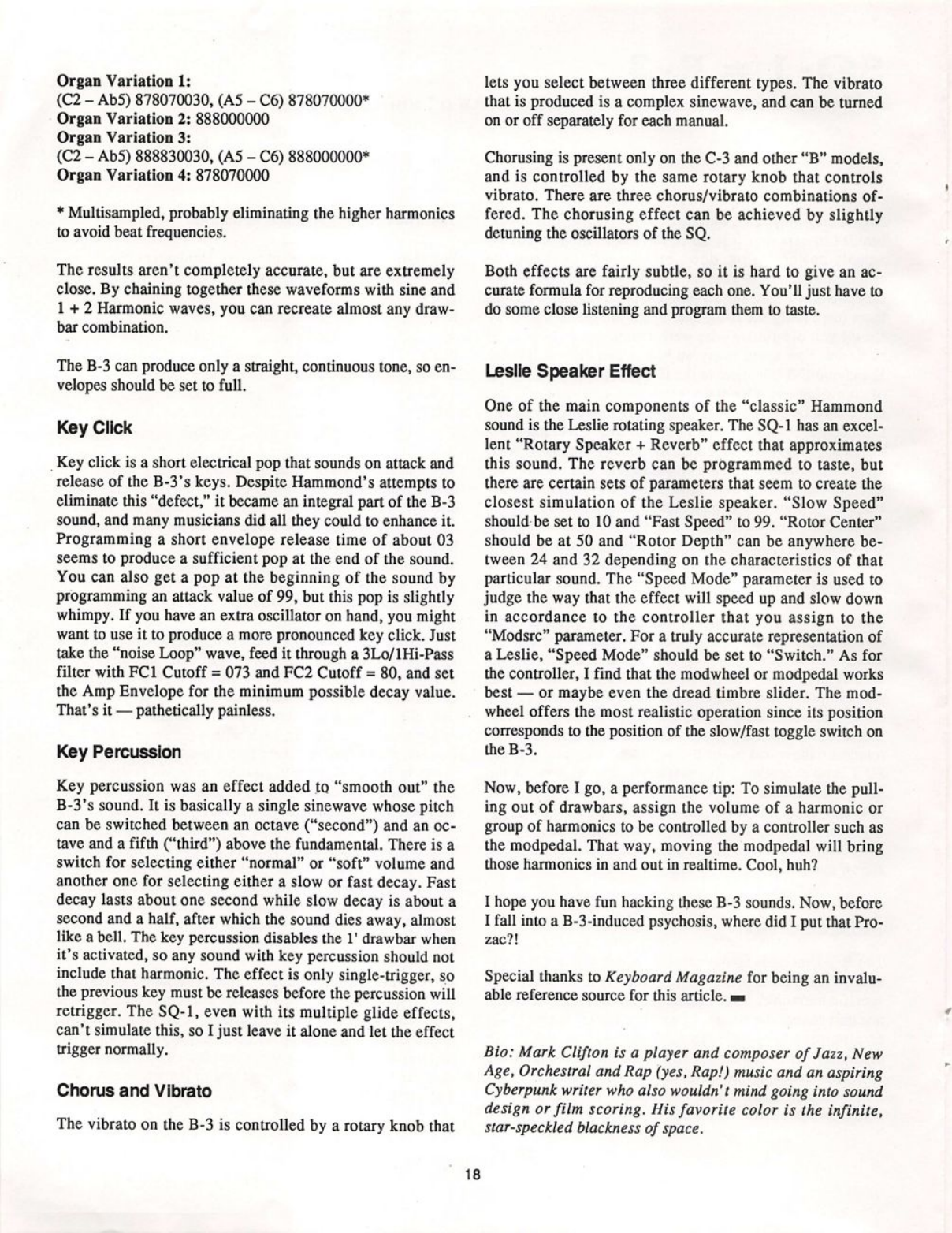
Organ Variation 1:
(C2 - Ab5) 878070030, (A5 - C6) 878070000*
Organ Variation 2: 888000000
Organ Variation 3:
(C2 - Ab5) 888830030, (A5 - C6) 888000000*
Organ Variation 4: 878070000
* Multisampled, probably eliminating the higher harmonics
to avoid beat frequencies.
The results aren't completely accurate, but are extremely
close. By chaining together these waveforms with sine and
1 + 2 Harmonic waves, you can recreate almost any draw
bar combination.
The B-3 can produce only a straight, continuous tone, so en
velopes should be set to full.
Key Click
Key click is a short electrical pop that sounds on attack and
release of the B-3's keys. Despite Hammond's attempts to
eliminate this "defect," it became an integral part of the B-3
sound, and many musicians did all they could to enhance it.
Programming a short envelope release time of about 03
seems to produce a sufficient pop at the end of the sound.
You can also get a pop at the beginning of the sound by
programming an attack value of 99, but this pop is slightly
whimpy. If you have an extra oscillator on hand, you might
want to use it to produce a more pronounced key click. Just
take the "noise Loop" wave, feed it through a 3Lo/lHi-Pass
filter with FCl Cutoff = 073 and FC2 Cutoff = 80, and set
the Amp Envelope for the minimum possible decay value.
That's it — pathetically painless.
Key Percussion
Key percussion was an effect added to "smooth out" the
B-3's sound. It is basically a single sinewave whose pitch
can be switched between an octave ("second") and an oc
tave and a fifth ("third") above the fundamental. There is a
switch for selecting either "normal" or "soft" volume and
another one for selecting either a slow or fast decay. Fast
decay lasts about one second while slow decay is about a
second and a half, after which the sound dies away, almost
like a bell. The key percussion disables the 1' drawbar when
it's activated, so any sound with key percussion should not
include that harmonic. The effect is only single-trigger, so
the previous key must be releases before the percussion will
retrigger. The SQ-1, even with its multiple glide effects,
can't simulate this, so I just leave it alone and let the effect
trigger normally.
Chorus and Vibrato
The vibrato on the B-3 is controlled by a rotary knob that
lets you select between three different types. The vibrato
that is produced is a complex sinewave, and can be turned
on or off separately for each manual.
Chorusing is present only on the C-3 and other "B" models,
and is controlled by the same rotary knob that controls
vibrato. There are three chorus/vibrato combinations of
fered. The chorusing effect can be achieved by slightly
detuning the oscillators of the SQ.
Both effects are fairly subtle, so it is hard to give an ac
curate formula for reproducing each one. You'll just have to
do some close listening and program them to taste.
Leslie Speaker Effect
One of the main components of the "classic" Hammond
sound is the Leslie rotating speaker. The SQ-1 has an excel
lent "Rotary Speaker + Reverb" effect that approximates
this sound. The reverb can be programmed to taste, but
there are certain sets of parameters that seem to create the
closest simulation of the Leslie speaker. "Slow Speed"
should be set to 10 and "Fast Speed" to 99. "Rotor Center"
should be at 50 and "Rotor Depth" can be anywhere be
tween 24 and 32 depending on the characteristics of that
particular sound. The "Speed Mode" parameter is used to
judge the way that the effect will speed up and slow down
in accordance to the controller that you assign to the
"Modsrc" parameter. For a truly accurate representation of
a Leslie, "Speed Mode" should be set to "Switch." As for
the controller, I find that the modwheel or modpedal works
best — or maybe even the dread timbre slider. The mod-
wheel offers the most realistic operation since its position
corresponds to the position of the slow/fast toggle switch on
the B-3.
Now, before I go, a performance tip: To simulate the pull
ing out of drawbars, assign the volume of a harmonic or
group of harmonics to be controlled by a controller such as
the modpedal. That way, moving the modpedal will bring
those harmonics in and out in realtime. Cool, huh?
I hope you have fun hacking these B-3 sounds. Now, before
I fall into a B-3-induced psychosis, where did I put that Pro
zac?!
Special thanks to Keyboard Magazine for being an invalu
able reference source for this article, h
Bio: Mark Clifton is a player and composer of Jazz, New
Age, Orchestral and Rap (yes. Rap!) music and an aspiring
Cyberpunk writer who also wouldn't mind going into sound
design or film scoring. His favorite color is the infinite,
star-speckled blackness of space.
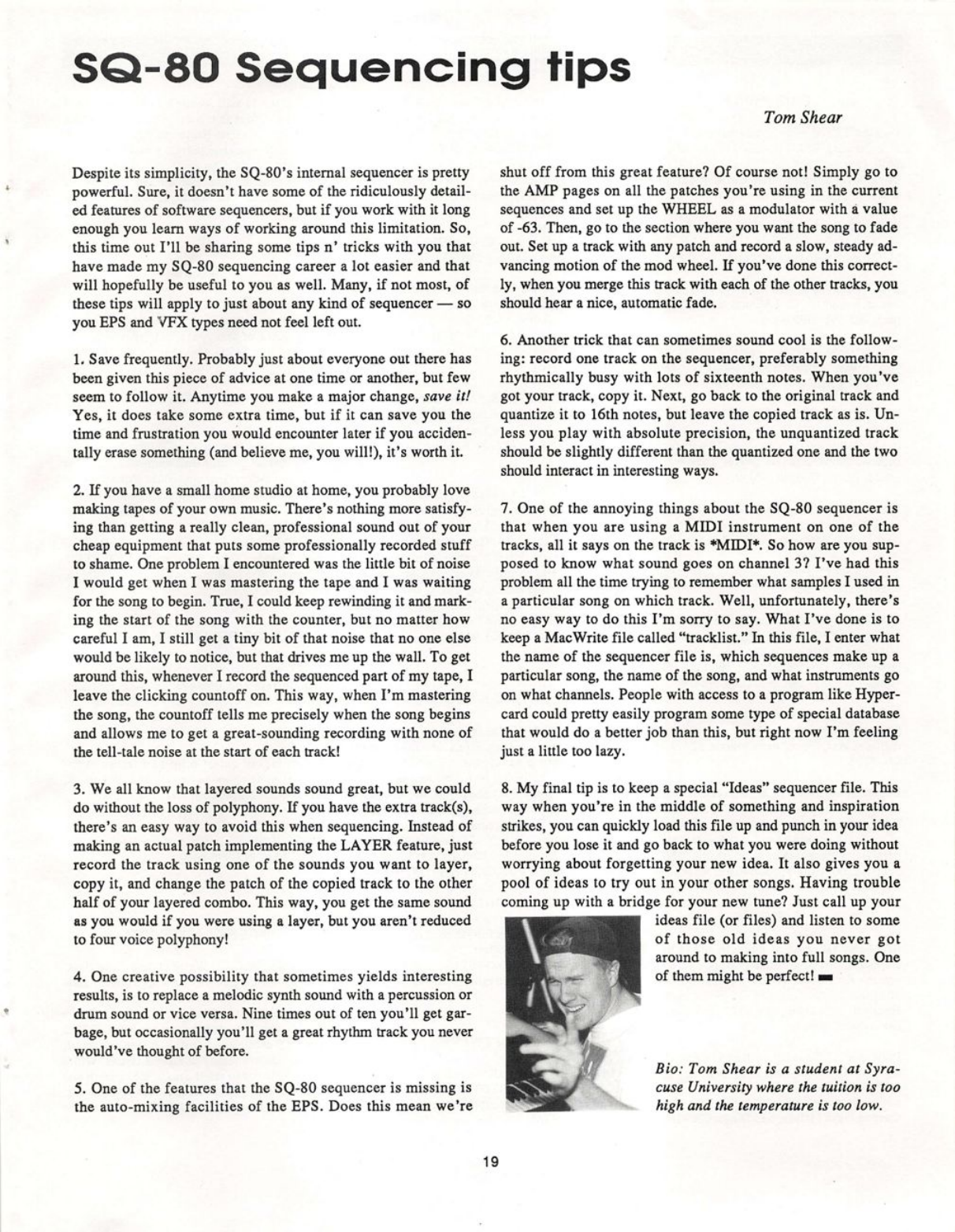
SQ-80 Sequencing tips
To m S h e ar
Despite its simplicity, the SQ-80's internal sequencer is pretty
powerful. Sure, it doesn't have some of the ridiculously detail
ed features of software sequencers, but if you work with it long
enough you learn ways of working around this limitation. So,
this time out I'll be sharing some tips n' tricks with you that
have made my SQ-80 sequencing career a lot easier and that
will hopefully be useful to you as well. Many, if not most, of
these tips will apply to just about any kind of sequencer — so
you EPS and VFX types need not feel left out.
1. Save frequently. Probably just about everyone out there has
been given this piece of advice at one time or another, but few
seem to follow it. Anytime you make a major change, save it!
Yes, it does take some extra time, but if it can save you the
time and frustration you would encounter later if you acciden
tally erase something (and believe me, you will!), it's worth it.
2. If you have a small home studio at home, you probably love
making tapes of your own music. There's nothing more satisfy
ing than getting a really clean, professional sound out of your
cheap equipment that puts some professionally recorded stuff
to shame. One problem I encountered was the little bit of noise
I would get when I was mastering the tape and I was waiting
for the song to begin. True, I could keep rewinding it and mark
ing the start of the song with the counter, but no matter how
careful I am, I still get a tiny bit of that noise that no one else
would be likely to notice, but that drives me up the wall. To get
around this, whenever I record the sequenced part of my tape, I
leave the clicking countoff on. This way, when I'm mastering
the song, the countoff tells me precisely when the song begins
and allows me to get a great-sounding recording with none of
the tell-tale noise at the start of each track!
3. We all know that layered sounds sound great, but we could
do without the loss of polyphony. If you have the extra track(s),
there's an easy way to avoid this when sequencing. Instead of
making an actual patch implementing the LAYER feature, just
record the track using one of the sounds you want to layer,
copy it, and change the patch of the copied track to the other
half of your layered combo. This way, you get the same sound
as you would if you were using a layer, but you aren't reduced
to four voice polyphony!
4. One creative possibility that sometimes yields interesting
results, is to replace a melodic synth soimd with a percussion or
drum sound or vice versa. Nine times out of ten you'll get gar
bage, but occasionally you'll get a great rhythm track you never
would've thought of before.
5. One of the features that the SQ-80 sequencer is missing is
the auto-mixing facilities of the EPS. Does this mean we're
shut off from this great feature? Of course not! Simply go to
the AMP pages on all the patches you're using in the current
sequences and set up the WHEEL as a modulator with a value
of -63. Then, go to the section where you want the song to fade
out. Set up a track with any patch and record a slow, steady ad
vancing motion of the mod wheel. If you've done this correct
ly, when you merge this track with each of the other tracks, you
should hear a nice, automatic fade.
6 . A n o t h e r t r i c k t h a t c a n s o m e t i m e s s o u n d c o o l i s t h e f o l l o w
ing: record one track on the sequencer, preferably something
rhythmically busy with lots of sixteenth notes. When you've
got your track, copy it. Next, go back to the original track and
quantize it to 16th notes, but leave the copied track as is. Un
less you play with absolute precision, the unquantized track
should be slightly different than the quantized one and the two
should interact in interesting ways.
7. One of the annoying things about the SQ-80 sequencer is
that when you are using a MIDI instrument on one of the
tracks, all it says on the track is ""MIDI*. So how are you sup
posed to know what sound goes on channel 3? I've had this
problem all the time trying to remember what samples I used in
a particular song on which track. Well, unfortunately, there's
no easy way to do this I'm sorry to say. What I've done is to
keep a MacWrite file called "tracklist." In this file, I enter what
the name of the sequencer file is, which sequences make up a
particular song, the name of the song, and what instruments go
on what channels. People with access to a program like Hyper-
card could pretty easily program some type of special database
that would do a better job than this, but right now I'm feeling
just a little too lazy.
8. My final tip is to keep a special "Ideas" sequencer file. This
way when you're in the middle of something and inspiration
strikes, you can quickly load this file up and punch in your idea
before you lose it and go back to what you were doing without
worrying about forgetting your new idea. It also gives you a
pool of ideas to try out in your other songs. Having trouble
coming up with a bridge for your new tune? Just call up your
ideas file (or files) and listen to some
of those old ideas you never got
around to making into full songs. One
of them might be perfect! h
Bio: Tom Shear is a student at Syra
cuse University where the tuition is too
high and the temperature is too low.
19
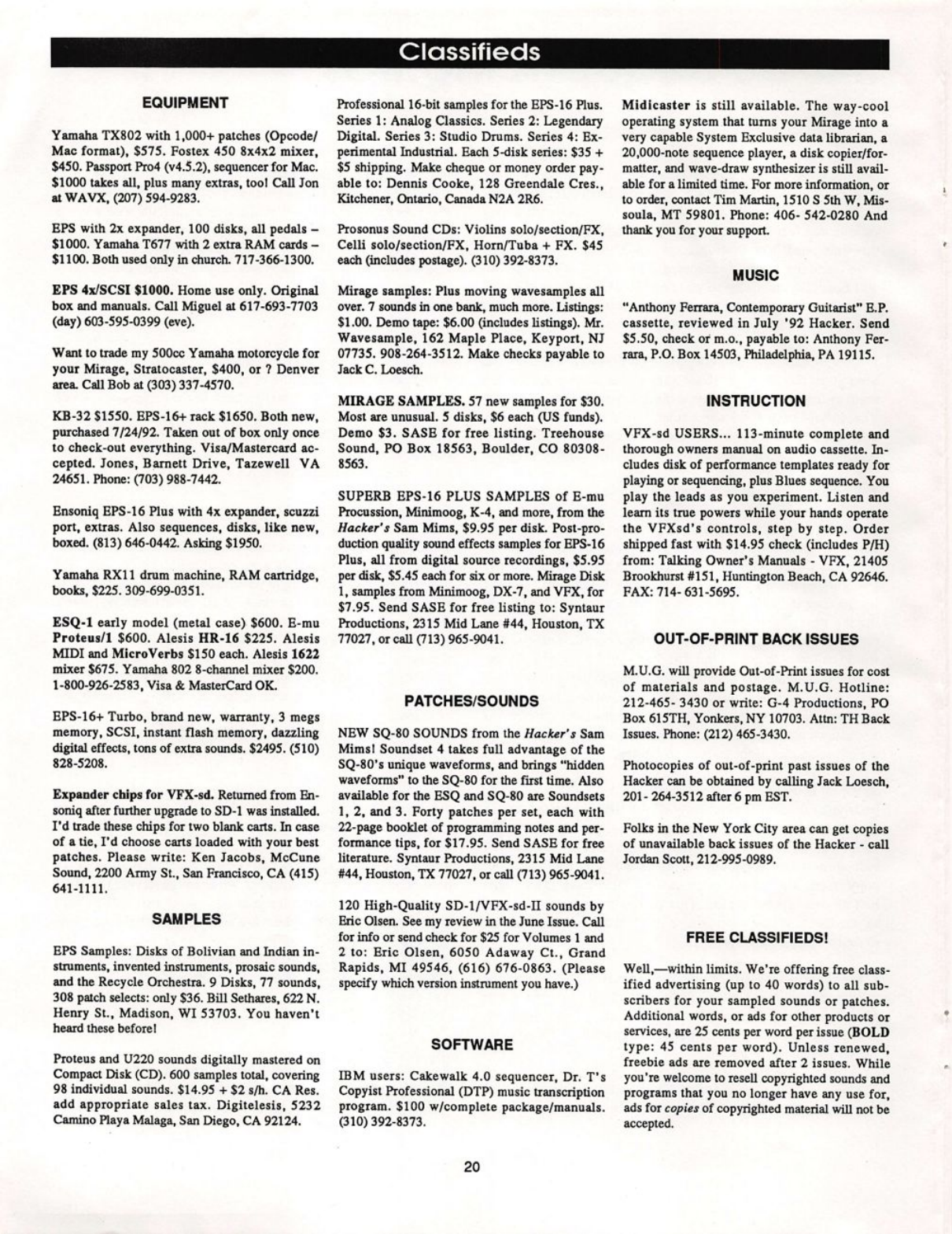
EQUIPMENT
Yamaha TX802 with 1,000+ patches (Opcode/
Mac format), $575. Fostex 450 8x4x2 mixer,
$450. Passport Pro4 (v4.5.2), sequencer for Mac.
$1000 takes all, plus many extras, tool Call Jon
atWAVX,(207) 594-9283.
EPS with 2x expander, 100 disks, all pedals -
$1000 . Ya maha T 6 7 7 w i th 2 e x t ra R AM c ards -
$1100. Both used only in church. 717-366-1300.
EPS 4x/SCSI $1000. Home use only. Original
box and manuals. Call Miguel at 617-693-7703
(day) 603-595-0399 (eve).
Want to trade my 500cc Yamaha motorcycle for
your Mirage, Stratocaster, $400, or 7 Denver
area. Call Bob at (303) 337-4570.
KB-32 $1550. EPS-16+ rack $1650. Both new,
purchased 7/24/92. Taken out of box only once
to check-out everything. Visa/Mastercard ac
cepted. Jones, Bamett Drive, Tazewell VA
24651. Phone: (703) 988-7442.
Ensoniq EPS-16 Plus with 4x expander, scuzzi
port, extras. Also sequences, disks, like new,
boxed. (813) 646-0442. Asking $1950.
Yamaha RXl 1 drum machine, RAM cartridge,
books, $225. 309-699-0351.
ESQ-1 early model (metal case) $600. E-mu
Prot eus/l $600 . Alesis HR -16 $225. Alesi s
M I D I a n d M i c r o Ve r b s $ 1 5 0 e a c h . A l e s i s 1 6 2 2
mixer $675. Yamaha 802 8-channel mixer $200.
1-800-926-2583, Visa & MasterCard OK.
EPS-16+ Turbo, brand new, warranty, 3 megs
memory, SCSI, instant flash memory, dazzling
digital effects, tons of extra sounds. $2495. (510)
828-5208.
Expander chips for VFX-sd. Returned from En
soniq after further upgrade to SD-1 was installed.
I'd trade these chips for two blank carts. In case
of a tie, I'd choose carts loaded with your best
patches. Please write: Ken Jacobs, McCune
Sound, 2200 Army St., San Francisco, CA (415)
641-1111.
SAMPLES
EPS Samples: Disks of Bolivian and Indian in
struments, invented instruments, prosaic sounds,
and the Recycle Orchestra. 9 Disks, 77 sounds,
308 patch selects: only $36. Bill Sethares, 622 N.
Henry St., Madison, WI 53703. You haven't
heard these before!
Proteus and U220 sounds digitally mastered on
Compact Disk (CD). 600 samples total, covering
98 individual sounds. $14.95 + $2 s/h. CA Res.
add appropriate sales tax. Digitelesis, 5232
Camino Playa Malaga, San Diego, CA 92124.
Classifieds
Professional 16-bit samples for the EPS-16 Plus.
Series 1: Analog Classics. Series 2: Legendary
Digital. Series 3: Studio Drums. Series 4: Ex
perimental Industrial. Each 5-disk series: $35 +
$5 shipping. Make cheque or money order pay
able to: Dennis Cooke, 128 Greendale Cres.,
Kitchener, Ontario, Canada N2A 2R6.
Prosonus Sound CDs: Violins solo/section/FX,
Celli solo/section/FX, Horn/Tuba + FX. $45
each (includes postage). (310) 392-8373.
Mirage samples: Plus moving wavesamples all
over. 7 sounds in one bank, much more. Listings:
$1.00. Demo tape: $6.00 (includes listings). Mr.
Wavesample, 162 Maple Place, Keyport, NJ
07735. 908-264-3512. Make checks payable to
Jack C. Loesch.
Midlcaster is still available. The way-cool
operating system that turns your Mirage into a
very capable System Exclusive data librarian, a
20,000-note sequence player, a disk copier/for
matter, and wave-draw synthesizer is still avail
able for a limited time. For more information, or
to order, contact Tim Martin, 1510 S 5th W, Mis
soula, MT 59801. Phone: 406- 542-0280 And
thank you for your support.
MUSIC
"Anthony Ferrara, Contemporary Guitarist" E.P.
cassette, reviewed in July '92 Hacker. Send
$5.50, check of m.o., payable to: Anthony Fer
rara, P.O. Box 14503, Philadelphia, PA 19115.
MIRAGE SAMPLES. 57 new samples for $30.
Most are unusual. 5 disks, $6 each (US funds).
Demo $3. SASE for free listing. Treehouse
Sound, PC Box 18563, Boulder, CO 80308-
8563.
S U P E R B E P S - 1 6 P L U S S A M P L E S o f E - m u
Procussion, Minimoog, K-4, and more, from the
Hacker's Sam Mims, $9.95 per disk. Post-pro
duction quality sound effects samples for EPS-16
Plus, all from digital source recordings, $5.95
per disk, $5.45 each for six or more. Mirage Disk
1, samples from Minimoog, DX-7, and VFX, for
$7.95. Send SASE for free listing to: Syntaur
Productions, 2315 Mid Lane #44, Houston, TX
77027, or call (713) 965-9041.
INSTRUCTION
VFX-sd USERS... 113-minute complete and
thorough owners manual on audio cassette. In
cludes disk of performance templates ready for
playing or sequencing, plus Blues sequence. You
play the leads as you experiment. Listen and
learn its true powers while your hands operate
the VFXsd's controls, step by step. Order
shipped fast with $14.95 check (includes P/H)
from: Talking Owner's Manuals - VFX, 21405
Brookhurst #151, Huntington Beach, CA 92646.
FAX: 714- 631-5695.
O U T- O F - P R I N T B A C K I S S U E S
PATCHES/SOUNDS
NEW SQ-80 SOUNDS from the Hacker's Sam
Mims! Soundset 4 takes full advantage of the
SQ-80's unique waveforms, and brings "hidden
waveforms" to the SQ-80 for the first time. Also
available for the ESQ and SQ-80 are Soundsets
1, 2, and 3. Forty patches per set, each with
22-page booklet of programming notes and per
formance tips, for $17.95. Send SASE for free
literature. Syntaur Productions, 2315 Mid Lane
#44, Houston, TX 77027, or call (713) 965-9041.
M.U.G. will provide Out-of-Print issues for cost
of materials and postage. M.U.G. Hotline:
212-465- 3430 or write: G-4 Productions, PC
Box 615TH, Yonkers, NY 10703. Attn: TH Back
Issues. Phone: (212) 465-3430.
Photocopies of out-of-print past issues of the
Hacker can be obtained by calling Jack Loesch,
201 - 264-3512 after 6 pm EST.
Folks in the New York City area can get copies
of unav aila b le back issu e s o f t he Hack e r - cal l
Jordan Scott, 212-995-0989.
120 High-Quality SD-l/VFX-sd-11 sounds by
Eric Olsen. See my review in the June Issue. CaU
for info or send check for $25 for Volumes 1 and
2 to: Eric Olsen, 6050 Adaway Ct., Grand
Rapids, MI 49546, (616) 676-0863. (Please
specify which version instrument you have.)
SOFTWARE
IBM users: Cakewalk 4.0 sequencer. Dr. T's
Copyist Professional (DTP) music transcription
program. $100 w/complete package/manuals.
(310) 392-8373.
F R E E C L A S S I F I E D S !
Well,—within limits. We're offering free class
ified advertising (up to 40 words) to all sub
scribers for your sampled sounds or patches.
Additional words, or ads for other products or
services, are 25 cents per word per issue (BOLD
type: 45 cents per word). Unless renewed,
f r e e b i e a d s a r e r e m o v e d a f t e r 2 i s s u e s . W h i l e
you're welcome to resell copyrighted sounds and
programs that you no longer have any use for,
ads for copies of copyrighted material wiU not be
accepted.
20
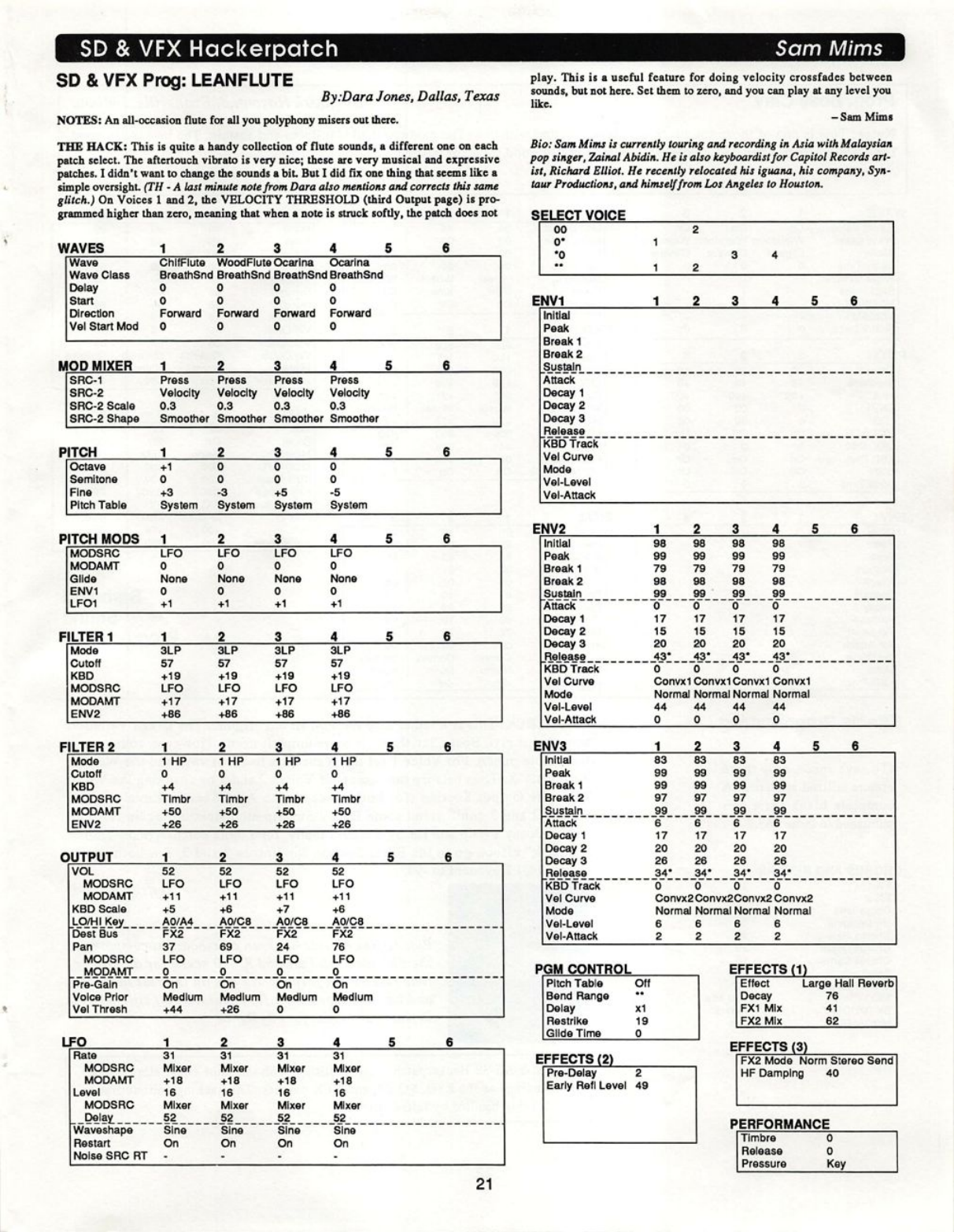
SD & VFX Hackerpgtch S a m M i m s
SD & VFX Prog: LEANFLUTE
By:Dara Jones, Dallas, Texas
NOTES: An all-occasion flute for all you polyphony misers out there.
THE HACK: This is quite a handy collection of flute sounds, a different one on each
patch select. The aftertouch vibrato is very nice; these are very musical and expressive
patches. I didn't want to change the sounds a bit. But I did fix one thing that seems like a
simple oversight (TH - A last minute note from Dara also mentions and corrects this same
glitch.) On Voices 1 and 2. the VELOCITY THRESHOLD (third Output page) is pro
grammed higher than zero, meaning that when a note is struck softly, the patch does not
WAVES 1
Wave ChlfFlute WoodFlute Ocarina Ocarina
Wave Class BreathSnd BreathSnd BreathSnd BreathSnd
Delay 00 0 0
Start 0 0 0 0
Direction Forward Fonward Forward Fonvard
Vel Start Mod 0 0 0 0
O D M I X E R 1 2 3 4 5 6
SRC-1 Press Press Press Press
SRC-2 Velocity Velocity Velocity Velocity
SRC-2 Scale 0.3 0.3 0.3 0.3
SRC-2 Shape Smoother Smoother S m o o t h e r S m o o t h e r
PITCH
Octave +1 00 0
Semitone 0 0 00
Fine +3 -3 +5 -5
Pitch Table System System System System
ITCH MODS 123456
MODSRC LFO LFO LFO LFO
MODAMT 0000
Glide None None None None
ENV1 0000
LF01 +1 +1 +1 +1
LTER1 123456
Mode 3LP 3LP 3LP 3LP
Cutoff 57 57 57 57
KBD +19 +19 +19 +19
MODSRC LFO LFO LFO LFO
MODAMT +17 +17 +17 +17
ENV2 +86 +86 +86 +86
LTER2 12 3 4 5 6
Mode 1 H P 1 H P 1 H P 1 H P
Cutoff 0000
KBD +4 +4 +4 +4
MODSRC TImbr TImbr TImbr TImbr
MODAMT +50 +50 +50 +50
ENV2 +26 +26 +26 +26
)UTPUT 123456
VOL 52 52 52 52
MODSRC LFO LFO LFO LFO
MODAMT +11 +11 +11 +11
KBD Scale +5 +6 +7 +6
LO«LK®7_ A0/A4 A0/C8 A0/C8 A0/C8
Dest Bus "FX2"""
" FX2
""FX2"
Pan 37 69 24 76
MODSRC LFO LFO LFO LFO
MODAMT 0000
Pre-Gain On On On On
Voice Prior Medium Medium Medium lidedlum
Vel Thresh +44 +26 0 0
JO 12 3 4 5 6
Rate 31 31 31 31
MODSRC Mixer Mixer Mixer Mixer
MODAMT +18 +18 +18 +18
Level 16 16 16 16
MODSRC Mixer Mixer Mixer Mixer
Delay^ 52 _52 __52 52
Waveshape "sine Sine Sine Sine
Restart On On On On
Noise SRC RT -
play. This is a useful feature for doing velocity crossfades between
sounds, but not here. Set them to zero, and you can play at any level you
like.
- S a m M i m s
Bio: Sam Mims is currently touring and recording in Asia with Malaysian
pop singer, Zainal Abidin. He is also keyboardist for Capitol Records art
ist, Richard Elliot. He recently relocated his iguana, his company, Syn-
taur Productions, and himself from Los Angeles to Houston.
SELECT VOICE
ENV1
Initial
Peak
B r e a k 1
B r e a k 2
_^usain_
Attack
Decay 1
Decay 2
Decay 3
Release_
'KB~Dfrack'
Vel Curve
Mode
Vel-Level
Vel-Attack
ENV2
Initial 98 98 98 98
Peak 99 99 99 99
B r e a k 1 79 79 79 79
B r e a k 2 98 98 98 98
Sustain 99 99 99 99
"Attack"
" " 0 "
000
Decay 1 17 17 17 17
Decay 2 15 15 15 15
Decay 3 20 20 20 20
Release 43* 43* 43* 43*
KBD Track 0000
Vel Curve Convxl ConvxIConvxl Convxl
Mode Normal Normal Normal Normal
Vel-Level 44 44 44 44
Vel-Attack 0 0 0 0
!NV3 1234 5 6
Initial 83 83 83 83
Peak 99 99 99 99
B r e a k 1 99 99 99 99
B r e a k 2 97 97 97 97
Sustain 99 99 99 99
Attack 6 6 66
Decay 1 17 17 17 17
Decay 2 20 20 20 20
Decay 3 26 26 26 26
Release 34* 34* 34* 34*
KBD Track 0000
Vel Curve Convx2Convx2Convx2 Convx2
Mode Normal Normal Normal Normal
Vel-Level 6666
Vel-Attack 2 2 2 2
P G M C O N T R O L
Pitch Table Off
Bend Range ••
Delay XI
Restrike 19
Glide Time 0
EFFECTS (1)
Effect Large Hall Reverb
Decay 76
FX1 Mix 41
FX2 Mix 62
E F F E C T S ( 2 )
P r e - O e l a y 2
Early Refl Level 49
EFFECTS (3)
F X 2 M o d e N o r m S t e r e o S e n d
HF Damping 40
PERFORMANCE
Timbre 0
Release 0
Pressure Key
21
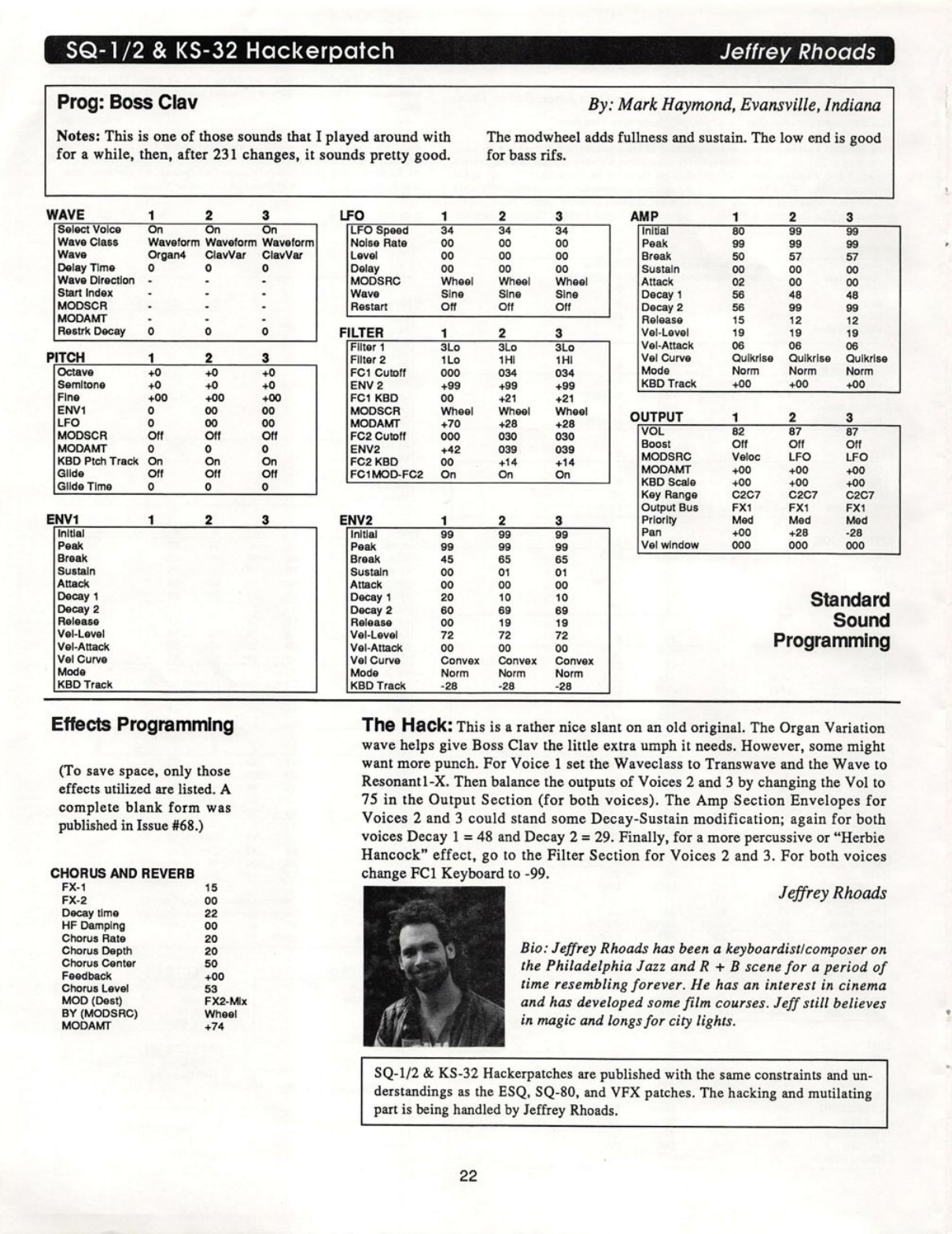
$Q-1/2 & KS-32 Hackerpgtch Jeffrey Rhoods
Prog: Boss Clav By: Mark Haymond, Evansville, Indiana
Notes: This is one of those sounds that I played around with
for a while, then, after 231 changes, it sounds pretty good.
The modwheel adds fullness and sustain. The low end is good
f o r b a s s r i f s .
WAVE 123 LFO 1 2 3
Select Voice On On On LFO Speed 34 34 34
Wave Class W a v e f o r m W a v e f o r m W a v e f o r m Noise Rate 00 00 00
Wave Organ4 ClavVar ClavVar Level 00 00 00
Delay Time 000Delay 00 00 00
Wave Direction --. MODSRC Wfteel Wfteel Wheel
Start Index ... Wave Sine Sine Sine
MODSOR . . Restart Off Off Off
MODAMT - -
Restrk Decay 000 FILTER 123
Fil te r 1 3Lo 3Lo 3Lo
PITCH 123 F i l t e r 2 ILo 1HI 1HI
Octave +0 +0 +0 FCl Cutoff 000 034 034
Semitone +0 +0 +0 ENV2 +99 +99 +99
Fine +00 +00 +00 FCl KBD 00 +21 +21
ENV1 000 00 MODSCR Wfteel Wfteel Wheel
LFO 000 00 MODAMT +70 +28 +28
MODSOR Off Off Off FC2 Cutoff 000 030 030
MODAMT 00 0 ENV2 +42 039 039
KBD Ptch Track On On On FC2 KBD 00 +14 +14
Glide Off Off Off FCl MOD-FC2 On On On
Glide Time 000
ENV1 123ENV2 12 3
Initial Initial 99 99 99
Peak Peak 99 99 99
Break Break 45 65 65
Sustain Sustain 00 01 01
Attack Attack 00 00 00
Decay 1 Decay 1 20 10 10
Decay 2 Decay 2 60 89 69
Release Release 00 19 19
Vel-Level Vel-Level 72 72 72
Vel-Attack Vel-Attack 00 00 00
Vel Curve Vel Curve Convex Convex Convex
Mode Mode Norm Norm Norm
KBD Track KBD Track -28 -28 -28
iMP 123
Initial 80 99 99
Peak 99 99 99
Break 50 57 57
Sustain 00 00 00
Attack 02 00 00
Decay 1 58 48 48
Decay 2 58 99 99
Release 15 12 12
Vel-Level 19 19 19
Vel-Attack 08 08 08
Vel Curve Quikrise Quikrise Quikrise
Mode Norm Norm Norm
KBD Track +00 +00 +00
fUTPUT 123
VOL 82 87 87
Boost Off Off Off
MODSRC Veloo LFO LFO
MODAMT +00 +00 +00
KBD Scale +00 +00 +00
Key Range C2C7 C2C7 C2C7
Output Bus FX1 FX1 FX1
Priority Med Med Med
Pan +00 +28 -28
Vel window 000 000 000
Standard
Sound
Programming
Effects Programming
(To save space, only those
effects utilized are listed. A
complete blank form was
published in Issue #68.)
C H O R U S A N D R E V E R B
FX-1 15
FX-2 00
Decay time 22
HF Damping 00
Chorus Rate 20
Chorus Depth 20
C h o r u s C e n t e r 50
Feedback +00
Chorus Level 53
MOD (Dest) FX2-MIX
BY (MODSRC) Wheel
MODAMT +74
The Hack: This is a rather nice slant on an old original. The Organ Variation
wave helps give Boss Clav the little extra umph it needs. However, some might
want more punch. For Voice 1 set the Waveclass to Transwave and the Wave to
Resonantl-X. Then balance the outputs of Voices 2 and 3 by changing the Vol to
75 in the Output Section (for both voices). The Amp Section Envelopes for
Voices 2 and 3 could stand some Decay-Sustain modification; again for both
voices Decay 1 = 48 and Decay 2 = 29. Finally, for a more percussive or "Herbie
Hancock" effect, go to the Filter Section for Voices 2 and 3. For both voices
change FCl Keyboard to -99.
Jeffrey Rhoads
Bio: Jeffrey Rhoads has been a keyboardisticomposer on
the Philadelphia Jazz and R + B scene for a period of
time resembling forever. He has an interest in cinema
and has developed some film courses. Jeff still believes
in magic and longs for city lights.
SQ-1/2 & KS-32 Hackerpatches are published with the same constraints and un
derstandings as the ESQ, SQ-80, and VFX patches. The hacking and mutilating
part is being handled by Jeffrey Rhoads.
22
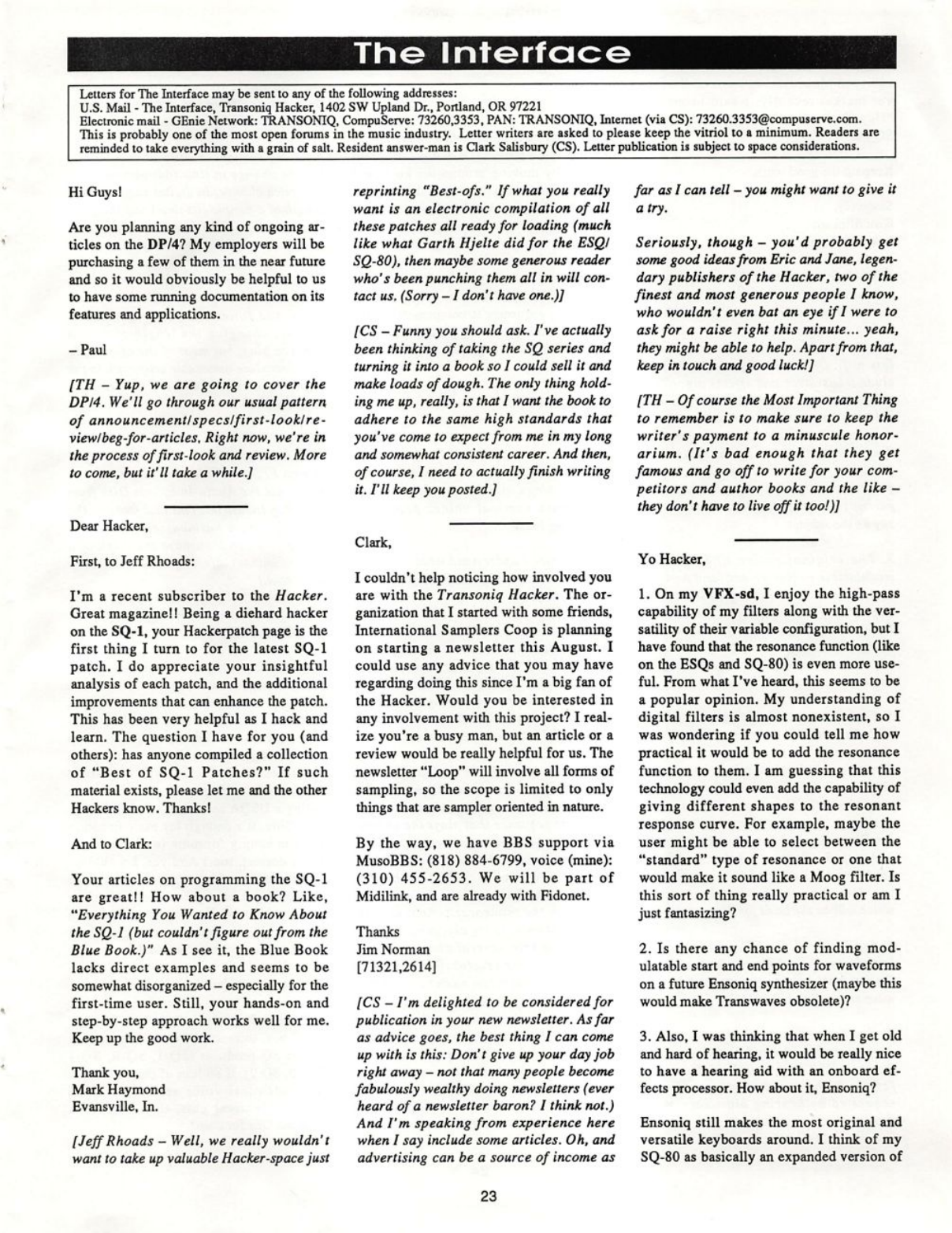
The Interface
Letters for The Interface may be sent to any of the following addresses:
U.S. Mail - The Interface, Transoniq Hacker, 1402 SW Upland Dr., Portland, OR 97221
Electronic mail - GEnie Network: TRANSONIQ, CompuServe: 73260,3353, PAN: TRANSONIQ, Internet (via CS): 73260.3353@compuserve.com.
This is probably one of the most open forums in the music industry. Letter writers are asked to please keep the vitriol to a minimum. Readers are
reminded to take everything with a grain of salt. Resident answer-man is Qark Salisbury (CS). Letter publication is subject to space considerations.
Hi Guys!
Are you planning any kind of ongoing ar
ticles on the DP/4? My employers will be
purchasing a few of them in the near future
and so it would obviously be helpful to us
to have some running documentation on its
features and applications.
-Paul
[TH - Yup, we are going to cover the
DPI4. We'll go through our usual pattern
of announcement!specs!first-look!re-
vlew!beg-for-artlcles. Right now, we're In
the process of first-look and review. More
to come, but It'll take a while.]
Dear Hacker,
First, to Jeff Rhoads:
I ' m a re c e n t s u b sc ri b e r to the Ha c k e r.
Great magazine!! Being a diehard hacker
on the SQ-1, your Hackerpatch page is the
first thing I turn to for the latest SQ-1
patch. I do appreciate your insightful
analysis of each patch, and the additional
improvements that can enhance the patch.
This has been very helpful as I hack and
learn. The question I have for you (and
others): has anyone compiled a collection
of "Best of SQ-1 Patches?" If such
material exists, please let me and the other
H a c k e r s k n o w . T h a n k s !
And to Clark:
Your articles on programming the SQ-1
are great!! How about a book? Like,
"Everything You Wanted to Know About
the SQ-1 (but couldn't fiigure out from the
Blue Book.)" As I see it, the Blue Book
lacks direct examples and seems to be
somewhat disorganized - especially for the
first-time user. Still, your hands-on and
step-by-step approach works well for me.
Keep up the good work.
Thank you,
Mark Haymond
Evansville, In.
[Jeff Rhoads - Well, we really wouldn't
want to take up valuable Hacker-space just
reprinting "Best-ofs." If what you really
want Is an electronic compilation of all
these patches all ready for loading (much
like what Garth Hjelte did for the ESQ!
SQ-80), then maybe some generous reader
who's been punching them all In will con
tact us. (Sorry -1 don't have one.)]
[CS - Funny you should ask. I've actually
been thinking of taking the SQ series and
turning It Into a book so I could sell It and
make loads of dough. The only thing hold
ing me up, really. Is that I want the book to
adhere to the same high standards that
you've come to expect from me In my long
and somewhat consistent career. And then,
of course, I need to actually finish writing
It. I'll keep you posted.]
far as I can tell - you might want to give It
a try.
Seriously, though - you'd probably get
some good Ideas from Eric and Jane, legen
dary publishers of the Hacker, two of the
finest and most generous people I know,
who wouldn't even bat an eye If I were to
ask for a raise right this minute... yeah,
they might be able to help. Apart from that,
keep In touch and good luck!]
[TH - Of course the Most Important Thing
to remember Is to make sure to keep the
writer's payment to a minuscule honor
arium. (It's bad enough that they get
famous and go off to write for your com
petitors and author books and the like -
they don't have to live off It too!)]
Clark,
I couldn't help noticing how involved you
are with the Transoniq Hacker. The or
ganization that I started with some friends,
International Samplers Coop is planning
on starting a newsletter this August. I
could use any advice that you may have
regarding doing this since I'm a big fan of
the Hacker. Would you be interested in
any involvement with this project? I real
ize you're a busy man, but an article or a
review would be really helpful for us. The
newsletter "Loop" will involve all forms of
sampling, so the scope is limited to only
things that are sampler oriented in nature.
By the way, we have BBS support via
MusoBBS: (818) 884-6799, voice (mine):
(310) 4 55-2653. We will be part of
Midilink, and are already with Fidonet.
Thanks
J i m N o r m a n
[71321,2614]
[CS - I'm delighted to be considered for
publication in your new newsletter. As far
as advice goes, the best thing I can come
up with Is this: Don't give up your day job
right away - not that many people become
fabulously wealthy doing newsletters (ever
heard of a newsletter baron? I think not.)
And I'm speaking from experience here
when I say Include some articles. Oh, and
advertising can be a source of Income as
Yo Hacker,
1. On my VFX-sd, I enjoy the high-pass
capability of my filters along with the ver
satility of their variable configuration, but I
have found that the resonance function (like
on the ESQs and SQ-80) is even more use
ful. From what I've heard, this seems to be
a popular opinion. My understanding of
digital filters is almost nonexistent, so I
was wondering if you could tell me how
practical it would be to add the resonance
function to them. I am guessing that this
technology could even add the capability of
giving different shapes to the resonant
response curve. For example, maybe the
user might be able to select between the
"standard" type of resonance or one that
would make it sound like a Moog filter. Is
this sort of thing really practical or am I
just fantasizing?
2. Is there any chance of finding mod-
ulatable start and end points for waveforms
on a future Ensoniq synthesizer (maybe this
would make Transwaves obsolete)?
3. Also, I was thinking that when I get old
and hard of hearing, it would be really nice
to have a hearing aid with an onboard ef
fects processor. How about it, Ensoniq?
Ensoniq still makes the most original and
versatile keyboards around. I think of my
SQ-80 as basically an expanded version of
23
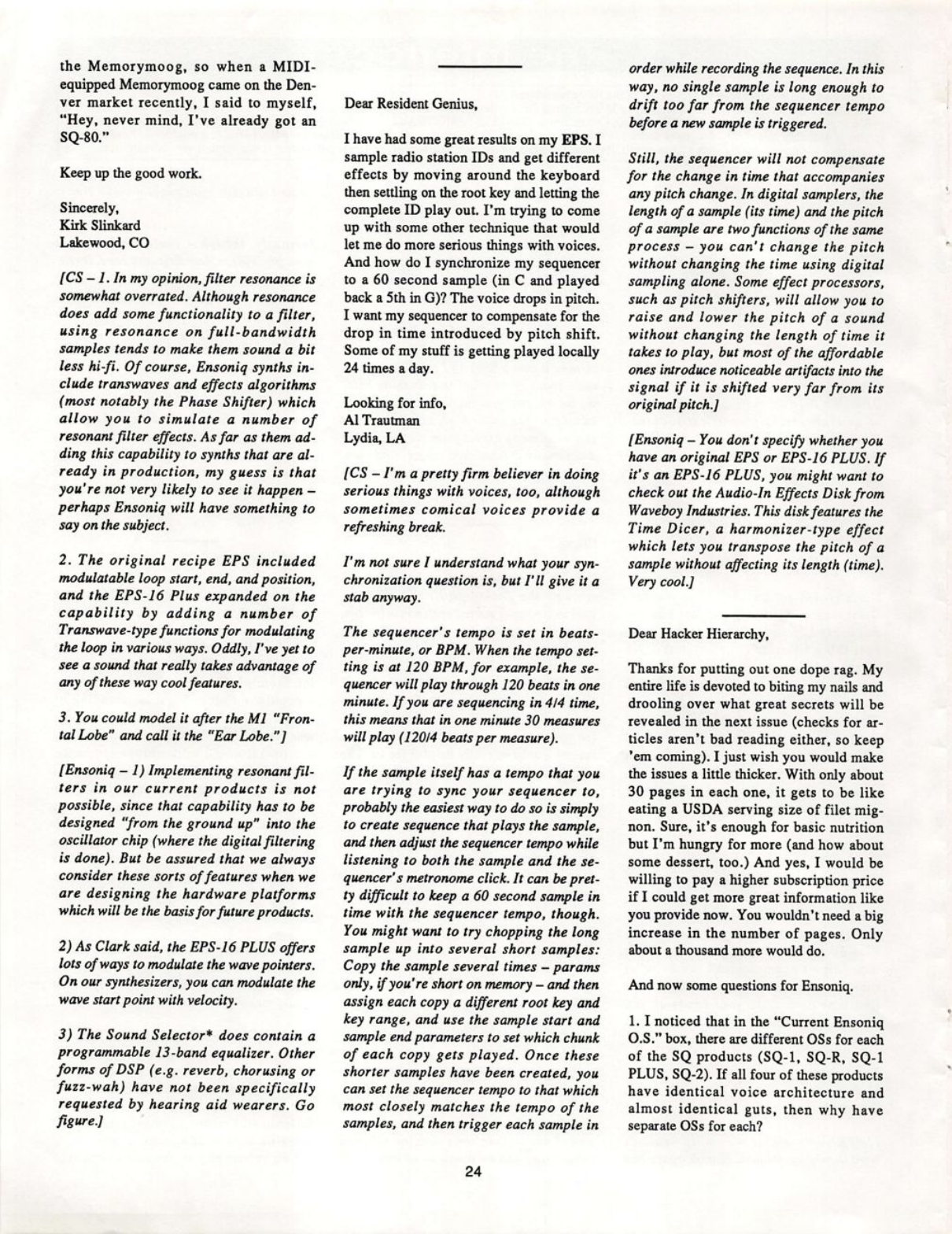
the Memorymoog, so when a MIDI-
equipped Memorymoog came on the Den
ver market recently, I said to myself,
"Hey, never mind, I've already got an
SQ-80."
Keep up the good work.
Sincerely,
K i r k S l i n k a r d
Lakewood, CO
[CS -1. In my opinion, filter resonance is
somewhat overrated. Although resonance
does add some functionality to a filter,
using resonance on full-bandwidth
samples tends to make them sound a bit
less hi-fi. Of course, Ensoniq synths in
clude transwaves and effects algorithms
(most notably the Phase Shifter) which
allow you to simulate a number of
resonant filter effects. As far as them ad
ding this capability to synths that are al
ready in production, my guess is that
you're not very likely to see it happen -
perhaps Ensoniq will have something to
say on the subject.
2. The original recipe EPS included
modulatable loop start, end, and position,
and the EPS-16 Plus expanded on the
capability by adding a number of
Transwave-type functions for modulating
the loop in various ways. Oddly, I've yet to
see a sound that really takes advantage of
any of these way cool features.
3. You could model it after the MI "Fron
tal Lobe" and call it the "Ear Lobe."]
[Ensoniq - I) Implementing resonant fil
ters in our current products is not
possible, since that capability has to be
designed "from the ground up" into the
oscillator chip (where the digital filtering
is done). But be assured that we always
consider these sorts of features when we
are designing the hardware platforms
which will be the basis for future products.
2) As Clark said, the EPS-16 PLUS offers
lots of ways to modulate the wave pointers.
On our synthesizers, you can modulate the
wave start point with velocity.
3) The Sound Selector* does contain a
programmable 13-band equalizer. Other
forms of DSP (e.g. reverb, chorusing or
fuzz-wah) have not been specifically
requested by hearing aid wearers. Go
figure.)
Dear Resident Genius,
I have had some great results on my EPS. I
sample radio station IDs and get different
effects by moving around the keyboard
then settling on the root key and letting the
complete ID play out. I'm trying to come
up with some other technique that would
let me do more serious things with voices.
And how do I synchronize my sequencer
to a 60 second sample (in C and played
back a 5th in G)? The voice drops in pitch.
I want my sequencer to compensate for the
drop in time introduced by pitch shift.
Some of my stuff is getting played locally
24 times a day.
Looking for info,
A1 Trautman
Lydia, LA
[OS - I'm a pretty firm believer in doing
serious things with voices, too, although
sometimes comical voices provide a
refreshing break.
I'm not sure I understand what your syn
chronization question is, but I'll give it a
stab anyway.
The sequencer's tempo is set in beats-
per-minute, or BPM. When the tempo set
ting is at 120 BPM, for example, the se
quencer will play through 120 beats in one
minute. If you are sequencing in 4/4 time,
this means that in one minute 30 measures
will play (120/4 beats per measure).
If the sample itself has a tempo that you
are trying to sync your sequencer to,
probably the easiest way to do so is simply
to create sequence that plays the sample,
and then adjust the sequencer tempo while
listening to both the sample and the se
quencer's metronome click. It can be pret
ty difficult to keep a 60 second sample in
time with the sequencer tempo, though.
You might want to try chopping the long
sample up into several short samples:
Copy the sample several times - params
only, if you're short on memory - and then
assign each copy a different root key and
key range, and use the sample start and
sample end parameters to set which chunk
of each copy gets played. Once these
shorter samples have been created, you
can set the sequencer tempo to that which
most closely matches the tempo of the
samples, and then trigger each sample in
order while recording the sequence. In this
way, no single sample is long enough to
drift too far from the sequencer tempo
before a new sample is triggered.
Still, the sequencer will not compensate
for the change in time that accompanies
any pitch change. In digital samplers, the
length of a sample (its time) and the pitch
of a sample are two functions of the same
process - you can't change the pitch
without changing the time using digital
sampling alone. Some effect processors,
such as pitch shifters, will allow you to
raise and lower the pitch of a sound
without changing the length of time it
takes to play, but most of the affordable
ones introduce noticeable artifacts into the
signal if it is shifted very far from its
original pitch.)
[Ensoniq - You don't specify whether you
have an original EPS or EFS-I6 PLUS. If
it's an EPS-16 PLUS, you might want to
check out the Audio-In Effects Disk from
Waveboy Industries. This disk features the
Time Dicer, a harmonizer-type effect
which lets you transpose the pitch of a
sample without affecting its length (time).
Very cool.)
Dear Hacker Hierarchy,
Thanks for putting out one dope rag. My
entire life is devoted to biting my nails and
drooling over what great secrets will be
revealed in the next issue (checks for ar
ticles aren't bad reading either, so keep
'em coming). I just wish you would make
the issues a little thicker. With only about
30 pages in each one, it gets to be like
eating a USDA serving size of filet mig-
non. Sure, it's enough for basic nutrition
but I'm hungry for more (and how about
some dessert, too.) And yes, I would be
willing to pay a higher subscription price
if I could get more great information like
you provide now. You wouldn't need a big
increase in the number of pages. Only
about a thousand more would do.
And now some questions for Ensoniq.
1. I noticed that in the "Current Ensoniq
O.S." box, there are different OSs for each
of the SQ products (SQ-1, SQ-R, SQ-1
PLUS, SQ-2). If all four of these products
have identical voice architecture and
almost identical guts, then why have
separate OSs for each?
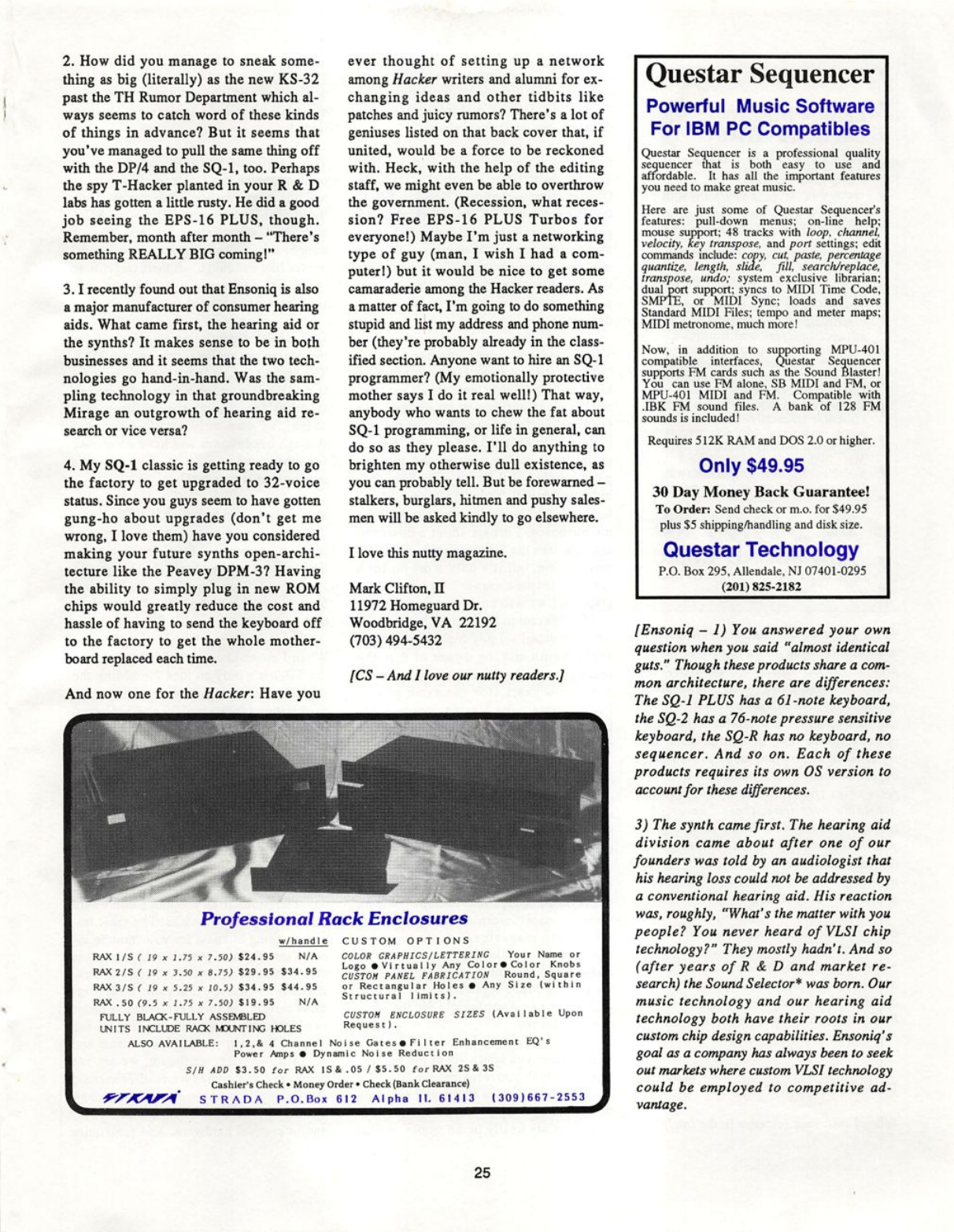
2. How did you manage to sneak some
thing as big (literally) as the new KS-32
past the TH Rumor Department which al
ways seems to catch word of these kinds
of things in advance? But it seems that
you've managed to pull the same thing off
with the DP/4 and the SQ-1, too. Perhaps
the spy T-Hacker planted in your R&D
labs has gotten a little rusty. He did a good
job seeing the EPS-16 PLUS, though.
Remember, month after month - "There's
something REALLY BIG coming!"
3.1 recently found out that Ensoniq is also
a major manufacturer of consumer hearing
aids. What came first, the hearing aid or
the synths? It makes sense to be in both
businesses and it seems that the two tech
nologies go hand-in-hand. Was the sam
pling technology in that groundbreaking
Mirage an outgrowth of hearing aid re
s e a r c h o r v i c e v e r s a ?
4. My SQ-I classic is getting ready to go
the factory to get upgraded to 32-voice
status. Since you guys seem to have gotten
gung-ho about upgrades (don't get me
wrong, I love them) have you considered
making your future synths open-archi
tecture like the Peavey DPM-3? Having
the ability to simply plug in new ROM
chips would greatly reduce the cost and
hassle of having to send the keyboard off
to the factory to get the whole mother
board replaced each time.
And now one for the Hacker. Have you
ever thought of setting up a network
among Hacker writers and alumni for ex
changing ideas and other tidbits like
patches and juicy rumors? There's a lot of
geniuses listed on that back cover that, if
united, would be a force to be reckoned
with. Heck, with the help of the editing
staff, we might even be able to overthrow
the government. (Recession, what reces
s i o n ? F r e e E P S - 1 6 P L U S T u r b o s f o r
everyone!) Maybe I'm just a networking
type of guy (man, I wish I had a com
puter!) but it would be nice to get some
camaraderie among the Hacker readers. As
a matter of fact, I'm going to do something
stupid and list my address and phone num
ber (they're probably already in the class
ified section. Anyone want to hire an SQ-1
programmer? (My emotionally protective
mother says I do it real well!) That way,
anybody who wants to chew the fat about
SQ-1 programming, or life in general, can
do so as they please. I'll do anything to
brighten my otherwise dull existence, as
you can probably tell. But be forewarned -
stalkers, burglars, hitmen and pushy sales
men will be asked kindly to go elsewhere.
I love this nutty magazine.
Mark Clifton, 11
11972 Homeguard Dr.
Woodbridge, VA 22192
(703) 494-5432
[CS - And I love our nutty readers.]
Professional Rack Enclosures
C U S T O M O P T I O N S
C O L O R G R A P H I C S / L E T T E R I N G Y o u r N a m e o r
Logo •Virtually Any Color»Color Knobs
C U S T O M P A N E L F A B R I C A T I O N R o u n d , S q u a r e
o r R e c t a n g u l a r H o l e s • A n y S i z e ( w i t h i n
S t r u c t u r a I 1 i m i t s ) .
w/hand1e
R A X I / S ( • 1 9 * 1 . 7 5 w 7 . 5 0 ; $ 2 4 . 9 5 N / A
R A X 2 / S f 1 9 * 3 . 5 0 w 8 . 7 5 7 $ 2 9 . 9 5 $ 3 4 . 9 5
R A X 3 / S ( 1 9 X 5 . 2 5 x 1 0 . 5 7 $ 3 4 . 9 5 $ 4 4 . 9 5
R A X . 5 0 ( • 9 . 5 X 1 . 7 5 x 7 . 5 0 7 $ 1 9 . 9 5 N / A
FULLY BLACK-FULLY ASSEMBLED
U N I T S I N C L U D E R A C K M O U b T T l N C H O L E S
A L S O AVA I L A B L E : 1 , 2 , & 4 C h a n n e l N o i s e G a t e s » F i l t e r E n h a n c e m e n t E Q ' s
Po wer Amps • Dynamic N oi se Reduction
S/H ADD $3.50 for RAX 1S& .05 / $5.50 for RAX 2S & 3S
Cashier's Check • Money Order • Check (Bank Clearance)
S T R A D A P. O . B o x 6 1 2 A l p h a I I . 6 1 4 1 3 ( 3 0 9 ) 6 6 7 - 2 5 5 3
C U S T O M E N C L O S U R E S I Z E S ( A v a i l a b l e U p o n
Request).
Questar Sequencer
P o w e r f u l M u s i c S o f t w a r e
For IBM PC Compatibles
Questar Sequencer is a professional quality
sequencer that is both easy to use and
affordable. It has all the important featiues
you need to make great music.
Here are just some of Questar Sequencer's
features: pull-down menus; on-line help;
mouse support; 48 tracks with loop, channel,
velocity, key transpose, and port settings; edit
commands include: copy, cut, paste, percentage
quantize, length, slide, fill, search/replace,
transpose, undo; system exclusive librarian;
dual port support; syncs to MIDI Time Code,
SMPTE, or MIDI Sync; loads and saves
Standard MIDI Files; tempo and meter maps;
MIDI metronome, much more!
Now, in addition to supporting MPU-40I
compatible interfaces, Questar Sequencer
supports FM cards such as the Sound Blaster!
You can use FM alone, SB MIDI and FM, or
MPU-401 MIDI and FM. Compatible with
. I B K F M s o u n d fi l e s . A b a n k o f 1 2 8 F M
sounds is included!
Requires 5I2K RAM and DOS 2.0 or higher.
Only $49.95
30 Day Money Back Guarantee!
To Order: Send check or m.o. for $49.95
plus $5 shipping/handling and disk size.
Questar Technology
P.O. Box 295, Allendale, NJ 07401-0295
(201) 825-2182
[Ensoniq - 1) You answered your own
question when you said "almost identical
guts." Though these products share a com
mon architecture, there are differences:
The SQ-1 PLUS has a 61-note keyboard,
the SQ-2 has a 76-note pressure sensitive
keyboard, the SQ-R has no keyboard, no
sequencer. And so on. Each of these
products requires its own OS version to
account for these differences.
3) The synth came first. The hearing aid
division came about after one of our
founders was told by an audiologist that
his hearing loss could not be addressed by
a conventional hearing aid. His reaction
was, roughly, "What's the matter with you
people? You never heard of VLSI chip
technology?" They mostly hadn't. And so
(after years of R & D and market re
search) the Sound Selector* was born. Our
music technology and our hearing aid
technology both have their roots in our
custom chip design capabilities. Ensoniq's
goal as a company has always been to seek
out markets where custom VLSI technology
could be employed to competitive ad
vantage.
25
r
r
f
f
f
r
r
r
r
r
f
f
f
f
f
f
r
LEARN JAZZ
IMPROVISATION
WITH YOUR MIDI
SEQUENCER!
INTRODUCING JAZZ THROUGH MTOP
A FUN AND EXCITING NEW
METHOD FOR LEARNING JAZZ.
Now you can leam authentic jazz
solos, study jazz theory, practice
scales, and jam with your own jazz
band anytime you want. Jazz
Through Midi has levels of skill for
beginning, intermediate and
advanced players, and features a
variety of popular jazz standards and
practice exercises in the following
jazz styles: Bebop, Modal, Blues,
Latin, New Orleans and Fusion.
Leadsheets are also provided with
complete transcriptions of all the
solos. Requires a midi soundsource
w i t h d r u m s o i m d s . A v a i l a b l e f o r
Mac, IBM, Atari, Amiga (Type 1
Midifiles) Roland, Yamaha, Kawai,
Ensoniq, and Korg sequencers.
$49.95
NEW SOUND MUSIC
P.O. Box 37363 • Oak Park, MI 48237
Phone: (313) 355-3643
4) As great as an "open" architecture
sounds, it is awfully hard to deliver on the
promise of "never becoming obsolete," no
matter how well intentioned. One problem
is that the system will always be limited by
the hardware that is available at the time
of its design, however general-purpose you
try to make it. So when faster processors,
bigger memory chips, more powerful ef
fects chips (just to name a few) become
a v a i l a b l e o v e r t i m e , t h e s e " n e v e r o b
solete" products will not be able to give
you the benefits of such advances. They
can, of course, offer new features using the
existing hardware, through ROM up
grades. (We do that too.)
But sometimes there's just no substitute for
s o me n e w ha r d w ar e , s u c h a s th e ma i n
board upgrades that give you II addition
al voices on the SQ and SD products. This
could not have been accomplished with a
ROM upgrade alone, no matter how
"open" the system.]
Dear Clark Salisbury,
When I read your response in the Interface
(July, #85) I was surprised and, after some
consideration, annoyed. I write this letter
to clear my position and to express some
criticism, but without animosity.
First, you are wrong when, after reading
my "succinct" letter, you think: "He has a
Quadra computer and an Ensoniq SD-1:
this is a reach guy." Sorry, Clark, it is im
possible to see into the life of an unknown
man from some words on paper. You are
not "envious or anything," but your words
seem to reflect the opposite - Hey, it's just
a gratuitous assumption; words are so
dangerous...
Yes, I have a Quadra computer, but this
"spendy brand new fancy-schmancy
high-end computer and these money-
sucking collections of chips and dip
switches" is, for me, another piece of shit
("merde" in French) for my job. I am a
professional graphic designer and the com
puter is only a tool for me, a tool like ink,
brush and pencil. Today, I use this "slow"
tool; yes, the Quadra is a slow machine for
my purposes. I dream about a powerful
machine like the Silicon Graphics Iris 4D
workstation, but it's only a dream for a
" m i d d l e i n c o m e e a r n e r " l i k e m e . A s a
graphist, I want to improve my style daily
and for this reason I search for better tools.
Another detail - I pay for this computer
every month and the owner of it is the
leasing company. I lease a new machine
every two years (for the same price).
Please contact the leasing company for
buying this "boring hardware at a substan
tial cost savings."
Secondly, I am not a pioneer. I dislike
computer freaks and other fanatics who
spend time and money around the latest
high-tech machine. When I leased the
Quadra, I used only the software compat
ible with it and my job. I don't have the
time for testing "strange incompatibilities
and mysterious high-tech hiccups." When I
want technical information, I sometimes
read those magazines where pioneers
describe their paths. But now I am sure
about one thing. Don't buy a Quadra only
for playing MIDI applications. A Mac SB
or PC clone or Atari is right for the job -
and your money.
Third, when you speak about the money-
market, I think you react ingenuously. You
walk near your shoes ("tu marches a cote
de tes ponpes" as we say in France) be
cause you are totally in the money-market
every day. You write in a magazine which
utilizes advertising and you support a
non-philanthopic company (read: Ensoniq
Corp.).
The people at Ensoniq support their
products which is a nice marketing attimde
and this means money, more money. They
build nice instruments (I love my SD-1
and I had a marketing attitude when I
bought it because I like innovative com
panies like Ensoniq), but their target is to
sell more and more synthesizers and
samples, money-market guy.
Four, I play music as an amateur and for
this reason my choice is the Ensoniq SD-1.
The second reason is the money, because
the SD-1 is a great music workstation
(synthesizer, digital effects, drum ma
chine...) I own only an SD-1 running
through headphones and have no money
for other music hardware. People in the
money-market hate me!?
Hey, Clark, the heart of the SD-1 is a
"spendy brand new fancy-schmancy
high-end computer" from Ensoniq and I
like to read stories from the Transoniq
Hacker and "Pioneers and braves who will
blaze the trail into the land of mysterious
high-tech hiccups."
When I speak about a SCSI interface for
the SD-1 it's only an idea for adding the
missing link to this powerful music
workstation (an internal 20 or 40 Mb hard
drive? an external SyQuest drive?),
without a "money-sucking" external com
puter. No way to install a SCSI interface? I
couldn't care less - my first priority is
playing music with the SD-1.
The last point (ouf!) - this letter is a "suc
cinct" letter because I don't speak about
the "American way of life" versus the
"French way of life," based on economical
considerations. But you and I don't care
about these sorts of tricks. The most im
portant thing to know for you "middle in
come earners" and probably the readers is
that in France, amateurs and some profes
sional musicians are like your "middle in
come earners" and we have a head, a body,
two arms, two legs and ten fingers for
playing Ensoniq musical instruments and
we love, we hate, we dream, we eat, we
drink, and sometimes we read Transoniq
Hacker and sometimes we try to buy
another piece of shit like a computer
and/or musical hardware. And sometimes
26
we need money for upgrading our old VFX
(another natural attitude? influence from
the money-market?) and like you, we don't
need "slogans" for playing music.
Hey Clark, I like to read the Interface
every month (and it seems that the Inter
f a c e i s m o r e a t e c h n i c a l f o r u m t h a n a
m u s i c a l t r i b u n e - b u t f o r t h e i n t e r n a l o r
external computer it's the same thing. And
behind everything, there is a man, a
musician - or a joke...) Please, take my let
ter with a grain of salt.
And one more thing -1 have a stupid ques
tion about my SD-1. If it is really a
high-tech computer disguised as a key
board instrument, why can't programmers
extend the OS code for driving a SCSI in
terface? A complete workstation with an
internal hard drive?
(Hey, don't shoot at the pianist...)
Sincerely,
Jean-Luc Berthelot
Drancy, France
[TH - Looking back over Clark's answer
to your previous letter, well, gee, maybe he
was feeling a little frisky - and we're sure
he'll have some comments following ours.
However, there are a couple things here
that we'd like to comment on (assuming
you're at least partially serious). We think
that there may actually be some real, live,
cultural differences at work here - on this
side of the pond, we're actually PROUD
when we have money-sucking equipment!
Also, we suspect that you may have felt
there might have been some disdain ex
pressed toward the idea of making money
(a feeling that does seem to infect some
"artists" ). Well, not here. Clark was just
fooling around. Actually, the Hacker is not
the least bit defensive about being money
grubbing. Not only do our advertisers pay
us, but (gasp!) so do our subscribers. And
we wouldn't have it any other way! Profit
is the market's way of telling you that what
you're selling is worth more to people than
what you're using up to create it. When
this puppy starts to lose money it's not
because all of a sudden we're kinder,
sweeter people, it's just telling us (with
emphasis) to either stop or change what
we're doing. And Ensoniq never claimed
to be running a charity either.]
[CS - On first reading, I was pretty sure
I'd made you hopping mad ("pissed off
as we say in America) - at least 'til I
reached the sentence in which you say to
take your letter with a grain of salt. Now
I'm not so sure if you are angry with me,
teasing me, or just being French. In the in
t e r e s t of o v e r - c l a r i f y i n g m y ra t h e r
long-winded original response to your
original letter, I'd meant it with tongue
planted firmly in cheek - that is to say,
take it with a big grain of salt. To set the
record straight, I use a Mac Ilci with a
320 meg hard drive; I'm not the least bit
anti-technology, anti-computer, anti-
pioneer, or anti-French. And I'm sure I
would have opted for the Quadra had pric
ing not been a factor - it sounds like a
great machine.
If I offended or annoyed in any way, I
apologize and assure you it was purely
unintentional - just a feeble attempt at a
bit of levity. Oh well - c'est la vie, dude
(or garcon, as we say in restaurants).]
To all.
As a Digidesign Sound Designer II and
EPS user I have had great results for the
past several years transferring my edited
samples from Mac to EPS. When I up
graded to an EPS-16+, I had trouble send
ing and receiving sample files. After a
support call to Digidesign, I was astounded
to find that Digi has no driver for the
EPS-16-1- but does have one for the stock
EPS. This of course means that samples
edited in 16-bit format can be transferred
to Ensoniq's 13-bit machine, but not to
t h e i r 1 6 - b i t o n e .
Digi's response was that their emphasis is
in supporting Pro Tools and Sound Tools
and that writing a driver for the 164- was
not plaimed at the present time, but that
enough interest would get them working
on one... (i.e. if enough letters demanding
a driver are sent to president Peter Got-
cher).
I'd like to initiate this campaign and ap
peal to all users of this product to write to
Peter Gotcher (at Digidesign, 1360 Willow
Roar, Ste. 101, Menlo Park, CA 94025) to
implement the EPS-164- driver... otherwise
it's Alchemy!
A. David Villani
Data Music Services,
Altoona, Pa.,
[CS - Alright, Sound Designer users - the
gauntlet is thrown down.]
[Ensoniq - The MIDI (and SCSI) drivers
for the EPS-16 PLUS are identical to those
for the original EPS where wavedata
transfer is concerned. This means that any
sample editor which can talk to the EPS
should be able to talk to the EPS-16 PLUS
without even knowing the difference. This
includes Sound Designer H (v 2.02), which
we at Ensoniq use daily to transfer sam
ples to and from the EPS-16 PLUS. So
we're not sure why you are having trouble
(or why Digidesign told you it wouldn't
work, for that matter.) We suggest you call
Ensoniq customer service. We will prob
ably be able to help you track down the
problem.]
Hacker:
I just got the June copy of TH (#84) and
there was this article by Tom Shear about
Backwards sampling...
Tom goes into a complex and long-winded
way of getting a sample to play back
wards. Has anyone written to tell you that
he could have simply used the commands
EDIT LEG (taking you to the low level
data commands) and gone:
REVERSE DATA? <Enter YES
SAMPLE START ##### END ##### (set
them accordingly)
ENTER YES
Then the data that you defined at SAMPLE
S TA R T & EN D w o u l d b e r e v e r s e d a n d
play backwards.
Just thought I'd let you know. I nearly did
things the long hard way in my "pitch
shifting" article if you remember. (It's
generally possible to find several ways of
doing the same thing with an EPS.)
Regards,
Scott Fisher [scott@psy.uwa.oz.au]
Department of Psychology
University of Westem Australia
Nedlands, 6009. PERTH, W.A.
[Tom Shear replies - I think Mr. Fisher
has missed the point of my article. By
"Backwards Sampling" I didn't mean to
turn a sound in reverse, but to sample in a
retrogressive, unnecessarily difficult way.
Seriously, I would like to thank Mr. Fisher
PROFESSIONAL QUAUTY
LOW COST
SEQUENCES
FOR
THE EPS/EPS-16 PLUS, SQ-80,
ESQ-1, VFX-sd, SD-1, Roland,
IBM/DOS
TOP 40
COUNTRY
ROCK ('50s, '60s, 70s, '80s)
BIG BAND
CALL OR WRITE
A N Y T I M E 2 4 H O U R S
MUSIC MAGIC
10541 EARL AVE.
B E N N I N G T O N N E 6 8 0 0 7
1-402-238-2876
Treat Yourself!!
EPS/16 PLUS
Samples from K. Thomas
Electronic Musician says —
"Sound Quality; 5 out of 5
Value: 5 out of 5"
[EM, Jan. '92]
Keyboard Magazine says —
"Beautifully recorded... incredibly
smooth... rich... soulful... crisp and
seamlessly multi-sampled."
[Jim Aikin, Keyboard, Oct. '91]
Demo Tape ... $8
K. Thomas
B o x 1 7 4
Stratford, ONT.
N5A 6T1 Canada
Phone: 519-271-7964
a n d t h e o t h e r H a c k e r s w h o c o n t a c t e d m e
personally to alert me to this simpler
method of backwards looping.
It just goes to show that Ensoniq's
products are so flexible that they provide
us with more than one way to skin the
proverbial cat. Of course, I suppose my
method is akin to skinning it with a
spatula. I grant permission for everyone to
send major-league "Duhs" my way.]
[TH -And, of course, you can always use
Tom's method if your "Reverse Data?"
button goes sproing.]
Dear Sirs,
Since I've just started to be a Transoniq
Hacker subscriptioner, I think it's time to
make my first complaint to Ensoniq...
I am Portuguese, so I live in a European
country called PORTUGAL, which is
more than 900 years old, where the official
language is Portuguese - a language
spoken throughout the world by more than
150,000,000 people.
My point is, if Ensoniq does not have Por
tuguese Musician's Manuals, at least the
English version could be sent here - be
c a u s e i t ' s e a s i e r t o u n d e r s t a n d t h a n t h e
Spanish version.
When I bought the EPS-16 PLUS, I was
given the Spanish version of the Musi
cian's Manual, which has been taking me
a lot longer to read and understand.
Although Portugal and Spain are geo
graphically and historically close
countries, it does not mean that we speak
the same language!
I'm looking forward to receiving the
magazine, hoping it will help me to clear
some doubts about the somewhat too com
plicated operating system of the EPS-16
P l u s - w h i c h s e e m s t o h a v e b e e n
developed without a major concern about
being user friendly and functional at the
same time. (Others have done this - Akai
SIOOO.)
Sincerely,
Paulo Abreu
Rua Fernando Pessoa,
No 20 r/c Esq.
1700 Lisboa, Portugal
[Ensoniq - The decision to include a
Spanish manual with the EPS-16 PLUS
was made by our Portuguese distributor,
who is:
AMERICO NOGUEIRA, IDA
Rua Alto das Torres, 893
440 Vila Nova de Gaia
Portugal
t e l . - o n 3 5 1 2 2 0 0 4 6 1 6
You can contact them at the address or
phone number above. We're sure they will
be happy to get you an English language
version.]
Dear TH,
I just received my first Transoniq Hacker
and I like it a lot. I own an SQ-R 32
Voice. The article on how to use the ef
fects was something I was looking for for
a long time.
I have a couple of questions:
My SQ-R is getting very hot. It stands on
top of a CD player. On top of the SQ-R is
a TX-7. Since the TX-7 is rather small, the
area over the power supply of the SQ-R is
not covered, so there should be a lot of
room for the cooling air to circulate. After
using my SQ-R over a couple of hours it
gets hot. I caimot put my hand on top of
the power supply area for longer than
about 10 seconds. Other than that, it per
forms fine. Is that normal considering that
it's running off a 220 V line?
Does Ensoniq or any other company sell
any public domain sounds or inexpensive
sounds for the SQ-R on Atari ST disk? I
do not like ROM cards, especially when
they are $99 apiece (which means they are
even more expensive here in Germany).
Do you have an e-mail address?
Thanks for the help,
Gerald Kaendler
Leichlingen, Germany
[TH - Our e-mail addresses can be found
in the tiny print at the beginning of the In
terface column. The Compuserve address
is also accessible via Internet.]
28
[CS -1 wouldn't worry too much about
your SQ-R - these little devils will get
pretty warm at times. If you can, though, it
would be a good idea to try to let a little
air circulate fully around the unit - if you
could use some kind of spacer to provide a
half-inch or so of space between the SQ
and the units above and below it, things
should be hunky-dory.
I'm afraid I know of no inexpensive PD
sounds in Atari or any other format. You
might check the classifieds in this and
other keyboard-related magazines, though
- it's likely that something exists out there.
Perhaps our readers may have some
ideas?]
[Ensoniq - It's normal for the SQ-R to get
warm after it's been on for a while. In fact,
the metal case is designed to act as a heat
sink, drawing heat away from the elec
tronic components inside. As Clark sug
gests, leaving a little air space around the
SQ-R (or any piece of electronic gear) is a
good idea.]
Dear Hacker,
F r o m R u b b e r C h i c k e n S o f t w a r e C o .
High-Quality Samples for the
Original EPS and EPS 16-Plus
We are your one-slop EPS shop - we do nothing
hut EPS! Hard drives, .wftware, monthly
newsmagazine, free consultation; everything
the EPS-man could ask for!
NEW OFFERINGS
01/W Series! A 10-disk set of some of the fattest sounds you've ever
heard! Sample this recent burning hot synth! Only S49.95I
D-70 Heaven! Light and breezy, other worldly, this 10-disk set shows the
D-5 0 sound, but reve als the monster within! Only S49. 95I
VFXIV! It's outi Following in the footsteps of our other three "VFX meets
EPS" sets, this is our hottest yetl Lush pads, strong drums, funkedelic
e l e c t r i c p i a r ^ o s ! O n l y S 4 9 . 9 5 !
Pedal Steel!
For years we've been hear
ing the request of a quality
pedal steel sample for the
EPS. Finally, here it is! Slide
and plucked sounds, with full
use of the patch selects to
obtain maximum expression!
This is a two disk set, com
plete with other country mu
s i c s tapl e s s u c h a s h a r
monica and jawharp.
Only $14.95!
tVe/lccepr...
I Other Summer Specials
- E P S / W a v e s t a t l o n 1 5 - d i s k s e t s I & I I
$S9f^ $49.95 ea.!
- The Chicken Drive 44mb removable Hard Drive
w/ free cart of sounds
$B99?Qa. $599.00!
(lowest price on the block}
■ VFX meets EPS /, II, III (25 disks)
$79,951
■Any Plus Pak (I - V)
$34.95!
Please mention this ad to obtain discounts.
Floc k t o :
T O L L - F R E E O R D E R L I N E
1-800-877-6377
RUBBER CHICKEN
SOFTWARE «).
P.O. Box 428 • Renton, WA 08057-0438
Free catalog, just call or-^lp^'"-"''
First, I'd like to say how much I enjoy
your magazine. Even though I only own an
SQ-80 and VFX-SD, I read (and reread)
most of the articles, reviews and Interface
when they're not too technical for my
simple mind. Recently, since renewing my
subscription (yes, I let it lapse, forgive me)
I noticed that, with so many new products
from Ensoniq appearing regularly, it's a
hit-or-miss proposition finding something
pertaining to any particular instrument.
July, '92, for instance, had no articles at
all on the VFX, except for the review on
the ISD-3 sounds and only a few passing
references in the Interface. So, maybe this
is wishful thinking but do you foresee any
possibility of creating an occasional
"All..." periodical or series (like your
Mirage package)? Are there any other
r e a d e r s w h o w o u l d c o m m e n t o n t h i s ?
Also, since I can't for the life of me under
stand my Owner's Manual (especially
programming) could you explain how to
create a key-down fade (release) on VFX
programs? I've tried adjusting ENV 4 (as
on the SQ-80) but I can't get the entire
sound to fade completely. The release
function is only effective if (for instance
on a string program) you use one track to
play a line, minus the last note, and then
use another track for the last note with the
desired release. In facL if you can explain,
in simple terms, how to assign volume
control to the mod wheel, like on the
"Pedal Steel" program, to others like
strings and sax, you'll have my undying
gratitude and lifelong subscription.
Also, I'm in terest ed in tradin g VFX
soimds with anybody.
Thanks very much,
N i c k S t . J o h n
6530 Annie Oakley Dr #2612
Henderson, NV 89104
[TH - Actually, the July issue (#85) had
Thomas's SD-I Power Primer (a lot of
which applies to the VFX), Mandel's
review, and the SDIVFX Hackerpatch. It is
a problem trying to fit everything in but we
do try to balance things among the leading
instruments. Between the (industry-wide)
drop off in ad pages and the slow attrition
of Mirage and ESQ-IISQ-80 articles,
t h e r e ' s b e e n a m a r k e d i n c r e a s e i n t h e
space available for the newer stuff. In
addition to the instrument-specific
material, we usually try to have an article
or two that's more general and, of course
the usual ads. Front Panel, Interface, and
Basement Tapes that are for everyone.]
[CS - I'm not quite sure what you mean by
"key down fade" - particularly in light of
the fact that the VFX has no ENV 4 - ENV
3 is the envelope generally used to control
the overall volume contour. The simplest
thing I can tell you is that if you set the
sustain level on ENV 3 to 00, and make
sure the envelope mode is set to normal,
the sound will eventually decay to silence.
How long it takes to do so will depend, of
course, on other envelope settings. Also,
make sure that you are setting up the en
velope you want for each active voice in a
patch - adjusting the envelope parameters
for one voice when there may be two or
more voices sounding will probably not
produce the desired effect.
You can control the volume of any voice
within a patch by assigning the modwheel
as the MODSRC in that voice's output sec
tion. Once it's been assigned, providing a
positive number for MODAMT will cause
t h e v o i c e l e v e l t o i n c r e a s e a s t h e w h e e l i s
29
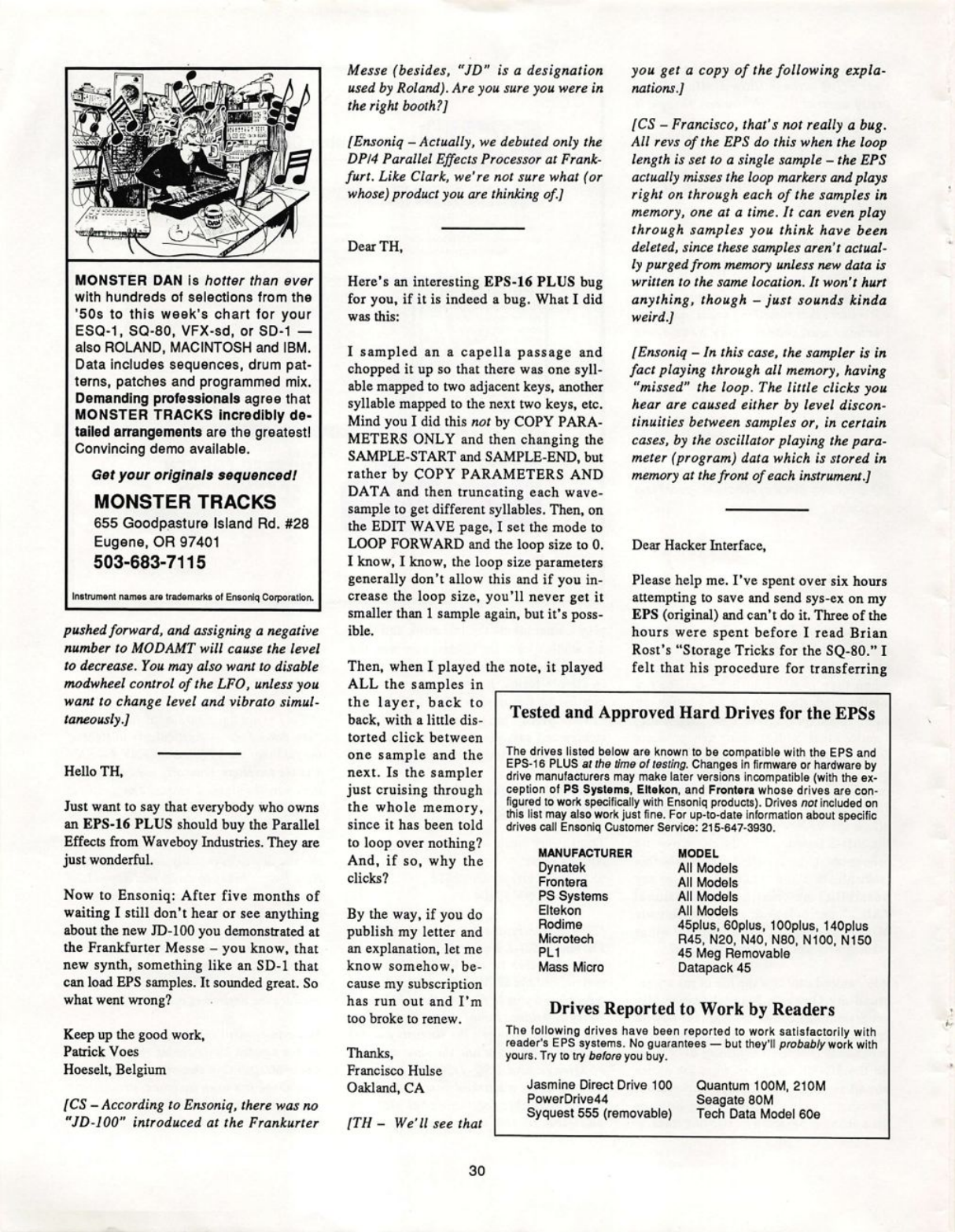
M O N S T E R D A N i s h o t t e r t h a n e v e r
w i t h h u n d r e d s o f s e l e c t i o n s f r o m t h e
'50s to this week's chart for your
ESQ-1, SQ-80. VFX-sd, or SD-1 —
also ROLAND. MACINTOSH and IBM.
Data includes sequences, drum pat
terns, patches and programmed mix.
Demanding professionals agree that
MONSTER TRACKS Incredibly de
tailed arrangements are the greatest!
Convincing demo available.
Get your originals sequenced!
MONSTER TRACKS
655 Goodpasture island Rd. #28
Eugene, OR 97401
503-683-7115
Instrument names are trademarks of Ensonlq Corporation.
pushed forward, and assigning a negative
number to MODAMT will cause the level
to decrease. You may also want to disable
modwheel control of the LFO, unless you
want to change level and vibrato simul
taneously.]
Hello TH,
Just want to say that everybody who owns
an EPS-16 PLUS should buy the Parallel
Effects from Waveboy Industries, They are
just wonderful.
Now to Ensonlq: After five months of
waiting I still don't hear or see anything
about the new ID-100 you demonstrated at
the Frankfurter Masse - you know, that
new synth, something like an SD-1 that
can load EPS samples. It sounded great. So
what went wrong?
Keep up the good work,
P a t r i c k V o e s
Hoeselt, Belgium
[CS - According to Ensoniq, there was no
" J D - I O O " i n t r o d u c e d a t th e F r a n k u r t e r
Messe (besides, "JD" is a designation
used by Roland). Are you sure you were in
the right booth?]
[Ensoniq - Actually, we debuted only the
DP/4 Parallel Effects Processor at Frank
furt. Like Clark, we're not sure what (or
whose) product you are thinking of]
DearTH,
Here's an interesting EPS-16 PLUS bug
for you, if it is indeed a bug. What I did
w a s t h i s :
you get a copy of the following expla
nations.]
[CS - Francisco, that's not really a bug.
All revs of the EPS do this when the loop
length is set to a single sample - the EPS
actually misses the loop markers and plays
right on through each of the samples in
memory, one at a time. It can even play
through samples you think have been
deleted, since these samples aren't actual
ly purged from memory unless new data is
written to the same location. It won't hurt
anything, though - just sounds kinda
weird.]
I sampled an a capella passage and
chopped it up so that there was one syll
able mapped to two adjacent keys, another
syllable mapped to the next two keys, etc.
Mind you I did this not by COPY PARA
METERS ONLY and then changing the
SAMPLE-START and SAMPLE-END, but
rather by COPY PARAMETERS AND
DATA and then truncating each wave-
sample to get different syllables. Then, on
the EDIT WAVE page, I set the mode to
LOOP FORWARD and the loop size to 0.
I know, I know, the loop size parameters
generally don't allow this and if you in
crease the loop size, you'll never get it
smaller than 1 sample again, but it's poss
ible.
Then, when I played the note, it played
ALL the samples in
t h e l a y e r, b a c k t o
back, with a little dis
t o r t e d c l i c k b e t w e e n
one sample and the
next. Is the sampler
just cruising through
the whole memory,
since it has been told
to loop over nothing?
And, if so, why the
clicks?
[Ensoniq - In this case, the sampler is in
fact playing through all memory, having
"missed" the loop. The little clicks you
hear are caused either by level discon
tinuities between samples or, in certain
cases, by the oscillator playing the para
meter (program) data which is stored in
memory at the front of each instrument.]
Dear Hacker Interface,
Please help me. I've spent over six hours
attempting to save and send sys-ex on my
EPS (original) and can't do it. Three of the
hours were spent before I read Brian
Rost's "Storage Tricks for the SQ-80." I
felt that his procedure for transferring
By the way, if you do
publish my letter and
an explanation, let me
know somehow, be
cause my subscription
h a s r u n o u t a n d I ' m
too broke to renew.
Thanks,
Francisco Hulse
Oakland, CA
[TH - We'll see that
Tested and Approved Hard Drives for the EPSs
The drives listed below are known to be compatible with the EPS and
EPS-16 PLUS at the time attesting. Changes in firmware or hardware by
drive manufacturers may make later versions incompatible (with the ex
ception of PS Systems, Eltekon, and Frontera whose drives are con
figured to work specifically with Ensoniq products). Drives not included on
this list may also work just fine. For up-to-date information about specific
drives call Ensoniq Customer Service: 215-647-3930.
MANUFACTURER MODEL
D y n a t e k A l l M o d e l s
Frontera All Models
P S S y s t e m s A l l M o d e l s
Eltekon All Models
Rodime 45plus, 60plus, lOOplus, 140plus
Microtech R45, N20, N40, NSO, NIOO, N150
PL1 45 Meg Removable
M a s s M i c r o D a t a p a c k 4 5
Drives Reported to Work by Readers
The following drives have been reported to work satisfactorily with
reader's EPS systems. No guarantees —• but they'll probably viork with
yours. Try to try before you buy.
Jasmine Direct Drive 100
PowerDrive44
Syquest 555 (removable)
Quantum 100M, 21OM
Seagate 80M
Tech Data Model 60e
30
sys-ex messages was innovative and al
most worked for me on my EPS. Before
reading his article, I couldn't even save
sys-ex.
H e r e ' s t h e l o w d o w n . I h a v e a R o l a n d J u n o
2 and have gotten the sys-ex MIDI dump
into the EPS by using a Mac-based editor
to hand shake through the EPS and to save
the data on the EPS. However, when I try
to send the data back to the Juno I get a
MIDI error message. I did not forget to
turn the memory protect off and the sys-ex
on. The instruments were going direct In
and Out to each other. I've tried almost
everything.
If anyone out there has information to cor
rectly and easily accomplish the sys-ex
dump, please let me know. Thanks a tril
lion.
Yours truly,
M a r k S c h a e f e r
Pico Rivera
[CS - We've had other readers who've had
troubles using machines that require hand
shaking when doing SysEx dumps, as your
Juno does. I'm afraid I don't have an
answer for you - you might want to try
talking to Roland to see if they have any
ideas. It may be that as the SysEx is
moving from your EPS to your Juno, the
Juno occasionally pauses to return some
sort of acknowledgement to the host
machine - the EPS. Of course, the EPS
wouldn't pause to wait for this message, so
this would give you problems.
It seems to me that Juno programs can be
dumped and loaded individually (I may be
wrong about this), so you might consider
trying to send and load individual pro
grams.]
[Ensoniq - We suspect that the Juno 2
hand-shaking and!or some timing issue re
lated to it is causing your problem. There
are some older synths (specifically those
requiring hand-shaking) which are simply
HACKER BOOTEEQ
never going to work painlessly with a
"generic" Sys-Ex recording device like the
EPS. Sorry we can't offer you any concrete
answers here, but if you call Ensoniq Cus
tomer Service we may be able to help you
find a solution.]
C H A N G E O F
ADDRESS
P l e a s e l e t u s k n o w a t l e a s t f o u r
weeks in advance to avoid missing
any issues. The Post Office really
will NOT reliably forward this type
of mail. (Believe us, not them!) We
need to know both your old and your
new address. (Issues missed due to
late or no change notification are
your own dumb fault - we mailed
them!)
FOR
IBM-PC'S
WITH
31/2"
DRIVE
ALESIS
ENSONIQ
KORG
YAMAHA
$22
EACH
DISKETTE
MANAGER
SHIPPING
I N T H E U S A
ORDER BY
MAIL OR
PHONE
NY • ADD TAX
D I S K E T T E M A N A G E R S
Convert Stancjard Midi Files to/from
your keyboard on an IBM-PC using
our Sequencer Conversion Packages
$44 each (includes Disk Manager)
VFX-SD & SD-l, SO-1 & SO-2. EPS 8. EPS16^
Convert SQ80 Seqs & Songs to VFX-SD (S44)
Convert SQ80 to Standard Midi Files ($44)
CIEBLER E NTE RPR ISE S (3 15) 652-5741
8038 MORGAN RD. LIVERPOOL. N.Y. 13090
New Fall Products
VFX, VFX-sd, SD-l owners —
Volume 4 - Effects
Highway sounds, city noise,
the countryside, space, ghostly, & more.
$40
SQ-80 owners —
Vo lume I - The Col lection
40 sounds, 3 demos, & documentation.
Disks: $19
LATTER SOUND PRODUCTIONS
1341 Westheaven Ct.
Tallahassee, PL 32310-8625
(904) 575-5561
Florida residents add sales tax
YO ADVERTISERS!
Try an economical size ad in the Hacker. Our
one-twelfth page ad (the size of this ad) is the
perfect size for testing the waters, moving up
from the classifieds, dropping back from larger
ads, or just maintaining visibility over long
periods with minimal expense.
2.25" X 2.25" Only $30!
We'll typeset it: $5
Reverse it (white on black): $5
Transoniq Hacker
1402 SW Upland Dr., Pordand, OR 97221
503-227-6848
|DKMMSAMPLea)i1
Over 1200 16 Bit CD Quality Samples
{From the Wortd's Greatest Drum Machines!
TR-505, TR-606. TR-707. TR-808. TR-909.
R-8 . R - 8 S OUN D R O MS ( 9) . DR- 55 0 . R Y- 30 .
XR-10. DDD-1. DRUMULATOR. HR-16.
DRUMTRAKS. SIMMONS. RX-S. RX-11.
U INN D R UM. X D - 5 & M U C H MOR E !
(SEE JAN. 92 KEYBOARD FOR FULL REVIEW
O N L Y $ 4 0 - I - S / H
I WE ALSO HAVE A HUGE LIBRARY OF SOUNDS
FOR THE EPS, EPS16+, MIRAGE, TX-16W, EMAX.
S-900, S-60/330/W-30, S-10/MKS-100 AND DPM-SP
PRICED AT ONLY $5 + .50 SAi PER DISK. ALSO,
PATCH DISKS FOR SYNTHS IN MANY FORMATS
AT $15 + .50 S/H PER DISK.
IfflE ISTW5 ■ SPECfy FMIffl
IliVIECIfllfSMiyiW
(BD6SMT0D.W
PO BOX 114. STATION C
KrrCHENER, ONTARIO
CANADA N2G 3W9
VISA/MC 519-745-0021
ALL DIGITAL SAMPLES
OOOOOOOOOOOOOOOCyDOC^
We offer the only 16 bit computer
synthesized samples available for
your EPS or EPS16+. "A great idea,
and some great sounds...very clean...
wildly exotic." -Jim Aikin, Keyboard
July/91. Get a demo disk with seven
complete instruments for $6.00, or
write for our catalog.
FIRST GENERATION
P.O. Box 748
Cocoa, FL 32923
S u m m e r C o v e r S a l e
-Ensoniq SD1/EPS16+
-Korg M1/r3, 01/W
Reg.... $24T95-Sale...19.95
Call Now
while quantities last!
1-800-228-DUST
MutircerO/ Vlit Accepted
1 Lccnvc, I
1 N. 353 Bloomlngdale Rd.
Carol Stream, III. 60188
31
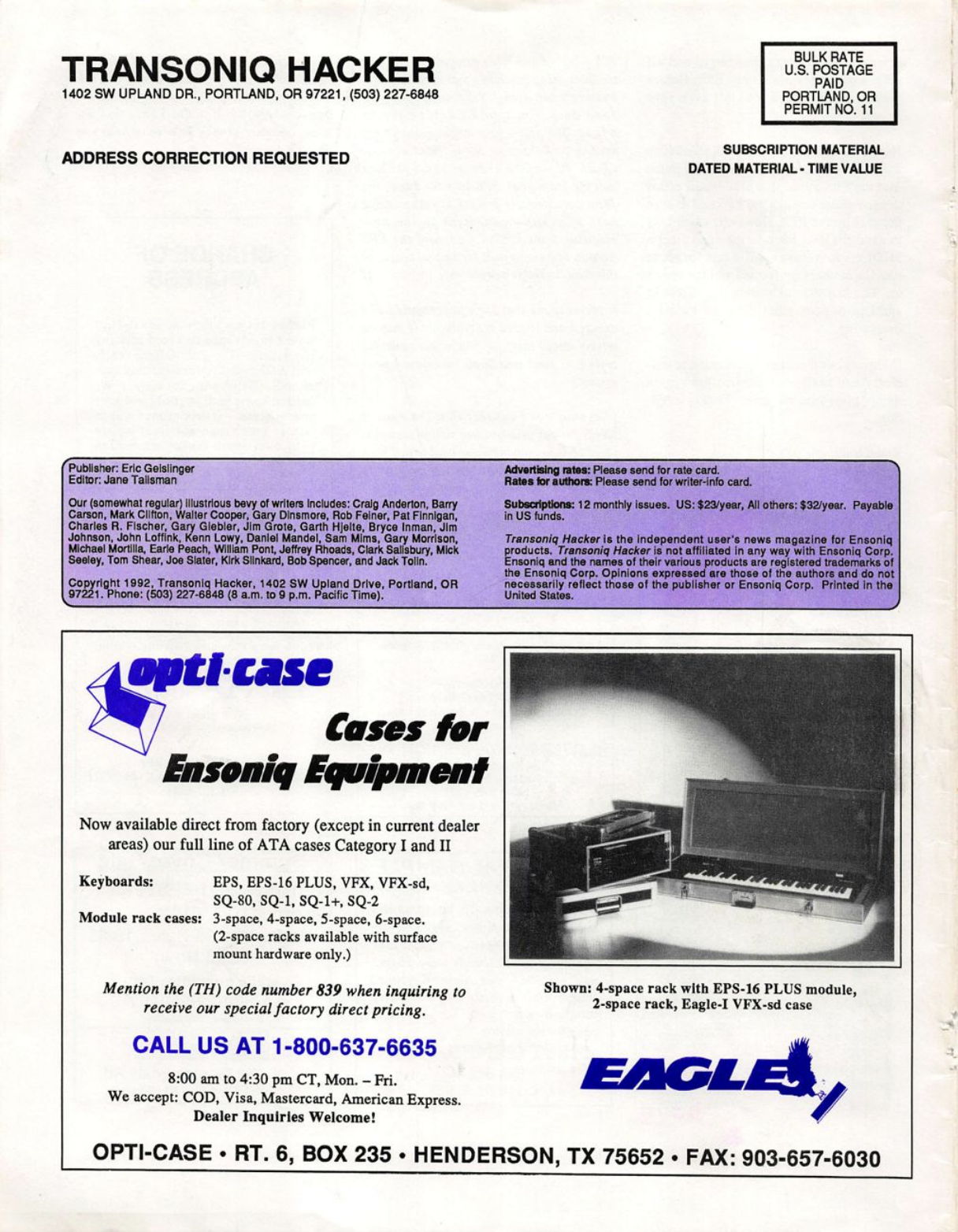
TRANSONIQ HACKER
1402 SW UPLAND DR., PORTLAND, OR 97221, (503) 227-6848
A D D R E S S C O R R E C T I O N R E Q U E S T E D
B U L K R A T E
U.S. POSTAGE
PAID
PORTLAND, OR
PERMIT NO. 11
SUBSCRIPTION MATERIAL
D A T E D M AT E R I A L • T I M E V A L U E
Publisher: Eric Gelsllnger
Editor: Jane Talisman
Our (somewhat regular) Illustrious bevy of writers Includes: Craig Anderton, Barry
Carson, Mark Clifton, Walter Cooper, Gary DInsmore, Rob Felner, Pat FInnlgan,
Charles R. Fischer, Gary Glebler, Jim Grote, Garth HJelte, Bryce Inman, Jim
Johnson, John Loffink, Kenn Lowy, Daniel Mandel, Sam MIms, Gary Morrison,
Michael Mortllla, Earle Peach, William Pont, Jeffrey Rhoads, Clark Salisbury, Mick
Seeley, Tom Shear, Joe Slater, Kirk Sllnkard, Bob Spencer, and Jack Tolln.
Copyright 1992, Transonlq Hacker, 1402 SW Upland Drive, Portland, OR
^97221. Phone: (503) 227-6848 (8 a.m. to 9 p.m. Pacific Time).
Advertising rates: Please send for rate card.
Rates for authotB: Please send for writer-Info card.
Suliscriptlons: 12 monthly Issues. US: $23/year. All others: $32/year. Payable
in U S fu n ds .
Transoniq Hacker \s the Independent user's news magazine for Ensonlq
products. Transoniq Hacker Is not affiliated In any way with Ensonlq Corp.
Ensonlq and the names of their various products are registered trademarks of
the Ensonlq Corp. Opinions expressed are those of the authors and do not
necessarily reflect those of the publisher or Ensonlq Corp. Printed in the
United States.
C o s e s f o r
^soaiq Cqu^un^
Now available direct from factory (except in current dealer
areas) our full line of ATA cases Category I and II
Keyboards: EPS, BPS-16 PLUS, VFX, VFX-sd,
SQ-80, SQ-1, SQ-1-f, SQ-2
Module rack cases: 3-space, 4-space, 5-space, 6-space.
(2-space racks available with surface
mount hardware only.)
Mention the (TH) code number 839 when inquiring to
receive our special factory direct pricing.
CALL US AT 1-800-637-6635
8:00 am to 4:30 pm CT, Mon. - Fri.
We accept: COD, Visa, Mastercard, American Express.
Dealer Inquiries Welcome!
Shown: 4-space rack with EPS-16 PLUS module,
2-space rack, Eagle-I VFX-sd case
OPTI-CASE > RT. 6, BOX 235 • HENDERSON, TX 75652 • FAX: 903-657-6030
