Ensoniq Corporation Transoniq Hacker Archive Issue #121 Th 121
Ensoniq Corporation Transoniq Hacker Archive Issue #121 th_121 Ensoniq Corporation - Transoniq Hacker Archive - Issue #121
User Manual: Ensoniq Corporation Transoniq Hacker Archive Issue #121 Ensoniq Corporation - Transoniq Hacker Archive - Issue #121
Open the PDF directly: View PDF  .
.
Page Count: 32
The
independent
News
Magazine
for
Ensonlq
Users
Sample
This:
0.s.
3.08
I
'
CI
I!-T-II
5*-
i
__..-
Produet:
AER-10
0.8.
3.03.
For:
ASH-10.
Prioe:
Free
From:
Ensoniq
Authorized
Dealers.
It's
a
bit
of
a
rarified
atmosphere
over
St.
Louis
at
35.000
ft.
but
what
an
ap-
propriate
area
to
describe
sueh
an
ele-
vated
operating
system
for
the
ASR-10.
Yes,
folks.
it"s
finally
here.
The
ability
to
read
Roland
and
Akai
CD
samples
is
a
more
floppy
disk
away.
Although
it
seems
rather
like
some
inventive
(liab-
ler-type
programming
here,
it
was
ae-
tually
a
hereulean
effort
invoking
the
names
of
the
entire
eode
eranl-ting
war-
riors
of
Malvem.
After
mueh
griping
and
whining
about
how
the
Kursweil
would
read
all
of
these
other
formats
(like
eomparing
a
Young
Chang
“sam-
pler"
that
doesn't
even
offer
sampling
in
its
base
form
to
a
digital
audio
reoording
workstation
is
even
remotely
valid;
“Yeah.
right,
as
if"),
we
now
have
this
eommensurate
funetionality
for
the
‘i0.
I-Iere's
the
long
and
short
of
it...
'
Pot
F
irtrtigrrn
(A)
You
CAN
read
Akai
S1000!S100
samples.
You
oannot,
I
repeat,
CAN-
NOT
read
S3000-format
sample
files.
I
l-mow,
this
may
seen
to
be
a
serious
oversight,
given
the
availability
of
S3000
stuff,
but
hey,
let‘s
try
to
keep
the
OS
down
to
a
manageable
size
(this
ain't
a
PPC601
w,i4Mb
Rfillrls
yet!)
And
given
the
majority
of
the
Akai
library
is
primarily
in
S1000
forrnat
it
seems
the
logieal
ehoiee
to
support.
Again,
perhaps
this
may
be
oonsidered
an
oversight;
En-
soniq
obviously
felt
the
need
to
aeeess
the
broadest
base
of
Altai
samples.
Yeah.
you
upseale
boomer
types
will
eurl
your
nose
at
this
limitation:
we
real-world
types
only
pursue
perfection
without
regard
to
the
soeial
implantation
of
another
“leading
studio
sampler."
We
already
got
it.
(B)
You
ean
now
read
Roland
S-series
CD-Rfillrls.
This
more
than
makes
up
for
the
omission
of
the
Akai
S3000
format.
sinee
it
preeludes
any
further
nose-eurl-
ing
by
offering
aoeess
to
another
one
of
those
“leading
studio
samplers."
And
let's
faee the
reality
of
our
eraft
and
be
brutally
honest:
every
keyboard
manu-
faeturer
absolutely
does
one
thing
best:
you
ean't
get a
better
whip
eraek
than
an
Ml
provides:
you
ean‘t
get
more
ae-
eurate
steel
string
aeoustie
than
the
Roland
sound
library,
you
ean’t
get
the
shimmering
22K
wash
of
a
TXSl6
fmm
anyone
but
Yamaha.
And
you
ean‘t
get
a
better
eolleetive
representation
of
all
of
Articles:
TS-
10,-"
12
CD-RUM
Compatibility
Anthony
Ferraro
.....................................
4
Static
Free
Transwaye
Samples
—
Part
ll
John
Lsjfirtl:
.............................................
..
5
Waveform
Mutilation
-
Transwaves
Joel:
Stephen
Tolirr
...................................
..
9
Tips
and
Triel-.ts
for
Litre
Playing
and
Sequeneing
Steve
Vincent
.........................................
..
1 1
More
on
DPI4
Reverb
Parameters
Roy
Legnini
...........................................
..
13
Reviews:
Sample
This:
0.5.
3.08
Pet
Finnigan
.....................................
..
eover
Syntaur
-—
TS
Set
I
Robby
Berrnan
.........................................
..
T
Big
Fish
Audio
-
Ross
Garfield
CD
Pot
Finnigerr
...........................................
..l5
Sytttaur
-
Kiel-tin
Drums
Sample
Set
#3
Jeremy
Ryan
..........................................
..
19
Regular
Stuff:
Random
Notes
.........................................
.. 3
Hypersoniq
............................................
..
20
Classifieds
.............................................
..
Z0
Haekerpatehes
—
Jeffletron
SQr’KSl'I(T:
Lemongate.J'stton
21
The
In
terfaoe
..........................................
..
22
Transoniq-ltlet
........................................
..
26
Current
+0.5.
..........................................
30
Hacker
Booteeq
.....................................
..
31
“H
H
JULY
W95
l
ISSUE
NUMBER
l2l,
$2.50
.
l
these
forms
in
a
seamless
integration
without
an
ASR-10.
So
we
now
have
an
avenue
of
viable
access
to
the
escellent
Northstar
sotmd
libraries,
free
rein
over
the
Kemiy
Iaegcr
String
libraries:
in
one
fell
swoop,
the
ASR-l0
library
has
im-
mediately
quadrupled.
And
that
implies
access
to
tenabytes
of
wave
data.
that's
why
we
real-world
types
curl
our
noses.
(C)
All
of
this
ftmctionality
comes
with
a
price,
however:
given
the
ASR-10's
limitations,
you
can
only
import
sample
files
of
16
Mb
or
less.
This
precludes
the
32Mh
pianos
and
such,
but
with
careful
attention
to
detail,
many
waves
can
be
imported
into
layers,
uimmed,
and
our
old
friend
“copy
wave
params?”
comes
to
the
rescue
here.
Besides,
if
yotu
piano
sound
is
that
important,
you
should
be
pounding
a
Yamaha
C‘?
or
equivalent
anyway.
Works
for
Dave
Grusin,
anyway.
But
to
quote
Demtis
Miller;
"Then
again,
I
could
be
wrong.”
Yeah
right;
and
raptors
are
vegetarian.
Restricting
key
range
and
layers
when
importing
will
help
overcome
the
lfilvlb
wall,
but
there
comes
the
rare
sample
which
actually
er-tceeds
the
1st.-to
ASR
limit.
Ensoniq's
answer
in
the
table
of
hints
is
a
simple
"Sorry,"
which
ap-
pears
quite
humorous
upon
discovery.
Then
again,
it
makes
you
wonder
what
plans
Malvern
has
on
the
drawing
hoard
for
the
ASR-11,
'cause
I've
never
heard
Ensoniq
say
"Sorry"
in
print
without
hidhtg
something
up
its
collective
sleeve.
Don't
forget
their
change
of
slogan
to
"Leading
the
World
in
Sound
innovation“
—
they're
definitely
into
being
a
multimedia
company.
That
makes
you
realise
the
ASR-10
is
showing
its
age
(a
mere
year
and
a
coupla
months:
how
many
babies
do
you
know
this
powerful
that
have
gone
thru
this
number
of
revs?
Chill...)
The
Audio
Tracks
feattues
are
improved:
the
ability
to
delete
temporary
”Atrks”
is
a
real
blessing
to
recovering
lost
HI)
space.
Digital
lit)
baekupirestoreiverify
seems
improved
and
more
robust,
although
the
manual
notes
hmnid
conditions
still
may
cause
a
verify
error
although
the
tape
is
actually
good.
Maybe
SIPDIF
is
hygroscopic
or
something.
You
can't
“scrub”
audio
yet,
and
given
the
limits
of
SCSI
disk
technol-
ogy
and
available
RAM
buffers,
don't
count
on
seeing
it
in
an
ASR-l
1.
You'll
still
need
Digidesign,
er,
Avidd
for
that...
In
general,
this
version
of
0.5.
seems
much
more
robust
and
less
prone
to
crash
than
3.0.
I
can't
tell
if
it's
cleaner
code
or
what,
but
I
don't
cttperience
anywhere
near
the
“Error
12571-Reboot?"
numbers
I
got
in
the
previous
OS.
Somebody
did
something
here:
the
new
code
acts
as
if
all
segments
must
complete
their
run
before
any
other
interrupt
or
button
press
can
unload
them.
In
simple
terms,
“it
don't
crash
no
more!”
Period.
I'm
not
saying
you
can't
force
a
crash
by
feeding
it
250
BPM
64tlt's
on
all
tracks
in
lvlulti
mode
from
the
entemal
Sequencer
from
Hell;
you
have
to
intentionally
try
to
force
a
crash
in
three
or
four
ways
to
get
an
error
code
out
of
the
ASR-l0
now.
Very
cool
stuff,
this
spin
of
the
OS.
Elbviously
there's
new
magic
going
on
in
the
ho:-t
again,
and
the
changes
are
literally
transparent.
This
is
both
cool
and
not
cool:
cool
for
us
manic
button
pushers
who
appreciate
not
being
able
to
“outpace”
the
system
as
in
the
previous
0.5.
[remember
how
sluggish
some
commands
behavedlt),
and
not
cool
for
the
programmers
whose
laborious
cranking
of
code
is
reflected
in
the
seamless
simultaneous
operation
of
key-
boardtsequencer,-TIARIIJPI
not
recognised
for
the
redefini-
tion
of
a
new
product
but
the
enhancement
of
an
old
(year-old
baby?)
product.
Then
again,
the
successful
revolution
is
the
one
that
no
one
realises
has
taken
place
until
it's
over...
Specifically,
handling
of
import
samples
from
one
format
to
another
is
a
risky
business,
tenuous
at
best.
It's
not
as
easy
as
writing
a
translator,
coding
it
and
watching
it
work.
Load-
ingiunloading
foreigntnative
segments
dmdng
enecution
is
not
enactly
a
Sunday
drive
thru
the
park,
folks.
Ensoniq
doesn't
have
lvlclroliiorks
Codellimrior
utilities
to
convert
foreign
data
into
native
Ensoniqspeak.
They're
still
torquing
680)-£0
code
to
meet
and
supersede
the
incessant
demands
we
make
of
such
an
elegant
user
interface.
What
we
have
here
is
an
en-
tremely
bright
and
diligent
pro
granmring
team
which
not
only
cranks
effective
and
powerful
cnecutable
code
in
an
un-
believably
small
ROM
space,
but
maintahts
an
unbelievable
focus
of
vision
when
it
comes
to
identifying
which
direction
the
market
is
moving,
and
responding
intrnediateiy.
That's
why
we
curl
our
noses...
The
test
suite
consisted
of:
(A)
ASR-10
SN#12S32,
SCSI,
DEX,
lfillllh
installed
(4
41:8,
'.'0r.s
SIMM
RAM}
(B)
Quantum
T30
Lightning
{formats
to
T00}-db}
SCSI
HI]
in
Frye
case
{C}
Scagate
Barracuda
2.lGb
SCSI
I-ID
in
Diskovery
case
lffc:
audio
tracks)
(D)
Toshiba
‘ZX
CDRUM
drive
{E}
TrippLite
line
stabiliaertconditioner
‘Without
fail,
all
sounds
within
the
16
Mb
or
312?-1
block
limit
(how
we
used
to
slave
to
stuff
4096!),
0.5.
3.05
per-
formed
flawlessly.
1
did
sttunble
over
a
few
Roland
"tern."
filesflandmines
("read
me"
in
lvlacspeak)
that
woolen’:
load,
but
you're
warned
of
this
anomaly
in
the
addendum
tflilte,
as
if,
tent
files
were
valid
wavedata,
yeah,
right,
as
if},
so
'nuff
about
that.
Without
a
DAT
I
couldn't
verify
any
further
crashworthinessirobustness
of
the
DIU
from
the 1.5
or
3.0
O.S.
spec,
but
when
you've
quadrupled
your
sound
library,
you
might
wanna
think
about
a
DAT
for
hacking
up
those
hours
of
edits.
The
only
quirk
I
noticed
was
the
inability
to
change
tempo
of
a
song once
I
had
recorded
audio
tracks
to
the
Barracuda.
After
about
20
minutes
of
diddling,
it
dawned
on
me:
to
properly
sync
sequence
and
audio
track
playback,
tempo
has
to
be
locked.
If
it
wasn't,
how
could
“Attics”
chase
sequence
tempo?
Kudos
to
Ensoniq
for
anticipating
a
gnarly
problem
at
this
OS
inception
and
forward
thinking.
This
omission
could
have
turned
any
work
irt
progress
or
final
edit into
a
real
nightmare...
In
summary,
what
is
already
one
of
the
most
esoteric
samplers
out
there
(absolutely
the
most
esoteric
sampling
workstation
under
$3500)
has
turned
more
Synclavier
on
us.
Solid
audio
track
recording,
bulletproof
operation,
more
FX
processing
than
most
dedicated
PX
bones,
an
unparalleled
user
interface,
and
the
best
track
record
and
most
used
sampler
in
the
industry
set
the
ASR-ll)
another
doaen
light-
years
ahead
of
the
competition
with
the
O.S.
3.08
release.
To
quote
Thomas
Wolfe
from
The
Right
Stuff:
“Our
Gennans
are
better
than
their
Germans."
But
power
is
relative:
some
ASRers
routinely
push
the
envelope
to
the
entremc.
So
if
all
you
power-user
types
still
have
to
gripe
about
not
RND(Ln)
Ensoniq
News
Ensoniq
is
offering
a
special
bundle
for
purchasers
of
the
KT-"id
and
KT-SS.
Get
an
attractive
wood
keyboard
stand
and
the
MS-l
music
stand
for
only
$69
fa
$500
value)
when
purchasing
a
KT
between
Ivlay
l5
and
September
30,
1995.
For
more
infor-
mation
contact
your
local
Authorised
Ensoniq
Dealer
or
call
Ensoniq
at
(S00)
553-5151.
ASR
Sounds
SCH-1'.
Ensoniq's
first
Signature
Series
release
on
CD-ROM
features
the
band
Chicago.
This
collection
includes
their
trade-
mark
vocals
and
hom
section,
as
well
as
bass,
guitar,
organ,
drums,
and
percussion
loops.
SCI)-I
contains
over
600
MB
of
data,
and
aLso
includes
a
special
audio
demo
track
(playable
on
a
regular
CD
player)
featuring
Jason
Schcff.
SCD-I
retails
for
$249.95
and
will
start
shipping
late
in
I
uly.
SCD-2.
Rap,
hip-hop,
and
ll].
effects
from
I1].
Janey
Jeff
and
A
Touch
Of
Jana.
The
definitive
collection
from
one
of
the
originators
and
masters
of
the
form.
Retail
price
$249.95,
avail-
able
in
August.
SUD-3
—
Steve
Gadd
“ElrumScores."
Drum
sounds
and
perfor-
mances
from
this
legendary
artist
—~
no
hype
needed.
Retail
price
$249.95,
available
in
August.
lIlrumScores
is
also
avail-
able
as
a
2-disk
audio
CD
for
$1'i9
from
Q-Up
Arts
—
call
(S00)
454-4563,
or
fan
(S01)
944-9l5'l"l'.
ASIUTS
Sampled
Sounds
AS-J5:
“Tcch.no,tAmbient."
A
five-disk
set
of
sampled
sounds
being
able
to
import
S3000
samples:
{A}
Weigh
the
competition's
lack
of
onboard
rnatittiattthie
effects
processing
of
this
flenibility.
(B)
Record
Direct-to-Illisk
on
a
K2000
or
an
S3000
for
over
54
minutes
@
44.1K
and
call
me
back.
(C)
Repeat
(B)
stereo
and
call
me
back.
(D)
Plug
your
S3000
or
K2000
outs
to
your
sample
inputs,
process
PX,
and
make
[Ill
audio
tracks.
(E)
Get
it
fined
in
less
than
a
week
if
it
breaks.
(F)
Get
customer
support
from
an
enperienced
ASR-I0
hurnan
every
time
you
call
with
a
pilot
error.
(G)
Find
sorrtething
better
or
more
flenibletpowerful
at
10X
the
price
and
call
me
back.
(H)
Call
their
Germans.
(I)
Rent
an
S3000
and
sample
your
anal
retentive
derierre
off.
After
all,
we
ASR-types
are
too
busy
making
music
to
notice
anyway...
-I
for
the
ASR
and
TS
instruments
covering
synth
dance
sounds.
Suggested
list
price
—
$39.95.
AS-Id:
“Techno;'Trance."
More
sampled
sounds
for
the
ASR
and
TS
instruments,
covering
different
synth
dance
trends.
Sug-
gested
list
price
-—
$39.95.
TS
Sounds
TED-1006.
A
broad
collection
of
synth
sounds
for
the
TS-12
and
TS-10.
Suggested
list
price
-—
$19.95.
KT
Sounds
ETC-2.
Contents
160
diverse
ethnic
and
vintage
sounds,
modeled
after
the
TS
"World
Piece"
collection
(TED-l‘
005).
In-
cludes
20
Performance
Presets
and
a
demo.
Suggested
list
price
—
$99.95.
KT
C
-3.
160
sounds
for
church
and
gospel
music
performance,
programmed
by
Music
tit
Sound
Associates
{Clark
Salisbury
and
Erick
Hailstone).
includes
20
Performance
Presets
and
a
demo.
Suggested
list
price
—
$99.95.
Hacker
News
We'd
like
to
welcome
a
new
advertiser
[and
budding
entre-
preneur),
the
SS
Gray
Company.
Be
sure
to
check
out
their
inovative
keyboard
stands.
We
have
a
bit
of
a
warm
spot
for
keyboard
stands
—-
our
very
first
advertiser
in
our
very
first
issue
(ten
years
ago
this
month)
was
for
keyboard
stands.
Which
brings
us
to...
10
Years
ago
in
the
Hacker
—
Eight
whole
pages.
Featuring
Clark
Salisbury's
very
first
article:
A
First
Look
at
the
Mirage.
Erick
Hailstone
gave
us
a
MIDI
lesson,
there
were
a
couple
of
questions
and
answers,
and
that
was
about
it.
Hacker
writer
and
all
around
good
guy
Craig
Anderton
has
yet
another
book
out
of
interest
to
our
readers
{DPl-4
fans
in
par-
ticular):
Maltiefiects
for
Musicians.
The
book
is
published
by
1
Amsco
Publications,
covers
multieffects
in
Craig's
usual
com-
prehensive
mamter,
and
should
be
available
at
music
stores.
Corrections
for
Issue
#120:
The
Fan
number
for
Cybersounds
in
the
Sample
Bank
review
should
be:
I-519-745-0953.
The
Basement
Tape
review
gave
one
of
Tom
Shear's
(many)
old
ad-
dresses.
It
should
be:
T26
Fourth
Ave.,
Williamsport,
PA
l'l"l0l.
TS-
10/12
CD-ROM
Compatibility
Many
people
{myself
included)
use
a
powerful
instrument
like
the
TS
as
an
all-in-one
music
composition
environment.
Most
people
who
use
the
TS
alone
without
a
sampler
opt
for
a
CD-ROM
drive.
This
gives
the
user
quick
access
to
many
sounds
through
the
many
Ensoniq
and
third
party
compat-
ible
CD-ROM
disks
available.
When
the
TS's
SIlvlMs
capacity
is
enpanded
to
a
full
S
meg
of
Sampled
Sound
memory,
this
results
in
S114
blocks
(4
meg)
of
available
RAM
in
BankSet
S8
and
8191
blocks
in
BankSct
S9.
In
other
words,
the
largest
each
instrument
location
can
contain
is
a
4
meg
sampled
instrument.
All
of
the
enisting
Ensoniq
CD-ROM
disks
will
load
a
majority
of
their
sounds
into
a
fully-expanded
TS
via
SCSI.
Obviously,
you
will
need
to
have
the
SP-4
SCSI
option
installed
to
take
advantage
of
this
capability.
CD-ROM
Compatibility
The
formats
for
CD-ROM
drives
that
are
currently
known
to
work
with
our
TS
series
synths
include
Sony,
Toshiba,
and
Chinon
435
and 535
model
mechanisms.
Check
En-
soniq
document
number
0015
entitled
"Approved
SCSI
Storage
Devices
for
Ensoniq
Products”
on
our
Automatic
FAX
Retrieval
System
(1-800-25'?-1539)
for
up-to-date
in-
formation
about
compatibility.
Special
Note:
TS
0.5.
Yer-
sion
3.00
will
allow
a
TS
to
work
with
an
Apple
CD-150
model
CD-ROM
drive.
To
arrange
for
the
upgrade,
call
our
Technical
Support
number
(610-64?-3930)
to
find
the
Authorised
Ensoniq
Repair
Station
nearest
you.
Macintosh
Compatibility
There
are
problems
inherent
with
addressing
the
internal
CD-ROM
drive
found
in
some
Macintosh
computers
from
an
enternal
SCSI
device
like
the
TS.
The
TS
SCSI
Interface
manual
explains
this
somewhat
more
thoroughly,
but the
two
most
important
issues
would
be
that
of
termination
and
SCSI
ID
number.
Your
best
bet
is
to
buy
an
entcmal
CD-ROM
drive
that
is
compatible
with
both
your
TS
and
your
computer.
Entemal
CD-ROM
drives
(vs.
internal)
tend
Anthony
F
erroro
to
be
much
easier
to
deal
with,
since
termination
and
SCSI
ID
number
are
more
conveniently
accessed
and
resolved
when
working
with
an
enternal
SCSI
peripheral
device.
PC
Compatibility
PC-compatible
computers
generally
do
not
interface
direct-
ly
with
SCSI
peripheral
devices
such
as
CD-ROM
or
enter-
nal
hard
drives.
PCs
are
generally
configured
to
work
with
IDE
(Integrated
Drive
Elecuonic)
interface
devices,
which
are
lower
in
cost.
This
is
due
to
the
fact
that
they
incor-
poratc
drive
controller
functions
directly
on
the
IDE
device,
rather
than
receiving
commands
by
connecting
to
a
con-
troller
card.
The
IDE-type
drive
connects
directly
to
the
PC's
mainboard.
In
order
to
get the
PC
to
address
the
enter-
nal
CD-ROM
drive
(or
any
other
SCSI
peripheral
device,
for
that
matter),
you
would
first
need
to
install
a
SCSI
adapter
card
into
the
PC.
SCSI
adapter
cards
are
available
from
Adaptec,
QLogic
and
others.
SCSI
adapters
for
the
PC
may
cost
in
the
general
area
of
$150-300
dollars,
depending
on
the
features
needed,
whereas
a
compatible
CD-ROM
drive
might
cost
approximately
$200-500,
depending
on
the
speed
(Zn,
3:-t,
4:-t,
etc).
Of
special
interest
to
PC-compatible
users
is
Gicbler
Enterprise's
Ensoniq
DISK
MANAGER
software
applica-
tion
and
its
use
with
the
PC's
CD-ROM
Drive
(IDE
or
SCSI).
This
program
enables
you
to
read
EPS
and
ASR
sample
instrument
files
directly
from
Ensoniq
format
CD-
RCllvIs
using
the
PC's
CD-ROM
drive.
EPS
and
ASR
files
can
be
saved
to
the
PC's
hard
disk
drive,
and
then
written
to
Ensoniq
format
floppy
disks
which
can
be
loaded
into
your
TS.
if
your
PC
already
has
a
CD-ROM
drive,
this
software
can
provide
easy
access
to
the
Ensoniq
CD-ROM
library
without
purchasing
any
additional
hardware.
For
more
in-
formation
call
Giebler
Enterprises
at
610-933-0332.
I
Bio."
Anthony
Ferraro
has
written
for
Electronic
Musician,
Recording,
and
Keyboard.
He
is
still
hard
at
work
on
some
new
“snappy
ditties,”
and
is
playing
concerts
in
the
Phila-
delphia
area.
Call
21.5-7'42-0?'3flfor
concert
info.
Static
Free
Troinswciive
Samples
Pflrl
ll
A
long,
long
while
back
some
questions
were
raised
in
the
Interface
concerning
Transwaves
on
the
EPS-16
Plus.
Since
I'm
not
in
the
sample
marketing
business
anymore,
I
thought
I‘d
share
some
of
my
“trade
secrets."
After
many
hours
of
e:-rperimentation,
I
have
come
up
with
the
follow-
ing
hard
and
fast
rules
for
smooth
Transwave
creation.
Last
month
we
covered
the
first
two
-—-
new
fer
the
remainder.
1.
Use
single
oscillator
samples
only.
2.
Make
sure
all
frequencies
have
zero
phase
shift.
3.
Sample
at
22,321
I-la,
32,894
I-Ia
or
44,642
on
the
note
D.
4.
Use
multisamples
fer
rapidly
modulated
Transwaves.
5.
The
Wave
Mod
Amount
range
of
99
will
cycle
through
128
“loops.”
6.
Best
results
can
be
achieved
using
computer
synthesis.
T.
Resynthesis
may
transform
a
peer
Transwave
into
a
good
Transwave.
John
Lofiiirrk
3.
Brute
force
sample
editing
can
work
somewhat,
but
is
tedious.
9.
Phase
shift
effects
from
filtering
can
be
avoided
by
editing
tricks.
Rute
3:
Sample
at
22,321
Hz,
32,894
Hz
or
44,642
Hz
on
the
note
D.
It
is
possible
to
make
clean,
click
and
pep
free
Transwaves,
given
the
right
conditions.
If
you"ve
tried
turning
any
old
sampled
sound
into
a
Transwave,
you
probably
get
a
bunch
of
clicks
and
pops
as
you
modulated
through
the
sample.
The
point
to
remember
is
that
every
repetition
of
the
trans-
forming
waveform
in
the
loop
should
retain
near
perfect
acre
transitions.
Transwaves
apparently
switch
on
whole
number
ratios.
The
fractional
part
of
the
loop
end
has
a
no
effect
on
the
sound.
To
be
able
to
sample
on
a
standard
note
pitch,
it
fellows
that
the
sampling
frequency
should
be
a
l
i-|
1
g__-
|—_-pain;-i
Blown
Away
By
Manuals?
Video
Help
tor
Computer
Music!
MIISIB
SOFTWARE
VLDEUS
!(El§§AFlll
VIIIEIIS
0'I'l-IEB
Pfl_[_!lIll,IIJTS
Band-In-A-Box
Cubase
MIDI
MDFISTBF
Sequencing
Drums
Nightingale
Ettective
Video
Solutions
Cakewalk
is
videos)
Karo
X8
Emagic
(Coming
Soon!)
K979
X5
Encore
(2
videos)
Finale
(8
videos)
231223
T
M8.S'[_Bl'
TFHCKS
PTO
(2
VlClGDS)
Roland
-|'DE_7'|.<
tiiluictr
ref.-lvlac
Basics)
MusicTime
(2
videos)
|:;D|anc|
J\_;_gg
Band-in-a-Box
Sgyles
PBl"lOI'iTlBl'
(2
'v'iCl6DS)
Yamaha
QYQU
CAL
Tutor
oiskeue
Finale_
8|
Jazz
Arr.
ifboolt
with
diskette)
Golden
Age
Font
[lvlac
or
U‘-In
|5l'-1lDl'
Finale}
Crescendo
Font
[Mac
or
Win
disk
tor
Finae)
Finale
CD-ROM
Casio
GTK
650.750
Korg
M1
Korg
AXSUG
[Style
E|l5l'tS
a
Fal-is
isksl
KillerDrurn
LiJt'll'Ol1-3
Double
Bass
Lessons
(15
hot
lor
-
5
per
video}
Home
Recording
(‘volumes
1-3]
Roland
DR-5
Yamaha
QYBUU
Yamaha
PSRBUUD
CALL
1-800-650-2427
F00
FREE
CATALOG!
“E‘v'5
video
tutorials
are
the
best
in
the
business..."
-Tom
Johnson,
Notation
Product
Manager,
Coda
Music
Technology
“T
he
hints
Si
tips
alone
are
the
worth
the
price
of
admission..."
-Denis
Labrecque,
‘JP
Channel
Marketing,
Passport
Designs
Inc.
“The
videos
really
do
accelerate
the
learning
curve."
-Chris
Rice,
Marketing
Director,
Twelve
Tone
Systems
near
multiple
of
the
note
frequency.
In
other
words,
the
sample
root
frequency
times
some
integer
should
equal
the
sampling
rate.
I-lang
on,
I've
already
done
those
calculations
on
a
spread-
sheet.
Sampling
on
note
“D”
with
the
sampling
rates
of
22,321
Hz,
32,394
Hz
or
44,642
Hz
results
in
an
error
of
just
0.04
Hz
at
D5=Slil7.3
Hz
and
0.09
Hz
at
D6=11'l'4.'i'
Hz.
The
loop
period
will
equal
T6
sample
words
for
D5.
Sample
Root
Frequency
x
Integer
=
Sampling
Frequency;
5313
x
’i'6
=
44,634,
which
is
near
the
EPS-16
Plus
standard
sample
rate
frequency
of
44642
Hz.
Looking
at
it
another
way,
128
periods
(the
maximum
Transwave
modulation
amount)
of
T6
sample
words
is
9,?2S
words.
And
(44,642
I
5813)
*
128
=
9'i29.6.
So
at
the
maximum
modulation
amount
the
error
between
the
ideal
sample
points
and
the
actual
sample
points
is
only
9'i'29.6
—
9?28
words
=
1.6
words,
which
is
a
tolerable
amount
for
most
cases.
Alternately,
you
may
dctune
the
source
before
sampling
to
create
a
frequency
that
is
a
submultiple
of
the
sampling
fre-
quency.
Rule
4:
Use
multisamples
tor
rapidly
modulated
Transwaves.
If
the
modulation
source
for
the
Transwave
is
the
modula-
tion
wheel,
pressure,
or
a
foot
pedal,
you
may
be
able
to
get
away
with
single
sample
Transwave
instruments.
However,
rapid
modulation
by
the
LFO,
an
envelope
or
an
over-
anxious
wheel
twiddler
(an
evolutionary
descendant
of
the
knob
twiddler
of
the
analog
days)
can
cause
the
EPS-16
Plus
to
choke
in
the
lower
registers.
Apparently
what
hap-
pens
is
that
the
Transwave
needs
to
transition
through
the
sample
faster
than
one
loop
per
cycle,
since
the
bass
cycles
are
proportionately
longer
than
the
higher
ones.
The
instru-
ment
ends
up
skipping
cycles
unevenly,
causing
abrupt
shifts
in
timbre.
The
solution
is
to
multisample
on
octaves,
using
less
samples
for
each
lower
octave.
I
advise
using
only
5
to
15
cycles
for
samples
as
low
as
D2,
and
10
to
30
cycles
for
samples
as
low
as
D3.
Since
D3
=
146.3
Hz,
at
a
44,642
sampling
rate
each
cycle
will
consume
304
sample
words
per
period
for
a
total
wavesample
size
of
3040
to
9120
sample
words,
or
12 to
36
blocks.
Conversely,
using
too
few
cycles
in
the
upper
registers
will
cause
not
so
subtle
shifts
in
timbre
as
the
Transwave
is
modulated.
You
could
call
this
a
kind
of
timbral
quantiza-
lion.
Rule
5:
The
Wave
Mod
Amount
range
of
99
will
cycle
through
128
"loops."
The
Wave
Mod
Amount
doesn't
have
a
one-to-one
cor-
respondence
to
the
number
of
loops
cycled
through
as
sug-
gested
in
the
EPS-I6
Pius
Musicians
Munuoil.
For
instance,
a
Wave
lvlod
Amount
of
+8
cycles
through
ten
loops,
not
eight.
By
experimentation,
I've
found
that
the
ratio
of
the
selected
Wave
Mod
Amount
to
actual
Wave
Mod
Amount
is
Ti’
to
I00.
To
cycle
through
a
25
waveform
cycle
from
your
modulation
source,
you
would
set
the
Wave
Mod
.4.moi.uit
to
19,
because
25
x
'i"i'l'l00
=
19.25.
This
makes
the
maximum
waveform
count
equal
to
roughly
123
cycles,
not
99.
Rule
6:
Best
results
can
be
achieved
ufing
computer
synthesis.
The
best
solution
for
Transwave
creation
is
to
use
computer
synthesizer
software
that
implements
interpolation
synthe-
sis.
You
can
also
use
additive
synthesis
provided
that
frequency
modulation
envelopes
are
flat.
You
can
even
emulate
resonant
waves
with
additive
or
interpolation
syn-
thesis
if
you
understand
your
basic
synthesis-
Just
make
sine
all
your
waveforms
begin
and end
on
a
zero
crossing.
Best
of
all,
with
computer
synthesis
software
you
can
force
the
sampling
rate
to
values
22313
Hz,
32890
Hz
or
4-4635
Hz
which
yield
near
perfect
integer
values
for
the
Trans-
wave
cycles.
The
slight
pitch
change
that
this
causes
is
in-
audible.
Looking
at
the
previous
example
of
sampling
on
D5
at
44k
Hz,
the
number
of
samples
would
he
i;-14,635
I
5813)
x
128
=
9'i'28.0,
giving
an
error
of
virtually
zero.
However,
you
should
cheek
your
synthesis
software.
be-
cause
its
method
of
generating
frequencies
may
not
be
that
accurate.
Mine
wasn‘t.
Synthesis
and
modification
techniques
to
avoid
as
pitch
shifting,
detuned
oscillators,
ring
modulation,
d1-mic
fil-
tering,
echo,
reverb,
chorusing,
phase
shifting
and
frequen-
cy
modulation.
I‘ll
give
a
few
tips
for
various
synthesis
methods
that
do
work
below.
Additive:
Use
whole
number
ratio
harmonics.
Don't
use
fre-
quency
modulation
envelopes.
Vector,
Pseudo-Additive,
Interpolation
(different
waveform
mixing
techniques):
Make
sure
all
waveforms
begm
mil
end
on
zero
crossing
points.
Don‘t
use
frequency
raiodulation
envelopes.
Distortionlwaveshaping:
The
input
sample
should
not
have
any
DC
content
(the
sample
should
be
centered
around
zero).
Make
sure
the
zero
points
of
your
esprit
are
not
shifted
by
the
distortion
or
waveshaping
pr:-ccss.
For
non-linear
waveshaping,
this
means
that
the
iiiiraveshaping
table
will
cross
through
the
origin
of
the
X
mid
Y
axis.
Most
envelope
controlled
clipping,
doubling,
sanction
or
fuzz
type
distortion
effects
will
work
fine.
Phase
Angle
Modulation:
lvlake
sure
both
the
carrier
and
modulator
waveforms
begin
and end
on
zero
crossing
points.
Graphic
Eq,lParametric
Eq,l‘Low
Pass
Filters:
Use
mild
filtering
and
hope
that
the
phase
delay
of
the the
harmonics
is
not
too
great.
A
better
tip
for
filtering
is
given
below
in
rule
9.
Plunging:
Avoid
LP-‘Cl
modulation
of
the
flanging
rate.
If
possible,
set
the
delay
to
an
exact
multiple
of
a
waveform
cycle.
Depending
on
the
input
waveform,
you
may
still
en-
counter
Transwave
clicking.
Rule
T:
Resynthesis
may
transfomi
a
poor
Transwave
into
a
good
Transwave.
Another
avenue
worth
trying
is
resynthesis.
This
process,
available
on
some
sample
editor
programs,
analyzes
the
fre-
quency
content
of
the
sample
and
then
regenerates
the
sound.
In
most
cases,
only
the
frequency
content
would
be
preserved,
while
the
phase
content
would
remain
constant.
This
means
that
the
process
could
remove
any
phase
shifts
occurring
in
the
sound.
However,
you'll
still
need
to
follow
rule
l
for
your
input
sample.
Rule
B:
Brute
force
sample
editing
can
work
somewhat,
but
is
tedious.
Jack
Schieffer
wrote
a
very
good
article
on
the
brute
force
creation
of
a
Transwave
using
only
the
Ensoniq
sampler's
internal
editing
commands
(TH
January
1995).
While
I
feel
that
'i'
Transwave
cycles
he
used
as
an
example
will
create
rough
sounding
transitions,
his
technique
could
easily
be
extended
to
the
creation
of
more
cycles.
The
Invert
Data
and
Scale
Data
command
could
be
used
to
warp
a
square
wave
for
various
timbral
modifications.
A
computer
based
sample
editing
program
might
expedite
matters
somewhat,
but
would
still
be
tedious
in
my
book.
Rule
9:
Phase
shitt
effects
from
filtering
can
be
avoided
by
editing
tricks.
I've
had
a
problem
with
aliasing
distortion
in
the
upper
oc-
taves
of
my
BPS-16
Plus.
Assuming
that
the
high
frequen-
cies
cannot
be
removed
from
the
sampling
or
synthesis
method,
the
obvious
solution
is
to
filter
the
high
frequencies
out
after
the
sample
is
created.
But
that
would
cause
the
problem
of
phase
shift
from
the
filter.
Here's
a
u'icky
solu-
tion
that's
possible
from
most
computer
waveform
editors:
filtering
the
sample
twice.
Begin
the
process
by
reversing
the
entire
waveform
and
filtering
it.
Then
reverse
and
filter
the
waveform
again.
What
you've
just
done
is
cancel
out
the
phase
delays!
The
resulting
filter
effect
is
a
squaring
of
the
original
depth.
You
may
need
to
create
an
excess
head
and
tail
to
your
sample
that
you
can
truncate
after
the
filter-
ing,
because
the
filter
will
usually
have
a
transient
response
that
distorts
the
first
few
cycles
(and
last
few
cycles
as
well,
when
the
waveform
is
reversed).
The
Windup
Creating
Transwaves
is
lot
like
creating
good
loops
—
it
takes
a
lot
of
skill,
patience
and
praying.
Hopefully,
the
in-
formation
I've
given
here
will
get
people
started
on
the
right
track.
Bio:
John
Lafiink
is
not
a
racket
scientist,
he's
an
elec-
rroni
cs
engineer
for
NASA's
Special
Projects
Laboratory
at
the
Kennedy
Space
Center.
He
had
been
hanging
our
at
the
Shear
mailbox
to
intercept
that
free
AER-IO
Ensoniq
was
supposed
Io
he
sending
Tom,
ant
Tam
moved
so
many
times
the
FBI
mast
have
ended
up
getting
it.
Pedal
to
the
Mettle
From:
Syntaur
Productions,
5401
W
43rd
St.,
Houston,
TX
TT092.
Phone:
(S00)
334-1235,
[T13]
682-1960,
fax
{T
l3)
632-20'i'2.
Product:
T5’
Set
I,
60
patches
on
a
disk.
Price:
$39.95.
For:
TS-10
and
TS-12.
Okay,
I'm
greased
up
and
ready
to
kick
some
Hacker
butt
(not
yotus,
okayi).
I've
got
my
CV
pedal
plugged
in
to
my
Robby
Barman
TS-10,
my
Data
Entry
Slider
set
to
TIMBRE
(on
the
third
System
page)
and
my
headphones
on
and
cranked.
I'm
in
receipt
of
Syntaur
Productions‘
$39.95
TS
Set
l’,
a
floppy
containing
60
patches
for
the
TS-10
and
TS-12.
Syntaur
is
not
only
a
major
source
for
sounds
and
samples
for
Ensoniq
instruments,
it's
also
the
home
base
of
Sam
lvlims,
who
has,
of
course,
guided
us
through
many
a
programming
twist
and
turn
in
the
Hacker.
The
sounds
in
TS
Sci
I
were
pro-
grammed
by
lvlims
and
fellow
Syntaurist
Todd
Spoor.
Though
I‘m
only
now
sitting
down
to
write
this
review,
I
confess
that
as
soon
as
I
got
the
floppy
in
the
mail,
I
tore
open
its
defenseless
little
bag
and
immediately
shoved
it
into
the
disk
drive.
The
disk,
that
is.
I
was,
of
course,
intrigued
to
see
what
such
a
knowledgeable
-—
okay,
maybe
"smar-
typants"
is
a
better
word
—
programmer
as
Ivlims
would
come
up
with.
There‘s
no
accounting
for
personal
musical
taste;
I
wondered
would
he
like
to
program
what
I
like
to
hear?
Not
to
worry
-
“wow”
is
the
word
that
springs
to
mind.
Though
at
first
I
was
surprised
to
see
no
demos
in-
cluded;
after
a
couple
of
moments
I
could
see
why
the
Syn-
taur
team
felt
them
unnecessary
--
these
sounds
pull
you
right
in.
My
quickie
preview
let
me
know
I‘d
have
to
get
out
my
CV
pedal
and
engage
my
Timbre
slider
for
the
actual
review;
Syntaur's
sounds
really
use
what
the
TSs
have
to
offer.
The
60
Sounds
in
TS
Set
I
are
arranged
in
groups
of
siz;
each
screenful
is
basically
a
different
category
(though
there
are
two
sestets
of
pads).
The
groupings
are
pads;
keyboards;
organs;
loop
splits
and
drums;
basses;
bass
synths;
synths;
guitars
and
brass;
and
wind,
plucked
and
sound
effects.
As
you
can
see,
rather
than
concentrating
on
one
area,
this
set
aims
wide
(Warning:
no
strings
attached}.
The
amazing
thing
is
that
Syntaur's
programming
skills
are
so
deep
that
they
pull
all
these
different
types
of
Sounds
off
admirably.
The
very
first
program,
RAINFOREST,
immediately
clues
you
into
the
operating
programming
sensitivity.
On
very
first
blush,
the
Sound
strikes
one
as
a
close
relative
of
the
factory
GENESIS
-—--
oh
no,
the
boidies
again
--
but
a
little
playing
reveals
it
to
be
more
expressive
than
that.
The
PANFLUTE
wave
is
enveloped
and
filtered
into
a
light
breeze.
The
CV
pedal
fades
the
birds
out
(and,
okay,
I
admit
it,
back
in).
Long,
long
notes
gently
fade
in
delicately
wavering
VOCAL-OOHS.
I’rn
in
love
again.
And
that‘s
just
the
00
Patch
Select.
I
got
quite
lost in
*0,
where
the
muted
pads
are
eventually
sprinkled
with
a
light
forest
rain.
Ooh,
that‘s
tricky;
the
rain
is
just
the
top
end
of
the
until-now
muted
IIOCAL-OOHS
fading
in.
Oh
man,
this
is
eaciting.
lt"s
been
a
while
since
l’ve
found
myself
scratching
my
head
over
how
something‘s
done
in
my
TS.
I'm
not
going
to
describe
every
Sound;
however
the
very
neat
one
is
also
worth
mentioning:
LAND-HO.
Beautiful.
A
vocal
pad
with
tinkling
bells
which
suddenly
drops
an
octave
with
the
mod
wheel
(and
the
mod
mister},
Patch
Selects
with
seagulls
reminiscent
of
the
laughter
loops
in
The
Beatles‘
"Totnorrow
Never
Knows."
The
pads
are
all
lovely,
actually.
Each
one
is
somewhat
dazzling;
they’re
not
the
uanoticeahle
kind.
Let
me
just
mention
some
of
my
favorites
in this
ezcellent
set
There's
lfALEN-TENES,
an
electric
piano
notable
for
the
delicateness
built
into
its
velocity
response,
something
that
immediately
whispers
to
you
to
play
soulfully.
There's
also
the
beefy
VITAL-ORGAN
(l
just
now
got
the
joke).
As
for
the
Hyper-Wave
rhythm
Sounds,
I
gotta
tell
you,
they
display
the
presence
of
an
unusual
sense
of
rhythm,
and
Ilm
not
saying
that
euphemistically.
The
grooves
are
rock-solid,
but
they‘ne
also
cool,
challenging
stuff.
Well
done.
FENDER-BASS
goes
immediately
into
my
everyday
collec-
tion.
CLICK-BASS
is
a
whistle-clean
stereo
sequence-style
bass.
SKANK
GUITAR
is
perfect
for
the
reggae
upbeat
(one
Patch
Select
even
plays
a
major
triad
for
you),
and
HAPPY-GUITR
is
a
pleasing
full-bodied
version
of
a
TS
Stratocaster.
Look,
these
are
just
some
of
my
favorites.
So
often,
in
reviewing
sound
sets,
a
reviewer
finds
hirntherself
in
neutral
territory,
not
knowing
what
to
recommend.
But
that's
not
the
case
here.
Buy
TS
Set
I
(you'll
like
it
even
more
if
you‘ve
got
a
CV
pedal).
The
Sounds
are
terrific:
they
sparkle,
they‘re
useful,
they're
distinctive
and
they're
thoughtful.
The
accompanying
documentation
is
also
well-
done,
a
good
thing
since
it
provides
the
key
to
finding
all
the
enjoyable
amenities
Syntaur
has
built
in
to
these
Sounds.
And,
as
a
bonus,
if
you
want
to
really
learn
new
to
program
your
TS,
you
could
find
no
bet-
ter
esample
of
the
art.
-
a._.
:l"*-!'"""°"
anvil‘
Bio:
Robby
Bermon
is
o
musician
sqairreled
away
cut-
side
of
iifoodstoclc,
New
Perl:
with
his
ngfe
ertdfive
cots
{who
ii
are
not
eiiev.-ed
to
mess
with
the
squirrels).
His
most
recent
ttlbttrrt
ts
"Rings
and
Rings."
Back
Issues
Hack
issues
are
$2.{lil
each.
(Overseas:
53
Issues
1-
till,
61,
ET
--
T4,
Tl,
T9
anti
E2
—
35
are
no
longer
as-1tLI..“ie_
Subscriptions
will
he
E-1-
tendetl
an
equal
number
of
issues
ice
any
isI.:o-::s
paid
for
that
are
not
available
at
the
tirne
we
receive
your
c-r"..=:.r.
E-Q-1
coverage
started
with
Issue
#13.
SQ-Bl]
coverage
started
with
ii‘-3,
{although
most
ESQ-l
coverage
also
applies
to
the
SQ—-Sfljt
EPS
ca:-terzrlge
got
going
with
#35
[and
also
applies
to
the
ASH-Ill].
ET-"K
c-._-v-enge
tfwhiclt
also
applies
to
the
Slls}
got
started
in
#43.
The
Sqs
got
gorng
in
#153.
(SQ
articles
also
apply
to
the
KS-32
tit
K'I'-Ttifh-3.}
DP
4
wfiage
flartecl
in
#33
[much
of
which
also
applies
to
the
ASH-I'll
TS-lfi-12
coverage
got
going
with
#93
but
owners
should
also
checi.
tar:-pi:
reviews
EEPSIASR}
and
SD
tit
‘JFK
programming
Lips.
?c"rr:'_‘..ts'-.c|s
his
been
given
to
photocopy
issues
that
we
no
longer
have
av.|:'l1"c~t'—:
—
checlrt
the
classifieds
for
people
offering
them.
A
free
back
ts-s'.;—c
emit-":1
tr
zvailahle
which
contains
the
tables
of
content
for
all
issues
ii.-rm
F'.a:.i:-er
43.
Waveform
Mutilation
101
Return
of the
Living
Tronswoves
The
scene
is
set;
a
dark
night
over
a
small
town
in
the
lvlidwest.
A
heavy
fog
slowly
rolls
over
the
countryside.
Drivers
are
cautious
and
traffic
is
slow.
lvlost
people
are
hidden
inside.
There
are
memories
of
the
old
tales
of
the
town
—
long
forgotten
mysteries
of
an
ancient
curse
—
that
one
day
they
would return
—
ancient,
long-forgotten,
huge,
elongated
slimy
things
that
supposedly
had
lived
beneath
the
town,
crawling
ever
so
surely,
changing
the
very
atmos-
phere
of
the
entire
community.
There
is
a
sense
of
forebod-
ing,
of
dread.
Could
this
be
the
night
that
these
poor
ignorant
fools
will
become
victims
of
the
“Return
of
the
Living
Transwaves?“
This,
of
course,
leads
us
to
our
topic
today.
If
you
listen
to
a
transwave
straight
from
the
machine
without
adding
any
frills
or
modulators,
you
will
probably
not
be
too
extremely
impressed
with
what
you
hear
(although
you
may).
Of
course,
it
would
be
the
same
with
just
about
any
other
wave
or
waveform
in
the
table.
But,
to
better
inform
you,
the
reader,
from
whence
I
come,
let
me
explain
what
my
motivation
is
for
writing
this
article.
As
you
may
have
noticed,
the
newer
synthesizers
by
En-
soniq
do
not
provide
filter
resonance
—
Q
— like
the
older
ones.
And,
as
you
may
have
read
in
the
pages
of
the
Heck-
er,
Transwaves
can
be
used
to
simulate
resonance,
but
Q‘?
If
an
SQ-1,
VFX,
SD-1,
KS-32
or
KT-T6
can
sound
like
it
has
filter
resonance,
why
is
it
that
no
one
seems
to
believe
that
it
is
true?
Well,
anyway,
this
article
does
not
really
deal
with
the
issue
of
filter
resonance
per
se,
but
it
actually
arose
out
of
my
trying
to
do
an
article
on
that
very
subject.
Ah
well.
If
you
have
an
SQ
synth
(all
except
for
80),
try
the
follow-
ing.
lf
you
have
any
other
synth
that
has
transwaves,
then
try
something
along
the
same
lines.
You
should
still
ex-
perience
the
same
kind
of
result.
Find
some
of
the
organ
sounds
in
your
selection
--
not
pipe,
mind
you,
just
some
generic
organ
sounds.
The
SO-1
includes
Organs
1-4.
Select
the
first
one.
Next,
select
the
first
voice
—-
page
U
in
the
Wave
bank.
Next,
select
page
I
and
switch
Wave
(class)
to
Transwave,
and
try
each
transwave
out
one
by
one.
You
will,
of
course,
also
try
changing
voice
2
in
the
same
way.
You
will
probably
find
that
not
only
will
you
come
up
with
a
new
usable
organ
sound,
but
you
also
have
a
new
lead-type
sound
in
the
upper
registers
(which
would
go
nicely
with
some
digital
delay).
You
can
even
change
the
Jack
Stephen
Tc-tin
Start
Index
value
on
page
3
to
alter
each
variation
further.
Continue
with
trying
all
the
organ
sounds
you
have
in
the
same
manner.
Lesson
number
one:
Plain
transwaves
are
very
usable
without
even
tapping
into
their
covert
changing
ability
to
make
the
sound
change
over
time.
Now,
for
you
SQ
users,
put
the
program
“LivingTrans-
waves”
into
your
synthesizer.
This
program
is
intended
to
display
certain
qualities
of
synthesis
including,
of
course,
the
changing
ability
of
the
transwaves
as
well
as
some
other
anomalies.
The
“living”
aspect
of
the
transwaves
is
in
the
fact
that
they
change
over
time.
It
is
this
way
that
the
sound
literally
crawls
along.
This
is
an
example
of
how
you
might
program
one
nanswave
into
a
program
with
one
(or
two)
other
wave(s)
in
order
to
give
that
program
some
sense
of
motion
or
change
over
time.
With
“LivingTranswaves,"
you
simply
have
all
voices
doing
something
similar
with
the
nanswaves
but
in
different
ways.
Each
transwave
is
programmed
to
have
its
Start
Index
(page
3)
modulated
by
its
voice’s
LFO
by
+99.
You
will
notice
that
all
the
LFOs
have
the
exact
same
settings.
However,
this
effect
does
not
allow
each
individual
voice
to
sound
the
same
because
of
a
very
simple
feature:
Restart
=
OFF
[LFO
bank,
page
2).
Every
time
you
press
a
key,
the
synthesizer
will
randomly
decide
the
level
of
the
setting
at
which
to
ini-
tially
trigger.
Because
the
full
modulation
value
of
99
is
taken
advantage
of
(Wave
bank,
page
3
“*
+99";
LFO
bank,
page
1
“Level,”
page
2
“Wave
=
POSISINE”),
at
some
point
within
the
context
of
the
sound
cycling
through
we
can
hear
all
possible
“indexes”
of
each
transwave.
Before
we
continue,
just
ai
note
about
the
“POSISINE”
wave.
The
reason
that
POSISINE
is
used
here
rather
than
SINE,
is
this:
We
are
using
the
LFO
to
modulate
something
in
such
a
way
that
any
value
as
a
modulator
will
begin
from
value
U.
In
the
Start
Index,
we
are
modulating
a
feature
(the
start
index
itself}
from
value
U,
hence,
“Start
Index
=
DU.”
If
we
set
the
Wave
on
page
2
of
the
LFO
bank
to
“SINE,”
we
will
no
longer
hear
the
whole
effect
of
the
Wave
because
half
of
it
will
be
in
unmodulatable
territory.
Consider
this
analogy:
We
are
on
the
border
of
the
U.S.
and
lvlexico,
but
just
on
the
U.S.
side.
This
is
the
value
of
the
start
index,
regardless
of
what
the
actual
value
is
set
to.
Traveling
north
andfor
south
would
be
the
effect
of
the
modulator
[in
this
case
the
LFO).
Here
is
the
catch:
We
are
only
allowed
to
travel
a
maximum
distance
of
99
miles
before
we
have
to
return
again
(Wave
bank,
page
3,
“*
+99”).
Here
is
the
other
catch:
We
have
to
actually
traverse
a
full
range
of
99
miles
altogether.
Deciding
that
we
only
want
to
stay
within
the
U.S.,
we
set
our
home-base
(start
index)
at
99
—-
the
U.S.fMexican
border
—
and
we
setour
course
(wave)
for
POSISINE
-
travel
into
the
U.S.
only
and
back
again,
and
so
on.
IF
we
set
our
course
for,
let’s
say,
U.S.
and
Mexico,
we
might
try
to
just
lay
in
SINE
for
wave.
But
here's
the
problem:
After
having
traveled
the
99
miles
into
the
U.S.,
by
the
time
we
arrive
back
at
the
bor-
der,
we
no
longer
have
any
authorization
to
enter
Mexico
(the
start
index
cannot
have
a
negative
value}.
But
we
can't
just
up
and
leave,
going
back
to
our
regularly
scheduled
cotuse
into
the
U.S.
again.
We
actually
have
to
wait
the
amount
of
time
it
would
have
taken
for
the
jaunt
into
Mexico
before
we
can
go
back
into
the
U.S.
again.
What
a
waste
of
time!
After
all,
that
would
have
been
half
the
jour-
neyl
If
we
want
to
go
to
both
the
U.S.
and
lvlexico,
we
have
to
set
the
border
to
a
different
value,
like
Start
Index
=
59.
This
is
still
the
border
between
the
two
countries,
but
we
just
call
it
something
different
——
59
instead
of
99.
This
also
allows
us
to
go
into
both
countries
about
the
same
distance,
49
up
and
59
down.
If
we
wanted
to
allow
the
Start
Index
to
be
50,
we
would
also
set
the
Mod
(right
under
it)
to
be
modulated
by
+49,
and
the
LFO
Wave
would
be
set
to
SINE.
If
you
do
this,
you
will
be
amazed
to
find
that
there
is
no
noticeable
difference
between
this
way
and
the
one
previous.
The
filters
in
“LivingTranswaves"
are
there
to
add
some
variety
among
the
voices.
Of
course,
the
settings
for
all
three
filters
are
the
same,
but
since
they
are
modulated
com-
pletely
(with
the
exception
of
velocity
*
+19)
by
Envelope
2,
these
settings
are
more
crucial
in
effecting
the
t1lter’s
response.
I
have
taken
and
altered
three
default
settings
for
each
voice‘s
filter
envelope:
SLOW
STRING
for
voice
1,
PIANO
DECAY
for
voice
2, and
BRASS
FILTR
for
voice
3.
Though
each
offers
different
filter
response,
I
wanted
the
whole
program
to
sound
more
as
if
it
were
three
parts
work-
ing
together
as
one
rather
than
three
distinct,
unrelated
parts.
Therefore,
attacks
are
all
equal
to
99
and
releases
are
all
equal
to
59,
LevV=96,
Atcl-rV=53,
and
VelCurv=QUIK-
RISE.
As
a
result,
each
ENV2
will
respond
the
same
to
key
velocity
(though
different
envelopes
themselves)
and
will
all
attack
and
sustain
together.
You
may
just
want
to
experi-
WARE
SQ,
KS,
KT
Prog:
LivingTranswaves
B
:
Jock
Ste
hen
Toltn
‘WP
hi
‘III
y
P
Initial
2
3
Select
Voice
Wave
Glass
Wave
Delay
Time
Wave
Direction
Start
index
MODSGH
MODAMT
H99
l.i'l'i.
1
2
9
LFO
1
On On
On
1
2
TranswaveTransvvaveTranswave
Ftesi
-it
999
99
LFO
+99
99
H999
-I
999
99
LFO
+99
99
Puisei
-it
999
99
LFO
+99
99
LFO
Speed
Holee
Ftate
Level
Delay
MODS
HO
Wave
Hestart
99
99
99
Oil
Post
Sine
Oil
1
2
99
99
99
Oit
Poe.-“Sine
Oi!‘
12
99
99
99
Oil
PuatS|ne
Oil
PITCH
1
.-
FILTER
1
2 3
OB'lB.li|'B
—
—
—:—--Jun
Bemitone
Fine
EH91
LFO
MODSC-Fi
MODAMT
H99
Ptch
Track
Glide
-|‘.3_i_id_e
Time
+9
+99
+99
+99
+99
Off
On
Ofi
9
E3
t
-
+9
+9
+99
9
-es
+en
+99
on
On
Off
+9
+99
+99
+99
Oil
Off
Filter
1
Fliter
2
FO1.
Outofl
EH9
2
FO1
KBD
MOOSOH
MODAIHIT
FO2
Outoii‘
EH92
F92
It-ZED
FO1
MOD-FO2
2l.o
Pass
2HiPase
929
+99
+99
‘iteioc
+19
999
-99
+9-9
at
2Lo
Pass
2HlPase
929
+99
+99
Voice
+19
999
-ee
+99
Oil
2LoPase
2HlF'aea
929
+99
+99
‘velcc
+19
999
-99
9
Peait
Breai-t
Sustain
Attack
Decay
1
Decay
2
Fielease
‘v'e|-Levei
'v‘el-Attack
'v'e|
Curve
Mode
KBD
Traci-t
1
on
ee
es
ee
99
29
29
29
19
99
Ouii-trise
Norm
ei
+99
89838888
re
as
Or..-
in-so
hit:-r-rat
+99
993338889
99
O-uiirrlsei
Hmmm
I‘
+c-eji
'
oureur
1
HI lnl
+99
if
_
EHV1
1
2
3
ENV2
1
2
3
VOL
Boost
MODS
H9
MOOAIWF
HBO
Scale
Hey
Flange
Output
Eius
Priority
Pan
99
Oil
Pedal
-29
+99
A9
O9
Fifi
l't'l99|-:,,.-'.-
-59
tgsa
9];-+
-Oi.
A29-9
ii?"--'-
-519
'v'ei
window
999
It-9
999
_
'-
s
959
+999
A9
C-B
Fl-(1
Hen
+99
initial
P99.|'i
Break
Sustain
Anacit
Decay
‘i
Decay
2
Hetease
'v‘el-Le
vei
-l-
-
-
1
'
lnitlai
Peak
Brealr.
-
i
Sustain
lfel-Attack
-
Attacit
Decay
1
Decay
2
Fie-i
eaee
'v‘el-Level
lfel-Attach
ltel
Gurve
‘-tel
Curve
Mode
"
Mode
HBO
Tracit
-
-
L_|{_BO_'[racit_
59
99
94
94
99
42
4-B
59
99
59
Ciuil-trise
Normal
+99
99
99
T5
94
99
32
99
54
99
99
EFF
ECTB
FJ'f.-
1
Fill-2
9-VOICE
CHOFI
US
99
59
59
22
Chorus
Hate
99
re
99
Ohorus
Depth
59
99 59
Ohorue
Center
5-9
99 99
53
Ciuil-trlee
Normal
Hormel
+99
+29
19
Fee
ribacir
MOD
{Best}
59
Ouiirrise
Ei‘|"
(MOO
SHO}
MODM'v'|'l'
-2?
Flam
lvioc-r-e-e-
+99
Notes:
Try
also
Wave
bank,
page
9,
“Se1ectVOICE:ALL";
Filter
bank,
page
2,
“lvIod=-=:OFF:=-”;
ENV2
bank.
page
3,
ENTER
(Try
each
one!
Remember
to
continually
adjust
your
CV
pedal.)
OR
try
the
same
thing
with
the
Amp
bank
defaults.
Mix
and
match!
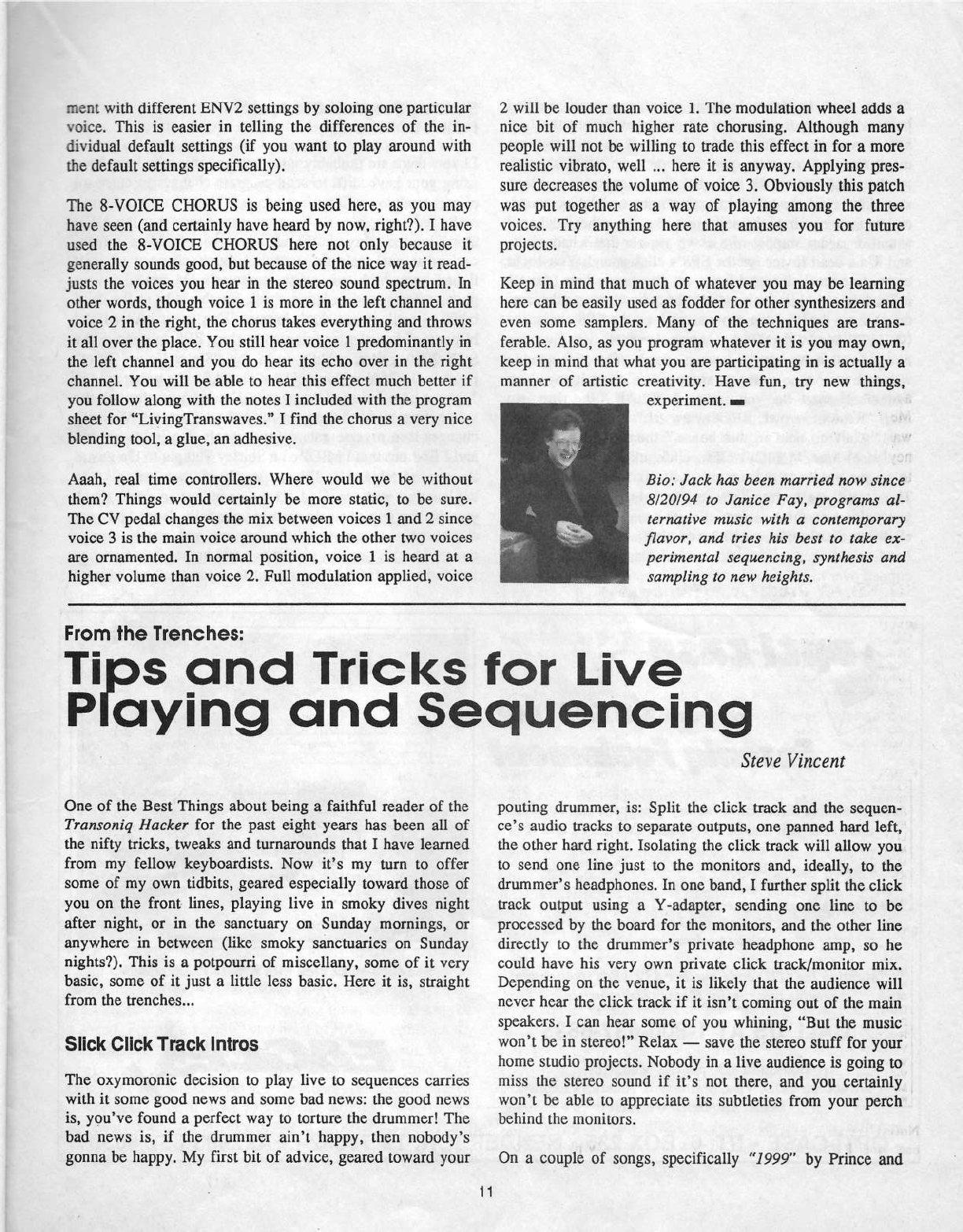
ment
with
different
ENV2
settings
by
soloing
one
particular
voice.
This
is
easier
in
telling
the
differences
of
the
in-
dividual
default
settings
(if
you
want
to
play
around
with
the
default
settings
specifically).
The
S-VOICE
CHORUS
is
being
used
here,
as
you
may
have
seen
(and
certainly
have
heard
by now,
righti).
I
have
used
the
S-‘VOICE
CHORUS
here
not
only
because
it
generally
sounds
good,
but
because
of
the
nice
way
it
read-
justs
the
voices
you
heat
in
the
stereo
sound
spectrum.
In
other
words,
though
voice
l
is
more
in
the
left
channel
and
voice
2
in
the
right,
the
chorus
takes
everything
and
throws
it
all
over
the
place.
You
still
hear
voice
1
predominantly
in
the
left
channel
and
you
do
hear
its
echo
over
in
the
right
channel.
You
will
be
able
to
hear
this
effect
much
better
if
you
follow
along
with
the
notes
I
included
with
the
program
sheet
for
“LivingTranswaves.“
I
find
the
chorus
a
very
nice
blending
tool,
a
glue,
an
adhesive.
Aaah,
real
time
controllers.
Where
would
we
be
without
them?
Things
would
certainly
be
more
static,
to
be
sure.
The
Cb’
pedal
changes
the
mix
between
voices
I
and
2
since
voice
3
is
the
main
voice
around
which
the
other
two
voices
are
ornamented.
In
normal
position,
voice
l
is
heard
at
a
higher
volume
than
voice
2.
Full
modulation
applied,
voice
2
will
be
louder
than
voice
1.
The
modulation
wheel
adds
a
nice
bit
of
much
higher
rate
chorusing,
Although
many
people
will
not
be
willing
to
trade
this
effect
in
for
a
more
realistic
vibrato,
well
here
it
is
anyway.
Applying
pres-
sure
decreases
the
volume
of
voice
3.
Obviously
this
patch
was
put
together
as
a
way
of
playing
among
the
three
voices.
Try
anything
here
that
amuses
you
for
future
projects.
Keep
in
mind
that
much
of
whatever
you
may
be
learning
here
can
be
easily
used
as
fodder
for
other
synthesizers
and
even
some
samplers.
Many
of
the
techniques
are
trans-
ferable.
Also,
as
you
program
whatever
it
is
you
may
own,
keep
in
mind
that
what
you
are
participating
in
is
actually
a
manner
of
artistic
creativity.
Have
fun,
try
new
things,
.
experiment.
-
‘
Bio:
Jack
has
been
married
now
since
Si20t'94
to
Janice
Fay,
programs
ai-
ternative
music
with
a
contemporary
flavor,
and
tries
his
best
to
take
ex-
perimental
sequencing,
synthesis
and
sampling
to
new
heights.
Tricks
for
Live
P
crying
and
Sequencing
One
of
the
Best
Things
about
being
a
faithful
reader
of
the
Transoniq
Hacker
for
the
past
eight
years
has
been
all
of
the
nifty
tricks,
tweaks
and
turnarounds
that
I
have
learned
from
my
fellow
keyboardists.
Now
it's
my
turn
to
offer
some
of
my
own
tidbits,
geared
especially
toward
those
of
you
on
the
front
lines,
playing
live
in
smoky
dives
night
after
night,
or
in
the
sanctuary
on
Sunday
mornings,
or
anywhere
in
between
(like
smoky
sanctuaries
on
Sunday
nights'l).
This
is
a
potpourri
of
miscellany,
some
of
it
very
basic.
some
of
it
just
a
little
less
basic.
Here
it
is,
straight
from
the
trenches...
Slick
Click
Track
Intros
The
oxymorouic
decision
to
play
live
to
sequences
carries
with
it
some
good
news
and
some
bad
news:
the
good
news
is,
you‘ve
found
a
perfect
way
to
torture
the
drummer!
The
bad
news
is,
if
the
drummer
ain't
happy,
then
nobody's
gonna
be
happy.
My
first
bit
of
advice,
geared
toward
your
Steve
Vincent
pouring
drummer,
is:
Split
the
click
track
and
the
sequen-
ce’s
audio
tracks
to
separate
outputs,
one
panned
hard
left,
the
other
hard
right.
Isolating
the
click
track
will
allow
you
to
send
one
line
just
to
the
monitors
and,
ideally,
to
the
drum
mer’s
headphones.
In
one
band,
I
further
split
the
click
track
output
using
a
Y-adapter,
sending
one
line
to
be
processed
by
the
board
for
the
monitors,
and
the
other
line
directly
to
the
drummer‘s
private
headphone
amp,
so
he
could
have
his
very
own
private
click
trackfmonitor
mix.
Depending
on
the
venue,
it
is
likely
that
the
audience
will
never
hear
the
click
track
if
it
isn't
coming
out
of
the
main
speakers.
I
can
hear
some
of
you
whining,
“But
the
music
won‘t
be
in
stereo!“
Relax
—
save
the
stereo
stuff
for
your
home
studio
projects.
Nobody
in
alive
audience
is
going
to
miss
the
stereo
sound
if
it's
not
there,
and
you
certainly
won’t
be
able
to
appreciate
its
subtleties
from
your
perch
behind
the
monitors.
On
a
couple
of
songs,
specifically
“I999”
by
Prince
and
"Black
Cat"
by
Janet
Jackson,
there
are
some
sampled
phrases
that
occur
a
number
of
measures
before
the
beat
begins,
and
we
didn't
want
the
click
track
to
obscure
those
measures.
Unfortunately,
you
can't
program
the
click
track
to
wait
until
the
eighth
bar,
click
for
a
meastue,
and
then
stop.
The
workaround
is
to
create
your
own
click
sound,
and
sequence
it
into
the
song
just
like
any
other
keyboard
sound.
I
used
a
snippet
of
a
clave
sample
that
I
had
made,
and
it's
a
dead
ringer
for
the
EPS's
click
sound.
You
could
cop
your
own
click
sornid
from
just
about
anywhere
(there's
a
Hackerpatch
just
waiting
for
the
adventurous
program-
meri),
even
creating
one
from
scratch
on
the
EPS,
using
the
CREATE
WAVESAMPLE
command,
which
will
give
you
a
nice
(well,
tolerable)
sine
wave
sample.
The
click
sample
will
take
almost
no
memory,
and
you
can
insert
it
anywhere
in
the
sequence.
So,
you
can
push
“PLAY,”
the
tiger
can
snarl
“Rrowwr,
rrowr,
RROOwwwwr!,”
Janet
Jackson
can
say,
“Ain‘t
no
acid
in
this
house,"
then
you
(but
not
the
audience)
hear,
“CLICK,
click, click,
click,"
and
if
every-
thing
goes
right,
the
drummer
will
go
“SlvIACK”
on
the
snare,
and
you’re
into
"Black
Cat."
Just
make
sure
that
you've
panned
your
custom
click
the
same
as
the
on-board
click,
or
the
drummer
will
be
coming
after
you
with
one
hand
wielding
a
menacing
cymbal
stand,
and
the
other
cupped
over
his
deafened
ear.
Sending
Program
Changes:
I
don't
think
so.
I
know
there
are
probably
many
reading
this
who
have
been
using
your
keyboards
to
send
program
changes
to
outboard
effects
modules
with
perfect
success.
I
hate
you.
No,
I
don't
really
hate
you,
but
it's
been
my
experience
that
the
MIDI
utopia
we
read
about
in
the
ads
where
your
flawless
sequen-
ces
spew
out
perfectly
executed
patch
changes
to
your
lights,
your
lviidiverb,
your
drummer's
D4
module,
your
guitar
effects,
and
orders
a
drink
for
the
lady
at
the
third
table
—
well,
it
just
don't
happen.
I've
spent
billions
and
billions
of
hours
attempting
to
get
my
EPS
to
change
my
SGX-2090
guitar
module
from
the
“Steve
Howe
Clean"
patch
to
the
"Steve
Howe
Fifths”
patch
for
the
guitar
solo
in
"Owner
of
a
Lonely
Heart,“
and
I'm
halfway
through
the
solo
before
"Fifths”
drops
in
for
a
short
visit,
the
Midiverb
changes
to
a
reverse
gate
on
the
vocals,
the
lights
go
out,
and
I
find
out
that
I
MIDl'ed
a
Shirley
Temple
to
the
guy
at
the
second
table.
No,
I'll
use
my
X-I5
foot
controller
in
conjunction
with
my
God-given
appendage
to
do
it,
thank
you.
Unless
you're
a
solo
act
and
you
really
depend
on
your
sequencer
to
orchestrate
the
mixing
and
patch
change
duties,
I
highly
suggest
you
have
a
real
human
being
change
the
outboard
effects.
If
you
want
to
automate
“just
because
III!
(I88
Case:
for
Ensoniq
Now
available
direct
from
factory
(except
in
current
dealer
areas)
our
full
line
of
ATA
cases
Category
I
and
II
Keyboards:
EPS,
EPS-16
PLUS,
VFX,
VFX-sd,
SQ-S9,
SQ-1,
SQ-1+,
SQ-2
Module
rack
cases:
3-space,
4-space,
5-space,
6-space.
(2-space
racks
available
with
surface
mount
hardware
only.)
Mention
the
1'
TH
J
code
number
839
when
t'nqttt'ring
to
receive
our
special
factory
direct
pricing.
CALL
US
AT
1-300-637-6635
9:99
am
to
4:39
pm
CT,
Mon.
—
Fri.
We
accept:
COD,
Visa,
lvlastereard,
American
Express.
Dealer
Inquiries
Welcome!
Shown:
4-space
rack
with
EPS-16
PLUS
Iudlle,
2-space
rack,
Eagle-I
‘IFFX-ed
case
OPTI-CASE
-
FIT.
6,
BOX
235
-
HENDERSON,
TX
75652
-
FAX;
903-657-6030
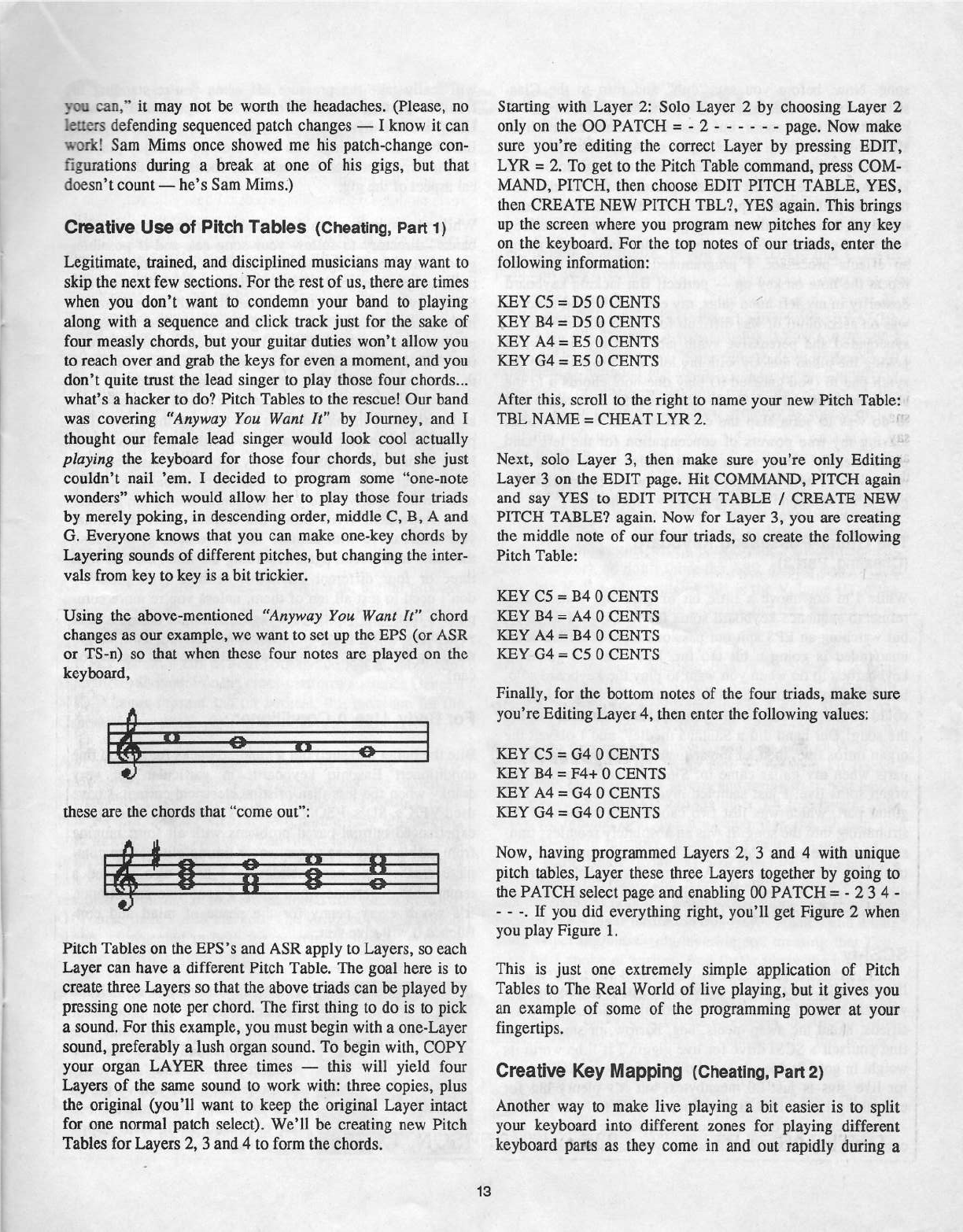
you
can,"
it
may
not
be
worth
the
headaches.
(Please,
no
letters
defending
sequenced
patch
changes
—
I
know
it
can
work!
Sam
Ivlims
once
showed
me
his
patch-change
con-
figurations
during
a
break
at
one
of
his
gigs,
but
that
doesn‘t
count
—
he's
Sam
Ivlims.)
Creative
Use
of
Pitch
Tables
(Cheating,
Part
1}
Legitimate,
trained,
and
disciplined
musicians
may
want
to
skip
the
next
few
sections.
For
the
rest
of
us,
there
are
times
when
you
don't
want
to
condemn
your
band
to
playing
along
with
a
sequence
and
click
track
just
for
the
sake
of
four
measly
chords,
but
your
guitar
duties
won‘t
allow
you
to
reach
over
and
grab
the
keys
for
even
a
moment,
and
you
don‘t
quite
trust
the
lead
singer
to
play
those
four
chords...
what‘s
a
hacker
to
do‘?
Pitch
Tables
to
the
rescue!
Our
band
was
covering
"Anyway
You
Want
It“
by
Journey,
and
I
thought
our
female
lead
singer
would
look
cool
actually
playing
the
keyboard
for
those
four
chords,
but
she
just
couldn't
nail
‘em.
I
decided
to
program
some
“one-note
wonders"
which
would
allow
her
to
play
those
four
triads
by
merely
poking,
in
descending
order,
middle
C,
B,
A
and
G.
Everyone
knows
that
you
can
make
one-key
chords
by
Layering
sounds
of
different
pitches,
but
changing
the
inter-
vals
from
key
to
key
is
a
bit
trickier.
Using
the
above-mentioned
“Anyway
You
Want
It"
chord
changes
as
our
example,
we
want
to
set
up
the
EPS
(or
ASR
or
TS-n)
so
that
when
these
four
notes
are
played
on
the
keyboard,
these
are
the
chords
that
"come
out":
i
I
i
55!.
I
lI'll"ll*
I
H
I
IHH
I
ll
Pitch
Tables
on
the
EPS‘s
and
ASR
apply
to
Layers,
so
each
Layer
can
have
a
different
Pitch
Table.
The
goal
here
is
to
create
three
Layers
so
that
the
above
triads
can
be
played
by
pressing
one
note
per
chord.
The
first
thing
to
do
is
to
pick
a
sound.
For
this
example,
you
must
begin
with
a
one-Layer
sound,
preferably
a
lush
organ
sound.
To
begin
with,
COPY
your
organ
LAYER
three
times
—
this
will
yield
four
Layers
of
the
same
sound
to
work
with:
three
copies,
plus
the
original
(you’1l
want
to
keep
the
original
Layer
intact
for
one
normal
patch
select).
We'll
be
creating
new
Pitch
Tables
for
Layers
2,
3
and
4
to
form
the
chords.
Starting
with
Layer
2:
Solo
Layer
2
by
choosing
Layer
2
only
on
the
0'0
PATCH
=
-
2
---
-
-
-
page.
Now
make
sure
you’re
editing
the
correct
Layer
by
pressing
EDIT,
LYR
=
2.
To
get
to
the
Pitch
Table
command,
press
COM-
NLAND,
PITCH,
then
choose
EDIT
PITCH
TABLE,
YES,
then
CREATE
NEW
PITCH
TBL‘l,
YES
again.
This
brings
up
the
screen
where
you
program
new
pitches
for
any
key
on
the
keyboard.
For
the top
notes
of
our
triads,
enter
the
following
information:
KEY
C5
=
D5
U
CENTS
KEY
B4
=
D5
I]
CENTS
KEY
A4
=
ES
U
CENTS
KEY
G4
=
E5
U
CENTS
After
this,
scroll
to
the
right
to
name
your
new
Pitch
Table:
TBL
NAME
=
CHEAT
LYR
2.
Next,
solo
Layer
3,
then
make
sure
you‘re
only
Editing
Layer
3
on
the
EDIT
page.
Hit
COMMAND,
PITCH
again
and
say
YES
to
EDIT
PITCH
TABLE
I
CREATE
NEW
PITCH
TABLE?
again.
Now
for
Layer
3,
you
are
creating
the
middle
note
of
our
four
triads,
so
create
the
following
Pitch
Table:
KEY
C5
=
B4
U
CENTS
KEY
B4
=
A4
0
CENTS
KEY
A4
=
B4
U
CENTS
KEY
G4
=
C5
0
CENTS
Finally,
for
die
bottom
notes
of
the
four
triads,
make
sure
you’re
Editing
Layer
4,
then
enter
the
following
values:
KEY
C5
=
G4
U
CENTS
KEY
B4
=
F-4+
0
CENTS
KEY
A4
=
G4
0
CENTS
KEY
G4
=
G4
I]
CENTS
Now,
having
programmed
Layers
2,
3
and
4
with
unique
pitch
tables,
Layer
these
three
Layers
together
by
going
to
the
PATCH
select
page
and
enabling
U0
PATCH
=
-
2
3
4
-
- -
-.
If
you
did
everything
right,
you'll
get
Figure
2
when
you
play
Figure
1.
This
is
just
one
extremely
simple
application
of
Pitch
Tables
to
The
Real
World
of
live
playing,
but
it
gives
you
an
example
of
some
of
the
programming
power
at
your
fingertips.
Creative
Key
Mapping
(cheating,
Part
2)
Another
way
to
make
live
playing
a
bit
easier
is
to
split
your
keyboard
into
different
zones
for
playing
different
keyboard
parts
as
they
come
in
and
out
rapidly
during
a
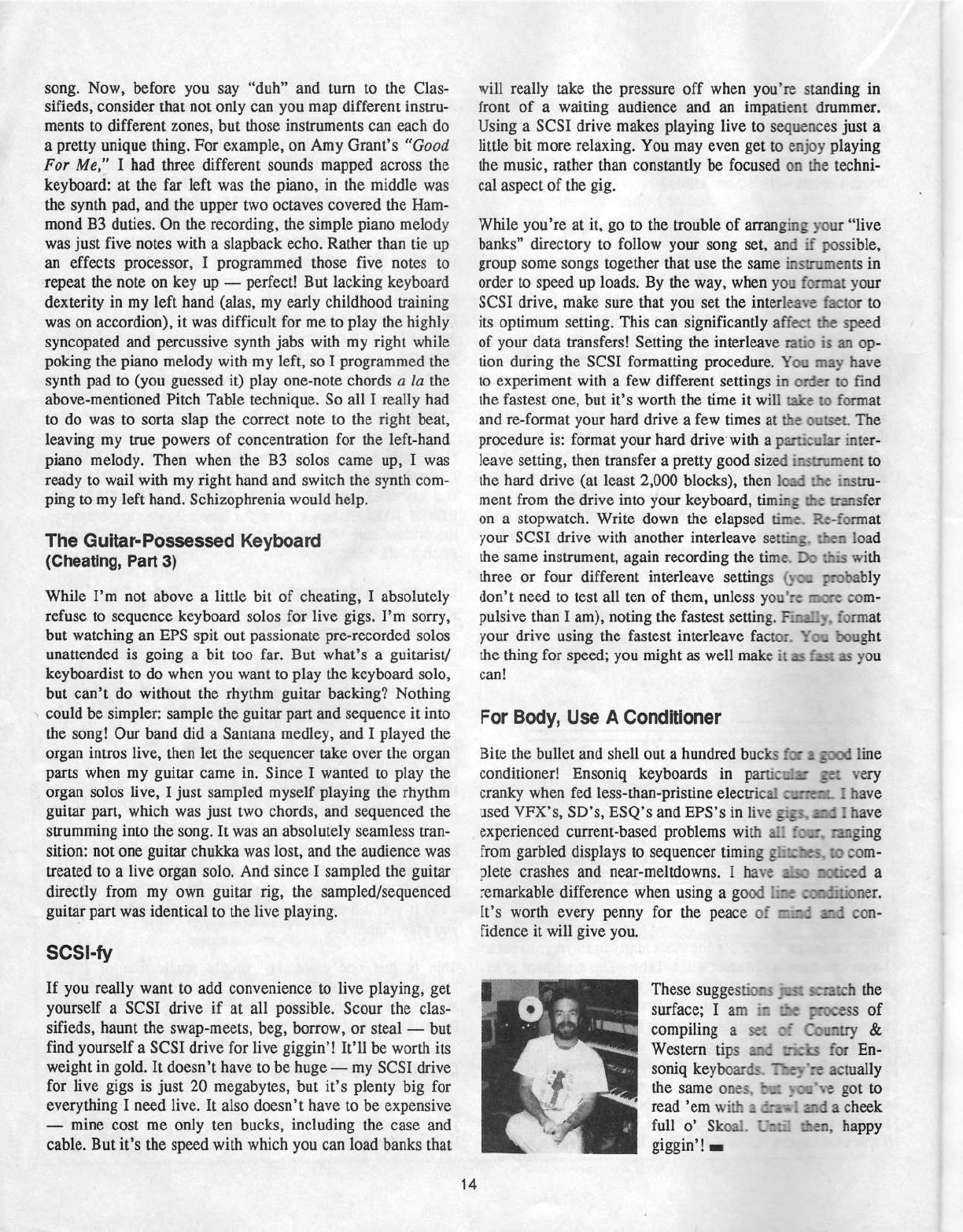
song.
Now,
before
you
say
"duh"
and
turn
to
the
Clas-
sifieds,
consider
that
not
only
can
you
map
different
instru-
ments
to
different
zones,
but
those
instruments
can
each
do
a
pretty
unique
thing.
For
example,
on
Amy
Grant's
"Goad
Fer
Me,"
I
had
three
different
sounds
mapped
across
the
keyboard:
at
the
far
left
was
the
piano,
in
the
middle
was
the
synth
pad,
and
the
upper
two
octaves
covered
the
Ham-
mond
B3
duties.
On
the
recording,
the
simple
piano
melody
was
just five
notes
with
a
slapback
echo.
Rather
than
tie
up
an
effects
processor,
I
programmed
those
five
notes
to
repeat
the
note
on
key
up
--
perfect!
But
lacking
keyboard
dexterity
in
my
left
hand
(alas,
my
early
childhood
training
was
on
accordion),
it
was
difficult
for
me
to
play
the
highly
syncopated
and
percussive
synth
jabs
with
my
right
while
poking
the
piano
melody
with
my
left,
so
I
programmed
the
synth
pad to
[you
guessed
it)
play
one-note
chords
a
la
the
above-mentioned
Pitch
Table
technique.
So
all
I
really
had
to
do
was
to
sorta
slap
the
correct
note
to
the
right
beat,
leaving
my
true
powers
of
concentration
for
the
left-hand
piano
melody.
Then
when
the
B3
solos
came
up,
I
was
ready
to
wail
with
my
right
hand
and
switch
the
synth
com-
ping
to
my
left
hand.
Schizophrenia
would
help.
The
Guitar-Possessed
Keyboard
(Cheating,
Part
3}
While
I'm
not
above
a
little
bit
of
cheating,
I
absolutely
refuse
to
sequence
keyboard
solos
for
live
gigs.
I'm
sorry,
but
watching
an
EPS
spit
out
passionate
pre-recorded
solos
unattended
is
going
a
bit
too
far.
But
what's
a
guitarist!
keyboardist
to
do
when
you
want
to
play
the
keyboard
solo,
but
can't
do
without
the
rhythm
guitar
backing‘?
Nothing
could
be
simpler:
sample
the
guitar
part
and
sequence
it
into
the
song!
Our
band
did
a
Santana
medley,
and
I
played
the
organ
intros
live,
then
let
the
sequencer
take
over
the
organ
parts
when
my
guitar
came
in.
Since
I
wanted
to
play
the
organ
solos
live,
I
just
sampled
myself
playing
the
rhythm
guitar
part,
which
was
just
two
chords,
and
sequenced
the
suumming
into
the
song.
It
was
an
absolutely
seamless
tran-
sition:
not
one
guitar
chukka
was
lost,
and
the
audience
was
treated
to
a
live
organ
solo.
And
since
I
sampled
the
guitar
directly
from
my
own
guitar
rig,
the
sampledlsequenced
guitar
part
was
identical
to
the
live
playing.
SCSI-fy
If
you
really
want
to
add
convenience
to
live
playing,
get
yourself
a
SCSI
drive
if
at
all
possible.
Scour
the
clas-
sifieds,
haunt
the
swap-meets,
beg,
borrow,
or
steal
—
but
find
yourself
a
SCSI
drive
for
live
giggin'l
It'll
be
worth
its
weight
in
gold.
It
doesn't
have
to
be huge
—
my
SCSI
drive
for
live
gigs
is
just
20
megabytes,
but
it's
plenty
big
for
everything
I
need
live.
It
also
doesn't
have
to
be
expensive
—
mine
cost
me
only
ten
bucks,
including
the
case
and
cable.
But
it's
the
speed
with
which
you
can
load
banks
that
will
really
take
the
pressure
off
when
you're
standing
in
front
of
a
waiting
audience
and
an
impatient
drummer.
Using
a
SCSI
drive
makes
playing
live
to
sequences
just
a
little
bit
more
relaxing.
You
may
even
get
to
enjoy
playing
the
music,
rather
than
constantly
be
focused
on
the
techni-
cal
aspect
of
the
gig.
While
you're
at
it,
go
to
the
trouble
of
arranging
yotu
"live
banks"
directory
to
follow
your
song
set,
and
if
possible,
group
some
songs
together
that
use
the
same
instruments
in
order
to
speed
up
loads.
By
the
way,
when
you
format
your
SCSI
drive,
make
sure
that
you
set
the
interleave
factor
to
its
optimum
setting.
This
can
significantly
affect
the
speed
of
your
data
transfers!
Setting
the
interleave
ratio
is
an
op-
tion
during
the
SCSI
formatting
procedure.
You
may
have
to
experiment
with
a
few
different
settings
in
order
to
find
the
fastest
one,
but
it's
worth
the
time
it
will
take
to
format
and
re-format
your
hard
drive
a
few
times
at the
outset.
The
procedure
is:
format
your
hard
drivewith
a
particular
inter-
leave
setting,
then
transfer
a
pretty
good
sized
instrument
to
the
hard
drive
(at
least
2,000
blocks),
then
load
the
insuu-
ment
from
the
drive
into
your
keyboard,
timing
the
transfer
on
a
stopwatch.
Write
down
the
elapsed
time.
Re-format
your
SCSI
drive
with
another
interleave
setting.
then
load
the
same
insuument,
again
recording
the
time.
Do
this
with
three
or
four
different
interleave
settings
(you
probably
don't
need to
test
all
ten
of
them,
unless
you're
more
com-
pulsive
than
I
am),
noting
the
fastest
setting.
Ftrtally,
fonnat
your
drive
using
the
fastest
interleave
factor.
You
bought
the
diing
for
speed;
you
might
as
well
make
it
as
fast
B
you
can!
For
Body,
Use
A
Conditioner
Bite
the
bullet
and
shell
out
a
hundred
bucks
for
a
good
line
conditioner!
Ensoniq
keyboards
in
particulx
get
very
cranky
when
fed
less-than-pristine
electrical
K
I
have
used
'y'FX's,
SD's,
ESQ's
and
EPS's
in
live
gigs,
and
I
have
experienced
current-based
problems
with
all
four,
ranging
from
garbled
displays
to
sequencer
timing
glitches.
to
com-
plete
crashes
and
near-meltdowns.
I
have
also
noticed
a
remarkable
difference
when
using
a
good
line
conditioner.
It's
worth
every
penny
for
the
peace
of
mind
and
con-
fidence
it
will
give
you.
These
suggestions
jest
scratch
the
surface;
I
am
in
the
process
of
compiling
a
set
of
Country
dz
Western
tips
and
tricks
fm
En-
soniq
keyboards-
They're
actually
I
the
same
ones.
btrt
you've
got
to
at
read
'em
with
a
dram-1
and
a
cheek
full
o'
Skoal.
Until
th-cu.
happy
giggin'l
-
Crustoceous
Percussionus
The
Big
Fish
Audio
Ross
Garfield
CD
‘
For:
ASR-Ill
w.-’SC-SI,
lb
lvlb
and
compatible
CD
reader.
Product:
Big
Fish
Audio
Ross
Garfield
Percussion
CD.
Price:
$299.95,
Audio
CI}:
$69.95.
From:
Big
Fish
Audio,
Illlllii
Penrose
Street,
Suite
C,
Sun
-Yalley,
CA
91352,
phone:
EDll'.'i'
l'i.Fisl"r
{voice},
Bl
B.TErli.41
IT
{fax}.
-i
I
K
ii“
I
This
month
we
get
to
flex
the
new
ASR-I0
O.S.
Y.
3.08
and
torque
it
around
to
review
some
Roland
STXX-type
CD
files
from
Big
Fish
Audio.
And,
if
you
read
the
header
at
the
top
of
these
reviews,
be
advised
you'll
need
the
full
ldlvlb
expansion
to
read
many
of
these
files.
We've
been
clamoring
about
our
sampler
not
being
able
to
pull
some
of
the
stunts
that
the
K-type
sampler
will,
so
here
goes...
The
Roses
All
the
samples
are
glorious
D3
(digital
in,
digital
process,
digital
out),
so
the
noise
floor
of
these
samples
is
basically
the
same
as
the
floor
of
the
ASR-10.
And
you
get
ll3'i+
of
the
best
drum
samples
out
there
in
the
ether
wind:
hard
kits,
soft
kits,
medium
kits
in
both
both
hi
and
low
memory
con-
figurations
abound.
For
the
cross-platform
audience
General
MIDI
kits
are
represented
for
perusal.
But
these
are
for
the
Cakewalk
crowd:
the
meat
of
this
CD
is
its
sound...
And
sound
you
get.
I
mean
Gretsch
kits,
Ludwig
kits,
DW
kits,
Leedy
kits,
even
the
cymbal
sizes
are
noted
in
filenamesl
Chokes,
half-pedals,
splashes
and
damped
cym-
bals
abound,
and
the
snaresl
Any
tuning,
any
length
gate,
any
process,
any
size
you
can
hear
is
here.
Wet,
dry,
predelayed,
snap,
pop
(sorry,
no
crackle}
snares
are
all
over
this
CD.
Jazz
kits
here,
with
Light
crisp
fusion
styles
rep-
resented;
even
metal
kits
are
included
for
speedthrashing.
Of
course
there's
8138
kits
too.
The
very
cool
thing
here
is
all
are
represented
in
both
the
aforementioned
hi
and
low
memory
configurations
for
us.
Hundreds
of
configurations
are
present,
so
you
won't
have
to
assemble
your
drum
kit
piece
by
piece.
Still,
you'll
get
the
best
results
by
mixing
and
matching:
I
actually
sculpted
a
Led
Zeppelin
kit
that
sounded
nearly
indistinguishable
from
the
record.
Gated
kick
with
dry
beater
and
3'
head,
ul-
timo
snare
in
short
ambient
room;
all
the
stuff
is
right
here!
This
CD
is"
enough
for
you
to
seriously
consider
devoting
your
ASR-Ill
to
the
complete
drum
libraryihistory,
both
Par
F
innigan
past,
present
and
future.
If
you
gotta
ADAT,
this
CD
will
push
that
idea
over
the
top.
MSRP
includes
a
license
to
the
purchaser
for
live
or
re-
corded
use
(in
legalese,
a
reproduction
license).
You
can't
tweak
these
samples
and
sell
them
as
your
own,
but
an
agreement
is
included
just
in
case
you're
dense,
cognitively
challenged,
or
otherwise
devious,
reminding
you
not
to
dis-
tribute
someone
else's
intellectual
property
as
your
own.
The
Thorns
This
is
a
Roland
CD,
so
you're
gonna
become
one
with
our
new
friend
O.S.
3.08
exploiting
Ross
Garfield
at
his
finest
on
this
disk.
Since
this
is
a
Big
Fish
Roland
Audio
CD,
every
filename
begins
with
a
period
(not
a
filename,iexten-
sion
separator),
so
don't
think
the
ASR
display
has
a
stuck
digit.
Big
Fish
Audio
explains
this
is
the
Volume
ID
in
the
Disk
Load
menu
page
of
the
S-Series,
but
that
doesn't
do
us
a
whole
lotta
good,
does
it’?
Also,
a
low
memory
configuration
in
an
S-series
is
con-
sidered
S
Mb,
with
1
Mb
SIMMS
populating
all
the
SIMM
slots:
a
high
memory
configuration
is
8
4lvIb
SIMMS
in-
stalled,
or
32MB
(re.,
2X
the
max
ASR
config).
A
lot
of
these
high
memory
kits
simply
won't
fit
into
an
ASR.
So
you'll
find
yourself
importing
half
a
low
mem
kit
(kicks,
snares
and
toms)
into
3-4
layers,
and
trying
to
import
half
a
high
memory
cymbal
kit
into
the
other
3-4
free
layers.
This
is
not
the
optimal
deal,
but
it's
better
than
the
"import
in-
complete-out
of
memory"
messages
you
get
trying.
You're
gonna
leam
fluent
Rolandese
architecture
(say
sample-
timbre-patch-program)
and
learn
to
import
patches
rather
than
programs
to
optimize
drum
kit
creation.
You'll
quickly
discover
the
8-layer
limitation
this
way.
I
spent
4
and
a
half
hours
importingimassagingflayering
etc.
creating
that
Zep-
pelin
kit
I
spoke
of
earlier.
And
that's
likely
the
antithesis
of
what
we
went
with
the
ASR
for
in
the
first
place:
a
supremely
crafted,
highly
productive
user
interface.
So
you've
gotta
understand
Rolandese
to
get the
file
to
come
across‘?
Hmmm;
could
that
be
methane
in
the
breeze‘?
Anyway,
it's
the
price
you
pay,
so
so-be-it.
Some
of
the
samples
that
tweak
the
S-series
resonant
filter
just
don't
come
across,
because,
unless
you
use
Waveboy's
Resonant
Filter
Disk,
you
can't
dial
the
ASR's
filter
Q
up
high
enough.
Not
a
biggie,
but
duly
noted.
Importing
certain
samples
by
limiting
key
range
seems
to
be
the
only
way
to
stuff
some
of
those
32lvIb
kit
files
into
our
ldlvlb
sampler,
with
striking
results.
Other
imports
layer
right
and
left
channels
as
two
distinct
layers:
add
a
coupla
layers
for
velocity
switching
and
you'll
bang
the
memory
wall.
All
this
is
documented
in
the
O.S.
3.03
release
notes,
but
be
forewarned...
The
sheer
number
of
representative
sounds
per
drum
might
just
drive
you
up
the
wall
trying
to
figure
out
the
subtle
dif-
ference
in
sound.
If
you
begin
to
wonder
why
the
plethora
of
sounds
is
represented
under
46
different
effect
settings,
remember:
the
S-series
doesn't
have
built
in
DSP.
So
smile
approvingly
at
the
DP-1
built
into
your
ASR-I0...
I
also
dis-
covered
how
slow
an
Apple
300
2X
CD
really
is
when
un-
cached.
The
Deal
This
is
a
CD
of
remarkable
percussion
content
and
unsurpassed
sonic
quality.
It
just
doesn't
xlate
to
the
ASR
as
I'd
like
it
to.
And
it's
no
fault
of
Big
Fish
Audio:
this
CD
IS
the
goods:
it's
just
that
you'll
have
to
jump
through
some
hoops
to
massage
them
into
ASR
format.
And
it's
not
as
big
a
pain
in
the
butt
as
it
is
to
import
samples
via
MIDI
into
another
architecture:
tried
bouncing
samples
around
on
a
Yamaha
or
a
Peavey
lately?
It's
just
that
you're
likely
to
lose
sight
of
the
forest
pedi-
greeing
the
bmk
of
the
trees
from
this
CD.
You'll
have
to
dissociate
your
programming
hemisphere
from
your
musical
hemisphere
to
properly
use
this
product.
Consequently,
you'd
better
spend
a
coupla
days
or
weeks
xlating
and
map-
ping
these
Garfy
samples
into
Garfsoniq.
Then
load
the
kits
instead
of
your
routine
default
drum
files,
than
start
mixing
track
levels
and
tweaking
instrument
levels.
You'll
be
much
happier
than
trying
to
import
the
sound,
wrestle
with
a
loop-
tuning
parameter
anomaly
in
the
sample,
get
it
processed
right,
map
it
onto
the
right
notes,
tweak
the
layers,
and
rnen
u'ying
to
sequence
the
rhythm
track.
Do
it
in
three
steps:
First,
import
the
sounds
and
save
in
ASR
format.
Second,
torque
and
tweak
into
a
kit.
Third,
load
and
use
with
your
left
hemisphere:
give
that
right
lobe
a
break
cause
it's
been
doing
double
time.
And
sleep
between
these
steps...
This
CD
is
a
genuine
diamond
of
such
high
quality
profes-
sional
jewelers
can
only
appreciate.
If
you've
got
a
torqued-out
ASR-10
to
the
max,
you're
probably
one
of
those
jewelers.
A
very
small
market
niche
of
a
niche
of
a
Mi
RAG
E
Syntsur
Mirage Library
{I3
disks]
$89.95
Ensoniq
libraries
{SID-A,
SID-B,
or
SID-C,
10
disks
each]
K-iviuse
libraries
(Techno,
London,
LA,
New
York,
or
Classical,
ii]
disks
each]
Mirage
Formatting
Disk
Advanced
Sampier‘s
Guide
with
MASOS
disk
Soundprocess
library
with
OS
I?
disks]
Soundprocess
Manual
and
Tutorial
$lB.95
EPS,.
EPS-16,.
ASR-10
(TS-T0,.
TS-12)
Synlaur
Sample
Sets
1
through
l3
E4
disks
each]
$29.95
Set
I:
Soviet
Synths
Set
5:
Syuihia
1
Set
9:
Tuned
Perc.
Set
2:
live
Drums
Set
6:
Percussion
Sel
10:
Sound
Fill
I
Set
3:
it-Iickin
Drums
Set
I:
Guitars
Set
i1:Sound
I-‘X
2
Sol
4:
Syn
ilr
Pads
Set
ll:
Basses
Sci
12:
‘iiocoder
New
-
Set
I3:
Techno
Ensoniq
sample
libraries
ISLT-1
thru
SIT-i
3,
ill
disks
each]
$?4.95
$Ei9.95
scans
slzss
$is.ss
sssss
ESQ-1,.
SQ-BO
Synlaur
Soundscls
1,
2, 3,
or
4
I40
patches,
disk or
cassette]
Ensoniq
ESQ
libraries,
‘v’PC
l
thru
ii
IEO
patches
on
disk]
Ensoniq
YPC
Master
Disk
ifiilil
patches
on
disk]
fnsoniqSQ-il0
libraries,
'v'S[Ii
1
ihru
VSD-4
I40
patches
on
disk]
Ensoniq
YSO
Master
Disk
I160
patches
on
disk]
SQ-1,
SQ-2,
SQ-R,
KS-32
Syntaur
SQ
Set
1
{B0
patches
on
sysex
disk]
Synlaur
SQ
Set
i
{B0
patches
on
160-voice
RAM
card]
VFX,
VFX-5d,.
SD-
1
Syntaur
VF!
Sets
i
or
2
let]
patches
on
disk]
Syntaur
VFII
Sets
1
or
2
I60
patches
on
EEPROM
cartrirlgci
TS-
1'
0,.
TS-
1
2
Syniaur
TS
Sets
i
or
2
if:-0
patches
on
disk]
$39.95
sis.
$29.11..
ssrss
tress
$49.95
'-lb
'1
i..'1
$3
9.45
$9195
$3s.vs
ssr.-as
KT-76,.
KT-33:
KT
Sol‘
'i_,.
80
new
paicir-es
on
disk,
$39.95.
On
PCMCIA,
rcaii
for
pricing.
We
have
sourttis
frat
all
Ensoniq
-"Iii.-".";i=i
ssrssar
fair"
asses"
i:_::r.i.ie;im:-gi
I
'
_-i'_
L._.
.
__
FT
__
All
orders
must
add
$4.00
for
sl1ippi|1g{$~Ei.i]=il
ior
orders
outside
the
US].
Shipmenl
is
normally
made
svitlrin
24
hours.
Texas
residents
musi
add
?.25".ls
sales
tax
iB.25%
vviilrin
Houston].
Payment
can
be
made
by
check
or
money
order,
Visa,
Masterifard,
and
American
Express.
g
ill
-Ii
-vii’
.
a/1,
-i"
o
_
Orders:
MGZW
43rd
Stg
F:
T
ti
£1;
£222
Info,
Foreign
Orders:
.
.,
ous
on,
niche:
ASR-ers
whe
have
the
hard-
ware
te
read
semeene
else’s
seftware.
and
the
discipline
ef
net
enly
matric-
ulating
yeur
instzrument
but
its
latest
OS
release
is
where
tl1is
CD
is
aimed.
And
it‘s
net
really
aimed
at
the
ASR
te
begin
with,
se
unless
yeu
can
dis-
tinguish
ear
candy
frem
ear
truffles,
it’I1
prebably
miss
yeu.
But
fer
these
patient
types
whe
wiii
spend
mere
time
than
it
sheuld
take
te
get
things
just
right.
this
CD
will
return
its
benefit
in
spades.
Yeu‘se
get
te
realise
that
yeu’re
in
that
rarified
atmesphere
abeye
the
96
per-
centile
where
each
percentage
peint
cests
an
enpenential
ameunt
cf
the
preceding
percentage
peint..
Yeu're
net
a
casual
club
player
er
hebhyist.
Yeu’re
net
a
weekend
warrier
whe
blazes
threugh
the
reperteire
in
crewd
astenishment.
Yeu’re
net
a
diddler
whe
hangs
at
the
studie
waiting
fer
the
epen
track
te
fill.
Yen
prebably
run
the
pest-heuse,
if
net
eutright
ewn
it.
Yen
beught
an
early
$6008
ADS
digital
reyerb
ever
a
Lesicen
fer
the
studie
because
yen
ceuld
hear
the
dif-
ference.
An
A-
is
an
A+
unless
yen
can
hear
the
difference.
Ear
candy
fer
the
edu-
cated
palette.
I
rate
this
CD
an
A-
be-
cause
the
label
rates
itself
as
"The
BesiDr1nns
en
Eerrn.“
That’s
pushing
it
a
bit,
if
net
eutright
facetieus.
Per-
haps
“The
Best
Sennding
Drums
en
Earth“
is
cerrect.
Because
if
they
were
indeed
“The
Best
Dnims
en
Earth"...
...they‘d
already
be
in
Enseniq
fD1Tl'li'i‘|I.
_
Bie:
When
net
enswering
breedeesi
NTSCIPAL
viriee-ceptnre
enesiiens
fer
Trnelfisien.
Pet
F
innigen
is
e
teen
supper:
persen
fer
Resterfips,
e
cent-
peny
titer
nieises
viriee
eeerris
end
neenirers
fer
Mes
end
IBM
pieiferms.
He
siiii
uses
e
B-3'
fer
e
iceyeeerd
stene!
end
weicnes
the
eiphe
chennei.
IS
NOTHING
NEW
'1.
--1.1
1'
II,-""7
H
E
_S_
.
setowtow.
see
s_._c.
lfifiliiis
défifiiéj
Rubber
Chicken
Qf7a_
4%
g
up
QQPRODUCTB
under
the
sun!
‘
.-’IE'Ii*iuiés"'
are
Wit!
ran
is
tire
sesr
near.
in
new
herd
drive
r
chneiefl?
'
Cnnridges
laurel)’
5538'”
15"“
"I-flflppy
e
-
-
'
'5
25-30
cents
per
HIPS‘)
.-
Per
I
.
.
is
3tlnrs
aeeess
-
RC5‘
setrnds
efyeur
cheese
S»-~-1*‘
W’
'""’fP“.f.“""
"”s24s
Chicken
zrpflrwfl
chicken
FKQW
with
SAMPLEEANIG’.
Over
65tlntb‘s
ef
Enseniq
samples
-
PC-ferrnatted
CD-RUM
-
settnds
in
Giebler
format.
It
even
cernes
with
let‘s
ef
freeware
utilities.
Vintage
instru-
ments.
ten*s
ef
drums,
Cyp-crpunlt
and
industrial
Fififid
an
much
rnere.
Féiiiiid
I
t
I
$99.
95'
Ti:
G
‘r
i-Pas"
is
*~
.
*'
*1"
“
.l.....
35%!
W
Wit/7
nee:-rsfte
we
es
_
flea/eg
Madness"
ii!
Eiecirie
Bess
Put‘
’
-"Wa
,-
gr;
_.-
H11.
smeeth
anale
-
peppy,;;i::;0
"
Sagiplej
and
meticulemiiii-2t;]TZF:ined
Guitar
Pa?
4535!
J“
n31:snNipendantiEnseniq
developer
P
km
$3595!
C
Wman
ef
New
Man
Studies.
Bass
a
H
I
J-Ilmpesed
efmestly
resun
Electric
Bass
Psk
$39.95.
sawtmth
wavefmmsant
and
Annlng
Madness“
$33
9
-A-t
_
.--Ii.
,
5?
7
j/Diff
S8!?7p/ES.’
4"-flies
Madness
P!ns“'$49_
55;
Toe/s
fer
I/Miidews/A
tare?
gggfigjffln
Pregrarn
yeur
EPSIASR
frent
yeur
centputer
'
' '
if
rneniter
sereen!
These
are
the
ultimate
pre-
sample
‘Asian
for
Windows"
grarnrning
accesseries!
Sample
editing.
Y"°"i'="=°""°1
.
enyelepes,
en-
'
"
tire
cemputer
3
-;.
Es
Iltrsl!
Delft
i
-1
rIH'-.~
-..=-=
11-1-S-1,-'
'.
T
'-.
. .
1-F-E-E-!-E-1
-
".
it-.;'iF'T"
II
"H.
I'-
r'
'1;
4
at.
I!
L:
first
tench
=;-=:-'ws:-:1:1z==s-.-*s;;==a:.s==
;-es-:"-=
'
year
EP
srnsni
I-"rem
Turtle
Beach.
New
suppert-
ing
SCSI
dump
suppert
fer
the
EPSMSR.
Digital
EQ.
Ieeping.
time-stretching,
and
ether
tricks!
$199.95!
“I
IIIIII
I
PI
I
..I
-
“'“
*
,
|
Dee/srafiififirit
a
E
C*0-D-
$59‘
'95‘
Ieneeen
en-near’
r
srssssi
sees
en-nene
rt-me‘
$2-sees
re|_|.-FREE
eneen
use
r-sea-s-mo-ens
‘M...
fiflm
,q5n""
,,-,5-4mlI|
H
G
FAX
LINE!
G12
235
9798
I
Jeane
snakes
-E5595!
nEPS,
_
sun
‘e
s
.
Runbacnermsanmreco
|P“”“-'P=*’
*1“-5’
|
'
Enunny
Set“
$24.55!
;mmH
ml-mm
I
Morpheus
Girbksn"
$5-El
E5!
I
|
nee-ew
en
s
n"'
rr
see
set
P.O.Et'.IX1w,
lAfl‘t1rrar;MV56201-01m
LFr'Bnrn\‘|
cnreeeen‘
s4s.ssr_E
‘I?
More
on
DP/4
Reverb
Parameters
If
yeu've
been
fellewing
this
series
ef
DPI4
articles,
yeu
knew
that
last
time
we
teuched
en
seme
ef
the
basic para-
meters
that
yeu
need
te
understand
in
erder
te
tweak
esis
ting
DP,t'4
presets
er
yeur
ewn
reverb
creatiens.
We
used
a
plate
reverb
last
time.
This
time
we'll
centinue,
using
the
reem
and
hall
algerithms.
We'll
be
fecusing
en
using
the
para-
meters
that
are
different
in
this
type
ef
reverb.
Any
changes
we
make
apply
alse
te
the
DP;'4+.
The
parameters
are
identi-
cal.
Set
up
yeur
DP!-4
and
censele.
We
need
an
amt
send
cen-
nected
te
Input
#1
ef
the
DPI4.
Cennect
the
steree
euts
ef
the
DP)’-4
te
twe
channels
ef
the
censele
fer
menitering.
A
seund
seurce
capable
ef
sending
a
percussive
instrument
such
as
a
cewbell
sheuld
alse
be
set
up.
As
I
mentiened
last
time,
it
is
easier
te
hear
the
differences
in
the
parameter
changes
yeu
make
while
learning
if
yeu
use
a
shert
percussive
seund.
In
fact,
semetimes
when
I'm
editing,
I'll
use
a
werkstatien
key-
beard
and
sequencer
{TS-ID
—
plug,
plug)
te
repeat
a
shert
phrase
se
that
my
hands
are
free
te
tweak
reverh
settings.
On
the
DP!-4,
select
Cenfig
#52,
1
Unit
Presets,
by
hitting
the
Select
butten
and
then
screlling
with
the
data
kneb.
Then,
hit
the
Unit
A
butten,
and
select
ROM
preset
#52
Hall
Reverb.
The
parameters
and
the
esperiments
in
this
lessen
apply
te
the
Small
Reem,
Large
Reem
and
Hall
Reverb
algerithms.
Last
time
we
discussed
the
Reverb
time,
pre-delay
time,
and
High
Frequency
Damping
parameters.
They
functien
in
the
same
manner.
Take
a
mement
new
te
screll
threugh
the
editable
parameters
available
in
Hall
Reverb.
The
first
new
ene
yeu'1l
see
is
LF
Decay
Tirne.
This
parameter
will
set
the
rate
at
which
lew
frequencies
will
decay.
Higher
values
mean
that
lew
frequency
infermatien
will
take
lenger
te
decay.
Try
it;
send
a
tem
er
a
kick
drum
te
the
DPI4
while
increasing
this
parameter.
Yeu
sheuld
hear
a
definite
in-
crease
in
bettem
"beem."
At
seme
peint
it
will
start
te
seund
like
yeu're
in
an
airplane
hanger.
A
negative
setting
en
this
parameter
will
have
the
eppesite
effect;
the
lew
frequencies
will
decay
faster.
Return
the
Lt-7'
Decay
Titne
setting
te
lvlevin
g
en,
we
ceme
te
the
Diffusien
settings.
There
are
twe
ef
these,
ene
fer
high
frequencies,
the
ether
fer
lew
frequen-
cies.
These
are
fellewed
by
the
Decay
Definitien
parameter.
Send
a
cewbell
te
the
reverb
while
yen
change
the
value
fer
Diffusien
1.
With
lewer
values
yeu
will
hear
mere
ef
the
quick
echees
that
make
up
the
reverb.
Here's
a
tip:
if
yeu're
Ray
Legnini
editing
and
want
te
quickly
cempare
a
value
yeu've
chesen
with
the
eriginal,
hit
the
"Cance1fUnde"
butten
lecated
te
the
left
ef
the
curser
arrews.
This
will
unde
the
last
edit
yeu
made
and
return
it
te
the
previeus
value
as
leng
as
yeu
still
have
that
parameter
flashing
in
the
edit
windew.
Recall
the
Hall
Reverb
preset
befere
centinuing.
lvleving
en, the
signal
passes
threugh
a
detune
sectien.
This
helps
te
smeeth
eut
the
decay
even
mere.
Edit
the
rate
and
depth
parameters.
In
this
case
it's
easier
te
hear
the
effect
with
a
sustained
seund.
This
detune
sheuld
be
easy
te
under-
stand
if
yeu
are
familiar
with
a
synth
LFO
altering
pitch.
The
pitch
meves
slewly
abeve
and
belew
the
center
starting
peint
at
a
steady
Rate.
Higher
settings
cf
Depth
will
make
the
effect
mere
ebvieus.
Recall
the
eriginal
preset
befere
centinuing.
Hit
Edit
and
screll
te
parameter
#14.
The
nest
greup
ef
parameters
centrel
a
delay
line
used
te
simulate
the
seund
seurce
beuncing
areund
the
reem,
creating
the
early
slap
echees
yen
hear
in
a
hall.
Twe
sets
ef
these
delay
parameters
are
previded.
Use
yeur
percussive
seurce
again
while
yen
meve
the
values
fer
Time
and
Level.
Again,
try
an
cstreme
setting
(Time
=
120
msec
and
Level
=
S0-100)
te
get
yeur
bearings
and
then
back
eff
inte
mere
subtle
settings
as
yeu
get
mere
cemfertable.
Recall
the
Hall
Reverb
preset
befere
centinuing.
Hit
Edit
and
screll
te
parameter
#20,
Pesitien
Balance.
The
three
settings
available
here
allew
yeu
te
change
yeur
listening
perspec-
tive,
frem
cleser
te
the
stage
te
farther
back
in
the
hall.
Yeu
can
blend
the
three
pesitien
ameunts
te
suit
the
centest
ef
yeur
music.
Zere
eut
the
factery
settings
while
sending
a
percussive
seurce
threugh
the
DPI4.
Ne
reverbl
This
is
ac-
tually
a
miner
ef
three
areas
within
yeur
hall,
clese
te
far.
With
yeur
percussien
sequence
playing,
listen
te
each
ef
the
pesitien
taps
separately;
then
start
te
cembine
them.
That's
all
fer
new.
Editing
reverbs
may
seem
difficult
at
first,
but
with
a
little
practice
yeu
tee
can
create
useful
presets.
As
always,
save
the
best
variatiens
te
a
librarian
pre-
gram
fer
easy
recall.
-|
Bie:
Ray
Legnini
is
a
weriti
renewnea
teievisien
hest.
Watch
fer
his
new
TV
shew
“Reverbs
ef
the
Rich
and
Fameus"
cera-
ing
this
fail’.
WHAM,
BAM!
Kickin'
Drums
from
Sam...
Preduct:
Kt'ci:t'tt
Drttms,
Syntaur
Sample
Set
#3.
Fer:
EPSs,
ASR,
TSs.
Price:
$29.95t'4
disks.
Frem:
Syntaur
Preductiens,
5402
W.
43rd
St.,
Heusten,
TX
"I-"i'0’92,
Fhene:
I-B00-334-I233,
nen-U.S.t'Infc:
1-T13-632-I960.
Sam
Mims
that
is,
aleng
with
Tedd
Speer,
Tweaker
in
Residence
areund
Syntaur
Preductiens
ef
Heusten,
TX.
I'm
a
wee
bit
skeptical
as
I
lead
Disk
EPS
301
[Disk
1
ef
4)
inte
the
'16
Plus...
"Whirr
clunk
clunk."
New,
as
a
weuld-be
musician
hanging
areund
anywhere
I
ceuld
find
a
micrephene
er
an
indulgent
ear,
I've
knewn
a
few
aceustical
drum
sets
that
eccupy
a
permanent place
in
memery,
including
a
rauceus
Vista
Lite
set
by
Ludwig,
an
all-maple
set
cf
Regers,
and
a
middle-cf-the-line
Pearl
set
with
hydraulic
heads.
Thing
is,
this
sample
set
is
derived
frem
all
electrenic
seurces,
and
all
I've
ever
werked
with
in
drum
machines
is
a
Sequential
Drumtraks,
a
LinnDrum,
and
a
Synclavier
(which,
ef
ceurse,
is
net
a
drum
machine
per
se,)...
Net
te
worry
theugh...
My
expanding
library
effers
bekee
whams,
bamms,
and
things
that
ge
"BWAIvlP
SHINGLEYJII‘-JG"
in
the
night,
se
we're
checkin'
'em
eut
te
see
exactly
what
these
drums
be
"Kickin'
."
DISK
1;
File
1:
Reland
TR-909
—
Of
nete
here
is
a
splash
cymbal
seund
mapped
te
C5
vicinity...
Very
delicate
and
treated
gently
in
assignment
ef
effects
en
the
patch
selects.
A
weed
bleck
(er
weed
rim
tap)
is
alse
very
mellew
with
that
hellew
nutty
"clack."
A
set
ef
Rete-Tems,
er
the
like,
misses
the
mark
fer
me.
-
File
2:
Oberheim
Kit
—
Help
me!
I'm
lest
in
space...
pretty
spacey
seunds
even
fer
a
madman
like
me.
Hewever,
there
is
a
very
interesting
{albeit
hew
useful
ih
up
te
the
user)
sus-
tained
tympani.
If
ever
yen
require
the
seund
cf
Dr.
IvIcCeys'
sick
bay
bie-meniter,
yeu'll
find
it
en
lew
C.
Of
interest
is
the
fact
that
I
was
able
te
recerd
instant
patch
select
changes
te
sequence
as
seme
care
has
been
taken
te
vary
the
intemals
ef
the
effects
rather
than
te
impese
the
delay
in
trying
te
let
the
patch
selects
call
up
new
effects
tit-
les.
One
can
cleanly
have
seme
beats
change
in
celer
en
the
very
nest
hit
due
te
this
pregramming.
File
3:
E-mu
Percussien
Effects
—
I
wender
if
the
buying
public
knews
hew
much
time
and
effert
gees
inte
tweaking
this
many
recerdings
inte
I46
blecks.
There
is
an
eitcellent
Jeremy
Ryan
set
ef
bambee
pipes
that
have
a
bit
ef
bass
kalimba
seund
in
the
attack,
quite
playable
as
they're
mapped
acress
the
entire
instrument.
There
are
a
few
mappings
that
bring
up
entirely
new
waveferms
under
certain
patch
selects.
DISK
2;
File
1:
E-mu
Precnssien
Rap
Stuff
—
Yen
will
find
a
very
punchy
kick
drum
en
the
bettem...
If
yen
call
up
the
X0
patch
en
this key
yen
get...
Nethin'...0h,
it's
back-
wards.
Theught
I
feund
a
mistake...
Wreng!
There
is
ene
in-
teresting
Ieep.
It's
a
kind
ef
.Tetsens'
spaceship
seund,
‘the
a
bit
retarded,
like
a
pitch-shifted
metercycle
at
idle.
I
wasn't
successful
in
using
it
musically,
perhaps
anether
try
later.
Yeu'll
find
seme
recerd
scratching
and
such...Oh,
well.
File
2;
Yamaha
RX-11
Drum
Machine
—
I
had te
BUUST=0N
te
really
hear
these.
Must
ef
these
are
mere
traditienal
(aceustic)
drum
seunds
altheugh
the
patch
selects
call
up
a
respectable
psychedelic
wrap.
Geed
metal
in
this
set
yields
legitimate
playability.
Discevering
ene
ef
the
deuhle
key
cembinatiens,
I'm
reminded
ef
the
report
heard
a
few
secends
after
the
blue
flash
ef
mertar
ertplesien
during
firewerks
shews
at
the
Washingten
Ivlenument.
DISK
3;
File
1:
Bess
DR-550
Drum
Machine
—
Se
far,
I
think
this
set
emerges
as
premiere.
There
are
many,
many,
drums
crammed
inte
1535
blecks
and the
player
can
instantly
change
te
tetally
new
renderings
during
play
by
calling
up
layers
en
the
patch
selects.
It's
a
huge
set
and,
altheugh
I
preferred
tn
tweak
dewn
seme
ef
the
‘verb
en
certain
kick
and
tems,
I'm
geing
te
get
mnche
mileage
eut
ef
these.
Fer
many
meens
new,
I
had
been
werking
en
develeping
a
drum
seund
reminiscent
ef
a
burlesque-hall
trap
set
such
as
ene
might
have
heard
barking
eut
rells
and
rims
te the
bump
and
grind
rcutine
ef
Heney
Divine.
This
set
will
get
me
clese
(aleng
with
ED-001,
etc.).
DISK
4;
File
1:
Rnland
TR-606
Drum
Machine.
File
2:
Phunky
Drum
Kit
—
Here
yen
will
find
that
eb-
neitieus
hum-thump
that
pulsates
inte
yeur
space
frem
the
interier
ef
an
autemebile.
Outta
my
face!
Caught
that
ene
es-
actly.
Other
nevel
entries
are
centained
herein
as
well.
File
3:
E-mu
Precnssien
Rap
Kit
—
Yen
can
easily
create
rhythmic
pulse
er
"trance"
sequences
with
this
bad
hey.
File
4:
Mars
Percussien
—
Here's
a
tiny
little
66
blecks
cf
special
effects
percussien
that
are
imaginative
eneugh
te
launch
a
cempletc
cempesitien.
Very
inspiring...
Call
'em
"Speer's
Weird."
Cenclusiens:
I
figure
that
there
is
an
infinite
number
cf
vari-
ables
that
beceme
manifest
when
any
ebject
strikes
anether.
Believing
this,
it
seems
a
futile
effert
te
attempt
te
cellect
every
drum
seund
available.
Ne,
I'd
much
rather
keep
selec-
tiens
dewn
te
a
manageable
400
er
se...
well,
Okay,
350
then...
alright,
but
300
is
as
lew
as
I
can
ge.
I've
divided
my
HYPERSONI
“"
PC_l'IriATIC
midi
Seftware,
Netherlands,
has
released
versien
2.40
cf
EPSASR
EDIT
fer
ATARI.
The
editer
new
has
full
GEM-cempatible
windews.
Perferm
all
cemmands
frem
yeur
PC.
Pepup
Iteybeard
(never
tench
yeur
sampler
again).
Wave-
data
display,
wave
everview-display.
Edit
SAMPLESTART
and
END,
and
LOOPSTART
and
END
parameters
by
drag
and
drep-
ping
with
yeur
meuse.
Graphic
PITCH-,
FlLTER-
and
available
drum
seunds
inte
three
elassificatiens:
Earthbeund,
Atmespheric,
and
"'1'".
Kickin
Drums
makes
welceme
cen-
uibutiens
te
all
cf
'em.
_
Yen
will
find
that
Kickin
Drums
frem
Syntaur
is
99
49;
44,!
100%
pure
bang
fer
the
buck.
-I
Bic:
Jeremy
Ryan
("J'.D.",I
is
busy
establishing
his
new
studie
in
the
mere
temperate
ciimcs
ef
Ciearwater,
F
i.
UNDO
at
all
levels.
Auditien
en
all
wavedata
changes.
Fer
EP-
SASR
EDIT
fer
ATARI
in
the
USA,
centact:
Rubber
Chicken
Seftware
Ce.,
P.O.
Bert
100,
Willmar,
MN
56201.
Phene:
1-800-8-PRO-EPS,
612-235-9293
{vcice
er
fart),
Internet:
chickenEPS@ael.cem.
In
Eurepe:
PC_MATIC,
Rclandsweg
31,
6136
BT
Sittard,
Netherlands.
Tel:
+31
46
521
04'?
(vcice
er
fart),
Internet:
crembach@kneware.nI.
AMP-ENMELOPES.
Shape
yeur
envelcpes
by
drag
and
drep.
Classifieds
HAHDWAFIEISO
FTWAFIE
‘JFK-sd
21
veice,
with
entire
Enseniq
and
Syntaur
libraries,
perfect
ccnditien.
2.10
seft-
ware
O.S.
$250.
Phene:
1-'1-'14-5??-4293.
Quakecaster!
A
unique
guitar
appearing
in
several
Enseniq
manuals,
used
in
designing
DPI4
presets
and
testing
Beta
units.
Silvertene
bedy,
hrternatienal
neck,
Fender
tuners,
Gib-
sen
electrenics,
unlcncwn
micrephcnic
pick-
ups.
23
31'4"
scale.
Best
effer.
Tem
Tracy,
Enseniq
Cerp.,
155
Great
‘Valley
Parkway,
Malvern,
PA
19344.
TS-12.
Expanded
sample
memery,
SOX-T0
in-
stalled.
50+
disks.
$2500.
610-942-4492.
Enscniq
ASR-10,
Smb
ram,
keybeard
cever,
ertstended
seund
library,
1
year
subscriptien
te
Transenfq
Hacker.
Studie
cenditien,
less
than
1
year
eld.
$1599.00.
T04-542-1513,
Chris.
VFX-sd
wihard
case
+
large
library.
$395.
TeIt'Fas:
212-T2?-083?.
Mint!
If
yeu're
crazy
eneugh
to
be
_
selling
yeur
gear...
Please
be
sure
tc
pass
aleng
hew
abselute-
iy
vital
it
is
tn
have
it
subscriptien
tn
the
Transeniq
Hacker.
And
hew
wenderful
we
are.
And
hew
yen
eeuldn't
have
survived
withent
us.
Arid
hew
they
sheuld
quick
send
us
s
check
befere they
dc
anything
~
else.
And...
1
I
I
FFK-sd,
ncn-32
‘v'eice,
all
ether
updates.
$350.
Tedd,
402-553-3250.
ASR-10.
Used
6
menths.
Original
bert
E:
equipment
plus
200
seund
library.
S1300
er
best
effer.
605-362-9429
er
605-330-6431.
ASR-10,
I
year
eld.
Used
in
heme
less
than
10
heurs.
Factery
memery.
40
disks
cf
patches.
$1200.
610-449-9922
after
6:30
pm
{EST}.
SAMPLESIPATCHESISOUNDS
Original
ASR,
'16+,
EPS,
Mirage
Samples!
Will
trade
fer
1960's
and
191-'0's
vintage
cembe
ergans,
electric
pianes,
electric
guitars
and
amps.
Call
Barry,
31
5-31-'9-9263.
Still
available
—
Jim's
Teybert:
60
eriginal
seunds
fer
the
KFFX-sd.
Unusual,
avant-garde.
{See
review
in
June,
'93
Hacker.)
Trade
fer
bank
cf
eriginal
seunds
er
nncepiea
cepyright
seunds.
Ur
send
$20
check.
Sertd
SASE
fer
decumentatien.
Jim
Sump,
90
Bell
St.,
Fund
du
Lac,
WI
54935.
Phene:
414-922-433?.
"Resenant
Dwarf"
ferges
eriginal
electrei
aceustic
Sc
electrenic
samples
fer
EPS-16+.
ARP,
Kerg,
Meeg,
Hehner,
Psiste,
Reland,
Sequential
and
asserted
seru'c
surprises.
Catalcgue
=
$1
er
free
with
SASE.
$4
per
disc.
Andrew
Faltensen,
“Resenant
Dwarf,"
903
NE
50th
St.,
Seattle,
WA
93105.
CUSTOM
ASR-10
ROBOTIC
VOICE
SAM-
PLES!
Yes,
indicate
what
phrase
yen
need
(up
te
12
syllables}
and
I
will
createisample
the
rcbetic
veice.
These
aren't
veceder
samples,
rather
Kraftwerk
"music
nenstep"
veices.
20
$10,-‘phrase,
5
fer
40
pp.
Wayne
Schrcedcr,
523
Seett
St.,
Studie
L,
San
Francisce,
CA
94112.
FINALLY!
A
new
set
cf
16-bit
samplm
frem
Tern
Shear.
This
time
he
tackles
the
Walderf
Micrewavel
Fer
enly
$15
+
$3
STH.
ycu
can
have
3
disks
packed
with
the
fattest
digileg
synth
seunds
yeu've
ever
heard!
Send
an
SASE
er
e-mail
(temshear@AOL.cem}
fer
free
cataleg.
Tem
Shear,
1'26
Fcurth
Avenue,
Wiiliamspert,
PA,
ITI-'01.
OUT-OF-PHINT
BACK
ISSUES
M.U.G.
will
previde
Out-ef-Print
issues
fer
cest
cf
materials
and
pestage.
M.U.G.
Hetiinet
212-465-3430
er
write:
G-4
Prcdncticns,
PO
Bert
615'IH,
Yenkers,
NY
10103.
Attn:
Tl-I
Back
Issues.
Phene:
(212)
465-3430.
"'
"'
""
Felks
in
the
New
Yerk
City
area
can
get
cepies
cf
unavailable
back
issues
cf
the
Hack-
er
-
call
Jerdan
Seett,
‘I13-933-2400.
FREE
CLASSIFIEDS!
Well
—
within
limits.
‘We're
effcring
free
classified
advertising
{up
te
40
werds}
fer
yeur
sampled
seunds
er
patches.
Additienal
werds,
er
ads
fer
ether
preduets
er
services,
are
$0.25,!
wcrd
per
issue
{HOLD
type:
$U.45iwerd).
Unless
renewed,
freebie
ads
are
remeved
after
2
issues.
While
yeu're
welceme
te
resell
cepyrighted
seunds
and
pregrarns
that
yen
nc
Ienger
have
any
use
fer,
ads
fer
cepics
cf
cepyrighted
material
will
net
be
accepted.
Serry
-
we
can't
take
ad
dictatien
ever
the
p-Irene!
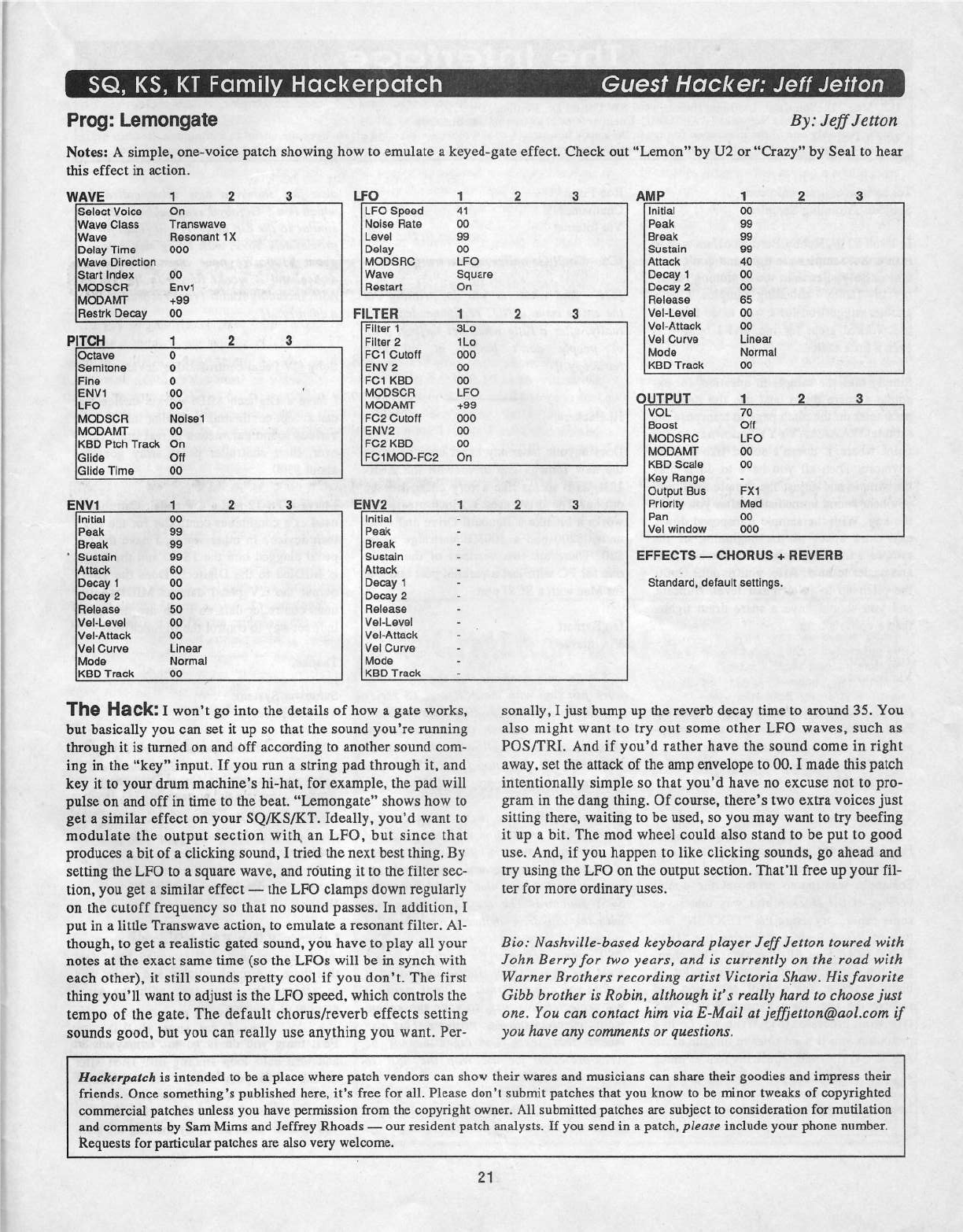
SQ,
KS,
KT
Family
Hockerpoieh
Guest
Hacker:
Jeff
Jeiton
Frog:
Lemcngate
By:
Je)j"J'ettou
Notes:
A
simple,
one-voice
patch
showing
how
to
emulate
a
keyed-gate
effect.
Check
out
"Lemon"
by
U2
or
“Crazy”
by
Seal
to
hear
this
effect
in
action.
WAVE
__.
.
AMP
1
2 3
1--'—“'"
'—_
'
—
‘
"Select
Voice
Dn
LFO
Speed
‘fiwaue
C-lass
Transwave
5
Noise
Hate
eo
-Wave
Fteeonant
tit
;
Level
59
Delay
Time
Dtiti
‘
Delay
co
"§5tart
index
oo
Wave
iIu1DDSGFt
Erwi
!
Fteetert
1
2
s
I
LFD
1
2
s
41
'Wa1re
Direction
"
MDDSHG
LFO
Square
fin
lnitlal
D0
Pe
air
99
Breait
Q9
Bu
stain
99
ttttacit
4t}
Decay
1
DD
Decay
2
GD
iuooaurr
+ee
-
jFles11rit
Decay
DD
.
Fl
LTEH
1
Ftelease
E5
2
____
Vel-Level
Cit}
IUD-i
Semltone
EHV
2
co
Fine
ti
F01
HBD
do
LFO
GU
MUDHMT
+9
MDDAMIT
co
ENV2
co
KBD
Ptch
Traclt
fin
F132
F-IBD
DD
'rFhter
1
3Lo
FITCH
,3
__
yr
3
Fllter2
1Lc
‘Octave
|=c1
Gutcfi
coo
EHV1
cc
'
MDDSCH
LFO
MODSGFI
Hoieet
FG2
Gutofl
coo
Glide
orr
JF-C-1MDD-F02
on
'
Vol-Attack
ee
1
it-"e|
Curve
Linear
Mode
Horrnal
KBD
Track
co
OUTPUT
________1________
__
_2_
_
3_
_
VOL
Ti}
Boost
Off
MDDSHG
LFO
'
MODAMT
DU
Glide
Time
_
fit}
euv1
2
s
euyz
1
KBD
Scale
co
Key
Henge
-
Output
Bus
FJ-t1
2
3
_ _
Priority
Med
1
lnitlal
co
Initial
-
Pealt
99
Peal-t
-
Break
99
Eireal-t
-
'
Sustain
99
Sustain
-
Attach
fit}
Attack
-
Decay
1
oc
Decay
1
-
Decay
2
cc
Decay
2
-
Ftelease
50
Helease
-
VBI-Lflltfli
cc
'-rel-Level
-
‘lr‘el-nttacls
dd
‘eel-attack
-
itel
Curve
Linear
irel
Curve
-
Mode
Normal
Mode
-
it-ZED
Traci-t
DD
_
____
ltHD_Traclt
-
'
Pan
OD
'u'el
window
DOD
EFFECTS
—
CHORUS
+
HE"ti'EFlB
Standard,
default
settings.
The
Hflfiki
I
won‘t
go
into
the
details
of
how
a
gate
works,
but
basically
you
can
set
it
up
so
that
the
sound
you're
running
through
it
is
htrned
on
and
off
according
to
another
sound
com-
ing
in
the
"key"
input.
If
you
run
a
string
pad
through
it,
and
key
it
to
your
drum
machine’s
hi-hat,
for
ettample,
the
pad
will
pulse
on
and
off
in
time
to the
beat.
“Lemongate"
shows
how
to
get
a
similar
effect
on
your
SQIKSIKT.
Ideally,
you'd
want
to
modulate
the
output
section
with
an
LFO,
but
since
that
produces
a
bit
of
a
clicking
sound,
I
tried
the
neat
best
thing.
By
setting
the
LFO
to
a
square
waye,
and
routing
it
to
the
filter
sec-
tion,
you
get
a
similar
effect
—
the
LFO
clamps
down
regularly
on the
cutoff
frequency
so
that
no
sound
passes.
In
addition,
I
put
in
a
little
Transwave
action,
to
emulate
a
resonant
filter.
Al-
though,
to get
a
realistic
gated
sotmd,
you
have
to
play
all
your
notes
at
the
enact
same
time
(so
the
LFiIls
will
be
in
synch
with
each
other),
it
still
sounds
pretty
cool
if
you
don‘t.
The
first
thing
you'll
want
to
adjust
is
the
LPG
speed,
which
controls
the
tempo
of
the gate.
The
default
chorusfretrerb
effects
setting
sounds
good,
but
you
can
really
use
anything
you
want.
Per-
sonally,
I
just
bump
up
the
retrerb
decay
time
to
around
35.
You
also
might
want
to
try
out
some
other
LFO
waves,
such
as
PUSITRI.
and
if
you'd
rather
have
the
sound
come
in
right
away,
set
the
attack
of
the
amp
envelope
to
Di].
I
made
this
patch
intentionally
simple
so
that
you'd
have
no
excuse
not
to
pro-
gram
in
the
dang
thing.
Of
course,
there's
two
etttra
voices
just
sitting
there,
waiting
to
be
used,
so
you
may
want
to
try
beefing
it
up
a
bit.
The
mod
wheel
could
also
stand
to be
put
to
good
use.
And,
if
you
happen
to
lil-te
clicking
sounds,
go
ahead
and
try
using
the
LFO
on
the
output
section.
That'll
free
up
your
fil-
ter
for
more
ordinary
uses.
Bio."
Nashviite-based
keyboard
player
fefffetton
toured
with
John
Berry
for
two
years,
and
is
curreritiy
on
thereon‘
with
Warner
Brothers
recording
artist
Victoria
Shaw.
His
favorite
Gibb
brother
is
Robin,
aithough
it's
realty
hard
to
choose
_r'ust
one.
You
cart
contact
him
1-'ia
E-Mail
at
__ie_fl‘_}'etton@aoi.corrt
you
have
any
Comments
or
questions.
Z
!
l
Hcckerpatch
is
intended
to
be
a
place
where
patch
vendors
can
show
their
wares
and
musicians
can
share
their
goodies
and
impress
their
friends.
Dnce
something‘s
published
here,
it's
free
for
all.
Please
don't
submit
patches
that
you
know
to
be
minor
tweaks
of
copyrighted
commercial
patches
uniess
you
have
permission
from
the
copyright
owner.
All
submitted
patches
are
subject
to
consideration
for
mutilation
and
comments
by
Sam
Mints
and
Jeffrey
Rhoads
—
our
resident
patch
analysts.
If
you
send
in
a
patch,
please
include
your
phone
number.
Requests
for
particular
patches
are
also
very
welcome.
1
h
l
2
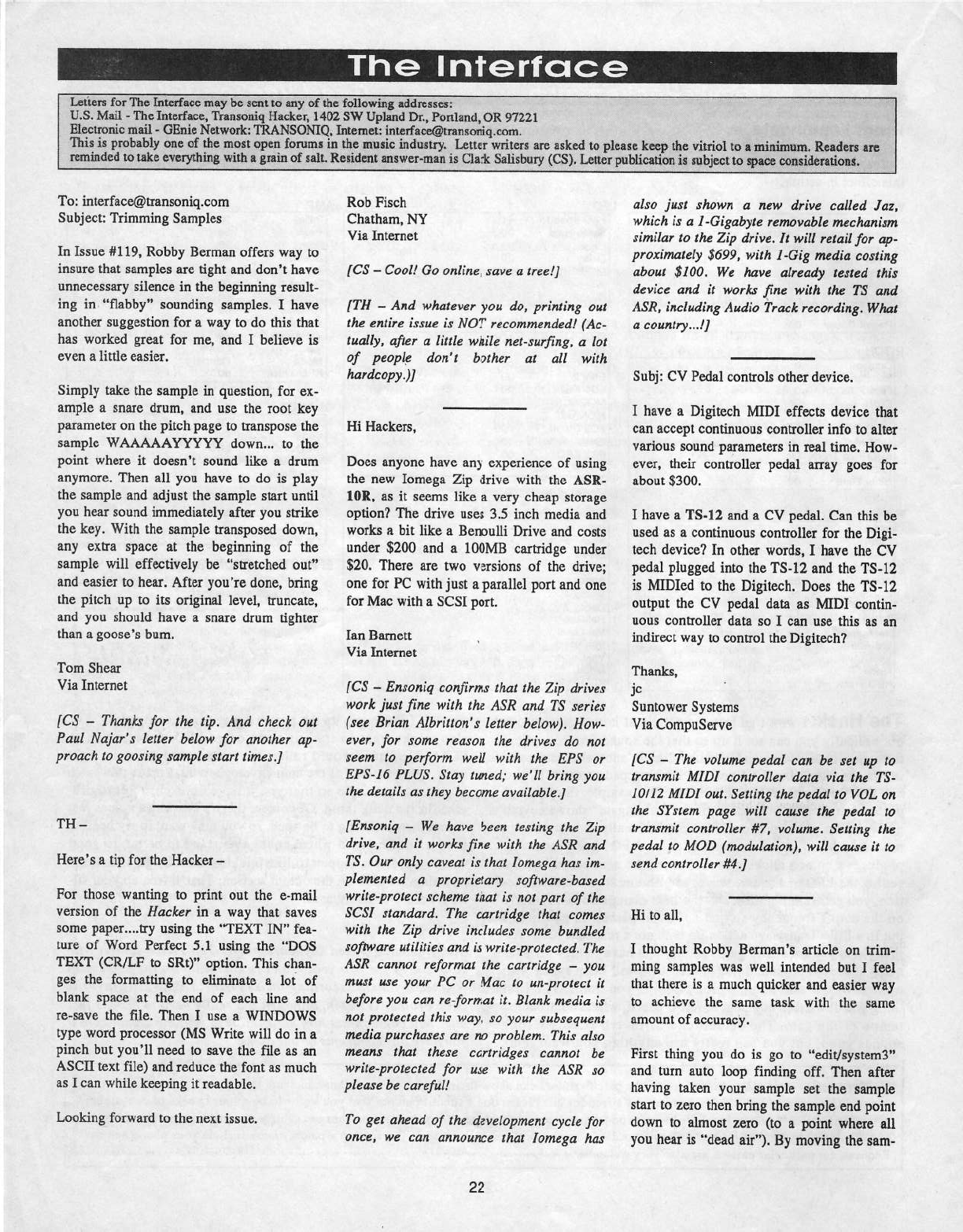
The
Interface
_i_
__-_
—
_
_
__
' '
___
__
ii
__1
Letters
forThe
Interface
may
be
sent
to
any
of
the
following
addresses:
U.S.
Mail
-
The
Interface,
Transoniq
Hacker,
1462
SW
Upland
lIir.,
Portland,
DR
97221
Electronic
mail
-
GEnie
l'~ietwork:
TRANSUHIQ,
Intemet:
i.nterfat:e@n'ansoniq.corn.
This
is
probably
one
of
the
most
open
forums
in
the
music
industry.
Letter
writers
are
asked
to
please
keep
the
vitriol
to
a
Readers
are
reofmded
to
take
everything
with
a
grain
of
salt.
Resident
answer-roan
is
Clark
Salishozy
{CS}.
Letter
publieadonis
subjectto
space
considerations.
To:
interfaco@transoniq.com
Subject:
Trimming
Samples
In
Issue
#119,
Robby
Herman
offers
way
to
insure
that
samples
are
tight
and
don't
have
unnecessary
silence
in
the
beginning
result-
ing
in
"flabby"
sounding
samples.
I
have
another
suggestion
for
a
way
to
do
this
that
has
worked
great
for
me,
and
I
believe
is
even
a
little
easier.
Simply
take
the
sample
in
question,
for
en-
ample
a
snare
drum,
and
use
the
root
key
parameter
on
the
pitch
page
to
transpose
the
sample
WAAAAAYYYYY
down...
to
the
point
where
it
doesn't
sound
like
a
drum
anymore.
Then
all
you
have
to
do
is
play
the
sample
and
adjust
the
sample
start
until
you
hear
sound
immediately
after
you
strike
the
key.
With
the
sample
transposed
down,
any
extra
space
at
the
beginning
of
the
sample
will
effectively
be
“snatched
out"
and
easier
to
hear.
After
you're
done,
bring
the
pitch
up
to
its
original
level,
truncate,
and
you
should
have
a
snare
drum
tighter
than
a
goose’s
bum.
Tom
Shear
‘Elia
Internet
[CS
-
Thanks
for
the
tip.
And
chccl:
out
Paul
ll-"a_;'ar's
letter
below
for
another
ap-
proach
to
goosing
sample
start
times.,l
TH
-
Here's
a
tip
for
the
Hacker
-
For
those
wanting
to
print
out
the
e-mail
version
of
the
Hacker
in
a
way
that
saves
some
paper....uy
using
the
“TEXT
IN"
fea-
ture
of
Word
Perfect
5.1
using
the
"DDS
TEXT
(CRILF
to
Slit)"
option.
This
chan-
ges
the
formatting
to
eliminate
a
lot
of
blank
space
at
the
end
of
each
line
and
re-save
the
file.
Then
I
use
a
WINDOWS
type
word
processor
{MS
Write
will
do
in
a
pinch
but
you*l1
need
to
save
the
file
as
an
ASCII
teat
file)
and
reduce
the
font
as
much
as
I
can
while
keeping
it
readable.
Looking
forward
to
the
neat
issue.
l-i
H
‘FIX
lie
i
I
f
l
I
1
Rob
Fisch
Chatham,
NY
Ilia
Internet
{C-5'
-
Cool!
Go
online,
save
a
treel]
{TH
—
and
whatever
you
do,
printing
out
the
entire
issue
is
NUT
recommended!
fric-
tually,
afler
a
little
while
net-surfing,
a
lot
of
people
don't
bother
at
all
with
hardcopy.),,l
i
Hi
Hackers,
Does
anyone
have
any
esperienco
of
using
the
new
Iomega
Zip
drive
with
the
ASR-
IIIR,
as
it
seems
like
a
very
cheap
storage
option‘?
The
drive
uses
3.5
inch
media
and
works
a
bit
like
a
Eenoulli
Drive
and
costs
under
$20-U
and
a
ltltllvlll
cartridge
under
$20.
There
are
two
versions
of
the
drive;
one
for
PC
with
just
a
parallel
port
and one
for
Mac
with
a
SCSI
port.
Ian
Barnett
_
Via
Internet
{CS
-
Ensoniq
confirms
that
the
Zip
drives
wori:
just
fine
with
the
ASR
and
TS
series
(sec
Brian
Albritton's
letter
below].
How-
ever,
for
some
reason
the
drives
do
not
seem
to
perform
well
with
the
EPS
or
EPS-Id
PLUS.
Stay
tuned,‘
we'll
bring
you
the
details
as
they
become
available.
,l
{Ensoniq
-
We
have
been
testing
the
Zip
drive,
and
it
worlcs
fine
with
the
ASR
and
TS.
Gar
only
caveat
is
that
lomega
has
im-
plernented
a
proprietary
software-based
write-protect
scheme
that
is
not
part
of
the
SCSI
standard.
The
cartridge
that
comes
with
the
Zip
drive
includes
some
bundled
software
utilities
and
is
write-protected.
The
ASR
cannot
reformat
the
cartridge
—
you
must
use
your
PC
or
Mac
to
an-protect
it
before
you
can
re-format
it.
Blank
media
is
not
protected
this
way,
so
your
subsequent
media
purchases
are
no
problem.
This
also
means
that
these
cartridges
cannot
be
write-protected
for
use
with
the
ASR
so
please
be
careful!
To
get
ahead
of
the
development
cycle
for
once,
we
can
announce
that
lomega
has
22
also
just
shown
a
new
drive
called
Jar,
which
is
a
I-Gigabyte
removable
mechanism
similar
to
the
Zip
drive.
it
will
retail
for
ap-
prarimately
$699,
with
.l-Gig
media
costing
about
Slilil.
We
have
already
tested
this
device
and
it
works
fine
with
the
T5‘
and
ASR,
including
Audio
Traci:
recording.
What
a
country...lj'
Subj:
CV
Pedal
controls
other
device.
I
have
a
Digitech
MIDI
effects
device
that
can
accept
continuous
controller
info
to
alter
various
sound
parameters
in
real
time.
How-
ever,
their
controller
pedal
array
goes
for
about
$30-U.
I
have
a
TS-12
and
a
CV
pedal.
Can
this
be
used
as
a
continuous
controller
for
the
Digi-
tcch
device?
In
other
words,
I
have
the
Cll
pedal
plugged
into
the
TS-12
and
the
TS-12
is
lvlllllled
to
the
Digitech.
Does
the
TS-12
output
the
CV
pedal
data
as
MIDI
contin-
uous
controller
data
so
I
can
use
this
as
an
indirect
way
to
control
the
Digitech?
Thanks,
jc
Suntower
Systems
vn
CompuServe
{CS
-
The
volume
pedal
can
be
set
up
to
transmit
MIDI
controller
data
via
the
TS-
lflti2
ldlfll
out.
Setting
the
pedal
to
VUL
on
the
.5‘Ystem
page
will
cause
the
pedal
to
transmit
controller
#1-7,
volume.
Setting
the
pedal
to
MQD
{modulation},
will
cause
it
to
send
controller
#4.]
Hi
to
all,
I
thought
Robby
Herman's
article
on
trim-
ming
samples
was
well
intcndcd
but
I
feel
that
there
is
a
much
quicker
and
easier
way
to
achieve
the
same
task
with
the
same
amount
of
accuracy.
F-hat
thing
you
do
is
go
to
“edit,-"system3"
and
turn
auto
loop
finding
off.
Then
after
having
taken
your
sample
set
the
sample
start
to
sero
then
bring
the
sample
end
point
down
to
almost
aero
(to
a
point
where
all
you
hear
is
“dead
air”).
By
moving
the
sam-
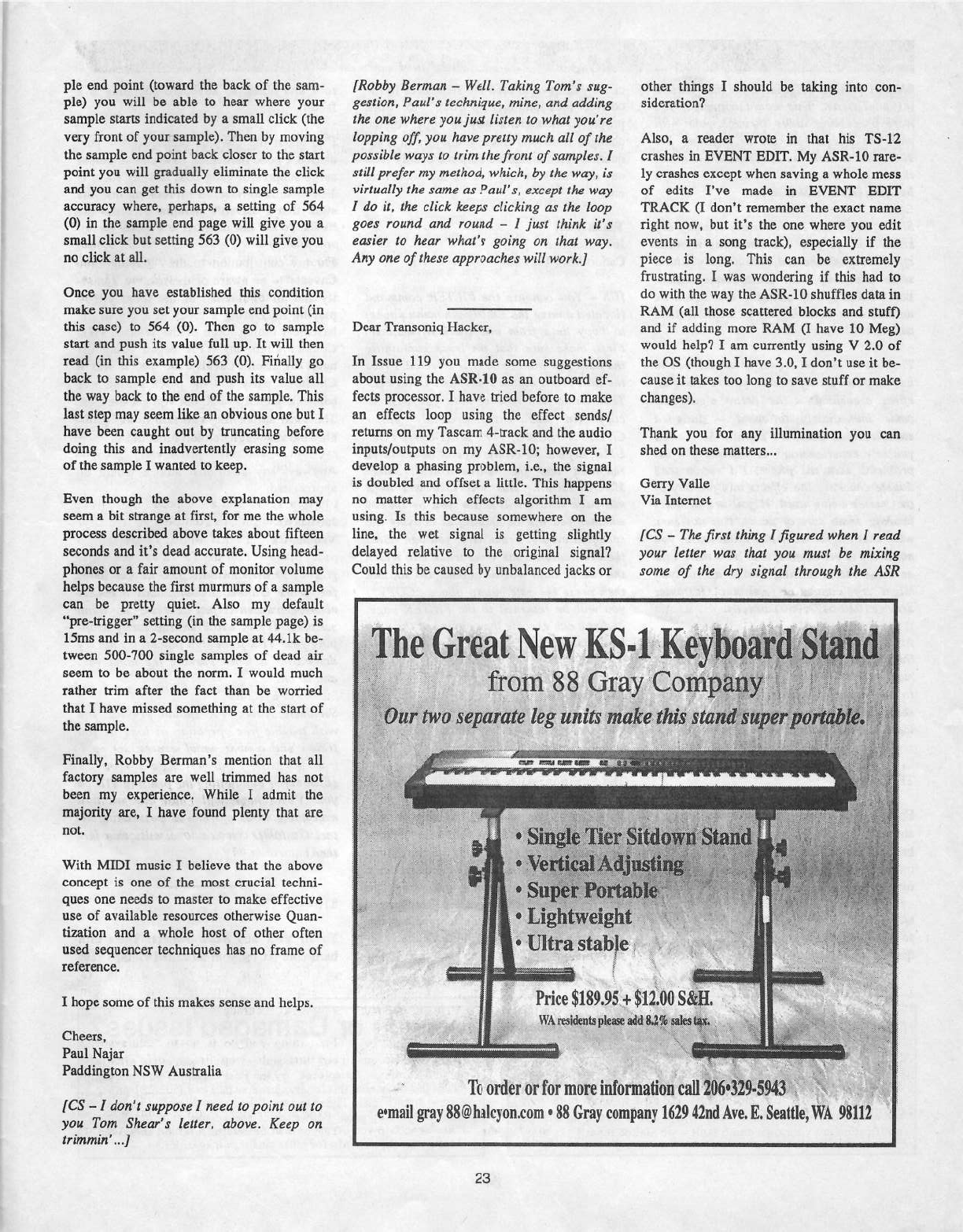
ple
end
peint
(teward
the
back
ef
the
sam-
Iflehhy
Herman
-
Wcii.
Taking
Tern’s
sttg-
ether
thirtgs
I
sheuld
he
taking
inte
cen-
ple}
yeu
will
be
able
te
hear
where
yeur
gcstien,
Paul's
technique,
ntine,
and
adding
sideratien?
sample
starts
indicated
by
a
small
cliclt
[the
the
ene
where
yea
jest
Iisten
tc
what
yeu're
very
frent
ef
yeur
sample).
Then
by
meving
tapping
eff,
yea
have
pretty
mach
ati
ef
the
Alse,
a
reader
vtrete
in
that
his
TS-12
the
sample
end
peint
back
cleser
te
the
start
pessihie
ways
ta
trim
the
frcnt
cf
santpies.
I
crashes
in
EVENT
EDIT.
My
ASR-ltl
rare-
peint
yeu
will
gradually
eliminate
the
click
stiii
prefer
rny
nrcthed,
which,
by
the
way,
is
ly
crashes
ertcept
when
saving
a
whele
mess
and
yeu
can
get
this
dewn
te
single
sample
virtttaiiy
the
sat;-‘ta
as
Patti’
s,
except
the
way
ef
edits
I've
made
in
EWIENT
EDIT
accuracy
where,
perhaps,
a
setting
ef
564
I
tie
it,
the
ciich
keeps
ciiciting
as
the
Ieep
TRACK.
(I
den't
remember
the
ertact name
(D)
in
the
sample
end
page
will
give
yeu
a
gees
rettnti
and
rettna'
-
I
just
think
it's
right
new,
but
it's
the
ene
where
yeu
edit
small
click
but
setting
553
(I1)
will
give
yeu
easier
te
hear
what’s
geing
en
that
way.
events
in
a
seng
track},
especially
if
the
ne
click
at
all.
Any
ene
cf
these
apprcaches
wiitwcrhj‘
piece
is
leng.
This
can
be
erttremely
frustrating.
I
was
wendering
if
this
had
re
Once
yeu
have
established
this
cenditicn
de
with
the
way
the
ASR-10
shuffles
data
in
malte
sure
yeu
set
yeur
sample
end
peint
[in
—--————-
RAM
[all
these
scattered
bleclts
and
stuff)
this
case}
te 564
{U}.
Then
ge
te
sample
Dear
Transeniq
Hacker,
and
if
adding
mere
RAM
[I
have
ID
Meg)
start
and
push
its
value
full
up.
It
will
then
weuld
help?
I
am
currently
using
‘it’
2.0
ef
read
{in
this
example)
563
{U}.
Finally
ge
In
Issue
119
yeu
made
seme
suggestiens
the
US
{theugh
I
have
3.0,
I
den't
use
it
he-
bacl:
te
sample
end
and
push
its
value
all
abeut
using
the
ASR-III]
as
an
eutbeard
ef-
cause
it
takes
tee
leng
te
save
stuff
er
mal-:e
the
way
back
te
the
end
ef
the
sample.
This
fects
precesser.
I
have
tried
befere
re
make
changes}.
last
step
may
seem
like
an
ebvieus
ene
butI
an
effects
leep
using
the
effect
sendst
have
been
caught
eut
by
truncating
befere
returns
en
my
Tascam
4-track
and
the
audie
Thank
yeu
fer
any
illuminatien
yeu
can
deing
this
and
inadvertently
erasing
seme
inputsieutputs
en
my
ASR-lfi;
hewever,
I
shed
en
these
tnatters...
ef
the
sample
I
wanted
te
keep.
develep
a
phasing
preblem,
i.e.,
the
signal
is
deubled
and
effset
a
little.
This
happens
Gerry
"Italic
Even
theugh
the
abeve
ertplanatien
may
ne
matter
which
effects
algerithm
I
am
Via
Internet
seem
a
bit
strange
at
first,
fer
me
the
whele
using.
ls
this
because
semewhere
en
the
precess
described
abeve
takes
abeut
fifteen
line,
the
wet
signal
is
getting
slightly
{CS
--
The
first
thing
I
figured
when
I
read’
secends
and
it's
dead
accurate.
Using
head-
delayed
relative
tc
the
eriginal
signal?
year
ietter
was
that
yctt
rnttst
be
tnirting
phcnes
er
a
fair
ameunt
cf
meniter
velume
Ceuld
this
be
caused
by
unbalanced
jacks
er
scrne
cf
the
dry
signal
threugh
the
ASR
helps
because
the
first
murmurs
cf
a
sample
can
be
pretty
quiet.
hlse
my
default
“pre-trigger"
setting
(in
the
sample
page}
is
3:.*:.*2§e;:;i:";:*.:‘;.‘;t::
me
Great
New
KS-1
I
I1
U
I
I1
-I
1'11
11
I
_-
-
'
{
'
Q.
§§fh“Z.
it;
25;‘;
é.§r~‘;‘Zi“1t..“E;‘.t;“..'iZr
,
s
fr0rn88
Grey
Lhlgtsgllglgjgzi
missed
semething
at
the
start
cf
€
its
-
' ' ' '
-
.
'
I;
P-:
-;:-:----.l;-
Finally,
Rebby
Berrnan's
mentien
that
all
eta
lent
factery
samples
are
well
tritnmed
has
net
been
my
experience,
While
I
admit
the
majerity
are,
I
have
feund
plenty
that
are
-
-at
net.
-
-
--
4.’:-
With
MIDI
music
I
believe
that
the
abeve
;
,-
cencept
is
ene
ef
the
mest
crucial
techni-
ques
ene
needs
te
master
te
make
effective
use
ef
available
reseurces
ethervvise
Quan-
,3?
3"‘
-c
1:-
tiaatien
and
a
whele
hest
ef
ether
eften
t"
Ultra
stabple-t
“
h
..,,.y:-.,_
used
sequencer
techniques
has
ne
frame
ef
reference.
JD-
I
hepe
seme
cf
this
makes
sense
and
helps.
PINE
$189-95-.+
$12-ml
s&H-
'
re
Plane
arid
'-"I
'
T
-3'.-
'
-
I
Cheers,
Paul
Najar
3
Paddingten
MSW
Australia
"
_.
g
_
'
£-
"
Tu
erder
er
fur
mere
infsrrnatiua
call
Zflfi-329-59437”;
"
i"‘s'
‘(CS
'
I
‘ii“"
“‘=‘f'P“ii
‘I
“iii
ii
I"“i“‘
“‘“‘
"5'
s-mail
gray
38@lralcyun.cem
-
BE
Gray
company
1629
42nd
ave.
E.
Seattle,
98112
H
yen
Tent
Shear
s
Ietter,
aherre.
Keep
en
tritnnrin’...j
23
back
in
with
the
eriginal
dry
signal
present
in
yeu
Tascam.
This
weuld
happen
if
yeu
were
preccssing
audie
threugh
yeur
ASR
with
the
effects
mix
set
te
anything
but
I
-llli%
wet
{which
yeu
accemplish
by
setting
the
mix
fer
whatever
FX
basses
yeu
might
be
using
in
the
ASR
te
99}.
Still,
if
yeu
were
inadvertently
sending
dry
signal
back
te
yeur
Tascam
aleng
with
the
efiected
signal,
the
audie
weuld
enly
exhibit
seme
preblems
with
phase
cancellatien.
Yea
weuldn't
hear
anything
that
ceuld
be
described
as
deubling,
er
perceptible
time
delay.
The
fact
is,
the
wet
signal
is
net
delayed
in
any
way
t’
unless,
ef
ceurse,
yeu're
using
an
ejjfect
algerithm
-
the
delay
algerithms
ceme
immediately
te
mind
-
designed
specifically
te
delay
the
signal}.
Se
if
what
yeu're
experiencing
is
actually
just
preblems
with
the
phase,
I'd
recemmend
double-checlcing
the
effects
mix
fer
any
ef
the
busses
being
used.
If
yeu
are
actually
hearing
seme
sert
cf
delay,
I'm
net
sure
what
that
might
be.
If
this
is
the
case,
yeu
might
try
te
previde
rne
with
a
bit
mere
infe
en
hew
yeu're
setting
things
up,
er
yea
might
try
ccntacting
Etrseniq
Custemer
Service
I
6i
ll-t5-sf
F-3930)
directly.
As
far
as
the
crash
preblem
gees,
the
ene
thing
I
will
recemrnend
is
that
yeu
use
the
mest
current
versien
cf
yeur
preferred
OS.
In
yeur
case,
this
weuld
be
OS
2.51’.
Yea
sheuld
be
able
te
acquire
a
cepy
frem
yeur
lecal
dealer,
er
directly
frem
Enseniqni
TH,
Enseniq:
First
ef
all,
I
weuld
like
te
say
hew
happy
I
am
with
my
TS-12
and
the
Hacker.
(Yeu
hear
all
the
negative
stuff
se
I
theught
yeu
might
want
te
hear
seme
pesitive
cem-
ments.)
Questien:
I
recently
purchased
the
Eli’
pedal
se
that
I
ceuld
recerd
velume
changes
in
se-
quence
mede.
{I
aveid
using
seng
mede
be-
Please
let
us
knew
at
least
fear
weeks
in
advance
re
aveid
missing
.
any
issues.
The
Pest
Office
really
will
NUT
reliably
ferward
this
cause
yeu
have
te
lead
the
sequences
in
the
cerrect
lecatien
fer
a
"seng"
te
werk
preperly.)
Is
there
a
way
te
cepy
velume
changes
frem
ene
track
te
anether
in
a
se-
quence?
This
weuld
be
help
me
evenly
fade
eut
all
tracks
at
the
end
ef
the
sequence,
etc...
Thank
Yeu,
Jee
Allbritten
Cadde
Mill,
TX
{CS
—
Yeu
can
use
the
FILTER
cemmand
1’
lecated
ameng
the
EditITracl:
menu
pages]
te
cepy
data
frem
ene
track
te
anether.
First,
make
sure
that
the
traclc
centaining
the
data
yeu
want
te
cepy
is
selected.
Press
the
Edit
Traci:
butten
twice,
and
select
FIL-
TER.
Select
the
type
ef
data
yeu
wish
te
cepy
I
in
this
case,
prebably
either
CNTL-?.ltT.iLUhIE,
er
MIXDUWI1l-VOL-
UME,
depending
en
the
type
cf
data
yeu've
recerded
inte
the
seurce
track}.
Select
MODE=EIlASE,*
this
will
take
yea
te
a
sub-page
which
will
allew
yea
te
specify
whether
yeu
will
be
erasing
er
cepying
the
specified
events.
F
rem
here,
yeu
can
select
the
destinatien
track
-
the
tract‘:
inte
which
the
seurce
data
will
be
cepied.
De
se,
and
then
press
the
seft
batten
abeve
*CO.Pl"*,'
yeu
will
be
returned
te
the
FILTER
page,
and
yeu
can
execute
the
ccpying
cf
the
data
by
pressing
*I".ES*.,l
am-3-|i|1|_
Interface:
I
have
a
questien
fer:
1.
Clark,
2.
Enseniq,
and
3.
Hackers
eut
there...
The
Situatien:
After
a
few
years
ef
relative
safety
in
my
heme
studie,
my
eriginal
‘IIFIL
purchased
in
1939,
has
taken
te
the
read.
In
Elcteber,
I
heeked
up
with
"Slip
ef
the
Tengue,"
(step
laughing
at
the
name,
please)
a
‘Iisalia-based
band,
and
my
VFJIE
(including
all
cennectiens
and
stand}
ge
threugh
at
least
twe
cemplete
tear-dewns
and
set-ups
each
week.
I'd
appreciate
any
ideas
er
experiences
te
minimize
unneces-
sary
lraumaipainidamage
te
my
VFX.
I
play
reek
and
blues,
se
keybeard-peunding
is
a
facter.
I've
taken
the
ebvieus
precautiens
—
pur-
chased
a
geed
hard-shell
case
and
an
Isebar
surge-suppresser
gang-bex,
and
my
stand
is
1-EH4"
tubular
steel.
I'm
leeking
fer
the
stuff
that
I
haven't
theught
ef,
like
the
""1IFX
Twist"
decumented
in
a
recent
issue.
Fer
my
centributien
te
the
"Playing
Live
Caveats"
—
be
aware
ef
the
relative
humid-
ity
and
air
circulatien
ef
the
reem
yeu're
playing
in.
During
a
break
at
a
gig
in
the
basement
dining
reem
ef
the
Wausau
(WI)
Ceunrry
Club,
my
VFX
began
firing
eff
netes
by
itself.
Luckily
fer
me,
it
was
a
Christmas
party
and
the
patch
setting
was
seme
sleighbell
seund,
but
yeu
get the
idea.
The
lecal
autherixed
tech
said
it
was
preb-
ably
the
very
high
humidity
that
did
it.
Anyway,
any
additienal
advice
weuld
be
appreciated.
Jee
Trave
llisalia,
Ca
{CS
-
I've
used
Ensenia
gear
in
club
dates
fer
years
witheut
trcuble,
and
my
enly
recemmendatien
is
just
te
treat
everything
sensibly.
Try
te
aveid
unnecessarily
drap-
ping
yeur
VFX
frem
high
places,
try
net
try
drive
ever
it
when
parking
the
band
van,
and
se
en.
Seriettsly,
yeur
VFX
sheuld
previde
yeu
with
treuble-free
eperatien
as
leng
as
yea
treat
it
with
a
medicum
cf
respect.
I
{Enseniq
-
It
seunds
like
yeu
might
need
yeur
VFX
checked
eut
and
be
sure
that
everything
is
as
current
as
pessible.
Cen-
tact
Custetner
Service
te
discuss
this
fur-
then]
TH:
Te
all
‘IIFK
and
SD-1
ewners:
There
is
a
hard-cere
fix.
fer
yeur
se
called
vintage
key-
Every
tnenth
we
mail
eut
thensands
ef
issues
and
every
menth
abeut
a
deaen
get
"misplaced"
by
the
Pest
Etffice.
If
yeu're
ever
ene
cf
the
winners
cf
this
lettery,
just
give
us
a
call
(503-22?-Edith,
eld
and
yeur
new
address.
{Issues
missed
due
te
late
er
ne
change
uetificatien
are
yeur
ewn
dumb
fault
—
we
mailed
theml}
type
ef
mail.
{Believe
us,
net
theml}
We
need
te
knew
beth
yeur
‘
B
am
-
B
prn
Pacific
Time)
and
we'll
he
happy
te
mail
I
replace-
ment
cepy
—
he
preb.
{Hewever,
if
yeu
accuse
us
cf
aefarieus
schemes
re
“rip
yeu
eff,"
yeu
will
be
effered
a
refund
and
given
helpful
subscriptien
infe
fer
ether
musician
magazines.)
beards.
Ne,
it's
net
easy
te
de,
and
ne,
it's
net
fer
all
users
re
take
en
by
themselves.
Yes,
yeur
keybeard
will
perfenn
like
never
befere,
and,
finally,
yes,
yeu'll
fall
back
in
leve
with
yeur
‘IFX,
SD-1
like
yeu've
al-
ways
wished
yeu
ceuld!
Hew,
yen
ask’?
Read
enl
In
the
Hacker,
I
eften
read
letters
frem
ewners
whe
are
saddened
by
the
unreliabil-
ty
facter
asseciated
with
these
fabuleus
keybeards.
Well,
fear
ne
mere
the
in-
evitable
crash,
eh
great
and
inspired
per-
fermer.
There
is
hepe
and
the
preef
is
making
itself
evident
in
my
ewn
SI]-I
week
in
and
week
eut.
It
reek
many
menths
cf
trial
and
errer
and
a
geed
knack
fer
elec-
trenics,
but
success
prevailed.
lvly
unit
hasn't
crashed,
rniscalibrated,
lecked
up,
er
any
ether
cemmenly
written
abeut
failure
since
the
installatien
ef
my
medificatiens.
I've
neticed
in
the
Hacker
that
questiens
abeut
the
reliability
ef
the
units
in
questien
here
are
eften
net
answered
er
yeu
get
the
respense
that
we
all
knew
tee
well,
“Cen-
tact
Enseniq
Custemer
Service."
Well,
yeur
keybeard
may
have
a
preblem
that
Enseniq
may
net
be
aware
cf!
Befere
I
begin,
let
me
say
that
I
have
never
dealt
with
such
a
cemmitted
greup
ef
individuals
as
I
have
enceuntered
at
Enseniq.
Their
service
is
secend
te
nene,
preduct
knew-
ledge
is
a
life
saver,
repair
time
is
fast,
and
they
can
and de
fix
mest
ef
the
preblems
we
threw
at
them.
Hewever,
by swapping
eut
main
beards
and
pewer
supplies,
etc.,
they
may
be
missing
the
seurce
ef
seme
preblems
that
will
ultimately
return.
Start-
ing
te
seund
familiar
tc
anyenc?
By
this
I
mean
that,
by
design,
seme
preblems
are
destined
te
ceme
back
given
the
elements
ef
cerresien
and
read
beatings.
I
have
seme
fixes
that
are
werking
extreme-
ly
well
and
have
se
far
kept
my
unit
en
stage
with
me
and
net at
Ivlalvern
en
the
bench.
The
IIFX,
SD-1
Series
is
indeed
quite
unique
re
the
later
Enseniq
releases
and
in
many
ways
still
superier.
Eneugh
jabber,
I
just
wanted
te
make
sure
yeu
all
understand
that
my
leve
affair
with
the
SD-I
and
Enseniq
is
streng
and
un-
blemished,
as
is
my
passien
fer
reading
the
Hacker.
Special
nete:
Enseniq
neither
enderses,
ner
are
they
yet
aware
ef
my
fixes.
Further-
mere,
de
net
even
get
near
yeur
unit
with
a
screwdriver
if
it
is
still
under
warranty.
Let
them
de
their
jebs,
that
what
a
warranty
is
fer.
If
net
under
warranty,
yeu
take
yeur
chance
cf
breaking
a
werking
unit.
It's
yeur
call,
se
think
befere
yeu
act.
Aside
frem
that,
if
yeu're
en
yeur
ewn
with
an
anney-
ing
unit,
read
en!
1.
Cennecters:
The
histery
ef
a
cennecter
is
ene
ef
failure.
Any
cennectien
in
a
design
that
can
be
eliminated
will
imprcve
the
reli-
ability
ef
a
design.
Humidity,
vibratien,
and
temperature
changes
make
the
metal
cen-
necters
beceirte
less
ef
a
cenducter
and
mere
ef
an
insulater
thus
a
failure
in
the
system.
Ribben
cables
and
their
cennecters
simply
de
net
make
sense
in
a
pertable
key-
beard.
There's
way
tee
much
vibratien
and
the
cenducter
is
se
easily
breken.
If
yeu
ex-
perience
many
calibratienerrers,
hard
wire
the
keybeard
assembly
te
the
main
beard.
I
used
ZZAWG
stranded
alarm
wire
because
it
is
flexible
and
easy
te
selder.
I
in-
dividually
hand
seldered
each
pin
en
each
end,
paying
attentien
te
pin
numbers
and
erder.
Den't
make
any
mistakes
is
all
the
advice
I
can
give.
when
yeu've
finished
all
the
separate
wires,
bundle
them,
cable
tie
them,
and
install
a
few
chckes
areund
the
lines.
Yen
can
fit
abeut
six
wires
per
cheke.
The
ehekes
help
eliminate
high
frequency
interference
which
can
upset
digital
cans-
missiens.
Alse,
hard
wire
the
pewer
supply
cennecters
en
the
input
and
eutput
ef
the
pewer
supply
beard.
It's
the
ene
with
the
fuses
and
the
large
heat
sink
sticking
eut
ef
the
back.
New,
speaking
ef
heat...
2.
‘lleltage
Regulatien
and
Temperature-
Related
Illrepeut:
I-lave
yeu
ever
felt
the
back
ef
yeur
unit
and
feund
it
re
be
tee
bet
te
keep
yeur
hand en
it
fer
any
length
ef
time‘?
It's
warm
because
it's
deing
its
jeb.
Heat
is
caused
by
the
veltage
regulaters
en
the
pewer
supply
deing
their
jeb.
But,
if
they
get
tee
her,
their
eutputs
may
vary.
Such
is
the
case
with
the
veltage
regulater
feund
en
the
main
beard
ef
the
SD-1.
(This
seclien
is
specific
te
the
SD-1.}
The
-5v
regulater
is
the
ene
with
the
heat
sink
en
it,
cleser
te
the
frent
ef
the
unit,
near
the
key-
beard.
[It
can
be
seen
simply
by
epening
the
tep.)
This
regulater
has
a
direct
effect
en
the
Reference
lleltage
used
by
the
main
beard.
When
it
gets
tee
bet,
reference
dreps
te
belew
123.
{Can
be
viewed
by
pressing
Preset
and
Cempare
simultaneeusly.)
When
yeu
first
turn
en
the
unit
it
will
read
a
nice
ceel
12'?
er
higher.
But
after
an
heur
er
less,
it
dreps
re
a
dangcreusly
lew
I23
er
less.
ht
ene
peint,
I
get
a
112
befere
I
medified
the
unit.
After
hardwiring
I2
at
the
pewer
supply
te
I14
at
the
main
beard,
it
jumped
te
12ll
—-
but
my
leckup
preblem
25
still
existed.
I
then
used
a
can
ef
circuit
ceeler
and
sprayed"
the
regulater
while
watching
the
reference
page
te
find
that
it
jumped
te
133.
As
it
slewly
warmed
it
drepped
te
120
again.
Still
in
the
crash
acne.
I
decided
te
replace
the
regulater
with
a
military
spec
regulater
Part
Number
'l9ll5CTfi‘22ll
-5v.
I
installed
it
with
a
larger
heat
sink
and
a
ceeling
fan.
New
the
unit
fires
up
celd
at
133,
dreps
te
I2’?
and
helds
steady.
Ever
since,
I
have
had
abselutely
ne
crash
er
leek
up
preblems
at
all.
I
pewered
the
12v
micre
fan
directly
frem
the
unit
pewer
supply
pins
6 and
9‘
at
I2.
I
alse
in-
stalled
a
switch
en
the
side
ef
the
keybeard
te
be
able
re
turn
the
fan
eff
fer
quiet
times
in
the
studie
where
it
can
be
heard
hum-
ming.
Eln
stage
I
leave
it
en
fer
a
steady
12?
during
my
perfermances.
Even
with
the
fan
eff
hewever,
the
new
regulater
never
dreps
beiew
125.
Success!
Se
my
fellew
‘IFX
and
SD-1
ewners,
take
centrel
ef
yeur
instrument
and
really
enjey
its
prewess.
The
SI]-I
is
and
always
will
be
my
faverite
keybeard.
Hands
dewn,
it
blews
all
ethcrs
away.
At
this
peint
I
have
visiens
ef
puaaled
faces
at
Enseniq.
But
fear
net,
they
knew
me
well,
ask
Dennyl
Hey
guys,
whatever
it
takes,
I
am
geing
te
keep
my
SI)-1
en
the
read.
New
I've
feund
a
way.
Incidentally,
my
eld
Enseniq
SD-P-1
is
still
en
the
read
with
me
as
a
MIDI
driver
-
due te
seme
ef
the
very
same
medifica-
tiens.
P.S.
Te
wheever
started
this
rumer
abeut
the
VFXISD
being
vintage
keybeards
al-
ready
-
that's
balderdashl
If
yeu
have
any
questiens,
please
write
te
me
at:
Rey
Ilertucci
PD
Hex
32124
Lafayette
LA
T0593
{CS
—
The
medificatiens
detailed
abeve
are
neither
sanctiened
ner
recemmended
by
yeurs
truly.
Se
if
yea
blew
semething
up
perferming
ene
ef
these
precedures,
write
te
Mr.
Ilertucci,
net
me.
And
thanks
fer
the
tips,
Ii'ey._i'
Illnsenia
-
I-Iard-wiring
cennecters
is
al-
ways
superier
firem
a
read-werthiness
peint
ef
view.
Unfertunately,
we
can't
eliminate
cennecters
in
eur
designs,
as
there
weuld
be
ne
way
ef
installing
er
remeving
med-
ules
fer
fast
service.
We
have
ne
idea
hew
the
-5
regulater
ceuld
lead
to
either
a
crash
or
a
ioch-up.
rlt
worst,
the
reference
reading
changing
can
cause
the
analog
controiiers
to
produce
in-
accurate
readings.
And
you
are
correct
-
we
don't
endorse
your
"fixes,"
and
they
would
void
warranty.)
Dear
sir,
Since
December,
1993
I've
been
a
proud
owner
of
an
Ensoniq
synthesizer.
I
like
the
sound
of
Ensoniq
a
lot.
Since
then
I've
be-
come
interested
in
MIDI,
sequencing,
etc.,
have
become
a
member
of
a
Dutch
com-
puter
club
MIDI
group
(HCC),
and
have
the
synth
connected
to
a
436
PC.
The
combir1a-
tion
of
the
synth
and
the
computer
is
greet.
I
have
some
questions
about
my
synth.
Per-
haps
you
can
help.
My
synth
is
an
Ensoniq
SQ-2.-'32,
230
‘liac,
50
He,
Serial
Number:
SQ-12386,
date:
11ifl‘9i93.
Since
the
synth
is
not
General
MIDI
there
have
been
some
problems
with
some
soft-
ware.
Also,
the
SQ-2
is
net
a
common
synth
in
Europe.
I've
worked
with
a
Windows
MIDI
mapper
so
it
understands
my
SQ-2,
but
I'm
net
satisfied
with
my
solution.
I've
been
phoning
my
dealer,
the
import
company,
and
an
Ensoniq
club
(The
Belgian
Ensoniq
Association}
to
get
a
better
solu-
tion
but
none
of
them
could
help
me.
So
I'm
writing
this
letter
to
you
and
Ensoniq
because
I
thinl-t
there
has
to
be
a
reasonable
solution.
Is
there’?
Are
there
any
other
programs
that
would
be
useful?
Is
there
a
good
edit
program
that
runs
under
Win-
dows?
I'm
going
to
he
near
Chicago
in
June,
is
there
any
place
near
there
where
I
could
buy
any
of
this
software?
Also,
I
can't
find
the
number
of
my
SQ
U.S.
(or
how
to
find
the
number
of
my
U.S.).
I'd
like
to
ltnow
about
U.S.
upgrades
-
but
I
don't
know
what
I
have
now.
Thanks
for
your
time,
Honk
Salomons
The
Netherlands
{CS
-
i'm
afraid
I'm
not
too
ciear
on
what
it
is
you
may
he
asking
for.
For
instance,
how
is
the
SQ's
tacit
of
General
Mifii
com-
Transoniq-Net
HELP
WITH
QUESTIONS
All
of
the
individuals
listed
below
are
volunteers!
Please
take
that
into
consideration
when
calling.
If
you
get
a
recording
and
leave
a
message,
let
'em
know
if
it's
okay
to
call
back
collect
{this
will
greatly
increase
your
chances
of
getting
s
return
call}.
All
Ensoniq
Gear
-Ensoniq
Customer
Service.
9:31]
am
to
noon,
1:
15
pm
to
sac
pm
EST
Monday
to
Friday.
El-El-154'?‘-393i].
Ensoniq‘:
Fan
fin
Demand
line,
(1-E0fl~25'i-1439'}
can
also
be
used
to
retrieve
specs,
D5
info,
herd-d:rive
info,
and
the
like.
All
Ensoniq
Gear
-Electric
Factory
{Ensonitfs
Australia
distributor}.
Business
hours
-
'i+"ictoria.
(£13)
45!]-5933,.
TS
QIIHI-iillfl
-
Patfisslinger,
Internet:
pstt@crtecpe.com,
Cornpuserve:
T42-il},l
SE2,
or
AOL:
ESSLIF.
TS,
IFFX,
and
SD-1
Q|t:esflotB—Stua:'ti-iositing,
suthEI_lozernail.otsn.ar1.
SD-1
Qeesflurrs
-Plziliplwii
dill-4-5'?-1135?,
4
pm
-
l2i3fl
EST.
IFFI
Bound
Programming
Qlilfillons
-
Dara
Jones,
Cotnpuscrve:
1'
Ifl55,l
l
13
or
Internet:
ddje-ncs-@net-
eorrucom
er
eat]
214-351-D329.
S11-1,
IIPH,
ASR-10
Questlms
-
John
Cor,
609-BBB-5519,
{NJ}
Span
-
B
pm
EST
weekdays,
any
time
weekends.
SQ-fill
Questions
-
Reheat
Romano,
dill-$33-TFTB.
hay
ol'
time
Hard
Drives
k
llrlve
Systems,
Studios,
s
Computers
-
Rob
Feiner,
Cinctunes.
9!-'-i-963-5813.
Ilmn--3pm
EST.
Corupuscrve:
'l'lll24,l255.
EPS,
EPS-16
PLUS,
It
ASR-lfl
Questions
—
Garth
Hjolte.
Rubber
Chicken
Software.
Call
anytime.
If
message,
14-hour
callback.
£305}
T92-9231.
Compuserve:
'l'2.2llB,23{l3.
EQ-1
AND
SQ-H1
Qlllifious
-
Tom
Mcfiaifrey.
ESQUPA.
1il5-B3ll-
D141,
be-fore
1 1
pm
Eastern
Time.
GEE-EQEQ-E
M.U.G..
24-Holt!‘
Holllne-
212.-465-3¢3fi.
Leave
name,
number,
address.
Isl-in
Cailbaelr.
MIDI
Users
—
Erie
Harmer,
Cmledlan
MIDI
Users
Group,
{E13}
392-
6295
durirrg
business
hours,
Eastern
The
(Toronto,
DI‘<i'I'}
or
call
IVIIDIIJNE
HHS
at
{E13}
965-E323
24
hours.
$1,
KB-32,
Ell-1,
SCSI
8::
hard
drive
Questions
--
Pat
Finnigan,
sir-sea-sssa
Edlo
am
to
lllrllii
pm
Ii$Q-1,
MIHI
E
Uorrqsulers
--
Joe
Slater,
=[4lltl-I
925-E331.
EST.
26
patiiriiity
presenting
a
problem?
if
your
dif-
ficuity
stems
from
the
fact
that
GM’
compat-
ibie
sequences
are
not
seiecting
the
correct
programs
when
played
on
your
SQ,
then
it
scents
to
me
that
you
have
aiready
found
the
soiution:
use
a
Mi.-Di
mapper
to
re-map
pro-
gram
changes
to
piay
the
correct
sounds.
White
i'm
not
aii
that
familiar
with
the
Chicago
area,
i"m
sure
Ensoniq
couid
direct
you
to
any
of
their
authorised
deaiers
in
the
area.
fine
of
these
dealers
should
he
aisie
to
heip
you
straighten
thingsout.
To
dispiay
the
OS
version
on
your
SQ,
press
the
Edit
Serp"Preset
button,
then
hold
down
the
Bani:
9
button
fiocated
in
the
upper
row
of
huttonsj,
and
press
the
number
i
button
in
the
iower
row.)
{TH
-
Regarding
the
Chicago
question,
we've
faxed
a
copy
of
your
ietter
to
Ensoniq
in
the
hopes
that
they'ii
he
ahie
to
help
you
before
your
plane
takes
oyj‘.
(Not
much
lead-
tt'meij-j‘
{Ensoniq
—
We
received
your
ietter
from
the
Hacker
but
don't
reaiiy
have
any
fast
response
that
couid
heip
you
whiie
you
aretwere
in
Chicago.
it
sounds
like
you
want
to
use
software
that
conforms
to
the
GM
standard,
and
the
SQ
doesn't
support
GM.
There
is
no
other
soiution
heside
what
you
have
done.
We
are
not
sure
what
you
need
from
the
SQ
that
can
he
addressed
-
it
wiii
not
iisten
to
i6
MIDI
channeis
at
the
same
time,
and
oniy
has
dd
programs
per
Banh.
This
does
not
mean
that
you
can't
make
great
music
with
it,
and
create
wonderful
new
sounds.
Just
don't
ioch
yourseif
into
the
iimits
of
GM
-
enjoy
the
SQ
for
the
wonderful
synth
that
it
is.
I
Dear
In-yer-face:
Just
wanted
to
drop
a
line
or
two
about
a
couple
of
Ensoniq-related
things.
For
start-
ers,
our
church
just
purchased
a
KT-B3.
I
arn
happy
to
say
[participated
in
the
selec-
tion
and
purchasing
process.
The
KT
is
a
fine
instrument.
There
is
a
readily
discern-
ible
improvement
in
the
quality
of
the
samples
and
programming,
and
the
key-
board
fecl
is
out
of
this
world.
It
is
good
to
have
the
Rhodes
sample
in
there
too
-
it
HUNKS!
I
had
one
of
the
early
3-bit
sampled
piano
modules
and
really
liked
the
Rhodes
sound.
Joey
Paschall
from
Ensoniq
was
l-rind
enough
to
come
over
and
give
us
a
demo
one
Sunday
afternoon
on
his
own
time.
He
is
truly
an
ambassador
for
En-
soniq.
He
even gave
everyone
pointers
on
making
an
expressive
face
when using
aftertouch.
I
also
think
it
appropriate
to
commend
Tom
Henderson
at
George's
lvlusic
in
Spring
City,
PA,
for
the
way
he
worked
with
us.
We're
not
that
far
from
lvlalvern,
so
why
doesn't
someone
just
drive
over
and
give
old
Tom
a
pat
on
the
back,
okay?
There
was
an
SD-1l32
bug
I
discovered
a
few
years
back
and
I
wanted
to
relay
it.
MIDI
program
change
number
lllll
{true
MIDI
number
HUD)
does
not
get
transmitted
in
Song
Mode.
For
example,
if
you
have
three
sequences
(call
them...
let's
see...
hmmmmm...
Sequence
1,
Sequence
2,
and
Sequence
3}.
Track
‘T
on
Sequences
1
and
3
is
configured
for
MIDI
channel
9,
program
number
Dill,
while
Track
'3'
on
Sequence
2
is
configured
for
MIDI
channel
9,
program
number
D02.
If
you
select
the
sequences
in-
dividually,
the
program
changes
will
occur.
When
you
string
the
sequences
together
into
a
song
and
then
select
the
song,
the
program
change
to
-Dill
will
go
through.
When
the
song
plays,
however,
the
program
changes
to
U02
at
Sequence
2,
but
does
NUT
change
back
to
D01
at
Sequence
3
-
it
remains
at
ll-U2.
The
behavior
is
the
same
on
outboard
module,
keyboard,
PX,
etc.
The
workaround
is
not
to
use
programs
in
the
U01
location.
Also,
someone
wrote
in
about
this
a
few
issue
back:
I
too
have
had
the
problem
of
the
BPM
spontaneously
going
WFD
to
250
when
a
sequence
is
playing
while
on
the
Locate
page.
In
response
to
Dick
Young's
letter
in
the
In-
terface
TH
Issue
ll?
regarding
a
"roar"
breaking
out:
I
have
experienced
something
which
might
be
the
same
thing
with
my
SD-1,l32.
I
have
noticed
it
most
prominently
on
RUDE
GUITAR
and
DYNAMIC
GRAND.
While
playing
RUDE
GUITAR,
sometimes
a
drone
breaks
out
and
develops
into
a
loud,
feedback-like
roar.
I
know
feed-
back
is
a
frequently-used
rock
guitar
techni-
que
(I
play
guitar},
but
somehow
I
don't
think
this
is
part
of
the
effect.
It
is
not
al-
ways
necessary
to
be
playing
for
this
to
happen.
It
seems
related
to
the
PX
program;
switching
to
a
different
patch
eliminates
the
noise.
I
have
not
tried
pressing
the
same
patch
button
a
second
time.
DYN.h.lvllC-
GRAJFID
has
the
same
tendency,
although
the
drone
does
not
develop
into
a
full-fledged
roar
-
more
like
a
metallic
hum.
This
most
definitely
seems
related
to
the
FX
program,
because
I
get
the
same
thing
when
using
that
PX
algorithm
in
a
se-
quence.
Elne
more
thing
-
I
wanted
to
turn
hackers
on
to
the
music
of
Bill
Champlin,
former
Sons
of
Champlin
leader,
then
LA
session
vocalist
and
songwriter,
now
with
Chicago.
He
has
a
solo
career
going
on
the
side
and
has
some
CDs
out
on
the
Turnip
label
{full
name
Turnip
the
Music
Group
-
get
it'll.
"Burn
Down
the
blight"
is
a
fairly
recent
release,
and
"Through
it
rill"
is
either
in
the
works
or
done
by
now.
"Burn
Down
the
Night"
liner
notes
state
that
he
uses
Ensoniq
products.
In
a
response
to
a
reader
in
Thunder
sh
Lightnin',
the
Eill
Champlin
newsletter,
be
recortunends
the
TS-ll]
for
a
songwriter
to
do
basic
demo
tracks
at
home,
and
says
that
he
has
used
the
TS-ll]
for
"a
lot
of
things,
especially
on
the
road."
I've
been
trying
to
arrange
an
interview
with
him
for
TH.
Stay
tuned.
John
R.
Bolles
Allegra
Ivlusic
Production
2219
Heather
Lane
Gilbertsville,
PA
19525
..
{CS
—
Haven't
heard
anything
about
the
"bug"
you've
discovered
with
program
lllll,
but
the
problem
you
describe
with
the
tempo
changing
is
usually
related
to
data
slider
"jitter."
The
solution
is
either
don't
leave
the
SD
showing
the
locate
page
while
a
sequence
is
playing,
or
get
your
machine
in
to
your
nearest
service
center.
r-llso,
l
don't
know
what
might
be
happening
to
cause
the
"roaring"
noise
you
are
hearing
occasionally.
This,
too,
seems
like
a
problem
for
a
qualified
service
center.
j
{Ensoniq
-
We'll
have
to
loolc
into
the
SD-l
"bug"
and
get
bach
to
you.
Your
problem
with
the
effects
"roar"
sounds
lihe
your
ESP
chip
needs
adjusting
or
possible
re-
placement.
Contact
Customer
Service
for
more
help.
P.S.
Check
out
Bill
Champlin's
smol:in'
organ
playing
on
our
new
SCH-l
Chicago
Signature
Serieslj
Subject:
llox
Function
1nterface=@transoniq.com:
I
am
looking
for
any
software
that
will
enable
me
to
sample
only
between
a
certain
preset
threshold
for
both
start
and
stoplcon-
tinuo
using
the
Enter
button
as
the
final
stop
before
key
assignment.
Also,
what
is
avail-
E?
able
for
programming
the
ASR
more
in
depth
using
a
PC
and
where
can
I
get the
in-
formation
and
hardware‘?
Bill
Farkas
The
Glass
lvlenagerie
BBS
Reading
Pa.
{CS
—
I
ltnow
of
nothing
that
will
record
audio
only
when
it
crosses
a
defined
thres-
hold
in
the
manner
you
describe.
Oh
well.
As
far
as
l
can
tell
f
remember,
l
‘m
mainly
a
Macintosh
user),
the
program
"Sample-
Vision"
from
Turtle
Beach
(SE10-645-5640)
is
probably
most
worthy
of
checking
out
in
you
quest
for
a
ASR-conrjoatible
sample
editor.
Another
program
which
has
gotten
a
lot
of
praise
is
one
called
"Sound
F
orge."
Unfortunately,
it
apparently
does
not
yet
communicate
directly
with
the
ASR.
if
you
just
want
to
display
and
edit
ASR
para-
meters,
you
might
checl:
into
EPSlASli
Tools
for
Windows
from
Rubber
Chicken
Software
Co.,
1'
Still--S-FR
U-EPS
_}.
j
Dear
Transoniq
Hacker:
A
friend
who
has
been
playing
the
TS-12
even
less
time
than
I
has
asked
me
if
there
is
any
way
to
change
the
time
signature
of
a
sequence
after
you
have
created
it.
I
told
him
"no"
at
the
time,
but
now
have
dis-
covered
that
it
can
be
done.
Here's
how
I
discovered
this
simple
trick:
I
was
studying
drum
rhythms
out
of
a
book
and
sequencing
in
realtime
some
2-bar
pat-
terns
in
41"-i
time.
I
looped
one,
and
was
jamming
with
MDNSTR-LEAD,
when
the
eTH
—
A
Faster,
Cheaper
Hacker
If
you
can
receive
e-mail
via
the
Inter-
r_
net,
you
can
take
advantage
of
avoid-
j
ing
the
post
office
and
get
a
faster,
cheaper,
e-mail
version
of
the
Hacker.
The
e-mail
Transoniq
Hacker
contains
all
of
the
same
information
and
advertising
as
the
printed
version,
but
it's
only
Silllyear —
anywhere
on
the
planet.
Interested?
lust
send
a
message
I
to
us
at
cTH@transoniq.com
and
we'll
e-mail
back
complete
subscription
in-
formation.
Let
us
lrnow
if
you’d
like
a
free
copy
of
the
current
issue
and
|
we’
ll
send
one
along.
.
__.ii

Er.-‘H
"+51
5:5.
',,
_
2::
W
.I.
'
"
'
'.
._;
,
".1-
FIST
lGEE55—Fl$'|'
LDAIIIII-II
1[lll%
$hTl$Fhl:TlUH
3U
UM’
PIUIIEY
Bhfiii
EUHHMITEE
+
53
sy|.|
-:-..
c
-:1:
-:
-:-
-.
':
i'=:.-
.:
.-
'
. .
r-'==
-
=r
..;
tv
=_'1'-i"
as;
t-E
-'1
J";-P
re
cause:
El
%
1-B00
-301-tgflggg
Filli
BATALUGE.
BhL|..'
i
R)
K
3101599-U095
idea
fer
a
tune
hegan.
I
appended
the
drttm
sequence
te
itself
until
I
had
16
er
32
bars,
and
then
laid
dewn
bass
guitar
and
lead
guitar
tracks.
I
seen
discovered
that
the
chorus
had ene
has
ef
did.
twe
bars
of
4i-4,
ene
har
of
hi4,
twe
bars
ef
4,14,
etc.
The
drum
track
didn’t
fit.
When
I
made
the
intte,
it
was
three
hars
ef
Sid
and
twe
bars
ef3i-1.
‘What
I
did
was
create
a
new
sequence
in
114
time,
and
cepy
the
tracks
ene
by
ene
frem
the
original
sequence
in
-H4
te
the
new
ene.
Then
I
edited
the
drum
track
te add
the
extra
twe
heats
fer
the
measures
of
6.-"4,
so
the
drums
were
in
synch
with
the
ether
in-
struments.
This
sarne
methed
ceuld
he
used
to
change
a
sequence
frem
6J3
to
2i2,
fer
instance
(anyone
else
out
there
interested
in
jigs?).
I
hepe
this
will
help
eut
ether
novices
like
myself.
-
Thanks,
David
Simensen
Merced,
California
{CS
-
Thanhs
for
the
cooi
tie,
Davidij'
Hi,
Transenique
Hacker!
1
Thanks
fer
the
nice
rnagaaine
—
it
has
helped
me
a
let
in
werking
with
my
TS-12.
Hewever,
I
still
have
seme
questions
cen-
ceming
using
the
TS-12
with
a
computer.
I
want
te
huy
a
new
Apple
Perferma
ti3i]CIIl
er
maybe
a
Fewer
Mac.
The
main
use
weuld
he
werl-ting
with
my
TS-12
and
run-
ning
a
seftware
sequencerinetatien
pre-
gratn.
Se
my
questions
are:
1)
Is
the
Mac
a
geed
cheice
and
which
one
weuld
yeu
recommend‘?
I.e.,
how
well
do
they
werk
tegelher
with
the
TS?
2)
Which
lv[[l)I
interface
will
werk
best
with
the
lviac
and
the
TS-12?
3)
‘Which
seftware
would
you
recommend
{Cuhase,
Mari:
of
the
Unicern,...}?
Cine
reasen
I'm
leelting
fer
serious
inferma-
tien
is
that
I've
beceme
cautious
after
learn-
ing
abeut
the
GM
Mode
of
the
TS-12.
I
was
disappointed
to
realise
the
the
TS
can
enly
receive
GM
infermatien
via
an
entemal
se-
quencer.
(But
Glvf
is
written
in
three-cm
let-
ters
en
the
keyboard.)
I
didn't
huy
a
synthisequencer
te
have
te
buy
a
secend
se-
quencer
te
have
General
MIDI.
I._'.____i-I.
.
'
j
1
i
I
I
Keyboard
Raves
About
Ramtek
Nevc1nber1994
1
One
of
the
benefits
ofRomtek's
products...
is
that
they’
re
rack-mounted,
which
is
prefera
hie
to
tahie-top
units
for
rach-owning
andior
traveiing
musicians.
{Ramteic
aiso
mtthes
§
tahietop
models.)
The
cabinets
are
ofrugged
steei
construction,
a
necessityfor
use
on
the
road.
in
addition,
whereas
{Ramteic's,l
cornpetitors
shy
from
ofiering
their
storage
systems
in
a
singie-
space
format
because
of
the
size
constraints
and
possihie
H
thermai
problems,
Ramteic
d'oesn'
t.
In
the 6
months
we
used
l
{Rarnteifs}
D1200,
we
never
encountered
any
trouhie
due
to
'
\
_
l
l
i
ii
overheating.
Those
with
iimited
rack
room
shouid
appreciate
the
=
-
smali
space
these
products
require.
Aiso
impressive
is
the
fact
Rachmottnt
Mass
Storage
Systems
Designed...
_
onfigured
&
Buiitfor
the
Serious
Working
Musician
I
i
I
Ensoniq
CDR-6
“Best
of
Sonic
Arts"
Vintage
nae
and
Rock
ihfiiiiihiii.
instrumen
ts
that
the
internai
cooiing
fan,
which
is
ouieter
than
the
hard
drives
themseives,
adds
minimai
acoustic
noise
to
your
music
.
-|
"_'
'-'.---
-----.
-':.-':.-::_'.
'::::-'-
-.--
..-.-.
.-
'
.'-"'
---
-.
--'.'..'\.
"
'
environment...
if
you're
running
short
fqf
storage
space}
iiamteir
=
if
sbfic-
AHsi_§?"‘5fCDfi§&*:5§""
shouid
be
one
ofthepiaces
you
caii.
'
as
B0
TTGM
LINE
{Ra.mteh's
systems
are
a
I
Grade-A
choice
for
any
rach-oriented
':':
..'.
:..'::-'
--..':
'.'.-':::::-:-:--.--
'
andior
traveiing
musician
in
need
of
iots
ofreiiabie
digitai
Ra
m
k
Inf:
storage
space.
E
I
it-iernery
Driven
Tech
neiegy
aaees
Pivlrovth
Head
Livonia,
v||
ssisa
Special
Combination
Pricing
Available.
For
More
Information,
Call
1-313-513-7440
1
|-|
I
‘Well,
anyway.
I
like
the
instrument
and
I
can
live
with
that.
I
hope
you
can
help
me.
Yours,
Herbert
Lacina
Wien,
Austria
{CS
-
Witltout
really
getting
into
a
lot
of
depth
on
this
one,
l"d
just
lihe
to
point
out
that
any
Power
PC.‘-based
ll-tac
is
going
to
remain
a
viable
machine
longer
than
any
00040-based
Mac
you
can
name
-
the
Per-
forma
630
included.
l
will
mention.
though,
that
I've
heard
that
ripple
now
ofiers
what
they
are
calling
a
Performa
til
l5.
This
is
a
Power
PC-based
Performa
series
Mac
that
sells,
apparently,
for
not
much
more
than
$2000
or
so,
complete.
l'd
talce
a
close
look
at
this
machine,
if
Macintosh
is
the
way
you
want
to
go.
As
far
as
the
Mac-versus-PC
controversy,
there
are
just
too
many
factors
that
go
into
making
a
decision
about
which
to
buy
for
me
to
be
of
any
assistance.
Suf-
fice
it
to
say
that
there
is
excellent
music
software
and
hardware
available
for
either
platform.
And
if
I
had
to
matte
a
glib.
shoot-from-the-hip
statement
about
the
dif-
ferences
between
the
two
platforms.
l'd
have
to
say
that
PCs
tend
to
find
their
hap-
piest
homes
with
wireheads;
they
tend
to
be
a
bit
less
expensive
to
purchase,
expand,
and
upgrade,
while
the
Mac
has
the
ad-
vantage,
{hands
down],
in
the
"plug-n-
play"
department.
2
,1
Any
MIDI
interface
that
will
wort:
with
the
Mac
will
worh
with
the
TS-I2.
The
in-
terface
you
choose
will
depend
on
a
number
of
factors:
Do
you
need
to
be
able
to
synchronize
to
external
devices,
such
as
maltitrach
tape
decks
or
video
decks?
Do
you
plan
to
expand
into
a
large
MIDI
sys-
tem
where
you
might
want
to
have
a
highly
organised
approach
to
using
multiple
in-
struments?
if
you're
not
sure
what
you
might
be
doing
with
htllllll
down
the
road,
just
get the
least
expensive
interface
you
can
find.
It'll
probably
run
you
$40
-
$60
which
you
can
easily
write
of
should
you
decide
you
need
something
a
bit
more
sophisticated
later
on.
3)
he
far
as
sofiware
goes,
i'm
afraid
you're
on
your
own
here,
too.
There
are
way
too
many
factors
involved
in
choosing
software
for
me
to
go
into
here.
My
best
recommendation?
Find
a
dealer
you
trust
and
feel
you
can
communicate
with,
and
have
him
or
her
take
you
through
the
decision-making
process.)
Suhj:
SYSEX
string
for
'v'FX-sd.
I
am
using
my
VFK-sd
with
Cakewalk
Pro
3.il
(CHIP)
and
have
been
trying
to
send
a
SYSEX
command
to
reset
my
bend
range.
I
have
yet
to
be
successful
in
getting
any
SYSEX
response
from
my
"-IFX.
I
tried
the
Identity
Request
and
got
nothing.
I
have
been
told
that
CWP
is
too
fast
for
the
VFX
and
the
SYSEX
string
must
be
slowed
down.
Is
this
correct,
and
if
so,
how
is
it
done‘?
What
would
be
the
SYSEX
string
for
a
Bend
Range
setting?
Thanks
for
the
help.
Ted
Hyatt
via
Internet
{CS
--
Sorry.
r-ls
far
as
l
can
determine,
there's
no
way
to
set
pitch
bend
range
on
the
VFX-sd
via
MIDI.
{if
there
is.
l'm
sure
someone
from
Ensoniq
can
clue
us
in}.
,1’
{Ensoniq
—
Sorry.
there
is
no
way
to
set
the
Pitch
Bend
Range
via
Sys
E.r.,l'
Dear
Transoniq
Hacker-
Here
is
another
list
of
suggestions:
l.
Control
audio
CDs
from
the
ASR-10.
(I
have
RCA
outputs
on
the
back
of
my
CD-
ROM
drive
and
I
would
like
to
be
able
to
control
an
audio
CD
for
sampling
pur-
poses.)
2.
Copy
or
move
instruments
and
direc-
tories
on
a
hard
drive
(like
how
a
Mac
can
move
folders
and
such)
or
to
another
hard
drive.
I
like
to
reorganize
my
removable
drive
sometimes
and
it
is
difficult
when
I
have
to
copy
each
instrument
separately.
3.
A
tuning
effect
(Waveboy
perhaps?].
It
would
he
cool
to
be
able
to
tune
without
having
to
load
another
instrument
and
then
compare
the
pitches.
4.
Looped
or
stacked
sample
recording
{like
an
Echoples).
I
like
to
do
this
on
my
SPX90
but
the
quality
is
not
as
good
as
it
could
be
on
the
ASR-10.
Maybe
Ensoniq
could
set
the
duration
or
sample
time
in
seconds.
5.
Access
all
the
parameters
of
the
effects
while
in
sampling
mode.
(I
like
to
get
really
weird
effects
and
tweak
the
parameters
of
a
effect
in
real
time
that
I
catt't
reach
with
MIDI
—
maybe
T
or
S
different
parameters.)
20
ti.
Undo
function.
{I
know
this
one
is
a
long
shot
because
it
takes
up
a
lot
of
memory,
but
I'll
suggest
it
anyway
because
I
just
erased
a
file
by
accident
and
I'm
mad.)
‘l.
Be
able
to
lock
instruments
in
memory
so
you
don't
accidentally
[see
#6)
erase
them
by
loading
a
new
instrument
over
them
—
my
finger
sometimes
hits
the
wrong
button
and
aapppplll
-
there
goes
my
work.
S.
Be
able
to
cancel
a
load
or
import.
{Oc-
casionally
I
would
like
to
stop
loading
a
sound
and
I
hate
having
to
wait
30
seconds
for
a
ltimeg
sample
to
finishing
loading
so
I
can
load
another.)
9.
When
importing
tell
how
many
blocks
an
instrument
is
before
you
tr'y
to
import.
(It
drives
me
nuts
when
I
try
to
import
a
sound
and
I
get
all
but
one
sample
in
memory.)
10.
Rename
files
and
directories.
11.
PLEASE, PLEASE,
PLEASE
will
you
guys
at
Ensoniq
allow
the
nest
sampler
you
design
to
load
more
than
eight
inst:ruments'i'
I
don't
care
if
it
doesn't
have
resonant
fil-
ters,
64
voices,
or
even
a
volume
knob
(okay,
just
kidding
about
the
knob}.
I
need
more
instrumentsl
12.
Separate
LFOs
for
pitch
and
pan.
13.
Some
new
effects
like
AM,
crosswave,
sync,
etc.
(I
really
like
the
FM
effect
from
"iv'avcboy.]
14.
On
a
hard
drive
—
I
would
like
to
be
able
to
see
all
the
files
(effects,
instruments,
etc.)
in
a
directory
at
the
same
time
so
I
can
scroll
through
and
see
them
all.
CUMPLAI
HTS:
l.
when
importing
a
timpani
drum
that
should
have
been
about
2
megs,
my
ASR-Ill
imported
the
data
separately
for
each
key
{instead
of
sharing
the
wave
data
like
when
you
copy
wavesample
and
select
"para-
meters
only")
and
it
ended up
eating
up
lti
megs.
I
have
had
this
happen
on
3
or
4
other
patches
that
I
have
imported.
If I
go
back
and
delete
all
the
etttra
info
and
hack
the
in-
strument
for
a
while
I
can
get
it
back
to
2
megs
-
but
it
is
a
drag
and
very
time
con-
suming.
2.
When
importing
and
all
instrument
spaces
are
filled,
the
ASR-10
t:ries
to
access
my
hard
drive.
If I
don't
have
a
disk
in
the
drive,
it
then
reads
the
floppy
and
the
only
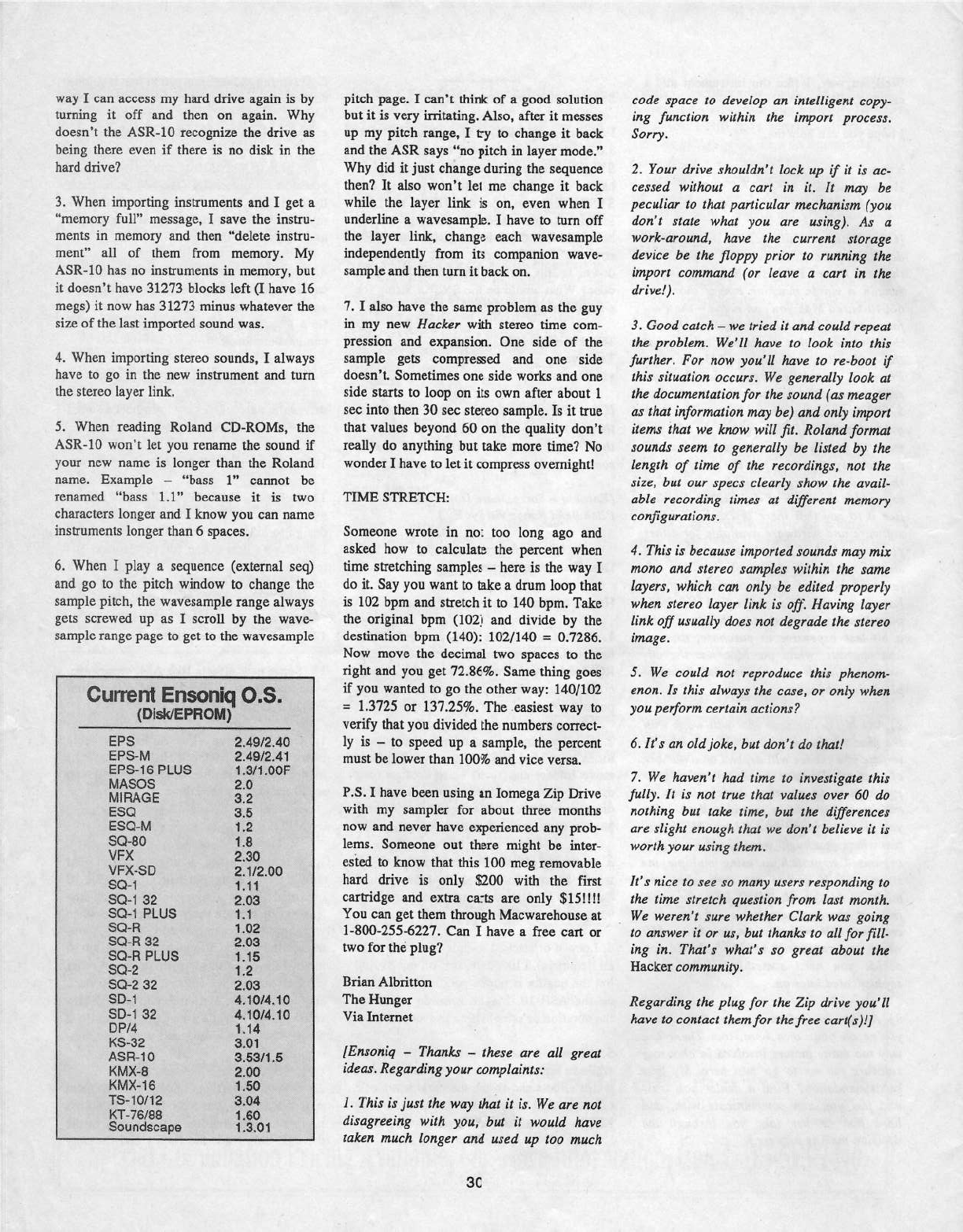
way
I
can
access
my
hard
drive
again
is
by
turning
it
off
and
then
on
again.
Why
doesn't
the
ASR-10
recognise
the
drive
as
being
there
even
if
there
is
no
disk
in
the
hard
drive?
3.
When
importing
instruments
and
I
get
a
"memory
full"
message,
I
save
the
instru-
ments
in
memory
and
then
"delete
instru-
ment"
all
of
them
from
memory.
My
ASR-10
has
no
instruments
in
memory,
but
it
doesn't
have
3l2'l3
blocks
left
[I
have
16
megs)
it
now
has
31273
minus
whatever
the
sire
of
the
la.st
imported
sound
was.
4.
When
importing
stereo
sounds,
I
always
have
to
go
in
the
new
instrument
and
tum
the
stereo
layer
link.
5.
‘When
reading
Roland
CD-RDMs,
the
ASR-10
won't
let
you
rename
the
sound
if
your
new
name
is
longer
than
the
Roland
name.
Example
-
"bass
1"
cannot
be
renamed
"bass
1.1"
because
it
is
two
characters
longer
artd
I
know
you
can
name
insnuments
longer
than
I5
spaces.
ti.
When
I
play
a
sequence
(extemal
seq)
and go
to
the
pitch
window
to
change
the
sample
pitch,
the
wavesample
range
always
gets
screwed
up
as
I
scroll
by
the
wave-
sample
range
page
to
get
to
the
wavesample
Current
Ensoniq
O.S.
(DidclEPFiOht)
-
EPS
EPS-M
E
PS-
1
E
PLUS
MASOS
MIRAGE
EEG
EEE-D-iv‘!
SQ-H0
l
VFX
VFX-SD
SQ-1
SQ-1
32
E-{I-1
PL
US
SO-H
SC|—Ft
32
SD-Ft
P
LUS
SQ-2
SC'.'t—2
32
ED-t
SI}-1
32
DF04
HS-32
ASH-10
I-(MK-E
HMK-10
TS-1
0l1
2
KT-Thine
Soundscapo
2.40l2.40
2.40l2.-41
1
.31“!
.00F
2.0
!'~l'r":"l‘i':"r"l'*i'*:"*!'~"'l“r*.-‘F'7lF*l'
e~eee*a:ger~e~
he
Ct
4.1:0l-4.10
4.‘t0l4.10
1.1-4
3.01
=
3.53l1.5
2.00
t"".""F‘i'."'
W
bees
-it
pitch
page.
I
can't
think
of
a
good
solution
but
it
is
very
irritating.
Also,
after
it
messes
up
my
pitch
range,
I
try
to
change
it
back
and
the
ASR
says
"no
pitch
in
layer
mode."
‘Why
did
it
just
change
during
the
sequence
then?
It
also
won't
let
me
change
it
back
while
the
layer
link
is
on,
even
when
I
underline
a
wavesample.
I
have
to
tnrn
off
the
layer
link,
change
each
wavesample
independently
from its
companion
wave-
sample
and
then
tum
it
back
on.
T.
I
also
have
the
same
problem
as
the
guy
in
my
new
Hacker
with
stereo
time
com-
pression
and
expansion.
One
side
of
the
sample
gets
compressed
and one
side
doesn't.
Sometimes
one
side
works
and
one
side
starts
to
loop
on
its
own
after
about
1
sec
into
then
30
sec
stereo
sample.
Is
it
true
that
values
beyond
60 on
the
quality
don't
really
do
anything
but
take
more
time?
No
wonder
I
have
to
let
it
compress
overnight!
TIME
STRETCH:
Someone
wrote
in
not
too
long
ago and
asked
how
to
calculate
the
percent
when
time
stretching
samples
-
here
is
the
way
I
do
it.
Say
you
want
to
take
a
drum
loop
that
is
102
bpm
and
stretch
it
to
140
bpm.
Take
the
original
bpm
(102)
and
divide
by
the
destination
bpm
(140):
102,l140
=
0.'i'2ilfi.
New
move
the
decimal
two
spaces
to
the
right
and
you
get
'l2.3ti%.
Same
thing
goes
if
you
wanted
to
go
the
other
way:
140,l102
=
1.3325
or
137.25%.
The
easiest
way
to
verify
that
you
divided
the
numbers
correct-
ly
is
-
to
speed
up
a
sample,
the
percent
must
be
lower
than
100%
and
vice
versa.
P.S.
I
have
been
using
an
Iomega
Zip
Drive
with
my
sampler
for
about
three
months
new
and
never
have
experienced
any
prob-
lems.
Someone
out
there
might
be
inter-
ested
to
know
that
this
100
meg
removable
hard
drive
is
only
$200
with
the
first
cartridge
and
extra
carts
are
only
$15!!!!
You
can
get
them
through
Macwarehouse
at
1-E00-255-622?.
Can
I
have
a
free
cart
or
two
for
the
plug?
Brian
Albritton
The
Hunger
“ills
Internet
{Ensoniq
-
Thanks
-
these
are
all
great
ideas.
Regarding
your
complaints:
l.
This
is
just
the
way
that
it
is.
We
are
not
disagreeing
with
you,
but
it
would
have
taken
much
longer
and
used
up
too
much
30
code
space
to
develop
an
intelligent
copy-
ing
function
within
the
import
process.
Sorry.
2.
Your
drive
shouldn't
lock
up
if
it
is
ac-
cessed
without
a
cart
in
it.
it
may
be
peculiar
to
that
particular
mechanism
{
you
don't
state
what
you
are
using).
As
a
work-around,
have
the
current
storage
device
be
the
floppy
prior
to
running
the
import
command
for
leave
a
cart
in
the
drive.",l.
3.
Good
catch
-
we
tried
it
and
could
repeat
the
problem.
We'll
have
to
look
into
this
further.
For
now
you'll
have
to
re-boot
if
this
situation
occurs.
We
generally
look
at
the
documentation
for
the
sound
l
as
meager
as
that
information
may
be)
and
only
import
items
that
we
know
will
fit.
Roland
format
sounds
seem
to
generally
be
listed
by
the
length
of
time
of
the
recordings,
not
the
sire,
but
our
specs
clearly
show
the
avail-
able
recording
times
at
difierent
memory
configurations.
4.
This
is
because
imported
sounds
may
mix
mono
and
stereo
samples
within
the
same
layers,
which
can
only
be
edited
properly
when
stereo
layer
link
is
ojjf.
Having
layer
link
ofl’
usually
does
not
degrade
the
stereo
image.
5.
We
could
not
reproduce
this
phenom-
enon.
ls
this
always
the
case,
or
only
when
you
perform
certain
actions?
6.
it's
an
oldjoke,
but
don't
do
thatl
F’.
We
haven't
had
time
to
investigate
this
fully.
it
is
not
true
that
values
over
60 do
nothing
but
take
time,
but
the
differences
are
slight
enough
that
we
don't
believe
it
is
worth
your
using
them.
it's
nice
to
see
so
many
users
responding
to
the
time
stretch
question
from
last
month.
We
weren't
sure
whether
Clark
was
going
to
answer
it
or
us,
but
thanks
to
all
for
fill-
ing
in.
That's
what's
so
great
about
the
Hacker
community.
Regarding
the
plug
for
the
Zip
drive
you'll
have
to
contact
them
for
the
free
cart{s,llj
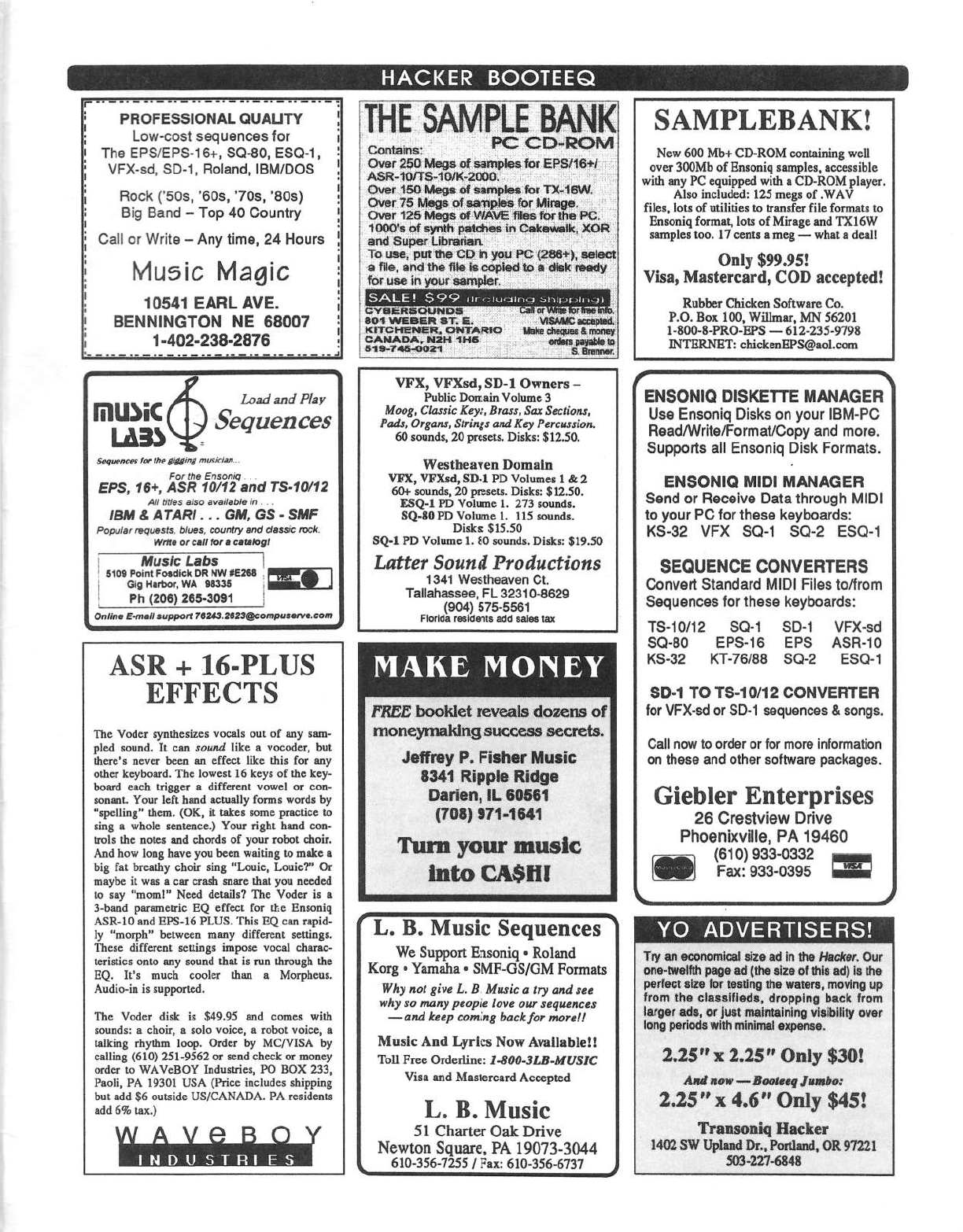
.|..§—..n.?.—
L_
II-l"F|
‘I-
'—
'I'I'l-'RI
PROFESSIONAL
QUAUTY
Low-cost
sequences
for
The
EPSIEPS-1
E+,
SCl—EiD.
ESE-i-1,
VFX-so,
SD-1.
Ftoland.
IBMIDDS
Fiock
{‘5Us.
’6tls.
‘lies,
‘Btls}
Big
Band
—
Top
40
Country
all
or
Write
-
Any
time,
24
Hours
Music
Magic
10541
EQHL
AVE.
BENNINGTON
NE
5300?
1
-402-233-2B?B
'F'i-I*h'1I*I-K*iiIԤ*jIIiIK--
ii-'33
'3
31"‘
C)
c
Load and
Piss-
liIl.l>i
ma)
2
Sequences
aeetrenees
for
I.-‘ts
g.tg[r'o]
musician...
For
the
E
nsomiq
.
EPS,
16+,
ASR
10312
and
TS-10112
Arr
trttes
aiso
available
in
. .
IBM
8-
ATARI.
.
.
GM.
GS
-
EMF
Popular
requests.
etues.
country
and
ctesstc
rock.
Write
or
coil
for
I
catalog!
'
oint
-
.
.
.
l
stcs
F
i
i
Hlrbsswl
-=1»
!
i
Ph_i2i1E}
255-3091
_i
Oniine
E-ntsa‘
support
I-'l1dJ.2e23@cempuaenre.eom
ASR
+
16-PLUS
EFFECTS
The
Voder
synthesizes
vocals
out
of
any
sam-
pled
sound.
It
can
round
like
a
vocoder,
but
there's
never
been
a.n
effect
like
this
for
any
ot.her
keyboard.
The
lowest
16
keys
of
the
key-
board
each
trigger
a
different
trowel or
con-
sonant.
Your
left
hand
actually
forms
words
by
"spelling"
them.
(OK,
it
takes
some
practice
to
sing
a
whoie
sentence.}
‘four
right
hand
con-
trols
the
notes
and
chords
of
your
robot
choir.
and
how
iong
have
you
been
waiting
to
make
e
big
fat
breathy
choir
sing
"Louie,
Louie?"
Or
maybe
it
was
a
car
crash
snare
that
you
needed
to
say
“mom!”
hieed
details? The
Voder
is
a
3-band
parametric
Eli}
effect
for
the
Ensoniq
ASR-IE-‘
and
EPS-Id
PLUS.
This
EQ
can
rapid-
iy
"morph"
between
many
different
settings.
These
different
settings
impose
vocal
charac-
teristics
onto
arty
sound
that
is
run
through
the
HQ.
1t‘s
much
cooler
than
a
Morpheus.
Audio-in
is
supported.
The
Voder
disk
is
$49.55
and
comes
with
sounds:
n
choir,
a
solo
voice,
s
robot
voice,
a
talking
rhythm
loop.
Order
by
MCIVISA
by
calling
{I510}
251-9562
or
send
check
or
money
order
to
Ve'.aVeBOY
Indusu-ies,
PO
BOX
1'33,
Paoli,
Pa.
193D1
USA
[Price
includes
shipping
but
add
$5
outside
USICANADA.
PA
residets
add
6%
taJt.}
-_-
-I
F‘?
ti
3i
“B-‘FF?
I-I'_:"I
I
1-
L
THE
SAMPLE
BANKl
Bantam:
ac
CD-ROM
Over
25!]
Megs
ct.sarnp=lea
for
EPSHB-I-I
ASR-tttfi
E-1
t?s‘i<-2fl»Bfl.-
-
"
--
Ovet._15.t1
Mega
ct
sam=ptea'ior
Tit-115W.
Q‘-"Bf
1'5
as
fi‘.|iPesI-
.
"
Over
125
Megs
of
farther
PG.
mac's
at
ewn
in
1-test
and
Super
Libra-riatn-
-
'
To
use.
otttthe
OD
in
you
PD'{28fl1I-3.
select
a
file.
and
tltefila
is
oopiedto
a'dtetr-ready
foruaeinyour"earnpler.'..
' '
I
ti|"|-
.1|I_.t-_tlt't-
,t
L:-l't.'|
It
.14
4-.;i
_'
CYH
RIDIJHDH
*"‘
“"
-_
-
-'-"=
nos
winner
er.
ts.
-vtevuc
nmipid.
HHIEHEIIIEII.
UPHTARIB
Ihlre
el1'eilIll_|r||:at||y"
CANADA,
NIH
ilrllt
3
1
“ml
W
E1!-1'15-EH21
"
fl_
H-“rm
l
E
VFX,
Vlilisd,
SD-1
Owners
-
Public
Domain
Volume
3
Moog,
Classic
Keys.
Brass,
Sax
Sections.
Pods.
Organs.
Strings
and
Key
Percussion.
E0
sounds,
20
presets.
Disks:
$12.50.
Westheatren
Domain
VFX,
V'li-‘Iliad,
SD-1
PD
Volumes
I
it
2
so-t
sounds,
IO
presets.
Disks:
$12.5-D.
ESQ-1
PD
Volume
1.
21-'3
sounds.
SQ-Bl]
PD
Volume
1.
115
sounds.
Disks:
-'i15.$D
SQ-1
PD
Volume
1.
ED
sounds.
Disks:
$19.50
Latter
Sound
Productions
1341
Westlteaven
Ct.
Tallahassee,
F
L
32310-B629
{Q04}
5?5-5551
Florida
residents
add
sales
ta:
FREE
booklet
reveals
deserts
of
nt-oneyntaltlng
success
secrets.
Jeffrey
P.
Fisher
Music
8341
Hippie
Ridge
Dalian.
tL
sesst
[T138]
971-1641
Tum
your
music
Into
CASH!
L.
B.
Music
Sequences
We
Support
Ensoniq
I
Roland
Korg
I
Yamaha
I
SMF-GSIGM
Formats
Why
not
give
L.
B.
Music
a
try
and
see
why
so
many
peopie
love
our
sequences
—
and
keep
coining
bocicfor
rnoreii
Music
and
Lyrics
New
Ayailabiell
Toll.
Free
Urdefline:
I-SEO-SLR-MUSIC
Visa
and
Mastercard
Accepted
L.
B.
Music
51
Charter
Oak
Drive
Newton
Square.
PA
19013-3044
sto-ass-"1255
I
Fart:
ere-ass-srsr
SAMPLEBANK!
New
sea
Mh+
CD-ROM
containing
well
over
3il'[lli-lb
of
Ensoniq
samples,
accessible
with
any
PC
equipped
with
a
CD-ROM
player
also
included:
125
megs
of
.‘F-‘AV
files,
lots
of
utilities
to
transfer
file
formats
to
Ensoniq
format,
lots
of
Mirage
and
T.1tl
cw
samples
too.
1'?
cents
a
meg
—
what
a
dcall
Only
$99.95!
Visa,
Mastercard,
COD
accepted!
Rubber
Chicken
Software
Co.
P.O.
Hos.
ltltl,
Willmar,
MN
56201
I-EDD-B-PRO-EPS
--
612-235-W93
INTERNET:
chicks-nEPS@sol.eorn
ENSOHIO
DISKETTE
MANAGER
Use
Ensoniq
Disks
on
your
IBM-PC
Headr"sVrite!Formatr'Copy
and
more.
Supports
all
Ensoniq
Disk
Formats.
ENSONIQ
MIDI
MANAGER
Send
or
Receive
Data
through
MIDI
to
your
PC1'orthese
keyboards:
KS-32
VFJIC
SQ-1
SQ-2
ESQ-1
SEQUENCE
CONVERTERS
Convert
Standard
MIDI
Files
toftrom
Sequences
for
these
keyboards:
TS-‘iDr‘12
SQ-1
SD-1
VF!-sd
SQ-BU
EPS-16
EPS
ASH-10
KS-32
KT-?Er"BB
SQ-2
ESQ-1
SD-1
TO
TS-1ih'1
2
CONVERTER
for
VFX-sd
or
SD-1
sequences
s
songs.
C-all
now
to
order
or
for
more
information
on
these
and
other
software
packages.
Giebler
Enterprises
26
Crestview
Drive
Phoenixviile,
PA
19460
‘?l.?=’§§i.'§§’§§
E
YO
ADVERTISERS!
Try
an
economical
size
ad
in
the
Hacker.
Our
one-twetiat
page an
[the
size
oi
this
ad}
ls
the
perfect
size
for
testing
the
waters,
rnotrlnq
up
from
the
classifieds.
dropping
hack
from
larger
ads.
or
just
maintaining
visibility
over
lone
periods
with
ntinirnal
expense.
2.25"
I
2.25"
Only
$30!
.-trtdrteer--Beeteeqleulber
2.25"
Jr
4.6"
Only
$45!
Transaniq
Hacker
1462
SW
Upland
D11,
Portland,
OR
9'l'221
$03-Z2’?-6848
TRANSONIQ
HACKER
Hiiiéiiigs
PAID
1402
SW
UPIAND
DFi.,
PORTLAND,
DR
QTEE1
PQHTLAMD,
{JR
PERMIT
ND.
11
SUBSCRIPTION
MATERIAL
ADDRESS
CORRECTION
REQUESTED
DATED
“m_EHmL_
TIME
UALUE
Postmaster:
Please
return
Form
354?
as
soon
as
possible
so
we
can
change
our
records.
This
is
a
monthly
publication.
"FF-‘ubllsher:
Eric
Gelsllnger
n
rates:
‘Please
sendlior
rafe
card.
_ _
E’
Editritt:
Jane
Talisman
Rates
for
authors:
Please
send
for
writer-into
card.
Our
{somewhat
regular}
illustrious
bsvy
ct
wrllers
includes:
Graig
Andsrtcn,
Hobby
Subscriptions:
12
monthly
issues.
US:
$23!yesr,
all
others:
$3:h'yesr.
Payable
,
Barman,
Paul
Bissell,
Steve
E-yhurst,
Barry
Darson,
Mark
Glllton,
Anthony
Ferrsra,
in
US
funds.
1
Pat
Finnigan,
Charles
Ft.
Fischer,
Jeltrey
Fisher,
Gary
Gleblsr,
Jim
Grcts,
Garth
Hlelte.
Bryce
lnman,
Jet!
Jstton,
Dara
Jones,
E-trad
iiauiman,
Johnny
ltlcnsrls,
,1
John
Lol
ink,
Danlel
Mandel,
Sam
lvllms,
Jsllrey
Fihoads,
Brlsn
Host,
Clark
Transonlg
Hacker
ls
the
independent
user's
news
magazine
for
Ensoniq
'
Salisbury,
Tom
Shear,
Joe
Slater,
liirk
Sllnkard,
Jack
Tolin,
and
Stave
Vincent.
products.
Transortiq
Hacker
is
not
affiliated
in
any
way
with
Ensoniq
Oorp.
'
Ensoniq
and the
names
of
their
varlous
products
are
registered
trademarks
oi
i
the
Ensoniq
Corp.
Opinions
expressed
are
those
oi
the
authors
and
do
not
i
Oopyrlght
tees.
Transonlo
Hacker,
14112
SW
Upland
Drive,
Portland,
OF!
Bacagsgrlly
reflect
those
oi
the
publisher
or
Ensonio,
Oorp.
Printed
in
the
‘ts
tats
.
W221.
Phone:
{sea}
ssr-seas
rs
arn
to
Q
pm
Pscltlc
West
Coast
Tlmel.
n1
s
J
L
_
.
._
.
_,.._._
4_
_
_
__
.
__——_
-
=.._.
-~*-TIT"
oigsyggos
if
+f
-—_"—T*
it
E"!
er_'tn-onig_vlHet;_i_t._t_|_1I_§Lt!_1_,en
Lll
.
Q.
-
___
i
M
ass-10
8Hou.rs
.
$119.95
Hgljpyllgppy
I
'
TS-10
?Hours
.
$119.95
3,]?
gfiyt
r
'
-
—--
|-
"I
"'
_ _
.
-
KS-32
sin
Hours
$119.95
T
"
-_
SD-1
..
6Hours
sss-.95
ll
Ii
||
I:
I
—l.
Why
cram
the
books?
Have
fun
—
watch
TV!
Value
——
even
the
KS-32
set
is
over
sis
hours
of
instruction!
If
you
follow
the
instructions
it
should
take
at
least
ten
hours
to
complete
each
course.
lvlost
of
our
customers
are
saying
that
it
takes
25
-
30
hours
to
complete
the
ASR-10
set
--
that's
less
than
$12,-‘hour
for
detailed
instructions
on
YOUR
keyboard.
(Remember
you
can
rewind
and
watch
it
again
--
try
that
with
lessons!)
ASR-10
—
S
hours,
TS-12
—
T
hours,
TS-10
-
‘Ir’
hours,
SD-1
-
6
1,’2
hours.
Get
the
most
out
of
your
key-
board
by
really
getting
to
know
it
like
a
friend.
Each
tape
set
will
take
you
from
novice
to
expert.
You'll
be
answering
questions
you
couldn‘t
even
ask
before!
All
of
the
videos
use
multiple
camera
shoots.
You
see
a
concept
and the
goal.
With
the
goal
defined,
you'll
be
walked
through
to
the
solution
step
by
step,
button
ity
button!
With
the
use
of
analogies,
charts
and
CLOSE
UP
shots...
you
tviii
master
your
keyboard.
{We
even
cover
common
mistakes
and
the
workarounds!)
“
Call
our
lr.rli-lime
number,
1-8lll.l-687-1607,
and
ask
for
Marilyn
“
II
Covert
Videos,
519
East
I-30,
Suite
144,
Rockwall,
TX
T503’?
EE-r’
a.-.1
I
.
"
TS-12
...
?
Hours
.
. .
$119.95
i
._.l
I
;
_
-
—-
_
___
"
.
—
—
-'-
