Webgl20 Reference Guide
User Manual:
Open the PDF directly: View PDF  .
.
Page Count: 8

www.khronos.org/webgl©2019 The Khronos® Group Inc - Rev. 0219
WebGL 2.0 API Quick Reference Guide Page 1
ArrayBuer and Typed Arrays [5.13]
Data is transferred to WebGL using ArrayBuer and views.
Buers represent unstructured binary data, which can be
modied using one or more typed array views. Consult the
ECMAScript specicaon for more details on Typed Arrays.
Buers
ArrayBuer(ulong byteLength);
byteLength: read-only, length of view in bytes.
Creates a new buer. To modify the data, create one or more
views referencing it.
Views
In the following, ViewType may be Int8Array, Int16Array,
Int32Array, Uint8Array, Uint16Array, Uint32Array, Float32Array.
ViewType(ulong length);
Creates a view and a new underlying buer.
length: Read-only, number of elements in this view.
ViewType(ViewType other);
Creates new underlying buer and copies other array.
ViewType(type[] other);
Creates new underlying buer and copies other array.
ViewType(ArrayBuer buer, [oponal] ulong byteOset,
[oponal] ulong length);
Create a new view of given buer, starng at oponal byte
oset, extending for oponal length elements.
buer: Read-only, buer backing this view
byteOset: Read-only, byte oset of view start in buer
length: Read-only, number of elements in this view
Other Properes
byteLength: Read-only, length of view in bytes.
const ulong BYTES_PER_ELEMENT: element size in bytes.
Methods
view[i] = get/set element i
s
et(ViewType
other
[, ulong
oset
]);
se
t(type[] other
[,
ulong oset
]
);
Replace elements in this view with those from other, starng
at oponal oset.
ViewType subArray(long begin
[,
long end
]
);
Return a subset of this view, referencing the same underlying
buer.
WebGLQuery [3.2]
Created by createQuery, made acve by
beginQuery, concluded by endQuery,
destroyed by deleteQuery
WebGLSampler [3.3]
Created by createSampler, bound
by bindSampler, destroyed by
deleteSampler
WebGLSync [3.4]
Created by fenceSync, blocked on by
clientWaitSync, waited on internal GL
by waitSync, queried by getSynciv,
destroyed by deleteSync
WebGLTransformFeedback
[3.5]
Created by createTransformFeedback,
bound by bindTransformFeedback,
destroyed by deleteTransformFeedback
WebGLVertexArrayObject
[3.6]
Created by createVertexArray,
bound by bindVertexArray,
destroyed by deleteVertexArray
WebGLTM is an immediate-mode 3D rendering API from The Khronos® Group
designed for the web. It is derived from OpenGL® ES 3.0, and provides similar
rendering funconality, but in an HTML context. WebGL 2 is not enrely
backwards compable with WebGL 1. Exisng error-free content wrien against
the core WebGL 1 specicaon without extensions will oen run in WebGL 2
without modicaon, but this is not always the case.
The WebGL 2 specicaon shows dierences from the WebGL 1 specicaon.
Both WebGL specicaons are available at khronos.org/webgl. Unless otherwise
specied, the behavior of each method is dened by the OpenGL ES 3.0
specicaon. The OpenGL ES specicaon is at khr.io/glesregistry.
• [n.n.n] refers to secons in the WebGL 1.0 specicaon.
• [n.n.n] refers to secons in the WebGL 2.0 specicaon.
• Content in blue is newly added with WebGL 2.0.
• Content in purple or marked with
•
has no corresponding OpenGL ES 3.0 funcon.
Per-Fragment Operaons [5.14.3]
void blendColor(clampf red, clampf green, clampf blue,
clampf alpha);
void blendEquaon(enum mode);
mode: See modeRGB for blendEquaonSeparate
void blendEquaonSeparate(enum modeRGB,
enum modeAlpha);
modeRGB, and modeAlpha: FUNC_ADD, FUNC_SUBTRACT,
FUNC_REVERSE_SUBTRACT
void blendFunc(enum sfactor, enum dfactor);
sfactor: Same as for dfactor, plus SRC_ALPHA_SATURATE
dfactor: ZERO, ONE, [ONE_MINUS_]SRC_COLOR,
[ONE_MINUS_]DST_COLOR, [ONE_MINUS_]SRC_ALPHA,
[ONE_MINUS_]DST_ALPHA, [ONE_MINUS_]CONSTANT_COLOR,
[ONE_MINUS_]CONSTANT_ALPHA
sfactor and dfactor may not both reference constant color
void blendFuncSeparate(enum srcRGB, enum dstRGB,
enum srcAlpha, enum dstAlpha);
srcRGB, srcAlpha: See sfactor for blendFunc
dstRGB, dstAlpha: See dfactor for blendFunc
void depthFunc(enum func);
func: NEVER, ALWAYS, LESS, [NOT]EQUAL, {GE, LE}QUAL, GREATER
void sampleCoverage(oat value, bool invert);
void stencilFunc(enum func, int ref, uint mask);
func: NEVER, ALWAYS, LESS, LEQUAL, [NOT]EQUAL, GREATER,
GEQUAL
void stencilFuncSeparate(enum face, enum func, int ref,
uint mask);
face: FRONT, BACK, FRONT_AND_BACK
func: NEVER, ALWAYS, LESS, LEQUAL, [NOT]EQUAL, GREATER,
GEQUAL
void stencilOp(enum fail, enum zfail, enum zpass);
fail, zfail, and zpass: KEEP, ZERO, REPLACE, INCR, DECR, INVERT,
INCR_WRAP, DECR_WRAP
void stencilOpSeparate(enum face, enum fail, enum zfail,
enum zpass);
face: FRONT, BACK, FRONT_AND_BACK
fail, zfail, and zpass: See fail, zfail, and zpass for stencilOp
WebGL Context Creaon [2.1]
To use WebGL, the author must obtain a WebGL rendering
context for a given HTMLCanvasElement. This context
manages the OpenGL state and renders to the drawing buer.
[canvas].getContext(
"webgl", WebGLContextAributes? oponalAribs)
Returns a WebGL 1.0 rendering context
[canvas].getContext(
"webgl2", WebGLContextAributes? oponalAribs)
Returns a WebGL 2.0 rendering context
Interfaces
WebGLContextAributes
[5.2]
This interface contains requested drawing surface aributes
and is passed as the second parameter to getContext. Some
of these are oponal requests and may be ignored by an
implementaon.
alpha Default: true
If true, requests a drawing buer with an alpha channel for the
purposes of performing OpenGL desnaon alpha operaons
and composing with the page.
depth Default: true
If true, requests drawing buer with a depth buer of at least
16 bits. Must obey.
stencil Default: false
If true, requests a stencil buer of at least 8 bits. Must obey.
analias Default: true
If true, requests drawing buer with analiasing using its choice
of technique (mulsample/supersample) and quality. Must obey.
premulpliedAlpha Default: true
If true, requests drawing buer which contains colors with
premulplied alpha. (Ignored if alpha is false.)
preserveDrawingBuer Default: false
If true, requests that contents of the drawing buer remain
in between frames, at potenal performance cost. May have
signicant performance implicaons on some hardware.
preferLowPowerToHighPerformance Default: false
Provides a hint suggesng that implementaon create a context
that opmizes for power consumpon over performance.
failIfMajorPerformanceCaveat Default: false
If true, context creaon will fail if the performance of the
created WebGL context would be dramacally lower than that
of a nave applicaon making equivalent OpenGL calls.
Buer Objects
[5.14.5] [3.7.3]
Once bound, buers may not be rebound with a dierent target.
void bindBuer(enum target, WebGLBuer? buer);
target: ARRAY_BUFFER, ELEMENT_ARRAY_BUFFER,
PIXEL_[UN]PACK_BUFFER, COPY_{READ, WRITE}_BUFFER,
TRANSFORM_FEEDBACK_BUFFER, UNIFORM_BUFFER
typedef (ArrayBuer or ArrayBuerView) BuerDataSource
void buerData(enum target, long size, enum usage);
target: See target for bindBuer
usage: STREAM_{DRAW, READ, COPY}, STATIC_{DRAW, READ, COPY},
DYNAMIC_{DRAW, READ, COPY}
void buerData(enum target, ArrayBuerView srcData,
enum usage, uint srcOset[, uint length=0]);
target and usage: Same as for buerData above
void buerData(enum target, BuerDataSource data,
enum usage);
target and usage: Same as for buerData above
void buerSubData(enum target, long oset,
BuerDataSource data);
target: See target for bindBuer
void buerSubData(enum target, intptr dstByteOset,
ArrayBuerView srcData, uint srcOset[, uint length=0]);
target: See target for bindBuer
void copyBuerSubData(enum readTarget, enum writeTarget,
intptr readOset, intptr writeOset, sizeiptr size);
•
void getBuerSubData(enum target, intptr srcByteOset,
ArrayBuerView dstBuer[, uint dstOset=0[,
uint length=0]]);
WebGLObject [5.3]
This is the parent interface for all WebGL resource objects:
WebGLBuer [5.4]
Created by createBuer, bound by bindBuer,
destroyed by deleteBuer
WebGLFramebuer [5.5]
Created by createFramebuer, bound
by bindFramebuer, destroyed by
deleteFramebuer
WebGLProgram [5.6]
Created by createProgram, used by
useProgram, destroyed by deleteProgram
WebGLRenderbuer [5.7]
Created by createRenderbuer, bound
by bindRenderbuer, destroyed by
deleteRenderbuer
WebGLShader [5.8]
Created by createShader, aached to program
by aachShader, destroyed by deleteShader
WebGLTexture [5.9]
Created by createTexture, bound by
bindTexture, destroyed by deleteTexture
WebGLUniformLocaon
[5.10]
Locaon of a uniform variable in a shader
program.
WebGLAcveInfo [5.11] Informaon returned from calls to
getAcveArib and getAcveUniform. The
read-only aributes are:
int size enum type DOMstring name
WebGLShaderPrecision-
Format [5.12]
Informaon returned from calls to
getShaderPrecisionFormat.
The read-only aributes are:
int rangeMin
int rangeMax
int precision

www.khronos.org/webgl©2019 The Khronos® Group Inc - Rev. 0219
WebGL 2.0 API Quick Reference Guide Page 2
Special Funcons [5.13.3]
[3.7.2]
•
contextStruct getContextAributes()
[5.13.2]
void disable(enum cap);
cap: BLEND, CULL_FACE, DEPTH_TEST, DITHER,
POLYGON_OFFSET_FILL, SAMPLE_ALPHA_TO_COVERAGE,
SAMPLE_COVERAGE, SCISSOR_TEST, STENCIL_TEST
void enable(enum cap);
cap: See cap for disable
void nish();
[5.13.11]
void ush();
[5.13.11]
enum getError();
Returns: OUT_OF_MEMORY, INVALID_{ENUM, OPERATION,
FRAMEBUFFER_OPERATION, VALUE}, NO_ERROR,
CONTEXT_LOST_WEBGL
any getParameter(enum pname);
pname: {ALPHA, RED, GREEN, BLUE, SUBPIXEL}_BITS,
ACTIVE_TEXTURE, ALIASED_{LINE_WIDTH, POINT_SIZE}_RANGE,
ARRAY_BUFFER_BINDING, BLEND_DST_{ALPHA, RGB},
BLEND_EQUATION_{ALPHA, RGB}, BLEND_SRC_{ALPHA, RGB},
BLEND[_COLOR], COLOR_{CLEAR_VALUE, WRITEMASK},
COPY_{READ, WRITE}_BUFFER_BINDING,
[NUM_]COMPRESSED_TEXTURE_FORMATS, CULL_FACE[_MODE],
CURRENT_PROGRAM,
DEPTH_{BITS, CLEAR_VALUE, FUNC},
DEPTH_{RANGE, TEST, WRITEMASK},
DRAW_BUFFERi,
DRAW_FRAMEBUFFER_BINDING,
ELEMENT_ARRAY_BUFFER_BINDING, DITHER,
FRAMEBUFFER_BINDING, FRONT_FACE,
FRAGMENT_SHADER_DERIVATIVE_HINT,
GENERATE_MIPMAP_HINT, LINE_WIDTH,
MAX_3D_TEXTURE_SIZE, MAX_ARRAY_TEXTURE_LAYERS,
MAX_CLIENT_WAIT_TIMEOUT_WEBGL,
MAX_COLOR_ATTACHMENTS,
MAX_COMBINED_FRAGMENT_UNIFORM_COMPONENTS,
MAX_[COMBINED_]TEXTURE_IMAGE_UNITS,
MAX_COMBINED_UNIFORM_BLOCKS,
MAX_COMBINED_VERTEX_UNIFORM_COMPONENTS,
MAX_DRAW_BUFFERS, MAX_ELEMENT_INDEX,
MAX_ELEMENTS_{INDICES, VERTICES},
MAX_FRAGMENT_INPUT_COMPONENTS,
MAX_FRAGMENT_UNIFORM_{BLOCKS, COMPONENTS},
MAX_PROGRAM_TEXEL_OFFSET, MAX_SAMPLES,
MAX_SERVER_WAIT_TIMEOUT, MAX_TEXTURE_LOD_BIAS,
MAX_TRANSFORM_FEEDBACK_INTERLEAVED_COMPONENTS,
MAX_TRANSFORM_FEEDBACK_SEPARATE_COMPONENTS,
MAX_TRANSFORM_FEEDBACK_SEPARATE_ATTRIBS,
MAX_UNIFORM_BLOCK_SIZE,
MAX_UNIFORM_BUFFER_BINDINGS,
MAX_{CUBE_MAP_TEXTURE, RENDERBUFFER, TEXTURE}_SIZE,
MAX_VARYING_{COMPONENTS, VECTORS},
MAX_VERTEX_{ATTRIBS, TEXTURE_IMAGE_UNITS},
MAX_VERTEX_UNIFORM_{BLOCKS, COMPONENTS, VECTORS},
MAX_VIEWPORT_DIMS, PACK_ALIGNMENT,
MIN_PROGRAM_TEXEL_OFFSET, PACK_ROW_LENGTH,
PACK_SKIP_{PIXELS, ROWS}, PIXEL_[UN]PACK_BUFFER_BINDING,
POLYGON_OFFSET_{FACTOR, FILL, UNITS},
RASTERIZER_DISCARD, READ_{BUFFER, FRAMEBUFFER_BINDING},
RENDERBUFFER_BINDING, RENDERER, SAMPLE_BUFFERS,
SAMPLE_[ALPHA_TO_]COVERAGE,
SAMPLE_COVERAGE_{INVERT, VALUE}, SAMPLES,
SCISSOR_{BOX, TEST}, SHADING_LANGUAGE_VERSION,
STENCIL_{BITS, CLEAR_VALUE, TEST},
STENCIL_[BACK_]{FAIL, FUNC, REF, VALUE_MASK, WRITEMASK},
STENCIL_[BACK_]PASS_DEPTH_{FAIL, PASS},
TEXTURE_BINDING_{2D, CUBE_MAP, 3D,_2D_ARRAY},
TRANSFORM_FEEDBACK_{ACTIVE, BINDING, BUFFER_BINDING},
TRANSFORM_FEEDBACK_PAUSED, UNIFORM_BUFFER_BINDING,
UNIFORM_BUFFER_OFFSET_ALIGNMENT, UNPACK_ALIGNMENT,
UNPACK_{COLORSPACE_CONVERSION_WEBGL, FLIP_Y_WEBGL,
PREMULTIPLY_ALPHA_WEBGL},
UNPACK_IMAGE_HEIGHT, UNPACK_ROW_LENGTH,
UNPACK_SKIP_{IMAGES, PIXELS, ROWS},
VENDOR, VERSION, VIEWPORT, VERTEX_ARRAY_BINDING
any getIndexedParameter(enum target, uint index);
target: TRANSFORM_FEEDBACK_BUFFER_{BINDING, SIZE, START},
UNIFORM_BUFFER_{BINDING, SIZE, START}
void hint(enum target, enum mode);
target: GENERATE_MIPMAP_HINT
hint: FASTEST, NICEST, DONT_CARE
bool isEnabled(enum cap);
cap: RASTERIZER_DISCARD Also see cap for disable
void pixelStorei(enum pname, int param);
pname: PACK_ALIGNMENT, PACK_ROW_LENGTH,
PACK_SKIP_{PIXELS, ROWS}, UNPACK_ALIGNMENT,
UNPACK_COLORSPACE_CONVERSION_WEBGL,
UNPACK_{FLIP_Y_WEBGL, PREMULTIPLY_ALPHA_WEBGL},
UNPACK_IMAGE_HEIGHT, UNPACK_ROW_LENGTH,
UNPACK_SKIP_{PIXELS, ROWS, IMAGES}
Wring to the Draw Buer
[5.14.11] [3.7.9]
When rendering is directed to drawing buer, OpenGL ES
rendering calls cause the drawing buer to be presented to the
HTML page compositor at start of next composing operaon.
void drawArrays(enum mode, int rst, sizei count);
mode: POINTS, LINE_STRIP, LINE_LOOP, LINES, TRIANGLE_STRIP,
TRIANGLE_FAN, TRIANGLES
rst: May not be a negave value.
void drawElements(enum mode, sizei count, enum type,
intptr oset);
mode: POINTS, LINE_STRIP, LINE_LOOP, LINES, TRIANGLE_STRIP,
TRIANGLE_FAN, TRIANGLES
type: UNSIGNED_BYTE, UNSIGNED_SHORT
void clear(biield mask);
void vertexAribDivisor(uint index, uint divisor);
void drawArraysInstanced(enum mode, int rst, sizei count,
sizei instanceCount);
void drawElementsInstanced(enum mode, sizei count,
enum type, intptr oset, sizei instanceCount);
void drawRangeElements(enum mode, uint start, uint end,
sizei count, enum type, intptr oset);
View and Clip
[5.13.3 - 5.13.4]
The viewport species the ane transformaon of x and y from
normalized device coordinates to window coordinates. Drawing
buer size is determined by the HTMLCanvasElement.
void depthRange(oat zNear, oat zFar);
zNear: Clamped to the range 0 to 1 Must be <= zFar
zFar: Clamped to the range 0 to 1.
void scissor(int x, int y, long width, long height);
void viewport(int x, int y, long width, long height);
Detect and Enable Extensions [5.14]
•
string[ ] getSupportedExtensions();
•
object getExtension(string name);
Available in the WebGLRenderingContext interface.
Get informaon about the context
•
contextStruct getContextAributes();
Set and get state
Calls in this group behave idencally to their OpenGL ES
counterparts unless otherwise noted. Source and desnaon
factors may not both reference constant color.
Rasterizaon
[5.13.3]
void cullFace(enum mode);
mode: BACK, FRONT, FRONT_AND_BACK
void frontFace(enum mode);
mode: CCW, CW
void lineWidth(oat width);
void polygonOset(oat factor, oat units);
Detect context lost events [5.13.13]
bool isContextLost();
Programs and Shaders
[5.14.9] [3.7.7]
Shaders are loaded with a source string (shaderSource),
compiled (compileShader), aached to a program
(aachShader), linked (linkProgram), then used (useProgram).
[WebGLHandlesContextLoss] int getFragDataLocaon(
WebGLProgram program, DOMString name);
void aachShader(Object program, Object shader);
void bindAribLocaon(Object program, uint index,
string name);
void compileShader(Object shader);
Object createProgram();
Object createShader(enum type);
type: VERTEX_SHADER, FRAGMENT_SHADER
void deleteProgram(Object program);
void deleteShader(Object shader);
void detachShader(Object program, Object shader);
Object[ ] getAachedShaders(Object program);
any getProgramParameter(WebGLProgram? program,
enum pname);
Corresponding OpenGL ES funcon is GetProgramiv
pname: DELETE_STATUS, LINK_STATUS, VALIDATE_STATUS,
ATTACHED_SHADERS, ACTIVE_{ATTRIBUTES, UNIFORMS},
ACTIVE_UNIFORM_BLOCKS ,
TRANSFORM_FEEDBACK_BUFFER_MODE,
TRANSFORM_FEEDBACK_VARYINGS
string getProgramInfoLog(Object program);
any getShaderParameter(Object shader, enum pname);
Corresponding OpenGL ES funcon is GetShaderiv
pname: SHADER_TYPE, DELETE_STATUS, COMPILE_STATUS
string getShaderInfoLog(Object shader);
string getShaderSource(Object shader);
bool isProgram(Object program);
bool isShader(Object shader);
void linkProgram(Object program);
void shaderSource(Object shader, string source);
void useProgram(Object program);
void validateProgram(Object program);
Uniforms and Aributes
[5.14.10] [3.7.8]
Values used by the shaders are passed in as a uniform of vertex
aributes.
void disableVertexAribArray(uint index);
index: [0, MAX_VERTEX_ATTRIBS - 1]
void enableVertexAribArray(uint index);
index: [0, MAX_VERTEX_ATTRIBS - 1]
WebGLAcveInfo? getAcveArib(WebGLProgram program,
uint index);
WebGLAcveInfo? getAcveUniform(
WebGLProgram program, uint index);
int getAribLocaon(WebGLProgram program, string name);
any getUniform(WebGLProgram? program, uint locaon);
WebGLUniformLocaon? getUniformLocaon(
Object program, string name);
any getVertexArib(uint index, enum pname);
pname: CURRENT_VERTEX_ATTRIB ,
VERTEX_ATTRIB_ARRAY_{BUFFER_BINDING, ENABLED},
VERTEX_ATTRIB_ARRAY_{NORMALIZED, SIZE, STRIDE, TYPE},
VERTEX_ATTRIB_ARRAY_{INTEGER, DIVISOR}
long getVertexAribOset(uint index, enum pname);
Corresponding OpenGL ES funcon is GetVertexAribPointerv
pname: VERTEX_ATTRIB_ARRAY_POINTER
void uniform[1234]fv(WebGLUniformLocaon? locaon,
Float32List data[, uint srcOset=0[, uint srcLength=0]]);
void uniform[1234]iv(WebGLUniformLocaon? locaon,
Int32List data[, uint srcOset=0[, uint srcLength=0]]);
void uniform[1234]uiv(WebGLUniformLocaon? locaon,
Uint32List data[, uint srcOset=0[, uint srcLength=0]]);
void uniformMatrix[234]fv(WebGLUniformLocaon? locaon,
bool transpose, Float32List data[, uint srcOset=0[,
uint srcLength=0]]);
void uniformMatrix[234]x[234]fv(
WebGLUniformLocaon? locaon, bool transpose,
Float32List data[, uint srcOset=0[, uint srcLength=0]]);
void vertexArib[1234]f(uint index, ...);
void vertexArib[1234]fv(uint index, Array value);
void vertexAribI4[u]i[v](uint index, ...);
void vertexAribPointer(uint index, int size, enum type,
bool normalized, long stride, long oset);
type: BYTE, SHORT, UNSIGNED_{BYTE, SHORT}, FIXED, FLOAT
index: [0, MAX_VERTEX_ATTRIBS - 1]
stride: [0, 255]
oset, stride: must be a mulple of the type size in WebGL
void vertexAribIPointer(uint index, int size, enum type,
sizei stride, intptr oset);
Buer Objects (connued)
Object createBuer();
Corresponding OpenGL ES funcon is GenBuers
void deleteBuer(WebGLBuer? buer);
any getBuerParameter(enum target, enum pname);
target: See target for bindBuer
pname: BUFFER_SIZE, BUFFER_USAGE
bool isBuer(WebGLBuer? buer);
www.khronos.org/webgl©2019 The Khronos® Group Inc - Rev. 0219
WebGL 2.0 API Quick Reference Guide Page 3
Framebuer Objects
[5.14.6] [3.7.4]
Framebuer objects provide an alternave rendering target to
the drawing buer.
void bindFramebuer(enum target,
WebGLFramebuer? framebuer);
target: [READ_, DRAW_]FRAMEBUFFER
[WebGLHandlesContextLoss] enum
checkFramebuerStatus(
enum
target);
target: [READ_, DRAW_]FRAMEBUFFER
Returns: FRAMEBUFFER_{COMPLETE, UNSUPPORTED},
FRAMEBUFFER_INCOMPLETE_{ATTACHMENT, DIMENSIONS,
MULTISAMPLE, MISSING_ATTACHMENT},
FRAMEBUFFER_UNDEFINED
Object createFramebuer();
Corresponding OpenGL ES funcon is GenFramebuers
void
deleteFramebuer(
Object
buer);
void
framebuerRenderbuer(
enum
target,
enum
aachment,
enum
renderbuertarget,
WebGLRenderbuer
renderbuer);
target: FRAMEBUFFER
aachment: COLOR_ATTACHMENT0, COLOR_ATTACHMENTn
where n may be an integer from 1 to 15,
{DEPTH, STENCIL, DEPTH_STENCIL}_ATTACHMENT
renderbuertarget: RENDERBUFFER
bool isFramebuer(WebGLFramebuer framebuer);
void
framebuerTexture2D(
enum
target,
enum
aachment,
enum
textarget,
WebGLTexture
texture,
int
level);
target and aachment: Same as for framebuerRenderbuer
textarget: TEXTURE_2D, TEXTURE_CUBE_MAP_POSITIVE{X, Y, Z},
TEXTURE_CUBE_MAP_NEGATIVE{X, Y, Z},
any getFramebuerAachmentParameter(
enum
target,
enum
aachment,
enum
pname);
target and aachment: Same as for framebuerRenderbuer
pname: FRAMEBUFFER_ATTACHMENT_OBJECT_{TYPE, NAME},
FRAMEBUFFER_ATTACHMENT_TEXTURE_LEVEL,
FRAMEBUFFER_ATTACHMENT_TEXTURE_CUBE_MAP_FACE,
FRAMEBUFFER_ATTACHMENT_{ALPHA, BLUE, GREEN, RED}_SIZE,
FRAMEBUFFER_ATTACHMENT_COLOR_ENCODING,
FRAMEBUFFER_ATTACHMENT_COMPONENT_TYPE,
FRAMEBUFFER_ATTACHMENT_{DEPTH, STENCIL}_SIZE,
FRAMEBUFFER_ATTACHMENT_TEXTURE_LAYER
void blitFramebuer(int srcX0, int srcY0, int srcX1, int srcY1,
int dstX0, int dstY0, int dstX1, int dstY1, biield mask,
enum lter);
void framebuerTextureLayer(enum target,
enum aachment, WebGLTexture? texture, int level,
int layer);
void invalidateFramebuer(enum target,
sequence<enum> aachments);
void invalidateSubFramebuer (enum target,
sequence<enum> aachments, int x, int y, sizei width,
sizei height);
void readBuer(enum src);
Texture Objects
[5.14.8] [3.7.6]
Texture objects provide storage and state for texturing operaons.
WebGL adds an error for operaons relang to the currently bound
texture if no texture is bound.
void acveTexture(enum texture)
[5.14.3]
texture: [TEXTURE0..TEXTUREi] where i =
MAX_COMBINED_TEXTURE_IMAGE_UNITS - 1
void bindTexture(enum target, WebGLTexture? texture);
target: TEXTURE_{2D, 3D, 2D_ARRAY}, TEXTURE_CUBE_MAP
void copyTexImage2D(enum target, int level,
enum internalformat, int x, int y, long width,
long height, int border);
target: TEXTURE_2D, TEXTURE_CUBE_MAP_POSITIVE_{X,Y,Z}
TEXTURE_CUBE_MAP_NEGATIVE_{X,Y,Z}, TEXTURE_3D,
TEXTURE_2D_ARRAY
internalformat: See Tables 3.12, 3.13, 3.14 in the OpenGL ES 3
specicaon
void copyTexSubImage2D(enum target, int level,
int xoset, int yoset, int x, int y, long width,
long height);
target: See target for copyTexImage2D
Object createTexture();
Corresponding OpenGL ES funcon is GenTextures
void deleteTexture(Object texture);
void generateMipmap(enum target);
target: see target for bindTexture
any getTexParameter(enum target, enum pname);
target: TEXTURE_2D, TEXTURE_CUBE_MAP
pname: TEXTURE_BASE_LEVEL,
TEXTURE_COMPARE_{FUNC, MODE},
TEXTURE_IMMUTABLE_{FORMAT, LEVELS},
TEXTURE_MAX_{LEVEL, LOD}, TEXTURE_MIN_LOD,
TEXTURE_{MIN, MAG}_FILTER, TEXTURE_WRAP_{R, S, T}
bool isTexture(Object texture);
void texImage2D(enum target, int level,
enum internalformat, long width, long height,
int border, enum format, enum type,
ArrayBuerView? pixels);
The following values apply to all variaons of texImage2D.
target: See target for copyTexImage2D
source: pixels of type ImageData, image of type HTMLImageElement,
canvas of type HTMLCanvasElement,
video of type HTMLVideoElement
void texImage2D(enum target, int level, int internalformat,
sizei width, sizei height, int border, enum format,
enum type, ArrayBuerView srcData, uint srcOset);
[throws] void texImage2D(enum
target, int level,
int internalformat
, sizei
width, sizei height, int border,
enum format, enum type
, TexImageSource source);
void texImage2D(enum
target, int level, int internalformat
,
sizei
width, sizei height, int border, enum format,
enum type
, intptr oset);
void texParameterf(enum target, enum pname, oat param);
target: TEXTURE_2D, TEXTURE_CUBE_MAP
pname: TEXTURE_BASE_LEVEL,
TEXTURE_COMPARE_{FUNC, MODE},
TEXTURE_MAX_{LEVEL, LOD}, TEXTURE_{MIN, MAG}_FILTER,
TEXTURE_MIN_LOD, TEXTURE_WRAP_{R, S, T}
void texParameteri(enum target, enum pname, int param);
target: TEXTURE_2D, TEXTURE_CUBE_MAP
pname: See pname for getTexParameter
void texSubImage2D(enum target, int level, int xoset,
int yoset, long width, long height, enum format,
enum type, ArrayBuerView? pixels);
Following values apply to all variaons of
texSubImage2D.
target:
See target for copyTexImage2D
format and type: See format and type for texImage2D
object: See object for texImage2D
texStorage2D may have lower memory costs than texImage2D
in some implementaons and should be considered a preferred
alternave to texImage2D.
void texSubImage2D(enum target, int level, int xoset,
int yoset, sizei width, sizei height, enum format,
enum type, ArrayBuerView srcData, uint srcOset);
void texSubImage2D(enum target, int level, int xoset,
int yoset, sizei width, sizei height, enum format,
enum type, TexImageSource source);
void texSubImage2D(enum target, int level, int xoset,
int yoset, sizei width, sizei height, enum format,
enum type, intptr oset);
void texStorage2D(enum target, sizei levels,
enum internalformat, sizei width, sizei height);
void texStorage3D(enum target, sizei levels,
enum internalformat, sizei width, sizei height, sizei depth);
texStorage3D may have lower memory costs than texImage3D
in some implementaons and should be considered a preferred
alternave to allocate three-dimensional textures.
void texImage3D(enum target, int level, int internalformat,
sizei width, sizei height, sizei depth, int border,
enum format, enum type, ArrayBuerView? srcData);
void texImage3D(enum target, int level, int internalformat,
sizei width, sizei height, sizei depth, int border,
enum format, enum type, ArrayBuerView srcData,
uint srcOset);
void texImage3D(enum target, int level, int internalformat,
sizei width, sizei height, sizei depth, int border,
enum format, enum type, TexImageSource source);
void texImage3D(enum target, int level, int internalformat,
sizei width, sizei height, sizei depth, int border,
enum format, enum type, intptr oset);
void texSubImage3D(enum target, int level, int xoset,
int yoset, int zoset, sizei width, sizei height, sizei depth,
enum format, enum type, ArrayBuerView? srcData
[, uint srcOset=0]);
void texSubImage3D(enum target, int level, int xoset,
int yoset, int zoset, sizei width, sizei height, sizei depth,
enum format, enum type, TexImageSource source);
void texSubImage3D(enum target, int level, int xoset,
int yoset, int zoset, sizei width, sizei height, sizei depth,
enum format, enum type, intptr oset);
void copyTexSubImage3D(enum target, int level, int xoset,
int yoset, int zoset, int x, int y, sizei width, sizei height);
void compressedTexImage2D(enum target, int level,
enum internalformat, sizei width, sizei height, int border,
ArrayBuerView srcData[, uint srcOset=0[,
uint srcLengthOverride=0]]);
void compressedTexSubImage2D(enum target, int level,
int xoset, int yoset, sizei width, sizei height, enum format,
ArrayBuerView srcData[, uint srcOset=0[,
uint srcLengthOverride=0]]);
void compressedTexImage3D(enum target, int level,
enum internalformat, sizei width, sizei height, sizei depth,
int border, ArrayBuerView srcData[, uint srcOset=0[,
uint srcLengthOverride=0]]);
void compressedTexSubImage3D(enum target, int level,
int xoset, int yoset, int zoset, sizei level, sizei level,
sizei depth, enum format, ArrayBuerView srcData[,
uint srcOset=0[,uint srcLengthOverride=0]]);
void compressedTexImage2D(enum target, int level,
enum internalformat, sizei width, sizei height, int border,
sizei imageSize, intptr oset);
void compressedTexSubImage2D(enum target, int level,
int xoset, int yoset, sizei width, sizei height,
enum format, sizei imageSize, intptr oset);
void compressedTexImage3D(enum target, int level,
enum internalformat, sizei width, sizei height, sizei depth,
int border, sizei imageSize, intptr oset);
void compressedTexSubImage3D(enum target, int level,
int xoset, int yoset, int zoset, width, sizei height,
sizei depth, enum format, sizei imageSize, intptr oset);
Read Back Pixels [5.14.12] [3.7.10]
Read pixels in current framebuer into ArrayBuerView object.
void readPixels(int x, int y,
long width, long height,
enum format, enum type,
ArrayBuerView pixels);
format: RGBA
type: UNSIGNED_BYTE
void readPixels(int x, int y,
sizei width, sizei height,
enum format, enum type,
ArrayBuerView dstData,
uint dstOset);
void readPixels(int x, int y,
sizei width, sizei height,
enum format, enum type,
intptr oset);
Renderbuer Objects
[5.14.7]
[3.7.5]
Renderbuer objects are used to provide storage for the
individual buers used in a framebuer object.
void
bindRenderbuer(enum target, Object renderbuer);
target: RENDERBUFFER
Object createRenderbuer();
Corresponding OpenGL ES funcon is GenRenderbuers
void deleteRenderbuer(
Object
renderbuer);
any getRenderbuerParameter(enum target, enum pname);
target: RENDERBUFFER
pname: RENDERBUFFER_{WIDTH, HEIGHT, INTERNAL_FORMAT},
RENDEDRBUFFER_{RED, GREEN, BLUE, ALPHA, DEPTH}_SIZE,
RENDERBUFFER_STENCIL_SIZE, RENDERBUFFER_SAMPLES
any getInternalformatParameter(enum target,
enum internalformat, enum pname);
pname: SAMPLES
bool isRenderbuer(
Object
renderbuer);
void renderbuerStorage(enum target,
enum internalformat, sizei width, sizei height);
target: RENDERBUFFER
internalformat: Accepts internal formats from OpenGL ES 3.0, as
well as DEPTH_STENCIL
void renderbuerStorageMulsample(enum target,
enum internalformat, sizei width, sizei height);
Vertex Array Objects [3.7.17]
VAOs encapsulate all state related to the denion of data
used by the vertex processor.
void bindVertexArray(
WebGLVertexArrayObject? vertexArray);
WebGLVertexArrayObject? createVertexArray();
void deleteVertexArray(
WebGLVertexArrayObject? vertexArray);
[WebGLHandlesContextLoss] boolean isVertexArray(
WebGLVertexArrayObject? vertexArray);
www.khronos.org/webgl©2019 The Khronos® Group Inc - Rev. 0219
WebGL 2.0 API Quick Reference Guide Page 4
Query Objects [3.7.12]
WebGLQuery? createQuery();
void deleteQuery(WebGLQuery? query);
[WebGLHandlesContextLoss] boolean isQuery(
WebGLQuery? query);
void beginQuery(enum target, WebGLQuery query);
void endQuery(enum target)
WebGLQuery? getQuery(enum target, enum pname);
target: ANY_SAMPLES_PASSED[_CONSERVATIVE],
TRANSFORM_FEEDBACK_PRIMITIVES_WRITTEN
pname: CURRENT_QUERY
any getQueryParameter(WebGLQuery query, enum pname);
pname: QUERY_RESULT[_AVAILABLE]
Sampler Objects [3.7.13]
WebGLSampler? createSampler();
void deleteSampler(WebGLSampler? sampler);
[WebGLHandlesContextLoss] boolean isSampler(
WebGLSampler? sampler);
void bindSampler(uint unit, WebGLSampler? sampler);
void samplerParameteri(WebGLSampler sampler,
enum pname, int param);
void samplerParameterf(WebGLSampler sampler,
enum pname, oat param);
pname: TEXTURE_COMPARE_{FUNC, MODE},
TEXTURE_MAG_FILTER, TEXTURE_MAX_LOD,
TEXTURE_MIN_{FILTER, LOD}, TEXTURE_WRAP_{R, S, T}
any getSamplerParameter(WebGLSampler sampler,
enum pname);
pname: See pname for samplerParameterf
Sync Objects [3.7.14]
Synchronize execuon between the GL server and the client.
WebGLSync? fenceSync(enum condion, biield ags)
[WebGLHandlesContextLoss] boolean isSync(
WebGLSync? sync);
void deleteSync(WebGLSync? sync);
enum clientWaitSync(WebGLSync sync, biield ags,
uint64 meout);
ags: SYNC_FLUSH_COMMANDS_BIT
void waitSync(WebGLSync sync, biield ags, int64 meout);
meout: TIMEOUT_IGNORED
any getSyncParameter(WebGLSync sync, enum pname);
pname: OBJECT_TYPE, SYNC_{CONDITION, FLAGS, STATUS}
Transform Feedback [3.7.15]
Captures output variable values wrien by the vertex shader.
WebGLTransformFeedback? createTransformFeedback();
void deleteTransformFeedback(
WebGLTransformFeedback? transformFeedback);
[WebGLHandlesContextLoss] boolean isTransformFeedback(
WebGLTransformFeedback? transformFeedback);
void bindTransformFeedback(enum target,
WebGLTransformFeedback? transformFeedback);
void beginTransformFeedback(enum primiveMode);
void endTransformFeedback();
void pauseTransformFeedback();
void resumeTransformFeedback();
void transformFeedbackVaryings(WebGLProgram program,
sequence<DOMString> varyings, enum buerMode);
WebGLAcveInfo? getTransformFeedbackVarying(
WebGLProgram program, uint index);
Uniform Buer Objects [3.7.16]
Provides the storage for named uniform blocks.
void bindBuerBase(enum target, uint index,
WebGLBuer? buer);
void bindBuerRange(enum target, uint index,
WebGLBuer? buer, intptr oset, sizeiptr size);
sequence<uint>? getUniformIndices(
WebGLProgram program,
sequence<DOMString> uniformNames);
any getAcveUniforms(WebGLProgram program,
sequence<uint> uniformIndices, enum pname);
pname: UNIFORM_{BLOCK_INDEX, SIZE, TYPE, OFFSET},
UNIFORM_{ARRAY, MATRIX}_STRIDE,
UNIFORM_IS_ROW_MAJOR
uint getUniformBlockIndex(WebGLProgram program,
DOMString uniformBlockName);
any getAcveUniformBlockParameter(
WebGLProgram program, uint uniformBlockIndex,
enum pname);
pname: UNIFORM_BLOCK_{BINDING, DATA_SIZE},
UNIFORM_BLOCK_ACTIVE_UNIFORMS,
UNIFORM_BLOCK_ACTIVE_UNIFORM_INDICES,
UNIFORM_BLOCK_REFERENCED_BY_VERTEX_SHADER,
UNIFORM_BLOCK_REFERENCED_BY_FRAGMENT_SHADER
DOMString? getAcveUniformBlockName(
WebGLProgram program, uint uniformBlockIndex);
void uniformBlockBinding(WebGLProgram program,
uint uniformBlockIndex, uint uniformBlockBinding);
Mulple Render Targets [3.7.11]
void drawBuers(sequence<GLenum> buers);
void clearBuerfv(enum buer, int drawbuer,
Float32List values[, uint srcOset=0]);
void clearBueriv(enum buer, int drawbuer,
Int32List values[, uint srcOset=0]);
void clearBueruiv(enum buer, int drawbuer,
Uint32List values[, uint srcOset=0]);
void clearBuer(enum buer, int drawbuer, oat depth,
int stencil);
Use the funcon based on the color buer type:
clearBuerfv: oang point; clearBuerfv: xed point
clearBueriv: signed integer clearBueriv: signed integer;
clearBuer: DEPTH_STENCIL buers
Whole Framebuer Operaons
[5.14.3]
void clear(biield mask);
mask: Bitwise OR of {COLOR, DEPTH, STENCIL}_BUFFER_BIT
void clearColor(
clampf
red,
clampf
green,
clampf
blue,
clampf
alpha);
void clearDepth(
oat
depth);
depth: Clamped to the range 0 to 1.
void clearStencil(int s);
void colorMask(bool red, bool green, bool blue, bool alpha);
void depthMask(bool ag);
void stencilMask(uint mask);
void stencilMaskSeparate(enum face, uint mask);
face: FRONT, BACK, FRONT_AND_BACK
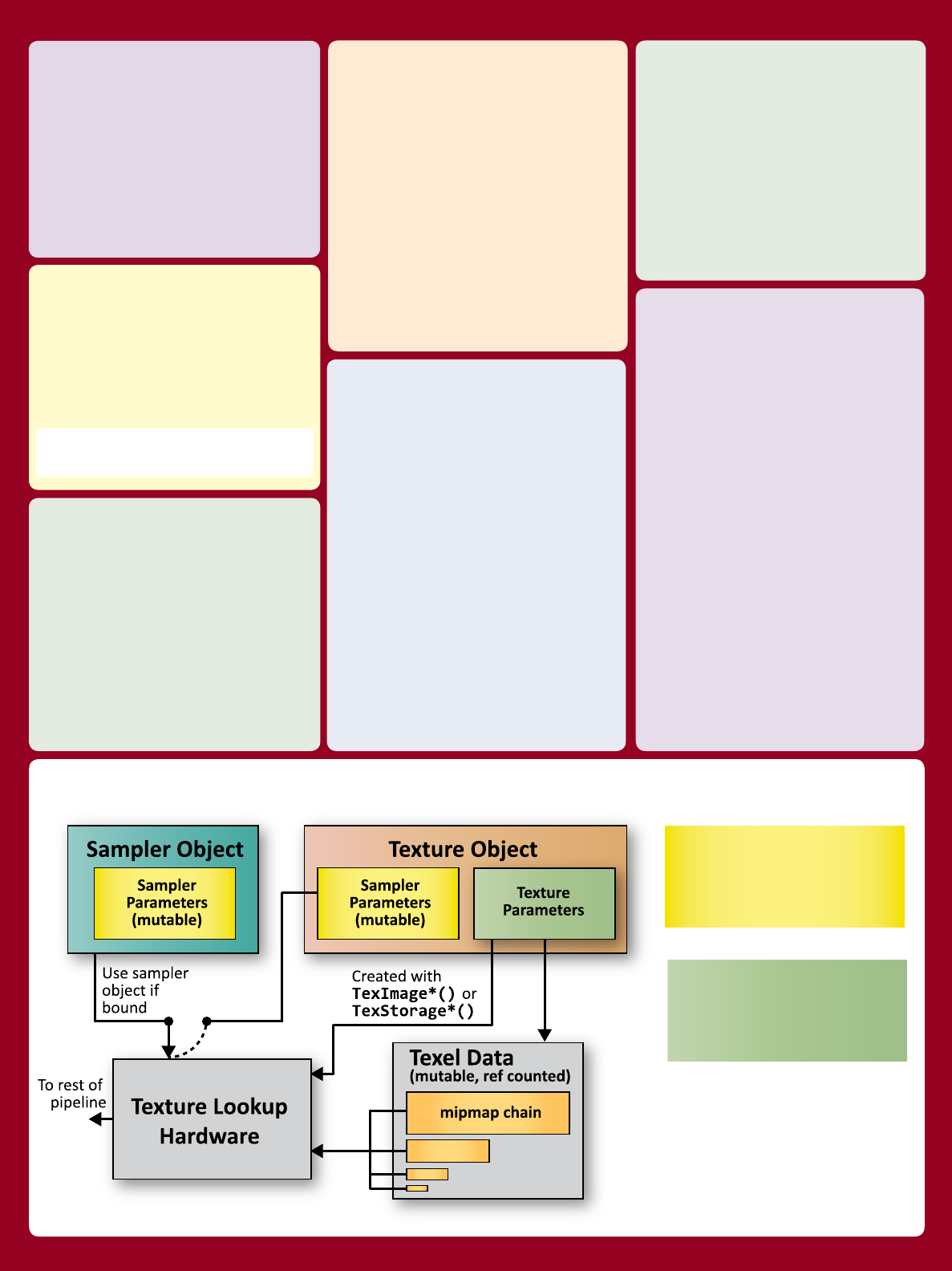
OpenGL Texture Object and Sampler State
T
Texture Parameters (immutable)
TEXTURE_IMMUTABLE_FORMAT
TEXTURE_IMMUTABLE_LEVELS
Texture Parameters (mutable)
TEXTURE_BASE_LEVEL
TEXTURE_MAX_LEVEL
Sampler Parameters (mutable)
TEXTURE_COMPARE_{FUNC,MODE}
TEXTURE_{MAX,MIN}_LOD
TEXTURE_{MAG,MIN}_FILTER
TEXTURE_WRAP_{S,T,R}

www.khronos.org/webgl©2019 The Khronos® Group Inc - Rev. 0219
WebGL 2.0 API Quick Reference Guide Page 5
Sized Texture Color Formats [3.7.11]
If an applicaon wants to store the texture at a certain resoluon or in a certain format, it can request the resoluon and format with internalFormat. The following table shows the sized internal
formats indicang whether they are color renderable or texture lterable.
In Color Renderable column, a red Y means the ai extension EXT_color_buer_oat is enabled. In Texture Filterable column, a red Y means the i extension OES_texture_oat_linear is enabled.
Internal Format Format Type Color
Renderable Texture
Filterable
R8 RED UNSIGNED_BYTE Y Y
R8_SNORM RED BYTE Y
R16F RED HALF_FLOAT, FLOAT YY
R32F RED FLOAT Y Y
R8UI RED_INTEGER UNSIGNED_BYTE Y
R8I RED_INTEGER BYTE Y
R16UI RED_INTEGER UNSIGNED_SHORT Y
R16I RED_INTEGER SHORT Y
R32UI RED_INTEGER UNSIGNED_INT Y
R32I RED_INTEGER INT Y
RG8 RG UNSIGNED_BYTE Y Y
RG8_SNORM RG BYTE Y
RG16F RG HALF_FLOAT,FLOAT YY
RG32F RG FLOAT Y Y
RG8UI RG_INTEGER UNSIGNED_BYTE Y
RG8I RG_INTEGER BYTE Y
RG16UI RG_INTEGER UNSIGNED_SHORT Y
RG16I RG_INTEGER SHORT Y
RG32UI RG_INTEGER UNSIGNED_INT Y
RG32I RG_INTEGER INT Y
RGB8 RGB UNSIGNED_BYTE Y Y
SRGB8 RGB UNSIGNED_BYTE Y
RGB565 RGB UNSIGNED_BYTE, UNSIGNED_SHORT_5_6_5 Y Y
RGB8_SNORM RGB BYTE Y
R11F_G11F_B10F RGB UNSIGNED_INT_10F_11F_11F_REV, HALF_FLOAT, FLOAT YY
RGB9_E5 RGB UNSIGNED_INT_5_9_9_9_REV, HALF_FLOAT, FLOAT Y
RGB16F RGB HALF_FLOAT, FLOAT Y
RGB32F RGB FLOAT Y
RGB8UI RGB_INTEGER UNSIGNED_BYTE
RGB8I RGB_INTEGER BYTE
RGB16UI RGB_INTEGER UNSIGNED_SHORT
RGB16I RGB_INTEGER SHORT
RGB32UI RGB_INTEGER UNSIGNED_INT
RGB32I RGB_INTEGER INT
RGBA8 RGBA UNSIGNED_BYTE Y Y
SRGB8_ALPHA8 RGBA UNSIGNED_BYTE Y Y
RGBA8_SNORM RGBA BYTE Y
RGB5_A1 RGBA UNSIGNED_BYTE, UNSIGNED_SHORT_5_5_5_1,
UNSIGNED_INT_2_10_10_10_REV Y Y
RGBA4 RGBA UNSIGNED_BYTE, UNSIGNED_SHORT_4_4_4_4 Y Y
RGB10_A2 RGBA UNSIGNED_INT_2_10_10_10_REV Y Y
RGBA16F RGBA HALF_FLOAT, FLOAT YY
RGBA32F RGBA FLOAT Y Y
RGBA8UI RGBA_INTEGER UNSIGNED_BYTE Y
RGBA8I RGBA_INTEGER BYTE Y
RGB10_A2UI RGBA_INTEGER UNSIGNED_INT_2_10_10_10_REV Y
RGBA16UI RGBA_INTEGER UNSIGNED_SHORT Y
RGBA16I RGBA_INTEGER SHORT Y
RGBA32I RGBA_INTEGER INT Y
RGBA32UI RGBA_INTEGER UNSIGNED_INT Y

khr.io/glesregistry©2019 The Khronos® Group Inc - Rev. 0219
OpenGL ES Shading Language 3.0 API Quick Reference Guide Page 6
Preprocessor
[3.4]
Preprocessor Direcves
The number sign (#) can be immediately preceded or followed in its line by spaces or horizontal tabs.
# #dene #undef #if #ifdef #ifndef #else
#elif #endif #error #pragma #extension #line
Examples of Preprocessor Direcves
• “#version 300 es” must appear in the rst line of a shader program wrien in GLSL ES version 3.00. If omied, the shader will be treated
as targeng version 1.00.
• #extension extension_name : behavior, where behavior can be
require, enable, warn, or disable; and where extension_name is the
extension supported by the compiler
• #pragma opmize
({on, o}) - enable or disable shader opmizaon (default on)
#pragma debug
({on, o}) - enable or disable compiling shaders with debug informaon (default o)
Predened Macros
__LINE__
Decimal integer constant that is one more than the number of preceding newlines in the current source string
__FILE__
Decimal integer constant that says which source string number is currently being processed.
__VERSION__
Decimal integer, e.g.: 300
GL_ES
Dened and set to integer 1 if running on an OpenGL-ES Shading Language.
The OpenGL® ES Shading Language is two closely-
related languages which are used to create shaders for
the vertex and fragment processors contained in the
WebGL, OpenGL, and OpenGL ES processing pipelines.
WebGL 2.0 is based on OpenGL ES 3.0.
[n.n.n] and [Table n.n] refer to secons and tables
in the OpenGL ES Shading Language 3.0 specicaon at
www.khronos.org/registry/gles/
Types
[4.1]
A shader can aggregate these using arrays and structures to build
more complex types. There are no pointer types.
Basic Types
void no funcon return value or empty parameter list
bool Boolean
int, uint signed, unsigned integer
oat oang scalar
vec2, vec3, vec4 n-component oang point vector
bvec2, bvec3, bvec4 Boolean vector
ivec2, ivec3, ivec4 signed integer vector
uvec2, uvec3, uvec4 unsigned integer vector
mat2, mat3, mat4 2x2, 3x3, 4x4 oat matrix
mat2x2, mat2x3, mat2x4 2x2, 2x3, 2x4 oat matrix
mat3x2, mat3x3, mat3x4 3x2, 3x3, 3x4 oat matrix
mat4x2, mat4x3, mat4x4 4x2, 4x3, 4x4 oat matrix
Floang Point Sampler Types (opaque)
sampler2D, sampler3D access a 2D or 3D texture
samplerCube access cube mapped texture
samplerCubeShadow access cube map depth texture with comparison
sampler2DShadow access 2D depth texture with comparison
sampler2DArray access 2D array texture
sampler2DArrayShadow access 2D array depth texture with comparison
Signed Integer Sampler Types (opaque)
isampler2D, isampler3D access an integer 2D or 3D texture
isamplerCube access integer cube mapped texture
isampler2DArray access integer 2D array texture
Unsigned Integer Sampler Types (opaque)
usampler2D, usampler3D access unsigned integer 2D or 3D texture
usamplerCube access unsigned integer cube mapped texture
usampler2DArray access unsigned integer 2D array texture
Structures and Arrays [4.1.8, 4.1.9]
Structures struct type-name {
members
} struct-name[]; // oponal variable declaraon,
// oponally an array
Arrays oat foo[3];
Structures, blocks, and structure members can be arrays.
Only 1-dimensional arrays supported.
Operators and Expressions
Operators [5.1]
Numbered in order of precedence. The
relaonal and equality operators > < <= >= == != evaluate to a
Boolean. To compare vectors component-wise, use funcons
such as lessThan(), equal(), etc. [8.7].
Operator Descripon Assoc.
1. ( ) parenthecal grouping N/A
2.
[ ]
( )
.
++ --
array subscript
funcon call & constructor structure
eld or method selector, swizzler
posix increment and decrement
L - R
3 . ++ --
+ - ~ !
prex increment and decrement
unary R - L
4 . * % / mulplicave L - R
5. + - addive L - R
6. << >> bit-wise shi L - R
7. < > <= >= relaonal L - R
8. == != equality L - R
9. &bit-wise and L - R
10. ^bit-wise exclusive or L - R
11. |bit-wise inclusive or L - R
12. && logical and L - R
13. ^^ logical exclusive or L - R
14. | | logical inclusive or L - R
15. ? :
selecon (Selects an enre operand.
Use mix() to select individual
components of vectors.)
L - R
16.
=assignment L - R
+= -= *= /=
%= <<= >>=
&= ^= |=
arithmec assignments L - R
17. ,sequence L - R
Vector Components [5.5]
In addion to array numeric subscript syntax, names of vector
components are denoted by a single leer. Components can be
swizzled and replicated, e.g.: pos.xx, pos.zy
{x, y, z, w} Use when accessing vectors that represent points or normals
{r, g, b, a} Use when accessing vectors that represent colors
{s, t, p, q} Use when accessing vectors that represent texture coordinates
Qualiers
Storage Qualiers [4.3]
Variable declaraons may be preceded by one storage
qualier.
none
(Default) local read/write memory, or input parameter
const
Compile-me constant, or read-only funcon
parameter
in
centroid in Linkage into a shader from a previous stage
out
centroid out Linkage out of a shader to a subsequent stage
uniform
Value does not change across the primive being
processed, uniforms form the linkage between a
shader, OpenGL ES, and the applicaon
The following interpolaon qualiers for shader outputs
and inputs may procede in, centroid in, out, or
centroid out.
smooth
Perspecve correct interpolaon
at
No interpolaon
Interface Blocks [4.3.7]
Uniform variable declaraons can be grouped into named
interface blocks, for example:
uniform Transform {
mat4 ModelViewProjeconMatrix;
uniform mat3 NormalMatrix;
// restatement of qualier
oat Deformaon;
}
Layout Qualiers [4.3.8]
layout(layout-qualier) block-declaraon
layout(layout-qualier) in/out/uniform
layout(layout-qualier) in/out/uniform
declaraon
Input Layout Qualiers [4.3.8.1]
For all shader stages:
locaon = integer-constant
Output Layout Qualiers [4.3.8.2]
For all shader stages:
locaon = integer-constant
Uniform Block Layout Qualiers [4.3.8.3]
Layout qualier ideners for uniform blocks:
shared, packed, std140, {row, column}_major
Parameter Qualiers [4.4]
Input values are copied in at funcon call me, output values are
copied out at funcon return me.
none (Default) same as in
in For funcon parameters passed into a funcon
out For funcon parameters passed back out of a funcon, but
not inialized for use when passed in
inout For funcon parameters passed both into and out of a funcon
Precision and Precision Qualiers [4.5]
Any oang point, integer, or sampler declaraon can have the
type preceded by one of these precision qualiers:
highp
Sases minimum requirements for the vertex language.
mediump
Range and precision is between that provided by lowp
and highp.
lowp
Range and precision can be less than mediump, but sll
represents all color values for any color channel.
Ranges and precisions for precision qualiers (FP=oang point):
FP Range
FP Magnitude
Range FP Precision
Integer Range
Signed Unsigned
highp
(−2
126
, 2
127
)0.0, (2
–126
, 2
127
)
Relave
2
–24
[−2
31
, 2
31
−1] [0, 2
32
−1]
mediump
(−2
14
, 2
14
)(2
–14
, 2
14
)
Relave
2
–10
[−2
15
, 2
15
−1] [0, 2
16
−1]
lowp
(−2, 2)
(2
–8
, 2)
Absolute
2
–8
[−2
7
, 2
7
−1] [0, 2
8
−1]
A precision statement establishes a default precision qualier for
subsequent int, oat, and sampler declaraons, e.g.:
precision highp int;
Invariant Qualiers Examples [4.6]
#pragma STDGL invariant(all) Force all output variables to be invariant
invariant gl_Posion; Qualify a previously declared variable
invariant centroid out
vec3 Color; Qualify as part of a variable declaraon
Order of Qualicaon [4.7]
When mulple qualicaons are present, they must follow a
strict order. This order is either:
invariant, interpolaon, storage, precision
or:
storage, parameter, precision
khr.io/glesregistry©2019 The Khronos® Group Inc - Rev. 0219
OpenGL ES Shading Language 3.0 API Quick Reference Guide Page 7
Built-In Funcons
Angle & Trigonometry Funcons [8.1]
Component-wise operaon. Parameters specied as angle are
assumed to be in units of radians. T is oat, vec2, vec3, vec4.
T radians (T degrees); degrees to radians
T degrees (T radians); radians to degrees
T sin (T angle); sine
T cos (T angle); cosine
T tan (T angle); tangent
T asin (T x); arc sine
T acos (T x); arc cosine
T atan (T y, T x);
T atan (T y_over_x); arc tangent
T sinh (T x); hyperbolic sine
T cosh (T x); hyperbolic cosine
T tanh (T x); hyperbolic tangent
T asinh (T x); arc hyperbolic sine; inverse of sinh
T acosh (T x); arc hyperbolic cosine; non-negave inverse of cosh
T atanh (T x); arc hyperbolic tangent; inverse of tanh
Exponenal Funcons [8.2]
Component-wise operaon. T is oat, vec2, vec3, vec4.
T pow (T x, T y); xy
T exp (T x); ex
T log (T x); ln
T exp2 (T x); 2x
T log2 (T x); log2
T sqrt (T x); square root
T inversesqrt (T x); inverse square root
Common Funcons [8.3]
Component-wise operaon. T is oat and vecn, TI is int and ivecn,
TU is uint and uvecn, and TB is bool and bvecn, where n is 2, 3,
or 4.
T abs(T x);
TI abs(TI x); absolute value
T sign(T x);
TI sign(TI x); returns -1.0, 0.0, or 1.0
T oor(T x); nearest integer <= x
T trunc (T x); nearest integer a such that
|a| <= |x|
T round (T x); round to nearest integer
T roundEven (T x); round to nearest integer
T ceil(T x); nearest integer >= x
T fract(T x); x - oor(x)
T mod(T x, T y);
T mod(T x, oat y);
T modf(T x, out T i);
modulus
T min(T x, T y);
TI min(TI x, TI y);
TU min(TU x, TU y);
T min(T x, oat y);
TI min(TI x, int y);
TU min(TU x, uint y);
minimum value
T max(T x, T y);
TI max(TI x, TI y);
TU max(TU x, TU y);
T max(T x, oat y);
TI max(TI x, int y);
TU max(TU x, uint y);
maximum value
T clamp(TI x, T minVal, T maxVal);
TI clamp(V x, TI minVal, TI maxVal);
TU clamp(TU x, TU minVal, TU maxVal);
T clamp(T x, oat minVal, oat maxVal);
TI clamp(TI x, int minVal, int maxVal);
TU clamp(TU x, uint minVal, uint maxVal);
min(max(x, minVal), maxVal)
T mix(T x, T y, T a);
T mix(T x, T y, oat a); linear blend of x and y
T mix(T x, T y, TB a); Selects vector source for each
returned component
T step(T edge, T x);
T step(oat edge, T x); 0.0 if x < edge, else 1.0
(more Common Funcons ↗)
Aggregate Operaons and Constructors
Matrix Constructor Examples [5.4.2]
mat2(oat) // init diagonal
mat2(vec2, vec2); // column-major order
mat2(oat, oat,
oat, oat); // column-major order
Structure Constructor Example [5.4.3]
struct light {
oat intensity;
vec3 pos;
};
light lightVar = light
(3.0, vec3(1.0, 2.0, 3.0));
Matrix Components [5.6]
Access components of a matrix with array subscripng syntax.
For example:
mat4 m; // m represents a matrix
m[1] = vec4(2.0); // sets second column to all 2.0
m[0][0] = 1.0; // sets upper le element to 1.0
m[2][3] = 2.0; // sets 4th element of 3rd column to 2.0
Examples of operaons on matrices and vectors:
m = f * m; // scalar * matrix component-wise
v = f * v; // scalar * vector component-wise
v = v * v; // vector * vector component-wise
m = m +/- m; // matrix component-wise +/-
(more examples ↗)
Statements and Structure
Iteraon and Jumps [6]
Entry void main()
Iteraon for (;;) { break, connue }
while ( ) { break, connue }
do { break, connue } while ( );
Jump break, connue, return
discard // Fragment shader only
Selecon if ( ) { }
if ( ) { } else { }
switch ( ) { break, case }
m = m * m; // linear algebraic mulply
m = v * m; // row vector * matrix linear algebraic mulply
m = m * v; // matrix * column vector linear algebraic mulply
f = dot(v, v); // vector dot product
v = cross(v, v); // vector cross product
m = matrixCompMult(m, m); // component-wise mulply
Structure Operaons [5.7]
Select structure elds using the period (.) operator. Valid operators
are:
.eld selector
== != equality
=assignment
Array Operaons [5.7]
Array elements are accessed using the array subscript operator
“[ ]”. For example:
diuseColor += lightIntensity[3] * NdotL;
The size of an array can be determined using the .length() operator.
For example:
for (i = 0; i < a.length(); i++)
a[i] = 0.0;
Built-In Inputs, Outputs, and Constants [7]
Shader programs use special variables to communicate with xed-funcon parts of the pipeline. Output special
variables may be read back aer wring. Input special variables are read-only. All special variables have global scope.
Vertex Shader Special Variables [7.1]
Inputs:
int gl_VertexID; // integer index
int gl_InstanceID; // instance number
Outputs:
out gl_PerVertex {
vec4 gl_Posion; // transformed vertex posion in clip coordinates
oat gl_PointSize; // transformed point size in pixels (point rasterizaon only)
};
Fragment Shader Special Variables [7.2]
Inputs:
h
ighp vec4
gl_FragCoord
; //
fragment posion within frame buer
bool
gl_FrontFacing
; //
fragment belongs to a front-facing primive
mediump vec2 gl_PointCoord; // 0.0 to 1.0 for each component
Outputs:
h
ighp oat
gl_FragDepth
; //
depth range
Built-In Constants With Minimum Values [7.3]
Built-in Constant Minimum value
const mediump int gl_MaxVertexAribs 16
const mediump int gl_MaxVertexUniformVectors 256
const mediump int gl_MaxVertexOutputVectors 16
const mediump int gl_MaxFragmentInputVectors 15
const mediump int gl_MaxVertexTextureImageUnits 16
const mediump int gl_MaxCombinedTextureImageUnits 32
const mediump int gl_MaxTextureImageUnits 16
const mediump int gl_MaxFragmentUniformVectors 224
const mediump int gl_MaxDrawBuers 4
const mediump int gl_MinProgramTexelOset -8
const mediump int gl_MaxProgramTexelOset 7
Built-In Uniform State [7.4]
As an aid to accessing OpenGL ES processing state, the following uniform
variables are built into the OpenGL ES Shading Language.
struct gl_DepthRangeParameters {
oat near;
// n
oat far; // f
oat di; // f - n
};
uniform gl_DepthRangeParameters gl_DepthRange;

khr.io/glesregistry©2019 The Khronos® Group Inc - Rev. 0219
OpenGL ES Shading Language 3.0 API Quick Reference Guide Page 8
Built-In Funcons (connued)
Common Funcons (connued)
T smoothstep(T edge0, T edge1, T x);
T smoothstep(oat edge0,
oat edge1, T x);
clamp and smooth
TB isnan(T x); true if x is a NaN
TB isinf(T x); true if x is posive or negave
innity
TI oatBitsToInt(T value);
TU oatBitsToUint(T value);
highp integer, preserving oat
bit level representaon
T intBitsToFloat(TI value);
T uintBitsToFloat(TU value);
highp oat, preserving integer
bit level representaon
Floang-point Pack and Unpack Funcons [8.4]
uint packSnorm2x16(vec2 v);
uint packUnorm2x16(vec2 v);
convert two oats to xed point and pack
into an integer
vec2 unpackSnorm2x16(uint p);
vec2 unpackUnorm2x16(uint p);
unpack xed point value pair into oats
uint packHalf2x16(vec2 v); convert two oats into half-precision oats
and pack into an integer
vec2 unpackHalf2x16(uint v); unpack half value pair into full oats
Geometric Funcons [8.5]
These funcons operate on vectors as vectors, not
component-wise. T is oat, vec2, vec3, vec4.
oat length(T x); length of vector
oat distance(T p0, T p1); distance between points
oat dot(T x, T y); dot product
vec3 cross(vec3 x, vec3 y); cross product
T normalize(T x); normalize vector to length 1
T faceforward(T N, T I, T Nref); returns N if dot(Nref, I) < 0, else -N
T reect(T I, T N); reecon direcon I - 2 * dot(N,I) * N
T refract(T I, T N, oat eta); refracon vector
Matrix Funcons [8.6]
Type mat is any matrix type.
mat matrixCompMult(mat x, mat y); mulply x by y component-wise
mat2 outerProduct(vec2 c, vec2 r);
mat3 outerProduct(vec3 c, vec3 r);
mat4 outerProduct(vec4 c, vec4 r);
linear algebraic column vector *
row vector
mat2x3 outerProduct(vec3 c, vec2 r);
mat3x2 outerProduct(vec2 c, vec3 r);
mat2x4 outerProduct(vec4 c, vec2 r);
mat4x2 outerProduct(vec2 c, vec4 r);
mat3x4 outerProduct(vec4 c, vec3 r);
mat4x3 outerProduct(vec3 c, vec4 r);
linear algebraic column vector *
row vector
mat2 transpose(mat2 m);
mat3 transpose(mat3 m);
mat4 transpose(mat4 m);
mat2x3 transpose(mat3x2 m);
mat3x2 transpose(mat2x3 m);
mat2x4 transpose(mat4x2 m);
mat4x2 transpose(mat2x4 m);
mat3x4 transpose(mat4x3 m);
mat4x3 transpose(mat3x4 m);
transpose of matrix m
oat determinant(mat2 m);
oat determinant(mat3 m);
oat determinant(mat4 m);
determinant of matrix m
mat2 inverse(mat2 m);
mat3 inverse(mat3 m);
mat4 inverse(mat4 m);
inverse of matrix m
Vector Relaonal Funcons [8.7]
Compare x and y component-wise. Input and return vector sizes for
a parcular call must match. Type bvec is bvecn; vec is vecn; ivec is
ivecn; uvec is uvecn; (where n is 2, 3, or 4). T is union of vec and ivec.
bvec lessThan(T x, T y);
bvec lessThan(uvec x, uvec y); x < y
bvec lessThanEqual(T x, T y);
bvec lessThanEqual(uvec x, uvec y); x <= y
bvec greaterThan(T x, T y);
bvec greaterThan(uvec x, uvec y); x > y
bvec greaterThanEqual(T x, T y);
bvec greaterThanEqual(uvec x, uvec y); x >= y
bvec equal(T x, T y);
bvec equal(bvec x, bvec y);
bvec equal(uvec x, uvec y);
x == y
bvec notEqual(T x, T y);
bvec notEqual(bvec x, bvec y);
bvec notEqual(uvec x, uvec y);
x!= y
bool any(bvec x); true if any component of x is true
bool all(bvec x); true if all components of x are true
bvec not(bvec x); logical complement of x
Texture Lookup Funcons [8.8]
The funcon textureSize returns the dimensions of level lod for the
texture bound to sampler, as described in [2.11.9] of the OpenGL ES
3.0 specicaon, under “Texture Size Query”. The inial “g” in a type
name is a placeholder for nothing, “i”, or “u”.
highp ivec{2,3} textureSize(gsampler{2,3}D sampler, int lod);
highp ivec2 textureSize(gsamplerCube sampler, int lod);
highp ivec2 textureSize(sampler2DShadow sampler, int lod);
highp ivec2 textureSize(samplerCubeShadow sampler, int lod);
highp ivec3 textureSize(gsampler2DArray sampler, int lod);
highp ivec3 textureSize(sampler2DArrayShadow sampler, int lod);
Texture lookup funcons using samplers are available to vertex and
fragment shaders. The inial “g” in a type name is a placeholder for
nothing, “i”, or “u”.
gvec4 texture(gsampler{2,3}D sampler, vec{2,3} P [, oat bias]);
gvec4 texture(gsamplerCube sampler, vec3 P [, oat bias]);
oat texture(sampler2DShadow sampler, vec3 P [, oat bias]);
oat texture(samplerCubeShadow sampler, vec4 P [, oat bias]);
gvec4 texture(gsampler2DArray sampler, vec3 P [, oat bias]);
oat texture(sampler2DArrayShadow sampler, vec4 P);
gvec4 textureProj(gsampler2D sampler, vec{3,4} P [, oat bias]);
gvec4 textureProj(gsampler3D sampler, vec4 P [, oat bias]);
oat textureProj(sampler2DShadow sampler, vec4 P [, oat bias]);
gvec4 textureLod(gsampler{2,3}D sampler, vec{2,3} P, oat lod);
gvec4 textureLod(gsamplerCube sampler, vec3 P, oat lod);
oat textureLod(sampler2DShadow sampler, vec3 P, oat lod);
gvec4 textureLod(gsampler2DArray sampler, vec3 P, oat lod);
gvec4 textureOset(gsampler2D sampler, vec2 P, ivec2 oset [, oat
bias
]);
gvec4 textureOset(gsampler3D sampler, vec3 P, ivec3 oset [, oat
bias
]);
oat textureOset
(sampler2DShadow sampler, vec3 P, ivec2 oset [, oat
bias
]);
gvec4 textureOset
(gsampler2DArray sampler, vec3 P, ivec2 oset [, oat bias
]);
gvec4 texelFetch(gsampler2D sampler, ivec2 P, int lod);
gvec4 texelFetch(gsampler3D sampler, ivec3 P, int lod);
gvec4 texelFetch(gsampler2DArray sampler, ivec3 P, int lod);
gvec4 texelFetchOset(gsampler2D sampler, ivec2 P, int lod, ivec2 oset);
gvec4 texelFetchOset(gsampler3D sampler, ivec3 P, int lod, ivec3 oset);
gvec4 texelFetchOset(gsampler2DArray sampler, ivec3 P, int lod, ivec2 oset);
gvec4 textureProjOset
(gsampler2D sampler, vec3 P, ivec2 oset [, oat bias
]);
gvec4 textureProjOset
(gsampler2D sampler, vec4 P, ivec2 oset [, oat bias
]);
gvec4 textureProjOset
(gsampler3D sampler, vec4 P, ivec3 oset [, oat bias
]);
oat textureProjOset(sampler2DShadow sampler, vec4 P, ivec2 oset [,
oat bias]);
Texture Lookup Funcons (connued)
gvec4 textureLodOset(gsampler2D sampler, vec2 P, oat lod, ivec2 oset);
gvec4 textureLodOset(gsampler3D sampler, vec3 P, oat lod, ivec3 oset);
oat textureLodOset(sampler2DShadow sampler, vec3 P, oat lod,
ivec2 oset);
gvec4 textureLodOset(gsampler2DArray sampler, vec3 P, oat lod,
ivec2 oset);
gvec4 textureProjLod(gsampler2D sampler, vec3 P, oat lod);
gvec4 textureProjLod(gsampler2D sampler, vec4 P, oat lod);
gvec4 textureProjLod(gsampler3D sampler, vec4 P, oat lod);
oat textureProjLod(sampler2DShadow sampler, vec4 P, oat lod);
gvec4 textureProjLodOset(gsampler2D sampler, vec3 P, oat lod, ivec2 oset);
gvec4 textureProjLodOset(gsampler2D sampler, vec4 P, oat lod, ivec2 oset);
gvec4 textureProjLodOset(gsampler3D sampler, vec4 P, oat lod, ivec3 oset);
oat textureProjLodOset(sampler2DShadow sampler, vec4 P, oat lod,
ivec2 oset);
gvec4 textureGrad(gsampler2D sampler, vec2 P, vec2 dPdx, vec2 dPdy);
gvec4 textureGrad(gsampler3D sampler, vec3 P, vec3 dPdx, vec3 dPdy);
gvec4 textureGrad(gsamplerCube sampler, vec3 P, vec3 dPdx, vec3 dPdy);
oat textureGrad(sampler2DShadow sampler, vec3 P, vec2 dPdx, vec2 dPdy);
oat textureGrad(samplerCubeShadow sampler, vec4 P, vec3 dPdx,
vec3 dPdy);
gvec4 textureGrad(gsampler2DArray sampler, vec3 P, vec2 dPdx, vec2 dPdy);
oat textureGrad(sampler2DArrayShadow sampler, vec4 P, vec2 dPdx,
vec2 dPdy);
gvec4 textureGradOset(gsampler2D sampler, vec2 P, vec2 dPdx, vec2 dPdy,
ivec2 oset);
gvec4 textureGradOset(gsampler3D sampler, vec3 P, vec3 dPdx, vec3 dPdy,
ivec3 oset);
oat textureGradOset(sampler2DShadow sampler, vec3 P, vec2 dPdx,
vec2 dPdy, ivec2 oset);
gvec4 textureGradOset(gsampler2DArray sampler, vec3 P, vec2 dPdx,
vec2 dPdy, ivec2 oset);
oat textureGradOset(sampler2DArrayShadow sampler, vec4 P,
vec2 dPdx, vec2 dPdy, ivec2 oset);
gvec4 textureProjGrad(gsampler2D sampler, vec3 P, vec2 dPdx, vec2 dPdy);
gvec4 textureProjGrad(gsampler2D sampler, vec4 P, vec2 dPdx, vec2 dPdy);
gvec4 textureProjGrad(gsampler3D sampler, vec4 P, vec3 dPdx, vec3 dPdy);
oat textureProjGrad(sampler2DShadow sampler, vec4 P, vec2 dPdx,
vec2 dPdy);
gvec4 textureProjGradOset(gsampler2D sampler, vec3 P, vec2 dPdx,
vec2 dPdy, ivec2 oset);
gvec4 textureProjGradOset(gsampler2D sampler, vec4 P, vec2 dPdx,
vec2 dPdy, ivec2 oset);
gvec4 textureProjGradOset(gsampler3D sampler, vec4 P, vec3 dPdx,
vec3 dPdy, ivec3 oset);
oat textureProjGradOset(sampler2DShadow sampler, vec4 P, vec2 dPdx,
vec2 dPdy, ivec2 oset);
Fragment Processing Funcons [8.9]
Approximated using local dierencing.
T dFdx(T p); Derivave in x
T dFdy(T p); Derivave in y
T fwidth(T p); abs (dFdx (p)) + abs (dFdy (p));
Reference card producon by Miller & Mattson www.millermason.com
WebGL and OpenGL ES are trademarks of Khronos Group. The Khronos Group is an
industry consorum creang open standards for the authoring and acceleraon of
parallel compung, graphics and dynamic media on a wide variety of plaorms and
devices.
See khronos.org to learn about the Khronos Group. See khronos.org/webgl to learn
about WebGL. See khronos.org/opengles to learn about OpenGL ES.
