Dynetics 001-10018266 GROUND RADAR User Manual

Dynetics, Inc. GROUND RADAR

User Manual

  DYNETICS INCORPORATED GroundAware™ Reconfigurable Surveillance Sensor     Installation, Operation, and User’s Manual
 G R O U N D A W A R E ™   R E C O N F I G U R A B L E   S U R V E I L L A N C E   S E N S O R  Installation, Operation, and User’s Manual  Dynetics, Inc. 1002 Explorer Blvd Huntsville, AL 35806 Phone 256.964.4000
  Version/ Revision Document Change # Release Date Originator Reason for Change   1/16/15  Joel Simoneau and Mike Stokes Initial version of the Installation, Operation, and User’s Manual for the GroundAware RSS
  Table of ContentsImportant Safety Instructions ..................................................... 1 Safe Usage ..................................................................................... 1 General Description and Specifications .................................... 2  ........................................................................................................ 3 Specifications .................................................................................. 3 Installation ................................................................................. 4 Operation................................................................................... 8 Configuration ................................................................................... 8 User Access .................................................................................... 8 User’s Guide .............................................................................. 8
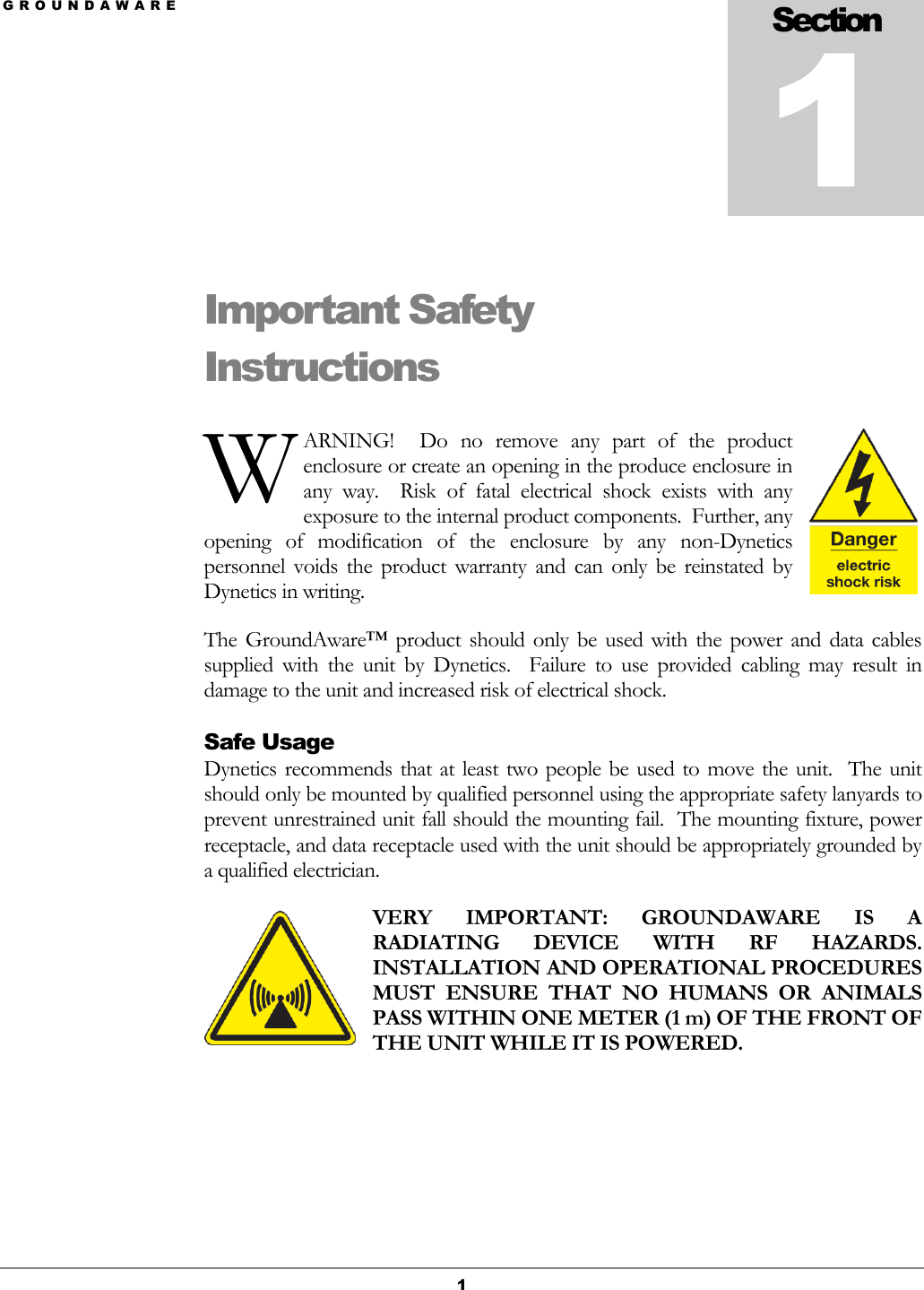
G R O U N D A W A R E  1 Important Safety Instructions ARNING!    Do  no  remove  any  part  of  the  product enclosure or create an opening in the produce enclosure in any  way.    Risk  of  fatal  electrical  shock  exists  with  any exposure to the internal product components.  Further, any opening  of  modification  of  the  enclosure  by  any  non-Dynetics personnel  voids  the  product  warranty  and  can  only  be  reinstated  by Dynetics in writing. The GroundAware™  product  should  only  be  used  with the  power  and  data  cables supplied  with  the  unit  by  Dynetics.    Failure  to  use  provided  cabling  may  result  in damage to the unit and increased risk of electrical shock. Safe Usage Dynetics recommends  that at least two people be used to move  the unit.   The unit should only be mounted by qualified personnel using the appropriate safety lanyards to prevent unrestrained unit fall should the mounting fail.  The mounting fixture, power receptacle, and data receptacle used with the unit should be appropriately grounded by a qualified electrician. VERY  IMPORTANT:  GROUNDAWARE  IS  A RADIATING  DEVICE  WITH  RF  HAZARDS.  INSTALLATION AND OPERATIONAL PROCEDURES MUST  ENSURE  THAT  NO  HUMANS  OR  ANIMALS PASS WITHIN ONE METER (1 m) OF THE FRONT OF THE UNIT WHILE IT IS POWERED.   Section 1 W
  2  General Description and Specifications roundAware™    is  a  user  Reconfigurable  Surveillance  Sensor  that  detects, tracks,  classifies,  and  provides  actionable  information  relevant  to  objects within  a  120°  field  of  view  up  to  five  kilometers  from  the  sensor.  This capability is implemented via the interoperation of four sub-systems: The radar sub-system transmits S-band radio frequency signals, digitizes and processes the  received  returns,  identifies  detections,  clusters  detections  to  identify  tracks,  and associates tracks with feature data that can be used to classify the object.  The radar can be  configured to  use three different  waveforms, based  on  installed  site,  that will  be explained in further detail in later sections.  This manual should be used with radar sub-system model number 001-10018266. The server sub-system receives  track data, receives and processes  classification data, hosts  the  GoogleMaps  based  user  interface,  and  implements  external  sensor  (e.g. single/dual  band  PTZ  camera,  unattended  ground  sensor,  etc)  integration.    Server hosting  of  the  user  interface  includes  managing  user-defined  alert  zones,  per-zone alerting criteria, and the per-zone violation log.  Commodity grade desktop or laptop computers may be used to execute the server sub-system software.   The client sub-system renders the GoogleMaps user interface for each unique browser session.  Users may maintain their  own zoom and view settings, while sharing zone definitions, alert criteria, and camera control  with  other users.  The user interface is browser agnostic, but works best with Mozilla Firefox.  While  the client  software  is executed  on  each  user’s  machine  within  a  web  browser,  it  is  provided  upon authentication and managed by the server sub-system software. The optional interface sub-system provides a cellular data link, optional use network interfaces, and independent radar power on/off control.  The interface sub-system also includes  the  cabling,  encoder,  and  power  supplies  required  to  integrate  external cameras  or  other  sensors.    This  sub-system  is  self-contained  in  an  environmentally sealed  enclosure  with  the  external  switches  and  connectors  as  required  by  the customer.   GroundAware™ enables a customer to use the system in an environment where the interface is continually monitored by personnel on desktop or mobile devices, or in an Section 2 G
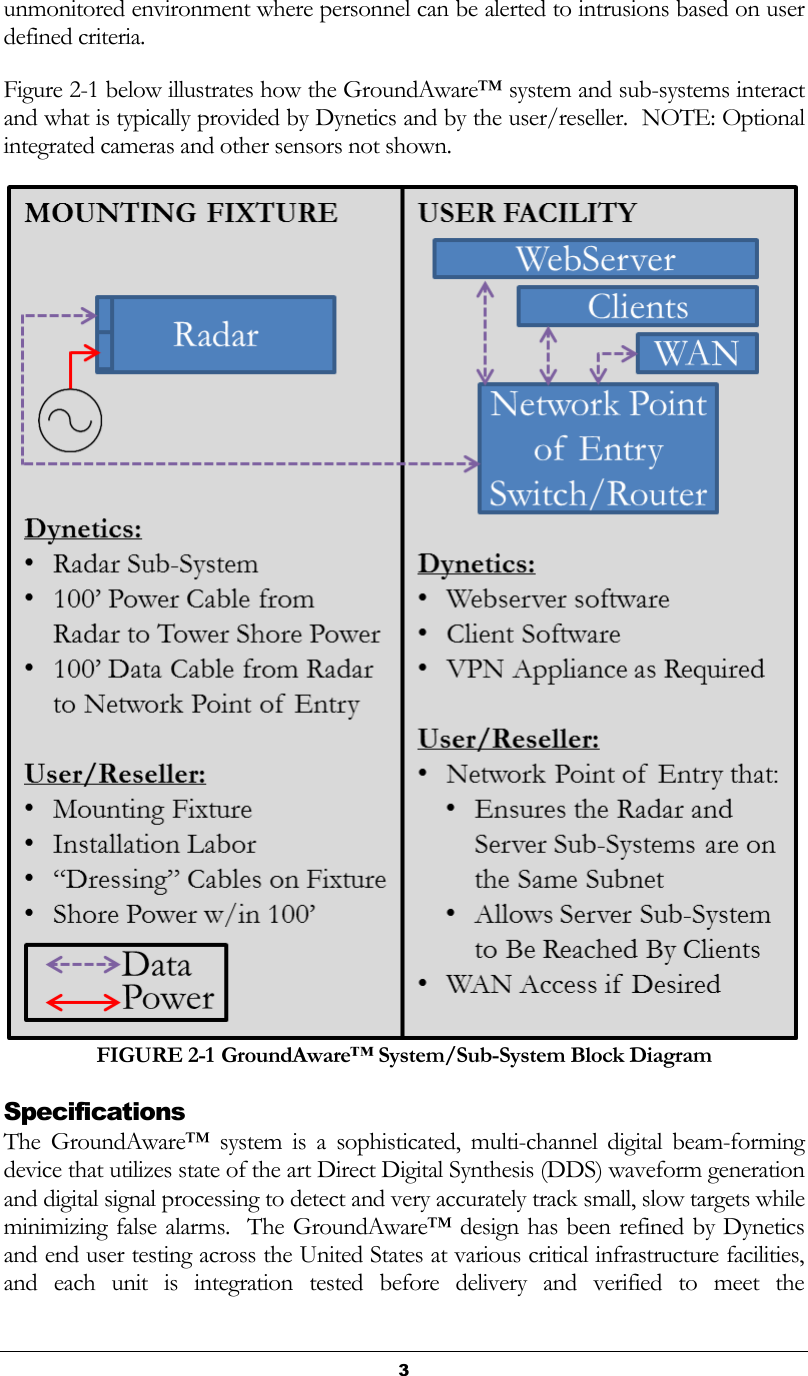
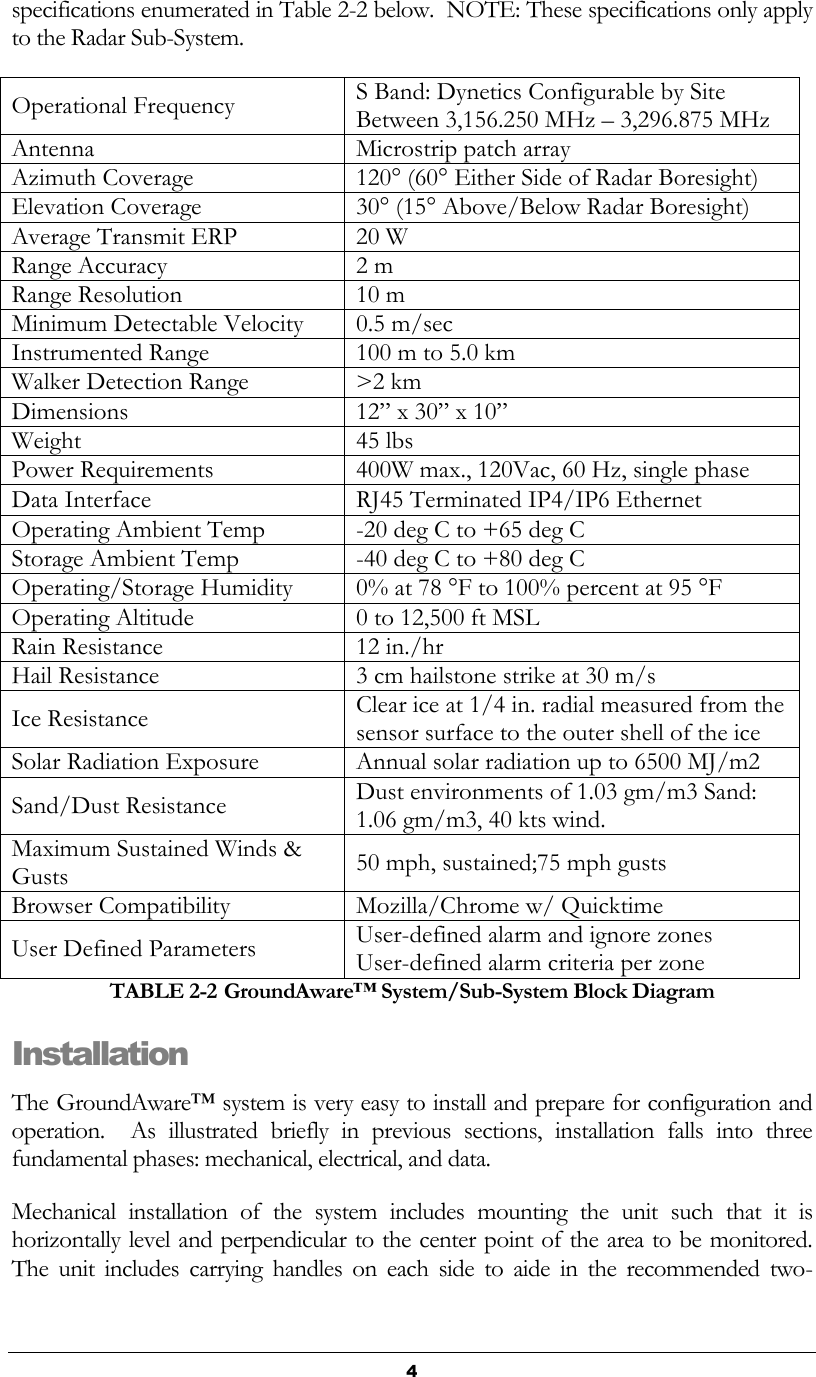
  3 unmonitored environment where personnel can be alerted to intrusions based on user defined criteria. Figure 2-1 below illustrates how the GroundAware™ system and sub-systems interact and what is typically provided by Dynetics and by the user/reseller.  NOTE: Optional integrated cameras and other sensors not shown.  FIGURE 2-1 GroundAware™ System/Sub-System Block Diagram Specifications The  GroundAware™  system  is  a  sophisticated,  multi-channel  digital  beam-forming device that utilizes state of the art Direct Digital Synthesis (DDS) waveform generation and digital signal processing to detect and very accurately track small, slow targets while minimizing false alarms.  The GroundAware™ design has been refined by Dynetics and end user testing across the United States at various critical infrastructure facilities, and  each  unit  is  integration  tested  before  delivery  and  verified  to  meet  the
  4 specifications enumerated in Table 2-2 below.  NOTE: These specifications only apply to the Radar Sub-System. Operational Frequency S Band: Dynetics Configurable by Site Between 3,156.250 MHz – 3,296.875 MHz Antenna Microstrip patch array Azimuth Coverage 120° (60° Either Side of Radar Boresight) Elevation Coverage 30° (15° Above/Below Radar Boresight) Average Transmit ERP 20 W Range Accuracy 2 m Range Resolution 10 m Minimum Detectable Velocity 0.5 m/sec Instrumented Range 100 m to 5.0 km Walker Detection Range >2 km Dimensions 12” x 30” x 10” Weight 45 lbs Power Requirements 400W max., 120Vac, 60 Hz, single phase Data Interface RJ45 Terminated IP4/IP6 Ethernet Operating Ambient Temp -20 deg C to +65 deg C Storage Ambient Temp -40 deg C to +80 deg C Operating/Storage Humidity 0% at 78 °F to 100% percent at 95 °F Operating Altitude  0 to 12,500 ft MSL Rain Resistance 12 in./hr Hail Resistance 3 cm hailstone strike at 30 m/s Ice Resistance Clear ice at 1/4 in. radial measured from the sensor surface to the outer shell of the ice Solar Radiation Exposure Annual solar radiation up to 6500 MJ/m2 Sand/Dust Resistance Dust environments of 1.03 gm/m3 Sand: 1.06 gm/m3, 40 kts wind.   Maximum Sustained Winds & Gusts 50 mph, sustained;75 mph gusts Browser Compatibility Mozilla/Chrome w/ Quicktime User Defined Parameters User-defined alarm and ignore zones User-defined alarm criteria per zone TABLE 2-2 GroundAware™ System/Sub-System Block Diagram Installation The GroundAware™ system is very easy to install and prepare for configuration and operation.    As  illustrated  briefly  in  previous  sections,  installation  falls  into  three fundamental phases: mechanical, electrical, and data. Mechanical  installation  of  the  system  includes  mounting  the  unit  such  that  it  is horizontally level and perpendicular to the center point of the area to be monitored.  The  unit  includes  carrying  handles  on  each  side  to  aide  in  the  recommended  two-
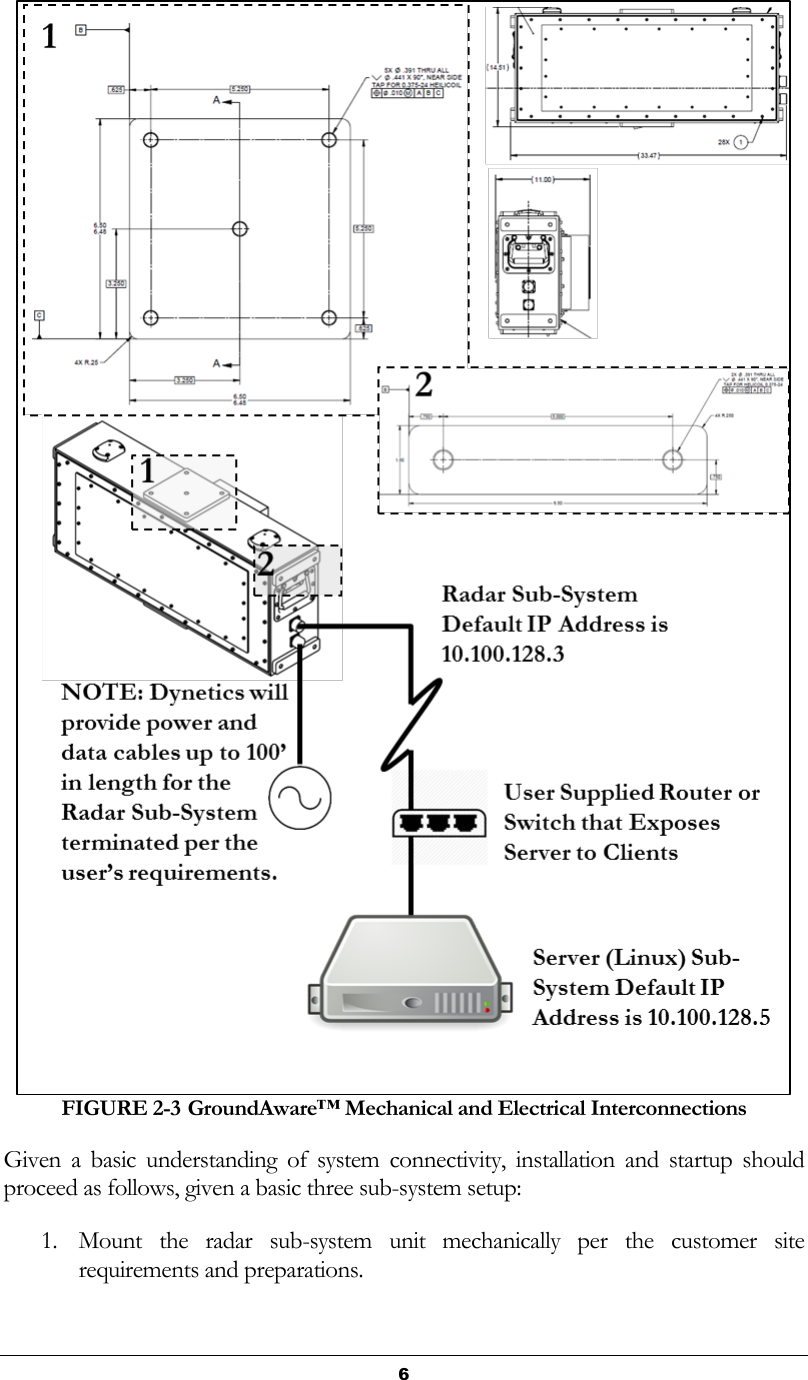
  5 person emplacement of the system.  ??? pattern X-Y-Z helicoils are included on the top and  bottom  of  each  unit  to  allow  a  custom  mount  to  be  designed  and  built  for whatever fixture the customer requires. Electrical installation includes connecting the unit to a maximum 400 watt, 120 volt, 60 Hz, single phase, grounded alternating current source using the provided power cable.  Optionally, the unit may be powered through the switch in the interface sub-system as described previously.  Any additional switches utilized in the provision of power to the system  (e.g.  installed  by  the  customer)  should  be  rated  for  the  type  and  quality  of power specified. Data  connectivity  installation  includes  connecting  the  unit  to  an  IP4/IP6  network through which connectivity to the server sub-system can be obtained.  The unit may be connected to the server sub-system network by several different means such as, wired 50directly, cellular, Wi-Fi extending antennas, etc. based on user requirements. Figure 2-3 below depicts the mechanical,  electrical, and data interconnections of the GroundAware™ system.
  6 FIGURE 2-3 GroundAware™ Mechanical and Electrical Interconnections Given  a  basic  understanding  of  system  connectivity,  installation  and  startup  should proceed as follows, given a basic three sub-system setup: 1. Mount  the  radar  sub-system  unit  mechanically  per  the  customer  site requirements and preparations.
  7 2. Connect the radar sub-system unit to the IP4/IP6 server sub-system network using means required by the customer site. 3. Connect and power-on the server sub-system on the same IP4/IP6 network as the radar sub-system. 4. Connect the radar sub-system to commercial power that meets the previously provided specifications. 5. Wait approximately 90 seconds before proceeding to the activities described in Section 3.
  8 Operation his section assumes that the precautions and setup steps of the previous two sections have been read, understood, and followed.  If any of the material or steps from sections 1 and 2 have been skipped or poorly understood, please pause  and  review  the  information  and  re-perform  whatever  steps  may  be necessary to ensure that GroundAware™ is properly and safely installed, powered, and connected before the activities of this section are performed. Configuration GroundAware™  may  be  generally  configured  by  the  user  for  three  modes  of operation: short, medium, and long rage.  Table 3-1 below specifies the parameters of interest for each one of these modes. Once  the  desired  operational  mode  has  been  determined  from  the  information provided in Table 3-1, the following steps should be performed: 1. From the server sub-system, connect to the radar configuration page. 2. Select  and save the configuration file corresponding to  the radar sub-system mode to be used. 3. Command the radar sub-system to begin radiating. Note:  GroundAware™  has  been  UL  certified  for  operation  in  the  three  modes described above and each unit is tested by Dynetics in each of these modes prior to delivery.   Additionally,  each unit  will  be  calibrated  on-site by  Dynetics  personnel to detect and track a 2m tall, 92kg human at a distance of 1610m assuming at least a 10m emplacement height and unobstructed line of sight to target. User Access At this point, the desired operational mode should be set, the radar should be radiating, and any site specific calibration by Dynetics personnel should be complete.   User’s Guide The GroundAware™ user interface is an extended instance of GoogleMaps and is very intuitive to use by anyone who has experience with web-based mapping web sites.  The traditional controls for zoom, pan, etc. work the same as with a standard GoogleMaps Section 3 T
  9 website. Dynetics will provide training as necessary to allow operators to monitor the system using this interface and configure alarm zones to their preferences.

Navigation menu