Earthquake Ardisam Chainsaw Cs3814 Users Manual
CS3814 to the manual 9b585d32-bcc7-4b67-93b6-8c7adce0237a
2015-02-06
: Earthquake Earthquake-Earthquake-Ardisam-Chainsaw-Cs3814-Users-Manual-537037 earthquake-earthquake-ardisam-chainsaw-cs3814-users-manual-537037 earthquake pdf
Open the PDF directly: View PDF  .
.
Page Count: 24

Operator's Manual
Original Operating
Instructions
Chainsaw
CS3814, CS3816,
CS4116
838184
Rev. 06/29/11
Get parts online at
www.GetEarthquake.com
WARNING
BEFORE USING OUR PRODUCTS, PLEASE READ THIS
MANUAL CAREFULLY TO UNDERSTAND THE PROPER
USE OF YOUR UNIT.

Check for parts online at www.getearthquake.com or call 800-345-6007 M-F 8-5
2
Operator's Manual
CS3814, CS3816, CS4116 Chainsaws
INTRODUCTION
THANK YOU . . .
for purchasing a chainsaw from Earthquake®. We have worked to ensure that this chainsaw meets high standards for usability and
durability. With proper care, your chainsaw will provide many years of service. Please take the time to read this manual carefully to
learn how to correctly operate and maintain your chainsaw. This manual should be considered a permanent part of your chainsaw.
Due to continuous eort to perfect our product, certain procedures and specications are subject to change without notice.
CONTENTS
Introduction .......................................................................................................................................................................................................................................2
Warnings and Safety Precautions .........................................................................................................................................................................................3-10
Features .............................................................................................................................................................................................................................................11
Specications ...................................................................................................................................................................................................................................12
Assembly ...........................................................................................................................................................................................................................................13
Operation ................................................................................................................................................................................................................................... 14-15
Maintenance and Storage .................................................................................................................................................................................................... 16-19
Troubleshooting and Repair ................................................................................................................................................................................................19-20
Parts Breakdown .............................................................................................................................................................................................................................21
Warranty .....................................................................................................................................................................................................................................22-23
FEDERAL EMISSION INFORMATION
Earthquake warrants to the retail purchaser, that this small, o-road engine was designed, built and equipped to conform at the time
of initial sale to all applicable regulations of the U.S. Environmental Protection Agency (EPA).
All weights, specications, and features are approximate and are subject to change without notice. Due to continuous product
improvements, product image may not be exact items.
REGISTRATION, SERVICE AND MAINTENANCE LOG
OWNERSHIP RECORDS
Owner’s Name:
Owner’s Address:
City: State/Province: Zip Code/Postal Code:
Model Number: Serial Number:
Date of Purchase:
Notes:
Record the model number and serial number in the space provided for easy reference. Warranty is valid only if the completed regis-
tration is received by Earthquake within 30 days of purchase. You can register your warranty online by visiting www.getearthquake.
com. If you do not have a computer, call our customer service department at (800) 345-6007 Mondays through Fridays from 8 a.m.
to 5 p.m. CST.
Check for parts online at www.getearthquake.com or call 800-345-6007 M-F 8-5 3
Operator's Manual
CS3814, CS3816, CS4116 Chainsaws
!
DANGER
DANGER INDICATES A SERIOUS INJURY OR FATALITY
WILL RESULT IF THE SAFETY INSTRUCTIONS THAT
FOLLOW THIS SIGNAL WORD ARE NOT OBEYED.
WARNING
WARNING INDICATES A SERIOUS INJURY OR FATALITY
COULD RESULT IF THE SAFETY INSTRUCTIONS THAT
FOLLOW THIS SIGNAL WORD ARE NOT OBEYED.
CAUTION
CAUTION INDICATES YOU CAN OR YOUR EQUIPMENT
CAN BE HURT IF THE SAFETY INSTRUCTIONS THAT
FOLLOW THIS SIGNAL WORD ARE NOT OBEYED.
IMPORTANT
IMPORTANT INDICATES HELPFUL INFORMATION FOR
PROPER ASSEMBLY, OPERATION, OR MAINTENANCE
OF YOUR EQUIPMENT.
WARNING
YOU MUST READ, UNDERSTAND AND COMPLY WITH
ALL SAFETY AND OPERATING INSTRUCTIONS IN
THIS MANUAL BEFORE ATTEMPTING TO SETUP AND
OPERATE YOUR CHAINSAW.
FAILURE TO COMPLY WITH ALL SAFETY AND
OPERATING INSTRUCTIONS CAN RESULT IN LOSS OF
MACHINE CONTROL, SERIOUS PERSONAL INJURY TO
YOU AND/OR BYSTANDERS, AND RISK OF EQUIPMENT
AND PROPERTY DAMAGE. THE TRIANGLE IN THE TEXT
SIGNIFIES IMPORTANT CAUTIONS OR WARNINGS
WHICH MUST BE FOLLOWED.
CALIFORNIA PROPOSITION 65 WARNING
ENGINE EXHAUST FROM THIS PRODUCT CONTAINS
CHEMICALS KNOWN TO THE STATE OF CALIFORNIA
TO CAUSE CANCER, BIRTH DEFECTS, OR OTHER
REPRODUCTIVE HARM.
OWNER’S RESPONSIBILITY
Accurate assembly and safe and eective use of the chainsaw is
the owner’s responsibility.
• Readandfollowallsafetyinstructions.
• Carefullyfollowallassemblyinstructions.
• Maintainthechainsawaccordingtodirectionsandschedule
included in this Earthquake operator’s manual.
• Ensurethatanyonewhousesthechainsawisfamiliarwith
all controls and safety precautions.
SPECIAL MESSAGES
Your manual contains special messages to bring attention to
potential safety concerns, machine damage as well as helpful
operating and servicing information. Please read all the infor-
mation carefully to avoid injury and machine damage.
NOTE: General information is given throughout the manual
that may help the operator in the operation or service of
the machine.
This symbol points out important safety instruc-
tions which if not followed could endanger your
personal safety. Read and follow all instructions
in this manual before attempting to operate this
equipment.
BEFORE OPERATING ENGINE:
Please read this section carefully. Read entire operating and
maintenance instructions for this product. Failure to follow
instructions could result in serious injury or death. Operate the
chainsaw according to the safety instructions outlined here and
inserted throughout the text. Anyone who uses this chainsaw
must read the instructions and be familiar with the controls.
WARNINGS AND SAFETY PRECAUTIONS

Check for parts online at www.getearthquake.com or call 800-345-6007 M-F 8-5
4
Operator's Manual
CS3814, CS3816, CS4116 Chainsaws
GENERAL SAFETY RULES
• Read, understand, and follow all instructions on the machine
and in the manual(s). Be thoroughly familiar with the controls
and the proper use of the machine before starting.
• Use this equipment for its intended purpose only.
• Familiarize yourself with all of the safety and operating
decals on this equipment and on any of its attachments or
accessories.
• Do not put hands or feet near or under rotating parts.
• Only allow responsible individuals who are familiar with the
instructions to operate the machine. Do not allow children
to operate this machine. Do not allow adults to operate the
machine without proper instruction.
• Thoroughly inspect the area where the machine is to be
used and remove all foreign objects. Your equipment can
propel small objects at high speed causing personal injury
or property damage. Stay away from breakable objects, such
as house windows, automobiles, greenhouses, etc.
• Wear appropriate clothing such as a long-sleeved shirt or
jacket. Also wear long trousers or slacks. Do not wear shorts.
Never wear sandals, sneakers, or open shoes, and never
operate the machine with bare feet.
• Do not wear loose clothing or jewelry. They can get caught in
moving parts. Always keep hands, feet, hair and loose clothing
away from any moving parts on engine and machine.
• Always wear safety goggles or safety glasses with side shields
when operating the machine to protect your eyes from
foreign objects which can be thrown from the unit. Always
wear a protective hearing device.
• Always wear work gloves and sturdy footwear. Wear
footwear that will improve footing on slippery surfaces.
Leather work shoes or short boots work well for most people.
These will protect the operator’s ankles and shins from small
sticks, splinters, and other debris.
• It is advisable to wear protective headgear to prevent the
possibility of being struck by small ying particles, or being
struck by low hanging branches, twigs, or other objects
which may be unnoticed by the operator.
• Do not operate the machine without proper guards or other
safety protective devices in place.
• See manufacturer’s instructions for proper operation and
installation of accessories. Only use accessories approved
by the manufacturer.
• Operate only in daylight or good articial light.
• Do not operate product when fatigued or under the
influence of alcohol, drugs or other medication which
can cause drowsiness or aect your ability to operate this
machine safely.
• Never operate machine in wet grass. Always be sure of your
footing; keep a rm hold on the handle and walk; never run.
• Watch for trac whenever you are operating near, or when
crossing roads.
• If the equipment should start to vibrate abnormally, stop the
engine (motor), disconnect the spark plug wire and prevent
it from touching the spark plug. Check immediately for cause.
Vibration is generally a warning of trouble. If the noise or
vibrations of the machine increase, stop immediately and
perform an inspection.
• Never leave the machine unattended when the engine is
running. Remove the wire from the spark plug.
• Regularly inspect the machine. Make sure parts are not bent,
damaged or loose.
• Temperature of muer and nearby areas may exceed 150° F
(65° C). Allow muer and engine areas to cool before touching.
Never pick up or carry the machine while the engine is running.
• Prolonged exposure to noise and vibration from gasoline engine-
powered equipment should be avoided. Take intermittent
breaks and/or wear ear protection from engine noise as well as
heavy work gloves to reduce vibration in the hands.
• Keep all screws, nuts and bolts tight.
• Do not transport the machine from one place to another
with the engine running.
• When moving the packaged machine, always do so with a
partner.
• Check local regulations for age restrictions on use of this
machine.
PRODUCTSPECIFIC SAFETY RULES
• After striking a foreign object, stop the engine. Remove the
wire from the spark plug. Inspect the chainsaw for damage. If
damaged, repair before starting and operating the chainsaw.
• The cutting chain of the chainsaw should not rotate when
the engine is idling. If it does rotate when engine is idling,
contact Earthquake for instructions.
• If an object becomes lodged in the saw, turn engine o,
remove the wire from the spark plug and secure, allow to
cool before attempting to remove the foreign object.
• The clutch will transfer maximum power after about two
hours of normal operation. During this break-in period clutch
slippage may occur. The clutch should be kept free of oil or
other moisture for ecient operation.
• Never cut in high wind, bad weather, when visibility is poor,
or in very low temperatures. Always check the tree for dead
branches that could fall during the felling operation.
• Neverstartcuttinguntilyouhaveaclearworkarea,secure
footing and a planned retreat path away from the falling
tree.
Check for parts online at www.getearthquake.com or call 800-345-6007 M-F 8-5 5
Operator's Manual
CS3814, CS3816, CS4116 Chainsaws
• Alwaysholdthechainsawrmlywithbothhandswhenthe
engine is running. Use a rm grip with thumb and ngers
encircling the chainsaw handles.
• Whencarryingfromoneplacetoanother,alwaysstopthe
engine and hold the saw with the guide bar and saw chain
behind you and the muer away from your body.
• Alwaysinspectthechainsawforworn,loose,ordamagedparts.
Never operate a chainsaw that has been damaged, improperly
adjusted, or is not completely and securely assembled.
• Useextremecautionwhencuttingsmallbrushandsaplings.
Thinner material may be caught by the chain and could whip
back toward you or pull you o balance.
• Whencuttinglimbsundertension,stayalertfor“springback”
so you are not struck when the tension in the wood bers is
released.
• Alwaysshutotheenginebeforesettingthechainsawdown.
• Keepthehandlesdry,clean,andfreeoflubricants,oilsandfuel.
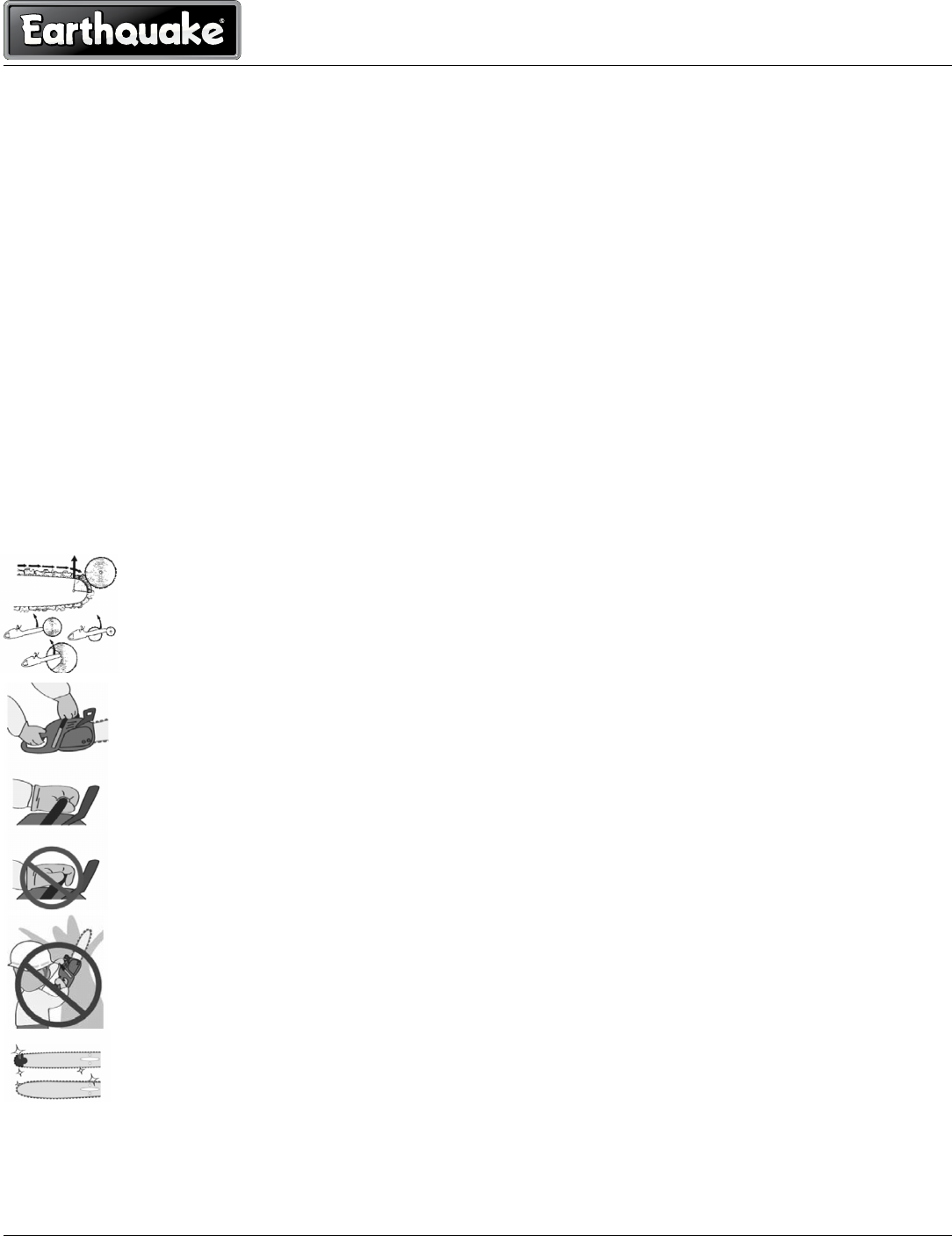
Kickback
Kickback may occur when the guide bar nose or
tip comes into contact with a foreign object, or
whenthe“sawkerf”(gapinthewoodbeingcut)
closes in on the bar and pinches the saw chain.
Tip contact in some cases may cause a lightning-
fast reverse action, kicking the guide bar up and
back toward the operator.
Pinching the saw chain along the top of the
guide bar may push the guide bar and the saw
unit backward toward the operator.
Either of these reactions may cause the operator
to lose control of the chainsaw, which could
result in serious personal injury or death.
Do not rely exclusively on the safety devises
built into your saw. As a chainsaw user, it is
your responsibility to understand the inherent
dangers of chainsaw use and the precautions
necessary to minimize those dangers.
Precautions to Avoid Kickback:
•Alwaysgripthe chainsaw rmlywithboth
hands; the right hand on the rear handle, and
the left hand on the forward grip.
• Makecertaintheareainwhichyouarecutting
is free from obstructions. Do not let the guide
bar nose come into contact with a log, branch, rock or other
objects while cutting. Such contact could result in a kickback.
• Alwaysmakecutsathighenginespeeds.
• Donotover-reachorcutaboveshoulderheight.
• Alwaysmaintainasharp and cleansawchain. Follow
manufacturer’s sharpening and maintenance instructions for
the saw chain.
• Only usereplacementbarsand chains specifiedbythe
manufacturer or an appropriate equivalent.
Sawing
•Thissawisprovidedforthesoleintendedpurposeofcutting
wood. Do not cut other materials with this saw.
• Donotattachothertoolsoraccessoriestotheoutputshaftof
the power unit. Doing so will void the manufacturer’s warranty.
• Donotapplyexcessivepressuretoforcethesawthroughthe
cut. Run the engine at full throttle and apply only light pressure.
• Alwaysmaintainarmfooting.
• Nevercutfromastepladderorwhileinatree.
• Neverusetheguidebarasameanstolift,pry,moveorsplit
objects.
•Nevermountthechainsawonaxedstand.
• Iftheguidebarandsawchainbecomepinchedinacut,donot
race the engine or pull the saw out of the cut by force. Use a
wedge or lever to open the cut and pull the saw free.
Felling a Tree
Felling refers to the process of cutting down a standing tree.
Numerous factors must be taken into consideration when
felling a tree. First consider the environmental factors which will
determine the felling direction:
• Windisamajordeterminingfactoroffellingdirection.
• Locationandnumberofheavybranchesandtheleanofthetree.
• Easeofbuckingandclean-upafterfelling
• Nearbystandingtimberinwhichthefelledtreecouldhangup.
• Locationofpower, telephoneanddatautilities,buildings,
roads, bodies of water, property lines, etc.
• Woodstructureandcondition(i.e.rottenheartwoodorcore).
• Keepallbystandersatleast2-1/2treelengthsawayfromthe
base of the tree to be cut. This area is considered a danger zone
and must be avoided before and during the felling operation.
Retreat Path
Plan two (2) retreat paths away from the felling direction of the
tree. Do not retreat in the opposite direction from the falling tree.
Instead, retreat at a 45-degree angle to either side.
• Cleartheretreatpathsofallobstacles.
• Placeallexcesstoolsandequipmentasafedistancefromthe
tree, but not in the retreat paths.
Check for parts online at www.getearthquake.com or call 800-345-6007 M-F 8-5
6
Operator's Manual
CS3814, CS3816, CS4116 Chainsaws
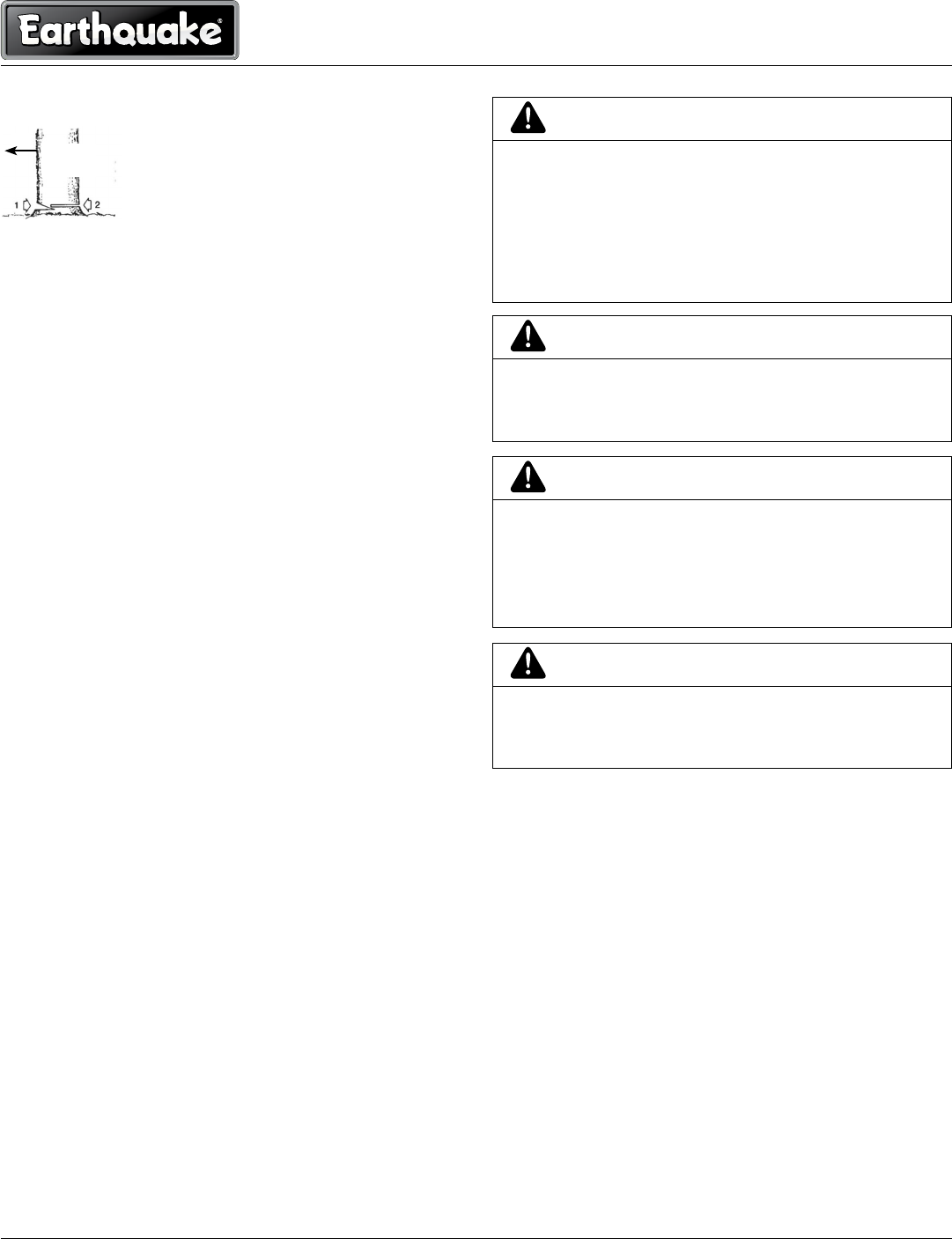
Felling Notch
The felling notch is the rst cut when felling a
tree. The notch will act as a hinge and will direct
the tree to fall in the desired direction.
1) Begin the felling notch by lining up the guide bar perpendicular
to the desired felling direction.
2) Make a downward cut at 45-degress to a depth of about 1/5
to 1/4 of the overall diameter of the tree.
3) Finish the notch by making a horizontal cut perpendicular to
the desired felling direction.
4) Remove the resultant piece.
Felling Cut
Alert others in the area of imminent danger of the falling tree. Double
check that no one has entered the area in the felling direction.
1) Begin the felling cut by making a horizontal cut perpendicular
to the intended felling direction and approximately 1-2 inches
above the bottom of the felling notch.
2) Leave approximately 1/10 of the tree’s diameter uncut. This
will form the hinge.
3) Drive plastic or wooden wedges into the felling cut to control
the fall.
4) As the tree begins to fall, alert others and immediately
evacuate the area around the tree.
Limbing a Felled Tree
“Limbing”referstoremovingthelimbsfromafallentree.Thereisan
extremely high danger of kickback during the limbing operation. Do
not work with the nose of the guide bar, as this could cause a kickback.
Use extreme caution and avoid contact between the nose of the bar
and the log or other limbs. Do not stand on the log while limbing it as
the log may roll as limbs are removed and the center of gravity shifts.
Start limbing by removing limbs from the top side of the log,
leaving limbs on the bottom to support the log up o the ground.
Limbs under tension may pinch the guide bar and saw chain.
Shut o the engine and lift the limb to remove the bar safely.
WARNING
INEXPERIENCED USERS SHOULD NEVER ATTEMPT TO
CUT TREES WITH ROTTEN HEARTWOOD THE CORE OF
THE TREE. THERE IS AN INCREASED RISK THAT THE TREE
COULD SNAP OR SPLIT UNEXPECTEDLY DURING THE CUT.
ALSO CHECK FOR DEAD OR ROTTEN LIMBS PRIOR TO
BEGINNING THE CUT. DEAD LIMBS CAN VIBRATE LOOSE
FROM THE TREE AND FALL, STRIKING THE OPERATOR.
CAUTION
ONLY TRAINED AND EXPERIENCED PROFESSIONALS
SHOULD FELL TREES NEAR OVERHEAD LINES AND
BUILDINGS. A SLIGHT MISJUDGMENT OF WIND
DIRECTION OR NATURAL LEAN OF A TREE COULD
RESULT IN MAJOR PROPERTY DAMAGE.
CAUTION
DO NOT CUT THROUGH THE HINGE. CUTTING
THROUGH THE HINGE INCREASES THE RISK OF
LOSING CONTROL OF THE FELLING DIRECTION.
CAUTION
LOGS AND LIMBS UNDER TENSION CAN SPRING BACK
WHEN CUT LOOSE. THIS LIGHTNING FAST ACTION
COULD CAUSE A LOSS OF CONTROL OF THE CHAINSAW.
Bucking a Log
“Bucking”isthecross-cutoperationofcuttingalogintousable
sections. Do not stand on the log while bucking as it may roll.
When bucking on a slope, stand uphill of the log in case it begins
to roll unexpectedly. Cut only one log at a time.
• Whenbuckingsmalllogs,placethemina“V”shapedbucking
horse to keep them at a working level. Never allow a bystander
to hold the log. Never hold the log with your leg or foot.
• Tobuckalogonatground,makeperpendicularcutsthrough
about half of the diameter of the log. Roll the log and nish
the cuts from the other side.
• Tobuckapillowedorsupportedlog,alwaysmakearelievingcut
through about 1/3 the diameter of the log from the compressed
side. Finish with a bucking cut from the tension side of the log.
Tip: When cutting firewood, make sure you know the
optimum length of the nished rewood ahead of time. Use
the guide bar as an approximate length gauge.
Pruning
Pruning is removing limbs from a standing tree, often for
purposes of maintaining a tree’s health or aesthetics. Always
work with a rm footing. Never cut from a stepladder. Do not
over reach. Do not cut above shoulder height.
1) Begin pruning by making a relief cut about 3 inches away from the
trunk of the tree to a depth of about 1/3 the diameter of the branch.
2) Complete the cut from above, just inside of the initial relief cut.
3) Finish pruning by making a smooth even cut nearly ush to the
trunk. It is recommended to only prune trees while they are dormant
in the fall and winter to reduce the risk posed by disease or insects.
direction
of fall
Check for parts online at www.getearthquake.com or call 800-345-6007 M-F 8-5 7
Operator's Manual
CS3814, CS3816, CS4116 Chainsaws
CAUTION
HOT GASES ARE A NORMAL BYPRODUCT OF A FUNC
TIONING CATALYTIC CONVERTER. FOLLOW ALL SAFE
TY INSTRUCTIONS TO PREVENT BURNS AND FIRES.
DO NOT ALTER/MODIFY ENGINE:
NEVER ALTER OR MODIFY THE ENGINE FROM THE
FACTORY. SERIOUS INJURY OR DEATH MAY OCCUR IF
ENGINE IS MODIFIED OR ALTERED.
WHEN WORKING ON OR REPLACING PARTS FOR THE
ENGINE OR PRODUCT, YOU MUST ALWAYS DISCON
NECT SPARK PLUG WIRE FROM THE SPARK PLUG AND
KEEP IT AWAY FROM THE SPARK PLUG.
ENGINE SAFETY PRECAUTIONS
Warning Carbon Monoxide Poisoning
Engines give off carbon monoxide, an odorless, colorless,
poisonous gas. Carbon monoxide may be present even if you do
not smell or see any engine exhaust. Breathing carbon monoxide
can cause nausea, fainting or death, in addition to drowsiness,
dizziness and confusion. If you experience any of these
symptoms, seek fresh air and medical attention immediately.
If your product comes with a separate engine manual, be
sure to read and follow all safety and warning precautions
outlined there, in addition to any in this manual.
Preventing Carbon Monoxide Poisoning
• Always start and run engine outdoors. Do not start or run
engine in an enclosed area, even if doors or windows are open.
• Never try to ventilate engine exhaust indoors. Carbon
monoxide can reach dangerous levels very quickly.
• Never run engine outdoors where exhaust fumes may be
pulled into a building.
• Never run engine outdoors in a poorly ventilated area where
the exhaust fumes may be trapped and not easily taken
away. (Examples include: in a large hole or areas where hills
surround your working area.)
• Never run engine in an enclosed or partially enclosed area.
(Examples include: buildings that are enclosed on one or
more sides, under tents, car ports or basements.)
• Always run the engine with the exhaust and muer pointed
in the direction away from the operator.
• Never point the exhaust muer towards anyone. People
should always be many feet away from the operation of the
engine and its attachments.
• Do not change the engine governor settings or over-speed
the engine.
WARNING
ENGINES GIVE OFF CARBON MONOXIDE, AN ODOR
LESS, COLORLESS, POISONOUS GAS. CARBON MON
OXIDE MAY BE PRESENT EVEN IF YOU DO NOT SMELL
OR SEE ANY ENGINE EXHAUST. BREATHING CAR
BON MONOXIDE CAN CAUSE NAUSEA, FAINTING OR
DEATH, IN ADDITION TO DROWSINESS, DIZZINESS
AND CONFUSION.
IF YOU EXPERIENCE ANY OF THESE SYMPTOMS, SEEK
FRESH AIR AND MEDICAL ATTENTION IMMEDIATELY.
Gasoline Fires and Handling Fuel Safely
Use extra care in handling gasoline and other fuels. They are
ammable and vapors are explosive.
• When storing extra fuel be sure that it is in an appropriate
container and away from any re hazards.
• Prevent re and explosion caused by static electric discharge.
Use only nonmetal, portable fuel containers approved by the
Underwriter’s Laboratory (U.L.) or the American Society for
Testing & Materials (ASTM).
• Always ll fuel tank outside in a well ventilated area. Never ll
your fuel tank with fuel indoors. (Examples include: basement,
garage, barn, shed, house, porch, etc.) Never ll tank near
appliances with pilot lights, heaters, or other ignition sources.
• If the fuel has to be drained, this should be done outdoors.
The drained fuel should be stored in a container specically
designed for fuel storage or it should be disposed of carefully.
• Never remove the fuel cap or add fuel with the engine
running. Stop engine and allow to cool before lling.
• Do not smoke.
• Never drain fuel from engine in an enclosed area.
• Always wipe up excess (spilled) fuel from engine before
starting. Clean up spilled fuel immediately. If fuel is spilled,
do not start the engine but move product and fuel container
from area. Clean up spilled fuel and allow to evaporate and
dry after wiping and before starting.
• Allow fuel fumes/vapors to escape from the area before
starting engine.
• Test the fuel cap for proper installation before starting and
using engine.
• Always run the engine with fuel cap properly installed on
the engine.
• Never smoke while relling engine fuel tank.
• Do not store engine with fuel in fuel tank indoors. Fuel and
fuel vapors are highly explosive.

Check for parts online at www.getearthquake.com or call 800-345-6007 M-F 8-5
8
Operator's Manual
CS3814, CS3816, CS4116 Chainsaws
• Never pour fuel from engine fuel tank.
• Never siphon fuel by mouth to drain fuel tank.
• Always have an adult fill the fuel tank and never allow
children to ll the engine.
• Never allow an adult or anyone under the inuence of drugs
or alcohol to ll engine.
• When storing gasoline or equipment with fuel in the tank,
store away from furnaces, stoves, water heaters or other
appliances that have a pilot light or other ignition source
because they can ignite gasoline vapors.
BURNS AND FIRES
The muer, muer guard and other parts of the engine be-
come extremely hot during the operation of the engine. These
parts remain extremely hot after the engine has stopped.
Prevention of Burns and Fires
• Neverremovethemuerguardfromtheengine.
• Nevertouchthemuerguardbecauseitisextremelyhot
and will cause severe burns.
• Nevertouchpartsoftheengine that become hot after
operation.
• Alwayskeepmaterialsanddebrisawayfrommuerguard
and other hot parts of the engine to avoid res.
• Thisengineisdesignedtooperateusingacatalyticconverter
which contributes to the engine’s compliance with the EPA.
CHILDREN AND BYSTANDERS
Tragic accidents can occur if the operator is not alert to the
presence of children and/or bystanders. Never assume that
others will remain where you last saw them.
• Keep the area of operation clean of all persons, especially
small children and pets. Keep children under the watchful
care of a responsible adult.
• Be alert and turn machine o if children enter the area.
• Before and while moving backwards, look behind and down
for small children.
• Never allow children to operate the machine.
• Use extra care when approaching blind corners, shrubs, trees,
or other objects that may obscure vision.
SERVICE
• Always stop the engine whenever you leave the equipment,
before cleaning, repairing or inspecting the unit. Engine
should be turned o and cool, spark plug wire must be
removed from spark plug before any repairs or adjustments
are attempted. Never make adjustments or repairs with the
engine (motor) running. Disconnect the spark plug wire,
and keep the wire away from the plug to prevent accidental
starting. Remove the ignition key if equipped with an electric
start.
• Always wear eye protection when you make adjustments or
repairs.
• Keep all nuts and bolts tight and keep equipment in good
condition.
• Never tamper with safety devices. Check their proper
operation regularly.
• When servicing or repairing the machine, do not tip the
machine over or up unless specically instructed to do so in
this manual. Service and repair procedures can be done with
the machine in an upright position. Some procedures will be
easier if the machine is lifted on a raised platform or working
surface.
• To reduce re hazard, keep machine free of grass, leaves,
or other debris build-up. Clean up oil or fuel spillage. Allow
machine to cool before storing.
• Stop and inspect the equipment if you strike an object.
Repair, if necessary, before restarting.
• Do not change the engine governor setting or over-speed
the engine.
• Clean and replace safety and instruction decals as necessary.
• To guard against engine over-heating, always have engine
debris lter mounted and clean.
• Inspect machine before storage. When not in use, disconnect
spark plug lead and store indoors in a dry place locked or
otherwise inaccessible to children.
• Use only original equipment parts from Earthquake,
including all nuts and bolts.
Check for parts online at www.getearthquake.com or call 800-345-6007 M-F 8-5 9
Operator's Manual
CS3814, CS3816, CS4116 Chainsaws
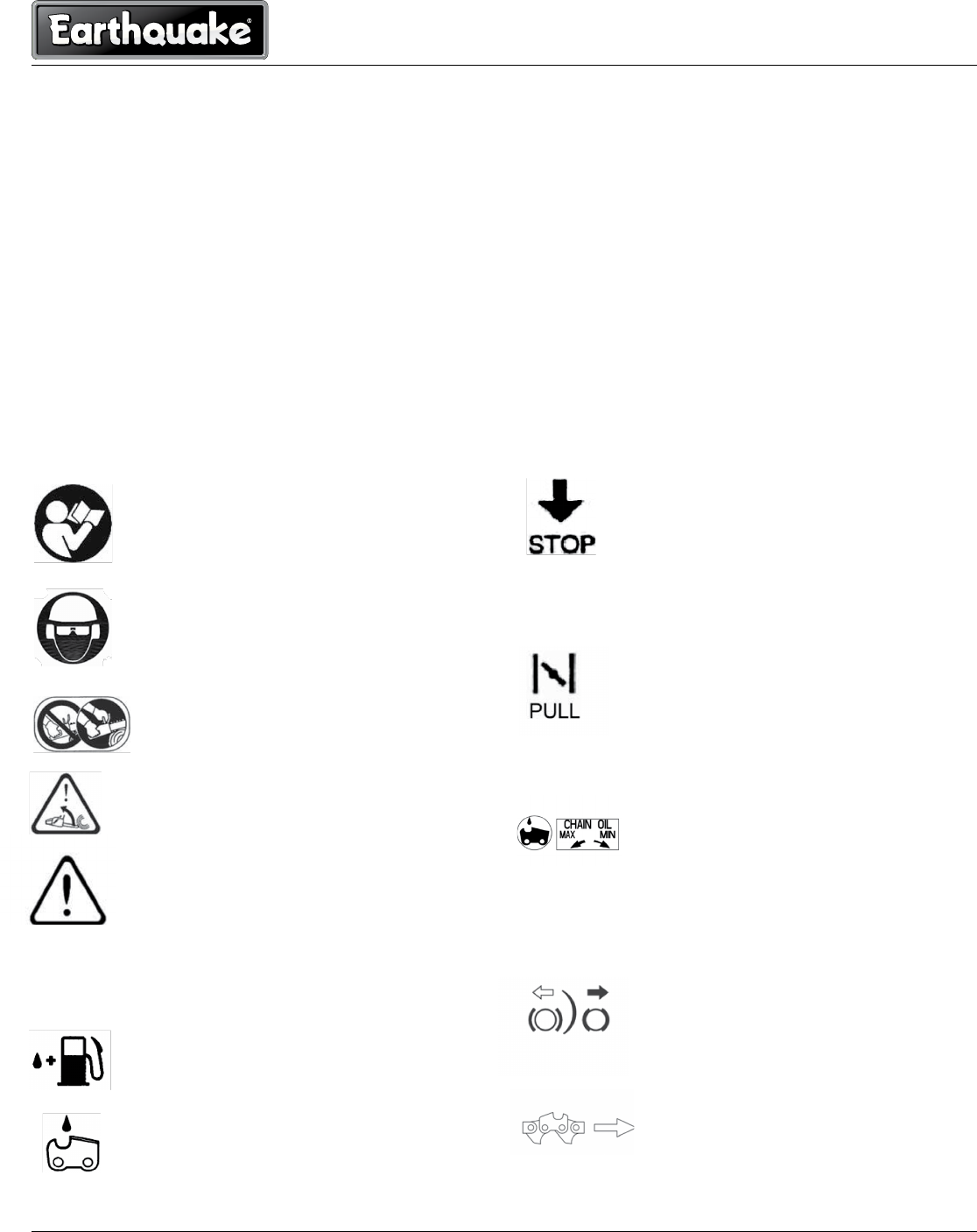
SAFETY DECALS
Although reading this manual and the safety instructions it contains will provide you with the necessary basic knowledge to operate
this equipment safely and eectively, we have placed several safety labels on the chainsaw to remind you of this important information
while you are operating the unit.
These important safety labels are illustrated below, and are shown here to help familiarize you with the location and content of the
safety messages you will see as you perform normal cutting operations. Please review these labels now. If you have any questions
regarding their meaning or how to comply with these instructions, reread the complete safety instruction text on the preceding
pages, or contact your local dealer.
Should any of the safety labels become unreadable because of being worn, faded, or otherwise damaged during the use of your
chainsaw, please use the part number information provided to order a replacement label from your local authorized dealer.
The safety labels are easily applied, and will act as a constant visual reminder to you, and others who may use the equipment. Follow
the safety instructions necessary for safe, eective operation of your chainsaw.
(1) Read operator's instruction book before op-
erating this machine.
(2) You must wear appropriate ear, eye, and head
protection.
(3) Use two hands when operating the chainsaw.
(4) Warning! Danger of kickback.
(5) Read, understand and follow all warnings.
For safe operation and maintenance, additional symbols are en-
graved on the machine.
(8) Indicates the engine operation ON/
OFF switch. Flipping the switch to the
“O”positionimmediatelystopstheen-
gine.
Location: Near the rear at the left side of the
rear handle.
(9) Indicates the choke knob location. Pull
out the choke knob and the choke
closes; push in the choke knob and the
choke opens.
Location: Near the rear at the right side of
the rear handle.
(10) Indicates the oil pump adjustment loca-
tion. Turn the rod using a screwdriver and
follow the arrow to the MAX position to
increase chain oil ow. Turning the rod to
the MIN position decreases chain oil ow.
Location: Bottom of the power unit.
(11) Indicates the directions that the chain
break is released (white arrow) and ac-
tivated (black arrow)
Location: Front of the chain cover.
(12) Indicates the direction of the saw chain
installation.
Location: Front of the chain cover.
(6) Indicates the port for refueling the gas/oil
mixture.
Location: Near the fuel cap.
(7) Indicates the port to rell the chain oil.
Location: Near the oil cap

Check for parts online at www.getearthquake.com or call 800-345-6007 M-F 8-5
10
Operator's Manual
CS3814, CS3816, CS4116 Chainsaws
SAFETY FEATURES
This saw is equipped with certain safety features and devices
to protect the user from harm in the event the saw reacts
unexpectedly to external forces:
1. Chain Brake: The saw is equipped with a chain brake designed
to stop the chain instantaneously upon activation. The chain
brake can be activated in one of two ways:
• The forward hand guard doubles as an activation lever for
the hand brake. It can be activated manually, or it may be
activated by the user’s arm if a kickback occurs.
• Thesawisalsoequippedwithan“InertialChainBreak.”The
same mechanism as above is activated by the inertial force
created when a counterweight under the forward hand
guard accelerates toward the bar nose during a kickback.
• Proper cleaning and care of the chain brake system are
required to ensure reliable operation in the eld. You should
also check your chain brake for proper operation regularly.
To check your chain brake:
Manually activate the chain brake by pushing the forward
hand guard toward the bar nose. There will be an audible
click when the chain brake engages. If there is no audible
click, the brake may already be engaged. Pull back on the
forward hand guard to deactivate the brake. An audible
click should be heard when the brake disengages. If there
is still no audible click, the brake is not functioning properly.
Remove the clutch cover, clean and reassemble, and re-test.
If no audible click is heard, contact customer service for
further assistance.
With the saw’s engine shut o and the brake disengaged,
firmly grasp both handles and hold the saw over a log
or low stump. Swing the bar nose sharply down until it
makes contact. This should create enough inertial force
to automatically activate the chain brake. When the brake
engages, an audible click should be heard. If no audible click
is heard, the brake is not functioning properly. Remove the
clutch cover, clean and reassemble, and re-test. If no audible
click is heard, contact customer service for further assistance.
2. Throttle Interlock: This saw is equipped with a throttle
interlock designed to prevent accidental engagement of
the throttle control. The throttle interlock is disengaged by
depressing the red tab on top of the rear handle. This is usually
accomplished when the user grasps the rear handle to operate
the saw.
3. Chain Catcher: Each saw is equipped with a chain catcher
beneath the clutch cover. If the chain is ever thrown from the
guide bar, or if the chain breaks, the chain catcher is designed
to capture the chain and prevent it from whipping back toward
the operator.
NOTE: Inspect the chain catcher before each use. Replace if
missing or badly damaged.
4. Kickback Reduction Guide Bar and Saw Chain: This saw has
been equipped with a Double Guard® 91 guide bar and 91VG
S-Series Low Kickback saw chain by Oregon®. The features of
this bar and chain combination are design to reduce the risk
of kickback. To maintain adequate kickback prevention, only
use these components when replacing guide bar or saw chain.
(Refer to the Maintenance section of this manual for full details)
Check for parts online at www.getearthquake.com or call 800-345-6007 M-F 8-5 11
Operator's Manual
CS3814, CS3816, CS4116 Chainsaws
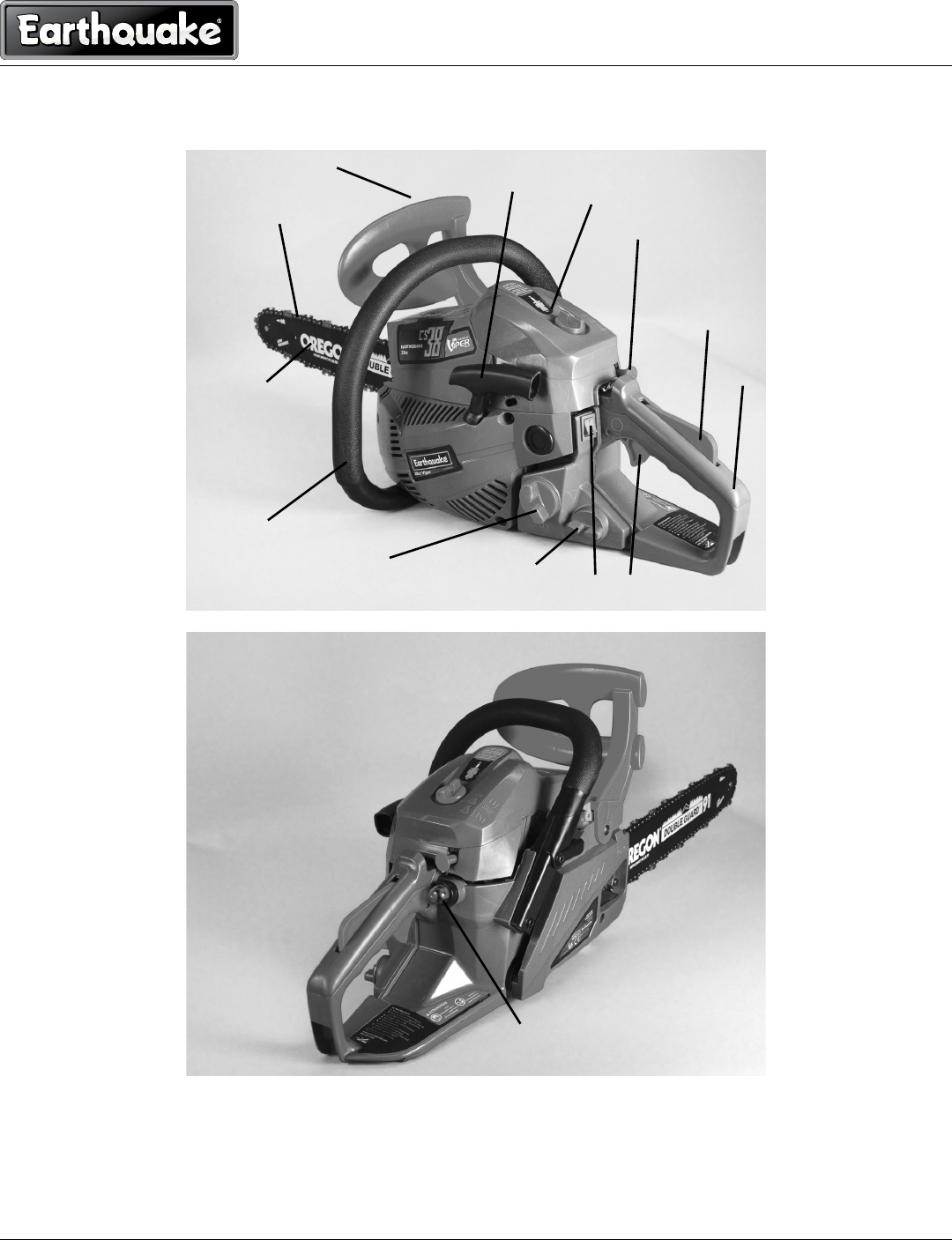
FEATURES
1. Front hand guard and brake
2. Starter handle
3. Air lter cover
4. Choke knob
5. Throttle trigger lock-out
6. Rear handle
1
23
4
5
6
78
9
10
11
13
12
14
7. Throttle trigger
8. Engine switch
9. Oil tank cap
10. Fuel tank cap
11. Front handle
12. Saw chain
13. Guide bar
14. Primer Bulb

Check for parts online at www.getearthquake.com or call 800-345-6007 M-F 8-5
12
Operator's Manual
CS3814, CS3816, CS4116 Chainsaws
SPECIFICATIONS
SPECIFICATIONS
Displacement 37.2cc (CS3814/CS3816)
40.1cc (CS4116)
Fuel Mixture (Unleaded Gasoline, 50: two-cycle oil 1)
Fuel tank capacity 310 ml
Chain oil Bar chain oil for proper season
Oil tank capacity 210 ml
Carburetor Diaphragm type
Fuel consumption at maximum engine power 560 g/kw.h
Idling speed 3000 rpm max / rpm +/- 150
Maximum speed with cutting attachment 11,000 r/min
Ignition system CDI with timing advance function
Spark Plug Champion CJ7Y or equivalent
Oil feeding system Mechanical plunger pump with adjuster
Sprocket Teeth x Pitch 6Tx.375”
Dimensions (L x W x H) 710-76 x 235 x 240 mm
28”-30”x9.25”x9.5”
Dry weight (without guide bar and chain,
empty tanks
9.26 lb
Guide Bar Type Sprocket Nose
Guide Bar Size 14”(CS3814)
16”(CS3816/CS4116)
Saw Chain Type Oregon® 91VG or 91P S52 (CS3814)
Oregon® 91VG or 91P S57 (CS3816/4116)
Pitch 3/8”LowProle
Gauge .050”
Specications are subject to change without notice.
Check for parts online at www.getearthquake.com or call 800-345-6007 M-F 8-5 13
Operator's Manual
CS3814, CS3816, CS4116 Chainsaws
ASSEMBLY
The Earthquake Chainsaw carton includes the following
- Power Unit: Pre-assembled engine, handles, fuel tank,
oil tank, and chain brake handle.
- GuideBar:OregonDoubleGuard14”or16”,depending
on the saw model.
- SawChain:Oregon91Por 91VGS52(14” models) or
OregonS57(16”models)
- “Scwrench”Multi-tool:Combinationplug/barwrench
and screwdriver
- Bar Scabbard: Plastic guard that ts over the guide bar
and saw chain.
ASSEMBLING YOUR CHAINSAW
1. Carefully remove all items from the packaging. Place the
power unit on a at, stable work surface with the muer
facing to your right.
2. Pull back (toward the forward handle) on the brake lever to
ensure that the chain brake is disengaged.
3. Usingthe“Scwrench”multi-tool,loosenandremovethebar
nuts securing the clutch cover to the power unit. Set the clutch
cover aside. Tip: If working in the eld, place the bar nuts in
the clutch cover to keep from losing them in grass or foliage.
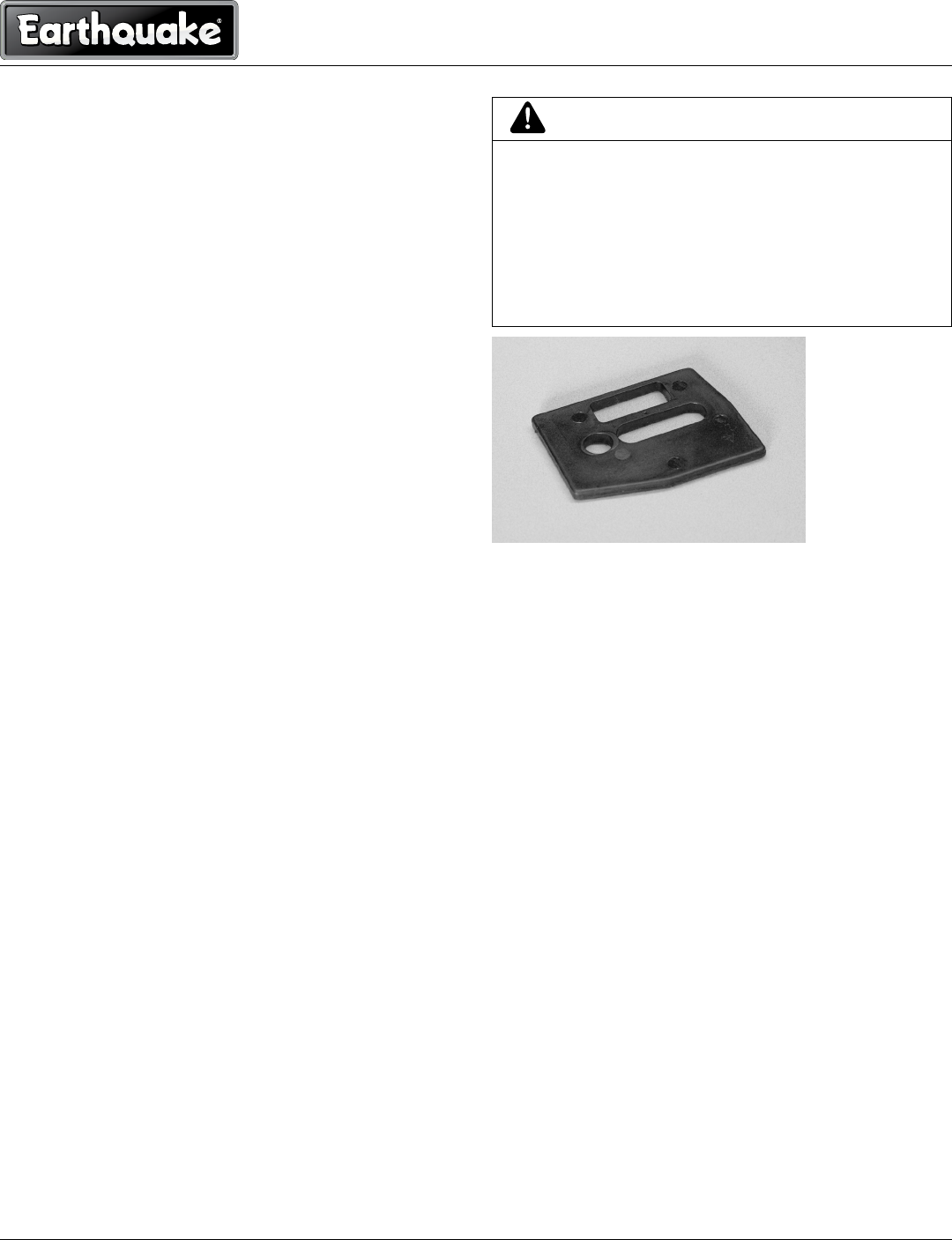
4. Remove the plastic shipping spacer from the bar studs. The
purpose of this spacer is to keep the clutch cover in the correct
position when the guide bar is not installed on the power unit.
SEE FIGURE 1.
5. Install the guide bar on the bar studs, and slide the bar back
until it comes into contact with the drive sprocket.
6. Carefully remove the saw chain from its package. Stretch the
chain out into a long horizontal loop. The cutting teeth on
the top length of chain should face away from the power
unit. The cutting teeth on the bottom length of the chain
should face toward the power unit. Protective gloves should
be used when handling the chain.
7. Wrap the chain around the drive sprocket rst, and lay the
drive links of the chain into the groove along the outer
perimeter of the guide bar. Lay the chain over the nose (tip)
of the guide bar.
8. Slide the bar forward until the bar mates with the tensioning
tab. Make sure that the drive links of the chain are seated
within the groove around the perimeter of the bar. If the bar
will not slide forward far enough, use the screwdriver end of
the Scwrench to turn the tension screw counter-clockwise.
The tension screw is located on the front of the power unit,
next to the guide bar.
9. Replace the clutch cover over the bar, and turn the bar nuts
onto the bar studs. Only nger tighten the bar nuts at this step.
10. Locate the tension screw on the front of the power unit next
to the guide bar. Use the Scwrench to turn the tension screw
clockwise. This will take the slack out of the saw chain. When
properly tensioned, two conditions must be met:
•Thechainshouldnothangordroopawayfromtheguide
bar.
•Youshouldbeabletopullthechainslightlyawayfrom
the guide bar, but not so far as to be able to disengage the
drive links from the groove around the perimeter of the bar.
11. Pull up on the guide bar’s nose and use the Scwrench to tighten
the bar nuts. Check that the chain spins freely around the bar
by hand. If there is resistance, the chain may be too tight.
12. Place the bar scabbard over the guide bar and saw chain. This
guard will help to protect the user from the sharp cutting
teeth as well as help keep the cutting teeth sharp when the
saw is not in use.
13. Check the tension of the saw chain frequently during use,
especially during the rst two hours of use on a new chain.
Re-tension as needed.
14. Always release the tension in the chain after nishing work
and before the saw chain and guide bar cool completely. As
the saw chain heats up during operation, it will expand and
stretch, requiring re-tensioning on occasion. As the saw cools
down the saw chain will shrink, and if left tensioned, could
cause severe and permanent damage to the guide bar or the
power unit’s drive components.
WARNING
FAILURE TO PROPERLY TENSION THE CHAIN COULD
RESULT IN DAMAGE TO THE UNIT OR SEVERE INJURY
OR DEATH. OVER TENSIONING COULD CAUSE DAMAGE
TO THE SAW’S POWER UNIT OR GUIDE BAR. LACK OF
TENSION COULD CAUSE THE CHAIN TO DISENGAGE
THE BAR COMPLETELY, ALLOWING IT TO WHIP BACK
WHERE IT COULD CONTACT THE OPERATOR CAUSING
SEVERE INJURY OR DEATH.
Figure 1
Check for parts online at www.getearthquake.com or call 800-345-6007 M-F 8-5
14
Operator's Manual
CS3814, CS3816, CS4116 Chainsaws
FILLING THE BAR AND CHAIN OIL RESERVOIR
1. While the engine is cool for re-fueling, clean debris from area
around the bar and chain oil cap.
2. Loosen oil cap slowly.
3. Carefully add bar and chain oil without spilling.
4. Do not ll oil reservoir completely full; allow space for oil to
expand.
5. Replace cap and tighten. Wipe o any spilled oil before starting
engine.
Note: Do not use waste or recycled oil. Waste or recycled oil
could contain contaminants which will cause damage to the
oil pump.
WARNING
CHAIN BRAKE WILL NOT PREVENT A KICKBACK. IN THE
EVENT OF A KICKBACK, THE CHAIN BRAKE IS DESIGNED
TO REDUCE THE RISK OF INJURY TO THE OPERATOR.
WARNING
DO NOT MODIFY OR ALTER THE FUNCTIONALITY OF
THE THROTTLE INTERLOCK IN ANY WAY. DOING SO
WILL ALLOW ACCIDENTAL ENGAGEMENT OF THE
THROTTLE WHICH WILL RESULT AN UNEXPECTED
OPERATION OF THE SAW CHAIN.
WARNING
CHAIN CATCHER IS INTENDED TO PREVENT INJURY
IN THE EVENT OF A CHAIN MALFUNCTION. NEVER
OPERATE A SAW WITHOUT A CHAIN CATCHER.
REPLACE IF MISSING OR BADLY DAMAGED.
OPERATION
FILLING FUEL TANK
1. Shut o engine and allow engine to completely cool before
relling the fuel tank.
2. Move to a well-ventilated area, outdoors, away from ames
and sparks.
3. Clean debris from area around the fuel cap.
4. Loosen fuel cap slowly.
5. Carefully add fuel without spilling.
6. Do not ll gas tank completely full; allow space for fuel to
expand.
7. Immediately replace fuel cap and tighten. Wipe o spilled
fuel and allow to dry before starting engine.
The saw chain needs to stay lubricated during operation of
the unit. Aside from the fuel reservoir on the chainsaw, there
is also a bar and chain oil reservoir. Use only oil that has been
designed specically for use with chainsaws. Bar and chain oil
has chemical properties which allow it to adhere to the saw
chain and provide better lubrication while the chain is in motion.
The saw is equipped with an adjustable automatic oiler. The
oiler and oil reservoir are designed such that a full tank of fuel
will run out before a full tank of oil. This ensures that the bar
and chain will receive a constant ow of oil during operation.
Always top o your oil reservoir when re-fueling.

Check for parts online at www.getearthquake.com or call 800-345-6007 M-F 8-5 15
Operator's Manual
CS3814, CS3816, CS4116 Chainsaws
PRESTART INSPECTION
1. Check that all safety guards are in place and all nuts and bolts
are secure.
2. Inspect air cleaner for cleanliness.
3. Checkthefuelsupply.Fillthefueltanknocloserthan.5”from
top of tank to provide space for expansion.
4. Check the bar and chain oil level.
5. Be sure spark plug wire is attached and spark plug is
tightened securely.
6. Examine underneath and around engine for signs of oil or
fuel leaks.
7. Inspect fuel hoses for tightness and fuel seepage.
8. Look for signs of engine damage.
9. Remove excessive debris from muer area and recoil starter.
STARTUP
Before starting the engine, inspect the immediate area. Check
that there are no bystanders nearby. Make sure that you have a
rm and stable footing and remove tripping hazards. Clear all
objects that the saw chain could catch on and cause a pull-in,
push-back, or kickback reaction.
There are two safe and approved positions for cold-starting the
saw.
Starting on the ground:
1. Place saw on a at, stable patch of ground free of vegetation
and check that the saw chain is not in contact with the ground.
2. Place right foot on the base of the rear handle and rmly grip
the forward handle with left hand.
Starting in a raised, standing position:
1. Place the rear handle between knees or thighs and rmly grip
the forward handle with left hand.
COLD ENGINE START:
1. Grip the rear handle with right hand, depressing the throttle
interlock with right palm, and pull the throttle control to
check for smooth operation and to reset the choke to the run
position.
2. Depress the primer (purge) bulb until it lls with fuel.
3. Pull the choke all the way out to the CHOKE position.
NOTE: This will close the choke and lock the throttle in the
starting position.
4. Put the power unit’s ignition switch in the ON position.
NOTE: Signied by a vertical line “l”
5. Grasp the starter handle rmly with right hand and slowly pull
until it provides resistance. Without letting the starter handle
retract, pull rope with a rapid full arm stroke. Let it return to
its original position very slowly until unit res or runs. Repeat
this step ever time the starter rope is pulled.
NOTE: If engine fails to start after 5-6 pulls, push primer 1
time and pull starter rope again.
6. After engine starts running, place grasp rear handle with right
hand and remove right foot from the base of the rear handle.
7. Depress throttle interlock with right palm and pull throttle
control with right index nger.
NOTE: This will automatically reset the choke to the RUN
position.
WARM ENGINE START:
1. Pull choke all the way out to the CHOKE position.
2. Continue with Step 4 of Cold engine starting
HOT ENGINE START:
1. Continue with Step 4 of Cold engine starting.
2. If engine does not re, refer to Step 1 of Warm engine starting.
STOPPING THE ENGINE:
1. Let the saw idle for up to one minute to continue blowing air
through the engine to aid the cool-down process. Doing so
will help prolong the life of the saw.
NOTE: The engine is still running. Always maintain a rm,
controlling grip on the unit while the engine is running.
2. Put the unit’s ignition switch in the OFF position.
NOTE: Signied by an “O”
3. After the saw is o and has cooled down, remove tension from
the chain.
WARNING
DO NOT RUN A SAW THAT IS NOT PROVIDING PROPER
OIL COVERAGE UNDER ANY CIRCUMSTANCES. DOING
SO WILL RESULT IN PERMANENT DAMAGE TO THE
GUIDE BAR AND SAW CHAIN.

Check for parts online at www.getearthquake.com or call 800-345-6007 M-F 8-5
16
Operator's Manual
CS3814, CS3816, CS4116 Chainsaws
MAINTENANCE AND STORAGE
Good maintenance is essential for safe, economical, and trouble-free operation. It will also help reduce air pollution. To help you
properly care for your engine, the following pages include simple maintenance procedures using basic hand tools. Other service
tasks that are more difficult, or require special tools, are best handled by professionals and are normally performed by a technician
or other qualified mechanic.
Maintenance, replacement or repair of the emissions control devices and systems may be performed by any non-road en-
gine repair establishment or individuals. However, items must be serviced by an authorized dealer to obtain “no charge”
emissions control service.
The maintenance schedule applies to normal operating conditions. If you operate your engine under unusual conditions (such as
sustained high-load or high-temperature operation) or use it in unusually wet or dusty conditions, consult your servicing dealer for
recommendations applicable to your individual needs and use.
Maintenance Item Every Refueling Every 8
Hours
Every 20
Hours Each Year
Check Engine and Check Hardware X X
Air Filer
(See Air Filter Section)
Check X
Clean X
Replace X X
Spark Plug
(Gap.025”or0,0635mm)
See Spark Plug Section
Check/Adjust X
Replace X
Chain Tension Check/Adjust X
Chain
(See Chain Sharpening Section)
Check/Sharpen X
Clean X
Replace X
Guide Bar
(See Check Guide Bar Section)
Check X
Clean X
Oiler Port Clean X
Drive Sprocket
(See Drive Sprocket Section)
Check/Clean X X

Check for parts online at www.getearthquake.com or call 800-345-6007 M-F 8-5 17
Operator's Manual
CS3814, CS3816, CS4116 Chainsaws
BAR AND CHAIN OIL
The saw is equipped with an adjustable chain oiler. The oil
pump, driven by the drive sprocket, will only pump oil when the
engine is running at high enough speeds to engage the clutch
and rotate the chain. Furthermore, the ow of oil is adjustable to
accommodate variations in chain oil due to temperature.
To adjust the oil pump, insert a screwdriver in the small notch
beneath the clutch and drive sprocket. To increase the ow
of oil, turn the screwdriver counter-clockwise. To decrease
the ow of oil, turn the screwdriver clockwise. For optimum
performance, use a higher rate of ow with thicker oil or in
colder temperatures, and a lower rate of ow with thinner oil or
in warmer temperatures.
The guide bar and saw chain need to be well lubricated during
operation to prevent permanent damage from friction and heat.
Be sure to check the oil supply to the bar and chain before use.
1. After starting the engine, hold the saw up with the chain
suspended in front of or above a test surface.
2. Run the engine at about half throttle.
3. Oil should be ung o of the rotating chain onto the test
surface.
If the saw chain seems dry, but there is some oil present on the
bar or test surface, the oil pump may be set too low. Increase
the setting by turning the adjustment screw counter-clockwise.
If the saw chain and guide bar are dry and there is no oil on the
test surface, the oiler port and guide bar may need cleaning.
Remove the clutch cover, bar, and chain, and clean under the
clutch cover with a brush and clean the guide bar with a wire or
small screwdriver.
Reassemble and retest for oil presence. If no oil is present after
adjusting the oiler setting and cleaning the oiler port, the oil
pump may not be functioning. Discontinue use of the unit and
contact your local authorized service center or customer service
for assistance.
In compliance with EPA regulations, any adjustments to the
carburetor must be made by an authorized service center.
An authorized service center is capable of troubleshooting
carburetor problems, adjusting carburetors to perform correctly,
and adjusting carburetors to compensate for altitude.
IMPORTANT NOTE: Carburetor is set at factory. Further
adjustment must be performed by an authorized service center.
Contact customer service for a list of authorized service centers.
ENGINE MAINTENANCE
COOLING FINS
Cooling ns, air inlets, and linkages must be free from any debris
before each use.
AIR FILTER
Never run engine without air cleaner properly installed. Added wear
and engine failure may occur if air cleaner is not installed on engine.
Service air cleaner every 3 months or after 20 hours of operation.
Clean lter daily in extremely dusty conditions.
Steps for Cleaning Air Filter
1. Remove the air cleaner cover by turning the thumb screw on top
of the power unit counter-clockwise and lifting the cover o.
2. To remove the lter, lift the lter element o of the threaded stud.
3. Larger surface dust and dirt particles can be removed from the lter
element by lightly tapping a corner of the lter against a hard surface.
4. To clean ner dust trapped in the mesh screens, split the lter
by inserting a at screwdriver between the dogs on one corner
of the lter element and twisting.
5. Using an air compressor at a low pressure or a store-bought
compressed air duster, blow air through the mesh from the inside.
6. Press the two lter halves back together by squeezing around the
rim. Do not place pressure on the mesh or a puncture could occur.
7. Place the lter back over the threaded rod, making sure to seat
the lter on the O-ring on the carburetor.
8. Place the air cleaner cover back on the saw body and turn the
thumb screw clockwise until nger tight.
SPARK PLUG
The recommended spark plug is a NGK BPM6A, Champion CJ7Y,
or Torch L7TC.
Steps for Removing the Spark Plug
1. Remove the air cleaner cover by turning the thumb screw on top
of the power unit counter-clockwise and lifting the cover o.
2. Disconnect the spark plug cap and clean any debris from
around the spark plug area.
3.Removesparkplugusingthe“Scwrench”multi-tool.Replaceif
any of the following occur; pitted electrodes, burned electrodes,
cracked porcelain, or deposits around the electrodes.
4. After analysis, seat spark plug and turn by hand until nger
tight.

Check for parts online at www.getearthquake.com or call 800-345-6007 M-F 8-5
18
Operator's Manual
CS3814, CS3816, CS4116 Chainsaws
Installing Spark Plug
1. Reinstall original spark plug, tighten additional 1/2 turn.
2.Installingnew sparkplug,adjustspark pluggap to .025”
(0,635mm) and tighten additional 1/8 – 1/4 turn.
NOTE: Loose spark plug may overheat and damage engine.
Over tightened spark plug may damage threads in the
cylinder head.
CARBURETOR
Never tamper with the factory setting of the carburetor.
SAW CHAIN TENSION MAINTENANCE
Keeping the saw chain at the proper tension is necessary for
safe operation and will help prolong the life of the saw chain
and the guide bar.
1. Shut the power unit o and allow the saw to cool.
2. The saw chain should not hang down from the bottom edge
of the guide bar.
3. Wearing protective gloves, hold the guide bar with one hand
and pinch the chain with the free hand.
4. Pull down on the chain. It should pull away from the bar, but
the drive links should not disengage the groove around the
perimeter of the guide bar.
5. Add or remove tension as needed.
6. Hold up on the guide bar nose and tighten the bar nuts with
the Scwrench.
Add tension at the beginning of every work session.
Check tension at every re-fueling.
Remove tension at the end of every work session.
SAW CHAIN MAINTENANCE
Keeping the saw chain sharp is a critical component to operating
a chainsaw. A dull saw chain will drastically reduce cutting
eciency and can pose certain safety hazards.
• Avoidunintentionallystrikingforeignobjects.Thiscancause
a kickback, but will also reduce the sharpness or permanently
damage the saw chain.
• Avoidcuttingwoodthathasbeendrugontheground.Sand,
dirt, and mud stuck to the log will dull the saw chain.
• Avoidcutting woodthatmaycontainmetalsuchasnails,
staples, or wire.
• Avoidcuttingallthewaythroughwhenbuckingalog.This
could allow the chain to come into contact with the soil below,
dulling the saw chain.
Sharpening Saw Chain Cutters (Teeth)
The saw chain included with this saw is a 91VG Chamfer Chisel™ or
91P Chamfer Chisel™ and requires a 5/32 inch round le (included
in the original packaging).
When to have your saw chain sharpened:
• Sawdustbecomespowder-like
• Youneedtoforcethesawintothecut
• Thesawtendstocutthroughatanangleinsteadofmakinga
straight cut
• Vibrationincreases
• Fuelconsumptionincreases
Always inspect your saw chain prior to sharpening. Check for
the following:
• Bentorburreddrivelinks
• Brokencuttersortie-straps
• Looserivetsorbrokenrivetheads
If broken components are found, discard the chain immediately.
To properly sharpen you saw chain:
1. Be sure to have the correct size le and le guide.
2. When hand ling it’s important that 1/5, or 20 percent, of the
le’s diameter is always held above the cutter’s top plate.
3. Keep the correct top-plate ling angle line on your le guide
parallel with the chain.
4. Sharpen all cutters on one side of the chain rst. Sharpen
by ling from the inside of each cutter to the outside. After
sharpening the rst side, turn the saw around and repeat the
process for cutters on the other side of the chain.
5. If the chrome surface of the top or side plates is damaged, le
back until such damage is removed.
6. Keep all cutters at an equal length. Begin ling on the cutter
with the most damage, and le all subsequent cutters to the
same length.
7. DO NOT alter or le the tops of bumper tie strap links (between
each cutter) on the 91VG chain.

Check for parts online at www.getearthquake.com or call 800-345-6007 M-F 8-5 19
Operator's Manual
CS3814, CS3816, CS4116 Chainsaws
8. FileONLYonthe“Push”stroke,donotpulltheleagainstany
metal object as this will damage the le.
It is also important to maintain the depth gauge setting
throughout the lifespan of the saw chain. 91VG and 91P chains
useadepthsettingof.025”.Thissettingshouldbecheckedand
corrected every third or fourth time the saw chain is sharpened.
1. Place the correct depth-gauge tool over the chain, with one
depth gauge protruding through the slot in the tool.
2. If the depth gauge extends above the slot, use a at le to bring
the depth gauge ush with the top of the tool. Use only the
push stroke of the le. Pulling the le will damage the le.
3. Make sure to round over the leading edge of the depth
gauge to prevent kickbacks and tie strap breakage.
STORAGE
When storing the chainsaw for periods of three months or
longer:
1. Empty and clean the fuel tank in a well-ventilated area.
2. Dispose of fuel properly. Local regulations may apply. Contact
your local government or hazardous material service for
instructions.
3. Run the engine until the carburetor is dry. This will draw the
fuel out of the carburetor, preventing costly repairs to clean
gummed fuel from the fuel system.
4. Remove the saw chain and guide bar. Clean them thoroughly
and treat with a rust preventative before storing.
5. Thoroughly clean the chain saw. Remove sawdust and
excess bar and chain oil from the clutch cover and the area
surrounding the clutch. Pay close attention when cleaning
the cylinder cooling ns and the air lter.
6. Store the unit in a dry location, out of the reach of children
and other unauthorized users.
TROUBLESHOOTING & REPAIR
At Earthquake, we build quality and durability into the design
of our products; but no amount of careful design by us, and
careful maintenance by you, can guarantee a repair-free life
for your Earthquake Chainsaw. Most repairs will be minor, and
easily xed by following the suggestions in the troubleshooting
guide in this section.
The guide will help you pinpoint the causes of common problems
and identify remedies.
For more complicated repairs, you may want to rely on your
retailer, an authorized service center or Earthquake. A parts
breakdown is located toward the end of this manual.
We will always be glad to answer any questions you have, or help
you nd suitable assistance. To order parts or inquire about war-
ranty, call or e-mail us using the contact information found below.
ORDERING REPLACEMENT PARTS
Parts can be obtained from the store where the chainsaw was
purchased or direct from the factory. To order parts visit www.
getearthquake.com or call 1-800-345-6007.
For other general questions, you can e-mail us at info@ardisam.
com.
Please include the following information with your order:
1) Part numbers
2) Part description
3) Quantity
4) Model number and serial number

Check for parts online at www.getearthquake.com or call 800-345-6007 M-F 8-5
20
Operator's Manual
CS3814, CS3816, CS4116 Chainsaws
TROUBLESHOOTING AND REPAIR
TROUBLESHOOTING GUIDE
While normal care and routine maintenance will extend the life
of your chainsaw, prolonged or constant use may eventually
require that service be performed to allow it to continue oper-
ating properly. The troubleshooting guide below lists the most
common problems, causes and remedies.
WARNING
PRACTICE SAFETY AT ALL TIMES. ENGINE MUST BE
TURNED OFF AND ALLOWED TO COOL, AND SPARK
PLUG WIRE MUST BE DISCONNECTED AND SECURED
BEFORE ATTEMPTING ANY MAINTENANCE OR REPAIR.
FAILURE TO COMPLY WITH THIS SAFETY
REQUIREMENT
CAN RESULT IN SERIOUS PERSONAL INJURY TO YOU
OR BYSTANDERS.
PROBLEM CAUSE REMEDY
Starting failure •Checkfuelforwateror
substandard mixture
•Replacewithproperfuel
•Removeanddrythesparkplug
•Pullthestarteragainwithnochoke
•Replacesparkplugwithanewplug
Lack of power / Poor ac-
celeration / Rough idling
•Checkforwateror
substandard mixture
•Checkairlterandfuel
lter for clogging
•Checkcarburetorfor
inadequate adjustment
•Replacewithproperfuel
•Clean
•Haveanauthorizedservicecenteradjustthe
carburetor.
Oil does not come out •Checkoilforsubstandard
quality
•Checkoilpassageand
ports for clogging
•Replace
•Clean
If the unit seems to need further service, please consult with an authorized service shop in your area.

Check for parts online at www.getearthquake.com or call 800-345-6007 M-F 8-5 21
Operator's Manual
CS3814, CS3816, CS4116 Chainsaws
PART # DESCRIPTION QT Y.
838100 CLUTCH COVER ASSEMBLY 1
838105 AIR FILTER ELEMENT 1
838106 CYLINDER SHROUD ASSEMBLY 1
838107 RECOIL ASSEMBLY 1
838108 FORWARD HANDLE KIT 1
838111 FUEL CAP 1
838112 BAR/CHAIN OIL CAP 1
838113 CLUTCH W/WASHER 1
838114 CLUTCH DRUM W/NEEDLE BEARING 1
838116 ADJUSTABLE OIL DELIVERY PUMP 1
838118 CARBURETOR COMPLETE KIT 1
838119 BUCKING SPIKE 1
838121 IGNITION COIL ASSEMBLY 1
838122 THROTTLE TRIGGER ASSEMBLY 1
838124 GUIDE BAR BASE PLATE 1
838127 STUD M81.25 X 16MM X 42MM 2
838129 OIL/FUEL LINES AND FITTINGS KIT 1
838130 OIL PUMP COVER 1
838131 CHOKE PULL 1
838132 WIRING KIT COMPLETE 1
838133 FLYWHEEL ASSEMBLY 1
838134 VIBRATION DAMPENING KIT 1
838135 FUEL FILTER 1
838136 AIR CLEANER COVER 1
838137 MUFFLER KIT 1
838138 CHAIN CATCHER KIT 1
838140 WOODRUFF KEY #303 1
838143 GASKET KIT 1
838145 38CC SHORT BLOCK W/BASE CHASSIS 1
838146 41CC SHORT BLOCK W/BASE CHASSIS 1
838147 SCWRENCH 1
838148 5/32IN ROUND FILE 1
838149 CHAIN SCABBARD 1
838161 AIR FILTER VIBRATION BUMPER 1
838162 COLD WEATHER SHUTTER 1
PARTS BREAKDOWN
CHAINSAW PARTS LIST
TO ORDER ANY REPLACEMENT PARTS, VISIT EARTHQUAKE’S WEBSITE, WWW.GETEARTHQUAKE.COM.

Check for parts online at www.getearthquake.com or call 800-345-6007 M-F 8-5
22
Operator's Manual
CS3814, CS3816, CS4116 Chainsaws
EARTHQUAKE CHAINSAWS
1YEAR LIMITED WARRANTY
Terms and Conditions
PRODUCT WARRANTY: 1YEAR LIMITED WARRANTY
Earthquake, a manufacturing company, warrants this EARTHQUAKE® CHAINSAW to be free from defects in the
material or workmanship for a period of one year from the date of purchase. During the one-year warranty of this
product, Earthquake will, at their discretion, furnish parts and labor to correct any defect caused by faulty material
or workmanship. Any unit used in a commercial application is covered for a period of 90 days after purchase. This
warranty applies to the original owner with a proof of purchase and is not transferable. This guarantee is void
unless the warranty card is properly lled out and received by Earthquake within 30 days of purchase or go to www.
GetEarthquake.com for online registration.
For replacement parts, phone 800-345-6007 or go online to www.GetEarthquake.com.
ENGINE WARRANTY: 2YEAR LIMITED WARRANTY
Ardisam, Inc., a manufacturing company warrants its Viper Engines under a two-year limited warranty to be free from defects
in materials and workmanship for the service life of the product not to exceed twenty four consecutive months from the date
of purchase for consumer applications. As a Viper small engine owner, you are responsible for executing proper maintenance
listed in your Operating and Maintenance Instructions. The warranty period begins on the date of purchase by the rst retail
consumer or commercial end user, and continues for the period of time stated above.
*These warranties apply only to products which have not been subjected to negligent use, misuse, alteration, ac-
cident, unauthorized parts, failure to use proper fuel and oil, or if repairs have been performed at non-authorized
service centers. These warranties supersede all other warranties either expressed or implied and all other obligations
or liabilities on our part. Earthquake does not assume, and does not authorize any other person to assume for us,
anyliabilityinconnectionwiththesaleofourproducts.Tobeat“NoCharge,”warrantyworkmustbesentdirectly
to Earthquake or one of our authorized service centers and performed by them. To obtain warranty service and/
or replacement instructions, contact our customer service department at 800-345-6007 Monday through Friday
from 8 a.m. to 5 p.m. or visit www.getearthquake.com. If you choose to ship your product to Earthquake for war-
ranty repair, you must rst have prior approval from Earthquake by calling our customer service department at 800-
345-6007 for a return material authorization number (RMA#). Under these circumstances, all items must be shipped
prepaid. Earthquake will at no charge, repair or replace, at their discretion, any defective part which falls under the
conditions stated above. Earthquake retains the right to change models, specications and price without notice.

Check for parts online at www.getearthquake.com or call 800-345-6007 M-F 8-5 23
Operator's Manual
CS3814, CS3816, CS4116 Chainsaws
Explanation of Emissions Control Warranty Provisions
Viper Engines are designed, built and equipped to meet all EPA
requirements. It warrants that it is free from defects in material and
workmanship that could cause failure to the warranted part; and that
it is identical in all material respects to the engine described in the
manufacturer's application for certication. When a warrantable condition
exists, Viper will repair your engine at no cost to you, including parts and
labor. The engine emissions label will indicate certification information.
If the purchaser is in need of a warrantable repair and is not within 100
miles distance from an Ardisam authorized repair center, Ardisam will
pay for shipping costs to and from an authorized Ardisam repair center.
Listed below are the parts covered by the emissions control systems warranty.
Some parts listed below may require scheduled maintenance and are
warranted up to the rst scheduled replacement point for that part. Coverage
under this warranty includes only the parts listed below (the emission and
evaporation control systems) if so equipped:
• AirFilterAssembly(onlytothefirstscheduledreplacementpoint)
• FuelFilter(onlytothefirstscheduledreplacementpoint)
• Carburetor
• FuelLines,FuelLineFittingsandClamps
• FuelMeteringValve(ifequipped)
• EvaporativeSystem(ifequipped)
- Canister (if equipped)
- Canister filter (if equipped)
- Vapor hose (if equipped)
- Orifice connector (if equipped)
-Fuel tank
-Fuel cap
-Primer bulb canister (if equipped)
• SparkPlugs
• MagnetoIgnitionSystem
• MufflerAssembly
LIMITATIONS
The Emission Control Systems Warranty shall not cover any of the fol-
lowing:
a) Repair or replacement required because of misuse or neglect, im-
proper maintenance, repairs improperly performed or replacements
not conforming to Ardisam, Inc. specications that adversely aect
performance and/or durability and alterations or modications not
recommended or approved in writing by Ardisam, Inc.
b) Replacement of parts and other services and adjustments necessary
for required maintenance at or after the rst scheduled replacement
point;
c) Consequential damages such as loss of time, inconvenience, loss of
use of the engine or equipment, etc.
d) Diagnosis and inspection fees that do not result in eligible warranty
service being performed; and
e) Any add-on or modied part, or malfunction of authorized parts due
to the use of add-on or modied parts.
The warranty on emissions-related parts is as follows:
• Any warranted part that is not scheduled for replacement as required
maintenance in the owner's manual supplied, is warranted for the war-
ranty period stated above. If any such part fails during the period of
warranty coverage, that part will be repaired or replaced at no charge to
the owner. Any such part repaired or replaced under the warranty will be
warranted for the remaining warranty period.
• Anywarrantedpartthatisscheduledonlyforregularinspectioninthe
owner's manual supplied, is warranted for the warranty period. Any
such part repaired or replaced under warranty will be warranted for
the remaining warranty period.
• Anywarrantedpartthatisscheduledforreplacementasrequiredmain-
tenance in the owner's manual supplied, is warranted for the period of
time prior to the first scheduled replacement point for that part. If the
part fails prior to the first scheduled replacement, the part will be repaired
or replaced at no charge to the owner. Any such part repaired or replaced
under warranty will be warranted for the remainder of the period prior to
the first scheduled replacement point for the part.
• AddonormodifiedpartsthatarenotexemptedbytheAirResources
Board may not be used. The use of any nonexempted add on or
modified parts by the owner will be grounds for disallowing a war-
ranty claim. The manufacturer will not be liable to warrant failures
of warranted parts caused by the use of a nonexempted add on or
modified part.
These items will be covered for a period of two years from the date
of the original purchase. Viper warrants that: the components are
designed, built and equipped so as to conform with all applicable
regulations adopted by the EPA; that they are free from defects in ma-
terial and workmanship that could cause failure to the engine or other;
and that the components used are identical in all material respects to
the engine described in the manufacturer's application for certifica-
tion. The warranty period begins on the date the engine is originally
purchased.
MAINTENANCE AND REPAIR REQUIREMENTS
The owner is responsible for the proper use and maintenance of the
engine. Ardisam, Inc. recommends that all receipts and records cov-
ering the performance of regular maintenance be retained in case
questions arise. If the engine is resold during the warranty period,
the maintenance records should be transferred to each subsequent
owner. Ardisam, Inc. reserves the right to deny warranty coverage if
the engine has not been properly maintained; however, Ardisam, Inc.
may not deny warranty repairs solely because of the lack of repair
maintenance or failure to keep maintenance records.
Normal maintenance replacement or repair of emission control devices
and systems may be performed by any repair establishment or individuals;
however, warranty repairs must be performed by an Ardisam authorized
service center. Any replacement parts or service that is equivalent in
performance and durability may be used in non-warranty maintenance
or repairs, and shall not reduce the warranty obligations of the engine
manufacturer.

Check for parts online at www.getearthquake.com or call 800-345-6007 M-F 8-5
Earthquake™, Division of Ardisam, Inc.
1160 8th Avenue, PO Box 666
Cumberland, WI 54829
800-345-6007 | Fax 715-822-2223
E-mail: info@ardisam.com
All weights, specications and features are approximate and are subject to change without notice. Due to continuous product improve-
ments, product images may not be exact. Items used for props not included. Some assembly may be required.
