Eclipse Data Technologies Gps Receiver Avn62D Users Manual
2015-02-06
: Eclipse-Data-Technologies Eclipse-Data-Technologies-Eclipse-Data-Technologies-Gps-Receiver-Avn62D-Users-Manual-537434 eclipse-data-technologies-eclipse-data-technologies-gps-receiver-avn62d-users-manual-537434 eclipse-data-technologies pdf
Open the PDF directly: View PDF  .
.
Page Count: 161 [warning: Documents this large are best viewed by clicking the View PDF Link!]
- How to use this manual
- Features
- DVD player with sharp video and dynamic sound (Page 94)
- The MP3/WMA player that can play a disc holding many music tracks equivalent to several albums (Page 72)
- DSP effects for simulating acoustics of various performance environments (Page 30)
- Selection and display of favorite wallpaper (screen backgrounds) (Page 44)
- Radio tuner for receiving various broadcasts
- System additions
- TEL MUTE
- Easy-access audio controls on the steering wheel (Page 140)
- Before using the main unit
- Switching mode
- Operation screen of each mode
- Adjusting the volume
- Adjusting sound quality
- Setting the background screen
- Adjusting the background screen
- Adjusting/setting the screen
- How to use the AM / FM radio
- How to use HD Radio
- How to use the SIRIUS satellite radio
- How to use the XM satellite radio
- How to use the CD player
- How to use the MP3/WMA player
- Playing MP3/WMA
- Selecting a music file
- Fast-forwarding/rewinding
- Changing display of the current level
- Displaying the current level
- Searching for a music file
- Repeating the same music file
- Playing songs in random order
- About display of file information
- Turning off the MP3/WMA player
- About MP3/WMA
- Making and playing MP3/WMA files
- How to use the CD changer
- Operating the iPod
- Before using the DVD player
- How to use the DVD player
- How to use the VTR
- How to use the TV
- How to use the DUAL PLAY
- Setting the rear seat monitor
- Operating the rear seat monitor
- How to play CD
- How to play MP3/WMA
- How to play DVD
- How to watch TV
- About the steering wheel switches
- How to use an optional remote control (RMC105)
- Information you should know
- Glossary
- Index by topic
- About screen and sound adjustment
- About Using AM/FM radio
- Usage when an HD Radio tuner is connected
- Usage when a SIRIUS satellite radio tuner is connected
- Usage when a XM satellite radio tuner is connected
- About using the CD player/CD changer
- About using the MP3/WMA player
- About using the iPod
- About using the DVD player
- About using the VTR
- About using the TV tuner
- Useful functions
- When something isn't clear
- INDEX
1
Warnings and caution signs, illustrated below, are posted throughout this manual as well as
on the AVN62D. They show safe and correct ways to handle the product to prevent personal
injury to you and others and avoid damage to property. Before reading through the manual,
take time to read through and learn the important information listed in this section.
The symbol shown below indicates that you should know about the information in order to
carefully follow it or you should remember the information for its helpfulness.
• Please read all materials such as manuals and warranties that have come with the product.
• Eclipse will not be responsible for unsatisfactory product performance due to failure to
follow these instructions.
• Changes to product specifications may result in differences between content of the manual
and features of the product.
Cautions for use
* The illustrations of screens shown in this manual may differ from the actual screens of
this product.
Warning
This WARNING sign indicates a situation in which incorrect
handling through disregard of a sign may result in death or
serious personal injury.
Caution
This CAUTION sign indicates a situation in which incorrect
handling through disregard of a sign may result in personal
injury or may result solely in damage to property.
This ATTENTION sign indicates helpful information to
remember and know.
LAMP(S) INSIDE THIS PRODUCT CONTAIN MERCURY AND MUST
BE RECYCLED OR DISPOSED OF AS HAZARDOUS WASTE
ACCORDING TO LOCAL, STATE, OR FEDERAL LAWS APPLICABLE
TO YOU. DO NOT PLACE IN THE TRASH.

Table of Contents
2
Introduction
How to use this manual . . . . . . . . . . . . . . . . . . . . . . . . . . . . 12
Features . . . . . . . . . . . . . . . . . . . . . . . . . . . . . . . . . . . . . . . . . 14
Before using the main unit. . . . . . . . . . . . . . . . . . . . . . . . . . 18
About discs. . . . . . . . . . . . . . . . . . . . . . . . . . . . . . . . . . . . . . . . . . . . . . 20
About playable discs . . . . . . . . . . . . . . . . . . . . . . . . . . . . . . . . . 20
About handling discs . . . . . . . . . . . . . . . . . . . . . . . . . . . . . . . . . 21
About new discs. . . . . . . . . . . . . . . . . . . . . . . . . . . . . . . . . . . . . 21
About rental discs . . . . . . . . . . . . . . . . . . . . . . . . . . . . . . . . . . . 22
About specially shaped discs. . . . . . . . . . . . . . . . . . . . . . . . . . . 22
About disc accessories . . . . . . . . . . . . . . . . . . . . . . . . . . . . . . . 22
About TV . . . . . . . . . . . . . . . . . . . . . . . . . . . . . . . . . . . . . . . . . . . . . . . 23
About the LCD panel . . . . . . . . . . . . . . . . . . . . . . . . . . . . . . . . . . . . . . 23
Basic operation
Switching mode . . . . . . . . . . . . . . . . . . . . . . . . . . . . . . . . . . 24
Switching the mode . . . . . . . . . . . . . . . . . . . . . . . . . . . . . . . . . . . . . . . 24
Switching the mode using panel switches . . . . . . . . . . . . . . . . . 24
Switching the mode using touch switches . . . . . . . . . . . . . . . . . 25
Displaying operation screen. . . . . . . . . . . . . . . . . . . . . . . . . . . . 25
Operation screen of each mode . . . . . . . . . . . . . . . . . . . . . 26
Adjusting the volume . . . . . . . . . . . . . . . . . . . . . . . . . . . . . . 28
Adjusting main volume . . . . . . . . . . . . . . . . . . . . . . . . . . . . . . . . . . . . . 28
Adjusting sound quality . . . . . . . . . . . . . . . . . . . . . . . . . . . . 29
Setting DSP (acoustics) . . . . . . . . . . . . . . . . . . . . . . . . . . . . . . . . . . . . 30
DSP mode setting . . . . . . . . . . . . . . . . . . . . . . . . . . . . . . . . . . . 30
Adjusting, saving DSP (acoustics) . . . . . . . . . . . . . . . . . . . . . . . 30
Resetting DSP (acoustics) levels. . . . . . . . . . . . . . . . . . . . . . . . 31
Adjusting EQ (equalizer) . . . . . . . . . . . . . . . . . . . . . . . . . . . . . . . . . . . 32
Adjusting/saving EQ. . . . . . . . . . . . . . . . . . . . . . . . . . . . . . . . . . 32
Selecting a EQ pattern from memory. . . . . . . . . . . . . . . . . . . . . 34
Resetting EQ curves . . . . . . . . . . . . . . . . . . . . . . . . . . . . . . . . . 34

3
Setting POS (position selector) . . . . . . . . . . . . . . . . . . . . . . . . . . . . . . 35
Adjusting volume balance . . . . . . . . . . . . . . . . . . . . . . . . . . . . . . . . . . 36
Setting the BEEP tone . . . . . . . . . . . . . . . . . . . . . . . . . . . . . . . . . . . . . 37
Muting sound . . . . . . . . . . . . . . . . . . . . . . . . . . . . . . . . . . . . . . . . . . . . 37
Switching the bass enhancement (Tru Bass). . . . . . . . . . . . . . . . . . . . 38
Setting LOUDNESS . . . . . . . . . . . . . . . . . . . . . . . . . . . . . . . . . . . . . . . 38
Setting the sub-woofer . . . . . . . . . . . . . . . . . . . . . . . . . . . . . . . . . . . . . 39
Setting WOOFER OUTPUT. . . . . . . . . . . . . . . . . . . . . . . . . . . . 39
Selecting phase control . . . . . . . . . . . . . . . . . . . . . . . . . . . . . . . 40
Selecting the sub-woofer level . . . . . . . . . . . . . . . . . . . . . . . . . . 40
Setting X-OVER . . . . . . . . . . . . . . . . . . . . . . . . . . . . . . . . . . . . . 41
Setting the harmonizer . . . . . . . . . . . . . . . . . . . . . . . . . . . . . . . . . . . . . 42
Setting the Circle Surround II . . . . . . . . . . . . . . . . . . . . . . . . . . . . . . . . 43
Setting the background screen . . . . . . . . . . . . . . . . . . . . . . 44
Setting the wallpaper . . . . . . . . . . . . . . . . . . . . . . . . . . . . . . . . . . . . . . 44
Changing the wallpaper . . . . . . . . . . . . . . . . . . . . . . . . . . . . . . . 44
Adjusting the background screen. . . . . . . . . . . . . . . . . . . . 45
Setting the opening screen . . . . . . . . . . . . . . . . . . . . . . . . . . . . . . . . . 45
Changing the image on the opening screen . . . . . . . . . . . . . . . 45
About usable image data . . . . . . . . . . . . . . . . . . . . . . . . . . . . . . 45
Adjusting/setting the screen . . . . . . . . . . . . . . . . . . . . . . . . 46
Displaying the image adjustment screen . . . . . . . . . . . . . . . . . . . . . . . 46
How to switch to daytime display when the lights are ON . . . . . 47
Turning off the screen . . . . . . . . . . . . . . . . . . . . . . . . . . . . . . . . 47
Adjusting image quality . . . . . . . . . . . . . . . . . . . . . . . . . . . . . . . 48
Switching screen mode . . . . . . . . . . . . . . . . . . . . . . . . . . . . . . . . . . . . 48
How to operate the tuner
How to use the AM / FM radio . . . . . . . . . . . . . . . . . . . . . . . 50
Listening to the AM/FM radio . . . . . . . . . . . . . . . . . . . . . . . . . . . . . . . . 50
Selecting radio stations . . . . . . . . . . . . . . . . . . . . . . . . . . . . . . . . . . . . 51
Manual selection . . . . . . . . . . . . . . . . . . . . . . . . . . . . . . . . . . . . 51
Automatic selection . . . . . . . . . . . . . . . . . . . . . . . . . . . . . . . . . . 51
Selection using preset switches. . . . . . . . . . . . . . . . . . . . . . . . . 51
Selecting radio bands. . . . . . . . . . . . . . . . . . . . . . . . . . . . . . . . . . . . . . 52
Saving radio stations . . . . . . . . . . . . . . . . . . . . . . . . . . . . . . . . . . . . . . 53

4
Saving manually. . . . . . . . . . . . . . . . . . . . . . . . . . . . . . . . . . . . . 53
Saving with AUTO.P . . . . . . . . . . . . . . . . . . . . . . . . . . . . . . . . . 53
Changing stations saved by AUTO.P . . . . . . . . . . . . . . . . . . . . 53
Turning off the radio . . . . . . . . . . . . . . . . . . . . . . . . . . . . . . . . . . . . . . . 55
How to use HD Radio . . . . . . . . . . . . . . . . . . . . . . . . . . . . . . 56
Listening to HD Radio . . . . . . . . . . . . . . . . . . . . . . . . . . . . . . . . . . . . . 56
Selecting radio stations . . . . . . . . . . . . . . . . . . . . . . . . . . . . . . . . . . . . 57
Manual selection . . . . . . . . . . . . . . . . . . . . . . . . . . . . . . . . . . . . 57
Automatic selection . . . . . . . . . . . . . . . . . . . . . . . . . . . . . . . . . . 57
Selection using preset switches. . . . . . . . . . . . . . . . . . . . . . . . . 57
Saving radio stations . . . . . . . . . . . . . . . . . . . . . . . . . . . . . . . . . . . . . . 58
Saving manually. . . . . . . . . . . . . . . . . . . . . . . . . . . . . . . . . . . . . 58
Saving with AUTO.P . . . . . . . . . . . . . . . . . . . . . . . . . . . . . . . . . 58
Changing stations saved by AUTO.P . . . . . . . . . . . . . . . . . . . . 58
Displaying information about the current broadcast. . . . . . . . . . . . . . . 58
Turning off the radio . . . . . . . . . . . . . . . . . . . . . . . . . . . . . . . . . . . . . . . 59
How to use the SIRIUS satellite radio . . . . . . . . . . . . . . . . . 60
Listening to SIRIUS satellite radio . . . . . . . . . . . . . . . . . . . . . . . . . . . . 60
Check the SIRIUS ID . . . . . . . . . . . . . . . . . . . . . . . . . . . . . . . . . . . . . . 60
Changing the SIRIUS band . . . . . . . . . . . . . . . . . . . . . . . . . . . . . . . . . 61
Selecting the channel you want to listen to . . . . . . . . . . . . . . . . . . . . . 61
Selecting from the available categories . . . . . . . . . . . . . . . . . . . 61
Selecting a channel by direct input . . . . . . . . . . . . . . . . . . . . . . 61
Displaying information about the current broadcast. . . . . . . . . . . . . . . 62
Turning off the SIRIUS . . . . . . . . . . . . . . . . . . . . . . . . . . . . . . . . . . . . . 62
How to use the XM satellite radio . . . . . . . . . . . . . . . . . . . . 64
Listening to XM satellite radio . . . . . . . . . . . . . . . . . . . . . . . . . . . . . . . 64
Check the XM ID . . . . . . . . . . . . . . . . . . . . . . . . . . . . . . . . . . . . . . . . . 64
Changing the XM band . . . . . . . . . . . . . . . . . . . . . . . . . . . . . . . . . . . . 65
Selecting the channel you want to listen to . . . . . . . . . . . . . . . . . . . . . 65
Selecting from the available categories . . . . . . . . . . . . . . . . . . . 65
Selecting a channel by direct input . . . . . . . . . . . . . . . . . . . . . . 65
Displaying information about the current broadcast. . . . . . . . . . . . . . . 66
Turning off the XM . . . . . . . . . . . . . . . . . . . . . . . . . . . . . . . . . . . . . . . . 66

5
How to operate the CD player
How to use the CD player. . . . . . . . . . . . . . . . . . . . . . . . . . . 68
Listening to a CD . . . . . . . . . . . . . . . . . . . . . . . . . . . . . . . . . . . . . . . . . 68
Selecting a song. . . . . . . . . . . . . . . . . . . . . . . . . . . . . . . . . . . . . . . . . . 68
Fast-forwarding/rewinding . . . . . . . . . . . . . . . . . . . . . . . . . . . . . . . . . . 69
Searching for a song . . . . . . . . . . . . . . . . . . . . . . . . . . . . . . . . . . . . . . 69
Repeating a song . . . . . . . . . . . . . . . . . . . . . . . . . . . . . . . . . . . . . . . . . 69
Playing songs in random order . . . . . . . . . . . . . . . . . . . . . . . . . . . . . . 70
Turning off the CD player . . . . . . . . . . . . . . . . . . . . . . . . . . . . . . . . . . . 70
How to operate the MP3/WMA player
How to use the MP3/WMA player . . . . . . . . . . . . . . . . . . . . 72
Playing MP3/WMA . . . . . . . . . . . . . . . . . . . . . . . . . . . . . . . . . . . . . . . . 73
Selecting a music file . . . . . . . . . . . . . . . . . . . . . . . . . . . . . . . . . . . . . . 73
Selecting with file change switches . . . . . . . . . . . . . . . . . . . . . . 73
Selecting with TUNE/TRACK button . . . . . . . . . . . . . . . . . . . . . 73
Fast-forwarding/rewinding . . . . . . . . . . . . . . . . . . . . . . . . . . . . . . . . . . 74
Changing display of the current level . . . . . . . . . . . . . . . . . . . . . . . . . . 74
Displaying the current level . . . . . . . . . . . . . . . . . . . . . . . . . . . . . . . . . 74
Searching for a music file. . . . . . . . . . . . . . . . . . . . . . . . . . . . . . . . . . . 74
Repeating the same music file . . . . . . . . . . . . . . . . . . . . . . . . . . . . . . . 75
Playing songs in random order . . . . . . . . . . . . . . . . . . . . . . . . . . . . . . 75
About display of file information . . . . . . . . . . . . . . . . . . . . . . . . . . . . . . 76
Displaying folder/file names . . . . . . . . . . . . . . . . . . . . . . . . . . . . 76
Displaying file information . . . . . . . . . . . . . . . . . . . . . . . . . . . . . 76
Turning off the MP3/WMA player . . . . . . . . . . . . . . . . . . . . . . . . . . . . . 76
About MP3/WMA . . . . . . . . . . . . . . . . . . . . . . . . . . . . . . . . . . . . . . . . . 77
Playable MP3 file standards . . . . . . . . . . . . . . . . . . . . . . . . . . . 77
Playable WMA file standards . . . . . . . . . . . . . . . . . . . . . . . . . . . 78
ID3tag/WMAtag . . . . . . . . . . . . . . . . . . . . . . . . . . . . . . . . . . . . . 79
Media . . . . . . . . . . . . . . . . . . . . . . . . . . . . . . . . . . . . . . . . . . . . . 79
Format of discs . . . . . . . . . . . . . . . . . . . . . . . . . . . . . . . . . . . . . 80
File names . . . . . . . . . . . . . . . . . . . . . . . . . . . . . . . . . . . . . . . . . 82
Multi-sessions . . . . . . . . . . . . . . . . . . . . . . . . . . . . . . . . . . . . . . 82
Playing MP3/WMA . . . . . . . . . . . . . . . . . . . . . . . . . . . . . . . . . . . 82
MP3/WMA playing time display . . . . . . . . . . . . . . . . . . . . . . . . . 82
Display order of MP3/WMA file/folder names . . . . . . . . . . . . . . 82

6
Making and playing MP3/WMA files. . . . . . . . . . . . . . . . . . . . . . . . . . . 83
Downloading from Internet MP3/WMA music sites . . . . . . . . . . 83
Converting CD music to MP3/WMA files . . . . . . . . . . . . . . . . . . 83
Writing to CD-R/CD-RW . . . . . . . . . . . . . . . . . . . . . . . . . . . . . . 83
When playing back CD-R/RW . . . . . . . . . . . . . . . . . . . . . . . . . . 83
How to operate the CD changer
How to use the CD changer . . . . . . . . . . . . . . . . . . . . . . . . . 84
Listening to a CD . . . . . . . . . . . . . . . . . . . . . . . . . . . . . . . . . . . . . . . . . 84
Selecting a song. . . . . . . . . . . . . . . . . . . . . . . . . . . . . . . . . . . . . . . . . . 84
Fast-forwarding/rewinding . . . . . . . . . . . . . . . . . . . . . . . . . . . . . . . . . . 84
Selecting a CD . . . . . . . . . . . . . . . . . . . . . . . . . . . . . . . . . . . . . . . . . . . 85
Searching for a song or CD from all CDs in changer . . . . . . . . . . . . . . 85
Searching for a song . . . . . . . . . . . . . . . . . . . . . . . . . . . . . . . . . 85
Searching for a CD . . . . . . . . . . . . . . . . . . . . . . . . . . . . . . . . . . 85
Repeating a song or CD. . . . . . . . . . . . . . . . . . . . . . . . . . . . . . . . . . . . 86
Repeating the current song . . . . . . . . . . . . . . . . . . . . . . . . . . . . 86
Repeating the current CD . . . . . . . . . . . . . . . . . . . . . . . . . . . . . 86
Playing songs in random order . . . . . . . . . . . . . . . . . . . . . . . . . . . . . . 86
Playing songs on current CD in random order. . . . . . . . . . . . . . 86
Playing songs on all CDs in random order. . . . . . . . . . . . . . . . . 86
Turning off the CD player . . . . . . . . . . . . . . . . . . . . . . . . . . . . . . . . . . . 86
How to operate iPod®
Operating the iPod . . . . . . . . . . . . . . . . . . . . . . . . . . . . . . . . 88
Listening to iPod. . . . . . . . . . . . . . . . . . . . . . . . . . . . . . . . . . . . . . . . . . 88
Searching for a song in various ways . . . . . . . . . . . . . . . . . . . . . . . . . 89
Displaying the search mode screen. . . . . . . . . . . . . . . . . . . . . . 89
Selecting a song from your favorite GENRE . . . . . . . . . . . . . . . 90
Selecting a song from your favorite ARTIST . . . . . . . . . . . . . . . 91
Selecting a song from your favorite ALBUM . . . . . . . . . . . . . . . 91
Selecting your favorite song from song name list . . . . . . . . . . . 92
Selecting a song from your favorite PLAYLIST . . . . . . . . . . . . . 92
Selecting a song. . . . . . . . . . . . . . . . . . . . . . . . . . . . . . . . . . . . . . . . . . 93
Fast-forwarding/rewinding . . . . . . . . . . . . . . . . . . . . . . . . . . . . . . . . . . 93

7
How to operate the DVD player
Before using the DVD player . . . . . . . . . . . . . . . . . . . . . . . . 94
DVD video characteristics . . . . . . . . . . . . . . . . . . . . . . . . . . . . . . . . . . 94
About Multiple Languages . . . . . . . . . . . . . . . . . . . . . . . . . . . . . 94
About Multiple Angles . . . . . . . . . . . . . . . . . . . . . . . . . . . . . . . . 94
About Subtitles. . . . . . . . . . . . . . . . . . . . . . . . . . . . . . . . . . . . . . 95
About discs. . . . . . . . . . . . . . . . . . . . . . . . . . . . . . . . . . . . . . . . . . . . . . 95
About playable discs . . . . . . . . . . . . . . . . . . . . . . . . . . . . . . . . . 95
About region codes of playable discs . . . . . . . . . . . . . . . . . . . . 96
About marks displayed on discs . . . . . . . . . . . . . . . . . . . . . . . . 96
About DVD disc structure. . . . . . . . . . . . . . . . . . . . . . . . . . . . . . 97
Products equipped with Macrovision . . . . . . . . . . . . . . . . . . . . . . . . . . 97
About flow of operations. . . . . . . . . . . . . . . . . . . . . . . . . . . . . . . . . . . . 98
How to use the DVD player . . . . . . . . . . . . . . . . . . . . . . . . . 99
Watching a DVD. . . . . . . . . . . . . . . . . . . . . . . . . . . . . . . . . . . . . . . . . . 99
Operating the video . . . . . . . . . . . . . . . . . . . . . . . . . . . . . . . . . . . . . . 100
Playing the video . . . . . . . . . . . . . . . . . . . . . . . . . . . . . . . . . . . 100
Fast-forwarding/rewinding . . . . . . . . . . . . . . . . . . . . . . . . . . . . 100
Pausing the video . . . . . . . . . . . . . . . . . . . . . . . . . . . . . . . . . . 101
Stopping the video . . . . . . . . . . . . . . . . . . . . . . . . . . . . . . . . . . 101
Operating the disc menu . . . . . . . . . . . . . . . . . . . . . . . . . . . . . . . . . . 102
Turning off the DVD . . . . . . . . . . . . . . . . . . . . . . . . . . . . . . . . . . . . . . 102
Searching for a desired chapter . . . . . . . . . . . . . . . . . . . . . . . . . . . . . 103
Searching by chapter . . . . . . . . . . . . . . . . . . . . . . . . . . . . . . . . 103
Searching by title number . . . . . . . . . . . . . . . . . . . . . . . . . . . . 103
Searching by menu number. . . . . . . . . . . . . . . . . . . . . . . . . . . 104
Changing the touch switch display. . . . . . . . . . . . . . . . . . . . . . . . . . . 105
Turning off the touch switches . . . . . . . . . . . . . . . . . . . . . . . . . 105
Changing the touch switch display locations . . . . . . . . . . . . . . 105
Switching between screen display and audio . . . . . . . . . . . . . . . . . . 106
Switching the video angle . . . . . . . . . . . . . . . . . . . . . . . . . . . . 106
Switching subtitle languages . . . . . . . . . . . . . . . . . . . . . . . . . . 107
Switching dubbed audio language . . . . . . . . . . . . . . . . . . . . . . 108
Setting the DVD player. . . . . . . . . . . . . . . . . . . . . . . . . . . . . . . . . . . . 109
Setting the audio language . . . . . . . . . . . . . . . . . . . . . . . . . . . 110
Subtitle language setting . . . . . . . . . . . . . . . . . . . . . . . . . . . . . 111
Menu language setting. . . . . . . . . . . . . . . . . . . . . . . . . . . . . . . 112
Setting display of multi-angle mark (angle selection mark) . . . 113
Viewer restriction setting . . . . . . . . . . . . . . . . . . . . . . . . . . . . . 114

8
Changing video output . . . . . . . . . . . . . . . . . . . . . . . . . . . . . . . 115
Table of language codes . . . . . . . . . . . . . . . . . . . . . . . . . . . . . . . . . . 116
How to operate the VTR
How to use the VTR . . . . . . . . . . . . . . . . . . . . . . . . . . . . . . 118
Viewing the VTR . . . . . . . . . . . . . . . . . . . . . . . . . . . . . . . . . . . . . . . . 118
Switching the VTR setting screen . . . . . . . . . . . . . . . . . . . . . . . . . . . 118
Turning off the VTR mode . . . . . . . . . . . . . . . . . . . . . . . . . . . . . . . . . 119
How to operate the TV tuner
How to use the TV . . . . . . . . . . . . . . . . . . . . . . . . . . . . . . . . 120
Watching a TV . . . . . . . . . . . . . . . . . . . . . . . . . . . . . . . . . . . . . . . . . . 120
Selecting channels . . . . . . . . . . . . . . . . . . . . . . . . . . . . . . . . . . . . . . . 120
Manual selection . . . . . . . . . . . . . . . . . . . . . . . . . . . . . . . . . . . 120
Automatic selection . . . . . . . . . . . . . . . . . . . . . . . . . . . . . . . . . 121
Selection using preset switches. . . . . . . . . . . . . . . . . . . . . . . . 121
Saving channels. . . . . . . . . . . . . . . . . . . . . . . . . . . . . . . . . . . . . . . . . 122
Saving manually. . . . . . . . . . . . . . . . . . . . . . . . . . . . . . . . . . . . 122
Saving with AUTO.P . . . . . . . . . . . . . . . . . . . . . . . . . . . . . . . . 122
Changing stations saved by AUTO.P . . . . . . . . . . . . . . . . . . . 122
Switching the TV setting screen. . . . . . . . . . . . . . . . . . . . . . . . . . . . . 124
Turning off the TV mode . . . . . . . . . . . . . . . . . . . . . . . . . . . . . . . . . . 124
How to operate the DUAL PLAY
How to use the DUAL PLAY. . . . . . . . . . . . . . . . . . . . . . . . 126
Setting the rear seat monitor . . . . . . . . . . . . . . . . . . . . . . . . . . . . . . . 126
Operating the rear seat monitor . . . . . . . . . . . . . . . . . . . . . . . . . . . . . 127
How to play CD . . . . . . . . . . . . . . . . . . . . . . . . . . . . . . . . . . . . . . . . . 128
Listening to CD . . . . . . . . . . . . . . . . . . . . . . . . . . . . . . . . . . . . 128
Selecting a song . . . . . . . . . . . . . . . . . . . . . . . . . . . . . . . . . . . 128
Fast-forwarding/rewinding . . . . . . . . . . . . . . . . . . . . . . . . . . . . 128
Repeating a song. . . . . . . . . . . . . . . . . . . . . . . . . . . . . . . . . . . 129
Pausing a song . . . . . . . . . . . . . . . . . . . . . . . . . . . . . . . . . . . . 129
Stopping a song . . . . . . . . . . . . . . . . . . . . . . . . . . . . . . . . . . . . 129

9
How to play MP3/WMA . . . . . . . . . . . . . . . . . . . . . . . . . . . . . . . . . . . 130
Playing MP3/WMA . . . . . . . . . . . . . . . . . . . . . . . . . . . . . . . . . . 130
Selecting a folder . . . . . . . . . . . . . . . . . . . . . . . . . . . . . . . . . . . 130
Selecting a music file . . . . . . . . . . . . . . . . . . . . . . . . . . . . . . . . 130
Fast-forwarding/rewinding . . . . . . . . . . . . . . . . . . . . . . . . . . . . 131
Repeating the same music file. . . . . . . . . . . . . . . . . . . . . . . . . 131
Pausing a song . . . . . . . . . . . . . . . . . . . . . . . . . . . . . . . . . . . . 131
Stopping a song . . . . . . . . . . . . . . . . . . . . . . . . . . . . . . . . . . . . 131
How to play DVD . . . . . . . . . . . . . . . . . . . . . . . . . . . . . . . . . . . . . . . . 132
Watching a DVD . . . . . . . . . . . . . . . . . . . . . . . . . . . . . . . . . . . 132
Fast-forwarding/rewinding . . . . . . . . . . . . . . . . . . . . . . . . . . . . 132
Playing the video in slow motion . . . . . . . . . . . . . . . . . . . . . . . 132
Pausing the video . . . . . . . . . . . . . . . . . . . . . . . . . . . . . . . . . . 133
Stopping the video . . . . . . . . . . . . . . . . . . . . . . . . . . . . . . . . . . 133
Operating the disc menu . . . . . . . . . . . . . . . . . . . . . . . . . . . . . 134
Selecting the video. . . . . . . . . . . . . . . . . . . . . . . . . . . . . . . . . . 135
Repeating the same chapter . . . . . . . . . . . . . . . . . . . . . . . . . . 136
Switching between screen display and audio . . . . . . . . . . . . . 137
Watching a restricted DVD. . . . . . . . . . . . . . . . . . . . . . . . . . . . 138
How to watch TV . . . . . . . . . . . . . . . . . . . . . . . . . . . . . . . . . . . . . . . . 139
Selecting a channel . . . . . . . . . . . . . . . . . . . . . . . . . . . . . . . . . 139
How to use the steering wheel switch
About the steering wheel switches . . . . . . . . . . . . . . . . . . 140
Function names and summaries . . . . . . . . . . . . . . . . . . . . . . . . . . . . 140
Common operations. . . . . . . . . . . . . . . . . . . . . . . . . . . . . . . . . 140
Radio operations . . . . . . . . . . . . . . . . . . . . . . . . . . . . . . . . . . . 141
CD player operations . . . . . . . . . . . . . . . . . . . . . . . . . . . . . . . . 141
SIRIUS/XM satellite radio tuner operations . . . . . . . . . . . . . . . 141
MP3/WMA Player operations. . . . . . . . . . . . . . . . . . . . . . . . . . 141
DVD operations . . . . . . . . . . . . . . . . . . . . . . . . . . . . . . . . . . . . 142
CD changer operations . . . . . . . . . . . . . . . . . . . . . . . . . . . . . . 142
TV operations. . . . . . . . . . . . . . . . . . . . . . . . . . . . . . . . . . . . . . 142
How to use an optional remote control
How to use an optional remote control (RMC105). . . . . . 144
Turning the power on/off . . . . . . . . . . . . . . . . . . . . . . . . . . . . . . . . . . 145

10
Adjusting the audio volume . . . . . . . . . . . . . . . . . . . . . . . . . . . . . . . . 145
Muting the Volume . . . . . . . . . . . . . . . . . . . . . . . . . . . . . . . . . . 145
Switching playback modes. . . . . . . . . . . . . . . . . . . . . . . . . . . . . . . . . 146
How to play the tuner . . . . . . . . . . . . . . . . . . . . . . . . . . . . . . . . . . . . . 146
Selecting a station (manually or automatically) . . . . . . . . . . . . 146
Selecting preset stations . . . . . . . . . . . . . . . . . . . . . . . . . . . . . 146
How to play CDs . . . . . . . . . . . . . . . . . . . . . . . . . . . . . . . . . . . . . . . . 147
Switching CD Changer modes. . . . . . . . . . . . . . . . . . . . . . . . . 147
Advancing to the next track or returning to the beginning of the
track being played . . . . . . . . . . . . . . . . . . . . . . . . . . . . . . . . . . 147
Skipping to the next or previous disc . . . . . . . . . . . . . . . . . . . . 147
Replacing the battery . . . . . . . . . . . . . . . . . . . . . . . . . . . . . . . . . . . . . 148
For reference
Information you should know . . . . . . . . . . . . . . . . . . . . . . 150
If one of these messages appears . . . . . . . . . . . . . . . . . . . . . . . . . . . 150
Before asking for repairs . . . . . . . . . . . . . . . . . . . . . . . . . . . . . . . . . . 152
Glossary. . . . . . . . . . . . . . . . . . . . . . . . . . . . . . . . . . . . . . . . 153
Index by topic . . . . . . . . . . . . . . . . . . . . . . . . . . . . . . . . . . . 155
About screen and sound adjustment . . . . . . . . . . . . . . . . . . . . . . . . . 155
About Using AM/FM radio . . . . . . . . . . . . . . . . . . . . . . . . . . . . . . . . . 156
Usage when an HD Radio tuner is connected . . . . . . . . . . . . . . . . . . 156
Usage when a SIRIUS satellite radio tuner is connected. . . . . . . . . . 156
Usage when a XM satellite radio tuner is connected . . . . . . . . . . . . . 156
About using the CD player/CD changer . . . . . . . . . . . . . . . . . . . . . . . 157
About using the MP3/WMA player . . . . . . . . . . . . . . . . . . . . . . . . . . . 157
About using the iPod . . . . . . . . . . . . . . . . . . . . . . . . . . . . . . . . . . . . . 158
About using the DVD player. . . . . . . . . . . . . . . . . . . . . . . . . . . . . . . . 158
About using the VTR . . . . . . . . . . . . . . . . . . . . . . . . . . . . . . . . . . . . . 159
About using the TV tuner . . . . . . . . . . . . . . . . . . . . . . . . . . . . . . . . . . 159
Useful functions . . . . . . . . . . . . . . . . . . . . . . . . . . . . . . . . . . . . . . . . . 159
When something isn't clear . . . . . . . . . . . . . . . . . . . . . . . . . . . . . . . . 159
INDEX . . . . . . . . . . . . . . . . . . . . . . . . . . . . . . . . . . . . . . . . . . 160

11
The Index by Topic simplifies searches for explanations
about individual features. When confused by an
operation, use the Index by Topic to search for information
about the operation.
12
Introduction
How to use this manual
30
Adjusting sound quality
Basic operation
Setting DSP (acoustics)
The DSP function reproduces the sensation of various factory set performance environments
by adding reverberation to the music being played.
Touching the DSP touch switch
brings up the acoustics mode
screen as shown.
• Touch after changing
settings.
The acoustics mode adjustments will
be saved and the system will return to
the previous operation screen.
The factory set DSP (acoustics) level for each mode can be adjusted to preference and
saved.
Touch or at the right of the
screen while in the acoustics mode
to be adjusted.
There are five + and five - adjustment
levels available.
Touch the switch for the acoustics
mode that has been adjusted until
a beep is heard.
Touch switch DSP Environment Touch switch DSP Environment
Concert hall Disco, Club
Live performance
arena Movie theater
Church with echo DSP OFF
DSP mode setting
BACK
CONCERT CLUB
LIVE THEATER
CATHEDRAL OFF
Adjusting, saving DSP (acoustics)
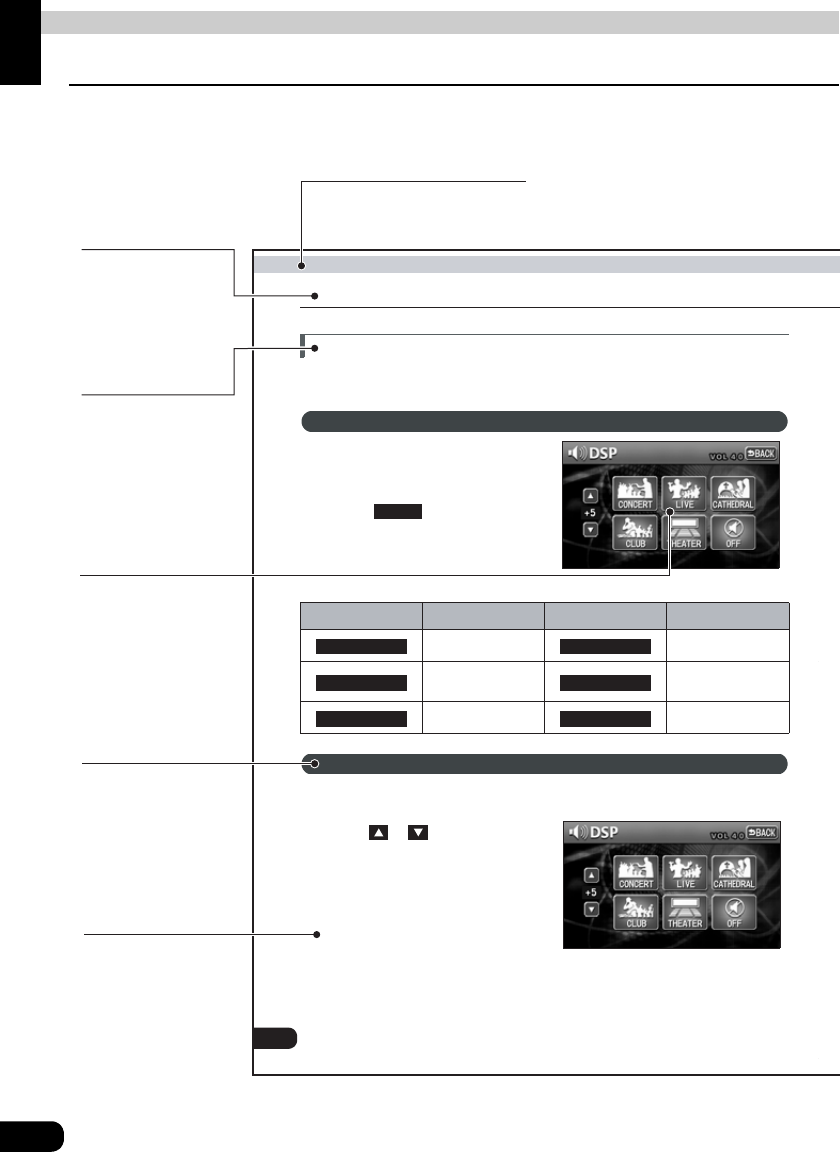
Item title
A number and title
is assigned for
each item.
Section title
A title is assigned for each
section.
Operation title
A title is assigned
for each operation.
Operation procedure
Describes the
operation.
Proceed with the
operation as per the
numerical order.
Detailed operation title
A title is assigned for
each detailed
operation.
Operation screen
A screen showing
the operation will
appear.
13
Introduction
31
Basic
operation
Default settings for the currently adjusted and saved DSP (acoustics) level can be reset.
Touch until a beep is heard.
• The accoustic level will be returned to default value (the default value is "0").
Resetting DSP (acoustics) levels
OFF
When adjusting the level for the currently selected DSP (acoustics) mode, the
level will not be saved for other acoustics modes.
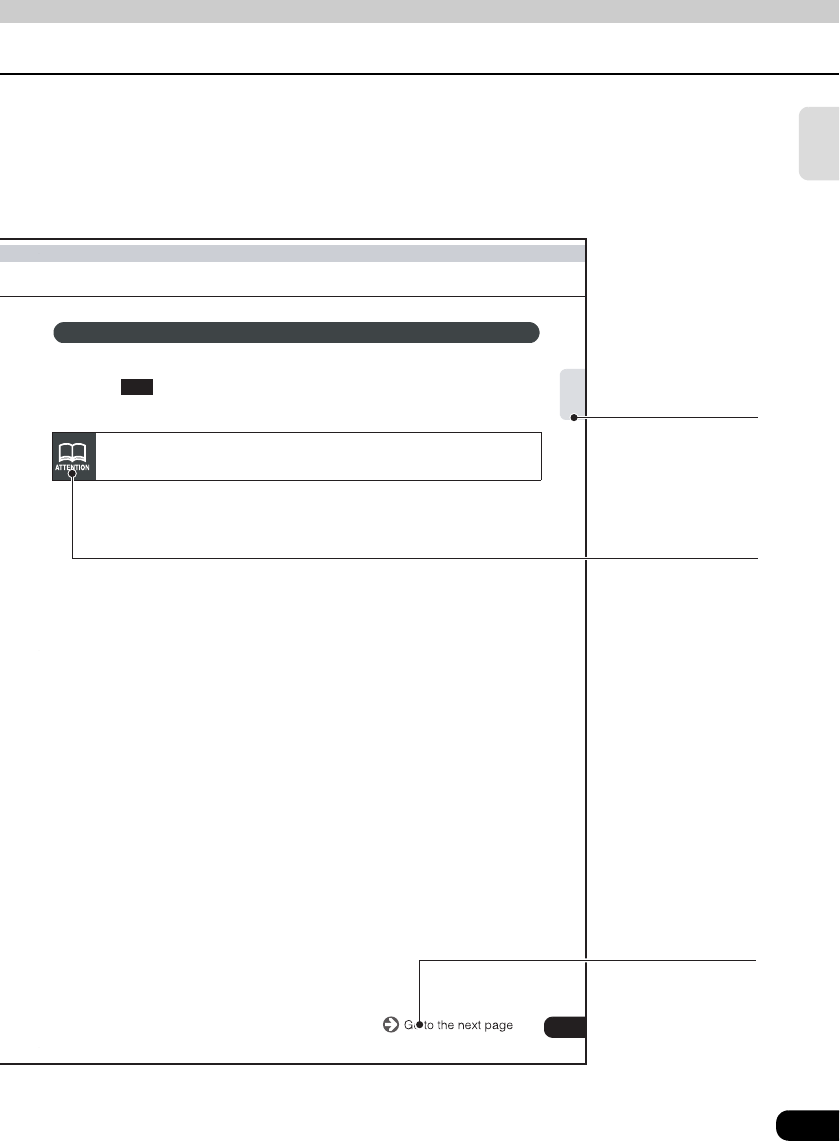
Attention
Additional points
regarding the
operations are given
here.
Section heading
Only the section
heading will appear.
The description shown above is for explanation, and therefore it may differ from
the actual one on the same page.
Go to the next page
The operation
procedures are
continued on the
next page.
14
Introduction
Features
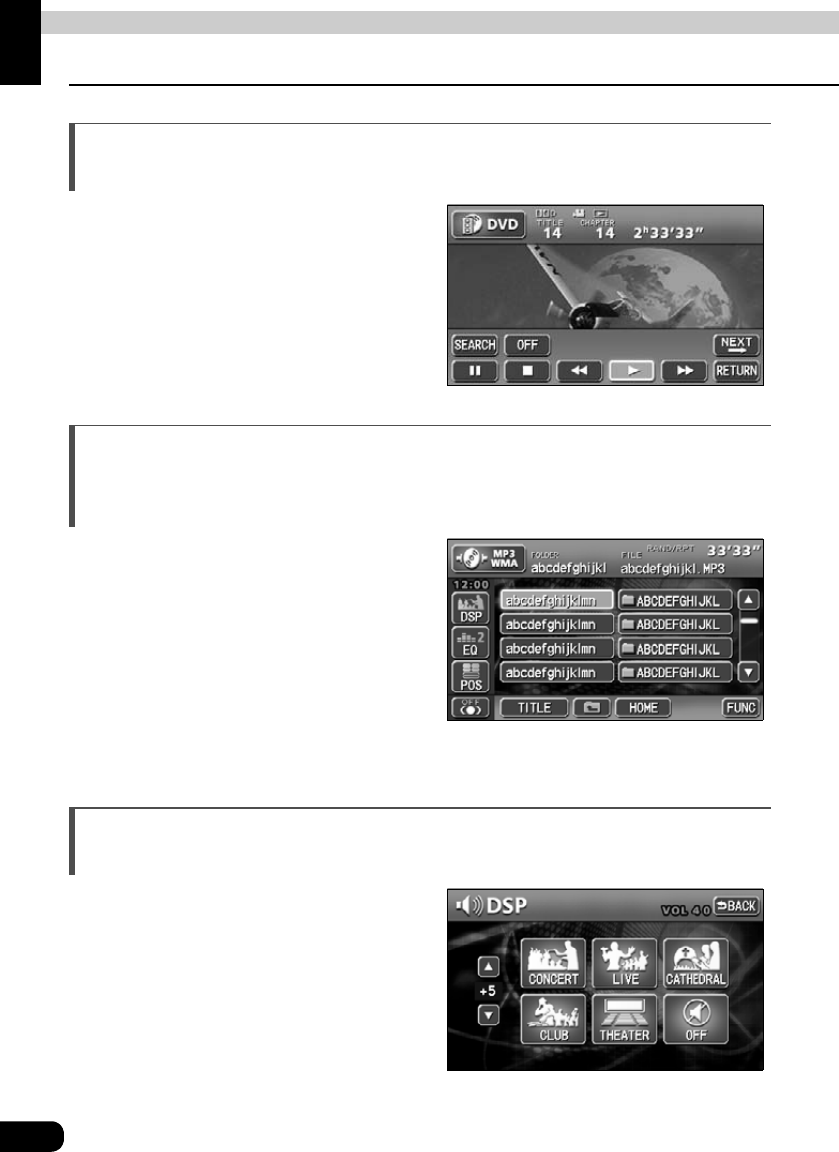
DVD player with sharp video and dynamic sound
(Page 94)
Plays DVD Video recorded with high quality
images and sound.
(DVD media is able to record a movie with
high quality video and digital sound that
exceeds the quality of CD media.)
The MP3/WMA player that can play a disc holding
many music tracks equivalent to several albums
(Page 72)
The MP3 compression technology that can
compress the music data by a factor of 10.
The CD-R/RW discs holding MP3/WMA data
can be played with this unit. Also, WMA data
which provides higher compression rate than
MP3 can be played.
DSP effects for simulating acoustics of various
performance environments (Page 30)
Provides ability to simulate the sensation of
various performance environments for
matching to the genre and source of a song.
15
Introduction
Selection and display of favorite wallpaper
(screen backgrounds) (Page 44)
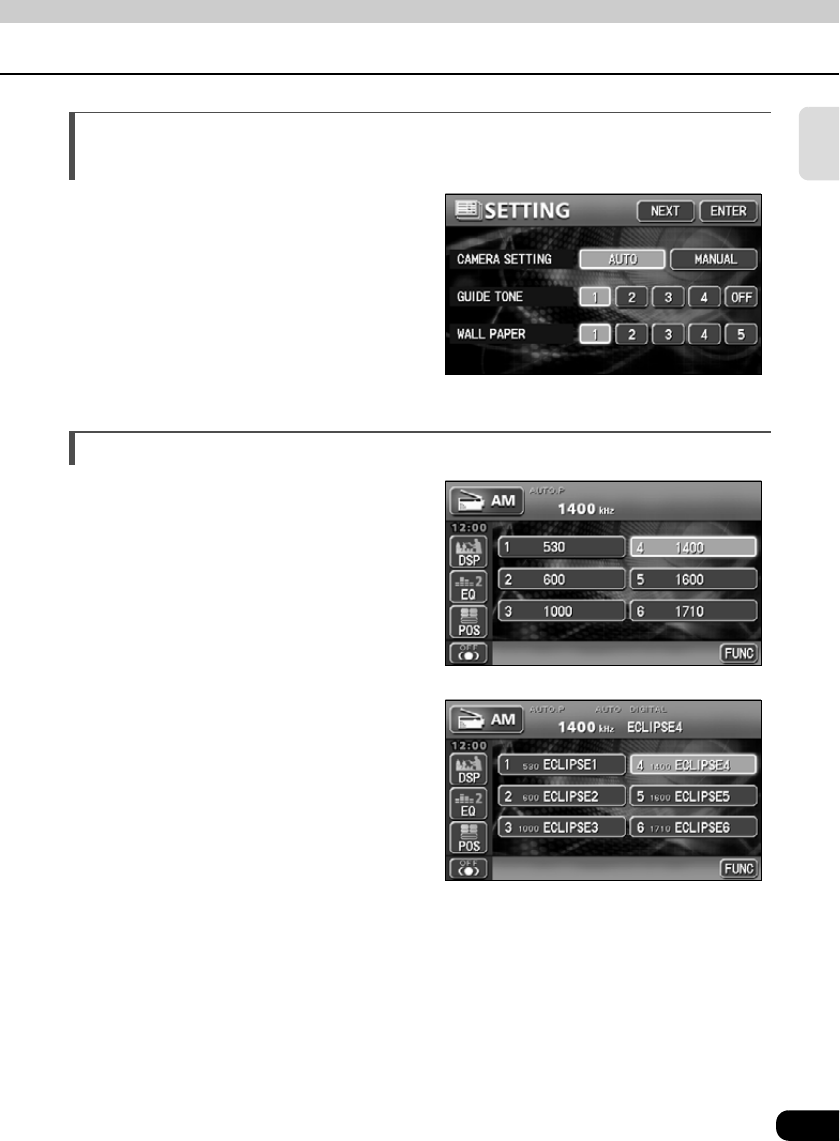
Wallpaper of your choice can be switched and
displayed for use as the background of the
information screen and audio playback
screens.
The screen from a navigation unit can also be
linked and selected.
Radio tuner for receiving various broadcasts
• AM/FM tuner (Page 50)
Enables reception of analog AM/FM radio
broadcasts.
• HD Radio tuner (Page 56)
Enables reception of HD Radio broadcasts.
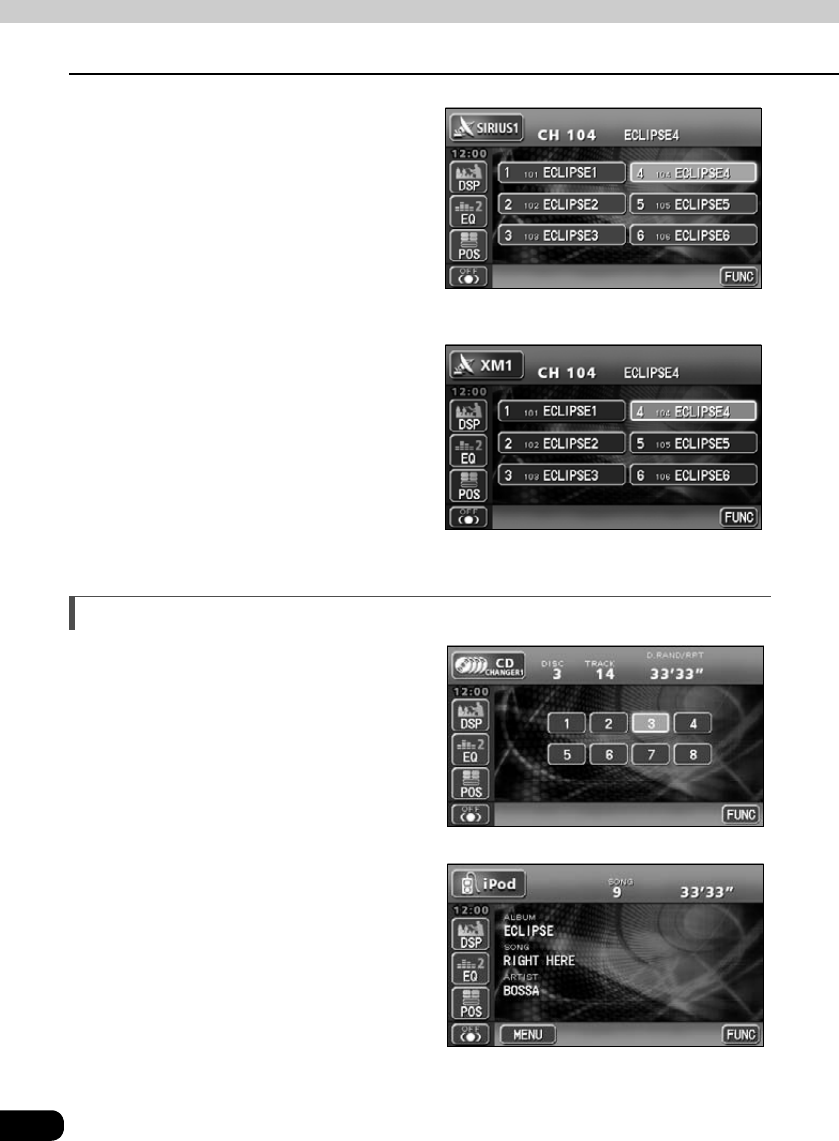
●Setting wallpaper for the information screen and
audio operations screen
●AM radio operation screen
●HD Radio AM operation screen
16
Features
Introduction
• SIRIUS tuner (Page 60)
SIRIUS is a satellite broadcasting service
offering music, news, sports and other
programming with CD-quality sound; This is
a paid subscription service.
• XM tuner (Page 64)
XM tuner is a satellite broadcasting service
offering music, news, sports and other
programming with CD-quality sound; This is
a paid subscription service.
System additions
• CD changer (Page 84)
A CD changer enables non-stop playing of
multiple discs, for convenience at times
such as taking a long drive.
It is easy to search for and play a song from
among the discs on a changer.
• iPod (Page 88)
When an optional iPod interface adaptor
(iPC-106) is connected to this main unit, it is
possible to operate the iPod® with this main
unit and to display information relevant to it
on the screen of this main unit, so you can
listen to the songs stored in the iPod.
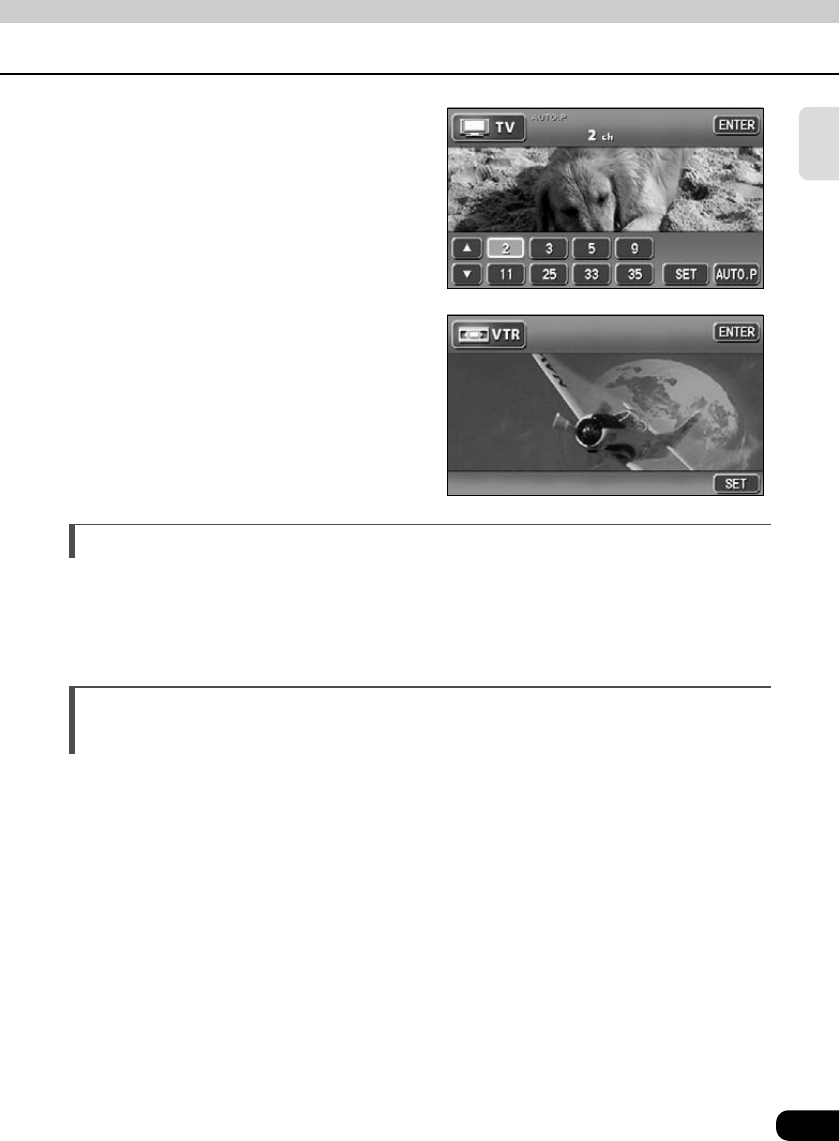
●SIRIUS operation screen
●XM operation screen
17
Introduction
• TV tuner (Page 120)
Television can be watched if an optional TV
tuner is connected.
• VTR (Page 118)
Connecting a VTR deck enables watching
of video tapes.
TEL MUTE
By connecting a handsfree cellular phone adapter with the TEL-MUTE function, the audio is
automatically muted when an incoming call is received. Note that the voice guidance is not
muted. (For muting on outgoing call, refer to the operation manual of the handsfree cellular
phone adapter.)
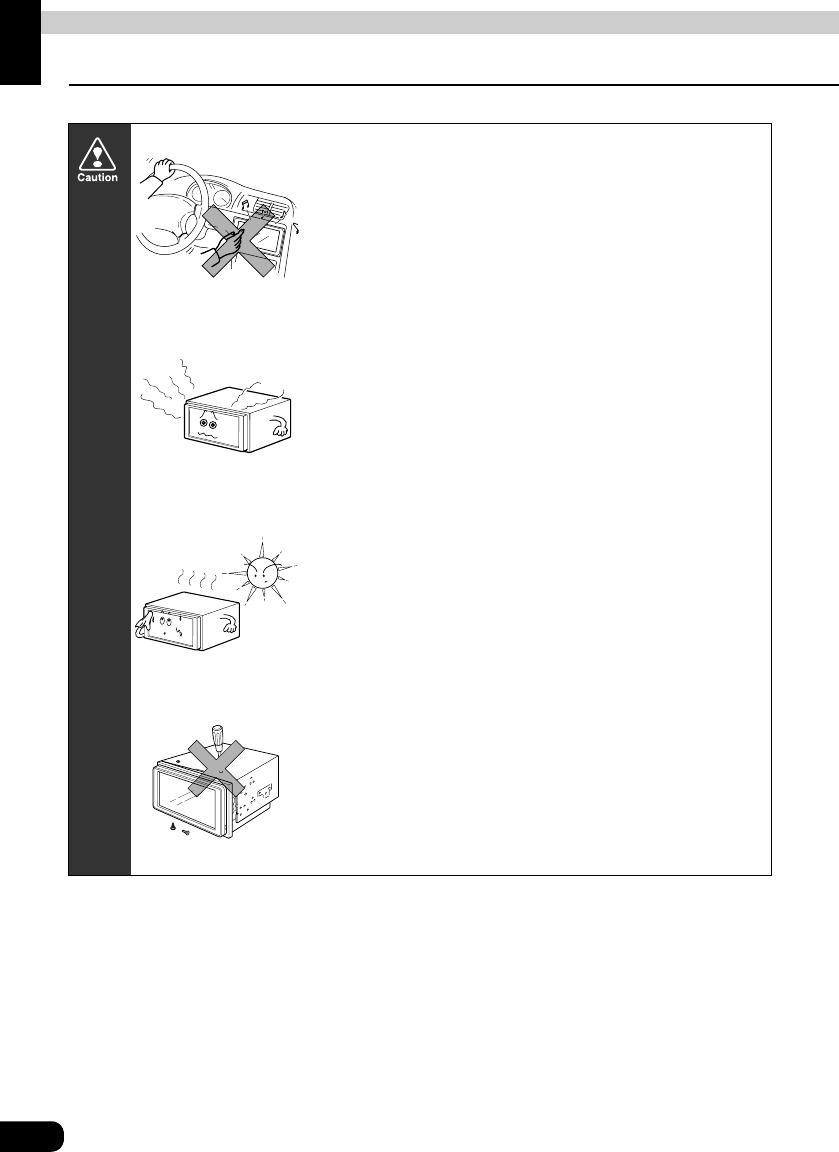
Easy-access audio controls on the steering wheel
(Page 140)
You can select the radio channel and perform CD, MP3 and DVD operations using the easy-
access switches on the steering wheel. (This function is only available on vehicles fitted with
steering wheel switches.)
18
Introduction
Before using the main unit
• Be very careful and pay full attention to safety when
operating the audio controls while driving, otherwise
accidents may occur. Also be sure to set volume so that
you can still adequately hear sounds outside the vehicle.
Improper use can contribute to a traffic accident.
• Never continue to use the system if it is malfunctioning in
any way. If smoke, abnormal noises or abnormal odors
are noticed, turn off the power immediately.
Immediately turn off audio in such situations.
• Exercise caution as to the temperature inside the vehicle.
The temperature inside the vehicle can increase during
hot weather. Wait for the temperature inside the vehicle to
drop before using the unit.
Damage could result.
• Do not disassemble or modify the main unit.
The main unit has a precisely designed structure, so
consult your retailer in the event of any unsatisfactory
performance.
19
Introduction
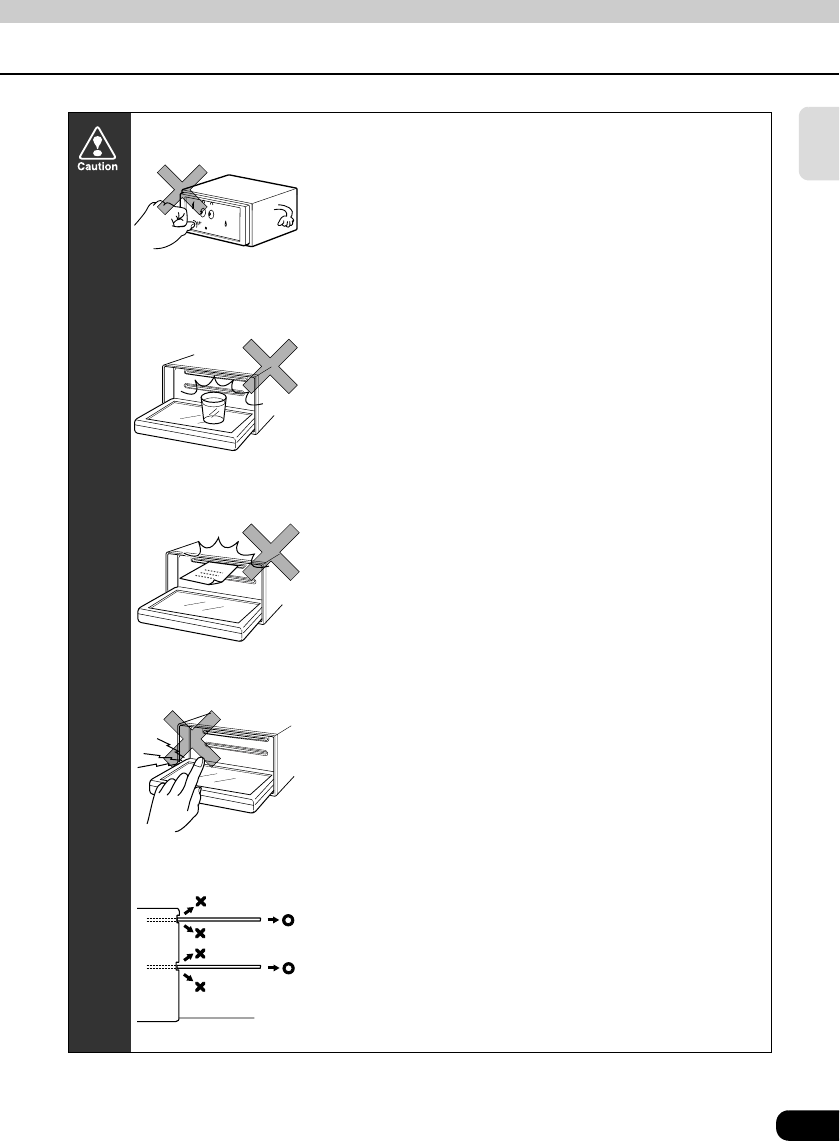
• Do not apply excessive force to the monitor.
Damage could result.
• Do not place items such as cups or cans on top of the
monitor, and do not leave the monitor tilted down when
not in use.
Damage could result.
• Do not insert any objects other than discs into the disc
slot.
Damage could result.
• Be careful not to get fingers or other objects behind
monitor when it is being retracted into place.
Interference can cause an injury or damage the main unit.
• When removing a disc from the main unit, remove it in the
horizontally level direction.
Do not pull them up forcibly or press down on them
strongly while removing them.
Improper removal can scratch the disc, cause the main
unit to make noise or result in other damage.
20
Before using the main unit
Introduction
About discs
• Water droplets can form on the inside of the main unit during cold or rainy
weather in the same way car windows can fog up (This is condensation). When
this happens, the audio can jump and playback can stop, so ventilate or
dehumidify the vehicle for a short time before operating the equipment.
• To safeguard the components of the player, the unit will automatically stop when
a malfunction occurs. If the player will not operate even when messages
displayed on the screen are followed, consult with your equipment retailer,
because it is possible that the unit has been damaged.
• It is possible that the sound will skip if the vehicle experiences violent motion on
rough roads.
• Please do not use a commercially available lens cleaner because it may cause
damage to the pickup of the player.
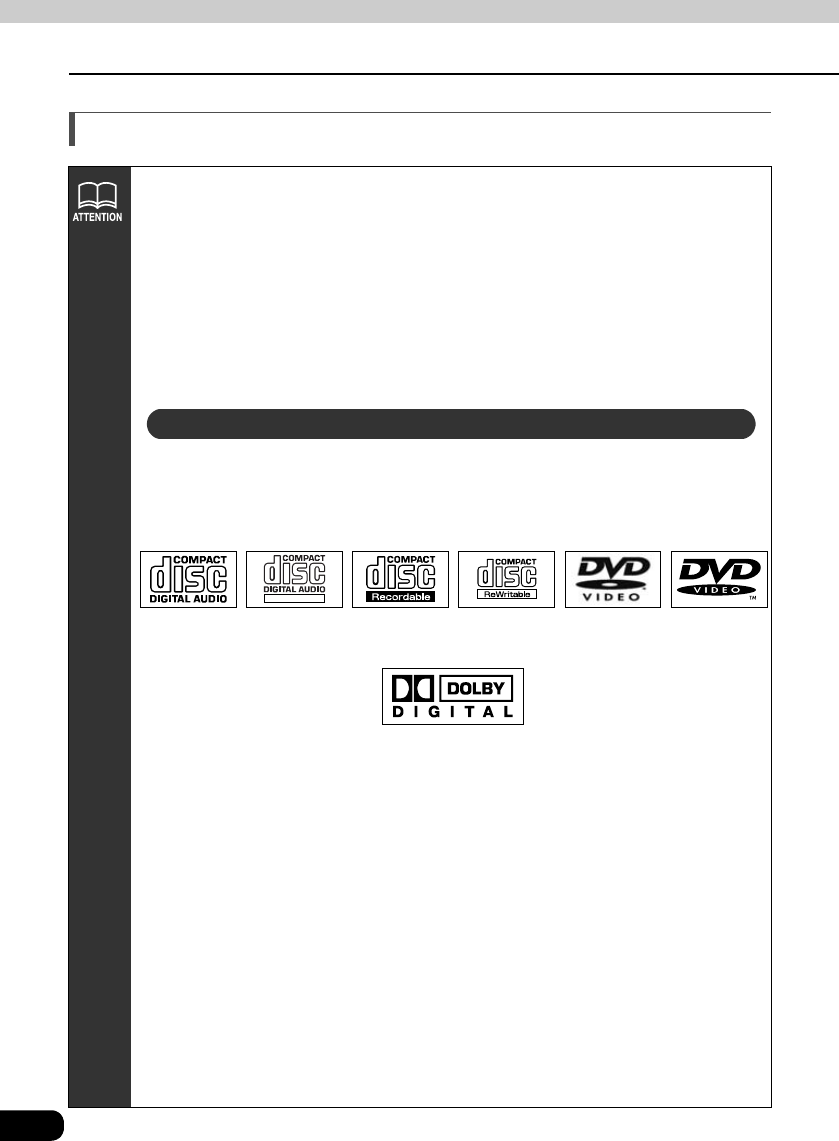
• An audio disc or DVD video disc bearing one of the marks below can be played.
When using DVD-R/RW (DVD-Recordable/ReWritable) and DVD+R/RW
(DVD+Recordable/ReWritable) discs, note that only those whose contents were
recorded in the video mode can be played. Discs whose contents were
recorded in the video recording (VR) mode and audio mode cannot be played.
• Discs that are compatible with Dolby Digital and bear the indication below can
be used.
Manufactured under license from Dolby Laboratories, Inc. "Dolby" and the double-D symbol are
trademarks of Dolby Laboratories.
• It is possible that a CD-R (CD-Recordable) or CD-RW (CD-ReWritable) disc will
not play on the main unit due to the circumstances of the recording, special disc
characteristics, scratches, dirt or deterioration caused by long storage in the
vehicle. In addition, a CD-R or CD-RW disc written with CD-R, CD-RW or UDF
format that has not been finalized will not play on the main unit.
• It is possible that a DVD-R/RW (DVD-Recordable/ReWritable) or DVD+R/RW
(DVD+Recordable/ReWritable) disc will not play on the main unit due to the
circumstances of the recording, special disc characteristics, scratches, dirt or
deterioration caused by long storage in the vehicle. DVD-R/RW or DVD+R/RW
discs that have not been finalized will not play on the main unit. It may not be
possible to play a disc that has been recorded on a personal computer,
depending on the application setting and the environment.
• The CD-TEXT function can be used only with the original CD-TEXT-compatible
compact discs. If it is used with CD-R or CD-RW discs, characters may not be
displayed normally.
• Do not use discs with transparent or semi-transparent portions within the
recording area, or see through discs, since they may not be accepted and
ejected properly and may not play properly.
About playable discs
TEXT
21
Introduction
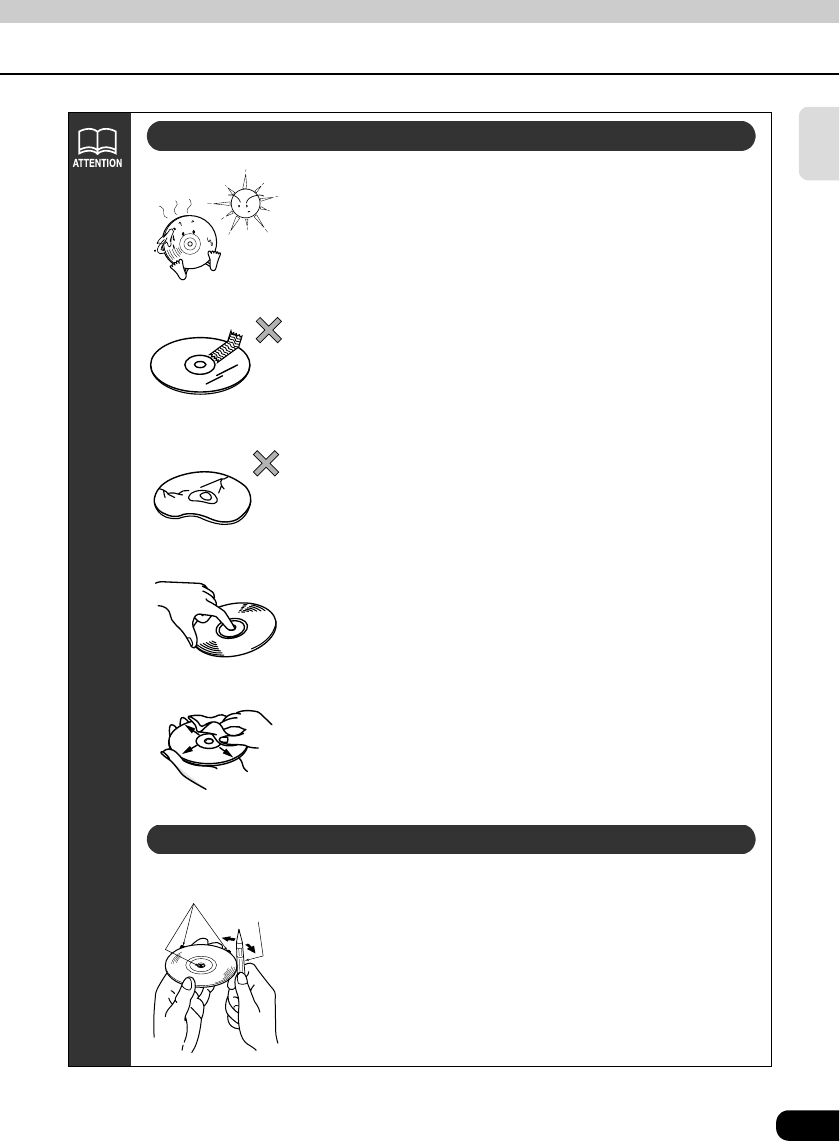
• Be sure to store discs in their cases and keep them out of
direct sunlight. Discs can warp and become unusable.
• Do not apply paper-based tape to either the recording
side or label side of a disc. Damage could result.
• Do not use discs on which there are cracks or large
warps. Damage could result.
• Do not touch the recorded side of a disc when handling it.
(This is the side with the rainbow-colored reflection.) The
disc may become dirty and that could cause the sound to
skip.
• Using a disc that has become dirty can scratch the disc
and cause the sound to skip. Use a commercially
available compact disc cleaner to clean a CD, wiping
lightly from the center to the edge.
• You may notice that some brand new discs are rough
around the center hole or outside edge. Remove the
rough edges with the side of a ballpoint pen, etc and
clean any flakes off the disc. Flakes from the rough edges
may stick to the recorded surface and interfere with
playback.
About handling discs
About new discs
Ballpoint pen
Rough Edges
22
Before using the main unit
Introduction
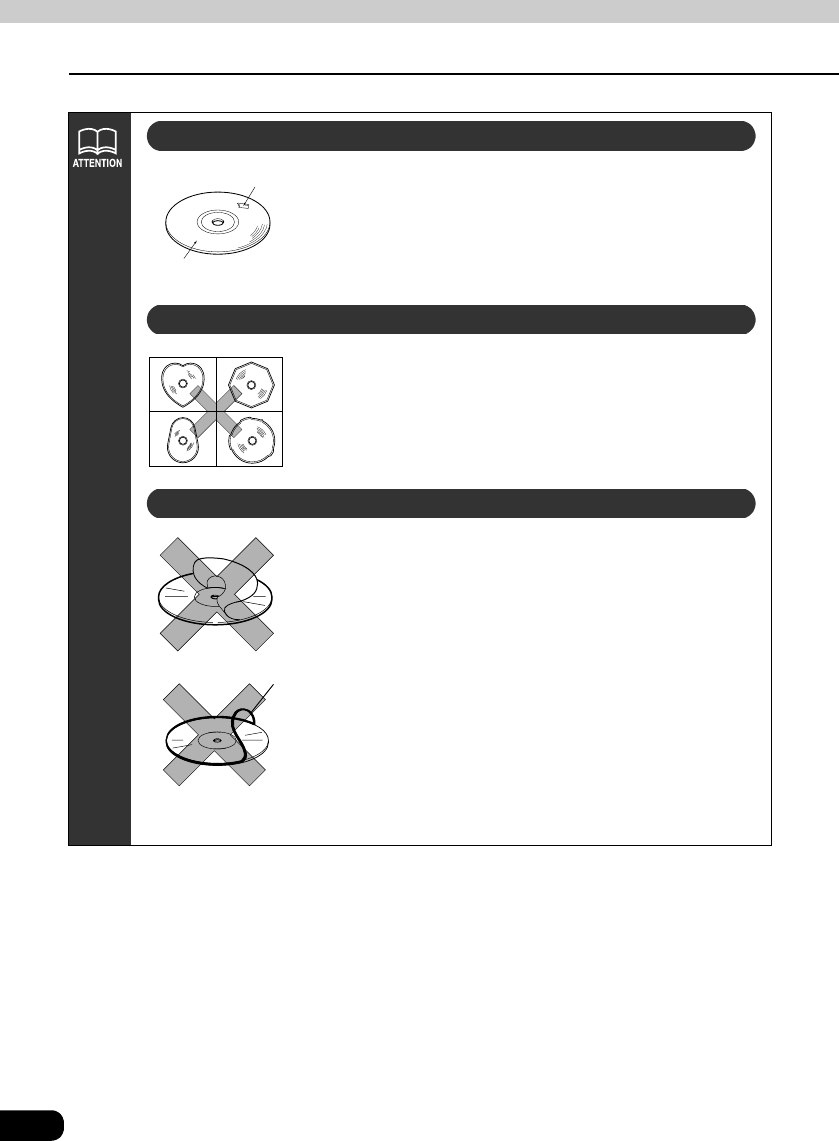
• Do not use CD discs with attached cellophane tape,
rental CD discs with glue protruding from labels or discs
with the residue of peeled adhesives. Using discs with
those conditions can prevent the player from properly
opening and closing as well as cause other damage.
• Specially-shaped or octagonal CDs, like heart-shaped
cannot be played. Do not attempt to play them, even with
an adapter, since they may damage the player.
• Do not use accessories (stabilizers, protective seals,
laser lens cleaners, etc.) sold for "improving sound
performance" or "protecting CDs." The changes in CD
thickness or outside dimensions made by these
accessories may cause problems in the player.
• Please be sure NOT to attach any ring-shape protector (or
other accessory) to your discs. Those protectors are
commercially available and said to protect discs and to
improve sound quality (and antivibration effect), but they
can do more harm than good in regular uses. The most
common problems are Insert/Eject related problems and
"No playback" problems due to the protector ring that may
have come off in the disc mechanism.
About rental discs
Recorded surface
Cellophane tape
About specially shaped discs
About disc accessories
CD ring
23
Introduction
About TV
About the LCD panel
• When connection with the battery is cut due to changing it, changing fuses,
etc.,all preset channels will be erased.
• It may be difficult for the TV to maintain optimal reception due to variation in
signal strength or interference from other objects. The main causes of
interference are listed below.
• Visual or audio static may result when in close proximity to overhead train wires,
high-tension wires, traffic signals, neon signs, etc.
·Depending on the signal, buildings and mountains may adversely affect recep-
tion.
·Visual or audio static may result when in close proximity to radio broadcasting
or ham radio antennas.
·Signal reception will become extremely weak when driving through a tunnel.
·Signal reception will become weak when traveling at a great distance from the
broadcasting station.
·In some areas, visual or audio static may result when in close proximity to TV or
radio towers. This is due to the influence of electro-magnetic waves outside of
the reception range.
• The LCD panel can appear to be white or black when seen from certain angles.
• The screen will be difficult to read when external light such as sunlight falls on
the display.
24
Basic operation
Switching mode
The main unit can be used when the vehicle's ignition switch is on or in the ACC position.
• The main unit supports use of a remote control. The optional remote control is sold
separately and can be purchased at your local retailer. Refer to page 144 for instructions
on operation of the remote control.
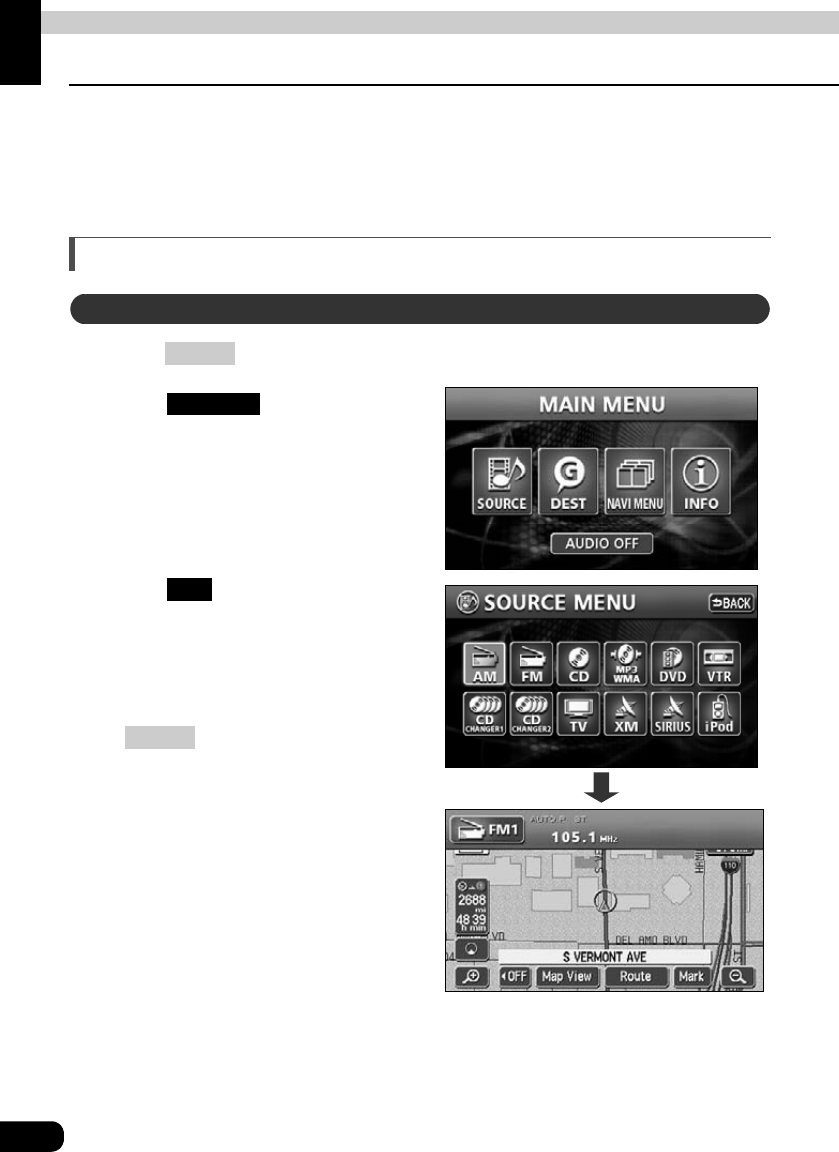
Switching the mode
Press .
Touch on the MAIN
MENU screen.
• The AUDIO MENU screen will be
displayed.
Touch .
• The various audio modes can be
selected by touching the
corresponding touch switches.
• When the navigation screen is being
displayed before pressing
, the selected mode will be
displayed on-screen over the
background.
Switching the mode using panel switches
MENU
SOURCE
On-screen display
FM
MENU
25
Basic
operation
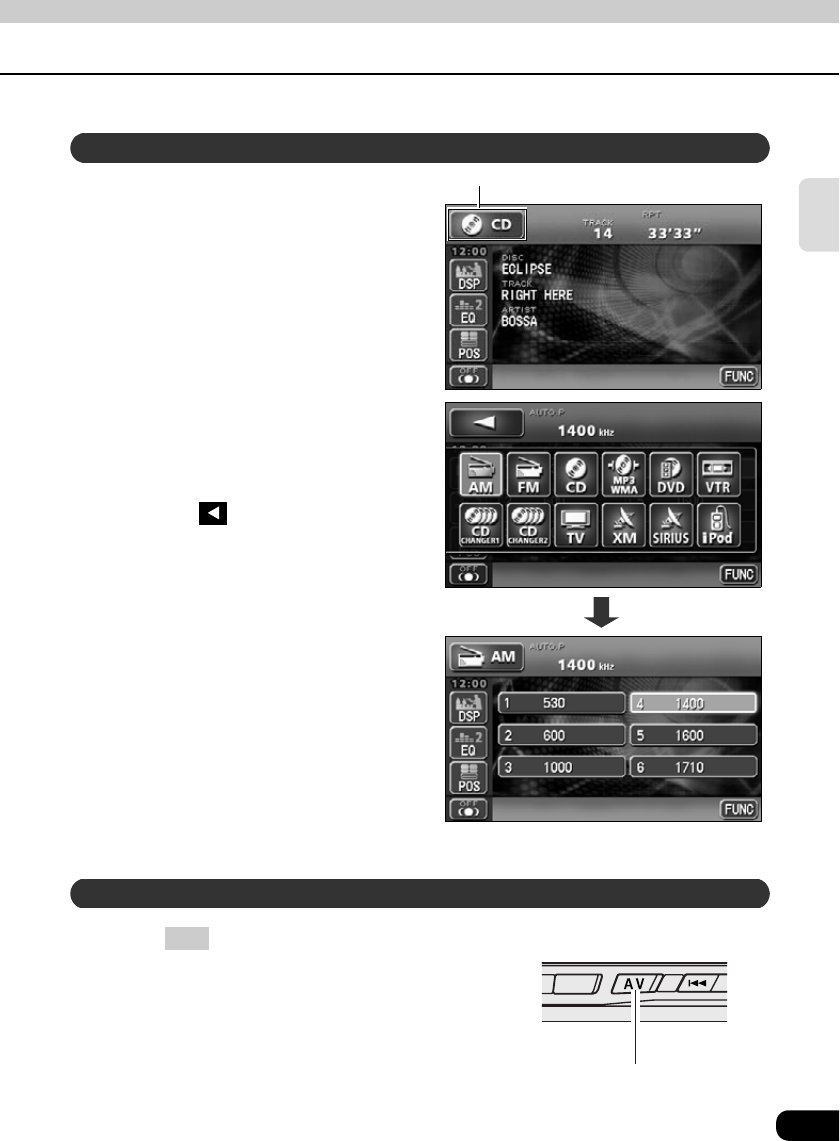
Touch the SOURCE MENU switch.
Touch the touch switch of the
source you want to operate.
• The operation screen for the selected
source is displayed.
• Touching returns to the previous
screen.
Press .
Switching the mode using touch switches
Displaying operation screen
AV
AV
SOURCE MENU switch
26
Basic operation
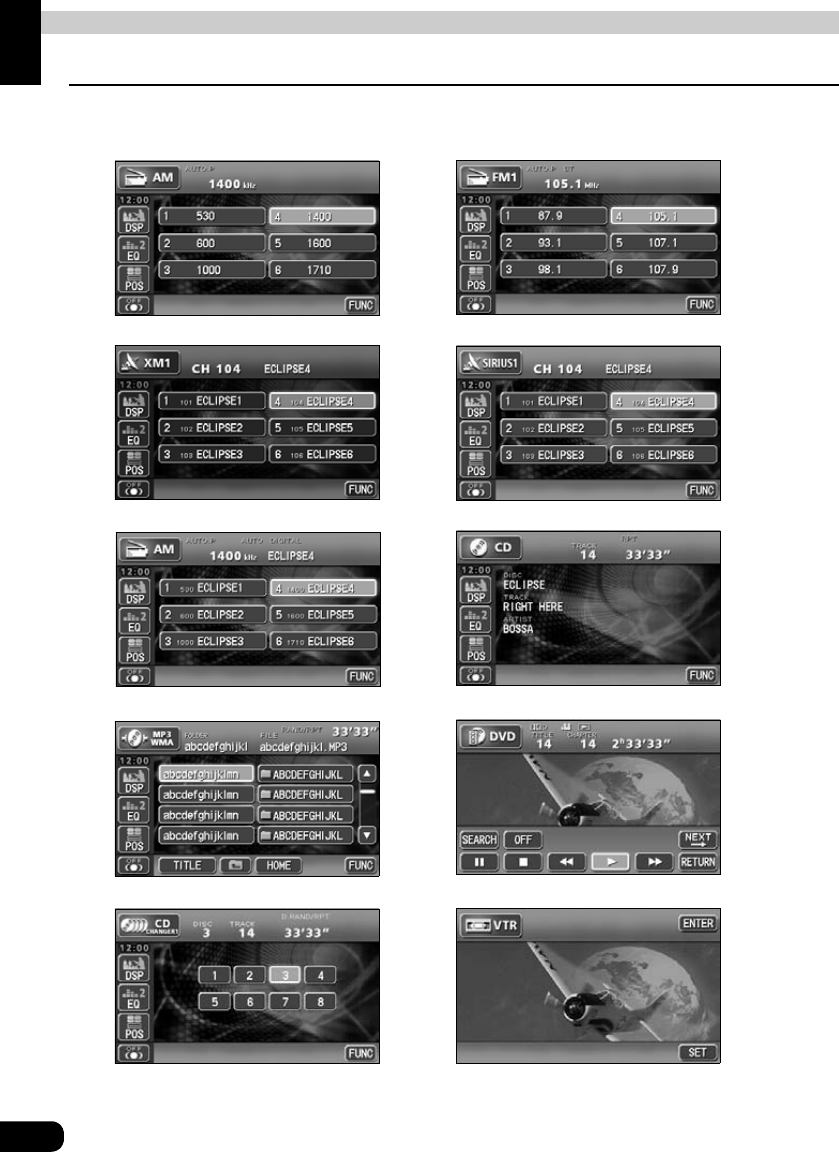
Operation screen of each mode
The operation screen for each mode will appear as shown below.
●
HD Radio operation screen (optional)
●CD changer operation screen (optional)
●AM
ra
di
o operat
i
on screen
●FM
ra
di
o operat
i
on screen
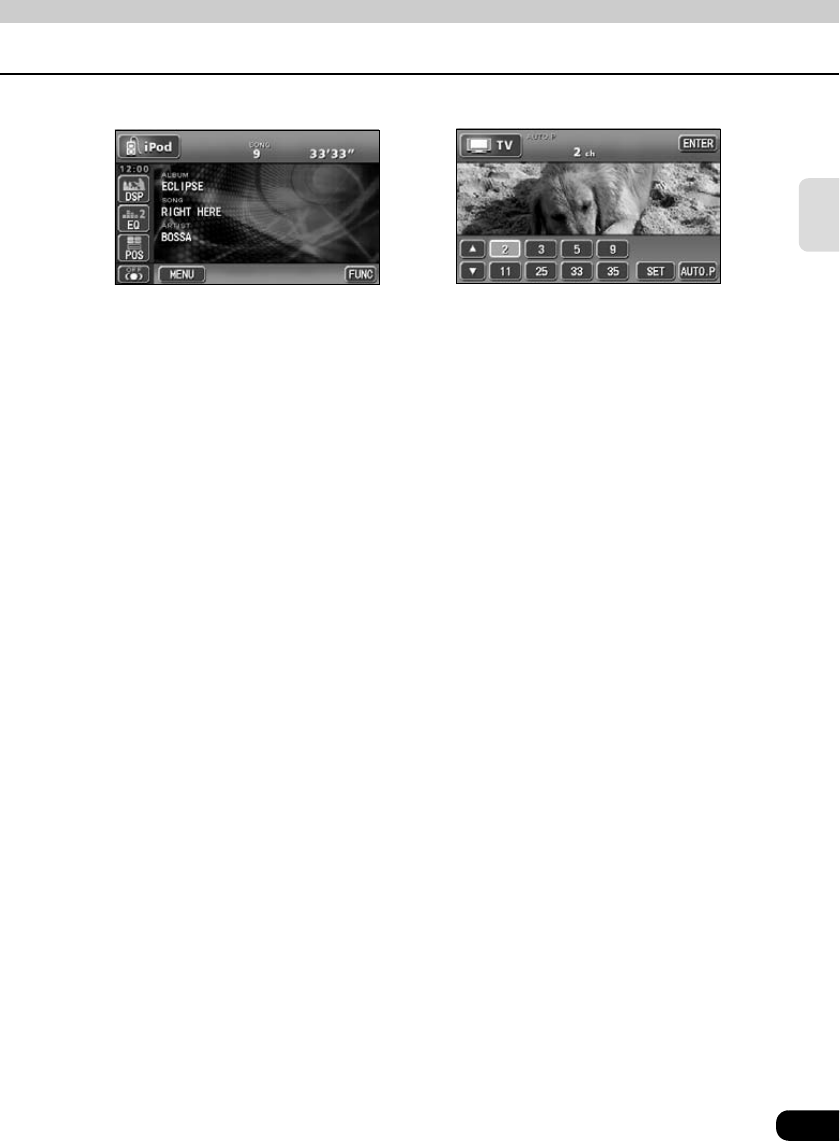
●SIRIUS operation screen (optional)●XM operation screen (optional)
●MP3/WMA player operation screen ●DVD player operation screen
●VTR operation screen (optional)
●CD player operation screen
27
Basic
operation
When the operation screen for DVD or video (VTR/TV) has not been operated for 6 seconds
or more, the operation screen will automatically be canceled.
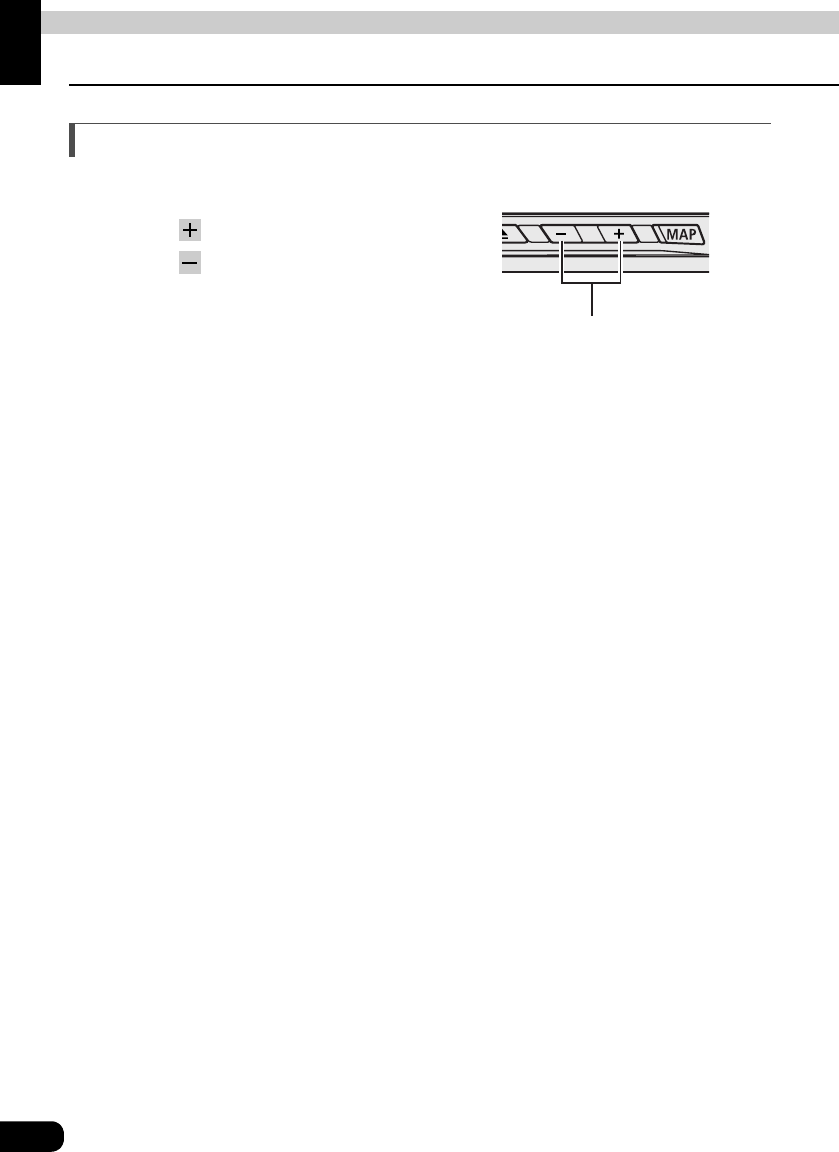
●TV
operat
i
on screen
(
opt
i
ona
l)●iP
o
d
operat
i
on screen
(
opt
i
ona
l)
28
Basic operation
Adjusting the volume
Adjusting main volume
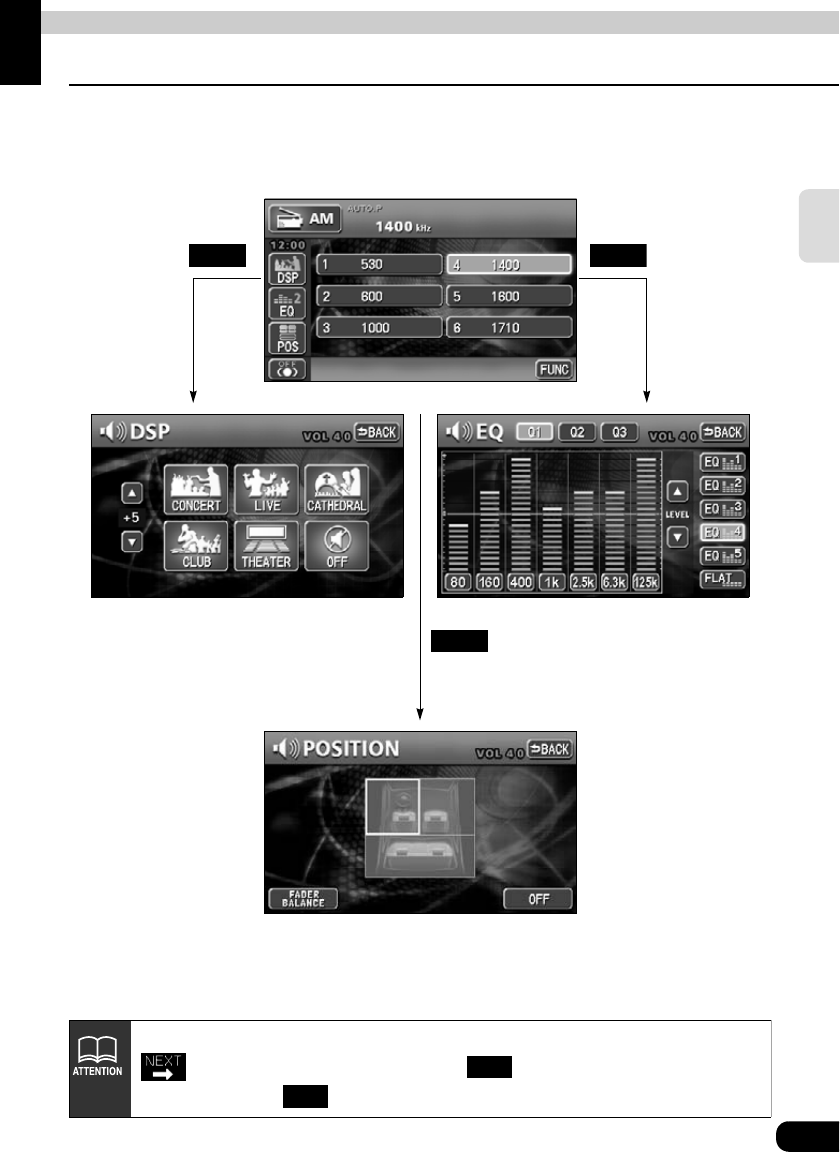
Press the VOLUME switch.
Pressing will increase volume.
Pressing will decrease volume.
• Each press of the switch will change
the volume by two steps. When the
volume reaches 50 or higher, the
switch will change the volume by one
step. Holding the switch will continue
to change the volume.
VOLUME switch
Basic operation
29
Basic
operation
Adjusting sound quality
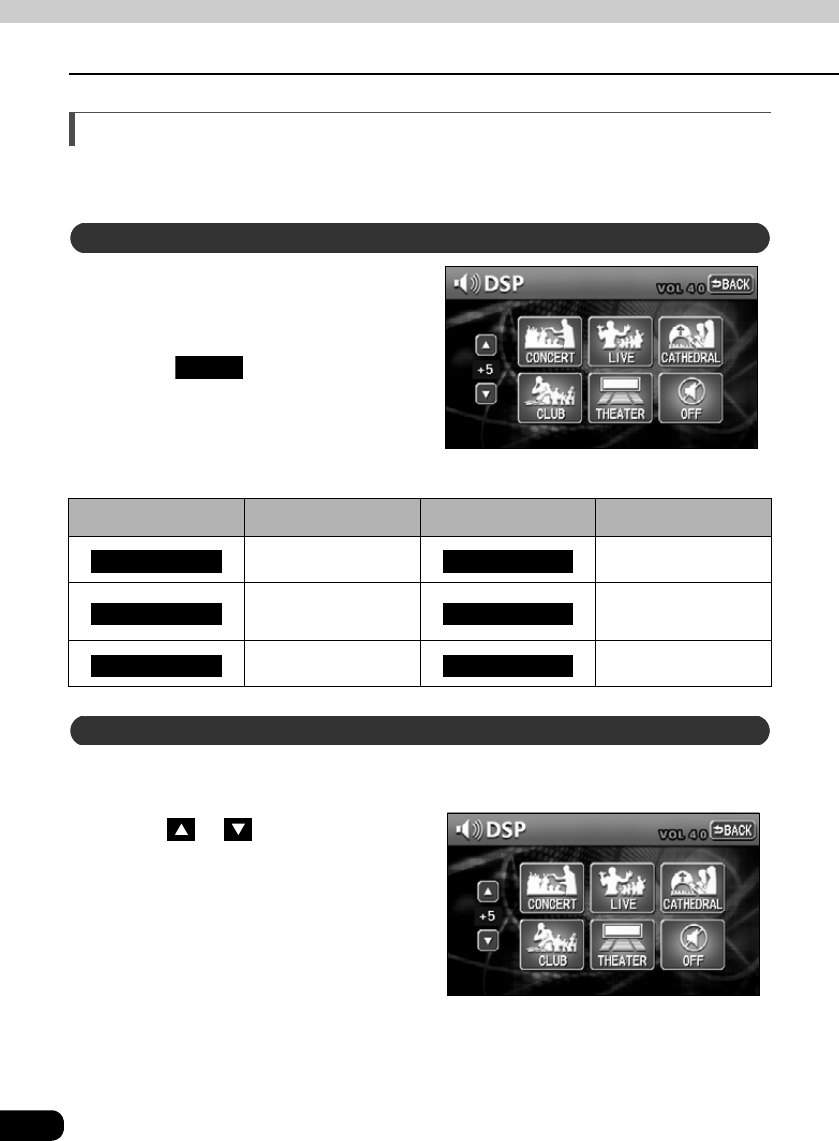
To adjust sound quality, touch the DSP, EQ or POS switch while the operation screen for a
mode is displayed. Adjustments made in any mode will be saved and applied to all modes.
DSP EQ
POS
In the DVD mode, display the sound quality adjustment switches by touching
from the operation modes, and then . In the VTR mode display them
either by touching .
SET
SET
30
Adjusting sound quality
Basic operation
Setting DSP (acoustics)
The DSP function reproduces the sensation of various factory set performance environments
by adding reverberation to the music being played.
Touching the DSP touch switch
brings up the acoustics mode
screen as shown.
• Touch after changing
settings.
The acoustics mode adjustments will
be saved and the system will return to
the previous operation screen.
The factory set DSP (acoustics) level for each mode can be adjusted to preference and
saved.
Touch or at the right of the
screen while in the acoustics mode
to be adjusted.
• There are five + and five - adjustment
levels available.
Touch the switch for the acoustics
mode that has been adjusted until
a beep is heard.
Touch switch DSP Environment Touch switch DSP Environment
Concert hall Disco, Club
Live performance
arena Movie theater
Church with echo DSP OFF
DSP mode setting
BACK
CONCERT CLUB
LIVE THEATER
CATHEDRAL OFF
Adjusting, saving DSP (acoustics)
31
Basic
operation
Default settings for the currently adjusted and saved DSP (acoustics) level can be reset.
Touch until a beep is heard.
• The accoustic level will be returned to default value (the default value is "0").
Resetting DSP (acoustics) levels
OFF
When adjusting the level for the currently selected DSP (acoustics) mode, the
level will not be saved for other acoustics modes.
32
Adjusting sound quality
Basic operation
Adjusting EQ (equalizer)
Adjusts sound quality to preferred characteristics according to the music genre and audio
source.
The sound quality can be adjusted according to music genre and then stored.This product
has a 7-band parametric equalizer which can adjust median frequency, frequency level, and
Q curve (bandwidth).
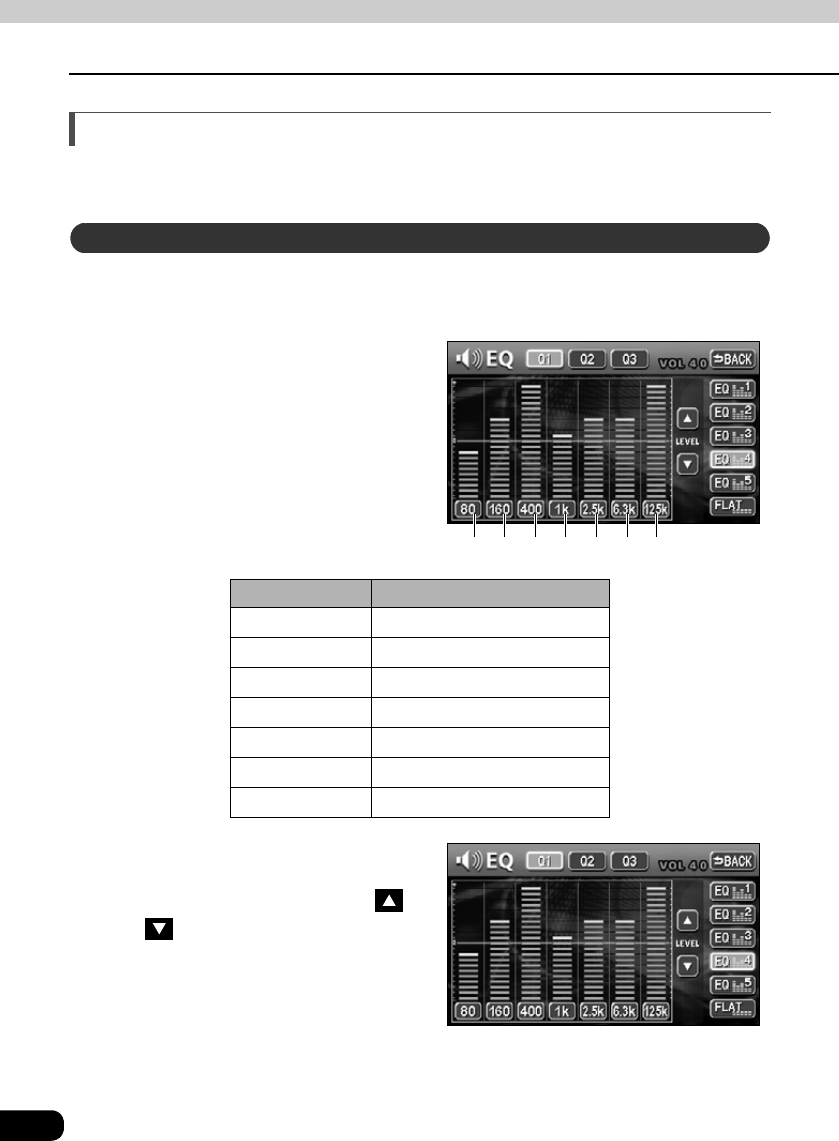
Touch the frequency of each band
to select the frequency (median
frequency) you want to adjust.
• Each time the switch of each band is
touched, the median frequency will be
switched in the order shown below.
Touch the desired frequency level.
• To make fine adjustments, touch
or .
Band Median frequency (Hz)
163 → 80 → 100
2125 → 160 → 200
3250 → 315 → 400 → 500
4630 → 800 → 1k → 1.25k
51.6k → 2k → 2.5k → 3.15k
64k → 5k → 6.3k → 8k
710k → 12.5k → 16k
Adjusting/saving EQ
1 2 3 4 5 6 7 2
33
Basic
operation
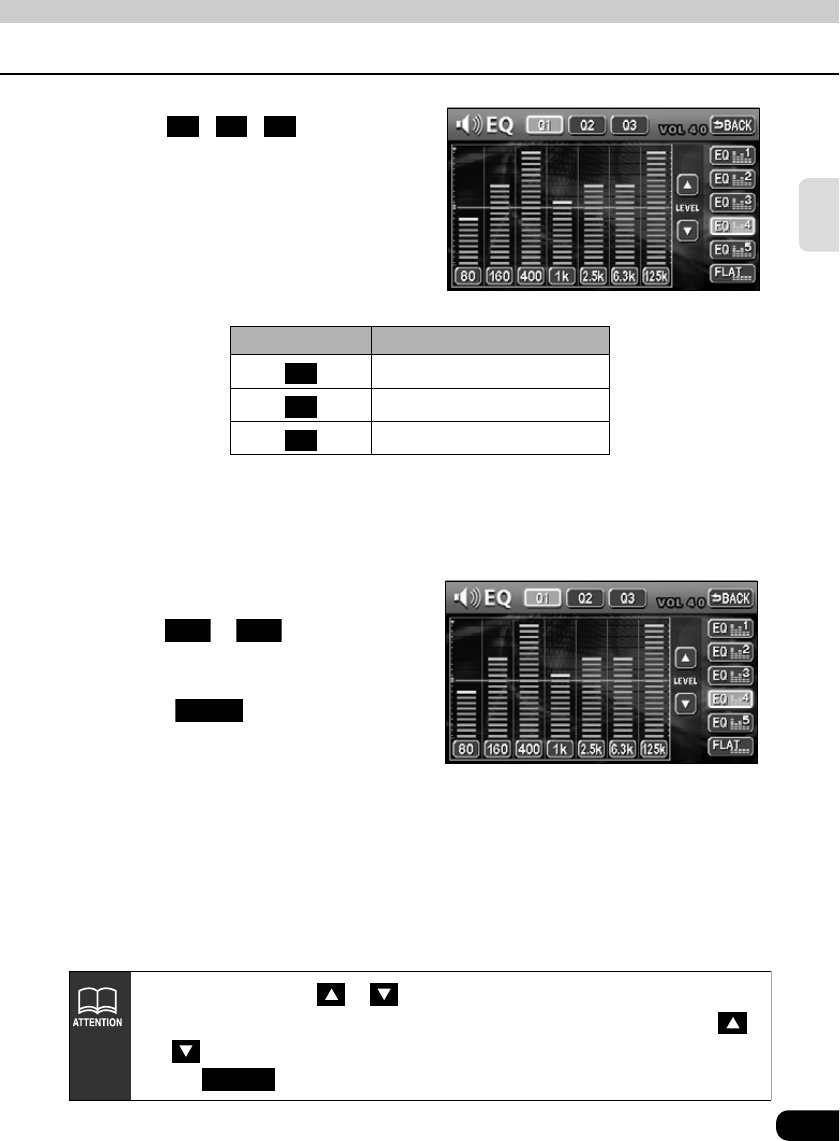
Touch , , to select a Q
curve.
• The Q curve patterns set the median
frequency bandwidth as follows:
Repeat steps through to change the setting for each band.
• It is not possible to set more than one band in the same channel to the same median
frequency.
Touch the switch you want to use to
save ( to ) until you hear
a beep.
• Save the PEQ settings for future use.
• Touch after changing
settings.
The PEQ mode adjustment will be
saved and the system will return to the
previous operation screen.
Switch Q curve pattern
Wide
Normal
Narrow
Q1 Q2 Q3
Q1
Q2
Q3
EQ1 EQ5
BACK
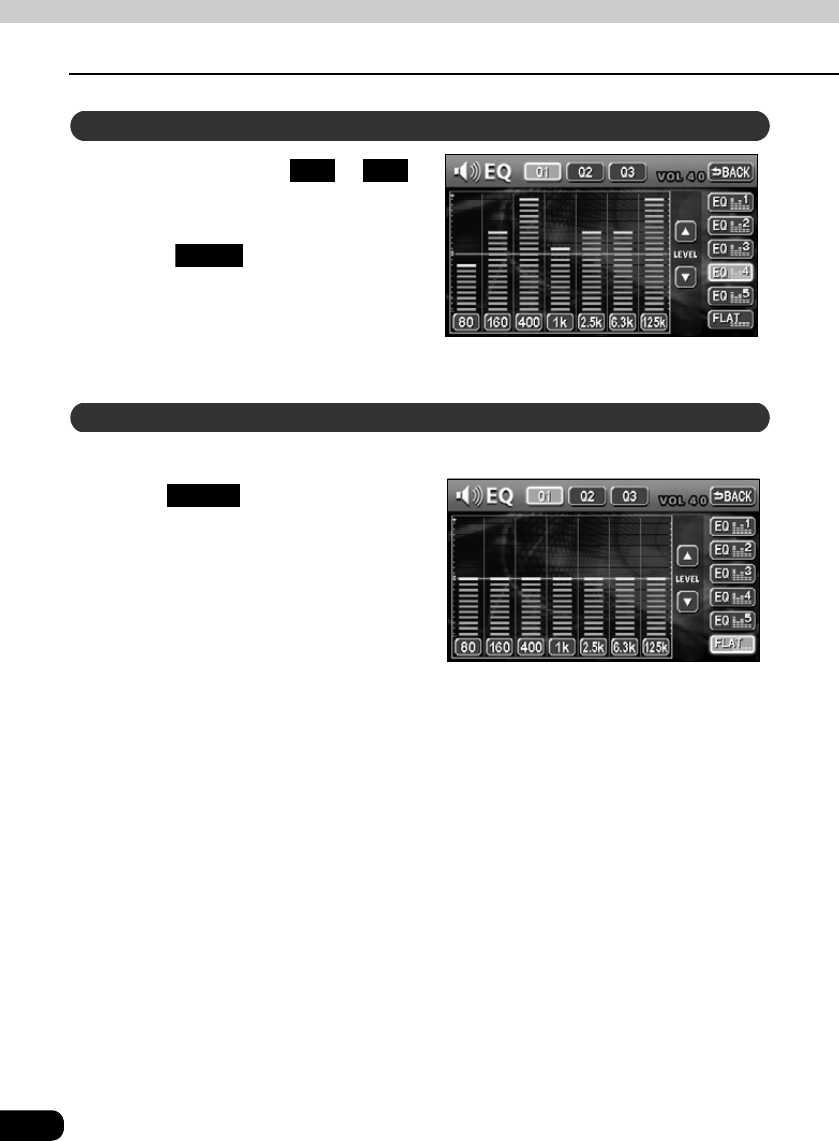
• If you touch and hold or during fine adjustment, the frequency level will
continue to adjust automatically until it reaches the center value (0). Touch
or again to continue adjustment.
• Touch to return to the center value (0).
FLAT
34
Adjusting sound quality
Basic operation
Touch a switch from to .
• The preset pattern stored in memory
will be retrieved.
• Touch after changing
settings.
The PEQ mode adjustments will be
saved and the system will return to the
previous operation screen.
The currently saved equalizer can be returned to the default values.
Touch until you hear a
beep.
• The equalizer curve will be reset to the
default values.
Selecting a EQ pattern from memory
EQ1 EQ5
BACK
Resetting EQ curves
FLAT
35
Basic
operation
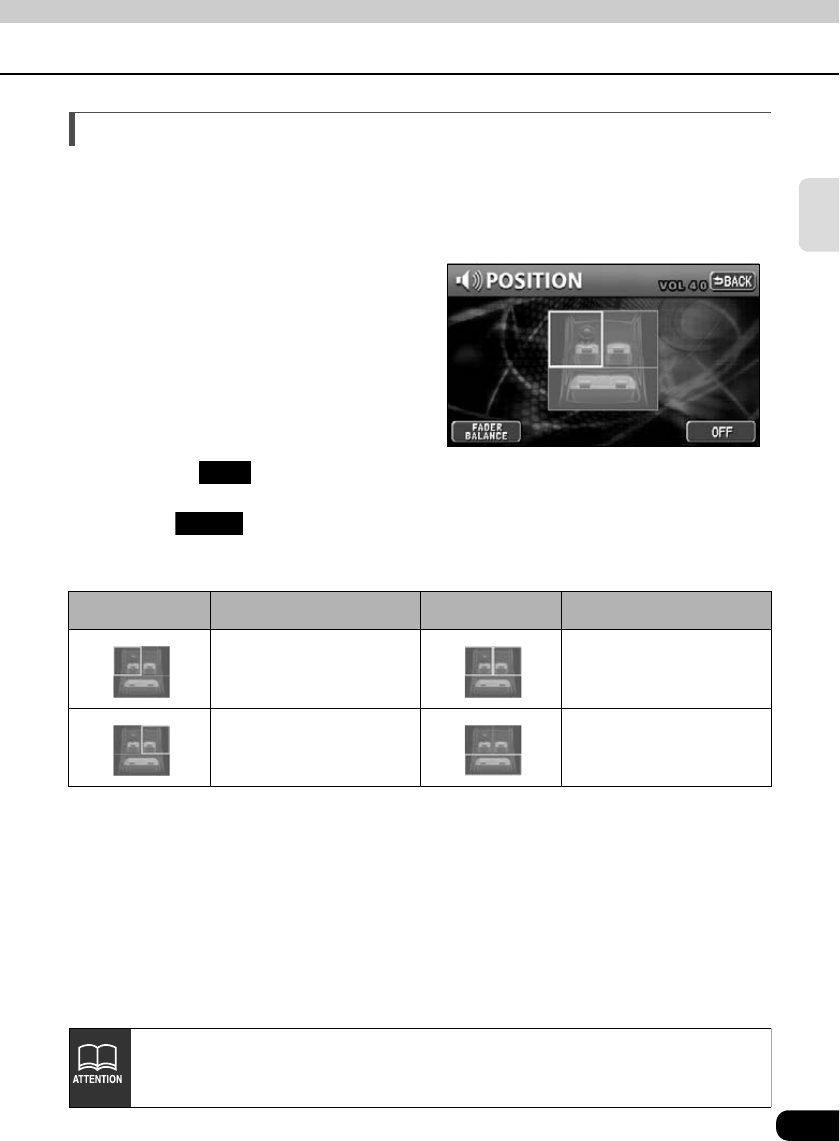
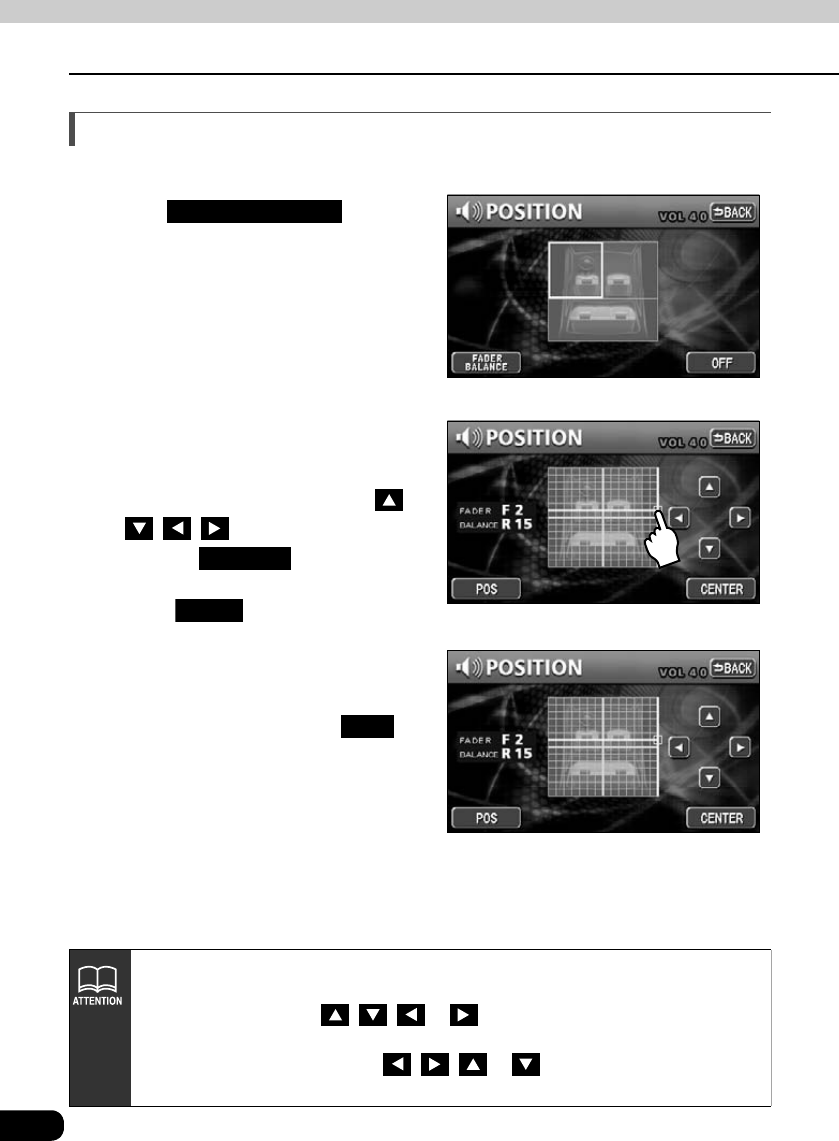
Setting POS (position selector)
The stereophonic position for obtaining optimum acoustic effects can be adjusted to match
the number and position of passengers.
In addition, front-to-back, right-to-left volume balance can be adjusted for the selected
position.
Touching the image of a seat
shown on the POS setting screen
will change the position.
• The selected position will change its
color to orange. Touching the seat
again will cancel the selection. The
four positions shown by the table
below can be set.
• Touching will cancel all
settings.
• Touch after changing settings. The position will be saved and the system
will return to the previous operation screen.
Touch switch Function Touch switch Function
Acoustics optimized for
driver's seat
Acoustics optimized for
both front seats
Acoustics optimized for
passenger's seat
Acoustics optimized for
rear seats
OFF
BACK
• This setting cannot be done at the same time as adjustment of the volume
balance (see next page) and the Circle Surround II (page 43).
• The default settings of the main unit are configured for left-hand drive vehicles.
36
Adjusting sound quality
Basic operation
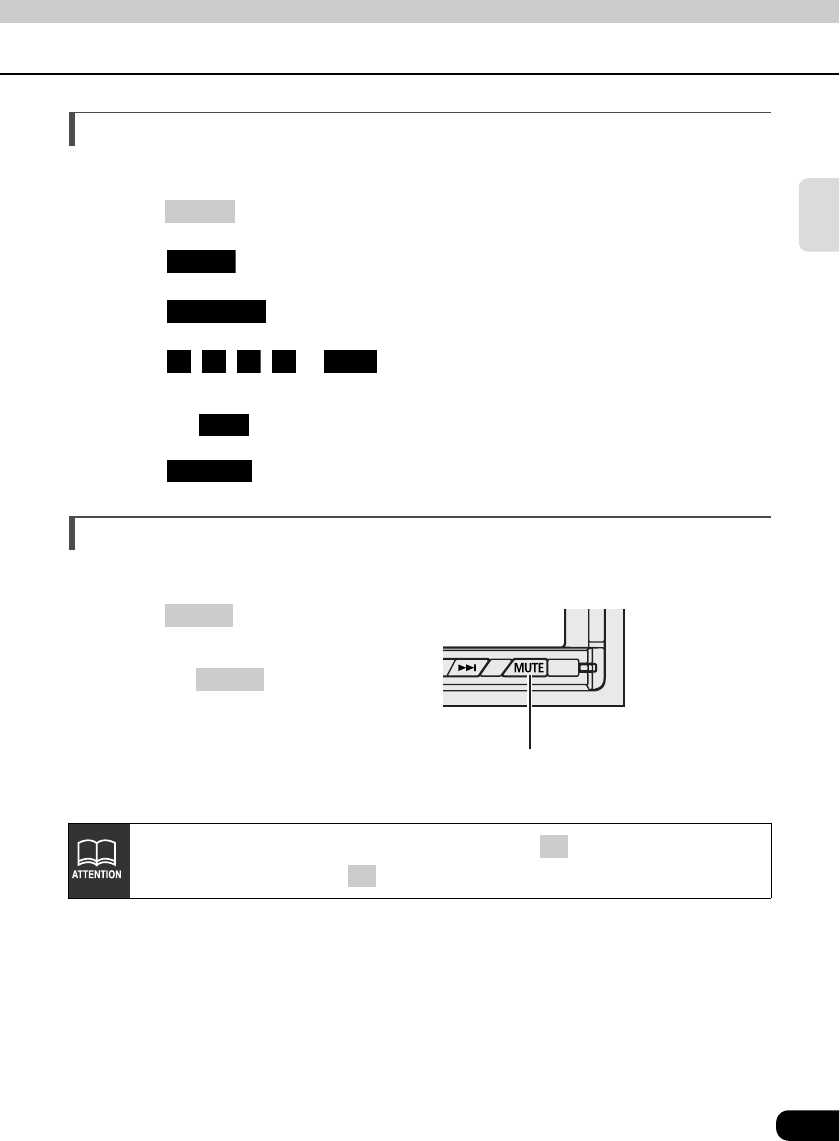
Adjusting volume balance
The set position for front-to-back, right-to-left volume balance can be adjusted.
Touch on the
POSITION setting screen to
display the volume balance
adjustment screen.
Touch the screen at the preferred
balance point.
• To make fine adjustments, touch ,
, , .
• Touching will set the
volume balance to the center position.
• Touch after changing
settings.
The set volume balance will be saved
and the system will return to the previ-
ous operation screen.
• To set the POS again, touch .
FADER BALANCE
CENTER
BACK
POS
• This setting cannot be done at the same time as POS (position selector)
adjustment, described on the previous page.
• Touching and holding , , or while making fine adjustments will
adjust values in a continuous action. However, adjustment will lock when it
reaches the center value, and , , or must be pressed again to
continue adjustment.
37
Basic
operation
Setting the BEEP tone
The guide tone that is heard when touching a panel switch or touch switch can be set.
Press .
Touch on the MAIN MENU screen.
Touch on the INFORMATION screen.
Touch , , , or of GUIDE TONE.
• The pressed touch switch will become brighter.
• Touching will cancel (turn off) the guide tone.
Touch .
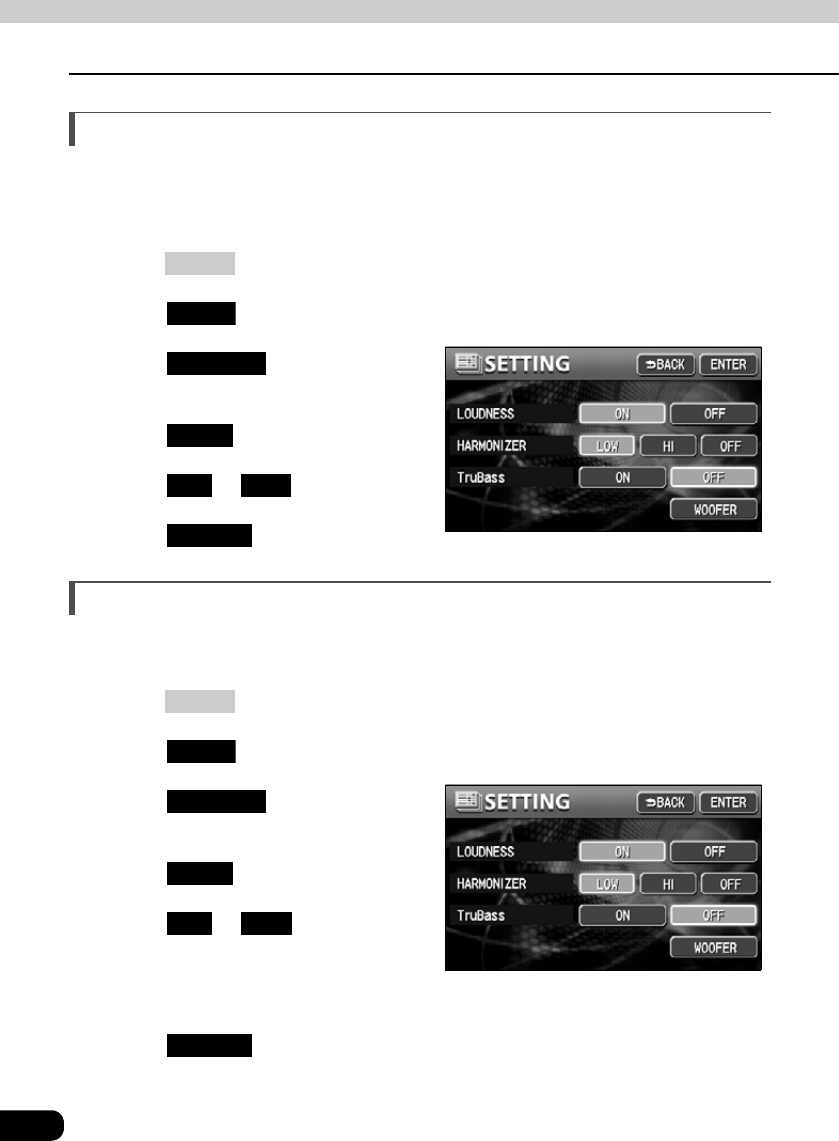
Muting sound
Sound from the audio system can be temporarily muted.
Press .
• Volume will become zero.
• Pressing switch again will
return to previous volume.
• The VOLUME display will flash during
mute.
MENU
INFO
SETTING
1 2 3 4 OFF
OFF
ENTER
MUTE switch
MUTE
MUTE
The MUTE function will be canceled on pressing the VOLUME switch (it is
unaffected by pressing the switch).
+
–
38
Adjusting sound quality
Basic operation
Switching the bass enhancement (Tru Bass)
You can switch the bass enhancement.
• Note that Tru Bass is adjusted only when the Circle Surround II (page 43) effectiveness is
set to Low or Hi.
Press .
Touch on the MAIN MENU screen.
Touch on the
INFORMATION screen.
Touch .
Touch or of Tru Bass.
Touch .
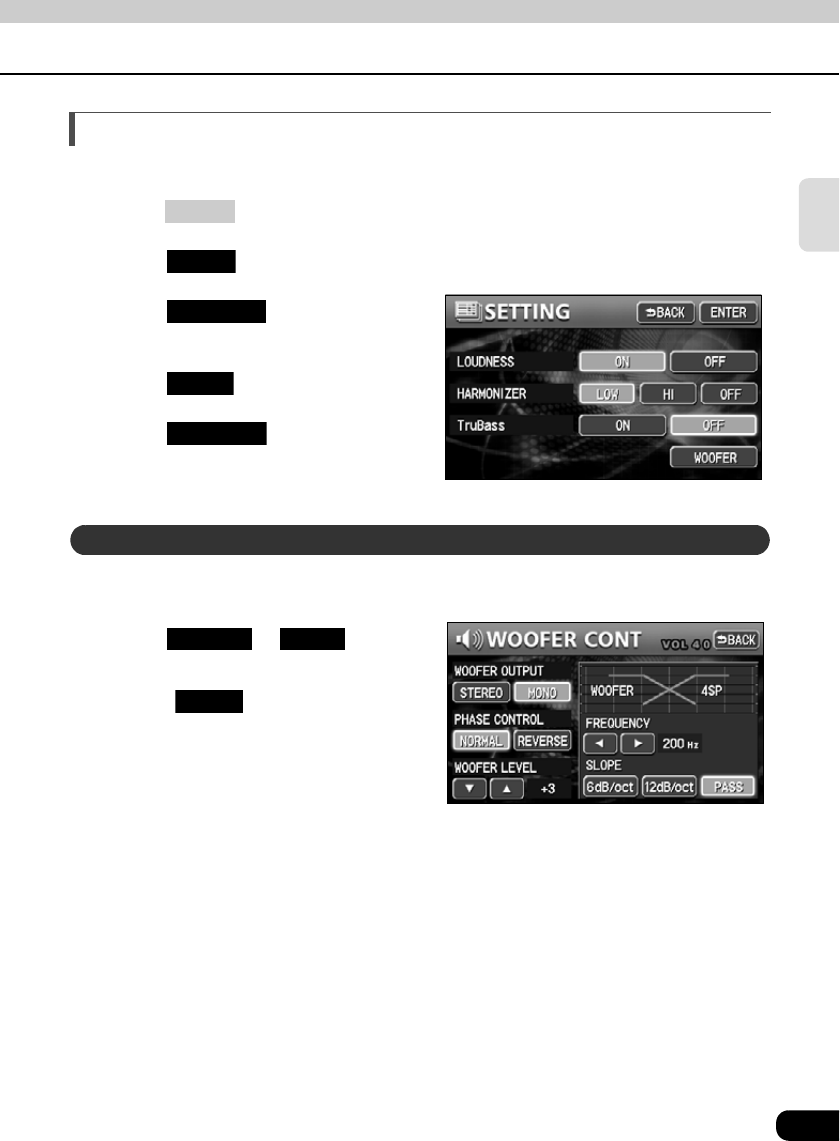
Setting LOUDNESS
Audio can be modulated to correct for insufficient low and high sounds when listening at low
volume.
Press .
Touch on the MAIN MENU screen.
Touch on the
INFORMATION screen.
Touch .
Touch or of
LOUDNESS.
• The pressed touch switch will become
brighter.
Touch .
MENU
INFO
SETTING
NEXT
ON OFF
ENTER
MENU
INFO
SETTING
NEXT
ON OFF
ENTER
39
Basic
operation
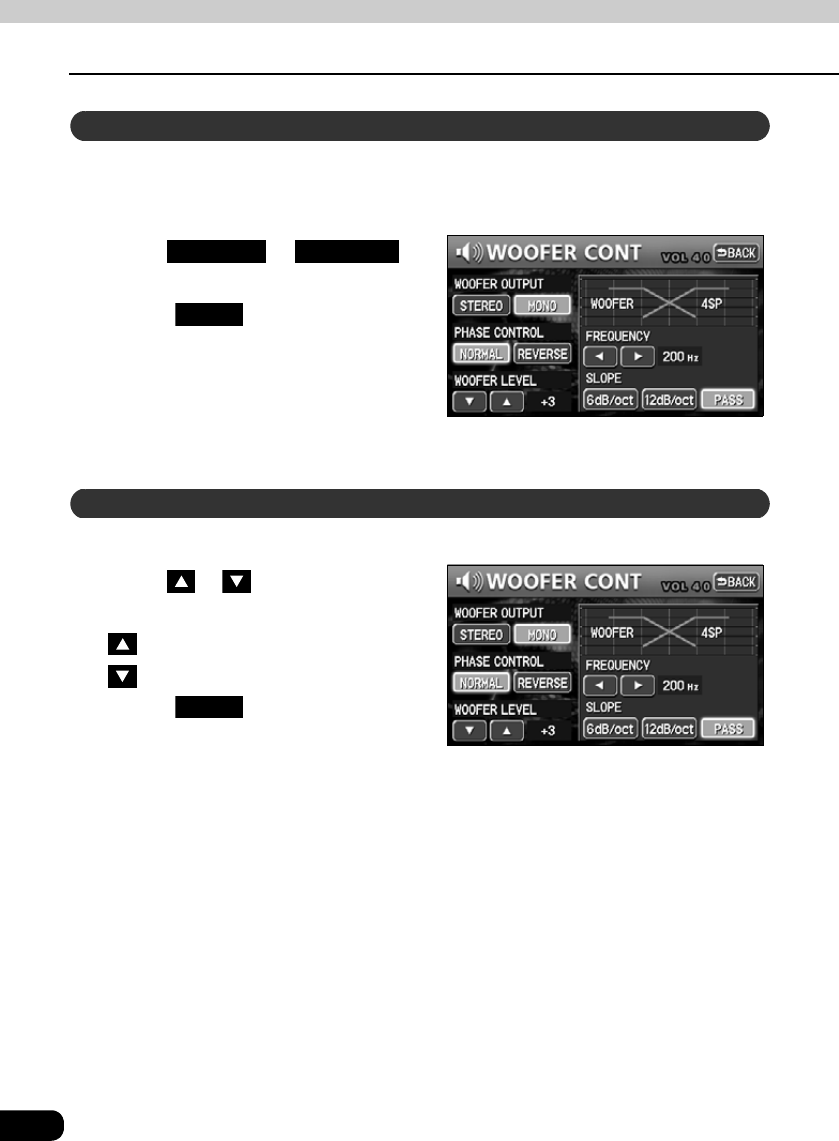
Setting the sub-woofer
When a sub-woofer is connected, the preferred output level for the audio can be set.
Press .
Touch on the MAIN MENU screen.
Touch on the
INFORMATION screen.
Touch .
Touch in the setting
screen.
The sub-woofer output can be set to STEREO or MONO. Select the method that matches the
output method for the connected sub-woofer system.
Touch or for
WOOFER OUTPUT.
• Touch after changing
settings.
The woofer output setting will be saved
and the system will return to the
previous screen.
MENU
INFO
SETTING
NEXT
WOOFER
Setting WOOFER OUTPUT
STEREO MONO
BACK
40
Adjusting sound quality
Basic operation
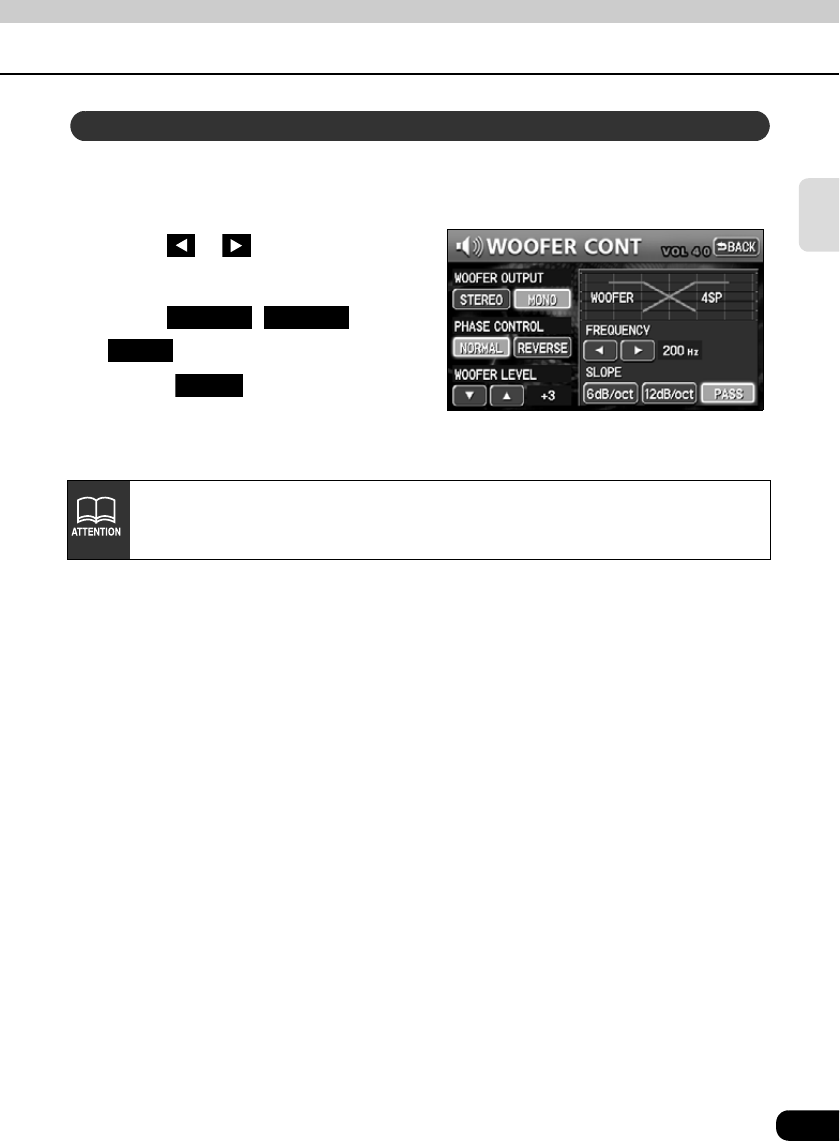
The merging of sound between the front and rear speakers and the sub-woofer can be
improved by selecting the phase.
Switch to a phase which lets the speakers combine without any disharmony.
Touch or
for PHASE CONTROL.
• Touch after changing
settings.
The phase control will be saved and
the system will return to the previous
screen.
The output level of the sub-woofer can be adjusted with this function.
Touch or for WOOFER
LEVEL.
: Increase level
: Decrease level
• Touch after changing
settings.
The woofer level will be saved and the
system will return to the previous
screen.
Selecting phase control
NORMAL REVERSE
BACK
Selecting the sub-woofer level
BACK
41
Basic
operation
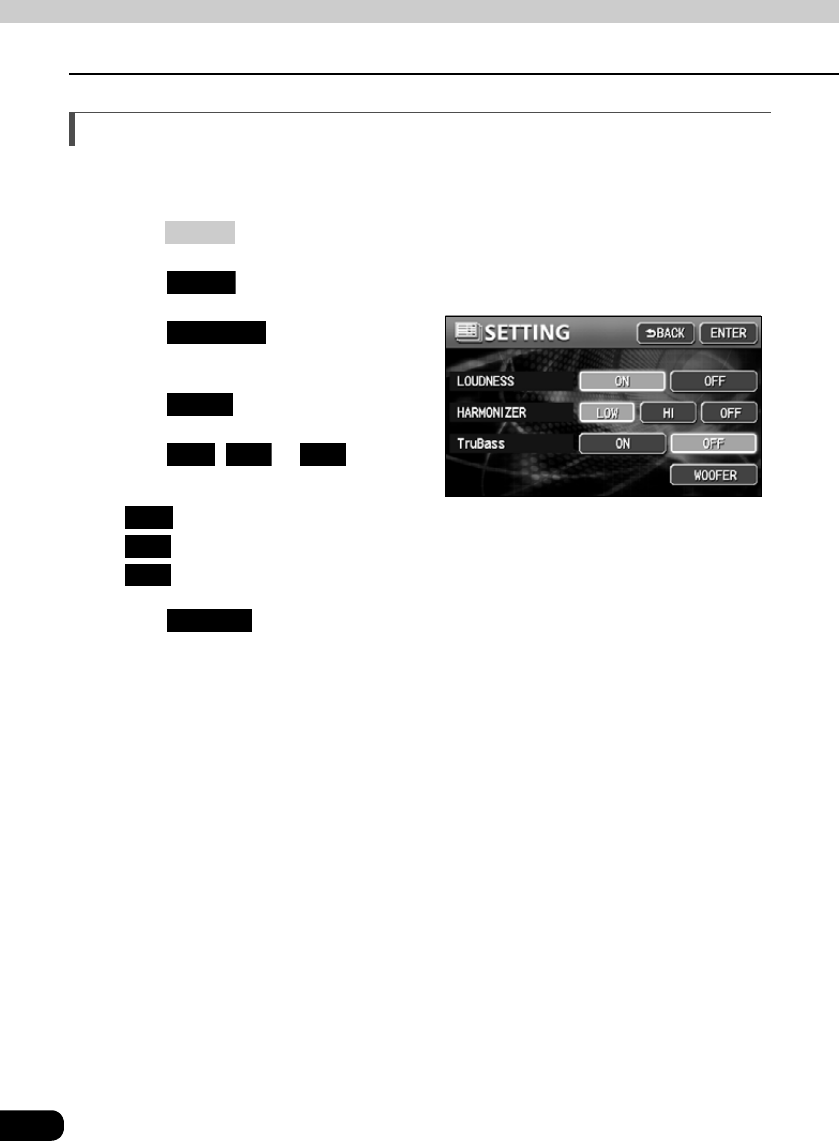
The frequencies for the front and rear speaker high-pass filter (HPF) and sub-woofer low-
pass filter (LPF) can be set within a range of 63 / 80 / 100 / 125 / 160 / 200 Hz. (This is the
same as setting the HPF and LPF cutoff frequencies.)
Touch or to select the cut
off frequency.
Touch , or
to select the slope.
• Touch after changing
settings.
The crossover setting will be saved
and the system will return to the previous screen.
Setting X-OVER
6dB/oct 12dB/oct
PASS
BACK
If no sub-woofer has been connected, set the slope adjustment to "PASS". (If
slope is set to a setting other than PASS, the low frequency range will not be
output from the speakers.)
42
Adjusting sound quality
Basic operation
Setting the harmonizer
It is possible to set the sound quality boost level to automatically regenerate harmonics such
as reverberation, depth, and tone lost in compression, producing a much clearer sound.
Press .
Touch on the MAIN MENU screen.
Touch on the
INFORMATION screen.
Touch .
Touch , or for
HARMONIZER.
• : Low level of correction
: High level of correction
: No correction (default)
Touch .
• Selection can be made when MP3/WMA disc is inserted into the unit .
MENU
INFO
SETTING
NEXT
LOW HI OFF
LOW
HI
OFF
ENTER
43
Basic
operation
Setting the Circle Surround II
The Circle Surround II reproduces deep bass and localization of sound without a center
speaker and/or a sub-woofer.
This is also applied to the audio of FM radio and TV. However, it is not effective for the AM
radio.
Touch , or on the
operation screen.
• Touch (in TV and VTR mode) or
touch and then (in
DVD mode) to display the touch
switches for adjusting sound quality.
• Each time touch switch is touched, the
screen display will be changed in the
order shown below.
• : The effectiveness to reproduce the deep bass sound and the localization of
sound is low.
: The effectiveness to reproduce the deep bass sound and the localization of
sound is high.
: Cancels the function (default).
OFF LOW HI
SET
NEXT SET
OFF OFFLOW HI
LOW
HI
OFF
• The Circle Surround II setting cannot be done at the same time as DSP (Page
30), POS (the position selector) adjustment (Page 35) and LOUDNESS
adjustment (Page 38).
• Circle Surround II, SRS and (●) symbol are trademarks of SRS Labs, Inc.
• Circle Surround II technology is incorporated under license from SRS Labs, Inc.
44
Basic operation
Setting the background screen
The background for the audio screen, information screen and navigation screen can be
changed to a preferred wallpaper.
Setting the wallpaper
Press .
Touch on the MAIN MENU screen.
Touch on the
INFORMATION screen.
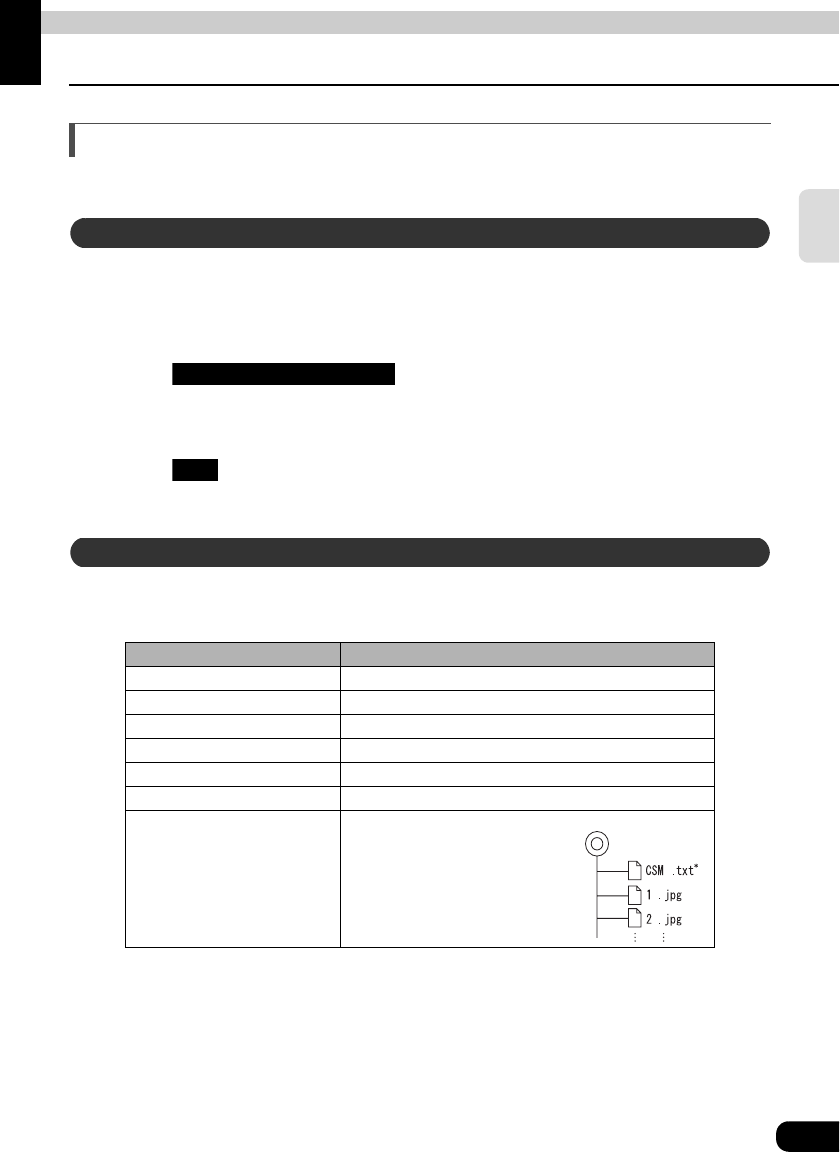
Touch , , , or of
WALL PAPER.
• The pressed touch switch will become
brighter and the wallpaper
(background) will change.
Touch .
Changing the wallpaper
MENU
INFO
SETTING
1 2 3 4 5
ENTER
Basic operation
45
Basic
operation
Adjusting the background screen
Setting the opening screen
The image displayed on the opening screen (which is displayed when the power is turned
on) can be changed to your favorite one stored in a CD-R/RW.
Insert a CD-R/RW disc that includes your favorite image.
• It would take approximately 30 seconds to read the image data. While the image
data is being read, do not operate the main unit and the ignition key.
Touch .
Touch the image you want to display on the opening screen.
Touch .
• Be sure to eject the CD-R/RW disc that includes the image data.
The format of disc and image data that can be used on the opening screen are shown in the
table below. If your disc and/or data does not meet the conditions below, the file names may
not be listed nor displayed correctly.
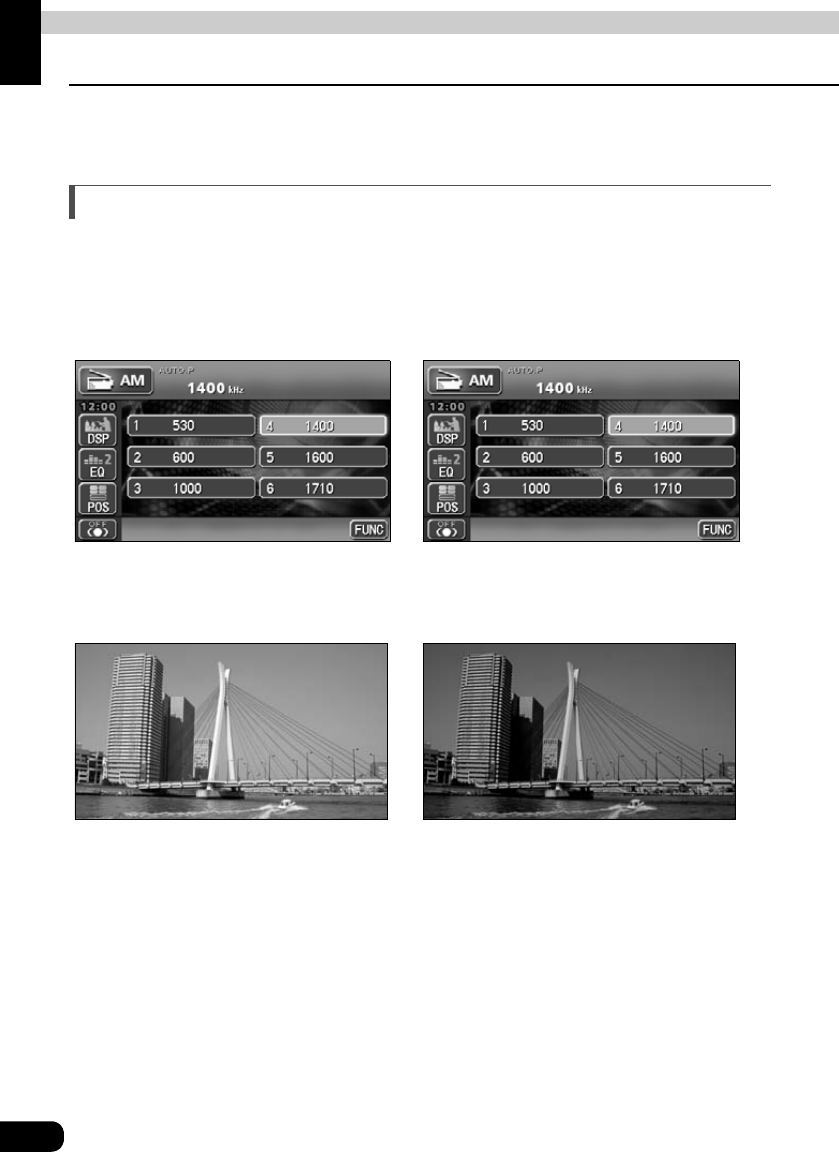
*When storing the image data in a CD-R/RW disc, make a text file named "CSM.txt" (any
content/text is OK) and store it together with the image data.
• If the image size is larger than the condition above, the image cannot be previewed or
imported.
• If the image size is smaller than the condition above, the image will be displayed at the
center of screen.
• Only one image data can be imported at a time.
CD-R/RW
Disc format ISO9660 (MODE1)
File size Smaller than 100 KB
File name ISO9660 LEVEL 2 (Up to 31 bytes)
File extension .jpg (Non-JPEG2000-compliant)
Writing method Single-session only
Image size 416 (W) X 240 (H) dots (Max.)
Displayed file
The files in the root directory (top-most directory) only.
Changing the image on the opening screen
Opening Image Change
OK
About usable image data
46
Basic operation
Adjusting/setting the screen
Quality adjustments can be made for the images such as the audio operation screen,
navigation screen and DVD or VTR (optional).
Displaying the image adjustment screen
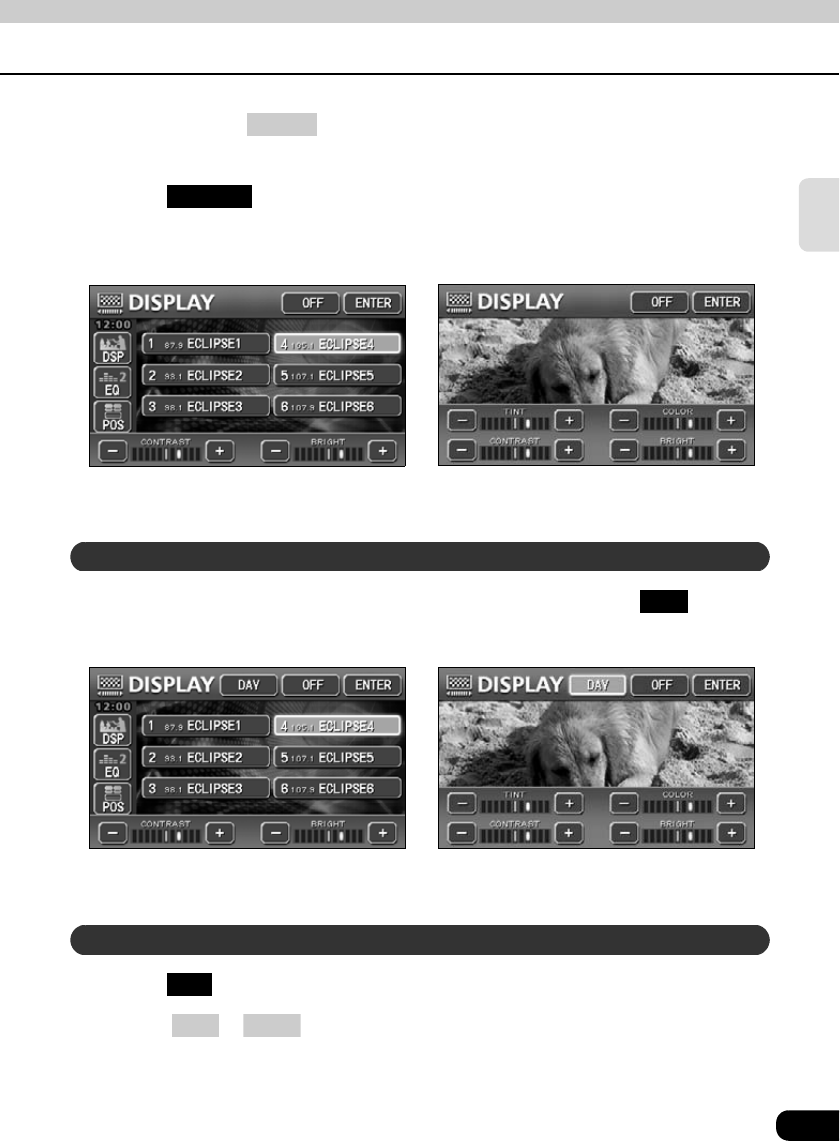
Contrast, brightness and other picture settings can be adjusted to match preferences for
viewing DVD video or the audio operation screen.
To make viewing easier, the display switches between day screen/night screen according to
whether the vehicle lights (parking lights, taillights, license plate lights) are on/off.
(Default settings)
• When vehicle head lights are on: [Night screen is displayed]
• When vehicle head lights are off: [Day screen is displayed]
[Audio operation screen]
●Day display [Vehicle lights are off] ●Night display [Vehicle lights are on]
[DVD/VTR Screen]
●Day display [Vehicle lights are off] ●Night display [Vehicle lights are on]
47
Basic
operation
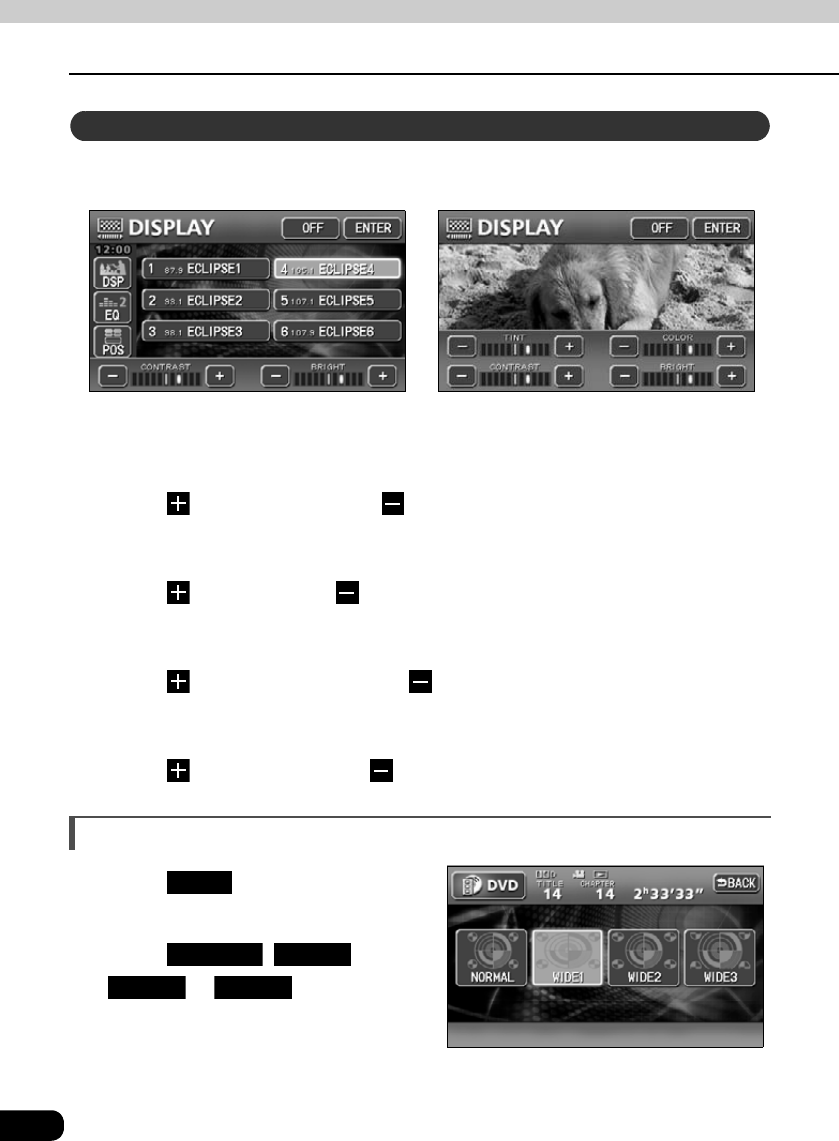
Press and hold until a beep is heard on the audio mode screen or
DVD/VTR/TV screen.
Touch after making any adjustments.
• If no adjustments are made after 20 or more seconds, the image quality adjustment
screen will be canceled.
The day screen and night screen will be switched each time is
pressed.
Touch .
• Press or to return to the original screen.
MENU
ENTER
●When adjusting audio operation screen ●When adjusting DVD/VTR/TV screen
How to switch to daytime display when the lights are ON
DAY
●When adjusting audio operation screen ●When adjusting DVD/VTR/TV screen
Turning off the screen
OFF
AV MAP
48
Adjusting/setting the screen
Basic operation
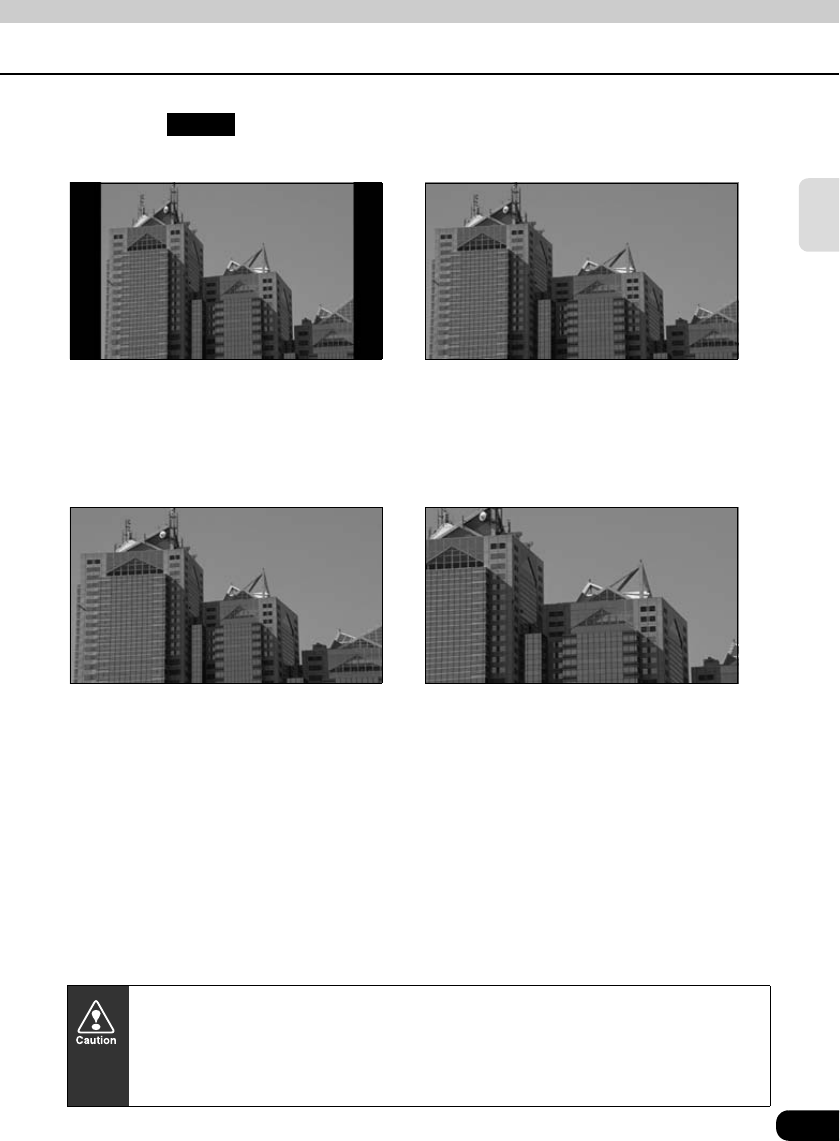
The day screen and night screen can be separately adjusted (on the audio operation screen,
the navigation screen, and the DVD/VTR/TV screen).
■ CONTRAST
Touch to enhance contrast, to weaken contrast.
■ BRIGHT
Touch to make lighter, to make darker.
■ COLOR (for DVD/VTR/TV screen only)
Touch to enhance green color, to enhance red color.
■ TINT (for DVD/VTR/TV screen only)
Touch to make tint darker, to make tint lighter.
Switching screen mode
Touch on DVD, VTR or TV
operation screen.
Touch , ,
or .
• This selects the wide mode.
Adjusting image quality
●When adjusting audio operation screen or
navigation screen
●When adjusting DVD/VTR/TV screen
WIDE
NORMAL WIDE1
WIDE2 WIDE3
49
Basic
operation
Touch .
• Returns to the DVD, VTR or TV operation screen.
BACK
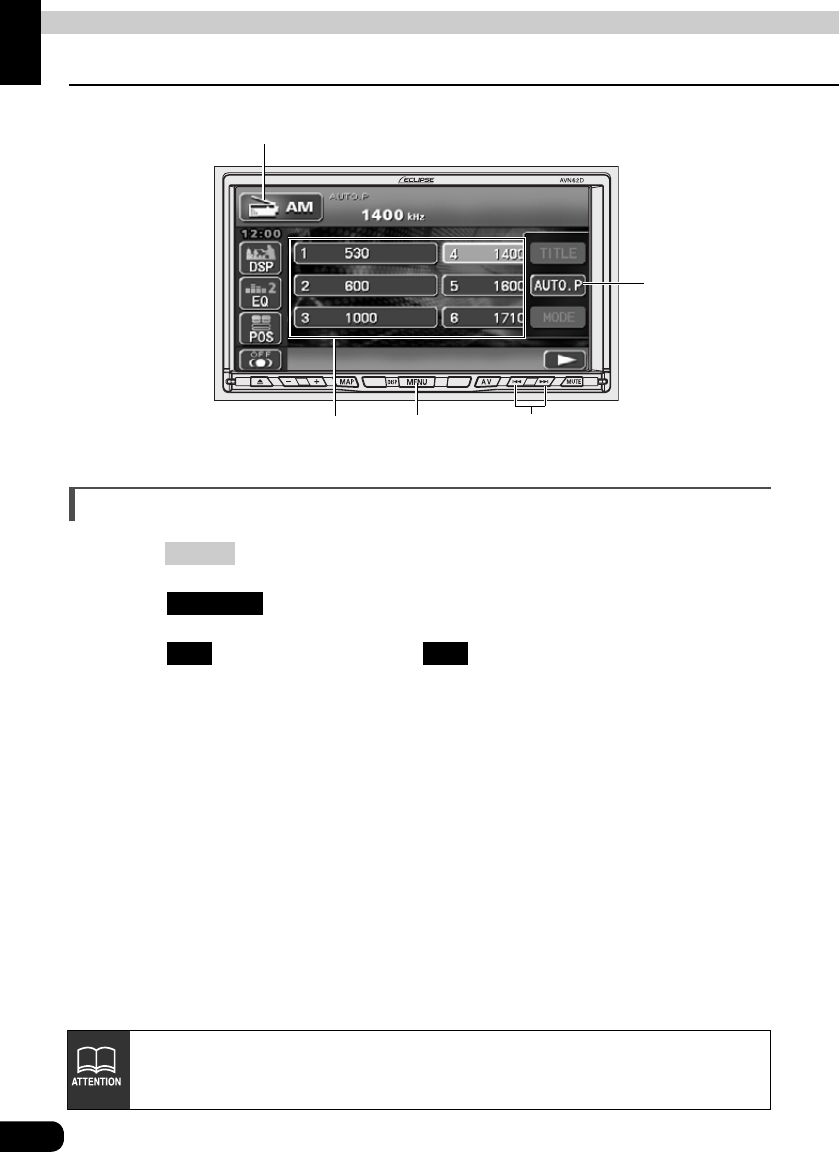
■ NORMAL mode
The screen is shown with vertical to
horizontal ratio of 3 to 4 (normal TV
screen size) and side edges are black.
■ WIDE 1 mode
The screen for vertical to horizontal ratio
of 3 to 4 (normal TV screen size) is
uniformly expanded in the left and right
directions.
■ WIDE 2 mode
The screen for vertical to horizontal ratio
of 3 to 4 (normal TV screen size) is
uniformly expanded in the left and right
directions (except for the central section
of the screen).
■ WIDE 3 mode
The screen for vertical to horizontal ratio
of 3 to 4 (normal TV screen size) is
uniformly expanded in the upward,
downward, left and right directions.
Viewing of wide screen modes is permitted when limited to the personal
entertainment of the user, but caution is required when using technologies such
as image compression and expansion for the purpose of commercial benefit or
public presentation may infringe upon the rights of the copyright holder being
protected by applicable copyright law.
50
How to operate the tuner
How to use the AM / FM radio
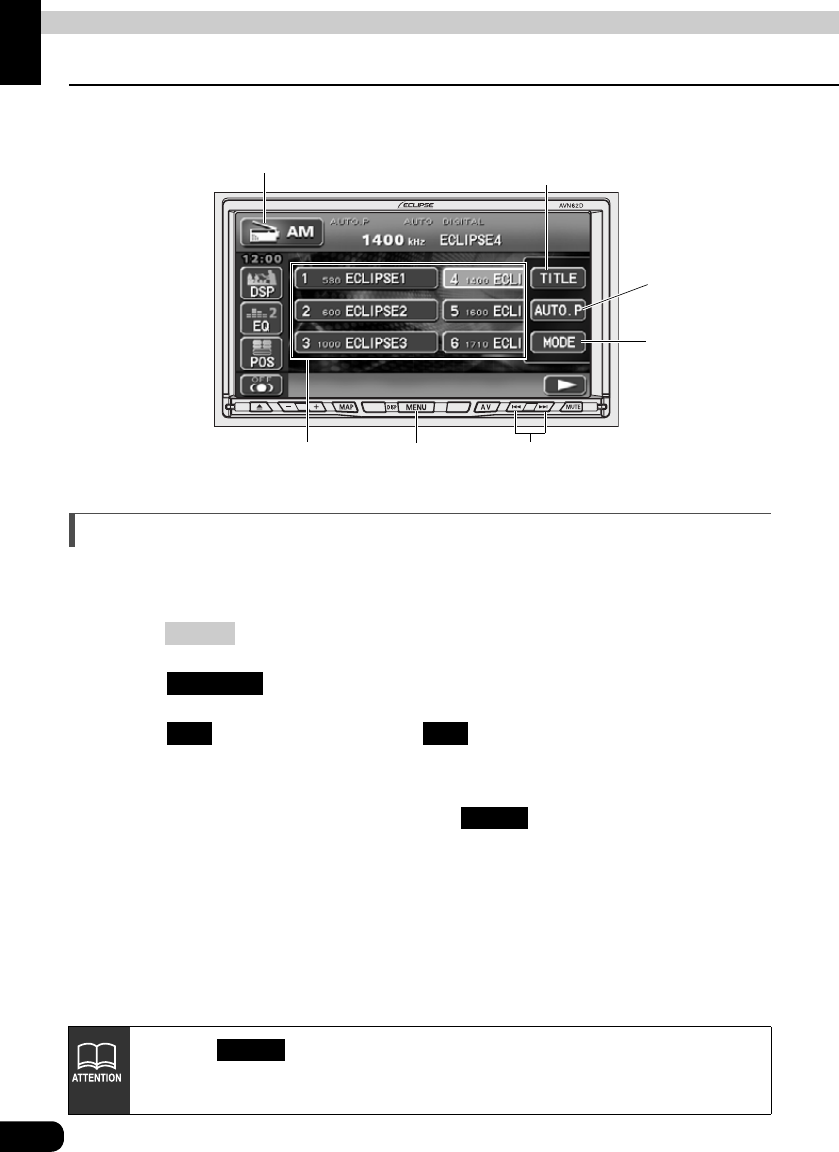
Listening to the AM/FM radio
Press .
Touch .
Touch to receive AM radio, or to receive FM radio.
MENU Button
Preset
Switches
TUNE TRACK
Button
SOURCE MENU switch
AUTO.P
Switch
MENU
SOURCE
AM FM
When an HD Radio tuner is connected, the standard radio (analog radio) is also
controlled through the HD Radio tuner. Note that this means the antenna should
be connected to the HD Radio tuner.
51
RADIO
Selecting radio stations
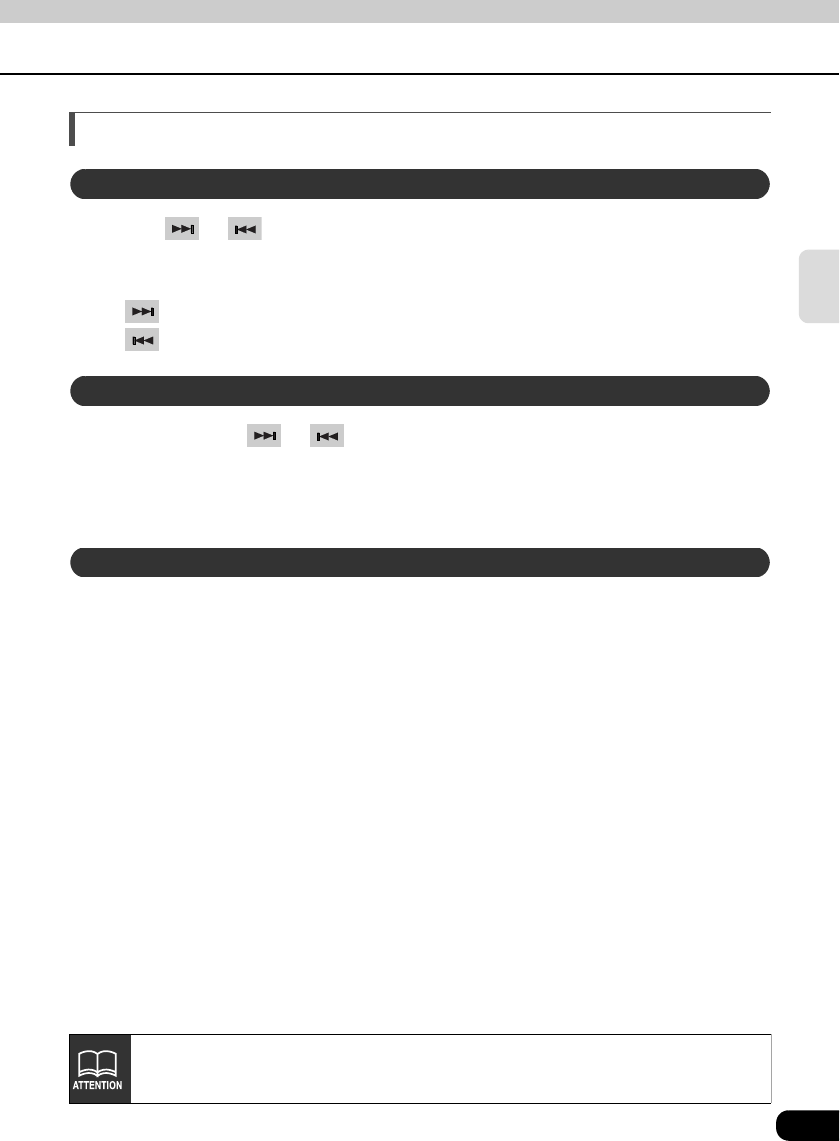
Press or .
• Each pressing of the switch moves the frequency one step up or down. (One step on
the AM band is 10kHz. One step on the FM band is 0.2MHz.)
: Raises frequency
: Lowers frequency
Press and hold or until a beep is heard.
• The station that is closest in frequency to the frequency that is currently displayed on
the screen will be searched for automatically, and searching will stop when the station
is received. To stop the search before a station is found, press the button again.
Touch the preset switch that already has a station recorded.
• Refer to "Saving radio stations" on page 53 for details on saving stations.
Manual selection
Automatic selection
Selection using preset switches
If the reception for a particular station is weak in the area you are in, automatic
selection may not work.
52
How to use the AM / FM radio
How to operate the tuner
Selecting radio bands
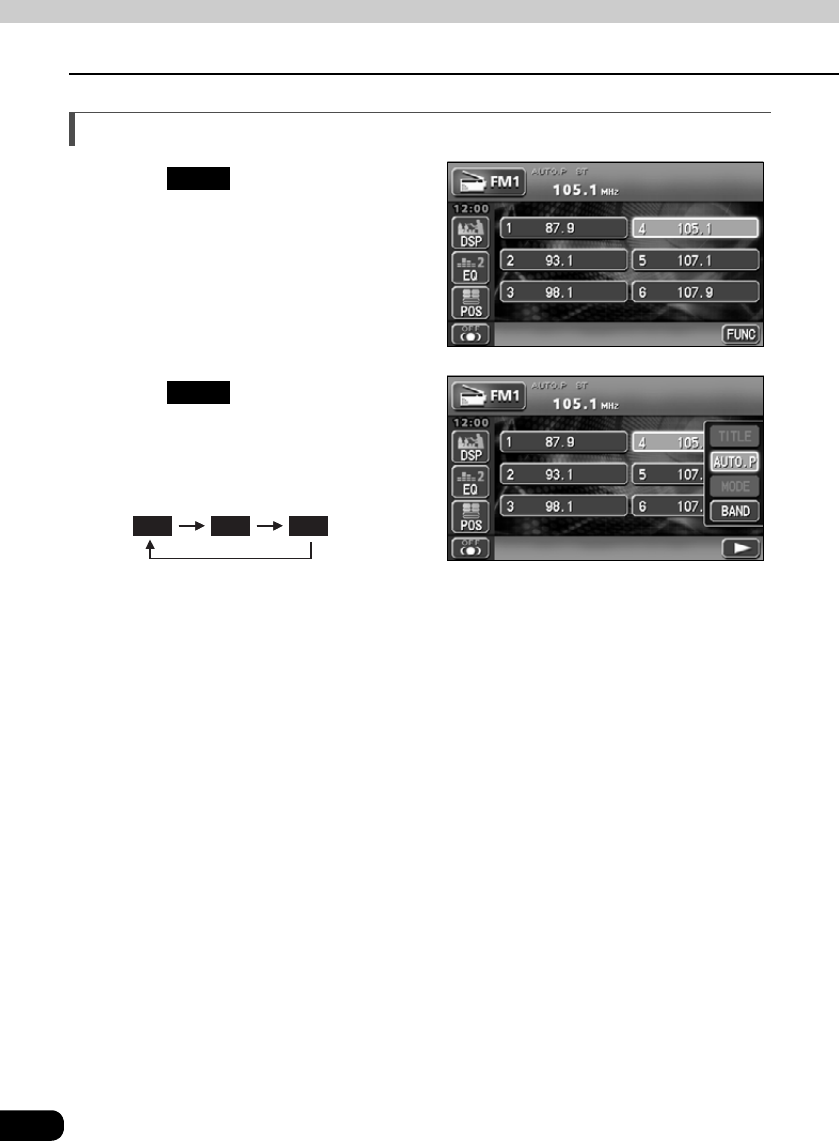
Touch .
Touch .
• Each time the switch is touched, the
radio band will be changed in the
order shown below.
FUNC
BAND
FM1 OFFFM2 FM3
53
RADIO
Saving radio stations
There are two modes for saving radio stations, manual and AUTO.P, and these modes
operate independently.
Confirm that "AUTO.P" is not displayed in the upper part of the screen.
• If "AUTO.P" is displayed, touching will switch the screen to manual.
Use manual tuning or automatic tuning to select the station to be saved.
Choose a preset switch and touch it until a beep is heard.
• The radio station (frequency) is set. Touching the preset switch will now tune in the
selected station.
Touch .
Touch until a beep is heard.
• The AUTO.P function will be activated and start automatically selecting stations. A
beep will be heard when automatic selection of stations is completed. On touching
again, the display will switch to the previously recorded station.
Use manual tuning or automatic tuning to select the station to be saved.
Choose a preset switch and touch it until a beep is heard.
Saving manually
AUTO.P
Saving with AUTO.P
FUNC
AUTO.P
AUTO.P
Changing stations saved by AUTO.P
54
How to use the AM / FM radio
How to operate the tuner
Because AUTO.P temporarily saves stations for the preset switches, stations saved
manually will remain in memory even if AUTO.P is used. By manually saving
stations that are used regularly, these manually saved stations can be restored even
after AUTO.P has been used, such as after traveling.
Touching while AUTO.P is being used or after AUTO.P has been used
will return the preset memories back to the condition they had before AUTO.P was
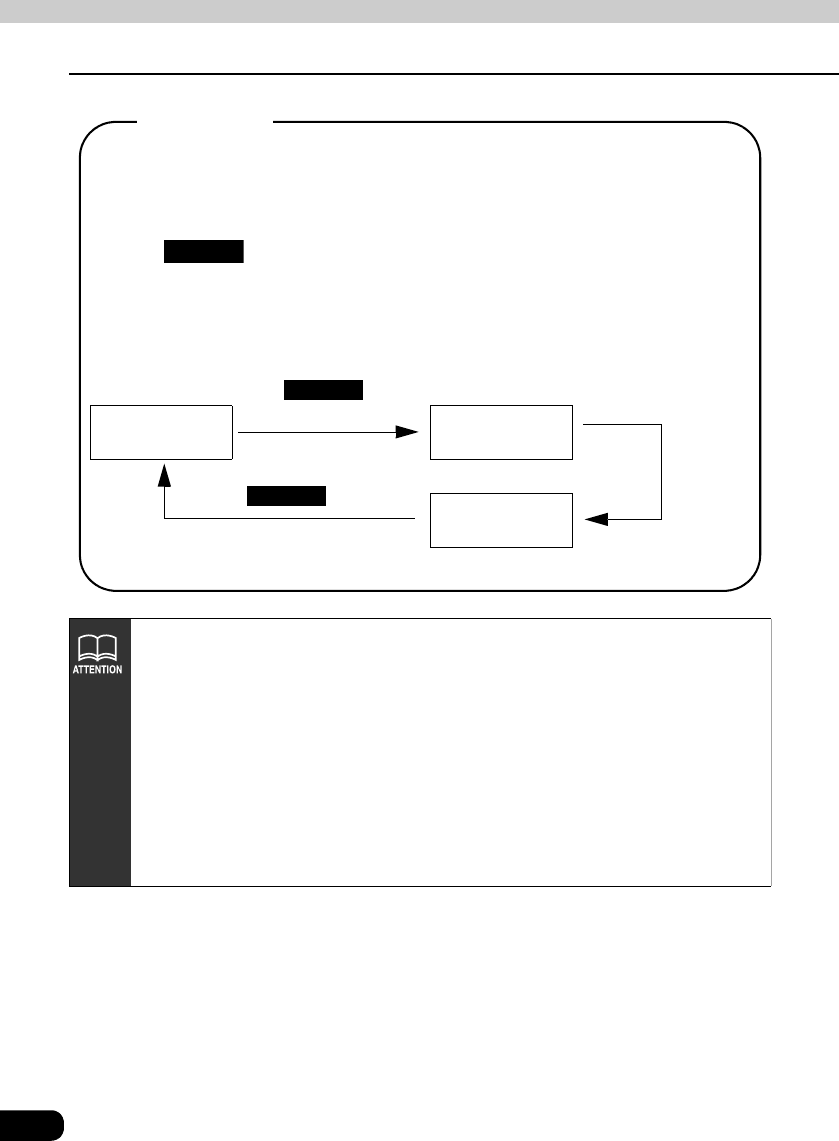
used. (Doing so will delete the stations saved with AUTO.P.) The flow for switching
from AUTO.P to manual is shown below.
If the BAND is switched to another BAND, the saved station with AUTO.P is cleared.
Manual AUTO.P
(starts search)
AUTO.P
(stops search)
AUTO.P
Automatically saves
stations to preset switches
Touch until a
beep is heard.
AUTO.P
Touch
(Stations saved by AUTO.P are
deleted)
AUTO.P
About AUTO.P
• AUTO.P may not automatically receive stations if radio waves in the surrounding
area are weak.
• A station saved by the tuning switch may not match a station saved by AUTO.P
even though the signal is received from the same station.
• Due to conditions for receiving radio waves, saved stations may differ even
when the AUTO.P switch is operated repeatedly in the same location.
• Up to six stations having good reception sensitivity are automatically saved in
order starting from the lowest frequency.
• When less than six stations capable of reception are found, nothing is saved for
the remaining preset switches.
• In the FM mode, when the BAND is switched to another BAND, the AUTO.P is
canceled temporarily.
55
RADIO
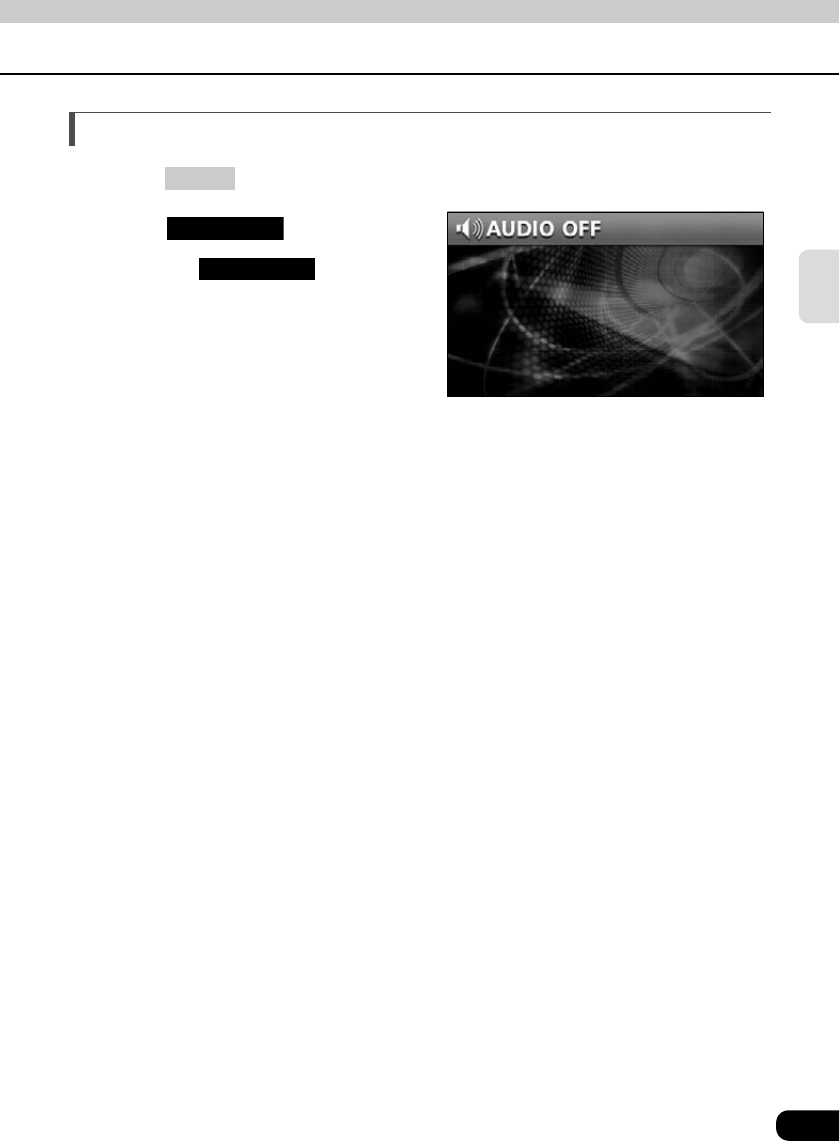
Turning off the radio
Press .
Touch .
• Touching again on the
MAIN MENU screen will turn on the
radio and resume reception of the
radio station (frequency) received
before power was turned off.
MENU
AUDIO OFF
AUDIO OFF
56
How to operate the tuner
How to use HD Radio
When an optional HD Radio tuner is connected, HD Radio broadcasts can be received.
Listening to HD Radio
Depending on the reception status, HD Radio can also receive analog broadcasts, which
means reception is still possible in regions with no digital coverage.
Press .
Touch .
Touch to receive AM radio, or to receive FM radio.
• When an HD Radio tuner is connected and a digital broadcasting program is
received, "DIGITAL" is displayed.
• When an HD Radio tuner is connected, the touch switch becomes
available.
Title
Switch
Preset
Switches
MODE
Switch
AUTO.P
Switch
TUNE TRACK
Button
MENU
Button
SOURCE MENU switch
MENU
SOURCE
AM FM
TITLE
• With the switch, you can switch between analog and digital
broadcasting.
• The HD Radio Ready logo is a proprietary trademark of iBiquity Digital Corp.
MODE
57
RADIO
Selecting radio stations
Press or .
• Each pressing of the switch moves the frequency one step up or down. (One step on
the AM band is 10kHz. One step on the FM band is 0.2MHz.
: Raises frequency
: Lowers frequency
Press and hold or until a beep is heard.
• The station that is closest in frequency to the frequency that is currently displayed on
the screen will be searched for automatically, and searching will stop when the station
is received. To stop the search before a station is found, press the button again.
Touch the preset switch that already has a station recorded.
• Refer to "Saving radio stations" on page 58 for details on saving stations.
Manual selection
Automatic selection
Selection using preset switches
If the reception for a particular station is weak in the area you are in, automatic
selection may not work.
58
How to use HD Radio
How to operate the tuner
Saving radio stations
There are two modes for saving radio stations, manual and AUTO.P, and these modes
operate independently.
Refer to "How to use the AM / FM radio" on page 53.
Touch .
Touch until a beep is heard.
• The AUTO.P function will be activated and start automatically selecting stations. A
beep will be heard when automatic selection of stations is completed.
• When a radio station found by AUTO.P function is stored into the preset switch, the
station already stored in the preset switch will be overwritten.
Refer to "How to use the AM / FM radio" on page 53.
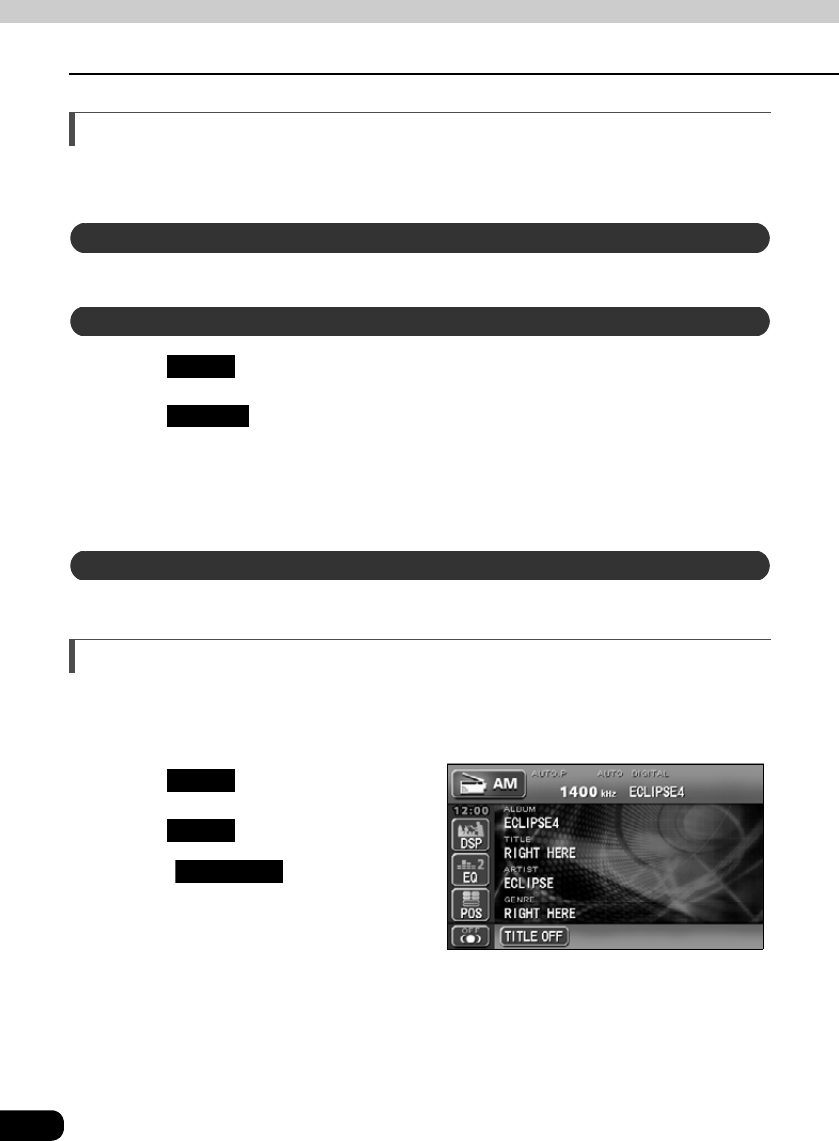
Displaying information about the current broadcast
When receiving an HD Radio broadcast, information about the current broadcast, such as
the name of the radio station, the album, the title of the track, the artist, and the musical
genre, can be displayed if that station is broadcasting those information.
Touch .
Touch .
• Touch to return to the
operation screen.
Saving manually
Saving with AUTO.P
FUNC
AUTO.P
Changing stations saved by AUTO.P
FUNC
TITLE
TITLE OFF
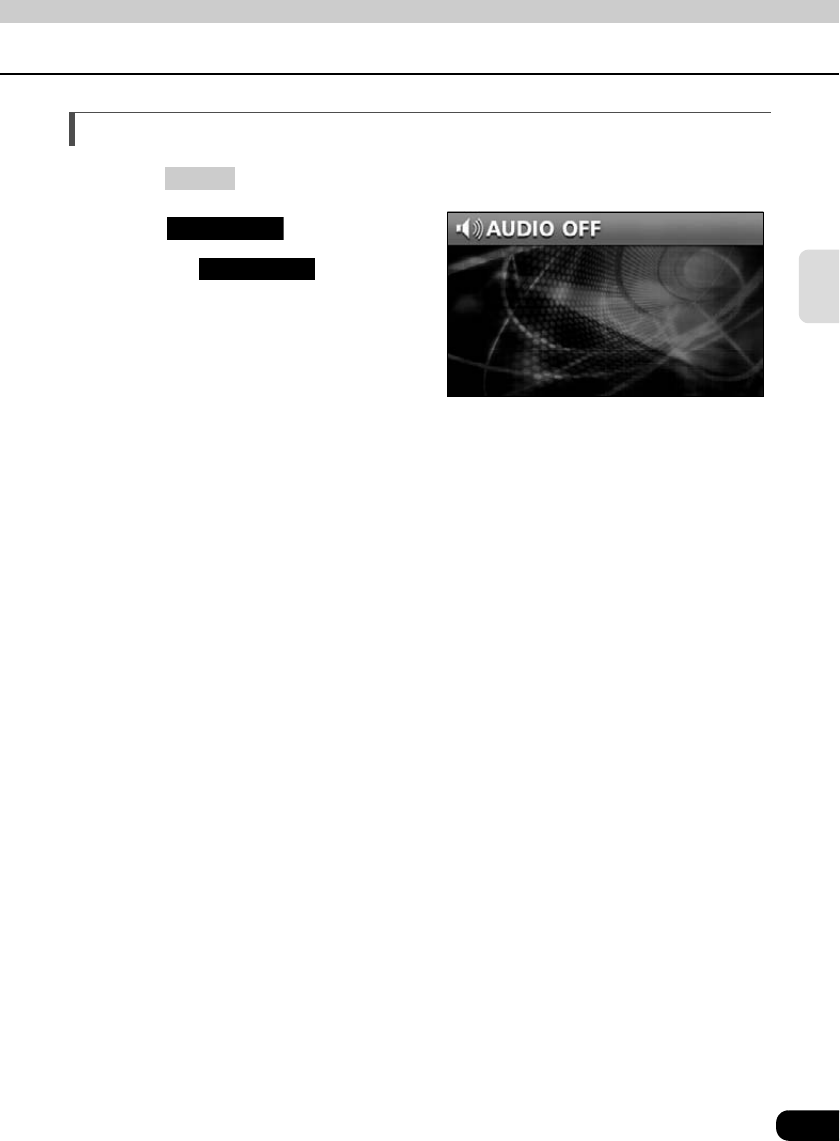
59
RADIO
Turning off the radio
Press .
Touch .
• Touching again on the
MAIN MENU screen will turn on the
radio and resume reception of the
radio station (frequency) received
before power was turned off.
MENU
AUDIO OFF
AUDIO OFF
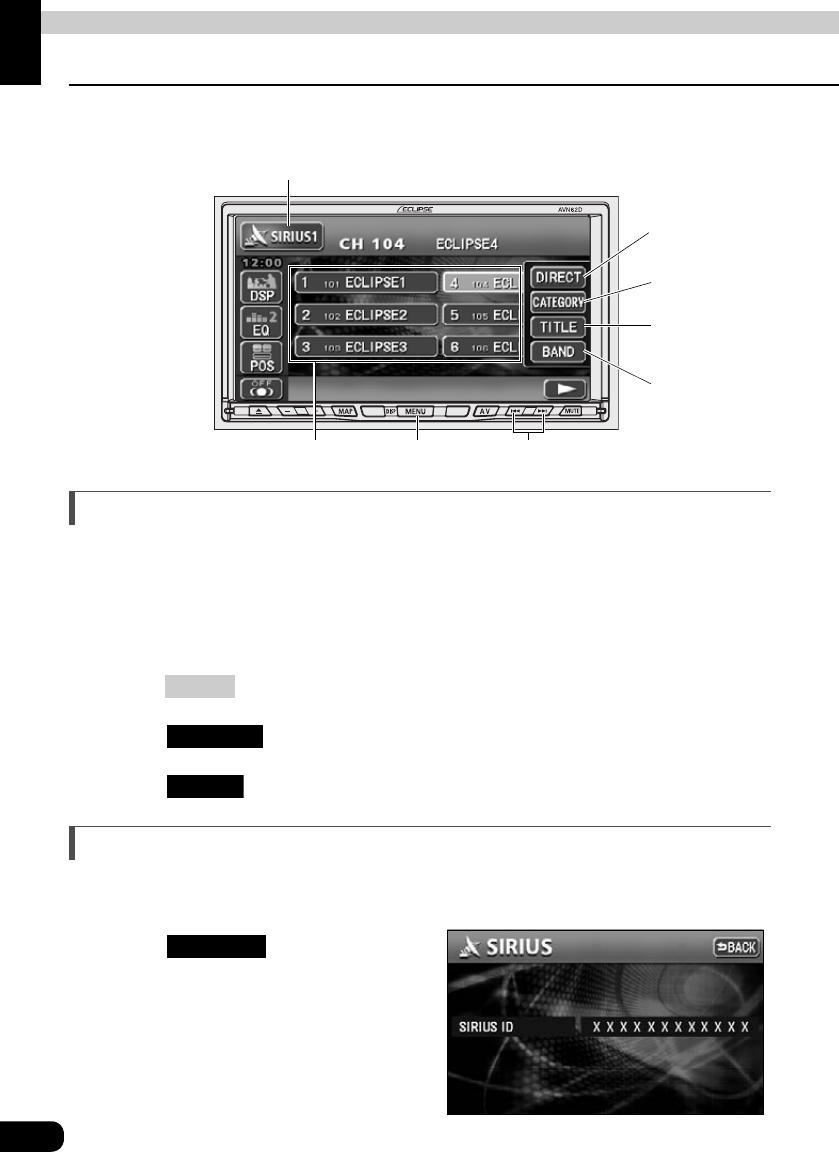
60
How to operate the tuner
How to use the SIRIUS satellite radio
When an optional SIRIUS satellite radio tuner is connected, SIRIUS satellite radio
broadcasts can be received.
Listening to SIRIUS satellite radio
With SIRIUS satellite radio, over 100 channels are available including music, news, and
entertainment programs.
You can select the channel you want from various categories such as POP and ROCK, or you
can select a channel by direct input.
Reception of SIRIUS satellite radio is a paid subscription.
Press .
Touch .
Touch .
Check the SIRIUS ID
The SIRIUS ID number is a 12-digit numerical code that is assigned each time the SIRIUS
satellite radio tuner is connected.
Touch on the
INFORMATION screen.
•
A 12-digit numerical code is displayed
.
BAND
Switch
CATEGORY
Switch
DIRECT
Switch
TITLE
Switch
Preset
Switches
MENU
Button
TUNE TRACK
Button
SOURCE MENU switch
MENU
SOURCE
SIRIUS
SIRIUS ID
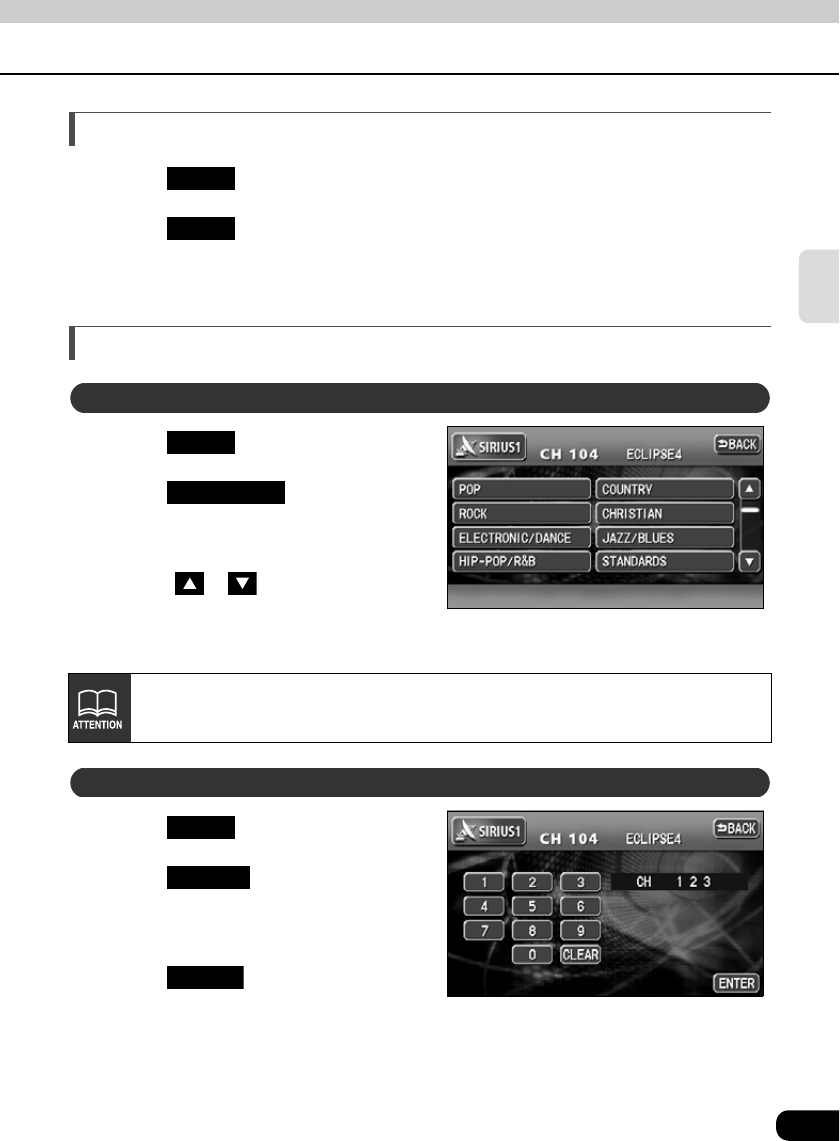
61
RADIO
Changing the SIRIUS band
Touch .
Touch .
• The BAND changes.
[SIRIUS 1] → [SIRIUS 2] → [SIRIUS 3] → [SIRIUS 4] ... → return to [SIRIUS 1]
Selecting the channel you want to listen to
Touch .
Touch .
Select the category that you want.
• Touch or to switch categories.
Touch .
Touch .
Input a channel.
Touch .
If the selected category is unobtainable, the blank category button appears.
FUNC
BAND
Selecting from the available categories
FUNC
CATEGORY
Selecting a channel by direct input
FUNC
DIRECT
ENTER
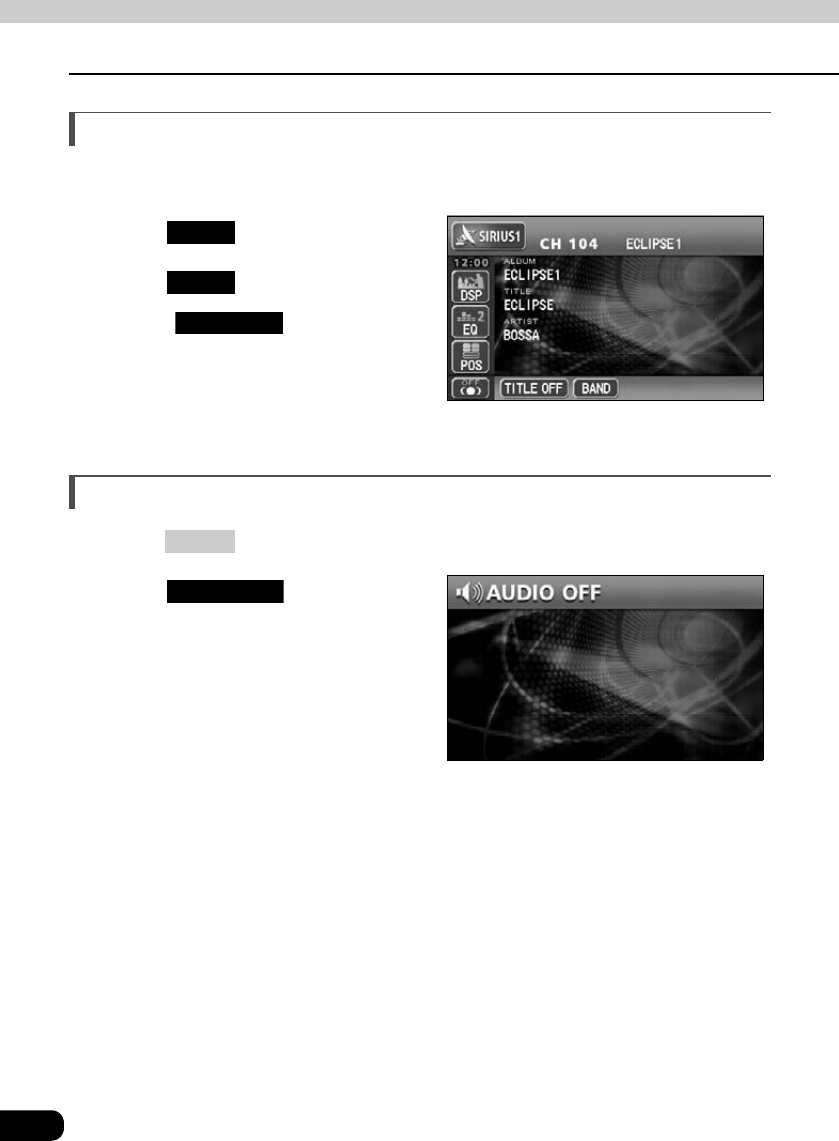
62
How to use the SIRIUS satellite radio
How to operate the tuner
Displaying information about the current broadcast
During SIRIUS broadcasts, information including the channel name, the album name, the
title, and the artist can be displayed for the current track.
Touch .
Touch .
• Touch to return to the
operation screen.
Turning off the SIRIUS
Press .
Touch .
FUNC
TITLE
TITLE OFF
MENU
AUDIO OFF
63
RADIO
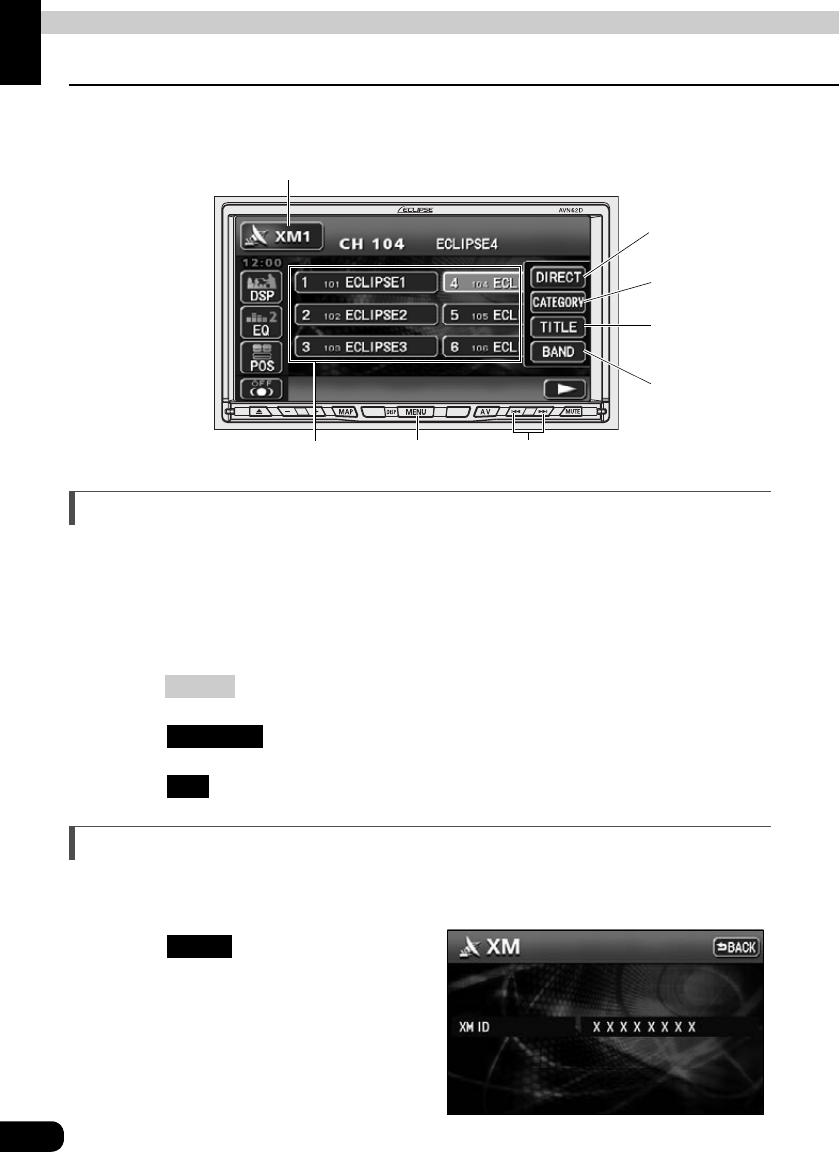
64
How to operate the tuner
How to use the XM satellite radio
When an optional XM satellite radio tuner is connected, XM satellite radio broadcasts
can be received.
Listening to XM satellite radio
With XM satellite radio, over 100 channels are available including music, news, and
entertainment programs.
You can select the channel you want from various categories such as DANCE and ROCK, or
you can select a channel by direct input.
Reception of XM satellite radio is a paid subscription.
Press .
Touch .
Touch .
Check the XM ID
The XM ID number is a 8-digit numerical code that is assigned each time the XM satellite
radio tuner is connected.
Touch on the
INFORMATION screen.
•
A 8-digit numerical code is displayed
.
BAND
Switch
CATEGORY
Switch
DIRECT
Switch
TITLE
Switch
Preset
Switches
MENU
Button
TUNE TRACK
Button
SOURCE MENU switch
MENU
SOURCE
XM
XM ID
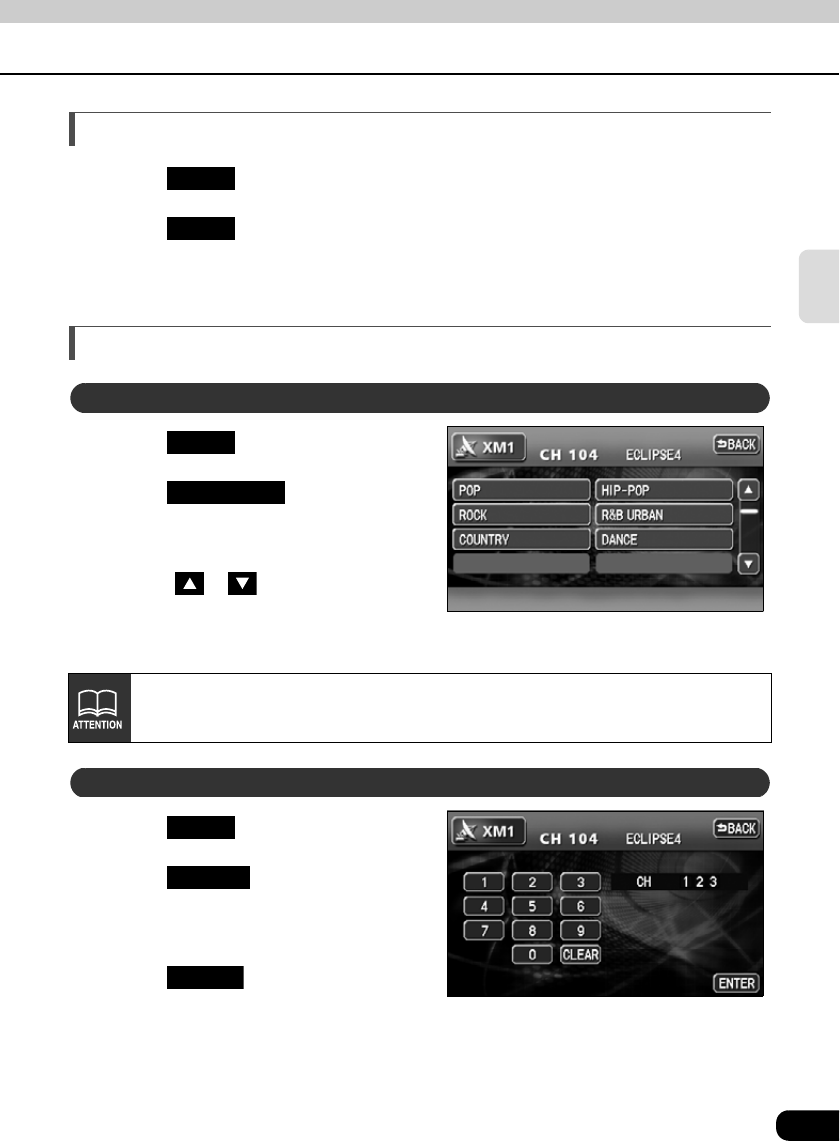
65
RADIO
Changing the XM band
Touch .
Touch .
• The BAND changes.
[XM 1] → [XM 2] → [XM 3] → [XM 4] ... → return to [XM 1]
Selecting the channel you want to listen to
Touch .
Touch .
Select the category that you want.
• Touch or to switch categories.
Touch .
Touch .
Input a channel.
Touch .
If the selected category is unobtainable, the blank category button appears.
FUNC
BAND
Selecting from the available categories
FUNC
CATEGORY
Selecting a channel by direct input
FUNC
DIRECT
ENTER
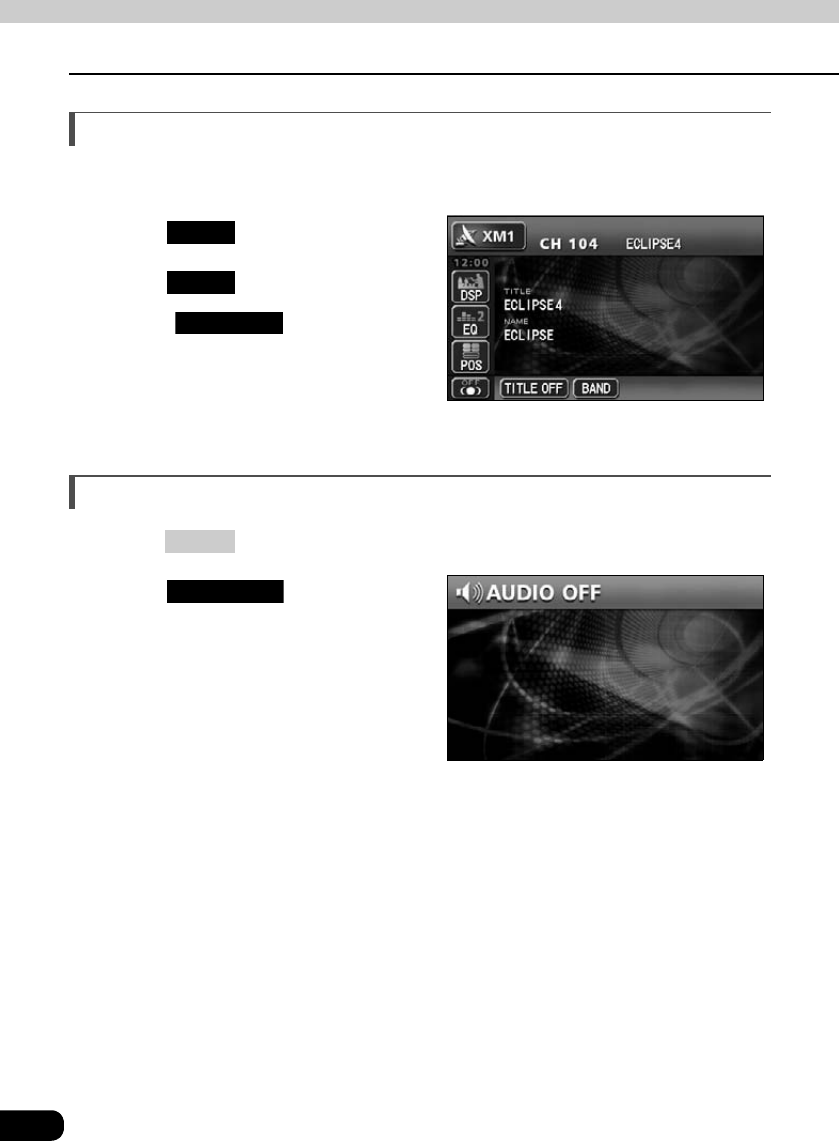
66
How to use the XM satellite radio
How to operate the tuner
Displaying information about the current broadcast
During XM broadcasts, information including the channel name, the title, and the artist can
be displayed for the current track.
Touch .
Touch .
• Touch to return to the
operation screen.
Turning off the XM
Press .
Touch .
FUNC
TITLE
TITLE OFF
MENU
AUDIO OFF
67
RADIO
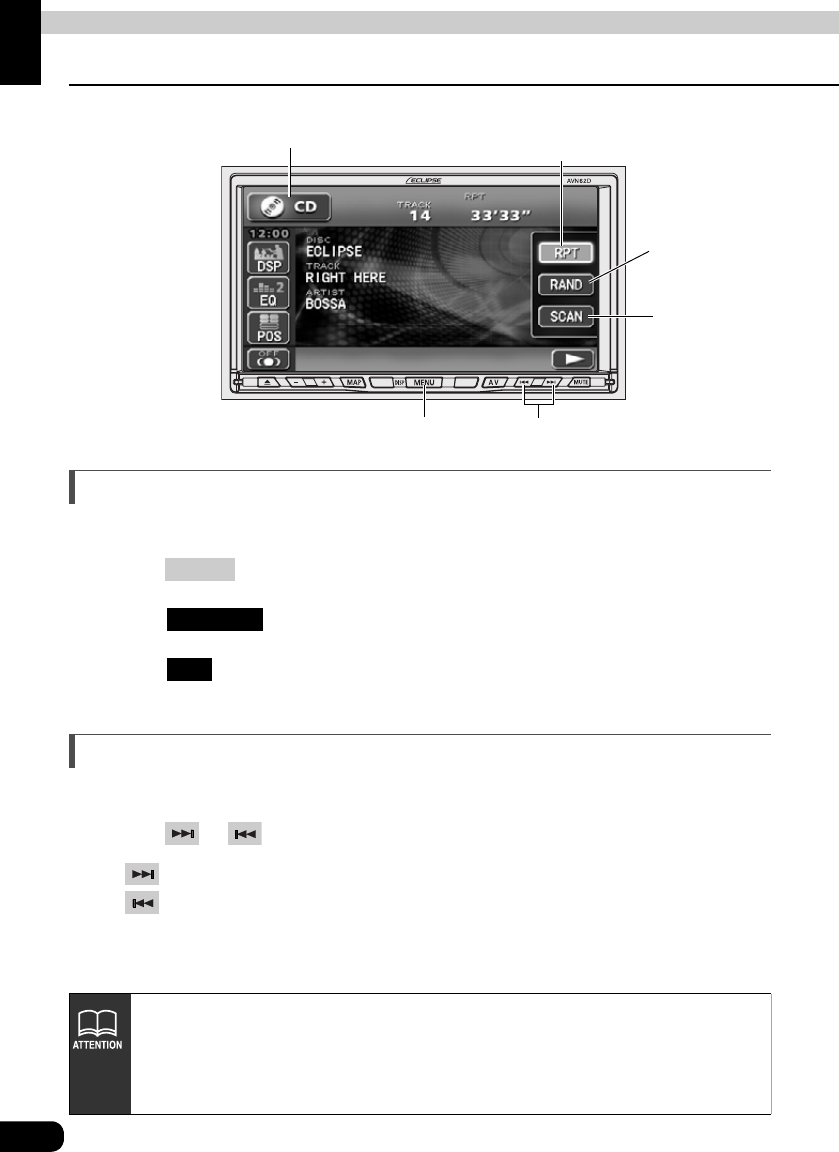
68
How to operate the CD player
How to use the CD player
Listening to a CD
When a CD is inserted into the disc slot, it automatically starts playing.
Press while a CD is inserted.
Touch .
Touch .
• Playback will begin.
Selecting a song
You can select a song you want to hear.
Press or .
• : Selects next song
: Selects previous song
Restarts current track. Pressing the down button once more continuously plays
previous tracks.
MENU
Button
Repeat
Switch
Random
Switch
Scan
Switch
Track selection (track start point)/
Fast-forward (rewind) Button
SOURCE MENU switch
MENU
SOURCE
CD
• Titles and song names can be displayed when they are recorded on a CD. Up
to 32 characters can be shown in the display.
• Only characters recorded by ASCII code can be shown on the CD-TEXT display.
• The CD-TEXT display may not be able to show characters for discs recorded
with many title characters.
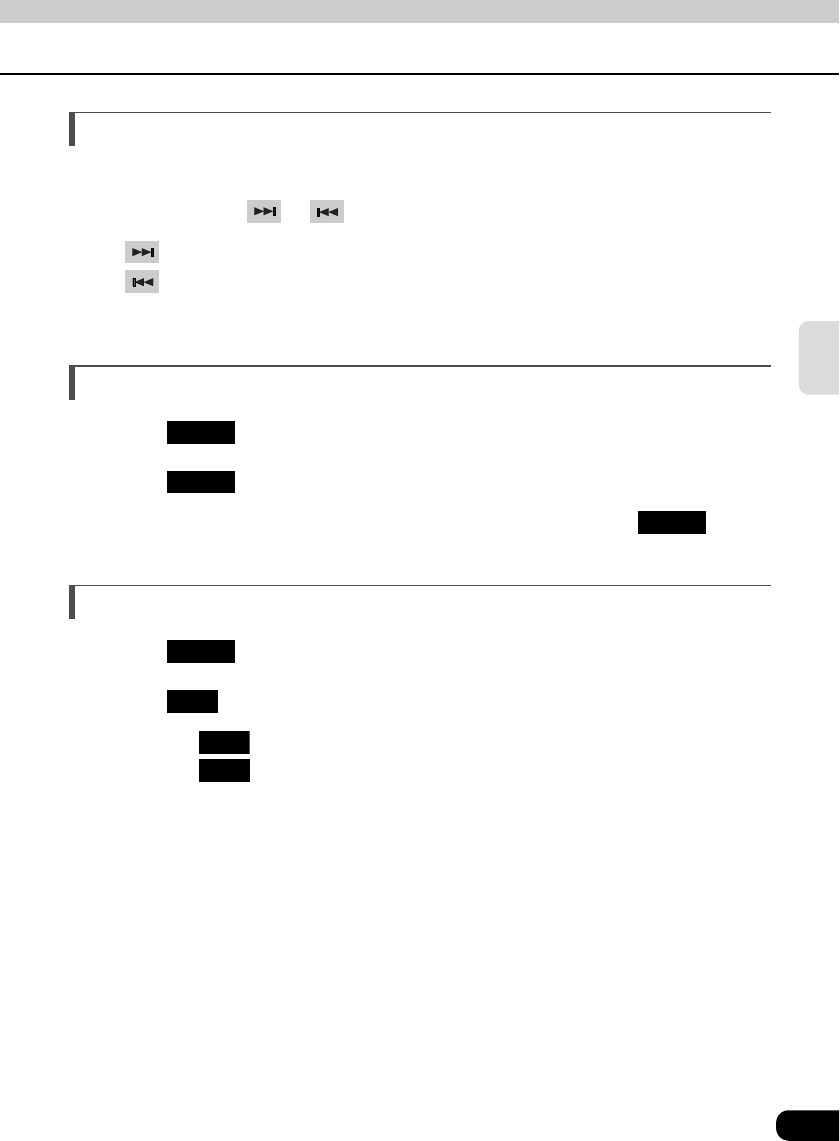
69
CD
Fast-forwarding/rewinding
It is possible to fast-forward/rewind the song played currently.
Press and hold or until a beep is heard.
• : Fast-forwards
:Rewinds
The main unit switches to the fast-forward (rewind) mode when the beep is heard and
will continue fast-forwarding (rewinding) until your finger is removed from the switch.
Searching for a song
Touch .
Touch .
• The main unit will play the first 10 seconds of each song. Touching again
will continue playing the current song.
Repeating a song
Touch .
Touch .
• Touching once will cause repeating of the song until the function is canceled.
Touching again will cancel repeating of the song.
FUNC
SCAN
SCAN
FUNC
RPT
RPT
RPT
70
How to use the CD player
How to operate the CD player
Playing songs in random order
Touch .
Touch .
• Touching will play songs in random order until the function is canceled.
Touching again will cancel random playing of songs.
• The song to be played next is randomly selected at the end of the current song, so it
is possible that a single song could end up being played twice in a row.
Turning off the CD player
Press .
Touch .
• Touching again on the MAIN MENU screen will resume playback.
FUNC
RAND
RAND
RAND
MENU
AUDIO OFF
AUDIO OFF
71
CD
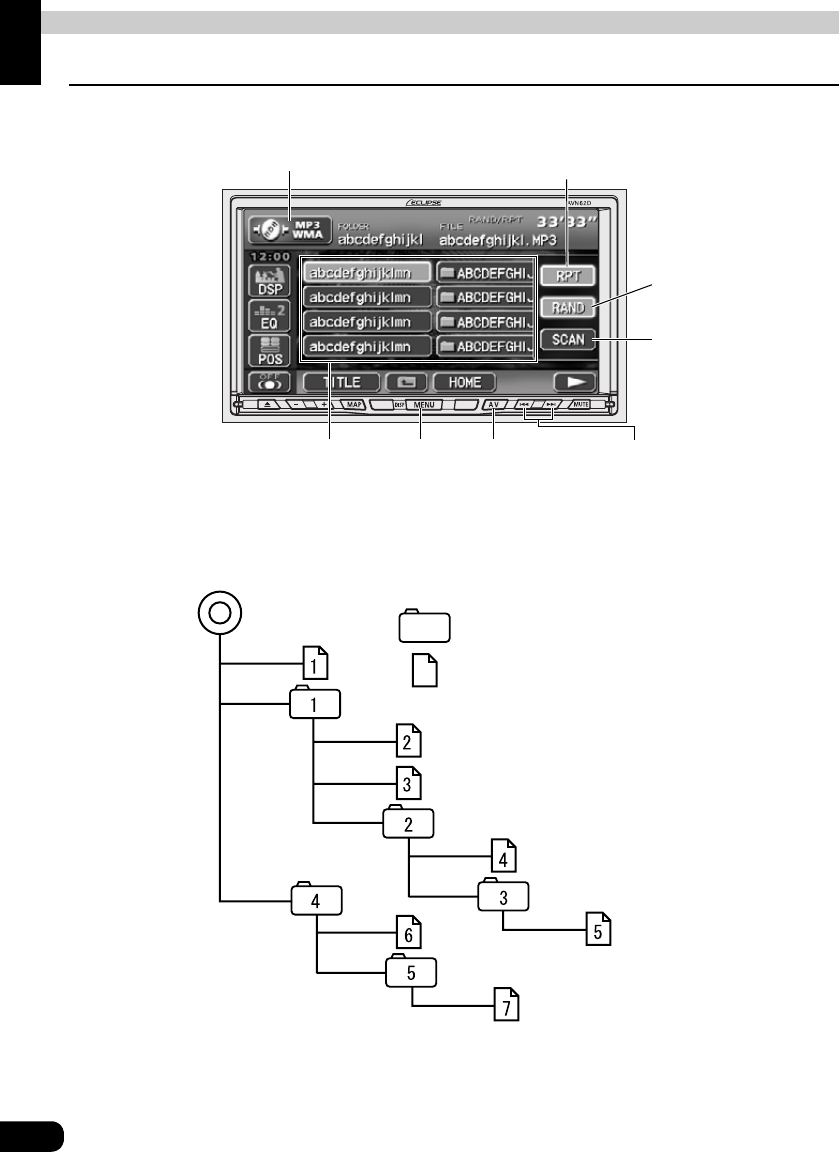
72
How to operate the MP3/WMA player
How to use the MP3/WMA player
For safety considerations, some functions are disabled while the vehicle is in motion.
The following operating procedures are based on this example of MP3/WMA file structure
below.
Example of MP3/WMA file structure
MENU
Button
File changing
Switches
Repeat
Switch
Random
Switch
Track selection (track start point)/
Fast-forward (rewind) Button
Scan
Switch
AV Button
SOURCE MENU switch
Folder
MP3/WMA audio file
1st level 2nd level 3rd level 4th level
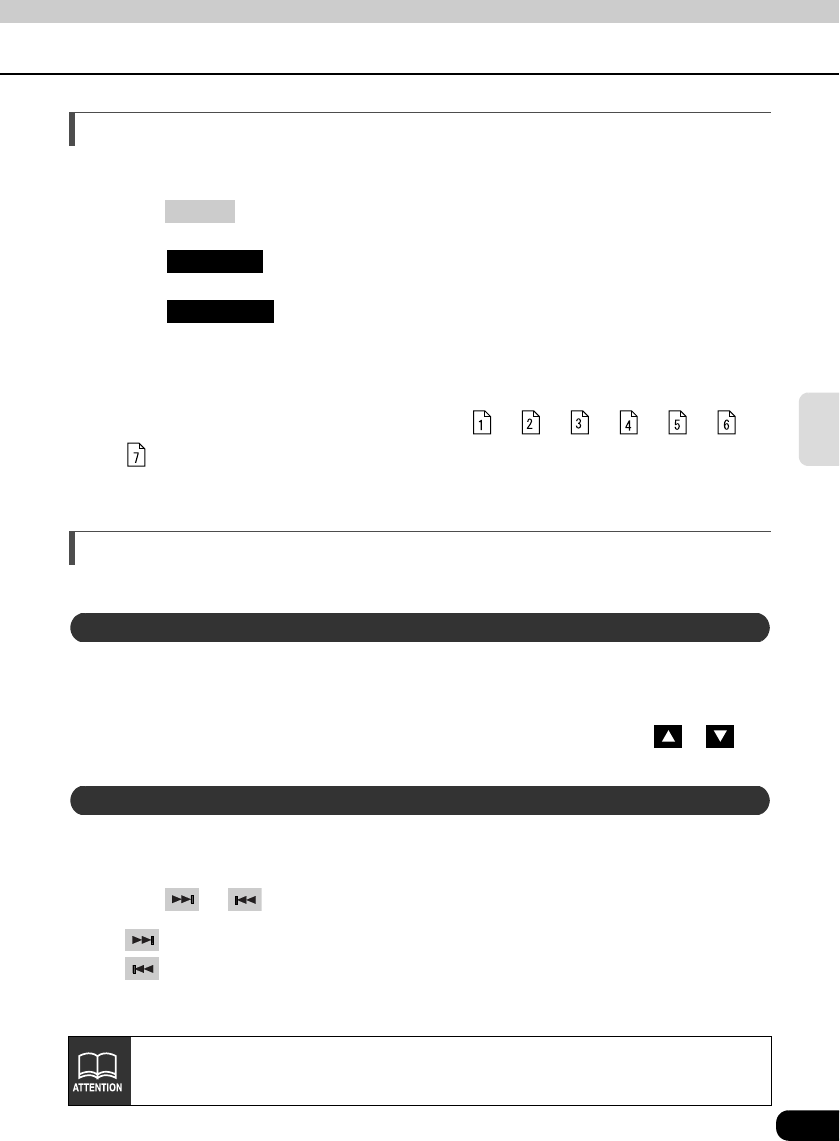
73
MP3/WMA
Playing MP3/WMA
When a CD is inserted into the disc slot, it automatically starts playing.
Press while a disc is inserted.
Touch .
Touch .
• Playback will begin.
• The CD player screen will be shown for about 2 seconds as the system checks
whether the inserted CD is a music CD or MP3/WMA disc.
• Normally, tracks are played back in the order → → → → → →
.
• When multiple MP3/WMA files and folders are on the same level, they are played in
ascending order by folder and file names.
Selecting a music file
A music file located within a folder can be selected.
Touch the music file.
• The currently selected file name and folder name will be shown in the display.
• When more than 8 music files are located in the same folder, touching or can
switch between the data. (This function is not available when the vehicle is in motion.)
When several music files are located in the same folder, the next music file or previous music
file can be selected with the track selection (track start point).
Press or .
• : Selects next music file
: Selects previous music file
Restarts current track. Pressing the down button once more continuously plays
previous tracks.
If music data (CD-DA) and MP3/WMA data are mixed on the same disc, only the
data recorded in the first session can be played.
MENU
SOURCE
MP3 WMA
Selecting with file change switches
Selecting with TUNE/TRACK button
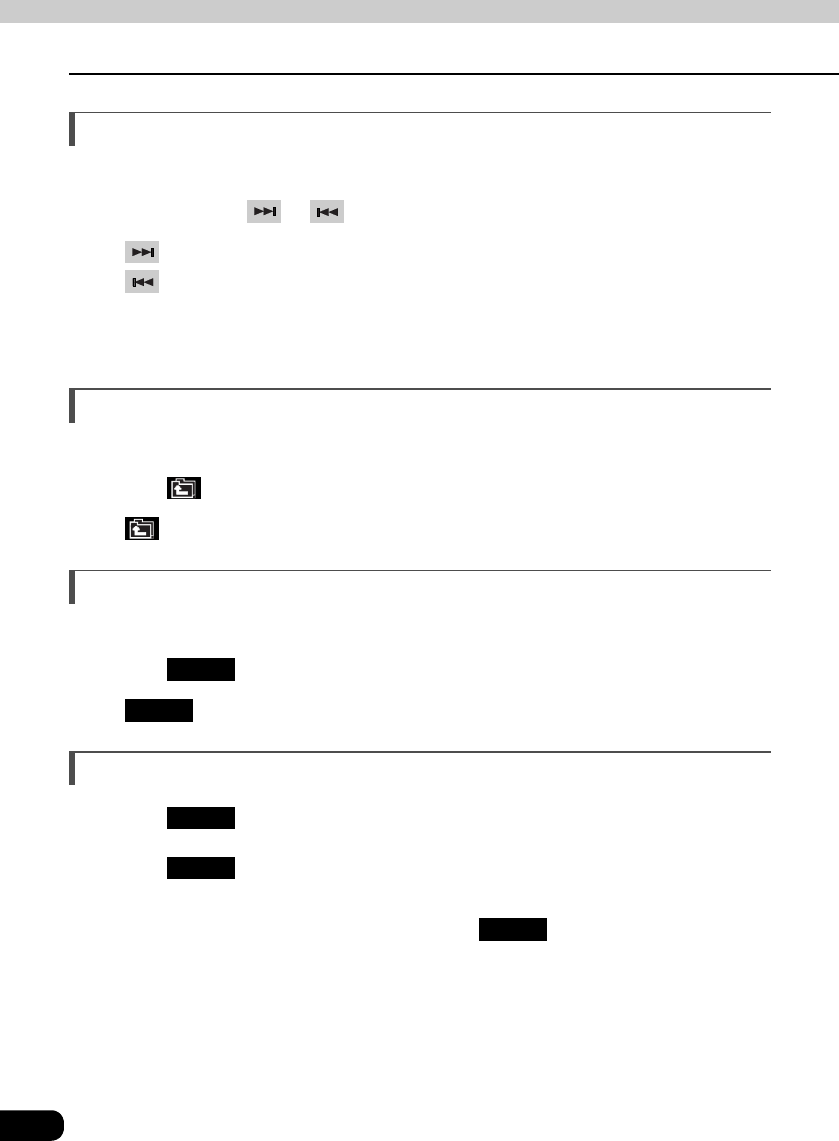
74
How to use the MP3/WMA player
How to operate the MP3/WMA player
Fast-forwarding/rewinding
It is possible to fast-forward/rewind the song being played.
Press and hold or until a beep is heard.
• : Fast-forwards
:Rewinds
The main unit switches to the fast-forward (rewind) mode when the beep is
heard and will continue fast-forwarding (rewinding) until your finger is removed
from the switch.
Changing display of the current level
The folder level can be switched and displayed.
Touch .
• : Displays the next higher folder level.
Displaying the current level
Displays the file currently being played.
Touch .
• : Displays the level of the file currently being played.
Searching for a music file
Touch .
Touch .
• The system will play the first 10 seconds of each song located within the same layer
of the folder currently being played. Touching again will continue playing
the current song.
HOME
HOME
FUNC
SCAN
SCAN
75
MP3/WMA
Repeating the same music file
Touch .
Touch .
• The file currently being played will be repeated.
• Setting RPT will cause repeating of the song until the function is canceled. Touching
again will cancel repeating of the song.
Playing songs in random order
Touch .
Touch .
• Files will be randomly selected from among all files at the same level as the folder
currently being played.
• will play songs in random order until the function is canceled. Pressing
again will cancel random playing of songs.
• Touching while the random function is operating will repeat the currently
playing song. Touching again will return to random playing of songs.
• The song to be played next is randomly selected at the end of current song, so it is
possible that a single song could end up being played twice in a row.
Refer to page 72 for an example of MP3/WMA file structure.
When the display shows the folder and files of the second level ( , and )
as of the third level is being played, touching will show the folder and
files of the third level ( and ).
HOME
FUNC
RPT
RPT
FUNC
RAND
RAND
RAND
RPT
RPT
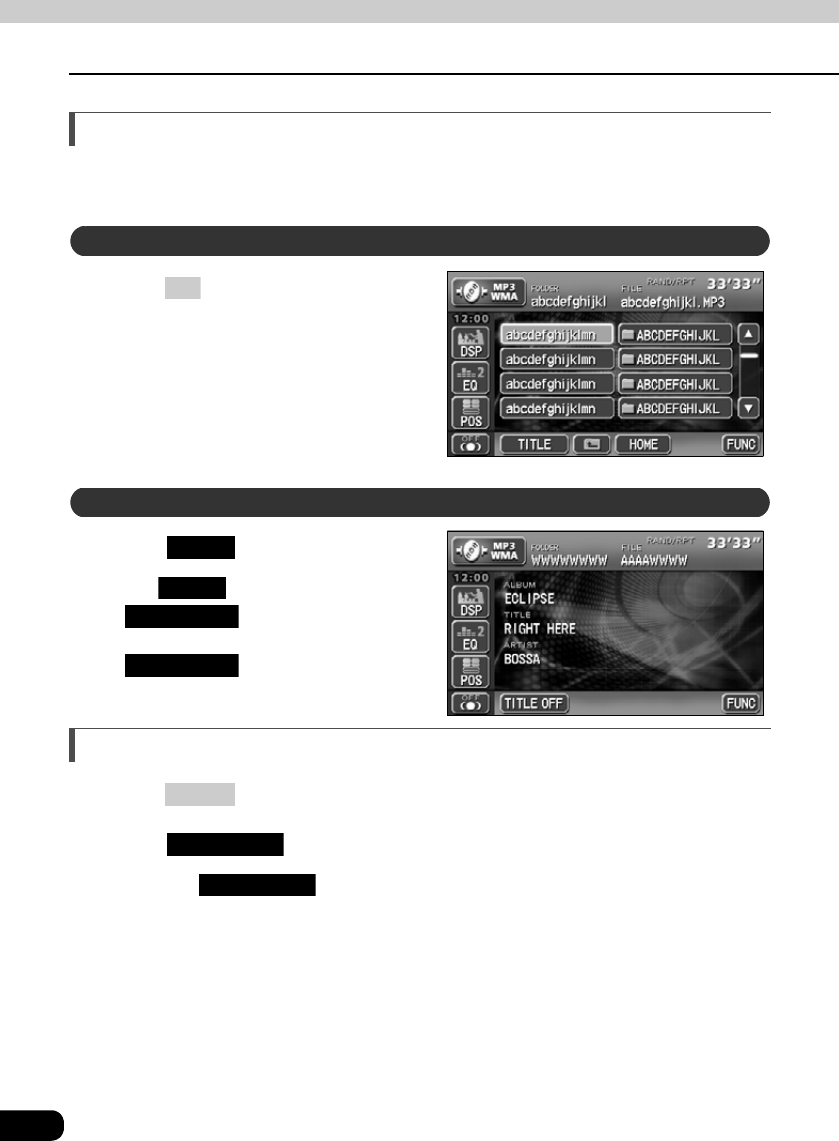
76
How to use the MP3/WMA player
How to operate the MP3/WMA player
About display of file information
Folder names and file information (album name and song titles) recorded on the disc can be
displayed.
Press to display the operation
screen.
Touch .
• The switch will change to
while file information is
being displayed. Touching
will change the display
to a folder/file switch.
Turning off the MP3/WMA player
Press .
Touch .
• Touching again on the MAIN MENU screen will resume playback.
Displaying folder/file names
AV
Displaying file information
TITLE
TITLE
TITLE OFF
TITLE OFF
MENU
AUDIO OFF
AUDIO OFF
77
MP3/WMA
About MP3/WMA
MP3 (MPEG-1 Audio Layer III) is a standard format for audio compression technology. By
using MP3, a file can be compressed to one-tenth the size of the original.
WMA (Windows MediaTM Audio) is the audio compression format by Microsoft. This can
compress files to a smaller size than MP3 can.
This unit has limitations on MP3/WMA file standards and recorded media and formats that
can be used. Be aware of the following points when recording MP3/WMA files.
• Supported standards : MPEG-1 Audio Layer III
• Supported sampling frequencies : 16, 22.05, 24, 32, 44.1, 48 (kHz)
• Supported bit rate : 8 to 320 (kbps)
* Supports VBR.
* Does not support free format.
* Bit rates vary for MPEG-1 and MPEG-2.
• Supported channel modes : stereo, monaural, dual channel, joint stereo
Playable MP3 file standards
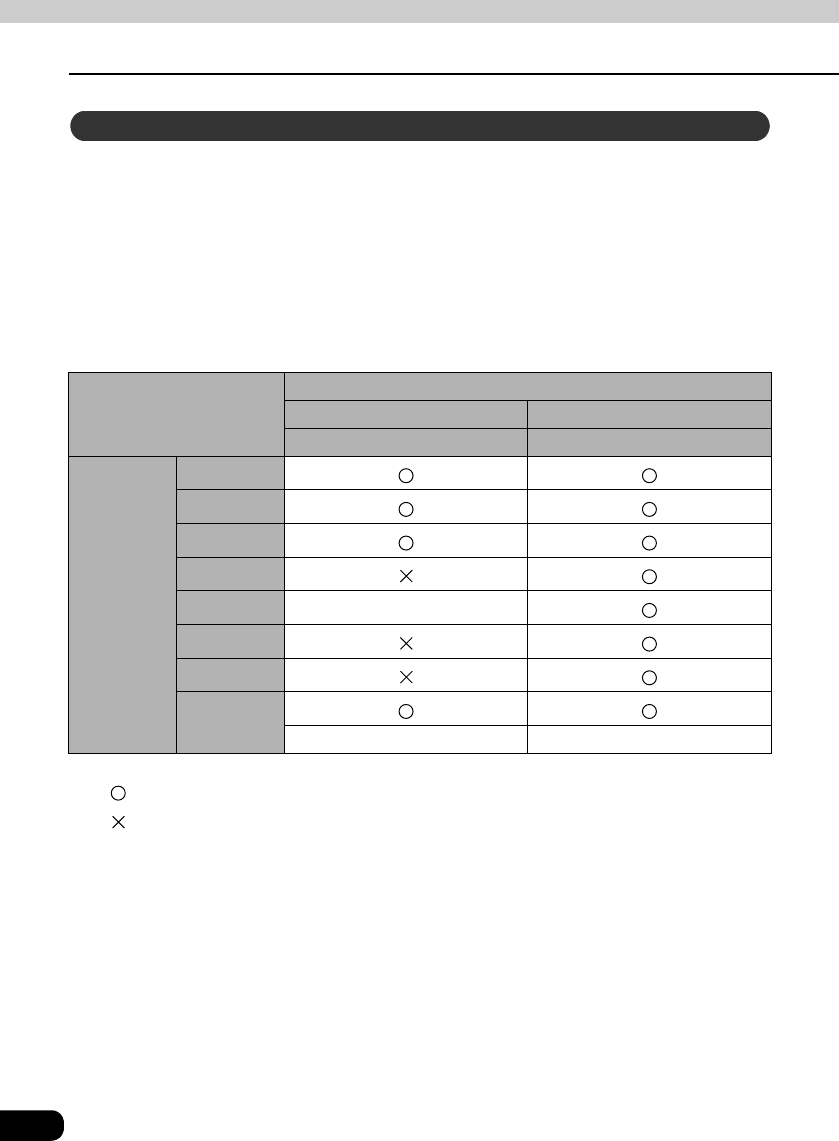
78
How to use the MP3/WMA player
How to operate the MP3/WMA player
• Supported standard : WMA Ver. 7, 8, 9
• Supported sampling frequencies : 44.1, 48 (kHz)
• Supported bitrates : 48 to 192 (kbps)
* VBR is supported (48 to 192 kbps)
* No support for reversible compression
(loss-less compression)
Playable sampling frequencies and supported bitrates
: Playable
: Not playable
-
: No combination
Sampling frequencies (Hz)
48 k 44.1k
2 (ch) 2 (ch)
Bitrates
(bps)
192 k
160 k
128 k
96 k
80 k -
64 k
48 k
VBR
192 k max 192 k max
Playable WMA file standards
79
MP3/WMA
MP3 and WMA files have an "ID3tag/WMAtag" that allows input of text information so that
data such as song title and artist can be saved.
This unit supports ID3v.1.0 and ID3v.1.1 tags. Use only ASCII code to record tags, since only
ASCII code is supported by this equipment. Recording of characters not included in ASCII
code will result in display of garbled characters.
This unit supports the WMA tag (v1.20.02). Since the WMA tag supports unicode only,
please input the information with unicode characters.
Media capable of playing MP3/WMA includes CD-ROM, CD-R and CD-RW discs.
Compared to CD-ROM media commonly used for music discs, CD-R and CD-RW discs are
fragile in high temperature/high humidity environments and one section of the CD-R/CD-RW
may become incapable of playback. Fingerprints or scratches on the disc may prevent
playback or cause skipping during playback.
Sections of CD-R/CD-RW may deteriorate if left inside a vehicle for long periods of time.
It is also recommended that CD-R/CD-RW discs be kept in a light-blocking case because the
discs are vulnerable to ultra-violet light.
ID3tag/WMAtag
Media

80
How to use the MP3/WMA player
How to operate the MP3/WMA player
The format of discs to be used must be as following:
• Disc format : CD-ROM (MODE 1), CD-ROM XA
(MODE2 Form1)
• File format : ISO9660 Level 1 or Level 2
ROMEO system, JOLIET system
MP3/WMA files recorded in a format other than the one explained above may result in files
that cannot be played normally and in file names and folder names that do not display
properly.
Limitations in addition to standards are as follows.
• Maximum directory layers : 8 layers
• Maximum characters for folder names/file names : 30 characters for MP3 (including
delimiter "." + file extension 3
characters)
15 characters for WMA (including
delimiter "." + file extension 3
characters)
• Allowable characters for folder names/file names : A to Z, 0 to 9, _ (underscore)
• Number of files possible on a single disc : 512
• Number of folders possible on a single disc : 255
Format of discs
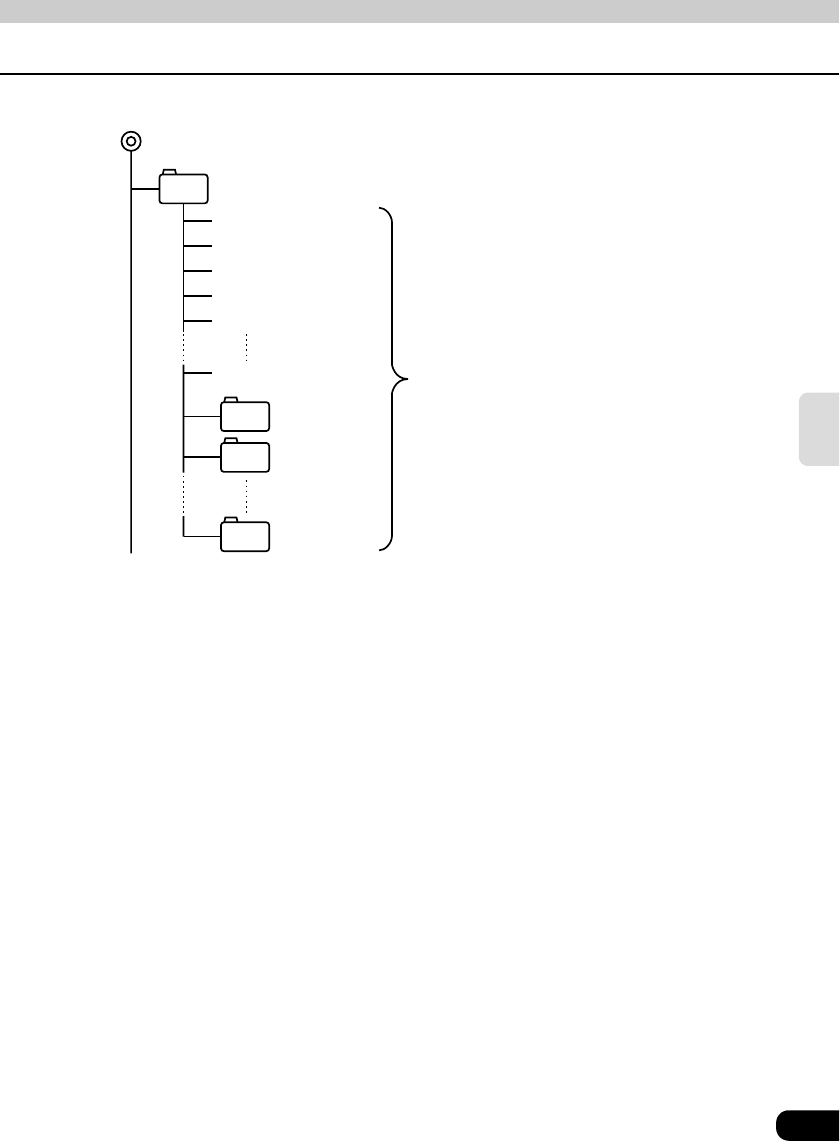
81
MP3/WMA
Configuration example for CD supporting MP3/WMA
• A total of 255 folders can be recorded on a single disc.
F1
F2
Folder1
Folder2
F3 Folder3
F255 Folder255
001.MP3
002.MP3
003.MP3
004.WMA
005.MP3
384.MP3 A total of 512 files can be created
within a single disc.
82
How to use the MP3/WMA player
How to operate the MP3/WMA player
Only files with the MP3/WMA file extension ".mp3/.wma" can be recognized as MP3/WMA and
played. Be sure to save MP3/WMA files with the ".mp3/.wma" file extension.
Use half-width English capital letters to write "MP3" or "WMA" of the extension.
Multisessions are supported and CD-R/RW with recorded MP3/WMA files can be played.
When written with "Track at once", however, finalize the disc with session close or write
protect.
When a disc having MP3/WMA files recorded on it is inserted into the main unit, the system
first checks all the files on the disc. If the number of files and folders is large, the check will
take some time.
While the system is checking the disc, the music that had been playing continues to play.
In order to speed up completion of the file check, it is recommended that you avoid recording
files that are not MP3/WMA files and avoid establishing unnecessary folders.
In addition, it is recommended that you record all data in a single session because a
multisession disc takes time for CD control information acquisition.
It is possible that playing time will not be correct, depending on the writing condition of the
MP3/WMA file.
* It is possible that playing time will not be correct when VBR Fast Up/Down is operated.
Names of MP3/WMA folders and files within the same level are displayed in the following
order.
1. MP3/WMA files displayed first, by ascending order of numbers, letters.
2. Folders displayed next, by ascending order of numbers, letters.
File names
Multi-sessions
Playing MP3/WMA
MP3/WMA playing time display
Display order of MP3/WMA file/folder names
If the ".mp3/.wma" file extension is attached to a file other than an MP3/WMA file,
that file will be mistakenly recognized by the main unit as an MP3/WMA file and
played, resulting in loud noise output that can damage the speakers. Be sure to
avoid attaching the ".mp3/.wma" file extension to files that are not MP3/WMA files.
83
MP3/WMA
Making and playing MP3/WMA files
MP3/WMA files created by recording broadcasts, records, audio recordings, video
recordings or live performances cannot be used for purposes other than personal
entertainment without permission of the copyright holder as set forth in copyright law.
There are many kinds of sites that distribute MP3/WMA files on the Internet, such as "pay per
download" online shopping sites, "try before you buy" listening sites and free download sites.
Follow the rules for each site (such as paying fees) and download according to site
instructions.
Prepare a computer with commercially available MP3/WMA encoding software (conversion
software). Some encoding programs available on the Internet do not require payment.
Music data files in MP3/WMA format can be made by inserting the music CD into the CD-
ROM drive of the computer and following the procedures of the MP3/WMA encoding software
to compress the songs of the music CD. A 12cm music CD (having a maximum of 74
minutes of recording/650MB of data) can be compressed to 65MB (about 1/10 of the original
size).
MP3/WMA files can be recorded on CD-R/RW by using a CD-R/RW drive connected to a
computer. Record by setting the recording format of the recording software to ISO9660 level
1 or level 2 (not including extension format).
Select CD-ROM ( mode1 ) or CD-ROM XA ( mode2 ) for the disc format.
Insert a CD-R/RW disc having recorded MP3/WMA files. The system will automatically
determine whether the disc is a music CD or a CD-R/RW with MP3/WMA files and begin
playing the disc. A music CD recorded onto a CD-R/RW can also be played. However,
depending on the type of disc being used, the disc may not play.
Downloading from Internet MP3/WMA music sites
Converting CD music to MP3/WMA files
Writing to CD-R/CD-RW
When playing back CD-R/RW
• A fixed bit rate of 128kbps and sampling frequency of 44.1kHz is recommended
for obtaining stable audio quality at playback.
• Depending on the characteristics of a disc, CD-R and CD-RW may not be able
to read the disc.
• Because there are many types of MP3/WMA encoding software available,
including commercial and freeware programs, audio quality may deteriorate,
noise may be generated when playing starts and some recordings may not play,
depending on the condition of the encoder and the file format.
• When files other than MP3/WMA files are recorded on a disc, the system may
take some time to recognize the disc and it may not play the disc.
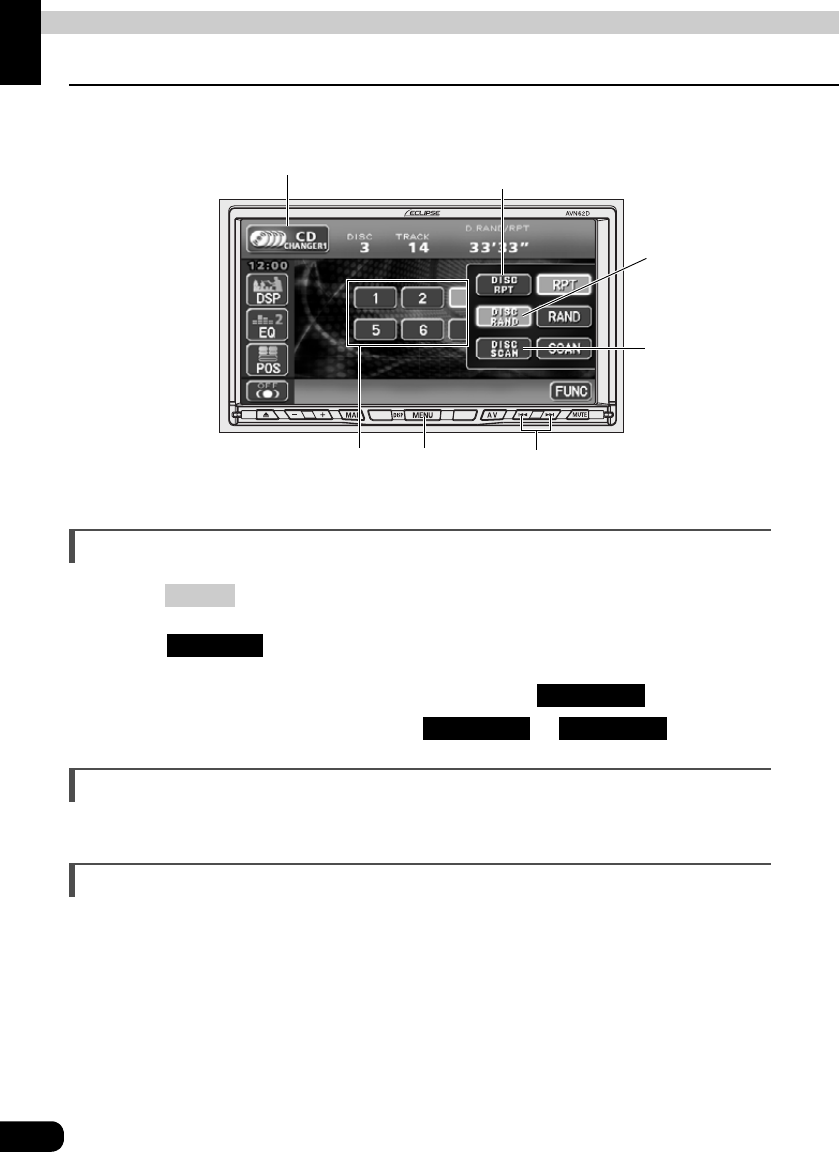
84
How to operate the CD changer
How to use the CD changer
An optional CD changer can be connected and used.
Listening to a CD
Press .
Touch .
When only one CD changer is connected, touch . When two
CD changers are connected, touch or .
Selecting a song
Refer to "How to use the CD player" (Page 68).
Fast-forwarding/rewinding
Refer to "How to use the CD player" (Page 69).
MENU
Button
Disc changing
switches
Track selection (track start point) /
Fast-forward (rewind) Button
Disc repeat
switch
Disc random
switch
Disc scan
switch
SOURCE MENU switch
MENU
SOURCE
CDCHANGER1
CDCHANGER1 CDCHANGER2
85
CD changer
Selecting a CD
A CD can be selected from among all the discs on a changer.
Touch one of the disc changing switches.
• The number for the selected CD will change color.
Searching for a song or CD from all CDs in changer
Refer to "How to use the CD player" (Page 69).
Touch .
Touch .
• The system will play the first 10 seconds of the first song on each CD in the changer.
Touching again will continue playing the current song.
Searching for a song
Searching for a CD
FUNC
DISC SCAN
DISC SCAN
• The system will display the amount of disc changing switches that matches the
number of CDs that can be inserted into the CD changer, and it will only allow
selection of disc numbers that have discs currently loaded.
• No operation is possible when there are no discs loaded into the CD changer.
• If two CD changers are connected, switch between the optional CD changers
and the CD changer with / .
CDCHANGER1 CDCHANGER2

86
How to use the CD changer
How to operate the CD changer
Repeating a song or CD
Refer to "How to use the CD player" (Page 69).
Touch .
Touch .
• Touching DISC RPT once will cause repeating of the CD until the function is canceled
Touching again will cancel repeating of the CD.
Playing songs in random order
Refer to "How to use the CD player" (Page 70).
Touch .
Touch .
• Touching will play songs in random order until the function is
canceled. Touching again will cancel random playing of songs.
• The song to be played next is randomly selected at the end of current song, so it is
possible that a single song could end up being played twice in a row.
Turning off the CD player
Press .
Touch .
• Touching again on the MAIN MENU screen will resume playback.
Repeating the current song
Repeating the current CD
FUNC
DISC RPT
DISC RPT
Playing songs on current CD in random order
Playing songs on all CDs in random order
FUNC
DISC RAND
DISC RAND
DISC RAND
MENU
AUDIO OFF
AUDIO OFF
87
CD changer
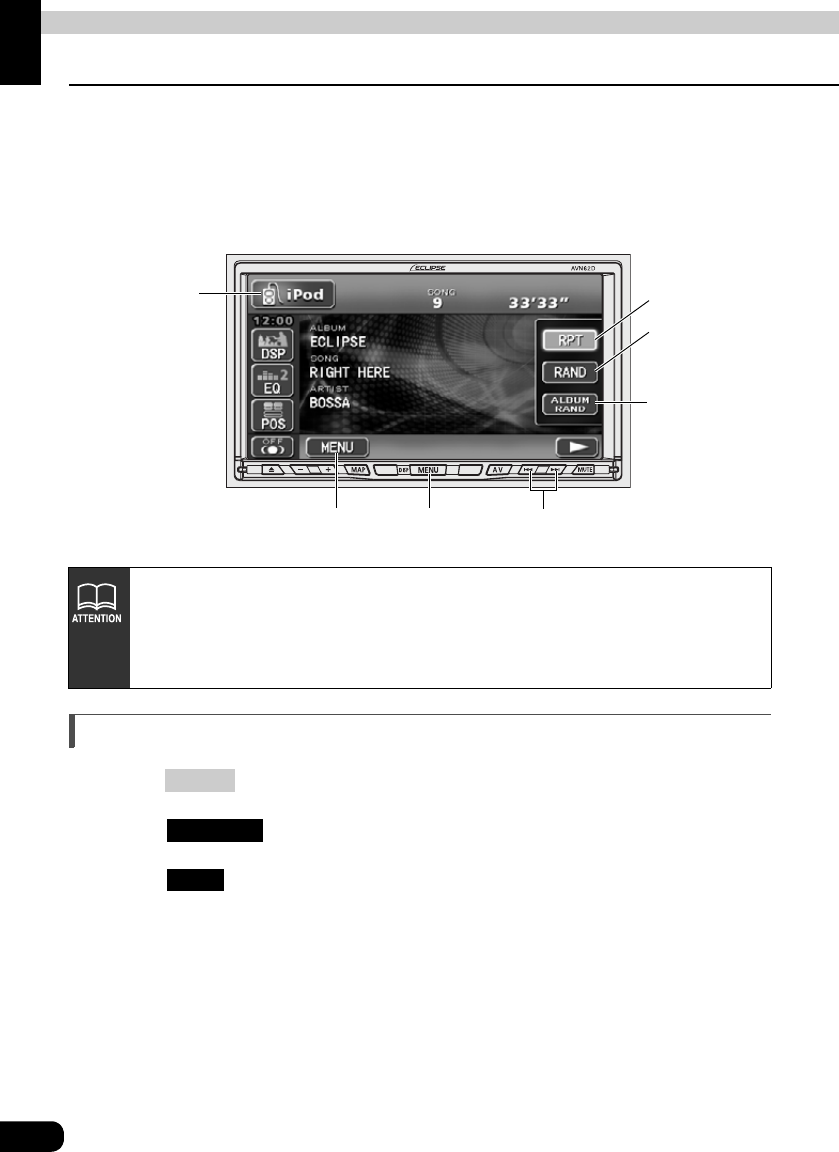
88
How to operate iPod®
Operating the iPod
When an optional iPod interface adaptor (iPC-106) is connected, it is possible to operate the
iPod® with this main unit.
• iPod is for legal or rightholder-authorized copying only. Don't steal music.
• iPod is a trademark of Apple Inc., registered in the U.S. and other countries.
Listening to iPod
Press .
Touch .
To u c h .
• Playback will begin
MENU
Button
MENU switch Track selection (Track startpoint)/
Fast-forward (rewind) Button
Random switch
ALBUM
Random
switch
Repeat Switch
SOURCE MENU
switch
• For the functions of the iPod, refer to the operation manual of the iPod.
• For the specific details of the iPod operation and connection, refer to the
Instruction Manual of the optional iPod interface adaptor (iPC-106).
• It is assumed here that the iPod has already connected to this main unit with an
optional iPod interface adaptor (iPC-106).
MENU
SOURCE
iPod
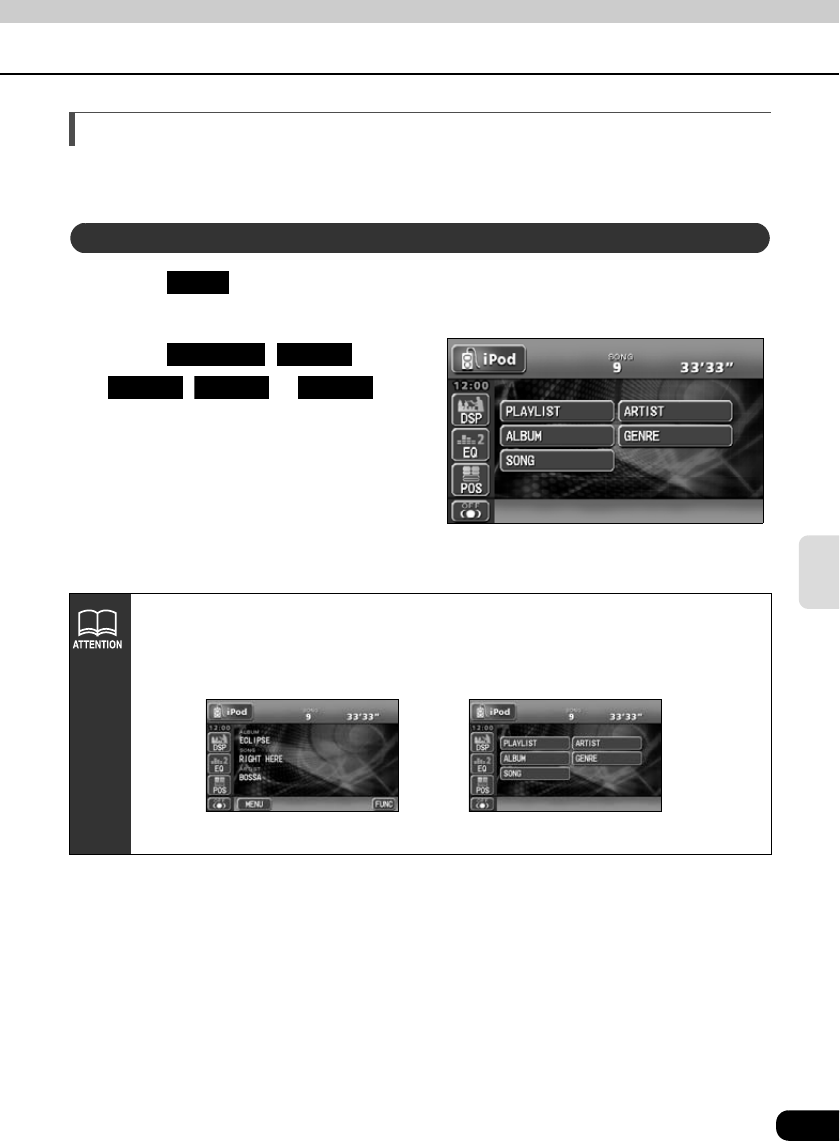
89
iPod
Searching for a song in various ways
You can select a song you want to listen to from ALBUM, ARTIST, PLAYLIST, GENRE or
SONG.
Touch repeatedly until the search mode screen (top menu) as
shown below is displayed.
Touch , ,
, or and
select the song you want to listen
to.
• If no operation was performed on the
search mode screen for 10 seconds, it
returns to the playback.
Displaying the search mode screen
MENU
Search mode screen (top menu)
PLAYLIST ARTIST
ALBUM GENRE SONG
About text display
Alphanumeric and symbols can be used for text display. Even if the characters
other than alphanumeric and symbols are displayed on your iPod, they are not
displayed on this unit.
Playback mode screen Search mode screen
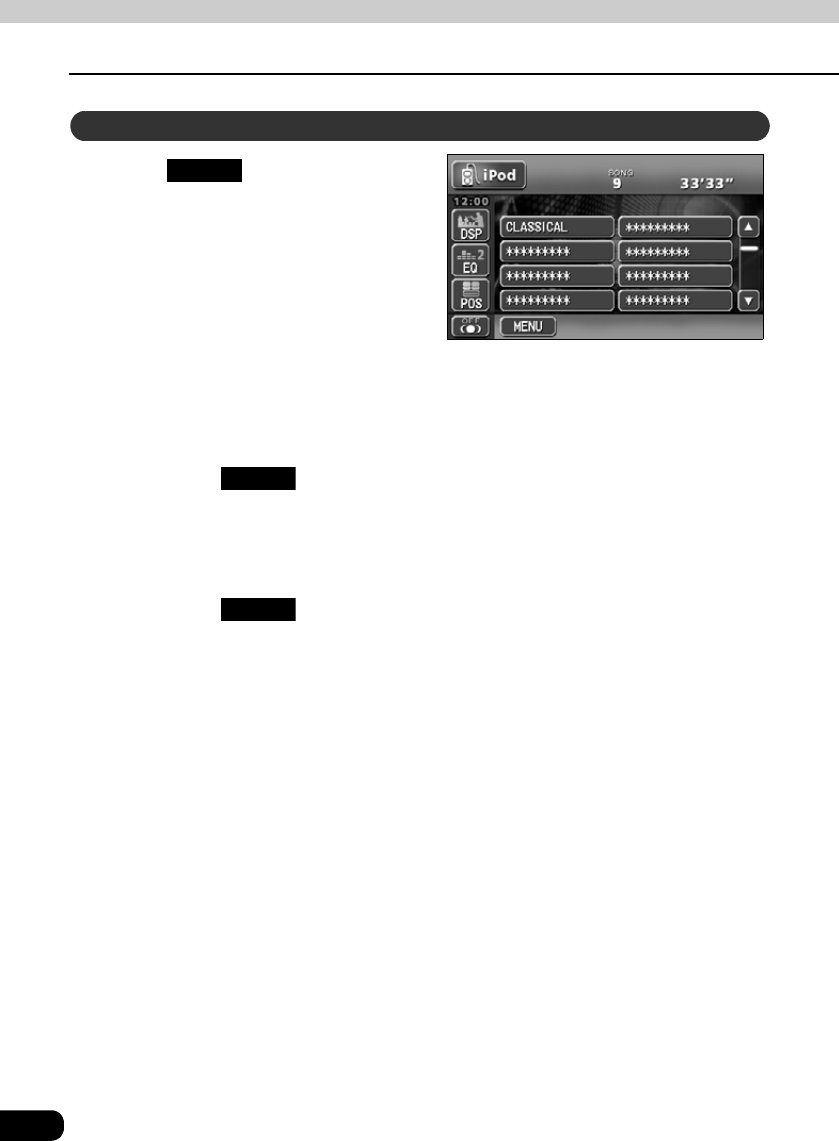
90
Operating the iPod
How to operate iPod®
Touch on the search
mode screen.
• All the genre names stored in the iPod
that is connected to this unit will be
displayed.
Touch GENRE name you want to
browse.
• The ARTIST names stored in the selected GENRE will be displayed.
Touch ARTIST name you want to browse.
• Touching ARTIST briefly will display the ALBUM names stored in the selected ARTIST.
• By touching for several seconds, the first track in the selected ARTIST will
start playing.
Touch ALBUM name you want to browse.
• Touching ALBUM briefly will display the song names stored in the selected ALBUM.
• By touching for several seconds, the first track in the selected ALBUM will
start playing.
Touch the song name you want to listen to.
• The selected song will be played.
Selecting a song from your favorite GENRE
GENRE
ARTIST
ALBUM
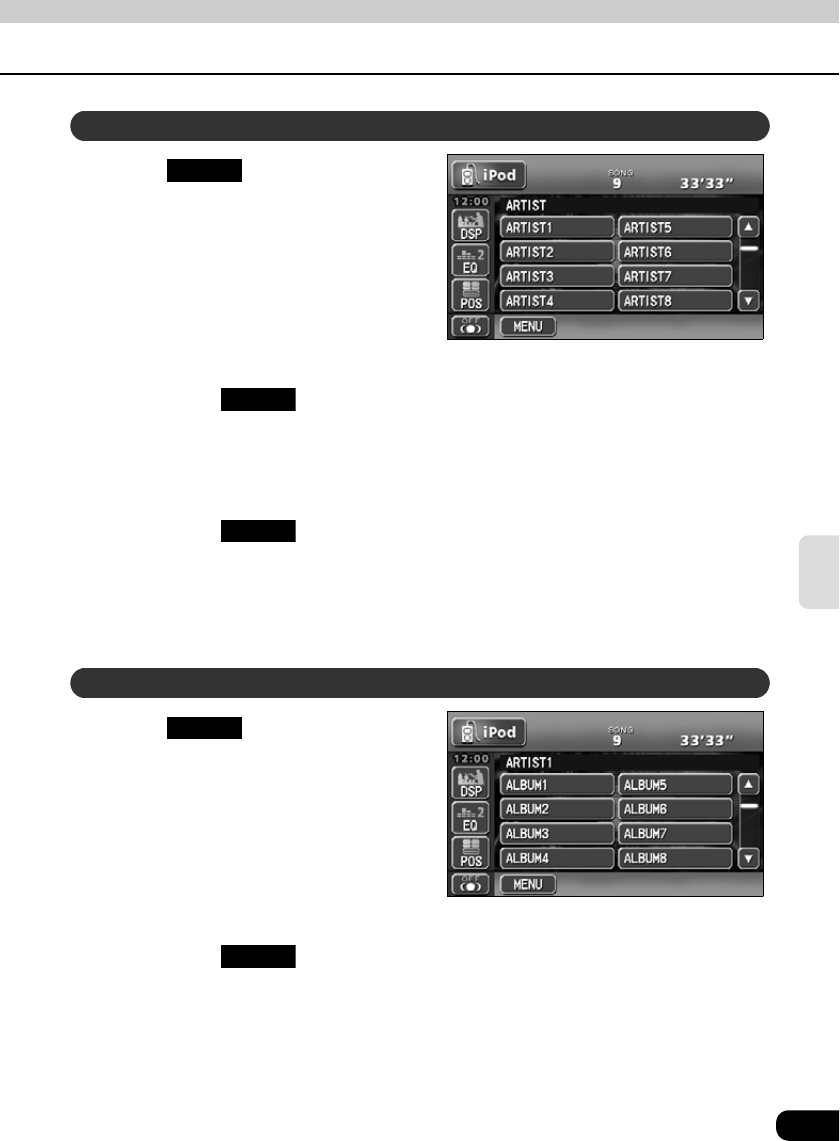
91
iPod
Touch on the search
mode screen.
• All the stored ARTIST names will be
displayed.
Touch ARTIST name you want to
browse.
• Touching it briefly will display the
ALBUM names stored in the selected ARTIST.
• By touching for several seconds, the first track in the selected ARTIST will
start playing.
Touch ALBUM name you want to browse.
• Touching it briefly will display the song names stored in the selected ALBUM.
• By touching for several seconds, the first track in the selected ALBUM will
start playing.
Touch the song name you want to listen to.
• The selected song will be played.
Touch on the search
mode screen.
• Touching it briefly will display all the
stored ALBUM names.
Touch ALBUM name you want to
browse.
• Touching it briefly will display the song
names stored in the selected ALBUM.
• By touching for several seconds, the first track in the selected ALBUM will
start playing.
Touch the song name you want to listen to.
• The selected song will be played.
Selecting a song from your favorite ARTIST
ARTIST
ARTIST
ALBUM
Selecting a song from your favorite ALBUM
ALBUM
ALBUM
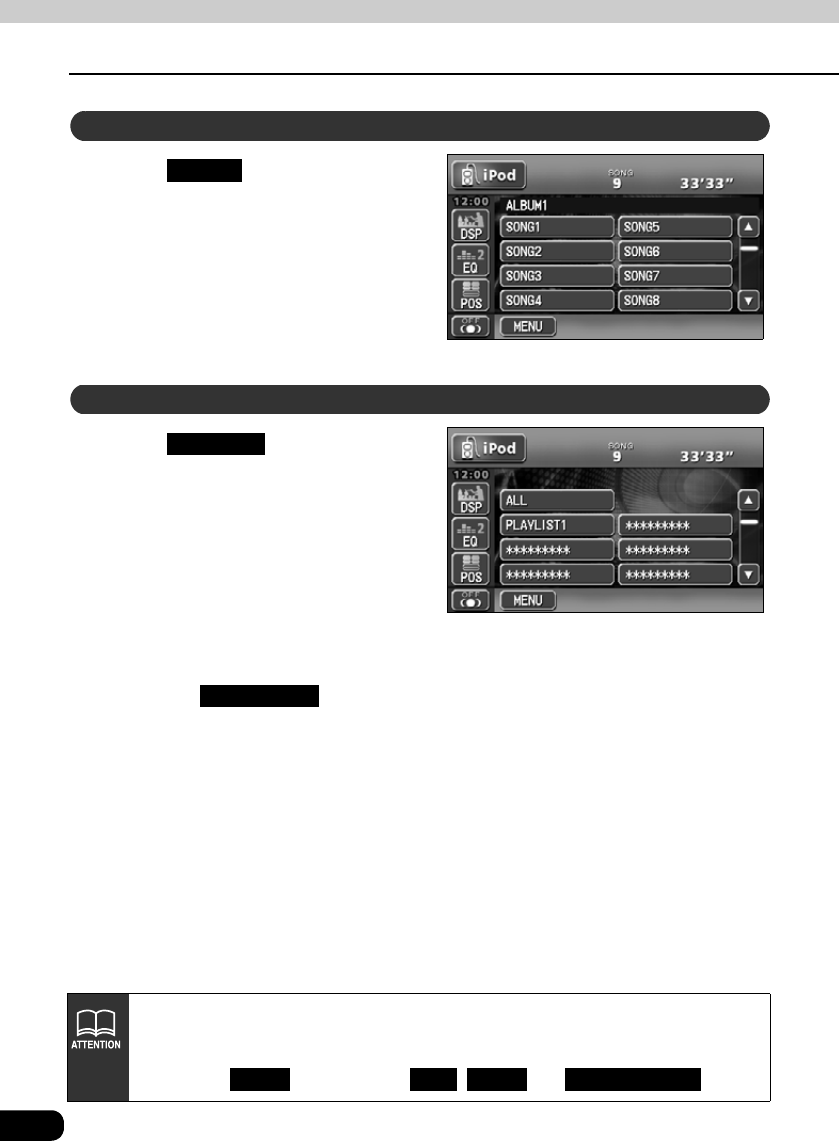
92
Operating the iPod
How to operate iPod®
Touch on the search
mode screen.
• Touching it briefly will display all the
stored song names.
Touch the song name you want to
listen to.
• The selected song will be played.
Touch on the search
mode screen.
• Touching it briefly will display all the
stored PLAYLIST names.
• Touching it for several seconds will
play all the songs for every PLAYLIST.
Touch the PLAYLIST name you
want to listen to.
• The selected PLAYLIST will be played.
• Touching will play all the songs for every ALBUM.
Selecting your favorite song from song name list
SONG
Selecting a song from your favorite PLAYLIST
PLAYLIST
ALL SONGS
About REPEAT/RANDOM function
• REPEAT, RANDOM and ALBUM RANDOM correspond to the "Song REPEAT",
"Shuffle" and "ALBUM shuffle" functions of the iPod, respectively.
• Touching will display the , and button.
FUNC RPT RAND ALBUM RAND
93
iPod
Selecting a song
You can select a song you want to hear.
Press or .
• : Selects next song
: Selects previous song
Restarts current track. Pressing the down button once more continuously plays
previous tracks.
Fast-forwarding/rewinding
It is possible to fast-forward/rewind the song played currently.
Press and hold or until a beep is heard.
• : Fast-forwards
: Rewinds
The main unit switches to the fast-forward (rewind) mode when the beep is heard and
will continue fast-forwarding (rewinding) until your finger is removed from the switch.
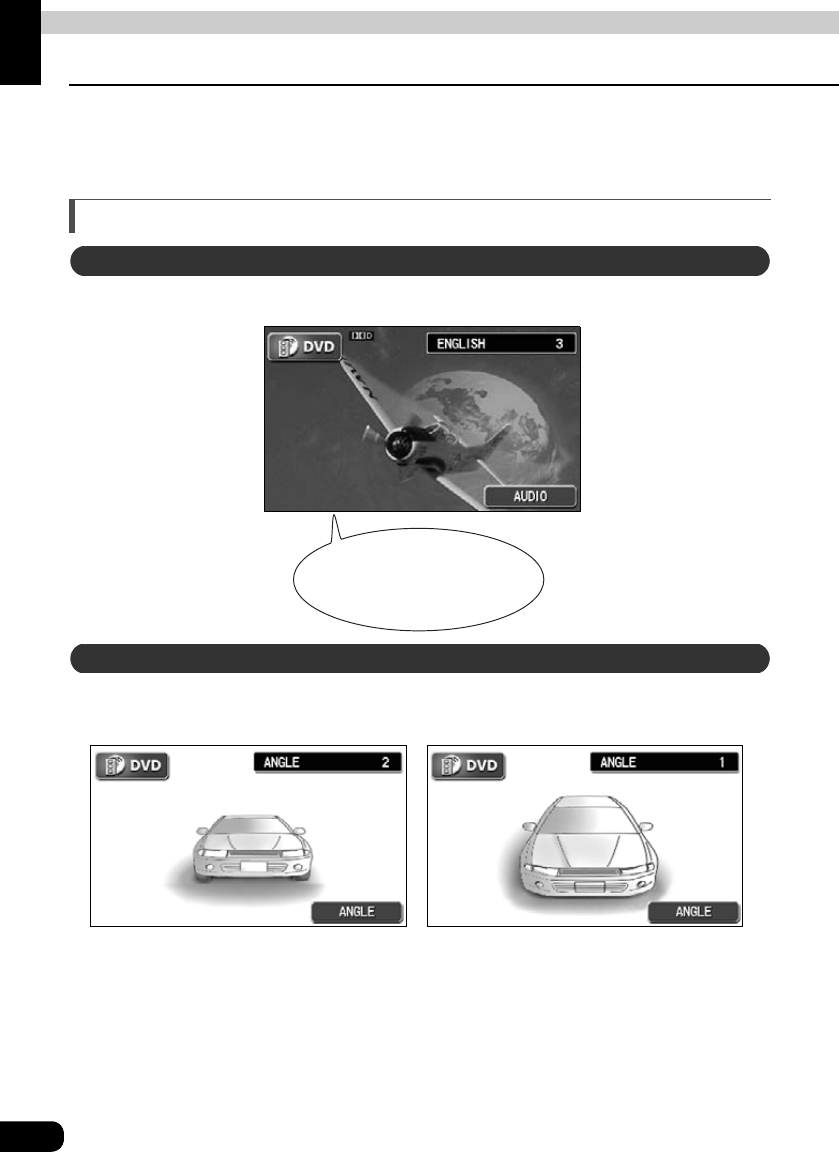
94
How to operate the DVD player
Before using the DVD player
This equipment can play high quality images and high quality digital sound of DVD videos. It
is also possible to switch between different languages recorded on the DVD video (dubbing,
subtitles, etc.), and with videos having several angles of the same scene recorded, the
preferred angle can be selected and played.
DVD video characteristics
Some DVD discs have dialog recorded in several different languages, and the language can
be switched during playback in the same way as multilingual TV broadcasts.
Some DVD discs have a single scene recorded from several different angles (multiple angle),
and the preferred angle can be switched during playback.
* Depending on the disc, multiple angles may not be viewed.
About Multiple Languages
An airplane was flying
in the night sky...
About Multiple Angles
The angle of the image is changed.
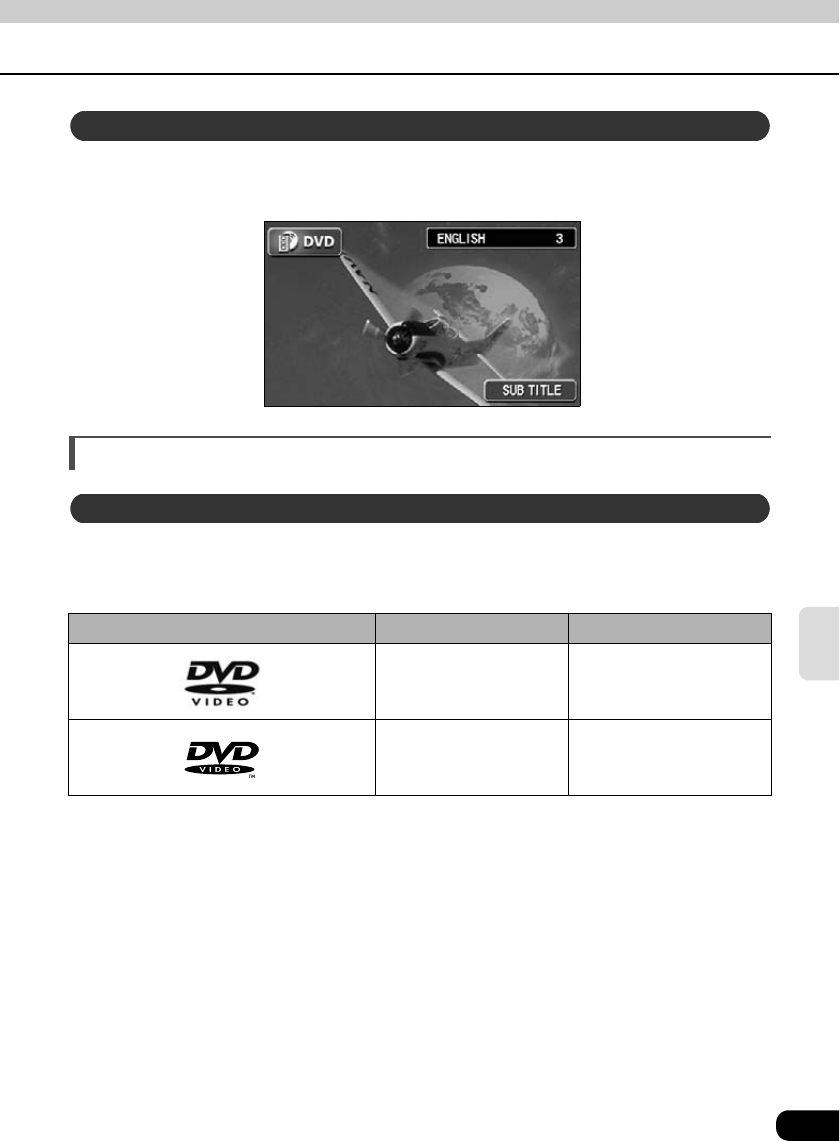
95
DVD
Some DVD discs have subtitles recorded in several different languages, and the subtitles
can be switched during playback. The video can also be played without any subtitles
displayed.
About discs
This equipment conforms to NTSC color television methods, so please use discs that display
"NTSC" on the disc or package. This equipment cannot play discs using color television
methods other than NTSC (such as PAL, SECAN).
Playable Disc Types and Their marks Size/Playing Surface Maximum Playing Time
12 cm/single-sided
1 layer
2 layer
Using MPEG 2
133 min.
242 min.
12 cm/double-sided
1 layer
2 layer
266 min.
484 min.
About Subtitles
About playable discs
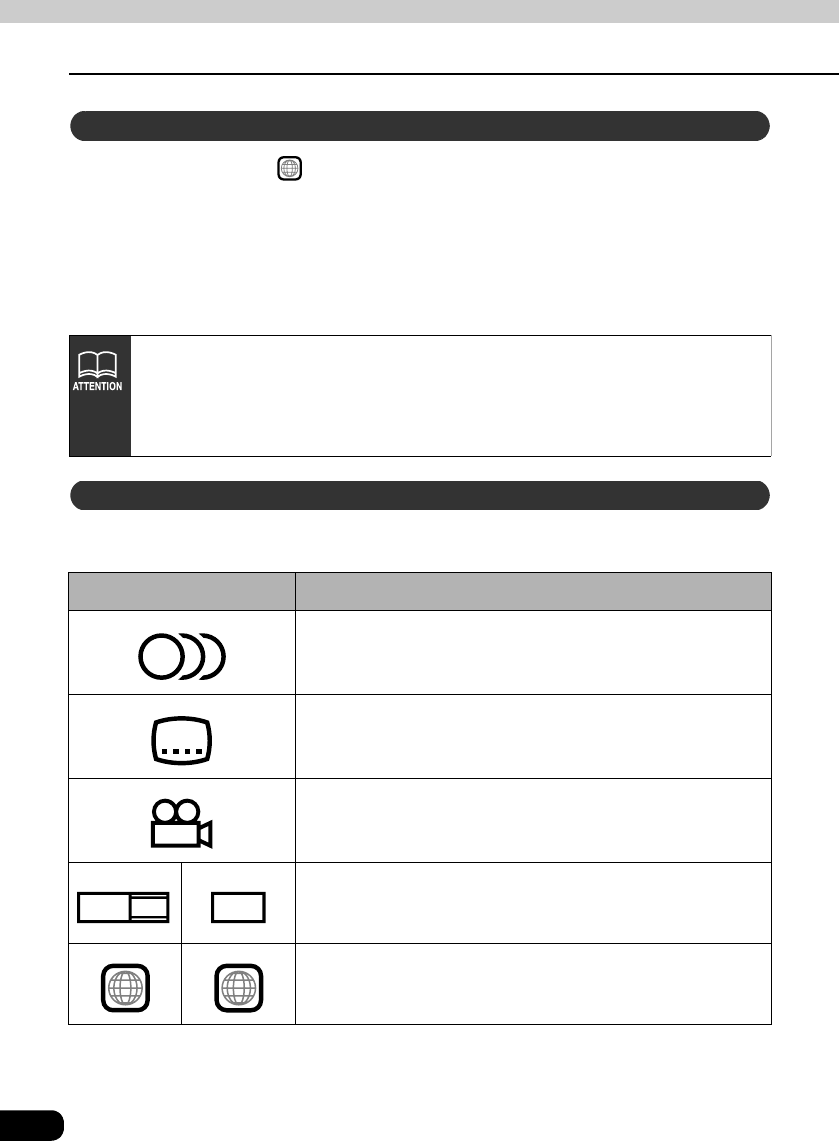
96
Before using the DVD player
How to operate the DVD player
Some DVD discs display a ("Region Code"). The mark (a number) shows the
geographical region where the disc can be played. This equipment will not play discs that
do not show "1" or "ALL" in this mark. Even if the disc does play, the message "Cannot play
this disc" will be displayed on the screen. Note also that some discs may be subject to
regional restrictions, meaning that this equipment will not play them, even though they list or
state a region code.
The following mark may be displayed on a DVD disc or its package.
mark Meaning
Shows number of voice tracks.
Shows number of subtitle languages.
Shows number of filmed angles.
Shows available aspect ratio (television screen horizontal to
vertical ratio).
• "16:9" is wide screen, "4:3" is standard screen.
Shows playable region code.
• ALL indicates worldwide. A number indicates a specific
region code. "1" is the region number for North America.
About region codes of playable discs
1
The playing condition is determined by the intention of the DVD/software creator.
Some functions may not perform during operation because this equipment is
playing the disc according to content specifications intended by the software
creator. Be sure to consult the explanatory material provided with the disc to be
played.
About marks displayed on discs
3
2
3
16:9 LB 4:3
ALL 1
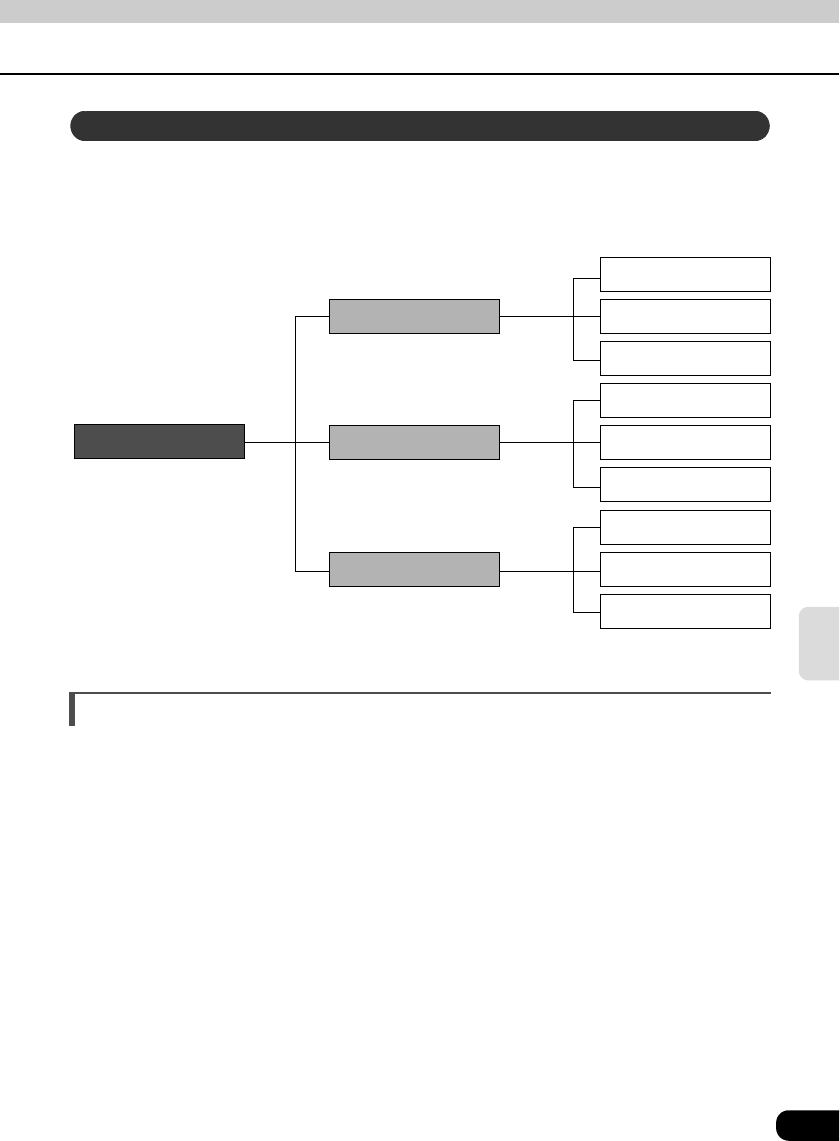
97
DVD
Videos and songs recorded on a DVD are divided into many segments.
Large segments are called "titles", and each title has a number ("title number"). Title
segments are further divided into smaller segments called "chapters", and each chapter has
a number ("chapter number").
Products equipped with Macrovision
This product incorporates copyright protection technology that is protected by method
claims of certain U.S. patents and other intellectual property rights owned by Macrovision
Corporation and other rights owners. Use of this copyright protection technology must be
authorized by Macrovision Corporation, and is intended for home and other limited viewing
uses only unless otherwise authorized by Macrovision Corporation. Reverse engineering or
disassembly is prohibited.
About DVD disc structure
DVD-Video
Title 1
Title 2
Title 3
Chapter 1
Chapter 2
Chapter 3
Chapter 1
Chapter 2
Chapter 3
Chapter 1
Chapter 2
Chapter 3
Title number
Chapter number
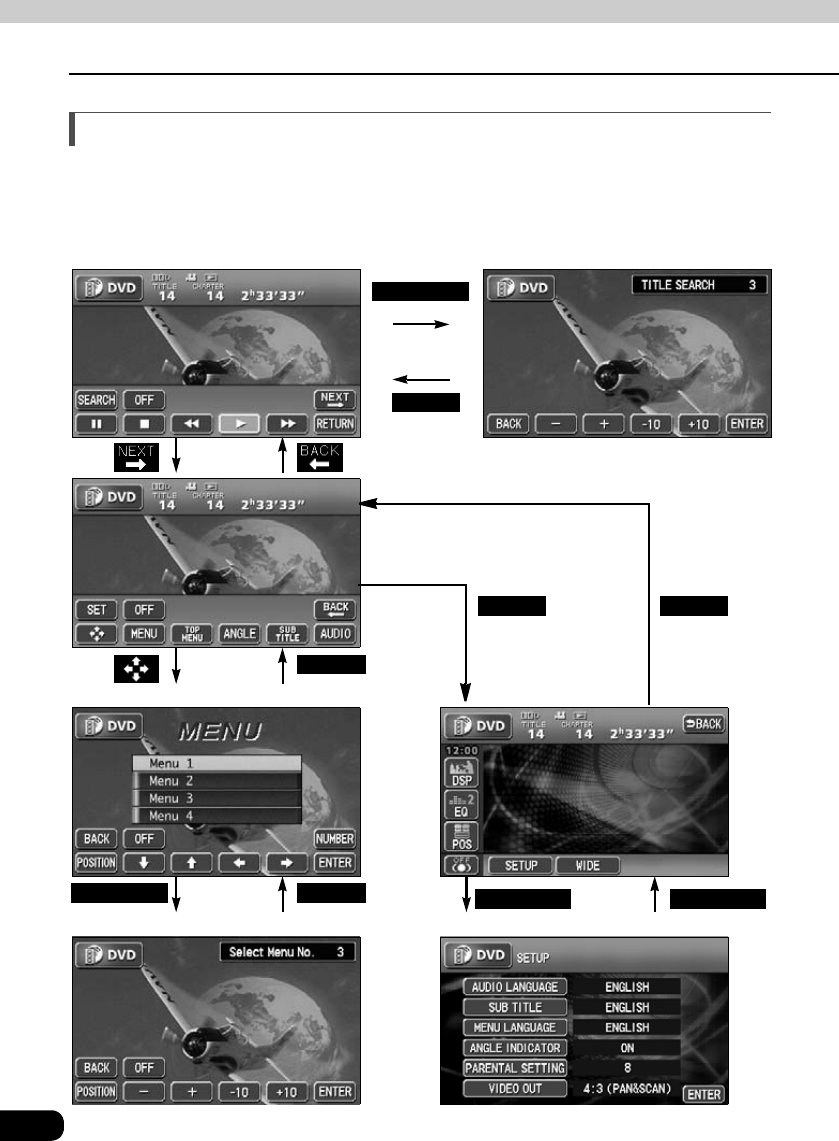
98
Before using the DVD player
How to operate the DVD player
About flow of operations
The section below describes the flow for items such as operation and search of images and
default settings for the DVD player.
• Touching a touch switch brings up the operation screen shown below.
SEARCH
BACK
SET
BACK
BACKNUMBER ENTERSETUP
BACK
●DVD operation screen ●Title screen
●Menu number search screen ●Default settings screen
●Menu operation screen
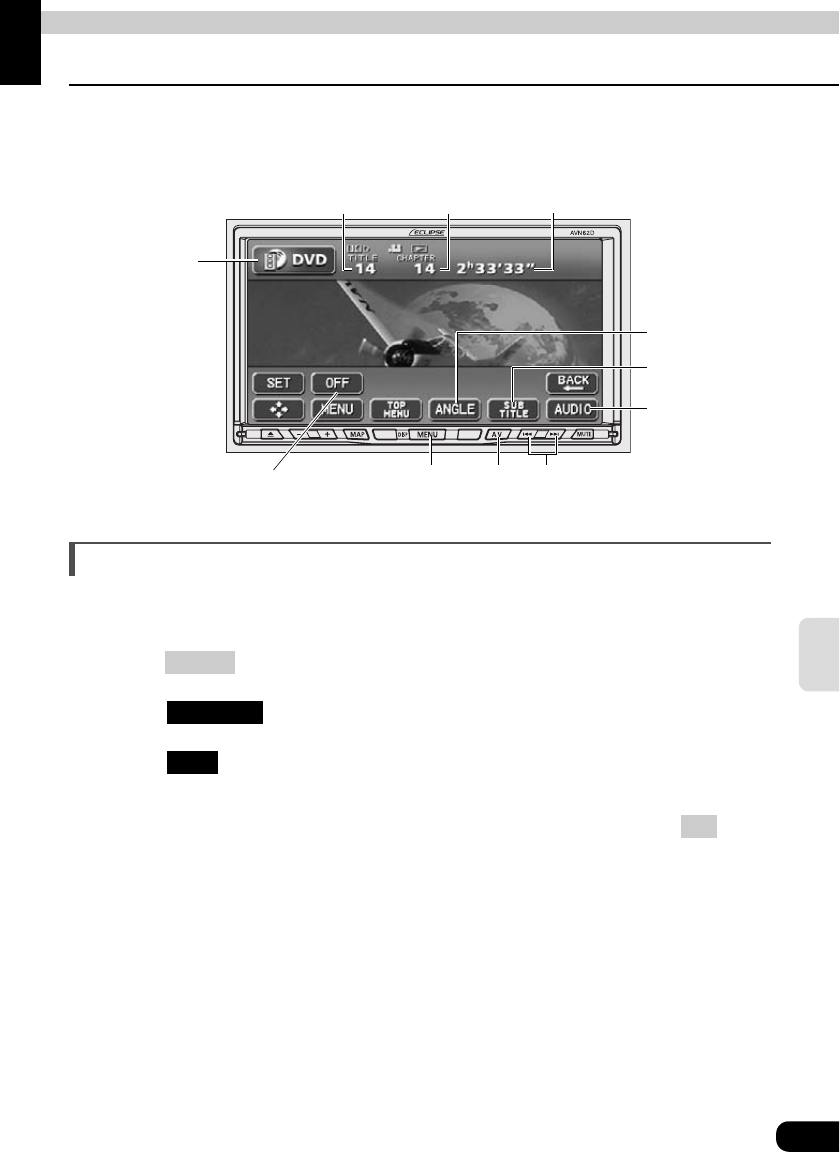
How to operate the DVD player
99
DVD
How to use the DVD player
A DVD can be watched only if the vehicle is completely stopped in a safe location with the
parking brake set and the ignition switch turned to ON or ACC. (Only sound can be heard if
a DVD is played while the car is in motion.)
Watching a DVD
Start playback by inserting a DVD into the DVD insertion slot, which will automatically turn on
power.
Press while a disc is inserted.
Touch .
Touch .
• Playback will begin.
• If the operation switches (touch switches) are not being displayed, press or
touch the screen.
MENU
Button
Buttons off switch
Angle change
switch
Subtitles change
switch
Title number Chapter number Playing time
Chapter changing/
Fast-forward (rewind) Button
Audio change
switch
AV
Button
SOURCE MENU
switch
MENU
SOURCE
DVD
AV
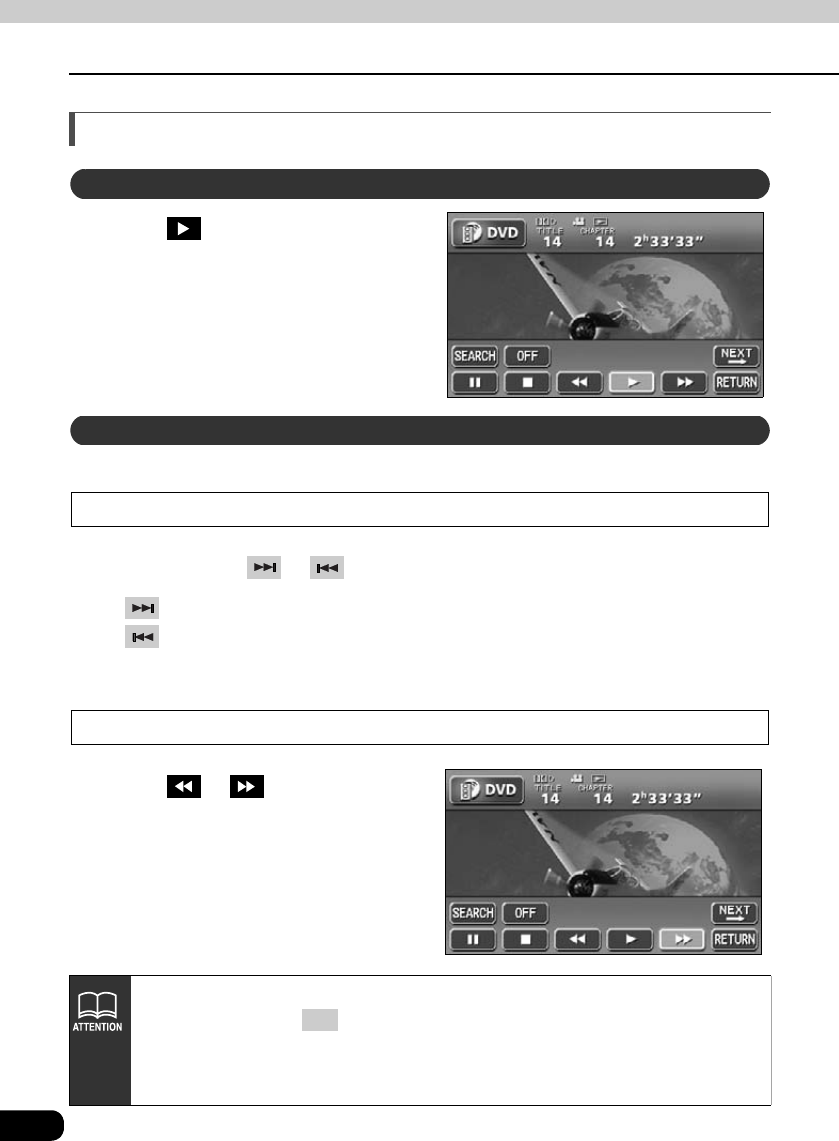
100
How to use the DVD player
How to operate the DVD player
Operating the video
Touch .
It is possible to fast-forward or rewind through the video being played.
Using panel button
Press and hold or until a beep is heard.
• : Advances the video
: Rewinds the video
• The main unit switches to the fast-forward (rewind) mode when the beep is heard and
will continue fast-forwarding (rewinding) until your finger is removed from the switch.
Fast-forwarding/rewinding using the touch switches
Touch or .
• The main unit switches to the fast-
forward (rewind) mode when the beep
is heard and will continue fast-
forwarding (rewinding) until your finger
is removed from the switch.
Playing the video
Fast-forwarding/rewinding
• Information for items such as touch switches will be displayed for about 6
seconds. Pressing or touching the screen will display them again.
• Depending on the disc, automatic playback may not function or playback may
not function unless a menu recorded on the disc is selected. (Refer to
"Operating the disc menu" on page 102.)
AV
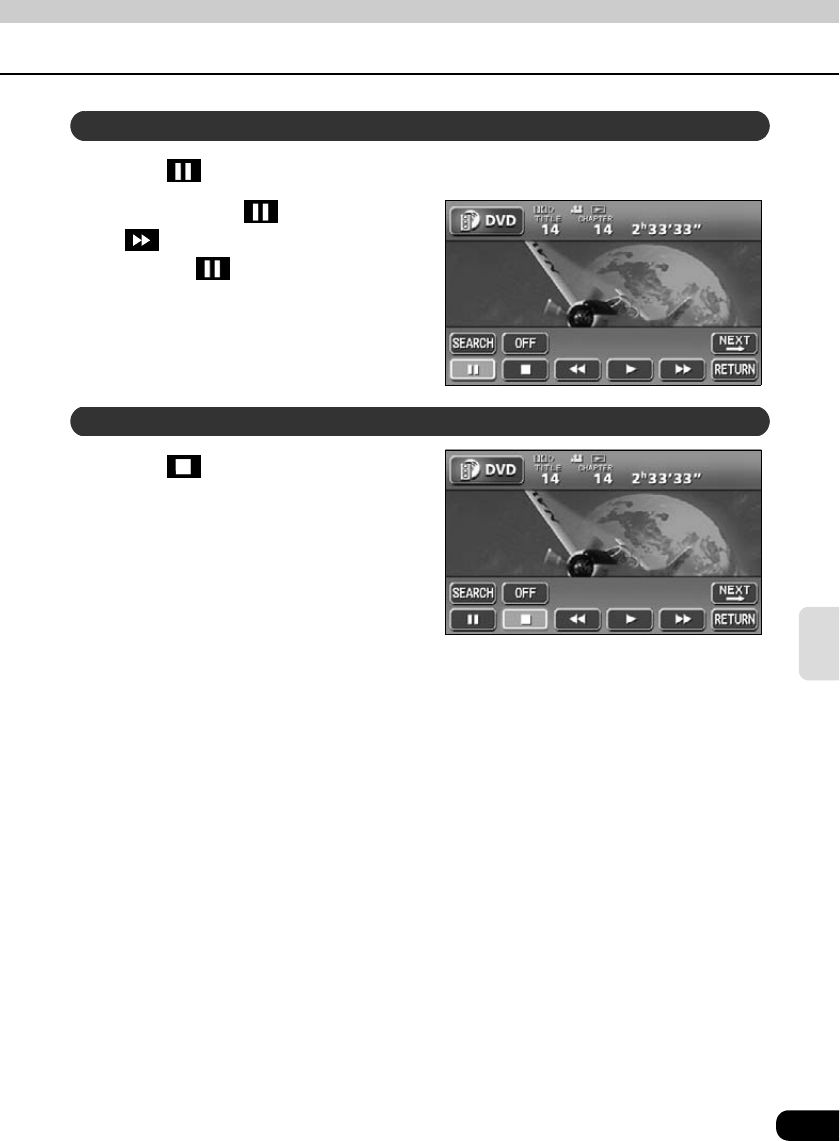
101
DVD
Touch .
• While paused ( ), briefly touching
will play in slow motion and
touching will play frame-by-
frame.
Touch .
Pausing the video
Stopping the video
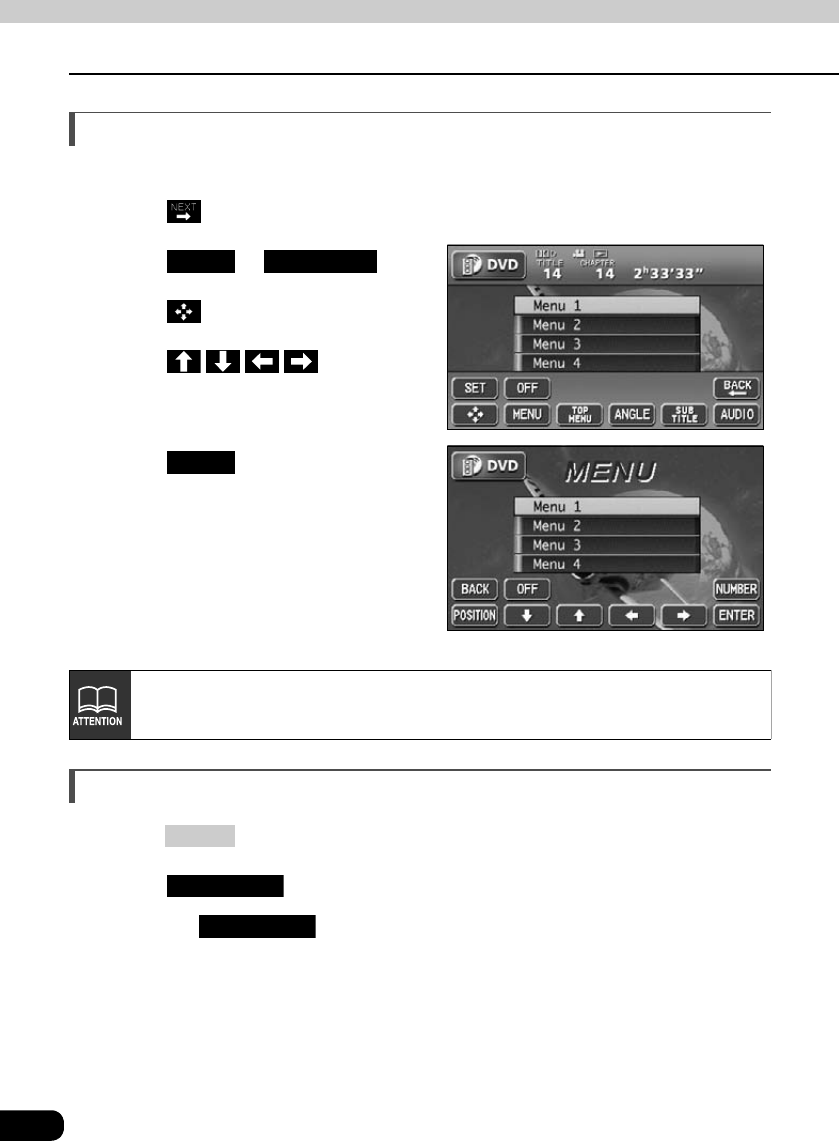
102
How to use the DVD player
How to operate the DVD player
Operating the disc menu
It is possible to use the menu recorded on the disc.
Touch on the DVD operation screen.
Touch or .
Touch .
Touch and select
the video to play.
Touch .
Turning off the DVD
Press .
Touch .
• Touching again on the MAIN MENU screen will resume playback.
MENU TOP MENU
ENTER
Recorded menu items will differ by disc. Some functions may not perform during
operation because playback is following disc content specifications.
MENU
AUDIO OFF
AUDIO OFF
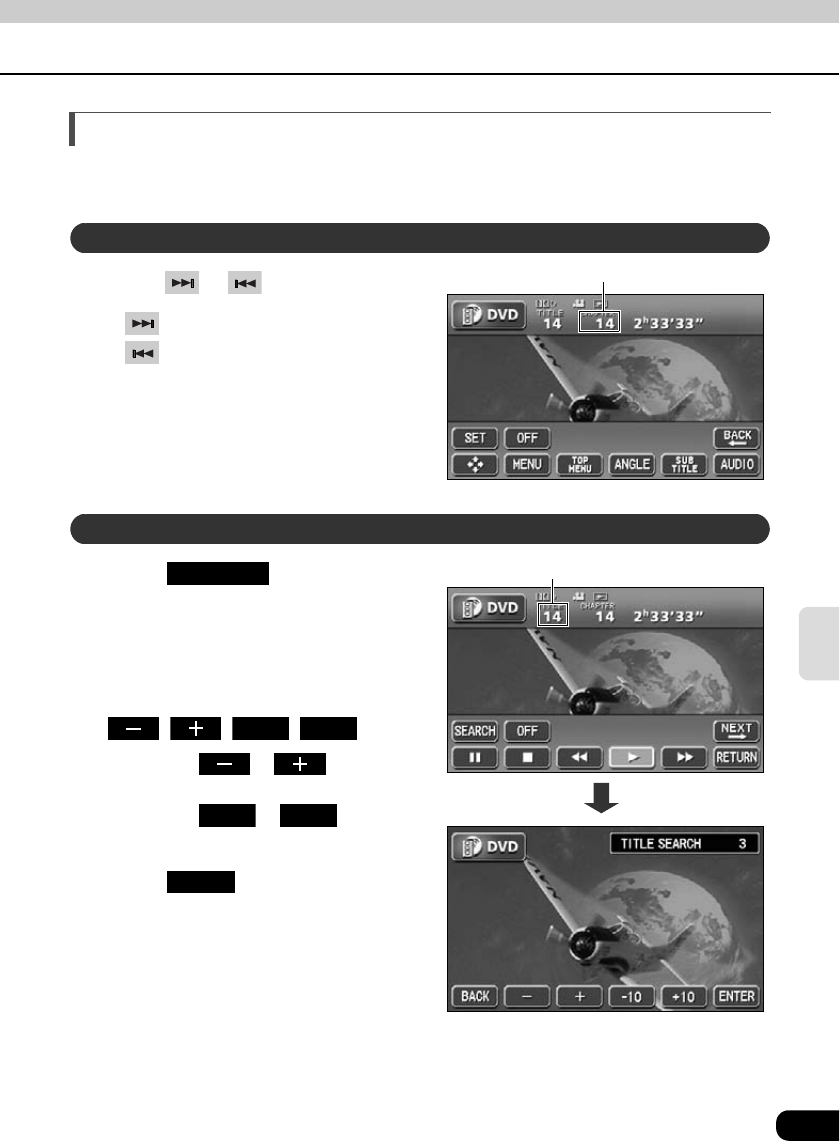
103
DVD
Searching for a desired chapter
It is possible to search for a particular video segment by title and chapter or by menu number
(number for divided segments).
Press or .
• :
Selects next chapter
:
Selects previous chapter
Touch on the DVD
operation screen.
• The title number input screen will be
displayed.
Input the title number by touching
, , , .
• Touching or changes
the title number by ones.
• Touching or changes
the title number by tens.
Touch .
Searching by chapter
Chapter number
Searching by title number
Title number
SEARCH
-10 +10
-10 +10
ENTER
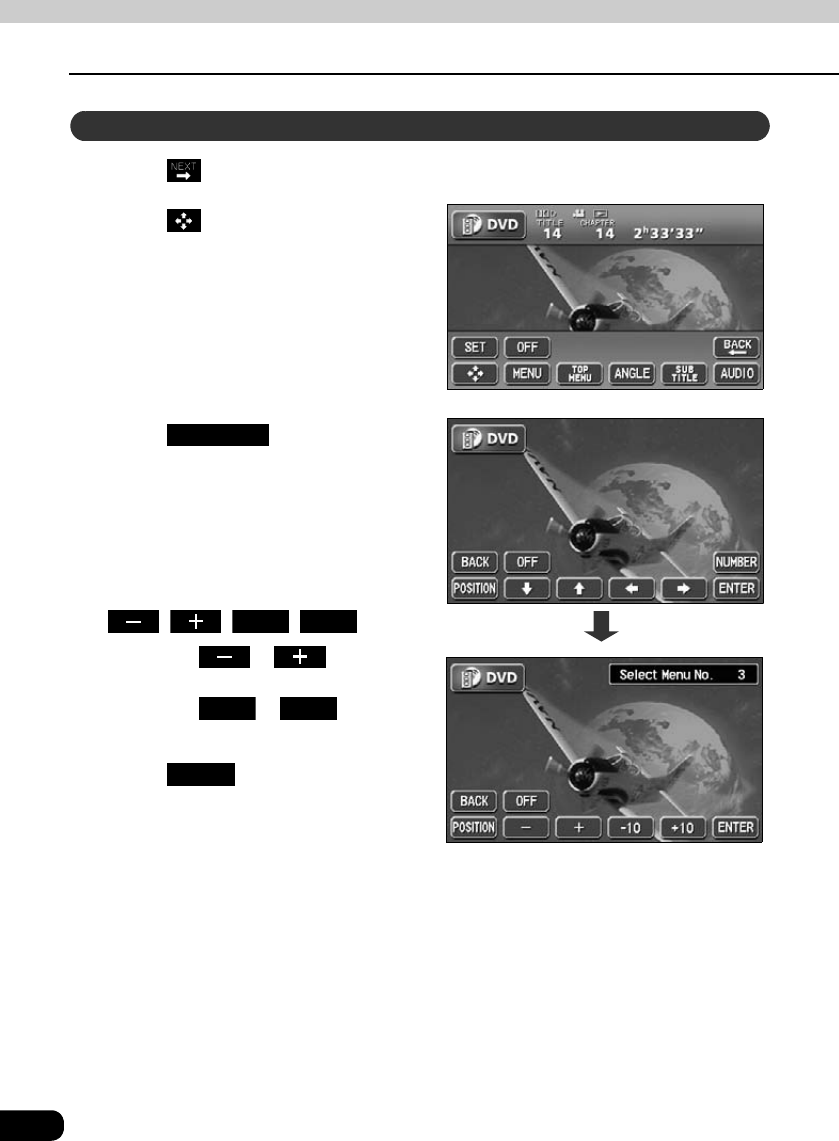
104
How to use the DVD player
How to operate the DVD player
Touch on the DVD operation screen.
Touch .
Touch .
• The menu number input screen will be
displayed.
Input the menu number by touching
, , , .
• Touching or changes
the menu number by ones.
• Touching or changes
the menu number by tens.
Touch on the DVD
operation screen.
Searching by menu number
NUMBER
-10 +10
-10 +10
ENTER
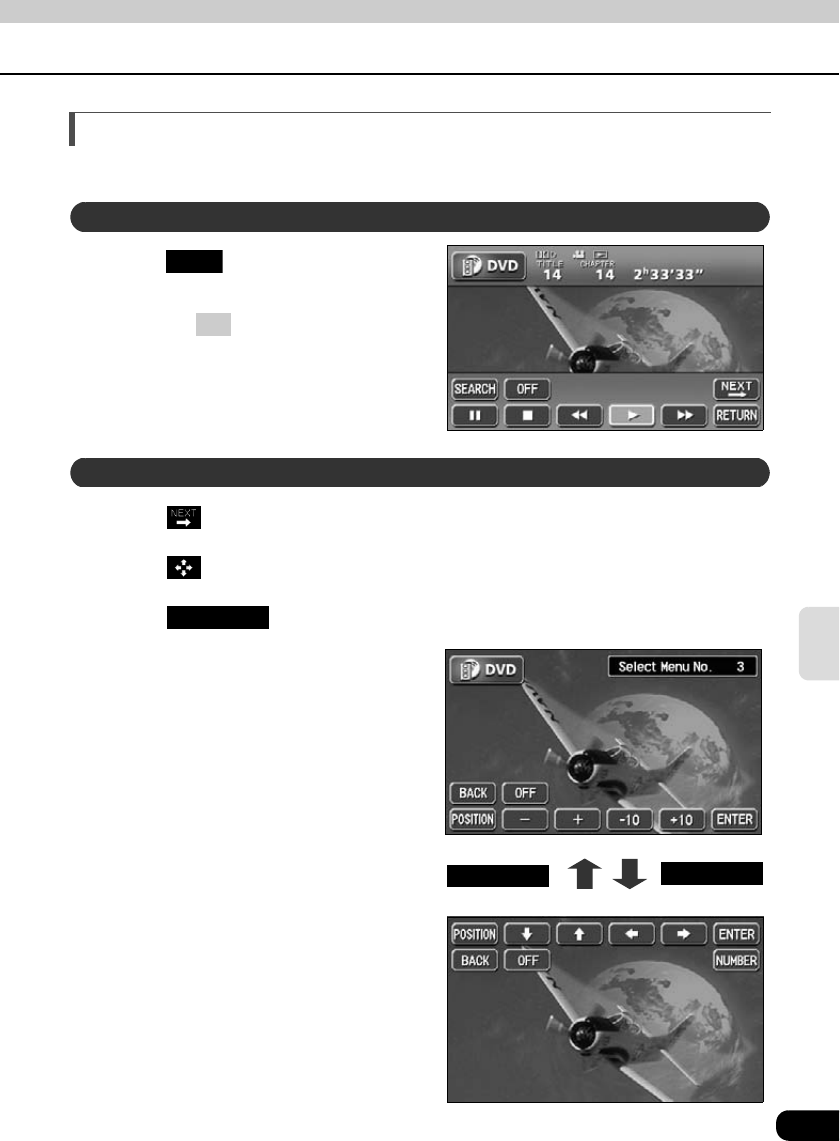
105
DVD
Changing the touch switch display
Display of the touch switches can be changed or turned off.
Touch on the DVD operation
screen.
• Pressing or the touching the
screen will display the touch switches
again.
Touch on the DVD operation screen.
Touch .
Touch .
• The position of the touch switch will
move up or down with each touch of
the screen.
Turning off the touch switches
OFF
AV
Changing the touch switch display locations
POSITION
POSITIONPOSITION POSITION
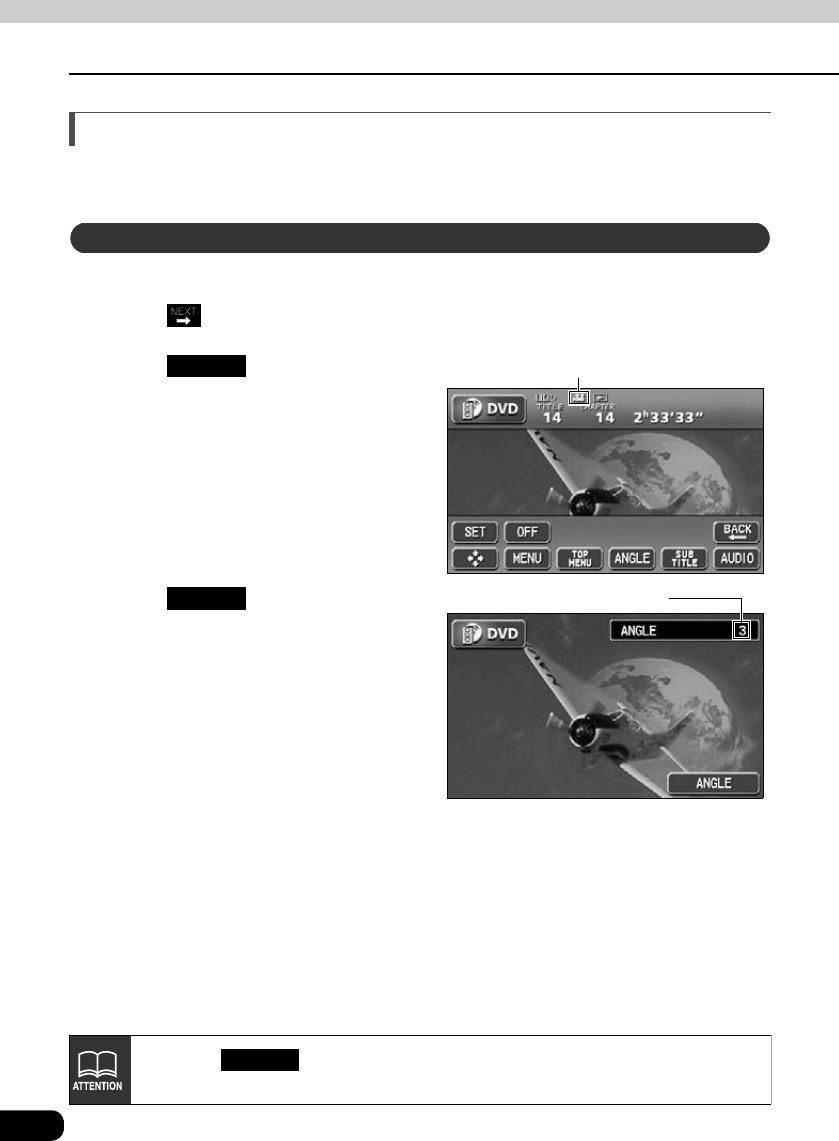
106
How to use the DVD player
How to operate the DVD player
Switching between screen display and audio
It is possible to change the language for subtitles, the language for audio and the display
angle for the video being played.
When several angles of a scene are recorded on a disc, the angle can be switched.
Touch on the DVD operation screen.
Touch when the multi-
angle mark is displayed.
• The angle number will be displayed.
Touch .
• The angle number will change and the
angle of the video will be switched.
Switching the video angle
Multi-angle mark
ANGLE
Angle number
ANGLE
Each time is pressed, the angle will change in order from among the
angles recorded on the disc.
ANGLE
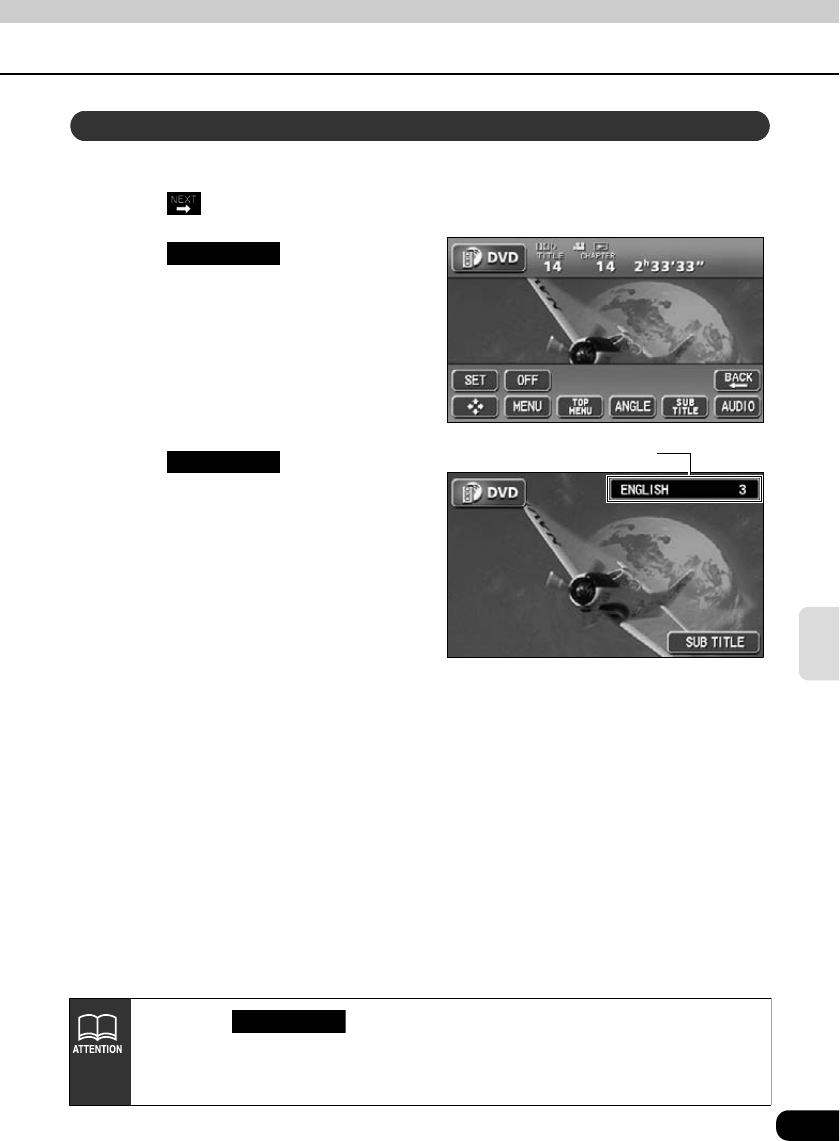
107
DVD
When subtitles in several languages are recorded on a disc, the subtitles can be switched.
Touch on the DVD operation screen.
Touch .
• The subtitle number and language will
be displayed.
Touch .
• Switches the subtitle number each
time the touch switch is touched and
switches the displayed subtitle
language.
Switching subtitle languages
SUB TITLE
Subtitle number and language
SUB TITLE
• Each time is pressed, the subtitle language will change in order
from among the subtitles recorded on the disc.
• Depending on the disc, it may only be possible to change subtitles from the top
menu.
SUB TITLE
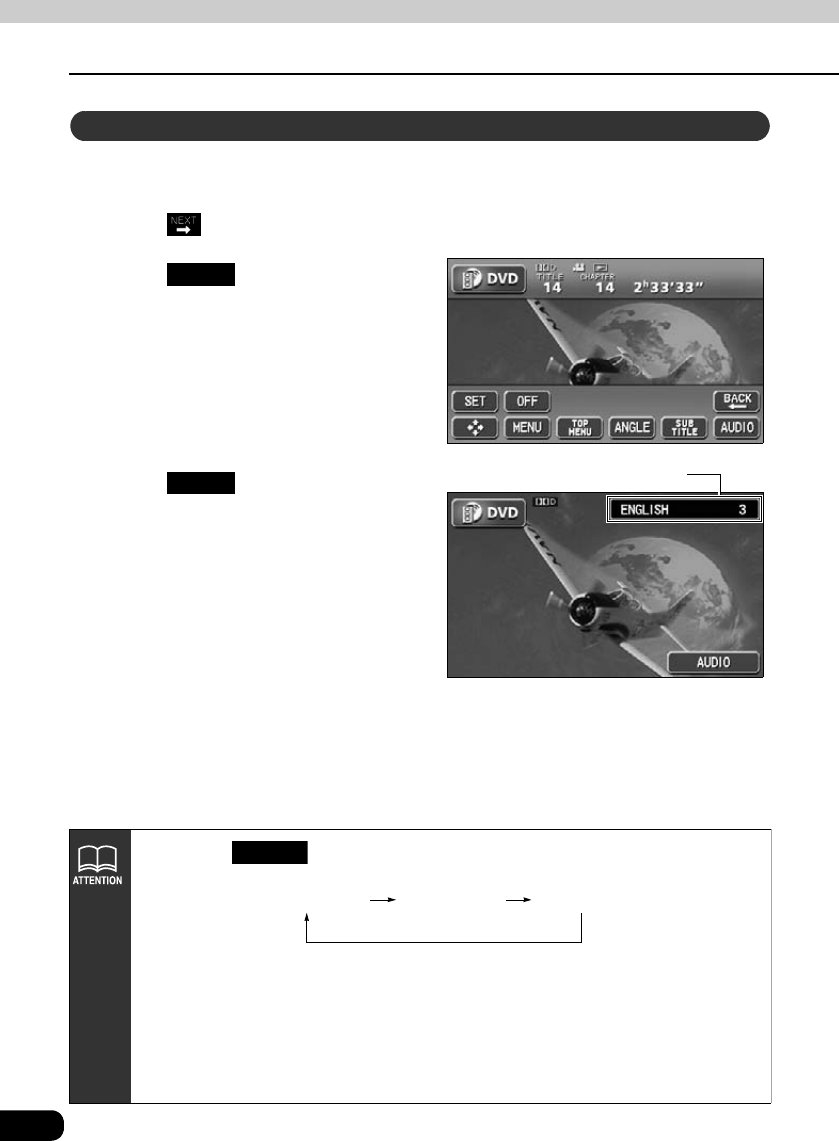
108
How to use the DVD player
How to operate the DVD player
When dubbed voices in several languages are recorded on a disc, the voices can be
switched.
Touch on the DVD operation screen.
Touch .
• The audio number and language will
be displayed.
Touch .
• The audio number will change and the
language of voices being played will
be switched.
Switching dubbed audio language
AUDIO
Audio number and language
AUDIO
• Each time is pressed, the audio language will change in order from
among the languages recorded on the disc.
• Depending on the disc, it may only be possible to change the language from the
top menu.
• The dts (digital theater system) format is not supported by this equipment, so no
audio will be emitted when "dts audio" is selected by a disc having dts audio
recorded on it. In this case, select "Dolby Digital audio" if it is definitely recorded
on the DVD video.
• dts is a registered trademark of the US company Digital Theater Systems, Inc.
AUDIO
Language 1 Language 2 Language...
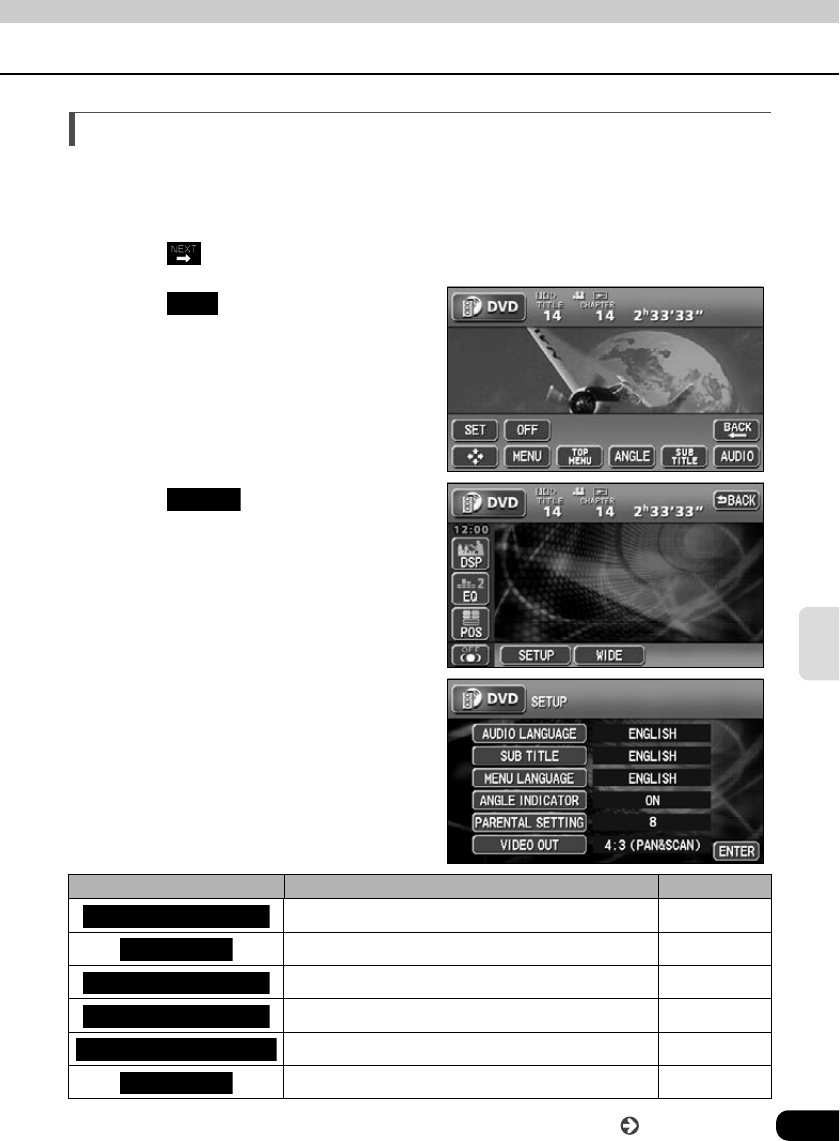
109
DVD
Setting the DVD player
The language preference for voices, subtitles and menu display used during DVD playback
can be set in advance. Optional display of the multiple angle mark, viewer restriction and
other functions can also be set.
Touch on the DVD operation screen.
Touch .
Touch .
• The SET UP screen will be displayed.
Touch any of the touch switches.
Settings can be made for the
following items.
Touch switch Function Page
Sets the language of voices for video playback. 110
Sets the language of subtitles for video playback. 111
Sets the language of displayed menus. 112
Sets display/non-display of multiple angle mark. 113
Restricts the types of DVD videos that can be played. 114
Sets screen size. 115
SET
SETUP
AUDIO LANGUAGE
SUB TITLE
MENU LANGUAGE
ANGLE INDICATOR
PARENTAL SETTING
VIDEO OUT
Go to the next page
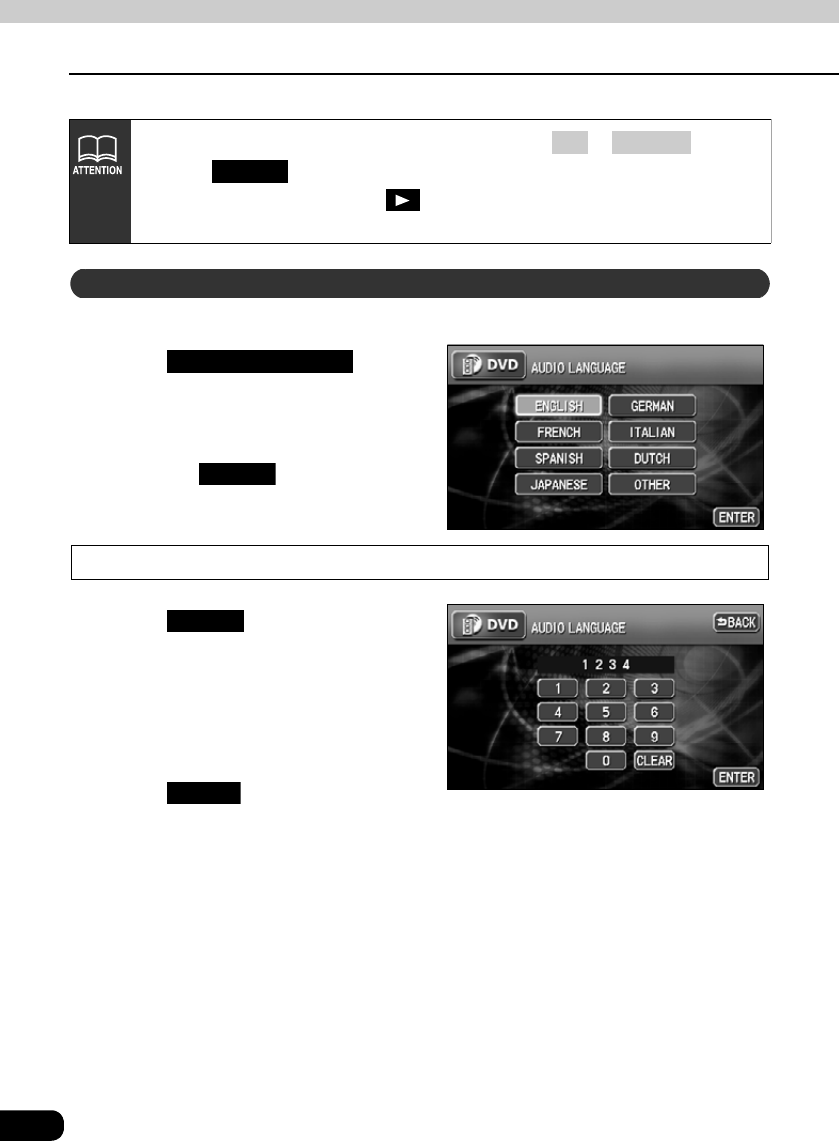
110
How to use the DVD player
How to operate the DVD player
The preferred language for the video being played can be selected.
Touch on the
SET UP screen.
Touch the preferred language.
• Touching enables setting of
a language other than those displayed
on the screen.
Input a code
Touch on the AUDIO
LANGUAGE setting screen.
Input a language code.
• Refer to "Table of language codes" on
page 116 for language codes.
Touch .
Pressing one of the switches that can switch screens ( or ) without
touching after changing settings with the default setting screen will
stop playing of the DVD. Touch on the operation screen to start playback
again. (Refer to page 100.)
AV MENU
ENTER
Setting the audio language
AUDIO LANGUAGE
OTHER
OTHER
ENTER
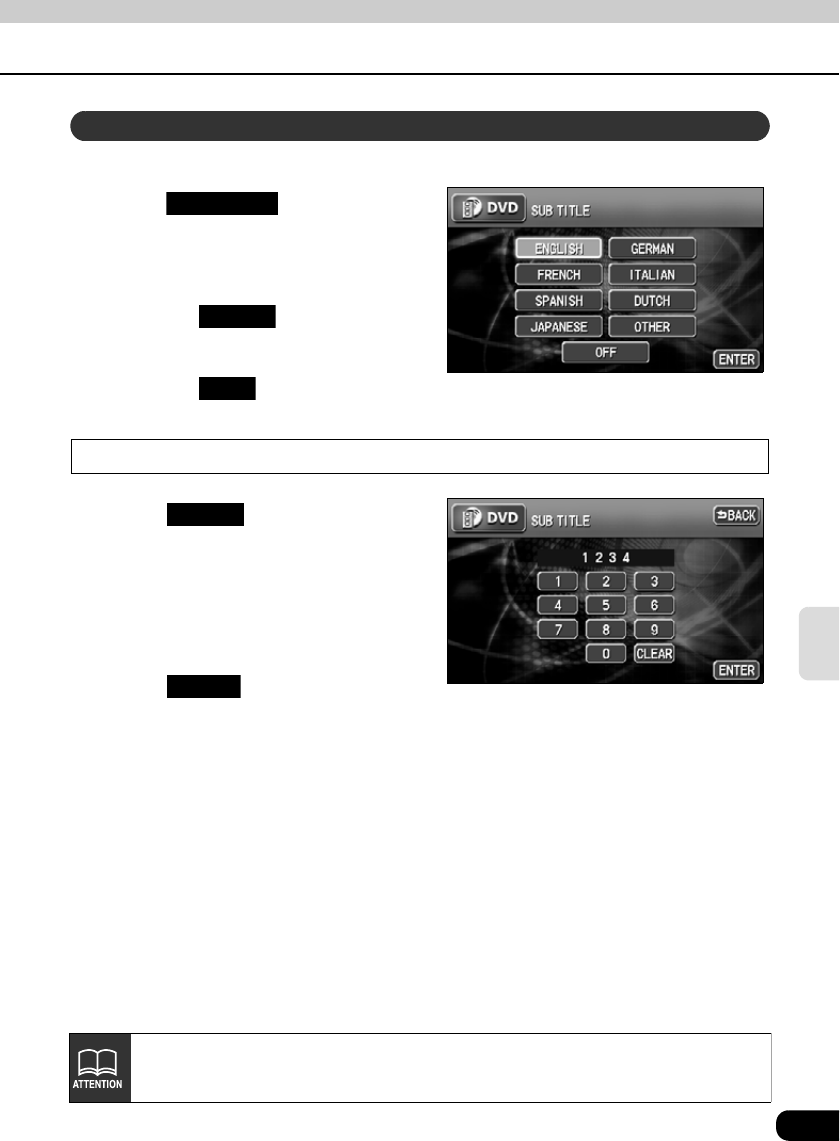
111
DVD
The preferred subtitles for the video being played can be selected.
Touch on the SET UP
screen.
Touch the preferred language.
• Touching enables setting of
a language other than those displayed
on the screen.
• Touching plays the video with
no subtitles on the screen.
Input a code
Touch on the SUB TITLE
setting screen.
Input a language code.
• Refer to "Table of language codes" on
page 116 for language codes.
Touch .
Subtitle language setting
SUB TITLE
OTHER
OFF
OTHER
ENTER
Language switching cannot be performed if the selected language is not
recorded on the disc.
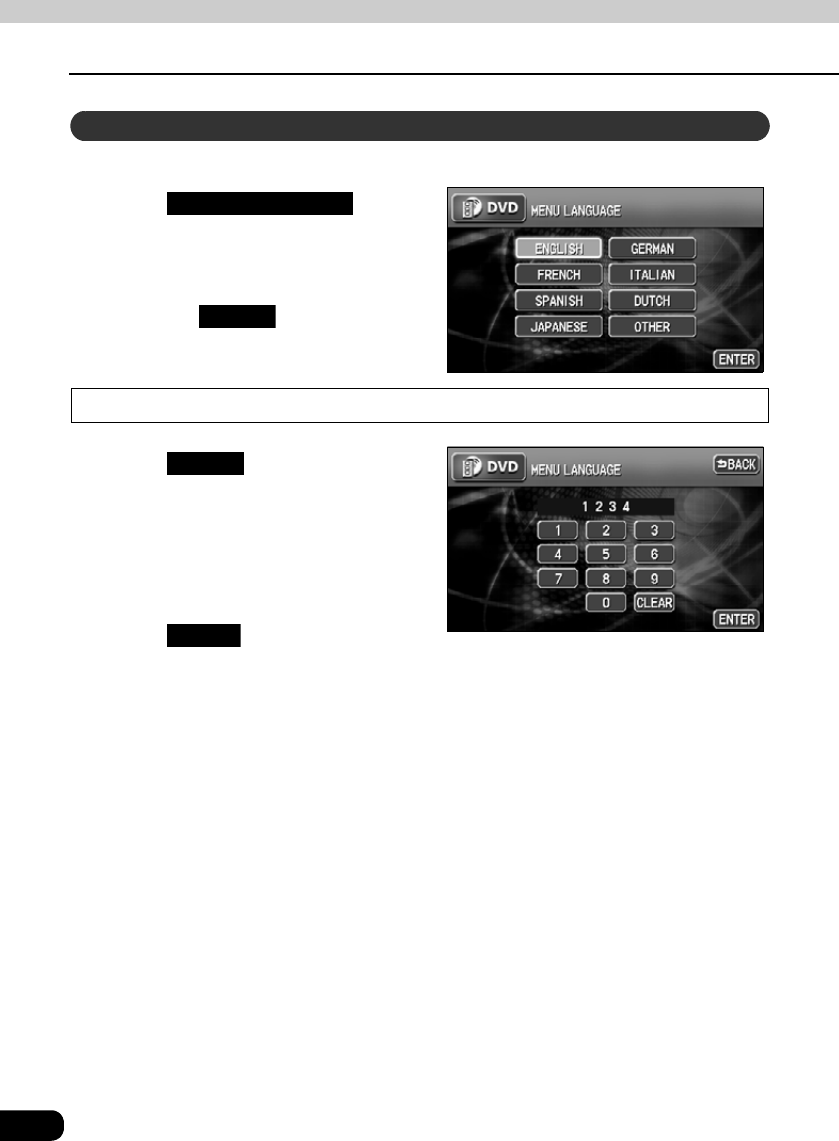
112
How to use the DVD player
How to operate the DVD player
Allows selection of a preferred menu language from those recorded on the disc.
Touch on the
SET UP screen.
Touch the preferred language.
• Touching enables setting of
a language other than those displayed
on the screen.
Input a code
Touch on the MENU
LANGUAGE setting screen.
Input a language code.
• Refer to "Table of language codes" on
page 116 for language codes.
Touch .
Menu language setting
MENU LANGUAGE
OTHER
OTHER
ENTER
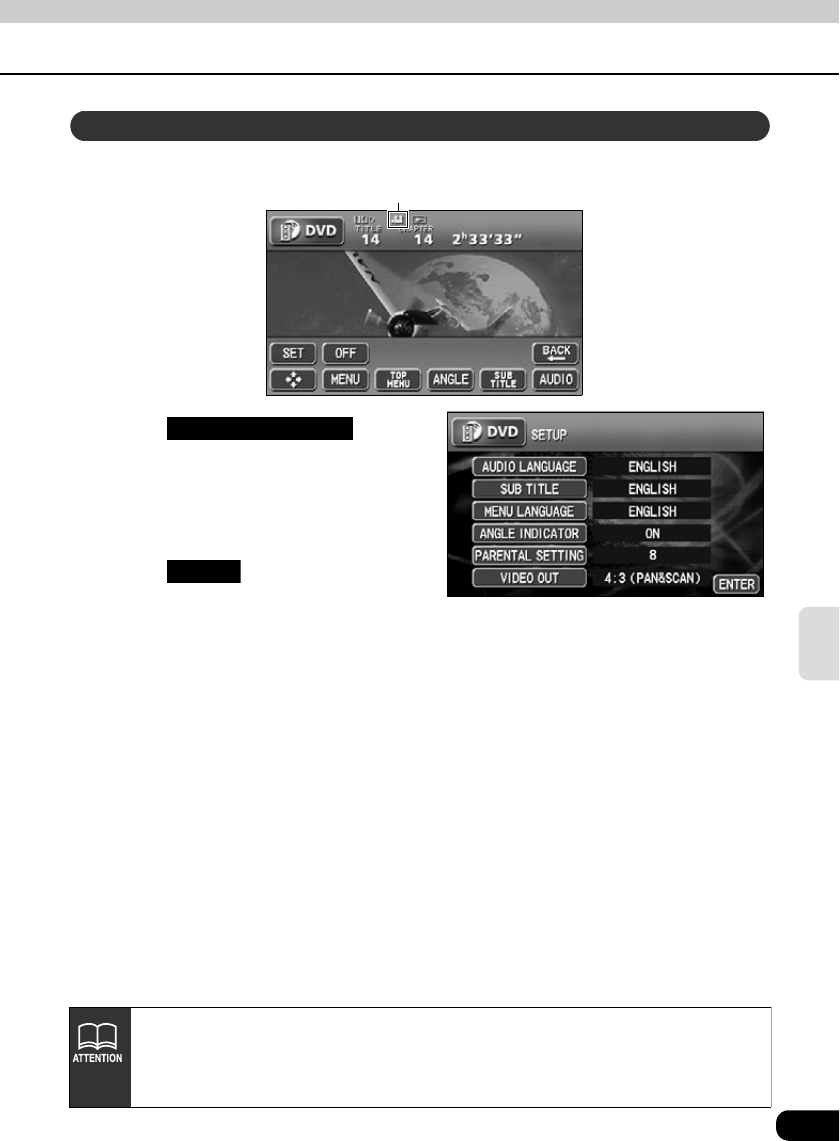
113
DVD
The multi-angle mark can be set to display/not display for the video being played.
Touch on the
SET UP screen.
• Each time ANGLE INDICATOR is
pressed, the condition will switch
between "ON" and "OFF".
Touch .
Setting display of multi-angle mark (angle selection mark)
Multi-angle mark
ANGLE INDICATOR
ENTER
• Language switching cannot be performed if the selected language is not
recorded on the disc.
• Setting multi-angle mark display to "ON" will display the multi-angle mark in the
upper right corner of the screen when multiple angles are available on the disc.
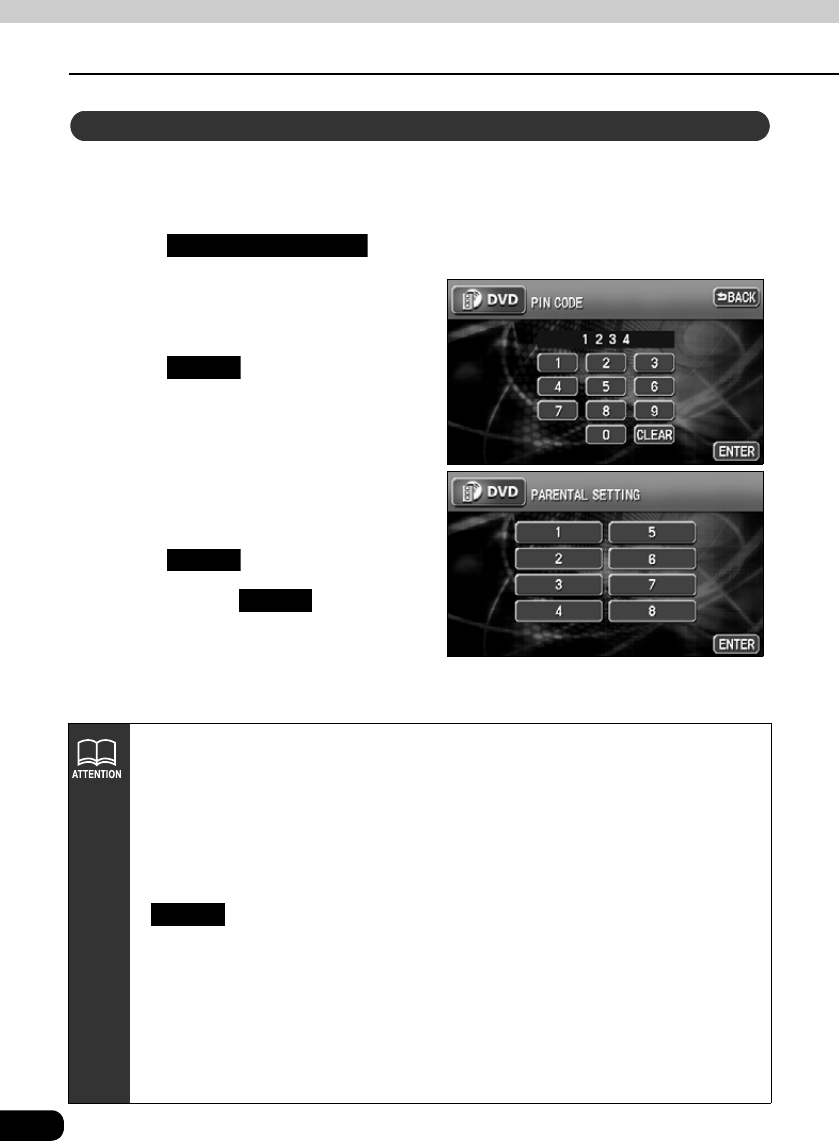
114
How to use the DVD player
How to operate the DVD player
This function allows restriction of viewing so that discs with adult themes or violent scenes will
not be available to children. Viewer restriction can be set at different levels to match
restriction ratings.
Touch on the SETUP screen.
Enter a password (4 digits) by
touching one number at a time.
Touch .
Touch the preferred restriction
level.
Touch .
• If you touched after
inputting a wrong password, eject the
disc once to set the viewer restriction
setting again.
Viewer restriction setting
PARENTAL SETTING
ENTER
ENTER
ENTER
• Restriction cannot be set for discs not having a viewer restriction level recorded.
• Be sure to enter a password number. If a number is not entered, setting of
viewer restriction will not be possible.
• The password to be shown in the upper section will be displayed as ---- when a
password has not yet been set.
• Once the password has been set, the password will be required for subsequent
use of this function. Please do not forget the password. If the password is
forgotten, the default condition (no password set) can be restored by touching
10 times.
• Viewer restriction levels are classified in 3 types.
Level 1 ................. Plays only DVD software intended for children. (Playing of
DVD software intended for general audiences or adult
audiences is prohibited.)
Level 2 - 7 ............ Plays only DVD software intended for children or general
audiences. (Playing of DVD software intended for adult
audiences is prohibited.)
Level 8 ................. Plays all DVD software. (Factory setting)
CLEAR
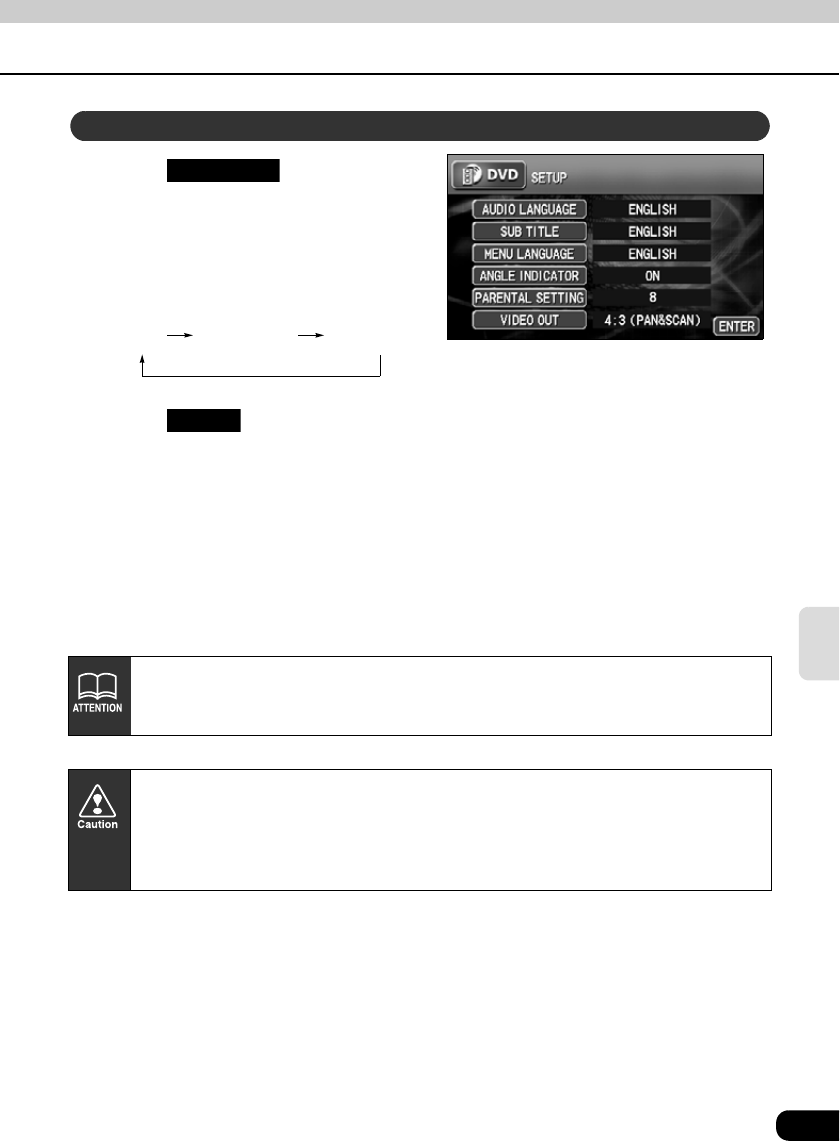
115
DVD
Touch on the SETUP
screen.
• Each time VIDEO OUT is pressed, the
screen size will be changed in the
order shown below.
Touch .
• 16:9
The video is displayed in normal wide size. DVD software recorded in 4:3 size will be
displayed with black left and right edges or will be expanded to the left and right.
• 4:3 (letter box)
The video is displayed with black upper and lower edges.
DVD software recorded in 4:3 size will be displayed exactly at screen size (4:3).
• 4:3 (pan & scan)
The video is displayed with right and left edges cut off. DVD software recorded in 4:3
size will be displayed exactly at screen size (4:3).
When another monitor such as the rear seat monitor is being used, the size of the
video being displayed in the rear seat monitor will differ according to the video
output size that is set by this main unit (front).
Viewing of wide screen modes is permitted when limited to the personal
entertainment of the user, but caution is required when using technologies such
as image compression and expansion for the purpose of commercial benefit or
public presentation may infringe upon the rights of the copyright holder being
protected by applicable copyright law.
Changing video output
VIDEO OUT
16:9 4:3
letter box
4:3
pan & scan
ENTER
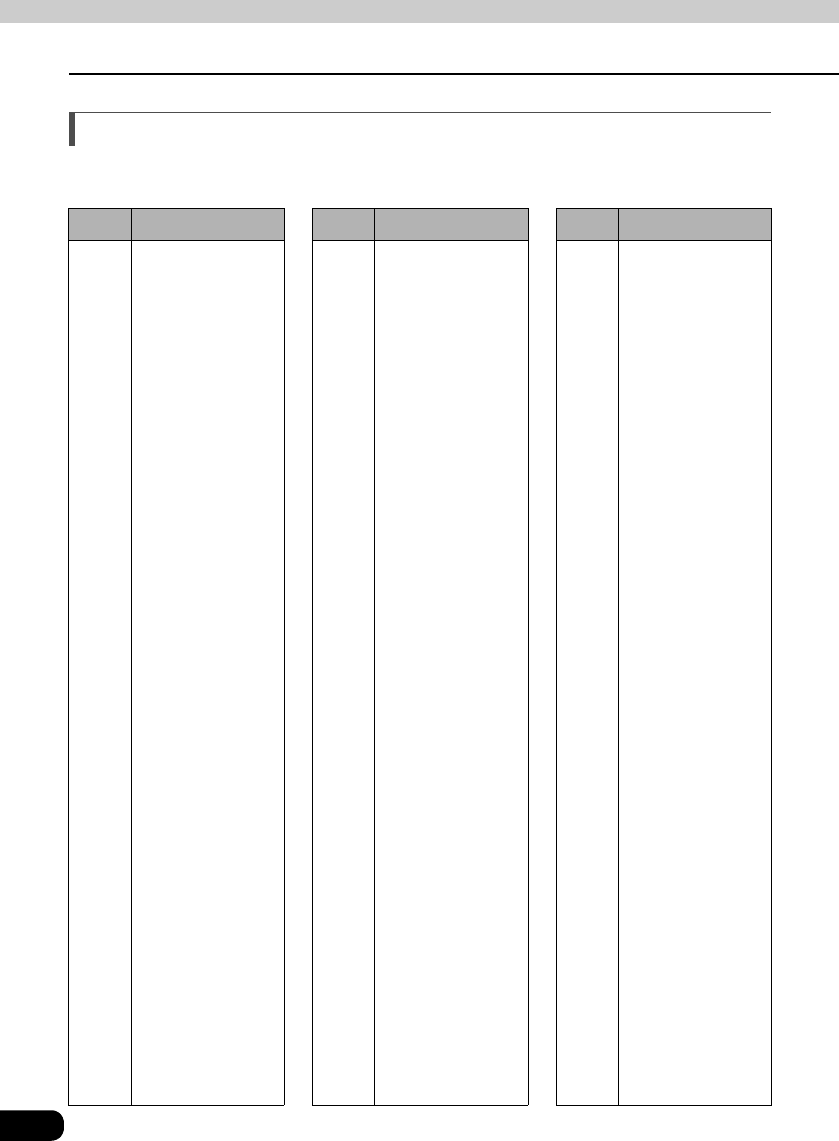
116
How to use the DVD player
How to operate the DVD player
Table of language codes
These codes are used to specify the language for audio tracks, subtitles and on-screen
menu displays.
Input
code Language Input
code Language Input
code Language
1001 Japanese 0801 Hausa 1721 Quechua
0514 English 0809 Hindi 1813 Rhaeto-Romance
0618 French 0818 Croatian 1814 Kirundi
0405 German 0821 Hungarian 1815 Romanian
0920 Italian 0825 Armenian 1823 Kinyarwanda
0519 Spanish 0901 Interlingua 1901 Sanskrit
1412 Dutch 0905 Interlingue 1904 Sindhi
1821 Russian 0911 Inupiak 1907 Sangho
2608 Chinese 0914 Indonesian 1908 Serbo-Croatian
1115 Korean 0919 Icelandic 1909 Sinhalese
0512 Greek 0923 Hebrew 1911 Slovak
0101 Afar 1009 Yiddish 1912 Slovenian
0102 Abkhazian 1023 Javanese 1913 Samoan
0106 Afrikaans 1101 Georgian 1914 Shona
0113 Amharic 1111 Kazakh 1915 Somali
0118 Arabic 1112 Greenlandic 1917 Albanian
0119 Assamese 1113 Cambodian 1918 Serbian
0125 Aymara 1114 Kannada 1919 Siswati
0126 Azerbaijani 1119 Kashmiri 1920 Sesotho
0201 Bashkir 1121 Kurdish 1921 Sundanese
0205 Byelorussian 1125 Kirghiz 1922 Swedish
0207 Bulgarian 1201 Latin 1923 Swahili
0208 Bihari 1214 Lingala 2001 Tamil
0209 Bislama 1215 Laothian 2005 Telugu
0214 Bengali 1220 Lithuanian 2007 Tajik
0215 Tibetan 1222 Latvian 2008 Thai
0218 Breton 1307 Malagasy 2009 Tigrinya
0301 Catalan 1309 Maori 2011 Turkmen
0315 Corsican 1311 Macedonian 2012 Tagalog
0319 Czech 1312 Malayalam 2014 Setswana
0325 Welsh 1314 Mongolian 2015 Tonga
0401 Danish 1315 Moldavian 2018 Turkish
0426 Bhutani 1318 Marathi 2019 Tsonga
0515 Esperanto 1319 Malay 2020 Tatar
0520 Estonian 1320 Maltese 2023 Twi
0521 Basque 1325 Burmese 2111 Ukrainian
0601 Persian 1401 Nauru 2118 Urdu
0609 Finnish 1405 Nepali 2126 Uzbek
0610 Fiji 1415 Norwegian 2209 Vietnamese
0615 Faroese 1503 Occitan 2215 Volapuk
0625 Frisian 1513 Oromo 2315 Wolof
0701 Irish 1518 Oriya 2408 Xhosa
0704 Scots-Gaelic 1601 Panjabi 2515 Yoruba
0712 Galician 1612 Polish 2621 Zulu
0714 Guarani 1619 Pashto
0721 Gujarati 1620 Portuguese
117
DVD
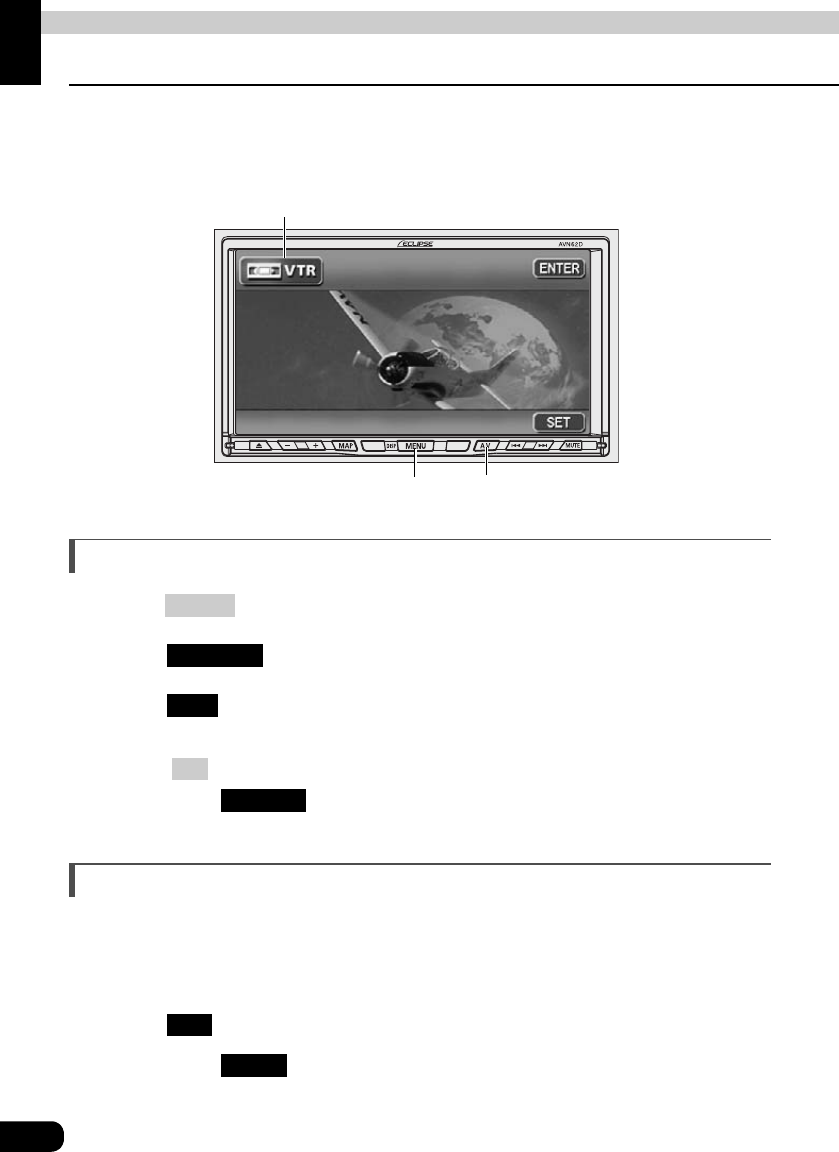
118
How to operate the VTR
How to use the VTR
Connecting a VTR deck enables watching of video. Videos can be played only if the vehicle
is completely stopped in a safe location with the parking brake set and the ignition switch
turned to ON or ACC. (Only sound can be heard if a VTR is played while the car is in motion.)
Viewing the VTR
Press .
Touch .
Touch .
• The VTR screen will be displayed.
• Press or touch the screen to display the VTR operation screen.
• By touching on the VTR operation screen, the display will show video
again.
Switching the VTR setting screen
Various settings mentioned below can be made by switching to the VTR setting screen.
• Tone control such as EQ and POS.
• Switching the screen mode (wide mode)
Touch on the VTR operation screen.
• By touching , the display will return to the VTR operation screen.
MENU
Button
AV
Button
SOURCE MENU switch
MENU
SOURCE
VTR
AV
ENTER
SET
BACK
119
VTR
Turning off the VTR mode
Press .
Touch .
• Pressing PWR again will resume playback.
• Video can also be played by touching and then touching .
MENU
AUDIO OFF
SOURCE VTR
• After switching to the VTR operation screen, touch switches will be displayed for
about 6 seconds. Pressing will display them again.
• The VTR operation screen will be displayed by touching the screen, even when
the VTR is playing.
• Depending on the kind of devices connected, the video image may not be
displayed correctly.
AV
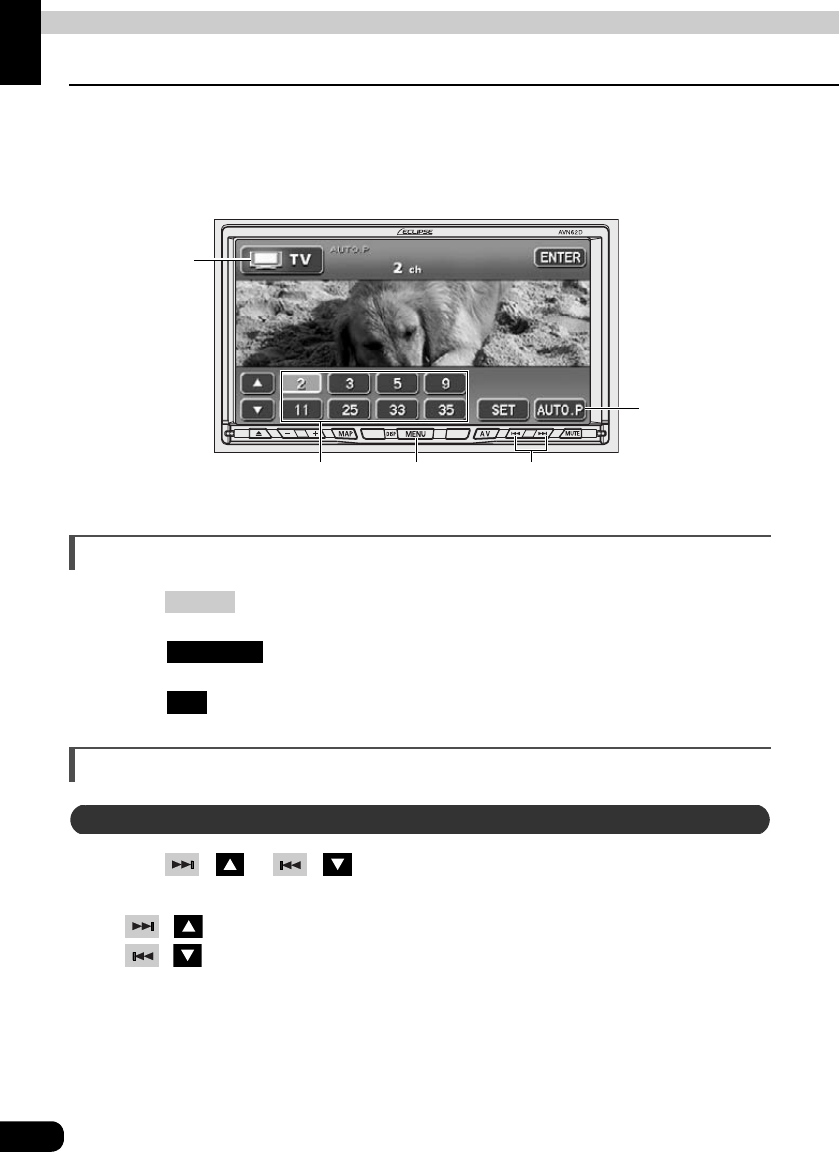
120
How to operate the TV tuner
How to use the TV
The unit can be used as a TV if a TV tuner (sold separately) is connected to the unit. For
safety reasons, the TV can be viewed only when the ignition is switched to ON or ACC and
the vehicle is completely stopped with the parking brake set. If TV mode is selected while the
vehicle is in motion, or while the display is closed, only sound will be output.
Watching a TV
Press .
Touch .
Touch .
Selecting channels
Press / or / .
• Pressing the switch once moves the channel one step up or down.
/ : Raises the channel
/ : Lowers the channel
Preset
Switches
AUTO.P
Switch
TUNE TRACK
Buttons
MENU
Button
SOURCE MENU
switch
MENU
SOURCE
TV
Manual selection
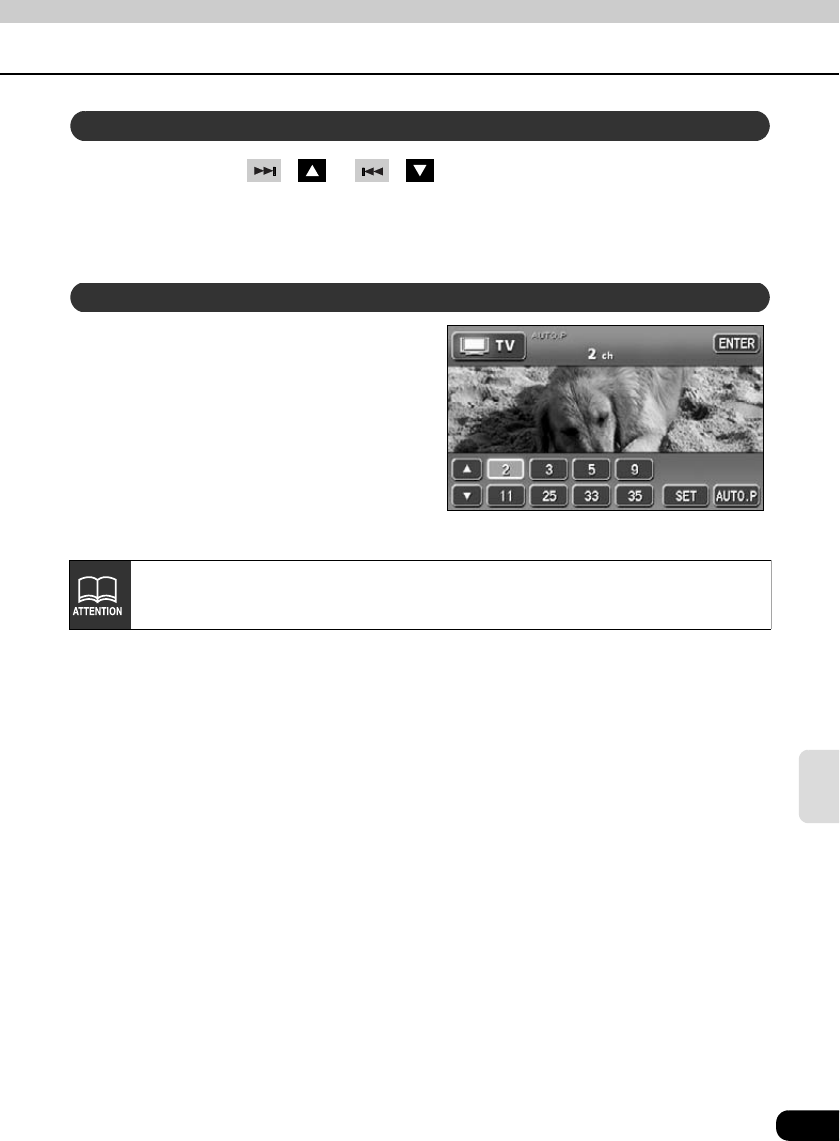
121
TV
Press and hold / or / until you hear a beep.
• The channel that is closest to the current channel will be searched for automatically,
and searching will stop when the channel is received. To stop the search before a
channel is found, press the button again.
Touch a preset switch that already
has a channel recorded.
• See "Saving channels" shown below
for more information.
Automatic selection
Selection using preset switches
After switching to the TV operation screen, touch switches will be displayed for
about 6 seconds. Touch the screen to display them again.
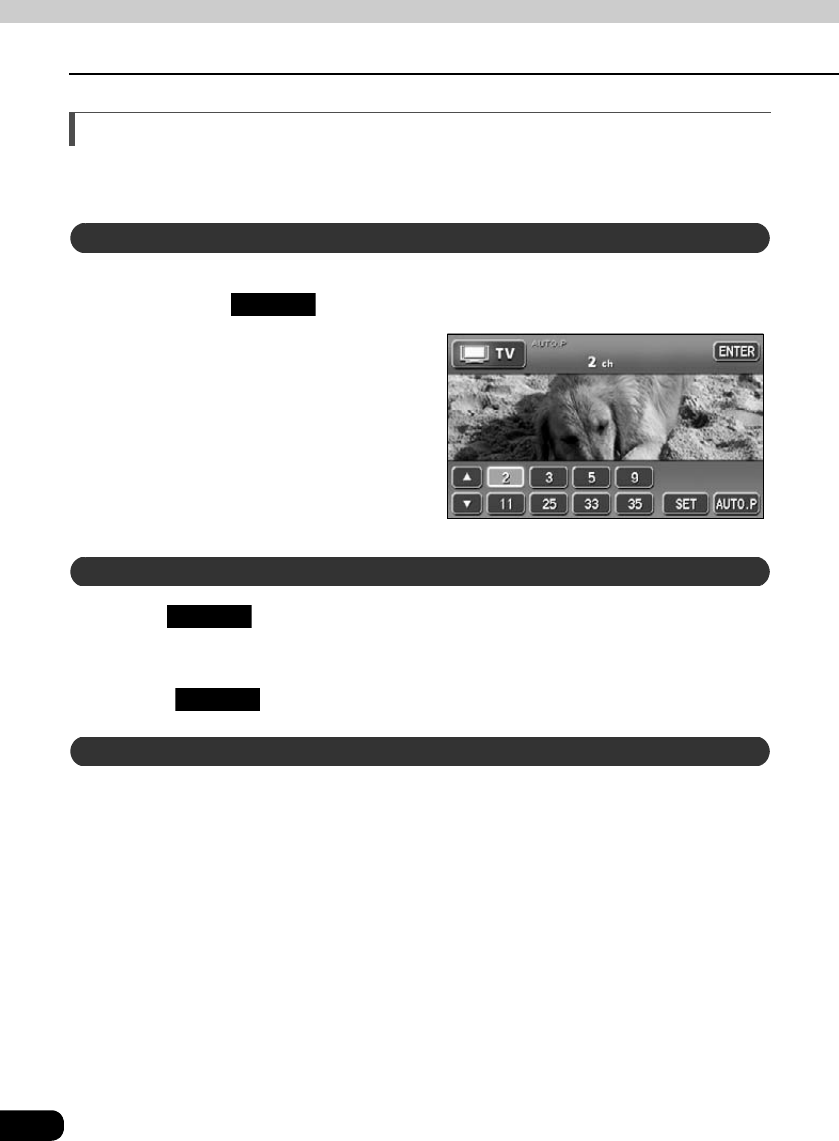
122
How to use the TV
How to operate the TV tuner
Saving channels
There are two modes for saving channels, manual and AUTO.P. These modes operate
independently.
Make sure "AUTO.P" is not displayed in the upper part of the screen.
• If displayed, touch to switch to manual.
Use manual tuning or automatic
tuning to select the channel to be
saved.
Choose a preset switch and touch
it until you hear a beep.
• The channel is set. Touch the preset
switch to tune in the selected channel.
Touch until you hear a beep.
• The AUTO.P function will activate and start automatically selecting channels. You will
hear a beep when the automatic selection of channels is completed.
Touch again to return to the channels originally saved.
Use manual tuning or automatic tuning to select the channel to be saved.
Touch the preferred preset switch until you hear a beep.
Saving manually
AUTO.P
Saving with AUTO.P
AUTO.P
AUTO.P
Changing stations saved by AUTO.P
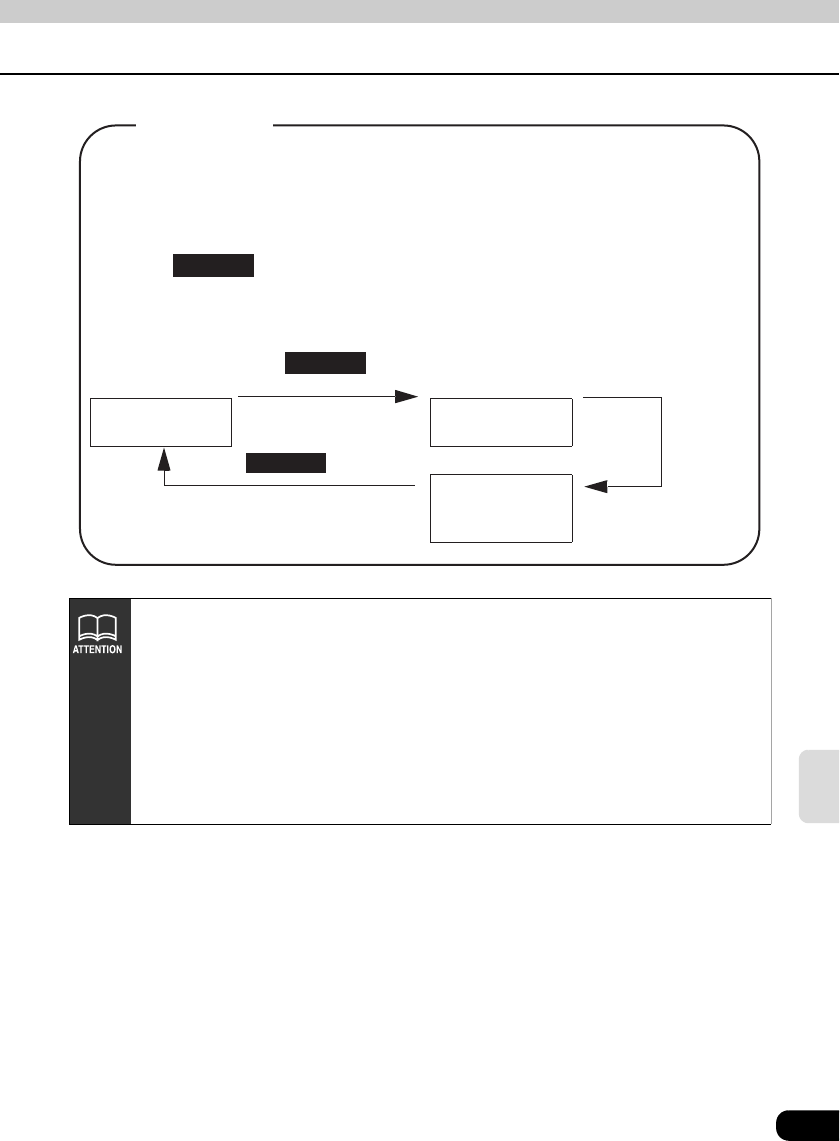
123
TV
AUTO.P
AUTO.P
Touch
until
you hear a beep.
Manual AUTO.P
(Search started)
AUTO.P
(Search
completed)
Automatically saving
channels to preset switches
(The channels saved with
AUTO.P will be deleted)
Touch AUTO.P
Because the AUTO.P function can be used to temporarily save channels for the
preset switches, channels saved manually will remain in memory even if AUTO.P is
used. Manually saving channels that are used regularly allows them to be restored
even after AUTO.P has been used, such as after traveling.
Touching while AUTO.P is operating or after it has been used will return
the preset memories to their previous settings. (The channels saved with AUTO.P
will be deleted.) The diagram below shows how to switch between AUTO.P and
manual.
About AUTO.P
• AUTO.P may not automatically receive channels if TV waves in the surrounding
area are weak.
• A frequency saved with the tuning switch may not match the channel saved with
AUTO.P even though the signal is received from the same station.
• Due to conditions for receiving TV waves, saved channels may differ even when
the AUTO.P switch is operated repeatedly in the same location.
• Up to eight channels with good signal reception are automatically saved in
channel order (low to high).
• When less than eight channels capable of reception are found, nothing is saved
for the remaining preset switches.
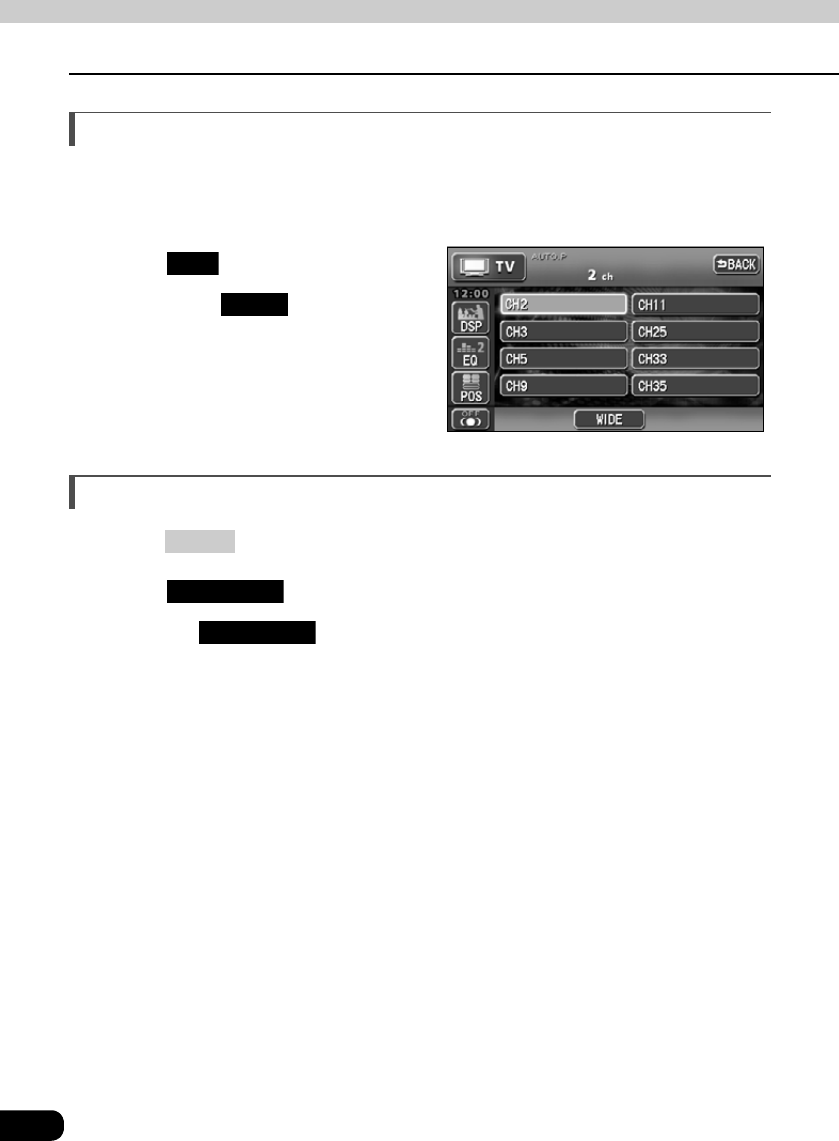
124
How to use the TV
How to operate the TV tuner
Switching the TV setting screen
Various setting mentioned below can be made by switching to the TV setting screen.
• Switching the display mode (wide mode)
• Memorizing channel number manually.
Touch .
• By touching , the display will
return to the TV operation screen.
Turning off the TV mode
Press .
Touch .
• Touching again on the MAIN MENU screen to turn on the TV and
resume reception of the channel received before power was turned off.
SET
BACK
MENU
AUDIO OFF
AUDIO OFF
125
TV
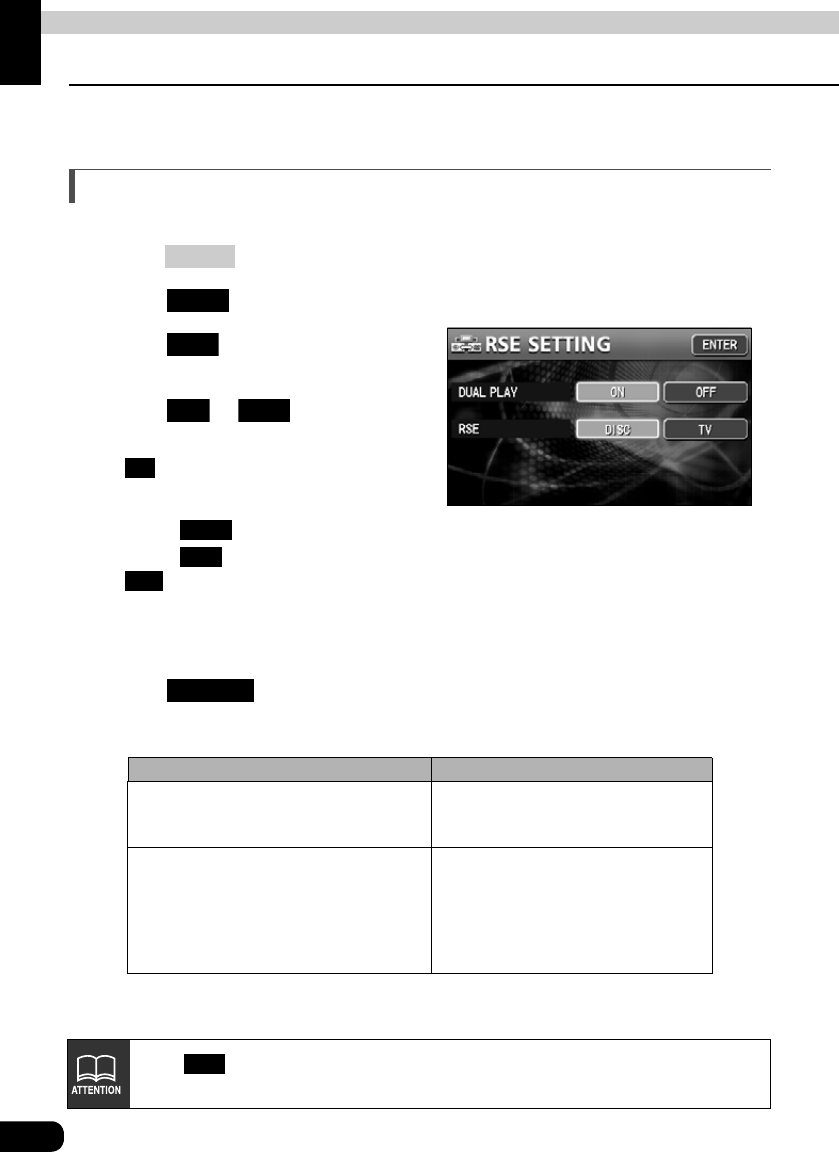
126
How to operate the DUAL PLAY
How to use the DUAL PLAY
The DUAL PLAY function provides another audio system (DVD, TV, CD, MP3/WMA) specially
for rear seat passengers by using the optional rear seat monitor.
Setting the rear seat monitor
Setting of rear seat monitor can be made.
Press .
Touch .
Touch on the
INFORMATION screen.
Touch or for DUAL
PLAY.
• :The rear seat monitor provides
audio and video separately from
the front seats.
When is selected, DVD, CD or MP3/WMA will be played.
When is selected, the TV broadcasting will be received.
• : The rear seat monitor does not provide audio and video.
When the DVD, TV or VTR is selected for front seats, the same audio/video as
the front seats will be output.
• When the DUAL PLAY is set to ON, the audio for rear seat passengers can be
operated with the optional remote control [RRC106].
Touch .
• In the DUAL PLAY mode, the combinations of the Audio functions that can be
selectable are as following:
Selected Audio mode for Front seat Selected Audio mode for Rear seat
• AM/FM (analog broadcasting)
• DISC (DVD·CD·MP3/WMA)
•TV
• DISC (DVD·CD·MP3/WMA)
•TV
•HD Radio
• SIRIUS satellite radio
• XM satellite radio
•iPod
• CD changer
•VTR
• DISC (DVD·CD·MP3/WMA)
*TV cannot be selected.
MENU
INFO
RSE
ON OFF
ON
•DISC
•TV
OFF
ENTER
• The button is displayed only when the optional TV tuner is connected.
• The audio for rear seat passengers is output from rear monitor built-in speakers.
TV
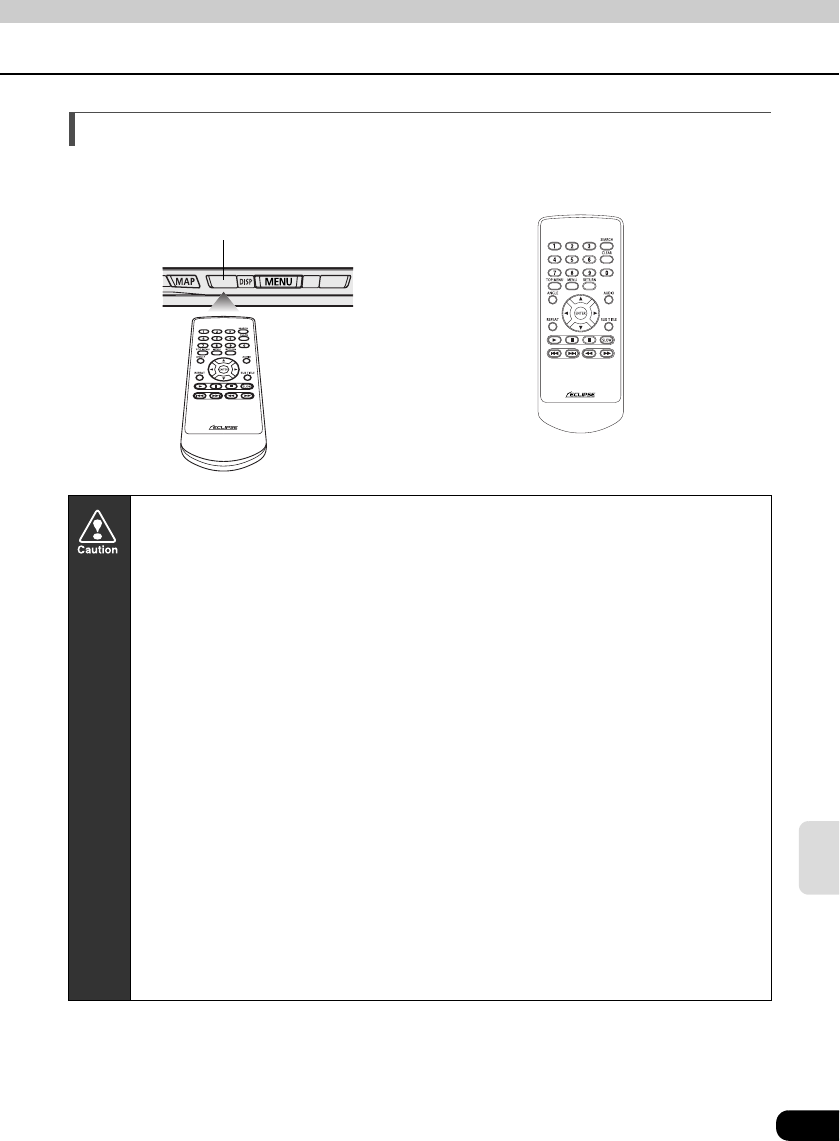
127
DUAL
PLAY
Operating the rear seat monitor
The rear seat monitor can be operated using a dedicated remote control.
Precautions in use of the remote control
• Be careful when handling the remote control, especially because it is small and
light. Dropping or striking it hard may damage it, wear out the battery or cause a
malfunction.
• Keep the remote control free of moisture, dust and water. Do not subject it to
shock.
• Do not place the remote control unit where it will get hot, such as on the
dashboard or near a heater vent. Allowing the remote control unit to overheat
may warp its case or cause other problems.
• Do not operate the remote control unit while driving because doing so could
cause an accident.
• When using the remote control, point it directly at the remote control light
receptor on the main unit.
• The light receptor may not operate correctly if it is exposed to bright light such as
direct sunlight.
• Remove the batteries from the remote control unit whenever it is not to be used
for a long time.
Cleaning the remote control
• Use a dry cloth to keep the unit clean. If the remote control unit gets extremely
dirty, clean it with a cloth moistened in diluted liquid detergent. Do not use
alcohol or thinner; these compounds may damage the finish.
• In no event should benzine or thinner be used. These substances will damage
the case or finish.
Remote-Control light
receptor
Optional remote control (RRC106)
for DUAL PLAY operation
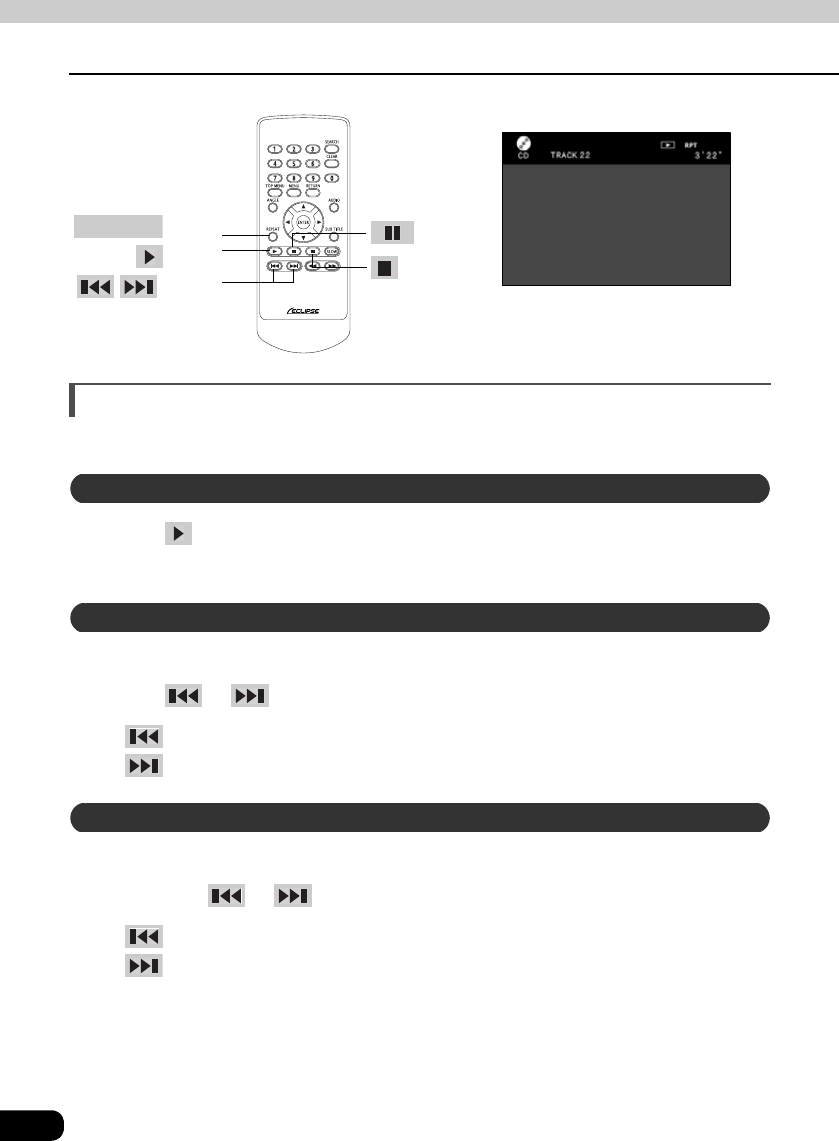
128
How to use the DUAL PLAY
How to operate the DUAL PLAY
How to play CD
The remote control is operable only when CD is inserted in the disc slot.
Press .
• It will start playing.
You can select a song you want to hear.
Press or .
• :Selects previous song.
:Selects next song.
It is possible to fast-forward/rewind the song played currently.
Hold down or .
• :Rewinds.
:Fast-forwards.
The main unit will continue to fast-forward (rewind) until your finger is removed
from the switch.
button
button
REPEAT
button
button
buttons The screen display of rear seat monitor
Listening to CD
Selecting a song
Fast-forwarding/rewinding
129
DUAL
PLAY
Press .
• Pressing once will cause repeating of the song until the function is
canceled.
Pressing again will cancel repeating of the song.
Press .
• Pressing will restart playing the song.
Press .
Repeating a song
REPEAT
REPEAT
REPEAT
Pausing a song
Stopping a song
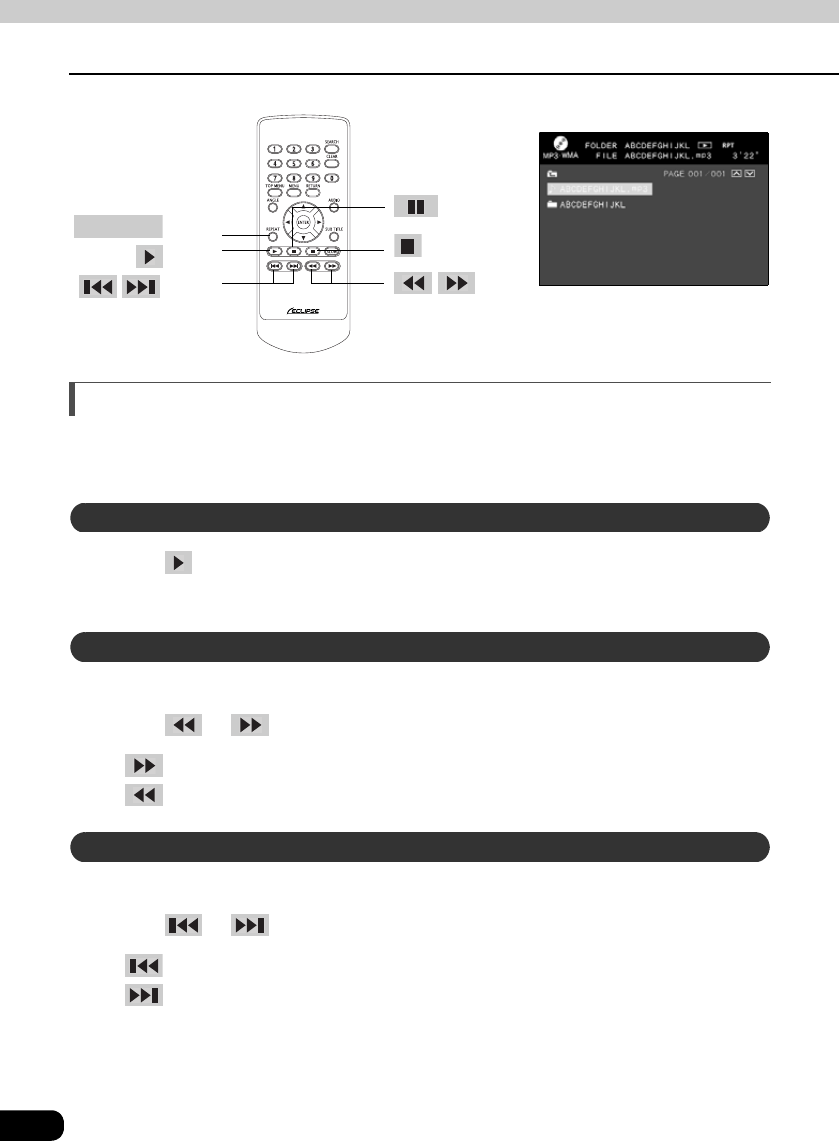
130
How to use the DUAL PLAY
How to operate the DUAL PLAY
How to play MP3/WMA
The remote control is operable only when CD (MP3/WMA) is inserted in the disc slot.
• For details of MP3/WMA, refer to "About MP3/WMA" (on page 77).
Press .
• It will start playing.
A folder located within a disc can be selected.
Press or .
• :Selects previous folder.
:Selects next folder.
A music file located within a folder can be selected.
Press or .
• :Selects previous song.
:Selects next song.
button
button
REPEAT
button
button
buttons buttons
The screen display of rear seat monitor
Playing MP3/WMA
Selecting a folder
Selecting a music file
131
DUAL
PLAY
It is possible to fast-forward/rewind the song played currently.
Hold down or .
• :Rewinds.
:Fast-forwards.
The main unit will continue to fast-forward (rewind) until your finger is removed
from the switch.
Press .
• Pressing once will cause repeating of the song until the function is
canceled.
Pressing again will cancel repeating of the song.
Press .
• Pressing will restart playing the song.
Press .
Fast-forwarding/rewinding
Repeating the same music file
REPEAT
REPEAT
REPEAT
Pausing a song
Stopping a song
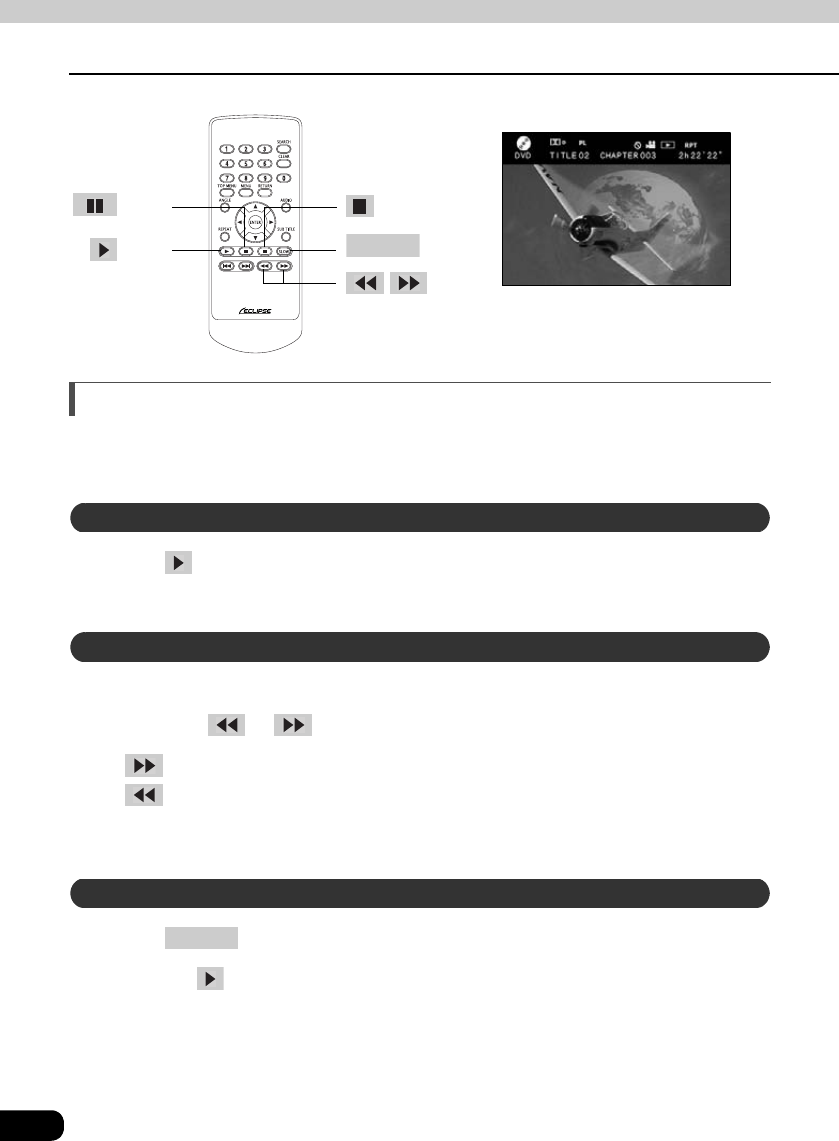
132
How to use the DUAL PLAY
How to operate the DUAL PLAY
How to play DVD
The remote control is operable only when DVD is inserted in the disc slot.
• For details of DVD operation, refer to "Before using the DVD player" (on page 94).
Press .
• It will start playing.
It is possible to fast-forward/rewind the video played currently.
Hold down or .
• :Rewinds
:Fast-forwards
The main unit will continue to fast-forward (rewind) until your finger is removed
from the switch.
Press .
• Pressing will cancel the slow motion.
button
button
SLOW
button
buttons
button
The screen display of rear seat monitor
Watching a DVD
Fast-forwarding/rewinding
Playing the video in slow motion
SLOW
133
DUAL
PLAY
Press .
• Pressing will restart playing the video.
Press .
Pausing the video
Stopping the video
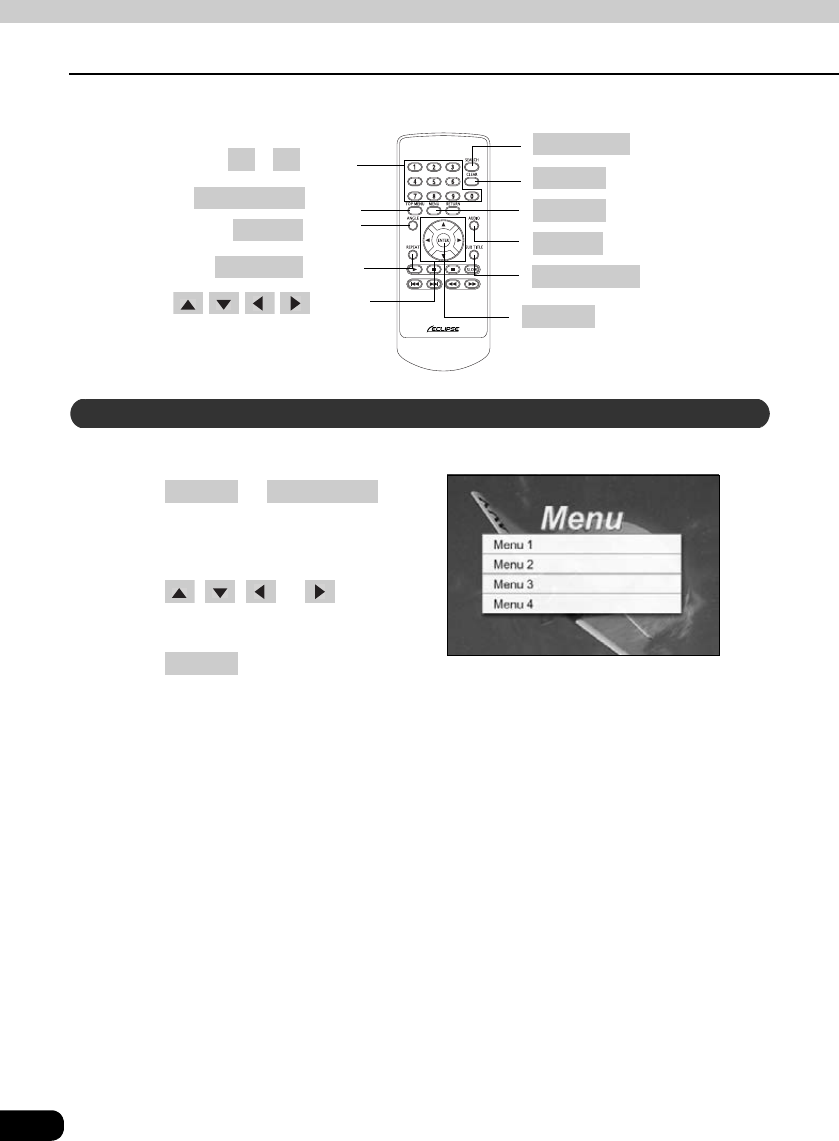
134
How to use the DUAL PLAY
How to operate the DUAL PLAY
It is possible to use the menu recorded on the disc.
Press or .
• The disc menu or the TOP MENU
screen will be displayed.
Press , , or to select
the video to play.
Press .
button
CLEAR
button
ENTER
buttons
button
AUDIO
button
TOP MENU
button
SEARCH
button
SUB TITLE
- buttons
0 9
button
ANGLE
button
REPEAT
button
MENU
Operating the disc menu
MENU TOP MENU
ENTER
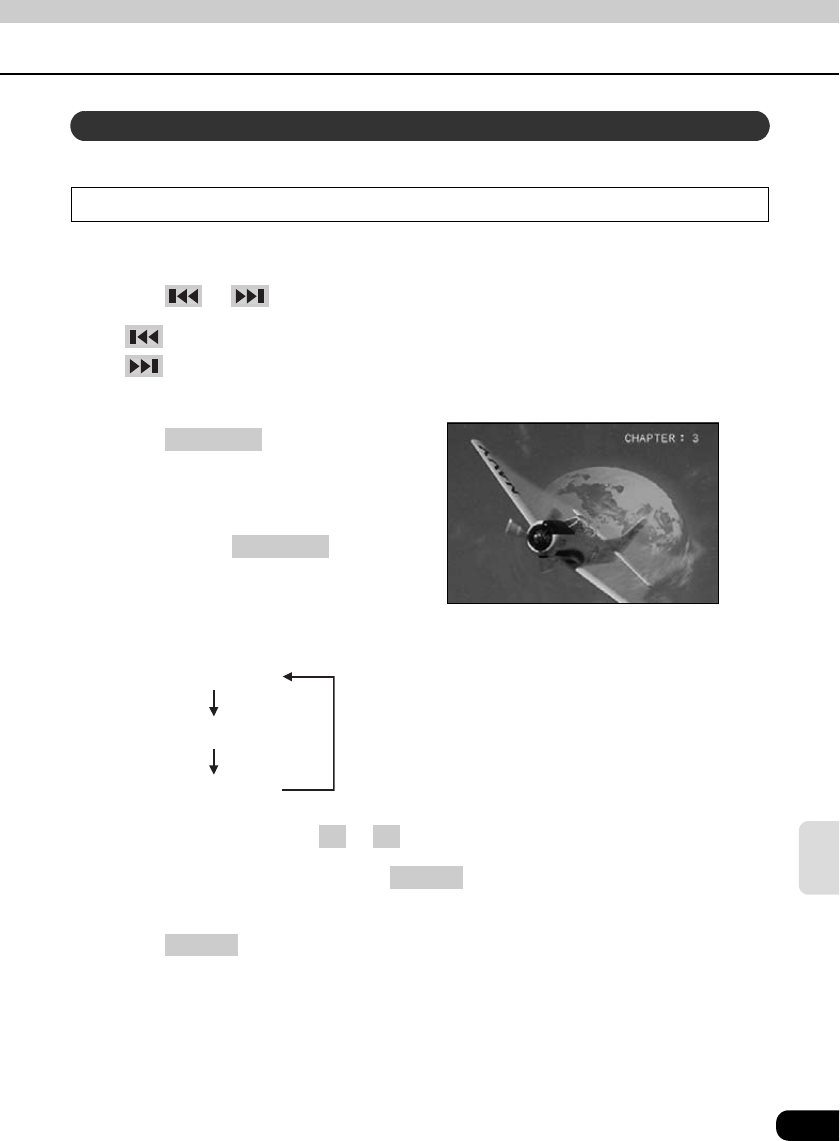
135
DUAL
PLAY
A video that you want to watch can be searched by its title or chapter.
Searching a video by chapter
■ Searching a video by manually
Press or .
• :Select previous chapter
:Select next chapter
■ Searching a video by chapter number
Press to enter the
chapter search mode.
• The chapter number entering screen
will be displayed.
• Each time the is pressed,
the search mode will be switched in
the order shown below.
Use a numeric keypad ( to ) to enter the chapter number.
• If you have made a mistake, press to delete the number that you have
entered.
Press .
Selecting the video
SEARCH
SEARCH
Chapter search mode
Title search mode
Search mode off
0 9
CLEAR
ENTER
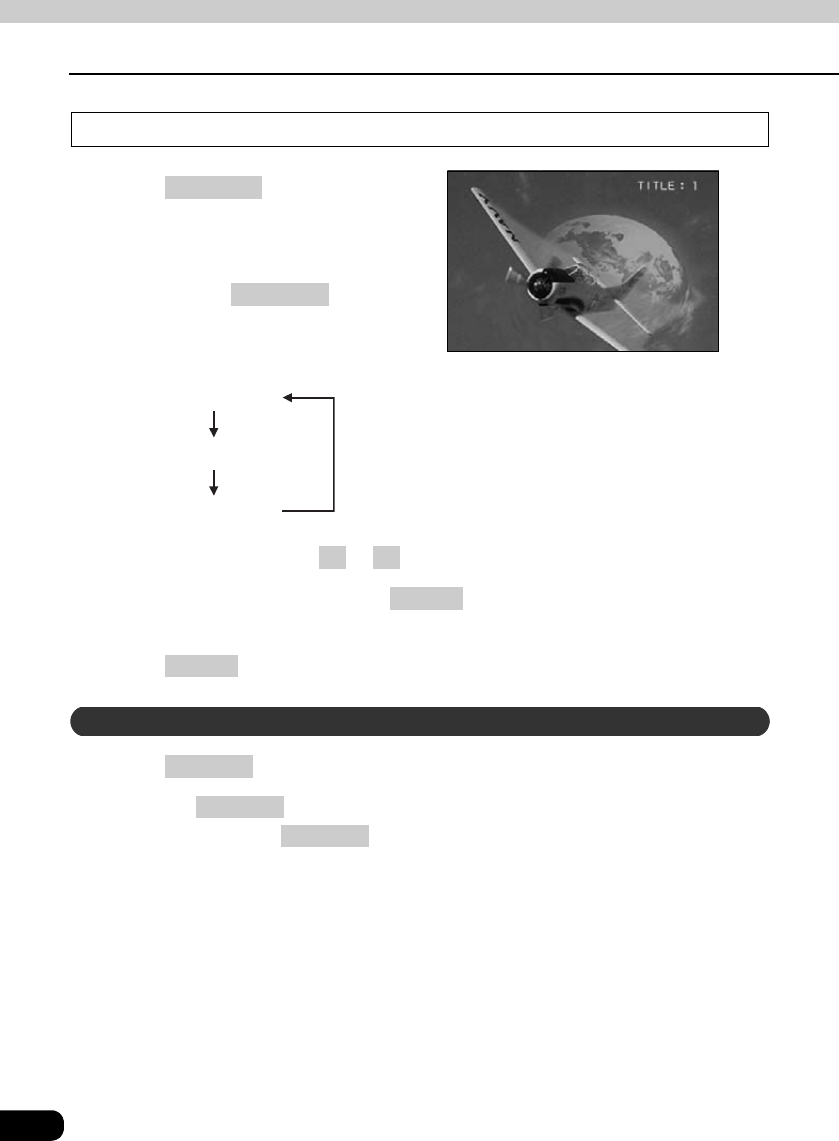
136
How to use the DUAL PLAY
How to operate the DUAL PLAY
Searching a video by title number
Press to enter the title
search mode.
• The title number entering screen will
be displayed.
• Each time the is pressed,
the search mode will be switched in
the order shown below.
Use a numeric keypad ( to ) to enter the title number.
• If you have made a mistake, press to delete the number that you have
entered.
Press .
Press .
• Pressing once will cause repeating of the video until the function is
canceled. Pressing again will cancel repeating of the video.
SEARCH
SEARCH
Chapter search mode
Title search mode
Search mode off
0 9
CLEAR
ENTER
Repeating the same chapter
REPEAT
REPEAT
REPEAT
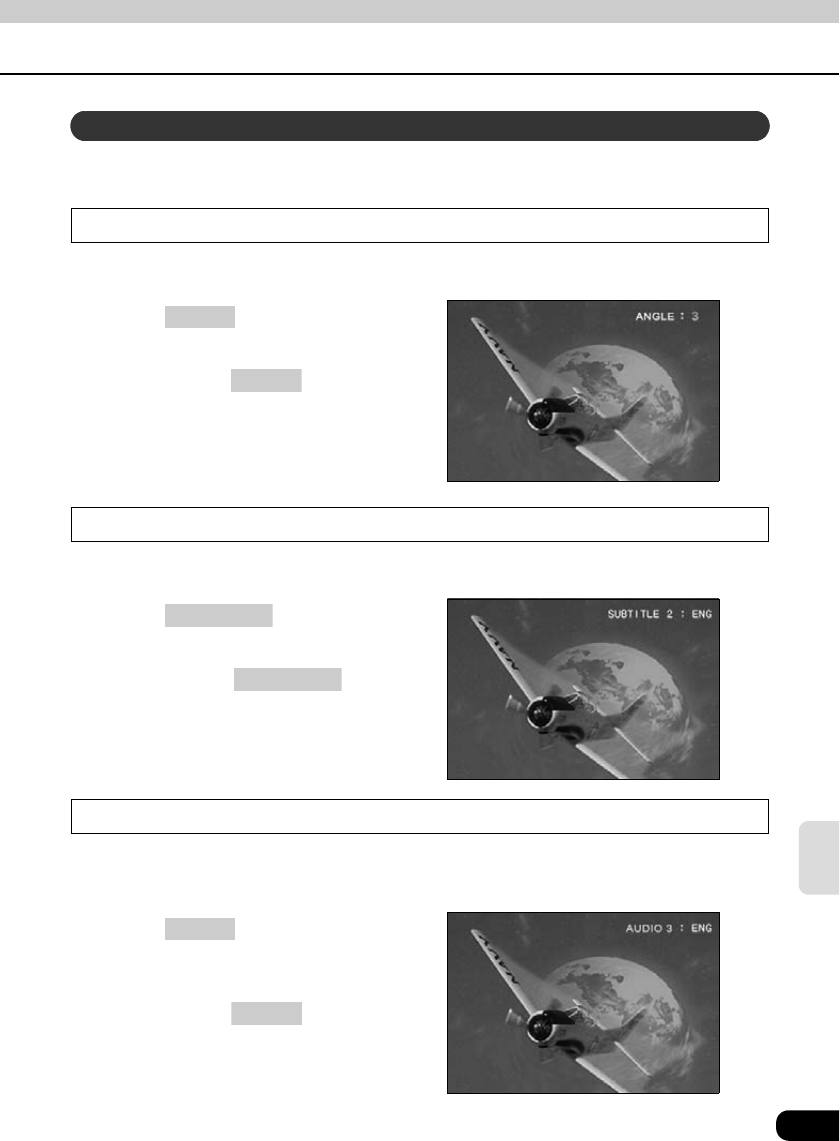
137
DUAL
PLAY
It is possible to change the language for subtitles , the language for audio and the display
angle for the video being played.
Switching the video angle
When several angles of a scene are recorded on a disc, the angle can be switched.
Press .
• The angle number will be displayed.
• Each time the is pressed, the
angle number will change and the
angle of video will be switched.
Switching subtitle languages
When subtitles in several languages are recorded on a disc, the subtitles can be switched.
Press .
• The subtitle number will be displayed.
• Each time the is
pressed, the sub title number will
change and the sub title language will
be switched.
Switching dubbed audio language
When dubbed voices in several languages are recorded on a disc, the voices can be
switched.
Press .
• The audio number and language will
be displayed.
• Each time the is pressed, the
audio number will change and the
language of voices being played will
be switched.
Switching between screen display and audio
ANGLE
ANGLE
SUB TITLE
SUB TITLE
AUDIO
AUDIO
138
How to use the DUAL PLAY
How to operate the DUAL PLAY
When a restricted DVD is inserted, the password entering screen is displayed. Enter the
password to watch the restricted DVD.
Use a numeric keypad ( to ) to enter the password.
• If you have made a mistake, press to delete the number that you have
entered.
Press .
Watching a restricted DVD
0 9
CLEAR
ENTER
• For details of parental restriction and password, refer to "Viewer restriction
setting" (on page 114).
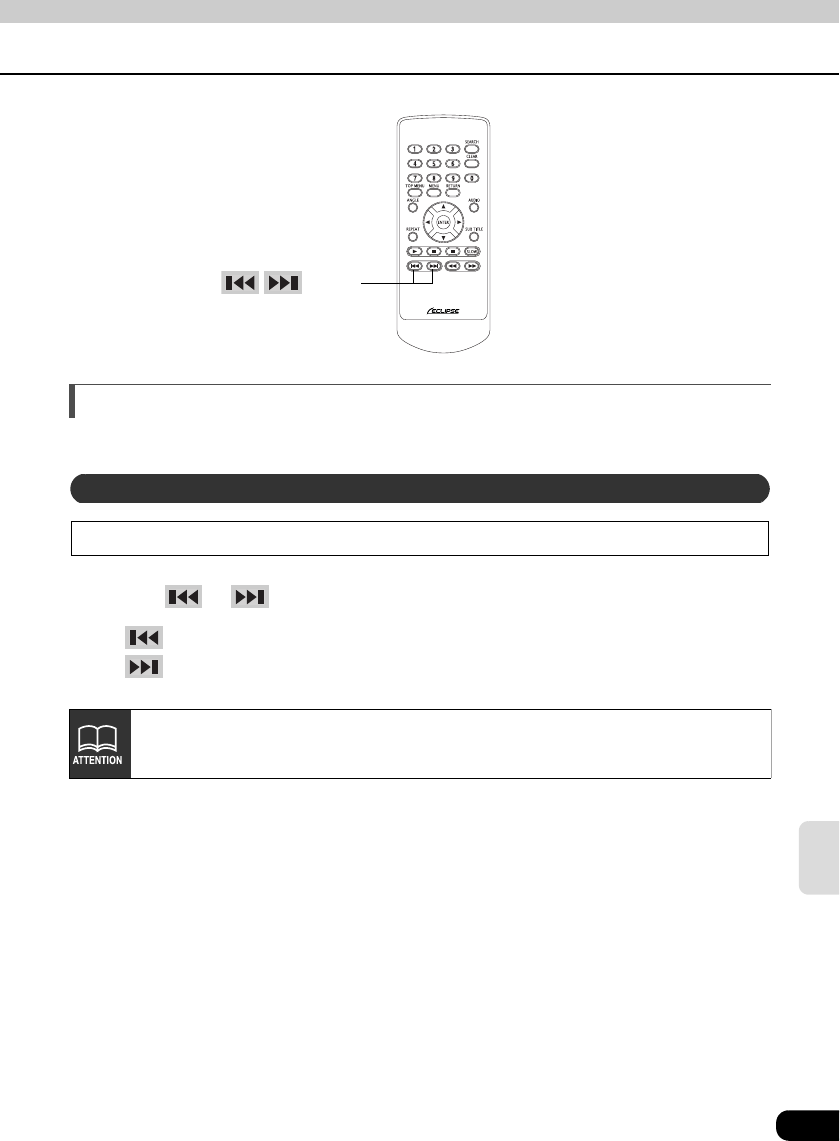
139
DUAL
PLAY
How to watch TV
It is operable when an optional TV tuner is connected.
Selecting a channel manually
Press or .
• :Channel down (descending).
:Channel up (ascending).
buttons
Selecting a channel
The TV channel number is not displayed on the rear seat monitor.
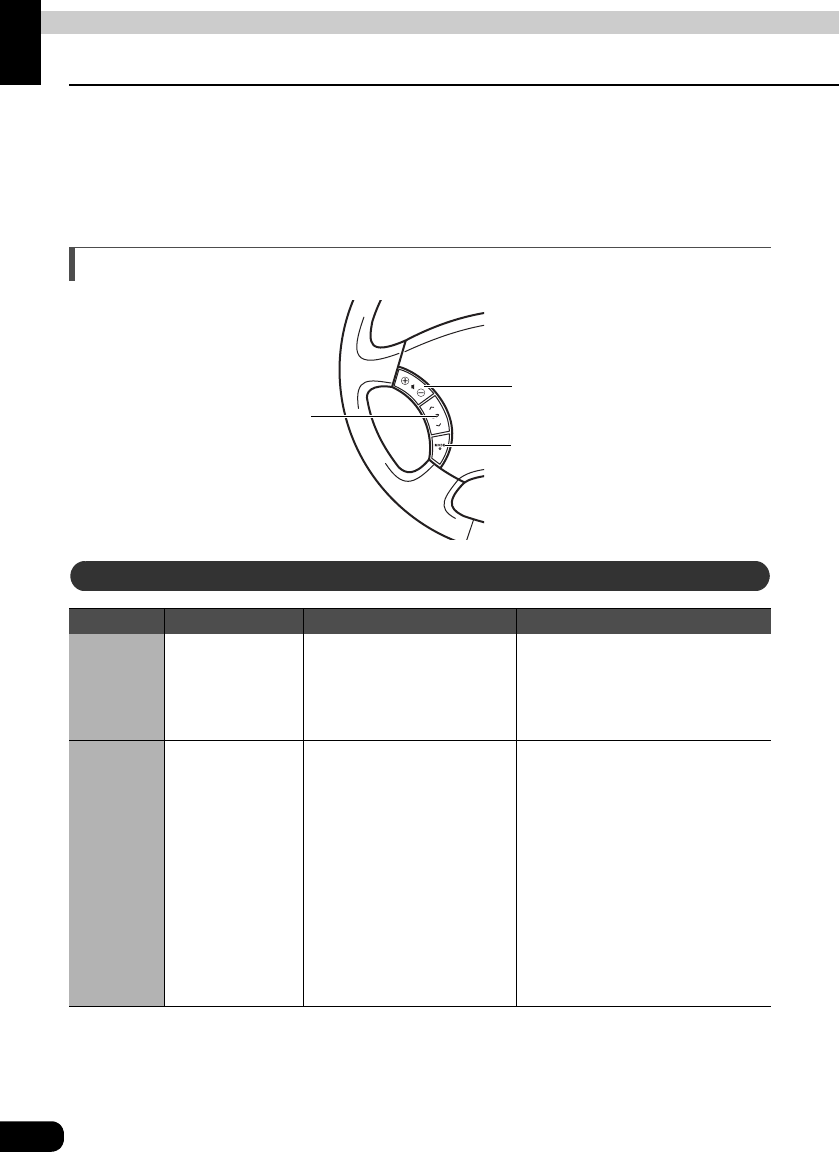
140
How to use the steering wheel switch
About the steering wheel switches
On vehicles equipped with steering wheel switches, these easy-access switches can be
used to perform the main audio and other operations.
• For details of the steering wheel switch, please contact your local dealer.
• This function may not be used depending on the vehicle type.
Function names and summaries
Switch Name Function Explanation of operation
(+)
(–) Volume switch
Each momentary actuation
of these switches changes
the volume one step.
Hold a switch down for a
continuous volume change.
(+): Volume UP
(–) : Volume DOWN
(MODE) Mode selection
switch
• When the power is OFF,
pressing this switch turns
it ON.
• The mode changes.
FM1 → FM2 → FM3 →
CD → MP3/WMA → (CD
changer) → DVD → (TV)
→ (VTR) → (iPod) → AM
→ (SIRIUS) → (XM) →
return to FM1
• Press the switch until it
beeps to turn the power
OFF.
Each time (MODE) is pressed
while the power is ON, the mode
changes.
( ) : Optional
Channel selection (radio) switches
Track selection (CD/CD changer,
MP3/WMA mode) switch
Chapter selection (DVD) switch
Volume switch
Mode selection switch
Common operations
141
Steering Wheel
Switch
Switch Name Function Explanation of operation
(∧)
(∨)
Channel
selection switch
• Calls up the preset
broadcast channels in
order.
• Pressing the switch until it
beeps starts automatic
channel selection.
Pressing (∧)/(∨) briefly:
Used to select the next or
previous preset channel
Pressing (∧)/(∨) for longer:
Starts automatic channel
selection.
Switch Name Function Explanation of operation
(∧)
(∨)
Track selection
switches
Selects the next track or
previous track or beginning
of the current track.
(∧): Used to select the next track.
(∨): Used to select the previous
track.
Switch Name Function Explanation of operation
(∧)
(∨)
Channel
selection
switches
• Selects the next preset
channel or previous
preset channel.
• Pressing the switch until it
beeps to start searching
channels within the
selected category.
Pressing (∧)/(∨) briefly:
Used to select the next or
previous preset channel
Pressing (∧)/(∨) for longer:
Starts searching channels
within the selected category.
Switch Name Function Explanation of operation
(∧)
(∨)
Track selection
switches
• Selects the next file or
previous file.
• Pressing the switch until it
beeps to go to the next
folder or previous folder.
Pressing (∧)/(∨) briefly:
Used to select the next or
previous file
Pressing (∧)/(∨) for longer:
Used to select the next or
previous folder
Radio operations
CD player operations
SIRIUS/XM satellite radio tuner operations
MP3/WMA Player operations
142
About the steering wheel switches
How to use the steering wheel switch
Switch Name Function Explanation of operation
(∧)
(∨)
Chapter selection
switches
Selects the next chapter or
previous chapter.
(∧): Used to select the next
chapter.
(∨): Used to select the previous
chapter.
Switch Name Function Explanation of operation
(∧)
(∨)
Track selection
switches
• Selects the next track or
previous track or
beginning of the current
track.
• Press the switch until it
beeps to go to the next
disc or previous disc.
Pressing (∧)/(∨) briefly:
Used to select the next track
or previous track.
Pressing (∧)/(∨) for longer:
Used to select the next disc
or previous disc.
Switch Name Function Explanation of operation
(∧)
(∨)
Channel
selection switch
• Pressing the switch until it
beeps starts automatic
channel selection.
Pressing (∧)/(∨) for longer:
Starts automatic channel
selection.
DVD operations
CD changer operations
TV operations
143
Steering Wheel
Switch
144
How to use an optional remote control
How to use an optional remote control (RMC105)
Precautions in use of the remote control
• Be careful when handling the remote control, especially because it is small and
light. Dropping or striking it hard may damage it, wear out the battery or cause a
malfunction.
• Keep the remote control free of moisture, dust and water. Do not subject it to
shock.
• Do not place the remote control unit where it will get hot, such as on the
dashboard or near a heater vent. Allowing the remote control unit to overheat
may warp its case or cause other problems.
• Do not operate the remote control unit while driving because doing so could
cause an accident.
• When using the remote control, point it directly at the remote control light
receptor.
• The light receptor may not operate correctly if it is exposed to bright light such as
direct sunlight.
• Remove the batteries from the remote control unit whenever it is not to be used
for a long time.
Cleaning the remote control
• Use a dry cloth to keep the unit clean. If the remote control unit gets extremely
dirty, clean it with a cloth moistened in diluted liquid detergent. Do not use
alcohol or thinner; these compounds may damage the finish.
• In no event should benzine or thinner be used. These substances will damage
the case or finish.
TU, DISC and AUX buttons do not work.
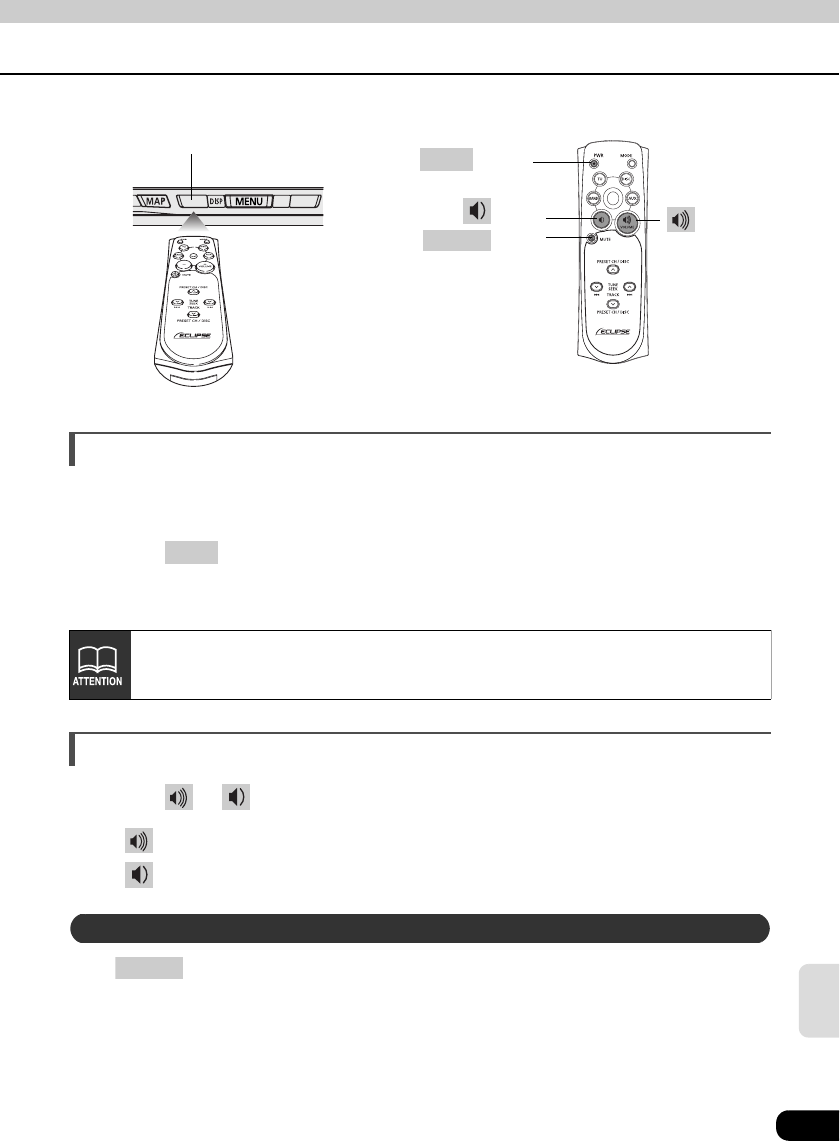
145
Remote
control
Turning the power on/off
When the power is turned on, the state used when the power was turned off such as CD and
tuner will be restored.
Press .
• The power turns on or off each time the button is pressed.
Adjusting the audio volume
Press or .
• button: Increases the volume.
button: Decreases the volume.
Press to cut the volume or restore it instantly.
Remote-Control light
receptor
button
PWR
button
MUTE
button
button
PWR
When the main unit is shut down, the remote control will not work.
Muting the Volume
MUTE
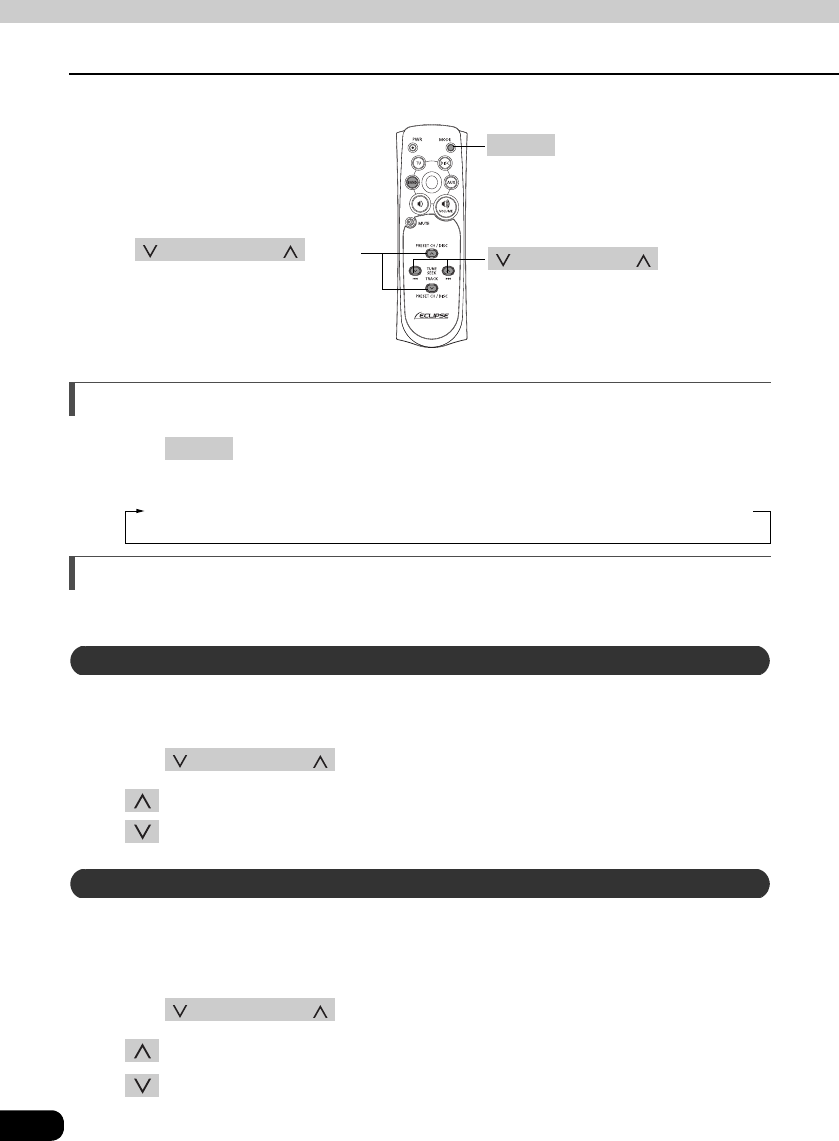
146
How to use an optional remote control (RMC105)
How to use an optional remote control
Switching playback modes
Press .
• Press the button to switch modes in the following sequence:
AM
→
FM
→
CD(MP3/WMA)
→
(CD Changer)
→
DVD
→
(TV)
→
(VTR)
→
(SIRIUS)
→
(XM)
→
(iPod)
How to play the tuner
Select the tuner mode first.
A short press of the button will allow manual station tuning. Pressing for more than one
second will start automatic tuning.
Press .
• button: Tunes to higher frequency stations.
button: Tunes to lower frequency stations.
A total of six stations may be selected (preset tuning) out of those already set in memory
through the main unit. (Refer to the Section "Saving radio stations" on page 53)
This function is not available for TV.
Press .
• button: Select the next higher number preset button.
button: Select the next lower number preset button.
button
MODE
button PRESET•CH button TUNE•SEEK
MODE
Selecting a station (manually or automatically)
TUNE•SEEK
Selecting preset stations
PRESET•CH
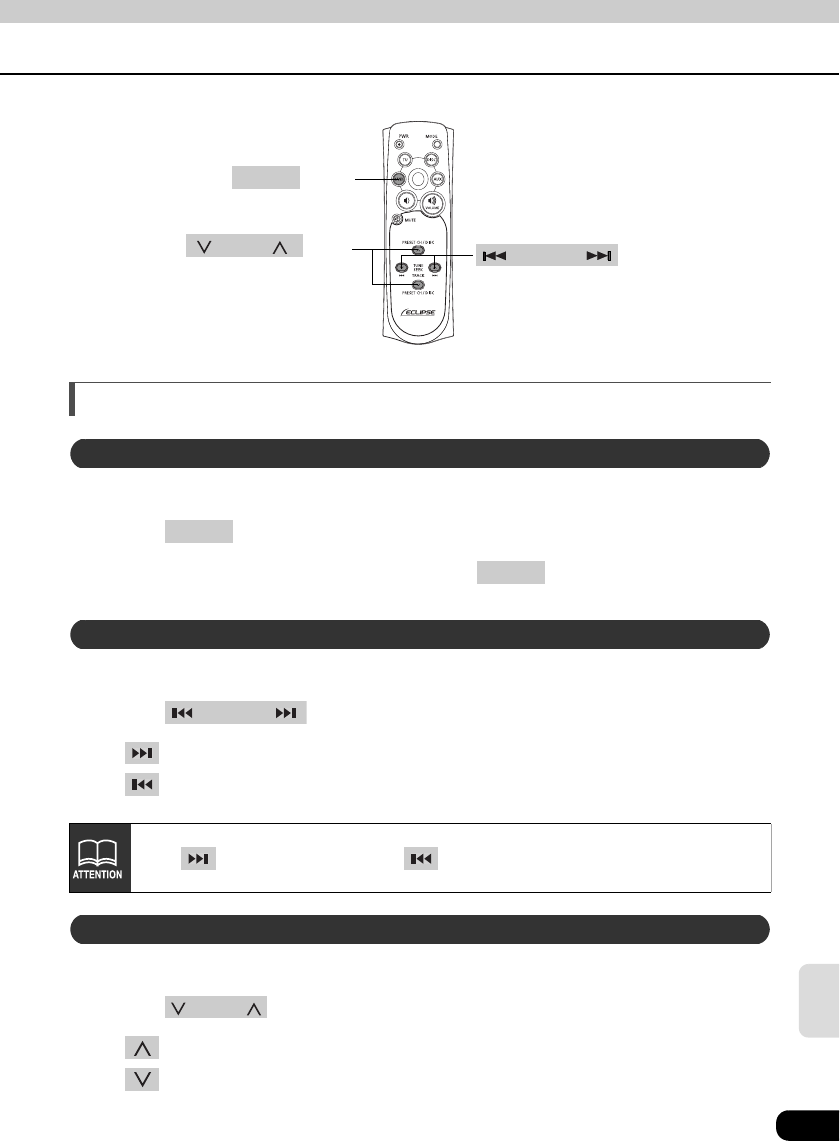
147
Remote
control
How to play CDs
Select the CD Changer (optional) mode first.
Press .
• When two CD changers are connected, press to change modes from CD
changer 1 → CD changer 2.
Select the CD or CD Changer (optional) mode first.
Press .
• button: Skips to the next track.
button: Returns to the beginning of the track being played. (Press repeatedly to
move to previous tracks.)
Select the CD or CD Changer (optional) mode first.
Press .
• button: Selects the next higher number disc.
button: Selects the next lower number disc.
button TRACK
button
BAND
button DISC
Switching CD Changer modes
BAND
BAND
Advancing to the next track or returning to the beginning of the track being played
TRACK
Hold down to fast forward, or to rewind through the track being played.
Skipping to the next or previous disc
DISC
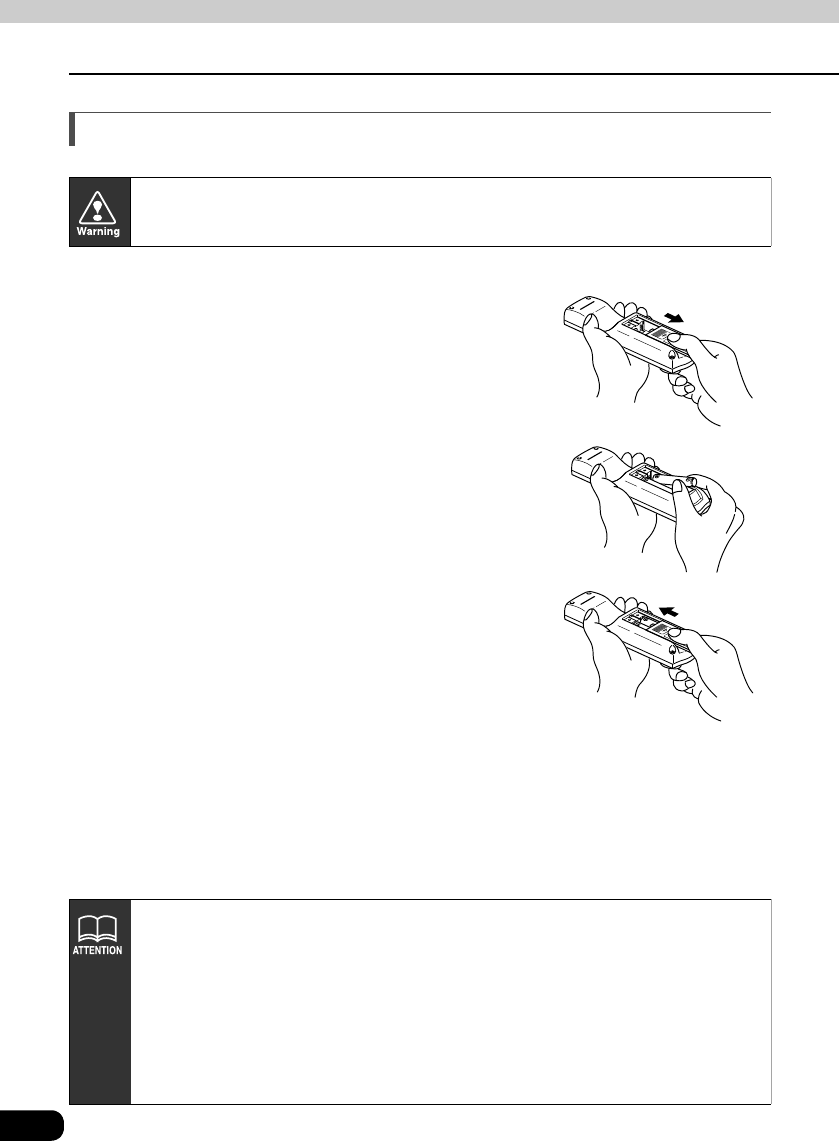
148
How to use an optional remote control (RMC105)
How to use an optional remote control
Replacing the battery
Use two AAA-size batteries.
Remove the back cover of the remote control
unit by gently pressing and sliding it in the
direction indicated by the arrow.
Install the two batteries provided into the
compartment as illustrated.
Return the back cover into place by sliding it in
the direction indicated by the arrow.
To prevent accidents, store batteries out of the reach of children. If a child has
swallowed one, consult a doctor immediately.
• The battery life is approximately one year. If the remote control unit does not
operate correctly or if the button lamp gets dim, replace the batteries.
• Be sure to orient the batteries correctly so that the positive and negative poles
match the diagram.
• Do not use one new battery and one old one; use two new batteries.
• Only use two of the same type of battery.
• If any liquid is seen leaking from the batteries, remove both batteries and
dispose of them properly. Thoroughly clean the battery compartment with a dry
cloth. Then install new batteries.
149
Remote
control
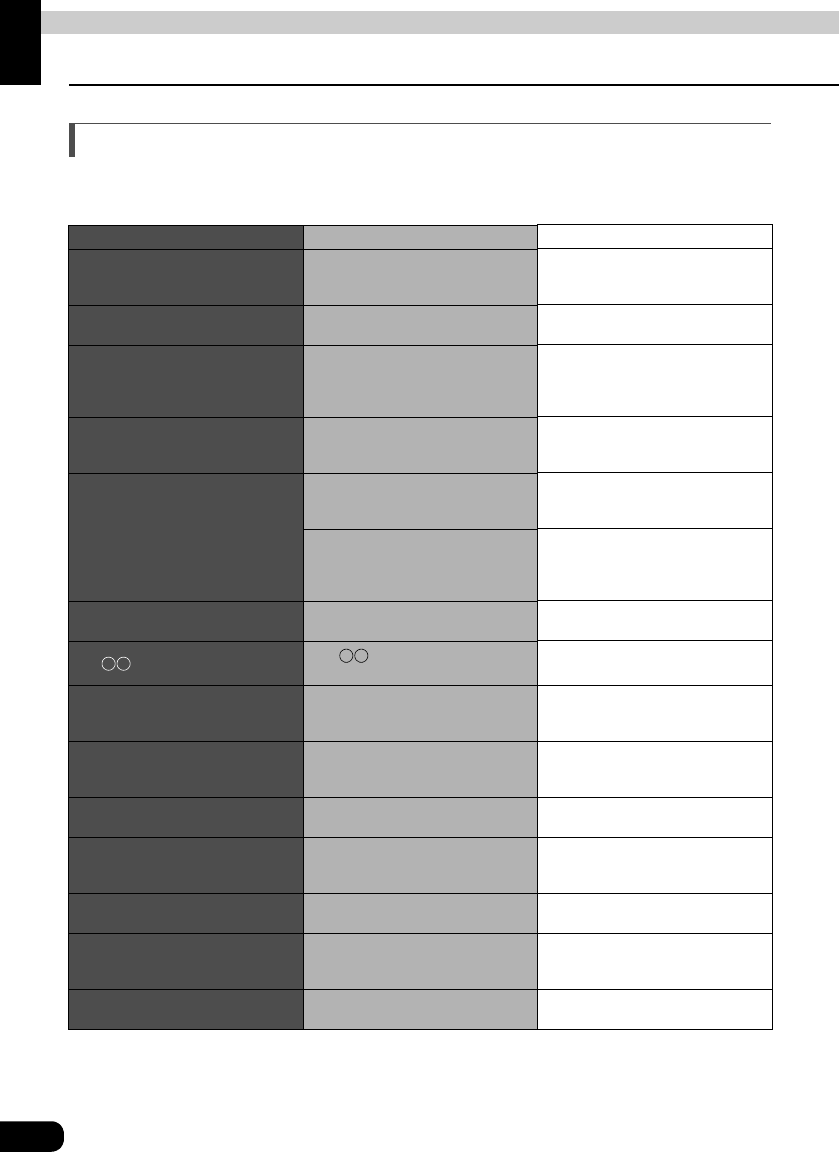
150
For reference
Information you should know
If one of these messages appears
If any of the following messages are displayed, check the equipment while referring to the
Cause and Corrective action columns.
1: If the unit will not work after the disk is ejected, contact your local retailer.
2: If this happens, wait for a while. When the temperature inside the equipment returns to
normal, the message will disappear and playback will start. If the message does not
disappear after a long period of waiting, contact the place of purchase.
Messages Cause Corrective action
CD SEEK
The CD changer is searching for
discs when a magazine has been
set in the CD changer.
Wait until the unit has finished
identifying the type of disc.
CD DOOR OPEN The door of the CD changer is
open. Close the door of the CD changer.
DISC CHECK
The CD/MP3·WMA/DVD is dirty,
scratched, warped or upside
down.
Clean the disc if it is dirty. Insert
the disc correctly if it is
upsidedown. Do not use the
scratched or warped disc.
NO DISC
NO CD
There is no disc in the CD/
MP3·WMA/DVD player or CD
changer.
Load a music disc (1).
CD ERROR
DVD ERROR
DISC ERROR
The CD/MP3·WMA/DVD player or
CD changer is not operating for
some reason.
Eject the disc.
The temperature of the CD/
MP3·WMA/DVD player or CD
changer has become unusually
high.
Without performing any other
operations, wait until the
temperature comes down (2).
NO CD MAGAZINE There is no magazine in the CD
changer. Load a magazine.
CD CHECK The th CD in the CD changer
cannot be read.
Check for a properly loaded music
CD.
PASS CODE INCORRECT
This message is displayed when
the pass code that has been
entered is not correct.
Enter the correct pass code.
PARENTAL LOCK
ENABLED Viewing restrictions are enabled.
Change the setting for viewing
restrictions and start again. (Refer
to page 114.)
CURRENTLY THIS FUNCTION IS
DISABLED
A function that has been disabled
was selected with the menu.
Follow the directions on the screen
and start again.
CURRENTLY THIS FUNCTION IS
DISABLED
A function that cannot be used
while the vehicle is in motion was
selected.
Stop the vehicle and set the
emergency / parking brake.
INVALID CODE A number not supported was input
for selecting a language code. Input a valid language code.
REGION CODE ERROR
The region code (controlled region
for playback) of the disc isn't
acceptable.
Check that the DVD has a region
code that can be played on this
equipment. (Refer to page 96.)
REQUESTED CHAPTER OR TITLE
NOT FOUND
The selected chapter/title does not
exist.
Select a chapter/title that is on the
disc.
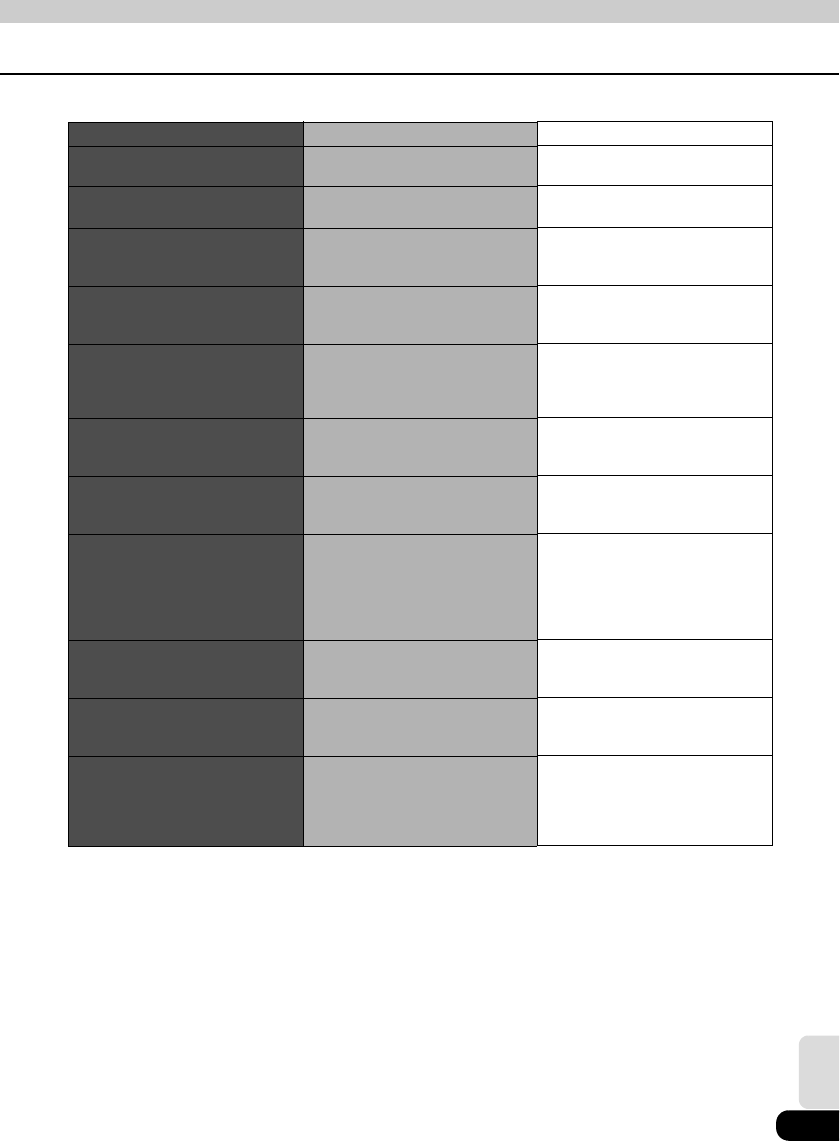
151
For reference
Messages Cause Corrective action
EJECT LOCK The loaded disc cannot be
ejected.
Contact the Eclipse dealer at
(800)-233-2216.
ANTENNA The SIRIUS/XM antenna is
disconnected.
Check the connection of the
SIRIUS/XM antenna.
ACQUIRING
Displayed when the SIRIUS
satellite radio signal is lost
(during access)
Try receiving the signal again
in the place where there are
no obstacles.
NO SIGNAL
Displayed when the XM
satellite radio signal is lost
(during access)
Try receiving the signal again
in the place where there are
no obstacles.
CALL888-539-SIRIUS
You are tuned to a valid
SIRIUS channel but you are
not subscribed to that
channel.
Subscribe to SIRIUS.
Or, check/change your
subscription plan.
OFF AIR
Displayed when the XM
channel you are tuned to is not
currently on air.
Tune to channels currently on
air.
LOADING
Obtaining audio and
information data for the XM
channel.
Wait for a moment.
SUB UPDATED
Displayed when your SIRIUS
channel subscription has
been accepted and your
status is being updated to
allow you to receive the
channels.
After this message is
displayed, the channels for
which you do have a
subscription can be received.
INVALID
Displayed when you are tuned
to a SIRIUS channel that you
cannot receive.
Tune to channels that you can
receive.
CH- - -
Displayed when you are tuned
to a XM channel that you
cannot receive.
Tune to channels that you can
receive.
UPDATING Displayed while the channel
map is being updated.
After this message is
displayed, subscribe to
SIRIUS/XM. The channels for
which you do have a
subscription can be received.
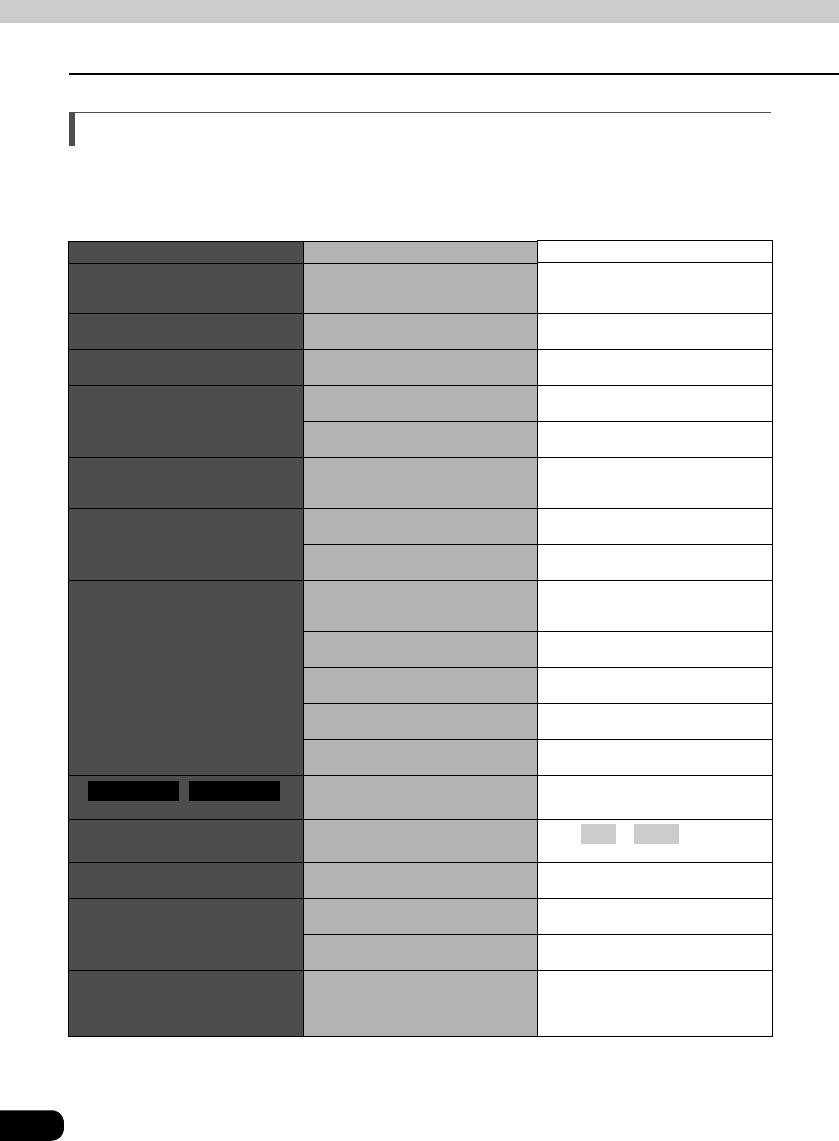
152
Information you should know
For reference
Before asking for repairs
Slight differences in operation can sometimes be mistaken for malfunctions, so check the
following table before asking for any repairs.
If the following fail to solve the problem, contact the place of purchase.
Problem Possible reason Corrective action
The screen is dark for a brief period
when the power is turned on at low
temperatures.
This is a characteristic of LCDs. This is not a malfunction. Wait for a
brief period.
The display is distorted for a brief
period after the power is turned on.
This is a characteristic of LCD
backlighting.
This is not a malfunction. The display
will stabilize after a brief period.
No sound comes out. Volume is poorly adjusted or MUTE is
functioning.
Press the volume switch and check
volume. Or cancel MUTE.
Sound comes out of only one side
(left or right, front or back).
A speaker wire is disconnected. Check the connections of the speaker
wires.
Volume is poorly adjusted. Check the balance and fader
adjustments.
Sound quality does not change even
after making adjustments.
The adjusted audio quality is not
included in the radio broadcast or
disc.
Check by changing the radio station
or disc.
A CD/DVD will not go into the deck.
Power is not turned on. Turn the vehicle ignition switch to
[ACC] or [ON].
A disc is already inserted and you are
trying to insert a second disc.
Eject the previously inserted CD/DVD
and insert the preferred CD/DVD.
A CD/DVD cannot be played.
There is water condensation in the
equipment.
Do not use the equipment for a while
and then try using it again. (Refer to
pages 20.)
There is a large scratch or warp in the
CD/DVD. Insert a different CD/DVD.
The CD/DVD is very dirty. Clean the CD/DVD.
(Refer to page 21.)
The CD/DVD is upside down. Insert the CD/DVD with the proper
orientation.
A non-supported type of CD/DVD has
been inserted.
Insert a CD/DVD that is supported by
the deck. (Refer to pages 20.)
A / is
not displayed on the screen.
The CD changer is not completely
connected.
Check the connections to the CD
changer.
Audio is output, but not video. The screen has been turned off with
the screen OFF button. Press or . (Refer to
page 47.)
Audio is output, but not DVD video.
(With vehicle stopped.)
The emergency / parking brake has
not be set. Set the emergency / parking brake.
Neither video nor audio is output.
The vehicle ignition switch has not
been turned on.
Turn the vehicle ignition switch to
[ACC] or [ON].
The connection wires and cables are
not completely connected.
Check the connections to each
connection wire and cable.
There is a point of light on the display.
At least 99.99% of the pixels on the
LCD panel are effective, but it is
possible that 0.01% of the pixels may
not light or may stay lighted.
This is not a defect, so please use the
equipment in this condition.
CDCHANGER1 CDCHANGER2
AV MAP
For reference
153
For reference
Glossary
CD-R This is a disc that can only be recorded once.
Recorded data cannot be deleted. There are two
types of CD-R, one having capacity of 650MB
(74 minutes of music), the same as a regular CD,
and the other having capacity of 700MB (80
minutes of music).
(Compact Disc Recordable)
CD-DA This disc is the standard for recording and
playing of music data. One track is recorded with
one song, and a maximum of 74 minutes can be
used with the CD.
(Compact Disc Digital Audio)
CD-RW This disc uses a phase transformation method
that enables recording and deleting of data as
many times needed. Capacity is 700MB (80
minutes of music).
(Compact Disc ReWritable)
EQ (Equalizer) This enables setting of stronger or softer playing
of sounds throughout the high to low range of the
sound. Levels can be adjusted to personal
preference, enhancing enjoyment of the music.
MP3 •"MP3" is the abbreviation for "MPEG Audio Layer
3," which is the standard format for compression
of audio data. MP3 technology compresses
sound in the range inaudible to the human ear,
producing a file one tenth the size of the original.
(MPEG-1 Audio Layer-3)
LPCM This is an abbreviation for Linear Pulse Code
Modulation, a signal recording method used with
music CDs. A music CD is recorded at 44.1kHz/
16 bit, but a DVD is recorded at 48kHz/16 bit ~
96kHz/24 bit, enabling a DVD to be played with
higher sound quality than a music CD.
(Linear PCM)
MPEG This is an abbreviation for Moving Picture Experts
Group and is pronounced "empeg". It is the
international standard for moving image
compression. With DVDs, this method is also
used to compress and record digital audio.
Copy Control CD This is a CD that has controls for preventing
computers from copying and ripping (taking
audio information recorded on a compact disc
and using it as data to create a file).
UDF This is one format for use with optical discs not
reliant on the OS. It is used with media such as
DVD and CD-RW.
(Universal Disc Format)
Track The single division for a song on a music CD is
called a track.
154
Glossary
For reference
Viewing Restriction This is a DVD video function that "Restricts
playing of discs that support viewing restrictions,
in accordance with the regulated levels of each
country." Restrictions differ by DVD video and
may completely prevent playing of the video or
may skip or insert alternate scenes for extreme
scenes.
Title This is the largest unit for divisions of video or
songs recorded on a DVD video. Usually a single
movie is treated as a title by video software and a
single album (or song) is treated as a single title
by music software. The consecutive numbers
attached to titles are called title numbers.
Chapter This is a unit for divisions of video or songs
recorded on a DVD video, but it is a smaller unit
than a title. A single title is made up of several
chapters, and the consecutive numbers attached
to chapters are called chapter numbers.
Multi-Angle This is one feature of DVD video, where
viewpoints of the same scene are changed by
recording from several different angles (camera
positions), allowing the viewer to select the
preferred angle.
Multi-Language This is one feature of DVD video, where the same
scene is recorded with several different
languages and subtitles, allowing the viewer to
select the preferred language.
Region Code DVD players and DVD discs have a region code
that enables playing by geographic marketing
regions, and a disc cannot be played if the
number recorded on the disc is not included in
the region codes of the player. Refer to page 96
for details on region codes.

For reference
155
For reference
Index by topic
About screen and sound adjustment
[Regarding screen adjustment]
To make the audio operation screen or VTR screen easier to see
"Adjusting/setting the screen" . . . . . . . . . . . . . . . . . . . . . . . . . . . . . . . . P46
To turn off the screen
"Turning off the screen" . . . . . . . . . . . . . . . . . . . . . . . . . . . . . . . . . . . . . . P47
To change the wallpaper
"Changing the wallpaper" . . . . . . . . . . . . . . . . . . . . . . . . . . . . . . . . . . . . P44
To set the screen to wide mode
"Switching screen mode". . . . . . . . . . . . . . . . . . . . . . . . . . . . . . . . . . . . . P48
[Regarding audio adjustment]
To change the volume
"Adjusting main volume" . . . . . . . . . . . . . . . . . . . . . . . . . . . . . . . . . . . . . P28
To turn on/off the guide tone used at switch operation
"Setting the BEEP tone". . . . . . . . . . . . . . . . . . . . . . . . . . . . . . . . . . . . . . P37
To adjust sound quality
• To change the acoustic environment of a performance
"Setting DSP (acoustics)" . . . . . . . . . . . . . . . . . . . . . . . . . . . . . . . . . . . . P30
• To adjust high and low sounds
"Adjusting EQ (equalizer)" . . . . . . . . . . . . . . . . . . . . . . . . . . . . . . . . . . . P32
• To change the localization of sound according to your seating
"Setting POS (position selector)". . . . . . . . . . . . . . . . . . . . . . . . . . . . . . P35
• To adjust front/rear and left/right volume balance
"Adjusting volume balance" . . . . . . . . . . . . . . . . . . . . . . . . . . . . . . . . . . P36
• To switch the bass enhancement
"Switching the bass enhancement (Tru Bass)" . . . . . . . . . . . . . . . . . . P38
• To boost the high/low frequencies at low volume
"Setting LOUDNESS". . . . . . . . . . . . . . . . . . . . . . . . . . . . . . . . . . . . . . . . P38
• To change the phase and output level of woofer
"Setting the sub-woofer". . . . . . . . . . . . . . . . . . . . . . . . . . . . . . . . . . . . . P39
• To adjust the MP3/WMA sound quality
"Setting the harmonizer". . . . . . . . . . . . . . . . . . . . . . . . . . . . . . . . . . . . . P42
• To reproduce deep bass and localization of sound
"Setting the Circle Surround II" . . . . . . . . . . . . . . . . . . . . . . . . . . . . . . . P43
156
Index by topic
For reference
About Using AM/FM radio
To play the radio
"Listening to the AM/FM radio" . . . . . . . . . . . . . . . . . . . . . . . . . . . . . . . P50
To search for a radio station
"Selecting radio stations" . . . . . . . . . . . . . . . . . . . . . . . . . . . . . . . . . . . . P51
To save radio stations
"Saving radio stations" . . . . . . . . . . . . . . . . . . . . . . . . . . . . . . . . . . . . . . P53
Usage when an HD Radio tuner is connected
To listen to HD Radio
"Listening to HD Radio" . . . . . . . . . . . . . . . . . . . . . . . . . . . . . . . . . . . . . P56
To search for a radio station
"Selecting radio stations" . . . . . . . . . . . . . . . . . . . . . . . . . . . . . . . . . . . . P57
To save radio stations
"Saving radio stations" . . . . . . . . . . . . . . . . . . . . . . . . . . . . . . . . . . . . . . P58
Usage when a SIRIUS satellite radio tuner is
connected
To listen to SIRIUS broadcasts
"Listening to SIRIUS satellite radio" . . . . . . . . . . . . . . . . . . . . . . . . . . . P60
To select a channel
"Selecting from the available categories" . . . . . . . . . . . . . . . . . . . . . . . P61
"Selecting a channel by direct input" . . . . . . . . . . . . . . . . . . . . . . . . . . P61
Usage when a XM satellite radio tuner is connected
To listen to XM broadcasts
"Listening to XM satellite radio". . . . . . . . . . . . . . . . . . . . . . . . . . . . . . . P64
To select a channel
"Selecting from the available categories" . . . . . . . . . . . . . . . . . . . . . . . P65
"Selecting a channel by direct input" . . . . . . . . . . . . . . . . . . . . . . . . . . P65
157
For reference
About using the CD player/CD changer
To play a CD
"Listening to a CD" . . . . . . . . . . . . . . . . . . . . . . . . . . . . . . . . . . . . . . P68/84
To select a song or CD
"Selecting a song" . . . . . . . . . . . . . . . . . . . . . . . . . . . . . . . . . . . . . . . . . . P68
"Selecting a CD". . . . . . . . . . . . . . . . . . . . . . . . . . . . . . . . . . . . . . . . . . . . P85
When you don't know a song number or on what CD a song is located
"Searching for a song" . . . . . . . . . . . . . . . . . . . . . . . . . . . . . . . . . . . . . . P69
"Searching for a song or CD from all CDs in changer" . . . . . . . . . . . . P85
To repeat the song or CD currently being played
"Repeating a song" . . . . . . . . . . . . . . . . . . . . . . . . . . . . . . . . . . . . . . . . . P69
"Repeating a song or CD". . . . . . . . . . . . . . . . . . . . . . . . . . . . . . . . . . . . P86
To play songs in a different order
"Playing songs in random order". . . . . . . . . . . . . . . . . . . . . . . . . . . . . . P70
To fast-forward or rewind
"Fast-forwarding/rewinding". . . . . . . . . . . . . . . . . . . . . . . . . . . . . . . . . . P69
About using the MP3/WMA player
To play MP3/WMA file
"Playing MP3/WMA". . . . . . . . . . . . . . . . . . . . . . . . . . . . . . . . . . . . . . . . . P73
To select a music file
"Selecting a music file" . . . . . . . . . . . . . . . . . . . . . . . . . . . . . . . . . . . . . . P73
When you want to return to a level or don't know the current level
"Changing display of the current level". . . . . . . . . . . . . . . . . . . . . . . . . P74
To search for a music file
"Searching for a music file" . . . . . . . . . . . . . . . . . . . . . . . . . . . . . . . . . . P74
To repeat a music file
"Repeating the same music file" . . . . . . . . . . . . . . . . . . . . . . . . . . . . . . P75
To play files in a different order
"Playing songs in random order". . . . . . . . . . . . . . . . . . . . . . . . . . . . . . P75
To change the file information
"About display of file information". . . . . . . . . . . . . . . . . . . . . . . . . . . . . P76

158
Index by topic
For reference
To learn about MP3/WMA
"About MP3/WMA". . . . . . . . . . . . . . . . . . . . . . . . . . . . . . . . . . . . . . . . . . P77
To learn about making MP3/WMA files
"Making and playing MP3/WMA files" . . . . . . . . . . . . . . . . . . . . . . . . . . P83
About using the iPod
To listen to iPod
"Listening to iPod". . . . . . . . . . . . . . . . . . . . . . . . . . . . . . . . . . . . . . . . . . P88
To search for a song
"Searching for a song in various ways" . . . . . . . . . . . . . . . . . . . . . . . . P89
To select a song
"Selecting a song" . . . . . . . . . . . . . . . . . . . . . . . . . . . . . . . . . . . . . . . . . . P93
To fast-forward or rewind
"Fast-forwarding/rewinding". . . . . . . . . . . . . . . . . . . . . . . . . . . . . . . . . . P93
About using the DVD player
To play a DVD video
"Watching a DVD" . . . . . . . . . . . . . . . . . . . . . . . . . . . . . . . . . . . . . . . . . . . P99
To learn about discs
• To learn about the marks displayed on discs and packages
"About marks displayed on discs" . . . . . . . . . . . . . . . . . . . . . . . . . . . . . P96
• To learn about discs that can be played
"About playable discs". . . . . . . . . . . . . . . . . . . . . . . . . . . . . . . . . . . . . . . P95
• To learn about disc structures
"About DVD disc structure" . . . . . . . . . . . . . . . . . . . . . . . . . . . . . . . . . . . P97
To operate the menu recorded on a disc
"Operating the disc menu" . . . . . . . . . . . . . . . . . . . . . . . . . . . . . . . . . . P102
To operate the video being played
"Operating the video" . . . . . . . . . . . . . . . . . . . . . . . . . . . . . . . . . . . . . . . P100
To select/search for a video
"Searching by chapter" . . . . . . . . . . . . . . . . . . . . . . . . . . . . . . . . . . . . . P103
"Searching by title number". . . . . . . . . . . . . . . . . . . . . . . . . . . . . . . . . . P103
"Searching by menu number" . . . . . . . . . . . . . . . . . . . . . . . . . . . . . . . . P104
To change the display of touch switches
"Changing the touch switch display locations" . . . . . . . . . . . . . . . . . P105
159
For reference
To change subtitles, audio or the video angle
"Switching the video angle" . . . . . . . . . . . . . . . . . . . . . . . . . . . . . . . . . P106
"Switching subtitle languages" . . . . . . . . . . . . . . . . . . . . . . . . . . . . . . P107
"Switching dubbed audio language" . . . . . . . . . . . . . . . . . . . . . . . . . . P108
To set the player
"Setting the audio language". . . . . . . . . . . . . . . . . . . . . . . . . . . . . . . . . P110
"Subtitle language setting" . . . . . . . . . . . . . . . . . . . . . . . . . . . . . . . . . . P111
"Menu language setting" . . . . . . . . . . . . . . . . . . . . . . . . . . . . . . . . . . . . P112
"Setting display of multi-angle mark (angle selection mark)" . . . . . . P113
"Viewer restriction setting" . . . . . . . . . . . . . . . . . . . . . . . . . . . . . . . . . . P114
"Changing video output" . . . . . . . . . . . . . . . . . . . . . . . . . . . . . . . . . . . . P115
About using the VTR
To use the VTR
"How to use the VTR" . . . . . . . . . . . . . . . . . . . . . . . . . . . . . . . . . . . . . . . P118
About using the TV tuner
To watch TV
"Watching a TV" . . . . . . . . . . . . . . . . . . . . . . . . . . . . . . . . . . . . . . . . . . . P120
To search for a TV channel
"Selecting channels" . . . . . . . . . . . . . . . . . . . . . . . . . . . . . . . . . . . . . . . P120
To save TV channels
"Saving channels" . . . . . . . . . . . . . . . . . . . . . . . . . . . . . . . . . . . . . . . . . P122
Useful functions
To operate the audio system by fingertip operations while driving
"About the steering wheel switches" . . . . . . . . . . . . . . . . . . . . . . . . . . P140
When something isn't clear
When you don't understand a screen message
"If one of these messages appears" . . . . . . . . . . . . . . . . . . . . . . . . . . . P150
When you think the equipment may have a problem
"Before asking for repairs" . . . . . . . . . . . . . . . . . . . . . . . . . . . . . . . . . . P152
160
For reference
INDEX
A
Adjusting sound quality ...... 29
Adjusting the volume .......... 28
ANGLE ............................. 106
AUTO.P ........................ 53, 58
AV ....................................... 25
B
BRIGHT .............................. 48
C
CD-R (CD-Recordable) ...... 20
CD-RW (CD-ReWritable) .... 20
COLOR ............................... 48
CONTRST ........................... 48
D
Day screen ......................... 47
DISC RAND ........................ 86
DISC RPT ........................... 86
DISC SCAN ........................ 85
DSP .................................... 30
E
EQ (equalizer) .................... 32
H
How to use an optional
remote control .................. 144
How to use HD Radio ......... 56
How to use the
AM / FM radio ..................... 50
How to use the
CD changer ........................84
How to use the
CD player ...........................68
How to use the
DVD player .........................99
How to use the
MP3/WMA player ................72
How to use the
SIRIUS satellite radio ..........60
How to use the TV ............120
How to use the VTR ..........118
How to use the
XM satellite radio ................64
M
Multi-angle mark ...............106
N
Night screen .......................47
NORMAL mode ..................49
O
Operating the iPod .............88
P
POS (position selector) .......35
R
RAND ............................ 70, 75
RPT ............................... 69, 75
161
For reference
S
Saving radio stations .... 53, 58
SCAN ............................ 69, 74
Setting LOUDNESS ............ 38
Setting the BEEP tone ........ 37
Setting the Circle
Surround II .......................... 43
Setting the harmonizer ....... 42
Setting the
opening screen .................. 45
Steering wheel switches ... 140
Switching subtitle
languages ........................ 107
Switching the bass
enhancement (Tru Bass) .... 38
T
TINT .................................... 48
Turning off the screen ........ 47
V
Volume balance ................. 36
VOLUME switch ................. 28
W
Wallpaper (background) .... 44
WIDE 1 mode ..................... 49
WIDE 2 mode ..................... 49
WIDE 3 mode ..................... 49
Woofer ................................ 39
