Ehong Technology MA41 Bluetooth module User Manual Datasheet

ShangHai Ehong Technology Co.,Ltd. Bluetooth module Datasheet

User Manual

                             Bluetooth Transmit Data Module  Shanghai Ehong Technologies Inc EH-MA41 User Manual                                                                                                                                                                                                                                                                                        Brand Name:EhongFCC ID:2ACCRMA41
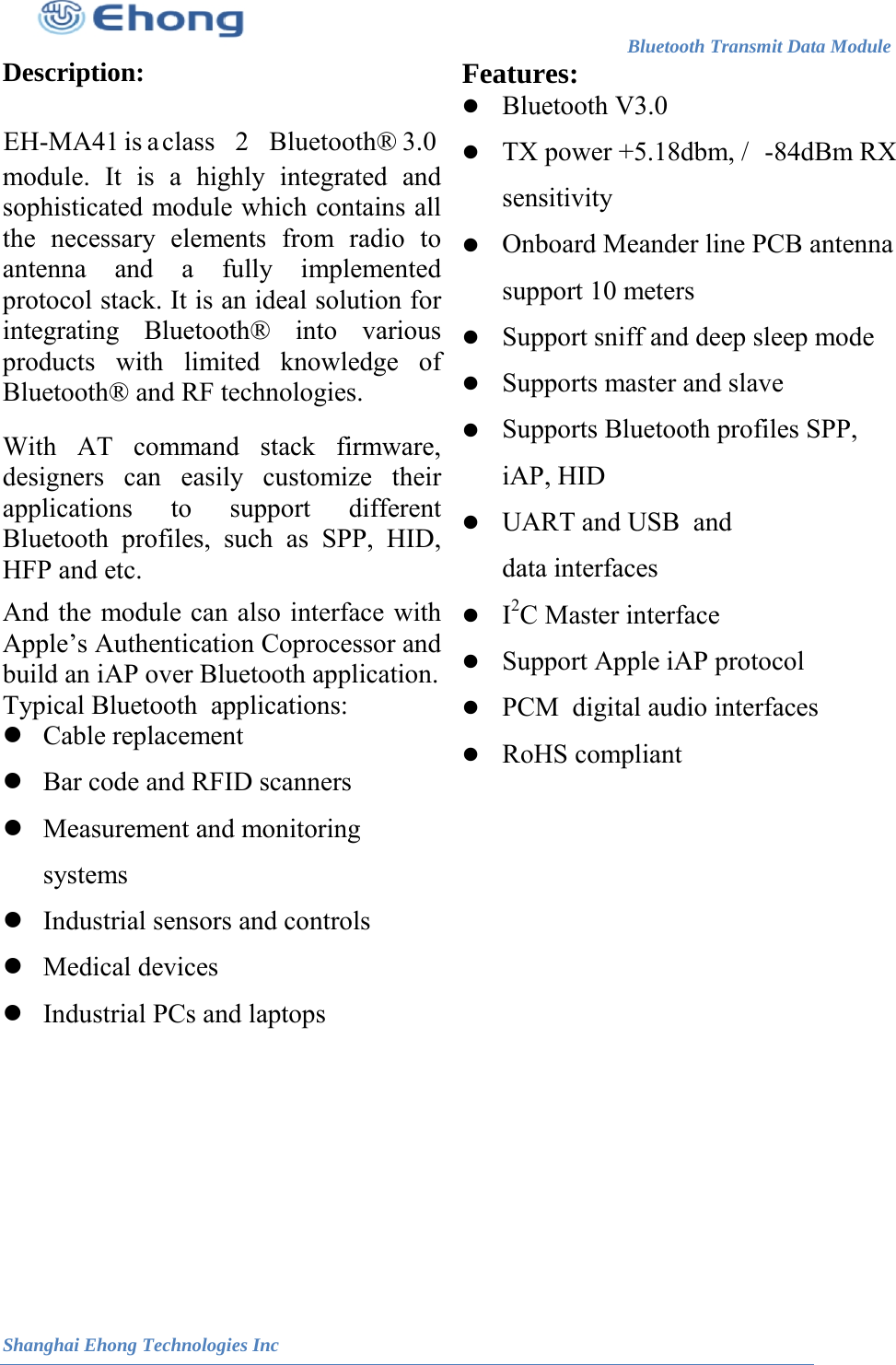
TX power +5.18dbm, /                                                                        Bluetooth Transmit Data Module                                                          Shanghai Ehong Technologies Inc Description: 3.0module. It is a highly integrated and sophisticated module which contains all the necessary elements from radio to antenna and a fully implemented protocol stack. It is an ideal solution for integrating Bluetooth® into various products with limited knowledge of Bluetooth® and RF technologies. With AT command stack firmware, designers can easily customize their applications to support different Bluetooth profiles, such as SPP, HID, HFP and etc. And the module can also interface with Apple’s Authentication Coprocessor and build an iAP over Bluetooth application. Typical Bluetooth  applications:  Cable replacement  Bar code and RFID scanners  Measurement and monitoring systems  Industrial sensors and controls  Medical devices  Industrial PCs and laptops Features:    -84dBm RX sensitivity  Onboard Meander line PCB antenna support 10 meters  Support sniff and deep sleep mode  Supports master and slave   Supports Bluetooth profiles SPP, iAP, HID  UART and USB  and data interfaces  I2C Master interface  Support Apple iAP protocol  PCM  digital audio interfaces  RoHS compliant         Bluetooth V3.0EH-MA41 is a class 2 Bluetooth®
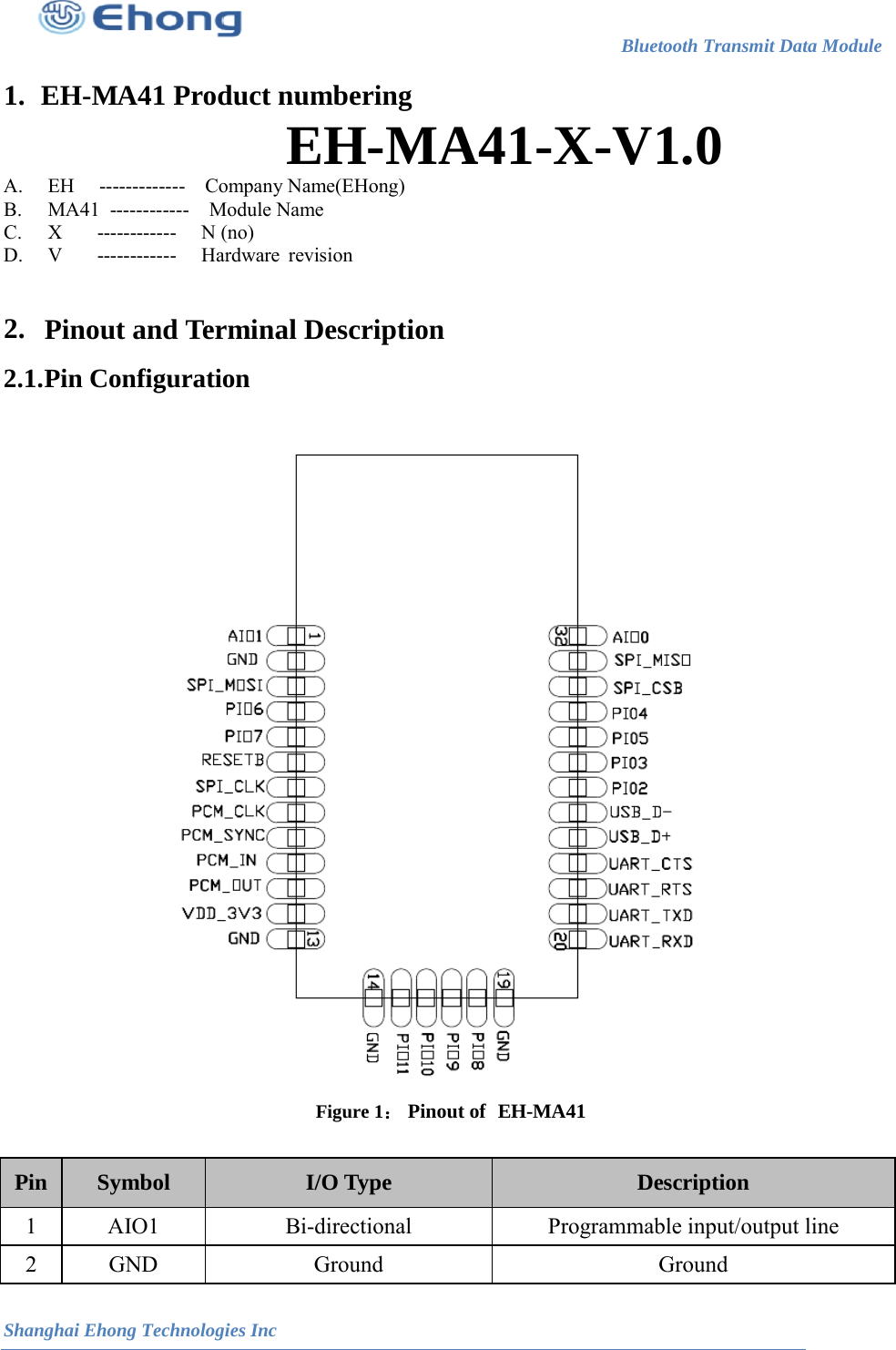
                                                                       Bluetooth Transmit Data Module                                                          Shanghai Ehong Technologies Inc 1. EH-MA41 Product numbering EH-MA41-X-V1.0 A.   EH     -------------    Company Name(EHong) B.   MA41  ------------    Module Name         C.   X       ------------     N (no) D.   V       ------------     Hardware  revision  2.  Pinout and Terminal Description 2.1. Pin Configuration   Figure 1: Pinout of  EH-MA41  Pin  Symbol  I/O Type Description 1  AIO1 Bi-directional  Programmable input/output line 2  GND  Ground  Ground
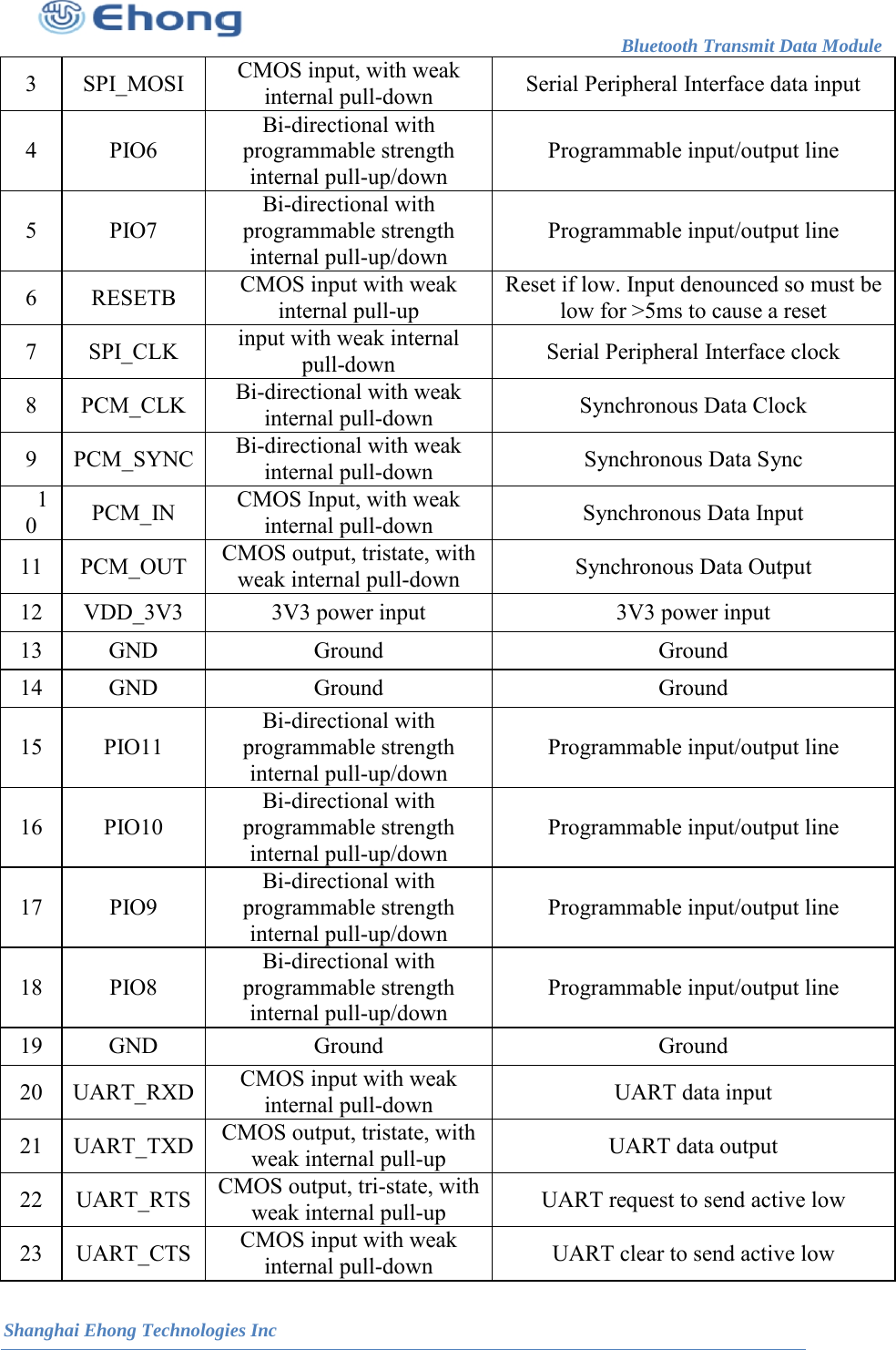
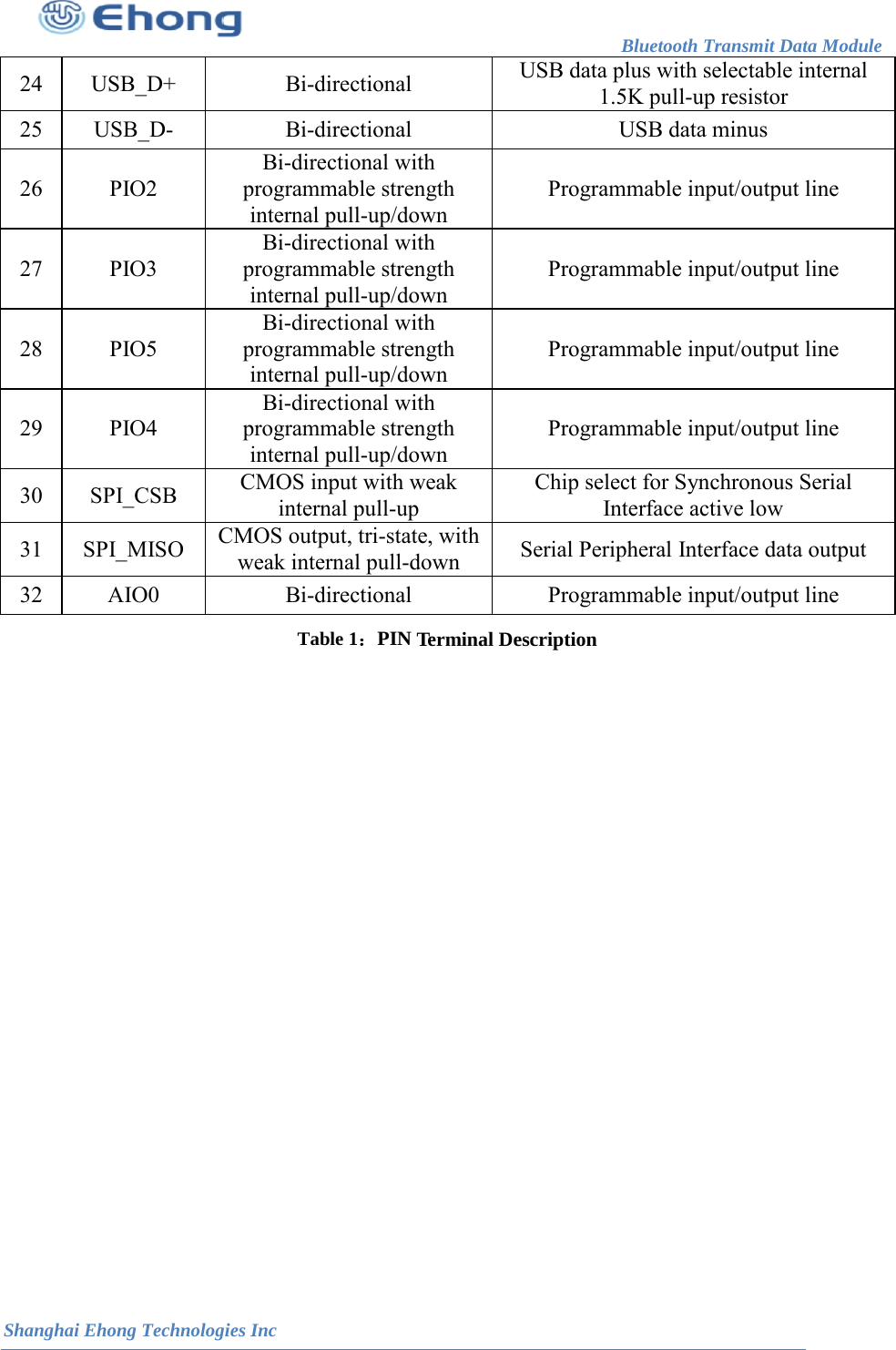
                                                                       Bluetooth Transmit Data Module                                                          Shanghai Ehong Technologies Inc 3  SPI_MOSI CMOS input, with weak internal pull-down  Serial Peripheral Interface data input 4  PIO6 Bi-directional with programmable strength internal pull-up/down  Programmable input/output line 5  PIO7 Bi-directional with programmable strength internal pull-up/down  Programmable input/output line 6  RESETB  CMOS input with weak internal pull-up  Reset if low. Input denounced so must be low for >5ms to cause a reset 7  SPI_CLK input with weak internal pull-down  Serial Peripheral Interface clock 8  PCM_CLK Bi-directional with weak internal pull-down  Synchronous Data Clock 9  PCM_SYNC Bi-directional with weak internal pull-down  Synchronous Data Sync 10  PCM_IN CMOS Input, with weak internal pull-down  Synchronous Data Input 11  PCM_OUT CMOS output, tristate, with weak internal pull-down  Synchronous Data Output 12  VDD_3V3  3V3 power input  3V3 power input 13  GND  Ground  Ground 14  GND  Ground  Ground 15  PIO11  Bi-directional with programmable strength internal pull-up/down  Programmable input/output line 16  PIO10  Bi-directional with programmable strength internal pull-up/down  Programmable input/output line 17  PIO9  Bi-directional with programmable strength internal pull-up/down  Programmable input/output line 18  PIO8  Bi-directional with programmable strength internal pull-up/down  Programmable input/output line 19  GND  Ground  Ground 20  UART_RXD CMOS input with weak internal pull-down  UART data input 21  UART_TXD CMOS output, tristate, with weak internal pull-up  UART data output 22  UART_RTS CMOS output, tri-state, with weak internal pull-up  UART request to send active low 23  UART_CTS CMOS input with weak internal pull-down  UART clear to send active low
                                                                       Bluetooth Transmit Data Module                                                          Shanghai Ehong Technologies Inc 24  USB_D+ Bi-directional  USB data plus with selectable internal 1.5K pull-up resistor 25  USB_D-  Bi-directional  USB data minus 26  PIO2  Bi-directional with programmable strength internal pull-up/down  Programmable input/output line 27  PIO3  Bi-directional with programmable strength internal pull-up/down  Programmable input/output line 28  PIO5  Bi-directional with programmable strength internal pull-up/down  Programmable input/output line 29  PIO4 Bi-directional with programmable strength internal pull-up/down  Programmable input/output line 30  SPI_CSB CMOS input with weak internal pull-up  Chip select for Synchronous Serial Interface active low 31  SPI_MISO CMOS output, tri-state, with weak internal pull-down  Serial Peripheral Interface data output 32  AIO0 Bi-directional  Programmable input/output line Table 1:PIN Terminal Description
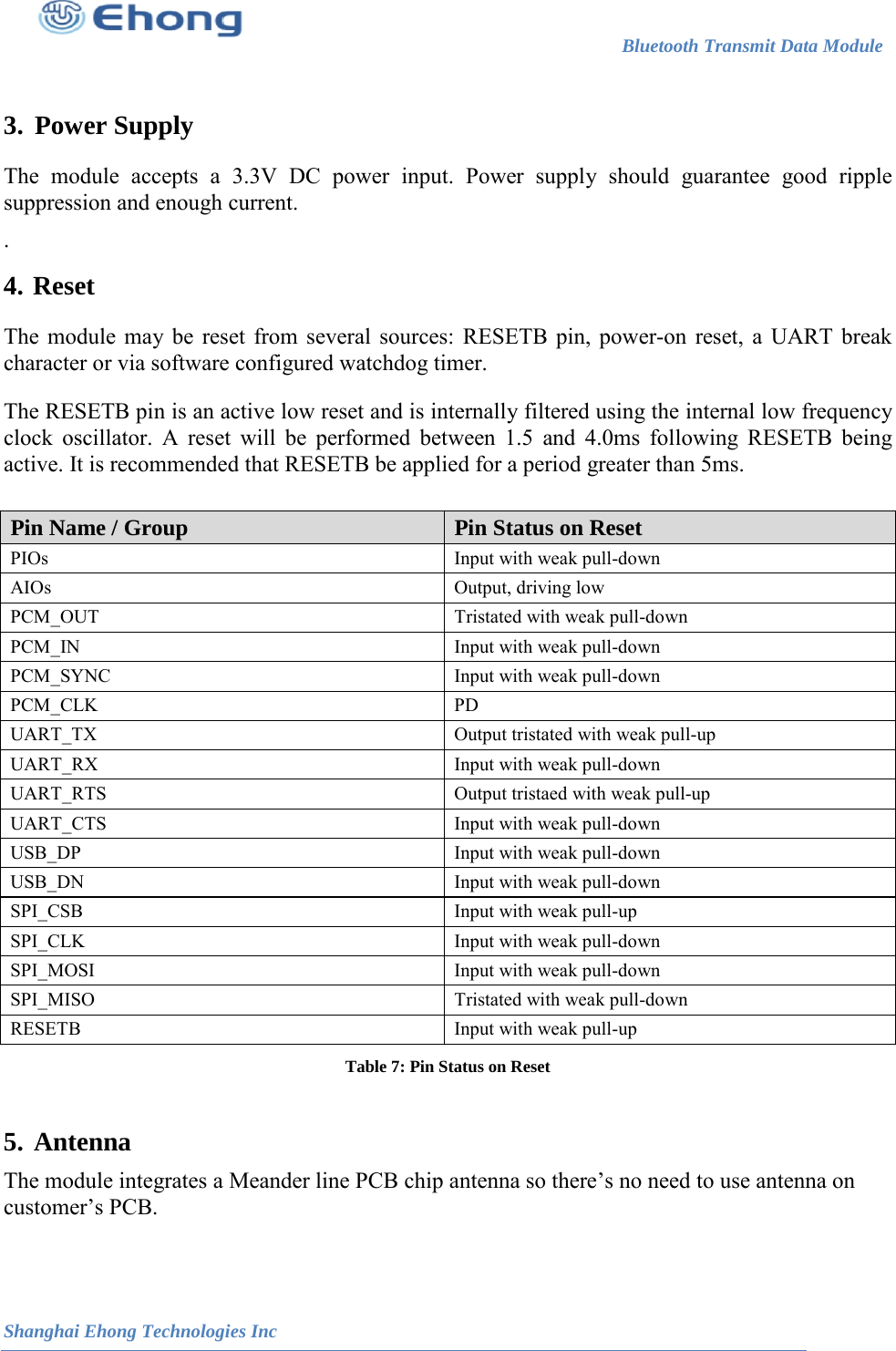
                                                                       Bluetooth Transmit Data Module                                                          Shanghai Ehong Technologies Inc   3.  Power Supply  The module accepts a 3.3V DC power input. Power supply should guarantee good ripple suppression and enough current. . 4.  Reset  The module may be reset from several sources: RESETB pin, power-on reset, a UART break character or via software configured watchdog timer. The RESETB pin is an active low reset and is internally filtered using the internal low frequency clock oscillator. A reset will be performed between 1.5 and 4.0ms following RESETB being active. It is recommended that RESETB be applied for a period greater than 5ms.  Pin Name / Group Pin Status on Reset PIOs Input with weak pull-down AIOs Output, driving low PCM_OUT Tristated with weak pull-down PCM_IN Input with weak pull-down PCM_SYNC Input with weak pull-down PCM_CLK PD UART_TX Output tristated with weak pull-up UART_RX Input with weak pull-down UART_RTS Output tristaed with weak pull-up UART_CTS Input with weak pull-down USB_DP Input with weak pull-down USB_DN Input with weak pull-down SPI_CSB Input with weak pull-up SPI_CLK Input with weak pull-down SPI_MOSI Input with weak pull-down SPI_MISO Tristated with weak pull-down RESETB Input with weak pull-up Table 7: Pin Status on Reset  5.   The module integrates a Meander line PCB chip antenna so there’s no need to use antenna on  customer’s PCB. Antenna
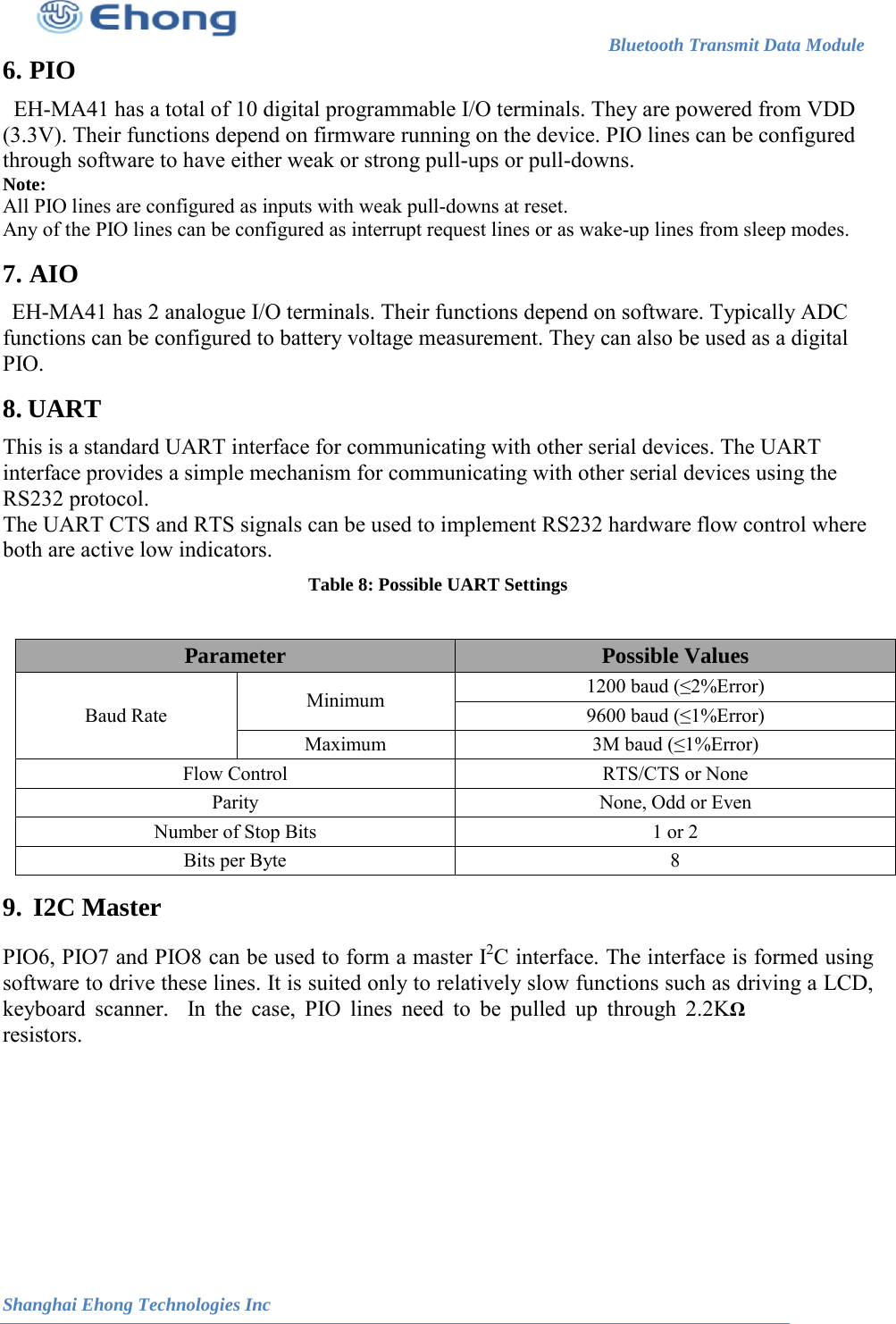
                                                                       Bluetooth Transmit Data Module                                                          Shanghai Ehong Technologies Inc 6.  PIO  EH-MA41 has a total of 10 digital programmable I/O terminals. They are powered from VDD (3.3V). Their functions depend on firmware running on the device. PIO lines can be configured through software to have either weak or strong pull-ups or pull-downs. Note:  All PIO lines are configured as inputs with weak pull-downs at reset.  Any of the PIO lines can be configured as interrupt request lines or as wake-up lines from sleep modes. 7.  AIO  EH-MA41 has 2 analogue I/O terminals. Their functions depend on software. Typically ADC functions can be configured to battery voltage measurement. They can also be used as a digital PIO. 8.  UART  This is a standard UART interface for communicating with other serial devices. The UART interface provides a simple mechanism for communicating with other serial devices using the RS232 protocol. The UART CTS and RTS signals can be used to implement RS232 hardware flow control where both are active low indicators. Table 8: Possible UART Settings  9.  I2C Master  PIO6, PIO7 and PIO8 can be used to form a master I2C interface. The interface is formed using software to drive these lines. It is suited only to relatively slow functions such as driving a LCD, keyboard scanner.  In the case, PIO lines need to be pulled up through 2.2KΩ resistors.  Parameter Possible Values Baud Rate Minimum 1200 baud (≤2%Error) 9600 baud (≤1%Error) Maximum 3M baud (≤1%Error) Flow Control  RTS/CTS or None Parity None, Odd or Even Number of Stop Bits  1 or 2 Bits per Byte  8
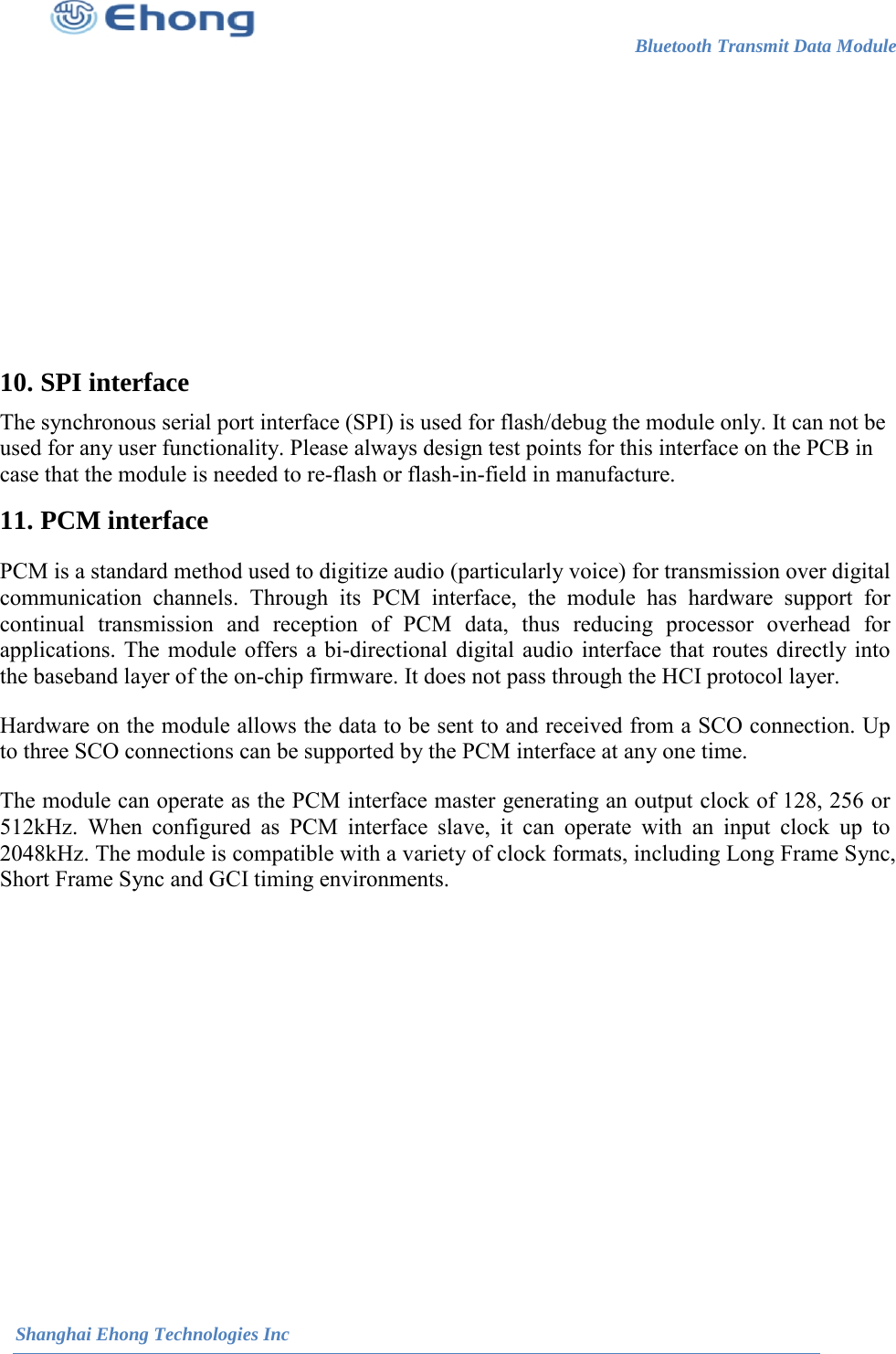
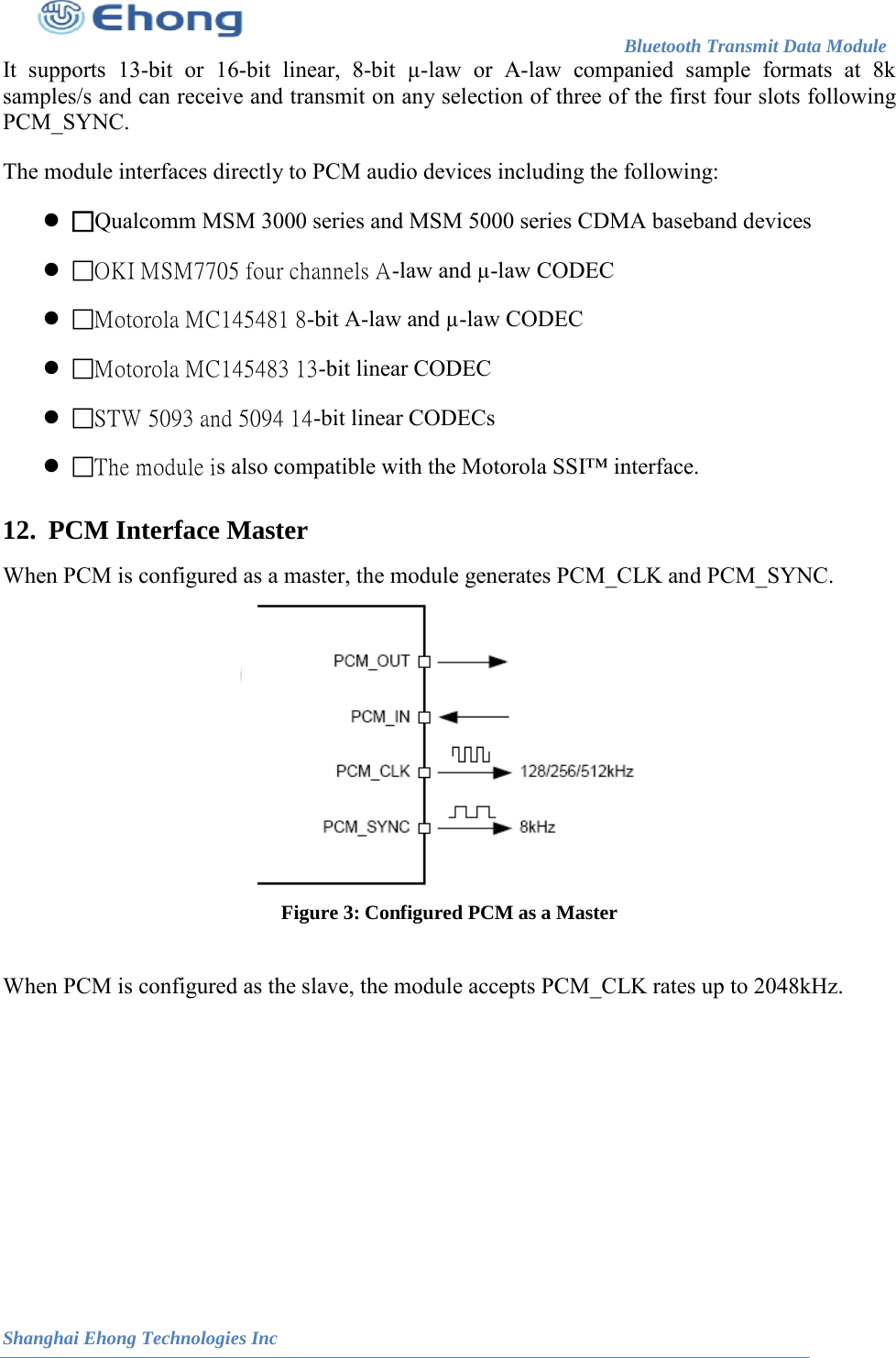
                                                                       Bluetooth Transmit Data Module                                                          Shanghai Ehong Technologies Inc     10. SPI interface The synchronous serial port interface (SPI) is used for flash/debug the module only. It can not be used for any user functionality. Please always design test points for this interface on the PCB in case that the module is needed to re-flash or flash-in-field in manufacture. 11. PCM interface PCM is a standard method used to digitize audio (particularly voice) for transmission over digital communication channels. Through its PCM interface, the module has hardware support for continual transmission and reception of PCM data, thus reducing processor overhead for applications. The module offers a bi-directional digital audio interface that routes directly into the baseband layer of the on-chip firmware. It does not pass through the HCI protocol layer. Hardware on the module allows the data to be sent to and received from a SCO connection. Up to three SCO connections can be supported by the PCM interface at any one time. The module can operate as the PCM interface master generating an output clock of 128, 256 or 512kHz. When configured as PCM interface slave, it can operate with an input clock up to 2048kHz. The module is compatible with a variety of clock formats, including Long Frame Sync, Short Frame Sync and GCI timing environments.
                                                                       Bluetooth Transmit Data Module                                                          Shanghai Ehong Technologies Inc It supports 13-bit or 16-bit linear, 8-bit µ-law or A-law companied sample formats at 8k samples/s and can receive and transmit on any selection of three of the first four slots following PCM_SYNC.  The module interfaces directly to PCM audio devices including the following:  Qualcomm MSM 3000 series and MSM 5000 series CDMA baseband devices  OKI MSM7705 four channels A-law and µ-law CODEC  Motorola MC145481 8-bit A-law and µ-law CODEC  Motorola MC145483 13-bit linear CODEC  STW 5093 and 5094 14-bit linear CODECs  The module is also compatible with the Motorola SSI™ interface. 12.   When PCM is configured as a master, the module generates PCM_CLK and PCM_SYNC.  Figure 3: Configured PCM as a Master  When PCM is configured as the slave, the module accepts PCM_CLK rates up to 2048kHz. PCM Interface Master
Bluetooth Transmit Data Module                                                          Shanghai Ehong Technologies Inc   13. USB This is a full speed (12M bits/s) USB interface for communicating with other compatible digital devices. The module acts as a USB peripheral, responding to request from a master host controller, such as a PC. The USB interface is capable of driving a USB cable directly. No external USB transceiver is required. The device operates as a USB peripheral, responding to requests from a master host controller such as a PC. Both the OHCI and the UHCI standards are supported. The set of USB endpoints implemented can behave as specified in the USB section of the Bluetooth specification such as speakers. The module has an internal USB pull-up resistor. This pulls the USB_DP pin weakly high when module is ready to enumerate. It signals to the USB master that it is a full speed (12Mbit/s) USB device.   V3.0 or alternatively can appear as a set of endpoints appropriate to USB audio devices
DC"Attention‐LimitedModularApprovalThisRFModuleisstrictlylimitedtointegrationintobattery-poeratedhostdevices. IntegrationintodevicesthataredirectlyorindirectlyconnectedtoAClinesmaybeaddedviaClassIIPermissiveChange."(OEM)Integratorhastoassurecomplianceoftheentireend‐  theintegratedRFModule.Additionalmeasurements(15B)and/orequipmentauthorizations(e.gVerification)mayneedtobeaddresseddependingonco‐locationor issuesifapplicable.Integratorisremindedtoassurethattheseinstallationinstructionswillnotbemadeavailabletotheend‐userofthefinalhostdevice.WiththedocumentedmaxoutputpowerthisRFModulemeetstheFCCSARExemption‐  TheRFModuleispoweredby antennaisPCBantennaandtheantennagainis0dBiThefinalhostdevice,intowhichthisRFModuleisintegrated"hastobelabelledwithanauxilliarylablestatingtheFCCIDoftheRFModule,suchas"ContainsFCCID:2ACCRMA41"Thisdevicecomplieswithpart15oftheFCCrules.Operationissubjecttothefollowingtwoconditions:(1)thisdevicemaynotcauseharmfulinterference,and(2)thisdevicemustacceptanyinterferencereceived,includinginterferencethatmaycauseundesiredoperation."Changesormodificationstothisunitnotexpresslyapprovedbythepartyresponsibleforcompliancecouldvoidtheuser’sauthoritytooperatetheequipment."product incl.simultaenous transmissionso it comply with any applicable RF exposure requirements in its final configuration.,the

Navigation menu