Electronics Tomorrow 672440305 433MHz RF Transmitter User Manual M024 E

Electronics Tomorrow Ltd. 433MHz RF Transmitter M024 E

User Manual

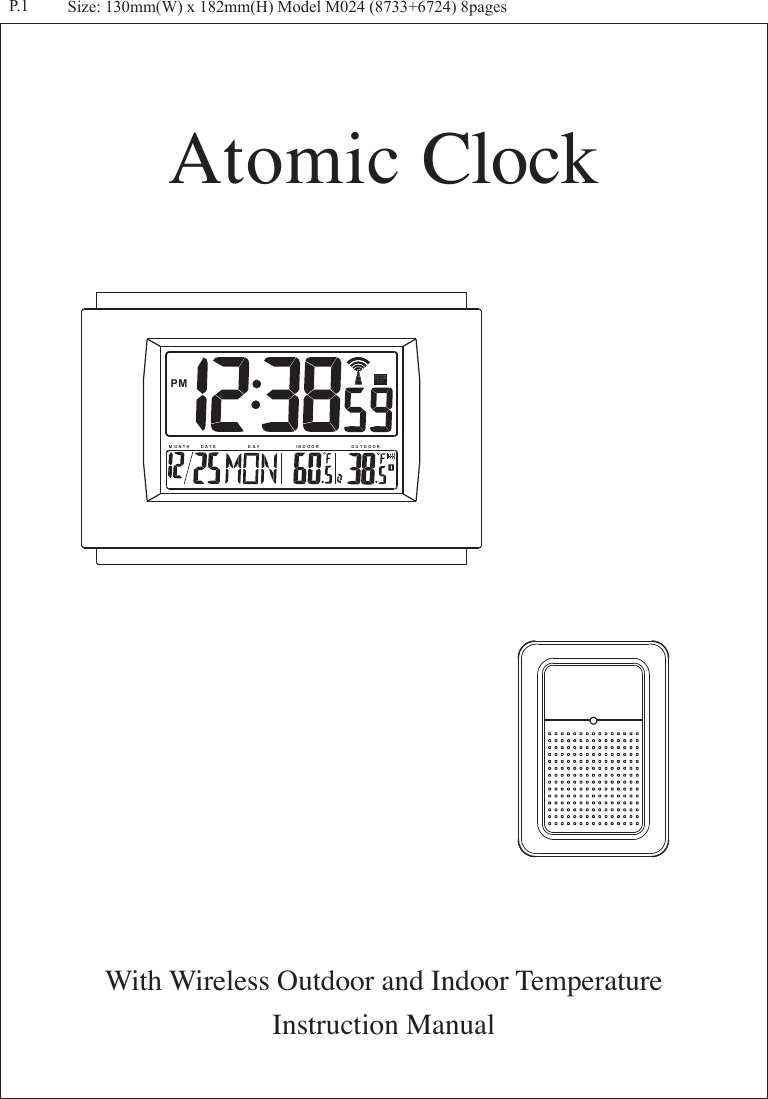
Atomic ClockWith Wireless Outdoor and Indoor TemperatureInstruction ManualSize: 130mm(W) x 182mm(H) Model M024 (8733+6724) 8pagesP.1M O N T H D A T E D A Y O U TD O O RI N D OO RPM
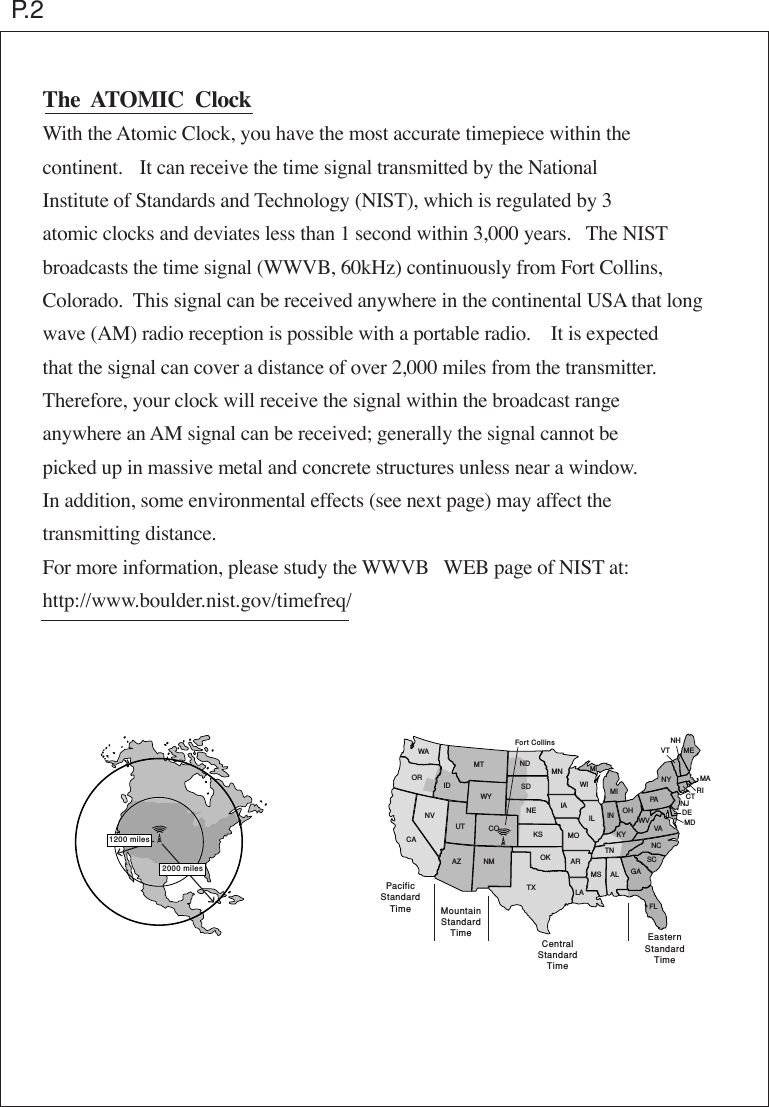
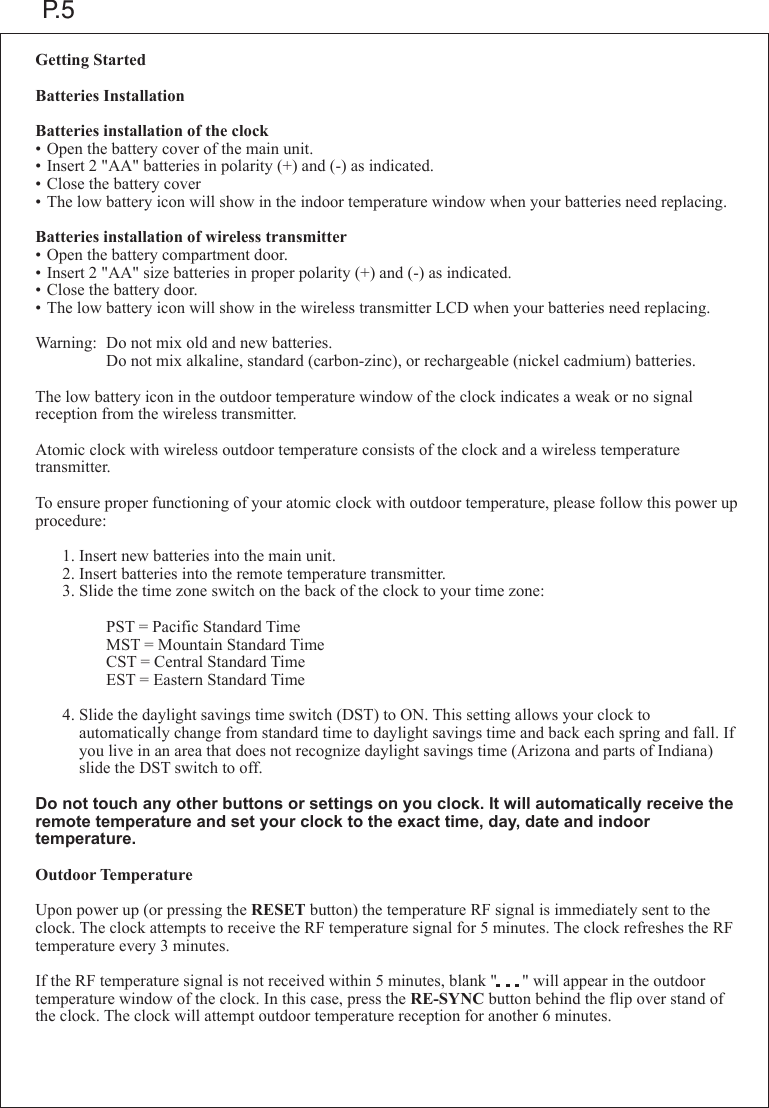
WAORCANVUTIDAZ NMCOWYMT NDSDNEKSOKTXMNMIIAMOARLAWIILTNKYIN OHMS AL GAFLSCNCVAWVPANYMEMARICTNJDEMDNHVTMIEasternStandardTimeCentralStandardTimeMountainStandardTimePacificStandardTimeFort Collins2000 miles1200 milesThe  ATOMIC  ClockWith the Atomic Clock, you have the most accurate timepiece within thecontinent.   It can receive the time signal transmitted by the NationalInstitute of Standards and Technology (NIST), which is regulated by 3atomic clocks and deviates less than 1 second within 3,000 years.   The NISTbroadcasts the time signal (WWVB, 60kHz) continuously from Fort Collins,Colorado.  This signal can be received anywhere in the continental USA that longwave (AM) radio reception is possible with a portable radio.    It is expectedthat the signal can cover a distance of over 2,000 miles from the transmitter.Therefore, your clock will receive the signal within the broadcast rangeanywhere an AM signal can be received; generally the signal cannot bepicked up in massive metal and concrete structures unless near a window.In addition, some environmental effects (see next page) may affect thetransmitting distance.For more information, please study the WWVB   WEB page of NIST at:http://www.boulder.nist.gov/timefreq/P.2
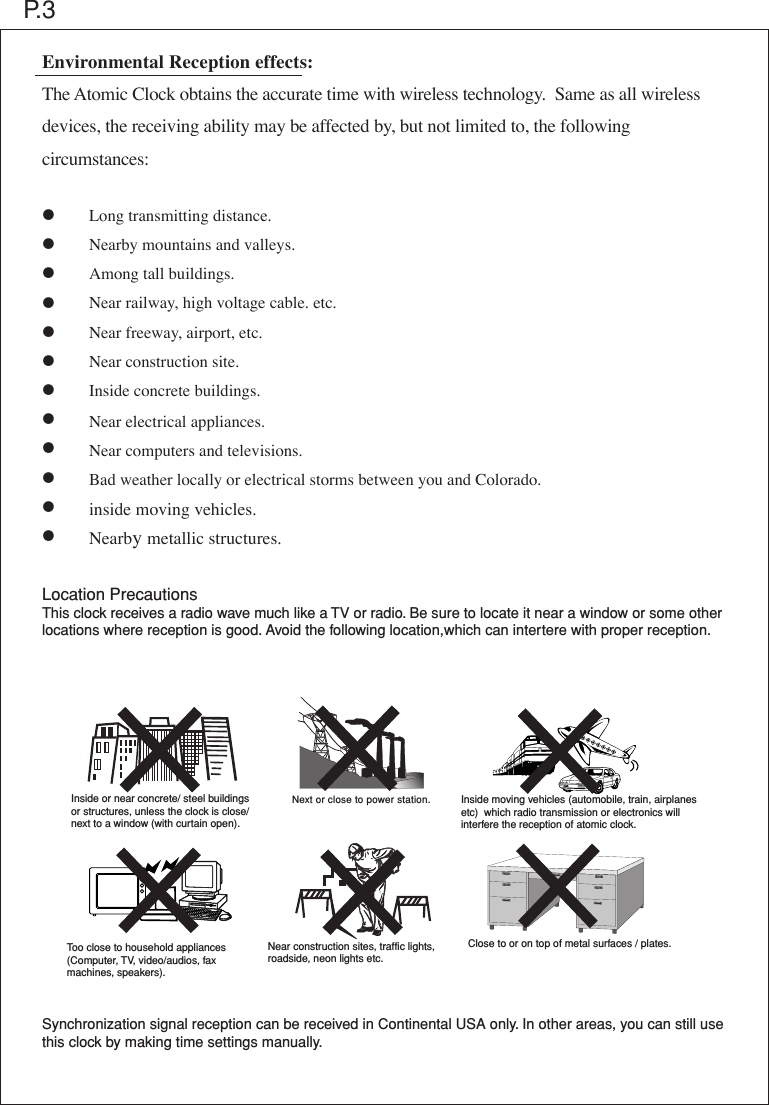
Inside or near concrete/ steel buildingsor structures, unless the clock is close/ next to a window (with curtain open).Too close to household appliances (Computer, TV, video/audios, faxmachines, speakers). Near construction sites, traffic lights, roadside, neon lights etc.Inside moving vehicles (automobile, train, airplanes etc)  which radio transmission or electronics will interfere the reception of atomic clock.Next or close to power station.Environmental Reception effects:The Atomic Clock obtains the accurate time with wireless technology.  Same as all wireless devices, the receiving ability may be affected by, but not limited to, the following circumstances:  •      Long transmitting distance. •      Nearby mountains and valleys.•      Among tall buildings.•      Near railway, high voltage cable. etc.•      Near freeway, airport, etc.•      Near construction site.•      Inside concrete buildings.•      Near electrical appliances.•      Near computers and televisions.•      Bad weather locally or electrical storms between you and Colorado.•      inside moving vehicles.•      Nearby metallic structures.Location PrecautionsThis clock receives a radio wave much like a TV or radio. Be sure to locate it near a window or some other locations where reception is good. Avoid the following location,which can intertere with proper reception.Synchronization signal reception can be received in Continental USA only. In other areas, you can still use this clock by making time settings manually.  P.3Close to or on top of metal surfaces / plates.
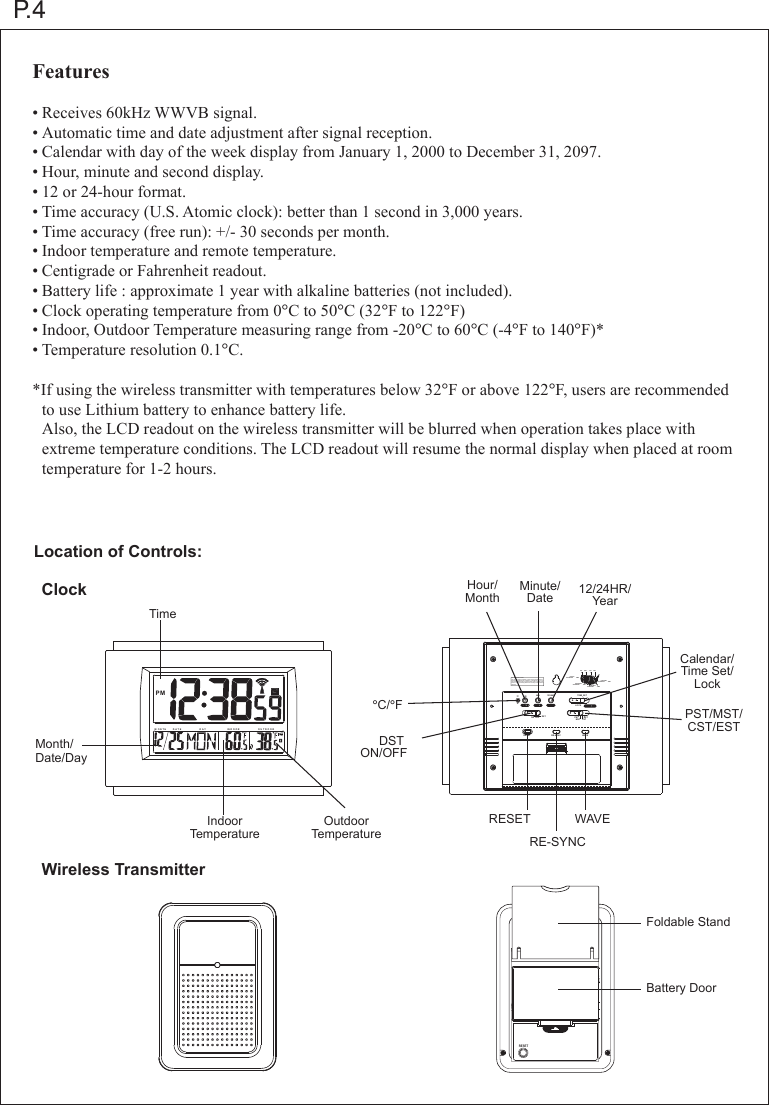
P.4Features•Receives 60kHz WWVB signal.•Automatic time and date adjustment after signal reception.•Calendar with day of the week display from January 1, 2000 to December 31, 2097.•Hour, minute and second display.•12 or 24-hour format.•Time accuracy (U.S. Atomic clock): better than 1 second in 3,000 years.•Time accuracy (free run): +/- 30 seconds per month.•Indoor temperature and remote temperature.•Centigrade or Fahrenheit readout.•Battery life : approximate 1 year with alkaline batteries (not included).•Clock operating temperature from 0°C to 50°C (32°F to 122°F)•Indoor, Outdoor Temperature measuring range from -20°C to 60°C (-4°F to 140°F)*•Temperature resolution 0.1°C.*If using the wireless transmitter with temperatures below 32°F or above 122°F, users are recommended  to use Lithium battery to enhance battery life. Also, the LCD readout on the wireless transmitter will be blurred when operation takes place with   extreme temperature conditions. The LCD readout will resume the normal display when placed at room  temperature for 1-2 hours.Location of Controls:Wireless TransmitterClockTimeIndoorTemperatureOutdoorTemperatureHour/MonthMinute/Date 12/24HR/YearCalendar/Time Set/LockPST/MST/CST/EST°C/°FBattery DoorFoldable StandDST ON/OFFRESET WAVERE-SYNCMonth/Date/DayM ON T H D A T E D A Y OU T D O ORIN D O O RPM MIN 12/24HRHR TIME SETLOCKPSTMST CSTESTDSTON OFFCFRESET RE-SYNC  WAVECST ESTMSTPSTPACIFICSTANDARD  TIMEMOUNTAINSTANDARD  TIME CENTRALSTANDARD  TIMEEASTERNSTANDARD  TIMEFCC ID : PEQ873 390303This device complies with Part 15 of the FCC Rules.Operation issubject to the following two conditions: (1) this device may not ca-use harmful interference,and (2) this device must accept any interference received,including interference that may cause undesired operation.-RESET
P.5Getting StartedBatteries InstallationBatteries installation of the clock•Open the battery cover of the main unit.•Insert 2 "AA" batteries in polarity (+) and (-) as indicated.•Close the battery cover•The low battery icon will show in the indoor temperature window when your batteries need replacing.Batteries installation of wireless transmitter•Open the battery compartment door.•Insert 2 "AA" size batteries in proper polarity (+) and (-) as indicated.•Close the battery door.•The low battery icon will show in the wireless transmitter LCD when your batteries need replacing.Warning: Do not mix old and new batteries.    Do not mix alkaline, standard (carbon-zinc), or rechargeable (nickel cadmium) batteries.The low battery icon in the outdoor temperature window of the clock indicates a weak or no signal reception from the wireless transmitter.Atomic clock with wireless outdoor temperature consists of the clock and a wireless temperature transmitter.To ensure proper functioning of your atomic clock with outdoor temperature, please follow this power up procedure:  1.Insert new batteries into the main unit.  2.Insert batteries into the remote temperature transmitter.  3.Slide the time zone switch on the back of the clock to your time zone:    PST = Pacific Standard Time    MST = Mountain Standard Time    CST = Central Standard Time    EST = Eastern Standard Time  4.Slide the daylight savings time switch (DST) to ON. This setting allows your clock to      automatically change from standard time to daylight savings time and back each spring and fall. If    you live in an area that does not recognize daylight savings time (Arizona and parts of Indiana)     slide the DST switch to off.Do not touch any other buttons or settings on you clock. It will automatically receive the remote temperature and set your clock to the exact time, day, date and indoor temperature.Outdoor TemperatureUpon power up (or pressing the RESET button) the temperature RF signal is immediately sent to the clock. The clock attempts to receive the RF temperature signal for 5 minutes. The clock refreshes the RF temperature every 3 minutes.If the RF temperature signal is not received within 5 minutes, blank "      " will appear in the outdoor temperature window of the clock. In this case, press the RE-SYNC button behind the flip over stand of the clock. The clock will attempt outdoor temperature reception for another 6 minutes.
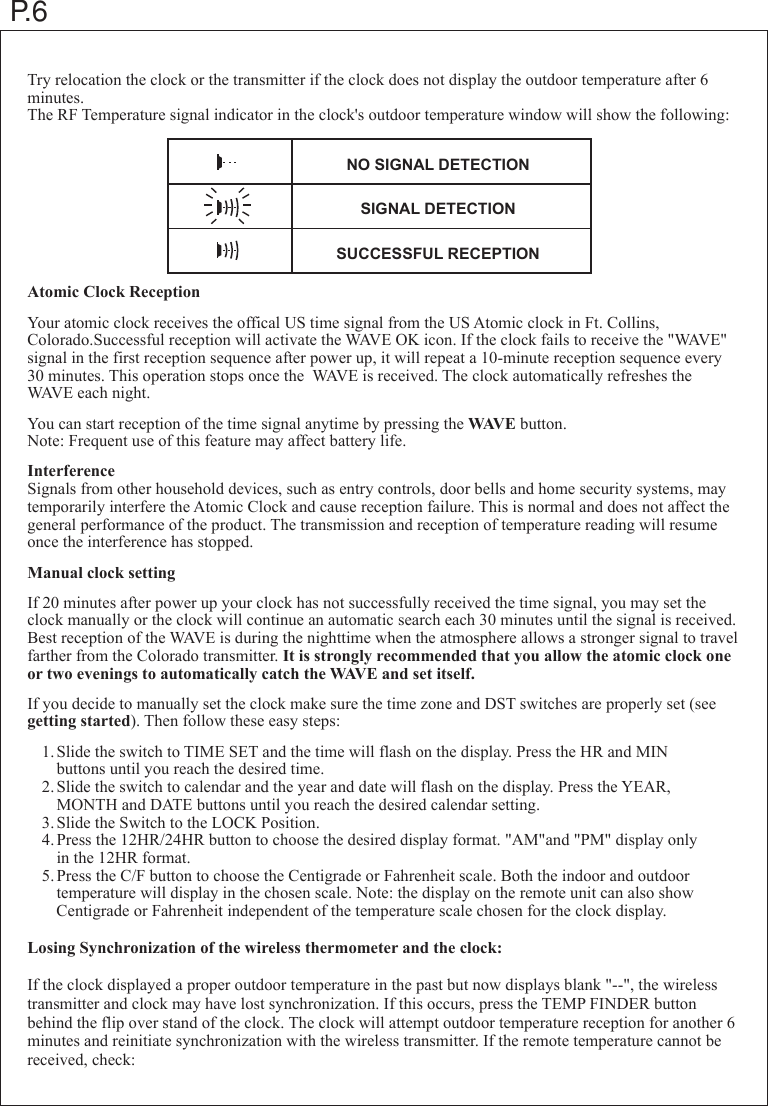
P.6Try relocation the clock or the transmitter if the clock does not display the outdoor temperature after 6 minutes.The RF Temperature signal indicator in the clock's outdoor temperature window will show the following:Atomic Clock ReceptionYour atomic clock receives the offical US time signal from the US Atomic clock in Ft. Collins, Colorado.Successful reception will activate the WAVE OK icon. If the clock fails to receive the "WAVE" signal in the first reception sequence after power up, it will repeat a 10-minute reception sequence every 30 minutes. This operation stops once the  WAVE is received. The clock automatically refreshes the WAVE each night.You can start reception of the time signal anytime by pressing the WAVE button.Note: Frequent use of this feature may affect battery life.InterferenceSignals from other household devices, such as entry controls, door bells and home security systems, may temporarily interfere the Atomic Clock and cause reception failure. This is normal and does not affect the general performance of the product. The transmission and reception of temperature reading will resume once the interference has stopped.Manual clock settingIf 20 minutes after power up your clock has not successfully received the time signal, you may set the clock manually or the clock will continue an automatic search each 30 minutes until the signal is received. Best reception of the WAVE is during the nighttime when the atmosphere allows a stronger signal to travel farther from the Colorado transmitter. It is strongly recommended that you allow the atomic clock one or two evenings to automatically catch the WAVE and set itself.If you decide to manually set the clock make sure the time zone and DST switches are properly set (see getting started). Then follow these easy steps: 1.Slide the switch to TIME SET and the time will flash on the display. Press the HR and MIN    buttons until you reach the desired time. 2.Slide the switch to calendar and the year and date will flash on the display. Press the YEAR,    MONTH and DATE buttons until you reach the desired calendar setting. 3.Slide the Switch to the LOCK Position. 4.Press the 12HR/24HR button to choose the desired display format. "AM"and "PM" display only    in the 12HR format. 5.Press the C/F button to choose the Centigrade or Fahrenheit scale. Both the indoor and outdoor    temperature will display in the chosen scale. Note: the display on the remote unit can also show    Centigrade or Fahrenheit independent of the temperature scale chosen for the clock display.Losing Synchronization of the wireless thermometer and the clock:If the clock displayed a proper outdoor temperature in the past but now displays blank "--", the wireless transmitter and clock may have lost synchronization. If this occurs, press the TEMP FINDER button behind the flip over stand of the clock. The clock will attempt outdoor temperature reception for another 6 minutes and reinitiate synchronization with the wireless transmitter. If the remote temperature cannot be received, check:NO SIGNAL DETECTIONSIGNAL DETECTIONSUCCESSFUL RECEPTION
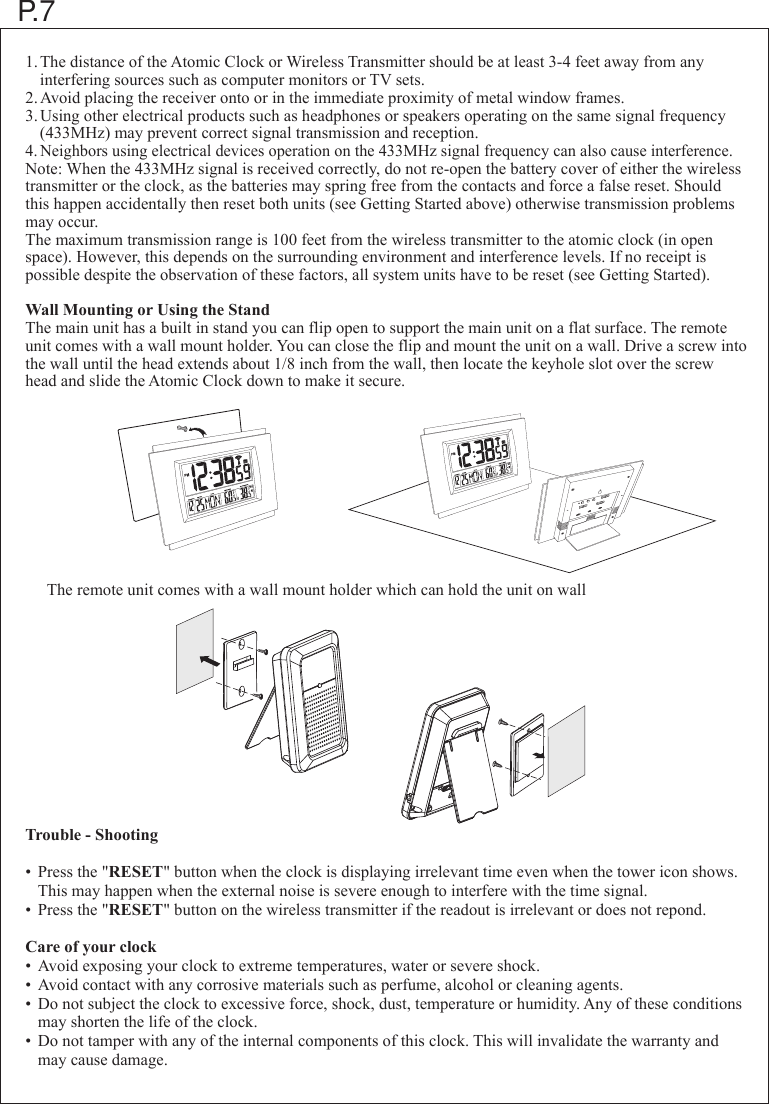
1.The distance of the Atomic Clock or Wireless Transmitter should be at least 3-4 feet away from any   interfering sources such as computer monitors or TV sets.2.Avoid placing the receiver onto or in the immediate proximity of metal window frames.3.Using other electrical products such as headphones or speakers operating on the same signal frequency  (433MHz) may prevent correct signal transmission and reception.4.Neighbors using electrical devices operation on the 433MHz signal frequency can also cause interference.Note: When the 433MHz signal is received correctly, do not re-open the battery cover of either the wireless transmitter or the clock, as the batteries may spring free from the contacts and force a false reset. Should this happen accidentally then reset both units (see Getting Started above) otherwise transmission problems may occur.The maximum transmission range is 100 feet from the wireless transmitter to the atomic clock (in open space). However, this depends on the surrounding environment and interference levels. If no receipt is possible despite the observation of these factors, all system units have to be reset (see Getting Started).Wall Mounting or Using the StandThe main unit has a built in stand you can flip open to support the main unit on a flat surface. The remote unit comes with a wall mount holder. You can close the flip and mount the unit on a wall. Drive a screw into the wall until the head extends about 1/8 inch from the wall, then locate the keyhole slot over the screw head and slide the Atomic Clock down to make it secure.Trouble - Shooting• Press the "RESET" button when the clock is displaying irrelevant time even when the tower icon shows. This may happen when the external noise is severe enough to interfere with the time signal.• Press the "RESET" button on the wireless transmitter if the readout is irrelevant or does not repond.Care of your clock• Avoid exposing your clock to extreme temperatures, water or severe shock.• Avoid contact with any corrosive materials such as perfume, alcohol or cleaning agents.• Do not subject the clock to excessive force, shock, dust, temperature or humidity. Any of these conditions  may shorten the life of the clock.• Do not tamper with any of the internal components of this clock. This will invalidate the warranty and  may cause damage.P.7The remote unit comes with a wall mount holder which can hold the unit on wall
Correct usage of the batteries•Use 2 new "AA" alkaline batteries (not included)•Do not mix standard or rechargeable batteries•Do not mix new and old batteries•When the low battery mark "             " appears on the display, replace the appropriate batteries with new ones.Warning: Changes or modifications to this unit not expressly approved by the party responsible for compliance could void the user's authority to operate the equipment.NOTE: This equipment has been tested and found to comply with the limits for a class B digital device, prusuant to Part 15 of the FCC Rules. these limits are designed to provide reasonable protection against harmful interference in a residential installation. This equipment generates, uses and can radiate radio frequency energy and, if not installed and used in accordance with the insturctions, may cause harmful interference to radio communications.However, there is no guarantee that interference will not occur in a particular installation. If this equipment does cause harmful interference to radio or television reception, which can be determined by turning the equipment off and on, the user is encouraged to try to correct the interference by one of more of the following measures:• Reorient or relocate the receiving antenna.• Increase the separation between the equipment and receiver.• Connect the equipment into an outlet on a circuit different from that to which the receiver is connected.• Consult the dealer or an experienced radio/TV technician for help.Under the environment with radio frequency interference, the sample may malfunction and require user to reset the sample.LIABILITY DISCLAIMER:•The manufacturer and supplier cannot accept any responsibility for any incorrect readings and any consequences  that occur should an inaccurate reading take place.•This product is not to be used for medical purposes or for public information.•The specifications of the product may change without prior notice.•This product is not a toy. Keep out of the reach of children.•No part of this manual may be reproduced without written authorization of the manufacture.SPECIFICATIONSTemperature measuring rangeIndoor: 32°F to 122°F with 0.2°F resolution  0°C to 50°C with 0.1°C resolutionOutdoor: -4°F to 140°F with 0.2°F resolution  -20°C to 60°C with 0.1°C resolutionTemperature checking intervalIndoor:    every 16 secondsOutdoor Transmitter:  every 16 secondsOutdoor temperature display on clock: every 3 minutesTransmission distance: maximum 100 feet in open field, depending upon surrounding structures, mounting location    and possible interfering sources.Power source (Alkaline batteries recommended)Atomic Clock:  2 AA batteries, 1.5V batteriesWireless Transmitter:  2 AA batteries, 1.5V batteries.Battery life:  about 12 monthsDimensions (LxWxH)Atomic Clock:  9.8x8.1x1 inches / 25x20.5x2.5 cmWireless Transmitter:  3.9x2.8x0.8 inches / 10x7x2.2cmMade in ChinaP.8M024

Navigation menu