Electronics Tomorrow 724A90504 433 MHz Receiver Clock User Manual M059 M

Electronics Tomorrow Ltd. 433 MHz Receiver Clock M059 M

User Manual

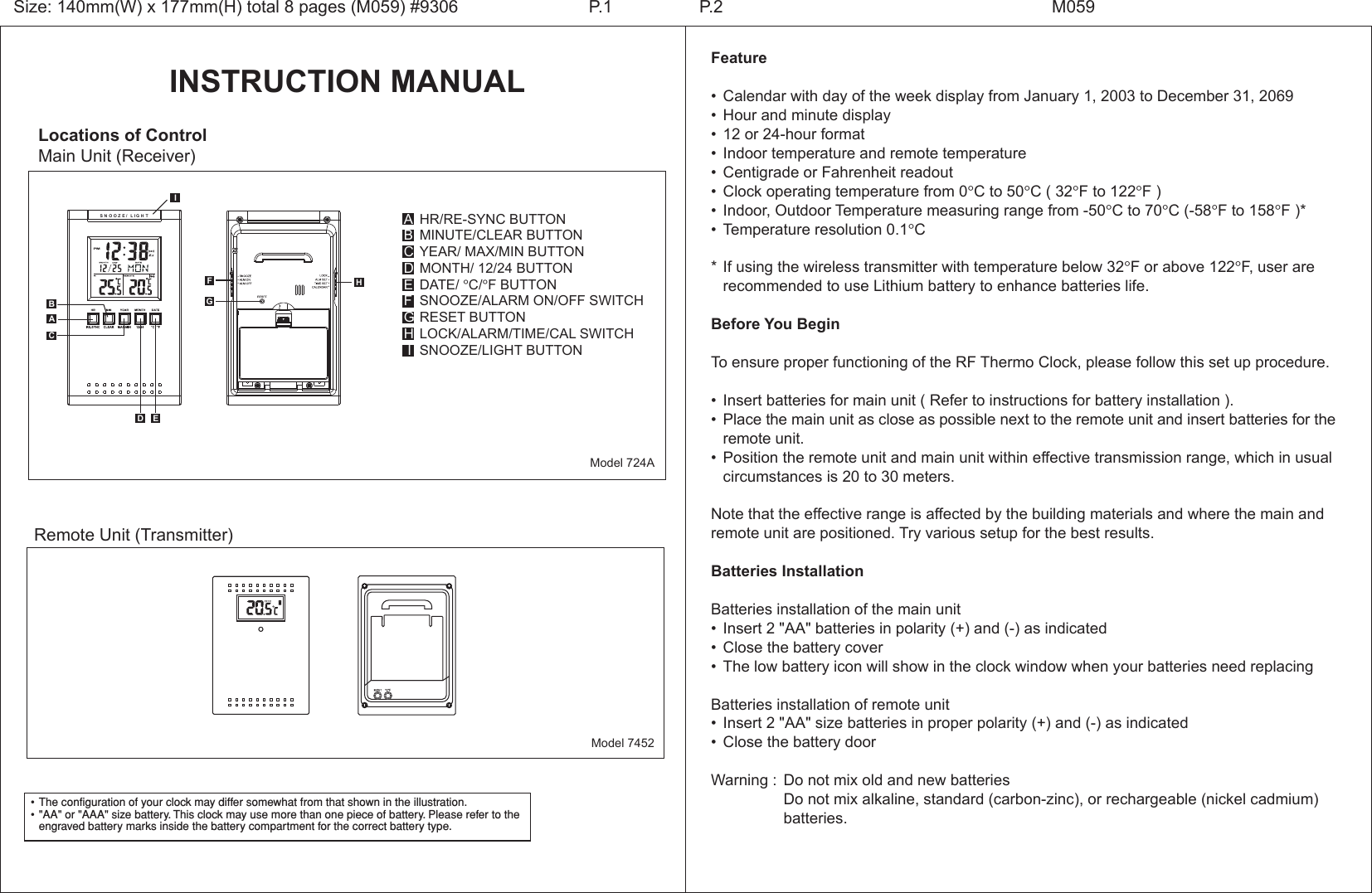
INSTRUCTION MANUALLocations of ControlMain Unit (Receiver)HR/RE-SYNC BUTTONMINUTE/CLEAR BUTTONYEAR/ MAX/MIN BUTTONMONTH/ 12/24 BUTTONDATE/ °C/°F BUTTONSNOOZE/ALARM ON/OFF SWITCHRESET BUTTONLOCK/ALARM/TIME/CAL SWITCHSNOOZE/LIGHT BUTTONABCDEFGH IModel 724AFeature• Calendar with day of the week display from January 1, 2003 to December 31, 2069• Hour and minute display• 12 or 24-hour format• Indoor temperature and remote temperature• Centigrade or Fahrenheit readout• Clock operating temperature from 0°C to 50°C ( 32°F to 122°F )• Indoor, Outdoor Temperature measuring range from -50°C to 70°C (-58°F to 158°F )*• Temperature resolution 0.1°C*If using the wireless transmitter with temperature below 32°F or above 122°F, user are   recommended to use Lithium battery to enhance batteries life.Before You BeginTo ensure proper functioning of the RF Thermo Clock, please follow this set up procedure.• Insert batteries for main unit ( Refer to instructions for battery installation ).• Place the main unit as close as possible next to the remote unit and insert batteries for the  remote unit.• Position the remote unit and main unit within effective transmission range, which in usual  circumstances is 20 to 30 meters.Note that the effective range is affected by the building materials and where the main and remote unit are positioned. Try various setup for the best results.Batteries InstallationBatteries installation of the main unit• Insert 2 "AA" batteries in polarity (+) and (-) as indicated• Close the battery cover• The low battery icon will show in the clock window when your batteries need replacingBatteries installation of remote unit• Insert 2 "AA" size batteries in proper polarity (+) and (-) as indicated• Close the battery doorWarning : Do not mix old and new batteries  Do not mix alkaline, standard (carbon-zinc), or rechargeable (nickel cadmium)    batteries.Size: 140mm(W) x 177mm(H) total 8 pages (M059) #9306 P.2 M059P.1•The configuration of your clock may differ somewhat from that shown in the illustration.•"AA" or "AAA" size battery. This clock may use more than one piece of battery. Please refer to the engraved battery marks inside the battery compartment for the correct battery type.AModel 7452Remote Unit (Transmitter) S N O O Z E / L I G H THBCD EGFI
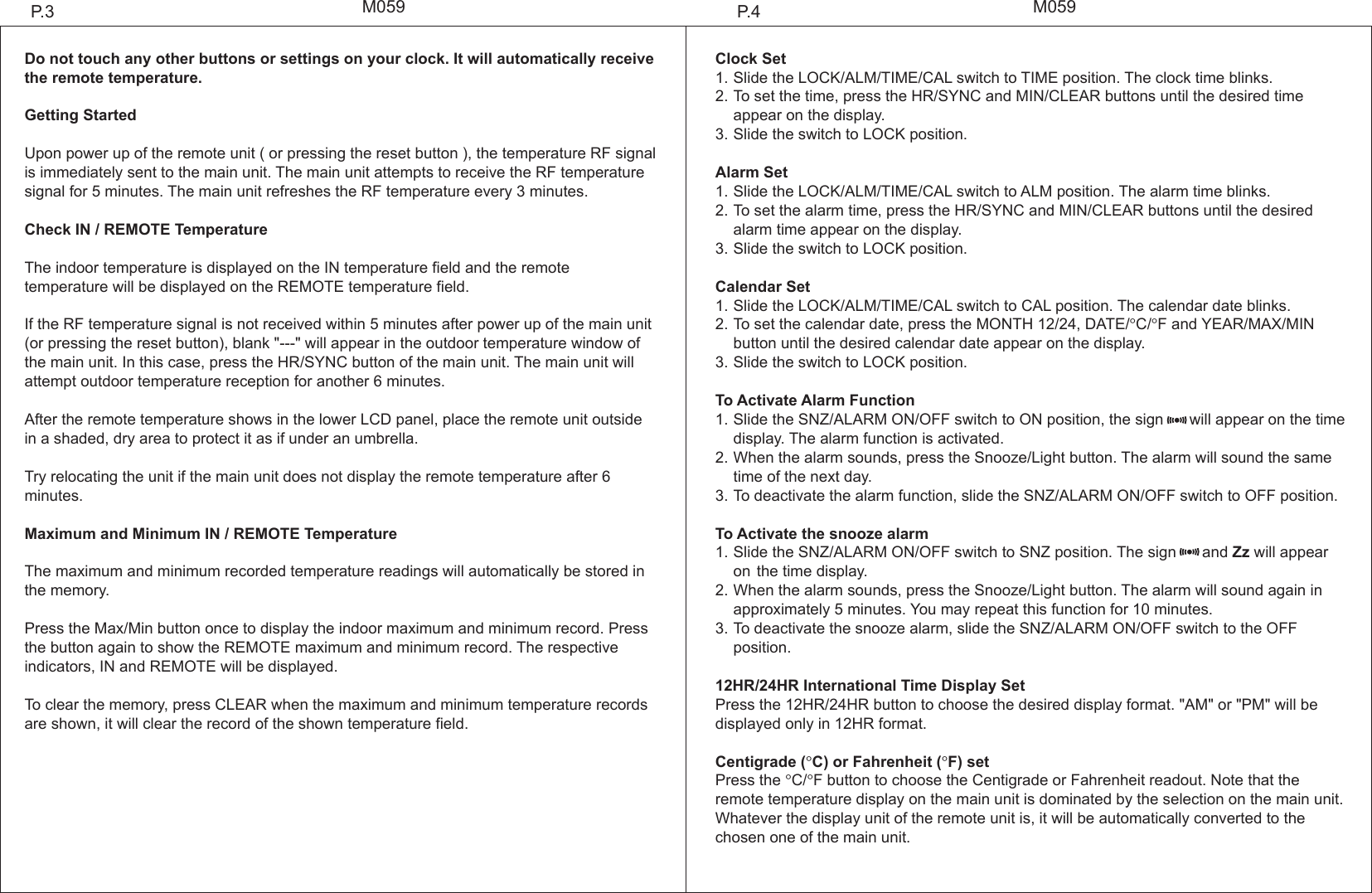
M059 M059Do not touch any other buttons or settings on your clock. It will automatically receive the remote temperature.Getting StartedUpon power up of the remote unit ( or pressing the reset button ), the temperature RF signal is immediately sent to the main unit. The main unit attempts to receive the RF temperature signal for 5 minutes. The main unit refreshes the RF temperature every 3 minutes.Check IN / REMOTE TemperatureThe indoor temperature is displayed on the IN temperature field and the remote temperature will be displayed on the REMOTE temperature field.If the RF temperature signal is not received within 5 minutes after power up of the main unit (or pressing the reset button), blank "---" will appear in the outdoor temperature window of the main unit. In this case, press the HR/SYNC button of the main unit. The main unit will attempt outdoor temperature reception for another 6 minutes.After the remote temperature shows in the lower LCD panel, place the remote unit outside in a shaded, dry area to protect it as if under an umbrella.Try relocating the unit if the main unit does not display the remote temperature after 6 minutes.Maximum and Minimum IN / REMOTE TemperatureThe maximum and minimum recorded temperature readings will automatically be stored in the memory.Press the Max/Min button once to display the indoor maximum and minimum record. Press the button again to show the REMOTE maximum and minimum record. The respective indicators, IN and REMOTE will be displayed.To clear the memory, press CLEAR when the maximum and minimum temperature records are shown, it will clear the record of the shown temperature field.Clock Set1.Slide the LOCK/ALM/TIME/CAL switch to TIME position. The clock time blinks.2.To set the time, press the HR/SYNC and MIN/CLEAR buttons until the desired time appear on the display.3.Slide the switch to LOCK position.Alarm Set1.Slide the LOCK/ALM/TIME/CAL switch to ALM position. The alarm time blinks.2.To set the alarm time, press the HR/SYNC and MIN/CLEAR buttons until the desired   alarm time appear on the display.3.Slide the switch to LOCK position.Calendar Set1.Slide the LOCK/ALM/TIME/CAL switch to CAL position. The calendar date blinks.2.To set the calendar date, press the MONTH 12/24, DATE/°C/°F and YEAR/MAX/MIN   button until the desired calendar date appear on the display.3.Slide the switch to LOCK position. To Activate Alarm Function1.Slide the SNZ/ALARM ON/OFF switch to ON position, the sign      will appear on the time  display. The alarm function is activated.2.When the alarm sounds, press the Snooze/Light button. The alarm will sound the same  time of the next day.3.To deactivate the alarm function, slide the SNZ/ALARM ON/OFF switch to OFF position.To Activate the snooze alarm1.Slide the SNZ/ALARM ON/OFF switch to SNZ position. The sign      and Zz will appear on the time display. 2.When the alarm sounds, press the Snooze/Light button. The alarm will sound again in   approximately 5 minutes. You may repeat this function for 10 minutes.3.To deactivate the snooze alarm, slide the SNZ/ALARM ON/OFF switch to the OFF   position.12HR/24HR International Time Display SetPress the 12HR/24HR button to choose the desired display format. "AM" or "PM" will be displayed only in 12HR format.Centigrade (°C) or Fahrenheit (°F) setPress the °C/°F button to choose the Centigrade or Fahrenheit readout. Note that the remote temperature display on the main unit is dominated by the selection on the main unit. Whatever the display unit of the remote unit is, it will be automatically converted to the chosen one of the main unit.P.4P.3
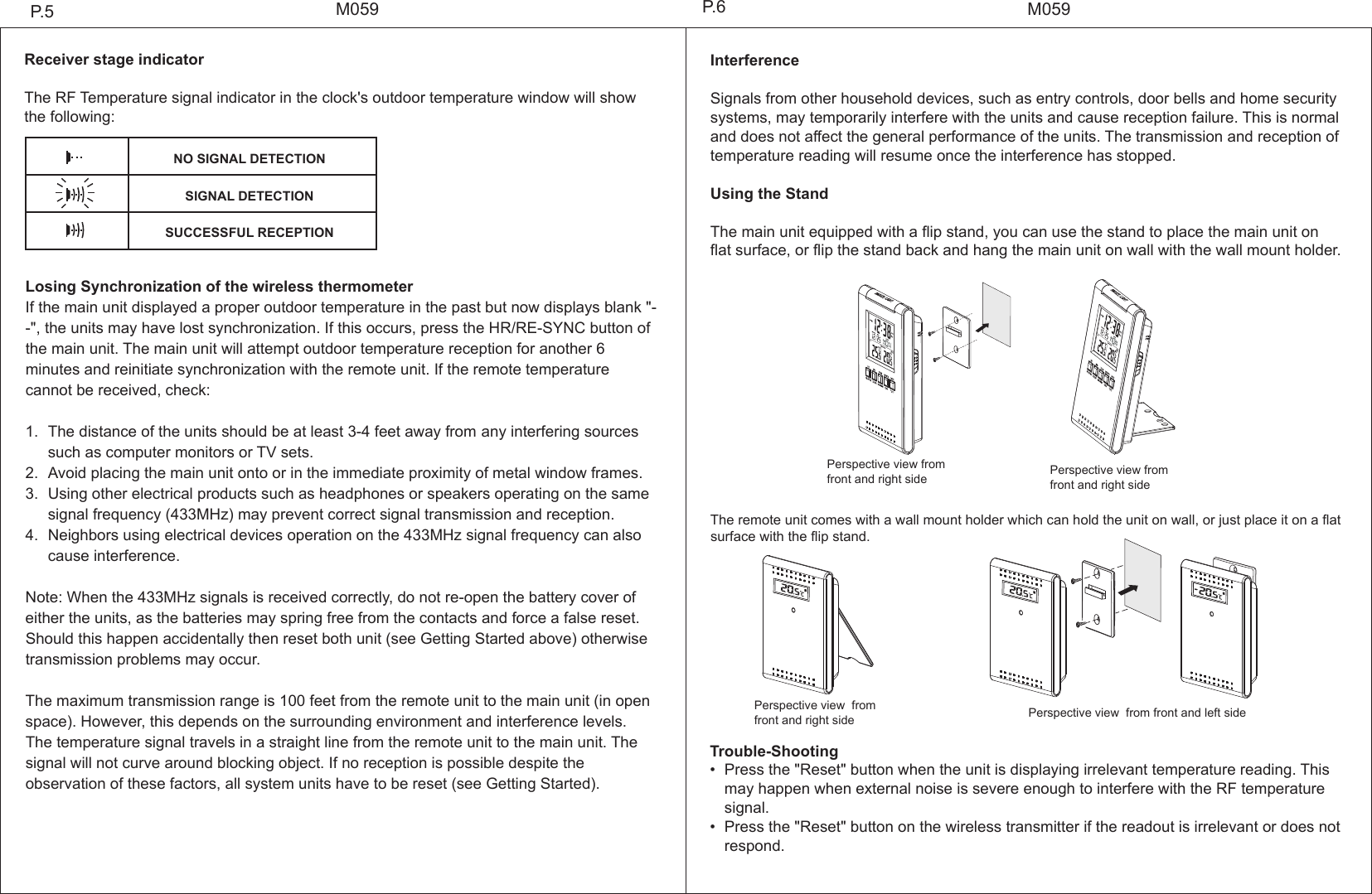
Trouble-Shooting• Press the "Reset" button when the unit is displaying irrelevant temperature reading. This  may happen when external noise is severe enough to interfere with the RF temperature  signal.• Press the "Reset" button on the wireless transmitter if the readout is irrelevant or does not  respond.Receiver stage indicatorThe RF Temperature signal indicator in the clock's outdoor temperature window will show the following:Losing Synchronization of the wireless thermometerIf the main unit displayed a proper outdoor temperature in the past but now displays blank "--", the units may have lost synchronization. If this occurs, press the HR/RE-SYNC button of the main unit. The main unit will attempt outdoor temperature reception for another 6 minutes and reinitiate synchronization with the remote unit. If the remote temperature cannot be received, check:1. The distance of the units should be at least 3-4 feet away from any interfering sources such as computer monitors or TV sets.2. Avoid placing the main unit onto or in the immediate proximity of metal window frames.3. Using other electrical products such as headphones or speakers operating on the same  signal frequency (433MHz) may prevent correct signal transmission and reception.4. Neighbors using electrical devices operation on the 433MHz signal frequency can also  cause interference. Note: When the 433MHz signals is received correctly, do not re-open the battery cover of either the units, as the batteries may spring free from the contacts and force a false reset. Should this happen accidentally then reset both unit (see Getting Started above) otherwise transmission problems may occur.The maximum transmission range is 100 feet from the remote unit to the main unit (in open space). However, this depends on the surrounding environment and interference levels. The temperature signal travels in a straight line from the remote unit to the main unit. The signal will not curve around blocking object. If no reception is possible despite the observation of these factors, all system units have to be reset (see Getting Started).M059M059P.5 P.6InterferenceSignals from other household devices, such as entry controls, door bells and home security systems, may temporarily interfere with the units and cause reception failure. This is normal and does not affect the general performance of the units. The transmission and reception of temperature reading will resume once the interference has stopped.Using the StandThe main unit equipped with a flip stand, you can use the stand to place the main unit on flat surface, or flip the stand back and hang the main unit on wall with the wall mount holder.The remote unit comes with a wall mount holder which can hold the unit on wall, or just place it on a flat surface with the flip stand.NO SIGNAL DETECTIONSIGNAL DETECTIONSUCCESSFUL RECEPTIONPerspective view from front and right side  Perspective view from front and right sidePerspective view  from front and right side  Perspective view  from front and left side
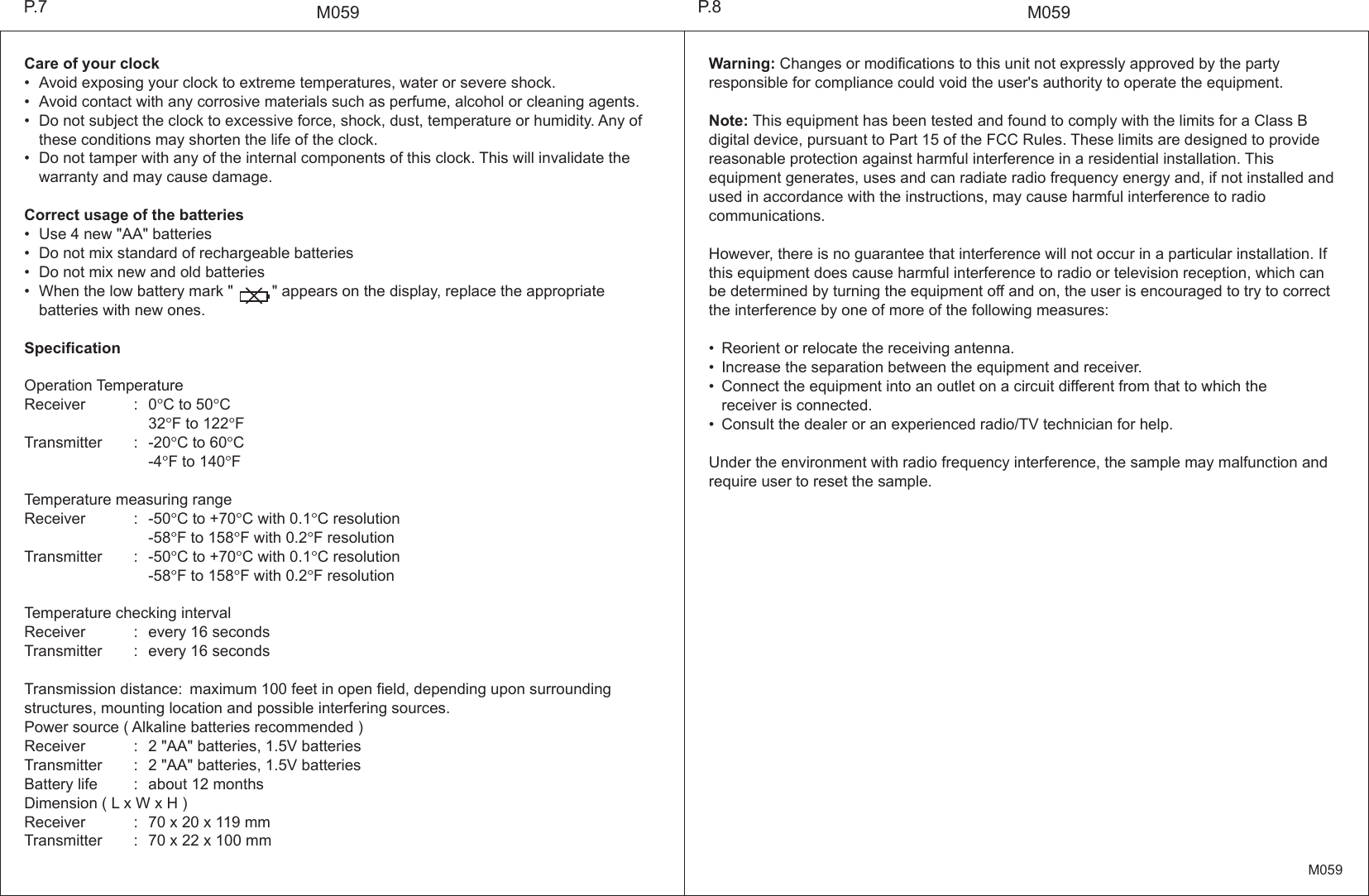
M059M059Warning: Changes or modifications to this unit not expressly approved by the party responsible for compliance could void the user's authority to operate the equipment.Note: This equipment has been tested and found to comply with the limits for a Class B digital device, pursuant to Part 15 of the FCC Rules. These limits are designed to provide reasonable protection against harmful interference in a residential installation. This equipment generates, uses and can radiate radio frequency energy and, if not installed and used in accordance with the instructions, may cause harmful interference to radio communications.However, there is no guarantee that interference will not occur in a particular installation. If this equipment does cause harmful interference to radio or television reception, which can be determined by turning the equipment off and on, the user is encouraged to try to correct the interference by one of more of the following measures:• Reorient or relocate the receiving antenna.• Increase the separation between the equipment and receiver.• Connect the equipment into an outlet on a circuit different from that to which the    receiver is connected.• Consult the dealer or an experienced radio/TV technician for help.Under the environment with radio frequency interference, the sample may malfunction and require user to reset the sample.Care of your clock• Avoid exposing your clock to extreme temperatures, water or severe shock.• Avoid contact with any corrosive materials such as perfume, alcohol or cleaning agents.• Do not subject the clock to excessive force, shock, dust, temperature or humidity. Any of  these conditions may shorten the life of the clock.• Do not tamper with any of the internal components of this clock. This will invalidate the   warranty and may cause damage.Correct usage of the batteries• Use 4 new "AA" batteries• Do not mix standard of rechargeable batteries• Do not mix new and old batteries• When the low battery mark "         " appears on the display, replace the appropriate   batteries with new ones.SpecificationOperation TemperatureReceiver : 0°C to 50°C  32°F to 122°FTransmitter : -20°C to 60°C  -4°F to 140°FTemperature measuring rangeReceiver : -50°C to +70°C with 0.1°C resolution  -58°F to 158°F with 0.2°F resolutionTransmitter : -50°C to +70°C with 0.1°C resolution  -58°F to 158°F with 0.2°F resolutionTemperature checking intervalReceiver : every 16 secondsTransmitter : every 16 secondsTransmission distance: maximum 100 feet in open field, depending upon surrounding structures, mounting location and possible interfering sources.Power source ( Alkaline batteries recommended )Receiver : 2 "AA" batteries, 1.5V batteriesTransmitter : 2 "AA" batteries, 1.5V batteriesBattery life : about 12 monthsDimension ( L x W x H )Receiver : 70 x 20 x 119 mmTransmitter : 70 x 22 x 100 mmP.8P.7M059

Navigation menu