Embedded Designs KIC KIC86 THERMAL PROFILER User Manual SPS Smart Profiler Hardware Guide

Embedded Designs Inc., dba KIC THERMAL PROFILER SPS Smart Profiler Hardware Guide

user manual

  SPS Smart Profiler Hardware Guide               Publication Number PTG-330310-000 Rev. C
SPS Smart Profiler Hardware Guide    PTG-330310-000 Rev. C i SPS Smart Profiler Hardware Guide   Copyright © 2017 KIC.  All rights reserved.  Patents pending. 16120 West Bernardo Drive San Diego, CA  92127 Phone: +1 858 673 6050      Fax: +1 858 673 0085 A Division of Embedded Designs Inc.    This document contains information that is proprietary to KIC.  Said information, is copyrighted as is all associated software and hardware.  All rights are reserved. Patents are pending.  This document and the information contained in it may not be sold, duplicated, used, or disclosed, in whole or in part, except as specifically authorized in writing by KIC.  The information contained in this document and associated software is subject to change without notice.  There are no warranties with respect to the information contained in this document, express or implied, except as provided by written contract between KIC and the customer.  All KIC product names and logos are trademarks of Embedded Designs, Inc. All other trademarks used herein are the property of their respective owners.
SPS Smart Profiler Hardware Guide    PTG-330310-000 Rev. C  ii  Table of Contents    INTRODUCING THE SPS SMART PROFILER .............................................................................................................. 1 REVIEW YOUR PROFILER KIT ............................................................................................................................................. 2 YOUR SMART PROFILER SOFTWARE .................................................................................................................................... 2 SPS SMART PROFILER HARDWARE INITIALIZATION................................................................................................ 3 WARRANTY PROTECTION IMPAIRMENT ............................................................................................................................... 3 THE SPS SMART PROFILER LEDS ............................................................................................................................. 4 THE SMART DOCK LEDS.......................................................................................................................................... 5 POWER THE SPS SMART PROFILER ......................................................................................................................... 6 TYPICAL CHARGING TIME ................................................................................................................................................. 6 BATTERY LED BEHAVIOR .................................................................................................................................................. 6 THE POWER BUTTON ...................................................................................................................................................... 6 SET UP THE SPS SMART PROFILER .......................................................................................................................... 7 CHOOSING THE MODE OF PROFILING .................................................................................................................... 8 DATALOG MODE ............................................................................................................................................................ 8 WIRELESS MODE .......................................................................................................................................................... 11 HARDWARE STATUS: LED STATUS WINDOW ..................................................................................................................... 14 USING THE THERMAL SHIELD ............................................................................................................................... 15 SAFE HANDLING AFTER EXITING THE OVEN ......................................................................................................... 16 SAFELY REMOVE THE PROFILER FROM THE OVEN ................................................................................................................ 16 SAFELY REMOVE THE PROFILER FROM THE SHIELD ............................................................................................................... 17 SPECIFICATIONS AND NORMAL ENVIRONMENTAL CONDITIONS ......................................................................... 18 CLEANING PROCEDURE .................................................................................................................................................. 18 REGULATORY COMPLIANCE ................................................................................................................................. 19 CALIBRATING THE SPS SMART PROFILER ............................................................................................................. 20 ESTABLISH COMMUNICATION .......................................................................................................................................... 20 SPECIFY THE CJREF OFFSET ............................................................................................................................................ 22 SPECIFY THE GAIN ADJUSTMENT ....................................................................................................................................... 23 CONTACT KIC ....................................................................................................................................................... 24
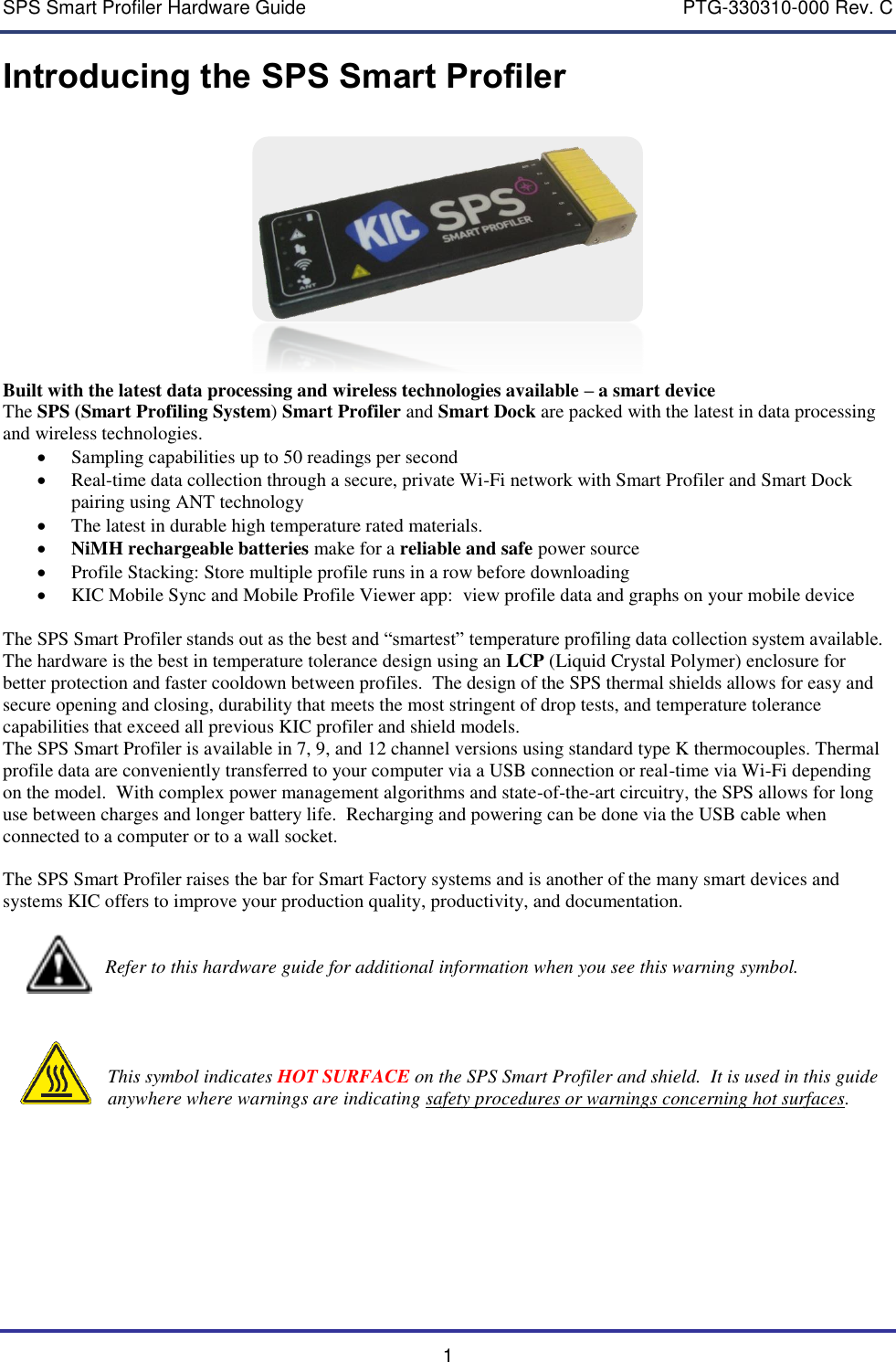
SPS Smart Profiler Hardware Guide    PTG-330310-000 Rev. C 1 Introducing the SPS Smart Profiler   Built with the latest data processing and wireless technologies available – a smart device The SPS (Smart Profiling System) Smart Profiler and Smart Dock are packed with the latest in data processing and wireless technologies.    Sampling capabilities up to 50 readings per second  Real-time data collection through a secure, private Wi-Fi network with Smart Profiler and Smart Dock pairing using ANT technology  The latest in durable high temperature rated materials.   NiMH rechargeable batteries make for a reliable and safe power source  Profile Stacking: Store multiple profile runs in a row before downloading  KIC Mobile Sync and Mobile Profile Viewer app:  view profile data and graphs on your mobile device  The SPS Smart Profiler stands out as the best and “smartest” temperature profiling data collection system available. The hardware is the best in temperature tolerance design using an LCP (Liquid Crystal Polymer) enclosure for better protection and faster cooldown between profiles.  The design of the SPS thermal shields allows for easy and secure opening and closing, durability that meets the most stringent of drop tests, and temperature tolerance capabilities that exceed all previous KIC profiler and shield models.   The SPS Smart Profiler is available in 7, 9, and 12 channel versions using standard type K thermocouples. Thermal profile data are conveniently transferred to your computer via a USB connection or real-time via Wi-Fi depending on the model.  With complex power management algorithms and state-of-the-art circuitry, the SPS allows for long use between charges and longer battery life.  Recharging and powering can be done via the USB cable when connected to a computer or to a wall socket.  The SPS Smart Profiler raises the bar for Smart Factory systems and is another of the many smart devices and systems KIC offers to improve your production quality, productivity, and documentation.                               Refer to this hardware guide for additional information when you see this warning symbol.         This symbol indicates HOT SURFACE on the SPS Smart Profiler and shield.  It is used in this guide anywhere where warnings are indicating safety procedures or warnings concerning hot surfaces.
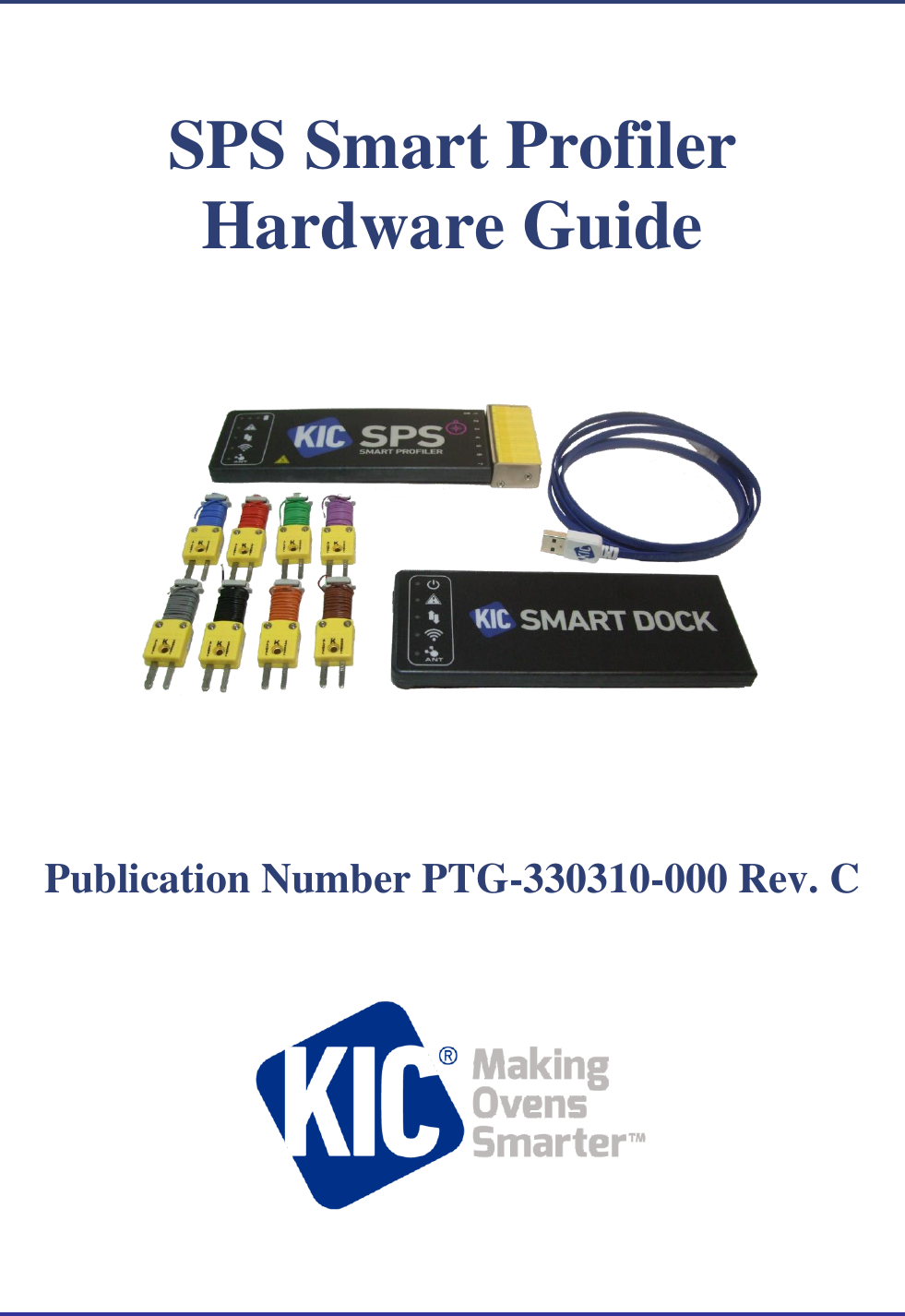
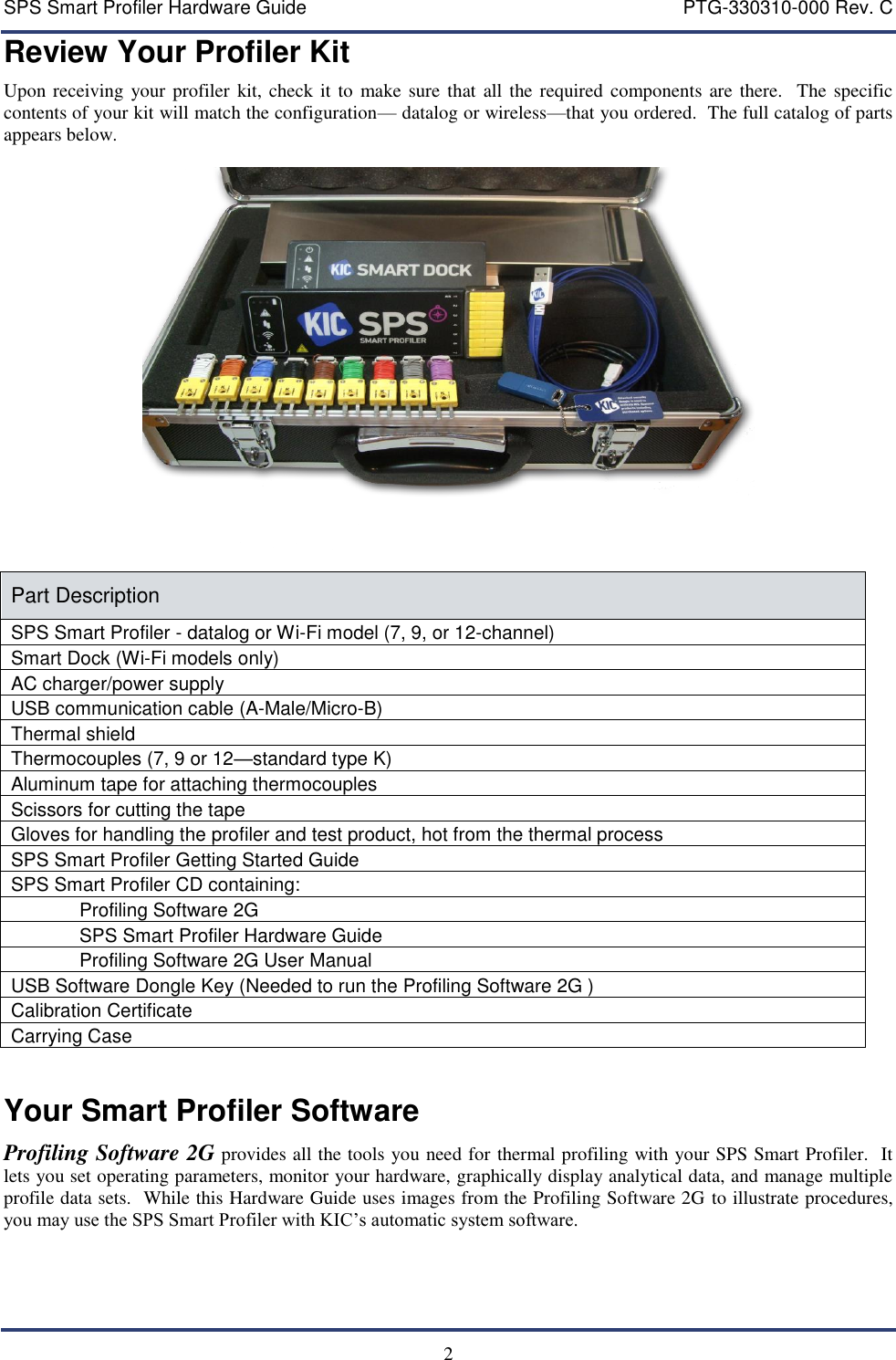
SPS Smart Profiler Hardware Guide    PTG-330310-000 Rev. C   2 Review Your Profiler Kit Upon receiving your profiler kit, check it to  make sure  that all the required  components are  there.   The specific contents of your kit will match the configuration— datalog or wireless—that you ordered.  The full catalog of parts appears below.    Part Description SPS Smart Profiler - datalog or Wi-Fi model (7, 9, or 12-channel) Smart Dock (Wi-Fi models only) AC charger/power supply USB communication cable (A-Male/Micro-B) Thermal shield Thermocouples (7, 9 or 12—standard type K) Aluminum tape for attaching thermocouples Scissors for cutting the tape Gloves for handling the profiler and test product, hot from the thermal process SPS Smart Profiler Getting Started Guide SPS Smart Profiler CD containing:  Profiling Software 2G  SPS Smart Profiler Hardware Guide Profiling Software 2G User Manual USB Software Dongle Key (Needed to run the Profiling Software 2G ) Calibration Certificate Carrying Case  Your Smart Profiler Software Profiling Software 2G provides all the tools you need for thermal profiling with your SPS Smart Profiler.  It lets you set operating parameters, monitor your hardware, graphically display analytical data, and manage multiple profile data sets.  While this Hardware Guide uses images from the Profiling Software 2G to illustrate procedures, you may use the SPS Smart Profiler with KIC’s automatic system software.
SPS Smart Profiler Hardware Guide    PTG-330310-000 Rev. C   3 SPS Smart Profiler Hardware Initialization  To begin profiling in either datalog or Wi-Fi mode, you must first set up your SPS Smart Profiler for use on your PC.  Both  modes  communicate  to  the  computer  through  a  standard  USB  port  –  datalog  mode  uses  a  cable, Transmitter (Wi-Fi) mode uses the Smart Dock.  If the computer has no available USB ports, use a standard 2-8 port hub to add an open port.  Note: Install  Profiling  Software  2G  BEFORE  connecting the  SPS  Smart  Profiler  hardware  to  the computer.    Connecting  the  hardware  before  the  software  is  installed  may  result  in  Windows  OS selecting the incorrect driver for the device and it will not connect to the software.     The normal setup routine must follow the sequence shown below:  1.  Install the software.  2.  Install the USB security dongle.  3.  Connect the SPS Smart Profiler hardware to the computer.   Note:  When  connecting  the  SPS  Smart  Profiler  to  laptop  computers  that  utilize  a  floating  ground connection  (2-prong  power  plug)  manually  ground  the  laptop  before  connecting  the  SPS  Smart Profiler.  This procedure will prevent unwanted electrical interference that may distort the temperature data collected by the SPS Smart Profiler.  If  you  have  any  questions  or  need  assistance  connecting  your  hardware,  contact  KIC  Technical  Support tech@kicmail.com.   Warranty Protection Impairment           Caution: RISK OF VIOLATION OF WARRANTY   Improper handling may limit our liability for damage to equipment and may also violate your     instrument warranty.  As well improper handling or use could impair the protection provided by                      the equipment.
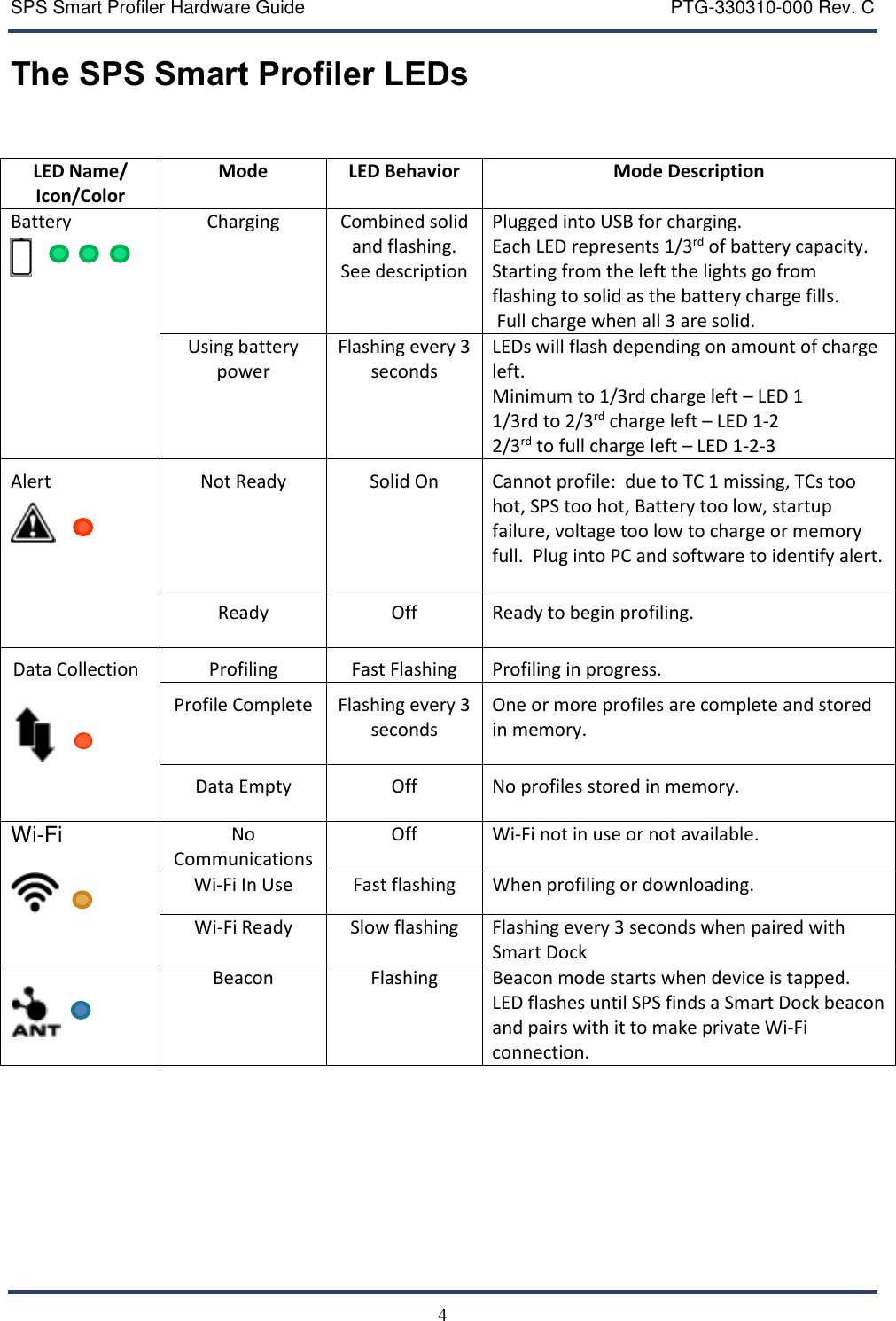
SPS Smart Profiler Hardware Guide    PTG-330310-000 Rev. C   4 The SPS Smart Profiler LEDs   LED Name/ Icon/Color Mode LED Behavior Mode Description Battery   Charging Combined solid and flashing.  See description Plugged into USB for charging. Each LED represents 1/3rd of battery capacity.  Starting from the left the lights go from flashing to solid as the battery charge fills.  Full charge when all 3 are solid.  Using battery power Flashing every 3 seconds  LEDs will flash depending on amount of charge left. Minimum to 1/3rd charge left – LED 1 1/3rd to 2/3rd charge left – LED 1-2 2/3rd to full charge left – LED 1-2-3 Alert  Not Ready Solid On   Cannot profile:  due to TC 1 missing, TCs too hot, SPS too hot, Battery too low, startup failure, voltage too low to charge or memory full.  Plug into PC and software to identify alert. Ready Off Ready to begin profiling. Data Collection        Profiling Fast Flashing Profiling in progress. Profile Complete Flashing every 3 seconds One or more profiles are complete and stored in memory. Data Empty Off No profiles stored in memory. Wi-Fi No Communications Off Wi-Fi not in use or not available.  Wi-Fi In Use Fast flashing When profiling or downloading.  Wi-Fi Ready Slow flashing Flashing every 3 seconds when paired with Smart Dock    Beacon Flashing  Beacon mode starts when device is tapped.  LED flashes until SPS finds a Smart Dock beacon and pairs with it to make private Wi-Fi connection.
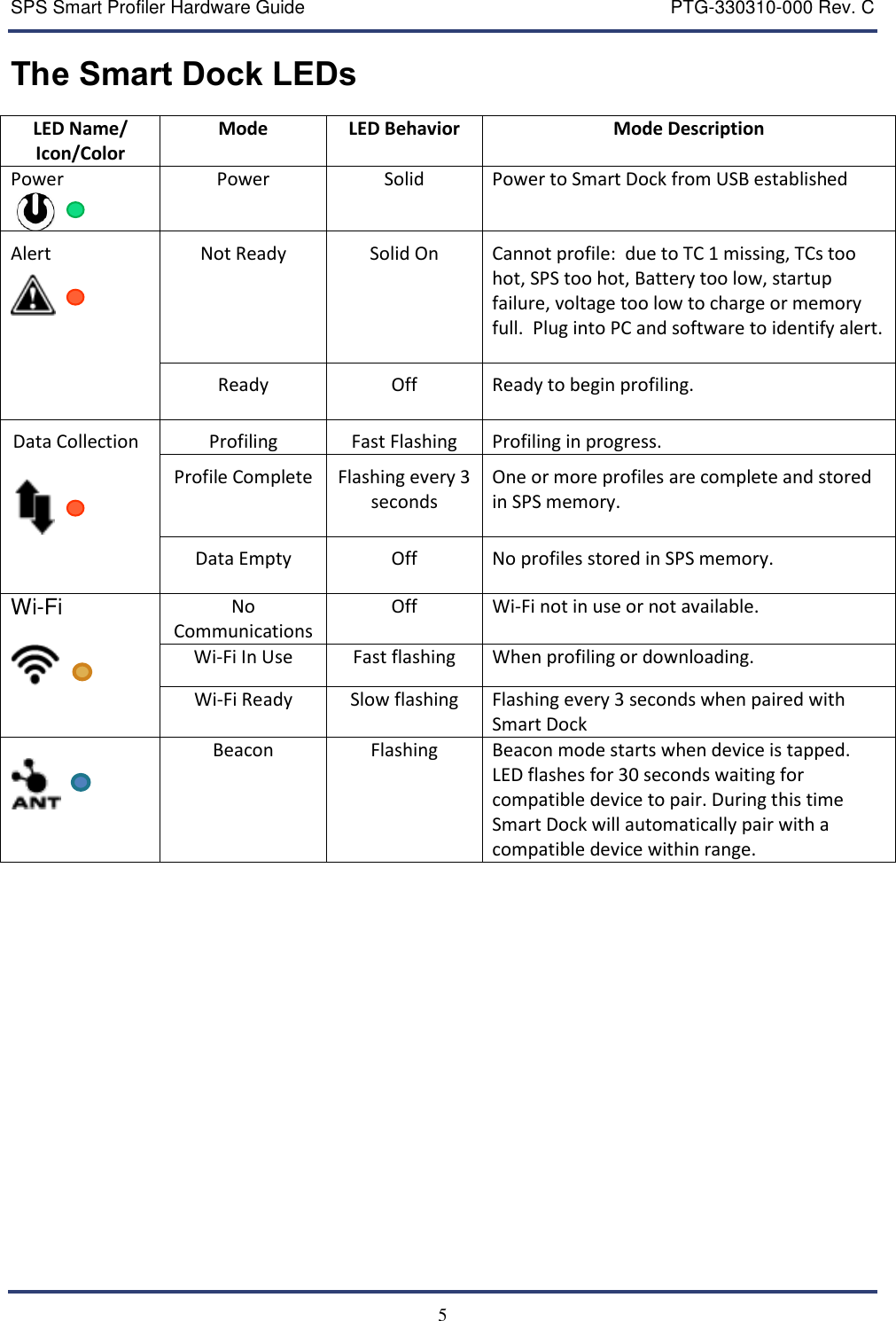
SPS Smart Profiler Hardware Guide    PTG-330310-000 Rev. C   5 The Smart Dock LEDs LED Name/ Icon/Color Mode LED Behavior Mode Description Power    Power Solid Power to Smart Dock from USB established Alert     Not Ready Solid On   Cannot profile:  due to TC 1 missing, TCs too hot, SPS too hot, Battery too low, startup failure, voltage too low to charge or memory full.  Plug into PC and software to identify alert. Ready Off Ready to begin profiling. Data Collection        Profiling Fast Flashing Profiling in progress. Profile Complete Flashing every 3 seconds One or more profiles are complete and stored in SPS memory. Data Empty Off No profiles stored in SPS memory. Wi-Fi No Communications Off Wi-Fi not in use or not available.  Wi-Fi In Use Fast flashing When profiling or downloading.  Wi-Fi Ready Slow flashing Flashing every 3 seconds when paired with Smart Dock    Beacon Flashing  Beacon mode starts when device is tapped.  LED flashes for 30 seconds waiting for compatible device to pair. During this time Smart Dock will automatically pair with a compatible device within range.
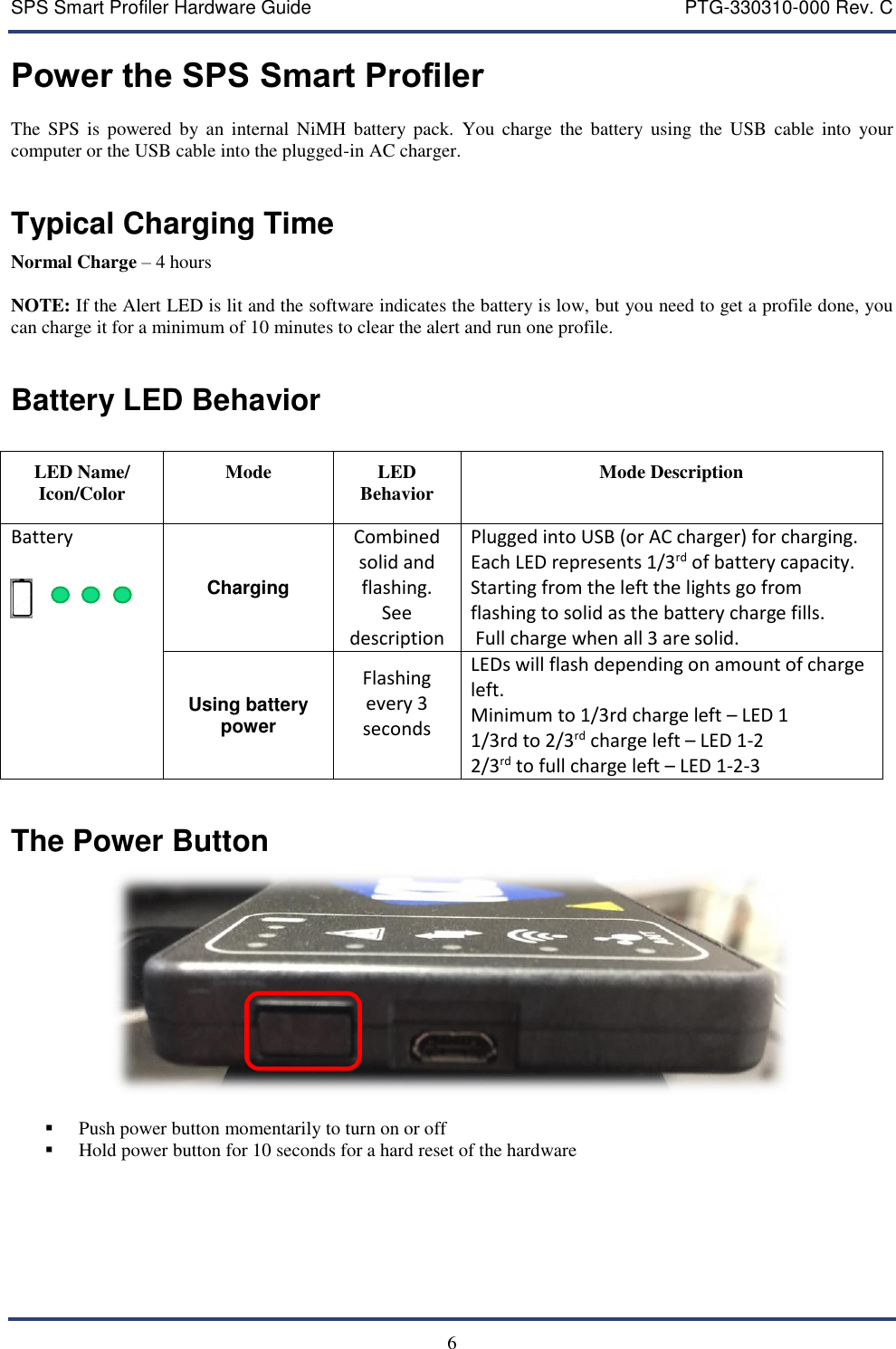
SPS Smart Profiler Hardware Guide    PTG-330310-000 Rev. C   6 Power the SPS Smart Profiler The  SPS  is  powered  by  an  internal  NiMH  battery pack.  You  charge  the  battery  using  the  USB  cable  into  your computer or the USB cable into the plugged-in AC charger.  Typical Charging Time Normal Charge – 4 hours  NOTE: If the Alert LED is lit and the software indicates the battery is low, but you need to get a profile done, you can charge it for a minimum of 10 minutes to clear the alert and run one profile.    Battery LED Behavior  LED Name/ Icon/Color Mode LED Behavior Mode Description Battery    Charging Combined solid and flashing.  See description Plugged into USB (or AC charger) for charging. Each LED represents 1/3rd of battery capacity.  Starting from the left the lights go from flashing to solid as the battery charge fills.  Full charge when all 3 are solid.  Using battery power Flashing every 3 seconds  LEDs will flash depending on amount of charge left. Minimum to 1/3rd charge left – LED 1 1/3rd to 2/3rd charge left – LED 1-2 2/3rd to full charge left – LED 1-2-3  The Power Button    Push power button momentarily to turn on or off   Hold power button for 10 seconds for a hard reset of the hardware
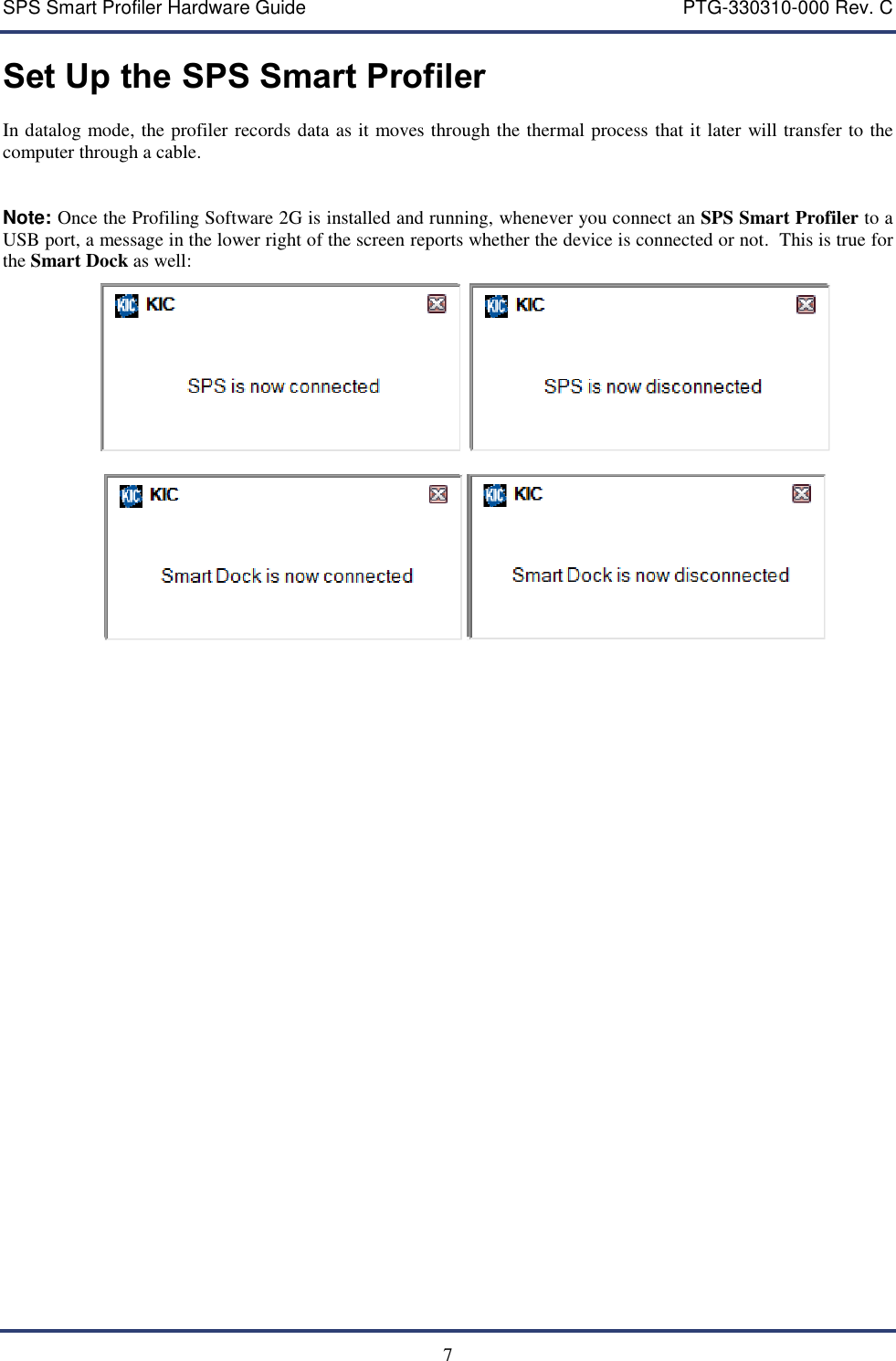
SPS Smart Profiler Hardware Guide    PTG-330310-000 Rev. C   7 Set Up the SPS Smart Profiler In datalog mode, the profiler records data as it moves through the thermal process that it later will transfer to the computer through a cable.   Note: Once the Profiling Software 2G is installed and running, whenever you connect an SPS Smart Profiler to a USB port, a message in the lower right of the screen reports whether the device is connected or not.  This is true for the Smart Dock as well:
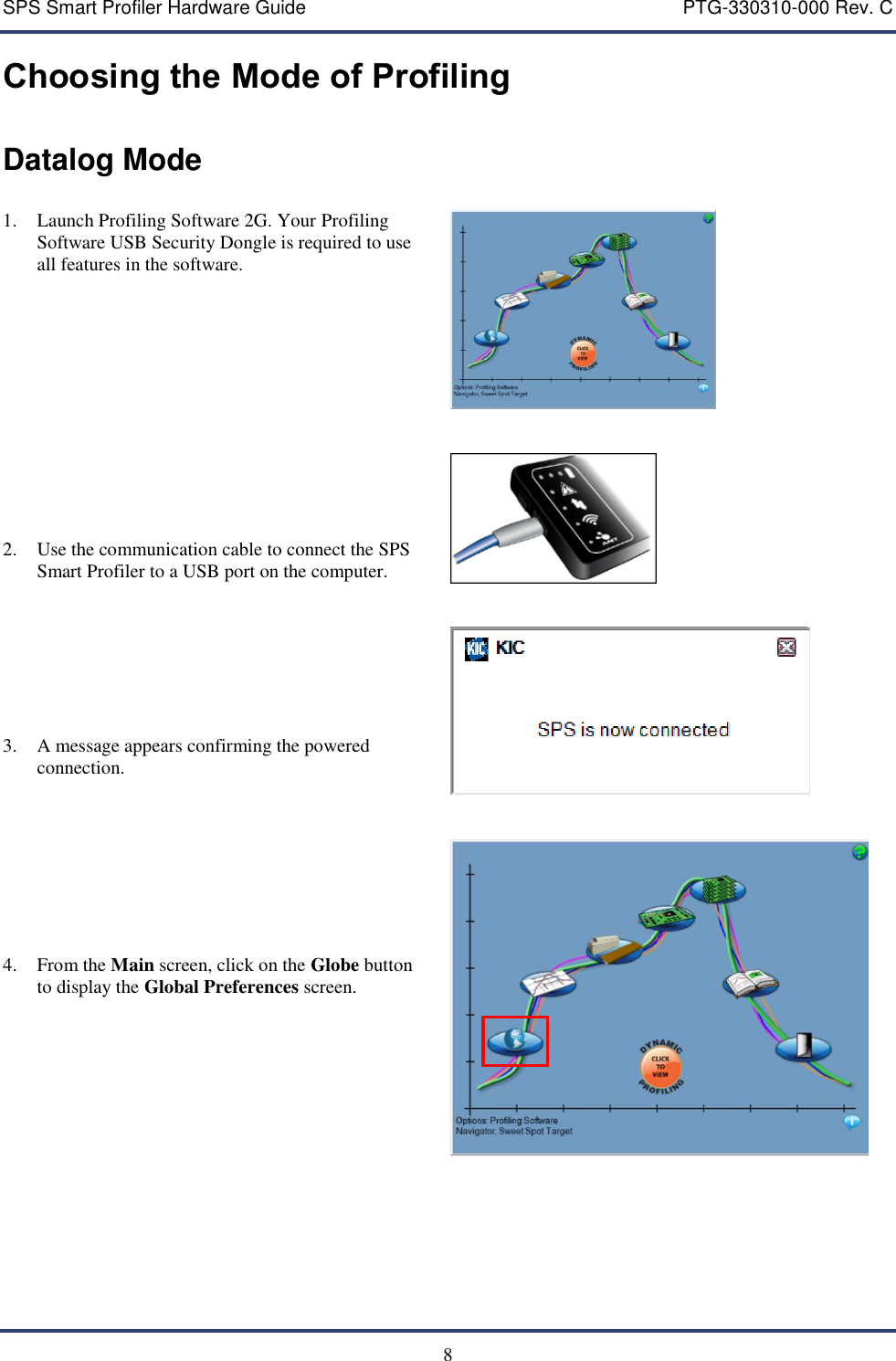
SPS Smart Profiler Hardware Guide    PTG-330310-000 Rev. C   8 Choosing the Mode of Profiling Datalog Mode  1. Launch Profiling Software 2G. Your Profiling Software USB Security Dongle is required to use all features in the software.             2. Use the communication cable to connect the SPS Smart Profiler to a USB port on the computer.         3. A message appears confirming the powered connection.         4. From the Main screen, click on the Globe button to display the Global Preferences screen.
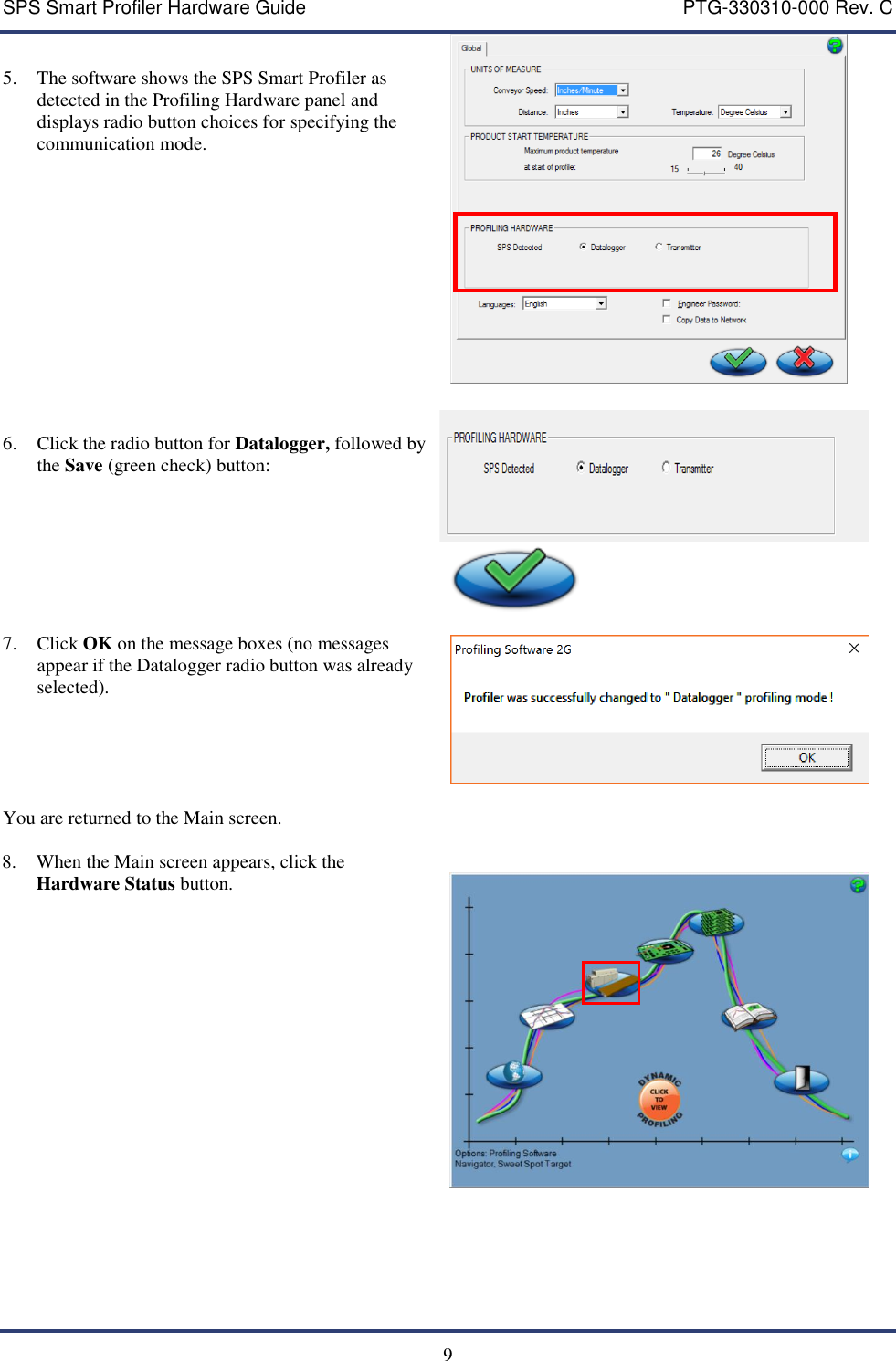
SPS Smart Profiler Hardware Guide    PTG-330310-000 Rev. C   9  5. The software shows the SPS Smart Profiler as detected in the Profiling Hardware panel and displays radio button choices for specifying the communication mode.         6. Click the radio button for Datalogger, followed by the Save (green check) button:     7. Click OK on the message boxes (no messages appear if the Datalogger radio button was already selected).      You are returned to the Main screen.     8. When the Main screen appears, click the Hardware Status button.
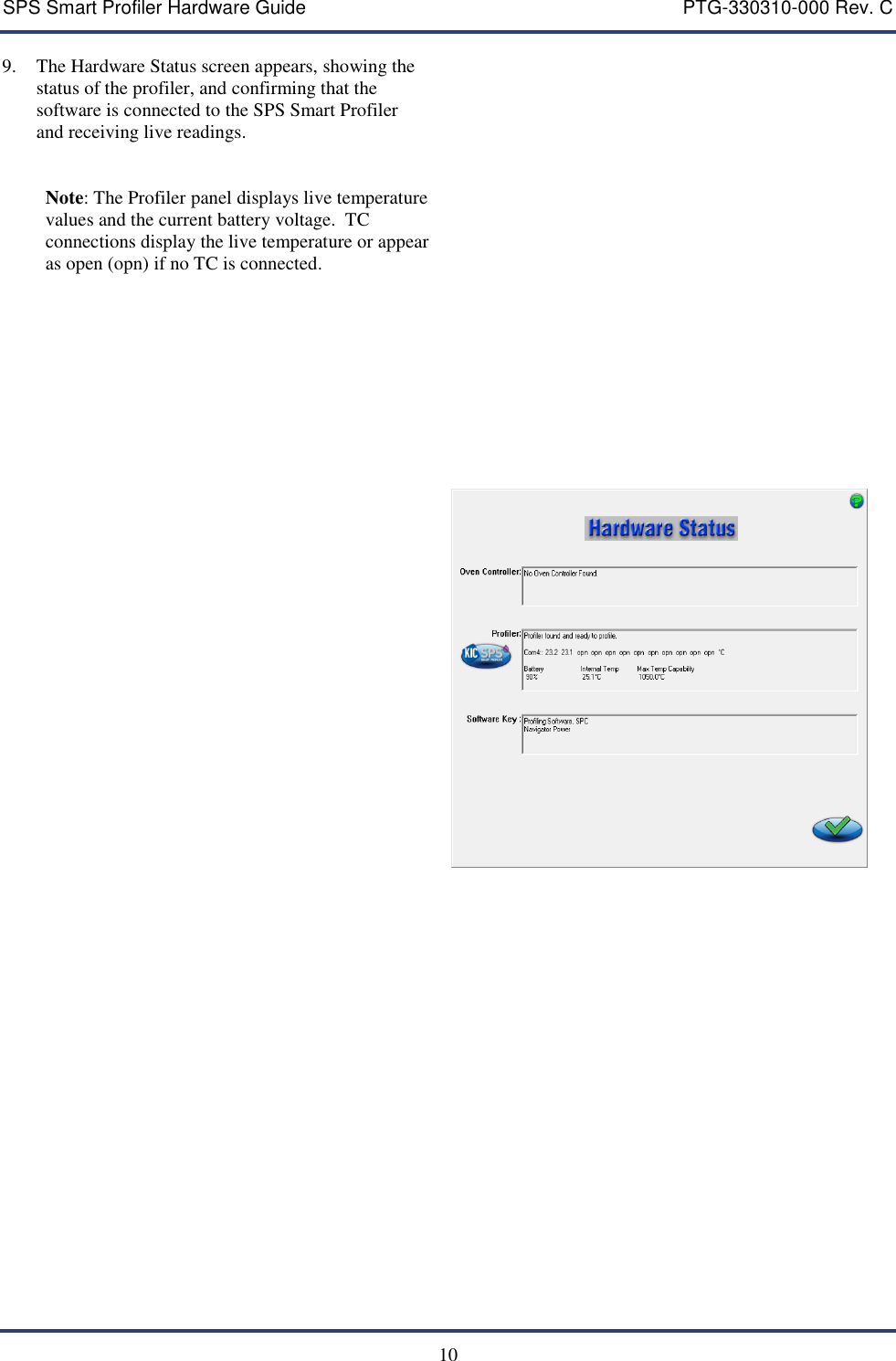
SPS Smart Profiler Hardware Guide    PTG-330310-000 Rev. C  10  9. The Hardware Status screen appears, showing the status of the profiler, and confirming that the software is connected to the SPS Smart Profiler and receiving live readings.    Note: The Profiler panel displays live temperature values and the current battery voltage.  TC connections display the live temperature or appear as open (opn) if no TC is connected.
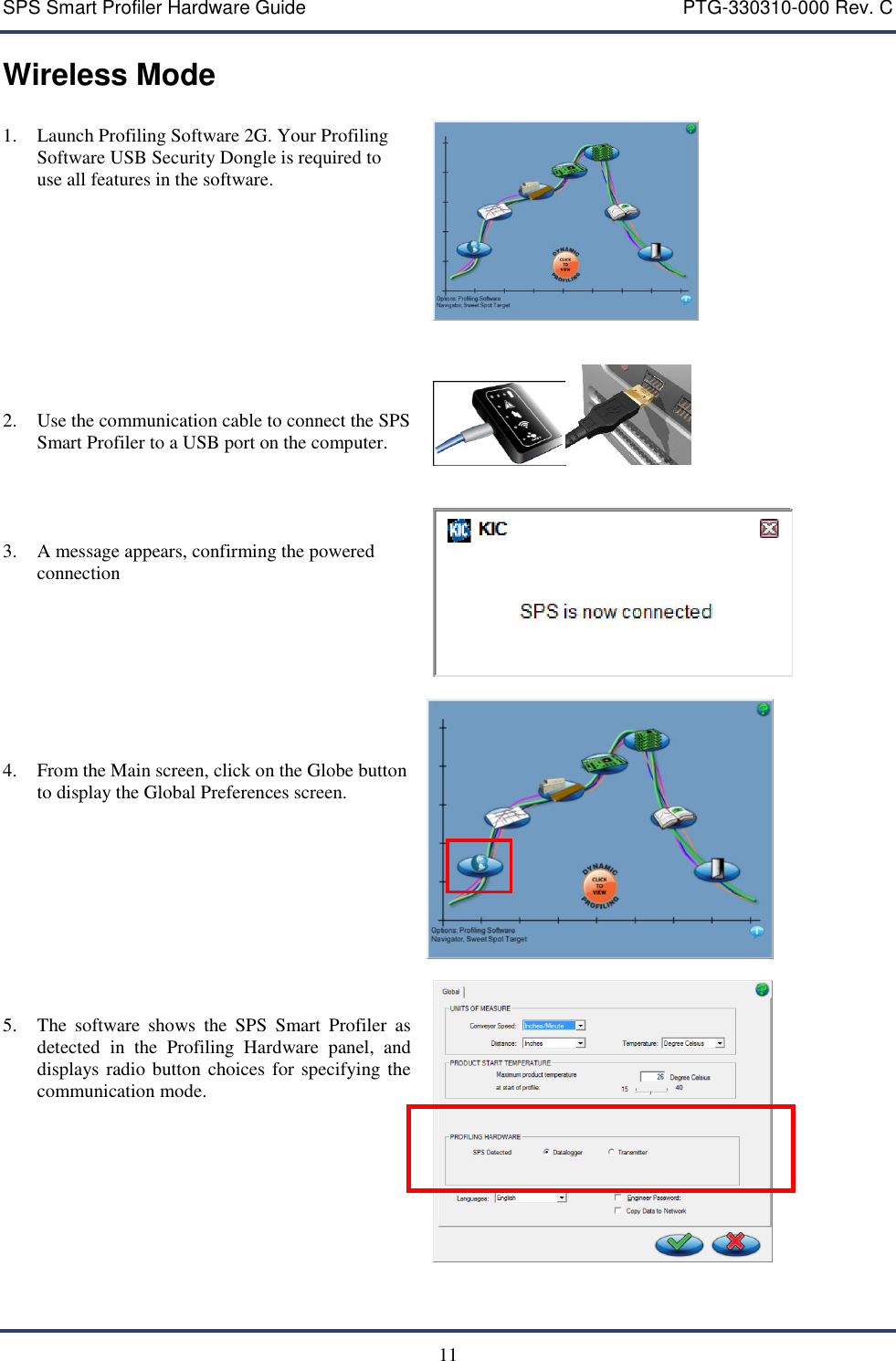
SPS Smart Profiler Hardware Guide    PTG-330310-000 Rev. C  11 Wireless Mode  1. Launch Profiling Software 2G. Your Profiling Software USB Security Dongle is required to use all features in the software.           2. Use the communication cable to connect the SPS Smart Profiler to a USB port on the computer.      3. A message appears, confirming the powered connection         4. From the Main screen, click on the Globe button to display the Global Preferences screen.            5. The  software  shows  the  SPS  Smart  Profiler  as detected  in  the  Profiling  Hardware  panel,  and displays radio button choices for specifying the communication mode.
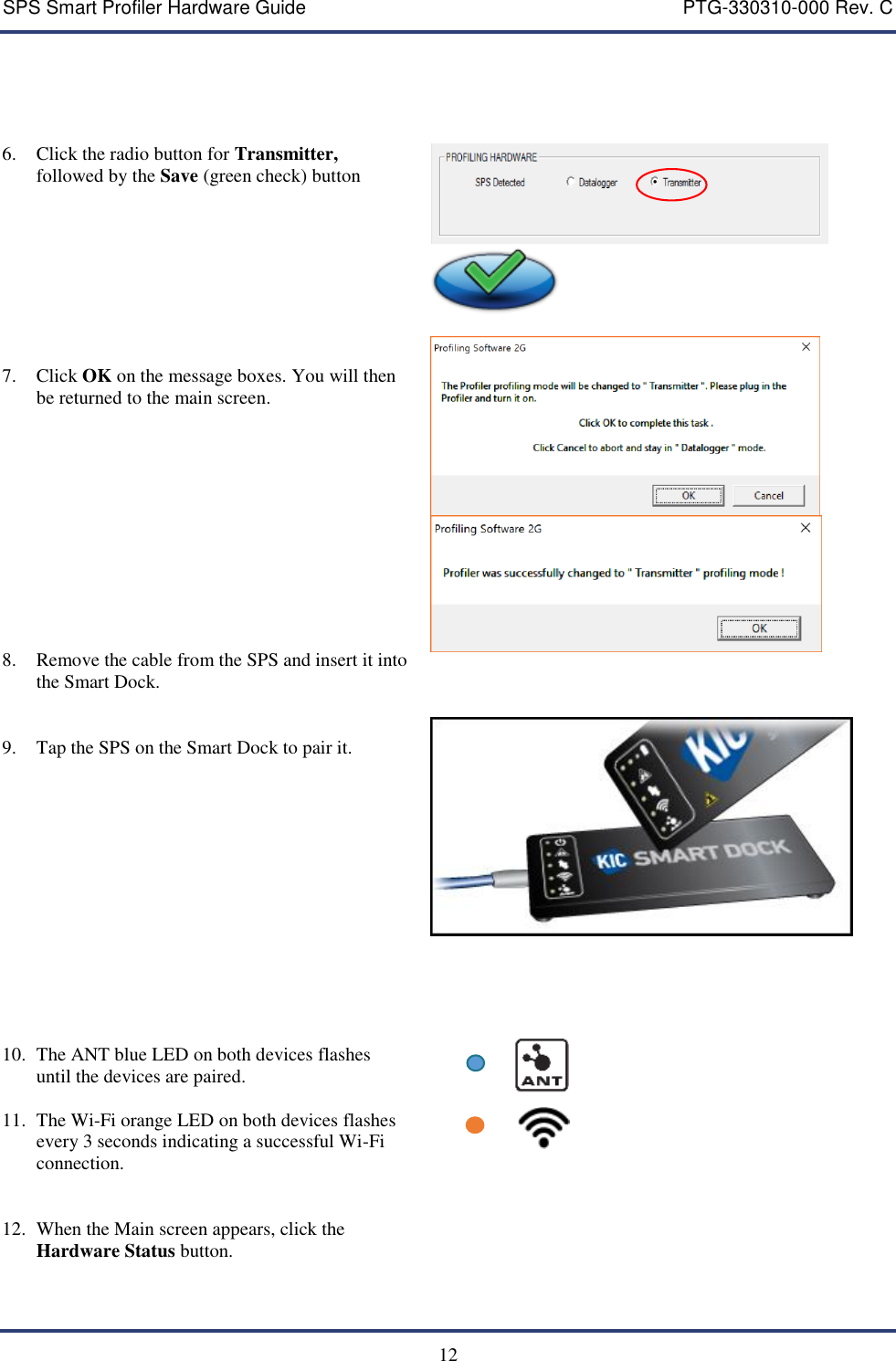
SPS Smart Profiler Hardware Guide    PTG-330310-000 Rev. C  12      6. Click the radio button for Transmitter, followed by the Save (green check) button       7. Click OK on the message boxes. You will then be returned to the main screen.            8. Remove the cable from the SPS and insert it into the Smart Dock.    9. Tap the SPS on the Smart Dock to pair it.                 10. The ANT blue LED on both devices flashes until the devices are paired.  11. The Wi-Fi orange LED on both devices flashes every 3 seconds indicating a successful Wi-Fi connection.              12. When the Main screen appears, click the Hardware Status button.
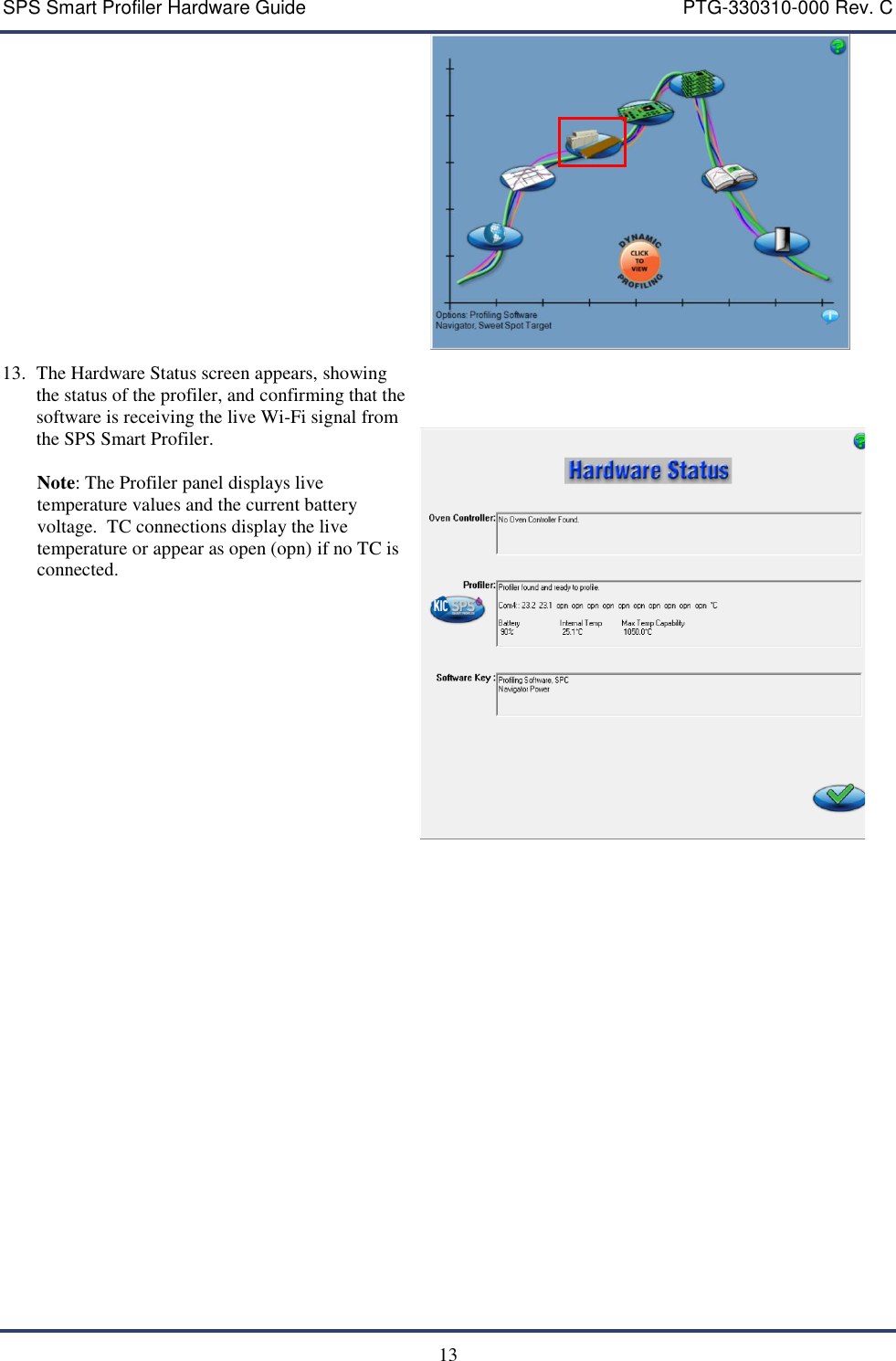
SPS Smart Profiler Hardware Guide    PTG-330310-000 Rev. C  13                13. The Hardware Status screen appears, showing the status of the profiler, and confirming that the software is receiving the live Wi-Fi signal from the SPS Smart Profiler.   Note: The Profiler panel displays live temperature values and the current battery voltage.  TC connections display the live temperature or appear as open (opn) if no TC is connected.
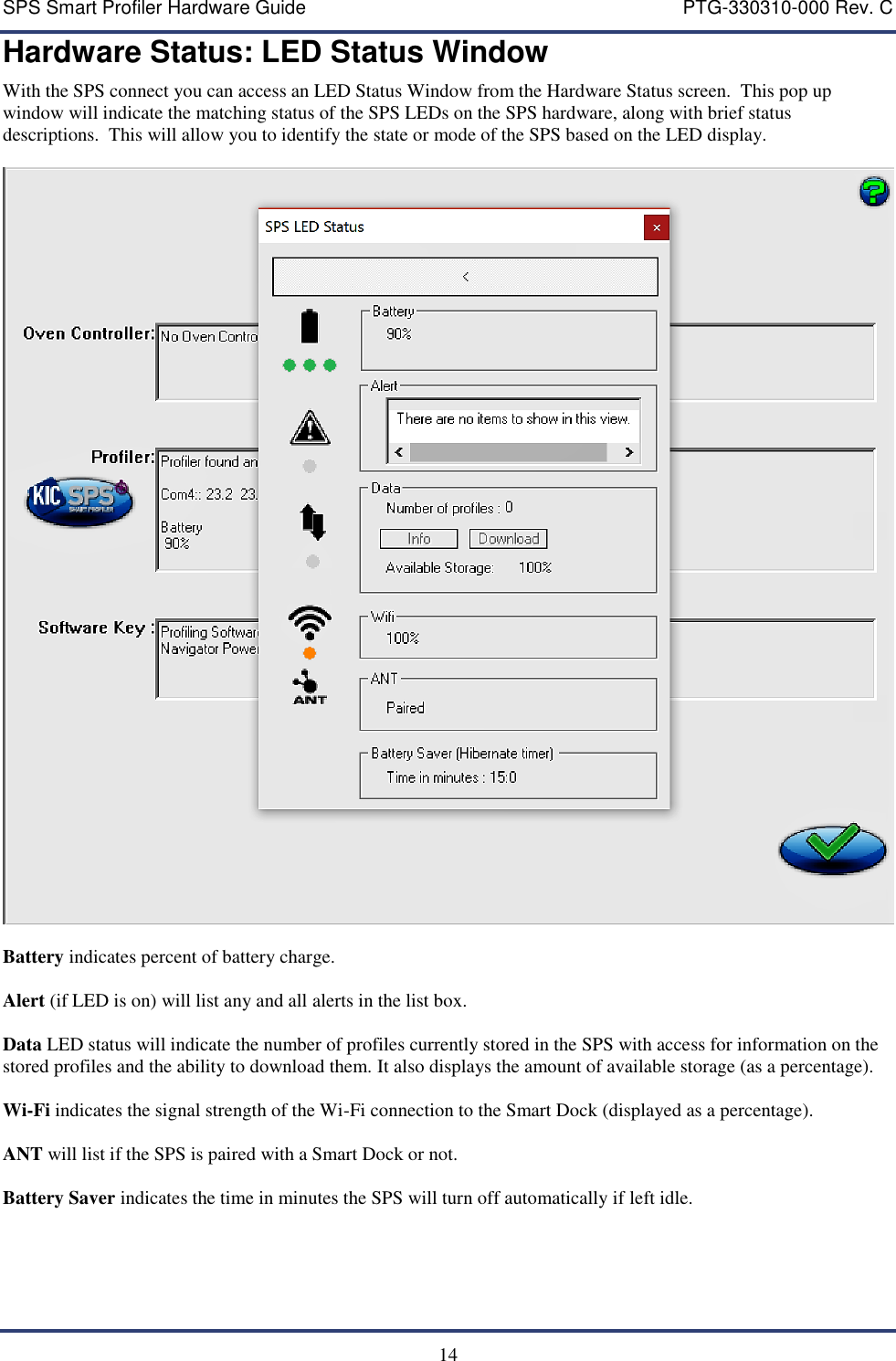
SPS Smart Profiler Hardware Guide    PTG-330310-000 Rev. C  14 Hardware Status: LED Status Window With the SPS connect you can access an LED Status Window from the Hardware Status screen.  This pop up window will indicate the matching status of the SPS LEDs on the SPS hardware, along with brief status descriptions.  This will allow you to identify the state or mode of the SPS based on the LED display.    Battery indicates percent of battery charge.  Alert (if LED is on) will list any and all alerts in the list box.  Data LED status will indicate the number of profiles currently stored in the SPS with access for information on the stored profiles and the ability to download them. It also displays the amount of available storage (as a percentage).  Wi-Fi indicates the signal strength of the Wi-Fi connection to the Smart Dock (displayed as a percentage).  ANT will list if the SPS is paired with a Smart Dock or not.  Battery Saver indicates the time in minutes the SPS will turn off automatically if left idle.
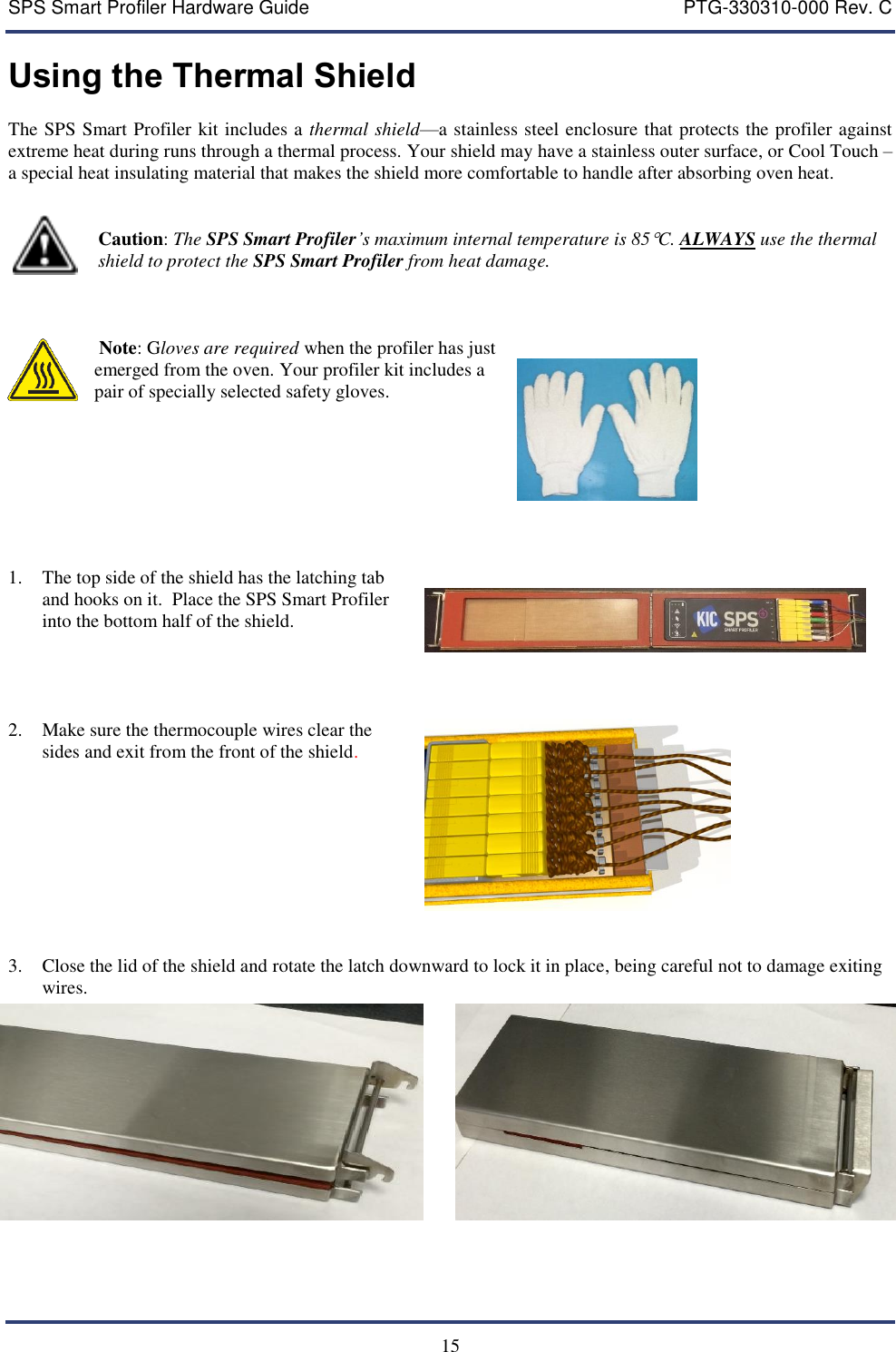
SPS Smart Profiler Hardware Guide    PTG-330310-000 Rev. C  15 Using the Thermal Shield  The SPS Smart Profiler kit includes a thermal shield—a stainless steel enclosure that protects the profiler against extreme heat during runs through a thermal process. Your shield may have a stainless outer surface, or Cool Touch – a special heat insulating material that makes the shield more comfortable to handle after absorbing oven heat.                      Caution: The SPS Smart Profiler’s maximum internal temperature is 85C. ALWAYS use the thermal                     shield to protect the SPS Smart Profiler from heat damage.       Note: Gloves are required when the profiler has just emerged from the oven. Your profiler kit includes a pair of specially selected safety gloves.       1. The top side of the shield has the latching tab and hooks on it.  Place the SPS Smart Profiler into the bottom half of the shield.       2. Make sure the thermocouple wires clear the sides and exit from the front of the shield.       3. Close the lid of the shield and rotate the latch downward to lock it in place, being careful not to damage exiting wires.
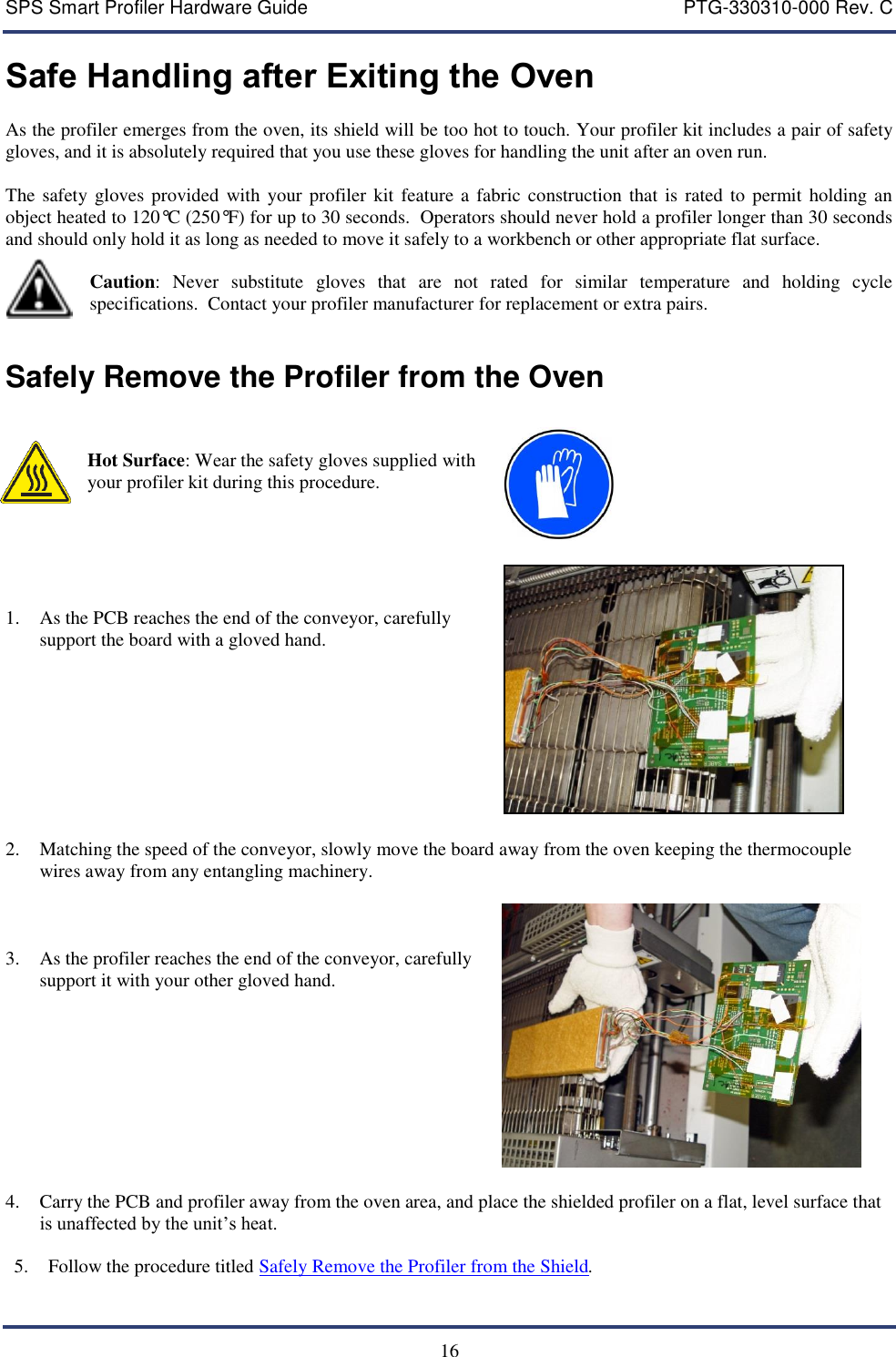
SPS Smart Profiler Hardware Guide    PTG-330310-000 Rev. C  16 Safe Handling after Exiting the Oven As the profiler emerges from the oven, its shield will be too hot to touch. Your profiler kit includes a pair of safety gloves, and it is absolutely required that you use these gloves for handling the unit after an oven run.  The safety gloves provided  with your profiler kit  feature  a fabric construction that is  rated to permit holding an object heated to 120°C (250°F) for up to 30 seconds.  Operators should never hold a profiler longer than 30 seconds and should only hold it as long as needed to move it safely to a workbench or other appropriate flat surface.    Caution:  Never  substitute  gloves  that  are  not  rated  for  similar  temperature  and  holding  cycle specifications.  Contact your profiler manufacturer for replacement or extra pairs.  Safely Remove the Profiler from the Oven   Hot Surface: Wear the safety gloves supplied with your profiler kit during this procedure.        1. As the PCB reaches the end of the conveyor, carefully support the board with a gloved hand.    2. Matching the speed of the conveyor, slowly move the board away from the oven keeping the thermocouple wires away from any entangling machinery.     3. As the profiler reaches the end of the conveyor, carefully support it with your other gloved hand.    4. Carry the PCB and profiler away from the oven area, and place the shielded profiler on a flat, level surface that is unaffected by the unit’s heat.  5. Follow the procedure titled Safely Remove the Profiler from the Shield.
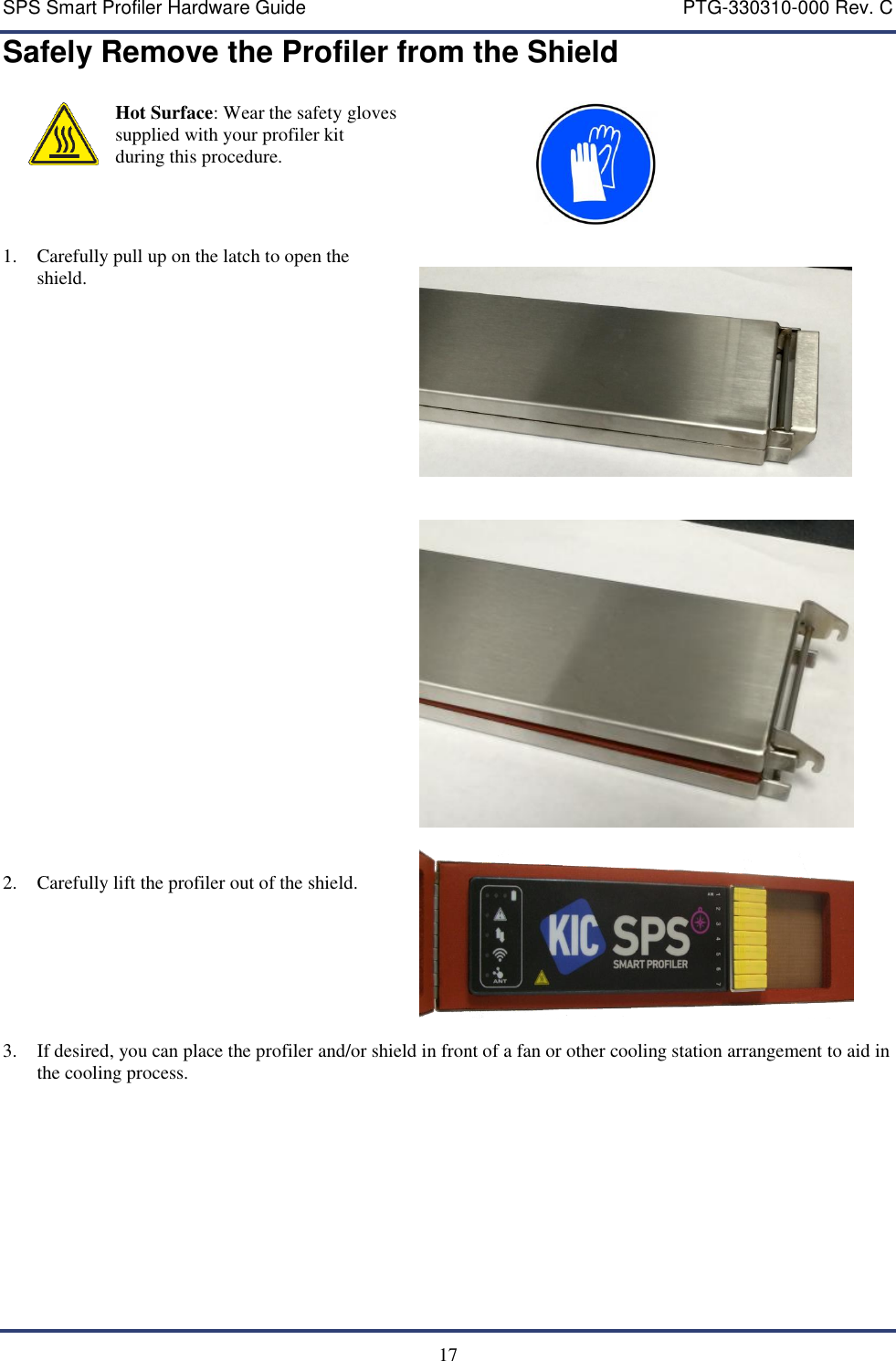
SPS Smart Profiler Hardware Guide    PTG-330310-000 Rev. C  17 Safely Remove the Profiler from the Shield  Hot Surface: Wear the safety gloves supplied with your profiler kit during this procedure.                              1. Carefully pull up on the latch to open the shield.             2. Carefully lift the profiler out of the shield.      3. If desired, you can place the profiler and/or shield in front of a fan or other cooling station arrangement to aid in the cooling process.
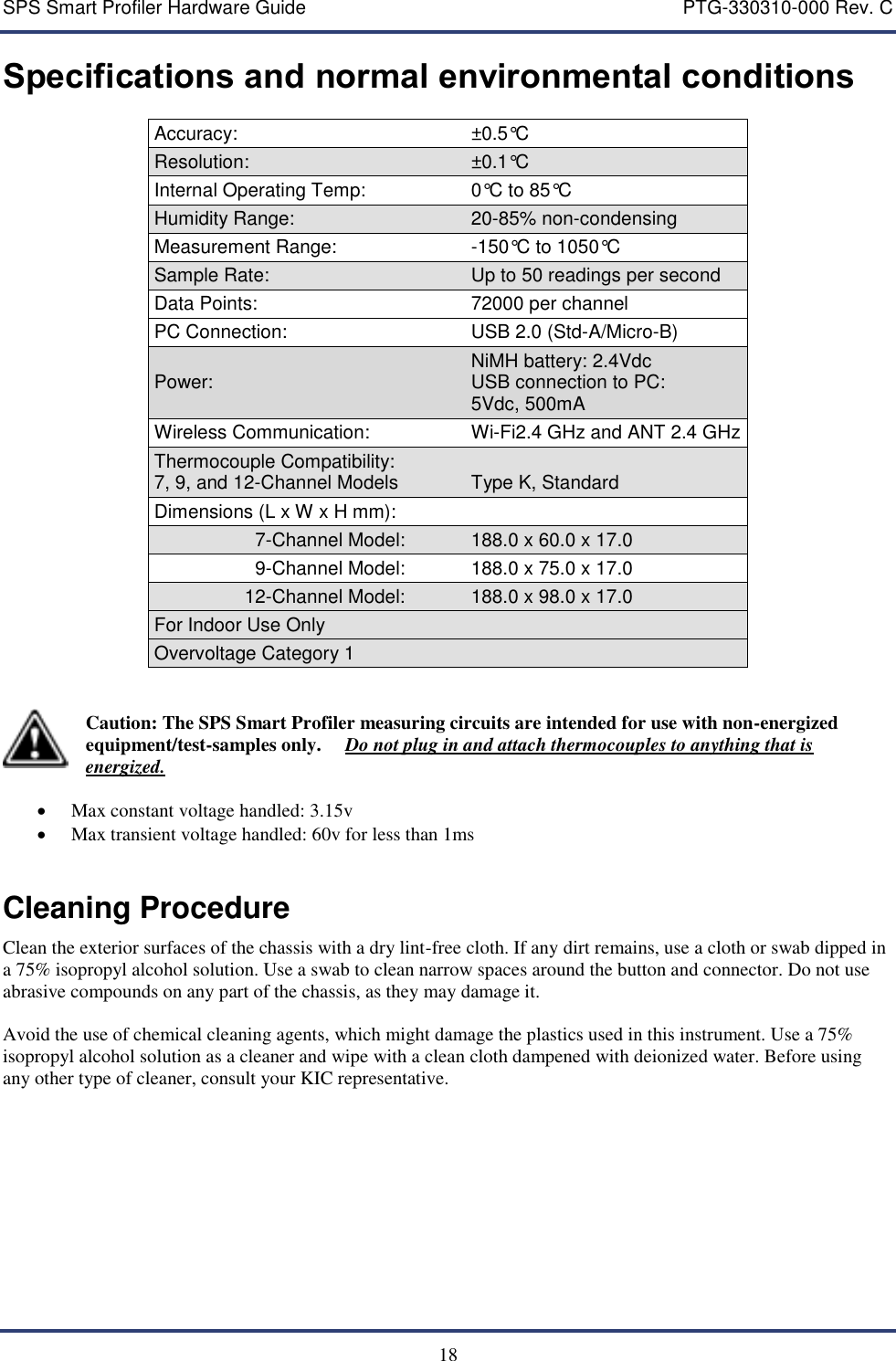
SPS Smart Profiler Hardware Guide    PTG-330310-000 Rev. C  18 Specifications and normal environmental conditions Accuracy: ±0.5°C  Resolution: ±0.1°C  Internal Operating Temp: 0°C to 85°C Humidity Range: 20-85% non-condensing Measurement Range: -150°C to 1050°C Sample Rate: Up to 50 readings per second Data Points: 72000 per channel PC Connection: USB 2.0 (Std-A/Micro-B) Power: NiMH battery: 2.4Vdc  USB connection to PC: 5Vdc, 500mA Wireless Communication: Wi-Fi2.4 GHz and ANT 2.4 GHz Thermocouple Compatibility: 7, 9, and 12-Channel Models   Type K, Standard Dimensions (L x W x H mm):   7-Channel Model: 188.0 x 60.0 x 17.0 9-Channel Model: 188.0 x 75.0 x 17.0 12-Channel Model: 188.0 x 98.0 x 17.0 For Indoor Use Only  Overvoltage Category 1    Caution: The SPS Smart Profiler measuring circuits are intended for use with non-energized equipment/test-samples only.     Do not plug in and attach thermocouples to anything that is energized.   Max constant voltage handled: 3.15v  Max transient voltage handled: 60v for less than 1ms  Cleaning Procedure Clean the exterior surfaces of the chassis with a dry lint-free cloth. If any dirt remains, use a cloth or swab dipped in a 75% isopropyl alcohol solution. Use a swab to clean narrow spaces around the button and connector. Do not use abrasive compounds on any part of the chassis, as they may damage it.  Avoid the use of chemical cleaning agents, which might damage the plastics used in this instrument. Use a 75% isopropyl alcohol solution as a cleaner and wipe with a clean cloth dampened with deionized water. Before using any other type of cleaner, consult your KIC representative.
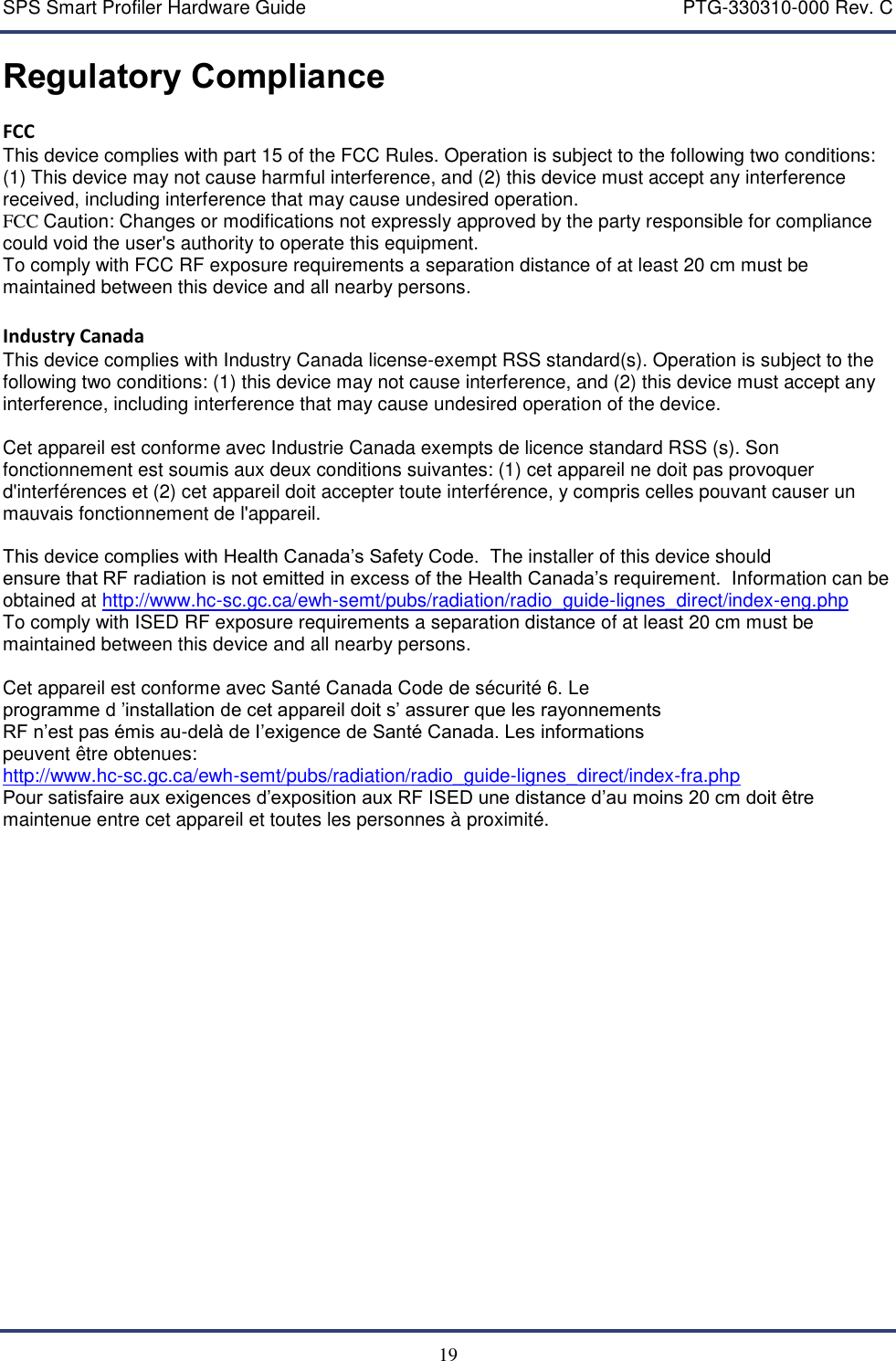
SPS Smart Profiler Hardware Guide    PTG-330310-000 Rev. C  19 Regulatory Compliance FCC This device complies with part 15 of the FCC Rules. Operation is subject to the following two conditions: (1) This device may not cause harmful interference, and (2) this device must accept any interference received, including interference that may cause undesired operation. FCC Caution: Changes or modifications not expressly approved by the party responsible for compliance could void the user's authority to operate this equipment. To comply with FCC RF exposure requirements a separation distance of at least 20 cm must be maintained between this device and all nearby persons.  Industry Canada This device complies with Industry Canada license-exempt RSS standard(s). Operation is subject to the following two conditions: (1) this device may not cause interference, and (2) this device must accept any interference, including interference that may cause undesired operation of the device.  Cet appareil est conforme avec Industrie Canada exempts de licence standard RSS (s). Son fonctionnement est soumis aux deux conditions suivantes: (1) cet appareil ne doit pas provoquer d'interférences et (2) cet appareil doit accepter toute interférence, y compris celles pouvant causer un mauvais fonctionnement de l'appareil.  This device complies with Health Canada’s Safety Code.  The installer of this device should ensure that RF radiation is not emitted in excess of the Health Canada’s requirement.  Information can be obtained at http://www.hc-sc.gc.ca/ewh-semt/pubs/radiation/radio_guide-lignes_direct/index-eng.php To comply with ISED RF exposure requirements a separation distance of at least 20 cm must be maintained between this device and all nearby persons.  Cet appareil est conforme avec Santé Canada Code de sécurité 6. Le programme d ’installation de cet appareil doit s’ assurer que les rayonnements RF n’est pas émis au-delà de I’exigence de Santé Canada. Les informations peuvent être obtenues: http://www.hc-sc.gc.ca/ewh-semt/pubs/radiation/radio_guide-lignes_direct/index-fra.php Pour satisfaire aux exigences d’exposition aux RF ISED une distance d’au moins 20 cm doit être maintenue entre cet appareil et toutes les personnes à proximité.
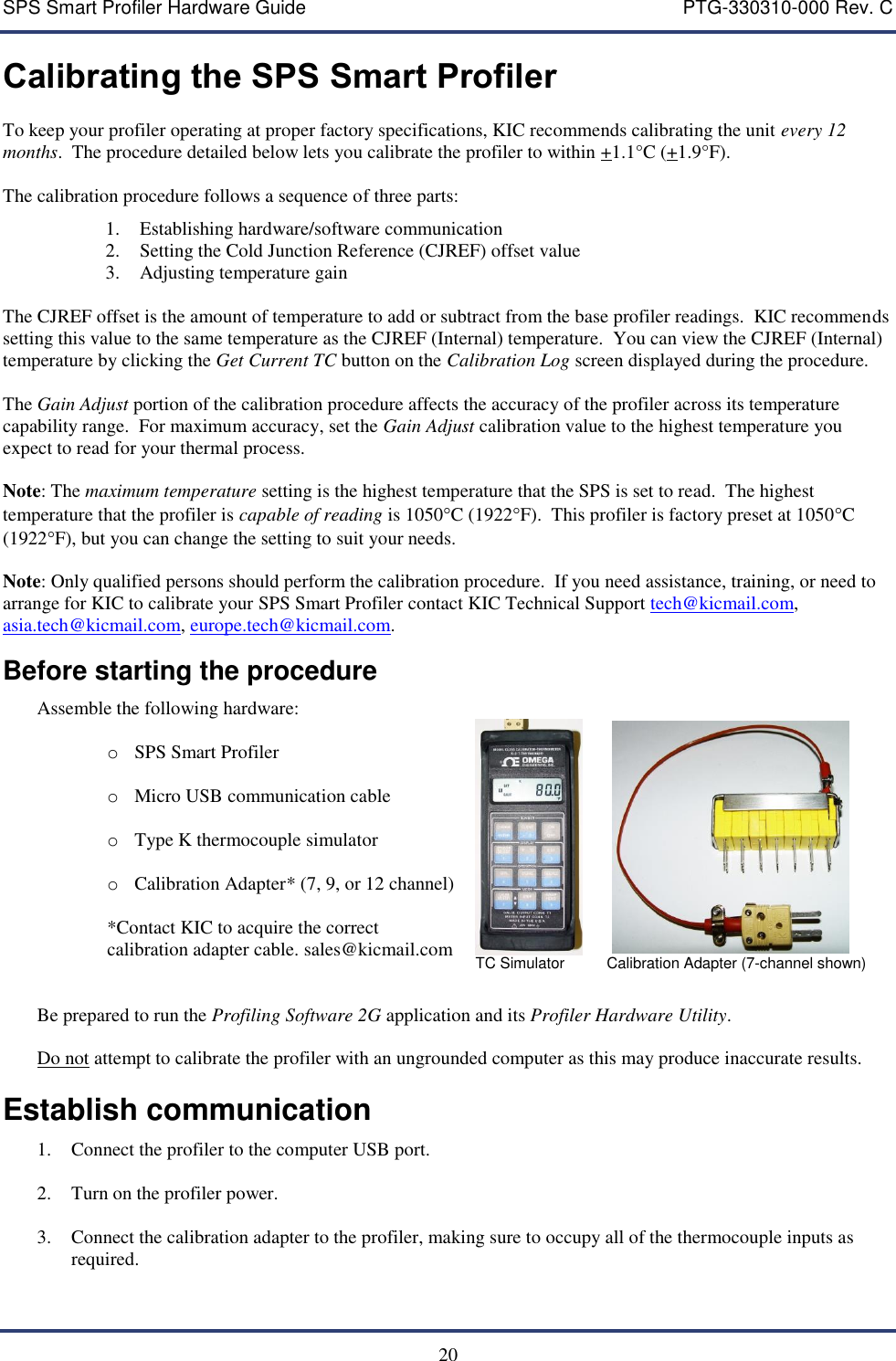
SPS Smart Profiler Hardware Guide    PTG-330310-000 Rev. C  20 Calibrating the SPS Smart Profiler To keep your profiler operating at proper factory specifications, KIC recommends calibrating the unit every 12 months.  The procedure detailed below lets you calibrate the profiler to within +1.1°C (+1.9°F).   The calibration procedure follows a sequence of three parts: 1. Establishing hardware/software communication 2. Setting the Cold Junction Reference (CJREF) offset value 3. Adjusting temperature gain  The CJREF offset is the amount of temperature to add or subtract from the base profiler readings.  KIC recommends setting this value to the same temperature as the CJREF (Internal) temperature.  You can view the CJREF (Internal) temperature by clicking the Get Current TC button on the Calibration Log screen displayed during the procedure.    The Gain Adjust portion of the calibration procedure affects the accuracy of the profiler across its temperature capability range.  For maximum accuracy, set the Gain Adjust calibration value to the highest temperature you expect to read for your thermal process.    Note: The maximum temperature setting is the highest temperature that the SPS is set to read.  The highest temperature that the profiler is capable of reading is 1050C (1922F).  This profiler is factory preset at 1050C (1922F), but you can change the setting to suit your needs.  Note: Only qualified persons should perform the calibration procedure.  If you need assistance, training, or need to arrange for KIC to calibrate your SPS Smart Profiler contact KIC Technical Support tech@kicmail.com, asia.tech@kicmail.com, europe.tech@kicmail.com. Before starting the procedure Assemble the following hardware:   o SPS Smart Profiler  o Micro USB communication cable  o Type K thermocouple simulator  o Calibration Adapter* (7, 9, or 12 channel)    *Contact KIC to acquire the correct  calibration adapter cable. sales@kicmail.com            TC Simulator          Calibration Adapter (7-channel shown)  Be prepared to run the Profiling Software 2G application and its Profiler Hardware Utility.  Do not attempt to calibrate the profiler with an ungrounded computer as this may produce inaccurate results.   Establish communication 1. Connect the profiler to the computer USB port.   2. Turn on the profiler power.  3. Connect the calibration adapter to the profiler, making sure to occupy all of the thermocouple inputs as required.
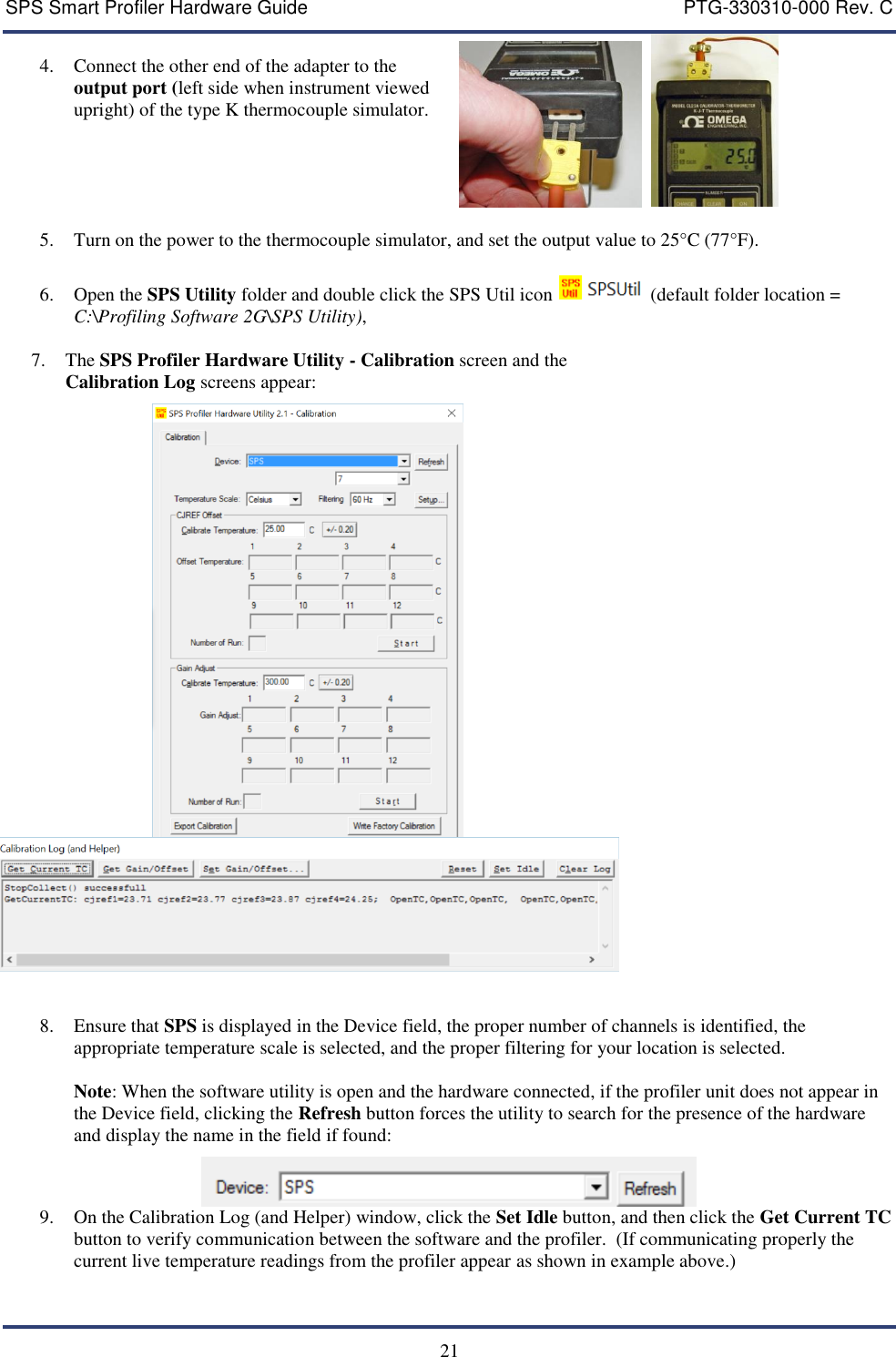
SPS Smart Profiler Hardware Guide    PTG-330310-000 Rev. C  21  4. Connect the other end of the adapter to the output port (left side when instrument viewed upright) of the type K thermocouple simulator.      5. Turn on the power to the thermocouple simulator, and set the output value to 25°C (77°F).    6. Open the SPS Utility folder and double click the SPS Util icon   (default folder location = C:\Profiling Software 2G\SPS Utility),  7. The SPS Profiler Hardware Utility - Calibration screen and the Calibration Log screens appear:     8. Ensure that SPS is displayed in the Device field, the proper number of channels is identified, the appropriate temperature scale is selected, and the proper filtering for your location is selected.  Note: When the software utility is open and the hardware connected, if the profiler unit does not appear in the Device field, clicking the Refresh button forces the utility to search for the presence of the hardware and display the name in the field if found:  9. On the Calibration Log (and Helper) window, click the Set Idle button, and then click the Get Current TC button to verify communication between the software and the profiler.  (If communicating properly the current live temperature readings from the profiler appear as shown in example above.)
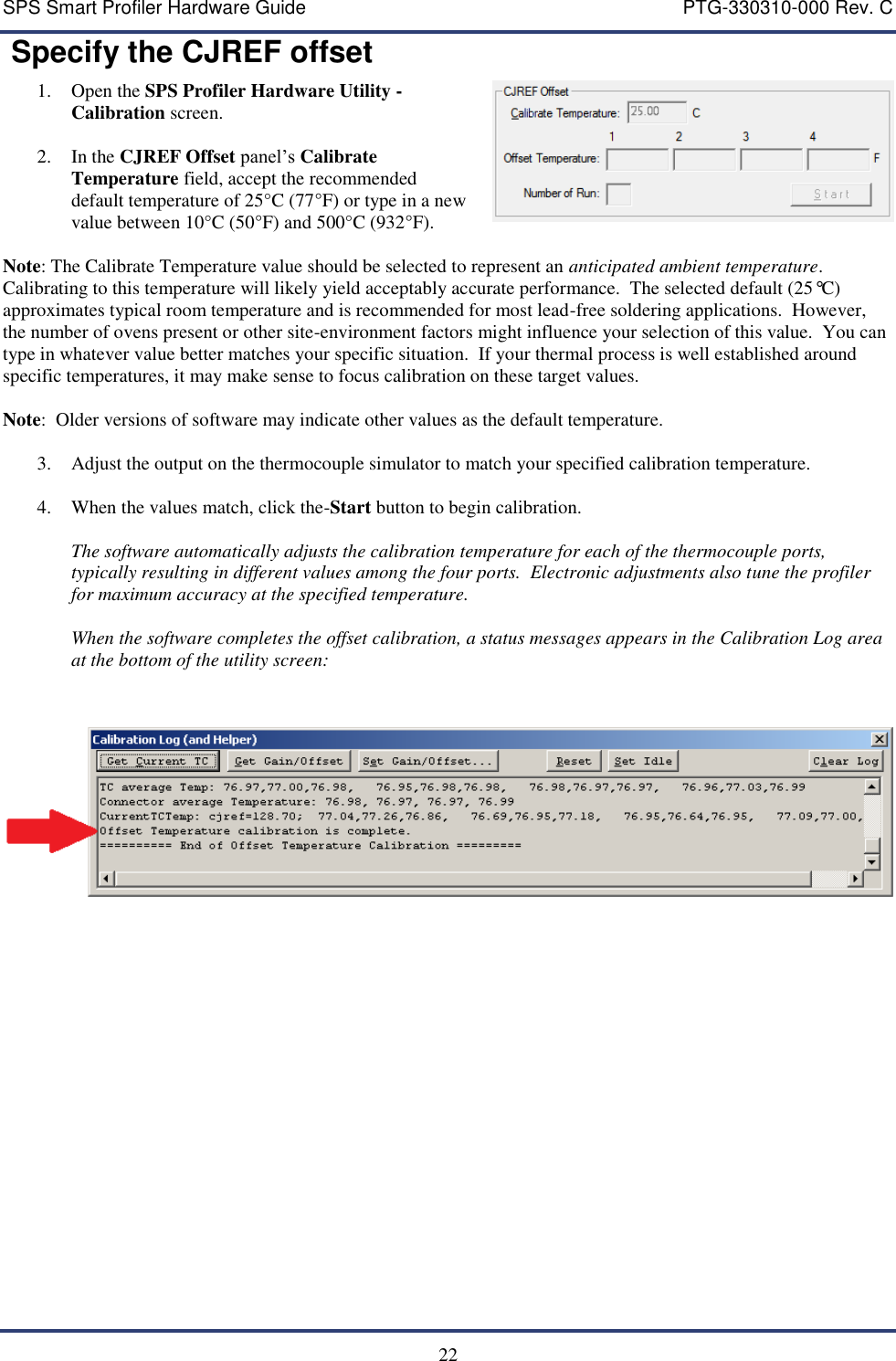
SPS Smart Profiler Hardware Guide    PTG-330310-000 Rev. C  22  Specify the CJREF offset 1. Open the SPS Profiler Hardware Utility - Calibration screen.  2. In the CJREF Offset panel’s Calibrate Temperature field, accept the recommended default temperature of 25°C (77°F) or type in a new value between 10°C (50°F) and 500°C (932°F).   Note: The Calibrate Temperature value should be selected to represent an anticipated ambient temperature.  Calibrating to this temperature will likely yield acceptably accurate performance.  The selected default (25°C) approximates typical room temperature and is recommended for most lead-free soldering applications.  However, the number of ovens present or other site-environment factors might influence your selection of this value.  You can type in whatever value better matches your specific situation.  If your thermal process is well established around specific temperatures, it may make sense to focus calibration on these target values.  Note:  Older versions of software may indicate other values as the default temperature.  3. Adjust the output on the thermocouple simulator to match your specified calibration temperature.  4. When the values match, click the-Start button to begin calibration.    The software automatically adjusts the calibration temperature for each of the thermocouple ports, typically resulting in different values among the four ports.  Electronic adjustments also tune the profiler for maximum accuracy at the specified temperature.    When the software completes the offset calibration, a status messages appears in the Calibration Log area at the bottom of the utility screen:
SPS Smart Profiler Hardware Guide    PTG-330310-000 Rev. C  23 Specify the gain adjustment  1. Open the SPS Profiler Hardware Utility - Calibration screen.  2. In the Gain Adjust panel’s Calibrate Temperature field, accept the recommended default temperature of 300°C (572°F) or type in a new value between 10°C (50°F) and 500°C (932°F).    Note: The recommended default temperature is selected for its suitability to typical lead-free soldering applications.  The range of values presented offers you the choice of calibrating to a maximum temperature or to a specific temperature of interest.  Calibrating to the maximum temperature will yield acceptably accurate performance throughout the range.  Alternatively, if your thermal process is well established around specific temperatures, it may make sense to focus calibration on these target values.  Note:  Older versions of KIC software may indicate other values as the default temperature.  3. Adjust the output on the thermocouple simulator to match your specified calibration temperature.  4. When the values match, click the-Start button to begin calibration.    The software automatically adjusts the Gain setting while electronic adjustments tune the profiler for maximum accuracy at the specified temperature.    When the software completes the gain adjustment, a status messages appears in the Calibration Log area at the bottom of the utility screen:     5. Close and exit the software to end the procedure.  Note: In the Gain Adjust panel, the Number of Run field displays a running count of the number of times you needed to run the final gain adjustment part of the calibration procedure.  The count can go to a maximum of eight.  While it is typical to restart the gain adjustment two or three times before achieving final calibration, a run count number that exceeds five or six can indicate that the profiler has a problem that should be analyzed by KIC technical support. tech@kicmail.com
SPS Smart Profiler Hardware Guide    PTG-330310-000 Rev. C  24 Contact KIC On the Web  You can find the latest KIC product news along with a library of useful information at our website: www.kicthermal.com or www.kic.cn    KIC Technical Support  KIC Tech Support is available by email: USA: tech@kicmail.com Europe: europe.tech@kicmail.com Asia: asia.tech@kicmail.com  KIC Service/Repair  All service and repair of the SPS Smart Profiler or Smart Dock, other than the calibration, requires contacting a KIC Service center and having the service/repair conducted by personnel authorized by KIC.   KIC Product Training  Contact KIC Customer Support by email, training@kicmail.com   KIC Sales  Contact KIC sales: USA: sales@kicmail.com Europe: europe.sales@kicmail.com Asia: asia.sales@kicmail.com China: asia.sales@kicmail.com   Find the KIC Representative in Your Area  Send an email, or visit our web page to find a local representative.

Navigation menu