Epson Emp 720 Users Manual / 730
2015-01-23
: Epson Epson-Emp-720-Users-Manual-252097 epson-emp-720-users-manual-252097 epson pdf
Open the PDF directly: View PDF  .
.
Page Count: 100
- Front Cover
- About The Manuals and Notations Used
- Unpacking the Projector
- Features of the Projector
- Contents
- Before Using the Projector
- Basic Operations
- Advanced Operations
- Troubleshooting
- Appendices
- Back Cover
402529801
02.06-.9A(C05)
Printed in Japan
Printed on 100% recycled paper.
About The Manuals and Notations Used
Types of Manual
The documentation for your EPSON projector is divided into the following three manuals.
The manuals cover the following topics.
Safety Instructions/World-Wide Warranty Terms
This manual contains information on using the projector safely, and also includes world-
wide warranty terms and a troubleshooting check sheet.
Be sure to read this manual thoroughly before using the projector.
User's Guide (this manual)
This User’s Guide contains information on installing the projector, basic operation, using
the configuration menus, troubleshooting and maintenance.
Quick Reference Guide
Contains an overview of the most commonly-used projector functions for easy reference.
You should keep this Quick Reference Guide near the projector at all times and refer to it
before starting presentations and while using the projector in order to check details of
operation.
Notations Used in This User’s Guide
When "unit" or "projector" appears in the text of this User’s Guide, it may refer to items
which are accessories or optional equipment in addition to the main projector unit itself.
General Information
Caution :
Indicates procedures which may result in damage or injury if sufficient
care is not taken.
Tip :
Indicates additional information and points which may be useful to
know regarding a topic.
Indicates that an explanation of the underlined word or words in front
of this symbol appears in the glossary of terms.
Refer to the "Glossary" in the "Appendices". (p.83)
Indicates operating methods and the order of operations.
The procedure indicated should be carried out in the order of the
numbers.
Meaning of "unit" and "projector"
Procedure
1
Unpacking the Projector
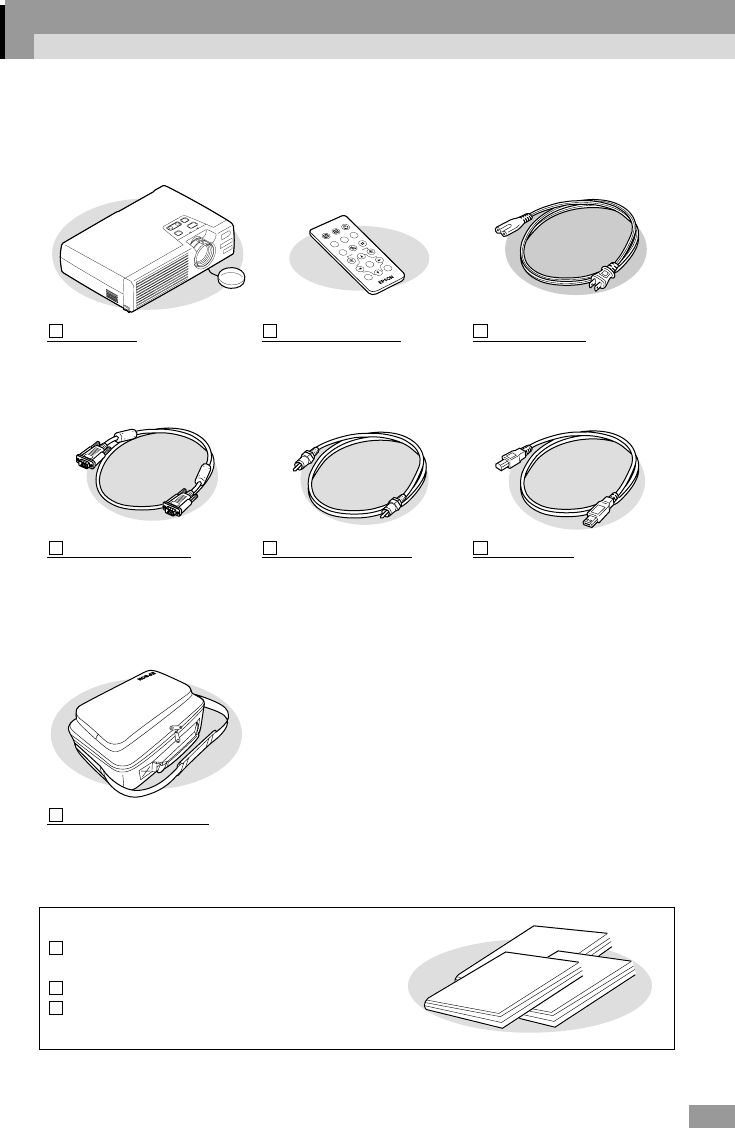
When you unpack the projector, make sure that you have all these components.
If any of the components are missing or incorrect, please contact the place of
purchase.
Projector
(with lens cover)
Remote control
(including a CR2025 lithium
battery)
Power cable
(1.8 m (6 ft.))
For connecting the projector
to a wall outlet
Computer cable
(mini D-Sub 15-pin/mini D-
Sub 15-pin 1.8 m (6 ft.))
For connecting the projector
to a computer
RCA video cable
(1.8 m (6 ft.))
For connecting the projector
to a video component
USB cable
(1.8 m (6 ft.))
For connecting the projector
to a computer with a USB
port so that the wireless
mouse function can be used
Soft carrying case
(with shoulder strap and
handle)
For carrying the projector
Documentation
Safety Instructions/
World-Wide Warranty Terms
User's Guide (this manual)
Quick Reference Guide
S-Video/Video
Computer
Menu A/V Mute
E-Zoom
Freeze
Color Mode
Page up
Page down
Power
ESC
Auto
Enter
2
Features of the Projector
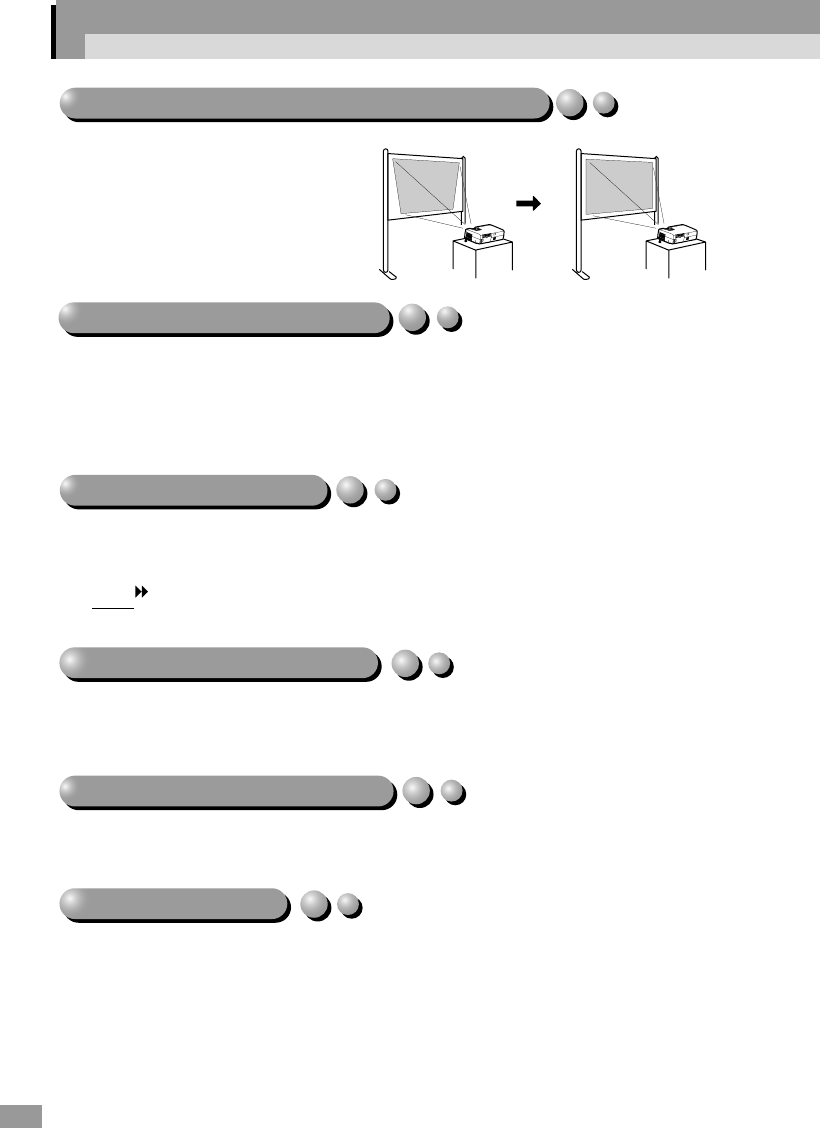
Automatic keystone correction function
The vertical angle of the projector is
detected, so that any vertical keystone
distortion in the projected images can
be automatically corrected. (p.34)
Compact and lightweight
The projector has a compact body with a footprint the size of a B5 page
(19 (D) x 27.6 (W) x 7 (H) cm (7.5 (D) x 10.9 (w) x 2.8 (H))) and is light in weight
(approximately 1.9 kg. (4.2 lbs)), making it easy to carry.
Color mode function
The optimum images can be projected simply by selecting the image quality from the
following six preset settings according to the projection environment being used.
No other troublesome colour adjustments are necessary. (p.40, 47, 49)
• sRGB • Normal • Meeting
• Presentation • Theatre • Game
Automatic setup function
When projecting computer images, the signals from the connected computer are
detected automatically and adjusted so that the optimum images are projected. Even if
several people are giving presentations using the same projector, the optimum picture
quality can be obtained simply by disconnecting and reconnecting the computers.
Each individual setting can also be adjusted manually. (p.37)
Brilliant, attractive images
Despite its compact size, the projector can display images at high resolutions with a high
degree of luminance, providing beautifully clear images even in bright environments.
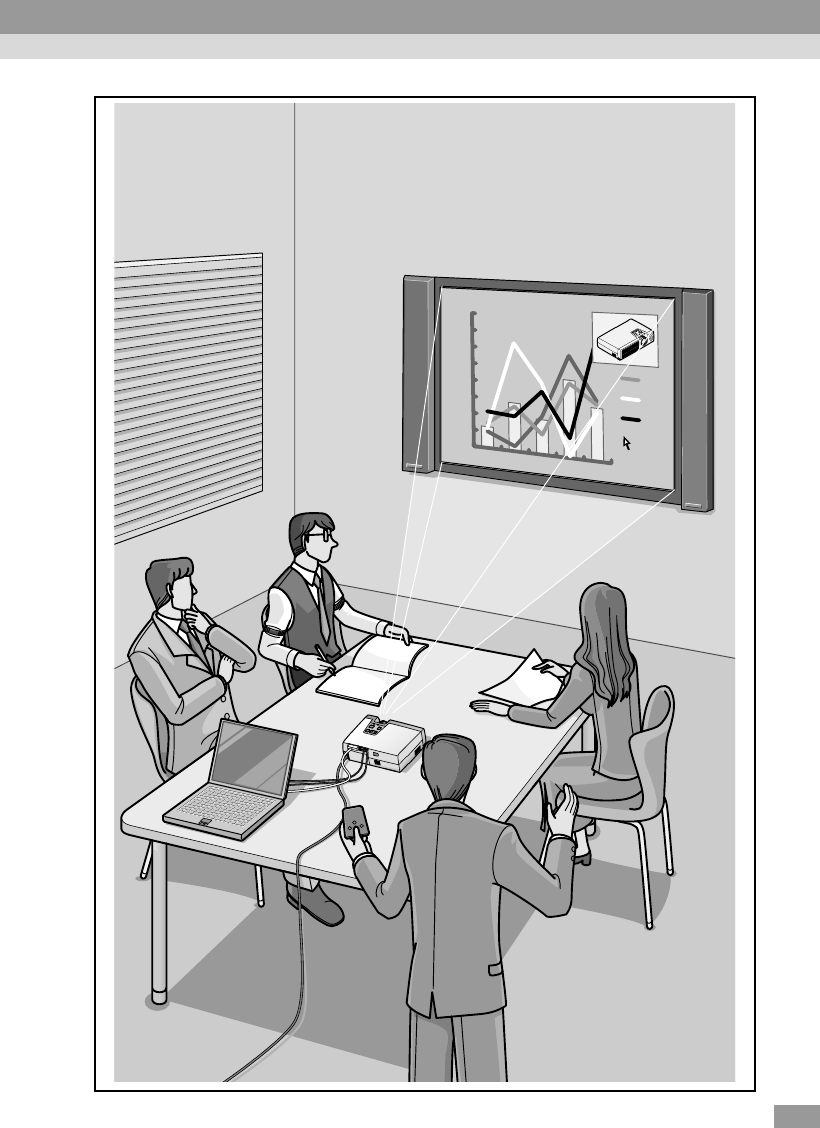
Easy to Operate
The accessory remote control can be used for operations such as pausing projection
(see "Freeze" on p.43) and zooming in on important areas of an image
(see "E-Zoom" on p.45). In addition, the remote control can be used to move the
pointer around on the computer screen during projection (see "Wireless Mouse
Function" on p.21). If using the wireless mouse function, you can use the remote control
to scroll back and forth through pages when projecting a PowerPoint presentation.
3
0
10
20
30
40
50
60
70
80 F
D
C
B
A
Jul
JunMar
Feb
Jan
projector

4
Contents
Unpacking the Projector.................................................................... 1
Features of the Projector................................................................... 2
Before Using the Projector
Part Names and Functions ............................................................... 8
Front/Top................................................................................................ 8
Control Panel..........................................................................................9
Rear ......................................................................................................10
Base...................................................................................................... 10
Remote Control....................................................................................11
Before Using the Remote Control ................................................... 12
Using the Remote Control and Remote Operating Range ................... 12
Installation....................................................................................... 14
Setting Up the Projector....................................................................... 14
Screen Size and Projection Distance.................................................... 15
Connecting to a Computer .............................................................. 16
Eligible Computers ..............................................................................16
Projecting Images from the Computer ................................................. 17
Playing Sound from the Computer ......................................................20
Using the Remote Control to Operate the Mouse Pointer
(Wireless Mouse Function) ................................................................21
Connecting to a Video Source ........................................................ 23
Projecting Composite Video Images....................................................23
Projecting S-Video Images................................................................... 24
Projecting Component Video Images .................................................. 24
Projecting RGB Video Images............................................................. 25
Playing Sound from the Video Equipment .......................................... 26
Basic Operations
Turning On the Projector ................................................................. 28
Connecting the Power Cable................................................................ 28
Turning On the Power and Projecting Images .....................................29
Turning Off the Projector ................................................................. 31
Adjusting the Screen Image............................................................ 33
Adjusting the Image Size .....................................................................33
Adjusting the Image Angle and
Automatic Keystone Correction Function.......................................... 34
Manually Correcting Keystone Distortion ........................................... 36
Before Using
the Projector
5
Basic Operations
Appendices Advanced Operations
Troubleshooting
Adjusting the Image Quality ............................................................ 37
Focusing the Screen Image .................................................................. 37
Adjusting Computer Images ................................................................ 37
Selecting the Colour Mode .................................................................. 40
Advanced Operations
Functions for Enhancing Projection ................................................ 42
A/V Mute ............................................................................................. 42
Freeze................................................................................................... 43
Wide-screen Projection of Component Video and Video Images
(Changing the Aspect Ratio) ............................................................. 44
E-Zoom ................................................................................................ 45
Using the Configuration Menu Functions ........................................ 46
List of Functions .................................................................................. 46
Using the Configuration Menus........................................................... 56
Troubleshooting
Using the Help ................................................................................ 60
When Having Some Trouble............................................................ 61
Power Indicator.................................................................................... 61
(Warning) Indicator...................................................................... 62
When the Indicators Provide No Help ............................................. 64
Appendices
Maintenance ................................................................................... 72
Cleaning............................................................................................... 72
Replacing Consumables....................................................................... 74
Saving a User's Logo ...................................................................... 80
Optional Accessories ...................................................................... 82
Glossary.......................................................................................... 83
List of ESC/VP21 Commands......................................................... 86
Command List...................................................................................... 86
USB Connection Setup ........................................................................ 87
List of Supported Monitor Displays ................................................. 88
Specifications.................................................................................. 89
Appearance..................................................................................... 91
Index ............................................................................................... 92

7
Before Using the Projector
This chapter describes the procedures for setting up the projector
before use.
Part Names and Functions .................................................8
• Front/Top ................................................................................................ 8
• Control Panel.......................................................................................... 9
• Rear....................................................................................................... 10
• Base ....................................................................................................... 10
• Remote Control .................................................................................... 11
Before Using the Remote Control....................................12
• Using the Remote Control and Remote Operating Range............... 12
Installation .........................................................................14
• Setting Up the Projector...................................................................... 14
• Screen Size and Projection Distance .................................................. 15
Connecting to a Computer ...............................................16
• Eligible Computers .............................................................................. 16
• Projecting Images from the Computer .............................................. 17
•If the Monitor Port is a Mini D-Sub 15-pin Port .............................................. 17
•If the Monitor Port is a 5BNC Port................................................................... 18
•If the Monitor Port is a 13w3 Port .................................................................... 19
• Playing Sound from the Computer .................................................... 20
• Using the Remote Control to Operate the Mouse Pointer
(Wireless Mouse Function)................................................................. 21
Connecting to a Video Source .........................................23
• Projecting Composite Video Images .................................................. 23
• Projecting S-Video Images .................................................................. 24
• Projecting Component Video Images................................................. 24
• Projecting RGB Video Images ............................................................ 25
• Playing Sound from the Video Equipment........................................ 26
8
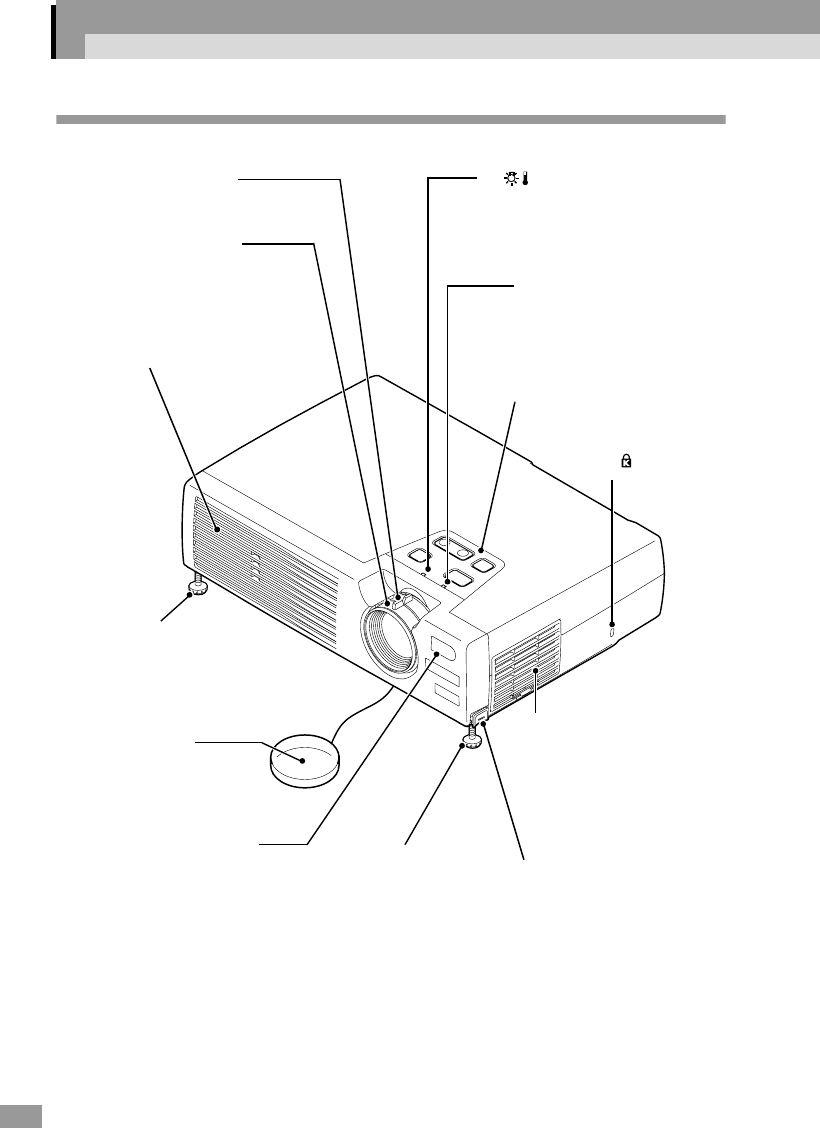
Part Names and Functions
Front/Top
•
••
•Air exhaust vent
•
••
•Security lock
( ) (p.84)
•
••
•Control panel (p.9)
•
••
•Zoom ring (p.33)
Adjusts the image size.
•
••
•Remote control light-
receiving area (p.12)
Receives signals from the
remote control.
•
••
•Focus ring (p.37)
Adjusts the image focus.
•
••
•Power indicator (p.61)
Flashes or lights in different
colours to indicate the
operating status of the
projector.
•
••
• (Warning) indicator (p.62)
Flashes or lights in different
colours to indicate problems with
the projector or that the projection
lamp needs to be replaced.
•
••
•Front adjustable foot
(p.34)
Extend and retract to
adjust the projection
angle.
•
••
•Lens cover
Attach when not using the
projector to prevent the
lens from becoming dirty
or damaged.
•
••
•Air filter (air intake vent)
(p.73, 79)
Prevents dust and other
foreign particles from being
drawn into the projector.
When replacing the lamp,
replace the air filter also.
•
••
•Foot adjust button (p.35)
Another foot adjust button is
located on the right side.
Press both foot adjust
buttons when extending and
retracting the front
adjustable feet.
•
••
•Front adjustable foot
(p.34)
Extend and retract to
adjust the projection
angle.
9
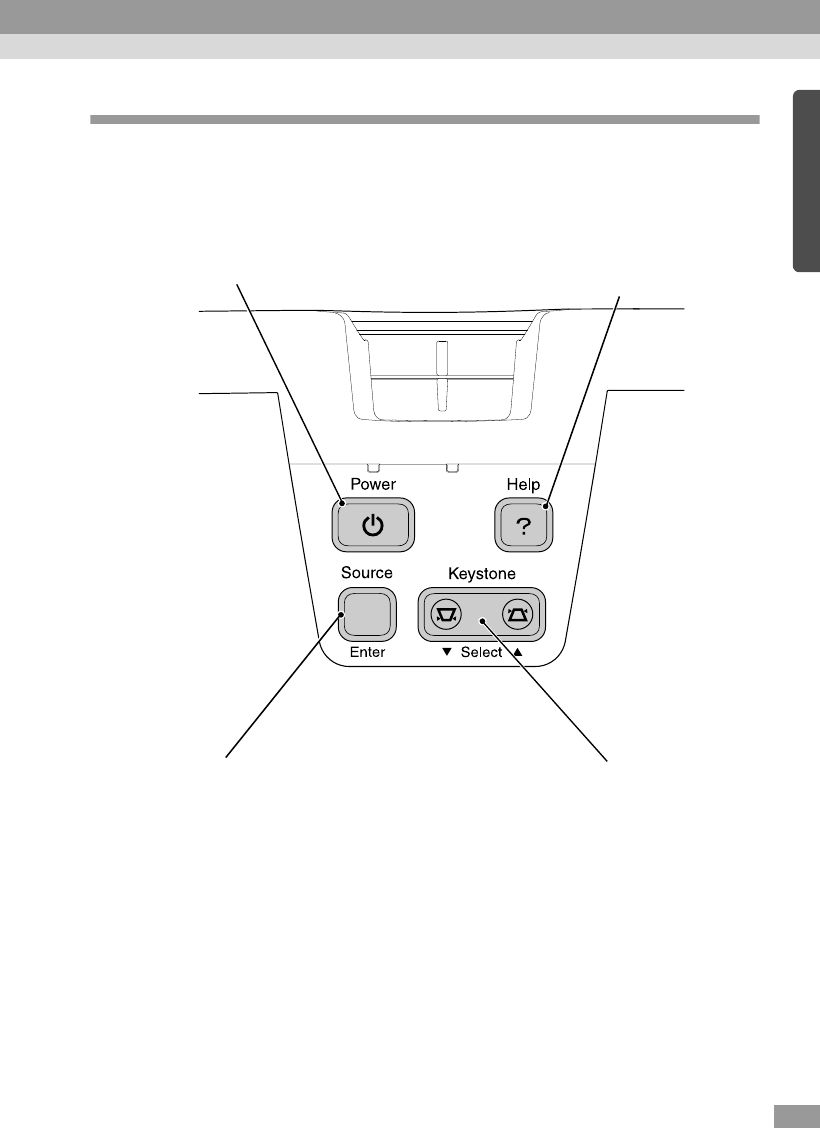
Control Panel
•
••
•[Power] button (p.29, 31)
Turns the projector power on and
off.
•
••
•[Source] button (p.30)
Switches the input source between the
Computer/Component Video port, S-
Video port and Video port each time the
button is pressed.
When pressed while a help menu is
being displayed, it accepts the menu
item that is currently selected. (p.60)
•
••
•[Keystone] button (p.36)
Press to manually correct
keystone distortion in images.
When pressed while a help menu
is being displayed, it selects items
in the menu. (p.60)
•
••
•[Help] button (p.60)
Displays the online help menu to
assist you if you have a problem.
10
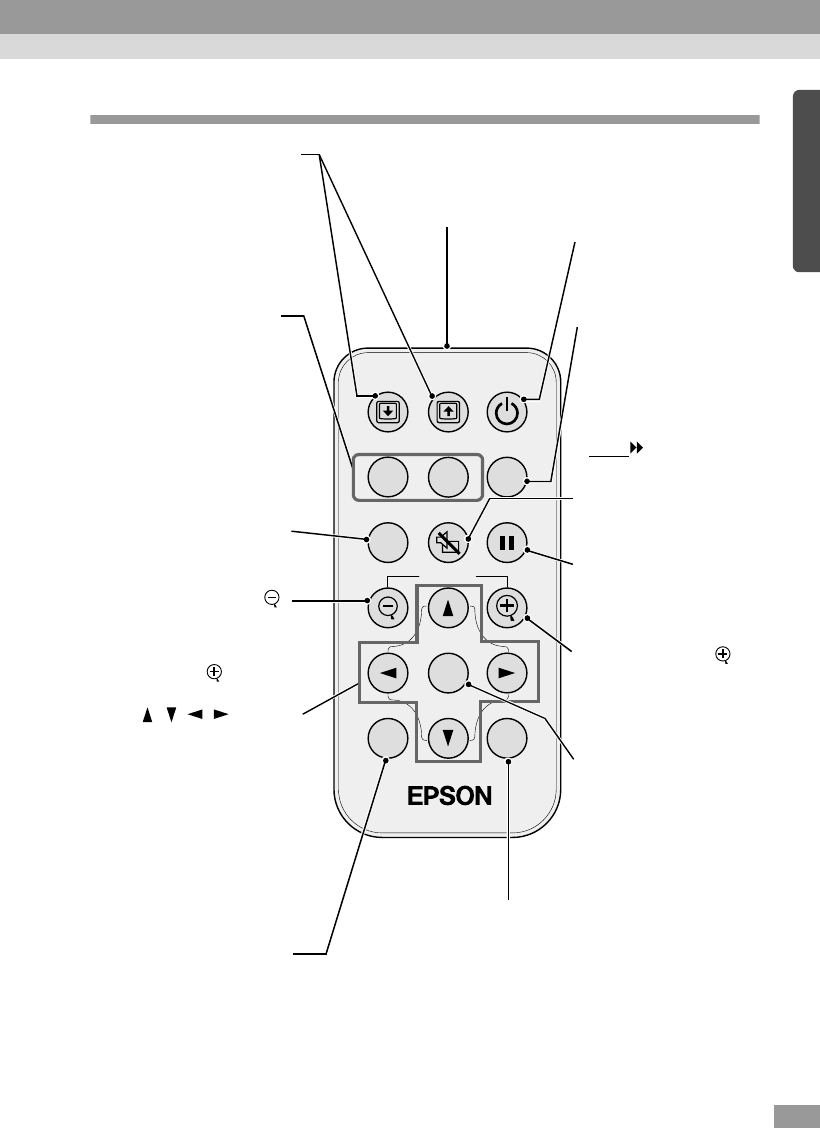
Rear
Base
•
••
•Remote control light-
receiving area (p.12)
Receives signals from the
remote control.
•
••
•Power inlet
(p.28)
Connects the
power cable. •
••
•Speaker
•
••
•Computer/Component Video
port (p.17, 24, 25)
Inputs analogue video signals from
a computer and component video
signals from other video sources.
•
••
•Video port (p.23)
Inputs composite video signals to
the projector from other video sources.
Use the RCA video cable for this
connection.
•
••
•S-Video port (p.24)
Inputs S-Video signals to the
projector from other video sources.
•
••
•Audio-In port (p.20, 26)
Inputs audio signals.
Connect using a stereo mini
jack.
•
••
•USB port (p.21)
Connects the projector
to a computer via the
USB cable.
•
••
•Remote control holder
(p.12)
Store the accessory remote
control in here when not
using it.
•
••
•Suspension bracket fixing points (3 points)
(p.14, 82)
Install the optional ceiling mount here when
suspending the projector from the ceiling.
•
••
•Lamp cover (p.76)
Open this cover when replacing the
lamp inside the projector.
Part Names and Functions
11
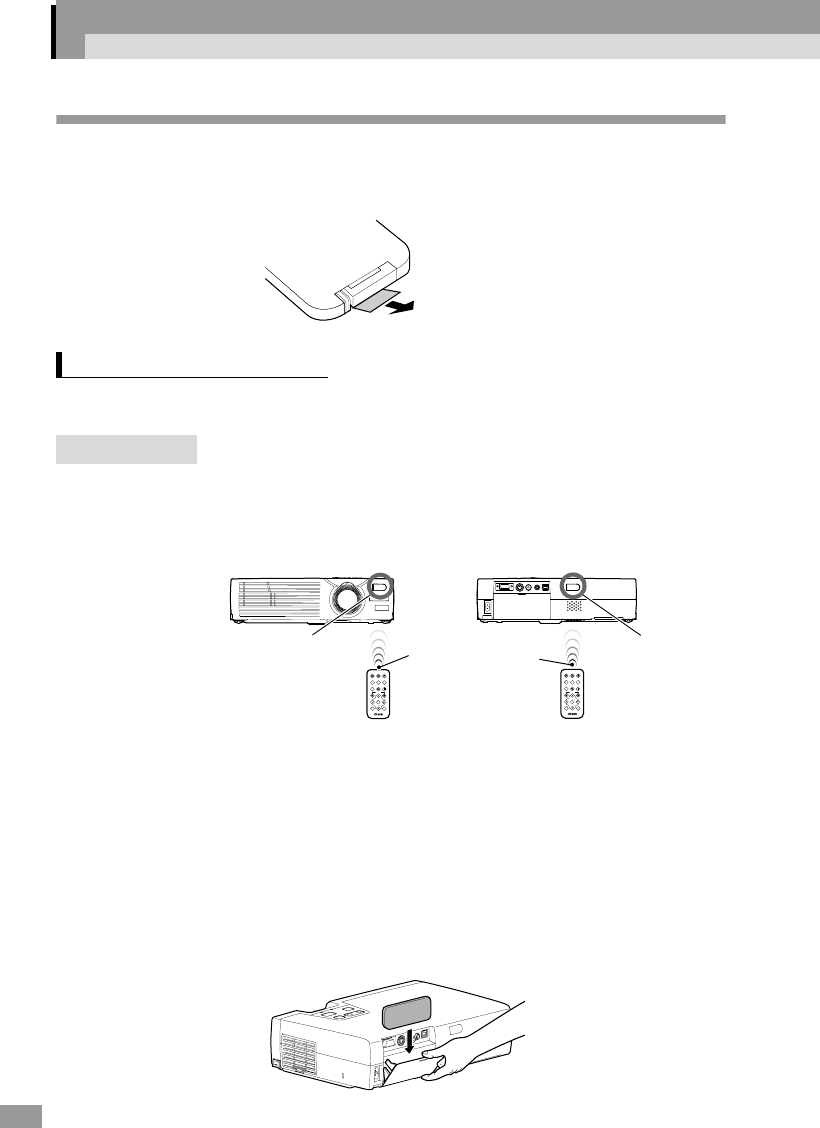
Remote Control
Menu A/V Mute
E-Zoom
Freeze
S-Video/Video Color Mode
Computer
Page upPage down
Power
ESCAuto
Enter
•
••
•Remote control light-
emitting area (p.13)
Outputs remote control
signals.
•
••
•[A/V Mute] button (p.42)
Momentarily turns off the
audio and video.
•
••
•[E-Zoom] button ( )
(p.45)
Enlarges the part of images
without changing the size
of the projection area.
•
••
•[Enter] button
(p.22, 56, 60)
Accepts a menu item or
displays the next screen or
menu while viewing a
configuration menu or
help menu.
Acts as a mouse left-click
when using the remote
control as a wireless
mouse.
•
••
•[ESC] button (p.22, 57)
Stops the current function.
Displays the previous
screen or menu while
viewing a configuration
menu.
Acts as a mouse right-click
when using the remote
control as a wireless mouse.
•
••
•[Auto] button (p.37)
Use this button to
automatically adjust
computer images to the
optimum images when
automatic setup has been set
to "OFF".
•
••
•[Menu] button (p.56)
Displays or hides the
configuration menus.
•
••
•[Power] button
(p.29, 31)
Turns the projector power
on and off.
•
••
•Input select buttons
(p.30)
[Computer]: Switches the
signal source to the images
being input from the
Computer/Component
Video port.
[S-Video/Video]: Switches
the signal source being input
from the S-Video port and
the Video port.
•
••
•[Color Mode] button
(p.40)
Selects the colour mode.
The colour mode changes
in the order of Normal,
Meeting, Presentation,
Theatre, Game and
sRGB each time the
button is pressed.
•
••
•[ ][ ][ ][ ] buttons
(p.22, 56, 60)
When using the remote
control as a wireless mouse,
these buttons move the
pointer in the direction
corresponding to the button
that was pressed.
When a configuration menu
or help menu is displayed,
these buttons select menu
items and setting values.
•
••
•[E-Zoom] button ( )
(p.45)
Reduces the part of images
that have been enlarged
using the [ ] button.
•
••
•[Freeze] button (p.43)
Keeps the current
computer or video image
on the screen.
•
••
•[Page down]/[Page up]
buttons (p.21)
When using the remote
control as a wireless mouse,
press these buttons to scroll
back and forth through pages
when projecting a
PowerPoint presentation.
12
Before Using the Remote Control
Using the Remote Control and Remote Operating Range
When using the remote control for the first time, pull out the insulating tape that
is protruding from the battery holder. When the insulating tape is pulled out, the
remote control can then be used.
The remote control is used in the following way.
Procedure
Point the remote control light-emitting area toward one of the
remote control light-receiving areas on the projector and operate
the remote control buttons.
Tip :
• Do not allow sunlight or light from fluorescent lamps to shine directly onto the
projector's remote control light-receiving areas, otherwise it may interfere with the
reception of signals from the remote control.
• If delays in the responsiveness of the remote control occur or if it does not operate after
it has been used for some time, it probably means that the battery is getting flat. If this
happens, replace the battery with a new one. (p.74)
• When not using the remote control, place it into the remote control holder at the back of
the projector so that it does not get lost.
Using the Remote Control
Menu A/V Mute
E-Zoom
Freeze
S-Video/Video Color Mode
Computer
Page upPage down
Power
ESCAuto
Enter
Remote control
light-receiving
area (front)
Menu A/V Mute
E-Zoom
Freeze
S-Video/Video Color Mode
Computer
Page upPage down
Power
ESCAuto
Enter
Remote control
light-receiving
area (back)
Remote control
light-emitting area
13
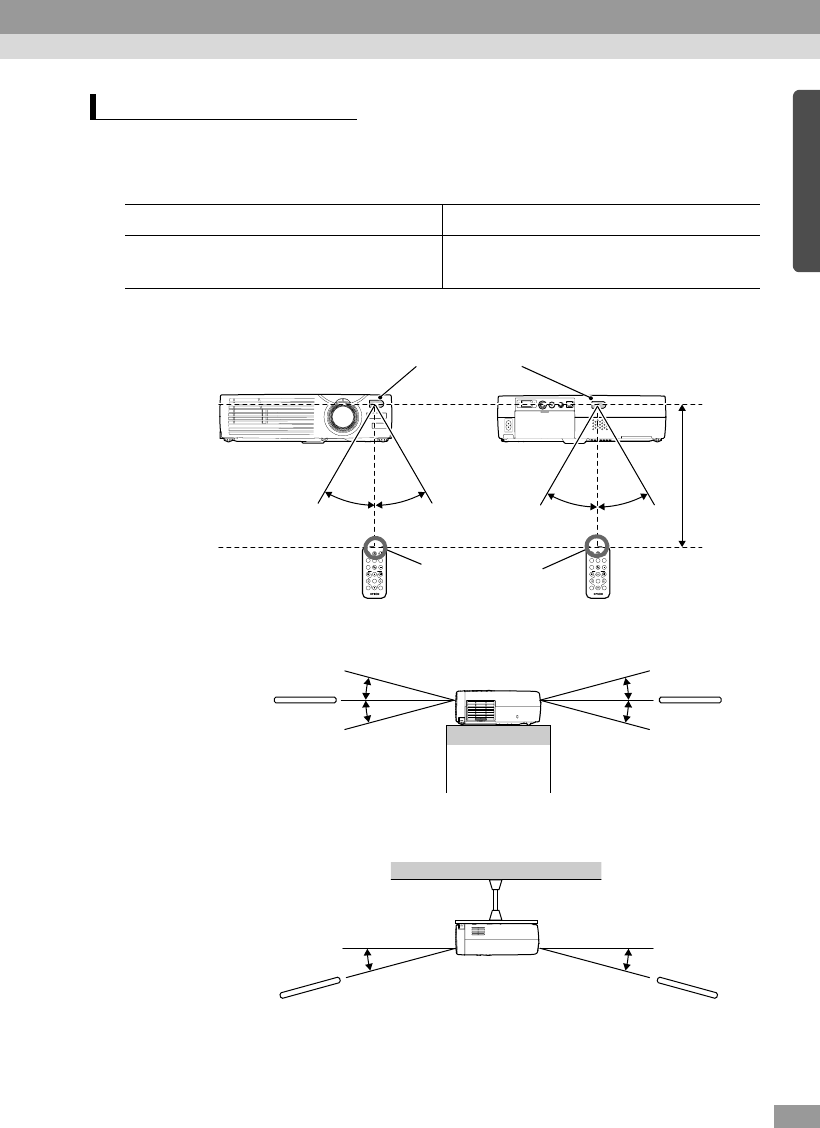
Use the remote control within the ranges indicated below. If the distance or
angle between the remote control and the remote control light-receiving area is
outside the normal operating range, the remote control may not work.
Remote Operating Range
Operating distance Operating angle
Approx. 6 m (20 ft.) Approx. 30º horizontally
Approx. 15º vertically
Menu A/V Mute
E-Zoom
Freeze
S-Video/Video Color Mode
Computer
Page upPage down
Power
ESCAuto
Enter
S-Video/VideoComputer
Menu A/V Mute
E-Zoom
Freeze
Color Mode
Page upPage down
Power
ESCAuto
Enter
Remote control
light-receiving
area
Remote control
light-emitting area
Approx. 30º Approx. 30º Approx. 30º Approx. 30º
Approx. 15º
Approx. 15º
Approx. 15º
Approx. 15º
Approx. 30º horizontally
Approx. 15º vertically
When suspended from
the ceiling
Within
approx.
6 m
(20ft.)
14
Installation
Setting Up the Projector
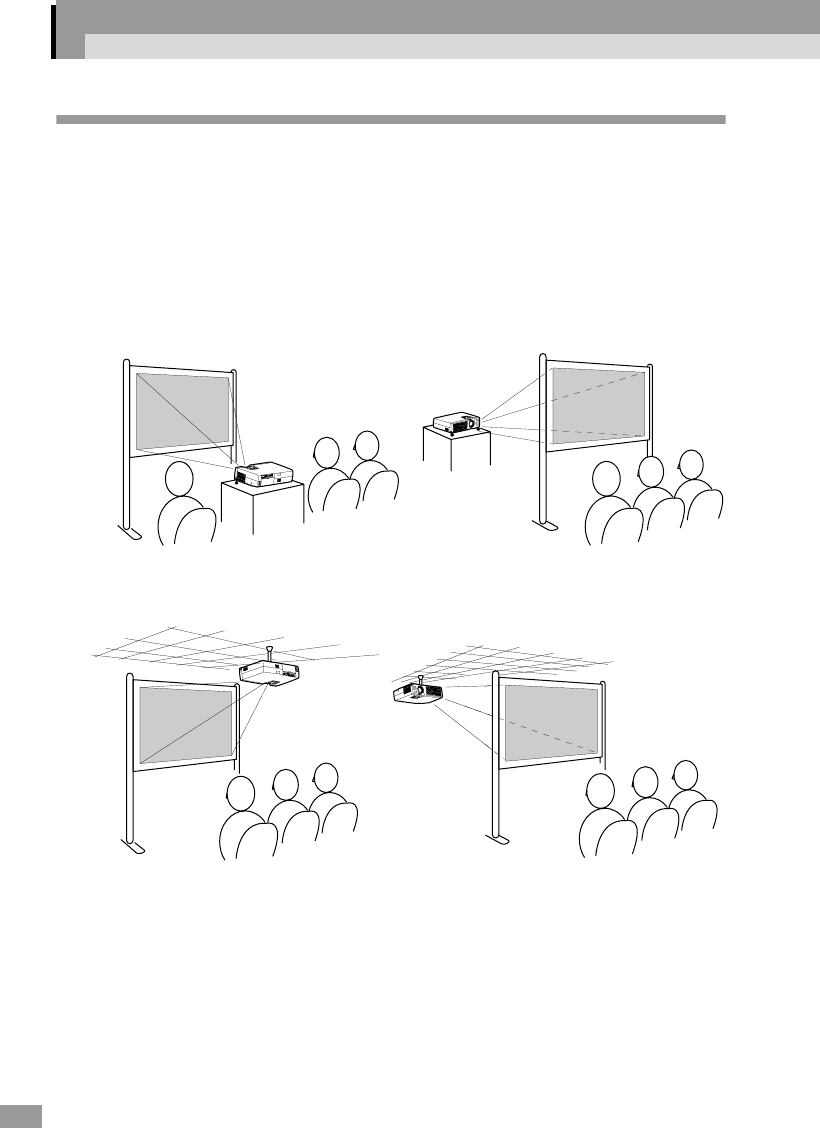
The projector supports the following four different projection methods,
allowing you to choose the best method for displaying your images.
Caution :
Before setting up the projector, be sure to first read the separate Safety Instructions/
World-Wide Warranty Terms.
* A special method of installation is required in order to suspend the projector from
the ceiling. Please contact the place of purchase if you would like to use this
installation method. The optional ceiling mount is required when installing the
projector to the ceiling. (p.82)
Tip :
When using rear/ceiling projection using a translucent screen, set the "Ceiling" or "Rear
Proj." command in the "Advanced" menu to match the installation method. (p.53)
• Front projection • Rear projection using a translucent
screen
• Front/ceiling projection • Rear/ceiling projection using a
translucent screen
15
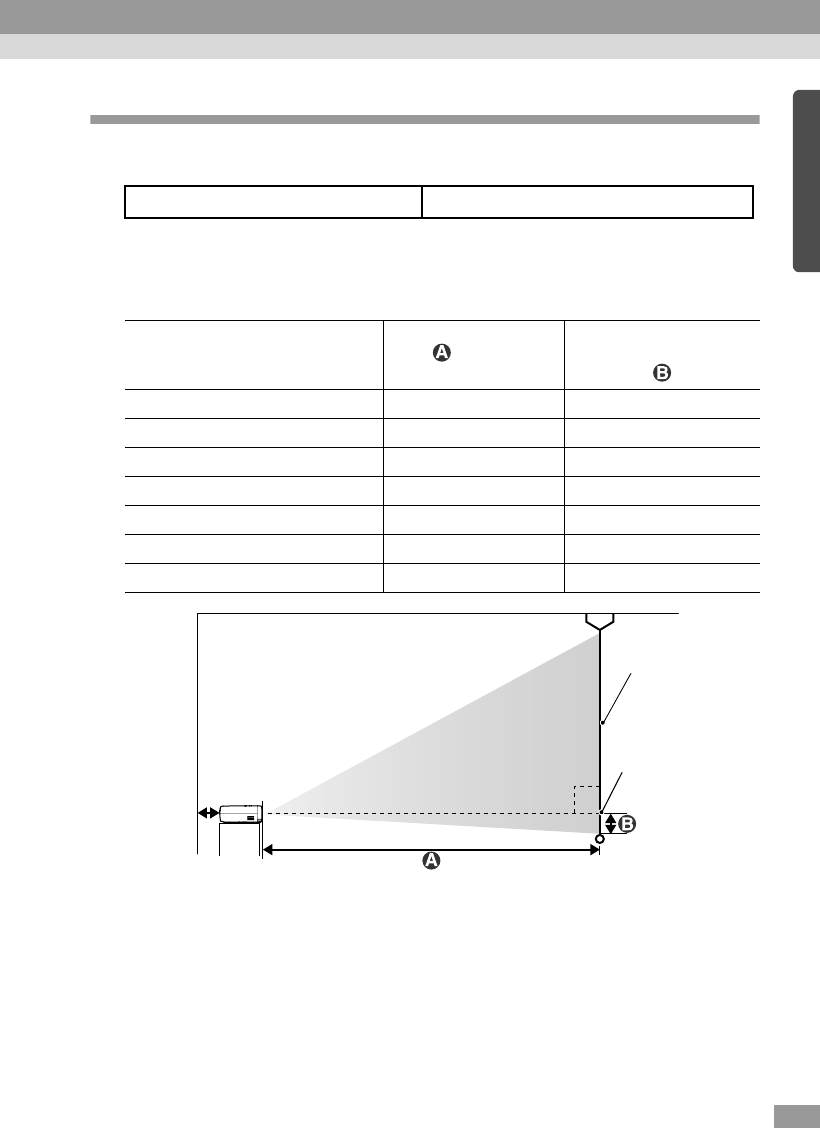
Screen Size and Projection Distance
The distance between the projector and the screen determines the actual image
size.
While referring to the table below, position the projector so that the images are
projected onto the screen at the optimum size.
The values should be used as a guide for setting up the projector. The actual
values will vary depending on projection conditions and the zoom setting.
* When installing against a wall, leave a space of about 20 cm (7.9 in.) between the
projector and the wall.
Tip :
• The projector's lens allows a zoom ratio of up to about 1.16. The image size at the
maximum zoom setting is about 1.16 times bigger than the image size at the minimum
zoom setting.
• The image size will be reduced when keystone correction is carried out.
Recommended distance 1.0–11.7 m (3.2–38.5 ft.)
4:3 Screen size
(cm (in.))
Projection distance
(m (ft.))
Distance from center
of lens to bottom edge
of screen (cm (in.))
30" (61 × 46 (24.0 × 18.1)) 1.0−1.1 (3.2–3.7) 4.6 (1.8)
40" (81 × 61 (31.9 × 24.0)) 1.3−1.5 (4.3–5.0) 6.1 (2.4)
60" (120 × 90 (47.2 × 35.4) 2.0−2.3 (6.5–7.5) 9.1 (3.6)
80" (160 × 120 (63.0 × 47.2)) 2.7−3.1 (8.7–10.1) 12.2 (4.8)
100" (200 × 150 (78.7 × 59.1)) 3.3−3.9 (11.0–12.7) 15.2 (6.0)
200" (410 × 300 (161.4 × 118.1)) 6.7−7.8 (22.1–25.6) 30.5 (12.0)
300" (610 × 460 (240.2 × 181.1)) 10.1−11.7 (33.2–38.5) 45.7 (18.0)
Screen
90º Centre of lens
*

16
Connecting to a Computer
Caution :
When connecting the projector to a computer, be sure to check the following.
• Turn off the power for both the projector and the computer before connecting them. If
the power for either device is on at the time of connection, damage may result.
• Check the shapes of the cable connectors and the device ports before making the
connections. If you try to force a connector to fit a device port with a different shape or
number of terminals, damage to the connector or port may result.
Eligible Computers
The projector cannot be connected to some types of computer, or projection of
images may not be possible even if actual connection is possible. Make sure
that the computer you intend to use satisfies the conditions given below.
• Condition 1: The computer must have an image signal output port.
Check that the computer has a port such as an "RGB port", "monitor port" or
"CRT port" which can output image signals.
If the computer has a built-in monitor, or if using a laptop computer, it may
not be possible to connect the computer to the projector, or alternatively you
may need to purchase a separate external output port. Refer to the
documentation for your computer under a heading such as "Connecting an
external monitor" or similar for further details.
• Condition 2: The display resolution and frequency of the computer must be
listed in the "List of Supported Monitor Displays". See "Appendices: List of
Supported Monitor Displays"(p.88).
Some computers allow you to change the output resolution, so if necessary,
change the resolution to one that matches a setting in the "List of Supported
Monitor Displays", while referring to the documentation provided with the
computer.
Tip :
• You may need to purchase a separate adapter depending on the shape of the computer's
port. Refer to the documentation provided with the computer for further details.
• If the computer and projector are too far away from each other for the accessory
computer cable to reach, use the optional VGA-HD15 PC cable. See "Appendices:
Optional Accessories" (p.82)
17
Projecting Images from the Computer
The shape and specifications of the computer's monitor port will determine
what type of cable should be used. Check the following to see which type of
port your computer has.
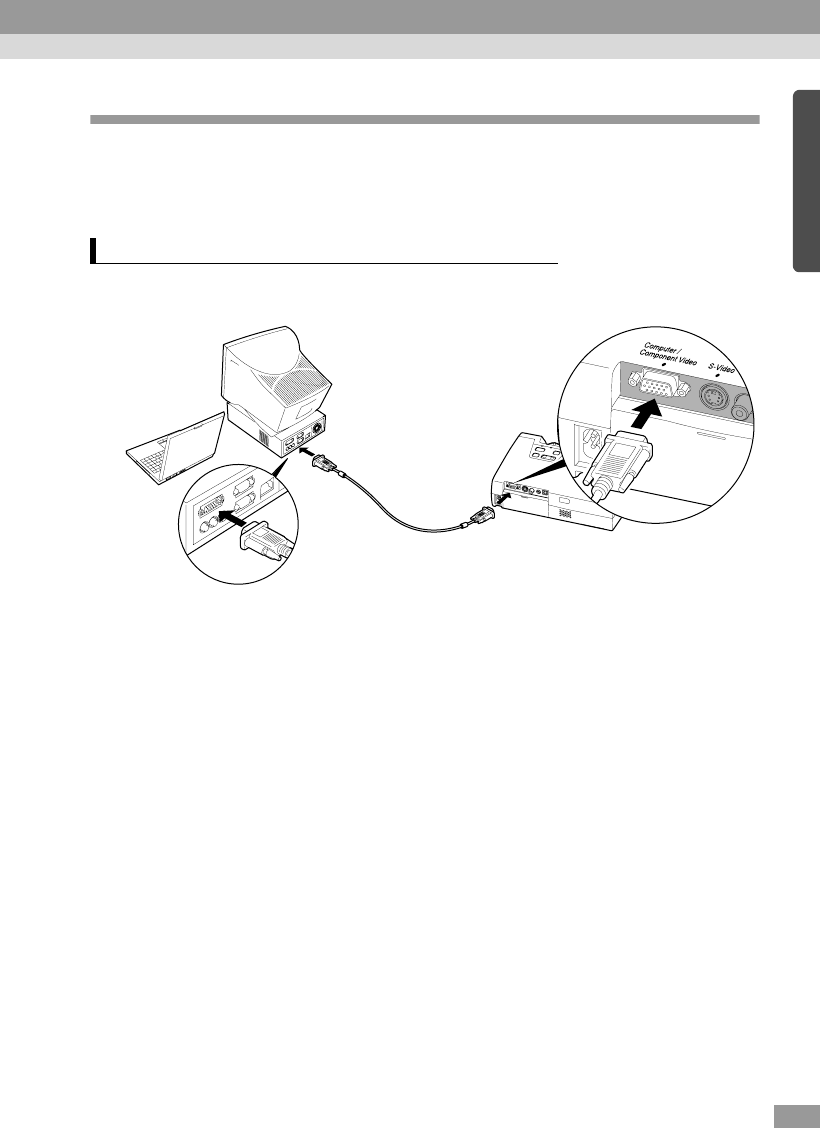
Use the accessory computer cable to connect the Computer/Component Video
port at the rear of the projector to the monitor port of the computer.
Tip :
• Change the "Input Signal" setting in the "Video" menu to "RGB" after making the
connections. (p.47)
• If more than one external component is connected to the projector, use the [Source]
button on the projector's control panel or the [Computer] button on the remote control
to select the Computer port as the input source. (p.30)
• Do not bind the power cable and the computer cable together, otherwise image
interference or errors in operation may result.
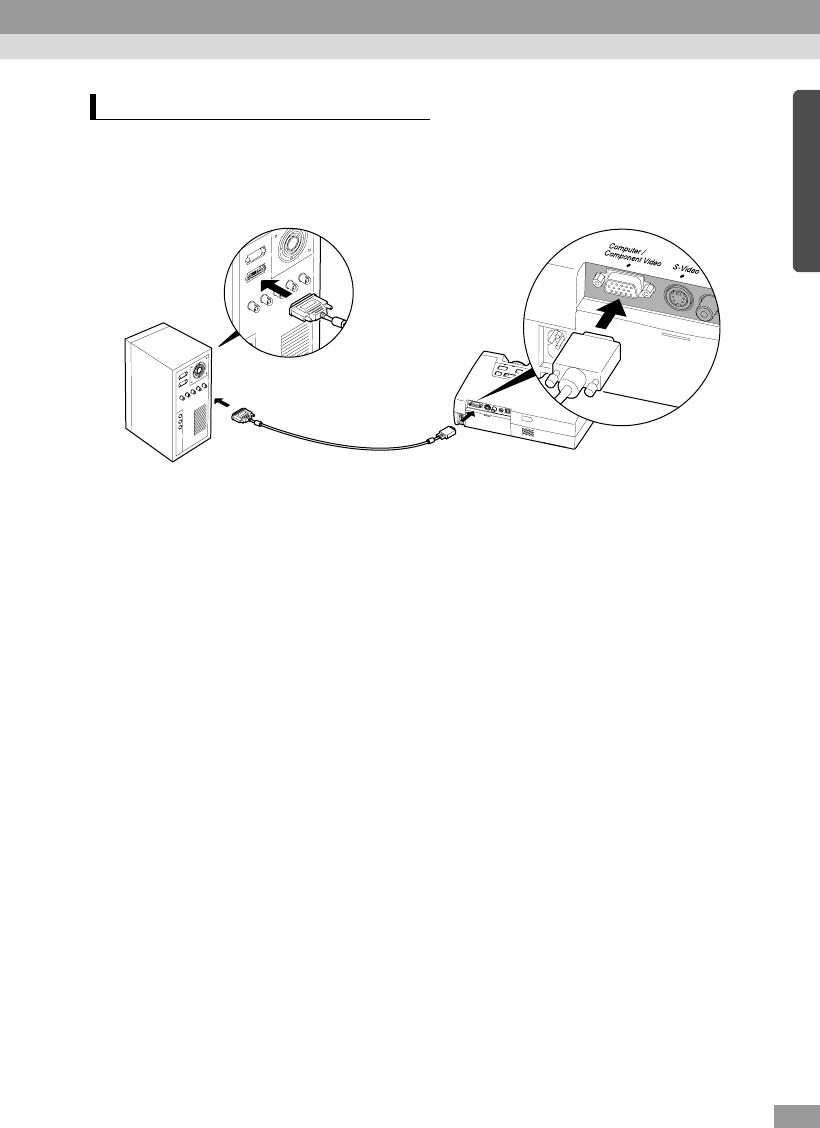
If the Monitor Port is a Mini D-Sub 15-pin Port
Computer cable
(accessory)
To monitor port
To Computer/
Component Video port
18
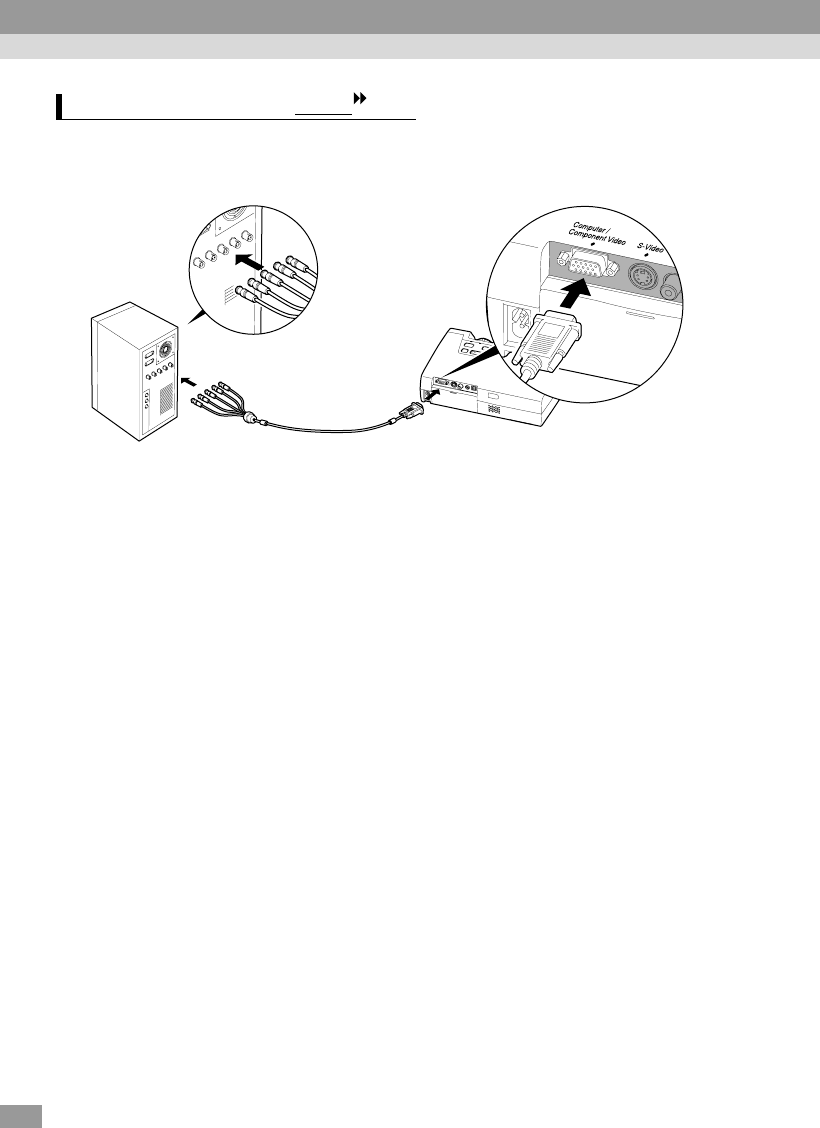
Use the optional VGA-HD15 PC cable to connect the Computer/Component
Video port at the rear of the projector to the monitor port of the computer.
See "Appendices: Optional Accessories" (p.82)
Tip :
• Change the "Input Signal" setting in the "Video" menu to "RGB" after making the
connections. (p.47)
• If more than one external component is connected to the projector, use the [Source]
button on the projector's control panel or the [Computer] button on the remote control
to select the Computer port as the input source. (p.30)
• Do not bind the power cable and the computer cable together, otherwise image
interference or errors in operation may result.
If the Monitor Port is a 5BNC Port
To Computer/
Component Video port
To monitor port
VGA-HD15 PC cable
(optional)
Connecting to a Computer
19
Some workstation-type computers have a 13w3 monitor port.
Use a commercially-available 13w3 ⇔ D-Sub 15-pin cable to connect the
Computer/Component Video port at the rear of the projector to the monitor port
of the computer.
Tip :
• Change the "Input Signal" setting in the "Video" menu to "RGB" after making the
connections. (p.47)
• If more than one external component is connected to the projector, use the [Source]
button on the projector's control panel or the [Computer] button on the remote control
to select the Computer port as the input source. (p.30)
• Do not bind the power cable and the computer cable together, otherwise image
interference or errors in operation may result.
• Some workstations may require a special cable. Consult the workstation manufacturer
for further details.
If the Monitor Port is a 13w3 Port
13w3 cable
(commercially-available)
To monitor port
To Computer/
Component Video port
20
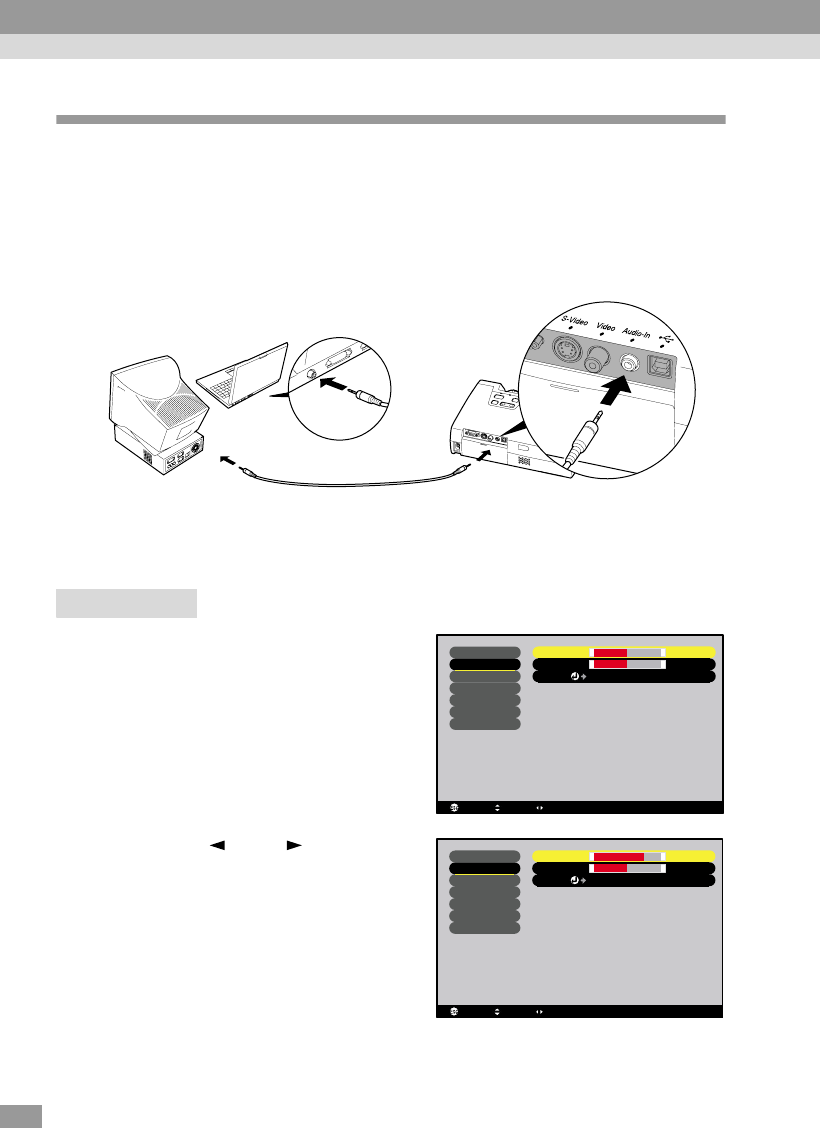
Playing Sound from the Computer
The projector has a single built-in speaker with a maximum output of 1 W. If
the computer that is connected to the projector has an audio output port, you
can output sound from the computer through the projector's speaker by
connecting the computer's audio output port and the Audio-In port (stereo mini
jack) on the rear of the projector using a stereo mini jack audio cable
(commercially-available). It is recommended that you use an audio cable with a
3.5 mm diameter stereo mini jack.
Use the following procedure to adjust the volume of the sound output.
Procedure
1
Press the [Menu] button on the
remote control, and then select
"Volume" from the "Audio"
menu.
For details on this operation, refer to
"Using the Configuration Menus".
(p.56)
2
Use the [ ] and [ ] buttons to
adjust the volume.
The volume is increased or reduced
each time a button is pressed.
3
After making the adjustment, press the [Menu] button to exit
the configuration menu.
Stereo mini jack audio cable
(commercially-available)
To audio output port To Audio-In port
+
-
+
-
Video
Audio
Setting
User's Logo
Advanced
About
: Select: Return : Adjust
Reset All
Volume
Tone
:
:
Reset
Execute
10
0
+
-
+
-
Video
Audio
Setting
User's Logo
Advanced
About
: Select: Return : Adjust
Reset All
Volume
Tone
:
:
Reset
Execute
15
0
Connecting to a Computer
21
Using the Remote Control to Operate the Mouse Pointer
(Wireless Mouse Function)
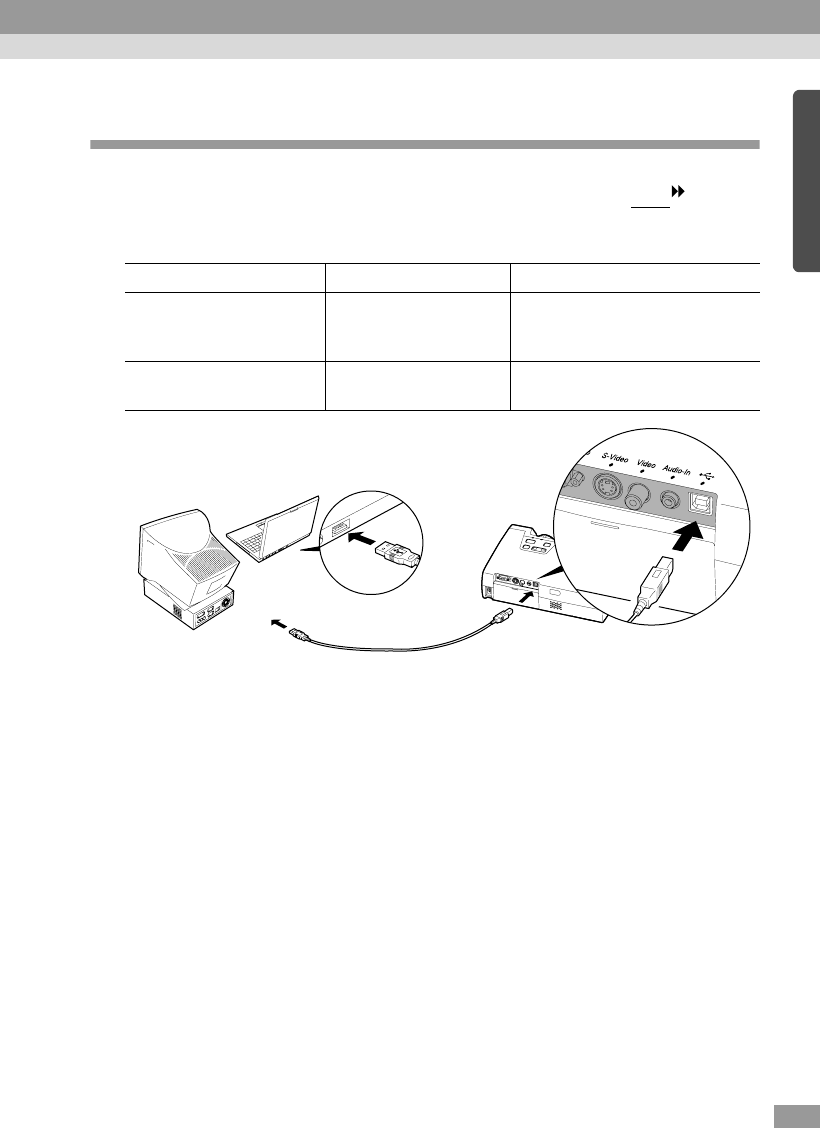
You can use the remote control as a wireless mouse to control the mouse pointer
on the computer screen. To do this, you must use the accessory USB cable to
connect the USB port of the computer to the USB port at the rear of the
projector.
* When using the remote control as a wireless mouse, the [Page down] and [Page
up] buttons on the remote control can be used to scroll back and forth through
pages when projecting a PowerPoint presentation.
Tip :
• The USB cable can only be connected to computers with a standard USB interface. If
using a computer which is running Windows, the computer must have had a full
version of Windows 98/2000/Me/XP Home Edition/XP Professional installed. If the
computer is running a version of Windows 98/2000/Me/XP Home Edition/XP
Professional that has been upgraded from an earlier version of Windows, correct
operation cannot be guaranteed.
• It may not be possible to use the mouse function under some versions of both the
Windows and Macintosh operating systems.
• Some computer settings may have to be changed in order for the mouse function to be
used. Consult the documentation for the computer for further details.
Computer Mouse used Applicable cable
Windows 98/2000/Me/
XP Home Edition/
XP Professional
USB mouse USB cable (accessory)
Macintosh
(OS 8.6 - 9.2/X/10.1) USB mouse USB cable (accessory)
USB cable
(accessory)
To USB port
To USB port
22
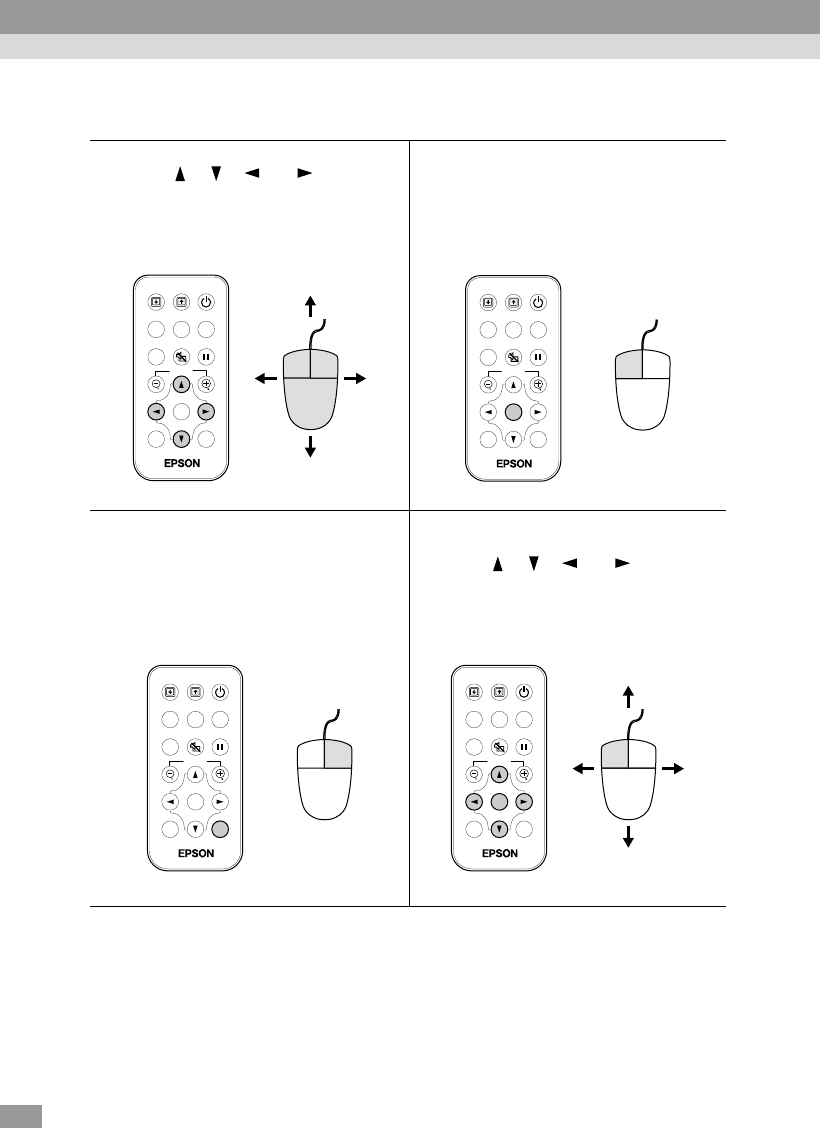
Once the connection has been made, the mouse pointer can be operated as
follows.
Tip :
• If the mouse button settings have been reversed at the computer, the operation of the
remote control buttons will also be reversed.
• The wireless mouse function cannot be used while a configuration menu or help menu
is being displayed or while the E-Zoom function is being used.
Moving the mouse pointer
Press the [ ], [ ], [ ] or [ ] button to
move the mouse pointer in the direction of
the button pressed.
Left click
Press the [Enter] button.
If you press the [Enter] button twice in
rapid succession, it has the effect of a
double-click.
Right click
Press the [ESC] button.
Drag and drop
While holding down the [Enter] button,
press the [ ], [ ], [ ] or [ ] button to
drag items. Release the [Enter] button to
drop the items being dragged at the
desired position.
Menu A/V Mute
E-Zoom
Freeze
S-Video/Video Color Mode
Computer
Page upPage down
Power
ESCAuto
Enter
Menu A/V Mute
E-Zoom
Freeze
S-Video/Video
Page upPage down
Power
ESCAuto
Enter
Color Mode
Computer
Menu A/V Mute
E-Zoom
Freeze
S-Video/Video
Page upPage down
Power
ESCAuto
Enter
Color Mode
Computer
Menu A/V Mute
E-Zoom
Freeze
S-Video/Video
Page upPage down
Power
ESCAuto
Enter
Color Mode
Computer
Connecting to a Computer
23
Connecting to a Video Source
Caution :
When connecting the projector to other video sources, take the following precautions.
• Turn off the power for both the projector and the video source before connecting them.
If the power for either device is on at the time of connection, damage may result.
• Check the shapes of the cable connectors and the device ports before making the
connections. If you try to force a connector to fit a device port with a different shape or
number of terminals, a malfunction or damage to the connector or port may result.
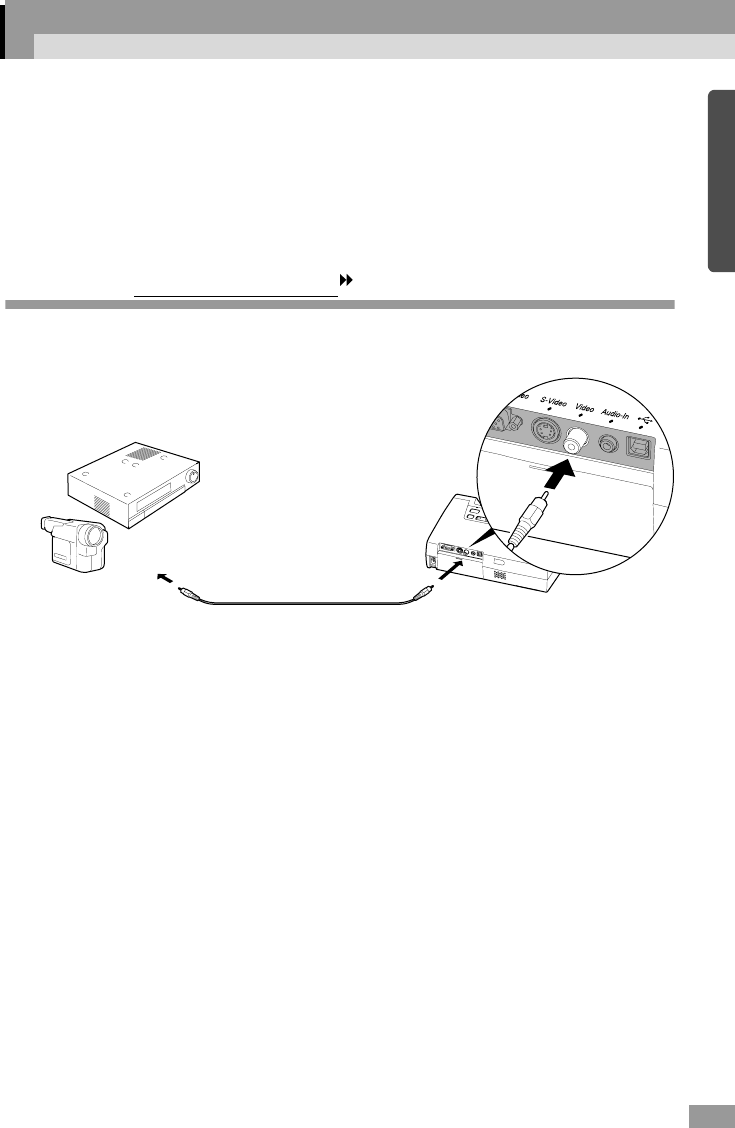
Projecting Composite Video Images
Use the accessory RCA video cable to connect the video source to the Video
port at the rear of the projector.
Tip :
If more than one external component is connected to the projector, use the [Source]
button on the projector's control panel or the [S-Video/Video] button on the remote
control to select the Video port as the input source. (p.30)
To video output port
(yellow)
To Video port
RCA video cable
(accessory)
24
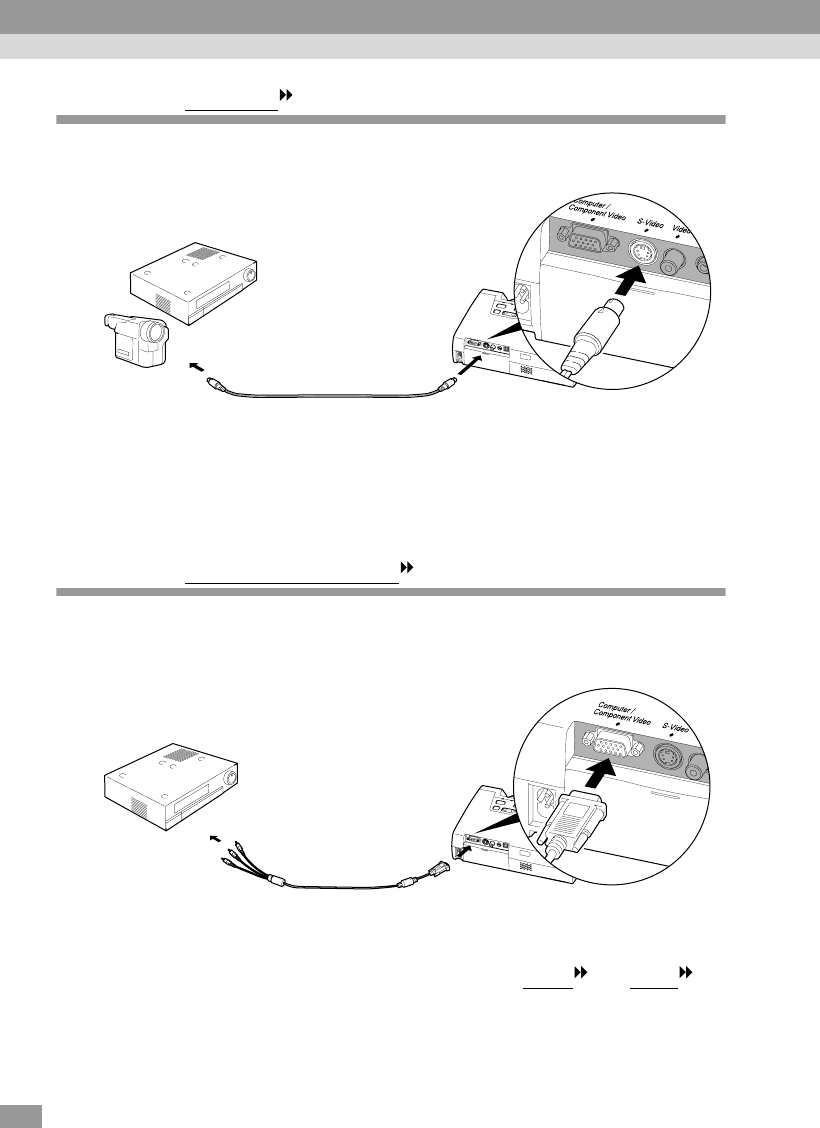
Projecting S-Video Images
Use a S-Video cable (commercially-available) to connect the video source to
the S-Video port at the rear of the projector.
Tip :
If more than one external component is connected to the projector, use the [Source]
button on the projector's control panel or the [S-Video/Video] button on the remote
control to select the S-Video port as the input source. (p.30)
Projecting Component Video Images
Use the optional component video cable to connect the video source to the
Computer/Component Video port at the rear of the projector. See "Appendices:
Optional Accessories" (p.82)
Tip :
• Change the "Input Signal" setting in the "Video" menu to "YCbCr " or "YPbPr "
after making the connections. (p.49)
• If more than one external component is connected to the projector, use the [Source]
button on the projector's control panel or the [Computer] button on the remote control
to set the input source to "YCbCr " or "YPbPr ", depending on the type of signal being
input. (p.30)
S-Video cable
(commercially-available)
To S-Video port
To video output port
Component video cable
(optional)
To video output port
To Computer/
Component Video port
Connecting to a Video Source
25
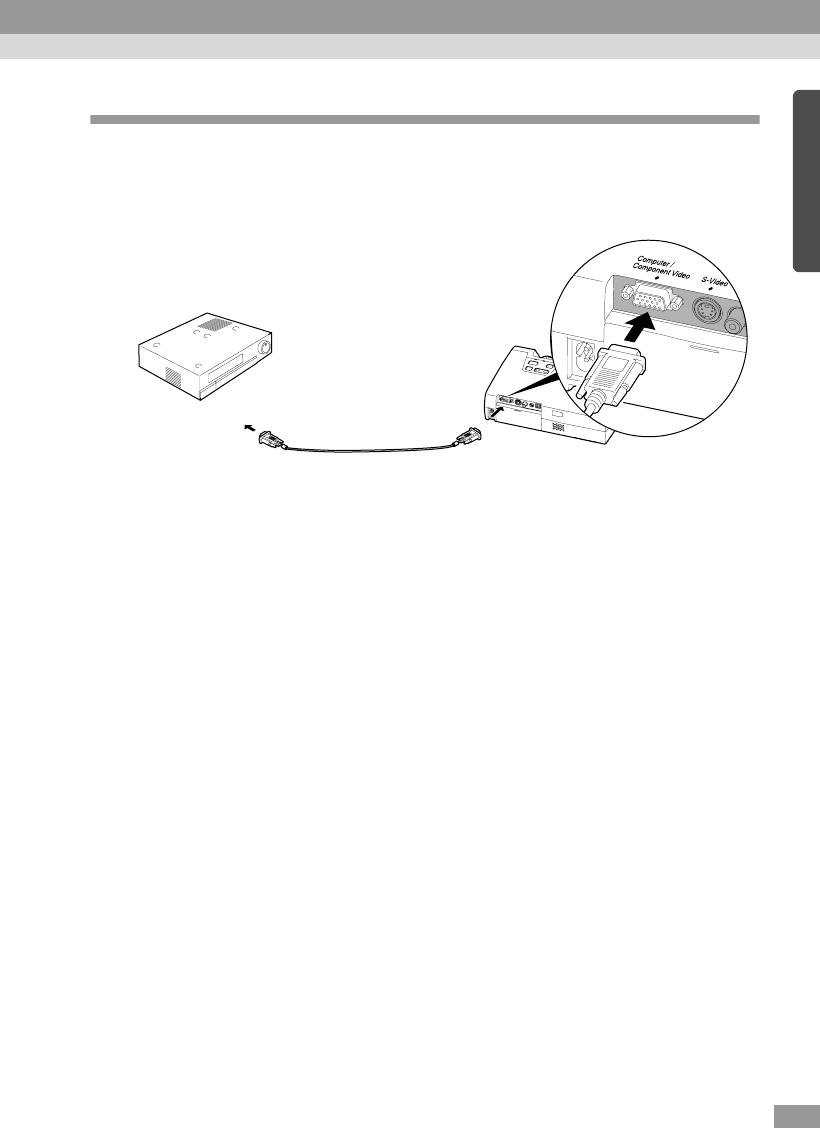
Projecting RGB Video Images
RGB video is used when RGB signals that have copy protection added are input
and projected. Use the accessory computer cable to connect the video source to
the Computer/Component Video port on the rear of the projector.
Tip :
• Change the "Input Signal" setting in the "Video" menu to "RGB" after making the
connections. (p.47)
• For a RGB connection, a commercially available adapter or converter cable might be
required.
To RGB output port
To Computer/
Component Video port
Computer cable
(accessory)
26
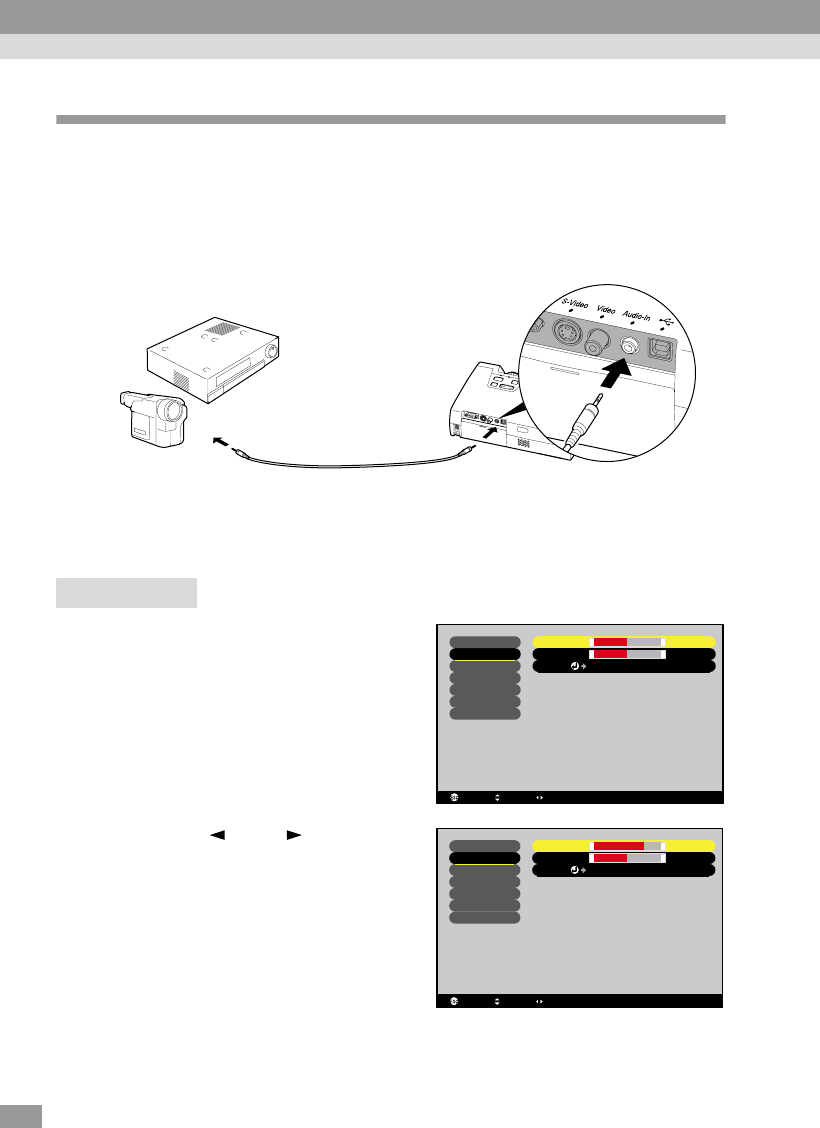
Playing Sound from the Video Equipment
The projector has a single built-in speaker with a maximum output of 1 W. You
can output sound from the video equipment through the projector's speaker by
connecting the video equipment's audio output port and the Audio-In port
(stereo mini jack) at the rear of the projector using a stereo mini jack audio
cable (commercially-available). It is recommended that you use an audio cable
with a 3.5 mm diameter stereo mini jack.
Use the following procedure to adjust the volume of the sound output.
Procedure
1
Press the [Menu] button on the
remote control, and then select
"Volume" from the "Audio"
menu.
For details on this operation, refer to
"Using the Configuration Menus".
(p.56)
2
Use the [ ] and [ ] buttons to
adjust the volume.
The volume is increased or reduced
each time a button is pressed.
3
After making the adjustment, press the [Menu] button to exit
the configuration menu.
Stereo mini jack audio cable
(commercially-available)
To audio output port
To Audio-In port
+
-
+
-
Video
Audio
Setting
User's Logo
Advanced
About
: Select: Return : Adjust
Reset All
Volume
Tone
:
:
Reset
Execute
10
0
+
-
+
-
Video
Audio
Setting
User's Logo
Advanced
About
: Select: Return : Adjust
Reset All
Volume
Tone
:
:
Reset
Execute
15
0
Connecting to a Video Source

27
Basic Operations
This chapter describes basic operations such as turning projection
on and off and adjusting the projected images.
Turning On the Projector ..................................................28
• Connecting the Power Cable............................................................... 28
• Turning On the Power and Projecting Images.................................. 29
Turning Off the Projector ..................................................31
Adjusting the Screen Image .............................................33
• Adjusting the Image Size..................................................................... 33
• Adjusting the Image Angle and
Automatic Keystone Correction Function....................................... 34
• Manually Correcting Keystone Distortion ........................................ 36
Adjusting the Image Quality .............................................37
• Focusing the Screen Image.................................................................. 37
• Adjusting Computer Images............................................................... 37
•Automatic Setup................................................................................................ 37
•Adjusting the Tracking...................................................................................... 38
•Adjusting the Sync............................................................................................ 39
• Selecting the Colour Mode.................................................................. 40
28
Turning On the Projector
Turn on the power to start projecting images.
Caution :
Be sure to read the separate Safety Instructions/World-Wide Warranty Terms before
projecting images.
Connecting the Power Cable
Procedure
1
Check that the power is turned off for the projector and all
components connected to the projector.
2
Connect the computer or other video source to the projector.
(p.17, 23)
3
Remove the lens cover.
Place your finger under the top of the lens cover and pull to remove the
cover.
4
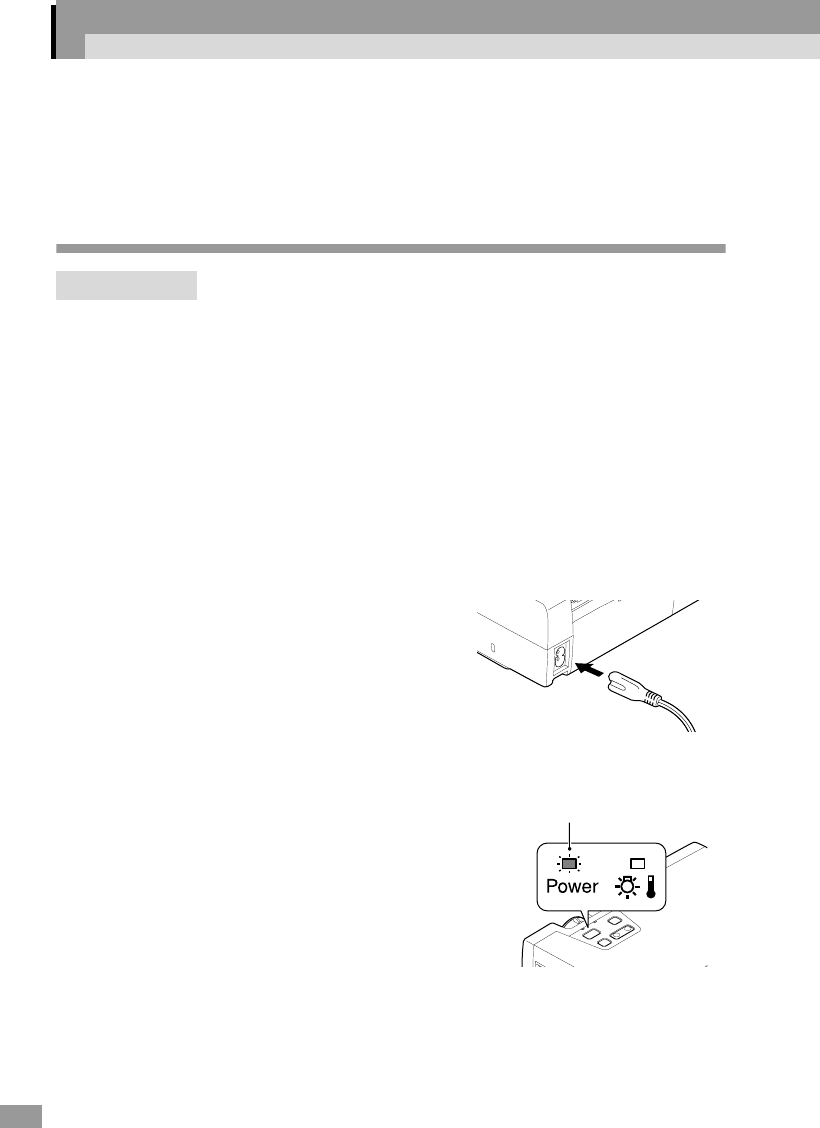
Connect the accessory power cable
to the projector.
Check that the power cable connector is
facing the same way as the power inlet on
the projector, and then insert the power
cable connector securely into the
projector.
5
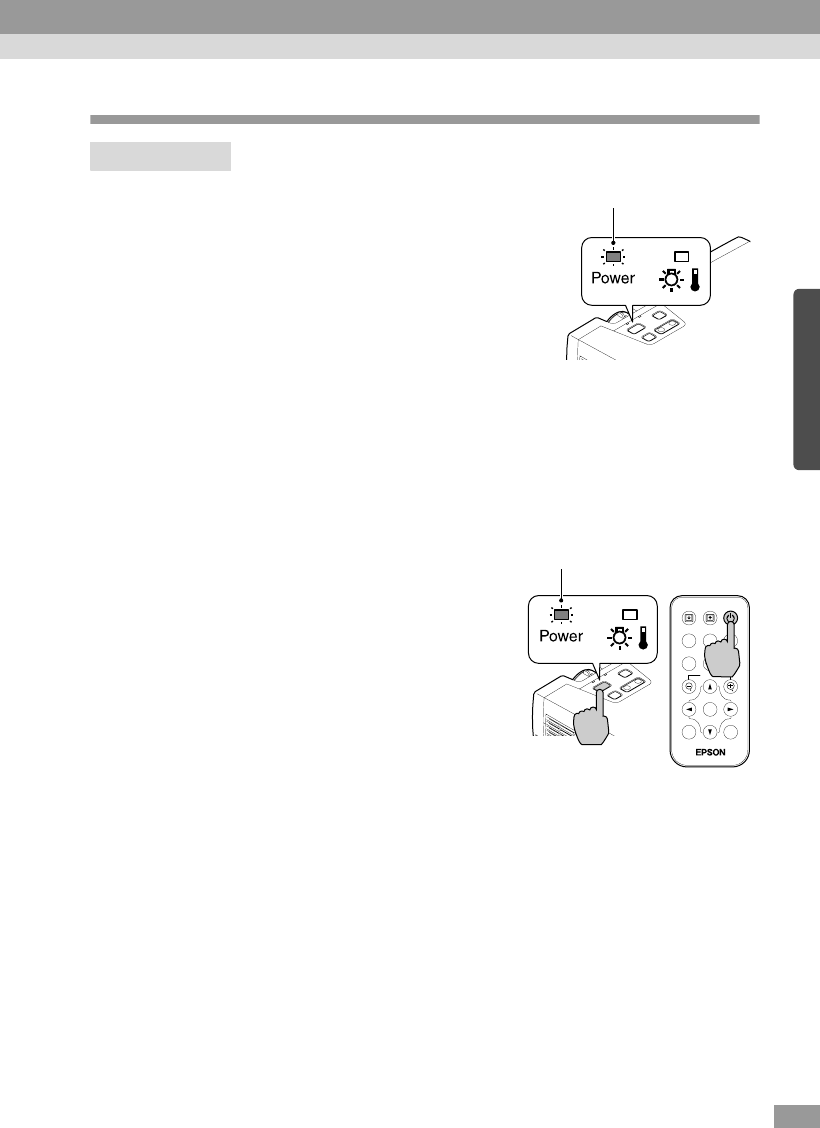
Connect the other end of the power
cable to an earthed electrical outlet.
Wait until the Power indicator lights
orange.
Tip :
The projector's control panel and remote control
buttons cannot be operated while the Power
indicator is flashing orange.
Lit orange
29
Turning On the Power and Projecting Images
Procedure
1
Check that the Power indicator has
stopped flashing and is lit orange.
2
Turn on the power for all equipment connected to the projector.
For a video source, press the [Play] button at the video source to start
playback if necessary.
3
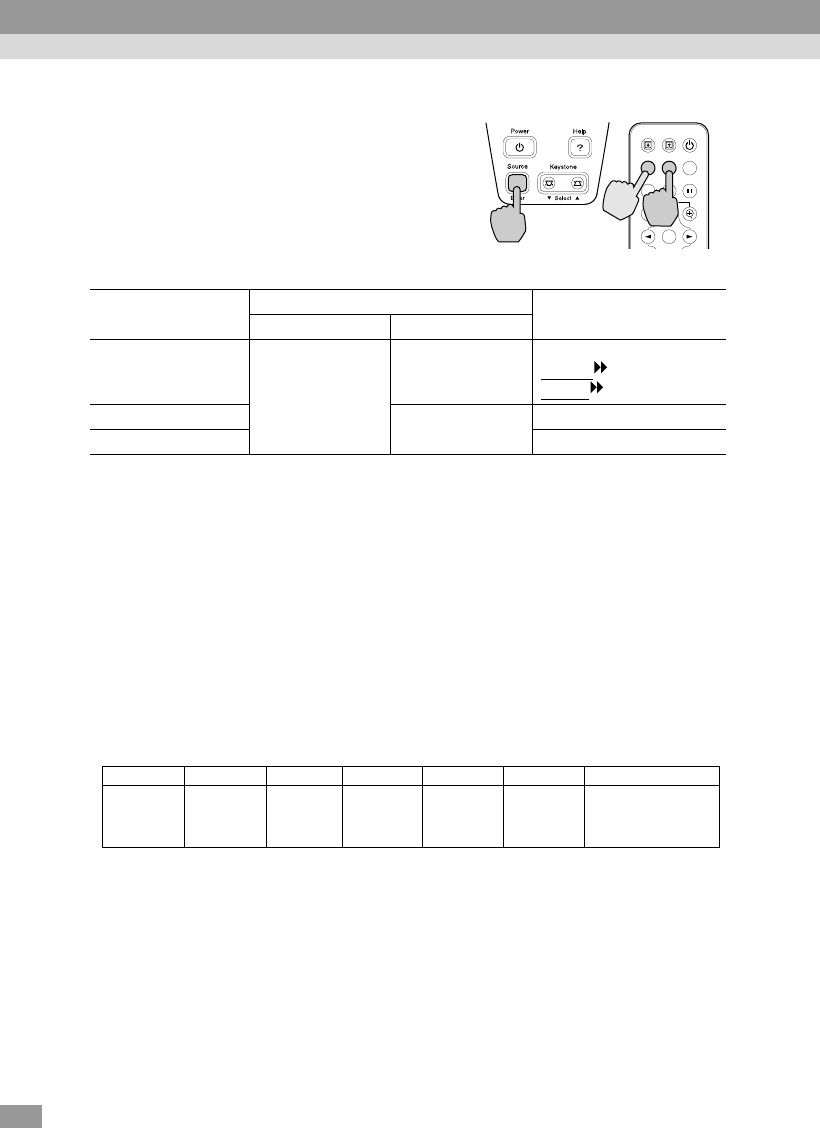
Press the [Power] button on either
the projector's control panel or the
remote control to turn on the power
for the projector.
The Power indicator flashes green. After a
short period it stops flashing and lights
steadily, and projection starts.
Wait until the Power indicator lights green
(it normally takes about 40 seconds to
change).
Tip :
The projector's control panel and remote control buttons cannot be operated while the
Power indicator is flashing green.
Depending on the settings, the message "No-Signal." may appear. See "Setting" - "No-
Signal Msg." (p.51)
Lit orangeLit orange
Color Mode
Computer
Menu A/V Mute
E-Zoom
Freeze
S-Video/Video
Page upPage down
Power
ESCAuto
Enter
Remote control
Changes from flashing to lit green
30
4
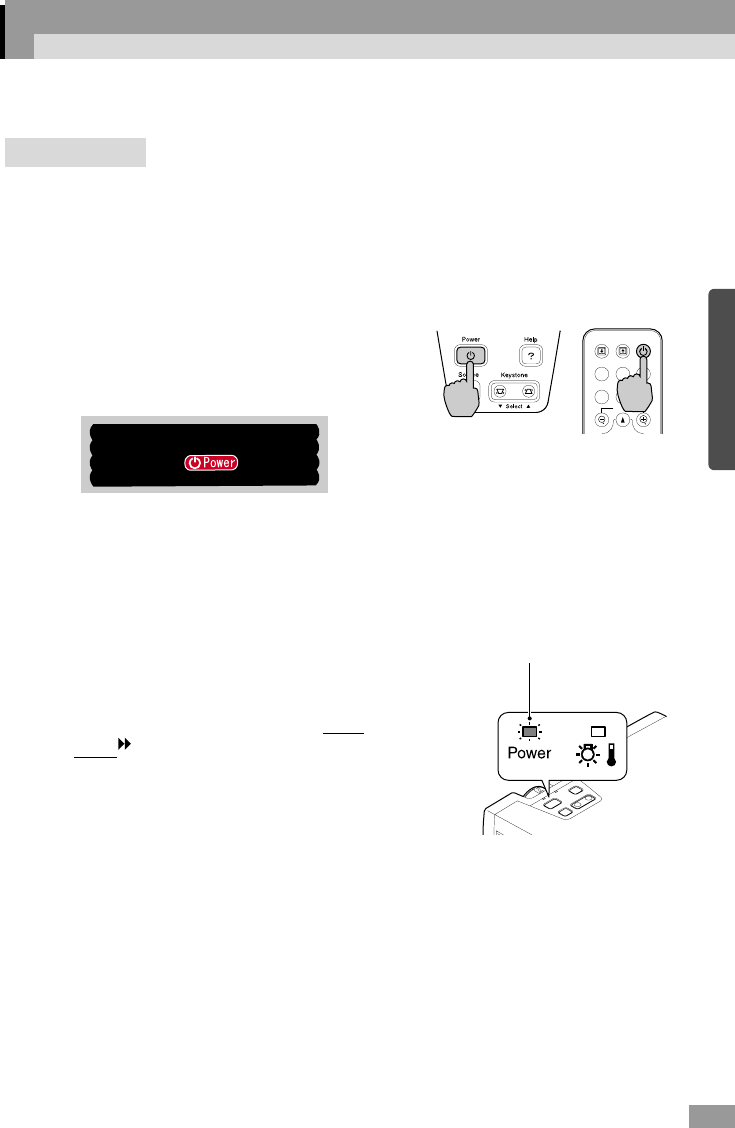
If more than one signal source has
been connected, use the projector's
control panel or the remote control
buttons to select the port which the
signal source that you would like to
use is connected to, while referring
to the following table.
* The items selected using the "Input Signal" command in the "Video" menu
will appear.
Tip :
• If only one signal source has been connected, the signals from that source will be
projected without needing to press one of the buttons from the previous table.
• If the "No-Signal." message does not disappear, check the connections again.
• If a laptop computer or a computer with an LCD screen has been connected to the
projector, the images may not be projected straight away. After making the
connections, check that the computer has been set up to output signals externally.
The following table shows examples of how to toggle output settings. For details, refer
to the section of the documentation provided with your computer under a heading such
as "External output", "Connecting an external monitor" or similar.
• If the same still picture is projected for a long period of time, the projected image may
become burned in on the computer screen. You should avoid leaving the same image
displayed for long periods.
Port Button to press Display at top-right of
screen
Projector Remote control
Computer/
Component Video
The image
source changes
each time
[Source] is
pressed.
[Computer]
Computer *
YCbCr *
YPbPr *
S-Video [S-Video/Video] S-Video
Video Video
Color Mode
Computer
Menu A/V Mute
E-Zoom
Freeze
S-Video/Video
Page upPage down
Power
Enter
Projector Remote control
NEC Panasonic Toshiba IBM Sony Fujitsu Macintosh
[Fn]+[F3] [Fn]+[F3] [Fn]+[F5] [Fn]+[F7] [Fn]+[F7] [Fn]+[F10]
After startup, change
the Control Panel
adjustments so that
Mirroring is active
Turning On the Projector
31
Turning Off the Projector
Follow the procedure below to turn off the power of the projector.
Procedure
1
Turn off the power for the signal sources that are connected to
the projector.
Check that the power for all connected components has been turned off.
2
Press the [Power] button on either
the projector's control panel or the
remote control.
The following confirmation message will
appear.
If you do not want to turn off the power, press any button except the
[Power] button.
If you do not press any button, the message will disappear automatically
after seven seconds. (The power will not turn off at this time.)
3
Press the [Power] button once
more.
The lamp will switch off. The Power
indicator will flash orange and cool-
down will start.
The cool-down period lasts for about 45
seconds.
(This varies depending on factors such as
the ambient air temperature.)
Tip :
The projector's control panel and remote control buttons cannot be operated while
the Power indicator is flashing orange. Wait until it lights steadily.
4
Check that the cool-down is complete.
When cool-down is complete, the Power indicator lights orange.
Color Mode
Computer
Menu A/V Mute
E-Zoom
Freeze
S-Video/Video
Page upPage down
Power
Projector Remote control
Power OFF?
Please press key again
to power off .
Stops flashing and lights orange
32
5
Unplug the power cable from the electrical outlet.
Caution :
Do not disconnect the power cable from the outlet while the Power indicator is still
flashing orange, otherwise it may result in errors in projector operation and reduce the
lamp unit operating life.
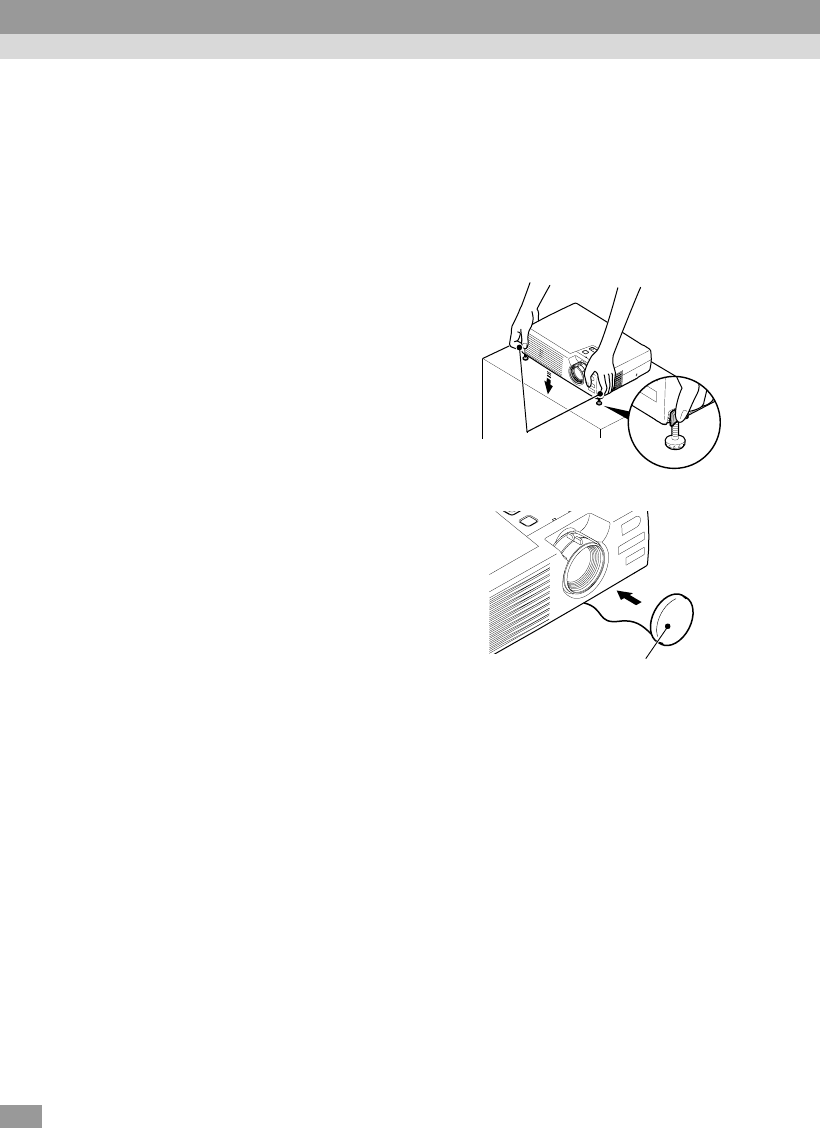
6
Retract the front adjustable feet if
they are extended.
Gently push down on the projector while
simultaneously pressing the two foot
adjust buttons.
7
Attach the lens cover.
Attach the lens cover to the lens when not
using the projector, in order to stop the
lens from getting dusty or dirty.
Foot adjust buttons
Lens cover
Turning Off the Projector
33
Adjusting the Screen Image
You can correct and adjust the screen image in order to obtain the best possible
picture.
Adjusting the Image Size
The size of the projected image is basically determined by the distance from the
projector to the screen. (p.15)
The following procedures explain how to adjust the screen image once the
projector itself has been set up.
Tip :
The E-Zoom function lets you enlarge parts of the image. (p.45)
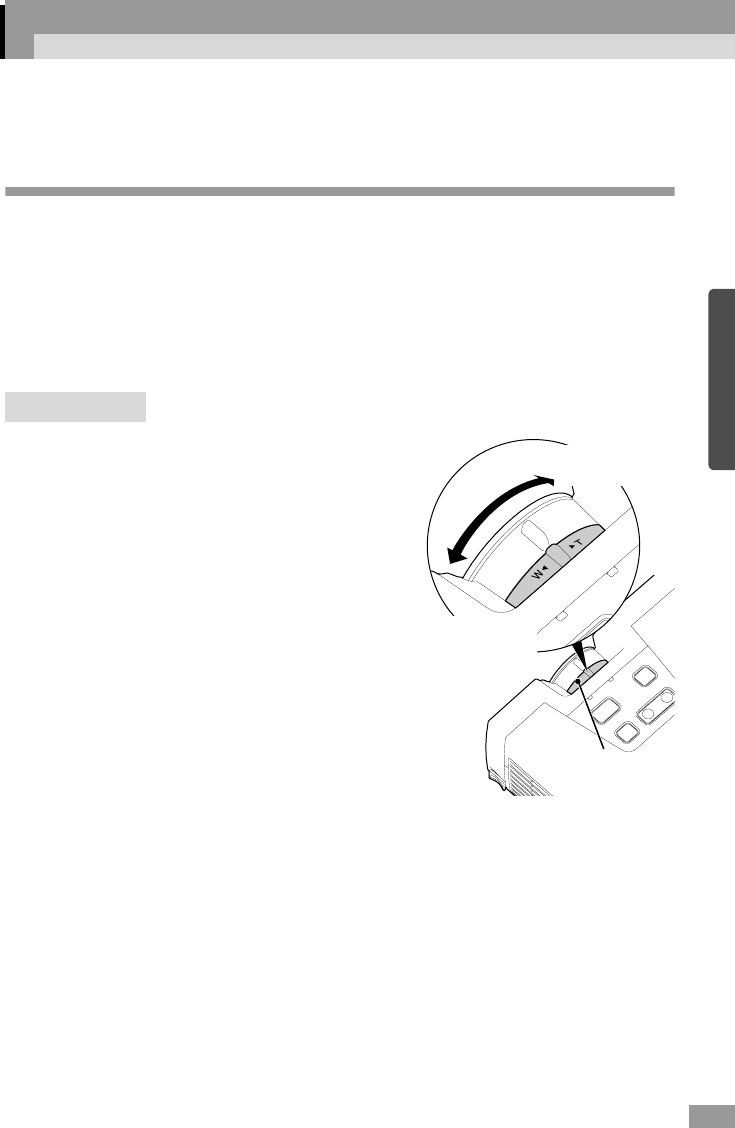
Procedure
Turn the zoom ring on the projector to
adjust the image.
The image can be enlarged in this way to 1.16
times the normal size.
If you would like to enlarge the image further,
move the projector further away from the
screen. (p.15) Turn to "W" to
increase the size
Zoom ring
Turn to "T" to
reduce the size
34
Adjusting the Image Angle and Automatic Keystone
Correction Function
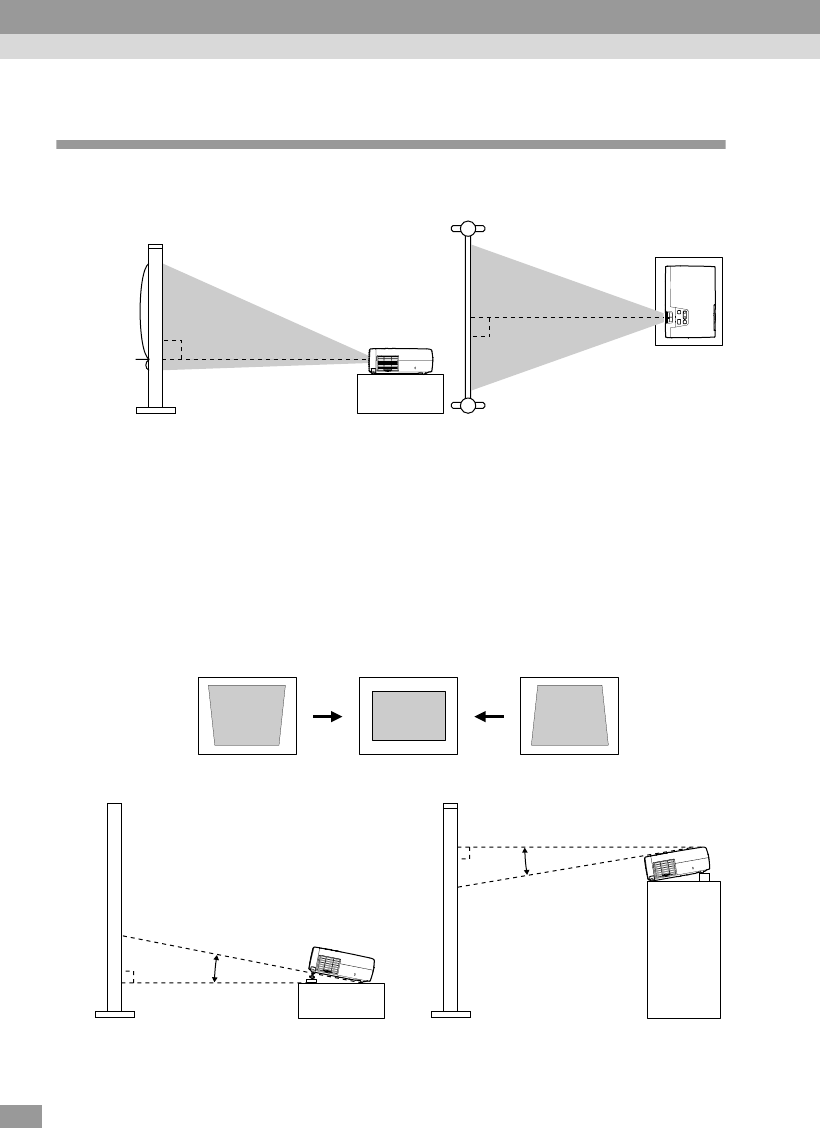
The projector should be set up so that it is as perpendicular to the screen as possible.
If it is not possible to set up the projector so that it is perpendicular to the screen, it
can be set up at a slight vertical angle instead. You can extend or retract the front
adjustable feet to adjust the projection angle within a maximum range of 11º.
When the projector is tilted, it will cause keystone distortion to appear in the
image. The projector is equipped with automatic keystone correction function
that can automatically correct this keystone distortion as long as the vertical
angle of tilt is within a range of approximately 15º*. Automatic keystone
correction is carried out approximately one minute after the projector's power
has been turned on and the projector has been positioned.
Seen from the side Seen from above
9
1
15º
15º
Approx. 15º above Approx. 15º below
Adjusting the Screen Image
Centre of
lens
35
* This value applies when the zoom ring is turned to the maximum "T" setting.
If the zoom ring is turned to the "W" setting, the available angle of tilt for
automatic adjustment will become smaller.
Tip :
• Automatic keystone correction is not carried out when the "Rear" or "Ceiling"
commands in the "Advanced" menu are set to "ON".
• If you would like to make further adjustments after automatic keystone correction has
been carried out, you can use the [keystone] button on the projector's control panel.
(p.36)
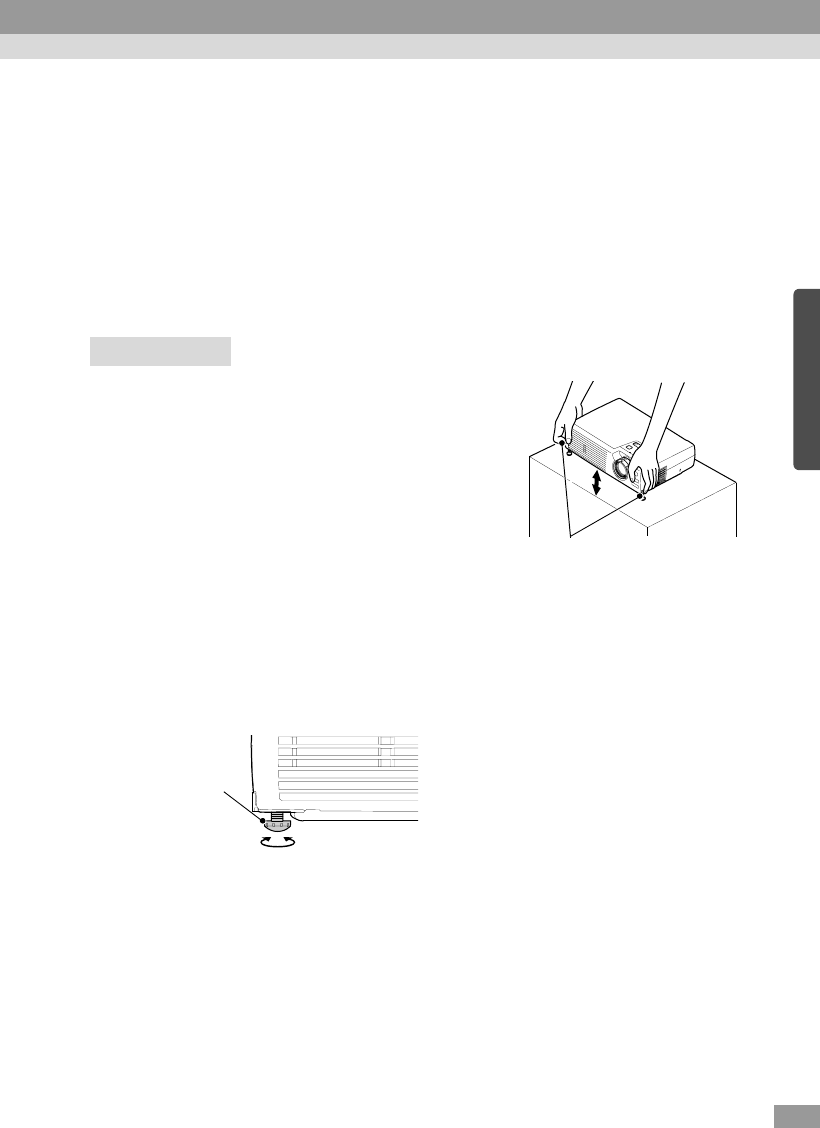
Procedure
While pressing the two foot adjust
buttons at either side, lift up the front
of the projector so that the front
adjustable feet can extend.
Extend the front adjustable feet until the
desired angle is obtained, and then release the
foot adjust buttons.
To retract the front adjustable feet, gently push
down on the projector while pressing the two
foot adjust buttons.
Tip :
• If the projector is tilted horizontally, turn the bases of the front adjustable feet to adjust
the angle.
• When keystone correction is carried out, the projected image will become smaller.
• If the images become uneven in appearance after keystone correction is carried out,
decrease the sharpness setting. (p.47, 48)
• If automatic keystone correction is not required, set "Auto Keystone" in the "Setting"
menu to "OFF". (p.51)
Foot adjust buttons (side)
Extend Retract
Front adjustable
foot
36
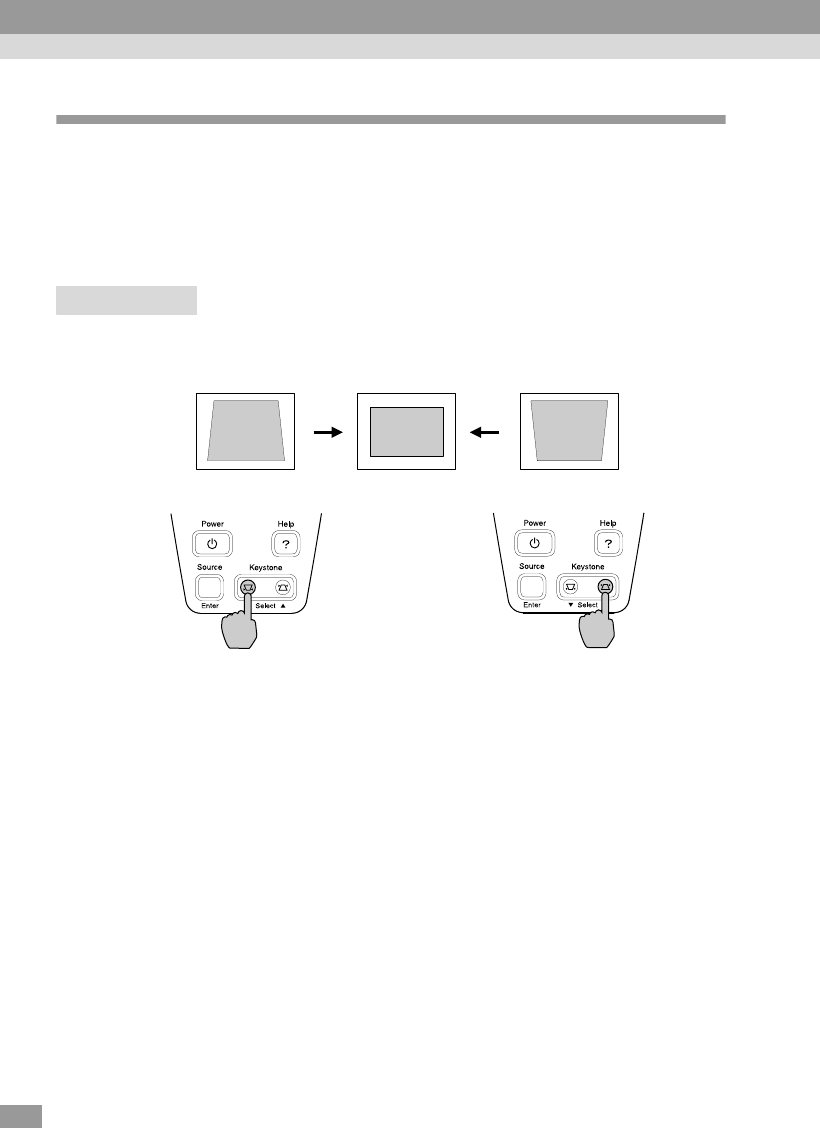
Manually Correcting Keystone Distortion
The projector is provided with an automatic keystone correction function which
detects the vertical angle of the projector and carries out keystone correction
automatically. If further correction adjustment is required after automatic
keystone correction has been carried out, use the [Keystone] buttons on the
projector's control panel to make the adjustment.
Procedure
Tip :
• When keystone correction is carried out, the projected image will become smaller.
• If the images become uneven in appearance after keystone correction is carried out,
decrease the sharpness setting. (p.47, 48)
• Keystone correction can also be carried out using the configuration menu. (p.50, 51)
• If the value displayed in the gauge on the screen stops changing when keystone
correction is being carried out, it indicates that the limit for keystone correction has
been exceeded. Check that the projector has not been set up at an angle which exceeds
the proper limit.
Projector Projector
If the bottom of the
image is elongated
If the top of the
image is elongated
Adjusting the Screen Image
37
Adjusting the Image Quality
The quality of the screen images can be adjusted as follows.
Focusing the Screen Image
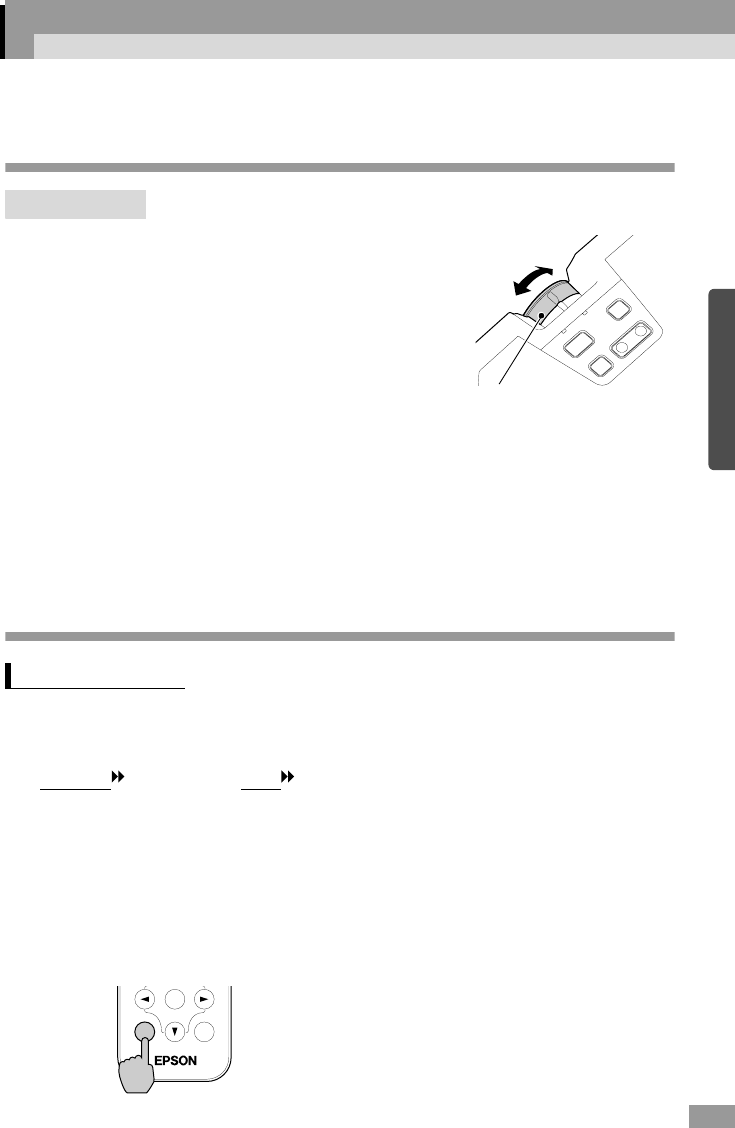
Procedure
Turn the focus ring to adjust the image
focus.
Turn the focus ring of the projector until the
projected images are in proper focus.
Tip :
• If the surface of the lens is dirty or misted over as a result of condensation, it may not
be possible to adjust the focus correctly. If this happens, clean or de-mist the lens.
(p.66, 72)
• If the projector is positioned outside the normal projecting range of 1.0–11.7 m (3.2–
38.5 ft.), it may not be possible to obtain the correct focus. If you have trouble
obtaining the correct focus, check the projection distance.
Adjusting Computer Images
Automatic setup detects the status of the signals coming from the connected
computer, and automatically adjusts these signals so that the optimum images
can be obtained. It involves adjustment of the following three items:
Tracking , Position and Sync .
Tip :
• If "Auto Setup" in the "Video" menu is set to "OFF" (the default setting for this item is
"ON"), automatic setup is not carried out. If you press the [Auto] button on the remote
control while computer signals are being projected, adjustment will then be carried
out.
Automatic Setup
Focus ring
ESCAuto
Enter
Remote control
38
• If you press the [Auto] button while the E-Zoom or Freeze function is being used or
while a configuration menu or help menu is being displayed, the function will be
cancelled when you press the [Auto] button, and then the adjustment will be carried
out.
• Sometimes the signals may not be adjusted correctly depending on the type of signals
being output by the computer. In such cases, use the configuration menu commands to
adjust the tracking and sync settings manually. (p.38, 39)
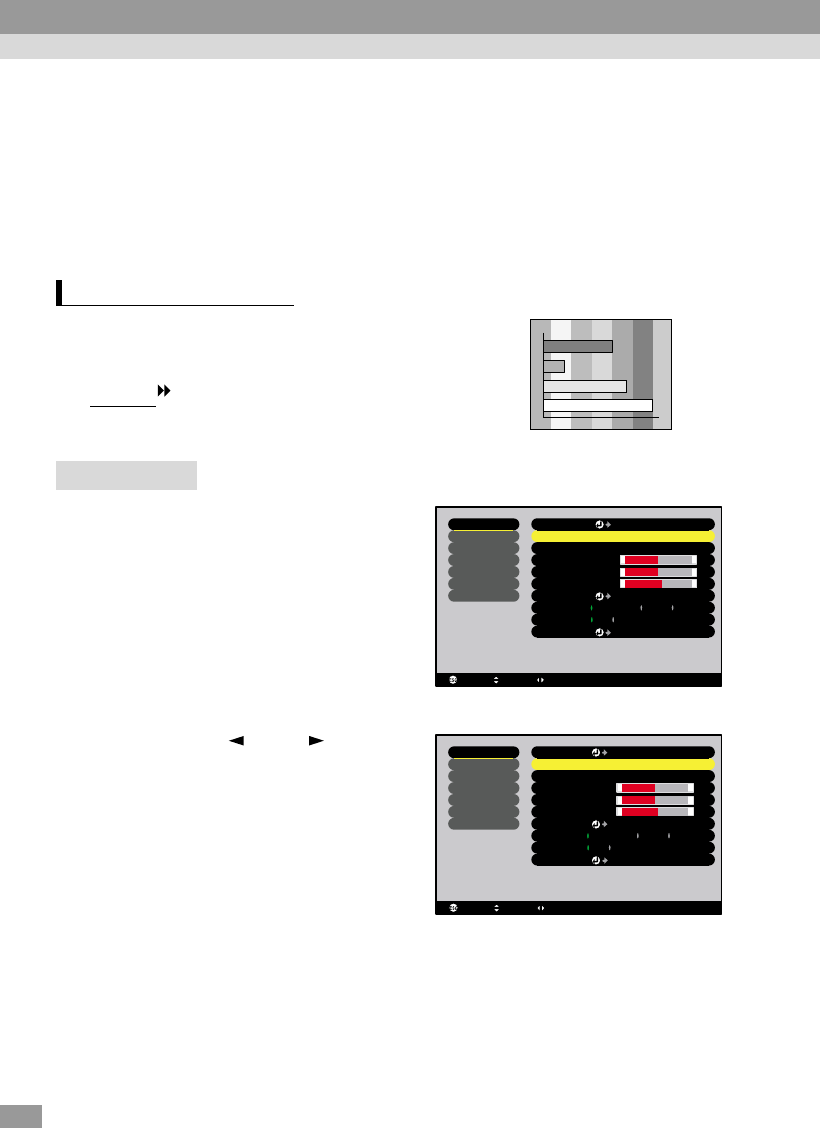
If vertical stripes appear in the projected
images, and this cannot be fixed using
automatic setup, you will need to adjust the
tracking manually using the following
procedure.
Procedure
1
Press the [Menu] button on the
remote control, and then select
"Tracking" from the "Video"
menu.
For details on this operation, refer to
"Using the Configuration Menus".
(p.56)
2
Press the [ ] and [ ] buttons
to set the tracking value.
The tracking value increases or
decreases each time a button is
pressed.
3
After making the adjustment, press the [Menu] button to exit
the configuration menu.
Tip :
The image will flash when continuous tracking adjustment is carried out, but this is
normal.
Adjusting the Tracking
Input Signal
Color Mode Select
Video
Audio
Setting
User's Logo
Advanced
About
Position Adjust
Tracking 0000
Sync . 0
Brightness 0
Contrast
Sharpness 0
RGB
YUV( YCbCr YPbPr)
Auto Setup
Reset
Execute
: Select: Return : Adjust
Reset All
+
-
+
-
0
+
-
ON OFF
:
:
:
:
:
:
:
[Normal ]
+
-
+
-
+
-
Video
Audio
Setting
User's Logo
Advanced
About
Reset All
Input Signal
Color Mode
Position
Tracking
Sync .
Brightness
Contrast
Sharpness
Auto Setup
Reset
:
:
:
:
:
:
:
Select [Normal ]
0
0
0
0
1000
Adjust
Execute
RGB
YUV( YCbCr YPbPr)
ON OFF
: Select: Return : Adjust
Adjusting the Image Quality
39
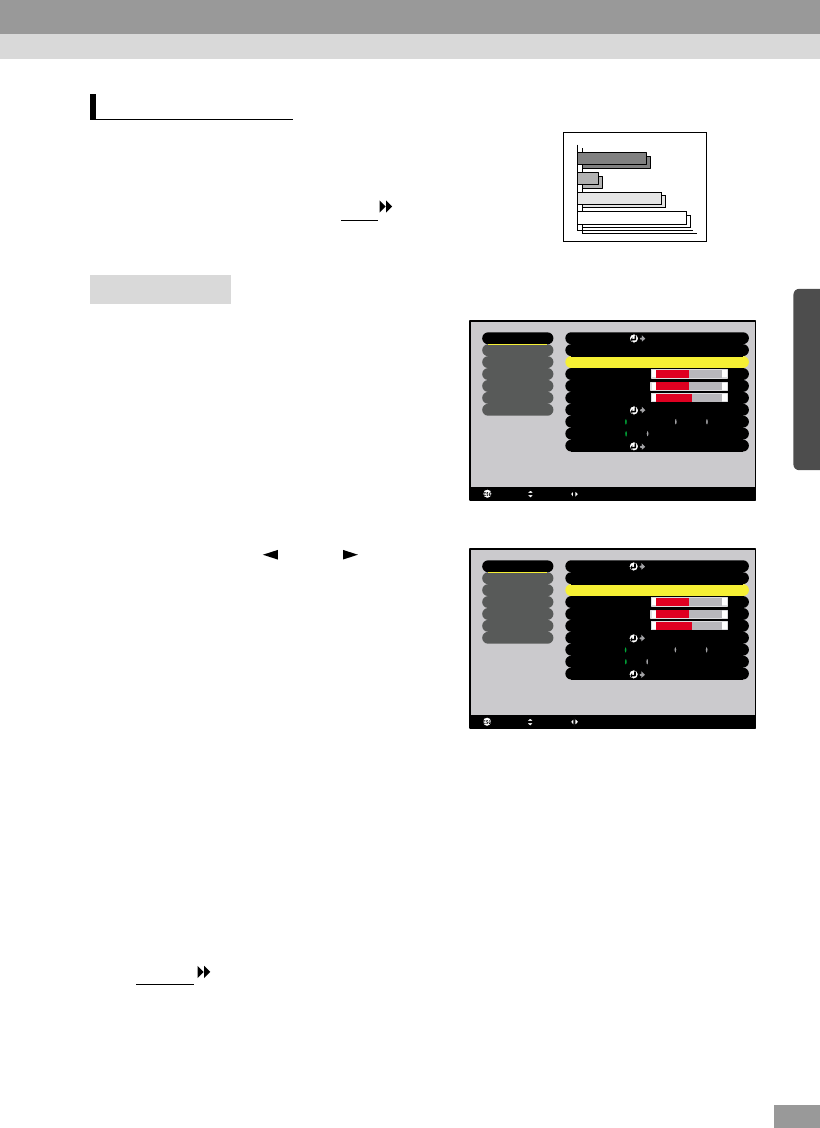
If flickering, fuzziness or interference appear
in images that are input from the computer,
and this cannot be fixed using automatic setup,
you will need to adjust the sync manually
using the following procedure.
Procedure
1
Press the [Menu] button on the
remote control, and then select
"Sync." from the "Video"
menu.
For details on this operation, refer to
"Using the Configuration Menus".
(p.56)
2
Press the [ ] and [ ] buttons
to set the sync value.
The sync value increases or decreases
each time a button is pressed.
3
After making the adjustment, press the [Menu] button to exit
the configuration menu.
Tip :
• If you adjust the sync without adjusting the tracking first, it will not be possible to get
the best adjustment results. Incorrect tracking adjustment may not be noticeable with
some types of picture. However, pictures with lots of lines and shading will tend to
show incorrect tracking adjustments more clearly, so be sure to check the tracking
adjustment first.
• It may also be possible to fix flickering and fuzziness by adjusting the brightness,
contrast , sharpness and keystone correction settings.
Adjusting the Sync
+
-
+
-
+
-
Input Signal
Color Mode Select
Video
Audio
Setting
User's Logo
Advanced
About
Position Adjust
Tracking 0000
Sync . 0
Brightness 0
Contrast
Sharpness 0
RGB
YUV( YCbCr YPbPr)
Auto Setup
Reset
Execute
: Select: Return
Reset All
0
ON OFF
:
:
:
:
:
:
:
[Normal ]
: Adjust
+
-
+
-
+
-
Input Signal
Color Mode Select
Video
Audio
Setting
User's Logo
Advanced
About
Position Adjust
Tracking 0000
Sync . 10
Brightness 0
Contrast
Sharpness 0
RGB
YUV( YCbCr YPbPr)
Auto Setup
Reset
Execute
: Select: Return
Reset All
0
ON OFF
:
:
:
:
:
:
:
[Normal ]
: Adjust
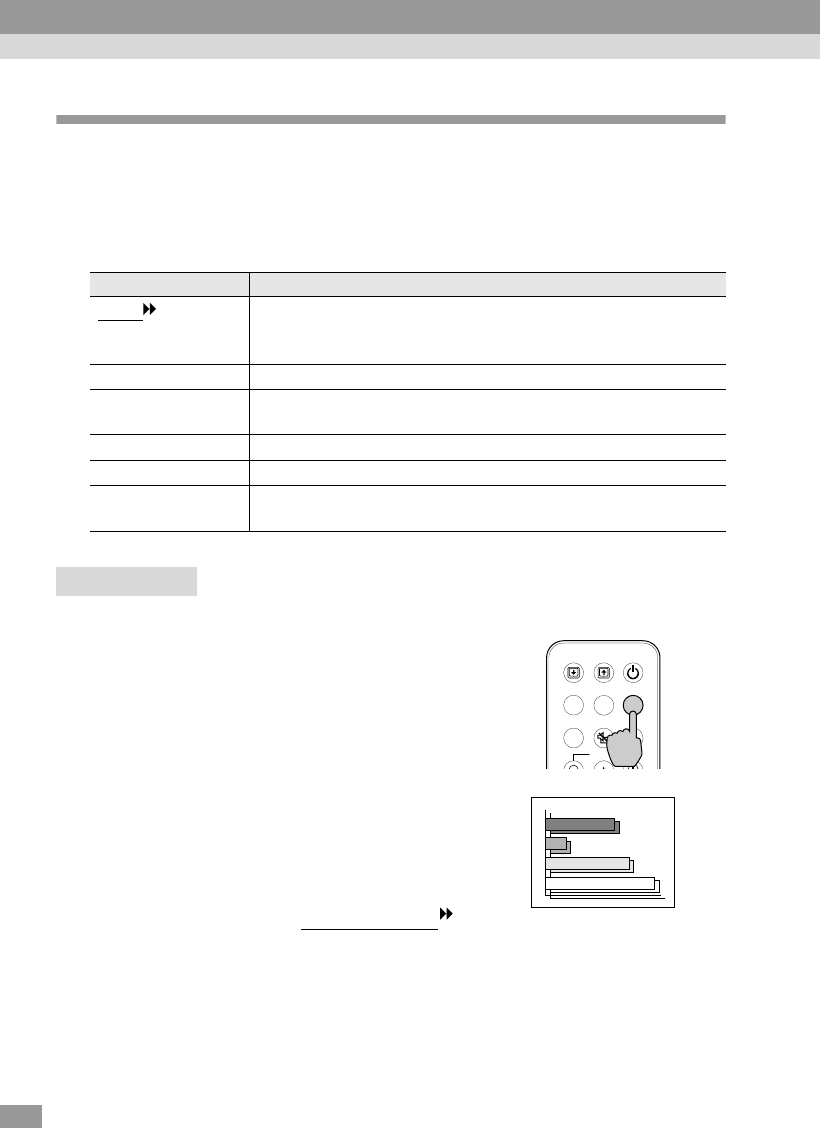
40
Selecting the Colour Mode
The following six preset colour modes are available for use depending on the
characteristics of the images that are being projected. You can easily obtain the
optimum image quality simply by selecting the colour mode that corresponds to
the projected images. The brightness of the images will vary depending on
which colour mode is selected.
Procedure
The color mode changes as follows
each time the [Color Mode] button on
the remote control is pressed.
Normal → Meeting → Presentation →
Theatre → Game → sRGB ...
The current setting appears in the top-right
corner of the screen each time the colour mode
is changed.
The default setting for the colour mode is
"Normal" when computer images are being
input, and "Theatre" when component video ,
composite video and S-Video signals are being input.
Tip :
The colour mode can also be set using the "Color Mode" command in the "Video" menu.
(p.47, 49)
Mode Application
sRGB Images conform to the sRGB colour standard. If the connected
source has an sRGB mode, set both the projector and the
connected signal source to sRGB.
Normal Brightness is emphasised. For presentation in bright rooms.
Meeting Images are modulated using their original tints, with no colour
enhancement.
Presentation For presentations in dark rooms.
Theatre Movie images are optimised using natural tints.
Game Brightness is emphasised. Ideal for playing video games in
bright rooms.
Menu A/V Mute
E-Zoom
Freeze
Page upPage down
Power
Color Mode
Computer
S-Video/Video
Normal
Remote control
Adjusting the Image Quality

41
Advanced Operations
This chapter describes functions for enhancing the projection of
images, and how to use the configuration menus.
Functions for Enhancing Projection................................42
• A/V Mute .............................................................................................. 42
• Freeze .................................................................................................... 43
• Wide-screen Projection of Component Video and Video Images
(Changing the Aspect Ratio)............................................................... 44
• E-Zoom ................................................................................................. 45
Using the Configuration Menu Functions .......................46
• List of Functions................................................................................... 46
•"Video" Menu ................................................................................................... 46
•"Audio" Menu ................................................................................................... 50
•"Setting" Menu.................................................................................................. 50
•"User's Logo" Menu.......................................................................................... 52
•"Advanced" Menu............................................................................................. 52
•"About" Menu ................................................................................................... 54
•"Reset All" Menu.............................................................................................. 55
• Using the Configuration Menus.......................................................... 56
42
Functions for Enhancing Projection
This section describes the various useful functions that can be used to enhance
presentations.
A/V Mute
This function momentarily pauses the image and sound.
For example, it can be used when you do not want to show viewers details of
operations such as selecting different files while computer images are being
projected.
However, if you use this function when projecting moving images, the images
and sound will still continue to be played back by the source, and you cannot
return to the point where the mute function was activated.
Procedure
Press the [A/V Mute] button on the
remote control.
The image and sound will then be paused.
Press the [A/V Mute] button on the remote
control to continue normal projection.
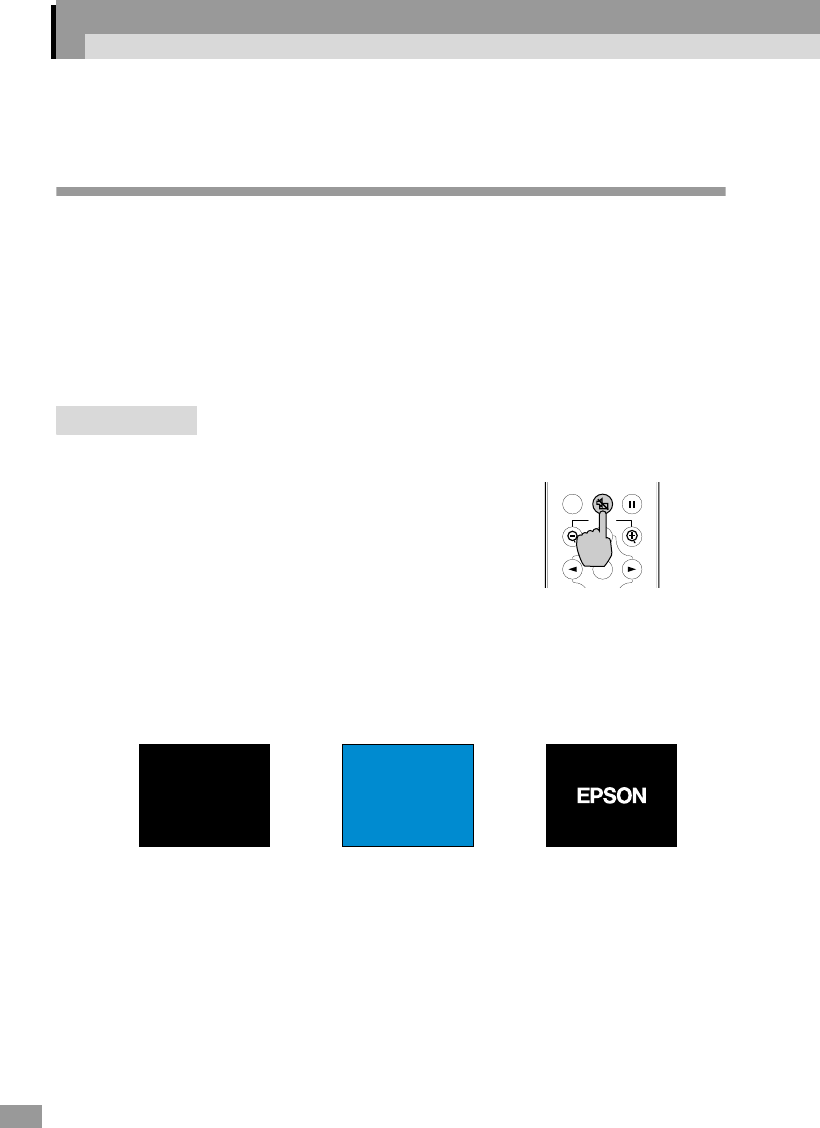
You can use the "A/V Mute" function in the "Setting" menu to set the screen
appearance when the images and sound have been paused to any one of the
following three settings. (p.51)
Tip :
The default user's logo is the EPSON logo. You can change the user's logo by recording
and setting your own logo. (p.80)
Menu A/V Mute
E-Zoom
Freeze
Enter
Remote control
Default setting
Solid black Solid blue User's logo
43
Freeze
This function pauses only the projected images. The sound keeps playing
without pausing.
The image source will still be playing back the images even while projection is
paused, and so it will not be possible to resume projection from the point where
it was paused.
Procedure
Press the [Freeze] button on the
remote control.
The images will then be paused.
To continue projecting the images, either press
the [Freeze] button again or press the [ESC]
button.
Tip :
• Pressing the [Freeze] button also clears configuration menu displays and help
messages.
• The freeze function still works while the E-Zoom function is being used.
However, in this case the freeze function can only be cancelled by pressing the [Freeze]
button.
Menu A/V Mute
E-Zoom
Freeze
Enter
Remote control
44
Wide-screen Projection of Component Video and Video
Images (Changing the Aspect Ratio)
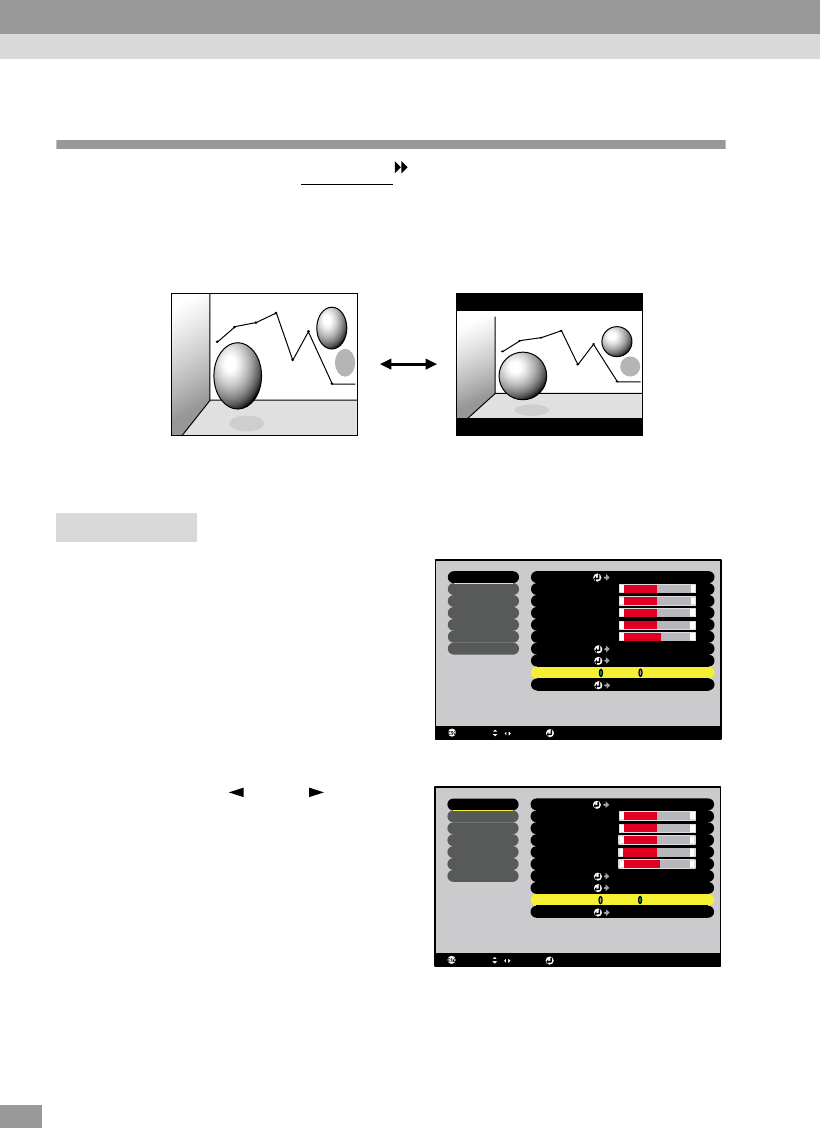
This function changes the aspect ratio of images from 4:3 to 16:9 when
component video images (YCbCr and YPbPr) or video images (S-Video or
composite video) are being projected. Images which have been recorded in
digital video or onto DVDs can be viewed in 16:9 wide-screen format.
Procedure
1
Press the [Menu] button on the
remote control, and then select
"Aspect Ratio" from the
"Video" menu.
For details on this operation, refer to
"Using the Configuration Menus".
(p.56)
2
Press the [ ] and [ ] buttons
to set the aspect ratio to either
"4:3" or "16:9", and then press
the [Enter] button.
3
After making the adjustment, press the [Menu] button to exit
the configuration menu.
When images in squeeze
mode are projected at 16:9
When images in squeeze
mode are projected at 4:3
: Return : Select
/
Video Signal
Color Mode Select [Theatre ]
Video
Audio
Setting
User's Logo
Advanced
About
Position Adjust
Brightness
Contrast
0
0
Color 0
Tint
Sharpness 0
Aspect Ratio
Reset Execute
Reset All
+
-
+
-
0 +
-
Select [Auto ]
4
:
316
:
9
+
-
+
-
:
:
:
:
:
:
: Set
: Return : Select
/
Video Signal
Color Mode Select [Theatre ]
Video
Audio
Setting
User's Logo
Advanced
About
Position Adjust
Brightness
Contrast
0
0
Color 0
Tint
Sharpness 0
Aspect Ratio
Reset Execute
Reset All
+
-
+
-
0 +
-
Select [Auto ]
4
:
3 16
:
9
+
-
+
-
:
:
:
:
:
:
: Set
Functions for Enhancing Projection
45
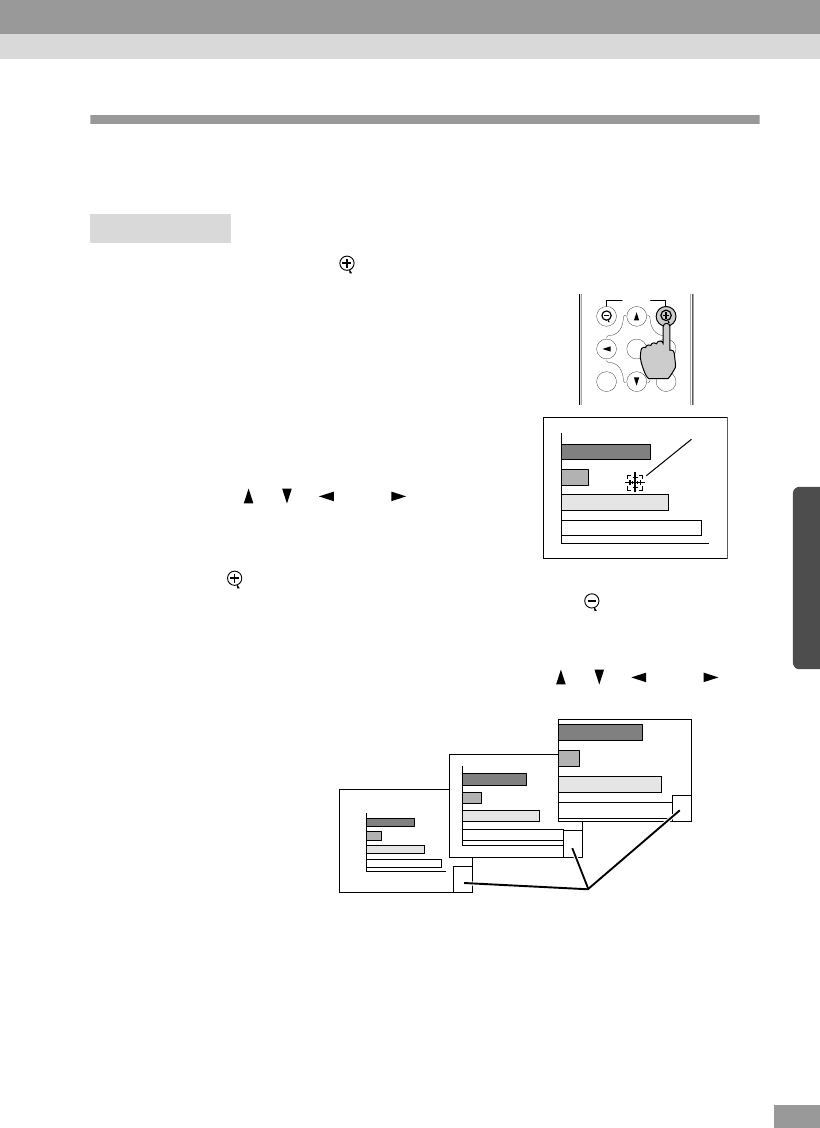
E-Zoom
This function lets you enlarge and reduce a part of projected images such as
graphs and tables.
Procedure
1
Press the [E-Zoom ] button on the
remote control.
A cursor (cross) indicating the centre
point for the area to be enlarged will
appear on the screen.
2
Move the cross to the area of the
image that is to be enlarged or
reduced.
Press the [ ], [ ], [ ] and [ ] buttons
on the remote control to move the cross.
3
When [ ] is pressed, the image is
enlarged with the cross as its centre. When [ ] is pressed, the
enlarged picture is then reduced.
The enlargement ratio will appear at the bottom-right of the screen.
You can scroll around the image by pressing the [ ], [ ], [ ] and [ ]
buttons.
To cancel the E-Zoom, press the [ESC] button.
Tip :
The selected area can be enlarged to between 1– 4 times, in 25 steps of x0.125.
E-Zoom
ESCAuto
Enter
Remote control
Cross
Shows enlargement ratio
46
Using the Configuration Menu Functions
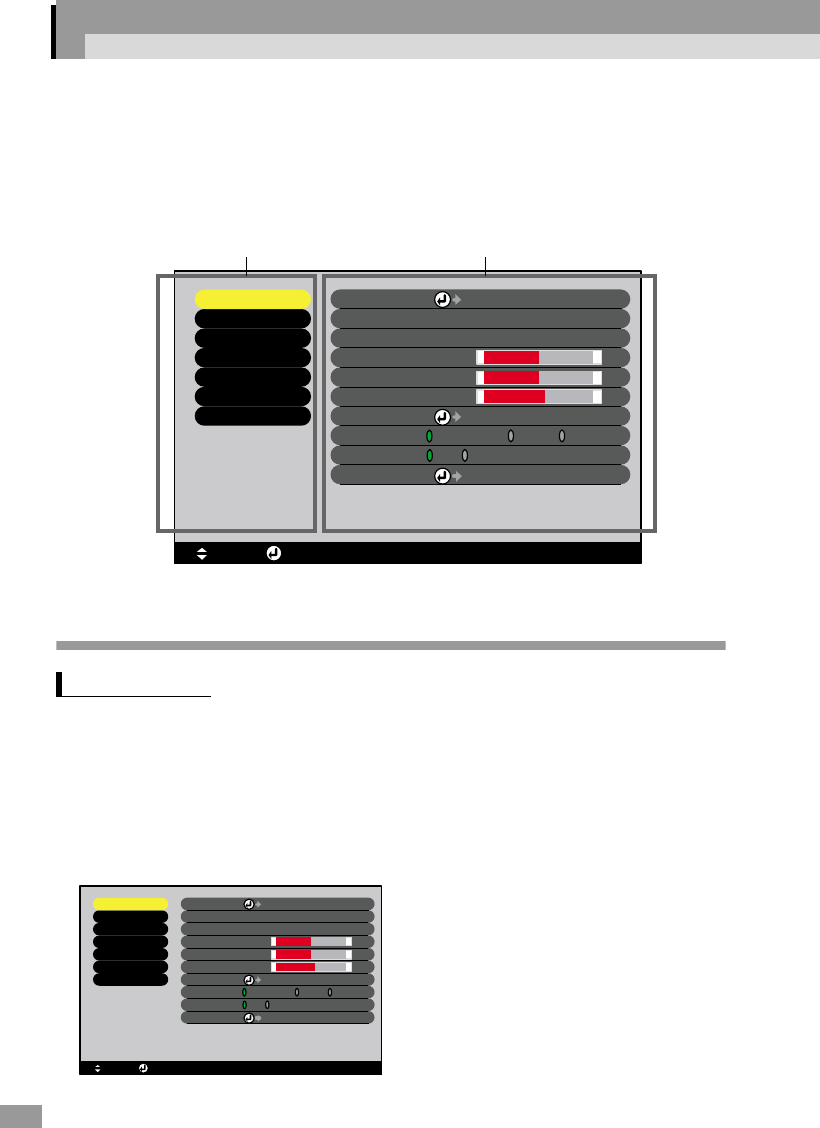
The configuration menus can be used to carry out a variety of settings and
adjustments.
The menus have a hierarchical structure, with a main menu that is divided into
sub-menus, which are further divided into other sub-menus.
The remote control is used to operate the menus. Refer to "Using the
Configuration Menus" (p.56) for details on using the menus.
List of Functions
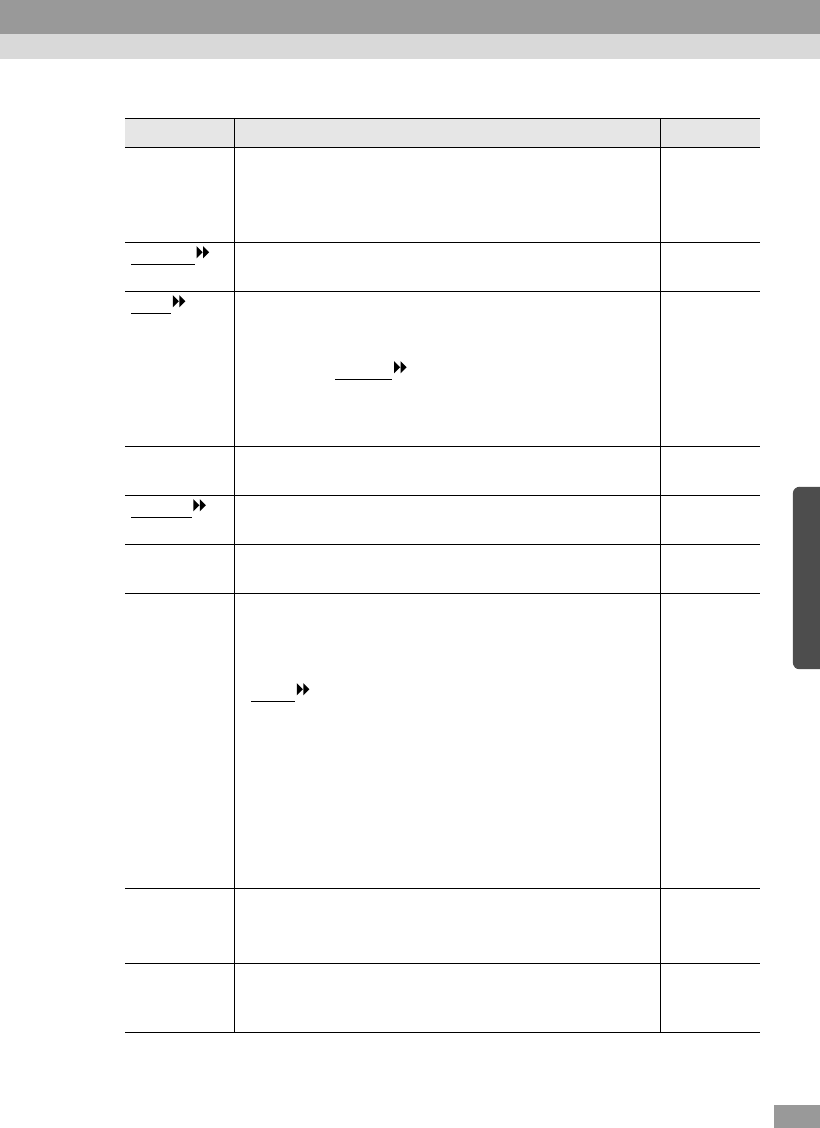
•The functions in the "Video" menu apart from "Input Signal", "Auto Setup"
and "Video Signal" cannot be adjusted while no image signal is being input.
•The functions which appear in the "Video" menu will change depending on the
type of input source being used for the image signal. Functions which are not
available in the "Video" menu for a particular input source cannot be adjusted.
Computer (Analogue-RGB)/RGB video
"Video" Menu
: Select : Enter
Video
Audio
Setting
User's Logo
Advanced
About
Reset All
Input Signal
Color Mode
Position
Tracking
Sync .
Brightness
Contrast
Sharpness
Auto Setup
Reset
:
:
:
:
:
:
:
Select
Adjust
0000
0
0
0
RGB
YUV( YCbCr YPbPr)
Execute
+
-
+
-
0
+
-
ON OFF
[Normal ]
Main menu Sub-menu (Video)
+
-
+
-
+
-
: Select : Enter
Select
Adjust
0000
0
0
0
0
Video
Audio
Setting
User's Logo
Advanced
About
Reset All
Input Signal
Color Mode
Position
Tracking
Sync .
Brightness
Contrast
Sharpness
Auto Setup
Reset
:
:
:
:
:
:
:
RGB
YUV( YCbCr YPbPr)
Execute
ON OFF
[Normal ]
47
"Video" Menu
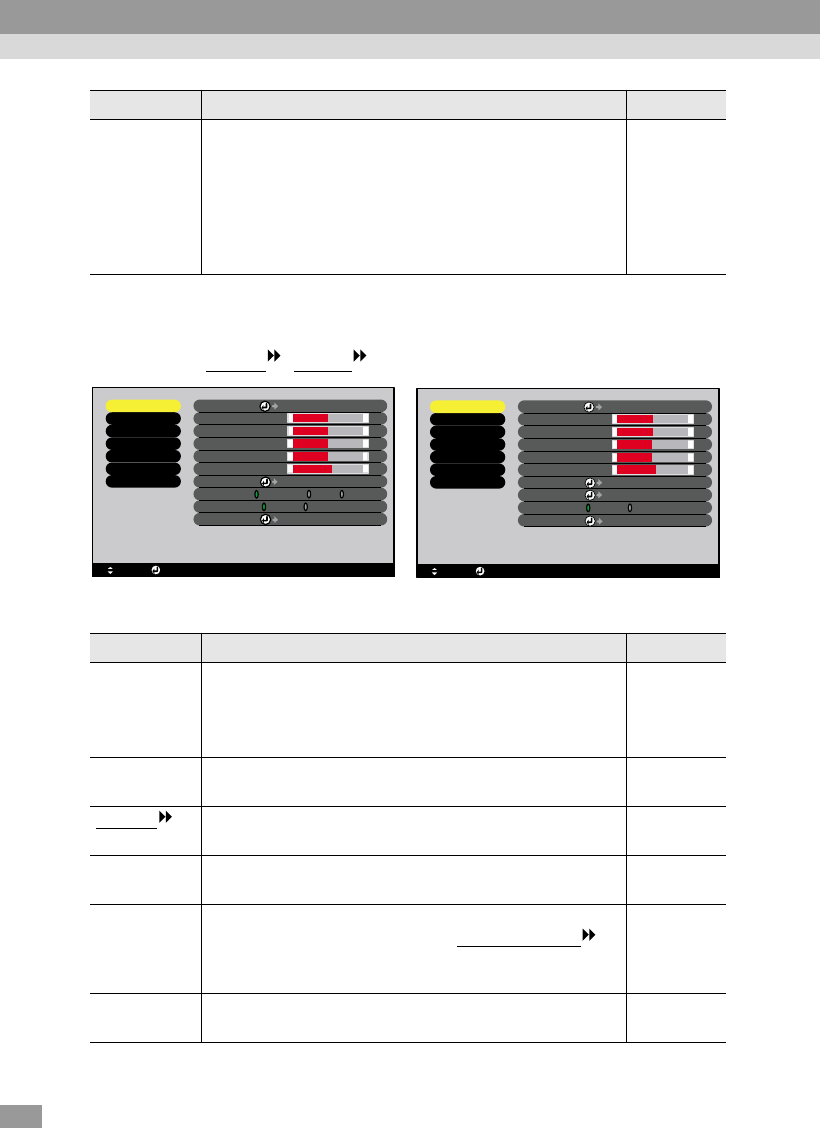
Sub-menu Function Default
Position Moves the image display position vertically and
horizontally.
•Press the [Enter] button and make the adjustment using
the display position adjustment sub-menu that appears.
Depends on
connection
Tracking Adjusts computer images when vertical stripes appear in
the images.
Depends on
connection
Sync. Adjusts computer images when flickering, fuzziness or
interference appear in the images.
•Flickering and fuzziness may also appear when the
brightness, contrast , sharpness or keystone settings
are adjusted.
•You can obtain the best results if you adjust the tracking
first and then adjust the sync.
Depends on
connection
Brightness Adjusts the image brightness. Median
value (0)
Contrast Adjusts the difference between light and shade in the
images.
Median
value (0)
Sharpness Adjusts the image sharpness. Median
value (0)
Color Mode Corrects the vividness of the image colour. The settings
can be saved separately for each type of source (computer
or video source). You can select from six different quality
settings depending on the surroundings.
•sRGB : Images conform to the sRGB standard.*
•Normal : Brightness is emphasised. For presentation in
bright rooms.
•Meeting: Images are modulated using their original
tints, with no colour enhancement.
•Presentation: For presentations in dark rooms.
•Theatre : Movie images are optimised using natural
tints.
•Game : Brightness is emphasised. Ideal for playing
video games in bright rooms.
Normal
Input Signal Selects the input source to be used.
•Select "RGB" when projecting computer images or
RGB video images.
Depends on
connection
Auto Setup Selects whether the automatic adjustment function for
automatically optimising images when the input source is
changed is turned ON or OFF.
ON
48
* If set to sRGB, the colour temperature for the "Color Adjustment" command in the
"Advanced" menu will be set to 6500K.
Component (YCbCr , YPbPr ) Video (S-Video, Composite video)
"Video" Menu
Reset Resets all adjustment values for the "Video" menu
functions except for the "Input Signal" setting to their
default settings.
•Press the [Enter] button to display the confirmation
screen, and select "Yes".
•Select "Reset All" to return all menu settings to their
default settings. (p.55)
-
Sub-menu Function Default
Position Moves the image display position vertically and
horizontally.
•Press the [Enter] button and make the adjustment using
the display position adjustment sub-menu that appears.
Depends on
connection
Brightness Adjusts the image brightness. Median
value (0)
Contrast Adjusts the difference between light and shade in the
images.
Median
value (0)
Color (Not available for RGB video)
Adjusts the colour intensity for the images.
Median
value (0)
Tint (Not available for RGB video)
(Adjustment is only possible when component video or
NTSC signals are being input.)
Adjust the image tint.
Median
value (0)
Sharpness Adjusts the image sharpness. Median
value (0)
Sub-menu Function Default
: Select : Enter
Adjust
+
-
+
-
+
-
4
:
3 16
:
9
+
-
+
-
Video
Audio
Setting
User's Logo
Advanced
About
0
0
0
0
Reset All
0
Input Signal
Color Mode
Position
Brightness
Contrast
Color
Tint
Sharpness
Aspect Ratio
Reset
:
:
:
:
:
:
:
Select
RGB
YUV( YCbCr YPbPr)
Execute
[Theatre ]
Adjust
+
-
+
-
+
-
+
-
+
-
: Select : Enter
4
:
3 16
:
9
Video
Audio
Setting
User's Logo
Advanced
About
Reset All
Video Signal
Color Mode
Position
Brightness
Contrast
Color
Tint
Sharpness
Aspect Ratio
Reset
:
:
:
:
:
:
: 0
0
0
0
0
Select
Select
Execute
[Theatre ]
[Auto ]
Using the Configuration Menu Functions
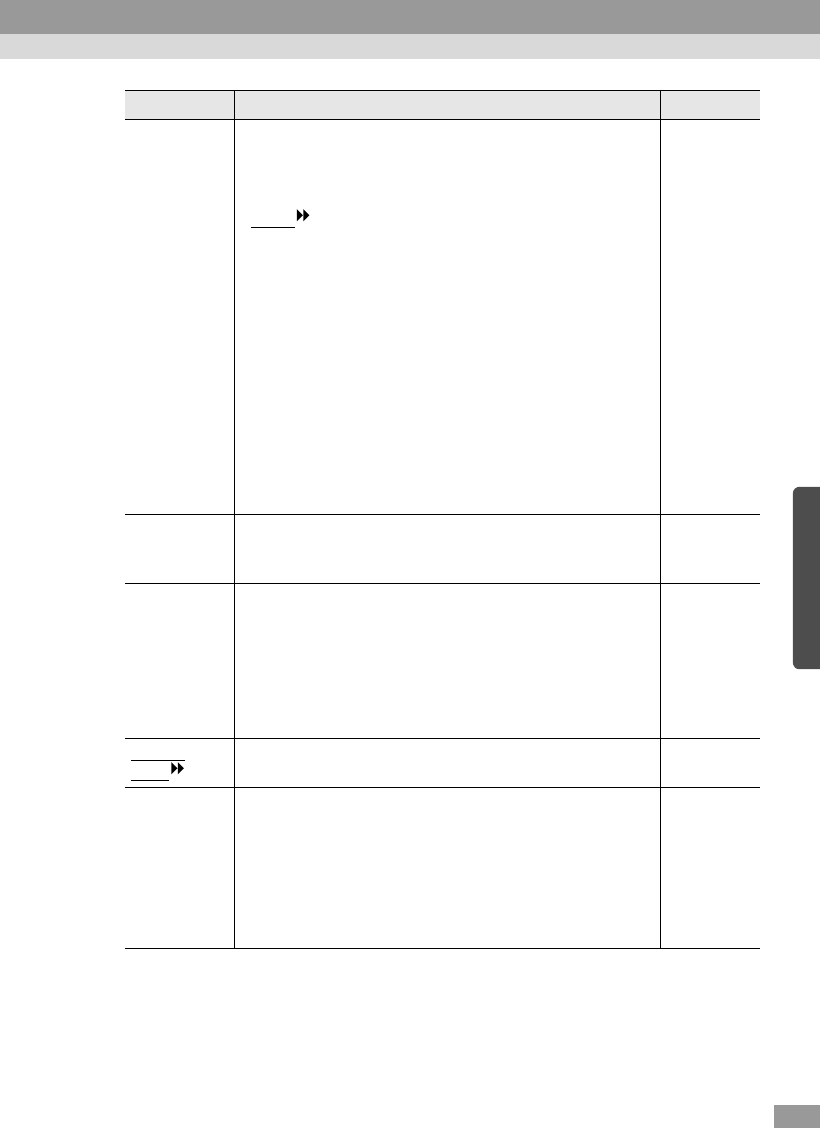
49
* If set to sRGB, the colour temperature for the "Color Adjustment" command in the
"Advanced" menu will be set to 6500K
Color Mode Corrects the vividness of the image colour. The settings
can be saved separately for each type of source (computer
or video source). You can select from six different quality
settings depending on the surroundings.
•sRGB : Images conform to the sRGB standard.*
•Normal : Brightness is emphasized. For presentation in
bright rooms.
•Meeting: Images are modulated using their original
tints, with no colour enhancement.
•Presentation: For presentations in dark rooms.
•Theatre :
Movie images are optimized using natural
tints. The black & white extension function
operates so that differences in colour
gradations (darkness and lightness of colours)
are accentuated even for images that are very
dark or very bright, to make them easier to
view.
•Game : Brightness is emphasized. Ideal for playing
video games in bright rooms.
Theatre
Input Signal (Adjustment is only possible when component video
signals are being input.)
Selects the input source to be used.
Depends on
connection
Video Signal (Adjustment is only possible when composite video/S-
Video signals are being input.)
Sets the video signal format.
•Press the [Enter] button, and choose the setting from the
video signal format selection sub-menu which appears.
•When set to "Auto", the video signal format is set
automatically.
Auto
Aspect
Ratio
Sets the aspect ratio for projected images. Depends on
connection
Reset Resets all adjustment values for the "Video" menu
functions except for the "Input Signal" and "Video
Signal" setting to their default settings.
Press the [Enter] button to display the confirmation
screen, and select "Yes".
Select "Reset All" to return all menu settings to their
default settings. (p.55)
-
Sub-menu Function Default
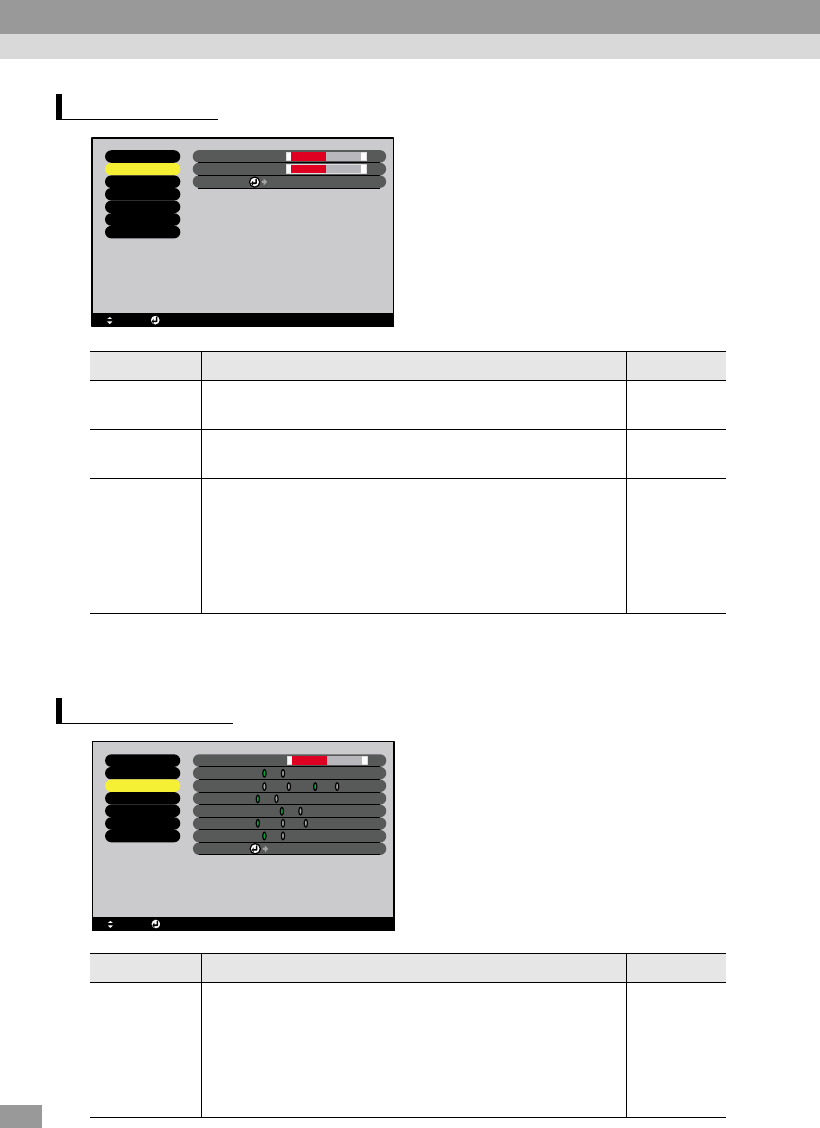
50
Tip :
The "Audio" menu settings are saved individually for each input signal source.
"Audio" Menu
Sub-menu Function Default
Volume Adjusts the volume. Median
value (10)
Tone Adjusts the tone. Median
value (0)
Reset Resets all adjustment values for the "Audio" menu
functions to their default settings.
•Press the [Enter] button to display the confirmation
screen, and select "Yes".
•Select "Reset All" to return all menu settings to their
default settings. (p.55)
-
"Setting" Menu
Sub-menu Function Default
Keystone Corrects vertical keystone distortion in images.
•When keystone correction is carried out, the projected
image will become smaller.
•If the images become uneven in appearance after
keystone correction is carried out, decrease the
sharpness setting.
Median
value (0)
+
-
+
-
Tone
Reset
Volume
Execute
10
Video
Audio
Setting
User's Logo
Advanced
About
Reset All
:
0
:
: Select : Enter
+
-
Auto Keystone
Reset Execute
Keystone 0
No-Signal Msg. OFF Logo
Prompt ON OFF
ON OFF
ON OFF
Color Mode Prompt
Black Blue
Sleep Mode ON OFF
A/V Mute LogoBlack Blue
Video
Audio
Setting
User's Logo
Advanced
About
Reset All
:
:
: Select : Enter
:
:
:
:
:
:
Using the Configuration Menu Functions
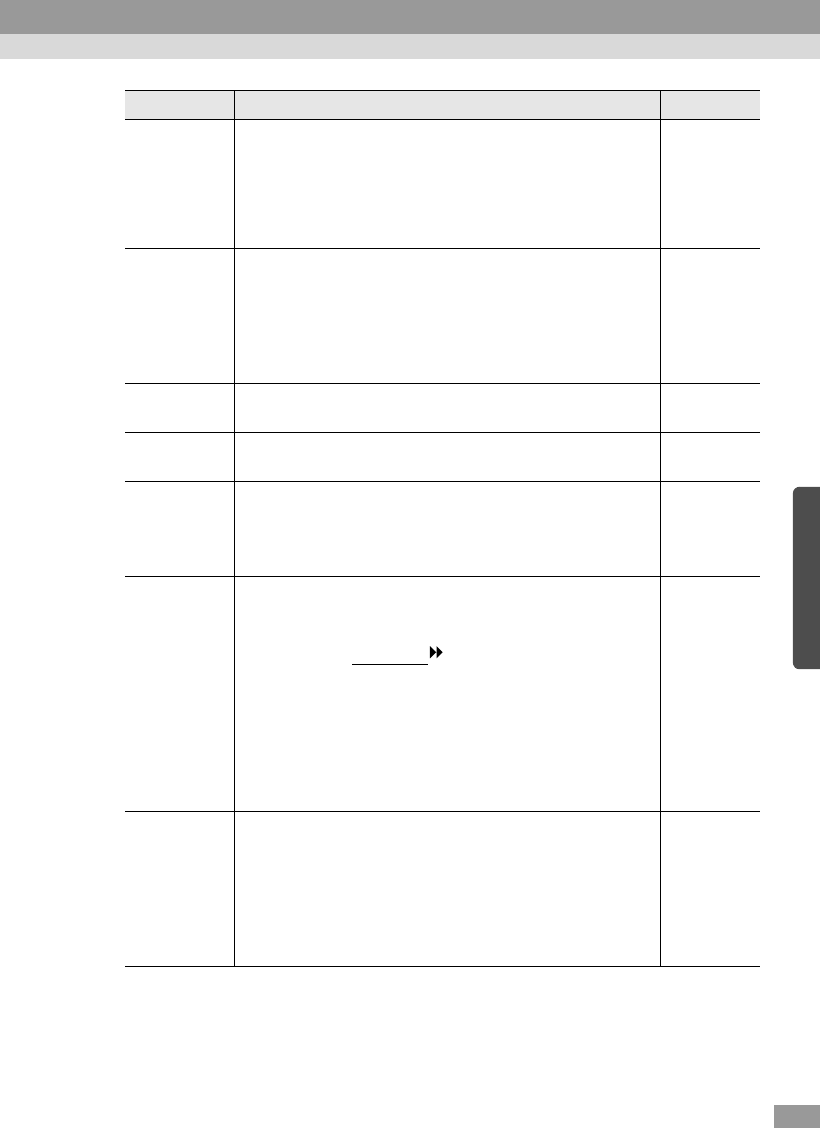
51
Auto
Keystone
Sets the function for automatically correcting keystone
distortion when the angle of the projector has been
adjusted to ON or OFF. This function is only enabled
when the "Rear Proj. " and "Ceiling" commands in the
"Advanced" menu are set to "OFF". If either "Rear Proj. "
or "Ceiling" is set to "ON", this menu cannot be selected.
ON
No-Signal
Msg.
Sets the message status and background colour at times
such as when no image signal is being input.
When set to "OFF", the background colour becomes
black and no message is displayed.
•To change the user's logo, you need to record and set
your own logo. (p.80)
Blue
Prompt Sets whether the input signal name is displayed on the
screen or not when the input signal is changed.
ON
Color Mode
Prompt
Sets whether the colour mode prompt is displayed on the
screen or not when the colour mode is changed.
ON
A/V Mute Sets the screen status when the [A/V Mute] button on the
remote control is pressed.
•To change the user's logo, you need to record and set
your own logo.
Black
Sleep Mode Sets the energy saving operation when no signal is being
input.
•When set to "ON", projection stops automatically and
then after the cool-down period is finished, the
projector changes to sleep mode if no operations are
carried out for 30 minutes while the "No-Signal."
message is being displayed. (The Power indicator lights
orange.)
•Projection starts again when the [Power] button on the
projector's control panel or the remote control is
pressed.
ON
Reset Resets all adjustment values for the "Setting" menu
functions to their default settings.
•Press the [Enter] button to display the confirmation
screen, and select "Yes".
•Select "Reset All" to return all menu settings–including
settings for the "Video" and "Audio" menus–to their
default settings. (p.55)
-
Sub-menu Function Default
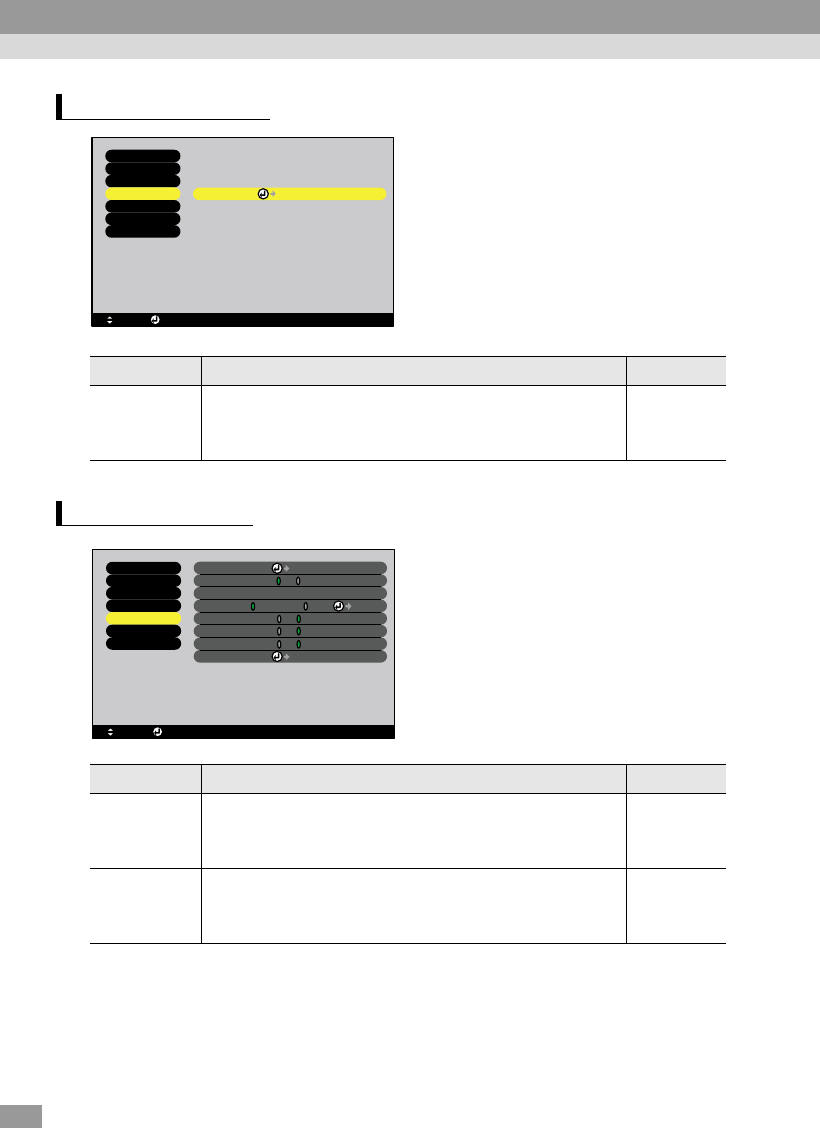
52
"User's Logo" Menu
Sub-menu Function Default
Execute Records a user's logo. (p.80)
•Press the [Enter] button and follow the procedure
appearing on the screen.
EPSON
logo
"Advanced" Menu
Sub-menu Function Default
Language Sets the language for message displays.
•Press the [Enter] button and select the language from
the selection menu that appears.
English
Startup
Screen
Sets whether the startup screen is displayed or not.
•To change the user's logo, you need to record and set
your own logo.
ON
Execute
Video
Audio
Setting
User's Logo
Advanced
About
Reset All
: Select : Execute
: Select : Enter
Video
Audio
Setting
User's Logo
Advanced
About
Reset All
Startup Screen
Color Adjust ment
Link 21L
Color Temp. RGB
Rear Proj .
Ceiling ON OFF
Language Select [English]
ON OFF
Reset Execute
Adjust
ON OFF
ON OFF
:
:
:
:
:
Using the Configuration Menu Functions
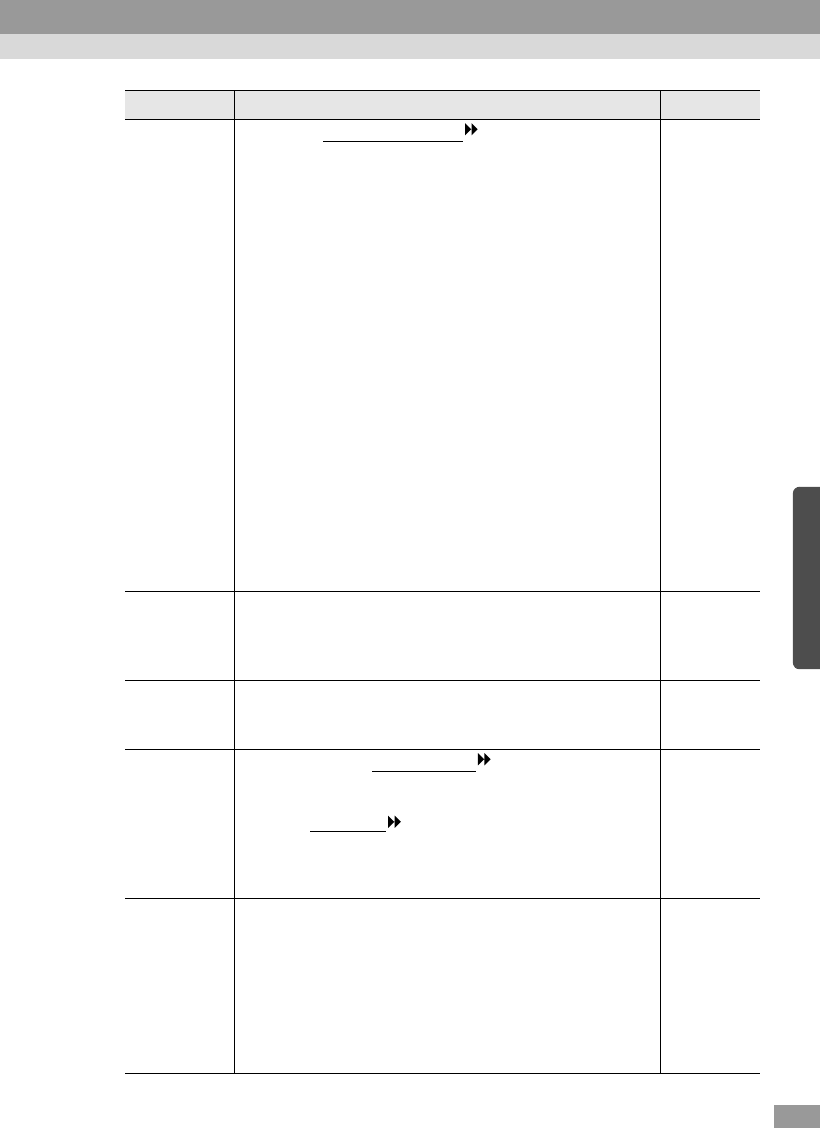
53
Color
Adjustment
Adjusts the colour temperature and intensity of each
RGB color for each input source.
•Color Temp.: Lets you adjust bright colours within a
range from reddish tinges to bluish tinges.
If the colour temperature is lower, colours
appear reddish and color tones appear
softer.
If the colour temperature is higher, colours
appear bluish and colour tones appear
sharper.
Press the [Enter] button and make the
adjustment in the colour adjustment sub-
menu that appears.
•RGB : Sets the colour intensity for each RGB
(red/green/blue) colour in the image.
Press the [Enter] button, select "R" (red),
"G" (green) or "B" (blue) and make the
adjustment in the colour adjustment sub-
menu that appears.
(This item cannot be selected if "sRGB" has been
selected as the "Color Mode" setting in the "Video"
menu.)
Color
Temp.:
Depends on
connection
Rear Proj. Use when projecting images from behind a translucent
screen.
When set to "ON", the projected images are horizontally
reversed.
OFF
Ceiling Use when installing the projector to a ceiling. When set
to "ON", the projected images are horizontally and
vertically reversed.
OFF
Link21L Sets whether the "EMP Link21L " utility software is
being used or not.
After changing the setting, turn off the projector's power.
After the cool-down has finished, turn the power back
on. The EMP Link21L software can then be used.
See "Utility Software" in the Safety Instructions/World–
Wide Warranty Terms.
OFF
Reset Resets all adjustment values for the "Advanced" menu
functions except for the "Language" setting to their
default settings.
•Press the [Enter] button to display the confirmation
screen, and select "Yes".
•Select "Reset All" to return all menu settings including
settings for the "Video" and "Audio" menus to their
default settings. (p.55)
-
Sub-menu Function Default
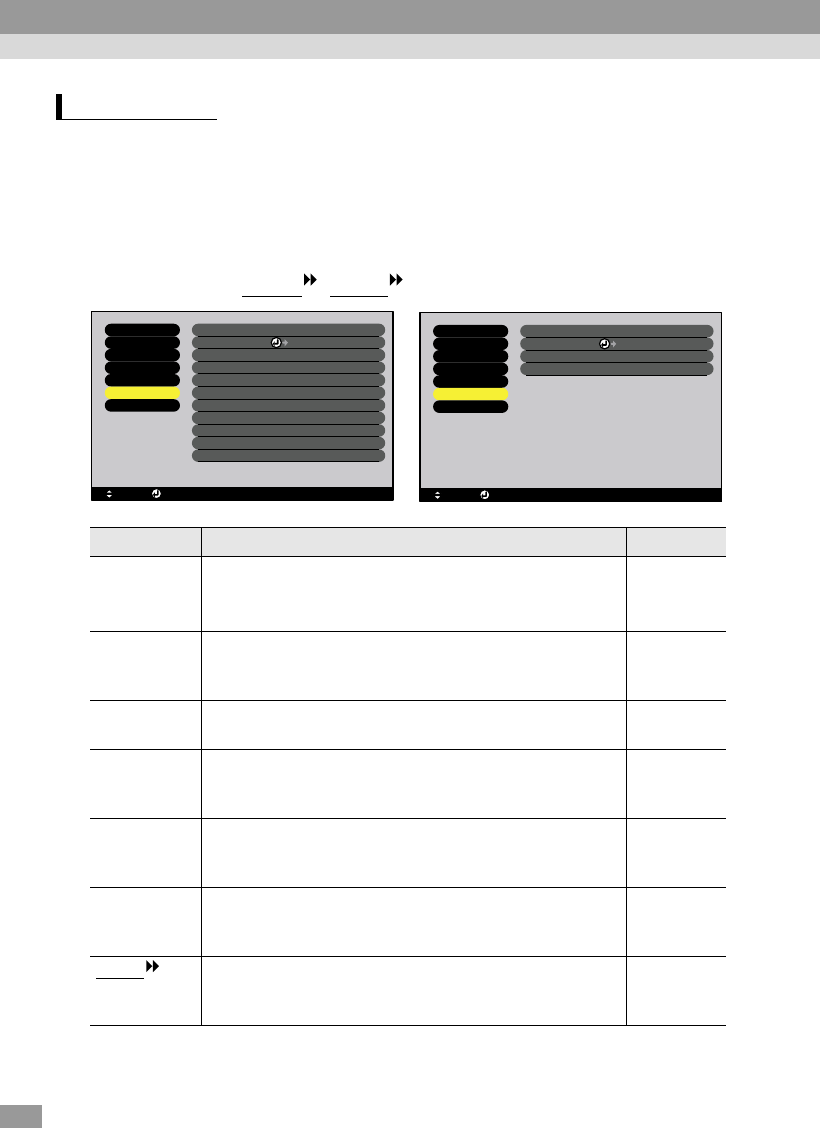
54
•The "About" menu shows the setting details for the current image source.
•The "Lamp" item appears as 0H for 0–10 hours, and after that, it appears in
units of 1 hour.
Computer/RGB video/ Video (S-Video, Composite video)
Component video
(Analogue-RGB, YCbCr , YPbPr )
"About" Menu
Sub-menu Function Default
Lamp Displays the cumulative lamp operating time.
•When the lamp warning period is reached, the display
characters appear in red.
0H
Reset Lamp
Timer
Initialises the lamp operating time. When this command
is selected, the cumulative lamp operating time is reset to
the initial default value.
-
Video Source Displays the input source which is currently being
projected.
Input Signal Displays the input signal settings.
(Does not appear when the input source is composite
video or S-Video.)
Video Signal Shows the video signal format.
(Does not appear when the input source is computer,
component video or RGB video.)
-
Frequency Displays the horizontal and vertical scanning frequencies.
(Does not appear when the input source is composite
video or S-Video.)
-
SYNC
Polarity
Displays the sync polarity.
(Does not appear when the input source is composite
video or S-Video.)
-
: Select : Enter
Video
Audio
Setting
User's Logo
Advanced
About
Reset All
Frequency
Video Source
V ---.--Hz
Reset Lamp Timer
H ---.--kHz
Lamp 0H
SYNC Mode
SYNC Polarity
------
V ------
H ------
Resolution
Refresh Rate 0.0 Hz
0x 0
Computer
Input Signal
:
:
:
:
:
:
:
: RGB
Execute
Video
Auto( )
: Select : Enter
Video
Audio
Setting
User's Logo
Advanced
About
Reset All
Video Source
Reset Lamp Timer
Lamp 0H
Video Signal
:
:
:
Execute
Using the Configuration Menu Functions
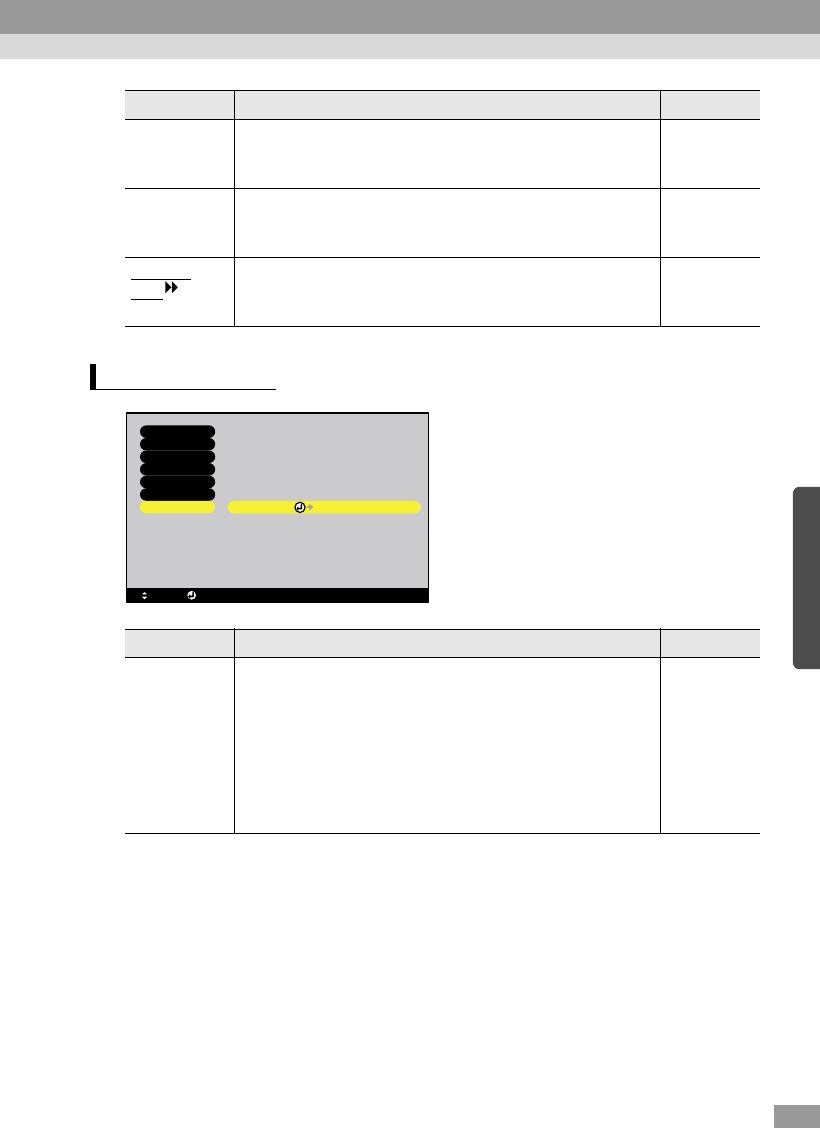
55
SYNC Mode Displays the sync attributes.
(Does not appear when the input source is composite
video or S-Video.)
-
Resolution Displays the input resolution.
(Does not appear when the input source is composite
video or S-Video.)
-
Refresh
Rate
Displays the refresh rate.
(Does not appear when the input source is composite
video or S-Video.)
-
"Reset All" Menu
Sub-menu Function Default
Execute Resets all items in all menus to their default settings.
•Press the [Enter] button to display the confirmation
screen, and select "Yes".
•Select "Reset" in an individual menu to reset only the
settings for the items in each sub-menu.
•The "Input Signal", "Video Signal", "User's Logo",
"Lamp" and "Language" settings will not return to their
default settings.
-
Sub-menu Function Default
Execute
: Select : Execute
Video
Audio
Setting
User's Logo
Advanced
About
Reset All
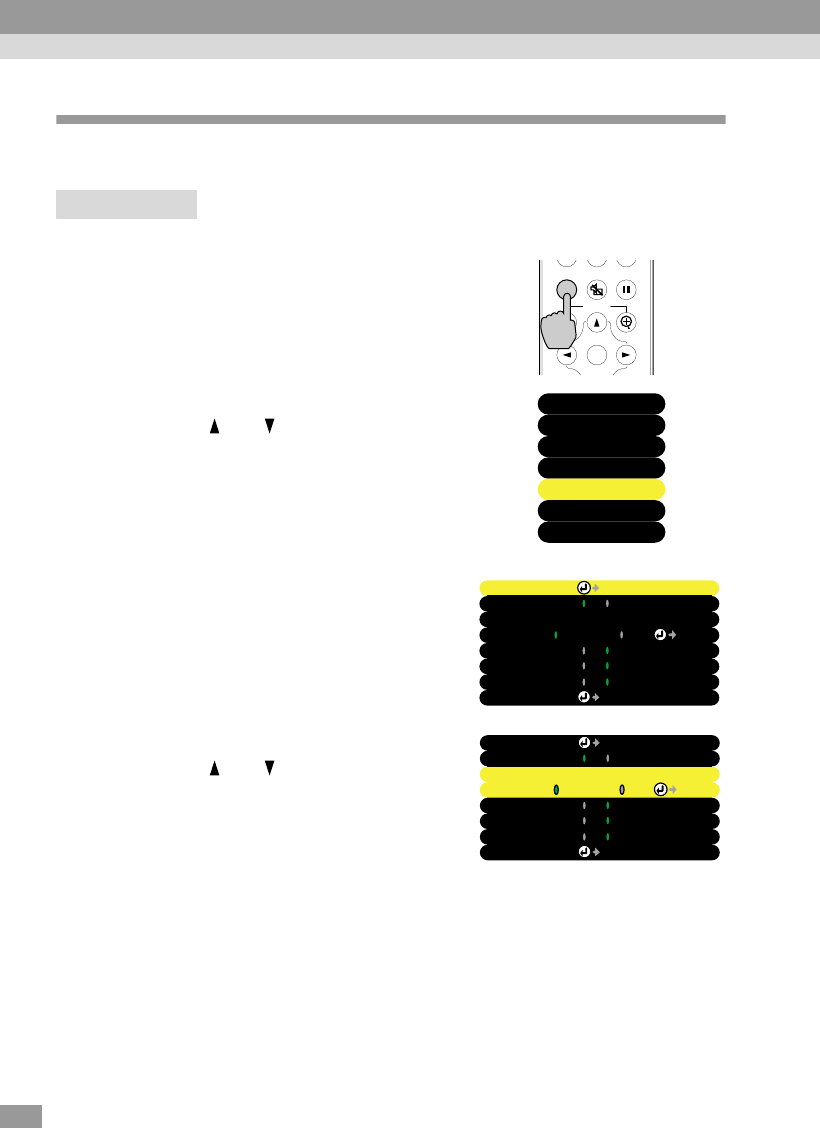
56
Using the Configuration Menus
The configuration menus can be operated using the remote control only.
Procedure
1
Press the [Menu] button on the
remote control.
The main menu will be displayed.
2
Select a menu item.
Press the [ ] or [ ] button to move to an
item to be selected.
3
Confirm the selection.
Press the [Enter] button to confirm the
selection of a menu item.
The selected sub-menu will then be
displayed.
4
Select a sub-menu item.
Press the [ ] or [ ] button to move to an
item to be selected.
The items appearing in the "Video" menu
and the "About" menu will vary
depending on the type of input source
being projected.
Menu A/V Mute
E-Zoom
Freeze
Enter
Remote control
Video
Audio
Setting
User's Logo
Advanced
About
Reset All
Startup Screen
Color Adjust ment
Link 21L
Rear Proj .
Ceiling : ON OFF
Language Select [English]
: ON OFF
Reset Execute
Color Temp. RGB Adjust
:
:
ON OFF
: ON OFF
Startup Screen
Color Adjust ment
Link 21L
Rear Proj .
Ceiling : ON OFF
Language Select [English]
: ON OFF
Reset Execute
Color Temp. RGB Adjust
:
:
ON OFF
: ON OFF
Using the Configuration Menu Functions
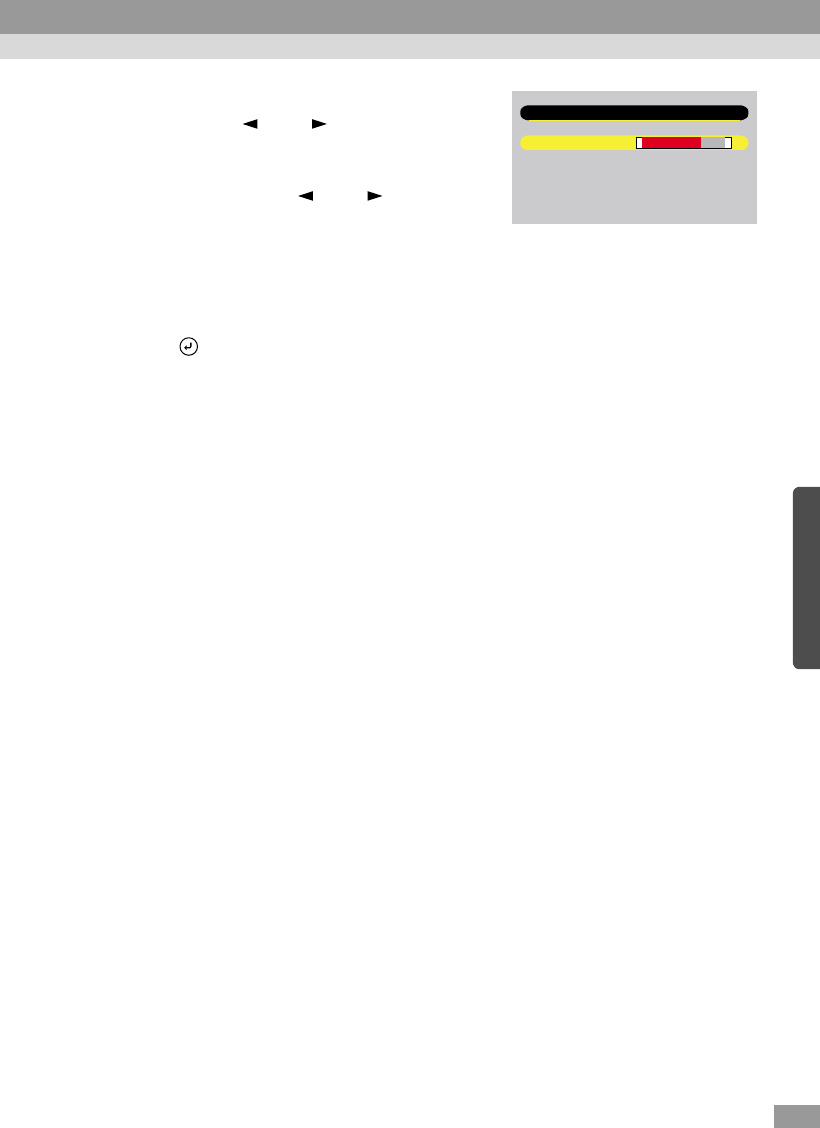
57
5
Select a setting value.
Press the [ ] and [ ] buttons to change
the setting value.
For commands which have ON/OFF
settings, use the [ ] and [ ] buttons to
select the desired setting, and then press
the [Enter] button.
Tip :
• Sub-menu items which cause another sub-menu to be displayed when they are selected
have after them. If you select such menu items and press the [Enter] button, you
can then change the settings in the next sub-menu which appears.
• Refer to "List of Functions" for details on the functions of each menu item. (p.46)
6
Select other menu items in the same way.
Repeat steps 2 to 5 to change the setting for other menu items. To return to
a previous menu, press the [ESC] button.
7
Close the menu.
Press the [Menu] button.
Color Adjust ment
Color Temp. 8000K +
-
:

59
Troubleshooting
This section describes how to identify problems and what to do if a
problem is found.
Using the Help ...................................................................60
When Having Some Trouble .............................................61
• Power Indicator.................................................................................... 61
• (Warning) Indicator ...................................................................... 62
When the Indicators Provide No Help..............................64
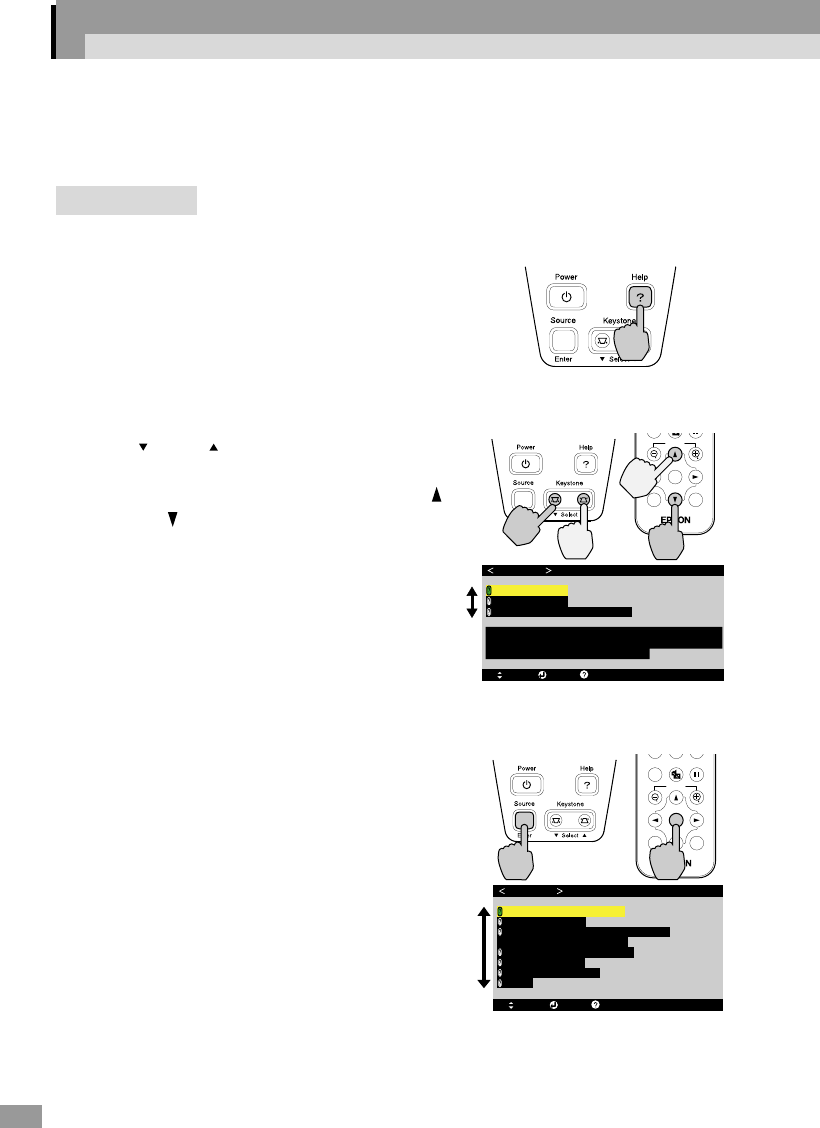
60
Using the Help
If a problem occurs with the projector, the Help function uses on-screen
displays to assist you in solving the problem. It uses a series of menus in a
question and answer format.
Procedure
1
Press the [Help] button on the
projector's control panel.
The help menu will be displayed.
2
Select a menu item.
If using the control panel, the
[ Select ] buttons function as the up
and down keys.
If using the remote control, press the [ ]
and [ ] buttons to select an item.
3
Confirm the selection.
Press the [Enter] button to confirm the
selection of a menu item.
4
Repeat the operations in steps 2
and 3 to proceed through the menu
to more detailed items.
You can exit the help menu at any time by
pressing the [Help] button.
Tip :
If the Help function does not provide a solution to the problem, refer to "When Having
Some Trouble" (p.61) or "When the Indicators Provide No Help" (p.64).
Projector
E-Zoom
ESCAuto
Enter
Remote control
Projector
If the suggested solution in Help doesn't solve the
problem, unplug the power from the wall outlet and contact
your local dealer.
Help for the image
Help for the sound
Language selection (Language)
Hel p Menu
: Select : Enter : Exit
Menu A/V Mute
E-Zoom
Freeze
ESCAuto
Enter
Remote control
Projector
No image appears on the screen.
The image is not displayed fully on the screen.
(cut of f/ too big/ too small/ partial)
The color of the image is abnormal .
The image is too dark.
The image is trapezoidal.
Return
The image is distorted.
Hel p Menu
: Select : Enter : Exit
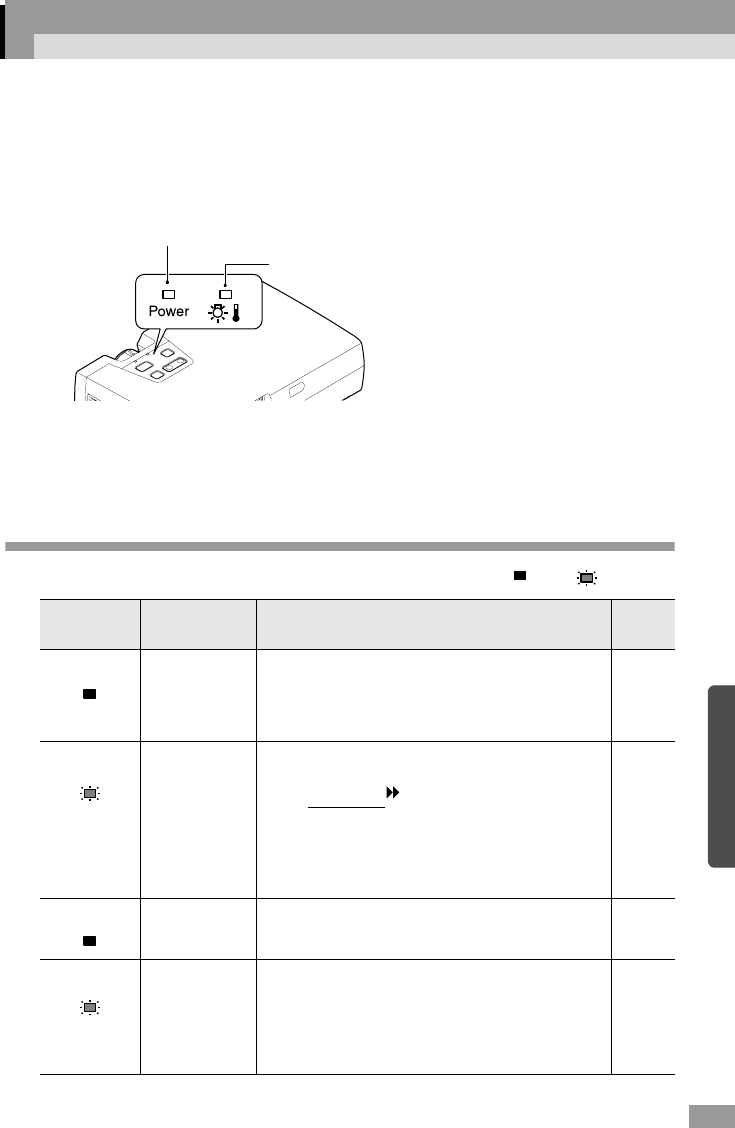
61
When Having Some Trouble
If you are having a problem with the projector, first check the projector's
indicators.
The projector is provided with the following two indicators. These indicators
alert you to problems with projector operation.
The following tables show what the indicators mean and how to remedy
problems that they indicate.
Power Indicator
: lit : flashing
Status Cause Remedy or Status See
Page
Standby
condition
(Not abnormal)
The power cable should only be disconnected
when the projector is in this condition.
Press the [Power] button to start projection.
p.28
Cool-down in
progress
(Not abnormal)
•Please wait.
The cool-down period lasts about 45
seconds.
•You cannot operate the [Power] button during
cool-down. Press the button again after cool-
down ends.
p.31
Projection in
progress
(Not abnormal) p.29
Warm-up in
progress
(Not abnormal)
Please wait.
Warm-up time is approximately 40 seconds.
After warm-up is complete, the flashing green
indicator changes to steady green.
p.29
Warning indicator
Power indicator
Orange
Orange
Green
Green
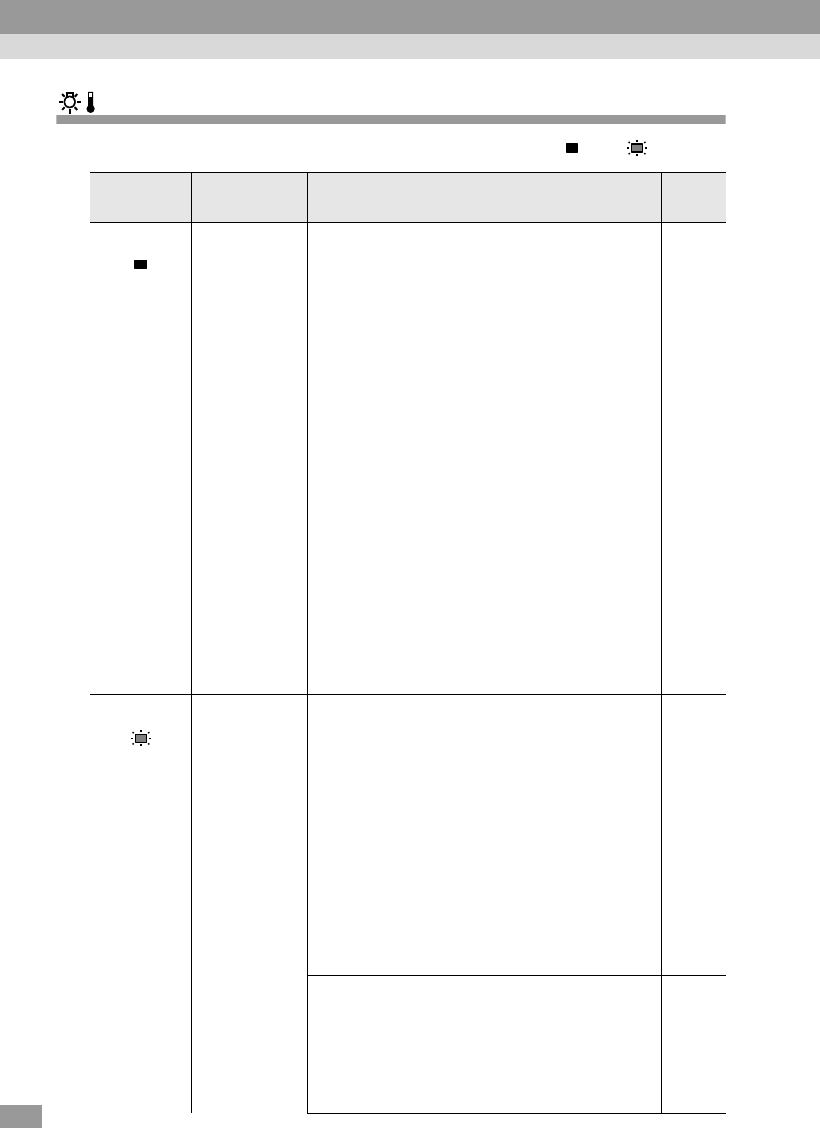
62
(Warning) Indicator
: lit : flashing
Status Cause Remedy or Status See
Page
High internal
temperature
(overheating)
The lamp will turn off automatically and
projection will stop. Wait for about 5 minutes
without operating the projector. After about 5
minutes have elapsed, unplug the power cable
and then check the following two points.
•Check that the air inlet and air outlet are
clear, and that the projector is not positioned
against a wall.
•If the air filter is dirty, it should be cleaned.
When the power cable is plugged back in, the
projector will return to its previous state, so
press the [Power] button on either the
projector's control panel or the remote control
to turn it back on. If the projector continues to
overheat even after the above points have been
checked, or if the indicators show a problem
when the power is turned back on, stop using
the projector, disconnect the power cable from
the electrical outlet, and contact your dealer or
the nearest address provided at "International
Warranty Conditions" in Safety Instructions/
World-Wide Warranty Terms.
p.15
p.73
Problem with
lamp
Disconnect the power cable from the electrical
outlet and then remove the lamp and check if it
is broken. If the lamp is not broken, reinstall it.
Then reconnect the power cable and press the
[Power] button on either the projector's control
panel or the remote control to turn the power
back on.
If the indicators still show a problem, stop
using the projector, disconnect the power cable
from the electrical outlet, and contact your
dealer or the nearest address provided at
"International Warranty Conditions" in Safety
Instructions/World-Wide Warranty Terms.
p.76
If the lamp is broken replace by a new lamp,
or contact your local dealer for further advise.
If replacing the lamp yourself, be careful to
avoid pieces of broken glass.
(Projection cannot be carried out until the
lamp is replaced.)
p.76
Red
Red
(0.5-
second
intervals)
When Having Some Trouble
63
Tip :
• If the projector is not operating properly even though the indicators are all showing
normal, refer to "When the Indicators Provide No Help" on the following page.
• If an indicator is showing a status which does not appear in the previous tables,
contact your dealer or the nearest address provided at "International Warranty
Conditions" in Safety Instructions/World-Wide Warranty Terms.
Check that the lamp and the lamp cover are
securely installed. If the lamp or lamp cover is
not securely installed, the lamp will not switch
on.
p.76
Internal
problem
Stop using the projector, disconnect the power
cable from the electrical outlet, and contact
your dealer or the nearest address provided at
"International Warranty Conditions" in Safety
Instructions/World-Wide Warranty Terms.
High-speed
cooling in
progress
(This is not an abnormality, but if the
temperature rises too high again, projection
will stop automatically.)
•Set the projector up in a place which is well-
ventilated, and so that the air filter and
exhaust vents are clear.
•Clean the air filter.
p.15
p.73
Red
(1-second
intervals)
Orange

64
When the Indicators Provide No Help
If any of the following problems occur and the indicators do not offer a
solution, refer to the pages given for each problem.
No images appear (Nothing at all appears)
•No images appear (p.64, 65) •Images appear dark (p.68)
•Poor image quality (out of
focus or distorted)
(p.65) •Images appear greenish (p.69)
•Only part of the image is
displayed (Large/small) (p.67) •No sound can be heard (p.69)
•The remote control does
not work
(p.69)
•The image colours are not
right
(p.68)
•The power does not turn off (p.70)
•Was the power turned off and then straight back on
again?
After the power is turned off (during cool-down ), the
[Power] buttons on the projector's control panel and the
remote control will not work. Wait until cool-down has
finished. You can then use the [Power] buttons. (p.31)
•Is sleep mode active?
When sleep mode has been set to "ON", the lamp turns off
automatically if no operations are carried out for 30
minutes while no image signal is being input. The Power
indicator lights orange at this time.
"Setting" - "Sleep Mode" (p.51)
•Have you pressed the [Power] button?
(p.29)
•Has the image brightness been adjusted correctly?
"Video" - "Brightness" (p.47, 48)
•Is A/V Mute mode active?
(p.42)
•Is the projected image completely black?
Some input images, such as screen savers, may be
completely black.
•Is an image signal being input?
If "No-Signal Msg. " in the "Setting" menu has been set to
"OFF", no messages will be displayed. Set it to "Black" or
"Blue" for messages to be displayed. If a message is
displayed, refer to the item indicated.
"Setting" - "No-Signal Msg. " (p.51)
•Try resetting all of the current settings.
"Reset All" - "Execute" (p.55)
No images appear
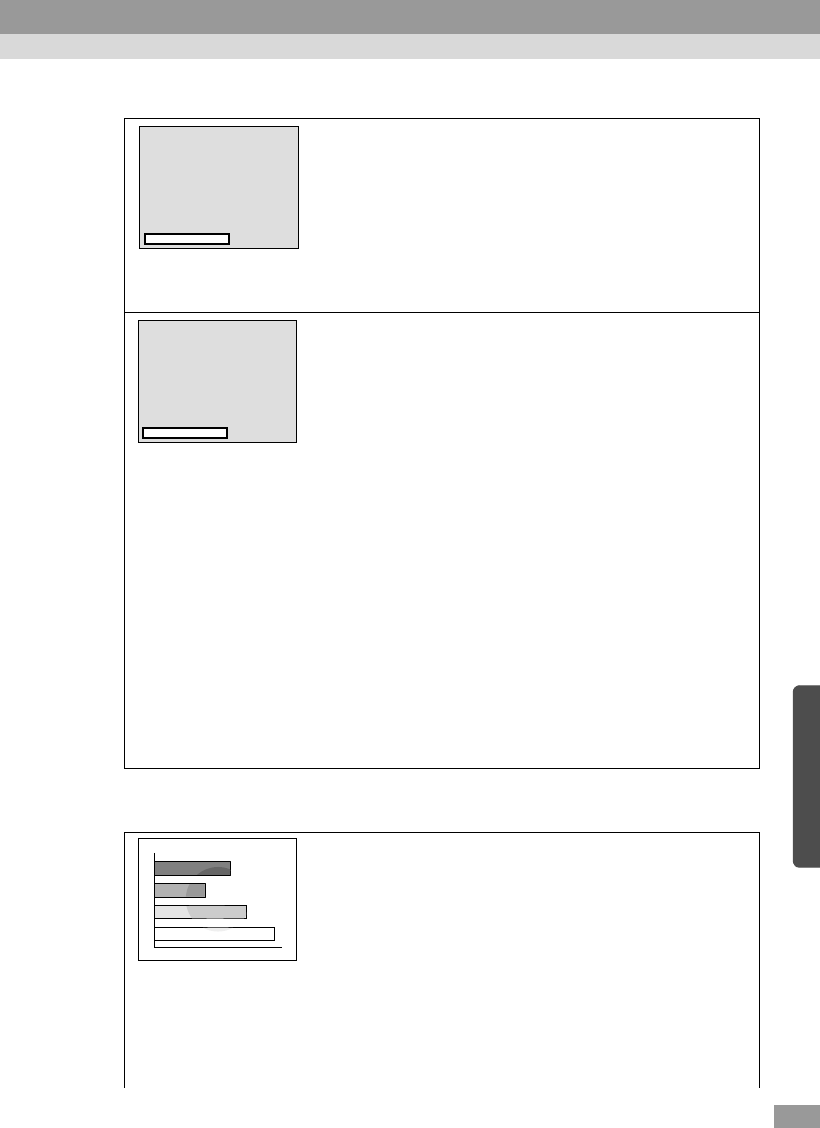
65
No images appear (Messages do appear)
Poor image quality (out of focus or distorted)
•Check the mode which corresponds to the frequency
of the image signals being output from the computer.
Refer to the documentation provided with your computer
for details on changing the resolution and frequency of the
image signals being output from the computer. (p.88)
•Are the cables connected correctly?
(p.17–25)
•Does the input signal match the connected source?
Use the [Source] button on the projector's control panel (or
the [Computer] or [S-Video/Video] button on the remote
control) to select the correct signal source. (p.30)
•Is the power for the computer or video source turned
on?
(p.29)
•If a laptop computer or a computer with a LCD screen
has been connected to the projector, it is necessary to
output the image signals to the projector rather than
to the screen.
Normally image signals are output to only the computer's
LCD screen, so you need to change the output to an
external destination. For some computer models, when the
image signals are output externally, they no longer appear
on the LCD screen. For details, refer to the section of the
documentation provided with your computer under a
heading such as "External output", "Connecting an external
monitor" or similar. (p.30)
•Has the focus been adjusted correctly?
(p.37)
•Is the lens cover still attached?
•Has the front adjustable feet been adjusted so that the
image angle is too big?
If the image angle is too big, the image will be out of focus
vertically. (p.34)
•Is the projector at the correct distance?
The recommended distance from the projector to the screen
is within 1.0–11.7 m (3.2–38.5 ft.). Set up the projector so
that the projection distance is within this range. (p.15)
"Not Supported." is
displayed
"No-Signal." is displayed
•
••
•The image is fuzzy
•
••
•Part of the image is
out of focus
•
••
•The whole image is
out of focus
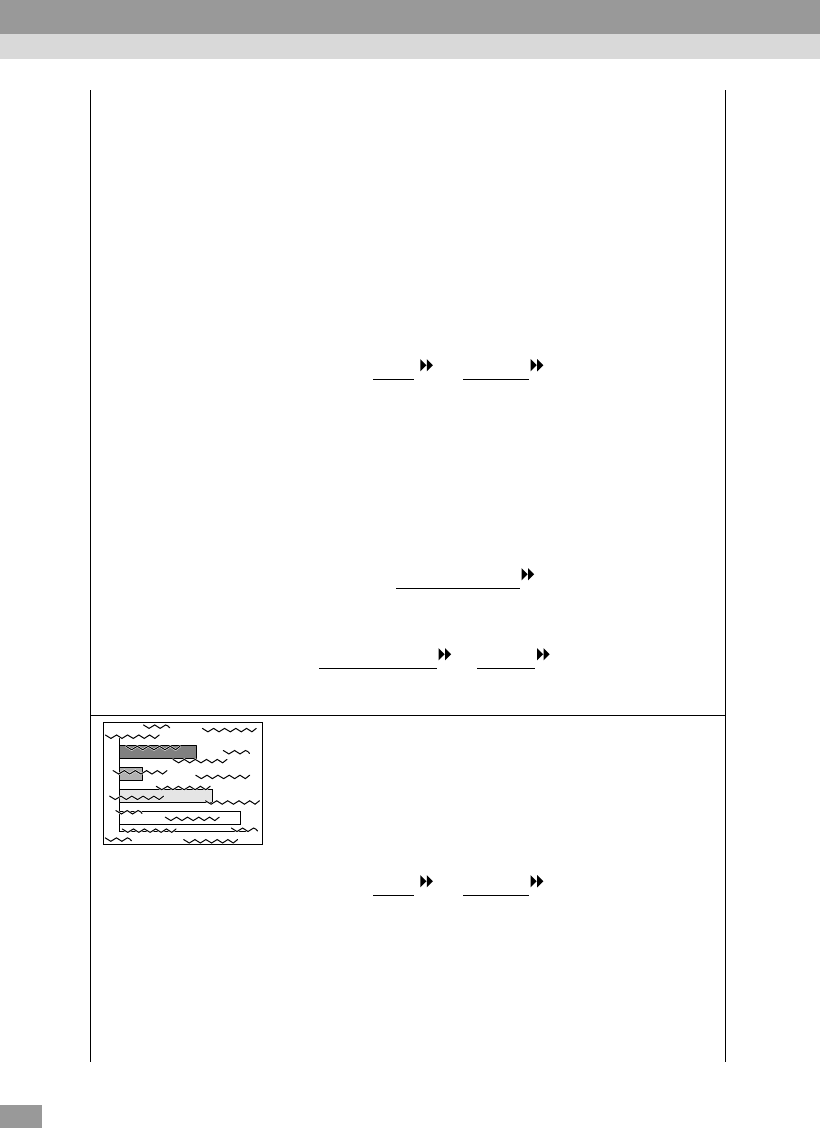
66
•Is the projector beam perpendicular to the screen?
(p.34)
•Is the lens dirty?
(p.72)
•Has condensation formed on the lens?
If the projector is suddenly taken from a cold environment
to a warm environment, condensation may form on the
surface of the lens, and this may cause the images to appear
fuzzy. Set the projector up in the room approximately one
hour before it is to be used. If condensation forms on the
lens, turn off the power and wait for the condensation to
disappear.
•Have the "Sync.", " Tracking" and "Position" been
adjusted correctly?
If the "Auto Setup" command in the "Video" menu is set to
"OFF", press the [Auto] button on the remote control to
adjust these settings. If the images have not been correctly
adjusted after using the automatic setup function and after
pressing the [Auto] button, adjust the settings manually
using the respective menus.
(p.37, 47)
•Are the image signal format settings correct?
If a computer, component video or RGB video source is
connected to the projector, use the "Input Signal" command
in the "Video" menu to select the signal format which
matches the signal connected source. (p.47, 49)
If a composite video or S-Video source is connected to
the projector, use the "Video Signal" command in the
"Video" menu to select the video signal format. (p.49)
•Are the cables connected correctly?
(p.17–25)
•Has the correct resolution been selected?
Set the computer so that the signals that are output are
compatible with this projector. Refer to the documentation
provided with your computer for details on changing the
settings. (p.88)
•Have the "Sync.", " Tracking" and "Position" been
adjusted correctly?
If the "Auto Setup" command in the "Video" menu is set to
"OFF", press the [Auto] button on the remote control to
adjust these settings. If the images have not been correctly
adjusted after using the automatic setup function and after
pressing the [Auto] button, adjust the settings manually
using the respective menus.
(p.37, 47)
•
••
•Image is distorted
•
••
•Image contains
interference
When the Indicators Provide No Help
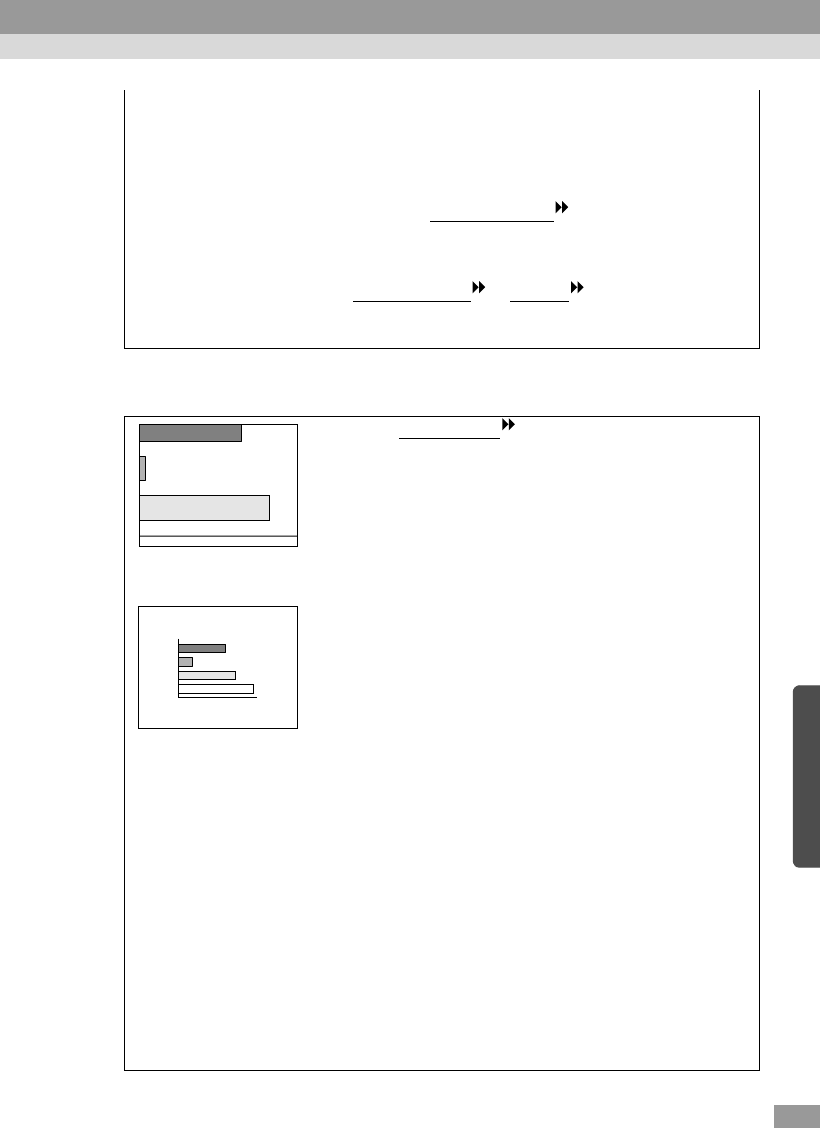
67
Only part of the image is displayed (Large/small)
•Is an extension cable being used?
If an extension cable is used, electrical interference may
affect the signals. Use the accessory cables and check if
this helps.
•Are the image signal format settings correct?
If a computer, component video or RGB video source is
connected to the projector, use the "Input Signal" command
in the "Video" menu to select the signal format which
matches the signal connected source. (p.47, 49)
If a composite video or S-Video source is connected to
the projector, use the "Video Signal" command in the
"Video" menu to select the video signal format. (p.49)
•Has the "Aspect Ratio " setting been selected
correctly?
Use the "Aspect Ratio" command in the "Video" menu to
set the aspect ratio to "4:3".
(p.49)
•Is the E-Zoom function being used to enlarge the
image?
Press the [ESC] button on the remote control to cancel E-
Zoom. (p.45)
•Has the "Position" setting been adjusted correctly?
Use the "Position" command in the "Video" menu to adjust.
(p.47, 48)
•Has the correct resolution been selected?
Set the computer so that the signals that are output are
compatible with this projector. Refer to the documentation
provided with your computer for details on changing the
settings. (p.88)
•Change the resolution for the laptop computer or
computer with a LCD screen.
Change the resolution so that the image is displayed in the
whole of the projection area, or set the image signal to
external output only. (p.30)
•Has the computer been set for dual display?
If dual display has been activated in the Display Properties
of the connected computer's Control Panel, the projector
will only display about half of the image on the computer
screen. To display the whole of the image on the computer
screen, turn off the dual display setting. Refer to the video
driver manual for the computer's monitor for further
details.
Only part of the image is
displayed
Small
68
The image colours are not right
Images appear dark
•Has the image brightness been adjusted correctly?
"Video" - "Brightness" (p.47, 48)
•Are the cables connected correctly?
(p.17–25)
•Are the image signal format settings correct?
If the "Input Signal" command in the "Video" menu is set
to "YPbPr" or "YCbCr" when a computer is connected, the
projected images will appear purplish.
If a computer, component video or RGB video source is
connected to the projector, use the "Input Signal" command
in the "Video" menu to select the signal format which
matches the signal connected source. (p.47, 49)
If a composite video or S-Video source is connected to
the projector, use the "Video Signal" command in the
"Video" menu to select the video signal format. (p.49)
•Has the image contrast been adjusted correctly?
"Video" - "Contrast" (p.47, 48)
•Has the colour been adjusted correctly?
"Advanced" - "Color Adjustment" (p.53)
•Have the colour intensity and tint been adjusted
correctly?
(The colours may not exactly match the colours in the
image on the computer screen or LCD screen, but this is
normal and is not the sign of a problem.)
"Video" - "Color", "Tint" (p.48)
•Is the lamp due for replacement?
When the lamp is nearly due for replacement, the image
will become darker and the colour quality will become
poorer. When this happens, the lamp should be replaced
with a new one. (p.76)
•Is the lamp due for replacement?
When the lamp is nearly due for replacement, the image
will become darker and the colour quality will become
poorer. When this happens, the lamp should be replaced
with a new one. (p.76)
•Has the image brightness been adjusted correctly?
"Video" - "Brightness" (p.47, 48)
•Has the image contrast been adjusted correctly?
"Video" - "Contrast" (p.47, 48)
When the Indicators Provide No Help
69
Images appear greenish.
No sound can be heard.
The remote control does not work
•Do the settings for component video input signals
match the signals from the connected device?
If the "Input Signal" command in the "Video" menu is set
to "RGB" when a component video signal source is
connected to the projector, the images will appear greenish.
Select the correct signal format for the connected source.
"Video" - "Input Signal" (p.49)
•Is the audio source connected correctly?
(p.20, 26)
•Has the volume been adjusted to the minimum
setting?
(p.50)
•Is A/V Mute mode active?
The projector may be in A/V Mute mode. Press the [A/V
Mute] button on the remote control to cancel the A/V Mute.
(p.42)
•Is the remote control light-emitting area facing
towards the remote control light-receiving area when
it is operated?
The operating angle for the remote control is
approximately 30º horizontally and approximately 15º
vertically.
•Is the remote control too far from the projector?
The operating distance for the remote control is
approximately 6 m (20 ft.). (p.13)
•Is direct sunlight or strong light from fluorescent
lamps shining onto the remote control light-receiving
area?
•Has the battery insulating tape been removed?
(p.12)
•Is there battery in the remote control?
(p.74)
•Is the battery dead?
•Has the battery been inserted correctly?
(p.74)
Menu A/V Mute
E-Zoom
Freeze
Page upPage down
Powe r
ESCAuto
Enter
S-Video/Video
Color Mode
Computer
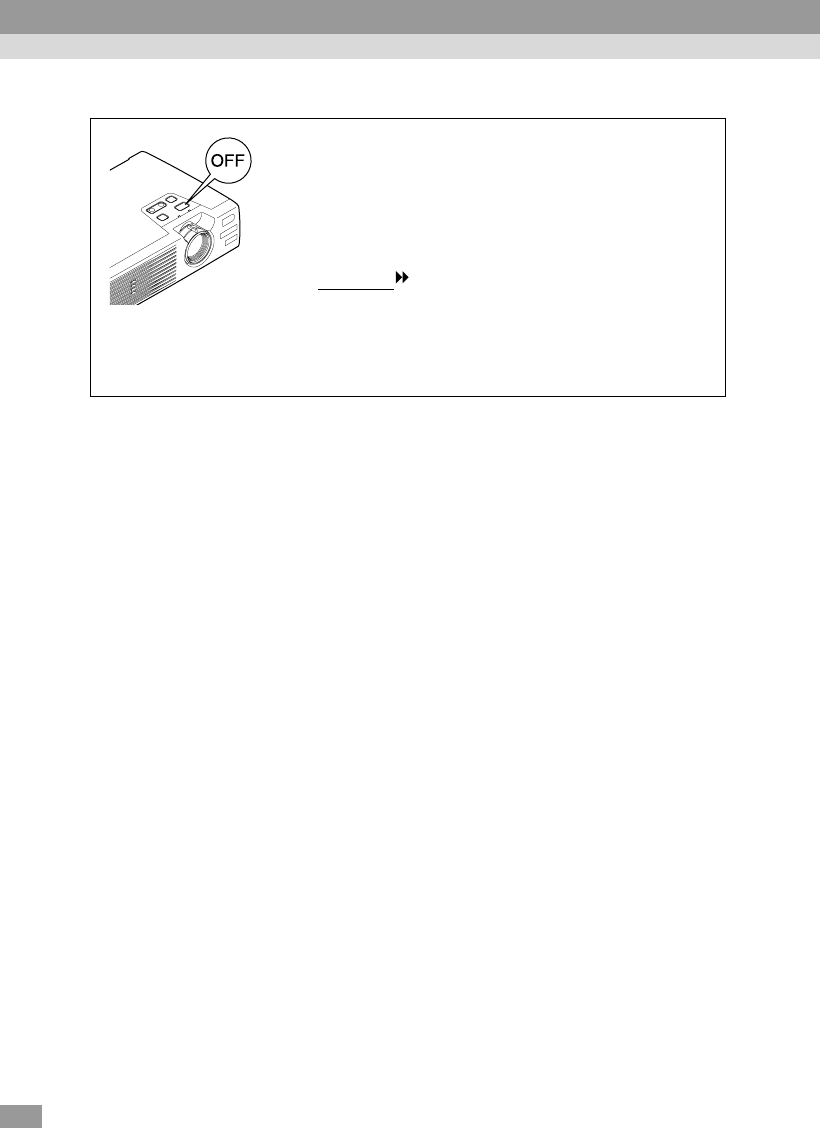
70
The power does not turn off (after the [Power] button is pressed)
•The Power indicator remains orange.
This projector is designed so that the Power indicator
remains lit even when after the power has been turned off.
The Power indicator will switch off when the power cable
is disconnected from the electrical outlet.
•The cooling fan does not stop.
After the [Power] button is pressed to turn off the power,
the cool-down period starts.
After this, the Power indicator changes to a steady orange,
and you can then disconnect the power cable from the
electrical outlet.
* The cool-down period lasts about 45 seconds. The actual
time will vary depending on the external air temperature.
When the Indicators Provide No Help

71
Appendices
This chapter provides information on maintenance procedures to
ensure the best level of performance for the projector for a long time.
Maintenance.......................................................................72
• Cleaning ................................................................................................ 72
•Cleaning the Projector Case.............................................................................. 72
•Cleaning the Lens ............................................................................................. 72
•Cleaning the Air Filter ...................................................................................... 73
• Replacing Consumables ...................................................................... 74
•Inserting the Battery.......................................................................................... 74
•Lamp Replacement Period................................................................................ 75
•Replacing the Lamp .......................................................................................... 76
•Resetting the Lamp Operating Time ................................................................. 78
•Replacing the Air Filter .................................................................................... 79
Saving a User's Logo ........................................................80
Optional Accessories........................................................82
Glossary .............................................................................83
List of ESC/VP21 Commands ...........................................86
• Command List...................................................................................... 86
• USB Connection Setup ........................................................................ 87
List of Supported Monitor Displays.................................88
Specifications ....................................................................89
Appearance ........................................................................91
Index ...................................................................................92

72
Maintenance
This section describes maintenance tasks such as cleaning the projector and
replacing consumable parts.
Cleaning
You should clean the projector if it becomes dirty or if the quality of projected
images starts to deteriorate.
Caution :
Be sure to read the separate Safety Instructions/World-Wide Warranty Terms before
cleaning.
Clean the projector case by wiping it gently with a soft cloth.
If the projector is particularly dirty, moisten the cloth with water containing a
small amount of neutral detergent, and then firmly wring the cloth dry before
using it to wipe the projector case. Then wipe the case again with a soft, dry
cloth.
Caution :
Do not use volatile substances such as wax, alcohol or thinner to clean the projector
case. These can cause the case to warp and make the coating finish peel off.
Use a commercially-available air blower, or use a lens cleaning paper to gently
wipe the lens.
Caution :
Do not rub the lens with harsh materials or subject the lens to shocks, as it can easily
become damaged.
Cleaning the Projector Case
Cleaning the Lens
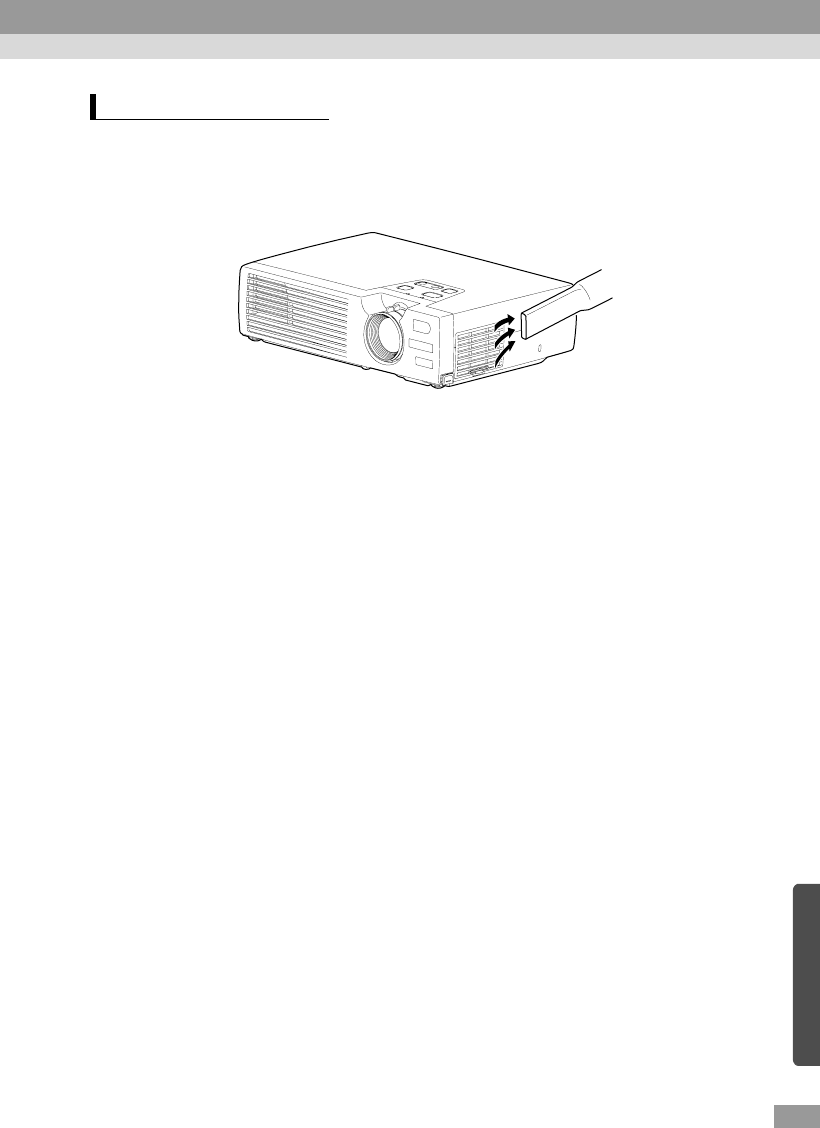
73
If the air filter becomes clogged with dust, it can cause overheating and damage
the projector.
While keeping the projector horizontal, use a vacuum cleaner to clean away the
dust from the air filter.
Tip :
• If the air filter is difficult to clean or if it is broken, it should be replaced. Contact your
dealer for a spare air filter.
• Spare lamps are provided with a spare air filter. The air filter should also be replaced
when the lamp is replaced.
Cleaning the Air Filter
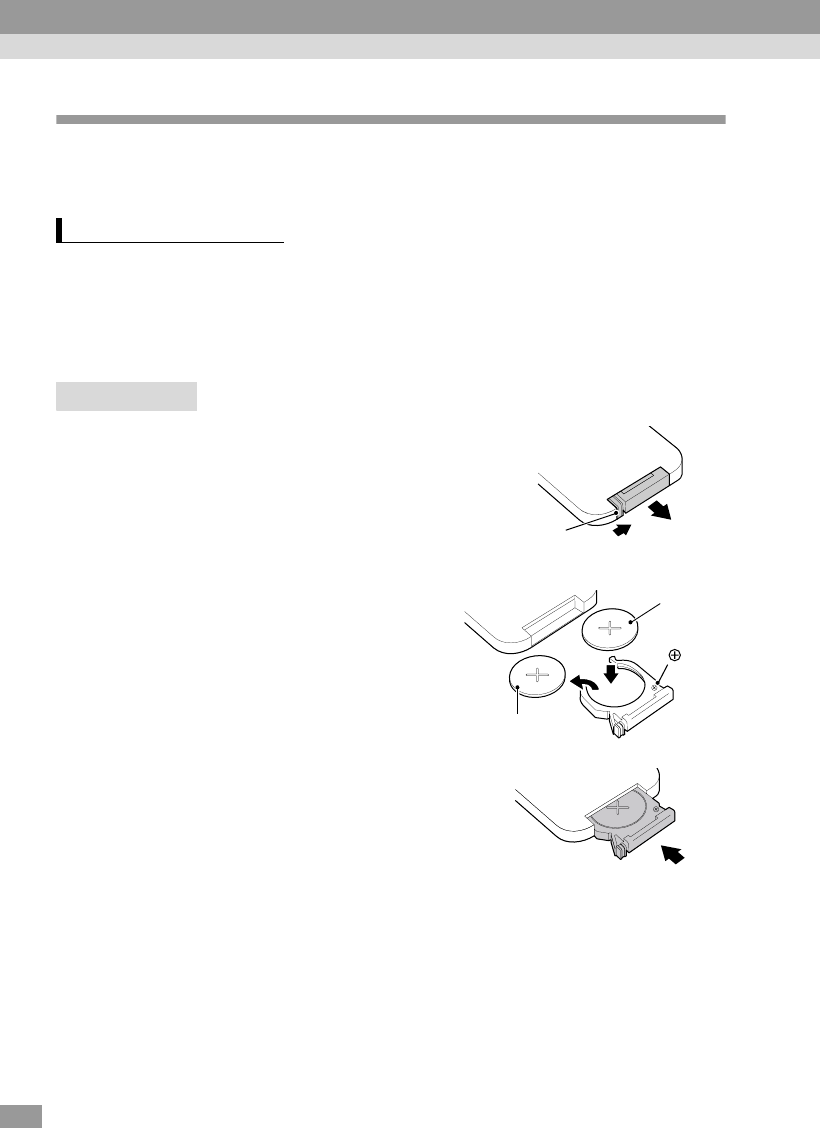
74
Replacing Consumables
This section describes how to replace the remote control battery, the lamp and
the air filter.
Use the following type of battery as a replacement.
1 CR2025 lithium battery
Caution :
Be sure to read the Safety Instructions/World-Wide Warranty Terms before handling the
battery.
Procedure
1
Remove the battery holder.
While pushing the catch of the battery
holder inwards, pull the battery holder out.
2
Remove the old battery and insert
the new battery.
Check the position of the (+) mark inside
the battery holder to ensure that that
battery is inserted the correct way.
3
Insert the battery holder into the
remote control.
Push the battery holder in until it clicks.
Tip :
Dispose of used batteries in accordance with local
waste disposal regulations.
Inserting the Battery
Catch
Old battery
New
battery
mark
Maintenance
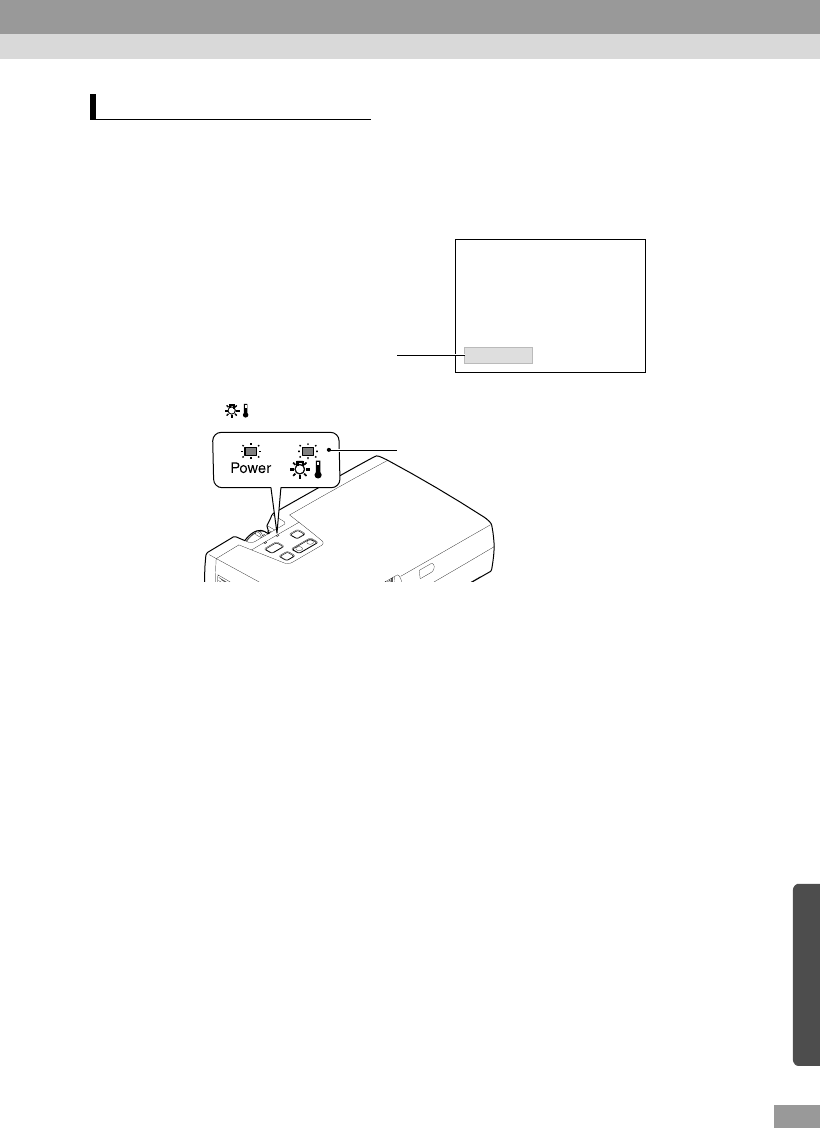
75
It is time to replace the lamp when:
•The message "Lamp Replace." appears on the screen for 30 seconds
when projection starts
.
•When the (Warning) indicator is flashing red at 0.5-second intervals
•The projected image gets darker or starts to deteriorate.
Tip :
• The replacement warning message is set to appear after about 1400 hours of lamp use
in order to maintain the brightness and quality of the projected images. If you continue
to use the lamp after this period, the possibility of the lamp breaking becomes greater.
When the lamp replacement message appears, replace the lamp with a new one as soon
as possible, even if it is still working.
• The warning message appears after about 1400 hours of use, but the actual life of each
individual lamp will vary depending on the characteristics of the lamp and on the way
it has been used. Some lamps may stop operating before 1400 hours of use, so you
should always have a spare lamp ready in case.
• Contact your dealer for a spare lamp.
Lamp Replacement Period
A message will be displayed.
Flashes red at 0.5-second intervals
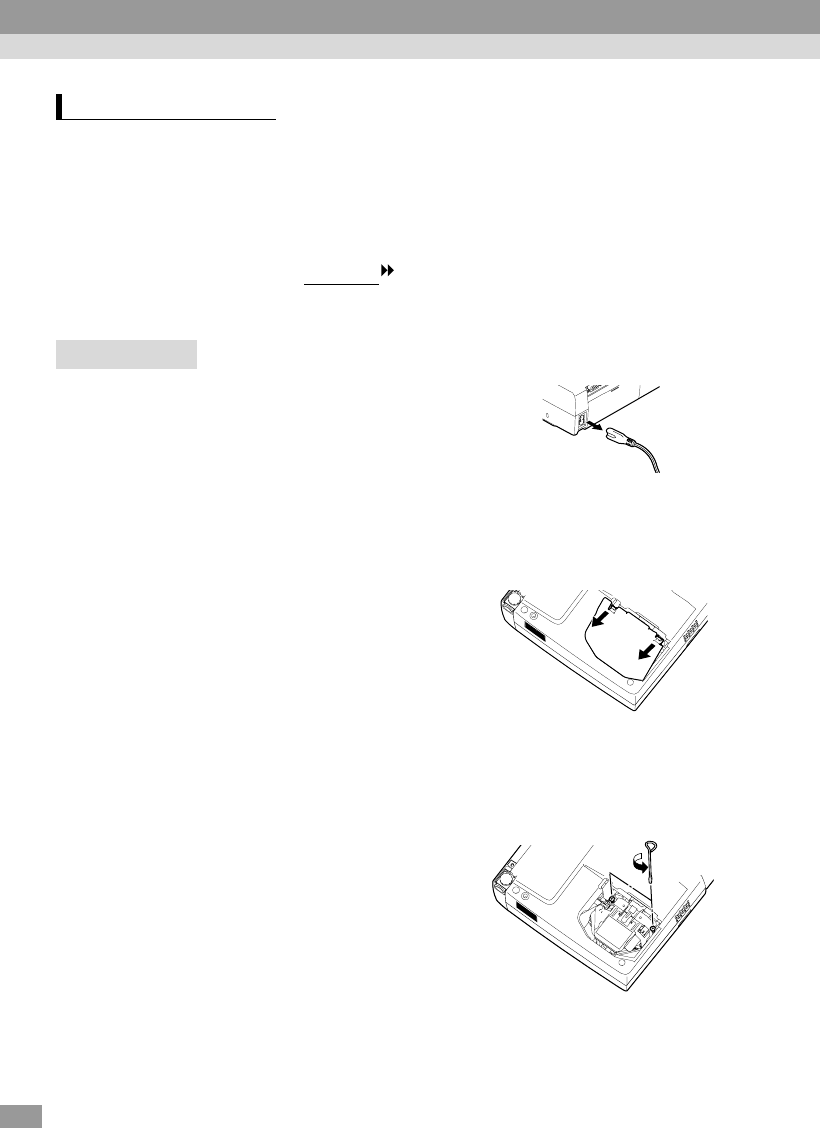
76
Caution :
• If the lamp stops working and needs to be replaced, there is the danger that the lamp
may break when handled.
If replacing the lamp of a projector that has been installed to the ceiling, you should
always assume that the lamp is broken and remove the lamp cover very carefully.
• Wait until the lamp has cooled down sufficiently before opening the lamp cover. It takes
a further one hour after the cool-down period has finished for the lamp to be cool
enough.
Procedure
1
Turn off the projector power, wait
for the cool-down period to end,
and then disconnect the power
cable.
The cool-down period lasts for about 45
seconds. The actual time will vary
depending on the external air temperature.
2
Wait until the lamp has cooled
down, and then remove the lamp
cover from the base of the
projector.
It takes approximately one hour for the
lamp to cool down by itself after the cool-
down period has finished.
While pressing the two hooks, pull the
lamp cover up to remove it.
3
Loosen the two lamp fixing screws.
Use the screwdriver that is supplied with
the spare lamp or a Phillips screwdriver to
loosen the two lamp fixing screws that are
securing the lamp to the projector.
Replacing the Lamp
Maintenance
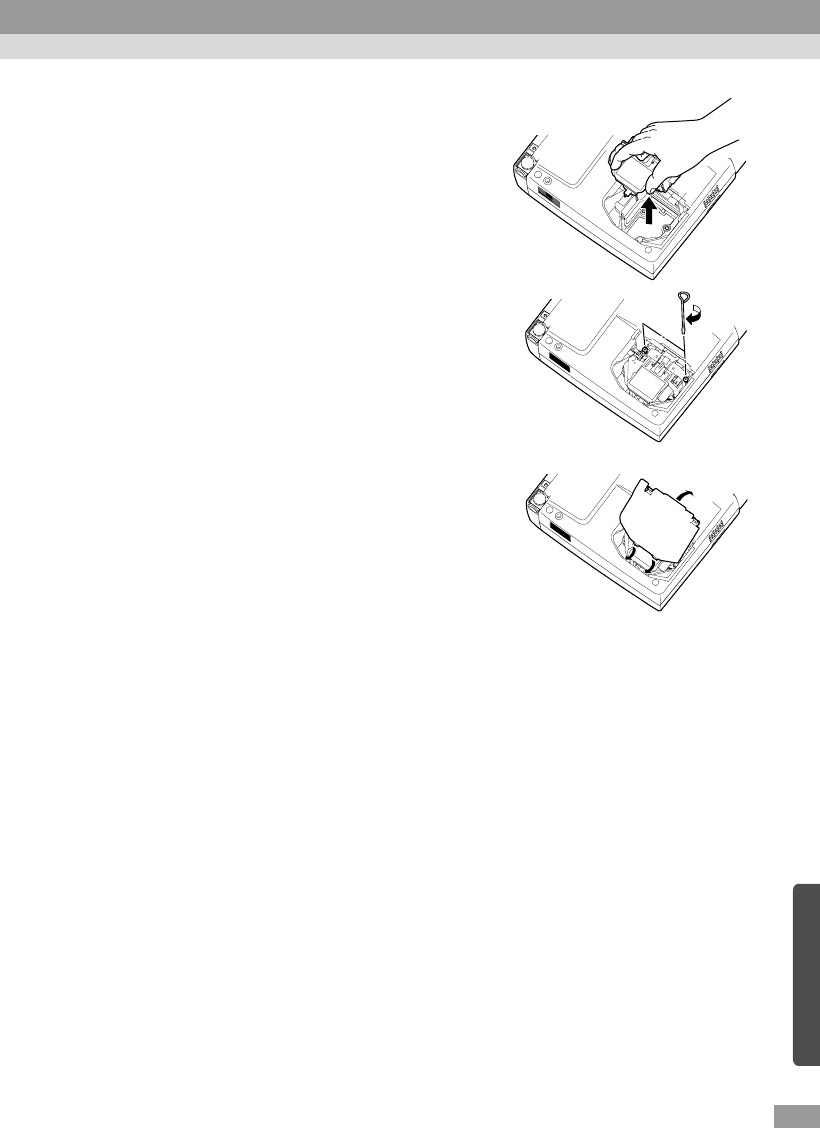
77
4
Take out the lamp.
Hold the lamp by the two recesses on the
side to lift it up and out from the projector.
5
Install the new lamp.
Hold the lamp so that it faces the correct
way to fit into the projector, and then
insert the lamp until it clicks into place
and tighten the two fixing screws.
6
Install the lamp cover.
Insert the two cover tabs into the projector,
and then press the other side of the lamp
cover until it clicks into place.
Tip :
• Install the lamp securely. If the lamp cover is removed, the lamp turns off automatically
as a safety precaution. Moreover, the lamp will not turn on if the lamp or the lamp
cover is not installed correctly.
• Spare lamps are provided with a spare air filter. The air filter should also be replaced
when the lamp is replaced. (p.79)
• Dispose of used lamps properly in accordance with your local regulations.
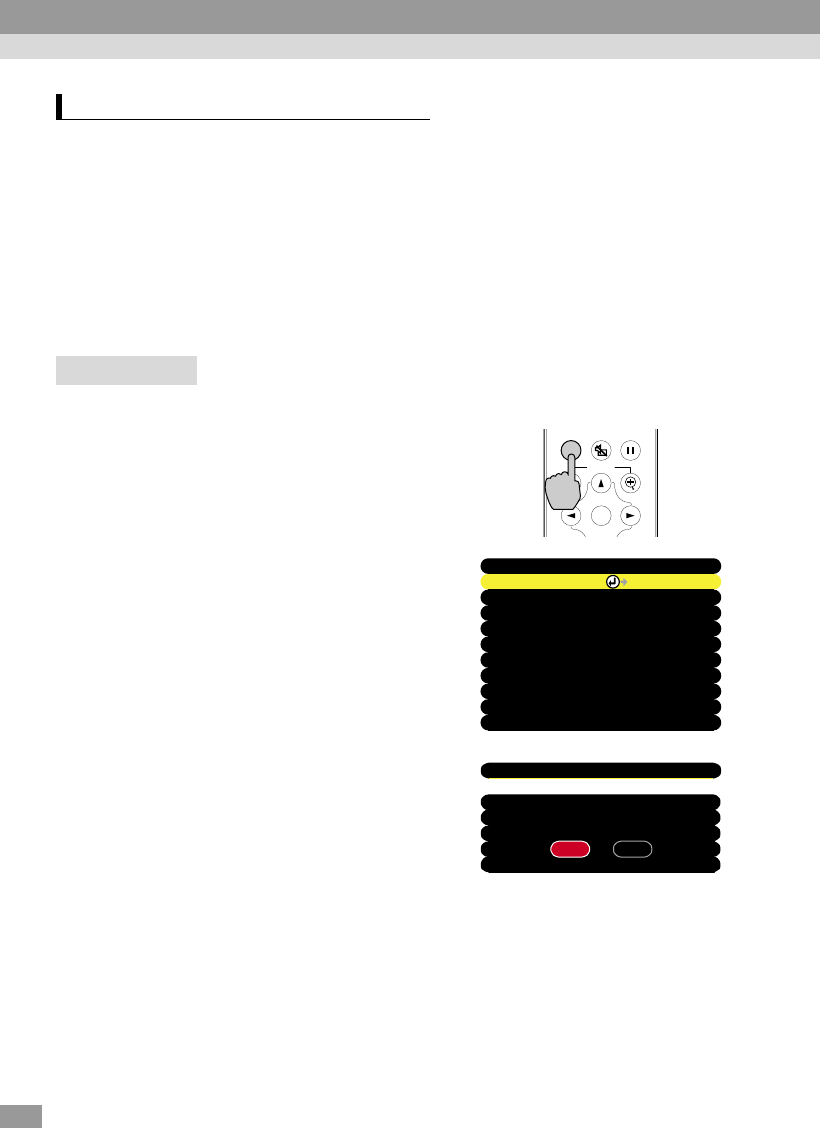
78
The projector has a built-in counter which keeps track of the lamp operating
time. When the cumulative operating time reaches a certain point, it causes the
replacement warning message to be displayed. Therefore, the counter needs to
be reset after the lamp has been replaced with a new one. You can do this using
the projector menu.
Tip :
Do not reset the lamp operating time except after the lamp has been replaced, otherwise
the lamp replacement period will not be indicated correctly.
Procedure
1
Connect the power cable, turn on
the projector's power, and then
press the [Menu] button on the
remote control.
The main menu will be displayed.
2
Select "Reset Lamp Timer" from the
"About" menu and then press the
[Enter] button.
3
Select "Yes" and then press the
[Enter] button.
The lamp operating time will then be
reset.
Resetting the Lamp Operating Time
Menu A/V Mute
E-Zoom
Freeze
Enter
Remote Control
Frequency
Video Source
V ---.--Hz
Reset Lamp Timer
H ---.--kHz
Lamp 1400H
SYNC Mode
SYNC Polarity
------
H ------
Resolution
Refresh Rate 0.0 Hz
0x 0
Computer
Input Signal RGB
Execute
:
:
:
:
:
:
V ------
:
:
:
:
:
Reset Lamp Timer
Execute?
YES NO
Maintenance
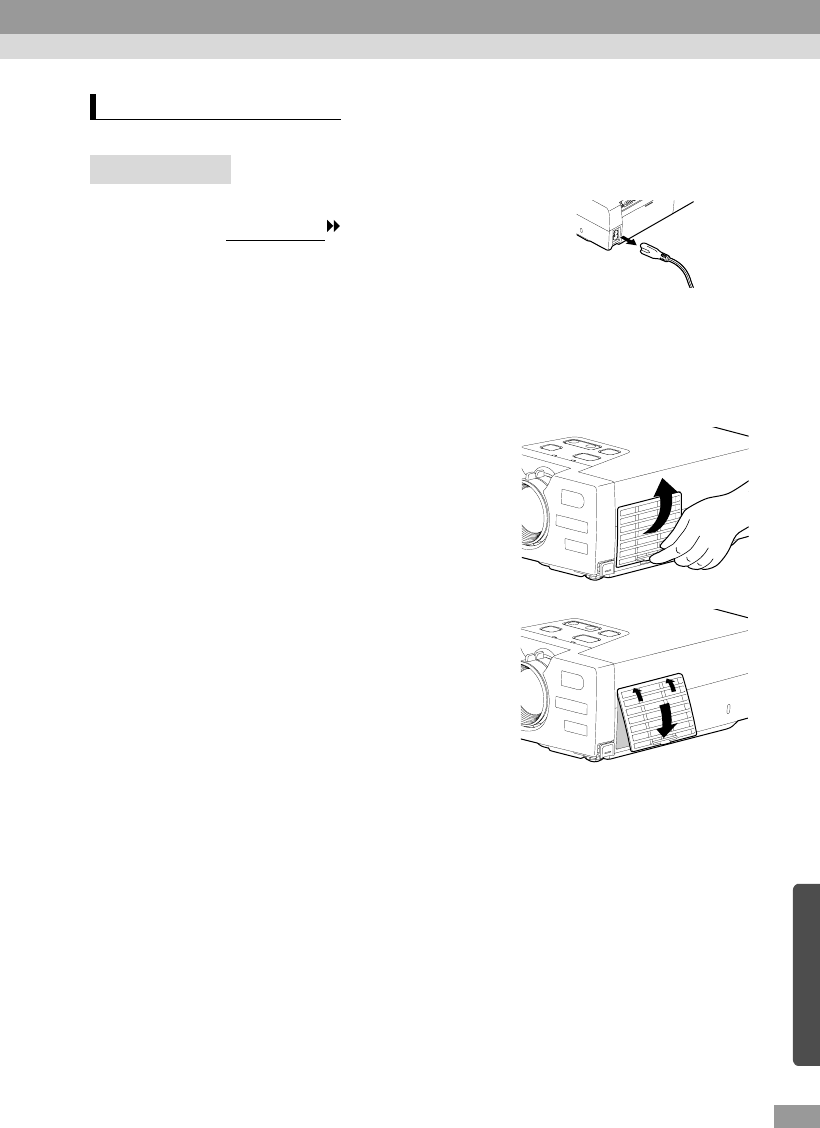
79
Procedure
1
Turn off the projector power, wait
for the cool-down period to end,
and then disconnect the power
cable.
The cool-down period lasts for about 45
seconds. The actual time will vary
depending on the external air
temperature.
2
Put your finger into the recess in
the air filter hook, and lift up the air
filter to remove it.
3
Install the new air filter.
First insert the tabs, and then press down
on the opposite side until it clicks into
place.
Tip :
Dispose of used air filters properly in accordance
with your local regulations.
Replacing the Air Filter
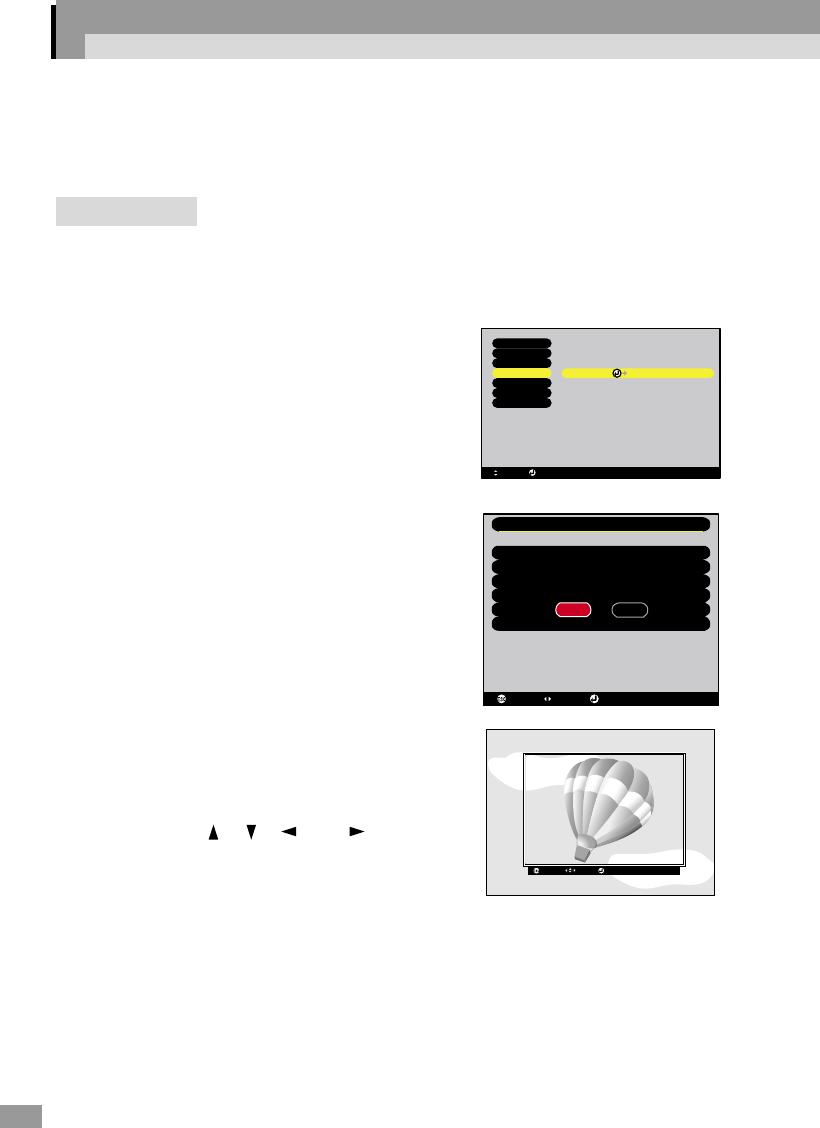
80
Saving a User's Logo
You can record the image that is currently being projected as a user's logo.
Tip :
When a user's logo is recorded, the previous user's logo will be erased.
Procedure
1
Project the image that you would like to use as a user's logo,
and then press the [Menu] button on the remote control.
2
Select the "User's Logo" menu, and
then press the [Enter] button.
Tip :
If keystone correction or E-Zoom have been carried
out, they will be canceled when the "User's Logo"
menu is selected.
3
Select "Yes" in the sub-menu, and
then press the [Enter] button.
4
The image to be recorded and a
selection marquee box will be
displayed. Move the marquee box to
select the part of the image to use.
Press the [ ], [ ], [ ] and [ ] buttons on
the remote control to select the part of the
image to use as the user's logo, and then
press the [Enter] button.
: Select : Execute
Execute
Video
Audio
Setting
User's Logo
Advanced
About
Reset All
Do you use the present image as a
User's Logo
user's logo?
YES NO
: Select: Return : Execute
: Move: Return : Set
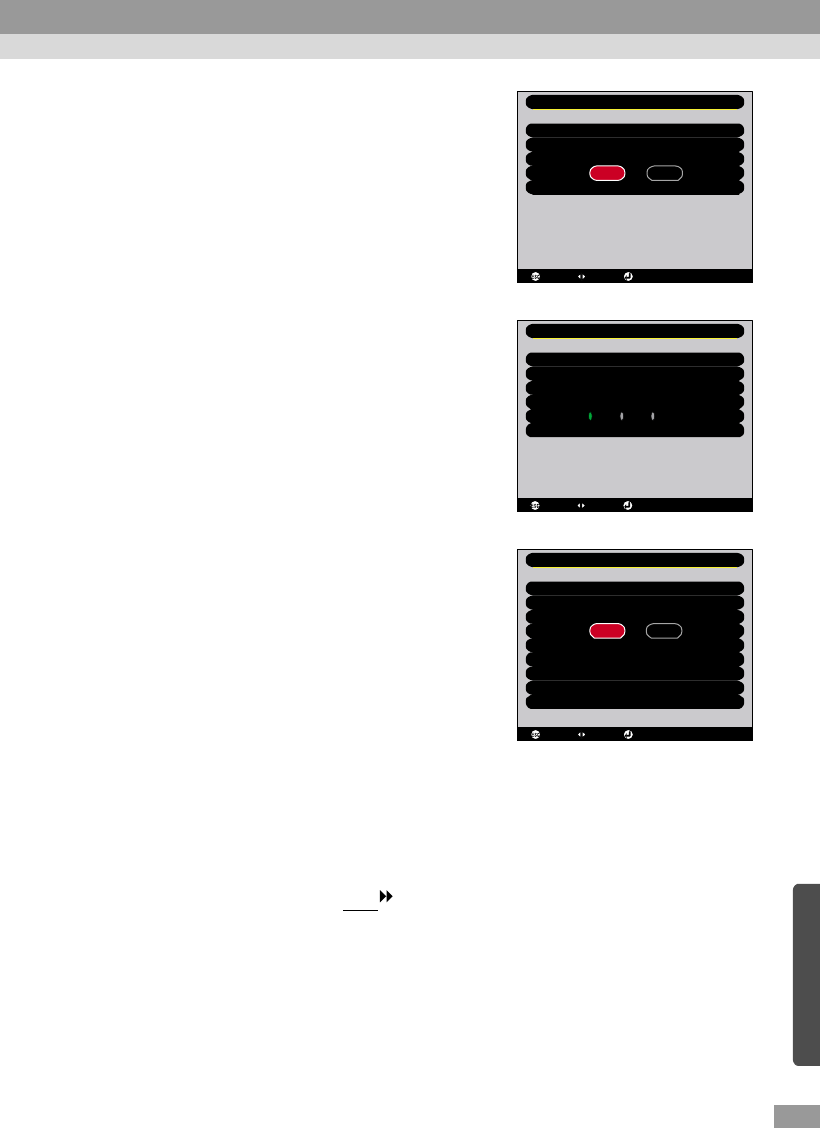
81
5
Select "Yes" at the confirmation
screen, and then press the [Enter]
button.
6
Select the zoom rate in the Zoom
rate setting screen, and then press
the [Enter] button.
7
Select "Yes" at the confirmation
screen, and then press the [Enter]
button.
The image will then be saved. Once the
image has been saved, the message
"Saving the user's logo is completed." will
be displayed.
Tip :
• Saving the user's logo may take a few moments (about 15 seconds). Do not use the
projector or any other sources which are connected to the projector while the user's
logo is being saved, otherwise it may result in errors in projector operation.
• User's logos can be saved at up to 480 x 360 dots in size.
• If the image resolution is not XGA , or if a video image is being projected, the display
size will be changed.
• Once a user's logo has been saved, the logo setting cannot be returned to the factory
default.
Do you use this image?
YES NO
User's Logo
: Select: Return : Execute
Set the zoom rate.
Zoom rate:
100% 200% 300%
User's Logo
: Select: Return : Execute
Do you save the user's logo?
If you save it, the previous user's
logo will be over written.
YES NO
User's Logo
: Select: Return : Execute

82
Optional Accessories
The following optional accessories are available for purchase if required. This
list of optional accessories is current as of April 2002. Details of accessories are
subject to change without notice.
* A special method of installation is required in order to suspend the projector
from the ceiling. Please contact the place of purchase if you would like to use
this installation method.
Soft carry case ELPKS16
Use this case if you need to carry the projector by hand.
Spare lamp ELPLP18
Use as a replacement for spent lamps.
50" portable screen ELPSC06
A compact screen which can be carried easily.
60" screen ELPSC07
80" screen ELPSC08
A portable roll-type screen.
VGA-HD15 PC cable ELPKC02
(1.8 m (6 ft.) - for mini D-Sub 15-pin/mini D-Sub 15-pin)
Use to connect the projector to a computer.
VGA-HD15 PC cable ELPKC09
(3 m (9.8 ft.) - for mini D-Sub 15-pin/mini D-Sub 15-pin)
VGA-HD15 PC cable ELPKC10
(20 m (65.6 ft.) - for mini D-Sub 15-pin/mini D-Sub 15-pin)
Use this extension cable if the accessory computer cable is too short.
VGA-HD15/BNC PC Cable ELPKC11
(1.8 m (6 ft.) - for mini D-Sub 15-pin/5BNC)
Use in order to connect the projector to a computer with a 5BNC port.
Component video cable ELPKC19
(3 m (9.8 ft.) - for mini D-Sub 15-pin/RCA x 3)
Use to connect a component video source.
Ceiling mount * ELPMB10
Use when installing the projector to a ceiling.
Ceiling plate * ELPFC03
Pipe 370 (370 mm (14.57 inches)/silver)* ELPFP04
Pipe 570 (570 mm (22.44 inches)/silver)* ELPFP05
Pipe 770 (770 mm (30.31 inches)/silver)* ELPFP06
Use when installing the projector to a high ceiling or a ceiling with veneer panels.
Image presentation camera ELPDC02
ELPDC03
ELPDC04
Use when projecting books, OHP films and slides.
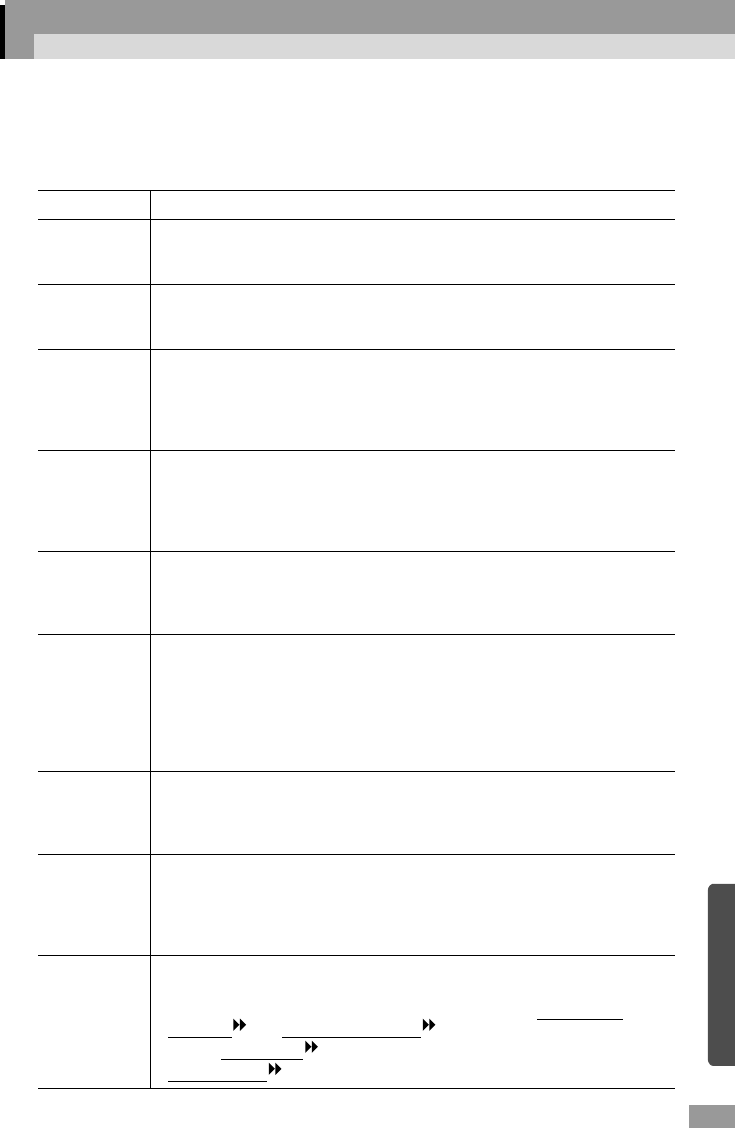
83
Glossary
Following is an explanation of some of the terms used in this guide which may
be unfamiliar or which were not explained in the text of this guide itself.
Further information can be obtained by referring to other commercially-
available publications.
5BNC A port used to input analogue video signals.
Aspect ratio The ratio between an image's length and its height. HDTV images have
an aspect ratio of 16:9 and appear elongated. The aspect ratio for
standard images is 4:3.
Colour
temperature
The temperature of an object which is emitting light. If the colour
temperature is high, the colours tend to take on a bluish tinge. If the
colour temperature is lower, the colours tend to take on a reddish tinge.
Component
video
Video signals which have the video brightness signals and colour
signals separated, in order to provide better image quality.
In high-definition TV (HDTV), it refers to images which consist of
three independent signals: Y (luminance signal), and Pb and Pr (colour
difference signals).
Composite
video
Video signals which have the video brightness signals and colour
signals mixed together. The type of signals commonly used by
household video equipment (NTSC, PAL and SECAM formats).
The signals consist of the carrier signal Y (luminance signal) and the
chroma (colour) signal which are contained in the colour bar signal.
Contrast The relative brightness of the light and dark areas of an image can be
increased or decreased in order to make text and graphics stand out
more clearly, or to make them appear softer. Adjusting this particular
property of an image is called "contrast adjustment".
Cool-down The cooling process for the projector's lamp unit continues even after
the [Power] button on the projector's control panel or the remote control
has been pressed to turn off the lamp. After the lamp turns off, the
cooling fan continues operating, but all button operations are disabled.
The length of time that this is happening is called the "cool-down
period". The cool-down period lasts for about 45 seconds. The actual
time will vary depending on the external air temperature.
Dolby Digital A sound format developed by Dolby Laboratories. Normal stereo is a
2-channel format which uses two speakers. Dolby Digital is a 6-
channel (5.1-channel) system which adds to this a centre speaker two
rear speakers and a sub-woofer.
EMP
Link21L
A utility software program that allows the projector to be connected to
a computer so that the computer can be used to control the projector.
For details on acquiring the software and for instructions on using the
software and compatible projector models, please contact one of the
service offices provided in the catalog.
HDTV An abbreviation for High-Definition Television. It refers to high-
definition systems which satisfy the following conditions.
•Vertical resolution of 750p or 1125i or greater (p = progressive
scanning , i = interlaced scanning )
•Screen aspect ratio of 16:9
•Dolby Digital audio reception and playback (or output)
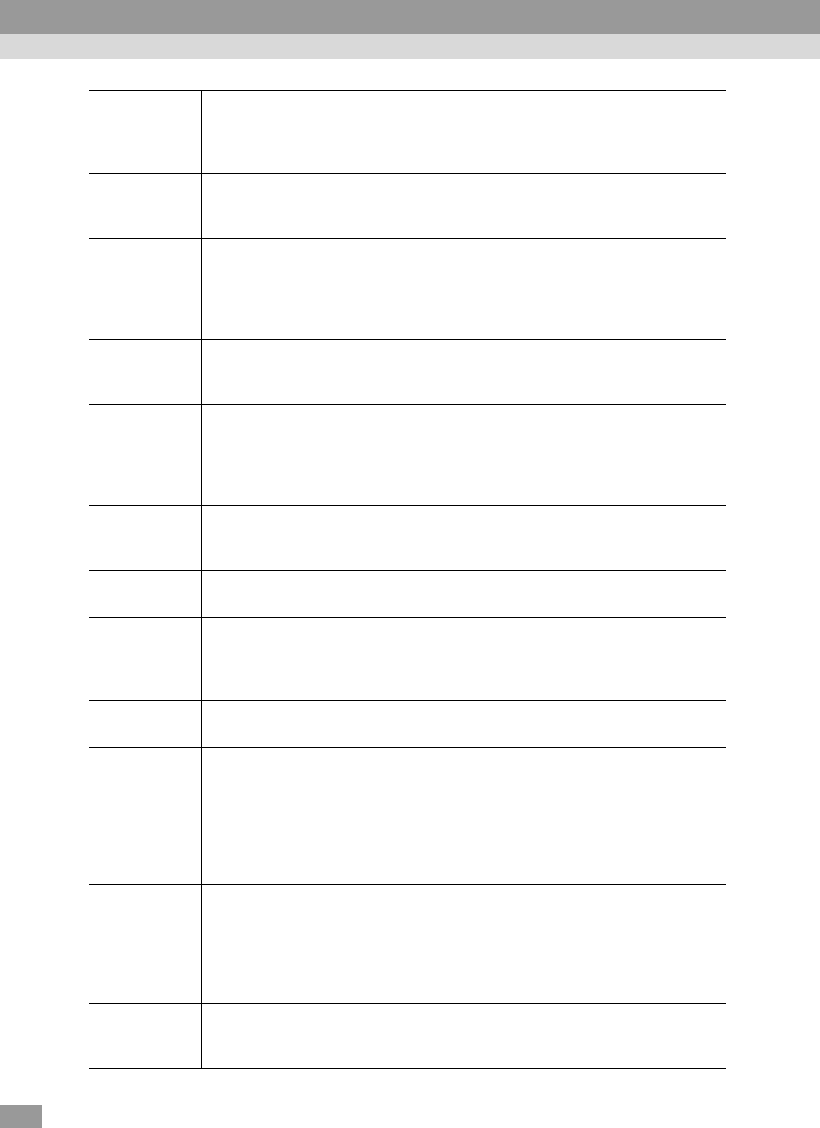
84
Interlaced
scanning
A method of image scanning whereby the image data is divided into
fine horizontal lines which are displayed in sequence starting from left
to right and then from the top to the bottom of the screen. The even-
numbered lines and odd-numbered lines are displayed alternately.
Progressive
scanning
A method of image scanning whereby the image data from a single
image is scanned sequentially from top to bottom to create a single
image.
Refresh rate The light-emitting element of a display maintains the same luminosity
and colour for an extremely short time. Because of this, the image must
be scanned many times per second in order to refresh the light-emitting
element. The number of refresh operations per second is called the
"refresh rate", and is expressed in hertz (Hz).
Resize
display
This function is use to project computer images that have a resolution
or more than or less than the projector's panel resolution to be projected
so that they fill the whole of the projection area.
Security
lock
A device consisting of a projector case with a hole in it that a
commercially-available theft-prevention cable can be passed through in
order to secure the device to a table or pillar. This projector is
compatible with the Microsaver Security System manufactured by
Kensington.
sRGB An international standard for colour intervals that was formulated so
that colours which are reproduced by video equipment can be handled
easily by computer operating systems (OS) and the Internet.
SVGA A type of video signal with a resolution of 800 (horizontal) x 600
(vertical) dots which is used by IBM PC/AT-compatible computers.
S-Video A video signal which has the luminance component and colour
component separated in order to provide better image quality.
It refers to images which consist of two independent signals: Y
(luminance signal), and C (colour signal).
SXGA A type of video signal with a resolution of 1280 (horizontal) x 1024
(vertical) dots which is used by IBM PC/AT-compatible computers.
Sync.
(Synchroni-
zation)
The signals output from computers have a specific frequency. If the
projector frequency does not match this frequency, the resulting images
will not be of a good quality. The process of matching the phases of
these signals (the relative position of the crests and troughs in the
signal) is called "synchronisation". If the signals are not synchronized,
problems such as flickering, blurriness and horizontal interference can
occur.
Tr a c k i n g The signals output from computers have a specific frequency. If the
projector frequency does not match this frequency, the resulting images
will not be of a good quality. The process of matching the frequency of
these signals (the number of crests in the signal) is called "tracking". If
tracking is not carried out correctly, wide vertical stripes will appear in
the projected images.
USB An abbreviation for Universal Serial Bus. USB is an interface for
connecting personal computers to peripheral devices which only
support relatively low data transmission speeds.
Glossary
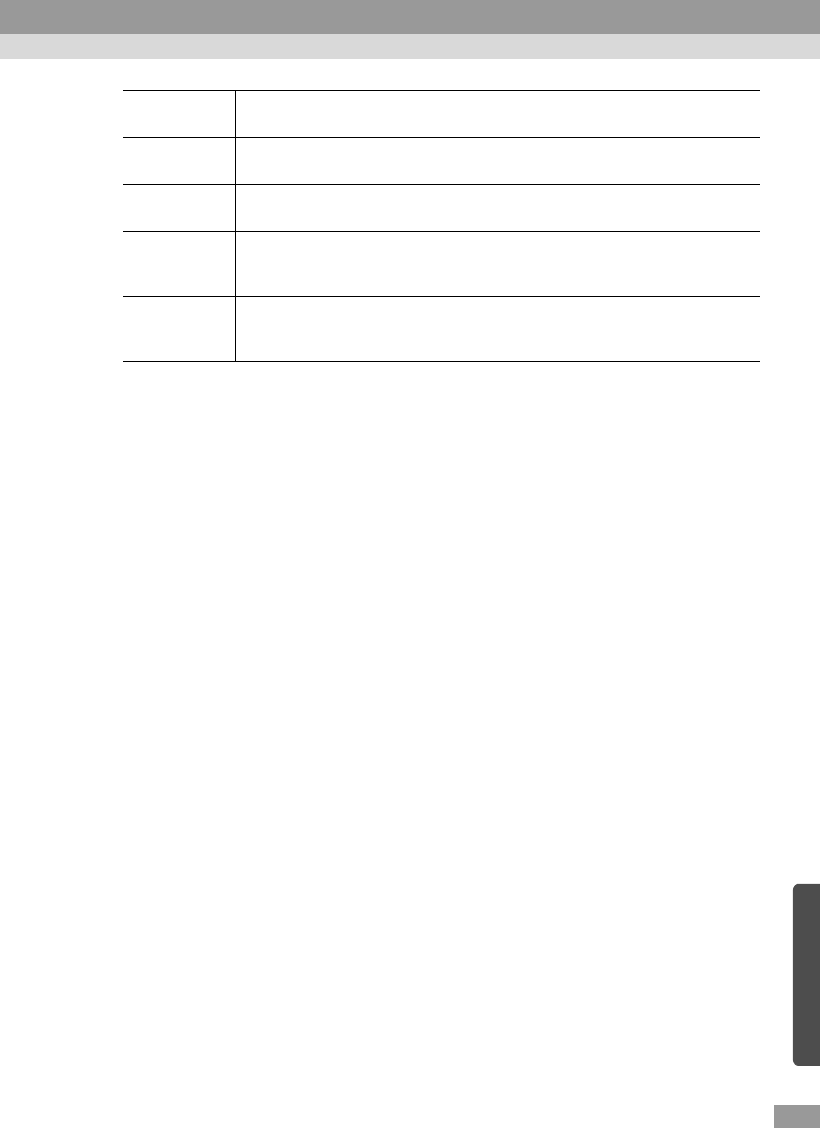
85
UXGA A type of video signal with a resolution of 1600 (horizontal) x 1200
(vertical) dots which is used by IBM PC/AT-compatible computers.
VGA A type of video signal with a resolution of 640 (horizontal) x 480
(vertical) dots which is used by IBM PC/AT-compatible computers.
XGA A type of video signal with a resolution of 1024 (horizontal) x 768
(vertical) dots which is used by IBM PC/AT-compatible computers.
YCbCr The carrier signal which is contained in the colour bar signal used in
modern TV transmissions. The name comes from the Y (luminance)
signal and the CbCr (chroma (colour)) signals.
YPbPr The carrier signal which is contained in the colour bar signal used in
high-definition TV (HDTV) transmissions. The name comes from the
Y (luminance) signal and the PbPr (colour difference) signals.
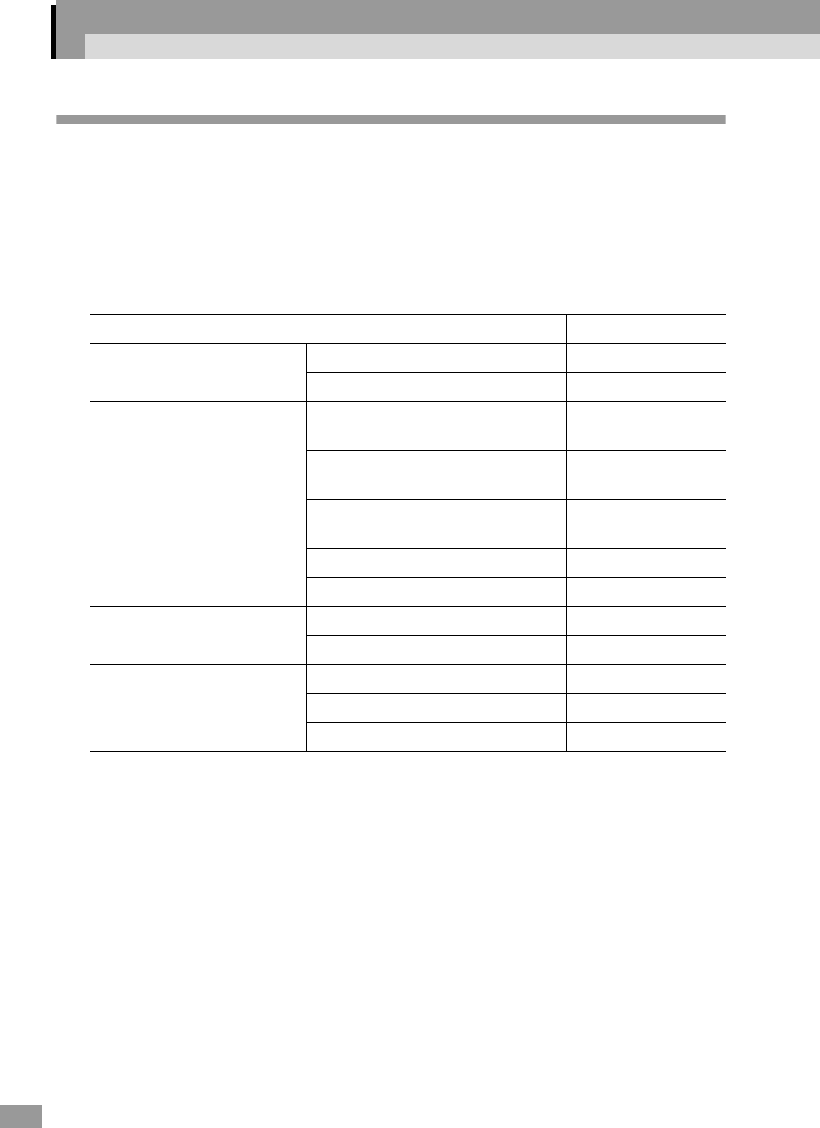
86
List of ESC/VP21 Commands
Command List
When a power ON command is sent to the projector, the power for the projector
turns on. When the projector is in a command ready state, it returns the "3Ah"
(:) code. Furthermore, when command processing is complete, the projector
also returns a ":" code.
The ":" code status can be used to determine whether the projector is ready or
busy. If command processing terminates with an error, an error message is
output and then the ":" code is sent.
Item Command
Power ON/OFF ON PWR ON
OFF PWR OFF
Signal selection
Computer/Component
Video (RGB)
SOURCE 11
Computer/Component
Video (YCbCr)
SOURCE 14
Computer/Component
Video (YPbPr)
SOURCE 15
Video SOURCE 41
S-Video SOURCE 42
A/V Mute ON/OFF ON MUTE ON
OFF MUTE OFF
A/V Mute Selection
Black MSEL 00
Blue MSEL 01
User's Logo MSEL 02

87
USB Connection Setup
In order to control the projector using ESC/VP21 commands, the projector
must be connected to a computer by means of a USB cable. The following
preparation needs to be carried out before communication via a USB
connection can be carried out.
Procedure
1
Download the EMP Link21L utility software from the EPSON
web site.
For details on acquiring the software, please contact one of the service
offices listed in the catalog.
2
The USB driver (USB-Com Driver) will be downloaded together
with the utility software, so install this USB driver into the
computer that is to be used.
Refer to the EMP Link21L User's Guide that is downloaded together with
the utility software for instructions on installing the USB driver.
3
Change the "Link 21L" setting in the "Advanced" menu to
"ON".
4
Turn off the power for the projector.
5
After the cool-down period has finished, turn the projector's
power back on.
Once the projector's power has turned back on, communication via a USB
Connection will then be possible.
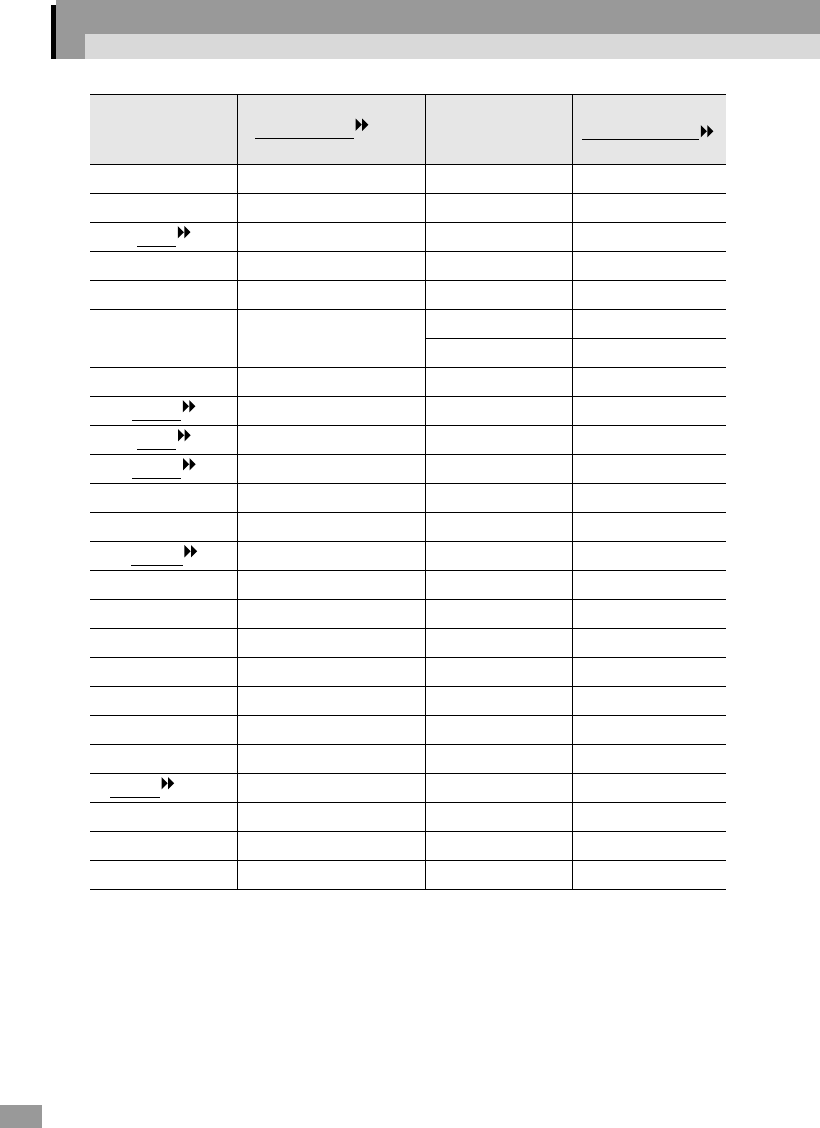
88
List of Supported Monitor Displays
* Connection is not possible if the equipment does not have a VGA output port.
It may be possible to project signals which are not listed in the above table.
However, not all functions may be supportable with such signals.
Signal Refresh rate (Hz) Resolution
(dots)
Resolutions for
resized display
(dots)
PC98 640×400 1024×640
EGA 640×350 1024×560
VGA 60 640×480 1024×768
VGACGA 640×400 1024×640
VGAEGA 640×350 1024×560
VGA text 720×400 1024×568
720×350 1024×498
VESA 60/72/75/85,iMac*640×480 1024×768
SVGA 56/60/72/75/85,iMac*800×600 1024×768
XGA 43i/60/70/75/85,iMac*1024×768 1024×768
SXGA 70/75/85 1152×864 1024×768
SXGA 60/75/85 1280×960 1024×768
SXGA 43i/60/75/85 1280×1024 960×768
UXGA 48i/60 1600×1200 1024×768
MAC13" 640×480 1024×768
MAC16" 832×624 1024×768
MAC19" 1024×768 1024×768
MAC19" 60 1024×768 1024×768
MAC21" 1152×870 1016×768
NTSC 640×480 1024×768
PAL /SECAM 72 0×540 1024×768
HDTV (525i) 640×480 1024×768
HDTV(525p) 640×480 1024×768
HDTV(750p) 60 1280×720 1024×576
HDTV(1125i) 60 1920×1080 1024×576
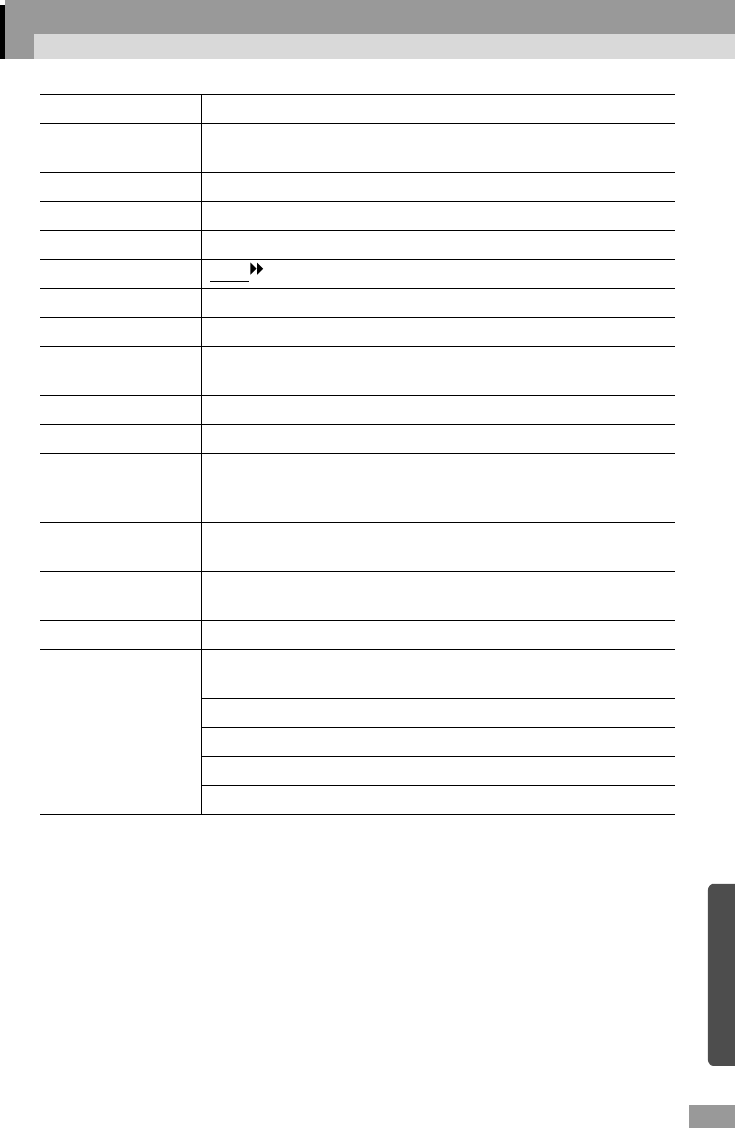
89
Specifications
* The USB connector is not guaranteed to operate correctly with all USB-
compatible devices.
Product name Multimedia Projector EMP-730/720
Dimensions 276 (W) x 70 (H) x 190 (D) mm
(10.9 (W) x 2.8 (H) x 7.5 (D) in.) (not including feet)
Panel size 0.9 inches
Display method Polysilicon TFT active matrix
Drive method Full-line 12-phase block sequential writing
Resolution XGA 786,432 pixels (1024 (W) x 768 (H) dots) x 3
Focus adjustment Manual
Zoom adjustment Manual (approx. 1:1.16)
Lamp
(light source) UHE lamp, 150 W, Model No.: ELPLP18
Max. audio output 1W monaural
Speaker 1
Power supply 100–120 V AC, 2.6A
200–240 V AC, 1.2A
50/60 Hz
Operating
Temperature +5º– +35ºC (41º–95ºF ) (No condensation)
Storage
Temperature -10º– +60ºC (14º–140ºF ) (No condensation)
Weight Approx. 1.9 kg (4.2 lbs)
Connectors Computer/Component
Video: 1 Mini D-Sub 15-pin (female)
Audio-In: 1 Stereo mini jack
Composite Video: 1 RCA pin jack
S-Video: 1 Mini DIN 4-pin
USB: 1 USB connector (B series)

90
Safety
USA
UL1950 3rd Edition
Canada
CSA C22.2 No.950-95 (cUL)
European Community
The Low Voltage Directive (73/23/EEC)
IEC60950 2nd Edition, +Amd.1, +Amd.2, +Amd.3, +Amd.4
EMC
USA
FCC 47CFR Part15B Class B (DoC)
Canada
ICES-003 Class B
European Community
The EMC Directive (89/336/EEC)
EN55022, 1998 Class B
EN55024, 1998
IEC61000-4-2, IEC61000-4-3, IEC61000-4-4, IEC61000-4-5,
IEC61000-4-6, IEC61000-4-8, IEC61000-4-11,
IEC61000-3-2, IEC61000-3-3
Australia/New Zealand
AS/NZS 3548:1995, A1:1997, A2:1997 Class B
CISPR Pub.22:1993, A1:1995, A2:1996, Class B
Specifications
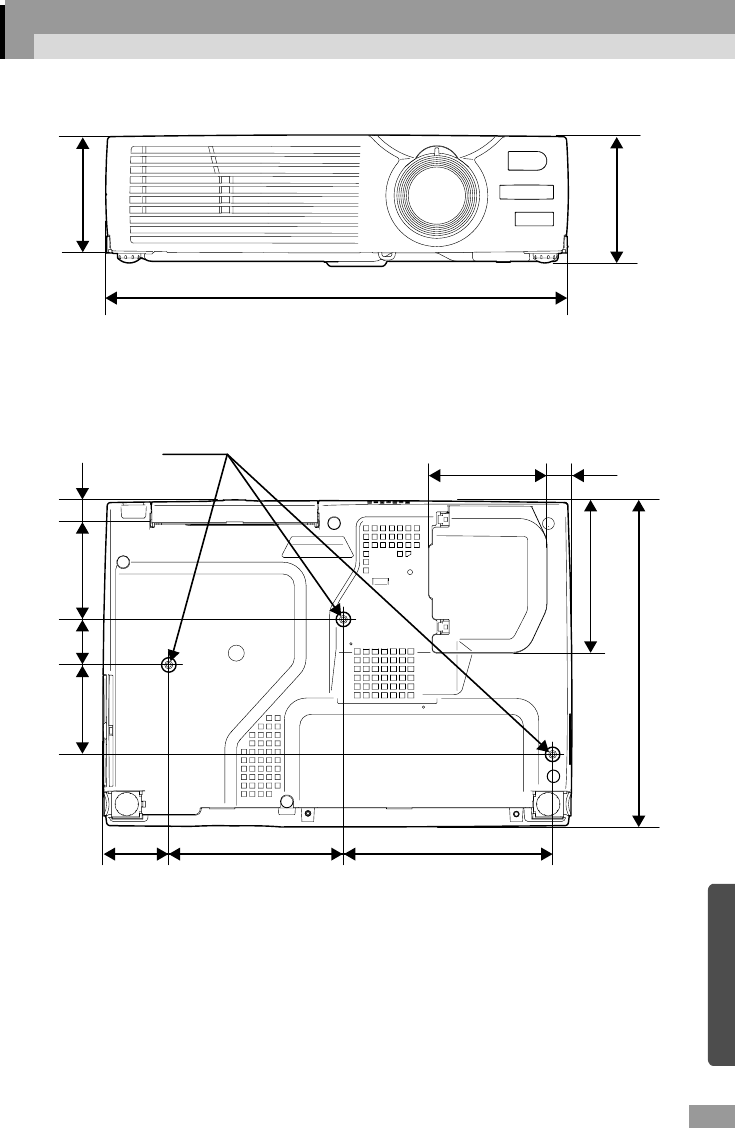
91
Appearance
Units: mm
89.9
M3X8-3
190
78.570
276
70 15
124
103.5
38.8
13.4
57
27
53

92
Index
General Terms
13w3 port ....................................................19
5BNC port...................................................18
A/V Mute .............................................. 42, 51
"About" Menu.............................................54
"Advanced" Menu.......................................52
Air exhaust vent ............................................8
Air filter ........................................................8
Air intake vent...............................................8
Analogue-RGB .....................................46, 54
Aspect ratio.................................................44
"Audio" Menu.............................................50
Audio-In port ..............................................10
Auto Keystone.......................................34, 51
Auto Setup ............................................ 37, 47
Battery holder .............................................74
Brightness .............................................47, 48
Ceiling................................................... 14, 53
Cleaning the Air Filter ................................73
Cleaning the Lens .......................................72
Cleaning the Projector Case........................ 72
Color Adjustment........................................ 53
Color Mode Prompt ....................................51
Color Mode .....................................40, 47, 49
Color temperature .......................................53
Color ...........................................................48
Component video ........................................24
Composite video .........................................23
Computer/Component Video port............... 10
Connecting to a Computer ..........................16
Connecting to a Video Source.....................23
Contrast .................................................47, 48
Control panel.................................................9
Cool-down.............................................31, 61
Cross............................................................45
Eligible computers ......................................16
ESC/VP21 ...................................................86
E-Zoom .......................................................45
Focus ring......................................................8
Focus ...........................................................37
Foot adjustment...........................................35
Freeze ..........................................................43
Frequency....................................................54
Front adjustable foot .....................................8
Glossary.......................................................83
HDTV..........................................................88
Help function...............................................60
Image size..............................................15, 33
Indicators.................................................8, 61
Input Signal .....................................47, 49, 54
Inserting the Battery....................................74
Keystone..........................................34, 36, 50
Lamp cover..................................................10
Lamp replacement period............................75
Lamp ...........................................................54
Language .....................................................52
A
B
C
E
F
G
H
I
K
L

93
Lens cover .....................................................8
Link21L ......................................................53
Main menu ..................................................46
Manually Correcting Keystone
Distortion ................................................36
Menu ...........................................................46
Mini D-Sub 15-pin port ..............................17
Mouse pointer ............................................. 21
No-Signal Msg............................................51
Operating distance (Remote control) ..........13
Operating range (Remote control) .............. 13
Operating temperature ................................89
Optional accessories ...................................82
Overheating.................................................62
Part Names and Functions ............................8
Port........................................................10, 30
Position ...........................................37, 47, 48
Power cable .............................................1, 28
Power indicator .............................................8
Power inlet ..................................................10
Projection angle ..........................................34
Projection distance ......................................15
Projection ....................................................29
Prompt......................................................... 51
RCA video cable .....................................1, 23
Rear Proj. ..............................................14, 53
Refresh Rate................................................55
Remote control light-emitting area ............. 11
Remote control light-receiving area........8, 10
Remote control ................................11, 12, 21
Replacing the Air Filter...............................79
Replacing the Lamp ....................................76
"Reset All" Menu ........................................55
Reset Lamp Timer.................................54, 78
Resized display............................................88
Resolution .............................................55, 88
RGB.............................................................53
Screen size...................................................15
Security lock..................................................8
"Setting" Menu............................................50
Setting Up the Projector ..............................14
Sharpness...............................................47, 48
Sleep mode ..................................................51
Speaker............................................10, 20, 26
Specifications ..............................................89
Squeeze mode..............................................44
sRGB ...............................................40, 47, 49
Startup screen..............................................52
Stereo mini jack audio cable .................20, 26
Storage temperature ....................................89
Sub-menu ....................................................46
Supported Monitor Displays .......................88
Suspension bracket fixing point ............10, 91
S-Video port ................................................10
S-Video............................................24, 48, 54
SYNC Mode................................................55
SYNC Polarity ............................................54
Sync.......................................................37, 47
Tint ..............................................................48
Tone .............................................................50
Tracking ................................................37, 47
Translucent screen.......................................14
Turning off...................................................31
M
N
O
P
R
S
T

94
USB cable ............................................... 1, 21
USB connection setup.................................87
USB mouse ................................................. 21
USB port .....................................................10
"User's Logo" Menu....................................52
User's Logo ........................................... 42, 80
Using the Configuration Menu Functions...46
"Video" Menu .............................................46
Video port....................................................10
Video Signal..........................................49, 54
Video Source............................................... 54
Video.....................................................48, 54
Volume ........................................................50
Warning indicator..........................................8
When Having Some Trouble....................... 61
Wide-screen Projection ............................... 44
Wireless Mouse Function............................21
Workstation .................................................19
YCbCr .............................................30, 48, 54
YPbPr..............................................30, 48, 54
Zoom ring .....................................................8
U
V
W
Y
Z
Index

We :EPSON AMERICA, INC.
Located at :3840 Kilroy Airport Way
MS: 3-13
Long Beach, CA 90806
Tel :562-290-5254
Declare under sole responsibility that the product identified herein,
complies with 47CFR Part 2 and 15 of the FCC rules as a Class B
digital device. Each product marketed, is identical to the
representative unit tested and found to be compliant with the
standards. Records maintained continue to reflect the equipment
being produced can be expected to be within the variation accepted,
due to quantity production and testing on a statistical basis as
required by 47CFR 2.909. Operation is subject to the following two
conditions : (1) this device may not cause harmful interference, and
(2) this device must accept any interference received, including
interference that may cause undesired operation.
Trade Name :EPSON
Type of Product :Projector
Model :EMP-730/720 /ELP-730/720
DECLARATION of CONFORMITY
According to 47CFR, Part 2 and 15
Class B Personal Computers and Peripherals; and/or
CPU Boards and Power Supplies used with Class B
Personal Computers
FCC Compliance Statement
For United States Users
This equipment has been tested and found to comply with the limits
for a Class B digital device, pursuant to Part 15 of the FCC Rules.
These limits are designed to provide reasonable protection against
harmful interference in a residential installation. This equipment
generates, uses, and can radiate radio frequency energy and, if not
installed and used in accordance with the instructions, may cause
harmful interference to radio or television reception. However, there is
no guarantee that interference will not occur in a particular
installation. If this equipment does cause interference to radio and
television reception, which can be determined by turning the
equipment off and on, the user is encouraged to try to correct the
interference by one or more of the following measures.
•Reorient or relocate the receiving antenna.
•Increase the separation between the equipment and receiver.
•Connect the equipment into an outlet on a circuit different from that
to which the receiver is connected.
•Consult the dealer or an experienced radio/TV technician for help.
WARNING
The connection of a non-shielded equipment interface cable to this
equipment will invalidate the FCC Certification or Declaration of this
device and may cause interference levels which exceed the limits
established by the FCC for this equipment. It is the responsibility of
the user to obtain and use a shielded equipment interface cable with
this device. If this equipment has more than one interface connector,
do not leave cables connected to unused interfaces. Changes or
modifications not expressly approved by the manufacturer could void
the user’s authority to operate the equipment.

All rights reserved. No part of this publication may be reproduced, stored in a
retrieval system, or transmitted in any form or by any means, electronic,
mechanical, photocopying, recording, or otherwise, without the prior written
permission of SEIKO EPSON CORPORATION. No patent liability is assumed
with respect to the use of the information contained herein. Neither is any
liability assumed for damages resulting from the use of the information
contained herein.
Neither SEIKO EPSON CORPORATION nor its affiliates shall be liable to the
purchaser of this product or third parties for damages, losses, costs, or expenses
incurred by purchaser or third parties as a result of: accident, misuse, or abuse
of this product or unauthorized modifications, repairs, or alterations to this
product, or (excluding the U.S.) failure to strictly comply with SEIKO EPSON
CORPORATION’s operating and maintenance instructions.
SEIKO EPSON CORPORATION shall not be liable against any damages or
problems arising from the use of any options or any consumable products other
than those designated as Original EPSON Products or EPSON Approved
Products by SEIKO EPSON CORPORATION.
EPSON is a registered trademark and PowerLite is a trademark of SEIKO
EPSON CORPORATION.
General Notice: The following trademarks and registered trademarks are the
property of their respective owners and are used in this publication for
identification purposes only.
•EPSON/Seiko Epson Corp.
•Macintosh, PowerBook/Apple Computer Inc.
•IBM/International Business Machine Corp.
•Windows/Microsoft Corp.
Other product names used herein are also for identification purposes only and
may be trademarks of their respective owners. EPSON disclaims any and all
rights in those marks.
Copyright 2002 by SEIKO EPSON CORPORATION

402529801
02.06-.9A(C05)
Printed in Japan
Printed on 100% recycled paper.
