Fluke 62 Max Application Note How Hot? Use The Spot.
2015-09-09
: Fluke Fluke-62-Max-Application-Note-810452 fluke-62-max-application-note-810452 fluke pdf
Open the PDF directly: View PDF  .
.
Page Count: 2

From the Fluke Digital Library @ www.fluke.com/library
Application Note
How hot? Use the spot.
Temperature is the second most common measurement in
the world (the first is time). For something that is measured
so often, wouldn’t it be great to have a thermometer that’s
as easy to carry and as fast to read as your wristwatch? Fluke’s family of infrared (IR)
thermometers gives you speed
and convenience. Point. Squeeze.
Read the results. It’s quick and
easy, and helps you get your job
done faster.
In addition, Fluke’s newest
infrared thermometer adds
another element—improved
targeting for increased accuracy.
The Fluke 62 MAX+ provides
two targeting lasers to help you
better see “the spot.” To better
understand how the 62 MAX+
will help you, let’s take a look at
what the spot means.
For anyone who uses an IR
thermometer, understanding
the measurement spot is key
to getting accurate measure-
ments. Think about using the
spot in the same way you see
things with your eyes. If you’re
up close to an object, you can
see only the things directly in
front of you. As you move farther
back, your field of view expands
and you see a much wider
perspective.
The formal name for this is
“distance to spot ratio.” If your
thermometer has a 10:1 distance
to spot ratio, and you are 10
inches away from your target,
you will measure the tempera-
ture of a one-inch circle. If you
are 10 feet away, your measure-
ment spot will be a one-foot
circle.
2 Fluke Corporation How hot? Use the spot.
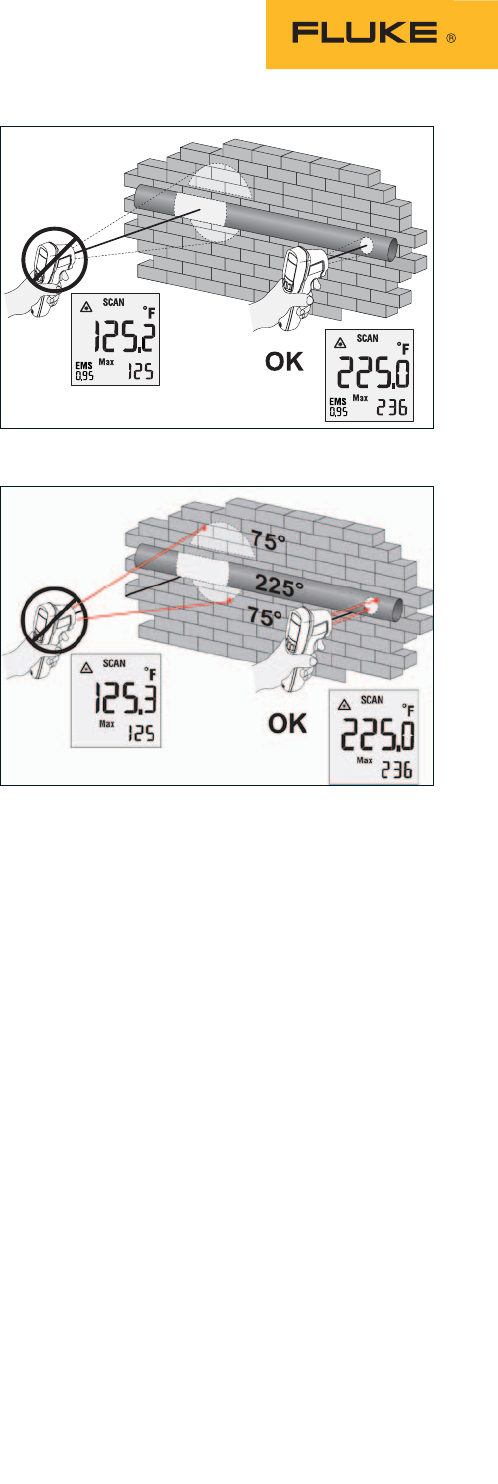
Figure 1 shows an example
of why this is important. In
the illustration, a hot pipe is
mounted on a brick wall. On
the left side of the illustration, a
user takes a measurement from
a distance where the spot covers
not only the hot pipe, but also
the cooler brick wall. The read-
ing shows the average of the
entire spot. On the right side, the
user has moved closer and the
spot is smaller. The thermometer
gives an accurate reading of the
temperature of the hot pipe.
The most common IR ther-
mometers use a single laser in
the center of the spot. If you can
do the mental math to estimate
the measurement spot, great.
But the Fluke 62 MAX+ offers a
different approach, using dual,
rotating lasers to show the
outside of the circle that defines
the measurement spot. In other
words, with the 62 MAX+, the
spot is between the dots.
Figure 2 shows the same
example of a hot pipe mounted
on a brick wall, but using the 62
MAX+ with dual, rotating lasers.
With dual lasers, it becomes easy
for the user to visualize the size
of the circle that is being mea-
sured. The results are the same,
but it is easier for the user to see
and measure exactly what was
intended.
Laser-targeted infrared ther-
mometers are great tools for
making fast temperature mea-
surements. To improve accuracy,
users should understand the size
of the measurement spot. And to
really stay ahead of the game,
use an IR thermometer with
dual lasers that define the outer
edges of the spot.
75°
75°
225°
Figure 1
Figure 2
Fluke Corporation
PO Box 9090, Everett, WA 98206 U.S.A.
Fluke Europe B.V.
PO Box 1186, 5602 BD
Eindhoven, The Netherlands
For more information call:
In the U.S.A. (800) 443-5853 or
Fax (425) 446-5116
In Europe/M-East/Africa +31 (0) 40 2675 200 or
Fax +31 (0) 40 2675 222
In Canada (800)-36-FLUKE or
Fax (905) 890-6866
From other countries +1 (425) 446-5500 or
Fax +1 (425) 446-5116
Web access: http://www.fluke.com
©2012 Fluke Corporation.
Specifications subject to change without notice.
Printed in U.S.A. 5/2012 4221738A_EN
Modification of this document is not permitted
without written permission from Fluke Corporation.
Fluke. Keeping your world
up and running.®
