Fluke 985 Application Note 2412973
2015-09-09
: Fluke Fluke-985-Application-Note-808539 fluke-985-application-note-808539 fluke pdf
Open the PDF directly: View PDF  .
.
Page Count: 4
Application Note
From the Fluke Digital Library @ www.fluke.com/library
Growing your business
through indoor air quality
particulate profiling
managers and homeowners will
agree that measuring particulate
pollutants such as plant pollen,
animal dander, fiberglass, com-
bustion particles or airborne
bacteria, is important.
With a particulate counter,
you’ll also be able to present real
data in support of any repair or
purchasing recommendations you
make. Before and after particulate
readings are an especially pow-
erful way to win customers for
life and build word of mouth
about your service.
Taking the first step is logical:
understanding how indoor air
quality relates to HVAC systems.
The second step is deciding what
tools you need. Once you have
the tool, start measuring and
learn how to interpret the data.
Soon, you’ll be ready to offer a
complete IAQ assessment, includ-
ing particulate profiling, to your
customers.
You’ve probably heard mold
referred to as the “new asbestos”
for HVAC/R. Concern about mold
and its health effects is driving
consumers to have their indoor
air quality (IAQ) situation
assessed and, if necessary,
repaired.
If you’re the contractor they
call, keep in mind that mold isn’t
the only issue to consider when
assessing the IAQ of a commercial
building or residence. Many dif-
ferent kinds of particulates in a
work or living environment can
cause Sick Building Syndrome
and aggravate allergy and respi-
ratory conditions.
IAQ has generated so much
awareness that you may want to
consider offering IAQ assessments
and particulate counts to all of
your customers, as an extra
service—just like when the
mechanic charges you for a diag-
nostic check. If you can present a
convincing case, many facilities
If you think “pollutants” is too strong a
word to use when describing particulate
measurement situations, consider this:
Studies conducted by both government
and independent entities have come to
the conclusion that indoor air in some
commercial settings can be up to five
times more polluted than outdoor air.
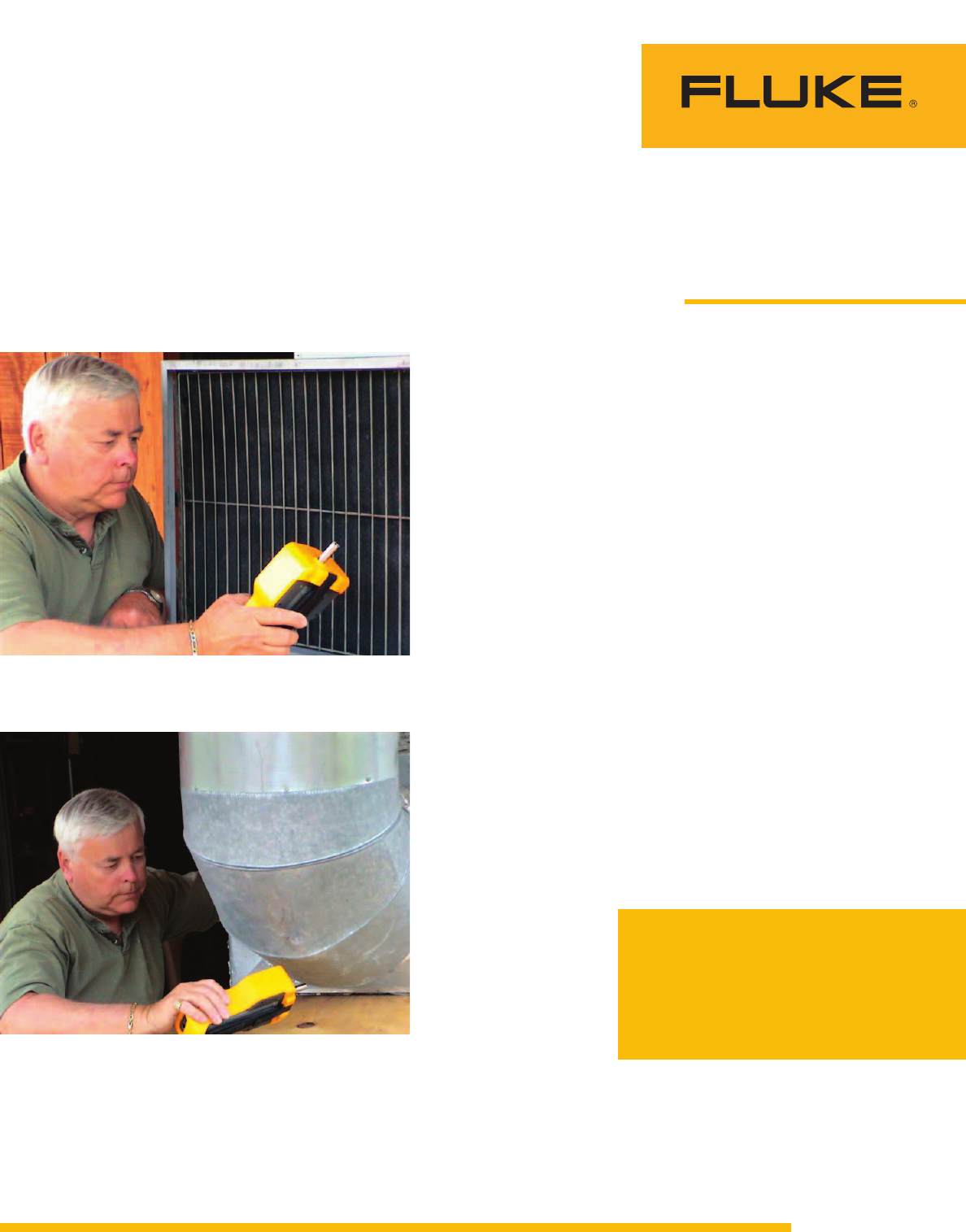
Jim Johnson, a major appliance specialist and instructor, conducts a
particle assessment at an air filter.
Test both return and conditioned ducts for contaminants, indicating
leaks or other system malfunctions.
smaller space like an office or
bedroom. Higher counts probably
mean the air handling system
isn’t properly balanced.
If a duct system branch is an
8-inch flex, it’s supposed to be
moving in the neighborhood of
160 CFM, and that translates to a
fairly low level of positive pres-
sure into the room even if the
system is balanced....which
means that in a typical system
that employs a single central
return, the requirement of the
free flow of air at low resistance
back to the return register from
that room can be compromised,
leaving an even higher level of
contaminants in that space.
If you can measure those
contaminants, you would be able
to classify them (pollen vs. soot)
track their flow through the
building, and identify the source
—that’s a much more specific
service, with farther reaching
solutions, that you can now offer
customers.
2 Fluke Corporation Growing your business through indoor air quality particulate profiling
Step 1: How IAQ analysis and particulate
profiling fits into HVAC systems
space due to leaks and other
HVAC system malfunctions. And—
it’s not just return ducts. Duct
systems within the conditioned
envelope are just as susceptible
to IAQ issues.
IAQ inspections are built
on exactly that kind of HVAC
knowledge. Using your knowl-
edge of how HVAC systems are
designed—and how the design
can be compromised on installa-
tion—as well as where those
systems can break, will help you
track down where air quality
pollutants may be coming from.
On the flip side, air quality data
gives you the means to track
whether the HVAC system is
working the way it should.
For example: to determine
whether the duct system is
responsible for introducing con-
taminants, you’d conduct a
particle assessment at the supply
registers. It’s very evident at the
register whether the particulate
count is higher, especially in a
We all remember our fundamen-
tal facts related to air flow:
standard air at 70 °F (at sea level)
and 50 % relative humidity has a
weight of .075 pounds per cubic
foot. That means a typical 5-ton
cooling system moves 9,000
pounds of air in one hour, or up
to 216,000 pounds in a 24-hour
period.
These are more than just
impressive numbers for customers.
Consider something as simple
as a 10 % leak rate in the return
duct system (not uncommon in
residential) in an attic crawl
space. Now, consider the dust and
other particulate levels in that
crawl space. And, finally, imagine
the amount of particulates being
distributed throughout the ducts
in your customer’s home.
So, it’s not just door openings,
or air seeping in around windows
and other small openings that
affect indoor air quality. Dust and
other contaminants can be con-
stantly introduced into the living
Step 2: What tools do you need?
taking particle counts. Multi-
channel refers to how many
different sizes of particles the tool
can measure. Knowing the
breakdown of particle sizes is
essential for you to diagnose
what’s polluting customers’ air
(mold particles are different sizes
than dust, for example), to trace
particles to their source, or to
verify that a fix has really less-
ened the count of particles.
Handheld is also an important
distinction, since some higher-
end models are meant to be
installed, for long term monitor-
ing. As an HVAC technician, you’ll
get the most value from a hand-
held tool meant for onsite
inspections.
To conduct a complete IAQ inves-
tigation, you need to measure
temperature, humidity and partic-
ulates, at a minimum. That’s
because temperature and humid-
ity can take a regular particle
count and magnify it times ten,
by giving certain contaminants
like mold a welcoming environ-
ment. That makes hand held
multi-function and multi-channel
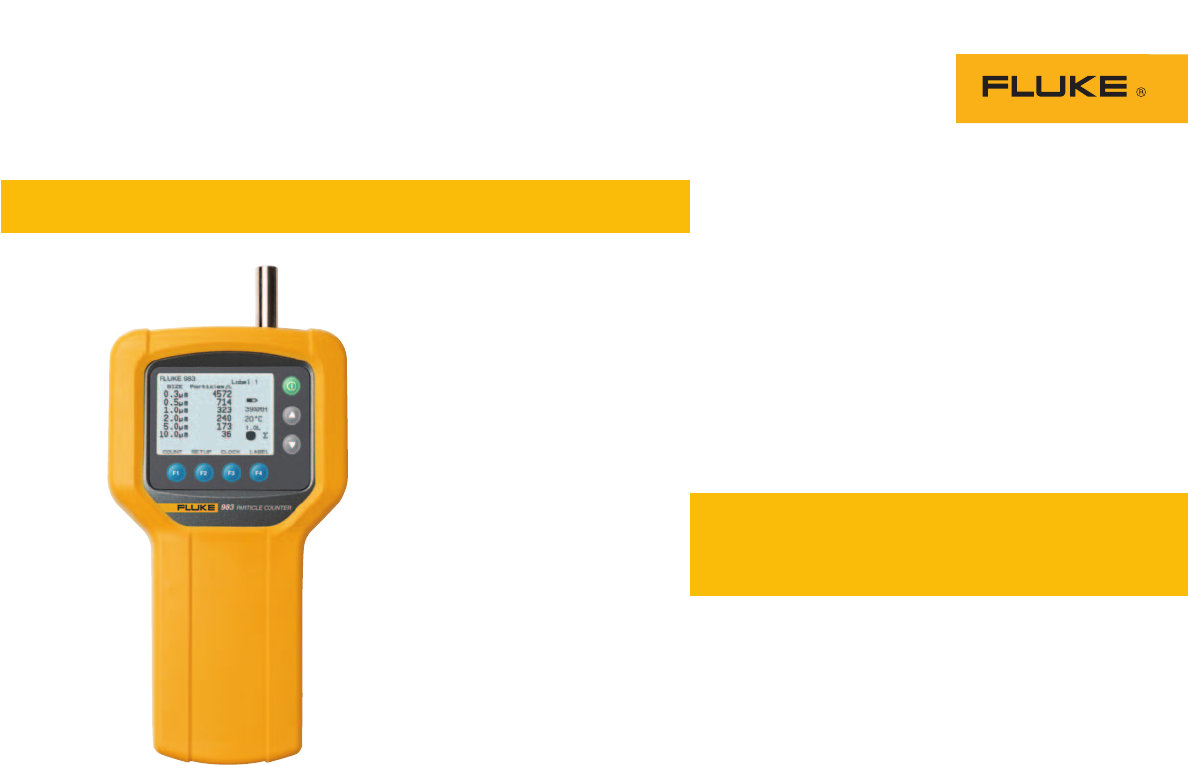
particle counters, such as the
Fluke 983, the most practical tool
for the job.
A particle counter senses,
sizes, and counts the particles
passing through it. Multi-function
means the tool measures temper-
ature and humidity along with
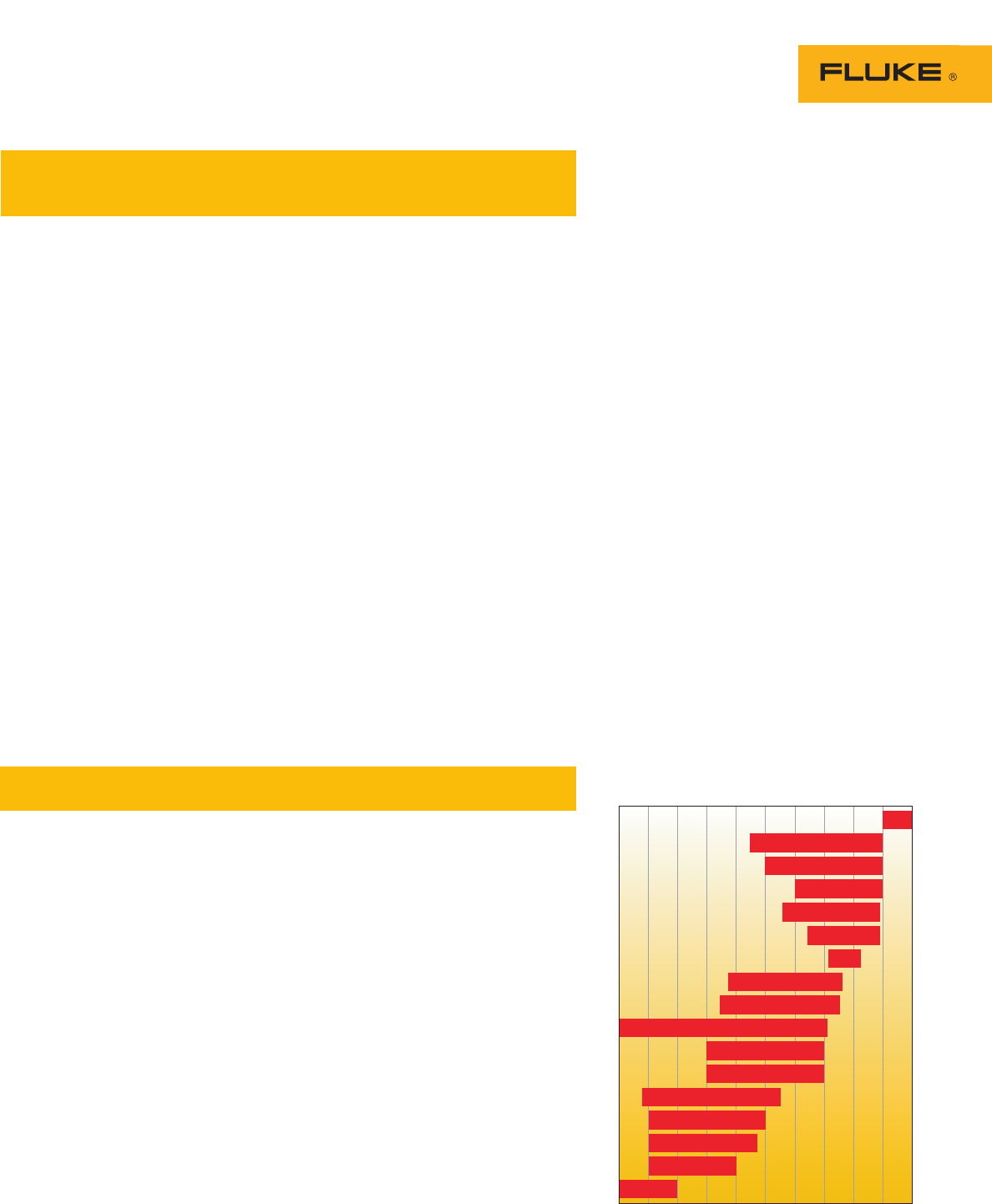
0.005 0.05 0.5 5 500.010.1 110100 500
0.005 0.05 0.5 5 500.010.1 11010 0 500
Particle size in µm
Particle size in µm
Pollen
Mold Spores
House Dust
Bacteria
Animal Dander
Viruses
Carbon Black
(Photocopier)
Heavy
Dust
Settling Dust
Cement Dust
Fly Ash
Smog
Tobacco Smoke
Soot
Cooking Oil Smoke/Grease
Suspended Atmospheric Dust
Hair
(Human)
3 Fluke Corporation Growing your business through indoor air quality particulate profiling
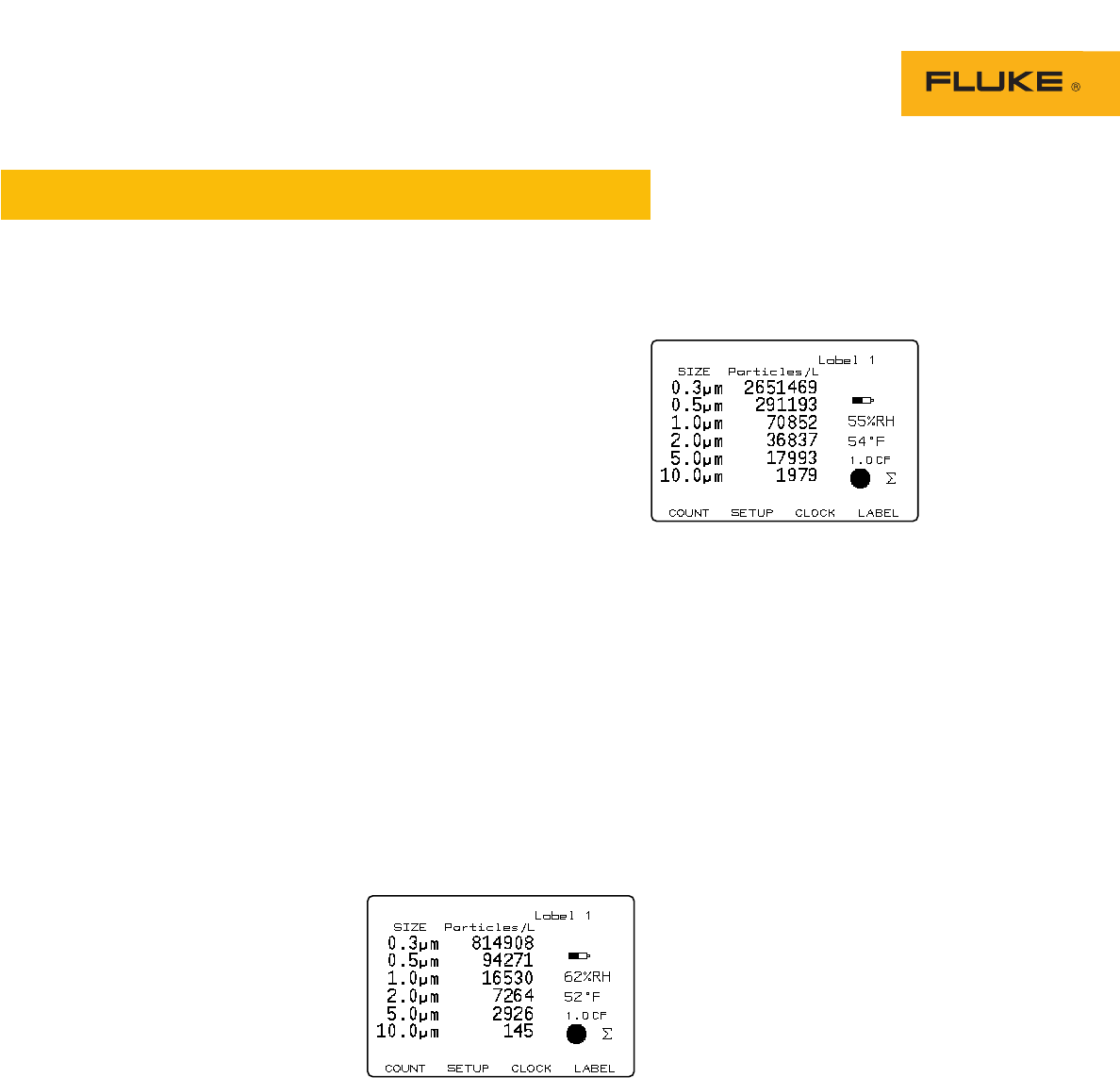
While slightly higher than out-
side values, this is a fairly typical
particle level. However, in one
location, the particulates were:
You’ll notice that particle sizes
in almost all areas increased.
Quite often, larger particles are
providing nutrients to the smaller,
biological particles, as well as
transporting them. That’s how fil-
ters that remove mostly larger
particles also wind up removing
many viruses and bacteria from a
system.
The higher counts indicate a
problem that needs to be investi-
gated. Determine specifically
where the high counts occur and
then start asking questions. Is
there an excessive source of
moisture from an improperly
draining pan under an evaporator
coil? What kind of ventilation
does the building have and how
old is it? Has there been any new
interior construction, carpeting, or
painting?
By addressing all aspects of
the situation, you’ll treat the real
problem, not just the symptom,
and give your customer specific
data to base buying decisions on.
Step 3: Making the measurements
Once you’ve collected data,
transfer the information to a
computer and convert it into a
spreadsheet. Compare the counts
in each area against the baseline
and between each other. You
should see patterns develop.
When you detect a high-volume
area, see if it’s just one particle
size or several, and think about
what kinds of contaminants could
be involved. Then, compare the
particle counts to air flow balanc-
ing in the building. Always
remember to take readings of the
outside air in order to make
meaningful comparisons with the
particle levels indoors.
If you think the system itself
is transporting contaminants,
consider whether to propose
re-balancing the existing system
or adding a mechanical solution
such as dehumidifiers or a better
filter. Sometimes the solution can
even be as simple as blocking off
a room or identifying problematic
behavior.
Here’s one example of a par-
ticulate profile in a commercial
office. The baseline six particle
size scales showed:
To conduct an IAQ inspection, get
a map of the HVAC system, as
installed, and use that to create
an inspection route. Plan to take
temperature, humidity, and parti-
cle samples in every zone of the
building, especially in any areas
where there have been com-
plaints, as well as outside the
building, as a baseline. Within
each zone, take a measurement in
the middle of the space as well as
near the air intakes, outtakes, and
any other HVAC system elements.
Make particular note to measure
both upstream and downstream at
any HEPA filters.
Also use your own senses—
look for signs of moisture leaks,
smell the air for mold, and ask
the people who frequent each
area if they have experienced
anything different, such as smells,
headaches, or eye irritation.
Don’t be intimidated by partic-
ulate counters—newer models
designed specifically for HVAC
technicians are easy to use. For
example, to use the Fluke 983,
power up the unit, press F1, and
use the probe to start sampling. It
will simultaneously record the
relative humidity and tempera-
ture conditions and sample a
group of particulate measure-
ments in less than 25-seconds.
As you take your samples, use
the labeling feature on your par-
ticle counter to identify samples
taken from different rooms, the
particle counting mode, air sam-
pling volume and time.
4 Fluke Corporation Growing your business through indoor air quality particulate profiling
Fluke Corporation
PO Box 9090, Everett, WA USA 98206
Fluke Europe B.V.
PO Box 1186, 5602 BD
Eindhoven, The Netherlands
For more information call:
In the U.S.A. (800) 443-5853 or Fax (425) 446-5116
In Europe/M-East/Africa (31 40) 2 675 200 or
Fax (31 40) 2 675 222
In Canada (800) 36-FLUKE or Fax (905) 890-6866
From other countries +1 (425) 446-5500 or
Fax +1 (425) 446-5116
Web access: http://www.fluke.com
©2005 Fluke Corporation. All rights reserved.
Printed in U.S.A. 6/2005 2457379 A-US-N Rev A
Fluke. Keeping your world
up and running.
Next, start offering IAQ inspec-
tions and particle counts as part
of your standard “seasonal start-
up” maintenance check. Charge
for a building or home evaluation
in which a particle counter is
used, similar to the way that
automotive service shops charge
for using a computer hookup dur-
ing the diagnostic process.
Make sure your customers
understand that IAQ analysis and
particulate profiling is an above-
average service that requires
specialized training and tools.
Just by offering the service, you
take your organization to a higher
level of professionalism and
customer service. Your recom-
mendations now come with
supporting data, assuring the
customer that you’re making the
right suggestions on equipment
selection, installation, and repair.
Step 4: Offering IAQ services
The easiest way to integrate
indoor air quality and particulate
testing into your business is to
start with customers who are
already sensitive to air quality.
The first time you describe IAQ
to a customer, come prepared to
describe how poor air quality
could affect that customer’s facil-
ity, either from employee health
issues and product contamination
to the maintenance costs and
energy expenditure related to
inefficient HVAC and aging filters.
Customers with HEPA filters
installed will especially appreci-
ate your knowledge of ASHRAE
52.2. That standard spells out the
testing requirements that manu-
facturers follow, to verify filter
performance before sale. As an
HVAC technician with a particle
counter, you can use the standard
as a guideline for testing installed
filters, so that customers know
how efficiently their filters are
removing particles and whether
they’re due for replacement.
Particulate profiling is now rec-
ommended in the latest NADCA
ACR 2005 standard for air duct
cleanliness, too.
It’s one thing to mention the
importance of ASHRAE guidelines
to a customer when selling a
necessary duct renovation or
other repairs, but it’s another
thing altogether to back that
explanation up with particulate
measurements and an air quality
evaluation.
Also consider offering IAQ inspections in the
off season, adding a second annual visit to
your accounts during months when you’re
not as booked.
