Fluke 985 Application Note 2412973
2015-09-09
: Fluke Fluke-985-Application-Note-808540 fluke-985-application-note-808540 fluke pdf
Open the PDF directly: View PDF  .
.
Page Count: 5
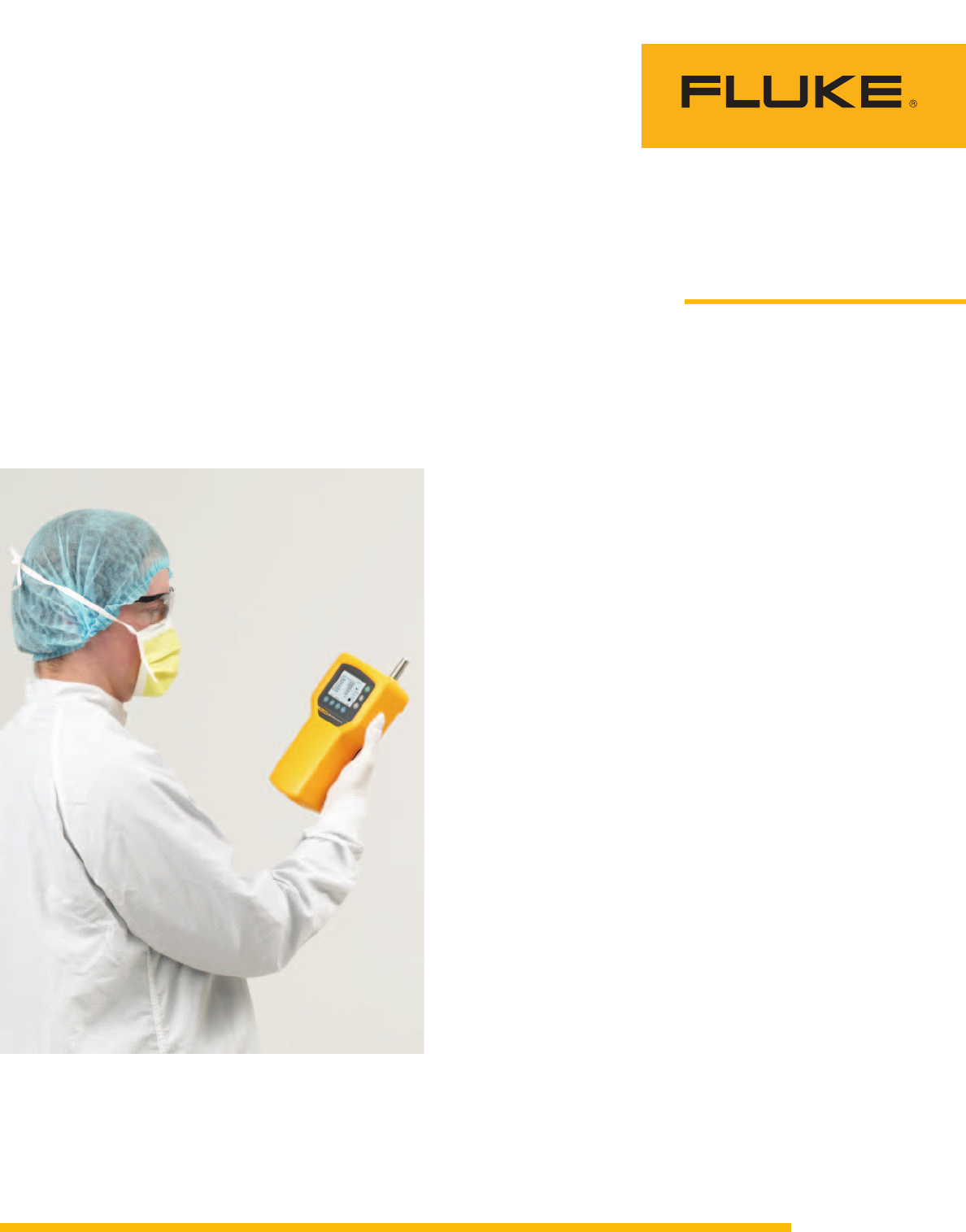
In the highly sensitive environment of a healthcare facility,
where both infectious patients and those highly susceptible
to infection receive treatment, it is essential to minimize the
possibility of infection and disease transmission.
From the Fluke Digital Library @ www.fluke.com/library
Airborne particle counters
provide vital information for
maintaining indoor air quality
in healthcare facilities
One potential vector of infection
that must be managed is the air
circulating within the building.
Failure to correctly monitor and
manage indoor air quality can
add cost due to increased lengths
of stay, expose the institution to
liability and, more importantly,
expose patients and staff to
unnecessary risk.
In an effective indoor air qual-
ity (IAQ) program, a handheld
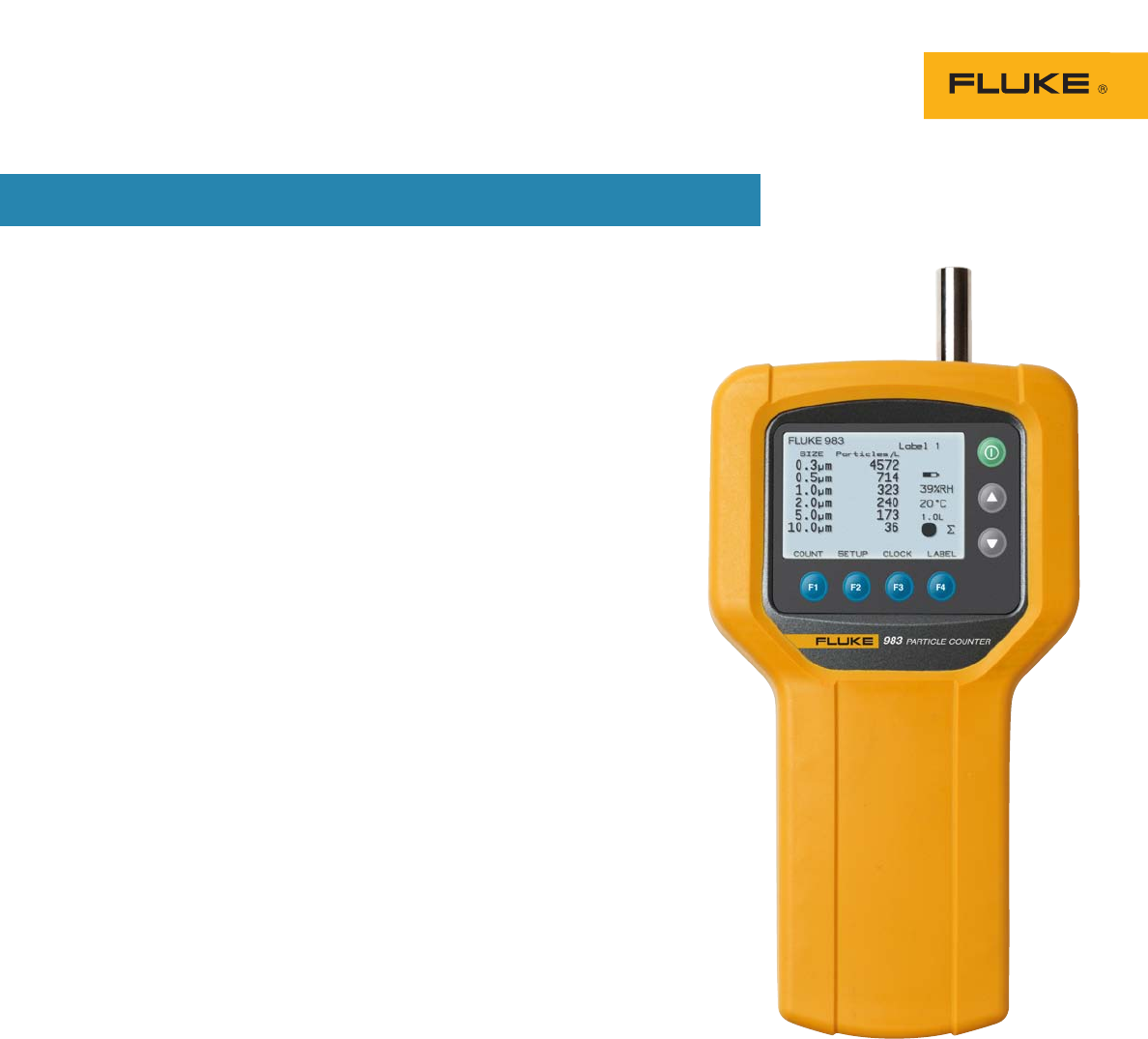
airborne particle counter such as
the Fluke 983 is an important
tool. Used in conjunction with
pressure and airflow testers, par-
ticle traps and laboratory
analysis, the particle counter can
provide facilities managers with
the data they need to detect IAQ
problems, identify and address
root causes and verify when con-
ditions have returned to
acceptable levels.
Specifically, a particle counter
enables the healthcare facility
manager to:
•Document baseline particle
counts within a specific space
•Detect when airborne particu-
late levels diverge from
baseline or “normal” levels
•Gain early warning of underly-
ing issues, such as changes
in operating procedures,
equipment malfunctions,
maintenance shortcomings or
failure to separate construction
zones from patient areas
•Test particle levels after
changes have been made, to
ensure that remedies have
been effective
The use of handheld test instru-
ments has received endorsement
at the highest levels. According
to infection control guidelines
published by the U.S. Centers for
Disease Control in 2003, “the use
of handheld, calibrated equipment
that can provide a numerical
reading on a daily basis is pre-
ferred for engineering purposes”
in ensuring the proper and safe
operation of HVAC systems.i
It must be clearly stated, how-
ever, that the particle counter is
not designed to determine what
particles consist of or whether
the particles counted pose a
threat of infection. Those judg-
ments must be based on
laboratory analysis of particle
samples collected in the health-
care facility and cultured in a
laboratory setting.
Technology
at Work
2 Fluke Corporation Airborne particle counters provide vital information for maintaining indoor air quality in healthcare facilities
The spread of infection through the indoor air is a serious
potential problem in healthcare facilities. Such infections
can stem from two sources:
• Infectious agents produced by people inside the facility,
such as Tuberculosis, Rubella (measles) and influenza
• Agents normally present in the human environment that
can endanger patients who have compromised
immune systems. Such organisms include Aspergillus
fumigatus, a common species of mold, and others.
Other airborne particulates, such
as inorganic materials and aller-
gens, while capable of causing
health problems, pose a lesser
threat to patients. These contami-
nants will not be addressed in
this document, though the air fil-
tration and air pressure balancing
techniques that help control bio-
logical pathogens can also control
odors, dust and other non-viable
air pollutants.
To control the movement and
spread of infectious agents, facil-
ity designers and managers
establish special purpose spaces
called Airborne Infection Isolation
(AII) or patient isolation room,
and Protective Environment (PE)
facilities. In both of these special
ventilation spaces, air pressures
are regulated to move air from
clean to dirty areas.
The AII room would house a
patient judged to be a source of
airborne infection, such as
Mycobacterium tuberculosis or
measles virus. Vents draw air
from the room and exhaust it out-
side the building. High efficiency
particulate air (HEPA) filters may
be used to help remove particles
from the air. Makeup air flowing
into the room is balanced so that
the room remains under negative
air pressure. Thus the direction of
airflow under the door or when
the door is opened is into the
space, rather than out, helping
contain infectious particles.
The Protective Environment
facility is designed to keep infec-
tious agents out and protect
immuno-suppressed patients and
others, such as bone-marrow and
organ-transplant patients and
premature infants, who are espe-
cially vulnerable to opportunistic
infectious agents. The CDCii rec-
ommends that PE facilities be
maintained under positive air
pressure, with directional airflow
(from one side of the room, across
the patient to the exhaust) and
twelve or more air changes per
hour. Clean air is supplied
through HEPA filters, and point-
of-use HEPA filters may also be
used. Air flowing through an
open door or leak moves out of
the space, not in.
Sources of IAQ Problems in Healthcare Facilities
3 Fluke Corporation Airborne particle counters provide vital information for maintaining indoor air quality in healthcare facilities
AII and PE facilities provide a framework for limiting the
spread of infectious agents, but they are not foolproof.
Building design, inconsistent or inadequate operating
procedures, poor maintenance and facilities construction
and renovation projects all have the potential to cause
problems. And in any case, protective facilities are not
used for all patients.
Even the best air filtration and
airflow design can be defeated
by inadequate maintenance or
incorrect operation. A slipping
fan belt on a ventilation supply
fan, for instance, could alter
the air balance in a protective
environment facility, allowing
particle-laden air from the hall-
way outside to flow in. Failure to
correctly seal off and ventilate a
construction area can send a
cloud of construction dust and
Aspergillus spores into areas
where patients are housed.
Failure to fix a leaking sink can
turn the cabinet below into a
nursery for potentially hazardous
mold.
Andrew Streifel, MPH, hospital
environment specialist at the
University of Minnesota, recalls
what happened when cost-
conscious hospital administrators
turned off the fan ventilating the
space over a dropped ceiling in
an intensive care area. “That
allowed humidity to stagnate,” he
says. “When humidity reached
extremely high levels in the
Minnesota summer, it started
raining in the ICU. The water
was coming through the ceiling
grid and dripping on the patients.
They stopped using four or five of
the intensive care rooms, and
diverted patients.” The larger
concern, Streifel continues, was
the possibility that the high
humidity would permit mold
growth. Raising the room
temperature above the dewpoint
provided a temporary fix, and
stopped the “rain.”iii
Building construction and
renovation can pose particular
challenges. Disruption to the
building’s envelope, generation
of large amounts of construction
dust and debris and the move-
ment of workers and equipment
in and out of containment zones
all present contamination threats
beyond the norm for a healthcare
Sources of IAQ Problems
facility. According to the CDC, “a
recent aspergillosis outbreak
among oncology patients was
attributed to depressurization of
the building housing the HSCT
unit while construction was
underway in an adjacent build-
ing. Unfiltered outdoor air flowed
into the building through doors
and windows, exposing patients
in the HSCT unit to fungal spores.
iv

When such problems occur, an airborne particle counter
such as the Fluke 983 can help hospital staff and industrial
hygienists detect increased particle levels, identify the
sources and verify the effectiveness of remedial action.
The Fluke 983 Particle Counter
operates by pumping an air sam-
ple of known volume—generally
one liter—past a laser beam. As
dust particles in the air stream
pass through the beam, each one
reflects or “scatters” the laser
light. A photodetector senses the
scattered light and generates an
analog electrical signal. Larger
particles scatter more light and
create higher-voltage electronic
“hits.” Onboard electronics track
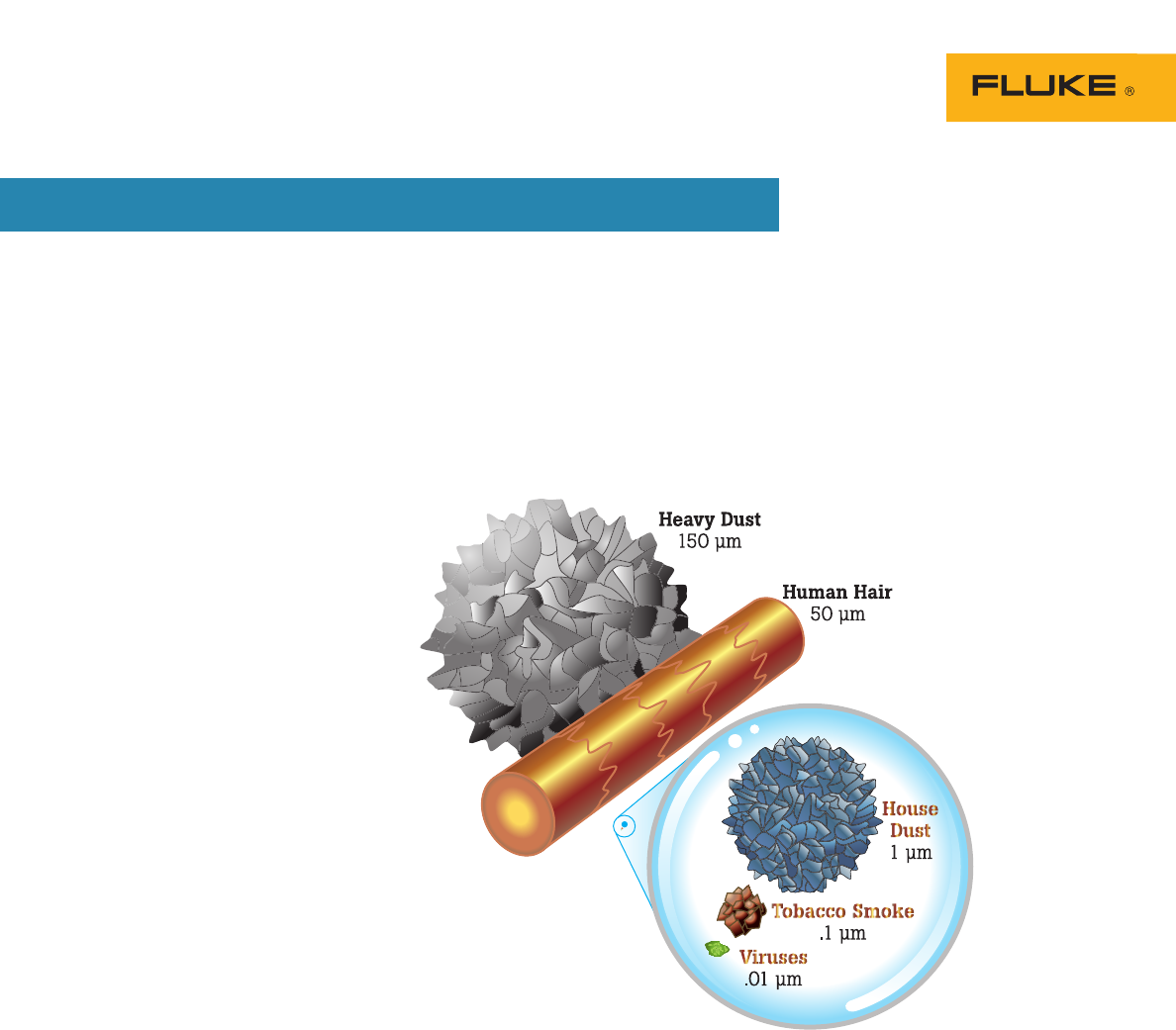
the hits and count the particles in
six size categories, ranging from
.3 microns to 10 microns.
Particles larger than 10 microns
generally settle out of the air.
The Fluke 983 can be pro-
grammed to take repeat counts
instantly, or delayed up to 24
hours between samples. It can
store 5000 records of date, time,
counts, relative humidity, temper-
ature, sample volumes, alarms
and location label records in its
onboard memory. Stored readings
may then be downloaded to a
personal computer. As an alterna-
tive, the particle counter can be
connected directly to a PC for real
time downloads.
According to the CDC,
“Particulate sampling (i.e., total
numbers and size range of partic-
ulates) is a practical method for
evaluating the infection-control
performance of the HVAC system,
with an emphasis on filter effi-
ciency in removing respirable
particles (< 5 µm in diameter) or
larger particles from the air.”v
The accuracy, speed and
compact size of the Fluke 983
make it useful for baseline partic-
ulate testing, problem detection
and remediation and system
maintenance.
•Baseline Testing. To know
when the “abnormal” occurs,
it’s necessary to document
what are normal levels of par-
ticles. According to Andrew
Streifel, it’s not reasonable to
expect “clean room” conditions
in a healthcare setting. When
staff rush into a room to inter-
vene in a patient emergency,
there’s no time to worry about
air quality. Particle counts will
soar with the presence of mul-
tiple people (human beings
shed some 500,000 particles
each minute) and medical pro-
cedures too can contaminate
the air. But later, counts should
return to normal or baseline
levels. Best practice calls for
baseline particulate levels to
be documented, both within
spaces and in the supply air
flowing into the space.
•Maintenance Testing. Once
baseline or “normal” particle
levels are determined,
followup tests should be
performed and documented
periodically. These followup
tests can provide early warn-
ing of developing anomalies
and enable the facility
manager to intervene before
anyone gets sick.
•Filter Testing. Used to test for
particle levels in the air
upstream and downstream
from filter media, the Fluke
983 can verify that filters are
performing as they should.
Testing the level of particles
in incoming filtered air at the
diffuser (air grate)—air that
should be the cleanest in the
room—provides an additional
check on the performance of
filtration systems.
Contamination Testing with Airborne Particle Counters
4 Fluke Corporation Airborne particle counters provide vital information for maintaining indoor air quality in healthcare facilities
Writing in HPAC Engineering
magazine, Streifel said “when
dealing with filtration testing,
the verification data should
be reflected with objective
analysis by providing
airborne-particle comparison
with the specifications of filter
efficiency for fan systems. The
objective analysis available
today should provide function-
ing pressure gauges,
inspection information of the
filter banks, and objective
particle analysis of filters for
filtration leaks. The particle-
analysis procedures at this
time are not standardized but
yet the comparison of before
versus after filter tests with
atmospheric dust particle
sizing will help to assure that
the 90-percent-efficient filter
is removing 90 percent of the
particles greater than 0.5 µm.”vi
•Locating Particle Sources.
The Fluke 983 can help
identify areas where particle
counts are elevated and,
ultimately, lead the user to
the source. A leaking air duct
could be sending unfiltered
air into a room, for instance;
work above a suspended
ceiling could be disturbing
accumulated dust.
•Verifying the Effectiveness
of Remediation.Once the
causes of higher particle
counts have been addressed,
post-testing will show
whether the fixes employed
have really worked at bringing
particulate levels down.
Controlling airborne contamina-
tion within healthcare facilities
poses a complex set of challenges
far beyond the scope of this
paper. Numerous additional
resources are available to help
the professional understand and
overcome those challenges.
Among those easiest to grasp is
the Fluke 983 handheld airborne
particle counter.

Fluke Corporation
PO Box 9090, Everett, WA USA 98206
Fluke Europe B.V.
PO Box 1186, 5602 BD
Eindhoven, The Netherlands
For more information call:
In the U.S.A. (800) 443-5853 or Fax (425) 446-5116
In Europe/M-East/Africa (31 40) 2 675 200 or
Fax (31 40) 2 675 222
In Canada (800) 36-FLUKE or Fax (905) 890-6866
From other countries +1 (425) 446-5500 or
Fax +1 (425) 446-5116
Web access: http://www.fluke.com
©2005 Fluke Corporation. All rights reserved.
Printed in U.S.A. 5/2005 2461172 A-US-N Rev A
Fluke. Keeping your world
up and running.
5 Fluke Corporation Airborne particle counters provide vital information for maintaining indoor air quality in healthcare facilities
i Guidelines for Environmental Infection Control in Health-Care
Facilities, Recommendations of CDC and the Healthcare Infection
Control Practices Advisory Committee (HICPAC), U.S. Department of
Health and Human Services Centers for Disease Control and
Prevention (CDC), 2003, page 20.
ii Ibid, page 34
iii Interview with Andrew Streifel, April 22, 2005
iv Ibid, page 26
v Ibid, page 27
vi “Hospital Accreditation for Airborne Infection Control,” by Andrew
J. Streifel, MPH, HPAC Enginering, March 2003, page 49.
