Freescale Semiconductor Sec2Swug Users Manual SEC 2.0 Reference Device Driver User's Guide
SEC2SWUG to the manual 7816b79a-11c1-4ff5-84fd-7d20a1ad7fea
2015-02-09
: Freescale-Semiconductor Freescale-Semiconductor-Sec2Swug-Users-Manual-552199 freescale-semiconductor-sec2swug-users-manual-552199 freescale-semiconductor pdf
Open the PDF directly: View PDF  .
.
Page Count: 44
- SEC 2.0 Reference Device Driver User’s Guide
- 1 Overview
- 2 Device Driver Components
- 3 User Interface
- 4 Individual Request Type Descriptions
- 4.1 Random Number Requests
- 4.2 DES Requests
- 4.3 ARC4 Requests
- 4.4 Hash Requests
- 4.5 HMAC Requests
- 4.6 AES Requests
- 4.7 Integer Public Key Requests
- 4.8 ECC Public Key Requests
- 4.9 IPSec Requests
- 4.10 802.11 Protocol Requests
- 4.11 SRTP Protocol Requests
- 5 Sample Code
- 6 Linux Environment
- 7 VxWorks Environment
- 8 Porting

This document contains information on a new product. Specifications and information herein
are subject to change without notice.
© Freescale Semiconductor, Inc., 2005. All rights reserved.
PRELIMINARY—SUBJECT TO CHANGE WITHOUT NOTICE
Freescale Semiconductor
1Overview
The SEC2 device driver manages the operation of the SEC 2.0
commonly instantiated into PowerQUICC processors. It is a fully
functional component, meant to serve as an example of application
interaction with the SEC2 core.
The driver is coded in ANSI C. In it’s design, an attempt has been
made to write a device driver that is as operating system agnostic
as practical. Where necessary, operating system dependencies are
identified and Section 8, “Porting” addresses them.
Testing has been accomplished on VxWorks 5.5 and LinuxPPC
using kernel version 2.4.27.
Application interfaces to this driver are implemented through the
ioctl() function call. Requests made through this interface can
be broken down into specific components, including
miscellaneous requests and process requests. The miscellaneous
requests are any requests not related to the direct processing of
data by the SEC2 core.
Process requests comprise the majority of the requests and all are
executed using the same ioctl() access point. Structures needed
to compose these requests are described in detail in Section 3.3.6,
“Process Request Structures.”
Throughout the document, the acronyms CHA (crypto hardware
accelerator) and EU (execution unit) are used interchangeably.
SEC2SWUG
Rev. 0, 02/2005
Contents
1. Overview . . . . . . . . . . . . . . . . . . . . . . . . . . . . . . . . . . . 1
2. Device Driver Components . . . . . . . . . . . . . . . . . . . . 3
3. User Interface . . . . . . . . . . . . . . . . . . . . . . . . . . . . . . . 5
4. Individual Request Type Descriptions . . . . . . . . . . . 14
5. Sample Code . . . . . . . . . . . . . . . . . . . . . . . . . . . . . . . 36
6. Linux Environment . . . . . . . . . . . . . . . . . . . . . . . . . . 39
7. VxWorks Environment . . . . . . . . . . . . . . . . . . . . . . . 40
8. Porting . . . . . . . . . . . . . . . . . . . . . . . . . . . . . . . . . . . . 41
SEC 2.0 Reference Device Driver
User’s Guide

SEC 2.0 Reference Device Driver User’s Guide, Rev. 0
2PRELIMINARY—SUBJECT TO CHANGE WITHOUT NOTICE Freescale Semiconductor
Overview
Both acronyms indicate the device's functional block that performs the crypto functions requested. For further
details on the device see the Hardware Reference Manual.
The reader should understand that the design of this driver is a legacy holdover from two prior generations of
security processors. As applications have already been written for those processors, certain aspects of the interface
for this driver have been designed so as to maintain source-level application portability with prior driver/processor
versions. Where relevant in this document, prior-version compatibility features will be indicated to the reader.
Table 1 contains acronyms and abbreviations that are used in this user’s guide.
Table 1. Acronyms and Abbreviations
Term Meaning
AESA AES accelerator—This term is synonymous with AESU in the
MPC18x User’s Manual
and other
documentation.
AFHA ARC-4 hardware accelerator—This term is synonymous with AFEU in the
MPC18x User’s Manual
and other documentation.
APAD Autopad—The MDHA will automatically pad incomplete message blocks out to 512 bits when APAD
is enabled.
ARC-4 Encryption algorithm compatible with the RC-4 algorithm developed by RSA, Inc.
Auth Authentication
CBC Cipher block chaining—An encryption mode commonly used with block ciphers.
CHA Crypto hardware accelerator—This term is synonymous with ‘execution unit’ in the
MPC18x User’s
Manual
and other documentation.
CTX Context
DESA DES accelerator—This term is synonymous with DEU in the
MPC18x User’s Manual
and other
documentation.
DPD Data packet descriptor
ECB Electronic code book—An encryption mode less commonly used with block ciphers.
EU Execution unit
HMAC Hashed message authentication code
IDGS Initialize digest
IPSec Internet protocol security
ISR Interrupt service routine
KEA Kasumi encryption acceleration
MD Message digest
MDHA Message digest hardware accelerator—This term is synonymous with MDEU in the
MPC18x User’s
Manual
and other documentation.
OS Operating system
PK Public key
PKHA Public key hardware accelerator—This term is synonymous with PKEU in the
MPC18x User’s
Manual
and other documentation.
SEC 2.0 Reference Device Driver User’s Guide, Rev. 0
Freescale Semiconductor PRELIMINARY—SUBJECT TO CHANGE WITHOUT NOTICE 3
Device Driver Components
2 Device Driver Components
This section is provided to help users understand the internal structure of the device driver.
2.1 Device Driver Structure
Internally, the driver is structured in four basic components:
• Driver Initialization and Setup
• Application Request Processing
• Interrupt Service Routine
• Deferred Service Routine
While executing a request, the driver runs in system/kernel state for all components with the exception of the ISR,
which runs in the operating system's standard interrupt processing context.
RDK Restore decrypt key—An AESA option to re-use an existing expanded AES decryption key.
RNGA Random number generator accelerator
SDES Single DES
TEA Transfer error acknowledge
TDES Triple DES
VxWorks Operating systems provided by VxWorks Company.
Table 1. Acronyms and Abbreviations (continued)
Term Meaning
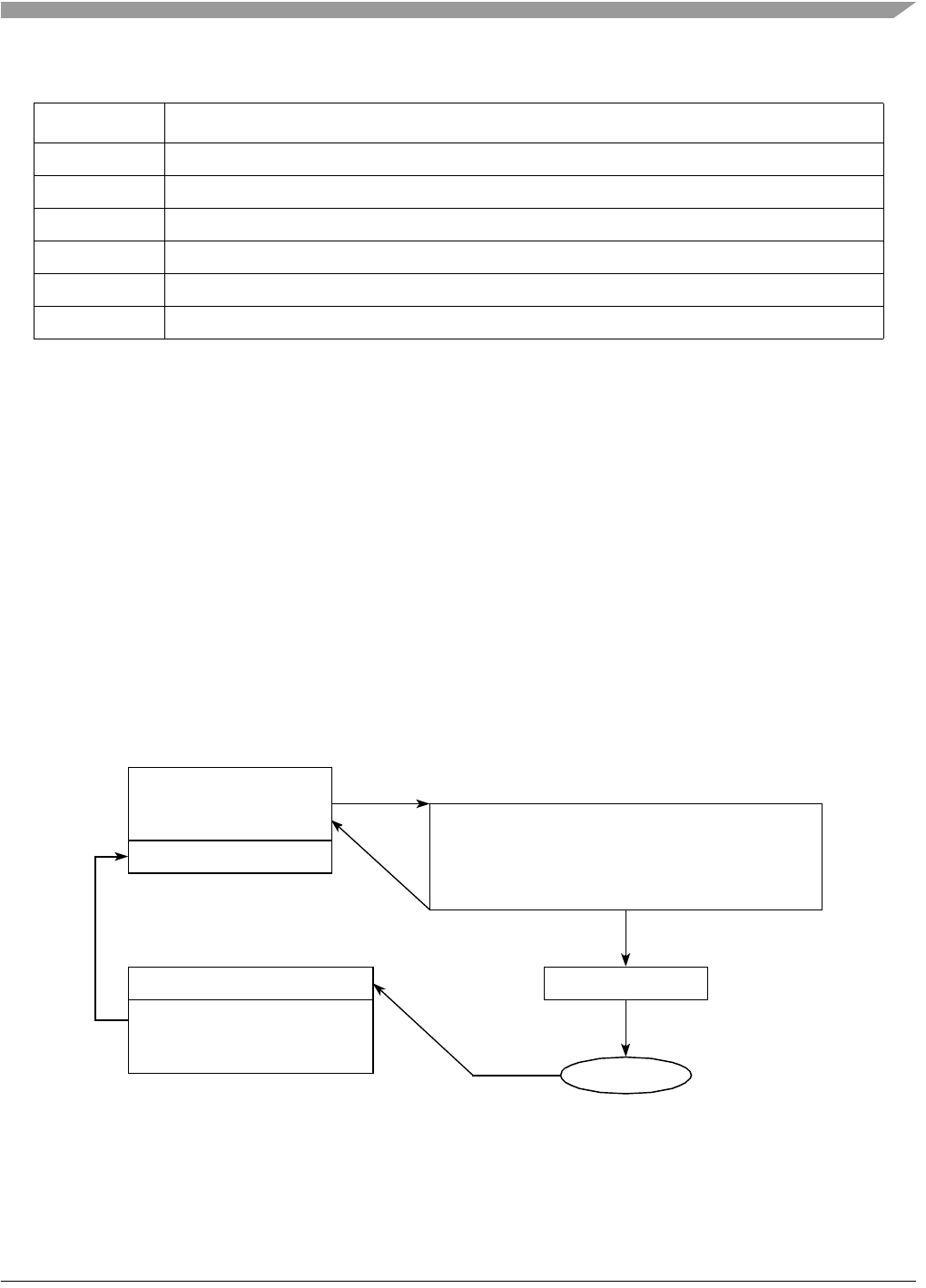
• Prepare Descriptors
• Queue Request when Channels are Unavailable
• Start the descriptor’s execution in a channel
• Tracks Requests
Driver
Invoked
Callback Function
Prepare Request
(Non-Blocking)
ioctl ( )
Sleeps on Queue
Completes the User Request
Execute Callback Function*
Driver
Returns
End-User Application
ProcessingComplete Task
Operation
Starts
SEC2.x Execution
Operation Completed/
Interrupt Generated
ISR
IsrMsgQId
Writing a Message to the Queue Wakes
the ProcessingComplete Task
If no callback function is defined, no callback takes place.
*
Driver Code

SEC 2.0 Reference Device Driver User’s Guide, Rev. 0
4PRELIMINARY—SUBJECT TO CHANGE WITHOUT NOTICE Freescale Semiconductor
Device Driver Components
2.1.1 Driver Initialization Routine
The driver initialization routine includes both OS-specific and hardware-specific initialization. The steps taken by
the driver initialization routine are as follows:
• Finds the security engine core and sets the device memory map starting address in IOBaseAddress.
• Initialize the security engine's registers
— Controller registers
— Channel registers
—EU registers
• Initializes driver internal variables
• Initializes the channel assignment table
— The device driver will maintain this structure with state information for each channel and user request.
A mutual-exclusion semaphore protects this structure so multiple tasks are prevented from interfering
with each other.
• Initializes the internal request queue
— This queue holds requests to be dispatched when channels become available. The queue can hold up to
24 requests. The driver will reject requests with an error when the queue is full.
•ProcessingComplete() is spawned then pends on the IsrMsgQId which serves as the interface between
the interrupt service routine and this deferred task.
2.1.2 Request Dispatch Routine
The request dispatch routine provides the ioctl() interface to the device driver. It uses the callers request code to
identify which function is to execute and dispatches the appropriate handler to process the request. The driver
performs a number of tasks that include tracking requests, queuing requests when the requested channel is
unavailable, preparing data packet descriptors, and writing said descriptor's address to the appropriate channel; in
effect giving the security engine the direction to begin processing the request. The ioctl() function returns to the
end-user application without waiting for the security engine to complete, assuming that once a DPD (data packet
descriptor) is initiated for processing by the hardware, interrupt service may invoke a handler to provide completion
notification
2.1.3 Process Request Routine
The process request routine translates the request into a sequence of one or more data packet descriptors (DPD) and
feeds it to the security engine core to initiate processing. If no channels are available to handle the request, the
request is queued.
2.1.4 Interrupt Service Routine
When processing is completed by the security engine, an interrupt is generated. The interrupt service routine handles
the interrupt and queues the result of the operation in the IsrMsgQId queue for deferred processing by the
ProcessingComplete() deferred service routine.

SEC 2.0 Reference Device Driver User’s Guide, Rev. 0
Freescale Semiconductor PRELIMINARY—SUBJECT TO CHANGE WITHOUT NOTICE 5
User Interface
2.1.5 Deferred Service Routine
The ProcessingComplete() routine completes the request outside of the interrupt service routine, and runs in a
non-ISR context. This routine depends on the IsrMsgQId queue and processes messages written to the queue by
the interrupt service routine. This function will determine which request is complete, and notify the calling task
using any handler specified by that calling task. It will then check the remaining content of the process request
queue, and schedule any queued requests.
3 User Interface
3.1 Application Interface
In order to make a request of the SEC2 device, the calling application populates a request structure with information
describing the request. These structures are described in Section 4, “Individual Request Type Descriptions,” and
include items such as operation ID, channel, callback routines (success and error), and data.
Once the request is prepared, the application calls ioctl() with the prepared request. This function is a standard
system call used by operating system I/O subsystems to implement special-purpose functions. It typically follows
the format:
int ioctl(int fd, /* file descriptor */
int function, /* function code */
int arg /* arbitrary argument (driver dependent) */
The function code (second argument) is defined as the I/O control code. This code will specify the driver-specific
operation to be performed by the device in question. The third argument is the pointer to the SEC2 user request
structure which contains information needed by the driver to perform the function requested.
The following is a list of guidelines to be followed by the end-user application when preparing a request structure:
• The first member of every request structure is an operation ID (opID). The operation ID is used by the
device driver to determine the format of the request structure.
• While all requests have a “channel” member, it's presence is a holdover from earlier variations of the
security engine. For SEC2, it no longer has a valid use, and is retained solely to maintaining request
compatibility for applications written for older security engines.
• All process request structures have a status member. This value is filled in by the device driver when the
interrupt for the operation occurs and it reflects the status of the operation as indicated by the interrupt. The
valid values for this status member are DONE (normal status) or ERROR (error status).
• All process request structures have two notify members, notify and notify_on_error. These notify
members can be used by the device driver to notify the application when its request has been completed.
They may be the same function, or different, as required by the caller's operational requirements.
• All process request structures have a next request member. This allows the application to chain multiple
process requests together.
• It is the application's choice to use a notifier function or to poll the status member.

SEC 2.0 Reference Device Driver User’s Guide, Rev. 0
6PRELIMINARY—SUBJECT TO CHANGE WITHOUT NOTICE Freescale Semiconductor
User Interface
3.2 Error Handling
Due to the asynchronous nature of the device/driver, there are two primary sources of errors:
• Syntax or logic. These are returned in the status member of the 'user request' argument and as a return
code from ioctl function. Errors of this type are detected by the driver, not by hardware.
• Protocol/procedure. These errors are returned only in the status member of the user request argument.
Errors of this type are detected by hardware in the course of their execution.
Consequently, the end-user application needs two levels of error checking, the first one after the return from the
ioctl function, and the second one after the completion of the request. The second level is possible only if the
request was done with at least the notify_on_error member of the user request structure. If the
notification/callback function has not been requested, this level of error will be lost.
A code example of the two levels of errors are as follows, using an AES request as an example:
AESA_CRYPT_REQ aesdynReq;
..
aesdynReq.opId = DPD_AESA_CBC_ENCRYPT_CRYPT;
aesdynReq.channel = 0;
aesdynReq.notify = (void *) notifAes;
aesdynReq.notify_on_error = (void *) notifAes;
aesdynReq.status = 0;
aesdynReq.inIvBytes = 16;
aesdynReq.inIvData = iv_in;
aesdynReq.keyBytes = 32;
aesdynReq.keyData = AesKey;
aesdynReq.inBytes = packet_length;
aesdynReq.inData = aesData;
aesdynReq.outData = aesResult;
aesdynReq.outIvBytes = 16;
aesdynReq.outIvData = iv_out;
aesdynReq.nextReq = 0;
status = Ioctl(device, IOCTL_PROC_REQ, &aesdynReq);
if (status != 0) {
printf ("Syntax-Logic Error in dynamic descriptor 0x%x\n", status); .
.
.
}.

SEC 2.0 Reference Device Driver User’s Guide, Rev. 0
Freescale Semiconductor PRELIMINARY—SUBJECT TO CHANGE WITHOUT NOTICE 7
User Interface
/* in callback function notifAes */
if (aesdynReq.status != 0) {
printf ("Error detected by HW 0x%x\n", aesdynReq.status) ;
.
.
}
3.3 Global Definitions
3.3.1 I/O Control Codes
The I/O control code is the second argument in the ioctl function. Definitions of these control codes are defined
in Sec2.h.
Internally, these values are used in conjunction with a base index to create the I/O control codes. The macro for this
base index is defined by SEC2_IOCTL_INDEX and has a value of 0x0800.
3.3.2 Channel Definitions
The NUM_CHANNELS definition is used to specify the number of channels implemented in the SEC2 device. If not
specified, it will be set to a value of 4 as a default.
Table 2. Second and Third Arguments in the ioctl Function
I/O Control Code (Second
Argument in ioctl Function) Third Argument in ioctl Function
SEC2_PROC_REQ Pointer to user's request structure
SEC2_GET_STATUS Pointer to a STATUS_REQ
SEC2_MALLOC Pointer to be assigned to a block of kernel memory for holding
caller data to be operated upon
SEC2_FREE Pointer to free a block originally allocated by SEC2_MALLOC
SEC2_COPYFROM Pointer to type MALLOC_REQ, which will hold information
about a user buffer that will be copied from user memory space
to kernel memory space allocated by SEC2_MALLOC
SEC2_COPYTO Pointer to type MALLOC_REQ, which will hold information
about a user buffer that will be copied from kernel memory
space allocated by SEC2_MALLOC back to a user's buffer.

SEC 2.0 Reference Device Driver User’s Guide, Rev. 0
8PRELIMINARY—SUBJECT TO CHANGE WITHOUT NOTICE Freescale Semiconductor
User Interface
The NUM_CHAS definition contains the total number of crypto hardware accelerators (CHAs) in SEC2 and is simply
defined as the sum of the individual channels.
The device name is defined as /dev/sec2.
3.3.3 Operation ID (opId) Masks
Operation Ids can be broken down into two parts, the group or type of request and the request index or descriptor
within a group or type. This is provided to help understand the structuring of the opIds. It is not specifically needed
within a user application.
3.3.4 Return Codes
A complete list of the error status results that may be returned to the callback routines follows:
Table 3. Channel Defines
Define Description
NUM_AFHAS Number of ARC4 CHAs
NUM_DESAS Number of DES CHAs
NUM_MDHAS Number of MD CHAs
NUM_RNGAS Number of RNG CHAs
NUM_PKHAS Number of PK CHAs
NUM_AESAS Number of AESA CHAs
Table 4. Request Operation ID Mask
Define Description Value
DESC_TYPE_MASK The mask for the group or type of an opId 0xFF00
DESC_NUM_MASK The mask for the request index or descriptor within that group or type 0x00FF
Table 5. Callback Error Status Return Code
Define Description Value
SEC2_SUCCESS Successful completion of request 0
SEC2_MEMORY_ALLOCATION Driver can’t obtain memory from the host operating
system
0xE004FFFF
SEC2_INVALID_CHANNEL Channel specification was out of range. This exists for
legacy compatibility, and has no relevance for SEC2
0xE004FFFE
SEC2_INVALID_CHA_TYPE Requested CHA doesn’t exist 0xE004FFFD
SEC2_INVALID_OPERATION_ID Requested opID is out of range for this request type 0xE004FFFC
SEC2_CHANNEL_NOT_AVAILABLE Requested channel was not available. This error
exists for legacy compatibility reasons, and has no
relevance for SEC2
0xE004FFFB

SEC 2.0 Reference Device Driver User’s Guide, Rev. 0
Freescale Semiconductor PRELIMINARY—SUBJECT TO CHANGE WITHOUT NOTICE 9
User Interface
SEC2_CHA_NOT_AVAILABLE Requested CHA was not available at the time the
request was being processed
0xE004FFFA
SEC2_INVALID_LENGTH Length of requested data item is incompatible with
request type, or data alignment incompatible
0xE004FFF9
SEC2_OUTPUT_BUFFER_ALIGNMENT Output buffer alignment incompatible with request
type
0xE004FFF8
SEC2_ADDRESS_PROBLEM Driver could not translate argued address into a
physical address
0xE004FFF6
SEC2_INSUFFICIENT_REQS Request entry pool exhausted at the time of request
processing, try again later
0xE004FFF5
SEC2_CHA_ERROR CHA flagged an error during processing, check the
error notification context if one was provided to the
request
0xE004FFF2
SEC2_NULL_REQUEST Request pointer was argued NULL 0xE004FFF1
SEC2_REQUEST_TIMED_OUT Timeout in request processing 0xE004FFF0
SEC2_MALLOC_FAILED Direct kernel memory buffer request failed 0xE004FFEF
SEC2_FREE_FAILED Direct kernel memory free failed 0xE004FFEE
SEC2_PARITY_SYSTEM_ERROR Parity Error detected on the bus 0xE004FFED
SEC2_INCOMPLETE_POINTER Error due to partial pointer 0xE004FFEC
SEC2_TEA_ERROR A transfer error has occurred 0xE004FFEB
SEC2_FRAGMENT_POOL_EXHAUSTED The internal scatter-gather buffer descriptor pool is
full
0xE004FFEA
SEC2_FETCH_FIFO_OVERFLOW Too many DPD's written to a channel (indicates an
internal driver problem)
0xE004FFE9
SEC2_BUS_MASTER_ERROR Processor could not acquire the bus for a data
transfer
0xE004FFE8
SEC2_SCATTER_LIST_ERROR Caller's list describing a scatter-gather buffer is
corrupt
0xE004FFE7
SEC2_UNKNOWN_ERROR Any other unrecognized error 0xE004FFE6
SEC2_IO_CARD_NOT_FOUND Error due to device hardware not being found -1000
SEC2_IO_MEMORY_ALLOCATE_ERROR Error due to insufficient resources -1001
SEC2_IO_IO_ERROR Error due to I/O configuration -1002
SEC2_IO_VXWORKS_DRIVER_TABLE_
ADD_ERROR
Error due to VxWorks not being able to add driver to
table
-1003
SEC2_IO_INTERRUPT_ALLOCATE_ER
ROR
Error due to interrupt allocation error -1004
SEC2_VXWORKS_CANNOT_CREATE_QU
EUE
Error due to VxWorks not being able to create the ISR
queue in IOInitQs()
-1009
Table 5. Callback Error Status Return Code (continued)
Define Description Value

SEC 2.0 Reference Device Driver User’s Guide, Rev. 0
10 PRELIMINARY—SUBJECT TO CHANGE WITHOUT NOTICE Freescale Semiconductor
User Interface
3.3.5 Miscellaneous Request Structures
3.3.5.1 STATUS_REQ Structure
Used to indicate the internal state of the SEC2 core as well as the driver after the occurrence of an event. Returned
as a pointer by GetStatus() and embedded in all requests. This structure is defined in Sec2Notify.h
Each element is a copy of the contents of the same register in the SEC2 driver. This structure is also known as
SEC2_STATUS through a typedef.
unsigned long ChaAssignmentStatusRegister[2];
unsigned long InterruptControlRegister[2];
unsigned long InterruptStatusRegister[2];
unsigned long IdRegister;
unsigned long ChannelStatusRegister[NUM_CHANNELS][2];
unsigned long ChannelConfigurationRegister[NUM_CHANNELS][2];
unsigned long CHAInterruptStatusRegister[NUM_CHAS][2];
unsigned long QueueEntryDepth;
unsigned long FreeChannels;
unsigned long FreeAfhas;
unsigned long FreeDesas;
unsigned long FreeMdhas;
unsigned long FreePkhas;
unsigned long FreeAesas;
unsigned long FreeKeas;
unsigned long BlockSize;
3.3.5.2 SEC2_NOTIFY_ON_ERROR_CTX Structure
Structure returned to the notify_on_error callback routine that was setup in the initial process request. This
structure contains the original request structure as well as an error and driver status.
unsigned long errorcode; // Error that the request generated
void *request; // Pointer to original request
SEC2_CANCELLED_REQUEST Error due to canceled request -1010
SEC2_INVALID_ADDRESS Error due to a NULL request -1011
Table 5. Callback Error Status Return Code (continued)
Define Description Value

SEC 2.0 Reference Device Driver User’s Guide, Rev. 0
Freescale Semiconductor PRELIMINARY—SUBJECT TO CHANGE WITHOUT NOTICE 11
User Interface
STATUS_REQ driverstatus; // Detailed information as to the state of the
// hardware and the driver at the time of an error
3.3.6 Process Request Structures
All process request structures contain the a copy of the same request header information, which is defined by the
COMMON_REQ_PREAMBLE macro. The members of this header must be filled in as needed by the user prior to the
issue of the user's request.
unsigned long opId;
unsigned char scatterBufs;
unsigned char notifyFlags;
unsigned char reserved;
unsigned char channel;
PSEC2_NOTIFY_ROUTINE notify;
PSEC2_NOTIFY_CTX pNotifyCtx;
PSEC2_NOTIFY_ON_ERROR_ROUTINE notify_on_error;
SEC2_NOTIFY_ON_ERROR_CTX ctxNotifyOnErr;
int status;
void *nextReq;
opId operation Id which identifies what type of request this is. It is normally associated with
a specific type of cryptographic operation, see Section 4, “Individual Request Type
Descriptions” for all supported request types.
scatterBufs A bitmask that specifies which of the argued buffers are mapped through a
scatter-gather list. The mask is filled out via the driver's helper function
MarkScatterBuffer(), described in Section 3.3.7, “Scatter-Gather Buffer
Management.”
notifyFlags If a POSIX-style signal handler will be responsible for request completion notification,
then it can contain ORed bits of NOTIFY_IS_PID and/or
NOTIFY_ERROR_IS_PID, signifying that the notify or notify_on_error
pointers are instead the process ID's (i.e. getpid()) of the task requesting a signal
upon request completion.
channel identifies the channel to be used for the request. It exists for legacy compatibility
reasons, and is no longer useful for SEC2.
notify pointer to a notification callback routine that will be called when the request has
completed successfully. May instead be a process ID if a user-state signal handler will
flag completion. Refer back to notifyFlags for more info.
pNotifyCtx pointer to context area to be passed back through the notification routine.

SEC 2.0 Reference Device Driver User’s Guide, Rev. 0
12 PRELIMINARY—SUBJECT TO CHANGE WITHOUT NOTICE Freescale Semiconductor
User Interface
The additional data in the process request structures is specific to each request; refer to the specific structure for this
information.
3.3.7 Scatter-Gather Buffer Management
A unique feature of the SEC 2.0 processor is the hardware's ability to read and act on a scatter-gather description list
for a data buffer. This allows the hardware to more efficiently deal with buffers located in memory belonging to a
non-privileged process; memory which may not be contiguous, but instead may be at scattered locations determined
by the memory management scheme of the host system. Any data buffer in any request may be “marked” as a
scattered memory buffer by the requestor as needed.
For the requestor to do so, two actions must be taken:
• A linked list of structures of type EXT_SCATTER_ELEMENT, one per memory fragment, must be constructed
to describe the whole of the buffer's content.
• The buffer pointer shall reference the head of this list, not the data itself. The buffers containing scatter
references shall be marked in the request's scatterBufs element. Which bits get marked shall be
determined by a helper function that understands the mapping used on an individual request basis.
3.3.7.1 Building the Local Scatter/Gather List with EXT_SCATTER_ELEMENT
Since individual operating systems shall have their own internal means defining memory mapping constructs, the
driver cannot be designed with specific knowledge of one particular mapping method. Therefore, a generic memory
fragment definition structure, EXT_SCATTER_ELEMENT is defined for this purpose.
Each EXT_SCATTER_ELEMENT describes one contiguous fragment of user memory, and is designed so that multiple
fragments can be tied together into a single linked list. It contains these elements:
With this, the caller must construct the list of all the fragments needed to describe the buffer, NULL terminate the end
of the list, and pass the head as the buffer pointer argument. This list must remain intact until completion of the
request.
3.3.7.2 Scatter Buffer Marking
For reasons of legacy compatibility, the structure of all driver request types maintains the same size and form as prior
versions, with a minor change in that a size-compatible scatterBufs element was added as a modification to the
channel element in other versions. This allows the caller a means of indicating which buffers in the request are
notify_on_error pointer to the notify on error routine that will be called when the request has completed
unsuccessfully. May instead be a process ID if a user-state signal handler will flag
completion. Refer back to notifyFlags for more info.
ctxNotifyOnErr context area that is filled in by the driver when there is an error.
status will contain the returned status of request.
nextReq pointer to next request which allows for multiple request to be linked together and sent
via a single ioctl function call.
void *next; pointer to next fragment in list, NULL if at end of list.
void *fragment; pointer to contiguous data fragment.
unsigned short size; size of this fragment in bytes.

SEC 2.0 Reference Device Driver User’s Guide, Rev. 0
Freescale Semiconductor PRELIMINARY—SUBJECT TO CHANGE WITHOUT NOTICE 13
User Interface
scatter-composed, as opposed to direct, contiguous memory (for instance, key data could be in contiguous system
memory, while ciphertext data will be in fragmented user memory).
A problem with marking buffers using this method is that there is no means for the caller to clearly identify which
bit in scatterBufs matches any given pointer in the request, since the data description portion of different requests
cannot be consistent or of any particular order.
A helper function, MarkScatterBuffer(), is therefore made available by the driver to make the bit/pointer
association logic in the driver accessible to the caller. It's form is:
MarkScatterBuffer(void *request, void *buffer);
where request points to the request block being built (the opId element must be set prior to call), and buffer
points to the element within the request which references a scattered buffer. It will then mark the necessary bit in
scatterBufs that defines this buffer for this specific request type.
3.3.7.3 Direct Scatter-Gather Usage Example
In order to make this usage clear, an example is presented. Assume that a triple DES encryption operation is to be
constructed, where the input and output buffers are located in fragmented user memory, and the cipher keys and IV
are contained in system memory. A DES_LOADCTX_CRYPT_REQ is zero-allocated as encReq, and constructed:
/* set up encryption operation */
encReq.opId = DPD_TDES_CBC_CTX_ENCRYPT;
encReq.notify = notifier;
encReq.notify_on_error = notifier;
encReq.inIvBytes = 8;
encReq.keyBytes = 24;
encReq.inBytes = bufsize;
encReq.inIvData = iv;
encReq.keyData = cipherKey;
encReq.inData = (unsigned char *)input; /* this buffer is scattered */
encReq.outIvBytes = 8;
encReq.outIvData = ctx;
encReq.outData = (unsigned char *)output; /* this buffer is scattered */
MarkScatterBuffer(&encReq, &encReq.input);
MarkScatterBuffer(&encReq, &encReq.output);
Upon completion of the two mark calls, encReq.scatterBufs will have two bits set within it that the driver
knows how to interpret as meaning that the intended buffers have scatter lists defined for them, and will process
them accordingly as the DPD is built for the hardware.

SEC 2.0 Reference Device Driver User’s Guide, Rev. 0
14 PRELIMINARY—SUBJECT TO CHANGE WITHOUT NOTICE Freescale Semiconductor
Individual Request Type Descriptions
4 Individual Request Type Descriptions
4.1 Random Number Requests
4.1.1 RNG_REQ
COMMON_REQ_PREAMBLE
unsigned long rngBytes;
unsigned char* rngData;
NUM_RNGA_DESC defines the number of descriptors within the DPD_RNG_GROUP that use this request.
DPD_RNG_GROUP (0x1000) defines the group for all descriptors within this request.
4.2 DES Requests
4.2.1 DES_CBC_CRYPT_REQ
COMMON_REQ_PREAMBLE
unsigned long inIvBytes; /* 0 or 8 bytes */
unsigned char *inIvData;
unsigned long keyBytes; /* 8, 16, or 24 bytes */
unsigned char *keyData;
unsigned long inBytes; /* multiple of 8 bytes */
unsigned char *inData;
unsigned char *outData; /* output length = input length */
unsigned long outIvBytes; /* 0 or 8 bytes */
unsigned char *outIvData;
NUM_DES_LOADCTX_DESC defines the number of descriptors within the DPD_DES_CBC_CTX_GROUP that use this
request.
DPD_DES_CBC_CTX_GROUP (0x2500) defines the group for all descriptors within this request.
Table 6. RNG_REQ Valid Descriptor (opId)
Descriptor Value Function Description
DPD_RNG_GETRN 0x1000 Generate a series of random values

SEC 2.0 Reference Device Driver User’s Guide, Rev. 0
Freescale Semiconductor PRELIMINARY—SUBJECT TO CHANGE WITHOUT NOTICE 15
Individual Request Type Descriptions
4.2.2 DES_CRYPT_REQ
COMMON_REQ_PREAMBLE
unsigned long keyBytes; /* 8, 16, or 24 bytes */
unsigned char *keyData;
unsigned long inBytes; /* multiple of 8 bytes */
unsigned char *inData;
unsigned char *outData; /* output length = input length */
NUM_DES_DESC defines the number of descriptors within the DPD_DES_ECB_GROUP that use this request.
DPD_DES_ECB_GROUP (0x2600) defines the group for all descriptors within this request.
4.3 ARC4 Requests
4.3.1 ARC4_LOADCTX_CRYPT_REQ
COMMON_REQ_PREAMBLE
unsigned long inCtxBytes; /* 257 bytes */
Table 7. DES_CBC_CRYPT_REQ Valid Descriptors (opId)
Descriptors Value Function Description
DPD_SDES_CBC_CTX_ENCRYPT 0x2500 Load encrypted context from a dynamic channel to
encrypt in single DES using CBC mode
DPD_SDES_CBC_CTX_DECRYPT 0x2501 Load encrypted context from a dynamic channel to
decrypt in single DES using CBC mode
DPD_TDES_CBC_CTX_ENCRYPT 0x2502 Load encrypted context from a dynamic channel to
encrypt in triple DES using CBC mode
DPD_TDES_CBC_CTX_DECRYPT 0x2503 Load encrypted context from a dynamic channel to
decrypt in triple DES using CBC mode
Table 8. DES_CRYPT_REQ Valid Descriptors (opId)
Descriptors Value Function Description
DPD_SDES_ECB_ENCRYPT 0x2600 Encrypt data in single DES using ECB mode
DPD_SDES_ECB_DECRYPT 0x2601 Decrypt data in single DES using ECB mode
DPD_TDES_ECB_ENCRYPT 0x2602 Encrypt data in triple DES using ECB mode
DPD_TDES_ECB_DECRYPT 0x2603 Decrypt data in triple DES using ECB mode

SEC 2.0 Reference Device Driver User’s Guide, Rev. 0
16 PRELIMINARY—SUBJECT TO CHANGE WITHOUT NOTICE Freescale Semiconductor
Individual Request Type Descriptions
unsigned char *inCtxData;
unsigned long inBytes;
unsigned char *inData;
unsigned char *outData; /* output length = input length */
unsigned long outCtxBytes; /* 257 bytes */
unsigned char *outCtxData;
NUM_RC4_LOADCTX_UNLOADCTX_DESC defines the number of descriptors within the
DPD_RC4_LDCTX_CRYPT_ULCTX_GROUP that use this request.
DPD_RC4_LDCTX_CRYPT_ULCTX_GROUP (0x3400) defines the group for all descriptors within this request.
4.3.2 ARC4_LOADKEY_CRYPT_UNLOADCTX_REQ
COMMON_REQ_PREAMBLE
unsigned long keyBytes;
unsigned char *keyData;
unsigned long inBytes;
unsigned char *inData;
unsigned char *outData; /* output length = input length */
unsigned long outCtxBytes; /* 257 bytes */
unsigned char* outCtxData;
NUM_RC4_LOADKEY_UNLOADCTX_DESC defines the number of descriptors within the
DPD_RC4_LDKEY_CRYPT_ULCTX_GROUP that use this request.
DPD_RC4_LDKEY_CRYPT_ULCTX_GROUP (0x3500) defines the group for all descriptors within this request.
Table 9. ARC4_LOADCTX_CRYPT_REQ Valid Descriptor (opId)
Descriptor Value Function Description
DPD_RC4_LDCTX_CRYPT_ULCTX 0x3400 Load context, encrypt using RC4, and store the
resulting context
Table 10. ARC4_LOADKEY_CRYPT_UNLOADCTX_REQ Valid Descriptor (opId)
Descriptor Value Function Description
DPD_RC4_LDKEY_CRYPT_ULCTX 0x3500 Load the cipher key, encrypt using RC4 then save the
resulting context

SEC 2.0 Reference Device Driver User’s Guide, Rev. 0
Freescale Semiconductor PRELIMINARY—SUBJECT TO CHANGE WITHOUT NOTICE 17
Individual Request Type Descriptions
4.4 Hash Requests
4.4.1 HASH_REQ
COMMON_REQ_PREAMBLE
unsigned long ctxBytes;
unsigned char *ctxData;
unsigned long inBytes;
unsigned char *inData;
unsigned long outBytes; /* length is fixed by algorithm */
unsigned char *outData;
NUM_MDHA_DESC defines the number of descriptors within the DPD_HASH_LDCTX_HASH_ULCTX_GROUP that use
this request.
DPD_HASH_LDCTX_HASH_ULCTX_GROUP (0x4400) defines the group for all descriptors within this request.
NUM_MDHA_PAD_DESC defines the number of descriptors within the
DPD_HASH_LDCTX_HASH_PAD_ULCTX_GROUP that use this request.
DPD_HASH_LDCTX_HASH_PAD_ULCTX_GROUP (0x4500) defines the group for all descriptors within this request.
Table 11 . HASH_REQ Valid Descriptors (0x4400) (opId)
Descriptors Value Function Description
DPD_SHA256_LDCTX_HASH_ULCTX 0x4400 Load context, compute digest using SHA-256 hash
algorithm, then save the resulting context
DPD_MD5_LDCTX_HASH_ULCTX 0x4401 Load context, compute digest using MD5 hash
algorithm, then save the resulting context
DPD_SHA_LDCTX_HASH_ULCTX 0x4402 Load context, compute using SHA-1 hash algorithm,
then save the resulting context
DPD_SHA256_LDCTX_IDGS_HASH_ULCTX 0x4403 Load context, compute digest with SHA-256 IDGS
hash algorithm, then store the resulting context
DPD_MD5_LDCTX_IDGS_HASH_ULCTX 0x4404 Load context, compute digest with MD5 IDGS hash
algorithm, then store the resulting context
DPD_SHA_LDCTX_IDGS_HASH_ULCTX 0x4405 Load context, compute digest with SHA-1 IDGS hash
algorithm, then store the resulting context

SEC 2.0 Reference Device Driver User’s Guide, Rev. 0
18 PRELIMINARY—SUBJECT TO CHANGE WITHOUT NOTICE Freescale Semiconductor
Individual Request Type Descriptions
4.5 HMAC Requests
4.5.1 HMAC_PAD_REQ
COMMON_REQ_PREAMBLE
unsigned long keyBytes;
unsigned char *keyData;
unsigned long inBytes;
unsigned char *inData;
unsigned long outBytes; /* length is fixed by algorithm */
unsigned char *outData;
NUM_HMAC_PAD_DESC defines the number of descriptors within the DPD_HASH_LDCTX_HMAC_ULCTX_GROUP that
use this request.
DPD_HASH_LDCTX_HMAC_ULCTX_GROUP (0x4A00) defines the group for all descriptors within this request.
Table 12. HASH_REQ Valid Descriptors (0x4500) (opId)
Descriptors Value Function Description
DPD_SHA256_LDCTX_HASH_PAD_ULCTX 0x4500 Compute digest with pre-padded data using an
SHA-256 hash algorithm then store the resulting
context
DPD_MD5_LDCTX_HASH_PAD_ULCTX 0x4501 Compute digest with pre-padded data using an MD5
hash algorithm then store the resulting context
DPD_SHA_LDCTX_HASH_PAD_ULCTX 0x4502 Compute digest with pre-padded data using an
SHA-1 hash algorithm then store the resulting context
DPD_SHA256_LDCTX_IDGS_HASH_PAD_ULCTX 0x4503 Compute digest with pre-padded data using an
SHA-256 IDGS hash algorithm then store the
resulting padded context
DPD_MD5_LDCTX_IDGS_HASH_PAD_ULCTX 0x4504 Compute digest with pre-padded data using an MD5
IDGS hash algorithm then store the resulting padded
context
DPD_SHA_LDCTX_IDGS_HASH_PAD_ULCTX 0x4505 Compute digest with pre-padded data using an
SHA-1 IDGS hash algorithm then store the resulting
padded context

SEC 2.0 Reference Device Driver User’s Guide, Rev. 0
Freescale Semiconductor PRELIMINARY—SUBJECT TO CHANGE WITHOUT NOTICE 19
Individual Request Type Descriptions
4.6 AES Requests
4.6.1 AESA_CRYPT_REQ
COMMON_REQ_PREAMBLE
unsigned long keyBytes; /* 16, 24, or 32 bytes */
unsigned char *keyData;
unsigned long inIvBytes; /* 0 or 16 bytes */
unsigned char *inIvData;
unsigned long inBytes; /* multiple of 8 bytes */
unsigned char *inData;
unsigned char *outData; /* output length = input length */
unsigned long outCtxBytes; /* 0 or 8 bytes */
unsigned char *outCtxData;
NUM_AESA_CRYPT_DESC defines the number of descriptors within the DPD_AESA_CRYPT_GROUP that use this
request.
DPD_AESA_CRYPT_GROUP (0x6000) defines the group for all descriptors within this request.
Table 13. HMAC_PAD_REQ Valid Descriptors (opId)
Descriptors Value Function Description
DPD_SHA256_LDCTX_HMAC_ULCTX 0x4A00 Load context, then use an SHA-256 hash algorithm,
then store the resulting HMAC context
DPD_MD5_LDCTX_HMAC_ULCTX 0x4A01 Load context, then use an MD5 hash algorithm, then
store the resulting HMAC context
DPD_SHA_LDCTX_HMAC_ULCTX 0x4A02 Load context, then use an SHA-1 hash algorithm,
then store the resulting HMAC context
DPD_SHA256_LDCTX_HMAC_PAD_ULCTX 0x4A03 Load context, then use an SHA-256 IDGS hash
algorithm, then store the resulting padded HMAC
context
DPD_MD5_LDCTX_HMAC_PAD_ULCTX 0x4A04 Load context, then use an MD5 IDGS hash algorithm,
then store the resulting padded HMAC context
DPD_SHA_LDCTX_HMAC_PAD_ULCTX 0x4A05 Load context, then use an SHA-1 IDGS hash
algorithm, then store the resulting padded HMAC
context

SEC 2.0 Reference Device Driver User’s Guide, Rev. 0
20 PRELIMINARY—SUBJECT TO CHANGE WITHOUT NOTICE Freescale Semiconductor
Individual Request Type Descriptions
4.7 Integer Public Key Requests
4.7.1 MOD_EXP_REQ
COMMON_REQ_PREAMBLE
unsigned long aDataBytes;
unsigned char *aData;
unsigned long expBytes;
unsigned char *expData;
unsigned long modBytes;
unsigned char *modData;
unsigned long outBytes;
unsigned char *outData;
NUM_MM_EXP_DESC defines the number of descriptors within the DPD_MM_LDCTX_EXP_ULCTX_GROUP that use
this request.
DPD_MM_LDCTX_EXP_ULCTX_GROUP (0x5100) defines the group for all descriptors within this request.
Table 14. AESA_CRYPT_REQ Valid Descriptors (opId)
Descriptors Value Function Description
DPD_AESA_CBC_ENCRYPT_CRYPT 0x6000 Perform encryption in AESA using CBC mode
DPD_AESA_CBC_DECRYPT_CRYPT 0x6001 Perform decryption in AESA using CBC mode
DPD_AESA_CBC_DECRYPT_CRYPT_RDK 0x6002 Perform decryption in AESA using CBC mode with
RDK
DPD_AESA_ECB_ENCRYPT_CRYPT 0x6003 Perform encryption in AESA using ECB mode
DPD_AESA_ECB_DECRYPT_CRYPT 0x6004 Perform decryption in AESA using ECB mode
DPD_AESA_ECB_DECRYPT_CRYPT_RDK 0x6005 Perform decryption in AESA using ECB mode with
RDK
DPD_AESA_CTR_CRYPT 0x6006 Perform CTR in AESA
DPD_AESA_CTR_HMAC 0x6007 Perform AES CTR-mode cipher operation with
integrated authentication as part of the operation
Table 15. MOD_EXP_REQ Valid Descriptor (opId)
Descriptors Value Function Description
DPD_MM_LDCTX_EXP_ULCTX 0x5100 Perform a modular exponentiation operation

SEC 2.0 Reference Device Driver User’s Guide, Rev. 0
Freescale Semiconductor PRELIMINARY—SUBJECT TO CHANGE WITHOUT NOTICE 21
Individual Request Type Descriptions
4.7.2 MOD_SS_EXP_REQ
COMMON_REQ_PREAMBLE
unsigned long expBytes;
unsigned char *expData;
unsigned long modBytes;
unsigned char *modData;
unsigned long aDataBytes;
unsigned char *aData;
unsigned long bDataBytes;
unsigned char *bData;
NUM_MM_SS_EXP_DESC defines the number of descriptors within the DPD_MM_SS_EXP_GROUP that use this
request.
DPD_MM_SS_EXP_GROUP (0x5B00) defines the group for all descriptors within this request.
4.7.3 MOD_R2MODN_REQ
COMMON_REQ_PREAMBLE
unsigned long modBytes;
unsigned char *modData;
unsigned long outBytes;
unsigned char *outData;
NUM_MM_R2MODN_DESC defines the number of descriptors within the DPD_MM_LDCTX_R2MODN_ULCTX_GROUP
that use this request.
DPD_MM_LDCTX_R2MODN_ULCTX_GROUP (0x5200) defines the group for all descriptors within this request.
Table 16. MOD_SS_EXP_REQ Valid Descriptor (opId)
Descriptors Value Function Description
DPD_MM_SS_RSA_EXP 0x5B00 Perform a single-stage RSA exponentiation operation
Table 17. MOD_R2MODN_REQ Valid Descriptor (opId)
Descriptor Value Function Description
DPD_MM_LDCTX_R2MODN_ULCTX 0x5200 Perform a R2MOD operation upon a public key

SEC 2.0 Reference Device Driver User’s Guide, Rev. 0
22 PRELIMINARY—SUBJECT TO CHANGE WITHOUT NOTICE Freescale Semiconductor
Individual Request Type Descriptions
4.7.4 MOD_RRMODP_REQ
COMMON_REQ_PREAMBLE
unsigned long nBytes;
unsigned long pBytes;
unsigned char *pData;
unsigned long outBytes;
unsigned char *outData;
NUM_MM_RRMODP_DESC defines the number of descriptors within the DPD_MM_LDCTX_RRMODP_ULCTX_GROUP
that use this request.
DPD_MM_LDCTX_RRMODP_ULCTX_GROUP (0x5300) defines the group for all descriptors within this request.
4.7.5 MOD_2OP_REQ
unsigned long bDataBytes;
unsigned char *bData;
unsigned long aDataBytes;
unsigned char *aData;
unsigned long modBytes;
unsigned char *modData;
unsigned long outBytes;
unsigned char *outData;
NUM_MM_2OP_DESC defines the number of descriptors within the DPD_MM_LDCTX_2OP_ULCTX_GROUP that use
this request.
DPD_MM_LDCTX_2OP_ULCTX_GROUP (0x5400) defines the group for all descriptors within this request.
Table 18. MOD_RRMODP_REQ Valid Descriptor (opId)
Descriptor Value Function Description
DPD_MM_LDCTX_RRMODP_ULCTX 0x5300 Compute the result of an RRMODP operation

SEC 2.0 Reference Device Driver User’s Guide, Rev. 0
Freescale Semiconductor PRELIMINARY—SUBJECT TO CHANGE WITHOUT NOTICE 23
Individual Request Type Descriptions
Table 19. MOD_2OP_REQ Valid Descriptors (opId)
Descriptors Value Function Description
DPD_MM_LDCTX_MUL1_ULCTX 0x5400 Perform a modular MUL1 operation
DPD_MM_LDCTX_MUL2_ULCTX 0x5401 Perform a modular MUL2 operation
DPD_MM_LDCTX_ADD_ULCTX 0x5402 Perform a modular ADD operation
DPD_MM_LDCTX_SUB_ULCTX 0x5403 Perform a modular SUB operation
DPD_POLY_LDCTX_A0_B0_MUL1_ULCTX 0x5404 Perform a modular A0-to-B0 MUL1 operation
DPD_POLY_LDCTX_A0_B0_MUL2_ULCTX 0x5405 Perform a modular A0-to-B0 MUL2 operation
DPD_POLY_LDCTX_A0_B0_ADD_ULCTX 0x5406 Perform a modular A0-to-B0 ADD operation
DPD_POLY_LDCTX_A1_B0_MUL1_ULCTX 0x5407 Perform a modular A1-to-B0 MUL1 operation
DPD_POLY_LDCTX_A1_B0_MUL2_ULCTX 0x5408 Perform a modular A1-to-B0 MUL2 operation
DPD_POLY_LDCTX_A1_B0_ADD_ULCTX 0x5409 Perform a modular A1-to-B0 ADD operation
DPD_POLY_LDCTX_A2_B0_MUL1_ULCTX 0x540A Perform a modular A2-to-B0 MUL1 operation
DPD_POLY_LDCTX_A2_B0_MUL2_ULCTX 0x540B Perform a modular A2-to-B0 MUL2 operation
DPD_POLY_LDCTX_A2_B0_ADD_ULCTX 0x540C Perform a modular A2-to-B0 ADD operation
DPD_POLY_LDCTX_A3_B0_MUL1_ULCTX 0x540D Perform a modular A3-to-B0 MUL1 operation
DPD_POLY_LDCTX_A3_B0_MUL2_ULCTX 0x540E Perform a modular A3-to-B0 MUL2 operation
DPD_POLY_LDCTX_A3_B0_ADD_ULCTX 0x540F Perform a modular A3-to-B0 ADD operation
DPD_POLY_LDCTX_A0_B1_MUL1_ULCTX 0x5410 Perform a modular A0-to-B1 MUL1 operation
DPD_POLY_LDCTX_A0_B1_MUL2_ULCTX 0x5411 Perform a modular A-to-B MUL2 operation
DPD_POLY_LDCTX_A0_B1_ADD_ULCTX 0x5412 Perform a modular A0-to-B1 ADD operation
DPD_POLY_LDCTX_A1_B1_MUL1_ULCTX 0x5413 Perform a modular A1-to-B1 MUL1 operation
DPD_POLY_LDCTX_A1_B1_MUL2_ULCTX 0x5414 Perform a modular A1-to-B1 MUL2 operation
DPD_POLY_LDCTX_A1_B1_ADD_ULCTX 0x5415 Perform a modular A1-to-B1 ADD operation
DPD_POLY_LDCTX_A2_B1_MUL1_ULCTX 0x5416 Perform a modular A2-to-B1 MUL1 operation
DPD_POLY_LDCTX_A2_B1_MUL2_ULCTX 0x5417 Perform a modular A2-to-B1 MUL2 operation
DPD_POLY_LDCTX_A2_B1_ADD_ULCTX 0x5418 Perform a modular A2-to-B1 ADD operation
DPD_POLY_LDCTX_A3_B1_MUL1_ULCTX 0x5419 Perform a modular A3-to-B1 MUL1 operation
DPD_POLY_LDCTX_A3_B1_MUL2_ULCTX 0x541A Perform a modular A3-to-B1 MUL2 operation
DPD_POLY_LDCTX_A3_B1_ADD_ULCTX 0x541B Perform a modular A3-to-B1 ADD operation
DPD_POLY_LDCTX_A0_B2_MUL1_ULCTX 0x541C Perform a modular A0-to-B2 MUL1 operation
DPD_POLY_LDCTX_A0_B2_MUL2_ULCTX 0x541D Perform a modular A0-to-B2 MUL2 operation
DPD_POLY_LDCTX_A0_B2_ADD_ULCTX 0x541E Perform a modular A0-to-B2ADD operation
DPD_POLY_LDCTX_A1_B2_MUL1_ULCTX 0x541F Perform a modular A1-to-B2 MUL1 operation

SEC 2.0 Reference Device Driver User’s Guide, Rev. 0
24 PRELIMINARY—SUBJECT TO CHANGE WITHOUT NOTICE Freescale Semiconductor
Individual Request Type Descriptions
4.8 ECC Public Key Requests
4.8.1 ECC_POINT_REQ
COMMON_REQ_PREAMBLE
unsigned long nDataBytes;
unsigned char *nData;
unsigned long eDataBytes;
unsigned char *eData;
unsigned long buildDataBytes;
unsigned char *buildData;
unsigned long b1DataBytes;
DPD_POLY_LDCTX_A1_B2_MUL2_ULCTX 0x5420 Perform a modular A1-to-B2 MUL2 operation
DPD_POLY_LDCTX_A1_B2_ADD_ULCTX 0x5421 Perform a modular A1-to-B2 ADD operation
DPD_POLY_LDCTX_A2_B2_MUL1_ULCTX 0x5422 Perform a modular A2-to-B2 MUL1 operation
DPD_POLY_LDCTX_A2_B2_MUL2_ULCTX 0x5423 Perform a modular A2-to-B2 MUL2 operation
DPD_POLY_LDCTX_A2_B2_ADD_ULCTX 0x5424 Perform a modular A2-to-B2 ADD operation
DPD_POLY_LDCTX_A3_B2_MUL1_ULCTX 0x5425 Perform a modular A3-to-B2 MUL1 operation
DPD_POLY_LDCTX_A3_B2_MUL2_ULCTX 0x5426 Perform a modular A3-to-B2 MUL2 operation
DPD_POLY_LDCTX_A3_B2_ADD_ULCTX 0x5427 Perform a modular A3-to-B2 ADD operation
DPD_POLY_LDCTX_A0_B3_MUL1_ULCTX 0x5428 Perform a modular A0-to-B3 MUL1 operation
DPD_POLY_LDCTX_A0_B3_MUL2_ULCTX 0x5429 Perform a modular n A0-to-B3 MUL2 operation
DPD_POLY_LDCTX_A0_B3_ADD_ULCTX 0x542A Perform a modular A0-to-B3 ADD operation
DPD_POLY_LDCTX_A1_B3_MUL1_ULCTX 0x542B Perform a modular A1-to-B3 MUL1 operation
DPD_POLY_LDCTX_A1_B3_MUL2_ULCTX 0x542C Perform a modular A1-to-B3 MUL2 operation
DPD_POLY_LDCTX_A1_B3_ADD_ULCTX 0x542D Perform a modular A1-to-B3 ADD operation
DPD_POLY_LDCTX_A2_B3_MUL1_ULCTX 0x542E Perform a modular A2-to-B3 MUL1 operation
DPD_POLY_LDCTX_A2_B3_MUL2_ULCTX 0x542F Perform a modular A2-to-B3 MUL2 operation
DPD_POLY_LDCTX_A2_B3_ADD_ULCTX 0x5430 Perform a modular A2-to-B3 ADD operation
DPD_POLY_LDCTX_A3_B3_MUL1_ULCTX 0x5431 Perform a modular A3-to-B3 MUL1 operation
DPD_POLY_LDCTX_A3_B3_MUL2_ULCTX 0x5432 Perform a modular A3-to-B3 MUL2 operation
DPD_POLY_LDCTX_A3_B3_ADD_ULCTX 0x5433 Perform a modular A3-to-B3 ADD operation
Table 19. MOD_2OP_REQ Valid Descriptors (opId) (continued)
Descriptors Value Function Description

SEC 2.0 Reference Device Driver User’s Guide, Rev. 0
Freescale Semiconductor PRELIMINARY—SUBJECT TO CHANGE WITHOUT NOTICE 25
Individual Request Type Descriptions
unsigned char *b1Data;
unsigned long b2DataBytes;
unsigned char *b2Data;
unsigned long b3OutDataBytes;
unsigned char *b3OutData;
NUM_EC_POINT_DESC defines the number of descriptors within the DPD_EC_LDCTX_kP_ULCTX_GROUP that use
this request.
DPD_EC_LDCTX_kP_ULCTX_GROUP (0x5800) defines the group for all descriptors within this request.
4.8.2 ECC_2OP_REQ
COMMON_REQ_PREAMBLE
unsigned long bDataBytes;
unsigned char *bData;
unsigned long aDataBytes;
unsigned char *aData;
unsigned long modBytes;
unsigned char *modData;
unsigned long outBytes;
unsigned char *outData;
NUM_EC_2OP_DESC defines the number of descriptors within the DPD_EC_2OP_GROUP that use this request.
Table 20. ECC_POINT_REQ Valid Descriptors (opId)
Descriptors Value Function Description
DPD_EC_FP_AFF_PT_MULT 0x5800 Perform a PT_MULT operation in an affine system
DPD_EC_FP_PROJ_PT_MULT 0x5801 Perform a PT_MULT operation in a projective system
DPD_EC_F2M_AFF_PT_MULT 0x5802 Perform an F2M PT_MULT operation in an affine
system
DPD_EC_F2M_PROJ_PT_MULT 0x5803 Perform an F2M PT_MULT operation in a projective
system
DPD_EC_FP_LDCTX_ADD_ULCTX 0x5804 Perform an FP add operation
DPD_EC_FP_LDCTX_DOUBLE_ULCTX 0x5805 Perform an FP double operation
DPD_EC_F2M_LDCTX_ADD_ULCTX 0x5806 Perform an F2M add operation
DPD_EC_F2M_LDCTX_DOUBLE_ULCTX 0x5807 Perform an F2M double operation

SEC 2.0 Reference Device Driver User’s Guide, Rev. 0
26 PRELIMINARY—SUBJECT TO CHANGE WITHOUT NOTICE Freescale Semiconductor
Individual Request Type Descriptions
DPD_EC_2OP_GROUP (0x5900) defines the group for all descriptors within this request.
4.8.3 ECC_SPKBUILD_REQ
COMMON_REQ_PREAMBLE
unsigned long a0DataBytes;
unsigned char *a0Data;
unsigned long a1DataBytes;
unsigned char *a1Data;
unsigned long a2DataBytes;
unsigned char *a2Data;
unsigned long a3DataBytes;
unsigned char *a3Data;
unsigned long b0DataBytes;
unsigned char *b0Data;
unsigned long b1DataBytes;
unsigned char *b1Data;
unsigned long buildDataBytes;
unsigned char *buildData;
NUM_EC_SPKBUILD_DESC defines the number of descriptors within the DPD_EC_SPKBUILD_GROUP that use this
request.
DPD_EC_SPKBUILD_GROUP (0x5a00) defines the group for all descriptors within this request.
Table 21. ECC_2OP_REQ Valid Descriptors (opId)
Descriptor Value Function Description
DPD_EC_F2M_LDCTX_MUL1_ULCTX 0x5900 Perform an F2M MULT1 operation
Table 22. ECC_SPKBUILD_REQ Valid Descriptor (opId)
Descriptor Value Function Description
DPD_EC_SPKBUILD_ULCTX 0x5A00 Using separate values for a0-a3 and b0-b1, build a
uniform data block that can be used to condense data
to a point that allow it to be used with ECC operational
requests.

SEC 2.0 Reference Device Driver User’s Guide, Rev. 0
Freescale Semiconductor PRELIMINARY—SUBJECT TO CHANGE WITHOUT NOTICE 27
Individual Request Type Descriptions
4.8.4 ECC_PTADD_DBL_REQ
COMMON_REQ_PREAMBLE
unsigned long modBytes;
unsigned char *modData;
unsigned long buildDataBytes;
unsigned char *buildData;
unsigned long b2DataBytes;
unsigned char *b2Data;
unsigned long b3DataBytes;
unsigned char *b3Data;
unsigned long b1DataBytes;
unsigned char *b2Data;
unsigned long b2DataBytes;
unsigned char *b2Data;
unsigned long b3DataBytes;
unsigned char *b3Data;
4.9 IPSec Requests
4.9.1 IPSEC_CBC_REQ
COMMON_REQ_PREAMBLE
unsigned long hashKeyBytes;
unsigned char *hashKeyData;
unsigned long cryptKeyBytes;
unsigned char *cryptKeyData;
unsigned long cryptCtxInBytes;
Table 23. ECC_PTADD_DBL_REQ Valid Descriptor (opId)
Descriptor Value Function Description
DPD_EC_FPADD 0x5d00 Perform an FP add operation
DPD_EC_FPDBL 0x5d01 Perform an FP double operation
DPD_EC_F2MADD 0x5d02 Perform an F2M add operation
DPD_EC_F2MDBL 0x5d03 Perform an F2M double operation

SEC 2.0 Reference Device Driver User’s Guide, Rev. 0
28 PRELIMINARY—SUBJECT TO CHANGE WITHOUT NOTICE Freescale Semiconductor
Individual Request Type Descriptions
unsigned char *cryptCtxInData;
unsigned long hashInDataBytes;
unsigned char *hashInData;
unsigned long inDataBytes;
unsigned char *inData;
unsigned char *cryptDataOut;
unsigned long hashDataOutBytes;
unsigned char *hashDataOut;
NUM_IPSEC_CBC_DESC defines the number of descriptors within the DPD_IPSEC_CBC_GROUP that use this
request.
DPD_IPSEC_CBC_GROUP (0x7000) defines the group for all descriptors within this request.
Table 24. IPSEC_CBC_REQ Valid Descriptors (opId) Descriptors
Descriptor Value Function Description
DPD_IPSEC_CBC_SDES_ENCRYPT_MD5_PAD 0x7000 Perform the IPSec process of encrypting in single
DES using CBC mode with MD5 padding
DPD_IPSEC_CBC_SDES_ENCRYPT_SHA_PAD 0x7001 Perform the IPSec process of encrypting in single
DES using CBC mode with SHA-1 padding
DPD_IPSEC_CBC_SDES_ENCRYPT_SHA256_PAD 0x7002 Perform the IPSec process of encrypting in single
DES using CBC mode with SHA-256 padding
DPD_IPSEC_CBC_SDES_DECRYPT_MD5_PAD 0x7003 Perform the IPSec process of decrypting in single
DES using CBC mode with MD5 padding
DPD_IPSEC_CBC_SDES_DECRYPT_SHA_PAD 0x7004 Perform the IPSec process of decrypting in single
DES using CBC mode with SHA-1 padding
DPD_IPSEC_CBC_SDES_DECRYPT_SHA256_PAD 0x7005 Perform the IPSec process of decrypting in single
DES using CBC mode with SHA-256 padding
DPD_IPSEC_CBC_TDES_ENCRYPT_MD5_PAD 0x7006 Perform the IPSec process of encrypting in triple DES
using CBC mode with MD5 padding
DPD_IPSEC_CBC_TDES_ENCRYPT_SHA_PAD 0x7007 Perform the IPSec process of encrypting in triple DES
using CBC mode with SHA-1 padding
DPD_IPSEC_CBC_TDES_ENCRYPT_SHA256_PAD 0x7008 Perform the IPSec process of encrypting in triple DES
using CBC mode with SHA-256 padding
DPD_IPSEC_CBC_TDES_DECRYPT_MD5_PAD 0x7009 Perform the IPSec process of decrypting in triple DES
using CBC mode with MD5 padding
DPD_IPSEC_CBC_TDES_DECRYPT_SHA_PAD 0x700A Perform the IPSec process of decrypting in triple DES
using CBC mode with SHA-1 padding
DPD_IPSEC_CBC_TDES_DECRYPT_SHA256_PAD 0x700B Perform the IPSec process of decrypting in triple DES
using CBC mode with SHA-256 padding

SEC 2.0 Reference Device Driver User’s Guide, Rev. 0
Freescale Semiconductor PRELIMINARY—SUBJECT TO CHANGE WITHOUT NOTICE 29
Individual Request Type Descriptions
4.9.2 IPSEC_ECB_REQ
COMMON_REQ_PREAMBLE
unsigned long hashKeyBytes;
unsigned char *hashKeyData;
unsigned long cryptKeyBytes;
unsigned char *cryptKeyData;
unsigned long hashInDataBytes;
unsigned char *hashInData;
unsigned long inDataBytes;
unsigned char *inData;
unsigned long hashDataOutBytes;
unsigned char *hashDataOut;
unsigned char *cryptDataOut;
NUM_IPSEC_ECB_DESC defines the number of descriptors within the DPD_IPSEC_ECB_GROUP that use this
request.
DPD_IPSEC_ECB_GROUP (0x7100) defines the group for all descriptors within this request.
Table 25. IPSEC_ECB_REQ Valid Descriptors (opId)
Descriptors Value Function Description
DPD_IPSEC_ECB_SDES_ENCRYPT_MD5_PAD 0x7100 Perform the IPSec process of encrypting in single
DES using ECB mode with MD5 padding
DPD_IPSEC_ECB_SDES_ENCRYPT_SHA_PAD 0x7101 Perform the IPSec process of encrypting in single
DES using ECB mode with SHA-1 padding
DPD_IPSEC_ECB_SDES_ENCRYPT_SHA256_PAD 0x7102 Perform the IPSec process of encrypting in single
DES using ECB mode with SHA-256 padding
DPD_IPSEC_ECB_SDES_DECRYPT_MD5_PAD 0x7103 Perform the IPSec process of decrypting in single
DES using ECB mode with MD5 padding
DPD_IPSEC_ECB_SDES_DECRYPT_SHA_PAD 0x7104 Perform the IPSec process of decrypting in single
DES using ECB mode with SHA-1 padding
DPD_IPSEC_ECB_SDES_DECRYPT_SHA256_PAD 0x7105 Perform the IPSec process of decrypting in single
DES using ECB mode with SHA-256 padding
DPD_IPSEC_ECB_TDES_ENCRYPT_MD5_PAD 0x7106 Perform the IPSec process of encrypting in triple DES
using ECB mode with MD5 padding
DPD_IPSEC_ECB_TDES_ENCRYPT_SHA_PAD 0x7107 Perform the IPSec process of encrypting in triple DES
using ECB mode with SHA-1 padding

SEC 2.0 Reference Device Driver User’s Guide, Rev. 0
30 PRELIMINARY—SUBJECT TO CHANGE WITHOUT NOTICE Freescale Semiconductor
Individual Request Type Descriptions
4.9.3 IPSEC_AES_CBC_REQ
unsigned long hashKeyBytes;
unsigned char *hashKeyData;
unsigned long cryptKeyBytes;
unsigned char *cryptKeyData;
unsigned long cryptCtxInBytes;
unsigned char *cryptCtxInData;
unsigned long hashInDataBytes;
unsigned char *hashInData;
unsigned long inDataBytes;
unsigned char *inData;
unsigned char *cryptDataOut;
unsigned long hashDataOutBytes;
unsigned char *hashDataOut;
NUM_IPSEC_AES_CBC_DESC defines the number of descriptors within the DPD_IPSEC_AES_CBC_GROUP that use
this request.
DPD_IPSEC_AES_CBC_GROUP (0x8000) defines the group for all descriptors within this request.
DPD_IPSEC_ECB_TDES_ENCRYPT_SHA256_PAD 0x7108 Perform the IPSec process of encrypting in triple DES
using ECB mode with SHA-256 padding
DPD_IPSEC_ECB_TDES_DECRYPT_MD5_PAD 0x7109 Perform the IPSec process of decrypting in triple DES
using ECB mode with MD5 padding
DPD_IPSEC_ECB_TDES_DECRYPT_SHA_PAD 0x710A Perform the IPSec process of decrypting in triple DES
using ECB mode with SHA-1 padding
DPD_IPSEC_ECB_TDES_DECRYPT_SHA256_PAD 0x710B Perform the IPSec process of decrypting in triple DES
using ECB mode with SHA-256 padding
Table 26. IPSEC_AES_CBC_REQ Valid Descriptors (opId)
Descriptors Value Function Description
DPD_IPSEC_AES_CBC_ENCRYPT_MD5_APAD 0x8000 Perform the IPSec process of encrypting in AES
using CBC mode with MD5 auto padding
DPD_IPSEC_AES_CBC_ENCRYPT_SHA_APAD 0x8001 Perform the IPSec process of encrypting in AES
using CBC mode with SHA-1 auto padding
DPD_IPSEC_AES_CBC_ENCRYPT_SHA256_APAD 0x8002 Perform the IPSec process of encrypting in AES
using CBC mode with SHA-256 auto padding
Table 25. IPSEC_ECB_REQ Valid Descriptors (opId) (continued)

SEC 2.0 Reference Device Driver User’s Guide, Rev. 0
Freescale Semiconductor PRELIMINARY—SUBJECT TO CHANGE WITHOUT NOTICE 31
Individual Request Type Descriptions
4.9.4 IPSEC_AES_ECB_REQ
COMMON_REQ_PREAMBLE
unsigned long hashKeyBytes;
unsigned char *hashKeyData;
unsigned long cryptKeyBytes;
unsigned char *cryptKeyData;
unsigned long hashInDataBytes;
unsigned char *hashInData;
unsigned long inDataBytes;
unsigned char *inData;
unsigned char *cryptDataOut;
unsigned long hashDataOutBytes;
unsigned char *hashDataOut;
NUM_IPSEC_AES_ECB_DESC defines the number of descriptors within the DPD_IPSEC_AES_ECB_GROUP that use
this request.
DPD_IPSEC_AES_ECB_GROUP (0x8100) defines the group for all descriptors within this request.
DPD_IPSEC_AES_CBC_ENCRYPT_MD5 0x8003 Perform the IPSec process of encrypting in AES
using CBC mode with MD5
DPD_IPSEC_AES_CBC_ENCRYPT_SHA 0x8004 Perform the IPSec process of encrypting in AES
using CBC mode with SHA-1
DPD_IPSEC_AES_CBC_ENCRYPT_SHA256 0x8005 Perform the IPSec process of encrypting in AES
using CBC mode with SHA-256
DPD_IPSEC_AES_CBC_DECRYPT_MD5_APAD 0x8006 Perform the IPSec process of decrypting in AES
using CBC mode with MD5 auto padding
DPD_IPSEC_AES_CBC_DECRYPT_SHA_APAD 0x8007 Perform the IPSec process of decrypting in AES
using CBC mode with SHA-1 auto padding
DPD_IPSEC_AES_CBC_DECRYPT_SHA256_APAD 0x8008 Perform the IPSec process of decrypting in AES
using CBC mode with SHA-256 auto padding
DPD_IPSEC_AES_CBC_DECRYPT_MD5 0x8009 Perform the IPSec process of decrypting in AES
using CBC mode with MD5
DPD_IPSEC_AES_CBC_DECRYPT_SHA 0x800A Perform the IPSec process of decrypting in AES
using CBC mode with SHA-1
DPD_IPSEC_AES_CBC_DECRYPT_SHA256 0x800B Perform the IPSec process of decrypting in AES
using CBC mode with SHA-256
Table 26. IPSEC_AES_CBC_REQ Valid Descriptors (opId) (continued)
Descriptors Value Function Description

SEC 2.0 Reference Device Driver User’s Guide, Rev. 0
32 PRELIMINARY—SUBJECT TO CHANGE WITHOUT NOTICE Freescale Semiconductor
Individual Request Type Descriptions
4.9.5 IPSEC_ESP_REQ
COMMON_REQ_PREAMBLE
unsigned long hashKeyBytes;
unsigned char *hashKeyData;
unsigned long cryptKeyBytes;
unsigned char *cryptKeyData;
unsigned long cryptCtxInBytes;
unsigned char *cryptCtxInData;
unsigned long hashInDataBytes;
unsigned char *hashInData;
unsigned long inDataBytes;
unsigned char *inData;
Table 27. IPSEC_AES_ECB_REQ Valid Descriptors (opId)
Descriptors Value Function Description
DPD_IPSEC_AES_ECB_ENCRYPT_MD5_APAD 0x8100 Perform the IPSec process of encrypting in AES
using ECB mode with MD5 auto padding
DPD_IPSEC_AES_ECB_ENCRYPT_SHA_APAD 0x8101 Perform the IPSec process of encrypting in AES
using ECB mode with SHA-1 auto padding
DPD_IPSEC_AES_ECB_ENCRYPT_SHA256_APAD 0x8102 Perform the IPSec process of encrypting in AES
using ECB mode with SHA-256 auto padding
DPD_IPSEC_AES_ECB_ENCRYPT_MD5 0x8103 Perform the IPSec process of encrypting in AES
using ECB mode with MD5
DPD_IPSEC_AES_ECB_ENCRYPT_SHA 0x8104 Perform the IPSec process of encrypting in AES
using ECB mode with SHA-1
DPD_IPSEC_AES_ECB_ENCRYPT_SHA256 0x8105 Perform the IPSec process of encrypting in AES
using ECB mode with SHA-256
DPD_IPSEC_AES_ECB_DECRYPT_MD5_APAD 0x8106 Perform the IPSec process of decrypting in AES
using ECB mode with MD5 auto padding
DPD_IPSEC_AES_ECB_DECRYPT_SHA_APAD 0x8107 Perform the IPSec process of decrypting in AES
using ECB mode with SHA-1 auto padding
DPD_IPSEC_AES_ECB_DECRYPT_SHA256_APAD 0x8108 Perform the IPSec process of decrypting in AES
using ECB mode with SHA-256 auto padding
DPD_IPSEC_AES_ECB_DECRYPT_MD5 0x8109 Perform the IPSec process of decrypting in AES
using ECB mode with MD5
DPD_IPSEC_AES_ECB_DECRYPT_SHA 0x810A Perform the IPSec process of decrypting in AES
using ECB mode with SHA-1
DPD_IPSEC_AES_ECB_DECRYPT_SHA256 0x810B Perform the IPSec process of decrypting in AES
using ECB mode with SHA-256

SEC 2.0 Reference Device Driver User’s Guide, Rev. 0
Freescale Semiconductor PRELIMINARY—SUBJECT TO CHANGE WITHOUT NOTICE 33
Individual Request Type Descriptions
unsigned char *cryptDataOut;
unsigned long hashDataOutBytes;
unsigned char *hashDataOut;
unsigned long cryptCtxOutBytes;
unsigned char *cryptCtxOutData;
NUM_IPSEC_ESP_DESC defines the number of descriptors within the DPD_IPSEC_ESP_GROUP that use this
request.
DPD_IPSEC_ESP_GROUP (0x7500) defines the group for all descriptors within this request.
Table 28. IPSEC_ESP_REQ Valid Descriptors (opId)
Descriptors Value Function Description
DPD_IPSEC_ESP_OUT_SDES_ECB_CRPT_MD5_PAD 0x7500 Process an outbound IPSec encapsulated system
payload packet using single DES in ECB mode and
MD5 with auto padding
DPD_IPSEC_ESP_OUT_SDES_ECB_CRPT_SHA_PAD 0x7501 Process an outbound IPSec encapsulated system
payload packet using single DES in ECB mode, and
SHA1 with auto padding
DPD_IPSEC_ESP_OUT_SDES_ECB_CRPT_SHA256_
PAD
0x7502 Process an outbound IPSec encapsulated system
payload packet using single DES in ECB mode, and
SHA256 with auto padding
DPD_IPSEC_ESP_IN_SDES_ECB_DCRPT_MD5_PAD 0x7503 Process an inbound IPSec encapsulated system
payload packet using single DES in ECB mode, and
MD5 with auto padding
DPD_IPSEC_ESP_IN_SDES_ECB_DCRPT_SHA_PAD 0x7504 Process an inbound IPSec encapsulated system
payload packet using single DES in ECB mode, and
SHA1 with auto padding
DPD_IPSEC_ESP_IN_SDES_ECB_DCRPT_SHA256_
PAD
0x7505 Process an inbound IPSec encapsulated system
payload packet using single DES in ECB mode, and
SHA256 with auto padding
DPD_IPSEC_ESP_OUT_SDES_CBC_CRPT_MD5_PAD 0x7506 Process an outbound IPSec encapsulated system
payload packet using single DES in CBC mode, and
MD5 with auto padding
DPD_IPSEC_ESP_OUT_SDES_CBC_CRPT_SHA_PAD 0x7507 Process an outbound IPSec encapsulated system
payload packet using single DES in CBC mode, and
SHA1 with auto padding
DPD_IPSEC_ESP_OUT_SDES_CBC_CRPT_SHA256_
PAD
0x7508 Process an outbound IPSec encapsulated system
payload packet using single DES in CBC mode, and
SHA256 with auto padding
DPD_IPSEC_ESP_IN_SDES_CBC_DCRPT_MD5_PAD 0x7509 Process an inbound IPSec encapsulated system
payload packet using single DES in CBC mode, and
MD5 with auto padding

SEC 2.0 Reference Device Driver User’s Guide, Rev. 0
34 PRELIMINARY—SUBJECT TO CHANGE WITHOUT NOTICE Freescale Semiconductor
Individual Request Type Descriptions
DPD_IPSEC_ESP_IN_SDES_CBC_DCRPT_SHA_PAD 0x750A Process an inbound IPSec encapsulated system
payload packet using single DES in CBC mode, and
SHA1 with auto padding
DPD_IPSEC_ESP_IN_SDES_CBC_DCRPT_SHA256_
PAD
0x750B Process an inbound IPSec encapsulated system
payload packet using single DES in CBC mode, and
SHA256 with auto padding
DPD_IPSEC_ESP_OUT_TDES_CBC_CRPT_MD5_PAD 0x750C Process an outbound IPSec encapsulated system
payload packet using triple DES in CBC mode, and
MD5 with auto padding
DPD_IPSEC_ESP_OUT_TDES_CBC_CRPT_SHA_PAD 0x750D Process an outbound IPSec encapsulated system
payload packet using triple DES in CBC mode, and
SHA1 with auto padding
DPD_IPSEC_ESP_OUT_TDES_CBC_CRPT_SHA256_
PAD
0x750E Process an outbound IPSec encapsulated system
payload packet using triple DES in CBC mode, and
SHA256 with auto padding
DPD_IPSEC_ESP_IN_TDES_CBC_DCRPT_MD5_PAD 0x750F Process an inbound IPSec encapsulated system
payload packet using triple DES in CBC mode, and
MD5 with auto padding
DPD_IPSEC_ESP_IN_TDES_CBC_DCRPT_SHA_PAD 0x7510 Process an inbound IPSec encapsulated system
payload packet using triple DES in CBC mode, and
SHA1 with auto padding
DPD_IPSEC_ESP_IN_TDES_CBC_DCRPT_SHA256_
PAD
0x7511 Process an inbound IPSec encapsulated system
payload packet using triple DES in CBC mode, and
SHA256 with auto padding
DPD_IPSEC_ESP_OUT_TDES_ECB_CRPT_MD5_PAD 0x7512 Process an outbound IPSec encapsulated system
payload packet using triple DES in ECB mode, and
MD5 with auto padding
DPD_IPSEC_ESP_OUT_TDES_ECB_CRPT_SHA_PAD 0x7513 Process an outbound IPSec encapsulated system
payload packet using triple DES in ECB mode, and
SHA1 with auto padding
DPD_IPSEC_ESP_OUT_TDES_ECB_CRPT_SHA256_
PAD
0x7514 Process an outbound IPSec encapsulated system
payload packet using triple DES in ECB mode, and
SHA256 with auto padding
DPD_IPSEC_ESP_IN_TDES_ECB_DCRPT_MD5_PAD 0x7515 Process an inbound IPSec encapsulated system
payload packet using triple DES in ECB mode, and
MD5 with auto padding
DPD_IPSEC_ESP_IN_TDES_ECB_DCRPT_SHA_PAD 0x7516 Process an inbound IPSec encapsulated system
payload packet using triple DES in ECB mode, and
SHA1 with auto padding
DPD_IPSEC_ESP_IN_TDES_ECB_DCRPT_SHA256_
PAD
0x7517 Process an inbound IPSec encapsulated system
payload packet using triple DES in ECB mode, and
SHA256 with auto padding
Table 28. IPSEC_ESP_REQ Valid Descriptors (opId) (continued)
Descriptors Value Function Description

SEC 2.0 Reference Device Driver User’s Guide, Rev. 0
Freescale Semiconductor PRELIMINARY—SUBJECT TO CHANGE WITHOUT NOTICE 35
Individual Request Type Descriptions
4.10 802.11 Protocol Requests
4.10.1 CCMP_REQ
COMMON_REQ_PREAMBLE
unsigned long keyBytes;
unsigned char *keyData;
unsigned long ctxBytes;
unsigned char *context;
unsigned long FrameDataBytes;
unsigned char *FrameData;
unsigned long AADBytes;
unsigned char *AADData;
unsigned long cryptDataBytes;
unsigned char *cryptDataOut;
unsigned long MICBytes;
unsigned char *MICData;
NUM_CCMP_DESC defines the number of descriptors within the DPD_CCMP_GROUP that use this request.
DPD_CCMP_GROUP (0x6500) defines the group for all descriptors within this request.
4.11 SRTP Protocol Requests
4.11.1 SRTP_REQ
COMMON_REQ_PREAMBLE
unsigned long hashKeyBytes;
unsigned char *hashKeyData;
unsigned long keyBytes;
unsigned char *keyData;
Table 29. CCMP_REQ Valid Descriptors (opId)
Descriptors Value Function Description
DPD_802_11_CCMP_OUTBOUND 0x6500 Process an outbound CCMP packet
DPD_802_11_CCMP_INBOUND 0x8101 Process an inbound CCMP packet

SEC 2.0 Reference Device Driver User’s Guide, Rev. 0
36 PRELIMINARY—SUBJECT TO CHANGE WITHOUT NOTICE Freescale Semiconductor
Sample Code
unsigned long ivBytes;
unsigned char *ivData;
unsigned long HeaderBytes;
unsigned long inBytes;
unsigned char *inData;
unsigned long ROCBytes;
unsigned long cryptDataBytes;
unsigned char *cryptDataOut;
unsigned long digestBytes;
unsigned char *digestData;
unsigned long outIvBytes;
unsigned char *outIvData;
NUM_SRTP_DESC defines the number of descriptors within the DPD_SRTP_GROUP that use this request.
DPD_SRTP_GROUP (0x8500) defines the group for all descriptors within this request.
5 Sample Code
The following sections provide sample codes for DES and IPSec.
5.1 DES Sample
/* define the User Structure */
DES_LOADCTX_CRYPT_REQ desencReq;
...
/* fill the User Request structure with appropriate pointers */
desencReq.opId = DPD_TDES_CBC_ENCRYPT_SA_LDCTX_CRYPT ;
desencReq.channel = 0; /* dynamic channel */
desencReq.notify = (void*) notifyDes; /* callback function */
desencReq.notify_on_error = (void*) notifyDes; /* callback in case of
errors only */
Table 30. SRTP_REQ Valid Descriptors (opId)
Descriptors Value Function Description
DPD_SRTP_OUTBOUND 0x8500 Process an outbound SRTP packet
DPD_SRTP_INBOUND 0x8501 Process an inbound SRTP packet

SEC 2.0 Reference Device Driver User’s Guide, Rev. 0
Freescale Semiconductor PRELIMINARY—SUBJECT TO CHANGE WITHOUT NOTICE 37
Sample Code
desencReq.status = 0;
desencReq.ivBytes = 8; /* input iv length */
desencReq.ivData = iv_in; /* pointer to input iv */
desencReq.keyBytes = 24; /* key length */
desencReq.keyData = DesKey; /* pointer to key */
desencReq.inBytes = packet_length; /* data length */
desencReq.inData = DesData; /* pointer to data */
desencReq.outData = desEncResult; /* pointer to results */
desencReq.nextReq = 0; /* no descriptor chained */
/* call the driver */
status = Ioctl(device, IOCTL_PROC_REQ, &desencReq);
/* First Level Error Checking */
if (status != 0) {
..
}
...
void notifyDes (void)
{
/* Second Level Error Checking */
if (desencReq.status != 0) {
..
}
..)
5.2 IPSEC Sample
/* define User Requests structures */
IPSEC_CBC_REQ ipsecReq;
....
/* Ipsec dynamic descriptor triple DES with SHA-1 authentication */
ipsecReq.opId = DPD_IPSEC_CBC_TDES_ENCRYPT_SHA_PAD;
ipsecReq.channel = 0;
ipsecReq.notify = (void *) notifyFunc;
ipsecReq.notify_on_error = (void *) notifyFunc;
ipsecReq.status = 0;

SEC 2.0 Reference Device Driver User’s Guide, Rev. 0
38 PRELIMINARY—SUBJECT TO CHANGE WITHOUT NOTICE Freescale Semiconductor
Sample Code
ipsecReq.hashKeyBytes = 16; /* key length for HMAC SHA-1 */
ipsecReq.hashKeyData = authKey; /* pointer to HMAC Key */
ipsecReq.cryptCtxInBytes = 8; /* length of input iv */
ipsecReq.cryptCtxInData = in_iv; /* pointer to input iv */
ipsecReq.cryptKeyBytes = 24; /* DES key length */
ipsecReq.cryptKeyData = EncKey; /* pointer to DES key */
ipsecReq.hashInDataBytes = 8; /* length of data to be hashed only */
ipsecReq.hashInData = PlainText; /* pointer to data to be
hashed only */
ipsecReq.inDataBytes = packet_length-8; /* length of data to be
hashed and encrypted */
ipsecReq.inData = &PlainText[8]; /* pointer to data to be
hashed and encrypted */
ipsecReq.cryptDataOut = Result; /* pointer to encrypted results */
ipsecReq.hashDataOutBytes = 20; /* length of output digest */
ipsecReq.hashDataOut = digest; /* pointer to output digest */
ipsecReq.nextReq = 0; /* no chained requests */
/* call the driver */
status = Ioctl(device, IOCTL_PROC_REQ, &ipsecReq);
/* First Level Error Checking */
if (status != 0) {
...
}
...
void notifyFunc (void)
{
/* Second Level Error Checking */
if (ipsecReq.status != 0) {
...
}
..)

SEC 2.0 Reference Device Driver User’s Guide, Rev. 0
Freescale Semiconductor PRELIMINARY—SUBJECT TO CHANGE WITHOUT NOTICE 39
Linux Environment
6Linux Environment
This section describes the driver's adaptation to and interaction with the Linux operating system as applied to PPC
processors
6.1 Installation
6.1.1 Driver Source
The SEC2 driver installs into Linux as a loadable module. To build the driver as a module, it must be installed into
the kernel source tree to be included in the kernel build process. The makefile included with the distribution assumes
this inclusion. As delivered, this directory is defined as [kernelroot]/drivers/sec2.
Once the driver source is installed, and the kernel source (and modules) are built, module dependency lists updated,
and the built objects are installed in the target filesystem, the driver, (named sec2drv.o) is ready for loading when
needed.
6.1.2 Device Inode
Kernel processes may call the driver's functionality directly. On the other hand, user processes must use the kernel's
I/O interface to make driver requests. The only way for user processes to do this it to open the device as a file with
the open() system call to get a file descriptor, and then make requests through ioctl(). Thus the system will need
a device file created to assign a name to the device.
The driver functions as a char device in the target system. As shipped, the driver assumes that the device major
number will be assigned dynamically, and that the minor number will always be zero, since only one instance of the
driver is supported.
Creation of the device's naming inode may be done manually in a development setting, or may be driven by a script
that runs after the driver module loads, and before any user attempts to open a path to the driver. Assuming the
module loaded with a dynamically assigned major number of 254 (look for sec2 in /proc/devices), then the
shell command to accomplish this would normally appear as:
$ mknod c 254 0 /dev/sec2
Once this is done, user tasks can make requests to the driver under the device name /dev/sec2.
6.2 Operation
6.2.1 Driver Operation in Kernel Mode
Operation of the SEC2 device under kernel mode is relatively straightforward. Once the driver module has loaded,
which will initialize the device, direct calls to the ioctl() entry (named SEC2_ioctl in the driver) can be made,
the first two arguments may effectively be ignored.
In kernel mode, request completion may be handled through the standard use of notification callbacks in the request.
The example suite available with the driver shows how this may be accomplished; this suite uses a mutex that the
callback will release in order to allow the request to complete, although the caller may make use of any other type
of event mechanism that suits their preference.
Logical to physical memory space translation is handled internal to the driver.

SEC 2.0 Reference Device Driver User’s Guide, Rev. 0
40 PRELIMINARY—SUBJECT TO CHANGE WITHOUT NOTICE Freescale Semiconductor
VxWorks Environment
6.2.2 Driver Operation in User Mode
Operation of the SEC2 device in user mode is slightly more complex than in kernel mode. In particular, the transition
from user to kernel memory space creates two complications for user mode operation:
1. User memory buffers can't be passed directly to the driver; instead, in this driver edition, the user must
allocate and place data in kernel memory buffer for operation. This can be accomplished via SEC2_MALLOC,
SEC2_FREE, SEC2_COPYFROM, and SEC2_COPYTO requests (see Section 3.3.1, “I/O Control Codes” for
more information).
Note: extreme caution must be exercised by the user in transferring memory in this fashion; kernel memory
space may easily be corrupted by the caller, causing target system instability.
2. Standard notification callbacks cannot work, since the routines to perform the callback are in user memory
space, and cannot safely execute from kernel mode. In their place, standard POSIX signals can be used to
indicate I/O completion by placing the process ID of the user task in the notification members of the
request, and flagging NOTIFY_IS_PID in the notifyFlags member. The driver uses SIGUSR1 to
indicate normal request completions, and SIGUSR2 to indicate error completions.
The example suite available with the driver illustrates the contrast between the two different application
environments. Within the testAll.c file, there is a set of functions that shows the difference between the two
operations. Building the example testing application with __KERNEL__ on (building a kernel mode test) shows the
installation and usage of standard completion callbacks and a mutex used for interlock. Conversely, building the
example testing application with USERMODE turned on shows the installation of signal handlers and their proper
setup.
In USERMODE, this example also shows one possible means for handling the user to kernel memory transition via the
use of three functions for transferring user buffers to and from kernel memory.
6.2.3 Driver Module License Macro
A common necessity of loadable modules for Linux is the inclusion of a license macro (MODULE_LICENSE) that
declares a string defining the type of license terms under which the module's code has been published. In the case
of the SEC2 driver module, this code is delivered in source form under the terms of a restricted license agreement.
Therefore, this macro has been passed a name of “Freescale Restricted” to acknowledge the existence of this
agreement.
When loading the driver object, the existence of a non-GPL, non-BSD license string will cause a warning message
to be printed to the console, stating that loading a module with a proprietary license will “taint” the kernel. This
message is normal, expected, and will not cause any adverse operation of your running system.
7 VxWorks Environment
The following sections describe the installation of the SEC2 security processor software drivers, BSP integration,
and distribution archives.
7.1 Installation
To install the software drivers, extract the archive containing the driver source files into a suitable installation
directory. If you want the driver and tests to be part of a standard VxWorks source tree, place them in:

SEC 2.0 Reference Device Driver User’s Guide, Rev. 0
Freescale Semiconductor PRELIMINARY—SUBJECT TO CHANGE WITHOUT NOTICE 41
Porting
Once the modules are installed, the driver image may be built per the following instructions.
7.2 Building the Interface Modules
Throughout the remainder of the installation instructions, the variables provided below are used:
The following steps are used to build drivers and/or the driver test and exercise code:
1. Go to the command prompt or shell
2. Execute torVars to set up the Tornado command line build environment.
3. Run make in the driver or test installation directory by use of the following command:
make CPU=cpuFamily TOOL=toolChain SP=securityProcessor
example: make CPU=PPC85XX TOOL=gnu SP=SEC2)
7.3 BSP Integration
Once the modules are built, they should be linked directly with the user's board support package, to become integral
part of the board image.
In VxWorks, the file sysLib.c contains the initialization functions, the memory/address space functions, and the
bus interrupt functions. It is recommended to call the function SEC2DriverInit directly from sysLib.c.
In the process of initialization, the driver calls a specialized function name sysGetPeripheralBase(), which
returns a pointer to the base location of the peripheral device block in the processor (often defined by the CCSBAR
register in some PowerQUICC III processors). The driver uses this address and an offset to locate the SEC2 core on
the system bus. This is not a standard BSP function, the integrator will need to provide it, or a substitute method for
locating CCSBAR.
The security processor will be initialized at board start-up, with all the other devices present on the board.
8 Porting
This section describes probable areas of developer concern with respect to porting the driver to other operating
systems or environments.
At this time, this driver has been ported to function on both VxWorks and Linux operating systems. Most of the
internal functionality is independent of the constructs of a specific operating system, but there necessarily are
interface boundaries between them where things must be addressed.
Driver: $(WIND_BASE)/target/src/drv/crypto
Tes t s: $(WIND_BASE)/target/src/drv/crypto/test
Table 31. VxWorks Interface Module Variables
Variable Definition
CpuFamily Specifies the target CPU family, such as PPC85XX
ToolChain Specifies the tools, such as gnu
SecurityProcessor Specifies the target security processor, should be SEC2 for this driver

SEC 2.0 Reference Device Driver User’s Guide, Rev. 0
42 PRELIMINARY—SUBJECT TO CHANGE WITHOUT NOTICE Freescale Semiconductor
Porting
Only a few of the files in the driver's source distribution contain specific dependencies on operating system
components; this is intentional. Those specific files are:
•Sec2Driver.h
•sec2_init.c
•sec2_io.c
8.1 Header Files
Sec2Driver.h
This header file is meant to be local (private) to the driver itself, and as such, is responsible for including all needed
operating system header files, and casts a series of macros for specific system calls
Of particular interest, this header casts local equivalents macros for:
8.2 C Source Files
sec2_init.c performs the basic initialization of the device and the driver. It is responsible for finding the base
address of the hardware and saving it in IOBaseAddress for later reference.
For Linux, this file also contains references to register/unregister the driver as a kernel module, and to manage it's
usage/link count.
sec2_io.c contains functions to establish:
• Channel interlock semaphores (IOInitSemaphores)
• The ISR message queue (IOInitQs)
• Driver service function registration with the operating system (IORegisterDriver)
• ISR connection/disconnection (IOConnectInterrupt)
8.3 Interrupt Service Routine
The ISR will queue processing completion result messages onto the IsrMsgQId queue. ProcessingComplete()
pends on this message queue. When a message is received, the completion task will execute the appropriate callback
routine based on the result of the processing. When the end-user application prepares the request to be executed,
callback functions can be defined for nominal processing as well as error case processing. If the callback function
was set to NULL when the request was prepared then no callback function will be executed. These routines will be
executed as part of the device driver so any constraints placed on the device driver will also be placed on the callback
routines.
malloc Allocate a block of system memory with the operating system's heap allocation mechanism.
free Return a block of memory to the system heap
semGive Release a mutex semaphore
semTake Capture and hold a mutex semaphore
__vpa Translate a logical address to a physical address for hardware DMA (if both are equivalent, does nothing).

SEC 2.0 Reference Device Driver User’s Guide, Rev. 0
Freescale Semiconductor PRELIMINARY—SUBJECT TO CHANGE WITHOUT NOTICE 43
Porting
8.4 Conditional Compilation
See the makefile for specifics on the default build of the driver
8.5 Debug Messaging
The driver includes a DBG define that allows for debug message output to the developer's console. If defined in the
driver build, debug messages will be sent from various components in the driver to the console.
Messages come from various sections of the driver, and a bitmask is kept in a driver global variable so that the
developer can turn message sources on or off as required. This global is named SEC2DebugLevel, and contains an
ORed combination of any of the following bits:
In normal driver operation (not in a development setting), the DBG definition should be left undefined for best
performance.
8.6 Distribution Archive
For this release, the distribution archive consists of the source files listed in this section. Note that the user may wish
to reorganize header file locations consistent with the file location conventions appropriate for their system
configuration.
DBGTXT_SETRQ Messages from request setup operations (new requests inbound from the application).
DBGTXT_SVCRQ Messages from servicing device responses (ISR/deferred service routine handlers)
outbound to the application.
DBGTXT_INITDEV Messages from the device/driver initialization process.
DBGTXT_DPDSHOW Shows the content of a constructed DPD before it is handed to the security core.
DBGTXT_INFO Shows a short banner at device initialization describing the driver and hardware version.
Header Description
Sec2.h Primary public header file for all users of the driver
Sec2Driver.h Driver/Hardware interfaces, private to the driver itself
Sec2Descriptors.h DPD type definitions
Sec2Notify.h Structures for ISR/main thread communication
sec2_dpd_Table.h DPD construction constants
sec2_cha.c CHA mapping and management
sec2_dpd.c DPD construction functionality
sec2_init.c Device/driver initialization code
sec2_io.c Basic register I/O primitives
sec2_ioctl.c Operating system interfaces
sec2_request.c Request/response management
sec2_sctrMap.c Scatter buffer identification and mapping
sec2isr.c Interrupt service routine

SEC2SWUG
Rev. 0
02/2005
PRELIMINARY—SUBJECT TO CHANGE WITHOUT NOTICE
Freescale™ and the Freescale logo are trademarks of Freescale Semiconductor, Inc.
The PowerPC name is a trademark of IBM Corp. and is used under license. All other
product or service names are the property of their respective owners.
© Freescale Semiconductor, Inc. 2005.
Information in this document is provided solely to enable system and software
implementers to use Freescale Semiconductor products. There are no express or
implied copyright licenses granted hereunder to design or fabricate any integrated
circuits or integrated circuits based on the information in this document.
Freescale Semiconductor reserves the right to make changes without further notice to
any products herein. Freescale Semiconductor makes no warranty, representation or
guarantee regarding the suitability of its products for any particular purpose, nor does
Freescale Semiconductor assume any liability arising out of the application or use of
any product or circuit, and specifically disclaims any and all liability, including without
limitation consequential or incidental damages. “Typical” parameters which may be
provided in Freescale Semiconductor data sheets and/or specifications can and do
vary in different applications and actual performance may vary over time. All operating
parameters, including “Typicals” must be validated for each customer application by
customer’s technical experts. Freescale Semiconductor does not convey any license
under its patent rights nor the rights of others. Freescale Semiconductor products are
not designed, intended, or authorized for use as components in systems intended for
surgical implant into the body, or other applications intended to support or sustain life,
or for any other application in which the failure of the Freescale Semiconductor product
could create a situation where personal injury or death may occur. Should Buyer
purchase or use Freescale Semiconductor products for any such unintended or
unauthorized application, Buyer shall indemnify and hold Freescale Semiconductor
and its officers, employees, subsidiaries, affiliates, and distributors harmless against all
claims, costs, damages, and expenses, and reasonable attorney fees arising out of,
directly or indirectly, any claim of personal injury or death associated with such
unintended or unauthorized use, even if such claim alleges that Freescale
Semiconductor was negligent regarding the design or manufacture of the part.
How to Reach Us:
Home Page:
www.freescale.com
email:
support@freescale.com
USA/Europe or Locations Not Listed:
Freescale Semiconductor
Technical Information Center, CH370
1300 N. Alma School Road
Chandler, Arizona 85224
(800) 521-6274
480-768-2130
support@freescale.com
Europe, Middle East, and Africa:
Freescale Halbleiter Deutschland GmbH
Technical Information Center
Schatzbogen 7
81829 Muenchen, Germany
+44 1296 380 456 (English)
+46 8 52200080 (English)
+49 89 92103 559 (German)
+33 1 69 35 48 48 (French)
support@freescale.com
Japan:
Freescale Semiconductor Japan Ltd.
Headquarters
ARCO Tower 15F
1-8-1, Shimo-Meguro, Meguro-ku
Tokyo 153-0064, Japan
0120 191014
+81 2666 8080
support.japan@freescale.com
Asia/Pacific:
Freescale Semiconductor Hong Kong Ltd.
Technical Information Center
2 Dai King Street
Tai Po Industrial Estate,
Tai Po, N.T., Hong Kong
+800 2666 8080
support.asia@freescale.com
For Literature Requests Only:
Freescale Semiconductor
Literature Distribution Center
P.O. Box 5405
Denver, Colorado 80217
(800) 441-2447
303-675-2140
Fax: 303-675-2150
LDCForFreescaleSemiconductor
@hibbertgroup.com
